Atiku: I’ll Support Whoever Emerges as ADC Presidential Candidate
Chuks Okocha in Abuja
Former Vice-President and chieftain of the African
Democratic Congress (ADC), Atiku Abubakar, has declared his readiness to support whoever will emerge as the
party’s flagbearer for the 2027 presidential election. Atiku also dismissed claims that the Independent National
Electoral Commission (INEC) could undermine the ADC, noting that the party has continued to attract members nationwide. The INEC had, on Wednesday, said it would cease further communication
Trump Gives Iran 48-hour Ultimatum to Reopen Strait of Hormuz as War Escalates
Iran threatens to make the Gulf region hell if escalation continues Places $66,100 bounty on missing US pilot of downed fighter
US President, Mr. Donald Trump yesterday issued
a 48-hour ultimatum to Iran to reopen the critical Strait of Hormuz or face overwhelming military action, as the intensifying conflict entered a new phase
Tinubu: We Shall Defeat Banditry, Terrorism Troubling Nigeria
DIVIDEND…
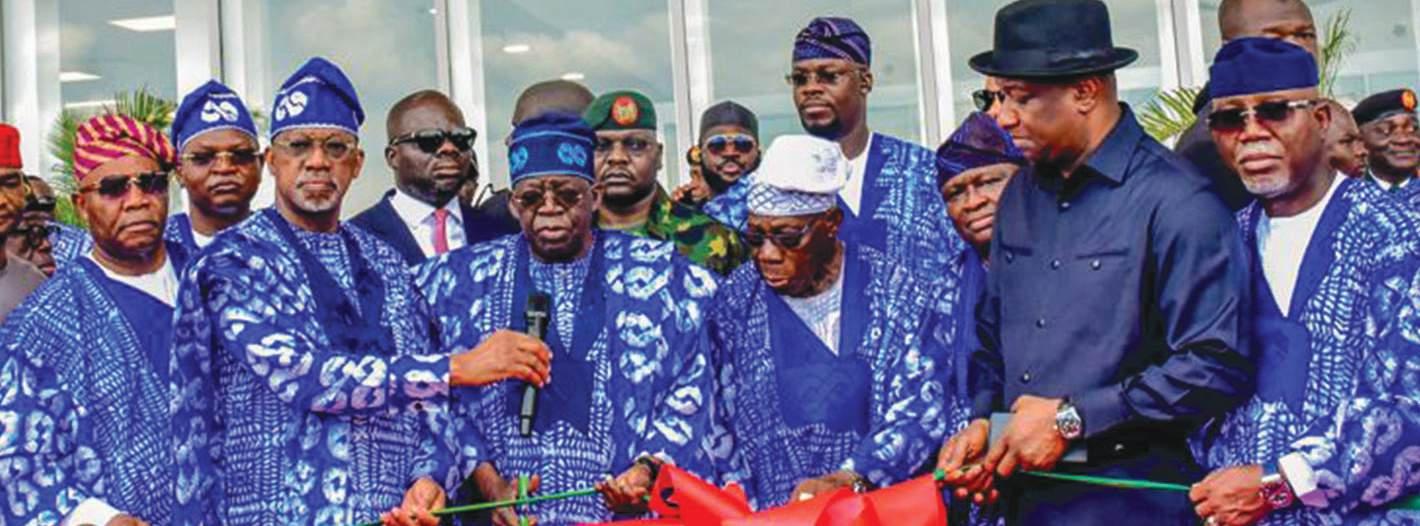
L-R: Senate President, Senator Godswill Akpabio; Ogun State Governor, Dapo Abiodun; President Bola Ahmed Tinubu; former President, Chief Olusegun Obasanjo; Senator Olamilekan Adeola; Minister of Aviation, Mr. Festus Keyamo (SAN), and Ondo State Governor, Mr. Lucky Orimisan Ayedatiwa, at the inauguration of ultra modern Gateway International Airport, Iperu, Ogun State, yesterday
Emmanuel Addeh in Abuja and Sunday Ehigiator in Lagos
Edun: Yearly GDP Rise Not Enough to Lift Millions of Nigerians out of Poverty
Dike Onwuamaeze
The Minister of Finance and Coordinating Minister for the Economy, Mr. Wale Edun, has stated that the rise in Nigeria's yearly average GDP growth from two per cent to about four per cent currently was not enough to lift millions of Nigerians out of poverty.
Edun stated this in Lagos at the Nigeria Business Summit 2026 with the theme "Powering Sectors, Growing Sustainable SMEs, Unlocking Global Trade," which was organised by the Stanbic IBTC.
The minister, who addressed the summit virtually, said that
the government was focused on enhancing the productive capacity of the Nigerian economy.
He said: "For nearly a decade, our GDP has averaged around two per cent per annum and we have just recently moved into a new phase where GDP is now about four per cent per annum.
"It is an important improvement and yet it is still below the level required to move Nigerians out of poverty in their millions, which is the overall aim and objective of President Bola Ahmed Tinubu's 'Renewed Hope Agenda and Action Plan'".
Edun said that the government's focus was currently on supporting productivity, supporting the productive sectors in particular.
"As a government, our focus remains to sustain macroeconomic stability while supporting the productive sectors of the economy despite the fiscal constraints," he said.
Edun said that sectors such as energy, agriculture, manufacturing, technology would remain critical to unlocking productivity.
He said: "For example, agriculture contributes 25 per cent of GDP, yet its full value chain potential remains
underdeveloped.
"The energy sector reforms and liberalisations are aimed at unlocking private capital and improving supply reliability.
"And the latest of these initiatives to attract investment, particularly private investment, into that sector was launched a couple of weeks ago when the Federal Executive Council approved the setting up of the Grid Asset Management Company.
"We need to help to bring into operation and get the benefit from what are currently described as standard capacity in the generating portion of the power sector.
TINUBU: WE SHALL DEFEAT BANDITRY, TERRORISM TROUBLING NIGERIA
Deji Elumoye in Abuja and James Sowole in Abeokuta
President Bola Tinubu again yesterday promised Nigerians that bandits and terrorists disturbing Nigeria would be defeated.
Tinubu reiterated the promise at Iperu in Ikenne Local Government Area of Ogun State, where he inaugurated the Gateway International Airport and some road projects in the axis.
An elated president commended Ogun State Governor, Prince Dapo
Abiodun, for investing in security equipment, including vehicles.
He said, "I am particularly pleased with the focus on mobility, security, and agriculture. The introduction of modern transportation solutions, including new vehicles, reflects a shift toward innovation and improved daily life.
"Strengthening security infrastructure reinforces our resolve to protect lives and property. We will overcome banditry and terrorism.
"I assure you that we will continue to make progress.
Nigeria is determined to be great, and we are firmly on the path to achieving that greatness again."
The president expressed delight at being part of the ceremony, describing the vision of Abiodun and his predecessors as remarkable.
Commending the governor, Tinubu said, "Today, we commission a major economic hub in this corridor. Over the past seven years, you have demonstrated commitment, vision, and patriotism in advancing Nigeria’s growth.
"We celebrate you today for
your contributions to national development. I have no regrets, and I congratulate the people of this great state for their steadfast support of the government.
I also thank you for your continued faith in our party, the All Progressives Congress. Our investments are centered on our people. The infrastructure we see today reflects our confidence in our country's future.
"We believe that today’s foundation will secure tomorrow’s prosperity. I stand before you with a deeply grateful heart. God has endowed us with a great
"Third, we must expand our participation in regional and global trade."
The minister said that part of the government's effort to enhance Nigeria's participation in regional and global trade was the operationalising of the first phase of the National Single Window Initiative because the country's true potential really came from being a leading export economy in spite of its over 200 million population that guarantees large domestic market.
He said: "The African Continental Free Trade Area Agreement presents a historic opportunity for Nigerian
nation and allowed us to move beyond past mismanagement. Our commitment to the future is clear—today, tomorrow, and in the years ahead."
Addressing the gathering, which included the Senate President, Senator Godwill Akpabio, governors, and captains of industry, Abiodun described the ceremony as both historic and symbolic.
Abiodun said Tinubu's presence reflected not only his commitment to national development but also his strong belief in subnational governments as engines of
TRUMP GIVES IRAN 48-HOUR ULTIMATUM TO REOPEN STRAIT OF HORMUZ AS WAR ESCALATES
In a swift response, Iran issued a stark warning to the US and Israel, saying the Gulf region could become a “hell” for both countries if tensions escalate further.
It placed a $66,100 (£50,000) bounty on a missing American airman after a US fighter jet was shot down over its territory, escalating tensions and triggering an urgent search-and-rescue operation.
In a post on Truth Social, Trump warned that hell would be let loose if Tehran failed to comply within the deadline, referencing earlier threats to target Iran’s energy infrastructure. The ultimatum followed a series of shifting deadlines and mixed signals from Washington, oscillating
Pledges to focus reform on enhancing productive sectors ATIKU: I’LL SUPPORT WHOEVER EMERGES AS ADC PRESIDENTIAL CANDIDATE
the national convention of party slated for April 14.
The electoral body based its action on a court ruling, but the ADC, however, rejected the move, accusing INEC of wrongly interpreting the ruling.
It also vowed to go ahead with its planned convention and other party activities.
Speaking in an interview with DW Hausa, Atiku alleged that vested interests were behind the party’s current situation, noting that
between threats of force and claims of ongoing diplomatic engagement.
The conflict, launched jointly by the US and Israel on February 28, has now entered its sixth week, with thousands reported dead and global markets rattled by disruptions to oil flows through the Gulf.
“Remember when I gave Iran 10 days to make a Deal or Open Up the Hormuz Strait. Time Is Running Out; 48 Hours Before All Hell Will Reign Down on Them,” Trump posted. “Glory be to God!” he concluded.
Trump’s reiteration of his Easter Monday deadline comes as the US continues its frantic search to locate a pilot
its growing popularity has made it a target.
On the party’s presidential ticket, Atiku said he would stand firmly behind whoever emerges through the process.
“We will support and endorse whoever emerges as the flag bearer. How many are we (presidential aspirants), three or four? In the PDP, more than ten of us contested,” he said.
The former vice president stressed the ADC is youthfriendly, noting that the party
whose F-15 was downed over Iran, following the successful rescue of a co-pilot. Iran has continued to fire missile attacks against Israel and the US Gulf allies.
Trump had previously announced the extension and 10-day deadline on March 26.
Trump’s demand that Iran open the Strait came after a second Turkish ship made it through the Strait, the country’s Transportation Minister, Abdulkadir Uralolu, disclosed yesterday.
“This was possible due to our initiatives and also because these ships were using Iranian ports or were carrying cargo to or from Iran,” Uralolu told CNN
remains committed to youth and women inclusion.
“The youths have taken over the party. Most of those seeking elective positions, from councillor to state assembly, Senate and House of Representatives, are young people. We have always said our party belongs to youths and women. Our role is to create the opportunity and hand it over to them,” he said.
Asked if he could support a youth a presidential candidate should the party field one,
Türk. The first Turkish vessel made it through on March 13 after receiving permission from Iran.
Meanwhile, the war’s reach has expanded beyond traditional battlefields. An apparent Iranian drone strike caused damage to the Dubai headquarters of US tech firm Oracle Corporation, underscoring the growing risk to civilian and commercial infrastructure across the region. Iranian authorities have accused major American tech firms of espionage, declaring them potential targets.
In southern Iran, renewed strikes near the Bushehr Nuclear Power Plant have heightened fears of a nuclear
Atiku said, “Yes, why not,” “Allah has done everything for me. I have brought my sons and grandchildren home. What will be their future and that of their children?” he said. He expressed confidence that Nigerians were ready for change, citing worsening economic and security conditions.
“We are confident that Nigerians are yearning for change. They are ready for it. They are being pushed to the wall and are prepared to
incident. The facility, which has been targeted multiple times during the conflict, was again hit in its vicinity, killing a security guard and damaging auxiliary structures.
Late last night, Trump said “many” of Iran’s military leaders were killed in a huge strike on the Islamic republic’s capital.
“Many of Iran’s Military Leaders, who have led them poorly and unwisely, are terminated, along with much else, with this massive strike in Tehran!” Trump wrote on his Truth Social platform.
The post included a video showing explosions lighting up a city’s skyline at night but did not specify when the military action took place.
do even more than they did in the previous elections,” he said.
The former vice president linked rising insecurity, particularly in the North, to youth unemployment and poor access to education.
“Insecurity is more severe in the northern states, largely due to youth unemployment and lack of access to education.
When you go round the region, you see that education is not receiving the attention it deserves. It has been relegated.
businesses to scale.
"We must, therefore, improve trade infrastructure and logistics, enhance competitiveness, we must support businesses to access regional and even continental markets, and strengthen Nigeria's role in the global value chain.
"As we know, Africa as a whole is about 3.0 per cent of world trade, and the intraAfrican trade is about 15 per cent, way below the levels that are optimal and that we can achieve to mutual benefits in a way that helps us to grow our economies and reduce poverty.
online
growth.
He said, "We are proud to align with your Renewed Hope Agenda, which is placing our nation on a path of economic recovery, fiscal discipline, and sustainable growth."
The governor commended Tinubu's bold economic reforms—particularly the unification of the foreign exchange system, the removal of fuel subsidies, and the repositioning of public finances to reflect market realities.
"These courageous decisions
Continued on page 12
However, responding, Iran issued a stark warning to the US and Israel, saying the Gulf region could become a “hell” for both countries if tensions escalate further.
Spokesperson for the Khatam al-Anbiya Central Headquarters, which coordinates Iran’s armed forces, Ebrahim Zolfaghari, while speaking to reporters yesterday, said: “If hostility escalates, the entire region will turn into hell for you; the illusion of defeating the Islamic Republic of Iran will become a quagmire into which you will sink.”
The warning was reinforced by the commander of
Continued on page 12
“Governments have not ensured that children enrol in school, and even when they graduate, there are no jobs or business opportunities. I have never witnessed a period like this in Nigeria,” he said.
Atiku further accused the government of tolerating corruption.
“There is also embezzlement on the part of government and corruption is rampant. The government has turned a blind eye because it is involved,” he said.
Again, Gunmen Kill Three, Injure One in Fresh Plateau Attack 48 Hours After Tinubu’s Visit
Kosoko in Jos Barely 48 hours after President Bola
visited Plateau State, three persons were killed and one injured on
Friday evening when gunmen ambushed a group of youths in Nyango Gyel, Jos South Local Government Area of Plateau State, heightening concerns over renewed
insecurity in the state.
The victims, identified as Luka Sandu Pam (36), Samuel Davou (38), and Deme Saidu (35), were returning from Gero on a motorbike at about 7
p.m. when they were attacked.
Eyewitnesses said the assailants opened fire without warning, forcing the group to flee in different directions.
Gyel Youth Leader, Dung
I Didn’t Mean to Shoot Seun Okinbaloye, Wike Clarifies; Media Groups
Protest
Amnesty International accuses minister of promoting violence against journalists Chuks Okocha and Olawale Ajimotokan in Abuja
The Minister of the Federal Capital Territory (FCT), Mr. Nyesom Wike has described his remarks about the Channels Television presenter, Seun Okinbaloye as a figurative expression, clarifying that he never meant that he would shoot the presenter.
This is just as a coalition of media freedom and civil society organisations has condemned the remarks by the minister concerning Okinbaloye, and demanded an immediate apology and a commitment to uphold press freedom.
Amnesty International has also accused the FCT minister of promoting violence against journalists.
Speaking on his programme, Okinbaloye had expressed concern that the political space appeared to be narrowing, warning that Nigeria could be “doomed democratically” if viable opposition parties were unable to effectively participate in the elections.
He raised concerns on the possibility of Nigeria drifting towards a one-party state ahead of the 2027 general election.
Responding during a media chat, Wike said: “I was surprised yesterday, thoroughly surprised. If there were any way to break the screen, I would
have shot him.”
However, following the widespread condemnations that followed Wike’s comments, Wike has described his remarks as figurative remarks, clarifying that he didn’t mean to shoot Okinbaloye.
He added they even spoke on the phone yesterday, and he (Okinbaloye) understood what he meant.
A statement by the minister’s Senior Special Assistant on Public Communications and Social Media, Lere Olayinka, clarified that: "What the minister meant, which he made clear during the media chat was that he was angry seeing Okinbaloye, whom he holds in high esteem as a journalist, descending into the political arena by speaking as an interested party, instead of an interviewer.
"The statement made by the minister was in hyperbolic context, which was clearly without intent. It was primarily using exaggeration to make a point.
"Even after the minister made the clarifications on the live television programme, which had Chamberlain Uzor, Head of Channels Television’s Abuja Office as part of the interviewers, all the journalists who were interviewing him just laughed.
"Therefore, after the minister
detailed explanations of what he meant, including saying on the live television programme that he didn't mean that he will carry gun and shoot the television anchor, it will become a clear hatchet job for any individual or group to pick the statement out of context and make any issue out of it".
He urged the public to discountenance the use of the comment as an instrument of blackmail and propaganda by those whose intent is to misrepresent facts for their political gains.
However, a coalition of media freedom and civil society organisations has condemned the remarks by the minister
and demanded an immediate apology and a commitment to uphold press freedom.
The groups, including the International Press Institute, International Press Centre, Media Rights Agenda, Enough is Enough Nigeria, Centre for Journalism Innovation and Development, Centre for Media and Society, and YIAGA Africa, described the minister’s statement as inappropriate and dangerous.
Others in the coalition are the International Centre for Investigative Reporting, Global Rights, Dataphyte Foundation, Accountability Lab Nigeria, TechHer, Kebekatche Women Development Resource Centre and DigiCivic Initiative.
Davou, confirmed the deaths and described the attack as “unprovoked and deeply troubling.”
“We started hearing sporadic gunshots, and everyone scattered. Unfortunately, three of our people were killed,” he said, urging security agencies to act decisively to prevent further violence.
At the scene of the attack, Chairman of Berom Youth Moulder Association, Solomon Dalyop, condemned the killings, describing it as a stark reminder of the fragile security situation in Plateau State. He said the victims had gone to observe Good Friday activities and were thereafter ambushed on their way home.
“These young men went to mark Good Friday and were returning home when they were ambushed and killed. This is heartbreaking,” he said.
Dalyop disclosed that community leaders recently held a security meeting with Fulani representatives at the Sector 2 Command of the Nigerian Army in Jos South, where they raised concerns about the movement
of unidentified persons around Gero, Rafin Bauna, and Dutsen Kura in the Miyango-Bassa axis.
“We were informed about suspicious movements in these areas, and we have since cautioned our people to be vigilant, especially at night,” he said. He warned that the situation could escalate if urgent measures are not taken, alleging that armed groups have occupied bushes across parts of the state. According to him, only the police responded after the attack, evacuating the injured survivor to the medical facility for attention.
Residents of Nyango Gyel have called for increased security deployment and improved surveillance to forestall further attacks as preparations begin for the burial of the victims.
The latest incident adds to a series of violent attacks recorded in Plateau State in recent months, raising renewed concerns about the safety of rural communities and the effectiveness of ongoing security interventions.
Resident Doctors to Embark on Fresh Nationwide Strike Tuesday
Onyebuchi Ezigbo in Abuja
Medical doctors under the auspices of the National Association of Resident Doctors (NARD) have said they would commence a total industrial and comprehensive strike beginning from 12a.m. on Tuesday.
As part of resolutions reached at the NARD Extraordinary National
Executive Council (e-NEC) meeting held virtually yesterday, the doctors said they would protest federal government's decision to remove the Professional Allowance Table (PAT), Among the demands of the doctors were the reversal of the decision to cease the implementation of the PAT starting in April, 2026, immediate payment of
promotion arrears and salary arrears for specific centres and prompt conclusion of the process of paying of the 2026 MTRF.
Another demand of the doctors is the immediate processing and payment of outstanding 19 months' arrears of the Professional Allowance PAT.
A statement signed by NARD's Secretary General,
Dr. Shuaibu Ibrahim, said, "Following extensive deliberations on this matter, the NEC decided to embark on a total industrial and comprehensive strike beginning at 12am on Tuesday, April 7, 2026".
The NARD leadership urged its members to unite in the fight against what it described as injustice to a logical conclusion.
Yemi
Tinubu
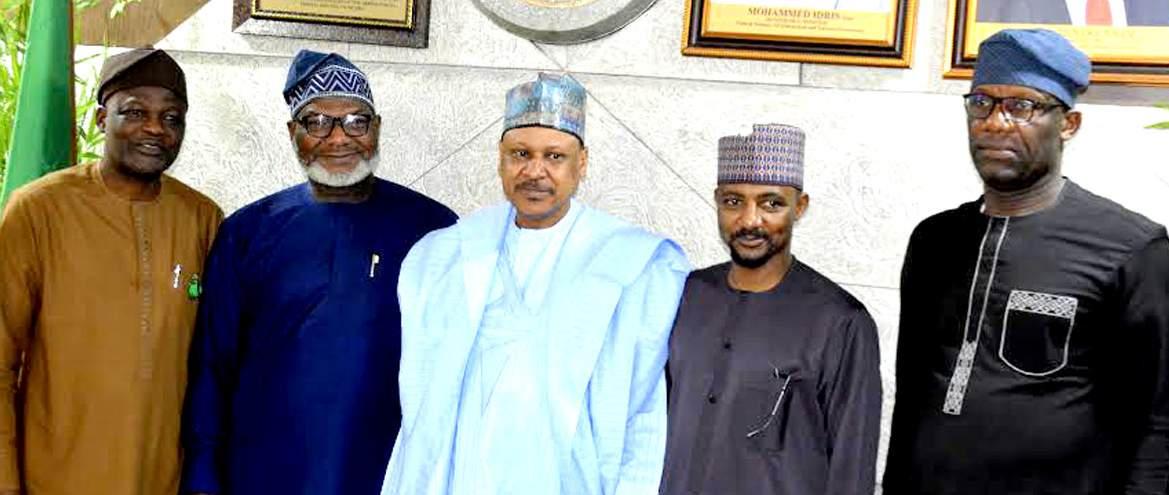
and Permanent Secretary, Federal Ministry of Information and National Orientation, Mr. Ogbodo Chinasa, during the visit of the CCB delegation to the Ministry in Abuja...recently
TEN HEARTY CHEERS…
In Easter Messages, Atiku, Akpabio, Obi, Governors, Others Seek Prayers for Enduring Peace in Nigeria
Port Harcourt
As Christians all over the world celebrate the resurrection of Jesus Christ today, former Vice President, Atiku Abubakar; President of the Senate, Senator Godswill Akpabio; Labour Party's presidential flagbearer in 2023, Mr. Peter Obi, Niger State Governor, Alhaji Mohammed Umaru
Bago; Edo State Governor, Monday Okpebholo; Delta State Governor, Hon. Sheriff Oborevwori; Governor of Gombe State, Inuwa Yahaya; Ekiti State Governor, Biodun Oyebanji; Governor of Enugu State, Dr. Peter Mbah; and Rivers State Governor, Siminalayi Fubara, have charged them to use the occasion to pray for enduring peace in Nigeria. This comes as the Executive
Chairman of the Economic and Financial Crimes Commission (EFCC), Mr. Ola Olukoyede, expressed strong hope that Nigeria would surely break the yoke of corruption, which was hindering the country's development and progress.
Atiku, also a chieftain of the African Democratic Congress (ADC), in a statement issued by his Media Office, extended his warm felicitations to Nigerians and called on the
government to live up to its constitutional responsibility to ensure the security and welfare of all citizens and residents in Nigeria.
He described the celebration as a season of solemn reflection, intense sacrifice, and divine love, urging Christians to use the period for deep introspection, repentance, and renewal of hope.
Atiku encouraged all Christians to emulate the
11 Killed, 52 Houses Destroyed as Violence Breaks Out in Nasarawa
Igbawase Ukumbs in Lafia
At least 11 persons were killed while more than 50 houses were burnt in a communal crisis in Akyawa and Udege Kasa communities of Nasarawa Local Government Area of Nasarawa State on Friday.
The spokesman of the Nasarawa State Police Command, SP Ramhan Nansel, confirmed this in a statement issued yesterday in Lafia.
He said suspected hoodlums had carried out a reprisal attack over the alleged killing of two of their kinsmen.
“In the course of the attack, 11
people were killed, while about 52 houses were burnt in the two communities,” he said.
Nansel stated that the Commissioner of Police (CP) in the state, Shettima Mohammed, had led a team on an on-thespot assessment of the affected communities to ascertain the level of destruction and ensure that normalcy was restored.
He said that the CP expressed deep sorrow over the tragic incident and commiserated with the families of the deceased and the communities, assuring them of the Command’s unwavering commitment to ensuring that justice was served.
Nansel said the CP has ordered an intensive search for the perpetrators of the heinous act and directed tactical teams and investigative units to ensure their prompt identification, arrest, and prosecution.
“To prevent any further breakdown of law and order, the Commissioner of Police has also directed the immediate reinforcement and sustained deployment of Police personnel to the affected areas,” he said.
He further explained that the police were working in collaboration with the Military and the Nigeria Security and Civil Defence Corps (NSCDC),
to provide adequate security and restore lasting peace in the area.
The police spokesperson further said that a stakeholders’ meeting was held during the visit, where the CP urged residents to remain calm, law-abiding, and cooperate with security agencies by providing credible information to support ongoing investigations.
He therefore reassured members of the public that normalcy had been restored to the affected communities and that proactive measures had been taken to prevent any recurrence of violence.
Sokoto Diocese Debunks Alleged Attack on Kukah’s Residence, Pastoral Centre
The Catholic Diocese of Sokoto has dismissed claims that the residence of Bishop Matthew Hassan Kukah, along with the Cathedral and a N1 billion Catholic Pastoral Centre, was set ablaze.
In a statement issued yesterday, the Diocese clarified that all the facilities
referenced in the viral video remain safe, intact, and fully operational.
The statement, signed by the Director of Communications, Rev. Fr Pascal Salifu, described the video as misleading and the handiwork of individuals intent on creating panic and destabilising society.
“Our attention has been drawn to a misleading and false video currently circulating online with the caption: ‘Breaking!!! Bishop Kukah’s house, Cathedral, and 1 billion Naira Catholic Pastoral Centre set ablaze by Islamists in Sokoto.’
“We wish to inform the general public that this
information is entirely false,” the statement said.
According to the Diocese, the video began trending in the aftermath of the 2022 killing of Deborah Yakubu, a student of Shehu Shagari College of Education in Sokoto, suggesting that it is being recirculated to inflame tensions.
selflessness, forgiveness, and compassion of Jesus Christ in their daily lives.
He said the essence of Easter is sacrifice and love, urging Nigerians to seize the opportunity to show genuine love and compassion to one another.
In his message, Akpabio assured Nigerians of the federal government’s commitment to ridding the country of terrorism, which has led to insecurity in some states of the federation.
According to a statement by his Special Adviser on Media and Publicity, Hon. Eseme Eyiboh, he enjoined Nigerians to embrace peaceful coexistence, tolerance, and mutual respect, regardless of faith or ethnicity.
Akpabio urged all Christians to reflect on the values of love and peaceful coexistence as they celebrate the sacred feast of Easter.
The Senate President, who acknowledged that Nigeria was facing some challenges, particularly insecurity, appealed for understanding and commitment to national and security consciousness.
In the same vein, Obi urged Nigerians to be very hopeful of an Hallelujah Sunday after the Good Friday sorrow.
Writing in his X handle, the former Anambra State Governor said: "As you commemorate the resurrection of Jesus Christ amid severe hardships, I urge you to remain hopeful bearing in mind that "Good Friday must come before Easter Sunday.
"At Easter, I sincerely share with you the weight of the economic burden on families, even as I encourage you not to lose heart. Let us see our current struggles as a temporary "cross" that we must bear before our nation can experience a political and economic rebirth.”
Also, Governor Bago, in his
Easter message, prayed that divine intervention would bring peace in the state and country.
In a message signed by his Chief Press Secretary, Bologi Ibrahim, Governor Bago described Easter as a solemn celebration, then acknowledged the significance of the period to Christians all over the world.
On his part, Governor of Gombe State, Yahaya, in a goodwill message made available by his media aide, Mr. Ismaila Uba-Misilli, admonished Christians to draw strength from Jesus Christ’s sacrifice and triumph over adversities.
He called for prayers, peace, interfaith harmony, and collective actions as the nation worked towards renewal and progress.
Yahaya also urged Nigerians to remain united ahead of the 2027 election, while adhering to democratic principles to preserve the country’s democracy and strengthen national cohesion.
On his part, Delta State Governor, Oborevwori, extended warm Easter greetings to Christians across Delta State and Nigeria, urging them to remain steadfast in their faith and committed to the teachings of Jesus Christ.
In a statement issued by his Chief Press Secretary, Sir Festus Ahon, he emphasized that Easter represents a season of hope, sacrifice, and renewal, reminding believers of the triumph of light over darkness and life over death through the resurrection of Jesus Christ.
He called on Christians to draw inspiration from the virtues of love, humility, perseverance, and selflessness exemplified by Jesus Christ, noting that such values are essential for building a more united, peaceful, and prosperous society.
Chuks Okocha, Alex Enumah in Abuja and Blessing Ibunge in
L-R: Chief Executive Officer, PocketApp, Mr. Ayo Akinola; Chief Product Officer, Piggyvest, Mr. Terry Kanu; Co-founder and CMO, Piggyvest, Mr. Joshua Chibueze; Director of Payments, Piggyvest, Ibukun Akinola; Co-founder and COO, Piggyvest, Odunayo Eweniyi; Chief Creative Officer, Piggyvest, Mr. Nonso Eagle; and Co-founder and CEO, Piggyvest, Mr. Somto Ifezue, during Piggyvest 10th anniversary ceremony in Lagos …recently
ROYAL VISIT TO DISU...
Easter: Nigerians Never Signed up for Suffering, Says NLC, Decries Worsening Insecurity, Poverty
Labour Party enjoins Nigerians to remain hopeful, patriotic
Onyebuchi Ezigbo in Abuja
The Nigeria Labor Congress (NLC) has decried worsening socio-economic conditions in the country, declaring that Nigerian workers and citizens are being forced to endure hardship they never consented to.
This is in line with the Labour Party (LP) 's call for Nigerians to embrace the true lessons of
are restoring investor confidence, attracting capital inflows, and repositioning Nigeria as a competitive global destination.
"Your efforts to expand revenue through improved tax administration, digitalisation of government processes, and institutional strengthening are addressing long-standing structural challenges.
"Key initiatives such as the Presidential Compressed Natural Gas Programme, student loan schemes, rail modernization, and major highway projects—including the Lagos–Calabar Coastal Highway and Sokoto–Badagry Superhighway—demonstrate a deliberate reset of our national economy.
"Your administration has also shown courage in tackling fiscal leakages, promoting local production, and improving the
the Khatam al-Anbiya headquarters, Ali Abdollahi, who added that “the gates of hell will be opened” for the US and Israel if aggressive actions continue.
Abdollahi condemned Trump’s comments, describing the US president as “aggressive and warmongering,” and called the threat to attack Iran’s infrastructure “a desperate, agitated, unbalanced, and foolish move.”
He further warned that
Easter and remain hopeful, no matter how challenging the current circumstances may appear.
In its Easter message, the labour centre lamented what it described as deepening poverty, insecurity, and governance failures, and called on leaders to embrace sacrifice and people-oriented policies.
The congress also urged
ease of doing business through regulatory reforms.
"This renewed focus on infrastructure financing, public-private partnerships, and investment in agriculture, power, and transportation is laying the foundation for long-term prosperity," he said.
He added, "The Gateway International Airport stands as a defining legacy of this administration. Built from the ground up and now fully operational, it features a nearly four-kilometre runway capable of handling large aircraft, a modern control tower, advanced aviation systems, and cargo facilities. It is the centerpiece of our emerging aerotropolis.
"Today’s ceremony also marks the launch of Gateway Airlines, beginning operations with Bombardier CRJ900 aircraft, alongside cargo services
any US attack on Iranian infrastructure would prompt Tehran to retaliate by targeting facilities used by the US military and Israel “without limitation.”
Meanwhile, Iran has placed a $66,100 (£50,000) bounty on a missing American airman after a US fighter jet was shot down over its territory, escalating tensions and triggering an urgent search-and-rescue operation.
The aircraft, a US F-15E Strike Eagle, was brought
Nigerians to draw strength from the Easter season by renewing their resolve to demand accountability and resist policies that impose suffering on the masses, stressing that meaningful change would only come through collective action and solidarity.
In the message, President of NLC, Joe Ajaero, said: "As we celebrate Easter this year,
aimed at boosting trade and logistics."
The governor also used the event to highlight some projects executed by his administration in the areas of roads, housing, electricity, and health.
In his goodwill message, the Senate President, Godswill Akpabio, commended Tinubu for all he was doing to make Nigeria great again.
Akpabio also commended the legislative arm of government for cooperation with the Executive arm, saying that without proper appropriation, what they are witnessing today would have been impossible.
He said, "Without proper appropriation and collaboration between the executive and legislature, what we see today would not have been possible. Progress like this requires unity, not conflict.
down over southern Iran on Friday, marking one of the most serious confrontations between the two countries in the ongoing conflict.
This marks the first time the US F-15E Strike Eagle was shot down in combat in over 40 years, as US officials confirmed that the jet, which carried a two-person crew, went down during combat operations.
One crew member, the co-pilot, was rescued in a high-risk mission, while the
the Nigeria NLC salutes the resilience, unyielding spirit, and daily struggle of Nigerian workers and the masses in their pursuit of dignity, justice, and a better life.
"This season is not merely a religious ritual; it is a profound moment of ideological clarity. It reminds us that God's infinite love for humanity was demonstrated not in abstract
"Mr. President, many years ago, you shared bold ideas for Nigeria. Today, you have the opportunity to bring those ideas to life.
"You were among the pioneers of independent power initiatives in Nigeria, and your commitment to internally generated revenue began during your time in Lagos. That model is now being replicated across states, including Ogun.
"We are moving toward greater decentralisation of power—both in electricity and governance—so that states can take more responsibility for development and service delivery.
At the federal level, your reforms have strengthened revenue distribution to subnational governments. Funds allocated through the federation account are reaching
second, a weapons systems officer, remained missing.
Iranian authorities, through state media, have since called on civilians to help locate the missing American, offering a reward of about $66,100 for anyone who captures the airman alive.
The rescue effort has itself come under attack, as a US helicopter evacuating the rescued pilot was reportedly hit by small arms fire, injuring crew members, though it managed to land safely.
words, but in the ultimate act of sacrifice—the giving of His only begotten Son, Jesus Christ, to break the chains of sin and death.
"The sacrifice of Jesus at Calvary was not for personal gain but for the redemption of humanity. In contrast, the sacrifices demanded of Nigerian workers today are ones we never consented to:
the states, enabling them to execute projects and meet obligations without excessive borrowing.
"Today, we see the results: states are implementing projects, paying salaries, and driving development.
I commend the Governor of Ogun State and all governors who are delivering meaningful progress across the country.
"The National Assembly remains committed to partnering with the executive to sustain this momentum."
Also, in a goodwill message, the former president, Chief Olusegun Obasanjo, said he was happy that a project like this had become a reality in Ogun State in his lifetime.
Obasanjo, who said he had shortened the time from the airport to his home in Abeokuta by over 40 minutes, said he
In a related development, a US A-10 Warthog aircraft deployed as part of the rescue mission was also struck and damaged, with its pilot safely recovered after ejecting.
Iranian officials have claimed responsibility for downing an A-10, although it remains unclear if it was the same aircraft involved in the rescue operation.
The US has yet to issue an official statement through Central Command on the incident, with details
the sacrifice of our wages on the altar of profiteering, the sacrifice of our safety on the altar of insecurity, and the sacrifice of our lives on the altar of missed opportunities for effective governance. Meanwhile, many leaders shield themselves in armoured vehicles and heavy security, refusing to make any meaningful sacrifice.
had landed at the Gateway Airport from Abuja. He said that while he used to spend almost an hour from Lagos airport to Abeokuta, he now spends only 25 minutes from the Gateway Airport. He commended all past governors who had contributed to the state's development since its creation in 1976.
The former governor of Ogun State, Aremo Olusegun Osoba, also commended the president and Abiodun for all they are doing in the country and in Ogun State.
The Governors of Lagos State attended the ceremony. Mr. Babajide Sanwoolu, Ondo State, Mr. Abiodun Oyebamji, Ondo State, Lucky Ayedatiwa, Niger State, Umaru Bago, Taraba State, Agbu Kefas, Borno State, Babagana Zulum, among others.
emerging mainly from unnamed defence officials and media reports.
Amid the rising risks, Russia has begun evacuating personnel from the site. According to state nuclear agency Rosatom, 198 workers were transported toward the Iranian-Armenian border shortly after the latest strike, the largest such evacuation so far. A reduced skeleton staff remains on-site amid growing concerns about potential damage to the facility.
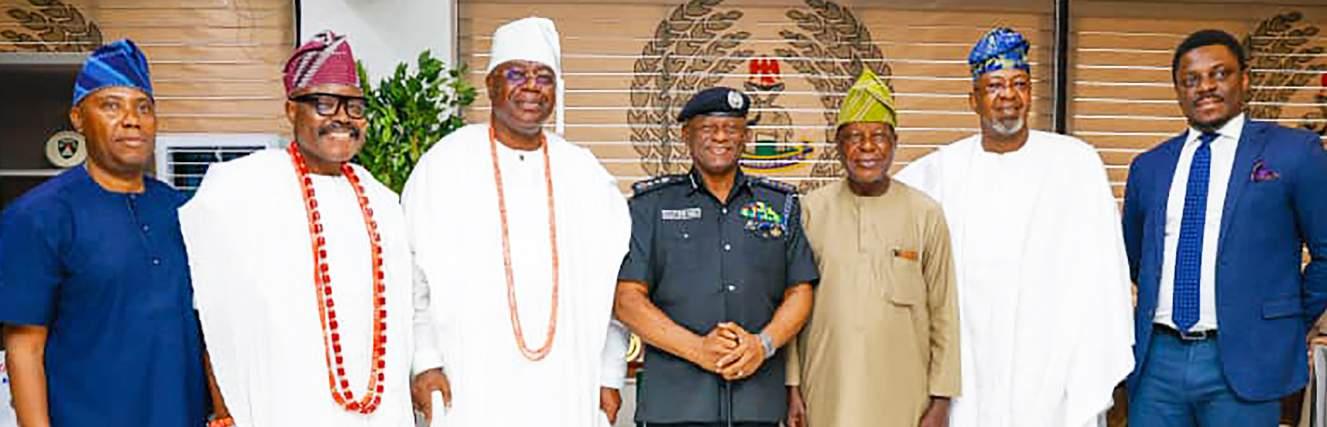
L-R: Dr. Tokunbo Onasanya; Bobagunwa of Ilara Kingdom, Ambassador Oluwatoyin Lawal; Alara of Ilara Kingdom, Epe Division, Lagos State; HRM Oba Olufolarin Olukayode Ogunsanwo (Telade IV); lnspector -General of Police, Mr. Tunji Disu; former Inspector-General of Police; Sir Mike Okiro; Baba Eto of Ilara Kingdom, Chief Folorunso Folarin-Coker; and Mr. Boonyameen Lawal (SAN), during Oba Ogunsanwo's courtesy visit to Disu to felicitate him on his recent appointment as the 23rd IG in Abuja... recently
PROMOTING HEALTHCARE…
L-R: Commissioner for Health, Delta State, Dr. Joseph Onojaeme; his Works (Rural Roads) and Public
to the Governor, Sir
Government Area…recently
Ahon; and the
Amid Liquidity Surge, Banks’ Deposits
Nigerian banks’ deposits with the Central Bank of Nigeria (CBN) surged to an all-time high of N128.9 trillion in March 2026, underscoring mounting excess liquidity in the financial system and a growing preference for risk-free returns.
Latest data obtained from the
CBN showed that the March figure represents a sharp 110.96 per cent increase compared with N61.11 trillion recorded in February 2026. The surge was a reflection of an aggressive deployment of surplus funds by deposit money banks into the apex bank’s Standing Deposit Facility (SDF), a window that offers overnight interest on
idle liquidity.
Further analysis indicated that banks had earlier deposited N52.6 trillion in January 2026, representing a staggering increase of about 460 per cent from N9.39 trillion in January 2025.
Cumulatively, banks placed an estimated N242.63 trillion with the CBN in the first quarter of 2026, a dramatic rise of 1,162.2
per cent when compared with N19.22 trillion recorded in the corresponding period of 2025.
On a full-year basis, deposits climbed to N336.2 trillion in 2025, marking a 777.2 per cent increase from N38.33 trillion in 2024, highlighting the rapid expansion of liquidity in the banking system over the past year.
Market analysts attributed the
League of Northern Democrats Cautions ADC against Holding National Convention
PDP stakeholders consider Accord party as last-minute option
Chuks Okocha in Abuja
The promoter of All Democratic Alliance (ADA) and League of Northern Democrats, Dr. Umar Ardo, has cautioned the African Democratic Congress (ADC) against holding its planned national convention this week to avoid suffering the fate of the Peoples Democratic Party (PDP).
Meanwhile, it was learnt that stakeholders of the PDP were considering Accord Party for
their presidential aspirants to actualise their ambitions.
Ardo said that the ADC would incur the wrath of the judiciary for disobedience to court order that directed that nothing should be done to affect the decision of the court by the affected factions in the dispute.
Ardo argued that all hopes was not lost in the registration of the ADA, as its registration dispute was still a subject of litigation in the court.
Speaking with THISDAY,
Ardo argued that had the leadership of the ADC supported its earlier decision to support the registration of an alternative political party, like the ADA, they would not have been in this quagmire
According to him, "Though I am not an ADC member, but I do not support the ADC going ahead with its planned congresses and convention as it is, in my opinion, a violation of the Court of Appeal order that no party in the dispute
should do anything that would compromise the suit before the Federal High Court.
"The David Mark-led executive is the key party to this suit. It is in its own best interest and that of the Nigerian state therefore not to do so.
"Doing otherwise is falling into the trap of the regime as the rule of law would not be kind to the party. It should learn from the mistakes of PDP in Ibadan," Ardo stated
Nigerian Stock Exchange Records ETF Surge as SIAML Pension Fund Hits 185% Gain
The Nigerian Exchange recorded a dramatic turnaround in its Exchange Traded Funds (ETFs) segment in March 2026, as a sharp wave of investor demand lifted prices across the board, reversing the widespread losses seen in the previous month.
At the centre of the rally was the SIAWML Pension ETF 40, which surged an extraordinary 185 per cent month-to-date, underscoring renewed appetite for listed funds.
According to reports, data
compiled from trading activity on the NGX showed that most ETFs closed the month with strong gains, pointing to a clear rebound in market sentiment and improved liquidity conditions compared to February.
The breadth of the rally was notable, with only a handful of funds ending in negative territory.
Leading the charge, the SIAML Pension ETF 40 rose from N5,014.96 to N14,270.58, pushing its market capitalisation to N92.04 billion from N32.35 billion, the strongest performance among all listed ETFs.
Close behind was the
NewGold ETF, which jumped by 179.28 per cent to close at N186,000.25, as its market value climbed to N9.93 billion from N3.56 billion.
The Stanbic IBTC ETF 30 also delivered an impressive return, gaining 155.57 per cent to settle at N5,000, with market capitalisation rising sharply to N28.56 billion from N11.18 billion.
Similarly, the Greenwich Alpha ETF advanced by 115 per cent to close at N1,290, further reinforcing the broad-based nature of the rally.
Mid-tier funds posted more
measured, but still solid, gains.
The Vetiva Industrial ETF and Vetiva Griffin 30 ETF rose by 29.28 per cent and 28.71 per cent respectively, reflecting steady investor interest in diversified and sector-based instruments.
However, the bullish run was not uniform. Several ETFs recorded losses, suggesting ongoing portfolio adjustments and profit-taking by investors.
The Vetiva Banking ETF remained largely flat with a marginal dip of 0.06 per cent, while the Lotus Halal Equity ETF declined by 1.45 per cent to close at N143.
surge to heightened credit risk concerns, as banks increasingly favour the safety of the CBN window over lending to the real sector amid prevailing economic uncertainties.
The development also reflects the impact of monetary policy adjustments by the apex bank, which recently retained the Monetary Policy Rate (MPR) at 26.5 per cent, while maintaining the asymmetric corridor at +50 and -450 basis points. This effectively makes the SDF window more attractive for banks seeking to park excess funds.
An investment banker and stockbroker, Mr. Tajudeen Olayinka, explained that uncertainty in the business environment has continued to limit the availability of creditworthy borrowers, prompting banks to adopt a
cautious lending approach. According to him, “When viable prime borrowers are limited, banks either reprice risk for other borrowers or turn to safer short-term instruments. In the absence of sufficient bankable opportunities, they resort to interbank placements and the CBN’s standing deposit window.” He noted that the spike recorded in March was largely driven by banks taking advantage of relatively attractive returns at the SDF window to preserve liquidity.
Olayinka added that the CBN is aware of the trend and has deliberately maintained the lower bound of the interest rate corridor at -450 basis points around the MPR to encourage banks to channel excess liquidity into the regulator rather than engage in risky lending.
Falana: No Court Can Grant an Injunction in Political Party Disputes Until Judgment Delivered Sunday Ehigiator
Human rights lawyer and Senior Advocate of Nigeria (SAN), Femi Falana, has stated that no court in Nigeria has the power to grant interim or interlocutory injunctions in disputes involving the internal affairs of political parties.
Falana, in a statement yesterday while speaking on the provisions of Section 83 of the Electoral Act 2026, said: “No court in Nigeria shall entertain jurisdiction over any suit or matter pertaining to the internal affairs of a political party.
“Where such an action is brought in negation of this provision, no interim or interlocutory injunction shall be entertained by the Court, but the Court shall suspend its ruling and deliver it at the stage of final judgment and shall give accelerated hearing to the matter.
“Furthermore, the court shall, at the conclusion of the matter, impose costs of not less than N10,000,000.00 on the counsel who filed the action and not less than N10,000,000.00 on the plaintiff/applicant. The party may also be required to pay the commission any costs, including solicitors’ fees incurred where it is joined as a party.”
Falana emphasised that these measures are designed to prevent internal party disputes from overwhelming the judiciary while ensuring compliance with the Independent National Electoral Commission’s (INEC) oversight.
“This is a clear signal that intraparty matters must be resolved within the party structure or under the supervision of the commission. Courts are to intervene only at final judgment, not at interim stages.”
Kayode Tokede
Festus Akanbi, with agency reports
Information counterpart, Mr. Charles Aniagwu; Chief Job Creation Officer, Mr. Ifeanyi Egwunyenga; Chief Press Secretary
Festus
Project Manager Impact, Dr. Orofuke Ngozi, during an inspection of the newly constructed College of Health Technical Ovrode, in Isoko North Local
Stronger Banks, Harder Questions on Lending to Economic Sectors
Nigeria’s banks are stronger without disruption. Now the test is whether that strength drives real growth, writes Festus Akanbi
Nigeria’s banking sector has entered a new phase, and this transition has been steady and reassuring. When the Central Bank of Nigeria (CBN) concluded the latest recapitalisation exercise on March 31, 2026, the outcome clearly pointed to stability.
Of the 37 banks, 33 met the new minimum capital requirements, while the industry raised about N4.65 trillion over 24 months. There were no bank runs, no sudden collapses, and no visible panic. For depositors, investors, and businesses, this outcome reinforced confidence in the system.
Confidence is often fragile during major regulatory changes, but it held firm in this instance. The composition of the funds raised is also noteworthy. Approximately 72.55 per cent came from domestic investors, while 27.45 per cent originated from international sources.
This reflects sustained local confidence in the banking sector, alongside continued, though cautious interest from foreign investors despite recent economic uncertainties.
The recapitalisation exercise goes beyond increasing capital figures. It represents a deliberate effort to reposition banks to support a larger and more complex economy. Histori- cally, Nigerian banks were often too small to finance large-scale projects independently.
The new capital thresholds are designed to address this limitation. With capital adequacy ratios maintained above international benchmarks, 10 per cent for national and regional banks, and 15 per cent for international banks, the system is now better equipped to absorb shocks and support larger transactions.
CBN Governor Olayemi Cardoso described the outcome as strengthening resilience and positioning banks to support economic growth. While this aligns with regulatory objectives, it also raises a critical issue. Stronger capital enhances stability, but it does not automatically translate into broader economic impact. The key question is how effectively banks will deploy thisFormercapital.Director General of the Nigerian Association of Chambers of Commerce, Industry and Agriculture, Ambassador Ayo Olukanni, provides historical context. He recalls the 2005 consolidation, which significantly reduced the number of banks and strengthened the system. However, he emphasises that the real challenge lies not in raising capital, but in ensuring that it supports development.
According to him, funds within the banking system must translate into meaningful support for sectors such as agriculture, manufacturing, and small businesses.
His reference to the Nsukka yellow pepper project illustrates this gap. The initiative, which involved about 300 farmers and had export potential, struggled to secure affordable financing despite initial support from the CBN. Loan conditions were difficult, and
interest rates remained high. This reflects a broader structural issue in which access to credit is constrained by costs and stringent requirements.
Professor Bongo Adi of Lagos Business School reinforces this concern. He argues that Nigerian banks have historically been weak at real intermediation, with limited connections to the productive sectors.
Instead, banks have often relied on relatively safer income streams such as government securities, fees, and foreign exchange gains. While this approach reduces risk, it limits the banking system’s role in driving economic growth.
There are, however, indications that the current framework is more structured. Analysts point to tighter regulation, improved risk management, and the end of regulatory forbearance.
Last Wednesday, ARISE NEWS invited industry watchers to discuss the CBN’s clean bill of health for banks. Ugodre Obi-Chukwu of Nairametrics noted that the system is stronger than it was before the global financial crisis exposed earlier weaknesses.
Stephen Chima of CardinalStone Securities also highlighted the impor- tance of disciplined capital deployment rather than aggressive lending. The emphasis is shifting toward efficiency andThissustainability. shift places clear expectations on banks. The first is to expand lending to sectors that drive production and employment.
Agriculture remains critical, given its link to food supply, inflation, and rural livelihoods. Farmers require access to affordable credit, storage facilities, and insurance-backed financing to improveManufacturingproductivity. also requires urgent attention. Local producers face high operating costs, foreign exchange challenges, and infrastructure deficits. Access to long-term financing remains limited, forcing reliance on short-term, high-cost loans.
A stronger banking system is ex- pected to address these constraints by improving financing structures and extending credit tenors.
Small and medium-sized enterprises remain central to economic activity but continue to face barriers in accessing formal credit. High interest rates and collateral requirements constrain their growth.Expanding financial inclusion in this segment is therefore essential. Olukanni, also a former Nigerian High Commissioner to Australia, also emphasises the need to support women-owned businesses, given their increasing role in both production and services.
Beyond these sectors, infrastructure and power remain critical. Economic expansion is difficult when the electric- ity supply is unreliable, and logistics costs are high. Financing these areas requires long-term capital and struc- tured lending, which recapitalised banks are now better positioned to provide. The expectations extend beyond lending to governance. The CBN has emphasised zero tolerance for corporate governance violations, reflect- ing lessons from past banking crises where weak oversight undermined otherwise strong institutions. Stronger capital must now be accompanied by improved transparency, accountability, and internal controls.
Compliance is another priority. Alongside the recapitalisation, the CBN introduced stricter anti-money laundering requirements, direct- ing financial institutions to submit implementation plans by June 10, 2026. Analysts said this signals a shift from procedural compliance to institutional responsibility, requiring banks to take full ownership of their control systems.
For regulators, the task is to sustain discipline. Raising capital is only the first step; ensuring effective deploy- ment is more complex. Supervisory frameworks must remain active, stress testing must continue, and regulatory standards must be consistently enforced. The few banks that have not yet met the requirements must also be managed carefully to maintain system stability.
The recapitalisation exercise has undoubtedly strengthened Nigeria’s banking system. However, capital alone does not determine impact. The true measure lies in how effectively that capital supports economic activity, improves access to credit, and drives long-term growth. Nigeria now has a stronger banking platform. The challenge ahead is to ensure that this strength translates into tangible economic outcomes.
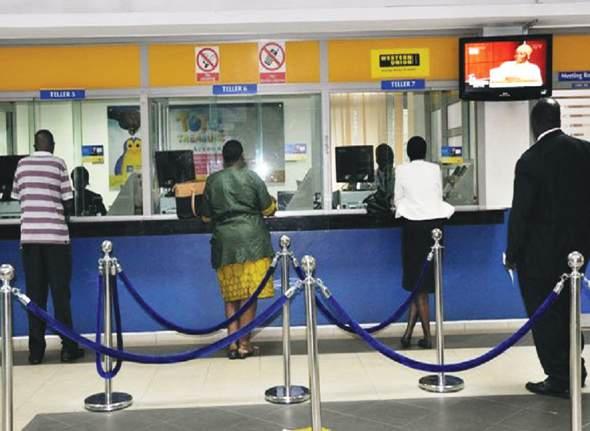
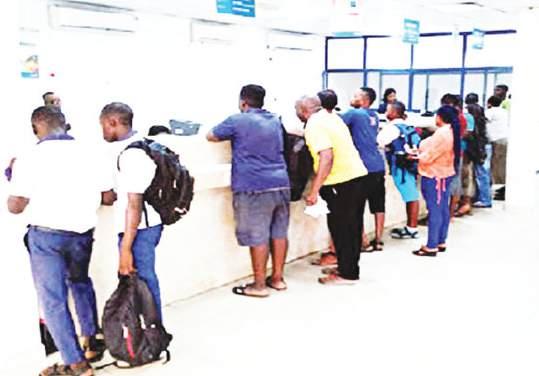
Banking halls
oluWatosin d okpesi pays tribute to her mother, Caroline Abike Odukoya
Me M ories of a Wonderful Mother and f riend
Amother’s love is a constant and enduring strength that shapes our lives, builds our character, and lays the foundation of who eventually we become. Such was the love my mother, Deaconess Caroline Abike Odukoya (nee Sode), bequeathed to me and my siblings that it has been difficult to come to terms with her passage. But as we lay her to rest this week, we can only thank God for a life well spent. In every sense, Mummy was the true definition of love, a pictorial definition of care. She freely and wholeheartedly gave of herself, always putting us - her family - first. She was a priceless gift, a blessing beyond measure.
Mothers are naturally irreplaceable. Still, the memory of my dearly beloved mother serves as a guiding light and a source of comfort for me, while her legacy of strength, loving-kindness and love of God lives on through us. My mother’s faith was the foundation of her life. She trusted God completely and implicitly. And she beseeched us, at every step of the way, to do the same. My mother was our intercessor and encourager. She believed and trusted deeply in the power of prayer, and lived it daily. I am forever grateful for the prayers she prayed before ending every call and before every good bye.
editorial the Mystery and essence of easter
Mummy taught us respect, responsibility, humility and integrity. When we erred, she corrected us with love, so much love, and guided us with wisdom, always wanting the best for everyone of us. The discipline she instilled in us was not the harsh kind; it was love in its strongest form, preparing us to stand firm in life and in faith, and encouraging us to pass on same to our children.
My mother loved our Daddy, late Prince Kola Odukoya deeply and stood faithfully by his side until God called him home. Her devotion was a beautiful and exemplary beacon to us all. I will forever be grateful for having a mother like her to journey with me during my own waiting period. She stood with me in prayer, in hope, and in faith.
And God answered and showed us His mercy and blessed us with Catherine Anuoluwapo Dokpesi. I am eternally grateful for the love and discipline she gave to Catherine Anuoluwapo. She helped to shape her with wisdom, fear of God and tenderness. I will also forever be grateful for her acceptance and the unqualified love she showered on my late husband, High Chief Raymond Aleogho Dokpesi.
That singular act meant more to me than words can ever express.
Expression of gratitude to my loving mother will not be complete without noting the many nights she stayed up late, waiting for me to return from work and making sure I did not go to bed without eating. My mother had a special way of knowing when I was worried. Even without words, she would remind me that God is ever faithful. Her faith strengthened mine. Her kindness was not selective; it was genuine. She had a generous spirit and a compassionate heart. She was always ready to help, to encourage, and to uplift others. She loved without condition, and served without seeking recognition. My mother always had comforting words for everyone. Her life was a sermon of kindness, generosity, faith, and love. She accommodated many in our home, making certain they had food and shelter. Many have been blessed by her quiet acts of giving. So many were on her “payroll” until she breathed her last. I’m grateful that she taught me to give without holding back.
Last December, I was afraid she was ready to go. Her condition gave me
such a fright because my heart was not ready. I didn’t want to leave her side so I suspended my journey. But in her strength and selflessness, she instructed me to go. By January, she was strong again — vibrant, encouraging, and full of life. She told me to stay and complete what I had to do in Ireland. Every day, seeing her on video calls brought me so much joy. Those beautiful smiles… the special way she hailed me… there was something different about them. Something deeper. Something I now hold close to my heart.
My mother knew the time was drawing near. In those last days, she barely looked at my face. It is something I now understand in a way I couldn’t then. All I wanted was to make sure she had a good dinner. She told me she would let me know after using the bathroom. And in that sacred moment, I was holding her — not knowing she was about to take her final breath in my arms. What a privilege! What a gift!
In retrospect, I am grateful that she waited for me. I am also grateful to God for answering her prayers. She always said she did not want to stress us. She said did not want us carrying her back and forth to the hospital. And God, in His faithfulness, honoured her request. Her passing was peaceful. It was dignified. It was glorious. My heart aches so much because I miss my mother very deeply. I however rejoice knowing that she has gone home to be with the Lord Jesus that she loved so dearly. We find comfort in knowing that the woman who sang about being saved by grace now rests fully in that amazing grace. Her life reflected her favourite song, “Ore Ofe sa”. Saved by Grace Alone. She understood that it was only by God’s grace that we stand, and she held onto that truth with unwavering confidence.
When I interviewed my mother in February 2025, she requested that we must sing the hymn at all the services, wakekeep and her funeral. And, most certainly, we shall sing it for her! Meanwhile, the seeds she planted in us will continue to grow. The lessons she taught us will continue to guide us. The love she gave us will continue to surround us. We will miss her deeply. But we are grateful—grateful for her life, her sacrifices, her prayers, and her legacy. She has fought a good fight. She has finished her race. And we take comfort in knowing that she is resting in the arms of the Lord. My prayer is that she continues to rest peacefully, until we meet again at the feet of Jesus Christ.
· Mrs Oluwatosin Dokpesi is a former Managing Director of African Independent Television (AIT).
Editor, Editorial Page PETER ISHAKA
Email peter.ishaka@thisdaylive.com
The MysTery and essence of easTer
Easter enjoins us to dedicate our energy to the promotion of the common good
As Christians all over the world celebrate Easter, the mystery of the occasion is anchored on the fact that their Lord Jesus Christ chose death because that was the penalty to which they were all liable on account of sin. It is in the juxtaposition of that death on the Cross and the eventual joy of the resurrection morning that Christians anchor their faith. This resurrection story, according to the World Council of Churches in their 2026 Easter statement, “is not only a big source of hope but also a protest against the denial of dignity and humanity, expressed in aggressive warfare, the spreading of hate and contempt against whole groups of people, and sins such as racism, antisemitism, nationalism, or xenophobia.”
Indeed, the sacrifice, love and mercy that the death and resurrection of Jesus Christ exemplifies are some of the enduring values of Easter that transcend doctrine and are worthy to be reflected upon by all Nigerians. Regardless of the faith we profess, a day such as this calls on everyone to shun selfishness and dedicate our energy to the promotion of the common good as we seek to build a new society based on mutual respect and tolerance. It is also important to remember that Christ spent his whole life and ministry with the poor, the weak and the oppressed. He shared their anxieties, their hopes, and their aspirations.
These are the attributes worthy of emulation by leaders and indeed all Nigerians as we celebrate Easter. It is a further invitation to all compatriots to join hands in building a new civilisation of love that eschews hatred, violence, rancour, and acrimony across the artificial divides we have created from mismanaging the country. It is only when we adopt this selfless attitude that the authorities would be able to focus attention on the ordinary people, their safety and welfare as well as the optimal allocation of scarce resources for effective implementation of
SUNDAY NEWSPAPER
editor DAvIDSoN IRIekPeN
deputy editors FeSTUS AkANBI, eJIoFoR ALIke
Managing director eNIoLA BeLLo
deputy Managing director ISRAeL IwegBU
chairMan editorial Board oLUSegUN ADeNIYI
editor nation s capital IYoBoSA UwUgIAReN the oMBudsMan kAYoDe koMoLAFe
THISDAY NEWSPAPERS LIMITED
editor-in-chief/chairMan NDUkA oBAIgBeNA group executive directors eNIoLA BeLLo, kAYoDe koMoLAFe, ISRAeL IwegBU divisional directors SHAkA MoMoDU, PeTeR IwegBU ANTHoNY ogeDeNgBe deputy divisional director oJogUN vICToR DANBoYI snr. associate director eRIC oJeH
director, printing production CHUkS oNwUDINJo to send eMail: first name.surname@thisdaylive.com
policies for the greater good of our society. Meanwhile, commemorating the death and resurrection of Jesus Christ and the redemption wrought for Christians on the cross of Calvary is very significant. But the essence of the occasion should not be limited to adherents of the faith alone. It is a time for all Nigerians to reflect on what is wrong with us as we witness, almost on a daily basis, a mindless orgy of violence that has put our nation under a most serious siege. Easter provides a unique opportunity to interrogate the killings, the maiming, the banditry and other forms of bloodletting while working for solutions to the challenges they present. But as the First Lady, Oluremi Tinubu, reminded us in her Easter message, this is also a time to remember “those in need and extend compassion and support wherever we can.”
For Nigeria and Nigerians, faith is a valuable tool, especially at a time like this. But only if we use it to counteract the rhetoric of hate and division. The essential message of Easter is that the faith we profess should guide and inspire us to do what is right, and we must use that faith as a vehicle to deepen harmony and eschew bigotry and hate mongering. The mindless violence that has turned Plateau, Kaduna and a few other states in the country into no better than killing fields is a further reminder of the need to relate with one another in love.
On a day such as this, Nigerians are invited to emulate the exemplary life of humility, selfabnegation, forbearance and self-sacrifice of Jesus Christ who submitted himself to death on the Cross. As a nation, we must begin to replicate that sort of sacrifice which encourages us to deny ourselves for the common good. Perhaps more than at any period in history, Nigerians must use this season to reinforce things that bind us together. May Easter awaken in each of us true joy shown in dedicated service and love for our fellow country men and women.
Letters in response to specific publications in THISDAY should be brief(150-200 words) and straight to the point. Interested readers may send such letters along with their contact details to opinion@thisdaylive.com. we also welcome comments and opinions on topical local, national and international issues provided they are well-written and should also not be longer than (950- 1000 words). They should be sent to opinion@thisdaylive. com along with the email address and phone numbers of the writer
LETTERS
So that JoS May Stop Burning
Yet, again it happened. Jos boils again. Every time there is relative peace in Jos, it is always that of a graveyard, because you know it will not last.
Recently, I revisited the Justice Niki Tobi panel report, and it reads more like foretelling the present. Going through that report, one is struck by the tragedy of its neglect.
Palm Sunday’s violence followed a familiar pattern. Gunmen stormed a community in Jos North, killing scores of residents in a night attack. Witnesses described attackers arriving on motorcycles, shooting indiscriminately. No group has claimed responsibility. But the context is not new.
These attacks sit within a long-running cycle of violence in Plateau, driven by a toxic mix of ethnic tensions and religious fault lines.
The Niki Tobi panel identified two immediate triggers of the 2001 crisis- a confrontation involving a woman named
Rhoda at Congo-Russia during Juma’at prayers, and the controversial appointment of Mukhtar as NAPEP coordinator in Jos North. The panel was also clear that those were only sparks. The real fire had long been burning.
Beneath those incidents lay deep-rooted tensions of indigene versus settler disputes, competing claims over land ownership, religious intolerance, ethnic suspicion, and a dangerous accumulation of unresolved grievances. The same issues that drove the 1994 crisis were still alive in 2001 and remain with us today! Nothing changed because nothing was really resolved.
Perhaps most damning was the panel’s finding that previous reports had been ignored, particularly the Fibreisima report of 1994. That earlier panel had been constituted following unrest triggered by the appointment of Aminu Mato as Chairman of the Caretaker Committee of Jos North Local
Government. Yet history repeated itself.
The Niki Tobi panel further warned that failure to implement recommendations was “a sure recipe for a repeat performance.”
The panel called for accountability. Individuals and groups identified as instigators or participants in the violence were to be investigated and prosecuted. Impunity, it warned, would only embolden future offenders. Over 100 individuals were named. Yet, what became of them? Were they properly tried? Did anyone face real consequences?
One particularly troubling case was that of the then Commissioner of Police in Plateau State, Alhaji M.D. Abubakar. He was accused of failing in his duties and allegedly displaying bias in the protection of places of worship in a conflict already defined by religious tensions. The panel recommended his retirement or dismissal if he refused. Instead, he remained in service and eventually rose to become Inspector-General of Police. What message does that send?
It is noteworthy that close to 1000 people died and properties worth over N3 billion at the time, were destroyed.
Beyond accountability, the panel also recommended structural fixes to recurring flashpoints. The blocking of public roads for religious activities, one of the triggers of violence, was to be banned and enforced. Is that the case today? I hear it’s not.
The commission also addressed the role of inflammatory messaging, calling for regulation of loudspeakers and curbing the use of religious platforms to incite violence. If anything, this problem has worsened. It highlighted the need to rein in groups and associations that thrive on ethnic and religious confrontation, recommending sanctions, including suspension or proscription where necessary.
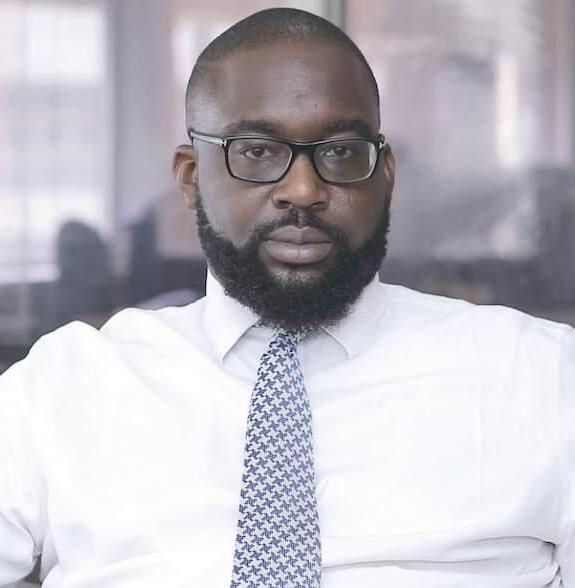
Inside a building older than many of its occupants on Broad Street, Lagos, a young silk’s son sits beneath the weight of a formidable name. Abiodun Adesanya is a lawyer of pedigree, determined not merely to preserve a legacy, but to transcend it. Adedayo Adejobi writes…
Flying High Above Inheritance
At the famous Bookshop House on Broad Street, the air carries the faint weight of history. The building, completed in 1973 by Godwin and Hopwood Architects, rises with modernist confidence above Lagos Island. It houses the venerable CMS Bookshop, the oldest in Nigeria, and for decades has served as a commercial nerve centre in the old business district. Within its concrete frame, lawyers, traders, clergy, and civil servants have climbed the same staircases in pursuit of ideas, contracts, and sometimes absolution.
Behind a modest office door sits Dr. Abiodun Adesanya, steward of a secondgeneration law firm founded by the late Professor Safiriyu Abiodun Adesanya, SAN. The son sits in the same professional circuit as the father, yet with a distinct gravitational pull of his own.
On the surface, the inheritance seems almost inevitable. “In all fairness, there are only two things I have ever considered,” he says with a smile. “One was being a lawyer, and the other was being a pilot. Those were the only two options I ever had in mind. I eventually opted for being a lawyer.”
It sounds romantic, almost cinematic, until he adds, “I thought perhaps a bit more prestigious. But I always said to myself at the same time that I would still want to follow the passion of aviation as well.”
He still trains in flying schools, aiming for a private pilot’s licence. Aviation, he insists, remains “a hobby. But my career lies in law as of today.”
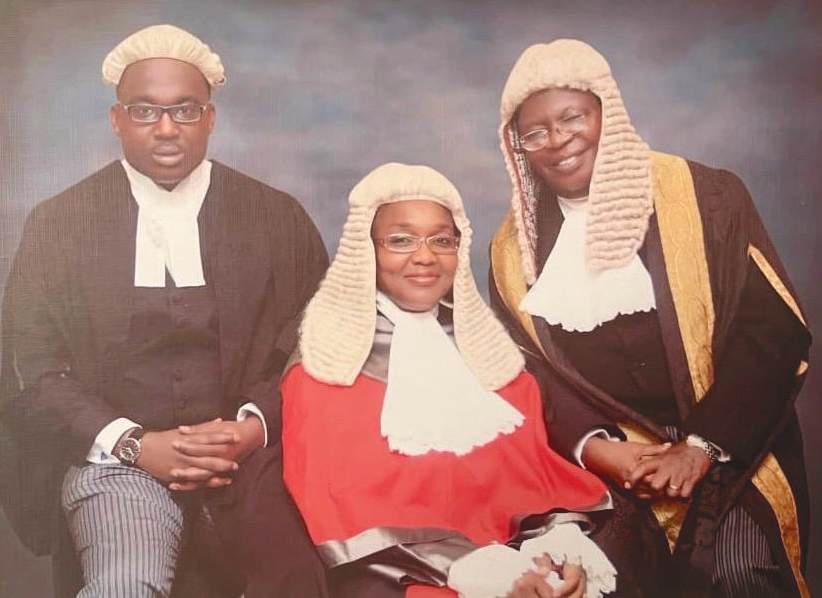
Law, in truth, was less a choice than an atmosphere. “I grew up in a household of lawyers. Law was the atmosphere, not just a career option,” he recalls. His father was a Professor and Senior Advocate of Nigeria. His mother, Hon Justice Y.A Adesanya was first an academic before going to the bench. Dinner table conversations were likely to drift towards jurisprudence rather than gossip.
Yet the mythology of his father’s stature did not fully dawn on him until adulthood. With an educational background that spans English boarding schools and a highly ranked British university, he returned to Nigeria for law school and encountered an unexpected moment of revelation.
“One of the lecturers starts talking about how one of her professors was Professor Adesanya. And half of the class looks in my direction.”
Around that time, the landmark decision in First Bank of Nigeria Plc v Longe was circulating as a locus classicus in company law. “Everyone would always refer to First Bank vs Longe. How one Professor Adesanya argued this and that. I think at that point in time, I started to appreciate my father’s stature in the profession.”
Appreciation, however, is a gentle word. The more accurate term might be pressure.
When Professor Adesanya died, his son was only four years at the Bar and midway through a PhD in England. “I suspended my PhD and returned home to take responsibility for the practice,” he says.
“I won’t lie; there were moments I doubted myself. There were moments I needed guidance from some of my seniors.”
The early years were defined by the invisible test that greets many heirs to professional empires. In court, the surname arrived before the argument. “The moment I announce my appearance, some judges would deliberately put me on the spot, simply to test the depth of my own competence. I still experienced this at the Supreme Court a few weeks ago.”
He recalls a judge of the Court of Appeal who remarked, “I had a professor at Ife who was my lecturer, a very brilliant man. Are you related to him?” When he answered yes, the judge added, “I hope you’re as brilliant as he is.” His reply was characteristically understated. “Well, My Lord, we are trying our best; with time, we will get there.”
He is careful, though, to distinguish inheritance from imitation. “I also have to be cognisant of the fact that I am not trying to be my father. We might be in the same profession. I am also trying to be my own person.”
The ambition is not replication but transcendence. “I honour his legacy, but I am
building my own. The hope is to surpass him, not to imitate him.”
That distinction has shaped the firm’s evolution. Historically known as a litigation powerhouse, the chambers were once synonymous with courtroom combat. Today, while litigation remains “one of our strongest suits,” the portfolio has broadened. “We have deliberately evolved with the times, expanding beyond the firm’s traditional litigation strength into broader corporate and regulatory practice.”
As a Fellow of the Chartered Institute of Arbitrators, Abiodun has positioned the firm within that shift.
His own academic interests have also nudged the firm into new terrain. While his father was a towering authority in family law and authored a leading text on matrimonial causes, the son’s doctoral and academic focus on telecommunications law has drawn new instructions in telecoms and regulatory work, alongside expanded tax practice. Today, the firm’s work extends to operators and regulators such as Globacom Limited and the Nigerian Communications Commission (NCC), reflecting its growing engagement in the technology and communications sector.
The firm is currently representing the Nigerian Communications Commission (NCC) in a public-interest suit filed by the Socio-Economic Rights and Accountability Project (SERAP), challenging the recently approved 50 per cent increase in telecom tariffs. The case, initiated by human rights lawyer Ebun Olu Adegboruwa, SAN, underscores a growing regulatory dispute over pricing in the telecommunications sector.
Beyond this, the firm has handled several high-profile tax and constitutional matters. It represented the Federal Inland Revenue Service (FIRS) in a dispute with Shell Petroleum Development Company, which ended in a $9.48 million settlement after courts ruled against Shell’s tax deductions on gas flaring payments. The firm also secured key victories for the Office of the Senate President in cases involving the 2023 budget process and the Petroleum Industry Act, with courts affirming legislative authority and upholding the constitutionality of the Act’s Host Community Development Trust provisions. For a lawyer who inherited a firm once wary of government briefs, this marks a philosophical pivot. His father, he notes, “used to refuse to do work for politically exposed persons or any Abiodun, the son, is candid about the divergence. “If he walked into this office today, my father would question the fact that we do work for certain government entities. That much I know he would have an issue with. But I’ll tell him that times have changed.”
Times have also tested the myth that sole proprietorship law firms must die with their founders. “There’s always been this norm, especially with the old school firms, that once the owner of the law firm dies, that firm essentially dies off,” he says. Succession, or the lack of it, has indeed felled many chambers. In his case, continuity has required both preservation and reinvention.
It took years to step out of the shadow. “For the first few years in practice, I was always known as Professor Adesanya’s son,” he reflects.
“I still occasionally get that. But I think I
“I also have to be cognisant of the fact that I am not trying to be my father. we might be in the same profession. I am also trying to be my own person.”
have also built my reputation as Dr. Adesanya now.” He marks the turning point at roughly six or seven years into leadership, around the completion of his PhD. “The judges know me for me. And know me for the cases I have argued or won before them.”
The client base tells its own story. While a handful of legacy clients remain, “75 per cent of our clientele today are new clients that have come in while I’ve been in charge of this law firm.” The revenue mix has shifted accordingly. Continuity without stagnation has become the operating principle.
Beneath the professional discipline lies a more human inheritance. “I grew up in a home where excellence was the baseline,” he says. Academic excellence was assumed, not applauded. As a teenager, he admits, he was content to do “just enough to get by.” With maturity came recalibration. “I realised that mediocrity was not an option.”
Legacy, to him, is beyond parading articles of history like a museum. “Preserving my father’s name is important, but so is taking it to the next level.” He frames it as an intergenerational prayer. If his own children enter the profession, he would wish them greater success than his own. The continuity he speaks of is already evident; his younger sister, Bukola, entered the profession a few years ago, becoming the latest lawyer in the Adesanya family.
The most poignant preparation for leadership came not in formal instruction but in casual conversation. His father often spoke about death with disarming directness, even specifying his desired burial spot. At the time, the son did not grasp the subtext. In hindsight, he sees those moments as quiet rehearsals for responsibility.
When asked how he would like his own chapter in the Adesanya story to read, he pauses. “I am still writing that chapter,” he says. Yet he offers a sketch. He hopes to be seen as someone who “had a privileged start, maximised every opportunity, and advanced the legacy he inherited.” Above all, he wants to be recognised not merely as a son, but as a name. Outside the courtroom, the figure in the wig and gown recedes.
“I’m still very much a geek at heart,” he says of himself.
He enjoys football, supports Manchester United, practises archery, rides horses, plays Fortnite with his kids and still dreams of the cockpit. Law may have chosen him, as he puts it, but he has not surrendered the rest of his curiosities.
L-r: Adesanya; his mother, Justice Y.A Adesanya; and late father, professor Safiriyu Abiodun Adesanya, SAN.
HighLife
Stella Oduah is Free Like a Bird
Courtrooms are not hospitals. Yes, they deliver outcomes, and sometimes those outcomes come with a quiet sense of finality that feels almost theatrical. But they are not supposed to dish out surprises. But here we are.
That was the mood in Abuja when Stella Oduah walked out without a fraud conviction, her name removed from a N2.5 billion case after a plea bargain reshaped the list of who would carry the burden.
The mechanics of the decision were straightforward. Prosecutors dropped charges against Oduah and her former aide, Gloria Odita; Judge Hamza Muazu struck out the earlier filing; the case, at least for the two women, ended there, without long speeches or dramatic pauses.
The case itself did not disappear; it simply changed direction. Two companies linked to the matter, Sobora International Limited and Global Offshore and Marine Limited, remained in the dock, and through Oduah as their representative, both entered guilty pleas that moved the process along with unusual efficiency. From there, the numbers took over.
Authorities secured the forfeiture of nearly N2 billion, combining funds already returned with sums recovered during the investigation, while the court ordered the companies wound up, drawing a firm financial line under allegations that dated back to 2014.
Those earlier claims had carried weight. Prosecutors alleged that funds were obtained from the Federal Ministry of Aviation through a network of firms, tying the case to Oduah’s time in public office under Goodluck Jonathan, when she served as aviation minister. Still, the story around Oduah has always stretched beyond a single case file.
Before politics, she built Sea Petroleum and Gas into a notable downstream operator, running vessels, depots, and retail outlets in a sector where scale tends to separate participants from players.
Which makes the ending here feel almost procedural. A long-running case narrows, companies take the fall, funds change hands, and one of Nigeria’s more recognisable political figures steps out, adjusts, and carries on, lighter by a charge sheet and heavier by experience.
As 2027 approaches, Nigeria’s political argument is narrowing to a clear question: how should voters assess the current reforms under President Bola Tinubu against the record of past administrations led or influenced by figures such as Atiku Abubakar?
In May 2023, the starting point was difficult to ignore. Public finances were strained, with most revenue going to debt service; fuel subsidies consumed vast resources; and a fragmented exchange rate system encouraged arbitrage while weakening investor confidence. Oil production had declined significantly, limiting the country’s main source of foreign exchange.
The Tinubu administration moved quickly to address these distortions by removing fuel subsidies and unifying exchange rates, decisions that align with standard economic correction tools in similar contexts. Institutions such as the World Bank and IMF have described these steps as necessary, drawing on comparative evidence rather than domestic politics. Still, the domestic impact has been immediate and visible.
Inflation has increased, transport and food costs have risen, and many households face tighter budgets. This tension between policy logic and lived experience sits at the centre of the current
At 54, Babajimi Benson arrives at a moment where political branding and measurable output begin to intersect in ways that are harder to separate than his admirers might suggest.
On March 30, in Ikorodu, the setting was unmistakably ceremonial:
debate, and it explains why criticism remains strong.
To understand that criticism, it helps to look backwards.
During earlier administrations, including those in which Atiku played a senior role, structural issues such as subsidy dependence and exchange rate fragmentation were not fully resolved. Although these policies provided short-term stability, they also allowed deeper imbalances to build over time. But recent data is suggesting that there are some shifts worth nodding at.
Oil production has improved from previous lows, external reserves have strengthened, and the government continues to meet its debt obligations. Agricultural output projections, particularly in wheat production, also indicate targeted expansion. These are all incremental adjustments that signal stabilisation, though they fall short of full recovery.
Therefore, behind the comparisons of personalities and tribal sentiment should also be a contrast in approach. While in power, earlier governments typically delayed difficult corrections. What the current administration has done is implement them quickly, accepting immediate costs. Whether that trade-off is justified remains the central issue.
As campaigns take shape, voters are the ones who must still do the weighing: whether
to stand by the administration defined by a gradual accumulation of structural strain, or the one defined by abrupt attempts to correct it under pressure.
Babajimi Benson at 54: A Citizen of Humanity, Defined by Service and Impact
a crowded hall at Aquila Event Centre, senior figures in attendance, including Obafemi Hamzat, and traditional rulers led by Oba Abdulkabir Shotobi. Even as tributes flowed, beneath the pageantry sat a quieter question about substance, one that leads directly to his institutional role.
As Chairman of the House Committee on Defence, Benson occupies a position with real leverage, shaping budgetary direction and oversight in a sector where opacity often defines outcomes; his interventions here suggest a legislator attentive to both appropriation and accountability.
From there, his legislative footprint extends outward. The Export (Prohibition) (Repeal) Act, 2025, which he sponsored and which received presidential assent under Bola Tinubu, is evidence that he prefers policy instruments that recalibrate market access rather than merely redistribute outcomes. On its own, this is a distinction that carries long-term
Lagos 2027: Loyalty, Power, and the Politics of Timing
Something is moving in Lagos politics, and it is moving in the way it usually does: quietly, without confirmation, yet strong enough to redirect conversations before any formal decision is made.
At the centre of the current talk is Femi Hamzat, whose name has begun to circulate as a possible consensus candidate for the 2027 governorship race under the APC, even though no official body has stepped forward to validate that claim. And it matters because in Lagos, the Governance Advisory Council (GAC) remains the place where political direction settles into reality. And until it signals, speculation stays exactly where it belongs: outside the room where decisions are made.
Still, names do not rise without reason, and Hamzat’s emergence follows a long pattern. Through the transitions from Babatunde Fashola to Akinwunmi Ambode, and then to Babajide Sanwo-Olu, he has remained present, stepping aside at
key moments and then stepping forward as deputy, building a record defined by continuity rather than disruption.
That record sits alongside a crowded field, where figures like Femi Gbajabiamila, Seyi Tinubu, and AbdulAzeez Adediran each represent different strands of influence, from institutional reach to grassroots mobilisation, making any early conclusion feel premature. Even the idea of a return for Ambode has circulated in quiet corners, driven by a mix of unfinished expectations and political sympathy.
But is this not Lagos, whose politics has a way of closing certain doors without announcing it, leaving only those paths that align with its internal logic? Within that logic, loyalty stands for something, especially within the orbit shaped by President Bola Tinubu.
implications.
But one would be wrong to assume that Benson’s political identity is built in Abuja alone. Back in Ikorodu, the iCare Foundation functions as both a welfare mechanism and a reputational anchor, distributing food support to tens of thousands of households while reinforcing an image of immediacy and presence that many constituents find rare.
Infrastructure adds another layer to the humble man’s profile. Road reconstruction projects, solar streetlight installations, and an unusually active constituency office create a pattern of visible governance, one that blends tangible delivery with constant engagement, and in doing so sustains a feedback loop between politician and public.
Still, because the phrase “Citizen of Humanity” invites scrutiny, critics have argued that Benson’s local effectiveness has only been elevated into a broader moral narrative. But even the most critical of these agree that the man checks the boxes on inclusion and reach.
What is unfolding, then, looks less like a settled decision and more like a test. A name is introduced, repeated, and allowed Hamzat
to breathe, while the system observes how it holds under scrutiny and how it fits within a broader balance of interests. But there’s a final moment in view, when speculation gives way to a single, decisive move that renders every earlier theory either prescient or misplaced.
Benson
Tinubu
oduah
Kwara 2027: Can Bukola Saraki Reclaim the State from AbdulRahman AbdulRazaq?
Kwara State is entering the 2027 election cycle with a clear division between the incumbent and the opposition. And heading these teams are none other than Governor AbdulRahman AbdulRazaq and Bukola Saraki.
Governor AbdulRazaq enters the contest with the advantages of incumbency, control of
party structures, and a record of infrastructural development in health, education, and rural projects. His administration has also reduced political violence, signalling a move toward more institutionalised governance. Supporters argue these achievements reinforce public confidence and strengthen the APC’s hold.
Saraki, though no longer seeking office personally, remains the central figure in the opposition. He is coordinating the PDP’s strategy, aiming to reclaim influence through candidate selection, grassroots mobilisation, and alliances with former APC figures. Saraki’s historical network and political expertise continue to command attention, particularly in Kwara Central, where his influence is strongest. Analysts suggest that his choice of candidate may determine whether the PDP presents a credible challenge. Observers seem to be sure that the spine of the 2027 elections is whether the anti-dynasty sentiment of 2019 has been overcome, that if not, it will persist as a barrier to Saraki-backed initiatives. Others think that
Celebrating 50 Years of Oba Saheed Elegushi’s Regal Impact
Oba Saheed Elegushi turns 50 in April 2026, a milestone that carries not just the weight of age but the gravity of influence. Born into the Kusenla Ruling House, he ascended the throne of the Ikate-Elegushi Kingdom in 2010 at 34, becoming Lagos State’s youngest king. Since then, his reign has steadily reshaped the kingdom, blending tradition with modern governance and public service, and setting forward a matchless example that other royals cannot even begin to emulate.
Before kingship, Elegushi served in Lagos State’s government under Bola Tinubu and Babatunde Fashola, gaining experience in programs, administration, and civic engagement. That foundation informs his approach as monarch: decisions are deliberate, visible, and geared toward long-term impact. Under his leadership, the kingdom has
prioritised youth empowerment, education, and entrepreneurship, with initiatives such as the N200 million empowerment program supporting university students and over 1,000 SMEs.
Elegushi has also strengthened the kingdom’s cultural and economic footprint. Elegushi Beach has grown into a recognised hub for tourism, while real estate, hospitality, and community infrastructure have expanded under his oversight. The Oba Saheed Elegushi Foundation complements this work, ensuring philanthropy is structural rather than symbolic. Beyond administration, he maintains a presence in national life, supporting sports, charities, and civic causes.
At 50, Elegushi’s legacy is active rather than retrospective. Each policy, each initiative, each public appearance continues to reinforce
even if internal cohesion within both parties withstands pressures from competing factions, voters will still prioritise governance outcomes over party loyalty and historical narratives.
The direction of these analyses is clear, and the bias is even clearer. What remains unclear, however, is the odds that Saraki’s behind-thescenes coordination will translate into measurable electoral success.
But the contest is not merely about individual popularity. Rather, it is about the capacity to consolidate support, manage expectations, and sustain public trust. Saraki’s role may be more strategic than direct, but his influence could still tip the balance.
AbdulRazaq has to defend his mandate and validate the “O To Ge” revolution. Saraki has to demonstrate that political recovery is possible even after a dramatic setback. Kwara 2027 will answer which approach commands the state’s loyalty and whether past political patterns will hold or yield to new alignments.
a pattern: influence anchored in purpose, authority balanced with accessibility, and tradition harmonised with progress. His story is not merely a record of years but a testament to how a king can guide a community while shaping broader societal expectations.
The Rise of Senator Solomon Adeola as the People’s Choice
Senator Solomon Adeola, widely known as Yayi, has built a reputation as “the people’s choice” in Ogun State ahead of the 2027 gubernatorial election. His appeal is not the result of slogans alone. It comes from a combination of grassroots engagement, visible results, and a long-term political strategy that
has turned local support into durable influence.
Yayi represents Ogun West in the Senate and chairs the Appropriations Committee. In that role, he has overseen budgets and policies that resonate with his constituents, reinforcing a reputation for tangible impact. His supporters highlight a range of initiatives: hundreds of infrastructure projects, including rural roads, town halls, and mini-stadiums; educational investments, such as a N200 million scholarship scheme for over 1,600 tertiary students; and programs upgrading the Federal Polytechnic, Ilaro, into a Federal University of Technology.
His approach goes beyond policy and construction. Yayi’s “Mega Empowerment” programs have provided immediate economic relief to artisans, farmers, and small-business owners. Tricycles, mini-buses, grinding machines, cash grants, and farming equipment reach thousands directly, translating visibility into personal experience and trust.
The nickname “Yayi” has become shorthand for accessibility, reliability, and responsiveness. Constituents know he listens, attends to concerns, and maintains an open-door presence
Will Professor Joash Amupitan
Seal His Legacy in Gold?
Professor Joash Amupitan (SAN) assumed office as Chairman of the Independent National Electoral Commission (INEC) on October 23, 2025. His tenure has been defined by a focus on credible elections and institutional reform, alongside challenges that test the limits of his mandate.
Amupitan has set specific objectives for his five-year term. He aims to make the 2027 elections technically reliable, addressing prior failures of the Bimodal Voter Accreditation System and the IReV portal. He plans a nationwide mock presidential election to test these systems. He is also leading reforms under the Electoral Act 2026 to streamline timelines and mandate real-time electronic transmission of results. Internally, he has introduced Ethics and Compliance Committees and a whistleblower policy to prevent misconduct and procurement fraud.
At the same time, he faces several obstacles. Opposition critics question his neutrality, citing
staffing ties to the presidency, which Amupitan denies. Religious and sectional controversies persist, including backlash from the Supreme Council for Shari’ah over a 2020 legal brief he authored. Operational pressures are significant, with the presidential election scheduled for January 16, 2027, leaving limited time for preparation.
Upcoming elections will determine public judgment. The Ekiti governorship election on June 6, 2026, the Osun governorship election on August 18, 2026, and the 2027 general elections are the immediate tests of his leadership. Technical smoothness, transparency, and public trust in these polls will shape perceptions of his effectiveness.
Amupitan’s record combines three decades of academic and legal experience with practical engagement in electoral administration. His professional background includes a law professorship at the University of Jos, consultancy for the National Assembly, and
Adebayo Adelabu’s path to the 2027 Oyo State governorship is now inseparable from his work as Minister of Power. Critics insist that his handling of the national grid is the clearest measure of competence.
Repeated collapses in early 2026 have left supply fluctuating between 2,000 and 3,900 megawatts, far below the Power Minister’s target of 6,000 MW. For many, a minister who cannot stabilise electricity is unlikely to manage a state budget, infrastructure, or bureaucracy effectively.
that few politicians sustain.
The rise of Yayi is really about strategic patience. While his political career began in Lagos, the man in question carefully cultivated his ancestral Ogun base, aligning with state and national leaders, including Governor Dapo Abiodun and President Bola Tinubu. The result is a network that merges grassroots credibility with institutional support—a combination that normally predicts long-term success in Nigerian politics.
Recent polls, media recognition, and awards, including the 2026 Man of the Year honour, have reinforced Yayi’s public standing. Yet his strength lies less in headlines than in a record that constituents experience daily: roads travelled, schools built, businesses supported, and opportunities created.
Yayi’s trajectory shows how political influence grows quietly, persistently, and practically. By 2027, there is a high chance he will be no ordinary candidate, but the natural choice for a state ready to reward both loyalty and results.
service as Deputy Vice-Chancellor and ProChancellor in Nigerian universities.
Whether Amupitan’s legacy is remembered as a reformer who strengthened Nigeria’s democracy or as a contested figure will depend on his ability to deliver credible elections, manage controversies, and maintain public confidence through the remainder of his tenure.
The pressure is both technical and political. Adelabu has previously lost two gubernatorial contests, and the current ministerial role is seen as his final opportunity to demonstrate practical results. In the opinion of many stakeholders, the power sector requires full-time attention, not a politician distracted by campaign plans. Success would rebuild public trust; failure could reinforce scepticism about slogans like “Emi Lokan” or claims of “having paid his dues.”
And if he has paid his dues, can Adelabu guarantee that the grid will hold through 2026 without major collapses? Can he meet the 6,000 MW target while balancing political consultations? And if the grid stutters again, can he turn accountability into a credible explanation rather than a political liability?
Adelabu’s approach seems to be deliberate, regardless. He publicly emphasises problem-solving first, delaying campaign decisions until the grid shows signs of stability. Reports about resignations have circulated, countered by statements from aides labelling them “fake news.” The man’s nationwide consultations under the APC banner simply aim to demonstrate readiness, but their effectiveness will be judged against tangible results in electricity supply.
Saraki
Adelabu
elegushi
Amupitan
Adeola
Blessing C eo : The Saga Continues
NASIr el-rUfAI: for MoTHer’S SAke
The clip at the mosque during ElRufai’s mother funeral continues to intrigue me. I have watched that clip so many times that it has truly become very unhealthy. If you have been living under a rock, let me quickly give you a summary. El-Rufai has been a consistent thorn in the flesh of this government since he failed the entrance examination to be a minister. In the process, he has picked on the President Tinubu and other, including the National Security Adviser. That one has suffered in his hands, as there is no kind of name that he has not called him. So, to mute him, his tenure as Kaduna State Governor comes into focus, and the ICPC moves in. They first attempted an arrest at the airport on his return from Egypt, which was aborted by many “mallams.”
Then, under the euphoria of temporary victory, oga “loose guard” and proclaims that he “listens to the NSA’s phone”, saying that “we have our ways.” This ramps up the tension, and his arrest becomes a top priority. He was invited by the EFCC and DSS, and from there, I don’t know again o, all I know is that the guy has lost his freedom since then.
This beautiful but controversial social media influencer went on air to announce that she has stage four cancer. She didn’t stop at that; she begged Nigerians to come to her aid and dropped an account number. I now rushed to give her N7,000 of my hard-earned money. I felt for her for two reasons: one, breast cancer is on an epidemic stage as it is ravaging our female population.
It is not what we should be joking about. I have already adopted one patient. She first went in for treatment some years ago, and I covered the cost, and today, it has resurfaced, and we are struggling with raising the initial cost of treatment. So, when Blessing came out, I was more than touched. The second reason was that I had met her during an appearance on Ruth Osime’s show and had hit it off
Then his mother dies. His case is still in court, he is still under custody awaiting bail hearing, and he is suddenly released to go and bury his mother, and there we see the clip that I am talking about.
That clip in the mosque had all the combatants not only in this saga but in the Nigerian comedy of errors in full glare and in the front row, all in their ‘babaringa’, holding their prayer beads and pretending to be “holy.”
Even our Peter Obi, in his traditional black, crawled in and positioned himself. Everybody from both sides of the divide was there o. It was only, maybe, President Tinubu that was not there, but if you look closely, he would have sent a representative.
Then immediately after the whole thing, they “catch” him again, throw him into the slammer and postpone his bail hearing.
Now, what is the lesson in this matter, you want to ask me? All I will say at this point is if you don’t know, forget abourrit. Thank you.
THe fAYoSeS: Never-eNDINg
DrAMA
One is Ayo, a former Governor and the other is Isaac, a businessman and a social activist. Both are brothers, not sure if from the same
mother, but definitely from the same father. Now they have been at loggerheads for years, and the fight has been very public, with them tearing each other to shreds shamelessly.
The private part of their fight is of no interest to the rest of us, as families have these issues. Whatever is biting them inside is not our concern, but it is the public part of it that concerns us, and that is what I will speak to.
Both represent different tendencies to Nigerians in the public part of their fight. What Ayo represents to us cannot be named. It is squiggly and slimy. You cannot hold it as it is irritatingly anti-people and selfserving. Sycophantic and annoying as he continues to wine and dine with the people who continue to exacerbate our pain as a people. Isaac, on the other hand, is strict and unabashedly firm with the people. He spews his truth with the boldness of an erudite social scholar. He tells us like it is without caring whose ox is gored, and this brings him into confrontation with his brother, which he wastes no time in taking to the slammer. In this fight, I am vehemently in support of Isaac, and he should continue to stand for what is right and what is for the good of
with her.
So you can imagine my shock when reports started coming out that the whole thing may have just been a scam. The medical reports she had presented as evidence were allegedly fake. Observers claim that the report belongs to someone else, and I am hearing that the victim’s family have come out to threaten a lawsuit.
The phone number that is on the report also allegedly belongs to a “mallam” who has never heard of her.
As I write, I am seeing a report that she is insisting that she has cancer, but not at stage four and all that.
I am sad that Blessing could use something as serious as breast cancer that is ravaging the country to play. Nonsense.
society. This case shows that two very distinct “bloodlines” can come out from one lion; after all, na one person born Jacob and Esau. Isaac, keep flying. History will reward you. As for your egbon, whatever a man sows he will reap. We are all here. Thank you. Can someone come and beat me?
A MoTHer’S reSolUTe CrY
One image came out of the recent Jos massacre that captured the pain of this unending tragedy and held a whole country in tears. There she was, cuddling her son, refusing to accept reality – no, he did not die, he is a strong man, he will soon wake up – she kept muttering as she cuddled his head on the breast that he once suckled. Her tears moving and dropping on his bloodied face, she continued to cradle his head and, in both tears and prayers, she waited for his recompense.
He did not come back, he would not come back, he had been macheted out of existence with a withered country waving him goodbye as its leaders wallow in the “nero” like ambience of pleasure seeking a second term in the midst of these. Jos was the latest flash point in a bloody journey that has seen Nigerians lose more lives than in the
El-Rufai
fayose
eziko
kwankwaso
Blessing Ceo
Civil War. Successive governments seem to have no answer to this tragedy.
This is not heaping the blame on the Tinubu government; they can only just try. Every government since this thing started has had no effective response, and even this one, with all the American boots and drones, is even witnessing more deaths than ever.
What do we do? Make we just carry everybody that has died, their blood and paint it on all of our doorways in the hope that when it happens next, they will pass over because that is just how helpless we truly are. Where we are now is to be counting the days as we wait for the inevitability of our collective death at the hands of these merchants who kill, maim, and burn with impunity without any resultant pushback by the government. My advice? We wait, because our death as a nation is certain. We wait. Thanks.
UNILAG HoSTeL of CoNTroverSY
Ok, here is my confusion. If you drive towards Akoka, you will pass the front of the amazing University of Lagos, and you will be confronted by this huge and very ugly building. It is the Femi Gbajabiamila hostel. You cannot miss it because it is monstrously huge, and as if that was not enough, you will see the monstrous signpost – FEMI GBAJABIAMILA HOSTEL.
Mbok, the first thing that will come to your mind is to immediately thank Mr. Gbaja for this significant philanthropic gesture that speaks to a serious problem in our tertiary education – accommodation. This problem is so serious that it impacts negatively on the pursuit of quality education. So when a high-profile man like this decides to drop something of this nature, you cannot help but say well done. Even me, I went a step further to make enquiries. I met the people managing the hostel and the young lady who is the Managing Director of the family-owned enterprise –they are from Ekiti – said, “Edgar, Gbaja started it, but we finished it, and the university gave us guidelines for managing it. They fix the price and make sure we don’t go above it so that students can afford it.”
Now there is a controversy, as a report that I have seen says that the N950,000 per annum charged is above the means of the average student.
Wetin concern me in this matter? I don’t give two hoots if not even one single student can afford the box room or not, my own is that in that report, it was stated that the building was built with public funds and as such, the pricing must be commiserate.
My own is, if it was built with public funds, why mislabel the thing, making me look at Gbaja with better eye. Why not sayFemi Gbaja: a project funded by “abccccc”, so we know that we are just honouring him with the building instead of doing a statue for him?
Mbok, they should just immediately clear the air, before I run mad ooo. Abeg, who built that hostel? Is it Gbaja or is it the government? If you see how this thing is paining me. Who built this thing ooo.
rAbIU KwANKwASo: LeT THe
GAmeS beGIN
Now, opposition is beginning to show some small signs of seriousness. Kwankwaso has joined
ADC, and the levels have changed. What is remaining now is for Atiku to be patriotic and step down, and let’s have an Obi-Kwankwaso ticket, and then begin to have a real contest.
I am not hiding my mouth; if Atiku insists, then he will be confirming what is being speculated in almost every bathroom in this country that he is working for Tinubu. An Atiku candidacy has passed its sell-by date, and we thank him for all he has done for Nigeria since he
donned the customs uniform till date. What he should now be doing to immortalise himself as a hero of democracy is to step down and support the ticket so that we can have a small hope.
Tinubu is at his strongest, I cannot lie, and what is needed is not a raggedy and faltering attempt at contesting but a viral, vibrant and obviously resilient machinery that an Obi and Kwankwaso ticket can deliver.
You see that immediately
boLA TINUbU: ANoTHer CALL for STATeSmANSHIp
I saw a clip of President Tinubu speaking to his grandchildren during his 74th birthday celebrations. Thankfully, it was reported that he decided to mark it low-key because of the mood of the nation. For me, however, this occasion gives me another opportunity to push at him with my sermon of statesmanship. Daddy wa, at 74, you should be leaving the trenches of partisan politics and aspiring towards the zenith of statesmanship. Let me speak some hard truths to our president.
Mr. President, your immortality cannot be in the direction that you are headed. If you continue in this way, you will only be remembered as a damn good politician who won almost every electoral battle he entered. You see, they are already calling you “master strategist.” They are boxing you into a very small box, which should not be your matter in all these fights you have fought. I repeat, you need to be aiming for the heights of the Mandelas, the Kenyattas, the Awolowos, the Marcus Garveys, the Azikiwes, the Sardauna and even the Obasanjos. You must represent something, either ideologically or a positive tendency. You must rise above the very annoying tendencies of ethnicity, selfinterest-driven policy initiatives and execution, among others. You must take Nigeria as your
oyster; you must begin to see yourself as the father of the nation and not just the father of the Yorubas. You must begin to push for inclusiveness and robust engagement with all parts of the federation. Be our father in words and indeed, support us, cry for all. Travel extensively, spend days and weeks in other parts of the country. Leave Isale Eko alone, it is enough. Go to Ibeno for the next Muslim holiday and spend Christmas in Sokoto. Realign your appointments, speak more to us. Have open town hall meetings; feel our pain; cut off that inverter in Aso Rock; suffer with us; don’t be doing Animal Farm with us and be leaving the national grid after you have promised and didn’t deliver power.
I simply stand with Dele Momodu when he says he loves you more than all these vultures around you, and that is why he is screaming like a lone wolf in the wilderness, and your boys are calling him all sorts of names. I love you too, respect your trajectory and see colours in you. It is only a remarkable individual that will just drop from the sky, and today our president is not just an ordinary president, but one of the most powerful and influential ever. Mbok, leave the Owambe politics and aspire to immortal greatness. God bless you and grant you long life, my president - the first time, I am calling you My President, sir. Thanks.
Kwankwaso joined, INEC reacted. They shout, “Oh, we do not recognise any faction of the ADC, we will not eat eba with David Mark again, and please don’t call our name in that your ADC house again.” This sends an encouraging signal that there is concern within the establishment as ADC begins to find virality. As El-Rufai is hobbled, albeit temporally with legal issues, the house must also be distracted so that they will not be able to stand up. But this Obi-Kwankwaso matter will scatter all that permutation and fly. My own is that I hate bullying. What is happening within the opposition is just state bullying. Let’s have a beautiful contest complete with debates, strategies, campaigns and let’s have fun doing it. It’s not this one that you have bullied everybody into one party, and then we will now see a “shooed in Presidency,” that’s not fun, abeg. Let’s have the debates, let’s have fiery speeches, let’s have another emilokan-type declaration, let’s see people jump into helicopters running all over the place talking, pleading, engaging for the vote. That is the fun of democracy. Thank you.
C HI ef So Lomo N e z IK o: A N I G bom AN AT TH e C A pe
If I talk now, they will say I hate Igbo people. Shebi they have carried their loud insensitivity to South Africa. You see a country that does not like you in the first place, where they have been killing you at the slightest opportunity- what is that name that they have been calling it- and you now decide to go and crown one of your kings there. Well, what you were looking for, shebi you have seen it na. Those ones have reacted violently, and everybody is running helter-skelter, that even the federal government has asked all Nigerians, including Akwa Ibom people who are just minding their business, to keep a low profile.
It’s only you who will make N10 million and be crowning yourself “Eze Ego.” Only you will build one small house and name it a mansion. With all this loudness and wealth display, you still don’t have anybody on the Forbes list, and your region remains underdeveloped.
Abeg, I just tire. You guys can call me anything you want to or even accuse me of overgeneralization, I don’t care because this whole thing is tiring. Everybody is a billionaire, everybody and everything is loud and noisy. Which one is the coronation of a king in another man’s country that is so restive and sensitive? A country that is still struggling to find a racial identity, and you carry your own noise and go there. Na wa. Crap.
TUNDe oKoYA: A reLUCTANT prISoN vISITATIoN
When I finish writing, I will have my bath, wear clothes and go and join my brother, Tunde Okoya, on a visit to KiriKiri Prison. Now there are two things I fear in this life –Prison and HIV. Please don’t even mention those two things near me. Now this handsome man wants to take me to prison on a visit. I have tried to dodge, giving all the excuses that I can muster, and he refused. Please, my people, I will go, and I hope they will let me come back. Stay tuned because I will write my experiences for you guys. Buy this paper next week, ooo.
Tinubu
Enduring Legacy:
Seinye Lulu-Briggs
Touches 5,112 Lives
There is something profoundly moving about quiet philanthropy—the kind that speaks not in noise, but in impact. For Dr. Seinye Lulu-Briggs, that impact continues to ripple across the Niger Delta, one medical mission at a time. And in Ogu, Rivers State, those ripples swelled into a wave of hope, healing, and humanity.
In what has become a defining expression of her life’s work, the chairman of the O.B. Lulu-Briggs Foundation led yet another remarkable outreach, delivering free medical care to 5,112 individuals over five intense days, from March 16-20. The intervention, which marked the 45th edition of the foundation’s flagship medical mission, unfolded at the Model Primary Healthcare Centre in Ogu/Bolo Local Government Area.
But beyond the numbers lies a deeper story. A story of legacy. Of love. Of a promise kept.
Named in honour of her late husband, the foundation has, under her steady hand, evolved into a powerful vehicle of compassion. What started as a modest outreach in 2005 at Abonnema General Hospital, catering to about 2,600 people, has blossomed into one of the most enduring and impactful healthcare interventions in the region.
In Ogu, that legacy came alive once more.
A total of 149 surgeries were successfully performed, ranging from hernia repairs to appendectomies, hydrocelectomies, and lipoma excisions, all at no cost. Procedures that would ordinarily demand time, access, and significant financial resources in urban centres were, for these beneficiaries, immediate and free.
Over the years, the O.B. Lulu-Briggs Foundation has expanded its footprint beyond healthcare, venturing into education, scholarships, water projects, and entrepreneurial support. Yet, it is this medical mission that remains its most visible expression of purpose.
For Dr. Lulu-Briggs, it is not just about giving back. It is about carrying forward a legacy—one defined by compassion, dignity, and service.
President Tinubu’s Nephew, Wale, Honours Him on 74th Birthday Celebration
That energy tycoon, Wale Tinubu, holds deep admiration for his uncle, President Bola Tinubu, is hardly surprising—it is a bond that has long been evident in both private and public moments. Yet, during the President’s 74th birthday celebrations last Sunday, Wale took that admiration a step further, turning his social media platforms into a rolling tribute.
Rather than a single ceremonial message, the trained lawyer curated a series of heartfelt posts on his Instagram page, each offering a different lens into the life and legacy of the President. From nostalgic throwback photos to carefully worded tributes highlighting leadership, resilience, and vision, the oil tycoon painted a portrait of a man he clearly reveres—not just as a national leader, but as
family.
What stood out was the consistency. Even three days after the official celebration, the Oando Group Chief Executive Officer, continued to share messages. In an era where public figures often limit such gestures to obligatory posts, his extended celebration suggested something more personal and deeply rooted.
Observers note that beyond the optics, the gesture reflects the enduring influence of President Tinubu within his inner circle—a figure whose impact transcends politics and resonates strongly within family ties. For the energy tycoon, the birthday was not merely a date on the calendar; it became an opportunity to reaffirm admiration, celebrate legacy, and publicly honour a man whose journey continues to inspire him.
Family at war: Inside the Alao-Akala Inheritance Saga
In the hallowed political heartland of Oyo State, where power and tradition intertwine, a dramatic family conflict has spilled from the
Once again, the Soun of Ogbomoso, Oba Ghandi Olaoye, has found himself at the centre of public discourse, reinforcing his growing reputation as a monarch unafraid to wield the full weight of tradition. In a socio-cultural landscape where power, personality and heritage often collide, the latest development from Ogbomosoland has all the elements of a defining moment.
This time, the spotlight falls on the dramatic stripping of former senator, Hamzat Adeseun of the prestigious Mayegun of Ogbomoso title—a decision that has reverberated far beyond the ancient town. For many observers, it is not merely an administrative action but a bold assertion of royal authority in its purest form.
The palace directive, delivered with unmistakable clarity, spoke volumes. Citing what insiders describe as persistent acts inconsistent with the dignity of the throne, the monarch pointed to an alleged pattern of conduct considered unbecoming of a chief of such standing.
private chambers of mourning into the public glare of courtroom drama
At the centre of the shocking drama sits the formidable estate of the late former governor, Adebayo Alao-Akala—a sprawling portfolio of prime real estate across Nigeria, international holdings stretching from London to the United States, and a five-star hotel in Ghana.
But it is even more disheartening that what began as a quiet probate matter has snowballed into a headline-grabbing legal battle, pitting sibling against sibling, and raising profound questions about legacy, transparency, and the delicate veil between public service and private wealth.
Leading the charge is Oluwatoyin Alao Aderinto, the first daughter of the departed ex-policeman turned political titan. In suit I/443/2024 filed at the Oyo State High Court in Ibadan, Aderinto is seeking what she termed as her “legal and equitable entitlement” as principal heir, expressing grave concerns over the administration of her father’s vast assets.
Joined as defendants are Oluwakemi AlaoAkala, the widow of the late governor and a named executor, alongside Olamide Alabi, another daughter of the deceased who serves as an
Within the intricate framework of Yoruba traditional institutions, such a move is hardly without precedent. Royal authority is deeply rooted and far from ceremonial; it is a system built
administrator. The claimant alleges that some assets have already been disposed of without her knowledge or consent, and further moves allegedly under consideration include additional disposals or jointventure arrangements that could impact her rightful share.
Court documents reflect an injunction component, with the presiding court restraining the wife and the other administrator from selling, disposing, leasing, or otherwise transacting near the estate’s holdings until the orderly resolution of the case.
The proceedings also show that Aderinto is seeking, among other remedies, court-sanctioned DNA tests on siblings and the exhumation of her father’s remains, as a means of verifying paternity amid acrimonious claims of an incomplete probate process.
Observers note that the matter has intensified the specimen of an ongoing familial dispute that has hovered over the governor’s legacy since his passing in 2022.
As the dust continues to rise, one can only hope that wisdom, restraint and a sense of history will guide the family back from the brink. For in the end, the greatest tribute to the late politician will not be the size of his estate, but the ability of those he left behind to protect his name from the corrosive weight of discord.
on discipline, loyalty and an unwavering reverence for the throne. By taking a firm stand, Oba Olaoye appears to be reinforcing a long-held principle: that no matter how elevated one’s political or social profile may be, allegiance to the crown remains sacrosanct.
For Adeseun, a seasoned political figure with a notable history in the National Assembly, the development signals a significant twist in an otherwise distinguished public journey. His silence in the wake of the decision has only added to the intrigue, leaving many to speculate on the broader implications of the unfolding episode.
Beyond the immediate personalities, however, the incident speaks to a larger truth: the enduring relevance of traditional institutions in contemporary Nigeria. In Ogbomosoland, as across much of Yoruba land, the throne continues to serve as a custodian of values, identity and communal order.
Celebrating a Political Icon, Otunba Gbenga Daniel at 70
In the refined circles of Nigeria’s political and social elite, milestones are often more than mere markers of age— they are statements of legacy. For Gbenga Daniel, the attainment of 70 is not just a personal celebration, but a moment that underscores decades of influence, resilience and strategic relevance in the nation’s ever-evolving power landscape.
Stylish, urbane and politically astute, Otunba Daniel has long occupied a distinctive space where enterprise meets governance. His journey from the corporate world into the demanding arena of public service remains one of the more compelling transitions in contemporary
Nigerian politics. As governor of Ogun State from 2003 to 2011, he brought to the table a blend of private sector efficiency and public sector ambition, leaving behind a legacy that continues to shape conversations around development in the Gateway State.
Yet, it is perhaps his staying power that truly defines him. In a political environment where relevance can be fleeting, Daniel has demonstrated an uncommon ability to reinvent himself— navigating shifting alliances and recalibrating his influence with a quiet confidence that speaks to deep experience. His move to the Senate further cemented his status as a statesman who understands both the mechanics of governance and the subtleties of power.
Beyond the formal corridors of politics, Daniel’s persona resonates within society circles. A man of refined taste and cultivated relationships, he has remained a familiar figure at high-profile gatherings, effortlessly blending politics with culture and enterprise. His network, both within and outside Nigeria, reflects a lifetime of carefully nurtured connections and strategic engagements. Friends and associates often describe him as measured yet decisive, a leader who understands the value of timing in both action and restraint. It is this balance that has allowed him to maintain not just relevance, but respect across generations of political actors.
wale Tinubu and president.
Luku-Briggs
Alao-Akala
Olaoye
Daniel
An Invitation to Mythopoetic Renewal
In Chijioke Amu Nnadi’s Eucalyptus, language surges as a living force of memory, ancestry, and ritual rebirth.
Okechukwu Uwaezuoke writes
This is one poetry collection that hits like a raging storm before the pages are even turned. Curiously, Chijioke Amu Nnadi’s Eucalyptus evokes the “rushing pinions [that] stir ocean to madness” in Sir Walter Scott’s “The Song of the Tempest”—words crashing, surging, gathering heat, while thick with the scent of eucalyptus, the presence of ancestors, and quiet, unrecorded miracles that insist on being felt rather than named. It bursts in with authority, announcing itself and taking up space.
Eighty-one poems surge together as a single continuum, less a neat collection than a sustained, living gathering. One voice rises, another answers. The work unfolds like a night-long assembly: elders speak, singers respond, the air heavy with wood smoke and wet earth. From the prefatory “heritage of words” to the closing movement of “of becoming poet”, the message is clear: poetry here is not ornamental. It is lived, carried, passed on—meant to be spoken aloud, not merely glanced at. In its opening line, “a poet writes: heritage of words,” the book stakes its claim: poetry is a sacred office, a conduit through which “the lines of the poet become divine,” and the book itself may serve as “a sublime totem and its sanctification.” This is no rhetorical flourish; it is the collection’s guiding principle. The page functions as a score, and parenthetical directions—(chants, with “oja,” “ogene,” “drums”…)—punctuate the text, insisting that the poems be voiced, echoed, inhabited.
Some of the poems are organised around names, each a portal into lineage, history, and memory. As an early homage to J.P. Clark, “bekederemo: the dark swallows everything, but light” establishes a pattern recurring throughout the book. Rivers dominate: a canoe bobbing on dark waters, a paddle dipping and “inseminating the aged dread,” ripples fleeing “as fallen leaves from the wandering wind of ill omen.” The river is both geographical and metaphysical, carrying the poet from departure to arrival, from the living to the ancestors. The refrain—“the dark swallows everything, but light”—returns like a mantra, steadying the movement from mourning to illumination.
The poem, “amu nnadi”, follows, a self-elegy situating the poet’s name alongside the hills of his ancestry: “the hills too are ancestors / whose spirit cannot be buried / who watch a
Amu Nnadi
pilgrim’s journey / across all undulations of time.” The hills become elders in quiet council, observing the pilgrim’s “purple passing / like a kid’s uncertain first steps seeking / succour, out of engorged udders of time.” The body is rendered with material precision—feet “painted black-brown, with the soot / of places, and soot of many black hearts”—as the poem realises the poet’s name serves as a “wall on which the minstrel leans / to renew his strength. And again / find the voice to sing the eulogies.”
Imagery gathers and intertwines throughout the collection. Rivers, hills, bodies, and ancestral presences fold into one another, forming a symbolic ecosystem where boundaries blur. At its most powerful, this layering creates a sustained imaginative intensity, drawing the reader into a living web of connections. At times, however, the accumulation can feel heavy, as the poems linger so insistently over their images that their impact softens.
Another poem, “igwebuike”, explores the Igbo concept of collective strength, linking it to the eucalyptus tree. Its “green tongue of its flowering” and “gospel of eucalyptus” pulse “with life.” Leaves offer “mint exhortation,” its oil a “salving balm of homilies” capable of “calm[ing] this long-held ache.” The eucalyptus becomes a symbol of communal resilience, a “sceptre in nsukka asadu’s ministerial awakening,” its branches “dialects of god,” oil flowing “to arouse the people into / communion.” Foreign imports are absorbed, indigenised, transformed into a source of healing for a wounded community.
Then comes “ogadagidi”, erupting with animal energy: “thunder is no match for the lion’s roars / nor lightning to your imperial laughter.” Storm, fire, and cloud fuse with
the lion’s presence, whose “paws sail upon earth as you walk.” Chants and the sounds of “oja” and “ogene” carry the poem from roar to ritual, declaring that “a child has become a man, ogadagidi! / ogadagidi! Man too becomes an ancestor.” The lion bridges the living and the ancestral, purifying the land and ensuring “the riches of its land grow / like yam tendrils men rise to own trees.”
The collection segues through a roster of names and places, each poem adding a layer to the overall mosaic. There is “abena,” which adorns “the aso-ofi of a leopard”; a masquerade
examines the courage required to wear the mask; “eriketa” and “tayira” extend personal invocations. Women and self-reflection turn inward, exploring gendered identity and artistic scrutiny. “abuja airport: departures and arrivals” situates poems in the capital, marking departure as a recurring motif. Places are not mere backdrop; they pulse with presence, shaping and reflecting the poems’ rhythms and themes: “bar beach, night” evokes Lagos, while “seneca rocks” and “oglebay park, west virginia” stretch the map to the United States, forming a diasporic axis. Jabi, dark and silvery waters, and lakes form a water-centred sequence, reinforcing the river as the book’s central image—a source of memory, a means of cleansing, and a boundary between worlds: “the body of water cannot be cleansed by fallen rain / whose face cannot mirror the moods of falling tears / holds two worlds apart, of departure and arrival.”
Loss runs persistently through the collection. “elegy for a brother lost to the questions of life” mourns a sibling, “burying mallam abba” records a funeral, and “a poet’s memorial of his country’s national day, or…” extends grief to the nation. Meanwhile,“country named after sorrow and “the anguished ode” deepen the sense that personal mourning is inseparable from collective trauma. The poems offer no tidy consolation; they dwell in sorrow, naming it, chanting it, carrying it.
Love appears in layered forms. “valentine’s day ash Wednesday,” “valentine’s gift,” and “valentine’s day eulogy” juxtapose celebration with penance, while “hugging you,” “i cannot hold you,” and “a lover’s introspections” explore intimacy as both presence and absence. In “i who am love,” love becomes identity itself, constitutive of the poet’s being even when the beloved is absent.
Language braids English and Igbo, with phrases such as “ihejuruonu n’adig ntagbute,” “nna chiri nwa eze,” and “igwurube oru miii” left untranslated, drawing the reader fully into the cultural circle. Repetition functions as incantation; refrains echo like drumbeats, long, unbroken lines mimic breath and river flow, and tactile imagery—soil, ash, dust, rain, stone—grounds the abstract in elemental reality.
At the thematic centre stands “eucalyptus,” reclaiming a colonial import as a native symbol. Leaves, oil, and branches provide “mint exhortation,” “salving balm of homilies,” and “dialects of god,” linking healing, communal strength, and continuity. The tree embodies igwebuike: many branches, one trunk, sustaining and sheltering the community.
The collection’s scale and oratorical pitch demand sustained attention. Lines stretch without end-stops, and the repetition of chants, rivers, and names shapes a ritual space where time slows and personal and collective memory blur. Closing poems—“requiem,” “no sadder lie told of season,” “the anguished ode,” and of becoming poet—offer no tidy resolution, leaving the sense that poetry is ongoing, the poet’s duty persistent, the lamp of verse kept alight.
Amu Nnadi’s achievement is monumental: intimate yet epic, lyrical yet thunderous, local yet universal. Eucalyptus insists on full immersion into its rhythms, names, rivers, and fires. Poetry here is inhabited, performed, lived—a torrent reshaping everything it touches. It is ceremonial, visionary, mythopoetic: a work where ancestry, nature, and divination intertwine, and the ordinary is transformed into the sacred.
Okechukwu Uwaezuoke
There are moments when a painting compels a viewer to pause— much like the grey-bearded mariner in Coleridge’s “The Rime of the Ancient Mariner”, waylaying a wedding guest to unburden his tale. The pause is neither wholly admiration nor recognition; it settles into a liminal space, uneasy and searching. Against this backdrop, Wilson Imini’s The Red Crown, which opened on Thursday, April 2, at Thought Pyramid Art Centre in Abuja, lingers within that same in-betweenness. Here, the exhibition offers no easy reassurance, turning instead toward the slow shaping of self under pressure, where identity emerges cautiously, shaped as much by expectation as by desire.
careful observations—studies in adaptation, tracing individuals navigating a terrain that demands both authenticity and its careful simulation. The emotional tone deepens in “What To Do” and “The First Settings”. These works pivot on recognition: the moment when unease becomes legible, when intuition begins to articulate itself. The language of “red flags” is translated into atmosphere rather than iconography. Figures appear suspended between awareness and action, caught in the difficult interval where knowledge has yet to harden into decision. Imini renders this hesitation with notable sensitivity, allowing tension to accumulate without forcing resolution.
Visual Anecdotes of Red Crowns and Battles EXHIBITION
Across the canvases, figures are set within spaces that feel at once intimate and tentative. They lean, sit, glance, hesitate. Their bodies suggest composure, yet their expressions betray an undercurrent of unrest. Imini’s palette—vivid, unyielding—pushes against the usual association of gravity with gloom. Even when the subjects verge on discomfort, the colours hold their intensity, as if vitality itself were a quiet act of defiance.
In “Butterflies Are Not in My Belly”, the familiar tropes of romantic anticipation are quietly subverted. The painting resists the soft-focus optimism its title might suggest, of-
fering instead a scene of closeness tempered by hesitation. The figures lean toward one another, yet something intervenes—a self-consciousness shaped by experience, perhaps even fatigue. Attraction here is measured, reconsidered, stripped of mythic spontaneity. The absence of “butterflies” feels less like loss than a recalibration of what intimacy can be.
A similar restraint shapes “The Right Angle”, in which connection is rendered with near-geometric precision. The figures are embedded in a space that feels meticulously measured, as if emotional
alignment could be reached through calculation. A dry wit is at play, yet there is also a quiet recognition of how contemporary encounters are often structured—deliberate, cautious, sometimes overthought. The painting captures the subtle tension between openness and self-protection, where each gesture is offered and withheld in equal measure.
Elsewhere, the mood becomes more taut. “The Shitty Shot” and “Cheese for Cheeks” turn their focus to the mechanics of modern dating, where sincerity and performance are often inseparable. Smiles feel rehearsed, gestures carry a subtle transactional charge. Yet Imini avoids easy moralising. These scenes read less as condemnations than as
Beyond the terrain of romantic relationships, The Red Crown extends into the more enduring structures of kinship and responsibility. “My Sister” offers a meditation on familial proximity that never dissolves into sentimentality. The figures share an emotional landscape shaped as much by distance as by affection. Reconciliation, if it occurs, is partial—suggested rather than declared. The painting holds space for ambiguity, acknowledging that closeness can coexist with fracture.
In “The Bread Winner”, the exhibition reaches one of its most resonant moments. Here, the red crown carries a tangible weight, inflected by the pressures of economic expectation. The central figure registers responsibility—not abstractly, but in posture and presence. There is a visible awareness of obligation, of the role one must inhabit within a broader familial structure.
In Kókó Ewà, Saheed Adelakun Weaves Beauty into Being
An artist whose name speaks volumes about his craft, Saheed Adelakun is poised for his fourth solo exhibition, titled Kókó Ewà: The Essence of Beauty. The show is the culmination of several years of research into African aesthetics, as well as reflections on lived experience. Adelakun is widely regarded for his innovative use of materials, particularly his “rope-on-canvas” technique, which he calls Olokun (Rope Bearer). In his practice, rope functions as both structural and symbolic foundation, creating a texture and depth that conventional canvas cannot achieve.
Adelakun’s work is labour-intensive, often taking months to complete a single piece due to the meticulous layering of ropes. Yet he rarely works in isolation. With the support of his trusted studio assistants, ropes are carefully prepared for each portrait. This collaborative process nods to his royal heritage—as a prince of Ayetoro, Ogun State—and to the Yoruba ethos of patience and craftsmanship.
His pieces reveal a distinctive interplay between the abstract, rhythmic patterns of
EXHIBITION
rope and the more representational painted figures on the surface. Through Kókó Ewà, he explores the intrinsic beauty found in cultural continuity and the strength of communal ties—metaphorically embodied in the
intertwining ropes. Mydrim Gallery, Ikoyi, Lagos, has long supported his journey, offering a space that complements the tactile and historical weight of his art. This exhibition of mixed-media paintings will run from April 4 to 18. At a recent press briefing in Lagos, Adelakun explained that the works began to take
shape in 2021.
“The environment I live in—amid market women—influenced this body of work. It began with listening to Fela’s Yellow Fever. The song drew me in. One day, I stepped out and saw a woman. I took her picture and marvelled at her beauty, at the elegance of our women.”
With each piece, Adelakun reconstructs history while foregrounding inclusivity, often depicting women bearing marks of identity, such as tribal marks.
“The work is not strictly about tribal marks,” he continued. “I simply want to include women with tribal marks in my paintings. I want to preserve their legacy. Kókó Ewà grew out of my desire to look more deeply into what beauty truly means. In Yoruba culture, beauty is not only what is seen; it is also about presence, character and identity. In these works, I paint women in ways that express both calmness and strength. The Duduyemi series celebrates the body—our skin, our form, and the beauty of our natural existence—while the portraits focus on the face. This body of work is also a response to how society sometimes causes us to forget who we are. Through these paintings, I am reminding us that beauty already resides within us; we simply need to recognise it.”
Atimomo’s The Colours of Love as an Art of Reinvention
Retirement can be either rewarding or dull, depending on the choices one makes. For 77-year-old retiree Jolomi Atimomo, staying at home to watch television was never an option. While she relishes international travel to carefully chosen destinations, her post-retirement business—run successfully for 15 years—eventually collapsed under the strain of the notorious Apapa gridlock, forcing her to shut down her hospitality venture. Faced with this setback, she resolved to remain productive.
“When I returned from my travels, reality dawned on me,” she recounted at an intimate press parley in Surulere, Lagos. “You can’t sit at home every day. When your friends are still employed, you can’t visit them all the time. I considered trading, but I realised I wasn’t suited to it.”
BOOKS
In March 2024, the author, entrepreneur and philanthropist made her literary debut at the age of 75 with Colour Blind. Her journey underscores the idea that intellectual and creative contributions can emerge at any stage of life.
An alumna of Reagan Memorial Baptist Girls’ Secondary School (Class of 1966) in Yaba, Lagos, she attended Yaba College of Technology (YABATECH) before furthering her studies at South West London College in the United Kingdom. Prior to venturing into entrepreneurship, she enjoyed a successful corporate career, notably with Nigerian Breweries Plc.
Following her retirement from the corporate sector in 2005, she transitioned into the hospitality industry, demonstrating a strong entrepreneurial drive long before turning to literature.
The COVID-19 lockdown proved to be a creative turning point. To counter social isolation, she began drafting stories inspired by the
lived experiences of friends and family she had observed over several decades.
Her writing typically explores themes of unconditional love, shared humanity, and the breaking of cultural and biological barriers—ideas that resonate strongly with the “humanity first” ethos often discussed in contemporary Nigerian intellectual circles.
Today, alongside her writing, she spends her time travelling, gardening, and composing poetry, remaining actively engaged with Lagos’s arts and culture scene. Her latest 401-page novel, The Colours of Love, serves as a sequel to her debut. Speaking to journalists about her influences, she noted that her voracious reading habit has significantly shaped her work.
“I draw inspiration from everywhere. My books are fictional, yet deeply rooted in reality, reflecting what is happening in our society— especially sensitive issues such as incest and same-sex relationships. The Colours of Love is about forgiveness, kindness, redemption and compassion,” she said.
Bread winner
Imini
Yinka Olatunbosun
Yinka Olatunbosun
Saheed Adelakun at recent press conference held at the Mydrim Gallery in Lagos
Polity
Sadiq Umar and the Push to Rewrite Kwara’s Political Balance
As political activities gradually gather momentum ahead of the 2027 governorship election, the conversation in Kwara State is increasingly being shaped by a familiar yet unresolved issue: equity in power rotation. At the centre of this discourse is the rising profile of Senator Sadiq Suleiman Umar, the senator representing Kwara North senatorial district in Kwara State, whose growing influence is redefining both the tone and direction of succession politics in the state. Sunday Ehigiator writes
Abdulrazaq
For decades, Kwara’s political arrangement has revolved around an informal zoning principle designed to ensure that its three senatorial districts, Kwara Central, Kwara South, and Kwara North, have a fair shot at the governorship. While this principle has guided political negotiations and leadership transitions since 1999, its implementation has been anything but balanced.
Kwara Central has dominated the political space for the greater part of the Fourth Republic, while Kwara South has also had its turn in the saddle. In contrast, Kwara North remains the only district yet to produce a governor, a reality that has continued to fuel debates about marginalisation and fairness.
A Question of Justice, Not Charity
For many stakeholders, the agitation for a Kwara North governor is no longer framed as a political concession but as a matter of justice. The argument is rooted in the belief that the legitimacy of any democratic arrangement depends on its ability to accommodate all constituent parts fairly.
This sentiment has gained traction within the ruling All Progressives Congress (APC), which currently controls the state’s political machinery. As the party begins to map out its strategy for 2027, it faces increasing pressure to align its decision-making with the principles of inclusion and equity.
Political observers note that the APC’s credibility in Kwara may well depend on how it resolves this long-standing imbalance; having benefited significantly from the electoral strength of Kwara North, the party is now expected to demonstrate reciprocity by supporting the district’s quest for the governorship.
The Emergence of a Contender
It is within this context that Sadiq Umar has emerged as a formidable contender. A two-term senator representing Kwara North, Umar brings to the table a blend of technocratic expertise and political experience that resonates with a broad spectrum of stakeholders.
Before venturing into politics, he built a career in public health and development, working with international organisations such as DFID and USAID. His work focused on designing and implementing programmes targeted at improving the welfare of vulnerable populations, particularly women and children.
This background, supporters argue, gives him a unique perspective on governance; one that prioritises human capital development and social protection. Legislative Experience and Policy Depth
Since his election to the Senate in 2019, Umar has carved out a reputation as an active legislator. His roles as Chairman of the Senate Committee on Rules and Business and Chairman of the Committee on Trade and Investment have placed him at the heart of legislative coordination and economic policy discussions.
In addition to sponsoring over 30 bills and motions, he has facilitated hundreds of projects across Kwara North, spanning critical sectors such as healthcare, education, infrastructure, and youth empowerment.
For many analysts, this track record strengthens his claim to higher office, particularly at a time when voters are increasingly prioritising competence and delivery over rhetoric.
Building on an Existing Legacy
Another factor shaping the political equation is the performance of the incumbent governor, Abdulrahman Abdulrazaq. Widely credited with stabilising Kwara’s finances and expanding infrastructure, Abdulrazaq’s administration has set a benchmark that any successor will be expected to meet or exceed.
Supporters of Umar argue that he represents continuity without complacency, someone capable of consolidating existing gains while introducing fresh ideas and perspectives.
They point to his experience in both governance and development as evidence of his readiness to take on the complexities of state leadership.
A Groundswell of Support
Perhaps one of the most striking aspects of Umar’s candidacy is the breadth of support he appears to command. From political groups to youth organisations and professional bodies, endorsements have continued to pour in, creating a sense of momentum that is hard to ignore. Groups such as the AA Eagle Network and the 3SU Mandate Groups have publicly backed his ambition, while the Kwara Youth Progressive Alliance has urged APC stakeholders to adopt him as a consensus candidate. These endorsements are not merely symbolic; they reflect a coordinated effort to position Umar as the face of Kwara North’s long-awaited political breakthrough.
The Politics of Possibility
Despite the growing support, the path to 2027 remains
uncertain. Internal dynamics within the APC, including competing interests and regional considerations, will play a crucial role in determining the party’s eventual candidate.
There is also the broader question of whether the party will formally adopt zoning as a guiding principle or allow for an open contest. Each approach carries its own risks and opportunities. An open contest could foster internal democracy but might also deepen divisions, while a consensus approach could promote unity but risk alienating aspirants from other regions.
Rewriting the Narrative
What makes the current moment particularly significant is the possibility of rewriting Kwara’s political narrative. For the first time in years, the conversation is not just about who holds power but about how power is distributed.
The push for a Kwara North governor represents a broader shift toward inclusive governance, one that recognises the importance of giving every region a sense of ownership in the state’s leadership.
In this evolving landscape, Sadiq Umar has positioned himself as both a beneficiary and a driver of change. His candidacy encapsulates the aspirations of a region seeking recognition and the ambitions of a state striving for balance.
Beyond 2027
While the immediate focus is on the next election, the implications of the current debate extend far beyond 2027. How Kwara resolves the question of zoning and representation will likely shape its political culture for years to come.
A decision in favour of Kwara North could strengthen the unwritten rotation principle, making it a more credible framework for future transitions. Conversely, failure to address the imbalance could deepen grievances and undermine trust in the system.
A Moment of Decision
As the countdown to 2027 continues, Kwara stands at a crossroads. The choices made by political leaders, party stakeholders, and voters will determine not only the next governor but also the direction of the state’s democratic evolution.
For many, the emergence of Sadiq Umar signals a turning point, a chance to align political practice with the ideals of fairness and inclusion.
Whether this moment translates into a historic shift remains to be seen. But one thing is clear: the push to rewrite Kwara’s political balance has begun in earnest, and its outcome will define the state’s future for generations to come.
Umar
Uba Sani and the North-west’s Electricity Renaissance
Kaduna State Governor, Uba Sani, flanked by Zamfara State Governor, Dauda Lawal (third left), and Kebbi State Governor, Nasiru Idris (right), and the Deputy Governor of Sokoto State, Hon. Idris Muhammad Gobir (left), during the Kaduna Electric Franchise Area Energy and Investment Summit convened under the theme ‘Driving Energy Investment and Regional Development’ and sponsored and facilitated by ASI Engineering Limited and Kaduna Electric in London…recently
At a time when Nigeria’s electricity discourse is too often defined by deficits, disruptions, and deferred hopes, a new and quietly transformative narrative is taking root in the North-west. It is a narrative shaped not by lamentation, but by leadership; not by dependence, but by design.
At its centre stands Governor Uba Sani of Kaduna State, whose emerging stewardship of subnational energy reform is fast redefining both the possibilities and the pathways for sustainable electricity supply in Nigeria.
For decades, the North-west; comprising Kaduna, Kebbi, Sokoto, and Zamfara States within the Kaduna Electric franchise, has borne the weight of an energy system stretched beyond its limits. The national grid, long the singular conduit of electricity supply, has struggled to meet the demands of a region marked by vast geography, dispersed populations, and rising industrial aspirations.
In this context, Kaduna Electric, the Distribution Company serving the zone, has operated under immense strain; tasked with delivering power across a complex network while contending with upstream constraints, aging infrastructure, and systemic inefficiencies.
Yet history, however burdensome, does not dictate destiny. The passage of the Electricity Act 2023 has altered the architecture of Nigeria’s power sector in ways both profound and practical. By devolving authority to the states; granting them the power to generate, transmit, distribute, and regulate electricity within their jurisdictions, the Act has opened a new frontier of possibility. It has, in effect, shifted the locus of responsibility from the centre to the periphery, inviting states to become active architects of their own energy futures.
Governor Sani has embraced this invitation with uncommon clarity and resolve. His participation in the Kaduna Electric Franchise Area Energy and Investment Summit in London on April 1 was not merely symbolic; it was strategic. Convened under the theme “Driving Energy Investment and Regional Development,” the summit brought together a constellation of stakeholders: investors, development partners, and sector experts,
at a moment when Nigeria’s electricity reform must transition from aspiration to execution.
Alongside Governors Dauda Lawal of Zamfara State and Nasiru Idris of Kebbi State, as well as the Deputy Governor of Sokoto State, Idris Muhammad Gobir, Governor Sani articulated a vision that is at once regional and pragmatic. Energy security, he argued, must no longer be conceived as a fragmented pursuit, but as a coordinated enterprise. The states within the Kaduna Electric franchise are bound not only by shared infrastructure, but by intertwined economic destinies. Their industries, markets, and communities are interconnected; their energy futures must be as well.
This emphasis on regional coherence is perhaps the most compelling feature of the current reform effort. For too long, electricity policy in Nigeria has been shaped by centralised assumptions that overlook local realities. The result has been a system that is simultaneously overstretched and underperforming. By contrast, the emerging model in the North-West recognises that effective electricity markets must be grounded in context: responsive to local demand patterns, aligned with regional economic priorities, and structured to attract investment at scale.
Central to this effort is the revitalisation of Kaduna Electric itself. As the primary distribution interface between the grid and end users, the company occupies a pivotal position in the electricity value chain. Its franchise spans major urban centres such as Kaduna, Zaria, Sokoto, and Gusau, as well as numerous rural communities where access remains uneven. The challenges it faces; technical losses, metering deficits, and revenue constraints, are emblematic of broader sectoral issues. Yet they also represent opportunities for targeted intervention and meaningful transformation.
Here, Governor Sani’s leadership has been both pragmatic and forward-looking. Rather than treating Kaduna Electric’s difficulties as a barrier, he has framed them as a platform for investment. The gap between available supply and actual demand, estimated to be substantial across the franchise area, is not merely a shortfall; it is an invitation. It signals a market where capital can find both purpose and return, where infrastructure investment can unlock productivity and catalyse growth.
To translate this potential into reality, Kaduna State has moved decisively to establish a robust legal and
institutional framework. The forthcoming Kaduna State Electricity Law, developed in response to the Electricity Act 2023, is designed to provide the regulatory clarity and investor confidence necessary for sustained engagement. By enabling local licensing regimes, supporting cost-reflective tariffs within a structured environment, and embedding consumer protections, the law seeks to balance commercial viability with social responsibility.
Yet policy, as Governor Sani has rightly noted, must be matched by practice. Across Kaduna State, tangible interventions are already underway. The deployment of transformers to strengthen the distribution network, the installation of thousands of solar-powered streetlights to reduce grid pressure, and the expansion of off-grid energy solutions for critical services such as healthcare all reflect a commitment to immediate impact. These initiatives are not isolated projects; they are components of a broader strategy to build resilience into the energy system.
Equally significant is the emphasis on institutional capacity. Through the Kaduna Investment Promotion Agency, the state has streamlined processes for investor engagement, creating a one-stop platform that reduces bureaucratic delays and enhances transparency. The establishment of the Kaduna Power Supply Company further reinforces this approach, providing a structured vehicle for public-private partnerships and enabling the state to participate meaningfully in the energy market.
The involvement of ASI Engineering Limited adds another dimension to this evolving landscape. As the current controlling investor in Kaduna Electric, the company represents a new model of private sector engagement; one that integrates engineering expertise with financial commitment and operational accountability.
Its role in stabilising and transforming the distribution company is critical, particularly in addressing longstanding challenges such as network inefficiencies and service reliability. The memorandum of understanding signed in London between Kaduna State and ASI Engineering underscores a shared commitment to long-term reform, aligning public policy with private execution.
What distinguishes the current moment, however, is not merely the presence of reform, but its coherence. The alignment of state governments within the
Kaduna Electric franchise area, the convergence of policy and investment, and the integration of technical and institutional solutions together create a framework that is both credible and scalable. It is a model that recognises the complexity of the electricity sector while offering a pathway toward sustainable improvement.
The implications extend far beyond the North-west. As other states observe and potentially emulate this approach, Nigeria’s electricity landscape may gradually evolve into a network of interconnected subnational markets; each contributing to a more resilient and diversified national system. In this sense, the reforms underway in Kaduna and its neighbouring states are not merely regional initiatives; they are foundational elements of a broader national transformation.
Governor Sani’s role in this process invites both recognition and reflection. His leadership exemplifies a willingness to move beyond inherited constraints and to engage directly with the structural challenges of governance. It reflects an understanding that meaningful progress requires not only vision, but execution; not only policy, but partnership. By bringing together fellow governors, private investors, and institutional stakeholders, he has helped to create a platform where ideas can translate into action.
The road ahead remains demanding. The conversion of investor interest into deployed capital, the sustained improvement of distribution infrastructure, and the maintenance of regulatory integrity will require continued effort and coordination. Yet the foundations being laid are solid, and the direction is clear.
In the final analysis, the story unfolding in the Kaduna Electric franchise area is one of renewal. It is the story of a region reclaiming agency over its energy future, of states stepping into roles long denied to them, and of leadership that recognises both the urgency of the present and the possibilities of the future.
Under Governor Sani’s guidance, the North-west is not merely responding to the challenges of electricity supply; it is redefining them. And in doing so, it offers a compelling vision of what Nigeria’s power sector might yet become: dynamic, decentralised, and driven by the purposeful collaboration of those willing to lead.
Dr. Usman, an energy economist writes from Samaru, Zaria, Kaduna State, he can be reached at aliali72@gmail.com
Ali Usman
08066066268
IN THE ARENA
Is NYSC Still Relevant?
The recent abduction of a National Youth Service Corps member Abba Musa has renewed concerns about the safety of corps members across Nigeria, amid persistent banditry and mass kidnappings, and reignited calls for the reform or scrapping of the scheme, Davidson Iriekpen writes
Amember of the National Youth Service Corps (NYSC), Abba Musa, last Tuesday regained his freedom after 70 days in captivity in the hands of bandits, following prolonged negotiations and sustained pressure from concerned Nigerians who had tracked the case since his abduction.
The initial efforts to secure his freedom included a ransom payment of N10 million, which failed to lead to his release. Subsequently, two motorcycles were also delivered to the captors, yet they still refused to let him go.
However, following the payment of an additional N3.5 million, the victim was finally set free, an outcome his family describes as divine intervention.
In a disturbing video circulating online, Musa, who was honouring the mandatory one-year national service upon graduation, was seen on February 28, 2026, crying out for urgent help after bandits subjected him to severe torture in captivity. The nefarious elements repeatedly beat, kicked and humiliated the corps member while he desperately pleaded for his life.
In the video, the helpless corps member speaking in Hausa, was seen surrounded by bandits who continuously flogged and assaulted him despite his repeated appeals in the name of God. The footage showed the visibly exhausted and injured corps member lying helplessly on the ground as the attackers struck him mercilessly with long sticks while others punched and kicked him without restraint. The brutality escalated further as the bandits stood on the abducted corps member’s chest and repeatedly jumped on it while continuing to flog him.
Throughout the video, the victim could be heard crying and begging Nigerians for intervention, saying his life was slipping away due to the relentless torture.
“Please help me for God’s sake, please help my life. I may soon die in this situation,” the distraught corps member pleaded in agony. “For the sake of Allah, please help me. For the sake of Prophet Muhammad (S.A.W), please help me. Please help my life,” he repeatedly cried out.
Musa’s abduction and his agonizing experience have raised concerns about the safety of NYSC members, especially those deployed to areas affected by insecurity across Nigeria in the face of banditry and mass abductions that have continued to plague several parts of Nigeria, with students, travellers and youth corps members increasingly becoming targets of kidnappers seeking ransom
Brigadier-General Nafiu
payments. Musa’s case is not a one-off. In recent months, over 22 corps members have been kidnapped for ransom, highlighting a growing threat to young Nigerians serving in the corps.
In February 2025, Rofiat Lawal was kidnapped along the Benin-Ore Expressway while en route to Ibadan from Benin City to resume at her place of primary assignment.
The abductors were said to have demanded N20 million ransom, but following the back-and-forth negotiations, the kidnappers reportedly reduced the ransom to N5 million.
After four days of a harrowing experience in captivity, Lawal regained her freedom after paying N1.1 million, which was raised through the collective efforts and generosity of a few individuals.
On August 17, 2023, eight corps members were abducted in Zamfara en route to Sokoto from Uyo in Akwa Ibom State. Some of the youths were in captivity for between five and 11 months before they finally regained their freedom after paying millions of naira as ransom.
Corps member, Aisha Shittu, posted to Kaduna State, was kidnapped from her apartment at Baba Saura Estate, Maraba Rido, in the Chikun Local Government Area of Kaduna State in November 2024. The kidnappers had demanded N500
million from her family.
In December 2023, the Foundation for Investigative Journalism (FIJ) reported that at least 83 corps members were kidnapped across the country in the previous decade.
It noted specifically that in the last five years, the frequency of kidnapping of corps members increased drastically compared to previous years.
Sixty-three out of the 83 victims were reportedly kidnapped between 2018 and 2023. Rivers State recorded the highest number of cases, with at least 40 corps members kidnapped since 2013.
Sources have reported that kidnappers have made at least N80.1 million from the abduction of corps members alone between 2023 and 2025.
Despite NYSC’s claims that some of these victims were released through security efforts, accounts from survivors and their families consistently point to ransom payments by relatives of the victims before securing their freedom.
This has sparked concerns about the relevance of the scheme, in the face of daunting
Establishedinsecurity.
in 1973 by Decree No. 24, the then head of state, General Yakubu Gowon (rtd), when “national unity” was a priority, its objectives were to help reconstruct, reconcile, rebuild, and reintegrate the country after the Nigerian Civil War (1967-1970).
POLITICAL NOTES
By posting young Nigerians to areas outside their states of origin, they would have the opportunity to know the country better, interact with other ethnic nationalities and communities, and thereby foster national integration. Moreover, they were to bring their skills to bear in those communities. The community service component of their service was deemed important to help provide sorely needed basic services and infrastructure in the rural areas.
Its defenders and many communities across the country testify that over the years, corps members have provided services such as medical services, engineering and social work in areas where these skills were unavailable or in short supply.
Some corps members stay back after their service year and engage in inter- ethnic marriages.
In the past, nobody would have imagined any harm to corps members. In the 1980s, 90s and early 2000s, the NYSC uniform was treated with respect and dignity even by armed robbers. Nigerians assisted corps members with free rides, free accommodation, and free foodstuffs, among others. But in the last 15 years, the situation has changed dramatically.
A recurring question has been whether the NYSC has achieved its main objective of fostering national unity and integration. For Gowon and other defenders of the scheme, the goal of “national unity” remains on course. However, Nigerians have continued to be divided along ethnic and religious lines, making a mockery of the scheme.
More so, the incessant abductions and killing of corps members in the country have made the NYSC scheme unattractive to many young Nigerians.
The situation has become so bad these days that every prospective corps member is scared of collecting their call-up letters, especially if they cannot influence their postings. Nobody wants to risk their life travelling to certain parts of the country for fear of Recently,insecurity. due to the escalating security threats, the NYSC withdrew corps members serving in Mbaa, a volatile community in the Kwande Local Government Area of Benue State. Armed herders have made life really difficult for the people of the state in the last eight years.
With all these happenings, it is not surprising that many Nigerians feel that this programme has outlived its usefulness.
Automatic Tickets for Undeserving Lawmakers
President Bola Tinubu’s promise to support automatic tickets to the members of the National Assembly has again exposed the undemocratic nature of Nigeria’s democracy.
Tinubu, who made the statement at the State House during an interfaith breaking of fast with the lawmakers, said the motive was to reduce the high turnover of the members in the upcoming elections.
The president, who acknowledged that some constituencies rotate members of the National Assembly, however promised to “do everything within the party’s powers” for the current set to continue, in 2027.
“I will do everything within our party’s power. In several constituencies, there are rotational arrangements. I wish that everyone would return,” he said.
With the president’s promise, it was not a surprise that the All Progressives Congress (APC)–led National Assembly inserted direct primaries in the Electoral Act 2026 where candidates would emerge through consensus arrangements.
The move to grant automatic tickets to National Assembly members is seen as part of the efforts to stop independent-minded candidates from emerging, otherwise why should lawmakers not be allowed to go back to their constituencies to test their popularity and acceptability in a free and fair primary election?
The concept of automatic tickets is a fraudulent and anti-democratic concept that imposes candidates on political parties and the masses.
Already, the president’s comment is said to be
generating unease within the APC. It was learnt that some APC governors are opposed to automatic ticket plan and may have concluded plans to frustrate the arrangement.
Recently, the ruling APC used consensus to return all its leadership penultimate week, thereby shutting out other aspirants.
Though the law will say that the decision is an internal affair of the party, but the questions are: Where are the tenets of democracy in all of these? What happens to the rotational arrangements adopted by some communities to avoid the marginalisation of any section and prevent domination by the majority? Why should lawmakers who did not represent the interests of their people well be given automatic tickets by any political party?
Yilwatda
BRIEFINGNOTES
What’s Happening to Opposition Parties?
With the delisting of the David Mark-led leadership of the African Democratic Congress by the Independent National Electoral Commission, Ejiofor Alike wonders if the problems of opposition parties are self-inflicted as claimed by the ruling All Progressives Congress or there is a deliberate effort by the ruling party to destroy them ahead of next year’s general election?
The Independent National Electoral Commission (INEC) last Wednesday announced the delisting of the names of the members of the National Working Committee (NWC) of the African Democratic Congress (ADC) led by a former Senate President, Senator David Mark, from its official portal, citing a directive by the Court of Appeal.
ADC, like other opposition parties, has been enmeshed in a prolonged leadership dispute as factions loyal to Mark and Hon. Nafiu Bala Gombe have continued to fight for the control of the soul of the party.
The commission said that it would revert to the status quo ante bellum until a substantive suit currently before the Federal High Court in Abuja is determined.
INEC explained that although it uploaded the names of the current NWC members on September 9, 2025, the legal action challenging the leadership had already been filed on September 2, 2025.
The commission stated that it would now comply fully with the appellate court’s directive by removing the names pending the court’s final decision.
INEC, however, turned down a request from Bala’s faction seeking his recognition as acting national chairman, stressing that granting such recognition would run contrary to the court’s order.
But a Professor of Law, and former Chairman of the National Human Rights Commission (NHRC), Chidi Anselm Odinkalu, countered the commission, saying it was not in a position to interpret the decision of the Appeal Court.
Odinkalu claimed that the Chairman of INEC, Prof. Josiah Amupitan, was under threat for him to have assumed duties of the court in the interpretation of the Court of Appeal Odinkalu,judgement. in an X post, pointed finger at the INEC leadership, President Tinubu, Court of Appeal and the Federal High Court, alleging a meeting that culminated in the commission’s statement containing its interpretation of the Court of Appeal ruling.
“I have it on the most impeccable author- ity that there is a pre-signed resignation letter by Chairman (Professor Joash) Amupitan (INEC chairman).
“It was a pre-condition for his appoint- ment. Ultimately, that had to be called in aid by those who persuaded him to issue this release. The threat of releasing it did theThoughmagic.” Odinkalu’s allegation was
very weighty and would require investigation so as to save Nigeria’s democracy, the crisis in the ADC is not surprising to many who are conversant with the emergence of the Mark-led leadership.
With the several court actions instituted against the emergence of the Mark-led leadership, political analysts had predicted that the ADC was going to suffer the same internal crisis that weakened the other major opposition parties – Peoples Democratic Party (PDP), the Labour Party (LP) and the New Nigeria’s Peoples Party (NNPP).
Reacting to the INEC’s latest action, the ADC in a statement by its National Publicity Secretary, Mallam Bolaji Abdullahi, accused the commission of wrongly interpreting the Appeal Court’s ruling.
He also accused INEC of acting under pressure from the government to destroy all opposition parties and foist a one-party rule on Nigeria. Abdullahi described INEC’s position as contradictory and inconsistent with facts, insisting that the commission was siding with the government against Nigerians.
Also addressing a world press
conference in Abuja last Thursday, Mark called for the immediate resignation of Amupitan, accusing the electoral body of undermining democracy and interfering in political parties’ internal affairs.
Mark was flanked by former presidential candidates - Atiku Abubakar, Peter Obi and Rabiu Kwankwaso, as well as former Minister of Transportation, Rotimi Amaechi; former Minister of Interior, Rauf Aregbesola; former Minister of Youth and Sports, Solomon Dalung; former senator Dino Melaye and the Abia South senator, Enyinnaya Abaribe.
“We demand the immediate resignation or sack of the INEC Chairman, Professor Amupitan, and all the National Commission- ers. We no longer have confidence in them. We are convinced that they are incapable of conducting any credible election,” Mark said.
However, INEC, in a statement issued by the Chief Press Secretary (CPS) to its chairman, Adedayo Oketola, said calls for the chairman’s removal were “a distraction” and “a direct assault on the independence of the nation’s electoral umpire.”
“The chairman does not hold office at the pleasure of any political party or interest group. Any call for removal outside the established constitutional process is not only a distraction but a direct assault on
NOTES FOR FILE
the independence of the nation’s electoral umpire,” INEC said.
The commission stressed that its actions were guided strictly by the Constitution, noting that “the appointment, tenure and removal of the chairman and National Commissioners are governed by Section 157 of the 1999 Constitution (as amended).”
INEC explained that its decision to comply with the Court of Appeal judgment in the ongoing ADC leadership dispute was to avoid a repeat of past incidents where elected officials were removed due to disobedience of court orders.
Meanwhile, APC also defended the commission, saying that ADC’s challenges were self-inflicted and not the result of external interference.
APC’s National Publicity Secretary, Felix Morka, in a statement last Thursday, described it as escapist and irresponsible for the ADC to blame the APC for its internal challenges, which he said the ADC itself created.
APC insisted that INEC’s decision to derecognise the Mark-led executives was in line with a valid court judgment, legally justified, and consistent with both electoral guidelines and democratic practice.
“When its factional leadership under the duo of David Mark and Rauf Aregbesola parachuted into the party like thoughtless and planless commandos, and hijacked the party in violent violation of its constitutional stipulations regarding leadership succession, and in disregard of the rule of law, the ADC set its own date with destiny,” APC added.
On its part, a coalition of political actors and civil society figures, Movement for Credible Elections (MCE), in a statement, described the withdrawal of the recognition of Mark’s leadership as “a malicious attempt to decapitate the ADC and the opposition in general.”
The statement was signed by MCE Chairman, Dr. Usman Bugaje; co-chair, Comrade Ayuba Wabba; and several other political and civil society figures, including Dr. Oby Ezekwesili and Femi Falana (SAN).
As the 2027 general election approaches, the question agitating the minds of lovers of democratic competition is: Is there actually a pattern of interference in opposition parties by the APC, INEC and the judiciary to ensure that Tinubu emerged unchallenged in 2027 or have the opposition parties refused to abide by their own laws, the Electoral Act and the Constitution, thereby creating the opportunities for the ruling party to use the electoral commission and the judiciary to destablise them?
Tips for the Military to Overcome Terrorism
A retired military officer and security adviser to Governor Ahmed Aliyu of Sokoto State, Col. Ahmed Usman (rtd.), last week gave tips to the Nigerian armed forces if they must overcome the terrorism and banditry ravaging the country.
He raised concerns over the increasing rate of ambushes on security operatives, which have led to deaths, attributing the trend to the current strategies in the fight against terrorism and banditry.
Usman’s intervention came in the wake of the reported killing of no fewer than 12 soldiers and a police officer in an ambush by gunmen in Giro Masa community, Shanga Local Government Area of Kebbi State and many others.
The retired officer described the incident as a grim reminder of the urgent need to overhaul Nigeria’s security
strategy. He stressed that such attacks further validated his concerns that insurgents and bandits, operating with unconventional tactics, continued to outmaneuver security forces relying on traditional methods.
He said the real challenge is the continued reliance on conventional military tactics to confront insurgents and criminal groups who operated using unconventional methods.
The retired officer explained that terrorist groups, bandits and insurgents had evolved in their operations, adopting guerrilla warfare tactics that emphasised speed, surprise, and deep knowledge of local terrain. He noted that such methods often outmaneuvered traditional military formations, thereby exposing troops to avoidable ambushes and casualties.
Though Col. Usman’s is not new, it is borne out of
genuine concern for the frequent loss of lives in the military.
For instance, last week, the Sultan of Sokoto and President-General of the Nigerian Supreme Council for Islamic Affairs (NSCIA), Muhammadu Sa’ad Abubakar III, also urged the Nigerian military to adopt a more proactive and aggressive strategy by taking the war directly to the hideouts of terrorists, rather than waiting to react to attacks.
The Sultan, who is a retired brigadier-general, urged the military and intelligence agencies to intensify efforts in tackling terrorism in the country.
While the federal government must increase investment in modern surveillance and reconnaissance technologies such as drones and real-time communication tools to support intelligence-led operations, security agencies need to put their houses in order, and recalibrate their strategies.
Amupitan
Mark
General Musa (rtd)
CiCero/issues
For Yari, This Isn’t Politics, It’s Conviction!
Away from politics and sycophancy, the senator representing Zamfara West, Abdul-Aziz Yari, is completely sold on the President Bola Tinubu leadership, writes, Wale Igbintade writes
Rightly or otherwise, the Nigerian political environment has long been defined by shifting loyalties and largely transactional alliances, where actors often calibrate their positions based on transient elements, such as prevailing currents, personal ambition, and the promise of future gains.
However, the conduct of a man once described as the “northern hawk who sides with the president”, Abdul-Aziz Abubakar Yari, the senator representing Zamfara West District, presents a compelling study in conviction-driven support and loyalty.
At a time when many align with power for strategic advantage, Yari has projected a form of loyalty rooted less in expectation and more in belief – belief in leadership, direction, and the necessity of reform.
His recent intervention, conveyed through Senator Tijjani Kaura at a special prayer session organised by the Arewa Think Tank in Kaduna to mark the 74th birthday of Bola Ahmed Tinubu, reinforces this disposition.
His message was clear: Nigeria’s current leadership inherited deep structural distortions that require bold, sometimes painful decisions, and such, the current moment demands understanding and support from citizens.
Beyond the substance of that message lies a deeper perspective that distinguishes Yari within Nigeria’s political culture.
At the Kaduna gathering, he framed prayers for the president as prayers for the nation itself, directly linking leadership stability to national progress.
This was not a mere ceremonial posturing but a reflection of a worldview in which governance is a shared responsibility; where the success or failure of leadership reverberates across every layer of society.
By urging Nigerians to rally behind the reform agenda of President Bola Tinubu, Yari positioned himself not just as a defender of policy but as an advocate for collective ownership of the national journey.
Central to his argument is the condition under which the current administration assumed office.
According to him, 2023 marked a transition at a time Nigeria was burdened by entrenched socio-economic and structural deficiencies. His analogy of a leaking roof captures the depth of the crisis: a system so compromised that temporary fixes only delay inevitable collapse.
Faced with such realities, he argues, the choice lies between short-term relief and long-term reconstruction, the latter, though difficult, being the only responsible path.
While this framing aligns with the broader reform narrative of the Tinubu administration, what sets Yari apart is the consistency and context of his support. Politics, by its nature, is often driven by interest.
It is almost instinctive for ambitious actors to align with power, especially when such alignment promises relevance or advancement. Supporting an incumbent president
is frequently a strategic investment, with loyalty negotiated, measured, and withdrawn when necessary.
Yari’s trajectory, however, suggests a departure from this familiar pattern.
Having traversed key milestones in public office, member of the House of Representatives, two-term governor of Zamfara State, and now senator; he occupies a space where further political elevation is no longer an overriding imperative. He has been considered for higher responsibilities, including leadership roles within the Senate, and has attained what many spend a lifetime pursuing. It is against this backdrop that his unwavering support for President Tinubu acquires deeper meaning.
Evidently, Yari’s is not the support
of a man seeking entry into the corridors of power but that of one who has already walked them and has little left to prove.
In such a position, the typical incentives that drive political loyalty, patronage, appointments, or strategic advantage, lose much of their force. What remains is conviction.
Conviction, however, is not without cost.
In Nigeria’s complex political landscape, taking a clear and consistent stance carries significant risk. Public opinion is rarely uniform, and reform policies often generate divergent reactions, particularly when their immediate impacts are challenging.
Therefore, to openly align with such policies requires trust in leadership, as well as a willingness to absorb criticism and stand against the tide.
Yari has demonstrated this willingness repeatedly. His support for Tinubu predates the presidency, extending back to a period
when alliances were fluid and political calculations uncertain.
At that time, backing Tinubu was not necessarily the safest option. Yet, Yari aligned early and has maintained that alignment through the uncertainties of governance.
More striking is that his support has not diminished in the face of challenges. If anything, it has become more pronounced.
From stakeholder engagements to public statements and symbolic gestures such as participation in prayer gatherings, he has consistently projected solidarity and encouragement. This consistency invites closer examination.
In many political contexts, allegiance is defined by exchange, support in return for opportunity, loyalty in anticipation of reward. When expected benefits fail to materialise, such allegiance often evaporates.
Yari’s conduct suggests a different paradigm. His support appears informed by a belief in the president’s capacity to address Nigeria’s challenges, a belief that persists irrespective of immediate outcomes or personal gain.
This is not blind endorsement but a sustained confidence that transcends short-term considerations.
Such a stance is both rare and significant. Rare because it deviates from a norm where loyalty is fluid and contingent; significant because it introduces stability and balance.
In a system often defined by uncertainty, Yari’s kind of steadiness can serve as an anchor, offering assurance that support will not be easily traded or withdrawn at the first sign of difficulty.
There is also an element of personal risk in this approach. By standing firmly with the president’s policies and publicly identifying with them during periods of reform-induced strain, Yari effectively stakes his political capital on the eventual success of the administration.
It is a gamble not all are willing to take, particularly in a volatile environment. Yet, he has not only taken this risk but appears prepared to continue doing so.
This readiness points to a deeper alignment, one that extends beyond policy agreement to trust in vision and direction. It suggests that, in his estimation, the current leadership represents not merely an option but a necessity for Nigeria at this critical juncture.
By contrast, Yari’s stance highlights the possibility of a different model of political engagement, one anchored on conviction and sustained by belief in a shared goal. It suggests that loyalty, when grounded in principle rather than expediency, contributes to a more stable and coherent political environment.
This approach is not without critics. Skeptics may question whether any political support can truly be devoid of interest, while others may argue that conviction itself can be shaped by personal or strategic considerations. These are valid concerns and reflect the complexity of political behaviour.
However, even within this complexity, patterns emerge.
In Yari’s case, the pattern is one of consistency, risk-taking, and a notable absence of overt transactional expectation. Whether seen as principled loyalty or strategic alignment, it represents a departure from the norm and invites reflection on the nature of political support in Nigeria.
As President Tinubu continues to steer the country through the challenges of reform and reconstruction, the role of a political actor like Abdulaziz Yari becomes increasingly significant, not only for the positions he takes but for what those positions represent.
In him, the president has an ally whose support is not easily swayed, whose loyalty is not readily traded, and whose conviction persists even in uncertain times.
For Nigeria’s political system, this offers a reminder that even within a landscape often defined by expediency, there remains space for principle. In the long run, it may well be this combination of conviction and courage that proves most enduring.
Tinubu
Yari
InternatIonal Foreign Minister Tuggar’s Inauguration Lecture at Achievers University: The Challenge of QuoVadis?
The Achievers University, Owo, Ondo State, played host to the Inauguration Lecture of its Institute of Diplomatic Practice, Culture, and Language Development (IDPCLD) on Monday, 30th March, 2026. The lecture, entitled “Strategic Autonomy as Nigeria’s Foreign Policy Direction in a Changing Global Order,’ was delivered by Ambassador Yusuf Maitama Tuggar, OON, Minister of Foreign Affairs of the Federal Republic of Nigeria. The choice and delivery of the lecture was quite significant in several ways.
First, the lecture was not simply pioneering, marking the official take-off of the IDPCLD, but also particularly marking the end of Ambassador Tuggar’s tenure as Foreign Minister of Nigeria. In other words, the lecture at the Achievers University was his last activity as Foreign Minister. Additionally, this last activity also served as a foundation laying for the IDPCLD’s diplomatic intellection. Secondly, on Thursday, 12th March, 2026 Ambassador Tuggar took active part in the public presentation of Strategic Autonomy as a Foreign Policy Grand Strategy for Nigeria: The Doctrine of 4-Ds as Definienda, edited by Bola A. Akinterinwa, Olatunji A. Olateju, and Usman Sarki.
What was interesting about the book launch, held at the Nigerian Institute of International Affairs, Victoria Island, Lagos, was the revelation that the President Bola Ahmed Tinubu’s administration is seriously pursuing strategic autonomy as a foreign policy objective. Strategic Autonomy is about self-reliance. It is also about self-capacity-building in various ramifications. Explained differently, strategic autonomy is an immediate foreign policy tactic, while the ultimate objective of foreign policy or grand strategy is the achievement of la grandeur of Nigeria, of a self-confident Nigeria with the capacity to act independently without fear and political chicanery. Ambassador Tuggar made this clear in his lecture and thereafter submitted his letter of resignation. What then is the future of strategic autonomy as Nigeria’s foreign policy direction in a changing global order?
Tuggar’s Lecture and the IDPCLD
The first relationship between Ambassador Tuggar’s lecture and the IDPCLD is the issue of special commendation. In the words of the inauguration lecturer, ‘I commend Achievers University’s leadership for establishing an institute whose name reflects an understanding of a point often overlooked in the study of international relations: that diplomacy is not merely a technical function of the state. It is a cultural practice, a linguistic craft, and disciplined form of human engagement shaped by history, identity, and perception.’
Ambassador Tuggar could not have been more correct in his commendation of the leadership of the Achievers University. The teaching and learning of international relations in Africa has largely focused on theory and to the detriment of praxis. Learners are not always well groomed in protocol and etiquette. Very little is known about dress diplomacy, food diplomacy, negotiation diplomacy. In Nigeria, there is no training in translation and interpretation diplomacy. There is no emphasis on training in the official (English and French) and working (Arabic, Chinese, Russian, and Spanish) languages of the United Nations. In fact, Nigerian elite ‘observe all due protocols’ at many private and official ceremonies which, unfortunately, is internationally uncivilised. Protocol is a type of agreement in international law. Treaty, convention, agreement, protocol, memorandum of understanding, gentlemen agreement, pacta concordatum, etc. are all agreements but with different connotations. Generally, protocols have an additional character in the sense that they complement main agreements. In this regard, they are referred to as additional protocols.
While a Convention is generally reserved for multilateral treaties of a law-making type, a protocol, which is a derivation from the Low-Latin word, protocollum, ordinarily means ‘first glued-in’ to a book or a summary or digest of the contents. In diplomacy, the meaning of protocol is different. As told by Sir Ernest Satow, who lived from 1843 through 1929, protocol is ‘the register in which the minutes of a conference were held. It is, of course, also employed in diplomacy to signify the forms to be observed in the official correspondence of the Minister for Foreign Affairs and in the drafting of diplomatic documents such as treaties, Full powers, Letters of Credence and Recall.’ More significantly, Sir Ernest Satow also made it clear that protocol ‘is added to a treaty in order to perfect or complete the treaty. The word protocol may accordingly, depending upon the context on which it is used, signify an addition to
a treaty, a summary of official proceedings or a technique of the proper method of doing things, including official etiquette.’
Thus, it is not possible to observe ‘all protocols,’ due or undue. Before anyone can observe any due protocol, such a protocol must have first been established at the opening session of an event. Standing on an existing protocol can be valid if it is consistent with the order of precedence first established. If the leadership of the Achievers University had come up with the idea of an Institute of Diplomatic Practice, under which culture and language development are to be underscored, it is because diplomacy is also culture. There is no culture without a language. Culture and language define diplomacy. And true enough, traditional diplomacy of salutations in Africa, as well as the conduct and management of diplomacy from the traditional perspective, has generally been ignored. The Achievers University has therefore only shown commitment to the promotion of international and traditional diplomacy in political governance. This is also why the commendation of the now former Foreign Affairs Minister is quite apt and worth further reflecting on.
Secondly, the inauguration lecture generated interesting debate during the interactive session, especially regarding the feasibility and implementation of strategic autonomy as a foreign policy and domination of foreign languages in Africa. Professor Gbenga Fasiku, former Director of the Institute of Cultural Studies, and current Dean, Faculty of Arts, Obafemi Awolowo University, who chaired the occasion, explained that language is necessarily an essential or integral feature of culture. He defined language as a way of life, an identity, and character of a people. As he put it, language ‘defines how a people define and interact with reality, it defines how a people is perceived and how they perceive others.’ The implication of the colonialists targeting Africa’s languages and describing them as vernaculars is nothing more than actually destroying Africa’s cultures. It is the language, the first pillar of culture, that is destroyed, he explained.
In his reaction to the postulation of Professor Fasiku, Associate Professor Raphael Abimbola of the Department of Mass Communication of the
theHowever,theongoingIsraelo-AmericanaggressiononIranand militaryescalationoftheaggressionintoIranianmissileattacksonU.S. possiblebasesinsomeGulfStateshavepromptedtheconsiderationof closureofU.S.militarybasesintheGulfStates.Ifthemilitary basesareclosed,whatarethealternativepossiblenewlocations?PossiblyinNigeria?Itisnotlikely.TheBurkinabéleader,IbrahimTraoré, haswarnedNigeriaontheimplicationsofNigeriapossiblyaccepting toplayhosttounwantedU.S.militarybasesintheSahel.Accepting USmilitarybaseinNigeriaisseenasanacceptancetobeusedasan instrument of surveillance on the Sahel on behalf of the United States andFrance.TheAllianceofSahelStates considersthatitisfighting recolonizationandthatitwouldbemostunfortunateforNigeriatoaccepttounderminetheASSandotherAfricanleaders.Andtrueenough, Nigeriahasaforeignpolicyofnon-acceptanceofforeignmilitarybases ButinAfrica.WillthatforeignpolicychangeunderPBAT?Timewilltell. lecturethisuncertaintyclearlyshowstheessenceofAmbassadorTuggar’s attheAchieversUniversity.Theideahasbeenthrownopen andtheintellectioncannowbegin
Achievers University, observed that ‘the bane of Africa’s development is the domination of foreign languages over indigenous languages. It has been proven that no nation has attained strategic autonomy in terms of technological, cultural, and economic development using a foreign language.’ More importantly, Associate Professor Abimbola said ‘the Europeans that colonised us in Africa forced their languages, English, French, and Portuguese, etc., on their former colonies and treated our indigenous languages as inferior and worthless.’
Consequently, Associate Professor Abimbola wanted Nigeria, in particular, and Africa, in general to borrow from Japan that set aside English language as a medium of instruction a century ago and China who have ‘developed home-grown technologies… to power inventions. African leaders must wake up and develop a deliberate policy that will make our languages instruments of strategic autonomy in all ramifications.’
It is in recognition of the need for African leaders to wake up and develop a deliberate policy that has prompted the Achievers University to provide the intellectual foundations for the intellection. For example, as explained by Professor Omolola O. Irinoye, the Vice Chancellor on extended leave and who represented the Pro-Chancellor at the event, ‘Achievers University’s focus on grooming leaders for the future is intentional. Leaders must have high competency in the cultures and languages of local, national and international diplomacy, bearing in mind the contradictions of similarities and differences across human race and comity of nations.’
More important, Professor Irinoye added that ‘establishing the IDPCLD is deliberately putting a structure in place that will sustain continuous intellectual engagements, endear actions to promote national distinctive identity, conduct capacity building for sustained competency enhancement in diplomatic practice, advancement of expansive cultural diversity, and languages in Nigeria internationally.’
While not disagreeing with the big professors, several students drew attention to many thought-provoking questions. Miss Esther Akintewe, a 400-level student of political science noted that political parties are governed by fame and sentiments in Nigeria, rather than by ideologies, and therefore, she asked the extent to which strategic autonomy could be possible ‘with leaders who are not selected by their level of competence.’ In the same vein, a 200-level student of political science, Salisu Oluwaseyi Peter, asked whether it could be possible to extend the Achievers university lecturers’ habit of enabling people to think independently and logically in order to be truly independent and free from external interference.
The Challenge of Quo Vadis?
More importantly, Ejeh Alexander Simon of the Public Health Department raised the issue of intellectual arrest, which made Africans the enemies of their own pride and strength and cultural arrest, which made what was prime to Africans looked disgusting. Africa’s mother tongue was removed by the colonialists in Africa. In essence, Mr. Ejeh said the colonialists ‘succeeded in making a mockery of ourselves, none of our Native languages is in the top first 5 subjects of core studies.’ What is the future of this intellectual and cultural arrest by the colonialists and by other foreign powers? This is one challenge that the quest for strategic autonomy has to address?
From the foregoing, and without any whiff of doubt, Nigeria’s quest for strategic autonomy cannot but be most appropriate in shaping the making of a new world order. Questions are being asked about the extent to which Nigerian leaders can accept to think independently and liberate themselves from mental enslavement. Strategic autonomy as a foreign policy objective is much concerned about the questions raised. The world is currently witnessing an emerging American world order with militarisation of US foreign policy under President Donald Trump. Now that Donald Trump is contemplating withdrawing from the North Atlantic Treaty Organisation, and trying to also explore the possibility of replacing the United Nations with his Board of Peace, what is the future of Nigeria’s quest for strategic autonomy? In other words, should we begin to anticipate a strategically autonomous Nigeria when relating with Donald Trump’s Board of Peace or with a world without the United Nations?
The challenge of quo vadis is also raised here because Ambassador Tuggar tendered his letter of resignation of his appointment as Minister of Foreign Affairs at about 4 pm. As the chief implementer of the quest for strategic autonomy, and having resigned, what happens to the quest? Will the Minister of State for Foreign Affairs, Ambassador Bianca Ojukwu, sustain the quest? Will the rule of change and continuity be sustained? This is another first challenge.
A third challenge is the issue of conflict between self-assertive national sovereignty and collective regional sovereignty or continental sovereignty. Increasingly, several African countries are reaffirming their national sovereignty to the detriment of regional sovereignty. For example, Mali, Burkina Faso, and Niger have withdrawn their membership of the ECOWAS in order to establish the Alliance of the Sahel States (ASS). Even though the 1991 Abuja Treaty Establishing the African Economic Community provides for the possibility of regional and sub-regional organisations in its Article 1(d) and Article 1(e), the establishment of sub-regional organisations in the mania of the ASS is negativistic and unfriendly in character. Establishment of sub-regional organisations by way of protest and anger cannot be helpful to the objective of continental or regional integration. If there is no quarrel and a regional organisation is expanding, prompting the need to establish a sub-region, this development is acceptable, as it is integrating by dividing. Integrating as a result of political grievance can only foster centrifugal politics in outcome.
Tuggar
TOWARDS EKITI 2026…
Borno Police Confirm Killing of Four Personnel by Boko Haram
The Borno State Police Command has confirmed the killing of four of its personnel in a foiled Boko Haram invasion in Nganzai Local Government Area of the state.
This was contained in a press statement signed by the Police Public Relations Officer, ASP Keneth Daso yesterday in Maiduguri.
The statement reads: “The Borno State Police Command has successfully repelled coordinated terrorist attacks on Nganzai and Damasak communities, restoring normalcy and reinforcing security deployments in the affected areas.
“On 4th April 2026 at about 0100hrs, armed terrorists suspected to be members of Boko Haram/ISWAP attacked the Nganzai Divisional Police Headquarters in an attempt to overrun the town.
Ads by
“Police Divisional officers, in collaboration with PMF
operatives and Crack Squad on special duty, engaged the attackers in a fierce gun battle.
“The attackers, who deployed Rocket-Propelled Grenades (RPGs) and other sophisticated weapons, caused damage to a section of the station and partially burnt an unserviceable Armoured Personnel Carrier (APC).
“Regrettably, four police personnel paid the supreme price in the line of duty.
“In a related incident on 4th April 2026 at about 0240hrs, the terrorists attacked Mallam Fatori IDP Camp in Damasak, targeting a CJTF/Hunters duty post at the entrance of the camp.
“During the attack, one member of the Hunters Group, Atom Abua (40 years), lost his life, while about twenty thatched houses and properties were destroyed.
“In both instances, combined teams of the Police, Military, Civilian Joint Task Force (CJTF),
Easter: IG Deploys Special Forces, 250 Tactical Personnel to Secure Benue
The Inspector-General of Police (IG), Mr. Olatunji Disu, has deployed 14 units of specialized forces and 250 tactical personnel to reinforce the Benue State Police Command.
The command’s Police Public Relations Officer, DSP Edet Udeme, disclosed in a statement made available to journalists yesterday in Makurdi.
Udeme explained that the 14 units were drawn from 16 Police Mobile Force (PMF) squadrons, while the 250 personnel were from specialized tactical teams.
The FPRO said the strategic deployment was aimed at strengthening ongoing security operations and ensuring the protection of lives and property across the state during the festive period.
She said the deployed personnel have been integrated with the command’s tactical teams and other security agencies, with a focus on dominating the hinterlands, vulnerable communities, and key public spaces.
She stated that the Commissioner of Police, Ifeanyi Emenari, has commended the IG for the timely reinforcement.
Emenari also assured residents of the Command’s readiness to maintain law and order before, during, and after the Easter festivities.
The CP urged citizens to remain vigilant and law-abiding, and to cooperate with security agencies by providing timely, useful information.
The CP further encouraged members of the public to report any suspicious movements or activities to the nearest police formation.
and local hunters responded swiftly, repelled the attackers, and prevented further damage.
“The Commissioner of Police, Borno State Command, CP Naziru Abdulmajid psc, has since deployed additional manpower and operational
assets to the affected areas to strengthen security, intensify ongoing operations, and prevent any further attacks.
“The CP commends the bravery and resilience of the officers who confronted the assailants and prevented them
from overrunning the town.
“He also extends his condolences to the families of the deceased personnel and assures that the Command is committed to tracking down the perpetrators and bringing them to justice. Members of the
public are urged to remain calm, vigilant, and continue to support security agencies with credible information.
“The command reiterates its unwavering commitment to the protection of lives and property across Borno State.
Offset Communications Slams N50 Million Alleged Copyright Infringement Suit against Qore Technologies
Alex Enumah in Abuja
Offset Communications Advisory Limited has dragged Qore Technologies Limited before the Federal High Court in Lagos, demanding N50 million in damages for the alleged infringement of its copyright.
Offset, in the suit marked: FHC/L/CS/1994/2025, is claiming that Qore used content from a proposal it submitted in December 2022, without formal engagement, attribution, or a licensing agreement.
“The defendant’s execution of the content of the proposal submitted to it by the plaintiff without any formal engagement, attribution, or a licensing arrangement… amounts to an infringement of the plaintiff’s
copyright,” Offset stated in its writ of summons.
The suit filed on September 29, 2025, by Jimoh Bamigbola and Omobolaji Idris, on behalf of the plaintiff, has Qore as the sole defendant.
Plaintiff, a Lagos-based communications firm, in its statement of claim, said it had previously worked with Qore on Public Relations (PR) projects and was later asked to prepare a communications strategy for the company, adding that the said proposal contained ideas on employee engagement, branding, and stakeholder management.
Offset, however, alleged that Qore implemented elements of the proposal, including internal communication initiatives and branding concepts, without
payment or agreement.
“The defendant executed and integrated the propositions into its Public Relations and Communication Strategy without any formal engagement… with the plaintiff,” the statement of claim read.
The plaintiff said it discovered the alleged infringement in April 2025 and subsequently notified the defendant, but efforts to resolve the dispute failed.
It is seeking, among other reliefs, a declaration that the defendant’s actions amount to copyright infringement, N50 million in general damages, N5 million in litigation costs, 29 percent post-judgment interest, and “an order of perpetual injunction, restraining the defendant…
from further infringing on the plaintiff’s copyright.”
Qore Technologies, however, denied the allegations in its statement of defence, arguing that the plaintiff was only engaged for limited Public Relations support services on a project basis and was paid for those services.
“The plaintiff merely provided routine and secondary Public Relations support services… for which the Plaintiff was remunerated,” the defendant stated.
Qore further argued that the plaintiff’s ideas are not protected under copyright law.
“The alleged ‘ideas’… consist of generic corporate communication practices widely used by companies… and cannot constitute original copyrightable works under Nigerian law,” it said.
Killings: Protect Lives or Step Aside, PFN Tells
The Pentecostal Fellowship of Nigeria (PFN) has condemned the latest killings in Jos, Plateau State, urging the federal government to act swiftly and warning that those responsible for protecting lives should step aside if they cannot do the job.
The outrage from one of Nigeria’s most influential Christian bodies highlights a growing national frustration: communities are repeatedly attacked, lives are lost, and yet justice remains distant.
According to PFN, the issue is no longer just about security, it is about whether the government is meeting its most basic responsibility to its people.
The position was contained in a statement by Dr Sylvannus Ukafia, National Publicity Secretary of PFN, who spoke on behalf of the organisation.
“We extend our heartfelt condolences to the bereaved families who have lost their loved ones in this tragic and senseless attack. No words can adequately express the sorrow that accompanies the loss of life in such brutal circumstances.
“It is deeply troubling that massacre after massacre occurs while the Nigerian public rarely hears of the arrest, prosecution, and punishment of those responsible for previous atrocities. Justice delayed indefinitely is
justice denied entirely.
“Government must remember that the first obligation in the social contract between the state and its citizens is the protection of lives and property. When citizens are slaughtered in their homes, in their communities, and sometimes even in places of worship, that contract is severely strained.
“Such tragic events must never be trivialized, ignored, or politicized. Human life is sacred, and the blood of innocent Nigerians must not become a routine headline in our national life.
“If those charged with safeguarding the people are unable to provide security, honour
demands that they step aside. Every official in a position to prevent or curtail insecurity must accept responsibility when citizens perish under their watch,” PFN said.
Amid the grief, the group urged Christians across the country to remain prayerful and hold on to their faith.
“Though our path as a people may seem dark as night at the moment, we must remember that God remains the light that no darkness can overcome.
“Nigeria must not surrender to the normalization of bloodshed. The sanctity of life must once again become the foundation of our national conscience,” PFN said.
George Okoh in Makurdi
Ekiti State Governor, Mr Biodun Oyebanji (fifth left); flanked by Ondo State Commissioner for Women Affairs, Mrs. Seun Osamaye (right); and members of the planning committee of the first Ekiti Day celebration organised by Ekiti indigenes residing in Ondo State in honour of Governor Oyebanji at BTO Events Centre, Akure …Friday
I have spoken to people on both sides of the divide over the years. The Fulani insist that they should not be classified as “settlers” and that they have every right in the state like any other ethnic group. Their history in Jos dates back to the 18th century when they settled as nomadic herders and became agro-pastoralists. Hausa/Fulani workers were also attracted to the tin mining industry in Jos in the early part of the 20th century, similar to how Nigerians are flooding to the US and UK for care jobs. Jos north became their home. They call themselves the “Jasawa”. Many generations of the Jasawa know no other place as home.
On the other hand, the “indigenes” are resolved that the Jasawa are “settlers” and should know their boundary. A Berom man told me after a bloodbath years ago, circa 2008: “You know Fulani people… anywhere they go, they want to dominate, no matter how small they are. They want to take your land, take your farm, control everywhere. They went to Ilorin and became the ruling house. They went to Borgu and did the same. We are saying we will never allow the Fulani to come and dominate us and take our land. They didn’t conquer us and they will never
DEMOCRATIC INCONGRUENCE
First, the Labour Party. Then, the Peoples Democratic Party (PDP). And now, the African Democratic Congress (ADC). I do not think that the hands of the All Progressives Congress (APC) are clean in the leadership crises bedevilling opposition parties. The ruling party is either masterminding or taking advantage of internal divisions. Still, I feel the ADC leaders left their backside open by not dealing with the Nafiu Bala Gombe issue conclusively — what Yoruba call “ageku ejo” (a half-killed snake). I disagree with INEC on its interpretation of “status quo” — and I expect the courts to finally settle the matter. The opposition must find a way out. Our democracy needs a strong opposition. Essential.
himself facing charges even as the EFCC issued a statement so inaccurate that it provoked a rare judicial rebuke.
Justice Gabriel Kolawole condemned the EFCCs conduct, describing its statement against Ashinze as scandalous and prejudicial to fair trial. He ordered the agency to apologise publicly to the officer and suspended the trial. The EFCC complied, attributing the falsehoods to an internal mix-up.
Similarly, the arms probe panel under ONSA, chaired by one Air Vice Marshal Jon Odeh, was disbanded after members were themselves indicted for receiving bribes from individuals they were investigating. These episodes underscored the institutional impunity that characterised the period.
Perhaps the most heartbreaking dimension of Dasuki’s ordeal was the treatment of his father, the late Alhaji Ibrahim Dasuki, former Sultan of Sokoto and one of Nigeria’s most revered traditional and Islamic leaders. Despite repeated appeals, he was denied permission to visit his son in detention. He died without seeing him.
This act was widely condemned as unnecessary cruelty an example of how political rivalry had crossed into something far more callous.
By contrast, when the current administration of President Bola Ahmed Tinubu detained former Kaduna Governor Nasir el-Rufai over corruption charges, he was immediately released following his mother’s death. I welcomed the gesture, while wishing that the mercy had come earlier and that no public official should spend more than a month in custody merely awaiting trial. The standard of decency we apply must be consistent, regardless of who occupies the dock.
Dasuki was eventually released on Christmas
conquer us. We will defend our land with the last drop of our blood.” They are convinced the Fulani have an unfinished jihad business.
This is chilling. Both sides are very emotional about their positions. What this means is that it is not a conflict that can be easily resolved. If anything, I will class it alongside the Israel/ Palestine conflict. Any conflict where there are eternal hardliners — riding on ethnic and religious animosity — peace will be near impossible. The Plateau conflict is a story of attacks and counter-attacks, reprisals and counter-reprisals. An eye for an eye, a tooth for a tooth. No retreat, no surrender. That is why I marvel at cries that US President Donald Trump should send drones to Plateau to bomb people. This is a poor understanding of what is going on. This is tribal war, not just banditry or terrorism.
Experts will tell you that it is not every conflict that can be resolved. Some just have to be managed, like high blood pressure. Use your medication. Change your diet. Adopt a better lifestyle. But the disease is still there. When you fail to do the needful, your blood pressure will rise again. You can end up with a stroke or sudden death. It is a condition — there is no cure, just management. It is the
same with certain conflicts. Agreed, federal government should step up security in the state. Security agencies, already stretched in the north-east and north-west, should secure the state much better, deploying sophisticated technology, such as drones and CCTV, and what-have-you. That is important. It will be of immense help, I suppose, if the perpetrators of the violence are brought to book. But from experience — dating back to 2001 — I don’t know how many culprits have faced the law. This breeds impunity. It will also be comforting to trace the source of the arms to the combatants. We also have to improve access to critical infrastructure in these communities. It is challenging to provide security where the roads are unmotorable. We need electricity and broadband access to operate CCTV cameras. Above all, the political leadership in these communities must genuinely embrace reconciliation. We made some progress a few years ago but things have gone south again. When you have to enforce peace with guns, that is no peace. It is the peace of the graveyard. It is unsustainable. There must be genuine handshakes across the divides. For as long as the leaders maintain their hard lines,
And Four Other Things…
JOS A MOMENT
President Bola Tinubu has been criticised for not spending enough time in Plateau state during his condolence visit on Thursday. In fact, he did not leave the Jos airport. It was supposed to be a visit to the affected communities, but the victims came to meet him at the airport instead. Presidency said it was because he had a tight schedule for the day and there were no night flight facilities at the Jos airport. If they had asked me for advice, I would have suggested an early morning trip. That would have given Tinubu more time. But since the Chadian president was also visiting the same day, I would have suggested that the trip be moved to Friday. Where there is a will, there is always a way. Simple.
SURE BANKERS?
At the end of the recapitalisation deadline, the Central Bank of Nigeria (CBN) announced that 33 banks met the revised minimum capital requirements. The rest are undergoing legal and verification procedures. The banks raised a total of N4.65 trillion to recapitalise, 73 percent of which was raised locally and 27 percent abroad. Coming 20 years after Prof Charles Soludo-led CBN set N25 billion as minimum capital requirement, the new base of between N50 billion and N500 billion is expected to “strengthen the resilience of the financial system”. Now that the banks are better resourced, should Nigerians expect better intermediation and greater connection with ordinary customers? Observing.
Eve 2019, after Buharis re-election. His freedom coming after more than four years in detention felt less like justice and more like a political calculation that had finally run its course. Contrast this with the treatment of Abubakar Malami, who served as Attorney-General and Minister of Justice from 2015 to 2023. In 2025, Malami was arrested by the EFCC on allegations ranging from corruption and acquisition of exotic properties to terrorism-related offences and illegal possession of firearms.
The irony is unmistakable. Malami was the chief law officer who authorised and supervised the prosecution of Dasuki. He wielded the machinery of state prosecution against perceived opponents for eight years.
Now he sits where they once sat on the
receiving end of the same system he helped to shape.
Yet there is a crucial difference. Within two months, Malami was granted bail by both the EFCC and the DSS. There were no sensational media trials. No re-arrests after meeting bail conditions. No presidential declarations that he would remain detained regardless of court orders. Whatever one thinks of the current administrations handling of the matter, the contrast with the Dasuki precedent is stark.
The Buhari administration’s disregard for due process extended beyond political opponents.
On June 9, 2016, the Nigerian Army summarily retired 38 senior officers - nine major generals, eleven brigadier generals, seven colonels, and eleven lieutenant colonels. They learned of
the next killings are just around the corner. No military force in the world can enforce it. When there is genuine peace, you don’t need police to be patrolling the villages every hour. We used to have the deadly Ogbe-Ijoh crisis in Delta state, as well as the Ife-Modakeke (Osun state) and Aguleri/Umuleri conflicts (Anambra state). The crises have been relatively under control for years. What mechanism did we use to achieve this stability? Can it be replicated elsewhere?
How can we change the Plateau narrative? I wish I knew. But I see encouraging signs. Sa’idu Murtala, a Muslim garden egg seller, said a Christian saved his life in the latest round of killings. In 2018, the late Abdullahi Abubakar, a Muslim cleric, sheltered 300 Christians in his mosque during a similar attack. This tells me there is still a seed of love in a community filled with hate. How can we multiply this seed? How can we overcome hate with love? The political and religious leaders of these hate-filled communities will have to take the lead in building the peace. I bet you, this will achieve far more than drones and missiles. For now, though, we need boots on the ground. But for how long?
NO COMMENT
On March 17, President Tinubu directed his appointees to resign by March 31 if they want to contest in the 2027 elections “pursuant to the provisions of Section 88(1) of the Electoral Act, 2026”, as well as the INEC timetable. This baffled many Nigerians and political appointees. I decided to read the law myself and this is what I found: “A political appointee at any level shall not be a voting delegate or be voted for at the convention, congress, and primaries of any political party for the nomination of candidates for any election”. That means an appointee has to resign to contest or be a delegate in the primaries. No mention of the number of days. Or are my glasses getting weak? Hahahaha…
their retirement through the media. Despite vague allegations of professional corruption, none was formally accused, charged, or tried under military law.
These were decorated officers. Colonel Mohammed Suleiman had foiled a Boko Haram attack on Aso Rock. Colonel Danladi Hassan had led troops in reclaiming territories, while Lt. Colonel Mohammed Abdulfatai commanded a special counterinsurgency operation in Konduga that resulted in the elimination of more than 200 terrorists in December 2014. Yet they were dismissed without the dignity of a fair hearing.
The National Industrial Court ruled six times that the retirements were unlawful and ordered reinstatement with full benefits.
The Senate and House of Representatives reached the same conclusion. The Army ignored them all. One officer, Ojebo Ochankpa, died in 2017 still awaiting justice.
Nearly a decade later, most remain unreinstated vindicated by every court, yet denied the justice those courts prescribed. This is the legacy of the administration that Malami served and defended. By any honest measure, it was one of the most lawless periods in Nigeria’s democratic history. While we must insist that Malami receive the fair trial that Dasuki was denied, we must also demand accountability for those who orchestrated the abuses of the past not through fresh lawlessness, but through the very institutions they once undermined. What you do unto others shall be done unto you. The real question is whether, this time, we will do it better.
•Shuaib, the author of ‘An Encounter with the Spymaster’, can be reached at email: yashuaib@yashuaib.com
Malami, Dasuki and El-Rufai
Mbah’s Dialectical Politics of Integration and National Significance
The outcome of the recent fourth elective National Convention of the All Progressives Congress (APC) had great socio-political implications for the government and people of Enugu State. Forget the hype that Dr. Benjamin Nwoye, former state chairman and immediate past caretaker chairman of the party, was unanimously returned as the Deputy National Vice Chairman (South East).
The real icing on the cake was the fact that two former governors elected on the platform of the Peoples Democratic Party (PDP) joined the incumbent to grace the national convention of a party that used to be a fringe opposition in the state during their tenures.
Last October when the Enugu State Governor, Dr. Peter Mbah, decided to switch political allegiance from PDP to the ruling APC, critics and skeptics chorused the view that the governor had shot himself in the foot. Those who thumbed down the governor’s defection move claimed that Enugu State has always identified itself with the former ruling party.
They also argued that APC’s structure and politics have not been favourable to Enugu State, even as they pointed to the distribution of ministerial appointments, which according to them, have been skewed against the people of South East.
Nonetheless, the critics failed to trace the genesis of Governor Mbah’s disagreement with PDP leaders, who failed to factor in Enugu State nay South-east’s unbroken years of solid support for the party. That the PDP succeeded in producing three generations of state governors and many lawmakers in the National and State Assemblies underscored that fact of voterfriendliness and faithfulness over the years.
However, when the time came for Enugu State to throw up a replacement for Senator Samuel Nnaemeka Anyanwu as the National Secretary of the party in the PDP’s National Working Committee (NWC), the party leaders started speaking in tongues and engaging in evasive manouvres.
Let it be known that when Anyanwu quit from his post as national scribe to contest the Imo State governorship election in November 2023, the lot fell on Enugu State to nominate a replacement as the position was retained in South-east. However, despite the fact that S.K.E Udeh-Okoye was properly nominated and recommended to the PDP leaders, some insouciant forces insisted on frustrating the due process by maintaining that Anyanwu, who lost in the Imo State governorship poll should resume in his former office as if it was his personal estate.
But, as a gentleman and focused leader, the Enugu State Governor, Mbah, served the national leadership of PDP notice that failure to do the right things in the matter, to wit, reinstating SKE Udeh-Okoye as national scribe in line with the party’s resolution, the Enugu chapter of the party would have no option, but to quit PDP.
Perhaps, believing that the Enugu State chief executive was blabbing, the national leadership of
the PDP remained recalcitrant. That stance literally challenged Governor Mbah to do his worst. Consequently, demonstrating the fact that his word remains his bond, and practically as the political leader of Enugu State, Governor Mbah emptied the entire democratic structures of PDP in the state into the ruling APC. The rest, as they say, is now history.
But, greater history was made on Friday, March 27, 2026; when the ruling party held its national convention at the Eagle Square, Abuja. For the first time, Enugu State delegates led by Governor Mbah participated, not as fringe members, but as the ruling party in the state.
Prominent among the Enugu State delegates were former governors Sullivan Chime and Ambassador designate, Ifeanyi Ugwuanyi, as well as Mbah’s Deputy, Ifeanyi Ossai. What is more, when the roll of elected NWC officials was released, Dr. Ben Nwoye, was recorded as the substantive Deputy National Chairman, South, of the party.
However, no sooner than the list of the newly elected members of the APC NWC was made public that some detractors tried to downplay Nwoye’s election, which was seen as evidence of Governor Mbah’s triumph and net return on his sagacious defection to APC. Although the naysayers contended that it was no big deal that Nwoye replaced another Enugu State indigene, Emma Eneukwu, they lost sight of the implication of Eneukwu’s occupancy of the office of Deputy National Chairman, South.
Those who understand the inner workings and politics of APC NWC know that during the period
of absence of a leader for Enugu State APC, the Imo State Governor, Senator Hope Uzodimma, was charged with the responsibility of overseeing South East states which governors are not of APC. That way, both Anambra and Enugu States became mere colonies under Uzodimma’s administration.
Under that dispensation, it was apparent that while an Enugu indigene was physically occupying the position of Deputy National Chairman, South, in essence, the dignity and benefits, including royalties and signature bonuses, of the office effectively belonged to Imo State.
But, after the fourth national convention of APC, Enugu State now sits majestically as proud member of the NWC of the ruling party. Further, it needs be noted that Governor Mbah’s active presence on the national stage, ensured that Governor Uzodimma’s efforts to resist the new deal represented by Nwoye’s ascendance were strategically countered, thereby paving the way for a shift in the political balance.
If not for Mbah’s timely decision to connect Enugu State to the national political grid of APC, the fate that befell Anambra State, which culminated in the replacement of the hardworking former Deputy National Organising Secretary, Nze Chidi Duru, would have been its lot.
It was intriguing that the same forces that pushed for Duru’s replacement with Barrister Emeka Okafor, pulled every string to ensure that Eneukwu was retained in the name of continuity. But, demonstrating his keen and deep knowledge of Enugu State politics, Governor Mbah was able to prove that just like
NSIA Profit Crashes 91% to $107m as FX Gains Fade
The Nigeria Sovereign Investment Authority (NSIA) has reported a sharp 91 per cent decline in profit for the 2025 financial year, as foreign exchange-driven windfalls that buoyed previous earnings reversed amid relative currency stability.
Details from the authority’s 2025 Special Purpose US Dollar Consolidated and Separate Financial Statements showed that profit fell steeply to $107.03 million from $1.24 billion recorded in 2024.
The NSIA, established to manage surplus revenues from crude oil sales on behalf of the federal government, saw its performance significantly impacted by the disappearance of foreign exchange gains that had inflated earnings in prior years.
A breakdown of the results
showed that total operating income dropped to $137.97 million from $1.3 billion in 2024, while total operating profit declined to $127.80 million from $1.2 billion. Core operating income, however, rose modestly to $349.07 million from $328.54 million, reflecting some resilience in underlying operations.
Interest income improved to $197.34 million from $177.88 million, while investment income weakened to $18.07 million from $23.71 million. Total assets grew to $3.42 billion from $2.88 billion, with government contributions rising to $2.06 billion from $1.82 billion.
Total equity also strengthened to $3.4 billion from $2.84 billion.
Analysts say the dramatic earnings contraction was largely driven by the reversal of foreign exchange
gains recorded in 2024, when naira devaluation significantly boosted the dollar value of the Authority’s naira-denominated assets.
In 2024, NSIA recorded a foreign exchange gain of $566.9 million. That trend reversed in 2025, with the Authority posting foreign exchange losses of $214.2 million following relative currency stabilisation.
Similarly, gains from FX-linked collateralised securities dropped sharply, swinging by about $405 million. These instruments, which delivered $407.9 million in 2024, generated only $3.1 million in 2025. Further pressure came from equity investments, which shifted from a $28.4 million profit in 2024 to a $7.2 million loss in 2025, representing a $35.5 million deterioration.
Eneukwu, Dr. Nwoye had previously served APC as Enugu State chairman.
At the end of the day, Governor Mbah was able to deploy his close personal friendship with President Bola Ahmed Tinubu to ensure that oke Enugu agaghi efu (Enugu gets what belongs to it). Of course, with Mbah now becoming President Tinubu’s go-to person in South East, Enugu State will no longer depend on middlemen and interpreters to know what goes on at the centre. While commending President Tinubu for the overly peaceful national convention, Governor Mbah described the new set of NWC as round pegs in round holes. He maintained that if indeed democracy is all about the people, “we have demonstrated that tonight.”
According to the Enugu State chief executive, “The success of this convention shows that as a party, we are not only modeling good governance and implementing reforms that are repositioning our economy, we have also shown that the APC is a model in party politics and that we are one big family.”
And, with the much-talked about APC national convention done and dusted, whenever the Enugu State Governor declares that Tomorrow Is Here, Nigerians will recognise that Peter Mbah’s politics of integration have attained national relevance and significance.
Dr. Jaja, a public affairs analyst, writes from Awgu
Governor Ahmadu Fintiri of Adamawa State has distanced himself from the contest over who succeeds him, stating that the people will determine the next governor in 2027.
Speaking yesterday at a highlevel stakeholders’ meeting at the Government House in Yola, Fintiri dismissed speculation that he was backing any governorship aspirant, stressing that the choice of leadership rests solely with the electorate.
“The power to choose leaders rests with the people; no one will decide for them,” he said.
The governor maintained that he would remain neutral in the unfolding political process, urging aspirants to engage directly with the grassroots and earn
their mandate through credible interaction with voters.
“Democratic leadership cannot be imposed but must be freely given by the citizens,” he added.
Fintiri also assured members of the All Progressives Congress (APC), particularly governorship aspirants, of a level playing field.
His declaration appears to have reassured party aspirants who had expressed concern about their prospects following his defection to the APC in February, a move that positioned him as the party’s leader in the state.
Prior to his clarification, there had been growing speculation that the governor was keen on influencing the emergence of his successor.
Ifeanyichukwu Jaja
L-R: Enugu State Deputy Governor, Ossai; former Governor Chime; Governor Mbah; and Ambassador-designate, Ugwuanyi
MARITIME SAFETY ON THEIR MINDS...
L-R: Member, House of Representatives’ Committee on Maritime Safety, Education and Administration, Hon. Shehu Dalhatu; Member of the committee, Hon. Salisu Yusuf; Director General, Nigerian Maritime Administration and Safety Agency, Dr. Dayo Mobereola; Chairperson of the committee, Hon. Khadija Bukar Abba Ibrahim; and a member; Hon. Munachim Ikechi Alozie, during the 2026 budget defence with the House of Representatives’ Committee on Maritime Safety Education and Administration in Abuja...recently
It has happened again. On Sunday, March 30, another round of killings was unleashed on Plateau state. Since September 2001, “Plateau state” and “killings” have so often appeared in the same sentence, usually next to each other. Different estimates suggest that over 50,000 deaths have been recorded between then and now. The September 2001 crisis led to over 1,000 deaths, and subsequent killings have been similarly brutal. They used to be largely in Jos, but the advent of banditry and terrorism has shifted the killing fields to rural areas, many of which are inaccessible by road, making swift security response difficult and ineffective. It is, to put it mildly, a sad story. I have closely followed the history of the Plateau conflict for decades. If you ask me the fundamental cause or the solution, I would be lost. I have a faint idea, but there are different triggers at different times. Sometimes, it is
politics. Other times, it is pure aggression or hate. It is inevitably framed as a religious war, but it is principally a conflict between
“indigenes” and “settlers” — an endless continuation of the precolonial tribal wars that used to be commonplace elsewhere. The segregation is not unique to Plateau. There is always a new town for “settlers” across Nigeria. In the north, many southerners live in Sabon Gari (“new town”). In the south, many northerners live in a variant of it.
For instance, in highly cosmopolitan Lagos, there are parts where Yoruba dominate and there are parts with high non-Yoruba numbers. Ordinarily, this is nothing strange. It is commonplace all over the world. Outside Nigeria, foreign demographics tend to live together and dominate parts of a city or town. Asians dominate Birmingham, England’s second largest city. In the US, Latinos dominate Florida, California and Texas. In South Africa, where xenophobia has been on the rise in recent years, there is a huge Nigerian population in the Johannesburg suburbs of Hillbrow, Yeoville,
YUSHAU A. SHUAIB
GUEST COLUMNIST
and Randburg. Children born to “settlers” and immigrants may see themselves as “indigenes”. It is anthropology.
In the case of Plateau state, the “indigenes” are the predominantly Christian ethnic groups such as Berom, Ngas, Tarok, and Mwaghavul, while the “settlers” are the Fulani and associated groups who are almost entirely Muslims. They are not divided only by ethnicity — they are also fragmented by religion. These are two extremely toxic divisions that are unmanageable in many societies. The frequent violent conflicts in Kaduna, Benue, Taraba and Plateau states are triggered by ingrained ethno-religious hostility that blows up all the time. Curiously, there are also ethno-religious divides in other northern states such as Gombe, Kwara, Kogi, Adamawa and Nasarawa but violence is very rare. In trying to understand the Plateau situation,
The Trials of Dasuki and Malami, A Study in Nemesis: What You
Some call it the law of karma. I prefer the older formulation: what you do unto others shall, in time, be done unto you. Nigeria’s recent political history offers few more instructive illustrations of this truth than the parallel fates of Sambo Dasuki and Abubakar Malami.
Those expressing sympathy for former Attorney-General of the Federation and Minister of Justice, Abubakar Malami, over his current ordeal with the EFCC and the DSS may have conveniently forgotten what befell former National Security Adviser (NSA), retired Colonel Sambo Dasuki arrested barely a day after handing over office. His story remains one of the most troubling indictments of executive overreach in Nigeria’s democratic era: a case study in how personal vendetta, political score-settling, and institutional disregard for judicial authority can be disguised as the pursuit of justice.
The roots of the Dasuki saga run deep into Nigeria’s military past. Dasuki played a significant role in financing and facilitating the 1983 coup that brought General Muhammadu Buhari to power according to retired Colonel Mustapha Jokolo, Buharis former ADC. He was also involved in the 1985 countercoup that removed Buhari and installed General Ibrahim Babangida, though he was not among those who physically arrested Buhari. Colonel Abdulmumini Aminu, who led that operation, confirmed that he and three others actually carried out the arrest without Dasuki. These historical details matter because the bitterness they produced never fully disappeared. Dasuki was arrested in late 2015 and charged with money laundering over the alleged diversion of arms-procurement funds during the Jonathan administration. What his accusers refused to acknowledge, however, was that during his tenure as NSA, dozens of towns were successfully reclaimed from
terrorists. It was also a period when banditry had not yet taken root in the North-west or North-central an insecurity trend that escalated only later under the Buhari administration.
While the allegations against Dasuki appeared serious on paper, what followed was far worse: a systematic assault on the rule of law.
Multiple courts granted him bail. He met every condition. Yet each time, he was immediately re-arrested without any new charges. This cycle continued until he became the only public official in Nigerian history to remain in detention despite bail orders from four different courts, including the ECOWAS Court.
In a particularly troubling twist, Malami falsely claimed in a VOA interview that Dasuki had killed 100,000 people and justified his continued detention despite multiple bail orders on national security grounds. This misinformation and media trial posture led to his summons before the LPDC in 2019,
where he eventually recanted.
President Buhari later made the administration’s stance explicit during a televised media chat, declaring that Dasuki would not be released regardless of court orders and describing him as a security risk. It was a rare moment when executive contempt for judicial authority was openly acknowledged.
Beyond the physical detention, the Buhari era normalised media trials where citizens were convicted in the court of public opinion long before any judge had ruled. The EFCC and the DSS were the most notorious instruments of this strategy. The case of Colonel Nicholas Ashinze illustrates this vividly. Ashinze, a military intelligence officer who played a key role with technical partners in operations that reclaimed territories from Boko Haram, found