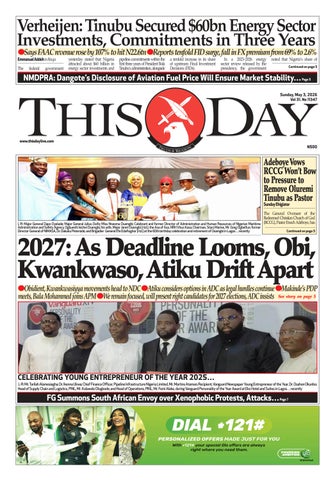
SUNDAY 3RD MAY 2026

Page 1


Verheijen: Tinubu Secured $60bn Energy Sector Investments, Commitments in Three Years

Says FAAC revenue rose by 107% to hit N22.6tn Reports tenfold FID surge, fall in FX

Emmanuel Addeh in Abuja The federal government yesterday stated that Nigeria attracted about $60 billion in energy sector investments and

Director General of NIMASA, Dr. Dakuku Peterside; and Brigadier General Efe Edafioghor (rtd.) at the 60th birthday celebration and retirement of Osamgbi in Lagos…recently Adeboye Vows RCCG Won’t Bow to Pressure to Remove Oluremi Tinubu as Pastor

2027: As Deadline Looms, Obi, Kwankwaso, Atiku Drift Apart

Obidient, Kwankwasiyya movements head to NDC Atiku considers options in ADC as legal hurdles continue Makinde’s PDP meets, Bala Mohammed joins APM We remain focused, will present right candidates for 2027 elections, ADC insists

L-R:

Recipient,

Mr. Tarilah Alamesiegha; Dr. Ikenna Ukwa; Chief Finance Officer, Pipeline Infrastructure Nigeria Limited, Mr. Martins Ataman;

wellness within reach

with W Health loan

The W Health Loan provides women with access to financing for eligible healthcare services

*Terms and conditions apply

NMDPRA: Dangote’s Disclosure of Aviation Fuel Price Will Ensure Market Stability

Dangote Group dismisses false claims on refinery financing, rift with Elumelu

The Nigerian Midstream and Downstream Petroleum Regulatory Authority (NMDPRA) has said the indicative gantry price for aviation fuel released by Dangote Refinery will ensure market stability and compliance by marketers.

This is just as Dangote Group has dismissed as false

and malicious a publication alleging that its President, Aliko Dangote, distanced himself from Mr Tony Elumelu, describing the report as entirely baseless.

The agency’s Director of Public Affairs, Mr. George Ene-Ita, made this known in an interview with the News Agency of Nigeria (NAN) in Abuja yesterday.

Ene-Ita was reacting to the pricing and high cost of Aviation

Turbine Kerosene (ATK), also known as aviation fuel or Jet A1.

The Dangote Petroleum Refinery has fixed its gantry price of ATK at N1,820 per litre, a move aimed at enhancing transparency in the sector.

This development comes at a time when Nigerians and airline operators have raised concerns over the high cost of the product and its heavy impact on the aviation industry.

In a move to ensure market stability, fair pricing, and ease mounting pressure on airline operators and passengers, NMDPRA had earlier set a jet fuel price cap for marketers, ordering direct sales to airlines.

The NMDPRA had issued a directive that the cost of Jet A1 fuel for end-users should range between N1,760 and N1,988 per litre in Lagos, and N1,809 to N2,037 per litre in Abuja.

2027: AS DEADLINE LOOMS, OBI, KWANKWASO, ATIKU DRIFT APART

Chuks Okocha, Sunday Aborisade in Abuja, Segun Awofadeji in Bauchi and Ahmad Sorondinki in Kano

As the May 10 deadline given by the Independent National Electoral Commission (INEC) for all the registered political parties to submit their membership registers to the commission approaches, the Obidient Movement and Kwankwasiyya Movement have consolidated themselves, defecting massively to the Nigeria Democratic Congress (NDC), THISDAY has learnt.

THISDAY gathered that the leader of the Obidient Movement and presidential candidate of the Labour Party (LP) in the 2023 presidential election, Mr. Peter Obi, and leader of the Kwankwasiyya

Movement and former presidential candidate of the New Nigeria Peoples Party (NNPP), Dr. Musa Kwankwaso are expected to join their followers in the new party in the coming days.

Meanwhile, as legal hurdles continue in the African Democratic Congress (ADC), former Vice President Atiku Abubakar is said to be considering options in the coalition.

The ongoing realignments among opposition figures ahead of the 2027 general election continued yesterday as Bauchi State Governor, Senator Bala Mohammed, officially announced his defection from the Peoples Democratic Party (PDP) to the Allied Peoples Movement (APM) to pursue his senatorial ambition. This is coming as the faction of

the PDP backed by the Oyo State Governor, Mr. Seyi Makinde will hold its 103rd National Executive Committee (NEC) meeting in Abuja on Monday following the Supreme Court’s nullification of its National Convention held in Ibadan, Oyo State last November, where Tanimu Turaki (SAN) emerged as the national chairman. Kwankwaso’s loyalists yesterday confirmed that he had concluded plans to defect from the ADC to the NDC on Monday.

But the former Kano State governor however debunked the claims, saying that he was still in talks with NDC, PRP and other parties, adding that there was no final decision on his political future.

Similarly, sources close to Obi

also disclosed that as the former Anambra State governor would move to the NDC, barring any unforeseen circumstances.

The recent Supreme Court judgment, which recognised the Senator David Mark-led ADC but remitted the party’s leadership dispute to the lower courts, was seen by some political analysts as a legal trap that could deny Obi, Kwankwaso, Atiku, and other opposition figures membership of a credible platform that can challenge President Bola Tinubu in 2027.

At a stakeholders’ meeting organised by the Obi-Kwankwaso Movement in Abuja, a close ally of the former Kano State governor, Mallam Buba Galadima, has disclosed that key opposition figures would announce a new

In spite of the advisory guidance from the NMDPRA, oil marketers have continued to sell aviation fuel to airlines at N2,230 per litre and above, deepening concerns across Nigeria’s aviation sector.

Ene-Ita said that although petroleum product prices had been deregulated, the latest indicative gantry price for ATK disclosed by the refinery would further support its monitoring

political platform on Monday.

Though Galadima did not name the platform, Kwankwaso’s aides revealed that the former presidential candidate had concluded arrangements to join the NDC, which has the former Bayelsa State Governor, Senator Seriake Dickson, as its national leader.

Addressing journalists, Galadima warned Obi and Kwankwaso supporters to brace for what he described as coordinated attacks and disruptions that could follow the announcement.

He said, “As from Monday, when our leaders declare on which platform they will run, I want to tell you that one of two things will happen. And I’m here to guide you on your response

ADEBOYE VOWS RCCG WON’T BOW TO PRESSURE TO REMOVE OLUREMI TINUBU AS PASTOR

stated that he would not bow to pressure to remove Nigeria’s First Lady, Senator Oluremi Tinubu, as an ordained pastor in the church.

He made this known while addressing the congregation at the church’s monthly Holy Ghost Service, held at Redemption City (formerly Redemption Camp), located at KM 46, Lagos-Ibadan Expressway, Mowe, Ogun State.

Adeboye said suggestions that RCCG was linked to the ruling All Progressives Congress (APC) were unfounded, noting that members of different political parties freely worshipped together.

He dismissed claims that the church was aligned with any political party, insisting that it remains a place of worship open to all Nigerians regardless of political affiliation.

According to the revered cleric, Mrs. Tinubu was ordained as an Assistant Pastor in the RCCG more than a decade ago, long before her husband, President Bola Tinubu, indicated an interest in contesting for the presidency.

Adeboye added that her ordination followed the full process required by the church and stressed that she has not violated any of its doctrines or guidelines.

“She was properly ordained many years ago, long before the political journey of her husband to the presidency began,” he said.

He added that the RCCG would not bow to external pressure demanding her removal as a pastor.

Adeboye further noted that the church operated on established spiritual and procedural principles and would not take

decisions based on political sentiment or public agitation.

He maintained that the First Lady remained in good standing within the church and had continued to serve in her pastoral capacity.

He stated that Nigeria’s next president that would emerge in the 2027 general election had already been determined by God.

Speaking during the May monthly Holy Ghost Service tagged ‘Excellent Counsel’, Adeboye said that his past involvement in public protests was in obedience to directives from the Christian Association of Nigeria (CAN).

“Some people are saying RCCG is an APC church. I just smile. In RCCG, you will find a governor from the Peoples Democratic Party sitting down with a governor from the

Labour Party, APC, and APGA. By the special help of God, we are representatives of the whole nation, and that is what we will continue to be,” he said.

The cleric stressed that while politicians were welcome in the church, the altar was not a platform for political expression.

“If you saw one governor among us today dancing and you were expecting he would be called forward to say something, we don’t do that. But if you come to worship with us, you are welcome. Our duty is to pray for everybody,” he added.

On Nigeria’s political future, Adeboye offered a spiritual perspective on the 2027 presidential election, stating that the outcome had already been determined by God.

“The one that will rule has been decided by God before we

were born. He knows the end from the beginning,” he said, urging Nigerians to remain focused on prayer and their personal responsibilities.

Addressing his past involvement in public protests, Adeboye explained that his actions were in obedience to directives from CAN.

“That was because the then chairman of CAN asked all Christians to go out for a peaceful protest. If he talks tomorrow and asks me to march, I will,” he said, adding that he operates under the authority of CAN on national Christian matters.

He also clarified that he did not see himself as a spiritual father to all Nigerian Christians, describing himself strictly as the leader of RCCG.

“I don’t want to be the father of all Christians in Nigeria. I

efforts.

“All petroleum product prices have been deregulated.

“However, with particular emphasis on ATK, the Dangote Refinery, having released its latest indicative gantry prices, which they promised to publish daily going forward, will enable us to ensure tacit compliance by marketers and operators during our routine surveillance operations nationwide.

to what will happen.

“First, they will sponsor columnists. Two, they will deploy social media influencers to start attacking our candidates. For all of you who are on social media and those of you with the mighty pen, you must be prepared to respond to anything they are going to say.

“Anything under the sun that they may say about our leaders that we know very well, people of integrity and honour, we must come to them with the ferociousness that is needed of an intelligent man.”

The NNPP chieftain further urged supporters, especially those active online, to respond to criticism strategically.

Continued on page 9

am certified as being the father of RCCG, and that is enough assignment for me,” he said.

The cleric was responding to comments by activist Omoyele Sowore, who had described him, David Oyedepo, and William Kumuyi as fathers of Christians in Nigeria.

Adeboye further urged members of the church to avoid engaging in criticism or political disputes involving fellow believers, assuring them of his continued support and protection.

“I will not allow any outsider to dictate to me how to deal with my own children. Even if you make a mistake, I will not allow an outsider to tell me what to do with my own children. I will defend you against anybody, any blogger or whatever who may say anything against you.

VERHEIJEN: TINUBU SECURED $60BN ENERGY SECTOR INVESTMENTS, COMMITMENTS IN THREE YEARS

African upstream FIDs rose from four per cent prior to 2023 to 39 per cent between 2024 and 2025, positioning the country as the continent’s leading destination for oil and gas capital.

The infographics were developed by the State House Digital unit, with information from the Office of the Special Adviser on Energy to the President, Mrs. Olu Arowolo Verheijen.

The document, which assessed the administration’s performance across six reform pillars, added

that about $10 billion in fresh upstream and midstream investments had already been secured, while an additional $50 billion in projects remained in the visible pipeline from 2026 onward.

According to the report, crude oil and condensate production increased to 1.6 million barrels per day in 2025, up from about 1.2 million barrels per day in 2023, representing what it described as the highest level in five years.

It added that gas production also rose to 7.63 billion standard

cubic feet per day from 6.83 billion cubic feet per day recorded in 2023.

The government attributed the improvements to a series of policy measures, including the removal of petrol subsidy and the unification of the foreign exchange market, as well as a number of executive orders by the president, which it said helped restore investor confidence and macroeconomic stability.

Besides, it noted that the foreign exchange parallel market premium declined significantly

from a peak of 69 per cent in 2022 to about 2.6 per cent currently, which it described as evidence of “real, not artificial stability.”

In the downstream segment, the report stated that local refining capacity increased from zero in 2023 to 48.2 million litres per day, driven by private sector participation and new supply frameworks.

It added that the country recorded zero petrol queues over the three-year period despite the removal of subsidy and deregulation of prices.

During the period under consideration, the document further noted that reforms boosted government revenues, with Federation Account Allocation Committee (FAAC) disbursements rising from N10.9 trillion in 2023 to N22.6 trillion in 2025, representing a 107 per cent increase.

In terms of operational efficiency and security, the government said pipeline uptime improved to 97 per cent as of March 2026, while illegal refining activities dropped from over 100

sites in 2023 to zero currently. It also stated that targeted security interventions and operator-led coordination contributed to the improvements.

The report added that about $4 billion in International Oil Company (IOC) divestments had been concluded, leading to increased indigenous participation in onshore oil production. Providing more details on investment flows, the government stated that upstream FIDs worth

Continued on page 9

Peter Uzoho

PAYING LAST RESPECTS TO OMPADEC SCRIBE…

Amid Economic Headwinds, Access, GTBank, UBA, Four Other Banks Deliver N1.6tn Profit in Q1 2026

Nigeria’s leading deposit money banks opened the 2026 financial year on a resilient note, posting a combined profit before tax (PBT) of N1.6 trillion in the first quarter, despite mounting domestic pressures and growing global economic uncertainty.

An analysis of the unaudited first-quarter results of seven major lenders by THISDAY showed that the banks sustained their earnings momentum, underlining the enduring profitability of the nation’s banking industry even in a challenging operating environment.

The banks reviewed— Ecobank Transnational Incorporated, Access Holdings Plc, Guaranty Trust Holding Company Plc, United Bank for Africa Plc, Wema Bank Plc, Stanbic IBTC Holdings Plc, and Zenith Bank Plc—grew aggregate profit before tax by 6.77 per cent from N1.5 trillion recorded in the corresponding

period of 2025.

Their combined profit after tax rose to N1.27 trillion, representing a 1.8 per cent increase from N1.25 trillion posted in the first quarter of last year.

The robust performance came amid persistent inflationary pressures, exchange rate volatility, heightened cybersecurity concerns, intensifying fintech competition, and a generally uncertain global macroeconomic climate.

Industry analysts said the banks’ earnings were largely buoyed by elevated yields on government securities, strong interest income from loans and advances, foreign exchangerelated gains, and improved non-funded income streams.

Expectedly, Zenith Bank Plc retained its position as the country’s most profitable lender in the period, posting a profit before tax of N360.92 billion, up 2.88 per cent from N350.82 billion in the corresponding quarter of 2025.

The bank’s profit after tax

climbed to N314.02 billion, reflecting steady earnings growth despite pressure from rising impairment charges and operating costs.

Closely behind was Guaranty Trust Holding Company Plc, which delivered N302.89 billion in profit before tax, marginally higher than the N300.3 billion recorded a year earlier.

Commenting on the result, Group Chief Executive Officer of GTCO, Segun Agbaje, said the group’s latest performance reflected a strategic shift in the composition and quality of its earnings.

According to him, the institution was increasingly benefiting from stronger contributions from its ecosystem businesses while maintaining solid momentum across core banking operations.

“Our focus remains on driving sustainable earnings by deepening customer relationships, scaling our ecosystem businesses, and deploying technology to deliver simpler, faster, and more intuitive

financial solutions,” he said.

Access Holdings Plc reported one of the quarter’s most impressive earnings expansions, with profit before tax rising 22.2 per cent to N272.21 billion from N222.78 billion in the corresponding period of 2025.

Similarly, Ecobank Transnational Incorporated posted N270.24 billion in profit before tax, representing a 1.1 per cent increase over N267.3 billion declared in the same period last year.

Stanbic IBTC Holdings Plc delivered one of the strongest growth performances among the tier-one and tier-two lenders, recording a 42 per cent jump in profit before tax to N165.4 billion from N116.42 billion.

By contrast, United Bank for Africa Plc recorded a decline in earnings, with profit before tax falling to N160.7 billion from N204.3 billion in Q1 2025.

For Wema Bank Plc, the quarter marked another period of accelerated earnings growth, as the lender posted N72.6 billion in profit before

Access Bank Disowns Fraudulent WhatsApp Investment Groups Impersonating Aig-Imoukhuede

Festus Akanbi

Access Bank Plc has warned Nigerians to steer clear of fraudulent WhatsApp investment groups masquerading under the name “Value Growth Club,” saying scammers were illegally using the identity of its former Group Chairman, Aigboje Aig-Imoukhuede, to lure unsuspecting members of the public into fake investment schemes.

In a public disclaimer issued yesterday, the bank said the fraudsters were falsely presenting themselves as associates of Aig-Imoukhuede and

linking his name to Gotham Capital in a calculated bid to lend credibility to the scam.

Access Bank said checks had confirmed that Aig-Imoukhuede has no affiliation whatsoever with the WhatsApp groups or any related investment platform, stressing that the respected banker neither created, endorsed, nor authorised any initiative known as “Value Growth Club.”

The lender emphatically stated that its former chairman was not involved in any WhatsApp-based investment competition, trading group, or financial

initiative tied to Gotham Capital or any similar entity, and described the representations as false, misleading, and fraudulent.

It urged members of the public not to join the groups, or send money, or disclose personal or financial information to anyone claiming to be associated with the purported platform.

The bank also advised individuals who may have encountered the groups to exit immediately, report the accounts through appropriate channels, and ignore further contact from the operators.

The warning comes

amid heightened regulatory concern over the proliferation of digital investment scams in Nigeria.

Earlier this year, the Securities and Exchange Commission (SEC) similarly flagged the Value Growth Platform, warning that the entity displayed characteristics consistent with a Ponzi-style operation.

The commission said the platform had portrayed itself as a sophisticated investment service offering market intelligence, portfolio guidance, and third-party trading services, but investigations showed that its claims were misleading and potentially unlawful.

tax—an increase of 41.2 per cent from N41.2 billion in the corresponding quarter last year.

Market analysts said the results once again highlighted Nigerian banks' ability to navigate turbulence and preserve profitability even under difficult macroeconomic conditions.

Investment banker and stockbroker, Tajudeen Olayinka, said the resilience shown by the lenders reinforced their strategic importance to Nigeria’s economy and the broader African financial system.

He noted that a substantial portion of recent banking profits has been driven by elevated returns on government securities and revaluation gains on foreigncurrency positions.

According to him, many of the top-tier banks have deliberately structured their balance sheets to maintain net long dollar positions, enabling

them to benefit from exchange rate adjustments.

“Most tier-one banks currently maintain net long US dollar positions, meaning their foreign currency assets exceed their liabilities. As a result, any currency revaluation tends to support profitability,” he said. Beyond the strong earnings numbers, analysts believe the lenders' performance reflects the extent to which Nigeria’s banking sector has evolved into one of the most profitable and structurally resilient segments of the economy.

Still, they caution that sustaining such momentum may become more difficult in the months ahead as inflation remains elevated, regulatory compliance costs rise, and competitive pressure from fintech operators continues to reshape the financial services landscape.

Bandits Kill Three Policemen in Kwara Community, Pregnant Woman, Three Others in Plateau

Shittu in Ilorin

About 10 suspected terrorists have reportedly invaded the ancient town of Tenibo in Kaiama Local Government Area (LGA) of Kwara State, killing three mobile police officers.

In a similar incident, gunmen on Friday killed four persons, including a pregnant woman, and injured four others in an attack on a mining site in Mazat community, Ropp District of Barkin Ladi LGA of Plateau State.

Following the incident, tension has enveloped the community and other adjoining towns in the local government area.

The latest incident, THISDAY learnt, occurred at around 12 a.m yesterday when the residents of the community were reportedly sleeping. The suspected terrorists were said to have emerged from the thick forest in the town and launched an attack on the mobile police officers.

A community member, who craved anonymity, urged the government to clear the thick forests for farming activities, instead of leaving it for the terrorists as their base to launch attacks on the people and security officers.

"The thick forests where the terrorists are hiding is just about a kilometre to the community; so, it makes it easy for them to come out, attack the security people and return to the thick forest.

The terrorists had earlier killed three soldiers at Kemanji community less than two weeks ago after about two hours of gun battle between the gunmen and security forces.

Kayode Tokede
L-R: Senate Deputy Whip, Senator Onyekachi Nwaebonyi; President of the Senate, Senator Godswill Akpabio; former Chief Executive of the Nigerian Upstream Petroleum Regulatory Commission, Mr Gbenga Komolafe; Senator Osita Izunaso; retired DIG, Frank Mba; and Senator Osita Ngwu, at the funeral ceremony in honour of the former Administrative Secretary of Oil Mineral Producing Area Development Commission, the late Sir Albert Ikechukwu Nnamani, at St. Theresa Catholic Church, Ikem, Isi-uzo Local Government Area, Enugu State…yesterday

IATA Lists Nigeria Among African Countries with Aviation Charges Above Global Average

Air Peace

clarifies Gatwick-Lagos flight disruption over bird strike

The International Air Transport Association (IATA) has listed Nigeria among African countries where aviation taxes and charges were significantly above global benchmarks, as the global body renewed its concerns over the rising cost of air travel across the continent.

This is just as Nigeria’s leading carrier, Air Peace, has shed light on the incident involving its Lagos-Gatwick, London flight on May 1, 2026, which led to the flight's eventual cancellation, and has blamed the disruption on a bird strike.

According to a Nairametrics report, IATA made the disclosure at its Focus Africa Conference

in Addis Ababa, Ethiopia, where it said Nigeria, alongside Angola, Ghana, Kenya, and the Democratic Republic of Congo, were among countries imposing aviation-related charges well above international norms.

According to IATA, aviation charges in Africa were, on average, about 15 per cent higher than the global average,

a development it said continued to inflate ticket prices, suppress passenger demand, and weaken regional air connectivity.

The association noted that the elevated cost environment had sustained long-standing concerns over the competitiveness of African aviation, particularly in West Africa, where travellers and airlines faced some of the heaviest

FG Summons South African Envoy over Xenophobic Protests, Attacks

Michael Olugbode in Abuja

The federal government has summoned the acting High Commissioner of South Africa to a meeting in Abuja following concerns over recent protests targeting foreigners and attacks on Nigerian citizens and their businesses in the country.

According to a statement issued yesterday by the spokesperson for the Ministry of Foreign Affairs, Kimiebi Ebienfa,

the meeting was scheduled to take place on Monday at the ministry’s headquarters.

The ministry said the engagement was aimed at addressing developments that could strain diplomatic ties between both nations, which historically maintained cordial relations.

“The Ministry of Foreign Affairs of the Federal Republic of Nigeria has extended an invitation to the Acting High

2027: Alia Moves to

Commissioner of the Republic of South Africa for a meeting scheduled to take place on Monday, May 4, 2026, at the Ministry’s headquarters in Abuja,” the statement read.

It added, “The objective of this engagement is to formally convey the Nigerian Government’s profound concern regarding recent events that have the potential to impact the established cordial relations between Nigeria and South Africa.”

The ministry noted that discussions at the meeting would centre on ongoing demonstrations by groups in South Africa, as well as reported cases involving Nigerian nationals.

“Discussions will primarily focus on the ongoing demonstrations by various groups within South Africa and the documented instances of mistreatment of Nigerian citizens and attacks on their businesses,” the statement added.

Reconcile APC Stakeholders

in Benue, Invites Akume, Others

Benue State Governor, Hyacinth Alia, has convened a high-level reconciliation meeting of All Progressives Congress (APC) stakeholders, including the Secretary to the Government of the Federation (SGF), Senator George Akume, as part of efforts to unite the party ahead of the 2027 general election.

The governor disclosed this weekend shortly after receiving his Expression of Interest and

Nomination Forms, jointly purchased for him by the Benue State chapter of the Nigeria Union of Pensioners (NUP) and the Benue Motorcycle Owners Association (BMOA).

Alia said the planned meeting was aimed at resolving internal differences and fostering unity within the party in the state.

“For those of you who belong to APC, I advise that we come together as one entity. I have written to the SGF, Senator George Akume, inviting him, along with members of the

National and State Assemblies and other stakeholders of our party, for an internal meeting.”

He added that all invitees had agreed to attend. “We have all agreed that by Sunday (today), they will come. My delegation will be there, and we will blend and become one. It is very vital for me and for the state,” he stated.

The governor stressed the importance of unity, noting that differences within the party were insignificant compared to their shared goals.

“What divides us is not strong enough; what unites us is larger, bigger and stronger,” he said.

Alia expressed optimism that the reconciliation meeting would bring all factions together, insisting that inclusiveness remained key to the party’s success.

“We need to blend. Benue has become APC, and no one must be left behind. What we recorded in 2023 must be doubled in 2027,” he added.

cost burdens on the continent.

IATA specifically urged African governments to reverse the growing trend of imposing Advance Passenger Information and Passenger Name Record (API-PNR) charges, warning that such levies were worsening the continent’s already expensive operating climate.

It noted that while Tanzania currently has the world’s highest API-PNR charge at $45 one-way, Nigeria and several other African countries also imposed charges above global standards.

The body further called for full implementation of the December 2025 decision by the Economic Community of West African States to eliminate certain aviation taxes and reduce select charges by 25 per cent, stressing that delayed or

inconsistent implementation by member states could undermine the reform’s intended impact.

For Nigeria, the latest IATA warning reinforces concerns over the cumulative burden of multiple aviation levies. The country generated about $62 million from airline ticket taxes in 2024 and introduced an additional $11.50 security levy under its Advance Passenger Information System effective December 2025, pushing total security-related charges on international tickets to $31.50.

Meanwhile, in a statement signed by Air Peace, the airline explained that when the bird strike incident happened, it informed the passengers and provided accommodation for them at the Hilton Hotel in Gatwick, London.

Tinubu Reschedules Threenation Trip to Begin Today

President Bola Tinubu has rescheduled the commencement of his planned three-nation trip to today, instead of yesterday as earlier announced.

The development was disclosed by the President’s Special Adviser on Information and Strategy, Bayo Onanuga, via his official X (formerly Twitter) handle yesterday.

Onanuga wrote, “President Tinubu has rescheduled his three-nation trip to begin on Sunday, rather than Saturday as previously indicated.”

No reason was immediately given for the change in schedule.

Recall that Tinubu was scheduled to depart Abuja yesterday for official visits to France, Kenya and Rwanda.

According to a statement released on Friday by Onanuga, the trip will begin with a stop

in France before proceeding to Nairobi, Kenya.

Tinubu is expected to attend the Africa-France Summit in Nairobi, co-chaired by Emmanuel Macron and William Ruto.

The summit, scheduled for May 11 to 12, will focus on issues including energy transition, digital transformation and climate action.

“President Tinubu’s participation at the summit from May 11th to May 12th. will underscore Nigeria’s unwavering commitment to strengthening strategic partnerships with African nations and the French Republic,” the statement read.

After the Kenya engagement, the president will travel to Kigali, Rwanda, for the Africa CEO Forum holding from May 14 to 15.

Ejiofor Alike and Chinedu Eze
George Okoh in Makurdi
THIRTY HEARTY CHEERS…
L-R: Chief Executive Officer, Beacon Nigeria Limited, Sir Orji Okoye; Chairman, Fair and White Nigeria, Sir Patrick Chibueze; Chief Executive Officer, Topline Automobiles Limited, Chief Ifeanyi Chukwuka; Chairman, Ekulo Group, Sir Emma Bishop Okonkwo; and Chief Executive Officer, C Solid Limited, Chief Obih Henry Chigozie, at the 30th anniversary of Fair and White Nigeria in Lagos…recently

STRATEGISING AHEAD OF 2027 POLLS…

Buoyed By Its Massive Customer Base, Opay Eyes $4bn IPO, Taps Citigroup, Deutsche Bank, JPMorgan

Nume Ekeghe with agency reports

Opay, a financial technology firm, has engaged Citigroup Inc., Deutsche Bank AG, and JPMorgan Chase & Co. as it advances plans for an initial public offering (IPO), leveraging its massive customer base and transaction volumes to court global investors.

According to a Bloomberg report, the SoftBank-backed payments platform with

deep roots in Nigeria was considering a listing in the United States, targeting a valuation of about $4 billion.

The report said the company could proceed with the offering later this year, although the timing and size of the transaction were still under consideration.

Neither OPay nor the banks involved have publicly commented on the proposed transaction.

If consummated at the

projected valuation, the IPO would mark a major leap from the company’s last publicly disclosed valuation in 2021, when it raised $400 million in a Series C funding round led by SoftBank Vision Fund 2 at a valuation of approximately $2 billion.

That round was among the largest venture capital raises ever recorded for an Africanfocused startup at the time.

Founded in 2018 by Operabacked investors, OPay began

as a super-app with ambitions spanning ride-hailing, food delivery, and logistics before a strategic pivot transformed it into one of Nigeria’s dominant digital financial platforms.

The company’s retreat from transport and logistics followed the Lagos State Government’s restrictions on commercial motorcycles in 2020, forcing a sharp restructuring that has since become a textbook case in startup adaptation.

Since then, OPay has focused

FG Expresses Concern that Rising Crude Oil Prices May Hike Inflation to 20%

Urges states to borrow to create transformative infrastructures

The federal government has expressed concern that the inflation rate in Nigeria may rise to 20 per cent if the current rise in the price of crude oil was sustained.

The view was expressed in Lagos by the Chief Economic Adviser to the President, Dr. Tope Fasua, when he presented “Nigeria’s Economic Environment in

2026 and Beyond,” at the monthly breakfast session of the Nigeria-South Africa Chamber of Commerce.

Fasua said: “People are recalculating how much is crude oil price today and multiplying it with 1.5 million barrels per day and believed the country is making so much money.

“I was listening to one very powerful financial consultant say that Nigeria is making so

much money now.

“But the big problem is that if we are not careful inflation will erode all of that money.

“Whatever game they are talking about because inflation has started to tick off again.

“If this crude oil price does not come down, this inflation may hit up to 20 per cent.”

He also envisaged a national budget of N100 trillion for the country to address its infrastructure deficit, as he

insisted that debt was not the problem but underfinancing.

He also admonished state governors who were proud that they had not borrowed a kobo to start borrowing to create transformational infrastructure for their states.

Fasua also disclosed that the federal government had carried out an upward review of its revenue expectation due to substantial inflows from tax collections

almost exclusively on financial services, building a vast agent banking and merchant payments ecosystem that has helped drive its rapid growth across Nigeria’s retail payments landscape.

The company disclosed that it serviced more than 30 million registered users, operating through over 500,000 agents nationwide, making it one of the largest financial access platforms in the country.

Its rise has coincided with

Nigeria’s aggressive cashless policy drive and the rapid expansion of agency banking, which has reshaped retail financial transactions in Africa’s largest economy.

Data from the Central Bank of Nigeria (CBN) shows that electronic payment transactions in the country have risen sharply in recent years, with fintechs increasingly taking market share from traditional banks in low-value, highvolume retail payments.

NUPRC, NLNG Deepen Collaboration to Raise Gas Production

TotalEnergies, NNPC launch 2026 VIA programme targeting 600 students

Emmanuel Addeh and Folalumi Alaran in Abuja

The sions.

The Commission Chief Executive (CCE) of the Nigerian Upstream Petroleum Regulatory Commission (NUPRC), Mrs Oritsemeyewa Eyesan, has reaffirmed the NUPRC’s commitment to enabling a business-friendly environment and advancing the federal government’s gas agenda.

administration’s responsiveness to the oil and gas sector, linking it to improved investor confidence and increased final investment decisions.

In his remarks, the NLNG Managing Director, Falade, stressed the centrality of upstream collaboration to sustaining gas supply.

Falade highlighted NLNG’s domestic Liquefied Petroleum Gas (LPG) strategy as a deliberate market-shaping intervention.

Polls

Saraki: After Supreme Court Verdict, Let’s Unite PDP, Plan to Win 2027

Former Senate President, Dr Abubakar Bukola Saraki has advised the leadership of the Peoples Democratic Party (PDP) elected during the March 29, 2026, national convention to see last Thursday's verdict of the Supreme Court as a challenge to them to immediately commence the process of uniting the party and preparing to win the 2027 elections for all its candidates. Saraki in a statement by

Yusuph Olaniyonu, head of the Abubakar Bukola Saraki Media Office, noted that the victory also justified his consistent position since the beginning of the current disagreement in the party that the national convention in Ibadan should never have been held but that instead an interim arrangement should have been put in place.

The advice, he said, was given to avoid prolonged litigation and steps that would make the reconciliation process torturous.

He recalled how he articulated this position to leading members of the party, at various fora, and also repeated the same plea with the committee of elders headed by Ambassador Hassan Adamu, the Wakili of Adamawa, when the group consulted him to know his position.

“Now that we have all ventilated our views and exhausted the legal channels of expressing our grievances and the apex court in the land has given a verdict that the Ibadan

Convention is null and void in the same manner as all actions arising from it while also subsequently affirming the Abdulrahman Mohammed Takushara-led National Working Committee as the recognised leadership of the party both in law and by the regulatory authority, the Independent National Electoral Committee (INEC), there is now only one PDP and we should all unite and work for the success of our party across the 36 states and the Federal Capital Territory.

This is just as the TotalEnergies EP Nigeria Limited, in collaboration with the Nigerian National Petroleum Company Limited, has launched the 2026 edition of the VIA Safe Mobility for Young People programme, with a renewed focus on protecting vulnerable schoolchildren across Nigeria

The CCE made the commitment during a visit by the Managing Director of Nigeria LNG Limited (NLNG), Mr. Adeleye Falade, a statement in Abuja yesterday by the Head, Media and Corporate Communications of the commission, Eniola Akinkuotu, stated.

Receiving the NLNG delegation, Eyesan restated the

TotalEnergies,

NNPC Launch 2026 VIA Programme Targeting 600 Students

Meanwhile, TotalEnergies EP Nigeria Limited and the Nigerian National Petroleum Company Limited, have launched the 2026 edition of the VIA Safe Mobility for Young People programme.

The initiative will engage 600 students under the age of 18 across 30 public secondary schools in the Federal Capital Territory (FCT), Lagos and Rivers states, to promote road safety awareness and inclusive mobility.

Chuks Okocha in Abuja
National Chairman of the Peoples Democratic Party, Abdulrahman Mohammed (left), presenting the party’s presidential nomination form to Senator Sandy Ojang Onor, the party’s first presidential aspirant to obtain nomination form at the party secretariat, Wadata Plaza in Abuja…yesterday

HONOURING THE LATE YAKUBU MOHAMMED…

Renewed War with United States Likely, Says Iran as Trump Rejects Tehran’s Proposal

Sunday Ehigiator

Barely a few hours after United States President Donald Trump said he was not satisfied with an Iranian negotiating proposal, Iran yesterday declared that a renewed war with the US was still possible. The war, launched by the United States and Israel in late February, has been on hold since April 8, with one failed round of peace talks having taken place in Pakistan. Iran had delivered the new draft to mediator, Pakistan, on Thursday evening, state media reported, without detailing its contents.

But in his reaction, Trump told reporters that "At this moment I'm not satisfied with what they're offering," blaming the stalled talks on "tremendous discord" within Iran's leadership. He added that the decision he faced was between whether to "just blast the hell out of them" or to "try and make a deal", saying he would rather not take the first option.

A senior figure in the Iranian military's central command, Mohammad Jafar Asadi, said "a renewed conflict between Iran and the United States is likely", according to a report by Iran's Fars news agency. "Evidence has shown that the United States is not committed to any promises or agreements," he added.

2027: AS DEADLINE LOOMS, OBI, KWANKWASO, ATIKU DRIFT APART

The spokesman of the Kwankwasiyya Movement, Dr. Habib Mohammed, also told THISDAY yesterday that Kwankwaso had concluded arrangements to defect to the NDC on Monday.

Mohammed said the planned move was aimed at repositioning Kwankwaso and other key opposition figures for the 2027 general election.

However, the Deputy National Publicity Secretary of the NDC, Hon. Abdulmumin Ohiare Abdulsalam, said that the party has not confirmed the defection of the two former presidential candidates, adding that its doors remain open to them and other political actors amid ongoing realignments ahead of the 2027 general election.

Also, in a statement issued by Kwankwaso late last night, the former Kano governor stated that “no final decision has been taken regarding my political future or that of my political associates.”

$5.65 billion were recorded in 2024 alone, including projects such as Iseni, Ubeta and Bonga North, while additional large-scale projects remained in the pipeline.

It listed some of the $50 future upstream pipeline as Ima NAG; HA; Bonga Southwest; Zabazaba; Owowo; Bosi; Pereowei; Nsiko; Usan and Erha.

It also noted that Nigeria’s contracting timelines within the national oil company had reduced from about 36 months previously to roughly 14 months currently, with a target of six months, which

Kwankwaso noted that the Supreme Court judgment, which remitted the ADC’s leadership dispute back to the High Court, and the Federal High Court that ruled to delegitimise the party’s recent convention, had left the party in a precarious position.

“We left the NNPP due to externally influenced legal problems that made our stay perilous. The ADC has now been also forced into this difficulty.

“Consequently, like other major stakeholders, we have commenced wide-ranging consultations — including with leaders from the NDC, PRP and others to explore the best options for protecting our democratic interests. We shall announce our decision in the soonest possible time,”

Kwankwaso explained.

He noted that the ADC was yet to zone its presidential ticket or take any decision on a candidate.

“I have therefore neither declared any intention to run for president nor endorsed any

it said was aimed at improving efficiency and competitiveness.

On gas and industrialisation, the government said reforms in the sector increased supply to power, fertiliser and petrochemical industries, with a $2 billion nonassociated gas project reaching final investment decision. It added that key industrial players had been secured as offtakers to support domestic value addition.

The report also referenced efforts to drive energy transition, stating that about $2 billion in clean energy investments were

aspirant. All speculations to the contrary are premature and unfounded.

“My absence from the two recent ADC stakeholders’ meetings was due to unavoidable personal commitments. I promptly communicated my apologies to the party leadership.

“We shall continue to engage constructively at all levels. Any definitive position on our political direction will be communicated formally through official channels at the appropriate time,”

Kwankwaso said.

However, reacting to the speculations on Obi’s planned defection from the ADC to the NDC, Obi’s spokesman and National Coordinator of the Obidient Movement, Dr. Tanko Yunusa, told THISDAY that he had no official permission to comment on the matter.

He, however, expressed fear that with the Supreme Court’s judgment ordering the retrial of the ADC leadership dispute by

unlocked between 2024 and 2025, alongside the rollout of compressed natural gas (CNG) initiatives and expanded clean cooking programmes.

In the power sector, the government reiterated that it recently launched a N4 trillion bond programme to address legacy debts owed to Generation Companies (Gencos), covering obligations accumulated between 2015 and March 2025.

To this end, it disclosed that N3.48 trillion had been negotiated as full and final

the lower courts and INEC’s May 10 deadline, time was not on the side of the opposition figures and their political parties

"But I am worried about the outcome of the Supreme Court judgment last Thursday that ordered a retrial from the High Court, bearing in mind the new guidelines from INEC.

“Today is May 2, and the INEC guidelines are expected to come to an end on May 10, which is Saturday or Sunday. How do we in the ADC approach the trial court, which will hear the case fresh, possibly the case will go to the appeal court, and again back to the supreme court?

“This is impossible, and therefore, time is not on our side. I have heard many permutations, but I am not permitted to speak," Tanko Yunusa said.

Governor Mohammed, who

settlement, while an initial N501 billion bond issuance was fully subscribed and already being disbursed.

The document added that eight out of 21 generation companies had signed final settlement agreements, with efforts ongoing to achieve full participation across the sector.

On metering, the government stated that coverage increased from 44.4 per cent in 2023 to 57.3 per cent in 2025, supported by the deployment of 1.5 million meters across distribution

announced his defection yesterday after a high-level meeting with stakeholders from the state, said the decision followed extensive consultations, describing it as a responsible step to provide Bauchi citizens with a viable political alternative amid what he described as an unusual and challenging situation.

He described the situation within the PDP as “complex and uncertain,” noting that efforts to restore stability in the party had failed to produce results.

He emphasised that the move to APM was a “strategic repositioning” aimed at securing political victory and ensuring continuity in governance.

The governor also announced his ambition to contest the Bauchi South senatorial seat in the 2027 general election.

Meanwhile, the National Chairman of the APM, Alhaji Yusuf Mamman Dantalle, has welcomed the governor, describing him as a true democrat.

networks. It added that about $700 million had been secured to fund the rollout of an additional five million smart meters nationwide.

The report also stated that electricity subsidy reforms resulted in savings of about N1.2 trillion, as actual spending declined to N1.8 trillion compared to a projected N3 trillion without reforms. It added that about 45 per cent of electricity consumers are now on cost-reflective tariffs, while the remaining 55 per cent continued

Deputy foreign minister Kazem Gharibabadi told diplomats in Tehran that "the ball is in the United States' court to choose the path of diplomacy or the continuation of a confrontational approach". Iran, he said, was "prepared for both paths".

He said the party operates on the principles of integrity, sacrifice, and service, with its slogan “Nigeria First.”

NDC’s Door Open to Former Anambra, Kano Govs, Others, Says Party

In an explanatory press statement issued yesterday, the Deputy National Publicity Secretary of the NDC, Abdulsalam, said his earlier comments to a journalist on the possible movement of Obi and Kwankwaso were misinterpreted and sensationalised in some sections of the media.

While noting that there was no official confirmation of any imminent defection, he explained that “The hierarchy of the NDC shall continue to keep its doors open for all who wish to join its fold,” he said, adding that talks among opposition parties on forming a multi-party coalition were already gaining traction.

to receive targeted subsidies. Furthermore, the government stated that metering expansion, tariff reforms and improved payment discipline were aimed at creating a more bankable electricity market capable of attracting private capital and improving supply reliability. The document maintained that reforms in both the oil and gas sector and the electricity market were designed to work in tandem to drive industrialisation, job creation and economic diversification.

L-R: Former Executive Editor, Newswatch, Mr. Soji Akinrinade; Convener of Olori Janet Afolabi Foundation, Janet Afolabi; Rabi, wife of the late Mr. Yakubu Mohammed; and Co-Founder of Newswatch, Mr. Ray Ekpu, at the unveiling of the Newswatch 5th Lecture Series in Lagos…yesterday
Bala Mohammed Joins APM

THIRD MaTRICULaTION CEREMONy…

L-R: Chancellor, Aletheia University, Ago-Iwoye, Major General Sansadeen Awosanya (rtd); Pro-Chancellor, Aletheia University, Ago-Iwoye, Mrs. Onikepo Akande; Ogun State JAMB Coordinator, Mr. Hakeem Abdulhamid; and Vice Chancellor, Aletheia University, Ago-Iwoye, Prof. Olukayode D. Akinyemi, at the Third Matriculation Ceremony of the university in Ago-Iwoye, Ogun State…recently

Cyber Security Agency Warns against Rising Cyber Attacks on Nigeria’s Critical Infrastructure

The Nigeria Computer Emergency Response Team (ngCERT) has issued a fresh nationwide cyber alert, warning that a sustained wave of Distributed Denial-of-Service (DDoS) attacks was increasingly threatening Nigeria’s critical digital infrastructure, with both public and private sector organisations under heightened risk.

In an advisory circulated to operators across strategic sectors and published yesterday by Nairametrics, the national cyber

incident response agency said threat actors were deploying more sophisticated and coordinated methods to cripple online services, disrupt operations, and undermine confidence in digital systems.

DDoS attacks involve overwhelming a server, network, or online platform with massive volumes of malicious internet traffic, effectively shutting out legitimate users and rendering services inaccessible.

According to ngCERT, the latest

Nigerian Army Confirms Arrest of Activist Who Goes Missing in Abuja

The Nigerian Army has confirmed that it arrested an Abuja-based social critic, Justice Mark Chidiebere, popularly known as Justice Crack, who was declared missing by his family after he released a video criticizing the army over the poor welfare of troops at the frontlines.

Chidiebere was last seen on Tuesday, April 28, 2026, after leaving home for what he told his wife was a meeting, shortly after receiving a phone call.

Since then, his phones have remained switched off, and repeated attempts by family members and associates to reach him have failed.

The development had raised concerns over the shrinking democratic and human rights spaces in Nigeria and deepened uncertainty around his whereabouts among relatives, friends and supporters.

His distraught wife, Theresa Chidiebere, expressed fear over the circumstances surrounding his sudden disappearance.

Theresa alleged that information available to her indicated

that her husband was last seen at a military facility in Asokoro, Abuja, where he was reportedly subjected to harsh conditions.

“I was told he was taken to a military facility and treated in a way no human being deserves. If this is true, then something is terribly wrong. My husband is not a criminal,” she said.

The mother of two appealed to the federal government to intervene and ensure his safe return. An activist, Peter Ogbudu, who also spoke at the briefing, said there were credible indications linking Chidiebere’s disappearance to his recent posts on social media.

These, he noted, include posts about the welfare of soldiers in Maiduguri and an incident in Dei-Dei, Abuja, involving a corps member reportedly shot by military personnel.

However, in an official statement signed by the Acting Director of Army Public Relations, Colonel Appolonia Anele, the Army said its attention was drawn to a social media post by Chidiebere where he highlighted complaints made by some soldiers regarding their feeding and general welfare.

attacks were becoming more complex, more aggressive, and harder to mitigate, with cybercriminals combining several techniques in what it described as multi-vector operations.

The agency said attackers were increasingly blending volumetric floods that saturated bandwidth, protocol-based attacks targeting network infrastructure, and application-layer assaults that imitate legitimate user traffic in order to evade detection and overwhelm

defences.

It further disclosed that hackers were exploiting long-known vulnerabilities in widely used software and systems—including Log4Shell and flaws affecting Citrix, Drupal, and DNS infrastructure—to compromise servers, endpoints, and internet-connected devices, which are then recruited into botnets for coordinated assaults.

The advisory noted that threat actors were also leveraging reflection and amplification methods

using services such as DNS, NTP, and Memcached to multiply the scale of malicious traffic directed at targets.

It warned that the implications of successful attacks could extend far beyond temporary outages, stressing that prolonged disruption of digital services could inflict significant financial losses, weaken operational resilience, and expose Nigeria’s critical infrastructure to broader systemic risks.

Sandy Onor Joins Presidential Race, Picks Wike-backed

Chuks Okocha in Abuja

Former senator from Cross River Central senatorial district, Sunday Onor, yesterday paid N50 million for the presidential nomination form and N1 million for the Expression of Interest form of the Nyesom Wike-backed Peoples Democratic Party (PDP).

The presidential nomination form was handed over to him by the National Organising Secretary of the party, Umar

Bature, who was represented by his deputy.

Senator Onor berated former Senate President Adolphus Wabara for refusing to accept defeat after the Supreme Court delivered its judgment last Thursday.

He urged him to emulate former President Goodluck Jonathan, who accepted defeat in the 2015 general election.

Onor was a Senator in the 9th Senate and represented Cross River State Central Speaking later, he said

he succumbed to pressure to contest the presidential election.

Onor noted that Wike is the national leader of the PDP and also believes in President Bola Tinubu’s presidency.

He, however, added that these facts did not mean that the FCT minister could stop him from pursuing his presidential ambition.

He said that if chosen as the PDP presidential candidate, he would pursue his presidential aspiration courageously, ir-

The agency added that repeated service failures could erode public trust in digital platforms, damage institutional reputations, and trigger regulatory consequences for organisations found wanting in cybersecurity preparedness.

It also cautioned that DDoS attacks were being used as smokescreens for more dangerous intrusions, including ransomware deployment and unauthorised data extraction.

respective of Wike’s decision, who is supporting President Tinubu’s second-term ambition.

In his speech, the National Chairman of the factional PDP, Abdulrahman Mohammed, urged other aggrieved members to accept defeat and return to the mainstream PDP under his leadership.

He said the PDP platform has been made available to all PDP members and that no Nigerian would be denied the opportunity to contest any elective position in the 2027 general election.

Ray Ekpu Pours Encomiums on Yakubu Mohammed, Says He Was a ‘Reporter’s Reporter,’ Careful Storyteller

The last of the quartet that founded Newswatch magazine, Mr. Ray Ekpu, has described the late Yakubu Mohammed as “a ‘reporter’s reporter,’ a careful, thorough and methodical story teller who went for facts, truth,” and never bent them.

Ekpu stated this at “The Newswatch 5th Lecture Series and Tribute Session for the late Yakubu Mohammed,” which was organised by The

Newswatch Family in collaboration with Olori Janet Afolabi Foundation. Mohammed died on January 13, 2026.

Newswatch magazine was founded by the late Dele Giwa, late Dan Agbese, late Yakubu Mohammed and Ekpu as Nigeria’s first weekly newsmagazine in the style of Time and Newsweek newsmagazines.

Ekpu said: “Yakubu was a reporter’s reporter, a careful, thorough and methodical story teller.

“He went for facts, truth, he never bent the facts, he never bent the truth. He told the story faithfully, truthfully in a simple but alluring language.

“He never went for grandiloquence or intellectual exhibitionism or writing gymnastics. He just wanted to tell a story in a way that anyone who read it understood it. He went for clarity.

“And even in his column writing, something he had done for decades, his style

was the same.

“And when he got elected as the Vice President of the League of Nigerian Columnists which is headed by the journalism legend, Chief Tola Adeniyi, I knew that he deserved the honour.

“And he capped his writing career by bringing out an autobiography titled ‘Beyond Expectations’ before he died. By writing a book about his life and legacy he added muscle to his career as a journalist and public intellectual.

Linus aleke in Abuja

Celebrating A Life of OL ABISI OLUGBODI JP GRACE MRS

With grateful hear ts and thanks to the almighty God, the Olugbodi family of Ara Kingdom, Osun State announce the transition of their late mother, grandmother, sister , aunt and matriarch. She died exactly one week following the burial of her late husband, the Unforgettable JO, Chief Joshua O yedele Olugbodi. Indeed what God has joined together, even death could not separate. We celebrate her legacy of love, faith and resilience. We appreciate the many lives she touched by her impeccable values of honest y , discipline and hard work . She is sur vived by children, grandchildren, sisters , brother and a wide circle of family, friends and acquaintances. May her soul rest in peace.

B U R I A L

Ser vice of Songs & Tributes Friday, May 8th, 2026 / 4.00pm - 6.00pm Union Baptist Church, Odi Olowo, Osogbo. Colours: Brown on white.

Lying in State

Saturday, May 9th, 2026 / 8.00am - 10.30am

A�n’s Compound, Ara Kingdom, Egbedore Local Government.

Funeral Ser vice & Interment

Saturday, May 9th, 2026 / 11 .00am First Baptist Church, Ara Kingdom.

Colour : All shades of green.

*No reception.

*Interment is private family affair.

Family Thanksgiving Sunday,May 10, 2026 / 9.00 am Union Baptist Church, Odi Olowo, Osogbo.

Asiwaju Tunji Olugbodi |
With Love from

WE FELICITATE WITH

On BehDlf of Dll the PDstors of CGA , AbujD.

Again, Middle East Crisis Rattles Nigeria’s Economy

Middle East tensions are fuelling fresh pain for Nigeria as rising oil prices push up fuel costs and inflation,

The renewed conflict in the Middle East is posing a fresh threat to Nigeria’s fragile economic recovery, with the first signs already visible in rising fuel prices, renewed inflationary pressure, and growing uncertainty over government financing plans.

What may appear to be a distant geopolitical crisis is quickly becoming a domestic economic problem for Nigeria, exposing the country’s deep vulnerability to global oil market disruptions once again.

The clearest immediate impact has been the surge in petrol prices. Following a rise in global crude prices triggered by fears of prolonged supply disruption in the Persian Gulf, the Nigerian National Petroleum Company Limited (NNPCL) raised petrol pump prices to about N1,364 per litre in parts of Abuja, up from N1,295.

The increase followed Dangote Refinery’s adjustment of its gantry price to N1,275 per litre after crude prices climbed above $115 per barrel and briefly hit $126.

The spike reflects the reality that, despite being Africa’s largest oil producer, Nigeria remains highly exposed to international energy market volatility. The country still relies heavily on global crude benchmarks for domestic fuel pricing, meaning any disruption in oil-producing regions quickly translates into local pump prices.

For households and businesses, the consequence is immediate. Petrol remains central to Nigeria’s economic life, powering transport, logistics, private electricity generation, and distribution networks. Higher fuel prices inevitably feed into transport fares, food prices, production costs, and general consumer inflation. With inflation already elevated, industry analysts say the latest increase threatens to worsen the cost-of-living crisis facing millions of Nigerians.

Ironically, while higher crude prices should ordinarily boost earnings for an oil-exporting country like Nigeria, the benefits may prove limited. Nigeria’s long-standing inability to significantly increase crude production means it may not fully benefit from the revenue gains from rising oil prices. According to data from the Organisation of Petroleum Exporting Countries (OPEC), Nigeria has consistently struggled to meet its production quota due to oil theft, pipeline vandalism, underinvestment, and operational inefficiencies.

This means the country faces the worst of both worlds: higher domestic energy costs without a proportionate increase in export revenue.

Analysts believed the pressure is not

limited to inflation. The Middle East crisis is also disrupting Nigeria’s access to international financing. Senate President Godswill Akpabio disclosed that Nigeria’s planned $5 billion loan arrangement from the United Arab Emirates had been stalled by the regional crisis, forcing the federal government to seek alternative funding sources for critical infrastructure projects.

That setback is significant because Nigeria’s 2026 budget financing plans rely heavily on external borrowing. If geopolitical tensions continue to unsettle global markets, risk appetite for frontier economies such as Nigeria could weaken further, raising borrowing costs and delaying capital inflows. At a time when debt service already consumes a substantial share of government revenue, any tightening in external financing conditions would further squeeze fiscal space.

There is also the broader threat of supplychain disruption. The Strait of Hormuz, now central to the crisis, handles roughly a fifth of global oil trade and is also a key route for petrochemicals, fertilizers, and industrial raw materials. Prolonged disruption could increase freight costs, insurance premiums, and input prices for Nigerian manufacturers and importers, worsening pressure on

production costs and consumer prices.

Recognising the danger, the federal government has said it is reviewing the possible economic implications of the crisis and stands ready to adjust policy if necessary. The Economic Management Team has reportedly begun assessing the likely effects on crude prices, inflation, foreign exchange, and capital flows.

But beyond emergency monitoring, economists argue that Nigeria must confront the structural weaknesses that repeatedly leave its economy vulnerable to external shocks.

One immediate response is to strengthen the naira-for-crude framework to ensure more stable domestic fuel pricing. By supplying crude oil to local refiners in naira under transparent arrangements, the government can reduce the pass-through of exchange-rate and international shipping volatility into local fuel costs. This would not eliminate global pricing pressures, but it could soften their domestic impact.

Equally important is the need to accelerate efforts to increase crude oil production. Rising global oil prices offer little advantage if Nigeria cannot produce enough to benefit. Tackling oil theft, securing pipelines, and

improving investment conditions in the upstream sector must therefore remain urgent priorities.

The government must also resist the temptation to treat higher oil prices as a fiscal windfall to be spent immediately. Past experience shows that temporary oil booms often encourage fiscal complacency, only for revenues to collapse when prices retreat. Any additional earnings should instead be channelled into reserves, debt reduction, and productivity-enhancing investments that strengthen long-term resilience.

Over the medium term, the current crisis reinforces the strategic necessity of diversifying Nigeria’s economy away from excessive dependence on hydrocarbons. So long as government revenue, foreign exchange earnings, and domestic energy pricing remain tied to volatile global oil markets, Nigeria will remain vulnerable to geopolitical events beyond its control. That diversification must go beyond rhetoric. It requires sustained investment in manufacturing, agriculture, gas-based industries, non-oil exports, and alternative energy. It also requires fixing the infrastructure and policy bottlenecks that continue to make domestic production expensive and uncompetitive.

The latest Middle East crisis is therefore more than a temporary geopolitical disturbance for Nigeria. It is another reminder that the country’s economic stability remains hostage to global events because domestic structural reforms remain incomplete. If tensions escalate further and oil prices rise toward the $140–$150 range projected by some analysts, the impact on Nigeria could become significantly more severe, with fresh inflation shocks, wider fiscal strain, and greater pressure on household incomes.

Nigeria may not control events in the Middle East, but it can determine how vulnerable its economy remains to them. The true lesson of this crisis is that national economic resilience is measured not by how an economy performs in calm times, but by how well it withstands storms it did not create.

An NNPC station in Lagos
A fuel attendant at work

As Labour Bears the Brunt of Nigeria’s Painful Economic Reset

Faulty reforms are worsening hardship for Nigeria’s working class.

Festus Akanbi examines the mounting cost of policy missteps

Nigeria’s workers marked this year’s May Day in a mood far removed from celebration. For millions across the public and private sectors, work no longer guarantees dignity, security, or even basic survival.

Salaries are paid, but purchasing power evaporates before the middle of the month. Promotions come without meaningful value. Wage increases are announced only to be swallowed almost immediately by inflation, transport costs, electricity tariff hikes, rent escalation, and food prices. In a country where employment should offer economic stability, many workers now live one emergency away from destitution.

The central paradox of Nigeria’s labour crisis is that workers are paying the heaviest price for economic reforms they neither designed nor control. Since the removal of petrol subsidy in 2023 and the subsequent foreign exchange liberalisation, the government has defended its policies as painful but necessary corrections to decades of distortion.

Yet while macroeconomic orthodoxy may support reform, the lived reality for workers is that the adjustment burden has been transferred almost entirely to households with the least capacity to absorb it. The result is a deepening disconnect between policy ambition and social consequence.

Inflation has become the most punishing tax on labour. Even after the upward review of the national minimum wage to N70,000 in 2024, many workers argue that the increase was largely symbolic because market realities quickly rendered it inadequate.

Organised labour has repeatedly maintained that wage adjustments cannot be meaningful in an economy where inflation persistently outruns salary growth and where the value of earnings is undermined by policy instability.

The real issue, therefore, is no longer merely wage size, but wage value. A nominal pay rise in an inflationary economy offers psychological relief, not economic protection.

This widening gap between earnings and living costs has altered the social meaning of work in Nigeria. Civil servants, teachers, nurses, junior bankers, factory workers, and even middle-level professionals increasingly rely on side hustles, informal borrowing, or family support to survive.

The once-stable middle class has come under severe strain, with many households slipping into vulnerability despite formal employment. Labour experts and civil society groups now warn that Nigeria is witnessing the dangerous emergence of a “working poor” class, who are employed full-time yet cannot meet basic needs.

A labour analyst, Mr. Johnson Odetola, explained that what has sharpened workers’ frustration is the perception that reforms have been prolonged, poorly sequenced, and insufficiently cushioned.

“Economic restructuring is rarely painless anywhere in the world, but successful reform programmes are typically accompanied by robust social safety nets, targeted subsidies, transport support, tax relief, unemployment buffers, or phased implementation strategies,” he said.

In Nigeria, however, many of the promised palliatives have either been delayed, inadequately implemented, or lost in bureaucratic opacity. Workers have therefore experienced the pain of reform without the relief mechanisms that should accompany it.

This is the combustible environment in which organised labour has had to redefine its strategy. Under the leadership of NLC President, Joe Ajaero, the labour movement has attempted to move beyond the old reflex of immediate industrial action towards a more calibrated strategy of pressure-backed negotiation.

Rather than treat strikes as the first instrument of agitation, labour has increasingly sought to combine public mobilisation, structured engagement, and strategic escalation. The approach recognizes that while strikes remain potent, prolonged shutdowns also harm economic productivity and can alienate public sympathy when overused.

Yet dialogue alone cannot resolve a crisis rooted in structural economic weakness. Labour’s challenge today is not simply extracting wage concessions from government; it is confronting an economic model in which workers’ incomes are repeatedly undermined by broader policy failures.

Rising electricity costs, exchange-rate volatility, food inflation, insecurity in food-producing regions, and weak

public transportation systems all feed directly into the erosion of real wages. In that sense, Nigeria’s labour crisis is not just an industrial relations problem; it is a governance and macroeconomic management problem.

The private sector is under pressure itself. Employers facing soaring operating costs, foreign exchange losses, tax changes, logistics burdens, and weak consumer demand are struggling to sustain payrolls. Many businesses argue that while workers deserve better pay, firms cannot absorb sharply rising labour costs in an already hostile operating environment.

This creates a vicious cycle: workers demand higher wages as prices rise, but employers resist because their own costs are rising as well. The result is industrial tension without clear winners.

Compounding matters is the weakness of Nigeria’s social protection architecture. Unlike more developed economies, where unemployment insurance, housing support, universal healthcare access, and pension reliability cushion economic shocks, Nigerian workers face hardship with minimal institutional protection.

Many have no realistic safety net beyond their monthly salary. A delayed salary, medical emergency, or rent increase can trigger an immediate crisis. Civil society groups have therefore argued that labour welfare in Nigeria cannot be reduced to minimum wage debates alone; it requires a broader restructuring of worker protection systems.

At the same time, the labour market itself is changing. The rise of gig work, contract employment, remote arrangements, and platform-based labour is exposing weaknesses in Nigeria’s labour laws, many of which remain rooted in a traditional employer-employee model that no longer reflects workplace realities.

Large numbers of Nigerians now work in legally ambiguous arrangements with limited benefits, weak protections, and uncertain dispute mechanisms. This has intensified calls for amendments to the Labour Act to modernise protections, expand coverage, and align regulation with contemporary employment realities.

For the government, the warning signs are clear. Persistent worker impoverishment carries consequences beyond industrial unrest. It weakens productivity, fuels brain drain, undermines morale in public institutions, heightens incentives for corruption, and erodes trust in state institutions.

A workforce that feels permanently punished by policy cannot remain indefinitely patient. Even where labour leaders choose negotiation over confrontation, the anger at the grassroots remains potent.

President Bola Tinubu’s acknowledgment on Workers’ Day that wages must be sufficient to feed families was politically significant. But workers will judge the administration not by rhetoric, but by whether living conditions improve materially.

If inflation continues to outrun incomes, if subnational governments delay implementing wage agreements, and if reforms continue without visible cushioning, labour unrest will remain a recurring feature of the policy landscape.

Ultimately, Nigeria’s labour question has become a referendum on the human cost of reform. Few dispute that structural economic correction was necessary. The dispute is whether reform should be designed to leave workers carrying a disproportionate share of the burden. Economic reform that impoverishes the productive class faster than it builds future prosperity risks losing moral and political legitimacy.

For now, Nigerian workers remain trapped between policy promises and economic pain, asked to be patient while their wages shrink, their costs rise, and their hopes dim.

Unless reform begins to deliver tangible relief at the household level, the country may find that no economy can sustain growth for long while those who power it sink deeper into hardship.

2nd left: President, Trade Union Congress (TUC) of Nigeria, Festus Osifo; President, Nigeria Labour Congress, Joe Ajaero, and some labour leaders

www.thisdaylive.com

opinion@thisdaylive.com

A VOTE FOR A STRUCTURED DIALOGUE

Oborevwori urges the country to redefine its sense of collective identity at the Yoruba elite chamber, writes JAMES ADAMS

See Page 19

NIGERIA AND FOOTPRINTS OF BLOOD

GEORGE ADIMIKE contends that our once sacred land is increasingly defiled by the rivers of blood of innocent victims

See Page 19

ASONNY IROCHE urges that the instrument be used wisely, transparently, and in the service of democracy

ARTIFICIAL INTELLIGENCE AND ELECTORAL INTEGRITY

s an advocate for the ethical and responsible use of AI in all areas of life, and as a researcher aware of the technology’s dual potential for both good and harmful outcomes, I firmly oppose the use of deepfakes and misinformation in elections or any other processes. The rise of artificial intelligence as a transformative force across various industries has brought significant risks to our democratic systems. Elections, which were once influenced by traditional methods like physical campaigns, radio shows, and televised debates, are now increasingly governed by algorithms, data, and digital platforms. Furthermore, as a proponent of ethical and responsible AI applications in every facet of our lives, and as an AI researcher who recognizes the dual nature of this technology, its potential for both good and harm, I strongly denounce the use of deepfakes and misinformation in the electoral processes.

As Nigeria approaches its 2027 general elections, concerns are mounting that AI could be deployed not merely to influence voters but, in extreme cases, to distort or undermine the integrity of the electoral process itself.

This is not a mere speculative fear. But very likely possibilities because around the world, early evidence suggests that AI is already reshaping political communication, voter perception, and even electoral outcomes. Nigeria, with its large population, vibrant but polarized political environment, and high dependence on social media platforms such as WhatsApp, Facebook, and X (Twitter), presents a particularly fertile ground for AI-driven electoral misinformation and deepfakes.

The Mechanics of AI-Driven Electoral Manipulation come in different forms.

AI does not “rig” elections in the traditional sense of ballot stuffing, snatching or physical tampering. Rather, it operates through more subtle, but potentially more powerful, mechanisms, such as, ethno- religious sentiments, perception manipulation, information distortion, and trust erosion.

One of the most significant threats is synthetic media, particularly deepfakes. These include AI-generated videos, audio recordings, and images that can convincingly portray political candidates saying or doing things they never said or did. As an AI researcher and scholar I wish to advise and caution that such tools could be used in Nigeria to fabricate campaign speeches, concession messages, or even violent incidents at polling stations.

The danger lies not only in the creation of false content but in its speed and scale. AI systems can mass-produce propaganda, generate fake news articles, and flood digital platforms with coordinated narratives. This industrial-scale misinformation can overwhelm fact-checkers and create confusion among voters, especially in rural environments where media literacy is poor or non-existent.

Another powerful tool is voice cloning. AI can replicate the voice of a political figure with remarkable accuracy, enabling the creation of fake audio messages, particularly dangerous in Nigeria, where voice notes are widely circulated on messaging platforms. Such messages could falsely announce election results, spread panic, or discourage voter turnout.

Closely related is the use of AI-powered bots and coordinated networks. These automated accounts can amplify specific political narratives, create the illusion of widespread support or opposition, and manipulate trending topics. As noted in recent analyses, algorithmic systems increasingly determine what voters see, thereby shaping political perceptions at scale.

Beyond misinformation, the risk of institutional disruptions is also high. While misinformation is the most visible threat, AI’s potential impact extends deeper into the electoral process.

One emerging concern is the possibility of AIgenerated election artefacts, such as fake result sheets or forged documents.Analysts have warned that AI could produce highly realistic documents, even mimicking handwriting; making it difficult to distinguish genuine results from fabricated ones.

Additionally, AI could be used to launch cyberattacks on electoral infrastructure, including voter databases, result transmission systems, and electoral commission networks. In a country like Nigeria, with evolving digital infrastructure, these vulnerabilities could be exploited to disrupt the voting process or delay result announcements, thereby undermining public confidence.

Perhaps the most insidious effect of AI is what scholars describe as “epistemic erosion”, the gradual breakdown of trust in information itself. When voters can no longer distinguish between real and fake content, they may begin to distrust all sources, including legitimate electoral outcomes.

Nigeria’s unique vulnerability and socio-political environment amplifies these risks in several ways.

First, the country has a highly polarized political landscape, where misinformation can easily inflame ethnic, religious, and regional tensions. Secondly, low levels of digital literacy mean that many citizens may struggle to identify AI-generated content. Thirdly, the widespread use of encrypted messaging platforms like WhatsApp makes it difficult to track or counter the spreadoffalseinformation.

Moreover, Nigeria’s regulatory framework has not yet fully adapted to the realities of AI. While existing laws address traditional misinformation, they do not adequately cover the complexities of synthetic media and algorithmic manipulation. This is where the services ofAI experts by INEC, media houses and political parties are required, in order to identify and debunk deepfakes in Nigeria’s electoral process.

Encouragingly, we understand that the INEC has begun to respond by establishing an AI division aimed at improving voter engagement and combating disinformation. However, experts caution that institutional capacity, funding, and public awareness must be significantly strengthened to keep pace with rapidly evolving AI technologies.

AI interventions in election processes have been reported in other climes, and would not be peculiar to Nigeria, if it does happen.

Nigeria is not alone in facing these challenges. Several recent elections around the world provide instructive examples of how AI can influence democratic processes.

One of the most well-known cases predates generative AI but illustrates the power of datadriven manipulation: the activities of Cambridge Analytica. The firm used data harvested from social media to create detailed psychological profiles of voters and deliver highly targeted political advertisements. It reportedly worked on over 200 elections globally, including Nigeria’s 2015 presidential election. This case demonstrated how data and algorithms could be used to influence voter behavior on a massive scale.

More recently, generative AI has introduced new dimensions to electoral interference:

• United States (2024): AI-generated robocalls impersonated President Joe Biden, misleading voters about primary election participation.

• India (2024): Political campaigns reportedly spent millions on AI-generated content, including deepfakes of deceased figures and fabricated endorsements.

• Pakistan (2024): AI-generated speeches enabled an imprisoned political leader to “address” supporters virtually, demonstrating both the creative and potentially manipulative uses of the technology.

• Europe (e.g., Slovakia and Moldova): Deepfake audio and video clips falsely depicted political leaders engaging in controversial activities, influencing public perception.

Across these cases, a consistent pattern emerges: AI is not necessarily used to directly alter vote counts but to shape the informational environment in which voters make decisions.

The Strategic Implications for Nigeria

Iroche is an Oxford trained AI researcher and Scholar. He is the Founder & CEO of GenAI Learning Concepts

A VOTE FOR A STRUCTURED DIALOGUE

Oborevwori urges the country to redefine its sense of collective identity at the Yoruba elite chamber, writes JAMES ADAMS

When Governor Sheriff Oborevwori stepped into the historic halls of the Yoruba Tennis Club in Onikan, Lagos, he was not merely attending another high-profile gathering. He was entering a space steeped in intellectual and finest Lagos tradition, a forum where some of Nigeria’s most consequential conversations about nationhood have been shaped over the past century. His message at the club’s Annual Lecture Series was clear, deliberate, and timely: Nigeria must urgently redefine its sense of collective identity and embrace structured dialogue as a pathway to unity and sustainable governance.

Delivering a lecture titled “Inclusive Governance and National Unity: Lessons from Delta State for a More United Nigeria,” Oborevwori addressed a critical fault line in Nigeria’s national development, which is the absence of a shared identity strong enough to transcend ethnic, religious, and regional divides. His argument was not new in essence, but it was presented with a refreshing sense of pragmatism. In a country often defined by its diversity, he insisted that unity cannot be assumed; it must be intentionally cultivated.

Nigeria’s history has been marked by recurring tensions rooted in identity politics. From ethnic rivalries to religious mistrust, the country’s diversity has often been more of a fault line than a strength. Oborevwori’s intervention, therefore, speaks to a longstanding challenge: how to build a cohesive national identity in a plural society.

The governor’s call for a “shared national consciousness” is particularly significant in the current context, where insecurity, economic hardship, and political polarization have deepened divisions. He warned that nation-building cannot be left to chance or rhetorical commitments. Instead, it requires deliberate policies and sustained investments in programmes that promote integration and mutual respect.

His emphasis on inclusive governance as a foundation for unity is equally noteworthy. In Delta State, his administration has sought to balance competing interests across ethnic lines, ensuring that governance is not perceived as favoring one group over another. By presenting Delta as a case study, Oborevwori positioned his state as a microcosm of what Nigeria could achieve if inclusiveness becomes a guiding principle.

One of the most compelling aspects of the governor’s lecture was his focus on institutional mechanisms for fostering unity. He proposed the revitalisation of the National Youth Service Corps (NYSC), a programme originally designed to promote national integration among young Nigerians. Over the years, the NYSC has faced criticism for inefficiency and declining relevance, but Oborevwori believes it can still serve as a powerful tool for nation-building if restructured.

He also advocated the introduction of a national curriculum that teaches shared history, values, and symbols. This proposal touches on a critical gap in Nigeria’s educational system. For decades, the absence of a unified narrative about the country’s history has contributed to fragmented identities. By teaching young Nigerians a common story that celebrates diversity while emphasizing unity, the country can begin to build a stronger sense of belonging.

The governor’s ideas extend beyond formal education. He highlighted the role of the media in shaping national values, urging both traditional and digital platforms to project Nigeria in a positive light. In an age where narratives are increasingly shaped by global influences, he warned against content that ridicules ethnic groups or reinforces

stereotypes. Instead, he called for storytelling that celebrates Nigeria’s rich cultural diversity while promoting cooperation and understanding.

Oborevwori’s recognition of the media and entertainment industry as tools for nationbuilding reflects a modern understanding of soft power. Nigeria’s creative industries—film, music, and digital content, have gained global recognition, yet their potential for domestic value reorientation remains underutilised.

By advocating for content that promotes unity and shared identity, the governor is essentially calling for a cultural renaissance. He believes that persuasive, engaging narratives are more effective than state-driven propaganda in shaping public attitudes. This approach aligns with global best practices, where storytelling has been used to foster national pride and cohesion.

His warning against divisive content is particularly relevant in today’s digital age, where misinformation and inflammatory narratives can spread rapidly. By encouraging responsible media practices, Oborevwori is addressing a key driver of societal tension.

Perhaps the most ambitious aspect of Oborevwori’s proposal is the institutionalisation of a periodic national conference. Unlike past conferences that often ended as talk shops, his vision is for a structured, outcome-driven process with measurable objectives and legislative backing.

He proposed a decennial conference, that will be held every ten years, that would bring together a broad spectrum of stakeholders, including government officials, traditional rulers, private sector leaders, civil society organisations, and representatives of marginalized groups. This inclusive approach is designed to ensure that all voices are heard in shaping Nigeria’s future.

More importantly, he emphasised the need for implementation. By recommending an independent, non-partisan secretariat to monitor resolutions and publish annual progress reports, Oborevwori addressed one of the biggest criticisms of previous national dialogues: the lack of follow-through.

His proposal also includes legislative backing for conference outcomes, ensuring that recommendations translate into actionable policies. This is a crucial step toward bridging the gap between dialogue and governance, transforming conversations into tangible results.

At the heart of Oborevwori’s argument is a shift from reactive governance to proactive nation-building. Nigeria has often responded to crises after they occur, rather than addressing the underlying causes. By advocating structured dialogue and inclusive policies, the governor is proposing a more strategic approach to governance.

GEORGE ADIMIKE contends that our once sacred land is increasingly defiled by the rivers of blood of innocent victims

NIGERIA AND FOOTPRINTS OF BLOOD

The Lord’s inquest into the murder of Abel typifies His concern for the violence, destruction and death currently afflicting Nigeria. The persistent footprints of blood throughout our land prick and awaken our collective conscience. Cain, overwhelmed by guilt and shame, could not adequately respond to the call for his brother, nor bear the consequences of his evil act against God, his brother, and the land. He mortgaged his peace, happiness, health, and life for nothing. As in the days of Cain and Abel, the Lord now demands accountability for our brothers and sisters murdered senselessly over frivolous and trivial motives. This question is meant to stir a shared sense of responsibility in our society. Because of the complicity of many persons in society, brotherhood is losing its meaning and mystery, and the simple expectation of care in our universal family is fading. Like Cain, many tragically become brother-killers instead of brotherkeepers.

From Cain’s example, humanity learned to settle disputes through bloodletting, learned to pursue greed with murder, learned to cover evil with assassination, and learned to argue and silence opposition with threats to life. We learned to avenge wrongs by inflicting greater evil on those who could not match our raw power or brutal force. And, indeed, humanity learned to chase influence or affluence through bloodshed. Ambitions—political, economic, and social—have become linked with the suffering of innocent victims. Lives are wasted at the slightest provocation, at the least discomfort or in pursuit of opportunities and successes. Cain’s violation and destruction of life left the world diminished, transforming it into a field soaked in blood. He killed Abel only to discover the multiplication and complication of his problems.

Ndigbo and Middle-Beltans have suffered deeply at the hands of relentless bloodlusting, bloodletting Philistines of Nigeria and unrestrained violence from forces within. Their suffering has prompted the emergence of self-determination groups, seeking emancipation, liberation, peace, justice, and fairness—principally through timetested nonviolent, active, and principled methods. This brought them some success and helped avoid worsening their already precarious situation. While the temptation to abandon non-violence is strong and seductive, it was mostly resisted. Unfortunately, some turned to violence, even if aimed at their enemies, further complicating an already bad situation. Violence begets violence. Violence escalates beyond expectation and spills over so that the casualties are not only those who started the fire, which they cannot quench or of which they have lost control.

Our once sacred land is increasingly defiled by the rivers of blood of innocent victims, killed in the name of misguided patriotism or Hobbesian drive for selfinterest. The disregard for human life, shown in its destruction without remorse, makes the Hobbesian state of nature seem like paradise in comparison; here, life is not only short, nasty, and brutish, but also governed by a culture of death in which life and death are emptied of meaning and mystery. The scale of killings and

destruction is shocking and inexplicable. Disappointingly, the central government remains inactive, complicit as these purveyors of death turn our homeland of hope into a place of despair. The government slumbers, snores and sleepwalks while these merchants of death celebrate their killing sprees and landgrabbing. At present, Nigeria has been turned into a deplorable cesspit. Our land is rapidly becoming a killing field. Countless lives have been lost, and these incidents continue to rise. It is difficult to accept that such acts are committed by individuals whose resolve and passion are to protect their people. It is troubling that some suffer worse from supposed brothers acting as messiahs. Ndigbo’s experience is a transition from hardship to greater danger, merely changing their faces, changing the killers’ addresses and costumes. The land is erupting with turmoil. There is fire and fury in the land. Though compassion without passion is lethargic and empty, passion without compassion is self-destructive, and we now verge on the latter. May I remind the offenders, quoting Patience Jonathan, “All these blood you people are sharing - there is God ooo”. Whoever kills claims a curse that spells death and destruction. How can brothers justify killing brothers for power, argument, treasure, or ambition? Is it not profound evil and arrant wickedness to kill solely to intimidate others from participating in the political process or to disrupt it? Is it not grave wickedness, with consequences spanning generations, to take lives to make political statements or score points? One thing is clear: both God and our land will hold the perpetrators accountable— they will not escape justice. We will not forget that supposed brother-keepers became brother-killers, nor the many who lost their lives across our land. Our collective will must rise against these acts and their perpetrators. The blood of these brothers they have wasted will rise against them in condemnation. In the name of God, I urge everyone to stop these killings now. Blood is powerful; by wasting innocent lives, you mortgage and threaten your own peace, happiness, and the moral conscience of our land. You bargain for evil by causing deaths. I call on all Nigerians to unite and actively oppose these acts and their perpetrators. May the collective will of Nigerians bring an end to this violence and senseless killings. In the name of God, stop!

Adams writes from

Editor, Editorial Page PETER ISHAKA

Email peter.ishaka@thisdaylive.com

RISING CASES OF EXTRAJUDICIAL KILLINGS

All suspects should be taken through the due process of law

Increasingly, many Nigerians are taking the law into their hands and delivering ‘instant’ and brutal justice without recourse to the law. What compounds the problem is that even those who are meant to ensure consequences for those who engage in jungle justice are also involved in perpetrating this sordid act. Last Sunday, mene Ogidi, 28, was executed by a police officer in Effurun, Delta State. The incident, which later went viral, showed a police officer named Nuhu Usman, an ASP, shooting Ogidi in the public glare, despite explanations and plea. Ogidi, an artiste, whose junior brother also died in police custody in the past, was allegedly delivering a waybill package containing a weapon.

Expectedly, the killing triggered a public outrage across the country, with residents staging protests and calling for justice. Head of Protocol and Public Affairs for the Chairman, Police Service Commission, Torty Njoku Kalu, said the act violated Nigerian laws and international humanitarian standards. “Let me be clear: this action was criminal, it was unprofessional, and it has no place in the Nigeria Police Force,” the Inspector-General of Police (IGP), Olatunji Disu, affirmed. The police officer has accordingly been dismissed and is awaiting prosecution.

The rule of law, as opposed to that of the jungle, presupposes that whatever the situation may be, everybody is entitled to a fair trial before punishment can be meted

SUNDAY NEWSPAPER

editor DAviDSoN iriekpeN

deputy editors FeSTUS AkANBi eJioFor ALike

Meanwhile, the killing of Ogidi came a day after a serving member of the National Youth Service Corps (NYSC) Abdulsamad Jamiu was brutally murdered by troops of the Guards Brigade Quick Response Group “in a crossfire.” They were reportedly responding to a distress call over an armed robbery incident at Shagari Estate in Dei-Dei, an Abuja suburb. The military personnel involved were to admit later that the fatal shooting was a mistake. That was a very costly mistake. Section 33(1) of the Constitution provides that every person has a right to life, and no one shall be deprived intentionally of his life, “save in execution of the sentence of a court in respect of a criminal offence of which he has been found guilty in Nigeria”.

The greater focus, of course, is on the police with fresh debates regarding the brutality

Managing director eNioLA BeLLo

deputy Managing director iSrAeL iwegBU

chairMan editorial Board oLUSegUN ADeNiYi

editor nation s capital iYoBoSA UwUgiAreN the oMBudsMan kAYoDe koMoLAFe

THISDAY NEWSPAPERS LIMITED

editor-in-chief/chairMan NDUkA oBAigBeNA

group executive directors eNioLA BeLLo, kAYoDe koMoLAFe, iSrAeL iwegBU

divisional directors SHAkA MoMoDU, peTer iwegBU ANTHoNY ogeDeNgBe deputy divisional director oJogUN viCTor DANBoYi snr. associate director eriC oJeH associate director pATriCk eiMiUHi controllers ABiMBoLA TAiwo UCHeNNA DiBiAgwU, NDUkA MoSeri director, printing production CHUkS oNwUDiNJo to send eMail: first name.surname@thisdaylive.com

of some of their personnel and the need for reform. Five years after the ‘EndSARS’ protests and the forced disbandment of the notorious Special Anti-Robbery Squad (SARS), not much has changed within the nation’s police force. Reports of extortion, brutality, arbitrary arrest and detentions, and violation of human rights are still rife. Many accused persons are routinely executed by the police at their stations, and beyond. Within a spate of short time, the Amnesty International in Nigeria documented the unlawful killing of some people by law enforcement officers across the country. Onyeka Ike was allegedly killed for refusing to pay N100 bribe in Delta State; Faiz Abdullahi died in police custody reportedly following torture during interrogation, and a 17-year-old-student Abdullahi Abba died in hospital after allegedly being tortured in police custody in Yola, Adamawa State. Due largely to lack of trust in the justice delivery system and the perceived failings of the Nigerian police force, many people have become judge and jury in many situations. Indeed, the frequency of mob killings demonstrates that we are teetering towards a lawless society, with all the frightening implications for peace and security. People can be set ablaze for any reason - from stealing to being a “witch”. What is most worrying is that a lot of times, innocent citizens are often the victims of this brand of mob justice.

The rule of law, as opposed to that of the jungle, presupposes that whatever the situation may be, everybody is entitled to a fair trial before punishment can be meted. But as more and more Nigerians shun the instrumentality of the law in the settlement of disputes, many innocent citizens are getting maimed and killed. It is therefore important that Nigerians rein in all impulses to violence, self-help, or any other form of extrajudicial killings in the settlement of disputes. Under the rule of law, it is the sacred duty of the judiciary to safeguard the rights and liberty of citizens. And the right to life is the ultimate measure of all rights.

Letters in response to specific publications in THiSDAY should be brief(150-200 words) and straight to the point. interested readers may send such letters along with their contact details to opinion@thisdaylive.com. we also welcome comments and opinions on topical local, national and international issues provided they are well-written and should also not be longer than (950- 1000 words). They should be sent to opinion@thisdaylive. com along with the email address and phone numbers of the writer Letters to the Editor

LETTERS

HALIMA SULEIMAN ZAKARI’S CONNECTION WITH JIGAWA PEOPLE

In the evolving story of Nigeria’s political future, Dr. Halima Suleiman Zakari is emerging as a figure whose journey is as inspiring as it is impactful. In Jigawa State and beyond, her name is becoming synonymous with compassion, service, and a quiet yet determined ambition to make a difference. While her national profile continues to grow, what truly defines her is not just visibility, but the depth of her connection to people and purpose. At the center of her aspirations is a sincere desire to represent the Jigawa Central Senatorial District in the Senate come 2027. Widely regarded as a potential contender, her steady groundwork speaks volumes about a vision already in motion.

What sets Dr. Zakari apart is her deeply rooted grassroots approach. She is not distant from the people she hopes to serve; rather, she is embedded in their everyday realities. Her work reflects a belief that leadership begins with listening, understanding, and showing up.

Through the Nana Halima Empowerment Initiative, Amb. Halima Suleiman Zakari recently empowered 150 beneficiaries in Jigawa State with a five-day intensive makeup training program. The initiative delivered practical instruction in modern makeup techniques, client management, and industry best practices. Designed to go beyond skill acquisition, it focused on building confidence, encouraging self-reliance, and fostering the

entrepreneurial mindset essential for success in today’s market. This effort underscores her commitment to grassroots empowerment and sustainable economic development.

In a related effort, she donated seven vehicles to APC chairmen across the seven local government areas of Jigawa Central—Birnin Kudu, Buji, Dutse, Gwaram, Jahun, Kiyawa, and Miga—alongside 76 motorcycles for ward chairmen in those areas. This initiative highlights her commitment to party welfare and her support for grassroots mobilization across the district.

Over the years, she has cultivated meaningful relationships within communities, earning trust not through promises, but through

consistent presence and action. Her humanitarian efforts form the heartbeat of her public life. With a strong focus on women and youth empowerment, she has championed causes that touch the very fabric of society, including girls’ education, economic opportunities for women, and pathways for youth development. These are not abstract ideals; they are lived commitments reflected in tangible programs and life-changing interventions. She also gave back to her alma mater, Federal Government College (FGC) Kiyawa, with a ₦30 million donation to renovate both girls’ and boys’ dormitories, significantly improving the learning environment and student welfare.

Abba Dukawa, Kano

Oba a deyeye e nitan

beyond Monarchy

Oba Adeyeye Enitan Ogunwusi has never confined his idea of leadership to the throne. As the Ooni of Ife, he has steadily built a reputation as an investor in indigenous enterprise. His latest statement, Ojaja Mall and Suites in Lagos, brings that vision into full view, writes Vanessa Obioha

I Live a Life of Impact and this is my Call on this

Anumber of things distinguish the Ooni of Ife, Oba Adeyeye Enitan Ogunwusi, from other monarchs. Chief among them is his deliberate investment in indigenous businesses. Not every monarch has an interest in local enterprise; it is often assumed that their primary concern should be the business of the throne. But not the Ooni of Ife, the culture custodian of Yoruba land.

The surest way of impacting the people, for him, particularly everyday Nigerians, is through local investments.

“I do not just back indigenous investments, I am an indigenous investor with a massive quota across different spheres of the economy,” the revered monarch said emphatically in a recent encounter. It is a title that he wears as proudly as the revered crown on his head.

This philosophy is rooted in his belief that strengthening local businesses will, in turn, strengthen the naira and empower Micro, Small, and Medium Enterprises (MSMEs), which he describes as the backbone of the economy.

“This is the only way through which monies are put in the pockets of the common people and this has been my insight about the country’s local market.”

As one who was a serial businessman before he took the crown and the staff, this inclination is unsurprising. He started his entrepreneurial journey in his 20s and has been involved in different sectors including mining and banking.

But one sector that has continued to bear his mark is the malls and hospitality. From the Inagbe Grand Resort in Lagos (the largest resort development on a captive island) to the Ife Grand Resort Project in Ile-Ife, and with over 3,000 residential and commercial properties across the entire country, his footprint here is significant. He was also a pioneer director and major shareholder of GT Homes (a subsidiary of GT Bank Plc), now Imperial Homes Mortgage Bank Ltd.

But for the Ooni, these ventures go beyond profit.

“It gives me the opportunity to employ numerous qualified youth who could have been jobless,” he shared. “My daily interactions with these youths have further connected me with their generation and assisted in serving humanity which has always been my core interest. Currently I have over 35 million youth followership here in Nigeria so I don’t have a choice than to keep living a life of impact.”

That commitment finds perhaps its most ambitious expression in the Ojaja Mall and Suites, a sprawling edifice on Ogombo Road along the Lekki–Ajah axis of Lagos. It is easily accessible via the Lagos-Calabar Coastal Road, placing it roughly a 20-minute drive away.

Named after his title as the Ojaja II, the mall opened its doors in late 2025, with full operations commencing this year. Sitting on approximately 18,000 square metres of premium land, the development is an all-in-one destination for consumers seeking a holistic experience.

It is designed in such a way that every turn leads to something exciting. The mall itself has 295 shops of varying sizes, ranging from salons and fashion outlets to pharmacies—including a walk-in clinic—and a variety of restaurants and pizzerias. While most have been occupied, others are leased to thriving businesses.

But that’s not all. The mall has a well-equipped game arcade where visitors can enjoy premium gaming entertainment. The arcade sits close to the expansive private office of His Imperial Majesty and the offices of his

foundation. This adds an unusual but intentional dynamic to the space as the doors are open to the public when the Ooni is around.

Also on its top floor sits a cinema hub with three screens—two largecapacity halls seating 280 guests each.

For those who prefer a more private experience, a 30-seat VIP theatre

Sacred Throne

of the mall lies in its supermarket, Ojaja More, which prominently displays locally produced goods. From the bakery to the farm market to the butchery, the offering embodies the Ooni’s commitment to supporting Nigerian businesses. His own beverage line, Ojaja Drinks, available in multiple varieties and packaged in PET bottles and cans is prominently displayed, and further reinforces this ethos. It is this intentional prioritisation of local content, even in the sourcing of materials used in the suites, that continues to intrigue observers, particularly given Nigeria’s challenging business climate.

“I am a lover of challenges,” he enthused.

“Challenges open new and better ways of doing things. Whenever I am not challenged in any endeavor, I get concerned and often feel like such sogood-to-be-true venture may not be worth it in the end.”

But beyond his ambition, he stated that his investments serve as a litmus test for Nigerians, “especially young ones to show them practically how things are done and how they can do even better.”

“I am driven by the result of possibilities in the Nigerian economy which are products of challenges like any other part of the world. And so far, I am proud of our accomplishments over the years,” he added.

His critics have often expressed concern about his unrelenting business drive, questioning whether it might interfere with his monarchical duties. The Ooni, however, disagrees. If anything, he believes his business background has strengthened his leadership.

“Leadership generally is about human resources and crisis management. I was well grounded in these as a businessman and the experience is what helps me in serving my people daily. It is indeed a life of stewardship and service.”

But does he ever feel tension managing both roles?

“There has never been moments of tension between my business instincts and responsibilities as Arole Oodua & Ooni of Ife.

I have always been a team player and I am proud of my team on both ends of my affairs. I have capable and reliable chiefs and officials serving me on the throne, as well as capable staff members with whom I run my businesses.”

Indeed, the Ojaja Mall is overseen by his sister, Bimpe Ogunwusi, and her team.

For the Ooni, the Mall is a bold statement of modern shopping served with royalty.

“If you look at our approach right from the setting of our environment, you will see a blend of culture and modernity,” he explained.

“That is our model through which we stand out. Also it gives more opportunities to research and display over 7,000 retail products in Nigeria and how we can better package them via direct customer feedback.”

The Lagos facility, he added, is an Artificial Intelligence driven integrated commercial hub where everything can be gotten. He believes that affordable and stable energy supply, access to capital, and also home grown patronage will help Nigeria unlock more largescale indigenous investment.

At the heart of it all lies a simple ambition: “I want to be the reason why people, especially the youth, go into businesses in Nigeria.”

provides added comfort, with lounges and generous legroom.

The development also features a bar and lounge connected to the Ojaja Suites, which offers three one-bedroom maisonettes and 32 standard rooms, alongside a swimming pool and recreational facilities.

Perhaps the most telling feature

As the conversation drew to a close, I had one last question that lingered on my mind – whether he would consider taking more wives.

He laughed. “You are indeed funny… I’m thankful to God for those that He has chosen for me. Really, to manage exposed and enlightened women of substance is not easy at all. I don’t have a choice on this sacred throne, if I did, I would have opted for half woman (sic), if such existed.”

Oba Ogunwusi
Oba Ogunwusi and his sister, princess Adebimpe.

HighLife

How Kenya’s President and Nigeria’s Minister Turned Controversy Into Comedy

Diplomatic rows usually end in stern communiqués and summoned ambassadors. However, in April 2026, a linguistic spat between Kenya and Nigeria took an unexpected turn into high-level satire. The friction began when President William Ruto, addressing Kenyans in Italy, joked that Nigerian-accented English was so difficult to understand that it required a translator to be appreciated.

The comment instantly reignited the long-standing cyber-war on social media. Nigerians on X countered by citing literary giants like Wole Soyinka and Chinua Achebe to defend their linguistic mastery. The tension was further flavoured by earlier remarks from President Bola Tinubu, suggesting Nigerians were better off than Kenyans, fueling a friendly but sharp regional rivalry.

The potential for an awkward standoff dissolved during a high-level mining conference in Nairobi. Nigeria’s Minister of Solid Minerals, Dele Alake, rose with comic brilliance to deliver a rebuttal. He informed the room that he was mandated by all Nigerians to clarify that they do, in fact, speak excellent English. His timing electrified the audience.

President Ruto, never missing a beat, replied with equal charm. He clarified that his earlier statement had been misrepresented by the press. In a playful retraction, he claimed he meant that unless one speaks excellent English like Kenyans, a translator would be needed to fully grasp the even more exceptional English of Nigerians.

Ruto further softened the room by invoking his ‘in-law’ defence. Referring to the marriage of his daughter, June, to a Nigerian, he jokingly pleaded for no consequences from his extended family. The hall erupted in laughter, effectively turning a sensitive conversation about national identity into a refreshing display of mutual respect.

Observers described the exchange as a symbol of modern African leadership: confident, relatable, and capable of using wit to build bridges. Rather than a formal diplomatic row, the interaction evolved into a public display of repair that bypassed traditional bureaucratic stiffness.

By the time the conference ended, the only thing remaining of the controversy was a shared laughter that travelled much further than any official protest.

with KAYoDe ALFreD 08116759807, E-mail:

...Amazing lifestyles of Nigeria’s rich and famous

Faleke’s Rising Influence: From Presidential Confidant to GAC Kingmaker

On a recent Tuesday morning in Abuja, James Faleke walked into the APC National Secretariat and paid N100 million for the nomination forms for President Bola Tinubu’s 2027 re-election bid. The lawmaker representing Ikeja became the first to signal a campaign many had only discussed in whispers formally.

Faleke’s role within the Tinubu administration is often described as discreet yet formidable. As Chairman of the House Committee on Finance and a ranking member of the House of Representatives, he operates at the crucial intersection between the executive’s Renewed Hope agenda and the legislative framework required to finance it. Yet his influence stems less from office and more from years of unwavering strategic loyalty.

Long before Tinubu ascended to the presidency, Faleke had positioned himself among the most dependable architects of that journey. He founded the Tinubu Support Groups (TSG), building a nationwide political

structure while many others remained hesitant observers. During the 2023 presidential primaries, he served as Tinubu’s personal agent on the ground — a sensitive responsibility reserved only for those whose loyalty is beyond question.

That proximity has demanded sacrifice. In recent years, Faleke stepped aside from the Kogi State governorship contest, choosing instead to remain in Abuja and consolidate his national relevance.

Now, another layer has been added to his growing stature. Faleke has been appointed a member of the influential Governance Advisory Council (GAC), the highest political decisionmaking caucus of the Lagos State APC. The appointment places him firmly within the inner circle of the structure that has shaped Lagos politics for decades, further strengthening his standing as both a national operator and a key state power broker.

The 2027 political calendar is already in motion. With INEC fixing the presidential election for January 16, 2027, and party primaries commencing

in April 2026, the contest ahead has quietly begun. Faleke, by personally collecting the nomination forms, has sent a clear signal to the political class: while the President governs, the machinery of his return is already being assembled by one of his most trusted and increasingly powerful allies.

Joke or Political Miscalculation? Samuel Ajose Challenges Hamzat’s Endorsement

Ajose

Against the background of Lagos politics, where defiance usually comes with a steep price tag, on April 29, 2026, Dr. Samuel Mawuyon Ajose committed N50 million to purchase the APC governorship

nomination form. This move, according to some, directly challenges the party’s powerful Governance Advisory Council, which recently endorsed Deputy Governor Obafemi Hamzat as the consensus choice.

For Ajose, this expensive wager is rooted in a quest for regional equity. His supporters in the Badagry Division argue that their region has been historically marginalised, having never produced a governor in the state’s 57-year history. He frames his candidacy as a necessary push for fairness and justice within the ruling party.

Beyond regional sentiment, Ajose is positioning himself as a boardroom alternative to the career technocrats in Alausa. As the head of Levitical Groups, he cites his experience managing a large private workforce as proof of his economic competence. He argues that a self-made entrepreneur is better equipped to handle the state’s complex financial landscape.

However, challenging the established order carries significant risks. The GAC and Governor

Clash of Titans: Alli, Adelabu in Fierce Flagbearer Race in Oyo

In the political theatre of Oyo State, the peace of the off-season has been replaced by a high-stakes Clash of Titans. On April 17, 2026, Senator Sharafadeen Alli formally declared his gubernatorial ambition during a massive rally in Ibadan. Representing Oyo South, Alli is positioning himself as a grassroots favourite with deep ties to the city’s traditional and political elite.

However, the path to the Agodi Government House is blocked by a formidable rival. Adebayo Adelabu, the Minister of Power, formally resigned from the federal cabinet on April 22 to focus entirely on his third attempt at the governorship. His homecoming at the Alakia Airport on April 23 signalled his intent to challenge any narrative of a pre-determined outcome.

The contest is currently shadowed by a consensus controversy. Reports suggest that Alli might be the preferred choice of

As of April 2026, a significant realignment is taking shape around Deputy Governor Obafemi Hamzat. Central to this mobilisation is Otunba Lekan Osifeso, the construction magnate and Chairman of Retro Group, whose strategic backing is now viewed as

Abuja, with rumours circulating of a private endorsement by President Bola Tinubu. Critics have even alleged a plot involving FIRS Chairman Zacch Adedeji to install Alli. Both the Oyo APC leadership and Adelabu’s camp have dismissed these claims as mere speculation.

Adding a layer of friction is the AdelabuFolarin bloc. Senator Teslim Folarin and Adelabu have reportedly formed a united front to maintain control of the party’s internal machinery. Within this camp, Alli’s entry is viewed with suspicion, particularly after the support he received for his 2023 senatorial bid. They insist that the flagbearer must emerge through a fair, direct contest.

Even traditional honours have become weaponised. Alli’s recent coronation as Ekaarun Balogun—held in absentia on April 3—is interpreted by some as a legal manoeuvre by state actors to complicate his

Babajide Sanwo-Olu have already signalled a unified front by collectively funding Hamzat’s own form. In the disciplined hierarchy of the Lagos APC, such institutional alignments rarely leave room for independent incursions or unplanned primary battles.

Ajose has dismissed the current consensus as a kangaroo arrangement, calling instead for a transparent direct primary. By rejecting the establishment’s shortcut, he is tapping into internal sentiments that favour democratic competition over perceived impositions. He paints himself as a brave underdog fighting for the rights of all party members.

Despite his defiant posture, Ajose remains careful to align his ambitions with the federal centre. He has pledged to mobilise millions of votes for President Bola Tinubu’s re-election, leveraging his ties with transport unions and religious networks. This dual strategy seeks to prove his utility to the party while contesting its local leadership.

eligibility. Meanwhile, Adelabu faces scrutiny over his performance in the power sector, a record he must now defend while arguing that it is finally his turn to lead.

a pivotal factor in the 2027 governorship equation.

The timing of Osifeso’s public rallying coincides with a seismic shift within the All Progressives Congress (APC) hierarchy. On April 28, 2026, the Governance Advisory Council (GAC) officially named Hamzat its consensus candidate. This institutional nod was bolstered by Governor Babajide SanwoOlu, who publicly endorsed his deputy as a well-prepared successor, and a collective move by party leaders to fund Hamzat’s N50 million nomination form.

Osifeso’s involvement brings a different kind of weight to the Hamzat project.

Known as a Construction Czar with deep roots in Ijebuland, he has historically functioned as a high-level operative for the

Sanwo-Olu/Hamzat ticket. His influence bridges the gap between the elite business community and the grassroots machinery, providing the financial and social capital necessary for a sustained statewide campaign. Their connection is not merely political; it is deeply personal. Hamzat has been a prominent guest at Osifeso’s most significant cultural milestones, including his installation as the Olotu-Olowa of Ijebuland. This long-standing friendship provides a foundation of trust that political analysts say is essential for maintaining continuity in the state’s THEMES+ development agenda. As Hamzat conducts consultative visits with figures like Speaker Mudashiru Obasa and Chief of Staff Femi Gbajabiamila, Osifeso’s role as a primary mobiliser becomes increasingly visible.

Faleke
ruto
Adelabu
osifeso

In the competitive landscape of Nigerian commerce, Ayo Ojuroye has built a reputation for transforming ideas into institutions. While many recognise him as the CEO of Bet9ja, his

Inside the Empire of Ayo Ojuroye

influence has expanded far beyond the gaming sector. This year, he has successfully pivoted into the heart of the nation’s financial services industry.

Ojuroye’s current empire is built on a foundation of sector diversity. He is the founder of Optimus Bank, a commercial institution focused on digital-first solutions. Additionally, he chairs Mango Asset Management, where he oversees strategic investments. His interests also extend into real estate, energy, and hospitality.

His transition from consultancy to entrepreneurship was shaped by a strong academic background. A graduate of Obafemi Awolowo University, he later refined his leadership skills at Harvard and IMD Business Schools. These experiences followed a successful career at global firms like IBM and Accenture in Europe.

Despite his international exposure, Ojuroye remains deeply rooted in his hometown of

Aiyedatiwa Squares Up Against Tunji-Ojo’s Rising Influence

In the political landscape of Ondo State, a veneer of public civility is struggling to mask a deepening internal crisis. While Governor Lucky Aiyedatiwa and Interior Minister Olubunmi Tunji-Ojo frequently exchange warm embraces at state functions, the All Progressives Congress (APC) is fracturing beneath them. What was once a unified front has devolved into a high-stakes struggle for party supremacy.

Aiyedatiwa, as the state’s chief executive, relies on the traditional weight of incumbency and the formal government machinery. His loyalists maintain that the party structure must naturally align with executive authority to ensure stability. However, this claim to leadership is being challenged by Tunji-Ojo’s ‘federal bloc,’ which draws momentum from the minister’s rising national profile and connections within the presidency.

The friction moved from quiet strategy rooms to the streets in February 2026, when ward congresses in Idanre turned deadly. At least two fatalities were reported during clashes between rival supporters, pointing to a breakdown in internal discipline. This violence

was followed by a brazen assault on the State APC Chairman, Ade Adetimehin, during a stakeholders’ meeting in Akure.

These physical confrontations are rooted in systemic grievances over exclusion. TunjiOjo’s camp, often joined by remnants of the late Governor Akeredolu’s structure, accuses Aiyedatiwa of sidelining them from government influence. The tension peaked when federal lawmakers aligned with the Minister boycotted key party meetings, effectively creating a parallel power centre that operates outside the governor’s reach.

Factions like the Ondo Vanguard for Good Governance have further complicated the rift by alleging that national party officers manipulated delegate congresses to favour the incumbency. While officials label the discord as social media fiction, the burning of vehicles and documented assaults suggest a different reality.

For Ondo APC, this Cold War represents a fundamental clash between established structure and new momentum. If left unresolved, these distinct blocs threaten to undermine the party’s cohesion ahead of the next election cycle. The Sunshine State’s ruling

Sagamu, Ogun State. He has focused much of his philanthropic energy on community development, including the modernisation of the historic Falawo Market. Such local investments demonstrate a commitment to grassroots economic empowerment.

His contributions to society earned him an Honorary Doctor of Science degree from Olabisi Onabanjo University in early 2026. To mark his appreciation, he donated a 750seat auditorium to the institution. He named the facility after his wife, Madam Olasunbo Ojuroye, highlighting a personal side to his public generosity.

Ojuroye’s business philosophy prioritises substance over visibility. He is often described as a strategic thinker who prefers to let institutional performance speak for itself. This disciplined approach has allowed him to build a legacy rooted in innovation and long-term wealth creation.

party is currently a house divided, waiting to see which titan will eventually claim the soul of the organisation.

Contrary to Speculation, Tinubu Honours Mike Adenuga with a Glowing Tribute

On April 29, 2026, President Bola Tinubu offered a warm tribute to Dr. Mike Adenuga on his 73rd birthday, signifying that personal and professional regard remains intact despite the periodic whispers of the rumour mill. The message was more than a routine greeting; it was a high-level recognition of a man whose entrepreneurial journey has mirrored the evolution of the Nigerian economy.

President Tinubu celebrated the Chairman of Globacom and Conoil as a colossus of the business world. He highlighted Adenuga’s capacity to leave a mark of excellence across various sectors, including telecommunications, real estate, banking, and energy.

For the presidency, Adenuga’s rise

from humble origins to the pinnacle of African enterprise serves as a vivid affirmation of the audacity of hope.

This specific phrasing aligns the billionaire’s personal success with the broader national narrative of resilience and potential. Beyond the boardroom, the President acknowledged Adenuga’s quiet philanthropy and his role as an inspiration for the younger generation.

The tribute also performed a subtle piece of political work by addressing long-circulated claims of strained relations between the two figures. While some observers occasionally look for signs of friction between the Villa and the nation’s top business moguls, this gracious salute suggests that mutual respect is the prevailing currency.

Saheed Ibile: The Man Turning Properties into Prosperity

Few figures are as polarising or as prominent as Saheed Mosadoluwa. Known widely as Saheed Ibile, the CEO of Harmony Gardens & Estate Development Limited has built a real estate portfolio now projected to exceed a long-term value of $1billion. His operations focus on seven major estates in the Ibeju-Lekki axis, a region currently buoyed by massive industrial and infrastructure projects.

Mosadoluwa’s business model emphasises large-scale land acquisition and the development of premium residential projects, such as Granville Estate and Lekki Aviation Town. He also introduced the Ibile Traditional Mortgage System, a financial framework designed to bridge the homeownership gap for middle-income earners. Beyond real estate, his professional background includes leadership roles in aviation as the Director General of New Horizon Aviation Agency and CEO of Royal Crystal Airways. However, this commercial ascent has been accompanied by significant legal and social friction. In October 2023, the Lagos State Government arraigned Mosadoluwa on charges involving kidnapping, conspiracy,

and the malicious destruction of property. He has frequently faced public accusations of being a land grabber, a label often used in Lagos to describe individuals involved in aggressive or disputed land acquisitions. Mosadoluwa has consistently denied these claims, characterising them as coordinated smear campaigns by business rivals.

Despite these controversies, Mosadoluwa’s influence extends into community and religious leadership.

In February 2024, he was turbaned as the Baba Adinni of Osapa London, a title reflecting his standing within the local Islamic community. His philanthropic efforts, which include financial support for over 1,000 widows and various youth empowerment schemes, provide a populist counterweight to his legal challenges.

As the skyline of Ibeju-Lekki evolves, Mosadoluwa remains a central figure in the debate over property rights and urban development in Lagos.

For investors, his estates represent a highvalue frontier in Nigeria’s most expensive real estate market. For critics, he remains a symbol of the complexities and disputes inherent in the

state’s land administration. His trajectory continues to define the intersection of private enterprise and the volatile politics of land in Nigeria’s commercial capital.

In the tournament that is Lagos governance, the most difficult skill for any leader to master is the graceful exit. For Akinwunmi Ambode, the signals from the political establishment suggest that his window for an active return has closed. The machinery of power has recalibrated, leaving the former governor with a legacy to protect but no viable path back to office. Since his departure in 2019, various reports have suggested he might seek a platform elsewhere. Rumours linked him to the ADC and the Labour Party, yet Ambode has consistently dismissed these as fabrications. Instead, he has opted for a posture of strategic alignment, publicly endorsing President Bola Tinubu’s 2027 ambitions and pledging his energy to the ruling party.

This commitment to the APC hierarchy appears to be a recognition of current realities. The party leadership recently consolidated around Deputy Governor Obafemi Hamzat, pointing to a clear succession plan that excludes past occupants. In a system built on continuity and internal consensus, such moves effectively finalise the transition to a new political generation.

Ambode’s four years in office were marked by significant technocratic achievements and visible urban transformation.

However, maintaining influence in Lagos requires a constant maintenance of alliances that his camp has largely seen go dormant. Without the active backing of the state’s primary power brokers, a populist comeback remains a theoretical exercise rather than a practical possibility.

There is a distinct dignity in transitioning from an active player to an elder statesman. By stepping away from the friction of the ballot, Ambode can preserve his reputation as an administrator who contributed to the state’s development. Pursuing a vanished mandate only serves to invite unnecessary conflict with the current order.

Lagos politics rarely look backwards. The system is designed to reward those who facilitate the future, not those who linger on past grievances. For the man once at the centre of the storm, the most effective move now is a quiet withdrawal from the front lines. The ‘Ambo Era’ has concluded; the wiser choice is to let the record stand as it is.

Ojuroye
Ambode
Aiyedatiwa
Ibile
Adenuga

Obafemi Hamzat: An Apology and a Homily

This is the kind of story that village women will gather around to gist, clap their hands, hiss and then fold their hands over saggy breasts, with tears flowing down their faces. How can a woman lose two sons to the same police force? A force that has the constitutional responsibility of protecting her, and it is that same force that has brought immeasurable sadness and sorrow to her.

Nigerians woke up to the horrific and latest episode of police brutality. Realtime, online, we watched with our own “korokoro” eyes the urgent summary execution of a young lad by an alleged member of the Nigerian Police Force. I will say alleged because the shooter was not in uniform, but carried out the dastardly act in front of a Nigerian Police Force marked vehicle.

The story was that the young lad had gone to pick up a parcel, and when the parcel was opened, it carried a weapon, and the police were called in and despite all pleas from the young man that he was being deceived and that he was willing to take the policemen

President Bola Tinubu has finally endorsed Lagos State Deputy Governor Obafemi Hamzat as the flag-bearer for their party, APC, in the coming elections in Lagos. I would like to send my apologies to two very detached but strong supporters of this wonky process - Usman and Supo.

Usman and Supo are both members of our BGL alumni group, and during heated arguments, had made me pledge to apologise to them if Hamzat was chosen as the consensus candidate of their party, the APC.

As a man of my word, I, therefore, render my apologies to both of them, who do not really understand the damage such processes do to our democracy.

So, with this and other happenings in APC enclaves, the choice of the people has effectively been finally commandeered and resides within the ambits of structures and processes that

to “Sapele, where the boy dey”, he got bullets for his efforts.

Thankfully, the police authorities have acted swiftly by arresting the murderous policeman with his team and have assured us that all will be done within their powers to have these errant officers face the maximum penalty for such a dastardly act. There is nothing more to say on this matter and the seeming collapse of this institution at this juncture than to just say that on this one sha o, we will not agree. It is sad and shameful.

wINNIe mANDelA: A QUeeN Of THOrNS?

Last weekend, as I no get money again, I sat down and watched the whole six-part series of the documentary on Winnie Mandela, the late South African activist and icon.

The Netflix documentary was hosted by her two granddaughters, who took us through some details about her life in struggle. Winnie herself featured very prominently in the whole documentary as she was serially interviewed, allowing her to tell us in her own words her trajectory and to

really do not have anything to do with the people. A process designed by some individuals, populated by these individuals and controlled by the same individuals now decides who gets what, when and how in our so-called democracy. People like Usman and Supo applaud and force people like us, who are asking where democracy is, to apologise to them.

Like, I have told them, my apology is not to them o, they should not for once ever gloat that I have apologised to them ooo. My apology is a clear mockery of a system that has redefined true democracy and coloured it with geriatric connotations. A system that sees very old people consult within themselves, pick a candidate, and then we now go to the polls like zombies to put an official stamp on the candidate.

So, my dear brother, Hamzat, whose major qualification for this enthronement is patience, I really do wish you well and pray that as you have waited this long, may your road be rough as Tai Solarin thought of us.

also, for the last time, better explain some of the controversies she got involved in just before she passed- she died shortly after the shooting.

Winnie, for me, remains a controversial and much misunderstood figure. She was weaned in violence, grew up in disdain and strengthened by the resolve to change things. She pursued a non-accepting mission to foster change in her homeland. This brought so many indignities to her, bans, detention, imprisonment, among others. But what you cannot take from her was the sustaining of the fight against apartheid after the total beheading of the ANC leadership through long prison terms. Her husband, who was the icon of the struggle, was incarcerated for 27 years, and I must dare say that without Winnie’s struggle, the whole mission and Mr. Mandela himself would have been left to rot in prison. What did she get in return? A divorce, further trials and the smearing of her name as a result of her being mentioned in various criminal activities, both sexual and otherwise?

For me, I refuse to accept the

banishment of this woman and dare to say that the fight for the end of the evil apartheid system was Winnie’s fight. Mandela himself was just a symbolic icon of the struggle. Winnie was the one who, for 27 years, kept the flames alive, and this is why, from the documentary, her burial was as big as that of Nelson, if not far bigger.

OmOYele SOwOre: A mIScHIevOUS TAUNT

In our very own eyes, Mr. Omoyele Sowore is transforming from a national sidepiece to a relevant and powerful player in the struggle to right things in our nation. In the last 40 years, Sowore has been in the trenches, struggling, protesting and pushing an agenda that he believes we need as a nation to grow. For his efforts, he has been maligned, detained, imprisoned and has suffered many indignities. Despite all of these, he continues to push and maintain course, earning him great respect. Remember how he fought the last Inspector-General of Police to a standstill, calling that one ‘illegal IG’ from day one till the day he was asked to go.

TUNjI DISU: wHAT mANNer Of A pOlIce fOrce?
Ig Disu mandela governor eno
Sowore
Hamzat

He suffered much more under the late President Buhari’s government, with Abubakar Malami, the then Attorney-General, leading the push through various agencies under him to throw dry pepper into Sowore’s eyes. Passport seizures, illegal detentions, extended stay in prisons, various and spurious court cases, treasonable accusations, all sorts were thrown at this man under Malami, but he survived. Today, Malami is now the one facing the fire he used to throw at Sowore, and Sowore did not waste time in taunting him when they met at the corridors of one of the courts.

“See as the system is doing you now?, Sowore was reported to have asked Malami, who, in shame, tried to dodge. But the lesson to us Nigerians was very clear – a child of an impetuous and corrupt system would, no matter how long, be devoured by the same system that he championed. It is not a curse but an inevitability that we can do nothing to change.

So, for the current champions, I wish you all are watching the travails of Citizen Malami, who is being thrown from one detention cell to another prison by a system that he once superintended. Fate and destiny? No, my people, na lack of sense. Simple.

For

Gov Umo eNo, IT’S AN INTerNATIoNAl AccolADe

As a strong and rabid personal critique of my governor, the “bald” Governor Umo Eno of Akwa Ibom State, I would like to send a huge bouquet of sweet flowers to him for the recent inaugural flight from the newly redesigned Uyo International Airport in Akwa Ibom State to the Kotoka International Airport in Accra, Ghana.

In things like this, one would simply put political differences aside and send the well-deserved accolade to a governor who, with this one move, has earned the admiration of millions, including me.

For a governor whose first thought was the ill-conceived “happy hour,” Governor Eno seems to have grown into this position. We continue to see marked development in our state, although not at the level of what we are used to, but still consistent and shared in its application, all culminating in this giant stride with the upgrading of our airport to that of an international one. Governor Eno, God bless you, and I must say that despite our initial misgivings, which led to your moving to the APC, away from our traditional rightist positioning as a state, you have really tried, thereby winning my grudging respect. Well done, sir, and God bless you.

SHoprITe:

A TAle oF Two peNNIeS

Last time I walked into one of the sprawling outlets of this giant brand, I almost wept. The air-conditioning was not working, and the shelves were mostly empty. When I asked a staff member what was going on, he shamefully lied – we are stocking up. Today, I have seen a report suggesting that the new owners of the brand have failed to meet the out-of-court settlement of about N400million to its creditors, and as a result, its directors have been stopped by a court from selling its assets in protection of the judgment sum owed to the judgment creditors.

The moment the South African original investors sold out, one knew that with the usual Nigerian factor, it would only be a matter of time before the whole place collapses. The inevitable has happened, and the doors have not only been shut, but the brand has been thrown into serious debt, leading to litigation and

humiliation. This is just a sad outcome from an otherwise very beautiful story. Thank you.

A mISerlY mIScAlcUlATIoN

This lady is one of those people in Shomolu that we call “dodoyo.” The rest of you will call her “mumu,” while our cousins in Bariga will call her “shugomu.”

You will be wondering who she is and why I am calling her all of these names. Well, reports have shown us that this Ibadan-based lady refused to return

the princely sum of N2,000 mistakenly paid into her bank account for whatever reason.

All entreaties to her to return the sum fell on deaf ears. So now, she has found herself in court and slammed with a N500,000 bail and may be facing jail time.

How someone could openly push herself into this kind of problem beats all reasonable sense of judgment. N2,000 that cannot buy you a loaf of bread, “na im you come carry yourself dey go court”.

This one cannot be placed on the table

BIANcA ojUKwU: A leGAcY preServeD

I have seen reports that the elegant Bianca Ojukwu has been promoted to the position of senior Minister in our Foreign Affairs Ministry. This I have also heard, is as a result of the incumbent resigning to go and try his luck in his state, Bauchi. There could be no better replacement at this time than Mrs. Ojukwu. She first started her journey in this regard as Ambassador to Spain I think, and from there was appointed Minister of State in the ministry where she is said to have performed so brilliantly that her new appointment was basically a shoo-in.

Last May, I had executed a brilliant stage production ‘Bianca,’ in her honour, and she came to see the play after which she took to the stage to give Nigerians a beautiful speech that brought tears to our eyes. Just as I was about to mark the anniversary of that beautiful outing, May 1st, the announcement was made.

Bianca Ojukwu, apart from that slap, represents so many things to us

Nigerians. For many, it is her beauty and poise. For others, it is her strong will and principled approach to life, but for me, it is the way she continues to push and preserve the Ojukwu legacy.

Nigerians fail to understand the importance of legacy in history. Today, where is the legacy of our founding fathers? Where is the legacy of the great figures of our history? What are their descendants doing about preserving such a legacy? Nothing. Instead, they will be waiting for the government to send handouts and maybe build one “stupid” statue somewhere.

Bianca, and this is why I did the play, has kept the Ojukwu allure alive with her push in life. She has kept the Ojukwu mystique in such a way that even long gone, he still plays a crucial role in our national dialogue, and this is why at the play, he came out in the last scene to exhort her: keep my legacy and my dreams for one Nigeria alive. She sat on her chair and shed a very beautiful tear. Well done, Madam.

of poverty but can be squarely placed on the altar of slammed “mumuism.”

That is how one other man, rather than return millions mistakenly paid into his account, opted for prison. The huge sum involved and the poverty in the land can make someone even look at that one, but this one? N2,000? It can only be spiritual, I tell you. Kai.

KUNle SoNAme: A BeFITTING celeBrATIoN

During the week, gentleman Kunle Soname celebrated his 60th in his Ikenne homestead. For those of you who do not know, Mr. Soname is the brains behind iconic Nigerian brandsBet9ja and Value Jet. He also owns the Remo Stars football club and Optimus Bank, a fast-growing regional bank. As expected, the place was filled with revellers coming from all aspects of his life. I was invited o and I stormed the place to see my brother Yemi Shodimu on the stage as MC as usual.

I moved ahead to hug Mr. Soname and saw so many other big guns, including Olopade Bukola, the Sports Commission honcho, among others. Mr. Soname is self-effacing, a humble and contrite man who does not carry his status on his shoulders, hence his huge popularity among the people.

To show his massive crossover appeal, both sides of the Remo Senatorial fight were represented at the party, which now led to a physical brawl. The brawl was quickly put out, and the party continued.

Happy birthday, egbon, and may God continue to give you super fulfillment so that you can continue to touch lives the way you do.

cArTer eFe vS porTABle: A pUmmellING IN THe DArK Carter Efe and Portable are millionaires but are also the greatest irritants in Nigeria’s creative space.

That is how my brother Ezekiel Adamu decided to spend over N1.4 billion in staging one of the biggest ever celebrity-boxing events on the continent.

I hear each boxer took home N40million even before the fight and Carter the eventual winner took an additional N50million.

I missed the fight because I was busy having fun at the Liquid Hub - a watering hole for Lagosians who grew up in the 80s. But when I got home at around 1a.m., I started monitoring the bout.

Mbok Carter mauled Portable. It is not good to beat up someone’s husband and father like that.

Carter used the advantage of his reach to hold down Portable’s neck and from their landed punches that were designed to remodel Portable’s face

Kai, at some point, I started vexing that this was too one-sided to be called a boxing match and it is to Portable’s glory that he took all the punches without getting punch drunk

Remember that Portable was the reigning champion after mauling Speed Darlington and Charles Okocha

This was so exciting that I reached out to Ezekiel this morning who now confirmed to me that over 300 foreigners flew in for the fight, another 350 jobs were created and an excess of N1.4 billion was generated in merchandise, hotels, airlines, food and beverages amongst other economic benefits Ezekiel comes from a rich sporting pedigree and should be given a national platform to do more because what we saw last night was monstrous Lastly, I advise Portable to go for a full medical check-up to make sure that everything is intact. This one is not work for ‘Agbo’. He needs cosmetic surgery because his face is ‘scattered’. Kai!

ojukwu

When Solitude in a Strange Land Takes Form

In Oshorenoya David Francis’s work, solitude emerges not as absence but as a charged interior space where identity is steadily formed, unformed, and reformed. Okechukwu Uwaezuoke writes

Surely, Oshorenoya David Francis did not arrive in the UK primed to wax philosophical about solitude as if it were a well-rehearsed script! It began, instead, as a jolt. Nigeria was behind him—its warmth, its human density, its easy, unthinking rhythms—and he found himself in a quieter terrain where silence wasn’t just present but pressed in with palpable force.

“I didn’t immediately see solitude as something productive,” he recalls, with the clarity of hindsight. What he encountered was not the oft-romanticised idea of aloneness but its rawer form: the sudden removal of anchors—people, pace, recognition. In their absence, the days stretched differently. The silence was not empty; it was dense, disorienting, and, at first, entirely unrelenting.

Then the weight of the silence turned inward. Thoughts long held at bay—fears and desires, half-acknowledged, ambient anxieties—began to surface with a subdued, tenacious force. Francis, a Nigerian-born artist now based in the UK after completing an MA in Contemporary Art Practice at De Montfort University, Leicester, came to understand solitude less as a concept than as residue: what remains when distraction falls away. From this inward turn emerges Solitude, Becoming, and the Cartography of Inner Life, his forthcoming solo exhibition curated by Obi Nwaegbe at 1853 Studios in Oldham, Greater Manchester. It is an account rather than a transformation—concerned less with resolution than with what continues to surface when solitude can no longer be evaded.

At some point—almost imperceptibly—solitude sheds part of its threat. It is no longer merely an affliction to be endured but a condition to be entered. Within it, distinctions blur: thought and feeling bleed into one another; breakdown and recovery cease to behave as opposites and begin to register as phases within a single, ongoing cycle. This recalibration underpins the current body of work.

What takes shape is not resolution but a slow crystallisation of intent. The studio, in this sense, becomes less a site of production than a climate to be endured and gradually understood. Francis’ practice reads less as statement than as record: a visual mapping of becoming shaped by displacement, pressure, and reorientation.

If the 2022 solo exhibition Emotional State of Man at Photo Carrefour Gallery in Abuja leaned outwards—figures fraying into their environments, lines straining at their limits—the present works redirect that turbulence inwards. In “Chapters in Atomic Habits”, a reader sits at a table, the scene held in subdued tension. Cadmium red outlines and impasto yellows retain their intensity, but the energy no longer declares itself so loudly; it seethes beneath the surface. The undulating line remains—tracing book, wristwatch, bottle—but now binds rather than disrupts, holding together the quiet symbols of routine into a single psychological field.

Likewise, in “Thy Wish”, a figure rendered in electric blues and greens reclines within a violet expanse, hand resting against the chest as if testing for a pulse. The setting does not settle into calm. Thick contours and heavy strokes prevent the image from settling into ease; yellow flowers and a red speaker interrupt rather than console. Colour operates here as pressure, converting leisure into tension. The body occupies an unstable threshold between rest and vigilance.

Francis has described his practice as a “visual map of becoming,” though these maps remain nebulous. They are composed of thresholds: departure from Nigeria, arrival in the United Kingdom, and the decision to remain after postgraduate study. Around these swirl less visible accumulations—financial strain, emotional collapse, recovery, doubt—that persist as undercurrents rather than resolving into milestones. “Thy Wish” inhabits one such point, where desire and weight coexist without resolution.

In “Diary of a Red Head”, the scene centres on a figure bent over a glowing laptop. The body is constructed from slabs of teal, violet, and ochre; red linework traces bare feet and the edge of a bed. The surrounding blues agitate, while the screen emits a dense yellow-orange heat. A familiar activity—work, study—drifts

toward instability. The light functions both as portal and burden. The posture remains folded, private, yet the palette sustains a heightened intensity. Then enters fantasy, not as escape but as forward pressure—the projection of a self not yet realised but already insistent. The gap between present constraint and imagined possibility is maintained rather than resolved, generating a productive tension. The laptop becomes its locus: a glowing threshold between stillness of body and movement of mind. Similarly, across the other works—“Hug,” “Thoughts in Blue,” “Thoughts in Green,” “Hell-bent,” “Red Table,” “Lines in Chapters,” “Thinking Cap,” and “A Shoulder to Rest,” among others—the relationship between figure and ground remains fluid. At times the body asserts itself; at others it recedes, absorbed into surrounding colour and gesture. Stability is not the aim. What persists is fluctuation—a continuous in-betweenness that is hard to place.

The material language reinforces this instability. Acrylic, charcoal, pastel are layered, revised, partially erased, and reasserted. Surfaces retain the memory of their own making. Nothing is fully sealed; each work carries traces of reconsideration, of decisions held open.

Despite intensely personal sources—emotional breakdown, recovery—Francis avoids direct transcription. The process begins intuitively, without filtration, but becomes more deliberate in retrospect. What is withheld is as structural as what is shown. Absence operates not as lack but as a means of preserving both emotional integrity and interpretative space. The aim is transmission rather than disclosure: for feeling to register without full exposition.

Nwaegbe’s curatorial approach echoes this sensibility. The exhibition eschews linear progression in favour of recurrence and accumulation. Works are arranged as a field rather than a sequence, encouraging return and association. Meaning does not arrive fully formed; it circulates, gathers, and shifts.

Within the broader field of contemporary figurative painting—particularly amidst the heightened visibility of Black figuration—Francis’ work operates in a quieter mode. The figure is not deployed as emblem or declaration but as site of inquiry, shaped as much by interior states as by external conditions. It withholds the demand for immediacy, for instant legibility.

What emerges is not resolution but duration. A sustained state of becoming. Identity remains provisional, responsive, continuously negotiated. In this openness, solitude is no longer simply absence. It becomes the condition under which something continues to take form—without closure, but also without return.

Chapters in Atomic Habits
Francis
Diary of a Read Head
Thy Wish

From Doctrine to Development: A Landmark Reimagining of Property and Credit Law BOOK REVIEW

Timipa Jenkins Okponipere

In Nigerian legal scholarship, works that attempt a comprehensive treatment of property law and secured credit transactions often risk either excessive abstraction or overburdened doctrinal exposition. Professor Anugbum Onuoha’s latest book, Law of Property and Secured Credit Transactions in Nigeria, manages—unusually—to avoid both pitfalls, offering instead a densely argued but consistently purposeful contribution to the field.

Onuoha, a Resident Electoral Commissioner and Professor of Property & Secured Credit Law at Rivers State University, has in short order established a remarkable publishing cadence in this area. This is his second major contribution in as many years, and it confirms a scholarly preoccupation with consolidating and extending the contours of secured credit jurisprudence in Nigeria. “Prolific” scarcely feels like an exaggeration.

The volume itself is substantial, running to 454 pages and published in Lagos by Princeton & Associates. It is dedicated to the memory of the author’s mentor, the late Professor Reginald Akujobi Onuoha, a gesture that quietly frames the book’s intellectual inheritance. The

Flashes

Aforeword, by former Vice Chancellor of RSU, Professor Nlerum Okogbule, situates the work within a recognisable lineage of Nigerian legal academia.

Structurally, the book is divided into 22 chapters, ranging widely across doctrinal analysis, financial systems, and comparative legal thought. The opening conceptual explorations—what the author terms “Mysteries, Myths and Monstrosities”—signal an ambition to push beyond black-letter law into jurisprudential reflection, invoking, among others, David E. Allan’s philosophical treatment of property.

From there, the discussion moves with greater practical urgency into securities, sovereign wealth structures, and the role of banking institutions in economic development. Particularly useful is the attention given to micro, small and medium enterprises (MSMEs), where the author links collateral systems to the broader question of financial inclusion.

Subsequent chapters on financial risk, receivership, indemnity, and the Land Use Act are more traditional in tone but no less significant in scope. Here, Onuoha demonstrates a firm grasp of the structural tensions within Nigerian property law, especially where statutory frameworks collide with commercial necessity.

The final sections broaden the lens again, addressing contemporary issues such as Ponzi schemes, Islamic banking, and the tentative relevance of European economic legal models to Nigerian conditions. These chapters are at their most engaging when they resist easy transplantation of foreign frameworks and instead interrogate their local adaptability.

One of the book’s defining strengths lies in the author’s dual competence in law and estate management, complemented by extensive public service experience. This combination produces a text that is not merely theoretical but insistently applied, often drawing explicit comparisons with international best practice while remaining grounded in Nigeria’s institutional realities.

If there is a reservation, it is that the book’s ambition occasionally leads to thematic sprawl. Yet this is perhaps the inevitable cost of attempting a genuinely panoramic treatment

of such a complex field.

For postgraduate students, practitioners, policymakers, and scholars of commercial and property law, Onuoha’s work will prove both a reference point and a provocation. It is, at its best, a reminder that secured credit law is not merely a technical subfield but a central mechanism in the architecture of economic development.

In a legal landscape often fragmented by narrow specialisation, this is a book that insists—sometimes forcefully—that the parts still add up to a system.

• Dr.Okponipere,Esq.writesfromPortHarcourt

of Fleeting Moments in Ugbabe’s Nature Photography

quiet ripple in the stream of time often arrives unannounced—brief, luminous, and already slipping into memory. A flock of birds lifts suddenly into the sky. A passerby meets your gaze for a second too long. Such fleeting encounters are familiar, yet easily missed. For the retired astrophysicist, Aako Ugbabe, however, they are precisely what give nature photography its quiet urgency.

His engagement with the natural world deepened during the COVID-19 lockdown. Confined to his home, he found an unexpected opening into stillness. With a camera in hand, he would sit outdoors and observe birds reclaiming a space temporarily freed from human interruption. That period rekindled a long-dormant interest in photography, as avian life—responding to reduced urban pressure—began to drift more boldly into his immediate environment.

“The lonely bird rested in my yard for

One of Ugbabe’s photographs

EXHIBITION

two days on its journey from somewhere to somewhere,” he recalled during the Lagos preview of his 65 nature photographs, drawn from scenes in Jos and Otukpo, his hometown. His wife, Kanchana, sat quietly beside him throughout the engagement. “On the second day, it posed for me—birds sometimes do that. But when they do, you may not be ready.

On another occasion, he encountered a trogon—an elusive species he was fortunate to capture on camera. Even then, he notes, it was difficult to convince some that such a bird exists in Nigeria, or had ever passed through his locality.

“Birds do not make or keep appointments,” he said. “The itinerant ones are unpredictable; resident species are always there; seasonal

Articulating Womanhood: Form, Texture, and Identity in Victoria Oniosun’s Art

VISUAL ARTS

support structures for sustained studio practice.

To encounter the paintings of Victoria Oniosun is to confront something increasingly rare in contemporary Nigerian art: a sustained attempt to articulate the emotional and psychological dimensions of womanhood through material exploration rather than narrative excess. In a context where artistic practice is often overshadowed by economic pressures and institutional fragility, Oniosun’s commitment to painting reads as both aesthetic and existential conviction.

Her trajectory reflects a familiar path for many contemporary Nigerian artists who have sought advanced training beyond the country’s borders—not due to a lack of local talent, but because of uneven

After earning her BA in Fine Art from Obafemi Awolowo University, Ile-Ife (2022), she proceeded to an MA at the University for the Creative Arts, Canterbury, UK. This movement between Ile-Ife and Canterbury, between local rootedness and global exposure, has significantly shaped her visual language. At the centre of her practice are questions of identity, femininity, and self-reflection. Yet this is not the polished feminism often packaged for international consumption, nor a romanticised idealisation of African womanhood. Instead, Oniosun’s work engages lived female experience in contemporary Nigeria—where tradition and modernity frequently intersect in tension, negotiation, and transformation. Her paintings occupy the unstable but fertile space where personal memory meets collective experience.

Formally, her work is anchored in texture and abstraction. “I work with textured surfaces and abstracted figures,” she notes. This simplicity of statement belies the rigour of execution. Using palette knife techniques and heavily layered surfaces, she builds paintings that resist smooth resolution. The surface becomes an active site of tension—where emotion, memory, and identity are not illustrated but physically accumulated. As she puts it, her work emerges “from the space between the visible and the felt.”

In works such as Reverie, Winter Blossom, and Self (2025), Oniosun deploys simplified figuration and dense impasto to construct what she describes as “vessels of universal truth rather than singular personalities.” The figures are deliberately indistinct—softened, pared down, and withdrawn from specificity. Yet within their gestures and proximities, they carry quiet narratives of intimacy, solitude, mental states, and shared femininity, without falling into didactic social commentary.

ones come and go; and one-time guests may be seen once, never again. And if you are not lucky, not even a photograph will serve as witness.”

Beyond documentation, Ugbabe’s practice reflects a deeper sensitivity to ecology and place. He often contrasts the restful ambience of Jos with the hyper-commercial intensity of Lagos, suggesting a widening gap in how nature is experienced across regions. While some parts of Nigeria still offer everyday proximity to the earth, Lagos, he observes, increasingly offers curated access to what remains of it.

Inside the Didi Museum on Victoria Island, his works—presented in sequence and quiet rhythm—evoke a contemplative stillness that feels at odds with the city outside. The solo exhibition, Wild Meets Urban, opens on May 2 and runs until May 16, offering what might best be described as a form of visual therapy, inviting viewers into a slower register of seeing.

Beyond birds, Ugbabe also turns his lens to human presence within natural and transitional spaces, including Fulani women engaged in everyday movement and trade. These encounters, however, are often brief and evasive.

Her approach invites comparison with several artistic lineages. The textured materiality recalls Ablade Glover, though without his urban exuberance. The psychological restraint of her figuration echoes aspects of Ben Enwonwu’s later portraiture. Further afield, there are resonances with Frank Auerbach and Leon Kossoff in the insistence on surface density as emotional register.

Chuu Krydz Ikwuemesi
Joecollins Ezepue
Share the Pressure, oil on canvas by Victoria Oniosun
That is the frustration of bird photography; better to be a bird lover and bird watcher.”
Yinka Olatunbosun

Gregorian Art Exhibition Debuts in Lagos in Honour of Bruce Onobrakpeya

The inaugural Gregorian Art Exhibition which was held at Jubilee Hall, St. Gregory’s College, Ikoyi, Lagos, saw a distinguished gathering of Nigeria’s cultural, political and religious figures. Described as the beginning of a lasting artistic tradition rooted in legacy and mentorship, the event was organised by the St. Gregory’s College Old Boys Association in honour of renowned artist, Bruce Onobrakpeya. Featuring a three-day exhibition which ran from April 25 to April 27 with the theme “Celebrating Legacy, Excellence and Continuity,” the show assembled an intergenerational mix of artists and stakeholders, positioning itself not only as a showcase of creative works but also as a platform for preserving artistic heritage and nurturing emerging talent.

In his welcome address, former Chairman of the St. Gregory’s College Old Boys Association, Dr. Michael Omolayole, commended the Executive Committee for the courage to break new ground in advancing the school’s legacy through the Fine Arts Exhibition.

He said the initiative would serve the interests of alumni, current students, and the wider public, describing it as a significant cultural intervention aimed at strengthening the institution’s heritage and promoting artistic expression.

While eulogising Onobrakpeya for his enduring influence on Nigeria’s visual arts landscape, he reflected on his support for the

In his address, President of the Old Boys Association, Francis Oluwole Kudayah, described the exhibition as more than an event, calling it “the beginning of a cultural tradition” that will shape the identity and legacy of the college for generations.

He said the initiative reflects the school’s enduring values of excellence, discipline and continuity.

According to him, the exhibition goes beyond showcasing artistic works, as it also supports strategic goals such as fundraising for alumni welfare initiatives and strengthening the college endowment fund.

Kudayah announced plans for an annual art clinic to mentor emerging artists within

the Gregorian community, with senior alumni serving as faculty.

He also unveiled a digital platform, the “Gregorian Art Mart,” designed to expand global access to works by participating artists and generate revenue for institutional development.

In his vote of thanks, Bruce Onobrakpeya reflected on his decision to remain in Nigeria despite opportunities abroad, attributing it to early institutional support and a sense of national responsibility.

He credited institutions such as St. Gregory’s College for providing an environment that enabled him to build his career locally at a time when many professionals emigrated.

Onobrakpeya also praised the school’s culture of discipline and respect for teachers, saying it

Interrogating Love, Prejudice in J.C Amaechi’s

Atypical love story built with intention formed the plot of the romantic prose by Jennifer C. Amaechi titled Black Ink, White Paper (2025). Set in the United Kingdom, the Kambili and Taylor love story is one that a reader might not really see coming. First, there is Kambili Simpson, a young African working-class immigrant finding her path in the publishing industry. From friendships, she establishes footprints in a tough terrain work environment where business often mixes with pleasure.

Amber, a white upper-class British, gives Kambili the confidence required to navigate relationships but couldn’t help her unlearn racial prejudice that is reinforced in everyday interaction at the workplace with the white British.

Torn between finding a job and love, Kambili experiences a series of culture shock: mispronounced first name, limited expectations in the workplace, classicism as well as public

Visual

Anerve-calming view awaits the visitors at Quintessence Gallery, Victoria Island Lagos, where a handful of artists and art connoisseurs gathered for the opening of “A few Minutes After” exhibition. A contemplative series of water colour paintings by Sola Muyiwa, this show presents nature and everyday reality as a documentation of moments.

Set in the Makoko community where the artist resides, the artist recreates scenes that define the community which has a recent history of displacement by government.

Makoko, a floating slum in Lagos, Nigeria,

Book cover

scrutiny. Her education which includes the knowledge of an additional foreign languageFrench- propels her to a career altitude that’s considered relatively unusual for a green urn.

Her involuntary entanglement with Harry Cooper introduces her to the mixed race dating scene in the UK that reeks of suspicion, prejudice, public scrutiny and lately exploitation. Kambili’s reluctance to strengthen romantic bond with Harry starts with the need to be granted a freedom of choice. The white saviour complex kicks in when Harry imposes the role of girlfriend on her without seeking consent properly. Next, Harry makes a move that seems like a ritual of passage at the prestigious publishing firm, Nobel Feathers. He begins a relationship with the job-seeking Kambili and becomes instrumental to her internship role after failing the initial interview.

Although she relishes the attention and nice gifts from Harry, Kambili feels a strong

is built on stilts over the lagoon. It’s a place where life is inextricably linked to water and human activity. In its fidelity to reality, some of the paintings capture Makoko in all its raw, chaotic beauty, complete with wafting smoke, a scene of vibrant movement and contrasting textures. While documenting this symphony of smoke and light over Makoko, Muyiwa captures a sweeping view of Makoko slum at dusk, sometimes revealing the interconnected network of wooden shacks perched precariously on stilts over the murky waters of the Lagos Lagoon. Dark smoke rises from dozens of small cooking fires lit in the kitchens of the shacks. The smoke doesn’t just rise straight up; it billows and swirls, caught by the gentle coastal breeze. It forms ethereal, snake-like patterns that float across the sky, mingling with the

played a defining role in shaping his artistic identity and creative direction.

He noted that many of his contemporaries left for what he called “greener pastures,” but he remained due to the support systems available to him.

He further stressed the importance of mentorship, urging institutions to continue nurturing young talent and preserving cultural values.

Calling for greater global recognition of Nigerian culture, he urged stronger efforts to preserve and project the country’s artistic contributions internationally.

He commended the organisers and the wider school community for the honour, expressing hope that the institution would one day evolve into a full-fledged university while preserving its traditions.

Among those present were John Abebe and other notable figures from Nigeria’s cultural and professional circles.

Art enthusiasts at the event noted the exhibition’s intellectual depth and discipline, contrasting it with what organisers described as a growing culture of immediacy in contemporary art consumption.

As the event continues, organisers expressed optimism that it will grow into a globally recognised platform for Nigerian art while preserving the values of St. Gregory’s College.

The exhibition featured works by prominent artists including Victor Uwaifo, David Dale, Mike Omoighe, Clement Trimnell, Tony Marinho, Nse Inyang, Kwevi Quaye, Philip Trimnell, Tayo Quaye, Morgan Nwanguma, Joe Amenechi, Leonel Etta and Abdul Razaq Garba.

Black Ink, White Paper

connection with a more influential person at Nobel Feathers. The intrigues and plot twists that follow turned the novel into an obsessive read with compelling, relatable characters.

A writer of short stories, Amaechi has a good reputation in the world of romance. Her online fantasy romance published 2022 titled Redemption won in the Novelsky, now Nova S5 contest 2022.

Rotating on the tripod themes of love, betrayal and racial prejudice, Black Ink White Paper is a metaphorical title for a black girl’s love story that has the capacity to be rewritten whereas the white paper represents a systemic structure that inadvertently serves as a barrier for immigrants. In the UK, White Paper is a blueprint for a proposed immigration policy for future legislation. But it is expected that one with the black ink holds the power to control the narrative. That’s the power exercised by Amaechi in this fairytale.

While many may frown on the white saviour complex embedded in the characters of Harry and Taylor in Black Ink, White Paper as reinforcing neo-colonial stereotypes that black people need white intervention to progress,

last light of the day and creating layers of atmosphere. The light from the setting sun catches the edges of the smoke, giving it a soft, almost translucent quality in places, while leaving other parts dense and brooding.

The overall feeling inside the exhibition halls is one of raw, vibrant humanity, a community thriving amidst challenging conditions, bathed in the soft, melancholic glow of the smoked-filled dusk.

For the artist, the paintings do not document a place as much as evoke a condition: the fragile continuation that follows interruption. Here, nothing is fixed. Working primarily in atmospheric watercolour, his practice explores the relationship between memory, environment and lived experience through restrained compositions shaped by light, water and movement. Rather than direct

the dialogue between Kambili and Taylor is figurative of a post-colonial reconciliation, an attempt at deconstructing racial inequality, and by extension seeing the immigrant as an asset with expertise.

documentation, Muyiwa creates impressions moments that hover between observation and recollection.

In ‘Makoko, From Afar,’ the city exists as a presence rather than destination- visible, recognisable, yet separated by space and stillness.

Seen from within the water rather than outside it, the piece titled ‘The Middle of it’ places the viewer inside atmosphere and movement. Boats drift quietly across an open expanse while settlement dissolves into haze. Distance becomes emotional rather than physical.

In the piece

‘Carrying What Matters,’ a solitary figure moved through water carrying more than an object, carrying necessity, routine and survival. The scene feels quiet yet weighted, suspended between departure and return.

Yinka Olatunbosun
Yinka Olatunbosun
Wale Igbintade
A view of the exhibition hall association.

SMS: 08066066268

IN THE ARENA

Is FG’s Reintegration of Repentant Terrorists Fair?

Following the recent graduation of 744 repentant terrorists under the federal government’s controversial Deradicalisation, Rehabilitation and Reintegration programme, many Nigerians have raised concerns on the rehabilitation of violent criminals who killed senior officers and men of the Nigerian Armed Forces, slaughtered other Nigerians and terrorised communities, Davidson Iriekpen reports

Not a few Nigerians were outraged when the federal government recently graduated a total of 744 repentant terrorists from its Deradicalisation, Rehabilitation and Reintegration (DDR) Camp under Operation Safe Corridor in Gombe State.

Most of the participants were from Borno (597), followed by Yobe (58), Kano (15), Bauchi (12), and Adamawa (10). Others were from Abia (2), Akwa Ibom (1), Anambra (2), Ebonyi (3), Enugu (1), Katsina (3), Kebbi (1), Kogi (5), Nasarawa (4), Niger (2), Plateau (2), and Sokoto (2).

The group also included foreign nationals: one each from Burkina Faso and Cameroon, two from Chad, and four from the Niger Republic.

At the graduation ceremony, the Chief of Defence Staff (CDS), General Olufemi Oluyede, stated that the programme was a strategic effort to address the root causes of insurgency, emphasising that it was not an amnesty but a measure to reduce reoffending and curb extremist recruitment. He noted that combining military operations with rehabilitation was key to achieving lasting peace, urging the graduates to embrace reintegration and shun violence.

“This is not a reward but a deliberate approach to reducing violence, weakening recruitment pipelines, and fostering long-term stability,” he said.

Also speaking, the Coordinator of Operation Safe Corridor, Brigadier General Yusuf Ali, said participants underwent psychosocial support, vocational training, and reorientation programmes to prepare them for reintegration, describing it as a collective responsibility. He added that the programme equipped participants with the skills needed to reintegrate and contribute positively to national development, noting that reintegration would require collective support from government, communities, and families.

In 2016, the late President Muhammadu Buhari-led administration launched the controversial Operation Safe Corridor to facilitate the rehabilitation of ex-insurgents.

Defending the programme, the federal government had argued that the reintegration of deradicalised combatants would ensure sustainable peace and security in the state and help bring the decade-long insurgency to an end.

On March 23, 2018, the then President Buhari while receiving 105 schoolgirls who were abducted from the Government Girls

General Musa (rtd).

Science and Technical College (GGSTC) in Dapchi, Yobe State, in February that year, announced that his administration was prepared to offer amnesty to repentant Boko Haram members who were willing to surrender and embrace peace.

According to him, the amnesty was extended to those who would surrender “unconditionally”. Buhari stated his willingness to rehabilitate and reintegrate these “repentant” individuals into society. The aim, he said, was to reduce insecurity, save lives lost during the conflict, and rechannel funds used for weapons toward infrastructure development.

Though the 744 repentant terrorists were not the first to go through the deradicalisation process, many retired military officers, human rights activists, lawyers and other concerned Nigerians have expressed outrage as they condemned the reintegration of repentant terrorists into the society.

However, many analysts believe that DRR was not a Nigerian invention or a sign of weakness, but a globally recognised peacebuilding strategy accepted or designed to remove fighters from armed groups, disarm them, and help them return to civilian life so they can become active participants in peace processes.

But others have condemned the rehabilitation of terrorists who have wreaked havoc on Nigerians.

For instance, the United Nations

approach to the DRR, particularly within the context of Prosecution, Rehabilitation and Reintegration (PRR) strategies, emphasises a comprehensive, human rights-based, and gender-sensitive approach to managing individuals associated with terrorist groups. It is not merely a “soft” approach but a strategic tool aimed at long-term peace and security.

The DRR approach is used because conflicts rarely end through force alone. It is believed that when people join armed groups due to poverty, marginalisation, or government failures, reintegration addresses the root causes of violence rather than only the symptoms.

Those who spoke with THISDAY did not hide their anxiety about this model. They were alarmed that the federal government succumbed to a policy that tends to mock those killed or destroyed by the “so-called” repentant gangs.

They stated that not all the former Islamist extremist fighters are genuinely repentant, and warned the federal government to be careful with its decision to reintegrate the repentant terrorists into society. They also described the policy as a ploy for insurgents to gather intelligence, infiltrate security agencies, and escape justice.

Some, however, believe that if amnesty must be given to the repentant terrorists, it should be those under 18 years, while others from 18 years should be prosecuted, convicted and sentenced to either terms of

POLITICAL NOTES

imprisonment or the death penalty.

Other concerned stakeholders also condemned the reintegration of repentant terrorists into society, arguing that it is unfair to prioritise their welfare over that of their victims. Some argued that the move would undermine the morale of serving armed personnel, who put their lives on the line every day while facing relentless attacks from terrorists.

The National President of the Northern Youth Council of Nigeria (NYCN), Isah Abubakar, strongly opposed the policy. In a statement, he said, “Prioritising the rehabilitation and reintegration of former fighters without corresponding justice and compensation for victims undermines trust and could worsen insecurity.”

“Sustainable peace can only be achieved when the welfare and rights of victims are given equal priority alongside any reconciliation efforts,” he added.

The National President of the Middle Belt Forum (MBF), Dr. Bitrus Pogu in his reaction said: “I am one of those who disagree with that policy. Why don’t we go and get armed robbers and also say they are deradicalised, and then bring them into society? Why are these criminals, who are unprovoked killers, who kill innocent farmers, innocent Nigerians at will, unarmed aggrieved Nigerians, being treated as if they are special human beings? Unfortunately, this country is not ruled by equal standards for all people.”

A retired senior police officer, who spoke anonymously said: “It is sad that the same military that has lost thousands of soldiers and officers is the one describing the exercise as a strategic intervention to dismantle extremism and cannot see that it is a ploy for insurgents to gather intelligence, infiltrate security agencies, and escape justice.

“I was among those who criticised the so-called ‘safe corridor.’ I couldn’t really understand it. How would they integrate? Take Jilli market where the Air Force bombed recently, it was a Boko Haram supply hub. Terrorists came openly to buy fuel and food. They have a community around them. After all that, you want to reintegrate them into the society where they have their former members? Some people don’t even understand the ideology, they just have a soft spot for Boko Haram. To be candid, we even have senior officers who sympathise with them. They have infiltrated the system.”

He questioned the very foundation of the Nigerian state.

Bandits’ Increasing Incursion into South-west

It is no longer news that terrorism and banditry are increasingly gaining a strong foothold in the South-west with residents of some parts of Ondo, Ekiti, Osun and Oyo states currently living in constant fear of attacks.

Various security reports indicate that only Lagos and Ogun states are free from the attacks by terrorists that fled from the onslaught launched by security agents in the North and entered the South-west through Kwara and Kogi states.

During the late President Muhammadu Buhari’s administration, the only major attack on a church in the region was the Owo Catholic Church massacre in Ondo State.

However, in recent months, the region has been

recording increasing attacks on churches and communities by these terrorists.

Last week, residents of Eda Oniyo Ekiti in Ilejemeje Local Government Area (LGA) of Ekiti State were thrown into confusion when gunmen invaded a church during an open-air crusade service.

It was learnt that the gunmen who stormed the church located on the outskirts of the community while the crusade was ongoing, killed the presiding pastor and abducted several worshippers.

With most parts of Kwara and Kogi states, which border the South-west states, witnessing frequent and unchecked terror attacks, killings and abductions for ransom, many had raised the alarm that insecurity would spread from the South-west states to the

South-south states of Edo and Delta before it also engulfs the South-east.

South-south and South-east are not safe when the South-west is under threat.

Many parts of the North-west, North-east and the North-central have been conquered by insecurity, which is spreading southwards through Kwara and Kogi states.

With the failure of the federal security agencies to address the worsening insecurity, the state governments in the South-west have to step up and address the problem decisively.

The governors should lay less emphasis on their 2027 ambitions and focus on the existential threats facing the region.

Abiodun

BRIEFINGNOTES

Unending Culture of Police Cruelty

The extra-judicial killing of a 28-year-old Mene Ogidi publicly by Nuhu Usman, an assistant superintendent of police, in Delta State, has exposed the deepening culture of extra-judicial killings and other forms of cruelty in the Nigeria Police Force as rogue officers no longer kill their victims secretly behind the four walls of police stations but are now executing suspects publicly, Ejiofor Alike reports

The recent killing of a 28-year-old Mene Ogidi extra-judicially by Nuhu Usman, an assistant superintendent of police (ASP), has again demonstrated that what seemed to be the best efforts of successive Inspectors General of Police (IGs) to bring the conduct of officers and men to align with best global policing standards have evidently failed to tame brutality and impunity in the force.

The obvious failure of police reforms had manifested in October 2020 when aggrieved Nigerians, who bear the brunt of police cruelty, embarked on the killing of policemen and destruction of police stations in protest against the atrocities largely perpetrated by the disbanded Special Anti-Robbery Squad (SARS).

When the dust settled after the #EndSARS protests, 37 policemen were confirmed killed, and 196 others injured, while 164 police vehicles and 134 police stations were razed across the country.

Many had thought that the rogue officers and men who survived the attacks launched by hoodlums during the protests would learn lessons and turn a new leaf.

But the events of the past six years and the latest killing incident in the same Delta State where the #EndSARS protests originated, have shown that police impunity and brutality have worsened despite the disbandment of SARS.

The April 26, 2026 incident in Effurun in Delta State where ASP Usman shot and killed Ogidi publicly, was the latest indication of the growing audacity of police officers to kill citizens extra-judicially without any fear of the law or the higher authorities.

Despite Ogidi’s plea for mercy and his promise to take the police team to Sapele to arrest the principal suspect, Usman still shot and killed him in a most daring manner even when he posed no threat to the police team as he was sitting helplessly on the ground with his hands chained to his back.

The incident is a strong indication that the disbandment of SARS has not stopped the recruitment and career progression of rogue policemen whose stock-in-trade is to

destroy the good image of the Nigeria Police.

It also shows that the former operatives of the disbanded SARS are still committing worse atrocities in the different units of the Nigeria Police where they were deployed.

Amnesty International and other right groups had repeatedly raised grave allegations of extra-judicial killings and other acts of impunity and brutally against many police units across the country, including the alleged notorious Tiger Base in Owerri, Imo State and the defunct dreaded SARS in Awkuzu, Anambra State.

But rather than investigate these atrocities, including allegations of organ harvesting and punish the perpetrators, the police authorities allegedly shielded the culprits because of their alleged political contacts as well as their high connections in the force.

Before the advent of social media, police image makers were defending the atrocities of policemen.

However, the social media has exposed these evils and made it difficult for the police authorities to sweep the atrocities of their men under the carpet.

Videos of police officers and men extorting, harassing and brutalising innocent Nigerians are all over social media.

It was the video recording of the recent Delta killing and its posting on social media that provoked outrage and nailed ASP Usman.

The IG, Disu, who described the April 26, 2026 incident as criminal, unacceptable, and a direct betrayal of the oath of service, ordered the dismissal and criminal prosecution of Usman, and four other officers over the alleged extra-judicial killing of Ogidi.

Speaking at a press briefing last Wednesday at Force Headquarters, Abuja, the IG said the police authorities had concluded internal disciplinary proceedings against the officers and had recommended their immediate dismissal from service, pending final ratification by the Police Service Commission (PSC).

He said the disciplinary action followed investigations, which confirmed that Usman acted in gross violation of Force Order 247, which regulated the use of firearms by police

officers, as well as other standard operational procedures guiding police conduct.

According to the IG, no suspicion of criminal activity by any citizen can justify unlawful killing by law enforcement officers.

Disu stated, “The investigation confirmed, without any ambiguity, that ASP Nuhu Usman acted in gross violation of Force Order 247 and established Standard Operating Procedures.

“No level of criminal suspicion against a citizen justifies extra-judicial killing. Our duty is to protect life, not to extinguish it.”

He disclosed that both the Force Disciplinary Committee and the Orderly Room Tribunal recommended the immediate dismissal of all officers found culpable in the incident.

The IG further stated that once the dismissal was ratified by the PSC, the affected officers would be handed over to the appropriate judicial authorities for criminal prosecution over unlawful homicide.

He said, “The era of impunity is over. We are demonstrating that every citizen, regardless of their uniform, is accountable under the law.”

Disu’s prompt response has rekindled the hope of Nigerians in the police.

However, many Nigerians believe that if Usman had carried out his cruel and inhuman act in secret, his team would have claimed that Ogidi was shot while trying to escape from lawful custody or in the course of trying to snatch a rifle from one of the policemen who arrested him.

Such false claims that were made in the past

NOTES FOR FILE

by the police after similar incidents across police formations nationwide contributed largely in eroding public confidence in the force.

With the mounting evidence as shown in the video, there was no room for the police to claim that they were investigating the video and use such a frivolous claim to bury the incident under the carpet.

Delta State Police Command image maker, Superintendent of Police (SP) Bright Edafe admitted that he could not explain what fueled Usman’s action.

An angry Edafe stated that he could not understand why Usman shot “a suspect who is not a threat to you, a suspect who is already tied to his back, a suspect who is begging for his life – you tried to shoot him the first time but it didn’t work; you removed your magazine, arranged it again and shot him the second time; it is not explainable; it is not pardonable.”

There were speculations that Usman had a link with the alleged Sapele-based principal suspect and that he killed Ogidi to cover up his own involvement in the principal suspect’s criminal activities.

Will the police investigation unravel this mystery?

Will rogue police officers learn any lesson from Usman’s downfall and turn a new leaf?

Can the Disu-led police leadership initiate effective and enduring reforms that will end police brutality and impunity? Events of the coming months will provide answers to these questions.

When Will South Africans End Xenophobic Attacks?

The failure of the administration of President Cyril Ramaphosa in South Africa to urgently end the xenophobic activities going on in that country is evidence of failure of governance.

South Africans have continued to carry out senseless xenophobic attacks against people from other African countries unchallenged, despite the commendable roles played by these African countries to end apartheid regime in South Africa.

Condemning the ongoing attacks, the Chair of USbased Virginia African Diaspora Committee, Princess Philomena Desmond-Ogugua, reminded the South Africans that “when apartheid chained you; when white South Africa treated you as less than human, it was these same African nations that stood with you.”

According to her, the Nigerian government set up

the ‘South Africa Relief Fund’ and gave millions of dollars to aid the blacks in that country.

She also reminded South Africans that “Zimbabwe, Zambia, Tanzania became frontline states, sheltering your freedom fighters at great cost.

“African blood was shed for your liberation. Our governments boycotted, sanctioned, and fought so you could be free. Now that you’re free, some of your citizens turn around to hunt the children of those who fought for you. This is betrayal of the highest order. And the silence of your government is complicity,” she added.

Following the ongoing attacks on Nigerians and citizens of other countries in South Africa, the Nigerians in Diaspora Commission (NiDCOM) had urged Nigerians living in South Africa to comply with

safety advisories issued by the Nigerian Consulate General, following a surge in anti-foreigner protests across the country.

In a statement issued by the Head of Media, Public Relations and Protocols Unit, Abdur-Rahman Balogun, NiDCOM disclosed that intelligence from the consulate indicates further protests are planned in Gauteng Province between April 27 and 29, 2026. It is unfortunate that President Ramaphosa’s administration has failed to protect other Africans living in his country.

If other African countries carry out retaliatory attacks on South Africans living in their countries, it will not only affect the unity and stability of Africa, the South African people, businesses and the country’s economy will suffer heavy consequences.

Disu
Ramaphosa

CiCero/issues

Real Test of Bianca Ojukwu’s Appointment

Since President Bola Tinubu appointed Bianca Odumegwu-Ojukwu as Nigeria’s new Minister of Foreign Affairs, the concern expressed by many is not centred on her suitability for the top job, but whether the time remaining before the next election cycle will allow her enough room to demonstrate her full potential as Nigeria’s leading diplomat, writes

The recent appointment of Lady Bianca OdumegwuOjukwu by President Bola Tinubu as Minister of Foreign Affairs was greeted with fanfare, with many commending the president for what they described as a wise choice. Odumegwu-Ojukwu replaces the former minister, Yusuf Tuggar, who resigned to pursue his governorship ambitions in his state, Bauchi.

This vote of confidence stems largely from her diplomatic background, which many believe has prepared her for the demands of the office.

Born on August 5, 1968, to the family of former Governor Christian Onoh, Odumegwu-Ojukwu is a lawyer, diplomat, businesswoman, and former Most Beautiful Girl in Nigeria, Miss Africa, and Miss Intercontinental. She is also the widow of the late Biafran leader, Chukwuemeka Odumegwu Ojukwu. Over the years, she has held high-profile roles, including Ambassador to Spain and Permanent Representative to the UNWTO. In 2024, she was appointed Minister of State for Foreign Affairs.

He appointment makes her the third female to occupy the position in Nigeria’s Fourth Republic. Having previously served as Minister of State for Foreign Affairs, she steps into the role with both institutional memory and a distinctive global appeal shaped by her earlier life on international stages.

Despite being widely regarded as well prepared for the role and eager to make an impact, the key question remains whether she can effectively manage the complex and often delicate demands that typically shape Nigeria’s foreign policy posture during an election period.

At the height of the tricky electioneering campaigns for the 2027 general election, will she be able to demonstrate what it takes to pursue a bold foreign policy initiative, which may be adjudged the best for the country, especially if such a policy or position does not seem to completely aid the immediate electoral chances of the president or his political party?

Even if Odumegwu-Ojukwu has such initiatives and courage, the concern some observers have expressed include if the president’s men and those of the ruling All Progressives Congress (APC), in charge of re-elections, would tolerate a strict separation of foreign policy management and immediate delivery of re-election mandates during the elections and the transition periods?

Dr. Nkemdirim Ahunanya, a foreign affairs analyst in Lagos, argued that while the newly appointed minister is known for pursuing her convictions with passion, the limited time frame may constrain her effectiveness.

“I am also concerned about Lady Odumegwu-Ojukwu’s ability to remain calm, temperate, if I may say so, in the event of a re-election campaign managers of Mr President and the APC make difficult demands of concessions she and her global diplomatic community may consider unacceptable,” he said.

“This is the aspect of the task of global diplomatic games that may severely challenge the character and person of Lady Odumegwu-Ojukwu.”

But beyond the demands of her office and the scrutiny of her appointment, attention has also turned to Mrs

Odumegwu-Ojukwu’s public identity and how she has defined herself outside the shadow of her marriage to the late Biafran leader. This has been highlighted by an analyst, Dr. Ogechi Okoro, who noted that her elevation carries meaning beyond routine political appointment.

“Her elevation is not merely another appointment in the cycle of public office: it is a quiet but significant statement about the enduring value of discipline, preparation, and measured leadership,” she wrote.

“For many, her identity is still framed through her marriage to Chukwuemeka Odumegwu Ojukwu, the revered Ikemba of Nnewi. Their union, marked by dignity and an uncommon absence of public controversy, remains noteworthy. Yet, to define Bianca solely through that association is to overlook the deliberate and steady evolution of her own public life. If anything, her journey since his passing reveals a woman who understands both legacy and reinvention...”

True to this, the new minister wasted no time in expressing her readiness to assume office and her willingness to make a difference within the framework of President Tinubu’s Renewed Hope Agenda.

In a statement shortly after she was elevated, Mrs. OdumegwuOjukwu pledged that under her leadership, Nigeria’s national interest would be advanced on the global stage through the administration’s 4D Foreign Policy

Doctrine—Democracy, Development, Demography, and Diaspora.

“I am truly honoured to step into this new position, and wish to express my most profound appreciation to our nation’s president,” she stated.

“I look forward to contributing even more to the continued success of the 4D Foreign Policy Priorities of the Renewed Hope Agenda, our citizen diplomacy imperatives, and reaffirm to the good people of the Federal Republic of Nigeria, my unwavering commitment towards advancing our National Interests in the global arena.”

While she previously worked with Yusuf Tuggar as Minister of State for Foreign Affairs, the Tuggar-led ministry had described the 4D doctrine as a strategy designed to protect Nigeria’s interests and reposition it as a proactive and respected actor on the global stage. Even then, some critics described the doctrine as poorly framed.

With Odumegwu-Ojukwu’s indication that the ministry under her leadership will continue with the 4D doctrine, the question now is whether there will be any significant shift in Nigeria’s foreign policy direction in the months ahead.

Dr. Precious Iyare, a retired lecturer and international relations consultant based in Abuja, noted that the minister’s position suggests continuity rather than change.

“On the surface, Lady OdumegwuOjukwu’s declaration sounds like saying that nothing will change under her: That we are neither ready to consider a return to our bold and traditional afrocentric approach in our foreign policy initiative, nor at least fashion out a more proactive approach that will yield better results within a short period of time.”

While Iyare described her as a diplomat who is firm and informed enough to

tackle and redeem Nigeria’s waning image, she expressed concerns about the criticisms that have trailed the president’s 4D policy’s failure to boost our regional influence.

“Under this policy initiative, some argue, Nigeria’s image as a regional power has waned rather than improved. So, as Ojukwu steps in, the questions today will include, under her, will Nigeria assert greater influence as a regional power?”

She attributed the failure of the policy partly to its vagueness and the personalities behind its application.

“Will her leadership introduce the human or personality spark that will help grant Nigeria the global attention she deserves?”

She added that one area where the minister could make a noticeable impact, even within a limited time, is in West African regional relations. According to her, declining regional integration and Nigeria’s waning influence have been partly linked to the handling of the Alliance of Sahel States (Niger, Mali, and Burkina Faso).

“To regain Nigerian pride of place in the region and in the global power equation, this must be addressed more practically and with greater determination,” she advised.

What many analysts are looking forward to, is if the pairing of OdumegwuOjukwu’s global cultural finesse with Sola Enikanolaiye’s deep bureaucratic and diplomatic experience could signal a new blend of style and substance in Nigeria’s external relations, where traditional diplomacy meets modern soft-power influence.

As she stepped into a role that will test both her experience and her resolve, if she rises to the occasion, it would be because she translated preparation into performance.

Odumegwu-Ojukwu

InternatIonal Catalytic Dynamics of the Third World War in the Making: MAGA and Better-Than-Thou Mentality

The international community is currently and quietly witnessing an unconscious descent into an unprepared Third World War (WW III) in the making. The new pointers are not far-fetched: arrogant display of manifest power; competing sovereignty over islands located in thousands of miles away from their Metropolis (for example, the United KingdomArgentinian dispute over the Falklands); increasing hostility towards international migrants (U.S. new policy of non-preparedness to give visas to applicants claiming fear of persecution in their home countries); contestations on control of global shipping lanes and unravelling of world’s seas from Strait of Hormuz to Panama Canal), etc.

Without doubt, everyone wants peace, but peace is also a reason for war. Carl Von Clausewitz, the Germano-Prussian military theorist, has argued that whoever wants peace must prepare for war, meaning that war is an instrument of peace-making. The U.S. and Israel perceive Iran as a major threat to their existence and, therefore, want a sustainable or permanent peace by engaging in unprovoked wars of aggression against Iran. In this regard, it is frequently argued that economic prosperity prevents war or that democracies do not fight themselves.

To an extent, the postulations are valid. However, foreign policies of many democracies are still largely guided by the need to be more powerful than perceived rivals, especially in terms of self-sufficiency and self-reliance. The need to be more powerful than the enemy has also engendered the targeted killings of key political opponents and complete disregard for rules-based governance.

And more importantly, there is the rise in national protectionism which is particularly manifested in President Donald Trump’s doctrine of MAGA (Make America Great Again), disagreement with the policy of nuclear non-proliferation, Euro-American recolonization by manu militari, non-preparedness to democratise the United Nations, conscious disregard for international law, and forceful acceleration of annexation of occupied territories. This is not to mention the consciously AIenabled misinformation in the conduct and management of global governance. These are the main definienda of the emerging WW III.

‘Make America Great Again’ as Major Dynamic

The most critical dynamic of WW III in the making is President Donald Trump’s doctrine MAGA. The MAGA is also a political movement with an ideological belief in white nationalism, supremacy and strong conservatism. MAGA members are proponents of use of violence to attain their objectives. They spread conspiracy theories and erosion of trust in democratic institutions.

As revealed in some polls, not less than 40% of supporters of MAGA believe that force should be used to preserve the American way of life and objectives of the movement. With conspiracy theories and media hostility, MAGA promotes misinformation, like the case of false claims and the 2020 alleged Joe Biden’s stolen election. If MAGA has much delight to undermine democratic norms and institutions, with much intolerance of political opponents, and if the MAGA not only believes in white nationalism, but also in Christian nationalism and racism, the quest for peaceful coexistence as being preached since the time of the 1955 Bandung Conference cannot exist in international relations.

As again noted on 24 July, 2024, by J. Michael Atherton, in his “The MAGA Cult’s Behavioural Problems,” (democrats.org), ‘MAGA folks seem unable to control themselves. Always shouting, cursing, and waiving war flags. Good people must ask why all this anger. Certainly not because of Biden.’ More significantly, Michael Atherton also had it that MAGA supporters ‘take the whole complex world and reduce it to black and white contrasts. No Gray, just one or the other. It is either Trump’s way or damnation. They will do whatever Trump says in order to remain a member of Trump’s cult. The complex outside the tribe scares them… MAGA crowds cannot manage their emotions, so they constantly erupt with anger and rage. They use harsh words, group charts, bizarre letters to the editor, travel in pseudo-military packs, war flagging, aggressive signage, and physical confrontation.’

United States foreign policy under President Donald Trump is

largely predicated on this MAGA philosophy. Its manifestations are having catastrophic implications for the maintenance of international peace and security. The first manifestation of MAGA is in the form of tactical foreign policy, that is, ‘America First’ attitude. The attitude prioritises economic nationalism and protectionism, which is about reasserting American industrial dominance; transactional diplomacy, which seeks to secure more favourable terms for the U.S. and which considers foreign relationships as transactional deals and not as long-term alliances; as well as putting national sovereignty above supranational and multilateral alliances. ‘America First’ is a potent instrument of sovereignty which has no respect for the traditional international norms and state sovereignty.

For example, in an attempt to reassert U.S. spheres of influence in Latin America, the U.S. invaded Venezuela, and kidnapped Nicolas Maduro, the Venezuelan President, and his wife. They were flown to New York for immediate court trial. The ‘America First’ attitude imposes aggressive tariffs. It is about the challenge of traditional alliances, limitations of migration to the U.S., direct confrontation with opponents and consideration of U.S. global engagement as an evidence of American power. In the eyes of the U.S., Americans are considered the victims of foreign hostile institutions, and therefore, the U.S. should not be party to such organisations. In terms of international migration, it is considered as a national security issue, especially migration from the developing countries. In this regard, the policy of very strict border control is adopted. The inflow of migrants is reduced, and power rivalry with China is given priority.

And perhaps more disturbingly, MAGA policy considered the European Union as an extension of the domestic political opposition in the U.S. The U.S. sees Europeans as an extension of U.S. domestic affairs, only want to rip off Donald Trump and America. Consequently, this is why President Trump is eliminating ties binding the U.S. to Europe, and then transforming Europe in his own image, as well as intimidating any transatlantic resistance into submission. In essence, MAGA can be summarised as a policy adopted and meant for implementation at home and abroad.

At the domestic level, MAGA is built on a tripod of three methods: ‘elimination, transformation, and subjugation.’ The three methods are adopted to ‘eliminate the deep state, transform liberal America

Withoutanywhiffofdoubt,MAGAisamajorthreattointernationalpeacefulcoexistence,maintenanceofinternationalpeaceandsecurity,andpeacefulsettlementof disputesininternationalrelations.ThelikelihoodofanAI-enabledmisinformationon theintentionsofDonaldTrumpalsohasthegreatpotentialtoinciteanunprecedented hostilityvis-à-vistheUnitedStates.Disregardforinternationallawisaninvitationto lawlessnessonthepartofthosecountriescurrentlyobservingtheU.S.initsattemptat recolonizationbymanumilitariandtechnology.Forcefulannexationofsovereignterritoriesforwhateverreasonislawlessnessand,therefore,unacceptable.ThedangersMAGA posesatthedomesticleveloftheUnitedStatesaremuchconcerning,butnotasgreatly threateningasitisinAfrica.TheMAGA,withothersupporters,accountforabout40% oftheU.Spopulation.Theybelievethattheuseofforcetoachievepoliticalobjectivesis legitimate.Infact,millionsofAmericansnowsupportpoliticalviolencetoachievepoliticalobjectives.ThismaniaofthinkingmustneverbeallowedtobebroughttoAfrica,as continentalintegrationinAfricaisstillveryfragile.Africa’szerotoleranceforunconstitutionalchangeofGovernmentdoesnotmeanmuch.Africanunity,basedonthecurrent Malianexperience,hasthepotentialtodestabilisethewholeofAfricabecauseofforeign involvements.Thiscannotbutbeso, becausethereisyettobeanymeaningfulimpactof theUStroopsinNigeriainthecontainmentofterrorisminNigeria

into nationalist America, and subjugate opponents into submission or capitulation.’ At the international level, the three methods are meant ‘to eliminate alliances and international commitments, transform Western liberal democratic allies into nationalist vassals and subjugate opponents into exploitative transactions.’

The problematic here is that, President Donald Trump of yesterday is also believed to have not changed, and therefore he is still the same President Donald Trump of today. In the same vein, the Donald Trump at the home level is not in any way different from Donald Trump abroad. This means that the operational area is only one, no differentiation between the domestic and external environments. Consequently, whatever policy decision is taken at the domestic level, is not simply meant for implementation by the U.S. citizens at home, but particularly by all other citizens of the world outside of the U.S. In this regard, it can be argued that Donald Trump wants to rip off the world but vehemently opposed to by several world leaders. Put differently, Donald Trump wanted in September 1987 Japan, Saudi Arabia and some other allies of the U.S. to pay the U.S. for securing the Persian Gulf for their interests. Donald Trump also wanted in 2024 the Europeans to pay the costs associated with helping to bomb the Houthis in Yemen. Can there be one world with the U.S. as the global capital and one central command? How can Donald Trump govern the whole world bearing in mind how he conveniently sat down and watched the January 6th assault on the Capitol? If Donald Trump is a dictator, does he expect the whole world to be governed unconstitutionally and by dictatorship? There is nothing to suggest so.

At the level of the EU countries, the reaction has been the pursuit of the policy of strategic autonomy rather than seeking to avoid conflicts with the U.S. It should be recalled that, in June 2025, NATO allies, excepting Spain, not only accepted to spend 5% of GDP for defence, the EU also launched 90 billion euros loan package in order to sustain Ukraine independently in 2027. This is an action and message to Donald Trump that total dependence on the U.S. in matters of defence may sooner than later be thrown into the dustbin of history. And perhaps more interestingly, the EU countries are pushing back on what they have called ‘imperial meddling’ in European affairs. The U.S. national security strategies tried to encourage local resistance in the EU to distance the EU from the U.S. In the same vein, the EU strongly supported Denmark in rejecting the U.S. geo-economic claims over the Greenland in early 2026

Other Third World War Dynamics

Opinion on the making of another World War is still mixed. Some observers believe it is still remote. Many even think that the deployment of nuclear weapons cannot but be a rarity. Whatever is the case, there is no disputing the fact that a third World War is gradually in the making. There are several social, political, economic and military dimensions to the making of the war. There are also technological innovations in which machines now replace workers. Robot, a word coined in 1921 and meaning machines replacing people, has become a critical issue. And true enough, the current technology revolution is driven by Artificial Intelligence (AI). Apart from this and the impact of digital on children, assassination of key political opponents is being made the new normal now in the conduct, management, and maintenance of international peace and security. The politics of nuclear non-proliferation also has the great potential to generate World War III. The Treaty on the Non-Proliferation of Nuclear Weapons, simply referred to as the Non-Proliferation Treaty (NPT), was opened to signature on July 1, 1968 simultaneously in three depository capitals: Washington, D.C., London, and Moscow. On that very day, 59 countries signed the agreement. The NPT entered into force on March 5, 1970 following the ratification by the three depository States and 40 other countries. Considering the potential dangers of nuclear proliferation, the validity was extended in 1995 indefinitely.

The Treaty which was done by 191 Member States of the United Nations, is defined by three objectives: prevention of the spread of nuclear weapons (principle of non-proliferation), facilitate nuclear disarmament, as well as promote cooperation in the peaceful uses of nuclear energy. These objectives are made difficult to attain because of their politicisation. There is the first difficulty of some nuclear states that are outside the NPT framework: India, Israel, and Pakistan. They never signed the NPT agreement. A second difficulty is the possibility for any signatory to withdraw from the Treaty. For example, North Korea withdrew from it in 2003. Another difficulty is the unfaithfulness of the Nuclear Weapons States (NWS) which are also the P-5 of the United Nations Security Council (U.S., UK, Russia, China, and France). The NWS pledged commitment not to aid and abet the proliferation of nuclear weapons but never kept to it. Even in the beginning of the negotiations, China and France refused to sign the agreement in 1968. They only acceded to it in 1992 after they felt satisfied with the perfection of their nuclear capability. North Korea that initially signed the NPT opted to withdraw in order to develop its own nuclear capability. Thus, some have the natural right to develop nuclear capability while some forcefully acquired the capability. The forceful acquisition is acquiesced. The intention of Iran to also forcefully acquire the same nuclear capability is vehemently opposed to by the U.S. and Israel. This is largely the major dynamic of the current unrest in Iran, and particularly for the Irano-U.S. blockade of the Strait of Hormuz as of today.

Candace Owens Tucker Carlson

A New Design for a Timeless Whisky

At a recent event in Lagos, The Macallan unveiled its new visual identity, blending heritage with design, sustainability and storytelling into a clearer, more deliberate expression of the brand, Vanessa Obioha writes

Storytelling has always been the quiet currency of whisky. Whether it is the journey from cask to glass, from maker to drinker, or even the place where it is made, there is always a story behind every glass raised. Few brands, however, present these stories with the same clarity and intent as The Macallan, where every gathering goes beyond a sensory experience, drawing guests into the compelling world of the craft, the characters, and the careful process behind each bottle.

For instance, in 2024, when it marked its 200th anniversary, the brand transported guests into its world of heritage, luxury, and craftsmanship during a two-day event in Lagos, which also served as the launch of Tales of The Macallan Volume II.

This intentional art was on display again recently in Lagos, when the whisky brand unveiled its new identity at an event that reflected its commitment to quality and storytelling.

Held at The Anthonia by Civic Centre in Ikoyi, the renowned single-malt Scotch whisky introduced its redesigned Double Cask and Sherry Oak collections through the Timeless Collection, marking the debut of its new visual identity in Nigeria. Guests from the creative and

business sectors experienced the design firsthand, while also embarking on a guided tasting of the collections.

The Macallan’s brand identity dates back over 200 years to its founder, Alexander Reid, whose early labels and simple designs laid the foundation for what is now referred to as the Jewel Era. Elements from this period continue to inspire the brand today, including its distinctive triangular shoulder label, which serves as a visual thread across time and a nod to Spain’s Sherry Triangle, where its casks are sourced.

The Timeless Collection design plays a dual role: honouring the brand’s heritage while embracing a more forward-looking aesthetic. This is reflected in features such as the use of specialised paper, improved sustainability measures, and the integration of QR codes for enhanced traceability.

Working with graphic designer David Carson, a long-time collaborator, the new visual identity also pays homage to Speyside, the home of The Macallan. The bottle’s shape echoes the sweeping, greenroofed architecture of the distillery, while the prominent use of red is a tribute to the founder—Reid, which in Gaelic means “red.”

Carson’s approach draws on symbols from the brand’s first 200 years while reimagining how it presents itself for the future. The triangular shoulder label

remains, reinforcing continuity, while the overall design signals evolution.

Beyond aesthetics, the redesign reflects a more sustainable approach to luxury. The packaging is fully recyclable, with reduced use of plastic and foiling, and a lighter glass weight achieved without compromising the premium feel. These changes align with the brand’s broader sustainability goals.

The updated design also enhances consumer engagement. Rear labels now feature cask type symbols that communicate the influence of American and European oak, while each bottle carries advanced anticounterfeit technology and a unique QR code, offering deeper insight into the whisky.

Despite these updates, the whisky itself remains unchanged. The Double Cask Collection continues to offer a smooth balance shaped by European and American oak casks seasoned with sherry wine, while the Sherry Oak Collection retains its rich, complex character drawn from European oak. In both cases, the redesign reinforces that while the exterior evolves, the craftsmanship behind the liquid remains constant.

At the Lagos debut, guests who included singer Adekunle Gold— who also performed—alongside

Teniola Aladese, Gbemi Olateru-Olagbegi, Ayeni Adekunle, Akin Oyebode and Seyitan Atigarin, among others, experienced a guided tasting led by The Macallan ambassador, Daniel Atteh. Moving through notes of honey, caramel and cinnamon, alongside citrus and vanilla from American oak, balanced by darker notes of chocolate and dry dates from European oak, the tasting highlighted how both oak types shape the Double Cask’s character.

Highlighting the significance of the launch, Hammed Adebiyi, Senior Brand Manager, West and Central Africa (WACA), Edrington, said the Timeless Collection reflects the brand’s effort to evolve while remaining rooted in its heritage and craftsmanship.

“The Timeless Collection launch is an exciting moment for The Macallan in Nigeria. It reflects our commitment to evolving thoughtfully while staying true to the heritage and craftsmanship that define the brand. For consumers, trade partners, and whisky enthusiasts, the new visual identity offers a clearer, more engaging way to experience the portfolio, without altering the exceptional whisky they have come to know and trust.”

The rollout continued in Abuja and Port Harcourt.

For a brand defined by time, the new identity brings its storytelling into sharper focus while preserving the essence that has long set it apart.

Adekunle Gold serenading guests
Ayeni Adekunle (right) with a guest
Daniel Atteh, Adekunle Gold and Hammed Adebiyi
Gbemi Olateru-Olagbegi

BaSIC EDUCaTION SENSITISaTION PROGRaMME…

Education, Dr.

Permanent Secretary, Ministry of

kick-start the Taraba–EIDU basic education reform programme held in Jalingo…recently

At World Press Freedom Day, UN Voices Concerns over Growing Attacks on Journalists

The United Nations (UN) has voiced concerns over what it termed the growing attacks on journalists, warning that attacks on media workers must stop.

UN High Commissioner for Human Rights, Volker Türk, stated this in a message ahead of World Press Freedom Day, observed annually on May 3. Worldwide, roughly 330 media workers are currently detained along with some 500 citizen journalists and human rights bloggers, according to UN reports.

Similarly, laws on defamation, disinformation, cybercrime, and

terrorism are increasingly being used to protect the powerful, while costly legal cases are being used to intimidate and silence journalists.

Türk said practically, no country offers a safe environment in which to be a journalist.

“When attacks on the media are normalised, freedom itself begins to decay, and with it, the foundations of peace, security, and sustainable development,” he warned.

The High Commissioner paid tribute to the courageous reporters and photographers across the world “who document horrific

Amaechi: Obi’s Supporters Abuse Me, But for the Sake of Peace, I Don’t Reply

Sunday Ehigiator

Former Governor of Rivers State, Mr. Rotimi Amaechi, has said supporters of the Labour Party (LP) presidential candidate in 2023, Mr. Peter Obi, “abused” him, but he did not respond.

Amaechi spoke at a town hall in Lagos on the weekend, convened by his supporters under the aegis of the African Democratic Congress (ADC) progressive movement.

The Minister of Transportation said he has warned his supporters to argue with facts rather than engage in online abuse of party chieftains or political opponents.

“My people don’t fight. Have you seen any Amaechi person fighting on social media? It is between the Atiku people and the Obi people.

And Obi people are abusing me; we never reply,” he said, according to a video posted on X by CRA27 Advocacy, his campaign network.

“It’s not because we don’t know English or we cannot

reply. The reason we don’t reply is that we always want peace.”

He said his camp avoided verbal attacks to keep the opposition united ahead of the elections.

“There are things you say when you want to win, because it becomes difficult to bring everybody together. Because we know we will win, we’re not abusing everybody, so we can bring everyone together. I’m careful what I say,” he said.

“My team is under permanent instruction: Don’t abuse anybody in ADC. Even Mr. President — don’t abuse the president, show the facts.”

Amaechi contested the 2023 presidential primary on the platform of the All Progressives Congress (APC), polling second and losing to President Bola Tinubu.

He officially joined the ADC on March 6 and is seeking the party’s 2027 presidential ticket alongside Obi and former Vice-President Atiku Abubakar.

atrocities, expose corruption, and scrutinise business operations.”

He noted, however, that “journalism today has become an insecure and, at times, dangerous profession”. He regretted that media workers have been “bombed in their cars, abducted from their offices, silenced behind bars, and dismissed from their jobs.”

No fewer than 14 journalists have been killed since January, and

only around a tenth of killings in the past two decades have led to full accountability.

According to him, covering armed conflict poses the highest risk, adding that Israel’s war in Gaza has become a death trap for the media.

“My Office has verified the killing of nearly 300 journalists since October 2023, with many more injured,” he said.

Türk said that local reporters who are covering wars, such as the journalists he met in Sudan, “had faced extreme violence, brutality, and even famine”.

According to him, journalists face hostile environments while continuing their essential work.

Türk warned that “virtually no country is truly safe for those who speak truth to power.”

The High Commissioner

pointed to his recent visit to Mexico, where reporting on corruption, environmental harm, or organised crime has exposed journalists, their sources, and even their families to grave risks.

“I am deeply concerned that media workers are the primary targets of growing transnational repression and surveillance – most recently seen in attacks against Iranian journalists abroad,” he said.

Court Dismisses Logistics Firm’s N7.1bn Claim against Parallex Bank for Abuse of Process

The High Court of the Federal Capital Territory (FCT) has dismissed in its entirety a suit filed by FHT Mega Express Limited against Parallex Bank Limited, in which the logistics company claimed N7.1billion in damages, and awarded N500,000 costs in favour of the bank.

In its ruling delivered on April 20, 2026, the court upheld Parallex Bank’s preliminary objection,

holding that the suit amounted to a gross abuse of court process.

The court agreed with the bank’s argument that the action was improperly instituted, particularly in view of an earlier and still pending case initiated by Parallex Bank against the company over alleged outstanding indebtedness.

The court consequently dismissed the suit in its entirety and awarded N500,000 as costs against FHT Mega Express Limited and in favour of Parallex Bank.

The dispute stems from an ongoing financial disagreement between the parties, linked to credit facilities extended by Parallex Bank.

On September 4, 2025, Parallex Bank instituted Suit No. FHC/L/CS/1774/2025 before the Federal High Court, Lagos, seeking to recover about N4.5 billion allegedly owed by FHT Mega Express Limited.

The debt reportedly arose from Letters of Credit issued to finance import transactions worth several

million euros. In the course of proceedings, Justice Lewis Allagoa ordered all parties to maintain the status quo pending the determination of the substantive suit.

However, Parallex Bank later accused FHT Mega Express of engaging in multiple and overlapping court actions across different jurisdictions, describing the moves as forum shopping aimed at undermining the pending proceedings.

Rebels Seize Key Military Base in Northern Mali

Mali’s army and its Russian mercenary allies surrendered a strategic northern military stronghold to armed rebels on Friday, as Tuareg separatists and jihadists waged a unified front to bring down the country’s junta.

The West African nation is facing a critical security situation following large-scale attacks last weekend on various junta positions by the Tuareg-dominated FLA and Al-Qaeda-linked JNIM groups.

During those assaults, the rebels killed Mali’s defence minister, General Sadio Camara, and took the crucial northern town of Kidal.

On Friday, forces from Mali’s key Tessalit “super-camp” near the Algerian border surrendered the military installation and scattered southward, an official from

the FLA (the Azawad Liberation Front) told AFP.

The retreat came a day after JNIM (the Group for the Support of Islam and Muslims) began a road blockade on the capital, Bamako. Only people already in the city were allowed to leave.

No clashes took place at Tessalit, a security source in Gao told AFP, adding that regular troops had already evacuated when the assailants entered. A local elected official additionally confirmed to AFP that the Russians had abandoned their position there.

Tessalit serves as a strategic base due to its geographical location and features a wellmaintained airstrip capable of accommodating helicopters and other large military aircraft.

It had hosted a significant number of Malian troops and their Russian allies, as well as a substantial amount of military equipment.

“Tessalit is the oldest base built by the colonial power (France)”, a military officer told AFP, adding that its position in the far north offered “a panoramic view of the entire Sahara”.

Malian forces were also forced to abandon a lesser military base, Aguelhok, located some 100 kilometres (60 miles) south of Tessalit, according to a local elected official and a separate FLA official on Friday.

Earlier this week, a spokesman for the Tuareg rebels not only vowed that they would conquer the country’s north but predicted that the junta,

which seized power in coups in 2020 and 2021, would “fall”. The coordinated attacks last weekend marked the largest assault in Mali in nearly 15 years. The fierce fighting at various locations, including around Bamako, resulted in the death of at least 23 people and killed Defence Minister; Camara, a key junta figure.

A government tribute was held Thursday for the 47-year-old minister, who died as a result of a car bomb at his residence in Kati, a garrison town near Bamako. UNICEF said in a statement Friday that civilians and children had been killed and injured during the attacks, and that wounded children are being treated in local health facilities, without specifying the number.

L-R: EIDU Education Senior Officer, Gombe State, Hajara Aliyu; Regional Manager, North-East Nigeria, Salamatu Ali-Shuwa; Regional Manager, North-West Nigeria, Abubakar Umar; Taraba State Commissioner for
Augustina Godwin;
Education, Taraba State, Mr. Idris Goje; and Permanent Member II, Taraba State Universal Basic Education Board, Dr. Zakariah John, at the EIDU sensitisation session to

Arsenal Boost Title Quest with Demolition of Fulham

Arsenal moved six points clear at the top of the Premier League with Bukayo Saka playing a starring role and Viktor Gyokeres taking his season’s goal tally to 21 as they comfortably beat Fulham at Emirates Stadium.

Mikel Arteta’s men took the chance to pile the pressure on title rivals Manchester City who have played two games fewer than the Gunners and are not in action until Monday when they visit Everton.

Arsenal went ahead in the ninth minute when Saka, making his first start since March after an Achilles injury, easily beat Raul Jimenez down the right and picked out Gyokeres to tap in from close range for his 20th goal of the campaign.

The Swedish striker then turned provider five minutes before the break when he slipped a pass into Saka and the England winger curled a quality low finish past Fulham keeper Bernd Leno at his near post.

Gyokeres then claimed his sec-

ond on the night when he headed home Leandro Trossard’s cross to wrap up the three points in first-half stoppage time.

The Gunners almost added a fourth when Riccardo Calafiori headed on to the crossbar, with the Italian having had an earlier strike ruled out for offside.

Having made five changes to his starting line-up, Arteta was also able to take off Saka at halftime and rest other key players as focus moved to Arsenal’s Champions League semi-final second-leg tie against Atletico Madrid on Tuesday. The game is finely poised at 1-1 for the return leg at Emirates Stadium.

Carter Efe, Others Win Big at ‘Chaos in the Ring 4’

Lookman Names James, Van Dijk as Toughest Defenders He’s Faced

Super Eagles and Atlético Madrid forward,Ademola Lookman has revealed the two defenders who have given him the hardest time in his career.

The Nigerian attacker named Chelsea captain, Reece James and Liverpool centre-back Virgil van Dijk as the toughest opponents he has come up against.

The 28-year-old, who has been one of Nigeria’s most exciting attacking players in recent seasons, said both defenders stand out because of their strength, intelligence and ability to stop dangerous wingers in one-against-one situations.

Speaking to ESPN, Lookman was asked to name the hardest player he has faced, and the Atlético Madrid attacker did not hesitate in pointing to James and Van Dijk.

Lookman has played against several elite defenders during a career that has taken him across England, Germany and Italy before his latest move to Spain.

The Nigeria international previously featured for clubs including Everton, Fulham and Leicester City in the Premier League, where he regularly faced top-

level opposition.

His experiences against Liverpool have been particularly memorable. Lookman has played seven times against the Merseyside club, scoring once and providing one assist. Across those seven meetings, his teams recorded two wins, four draws and just one defeat.

His most famous moment against Liverpool came in December 2021 when he scored the only goal in Leicester City’s 1-0 Premier League win at the King Power Stadium.

That night, Van Dijk was at the heart of Liverpool’s defence, but Lookman came off the bench to find the decisive breakthrough and secure a major result for Leicester. Liverpool also missed a golden chance to equalise when Mohamed Salah failed to convert a penalty. Lookman has also faced Chelsea several times in his career and came up against James in both domestic and European competition.

Although he was part of theAtalanta side that defeated Chelsea 2-1 in the Champions League earlier this season, he was unable to register a goal or assist in the contest.

Social media comedian, Carter Efe defeated street artiste Habeeb ‘Portable’ Badmus by unanimous decision to be crowned celebrity boxing champion at the Chaos in the Ring 4 event on Friday night at the Balmoral Hall, Federal Palace Hotel, Victoria Island, Lagos, with all three judges scoring the bout 27-30 in his favour.

The victory earned Efe an immediate financial reward, as Lagos businessman Emeka ‘E-Money’ Okonkwo confirmed on the night that he would honour a pre-fight pledge of N50 million to the new champion.

“You know we put our money where our mouth is. Congratulations Carter on your win — N50 million for you,” E-Money said.

Efe, who used his height and reach advantage to outbox Portable across three rounds with uppercuts and sharp body shots, was ebullient after the final bell.

“I am feeling like an international world star. The fight was so easy. By the first round, I had made his face swell up. By the second round, he was already shaking. Third round, he fell,” he said.

When a member of the audience called out Anthony Joshua’s name in

Twas one battle of supremacy spectators would remember for a long while. The clash of champions from League one and league two saw Obaro representing league one, fall behind to Agoro representing league two in the first set. And in the second set

was nine points down when he rallied round

his direction, Efe was quick to correct the comparison. “Who called me Anthony Joshua? My name is Carter Mayweather,” he said, drawing loud cheers from the crowd.

Portable was far from gracious in defeat, taking to Instagram after the bout to allege that the result was unjust and accusing Efe of exploiting his height advantage illegally.

“I was robbed. Carter Efe was not professional enough. He was strangling with his long hands and height. I threw him many punches — why didn’t you people count them?” he said, before demanding what he described as streaming revenue from the event. “To the organisers, I want my stream money amounting to about N200 million. Just give me my money before I cause trouble,” he added.

The ZaZoo crooner did, however, find consolation away from the ring. His wife, Omobewaji Ewatomi, gave birth to a baby boy on the same night, with the child named Jamal Iremide.

“My wife just gave birth to a bouncing baby boy. I value that more than a belt. You can buy the belt but not my child,” Portable said.

In the main event, Godday Appah was crowned the new WBO Africa cruiserweight champion after defeating Ezra Arenyeka by split decision in a bout billed as a symbolic Peace Fight between the Itsekiri and Ijaw communities of the Niger Delta.

to level up and win the game. Agoro took the third set, but Obaro levelled up at 3-3 before forcing Agoro into a corner to win the final set. Agoro seemed tired from his game against Afolabi Toriola in a league two contest about an hour to the final clash.

Other winners include Bolaji Odugbesan in the ladies category, 78-years-old Bode Adekusibe in the super veteran category, Olufemi George won in the veteran category, Agoro won league two, while Obaro won league one.

Speaking on the outcome of the tournament, Ikeja Country Club table tennis section Chairman, Abiodun Bamgbade, remarked that the 2026 O’jez ladder tournament was special, considering the turnout and level of competition.

Bukayo Saka inspires Arsenal to victory against Fulham yesterday
Ladder Table Tennis tournament exclusive to members of the Ikeja Country Club, Lagos came to a thrilling end on Friday night.
Obaro
Carter Efe had the better of Habeeb ‘Portable, at the Chaos in the Ring 4 at the Federal Palace Hotel on Friday
L-R: Abiodun Agoro, Henry Obaro, Joseph Odobeatu and Sunny Nneji

CELEBRATING A MILESTONE…

L-R: Chief Executive Officer, Hale & Hearty Pharmacy, Mrs. Silifat Yinusa; Diocesan Bishop of ljebu South-West, Church of Nigeria (Anglican Communion), Rt. Rev’d Babatunde Ogunbanwo; Vice-Chair, The Akinjide Adeosun Foundation, Mrs. Olubamiwo Adeosun; Founder/Chairman, The Akinjide Adeosun Foundation, Mr. Akinjide Adeosun; Chairman of JayKay Pharmacy, Mr. Olujimi Agbaje; Participant, Mr. Funso Doherty; Immediate Past Ambassador of Nigeria to Guinea-Bissau and Cape Verde, Amb. John Usanga; and Executive Director, MEGAMOUND, Mrs. Desiree Osunsina, at the Akinjide Adeosun Foundation’s 2026 Leadership Colloquium and Awards and 10th Year Anniversary in Lagos...recently

simon.kolawole@thisdaylive.com, sms: 0805 500 1961

For ADC, a Bag of Mixed Blessings

You could feel the sigh of relief. Supporters of the African Democratic Congress (ADC) went wild with jubilation on Thursday on hearing the pronouncement of the Supreme Court. The apex court made two major pronouncements: one, that the feuding parties should go back to the federal high court for the hearing of the suit filed by Hon Nafiu Bala Gombe; two, that the Court of Appeal was wrong in granting a preservatory order to maintain “status quo ante bellum” in the appeal filed by Senator David Mark challenging the jurisdiction of the high court in the matter. The ADC leaders have joyfully described the Supreme Court ruling as a victory for “democracy”, “justice” and “the rule of law”.

Trouble started when some opposition politicians joined the ADC last year. The party’s national officers, led by Chief Ralph Nwosu, resigned. Mark became the chairman of the caretaker committee and Ogbeni Rauf Aregbesola the national secretary. That was in July 2025. Two months later, Gombe, the former national vice chairman, filed an ex parte motion at the federal high court asking that he be declared the authentic acting chairman with Nwosu’s resignation, arguing that he never resigned. He asked the court to stop members of the Mark-led committee from parading themselves as national officers of the party. The court did not grant the motion but asked Mark to file a defence.

Instead, Mark proceeded to the Court of Appeal to challenge the jurisdiction of the high court since the Supreme Court had previously ruled that a party’s internal affairs should not be determined by a court. We will return to this shortly. Mark also appealed the order of the high court directing him to file a defence. The Court of Appeal told Mark that since the matter was still “live” at the high court, he needed to seek leave of the same court to file an appeal, but the Mark team argued that it was a fundamental right and leave was not needed. Nevertheless, the appeal court dismissed the appeal, describing it as premature. The “status quo ante bellum” should be maintained, it further ruled.

From nowhere, the Independent National Electoral Commission (INEC), headed by Joash Amupitan, a professor of law, took it upon itself to interpret “status quo ante bellum” as derecognising the Mark-led national officers — exactly what I thought the appeal court was trying to prevent in the first place to avoid an injurious action that could create a vacuum or a commotion. The Supreme Court had defined the meaning of “status quo ante bellum” in the past as “the state of things before hostilities began”. I would think hostilities began the day Gombe wrote to the INEC to repudiate his resignation. On that day, Mark was the chairman. Logically, I would say that was the “status quo ante bellum”.

Atiku

Dissatisfied with the ruling by the Court of Appeal, Mark headed for the Supreme Court. He made the same argument: that the high court had no jurisdiction over a party’s internal affairs and that it ought not to have entertained Gombe’s interlocutory application. The apex court said exactly what the appeal court said: that the matter was still “live” at the high court and Mark needed to seek leave of the court to file an appeal. And what was the appeal exactly? The high court had yet to give any verdict, so an appeal was not the appropriate course of action. Therefore, the high court must first rule on whether or not it has jurisdiction before Mark could file the kind of appeal he was pursuing.

Contrary to what was widely circulated on social media as the “deep dive” into the Supreme Court ruling, there was no pronouncement restoring the Mark-led national officers. There was also no decision on jurisdiction. And there was no declaration directing the INEC to recognise Mark or anybody. What the apex court decided, in simple English, was that the high court should first determine whether or not it has jurisdiction. It also said the Court of Appeal was wrong to grant the preservatory order of “status quo ante bellum” — that is the job of the court of first instance on this matter. That said, I am quite relieved that the INEC has retraced its steps and re-recognised Mark.

While we are at it, it seems Nigerians are not paying attention to the judgment of another federal high court. On Wednesday, Justice Joyce Abdulmalik, in a separate case filed by members of the ADC, restrained the INEC from recognising or participating in any state congresses organised by a caretaker leadership of the party. She held that the four-year tenure of the party’s state working committees and state executive committees “remains valid and subsisting, pending the conduct of properly constituted congresses and the convocation of a national convention”. She said the Mark-led national

caretaker body lacked the powers to appoint state caretaker committees to conduct congresses.

There is something of significance here. The Mark-led committee, as defendants, argued that the court lacked jurisdiction over party’s internal affairs — the same argument it made in the Gombe case. But Abdulmalik said: “Where there is an allegation of breach of constitutional or statutory provisions, the court has a duty to intervene.” Where a member alleges that the party’s constitution has been violated, she said, the court is bound to adjudicate. “Any argument that this court lacks jurisdiction on that basis fails,” she ruled, maintaining that parties must comply with their own constitutions, else courts can intervene if there is a breach of constitutional or statutory provisions.

If the high court takes a similar position in the Gombe/Mark case, that would not be good news to the ADC. To be fair to the Supreme Court, when it ruled in March 2025 that courts should not intervene in party’s internal affairs, it made exceptions — particularly on constitutional and statutory provisions. That is, where a political party fails to abide by its own constitution or tramples on the fundamental rights of its members, then the courts can adjudicate. The pronouncement of the Supreme Court was not as absolute as many commentators have been interpreting the landmark verdict, which was in the case of Senator Samuel Anyanwu and the Peoples Democratic Party (PDP).

Still, the explosion of joy among ADC supporters is an indication of how invested many Nigerians are in the democratic process. They want a system that gives them alternatives. I would say democracy is sweeter when there is competition, when there are multiple choices. The ADC leaders praised the Supreme Court to high heavens — which is what we normally do in Nigeria when things go our way. When things go the other way, we condemn and ridicule the system. I remember when the All Progressives Congress (APC) was the main opposition. Every election they lost was “rigged” and a “threat” to our “nascent” democracy. Every election they won was the “best” in human history.

In sum, what the ADC just got from the Supreme Court was a reprieve as the substantive case will still be heard by the high court. I am sure that whatever the outcome is, it will be appealed all the way to the Supreme Court. Neither Gombe nor Mark would accept the verdict until finally decided by the apex court. What this means then is that we still have weeks and months of legal fireworks ahead. Sadly, time is running out. Except the Electoral Act is amended, the deadlines for the nomination of candidates for the elections are fast approaching. Until these cases are finally decided, the ADC will be dealing with uncertainty. The party is, put simply, still not out of the woods.

And Four Other Things…

COLD-BLOODED COPS

Although many of us have serious issues with social media for various reasons, I think we have to come to some form of agreement that it has also been a force for good. The ability of people on the streets to record the atrocities of law enforcement agents on video and make them go viral has done us a world of good. A police officer, Mr Nuhu Usman, was caught on video apparently fatally shooting Mene Ogidi, 28, who was allegedly caught with a gun. Ogidi had been arrested, with his hands tied to his back before he was killed in cold blood. Yet, the suspect needed to be alive to help police with investigation. Only God knows how many lives have been wasted by the police in this country. Evil.

DARK ALLEY

Those who held Mr Adebayo Adelabu responsible for erratic power must be celebrating now that he has resigned as minister. However, I have bad news for them: the power crisis is not about to be resolved. The problems are far deeper and wider than what a minister can resolve by fiat. Whereas we have improved our generation capacity over the years, our transmission infrastructure is both largely diseased and deficient, hence the frequent grid collapses. You can’t improve transmission overnight. The DisCos are also not investing enough to improve distribution, despite increased revenue. We have a long way to go, and I only hope the new team will finally break the jinx. Jolting.

SPOIL THEM YOUNG

A page from an English textbook allegedly being read in a nursery school in Ojo, Lagos state, contains expressions that are not only age-inappropriate but also quite upsetting for any parent who still has a sense of decorum in our society. Worse still, we have been told that the text was not approved by the state’s ministry of basic and secondary education, which says it has started investigating the episode. The publisher or author of the book has gone ahead to report the whistle-blower to police, and she has had to engage a lawyer to honour the invitation. How low can we really go in this country? It will be most gratifying if all the culprits are made to face the full weight of the law. Filthy.

NO COMMENT

Kenyan President William Ruto recently bragged that Kenyans speak better English than Nigerians. “You know our education is good, our English is good. We speak some of the best English in the world,” he said. “If you listen to a Nigerian speaking, you don’t know what they are saying — you need a translator even when they’re speaking English.” He later said he was misquoted — not before Nigerians and Kenyans had engaged in a vicious social media war over who can speak someone else’s language better. Meanwhile, the Chinese are busy manufacturing things and competing globally in science and tech without worrying about their ability to speak in a coloniser’s accent. Hahahaha…

Turn static files into dynamic content formats.

Create a flipbook