Deji Elumoye, Chuks Okocha, Sunday Aborisade in Abuja and Boniface Okoro in Umuahia
Tajudeen Abbas; Deputy Senate





Sunday Ehigiator
Over 3,500 United States’ troops, including the USS Tripoli with about 2,500 Marines arrived in the Middle East, officials announced yesterday, as strikes in the Iran war intensified.
This came as millions of protesters flooded streets across the US, in what organisers said could become the largest single-day demonstration in the country’s history, as the ‘No Kings’ movement staged coordinated rallies against President Donald Trump and his administration’s policies.
The US Central Command said in a social media post that
the USS Tripoli, which serves as the flagship for the Tripoli Amphibious Ready Group/ 31st Marine Expeditionary Unit, arrived in its area of responsibility.
It's the most updated of the amphibious warships, known as a "big deck," which allows more room for F-35 Stealth Fighter Jets, Ospreys and other aircraft.
The ship had previously been based in Japan when the order to deploy to the Middle East came almost two weeks ago.
Central Command said that in addition to the Marines, Tripoli also brings transport and strike fighter aircraft, as well as amphibious assault assets to the region. The USS Boxer and two
other ships, along with another Marine Expeditionary Unit, have also been ordered to the region from San Diego.
More than 11,000 targets have been struck since Operation Epic Fury began on February 28, CENTCOM said yesterday in a fact sheet.
US Secretary of State, Marco Rubio said Friday the United States can meet its objectives "without any ground troops."
But he also said President Trump "has to be prepared for multiple contingencies" and that American forces are available "to give the president maximum optionality and maximum opportunity to
adjust to contingencies should they emerge."
The arrival of the U.S. troops in the region comes after at least 10 US troops, including two who were seriously wounded when Iran fired six ballistic missiles and 29 drones at Saudi Arabia's Prince Sultan air base.
The war, which continues to intensify despite reports of Trump pushing for a deal, has upended global air travel, disrupted oil exports and caused fuel prices to soar. Iran's stranglehold on the Strait of Hormuz, a strategic waterway, has exacerbated the economic fallout.
Iranian-backed Houthi rebels said yesterday they entered the
month-old war by claiming a missile launch that Israel said it intercepted.
Meanwhile, millions of protesters flooded streets across the US, in what organisers said could become the largest single-day demonstration in the country’s history, as the ‘No Kings’ movement staged coordinated rallies against President Donald Trump and his administration’s policies.
More than 3,000 protests were planned nationwide, spanning all 50 states, with additional demonstrations held in cities across Europe, Asia and Australia, underscoring the growing global resonance of the movement.
The protests, dubbed ‘No Kings Day’, marked the third major mobilisation since 2025 and have expanded significantly in size and scope. Organisers said participation could reach millions, building on earlier rallies that already drew record-breaking crowds. From New York to Los Angeles and Washington, D.C., demonstrators marched with placards condemning what they described as authoritarian tendencies, economic hardship and controversial foreign and domestic policies under Trump's administration.
Sunday Aborisade in Abuja
The Inspector General of Police (IG), Tunji Disu, has proposed a bold funding structure, a 60-month phased implementation roadmap, beginning with constitutional amendments within the first year, as well as strict anti-political abuse safeguards, as the pillars of the proposed state police, THISDAY’s investigation has revealed.
THISDAY gathered that in a 75-page Framework on state police, which he submitted to the National Assembly, Disu proposed that about 60 per cent of Nigeria's existing police personnel would move to state police. In comparison, 40 per cent would remain within the federal structure.
Disu, on Thursday, submitted a comprehensive framework for the proposed police system to the Deputy President of the Senate, Senator Jibrin Barau, for legislative action.
The 75-page document, which outlines the structure, governance, and coordination mechanisms for both federal and state policing systems, was presented at the National Assembly in Abuja as part of ongoing efforts to decentralise policing and strengthen internal security.
The submission was made on Disu’s behalf by Olu Ogunsakin, who chaired the Nigeria Police Force committee tasked with developing the framework on state policing.
Multiple sources within the police authorities, who revealed the farreaching details of the proposed framework for the establishment of state police, noted that the Nigeria Police Force was pushing an ambitious, tightly regulated, and constitutionally anchored decentralisation of the country’s policing architecture.
According to the sources, Disu has proposed a bold funding structure, strict safeguards against political abuse, and a communitydriven operational model as the pillars of the new system.
At the heart of Disu’s proposal is the creation of a constitutionally guaranteed State Police Fund, which will draw three per cent of the Federation Account allocation, alongside a mandatory minimum contribution of 15 per cent from each state’s security budget.
Police sources described this funding model as a “deliberate anti-corruption mechanism” designed to ensure transparency, sustainability, and operational independence of state police commands.
According to the sources, who craved anonymity because of the sensitive security nature of the 75-page framework, Disu argued that inadequate and opaque funding had historically undermined policing efficiency, stressing that ring-fenced financing would eliminate political
manipulation and enhance accountability.
Beyond funding, the framework outlines a twotier policing architecture, effectively restructuring Nigeria’s security system into a Federal Police Service (FPS) and 37 State Police Services, including the Federal Capital Territory (FCT).
THISDAY gathered that while the FPS would focus on national security responsibilities such as terrorism, interstate crime, and protection of federal assets, state police formations would handle localised crimes, including armed robbery, homicide, domestic violence, and community-level intelligence gathering.
Disu’s framework also identified community policing as the operational nerve centre of the entire system.
According to the framework, each state police command would be required to establish a Department of Community Policing, with structured forums at every level of local government.
These fora, as disclosed, would comprise traditional rulers, youth groups, women's organisations, and religious leaders, working directly with designated Community Liaison Officers who must be fluent in local languages and be evaluated partly on feedback from residents.
Police sources privy to the details of the 75-page framework emphasised that
the model was intended to rebuild public trust, which the document described as “a fundamental operational necessity rather than a public relations concern.”
To address widespread fears that state governors could misuse police structures for political ends, the framework introduced robust constitutional and institutional safeguards.
Among them is the establishment of independent State Police Service Commissions, insulated from gubernatorial interference, and empowered to handle recruitment, promotions, and discipline.
In addition, the proposal prescribed criminal sanctions for unlawful orders, particularly those relating to partisan deployment of officers, while granting the Federal High Court fast-track jurisdiction to adjudicate politically motivated abuses.
Further layers of accountability include the creation of State Police Ombudsmen, mandatory use of body-worn cameras, and the deployment of public performance dashboards to track use-of-force incidents and community satisfaction metrics.
At the federal level, the framework recommends the creation of a National Police Standards Board (NPSB), a 13-member independent body tasked with setting and enforcing uniform standards across federal and state police
formations.
The board would publish annual compliance ratings for each state, with penalties, including funding restrictions, imposed on defaulting jurisdictions.
Sources noted that this mechanism is designed to prevent a fragmentation of standards and ensure professionalism across the federation.
On personnel management, the document proposes a Voluntary Transfer Programme (VTP) that allows officers of the current Nigeria Police Force to migrate to state commands without loss of benefits.
Incentives under the scheme include a three-month salary grant, transition training programmes, and guaranteed pension continuity.
The plan projects that about 60 per cent of existing personnel would move to state services, while 40 per cent would remain within the federal structure.
“This ensures stability, avoids mass retrenchment and preserves institutional memory,” one senior officer explained.
The framework also sets out a 60-month phased implementation roadmap, beginning with constitutional amendments within the first year.
Subsequent phases would involve the establishment of state commands, gradual transfer of personnel, and eventual withdrawal of the
federal police from routine local policing duties.
Full consolidation is expected between the fourth and fifth years, culminating in an independent evaluation and legislative review.
Central to the entire proposal are targeted amendments to the 1999 Constitution, particularly Section 214, to allow the coexistence of federal and state police and to transfer policing from the Exclusive Legislative List to the Concurrent List.
A new constitutional provision, Section 214A, is also being proposed to establish the National Police Standards Board as a legally recognised body.
The submission of the framework has already intensified debate within policy and legislative circles, as lawmakers consider one of the most consequential security reforms since Nigeria’s return to democracy.
While proponents argue that decentralised policing would enhance responsiveness and intelligence gathering, critics remain cautious about potential political interference. However, police authorities insist that the extensive safeguards embedded in the proposal directly address these concerns.
“The framework is the product of rigorous consultations and reflects both operational realities and international best practices,” a top police source said.
Chuks Okocha and Olawale Ajimotokan in Abuja
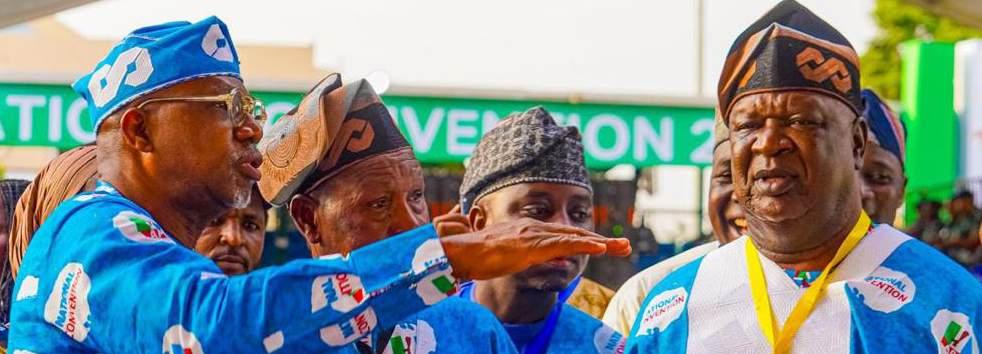
Barring any unforeseen circumstances, the Minister of the Federal Capital Territory (FCT), Mr. Nyesom Wike, will today lead over 2,500 delegates of the party to affirm all the members of the Abdulrahman Mohammed-led National Caretaker Committee as members of the substantive National Working Committee (NWC) of the party, at the Velodrome of the MKO Abiola National Stadium in Abuja.
This is just as Wike insisted that the party’s National Convention, scheduled for today, March 29 and 30, will go ahead as planned, adding that efforts to reconcile aggrieved
members would continue after the convention.
However, a Federal High Court in Abuja on Friday ordered that the organisers be notified of the pendency of a suit challenging the legality of the faction’s National Caretaker Working Committee.
The Ebonyi State High Court had also, on Thursday, ordered that the Wike-backed PDP faction be put on notice of the pendency of a similar case challenging the validity of the planned convention.
In a suit filed at the Federal High Court Abuja with Suit No FCT/ABJ/CS/589/2026, the plaintiffs - Messers Tony Aziegbemi, Edward Masha and Chidi Chidebe, the chairpersons of the PDP in
Edo, Kaduna and Anambra states, respectively, asked the court to issue an order of interlocutory injunction restraining some of the leaders of the Wike-led faction from parading themselves as leaders of the party and from holding any national convention.
Meanwhile, Wike has also declared that the PDP would shock Nigerians in the 2027 general election by demonstrating its strength.
At the factional National Executive Committee (NEC) meeting held last Monday, Wike’s PDP resolved to retain the party's zoning arrangements, as was the case during the tenure of Senator Iyorchia Ayu and Ambassador Umar Damagum.
Two courts refuse to stop the convention
By implication, the office of the National Chairman was zoned to the northern part of the country, and the National Secretary was zoned to the South.
The office of the National Organising Secretary was zoned to the North-west.
Accordingly, the chairman of the National caretaker Committee, Abdulrahman Mohammed from the North Central zone, would be crowned as the substantive National Chairman today at the national convention.
Similarly, Senator Samuel Anyanwu, who was the hitherto National Secretary, would be crowned the National Secretary.
Also expected to be crowned
today is the former National Organising Secretary, Umar Bature, a former member of the House of Representatives from the North-west.
A former Deputy National Legal Adviser, Okechukwu Osuoha, also from the South-east, will emerge as the National Auditor.
Jungudo Haruna Mohammed, who was the National Publicity Secretary, will also be confirmed by the convention.
Addressing the media yesterday, he said, ''Tomorrow’s convention marks yet another defining moment in the life of the PDP. A moment that reaffirms our democratic ideals, our respect for due process, and our unwavering dedication
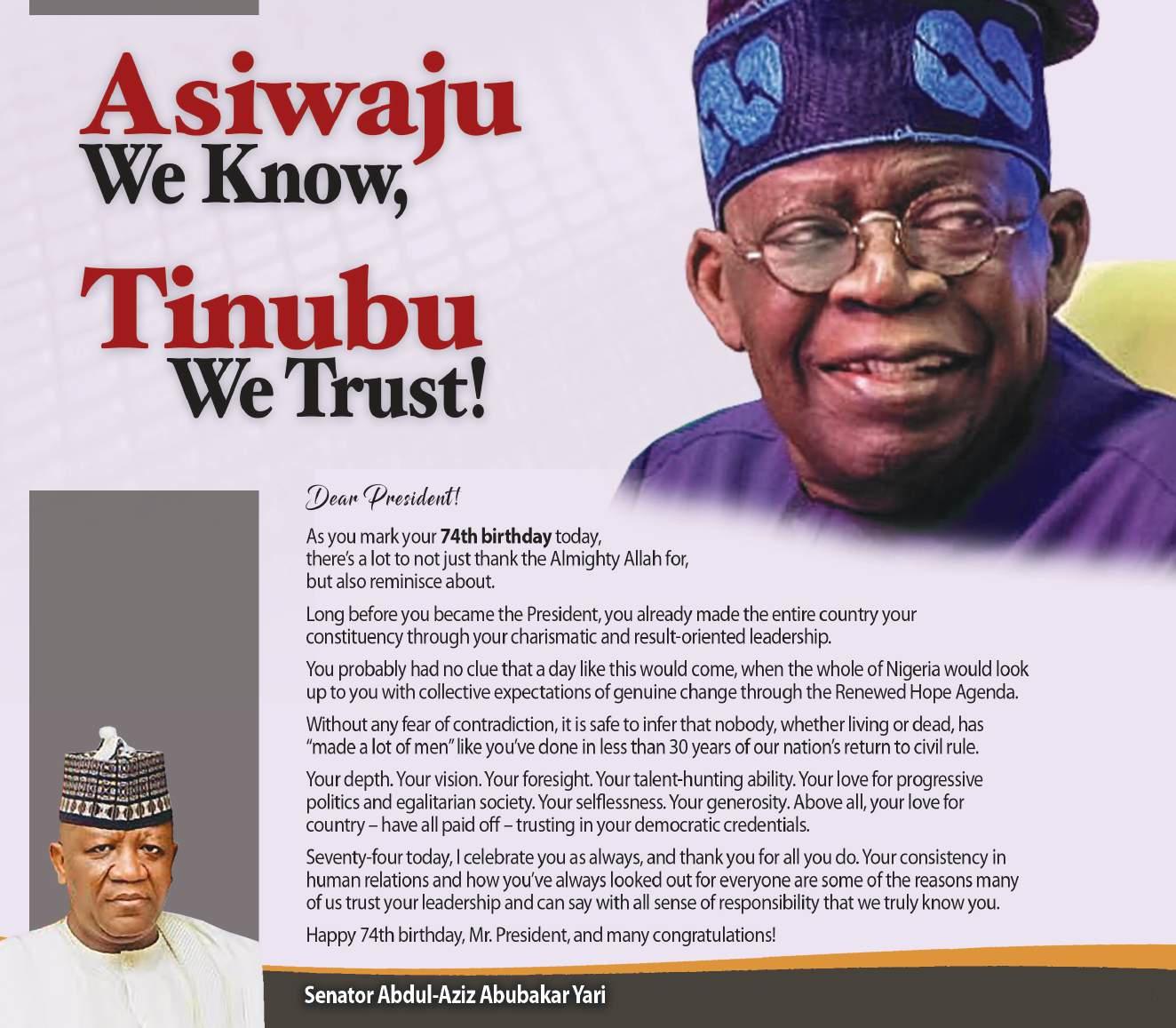
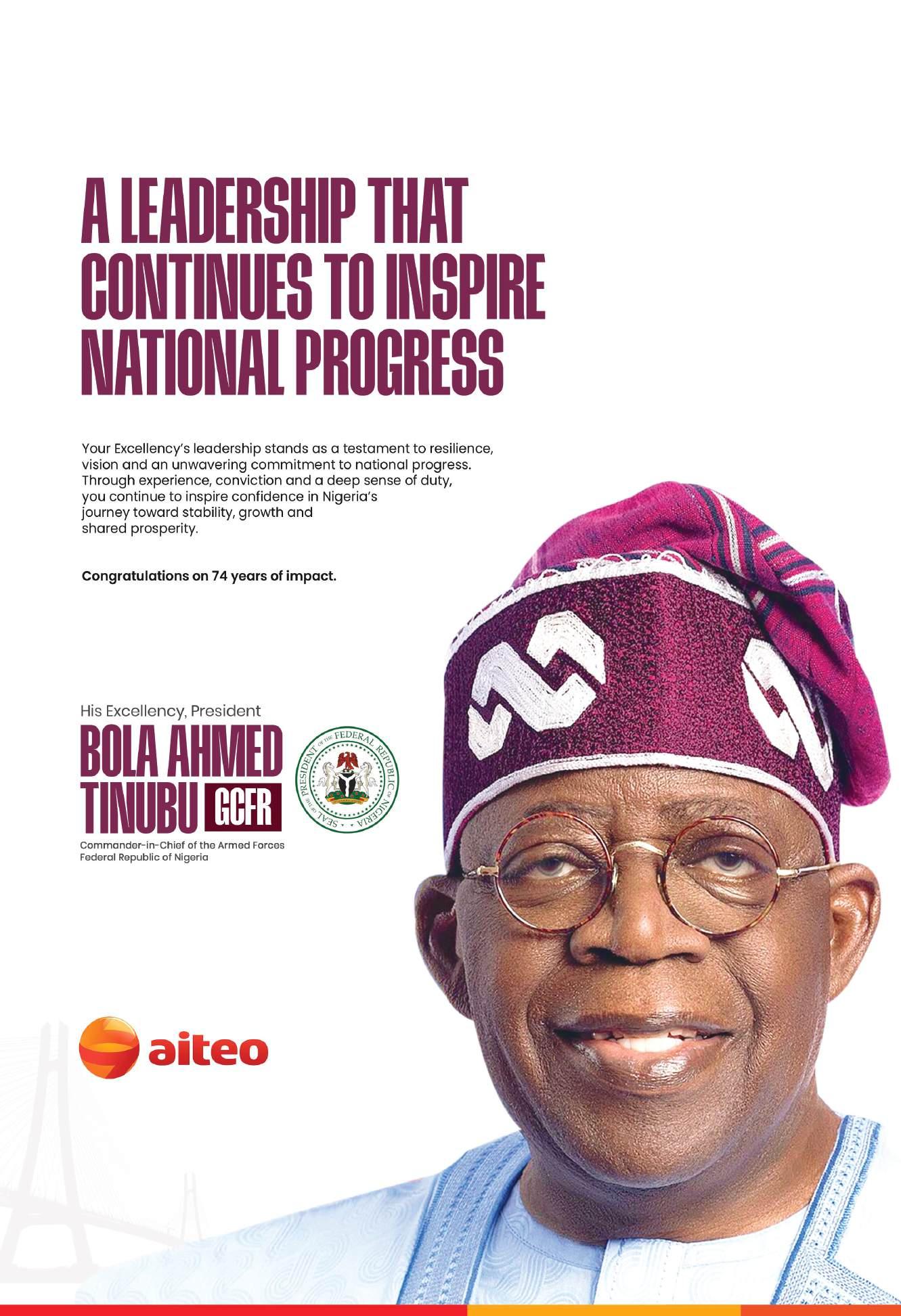
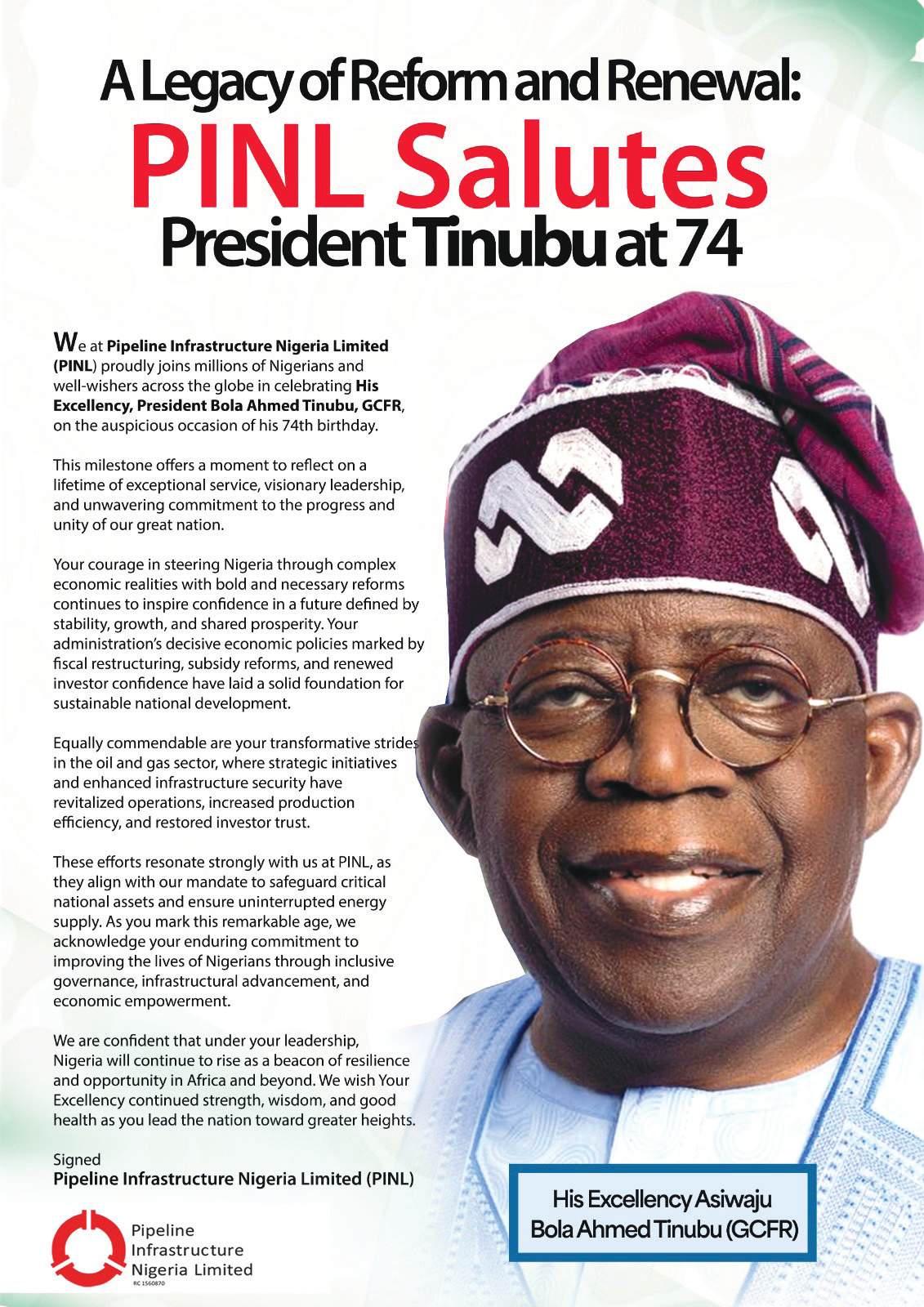
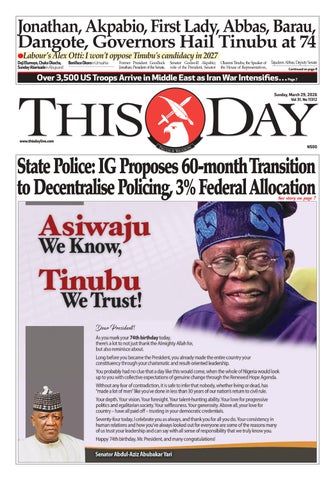
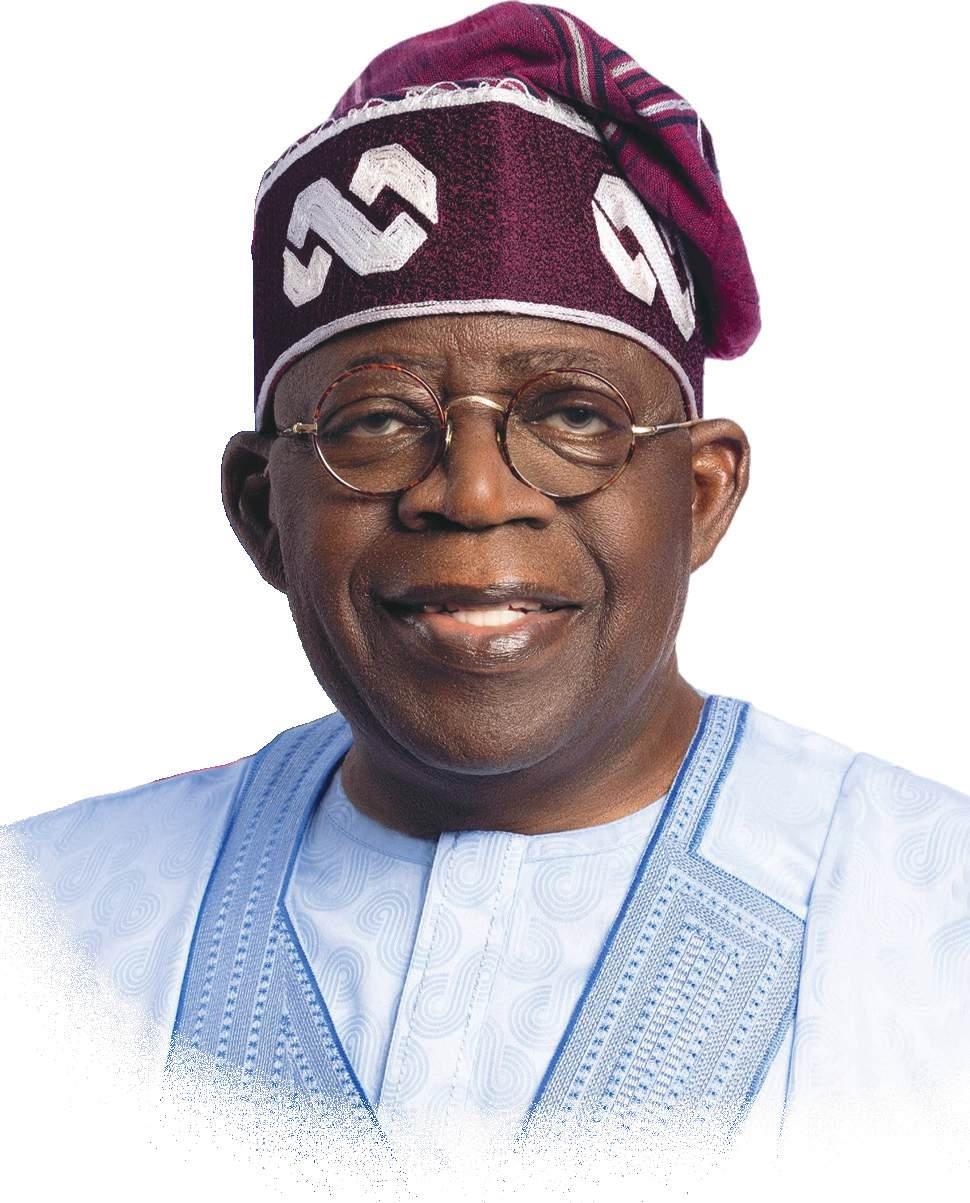
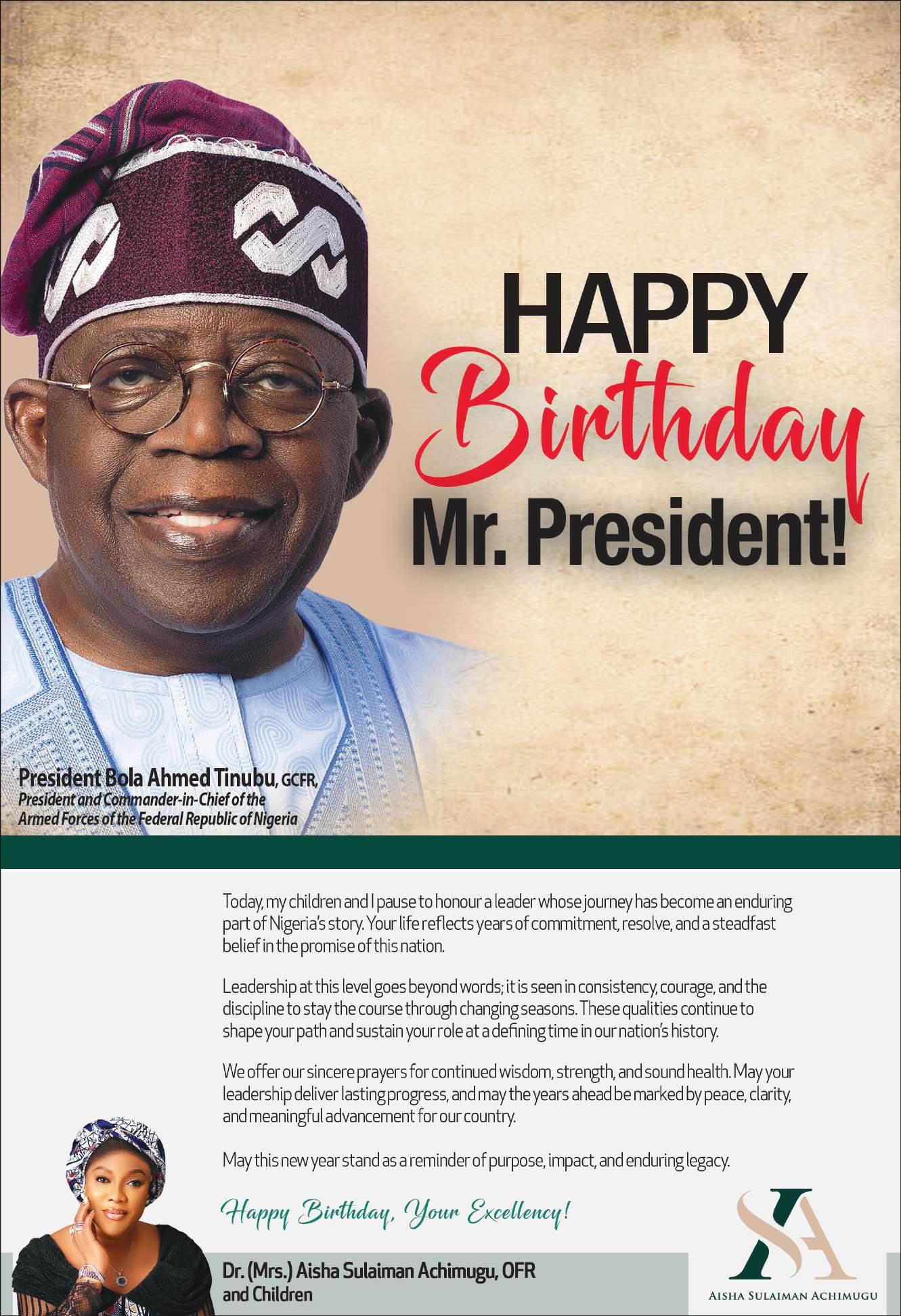
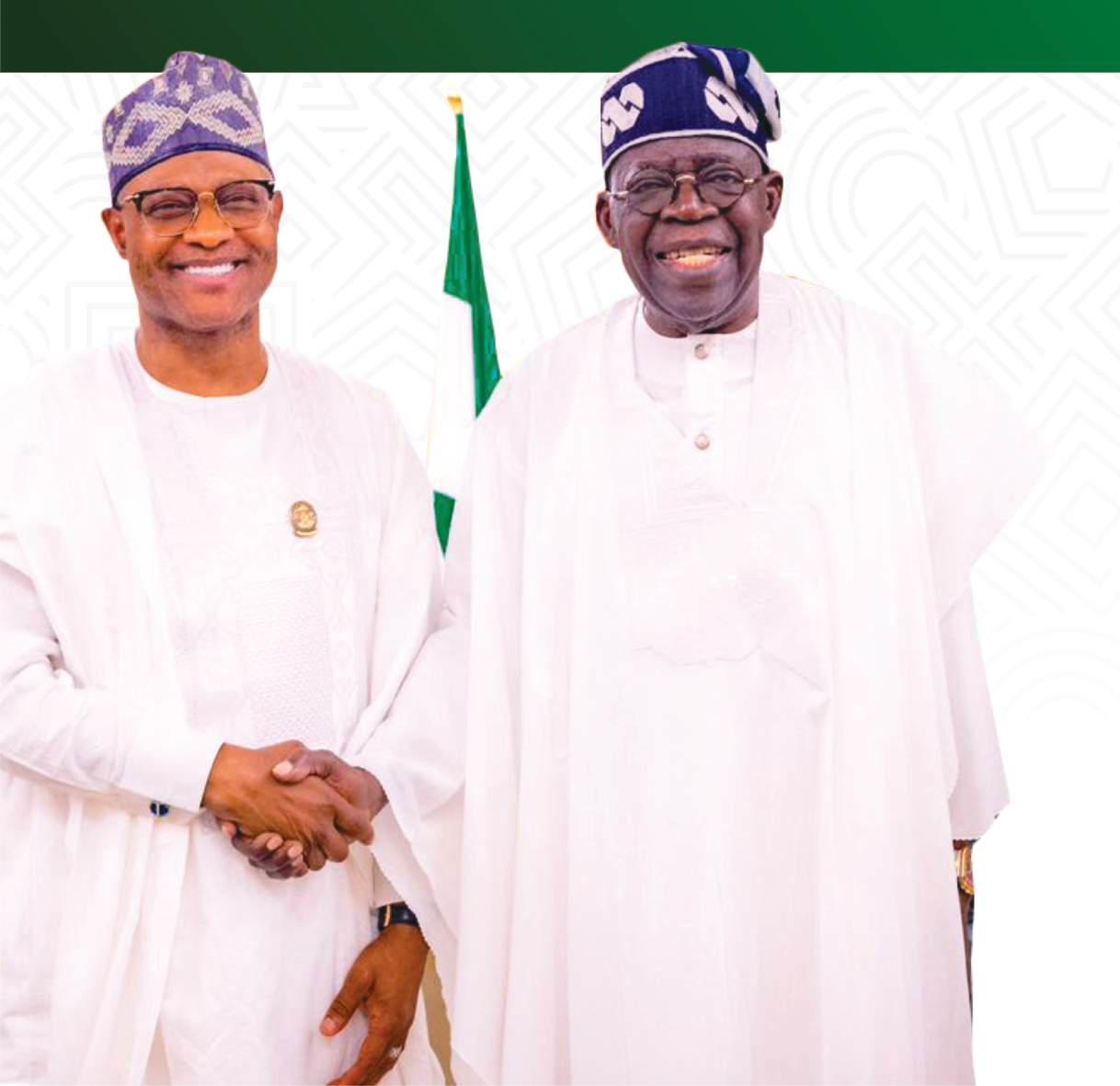
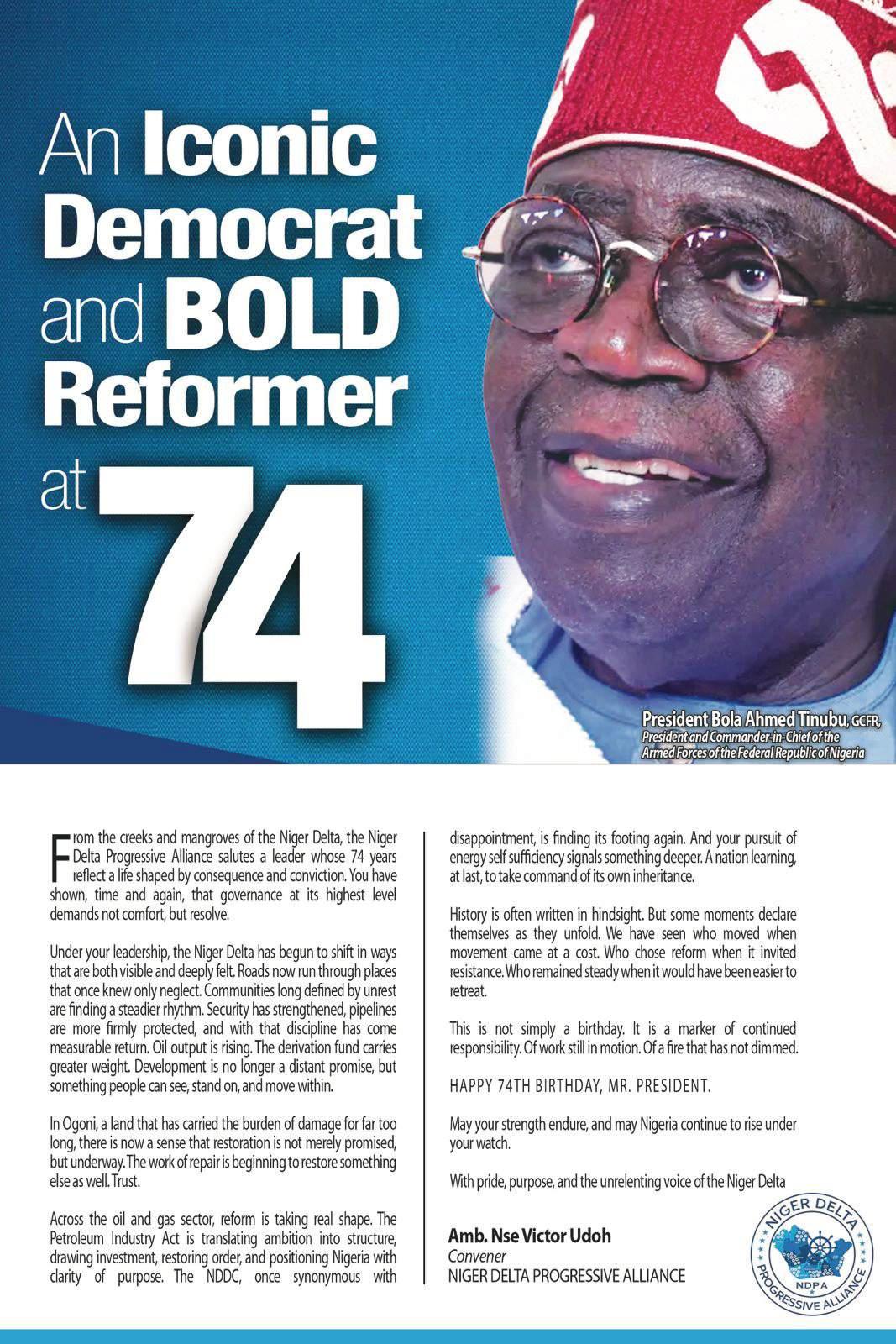
JONATHAN, AKPABIO, FIRST LADY, ABBAS, BARAU, DANGOTE, GOVERNORS HAIL TINUBU AT 74
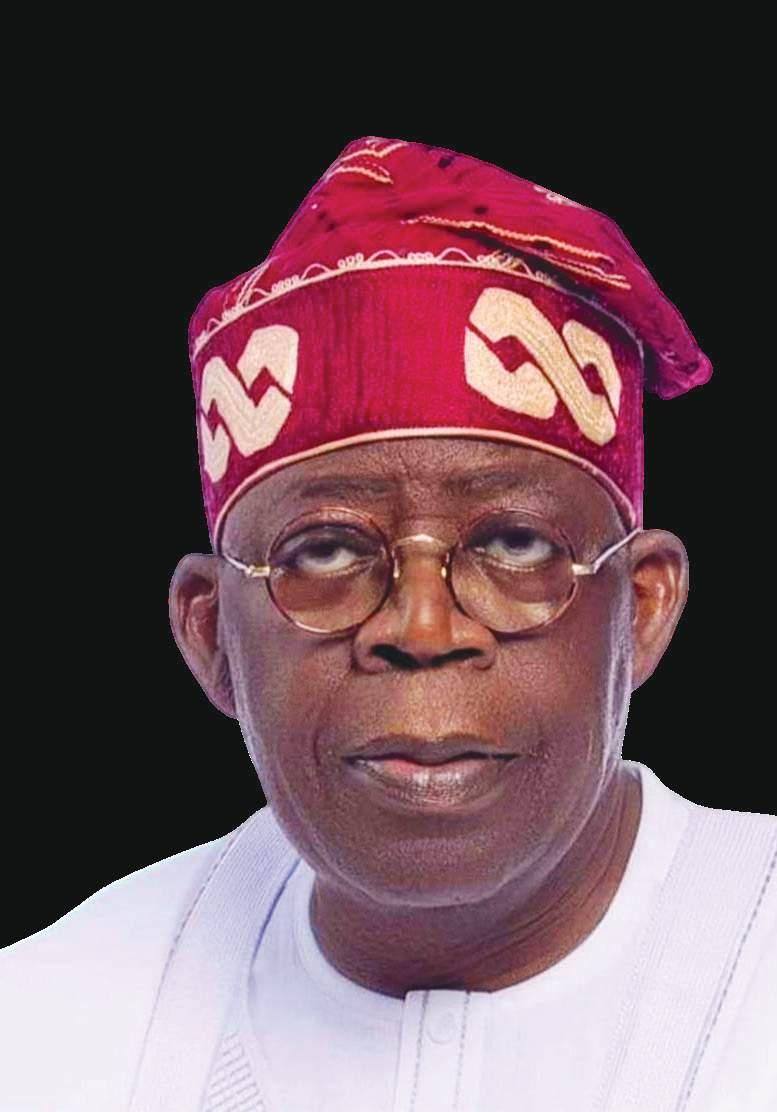
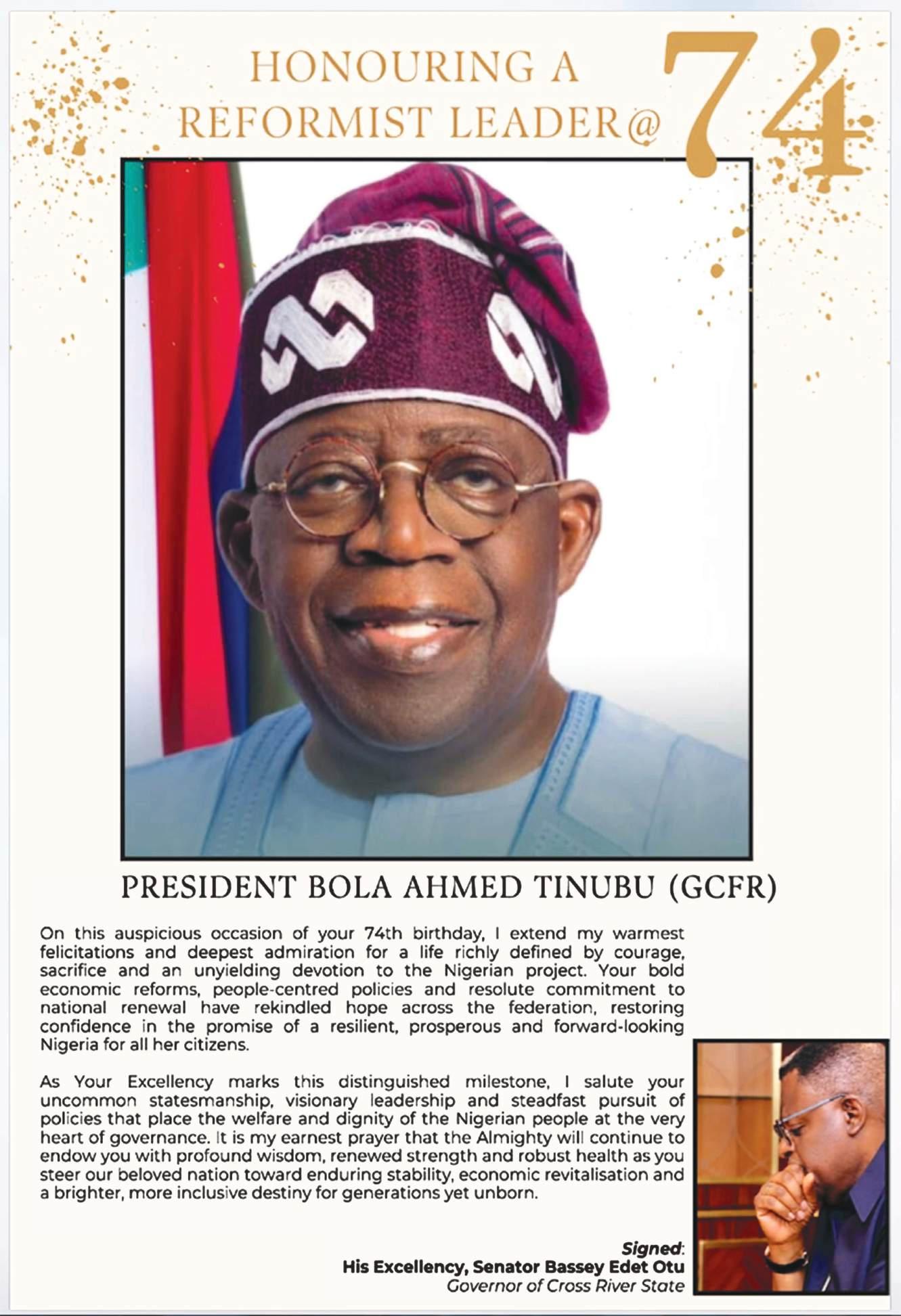
President, Senator Jubrin Barau; President of Dangote Group, Alhaji Aliko Dangote; Governor Dapo Abiodun of Ogun State; Governor of Enugu State, Dr. Peter Mbah; and Deputy Speaker of the House of Representatives, Benjamin Kalu, have congratulated President Bola Tinubu on the occasion of his 74th birthday.
The felicitations came as Abia State Governor, Mr. Alex Otti, has joined the other four governors of the South-east to back Tinubu’s re-election, declaring yesterday that he would not oppose the president’s candidacy in 2027, despite belonging to the opposition Labour Party (LP).
President Tinubu, who was born on March 29, 1952, turned 74 today and has continued to receive tributes from prominent Nigerians across the country.
Jonathan, in a goodwill message he personally signed, extended his warmest congratulations and heartfelt goodwill to President Tinubu.
In the message which was released by the head of the former President’s media office, Mr. Ikechukwu Eze, Jonathan also used the opportunity to pray for peace and a brighter future for Nigeria.
The former president said: “Milestones such as this offer a moment not only for celebration, but also for reflection on a life dedicated to service, leadership, and the pursuit of national progress.
“As you mark this special day, I pray that God grants you continued strength, wisdom, and long life in good health to carry forward the responsibilities of
leadership and the aspirations of our great nation. May your years ahead be filled with peace, clarity of purpose, and success in all your endeavours,” Jonathan added.
On his part, Akpabio, in his message, declared that the bold economic and governance reforms initiated by President Tinubu were already beginning to yield tangible dividends, expressing optimism that the country was on the path to sustained recovery and growth.
He extolled Tinubu’s leadership qualities and reaffirmed the commitment of the National Assembly to support the administration’s reform agenda.
In his statement, the Senate President described Tinubu as “an audacious and visionary leader” whose determination
to reposition Nigeria on a path of transformation remains unwavering.”
Also, in a congratulatory message issued yesterday, Mrs. Tinubu prayed for the president’s good health as the celebrant leads Nigeria to greater prosperity and opportunity.
The First Lady also professed her love for the President saying "I love you and I am so proud of you."
In the birthday message, she stated, inter alia: "To God be all the glory for the gift of life and yet another birthday anniversary.
"I celebrate you and I pray God gives you divine health, strength, joy and peace as you take Nigeria to her Eldorado of great wealth and opportunities.
"Akanbi, omo olodo ide.
"I love you and I am so
proud of you."
President of Dangote Group, Alhaji Dangote, commended President Tinubu for holding the reins of leadership, and building a legacy that is exemplified by his grit, focus and unflinching commitment to Nigeria and its population.
In a statement he personally signed, he said: “Asiwaju, yours has been a life of proving ‘nay-sayers’ wrong and your story is symbolic of the hope and aspirations that you have for Nigeria. The country looks up to you for direction and purpose, and you haven't failed on either count by demonstrating boldness in your decisiveness, when most would have prevaricate and wilted out of a lack of conviction and being overwhelmed by the stage.”
to the will of the people.
“The National Caretaker Working Committee (NCWC) has worked tirelessly to ensure that this convention is not only credible and transparent but also inclusive and reflective of the collective aspirations of our members across the country. All necessary arrangements have been concluded to guarantee a smooth, peaceful, and successful exercise. We wish to assure all party faithful and the general public that this convention is being conducted in full compliance with the constitution of our party and in line with all relevant laws. The PDP remains a law-abiding institution, committed to strengthening democracy in Nigeria”.
Dangote prayed that Almighty Allah will grant Tinubu continued good health, higher wisdom, and imbue him with fresh zeal that will enable him to persist in his patriotic quest to create the Nigeria all citizens and geneations unborn can be proud of.
In a similar birthday statement issued yesterday in Abeokuta, Governor Abiodun lauded the President’s extensive experience in both the business and political spheres, emphasizing that his passion, vision, and commitment to service were evident in his administration’s policies and direction. He also highlighted Tinubu’s legacy as a prodemocracy figure, describing him as one of the key actors who fought for the restoration of democratic rule in Nigeria.
Barely 24 hours after the voluntary resignation of Aminu Abdussalam as Kano State Deputy Governor, the vacant position has sparked intense politicking among the chieftains and groups in the All Progressives Congress (APC) in the state, with various leaders pushing to have their preferred candidates as a possible replacement.
The resignation of Abdussalam has triggered lobbying and political realignments among party leaders in the senatorial district of Kano North, where
the former deputy governor hails from.
The former deputy governor tendered his resignation in a letter dated March 27, 2026, amidst political turmoil following Governor Abba Yusuf's defection to the APC, which Abdussalam vehemently refused to join.
The former deputy governor’s resignation letter read. "I Aminu Abdussalam Gwarzo, the Deputy Governor of Kano State, hereby tender my voluntary resignation from office, with effect from 27th March 2026, pursuant to section 306 (2) of the Constitution of the Federal
Republic of Nigeria, 1999 as (amended).
"This decision has been reached after careful consultations and deep reflection, guided by my current experience, commitment to the peace, stability, and overall growth interest of the good people of Kano State."
Before his resignation, the ex-deputy governor was earlier issued with a two-week ultimatum by the state House of Assembly to respond to financial allegations or face impeachment.
In a petition submitted by the executive arm, which had triggered the impeachment
process, urged the assembly to take action against the deputy governor over alleged irregularities during his tenure as Commissioner for Local Government Affairs from 2023 to 2024.
Responding to the allegations, Abdussalam further explained in the resignation letter that his action had nothing to do with the assembly's impeachment move.
"This resignation is made voluntarily and in good faith. It should not be construed as an admission of any wrongdoing but rather as a conscious decision in the interest of institutional
Hammed Shittu in Ilorin
No fewer than 2,000 residents of Oro-Ago, Oyate and Ahun communities in Ifelodun Local Government Area (LGA) of Kwara State have reportedly fled the affected communities following the incessant attacks by bandits in the towns.
The deputy governor of the state, Mr. Kayode Alabi, hails from Oro-Ago town and the affected communities had been under severe attacks by suspected bandits in the past few weeks.
It was gathered that two weeks ago, suspected bandits invaded Oyate, Ahun and Oro-Ago communities, killing four people and abducting 10 others.
The latest incident took place last Wednesday at Oro-Ago where the suspected bandits invaded the town, killing two people and
injuring the Chief of Local Security popularly called "Olu-Ode".
The attack, it was learnt, happened around 6.30p.m on that fateful day in the town and caused tension in the town, which prompted the residents of the town to appeal to the state deputy governor and indigene of the town, Mr. Alabi to rise up to the ugly situation in the town.
It was gathered that the gunmen invaded the community in large numbers, unleashing terror on residents and attempting to extend their attack to a nearby police station.
Graphic images and video sighted by THISDAY over the weekend showed the lifeless bodies of two victims lying in pools of blood.
Olu-òde, a key figure in the community’s local security structure, was reportedly shot
in the arm during the assault and was said to be currently receiving medical treatment.
However, following this ugly development, residents of Oro-Ago, Oyate and Ahun have reportedly fled the towns to neighbouring communities for fear of being attacked again in the midnight by the suspected bandits.
One of the multiple sources in the affected communities, who confirmed the development, told THISDAY yesterday that "many residents of our communities have fled the towns since last Wednesday as a result of the bandits' attack in the town.
"I want to tell you that, I just came to Oro-Ago town today (Saturday) to pick one or two things from my house and I will also leave the town today (Saturday) to where I moved so as to avoid being
attacked".
He said: "We have been in a terrible situation in Oro-Ago town and other adjoining villages since almost three weeks ago. We cannot go to our farms and talk less of sleeping with our two eyes in the town.
“We are calling on all Oro-Ago indigenes, both at home and in the diaspora. War has started in Oro-Ago. It was only God that saved us now.
“The terrorists have killed people in Oro-Ago. We are begging the government to bring soldiers. This situation is not a small thing. They broke our doors and entered houses one after the other".
Meanwhile, a senior police officer with the Ifelodun LG Divisional Police Headquarters located at Share, who sought anonymity, confirmed the development.
integrity democratic values and public service" the former deputy governor stated.
Abdussalam is from Gwarzo LGA in Kano North senatorial district, while Governor Yusuf is from Gwale LGA in Kano Central, while the South senatorial district has also produced the House of Assembly Speaker, Alhaji Jibrin Falgore, from Rogo LGA.
As the search for the next deputy governor continues, APC sources confirmed that among the top contenders include, the Chairperson of the Association of Local Government of Nigeria (ALGON) and Chairperson of Tudun Wada LGA, Saadatu Salisu.
The LGA Chairperson and the Speaker, who hail from the
same Kano South Senatorial district, were said to be the governor's top picks, and one of them will likely be chosen for the position.
However, former Governor Abdullahi Ganduje is said to be pushing for Murtala Garo, although some APC chieftains were said to have opposed it, on the grounds that he hails from the same senatorial district as the Deputy President of the Senate, Senator Barau Jibrin. Other potential candidates for the position include a member representing Rano Bunkure Federal Constituency in the House of Representatives, Kabiru Rurum, and a former Commissioner of Local Government, Salihu Takai, among others.
Adedayo Akinwale in Abuja
The All Progressives Congress (APC) has dismissed as fake a report circulating in the media on the purported costs of expression of interest and nomination forms for the 2027 general elections.
The graphic, which circulated on Friday, claimed that aspirants for the presidency would pay N200 million for nomination forms, while those seeking state assembly seats would pay N20 million.
The ruling party’s National Publicity Secretary, Felix Morka, said in a statement yesterday that the report did not emanate from the party.
“The attention of the All Progressives Congress (APC) has been drawn to a false and
misleading report circulating in sections of the media regarding a purported ‘price list’ for expression of interest and nomination forms for the 2027 General Election.
“The APC states categorically that the report is fake, and did not emanate from the Party,” Morka said.
Morka said no decision or announcement had been made on the sale or pricing of forms for the 2027 elections.
“To be clear, no decision or announcement has been made on the sale or pricing of forms for the 2027 elections,” he said.
He described the report as “a mere figment of the writer’s mischievous imagination.”
The APC urged party members, the media, and the general public to disregard the report entirely.


Your Excellency,
As you turn 74 today, I join millions of Nigerians in celebrating a leader whose Renewed Hope Agenda continues to reposition our nation on the path of sustainable prosperity.
This past year has witnessed remarkable economic milestones under your purposeful leadership. Our nation’s GDP growth has accelerated beyond projections, inflation trends show sustained decline, and foreign direct investment has surged to levels unseen in years.
Your resolute focus on infrastructure development is creating the arteries of commerce that will power Nigeria’s prosperity for generations to come.
Beyond policy and economics, what distinguishes your leadership is an uncommon fortitude: the willingness to make difficult choices today for a better tomorrow. History will record that you chose the path of reform over the comfort of populism.
Mr. President, working alongside you has been a masterclass in decisive governance and principled leadership. Your capacity to balance empathy with firmness, vision with pragmatism, continues to inspire those of us privileged to serve with you.
As you mark this special day, my prayer is that Almighty Allah grants you robust health, renewed vigour, and continued wisdom to complete the vital work of national transformation you have begun.
Happy 74th Birthday, Your Excellency.
With profound respect and unwavering loyalty.
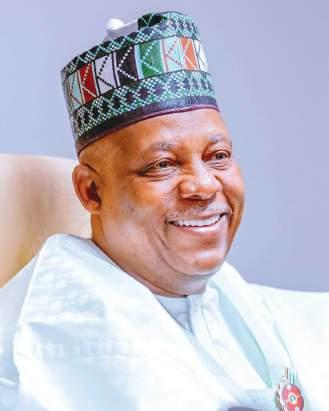
Signed Senator Kashim Shettima Vice President, Federal Republic of Nigeria


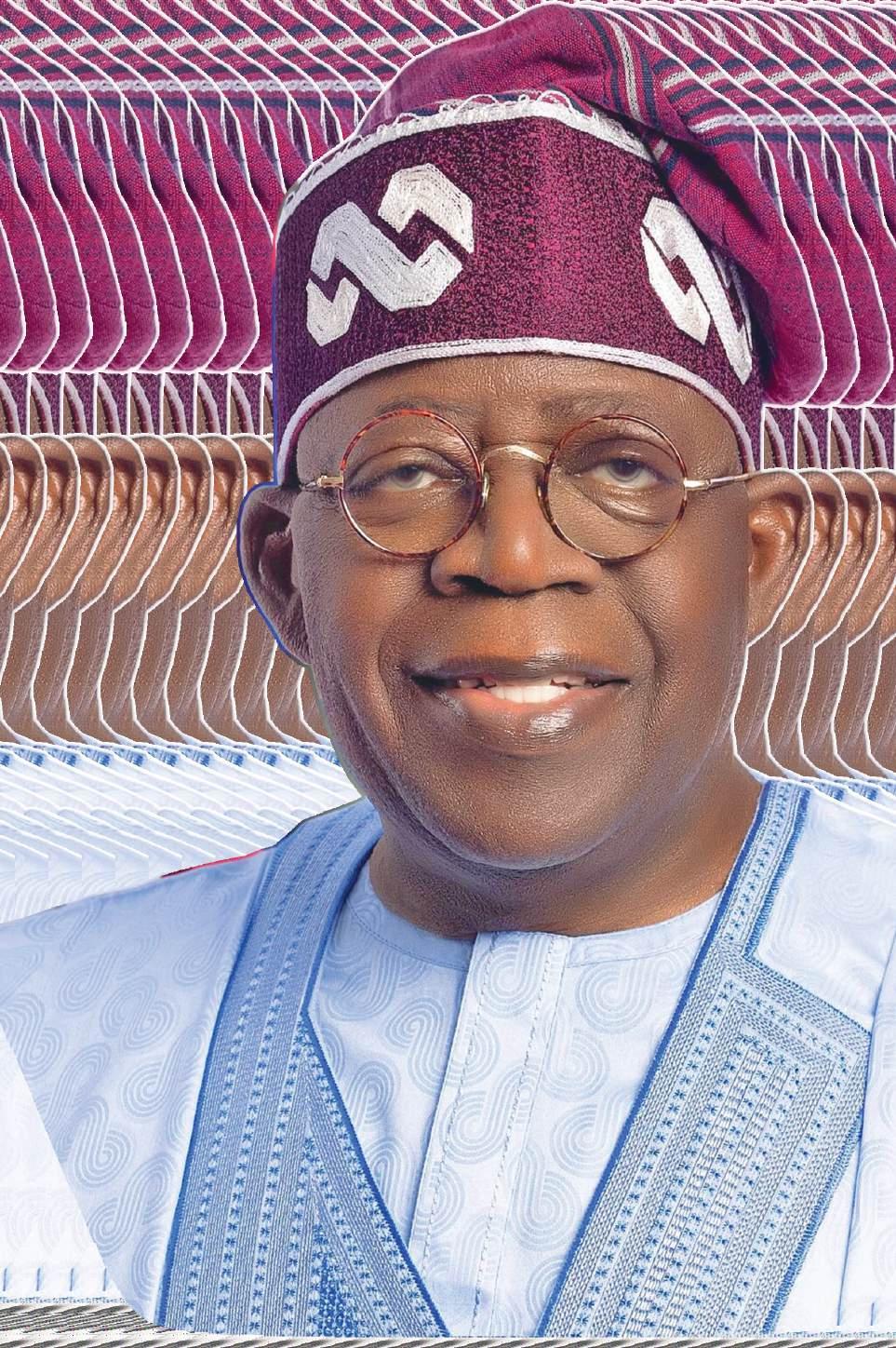

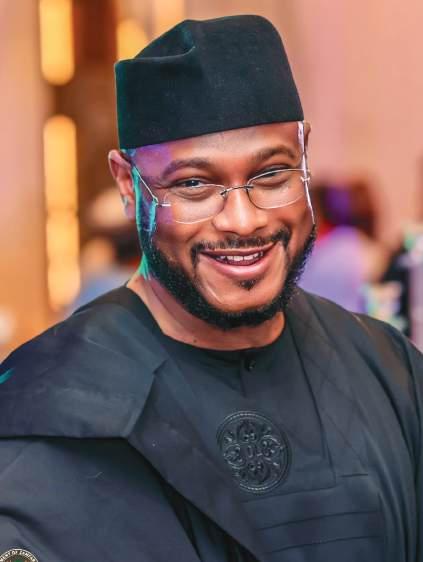


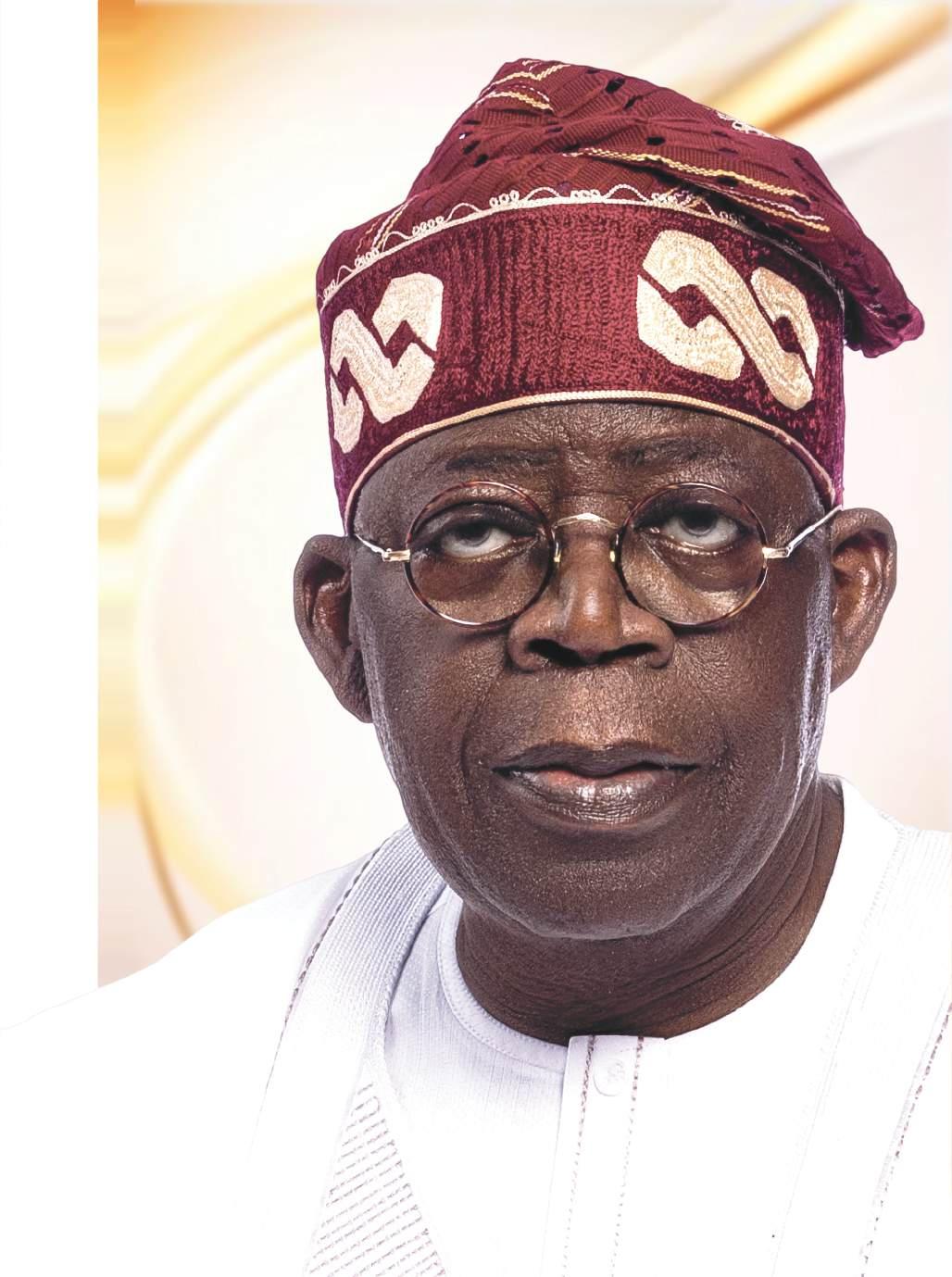



I convey my warm felicitations to a true reformer, super administrator, political icon, and bold and courageous leader.
Mr. President, may the good Lord add many more years to you in good health, wisdom, peace, and fulfilment.
Many happy returns of the day, sir.
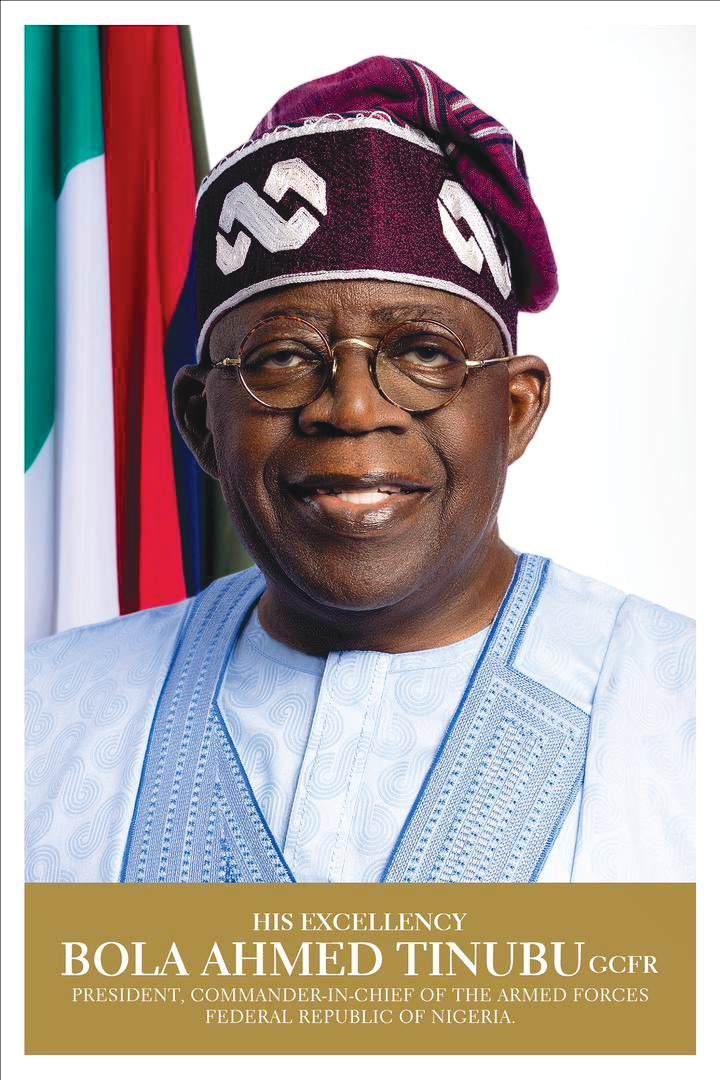

Rt. Hon. (Elder)
Sheriff F.O. Oborevwori Governor, Delta State
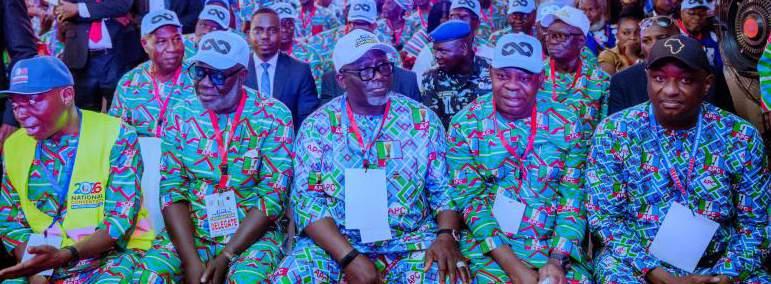
The National Leader of the New Nigeria People’s Party (NNPP), Dr. Rabiu Musa Kwankwaso, has concluded all necessary arrangements to join the African Democratic Congress (ADC).
This is as the former Kano State governor yesterday met with former Vice-President Atiku Abubakar in Abuja, in what observers see as part of
ongoing political realignments ahead of the 2027 general elections.
A statement by the spokesman of the Kwankwasiyya Movement, Dr. Habibu Mohammed, said the former governor of Kano State would officially register with ADC in Kano on Monday.
The statement said: "In furtherance of this decision, he will officially register with the party on Monday, March
30, 2026, at his residence, Gidan Kwankwasiyya, Miller Road, Kano, by 12pm."
"Consequently, all members of the Kwankwasiyya Movement are hereby directed to proceed and register with the African Democratic Congress (ADC) in their respective wards, local government areas, and states immediately thereafter"
The statement also urged supporters to fully engage in all party activities and contribute
actively toward the growth, development, and success of the party at all levels.
"This strategic decision, as always, has been taken in the best interest of the movement, our state, and the nation at large. It reflects our unwavering commitment to the advancement of democratic values, good governance, and the collective aspirations of the people."
"We emphasise that
Onyebuchi Ezigbo in Abuja
The Association of Medical Laboratory Scientists of Nigeria (AMLSN) yesterday raised serious concerns over a controversial bill before the National Assembly, warning that its passage could destabilise Nigeria’s healthcare system, compromise patient safety, and trigger fresh inter-professional
conflict in the sector.
The bill, titled Executive Bill HB:2701, alongside a related Senate version, seeks to amend key provisions of the Medical Laboratory Science Council of Nigeria Act, particularly Sections 3 and 29, which define the governance structure and scope of medical laboratory science practice in Nigeria.
Addressing journalists in
Abuja, AMLSN National President, Dr. Casmir Ifeanyi, described the proposed amendment as “a dangerous regression disguised as reform,” warning that it is “misaligned with global best practices and inimical to Nigeria’s healthcare delivery.”
“This bill does not represent reform; it represents regression. It is dangerous, destabilising,
and profoundly misaligned with science and global best practice,” Ifeanyi said.
At the heart of the controversy is the proposed restructuring of the governing board of the Medical Laboratory Science Council of Nigeria (MLSCN), the statutory body responsible for regulating laboratory science practice in Nigeria.
Omo-Julius Onabu in Asaba
Delta State Governor, Hon. Sheriff Oborevwori, has said his decision to join the ruling All Progressives Congress (APC) was yielding positive results for the state.
According to a statement made available to THISDAY yesterday, the governor spoke to journalists at the APC convention held at Eagle Square, Abuja, on Friday night.
Oborevwori said his defection to the ruling party was driven by the need to align the state with the federal government,
noting that the move had improved access to resources and enhanced governance outcomes.
“I’m happy to be here today. That bold decision we took on April 28, 2025, is manifesting today. I was the first governor after the 2023 election to move into the APC. That was done because we wanted to connect with the centre, and we have. Other state governors have also emulated the decision we took,” he said. He noted that increased revenue allocation to states had improved their capacity to meet key obligations,
including paying salaries and executing projects.
“We are happy with the decision we took because the policies and programmes of Mr. President are working. But you know, it takes time. We know the sufferings of Nigerians; the policies are yielding, it’s a gradual process,” he said.
“You know, before now, the money that was coming to the states was not much, and paying salaries was difficult. These days, we can pay salaries and pay our contractors. A lot of things are working in our favor.
“I will tell you, if Mr.
President is not doing well, my other brother governors will not come and join. As of today, we have 31 governors in the APC. No political party has gotten 31 governors since 1999. This is the first time.
“The crowd you are seeing here today shows that Mr. President is focused, he is bold, and he is taking us somewhere. We believe that Nigerians will pay back by re-electing him in 2027.”
On his administration’s performance, Oborevwori reaffirmed his commitment to delivering more dividends of democracy, particularly in key sectors.
democracy must be protected, and the will of the people must always be respected.
The Kwankwasiyya Movement remains resolute, united, and committed to building a better and more inclusive Nigeria."
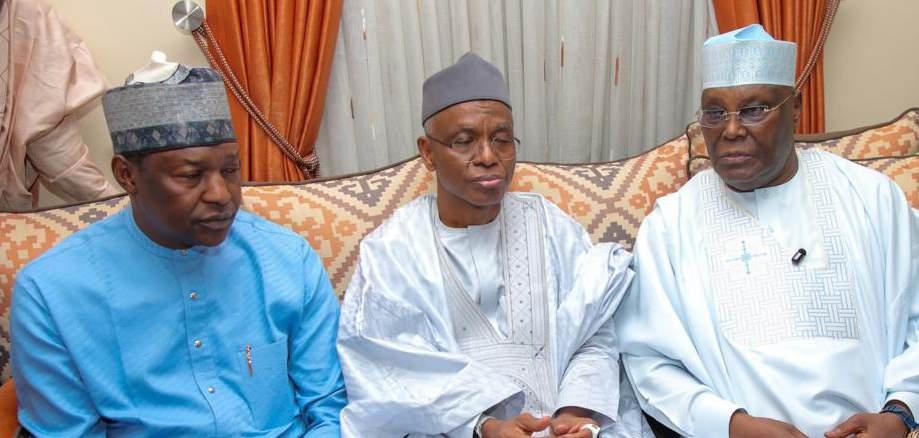
Meanwhile, Atiku met with Kwankwaso in Abuja yesterday as part of ongoing political realignments ahead of the 2027 general elections.
Both men were contenders in the last presidential election won by President Bola Tinubu.
Atiku, who flew the flag of the Peoples Democratic Party (PDP), finished second, while Kwankwaso, candidate of the NNPP, secured significant support in Kano.
Confirming the meeting, Atiku said it was a courtesy visit during which they discussed national issues.
“This evening, I received the former Governor of Kano State and the Presidential candidate of the New Nigeria People’s
Party (NNPP), Rabiu Musa Kwankwaso, on a courtesy visit. We had a robust discussion on the state of the nation,” he wrote on his social media handles.
Kwankwaso’s meeting with Atiku is coming a week after the former Kano State governor hosted key opposition figures at his residence in Kano as part of the Eid-el-Fitr celebrations.
Among those in attendance were former Labour Party presidential candidate, Peter Obi; Governor of Oyo State, Seyi Makinde; and former Bayelsa State Governor, Seriake Dickson. The gathering, held at Kwankwaso’s Miller Road residence, attracted supporters and well-wishers, creating a festive atmosphere in the Kano metropolis.
The visit, which coincided with the annual Kwankwasiyya Sallah festivities, saw the political figures exchange greetings with the host and Muslim faithful celebrating the occasion.
Chuks Okocha in Abuja
A member of the House of Representatives, Hon. Blessing Onuh, the daughter of the National Chairman of the African Democratic Congress (ADC), Senator David Mark, has taken a frontline role in supporting President Bola Ahmed Tinubu’s re-election, joining the leadership of a proTinubu campaign organisation.
The daughter of a key opposition figure in the president’s re-election push has raised questions about loyalty, perception, and cohesion within the ADC, the major opposition party.
Her appointment as National Woman Leader of the Take Action Campaign Organisation was announced yesterday by
its Director General, Tony Nwulu, a former member of the House of Representatives who sponsored the ‘Not Too Young To Run’ bill in the 8th National Assembly. He presented Onuh’s appointment letter at the organisation’s campaign office in Abuja.
“I pledge to work tirelessly to ensure President Tinubu’s victory at the upcoming election,” Onuh said.
Her new role placed the ADC National Chairman’s daughter squarely within a campaign structure built to drive the president’s secondterm bid, even as her father remains one of the leading figures coordinating an opposition coalition under the ADC banner.
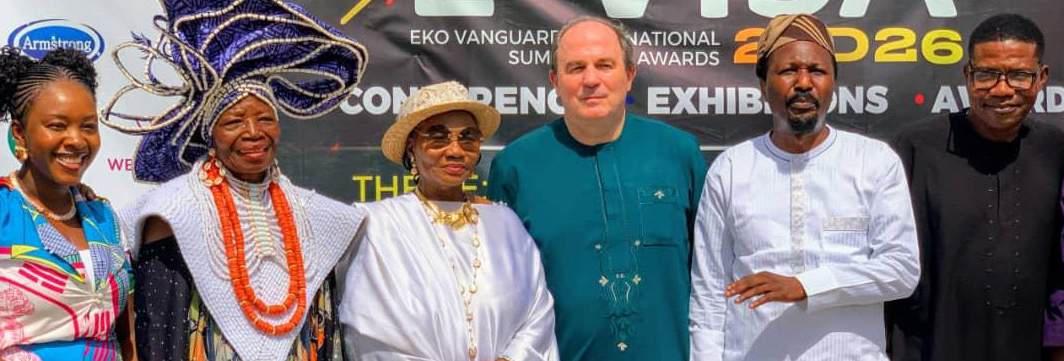
Dike Onwuamaeze
The International Finance Corporation (IFC) has called for stricter enforcement of Environmental Social Governance (ESG) frameworks and regulations as a way of compelling developers in the real estate sector to incorporate ESG's principles in their products and services deliveries. This call was made over the weekend by the Lead Green and Resilient Built Environment for Nigeria International Finance Corporation, Ms. Temilola Sonola, during the Lagos
Chamber of Commerce and Industry's (LCCI) "2026 Real Estate/Construction and Engineering Sectoral Group Conference."
The theme of the conference was "Mainstreaming ESG Compliance in Nigeria's Engineering, Construction and Real Estate Sectors."
Speaking during the panel session titled "ESD Compliance, Regulatory Framework and Environmental Sustainability in the Built Environment," Sonola said that ESG principles were still being seen as optional by businesses because the government had
Pope Leo XIV yesterday denounced the widening gap between the haves and the have-nots, condemning what he termed the widening “chasms between the poor and the rich.”
The Pope, who was in Monaco, a millionaires’ playground that is the surprise pick for the first western European trip of his papacy, in an address in French from the balcony of the Prince’s Palace, denounced “unjust configurations of power, structures of sin that dig chasms between the poor and the rich, between the privileged and the
rejected, between friends and enemy.”
He added that wealth should serve “law and justice, especially at a historical moment when displays of force and the logic of omnipotence wound the world and jeopardise peace,” in a clear reference to the growing number of conflicts across the globe.
Bells pealed across the principality to mark Leo’s arrival in the mini state nestled on the Mediterranean between France and Italy.
Locals gathered outside the palace, many brandishing flags in the red and white of the
principality and the yellow and white of the Vatican.
Along the route of the Popemobile on Rue Grimaldi, a major thoroughfare, shopkeepers had decked out their windows in the colours of both statelets to mark the occasion.
From the palace, the Pope was to head to the Cathedral of the Immaculate Conception to meet the Catholic community, then to the square in front of the Church of Saint Devota, dedicated to the patron saint of Monaco.
In the tiny city-state’s street billboards, the pontiff in his
church regalia stood in stark contrast to gleaming sports cars and jostling crowds of tourists.
The highlight will be an open-air mass at the Louis II Stadium, expected to draw 15,000 people.
Pope Leo was slated to make speeches addressing environmental protection, which is a cause close to Prince Albert’s heart, Monaco’s role in Europe, and “the protection of life in all its forms”, according to the Vatican’s press office director, Matteo Bruni.
That phrase encompasses opposition to abortion, banned in the principality, and
Adedayo Akinwale in Abuja
The ruling All Progressives Congress (APC) has dropped the erstwhile Deputy National Chairman (South), Emma Eneukwu and the Deputy National Organising Secretary counterpart, Nze Duru in the just concluded national convention of the party held on Friday and yesterday in Abuja.
In spite of the decision of
the ruling party to return most of the National Working Committee (NWC) members, Duru and Eneukwu were among the casualties of the convention who were swept away by the intra-party power play.
Trouble started for the duo when the ‘Unity List’ that was being circulated at the venue of the convention ground among delegates did not have their names on it.
It was a rude shock even Duru, who was a darling of the media, was missing in the list of NWC members that were returned unopposed.
While the immediate past chairman of Enugu State Caretaker Committee of APC, Mr. Ben Nwoye was announced as Eneukwu’s replacement in the consensus-driven arrangements, Emeka Okafor replaced workaholic Duru after extensive consultations within
the party.
In his acceptance speech, the party’s chairman, Nentawe Yilwatda described his re-election as a call to greater service, pledging commitment to party unity and national progress.
“We are ready to serve, ready to lead, and ready to build the party, together with the nation,” he said, assuring members that the new leadership would not “fail or falter” in its responsibilities.
not made them to bear the full financial costs of ignoring environmental sustainability.
She said: "The first point is that the cost of ESG has not been internalised.
"For example, you are building a house in a flood area and the flood comes and breaks it down. Who is going to bear the cost? Probably the government.
"I think that we need to internalise things a little bit more by some kind of regulation."
She added: "One thing I know about Nigeria is that the framework is there and the laws and regulations are there.
"So, enforcement is probably one of the issues and if we can enforce a little bit more of our
building laws then we can internalise the costs a little bit more.
"Because if you tell a developer that if you build this house here and erosion takes it down you are going to pay for it, he is likely to take more care.
"We are human beings. It is not going to happen if you do not enforce it. And that is what we need to do a bit more in Nigeria" Sonola also said that there were cheaper sources of funds from the governments of The United Kingdom and Switzerland and development financial institutions like the IFC that would help developers who were ready to build sustainably to bear the cost of going green.
Troops of the Joint Task Force, Operation HADIN KAI, have defeated an ISWAP attack on FOB Mandaragirau in Borno State, killing 38 terrorists and recovering weapons.
According to a statement issued yesterday by the Media Information Officer, Headquarters Joint Task Force OPHK, Lieutenant Colonel Sani Uba, the troops engaged the attackers with “wellcoordinated ambushes and a deliberate offensive-defensive response that forced them into a disorderly withdrawal,” while the Air Component provided close air support and ISR feedback to enhance targeted kinetic responses.
Subsequent exploitation along the terrorists’ withdrawal routes inflicted further heavy losses.
“A total of about 38 terrorists were neutralised with eight
bodies recovered so far within the immediate engagement area, and human intelligence from locals confirming over 30 additional terrorists’ bodies and weapons strewn along the Garin Mallum–Garin Gajere axis into the Timbuktu Triangle. Blood trails and abandoned equipment evidenced this,” the statement added.
“Troops recovered seven AK-47 rifles, eight magazines, four RPG bombs, and assorted ammunition. The JTF recorded no fatalities, though one MRAP vehicle was hit by RPG fire, with injured personnel promptly stabilised.
The statement noted that the scale of enemy losses “has triggered widespread jubilation among local communities and highlights the sustained dominance of OPHK troops in denying terrorists freedom of action.”










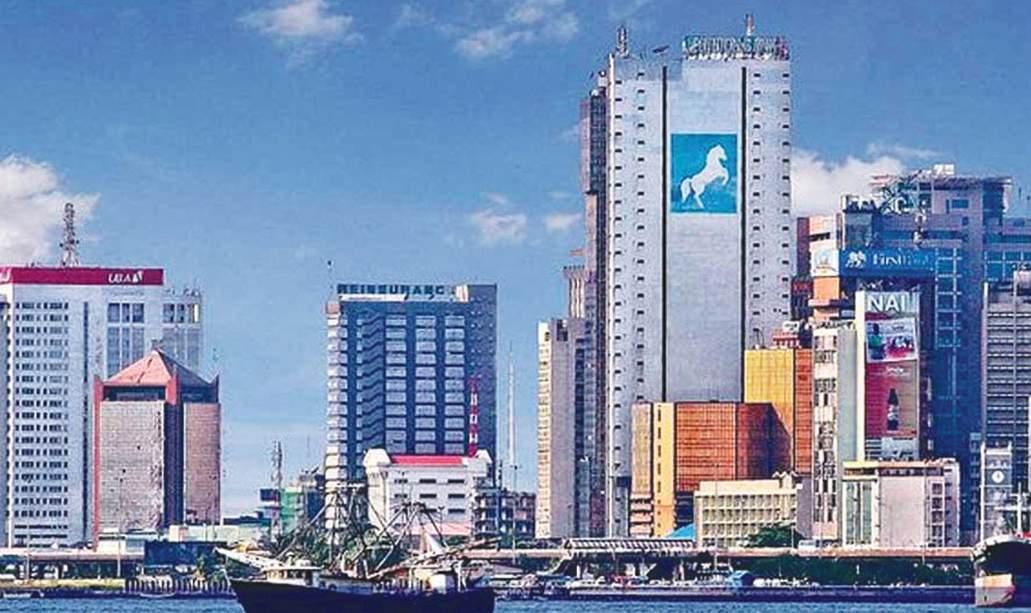
Most of the banks may have met recapitalisation targets, but a tougher test begins, writes Festus Akanbi
With barely two days until the March 31, 2026, deadline, the numbers appear reassuring. Thirty- two banks have met the new minimum capital thresholds, with the largest institutions, those controlling over 70 per cent of industry assets, comfortably clearing the bar.
On the surface, the Nigerian banking system looks set to close yet another recapitalisation cycle without the systemic tremors that defined the consolidation era of 2005.
But beneath that calm lies a more complex regulatory reality, one that introduces a second, far more consequential test. Even as banks celebrate successful capital raises, a new directive from the Central Bank of Nigeria (CBN) is quietly redrawing the meaning of adequacy. The question is no longer simply whether capital has been raised, but whether that capital can survive stress.
This emerging tension between capital sufficiency and capital credibility is now shaping the sector’s outlook.
The recapitalisation exercise itself has, by most accounts, been efficient. Unlike in 2005, when consolidation forced mergers, closures, and sweeping restructuring, the current financial environment has proven deep and flexible enough to absorb large capitalBanksinjections. have relied on a mix of rights issues, private placements, mergers, and regula- tory accommodations to meet thresholds of N500 billion for international banks, N200 billion for national banks, and N50 billion for regional institutions.
Major players such as Guaranty Trust Holding Company, Zenith Bank, Access Holdings, United Bank for Africa, and others have exceeded the minimum requirement for international licences, while national, regional, and non-interest banks have also largely complied.
The Central Bank is expected to publish a final status report, but early indications
suggest that the system has, at least quantitatively, passed the test.
Yet analysts have been careful not to issue a clean bill of health. Their caution reflects a structural shift embedded in the CBN’s March 6, 2026, Risk-Based Capital (RBC) directive, which effectively treats recapitalisation as only the first stage of regulatory scrutiny.
At the heart of the directive is a simple but disruptive proposition: capital is only as good as the risks it is meant to absorb.
Under the new framework, banks must conduct a 12-month forward-looking stress test that simulates a deterioration in asset quality across all credit exposures.
Loans are assumed to migrate progres- sively into weaker classifications, performing loans slipping into watchlist, substandard, doubtful, or even lost categories. This staged migration is designed to replicate a realistic deterioration cycle within the economy.
Analysts explained that the implications are immediate. As asset quality worsens under simulation, loan loss provisions rise sharply, eroding retained earnings and, by extension, regulatory capital. At the same time, risk-weighted assets increase, placing additional pressure on capital adequacy ratios.
In practical terms, a bank that appears well-capitalised today could find itself undercapitalised after the stress test.
The directive introduces further layers of conservatism. Sector-specific vulnerabilities must be subject to an additional 10 per cent provisioning buffer, reflecting uneven recovery across industries such as manufacturing, oil and gas, and agriculture.
More strikingly, all insider and director- related exposures are to be treated as fully impaired under stress conditions, requiring 100 per cent provisioning.
According to financial experts, this ap- proach goes beyond conventional prudential oversight. It directly targets governance risks and the possibility that insider lending, often opaque, could undermine balance sheet strength.
“By forcing banks to recognise these exposures as potential defaults in stress scenarios, the regulator is effectively closing a long-standing blind spot in risk assessment,” a former bank director explained.
The cumulative effect is a recalibration of what constitutes “adequate capital.” Two banks with identical capital bases may now be judged differently depending on the composition and risk profile of their loan books. This transition introduces uncertainty into an otherwise successful recapitalisation exercise.
For banks, the immediate challenge lies in timing. While the capital-raising deadline falls at the end of March, the stress testing framework takes effect on April 1, with board-approved reports due by April 30. The narrow window leaves little room for recalibration, particularly for institutions whose portfolios are heavily exposed to volatile sectors or carry legacy asset quality issues.
If the stress test reveals a capital shortfall, the consequences are both clear and demand- ing. Banks are required to raise additional capital within 18 months, with the amount determined by a dual threshold: either 100 per cent of the internally calculated shortfall or 50 per cent of the CBN’s independently assessed figure, whichever is higher.
The uncertainty, therefore, is not about whether banks can meet the minimum capital requirement; it is whether that capital will withstand regulatory stress.
The Conversation
In this context, industry conversations have taken on a more technical and forwardlooking tone. At a high-level workshop titled “Bank Capital Stress Testing: Getting the CBN Directive Right,” organised by DataPro Limited, participants were urged to rethink stress testing not as a compliance exercise, but as a diagnostic tool.
Delivered by Mr. Idris Shittu Adeleke, a member of the DataPro Rating Team and an enterprise risk management expert, the session underscored the shift from static
reporting to dynamic risk assessment. The emphasis was on aligning capital buffers with actual risk exposure, rather than regulatory minimums.
The workshop also highlighted the operational demands of the new framework, including portfolio-wide data aggregation, migration of credit exposures, and integration of risk, finance, and compliance functions. For many institutions, these requirements represent a significant escalation in both analytical depth and governance oversight.
More importantly, the discussions reinforced a central point: compliance with capital thresholds is no longer sufficient. What matters is the resilience of that capital under adverse conditions.
This shift aligns with broader regulatory objectives. Nigeria’s ambition to build a $1 trillion economy by 2030 implies a banking system capable of financing large-scale infrastructure and absorbing economic shocks. In that context, capital adequacy must be measured not only by size but also by Accordingdurability.
to the DataPro workshop, the transition remains risky. The introduction of stricter provisioning rules and forward-looking stress assumptions could compress capital buffers in the short term, particularly for banks with concentrated exposures. It may also create a divergence between regulatory capital and market perceptions, as investors reassess the quality of bank balance sheets.
Adeleke maintained that for regulators, the challenge will be to maintain credibility without triggering unintended instability. For banks, the task is more immediate: to reconcile the success of recapitalisation with the rigour of stress testing.
As the March 31 deadline passes this week, the narrative of Nigeria’s banking sector will shift from one of capital accumulation to one of capital validation. The real test will not be how much has been raised, but how much can endure.
And in that transition, from quantity to quality, lies the defining uncertainty of the moment

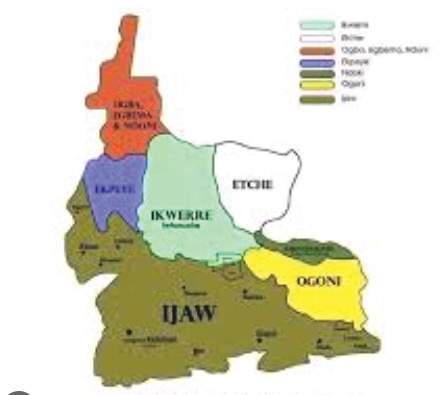
From very early in life, we have been taught that no condition is permanent. Empires come and go, kingdoms rise and fall. In truth, no situation stands permanently on a straight-line graph.
The current imbroglio in River’s State might defy accurate analysis, particularly against the back-drop that the actors may not be playing on any set of concrete rules.
Incidentally, this is the state that was the envy of everyone until quite recently. No election result was finally announced until the Returns from the Greater Rivers (the present rivers and Bayelsa States) were fully received.
Yes, the imbroglio in Rivers could defy accurate analysis, but analysts are not going to abandon their duty posts and refrain from further analysis.
Essentially, for the good analyst, the messier the situation, the better. For him, the higher the mountain, the greater the joy in climbing to the top.
Truly, there is a big scramble for the soul of the Wild-Wild Rivers. The scramblers want power and nothing else matters to them. The struggle is fierce and thoroughly untidy. For the scramblers, it is a policy of LIVE AND LET DIE.
Unfortunately, the people of the state are at the very centre of the death roll; and it stills does not matter to the scramblers!
Thank God there is God. This, too, will come to an end someday soon. When the time comes, everything will return to normal and the people of the great state will regain the past glory.
This essay sets out to see the possible winners in this scramble.
We start our search from the current politicians in that state. Since the initial confusion that has brought us to this sorry state can be located at their doorsteps, the search for a solution cannot be located too far from them. We are, however, not oblivious of the fact that in ancient mythology, the rabbit was judged to be finally wrong in the decision to dig its hole at the very base of the OIL-BEAN “(OKPAGHA)” tree for easy access to the seeds because when
the pod got burst, the seeds scattered far away. All the same the current process in Rivers must be located from the Rivers politicians.
Enter former Governor Rotimi Amaechi, the minister of the federal capital territory Nyesom Wike and the current Governor of the state Siminalayi Fubara. As things now stand, no political analysis of the state can take place without mention of the Peoples Democratic Party (PDP) which has held sway in the state since the current democratic experiments arrived in 1999.
Too soon, The PDP went to war with itself. This was one party that met success and did not know what to do with it.
At the theatre of war, it became bereft of ideas, to the extent that it could not distinguish between 16 and 60.
In self delusion, while it was pacing for 60 years in the first instance, it collapsed prematurely at 16! This is highly instructive to the current political class.
Each time we think of who will win the current scramble for the soul of Rivers, we are reminded that there is a silent majority that is less noisy and properly consolidated. In any fair competition and electoral contest devoid of all the razzmatazz of Rivers politics, this group will easily come out triumphant.
This writer is speaking from a position of strength and knowledge because Chris Ebite and I took charge of the APC membership registration in 2013/14.
That is the original APC that is now under the chairmanship of Emeka Beke who was the state secretary of the party at the time of that registration.
This authentic part of the APC has remained loyal to Amaechi over the years.
In view of the forgoing, one was tempted to jump to the conclusion that in the current scramble for the soul of Rivers State, this group would move out en bloc and follow Amaechi to his newfound party, the African Democratic Congress (ADC) and leave Wike and Fubara to struggle for what remains of the PDP.
In the configuration, Amaechi would emerge a clear winner of the current scramble. Wait a minute, Don’t follow me yet.
Opeyemi Adamolekun argues that disc ontent in a democracy is shown at the ballot
“Death by a thousand cuts” is a metaphor for creeping normality, a process by which a major change can be accepted as normal and acceptable if it happens gradually through small, often unnoticeable, increments of change. (Wikipedia)
In the English language, the phrase “death by a thousand cuts” is an idiom that refers to a series of bad events, none of which is devastating on its own but, when added together, result in disaster.
(Richards, Layton & Finger)
“Death by a Thousand Cuts” is similar to “The Boiling Frog Theory” when a frog is placed in tepid water, which is its natural habitat, and the water is boiled slowly. The frog feels the heat gradually but adjusts to the warmth until it’s boiled / cooked to death. In contrast, a frog that’s dropped in hot water will hop out quickly.
It’s 2026 and Nigerians are slowly being killed by a thousand cuts - insecurity, hunger, destruction of institutions, heat strokes, suboptimal social services etc. In his speech at the 2026 APC Convention, President Bola Tinubu said, “[APC] was founded as a vehicle for national transformation, a home for anybody who wants to build a Nigeria where governance works, institutions function, opportunities abound, security reigns, poverty declines, and every Nigerian, regardless of tribe, religion, region or social status, can live with dignity and hope.”
APC was formed by three legacy parties (ACN, CPC, ANPP and a faction of APGA) in February 2013. After 13 years with 3 presidential terms, the scorecard is quite poor. To Mr. Tinubu’s points, there’s poor governance; institutions are undermined, some of our best and brightest have “japaed” for better opportunities, insecurity and resulting deaths have increased significantly with supporting data, poverty has increased based on anecdotal evidence and all Nigerians certainly don’t have the same opportunity to live with dignity and hope.
In Mr. President’s words, “Democracy thrives on vibrant and healthy competition.” On this, he’s spot on! It’s interesting to see “archeologists” dig up his tweets condemning former President Jonathan for the exact same things he is currently doing. APC was a formidable opposition and with tweets and press statements, they identified the issue and communicated clearly what they would do differently if given the opportunity. They were also the loudest opposition party. Their proposition aligned with a populace that wanted better governance outcomes and the APC’s 2015 presidential victory was uncontested. By 2019, it was clear that the packaging was much better than the content, but the subversion of people and processes to ensure APC wins at different levels had taken root. It was perfected in 2023 when a regulation written in black and white, forming the legal framework for our elections was disregarded in clear violation of the spirit and the letter of the law.
When you are dealing with people who have had years of practice as opposition, who got a leading opposition member and presidential aspirant to serve in their government without leaving his party, you have to do more than write tweets and issue statements. You also have internal and external forces working to ensure your parties are tied up in internal squabbles and legal matters. Creativity and innovation then become a necessity for survival. Citizens who want an alternative then become your greatest assets. Unfortunately, this cohort of opposition members are spending a lot more time negotiating power than crafting a
meaningful message for the people they expect to vote for them.
On the back of this, the APC continues to undermine democratic institutions. The judiciary is assumed to be compromised from the Supreme Court to the lower courts given the track record of judgements, utterances and actions in the last few years. After all, the fish does rot from the head. There is a video circulating on WhatsApp of the new houses built for judges in Abuja. The text for one of the posts says, “This is the newly built JUDGES VILLA that comes with a brand new SUVs for soft landing ahead of 2027 election. #JudiciarySettled” Sadly, quite a number of Nigerians believe this about the judiciary. In a recent conversation with a Senior Advocate of Nigeria (SAN), he described the judiciary as “an instrument of political delivery.” How does a body of learned colleagues who are to interpret our laws and pass judgement based on evidence / facts become so vilified?
The Statehouse (Aso Villa) has a WhatsApp Channel that provides updates on the activities of the federal government. Since yesterday evening, subscribers have been inundated with media assets from the APC Convention. Of course, the president’s speech and some images of him can be shared, but to turn it into a marketing tool for the party is a very simple example of how APC has blurred the lines between the man, the party and the nation.
What makes a democracy different from a military dictatorship or monarchy is the “voice” that citizens have in choosing their elected officials and holding them accountable. There is no shortcut to getting good governance outcomes than helping citizens connect the dots.
Discontent in a democracy is shown at the ballot. Simple. While we might wish for a stronger and more organised opposition party that engages the issues and provides alternatives, ultimately, the citizens are the opposition as we have the power of the vote. 2027 is also not just about the presidential. There are many other positions to engage where you can rehire or fire - 28 state governors, 469 seats in the National Assembly and 993 seats across all 36 state Houses of Assembly. Remember, the “Office of the Citizen” is the highest office in the land. Occupy it and use it well!

Editor, Editorial Page PETER ISHAKA
Email peter.ishaka@thisdaylive.com
The process through which candidates emerge should be credible and transparent
In all civilised societies, the nomination of candidates for various offices by political parties is usually taken as a recruitment process for leadership. Unfortunately, under the current democratic dispensation in Nigeria, the primaries of all the political parties, big or small, are usually replete with widespread fraud, monetisation, lack of respect for accountability and a cynical hijack of the process by sundry godfathers. As the leading political parties therefore begin to hold their congresses and conventions preparatory to nominating candidates for the 2027 general election, we hope they will begin to adhere to democratic ethos.
Despite internal wranglings, involving in some cases, judicial interventions, the four major parties–the ruling All Progressives Congress (APC), the African Democratic Congress (ADC), the Peoples Democratic Party (PDP), and the Labour Party (LP)–are currently either holding their national conventions or are planning for them. While we applaud all the ceremonies, it is important to stress that at a period like this when the nation needs innovative leaders at all levels of government, the process through which the candidates emerge should not be compromised by unwholesome practices.
Credible elections, according to the Independent National Electoral Commission (INEC) chairman, Joash Amupitan, begin long before polling day. “They begin in the transparency of the processes that produce the candidates,” Amupitan stated at a consultative meeting with political party leaders in Abuja last week while unveiling a revised draft of its 2026 Regulations and Guidelines for Political Parties, on which he sought their inputs. We agree with the INEC Chairman, even when we also hope that his commission will also put its house in order.
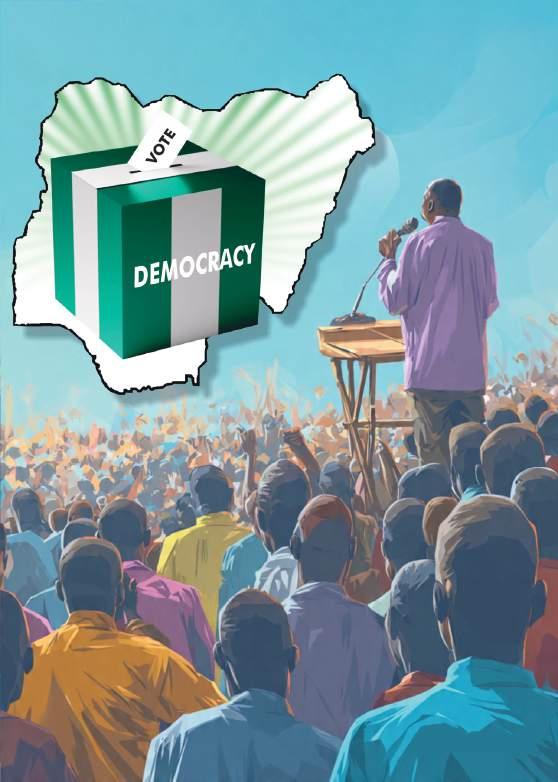
Democracy
whole idea is to ensure that the rules and regulations governing the nomination of candidates by political parties are transparent and credible and that critical stakeholders play fair, we subscribe to anything that will create confidence in the system and deepen our democracy.
Speaking at the 4th Elective National Convention of the ruling APC which had in attendance Vice President Kashim Shettima, Senate President Godswill Akpabio, House of Representatives Speaker Tajudeen Abass, 31 state governors and others, President Bola Tinubu has pledged the commitment of his administration to the rule of law and credible elections. But he also had a word for members of his party and those in opposition: “Political parties do not fail only through electoral defeats… they falter when ego overrides ideology or when ambition replaces discipline.”
The ADC, currently the main opposition platform, has scheduled its national convention for 14 April. “The convention is to affirm the previous decisions that have been taken in the last few months by the various organs of the party and also to ratify some reports that have been submitted and approve the time table for primaries,” according to the ADC National Publicity Secretary, Bolaji Abdullahi. The PDP that ruled the country for 16 years before it was displaced by the APC in 2015 is still struggling to resolve its internal contradictions.
begins with internal party processes. Parties
that
fail in conducting credible primaries
cannot
be expected to conduct themselves responsibly in a general election
To the extent that free and fair election is a basic requirement of democratic governance and an antidote to civil disorder, the selection of candidates by parties must be based on transparent popular participation in which every aspirant is availed a level-playing field. As we have highlighted on several occasions, if intraparty primaries are flawed, vicious and chaotic as they have been over the years, it is a given that the outcomes of such exercises cannot deliver on good governance.
Meanwhile, under the aegis of the InterParty Advisory Council (IPAC), some political parties are still demanding a revisit of the Electoral Act 2026 recently signed into law following the passage by its National Assembly. On grounds that the selection of candidates remains an internal affair of political parties and should not be subjected to undue legislative interference, they want the provision mandating direct primaries to be reconsidered, and the option of indirect primaries restored. On the limited time frame for the submission of their membership registers, INEC has hearkened to their request with a two-week extension.
We also understand the contention about direct primaries. There are fears that the old
SUNDAY NEWSPAPER editor DAviDSoN iRiekpeN deputy editors FeSTUS AkANBi eJioFoR ALike Managing director eNioLA BeLLo
deputy Managing director iSRAeL iwegBU chairMan editorial Board oLUSegUN ADeNiYi
editor nation s capital iYoBoSA UwUgiAReN the oMBudsMan kAYoDe koMoLAFe
THISDAY NEWSPAPERS LIMITED
editor-in-chief/chairMan NDUkA oBAigBeNA
group executive directors eNioLA BeLLo, kAYoDe koMoLAFe, iSRAeL iwegBU divisional directors SHAkA MoMoDU, peTeR iwegBU ANTHoNY ogeDeNgBe deputy divisional director oJogUN viCToR DANBoYi snr. associate director eRiC oJeH
associate director pATRiCk eiMiUHi controllers ABiMBoLA TAiwo UCHeNNA DiBiAgwU, NDUkA MoSeRi
director, printing production CHUkS oNwUDiNJo to send eMail: first name.surname@thisdaylive.com
problem of hijacking ballot boxes, violence and deployment of thuggery might surface. These are legitimate concerns in a milieu where elections are contested almost as a do-or-die affair. But they are coming late in the day. Besides, if the
The Tanimu Turaki-led National Working Committee (NWC) of the party has been holding meetings with the faction led by the Minister of the Federal Capital Territory (FCT), Nyesom Wike to resolve their problems. Incidentally, the same Wike hosted APC delegates from Rivers States who came for their convention in Abuja, amid suspicions that his real role in the PDP may be to play the spoiler. The Labour Party (LP) is still split down the middle between the faction led by Julius Abure and the Nenadi Usman-led caretaker committee.
The indirect primaries system, which has now been jettisoned, was defective because it selected candidates through a warehoused surrogacy. Party chiefs and money bags bought and imposed candidates only to require the popular electorate to vote for them on a oneman one-vote basis. Reports of the use of money to disfigure the outcome of indirect primaries that became no more than bazaars led to the call by many to discard the idea. And to the extent that the amendment merely synchronises the primaries system with the basic requirement of democratic balloting, that is some progress. However, the political class must limit the need for judicial intervention in the outcome of party candidate selection processes. Even more so, the transactional content of those processes must, at the very least, be reduced. Democracy begins with internal party processes. Therefore, parties that fail in conducting credible primaries cannot be expected to conduct themselves responsibly in a general election. A political class that cannot obey the rules it makes for itself cannot be trusted to maintain law and order in the larger society.

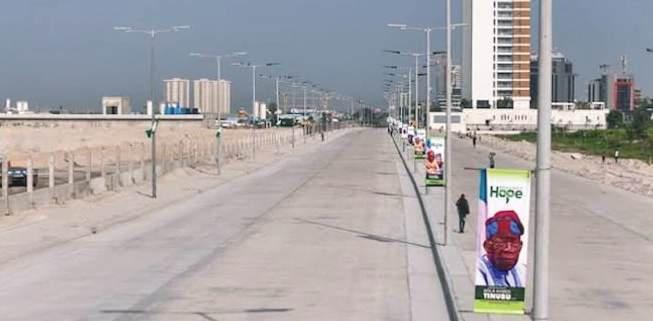


BIRTHDAY
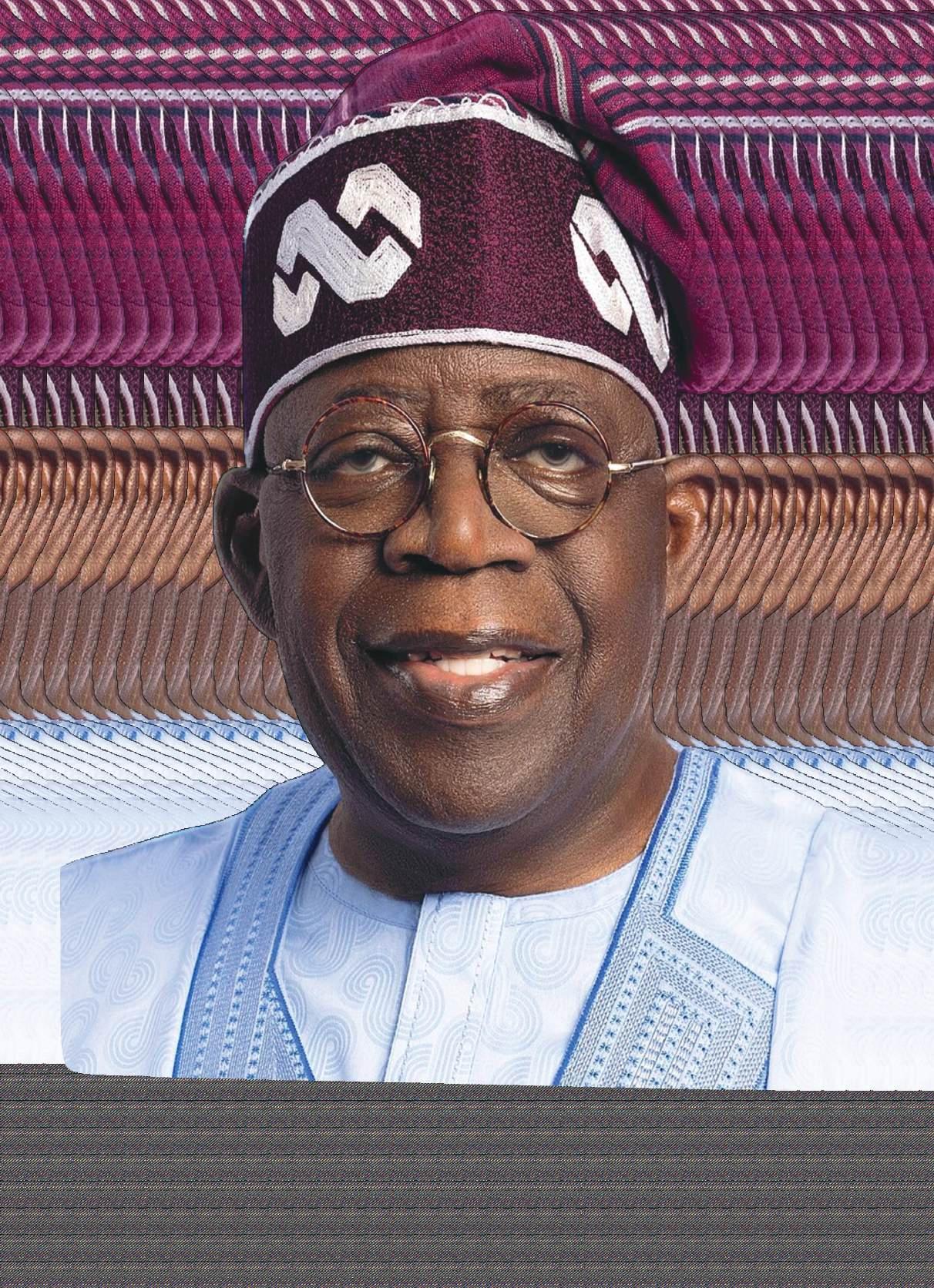
Today, I stand with millions of Nigerians to celebrate a leader whose vision and courage have changed the course of our nation At 74, President Bola Ahmed Tinubu is not just marking another year of life, he is marking the steady progress of the Renewed Hope Agenda, which is restoring confidence in Nigeria’s future.
Mr. President, your reforms have been bold, sometimes di�cult, but always necessary You have shown the conviction to take decisions that others feared to make, and today the results are clear:
- Economic Renewal: Inflation is easing, foreign reserves are rising, and Nigeria’s economy is regaining strength
- Infrastructure Development: Roads, energy projects, and housing initiatives are reshaping our nation and connecting our people
- Empowering Citizens: Investments in education, healthcare, and social programs are giving millions of Nigerians renewed dignity and opportunity.
- Global Leadership: Nigeria s voice is respected again on the world stage, championing democracy and cooperation
These achievements are not abstract, they are felt in homes, in communities, and in the renewed optimism of our people International recognition, including The Economist’s recent acknowledgment that Nigeria s economy is “back from the brink,” confirms what we already know: Nigeria is in safe hands under your leadership.
Mr. President, I salute your resilience, your pragmatism, and commitment to building a Nigeria that works for all On this special day, my prayer, and that of the entire members and sta� of the Lagos State House of Assembly, is that the Almighty grants you long life, robust health, and the wisdom to continue guiding our nation toward its golden years.
Happy Birthday, Mr. President.

President of the Federal Republic of Nigeria
Rt. Hon. (Dr) Mudashiru Obasa Speaker, Lagos State House of Assembly
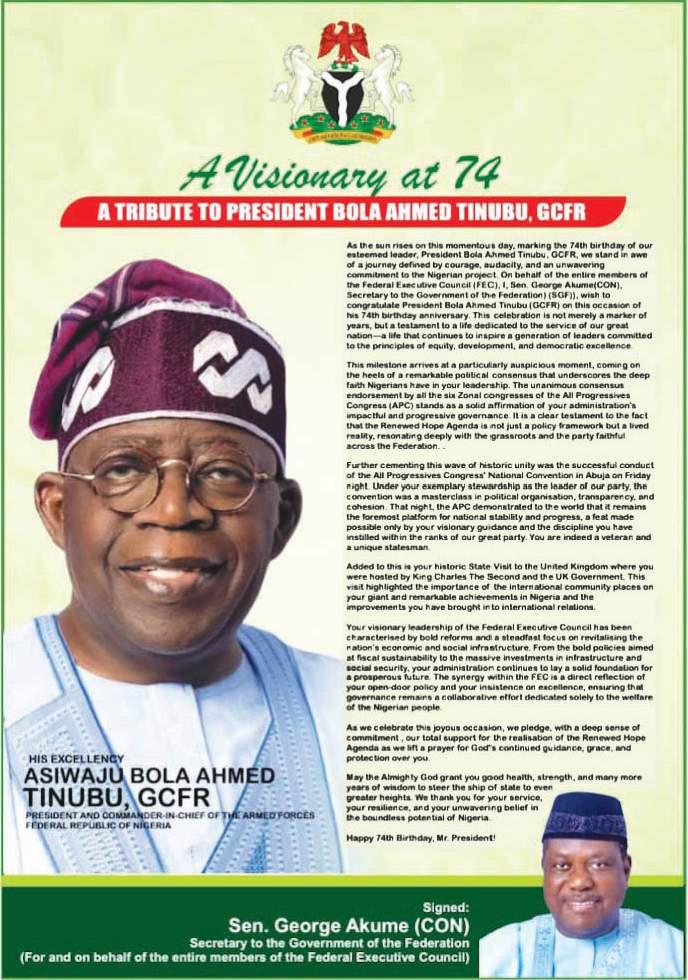
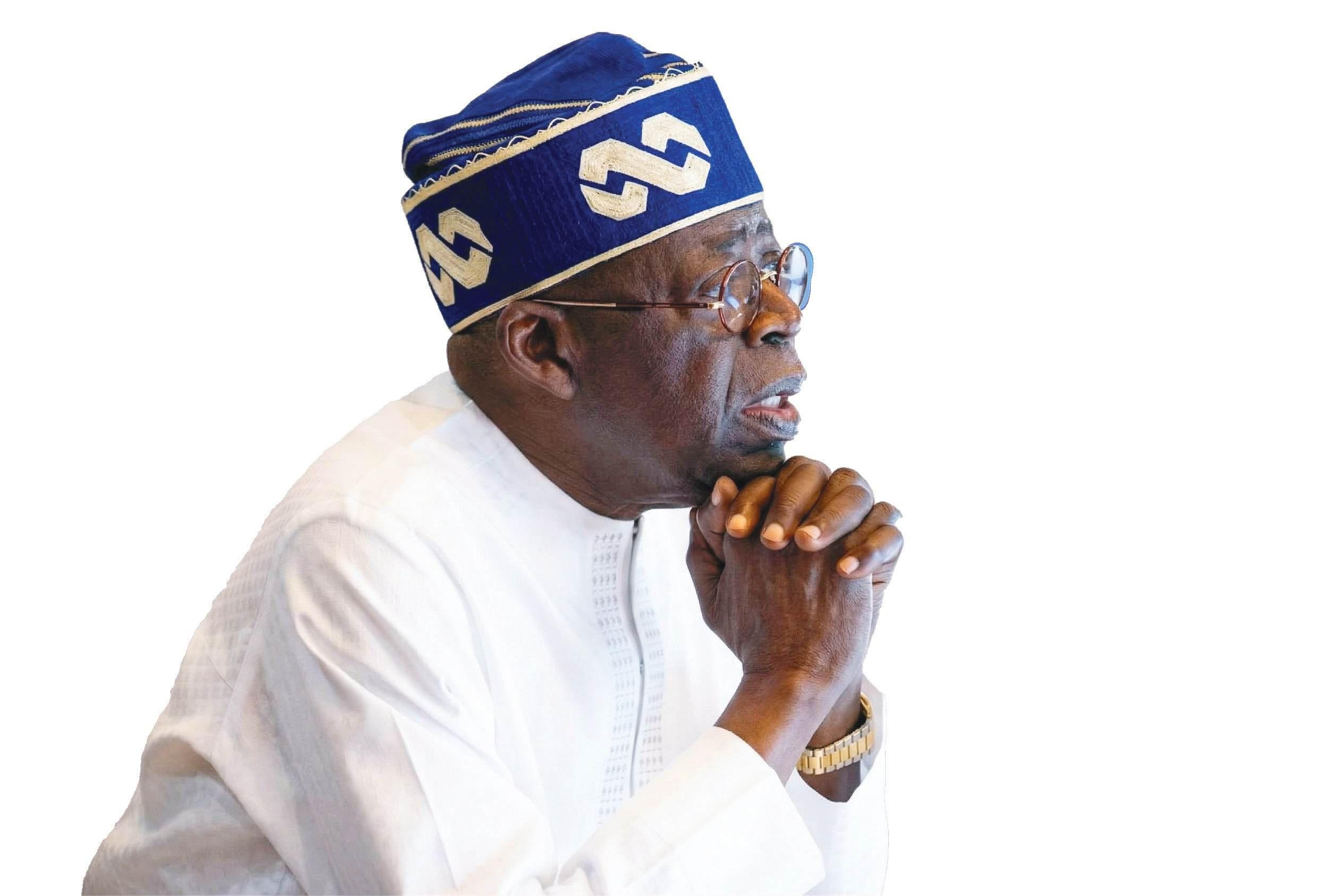
We join our fellow Nigerians in celebrating His Excellency, President of the Federal Republic of Nigeria,on his 74th birthday.
We celebrate a distinguished leader whose courage, vision, and service inspire progress and national development.
As you continue to steer the ship, we wish you good health, renewed strength, and greater accomplishments your service to our dear country.
Happy Birthday, Mr. President
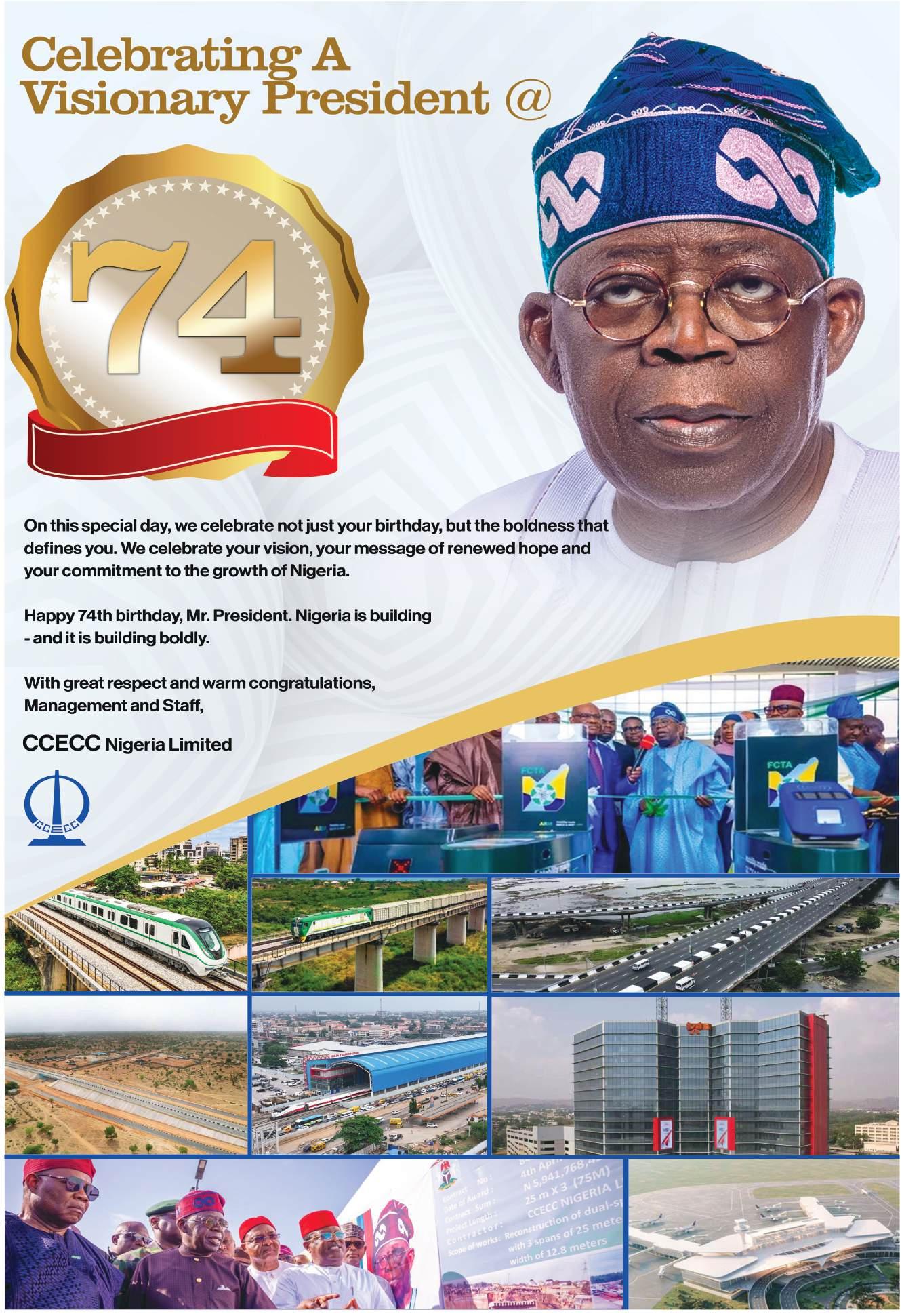


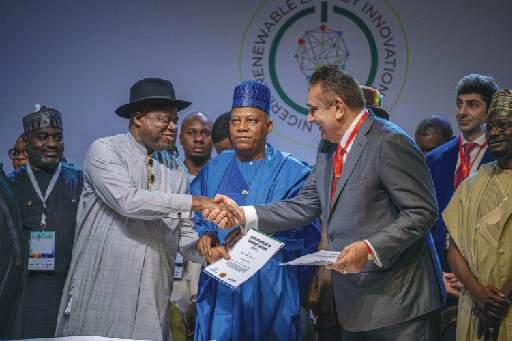


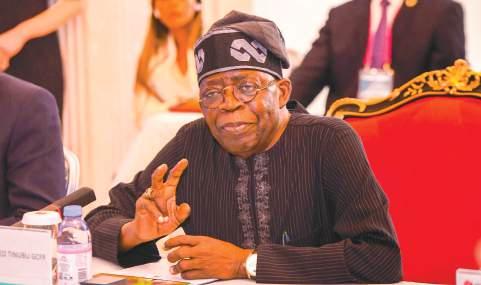

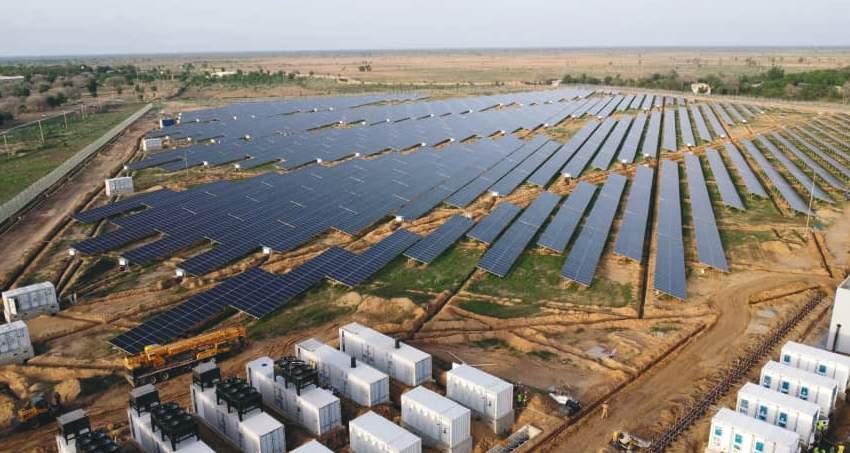
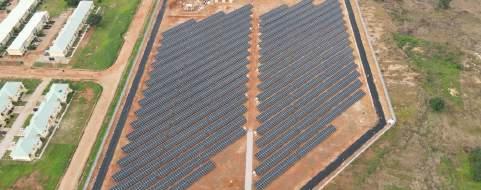
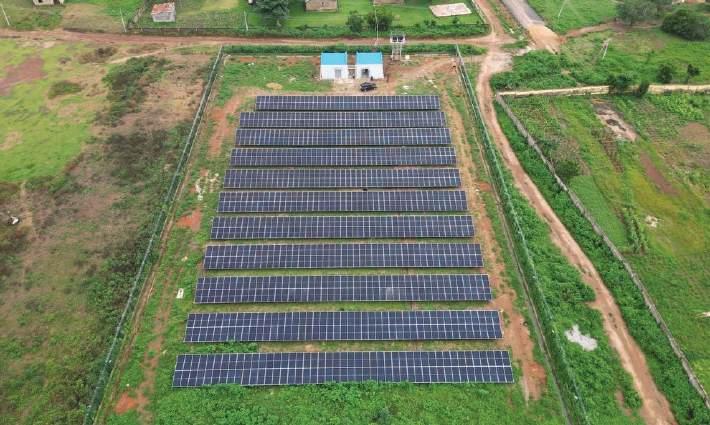
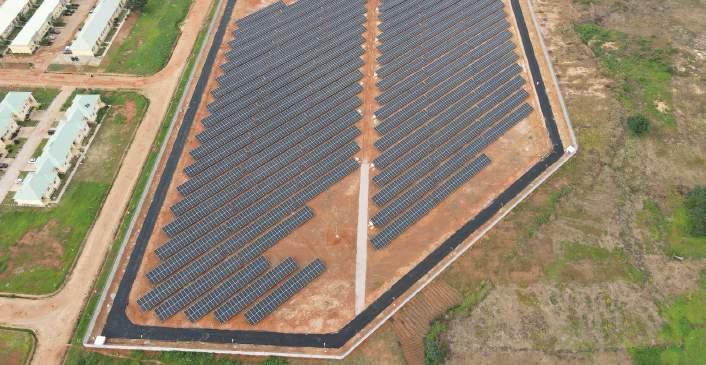
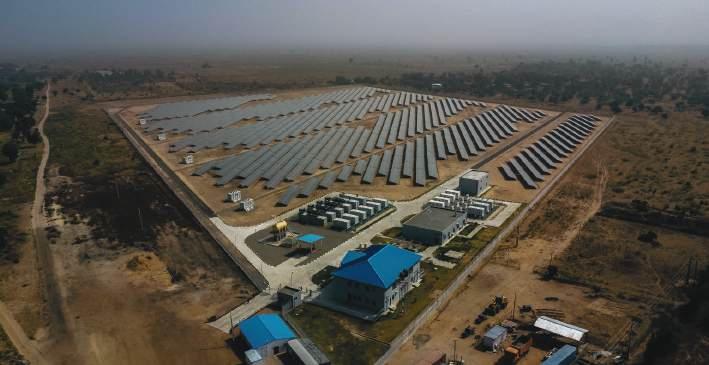
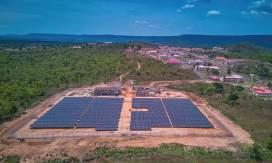
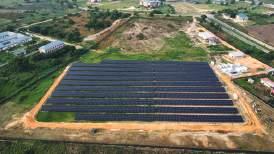
Under your bold leadership and for the 1st time in the history of the nation’s energy sector, you have:
Initiated a structured means of addressing electricity access gap in Nigeria.
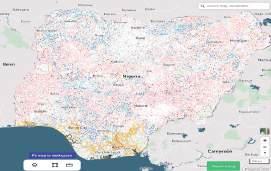
Delivered a holistic mapping of unserved and underserved communities through the NESIP.
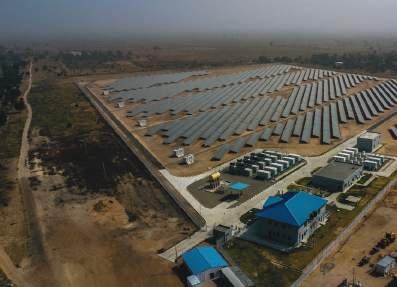
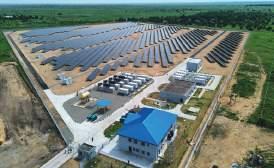
Over 1,000 mini-grids are currently being project-deployed.
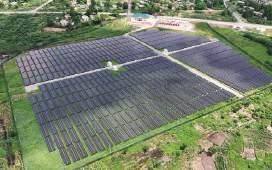
50 Interconnected mini-grids are being constructed, in collaboration with the 11 DISCOs, to inject over 200MW of electricity.
15 hybrid mini-grids constructed, powering 15 federal universities and 3 university teaching hospitals.

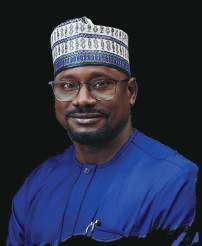

















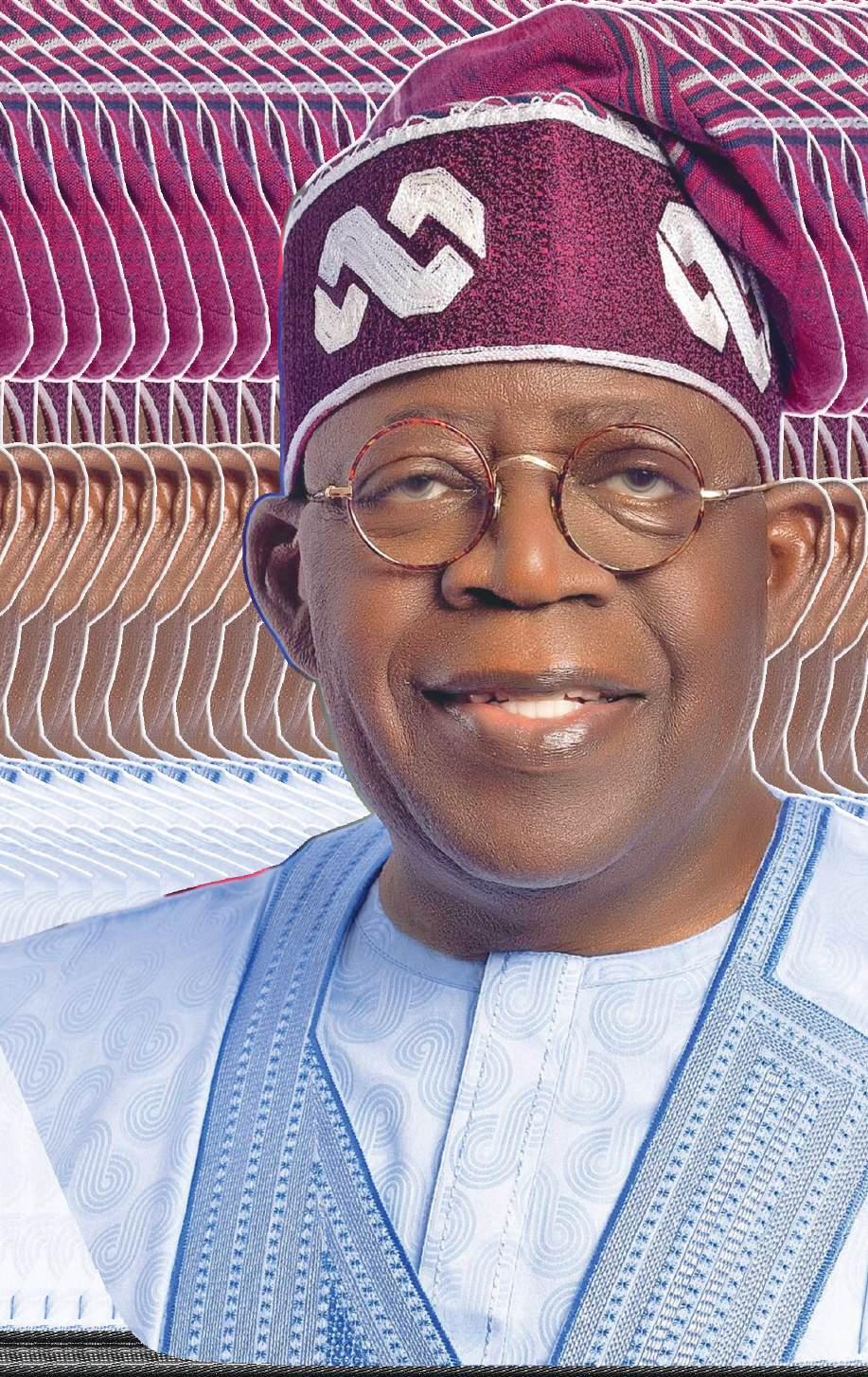



President and Commander-in-Chief of the Armed Forces, Federal Republic of Nigeria
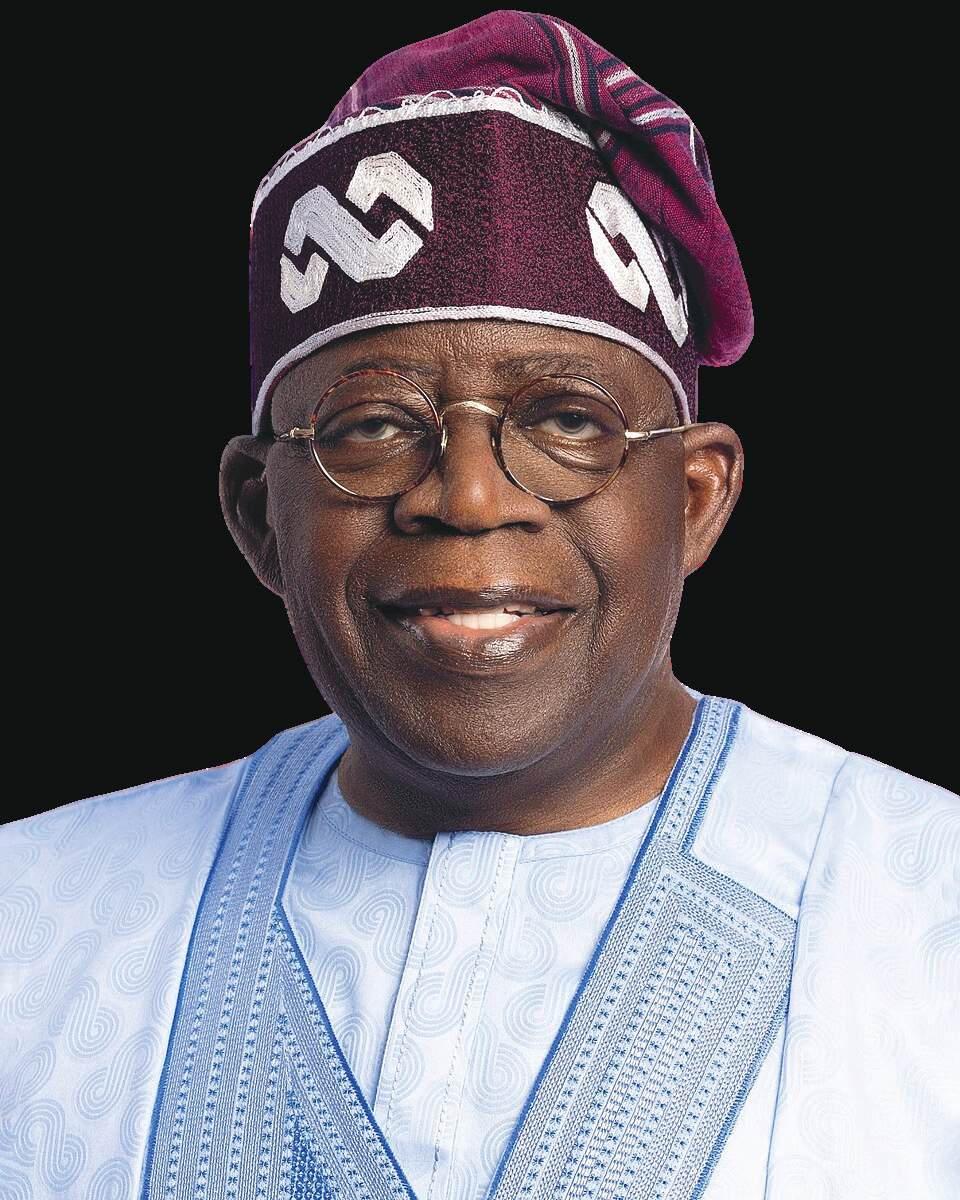
On the occasion of your birthday, Emadeb Group joins millions of Nigerians in celebrating your leadership and enduring commitment to national progress.
Your resolve in advancing the Renewed Hope agenda and steering the nation through a period of bold reform continues to inspire confidence across the private sector
We wish you continued good health, wisdom, and strength in service to our country.
Happy Birthday, Mr President
With warm regards, Management and Staff Members, Emadeb Group.








uilding on a Glorious Heritage and Inspiring Generations at 70: the Challenge of Nobilitas and Integritas” was the title of a lecture delivered by Professor Bola A. Akinterinwa of the Achievers University, Owo, on Saturday, 21st March, 2026 at the Saint Joseph’s College (SJC), Ondo City. The lecture was delivered as part of activities organised by the Saint Joseph’s College Old Boys Association (SJCOBA) to mark the 70th Anniversary of the SJC. The 70th Anniversary is particularly of interest nationally and internationally for various reasons.
First, it was more of an anniversary of a ‘reality of life’ in terms of intelligere or being able to understand, discern and chossing between. According to Brother Alvaro Rodriguez Echeverria, s Superior General, the educational philosophy of the SJC was largely predicated on the Lasallian history according to which ‘the first condition for being innovative is to know and to love the reality in which we live with its lights and shadows, its pluses, and minuses. This contact with reality should then lead us to pass on a kind of knowledge that is satisfied with content alone, but which gives priority to the ability to search for meaning.’
More importantly, Brother Echeverria said that ‘we are aware that it is more important to help young people find meaning in their lives than only to fill their heads with ideas. It is more important to have the ability to continue learning than it is only to know a lot of information.’
This philosophy is another way of explaining education as defined by physicist and philosopher Albert Einstein. He said education is not about the learning of facts but the training of the mind to think. This is precisely what education at the SJC was all about in the beginning. If we are to build on any glorious heritage, it is this challenge of how to appreciate reality, develop the ability to search for meaning, and how to have the ability to continue learning that should be addressed.
Secondly, as noted by Prince Henry Akinyele, the Publicity Secretary of the SJCOBA, ‘ the SJC is not just a school, it is a community that moulds young minds into men of integrity, excellence, and service.’ The National President of the SJCOBA, Dr Olusola Akinniyi, corroborated Prince Akinyele’s observation by noting that, ‘seventy years ago, the foundation of SJC was laid with a vision – to nurture and mould character. Over the decades, the institution has remained an exceptional citadel of learning, laying a solid foundation on which great men of national and international repute have been built.’
SJC @ 70 and its Inclement Environment
More importantly, Dr. Akinniyi added that ‘all over the world, these Nobilitas (the name we call ourselves) have been outstanding across generations and continue to contribute meaningfully to society both locally and internationally.’ Dr Akinniyi was quite correct as the six-day anniversary celebrations lent much credence to his submission. First, the various sets were apparently in competition in the determination to assist their alma mater. From the records of contributions to the making of the 70th Anniversary and the refurbishing of the college, the 1965-1969 set of Nobilitas, to which I belong, had the highest contribution. Several individuals in other sets made more impacting financial contributions as well. The 1965-1969 set was represented by Nobilitas Dr. Oladiran Ayodeji, Professor of Obstetrics and Gynaecology and Nobilitas Chief Folagesin Akinnawo, the CEO of Greenwood Investments Co. Ltd and Proprietor of the Lagos Cambridge School at the Annual General Meeting. Secondly, and without whiff of doubt, the six-day celebrations were colourful. The first day, Tuesday, March 17, was an opportunity for old boys reunion and to witness an inter-house sports competition, as well as to participate in an ‘asun feast’ in the mania of Ondo people. A platinum jubilee walk, inter-school debate and quiz competition, and an inter-school football match between the SJC and Methodist High School, Okitipupa, took place on the second day. Thursday, March 19 was SJC Day, the day for launching of endowment funds and commissioning of projects. Nobilitas Dr Olusegun Mimiko, former Executive Governor of Ondo State, was there along with some current State Government officials. Friday, March 20, was for medical care: medical outreach team deployment, social evening, free networking, and bonfire. The medical outreach took place at the palace of His Imperial Majesty Oba Kiladejo, Jilo III.
More importantly, Saturday, the 21st March, was the crescendo of all activities. It was the day reserved for the Anniversary Lecture

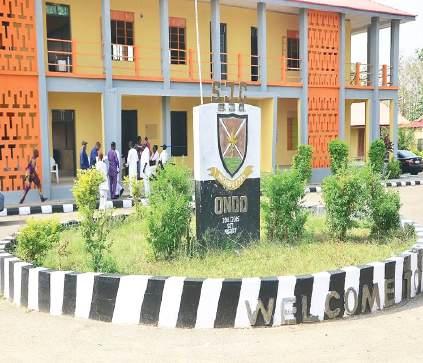
by Nobilitas Bola A. Akinterinwa, Annual General Meeting, and for General Election. Professor Femi Mimiko, a renowned political scientist and former Vice Chancellor, was elected the new SJCOBA President. Nobilitas Akinterinwa’s lecture generated much interest because of its intellection and environmental conditionings which he said were not conducive to the building of SJC heritage.
First, in terms of its intellection, it raises many fundamental questions of heritage that is glorious. What really is this heritage and what makes it glorious? Secondly, how do we sustain the glorious heritage? If we can build on the heritage, can it be done gloriously? Is it really possible to build on SJC’s glorious heritage in contemporary Nigeria? Thirdly, what is an anniversary? An anniversary is one year. A decade anniversary is ten years. A silver jubilee refers to 25 years, while forty years are a ruby jubilee. Golden jubilee is fifty years of age. Sixty years of age is diamond jubilee. 70 and 75 years are referred to as platinum jubilee. The crescendo of these jubilees is centenary.
There is no more jubilee to celebrate in between 70 and 100 years of age, which is the centenary jubilee. Thus, SJC at 70 is a major watershed, particularly in terms of biblical injunction. Platinum jubilee is an end to the first period of human life and the completion and the beginning of a new era. Biblical mathematics has it that ‘7’ symbolises perfection. ‘7’ times 10 symbolises completeness and is equal to fullness of a determined season. In other words, age 70 is the foundation of a new beginning for building a new understanding, a new foundation for building nobility and integrity, and a new time not only for facing new challenges, but also in building a glorious heritage.
As regards the national environmental conditionings of building a glorious heritage, they are very inclement. The polity is fraught with corruption at the level of leadership and followership. Followership is even more problematic than leadership. So is the notion of Gen-Z. How do we inspire a generation that is called Gen-Z? Does Gen-Z mean the last generation because ‘Z’ is the last alphabet? How do we inspire the modern-day generation in a world of changing technology? These
Nobilityandintegrityisthrownintothedustbinofhistorybylegislatingagainst allegationsofcertificateforgerytoinvalidatetheelectionofpoliticians.Manystruggling menwanttobenoblebutnobilitymustbeearned.Integrityisaboutdeterminationand self-discipline.Itisaboutmoralre-orientationandcultivatinggoodmanners.Itisnot onlyaboutself-guidancebutaboutguidingone’sfamilyandtheentirecommunity.It isessentiallyaboutpromotingpositiverolemodelsandbeingasourceofinspirations. Consequently,inbuildingnobilityandintegrity,onemustlearnhowtobeconsistent inthoughtandaction,ensuringthatone’sactionsarealwaysconsistentwithwhat onebelievesinandpreaching.Honestyofpurposemustremainthewatchword.Selfarrogancemustbejettisoned.Decisiontobenobleinlifeandbeamanofintegrity mustbetakenbeforeworkingtowardsit.ThegloriousheritageofSJC,nobility,integrity,andappreciatingrealityoflifecanthriveandbesustainableiftheenvironmentis madeconducive.Infact,theenvironmentoflearningmustbefreefromchicaneryand mentalenslavement.Indisciplineandinstitutionalcorruptionmustbefoughttooth andnailandbroughttoitsknees.Teachersandlecturerswithforgedcertificatesmust beidentifiedanddoneawaywith.Thespiritofstrategicautonomyshouldbeimbibed byeveryoneasself-reliancehasbecomethenewgovernance directionoftheGovernmentofNigeria

questions are raised because the national environmental conditioning in Nigeria is, at best, very inclement, thus making the building of a glorious heritage difficult. It is particularly difficult because there is no apparent governmental preparedness to meaningfully contain societal indiscipline, especially in stamping out corruption.
Today, Nigeria is playing host to certificate craziness. Employers now value certificates more than competence, hence, students seek certificates by hook or crook. Sex for marks has become another issue in many tertiary institutions. Many universities have also bastardised the award of honorary degrees and academic titles. In the past, only people identified as men and women of nobility and integrity were honoured with traditional chieftaincy titles. They were not necessarily rich but they were people well known to have contributed to community development. The story has changed today.
In the pre-independence era, 1960s, and 1970s, university degrees in Nigeria were universally recognised and valued. This implied that people went to universities and the universities also went through their minds. What is the value of university education today in Nigeria bearing in mind that nobility and integrity is now defined by financial wealth rather than by knowledge acquisition? Nigeria has become an arena for title competition, a country where self-given titles and honorary titles are promoted selfishly and with reckless abandon. Honorary doctoral degree holders quarrel when they are not addressed as doctors. Political ambassadors want to be called ambassadors after leaving office, whereas international tradition reserves the usage for career ambassadors even after their retirement.
A fortnight ago, the BOSAN (Body of Senior Advocates of Nigeria) ‘issued a stern warning to its members against the growing practice of appropriating undeserved academic titles, describing the trend as an unbridled and burning desire that could attract disciplinary sanctions’ (vide Unini Chioma, “They Are Not Permitted to Use ‘Dr.’ It Is reserved for Holders of Earned Degrees. BOSAN Warns Senior Advocates Against Parading Undeserved Titles,” The Nigeria Lawyer).
As noted in a letter dated March 10, 2026 sent to BOSAN members, Mr Olumide Sofowora, the Secretary to the BOSAN, ‘the secretariat has been inundated with complaints about members prefixing ‘Doctor’ to their names in court and other professional settings after being conferred with honorary doctorate degrees.’ More important, Mr Sofowora drew attention to the guidelines of the National Universities Commission under Item 13 on ‘usage according to which ‘recipients of honorary doctorates are at liberty to use approved nomenclature such as Doctor of Law (honoris Causa), LL.D (h.c.) or D. Litt (h. c.) after their names, but are not permitted to use the title ‘Dr’ before their names, as that prefix is reserved exclusively for holders of earned degrees and medical professionals.’
Lack of Nobilitas and Integritas
The Federal Ministry of Works and Housing placed an advert in early 1994 asking the public to apply for various categories of low and medium houses. I am one of the applicants for a 3-bedroom detached bungalow to be built in FESTAC. I and my wife took a UTB loan to pay for the required deposit. The houses which were to be built in various parts of Nigeria, were to be allocated in December 1994. In between 1994 and 2026, no house has been built. No refund of deposit has been made. No information is given. Governments that succeeded Alhaji Lateef Kayode Jakande did not appear to have inherited such housing liability. This is more than 419 robbery or pen robbery. The Government of Nigeria, by conscious collection of deposits from thousands of Nigerians to build houses that it never intended to construct, and caring less about the need to explain why, and why there has not been any refund is an unpardonable crime against the people of Nigeria. It is fraudulent and wicked. It is a manifestation of political chicanery. Government cannot be preaching the sermon of patriotism and nation-building while promoting societal indiscipline. This is one major challenge that cannot but militate against the building on the glorious heritage of the SJC.
It is probably only in Nigeria that the enemies of Government are not only well known but also where the executive arm of government is afraid to deal with them. President Goodluck Jonathan told all Nigerians publicly that there were elements of Boko Haram in his government. Even the Kaduna-based Islamic cleric, Ahmad Gumi, has also revealed that ‘the Federal Government knows terrorists’ hideout and that he goes ‘with security operators to negotiate with them’ (theconclave. com) Some countries have also forwarded the names of those funding boko haramism in Nigeria. What is it that the Government has done about the list of funders?
And perhaps most disturbingly, what heritage can there be when the Government is itself an agent of societal indiscipline? What future is there when the Government is not prepared to address societal indiscipline? It is useful to recall the lecture delivered by Chief Olu Falae at the Obafemi Awolowo University in 2012. In the lecture, Chief Falae recalled his letter to Chief Olusegun Obasanjo, congratulating him for promulgating the anti-corruption law in 2002, but having reservations on the likelihood of any good future about seriously fighting corruption. The reason is not far-fetched: ‘because the political office holders who were engaged in competitive thievery of public fund in the Government were his own supporters and party men.’ Consequently, in the eyes of Chief Falae, Chief Obasanjo ‘did not have the courage to deal with them and damn the consequences’(Chief Olu Falae, “Nigeria and the Contemporary Challenges of Nation Building,” Faculty of Arts, Obafemi Awolowo University Guest Lecture Series 2012, p. 3 et s.).
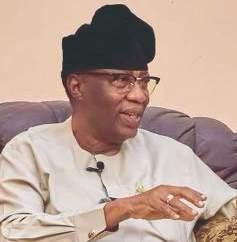
Gbenga Daniel still finds it hard to believe that he is turning 70 in a few days. The milestone feels surreal. Was it not just three years ago that he was elected to the Senate to represent Ogun East Senatorial District? Time, it seems, has moved both swiftly and generously.
He was only 47 when he was sworn in as governor of Ogun State in 2003, at a time when Nigeria’s democracy was still finding its footing. His tenure is widely regarded as transformative. Many still recall his campaign as a defining moment in Nigerian politics, particularly his ambitious ward-to-ward tour across all 20 local government areas and 236 wards in the state, an undertaking widely considered impossible at the time.
More so, his victory over an incumbent governor, with 217,353 votes, remains one of the most decisive electoral wins in Ogun State. Popularly known as OGD, he went on to serve two terms, leaving office in 2011 at the age of 55.
Daniel’s years in office left a visible imprint. His administration invested in infrastructure across the three senatorial districts— roads, recreational centres, and stadia—while also establishing the Tai Solarin University of Education. Projects such as the Gateway Agro-Cargo Airport and the modernisation of Olumo Rock were initiated to boost tourism and economic development. He also set up free trade zones across the state and empowered the Nigerian Youth Council to deepen youth participation in governance.
After his tenure as the governor of Ogun State, Daniel founded the Political Leadership Academy, a leadership and governance training Institute aimed at grooming a new generation of leaders in governance and public service.
Long before politics, however, Daniel had built a formidable career in engineering. At 34, he founded Kresta Laurel, an engineering firm specialising in elevators and lift systems. His professional journey began at Metal Construction (West Africa) Limited and later at H.F. Schroeder (West Africa) Limited, where he rose to become Deputy Managing Director, becoming the first African to occupy that position in the company’s history. Even as he recounted these
memories at a recent encounter, he looked genuinely surprised and humbled.
“But you know journeys come with their fears. The good side, the not-so-good side, and so forth. And I feel like here we are 70. I also cannot believe it,” he said with emotions.
The passage of time and the loss it brings seem to weigh most heavily on his reflections.
Born April 6, 1956, OGD had seven siblings. His father was a notable missionary while his mother was a trader. While compiling photographs for a commemorative book to mark his 70th birthday—what began as a modest 30-page project has now grown to nearly 300 pages — he stumbled on an old family portrait.
“One of the pictures that I found there is my nuclear family’s picture. My father, my mother, my elder sister, my brothers and all of that. So, in those days, you know how it is. The average number of children per woman is eight. My dad had over 20.
“But my mom had eight of us. So, in that picture, eight of us were with dad and mom. I sat down and I was looking at the picture. I found out that only four of us are left. Mom is gone. Dad is gone. My sister is gone. Sister Shade is gone. Brother Sam is gone. Leke is gone. So, from my mom, there are just four of us left. I am an orphan,” he said reflectively.
The realisation, he said, has reshaped his outlook on life.
“I don’t know how many of you are in that orphanage stage yet. But the point I am trying to make is that when you look back, the only thing you can do is just to give thanks to God,” he said. “That one is alive having gone through so much is not because of one’s making or because one is more brilliant than the other.”
If you go to church, I did an effigy of Jesus in the church. And what I wrote, I wrote deliberately. I wrote:
‘Father, forgive them for they do not know what they do
His sense of loss extends beyond family. At reunions of the Baptist Boys’ High School, Abeokuta, where he studied between 1969 and 1973, he is reminded of friends who are no longer alive. “And I go to that old boy’s meeting, and I see how my friends remember the nickname we gave ourselves. We throw banters. But then, some of them will not come back to say ‘OGD, you are not going until you bless me, things are tough.’ I begin to say, look at life. While we all sat down together several decades ago, nobody knew
who was going to become what. So, for that reason, I started to have a different outlook on life.”
Daniel’s academic journey took him from Baptist Boys’ High School to the School of Basic Studies at The Polytechnic, Ibadan, and then to the University of Lagos, where he studied engineering. As an undergraduate, he distinguished himself, winning scholarships and earning recognition from the renowned Professor Ayodele Awojobi.
Even now, as he recounted these experiences, there is a quiet humility about him, an awareness of how much has been gained, and how much has been lost.
As his 70th birthday draws near, a series of events, including a book presentation is scheduled for April 1 in Abuja. Several prominent Nigerian figures are expected to grace the event. Among those listed as special guests are President Bola Tinubu, Senate President Godswill Akpabio, former President Olusegun Obasanjo, and the Ooni of Ife. The event will also feature the unveiling of books reflecting on Daniel’s life and years in public service.
For the senator, perhaps, the moment is not just about milestones, but about grace, the gift of life, despite all that has been lost.
Like the typical Nigerian politician that he is, Daniel is not immune to controversies, attacks and accusations mostly from his political opponents. The former governor knows that many have betrayed him, some have abused him, and while others have disappointed him. Many of these people, he had helped them either financially, appointed into various offices or helped them to win elective positions. The only word he has for these people? He prays daily to God to forgive them.
“If you go to church, I did an effigy of Jesus in the church. And what I wrote, I wrote deliberately. I wrote: ‘Father, forgive them for they do not know what they do.’”
...Amazing lifestyles of Nigeria’s rich and famous
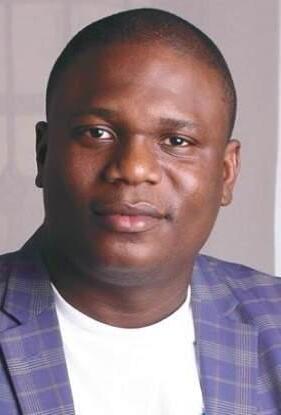
Tosin Eniolorunda is drawing attention again, this time for a move that could change how small food businesses operate in Nigeria.
His company, Moniepoint, has acquired Orda Africa. At first glance, this looks like another tech deal. In reality, it targets a daily problem many Nigerians understand: how small restaurants manage money, stock, and sales.
Most food vendors still run on notebooks, memory, and cash. This makes it hard to track income or access loans. Orda built tools to fix that. It helps restaurants record orders, monitor inventory, and manage kitchen operations. By bringing this into Moniepoint, those records can now link directly to payments and financial services.
The implication is as follows: when a business can show clear records, it becomes easier to access credit. That means more stability and room to grow. For a sector that employs millions, this matters.
The timing is also an important consideration that could be easily overlooked. Nigeria’s food business is expanding fast, driven by urban growth and changing lifestyles. Yet, much of it remains informal. This creates a gap between activity and access to finance. Moniepoint is trying to close that gap.
For Eniolorunda, here is a pattern that suggests a high mastery level. Since founding Moniepoint in 2015, he has moved from building banking software to creating a full financial platform. Today, the company serves over 20 million users and processes large transaction volumes yearly. This new step goes beyond payments into how businesses actually run.
The question now is whether this strategy will work at scale. If it does, it could change how small businesses are financed in Nigeria. If it fails, it will show the limits of combining software with lending in a largely informal market.
Either way, the move places Eniolorunda at the centre of a critical shift in Nigeria’s digital economy.
Fresh political talks within the All Progressives Congress (APC) point to a possible consensus strategy ahead of the 2027 governorship elections in Lagos, Ogun, and Oyo states.
The idea is so simple it would take a genius to spoil it: simply reduce internal fights by agreeing on one widely accepted candidate per state before primaries.
In Lagos, the heart of APC politics, Deputy Governor Obafemi Hamzat is being discussed as a leading option, owing to his government experience and his reputation for steadiness. Still, he is not alone. Names like Tunji Alausa, Akinwunmi Ambode, Hakeem Muri-Okunola, and Tokunbo Abiru remain in circulation. In other words, any consensus will require careful negotiation.
In Ogun, Senator Olamilekan Adeola (alias Yayi) appears to have strong backing from party stakeholders. His support base and national connections make him
a serious contender, not to mention the ease with which he is able to connect with the grassroots. However, Governor Dapo Abiodun is believed to prefer another candidate, Shaibu Salisu. This difference may slow any agreement.
In Oyo, Senator Sharafadeen Alli is said to be the preferred choice among many APC leaders. Even so, the party faces a tougher general election here. Governor Seyi Makinde of the Peoples Democratic Party (PDP) is still influential, and any APC candidate must be able to compete strongly against his camp.
Party primaries are often expensive and divisive. A single agreed candidate can help the party focus early on the main election.
But there is a risk. If some aspirants feel pushed aside, they may resist or quietly work against the party. Analysts warn that consensus only works when most stakeholders genuinely agree.
For voters, the key question is not just who emerges, but how. A smooth process may signal unity. A forced one may create problems later.
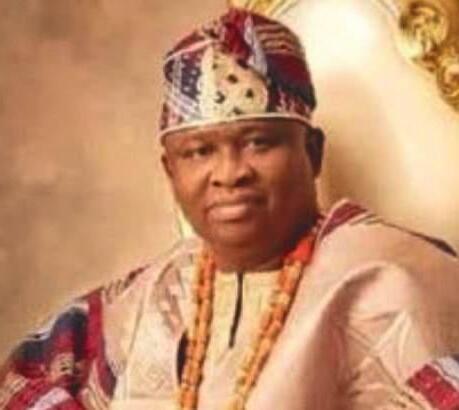
When Zacch Adedeji first took office as head of the Federal Inland Revenue Service, he was hard to miss. His name came up time and again in Abuja. His closeness to President Bola Tinubu gave him unusual visibility for a technocrat. Some even described him, half-jokingly, as a “prime minister.”
That phase has changed.
Today, Adedeji keeps a lower public profile. He speaks less. He attends fewer political gatherings. Yet, his influence has not reduced. If anything, it has become more focused.
His current role centres on tax reform and revenue growth. Under his watch, government earnings have increased sharply, with over N21 trillion reported in 2024 alone. He is also driving structural changes, including digital tax systems and the proposed National Single Window for trade. These are technical reforms, but they affect everyday issues like government funding, inflation pressure, and public services.
The shift in style appears deliberate.
Layal Jade Tinubu turned 35 in March 2026. For many Nigerians, she is known mainly as the wife of Seyi Tinubu, son of President Bola Tinubu. Despite this borrowed prestige, her work stands on its own, both in business and public engagement.
Layal runs Tots Toys, a Lagos-based business focused on early childhood learning. The idea is simple: structured play can support child development. The business targets middle and upper-income families, but it also reflects a broader interest in education and parenting.
The good lady’s larger impact comes through the Noella Foundation, which she co-founded. The foundation runs programs on youth and women’s empowerment. Its “Be Empowered” initiative has become a key platform. In recent cycles, it has provided funding and mentorship to female entrepreneurs. Reports indicate tens of millions of naira
have been disbursed to support small businesses.
For many observers, this matters because access to capital remains a major barrier for women in Nigeria. Programs like this attempt to close that gap, even if on a limited scale.
Her public role has also expanded. In March 2026, she attended a state banquet in the United Kingdom during an official visit. That appearance drew attention in international media. While some focused on style, others noted her presence as part of Nigeria’s broader soft power effort.
Her background helps explain this positioning. She was born in London to a Nigerian mother and a Lebanese father. She studied politics and later earned a master’s degree in business. She also worked at PwC before starting her ventures.
At 35, Layal now operates across three spaces: business, philanthropy, and public
Early visibility created expectations and, in some cases, quiet resistance within political circles. In Abuja, because visibility often invites rivalry, a quieter approach reduces friction.
Still, the tension has not disappeared. Adedeji’s direct access to the president remains a key factor. In a system where access can influence—if not completely determine—outcomes, that kind of proximity attracts attention, even when it is not displayed publicly.
There is also Adedeji’s clear decision to avoid electoral politics. Yes, the man has ruled out contesting the 2027 Oyo governorship race, but that choice strengthens his position as a policy operator rather than a political contender.
For many observers, the question is simple: does influence depend on visibility, or results? Adedeji’s current approach suggests the second. He is less visible now, but still central to how the government raises and manages money.

Tinubu representation.
and do they reach beyond a narrow circle? That answer will define how lasting her influence becomes.
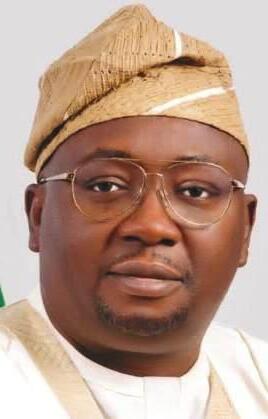
promises of improvement.
Between late December 2025 and January 2026, the national grid collapsed several times within weeks. For many households and businesses, this meant sudden blackouts, damaged appliances, and lost income. These events shaped public opinion more than official projections.
The government has acknowledged the problem. The Minister issued a public apology, admitting that outages have increased hardship. He pointed to gas supply issues and ageing infrastructure. For many Nigerians, those explanations are not new.
Tariffs have added to the frustration. Under the Band A system, some customers now pay over N200 per kilowatt-hour. The expectation was clear: higher cost should mean more stable power. In reality, supply remains inconsistent. This gap between payment and service is a major source of anger.
There are also perception issues. Past comments suggesting electricity is underpriced, or that Nigerians misuse
power, have not been well received. At a time of rising living costs, such statements appear disconnected from everyday experience. Policy efforts do exist. The Electricity Act 2023 allows states and private players to enter the power market. Metering programs and transmission upgrades are ongoing. Generation has reportedly increased compared to previous years.
However, these gains are not yet visible to most consumers. Power supply is still unreliable, and many rely on generators for daily needs.
Another concern is trust. Reports that government facilities are moving to independent power sources raise questions about long-term commitment to the national grid. Should citizens continue to stay on the ship when the captains seem ready to abandon it completely?
The central issue is not policy design but delivery. Nigerians are watching to see whether current reforms will produce stable electricity or remain plans without results.
Philip Aduda’s recent move from the PDP to the APC is not surprising when placed in context. It follows a long career in the National Assembly and a difficult political setback in 2023.
Aduda represented the FCT for about 20 years, first in the House of Representatives and then in the Senate. He rose to become Senate Minority Leader. But that run ended when he lost his seat in 2023. Since then, his political future has been uncertain.
His exit from the PDP comes at a time when the party is dealing with internal disputes. For a politician seeking a return, that environment offers limited structure or direction. Moving to the ruling APC provides clearer access to political networks, funding, and support ahead of 2027.
There is also the Abuja factor. Aduda is closely aligned with Nyesom Wike, the Minister of the Federal Capital
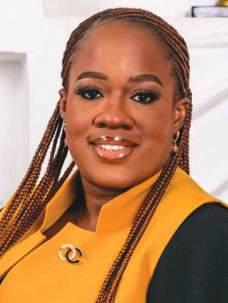
Territory. Wike’s influence in Abuja politics remains strong. By joining the APC, Aduda positions himself within that power structure, where decisions on local projects and political direction are increasingly shaped.
His declaration of support for President Bola Tinubu’s re-election bid also signals alignment with the centre. In practical terms, this improves his chances of regaining relevance, either through another Senate run or an appointed role.
Critics, however, point to voter sentiment. Aduda’s 2023 loss reflected a shift in public mood, especially among younger voters. Simply changing parties may not address that concern.
In the end, this move appears driven by two clear goals: survival after defeat and opportunity within a stronger political platform. Whether it succeeds will depend less on party labels and more on how voters respond next time.
Security concerns are rising again in Ondo State, and residents are beginning to react. In recent weeks, reports of kidnapping have increased, especially in rural and highway areas. In one community, three separate incidents were recorded within two months. Many now fear the problem is spreading, and all that pressure is crashing down on Governor Lucky Aiyedatiwa.
Part of the pressure comes from outside the state. Security reports suggest that criminals pushed out of nearby states like Kogi and Kwara are moving into Ondo. This has made border communities more vulnerable and stretched local security efforts.
Public frustration is also becoming visible. In Akure North, residents blocked a major road in protest after a kidnapping victim was killed. The governor warned that such protests could be hijacked, but the message from residents was clear: they want faster and more visible protection.
The government has responded with a mix of force and coordination. About 90 suspects linked to kidnapping and
related crimes have been reportedly arrested. The state also added 500 new operatives to the Amotekun Corps, focusing on forests, farms, and highways where attacks often occur.
There is also an effort to improve cooperation. Security agencies are working more closely, while community groups, including herders’ associations, have been asked to identify and isolate criminal elements. Additional police vehicles and over 100 military personnel have been deployed to high-risk areas.
At the same time, Governor Aiyedatiwa is dealing with a legal ruling that could limit his future political plans. A court has said he cannot run for another term in 2028, though he has dismissed the decision as premature.
For residents, the issue is simple. They want safety in their homes, on the roads, and on their farms. The coming months will show whether these measures can deliver that and whether the governor’s rating will improve. Presently, it is not.
When Chukwuma Soludo appointed Chiamaka Nnake as Secretary to the State Government in March 2026, it marked a shift in how Anambra is managing power and performance. At 39, Nnake became the first woman to hold that office. For the uninformed, Nnake’s rise did not start in politics. She built her career in finance and strategy, working with firms such as PwC, IHS Towers, and Meristem Securities. She holds a first-class degree in Accounting, an MBA, and is a Fellow of the ACCA. This background matters because her work in government has focused on numbers, systems, and results.
Before this role, she served as Commissioner for Budget and Economic Planning from 2022 to 2026. In that position, she changed how the state spends money. The 2026 budget directed about 79% of funds to capital projects such as infrastructure and development, leaving a smaller share for government running costs. That decision signals a focus on longterm growth rather than short-term expenses.
Nnake also pushed stricter rules on borrowing. Loans were tied to projects expected to repay themselves, not routine government spending. At the same time, she expanded the state’s revenue base using digital systems, with a target of N60 billion in internally generated revenue. Her work extended to business reforms. Anambra improved its ranking in ease of doing business, and policies were introduced to protect small traders from heavy tax pressure.
Her new role as SSG places Nnake at the centre of coordination across ministries. This means her influence now goes beyond budgeting into overall government execution.
For residents, the key question is simple: do these reforms lead to better roads, jobs, and services? Her record suggests a focus on measurable outcomes. The next phase will test whether this approach can be scaled across the entire government.
The excitement with which I was going to write this piece left me following the quick research I did. Apparently, I had seen sensational headlines all over social media on this “bobo” – Adelabu says it’s beyond our control, Adelabu has given up, Adelabu throws up his hands in resignation. I was so happy as I now prepared my own gun to give him the last verbal shot and end his career once and for all.
Something now touched me just as I was about to start writing – why not do some research? So, I went into mainstream media and found out that the man was utterly taken out of context.
What he was quoted by serious media to have said was that he was working very assiduously to resolve the blackout, knowing fully well the sufferings Nigerians were going through with the weather. He assured us that we would start seeing results in two weeks, even though he knew that most of the factors that would lead to a positive outcome were outside of the government’s control.
It is this last “out of our control” that
If you grew up in Shomolu or any of those kinds of places in Nigeria, you would have witnessed what I am about to illustrate with what I see happening between Mr. Obi and his newfound brother, Kwankwaso. You know, those days we rarely had “light.”
By light, I mean NEPA. So, on those very rare occasions that “light” will come, we would all rush to the TV to watch any of those programmes and all of a sudden, the light will suddenly do what we used to call ‘half current.’ It will flicker, then become extremely bright and next thing, poof!
Darkness
That is how I felt when I saw the pictures from the rally held by Mr. Obi and his brother, Kwankwaso, on his recent trip to Kano. The sea of red caps, the huge turnout, the almost religious affinity to the Kwankwasiyya or whatever they call their doctrine, and the little hope that we just may see a resurgent Obi candidacy. My people, like NEPA light those days,
people carried and ran with. Oh, he has given up, they shouted. One even said that he made the statement, rose up, did not acknowledge any greetings and drove to his office and still had a job –Nigeria.
Mbok, much as I would have loved for him to have truly announced his helplessness, what the man actually did was to state his resolve to solve the problem and this brings us to the Mike Tyson analogy – no matter how determined I am to beat up Iron Mike, no miracle in this world would make me last one round in the ring with him. In the same vein, it is very clear that no miracle in this world would make Adelabu defeat this issue of power. Not him, not his bosses, at least not in this dispensation. The thing “just pass them.” Na why dem go install inverter and solar. Nigeria, we hail thee, permanent darkness looms.
AbbA YUSUf: A CAp of mANY DImeNSIoNS
This one has defected but is still wearing the red cap that symbolises a certain tendency in Kano. This Governor of Kano State has done the unthinkable by defecting to the APC. This move was
what we saw in Kano was just a flicker that would shine bright and then disappear. Obi’s descent, most will not agree, is really painful to me because he alone among the sea of heads has the moral authority, the integrity and the strong will to topple this Nebuchadnezzar that we have found as our leader. But a culmination of inexperience, miscalculations and all of that seemed to have whittled down the momentum that saw him “winning” the last elections.
What we are seeing here now is an Obi that doesn’t seem to understand where the race track is. From LP to ADC and now flirting with the red cap people without any real structures on the ground, no real push in a contest that he would be running against an opponent that is in full strength.
Obi needs prayers very urgently, so that he will still stand a chance of playing the much-needed messiah that we need. God help him and help us by extension.
It was at the elegant din
considered one of the most heinous betrayals in recent times, considering his relationship with his principal. How he wants to deliver Kano to his new masters remains to be seen.
Despite his defection, the man still finds it very difficult to carry the broom, which is the symbol of his new masters, but still insists on wearing the red cap.
The other day, he was spotted wearing another cap and when his supporters, according to reports, asked if they should start wearing that cap, he was reported to have asked them not to, that he was just wearing this one for the occasion and that “it is not yet time to stop wearing the red cap.”
My people, this is like denying your favourite prostitute in public and still going back under the cover of darkness. This further accentuates the lack of ideology in Nigerian politics. We are all just doing “anywhere bele face” politics without any ideological compass. This is why we seem to be headed towards a cliffhanger.
This Kano own is just the darkest, most stupid thing that has happened so far. You know you have no foothold in the place. They came for you, and
you did not beg them to do like Wike and say – mbok let me remain where I am but will try my best to work for you underground or I will funnel resources to you to win in other states so that it balances out because this Kano, he no go work o. Na wa.
CHArleS SolUDo AND HIS CHIlDreN of ColoUrS Governor Soludo has one son who is very popular on social media. His social media name is Ozonna. I don’t know if that is his full or real name. The boy’s arrogance is very admirable. When I use the word arrogance, I mean the way he doesn’t give a hoot what people think about him. He will just plait his hair, wear some ugly, damp clothes, carry a female bag, sway his waist on the internet and dance to some very tasteless songs with all the seriousness he can muster.
At times, His Excellency will join him in this cacophony, the way Justice Oputa used to join his son on his bike in a pitiable show of solidarity. You know that saying – monkey no fine but him mama like am.
Well, Ozonna has weathered all of those storms to the point that Nigerians are
tired of abusing and laughing at him. Seeing that he doesn’t “send them”, they have switched to hailing him. His comment section has turned from the bile we are used to to a great fan zone with Nigerians asking for more. He is now such a huge social media star that it is amazing for someone who just a few months ago was seen as a tadpole. Just as we were getting over Ozonna, Adaora has jumped into our consciousness with her appointment as Women Leader of the City Boy Movement and has immediately gone to work with the proclamation that Tinubu or nobody. One intriguing thing about Adaora was the proclamation by her Dad during her wedding that this was the first in 142 years in their family because of the “scarcity of female children in their dynasty.”
I think a TV Series in the mould of the Kardashians should be immediately designed for The Soludos because the whole thing makes for very interesting watching. Nice family.
AlIko DANgoTe: FUel HIke AND MY CoNFUSIoN
During the week, I decided to go and visit one young sweet “chick”. As we left, my driver announced, “Oga, we need to buy fuel.”
We drove straight to the MRS station at Fadeyi and bought fuel for N30,000. As we set off, I asked: “Where e reach?” And he said a little bit above half tank. I screamed how come? “E suppose full,” and he answered that the price na N1,200, “e don go up.” I suggested we top up at Maryland. By the time we reached Maryland, the price had gone up. Oh my God. Fuel price was galloping the way Naira was tumbling when Tinubu first came in.
By the time of writing, which is exactly one week after, the price is now N1,400 at some stations.
In frustration, I sent out a post – mbok, if Dangote is supplying us all the fuel and he is not importing crude, why is Iran’s war affecting us? My people, it was an illiterate question. It was Mr. Kekere-Ekun who gave me that advice – Edgar, don’t always be in a hurry to attack, you have a voice, be calming down. If I had not posted that question, that is how I would have carried dirty tomato water and poured it all over Alhaji’s head. Knowing that one very well, he would have given me a Chinese kick in my groin. Mbok, I was schooled o. They told me that the man buys his crude at the spot international market price, even if they are giving him the crude from Ijaw land. I also heard that he gets about 20% of his crude needed locally because “Nigeria has done crude for loan,” which will see us giving out crude to creditors till my grandchildren become grandparents. Mbok, I heard so much that I had a headache. See me thinking that with this giant refinery, we would have cordoned ourselves from international shocks. Kai, illiteracy is bad o.
But then again, shebi Dangote is said to be worth all of that as the richest black man in the world, can’t he give us some small subsidy till this war is over? What is a few billion dollars “loss” to Alhaji na? The only thing that I think will stop that will be when his communications man, Tony, sends him the latest Forbes list and he sees his brother Samad surging on the list, he will just say – mbok increase the damn price abeg. Who will save us o? Fuel price is mad.
Those who know, know that I have just finished curating a book on power and influence. To secure the intellectual integrity of the book, I put 50 of the most cerebral Nigerians to contribute essays in the book. One of those contributors is the famous legal expert and Methodist Presbyter, Professor Konyinsola Ajayi, SAN.
I first knew of his father, the late great legal jurisprudent who fought many legal battles beside the great Chief Obafemi Awolowo in the 60s. I had spent some time with the Baba in their village a few months before his passing. But I finally got to meet the son, Konyinsola, about two years ago when he was introduced to me as I was preparing for a session on leadership.
Since then, he has spoken through a representative at my international seminar on the economy in London. So, when I approached him to write the foreword for the book, he did not mind my dreadlocks and penned one of the most incisive forewords to a book. You should read it. During the week, I went to see him with a sample of the book and his humility with such a rich pedigree still intact. He remains calm even in his Latino shirts and still evokes effortless brilliance. I tell you, God really created some people differently. His intellect, brimming not arrogantly but subconsciously, leaves you with no need to feel inferior even though you are not anywhere near his intellectual stature. Prof to me is a rare commodity
I will give the princely sum of N100,000 to the first man who without going to google tells me who this gentleman is. All you need do is send me a text message using my phone number on the top of this page and tell me who he is and what he does and which organisation he represents. Don’t worry about the money, I have already borrowed it so I will pay. Guys this is how low the Nigerian Bar Association (NBA) has fallen to that its president does not have facial recognition to the public and can pass through Oyingbo Magistrates’ Court without even the lawyers recognising him.
The last NBA President of note was my brother, Olumide Akpata, and ever since, na “sleepy town” NBA fall into. You only hear of them during their conventions where they are either bringing Portable the musician
to climb pole or where phones are getting missing and they are scrambling for corporate gifts. Where was the NBA when a judge asked Sowore’s lawyer to kneel down in the open court? There are so many injustices and harassments currently going on in the polity. Where is the NBA?
Gone are the vibrant days of the NBA where they were an effective bulwark against military tyranny and stood firmly with the common man in protecting their human rights. I think with the way the NBA is going, we should be praying for a Dino Malaye to emerge as President just may be the association will wake up because as we speak what we have is not a vibrant association of lawyers but a “sleepy contraption that only does conventions”. They will want to beat me now o.
that will never be replicated. How was your week, sir?
BleSSINg Ceo: IT’S All ABoUT FAITH
Blessing is the voraciously popular social media titan who has just announced that she has Breast cancer. You know these people; we don’t know if what they are saying is true or they are just saying it to gain traction. In fact, immediately she made the announcement another of her loudmouthed colleague shouted that it was fake. But subsequent posting shows that this may just be true as she has cut her hair, put up her houses for sale and made a very passionate video seeking financial support.
Breast cancer is not something we should play with as it affects almost two out of every five Nigerian women. Prevention is checking for lumps as early detection goes a long way in getting it treated. I was once on the same panel with her during one of my appearances on the Ruth Osime show and she cut the image of a happy go lucky lady who was in love as she appeared with her boyfriend, another controversial figure.
I have made my own donations even and I appeal to all fair-minded Nigerians to not only support her but all those who are going through same illness. God be with you, my sister.
Amen
SeYI TINUBU: A SoN oF HIS FATHer
This has, with no contest, emerged as the most visible and involved son of a sitting president – from attending the state dinner in Buckingham Palace to meeting the Emir of Qatar before top government officials, to driving in motorcades almost as long as his father, to now forming the popular City Boys Movement. Mr Tinubu Junior is today the most popular Nigerian, if not more popular than his father. What has triggered this my – make I look for him trouble - write up, is the poster where he is smiling behind my person, Ambode, announcing their run for the Lagos State top seat. Now that ambition, to the best of my knowledge, is not yet official, but his bearded face showed his power and influence in today’s political calculations.
Like him or not – me, I no like am –he is a factor. The man may not understand issues because I have never seen him comment on any issue except – my father is the best, my father came to save you, and you keep coming for my father –what you cannot take from him is his mobilisation prowess.
The man is a grassroots politician; he knows how to mobilise and make things happen. See the way his city movement has penetrated the Southeast, muted existing party structures and captured strong young minds and is well positioned to deliver the region to his father’s mandate.
He feigns humility. I see him at events, pretending to be humble, clasping his hands, bowing his head, and acting like he is one of the boys. That doesn’t resonate as I can see through all of that. To me, he is very strategic, committed and focused on whatever mandate he or his father has.
So, the question is, and I really cannot answer – is this good for Nigeria? Mbok, keep your answers to yourselves when all of this is over. I will release my answer, but for now, na under bed I dey until the storm is over. Thank you.
Iheartily congratulate His Excellency, President Bola Ahmed Tinubu, GCFR, on the joyous occasion of his 74th birthday
This special day offers us yet another opportunity to celebrate a remarkable statesman, an exceptional leader, and a visionary patriot whose life has been devoted to the service of our great nation and the advancement of democracy
Mr President, your un

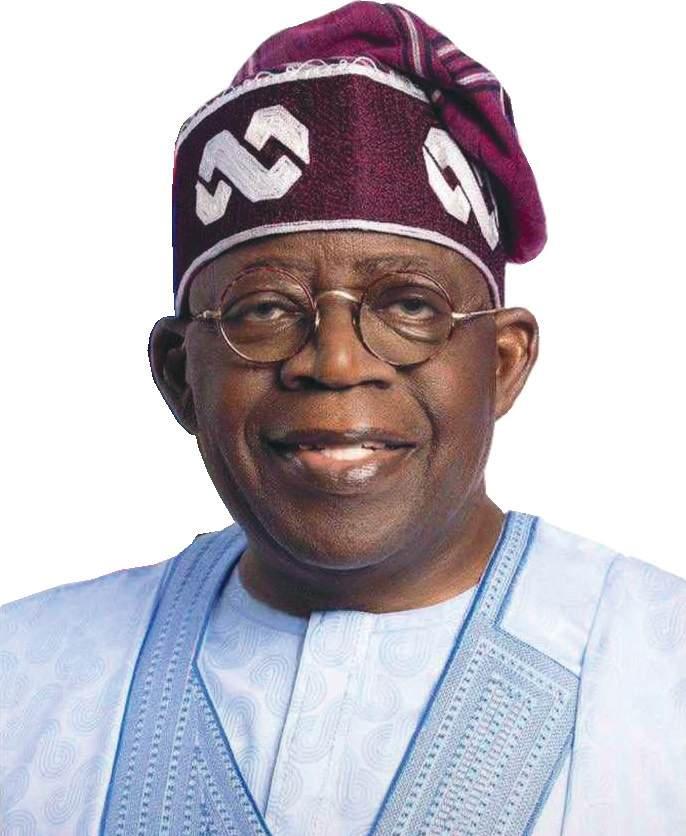
exemplary leadership, and your unrelenting pursuit of a better future for all Nigerians.
Your enduring contributions to democratic development, good governance and national transformation have firmly placed you among the great architects of modern Nigeria.
nation-building, your courage in the face of daunting challenges, and your steadfast dedication to the progress, unity and prosperity of Nigeria continue to inspire millions within our party and across the country.
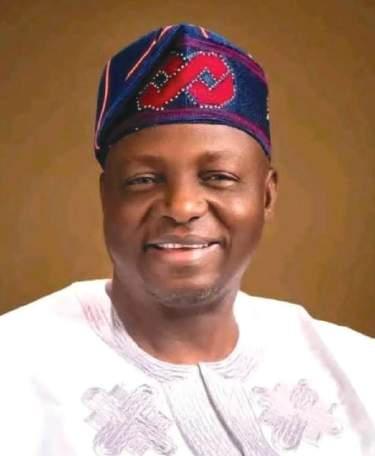
As a party, we
ofoundly grateful
On this auspicious occasion of your birthday, I join your family, friends, associates, well-wishers, and countless admirers around the world in thanking Almighty God for your life, your strength, and your invaluable service to our dear country.
We pray that Almighty God, in His infinite mercy, will continue to preserve you in excellent health, grant you greater wisdom, renewed strength, divine guidance and abiding peace as you continue to steer the affairs of our nation with courage, vision and patriotism.
Happy Birthday, Your Excellency
Signed: Professor Nentawe Yilwatda National Chairman, All Progressives Congress (APC)

Documentary photographer Chukwudi Nwachukwu’s lens captures the Andoni waterways up close, observing hands, nets, and canoes at work against the quiet, relentless presence of the river. Okechukwu Uwaezuoke writes
First, the blue hush. Then the sepia drift. The Labour of Rivers plunges into a day already in motion, a ritual worn smooth by repetition. Mud clings to bare feet. Light glints off the water, slicing through shadow. Hands move—diligent, purposeful. A fish is lifted from the net, a small, reluctant participant, held just long enough to register in human attention. Even routine carries its own tension: the water stretches, indifferent and vast; the world remains unmoved; and yet life insists on survival.
On survival—this is a word Chukwudi Nwachukwu, a Port Harcourt–based fine art photographer whose practice spans documentary filmmaking, has come to understand as not dependent on abundance, but on the ability to make use of what is within reach. The insight emerged while observing fishermen along the Andoni waterways, where both the environment and the stark simplicity of the tools they rely on held his attention. These men show up each day, working with what they have. In this way, the series deepens its focus on labour, resilience, and steady determination, where effort, rather than circumstance, becomes the defining force.
Raised in Aba, where survival is coded into daily rhythm and hands at work measure life, the 27-year-old learned early that existence is counted in subtle, tangible echoes. Though he shapes every frame, he orchestrates nothing—or hardly does. He simply watches, waiting for M-moments to present themselves. Gesture and light become narrative. Through the lens of the Abia State University mass communication graduate, presence leaves traces.
Take the blue-themed photograph titled “A Locally Made Wooden Canoe”, for instance. Absence evokes presence. The empty canoe rests in mud beneath a deep indigo wash—Nwachukwu’s way of suggesting morning light. Its hull bears the scars of years of service. Poles rise like questions—or prayers—vertical lines stretching between earth and sky. A yellow container sits in the stern, absurd in its brightness, stubbornly human amid stillness. Nwachukwu senses the weight of absence, the echo of labour, the imprint of hands no longer visible. Suspense coils in what is implied—the water remembers, the canoe remembers, and human presence lingers just beyond frame, poised to return.
In “A Locally Made Wooden Canoe,” the river seems to hold its breath. The canoe sits in the mud, its deep blue surface catching the first light of morning. Years of use have left their mark on its hull. Two poles stick upright like questions—or perhaps prayers—pointing between earth and sky. A yellow container perches in the stern, oddly bright against the muted tones of water and mud. Nwachukwu doesn’t stage the scene; he waits, watching for the subtle traces of labour left behind. The canoe holds memory, the river holds memory, and somewhere just beyond the frame, human hands are ready to return.
Another photograph, “A Fisherman Untying

His Canoe for Fishing”, continues the narrative, recalling Nwachukwu’s early career when moving image—most notably his documentary work on Burna Boy’s “Whiskey” (2024) and his short film “A Sunday Tragedy” (2026)—was central to his practice. From these projects, he learned the power of cinematic language: how natural light and atmospheric framing could honour his subjects. Today, he carries that ‘documentary soul’ into still photography, preserving overlooked cultural memories and subtle narratives of resilience. This sensibility explains why blue tones, evoking morning light, drape the river once more. A man grips a pole, stance deliberate; the canoe waits behind him. Farther out, another figure wades into the water, dissolving into haze. Preparation meets motion. Control confronts surrender. The yellow container gleams—absurd, stubbornly present. The scene is a study in negotiation: body against element, labour against endurance. Every lean of the pole, every shift of weight, holds suspense—a subtle question of balance, a relentless test of persistence. Still on insistence, “Fishermen Cast Their Net into the Water” stretches the perspective, turning the river into infinite possibility. Two canoes drift; three figures occupy them. One, alone in the foreground, rows with deliberate precision; the other two hover on a second canoe, poised between action and reflection. The net sinks into the water. The horizon embodies patience; the river remains indifferent. Tension hangs: will the day’s labour suffice? Will the water relent? Here, the smallest movement—the splash of oars, the subtle pull of the net—carries urgency, a quiet signal of human persistence against indifferent forces.
A cut to the sepia-toned photographs signals evening. In “A Fisherman Removes Fishes from His Nets”, a man bends low over the water, fingers freeing a fish that flares almost imperceptibly in
fading light. The river stretches, patient. There is no flourish, no triumph—only insistence, repetition, concentration. Each act is negotiation: human versus element, patience versus necessity. Tension is cinematic but restrained; a pulse hangs in the air, as if something might slip away at any second. And yet subtle humour persists: the fish remains a reluctant guest, coaxed into another world.
In “A Fisherman Holding His Paddle Beside the River”, suspense shifts to stillness. One hand rests on his hip, the other grips a long pole; the man stands on trampled mud, grounded in the unrelenting rhythm of the riverbank. The land is rough, unpolished; the sky offers no drama. Yet the figure asserts himself. The pole is more than a tool—it is sceptre, staff, marker of presence. Balance is the story. His gaze meets the camera, deliberate yet unassuming. Something in his posture hints at quiet assurance: he will endure, the river has risen before—and he has remained.
“Fishermen and a Woman Examine the Day’s Catch” tightens the focus. Three figures cluster around a blazing orange bucket, the day’s yield a luminous punctuation against a sepia-gold smear of river and mud. One holds, one inspects, one waits with hands on hips. Every glance, every pause carries weight: the bucket is small, but its contents are proof, argument, survival. The nearby canoe rests, indifferent—a silent partner in the economy of effort. Suspense is internal: will the haul suffice? Will labour have meaning? The answer comes quietly, in the glint of scales, the shuffle of feet, the tilt of heads.
Finally, “Fresh Fish Collected in a Basket After Fishing” slows the beat but tightens tension differently. Two men move along the riverbank in careful relay: one carries the catch inland, the other lingers by the canoe, poised to return. The river lies still; the horizon stretches patient and infinite. Labour

is cyclical, continuous, and in its quiet insistence, urgent. Each frame asks the same question: can the day be contained? Will effort yield result?
Across The Labour of Rivers, Nwachukwu’s eye traces rhythm, repetition, resilience. The fishermen return not for glory but because they must. Labour becomes suspense: will the hands succeed? Will the river yield? Morning, reflected in blue, brings cool clarity; evening, in sepia, reflects patience—light itself a character, marking time with careful observation. At the heart of the series is Nwachukwu’s principle: “He who leaves the shore in search of fortune carries only hope with him; he returns fulfilled not by what he finds, but by what the journey makes of him.”
Stories by Yinka Olatunbosun
Not everyone thinks of beauty when Chibok is mentioned. But filmmaker Joel Kachi Benson dares to look again in Mothers of Chibok.
The film opens with an establishing aerial shot of a village once plunged into grief a decade ago, when 276 schoolgirls were abducted in an unprecedented attack. Yet the camera also finds a quiet beauty: cornfields carefully tended by women, narrow paths carved through them by bicycles—the primary means of navigating the dusty, uneven terrain.
A gruelling 88-minute watch, the documentary follows four mothers—Lydia, Mariam, Ladi, and Yana—over the course of a farming season. It traces their struggle to fund their children’s education and healthcare through subsistence farming. Shot over three years, the film captures the rhythms of their daily lives, including the lingering absence of daughters who never returned. With no meaningful government support, the women cultivate corn and groundnuts despite meagre financial returns. From securing land to planting, harvesting, and transporting produce, they endure backbreaking labour, only to sell at deflated prices to exploitative middlemen. Yet even within this harsh economic reality, they remain resilient—committed to their children’s
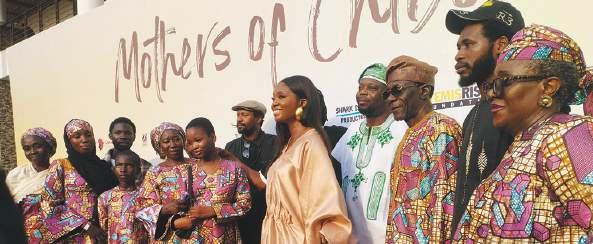
education and sustained, at times, by flashes of humour. One child, Ali—born in the aftermath of the abductions—must also contend with stigma and name-calling, navigating a long path toward acceptance.
At the Lagos premiere of Mothers of Chibok, held on Saturday, March 7, at Filmhouse IMAX, Lekki, Benson—an Emmy-winning director—and executive producer Joke Silva presented a work that pushes the boundaries of documentary storytelling. The film reframes Chibok, shifting the narrative from one of victimhood to one of
enterprise and forward motion.
The event began with a “Meet and Taste” experience, where guests interacted with the mothers and sampled branded groundnut products—peanut paste, popcorn, and more— produced through their cooperative. Rather than revisiting the 2014 tragedy in broad strokes, the documentary remains closely attuned to the lives of its four subjects, foregrounding their groundnut enterprise as a means of sustaining their families. The premiere drew a high-profile audience, including diplomats from the United States and Denmark, policymakers, and Nollywood figures such as Stella Damasus and Ngozi Nwosu. The project itself has evolved
into a structured agricultural initiative currently supporting nine women, with plans to expand to 100 in the 2026 farming cycle.
During the post-screening discussion, filmmaker Femi Odugbemi observed: “For more than a decade, the name Chibok has echoed across the world as a headline, a hashtag, a symbol. But what Kachi has done with this film is something far more powerful—he has restored humanity where the world once saw only statistics. He has turned a global news event back into what it has always been: a story of mothers, of families, of faith, of unbreakable endurance.”
Joke Silva echoed this sentiment, noting that the film restores a sense of humanity to Chibok. “It opens up an understanding of how these women have remained resilient, how they have fought back. What we need in any society are people who do not forget.” She described the mothers and their daughters as “dignified survivors” who continue to live with purpose, urging greater public support for their efforts to educate their children despite enduring hardship and trauma.
For Benson, the film is as much about perception as it is about documentation. “My intention was to make this place and these women visible in their beauty,” he said. “They fund education through farming, and if people support them, it becomes easier for them to educate their children. Last year, we worked with them to increase their harvest by 100 percent.
Avibrant mix of film screenings, French cuisine, poetry, and karaoke defined the 2026 International Day of Francophonie celebration held at Alliance Française Lagos (Mike Adenuga Centre), Ikoyi, on Friday, March 20. Organised by the Consulate General of France in collaboration with the Consulate General of Switzerland and the Embassy of Canada in Nigeria, the event presented a rich cultural programme aimed at promoting the French language and strengthening Francophone solidarity.
Lagos audiences were treated to three notable films reflecting the diversity of Francophone cinema: Un monde merveilleux (A Wonderful World, France), Une Colonie (A Colony, Canada), and Tambour battant (Switzerland).
Anchored on the theme “Un Monde à Venir” (“A World to Come”), with a special focus on “Génération Paix” (“Generation Peace”), the celebration highlighted the role of young people in shaping a sustainable future.
The day culminated in an awards ceremony for an inter-school competition involving secondary school students across Lagos. Wellspring College emerged winner, followed by Riverbank Secondary School in second place and Greensprings
Secondary School, Lekki, in third. Attendees also explored a “French Bazaar,” featuring tastings of Nigerian and Francophone dishes, alongside poetry performances, live music, a DJ set blending French and English sounds, and a karaoke session of popular Francophone songs.
Speaking at the event, the Consul General of
France, Laurent Favier, outlined the four core missions of Francophonie: promoting French as a shared language while celebrating linguistic diversity; advancing human rights and democratic values; supporting higher education and research— highlighting that 22 Nigerian universities are now affiliated with the French Research Centre—and building partnerships for future generations.
In a brief media interaction, Favier explained the significance of the annual celebration.
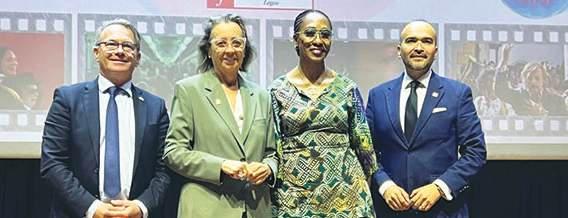
“Francophone countries celebrate the French language every March 20. While there are many activities, the focus remains on the language itself,” he said.
“Each year, the theme changes. This year, it is about the future—how we imagine the best or the worst of what lies ahead. To support students, we provide ten words around which they can build stories. Participants came from the FCT, Plateau, Oyo, and Lagos States. The La Compete Awards ceremony was held at Alliance Française, Ikeja.”
On the role of French in cultural diplomacy, he added:
“French is a working language in many international organisations, including the UN and the EU, and is widely spoken across the world. For anyone pursuing an international career—whether in the public or private sector—speaking French is a major advantage. It is more than a language; it is a tool for engagement.”
The Deputy High Commissioner of Canada to Nigeria, Carlos Rojas-Arbulu, echoed similar sentiments in his closing remarks.
“As a French-speaking Canadian, this event holds special meaning for me. For over 59 years, Canada has supported Francophonie as a unique project that brings together governments through a shared language and common values.
The crowd outside buzzed with anticipation; inside the screening room, impatience was beginning to ripple. The much-awaited opening film of the iREP International Documentary Film Festival, MADU, was moments away from screening. The lingering noise was understandable. iREP, a yearly convergence of some of Nigeria’s busiest creative minds, thrives as much on conversation as on cinema. The opening cocktail, held at the Ecobank Pan-African Centre in Victoria Island, Lagos, served as a vital industry bridge, bringing together veteran filmmakers, scholars, and emerging talents. Among those in attendance were festival Executive Director Femi Odugbemi, Kunle Afolayan, Joke Silva, Richard Mofe-Damijo, and Sam Dede.
When the film finally began, it demanded—and earned—its silence. For director Joel Kachi Benson, MADU marks a significant milestone in African documentary storytelling. Following
its 2024 global release on Disney+, the film has continued to gather acclaim, culminating in the 2025 Emmy Award for Outstanding Arts and Culture Documentary—making Benson the first Nigerian recipient in the category.
The documentary traces the journey of Anthony Madu, the young Nigerian boy whose 2020 video of himself dancing ballet barefoot in the rain captivated millions. Rather than leaning on a familiar “viral-to-fame” arc, Benson, alongside co-director Matt Ogens, crafts an intimate, observational portrait of a life in transition—from the streets of Lagos to the elite Elmhurst Ballet School in the United Kingdom. Known for his cinematic approach to non-fiction, Benson resists spectacle, instead drawing emotional depth from the dancer’s inner world rather than the outward milestones of his ascent.
Blending footage shot across formats—including mobile phones—the film captures moments
of departure, return, and adjustment: airport transits, quiet domestic scenes in Nigeria, and the disciplined routines of ballet school life in the UK. Across its 100-minute runtime, MADU demonstrates a careful sense of pacing, allowing its subject’s emotional landscape to unfold with restraint and clarity.
At its core, the film reflects the tensions of
cultural dislocation—the familiar pull between origin and aspiration. It explores the subtleties of migration: the ache of leaving home, the pressure to assimilate, and the quiet defiance of gender expectations within a Nigerian context. Through its attention to family, identity, and resilience, the narrative evokes both vulnerability and strength without sentimentality.
The documentary has since reached notable heights within global non-fiction cinema. Beyond its Emmy win, it received a nomination for Outstanding Direction at the Emmys and was also nominated for Best TV Feature Documentary at the International Documentary Association (IDA) Awards.
The opening night also featured visual arts installations and marked the conclusion of a three-day smartphone filmmaking workshop sponsored by Ecobank, which trained 120 young filmmakers. Festival activities continue with daily plenary sessions and screenings at the Ecobank Pan-African Centre and at Freedom Park, Broad Street, its longstanding venue.
Nigeria’s ranking as the fourth most affected country by terrorism in the recent Global Terrorism Index should serve as a wake-up call for the federal government to urgently intensify efforts to restore peace, Davidson Iriekpen writes
Adeafening silence has greeted the report from the Institute for Economics and Peace which ranked Nigeria the fourth most terrorised country in the world on the Global Terrorism Index (GTI) 2026. The non-profit think tank is headquartered in Sydney, Australia.
The federal government which is very quick to counter reports that do not sway to its favour has greeted this disturbing report with slience. Not even the military has uttered a word.
When Nigeria was ranked sixth in the 2024 GTI ranking, the federal government and the Defence Headquarters (DHQ) had vehemently dismissed the organization that issued the report as an ‘outsider,’ who did not know what it was saying. The government had insisted that the report cannot be more credible than the first-hand accounts of the armed forces on counter-terrorism efforts.
The new report showed staggering data. About 750 Nigerians have lost their lives to terrorism in 2025, representing a 46 per cent increase compared to the previous year. It also recorded 171 terrorist incidents, up from 120 in 2024.
With this new ranking, Nigeria moved up two places from sixth in 2024 to fourth in 2025. Globally, Pakistan, Burkina Faso, and Niger occupy the top three positions.
The report further showed that civilians were the most targeted group, accounting for 67 per cent of the victims of the attacks, while the military accounted for 19 per cent. This percentage has been steadily increasing over the last five years, highlighting a clear shift in terrorist targeting patterns in the country. The Islamic State West Africa Province (ISWAP) and Boko Haram, the report said, were responsible for most of the terror attacks in the country in 2025.
The report said, “In 2025, Nigeria rose two places in the index, reflecting the significant increase in terrorist activity in the country. Terror attacks in Nigeria increased by 43 per cent this year, from 120 incidents in 2024 to 171 in 2025.
“Deaths from terrorism have continued to rise, increasing by 46 per cent to 750 in 2025. This marks the highest death toll since 2020, driven by internal instability as well as ongoing conflict between ISWAP and Boko Haram.
“Together, fatalities attributed to these groups accounted for 80 per
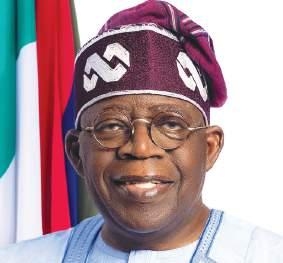
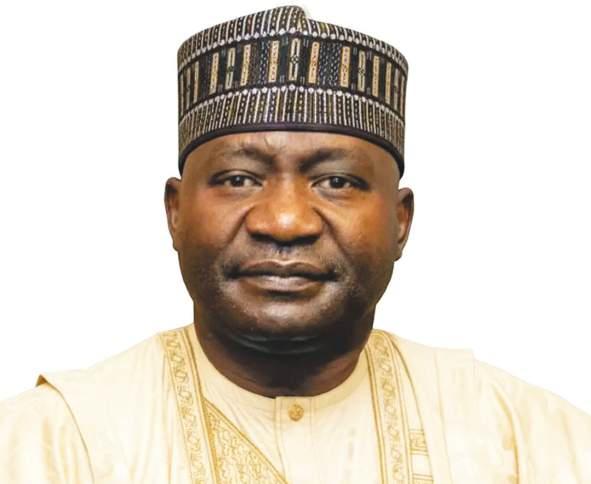
General Musa (rtd.)
cent of all terrorism-related deaths in the country in 2025,” the report stated.
“Terrorist activity this year was heavily concentrated in Borno State, which experienced 67 per cent of attacks and 72 per cent of deaths in 2025.
“Civilians continued to be the most targeted group in 2025, accounting for 67 per cent of fatalities, while military forces represented 19 per cent. This percentage has been steadily increasing over the last five years, highlighting a clear shift in terrorist targeting patterns in the country.”
Insecurity has persisted in Nigeria like a bad wound that refuses to heal.
The country has consistently featured in the Global Terrorism Index since its inception, specifically highlighted for its struggle with extremist violence over the past decade.
Of all regions of the country, the North has been the most ravaged, with the dire consequences spreading to the South.
Whilst the country has been contending with Boko Haram and ISWAP terrorist groups for over 15 years now in the North-east geopolitical zone, a new group, in the North-west,
the Lakurawa and Ansaru groups have gained notoriety in killing people and rustlingMahmudacattle.has come up in the North-central states of Kwara and Niger, equally killing and kidnapping people for ransom.
There is also al-Shabaab, whose members invaded Owo town in Ondo State and massacred over 40 worshippers. They are mostly operating in Kogi State.
There are marauding bandits who pose a significant security threat. They are notorious for their brutality, as they attack villages, kidnap residents for ransom, and loot property as they move from one place to another.
This widespread instability has caused mass displacement of residents of many communities, fuelling humanitarian crises, joblessness, and increased poverty.Hundreds of security operatives have also been killed by these nefarious elements.
For instance, within the last three months, seven commanding officers have been killed following coordinated assaults by Boko Haram and ISWAP fighters at different locations within Yobe and Borno states
President Bola Tinubu formally received the Zamfara State Governor, Dauda Lawal, into the ruling All Progressives Congress (APC) in Gusau last Tuesday where he assured the people of the state and the North-west of renewed measures to end insecurity and banditry in the region.
Lawal, who was elected on the platform of the People’s Democratic Party (PDP), had earlier announced his decision to join the APC, citing the unresolved crisis in the opposition party.
Tinubu, who was represented by Vice President Kassim Shettima, addressed a mammoth crowd of supporters in Gusau, the state capital. He commiserated with all victims of banditry and kidnapping that had bedevilled the region for decades.
He said the federal and state governments would reinforce military and other security measures to end the menace in the region.
According to him, Lawal’s joining the ruling APC would enhance coordination and support for security agencies to end banditry in Zamfara, in particular, and the region in general.
Zamfara State has been one of the states most affected by banditry in northern Nigeria, with communities repeatedly facing attacks, kidnappings, and displacement of residents for over eight years.
Several security operations have been launched by the federal government and security agencies to curb the activities of armed groups operating in the state and neighbouring areas for the past
During the same period, over 40 soldiers were said to have been killed by the two terrorist groups.
What is really annoying to many Nigerians, while these killings are taking place, members of the political class are busy politicking.
More worrisome is the fact that non-state actors are allowed to become increasingly daring in their operations to the extent of killing a huge number of security officials.
Last Tuesday, 12 soldiers and one policeman, alongside civilians, were killed following a deadly ambush by suspected gunmen in Giro Masa community, Shanga Local Government Area of Kebbi State.
Eyewitness accounts indicate that the attackers had been operating within the community and surrounding areas before intelligence reports traced them to a construction company yard. Acting on information provided by residents, security operatives were deployed to the location but were ambushed before reaching the site.
During the attack, the assailants reportedly set two military gun trucks ablaze, escalating the scale of destruction.
It is time the federal government took decisive action to end the insecurity ravaging the country. Its responsibility is to protect lives.
They can do better as speeches and rhetoric are no substitute for real action. With insecurity, there is no policy that the government, whether federal or state, can drive effectively. Insecurity is also a disincentive to investments.
Each day that another Nigerian life is lost marks a failure of leadership. The government must act boldly, particularly by granting states more control over their security. Nigerians cannot continue to perish in the hands of marauders while the leaders sleep peacefully.Whatever foreign assistance they can get, they should. Or even make sacrifices for the country. It is not a big ask if these steps will restore peace.Nigerians are dying daily while those in power continue to feast. They are normalising tragedy while other nations make progress. The country cannot continue down this path.
It is time to move from excuses to action, and from failure to measurable progress. A safe and secure Nigeria is not too much to ask; it is the right of every citizen.
10 years without respite.
Since he became president in 2023, Tinubu’s government has not been able to solve the insecurity challenges confronting the state and the country at large. He has not even visited the state to commiserate with the people who have lost their loved ones.
Is it now that the governor has defected to the APC that he would solve the problems of the state?
Other states that are have been APC before he be became president, are they faring better today?
Last month, Governor Lawal cried out that the Tinubu’s government had not extended financial support or intervention funds to his state in the same manner it had done to other states.
A recent revelation by the Tanimu Turaki-led Peoples Democratic Party that it was exploring peace options with the court-recognised PDP of the Minister of the Federal Capital Territory, Mr. Nyesom Wike, is a strong indication that Turaki’s group has bowed to Wike’s camp, which is strongly backing the re-election of President Bola Tinubu. Ejiofor Alike reports that the implication is that the party will not pose a formidable threat to Tinubu’s second term ambition
An indication that the Tanimu Turaki-led Peoples Demo- cratic Party (PDP) is willing to bow to the supremacy of the party’s faction led by the Minister of the Federal Capital Territory (FCT), Mr Nyesom Wike, emerged on Wednesday when Turaki revealed that the factional leaders on both sides had broken the ice and were willing to make sacrifices.
Addressing a press conference after a meeting of the National Working Committee (NWC) of the party, Turaki said the two sides were already exploring various pathways to a lasting resolution.
Though he insisted that the court cases on the leadership dispute would continue, the desire of his faction to make peace with Wike’s camp is evidence of surrender and acceptability of the authenticity of the minister’s camp.
Turaki appealed to both sides to im- mediately de-escalate high-tempered communications and actions, so as not to jeopardise the ongoing peace efforts.
He promised PDP’s aspirants that the party would field candidates for all positions in next year’s general election.
However, fielding candidates would be a mere formality because surrendering to Wike’s leadership means endorsing the re-election of President Bola Tinubu on the platform of the All Progressives Congress (APC).
Wike, who is the chief promoter of the authentic faction, has never hidden his support for Tinubu’s re-election in 2027.
Indeed, his support for Tinubu against PDP’s Atiku Abubakar in the 2023 general election was the major factor that weakened the major opposition party and led to the victory of the APC in the presidential election.
Political analysts view Turaki’s comments on fielding candidates as face-saving.
Many believe a Wike-backed PDP can never field formidable candidates that will have the capacity to truncate APC’s victory in the 2027 presidential election.
Oyo State Governor Seyi Makinde, who is aligned with the Turaki’s faction last Sunday expressed the view that any PDP member engaging with the minister’s camp has ef- fectively chosen to back President Tinubu’s second-term bid.
“We need Nigerians to judge. If you can be in their camp, where they promised to support the president, so be it.
“They have the government behind them. They have the judiciary behind them. They have INEC behind them. But we have the
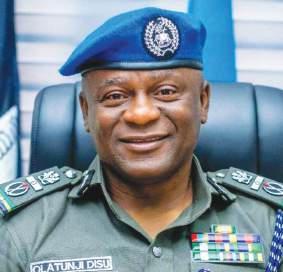
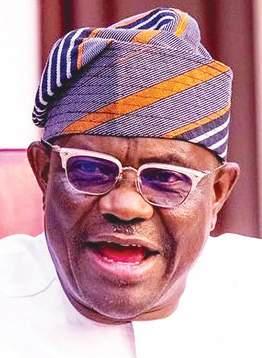
people behind us,” Makinde report- edly said.
Having failed in his several attempts to reclaim the leadership of the party from Wike’s grip through the courts, Turaki cited the Court of Appeal’s advice as an excuse for exploring peace options with the minister’s camp.
“In obedience to the advisory of the Court of Appeal, Ibadan, a few weeks ago, the parties in the suit should explore reconciliation to save the party from further strife and provide a platform for aspirants to seek elective offices in the coming elections,” Turaki said.
He admitted that the Adolphus Wabara-led Board of Trustees (BoT) of his faction had constituted a high- powered committee to interface with Wike’s group.
He also revealed that the NWC of his faction had issued a notice postponing the National Executive Committee (NEC) and National Caucus meetings earlier scheduled to be held two days later, as a demonstration of good faith.
Turaki noted that while his group expected a reciprocal gesture from the FCT minister’s camp, what it had witnessed instead was “the
weaponisation of hurtful rhetoric and the issuance of derogatory statements.”
Turaki insisted that the cases in court would continue.
However, his faction’s willingness to make sacrifices for peace indicate a loss of confidence in the ability of the camp to defeat Wike’s group at the Supreme Court.
Turaki said, “As soon as we reach agreeable terms, which we will honour even in the Court of Appeal, we will willingly withdraw all cases—whether at the Federal High Court, Court of Appeal, Supreme Court, or elsewhere—to give peace a chance.
‘’All cases will give way for peace as soon as we reach that point,” Turaki reportedly said.
He said, “On the issue of compromise, we are willing to bend as far as our necks and backs allow. We are ready to make all sorts of sacrifices in the overall interest of the‘’PDPparty.will not die,” he added.
However, while Turaki’s camp expressed its willingness to make sacrifices and bend backwards, Wike has shrugged off the existence of the faction.
In what appears to be a non-acknowledg- ment of the existence of Turaki’s faction, the FCT minister insisted that the party remained united as it prepares for its national convention on March 29 and 30
Addressing journalists in Abuja last
Wednesday, Wike said: “We have only one PDP, no faction. I don’t know which camp you are talking about. There is only one PDP. Some individuals may not be happy; yes, but there is no faction”.
The minister had earlier declared that his camp would negotiate from the position of strength.
Though he admitted that reconciliation efforts were still ongoing, he insisted that reconciliation should proceed alongside preparations for the national convention.
With Wike’s group holding all the aces, the camp appears unwilling to accept any power-sharing arrangement with the Turaki’s faction.
While the Turaki camp has suspended its NEC and National caucus meetings and was expecting Wike’s camp to suspend its national convention so that genuine reconciliation could be concluded for both parties to go into a national convention, the court-recognised PDP is insisting on organizing the convention to secure all the elective positions, leaving the Turaki’s group with no office in the party.
Also, despite the appeal by Turaki for the de-escalation of the combative communication on all fronts, the FCT minister had taken a dig at Makinde, mocking him for starting a war he could not win.
Wike spoke earlier on Monday at the NWC meeting of his PDP faction chaired by Abdulrahman Mohammed.
Wike said the Oyo State governor picked a fight he knew he cannot win, accusing him of escalating tensions within the party despite lacking the political leverage to prevail. Also speaking, Mohammed announced that the national convention scheduled for March 29 and 30 would be held as scheduled despite what he described as an alleged plot by Makinde’s faction to halt the exercise.
Following the Wike’s group’s unwilling- ness to halt its National Convention, the Turaki group, on Friday, asked the Supreme Court to restrain the faction from holding the convention.
The uncompromising posture of the court-recognised camp showed that it would adopt a winner-takes-all position and not yield any ground to Turaki’s camp.
With Wike in effective control of the party, political analysts believe it can never present formidable candidates that have the capacity to defeat the APC in the 2027 general election.
Finally, many also believe that Turaki and his group will unwittingly end up promoting the electoral fortunes of the APC if they eventually join the authentic PDP with Wike as the de facto leader.
The recent report indicating that a journalist with Albarka Radio in Bauchi, Mohammed Adamu, was brutalised by the officers of the state police command while covering the Eid Durbar celebration is disturbing.
All over the social media, Nigerians were inundated with photographs of Adamu soaked in blood from a broken head.
Reports claimed police officers hit him with sticks and rained blows on him during the public event.
Reacting, the Media Rights Agenda (MRA) condemned the attack and demanded an immediate investigation into the incident, calling on the Inspector-General of Police, Mr. Tunji Disu, to identify and prosecute the officers involved.
Similarly, the Bauchi State Council of the Nigeria
Union of Journalists (NUJ) also strongly condemned the assault, describing it as a violation of human rights and direct assault on press freedom. It added that the action was a disgraceful display of lawlessness by officers who are expected to protect, not harm, citizens.
It called on the Bauchi State Commissioner of Police, Sani-Omolori Aliyu, to launch an immediate investigation and sanction all officers involved in the incident.
The NUJ also demanded that the police command cover all medical expenses incurred by the victim.
Recall that when the former Inspector General of Police, Mr. Kayode Egbetokun officially resigned from office on February 24, his successor, Tunji Disu had pledged his commitment to human rights and the freedom of the press.
His pledge was a signal that his tenure would depart from the era of human rights violations and press freedom abuses that characterised Egbetokun’s tenure. Under Egbetokun, the police frequently weaponised harassment, brutality and Cybercrime (Prohibition and Prevention) Act (2024) to arrest and detain journalists arbitrarily. Police impunity and brutality seriously discredited his tenure.
The police often relied on the repealed Section 24 of the Act, and used allegations of cyberstalking and defamation under the Cybercrime Act to justify the arrests of journalists, bypassing civil legal procedures. Nigerians are looking forward to seeing how Disu will fulfill his pledge. He should not allow human rights violations perpetrated under his predecessors to continue.
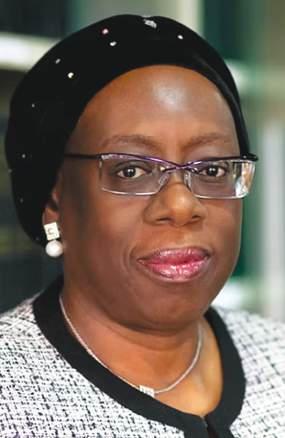
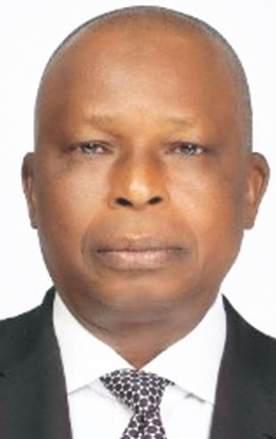
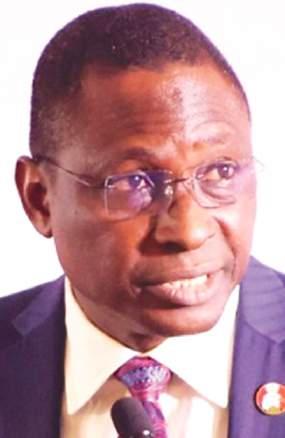
The recent conviction of a former acting Accountant-General of the Federation, Chukwunyere Nwabuoku, has rekindled the clamour for the establishment of special courts to handle corruption cases, similar to the National Industrial Court handling labour matters, Wale Igbintade writes
The Economic and Financial Crimes Commission (EFCC) secured a major victory last week when a Federal High Court sitting in Abuja sentenced a former acting Accountant-General of the Federation (AGoF), Chukwunyere Nwabuoku to eight years imprisonment.
Nwabuoku, who was convicted on all nine counts in the money laundering charges brought against him, was prosecuted for a crime bordering on money laundering to the tune of N868 million.
He was alleged to have perpetrated the act while serving as the Director of Finance and Accounts in the Ministry of Defence between 2019 and 2021.
In his judgment, Justice James Omotosho held that the EFCC sufficiently proved the offences alleged in the charge beyond reasonable doubt as required by law. The judge, who declined to grant the defendant an option of fine, described as appalling Nwabuoku’s conduct of diverting funds meant for security and defence while he served as the Director of Finance and Account in the Ministry of Defence.
While commending the anti-graft commission for being detailed in its prosecution, Justice Omotosho noted that the evidence of the ninth prosecution witness that revealed that Nwabuoku voluntarily refunded over N200 million during investigation was not controverted by the defence.
During the trial, the EFCC called nine witnesses, including a Zenith Bank staff member, Ms Eucharia Ezeodi, and a director in the Federal Civil Service, Mr. Felix Nweke.
In July last year, the former acting AGoF and his co-defendant, Nweke, asked the court for time to refund the alleged loot,
but later withdrew the request. The commission subsequently amended the charges, naming Nwabuoku as the sole defendant, and Nweke one of the prosecution witnesses. The commission re-arraigned him on January 15, 2025.
While EFCC has been commended for successfully and diligently prosecuting the matter to a logical conclusion, what is however surprising to many is that while Nwabuoku will spend the next eight years in prison, the case of his predecessor, Ahmed Idris, who was arrested and charged with an alleged N109 billion fraud since July 2022 is still pending before the Federal Capital Territory High Court due to the unnecessary slow wheel of justice.
Idris is standing trial alongside two others on charges bordering on gratification, theft, and criminal breach of trust. He is specifically accused of using public funds to purchase properties across Nigeria.
On February 1, 2024, his lawyer, Chris Uche, (SAN) alleged that the EFCC coerced his client into making self-incriminating statements under duress. The allegation temporarily paused the main trial and led to the commencement of a trial within trial.
It is against this background that legal experts have renewed the clamour for a special court to give the prosecution of corruption cases a boost.
These experts expressed worries over the manipulations and
frustration of the commission’s cases by those arraigned and their lawyers when they are granted bail.
Those in support of special courts for corruption cases argued that labour matters used to take many years at the conventional courts until a specialised court - the National Industrial Court (NIC) - was established. They further stated that to tackle the challenges facing the anti-corruption war, special courts must be considered as one stepping stone for the system to deliver justice fairly, squarely and swiftly.
Even successive chairmen of the EFCC had at several fora expressed dissatisfaction with the way judges have been handling corruption-related cases before them. This further fuelled the agitation for a separate special court to try cases of economic and financial crimes in the country as it is done in some developed countries. This, they believe, is one of the most effective strategies needed to adequately tackle graft in the country.
At a forum recently, a former EFCC boss pointedly blamed the courts for the delay in the trial of some corrupt officials the commission had arraigned. According to him, the judiciary was slowing down the anti-graft war, as the rulings and other processes used by the accused persons to escape prosecution gives the impression that the commission is not living up to expectation.
“I think this should be brought to the knowledge of Nigerians. I cannot investigate, take the witnesses to court, exhibits are tendered, and the cases are adjourned. I cannot do anything more than I have done. A special court for EFCC-related offences will take us away from the undue legalities that many brilliant lawyers have capitalized on to twist the hand of the courts and the commission,” he declared.
On one occasion, former chairman of the commission, Ibrahim Lamorde, had called on the National Assembly to amend the EFCC Act by empowering it to refer cases to special courts, adding that the delay in the trial of suspects charged for corruption at the conventional courts was frustrating the operations of the commission.
“In most cases, people are arrested and arraigned before the court only to be released the next day on bail. Honestly, we are getting frustrated because the man you picked up looks you in the face and tells you that you are wasting your time. The slow judicial processes our courts are known for and the bureaucratic and legalistic bottlenecks of the judicial system of this country do not allow us to achieve our stated goals easily. The legal process takes quite a lot of money, energy, time, and deployment of personnel to get a single conviction. To speed up prosecution of our cases, the National Assembly should begin the process of creating special courts with the requisite jurisdiction bringing to book, public and private officials involved in corrupt acts.” he declared.
Supporting the argument for the establishment of special courts, a senior lawyer who confided in THISDAY, said it is the way to go if the country wants quick and smooth dispensation of prosecution.
“We have to improve our system, especially when it is not delivering optimal results. The idea of specialised anti-corruption courts is not arguable right now. It is something that is very necessary. We already have a specialised court for labour matters: the National Industrial Court. To tackle the challenges facing the anti-corruption war, special courts must be considered as a good stepping stone. The system needs to deliver justice fairly, squarely and swiftly,” he said.
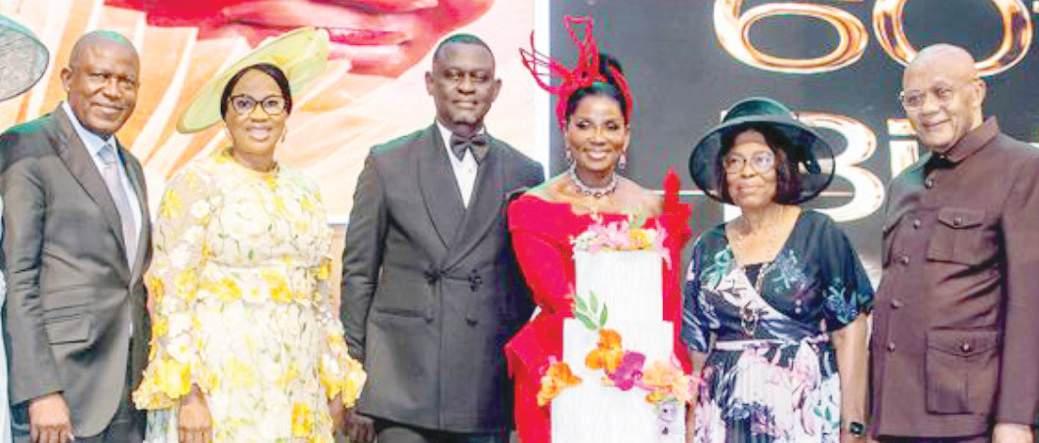
Troops of the Joint Task Force, Operation HADIN KAI, have defeated an ISWAP attack on FOB Mandaragirau in Borno State, killing 38 terrorists and recovering weapons.
According to a statement
issued yesterday by the Media Information Officer, Headquarters Joint Task Force OPHK, Lieutenant Colonel Sani Uba, the troops engaged the attackers with “well-coordinated ambushes and a deliberate offensive-defensive
Soyinka, Igwe Achebe, Gbenga Daniel to Grace Lagos Art Exhibition
Wale Igbintade
Some of the Nigeria’s most prominent cultural and political figures, including Nobel laureate, Prof. Wole Soyinka; Obi of Onitsha, Igwe Nnaemeka Alfred Achebe; and former Ogun State governor, Gbenga Daniel are expected to converge in Lagos for a high-profile art exhibition in honour of renowned artist, Prof. Bruce Onobrakpeya.
The event, organised by the St. Gregory’s College Old Boys Association (SCOBA), will host Soyinka, Igwe Achebe, and Daniel, as distinguished guests of honour.
Billed as The Gregorian Exhibition, the event is scheduled to be held at Jubilee Hall, St. Gregory’s College, Ikoyi, on April 25, 2026, with an opening ceremony expected
to draw a diverse audience from across Nigeria’s cultural, academic, and political spheres.
The gathering of such highprofile personalities underscores the national significance of the exhibition and the stature of Onobrakpeya, who is being celebrated as a UNESCO Human Living Treasure.
Soyinka’s presence, in particular, is expected to lend intellectual and cultural weight to the event, given his longstanding role as a leading voice in Nigeria’s literary and artistic community.
Similarly, the attendance of Igwe Achebe reflects the intersection of traditional authority and cultural preservation, while Daniel’s participation highlights the growing interest of political figures in the promotion of the arts.
Two books on godly devotion and leadership will be presented in Lagos April 19, the latest addition to Christian literature in Nigeria.
The books, “Take My Boss; Give me Nehemiah” and “No 23” discuss effective leadership in spiritual and secular settings and Psalm 23, arguably the most popular psalm in the Bible.
They are the latest offerings by Precious Okolobo, who has already published four books, among them, is “Fear Not,” a faith-based testimony of cancer survival.
“These works are an external expression of an internal impres-
sion on the urgent needs of society today,” Okolobo said.
“The lessons from Nehemiah’s achievements point us in the right direction towards good leadership, while there is something for everyone in the expose on Psalm 23 --- for the first-time reader to the seeker of the deep truths in David’s mind when he wrote what has turned out to be the sweetest psalm.”
The foreword to the book on leadership was written by the Geneal Superintendent of Assemblies of God Nigeria, Rev. Dr Abel Amadi.
response that forced them into a disorderly withdrawal,” while the Air Component provided close air support and ISR feedback to enhance targeted kinetic responses.
Subsequent exploitation along the terrorists’ withdrawal routes inflicted further heavy losses.
“A total of about 38 terrorists were neutralised with eight bod-
ies recovered so far within the immediate engagement area, and human intelligence from locals confirming over 30 additional terrorists’ bodies and weapons strewn along the Garin Mallum–Garin Gajere axis into the Timbuktu Triangle. Blood trails and abandoned equipment evidenced this,” the statement added.
“Troops recovered seven AK-47 rifles, eight magazines, four RPG bombs, and assorted ammunition. The JTF recorded no fatalities, though one MRAP vehicle was hit by RPG fire, with injured personnel promptly stabilised.
The statement noted that the scale of enemy losses
“has triggered widespread jubilation among local communities and highlights the sustained dominance of OPHK troops in denying terrorists freedom of action.”
Further exploitation operations are ongoing along the Garin Mallum–Garin Gajere axis to recover bodies and consolidate gains.
Wale Igbintade
A chieftain of the Labour Party and youth leader in Abia State, Engr. Nwabueze Onwuneme, has cautioned leaders of the All Progressives Congress (APC) in the state to adopt issue-based politics, warning that their resort to insults and intimidation is backfiring against both the party and President Bola Ahmed Tinubu.
In a press statement issued in Umuahia, Onwuneme accused APC leaders in Abia of abandoning constructive engagement for personal attacks, distortion of facts, and
what he described as attempts to bully Governor Alex Otti.
“Instead of discussing issues, APC leaders in Abia State have focused on insults, misrepresenting the governor’s developmental achievements, and attempting to bully him,” he said.
According to him, such tactics have only strengthened public support for the governor, as residents can directly relate to his administration’s developmental efforts across the state.
“Unknown to them, the more they insult and attempt to bully Otti, the more he gains public
sympathy and support. The people can see and feel the impact of his projects across Abia, and they view these attacks as unnecessary aggression by disgruntled elements seeking to disrupt ongoing development,” Onwuneme added.
He further argued that the conduct of APC leaders creates the impression that their actions are endorsed by President Tinubu, thereby damaging the President’s image among Abia residents.
“The manner in which these APC leaders operate gives the impression that they have the backing of President Tinubu. As
a result, their continued attacks are seen as an attempt to use federal influence to oppress a leader widely regarded as a hero by the people of Abia,” he said. Onwuneme warned that such perceptions could have political consequences, noting that repeated verbal attacks on Governor Otti are fueling resentment toward the President among ordinary citizens.
“The more these attacks continue, the more they generate disdain for President Tinubu among the people, who are increasingly being made to believe he is behind this style of politics in the state,” he stated.
Ejiofor Alike
The Group General Manager (GGM) of Continental Hotel Group, Mr. Karl Hala, has emphasized the importance of Nigeria’s youthful population in unlocking the country’s tourism potential in the quest to shore up the nation’s economic growth.
The Continental Hotel Group manages two iconic hotels - Lagos and Abuja Continental hotels
Speaking at the Eko Vanguard International Summit and Awards (E-VISA 2026) held in Lagos, Hala
noted that Nigeria’s median age is under 19, making Nigeria one of the youngest countries in the world.
“This is not a challenge – this is an economic engine waiting to be structured,” he said.
Hala highlighted the need for skills development and training programmes to equip Nigeria’s youth with the skills required to drive the tourism industry.
He also emphasized the importance of promoting entrepreneurship and innovation, citing the country’s vibrant creative
sector.
“Our youth are not just the future – they are the present,” Hala said. “We need to empower them with the skills and resources they need to drive tourism development and create jobs.”
The E-VISA 2026 event showcased Nigeria’s rich cultural diversity, with performances and exhibitions highlighting the country’s vibrant music, art, and cuisine.
Hala encouraged attendees to explore the country’s many attractions, from the bustling
streets of Lagos to the scenic beauty of the Jos Plateau.
As Nigeria seeks to diversify its economy, Hala urged stakeholders to prioritize tourism development, leveraging the country’s unique cultural and natural assets to drive economic growth.
The event also highlighted the importance of addressing negative perceptions about Nigeria, with Hala calling for initiatives like the “Good News Nigeria” campaign to promote a more positive narrative about the country.
The Central Bank of Nigeria (CBN) was last week, named the Central Bank of the Year 2026 by the Central Banking Awards Committee in London. The recognition reflects CBN’s roles in Nigeria’s major economic management and turnaround. The award, announced during the 13th annual Central Banking Awards, places global attention on Nigeria’s financial sector reforms and the role of the apex bank in stabilising the economy. The honour further highlighted pre-reforms challenges and ongoing rebound in exchange rate, foreign investment inflows and stability in domestic economy.
The Central Bank of Nigeria (CBN) under its Governor, Olayemi Cardoso has been acknowledged globally for the significant impact his leadership has made in steering the economy to the path of growth and stability.
According to the Central Banking Awards Committee, Nigeria’s economy was in a deep crisis before the current reforms began.
When President Bola Tinubu took office in May 2023, the committee noted that he met an economy close to what they described as “hyperinflation” and “fiscal bankruptcy,” with the naira losing value rapidly and inflation rising continuously. The administration responded with key reforms, including the removal of fuel subsidies and the liberalisation of the foreign exchange market.
However, the early impact of these policies was difficult for many Nigerians, as prices rose sharply and inflation climbed to 34.80 per cent by December 2024, the highest level in nearly three decades.
Despite these challenges, the committee said the CBN, under its governor Olayemi Cardoso, introduced reforms aimed at restoring stability, rebuilding confidence and strengthening the financial system. The approach focused on disciplined monetary policy, institutional changes and improved transparency.
Cardoso moved to end quasi-fiscal interventions where the central bank had been lending directly to sectors of the economy, a practice that contributed to rising inflation. The bank also carried out internal restructuring, reducing staff numbers, addressing misconduct and redeploying workers to areas where they were needed.
A senior official of the apex bank said governance and transparency became central to its operations. According to the official, the CBN improved how it communicates policy decisions, strengthened accountability and adopted analytical tools to guide economic decisions.
One of the most important reforms was in the foreign exchange market. The CBN introduced a willing-buyer, willing-seller system to replace multiple exchange rate windows. It also launched an electronic foreign exchange matching system to improve transparency and pricing.
Cardoso said the reforms have significantly reduced the gap between official and parallel market rates to less than two per cent, compared to over 60 per cent previously. He added that the bank has cleared the backlog of foreign exchange obligations, which helped restore confidence among investors and businesses.
The country’s external reserves have also improved, reaching about $46.7 billion by November 2025, the highest level in nearly seven years. The International Monetary Fund commended Nigeria’s efforts, noting that reforms in the foreign exchange market have improved liquidity and price discovery.
The CBN has also taken steps to strengthen the financial markets by working with the Securities and Exchange Commission and the National Pension Commission to improve transparency in the fixed-income market and support long-term investment.
On inflation, the apex bank raised interest rates from 18.75 per cent in 2023 to 27.5 per cent by late 2024 in a bid to control rising prices. These measures have started to yield results, with inflation dropping to about 15.10 per cent by January 2026. The bank has since made small reductions in interest rates as inflation pressures eased.
Cardoso said the CBN remains determined to bring inflation down further, noting that the current level is still too high. He explained that the bank is working towards adopting an inflation-targeting framework with support from the International Monetary Fund and the Bank of England.
Chairman of the Central Banking Awards Committee, Christopher Jeffery, said the Nigerian central bank showed strong leadership during a difficult period.
“The CBN’s leadership team has demonstrated plenty of courage and the CBN showed significant institutional strength to facilitate the rebuilding of unencumbered FX reserves and declining inflation, facilitating measurable progress toward sustainable growth and enhanced financial inclusion,” he said.
The recognition also points to improvements in governance and transparency within the apex bank. Over the past year, the institution has taken steps to streamline its operations, reduce unnecessary costs and improve communication with the public and investors.
Reforms in the banking sector, including recapitalisation efforts, have also strengthened financial institutions, making them better able to support economic growth.
Another area that contributed to the award is the modernisation of Nigeria’s payments system. The central bank has been working on new frameworks to improve digital payments, encourage innovation and expand financial inclusion.
These efforts are particularly important in a country where millions of people still lack access to formal banking services. By improving payment systems and supporting fintech innovation, the CBN aims to bring more Nigerians into the financial system.
The bank’s progress in addressing issues raised by the Financial Action Task Force, including its removal from the grey list, also played a role in boosting Nigeria’s reputation in the global financial community.
Taken together, these reforms have started to change how investors view Nigeria. There is now growing confidence that the country is on a more stable and predictable economic path.
This confidence was evident during recent engagements with global investors in London, where Cardoso explained the direction of the reforms and their impact on the economy.
Managing Director and Chief Executive Officer of Ambosit Capital Managers, Dr. Wahab Balogun, stated that “this award for the Central Bank of Nigeria is more than just recognition—it sends a strong signal about where Nigeria’s economy is heading and how the global financial community now views the country.”
For Nigeria, it means credibility is returning. Balogun noted that “for several years, investors were uncertain about Nigeria because of policy inconsistencies, foreign exchange restrictions and high inflation. When a respected global platform names Nigeria’s central bank the best for the year, it tells investors that the country is becoming more stable and more predictable. That matters because investors don’t just look at profits—they look for environments where rules are clear and risks are manageable.”
This kind of recognition he said can help Nigeria attract more foreign investment. Investors who were previously cautious may now begin to reconsider, especially in sectors like banking, fintech, agriculture and infrastructure. It also strengthens Nigeria’s position when negotiating with international partners such as development banks and foreign governments.
CBN moves to consolidate FX gains
The CBN is moving to consolidate recent gains in the foreign exchange market with plans to introduce a new policy framework, including an FX manual designed to expand market participation, tighten documentation standards, enhance surveillance, and ensure consistent implementation of reforms.
The proposed FX manual will strengthen oversight of the electronic foreign exchange matching system (EFEMS) while eliminating the risk of policy reversals that previously undermined market confidence.
The document, titled The Central Banking Awards 2026, was authored by Christopher Jeffery, Daniel Hinge, Daniel Blackburn, Joasia Popowicz, Levente Koroes, Thomas Chow, Jono Thomson, Riley Steward and Blake Evans-Pritchard.
The apex bank has also intensified efforts to develop a functional, transparent, and liquid fixed-income market, seen as critical for effective monetary policy transmission and the mobilisation of long-term domestic savings. In collaboration with the Securities and Exchange Commission and the National Pension Commission, the CBN has
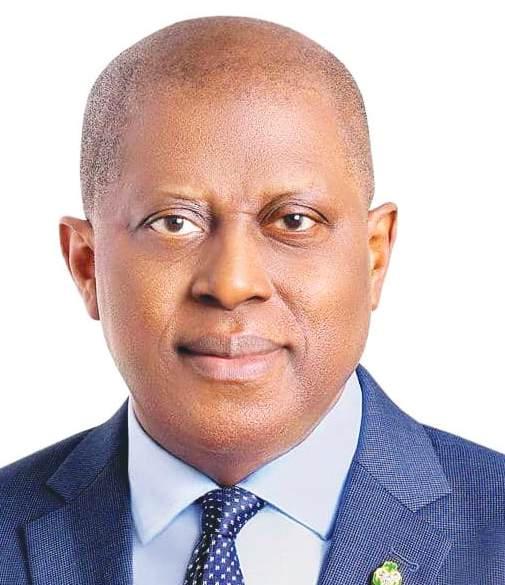
Cardoso
established rules to transition the over-the-counter secondary market into a more transparent and robust regulatory framework aimed at better serving investors and market participants.
“These reforms are foundational steps towards ensuring that Nigeria’s financial markets can support deeper investment, accurate pricing and stronger monetary policy transmission,” Cardoso said.
A major pillar of the reform agenda has been the overhaul of the FX market. The Central Bank transitioned to a willing-buyer, willing-seller framework, replacing the multiple-window regime with a more transparent and market-driven system.
Cardoso’s team introduced the electronic foreign exchange matching system (EFEMS), powered by Bloomberg BMatch, transforming FX trading through mandatory order submission, real-time regulatory visibility, and improved price discovery.
The CBN also launched the Nigerian Foreign Exchange Code to promote ethical conduct among market participants.
Crucially, the Central Bank cleared what Cardoso described as a “once crippling” backlog of FX obligations across key sectors such as aviation and manufacturing, helping to restore credibility and boost business confidence.
The reforms have reduced opacity and curtailed manipulation, restoring discipline to the market.
“The naira now trades within a narrow, stable range.
The once-substantial gap between the official and parallel markets has shrunk to under 2 percent, down from over 60 percent,” Cardoso said in December 2025. “We are committed to maintaining the current flexible exchange-rate framework that allows the naira to act as a shock absorber while limiting excessive volatility.”
Improved market functioning, stronger non-oil exports, and robust capital inflows have supported a steady rebuilding of Nigeria’s FX reserves without reliance on borrowing. Gross reserves rose to 46.7 billion dollars by mid-November 2025, the highest level in nearly seven years, providing more than 10 months of import cover, while net reserves are reported to be at a three-year high.
The International Monetary Fund (IMF), in its July 2025 Article IV assessment, noted that directors welcomed steps taken by the authorities to rebuild
reserves, support market confidence, and enhance liquidity and price discovery in the FX market.
Tackling inflation has also remained a central focus of the CBN’s policy stance as it returns to orthodox monetary policy. The bank raised interest rates sharply from 18.75 percent in 2023 to 27.5 percent by November 2024. As a result of tight monetary conditions and complementary measures, inflation has declined significantly from more than 32 percent in December 2024 to 16.05 percent in October 2025, and further to 15.10 percent by January 2026, with food inflation easing to 8.9 percent.
The moderation in inflation and expectations created room for cautious easing. The CBN reduced its policy rate by 50 basis points to 27 percent in September 2025, its first rate cut since 2020 and again by 50 basis points in February 2026 to 26.5 percent. This calibrated approach reflects efforts to safeguard macroeconomic stability while gradually lowering borrowing costs.
Cardoso has reiterated the bank’s “determination to bring inflation down further,” noting that the current double-digit rate remains unacceptable. The CBN is working with the IMF and the Bank of England to support a transition from monetary aggregate targeting to an inflation-targeting framework.
“Our transition to an inflation-targeting framework is gaining traction. We have improved data analytics, strengthened communication, and ended monetary financing of fiscal deficits. These actions have strengthened monetary policy transmission and anchored expectations,” Cardoso said in December.
The CBN’s models project continued disinflation in 2026, supported by stronger domestic production, improved FX liquidity, and more disciplined liquidity management. The bank maintains that monetary policy will remain evidence-based, data-driven, and unwavering in its pursuit of price stability.
The apex bank also emphasised improved coordination between monetary and fiscal authorities, noting closer collaboration with the Financial Services Regulation Coordinating Committee to ensure that monetary policy actions are aligned and do not operate in isolation.
Africa’s latest showcase for world democracy is still unfolding. In yet another landmark of African democracy farce, Denis Sassou Nguesso of Congo Brazzaville has just been re-elected for yet another term. At age 82, the official result of the just concluded presidential election indicated that Nguesso defeated everybody else by scoring 94.8% of the votes. He has been nearly 40 years in office. Other contestants and parties boycotted the election. Nguesso won against himself. His party vied and defeated itself. His incumbent government announced the result. The other “would have been” contestants are now either in hiding or have fled abroad. Something not too far from this atrocity was recently committed in Uganda not long ago. The musician main opposition candidate, the popular Bobby Wine, has since fled abroad after receiving the flogging of his life from Museveni’s goons. So much for progress in African democracy.
An unparalled precedent is in preparation as Nigerians prepare for a general election in January 2027. The jury is out in the political whirlwind of the season. For the dwindling body of believers in Nigeria’s shoddy democracy, we are nine months away from a general election. Nigerians will be called out once again to queue up in the ritual of vote casting. Thereafter, an outcome will be expected as to who gets to man this rusty ship for another four years.
The landscape for what is coming is taking shape. Virtually only one party, the ruling APC, is gathering steam on a massive scale. The conceptual opposition is still in untidy rehearsal. Some opposition leading lights have been attacked by gunmen at campaign rehearsals. Governors from the ruling party have warned opposition leaders not to come visiting or campaigning in their states. Some opposition enthusiasts have been arrested for reasons ostensibly not far from political rascality. In a land where violent insecurity is part of the normal, the possibility that all the indices of violence will be deployed to political ends is clear and present. Some people are looking forward to the election. But even far more are afraid of the dangers to life and limbs that lie ahead.
An election presupposes a popular choice limited by party choice. A multiparty democracy presupposes an organized contest among registered parties for the people’s party and candidate preference at the polls. At the last check. there were close to 80 registered parties in INEC’s register. I understand INEC pays people for doing nothing other than registering a party. Anyone who tries to remember the names and symbols of our motley of parties may end up in the psychiatric hospital in Yaba. But in reality, there are in today’s Nigeria only two and half parties. There is the All Mighty APC. There is the fledgling opposition ADC. And there are bits and pieces of a tottering what used to be PDP. In excess of 78 other parties are in INEC’s register. It is of course in the interest of Mr. Tinubu and the ruling APC to have INEC go through the motion of producing ballots for all the many phantom parties if only to reinforce the appearance of a competitive election among numerous parties.
In most real serious democracies, an election with more than three parties is often a disorderly joke. An endless buffet in the range of political parties diminishes the power of choice in democratic elections. A democratic election is not a grocery shop or super market of contending parties. In reality, democratic choice often limits the factor of choice to two- a binary choice in which the public mind is challenged to make a simple choice between two things that are contrasting opposites. We are often challenged to choose one of two options. In America, you choose between the Democrats and the Republicans in perpetuity. They deliberately add an Independent Candidate for comic relief of those who deliberately reject the two conventional parties and their dueling mascots. In the United Kingdom, you mostly choose between Labour and the Tory Conservative Party. Periodically, a third party, the Liberal Democrats of rebels, those bored of the monotony of Tories and Labour cobble something together to make parliament a bit more of an exciting bazaar floor. Elsewhere, most times in Africa, the ruling party funds other parties in order to create an illusion of a multi party democracy. The sponsored party entrepreneurs get paid off and they disappear into the crowd. The strength of a binary choice between two is inbuilt in the nature of human psychology. A choice between two options appeals to most populations. It is either black or white, either something or
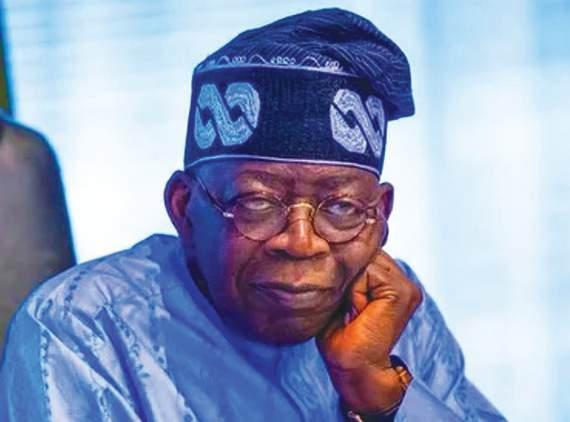
nothing. People have no time to decipher from among a motley of grey party options, their confusing symbols and political jesters parading as candidates and mascots. In any case, a common problem that has eighty different possible solutions is a nightmarish joke.
On the other hand, a one-party system is easier on choice but a joke on democracy. Devoid of multiple parties or limited to only one party, choice diminishes except among individuals within the lone party. It becomes a choice among individuals wearing exactly the same apron in an overcrowded kitchen.
Forget a single party with any number of contestants singing one monotonous song as in China. Limit the contest to one party and one candidate. You get a periodic referendum limited to an endorsement or rejection of the programmes and performance of just one hegemonic ruler. That may be where Nigeria is headed in January 2027. We may be heading for an election ritual that challenges Nigerians to choose between the APC and itself and between President Tinubu and candidate Bola Ahmed Tinubu!
Let us examine the mechanics here at home. In reality, what may happen in January 2027 may end up less than an election. Both the PDP and the ADC may remain in crisis or endless litigations till the day of the proposed election while only the APC approaches the 2027 election as a coherent party. Its singular achievement is its ability to retain its unity, grow its ranks and muster the external aggression to destabilize its adversaries while appearing invincible. It is part of the political dare-devilry of Tinubu and his fellow travelers that they are entering the 2027 election far stronger than they were in 2023.
AS we speak, the APC has gobbled up nearly all state governors, nearly all Senators and over two thirds of the membership of the House of Representatives. Decampment into the APC has become a national bazaar and political fashion. Most of the decampees are not even waiting to be invited into the APC. They are inviting themselves to a free for all buffet and helping themselves to as
close to the high table as they can. There is neither strategy nor reason. It is just a stampede at the entrance into a rowdy festival. The presumption is that once you are in the APC, you are automatically on the victory and gravy train. People forget that nearly all the Wike G5 governors who contested the senate elections almost lost woefully and have just managed to gate-crash into Tinubu’s incoherent list of ambassadorial nominees.
If the present APC-dominated party landscape remains fundamentally unchanged, we may end up with a referendum rather than a general election. An election contested virtually by mostly one party may end up as a nationwide choice of one party from itself. The voter turnout may shrink to only those who support and want to vote for the APC.
In effect, the massive escape into the APC may in fact be a voter suppression manoevre perhaps unintended by Mr. Tinubu and his cohorts. The logic of mass psychology may just dictate to most voters that there is no point going out to vote since the outcome of the election is already predetermined. This unfortunate preconception. added to the general distrust of INEC and its electoral machinery may further depress further turnout. Let’s not even talk of the atmosphere of looming insecurity all over the country which is likely keep many voters at home.
Nonetheless, for as long as the other parties are on the ballot, the exercise will still be deemed an election of sorts. Yet the pro-APC vote may be such a landslide that the combined vote tally of all the other contending parties will be a mere fraction of the overall voter turnout. Tinubu’s victory would still be an electoral choice of sorts. The nation will seem to troop out to reaffirm the Tinubu/APC hegemony or popularity. Of course, the other parties will show up on the ballot but only to the extent that they will contest to lend legitimacy and an appearance of electoral contestation to the ritual of electioneering.
Yet we cannot blame Tinubu and the APC for the sorry plight of the other parties. It is not the fault of the APC that a much touted opposition platform is yet to take roots. It is not Tinubu’s fault that the opposition cannot agree among themselves on basic issues as party leadership, party programme, basis of opposition and strategy for membership attraction. When the beginnings of the APC were hatched, it fed on the weaknesses of the then ruling PDP. The PDP was meeting at Eagle Square while dissidents walked away and
converged at he Yar’Adua Centre for an inaugural meeting of what began as New PDP (NPDP). Thereafter, the processes that culminated in the emergence of the APC were unstoppable until the PDP was swept out of power.
Yet it remains part of the responsibility of the ruling party and the incumbent government to ensure that the nation remains a credible multi- party democracy. This obligation is a national obligation which runs against manoeuvres that undermine rival parties. A multi -party political architecture is part of the nation’s sovereign heritage. To this extent, the activities of agents of the Tinubu government and the APC to disintegrate the PDP and the Labour Party in particular must remain condemnable. While a ruling party has no duty to run rival parties and keep them alive in spite of their internal crises, the ruling party has no business investing resources and efforts to destabilize rival parties. In the plight that has befallen the Labour Party and the PDP respectively, Tinubu and the APC must take ultimate responsibility in spite of desperate efforts to shift the blame to the judiciary.
But come the 2027 general elections, the absence of an effective electoral contest by other parties will effectively convert 2027 into a referendum on the first four years of Nigeria under Tinubu’s watch. A foregone majority vote count would be interpreted by the ruling party as a mass endorsement of both the APC as a party and Tinubu as President. A majority vote for the APC in 2027 would amount to an endorsement of mass impoverishment, sustained hardship, high energy costs, inadequate healthcare, dilapidated infrastructure, declining education standards and chaotic foreign affairs. Above all, we will have tacitly endorsed the grab of national political power by a moneyed and state armed cabal.
The vocal civil society and opposition megaphones cannot then have an effective response to challenge the curious turn of events. In effect, a presumed -multi party democracy could end up delivering the electoral outcome of a one-party authoritarian polity.
As 2027 approaches, what was intended as a general election could end up as an unofficial referendum, a plebiscite on the policies and programmes of a typical African autocrat emperor using political jerrymandering and serial blackmail to purchase a dubious mandate. Nigeria’s democracy elephant may end up giving birth to a miserable authoritarian mouse.
The integrity of governance depends not only on the conduct of those in office, but also on the standards by which they are assessed. This is a no-brainer.
Fairness, objectivity and respect for due process are not optional. They are essential, especially when it’s time to evaluate those entrusted with public trust.
To abandon these principles, therefore, is to risk creating a system in which anyone can be declared guilty, not because of what they have done, but because of who they are perceived to know.
Against this backdrop, it has become imperative to interrogate a troubling trend, one that speaks to a deeper malaise within our political culture.
There appears to be a growing disposition, driven perhaps by unease with earned reputation, to draw the Lagos State Governor, Babajide Sanwo-Olu, into a matter to which no direct link has been established.
The controversy surrounding the asset forfeiture order issued by a Federal High Court in Abuja, involving Oceangate Engineering Oil & Gas Limited and businesswoman, Aisha Achimugu, has in recent days assumed a dimension far removed from its legal origins.
What began as a dispute over the source and legitimacy of certain funds has now been stretched, regrettably, into the realm of political insinuation, with deliberate attempts to rope in the governor by association.
At the centre of the matter is a ruling secured by the Economic and Financial Crimes Commission (EFCC), which resulted in the final forfeiture of approximately $13 million linked to Achimugu’s firm.
In its judgment, the court held that the explanations provided regarding the origin of the funds did not sufficiently establish their legitimacy.
Good thing, Oceangate has rejected any interpretation of the ruling as proof of wrongdoing.
The company insists that the forfeiture order was predicated on suspicion rather than conclusive evidence and has already taken steps to challenge the decision at the appellate level.
It has expressed confidence that a more exhaustive judicial review would provide clarity and, ultimately, vindication.
Instructively, this response is neither unusual nor improper. The right of appeal is a cornerstone of any credible legal system. It exists to ensure that contested decisions are subjected to further scrutiny and that justice is not reduced to a single, unreviewable outcome.
In invoking this process, Oceangate is acting within its legal rights, reinforcing, not undermining, the integrity of judicial procedure.
What is unusual, however, is the speed and eagerness with which certain narratives have attempted to extend the implications of this case beyond its legal boundaries.
Almost immediately, insinuations began to surface, drawing tenuous links between the matter and Governor Sanwo-Olu.
These claims, lacking substantiation, appear to rely solely on perceived associations rather than demonstrable evidence. It is this leap, from legal dispute to political implication, that raises serious concerns.
For the sake of preserving respect for dedication to excellence in governance, every deliberate attempt to manufacture controversy around the governor must be firmly condemned.
Suggestions of any investigation involving Babajide Sanwo-Olu by the EFCC, and coming from supposedly
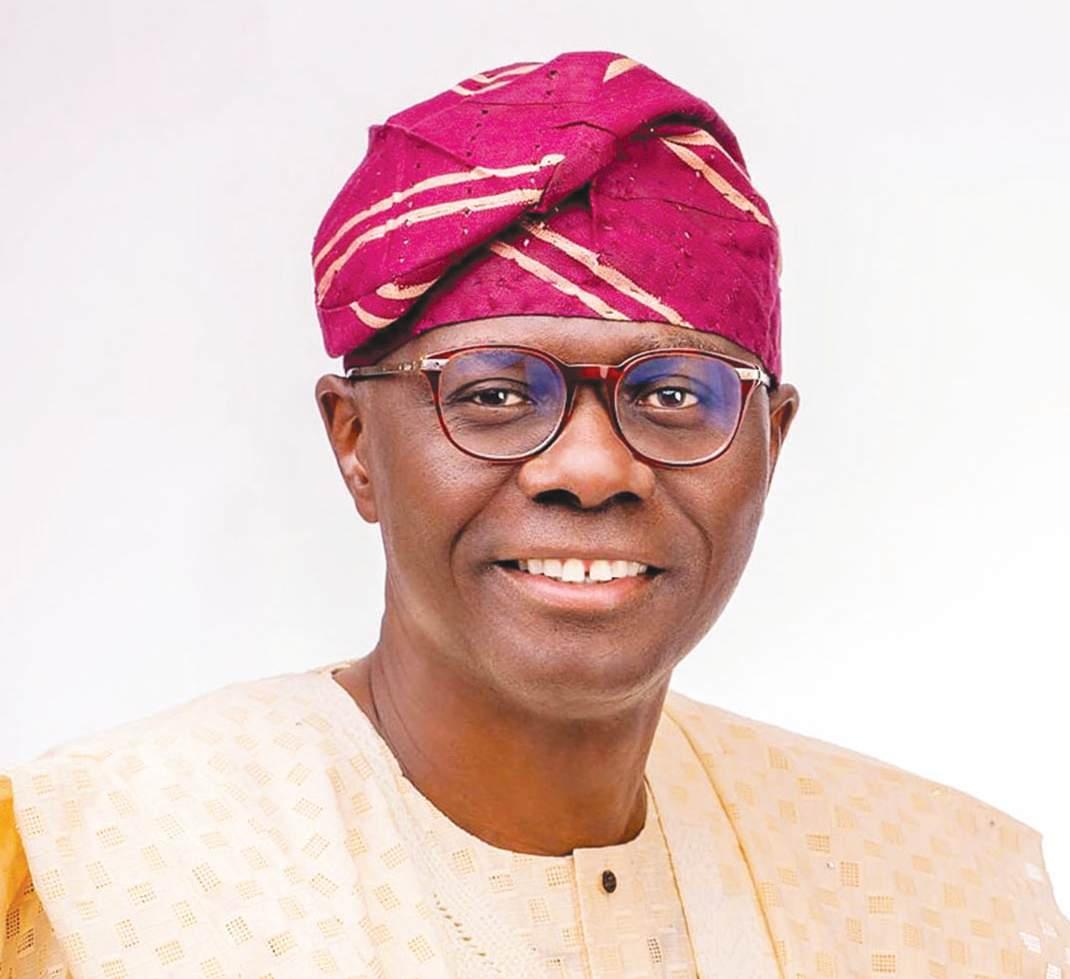
respected media groups, remain entirely baseless. Such narratives are nothing more than pointers to a broader agenda aimed at discrediting his administration as it approaches its conclusion.
Worthy of note is that this effort to paint the governor guilty by as- sociation is not an isolated incident. It reflects a growing pattern in which public figures are subjected to reputational attacks built on conjecture rather than fact.
Well-meaning Nigerians must, by this, rise to resist the normalisation of such tactics. They pose a significant threat to democratic engagement, shifting attention away from substantive issues and redirecting it toward manufactured controversies.
Indeed, what we are witnessing is the rise of a political culture that equates association with culpability. In this emerging climate, the mere suggestion of a connection, no mat- ter how remote, becomes sufficient to trigger suspicion.
Evidence is relegated to the background, while narratives, often untested and unverified, take the centrestage. Once entrenched, such narratives are difficult to dislodge, regardless of their accuracy.
This tendency is particularly dangerous because it erodes one of the most fundamental principles of justice: that responsibility is personal and must be established through due process.
To attribute guilt by association is to abandon this principle entirely, replacing it with a form of
collective suspicion that is both unjust and unsustainable.
In the case of Governor Sanwo-Olu, the implications are clear. By attempting to link him to a matter already before the courts, and in which no evidence has been presented implicating him, his critics are effectively inviting the public to reach conclusions ahead of facts. It is, in essence, an attempt to replace proof with perception.
More troubling still is the subtle but dangerous suggestion that such outcomes are inevitable, that once a public official leaves office, scrutiny must automatically translate into indictment.
This is the logic behind the quiet “pre-booking” of post-tenure investigations, a practice that reduces accountability to a predetermined script rather than a process guided by evidence.
Such thinking is not only warped; it is profoundly damaging. It creates an environment in which public service is viewed not as an opportunity for impact, but as a prelude to suspicion.
It discourages capable individuals from stepping into public life and undermines the morale of those already committed to serving.
The tenure of Babajide Sanwo-Olu has been defined by a clear policy direction and a sustained effort to position Lagos as a modern, economically competitive city. Like any administration, it is not beyond critique.
However, such critique must be anchored on verifiable performance metrics, policy outcomes and governance decisions, not in speculative associations that lack evidentiary backing.
The distinction is critical. A society
that cannot differentiate between legitimate scrutiny and opportunistic insinuation risks losing its capacity for objective assessment. It becomes vulnerable to manipulation, with public opinion shaped less by facts and more by the persistence of often malicious narratives.
The issues surrounding Oceangate Engineering Oil & Gas Limited will, in due course, be resolved through the appellate process. That is as it should be. The courts remain the appropriate place for determining the merits of the case, and their eventual pronouncement will carry the authority of law.
What must be resisted, however, is the temptation to convert that legal process into a political spectacle, one in which a sitting governor is judged not on the basis of evidence, but on the strength of association.
As Lagos approaches the end of the current administration, there is a need for sobriety in public discourse. This is a moment that should be defined by reflection, evaluation and forward planning, not by the projection of unverified claims or the amplification of mere speculations!
At the end of the day, governance must retain its dignity, and service must retain its honour. Dignity and honour are not mere ideals; they are the foundations upon which public trust is built. And without them, both governance and democracy stand diminished.
•Oladiti-Akinola wrote in from Ikoyi, Lagos.

L-R: Lead, PV Capital, Oreoluwa Oyinlola; Research Analyst, Chapel Hill Denham, Boluwatife Ishola; Treasury and Investment Associate, Piggyvest, Divine Izeg-Udevbure; COO/Co-Founder, Piggyvest, Odun Eweniyi, and CMO/Co-Founder, Piggyvest, Joshua Chubueze, during the Piggyvest round table finance discussion in Lagos...Friday
simon.kolawole@thisdaylive.com, sms: 0805 500 1961
You must have heard that the Electoral Act, 2026 (EA 2026) has removed certificate forgery as the basis to challenge the outcome of an election at the tribunal. Someone drew my attention to it a while ago and my first instinct was to doubt it. You cannot blame me. My training as a journalist — both in the classroom and on the job — is to be cautious, or even sceptical, with unsolicited information until proven true. Off the top of my head, my response was that the 1999 Constitution already lists certificate forgery as a ground for disqualification. An act of parliament can never override the constitution. We don’t need to have a law degree to understand this basic fact. If I wanted to ignore the claim after doing some basic reading of the EA 2026 and the constitution, I couldn’t. I started seeing disturbing reports by respected newspapers and angry comments by commentators and activists about the issue. That was when I decided to take it more seriously, at least for my own education. I like to call myself a Berean journalist, styled after the Berean Christians in the Bible who always diligently searched the scriptures to verify the teachings of Paul and Silas. They didn’t simply swallow everything head, thorax and abdomen — or, if you will, hook, line and sinker. In this world where the new order is information and disinformation, you can’t be too careful.
However, I told myself there is no smoke without fire — just that the alarm can go off at times based on a false trigger or legitimate smoke. I spent hours reading the 1999 Constitution, dating back to the various amendments since 2011. I read the 2022 Electoral Act and compared the provisions with the 2026 version, which was passed by the parliament and signed into law by President Bola Tinubu last month. I also sought the opinion of a senior lawyer who is versed in matters of this nature. I have decided to share the findings of my self-appointed, one-man investigative panel in this article. The long and short of it is that Nigerians are entitled to cynicism and hysteria. It is a low-trust society.
The provision in contention is section 138 of EA 2026 which states: “(1) An election may be questioned on the grounds that the— (a) election was invalid by reason of corrupt practices or non-compliance with the provisions of this Act; or (b) respondent was not duly elected by majority of lawful votes

INEC Chairman, Amupitan cast at the election. (2) An act or omission which may be contrary to an instruction or directive of the Commission or of an officer appointed for the purpose of the election but which is not contrary to the provisions of this Act shall not of itself be a ground for questioning the election.” Can you see anything? You can’t? That is exactly the problem: something is actually missing there.
We now go back to section 134 of EA 2022, its predecessor, which says: “(1) An election may be questioned on any of the following grounds— (a) a person whose election is questioned was, at the time of the election, not qualified to contest the election.” This old provision meant if you presented a forged certificate, it could be a basis for election petition. But there are also requirements about age, citizenship, education, criminal record, and political party membership. If you do not fulfil the requirements, or qualifications, you cannot be a candidate. If you are nominated, your candidature is invalid. Why then is the narrow focus on certificate forgery? We shall come back to that shortly.
Let me quickly say this: a narrow reading of laws is commonplace in our public discourse. Anywhere in the world, the provisions of a law are not interpreted singly or in isolation. They are interpreted through joint reading with other laws and judicial pronouncements, known as “case laws”. In the same EA 2026, section 85 says: “A political

party shall not impose nomination, qualification or disqualification criteria, measures, or conditions on any aspirant or candidate for any election in its constitution, guidelines, or rules for nomination of candidates for elections, except as prescribed under sections 65, 66, 106, 107, 131, 137, 177 and 187 of the Constitution.” Please come with me.
Section 137 (1) of the 1999 Constitution states expressly: “A person shall not be qualified for election to the office of President if - (i) he has presented a forged certificate to the Independent National Electoral Commission.” Section 85 of the EA 2026 already refers to this constitutional provision which makes certificate forgery a ground for disqualification. Repeating it in an EA is a waste of time, paper and ink. The courts are not so dumb to say because forgery is not mentioned in an EA, then the constitution is void. Sections 106(1)(h), 107 (1) (h) and 182(1)(i) of the constitution list certificate forgery as basis for disqualification in different categories. And the constitution supersedes the EA.
But why was section 134 (1) (a) of EA 2022 not retained, nevertheless, to provide for post-election litigation? That is left to the national assembly to explain. We have been beaten many times and we have earned the right to be suspicious of every move by our political leaders. One explanation I have heard is that post-election litigation must be related to the actual conduct of the election and not a pre-election matter on qualifications. That is, the parties must screen and pre-qualify candidates, and those who want to point out forgery must do so in a court of law before election day so that petitions will be limited to the actual voting. It is possible there are other reasons. I don’t know.
Back to the question: why did the whistleblowers focus on only “certificate forgery” in their outrage over EA 2026? Why did they not raise the alarm on other aspects of “qualifications” — such as age and citizenship — that may, at least theoretically, be affected by the amendment? Even so, I am baffled that the objection to the amendment is being raised long after the passage of the bill. Were we sleeping? My sense is that some people want to re-litigate the Chicago certificate affair involving Tinubu, the likely APC presidential candidate in 2027. This matter was litigated all the way to the Supreme Court and dispensed with after the 2023 elections. We are in for Season 2, I imagine.
Mallam Nasir el-Rufai, former governor of Kaduna state, lost his mum, Hajiya Umma el-Rufai, on Friday. Coming at a time he is in detention ahead of his trial over allegations of corruption, the death evoked contrasting emotions. The Independent Corrupt and Other Related Offences Commission (ICPC) decided to release him from detention on compassionate grounds, even though el-Rufai’s application for bail is still pending in court. I was surprised — maybe not too surprised — at some of the comments for and against his release. He is not in detention for murder or terrorism. The ICPC allegations are all bailable. Why must we always play politics with everything in Nigeria? Bemusing.
MORE ACCOUNTABILITY
Conventional wisdom in Nigeria is that “big men” don’t go to jail for corruption. It is usually said that Nigerian prisons, inappropriately renamed “correctional centres”, are for petty thieves. A federal high court in Abuja has just sentenced Mr Anamekwe Nwabuoku, former acting accountant-general of the federation, to jail over allegations of money laundering. Justice James Omotosho held that the EFCC proved its case. When you remember that former governors such as Chief Joshua Dariye and Rev Jolly Nyame, as well as figures like Hon Farouk Lawan and Alhaji Abdulrasheed Maina have been gone to jail for corruption, maybe we should not give up yet. Let’s hope for many more. Half-full.
US President Donald Trump, in collaboration with Prime Minister Benjamin Netanyahu of Israel, has been bombing Iran for four weeks.The entire world is paying the price: higher energy costs, high cost of living, and disrupted international travels to and via the Mideast. This is to say nothing about the destructions and deaths. Trump said he has “obliterated” the Iranian military but the Iranians are still launching missiles at Israel and US allies in the region. America has the most powerful military in the world, no questions about that, but is might always right? Can every problem in this world be solved with guns and bombs? Yes, Americans can win the war, but can they win the peace? Reflections.
NO COMMENT
Justice Chukwujekwu Aneke of the federal high court sitting in Lagos has ruled that the Central Bank of Nigeria (CBN) acted “in bad faith” when it sacked the board and management of Union Bank of Nigeria Plc in January 2024. He nullified all decisions and steps taken by the CBN-appointed board and ordered that the former board, led by Mr Farouk Mohammed Gumel, be restored immediately. The verdict shook the industry. The CBN has, expectedly, filed an appeal and a stay of execution. For you to know how serious the apex bank is taking this prolonged matter, it has hired 15 lawyers, including 11 SANs, for the appeal. The other party has only one SAN! David vs Goliath? Hahahaha…