Confusion Over El-Rufai’s ICPC Release after Mother’s Death
Alex Enumah in Abuja
Confusion has trailed reports of the temporary release of former Kaduna Governor,
Mallam Nasir El-Rufai by the Independent Corrupt Practices Commission (ICPC) following the death of his mother, This was as Bashir El-Rufai,
son of the former Governor who announced his father’s release on X, deleted the statement later yesterday. Also, when contacted on the
matter, spokesperson of the ICPC, Mr John Odey, declined to respond to calls nor did he respond to messages sent to him via WhatsApp.
Earlier yesterday, the ElRufai’s family had announced the death of Hajiya Umma ElRufai, the former Governor’s mother.
President Bola Tinubu and former Vice President, Atiku Abubakar, had commiserated with the family of the
Union Bank: CBN Heads to Court of Appeal, Seeks Stay of Execution...
APC Convention, Party Politics and Nigeria’s Democracy
Adedayo Akinwale and Sunday Ehigiator
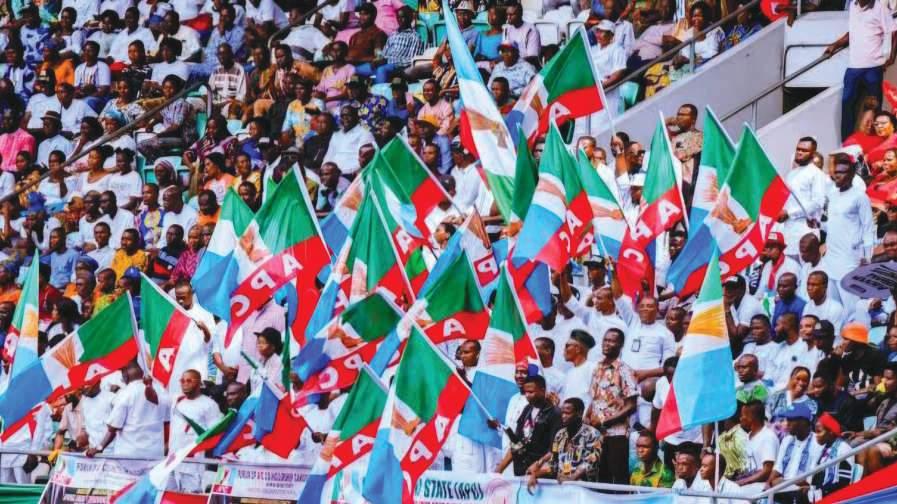
The Federal Capital Territory (FCT) was a beehive of activities from yesterday till the early hours of today as the ruling All Progressives Congress (APC) held its 8th National Convention with a total of 8,453 delegates electing new national officers of the party.
The event went beyond routine party ritual to reflect the deeper state of the country’s democracy. With the presence
of President Bola Tinubu, the gathering was seen as both a consolidation of power and an early rehearsal for the 2027 general elections.
To fully understand the
significance of the moment, it is important to situate party conventions within Nigeria’s political history.
For instance, in the First Republic, parties such as the Northern People's Congress, Action Group, and National
Council of Nigerian Citizens operated conventions and congresses that were deeply influenced by regional, ethnic, and ideological alignments.
While these gatherings provided platforms for leadership selection and policy articulation, they
were also arenas of intense rivalry that sometimes deepened divisions within the fragile federation.
Since the return to civilian rule in 1999, conventions have
Continued on page 6
At APC Convention, Tinubu Preaches Unity, Fires at Opposition, Showcases Reform Gains
Says ruling party strong, ready for future Charges members not to relent in attracting more govs, legislators to party Abbas harps on president, committed N’Assembly members’ re-election APC chairman, other NWC members re-elected via affirmation by delegates Mbah hails new exco Story on page 6
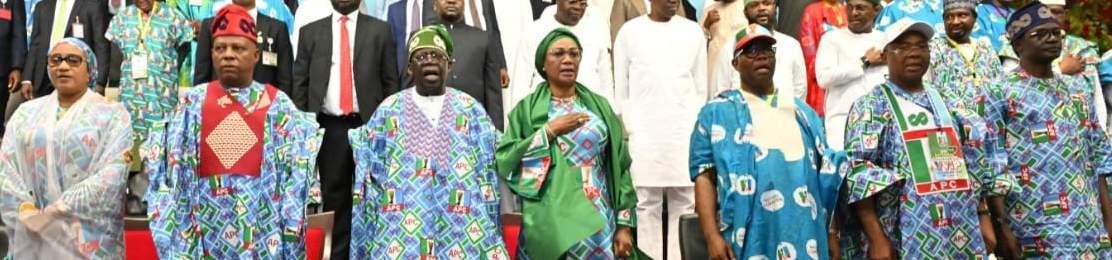
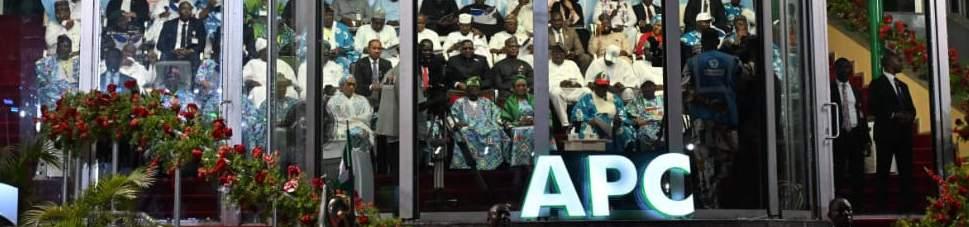
L-R: Wife of the Vice President, Nana Kashim Shettima; Vice President Kashim Shettima; President Bola Tinubu, his wife, Senator Oluremi Tinubu; President of the Senate, Senator Godswill Akpabio; Imo State Governor, Hope Uzodimma, and Yobe State Governor, Mai Mala Buni, at the 8th National Convention of the All Progressives Congress held at Eagles Square, Abuja…yesterday
PHOTO: GODWIN OMOIGUI
APC 8TH NATIONAL CONVENTION
Photos by: Godwin Omoigui
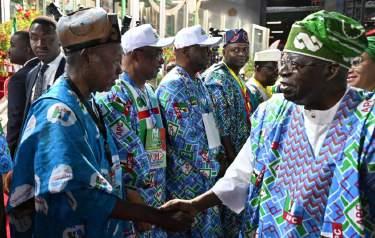
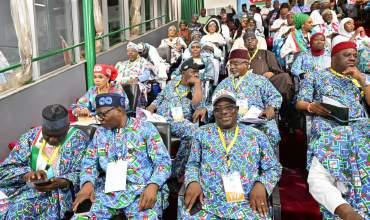
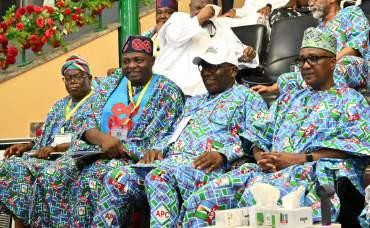
Some delegates at the convention
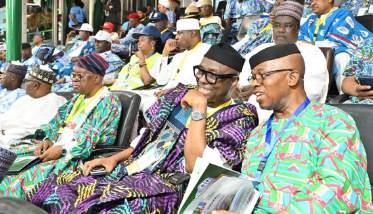
Former governors of Ekiti State, Segun Oni, Niyi Adebayo and some other delegates
L-R: National Secretary, APC, Surajudeen Ajibola Basiru; National Chairman, Prof. Nentawe Yilwatda;Governor of Kwara, Abdulrahman Abdulrazaq, and Speaker of the House of Representatives, Rt. Hon. Abbas Tajudeen
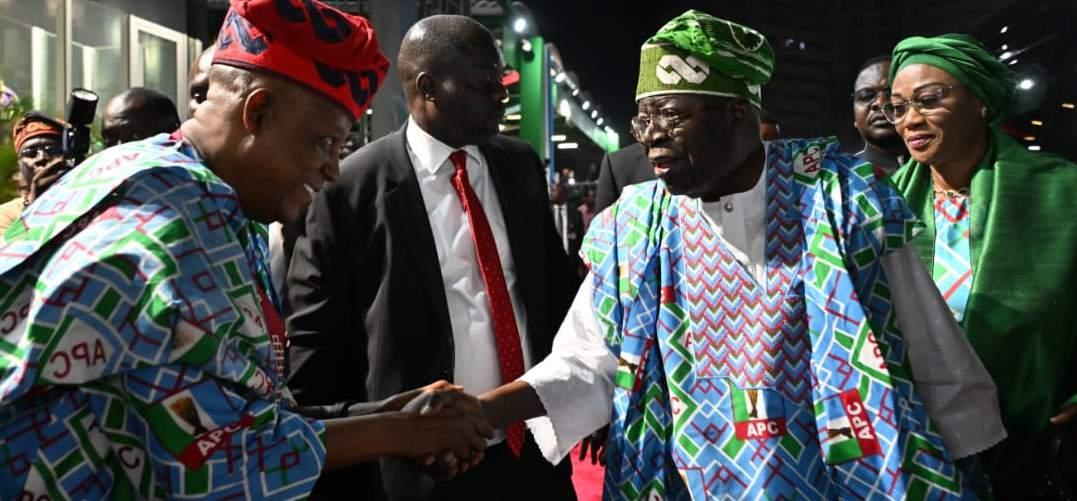
National Convention Central Coordination Committee Chairman and former Governor of Katsina State, Hon. Aminu Bello Masari (left) in a handshake with President Bola Tinubu
Vice President Kashim Shettima and President Tinubu
Rubio: Iran War to Last 'Weeks Not Months,' Says No US Ground Troops Needed
Iran-linked hackers breach FBI director's personal email, publish photos, documents
Sunday Ehigiator with agency report
The United States expects its operation against Iran to conclude within weeks, not months, and Washington can meet all its objectives without using ground troops, U.S. Secretary of State Marco Rubio said yesterday.
This comes as Iran-linked hackers broke into FBI Director Kash Patel's personal email inbox, publishing photographs of the director and other documents to the internet.
The hackers and the bureau disclosed this yesterday. Rubio told reporters after meeting G7 counterparts in France that Washington was
"on or ahead of schedule in that operation, and expect to conclude it at the appropriate time here - a matter of weeks, not months."
While Reuters quoted him to have said Washington could achieve its aims without ground troops, he acknowledged it was deploying some to the region "to give the
president maximum optionality and maximum opportunity to adjust the contingencies, should they emerge."
Washington has dispatched two contingents of thousands of Marines to the region, the first of which is due to arrive around the end of March aboard a huge amphibious assault ship. The Pentagon
is also expected to deploy thousands of elite airborne soldiers.
The deployments have raised concerns that an air war that has already disrupted global energy supplies could turn into a prolonged ground battle.
But U.S. President Donald Trump has also emphasised this
week what he has described as productive negotiations aimed at a diplomatic solution to the war, despite repeated assertions from Tehran that no such talks have begun. On Thursday, Trump extended a deadline by 10 days for Iran to reopen the blockaded Strait of Hormuz or face attacks against its civilian energy grid.
AT APC CONVENTION, TINUBU PREACHES UNITY, FIRES AT OPPOSITION, SHOWCASES REFORM GAINS
President Bola Tinubu has declared that the greatest strength of the ruling All Progressives Congress (APC) lies not in its size or numbers but in its unity of purpose.
Addressing leaders and members of the party at its 4th elective national convention at the Eagles square in Abuja yesterday, the President stated emphatically that "our greatest strength has never been in our size or numbers, but our unity.
"Political parties do not fail only through electoral defeats. Often, they falter when ego overrides ideology or when ambition replaces discipline. They fail when individual interests threaten the collective good. We must guard against those
tendencies at all costs."
Tinubu tasked the party's convention to send one clear message to Nigerians and the world "Our party is strong, united, focused and ready for the future."
According to him: "We must also remind ourselves that this party is not merely a vehicle specially built to carry ambitious politicians to electoral victories. It was founded as a vehicle for national transformation, a home for anybody who wants to build a Nigeria where governance works, institutions function, opportunities abound, security reigns, poverty declines, and every Nigerian, regardless of tribe, religion, region or social status, can live with dignity and hope."
He also allayed the fears of certain Nigerians especially the
opposition parties saying his government has no intention of turning the country into a one-party state.
His words: "Let me reiterate, especially to those who often lament and misunderstand us: we do not seek a one-party state. Democracy thrives on vibrant and healthy competition. As a statesman and political leader, I believe in a credible opposition— one that can challenge, question and help refine policies. That is how statecraft improves, and good governance is achieved. That is how nations advance."
The President described the constant attacks by opposition groups on the Electoral Act 2026 as a disservice to the Nigerian people.
"It is public knowledge that the processes leading to the amendment of the 2022 Electoral
Act passed through the crucible of legislative scrutiny, including public hearings. The Electoral Act was passed by the National Assembly, elected by the Nigerian people in accordance with the 1999 Constitution.
"The Act reflects our collective quest as a nation to strengthen our electoral system and consolidate democratic rule. Therefore, our commitment is to uphold the rule of law, conduct credible elections and protect the integrity of our elections, and continue building a stronger, secure, and united nation," he added.
Tinubu also used the forum of the party's national convention to reel out his government's achievements across all sectors in the last three years.
He said: "When Nigerians reaffirmed our leadership of
APC CONVENTION, PARTY POLITICS AND NIGERIA’S DEMOCRACY
remained central to Nigeria’s democratic architecture. Parties like the Peoples Democratic Party (PDP) institutionalised large-scale conventions that brought together delegates from across the country.
These gatherings helped legitimise leadership and maintain party cohesion, especially during the PDP’s long period of dominance. However, they also allegedly became synonymous with delegate inducement, imposition of candidates, and the growing influence of political godfathers.
The emergence of the APC in 2013, as a coalition of opposition forces raised hopes for a different model of internal democracy. The current ruling party came into being following the merger of
opposition parties. The political parties that metamorphosed into APC included the Congress of Progressive Change (CPC), Action Congress of Nigeria (ACN), a faction of the All Progressives Grand Alliance (APGA), the New Peoples Democratic Party (nPDP) and the All Nigerians Peoples Party (ANPP).
Its early conventions were seen as relatively competitive and reflective of its diverse origins.
Following the merger, the inaugural convention of the party was held in December, 2014, at Teslim Balogun Stadium. The convention saw the late Muhammadu Buhari emerge as the presidential candidate for the 2015 general
election. The second convention was held in Lagos at the same venue.
The third was a mini convention held in Abuja 2016, while in 2018, the ruling party held an elective convention in Abuja, which was aimed at restructuring and stabilising the party's internal leadership. Similarly, in 2022, the party held another elective convention at Eagle Square, in Abuja. The convention was crucial in managing leadership transitions and producing the party's presidential candidate.
However, the repeal of the Electoral Act, 2022 and the enactment of the Electoral Act, 2026, introduced adjustments to statutory timelines governing preelection and electoral activities.
It was against this backdrop that the Independent National Electoral Commission (INEC) reviewed and realigned the Schedule to ensure full compliance with the new legal framework.
Declaring yesterday’s convention open, the National Convention Central Coordination Committee Chairman and former Governor of Katsina State, Hon. Aminu Bello Masari said the convention was not a routine jugglery, but a solemn assembly, a historic moment, and a powerful reminder of the strength of the country's democracy.
He noted that it was at the convention they would affirm their values, renew their commitments, and chart the path
CONFUSION OVER EL-RUFAI’S ICPC RELEASE AFTER MOTHER’S
DEATH
the country as the governing party in 2023, we made a solemn promise to chart a new course for national renewal through the Renewed Hope Agenda. That agenda was not conceived as just another campaign slogan. It was conceived as a governing philosophy.
"We knew the road to reform would be tough. We knew rebuilding Nigeria would require courage, patience, and difficult decisions. But we also knew: no nation rises by hiding from the truth. No economy grows by sustaining wasteful subsidies or dysfunctional priorities. No future is built on perpetual self-denial.
"That is why we chose the path of reform, And I assure you: The sacrifices of today are laying the foundation for Nigeria's prosperity tomorrow.
Our leaders, party members,
for our party and our country.
The former Speaker of the House of Representatives stressed that the APC was built on conviction, sustained by sacrifice, and strengthened by the loyalty of millions of Nigerians who believe in the promise of progress, justice, and unity.
Masari said: “APC has always strengthened our unity, and today, as we gather to elect our new leaders, we are reminded—we remind ourselves—that leadership is not about privilege; it is about service. It is not about titles; it is about trust. It is not about power; it is about unity.
“It is about trust. It is not about power; it is about unity. It is about unity. It is about
and supporters can take pride in the success we have achieved in redirecting our country.
"Fellow compatriots, since assuming office, our government has remained focused on delivering on its mandate to the Nigerian people. Despite the complex global economic and political environment and the fact that we are currently experiencing another unanticipated blowout arising from the US-Israeli-Iranian War, we have made notable strides. We have made strides in infrastructure development, including the construction of superhighways and concreteand-steel roads.
"Apart from roads, we are modernising our seaports and airports. We have begun the implementation of a historic
responsibility.
“Delegates, the same responsibility you carry today is immense. You are not here merely to cast a vote. You are here to shape history.
“The decisions you make will echo far beyond this convention hall. They will influence the direction of our party, the confidence of our members, and the destiny of our nation.
“Conduct yourselves with dignity, fairness, and discipline. Let this convention be remembered not only for its outcomes but for the integrity of its process.”
Masari. acknowledged the challenges confronting the nation — insecurity, economic pressures, inequality, and social divisions.
Continued on page 27 deceased.
Her death was announced on Facebook yesterday, by her grandson.
Bello El-Rufai had posted on the social media platform earlier: "Inna lillahi wa inna ilayhi raji'un. From Allah SWT we came and to Him we shall all return. I would like to inform the public of the demise of my Grandmother, Hajiya Umma el-Rufai who passed away a few hours ago.
“She is the biological mother of our father, Mallam Nasir @elrufai. We are grateful for
the life she lived and may Allah SWT bless her gentle soul. May He bless the soul of the parents we have lost. On behalf of our family, we seek your prayers. Thank you.” Hours after the announcement, Bashir on his X handle, announced the release of his father, a chieftain of the African Democratic Congress from ICPC detention.
He had written in the post that has since been deleted: “Alhamdulillah. My beloved great legend of a father (@ elrufai) is being released from his unlawful & illegal
detention at the hands of one of the most corrupt agencies in the Federal Republic of Nigeria that is a lame excuse of a pathetic institution.
“Thank you all for all the support. Our family shall never forget these times. We have overcome, as the El-Rufai’s always do.”
The former governor has been in custody of the ICPC following his re-arrest after being initially detained by the Economic and Financial Crimes Commission (EFCC).
A Federal High Court sitting in Kaduna had adjourned
the alleged fraud case to March 31, 2026, to allow for the hearing of pending applications, including his bail request.
The President, in a condolence message issued by his Adviser on Information and Strategy, Bayo Onanuga, described the late matriarch of the El-Rufai family as a mother who lived a remarkable life and raised children and grandchildren who have contributed greatly to our nation.
“Nasir, please accept my heartfelt condolences on
the passing of your beloved mother, Hajiya Umma, which happened today in Cairo. As someone who had also lost an old mother, I share in your grief. I understand the depth of your loss.
“Losing a mother is a pain unlike any other. I know that no words can fully ease your sorrow, but I pray that the memories of her love, wisdom, and guidance bring you comfort in the days ahead. I also hope you find strength in the remarkable life she lived and the values she instilled in the entire family.
“As firm believers in Allah, we are convinced that she has played her part in this world as laid out for her by the Almighty and has gone back to her maker.
“I join family, friends, and well-wishers in mourning with you. May Allah grant your dear mother Aljannah Firdaus,” Tinubu stated. In a condolence message yesterday, Atiku, described the news of her passing as “a shocking development,” while extending his sympathies to the el-Rufai family and their associates.
Deji Elumoye and Adedayo Akinwale in Abuja
TECHNOLOGY
GADGETS FOR SECURITY ENHANCEMENT...
2027: Pat Utomi’s Group Targets 20m Nigerians, $500m Diaspora Fund with ‘Obidient Connect’
Rallies coordinators nationwide as coalition builds first citizen-led civic-tech platform
Sunday Ehigiator in Lagos and David-Chyddy Eleke in Awka
In what may prove to be a defining moment in Nigeria’s political evolution ahead of the 2027 general elections, the Big Tent Coalition, led by renowned Political Economist, Prof. Pat Utomi, is set to unveil a groundbreaking citizen-powered platform, ‘Obidient Connect,’ designed to organise millions of Nigerians into a coordinated grassroots force capable of reshaping the country’s democratic future.
This was as former governor of Anambra State and presidential hopeful of African Democratic Congress (ADC), Mr. Peter Obi, has said he will continue to invest in critical sectors of Nigeria economy to ensure
improvement.
Multiple sources within the coalition confirm that the platform, scheduled for official unveiling next month, is an ambitious civic-tech initiative yet to emerge from Nigeria’s growing reform movement, with projections to onboard over 20 million Nigerians at home and across the diaspora.
Described by insiders as “the operating system for citizen-led democracy,” the ‘Obidient Connect’ seeks to convert the widespread enthusiasm of the Obidient Movement into structured, polling unit-level organisation across the nation’s 176,864 polling units.
At the heart of the initiative is a clear strategic objective to transform diffuse public sentiment into disciplined civic
ECWA Church Abduction: Troops Intensify Manhunt for Terrorists, Rescue Three Victims
The military has intensified efforts to track down terrorists responsible for the attack on Ora-Ago Community in Ifelodun Local Government Area of Kwara State, where nine worshippers were abducted during a church service at an ECWA Church.
It also confirmed the rescue of three of the abducted victims, while operations are ongoing to secure the release of the remaining hostages.
Director of Defence Media Operations, Major General Michael Onoja, disclosed this during a weekly briefing on the activities of the Armed Forces of Nigeria across various theatres of operation.
He said troops of Operation Savannah Shield, working in collaboration with local vigilantes and forest guard operatives, responded swiftly to the 22
March 2026 attack, leading to the rescue of the three victims.
He added that troops have since intensified counter-terrorism and antikidnapping operations across Kwara and Niger states, particularly in forested corridors and border communities known to harbour criminal elements.
In related operations, troops arrested a suspect conveying explosive and improvised explosive device (IED) materials along the Wawa–Dabar Woko Road in Borgu Local Government Area of Niger State.
Although the suspect claimed the materials were meant for mining, authorities are investigating the circumstances.
The military also confirmed that a bridge along the Wawa–Luma Road was destroyed by terrorists to disrupt troop movement and logistics.
action.
Director of Media/ Communications of The Big Tent, and also a leading architect of the ground-breaking platform, Charles Odibo, quoted Utomi as stating that the platform answers a fundamental question confronting Nigeria’s democracy - “How do we organise the hope of millions into structured civic power?”
In an internal communications sent to Big Tent State Coordinators nationwide, Utomi emphasised that the lessons of the 2023 elections made it clear that citizen energy without structure is insufficient to secure electoral outcomes.
“The 2023 elections showed both the strength of citizen engagement and the dangers of disorganisation at the grassroots. Obidient Connect has been created to ensure that every polling unit is organised, every volunteer is coordinated,
and every vote is protected,” he wrote.
He further directed state leaders to immediately begin groundwork ahead of the April launch, charging them “to ensure that all polling units in your states are covered, with capable coordinators and volunteers in place.
Between now and the unveiling, there must be deliberate sensitisation and mobilisation to guarantee massive adoption of the platform.”
The Obidient Connect is built around four core pillars - Connect: Linking Nigerians to their specific polling units and diaspora communities; Organise: Coordinating grassroots mobilisation, training, and civic engagement; Donate: Enabling lawful and transparent funding for voter education and mobilisation; and, Deliver: Ensuring effective participation and vote protection at the
polling unit level.
The platform is expected to serve as a central hub for volunteer coordination, civic education, election monitoring, and real-time reporting, effectively creating a nationwide citizen infrastructure that is more robust than traditional political party systems.
In a significant move that underscores the coalition’s global ambitions, “Obidient Connect” has secured a strategic partnership with Naija We Can (Better Naija), a well-known and reputable non-profit organisation registered in the United States of America. The partnership is expected to anchor a large-scale diaspora fundraising effort targeting over $500 million, alongside more than N100 billion in local support within Nigeria. Sources say the arrangement ensures full compliance with Nigerian laws prohibiting direct foreign
funding of political parties, as all contributions will be channelled strictly toward civic education, grassroots organising, support of preferred candidate, and democratic advocacy. “Naija We Can” is led by Dr. Iheanacho Emeruwa, a California-based physician and respected diaspora leader, whose stewardship is said to bring credibility and transparency to the fundraising process.
Unlike traditional political structures, insiders insist that Obidient Connect is a citizendriven platform designed to support democratic participation at scale.
The Big Tent Coalition has been one of the principal drivers of the Obidient Movement that rallied behind Mr. Peter Obi in the 2023 elections, and sources indicate that the platform is expected to play a central role in positioning him for a renewed presidential contest in 2027.
Lagos Tops List as PEBEC Names Top-10 Performing States in Ease of Doing Business
Ndubuisi Francis in Abuja
Lagos, the nation's commercial nerve-centre has emerged tops among ten best preforming states in the Ease of Doing Business Report for 2025, released by the Presidential Enabling Business Environment Council (PEBEC).
The ten top performing states were unveiled in Abuja, Friday in the PEBEC Subnational Ease of Doing Business Report 2025 at 'The Reform and Diplomatic Rountable 2026', organised by PEBEC in collaboration with the UK International Development and Nigeria Economic Stability and Transformation (NEST).
In the report, Lagos emerged
tops, with Kaduna in the second position, followed by Oyo, FCT, Ogun, Enugu, Plateau, Ekiti, Kano and Nasarawa in the 10th position.
This report covered all 36 states and the FCT.
In assessing the subnationals, PEBEC adopted a framework comprising 16 Indicators, reflecting key dimensions of business functionality - access to electricity, infrastructure, digital connectivity, land administration, justice delivery, taxation, trade logistics, investor support, crisis resilience, skilled labour, and related regulatory factors.
Each indicator was broken down into 36 operational
sub-Indicators tied to specific administrative dataset.
The report noted that Lagos offers one of the most advanced and competitive business environments in the country, combining reliable electricity, good transport infrastructure, decent digital services, a functional land administration system, efficient courts and alternative dispute resolution (ADR) mechanism, an operational one-stop shop, accessible grievance-redress mechanism, credit access, and a highly skilled workforce, although land processing timelines, right-of-way fees, and some administrative
bottlenecks still present friction for investors. Earlier in her opening remarks at the rountable themed, "Connecting Global Capital to Nigeria's To 10 Subnational Ease of Doing Business States," the Director General of PEBEC, Princess Zahrah Mustapha Audu, explained that reformdriven states have recorded up to 40 per cent reduction in business registration timelines. Audu added that such states have also posted over 30 per cent improvement in land administration efficiency, significant gains in digital service delivery and dispute resolution mechanisms
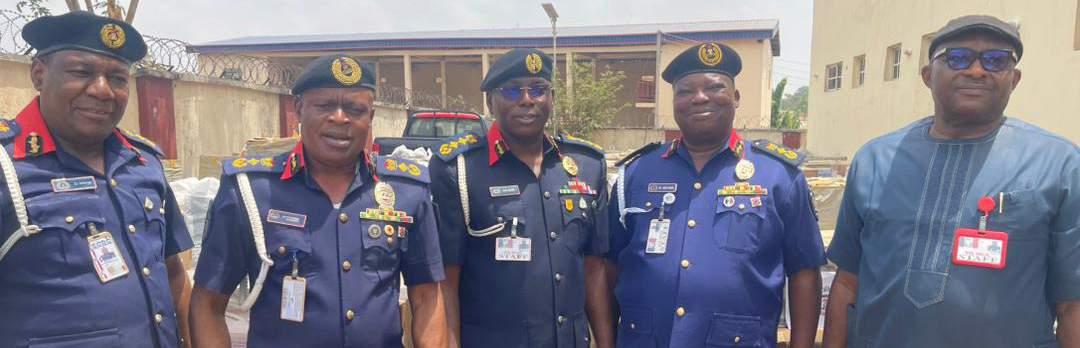
L-R: DCG Technical Services, Zakari Ibrahim Ningi; DCG Crisis Management, Pedro Awilli Ideba; Commandant General of the Nigeria Security and Civil Defence Corps, Prof. Ahmed Abubakar Audi; DCG Intelligence and Investigation, Innamdi Nwinyin, and DCG Administration, Adeyinka Fasiu Ayinla, during the distribution of High Technology Drones, Helmets, Bullet proofs and Security Enhancement gadgets to states formation nationwide to enhance Intelligence gathering and combat insecurity across the country in Abuja… yesterday
Linus Aleke in Abuja
Happy Birthday!
ONYEMA
Chairman Air Peace Limited
On behalf of the Board, Management , and Staff of Veritas Kapital Assurance Plc, we extend our warm wishes as you mark your birthday We celebrate your commitment to service, innovation, and nationbuilding, which continues to inspire the aviation sector and the nation.
Wishing you continued success, good health, and many more years of impactful achievements
Management
Ponzi Schemes And The Cycle Of Financial Loss
From the earliest days of commerce to the modern digital economy, the promise of quick wealth has remained one of humanity’s most enduring temptations. Long before the rise of the internet and sophisticated financial systems, individuals were drawn into schemes that promised extraordinary returns for minimal effort. Today, that same “get-rich-quick” mentality continues to thrive, only now it operates with greater speed, wider reach, and more devastating consequences. At the heart of this recurring pattern lies the infamous Ponzi scheme, a fraudulent investment model that has ruined lives across the globe.
The term “Ponzi scheme” originates from Charles Ponzi, who in the early 20th century orchestrated one of the most notorious financial scams in history. Since then, similar schemes have surfaced worldwide, often disguised as legitimate investment opportunities. From the multi-billion-dollar fraud executed by Bernard Madoff in the United States to various cryptocurrencyrelated scams in Asia and Europe, Ponzi schemes have evolved but remain fundamentally the same. They rely on funds from new investors to pay returns to earlier ones, creating an illusion of profitability until the structure inevitably collapses.
Globally, financial watchdogs estimate that Ponzi schemes have defrauded investors of hundreds of billions of dollars over the past few decades. The appeal is universal. High returns, low risk, and a sense of exclusivity draw people in. Yet, the outcome is almost always predictable. Financial ruin awaits the majority, while profit is reserved for a select few at the top.
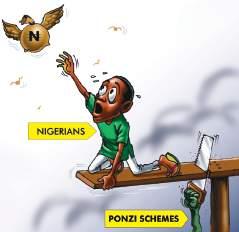
Nigeria, unfortunately, has become one of the most fertile grounds for such schemes. Over the years, the country has witnessed the rise and fall of numerous Ponzi operations. From the infamous MMM Nigeria in 2016 to schemes such as Ultimate Cycler, Twinkas, Loom, Racksterli, MBA Forex, and more recently CBEX, the pattern remains unchanged. Conservative estimates suggest that over 50 major Ponzi schemes have surfaced in Nigeria within the last decade alone, collectively defrauding millions of citizens and wiping out billions of naira in personal savings.
The case of CBEX stands as one of the most recent and painful reminders of this recurring tragedy. Emerging around May 2024, CBEX quickly gained traction by presenting itself as a legitimate forex trading platform. Its structured trading windows, polished interface,
and strategic marketing gave it an air of credibility that appealed to both the educated elite and everyday Nigerians. Trust grew rapidly. People invested not just disposable income but life savings, business capital, and even borrowed funds, all in anticipation of high returns.
What made CBEX particularly dangerous was its ability to exploit trust within social networks. Friends convinced friends, colleagues persuaded colleagues, and family members encouraged one another to invest. As returns appeared to flow in the early stages, confidence deepened, and many investors reinvested their profits rather than withdrawing them, unknowingly reinforcing the very system that would eventually collapse.
By late March and early April 2025, cracks began to appear. Users experienced delays, trading windows became inconsistent, and withdrawals were restricted. Initially dismissed as technical glitches, these issues soon escalated into a full-blown crisis. The platform became inaccessible, funds were locked, and the realization dawned that CBEX had collapsed, leaving thousands of investors stranded.
The aftermath was chaotic and deeply emotional. Across Nigeria, anger spilled into the streets. Offices linked to the scheme were vandalized, and individuals associated with its promotion faced backlash. Beyond the visible outrage lay a deeper, more enduring damage. Financial devastation, broken relationships, mental health struggles, and in some cases, long-term economic hardship became the reality for many victims.
OVER 50 MAJOR PONZI SCHEMES HAVE SURFACED IN NIGERIA WITHIN THE LAST DECADE ALONE, COLLECTIVELY DEFRAUDING MILLIONS OF CITIZENS AND WIPING OUT BILLIONS OF NAIRA IN PERSONAL SAVINGS
TIn response to the crisis, the Economic and Financial Crimes Commission (EFCC) launched investigations into the CBEX scheme. The agency identified key promoters and began efforts to trace and recover diverted funds. Public statements assured victims that assets linked to the scheme would be tracked and possibly recovered. However, like many financial fraud cases, the process has proven complex. Funds are often moved through multiple channels, including international accounts and digital wallets, making recovery slow and uncertain.
While the EFCC’s intervention has provided some measure of hope, a year after the collapse, many victims are yet to receive compensation. The reality is stark. Once funds are lost in Ponzi schemes, recovery is rarely complete. The legal and logistical hurdles involved mean that even when assets are recovered, they may only cover a fraction of the total losses.
Awojobi, a multiple award-winning broadcast journalist, writes from Ago-Iwoye, Ogun State.
Who Is Responsible When Ai Fails?
The future of AI must not be built on immunity, but on integrity, argues SONNY IROCHE
he recent policy direction emerging from Washington, suggesting that the United States should prioritise innovation while shielding artificial intelligence companies from legal liability, has triggered an important global debate. The argument, at its core, is simple: do not stifle innovation. But beneath that simplicity lies a far more complex and troubling question, who bears responsibility when AI systems cause harm?
As an AI strategist working across banking and finance, governance, policy, and enterprise transformation, I find the current posture deeply instructive, not just for the United States, but for Nigeria and the rest of Africa and other emerging regions that are still shaping their own AI futures.
The White House recommendations, as interpreted by critics, appear to lean toward a familiar model in technological revolutions: protect the innovators first, regulate later. This was the approach taken during the early days of the internet and social media. The consequences are now well documented, misinformation, data exploitation,
algorithmic bias, and the erosion of public trust.
We must be careful not to repeat history; as innovation without accountability is a strategic risk.
Artificial Intelligence is not just another technology. It is a decision-making system, one that increasingly influences finance, healthcare, law enforcement, education, and national security.
When an AI system: denies a loan, flags a transaction as fraudulent, misdiagnoses a patient, or influences democratic processes, it is not merely “software at work.” It is power being exercised.To shield AI companies from legal accountability in such contexts is to create what I would describe as: “asymmetric responsibility”, where impact is societal, but liability is optional. This is neither sustainable nor ethical.
The Missing Middle: Responsible Innovation
There is a false dichotomy often presented in policy circles: Regulate too early means innovation dies; regulate too late means harm proliferates.
The real answer lies in what I call “Responsible Acceleration.”
This means: encouraging innovation while embedding governance from the outset.
Frameworks already exist to guide this balance. The UNESCO AI Readiness Assessment Methodology (RAM), in which I have had the privilege to contribute, as a member of UNESCO Technical Working Group on RAM, emphasises: human rights, accountability, transparency, institutional capacity.
Similarly, the Oxford-style AI readiness frameworks stress that capability must precede deployment. What is striking in the current U.S. posture is not the desire to innovate, that is expected, but the relative de-emphasis on enforceable accountability mechanisms.
Legal Immunity Today, Systemic Risk Tomorrow. History teaches us that early immunity often leads to later overcorrection.
If AI companies are broadly shielded from liability: There is reduced incentive to invest in safety, risk is externalised to society, trust in AI systems declines. And when trust declines, two things happen: First, adoption slows and secondly regulation becomes reactionary
and heavy-handed. Ironically, the very innovation policymakers seek to protect becomes constrained.
What implications do they have for Africa, one may ask? Africa must pay close attention. We are not yet locked into any one regulatory model. This gives us a rare advantage, the ability to design AI governance correctly from the start.
If we simply import models that prioritise: speed over safety, scale over accountability, we risk building fragile digital economies.
Nigeria, South Africa, Kenya, Egypt, Zimbabwe, and Morocco, countries already advancing AI strategies, must instead adopt a more balanced approach: encourage innovation, yes. But embed governance, from day one
This includes: clear liability frameworks, AI risk classification systems, Board-level oversight in enterprises, National AI readiness assessments.
The Corporate Dimension: Lessons for Institutions. For organisations, such as financial institutions, insurers, and fintechs, the implications are immediate. Iroche is an Infrastuctural Consultant
Who's in?
What a waste!
Murder of Hellen, Penis Theft, and Superstition in Zambia
In Praise of President Buhari
In Praise of Macaulay
WThen President Muhammadu Buhari took over the reins of power on May 29, 2015, Nigeria was sadly a broken state in many respects. As a result of many other factors including bad governance and untold level of corruption, government could not live up to its financial obligations to citizens and service providers at both the federal and state levels.
This instance of police failure should not repeat. The police should overwhelm the mob and combat jungle justice. The mob should not overwhelm the police.
Indeed one of the first official assignments that President Buhari carried out was the approval of billions of Naira in bailout funds to enable state governors pay something as basic as workers’ salaries. Granting those bailout funds was a huge boost to national security because the pressure of arrears of unpaid monthly salaries building dangerously all over the country was a ticking bomb.
Ask the naysayers and they would readily remind you of how long it took President Buhari to appoint his ministers and how that contributed to collapse of the economy as if, without ministers, governance was frozen. But buying that narrative would amount to what a famous Nigerian writer, Chimamanda Adichie, termed “the danger of a single story”. Yet the whole story was that many of our citizens did not know how decrepit a state President Buhari inherited in 2015.
he Advocacy for Alleged Witches condemns the brutal murder of a 46-year-old woman, Eneless Hellen Kamutumbe, in the Kisasa area of Kalumbila District on the Copperbelt. The tragic incident happened on Friday, March 20, 2026. According to local sources, Ms. Hellen traveled to Kisasa for business. While going about her business at a local market, a 25-year-old man, Prince Ntambo, allegedly accused her of magically stealing his private parts after physical contact. Ntambo raised an alarm, and some mob gathered and attacked Hellen with sticks, stones, planks, and other objects, resulting in multiple injuries. Some people tried to rescue her, but they also came under attack. The mob attacked the police when they arrived to rescue her. One report said that three police officers sustained injuries during the unrest, while a police vehicle had its front windscreen shattered after being stoned.
In response to this superstition-based crime, a Zambian branch of the Advocacy for Alleged Witches has been formed to help raise awareness and end superstition-based abuses. Advocates urge the enforcement of laws to punish and prevent such criminal acts, stop religious coercive control of the people and domestic violence, and the magical interpretation of experiences.
It was therefore necessary for him to take stock against the background of the fact that the departing government did not, reportedly, cooperate full well with the incoming government in terms of leaving workable handover notes. Although President Goodluck Jonathan was gracious in defeat, many of his appointees were still sulking over what they saw as their personal losses and therefore pulled all the stops to make things difficult for the Buhari government.
by the EFCC, President Buhari by his action has successfully brought back to the public consciousness the need to treat public funds with the highest level of transparency and accountability.
MAfter keeping treasury looters on their toes and at bay through the EFCC, particularly, President Buhari moved to curb unnecessary spending habits of the nation on what economists call articles of ostentation. Part of the disclosures of the President’s stock taking was how the country frittered away billions in foreign currency by importing goods, which can be produced at home. One of such items was rice, a major staple among Nigerians. By banning rice importation into the country, the President on one hand had saved the nation billions in foreign currency annually.
Stop Ritual Attacks and Killings
r. Oscar Macaulay is the current Director of Corporate Services at Daraju Industries Limited. He provides essential internal support functions, including human resources, finance and accounting legal and compliance, IT, procurement and facilities management.
TAnd, on the other hand, the President has boosted domestic production of rice and in the process had nudged the country into self sufficiency in food production. He also created millions of jobs for young people in the rice value chain.
AfAW welcomes the response from the government of Zambia following this horrific incident.
Leo Igwe directs Advocacy for Alleged Witches, which works to end witch hunts in Africa
Even with the obvious and unpatriotic obscurantist behaviour of the PDP appointees and their supporters still in government hell-bent on making things difficult for Buhari, the President moved on with his methodical repair of a broken country. The first thing he did was to identify all possible sources of income to the nation and directed that all inflows be paid into one single account in line with the policy of Single Treasury Account (TSA).
The TSA policy, interestingly, was mooted by the PDP government but its penchant for imprudence and lack of accountability denied it the courage of implementing the policy. What the President literally did was to gather all the nation’s money into one box and locked it up with a big padlock and watched for any thief to come close.
Who can blame the President for almost developing paranoia over the safeguard of the national treasury with revelations and reports of mind-boggling looting that took place in the 16 years of the PDP? With such disclosures of how billions meant for fighting insurgency in the Northeast ended up in the pockets of a few individuals while our gallant soldiers fought with bare hands and on empty stomach, President Buhari was duty bound to bring sanity and accountability back in national spending.
The mob left the body along the Mwinilunga–Solwezi Road. Hellen was later pronounced dead at a local hospital. The government of Zambia should sanction the community leaders of Kalumbia district for failing to save Ms. Hellen. The fact that the mob overwhelmed rescuers signaled community and societal failure, and it should not happen again. The police must be commended for intervening and for their efforts to rescue Ms. Hellen. Obviously, from the report, the police intervention came too little too late. The police intervention could not save Hellen.
Thus, under President Buhari, the Economic and Financial Crimes Commission (EFCC), which had remained comatose for years, was woken up to resume its duties. Apart from the trillions of Naira of looted funds and property recovered from corrupt politicians
What is most admirable about President Buhari and his government is its frugal management of scarce national resources to attain optimum goals. Recall that since President Buhari stepped in the saddle, oil revenue dropped abysmally as if to sabotage him knowing all the big promises he made to citizens during his campaigns. But with the little resources that trickle in, the President is achieving what governments that received oil windfalls could not dream of.
Macaulay provides the service support, meeting coordination, travel arrangement and document management and ignites decisive passion for staff to strive for greatness and reach their full potential by demonstrating that goals are achievable. He also builds in staff strong character traits like resilience and self-esteem .
Today, the trains are up and running daily from Abuja to Kaduna. And from Lagos to Ibadan a brand new rail track was started and completed; citizens are already commuting daily to and fro these two major cities in the country seamlessly as they reap from the dividends of democracy. And with the way this government is going, before 2023 when the President would leave, the entire country would be linked by rail with all of its economic advantages.
Ainofenokhai Ojeifo, Abuja
THE SATURDAY NEWSPAPER
EDITOR OBINNA CHIMA
DEPUTY EDITOR AHAMEFULA OGBU
MANAGING DIRECTOR ENIOLA BELLO
He is the founder of the Macaulay Foundation where he helps the less privileged and destitute. He has donated hundreds of tricycles to jobless youth across the federation, gave scholarship to others, while also organising football competitions where he gave out prizes to talented youths.
THE SATURDAY NEWSPAPER
DEPUTY MANAGING DIRECTOR ISRAEL IWEGBU
EDITOR YEMI ADEBOWALE
CHAIRMAN EDITORIAL BOARD OLUSEGUN ADENIYI
DEPUTY EDITOR AHAMEFULA OGBU
EDITOR NATION’S CAPITAL IYOBOSA UWUGIAREN
THE OMBUDSMAN KAYODE KOMOLAFE
MANAGING DIRECTOR ENIOLA BELLO
DEPUTY MANAGING DIRECTOR ISRAEL IWEGBU
CHAIRMAN EDITORIAL BOARD OLUSEGUN ADENIYI
EDITOR NATION’S CAPITAL IYOBOSA UWUGIAREN
MANAGING EDITOR BOLAJI ADEBIYI
THE OMBUDSMAN KAYODE KOMOLAFE
THISDAY NEWSPAPERS LIMITED
EDITOR-IN-CHIEF/CHAIRMAN NDUKA OBAIGBENA
GROUP EXECUTIVE DIRECTORS ENIOLA BELLO, KAYODE KOMOLAFE, ISRAEL IWEGBU
THISDAY NEWSPAPERS LIMITED
DIVISIONAL DIRECTORS SHAKA MOMODU, PETER IWEGBU, ANTHONY OGEDENGBE
EDITOR-IN-CHIEF/CHAIRMAN NDUKA OBAIGBENA
DEPUTY DIVISIONAL DIRECTOR OJOGUN VICTOR DANBOYI
SNR. ASSOCIATE DIRECTOR ERIC OJEH
ASSOCIATE DIRECTOR PATRICK EIMIUHI
Macaulay ensures that Daraju industries operates legally, and efficiently by handling administrative, financial and operational needs, to enable Daraju industries to focus on their primary objectives. He ensures recruitment on boarding pay roll, benefit, employee relations, training and workforce planning. He also ensures adherence to regulations and corporate governance and provides (IT) infrastructure management, cyber security support and data backup.
GROUP EXECUTIVE DIRECTORS ENIOLA BELLO, KAYODE KOMOLAFE, ISRAEL IWEGBU, IJEOMA NWOGWUGWU, EMMANUEL EFENI
DIVISIONAL DIRECTORS SHAKA MOMODU, PETER IWEGBU, ANTHONY OGEDENGBE
he Advocacy for Alleged Witches (AfAW) urges the Nigerian public to stop ritual attacks and killings because the notion of ritual money and wealth is completely baseless. AfAW is making this call following the reported arrest of suspected ritualists in Oyo State in southern Nigeria. The local media reported that members of the Western Nigeria Security Network, Amotekun, arrested suspected ritualists with the body parts of a 73-year-old man. The suspects, who were apprehended in the Boluwaji area in Ibadan, said that a Muslim cleric asked them to procure some human body parts for rituals. Ritual attacks are widespread in Nigeria. Irrational conceptions of how to make money or become wealthy and successful undergird these atrocities. Many Nigerians strongly believe in blood money, known in some local languages as Ogun Owo (Yoruba) or Ogwu ego (Igbo). They think that they could become rich, or successful through ritual sacrifice. Unfortunately, this is not the case. Ritual wealth has no basis in reason, science, or reality. Home movies known as Africa magic or Nollywood films have not helped matters. These movies continue to reinforce these mistaken notions and other superstitions. Families, churches, mosques, and other public institutions do not encourage the interrogation of these traditional occult beliefs. There are no robust efforts to criticize or dispel these irrational and paranormal claims in schools, colleges, and universities. So millions of Nigerians grow up blindly believing that they could make money through ritual sacrifice of human body parts. The belief has led many Nigerians to commit crimes and perpetrate atrocities. Many Nigerians have been jailed or are undergoing court trials due to ritualrelated attacks and murder.
Trump has declared that Gavin Newsom, the California governor, cannot be President due to his “learning disability.” Newsom has dyslexia, a fairly common condition that makes reading more difficult. The reality however is that a number of Presidents, all considered better than him, have had medical concerns and yet could do the job.
People should be supported and praised for what they achieve especially if they have had a harder journey through life.
Dennis Fitzgerald,Melbourne, Australia
Not too long ago, the police arrested some young Nigerians for stealing female pants, which they intended to use for ritual sacrifice. AfAW is asking all Nigerians to desist from ritual-related abuses because ritual money beliefs are baseless superstitions. Nigerian media, schools, and colleges should help educate and reorient the public. They should assist in reasoning Nigerians out of this killer-superstitious absurdity and nonsense. Leo Igwe directs the Advocacy for Alleged Witches (AfAW)
LAGOS TRAFFIC RADIO MANAGEMENT RETREAT...
Union Bank: CBN Heads to Court of Appeal, Seeks Stay of Execution
Apex bank insists intervention was lawful under BOFIA
Wale Igbintade
The Central Bank of Nigeria (CBN) has formally appealed the judgement of the Federal High Court in Lagos which nullified its takeover of Union Bank of Nigeria Plc and ordered the reinstatement of the bank’s former board of directors.
The appeal follows the March 25, 2026 ruling delivered by Justice Chukwujekwu Aneke, which held that the apex bank acted beyond its statutory powers in dissolving the board and management of the financial institution.
In response, the CBN has assembled a high-powered legal team comprising several Senior Advocates of
Nigeria (SANs) to challenge the decision at the Court of Appeal.
The team is led by Yusuf Ali, SAN, with other members including Kemi Pinheiro, SAN, Tunde Fagbohunlu, SAN, Uche Val Obi, SAN, and Chukwudi Enebeli, SAN.
The notice of appeal, which contains 11 grounds and was signed by Pinheiro, seeks an order setting aside the entire judgement of the lower court.
In its appeal, the apex bank argued that it acted within the powers conferred on it by the Central Bank of Nigeria Act and the Banks and Other Financial Institutions Act (BOFIA) 2020.
It maintained that it is the primary regulatory authority
Decentralise Pipeline Surveillance Contract for Equity, Group Tells Tinubu
The Niger Delta Stakeholders Forum (NDSF), yesterday, rose from an emergency meeting in Port Harcourt, Rivers State and appealed to President Bola Ahmed Tinubu to heed their counsel and decentralise the pipeline contracts across different states and influences that make up the region.
They however sounded a note of warning that they were on their final efforts to save the economy of the country from agitations over exclusion of stakeholders from the pipeline contracts as the present situation was threatening to erupt in protests and into wards actions.
The stakeholders in a statement signed by Dr. Tari Theophilus condemned what they referred to as actions of the Presidential Amnesty
Programme Coordinator, Dr. Denis Burutu Otuaro, which they regretted threatens regional peace, national economic interests, and urgent reforms in pipeline/oil and gas infrastructure surveillance.
They regretted that their advocating for full decentralisation of surveillance contracts across the Niger Delta, was misrepresented by Dr. Otuaro and his affiliates as an “assault” on Tantita Security.
"The forum stresses, unequivocally, that our call is for the decentralisation of all surveillance contracts within the Niger Delta region to ensure local participation, equitable opportunities, and engagement of high-impact regional stakeholders, not to undermine any single operator.
over banks in Nigeria and is empowered to intervene in the affairs of financial institutions facing serious distress.
According to the CBN, evidence presented before the trial court showed that Union Bank was in a precarious financial state at the time of the intervention, including a negative capital adequacy ratio, a capital shortfall exceeding N224 billion, and high levels
of non-performing loans.
The Bank contended that these conditions justified its actions, which it said were taken in good faith to safeguard the banking system.
It further argued that Section 34 of BOFIA grants the CBN Governor wide-ranging powers, including the removal of directors and officers of a bank deemed to be in a critical condition.
The appellants also relied on Section 51 of BOFIA, which provides legal protection for actions taken in good faith in the discharge of statutory duties, insisting that the trial court failed to properly interpret these provisions.
The CBN faulted the lower court’s findings on several fronts, arguing that the judgement wrongly held that it acted outside its
statutory powers, declared its intervention unlawful and unconstitutional without sufficient basis, misinterpreted the provisions of BOFIA relating to regulatory intervention, set aside actions taken by the management appointed by the CBN, and granted an order of mandamus restoring the former board without establishing a legal duty.
Army Pulls Out 18 Retired Senior Officers from Service
Linus Aleke in Abuja
The Nigerian Army has pulled out 18 senior officers of the Nigerian Army Corps of Supply and Transport following their retirement after 35 years of meritorious service.
The colourful pulling-out parade, held in Benin City, Edo State, marked the conclusion of a three-day conference themed ‘Optimising Supply and Transport Capabilities Towards Providing Effective Service Delivery to NA Operations
in All Missions’.
Speaking at the ceremony, the Corps Commander, Major General Danjuma Shagaya, said the retired officers comprised four Major Generals and 14 Brigadier Generals who served the nation diligently from their commissioning until retirement.
He described the occasion as both a celebration and recognition of their outstanding contributions.
Shagaya noted that the pulling-out parade is a longstanding military tradition
that honours years of service and sacrifice.
He also commended the Chief of Army Staff for recognising the retirees’ contributions by sending a representative to the event.
Speaking on behalf of the retirees, Major General Olaniyi Dare said their careers spanned decades of service in operational, command, and staff roles.
He emphasised that the Corps of Supply and Transport plays a critical role in sustaining
the Nigerian Army’s operational effectiveness.
“We ensured that troops deployed across various theatres of operation were adequately supported,” he said, noting that the corps consistently delivered reliable logistics during training, peace support missions, and internal security operations within and outside Nigeria. Dare added that although they were leaving active service, their commitment to the ideals of the Nigerian Army remains strong.
WAEC Releases 2026 First Series Computer-based WASSCE Results
Funmi Ogundare
The West African Examinations Council, yesterday , released the results of the 2026 ComputerBased West African Senior School Certificate Examination (CB-WASSCE) for private candidates, first series, with 32.72 per cent of candidates obtaining credit and above in at least five subjects, including English
Language and Mathematics.
The acting Head, Public Affairs of the council, Moyosola Adesina, in a statement disclosed that 3,429 candidates out of the 10,480 who sat for the examination achieved the benchmark requirement for admission into higher institutions.
This figure, she noted, represents an improvement compared to 30.95 per cent
and 26.96 per cent recorded in 2024 and 2025 respectively.
According to the statement, "a total of 10,523 candidates registered for the examination, representing an 11.49 per cent increase from the 9,438 candidates who registered in 2025. Out of this number, 10,480 candidates eventually sat for the examination across 166 centres nationwide."
Adesina further revealed
that 8,418 candidates, representing 80.32 per cent, have had their results fully processed and released, while 2,062 candidates, accounting for 19.68 per cent, have a few subjects still being processed due to errors traceable to them. The acting Head assured that efforts are ongoing to complete the processing and release the outstanding results.
L-R: Director Administration and Human Resource, Lagos Traffic Radio, Mr. Muyiwa Fashina; Member, Lagos State House of Assembly, representing Somolu Constituency 2, Hon. Samuel Apata; Chairman, Lagos State House of Assembly Committee on Information, Strategy and Security, Hon. Stephen Ogundipe; Lagos State Commissioner for Information and Strategy, Mr. Gbenga Omotoso; Permanent Secretary, Lagos State Ministry of Information and Strategy, Mr. Lanre Bajulaye; and General Manager, Lagos Traffic Radio, Mr Tayo Akanle, at the 2026 Lagos Traffic Radio Management Retreat held in Lagos…recently
MALABU OIL & GAS LIMITED- OWNERSHIP STATEMENT
Lagos, Nigeria, March 2026 – This press statement clarifies the true ownership of Malabu Oil & Gas Limited following recent misinformation published by the media. Malabu Oil & Gas Limited (Malabu) hereby states clearly and unequivocally:
Ownership is not in any way linked to Mohamed Abacha or Pecos Limited. Claims that Malabu is owned by the Abacha’s or Pecos Limited are false and misleading. The rightful ownership is reflected in the CorporateAffairs Commission (CAC) records. Malabu’s ownership and shareholding are documented in the CAC records, which govern and confirm the legitimate shareholders. In respect of the 2011 settlement agreement, the Federal Government of Nigeria engaged with the legitimate owners in accordance with due process during the 2011 OPL 245 settlement. Public display by third parties claiming ownership is misleading.
Ownership claims by non-recorded parties are misrepresentations.
Parties parading themselves as owners or as having interests in Malabu without basis in the CAC recordsaremisrepresentingthefacts.AbubakarAtikuhasnoownershipinterestandcannotspeak on Malabu’s behalf. Recent statements attributed to him concerning Malabu or OPL 245 do not reflect Malabu’s position and cannot stand.
Judicial status of ownership claims.
No court has recognized the claimants as Malabu’s owners. There has been no court grant of shareholding to MohamedAbacha, Pecos, or any other third party. They lost in the court of first instance and on appeal, and none of these judgments confer legal ownership in Malabu on the impostors.
Call to responsible discourse.
We urge all commentators and media representatives to rely on the CAC records and established court processes when discussing ownership and governance of Malabu and OPL 245.Moreimportantly,thepartiesshouldimmediatelystopparadingthemselvesasshareholders of Malabu as it is fraudulent and misleading.
All impostors should at once stop harassing the Federal Government of Nigeria in respect to OPL 245 as they have no legal basis for engaging in such actions. The Federal Government is dealing with the legal shareholders of Malabu as required by law.
ThisstatementreaffirmsMalabu’scommitmenttotransparency,dueprocess,andcompliancewith applicable laws and regulatory requirements.
Signed, Management.
50TH BIRTHDAY CELEBRATION...
Presidency Kicks Off Registration of 10 Million Nigerians for Financial Inclusion, Literacy Training
Deji Elumoye in Abuja
The Presidency yesterday commenced registration for the federal government's free nationwide training of 10 million Nigerians on financial inclusion and literacy.
The registration process is to be undertaken by WAWUAfrica, Africa’s premier integrated leadership and organisational excellence ecosystem aimed at empowering women, with the portal, http://wawuafrica.com/ onboarding.
Vice President Kashim Shettima launched the registration exercise during a virtual meeting of the PreCEFI,
six professional bodies and other development partners, including the World Bank, WAWUAfrica, African Union (AU), the Economic Community of West African States (ECOWAS), and National Information Technology Development Agency (NITDA), among others.
Represented by the Special Adviser to the President on Economic Affairs, Dr. Tope Kolade Fasua, the Vice President expressed confidence that the flagship initiative of President Bola Tinubu will not only impact Nigerians but eventually transform into a global impact emanating from Nigeria.
According to him, "The flag-
off ceremony for the upskilling initiative will become one of the flagship programmes of President Bola Tinubu in terms of his impact on the Nigerian people and how this can transmogrify into a global impact coming from Nigeria.
"I commend the widely focused areas of the potential impact to cover digital literacy and information technology, IT literacy, financial literacy, economic literacy, service delivery literacy, healthcare and wellness, creative arts and design, business and entrepreneurship skills, trade and engineering skills, hospitality and tourism skills."
Shettima applauded WAWUAfrica, the World Bank, Alison Women Entrepreneurship, African Union (AU), ECOWAS, NITDA, EU and other development partners for collaborating effectively in actualising the training programme.
"We believe that this programme will continue to expand in terms of partnership and collaboration until we achieve the maximum utility and mileage required," he added.
On his part, the Technical Adviser to the President on Economic and Financial Inclusion (Office of the Vice President), Dr. Nurudeen
Saraki Never Endorsed Any Presidential Candidate, Aide Clarifies
Former Senate President, Bukola Saraki, yesterday, said that he never at any time endorsed any presidential candidate for 2027.
In a statement by his media aide, Yusuph Olaniyonu, Saraki denied endorsing any presidential candidate.
The statement read: “Our attention in the Abubakar Bukola Saraki Media Office has been drawn to a comment on X (formerly Tweeter) by
one Demola Olanrewaju, who is said to be a senior political assistant to former Vice President Atiku Abubakar in which he claimed that Dr. Abubakar Bukola Saraki’s statement during an interview on Channels TV interview on “Thursday to the effect that it is only fair that the country allows the South to complete eight years in the Presidency while the North waits till 2031 to take over
“is an indirect endorsement of Tinubu’s second term”.
“This is a mischievous, incorrect and misinterpretation of an unambiguous statement made in clear English. Dr Saraki, in that interview, made it clear that, by his antecedents, he was not a person who would say or do A in the afternoon and then go back to do B in the night. Nor does he do things indirectly, as quoted by Atiku's
aide. When the time comes, whoever is the candidate he will be supporting he will make it clear to members of the public. He added that he would not mince words about his plans nor hide his idea. He always stands for what he believes in, even at a great cost to him. If his view does not sit well with the ambition and plan of some other persons, then it is their cup of tea.
Sterling Bank Calls for Urgent Actions to Fix Nigeria's Transport, Logistics Sector
Dike Onwuamaeze
As Nigeria seeks to strengthen its regional trade position and unlock non-oil export growth, the Managing Director/Chief Executive Officer of Sterling Bank, Mr. Abubakar Suleiman, has called for urgent, coordinated actions that would fix the country's transport and logistics
sector and enable it to contribute its full potentials to the economy. Suleiman, who was represented by Sterling One Foundation CEO, Mrs. Olapeju Ibekwe, made this call during the inaugural edition of Nigeria Transport and Logistics Summit (NTLS) 2026, that was hosted by Sterling Bank at Eko Hotel and Suites, Lagos, with the theme
‘Funding the Engine of Growth’.
The summit positioned Nigeria's transport and logistics sector as a critical but under-leveraged driver of productivity, regional integration, and economic growth, pointing out that while the sub-sector contributed approximately N1 trillion to national GDP, its market value exceeded N15
trillion in potential value. He emphasised that while Nigeria’s transport and logistics challenges ranged from port congestion to inefficient corridors and high operating costs are well documented, the real opportunity lies in effective execution of policies and ideas that will move the sector forward.
Zauro, noted that a lot of conversations were ongoing with all the stakeholders on how to educate Nigerians to get involved in the training process.
He stated that the citizens must be well guided in order not to be hoodwinked into paying for the training, as well as to be guided on how to log into the portal and register.
"The essence here is so that Nigerians can be well guided. First of all, this training is free of charge. We don't want to have a situation whereby anybody would be requested to make
any form of payment, and also to be well guided where you're going to log in to have your details imputed onto the system for you to successfully get trained," Zauro said. There were also goodwill messages from the six professional bodies and the development partners, all pledging to ensure that skills on financial literacy that would lead to financial inclusion are not just acquired but valuable, and make sure that the registration platform launched is built on trust, transparency and accountability.
AirSmat, Dantata Foods Partner on Biochar Carbon Removal Project in Kano
AirSmat Limited, a climate technology company focused on carbon removal and regenerative agriculture, has announced a strategic partnership with Dantata Foods and Allied Products Limited.
The partnership is to deploy a Carbon Dioxide Removal (CDR) project powered by corn cob biochar production in Kano, Nigeria.
A statement explained that the collaboration combines AirSmat’s advanced carbon removal technology, biochar production infrastructure, and CSI-certified Digital Monitoring, Reporting, and Verification (dMRV) platform with Dantata Foods’ extensive farmer network and agricultural infrastructure.
The collaboration would convert corn cob agricultural waste into high-quality biochar, improving soil productivity while generating premium, verifiable carbon credits for global carbon markets.
Under the partnership, AirSmat will deploy and
operate the biochar production infrastructure, including pyrolyser installation, workforce deployment, and end-to-end operational oversight.
Through its proprietary dMRV system, AirSmat will track biomass collection, biochar production, soil application, and carbon removal outcomes, ensure transparency and enable the issuance of high-integrity carbon credits through global registries.
“Dantata Foods and Allied Products Limited will provide farmer access, feedstock aggregation, and operational facilities, including warehouse infrastructure for establishing the biochar production facility in Kano.
“The company will also support farmer mobilisation, community engagement, and feedstock logistics across participating regions.
“Together, the partnership creates a scalable model that strengthens agricultural productivity while accelerating sustainable carbon removal,” the statement explained.
L-R: Husband of the celebrant, Mr. Isiaka Adedeji; family friend, Mrs. Funmi Ihua; the celebrant/ Proprietress Creative Kids Academy, Abuja, Mrs. Tawakalitu Adedeji, Glory and Martin Mfon, when Mrs. Adedeji celebrated her 50th birthday in Abuja…recently
saturday 28/3/26
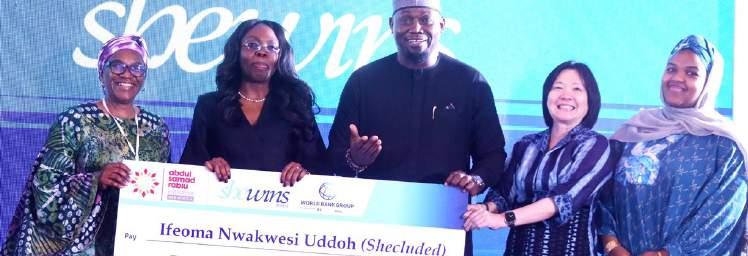
SHEWINS AFRICA INITIATIVE...
L-R: Senior Operations Officer, Gender, IFC, West and Central Africa, Nelly Elimbi; SheWins grant winner, Ifeoma Nwakwesi Uddoh; MD/CEO, ASR Africa, Dr.
Rabiu, at the SheWins Africa - Phase 1 closing ceremony held in Lagos…recently
Francis Sardauna in Katsina North-West Governors’ Forum led by the Katsina State Governor, Dikko Umaru Radda, has formally adopted and launched the North-West Peace, Security and Development Framework (2026–2030) as a strategic blueprint for coordinated regional action. In a statement issued yesterday by Radda’s Chief Press Secretary, Ibrahim Kaula Mohammed, said the
Tracka Queries N129.5bn Census Spending, Accuses NPC of FOI Breach
Sunday Ehigiator
Civic technology organisation, Tracka, has raised alarm over the disbursement of N129.5 billion for Nigeria’s suspended 2023 population census, demanding immediate accountability from the National Population Commission (NPC).
In a statement issued yesterday by its parent body, BudgIT Foundation, Tracka said despite the huge expenditure between February 2022 and December 2023, no enumeration results have been released, describing the situation as a “governance crisis.”
According to the group, “the
census, which was announced, partially mobilised, and ultimately truncated without a single enumeration result being published, has consumed billions of naira of public funds with no corresponding public accountability.”
Tracka said its analysis of public expenditure records showed that “payments totalling N129.5 billion” were made to contractors and service providers for the exercise, including “N118.38 billion for Personal Digital Assistants and accessories, N2.47 billion for Hilux vehicles, N499.8 million for power banks, and N106.19 million for an e-recruitment portal.”
new security blueprint for the region was launched at the 3rd Meeting of the North-West Governors’ Forum held in Abuja.
Governor Radda who is the chairman of the forum reaffirmed that sustained collaboration and shared responsibility are critical to
addressing insecurity and development challenges across the region. He noted that the framework responds to the complex
Africa’s Creative Heavyweights Unite to Shape Continent’s Story
Oluchi Chibuzor
In line with Agenda 2063, the Opportunity Africa initiative has launched its Creative Council, bringing together Africa’s leading communications, media and marketing leaders to advance a narrative that contributes to building ‘The Africa We Want’.
It is a pan-African platform and movement designed to shift how the world sees Africa and how Africa sees itself, by amplifying the people, stories and institutions already shifting perceptions. It is a shared platform that brands, institutions and storytellers can align around to communicate a stronger, more unified story of Africa.
At a time when the global order is shifting and competition for capital, influence and attention is intensifying, perception matters as much as facts. For Africa, image is no longer a soft issue. It is a strategic one. The Creative Council has been established to help ensure Africa is defined by those building it.
Scottyolorin Unveils Debut Mixtape ‘Olórin Pack’, Signals New Career Chapter
Sunday Ehigiator
Fast-rising Nigerian artiste, Scottyolorin, has officially released his debut mixtape titled ‘Olórin Pack’,
marking a significant milestone in his evolving music career.
In a statement yesterday, the project was described as “a compact yet impactful
12-track body of work” running for approximately 22 minutes, carefully curated to reflect both his past achievements and future ambitions.
AT APC CONVENTION, TINUBU PREACHES UNITY, FIRES AT OPPOSITION, SHOWCASES REFORM GAINS
tax and fiscal policy reforms. We are implementing social investment programmes, and have embarked on efforts to strengthen our national security.
"We have further built up foreign exchange buffers to protect the economy against external shocks. Our stock market is booming, and listed companies are recording mega profits. Our GDP is growing. We have successively recorded trade surpluses. Inflation has declined steadily for eight consecutive months to 14.45%, while food prices are easing, bringing gradual relief to households. Business confidence is returning, with 12 consecutive months of economic activity expansion.
"Investor confidence has vastly improved. Our oil
and gas sector has once more become attractive to foreign investment, following our reforms. Our Eurobond issuance was oversubscribed by 400%, and Nigeria exited the FATF Grey List, marking a decisive return to global financial credibility.
"Despite these achievements, we continue to face legacy issues such as electricity supply, debts to GENCOs and gas suppliers, and antiquated transmission infrastructure. Recently, we announced plans to address this by establishing the Grid Asset Management Company (GAMCO), which will inject approximately 1,600 megawatts into a new grid corridor.
"Tonight, you heard testimonies from beneficiaries of
some of our programmes. Our programmes are real, visible, feasible, impactful, measurable, and not mere rhetoric, as some opposition elements like to say. We are moving from survival mode to stability and steadily towards an era of prosperity."
The President further charged te party faithful to strive to win more governors, legislators and others from opposition parties to the APC.
He said: "May you continue to win more converts into the party as we have done in the last two years, when an unprecedented number of new members, governors, senators, representatives, old and current, join our party from other political parties.
"This growth demonstrates
the strength of our beliefs and Nigerians' trust in our Party. My charge to you is to sustain this expansive political structure through credible leadership and transparent party management, anchored in a reliable, verifiable database of our members nationwide."
Tinubu in the course of his address observed minute silence in honour of his predecessor, Muhammadu Buhari and other party leaders and members who sacrificed to make the party a united one.
His words: "Let us stand and observe a moment of silence in memory of our first leader and the first elected president produced by our party, President Muhammadu Buhari.
(May Allah continue to keep
his soul in Aljana Firdaus) .
"Let us also stand and observe another moment of silence in memory of other leaders and members, with whom we started this journey together and who have passed on to eternal glory: (May their souls rest in perfect peace)."
Earlier, Speaker of the House of Representatives, Tajudeen Abbas called for a deliberate effort to support the return of committed and performing legislators in the 2027 elections.
He added that together, the executive and the legislature can sustain this path and complete the work they have begun.
and interlinked challenges facing the region, including insecurity, organised crime, and socio-economic vulnerabilities, which require integrated and collective action.
“The framework provides our shared vision and clear priorities. We must now act with determination to translate this into tangible results for our people,” he said.
CHANGE OF NAME
I formerly known and addressed as Giwa modinat abimbola, now wish to be known and addressed as durosinmi-Etti modinat abimbola. All former documents remain valid. The general public should please take note.
I formerly known and addressed as unEKu itoHan atawodi, now wish to be known and addressed as unEKu itoHan Edun All former documents remain valid. The general public should please take note.
I formerly known and addressed as awoYEmi YEtundE tEniola, now wish to be known and addressed as tEniola awoYEmi badmus All former documents remain valid. The general public should please take note.
Abbas noted that as they commit to continuity at the executive level, they must also secure stability within the legislature.
He said the high turnover of Senators and Members over the years has come at a cost to governance, to lawmaking, and to public resources spent on constant training and retraining.
"This is why I say that President Bola Tinubu must continue this work beyond 2027. Not for sentiment. Not for convenience. But because the work has begun, and it must be completed.
“Because the foundation has been laid, and it must be built upon. Because the path has been chosen, and it must be sustained. And if we are to sustain that path, continuity must not be limited to the executive alone. It must extend to the legislature.”
Ubon Udoh,
Social Development Officer, ASR Africa Initiative, Najaatu
Jonathan atungwu:
we’re Raising a generation that Sees agriculture as Innovation, not Survival
Prof. Jonathan Atungwu is the Provost, Federal College of Agriculture, Moor Plantation, Ibadan. At a time when agriculture is often seen as a last resort,Atungwu is working to rewrite that narrative. He is championing a bold vision that positions agriculture as a hub of innovation, enterprise, and global relevance. Despite funding constraints, he is driving reforms that prioritise skills over certificates and prepare students for realworld impact. Atungwu speaks on leadership, transformation, and his mission to raise a new generation that sees agriculture not as survival, but as opportunity. Sunday ehigiator brings the excerpts:
How would you describe your leadership philosophy?
My leadership philosophy transcends traditional boundaries, thriving on a synergy of dynamism, institutional excellence, and hyper-efficient resource management specifically tailored for the unique demands of the Gen Alpha era.As the Provost of the Federal College of Agriculture, Moor, Plantation, Ibadan (FCAIB), I advocate for a proactive, solution-oriented leadership style that anticipates the evolving needs of a digitally-native generation while fostering a resilient, supportive ecosystem for all stakeholders. Central to this vision is a profound commitment to the holistic welfare of our students, staff, and the broader community. For our Gen Alpha learners, we provide more than just academic rigour; we deliver a tech-forward, empathetic environment that prioritises mental well-being and equips them with the agile, tech-integrated problem-solving skills necessary to navigate an increasingly complex agricultural landscape. For our staff, my focus is on institutionalising a culture of continuous professional development, wellness, and empowerment, ensuring they possess the cutting-edge tools and psychological safety required to mentor the next generation of innovators. Beyond the campus gates, our mandate extends to becoming a primary solution provider for the community. By harmonising strategic initiatives with our grand mission, we bridge the gap between academic research and real-world application, delivering sustainable agricultural solutions that address local food security and economic stability. This philosophy is rooted in a culture of constant improvement, where innovation is leveraged to create a measurable, positive impact on every life we touch. We remain nimble and responsive, guaranteeing our college stays at the absolute cutting edge of agricultural education and community service, serving as a beacon of progress and sustainable growth in a rapidly changing world.
How has your experience as a professor shaped your leadership approach?
My extensive and distinguished experience as a Professor of Plant Nematology, exposure in home and foreign universities as resource persons, characterised by decades of academic leadership and significant pedagogical contributions, has facilitated a profound synthesis of theoretical research and practical industry application. Having directly supervised and mentored more than one hundred undergraduate and postgraduate students—many of whom have transitioned into pivotal roles within national and international Higher Education Institutions, research centres and the global agricultural sector, I have cultivated a leadership style that is fundamentally evidence-based, collaborative, and student-centric. This methodology transcends traditional classroom instruction by integrating cutting-edge academic research directly into comprehensive educational curricula and specialized technical training programmes. Consequently, this holistic approach ensures that complex scientific advancements in agriculture, especially organic agriculture, are effectively translated into scalable agricultural solutions, addressing critical global challenges such as soil
health, sustainable pest management, nutrition and food security. By bridging the gap between rigorous laboratory investigation and field-level implementation, my leadership continues to foster a culture of innovation that aligns academic excellence with the tangible requirements of modern agricultural productivity.
How can Higher Education Institutions more effectively align their curricula with the requirements of industry?
Higher Education Institutions (HEIs) represent a multifaceted landscape of academic and vocational training, comprising traditional research universities, specialised agricultural colleges, pedagogical institutes focused on teacher education, and polytechnics dedicated to applied sciences. This diverse ecosystem ensures that various sectors of the economy are supplied with a workforce tailored to specific technical and theoretical demands. The Triple Helix model—the collaborative intersection of academia, industry, and government—serves as a primary driver for institutional evolution. By utilizing this framework, HEIs move beyond theoretical instruction to engage in the comprehensive co-design of
curricula alongside private and public sector employers. This collaborative approach ensures that the skills taught in the classroom are directly transferable to the workplace. It facilitates the integration of practical competencies, such as hands-on technical training, soft skills development, and problem-solving capabilities, into the core academic journey. Furthermore, this model ensures the ongoing relevance of educational content by establishing a feedback loop with the labor market.As industries undergo rapid technological shifts, the Triple Helix framework allows for agile curriculum updates that reflect current market trends and future demands. Leveraging deep national and international curriculum development expertise, this process synthesises global educational standards with local economic needs, ultimately enhancing graduate employability and fostering regional innovation. Through structured partnerships, guest lectures, and industry-led projects, HEIs transform into dynamic hubs that produce career-ready professionals equipped to navigate a complex, globalised economy. The College currently reviving the founding fathers’ industry-ready graduates. There has been a traffic of industries signing Memoranda
of Understanding that focused on providing support and co-creation of entrepreneurship.
You have contributed to curriculum development—what reforms do you consider most urgent today?
I have been involved in curriculum development through reviewing existing curricula, and redesigning need-based curriculum. I have been involved in organic agriculture curriculum development in Nigeria and internationally. At the College, mainstreamimg Computing Science, fisheries management, digital agriculture, organic systems, and entrepreneurship; deepen hands-on enterprise skills across value chains are been pursued.
What role should research play in solving Nigeria’s food security challenges?
Within the domain of our specialised area, research for development (R4D) must prioritise bridging the gap between scientific innovation and practical field application. These endeavors should focus on the long-term advancement of host-plant resistance and the rigorous testing of organic and biopesticide-based crop protec-
• Atungwu
Super Saturday
Jonathan Atungwu: Skills, Not Certificates, Give Students Fighting Chance in Life
tion strategies specifically tailored to the unique ecological pressures of tropical agricultural systems. To ensure the long-term viability of these interventions, a robust capacity-building framework is essential; this involves training local smallholder farmers, extension officers, and technical researchers in the latest biotechnological tools, integrated pest management (IPM), and the sustainable management of resilient cultivars. Furthermore, the objective should encompass the creation of holistic organic food systems that integrate soil health management, biodiversity conservation, and transparent certification pathways. By furnishing high-yielding, resistant cultivars and establishing economically viable, scalable methodologies, such research aims to drastically enhance agricultural productivity, minimize pre- and post-harvest losses, and fortify the integrity of the rice value chain, ultimately ensuring food sovereignty and economic resilience in tropical regions.
What have been your key priorities in managing the Federal College of Agriculture, Ibadan?
In managing the mission and impact Federal College of Agriculture, Ibadan, our strategic priorities focus on four critical areas designed to drive long-term institutional excellence. First, we are dedicated to strengthening the nexus between cutting-edge agricultural research and national food security, ensuring that scientific innovations are effectively translated into practical, sustainable farming solutions that address regional and national nutritional needs. Second, we aim to significantly expand student enrollment while simultaneously deepening the quality of practical farm-enterprise learning; this involves integrating modern agribusiness techniques and hands-on vocational training into the curriculum to produce graduates who are both skilled agricultural practitioners and successful entrepreneurs. Third, we are institutionalising rigorous, multi-level quality assurance standards to maintain academic integrity, modernise infrastructure, and ensure that our pedagogical methods remain globally competitive and industry-relevant. Finally, we are fostering a culture of participatory governance and inclusive leadership, encouraging active
PHOTONEWS
collaboration among staff, students, and external stakeholders to ensure transparency, collective accountability, and a unified vision for the college’s sustainable development.
If you are to evaluate the current state of FCAIB concerning its academic excellence and infrastructural provisions, how will you describe it?
A recent comprehensive needs assessment reveals that the College possesses an exceptionally resilient foundation, built upon a storied 105-year legacy of excellence in practical, hands-on training and the unwavering strength of its diverse academic programmes. While the institution currently addresses the evolving requirements of its physical infrastructure and the global challenge of rising energy costs, these factors are being embraced as vital opportunities for modernization and renewal. Through a visionary commitment to sustainable resource optimisation and the cultivation of powerful, strategic partnerships with industry leaders and community
L-R: Executive Head of Content and Channels, West Africa, MultiChoice, Atinuke Babatunde; Veteran Actress and AMVCA Head Judge, Joke Silva; Head of Marketing Africa Partner Markets, Segun Ogunleye; Culinary Category Manager, Promasidor Nigeria Limited, Omotayo Olaobaju; Manager for Sponsorship and Promotion, MTN Nigeria, Njide Ken-Odogwu, at the 12th edition of the Africa Magic Viewers Choice Awards Press Conference at MultiChoice Studios, Ilupeju, Lagos, ...yesterday PHOTO: SUNDAY ADIGUN
L-R: Divisional Head, Renewable Energy, Mobility and Tourism, Sterling Bank, Mr Darlington Nwankwo; Convener, Chess in Slums Africa, Tunde Onakoya; and Head of Tourism and Creative Arts Business, Abiola Adelana, Sterling Bank at the Coffee and Arts Uncover Naija Arts Exhibition hosted by Sterling Bank in Lagos…recently
stakeholders, the College is actively transforming its constraints into catalysts for progress. This proactive approach ensures that the institution remains at the forefront of educational innovation, creating a vibrant, future-proof environment where students and faculty alike can thrive for the next century and beyond.
What reforms or innovations have you introduced or supported at FCAIB?
The institutional reform agenda introduced at FCAIB is centered on the systematic restructuring of administrative and academic frameworks to foster operational excellence and global competitiveness. Key initiatives include the formal institutionalisation of specialised Directorates and Centres, notablyAcademic and Strategic Planning to ensure data-driven governance, and Physical Planning to oversee sustainable infrastructural development. To align with global trends in agricultural education and financial sustainability, the College has formalised Farm Enterprises and Commercial Services, alongside a dedicated Research, Innovation, and Development hub designed to catalyze scientific advancement and industry partnerships. The digital transformation mandate is anchored by the Directorate of ICT and Digital Services, ensuring the integration of modern technologies across pedagogical and administrative workflows. Furthermore, corporate governance and institutional integrity have been significantly bolstered through the professionalisation and transparency of Audit and Procurement processes, the establishment of a robust Legal Unit, and the introduction of SERVICOM. These measures collectively uphold the highest standards of transparency, regulatory compliance, and service delivery excellence, positioning the institution as a model of modern academic administration. Students-focused development, scholarships and upgrade of prizes, issuance of certificates same day of convocation and graduate retention have been institutionalised.
What are the biggest challenges currently confronting FCAIB?
The primary challenges encompass financial resource limitations, suboptimal student enrollment figures, the necessity for continuous
professional development and retraining of staff, the imperative for comprehensive infrastructure upgrades, including student accommodation facilities, laboratory equipment, agricultural access roads, and power supply systems, ensuring stringent alignment of educational curricula with evolving industry demands, and the comprehensive modernization of agricultural training methodologies. To bridge the gap between academia and the professional world, we are redesigning our curricula into a dynamic, industry-integrated framework that evolves in real-time with market demands. By modernising our agricultural training methodologies through the integration of smart-farming technologies and hands-on experiential learning, we are preparing a new generation of market-ready leaders. This evolution represents more than just a solution to existing challenges; it is a bold commitment to a flourishing, innovative, and highly impactful future that will drive sustainable economic growth for our entire community.
How does funding constraints affect the College management and research output?
Insufficient financial provision detrimentally impacts the College’s advancement. Specifically its operational efficiency and scholarly output, and concurrently undermines the cultivation of external collaborations and partnerships.
What challenges have you faced in implementing reforms, and how did you overcome them?
The implementation of institutional reforms has encountered multifaceted challenges, primarily characterised by systemic funding deficits and the complexities of securing consensus among diverse internal stakeholders and professional regulatory bodies. To address these impediments, a strategic methodology was adopted, emphasising inclusive stakeholder engagement, the execution of pilot initiatives, and the development of evidence-based proposals. These measures were instrumental in facilitating organisational buy-in and ensuring that reform objectives aligned with broader institutional interests.
See concluded part on www. thisdaylive.com
L–R: Deputy Managing Director, Access Bank Plc, Chizoma Okoli; former Minister of Education, Dr. Obiageli Ezekwesili; Director-General, Centre for Black and African Arts and Civilisation, Aisha Adamu Augie; Chairman, Access Bank Plc, Ifeyinwa Osime, and Founder, House of Tara International, Tara Fela-Durotoye, at the Access Bank International Women’s Day Conference 2026, held in Lagos … yesterday PHOTO: SUNDAY ADIGUN
MD/CE NEXIM, Abba Bello, Executive Director Business Development, Hon. Stella Okotete and female staff of NEXIM Bank celebrating the 2026 International Women’s Day in Abuja...recently
• Atungwu
pOLITICS
2027: As APC Begins Search for Kwara Governorship Candidate
For the All Progressives Congress, consensus has evolved beyond a mere procedural alternative. It has become a political philosophy aimed at preserving unity while strengthening electoral preparedness. As the party wraps up its National Convention today in Abuja, Adedayo Akinwale takes a look at the party’s adoption of consensus arrangements over primaries as its preferred choice of intra party leadership selection
The All Progressives Congress (APC) has in recent years, deployed the consensus option as a strategic tool to consolidate internal cohesion and minimise rancour across its structures.
From the ward, local government, state and zonal congresses so far conducted, the party has consistently leaned on consensus arrangements to produce candidates and leaders with minimal friction.
The same template has also reportedly shaped the emergence of gubernatorial candidates in key states across the Southwest.
In states such as Lagos, Ogun, and Oyo, the party is said to be gravitating toward consensus figures—names like Obafemi Hamzat, Senator Solomon Adeola (Yayi), and Senator Sarafa Ali have featured prominently in these calculations.
A similar model was deployed in Osun, where Bola Oyebanji emerged as the party’s standard bearer to challenge the incumbent governor, Senator Ademola Adeleke.
For Yayi, his governorship ambition symbolises the agelong yearning of the Ogun West stakeholders, notably the marginalised Yewa/Awori people, his support base is vast and widespread because it represents fairness, it represents justice, it represents equity.
Such cannot be suppressed by any means because the power or momentum for the movement is not imposed from the top by political leaders, parties, or elites. Rather, it is driven by people’s conviction and genuine sense of purpose.
Beyond the “Ogun West Lokan” agenda, Adeola’s supporters see the ambition both as a regional expression of a historical grievance and a state-wide appeal to political ideals. This provides the moral and philosophical justification for his ambition, especially looking at it as a project for the benefit of the entire state’s political equilibrium.
In the case of Hazmat, it’s compensation for being a party man. When the Governor Advisory Council (GAC) kicked against the second term ambition of Akinyemi Ambode, Hamzat was favored to be the next governor of Lagos State. he already purchased the governorship form but was subsequently prevailed on by Asiwaju Bola Tinubu to step down for Babajide Sanwo-Olu.
Though, he eventually became his running mate and later on the Deputy Governor. It was based on this that it’s been speculated that President Tinubu and the GAC have agreed that it was time for Hazmat to wear the big shoe.
In the same vein, Ali representing Oyo South in the Senate was said to have been picked during a meeting by APC stalwarts from the South West during a meeting with President Bola Tinubu at his Ikoyi, Lagos residence last weekend.
However, Minister of Power, Adebayo Adelabu and Oyo APC have dismissed speculations.
It defeats the argument by opponents from Ogun Central and Ogun East who view the Ogun West agitation for power shift from the lens of a sense of entitlement, which they say, should not override the need for competence and state-wide electability Against this backdrop, attention has now shifted to Kwara State, where the question on the lips of party stakeholders is straightforward: will the APC replicate the consensus model in deciding its 2027 governorship candidate?
This speculation gained further momentum earlier in the week when indications emerged that the party’s national leadership may have settled for Senator Saliu Mustapha as a possible consensus candidate for the 2027 gubernatorial election. While no official confirmation has been made, the development has triggered conversations across political blocs within the state.
How Far Can Saliu Mustapha Go?
By most political calculations, Mustapha represents a compelling profile within the APC’s evolving power dynamics in Kwara. Young by political standards, financially endowed, and deeply connected across national political networks, he has steadily positioned himself as one of the most visible and viable contenders ahead of 2027.
Born over five decades ago to an Ilorin father and an Okun mother, Mustapha embodies a unique sociopolitical identity that resonates across Kwara’s diverse constituencies. His educational journey—from Saint Bartholomew Primary School in Wusasa, Zaria, to Command Secondary School in Kaduna, and later
Kaduna Polytechnic—provided an early foundation, though his path would ultimately be defined by politics rather than engineering.
His political evolution dates back to 90’s with the then SDP National Secretary, Chief Alexis Anielo. Thereafter he served as the protem National Publicity Secretary of the Progressive Liberation Party. He quickly rose through the ranks, becoming National Organising Secretary of the Progressive Action Congress and later served as the Organising Secretary of the Conference of Nigerian Political Parties.
Mustapha’s trajectory gained national significance through his longstanding association with former President Muhammadu Buhari during the opposition years. From his role in The Buhari Organisation to his involvement in the All Nigeria Peoples Party (ANPP) presidential campaigns, he built networks that would later prove instrumental in his rise.
As a founding figure in the Congress for Progressive Change (CPC), where he served as Deputy National Chairman, and a key actor in the historic 2013 merger that birthed the APC, Mustapha’s credentials within the party’s legacy structure remain firmly established. He’s also reputed as the oldest surviving founding chieftain of the APC in Kwara State.
Beyond politics, his business interests in real estate and contracting further expanded his influence, reinforcing a reputation for resourcefulness and strategic reach. His emergence in the Senate in 2023 marked a new phase.
Initially underestimated, he quickly became a visible player, particularly during the leadership contest that produced Senate President Godswill Akpabio. Political insiders credit him with playing a strategic role in mobilising first-time senators in support of Akpabio, a move that elevated his standing within the National Assembly.
As Chairman of the Senate Committee on Agriculture and Agricultural Production Services, Mustapha has leveraged his position to facilitate developmental interventions, particularly in agricultural infrastructure and rural development.
Yet, Nigerian politics is rarely determined by popularity alone. Party structures, delegate control, and executive influence often play decisive roles. In Kwara, Governor AbdulRahman AbdulRazaq remains a central figure with significant influence over these levers.
For Mustapha, the path ahead will depend on whether his growing goodwill can translate into a cohesive political machinery capable of navigating these structural realities.
Mustapha
as the Kwara Consensus Option
The possible emergence of Senator Mustapha as a consensus candidate carries far-reaching implications for the APC in Kwara.
First, he is widely seen as a potential unifying figure. Over the years, he has cultivated relationships across nearly all political blocs within the party and beyond, making his candidacy relatively easier to market internally. From long standing actors to newer entrants, his network cuts across divides that have historically shaped Kwara politics.
His decades-long political journey has enabled him to build enduring alliances. Though he experienced friction with AbdulRazaq in the past, recent developments suggest a thaw in relations, with both figures increasingly seen together at public and private engagements. This reconciliation, observers say, removes one of the major obstacles that could have hindered a consensus arrangement.
Apart from his expansive network of friends across the party, he has also deliberately leveraged his office to build bridges and cultivate relationships across political divides.
This wide acceptance was further reinforced during a courtesy visit by the leadership of the Ilorin Emirate Descendants Progressives Union (IEDPU), led by its National President, ACG Abdulmumini Abdulmalik (rtd). The union commended Mustapha for his developmental initiatives and communityfocused projects, noting their visible impact across the Emirate. Similarly, backing from student groups within the Emirate highlights his resonance among younger demographics. Among students, Mustapha enjoys considerable popularity. Earlier this month, at a Ramadan Lecture organised in his honour by the Amalgamated Students Union of Ilorin Emirate (National Headquarters), he received a strong endorsement for the
governorship.
The lecture, themed “Leadership as Amanah (Trust) in Islam,” drew prominent figures from across the Emirate, including traditional rulers, religious leaders, and community stakeholders.
Speaking on behalf of the students, the National President of the union, Sheikh Zulkainaini Opolo, expressed satisfaction with Mustapha’s performance over the past three years in the National Assembly and called on him to contest the governorship.
The Saraki Factor
However, the 2027 race is unlikely to be a walkover. Former Senate President Bukola Saraki remains a formidable force, with a deeply entrenched political structure and a clear determination to stage a comeback.
However, Mustapha’s profile appears well-suited to neutralise such an advantage. As the Turaki of Ilorin Emirate, he commands significant respect within traditional and religious institutions—two critical pillars that often shape electoral outcomes in the district.
Saraki’s strategy, according to observers, includes fielding a candidate from Kwara Central—the state’s most populous senatorial district, which accounts for over half of its voting strength. Many see this as a masterstroke considering the dominance of Ilorin Emirate in the politics of the state.
Weighing in on this recently, the Director-General of the National Institute for Legislative and Democratic Studies (NILDS), Prof. Abubakar Suleiman, warned President Bola Tinubu and Kwara State Governor AbdulRahman AbdulRazaq to exercise caution in considering the zoning of the APC governorship ticket to Kwara North ahead of the 2027 elections.
Suleiman’s intervention came amid ongoing discussions within the ruling party over whether to rotate power to the northern zone of the state in line with calls for inclusivity and political balance.
According to him, political parties typically base such decisions on measurable factors, including voter population, political structures, and historical voting patterns. Where these factors do not support a particular zone, he warned, zoning could weaken a party’s chances.
“No political party takes the risk of zoning to where it does not believe it has a competitive advantage,” he added.
Suleiman referenced the 2023 general election, noting that the PDP made a strategic miscalculation and came back with burnt fingers. He said the party has now learnt its lessons and is now zoning back to Kwara Central to gain the electoral advantage.
Mustapha
AbdulRazaq
PeoPle
Peter Adeshile: For Me, Music Has Always Been an Expression of Faith
In a sunlit Ikeja studio, Lagos hums softly beyond soundproofed walls. Trumpet gleams, saxophone rests, and Peter Adeshile fondly called ‘Kakaki Jesu’ tunes his instruments with quiet devotion. Here, music, faith, and disciplined creativity converge, shaping a life where gospel sounds, professional rigor, and personal commitment form a harmonious, enduring composition, writes Adedayo Adejobi
In a sunlit studio tucked away in Ikeja, Lagos, the hum of air conditioners blends with the faint metallic shimmer of brass instruments. Microphone stands, cables coiled neatly on the floor, and keyboards lined against the walls frame a space that is simultaneously functional and reverent. This is a small sanctuary of sound. Here, amidst the faint smell of polished wood and the occasional whiff of coffee, Peter Adeshile sits poised, trumpet resting casually on a stand beside him, saxophone slung over his shoulder, and an open notebook of musical scores at hand.
The city’s restless energy pulses faintly through the soundproofed windows, a distant reminder that outside, life rushes by; inside, time is measured by rhythm and silence.
“I have never seen music as something separate from my faith,” he begins, his voice calm but charged with intent, as though every note he has played carries a message beyond the studio walls.
“For me, music is a form of prayer. When I play, I am speaking to God and inviting others into that conversation,” he adds.
The private studio is compact yet warm, adorned with framed images of past performances, handwritten sheets of music pinned on a corkboard, and a small shelf stacked with books on African rhythms, jazz theory, and gospel hymns.
The faint echo of a saxophone’s low tone vibrates off the walls as Adeshile tests his instrument, coaxing a note that hangs in the air before fading into silence.
“Music taught me patience very early,” he recalls, his fingers gently adjusting the valves of the trumpet.
“You cannot rush sound. You practise, you repeat, and slowly something beautiful begins to emerge.”
The soft fluorescent light highlights the brass gleam of his trumpet and the lacquered finish of his saxophone, casting reflections that dance like fireflies across the polished wooden floor.
Outside, the honk of cars and the occasional shout of street vendors are muffled by double-glass windows, leaving the room with a stillness that feels sacred. Every object here, from the mixing board in the corner to the worn leather stool he perches on, tells a story of hours spent crafting, perfecting, and listening.
His journey began in Nigeria, where his earliest formal encounters with music came through the Boys Brigade.
The training instilled habits that would follow him into adulthood: patience, repetition, and the quiet satisfaction of gradual improvement. He first learned the drums before moving on to the trumpet, an instrument whose bright, declarative voice suited both his temperament and his faith.
“The trumpet spoke to me immediately,” he says, holding the instrument delicately, as if acknowledging its personality.
“It is an instrument that announces something. It calls attention. I felt it was perfect for proclaiming the Gospel.”
It was this instrument that earned him the nickname “Kakaki,” derived from the Hausa ceremonial trumpet. Over time, the name evolved into “Kakaki Jesu,” a title that fused identity with belief, the trumpet in service of the Gospel.
“Someone once called me Kakaki because of the trumpet,” he recalls, smiling at the memory.
“Later it became Kakaki Jesu. I accepted it because it reminds me that the gift is not really mine, it belongs to God.”
Born in Oyo State and later settling in Britain, Adeshile’s musical development continued within church communities, where the need for committed musicians often turns willing volunteers into seasoned performers. Encouragement from fellow worshippers pushed him towards the saxophone, whose warmer tone complemented the assertiveness of the trumpet.
“I did not plan to become a saxophonist,” he says, lifting the saxophone gently and running his fingers over the keys. “The church needed one, and people encouraged me. That is how ministry works, you grow into the need.”
He tests a few notes, the sound echoing softly against the studio walls. There is a moment of silence as he tilts his head, listening, calibrating the timbre,
before continuing.
“I want my music to sound African and spiritual at the same time,” he explains. “Our faith did not remove our culture, it gave it new meaning.”
For Adeshile, music has always been ministry. Raised within a Christian tradition, he came to see gospel not as a career option but as a calling , a means of communication between the sacred and the everyday.
“Gospel music is not a profession you choose lightly,” he says, eyes scanning the studio as though measuring the weight of each word. “It is a responsibility. People listen with their hearts, not just their ears.”
His early recordings included instrumental interpretations of familiar hymns such as Amazing Grace, works that resonated particularly within diaspora congregations seeking continuity in unfamiliar surroundings.
“When Nigerians gather abroad, music becomes memory,” he observes. “A hymn can take you back home in a moment.”
The afternoon sun slants through the venetian blinds, casting stripes across the
floor and glinting off the polished brass instruments. The faint scratch of a pencil against paper signals his notation of a new arrangement — a hymn reinterpreted with Afro-highlife syncopation and subtle jazz inflections. Outside, the noise of Lagos traffic persists, but here, within these walls, the city has become a soft, almost imperceptible rhythm, a counterpoint to the deliberate cadence of creation.
The past year has carried that sound far beyond the studio walls. In 2025, Adeshile embarked on an extensive North American tour, performing across major American cities including Atlanta, Chicago, Delaware, California, Houston and Maryland, before moving on to Canada with stops in Toronto, New Brunswick, Ontario and Manitoba. The reception, he says, reaffirmed his belief in music as bridge-building ministry. “2025 was intense and beautiful,” he reflects.
“From Atlanta to Toronto, I saw how hungry people are for music that reminds them of home and of God. Every city felt like a reunion.” With invitations already secured well into the coming year, he adds with quiet gratitude, “My 2026 is even more booked. It tells me that the message is resonating beyond borders.”
This commitment eventually culminated in the
album Afro According to the Gospel, a project that captures his artistic philosophy with clarity. Traditional hymns and African rhythms merge into a unified soundscape, affirming his conviction that gospel music must remain culturally rooted even as it reaches toward spiritual universality.
“That album is my testimony in sound,” he says. “It shows that the Gospel can speak in African rhythms without losing its message.”
Adeshile has often argued that music becomes most necessary in times of hardship. When economies falter and uncertainty grows, he believes songs of hope carry renewed meaning.
“When people are struggling, they need encouragement,” he says. “Sometimes a song can do what a long speech cannot. Music reminds them that God is still present, even in uncertainty.”
Yet what distinguishes Adeshile from many artists is the discipline that surrounds his creativity. Before music took centre stage, he worked in banking and other professional environments that sharpened his organisational instincts. Those experiences cultivated a respect for planning and method that continues to shape both his professional and personal life.
“My professional life taught me order,” he says, glancing at a meticulously arranged stack of project folders on a nearby shelf. “Creativity flows better when your life is organised.”
This structured approach extends beyond the rehearsal room. Adeshile belongs to a generation of diaspora Nigerians who maintain professional careers alongside creative pursuits. His involvement in project environments in the United Kingdom reflects a practical philosophy: that artistic expression need not exist in economic uncertainty.
“I believe stability gives you freedom,” he explains. “When your basic needs are secure, you can serve God with a clearer mind.”
It is a dual identity he carries with ease, project professional by day, gospel instrumentalist by calling, each role reinforcing the discipline required by the other.
“I do not see it as two lives,” he says. “It is one life with different responsibilities.”
If music provides the rhythm of his life, family provides its grounding. Adeshile speaks often about the importance of order and partnership within marriage, seeing domestic stability not as an accident but as a shared responsibility.
“Marriage is teamwork,” he says simply. “You build it every day. My wife and I have learned to respect each other’s gifts. She keeps me grounded, I try to inspire her in return.”
Central to this balance is his wife, Yetunde, herself an accomplished project management professional whose organisational skills complement his artistic pursuits.
“My wife is my strongest support,” he says. “Many things people see in my life are possible because she stands with me.”
Together, they present a model of complementary strengths, a quiet collaboration rather than a public performance. Her laughter occasionally rings through the studio as she observes him tuning the saxophone, a reminder that music here is both work and joy.
Within the broader tradition of Nigerian diaspora musicians, Adeshile occupies a distinctive place. His work speaks to immigrant congregations navigating life between continents, communities that seek reassurance in familiar sounds and messages.
“I see myself as a bridge,” he says. “Music connects where distance separates. Every note is meant to remind someone of home and God’s presence.”
Trumpet in hand, saxophone slung across the shoulder, and project plans neatly arranged, Peter Adeshile represents a modern African artist, one who treats life itself as a carefully managed composition.
“I want my life to be in tune,” he says softly. “Not perfect — just in tune. Music teaches you that balance is everything.”
In the Ikeja studio, where sunlight falls in slanted stripes across the instruments, every object, every note, every pause speaks of intentionality, discipline, and devotion. Here, Lagos is distant yet present; the city’s chaos becomes rhythm, and the studio’s quiet becomes sanctuary.
Adeshile
perSpeCTIVe
10 Major Takeaways from Tinubu’s State Visit to United Kingdom
Temitope Ajayi
Nigeria returned to global significance with the just-concluded state visit to the United Kingdom by President Bola Tinubu. The President and his wife, Senator Oluremi Tinubu, played their roles well to critical acclaim. Both the President and the First Lady brought grace to the occasion with their poise, elegance, and comport- ment. Since the visit ended on Thursday, if the Nigerian brand stock had been traded on the London Stock Exchange, the share price would have risen astronomically, delivering unprecedented value to shareholders.
The reception at Windsor by the British Royal Family, led by King Charles III and Queen Camilla, which ended with a state banquet, marked a high-profile foreign policy moment for Nigeria and President Tinubu. If head-of-state diplomacy underscores the irreplaceable role of a leader in stewarding and cementing strategic partnerships between two nations, then President Tinubu’s visit to the UK lived up to its billing. The visit, which has been described as a masterpiece of diplomacy, especially given the special bond between Nigeria and the United Kingdom, has delivered clear dividends to the Nigerian people, as evidenced by the signing of some bilateral agreements across critical sectors of the economy.
Here are the key takeaways from the state visit:
1. Lagos ports modernisation funding: One of the major wins of President Tinubu’s visit to the UK is the £746 million financing secured for the modernisation of the Apapa and Tincan Island ports in Lagos through the UK Export Finance, being coordi- nated by Citibank. The financing deal was signed on behalf of the federal government of Nigeria by the Minister of Finance and Coordinating Minister of the Economy, Wale Edun. The deal will expand the ports’ infrastructure and automation, double the capacity of the two ports, reduce congestion, improve trade facilitation, and generally boost Nigeria’s competitiveness as a maritime hub in West and Central Africa. Since Apapa Port was established in 1913 and Tincan Island Port was commissioned in 1977, the two premier ports in Nigeria, which account for over 70% of Nigeria’s port activities, have not undergone major refurbishment. Rather than relying on treasury funding, the UK funding deal will ease fiscal pressure on budget provisions. The ports’ modernisation will ensure a comprehensive rehabilitation of ageing quay walls, deploy modern cargo-handling systems and completely digitise port operations to deliver efficiency and quick turnaround for the clearing of goods, thereby boosting economic output and national productivity. The modernisation will also boost job creation across port activities and the ecosys- tem’s value chain.
2. Expanding trade opportunities: President Tinubu and Prime Minister Keir Starmer, during their bilateral meeting at No 10 Downing Street, agreed to deepen trade between Nigeria and the UK. Nigeria, as the largest market, offers huge opportunities for UK goods and services as the country seeks to expand market access outside the European Union. To increase trade volume between the two countries, which currently exceeds 8 billion pounds per annum, Nigerian businesses, especially small and medium-scale business owners, will be able to take full advantage of the duty-free and reduced-tariff measures granted by the UK government under its Developing Countries Trading Scheme (DCTS). Under this scheme, over 3,000 products from Nigeria will get easy access to the UK market. The goods include cocoa, cashew nuts, sesame seeds, ginger, craft and textile products. This scheme will further boost Nigeria’s foreign exchange earnings from the non-oil sector.
3. Security and Defence: With the mounting security challenges being confronted by the country, especially terrorism and banditry that have become a chokehold on social and economic activities across the country, especially in the North-East and North-West, where the Boko Haram insurgency and kidnapping for ransom have become endemic, President Tinubu, during the state visit, sought and secured the support of the British government for more military hardware, logistical and training support for Nigeria’s armed forces and cooperation on intel- ligence sharing. President Tinubu, during a bilateral meeting with Prime Minister Keir Starmer, harped on the urgent need for greater support from the United Kingdom to Nigeria to end the ugly incidents of insecurity in Nigeria. During the visit, Nigeria’s minister of defence, General Christopher Musa (Rtd), held a bilateral meeting with his British counterpart, Vernon Coaker, and signed a memorandum of understanding to operationalise defence cooperation and coordination further. President Tinubu made the point during and after the state visit to the UK that his administration would seek all internal and external solutions and support to end the scourge of insecurity in Nigeria.
Deal on £500 million investment in agriculture: Nigeria Sovereign Investment Authority and UK-based Asset Green Limited signed a £500 million deal for the development of a large-scale integrated dairy production and processing factory in Nigeria. Under the deal, which will transform Nigeria’s dairy value chain, Asset Green Limited, a private company focused on agriculture and food processing through its agri-food platform, Agrium Capital Limited, executed the agreement with NSIA. The initiative will see the development of 20,000 hectares of climate-smart pasture for livestock feeding alongside a dairy farm with about 10,000 milking cows. There will also be a modern processing facility that will manufacture a range of dairy products, such as fresh milk, butter, cream, milk powder, and up to 15,000 metric tonnes of infant formula annually. The minister of industry, trade and investment, Jumoke Oduwole, and the chief executive of NSIA, Aminu Umar-Sadiq, executed the deal on behalf of the government of Nigeria. 5. Inclusive education opportunity: Another outstanding
outcome of President Tinubu’s visit to the UK is the partnership with Coventry University to bring UK degrees to Nigeria. The Minister of Education, Tunji Alausa, signed the agreement to establish a Coventry University campus in Alaro City, Lagos. This will facilitate easy access to UK university education in Nigeria and help conserve foreign exchange for families, as their children can now stay in Nigeria and receive the same university education they would have spent huge sums of money to obtain in the UK. The proposed campus in Alaro City, Lagos, will offer bachelor’s and master’s programmes across STEMM, business, and TVET, with admissions expected between Q3 and Q4 of 2026. According to the Minister of Education, Coventry University setting up a campus in Nigeria is beyond access: “This is about building Nigeria’s human capital – developing the skills, talent, and workforce needed to drive innovation, productivity, and long-term national growth.”
At the sub-national level, the Lagos State Government also signed a memorandum of understanding with Estar, an organisation with expertise in digital learning, to bring modern digital learning platforms and infrastructure into our public primary and secondary schools. The agreement, signed by Governor Sanwo-Olu, will empower Lagos State students with access to curriculum-based tools that support critical thinking, communication, decision-making, leadership, and AI skills. It will also strengthen reading, comprehension, confidence, and classroom participation.
6. Private sector-led youth empowerment: Another high point of President Tinubu’s UK visit was the partnership agreement between the King’s Trust and Access Bank. This private-sector-led initiative will leverage King’s Trust International’s expertise in youth development, alongside Access Bank’s pan-African reach, to support programmes that equip young people with the skills, confidence, and guidance needed to pursue meaningful employment and entrepreneurship. Through this endeavour, thousands of young Africans will gain pathways to sustainable livelihoods and opportunities to realise their potential. At the ceremony to consummate the agreement were Access Bank chairman, Aigboje Aig-Imoukhuede, and executive vice-chair of the Aig-Imoukhuede Foundation, Ofovwe Aig-Imoukhuede.
7. Expansion of opportunities in the creative economy: The Minister of Art, Culture, Tourism, and Creative Economy, Hannatu Musawa, led the Nigerian government delegation to Lancaster House for a bilateral engagement at a Creative Industries Roundtable with the British government led by her counterpart, Chris Bryant. The high-level engagements aimed to strengthen UK–Nigeria collaboration across the creative economy. Participants from the UK at the forum include a strong delegation of industry leaders and stakeholders across music, film, publishing, design, and technology to chart a clear course for future collaboration. During the bilateral engage- ment, discussions focused on unlocking growth, addressing structural barriers, and advancing critical priorities, including skills development, access to finance, and the role of intellectual property in scaling creative enterprise. While speaking on the new framework for cooperation with the UK, Minister Hannatu said: “As Nigeria continues to be recognised as a priority growth market, we remain com- mitted to building strategic partnerships that position our creative industries for global competitiveness.”
8. Agreement on migration: Nigeria’s Minister of Interior,
Olubunmi Ojo, and the Secretary of State for the Home Department of the Government of the United Kingdom and Northern Ireland, Shabana Mahmood, signed the agreement on migration. The MoU establishes a framework to facilitate a regulated and safe migration flow between the two countries and to encourage further bilateral cooperation in the fight against irregular migration and associated acts by citizens of each country, in accordance with their respective immigration and citizenship laws and extant international treaties, conven- tions, protocols, agreements, and charters. Under the agreement, Nigeria and the United Kingdom will work together to secure the dignified return of their nationals who do not, or no longer, have the right to enter or remain in the territory of the other country. A clear condition in the MoU is that the returnees concerned are bona fide nationals of the country and are treated with dignity and respect, with due regard to their human rights and fundamental freedoms. Under the agreement, law enforce- ment officers in each country will take the necessary action to protect the interests and well-being of citizens of either party and to mitigate conflict triggers related to migration matters.
9. Infrastructure Investment Forum: Nigeria hosted an Infrastructure Investment Forum in London at the headquarters of Standard Bank International, where the chairman of the Nigerian Exchange Group, Dr Umaru Kwairanga, Minister of industry, Trade and Investment, Jumoke Oduwole, and minister of state for finance, Taiwo Oyedele, made pitches to global investors on investment opportunities in infrastructural develop- ment in Nigeria. The senior officials told the international investors that Nigeria offers a compelling investment case anchored on natural and human capital. They identified key areas in renewable energy, oil and gas, roads, pipelines, housing, ports, aviation, rail, and other critical areas that offer significant returns on investment.
10. UK-Nigeria Project Agglomeration Compact: Mutandis Africa, a pan-African investment and trade facilitation organisation in partnership with the Nigerian Revenue Service, hosted a forum at the House of Lords to design a framework to boost Foreign Direct Investments into bankable projects at the sub-national level. Enugu State Governor, Peter Mbah, and senior federal government officials, along with private sector leaders, engaged directly with top players in the UK’s investor community, including private equity funds, sovereign wealth investors, development finance institutions, family offices, and pension capital managers. Governor Mbah used the forum to pitch major tourism and hospitality, power, real estate, agricul- ture and food processing projects in Enugu State to investors. President Tinubu’s state visit ended on a very high note on the second day at Tate Modern, where he was a special guest at the ‘Nigeria Modernism’ art exhibition alongside the UK’s Deputy Prime Minister, David Lammy, and other art patrons. Beyond the artistic showcase and grandeur, the exhibition also highlighted Nigeria’s soft power and foregrounded its cultural assets.
On the whole, the state visit was a huge success. A preponderance of views from foreign policy experts, analysts and pundits affirm the significance of the visit at a time Nigeria is gradually being taken seriously around the world on the back of the sterling economic reforms of President Tinubu. The state visit was a massive boost to Nigeria’s global standing and profile, and a signal to the world that the country has enormous potential and remains the giant of Africa.
• Ajayi is Senior Special Assistant to President Tinubu on Media and Publicity
L-R: President Tinubu; King Charles; his wife, Camilla, and Nigeria’s First Lady, Oluremi Tinubu
perSpeCTIVe
Peter Mbah: Another Lee Kuan Yew Remaking Enugu
Nnamani Arinze Darlington
When Dr. Peter Ndubuisi Mbah took the oath of office as Governor of Enugu State on May 29, 2023, the state carried a well-known reputation: a civil service state. For decades, Enugu’s economy had revolved around government jobs, federal allocations, and modest industrial activity. Water scarcity was chronic, “sit-at-home” orders paralyzed commerce, infrastructure lagged, and young people migrated in search of opportunities elsewhere. The state’s GDP stood at approximately $4.4 billion, with limited private-sector dynamism.
Today, barely three years later, that narrative has been dramatically rewritten. Enugu is rapidly emerging as a destination of choice for business, investment, tourism, and high-quality living. Under Mbah’s leadership, the state is shifting from consumption and bureaucracy to productivity, innovation, and private-sector-led growth. Thus, many now hail him as our own Lee Kuan Yew. Lee Kuan Yew was the visionary statesman, who lifted Singapore from a Third World backwater in 1965 to a First World economic powerhouse within a generation through discipline, meritocracy, infrastructure, education, and relentless investment attraction.
Pre-2023, Enugu State exemplified the classic postcolonial African state model with a heavy reliance on civil service salaries, limited diversification, and governance that prioritized politics and patronage. Roads, healthcare facilities, schools and other social infrastructure earnestly sought a revamp and fresh air. Tourism potential lay dormant despite natural assets like the Nsude Pyramids, Ngwo Pine Forest, and Awhum Waterfalls.
Meanwhile, Mbah was a successful private-sector entrepreneur before his initial stints with the public sector as Chief of Staff and subsequently a former Commissioner for Finance and Economic Development. After that stint, he returned fully to the private sector where he built the Pinnacle Oil and Gas, a firm, which he founded and built from ground zero to a multi-billion-dollar leader of the petroleum downstream subsector at the time he returned to lead the current economic revolution in Enugu State. Thus, he entered office with a technocratic blueprint to grow the state’s GDP sevenfold to $30 billion by 2031, eradicate poverty, and reposition Enugu as Nigeria’s premier hub for investment, tourism, and livability.
His administration has increased the state budget from N166 billion he inherited in 2023 to a record N521.5 billion in 2024, N971 billion in 2025, and a historic N1.62 trillion in 2026. Importantly, he reversed the prevalent national culture of recurrent expenditure-heavy budgets. The least capital expenditure for each of the aforementioned budgets under him has been 80 percent. In fact, capital expenditure got 86 percent in 2025, while recurrent expenditure got 14 percent. This underscores how bullish he has been in cutting cost of governance and wastefulness to build infrastructure and other enablers that support investment and economic growth.
Again, Internally Generated Revenue (IGR) has surged in unprecedented scales. By reforms such as the introduction of technology, plugging of leakages, and revival and optimization of moribund assets, he raised the state’s IGR from N26.8 billion in 2022 to N37 billion between June and December 2023, N188.5 billion in 2025 and N406.7 billion in 2025.
Over 1,000km of roads have either been constructed or
reconstructed. And this includes rural roads and bridges as well as dual carriageways like the Enugu-Ugwogo NikeOpi-Nsukka Road, the Owo-Ubahu-Amankanu-Neke-Ikem Road, in addition to several other rural farm-to-market links. Mbah has raised water production from occasional 2 million liters to over 120 million liters, even as he battles frontally the reticulation challenges. This is a massive step towards totally ending decades of scarcity in Enugu capital city.
In one fell swoop, he constructed five ultra-modern transport terminals and rolled out 100 CNG buses (while another 100 buses are underway). 2,000 environmentfriendly city taxis are on the way too. He launched Enugu Air with three aircraft in July 2025 and the airline has grown to six planes already. And he plans to grow it yet again to 20 aircraft as part of his plans to make Enugu an aviation hub for West and Central Africa, with routes stretching to Asia, America, and Europe., etc.
The flagship New Enugu City covers 10,000 hecters with 26km² currently being developed. The smart city features residential zones, an industrial park, medical centres, sports arenas, and dedicated power. These are not mere promises; they signal a deliberate move toward a livable, investmentready metropolis.
Mbah’s administration has delivered over 265 Smart Green Schools, which are solar-powered, digitally equipped facilities with STEM-focused curricula across all 260 wards. These will take between 800 to 1,000 students each, who will receive one nutritious meals meal daily. The school is totally free - uniform, free tuition, free tablets, and more. Importantly, whereas UNESCO benchmark for budgetary allocation to education is 15 to 20 percent, the Mbah Administration has consistently allocated 32 to 33 percent of the state’s annual budget to the sector.
In healthcare, 260 Type-2 primary facilities have been delivered in virtually all the 260 wards alongside the recruitment of 2,500 health workers. The nearly completed 300-bed Enugu International Hospital aims to capture a slice of Nigeria’s $1 billion annual outbound medical tourism spend, positioning Enugu as a medical tourism destination. Perhaps the shift from civil service state status to a diversified economy is most evident here. Mbah is building the youths digital capacity in a scale never before witnessed. Another name for Enugu State today is tech and ICT. Initiatives include the Enugu Tech Festival (“Coal to Code”), training thousands of youths in digital skills as well as the $20 million technology investment for local manufacturing – the Enugu Haier Factory, a partnership between his administration and Haier Group, the world’s largest manufacturer of appliances, with global revenue exceeding $60 billion in 2025. Haier Group portfolio of international brands include GE Appliances, Mabe, Candy, Sanyo Aqua, Hoover, and Fisher & Paykel.
To facilitate investment, Mbah has taken radical steps such as laws, policies, and regulations, to reposition land administration in the state. Land administration has been digitized via the Enugu Geographic Information System (ENGIS), slashing bureaucracy and improving ease of doing business. There are also the Enugu State Properties Protection Law to checkmate the activities of land grabbers. He equally signed a new Land Use Regulation into law in 2025.
Tourism is a cornerstone of the $30 billion vision. The historic Presidential Hotel has been renovated to five-star standards, the International Conference Centre revived, and iconic sites upgraded: Nigeria’s first commercial zipline at Ngwo Pine
Forest, a 600-metre canopy walkway at Nsude Pyramids, enhanced Awhum Waterfalls, and Nike Lake Resort as a luxury eco-destination. The goal is to attract two million visitors annually, with tourism projected to drive significant IGR through hospitality, events, and cultural festivals.
=Agriculture has seen tractor assembly plants, 260 Smart Farm Estates, and digital registration of over 67,000 farmers, creating agro-industrial value chains. There is equally the the Enugu State Public Ranch Management Law, the Enugu State Sports Development Fund Law, and the Enugu State Environmental and Climate Protection Law.
The Mbah administration takes the credit of confronting and ending the illegal sit-at-home upon assumption of office in 2023. Security has tremendously improved with the construction and and installation of AI-enabled Command and Control Centres which has all the surveillance systems installed by Mbah in the state. he equally set up over 150 AI-embedded patrol vehicles manned by a special police unit, the DRS (Distress Response Squad).
Lee Kuan Yew inherited a broken system riddled with corruption and bigotry in 1965. What did he do? He radically enforced meritocracy, anti-corruption, world-class education, infrastructure, and pro-business policies, irrespective of whose ox was gored. In a generation, he turned Singapore into a global financial and logistics powerhouse with one of the highest GDP per capita figures on earth.
In Enugu State, Mbah has moved governance from share patronage to meritocracy, irrespective of where you come from. He hired the best from around the country and beyond, imposed performance targets on appointees and civil servants. Want to be his friend? Perform or bring ideas that would help build Enugu State into a $30bn economy. Simple. He is so focused and serious-minded that he does not entertain idle talks and gossips. He has not merely governed Enugu State in the past 34 months; he has reimagined and rengineered Enugu’s destiny.
Who Was Umo Eno Before He Became Governor?
The above question was posed by the Akwa Ibom State Chapter of the Peoples Democratic Party (PDP), “on behalf of every Akwa Ibom son, daughter...” in a recent press release signed by Ewa Okpor, the Party’s State Publicity Secretary.
The release was a response to a video clip in which Governor Eno upbraided Senator John James Akpan Udo Edehe who had in an earlier video accused the Governor of not taking calls, in addition to saying that posterity would not forgive him if under his watch the 76 oil wells currently under contention are taken from Akwa Ibom State.
If the PDP by its declaration in the release was asking the question vicariously on behalf of the rest of us Akwa Ibom people, it behooves on each Akwaibomite to weigh in with his or her perspective on the matter - hence this humble contribution.
From the sequence of remarks, the Governor would seem to be the first to query and undermine the status of Senator Udo Edehe, a narrative which
the PDP is pushing and consequently feasting upon as it experiments with its new role as the party of
in the state. But no: the
is he?” in reference to Senator Udo Edehe is different in spirit and semantics from the PDP’s “who was Pastor Umo Eno Before He Became
Governor?”
Compared to prominent Akwa Ibom people like Senator Udoma Udo Udoma who, in spite of his towering status, sincerely and without political sentiments, bestirred himself to reach out to government in order to make patriotic inputs to the ongoing struggle over the 76 oilwells, who is Senator Udo Edehe?
That’s my very considered reading of the Governor’s remarks. The PDP on the other hand is questioning and trying to make nonsense of everything concerning Umo Eno before he became governor, mischievously ignoring the great strides represented by Umo Eno’s Royalty Group which has offered hundreds of jobs to Akwa Ibom people.
And that tendency to talk down on productive enterprise by any justification at a time when politics has been reduced to nothing but parasitic showmanship, is the real concern of this piece. It is precisely this culture of consumption without
production that is making our people investment-shy, with the result of a youth population preferring engagement as PAs to PAs (even if for a pittance as reward) rather than go into production and create jobs for themselves and others.
“The man that is coming after me (Umo Eno) is a hundred times better than me, “ former Governor Udom Emmanuel had said while campaigning for the election of the current administration.
Given Udom’s global ranking as an investment banker, Eno must have been something before becoming Governor, and that was what drove the former Governor to declare him his “plan A, B and C.” And that thing was his business knack and involvement, which was intended as a game-changer in governance.
Latching on the Udom factor in Eno’s emergence, the PDP’s release had a photograph of Eno kneeling before Udom as an accompaniment. By this, the party feels it has secured a warrant to invoke Chinua Achebe against Eno in the quote: “Men whose palm kernel has been
cracked for them by a benevolent spirit should not forget to be humble.”
This is misleading and logically fraudulent, something which Mazi Albert Chinualomogu Achebe himself would have taken very strong exception to if he were alive.
The critique of such fraud would be in the form of the following questions: one, granting that “palm kernel” is a metaphor for a man’s basic challenges of housing, clothing and food, are those the “palm kernel” that former Governor Emmanuel was cracking for Eno in the photograph flaunted by the PDP? Or, two even if the party has sufficient levity to categorize the governorship of a state as “palm kernel,” is it not true that from time immemorial and the world-over, this particular kind of “palm kernel” is often bestowed by Divinity via his agents?
Mbah
Umo Robinson
opposition
governor’s “who
Eno
FEATURES
Empowering Next Generation in Nigeria’s Creative Ecosystem
Funke Akindele recently convened young women for the Creative Blueprint 2.0, igniting purpose, mentorship, and bold steps toward shaping Nigeria’s next generation of creative industry leaders, writes Bennett Oghifo
The atmosphere was charged and exhilarating as a large population of women, made up of mostly young ladies aged between 18 and 35, started arriving at the Landmark Event Centre in Lagos. Anybody around the axis would have seen the handwriting on the wall -something big was about to go down at the venue.
The event held recently, was the Creative Blueprint 2.0, Masterclass with Funke Akindele, organised by the foremost filmmaker behind hits such as Jenifa’s Diary, A Tribe Called Judah, Omo Ghetto: The Saga, Everybody Loves Jenifa, among others, and credited with many firsts as far as Nigerian box office records are concerned.
A successful actress, producer and director, Akindele has matched quantity with outstanding quality time and again and is, in her own right, easily one of Nigeria’s leading creative engines.
In the hall, the excitement was palpable, so was the air thick with an infusion of enthusiasm anchored on purpose, ambition and the quiet, yet powerful recognition that something significant was unfolding at the expansive hall.
Being the second edition of the Masterclass, it attracted women from across Nigeria’s creative ecosystem who gathered not just to learn, but to begin their journey of transformation from aspiring creatives to established professionals. The hall was filled with individuals united by a shared goal: to grow, to build, and to take their rightful place in an increasingly competitive global industry.
Hosted by the wonderful duo of Omotunde Adebowale David, a popular OAP, lawyer, and actress, notably recognised for her role as Adaku in Jenifa’s Diary and notable compere, Mojibade Sosanya. If the hosts fed off the energy and excitement of the teeming participants, the supremely talented musician, Yinka Davies, took it notches higher with her spectacular rendition of the National Anthem, setting the tone for firestorm of inspiring conversations and unbridled excitement to come.
The excitement
Roset to a crescendo with the powerful and well-received performance of the incredibly talented saxophonist and child advocate, Temilayo Abodunrin. Launching into a medley of popular songs, including those celebrating womanhood, her time on stage was so moving Funke Akindele was not the only woman who joined her on stage; she got the entire hall rocking. Akindele, who, in cahoots with the hosts, had played a fast one on the audience as she relayed her disappointment about being absent from the event as captured in a video message moments before, raised the excitement levels to fever pitch when she made a grand entry. In her opening remarks, she expressed her joy at “seeing so many talent-driven women gathered in one room and for a common goal,” while thanking the event’s sponsors, Wema Bank, Woodhall Capital, Red Brick PR, Dano Milk,
Akindele
among others.
“This is the second edition of this masterclass. When we started last year, the vision was for this masterclass to be an absolute eye opener for women who are ready to take their place and maximize opportunities in the creative ecosystem. The feedback and testimonials from last year were mind-blowing and it reinforced my vision; to create the next generation of female leaders in the global creative space.
“This year, we have invested more time and resources to make this event bigger, better and more intellectually rewarding. This is evident from our line-up of speakers and panellists. We have worked tirelessly to bring together powerful women who have shattered the glass ceilings and have built sterling careers in sectors across music, film, fashion, tech and much more.
“I am certain that this Masterclass will shape someone’s tomorrow. The Creative Blueprint is very personal to me. It comes from reflecting on my journey, the things I had to figure out on my own, and the kind of guidance I wish I had access to earlier. There was no clear path, and there were a lot of uncertainties but I have learned that growth doesn’t happen by chance, it is something you build intentionally. That is why this platform exists: to create a space where knowledge is shared, experiences are passed on, and opportunities are opened,” she said while paying tribute to speakers, panellists and moderators, including Wangi Mba-Uzoukwu, Mojisola Hunponu-Wusu, Tara Durotoye, Jennifer Awirigwe (Financial Jennifer), Tobi Ayeni (Miss Techy), Bisola Aiyeola, Osas Ighodaro, Niniola, Jade Osiberu, Ruth Kadiri, Rima Tahini-Ighodaro Gbemi Olateru-Olagbegi (Gbemi O), Ijeoma Balogun, Ladun Awobokun, Yemisi Odusanya (Sisi Yemmie), Amadou Elizabeth (Jarvis), among
others.
“The theme for this year: “Giving Today, Gaining Tomorrow” truly captures what this moment is about. What you invest in yourself today, your time, your focus, your willingness to learn will shape who you become tomorrow. So today is not just about listening, it’s about learning, engaging, asking questions, and taking something meaningful away that you can apply to your journey,” Akindele submitted.
Mojisola Hunponu-Wusu, President of Woodhall Capital, soon took to the stage as the day’s first speaker, dwelling on the topic: The Power of Mentorship under the broader theme focusing on How Women Build Wealth, Influence and Opportunity. Taking an unconventional approach to public speaking, Hunponu-Wusu, energised the hall with Destiny’s Child hist song, “Independent Woman” while leading the hall to dance for some time, along with personally bringing a number of young women on stage.
“Mentorship is infrastructure. It is how access is transferred, how confidence is built, and how opportunity becomes tangible,” the Woodhall Capital boss stated while dwelling into her personal story of navigating corporate challenges, overcoming skepticism, and building a global financial institution. Mentorship, she explained, is not just about guidance but about preparation, protection, and positioning.
“A mentor prepares you for the day of attack,” she said. “They see beyond where you are and speak into where you are going,” she added, underlining the fact that success is rarely achieved in isolation as the core of her presentation. More than anything, she said this is the rationale behind the success of the company providing financial services to banks, individuals and corporates which she up 12 years ago and today has offices
in Lagos, London, Abuja and Dubai.
With participants showing, through their thunderous applause that her nuggets were well received, the panel session on Women in Film was next. With the likes of Osas Ighodaro, Ruth Kadiri and Jade Osiberu and Bisola Aiyeola and Ladun Awobokun present, the session featured an impressive roster of notable actresses, filmmakers and film business experts. With Aiyeola, a reality TV star turned actress and competent presenter moderating proceedings, the panel had the overriding topic: Women Creating Opportunities in Film.
With a focus on the importance of mentorship and building relationships in the movie industry, Jade Osiberu urged young and aspiring actors and filmmakers to start where they are, be it in church, their neighbourhood or social media and showcase what they have done, while emphasising the essence of mentorship with an incident while trying to secure a loan from the Bank of Industry and Joke Silva, the only woman in the approving panel speaking up for her after her proposal had been torn to shreds by the men. “Mentorship does not necessarily have to be in terms of history; it could be by speaking to your friends and fellow church members and internalising their feedback and ideas to improve. Mentorship can be in form of your mother who is a business woman or auntie, or somebody at church who you can emulate. But in the creative industry, I would say absolutely, look for mentors. But the people you speak to are the people who should mentor you,” she stated.
Asked which structures or disciplines helped her build a sustainable career beyond talent, beauty queen-turned actress, Osas Ighodaro said: “the fact that I have a dream to be here is no small feat, and I don’t want to let my people that have invested their time and their love and their energy in me down. I don’t want to disappoint them, but first, I don’t want to disappoint myself. I don’t want to disappoint my God. So, that ensures me to have the discipline, the tenacity and the determination to power forward. That’s the start of it all for me when it comes to building a career.”
As far as Ruth Kadiri was concerned, being at the event and hearing other women, including those in other sectors talk about challenges made her realize “that a lot of successful women have something in common,” to the effect that you have to summon the extra determination to overcome the barriers. “When I heard ‘don’t take the lift, take the stairs,’ that hit me and I’m like: this is what I’ve been trying to say to young women around me. It just means there was no easy way out for anybody. It wasn’t easy for me, but regardless, there’s energy when you are able to eventually take the steps as a woman.”
The next speaker was Jennifer Awirigwe, popularly known as Financial Jennifer, who spoke on the topic: Making Your Money Work for You. According to her, a paltry 2.9% women participate in the capital market in Nigeria, which makes her sad, given the enormous promises of financial freedom on offer through capital market and other assets.
“I know why this is so interesting, we work so hard for this money, but your money has the opportunity to work harder than you could ever, and that’s what investment does for us now. Investing in the stock market and there are so many platforms to help you do that. It is difficult and you may not have much time but the goal is to create that hunger, get that awareness that puts you in the circle to know about opportunities and key into them.
Like others, the panel session focusing on Women in Music and titled Music: More Than Talent, was another inspired moment of honest conversations and key insights. Moderated by experienced radio personality and former Programmes Director at Beat FM, Gbemi Olateru-Olagbegi, it featured Niniola and Rima Tahini-Ighodaro, Senior VP A&R & Creatives at Mavin Global/Kupanda Capital.
Making e very n aira c ount: case for smart Public spending
Bad roads, unreliable power, overstretched hospitals, and rising personal costs continue to define everyday realities, even as reports of government spending reaches record high.
Nigeria’s federal budget rose from N21.83 trillion in 2023 to N54.99 trillion in 2025, alongside supplementary allocations each year. State budgets have equally followed the same upward trend.
Equally, Lagos State budget jumped from N1.26 trillion in 2021 to N3.37 trillion in 2025, with a massive portion earmarked for infrastructure. Yet, these increments have not translated into better living conditions for the masses.
A Development economist, Prof. Chiwuike Uba, argued the real issue is not the size of the budget, but how financing and execution are managed.
“Nigeria’s development challenge is not rooted in lack of financing, but in the governance systems that determine how resources are effectively deployed,” he said.
He insisted that Nigeria must embrace smarter financing models that prioritise results over disbursement. Fiscal discipline and intentional spending, he maintained are crucial if states want to deliver real value.
Citing the European Union’s Global Gateway Initiative, a model that combines grants, loans, and private investment to tie funds to outcomes, Uba suggested Nigeria should take a cue from it.
The initiative mobilises up to €400 billion globally by 2027, with €150 billion earmarked for Africa. Its priorities include sustainable infrastructure in energy, digital connectivity, transport, health, education, and research.
“Unlike traditional development financing programmes, Global Gateway emphasises a multi stakeholder governance model. Public institutions, development finance institutions, private investors, and civil society organisa tions collaborate throughout project design,
implementation, and monitoring.
“This structure is intended to strengthen transparency, ensure accountability, and guarantee that projects meet high environmental, social, and governance standards,” Uba explained.
He noted that the consequences of poor fund deployment often fall directly on the masses.
For instance, when a hospital is budgeted but not built, patients pay out of pocket; when road funds are approved but unspent, commute times remain long and transport costs stay high.
He averred that a large budget without disciplined execution delivers little value.
“The implications go beyond governance; they directly affect economic opportunities. Efficient public spending reduces the cost of doing business, supports job creation, and improves income potential. Inefficient spending does the opposite, forcing individuals and businesses to operate in a high cost environment,” he stated.
Uba referenced how global gateway model, as
NewS SToRIeS
an example of smart financing, had supported nations in achieving their developmental goals, noting that Nigeria’s alignment with it is still at infancy stage.
“In Namibia, Global Gateway investments have mobilised approximately €1.3 billion in loans and grants to support large scale green hydrogen and renewable energy projects, while unlocking billions more in private investment. In Central Asia, the model is financing digital infrastructure to connect remote economies. In West Africa, it is strengthening cocoa value chains and farmer incomes. In Southern Africa, roughly €2 billion is revitalising the Lobito Corridor rail network to boost regional trade,” he explained.
He said these examples demonstrate how global gateway blends public finance, private investment, and technical expertise to deliver large scale development outcomes.
Nigeria has also tapped into this framework, with the EU investing €45 million to expand
Nigeria’s Strong Global Ties Heighten Economic Exposure to Geopolitical Tensions
Nigeria will need to brace for deeper fallout from global geopolitical tensions, given its unprecedented integration with global economy, which has left it more exposed than ever.
Managing Director of Financial Derivatives Company Ltd, Bismarck Rewane said Nigeria’s integration into the global economy, estimated at about 60 per cent, up from 5 per cent in 1990, offers some advantages for the agricultural sector, however increases vulnerability to external shocks.
Speaking at the agrofood and plastprintpack
Nigeria exhibition and conference in Lagos, themed
“Achieving World Class Food Security in Nigeria,” Rewane noted that the country’s global ties mean it now feels the impact of disruptions such as the Strait of Hormuz closure, more acutely than the combined shocks of the 1970s and 1980s.
The conference brought together about 137 exhibitors and stakeholders from countries and Nigerian states to explore partnerships and chart a path for agricultural development.
Despite current pressures, Rewane projected a positive outlook beyond the US Iran crisis, urging structural reforms to maximise local agricultural strengths.
He said Nigeria has the agricultural base, market and human capital to insulate itself from external
shocks, but only if policy execution matches ambition.
He said, “Food security is not just about production. It is long term protection and a long term plan.”
Also speaking, President of the Manufacturers Association of Nigeria (MAN), Francis Meshioye warned of escalating global hunger, noting that Africa and Nigeria in particular remain at the centre. He said that reliance on small scale subsistence farming is no longer sufficient.
“To achieve world class food security, Nigeria must prioritise both agriculture and industry. Farming alone is insufficient while millions of tonnes of food remain unprocessed. We must add value to what we produce,” he said.
MoneyMaster Upgrades Mobile App to Boost Market Reach
In a move to enhance customer experience, MoneyMaster Payment Service Bank (MMPSB) has revamped its mobile banking application, making airtime and data purchases faster and simpler for users.
The upgraded app features a modern, streamlined interface for airtime, allowing customers to select accounts and denominations with ease. For data products, the organisers stated that the app organizes offerings into clear categories, enabling users to purchase lower denominations of airtime, including
N200, N500, N1,000, N2,000, and N4,000, while telco product categories have been reordered to simplify selection.
Head of Business at MoneyMaster, Tajudeen Omokhide, said the initiative will attract new customers and reward existing ones.
“Our mission is to transform payments into an agile experience, capable of moving with the speed and transparency our customers expect. These upgrades are a testament to our relentless efforts to ensure that our customers’ experience is
top notch and fully aligned with their needs. To attract new users and reward existing customers on Glo data and airtime purchases via the app.”
He added, “This suite of products marks an important step towards the bank’s vision of offering market relevant and customer centric solutions.”
Promoted by Globacom and licenced by the Central Bank of Nigeria, MoneyMaster provides mobile wallets, savings and current accounts, business banking services, airtime and data vending, and bill payments to more than 4,000 billers.
Nigeria’s digital infrastructure. Uba said this partnership offers an opportunity to mobilise large‑scale financing while aligning investments with sustainability, climate resilience, and inclusive development objectives.
“However, the effectiveness of such partnerships ultimately depends on the fiscal discipline and implementation capacity of Nigeria’s subnational governments,” he warned.
The economist further cautioned against need less borrowing, noting development challenge is not about borrowing more, but spending existing resources judiciously.
Rising debt, he noted, has not translated into proportional improvements in infrastructure or services.
“Smart financing, disciplined fiscal governance, and coordinated federal‑state partnerships will determine whether development financing translates into tangible improvements in the daily lives of Nigerian citizens,” he stated.
World Water Day Highlights Inequality Challenge
The 2026 World Water Day has drawn attention to Nigeria’s persistent struggle with unequal access to clean water, a challenge said to have affected health, productivity and social inclusion.
Reports indicate that millions of Nigerians still lack reliable access to safe drinking water.
Responding to this gap, Rite Foods launched a campaign to support essential workers across Lagos, reinforcing the theme, “Where Water Flows, Equality Grows.”
The firm seized the occasion to distribute bottled water to more than 3,000 workers across 12 high traffic locations, providing hydration to people carrying out daily tasks under intense heat.
Beneficiaries included sanitation workers, traffic officials, street vendors and transport operators, as well as public service personnel such as officials of the Lagos State Waste Management Authority (LAWMA), Lagos State Traffic Management Authority (LASTMA), the Nigeria Police Force, traffic wardens and other government workers.
“These are the people who keep Lagos moving every day and the initiative served as a simple but meaningful way to support and appreciate them,” said Corporate Affairs and Sustainability Manager at Rite Foods, Dennis Aideloje.
He added that the theme of the day speaks to inclusion and shared humanity, noting that the company plans to extend the initiative beyond Lagos.
“We understand that something as simple as access to clean, refreshing water can make a real difference.
Omolabake Fasogbon
Stories by Omolabake Fasogbon
As Supreme Court Clarifies AMCON Ouster Clause, Upholds
Liability for Stamp Duty in 11 Plc v. Milan Industries
The recent decision of the Supreme Court in Appeal No: SC/CV/374/2023 - 11 Plc v. Milan Industries Limited signposts a doctrinal refinement of two critical issues that have hitherto, presented practitioners with doubts and uncertainties.
While the judgment highlights a number of key legal positions, ranging from jurisdiction and competence of the court, to salient lines of discourse on company law, this article considers two central legal points, which signal a redefinition of the law, in relation to the jurisdiction of the courts over sales of eligible bank assets by the Assets Management Corporation of Nigeria (AMCON) and the limited effect of stamp duty on secured credit transaction.
Brief Summary of the Appeal Milan Industries Limited (Milan) had obtained credit facilities from Skye Bank Plc (a predecessor company to Polaris Bank Limited/Polaris). In obtaining the loan, Milan pledged its property at Plots 244 and 255 Kofo Abayomi Street, Victoria Island, Lagos (housing the Lagos Continental Hotel), as continuing security for the loan, through a Deed of Legal Mortgage.
The said deed was perfected with the land registry and the Corporate Affairs Commission in line with the Companies and Allied Matters Act. However, in the payment of stamp duties, Skye Bank made statutory payment on an assessment of 2 billion Naira. Milan eventually defaulted in liquidating the loan, which at the time, had accrued interest way beyond 15billion Naira.
The facility became a non-performing loan, thus, rendering it an eligible bank asset, pursuant to the Asset Management Corporation of Nigeria (AMCON) Act. Same was accordingly purchased by AMCON as a collateralized and secured loan, and the property used as security was subsequently sold to 11 Plc.
Milan was dissatisfied with this sale and accordingly filed an action at the Federal High Court, against Polaris Bank, AMCON and 11 Plc., seeking inter alia, the setting
aside of the sale by AMCON. It was the position of Milan that though its credit liability had risen beyond 15 billion Naira, it had discharged the debt obligation of N2 billion for which the instrument was assessed and stamped. To that extent, in Milan’s view, the creditor could no longer resort to the security, which it considered already discharged upon the payment of N2 billion Naira. Milan relied substantially on the provision of section 202 of the Companies and Allied Matters Act (CAMA), 1990, which has been reenacted as section 227 of CAMA, 2020.
Though the trial court dismissed Milan’s suit, the Court of Appeal agreed with Milan and held that “the maximum amount secured was N2 Billion and the 1st Respondent cannot use the property charged to liquidate any amount in excess of the maximum amount secured and when where the maximum amount secured is paid the security is discharged.”
Miffed by the finding of the Court of Appeal, 11 Plc through its lead counsel, Chief Wole Olanipekun, CFR, SAN, filed a Notice of Appeal containing 27 grounds of appeal. In the Appellant’s Brief of Argument settled by Chief Olanipekun, 11 Plc impugned the decision of
the Court of Appeal on diverse grounds, two of which touched on the jurisdiction of the court to interfere with a sale by AMCON and the appropriate interpretation of sections 197, 199 and 202 of CAMA.
Jurisdiction of the Court over AMCON sale
In addressing this point, Olanipekun contended on behalf of 11Plc that by the combined provision of sections 33A and 34 of AMCON Act, the court lacked the jurisdiction to entertain any action which challenges the acquisition of an eligible bank asset by AMCON under the AMCON Act.
He further submitted that the decision of the Court of Appeal which subjected the application of the provision to the condition of an existence of a valid acquisition was an infusion of elements not contained in the provision of section 33A of AMCON Act. Relying on the decision of the Supreme Court in Abegunde v. Ondo State House of Assembly (2015) 8 NWLR (Pt.1461) 314 at 371-372, it was submitted that the Court of Appeal had a duty to give the unambiguous statutory provisions, their ordinary meanings.
While arguing that section 33A of the AMCON
Act was totally inapplicable to the case, lead counsel for Milan, Mr. Ahmed Raji, SAN, submitted inter alia, that the referenced sections of AMCON Act constituted ouster clauses, and thus, could not be sustained in the face of the judicial powers of the court prescribed under section 6 of the Constitution of the Federal Republic of Nigeria, 1999 (as amended).
In concurring with the appellants, the Supreme Court , per Nwosu-Iheme, JSC observed that section 34 (6) of AMCON Act, was indeed an ouster clause and further held that “while a person’s access to the courts to have his civil rights adjudicated upon may be restricted or ousted by a statute or Act, it must be construed rather strictly. Ouster of jurisdiction needs express words.”
Pronouncing on the implication of section 34 (6) of the AMCON Act, the apex court noted thus:
“As submitted by the Appellants, and I agree, if the reliefs are not grantable by virtue of section 34(6) of the AMCON [amendment] Act, then the Court had no jurisdiction to grant same or even entertain the suit. The powers of the Court to that extent was ousted by the Act. Clearly, the prohibition enacted in that section is a mandatory provision employing the word “shall.”
The Act went on to prescribe the only remedy available to a successful litigant in such an action. Again, as cited by the Appellants, it is the duty of a Court to enforce mandatory provisions of an enactment.” On his part, His Lordship, Abiru, JSC., identified the effect of the combined provisions of sections 33A, 34(1)(a), 34(2), 34(3) and 34(6) of AMCON Act, “was to extinguish the right of action of anyone to challenge and seek for the setting aside of the purchase of an eligible bank asset by [AMCON].”
His Lordship went on to note that “the provision limits the right of action of anyone that has a grievance against the purchase of an eligible bank asset by [AMCON] to a claim in monetary compensation only and the provisions were given retrospective effect and made applicable to all eligible bank assets including but not restricted to assets acquired by [AMCON] before May 2015.”
See
Makoko, Deceptive Narratives and Urgent Case for Lagos’ Urban Reform
Beyond the noise of misleading narratives, the true intent behind the proposed demolition in Makoko, Lagos, reveals a story that has been largely overlooked, writes Oluwaseyi Adedotun.
First, this is a developing, highly topical issue—one deeply rooted in human interest. It is therefore unsurprising that the mere mention of the Makoko demolition stirs strong emotions, even when the facts suggest a more complex reality.
In recent days, public discourse around the Makoko community in Lagos State has been reignited across both traditional and new media. Much of the narrative has cast the Lagos State Government in a negative light, portraying its actions as a calculated “land grabbing” agenda driven by self-interest rather than the broader public good.
This concern was brought to the fore and adorned some sculpted options during a programme aired on national television, where one of the residents, a septuagenarian, was accompanied by some NGO representatives.
That portrayal, while emotionally compelling, one must say, risks distorting a far more complex reality.
However, considering the inciteful effect that was subtly packaged in the position and tone of the discussion, it is therefore necessary to set the record straight and address the growing wave of narratives that, intentionally or otherwise, misrepresent both the intent and substance of government policy.
At the centre of this conversation is a broader and more delicate issue: the role of activism in shaping public perception. Civil society engagement is vital in any democracy, particularly when it comes to protecting vulnerable communities. However, activism must be exercised with a sense of responsibility that matches its influence, walking with caution and mindful of the nuances of the environmental reality.
Thus, when advocacy evolves into agitation that dismisses nuance, amplifies distrust and frames every state intervention as predatory, it
begins to do a disservice to the very people it claims to defend, and more importantly its brand, albeit with fleeting glory.
In environments as sensitive as Makoko, such narratives can inflame tensions, harden positions and complicate efforts geared at constructive engagement.
Observably, there is an increasing tendency among certain actors to reduce complex urban policy decisions into shallow and oversimplified binaries of “the people versus the government.”
This framing may generate attention and even sympathy, but it certainly obscures the difficult truths that the public ought not to shy away from
Lagos is not a static entity; it is one of Africa’s fastest-growing urban centres, and its sustainability depends on deliberate planning, regulation and, at times, difficult transitions fused into hard choices.
To suggest that every attempt at restructuring informal settlements is an act of dispossession is to ignore both historical precedents and present-day realities.
Makoko itself is a product of decades of organic growth outside formal urban planning frameworks. What started as a modest fishing settlement has evolved into a densely populated waterfront community, defined as much by its resilience as by its infrastructure deficiencies.
Beneath the iconic imagery of stilt houses and canoes lies a precarious living environment marked by overcrowding, high crime rate, poor sanitation, environmental degradation and heightened vulnerability to fire outbreaks and flooding.
These are not theoretical concerns; they are lived experiences that pose real and immediate risks.
The Lagos State Government’s engagement with Makoko must be understood within the context of its broader ambition to position Lagos as a 21st-century megacity capable of supporting its rapidly expanding population.
Urban renewal, in this regard, is not about aesthetics or elite preference; it is about safety, functionality, and the long-term viability of the city, without consciously leaving any of its part behind.
Settlements like Makoko, built without regard to structural integrity, approval of any sort, environmental impact, or access to essential services cannot be sustained indefinitely without consequences.
Relocation, therefore, emerges not as an arbitrary policy choice but as part of a continuum of urban management strategies aimed at improving living conditions and reducing systemic risks.
Sadly, the proposal to move residents to areas such as Agbowa has been met with resistance, particularly on the grounds that Makoko’s inhabitants, many of whom are fishermen, require proximity to water for their livelihoods. This concern is legitimate, but it is not insurmountable.
Agbowa and its surrounding areas exist within a broader coastal and riverine ecosystem, and with proper planning, infrastructure can be developed to support fishing and related economic activities.
The question is not whether alternatives exist, but whether there is sufficient willingness to explore and refine them collaboratively.
It is also important to note that Lagos is not without precedent in managing such transitions.
The relocation of sawmill operators from Oko Baba stands as a case in point. Initially met with scepticism and resistance, the exercise ultimately resulted in the allocation of structured workspaces and improved living conditions for affected individuals.
While no relocation process is without its challenges, the Oko Baba experience demonstrates that, when properly executed, such initiatives can yield tangible benefits for both the people and the city at large.
Equally instructive are redevelopment efforts in other parts of the state, including areas within Agboyi-Ketu, where interventions by the Ministry of Physical Planning and Urban Development have transformed previously disorganised settlements into more regulated and habitable environments.
These examples underscore a consistent policy direction: the gradual replacement of hazardous, unplanned communities with safer, more sustainable alternatives.
To insist, as some have done, particularly non-governmental organisations that seem to
be profiting from the mess and pretending to be fighting for the people, that Makoko must remain untouched in its current form is to romanticise a condition that is, in reality, fraught with risk and fraud combined.
Agreeably, preservation of culture and livelihood is important, but it must be balanced against the imperative of ensuring safety, dignity and access to basic services.
No responsible government can ignore the warning signs inherent in settlements that lack the most fundamental basic infrastructure. None of this absolves the state of its responsibility to act with transparency, empathy, and inclusivity.
Engagement with affected communities must be genuine and relocation plans must be accompanied by clear guarantees regarding housing, livelihoods and social services. Trust is not demanded; it is built through consistent and demonstrable action.
However, it is equally incumbent on those who occupy the advocacy space to ensure that their interventions are guided by facts rather than sentiment and by long-term outcomes rather than immediate optics.
Activism needs to be reminded that public discourse must rise above the temptation to assign motives without evidence or to weaponise the anxieties of vulnerable populations for selfish agendas.
The Makoko debate is, ultimately, a reflection of the growing pains of a city in transition. It is a test of Lagos’ ability to balance compassion with pragmatism, and of society’s capacity to engage in honest, constructive dialogue.
Misleading impressions, no matter how well presented, do little to advance this cause. What is required, particularly of activism, instead, is a shared commitment to truth, responsibility and the collective good.
In clarifying the issues surrounding Makoko, the goal is not to silence dissent but to ensure that it is informed, measured, and aligned with the realities on the ground.
Only then can Lagos move forward in a manner that truly serves all its residents, both present and future.
Tamuno Boboye
SOCCER GLOBAL SOCCER
SAM uel C H ukwueze A Craven Cottager
SincejoiningACMilanfromVillarrealinJuly2023forafeeof€20millionplusupto€8 million in add-ons in a five-year contract,life has never been the same.He struggled for playing time in his two seasons with the Italian giants, culminating in his being shippedtoPremierLeagueside,Fulham.Afteraninitialstrugglewithadaptationwith The Cottagers, Samuel Chukwueze seems to have settled down and indeed won the heart of coach Marco Silva and little wonder the eggheads of Fulham have sent agentstoMilantomakethedealpermanent
Fulham have taken an important step towards signing Samuel Chukwueze permanently after making contact with AC Milan over a summer transfer.
The Nigerian winger joined Fulham on loan earlier in the season and has quickly found his rhythm in the Premier League. After struggling for consistency in Italy, Chukwueze looks like a different player in England. His confidence has returned, and he is now playing with
freedom and purpose.
One of his standout moments came in December, when he scored twice against Manchester City in a thrilling match. That performance helped convince Fulham’s coaching staff and club officials that he could be a key part of their long-term plans.
Chukwueze has also settled well off the pitch. Playing alongside fellow Nigerians, Alex Iwobi and Calvin Bassey, has helped him feel at home, and this has clearly shown in his performances. Reports in Italy suggest that Fulham
have now informed AC Milan, through an intermediary, that they are seriously considering activating the buy option included in the loan deal. While this communication is not yet official, it shows strong intent from the London club.
Chukwueze himself is said to be open to staying. He is happy at Fulham and has already indicated that he would welcome a permanent move if both clubs can agree on the final details.
This potential transfer could turn into smart business for AC Milan. The club
always believed that sending Chukwueze to the Premier League would help him rediscover his best form, and that decision now appears to be paying off.
During his time in Italy, Chukwueze struggled to hold down a regular starting place. Competition from players like Christian Pulisic made it difficult for him to shine consistently. Despite flashes of quality, he never fully established himself.
Now, Milan are preparing for a financial return. The agreed buy option is worth around €24 million, and with performance-related bonuses, the final fee could rise to €28 million. This would represent a strong return for a player who did not quite meet expectations at the club.
Milan’s management are currently waiting for Fulham to make their move official. Once the paperwork is completed, the deal is expected to go through smoothly.
Looking at his performances this season, the decision makes sense for all parties. At Fulham, Chukwueze has already contributed goals and assists in fewer matches than he played during long stretches at Milan. His impact has been more direct, and his style suits the fast pace of English football.
In many ways, this move feels like a fresh start for the player. After a difficult spell in Italy, he has found a system that works for him and a club that believes in his abilities.
Interestingly, Fulham head coach, Marco Silva recently praised the Nigeria winger for his impact and adaptation at the club, insisting the arrival of Oscar Bobb from Manchester City has not diminish the importance of the former Villarreal star.
Silva said the club is pleased with Chukwueze’s contribution.
“There’s time, we are very pleased with him. He’s been able to show quality. He’s a great lad, a nice boy. He’s adapting for what we need. We are going to have time to do it,” the Fulham manager said. Chukwueze’s progress has come against the backdrop of Fulham strengthening their attacking options with the signing of Bobb, a move Silva described as both timely and strategic following the departure of Adama Traoré.
Indeed, Chukwueze has continued to earn Silva’s trust, as the Nigerian was handed a start against Manchester United just three days after the death of his mother and produced an energetic display before being withdrawn.
He completed five dribbles, created one key pass and had a goal ruled out for offside, standing out with his direct running and willingness to stretch play, particularly in the first half, even as Fulham went on to lose the match.
Chukwueze celebrating his goal against Man City
Simon, Adams Score as Super e agles Beat Iran
Goals by Moses Simon, on his 96th senior cap for Nigeria, and Jerome Akor Adams saw Nigeria edge Iran 2-1 in an international friendly played in Antalya, Turkey yesterday.
AttheCorendonAirlinesPark in the Turkish city, the Super Eagles combined early attacking verve with late defensive discipline - hallmarks of an Eric Chelle side still taking shape, but already showing identity. The three-timeAFCON champions wasted no time stamping their authority on the game.
Bright and purposeful from kickoff, Samuel Chukwueze unlocked the Iranian backline with a precise through ball that sent Moses Simon racing clear. The Paris FC winger made no mistake, guiding his finish
ezechukwu
calmly into the bottom corner to hand Nigeria the lead after only six minutes. Chelle’s side then dominated large swathes of the first half, creating chances but unable to extend the advantage before the break.
At half time, the Franco-Malian rang the changes, introducing debutant Emmanuel Fernandez in place of SemiAjayi.Thesecond half began much like the first with Nigeria on the front foot. Just six minutesaftertherestart,Ademola Lookman turned provider, slipping a clever pass into the path of AkorAdams, who finished with composure to double the advantage. More fresh legs followed as Chibuike Nwaiwu, a late call-up followingthewithdrawalofCalvin Bassey, marked his debut after replacing Igoh Ogbu.
emerges Fastest woman of 2026 MTN CHAMpS Continental relays
Momentum surged on Day 2 of the MTN CHAMPS Continental Relays in Jos, as finals across multiple age categories lit up the New Jos Stadium in Plateau State following an action-packed opening day.
The women’s Junior 100m delivered one of the standout moments of the day, with Miracle Ezechukwu reaffirming her dominance. The N-Youth
Sports athlete successfully defended her title in 11.42s, coming off a sensational semifinal performance where she clocked a Personal Best (PB) of 11.26s. The time not only set a new MTN CHAMPS U-20 record but also stands as the Nigerian Lead this season, moving her to joint 5th on the Nigerian U-20 all-time list.
Team MTN’s Lucy Nwankwo finished 2nd in 11.65s, while Rosemary Nwankwo placed
Iranrespondedmidwaythrough the half, pulling one back through Mehdi Taremi to set up a nervy finish, but Nigeria managed the gamewellthereafter.Chelleturned againtohisbench,introducingPaul Onuachu, Chidera Ejuke, and FisayoDele-BashiruforChukwueze, Simon, andAdams, maintaining energy levels and control.
In the closing stages, Frank Onyeka made a brief appearance, replacingLookmanasNigeriasaw out the contest with maturity. The victory marks Nigeria’s secondever win over the Asian side, adding to the narrow triumph recorded at the Carlsberg Cup in Hong Kong in 1998 courtesy of Ahmed Garba, while the two teams’ last meeting at the 2014 FIFAWorld Cup in Brazil ended scoreless.
3rd in 11.78s. Both athletes had earlier impressed in the semifinals, clocking 11.52s to qualify for the World U-20 Championships, and 11.44s respectively—the latter her fastest time under all conditions.
In the Junior men’s 100m, Team MTN’s Emmanuel Akolo proved class knows no category. Competing up an age group despite being eligible for the Youth division, he stormed to victory in a wind-aided 10.63s—his fastest time under any condition. His MoC Athletics Academy teammates, Reuben Destiny (10.74s) and Alvin Onyeama (10.76s), completed the podium.
Nathaniel Idowu-Ajegunle u 14 League Heats u p for week 9
The Nathaniel IdowuAjegunle Under-14 Football League is gathering momentum as Week 9 promises an action-packed day of matches on Saturday, March 28, 2026. Four thrilling encounters are lined up, showcasing some of the finest young talent in the Ajegunle football community.
The day kicks off at noon with CoalCityFootballAcademytakingonAjegunleUnitedSporting Club.
Ajegunle United enters the fixture brimming with confidence after a 2–0 victory over
Divinely Blessed FA, powered byabracefromJames Solomon. Coal City, who drew 1–1 with Bright Future FA last week, will be eager to halt their opponent’s momentum.
At1:00p.m.,Young11Football Academy faces Bright Future FootballAcademy.Young 11 will be seeking redemption after a heavy 7–1 defeattoFortuneFA, while Bright Future, fresh from a draw against Coal City, will be determinedtosecuremaximum points.
MoreeWinswillbelookingtobounce backfromanarrow2–1losstoStrong Dove FA, while Michael May FA hopes to end their losing streak after a 6–0 defeat to Pure Talents FA. The final showdown at 3:00 p.m. pitsDivinelyBlessedFootballAcademy against Strong Dove Football Academy.
Strong Dove, buoyed by their 2–1 win over Moree Wins FA, will aim to extend their winning run, while Divinely Blessed seeks to recover from their 2–0 loss to Ajegunle United.
Finalists e merge as Curtain Falls on CBN Junior Tennis Today
With the preliminary games of the CBN Junior Tennis Championship concluded at the tennis courts of the National Stadium Surulere, Lagos yesterday, all roads will now lead to the Ikoyi Club 1938 for the grand finale holding today, Saturday 28. March, 2026. Those who excelled in yesterday’s semi finals include; Damilola Agbabiaka representing Cross River State defeated Wisdom Effiong 9-8
in what could be described as a narrow escape for the confident looking Agbabiaka while Heman Afaramai beat Joel Michael 9-4 in their semi-finals match-up. Also through to the final is Gloria Samuel who defeated Barakat Ganiyu 9-2 in the Girls 16s category first semi-finals while Favour James dismissed her hot challenger Omoyinka Ayinla 9-4. Both players will now clash
in the final this Saturday at the Ikoyi Club 1938. Other finalists include; Godwin Afaramai ( Boys 14 s ) that beat Divine Ezaka 9-6 while Alaba Adeyinka ran home victorious with a 9-5 defeat of Abdulkarim Mohammed. Another interesting finalist is Gideon Peter who registered a 9-0 win over Best Babalola. Speaking shortly after his semi-final victory, Damilola said ‘some games are like that, and it is what it is.
It’s Nigeria, Rwanda Five-nation Invitational Women’s WT2i Tournament Final
Duro Ikhazuagbe
Host, Nigeria set up a tantalising final clash with all-conquering Rwandan women’s team at the Five-nation Invitational Women’s WT2i Tournament ending today in Lagos.
To reach the final, Nigeria defeated South Africa’s U-19 women’s team by 7 wickets to set up a mouth-watering final against Rwanda.
With the last blockbuster game still fresh in the minds of both teams where it was decided by Super Over, South Africa chose the same route by winning the toss and electing to bat first.
No one on the TBS Cricket Oval would have envisaged the
scoreline in the opening exchange as South Africa Women’s U-19 team were 5 wickets down for 6 runs in 3.4 overs.
At the end of the batting power play of 6 overs, the South African women were on 16 runs for the loss of 5 wickets.
At the end of 10 overs, South Africa could only manage 33 runs for the loss of 6 wickets.
Ashley Barnard scored 15 runs off 30 balls, supported by Daneli Boshoff 16 runs off 12 balls, Jae Leigh Filander with 13 runs off 23 balls, were the best figures with the bat for South Africa Women’s U-19.
Nigeria’s Ude Lilian led the wicket haul for the hosts country with 3 wickets, conceding 6 runs
in 4 overs, while Peace Usen got 2 wickets, conceding 18 runs in 4 overs as the best bowling contribution from team Nigeria bowlers.
In the end, SouthAfrica Women’s U-19 could only manage a meager score of 66 runs all out in 17 overs.
In the second innings, Nigeria approached the run chase with a measured performance, scoring the required run rate per over. Nigeria lost Victory Igbinedion 1 ball before the end of batting power play, who scored 18 runs off 12 balls leaving Nigeria on 33 runs.
The introduction of Captain Lucky Piety for Nigeria was like nothing changed. She struck 2 maximums off her first 2 deliveries to squash any potential contest from team South Africa.
Corporate Stars League Returns to Lagos with Expanded Lineup, New Activities, Women’s Inclusion
Corporate competition returns in commemoration of Workers’ Day with expanded participation and a renewed focus on workplace culture and inclusivity.
The Corporate Stars League (CSL) is set to return to Lagos for its2026edition,bringingtogether leading organisations across Nigeria in a dynamic celebration of sport, workplace culture, and collaboration,incommemoration of International Workers’ Day.
ScheduledtorunfromApril18 toMay9,2026,intheheartofLagos Island, this year’s tournament
marks a significant expansion in both participation and programming, reinforcing CSL’s position as a leading platform for corporate engagement beyond the traditional work environment.
Following a successful debut season in 2025, which saw Team ALAT FC of Wema Bank emerge as Lagos champions, the league returns with an even stronger corporate lineup. Confirmed participants include Wema Bank, MTN, TotalEnergies, Meristem, Coronation, Red Bull, UBA, Vista Advisory,
SohCahToaHoldings,FourPoints by Sheraton, Park Inn by Radisson, Coscharis Group, alongside other organisations across banking, energy, hospitality, and financial services, with additional teams expected to be announced
A defining highlight of the 2026 edition is the intentional inclusion of women in the sporting programme. The opening fixture will spotlight female corporate professionals in a friendly matchup, providing a platform for them to showcase their football skills before the
portable, Carter efe Face-off Sparks Chaos in the ring
Habeeb ‘Portable’ Badmus and Carter Efe came within inches of settling their rivalry early when the two social media stars met face-to-face at a heated face-off in Ikeja, Lagos on Tuesday, with both men trading sharp words and needing to beseparatedbybouncers asover50fansgatheredtowitness the confrontation ahead of their May 1 celebrity boxing bout. Portable, who arrived displaying spiritual charms (juju) to signal his confidence in the
outcome, wasted no time making his intentions clear, drawing his thumb across his neck as he addressed his supporters directly.
“My fans, I will beat him, I will finish him,” he declared, his trademark energy drawing loud cheers from the crowd.
The Zazu singer, who has previously beaten both Charles Okocha and Speed Darlington in celebrity exhibition bouts, was so fired up that he attempted to start proceedings on the spot, forcing bouncers
to intervene before things escalated beyond a war of words.
Carter Efe was equally combative, refusing to be intimidated and matching Portable’s aggression with his own brand of defiance.
“You, you this small thing. We will meet in the ring and I will beat you,” he fired back.
When the bouncers stepped in to hold him back, Efe pushed against them, shouting, “Leave me, let me give him a taste here, leave me.”
In a touch that captured the personalities on display, Efe arrived at the face-off dressed in white gar-
BCGS Hosts Grand Finale of Ebaretonbofa’s 50th Birthday Pro-Am Tournament
The Benin Club Golf Section (BCGS) is abuzz with excitement as Stephen Ebaretonbofa 50th Birthday Pro-Am Invitational Golf Tournament comes to a close today with a thrilling and star-studded finale.
The weeklong tournament teed off with Special Ladies Outing on Monday, Edo and Delta State Caddies played on Tuesday while professionals challenge, held on Wednesday and Thursday, was keenly
contested. Yesterday, fairways war involving men’s hcp 13–28, ladies hcp 29–36, all veterans and super veterans was fantastic.
The celebrant’s, Engr Stephen, Captain of the club alongside his golfing friends, associates and many others will perform the ceremonial tee off in the morning.
After then, top guns in the tournament flights, featuring golfers in men’s hcp 1-12 and ladies hcp 1-28, as well as invited guests are ready to clash in a thrilling final round.
The grand finale promises to be an exciting day, the celebration of a lifetime as BCGS Captain’s milestone birthday takes centre stage, and will be etched in golfing history. Moreover, the stage is set for a night of glamour and glory as players, guests and golfing royalty converge on the BCGS pavilionalreadytransformedinto a glamour hub at 6:00 pm for a glittering and electrifying prize presentation and birthday bash.
Super eagles vs Iran yesterday
Akolo doing the usain Bolt’s pose after winning the junior men’s 100m title
RUBBING MINDS...
OBINNA CHIMA
Elumelu’s Message of Hope for Africa’s Next Generation Entrepreneurs
For millions of young Africans standing at the crossroads of ambition and uncertainty, the future often feels delayed and sometimes denied. Yet, a different narrative that insists opportunity is not a privilege reserved for a few, but a possibility that can be built, expanded and shared is being nurtured.
It is a message that Africa’s vast youth population is not a burden, but the continent’s greatest advantage if properly empowered.
That was the message of the Founder of the Tony Elumelu Foundation (TEF), Mr. Tony Elumelu, during last weekend’s announcement of the 12th cohort of the TEF Entrepreneurship Programme.
A total of 3,200 young entrepreneurs from all 54 African countries received funding, mentorship and access to the organisation’s digital platform, TEFConnect.
One of the most inspiring stories that emerged from this year’s cohort was the rise of women entrepreneurs, as 51 percent of the entrepreneurs selected this year were women.
The selection was purely by merit and not by quota. Across thousands of applications, women stood out, through the strength of their ideas, the clarity of their business models and the ambition of their vision. This sends a powerful message that when opportunity is accessible, African women do not simply participate, but they lead.
The event, which coincided with his 62nd birthday, became more than a celebration of personal success for Elumelu, as it evolved into a powerful reaffirmation of his lifelong belief that Africa’s transformation will be driven not by chance, but by deliberate investment in its people, especially its young, enterprising minds.
“Wherever I travel, I meet our entrepreneurs—individuals who share stories of growth, expansion, and dreams realised. Each encounter reaffirms that our work is an investment in Africa’s most renewable resource: its people.
“For a long time, I believed luck
was something that simply happened to you. Then I came to understand: luck can be engineered. Opportunity can be democratised. Hope is not just a feeling — it is a system we can build.
“Our story of hope began in 2010, when my wife and I made a commitment to empower young African entrepreneurs through the Tony Elumelu Foundation,” the Chairman of Heirs Holdings said.
In a world filled with uncertainty, Elumelu, who is also the Chairman of the United Bank for Africa (UBA), made a deliberate choice — year after year — to plant certainty in the lives of young African entrepreneurs.
For Elumelu, Africa’s greatest resource has never been oil or gold, but its people.
“Our belief was simple: entrepreneurship—and the ingenuity of young Africans—would become a driving force for the continent’s economic transformation. We saw firsthand how entrepreneurs were creating value within their communities, and we asked a simple question: what if we could multiply this impact across Africa? Today, we have our answer.
“Through the Tony Elumelu Foundation, we have witnessed that when young Africans are empowered, they create jobs, build sustainable businesses, drive innovation, and catalyse prosperity across the continent,” he added.
For him, the initial goal was to identify, train, mentor, and fund 10,000
African entrepreneurs with $5,000 in non-refundable seed capital. However, 16 years later, that ambition has nearly tripled.
To date, the TEF Entrepreneurship Programme has disbursed over $100 million in seed capital to more than 24,000 entrepreneurs across Africa. Eighty percent of the entrepreneurs supported through the programme have scaled beyond their early stages, a dramatic shift from the years when typically only 10 to 20 percent of businesses survived long enough to grow.
This means that four out of five businesses under the entrepreneurship programme succeed compared to one out of five globally. Equally, over four million African households have been positively impacted through this initiative, with one million lifted out of poverty, $4.2 billion in revenue generated by TEF Entrepreneurs, five million jobs created, and over 2.5 million Africans granted access to trainings.
This is Africapitalism in action. That is, the belief that Africa’s private sector, especially its entrepreneurs, must drive the continent’s economic and social transformation. Africapitalism, which Elumelu promotes, advocates for a form of capitalism that prioritises long-term economic and social value in Africa.
It's a call for the private sector to play a leading role in the continent's development, not just for profit, but for shared prosperity. In the face of global trade uncertainties, this philosophy offers a beacon of hope.
It calls for the creation of a new Africa via the initiatives of a resurgent private sector that will deal with societal challenges by starting companies and creating wealth for the local community.
Certainly, Africa offers countless untapped economic opportunities as the last frontier of capitalism. That is why the continent needs an endogenous growth model in which it manufactures goods for its markets as a first foundation, spreading out regionally from that base and emerging as an economic power in its own right through competitive advantage.
One way to do so is to invest heavily and simultaneously in job-creation strategies and in education systems that will create skilled workers to take opportunities that will be created by expanding economies, the promoters of Africapitalism argue.
Also, proponents of Africapitalism maintain that the private sector can also contribute to the continent's development by making long-term investments in critical sectors that will foster social welfare and economic prosperity.
Elumelu strongly believes that entrepreneurship is a vital tool for eradicating poverty in Africa. More importantly, for him, entrepreneurship would get youths in the continent busy and keep them out of social vices, as well as create employment opportunities in the continent.
According to him, Africa's development requires massive private global capital to fire and power investments in the area of infrastructure, to create employment and eradicate poverty.
Beyond these, Elumelu has helped redefine Africa’s development narrative, from aid dependency to partnership. This framework is now studied and discussed by leading global institutions, governments, and think tanks. By framing Africans as creators of value rather than beneficiaries of aid, it challenges a long-standing global narrative. When young Africans begin to see themselves as builders of enterprises rather than seekers of employment, a fundamental shift occurs.
Ultimately, what is unfolding through the TEF initiative is not just philanthropy, but institution-building through individuals.
Therefore, the message from Elumelu is that if Africa is to create wealth sufficient to sustain economic growth, it must sharpen its entrepreneurial focus on the continent, promote long-term investments with social impact that can offer outstanding return opportunities when compared with short-sighted, rent-seeking types of economic activities that had been Africa's private sector for decades.
First Lady of Nigeria, Senator Oluremi Tinubu (left) with the US Special Envoy for Best Future Generations Charles Harder after a meeting between both of them on the sidelines of the ‘Fostering the Future Together’ Global Summit held in Washington, United States…recently