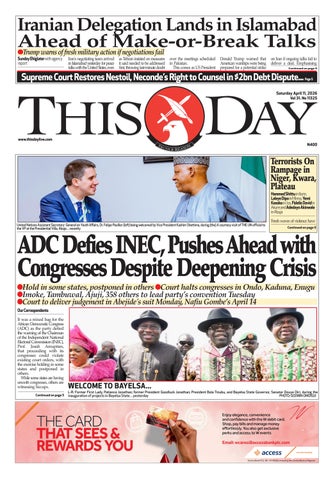
Iranian Delegation Lands in Islamabad Ahead of Make-or-Break Talks
Trump warns of fresh military action if negotiations fail
Sunday Ehigiator with agency report
Donald Trump warned that American warships were being prepared for a potential strike on Iran if ongoing talks fail to deliver a deal. Emphasising www.thisdaylive.com
ADC Defies INEC, Pushes Ahead with Congresses Despite Deepening Crisis
some states,
Our Correspondents
It was a mixed bag for the African Democratic Congress (ADC) as the party defied the warning of the Chairman of the Independent National Electoral Commission (INEC), Prof. Joash Amupitan, that proceeding with its congresses could violate existing court orders, with the exercise holding in some states and postponed in others.
While some states are having smooth congresses, others are witnessing hiccups.
United Nations Assistant Secretary- General on Youth Affairs, Dr. Felipe Paullier (left) being welcomed by Vice President Kashim Shettima, during (the) A courtesy visit of THE UN official to the VP at the Presidential Villa, Abuja…recently
Hammed Shittu in Ilorin, Laleye Dipo in Minna, Yemi Kosoko in Jos, Fidelis David in Akure and Adedayo Akinwale in Abuja
Supreme Court Restores Nestoil, Neconde’s Right to Counsel in $2bn Debt Dispute
The Supreme Court of Nigeria yesterday ruled in favor of Nestoil and Neconde Energy, overturning a previous appellate court decision that disqualified their legal counsel, which included Wole Olanipekun (SAN) and Muiz Banire (SAN).
The court upheld the companies' right to appoint their own lawyers to challenge the ongoing receivership.
The apex court ruled that despite the receivership initiated by a consortium of banks, Nestoil and Neconde retain the right to appoint their own legal counsel to challenge that very receivership.
Nestoil Limited (an oil services firm) and its affiliate Neconde Energy Limited (which holds interests in Oil Mining Lease 42) are embroiled in a multi-billiondollar debt recovery suit filed by FBNQuest Merchant Bank Limited and First Trustees Limited.
The lenders had alleged that Nestoil, Neconde, and their promoters (Ernest AzudialuObiejesi and Nnenna AzudialuObiejesi) owe over $2 billion (plus N430 billion in related liabilities) under financing arrangements, including a Common Terms Agreement.
In the lead judgment read by Justice Lawal Garba, the five-member apex court held that it was a "legal anomaly" to allow lawyers appointed by the Receiver/Manager to also represent the companies, citing a conflict of interest.
The judgment affirmed that the boards of the companies retain the authority to act in defense of the companies' interests. A receiver/manager was appointed over the companies’ assets and interests, leading to disputes over who controls the companies and who can represent them in court.
ADC DEFIES INEC, PUSHES AHEAD WITH CONGRESSES DESPITE DEEPENING CRISIS
This comes as Justice Musa Liman of a Federal High Court, Abuja, has fixed Monday, April 13 for judgement in the suit filed by Hon. Leke Abejide, challenging the Senator David Mark-led leadership of the African Democratic Congress (ADC). The judge fixed the date yesterday, shortly after lawyers representing the parties adopted their processes and presented their arguments for and against the suit.
Relatedly, Justice Emeka Nwite of the same Federal High Court, Abuja, has slated Tuesday, April 14, for hearing in another suit filed by Hon Nafiu Bala Gombe, also challenging the Mark-led leadership.
INEC had last week stopped recognising Senator David Mark and Rauf Aregbesola as National Chairman and National Secretary of the ADC, even as factional groups have arisen in the opposition party.
But the national body, which had accused INEC of partisanship and working for the ruling party, is insisting that it will go ahead with the conventions, having informed
the electoral body of its intention, which the party said was the requirement.
Owing to this, its National Publicity Secretary, Mallam Bolaji Abdullahi, stressed that the planned national convention of the party would hold Tuesday, April 14.
The spokesman of the ADC told THISDAY that as part of the planning for the convention, the party has constituted a 22-member National Convention Central Coordination Committee (NCCCC).
The committee would be chaired by former Cross River State Governor, Senator Liyel Imoke, with former Sokoto State Governor, Senator Aminu Waziri Tambuwal, as Vice Chairman, while Dr. Ajuji Ahmed is to serve as Secretary.
The central committee would be supported by 339 members distributed across 11 standing committees, barring any lastminute changes.
THISDAY gathered that other members of the central planning committee include former Imo State Governor, Hon. Emeka Ihedioha; retired Commissioner
of Police, Tajudeen Bakare; Aminu Abubakar Gwarzo; Hon. Emeka Nwajuba; Solomon Lalong, among others.
The 11 committees include the Legal and Convention Processes Committee, with Olumide Akpata as Chairmandesignate, Lilian Oraogbu as Vice Chairman, and Hon. Chille Wanger Igbawua as Secretary.
Other committees are Programmes and Events Sub-committee, chaired by Senator Victor Umeh; Medical Sub-committee, chaired by Dr. Tony Nwoye; Entertainment Sub-committee, chaired by Senator Enyinnaya Abaribe; Protocol Sub-committee, headed by Senator Gilbert Nnaji; Welfare Sub-committee, led by Senator Mohammed Ogoshi, and New Media Sub-committee, chaired by Hon. Afam Ogene
The Delegates and Accreditation Committee would be headed by Senator Ireti Kingibe, while Senator Austin Ibrahim will chair the Finance Committee.
The Media and Publicity Committee would be led by
TERRORISTS ON RAMPAGE IN NIGER, KWARA, PLATEAU
gripped Niger, Kwara and Plateau States as terrorists intensify attacks, leaving communities in fear and authorities under pressure to respond swiftly.
In Shiroro Local Government Area of Niger State, suspected terrorists killed at least five people, razed multiple homes, and abducted several residents in a violent raid on Baga community, marking yet another escalation of insecurity in the region.
Scores of terrorists early yesterday stormed the Nuku community in Kaiama Local Government Area of Kwara State killing and maiming
innocent villagers. Also, yesterday, Kwara State Police Command yesterday confirmed an attack on the Police Mobile Force Camp at Nuku Village.
This comes as within the week, many lives and property were destroyed as a result of the growing insecurity in the country.
At the same time, breakthroughs were also registered by the security agencies in the fight against insecurity.
Gallant troops of Operation ENDURING PEACE, working alongside local vigilante groups carried out a series of
coordinated clearance operations that led to the neutralisation of several terrorists and the recovery of arms, ammunition, and logistics supplies across parts of Plateau State.
Also, the Ondo State Security Network Agency, codenamed Amotekun, paraded 164 suspects arrested during a week-long clearance operation across the state, in what authorities described as a major crackdown on criminal activities.
As part of measures to address security concerns in the Bauchi State, Governor Bala Mohammed has directed for the immediate suspension of all commercial activities in
Senator Lawal Adamu Usman, the Venue Sub-committee by Senator Binos Yaroe, and the Security Sub-committee by AVM Suleiman Adamu (Rtd).
The David Mark-led ADC vowed to proceed with its planned national convention despite INEC’s stance and repeated warnings, even as the crisis in the party deepens.
The party has also accused the electoral body of partisanship, insisting that its chairman and national commissioners should resign.
ADC had further alleged that INEC’s actions pose a threat to democracy and are aimed at weakening opposition parties in pursuit of a one-party state under the administration of President Bola Ahmed Tinubu.
The party maintained that INEC lacks the constitutional authority to interpret court rulings as it deems fit.
Peaceful Congresses in Ebonyi
The ADC conducted congresses across the 13 local government areas, 171 wards
24 cattle markets’ operations in Alkaleri, Bauchi, Kirfi and Tafawa Balewa local government areas of the state.
The pan-Yoruba socio-political organisation, Afenifere, yesterday expressed worry on the killing of army personnel during an attack on the military base, Benisheikh, Borno State on Thursday.
In Shiroro Local Government Area of Niger State, Residents said the attack involved a large group of heavily armed men estimated to be over 160 who stormed the community, firing indiscriminately and deploying explosives to destroy houses and other property. The scale
and 2,975 polling units in Ebonyi State.
The party said the exercise was aimed at strengthening its grassroots structure ahead of the 2027 general election.
Chairman of the Ebonyi State ADC Congress Committee, Uche Onyeagucha, said the candidates would emerge through consensus or direct primaries to deepen internal democracy and promote inclusiveness.
“We will not be using national delegates. Candidates will emerge either through consensus or direct primaries. We assure members of a transparent process,” he said.
Consensus in Kano
Leaders of various groups within the ADC in Kano State opted for consensus as the mode of electing officials at the ongoing party’s congresses.
Sources within the party told THISDAY that the decision was reached after extensive consultations among stakeholders seeking to avoid rancour and ensure a united
and coordination of the assault left parts of the community in ruins, with survivors fleeing into nearby bushes for safety.
THISDAY gathered that during the rampage in Nuku community, a forest guard commander and five of his members were killed by terrorists who destroyed the motorcycles of the forest guards and burnt down several buildings in the community.
Also the patrol vehicles of the police in the area were set ablaze.
The community has been thrown into confusion and panic as a result of the incident leading to villagers running helter skelter
IRANIAN DELEGATION LANDS IN ISLAMABAD AHEAD OF MAKE-OR-BREAK TALKS
military readiness, Trump said the ships are also being equipped with advanced weapons.
Trump had announced a two-week ceasefire in the six-week war on Tuesday, just hours before a deadline after which Trump had threatened to destroy Iran's civilisation.
front ahead of future political engagements.
"Party leaders believe the consensus approach will reduce internal disputes and strengthen cohesion across all local government areas," the source explained.
According to party insiders, the goal was to present a single, harmonized list of candidates that reflects broad agreement before the congress is formally convened and ratified.
Successful LG Congress in Kogi
The ADC in Lokoja Local Government Area has held its Local Government Congress and elected new executive members, which marked a significant milestone in the party's efforts to strengthen its presence in the area.
Despite the leadership crisis rocking the state, the State Chapter has conducted its local government Congress in preparation the for the National convention of the party.
in search of safe abode.
A senior police officer with Kaiama Divisional Police Headquarters, Kaiama who confirmed the ugly development said that "We have briefed appropriate authorities on the incident.”
He however advised the residents to remain calm saying that the incident was seriously devastating but God will help us through."
Kwara State Governor, Alhaji AbdulRahman AbdulRazaq, yesterday condemned the killing of the five forest guards who tried to repel the midnight attack in Nuku community.
Iran's parliamentary Speaker Mohammad Baqer Qalibaf, said on X that Washington had previously agreed to unblock Iranian assets and to a ceasefire in Lebanon, and added that talks would not start until those pledges are fulfilled.
Iranian state media reported
The ceasefire, according to Reuters, had halted U.S. and Israeli airstrikes on Iran. But it has not ended Iran's blockade of the Strait of Hormuz, which has caused the biggest-ever disruption to global energy supplies, or calmed a parallel war between Israel and Iranbacked Hezbollah in Lebanon.
that Qalibaf arrived in Islamabad yesterday, and the delegation included senior political, military and economic officials, including Iran's foreign minister, defence council secretary, central bank governor and several members of parliament.
While there was no immediate comment from the White House on the Iranian demands, Trump said in a social media post that the only reason the Iranians were alive was to negotiate a deal.
"The Iranians don’t seem to
realise they have no cards, other than a short-term extortion of the World by using International Waterways. The only reason they are alive today is to negotiate!" he said.
U.S. Vice President JD Vance, who will lead the U.S. delegation, said he expected a positive outcome as he headed to Pakistan, but added: "If they're going to try to play us, then they're going to find the negotiating team is not that receptive."
Iran has been unable to obtain tens of billions of dollars of its assets in foreign banks, mainly from exports of oil and gas, due to U.S. sanctions on its banking and energy sectors.
Meanwhile, Trump has said the US was reinforcing its naval strength and equipping warships with top-grade weaponry.
"We have a reset going. We are loading up the ships with the best ammunition, the best weapons ever made even better than what we did previously
and we blew them apart. And if we don't have a deal, we will be using them, and we will be using them very effectively," the New York Post quoted Trump to have said.
Earlier, Trump posted a brief and cryptic message on his social media platform Truth Social, hinting at a major strategic shift. Referring to a "WORLD'S MOST POWERFUL RESET!!!", the message has added to speculation over Washington's next move in the region.
HAPPY MARRIED LIFE...
In Fresh Fiscal Policy Drive, FG Slashes Tariffs on Cars, Sugar Cane, Palm Oil
Tariff on fully-built passenger, four-wheel drive vehicles, station wagon drops from
The Minister of Finance and Coordinating Minister of the Economy, Mr. Wale Edun, has approved the commencement of fiscal policy measures for 2026, including sizeable tariff adjustments on about 30 items.
Part of the policy is a list of 127 tariff lines with reduced import duty rates, with the target to “promote and stimulate growth in critical sectors of the economy.”
The minister conveyed the Fiscal Policy Measures (FPM) via a circular dated April 1, 2026, indicating that the new measures supersede those of 2023.
For instance, the import adjustment tax (IAT) on items such as crude palm oil has been
pegged at a total effective rate of 28.75 per cent, a decline from previous high-tariff regimes.
Also, fully-built units of passenger motor vehicle, four-wheel drive motor vehicle, and station wagon now attract a total effective tariff of 40 per cent, indicating a slash as against the 70 per cent contained in the 2015 fiscal policy measures
According to the circular, a 90-day grace period was granted for importers who had opened Form ‘M’ before April 1 to enable them to clear their goods at prevailing rates.
But a new excise duty regime and the green tax surcharge are set to take effect from July 1, 2026.
Some of the items from the gazette include: Anti-malarial medicaments (20 per cent; rice
Ojota–Opebi Link Bridge: Defining Delivery for Julius Berger, Says MD
The Managing Director of Julius Berger Nigeria Plc, Engr. Dr. Peer Lubasch, has stated that the newly inaugurated Opebi–Mende–Ojota Link Road and Bridges was a landmark engineering delivery that underscored the company’s enduring role in shaping Nigeria’s critical infrastructure landscape.
Speaking at the official inauguration of the bridge performed on behalf of President Bola Tinubu by Senate President Godswill Akpabio, Lubasch described the project as a long-envisioned intervention now brought to life through technical expertise, resilience, and disciplined execution.
According to him, the bridge is not only a vital response to Lagos’ traffic congestion challenges but also a strategic
economic enabler that will improve mobility, productivity, and connectivity across key commercial corridors in the state.
Lubasch noted that the project, first conceived over two decades ago, demanded innovative engineering solutions due to its swampy terrain and flood-prone environment, requiring advanced construction techniques and meticulous planning.
“We at Julius Berger are deeply proud to be the contractor that realised this historic project,” he said, emphasising the firm’s commitment to delivering complex infrastructure to the highest standards.
He added that the successful completion of the link bridge reflects Julius Berger’s over 60 years of engineering excellence in Nigeria, marked by reliability, professionalism, and integrity in executing high-impact national projects.
(In bulk or packing of 5kg now attracts a 47.5 per cent reduction) as against 70 per cent Also, broken rice drops to 30 percent from 70 percent, wheat or meslin flour stand at 70 percent.
Other affected items are crude palm oil (now 28.75 per cent from 35 per cent), margarine (excluding liquid)-- 40 per cent Raw cane sugar (Beet sugar) drops to 57.5 per cent from 70 per cent, Raw cane sugar
(Other) is now 55 per cent (reduced from 70 per cent). There is also Cane/Beet sugar (Powder/Granule) dropping from 70 per cent to 57.5 per cent. Refined salt (for human consumption) equally dropped from 70 per cent to 55 per cent; envelopes 40 per cent (reduced from 50 per cent) and Diaries/ notebooks came down from 40 per 30 per cent (reduced from 40 per cent).
Amupitan: I have no X account, denies partisan post
Adedayo Akinwale in Abuja
The Independent National Electoral Commission (INEC) has announced the postponement of nationwide voter revalidation exercise until after the 2027 general election.
This was as the INEC’s Chairman, Prof. Joash Amupitan, has denied endorsing a partisan post on X social media platform, saying he has no X account.
It would be recalled that the
commission had announced plans to commence a nationwide voter revalidation beginning from April 13 to May 29, 2026.
The exercise, the electoral body explained, was aimed at removing ineligible entries and strengthening the integrity of Nigeria’s electoral process.
The commission said the exercise would target the removal of “null and ineligible voters, such as deceased, non-Nigerians, underage, and
multiple registrations,” in line with legal provisions.
The electoral body, however, explained that the exercise was not a fresh registration but was specifically for voters who registered between 2011 and 2024.
“The exercise is part of the commission’s efforts to revise, update, clean and strengthen the integrity, accuracy, inclusivity, and credibility of the national register of voters ahead of future
elections,” it said. However, the National Commissioner and Chairman, Information and Voter Education Committee, Mohammed Haruna, in a statement said the decision was taken during a meeting with the Resident Electoral Commissioners (RECs) held yesterday, where the proposed nationwide voter revalidation exercise was considered among other issues.
Otti: Inter-tribal Marriage Promotes Peace,
Ohanaeze declares Abia governor pride of Ndigbo
Abia State Governor, Dr. Alex Otti, has described inter-tribal marriage as an important social tool for promoting national unity, peace, and understanding in a nation with diverse cultures like Nigeria.
Otti, who is adjudged the best governor in the South-
east due to his outstanding infrastructural accomplishments in all the sectors, yesterday, got accolades from Ohanaeze Ndigbo Worldwide, Abia State chapter, which revealed that Governor Otti gained its admiration by transforming Abia State and improving the standard of living of the citizens and residents, including
promoting Igbo culture and tradition through deliberate policies.
Otti who spoke in Umuahia during the wedding ceremony of his youngest sister, Dr. Ngozi Otti, and her husband, Ileri Adeniji, who hails from Ogun State.
The governor noted that African marriages bring
Actors Guild Applauds
Oluchi Chibuzor
The Actors Guild of Nigeria (AGN) has commended Globacom for its steadfast patronage of the nation’s creative industry, while signalling its desire for a more profound and structured partnership to
further elevate the fortunes of Nollywood practitioners. Established in 1998 as the professional custodian of Nigeria’s screen actors, the AGN has, over the decades, matured into a vital institutional spine— defending the dignity of the craft, advocating
Glo
welfare, and shaping the ethical contours of a rapidly expanding industry.
Nollywood itself, once a fledgling enterprise flickering on the margins of global cinema, has risen—through resilience and strategic alliances—into a luminous cultural force,
families together and spread love, strengthen relationships and promote unity among cultures, and advised his sister to look after her husband and the entire family. Recalling that his first sister also married from Ogun State, Otti pointed out that that union has made both families to be integrated into one.
its stories now echoing far beyond the nation’s shores. At a recent courtesy visit to Globacom’s headquarters, the Guild’s National President, Mr. Sanusi Abubakar Yakubu, reflected with measured gratitude on the telecom company’s early and visionary interventions.
Boniface Okoro in Umuahia
Ndubuisi Francis in Abuja
Dike Onwuamaeze
L-R: Group Managing Director, Aiteo/Nembe Exploration, Victor Okoronkwo; Groom, Mr. Ileri Adeniji; Bride, Dr. Ngozi Otti, and Wife of Aiteo GMD, Ann Okoronkwo, at the wedding ceremony of the sister of the Governor of Abia State held in Umuahia...recently
LAGOS-OPEBI-MENDE LINK BRIDGE INAUGURATION...
L-R: Project Coordinators, Julius Berger, Nath Ikem; Engr. Adegbenga Osunlana; Regional Technical Manager, Engr. Thomas Christl; Managing Director, Engr. Peer Lubasch, and Regional Commercial
inauguration of the Lagos-Opebi-Mende Link Bridge and Roads in Lagos…recently
Post-Recapitalisation: Lemo Warns Against Potential Capital Market Bubble, Urges Stronger Safeguards
Sunday Ehigiator
As Nigeria’s banking sector enters a new phase following a successful recapitalisation exercise, a former Deputy Governor of the Central Bank of Nigeria (CBN) and Chairman of Lambeth Capital Limited, Mr. Tunde Lemo, has raised concerns over the possibility of an emerging bubble in the capital market.
Owing to this, he advised the CBN Governor, Mr. Olayemi Cardoso and his team to implement stronger regulatory safeguards and macro-prudential policies to preserve financial stability and prevent speculative excesses.
Lemo, a former chief executive officer of Wema Bank, gave the advice while speaking in an exclusive interview with
THISDAY.
“For me, they (the CBN) should keep their eyes on the capital market. I suspect that bubbles might be building up in the capital market, and this happens each time you increase capital, because banks can then lend.
“If they unleash that lending and they are impatient, they may then begin to do a lot that would make share prices go up. But I know that there have been stronger regulations around making use of proprietary funds, how you can deploy depositors' funds, or how you cannot deploy depositors' funds in proprietary lending, and all of this.
“They should keep an eye on that so we don't build another bubble that will bust later. But I think they are quite capable. Since the central bank went into narrow
NHRC Raises the Alarm Over Surge in Human Rights Violations
The National Human Rights Commission (NHRC) has raised fresh concerns over Nigeria’s worsening human rights and security situation, revealing that it received 659,617 complaints and recorded 992 killings between January and March 2026.
The figures were disclosed in Abuja by the Commission’s Senior Adviser, Hilary Ogbonna, during the presentation of the Q1 2026 Human Rights Situation Dashboard. He noted that the data reflects both a rise in violations and improved public reporting of abuses.
According to Ogbonna, complaints increased steadily across the quarter, with 180,341 cases recorded in January, 223,144 in February, and 256,132 in March. He identified discrimination as the most reported category, followed by cases involving law enforcement misconduct and violations of human dignity.
“For the months of January to March 2026, we recorded 659,617
human rights complaints,” he said, warning that the figures highlight deep-rooted challenges in governance, security, and social protection.
Beyond formal complaints, the NHRC’s Human Rights Observatory documented widespread insecurity-related abuses, including killings, abductions, communal clashes, and sexual and gender-based violence across several states.
February was identified as the deadliest month of the quarter, driven largely by insurgent attacks, banditry, and mob violence.
Regionally, the North-central zone recorded the highest number of complaints, followed by the North-west and Northeast. The Abuja, as well as Benue, Niger, Plateau, and Kaduna states, ranked among the most affected areas. Ogbonna noted that the high number of cases recorded in the FCT is partly due to the concentration of NHRC reporting centres in the capital.
banking, they're no longer doing fiscal activities and are becoming bankers to everybody.
“So, having now settled down to their primary role and doing it well, I'm very glad that they can keep all of us at peace because the banks have sufficient strength to withstand the exogenous shock should it arise,” he said.
The CBN recently revealed the
outcome of the recapitalisation exercise, stating that Nigerian banks raised a total of N4.65 trillion within 24 months, strengthening the resilience of the financial system and enhancing industry capacity to support the economy.
The CBN stated that the exercise recorded strong participation from both domestic
and international investors, with 72.55 per cent of capital sourced locally and 27.45 per cent from international markets, reflecting sustained confidence in the Nigerian banking sector.
The exercise required banks to maintain a minimum capital of N500 billion, N200 billion, and N50 billion for commercial banks with international, national and
regional licences, respectively. Commenting on the expected impact of the exercise on the banking industry, Lemo, called on the apex bank to deepen stress testing and strengthen macroprudential policies, warning that improved liquidity and uncontrolled lending could trigger market bubbles if not properly managed.
President Rejoices With Aliko Dangote at 69
Felicitates Oba Ademola Elegushi on 50th birthday
Deji Elumoye in Abuja
President Bola Tinubu has extended warm felicitations to Africa’s leading industrialist, accomplished businessman, and Chairman of Dangote Group, Alhaji Aliko Dangote on his 69th birthday yesterday.
The President, in a statement issued by his Adviser on Information and Strategy, Bayp Onanuga, acknowledged Dangote's outstanding contributions to Nigeria and Africa’s economic growth and industrial development.
According to Tinubu, “Aliko’s entrepreneurial vision, resilience, innovation, and commitment to excellence
have transformed industries and positioned Nigeria as a hub for large-scale petrochemical and cement production through his establishment of the multibillion-dollar Dangote Refinery and Petrochemical Company and cement factories across Africa.
“I salute Aliko for his conglomerate's role in job creation, infrastructure development, and unwavering belief in the Nigerian economy and its potential. Dangote remains a shining example of African enterprise, whose achievements continue to inspire a new generation of entrepreneurs across the continent.
“I also applaud Aliko's philanthropic efforts, particularly through the Dangote Foundation, which have significantly impacted lives in health, education, and poverty alleviation.
"As Aliko marks another year, I pray for his continued good health, wisdom, and greater accomplishments in service to Nigeria, Africa, and humanity."
Also, the President felicitated His Royal Majesty, Oba Alayeluwa Saheed Ademola Elegushi, Kusenla III, and eulogised his virtues on his 50th birthday.
Tinubu rejoiced with the 21st Elegushi of the Ikate-Elegushi Kingdom, Council members,
Lagos State Traditional Council, and sons and daughters of the highly revered kingdom.
The President noted the monarch's commitment to empowering Ikate-Elegushi indigenes through interventions in education, health, and entrepreneurship since ascending the throne of his forebears 16 years ago.
Tinubu said, “Oba Elegushi has demonstrated the vision, grace, wisdom and courage in keeping a balance between tradition and modernity by adopting technology and global best practices in developmental strides, particularly in agriculture and skills acquisition in his domain.
Insecurity: ADC Says President Distracted by Politics
US Embassy action signals loss of faith in President, party says Treat America’s evacuation of embassy staff as national emergency, Obi tells Tinubu
Chuks Okocha in Abuja
The African Democratic Congress (ADC) has accused President Bola Ahmed Tinubu of being distracted by political calculations at a time of escalating national insecurity, warning that recent actions by the United States government signal a growing loss of international confidence in his administration’s ability to keep Nigeria safe.
Also, the presidential candidate of the Labour Party (LP) in the 2023 presidential election and chieftain of ADC, Mr. Peter Obi, has said Nigeria should treat the recent directive by the United States to evacuate its embassy staff from Nigeria due to rising insecurity in the country as a national emergency.
In a statement signed by Mallam Bolaji Abdullahi, National Publicity Secretary of the ADC, the party said
the authorisation by the United States for the departure of non-emergency embassy staff and their families from Abuja is not merely procedural, but a clear and consequential signal of declining trust in Nigeria’s security architecture under the current leadership.
The ADC said that while mourning Brigadier General Oseni Omoh Braimah and other soldiers killed in a terrorists attack in Borno
State, it further lamented that the tragedy underscores a broader pattern of systemic failure, warning that repeated assurances without results have become the defining feature of the government’s response to insecurity.
The ADC mourned the tragic loss of Brigadier General Braimah and the brave soldiers of the Nigerian Army who were killed in the recent terrorist attack in Borno State.
Manager, Alexander Bauer, at the
Michael Olugbode in Abuja
BOOK LAUNCH...
After Backlash, W’Bank Deletes Nigeria Development Report from Website
Clarifies position on petrol importation
Nume Ekeghe
The World Bank has removed its latest Nigeria Development Update (NDU) report from its website, days after its initial publication, even as the Washington-based institution moved to clarify its position on petrol importation amid growing backlash. The report, titled ‘Nigeria’s Tomorrow Must Start Today: The Case for Early Childhood Development’, was released on April 7, 2026. However, as at yesterday, the document was no longer accessible on the Bank’s
website, with users encountering a “page not found” error when attempting to download it.
As of the time of filing this report, the World Bank has not provided an official explanation for the removal of the April 2026 edition from its website, raising questions about the
circumstances surrounding the decision.
Despite the removal, the accompanying press statement remains available, outlining key aspects of Nigeria’s economic outlook and policy recommendations. However, in a fresh clarification, the World Bank explained that its recommendation on the importation of Premium Motor Spirit (PMS) must be understood within a broader global and domestic context.
Let's Lead Impactful Lives, Oborevwori Advices at Arise TV's Okpe Father's Funeral Service
Omon-Julius Onabu in Asaba
Governor Sheriff Oborevwori has urged Nigerians to seek to lead impactful lives of service, paying tribute to Chief Matthew Egwuenu, the late father of Ojy Okpe of Arise News Channel.
Speaking at a vigil mass at Saint Theresa's Catholic Church, Obinomba in Ukwuani Local Government Area of the State, the governor said the deceased lived a life of service, discipline and enduring legacy.
He described the late patriarch of the Egwenu family as a man whose life was defined not merely by the number of years lived, but by the positive impact he made, which reflected in his
retirement as Commissioner of Police.
While commiserating with Ojy Okpe, his siblings and other members of the bereaved family, the Governor lauded the presence of key stakeholders, including local government chairmen and other leaders in Ndokwa Nation, saying that their physical presence at the ceremony reflected their unity and collective respect for the deceased.
Oborevwori said, "Your presence here today is a clear demonstration of the value we place on one another, especially in moments of grief. "
He noted that Egwuenu rose through the ranks and retired honourably after years of dedicated service to the
nation.
Beyond his professional landmarks,, he said that Egwuenu was celebrated for raising accomplished and disciplined children who continue to uphold his positive values.
According to him, the true measure of a person’s life lies in the legacy he leaves behind, stressing that the deceased’s worthy contributions would continue to resonate through his family and community.
Oborevwori said; “When you see the quality of his children, their courage, brilliance, and integrity, you cannot but acknowledge that this is a man who lived well".
He urged the Ndokwa nation to rally around the
Egwuenu family by offering support and comfort during this period of mourning, describing the outpouring of love and the strong turnout at the event as a testament to the deceased’s positive influence.
Earlier in his homily, Rev. Fr Vitus Ogbonna, noted that death was a natural phenomenon that everyone must experience, adding that it is a debt that everyone must pay.
Fr Ogbonna called on the bereaved family to remain steadfast and uphold the legacy of their father even in the face of deep sorrow, reminding them of the enduring comfort found in Psalm 23 adding that trust in God remained vital during times of grief.
NBC DG Congratulates Tony Akiotu on Emergence as BON Chairman
The Director-General of the National Broadcasting Commission (NBC), Dr. Charles Ebuebu, has congratulated Senior High Chief Tony Akiotu on his election as the new Chairman of the Broadcasting Organisations of Nigeria (BON).
Akiotu was elected during the organisation’s biennial proceedings
recently held in Abuja. Congratulating the new chairman, Ebuebu said: “I commend BON and its member stations for conducting a seamless and peaceful election during the 81st Annual General Meeting. I specifically note the absence of hitches or rancor, and I praise all contestants for the high level of sportsmanship displayed throughout the process.”
Looking ahead, he expressed optimism about future collaboration, stating: “The Commission is eager to collaborate with the newly elected executive team and the broader BON membership, especially as we continue the process of digitizing our broadcast ecosystem.”
He added that the partnership would focus on key areas, including: “Enhancing industry
standards to elevate the quality of local broadcasting; ensuring global competitiveness so the Nigerian broadcast ecosystem secures its rightful place in the international market; and fostering regulatory synergy to promote a productive relationship between the regulator and broadcasters. I extend my best wishes to the new leadership for a successful and impactful tenure.”
It noted that while the report suggested allowing petrol imports, such a move could conflict with ongoing efforts by countries to safeguard energy security amid global supply disruptions.
The institution stressed that Nigeria’s immediate priority should be to strengthen targeted support for vulnerable populations through an effective social safety net system. It added that it stands ready to expand its support in this regard.
The World Bank further emphasised that, over time, transitioning to a competitive retail market for petrol remains a viable policy direction, but
cautioned that such a shift must be carefully sequenced to ensure product quality, regulatory standards, and market stability. It also acknowledged steps taken by the Nigerian government and private sector players to secure fuel supply, describing these efforts as critical to protecting both consumers and businesses.
“In the case of Nigeria, the focus should be to provide targeted support to the most vulnerable people through their well-functioning social safety net system, and the World Bank Group stands ready to step up its existing support.
“Over time, transitioning toward a competitive retail market for Premium Motor Spirit is an important policy direction that requires a wellsequenced implementation strategy that guarantees the quality and standards of all petroleum products.
Police Dismiss Viral Video Alleging Terrorists’ Attack in Abuja
The Nigeria Police Force has dismissed a viral video circulating on social media alleging an ongoing terrorists attack in the Federal Capital Territory (FCT), Abuja, describing it as false, misleading, and malicious.
The Force also confirmed the arrest of a suspect linked to the creation and dissemination of the content.
The viral clips, which spread across multiple social media platforms including X, caused panic among residents of the FCT.
Public anxiety was further heightened by a recent United States travel advisory and the temporary evacuation of embassy staff within the same period.
One of the trending videos falsely claimed that the military had flown about 1,000 chained and blindfolded terrorist fighters into Abuja using a Nigerian Air Force C-130 aircraft.
Although security authorities, including the military and the Office of the National Security Adviser (ONSA), had yet to issue an official statement at the time of the panic, findings suggested the movement being misinterpreted may be linked to ongoing terrorist trials.
The Attorney General of the Federation, Lateef Fagbemi, had recently disclosed that about 500 Boko Haram suspects are currently standing trial at Federal High Courts in Maitama, Abuja.
Linus Aleke in Abuja
Sunday Ehigiator
L-R: Chairman, Board of the Nigeria Reputation Management Group/Founder, CMC Connect LLP, Chief Yomi Badejo-Okusanya; Corporate Affairs and Sustainability Director, Nigerian Bottling Company, Dr. Oluwasoromidayo George; Author, ‘Winning With Strategic Communications,’ Godfrey Adejumoh; Chairman, Board of Directors, Brooks and Blake Nigeria Limited, Mrs. Funmilayo Onajide, and Managing Director/Chief Strategist, Chain Reactions Africa, Mr. Israel Jaiye Opayemi, during the launch of a new book in Lagos…recently
IN THE HIGH COURT OF LAGOS STATE
POLARIS BANK LIMITED VS OCEANIC ENERGY LIMITED & ORS
SUIT ID NO. LD/2188GCM/2017
PUBLIC NOTICE
NOTICE OF APPOINTMENT OF RECEIVER/MANAGER
SUIT ID NO. FHC/L/CS/2275/25
TINUBU’S LARGEST NORTHEAST VOTE: HOW DR. NURA MANU SORO DELIVERED BAUCHI
In the intricate chessboard of Bauchi politics, one name continues to echo across wards, local governments, and power circles- Dr. Nura Manu Soro. Young, strategic, and deeply rooted in grassroots mobilization, he has steadily built a reputation as a political operator whose influence extends beyond campaign rhetoric into measurable electoral outcomes.
The 2023 presidential election provided the clearest evidence yet. While many focused on national permutations, behind the scenes in Bauchi State, Dr. Nura Manu Soro was coordinating one of the most structured mobilization efforts in the Northeast. As Bauchi State Coordinator of the Tinubu/Shettima Presidential Campaign, he oversaw stakeholder engagement from state leaders to ward-level operatives, strengthened dormant structures, and ensured campaign resources reached the grassroots where elections are truly decided.
In the run-up to the 2023 elections, Bauchi was the only state in the entire country where the gubernatorial candidate was replaced as the presidential election coordinator. President Tinubu, through the then Minister of Education, Adamu Adamu, replaced the APC candidate, Air Marshal Sadiq, with the strategic Dr. Nura Manu Soro, whom they believed would gather and deliver more value to the APC; a position the election outcome clearly validated.
The outcome was not accidental: it was strategic. When the votes were counted, Bauchi emerged as the largest contributor to the Tinubu/Shettima tally in the Northeast, delivering 316,694 votes out of the region’s 1,185,458 total, representing 26.7% of the entire Northeast votes — the highest from any state in the zone.
Northeast Vote Breakdown (Tinubu/Shettima 2023):
* Bauchi — 316,694 (26.7%)
* Borno — 252,282 (21.3%)
* Adamawa — 182,881 (15.%)
* Yobe — 151,459 (12.8%)
* Gombe — 146,977 (12.4%)
* Taraba — 135,165 (11.4%)
This performance placed Bauchi ahead of traditional APC strongholds in the Northeast and underscored the effectiveness of a coordinated grassroots strategy. Political observers within the state credited the outcome to Dr. Soro’s network, logistics coordination, and ability to rally diverse blocs under a single campaign direction.
But 2023 was not his first decisive intervention. Dr. Nura Manu Soro had earlier demonstrated political weight during the 2019 Bauchi governorship election, where he played a key role in the strategy that led to the defeat of then an incumbent governor Mohammed Abubakar and subsequent emergence of current Governor Bala Mohammed; a rare occurrence in Nigerian politics. His ability to mobilize across party lines and influence electoral dynamics marked him as a rising force long before the presidential contest.
His strength was again visible during the 2023 APC gubernatorial primaries. Despite the circumstances surrounding the contest, Dr. Soro only lost the primaries to a small margin from delegates’ votes; a remarkable showing for a candidate widely considered the youngest major contender in the state history. The result confirmed both his growing acceptance and the depth of his political structures across Bauchi State.
Beyond numbers, Dr. Soro’s long-standing relationship with President Bola Ahmed Tinubu has also become a subject of political calculation within APC circles. Party stakeholders believe this connection, combined with his grassroots reach, positions him as a bridge between national leadership and local structures, a factor often decisive in governorship contests.
As the 2027 political horizon begins to take shape, discussions within Bauchi APC increasingly revolve around electability, structure, and loyalty. Many argue that a candidate who has already demonstrated the capacity to deliver the largest Northeast votes for Tinubu possesses the momentum required for a statewide victory.
With Dr. Nura Manu Soro as the APC gubernatorial flag bearer in 2027, party strategists believe the equation becomes straightforward: a united structure, tested grassroots network, and alignment with the presidency.
If the 2023 presidential election was a rehearsal, then 2027 may well be the main stage, and in Bauchi’s evolving political narrative, Dr. Nura Manu Soro appears determined not just to participate, but to lead the APC to a landslide victory.
What a waste!
A protest for recognition...
Nigeria’s Silent Crisis: Rural Communities Under Siege
In Praise of President Buhari
WWhen President Muhammadu Buhari took over the reins of power on May 29, 2015, Nigeria was sadly a broken state in many respects. As a result of many other factors including bad governance and untold level of corruption, government could not live up to its financial obligations to citizens and service providers at both the federal and state levels.
perpetrators to escape without confrontation. The absence of a strong security presence in these areas effectively creates a vacuum that criminal groups exploit.
Indeed one of the first official assignments that President Buhari carried out was the approval of billions of Naira in bailout funds to enable state governors pay something as basic as workers’ salaries. Granting those bailout funds was a huge boost to national security because the pressure of arrears of unpaid monthly salaries building dangerously all over the country was a ticking bomb.
Ask the naysayers and they would readily remind you of how long it took President Buhari to appoint his ministers and how that contributed to collapse of the economy as if, without ministers, governance was frozen. But buying that narrative would amount to what a famous Nigerian writer, Chimamanda Adichie, termed “the danger of a single story”. Yet the whole story was that many of our citizens did not know how decrepit a state President Buhari inherited in 2015.
hile much of the national and international attention on Nigeria’s security challenges focuses on high-profile insurgent attacks and urban violence, a quieter but equally devastating crisis continues to unfold in the country’s rural areas. Across several states, especially in the North, small farming communities are increasingly becoming targets of violent attacks, leaving behind a trail of death, displacement, and destruction. This “silent crisis” rarely dominates headlines for long, yet its impact on national stability and food security is profound.
It was therefore necessary for him to take stock against the background of the fact that the departing government did not, reportedly, cooperate full well with the incoming government in terms of leaving workable handover notes. Although President Goodluck Jonathan was gracious in defeat, many of his appointees were still sulking over what they saw as their personal losses and therefore pulled all the stops to make things difficult for the Buhari government.
Nigeria and the Infection of Defections
Aby the EFCC, President Buhari by his action has successfully brought back to the public consciousness the need to treat public funds with the highest level of transparency and accountability.
After keeping treasury looters on their toes and at bay through the EFCC, particularly, President Buhari moved to curb unnecessary spending habits of the nation on what economists call articles of ostentation. Part of the disclosures of the President’s stock taking was how the country frittered away billions in foreign currency by importing goods, which can be produced at home. One of such items was rice, a major staple among Nigerians. By banning rice importation into the country, the President on one hand had saved the nation billions in foreign currency annually.
Another major factor is the overstretching of Nigeria’s security forces. With ongoing insurgency in the Northeast, banditry in the Northwest, and communal clashes in the Middle Belt, the military and police are spread thin across multiple conflict zones. As a result, rural areas often receive the least attention, despite being among the most affected. This imbalance has led to growing frustration among local populations, many of whom feel abandoned by the state.
s the shifty political clouds of 2027 gather, Nigeria's nomadic politicians are on the move again, herding their unbridled cows through the scorched farmlands of Nigeria's politics in a nauseating march to nowhere.
And, on the other hand, the President has boosted domestic production of rice and in the process had nudged the country into self sufficiency in food production. He also created millions of jobs for young people in the rice value chain.
What is most admirable about President Buhari and his government is its frugal management of scarce national resources to attain optimum goals.
Recall that since President Buhari stepped in the saddle, oil revenue dropped abysmally as if to sabotage him knowing all the big promises he made to citizens during his campaigns. But with the little resources that trickle in, the President is achieving what governments that received oil windfalls could not dream of.
Ismail Toheeb Abidemi, Dept of Mass Communication Department, University Of Maiduguri
Even with the obvious and unpatriotic obscurantist behaviour of the PDP appointees and their supporters still in government hell-bent on making things difficult for Buhari, the President moved on with his methodical repair of a broken country. The first thing he did was to identify all possible sources of income to the nation and directed that all inflows be paid into one single account in line with the policy of Single Treasury Account (TSA).
The TSA policy, interestingly, was mooted by the PDP government but its penchant for imprudence and lack of accountability denied it the courage of implementing the policy. What the President literally did was to gather all the nation’s money into one box and locked it up with a big padlock and watched for any thief to come close.
In recent weeks, reports of deadly raids on villages in Niger State and other rural regions have once again highlighted the vulnerability of these communities. Armed groups, often described as bandits, storm villages at night, killing residents, burning homes, and abducting women and children. These attacks are usually swift and brutal, leaving little time for residents to escape or for security forces to respond. Survivors are often left to pick up the pieces on their own, with little or no immediate government assistance.
Who can blame the President for almost developing paranoia over the safeguard of the national treasury with revelations and reports of mind-boggling looting that took place in the 16 years of the PDP? With such disclosures of how billions meant for fighting insurgency in the Northeast ended up in the pockets of a few individuals while our gallant soldiers fought with bare hands and on empty stomach, President Buhari was duty bound to bring sanity and accountability back in national spending.
One of the key reasons rural communities remain easy targets is their isolation. Many villages are located far from urban centers, with poor road networks and limited communication infrastructure. This makes it difficult for security agencies to respond quickly to distress calls. In some cases, attacks go unreported for hours—or even days—allowing
Thus, under President Buhari, the Economic and Financial Crimes Commission (EFCC), which had remained comatose for years, was woken up to resume its duties. Apart from the trillions of Naira of looted funds and property recovered from corrupt politicians
Like the proverbial barber's chair that is all motion but no progress, many Nigerian politicians are seeking greener pastures as the 2027 general elections draw closer. Many of those elected on the platform of one political party or the other have suddenly found such platforms unsuited and unsuitable to their political goals going forward. For those who have been shut out of the corridors of power and are now almost blind from looking in from the outside, identifying the right
Today, the trains are up and running daily from Abuja to Kaduna. And from Lagos to Ibadan a brand new rail track was started and completed; citizens are already commuting daily to and fro these two major cities in the country seamlessly as they reap from the dividends of democracy. And with the way this government is going, before 2023 when the President would leave, the entire country would be linked by rail with all of its economic advantages.
Ainofenokhai Ojeifo, Abuja
THE SATURDAY NEWSPAPER
EDITOR OBINNA CHIMA
THE SATURDAY NEWSPAPER
DEPUTY EDITOR AHAMEFULA OGBU
EDITOR YEMI ADEBOWALE
MANAGING DIRECTOR ENIOLA BELLO
DEPUTY EDITOR AHAMEFULA OGBU
MANAGING DIRECTOR ENIOLA BELLO
DEPUTY MANAGING DIRECTOR ISRAEL IWEGBU
CHAIRMAN EDITORIAL BOARD OLUSEGUN ADENIYI
EDITOR NATION’S CAPITAL IYOBOSA UWUGIAREN
THE OMBUDSMAN KAYODE KOMOLAFE
MANAGING EDITOR BOLAJI ADEBIYI THE OMBUDSMAN KAYODE KOMOLAFE
THISDAY NEWSPAPERS LIMITED
EDITOR-IN-CHIEF/CHAIRMAN NDUKA OBAIGBENA
GROUP EXECUTIVE DIRECTORS ENIOLA BELLO, KAYODE KOMOLAFE, ISRAEL IWEGBU
GROUP EXECUTIVE DIRECTORS ENIOLA BELLO, KAYODE KOMOLAFE, ISRAEL IWEGBU, IJEOMA NWOGWUGWU, EMMANUEL EFENI
DIVISIONAL DIRECTORS SHAKA MOMODU, PETER IWEGBU, ANTHONY OGEDENGBE
DIRECTOR, PRINTING PRODUCTION CHUKS ONWUDINJO TO SEND EMAIL: first name.surname@thisdaylive.com
Stop Ritual Attacks and Killings
platform is now a matter of political life and death.
TRegarding defections from one political party to another, the law in Nigeria remains surprisingly supine, indirectly, indiscriminately, and indiscreetly enabling the wanderlust of Nigerian politicians who cannot seem to stick to the same spot for long. When politicians in Nigeria defect, it is usually with an eye on the next political pot of gold. There is often zero regard for the political parties or supporters, and whatever vestige of ideology is left vanishes like vapor before a gale of political idolatry and idiolatry.
It begs the question of what political parties have become in Nigeria, digging deeper into the kind of politics played in Nigeria and the make-up and mindset of the politicians who play it.
Kene Obiezu,keneobiezu@gmail. com
Taco Waco
Trump
he Advocacy for Alleged Witches (AfAW) urges the Nigerian public to stop ritual attacks and killings because the notion of ritual money and wealth is completely baseless. AfAW is making this call following the reported arrest of suspected ritualists in Oyo State in southern Nigeria. The local media reported that members of the Western Nigeria Security Network, Amotekun, arrested suspected ritualists with the body parts of a 73-year-old man. The suspects, who were apprehended in the Boluwaji area in Ibadan, said that a Muslim cleric asked them to procure some human body parts for rituals. Ritual attacks are widespread in Nigeria. Irrational conceptions of how to make money or become wealthy and successful undergird these atrocities. Many Nigerians strongly believe in blood money, known in some local languages as Ogun Owo (Yoruba) or Ogwu ego (Igbo). They think that they could become rich, or successful through ritual sacrifice. Unfortunately, this is not the case. Ritual wealth has no basis in reason, science, or reality. Home movies known as Africa magic or Nollywood films have not helped matters. These movies continue to reinforce these mistaken notions and other superstitions. Families, churches, mosques, and other public institutions do not encourage the interrogation of these traditional occult beliefs. There are no robust efforts to criticize or dispel these irrational and paranormal claims in schools, colleges, and universities. So millions of Nigerians grow up blindly believing that they could make money through ritual sacrifice of human body parts. The belief has led many Nigerians to commit crimes and perpetrate atrocities. Many Nigerians have been jailed or are undergoing court trials due to ritualrelated attacks and murder.
always chickens out - What a cop out. There are many evil, deluded and deranged people out there and occasionally a few that meet all categories. Donald Trump has now made the list, possibly in position one, with his threat that a "whole civilization will die tonight" although now there is a two week wait to see if that happens. Even Hitler, usually considered the most evil man, didn't achieve that in years although he caused the death of millions. The great majority of any countries people are hard-working, citizens and they are not military targets. It doesn't matter if they didn’t like you or support someone you want gone, they are still citizens.
Dennis Fitzgerald, Melbourne, Australia
Not too long ago, the police arrested some young Nigerians for stealing female pants, which they intended to use for ritual sacrifice. AfAW is asking all Nigerians to desist from ritual-related abuses because ritual money beliefs are baseless superstitions. Nigerian media, schools, and colleges should help educate and reorient the public. They should assist in reasoning Nigerians out of this killer-superstitious absurdity and nonsense. Leo Igwe directs the Advocacy for Alleged Witches (AfAW)
CELEBRATING WOMEN...
Nigeria, UN Forge Stronger Alliance on Women, Youth Empowerment
Shettima identifies financial inclusion,
Nigeria has reaffirmed its resolve to strengthen its partnership with the United Nations (UN) to accelerate the empowerment of women and youth across the country.
Vice President Kashim Shettima, who disclosed this, said it will be actualised through
key initiatives under financial inclusion, skills development, job creation, and peace and security, among others.
Shettima stated this when he received a delegation from the United Nations led by its Assistant Secretary General on Youth Affairs, Dr. Felipe Paullier, on a courtesy visit to the State House, Abuja.
Niger Delta Leaders Call for Support for Tantita Pipeline Surveillance
Goddy Egene in Lagos and Olusegun Samuel in Yenagoa
Following Wednesday’s vote of confidence passed on Tantita Security Services Limited by the National Assembly, traditional rulers and community leaders in the Niger Delta have called for sustained support for the company in safeguarding oil and gas pipelines.
This was as stakeholders in the Niger Delta have described the recent parliamentary roundtable on pipeline security surveillance organised by the National Assembly as a jamboree.
The traditional rulers and community leaders in Niger Delta noted that the company’s
involvement in pipeline protection has brought noticeable improvements to oil-bearing communities.
Speaking on the development, the Ovie of Great Idjerhe Kingdom in Delta State and Chairman of the Host Communities Traditional Rulers of Nigeria (HOSCON), His Majesty King Monday Obukohwo Whiskey, described the vote of confidence as a welcome development that reinforces trust in Tantita’s operations.
According to him, while there is always room for improvement, criticism should not be driven by blackmail or media propaganda.
Mikano International Limited Refutes Allegations Against Chairman
Mikano International Limited has rejected allegations published in a recent report by Sahara Reporters, which falsely linked its Chairman, Mr. Mofid Karameh, to criminal activity.
In a statement yesterday, Mikano argued that, “These claims are entirely unfounded, baseless, and defamatory. At no time has Mr. Karameh been involved in, investigated for, or associated with any form of illegal activity. Such allegations are a gross misrepresentation of his character and the values he upholds.
“For more than three decades, Mikano International Limited has built a solid reputation grounded in integrity, transparency, and responsible business conduct across Nigeria and beyond. We take this reputation seriously and are deeply concerned by the dissemination of unverified information capable of misleading the public and unjustly harming both personal and corporate credibility.”
It therefore urged its partners, clients, and the general public to disregard the report in its entirety.
skills development, job creation, security as priority areas
According to him, the administration of President Bola Tinubu acknowledges the potential of the youth “as the engine of change and growth who cannot be treated as a mere statistical power house.”
Restating the commitment of the federal government to collaborating more closely with the United Nations to actualise
its objectives for youth and women empowerment across the country, the Vice President noted that "they are the pillar of the moment upon whom the future of the nation rests."
He maintained that President Tinubu "believes in gender equality and youth empowerment,” even as he said, under the administration,
“the anticipated demographic bulge will be transformed into demographic dividends.”
“On behalf of the President, I reaffirm this administration's commitment to youth development. It is almost inevitable in any dispensation. The youths are the backbone of every society’s transformation,” Shettima added.
Oando to Raise $750m for Oil Drilling, Boost Output
Oando Plc plans to raise up to $750 million this year for a drilling campaign that could boost output by 300%, tapping improved investor appetite for West African producers amid turmoil linked to the Iran war, its Chief Executive Officer, Wale Tinubu told Reuters.
The oil and gas company is among a handful of local companies that have snapped up assets from oil majors in the past decade as they exit Nigerian onshore.
This year, surging energy prices should open more funding sources for producers in the region, Tinubu said
"We are pushing very, very hard towards getting the financing that we need to do an extensive drilling campaign," Tinubu said.
Nigeria is Africa's biggest oil producer, with crude and condensate output of around 1.6 million barrels a day.
Oando, whose production averaged just over 32,000 barrels of oil equivalent per day in fiscal 2025, aims to drill as many as 100 wells to boost output, particularly from assets purchased from Western majors ConocoPhillips and Eni (ENI. MI), opens new tab.
While in the past the company had struggled with securing cash for drilling due to investor worries that Africa was an "unsafe environment", the Iran war and Russia's invasion
of Ukraine in 2022 have shifted that view, Tinubu said.
"Africa is very, very peaceful compared to these regions," he said.
Already, Tinubu said there was a shift in demand for Nigeria's crude, with more cargoes sailing to Asia to replace Gulf oil trapped due to the closure of the Strait of Hormuz.
Oando has raised $3 billion-$4 billion in the past decade, much of it from European banks, the CEO said, the bulk of which went toward acquisitions.
European banks had now almost completely withdrawn from African hydrocarbons due
by 300%
to climate concerns, he said, pushing Oando to funders including the African ExportImport Bank and the African Finance Corporation, and to oil trading houses including Vitol, Trafigura, Glencore and Mercuria.
However, Africa needed more "substantial long-term funding", he added.
More Gulf banks were interested in hydrocarbon projects in Africa and more parties were joining their syndications, while private equity funds and hedge funds were also more active in funding African energy, he said.
He proposed the creation of institutional mechanisms to midwife the advancement of Nigeria's objectives for youths and women, working in collaboration with the United Nations and other partners. Earlier, the UN Assistant Secretary General, expressed appreciation and honour at meeting with the Vice President, noting that this was his first visit to Nigeria.
Paullier said Nigeria is a very vibrant country, with young people at the heart of this vibrancy.
He recalled that in 2022, the UN General Assembly created a new office to oversee UN's support for youths globally in several areas, including the protection of human rights, training, and skills development. According to him, visiting Nigeria was essential because of the country’s role as a global player in advancing the cause of young people.
He explained that the UN youth delegation is in the country to support the federal government’s development vision, in addition to the multi-level support provided by UN agencies in Nigeria.
New Group Repositions Ahead of 2027 Elections, Urges Scrutiny of Candidates
Bennett Oghifo
A socio-political and development advocacy organisation, the New Nigeria Group (NNG), has said it is repositioning itself to provide Nigerians with the opportunity to elect credible leaders in the build-up to the 2027 presidential and National Assembly elections.
The group said it would intensify efforts to encourage citizens to critically examine the pedigree, competence and character of individuals seeking elective offices ahead of the
next electoral cycle.
Convener of the New Nigeria Group, Sam Ohuabunwa, disclosed this during an interaction with journalists in Abakaliki, Ebonyi State.
Ohuabunwa explained that the vision behind the formation of the group dates back to 2009 when he authored a book titled ‘Nigeria at 50: Time for the Evolution of a New Nation’.
According to him, the ideas contained in the publication laid the intellectual foundation for the movement’s quest to promote a better Nigeria.
He recalled that he had
shared copies of the book widely, including with former President Goodluck Jonathan, as part of efforts to stimulate national discourse on the country’s development trajectory.
“God gave me a vision which I now call the New Nigeria Group. That vision came to me in 2009 when I wrote the book ‘Nigeria at 50: Time for the Evolution of a New Nation’. In that book, I articulated how Nigeria could be governed to become the kind of nation we all desire,” he said.
Deji Elumoye in Abuja
L--R: Deputy Director, ICT FRCN, Lateefat Ajanaku; Director, Lagos Operations, Adenike Adegoke; Mrs Olivia Henfron of Metro FM, and Mrs. Omonike Alayande of the National Broadcast Academy, Ikeja, Lagos, during the celebration of Women's Day at the Broadcasting House, Ikoyi-Lagos...recently.
FG Secures Conviction of 386 Boko Haram, ISWAP Members
The federal government has secured the conviction of a total of 386 terrorists, said to be members of both the Boko Haram and the Islamic State West Africa Province (ISWAP) sects.
Attorney General of the Federation (AGF) and Minister of Justice, Prince Lateef Fagbemi, SAN, made the disclosure yesterday, at the end of a four day special court sitting at the Federal High Court, Abuja.
According to Fagbemi, a total of 508 defendants were arraigned before ten courts between Tuesday and Friday.
The federal government had accused them of providing financial as well as logistics supports to the terrorists group. Others were however charged with concealing information or failure to report activities of the insurgents to relevant authorities including being a member of a proscribed terror group.
Having found the defendants guilty as charged, the court
went ahead to sentence them to various jail terms, ranging from five years to life imprisonment depending on the gravity of the charge against them.
Meanwhile, the AGF disclosed that eight of the defendants were discharged while two were acquitted from the charges against them.
The Minister of Justice further explained that, a batch of 112 suspects whose cases could not be attended to would be arraigned along with others in the next phase of the mass trial between June 15 and 18, 2026.
He said that the mass trial and the imprisonment of the 386 terrorists will serve as a signal to criminals that Nigeria has no space for heinous crimes like terrorism.
Fagbemi also commended the ten judges of the Federal High Court for sacrificing their Easter holiday to sit as special courts and in response to a clarion call of the federal government.
He also acknowledged international organizations, especially Amnesty International, Nigerian Bar Association, National Human Rights
OAU to Host Maiden National Conference on Climate Change, Infectious Diseases
The Obafemi Awolowo University, Osun State will host the Maiden National Conference on Climate Change Resilience and Infectious Disease Mitigation. The conference, scheduled to take place from April 13th to 17th, 2026, will mark a landmark moment in Nigeria’s scientific and public health landscape.
The centrepiece of the event will be a Professorial Inaugural Lecture titled “Journey Through the Invisible: Decoding the Nexus Between Climate
Change and Emerging Infectious Diseases in a Warming World”, to be delivered by Professor Joseph Omololu-Aso, Director-General of the CPM International Research Institute for Climate Health and Professor of Infectious Disease & Climate Change Intervention at OAU.
Speaking on why the conference mattered, a statement quoted OmololuAso, to have noted that climate change was reshaping the global burden of infectious diseases.
Commission and other civil society groups that witnessed the proceedings, to ensure that due process of law and transparency took the lead in the trial of the convicts.
He equally thanked the media for the coverage of the proceedings.
In one of the cases heard yesterday, a 2015 senatorial candidate in Borno State, Hon. Babagana Habeeb was sentenced to 10 years imprisonment for selling petroleum products to members of Boko Haram sect in the state.
Habeeb, a fuel dealer in Maiduguri, Capital of Borno State had upon his arraignment on the one count charge admitted guilt of selling fuel to the terrorists in the North-east Region of the country.
He however claimed that his
CHange of name
This is to notify the general public that my name PiUS KefaS was erroneously captured as JoSHUa KefaS while registering for my BVN, my date of birth was also wrongly captured as 14/08/1999, instead of 27/03/1994. Henceforth, I wish to be addressed as PiUS KefaS, while my correct date of birth is 27/03/1994. All former documents remain valid. The general public should take note.
I, formerly known and addressed as miSS onYediKam CHidimma faitH, now wish to be known and addressed as mRS ileCHUKWU CHidimma faitH. All former documents remain valid. The general public should take note.
I, formerly known and addressed as taiWo CHRiStian maRtinS, now wish to be known and addressed as CHRiStian taiWo maRtinS. All former documents remain valid. The general public should take note
additional of name
I, alUKo BaBatoPe andReW am the same person as it has been captured in some of my documents details as alUKo BaBatoPe, now I want to add andReW. Henceforth, I am bearing alUKo BaBatoPe andReW. All former documents remain valid. The general public and authorities concerned should please take note.
station attendants may have been responsible for the sales. He however, pleaded passionately with Justice Peter Lifu to be lenient with him in the sentencing. He claimed to have two wives and six children and that he had not been allowed to see or communicate with any member of his family since more than ten years he was hauled into
detention.
In his judgement, Justice Peter Lifu held that there was no evidence that the convict was a member of Boko Haram or trained on weapon, adding that the sole accusation against him was on the sale of fuel to the terrorists.
The judge also held that the claim of spending more than 10 years in the custody by the
convict was not debunked by the prosecution and subsequently sentenced him to 10 years imprisonment. While holding that the jail term should start from the date of arrest and detention of the convict, the judge ordered for his immediate release upon his signing of his release warrant to enable him go for extensive rehabilitation.
Alex Enumah in Abuja
L-R: Vice Chairman NBA Benin, Mrs. Itohan Ekama; Welfare Secretary, Mrs. Chinyere Ofiebor; Immediate Past Chairman, Chief Nosa Francis Edo-Osagie, and Immediate Past Treasurer NBA Benin, Mr. Jackson Ehiabhi, at the NBA’s Section on Legal Practice Annual Conference held in Lagos…recently
INTerVIew General Yusuf Ali: Operation Safe Corridor Not Designed to Prioritise Ex-terrorists over Victims
The National Coordinator of Operation Safe Corridor, Brigadier General Yusuf Ali, clarifies that the non-kinetic effort of the federal government, code-named Operation Safe Corridor, to counter terrorism and other forms of violent extremism is not intended to prioritise ex-terrorists over victims. Linus Aleke brings the excerpts:
In the light of evolving security threats, what reforms or improvements are being considered to strengthen the credibility and outcomes of Operation Safe Corridor?
Let me begin by stating that Operation Safe Corridor is not static; it is continuously evolving in response to the changing security environment and the realities across different theatres of operation in Nigeria. What we are doing now is strengthening the programme along several critical lines. First is our screening and classification process. We are deepening inter-agency collaboration to ensure that only properly assessed, low-risk individuals are admitted into the programme. This involves close coordination with security agencies, intelligence services and the Ministry of Justice to ensure due process is followed, and that individuals who should face prosecution are clearly separated from those eligible for rehabilitation. We are also working with partners such as the International Committee of the Red Cross to strengthen humanitarian standards, documentation processes and compliance with international best practices in handling individuals associated with armed groups. Second is transparency and strategic communication. We recognise that many misconceptions exist around Operation Safe Corridor, and these can undermine public trust. As a result, we are making deliberate efforts to clearly communicate what the programme is and what it is not. It is not amnesty, it is not a shortcut to evade justice, and it is certainly not a recruitment pathway into the Armed Forces. Through strengthened engagement with stakeholders, media platforms and partners such as the Office of the Special Presidential Envoy on Reconstruction and Rehabilitation, we are ensuring that the public better understands the safeguards, structure and objectives of the programme. Third is the expansion and decentralisation of our Deradicalisation, Rehabilitation and Reintegration (DRR) infrastructure. We have moved beyond a single-theatre approach. The establishment of the DRR camp in Tsafe, Zamfara State, is specifically designed to address the peculiar security dynamics of the North-West, while the planned facility in Benue is intended to serve the North-Central region. Other zones are also in the pipeline as part of a broader national framework. This expansion is informed by research conducted by our partners, which shows that over 60 per cent of foot soldiers within terrorist and bandit groups are not ideologically driven, but are individuals who were coerced, abducted or caught up in the dynamics of conflict. This insight is critical, as it underscores that a one-size-fits-all approach is no longer sufficient and that interventions must be tailored to regional realities. Closely linked to this is the strengthening of post-reintegration monitoring and community engagement. Reintegration is not a one-off event; it is a process. We are working closely with state governments, community leaders and local structures to ensure continuous follow-up, support systems and accountability mechanisms for those who have passed through the programme. Finally, and very importantly, the programme is evolving to become more victim-sensitive. We recognise that sustainable peace cannot be achieved if victims of conflict feel neglected. This is why we are advancing the establishment of Victims’ Rehabilitation and Reintegration Camps, particularly in the North-Central and North-West regions, where communities have experienced significant trauma, displacement and loss. Many victims live with deep psychological scars, and addressing that trauma is just as important as rehabilitating ex-combatants. In summary, the evolution of Operation Safe Corridor is moving in three key directions: stronger screening and accountability, expanded and region-specific infrastructure, and a more balanced approach that addresses both disengagement from violence and healing for affected communities.
Given the ongoing controversy surrounding Operation Safe Corridor, how do you respond to concerns that the programme may be perceived as lenient towards former insurgents?
I understand those concerns, especially from communities that have suffered deeply, and they are valid and must be acknowledged with empathy and responsibility. However, let me be very clear: Operation Safe Corridor is not about leniency; it is about national security strategy and, more importantly, it forms part of a broader, structured response to counterterrorism in Nigeria. Operation Safe Corridor serves as the operational arm of Nigeria’s non-kinetic counterterrorism strategy. While the military continues to apply the necessary kinetic pressure on terrorist and bandit groups, this programme provides a controlled and structured pathway to disengage individuals from violence, reduce the fighting strength of these groups and ultimately weaken their operational capacity from within. In every conflict, there are different categories of individuals. Not everyone found within these groups is a hardened or ideologically committed combatant. A significant number, based on research and field experience, were coerced, abducted, manipulated or forced into participation. Some were children at the time of recruitment, while others were caught within conflict dynamics with very
limited choices. For such individuals, de-radicalisation, rehabilitation and reintegration are not merely security measures; they also represent a form of restorative justice. For many of them, the programme offers an opportunity to transition from a cycle of violence to lawful living, while undergoing a structured process that includes screening, accountability, behavioural assessment and rehabilitation. It is important to emphasise that this is not a blanket approach. Those assessed as high-risk, or who have committed prosecutable offences, are not simply reintegrated. There is a clear distinction between those who must face the justice system and those who qualify for rehabilitation based on established criteria. If this pathway were removed entirely, many individuals would remain trapped within violent systems with no incentive to surrender. This would prolong the conflict, sustain recruitment pipelines and increase the burden on kinetic operations. By providing a controlled exit, the programme effectively reduces the manpower available to these groups and encourages further defections.
Therefore, the programme is not about rewarding wrongdoing. It is about reducing violence, disrupting recruitment, encouraging surrender and supporting long-term stability. It also reflects the reality that modern counter-insurgency and counterterrorism cannot rely on force alone; they must combine security operations with rehabilitation, reintegration and community-based recovery. At the same time, we remain mindful of the need to maintain public trust. That is why we continue to strengthen our screening processes, improve transparency and expand engagement with communities and victims. Ultimately, the success of Operation Safe Corridor is measured not by the number of participants, but by how much safer our communities become and how effectively the cycle of violence is broken.
What specific criteria are used to determine which ex-combatants are eligible for deradicalisation and reintegration under the programme?
Let me first clarify this very important point, as there is often misunderstanding surrounding it. Only individuals who voluntarily surrender are considered within the framework that may lead to the Deradicalisation, Rehabilitation and Reintegration process. Those who are captured do not automatically go through this pathway. Surrender is a critical starting point because it reflects a willingness to disengage from violence. It is also important to situate this within the framework of International Humanitarian Law (IHL). Under IHL, once an individual expresses an intention to surrender or is no longer taking part in hostilities, they are entitled to humane treatment and protection. Nigeria, as a signatory to key international humanitarian instruments such as the Geneva Conventions, has an obligation to uphold these standards. Recognising and properly processing surrendering individuals is therefore not merely a policy choice; it is also a legal and moral obligation in the conduct of armed conflict. Once individuals surrender, they undergo a comprehensive profiling process conducted by both military and civilian intelligence agencies. This stage is thorough and structured, designed to establish the individual’s identity, level of involvement, background and any potential security concerns.
The process then moves into what may be described as a transitional and criminal justice phase, where the Federal Ministry of Justice plays a central role. It is important to state clearly that Operation Safe Corridor does not select or admit participants into the programme. Eligibility is strictly determined by the Federal Ministry of Justice following due legal and administrative review. All individuals who pass through Operation Safe Corridor are those recommended by the Ministry of Justice as eligible for the Deradicalisation, Rehabilitation and Reintegration programme under existing legal frameworks. Admission is therefore neither arbitrary nor discretionary. The process is underpinned by a rigorous multi-agency system involving over 17 ministries, departments and agencies, ensuring that decisions are not taken in isolation. In determining eligibility, three key factors are considered. First is the level of involvement, which distinguishes between core fighters, support elements and individuals who may have been associated under duress or coercion. Second is the risk profile, with individuals carefully categorised as low, medium or high risk based on intelligence assessments and behavioural indicators. Third is the legal status, with the Ministry of Justice determining whether an individual has prosecutable offences or should be processed through the rehabilitation pathway. Only those assessed as low risk and eligible under the law are admitted into Operation Safe Corridor. High-risk individuals are not reintegrated through this process but are handled through appropriate legal and security channels. This clearly demonstrates that Operation Safe Corridor operates within a structured legal, security and institutional framework, and that every individual who passes through the programme has undergone multiple layers of scrutiny, in line with both national procedures and Nigeria’s international obligations.
How do you ensure that individuals who pass through Operation Safe Corridor do not relapse into extremism
after reintegration into society?
This is a very important question, and let me state from the outset that no system anywhere in the world can guarantee zero risk. However, within Operation Safe Corridor, we have established a multi-layered safeguard system that significantly reduces the likelihood of relapse and strengthens long-term stability. First, within the camp environment, participants undergo a structured and comprehensive rehabilitation process. This includes religious reorientation to counter extremist narratives, psychosocial support to address trauma and behavioural conditioning, vocational and skills training to prepare them for economic independence, and continuous behavioural assessment to evaluate readiness for reintegration. This phase is not rushed; it is deliberate and designed to ensure that individuals are not merely processed but are genuinely disengaged from violent ideologies. Second, once participants exit the camp, the process does not end there. Reintegration is carefully managed in collaboration with state governments, community leaders, traditional institutions and security structures. Their biometric data is captured, and community-based monitoring and support mechanisms are put in place. This ensures visibility, accountability and early detection of any signs of relapse. Beyond monitoring, the most critical factor is what we describe as sustainable reintegration. Experience has shown that relapse is rarely just a security issue; it is often driven by economic vulnerability, social rejection or unresolved trauma. If a reintegrated individual returns to a community where there is no acceptance, no livelihood and no support system, the risk naturally increases. That is why we are placing stronger emphasis on the economic livelihood component of the programme. Under the leadership of the Chief of Defence Staff, there is a deliberate effort to expand this aspect so that reintegrated individuals are not left idle or economically disadvantaged. The goal is to ensure that each person leaves the programme with practical skills, livelihood opportunities and, in some cases, start-up support that enables them to become productive members of society. When an individual is economically empowered, socially accepted and psychologically stable, the incentive to return to violence is significantly reduced. In essence, we are not only removing people from conflict but also providing them with a viable alternative to it. Going forward, the focus remains on strengthening the entire cycle—from rehabilitation to structured reintegration, and ultimately to sustained livelihood support and community acceptance. This is what ensures that those who pass through Operation Safe Corridor remain successfully reintegrated and do not relapse.
Critics argue that victims of insurgency often feel neglected compared to rehabilitated ex-fighters. How is the programme addressing this perceived imbalance?
This concern is valid, and we do not dismiss it. In fact, it is something we take very seriously and are actively addressing as part of the evolution of Operation Safe Corridor. Let me be clear: Operation Safe Corridor is not designed to prioritise ex-fighters over victims. The ultimate objective is peace, stability and healing for affected communities as a whole—both victims and returnees.
Tunde Lemo:
Why I deserve to Be next Governor of ogun State
Former Deputy Governor at the Central Bank of Nigeria, Mr. Tunde Lemo, has declared his intention to contest the 2027 Ogun State governorship election on the platform of the All Progressives Congress, positioning himself as a technocrat ready to drive the state’s next phase of growth. Lemo argues that Ogun’s rapid industrialisation and strategic proximity to Lagos demand a new layer of experienced, forward-thinking leadership capable of translating opportunity into sustained economic transformation. Beyond his ambition, he also speaks on expectations from the banking sector postrecapitalisation and the broader policy direction required to achieve inclusive and resilient growth for the Nigerian economy. Obinna Chima and Sunday ehigiator provide the excerpts:
There have been rumours on the streets that you intend to contest for the office of Ogun State Governor in the 2027 election. How true is this?
Yes, it’s very true. I believe that, having served the nation in the capacity I did and considering the developmental challenges today, it is appropriate for me to come in and, of course, offer myself for leadership. Not about myself, but about what we can deliver for the public good.
What gap do you believe exists in Ogun State governance that you are uniquely positioned to fill?
If you look at Ogun State since its creation 50 years ago, I would not say that we haven’t fared well. We can look back and say glory be to God. And I want to really commend everyone who has
passed through Ogun State leadership, from the military leaders, from Olusegun Osoba and all the governors that we’ve had, even the present governor, they’ve all contributed their quota. However, the development has reached a point where we know that it’s very important we take another look at the leadership, building on what they have done in the past. As you know, Lagos is in the underbelly of Ogun State, and today, there is no other state that is industrialising at a rapid rate as Ogun State, which is why you saw what the president launched a few days ago, attracting not just national attention but global attention.
In other words, an airport, you will ask why an airport? Looking at the fact that we need to have infrastructure to drive exports, non-oil exports, you
will understand that an international cargo airport dedicated to international cargo, which will also carry passengers, is very important for us to build our Gross Domestic Product (GDP) and then to aggressively grow our non-oil exports. If you look at Greater London, for instance, you see Heathrow there, very huge, and then you see Gatwick, which started like a military airport but now carries passengers. So, it has its own unique identity. You have the Stansted Airport, you have the City airport, and you have Luton, which is also close by. So, of course, there is economic justification for this. So, looking at the rate at which Ogun State will be industrialised, you need someone with the capacity, someone who is not just an administrator, but a technocrat who understands development in terms of the infrastructural needs of the people and so forth. Now we have a rail link from Lagos to Ibadan, which passes through Abeokuta. But for me, we should step it up a bit. Today, we should have a train going
• Lemo
Super Saturday
Tunde Lemo: I Socialise, I Love Music, Especially Christian, Classical
in that direction every hour. If you go to London today and you’re going to Luton, and if you miss your train, within 30 minutes, another one is going to Luton. That’s how it should be. And of course, that will quickly open up the entire Ogun State for real estate development. Integrated rural development will open up opportunities in the area of real estate development so that you can free up the congestion that we have in Lagos and yet still have very good access. Workers don’t need to stress themselves to pay N6 million or N10 million to get a two-bedroom flat when they can get one in Abeokuta and within 45 minutes, you’re reading your newspaper, and be in Lagos. So these are all the possibilities, apart from the fact that, yes, the entire place is industrialising, but we also need to do it in a coordinated manner. Some 23 years ago, I was in Jakarta, Indonesia. During the Obasanjo government, they took us there. In fact, the present president was also in the delegation. And we saw industrial clusters. We saw how things should be done. I’m not seeing enough of those things, unfortunately. So these are the things that we plan to do. When you look at Ogun State, it’s like every portion has a unique identity for its own niche to provide well for economic development. Luckily for us, Ogun State has joined the League of Oil-Producing States. There’s so much that has to happen there. And you know one unique thing about that? If you go into history, that oil was discovered about the same time that oil was discovered in Oloibiri in 1958. They just capped it off, as if this is not a priority for us over here. So that requires development as well. And then when you go to the Ewekoro area, in the savannah, northern part of Yewa, you will see an area where we could do a lot of ranching. A lot of that, the present government has identified that. I’m glad that, that is happening. But you also need the capacity to revive it and ensure that every part of Ogun State has development, and there are unique development opportunities. Bitumen is huge. We’re talking about bitumen in terms of some areas in Ogun State. The bitumen bed actually extends to Ogun State. And so, solid minerals, opportunities for agriculture, housing and urban development and then what about the export potential of Adire, Adire? Thank God the present government is trying its best, but we need to take it to another level. People should actually come in here from all over the world to see how we do Adire, and we should open the market up. In Bangladesh, the garment industry contributes so much to the GDP and it’s like they supply the entire Europe. The distance from the capital of Bangladesh to London is about 8,000 miles. Lagos is only 4,200 miles. In other words, half the distance we can actually replicate what is happening in Bangladesh. Go and Google the export potential of the garment industry in Bangladesh. It’s a major economic driver. It’s giving them an economic boost, yeah. Here in Ogun State, we can do so much more. And so for me, I cannot see those opportunities and close my eyes. I believe that I have what it takes, together with my colleagues and the brains that we have all around us in Ogun State. And you see, we have the best brains in Ogun State. We have industrialists and those who have made a name. As I said a few weeks ago, the IGR of Ogun State in the next decade if we harness all the resources that we have.
So, under which political party do you intend to contest?
I’m a full-fledged member of theAll Progressive Congress (APC).
Within that same APC, we’ve seen, and heard about Senator Yayi and some other powerful politicians who are also interested in same position. How bright are your chances compared to theirs?
I believe and imagine all are loyal party members who will support me if I emerge, and if any of them also emerge, we will all support them. We are one family. It’s just like a royal family where you need to select one king or another. One prince will become the king. But the moment the king is made, all the princes, of course, will have to band together. That is what I see in APC. It’s not going to breed acrimony at all.
If elected as governor, what specific policies do you intend to introduce to accelerate investment and job creation opportunities?
The thing you need to look at is that today we’ve been talking about diversification of our economy and diversification of our exports. And it’s all been talk only, no action. Why hasn’t it happened at the level that it should have? It is competitive. And this is really what I want to deal with. In other words, Ogun State as an investment destination will have enough
• Lemo
infrastructure and facilities that will make us globally competitive. Once you can drive that competitiveness, then, of course, you boost exports. Once you are competitive, the entire globe is your marketplace. And that is really an area I intend to drive towards. That is what I’m going to do. We will have world-class infrastructure that will make us competitive. Today, for instance, you ask anyone, why should a company with a huge facility, a manufacturing company, be on a generator? A generator is more expensive than gas and Ogun State is well located that we have access to gas infrastructure. If we can ensure that virtually every company operating in Ogun State has access to gas, particularly those that use heavy power, then it will bring down their production, costs and everything else will fall in place, including security costs. These are things that I plan to do. If you look back to about 40 to 50 years ago, you know, there were over 120 textile companies in Nigeria owned by Chinese and Indians. Why do you think they all disappeared? It was because the level of infrastructure that we had in Nigeria about 40 to 50 years ago was superior to the level of infrastructure that we had in India and in China. So, those Indian and Chinese companies were here. And as we were backsliding, they were upgrading their infrastructure; they closed down and moved over. So, it’s a no-brainer. If you then build your infrastructure and reverse the trend, then those companies will reappear. And that would be my vision.
What is your assessment of the state of the Nigerian economy today?
We would have been bankrupt if not for President Bola Tinubu’s intervention. There were about four major subsidies that we were carrying and nobody wanted to talk about them. The first, which we all know about, was fuel subsidy, but we also had forex subsidy, electricity subsidy, and subsidy on all sorts of other things. They were a serious burden on us. We played politics about it, and so forth. But President Tinubu came; he had courage. It was tough when he did it, but look at the way we have now started to see ourselves. It has freed up cash flow for the sub-nationals, and things are getting better. And we’ve reached a new equilibrium. There were very serious issues at the beginning. But I had said before that we would not die if the subsidies went away. It will only help us to reassess ourselves. And then, of course, the resources will be reallocated, albeit in a very orderly and efficient manner. And then we’ll reach a new equilibrium, and then, of course, life will continue, which is what has happened. Now, there are still challenges. As you can see, we’ve started now to grow above the lacklustre rate that we were growing before the current geopolitical tensions. The economy was predicted to grow by 4.1 per cent or so this year. But the temporary challenge we’re having now is as a result of the problem in the Middle East, which, by the grace of God, is abating. I read in the morning that these guys have now signed up to a two-week ceasefire window. But that’s just to test the waters. By the time they see the benefit, two weeks may become two months, and two months may become two years. I think they want to give each other a soft landing. We’ve realised now that we need ourselves. Nobody
should bully anybody. God has created Iran in a very strategic position. They may not be as powerful as the United States, but strategically, they can also make it tough for any country. In our place, there’s an adage that says that a leper may not have fingers to make milk, but he can spill it away. So, having realised that now, there’s some consensus. Since the war started, petrol prices have risen by almost 50 per cent, diesel prices grew by over 85 per cent, or close to 90 per cent and inflation has been elevated. But when these things abate, hopefully we shall go back to where we were two months ago. I think this economy is set to rise. And all of us should support efforts of the current President to build an economy that is resilient. We’ve removed the fragilities. There is forex stability. You can no longer just pick a phone and get preferential treatment as it was before. And that is the way we should go. We’ve not had it so good since our days in the Central Bank of Nigeria 12 years ago. This is the time that the central bank has been returned to where it was when we served. And I want to praise Olayemi Cardoso and his team for a job well done.
If you were to advise the federal government, what do you think they should do to achieve inclusive growth?
Simple, inclusive growth is when you ensure that while the economy is growing, the employment rate is also growing, capacity utilisation is growing and poverty rate is reducing. It’s what I said before. I believe that the poverty issue has reached a critical stage. Unconditional cash transfer should happen at the very basic level. That is because there are people who wake up today, and they don’t know where the next meal will come from. We have high IDPs in so many places. Until we deal with all those things, we’re not going anywhere. You’re talking about inclusive growth, today, look at our food beds. Look at Benue State, Southern Kaduna, Plateau, all the way to Taraba, insecurity is a challenge. We must bring back the security of life and property. And then, of course, when we do that, we deal with infrastructure. That is when we can have inclusive growth. Agriculture is very important. Don’t forget that agriculture is still the largest sector in Nigeria that should employ about 50 per cent of the population. But most of the people in Benue, now and in other places, cannot go to their farms. So these are the things that have to happen: The security of life and property must be paramount, do more work on infrastructure, and then, of course, the rest will follow.
But do you think the current administration has been able to strike the right balance between reforms and social protection? Again, it is only this government that is now talking about State Police. For me, not having State Police up to now, I just can’t understand why it has not happened. When you go to the UK, you see counties, they have their Police, the States have theirs and the federal police are there, the FBI, and so on. Security is everybody’s business. That is exactly what I’m saying. Communities should work with the local authorities, the state authorities, and the federal government. No matter how strong your police or your Army is, they work on intelligence. If you don’t have
Intel, that is important; that is good. How do you deal with security? So each time we have a security problem, we shouldn’t only look in the direction of the government, but also look at ourselves. So, I believe that the way to go it is to fast-track State Police. Let’s decentralise. And the fears expressed about State Police are unfounded. For me, there are ways by which we can address that. Let me put it this way. The judiciary is independent. Why haven’t we said that the State Judiciary should be a federal judiciary because the Chief Judges of States will do the bidding of governors, and there will be no justice? Because we have the Nigeria Judicial Commission, and so on and so forth, we have institutions that ensure that they do what they are supposed to do. The Police Service Commission should be strengthened. The appointment of State Commissioner of Police, for instance, should not be left for the Governor. There must be a process that is seen, that is believed, that is understood and respected by all stakeholders. These are things that should produce them. How can an IG sit down in Abuja and supervise the entire 774 local governments, even if he’s a machine? It is not possible. So I believe the time is here when we should have state police.
The banking sector recapitalisation exercise has just concluded. As a former central banker, do you think Nigerian banks are sufficiently resilient today to withstand external shocks?
I believe they are. But it depends on the kind of external shocks that come. We had an external shock, if you remember, the meltdown of 20062007, and as strong as the American banking system was, a few banks failed, and so on. But if we have exogenous shocks, not of that magnitude, I think Nigerian banks are sufficiently resilient. And then, of course, the regulators are also doing the right thing by ensuring that they have raised their capital based. They just concluded the capital raising exercise, which is very fantastic. The CBN governor went public and said they’ve been able to rake in another N4.6 trillion to boost capital. And when you look at that in real and effective terms, it’s almost like returning those banks to the strength that they were when we concluded our own capital raising exercise in 2006. That is because N25 billion then approximates the minimum capital that they have now. But one thing they have done, which is better than what we did, is that during our own time was one-size-fits-all. But today it’s not one-size-fits-all. It depends on what your activities are. Are you a regional bank? Are you a national bank? Are you an international bank? The capital was in line with that. And then, Cardoso also now extended this by saying that there must also be stress tests, that each of them must conduct stress test and it is going to happen immediately now. All of this is to ensure resilience. And then, of course, there are also macro-prudential activities that central banks should embark upon, just to strengthen them. You see, macro-prudential activities are activities that are tweaked along the flow of the economic cycle. Like, for instance, during a recession, you are supposed to then utilise some of the reserve buffers that you had before and then during the time of boom, you are encouraged to ratchet up your provision, because it’s easier for you to make profits, so that you then save for the rainy day. All of these will be prescribed through different instructions at the macro-prudential level. I believe the regulators are doing the right thing. The banks are strong and resilient. All the banks have increased their capital base, apart from the ones that are on central bank’s programme and the central bank is on top of it and I am very glad with the outcome.
From your experience, how soon do you advise the CBN to carry out these macroprudential activities? Immediately. Now that they have raised capital, they should encourage the banks to stress test. Of course, there are other things they need to do like contingency planning. Contingency planning is to say in case I am short of deposit, another bank will bail me out and vice versa. All of that should be done. Once the programme is done and checked, they should conduct a stress test. Stress testing has to do with a situation where i have this level of non-performing assets, supposed the economy goes down further and there are a few problems, and there is a spike in my non-performing assets from seven per cent to 12 per cent, will I still be able to cope?
See concluded part on www.
Ferdinand Ekechukwu- 08035011394
Email: ferdi_adthisday@yahoo.com
Seun Kuti: On Fela’s Life, Death, Legacy
Ferdinand Ekechukwu
Decades after the death of Afrobeat legend, Fela Anikulapo Kuti, conversations about his life, controversial choices, and enduring legacy continue to provoke debate. Now, his son, Seun Kuti, is offering a candid and deeply personal perspective on the man behind the myth—his father
There had long existed the narrative that music icon, Fela, died of complications arising from AIDS (Acquired Immune Deficiency Syndrome) on August 2, 1997, at the age of 58.
His family, led by his brother, Prof. Olikoye Ransome-Kuti did announce at the time that Fela passed away from heart failure caused by the ailment.
Citing the AP in a report, the revelation “immediately raised questions about whether any of Fela’s 27 wives had contracted the disease.” Despite the family announcement, some close associates, notably his former manager Rikki Stein, his protégé Dede Mabiaku, argued that Fela died due to the cumulative physical abuse from countless encounters with security forces, or suggested poisoning.
His son Femi Kuti, would become a prominent voice in HIV/AIDS prevention and a Goodwill Ambassador for UNICEF. In a 2000 interview with the Guardian, Femi, also an accomplished musician, said the family “… suspected much earlier, in 1986” that his father had AIDS, but could only confirm it when he died as Fela was never tested when he was alive.
In an article by Sean Jacobs, Founder and Editor of Africa is a Country, Fela’s last song was apparently called “C.S.A.S (Condom Scallywag and Scatter),” according to a British music and arts broadcaster, Peter Culshaw.
The article further noted that in a 2004 reminiscence of Fela, Culshaw summarised the controversial song as describing “…the use of condoms as ‘un- African’.”
“Woman got no other role than making the man happy,” Fela was quoted to have once said. Culshaw, who met Fela a number of times from the 1980s onwards, wrote that right up to his death Fela refused to be tested “to determine the cause of his weight loss and skin lesions.” ‘… About the only concession Fela made to white medicine was to let Olikoye stitch up his head after the police had gashed it.
“There was hardly an illness African herbs couldn’t cure, Fela maintained, and he dismissed
condoms as unnatural, unpleasurable, and a white plot to reduce the black birthrate. He believed, says Olikoye, that “all doctors were fabricating AIDS, including myself.”
“By the time Fela allowed himself to be taken to a hospital, he was so far gone he never heard the test results confirming that he was infected with HIV. A few days later, deep in a coma, he choked on his own vomit and died …’
However, speaking during a recent Instagram Live session, the son of the legendary Afrobeat pioneer, Seun Kuti, corroborated some concerns about his late father’s personal life, specifically the AIDs factor around his father’s death and the multitude of women.
Known for his outspoken views, Seun has continued his father’s tradition of using music and public platforms to address political and social issues.
Seun in the said Instagram video, a clip of which went viral, addressed growing conversations about Fela’s life, values, and relationships, saying the legendary singer was not a perfect man despite his global influence and cultural legacy. Seun claimed that his father contacted HIV from his partners, who were allegedly involved with other men. According to him, one of Fela’s biggest mistakes was allowing his partners the same level of freedom he enjoyed in his relationships. Seun said: “One of his mistakes was… I saw a girl online who was saying people were praising Fela.
“Didn’t he give his women AIDS? Didn’t Fela die of AIDS? They said Fela was giving his women HIV. I said, ‘Oh, Fela, did you see yourself?’ If Fela had been a traditional man, as you all think, he would still be alive. And I will tell you something today about him that you might not have known. Fela’s women all had other men. I know this will give your bloggers something to say. Go and say this one. To all the ignorant fools, Fela did not keep his women to himself.
“Fela believed that, as he was free to sleep with all these women, they were also free to go and meet other men. ‘Just don’t bring them to my house.’ That was my father’s law. Any woman he liked, he would bring home. It was his women who went outside to meet other men. So, nobody is perfect. If he had been traditional, he would have asked, ‘Where are you going?’ ‘I am the husband.’ Everybody makes mistakes. I do not worry about that. But Fela was a man who was on the side of life. It is not our place to point out his errors,” he stressed.
on www.thisdaylive.com
Amal Umar: With Creativity, We Can Tell More Diverse Stories
Amal Umar is no stranger to Nigerian cinema, steadily making her mark with compelling performances. In The Herd, a 2025 Nigerian crime thriller, she delivers a standout role as Habiba, earning critical acclaim. She speaks on her craft, Nollywood, Kannywood, and her journey. Ferdinand Ekechukwu brings the excerpt
How has 2026 been to you so far?
So far, 2026 has been busier than before for me. In a good way, though. It has been a year of back-to-back projects, creative meetings and preparation for roles that require a lot of emotional and physical commitment.
Thinking back to when you were younger, was acting always the ultimate plan for you?
Looking back at my early years, acting was not always my main career goal. I originally wanted to become a lawyer. However, destiny led me into acting, and over time I realised that this was where my true purpose and passion truly belonged.
What alternative life career you think you’d be thriving in right now if you weren’t in the film industry?
If I was not in the film industry today, I believe I would be thriving in the catering and beauty industry, particularly in professional catering and makeup artistry
There seems to be more to you than audiences see. What talent you have that fans would be genuinely surprised to learn about?
Beyond what audiences see on screen, I have a few hidden talents that people might be surprised to learn about. I love cooking and can prepare a variety of delicious meals, I also enjoy baking, and I’m passionate about makeup artistry.
Speaking of surprises, your performance in The Herd was a massive conversation starter. How did it feel seeing the audience react so strongly to a story that is quite heavy and gritty?
It was an emotionally demanding project,
and everyone involved invested a lot of heart and effort into telling the story honestly and respectfully. Knowing that the film connected with people, moved them, and encouraged important conversations about difficult realities was deeply fulfilling for me as an actress. It reminded me why telling meaningful stories truly matters.
Your character, Habiba, really resonated with the audience because she isn’t a typical villain—she’s a survivor who became a kidnapper. What was the most difficult part of finding the ‘humanity’ in someone forced to do such dark things?
Playing the role of Habiba was a unique experience for me. Honestly, I didn’t find it particularly challenging to find her humanity, because I always focus on understanding a character’s motivations and emotions.
Qing Madi: I Struggled to Believe in My Dreams, Now I’m Living Them
Can you tell us about your growing up?
I was born and raised in Benin City, Edo State. I have a mum that loves to cook. It’s always been like a traditional role for the women to cook growing up. So I’ve seen that happen and I saw it more as a role rather than a hobby than something that was being enjoyed. But as I grew older, I understood that there’s beauty in cooking. There’s love in cooking. It’s also a way to express yourself. And growing to this person that now is an ambassador of a brand that also involves cooking majorly is something that’s astonishing for me as a young woman in my growth. I’m 19 years old. This is just something that is a huge watermark for me in my life. Cooking, culinary, everything food. It just means the world. That’s a piece of my growth.
Your toughest time growing up?
The toughest time for me growing up was definitely when I felt like my reality did not
Chimamanda Pearl Chukwuma, known as Qing Madi, is a vibrant 19-year-old singer, songwriter and dancer. Recently unveiled as a Maggi ambassador in Lagos, she shares her upbringing, love for cooking, personal fears and what drives her journey. Charles Ajunwa brings excerpts:
match where I was. Because again, I was in a place where I felt like I couldn’t be who I think I am right now, which is a superstar. And I always felt like, oh, I’m not there yet. What’s going on? Is this my dream? Are my dreams not valid? Am I not going to be the person that I prayed to become? I feel like that was the toughest part. Believing that maybe my dreams were not as important. But as God will have it, I’m here right now.
What drives you?
My number one driver is my mother. She is the person, the force behind everything that I do and I create. She’s the reason for it. And I believe she’s one of the main reasons why
I’m here right now.
What’s your message to young people?
My message to the younger ones is, especially with this Maggi and Madi collaboration, my message to you guys is to embrace culinary. Those that love it as a hobby. Those that love it as anything, as a role. I want you to fall in love with Maggi as you’re cooking. It’s not just an ingredient. It is a feeling. It is a moment. I want you to love it as much as you love my music. You could do anything. You could play music and enjoy it.
The global and national media were recently awash with news that ITB, another construction wing of the Chagoury Group had been awarded the contract of upgrading the Apapa and Tin Can Island ports.
While it was news to the media, it was a welcome development in positive partnership between the group and the federal government in many respects. Whereas some analysts are looking at numbers, querying why Mr. President is so “enamoured” by the activities and milestone achievements of the drivers of this group, it is important to see Gilbert and Ronald Chagoury as adventurers in a hurry to register their names in the archives of national recognition, which in fact they already have.
The rest is a natural response to altruism that remains very much a part of Ambassador Chagoury’s track record in his numerous humanitarian assignments.
The turning point, if you like, the high point of the meeting of the two statesmen President Bola Tinubu and Gilbert Chagoury, was arranged by fate.
Those who were residents or workers whose offices were located at Victoria Island, and people who had one reason or the other to visit the island, can remember the nightmare associated with the Bar Beach and its regular over flow which scientists in particular oceanographers, predicted could submerge the island and possibly the Lagos Island. Several attempts were made by the federal government when Lagos was the capital territory of the nation, to contain the flooding but to no avail.
The meeting of both men gave hope that Lagos would not be submerged like Atlantis, the lost continent of the Pacific. Gilbert and his brother Ronald performed the miracle, not magic.
The Chagoury Group not only halted the invasion of Lagos by the Atlantic storm surge, it turned a natural disaster, a potential and rising hurricane, to a fortune by transforming the roaring sea into the now modern, state of the art Eko Atlantic City.
It is only interesting to know why President Tinubu and Chagoury crossed each other’s paths.
In my many encounters with the Nigerian leader, especially as Governor of Lagos State, he took me down memory lane and once with the First Lady beside him, guided by Dele Alake, now Solid Minerals Minister, at his then Alausa office, on how he became a taxi driver in the US as a student at the Chicago State University, struggling through life, and was too eager to return home where he believed the future beckoned. One evening on late dinner in his Bourdillon home with former Ogun State Governor and my boss at Daily Times, Segun Osoba, Tinubu spoke of his long-term vision for Lagos State and his greater wishes for the nation.
Now that he is on the driver’s seat of statecraft at the centre, it is only expected some of his dreams for Lagos are rubbing off on a higher scale for the country.
We heard his spin managers speak glowingly on that note. As has been chronicled here, the Chagourys were part of that game plan for Lagos State. Now he has brought them to the centre-stage, it is expected those dreams would fly with wings of accomplishment.
Coming to the official launch of the Lagos-Calabar Coastal Highway, Mr. President could not hide his profuse delight in his old friend Gilbert and his brother Engr. Ronald Chagoury, owners of Hitech Construction Company Limited, the project builders, describing them as worthy stakeholders who believe in the future of Nigeria.
He reminded his audience where he was coming from with them: “Together, we worked to tame the Atlantic, and we turned a disaster into a great asset of value. We lost weight and took insults, but eventually, we tamed the Atlantic. We achieved our goals,” recalling the oft-repeated narrative of how the indigenous company successfully executed a project “to prevent the Atlantic Ocean from encroaching on critical sections of the Lagos shoreline.
President Tinubu was so overwhelmed he screamed bravo and poured libation to the glory of God.
Ice Prince is set to release a new album next month titled “Testimony of Grace.” Although he has only shared snippets of songs expected to be on the album, it’s all looking like it’s going to be in depth and filled with so much truths.
This project marks another chapter for the Nigerian rapper and is expected to feature highly anticipated content that serves as a testament to his journey. In recent times, his posts on X have reflected personal testimonies of overcoming certain habits, alongside a stronger emphasis on his faith and expressions of gratitude to God.
In a post he shared about two weeks ago he recounts, “Quitting Loud and cigarette is by far the best decision i ever made in my life... from a chronic smoker to a very Happy Non Smoker, God is the greatest !!!! Feeling Unchained and Saved.”
And he followed this up with another stating that,
He called Gilbert “my partner in daring,” for not only making the impossible possible, but went beyond that to create an El Dorado from a natural disaster waiting to happen.
Both brothers, no doubt, were daring adventurers who were not afraid of walking through the path not chosen for exploration. Two examples stand out: the new Lagos Atlantic City and now the Lagos-Calabar Coastal Highway; both draw their graphic imageries in adventurism, into the path not trodden. It is only interesting to know why President Bola Ahmed Tinubu and Gilbert crossed each other’s paths.
He reminded his audience where he was coming from with them: “Together, we worked to tame the Atlantic, and we turned a disaster into a great asset of value. We lost weight and took insults, but eventually, we tamed the Atlantic. We achieved our goals,” recalling the oft-repeated narrative of how the indigenous company successfully executed a project “to prevent the Atlantic Ocean from encroaching on critical sections of the Lagos shoreline.
The highway project, which is privately funded, will also play a pivotal role in complementing the expansion of Nigeria’s maritime industry. The United Nations’ recent decision to extend Nigeria’s continental shelf by an additional 16,300 square kilometers, we were reminded, has opened new economic opportunities, particularly in maritime trade.
The President went ahead to stress the need to leverage on these opportunities to establish more export processing zones along the coastal states.
The Chagoury Group is well equipped to spearhead this transformation process, which will be more of a contribution to the growth of nation building and etching its name on the sand of posterity, beyond the acquisition of lucre, an evanescent fragrance in the passage of time.
“Today is my day to boast. The deal is done. The dream is realisable. The determination to build a nation of prosperity is possible. We said we would build this road, and we are determined to do it. Do not be afraid. We will do this road, and it will be a success for Nigeria, and we will do even more of this,” the President said.
That is the spirit of adventure captured by Mr. President and
“Also almost a year FREE from Alcohol, Soda, energy drinks, all that concoction !!! Dear God i intend to stay and feel this way for the rest of my life coz damn ah feel good uno.”
Give or take, it’s such a huge step he has taken health and mental wise as this connotes strength, will power and a determination to be a better version of one self. As commendable as this is we can expect more lyrical flow of his journey this past year and the new path of Grace he has found himself hence the title.
Known for his smooth delivery, clever wordplay, and ability to blend rap with melodic elements he has carved a niche for himself positioning him as a leading voice in African rap. Over the years, Ice Prince has evolved from just your regular rapper into a seasoned artist, consistently experimenting with sound while staying rooted in hip-hop. His journey reflects resilience and growth as he navigates industry shifts, personal challenges, and changing musical trends while maintaining relevance.
the Chagoury brothers in their quest for a greater Nigerian nation. Chagoury once said philanthropy was at the chore of his belief system and has defined his ultimate vision and mission in life. Discussing the humanitarian activities of these great brothers is like talking about their numerous investments across many countries in the continent. When it was mentioned the Chagoury brothers were cooking for Covid 19 victims in Lagos State, as well as donating one billion naira to the state government to help combat the disease which was ravaging the world, Nigeria inclusive, many people felt this was something innovative. It was not. Charity has always been second nature to them.
Very few people have a knowledge of who the Chagoury brothersGilbert and Ronald are. The reason is understandable.
The Chagourys are shy of public display of their success story; as a result, those who do not know them draw the wrong conclusions. Those who do are glad there are such comparable elements to the Aliko Dangotes and other public spirited figures helping to drive the economic growth of the nation to the Promised Land.
Beyond this still, the Chagoury brothers remain global citizens, statesmen in their own rights and by their own accomplishments. They have refused to lean on the larger-than-life image destiny carved into their Odyssey between Lebanon and Nigeria.
In spite of their seeming unwillingness to latch on to this image, it is obvious that Gilbert and Ronald were prepared by circumstances of birth to be major players in global business, politics, and statecraft. We learn that ITB, which is in partnership with the Belgian based company DEME Group, is contracted to handle the engineering, procurement and construction (EPC) work for the two ports, with project delivery pegged at 48 months.
The UK Export Finance (UKEF) will guarantee the loans being provided by Ecobank for the upgrading of the two ports as well as the building of a new terminal
The project, valued at over $1 billion, is being developed following a 45-year concession agreement between the Swiss shipping giant and the federal government
The team will construct a 910-metre quay designed to accommodate large deep-sea vessels and barges.
The facility will feature a 30-hectare yard equipped with ship-to-shore (STS) cranes and hybrid rubber-tyred gantries (RTG).
Initial dredging will reach a depth of -16.5 metres, with the design allowing for future deepening to 18 metres with the capacity to handle the world’s largest container ships.
Construction, it is understood, is currently ongoing, with a targeted completion date in 2028.
The terminal is part of a broader strategy to decongest the existing Apapa and Tin Can Island ports and establish Snake Island Port as a major global shipping hub.
The £746 million loan from Citibank, it is understood may receive financial support from
Afreximbank while the country’s largest container terminal-APM Terminal, a subsidiary of AP Moller-Maersk Group that operates Apapa Ports is said to be willing to stake $500 million by way of investment. The ports are ranked as a first preference for global shipping lines in Africa.
Meanwhile the Dubai based,DP World Chairman, Sultan bin Ahmed bin Sulayem had audience with President Tinubu as a new port operator. over the years, exuded that image of the benevolent African big man having served as Presidential and economic adviser and big-ticket investor with a greater fascination in construction and manufacturing, in many African countries as well as ambassador to a number of African countries.
Just as he is strong in the provision of public infrastructure in Nigeria, back home in Lebanon, he is active in the building of public infrastructure, in the development of health, and educational projects. A devout Catholic, Chagoury’s philanthropy is universal and is not defined by religion or colour but the brotherhood of man and service to God.
His philanthropy knows no bounds.
Lights Up Lagos at Castle Lite’s ‘The Cream Experience
Castle Lite, a flagship premium beer brand of International Breweries Plc (IBPLC), has unveiled the Castle Lite Unlocks “The Cream Experience”, a bold platform celebrating music, culture, and premium entertainment.
Bringing the Castle Lite Unlocks platform to life, Nigerian music icon, D’Banj headlined the Lagos edition, delivering an electrifying performance that brought a full day of music, culture, and premium entertainment to a memorable close.
The event drew thousands of fans and music enthusiasts, positioning D’Banj at the center of an unforgettable showcase.
Supported by a lineup of top DJs and performers, the experience transformed Lagos into a high-energy hub of sound, style, and innovation.
From the moment gates opened, guests were immersed
in Castle Lite’s signature “Extra Cold” world—featuring sub-zero temperature zones, interactive gaming hubs, and urban lifestyle showcases that brought the brand’s identity to life in bold and engaging ways. The highlight of the event was D’Banj’s performance, as he delivered a career-spanning set filled with fan-favorite hits, commanding the stage with his trademark energy and showmanship while the crowd responded with excitement throughout. The activation followed a series of curated build-up moments, including an exclusive “Evening with D’Banj,” where select fans and influencers engaged the headline act in a more intimate setting, amplifying anticipation ahead of the main event. Reflecting on the activation’s success, Oluwatoyin Ogunjimi, Marketing Manager of Castle Lite Nigeria, said, “Castle Lite Unlocks is about bringing music, lifestyle, and innovation together in a way that feels fresh and engaging. Through the Unlocks platform and our collaboration with D’Banj, we created an experience that truly connected with our audience.”
Tosin Clegg
Tosin Clegg
Chagoury
The No Sanctuary Doctrine: Securing Nigeria’s Borderlands with Lawful Force
Armed groups operating across Nigeria’s northern and western corridors have adapted faster than the structures designed to contain them. They attack within Nigerian territory, withdraw across borders, and return with renewed capacity. This pattern persists because enforcement has often stopped where the threat does not. President Bola Ahmed Tinubu’s administration is establishing a different standard. Nigeria will not accept cross-border sanctuary as a condition of its security environment.
This position is best described as the “No Sanctuary Doctrine”. It holds that any territory used to stage or sustain attacks against Nigeria falls within Nigeria’s operational security concern, subject to existing legal frameworks.
Sovereignty is exercised through the protection of citizens and the denial of operational space to hostile actors. Where the threat is transnational, the response must be equally so.
Nigeria already operates within a lawful structure that enables this approach. The Multinational Joint Task Force, established by the Lake Chad Basin Commission and supported by the African Union, provides for coordinated military operations against terrorist groups across Nigeria, Niger, Chad, and Cameroon. Its operational design permits cross-border action under agreed command and rules of engagement.
Nigeria has maintained a central leadership role within this force since its reconstitution in 2015. The issue is not the absence of authority, but the need for consistent application and clarity about what that authority covers.
Since 2023, disruptions in regional political order have weakened coordination. Coups in parts of the Sahel have affected intelligence sharing and joint patrol structures. Armed groups have used these gaps to expand movement across the tri-border areas. Nigeria has absorbed the consequences through increased pressure on border communities and critical trade routes. The response cannot depend on the restoration of ideal political conditions. It must proceed within the frameworks that remain in force.
The Tinubu administration has reinforced this framework through targeted bilateral arrangements. In August 2024, Nigeria and Niger concluded a memorandum of understanding on defence cooperation to reinforce joint responses to security threats.
This reflects a standing recognition across the region that insecurity in border areas is shared and must be addressed through coordinated action. These mechanisms are active instruments of defence and will be used as such.
President Tinubu’s engagement with ECOWAS reflects this position. Nigeria has supported the development of a regional standby force for counter-terrorism and restored financial commitments to the bloc, including over N169 billion in community levy payments between January 2023 and July 2024. A functioning regional mechanism requires both authority
and funding. Nigeria has acted on both. This leadership has also been evident in moments of political tension within the sub-region, including its response to the attempted coup in the Benin Republic, where Nigeria’s diplomatic and security engagement contributed to stabilising the situation without escalation. This approach reinforces Nigeria’s role as a responsible security anchor in West Africa.
At the continental level, Nigeria has aligned diplomacy with operational capacity. At the African Union summit in February 2025, Nigeria supported the renewal of the Multinational Joint Task Force mandate and the upgrade of the National Counter Terrorism Centre to a Regional Counter Terrorism Centre. Nigeria also entered into a Strategic Sea Lift Services agreement with the African Union to support peace operations, disaster response, and humanitarian logistics. Within this broader continental architecture, there is also scope for deeper South-South collaboration within the region. ECOWAS can further improve its counter-terrorism ecosystem by facilitating cooperation among member states with advanced capabilities, including countries such as Côte d’Ivoire, whose counterterrorism infrastructure offers practical models for intelligence coordination and response.
This regional approach is reinforced by a set of international partnerships aligned with the same objective. Engagement with the United States through the Joint Working Group supports intelligence sharing, training, and defence coordination. Cooperation with the United Kingdom includes defence collaboration and the development of customs data exchange systems between the Nigeria Customs Service and HM Revenue and Customs to strengthen border monitoring. The Strategic Dialogue Mechanism with Brazil, concluded in June 2025, adds further capacity through defence cooperation in training and intelligence. Together, these partnerships expand Nigeria’s capacity to detect, track, and respond to threats before they materialise within its territory, while complementing regional efforts.
These engagements support a defined operational objective: to deny armed groups sanctuary around Nigeria’s borders. Nigeria will act through the Multinational Joint Task Force, bilateral agreements, and regional mechanisms to ensure that border proximity does not provide protection for armed groups. Cross-border action will be coordinated, intelligence-led, and executed within agreed legal frameworks, supported by deeper intelligence integration with neighbouring states. As this approach develops, there is a growing case within ECOWAS for more integrated data systems across member states. A coordinated framework linking national identity databases, border control systems, and security agencies would enable early identification of persons of interest across jurisdictions and strengthen collective response capacity.
Ultimately, this doctrine does not seek conflict with neighbouring states, but alignment against a shared threat environment. Where cooperation is available, it will be deepened. Where political conditions limit coordination, Nigeria will continue to act within existing agreements to protect its
territory and its citizens. Delay in the face of active threats carries measurable costs in lives, displacement, and economic disruption.
The “No Sanctuary Doctrine” establishes a measurable standard for policy execution. It removes ambiguity from Nigeria’s response to cross-border insecurity. It affirms that territorial defence includes the denial of external staging grounds for attacks. It places Nigeria in its established role as the principal security actor within its immediate region.
This posture carries clear operational demands. Political conditions in the Sahel are unstable. Partner states face their own governance pressures. Domestic security challenges also require sustained internal coordination. Efforts to control the proliferation of small arms and light weapons remain critical, particularly in addressing the role of illicit arms flows and local manufacturing networks that sustain non-state actors. Strengthening existing institutions responsible for arms control, alongside greater accountability within border communities affected by cross-border insurgent activity, will complement external security efforts and reinforce national stability.
President Tinubu has set this direction. The National Assembly, regional partners, and Nigeria’s security institutions are part of its execution. Its results will determine the stability of Nigeria’s borderlands and the credibility of the state’s most basic responsibility: the protection of its citizens.
• Oshodi is Senior Special Assistant to President Tinubu on International Affairs and Protocol
Agnes Idawani Abanum: An Ecumenical Spirit
With deep reverence, gratitude, and a profound sense of loss, I celebrate the remarkable life of Mama Agnes Idawani Abanum—a woman whose existence was a shining testament to strength, wisdom, love, and unwavering family devotion. Born over ninety years ago in Emonu-Orogun, Ughelli North Local Government Area of Delta State, Mama Idawani embodied the very essence of the African woman. She grew up within the simplicity and values of village life and entered into marriage at a young age, around eighteen.
Through grace and resilience, she nurtured a large and blessed family, giving birth to fourteen children—two daughters and twelve sons. Her lineage flourished across generations, and she became a great-great-grandmother in her early eighties, even living to cradle her great-great-grandchild in good health—a rare and divine privilege.
Mama Idawani was more than a matriarch; she was a pillar, a rock, and a stabilizing force whose presence commanded respect and admiration. She was strength magnified and wisdom personified—an epitome of African beauty, not just in form but in character. Her life was a model to emulate, defined by sacrifice, discipline, and an unshakable commitment to family unity.
Her bond with her first son—my father—was extraordinary and deeply unique. Their relationship transcended conventional understanding; they were companions, confidants, and kindred spirits who communicated effortlessly, often without words. Their connection was pure, unbreakable, and profoundly admired. My father’s love and devotion to his mother were unmatched, just as Mama Idawani’ affection and trust in him were unwavering.
The passing of my father in 1998 marked a turning point in her life, as she bore the weight of that loss with quiet strength, even though it deeply affected her. She had placed immense hope and investment in him, and his absence left a void that was never fully replaced.
As a young man shaped by a different environment and
perspective, I admittedly struggled to align with Mama Idawani’ worldview. Our relationship was marked by disagreements and distance, especially during my years at the University of Nigeria, Nsukka. For a time, communication ceased, and the gap between us widened. However, maturity brought clarity, and I came to recognize the error in allowing such a divide to persist.
Understanding her pivotal role in the success of my father—and by extension, my own life—I made the conscious decision to seek reconciliation. Though I may not have fully understood our differences, I chose the path of humility and asked for her forgiveness. True to her nature as a loving grandmother, she forgave me wholeheartedly, but not without guiding and correcting me.
She became a moral compass in my life, instructing me in the values of peace, charity, and responsibility. Out of deep respect and love for her, I followed her counsel, and in doing so, our relationship blossomed beautifully over the last twelve years.
Mama Idawani became my adviser, my guide, and a source of wisdom. She named my children and played an integral role in shaping my sense of duty to family and humanity.
I was privileged to be her last visitor before her passing. Though she lay on life support and could not speak, I knew in my heart that she saw and heard me. In that solemn moment, I reaffirmed my commitment to uphold the promises I made to her—promises rooted in peace, charity, and unity.
Today, I honour her legacy with a symbolic 94-gun salute, celebrating a life well-lived and a soul well-served.
Mama Agnes Idawani Abanum, may your gentle and powerful soul continue to rest in perfect peace. Your legacy lives on in all of us.
Allison Abanum Writes from Abuja
Ademola Oshodi
Tinubu
Allison Abanum
Abanum
perSpeCTIVe
Umakhihe: Time for New Owan Federal Constituency to Flourish
Olu Osagie
Last Sunday, Otuo community in Owan East Local Government Area of Edo State came alive with celebrations. Yes, it was Easter Sunday, the day Christians all over the world celebrated the resurrection of Jesus Christ. However, for the indigenes of Otuo, it was the celebration of an illustrious son, Dr. Ernest Afolabi Umakhihe. The former federal permanent secretary, a Ph.D holder and Fellow of the Institute of Chartered Accountants (FCA) flagged off his quest to represent the Owan Federal Constituency at the House of Representatives on the platform of the All Progressives Congress (APC).
Picking that Easter Sunday was symbolic. It was Umakhihe’s notice to the Owan Nation that it was time for a new beginning, a renewed hope for better living. It was an end to promises not kept.
A highly cerebral retired public servant, Umakhihe’s entry to the race for the Green Chamber of the 11th National Assembly was generally seen as the best choice for Owan.
He expectedly received the endorsement of his APC Ward 8 leaders at the high-profile event, which took place before an assembly of party stalwarts and community leaders at Otuo.
Speaking at the event, a former Deputy Chief Whip of the House of Representatives, Hon. Pally Iriase, formally threw his weight behind the candidacy of Dr. Umakhihe for the 2027 House of Representatives seat.
Rt. Hon. Iriase who quit active politics in 2019 after serving variously as Member of the House of Reps, Member Edo House of Assembly, Secretary to Edo State Government and Chairman of Owan East LGA, insisted that he was not returning to party politics but would not stand aside and allow the internal zoning arrangement between Owan East and Owan West that has worked perfectly for harmony and equity in the Owan Federal Constituency to be trampled upon.
“My endorsement of Umakhihe is not merely a personal preference but a defence of the long-standing zoning arrangement between Owan East and Owan West. Owan West has done its eight years with Prof. Julius Ihonvbere second term and it should naturally return to Owan East,” observed Hon. Iriase.
He described Umakhihe as representing the unanimous choice of a people tired of sit-tight politics.
“He is the bridge between administrative excellence
and our future political stability.”
He insisted that any attempt to subvert this long-standing agreement will have consequences for the party.
In his remarks, Umakhihe was full of appreciation for the party stalwarts and community leaders who turned his flag off into a carnival of a sort.
“This is just my flag off to tell my ward that I am offering myself for the House of Representatives. I am eminently qualified and have the capacity to deliver on my promise. Owan Federal Constituency deserves a man who understands the workings of government at the highest level,” stressed Umakhihe, who as a public servant, touched the lives of most communities in both Owan local government areas with projects such as roads, borehole water provisions, solar street lights, capacity building, among several others. His campaign, which is anchored on sustainable growth and institutional accountability, has gained rapid momentum amongst party faithfuls ahead of the APC primaries slated for early next month.
The Umakhihe’s camp is holding on to the unwritten, internal power-sharing agreement designed to ensure equity and communal harmony between the two Owan LGAs. The House of Representatives seat is now slated to rotate to Owan East. This automatically renders any third-term bid by incumbent Professor Julius Ihonvbere from the alternate axis a violation of the “Owan Agenda.”
“The Owan spirit is built on fairness and mutual respect,” Iriase recalled earlier while endorsing Umakhihe.
Some of the youth leaders from both local governments present at the flag off, unanimously endorsed Umakhihe as the choice of the people. They insisted that the era of forcing unpopular candidates on Owan through external pressure is over. One of the youth leaders under the OYM/ NCM banner stressed with emphasis: “Hon. Pally Iriase has spoken the mind of the people. We are mov- ing forward with Dr. Umakhihe. The democratic will of the local electorate must be respected and not force an unpopular candidate on us.”
Umakhihe is a Nigerian accountant, public admin- istrator and philanthropist. He was the immediate past Permanent Secretary of the Federal Ministry of Agriculture and Rural Development from where he retired meritoriously on January 2, 2024. A product of Edo College, he graduated from University of Benin with a Bachelor’s degree in Accounting. He added an MBA from the same university in 1997 before receiving his doctorate degree in Security and Strategic Studies from Nasarawa State University.
In Response to Consumer Preferences, BEST Comes with New
It is often said that a brand that does not reinvent itself will surely kiss the market goodbye. Not even under today’s cut-throat competition. And that is why in a fast-evolving consumer market like Nigeria’s, even the most recognisable brands must periodically reinvent themselves to remain relevant.
For Nigerbev Limited, the producers of the BEST spirits portfolio, that reinvention has come in the form of a comprehensive packaging refresh designed to make the brand more contemporary, more recognisable, and more competitive on modern retail shelves.
For more than 15 years, the BEST portfolio maintained a visual identity that many Nigerian consumers had come to know it with. Over time, however, shifts in consumer preferences, retail environments, and category competition created a need for a more modern expression of the brand. The result is a new packaging design that retains the brand’s heritage while introducing a cleaner, more confident visual language that resonates with today’s consumers.
Today’s consumers are exposed to a wider range of choices than ever before. The spirits category, in particular, has grown increasingly dynamic, with both local and international brands competing for attention through striking visual design, packaging innovation, and stronger shelf presence. In such an environment, packaging becomes more than a container; it becomes a key part of the brand experience, influencing how consumers perceive quality, authenticity, and relevance.
Recognising this shift, Nigerbev undertook a thoughtful redesign of the BEST portfolio, spanning all seven variants in the portfolio: BEST Cream, BEST Whisky, BEST London Dry Gin, BEST Vodka, BEST Inferno, BEST Whisky VIP, and BEST Chocolate Vodka. Each variant retains the distinctive bottle shape long associated with the brand, ensuring continuity and recognisability. However, the surrounding visual elements have been refined to deliver stronger impact and improved clarity across different retail environments.
One of the most noticeable changes lies in the label design. The new labels introduce sharper typography and a more structured layout that allows the brand name to stand out more prominently. Colour differentiation between variants has also been strengthened, making it easier for consumers to identify their preferred product quickly. These refinements may appear subtle at first glance, but together they create a stronger and more cohesive visual identity across the entire portfolio.
The redesign process was guided not only by aesthetics, but also by functionality. Packaging must work across multiple retail contexts, from high-end bars and supermarkets to neighbourhood stores and wholesale markets. The updated design was therefore developed to ensure strong shelf visibility while remaining practical for distributors, retailers, and consumers alike. Beyond aesthetics, the redesign also reflects a practical response to the realities of the spirits market. The new
packaging incorporates a range of authenticity and security features, including engraved bottle markings, and redesigned caps, that help consumers easily identify genuine products. These measures not only strengthen consumer confidence in the brand, but also contribute to broader industry efforts to curb product counterfeiting.
For consumers, these changes reinforce an important message: that the product they are purchasing comes directly from the manufacturer and meets the quality standards associated with the brand. For retailers and distributors, the enhanced security features offer additional reassurance when stocking and selling the product. A well-designed package can signal quality, communicate personality, and create a sense of trust even before the product is opened.
In the case of BEST, the refreshed design also communicates a balance between heritage and progress. The brand remains rooted in the familiarity that long-time consumers recognise, but it now carries a more contemporary visual expression that reflects changing tastes and lifestyles. This balance is particularly important in markets where brands must appeal simultaneously to established consumers and younger audiences discovering the category for the first time.
The refreshed packaging also creates new opportunities for the brand’s presence across different channels. With a more unified design system in place, the portfolio can be presented consistently across retail outlets, hospitality and leisure spaces, and promotional platforms. This consistency strengthens brand recognition and makes it easier to communicate the identity of the portfolio across various formats and experiences.
According to the company’s leadership, the redesign reflects a commitment to evolving alongside consumers without losing
sight of the brand’s core identity. While the look of the portfolio has changed, the underlying promise remains the same: delivering consistent quality and dependable taste that consumers have come to associate with the BEST name.
The transformation reflects an understanding that successful brands are not static. They adapt to changing markets, incorporate new ideas, and respond to the evolving expectations of the people who enjoy them.
Managing Director, Nigerbev, Dr. Obinna Ike added, “The unveiling of the new BEST packaging arms our commitment to staying ahead of evolving consumer expectations while reinforcing our position as a trusted name in the Nigerian spirits market. This unveiling is about our consumers, as well as the start of a redefined approach to engaging our market as a company. We are laying the foundation for a stronger connection and broader reach across the market and region.”
Through this thoughtful packaging redesign, Nigerbev is ensuring that BEST continues to occupy that space. By combining modern design, enhanced authenticity features, and a stronger visual identity, the brand is stepping forward with renewed confidence, ready to stand out on shelves, connect with consumers, and remain a recognised name in the spirits market for years to come.
Samuel Ajayi
Adoji
Adoji
FeATureS
Why CBN Is Engaging Virtual Asset Firms
Nume ekeghe writes on the Central Bank of Nigeria’s quiet but strategic engagement with virtual asset service providers, and how the move is aimed at strengthening financial system integrity, improving regulatory visibility, and aligning Nigeria with evolving global compliance standards.
The latest move by the Central Bank of Nigeria to engage Virtual Asset Service Providers (VASPs) reflects a growing recognition within regulatory circles: financial innovation has outpaced traditional oversight frameworks, and ignoring emerging segments is no longer a viable option.
For years, Nigeria’s stance on virtual assets was defined by caution. Concerns around financial stability, illicit flows, and consumer protection shaped a posture that kept regulated institutions at arm’s length from such activities. Yet, despite this distance, adoption continued to expand, driven by demand for faster cross border payments, alterna tive stores of value, and more flexible transaction channels.
What has emerged is a parallel layer of financial activity, dynamic, borderless, and only partially visible to regulators and this is the gap the CBN now seeks to close.
By initiating an AML/CFT/CPF supervision pilot involving a select group of VASPs, the central bank is taking a more pragmatic route. It is not introducing new rules or granting fresh approvals, but creating a structured environ ment to observe, interrogate, and understand how these firms operate.
In practical terms, the pilot gives the CBN something it has lacked in this space, which was visibility. Through periodic data submissions, compliance reviews, and direct supervisory engagement, the apex bank is beginning to build a clearer picture of transaction flows, customer behaviour, and operational risks within this segment. In a financial system that is increasingly digital, such visibility is critical to maintaining stability.
Aligning with Global Standards, Protecting Local Stability
The engagement also carries significant weight beyond Nigeria’s borders as global financial systems are becoming more tightly interconnected, and expectations around transparency have risen sharply. The Financial Action Task
Force (FATF) has consistently emphasised the need for countries to extend Anti Money Laundering and Counter Terrorism Financing controls to virtual asset activities.
Key provisions, including requirements for sharing transaction information between institutions, are now central to global compliance benchmarks. Jurisdictions that fail to demonstrate adequate oversight risk increased monitoring, which can have knock on effects for cross border transactions and investor confidence.
For Nigeria, this is a critical consideration. Stronger en gagement with VASPs signals to international partners that the country is actively addressing potential vulnerabilities. It helps reduce perception risks that could otherwise translate into higher transaction costs or strained correspondent banking relationships.
At the domestic level, the benefits are equally significant. Financial risks do not remain confined to one segment. Weaknesses in high risk areas can spill over into the broader system, affecting banks, payment platforms, and ultimately economic stability. By strengthening oversight at the level of virtual asset operators, the CBN is effectively reinforcing the integrity of the wider financial architecture.
Understanding a Converging Financial Landscape
One of the more notable aspects of the pilot is the mix of participating firms. The inclusion of companies such as Flutterwave and Paystack highlights a deeper structural shift one in which the boundaries between traditional payments, fintech services, and virtual asset activities are becoming increasingly fluid. These firms are not purely digital asset platforms, but they operate within ecosystems where customer demand, technology, and global connectivity are driving convergence. Payment systems now interface with multiple transaction layers, including those linked to virtual assets, often without clear separation.
For regulators, this creates a new challenge. Risks are no
longer siloed; they move across platforms and services. A vulnerability in one area can quickly extend into another, particularly in a system as interconnected as Nigeria’s financial market. By engaging a cross section of operators, the CBN is attempting to map these linkages.
Why Numbers Fail Before We Even Begin to Count, Audit
Christian Ekeigwe
In boardrooms, audit committees, regulatory agencies, and C‑suites across the economies around the world, we speak of numbers as if they were self‑authenticating. We treat them as the neutral carriers of truth, the bedrock of decision‑making. Yet the more closely we examine the life of numbers, the more we discover a profound and unremarked blind spot: numbers are insidiously vulnerable, being borne of their provenance long before they appear in a spreadsheet, an audit file, or a quarterly report.
I call these upstream vulnerabilities provenance numerical errabilities—the distortions, pressures, shortcuts, and cognitive drifts that shape numbers before counting or auditing even begins. They are the quiet, pre‑numerical conditions under which numbers are conceived, framed, approximated, and prematurely fixed and produced. These errabilities remain almost entirely absent from our professional vocabulary – I have spent over four decades in accounting and only recently discovered the presence and significance of the errabilities at the provenance of numbers. But the profession lacked vocabulary for it.
In a recent survey I conducted among accountants, auditors, CFOs, directors, audit committee members, and regulators, one finding stood out with startling clarity: provenance errabilities are almost universally unknown. Even among seasoned professionals worldwide and in professional and regulatory bodies, the idea that numerical risk originates before measurement, not merely during or after it, is not the common sense that it ought to be. It is, therefore, a blindspot. This ignorance is not benign. It is dangerous.
The Blind Spot Where Numerical Risk Accretes
Provenance errabilities are the blind spots where numerical risk arises, accretes, and quietly propagates. They form the grand substrate for errors. They are the subtle pressures that push individuals toward the quickest coherent number rather than the most trustworthy one. They are the cognitive shortcuts that convert uncertainty into premature certainty. They are the organisational habits that reward speed over reflection, coherence over truth, and closure over accuracy. When these errabilities accumulate, they do not remain small. They crystallize. And when they crystallise, they can trigger events that shock markets, topple companies, and destabilise economies. We have seen this pattern repeatedly. Corporate Failures as Crystallised Provenance Errabilities Look closely at the companies that collapsed in recent decades—Barings, Wirecard, Enron, Carillion, and others. Their failures were not merely failures of reporting or audit ing. They were failures from insidious numerical errabilities
at the provenance. Long before the catastrophic numbers appeared in public, small distortions had been accumulating upstream: optimistic assumptions left unchallenged, pressures to meet targets, premature closure on valuations, and the quiet normalization of numerical shortcuts.
By the time auditors arrived, the numbers were already damaged. The errabilities had already hardened. The collapse was already seeded.
A New Literacy for New Risk Landscape
If we are to prevent the next generation of corporate failures, we must expand our conception of numerical risk. It is no longer enough to focus on controls, compliance, and post‑hoc verification. We must cultivate provenance numerical errability literacy—a disciplined awareness of how numbers are shaped by human behavior, organizational pressures, and epistemic conditions before they are ever recorded.
Every employee who touches numbers—analysts, ac countants, auditors, managers, executives—must be trained to recognize the early signs of provenance distortion. And the C‑suite must lead the way. Provenance literacy is not merely a technical skill. It is a governance capability.
Literacy in provenance numerical errabilities strengthens epistemic vigilance, sharpening an organization’s ability to recognize the faint signals of upstream distortion before they
harden into downstream risk.
Call to Regulators
Regulators, too, must widen their aperture. Today’s regulatory frameworks focus heavily on controls, documentation, and compliance. These are necessary, but they are insufficient. Regulators should begin assessing the degree of provenance literacy within the organizations they oversee. They should ask: Do employees understand how numbers are shaped before they are counted? Are managers trained to detect early‑stage numerical distortions? Does the organization recognize provenance errabilities as a source of risk? Have risk assessments and audit procedures been improved to scope provenance errabilities?
If the answer is no, then the organization is exposed—whether it realizes it or not.
Needed Illumination
In my new monograph book, Provenance Numerical Errabilities: Why Numbers Are Vulnerable Before We Even Begin to Count, I argue that we must rethink how numerical trust is formed. The monograph reframes the epistemology of numbers by showing that numerical vulnerability originates long before counting or auditing begins. It reveals the upstream fragilities that quietly shape the numbers we rely on and explains how small, unnoticed distortions can accrete into systemic dangers.
For those seeking a deeper understanding of this emerging domain, I strongly recommend reading Provenance Numerical Errabilities: Why Numbers Are Vulnerable Before We Even Begin to Count. Provenance errabilities are real, consequential, and already implicated in financial crises and corporate collapses.
We live in an age where numbers drive decisions of staggering consequence. Yet we have not equipped ourselves to understand the fragilities embedded in their provenance. Provenance numerical errabilities are quietly shaping the next generation of risks.
It is time we brought them into the light.
§ Ekeigwe is a Fellow of the Institute of Chartered Accountants of Nigeria, a Certified Public Accountant of Massachusetts, and a Certified Information Systems Auditor (CISA). He is a Visionary at the Audit Is Trustworthy World wide Advocacy, where his work reframes the epistemology of numbers and promotes literacy in provenance numerical errabilities. He is the author of the book Provenance Numerical Errabilities: Why Numbers Are Vulnerable Before We Even Begin to Count, published by Audit Is Trustworthy
Ekeigwe
Cardoso
GLOBAL SOCCER GLOBAL SOCCER
Arthur Okonkwo CAlmINg CHelle’S gOAlkeepINg FeArS
UntiltheemergenceofStanleyNwabali,theweakestlinkintheSuperEaglesteaminrecenttimeswas thegoalkeepingdepartment.However,lackofablecompetitiverivalryfortheformerChippaUnited safe hands has led to complacency on his part,culminating in conceding cheap goals.Worse still,he has been without a club since hisAFCON performance in Morocco, hence the recent clearance of Wrexham goalkeeper,Arthur Okonkwo’s nationality switch to Nigeria by FIFA onTuesday,having earlierstarredforEnglandatage-gradelevel,hasbroughtarelieftoSuperEaglesCoach,EricChelle,as henowhasapoolofgoalkeeperstodrawfrom
The world football’s governing body, FIFA, on Tuesday officially confirmed Arthur Okonkwo’s eligibility to play for the Super Eagles of Nigeria, after several months of uncertainty over his international future.
Okonkwo’s entry comes at a time when Nigeria’s goalkeeping depth chart has gone from stable to unsettled. Stanley Nwabali, who was central to Nigeria’s run to the final of the 2023 Africa Cup of Nations, and a third place finish at the 2025 edition, is currently without a club, having left Chippa United soon after AFCON, leaving him with limited to no match sharpness.
In Super Eagles two recent international friendlies, against Iran and Jordan, the trio of Maduka Okoye, Francis Uzoho and Adebayo Adeleye delivered performances that did little to settle the position.
Born in England to Nigerian parents, the Hale End Academy graduate, who had earlier starred for his country of birth at the under-16, 17, and 18 levels, was eligible to represent either nation at the senior level.
However, since transitioning out of age-grade competitions, he has yet to receive a call-up to the England senior team, making Nigeria an increasingly attractive option.
Although rumours suggested a potential call-up before the just concluded March international break, but he was ineligible at the time
because FIFA had not yet officially approved his nationality switch.
As at Tuesday morning, his change of nationality was formally updated on the FIFAplatform for international player transfers.As such, Okonkwo is now cleared to represent Nigeria in all competitions.
The timing of Okonkwo’s eligibility provides a significant boost for Super Eagles coach Eric Chelle.
However,fortheexistingrosterofgoalkeepers,the competition for the starting shirt has just intensified. Chelle currently relies on three options: Maduka Okoye, Francis Uzoho, and current first-choice Nwabali.
These players will certainly be on high alert, as Okonkwo’s arrival introduces a new level of competition. The formerArsenal man has brilliant shot-stopping ability, particularly in close-range situations. He also uses his 6’6 height pretty well, as he has a strong aerial presence and is reliable in set-piece situations. Okonkwo is also a very good passer of the ball and stays calm under pressure.
HisexperienceplayingintheEnglishChampionship gives him a competitive edge, particularly when compared to Uzoho and Nwabali.
The Super Eagles are set to reconvene in June for two high-profile fixtures against Portugal and Poland.
Okonkwo is expected to receive his maiden call-up for these matches, where he will be eager to make his international debut.
Meanwhile, former Super Eagles goalkeeper, Peterside Idah has urged the newly cleared
shot-stopper, Okonkwo to prove himself at the international level, stressing that club form alone will not guarantee success for the WrexhamA.F.C goalkeeper with the Super Eagles of Nigeria.
The 22-year-old, who developed atArsenal and currently competes in the EFL Championship, is expected to receive his maiden call-up ahead of Nigeria’s upcoming international fixtures.
However, Idah believes the goalkeeper must first adapt to the unique demands of African football before staking a claim for a starting role.
“Well, he still has to prove himself. Being good for your club is quite different from playing for Nigeria,” Idah told Soccernet.ng.
“I’ve seen a lot of players perform very well at club level but struggle with the national team. It’s a different ball game entirely.”
The former international further highlighted the contrast between European and African football environments,notingthatexternalconditionsoften play a significant role.
“When you’re in England, the weather is good, the clubs are well organised. But when you come to Africa, the situation is always different.”
Despite Okonkwo’s arrival, Idah maintains that the Super Eagles are not short of quality options between the sticks.
“That said, we already have two or three very good goalkeepers. In the last few years, I’m not sure we’ve really had problems in that department because Stanley Nwabali has done well, and Maduka Okoye has also come back,” he added.
Idah concluded by encouraging Okonkwo to
remain focused as he bids to break into the team.
“So he still needs to prove himself. But kudos to him—he just has to keep working hard to earn his place.”
Interestingly, Okonkwo conceded five goals in a single game for the first time in his professional career as Wrexham were hammered 5-1 by Southampton in a Championship clash at STK Cae Ras on Tuesday night.
ThenightwasexpectedtobeamomentofcelebrationforOkonkwo,followingconfirmationthatFIFA had approved his switch of sporting nationality from England to Nigeria, but the occasion was instead marred by an unwanted personal record.
Prior to the visit of Southampton, the Hale End Academy graduate had never conceded more than four goals in a single match.
Okonkwo went on to have loan spells at Crewe AlexandraandSturmGrazbeforejoiningWrexham, initially on loan in the summer of 2023, before the deal was made permanent the following year. Since joining the Welsh side, Okonkwo has established himself as the team’s starting goalkeeper, making 120 appearances and helping them to two promotions.
This season, he has made 43 appearances in all competitions, keeping 10 clean sheets in 37 Championship games, the joint seventh-highest in the division.
With Chelle set to assemble his squad for friendlies against Portugal and Poland in June, competition for the number one shirt is expected to intensify.
Okonkwo pulling one of his characteristic saves
Jushua, Fury’s Clash’ll be Boxing’s ‘ World Cup Final’Says Manager Brown
An all-British showdown between Anthony Joshua and Tyson Fury has been talked about for quite some time and could finally take place later this year
The fight between the pair has been described as boxing’s ‘World Cup final.’
That is according to the ‘Gypsy King’s’ manager Spencer Brown - who is confident the British rivals will trade leather in 2026. But before any talk of ‘AJ,’ Fury must first get through Arslanbek Makhmudov at the Tottenham Hotspur Stadium, north London, tonight.
A historic showdown between the pair has long been in the works - with both
being on a collision course for more than a decade. The two heavyweight icons had agreed to meet five years ago, but a legal ruling forced Fury into fighting Deontay Wilder for a third time.
That said, Brown is confident Fury and Joshua will trade leather this year. “Let’s go.
Boxing at the moment is in a very special place,” Brown told Sky Sports. “It would just be phenomenal. It will be the World Cup final of boxing, for me anyway.
Fury has come out of retirement to face Russian boxer, Makhmudov in a heavyweight clash in London on April 11.
“We’ve wanted it for a long time, it’s now time. If he (AJ)
does have a warm-up, it goes two months down the line but we’re going to see it this year. I think so.”
Joshua looks set to return to the ring later this Summer. He was due to fight earlier this year, following his destructiveknockout victoryoverJakePaulinDecember, butwasinvolvedinatragiccarcrash just days after the win. ‘AJ’ is now back in training, and is eyeing up a potentialclashwithDeontayWilder before taking on Fury.
Should ‘AJ’ take on Wilder first, though, it could end up delaying the Fury fight even further. “I don’t necessarily think it has to be next forAJ after what he’s been through and what he’s seen,” Brown continued.
Moroccan Star, Hakimi regrets Towel Blow-out with Nwabali
Nigeria’sAFCON 2025 semifinal clash against Morocco saw Stanley Nwabali‘s towel taken from him multiple times by pitch-side staff, before the Atlas Lions repeated the feat in the final against Senegal, Soccernet.ng reports.
The former Chippa United goalkeeper denied Hamza Igamane from twelve yards, but it wasn’t enough for the Super Eagles to secure a win. While the same feat happened in the final against Senegal, this time with players like Ismael Saibari
getting involved with Edouard Mendy’s towels.
Achraf Hakimi has now cleared the air about the situation that happened at the AFCON, revealing it wasn’t an act to be proud of.
A few weeks ago, CAF announced that Morocco have been crowned winners of the AFCON 2025 tournament, due to Senegal’s staged walk-out at the Stade Prince Moulay Abdallah. With the Atlas Lions now African Champions, Senegal filed an
appeal to the Court of Arbitration for Sports, while hoisting the AFCON title in their friendly games last month.
Hakimi, however, has come out to clear the air about the clash between the Moroccan players, staff, and other goalkeepers during the tournament.
“They were difficult moments, charged with tension inside the stadium. I don’t feel proud of the image we showed because of the towel incident,” the Paris SaintGermain full-back told Movistar in quotes revealed by Goal.
Besiktas p lan to r eunite Arokodare with Former Genk partner
Arokodare departed Belgium for Wolves last summer in a deal worth €26 million. Unfortunately, his debut season in England has been a grueling one.
The 25-year-old Nigerian forward has managed six goals and two assists in 32 appearances across all competitions, though his underwhelming output is largely a reflection of the team’s overall struggles. Wolves have been the Premier League’s poorest performers this season, languishing with a paltry 17 points from 31 games. With relegation to the Championship expected to be confirmed within weeks,
top-flight clubs are already preparing to raid the squad for its best talent.
Arokodare’s future has been a subject of intense speculation since the turn of the year, with heavy links to the Turkish Süper Lig surfacing as early as last December. While several top Turkish clubs have shown interest, Beikta appear to be leading the chase.
According to Turkish outlet Beikta Yetiyor, the Black Eagles are planning an ambitious summer move for Arokodare. The club currently boasts South Korean attacker Oh Hyeon-gyu—Arokodare’s former partner at Genk—and
they hope this existing chemistry will lure the Nigerian to Istanbul.
Also, with Super Eagles captain Wilfred Ndidi already on the roster, Beikta believe Arokodare would find it easy to settle into the squad.
However, the financial side of the deal remains a significant hurdle. The former Genk man is valued at €22 million on Transfermarkt, so his price tag may be steep for most Süper Lig sides. As such, they could pursue a loan deal instead.
Meanwhile, Fenerbahçe are also reportedly monitoring the striker’s situation as they look to bolster their attacking options for next season.
Iwobi Backs Fernandez to Step up After Super e agles Debut
Arsenal’s reported interest in Emmanuel Fernandez comes as a former Gunners’ forward backs the Rangers defender to thrive at a higher level.
Former Arsenal forward, Alex Iwobi has backed Emmanuel ‘Manny’ Fernandez to make the step up after the Rangers defender’s debut with Nigeria, as links with a move to north London continue to gather pace.
Fernandez made his senior bow for Nigeria during the most recent international break and featured for the Super Eagles against Iran and Jordan, scoring against the latter in his first start.
Among those impressed was Iwobi, now with Fulham, who won his 99th cap in the match against Jordan where he also scored before being sent off for violent conduct in the 92nd minute.
He said: “I thought Emmanuel Fernandez was excellent in his first two games. Along with Chibuike Nwaiwu, he showed composure and made a really good impact against a physically demanding opponent.
“He did well and looked very solid.
“It was a good performance. The main thing is that we won because that gives us a confidence boost.”
Onuachu Fires Galatasaray Warning as Trabzonspor Close Gap in Title Race
Paul Onuachu has become the face of Trabzonspor’s title push, but the Nigerian striker is keeping his focus firmly on winning matches rather than making bold predictions.
The 31-year-old forward met fans at an autograph event in Akyazı, where large numbers turned up to see the club’s leading scorer. It was a moment that showed just how important he has become to the team, both on and off the pitch.
Speaking after the event, Onuachu made it clear how much that connection with supporters means to him.
“I feel great, it’s wonderful to be so close to the fans. We can do this even more,” he said. That bond has grown stron-
ger because of his performances this season. Onuachu currently leads the Turkish Süper Lig scoring chart with 22 goals, putting him ahead of some of the league’s biggest names. His finishing has been especially impressive, scoring far more goals than expected from the chances he has received.
But while individual success is important, the striker insists it is not his main focus.
“We are having a great season, both as a team and as a coaching staff. Being at the top of the goalscoring charts is very important to me. I feel very happy,” he said.
Even so, he was quick to point out that team success comes first. His goals have played
a huge role in Trabzonspor’s strong position this season, with the club collecting a large number of points in matches where he has found the net.
The Turkish Süper Lig title race is shaping up to be one of the most exciting in recent years. Trabzonspor are locked in a three-way battle with Galatasaray and Fenerbahçe, with only a small gap separating the top sides.
After a big win over league leaders Galatasaray, Trabzonspor have moved to within four points of the top. With just a few matches left to play, every game now carries huge importance. Despite the growing excitement, Paul Onuachu is staying calm and focused.
Stakes High as Super 4 race reaches Fever pitch at Nathaniel Idowu-Ajegunle u14 league
The tension is palpable as the Nathaniel Idowu Foundation U-14 football league enters its final matchday.
With just one round of fixtures left this weekend, the battle for the coveted top four spots remains wide open. Ajegunle United, Bright Future, and Moore Wins are all fighting to secure their place in the Super 4, and every kick of the ball could prove decisive.
The spotlight falls on the clash between Bright Future
FA and Pure Talents FA at 12 noon. Bright Future must win and hopeAjegunle United falters to sneak into the Super 4.
Their recent draw against Young 11 FAcost them valuable ground, but they are determined to bounce back. Pure Talents, meanwhile, showed their attacking flair in a thrilling 3–3 draw with Fortune FA and will be eager to spoil Bright Future’s ambitions.
At 1:00 pm, Moore Wins FA face Fortune FA in what looks
like an uphill battle. Moore Wins need victory to keep their hopes alive, but Fortune have been formidable, dropping points only twice all season—against Ajegunle United (2–2) and Pure Talents (3–3). Fortune are chasing top spot and will be difficult to stop.
The pivotal fixture comes at 2:00 pm when Ajegunle United SC take on Young 11 FA. A win for Ajegunle would secure their Super 4 berth. They have been in strong form, defeating Coal City FA 2–0 and edging Strong Dove FA 1–0 in recent weeks.
Okoye Target Three Straight Clean Sheets Against Milan
Maduka Okoye is targeting a personal milestone when his side faceAC Milan as he aims to record three consecutive clean sheets for the first time in his Serie A career.
The Nigeria international has been in impressive form in recent weeks and will be looking to extend his run of clean sheets against one of Europe’s traditional powerhouses.
A clean sheet in his first outing after the international break meant Okoye has not conceded since Jérémie Boga’s
38th-minute winner in Udinese’s 1-0 defeat to Juventus at the Bluenergy Stadium on March 14.
Prior to that clash with Juventus, the last time Okoye registered back-to-back clean sheets in Italy’s top flight was in February 2024, when he prevented Monza and Juventus from scoring in successive matches.
Udinese have not gone three consecutive matches without conceding in over a year.
This season, Okoye has started 23 of the 24 matches he was available for selection, conceding 26 goals in total. His latest clean sheet against Como stood out, particularly as it came shortly after he withdrew from the Super Eagles squad for the friendly against Jordan on March 31 due to a thigh injury sustained in training in Antalya, Türkiye.
With seven matches remaining in the 2025–2026 season, Udinese require nine more points to guarantee safety.
Chelsea-Man City Clash Tops PL Weekend Live on SuperSport
The Premier League enters a decisive phase this weekend, with the title race, European places and relegation battle intensifying. Arsenal remain in control at the top, with Man City in pursuit. Catch all the action live on SuperSport on DStv and GOtv.
Today begins at 12:30 p.m. as Arsenal host Bournemouth. Arsenal have won four straight
league matches to tighten their grip at the top.
At 3:00 p.m., Brentford face Everton. Brentford have drawn their last three, while Everton arrive in confident mood after a commanding win over Chelsea.
At 5:30 p.m., Liverpool welcome Fulham to Anfield.
Liverpool are under pressure after a difficult run and cannot afford further dropped points
in the top-four race. Fulham Tomorrow’s action begins at 2:00 p.m. as Nottingham Forest take on Aston Villa. Forest will look to build on a statement win, while Villa remain firmly in the hunt for Champions League qualification. At the same time, Sunderland host Spurs in a fixture with major implications at the bottom.
Joshua (l) and Fury
Onuachu, leading Trabzonspor title charge
PAYING FINAL RESPECTS...
OBINNA CHIMA
TRebuilding Fiscal Buffers
he World Bank in the latest edition of its Nigeria Development Update (NDU), titled “Nigeria’s Tomorrow Must Start Today: The Case for Early Childhood Development,” released during the week, stressed that rebuilding Nigeria’s fiscal buffers is now more urgent than ever, considering rising uncertainties in the global economy.
This advice comes as global economic leaders gather in Washington DC, next week, for the 2026 International Monetary Fund/World Bank Spring Meetings, to focus on how best to navigate the tension created by the escalating Israel/US–Iran conflict and its far-reaching implications for global energy markets, inflation, and financial stability.
Interestingly, the multilateral institution yesterday pulled down the report from its website, ostensibly due to criticism that followed its recommendation that Nigeria allow the importation of Premium Motor Spirit. This did not go well with most commentators who viewed it as an attempt to sabotage efforts of the Dangote Refinery, which has been steadily strengthening Nigeria’s refining capacity and advancing the country’s drive toward energy self-sufficiency.
Meanwhile, the bank pointed out that the escalation of the war in the Middle East has heightened uncertainties across global markets, intensified volatility in oil prices, and raised fresh concerns about the fragility of economic recovery in both advanced and emerging economies, including Nigeria.
The outbreak of the conflict, which pitted Iran against the United States of America and Israel, had seen oil prices climb above $110 per barrel, higher than Nigeria’s budgeted benchmark price of $65.
Nigeria’s fiscal deficit widened slightly to 3.1 per cent of GDP in 2025, but remained lower than in pre-reform years. Nigeria’s economy grew by four per cent in 2025, the same as in 2024, driven mainly by services, such as ICT, financial services, and real estate, with
mild expansion in other sectors.
The Middle East conflict, the World Bank report observed, is expected to have mixed but manageable effects on Nigeria. It added that higher oil prices will boost revenues and exports, but higher energy, fertiliser, and shipping costs, alongside second-round effects, will add to inflation.
The report therefore stressed that fiscal policy should leverage the windfall to rebuild buffers and provide targeted support to vulnerable households, avoiding blanket subsidies, while monetary policy should remain tight, supported by lower import barriers on input and food.
It also argued that macroeconomic stability alone is not sufficient, stating that human capital development is a key channel through which macroeconomic gains can translate into improved living standards and jobs. That channel, it pointed out, began early, as investments during pregnancy and early childhood shaped long-term productivity and shared prosperity.
“Yet outcomes in Nigeria remain weak and unequal: about 110 out of every 1,000 children die before age five, 40 per cent are stunted, and more than half are not developmentally on track before entering school,” the bank lamented.
It advised that inclusive growth must accelerate substantially to improve
livelihoods, adding that this partly depends on how effectively Nigeria invests in its people, creates jobs, and starts in early life.
The report noted that while recent bold reforms had strengthened macroeconomic fundamentals, enhancing Nigerians’ productive capabilities will be critical to translating these gains into better living standards and jobs.
Presenting the report in Abuja, World Bank Lead Economist for Nigeria, Fiseha Haile, stated that the country’s gross revenues had increased due to economic reforms.
Haile added that more revenues were expected from higher oil prices linked to the Middle East conflict. He recommended a cocktail of policy responses for Nigeria to manage the oil windfall and reduce inflationary pressures stemming from the Middle East conflict.
Such policy responses bordered on fiscal discipline, monetary and foreign exchange (FX) policy, and what the report described as market functioning. On fiscal discipline, Haile said the World Bank admonished Nigeria to save for the rainy day, rebuild fiscal buffers, and adopt targeted social protection, not blanket subsidies.
Regarding monetary and FX interventions, the bank urged the Central Bank of Nigeria (CBN) to keep an appropriate monetary policy, anchor inflation expectations, absorb shocks, limit interventions, and ensure FX flexibility, while providing clear, consistent signals to anchor expectations.
THE World Bank equally called for the easing of supply constraints, and a reduction in tariffs, as well as the lifting of import bans on certain items.
Clearly, the Nigerian economy is at a critical juncture. As the world grapples with a confluence of escalating uncertainties, the impact casts an ominous shadow over Nigeria’s economic outlook. To navigate this turbulent landscape and secure a prosperous future for its burgeoning population, Nigeria, beyond the World Bank's advice, must be proactive.
Nigeria’s economic reality calls for a
bold, decisive “big bang” strategy rather than the slow, incremental approach that had defined policy responses in recent years. The country’s fiscal buffers remain too weak to support meaningful capital expenditure, even as external reserves appear relatively adequate to cover import needs in the medium to long term.
Economic growth continues to limp along a difficult recovery path, weighed down by persistent structural challenges such as high unemployment and a significant infrastructure deficit. Financial conditions are still subdued, and although there has been some improvement in credit to the private sector, it remains below desired levels.
Delays in budget implementation have deprived the economy of much-needed stimulus, thereby constraining growth. While tight monetary conditions have helped moderate inflation, this alone is insufficient to drive meaningful expansion.
To move forward, there must be a deliberate shift toward innovative revenue generation, improved efficiency in public asset management, and the elimination of waste. Addressing insecurity is equally critical, as it continues to undermine economic confidence and investment.
Additionally, diversification of the economy away from its over-reliance on oil remains paramount. Investing strategically in sectors such as agriculture, manufacturing, and technology can create new avenues for growth, employment, and export earnings, reducing vulnerability to global oil price fluctuations.
Strengthening domestic production capacity is equally crucial. By fostering a conducive business environment and improving infrastructure, Nigeria can reduce its dependence on imports and build a more self-reliant economy.
Ultimately, without a coordinated and bold fiscal response to complement monetary policy, Nigeria’s economic recovery will remain fragile, and the opportunity for sustained growth may continue to slip away.
L-R: Member representing Isoko South II in Delta State House of Assembly, Hon. Ferguson Onwo; former Governor of Delta State, Chief James Ibori; Governor Sheriff Oborevwori; Senator representing Delta Central, Senator Ede Dafenone, and member representing Ughelli/Udu Federal Constituency at the House of Representatives, Hon. Francis Waive, during the funeral mass for former Principal of Urhobo College, Effurun/Government College, Ughelli, late David Siakpere, held at St. Andrew’s Anglican Church, Warri...recently