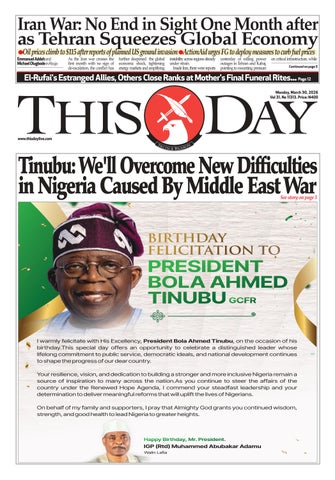
Tinubu: We'll Overcome New Difficulties in Nigeria Caused By Middle East War


expor


Tinubu: We'll Overcome New Difficulties in Nigeria Caused By Middle East War
Deji Elumoye, Chuks Okocha, Olawale Ajimotokan, Folalumi Alaran in Abuja, John Shiklam
Prays Allah to bring peace, stability to world on 74th birthday Establishes new welfare fund for armed forces Donates salaries from June 2023 as seed fund Shettima, Fagbemi, Yari, Bala Mohammed, Idris, Alake, Iyabo Obasanjo, others greet president on birthday ADC in birthday greeting says renewed hope has turned to hopelessness challenged. There is that of electricity, there’s a problem of transportation hike, there’s a problem of expected inflation as a result of the war that we have no control of.
President Bola Ahmed Tinubu, yesterday, assured Nigerians that the country will overcome new difficulties the it was facing as a result of the raging war in Middle East. He acknowledged that Nigeria was going through “a very difficult period” because developments it had not control over.
Speaking at a special prayer held at the National Mosque, Abuja, to mark his 74th birthday, Tinubu said the country’s predicament was as a result of the war in the Middle East. He prayed the Almighty Allah to bring peace and stability to the world.
Appreciating the deluge of messages from Nigerians on his birthday, during the prayer session attended by top government officials and associates, Tinubu assured that
the country will overcome its current economic problems.
The president described his birthday as one of reflection and gratitude to God.
Among several challenges, Tinubu cited electricity shortages, rising transport costs, and inflation, linking some of the pressures to the conflict in the Middle East. He expressed hope that peace would return to the region.
Tinubu stated, "It’s a solemn day, it is a day to give thanks to Almighty Allah for sparing our
lives and making things easy for me, family and all the team members.
“However, we are going through a very difficult period, which is not our own making, as a result of the war in Middle East. We pray to Almighty Allah to bring peace and stability to the rest of the world.
"It is time to reflect, to give thanks to God Almighty, as well as rededicate ourselves to the progress, development and prosperity of this country.”
Tinubu stressed, "We are
PDP Urges Supreme Court to Stop Wike Group’s Convention over Its Appeal
Chuks Okocha, Alex Enumah in Abuja, Hammed Shittu in Ilorin, Segun Awofadeji in Bauchi and Segun James in Lagos
The Kabiru Turaki-led Peoples Democratic Party (PDP) has asked the Supreme Court to restrain a faction of the party loyal to Minister of the Federal Capital Territory (FCT), Nyesom Wike, from going ahead with its national convention scheduled for March 29 and 30.
PDP said the move was to prevent a situation where the apex court's judgement in its pending appeal would be rendered nugatory.
The move was contained in court documents sighted by THISDAY.
The Court of Appeal had in a judgement delivered on March 9 nullified last year's national convention in Ibadan that produced the Turaki leadership of PDP.
The three-member panel,
the government continues to warn the United States against any ground invasion as diplomatic channels, including engagements led by Pakistan, struggle to contain the crisis.
Besides, ActionAid Sunday urged the Nigerian government to introduce urgent measures to cushion consumers from rising fuel prices as global oil markets react to supply uncertainty tied to the conflict.
In reaction to the war, mass “No Kings” rallies against President Donald Trump have underscored escalating political backlash in the United States, reflecting how the war’s
in nullifying the convention, upheld the judgement of the Federal High Court, which had last year ordered the Independent National Electoral Commission (INEC) not to recognise the outcome of the convention.
Dissatisfied, the appellants, on March 17, filed a Notice of Appeal, seeking to set aside the judgement of the appellate court, which sacked them as leaders of PDP.
Pending the hearing and determination of the appeal marked: SC/CV/166/26, the Wike faction went ahead to fix March 29 and 30 for the election of national executives of PDP.
Reacting, the appellants on March 27, through their team of lawyers, led by Chief Chris Uche, SAN, filed a Motion on Notice seeking, among others, the stay of the execution of the appellate court judgement as well as restraining orders stopping the conduct of the
consequences are now spilling into domestic politics far beyond the Middle East.
While Trump is talking up negotiations to end the conflict that he started alongside Israel, even as thousands more American troops head to the Middle East with a possible ground operation looming, the US and Israel said the war has been an unmitigated success, a position disputed by many.
But despite the killing of Supreme Leader Ayatollah Ali Khamenei and echelons of his top officials while gutting its navy and missile defences, Iran has mounted a response
convention fixed for March 29 and 30.
They predicated their demands on the grounds that the judgements of the two lower courts were all subject of appeal before the Supreme Court, and that the Record of Appeal had been transmitted and the appeal entered at the Supreme Court as SC/ CV/166/2026.
While submitting that the judgements of the two lower courts were delivered without jurisdiction, the appellants claimed, "The respondents intend, unless restrained, to give effect to the judgment of the Court of Appeal, which affirmed the judgment of the Federal High Court by organising a fresh National convention, at Abuja on March 29 and 30, 2026, and taking further steps to present ‘a fait accompli’ to the appellants and their members and officials while the merits of the appeal were yet to
that is already being felt around the world.
Tehran has used missiles and cheap drones to effectively blockade the Strait of Hormuz, a vital trade route through which 20 per cent of the world’s oil passed daily before the war, while attacking Gulf oil and gas facilities.
Oil Prices Climb After Iran Warns Against US Ground Invasion
Oil prices climbed Sunday after Tehran warned against a US ground invasion, despite President Donald Trump saying
be decided.
"The Supreme Court’s decision, in the instant appeal, in the event that it succeeds, will be rendered nugatory unless this application is granted."
The appellants asked the court to allow the main appeal, set aside the decision of the Court of Appeal, which affirmed the judgement of the trial court, and also strike out the first to third respondents from the appeal for want of jurisdiction.
The appellants stated that the lower court erred in law in assuming jurisdiction to hear a matter that was purely an internal affair of the appellants.
Besides, the appellants submitted that the Court of Appeal perversed the course of justice when it held that the suit of the respondents disclosed a cause of action within the
on Friday that negotiations would continue to end the war.
Brent crude, the global benchmark, rose 2.6 per cent to $115.50, while US crude rose nearly 3 per cent to $102.61, CNN reported.
Iran’s parliament speaker on Sunday said the country’s forces are “waiting” for American troops. The warning came after Trump on Friday said “talks are ongoing” and extended the deadline for his ultimatum calling on Iran to reopen the Strait of Hormuz.
The war has caused the largest oil disruption in history because of the strait’s closure, which 20
"But we will overcome it. We are a resilient nation that is very, very committed and resilient to the way of Almighty God. We will overcome all action."
The president thanked Nigerians for the flood of birthday messages.
He stated, "Best wishes have been coming from across the country, from individuals. What do you say to them and the prayers given to you?
"I appreciate all of them, and I thank them. It was a deluge of best wishes and I appreciate all Nigerians."
Relatedly, in a birthday gesture, Tinubu announced the establishment of a dedicated support fund for members of Nigerian armed forces, those wounded in the line of duty, and families of fallen heroes.
He announced the initiative on his 74th birthday, saying it is to honour the courage, sacrifice, and service of the military personnel.
The president directed the Accountant-General of the Federation to establish a special account for the fund, which will provide targeted support to injured service members, as well as widows, widowers, and children of those who lost their lives in service to the country.
In a statement by his spokesperson, Bayo Onanuga, the president, as a personal commitment, pledged to contribute all his salaries since assuming office as seed funding for the military support initiative, reinforcing his resolve to ensure that those who bear the cost of Nigeria’s peace and security are not forgotten.
He called on governors, members of the National Assembly, the private sector, friends, and well-wishers to support the initiative, stating
per cent of the world’s oil flows through. Strikes targeting oil and gas facilities have also triggered higher gas prices. Most parts of the world are paying for the effects of the war at the pump. Those gas prices will take time to fall once the war ends, experts warn. It will depend heavily on reopening the Strait of Hormuz and repairing damages to surrounding infrastructure, such as Qatar’s Ras Laffan — the largest gas production facility in the world — which Iran struck in mid-March.
Stock futures also fell Sunday, with Dow futures down 0.53 per cent, or 241 points. S&P 500
that details of the fund would be made available in due course. Tinubu emphasised that the initiative was rooted in a solemn national obligation to care for those who stood in harm’s way and the families who carried the burden of their sacrifice, irrespective of insurance programmes available to members of the armed forces.
The president also stated that supporting members of the armed forces and their families was not an act of charity, but a duty that all must fulfil.
He reaffirmed his administration’s commitment to strengthening the welfare of military personnel and ensuring that their service to the nation was matched with dignity, care, and sustained support.
Sultan of Sokoto, represented by Etsu Nupe, Yahaya Abubakar, alongside other prominent traditional rulers and Islamic scholars, led special prayers for Tinubu as he marked his 74th birthday at the National Mosque in Abuja. The president arrived at the mosque a few minutes after 3pm, participated in the special prayers and later observed the Asr prayer with Muslim faithful before departing the venue.
The prayer session, which drew governors, ministers, politicians, and worshippers from across the country, focused on seeking Allah’s guidance, wisdom, good health, and strength for the president as he steered the country's affairs.
The Etsu Nupe described the gathering as a solemn spiritual exercise rather than a celebration, emphasising the need for continuous prayers for national peace, unity, and development. He also appealed for government’s support towards the maintenance and welfare needs of the National Mosque. Similarly, Emir of Keffi, Chindo Yamusa, commended the president’s efforts to address
ActionAid Wants FG to Mitigate Impact of Fuel Prices
ActionAid Nigeria has called on the federal government to urgently roll out emergency economic relief measures as the ongoing conflict involving Iran, Israel and the United States continues to disrupt global oil markets and worsen the economic hardship faced by

GOVERNORS CELEBRATE WITH TINUBU ON 74TH BIRTHDAY...
L-R: Edo State Governor, Monday Okpebholo; Ondo State Governor, Lucky Aiyedatiwa; Niger State Governor, Umar Bago; Kogi State Governor, Usman Ododo; Kano State Governor, Abba Yusuf; Delta State Governor, Sheriff Oborevwori; Kaduna State Governor, Uba Sani; Ogun State Governor, Dapo Abiodun; Kwara State Governor, Abdulrahman Abdulrazaq; President Bola Tinubu; First Lady, Sen. Oluremi Tinubu; Imo State Governor, Hope Uzodinma; Lagos State Governor, Babajide Sanwo-Olu; Ebonyi State Governor, Francis Nwifuru; Yobe State Governor, Mala Buni; Gombe State Governor, Inuwa Yahaya; Benue State Governor, Rev. Fr. Hyacinth Alia; Taraba State Governor, Agbu Kefas; Chief of Staff to the President, Femi Gbajabiamila; and Lagos State Deputy Governor, Dr. Obafemi Hamzat at the State House on Sunday to felicitate President Tinubu on his 74th birthday anniversary, yesterday
Nigeria Exports over 45% of Gas Despite Deepening Power Supply Crisis
Producers choose lucrative export sales over local obligation Gas flaring, re-injection, shrinkage impact domestic supply
Emmanuel Addeh in Abuja
Nigeria exported an average of 45.8 per cent of its utilised gas in January and February 2026, even as domestic gas supply to tens of its thermal power plants weakened sharply, worsening electricity shortages across the country.
According to a THISDAY analysis of data from the Nigerian Upstream Petroleum Regulatory Commission (NUPRC) for both months, it implied that Nigeria, which for at least two months has experienced serious power cuts, has been unable to convince gas producers to adhere to the Nigeria’s Domestic Gas Delivery Obligation (DGDO).
The DGDO is a regulatory framework designed to ensure that a portion of gas produced
in the country is mandatorily supplied to the domestic market.
Enforced by the NUPRC under the provisions of the Petroleum Industry Act (PIA) 2021, the DGDO requires every gas producer to prioritise domestic supply before exporting gas, particularly to sectors classified as critical, including power generation companies, gas-based industries, and other strategic users.
In contrast, the upstream sector increased its deliveries to meet this obligation last year, delivering 77 per cent of its DGDO as of July 2025, the NUPRC announced at the time.
Minister of Power, Adebayo Adelabu, last week attributed the prioritisation of export by the gas producers to the
lucrative nature of export sales, low government-regulated price of gas to the power sector as well as the non-payment of existing debts owed the Gas Companies (Gascos) by the federal government.
In essence, while the DGDO is intended to guarantee energy security by ring-fencing gas for local use, structural and commercial realities have meant that compliance does not always translate into sufficient or reliable supply on the ground.
But a detailed review of the NUPRC data indicated a sustained export bias in gas allocation. In January, exports stood at 97,896.41 million standard cubic feet (MMSCF), accounting for 45.3 per cent of total utilised gas of 216,344.48 MMSCF. In
February, exports were 91,740.87 MMSCF, representing an even higher 46.3 per cent of utilised volumes of 198,398.67 MMSCF.
Combined, Nigeria exported 189,637.28 MMSCF within the two-month period, maintaining strong external supply commitments despite a decline in overall production and tightening domestic availability. Besides, total gas production fell from 233,961.47 MMSCF in January to 212,615.22 MMSCF in February, marking a 9.1 per cent drop. The decline reflected reductions in both associated and non-associated gas output, with the latter recording a sharper contraction, pointing to broader upstream supply challenges.
Despite this, overall gas utilisation remained high, improving slightly from 92.5
NNPC: Nigeria Seeing More Interest from LNG Buyers for Its Cargoes
FG accelerates permits for oil producers to revive old wells
Nigeria is seeing stronger demand for its Liquefied Natural Gas (LNG) cargoes as energy disruptions from the war in the Middle East have opened commercial opportunities for the West African producer, Executive Vice President, Gas, Power and New Energy, Nigerian National Petroleum Company Limited (NNPC), Olalekan Ogunleye, has said.
The top NNPC executive told Reuters during the recent CERAWeek energy conference in Houston, Texas, that buyers are increasingly looking to
Nigeria because of its proximity to key consuming nations and the scale of its gas reserves.
Nigeria LNG (NLNG), in which NNPC is the largest shareholder, can export up to 22 million metric tons per year and is building a seventh production train scheduled for completion in 2027.
“We are right in the middle of the market. We are 10 sailing days from Europe, close to the Atlantic Basin and close to Asia,” Ogunleye said. “We see commercial opportunities on top of the fact that we have the most gas reserves in Africa,” he added.
Ogunleye said demand for natural gas has proven resilient, adding that the current geopolitical tensions would not derail its growth. He said NNPC has started talks on adding two new LNG trains and is also pursuing a 12 million metric tons per annum (mtpa) LNG project alongside gas-based industrial hubs to tap more than 200 trillion cubic feet of reserves in Nigeria.
Longtime LNG developer and consultant, Martin Houston, in his remarks, said the U.S.-Israeli war on Iran has heightened the need for buyers to diversify supply risk. He said African
and South American countries with gas already discovered but without a current market could benefit from rising interest in new LNG supply, including floating LNG options.
Meanwhile, Nigeria has slashed the time it takes to approve applications to revive idle oil wells from weeks to hours as Africa’s top crude producer seeks to take advantage of high energy prices.
The Nigerian Upstream Petroleum Regulatory Commission NUPRC) is approving permits within hours of application, people familiar with the process told Bloomberg.
per cent in January to 93.3 per cent in February and suggesting that most of the gas produced was effectively captured and deployed, although the pattern of utilisation revealed a structural tilt toward exports. Domestic gas supply recorded a significant decline over the period as local sales dropped from 62,944.93 MMSCF in January to 52,300.45 MMSCF in February, representing a 16.9 per cent decrease. As a proportion of utilised gas,
domestic supply fell from 29.1 per cent to 26.4 per cent, indicating reduced availability for local consumption, including power generation. In the same vein, gas consumed as field use remained substantial, with volumes standing at 55,503.14 MMSCF in January and 54,357.34 MMSCF in February, translating to 25.7 per cent and 27.4 per cent of utilised gas respectively, further tightening supply to local end-users.
SSANU to FG: Conclude Renegotiation Process, Settle All Outstanding Entitlements
The Senior Staff Association of Nigerian Universities (SSANU) has asked the federal government to immediately reconvene the renegotiation process; end salary delays and pay withheld salaries to avert imminent industrial action.
The association also urged the government to implement salary increments and ensure fair disbursement of Earned Allowances to all eligible workers.
In a communique signed by the National President of SSANU, Mohammed Ibrahim, the union demanded the protection of jobs under any reform framework; and the establishment of a standing consultative mechanism between government and university unions for continuous dialogue and early dispute resolution.
It condemned the persistent delays in the payment of salaries of staff in federal and some state universities, as well as
the non-payment of approved increments and other withheld entitlements.
"Council notes that these recurring delays have imposed severe hardship on members and their families, weakened morale, and undermined productivity across the university system.
"NEC therefore demands the immediate settlement of all outstanding salary-related issues and the establishment of a reliable and unified salary payment structure," part of the communique read.
SSANU said that the continued neglect of the welfare of university workers and the persistent delay in resolving critical labour issues can no longer be tolerated.
"The federal government is hereby called upon to take immediate, sincere, and decisive steps to conclude the renegotiation process, settle all outstanding entitlements, and restore confidence in its commitment to industrial justice within the university system.

SPECIAL PRAYERS TO MARK TINUBU’S BIRTHDAY...
L-R:
CPPE to CBN: Reconnect Banking System to Real Economy in Next Financial Reform
With the banking recapitalisation exercise largely achieved, Centre for the Promotion of Private Enterprise (CPPE) urged the Central Bank of Nigeria (CBN) and the fiscal authorities to see the reconnecting of the banking system to the real economy as the next critical phase of financial service sector's reform.
CPPE expressed the view yesterday in its policy brief, titled, "Bank Recapitulation: Strong Progress, But Urgent Need to Reconnect Banks to the Real Economy," which commended CBN for the successful implementation of the bank recapitalisation programme.
The brief decried the situation where the services sector was accounting for about 55 per cent of total credit, while
manufacturing, agriculture, and Small and Medium Enterprises (SMEs) were receiving about 14 per cent, five per cent, and one per cent, respectively. It said this was inconsistent with Nigeria’s aspirations for economic growth.
Chief Executive Officer of CPPE, Dr. Muda Yusuf, said in the brief, "The recapitalisation programme has successfully strengthened the resilience and stability of Nigeria’s banking system."
Yusuf said CBN deserved commendation, especially for delivering a reform process that had been both effective and non-disruptive.
He stated, "However, the ultimate success of this reform will be determined not just by stronger balance sheets, but by the extent to which the banking system supports investment, enterprise, job creation and
British Council Tasks NigerianUK Alumni on Global Innovation, Social Change
The British Council has called on Nigerian alumni of United Kingdom institutions to use their expertise in shaping the future of Nigeria-UK relations, particularly in driving economic growth, supporting democratic institutions, foster technological innovation, and tackling the global challenges that affects everyone.
In her welcome address at the alumni-UK symposium yesterday in Abuja titled, "The Role of UK Alumni in Shaping Nigeria–UK Relations", British Deputy High Commissioner to Nigeria, Gill Lever said this has become expedient in an era defined by rapid economic shifts and complex global challenges.
Speaking on the theme, "Catalysts of Influence: Driving Global Innovation and Social Change", Lever said in such times, the true currency of global influence is not just economic
might; it is human capital, collaborative ideas, and shared values.
She reiterated that for decades, the UK has been a destination of choice for Nigeria’s brightest minds and through the Chevening and Commonwealth Scholarship programmes, as well as the hundreds of thousands of Nigerians who have independently chosen to study at UK institutions, the transformative power of international education has been witnessed globally.
"As graduates of UK institutions, you are the ultimate ambassadors of this soft power. When you apply the knowledge gained in the UK to drive agricultural reform, when you leverage your international networks to scale a Nigerian technology startup, or when you use your voice to advocate for justice and social inclusion, you are actively strengthening the ties between our nations.
economic transformation.
"At this critical juncture, the priority must shift from capital adequacy to economic impact.
"Nigeria needs not just stronger banks, but banks that work for the economy."
Yusuf said the next phase of the banking reform should focus on how to "increase private sector credit as a percentage of GDP to at least 30 per cent in the medium term, de-risk lending to SMEs through credit guarantees and improved credit infrastructure and the strengthening of the monetary policy transmission to ensure lower policy rates translate to real sector lending".
He urged CBN to incentivise long-term financing for productive sectors, promote a more balanced sectoral allocation of credit, expand access to consumer credit to stimulate aggregate demand, and address the crowding-out effects of public sector borrowing.
CPPE stated that the successful implementation of the bank
recapitalisation programme marked a significant milestone in the ongoing effort to strengthen the resilience, stability and capacity of the Nigerian banking system.
It said the orderly and non-disruptive manner the recapitalisation exercise was carried without reports of depositor losses, forced mergers, job losses or erosion of shareholder value marked a significant improvement over past consolidation episodes and reflected stronger regulatory capacity, improved market discipline and greater resilience within the banking system.
"However, while recapitalisation has significantly strengthened the capacity of banks to absorb shocks, support large-ticket transactions and enhance financial system stability, the critical question now is whether this stronger banking system will sufficiently support the real economy," Yusuf said.
He stated that currently "the evidence suggests that this
linkage remains weak".
He pointed out that private sector credit as a percentage of GDP in Nigeria was still only about 17 per cent as of 2025, compared to a Sub-Saharan African average of about 25 per cent and approximately 34 per cent for lower-middle-income countries.
Yusuf stated that peer economies, such as South Africa, Mauritius, and Cape Verde, were recording 57.5 per cent, 69.8 per cent, and 66.3 per cent, respectively, to demonstrate significantly stronger financial intermediation.
He said the gap underscored a persistent structural disconnect between the financial system and productive sectors of the economy.
According to him, consumer credit in Nigeria remains extremely low at approximately seven per cent of total credit, compared to a Sub-Saharan African average of 15–25 per cent.
Yusuf said, "More critically,
credit to SMEs is alarmingly low. SME credit accounts for only about one per cent of total credit, compared to an average of about five per cent in sub-Saharan Africa.
"This is particularly troubling given that SMEs contribute approximately 50 per cent of GDP and over 80 per cent of employment, with an estimated financing gap of about N48 trillion, according to PwC.
"This represents one of the most significant weaknesses in Nigeria’s financial architecture." He stated that there were important structural concerns regarding the nature and distribution of credit in the economy.
According to Yusuf, "A large proportion of bank lending remains short-term in nature.
"Credit with maturity of less than one year, accounts for about 55 per cent of total credit, while long-term credit that is above three Year's accounts for only about 25 per cent.
The federal government has disbursed a total of N2.25 billion to 45 students selected from 65 finalists under the Student Venture Capital Grant (SVCG), a government initiative aimed at supporting student-led innovations with up to N50 million in equity-free funding.
The beneficiaries, who completed a rigorous three-day boot camp and pitched their innovations before a panel of industry leaders and experts, were drawn from different institutions across the country and selected from more than 30,000 students who applied for the grant.
Speaking at the awards ceremony, held at the UNDP Innovation Hub, Ikoyi, Lagos, Minister of Education, Dr. Tunji Alausa, explained that the
programme represented a major shift in Nigeria’s education policy, aimed at transforming tertiary institutions from centres of certification into hubs of innovation, entrepreneurship, and economic development.
Alausa described the initiative as a transformative student programme that would unlock the innovative potential of Nigerian students and position them as job creators.
He stated, “Today is not just another programme event. Today, we are activating a new future and a new vision for Nigerian students.
“For too long, tertiary institutions have been seen primarily as centres of certification. Our institutions must now become centres of innovation and agents of enterprise.”
He added that under the
scheme, selected student innovators would receive equity-free funding, structured incubation, mentorship and access to digital tools to scale their ideas into viable businesses.
Alausa said the programme attracted more than 30,000 applications from over 400 tertiary institutions nationwide, demonstrating the abundance of innovative ideas among Nigerian students.
He stated, “We have received over 30,000 applications from more than 400 tertiary institutions. Nigeria is not lacking in ideas, what we have been lacking is structured support. With the Student Venture Capital Grant, that gap is now closed.”
The minister said the initiative would help students move from ideation to
commercialisation, converting campus-based innovations into scalable enterprises capable of driving national economic growth.
He added that beneficiaries would not only develop solutions to societal challenges but also contribute to job creation and strengthen Nigeria’s innovation ecosystem. He said, “With innovation and entrepreneurial skills, our graduates will become job creators rather than job seekers. This is the pathway to harness Nigeria’s youthful population and transform it into a formidable human capital base.”
Alausa disclosed that the programme was designed as a national intervention to support the incubation of student ideas into products and services with real-world impact.

25TH ANNIVERSARY OF VICM AND THE GLOBAL LEADERSHIP SUMMIT...
UK Pledges to Partner Nigeria for More Predictable Business Environment, Investment Opportunities
Afolabi Imoukhuede says strong FDI inflows now needed in real sector Bagudu: states, private sector central to attainment of $1trn economy
The United Kingdom has expressed its commitment to working with Nigeria to strengthen implementation, reduce bottlenecks, and create a more predictable business environment that unlocks investment opportunities, creates jobs, and supports long-term growth.
UK's Head of Macroeconomic Stability in the British High Commission, Nigeria, Alice Clarke, gave the indication, weekend, while speaking at “The Reform and Diplomatic Roundtable 2026,” organised by Presidential Enabling Business Environment Council (PEBEC),
in collaboration with the UK International Development and Nigeria Economic Stability and Transformation (NEST).
NEST is a UK–Nigeria partnership programme under the British High Commission, focused on supporting macroeconomic reforms and improving the business environment in the country.
Clarke stated, "Businesses don’t experience reform in theory. They feel it in permits, power connections, and how institutions respond when things go wrong.
Today’s assessment gives us a clear picture of where progress is happening and where consistency must improve.
"The UK is committed to
Jet Blast Forces United Nigeria Airlines Aircraft Out of Service
Domestic carrier, United Nigeria Airlines, has disclosed that its aircraft, Embraer 190, was affected by jet blast at the ramp of the Murtala Muhammed International Airport, Lagos domestic terminal and has been withdrawn from service.
According to the airline, the aircraft arrived from Akanu Ibiam International Airport, Enugu, on Flight UN0503, scheduled for 8:40 a.m., and was parked at an open bay between two adjacent aircraft belonging to sister airlines.
"While preparations were ongoing to board passengers for another scheduled flight, a nearby aircraft, having completed its own boarding process, commenced taxiing. At the same time, another aircraft was executing a pushback onto the taxi line.
"During these simultaneous
ground movements, the taxiing aircraft manoeuvred in a manner that generated significant jet blast within the ramp area. The force of the jet blast displaced a baggage trolley belonging to a ground handling company, which subsequently made contact with the United Nigeria Airlines aircraft preparing for Flight UN0500, scheduled for 12:00 hours", the airline said.
The airline explained in a statement that the impact resulted in damage to external components, including the antenna and the forward fuselage area near the nose landing gear.
"In adherence to our strict and uncompromising safety standards, the affected aircraft has been withdrawn from service for comprehensive inspection before returning to operations.
United Nigeria Airlines remains committed to upholding the highest safety standards.
working side-by-side with Nigeria to strengthen implementation, reduce bottlenecks, and create a more predictable business environment that unlocks investment opportunities, creates jobs and supports long-term growth."
Presenting Nigeria’s Investment Outlook 2026, "From Reform to Real Capital Deployment," leveraging top reform-performing states as global capital gateways, a NEST expert, Mr. Afolabi Imoukhuede, stated that Nigeria’s 2026 investment outlook was "cautiously positive", citing the Central Bank of Nigeria (CBN) position in January.
Imoukhuede observed that Nigeria was re-entering the investment radar, with macroeconomic reforms improving credibility, FX, fiscal and policy adjustments stabilising outlook.
The NEST expert, who also referenced the International Monetary Fund's recent projection that Nigeria’s economy would grow by 4.4 per cent in 2026, stated that investor sentiment was cautiously returning.
However, Imoukhuede explained that investment capital remained selective, risk-aware, and sector-driven. According to him, the economy is attracting capital inflows, which are usually dominated by shortterm portfolio capital. He added that FDIs were needed in the real sector of fhe economy.
Imoukhuede submitted that while strong FDIs into the real sector remained imperative, Nigeria must convert macroeconomic stabilisation to real sector investment bankable assets, move from passive inflow to targeted deployment, and target FDIs into real sectors that earned/ saved FX and boosted job creation, as well as prioritised production.
Imoukhuede listed real sectors where FDIs should be deployed to include agriculture and agroprocessing, manufacturing and industrial clusters, logistics and trade infrastructure, power, renewable energy and green jobs. Others are mining, digital and creative economy, as well as housing and construction materials.
He added that focus should be
on FX-earning and job-creating sectors.
The NEST expert prescribed that the top 10 states in the PEBEC Ease of Doing Business (EoDB) ranking should not end up with just ranking, but be pre-packaged investment destinations designated as FDI “Landing Zones”
He explained that they represented a number of positive signals, including faster approvals, more predictable regulation, better land and permit systems, improved justice system, and stronger investor engagement. Others were digital governance improvements and investor aftercare.
Imoukhuede said lower execution risk translated to higher investment
In a keynote address, titled "National Development Planning as a Catalyst for Subnational FDI," Minister of Budget and Economic Planning, Senator Abubakar Atiku Bagudu, observed that the country's federal structure conferred states and local governments significant authority, including the ability to enter into contracts and operate their own
court systems, thereby ensuring that their actions are critical to attracting investment and driving economic growth.
Bagudu stated that Chapter 2 of the 1999 Constitution, the Fundamental Objectives and Direct Principles of State, conveyed three distinct elements, including recognising Nigeria as a constitutional market economy and a constitutional federation. He said Section 13 of the constitution required the three tiers of government and, indeed, all those in authority to work together to observe and achieve those fundamental objectives. Bagudu said Nigeria’s ambition to build a $1 trillion economy by 2030 would depend largely on the role of states and the private sector.
“We feel confident that with that mindset, led by the private sector, we can create a $1 trillion economy, supported by the response that our economy has experienced to doing what is right,” he said. According to him, competition among states, supported by reforms and development
UNICEF Raises Alarm Over Imminent Polio Outbreak in Niger State
The United Nations Children Emergency Fund UNICEF has raised the alarm over an imminent outbreak of polio in Niger State fingering the high prevalent cases in neighbouring states.
UNICEF Social and Behaviour Change Specialist, Kaduna Field office, Dr. Ibrahim Mohammed, who raised the alarm said, "with the cases in
neighbouring states, Niger stands the risk of having polio outbreak if proactive measures are not taken".
Speaking ahead of the immunisation campaign in the state in Minna at the weekend, Dr. Ibrahim Mohammed, who was reviewing the polio cases in neighbouring states of Bauchi, Kebbi, Kwara, Zamfara and Sokoto, stressed the urgency for children within the target age group in the state to be
vaccinated.
"The increasing number of cases in states bordering Niger poses a significant threat to children in the state, particularly those yet to be vaccinated", he maintained insisting that "There is no cure for polio, immunisation remains the most effective way to prevent it"
Dr. Ibrahim Mohammed therefore called on parents and guardians in the state
to ensure their children are vaccinated in the forthcoming polio immunisation campaign. In his remarks, the State Health Educator, Niger State Primary Health Care Development Agency, Mohammed Usman, disclosed that the immunisation campaign will be carried out across the 25 local government areas of the state assuring that the exercise would help to to contain the spread of the disease.

Uche Orji: Abia Now Irreversible Driver of Nigeria’s Economic Resurgence
Sunday Ehigiator
Former Managing Director of Nigeria Sovereign Investment Authority, Uche Orji, declared that Abia State had become an “irreversible” driver of Nigeria’s economic resurgence, citing sweeping governance reforms and rising investment opportunities under Governor Alex Otti.
Orji made the remarks at the Abia Think-Tank Association Symposium held recently in Lagos, with the theme, “Renewed Nigeria’s Economic Resurgence: Is Abia Prepared?’” Delivering a keynote address, Orji said Abia’s role in Nigeria’s
economic recovery was now structural and strategic, rather than symbolic, stressing that the state is emerging as a key contributor to national growth.
“The place of Abia State in Nigeria’s economic resurgence is not peripheral. It is not symbolic. It is structural, strategic, and increasingly irreversible,” he said.
He stated that recent macroeconomic improvements under President Bola Tinubu, including GDP growth, declining inflation, and improved foreign investment inflows, had created a favourable environment for subnational economies to thrive.
According to him, states
that align governance with national reforms are already witnessing tangible economic gains, with Abia among the leading beneficiaries.
Highlighting governance strides under Otti, Orji pointed to improvements in internally generated revenue, infrastructure development, and ease of doing business, describing them as critical enablers of private sector confidence.
“This is governance documented in data, not just declared in statements,” he said, adding that consistent salary payments, cost savings, and increased capital spending
have strengthened fiscal discipline in the state.
Orji identified manufacturing and agro-investments as the twin pillars driving Abia’s economic momentum, with particular emphasis on Aba’s industrial ecosystem and the Ariaria International Market.
He described Aba as a resilient manufacturing hub, where artisans and small-scale producers had sustained production, despite years of infrastructure deficits.
“Aba’s manufacturing base is the foundation upon which a formal industrial revolution can now be built,” he said.
On agriculture, Orji stated
NCC Directs Telcos to Compensate Subscribers for Poor Service Quality
The Nigerian Communications Commission (NCC) has directed telecoms operators across networks to provide compensation to subscribers whose network quality of service experience is below specified targets within specific locations.
NCC gave the directive yesterday in a statement signed by its Head, Public Affairs Department, Nnenna Ukoha.
According to NCC, subscribers should not be made to bear the full burden of service disruptions where operators fail to meet prescribed standards of service delivery.
Under this directive, erring operators will compensate affected users directly for breaches of Quality of Service (QoS) Key Performance
Indicators (KPIs).
“Mobile Network Operators (MNOs) shall be required to pay these compensations for instances of poor quality of service recorded within specified time frames.
The compensation will be provided in the form of airtime credits, calculated based on subscribers’ average spending patterns and their presence within Local Government Areas where service failures occur.
“The directive is rooted in the commission’s broader regulatory philosophy that places the consumer at the centre of Nigeria’s telecommunications ecosystem. Telecommunications services today underpins economic activity, social interaction, and access to digital opportunities. When service quality is poor, the consequences affect
productivity, commercial activities, and even public confidence in our communications system,” the statement said
While regulatory fines have traditionally served as a deterrent against poor service delivery, the commission is adopting a more consumerfocused approach that strengthens accountability within the industry.
The commission has designed this measure to complement existing and ongoing efforts to strengthen service quality monitoring and enforce performance standards, the statement further said
Further to the directive by the commission to MNOs on compensation to consumers, the commission is also mandating tower companies who own the critical infrastructure for Quality of
Service delivery, such as masts, to invest in infrastructure with measurable outcomes using sums that it has fined these companies, in addition to other financial fines the commission will deem appropriate.
“The commission will continue to reinforce the obligation of operators to invest consistently in network resilience, capacity expansion, and infrastructure upgrades to meet the growing demand for telecommunications services. At the same time, it will deploy regulatory tools that promote fairness, transparency, and accountability across the sector, ensuring that every subscriber receives the quality of service they deserve while sustaining a telecommunications industry capable of powering Nigeria’s digital future,” the statement added.
that Abia’s vast arable land and ongoing investments in oil palm and food processing presented significant opportunities for value-chain development and job creation.
He said targeted investments in agro-processing, including planned large-scale oil palm cultivation, would not only boost output but also reduce reliance on imports.
Orji also highlighted the strategic importance of the Enyimba Economic City, describing it as a major platform for attracting both local and
foreign investors seeking to tap into Nigeria’s growing market and the opportunities presented by the African Continental Free Trade Area.
He urged investors, industrialists, and entrepreneurs to take advantage of the improving business environment in Abia, particularly in manufacturing, agriculture, technology, and infrastructure.
“The platform has been built. The governance has been reformed. What is required now is for investors to come in and build,” he said.
Nigerian Community in Australia Condemns Attacks on Acting High Commissioner
The Association of Nigerians in the ACT (NAACT) has strongly condemned what it described as sustained misinformation and personal attacks against Nigeria’s Acting High Commissioner to Australia, Jane Bassey Adams, warning that such actions undermine the unity and reputation of the Nigerian diaspora.
In a statement issued by its president, Francis C. Ogbonnaya, the association criticised the conduct of Chris Juwon Fayomi, who has presented himself as a leader of Nigerian students in Australia and has publicly criticised the Nigerian diplomat.
NAACT said while it firmly supports the right of individuals and groups to express concerns and hold public officials accountable, such engagement must be grounded in facts, integrity and responsible conduct.
According to the association,
the recent campaign against Adams has gone beyond legitimate advocacy and instead reflects a troubling pattern of misinformation, distortion and personal attacks amplified through public commentary and media engagement.
The group expressed particular concern that the allegations were being directed at a senior diplomatic official who, by the nature of her office, is constrained from responding publicly to the claims.
“It is particularly concerning that these actions are directed at a senior diplomatic official who, by the nature of her office, is constrained from responding publicly to such allegations,” the statement said.
The association argued that exploiting such professional restraint to circulate unverified claims was inappropriate and inconsistent with the ethical standards expected of individuals claiming community leadership.


WELA Seeks Ban on Illegal Festival Curfews
Sunday Ehigiator and Wale Igbintade
Women Empowerment and Legal Aid (WELA) has called for immediate nationwide ban on unconstitutional curfews imposed during traditional festivals, warning that the practice disproportionately targets women and exposes them to abuse.
Speaking against the backdrop of the recent incident in Ozoro, Delta State, WELA’s Founder, Funmi Falana (SAN), in a statement yesterday, said, “The disturbing events recently reported in Ozoro,
Delta State, are not isolated. They are the predictable consequence of a dangerous and long-tolerated illegality across parts of Nigeria: the imposition of curfews and movement restrictions by non-state actors under the guise of culture.
“Let us be clear, what is at issue is not culture. What is at issue is power exercised without legal authority.”
She added, “Across several regions in Nigeria, including the South-West and the Niger Delta, traditional festivals such as Oro, Agemo, Ekpe, and others routinely impose restrictions on movement;
often targeting women, nonindigenes, and non-initiates.
“These restrictions confine citizens to their homes, shut down businesses, disrupt education, and, as recent events have shown, create environments where abuse thrives unchecked.”
Falana said, “The situation in Ozoro represents the end of this pattern. When individuals or groups assume the authority to declare curfews, control public spaces, and dictate who may move freely, they create conditions where lawlessness replaces order and where the vulnerable,
especially women and girls, are exposed to grave harm.
This must end.
“The Constitution of the Federal Republic of Nigeria (1999, as amended) is unambiguous. Section 41 guarantees the right to freedom of movement. Section 35 protects personal liberty. Section 42 prohibits discrimination, including based on sex.
“No traditional institution, no cultural group, and no private individual has the constitutional authority to suspend these rights.
“Only duly constituted government authorities,
acting within the law and in the interest of public safety and order, may impose restrictions such as curfews, and even then, such measures must be necessary, proportionate, and legally justified.”
Calling for urgent action, she said “all curfews imposed by non-state actors, whether in the name of festivals, rituals, or tradition, must be declared illegal and prohibited across Nigeria.
“Our festivals should showcase our heritage, not weaponise it. They should attract visitors, not instill fear. They should empower communities, not degrade women and girls.
“The events in Ozoro are a warning. If unlawful curfews continue to be tolerated, they will continue to produce environments where rights are violated and justice is absent. We must choose between a society governed by law and one governed by unchecked tradition. For us, the choice is clear. Enough is enough.”
In a separate statement yesterday, human rights activist and lawyer, Femi Falana (SAN), raised alarm over what he described as the denial of basic education to millions of Nigerian children, blaming state governments for failing to access available funding.
The NNPC/Seplat Joint Venture (JV) has screened a total of 23,447 optical cases, conducted 797 surgeries and given out over 13,525 eye glasses to date, all at no cost to the beneficiaries, under its ‘Eye Can See’ signature Corporate Social Investment (CSI) programme.
The Director, External Affairs and Social Performance, Seplat Energy Plc, Mrs. Chioma Afe, disclosed this on Wednesday during the opening ceremony
of the ‘Eye Can See’ CSI programme 2026 edition in Owerri, the Imo State Capital. Represented by the General Manager, Corporate Social Investment & Social Performance, Seplat Energy Plc, Mrs. Esther Icha, Afe explained the initiative was designed to impact the health and wellbeing of host communities by providing free access to essential eye care services, including screenings, reading glasses and cataract surgeries.
Beneficiaries are also screened
for other health challenges like high blood pressure and diabetes, amongst others, and provided with professional counselling, drugs and referrals for patients as needed.
The three-day outreach, held from March 24 to March 26, 2026 in Owerri, attracted a large turnout of men, women, and children from across the State and neighbouring communities with an average of 700 people being screened per day.
She observed that cost of eye care, which is currently out of reach for many, makes
it very imperative for the NNPC/Seplat JV to sustain the programme and drive penetration; thus, impacting a wide array of persons in the communities from the inception of the intervention health programme in 2017. Afe added the initiative aligns with the United Nations Sustainable Development Goal (SDG) 3 on Good Health and Well-Being, and underscores the Joint Venture’s broader commitment to delivering sustainable, high-impact social investments.
Abia Converts Government House to Hotel
Umuahia Centrat Bus Terminal nearing completion
Okoro in Umuahia
The Abia State Government says it is converting its new Government House to a hotel, to be managed by a five-star brand.
NDLEA Intercepts Cocaine Hidden in Dry Fish Heads, Seizes Fentanyl, Meth in UK-Bound Shipments
Michael Olugbode in Abuja
Operatives of the National Drug Law Enforcement Agency (NDLEA) have dismantled a suspected international drug trafficking network after intercepting cocaine concealed inside the heads of imported dry stock fish in Lagos, while also seizing dangerous narcotics hidden in parcels bound for the United Kingdom.
Akputa Ejike, believed to be a key member of the syndicate responsible for exporting illicit drugs to several countries, particularly India.
He said a search of three large bags in his possession led to the discovery of 237 wraps of cocaine carefully hidden inside the heads of imported dry stock fish, popularly known as “Okporoko.” The concealed drugs weighed a total of 5.8 kilogrammes and were allegedly destined for Delhi, India.
He also said that the state-of-the-art central bus terminal in Umuahia, which he described as the largest in the country, was almost due for commissioning.
The new Government House
Governor Alex Otti announced this last Friday during his March 2026 monthly media chat.
was built by the previous administration at Ogurube Layout, Umuahia, which planned to move all arms of government and offices to the area which already harboured the Legislature, Judiciary, workers' secretariat and landmark public buildings,
including the International Conference Centre.
However, that administration didn't complete the project, prompting Governor Otti, when he assumed office in 2023, to reject and declare the new Government House unfit for human habitation.
A statement by the spokesman of the anti-narcotics agency, Femi Babafemi on Sunday, stated the operation, which followed weeks of intelligence gathering on a transnational trafficking ring, culminated in a sting carried out by officers of the agency’s Strategic Command at the Murtala Muhammed International Airport in Lagos. Babafemi said during the raid conducted in the Ojo area of the state, operatives arrested a 36-year-old suspect,
In a related operation in Lagos, operatives from the agency’s Directorate of Operations and General Investigation intercepted two suspicious consignments heading to the United Kingdom through a courier service. One of the shipments, which originated from Cotonou in the neighbouring Republic of Benin, contained 1.9 kilogrammes of methamphetamine hidden inside automobile filters.

AT THE ACCESS BANK INTERNATIONAL WOMEN’S DAY CONFERENCE 2026...
El-Rufai's Estranged Allies, Others Close Ranks at Mother's Final Funeral Rites
Atiku, Ribadu, Uba Sani, Obi, Tambuwal, Bago, Amaechi, Emir Sanusi, Pantami, others present Northern
Emmanuel Addeh, Chuks Okocha in Abuja and Segun Awofadeji in Gombe
Former Kaduna State Governor, Nasir el-Rufai, yesterday laid his mother to rest amid an unusually broad gathering of political figures, as erstwhile rivals, allies and friends set aside differences to pay their last respects.
The final funeral provided a rare moment of unity in Nigeria’s fractious political landscape, as his estranged associates, including the National Security Adviser (NSA) Nuhu Ribadu and current Governor of Kaduna State Governor, Uba Sani, who have had a not-so-smooth
relationship with El-Rufai in recent times, also present.
Aside from El-Rufai's estranged allies, former Vice President Atiku Abubakar; Labour Party (LP) presidential candidate in the 2023 general election, Peter Obi; former Minister of Transportation, Rotimi Amaechi as well as the Governor of Niger State,
Umaru Bago and Emir of Kano, Lamido Sanusi were present during some of the events leading to the final burial. Earlier, President Bola Tinubu had sent in his condolence message.
A former Governor of Sokoto and current chieftain of the African Democratic Congress (ADC), Senator
UNICEF Urges Media to Hold Leaders Accountable on Child Welfare, Promote Responsible Reportage
The United Nations Children's Fund (UNICEF) has called on media practitioners to play a crucial role in holding leaders accountable for child welfare in Nigeria as the country approaches a critical election period.
The head of the UNICEF Field Office in Kano, Dr. Karanveer Singh, made the call in his keynote address at a workshop on Ethical Journalism and Child Rights Training for Media Practitioners in Kano and Jigawa State, organized by the organization.
He described ethical reporting on children as crucial, noting that it is vital
to Nigeria's functioning society and especially important for the future of the country's children.
He said: "The first reason is that Ethical Reporting Builds Trust and Heals Division. In a nation or society with diverse ethnicities, religions, and perspectives, the media is the glue that can hold people together—or the wedge that can drive them apart.
"Ethical journalism, characterized by accuracy, fairness, and balance, is the antidote to misinformation and hate speech.
"When you verify a fact before publishing, when you present multiple sides of a story, you are not just being
professional; you are building a foundation of trust with your audience."
Singh noted that in the fragile context of northwest Nigeria, where insecurity and tension exist, responsible reporting can cool tempers, promote dialogue, and foster peace.
The head of UNICEF office in Kano expressed sympathy with the enormous challenges face by working journalists in the cause of their duties adding, you operate under various pressures, security threats, and sometimes, immense political pressure.
"The temptation to sensationalize, to take shortcuts, or to bow to influence is real. But it is precisely because of
these challenges that your ethical commitment to reporting, especially of children, matters more, not less."
In his welcome remarks, the Managing Director of Kano State Radio Corporation, Alhaji Abubakar Rano, represented by the Deputy Director of Programmes, Aisha Usman, who doubles as UNICEF Focal Person, underscored the critical roles of journalists in shaping public opinion and influencing government decisions, in favour of the child.
According to her, "children are vulnerable and need protection. If we report carelessly, we may harm their dignity, expose their identity, or create stigma."
governors’ forum mourns, participates in burial event
Aminu Tambuwal, was also present at the funeral prayers at the National Mosque in Abuja.
Their presence highlighted the cross-party significance of the occasion, drawing together figures who are often political adversaries.
Earlier, the Chairman of the All Progressives Congress (APC), Nentawe Yilwatda, had also visited the embattled politician to commiserate with him on his mother's demise.
But finally, Hajiya Umma elRufai, was laid to rest in Abuja at the Gudu Cemetery following funeral prayers conducted in line with Islamic rites. THISDAY reports that the matriarch of the family died on Friday in Cairo, Egypt, where she had been receiving medical treatment.
In a dramatic turn of events, hours after her death, el-Rufai, who had been in detention for over a month for alleged graft, was released by federal authorities.
Before yesterday's final burial, the family of el-Rufai had announced the arrival of the remains of the exgovernor’s mother in Abuja for burial. El-Rufai’s son and member representing Kaduna North Federal Constituency in the House of Representatives, Mohammed
El-Rufai, confirmed the funeral arrangements in a statement posted on X. He stated that the deceased’s remains had arrived safely on Sunday morning in Abuja.
“This is to notify the general public that the remains of our grandmother, Hajiya Umma El-Rufai, have safely landed in Abuja. The Janazah Prayer is by 1 p.m. as announced last night.
“The prayers will take place at the National Mosque and she will be buried at Gudu Cemetery by the grace of God. May Allah SWT bless her soul and all those that passed away before her,” he wrote. Hajiya Umma’s death came at a time when ell-Rufai was in the custody of the Independent Corrupt Practices and Other Related Offences Commission (ICPC) following his arrest over allegations of corruption and money laundering.
He was arraigned before a Federal High Court in Kaduna on March 24 on a 10-count charge, with the case adjourned until March 31, 2026, for hearing of pending applications, including his bail request. He was, however, granted release from ICPC custody, reportedly to attend the burial rites and be with his family.
Korean Food Culture Gains Ground in Nigeria as Male Chef Breaks Hansik Contest Barrier
Michael Olugbode in Abuja
Nigeria’s growing fascination with Korean culture took a significant leap in Abuja as Victor Mac-Adonai emerged winner of the third edition of the Hansik cooking competition, becoming the first male champion since the contest began.
The event, organised by the
Korean Cultural Centre Nigeria, brought together young culinary enthusiasts eager to explore the depth of Korean cuisine and its cultural heritage.
The competition was hosted at the RED Dish Chronicles Culinary School in the Central Business District of Abuja
Beyond the excitement of the contest, the event underscored the growing cultural exchange
between Nigeria and South Korea, particularly through food, music and youth engagement.
Twenty participants initially registered online for the contest themed “The Soul of Hansik,” which challenged contestants to demonstrate a deep understanding of traditional Korean cuisine.
After several rounds of intense cooking sessions and evaluation
by professional chefs, the field was reduced to eight finalists. At the end of the competition, Favour Dajibesh secured third place while Oluwasegun Faith finished as runner-up. Mac-Adonai clinched the top prize after impressing judges with his interpretation of a classic Korean dish and his understanding of the cultural philosophy behind it.
His winning dish, Doenjang Jjigae, a traditional soybean paste stew widely regarded as a symbol of Korean comfort food, captured the essence of the competition’s theme.
Speaking after receiving the award, Mac-Adonai described his victory as both personal and symbolic.
“I wanted to make history as the first male winner of the
Hansik contest. I prepared Doenjang Jjigae, a dish often described as the soul of Korea, and I believed it perfectly reflected the theme of the competition,” he said. He also revealed plans to expand his culinary vision by launching a Nigerian brand of Ramyun noodles in collaboration with Korean production companies.


H i s E x c e l l e n c y
Asiwaju Bola Ahmed Tinubu, GCFR
President/Commander-In-Chief, Federal Republic of Nigeria


I war mly congratulate President Bola Tinubu on his bir thday anniversary. This bir thday is yet another milestone on the saddle. In barely three years, you have laid a foundation for a lasting prosperity in the land.
You are sacricing day and night to make Nigeria better. The refor ms you initiated are now bearing fr uit.
Thank you for your courage and commitment to making the difference.
Thank you for your leadership.
Happy bir thday President Tinubu.
May Allah in His innite merc y grant you more years and good health.
Email: deji.elumoye@thisdaylive.com
08033025611 SMS ON lY
DISCOURSE
APC, Opposition Crises and Gathering Storm for Democracy
Iyobosa Uwugiaren argues that the belief that the all Progressives Congress is fostering crises within opposition parties may remain contested; but its implications are not, adding that a democracy without opposition is not strength—it is a slow drift toward violent unrest.


Aterrifying narrative is gaining ground in Nigeria’s political space: that President Bola Tinubu and the ruling All Progressives Congress (APC) are not simply benefiting from the internal crises of opposition parties, but actively encouraging them—creating instability to make the APC the only feasible political home for aspiring politicians, including sitting governors.
But the President has consistently denies the allegation. Again, speaking at the national convention of the APC in Abuja on Friday night, the president said democracy can only thrive where there is healthy political competition.
“Let us say this clearly and sincerely. We are here for national unity and greatness. We are not going to look back. Critics can say it anyway they want,” he said.
Whether this assertion is empirically verifiable or not, its persistence—and increasing acceptance—poses serious questions for Nigeria’s security architecture and the nation’s democratic future.
In fact, political observers and opposition leaders, including a former Labour Party Presidential candidate, Peter Obi; former Vice-President of Nigeria, Atiku Abubakar and others, have consistently echoed this concern in the last few days.
At the heart of this worry is not just what is true, but what is believed. To be sure, in politics, perception often shapes reality. And the perception that the ruling party is undermining opposition cohesion strikes at the core of democratic legitimacy.
Across the opposition gamut—from the Peoples Democratic Party (PDP) to the Labour Party (LP) and the African Democratic Congress (ADC)—internal divisions have become major features. Leadership tussles, factional congresses, and high-profile defections have left these parties ruptured and electorally weakened. In contrast, the ruling APC appears increasingly consolidated, absorbing defectors and expanding its reach.
The question, therefore, is obvious: is the ruling party simply taking advantage of the dysfunction of its rivals, or is it subtly engineering it? Even if one assumes the
former, the consequences of the current trajectory are profoundly concerning.
Like many political experts have argued, a democracy without a strong opposition is a ‘’democracy at risk’’. Opposition parties are not ornamental or decorative; they are essential. They provide alternative visions, scrutinize government actions, and serve as a safety control device for dissent. When they are weakened—whether through self-inflicted wounds or external manipulation—the entire system leans dangerously toward dominance by a single political force. And, this has direct implications for national security.
In a country as multifaceted and diverse as Nigeria, political exclusion can swiftly transform into social conflict. When large sections of the population feel unrepresented or believe that the political process is skewed against them, frustration builds. That frustration, if left unchecked, can spill into the streets.
Recent history offers sobering lessons. Political grievances have often underpinned protests and, in some cases, violent unrest. In recent years, we witnessed how political grievances–especially around exclusion, corruption, repression or disputed elections have repeatedly triggered violent unrest across different countries like Syria, Libya, Sudan, Venezuela,
Myanmar, Ethiopia - to name just a few.
If opposition supporters begin to see elections as prearranged or manipulated, their faith in democratic channels will erode. And when democratic avenues close, non-democratic alternatives—however dangerous—begin to look very attractive. Equally troubling is the potential politicisation of security institutions. If the perception takes root that crises within opposition parties are being orchestrated or misused with the tacit support of state actors, then institutions such as the police and intelligence services risk losing their credibility. Selective intervention in party disputes, or perceived bias in handling political violence, can deepen mistrust and weaken the state’s ability to maintain order.
Nigeria is already contending with numerous security challenges—insurgency/ terrorism in the Northeast, banditry in the Northwest, and communal conflicts in various regions. The last thing it needs is an additional layer of politically induced instability.
Beyond security, the democratic implications are even more profound. Nigeria’s most celebrated democratic momentous remains the peaceful transfer of power in 2015, when President Goodluck Jonathanled incumbent government was voted out. That moment, which brought the APC to power, demonstrated that the ballot could indeed be stronger than incumbency.
But that legacy instituted by Jonathan is now under serious threat. If opposition parties continue to fragment while the ruling party grows stronger—whether by design or default—the country risks sliding
Ultimately, the responsibility rests with Nigerians themselves. Democracy is not selfsustaining; it requires vigilance. Citizens must demand accountability from all political actors, resist narratives that normalize democratic erosion, and insist on a level playing field.
into a de facto one-party system. Elections may still hold, but their competitiveness will be excavated. This is the essence of democratic backsliding: not the abrupt end of democracy, but its gradual erosion. In such a system, accountability suffers. Legislatures become less effective as oversight bodies – as currently being witnessed under Senator Godswill Akpabio-led National Assembly. Policy debates lose depth. Governance becomes insulated from criticism. And corruption, often thriving in environments with weak scrutiny, finds productive ground.
Perhaps more damaging is the erosion of political ideology. Frequent defections— often driven by convenience rather than conviction—have reduced party affiliation in Nigeria to little more than a vehicle for power. When politicians can move without a glitch from opposition to ruling party - without clear ideological shifts, it reinforces public distrust.
For many Nigerian voters, the message is disheartening: that politics is not about ideas or service, but about access and survival. This perception discourages civic participation and weakens democratic culture.
It must also be said that the opposition, like the PDP, bears significant responsibility for its current predicament. Many of its crises are self-inflicted. Weak internal democracy, imposition of candidates, and personality-driven leadership have long undermined party cohesion. In some cases, what is described as external interference may simply be the exploitation of preexisting fractures.
Yet, even this does not absolve the ruling APC of responsibility. In a maturing democracy, those in power have a duty—not just to win elections—but to uphold the integrity of the system. Political dominance achieved at the expense of credible competition is in the long run self-defeating. Strong democracies are built not on the weakness of the opposition, but on the strength of institutions.

FEaturEs For the Nigerian Navy, Where Service Ends, Responsibility Endures for Families of Fallen Heroes
In the line of duty, many officers and ratings have paid the ultimate price, leaving behind families and futures forever changed. For the Nigerian Navy however, there remains a steadfast resolve that such sacrifices must never be forgotten or rendered meaningless. Through structured welfare programmes and deliberate acts of support, the service continues to demonstrate that beyond the uniform, it stands firmly with the families of its fallen heroes, ensuring their sacrifice is honoured in practical and lasting ways. It is within this enduring commitment that the story of late Leading Marine Engineer (LME) Aminu A unfolds, a reminder that service to the nation is matched by responsibility to those left behind.
Chiemelie Ezeobi reports
When Vice Admiral Idi Abbas assumed office as the Chief of the Naval Staff last year, he made a clear and solemn commitment to the men and women under his command. His mission, he declared, was “to deploy a highly motivated and professional Naval Force capable of safeguarding Nigeria’s maritime interests and contributing effectively to joint operations in defence of national sovereignty and maintaining internal stability”.
Beyond rhetoric, this pledge was anchored not only in operational readiness and combat effectiveness, but also in the welfare of personnel and their families. In the Nigerian Navy (NN), the strength of the force is measured not just by the ships it sails or the missions it executes, but by the assurance it gives to every personnel that their service and sacrifice will never be forgotten.
That assurance has increasingly taken practical shape under the present leadership, where welfare has been elevated from routine obligation to a defining pillar of institutional culture. The guiding principle is simple yet profound: service to the nation must be matched by unwavering support for those who serve, and for the families they leave behind when duty demands the ultimate sacrifice.
That promise came into sharp focus following the loss of late Leading Marine Engineer (LME) Aminu A, a sailor who answered the call of duty during Operation FANSAN YAMMA in Zamfara State. His passing left behind not just a fallen serviceman, but a grieving family suddenly confronted with uncertainty about the future. In moments like these, the measure of an institution is revealed not by its words, but by its actions.
Pledge Beyond Operations
From the onset of his tenure, Vice Admiral Idi Abbas has consistently emphasised that operational success and personnel welfare are inseparable. A professional fighting force, he maintains, cannot thrive without a system that protects the dignity and wellbeing of its members and their dependants.
This philosophy has translated into deliberate welfare programmes designed to reassure personnel that the institution stands firmly behind them, in life and in death. Naval personnel often operate in high-risk environments where uncertainty is a constant companion. What sustains morale in such conditions is the confidence that their families will be cared for if the unthinkable happens.
It is within this broader vision that the Nigerian Navy continues to strengthen its welfare framework, ensuring that support for families of fallen personnel is not left to chance or sympathy, but firmly embedded in policy and practice.
That vision became reality on March 24, 2026, when the Nigerian Navy formally handed over a fully completed two-bedroom apartment to the widow and children of late LME Aminu A at the Navy Estate in Karshi.
The ceremony was modest in scale but profound in meaning. It was not merely

about the presentation of keys or the unveiling of a building. It was about reaffirming a promise that extends beyond the battlefield and into the everyday lives of those left behind.
Representing the Chief of the Naval Staff, the Director of Veteran Affairs at Naval Headquarters, Rear Admiral Raheem Taofeek, underscored the significance of the gesture, noting that the handover formed part of the Navy’s structured welfare system designed to support families of personnel who make the ultimate sacrifice in the line of duty.
“Such interventions cannot replace the loss of a brave serviceman,” Rear Admiral Taofeek acknowledged.
“But they remain enduring symbols of honour, sacrifice, and national gratitude.”
Restoring Security for Widows of Fallen Heroes
For many military widows, the loss of a spouse in the line of duty is often followed by another silent fear- the possibility of losing the roof over their heads. In some cases, families face uncertainty about accommodation, financial stability, and the future of their children. The anxiety of displacement can compound grief, turning tragedy into prolonged hardship.
Recognising this reality, the Nigerian Navy has taken deliberate steps to ensure that widows of fallen personnel are not left vulnerable or exposed to the threat of eviction after their husbands’ sacrifice. The handover of a permanent home to the family of late LME Aminu A represents a decisive response to that concern.
By providing secure accommodation, the Navy has effectively erased the fear of ejection for his widow and children, replacing uncertainty with stability and dignity. It is a gesture that reassures serving personnel that their families will not be abandoned, and that the institution will stand as a shield for those they leave behind.

In doing so, the Nigerian Navy has transformed welfare from a promise into a tangible safeguard, reinforcing the principle that the sacrifice of its personnel will always be met with responsibility and care.
Institutional Commitment in Action
Behind the handover of the apartment was a coordinated institutional effort involving multiple arms of the Nigerian Navy’s welfare structure. According to the Director of Naval Information, Navy Captain Abiodun Folorunsho, the Navy Holdings Limited and the Naval Building and Construction Company Limited played central roles in ensuring the timely completion of the project.
The Group Managing Director of Navy Holdings Limited, Rear Admiral Hamza Ibrahim, represented by the Executive Director Administration, Rear Admiral PK Zakaria, commended the collaboration that made the initiative possible. The project, he noted, demonstrated the Navy’s commitment to translating policy into action and ensuring that welfare programmes deliver real and measurable impact.
The ceremony highlighted an important truth about modern military institutions: welfare is not an afterthought. It requires planning, resources, and sustained leadership attention. It is a strategic investment in morale, loyalty, and operational effectiveness.
For the Nigerian Navy, this approach reflects a clear understanding that personnel who feel valued and protected are better equipped to perform their duties with dedication and confidence.
A Family Remembered
For the widow and children of late LME Aminu A, the new home represents more than shelter. It is a symbol of recognition and reassurance as well as a visible reminder that the sacrifice of their loved one has not
been overlooked or forgotten. Their gratitude at the ceremony captured the emotional weight of the moment. It was not simply about receiving a house, but about being seen, acknowledged, and supported by the institution their husband and father served with loyalty and courage.
In many ways, the handover transformed an abstract promise into a living reality, demonstrating that the Nigerian Navy’s commitment to its personnel extends beyond the uniform, beyond the battlefield, and beyond the final salute.
Strengthening Morale Through Welfare
As Nigeria continues to confront complex security challenges across land and sea, the demands on its armed forces remain high. Naval personnel are routinely deployed to volatile environments, from maritime security operations to joint missions in conflict-prone regions. These assignments carry inherent risks, and the possibility of loss remains an ever-present reality.
In such circumstances, welfare initiatives serve a critical function. They reinforce trust between leadership and personnel, strengthen morale, and sustain the fighting spirit necessary for mission success.
The ceremony at Navy Estate Karshi stands as a testament to the Nigerian Navy’s evolving culture of care and responsibility. It reflects a leadership philosophy that places people at the centre of operational success and recognises welfare as a cornerstone of military professionalism.
As was succinctly captured by Captain Folorunsho, the “The Nigerian Navy will continue to confront the demands of securing Nigeria’s vast maritime domain. Its personnel will remain deployed to complex and high-risk environments, and some will not return.
“What the ceremony at Navy Estate Karshi affirmed is that the Navy understands this reality and has chosen to respond with more than condolences. It has chosen to respond with a system, a framework, and a promise that every sailor still in uniform, still on deployment, and still wondering whether their sacrifice will be remembered can hold on to with certainty.”
IWD: Uniport, AFA Seek Justice, Rights, Action for Women and Girls
As part of activities to mark the 2026 International Women’s Day, the University of Port Harcourt’s Centre for Gender, Conflict and Development Studies, in collaboration with Alliance for Africa (AFA), organised a sensitisation workshop seeking justice, rights, and action for women and the girl child. Blessing Ibunge reports

International Women’s Day (IWD) is a globally recognised occasion celebrated every year on March 8. First observed in 1911, 2026 marks its 115th anniversary. The day celebrates the social, economic, cultural, and political achievements of women, while also calling for accelerated action towards gender equality. IWD is observed worldwide by governments, civil society organisations, universities, the private sector, and individuals. It serves as both a celebration of progress and a call for justice and rights for women and girls in society.
This year’s theme, “Justice, Rights and Action”, urges individuals, institutions, and governments to go beyond raising awareness and commit to bold, practical measures that advance gender equality and end gender-based violence. The theme emphasises the urgency of turning commitments into meaningful action to protect the rights and dignity of all women and girls.
Sensitisation Workshop Highlights
The Centre for Gender, Conflict and Development Studies of Uniport, alongside AFA, in partnership with Kebetkache Women Development and Resource Centre and Hydrocarbon Pollution Remediation Project (HYPREP), organised a sensitisation programme aimed at achieving justice and rights for women and the girl child. The event also strongly campaigned against campus sexual harassment for both women and men.
Dignitaries, including academics, civil society groups, students, industry leaders, and policymakers, believe that ensuring rights, justice, fairness, and a safe environment for the girl child will foster inclusiveness and development across communities.
During the workshop, participants noted that Nigeria already has legal frameworks protecting individuals from sexual abuse. The Violence Against Persons (Prohibition) Act criminalises many forms of sexual and gender-based violence, while the Constitution guarantees the dignity and equality of every citizen. However, they stressed that justice is meaningful only
when these principles are reflected in institutional practice.
Need for Safety on Campus
In her address, Director of the Centre, Prof Owapiriba Abu, emphasised that every student has the right to learn in a safe and respectful environment. She said: “No student should have to choose between academic success and personal dignity. Many victims remain silent because they fear stigma, retaliation, or academic victimisation.”
Prof Abu highlighted the need to end the culture of silence around justice denial and sexual harassment:“Universities are meant to be spaces of learning, intellectual growth, and personal development. Yet for many female students across Nigeria, the campus can also be a place where power is abused and dignity is threatened.
“Sexual harassment — whether through intimidation, coercion, inappropriate advances, or academic exploitation — undermines the very foundation of education. Justice requires that we acknowledge this problem and confront it honestly. It is not a women and girls issue alone. Everyone must work together to dismantle all areas where rights are undermined.”
She added: “As a university community, we must move from discussion to action. We must strengthen institutional policies against sexual harassment, ensure confidential and accessible reporting systems, protect survivors from retaliation, and promote awareness about consent and professional boundaries. Most importantly, we must build a campus culture where dignity, respect, and accountability are non-negotiable.”
Prof Abu disclosed that the Centre, in collaboration with AFA, publicly launched the findings of a baseline survey on sexual harassment in Nigerian tertiary institutions.
National Campus Climate Baseline Survey Findings
“The National Campus Climate
Baseline Survey was conducted by Alliance for Africa across twelve universities (Uniport included) in partnership with each institution’s Centre for Gender Studies. The survey explored sexual harassment, dating violence, and other forms of sexual misconduct, covering both victimisation and perpetration, and assessed existing prevention efforts, support resources, and institutional responses.
“The baseline survey shows that students are coerced into sexual exchanges for academic grades and privileges, threatened for refusing advances, and sometimes transfer universities to escape harassment. Many survivors do not report experiences due to lack of trust in institutional processes, fear of retaliation, and absence of accessible, confidential reporting channels. These are consequences of institutions that have not prioritised the safety and dignity of their communities.”
Prof Abu said anchoring the survey launch to IWD 2026:“Aligns our efforts with a global moment of solidarity and leverages the heightened attention on gender issues to maximise the impact of this important research.”
The Centre called on the ViceChancellor and University Management to urgently establish independent sexual harassment response units and review the existing institutional policy published in 2019. They also advocated for strengthening the Uniport Counselling Unit and mandatory staff training on sexual harassment awareness.
Calls for Policy Reform and Gender Equality
In her paper, “Rights, Justice and Action for All Women and Girls”, Executive Director of Kebetkache Women Development and Resource Centre, Dr Emem Okon, highlighted social norms and cultural expectations that restrict women’s roles: “Transforming this situation requires laws and policy reforms that promote gender equality, prevent violence, and protect women’s
rights. Ensuring women’s representation and participation in decision-making processes is critical to creating policies that reflect their needs and perspectives.”
Prof Heoma Worlu, immediate past director of the Centre, praised AFA’s commitment to campus safety: “Alliance for Africa opened a frontier that allowed victims to speak out. We discovered harassment was often from non-teaching staff, not academics. Alliance for Africa is a commendable and very strong ally in institutional strengthening.”
Confronting
Structures that Limit Women Vice-Chancellor Prof Owunari Georgewill, represented by Deputy Vice-Chancellor, Admin, Prof Chukwudi Onyeaso, said universities are not just knowledge centres but moral spaces shaping society’s future: “It is compelling and important that we celebrate women, but we must confront structures that limit women’s participation in society. Women remain central to the survival of families, communities, and economies. Yet, paradoxically, women face structural inequalities, limited leadership access, systemic discrimination, and genderbased violence.”
He described the survey launch as a courageous step toward confronting campus realities: “The academic environment must express dignity, certainty, and intellectual freedom for every member of the community, particularly women and girls. Our commitment goes beyond rhetoric; it must be reflected in policies, accountability structures, and a culture of respect.”
Prof Georgewill highlighted women’s leadership within the university: “Two out of three Deputy Vice-Chancellors are women. The struggle for gender justice is a collective responsibility that involves men, institutions, young men, and civil society.”
He concluded: “When women strive, diversity flourishes. When women lead, societies advance. When justice becomes the norm, the promise of development becomes attainable.”


A PLATFORM FOR NATIONAL TRANSFORMATION
President Tinubu’s speech at the Convention reflects honesty about challenges and confidence in the direction of reforms, writes ARABINRIN ADERONKE

THE T+1 SETTLEMENT CYCLE OF CSCS SOLA
ONI argues that criticism of the T+1 structural shift is misplaced

ADDRESSING INCREASING POVERTY

The assumptions you hold about your people will shape the people they become, argues LINUS OKORIE

THE LEADER YOU CHOOSE TO BE
Do you trust the people you lead? It sounds deceptively simple. But the way you answer it shapes every decision you make: how you set goals, how closely you supervise, how you respond to failure, and what kind of culture you build. In 1960, MIT professor Douglas McGregor gave this question a framework in his book, The Human Side of Enterprise. He called it Theory X and Theory Y. More than six decades later, the tension between these two philosophies still exists. Theory X assumes the worst. Its underlying premise is that people are fundamentally lazy, dislike work, and will avoid responsibility whenever possible. Left to their own devices, Theory X argues, employees require constant supervision, clear directives, and tight control to produce results. The leader who holds these beliefs naturally gravitates toward micromanagement, rigid hierarchies, and top-down decision-making. Work is transactional: you pay people, they comply. Trust is earned slowly, if at all.
Theory Y, by contrast, starts from a position of faith. It holds that work is as natural to human beings as play or rest. Additionally, that people are intrinsically motivated, capable of self-direction, and hungry for responsibility when given the chance to exercise it. Theory Y leaders believe that creativity and problem-solving are widely distributed across their teams, not concentrated at the top. Their role, then, is not to control but to create the conditions in which people can thrive.
It would be intellectually dishonest to dismiss Theory X entirely. In certain contexts, control-oriented leadership is essential. In highstake environments, like a hospital emergency room, a military operation, a factory floor with strict safety requirements where clear chains of command and non-negotiable protocols saves lives. There is no room for open-ended brainstorming when someone is bleeding on the operating table. Structure, discipline, and accountability becomes important.
Theory X also provides clarity. When roles are tightly defined and expectations explicit, employees know exactly what is required of them.
For new hires in compliance-heavy industries, or contexts where error margins are razor-thin, that clarity reduces ambiguity and protects both the organization and its people.

And let's be candid, not every employee arrives at work fully engaged. People face burnout, personal struggles, and disengagement. Sometimes a structured, accountable environment gets the work done during those difficult stretches — for both the individual and the team.
The risk, however, is when Theory X becomes a default rather than a tool. Applied universally, the results are low morale, high turnover, suppressed creativity, and a culture of fear where people do the minimum required and nothing more. Employees who are treated as inherently untrustworthy tend, over time, to become exactly that.
Contrary to what you think, theory Y is pragmatic because it acknowledges a truth that decades of organizational research has confirmed, which is human beings are capable of extraordinary things when they are trusted, challenged, and supported.
The advantages of Theory Y leadership are well-documented. Teams led with autonomy and respect show higher levels of engagement, innovation, and job satisfaction. They are more resilient in the face of setbacks. They attract top talent because skilled, ambitious people choose environments where their intelligence is respected, not just their compliance.
Theory Y also scales better in the modern economy. In a world driven by knowledge work and rapid adaptation, no leader, no matter how brilliant can be the sole source of good ideas. The organizations that win are those that mobilize the intelligence of every person in the room, not just the one with the biggest title.
There are challenges, of course. Theory Y requires the ability to coach and to hold people accountable through inspiration. Done poorly, it can devolve into unclear accountability and misaligned expectations. Empowerment without direction is just confusion.
We are living through a fundamental
transformation in the nature of work. Remote and hybrid teams, the rise of AI, accelerating change, and the growing demand for purpose-driven careers are all making Theory Y necessary.
Consider today’s workforce, Millennials and Gen Z now make up the majority of working adults globally. These generations grew up with access to information, the tools to build independently, and the cultural expectation that their voices matter. They do not simply want a paycheck, they also want meaning, ownership, and the chance to grow. Attempting to lead them with Theory X assumptions is both ineffective and repellent.
The challenges organizations face today like geopolitical uncertainty and shifting consumer behaviour cannot be solved by a handful of executives making decisions behind closed doors. They require the full cognitive capacity of diverse teams. Theory Y is the operating system required for 21stcentury complexity.
What we now know about psychological safety, the single biggest predictor of team performance, is whether people feel safe enough to speak up, take risks, and admit mistakes. That kind of safety is only possible in an environment built on Theory Y assumptions. It cannot survive in a culture of surveillance and control.
But here is what he also knew: the assumptions you hold about your people will shape the people they become. Lead with Theory X, and you will get the disengaged, dependent workforce you feared. Lead with Theory Y, and you will build a team that is invested, innovative, and genuinely committed to the mission.
Okorie MFR is a leadership development expert spanning 30 years in the research, teaching and coaching of leadership in Africa and across the world. He is the CEO of the GOTNI Leadership Centre

President Tinubu’s speech at the Convention reflects honesty about challenges and confidence in the direction of reforms, writes ARABINRIN ADERONKE

A PLATFORM FOR NATIONAL TRANSFORMATION
It was truly a privilege to serve on the Convention Planning Committee for the 4th Elective National Convention of the All Progressives Congress held at Eagle Square in Abuja. Being part of such a well-organised, seamless and purposeful event was both fulfilling and inspiring. The level of coordination, attention to detail and commitment from everyone involved reflects the strength and maturity the party has built over the years. I must commend the leadership and every individual who contributed to making the Convention a success.
More importantly, I was excited listening to the speech delivered by President Bola Ahmed Tinubu. It was not just a political address. It was a clear policy statement, a reflection of governance priorities and a roadmap for where the country is headed. What stood out was the balance between honesty about challenges and confidence in the direction of reforms.
From a policy point of view, the President’s speech strongly emphasised unity as the foundation for progress. This is not just political language. It reflects an understanding that policy implementation in a country like Nigeria requires cooperation across regions, institutions and political interests. Without unity, even the best policies fail at execution stage. By placing unity at the centre, the President is signalling that governance success depends on collective responsibility, not just government action.
Another important theme in the speech was institutional strengthening. The President made it clear that the party was not created merely as a vehicle for winning elections, but as a platform for national transformation. This aligns with a policy direction that prioritises strong institutions over individuals. When institutions work properly, policies become sustainable, transparent and more effective over time.
On democracy and political competition, the President’s position was quite instructive. He openly rejected the idea of a one party state and acknowledged the importance of a credible opposition. From a governance perspective, this is critical because strong opposition improves policy quality. It forces the government to think deeper, defend its decisions and remain accountable to the people. This reinforces democratic stability and policy credibility both locally and internationally.
The section addressing the Electoral Act also reflects a commitment to rule of law and due process. By highlighting that the law went through legislative scrutiny and public participation, the President is reinforcing the legitimacy of the electoral framework. This is important for investor confidence and political stability, as credible elections are the backbone of a functioning democracy.
One of the most significant parts of the speech was the explanation of the Renewed Hope Agenda as a governing philosophy rather than just a campaign slo-

gan. This distinction matters. It shows that policies being implemented are not random or reactive, but guided by a clear framework. The emphasis on difficult but necessary reforms, such as removing unsustainable subsidies and correcting economic distortions, reflects a long term approach to economic management.
The President’s economic policy direction came out strongly in his discussion of reforms and results. He highlighted improvements in infrastructure, including roads, seaports and airports. These are not just physical projects. They are productivity enablers that reduce the cost of doing business, improve trade and support economic growth.
He also spoke about tax and fiscal reforms. This is a key policy area because government revenue determines the ability to fund development. By reforming the tax system, the government is trying to create a more efficient and fair structure that supports growth while increasing revenue.
Another important policy signal was the focus on social investment programmes. This shows an awareness that reforms can be difficult for citizens in the short term. Social programmes help cushion the impact and ensure that vulnerable populations are not left behind. This balance between reform and social protection is critical for sustainable policy success.
The President also touched on macroeconomic stability. He mentioned improvements in foreign exchange buffers, trade surpluses, declining inflation and growing investor confidence. These indicators suggest that the policy direction is beginning to stabilise the economy. Stability is important because it creates a predictable environment for businesses, investors and households. Energy and electricity challenges were also acknowledged openly. This is important because power remains one of Nigeria’s biggest structural problems. The proposed establishment of the Grid Asset Management Company shows a policy move towards restructuring and investment in transmission infrastructure. Addressing this issue will have wide impact across industries, job creation and overall economic performance.
Arabinrin
an award-winning investigative journalist, policy analyst and good governance advocate, writes from Abuja
SOLA ONI argues that criticism of the T+1 structural shift is misplaced

THE T+1 SETTLEMENT CYCLE OF CSCS
As the Central Securities Clearing System (CSCS) PLC., prepares to launch its T+1 settlement cycle on May 29, 2026, a familiar argument resurfaced: that markets should “fix the basics first” before pursuing major reforms. It sounds convincing until you examine how markets actually evolve. In reality, this position often serves as a polite excuse for delay. The criticism of T+1 is not just misplaced; it fundamentally misunderstands how meaningful reform happens.
T+1 is not a cosmetic adjustment to a system already under strain. It is a structural shift that forces the market to confront long-standing inefficiencies. Critics point to slow share unblocking, manual post-trade processes, opaque auctions, and high transaction costs as reasons to delay. But these are precisely the problems that T+1 is designed to expose and eliminate. Settlement cycles define the entire rhythm of market operations.
In a T+2 environment, delays like a 30-minute share unblock-are tolerated. They may be frustrating, but they do not threaten the system. In a T+1 system, they are unacceptable. There is no margin for delay when settlement must occur within a single day. The system either adapts, or it breaks. That is not a flaw in T+!. It is its greatest strength. The same applies to post-trade processes. Manual allocation, delayed affirmation, and fragmented custody instructions cannot survive in a next-day settlement environment. Markets that have already adopted T+1 have not simply adjusted, they have transformed. They have been forced to implement straight-through processing, automate workflows, and enforce sameday discipline. T+1 does not coexist with inefficiency; it eliminates it.
The idea that markets must address all structural issues before upgrading settlement is fundamentally flawed. Reform does not happen in isolation or in neat, sequential stages. It happens through pressure, urgency, and constraint. T+1 provides all three. It creates a system where inefficiency is no longer tolerated, not because regulators say so, but because the system itself cannot function otherwise. Consider transparency in auctions and price discovery. Better price formation depends on real-time data, faster matching engines, and improved communication across participants. Transaction costs are also part of this equation. Faster settlement reduces counterparty risk and shortens the period in which capital is locked up. This improves liquidity and reduces the implicit cost of trading. While T+1 may not directly lower exchange fees, it changes the underlying economics of the market. As efficiency improves and participation increases, it becomes harder to justify high or opaque cost structures. Over time, this creates natural pressure for pricing reforms.

Concerns about retail participation are often raised in the same breath as T+1. But these are not conflicting objectives. Expanding access and improving infrastructure go together. A market that is faster, more reliable, and more efficient is inherently more attractive to retail investors. Efficiency builds trust and trust drives participation.
The deeper issue with opposing T+1 is the assumption that change can be carefully sequenced so that markets can first “fix everything” and only then upgrade settlement. History shows the opposite. Without a forcing mechanism, inefficiencies persist. They are acknowledged, discussed, and then postponed. T+1 disrupts that cycle. It introduces a hard constraint that makes delay impossible.
This is where the role of institutions like the Central Securities Clearing System becomes critical. By committing to a T+1 framework, CSCS is not just implementing a technical change, it is setting a new standard for the entire market ecosystem. It signals a shift from tolerance of inefficiency to a demand for performance.
Of course, T+1 is not a silver bullet that will resolve every structural issue overnight. But that is not the standard by which it should be judged. Its purpose is not to fix every problem, it is to make those problems impossible to ignore. And in doing so, it accelerates the very reforms that critics claim should come first.
In reality, T+1 is the catalyst that unlocks progress across multiple dimensions simultaneously. It pushes markets toward automation, demands faster decision-making, and encourages investment in infrastructure. It aligns local markets with global standards and signals readiness for deeper integration into the international financial system. In the end, T+1 is not the problem. It is the pressure the system has been missing and the push the market needs to finally move forward.
Oni, an Integrated Communications Strategist, Chartered Stockbroker, Commodities Broker and Capital Market Registrar, is the Chief Executive Officer, Sofunix Investment and Communications

Editor, Editorial Page PETER ISHAKA
peter.ishaka@thisdaylive.com
ADDRESSING INCREASING POVERTY
The authorities need to create the enabling environment to fight poverty
Three in five Nigerians earn below N100,000 monthly or have no income. But on paper, the economy is gradually stabilising, on ground, not much has changed. “Across income, savings, spending, debt, and financial satisfaction, a consistent pattern emerges: Nigerians are adapting with resilience, but within increasingly narrow margins,” said Piggyvest Savings Report 2025. “What we’re seeing at scale is that even people with the discipline and intent to save are being forced to redirect those funds toward the basics,” Piggyvest co-founder and chief operating officer (COO), Odun Eweniyi said while commenting on the findings. “These aren’t discretionary expenses you can cut.”
The Piggyvest report is particularly very instructive on why most Nigerians are now more preoccupied with meeting immediate personal and family commitments that they hardly save for tomorrow. “Family responsibility continues to be a defining feature of the financial landscape,” the report further noted. “Savings culture also appears to be weakening, with about one in two Nigerians not saving at all, while only four in 10 have emergency funds.”

fam, an international confederation of NGOs working with partners in over 90 countries to end the injustices that cause poverty. “While a few individuals amass immense wealth, over 133 million Nigerians face hunger daily. This extreme inequality is largely unearned, built on inheritance, monopolies, and unfair advantages,” said the Oxfam Country Director, John Makina.
Most recent reports indicate that one out of every three Nigerian children under the age of five is suffering from chronic malnutrition
T H I S D AY
EDITOR SHAKA MOMODU
DEPUTY EDITOR WALE OLALEYE
MANAGING DIRECTOR ENIOLA BELLO
DEPUTY MANAGING DIRECTOR ISRAEL IWEGBU
CHAIRMAN EDITORIAL BOARD OLUSEGUN ADENIYI
That millions of citizens can hardly eat a good meal a day is a fact. Just as many others get their daily living from the streets. But the main problem has been the growing gap between the rich and the poor. The solution to this problem can therefore not be in some tokenist programmes that are neither well thought-out nor enduring. While the issue of economic pressures may not be peculiar to Nigeria, the situation is becoming desperate for most citizens despite the denial by some delusional politicians. To compound the challenge, many basic services such as education, health and infrastructure are decrepit or in short supply, while a huge demographic crisis is looming.
As bleak as the findings may seem, the report is not different from others that have been highlighting the growing poverty among the majority of people in Nigeria, despite macroeconomic indications to the contrary. For instance, in the 5th Wave of National Bureau of Statistics (NBS) General Household Survey 2023/2024 which tracked the resilience of Nigerians over time, approximately two out of three households indicated being unable to eat healthy, nutritious or preferred food because of lack of money. That level of social exclusion is dangerous for any country.
Indeed, the reality of the Nigerian condition has regularly been brought home by the annual reports by Ox-

EDITOR NATION’S CAPITAL IYOBOSA UWUGIAREN THE OMBUDSMAN KAYODE KOMOLAFE T H I
EDITOR-IN-CHIEF/CHAIRMAN NDUKA OBAIGBENA
GROUP EXECUTIVE DIRECTORS ENIOLA BELLO, KAYODE KOMOLAFE, ISRAEL IWEGBU
DIVISIONAL DIRECTORS SHAKA MOMODU, PETER IWEGBU, ANTHONY OGEDENGBE
DEPUTY DIVISIONAL DIRECTOR OJOGUN VICTOR DANBOYI
SNR. ASSOCIATE DIRECTOR ERIC OJEH
ASSOCIATE DIRECTOR PATRICK EIMIUHI
CONTROLLERS ABIMBOLA TAIWO, UCHENNA DIBIAGWU, NDUKA MOSERI
DIRECTOR, PRINTING PRODUCTION CHUKS ONWUDINJO
TO SEND EMAIL: first name.surname@thisdaylive.com
Letters to the Editor
Most recent reports indicate that one out of every three Nigerian children under the age of five is suffering from chronic malnutrition. This implies a marked increase in susceptibility to infections and contributes to child mortality. Yet hunger is both a cause and consequence of malnutrition, as people on low income tend to have worse diets, while people who lack adequate nutrition struggle harder to extricate themselves from poverty. But it remains disturbing that relevant authorities in Nigeria cannot address the causes of malnutrition that have continued to deprive over half of our children (and mothers) of a healthy and productive life span.
The consequences of this situation are not only for the victims but also those who feed fat at the expense of the poor in both the public and private sectors. The federal government and authorities in the 36 states must work to address a situation in which many Nigerians are going to bed with less than a survival diet.
Letters in response to specific publications in THISDAY should be brief (150-300 words) and straight to the point. Interested readers may send such letters along with their contact details to opinion@thisdaylive.com. We also welcome comments and opinions on topical local, national and international issues provided they are well-written and should also not be longer than (750- 1000 words). They should be sent to opinion@thisdaylive. com along with photograph, email address and phone numbers of the writer.
ALTERNATIVE APPROACH TO LONG-DISTANCE ROAD PROJECTS
Long roads, especially highways and expressways, often take a long time to complete in Nigeria due to many reasons and factors. The most prominent among them is the slow pace of work by contractors, which is sometimes compounded by funding challenges, variation in project scope, inflation, and logistical constraints. These delays not only increase project costs but also prolong hardship for road users, slow economic activities, and contribute to accidents and vehicle maintenance costs.
On 20 December 2017, the federal government awarded the rehabilitation of the over 430 km Abuja–Kaduna–Zaria–Kano dual carriageway to Julius Berger Nigeria Plc. The contract was later terminated in November 2024 due to delays, cost disputes, and issues relating to performance. The federal government subsequently re-awarded the contract to Infoquest (Infouest) Nigeria Ltd, and work is now progressing at a faster pace, with visible improvements in mobilization, equipment deployment, and manpower across several sections of the corridor.
Similarly, the rehabilitation of the 127 km Lagos–Ibadan Expressway was awarded in July 2013 by the federal government to Julius Berger Nigeria Plc and Reynolds Construction Company (RCC) at a cost of about ₦167 billion. The project was expected to significantly ease traffic congestion between Lagos and the rest of the country, given the strategic economic importance of the route.
However, after about 13 years, the rehabilitation/reconstruction of the Lagos–Ibadan Expressway has still not been fully completed. While Julius Berger completed its section, the remaining portions under the second phase have continued to experience delays, with some sections still unfinished. This has led to prolonged inconvenience for commuters and businesses that rely heavily on the corridor for the movement of goods and services.
It appears that the rehabilitation, reconstruction, or construction of long roads in Nigeria consumes a considerable amount of time. Nigeria should therefore consider
adopting an alternative approach to handling long-distance road projects. One practical method is to divide such projects into manageable segments and assign them to multiple contractors simultaneously.
For instance, any construction, reconstruction, or rehabilitation of long roads could be divided into segments of about 25 km per construction firm. A 100 km road, for example, could be handled by four different contractors working at the same time. This approach would bring more equipment, increased manpower, and faster execution. It would also create healthy competition among the companies, encouraging adherence to timelines and improved quality of work. Additionally, this method reduces the risk associated with relying on a single contractor, as delays in one segment would not necessarily stall the entire project.
How One Woman’s Passion for Health Became a Movement
In a bid to promote healthy living and support local entrepreneurship, Organic Garden, a Nigerian-based tea brand, recently hosted a tea-tasting party in Lagos, bringing together industry experts, government officials, and health enthusiasts.The event was a celebration of self-care, intentional living, and community, with a focus on the importance of organic and sustainable living. Writes MARY NNAH
In a world where the pace of life seems to only get faster, it’s easy to overlook the simple pleasures that bring us joy and nourishment. But for Abimbola Ige, the founder of Organic Garden, the humble cup of tea has become a catalyst for change. With a mission to promote health, wellness, and sustainability, Ige’s brand has been brewing a storm in the world of tea, one cup at a time. From its humble beginnings in her kitchen to its current status as a leading player in Nigeria’s health food scene, Organic Garden’s story is one of passion, innovation, and community.
Ige’s journey into the world of organic tea began in her kitchen, where she would serve her homemade brews to guests who would often ask for the recipe. “Our place started not as a business, but from a profound concern for well-being,” she explained.
“I research every ingredient, and I believe that we deserve to know exactly what we put in and on our bodies.”
Ige’s dedication to transparency and sustainability was evident in her brand’s commitment to using biodegradable tea bags and health-friendly packaging.
The Deputy Governor of Ogun State, Her Excellency Engr. Noimot Salako-Oyedele, was impressed by the quality of the teas on display at the recent tea-tasting party in Lagos. “I’ve thoroughly enjoyed learning about the teas and the information shared tonight,” she said. “I’m excited to take samples home to try each one.” The Deputy Governor also commended Abimbola Ige for her entrepreneurial spirit, saying, “I commend Abimbola for venturing into this space, especially in a society where innovation and new ideas can be met with skepticism.”
Ige’s journey was not without its challenges. “I uncovered challenges that the tea world sometimes hides, has stored for far too long, losing flavor and safety,” she said. “Tea bags containing microplastics, a gap between great intention and real sustainable practice.” She emphasised the importance of transparency in the

Ttea industry, saying, “Some people believe that because this is imported, it’s made in this place, made in this country, they believe those are superior to what we have here. And I can tell you categorically that that’s not true.”
Ige’s commitment to local sourcing and sustainability was evident in her brand’s mission to promote Nigerian products and support local farmers.
“We chose to do things differently,” she said. “Organic Garden is a small indigenous team committed to growing degradable tea bags, health-friendly packaging, and ingredients you can trust, traceable, honest, and kind to the environment.”
The event also featured a thoughtprovoking discussion on mental health, with Mrs. Adetobi Ogumoyero, a UK-based registered mental health nurse, highlighting the importance of staying present and engaged. “One effective way to achieve this is through storytelling, an activity that not only
stimulates the mind but also fosters intergenerational connections,” she said. “Unfortunately, the art of storytelling seems to be waning, and we must revive it.”
Mrs. Adetobi also emphasized the importance of prioritizing physical and mental well-being, saying, “Prevention is key. By prioritising our physical and mental well-being, we can take proactive steps to protect our mental health.”
Deputy Speaker of Ekiti State, Olagbaju Bolaji, was also in attendance, praising Abimbola Ige’s dedication to promoting health and wellness. “I’d like to encourage everyone to support initiatives like Organic Garden, which showcases the passion and dedication of its team. The attention to detail and commitment to quality are evident in every aspect of the product.” The Deputy Speaker urged guests to make Organic Garden a part of their daily lives, saying, “Let’s make it a part of
our daily lives, our grocery shopping, and our dietary programmes.”
The Deputy Governor of Ogun State also offered words of encouragement and advice to Ige, saying, “Think about the people who are here tonight who will carry your message forward... I will definitely be sharing my experience with others, and I’m sure many of us will be looking out for Organic Garden’s products.” She also suggested that she explore local sourcing for materials, saying, “Nigeria’s diverse flora offers a wealth of opportunities, and tapping into this could not only enhance your products but also contribute to the country’s economic growth.”
As the evening drew to a close, Ige invited guests to be a part of Organic Garden’s ongoing story. “Please consider supporting our brand by choosing Organic Garden Tea in your daily routine... Make Organic Garden your lifestyle,” she urged. With its commitment to transparency, sustainability, and community, Organic Garden’s tea is brewing a healthier future - one cup at a time.
The event concluded with a call to action, encouraging guests to support local entrepreneurship and promote healthy living. As the Deputy Speaker of Ekiti State said, “By supporting each other and boosting local entrepreneurship, we’re not only promoting our collective well-being but also contributing to the growth of our economy.” With its innovative approach to tea-making and commitment to sustainability, Organic Garden is certainly brewing a storm in the world of health and wellness.
The tea tasting party was a resounding success, with guests enjoying the various tea flavors and learning about the benefits of Organic Garden’s products. As the evening drew to a close, attendees were encouraged to support the brand and make Organic Garden a part of their daily lives. With its commitment to health, sustainability, and community, Organic Garden is poised to make a significant impact in the tea industry.
The Impact of Enviable Transport CNG Tricycle Initiative
he introduction of the Enviable Transport CNG Tricycle Initiative marks a significant step toward transforming Nigeria’s transportation landscape.
By adopting Compressed Natural Gas (CNG) as an alternative fuel for tricycles, the initiative brings a wide range of economic, environmental, and social benefits to Nigerian society.
Economic Impact
One of the most immediate advantages of the CNG tricycle initiative is cost reduction. CNG is generally cheaper than petrol, which helps tricycle operators lower their daily operating expenses.
This translates into increased profit margins for riders and potentially lower fares for commuters. In a country where fuel price fluctuations heavily impact transportation costs, the initiative offers a more stable and affordable alternative.
Additionally, the program creates job opportunities in areas such as vehicle conversion, maintenance, and CNG refueling infrastructure development.
Environmental Benefits
The shift from petrol-powered tricycles to CNG significantly reduces harmful emissions. CNG burns cleaner, producing fewer pollutants such as carbon monoxide

and particulate matter.
This contributes to improved air quality, especially in densely populated urban areas where tricycles are widely used.
Over time, the initiative supports Nigeria’s efforts to combat climate change and reduce its carbon footprint. Energy
Sustainability
Nigeria has abundant natural gas reserves, making CNG a practical and sustainable energy option.
By promoting the use of CNG, the initiative reduces dependence on imported petroleum products and enhances energy security. It also aligns with national goals to diversify energy sources
and maximize local resources.
Social Impact
For the average Nigerian, the initiative improves accessibility and affordability of transportation. Lower operating costs for drivers can lead to more consistent and reliable services for passengers.
Furthermore, the program empowers small-scale transport operators by providing them with modern, efficient vehicles and potentially better income stability. It also fosters innovation and modernization within the informal transport sector.
Challenges and Considerations
Despite its benefits, the initiative may face challenges such as the need for widespread CNG refueling stations, initial conversion costs, and public awareness.
Proper training for operators and maintenance personnel is also essential to ensure safety and efficiency. Government support and private sector collaboration will be key to overcoming these hurdles.
Conclusion
The Enviable Transport CNG Tricycle Initiative is a forward-thinking solution that addresses multiple challenges within Nigeria’s transport sector.
By reducing costs, improving environmental conditions, and promoting energy
sustainability, it holds the potential to positively reshape mobility and economic opportunities across the country. With the right support and implementation, this initiative could serve as a model for sustainable transportation in Nigeria and beyond.
To sustain the CNG initiative, Enviable Transport has reaffirmed its commitment to expanding its Compressed Natural Gas (CNG) tricycle initiative in Nigeria by pledging to import more CNG-powered tricycles. This move is aimed at deepening the adoption of clean, affordable transportation and addressing the growing demand for cost-effective mobility solutions across the country. The initiative, which was originally launched to cushion the impact of rising fuel prices, has already begun transforming the transport sector.
By introducing more CNG tricycles into the Nigerian market, Enviable Transport is positioning itself as a key player in the country’s transition to alternative energy in transportation.
The decision to import more tricycles reflects growing acceptance of CNG-powered vehicles in Nigeria.
By increasing supply, Enviable Transport is helping to accelerate this adoption, ensuring that more cities and communities benefit from cleaner and cheaper transport options.
Presidency to ADC: Tinubu’s Path to Recovery Unstoppable, Stop Playing Games
Sunday Dare
“It is easy to write from the sidelines. To critique without consequence. To moralize without responsibility. But governance is not a column—it is a burden. One that requires decisions, trade-offs, and the courage to be unpopular in the short term to secure the long term”.
There is a peculiar contempt in your letter—the kind that mistakes sophistry for insight, and grandstanding for substance.
But this type of quackery only elevates the author into the realms of pseudointellectualism.
You write as though Nigeria began yesterday. As though decades of fiscal vandalism, subsidy rackets, institutional decay, and security neglect simply materialized under one administration. It is a convenient fiction—one that absolves yesterday’s actors while condemning today’s reform.
You lament fuel prices, but say nothing of the fraud that sustained the subsidy regime—an open hemorrhage of public funds that enriched a cartel while impoverishing a nation. You mourn the consequences, yet remain silent on the cause. That is not analysis; it is intellectual evasion.
You invoke insecurity with the solemnity of a eulogy, yet with the depth of a slogan. Terrorism did not arrive with this government; it was cultivated—watered by years of indecision, politicization, and strategic drift. To now weaponize its existence in a birthday message is

not just tasteless—it is profoundly unserious.
Then comes the predictable sermon on hardship. As though reform is a dinner party. As though correcting years of economic distortion comes
without discomfort. Every serious nation that has confronted structural rot has passed through this phase. The difference is that serious observers understand this. Casual critics write letters.
And your closing flourish—this tired warning about a “one-party state”—is perhaps the weakest note of all. Political migration is not tyranny; it is gravity. When platforms collapse under the weight of their own emptiness, people move. That is not democracy dying—it is relevance shifting.
But let us be honest: your letter is not about governance. It is about posture.
A performance of outrage, carefully worded, conveniently timed, and entirely devoid of solutions. Not a single pathway offered. Not one alternative proposed. Just indignation—polished and published. It is easy to write from the sidelines. To critique without consequence. To moralize without responsibility. But governance is not a column—it is a burden. One that requires decisions, trade-offs, and the courage to be unpopular in the short term to secure the long term.
You suggest others are not “taking governance seriously.” Yet seriousness is not measured by the sharpness of one’s pen, but by the weight one is willing to carry.
On that measure, your letter is light—painfully light.
Nigeria deserves more than rehearsed cynicism disguised as critique. It deserves clarity. It deserves honesty. It deserves people who, at the very least, understand the problem before attempting to narrate it.
Until then, you may wish to pause— and, perhaps for once stop playing the Ostrich.
TINUBU: CURRENT DIFFICULTIES IN NIGERIA CAUSED BY MIDDLE EAST WAR, WE’LL OVERCOME
economic challenges and support states, stating that interventions in salary payments and infrastructure development are already yielding benefits, particularly in Nasarawa State.
Islamic scholars from various sects across Nigeria offered prayers for Tinubu’s wellbeing and for the country’s stability.
The session featured the recitation of the complete Holy Qur’an 111 times by over 300 scholars, alongside special supplications for Nigeria’s progress.
Conveying the Tinubu’s appreciation, Deputy Senate President, Barau Jibrin, thanked the religious leaders, government officials, and attendees for their prayers and support.
Jibrin said the president remained committed to national unity and development, stressing the importance of continued prayers for the success of his administration.
The event concluded with Professor Imam Ibrahim Maqari offering a prayer for lasting peace, prosperity, and stability in Nigeria.
A prayer session, organised by Arewa Think Tank, was also held in Kaduna in honour of Tinubu.
In attendance were former Governor of Kaduna State, Alhaji Muktar Ramallan Yero, and Senator Tijjani Kaura Tafida, who represented Senator Abdulaziz Yari.
Others who attended included His Royal Highness, Alhaji Mohammed Haruna, Emir of Wase; representatives of Governor Uba Sani of Kaduna State; Governor Nasiru Karan Gwandu of Kebbi State; and Comrade Issa Aremu, DirectorGeneral of the Michael Imoudu National Institute for Labour Studies (MINILS).
Shettima: Tinubu’s Birthday Epitomises
His Milestone of Vision, Courage, Achievements
Vice President Kashim Shettima, in his congratulatory message to Tinubu, titled, “A Leader's Milestone: Celebrating Vision, Courage and Achievement,” said Tinubu was a leader whose Renewed Hope Agenda had continued to reposition the country on the path of sustainable prosperity.
Shettima stated, "As you turn 74 today, I join millions of Nigerians in celebrating a leader whose Renewed Hope
Agenda continues to reposition our nation on the path of sustainable prosperity.
"This past year has witnessed remarkable economic milestones under your purposeful leadership. Our nation's GDP growth has accelerated beyond projections, inflation trends show sustained decline, and foreign direct investment has surged to levels unseen in years.
"Your resolute focus on infrastructure development is creating the arteries of commerce that will power Nigeria's prosperity for generations to come.”
The vice president added, "Beyond policy and economics, what distinguishes your leadership is an uncommon fortitude: the willingness to make difficult choices today for a better tomorrow. History will record that you chose the path of reform aver the comfort of populism,
"Mr. President, working alongside you has been a masterclass in decisive governance and principled leadership. Your capacity to balance empathy with firmness, vision with pragmatism, continues to inspire those of us privileged to serve with you.
"As you mark this special day, my prayer is that Almighty Allah grant you robust health, renewed vigour, and continued wisdom to complete the vital work of national transformation you have begun.”
Fagbemi: Tinubu, an Uncommon Reformer
Attorney-General of the Federation and Minister of Justice, Lateef Fagbemi, SAN, described Tinubu as an uncommon reformer Nigeria was lucky to have at this time.
Fagbemi said the reforms and policies introduced by the president had placed the country on the path of economic recovery and a greater future.
He stated, “Today marks a special moment in your life, and we join in celebrating your achievements and dedication to Nigeria.
"As a leader, you have shown an uncommon and unwavering commitment to the nation's progress and development. Your efforts to drive growth and reforms across all strata of the country, especially justice sector, are truly commendable.
"Your journey from grassroots politics to the highest office is an
inspiration to many Nigerians. You have proved that with hard work and determination, anything is possible.
"Your focus on infrastructure development, security, and economic growth has laid a strong foundation for Nigeria's future. As you celebrate this milestone, we acknowledge your contributions to the nation's growth and development.”
Fagbemi said, "Your leadership style, marked by wisdom and resilience, has earned you respect across the nation. Your 'Renewed Hope Agenda' has rekindled the hope of the nation that there is light at the end of the tunnel. You have indeed remained faithful to the promise you made to Nigerians!
"On this special day, we wish you good health, happiness, and continued success in your endeavours. May this birthday mark the beginning of another year of blessings, joy, and fulfilment."
NGF Celebrates Tinubu at 74
Nigeria Governors Forum (NGF) extended best wishes to Tinubu on the occasion of his 74th birthday, saying the
president continues to inspire the country by embodying a message of love, peace, and compassion.
Chairman NGF, and Governor of Kwara State, AbdulRahman AbdulRazaq, stated, in the message to the president, “This day offers a fitting moment to celebrate the extraordinary vision, resolve, and dedication with which you continue to serve the Federal Republic of Nigeria and her people.
“Your Excellency’s leadership has been marked by a firm commitment to economic reform, security, and the welfare of all Nigerians.
“The forum acknowledges with deep appreciation the constructive and collaborative spirit with which you continue to engage State Governments on matters of shared national importance. Your steadfast support for the principles of federalism and intergovernmental cooperation remains an enduring source of strength to us all.”
AbdulRazaq said NGF remained firmly committed to supporting the president to protect and preserve the welfare and security of all Nigerians,
RATES AS AT M ARCH 27,2026

Kayode tokede
The market value of 13 banks listed on the Nigerian Exchange Limited (NGX), has quadrupled as new capital raising and capital gains lifted banks’ market value above N20 trillion two days to end of the recapitalisation exercise directed by the Central Bank of Nigeria (CBN).
THISDAY analysis of trading numbers showed that the 13 banks’ valuation, which stood at N8.08 trillion before the recapitalisation
exercise, which commenced April 1, 2024, closed March 27, 2026 at N20.83 trillion. While the structure of the banks’ positions on the capitalisation table remained largely unchanged, most banks have seen three-digit growth in capitalisation, with Jaiz Bank Plc and Wema Bank Plc recording the highest percentage growth of 335.4 per cent and 211.76 per cent to close at N10.45 per share and N26.50 per share during the period, respectively.
At the beginning of the
exercise, Zenith Bank Plc, Guaranty Trust Holding Company Plc (GTCO), First Holdco Plc, were the only three banks above the N1 trillion market value mark.
Currently, the market value of GTCO and Zenith Bank has moved above N4trillion, while United Bank for Africa Plc (UBA), First Holdco and Stanbic IBTC Holdings Plc are above the N2trillion threshold.
Wema Bank Plc, Access Holdings Plc and Ecobank Transnational Incorporated joined the list of banks with

N1 trillion market valuation as of March 27, 2026.
The breakdown revealed revealed GTCO with N4.24 trillion market value; Zenith Bank, N4.23 trillion; First HoldCo, N2.24 trillion; Stanbic IBTC Holdings, N2.12 trillion; UBA, N2.06 trillion; Access Holdings, N1.39 trillion Ecobank Transnational Incorporated,N1.09 trillion and Wema Bank, N1.06 trillion.
Others are: Fidelity Bank, N971.37 billion; Sterling Financial Holdings Company. N419.5billion; FCMB Group, N511.12 billion; Jaiz Bank,
sunday ehigiator
The Nigerian Ports Authority (NPA) has unveiled a comprehensive strategy to boost Nigeria’s nonoil exports, anchored in infrastructure renewal, export process simplification, and the full automation of port operations.
Speaking at the 37th Enugu International Trade Fair, held
in the state, the Managing Director of NPA, Abubakar Dantsoho, said the authority is repositioning the nation’s port system to connect local producers, especially small and medium-scale enterprises (SMEs), to global markets. Dantsoho highlighted the strategic importance of Enugu as a commercial gateway to the South-East, noting that its location
presents vast opportunities for export expansion, particularly in agro-allied products.
“The strategic positioning of Enugu as the gateway to the SouthEastern hinterland presents huge opportunities for the expansion of export opportunities, which is the focal point of the Nigerian Ports Authority,” he said.
He commended the Enugu Chamber of Commerce, Industry, Mines and Agriculture for sustaining the trade fair as a platform for enterprise development and international trade engagement.
As part of efforts to drive cargo traffic and improve capacity, Dantsoho disclosed that the NPA is investing in the rehabilitation of key
N465.96billion and Unity Bank, N17.65billion from N24. 2 billion when the exercise commenced April 1, 2024.
At the beginning exercise, GTCO, Zenith Bank, First HoldCo, UBA, Stanbic IBTC Holdings, Access Holdings and Ecobank Transnational Incorporated were valued at N1.54 trillion, N1.4 trillion, N1.28trillion, N957.58 billion, N725.59 billion, N870.86 billion and N449.56 billion respectively.
Wema Bank, which had seen the highest rise in capitalisation, grew from
N109.29 billion to N1.06 trillion.
Fidelity Bank has also risen from N320.12 billion to N971.377 billion. FCMB Group, which was initially valued at N168.32 billion as of March 28, 2024, currently has a market value of N511.12 billion. The increase in market capitalisation comes from both new capital raisings and sustained price appreciation due to positive sentiments for banking stocks.
eastern ports, including Onne, Warri, and Calabar, while also supporting the development of new deepseaports across the region.
“In addition to our renewed investment in Eastern Ports infrastructure renewal, we are providing bespoke technical guidance to proponents of deep seaports in a bid to drive vessel and cargo traffic to the Eastern flank on a sustainable frequency,” he said. He stressed that trade remains one of the most effective tools for achieving Nigeria’s economic aspirations, adding that the NPA is committed to removing longstanding bottlenecks that have hindered export competitiveness.


CBN Moves to Curb Pre-election Liquidity Risks, Signals Firm Anti-inflation Stance
Nume Ekeghe
A report by VNL Capital has revealed that the Central Bank of Nigeria (CBN) appears to be taking a proactive stance to rein in inflationary pressures ahead of the 2027 election cycle. According to the report, early data point to restrained liquidity conditions despite historical trends of pre-election fiscal expansion.
The report titled, “Global Shocks and Market Opportunities: How to Invest in 2026,” noted that money supply growth remained contained at 11 per cent in January 2026, signalling policy discipline by the apex bank at a time when liquidity
injections typically begin to accelerate.
The report noted that the CBN has already flagged election-related liquidity as a major inflation risk over the 2026–2027 period, underscoring its awareness of the cyclical pressures associated with political spending.
It stated: “Historical patterns since 2009 show a consistent trend: pre-election cycles are typically associated with sharp increases in money supply. Liquidity growth has often exceeded 20–30per cent, and in some cases 50 per cent, driven by elevated fiscal spending. This has consistently translated into higher inflation with a lag.
“The 2010–11, 2014–15,
2018–19, and 2022–23 cycles all followed this pattern. 2026 presents a similar risk. As a pre-election year, the pressure for fiscal expansion is expected to rise. The Central Bank has already flagged election-
related liquidity as a key inflation risk for 2026–2027.”
It added, “Encouragingly, early data suggest a proactive stance. Money supply growth remained contained at 11.0 per cent in January 2026,
Emma Okonji
The Lagos State Government (LASG) has again raised the quality of education in the state through the distribution of smart digital learning devices and core texts to students in public secondary schools across the state.
The move is a decisive step in transforming public education with the
expansion of its Hope for Digital Education initiative, thus further strengthening the state’s position at the forefront of digital learning in Nigeria. The initiative is anchored on the third pillar of the T.H.E.M.E.S agenda of Governor Babajide Olusola Sanwo-Olu, which prioritises education and technology as key drivers of a 21st century economy while also aligning with the national vision of President Bola Ahmed Tinubu’s Hope Agenda.
Speaking about the rollout, Sanwo-Olu emphasised that the initiative would go beyond technology.
“We are enabling access, opportunity, and a future where every child can learn, grow, and succeed,” Sanwo-Olu said.
Asst.
Asst.
KayodeTokede
Ebere
T.H.E.M.E.S. Plus agenda focuses on human capital development and social investment. Facilitated by the Office of the Permanent Secretary, Ministry of Basic and Secondary Education, the initiative underscores a high-level commitment to modernising pedagogical frameworks across the state.
signalling continued policy discipline. However, this restraint may be difficult to sustain. As political spending intensifies, any re-acceleration in liquidity could quickly reverse
disinflation gains and renew pressure on inflation and the exchange rate. Maintaining a tight monetary stance will therefore be critical to preserving macro stability through the election cycle.”
BOI Secures €50m European Investment Bank Healthcare Funding
Oluchi Chibuzor
The Bank of Industry (BOI) and European Investment Bank (EIB) has announced a €50 million financing initiative, aimed at strengthening Nigeria’s healthcare and pharmaceutical value chain.
The funding, according to a statement, is designed to improve access to long-term
Emma Okonji
Business leaders and tax experts have stressed the need for compliance and growth among Nigerian companies as the country moves closer to the implementation of e-invoicing system.
The experts called for accelerated readiness
Emma Okonji
The Public Relations Consultants Association of Nigeria (PRCAN) has successfully hosted the PRCAN Knowledge Hub Series 1.0, a hybrid event focused on the growing impact of Artificial Intelligence (AI) on public relations practice.
The hybrid event, which held in Lagos, brought
financing for healthcare and pharmaceutical enterprises across Nigeria.
Speaking on the collaboration, Managing Director/CEO BOI, Dr. Olasupo Olusi, stated that, “This partnership reflects our commitment to strengthening Nigeria’s healthcare ecosystem through targeted financing and strategic collaboration.
among Nigerian companies, describing the shift as both regulatory requirement and strategic opportunity for businesses.
The call was made during the second edition of the Nigeria Revenue Summit (NRS) in Lagos, organised by Interswitch Group, themed: ‘Winning in Nigeria’s New
together communication professionals, industry leaders, and stakeholders, with the theme: ‘AI-Driven Strategy: Mastering Algorithmic Disruption and Digital Volatility’. The session explored how emerging technologies are reshaping storytelling, media intelligence, and reputation management in today’s fastevolving media landscape.
By working closely with stakeholders across the public and private sectors, we are able to design interventions that deliver sustainable and long-term impact.”
However, the statement noted that the funding will also support the expansion of local manufacturing capacity, enhance supply chain resilience, and contribute to
Tax Landscape’.
Speaking, the Managing Director, Commercial Inclusion (Interswitch Inclusio), Muyiwa Asagba, said the transition to the e-invoicing system would mark a defining moment in Nigeria’s economic and digital transformation journey.
“The introduction of the e-invoicing system
In her welcome address, PRCAN Chairman, Dr. Nkechi Ali-Balogun, emphasised the need for professionals to move from passive learning to active disruption, noting that artificial intelligence now plays a central role in how narratives are created and shared.
The keynote speaker and CEO of Burson Africa, Karl
improved health outcomes by increasing the availability of essential medicines and vaccines.
“BOI acknowledges the partnership of the Presidential Initiative for Unlocking the Healthcare Value Chain (PVAC) as a key advisory body driving Nigeria’s healthcare ecosystem development.
represents a pivotal moment in Nigeria’s journey towards a more transparent and digitally enabled economy. At Interswitch, we see this not just as a compliance requirement, but as an opportunity for businesses to strengthen their operational efficiency and build resilience.
Haechler, described AI as something introducing “beautiful chaos” into the industry, highlighting the shift from traditional media structures to a decentralised ecosystem where “everyone is media.” He stressed that reputation must be deliberately built and maintained, particularly in what he described as a “post-factual era.”
Sanwo-Olu Inaugurates Irele Tower by Lagos Free Zone
The Executive Governor of Lagos State, Mr. Babajide Olusola Sanwo-Olu, has inaugurated Irele Tower, the first commercial building within the Lagos Free Zone — a nine-storey, EDGE-certified
development that sets a new standard for sustainable workspace in Lekki, Nigeria’s fastest-growing economic corridor. Irele Tower is designed to host office and retail activities in the Lekki
economic corridor.
Speaking during the inauguration ceremony, Sanwo-Olu, described the delivery of the Irele Tower as a significant milestone in the development of the
economic zone in line with his administration’s THEMES agenda of making Lagos a 21st century economy by boosting economic growth to support the state’s developmental plans.

L-R; Head, Strategic Planning, Polaris Bank, Sola Gabriel; Ag. Divisional Head, Ibadan, Omowunmi Odunlade; Dean, Faculty of Economics & Management Sciences, Professor A. O. Folawewo; Dean Students Affairs and Representative of the Vice Chancellor, Professor Akin Lewis and Head, Retail Banking, Polaris Bank, Njideka Nwabueze during the official presentation of the cheque by Polaris Bank to the University of Ibadan… recently
MAN:
Escalating US-Israeli/Iranian War Threatens $136.45m Chemicals, Pharmaceutical Exports
Dike Onwuamaeze
The Manufacturers Association of Nigeria (MAN) has declared that the ongoing United States of America and Israel war on Iran is a threat to Nigeria’s over $136.45 million chemicals and pharmaceuticals export.
It also declared that the war has an immediate, severe and multifaceted implications for the Nigerian manufacturing sector via soaring production costs, rapid accumulation of unsold inventories that could jeopardise its target of achieving a 3.1 per cent real growth rate in 2026.
MAN expressed these views during the weekend in a press statement titled “Position of MAN on the US-Iranian Crisis for the Manufacturing Sector.”
The statement said specifically that three sectoral groups of MAN, namely the chemical and pharmaceuticals group, the basic metal, iron and steel group and the food, beverages and tobacco group would face “existential headwinds” even though the entire real sector would feel the pinch.
It said: “A rising tide of global conflict does not sink all ships equally; some sectors are fundamentally more exposed.
“While the entire real sector
will feel the pinch, these specific sectoral groups within MAN face existential headwinds.”
According to MAN, the chemical and pharmaceuticals group is at the highest risk.
“In 2023, out of the $154,107,280 total Nigerian manufactured exports to the United States, chemical products alone accounted for a staggering $136,446,180 (approximately 88 per cent).
“Petrochemical derivatives are highly sensitive to crude oil price shocks. Any disruption in global petroleum markets will immediately inflate the cost of APIs (Active Pharmaceutical Ingredients) and chemical base materials, squeezing margins and threatening the export dominance of operators within this sectoral group.”
It also said that “the operational expenditure for manufacturers” in the basic metal, iron and steel sectoral group that is a heavily dependent on stable domestic gas and diesel pricing “will become unsustainable” should “the global crisis trigger local energy price upsurge.”
Furthermore, MAN stated that the f acturers that rely heavily on gas and diesel to power operations would be wiped out by the global energy shock that
is driving domestic pump and depot prices upward.
It added that the extended transit times needed for ships to avoid the turbulent Strait of Hormuz would multiply shipping costs and make raw material procurement prohibitively expensive for manufacturers.
It said: “The United States America (USA) remains one of Nigeria’s most vital bilateral trading partners. According to recent data, Nigeria’s total exports to the USA in 2024 stood at $5.91 billion, accounting for 9.3 per cent of our $63.6 billion total exports.
“Conversely, our imports from the USA totaled $4.33 billion in the same period. The current conflict severely threatens this bilateral trade flow. We anticipate immediate spikes in global freight forwarding costs, prolonged lead times for imported raw materials and an imported inflation surge.
“With the Middle Eastern transit corridors severely compromised, the cost of securing inputs for Nigerian factories will inevitably rise, threatening to erode the already fragile purchasing power of the Nigerian consumer.
Firm Introduces Platform to Streamline Global Payments, Multi-currency Operations
Expedier, a Canada-based fintech company, has launched “Expedier for Business”, a pro-banking online platform designed to help companies manage global cross-border payments, multi-currency transactions, and financial operations from a single platform.
As businesses expand beyond local markets and digital commerce accelerates across the
continent, managing payments across currencies and jurisdictions remains a significant operational challenge. Fragmented payment systems, overly complex processes, and limited financial visibility often slow companies seeking to scale internationally.
Speaking on the launch, Co-Founder and Chief Executive Officer at Expedier, Kingsley Madu, said: “African businesses
are increasingly global in how they operate, whether working with international suppliers, remote teams, or customers across multiple countries. However, financial infrastructure has not always evolved at the same pace.
Expedier for Business was built to simplify how companies manage money across borders while maintaining visibility, control, and compliance across teams and markets.”


L-R: CEO, Sterling One Foundation, Olapeju Ibekwe; Divisional Head, Renewable Energy, Mobility and Tourism, Sterling Bank, Darlington Nwankwo; Commissioner for Transportation, Lagos State, Oluwaseun Osiyemi and Divisional Head, Institutional Banking, Sterling Bank, Moyomade Akinyosoye at the recently concluded Nigeria Transport and Logistics Summit, hosted by Sterling Bank in Lagos… recently.
‘Choosing Suitable Aircraft Key to Success in Airline Business’
For an airline to succeed and become profitable, it must choose the right aircraft for the routes it flies in terms of passenger traffic, fuel efficiency and profitability.
This was disclosed by the Embraer Customer Service Manager for Africa and Middle East, Mr. Debo Adewolu, at the Fireside Chat with African Aviators, held recently in Lagos.
Adewolu said that an airline choosing the right aircraft is important because it determines to a large extent whether it will operate profitably or it will go under over time because choice of aircraft is very critical to the success of an airline.
“For example, it will be profitable to operate a 50-passenger than 120passenger capacity aircraft for a route like Lagos to Warri, where passenger turnout may hover around 35 to 50 persons per flight,” he said.
This, he said, will save the airline money in terms of fuelling the aircraft and total operations cost because with 35 passengers, a 50-passenger plane has made profit on the route, while for a 120-passenger capacity aircraft, that is a huge loss to the airline.
He said that for African airlines to succeed in the foreseeable future, there must be improved regional connectivity, noting that a
Experts List Conditions to Make Nigeria Air Travel Hub in W’Africa
Aviation experts have identified the conditions that must be met for Nigeria to function as air travel hub for West Africa.
Such conditions include, strong home-based airlines, modern airport infrastructure with efficient services, clement government policies and downward review of taxes on passengers and cargo.
The experts who spoke in Lagos at the 2026 first quarter Business Breakfast Meeting, organised by the Aviation Safety Roundtable Initiative (ASRTI), agreed that the private sector must be involved in aviation growth and development because government cannot bring the desired change that will transform the sector.
In her presentation at the meeting, the Managing Director of the Federal Airports Authority of Nigeria (FAAN), Mrs. Olubunmi Kuku, said for Nigeria to take advantage of its location, which easily connects to most parts of
the world, it must urgently accelerate investments and reforms to transform Murtala Muhammed International Airport (MMIA) into a safe and economically viable aviation hub.
To make this realisable, Kuku emphasised the critical role of private sector participation, noting that government alone cannot finance the scale of upgrades required across the nation’s airports.
Speaking in the same vein, the Managing Director and CEO of Aero Contractors, Captain Ado Sanusi, said that in addition to having functional and good airports, a country must have strong airlines to make a successful hub.
“To make a successful hub is not only to build very good airports, but you also need to have strong home-based airlines. For example, in Africa, we can look at Ethiopia, in Europe, you can look at Lufthansa in Frankfurt. So most successful hubs, have strong home-based airlines.”
Ecobank Reports 194% Surge in Lending to Women-led Businesses
Kayode Tokede
Ecobank Group has said it recorded a 194 per cent increase in lending to registered women-led businesses, extending $780 million in loans in 2025, up from $265 million in 2024, as its gender-focused initiatives accelerate entrepreneurship and local economic growth across Africa.
This was revealed through the launch of the Ecobank Gender Programme Report, in commemoration of International Women’s Day (IWD) 2026.
Women entrepreneurs play a vital role in Africa’s economies, creating jobs, supporting families and strengthening local value chains. Yet despite high levels of entrepreneurship, women-led businesses across
the continent continue to face a $42 billion financing gap, limiting their ability to scale, invest and grow. Through its genderfocused initiatives, the bank is working to close this gap by combining tailored financial products with training, mentoring and improved access to regional markets, enabling women entrepreneurs grow sustainable businesses.
Group Chief Executive Officer of Ecobank, Jeremy Awori said: “Women entrepreneurs are among the most powerful drivers of local economic growth across Africa, yet many still face barriers to finance that limit their ability to scale. At Ecobank, we are working to close this gap by combining capital, capability building and market access through our pan-African platform.
Air Peace Resumes Direct Non-stop Flights to the Caribbean
Chinedu Eze
Nigeria’s leading carrier, Air Peace, has announced the resumption of monthly flights to the Caribbean from Lagos to Barbados via Antigua.
The monthly flights that will commence on May 24, 2026, will be the only direct flight
from West and Central Africa to the Caribbean, providing seamless travel options for business, leisure, and diaspora passengers, within the Region directly to the Caribbean.
The airline said passengers can fly from around the region into Lagos and connect to the Caribbean.
“This underscores Air Peace’s commitment to bridging continents and fostering stronger economic, cultural, and tourism ties between Nigeria and the Caribbean region. The service provides convenient, reliable, and competitive travel options for passengers across both markets.
“Tickets for the Lagos–Antigua–Barbados route are now available across all Air Peace booking channels and your usual travel agencies. Passengers are encouraged to book early to secure preferred travel dates,” said the airline.
Nestlé Pure Life Named 2025 Product of the Year
Nestlé Pure Life has been named the 2025 Product of the Year by LEADERSHIP Newspaper, a leading media institution in West Africa. The award highlights products that set the standard for performance, innovation, and impact within their category.
Speaking on the brand’s approach, Business Executive Officer for Nestlé Waters, Olutayo Olatunji, stated: “At the heart of everything we do lies our deep connection with consumers. This award underscores our commitment to not just delivering hydration, but providing a reliable, premium experience that our consumers can trust every day.”
On sustainability, Corporate Affairs and Sustainability Lead for Nestlé Nigeria, Victoria Uwadoka, emphasised: “As a fast-moving consumer goods company, we remain steadfast in our commitment to caring for the planet. Through eco-friendly packaging and sustainable design, Nestlé Pure Life is taking concrete steps to reduce its environmental footprint and fulfill its sustainability commitments.”
Lafarge Africa Graduates 100 Female Tilers, Block-layers
Lafarge Africa Plc, a leading provider of innovative and sustainable building solutions has announced the successful graduation of 100 women through its BuildHer by Lafarge 2025 Female Tilers and Block Laying Training initiative across Nigeria.
The Female Tilers and Block Laying Training
initiative is part of Lafarge Africa’s broader corporate social responsibility efforts that equips women from underserved communities with technical, entrepreneurial, and financial skills in order to increase female participation in the construction sector.
Speaking at the event,
the Head of Sustainability and Sponsorships, Lafarge Africa Plc, Gabriel Pollyn, commended the women for their dedication, discipline, and ability to balance personal responsibilities with the demands of the training, noting that their commitment played a significant role in the programme’s success.
He said: ‘At Lafarge Africa, we believe that empowering women is key to building stronger communities and a more inclusive future. Through this initiative, we are not just training women in technical skills, we are investing in their confidence, capability, and long-term growth.

A Mutual fund (Unit Trust) is an investment vehicle managed by a SEC (Securities and Exchange Commission) registered Fund Manager. Investors with similar objectives buy units of the Fund so that the Fund Manager can buy securities that willl generate their desired return.
An ETF (Exchange Traded Fund) is a type of fund which owns the assets (shares of stock, bonds, oil futures, gold bars, foreign currency, etc.) and divides ownership of those assets into shares. Investors can buy these ‘shares’ on the
floor of the Nigerian Stock Exchange.
A REIT (Real Estate Investment Trust) is an investment vehicle that allows both small and large investors to part-own real estate ventures (eg. Offices, Houses, Hospitals) in proportion to their investments. The assets are divided into shares that are traded on the Nigerian Stock Exchange.
GUIDE TO DATA:
Date: All fund prices are quoted in Naira as at 25th March 2026, unless otherwise stated.
Polaris Bank Renovates UI Faculty Building, Reinforces Commitment to Education
Nume Ekeghe
In a strong demonstration of its commitment to advancing education and human capital development in Nigeria, Polaris Bank has funded the full renovation of the Faculty of Economics and Management Sciences Building at the University of Ibadan.
This landmark intervention revives a historic structure originally gifted to the University in 1985 by one of Polaris Bank’s legacy institution, the defunct International Bank for West Africa (IBWA). For over four decades, the building has stood as a beacon of academic excellence, shaping generations of Nigerian professionals in critical disciplines.
At the formal cheque presentation ceremony held at the University, last Thursday, Polaris Bank’s Managing Director/CEO, Kayode Lawal, underscored the strategic importance of the bank’s intervention. Represented by the Head of Retail Banking, Njideka Nwabueze, he said, “Education is the most powerful catalyst for national transformation. “By renovating this historic Faculty building, we are not only preserving a proud institutional legacy, but also creating a conducive, inspiring space for the next generation of economists, bankers, accountants, and financial experts who will shape Nigeria’s economic future.”
He added that the
intervention goes far beyond physical upgrades: “This project reflects our deep belief in investing in the minds that will drive sustainable economic growth, innovation, and leadership across the nation and beyond. Disciplines such as Economics, Banking & Finance, and Accounting are the bedrock of a resilient economy, and we are proud to strengthen the infrastructure that nurtures talent in these vital fields.”
The renovation which is scheduled for completion within six weeks. Once completed, will provide enhanced lecture theatres, improved amenities, and better research spaces, significantly elevating the quality of teaching and learning for current and future students.
Ultimum Commissions Production Plant, Unveils Expansion Plan
investment as a clear signal of economic revival and growing investor confidence in Abia State.
Ultimum Limited, a fast-growing food and beverage manufacturing company has commissioned its state-of-the-art beverage manufacturing plant in Aba, Abia State, marking a major step for the company and the Kadji Group.
Located in the Osisioma Industrial Layout, the new plant produces the highquality variants of the Razzl brand of carbonated soft drinks (CSD) – Razzl Pamplemousse (a unique and special grapefruit flavour), Razzl Cola, Razzl Orange, and Razzl Lemon.
Commissioning the plant, the Executive Governor of Abia State, Dr. Alex Chioma Otti, described the
“What we are witnessing here today is not just the opening of a factory, but the return of belief in our economy. This investment confirms that we are creating the right conditions for businesses to grow, thrive, and succeed. Investors will always go where there is clarity, stability, and opportunity. Our focus has been to build that environment, and today’s commissioning shows that the strategy is working,” he said.
Chairman of Ultimum Limited and representative of the investor group, Mr. Whalen Kadji, emphasized the company’s long-term commitment to Aba and Nigeria.
He stated, “We did not come here by chance. We came because of the energy and entrepreneurial spirit of Aba. This city has always been a center of enterprise, and we believe strongly in its future. This plant is more than an investment in beverages; it is an investment in people, in jobs, and in the growth of local industry. We are here for the long term, and this is just the beginning of what we intend to build here.”
Managing Director of Ultimum Limited, Mr. Austin Ufomba, described the plant as a bold step in the company’s journey. “Ultimum Limited started with a simple idea, to build world-class products right here in Africa. Today, that idea has come to life in a very real way.
Women Entrepreneurs Applaud Ecobank’s Expanded Ellevate Initiative
Nume Ekeghe
Women entrepreneurs and professionals have praised Ecobank Nigeria for strengthening support for women-owned businesses following the launch of its enhanced Ellevate proposition (Ellevate 2.0) in Lagos.
Ecobank Nigeria unveiled the upgraded program at an event themed, “Her Voice. Her Power. Her Growth.”
The gathering featured inspiring conversations and practical insights from accomplished women in business and professional leadership.
Delivering the keynote address titled, “The True Woman Power: Strength Rooted in Identity, Resilience and
Purpose,” Founder of Gatimo Limited and Creative Director of Ruff ‘n’ Tumble, Adenike Ogunlesi, praised Ecobank for its longstanding support for women entrepreneurs.
“When I was seeking a loan facility many years ago to grow my business, Ecobank was the institution that supported me when others turned me down,” She shared.
She encouraged women to embrace selfawareness, resilience, and purpose as the drivers of long - term success.
Welcoming participants, Head of Premier Banking & Wealth Management

at Ecobank Nigeria, Ayo Osolake, who represented the Managing Director/ Regional Executive, Bolaji Lawal, reaffirmed the Bank’s commitment to advancing women’s economic participation.
“Ellevate by Ecobank reflects our unwavering commitment to supporting women entrepreneurs, who remain key drivers of economic growth, innovation, and job creation,” she said.
Also speaking, Ellevate Manager, Ecobank Nigeria, Victoria Igun described the enhanced program as a strategic step in strengthening women’s access to finance, Access to Market, and Networks.
Stock Market Down 0.12% WoW on Profit-taking in MTN Nigeria
Kayode Tokede
The Nigerian stock market dropped by 0.12 per cent in its week-on-week (WoW) trading activities, driven by investors’ profit-taking in MTN Nigeria Plc, which depreciated by 5.3 per cent. At the close trades, the Nigerian Exchange Limited
All-Share Index (NGX ASI) was down by 0.12 per cent to close the week at 152,057.38 basis points, bringing monthto-date and year-to-date returns to +4.2per cent and +29.1per cent, respectively. Similarly, the market capitalisation decreased by N156.52 billion to close at N128.969 trillion.
Sectoral performance was mixed, as the Oil & Gas
(-0.3per cent) and Consumer Goods (-one per cent) indices declined, while the Industrial Goods (+9.5per cent), Insurance (+1.8peer cent), and Banking (+1.7per cent) indices advanced. Investor sentiment, as measured by market breadth closed positive as 55 stocks gained, 36 lost, while 55 remained unchanged. Zichis Agro
Allied Industries led the gainers table by 60.72 per cent to close at N13.79, per share. Premier Paints followed with a gain of 60.26 per cent to close at N37.50, while John Holt went up by 59.92 per cent to close to N18.95, per share.
On the other side, Livestock Feeds led the decliners table by 11.73 per cent to close at N7.15, per
share. Fidson Healthcare followed with a loss of 9.97 per cent to close at N94.85, while Cadbury Nigeria declined by 9.94 per cent to close at N63.00, per share.
Overall, a total turnover of 3.950 billion shares worth N201.312 billion in 359,642 deals was traded last week by investors on the floor of the Exchange, in contrast
to a total of 8.761 billion shares valued at N267.253 billion that exchanged hands last week in 193,473 deals. The Financial Services Industry led the activity chart with 2.881 billion shares valued at N102.259 billion traded in 139,093 deals: contributing 72.94 per cent and 50.80 per cent to the total equity turnover volume and value respectively.
PRICES FOR SECURITIES TRADED AS OF MARCH 26/26


12TH EDITION OF THE AFRICA MAGIC VIEWERS CHOICE AWARDS PRESS CONFERENCE...
Opeyemi Bamidele: National Assembly to Institutionalise Accountable State Police
Leader of the Senate, Senator Opeyemi Bamidele, yesterday, disclosed that the National Assembly had commenced work on a decentralised policing system designed to entrench accountability and prevent its abuse by the political class.
Bamidele, also Vice Chairman of Senate Committee on the Review of the 1999 Constitution, said the legislature was committed to developing
a framework for state police that would serve the interests of all Nigerians, regardless of status.
He made the assertions in a statement yesterday issued by his media office to mark the 74th birthday anniversary of President Bola Tinubu.
Bamidele also commended various initiatives introduced by the Tinubu administration to stabilise the country and address its security challenges.
He stated that the president had demonstrated strong
synergy with the National Assembly in tackling insecurity, adding that the administration is adopting innovative strategies beyond conventional approaches to address extremism, terrorism and violent crimes.
According to him, Tinubu has consistently supported the creation of a decentralised police structure as part of broader efforts to safeguard lives, private property, and critical national assets across the federation.
He explained that the essence of the proposed model was to devolve policing powers to sub-national authorities to ensure effective governance, particularly in remote communities.
“This is one requests that the National Assembly has been treating with priority,” he said.
The senate leader stated that the proposed framework would incorporate strict accountability mechanisms to prevent abuse of power
Ardo: Atiku Likely to Win ADC Presidential Primary If He Contests
Chuks Okocha in Abuja
Convener of the League of Northern Democrats, Umar Ardo,has declared that former Vice-President Atiku Abubakar might emerge victorious in the presidential primary of the African Democratic Congress (ADC) if he decided to contest.
Speaking during a programme, Focus Nigeria, aired on the African Independent Television (AIT),
Ardo said he had analysed possible scenarios ahead of the party’s primary election. While discussions around a consensus candidate might arise within the party, he noted that such an arrangement would require key contenders, including Peter Obi and Rotimi Amaechi, to step down, a situation he described as unlikely.
He explained that, “Consensus will only be feasible
if major aspirants willingly relinquish their ambitions in favour of a single candidate, this could prove difficult given the political realities and the strong support bases of those involved.”
He further explained that if there was to be a consensus, it would mean that the contenders would have to step down, adding that Atiku, Peter Obi, Amaechi, and others would have to step aside for another candidate.
Ardo believed that Obi’s loyal supporters, “the Obidient Movement”, would strongly resist any move for him to step down, asserting that Obi himself might be inclined to do so under certain circumstances.
He also expressed the view that although Atiku’s supporters might accept a consensus arrangement, the former Vice President himself was unlikely to withdraw from the race.
Edo Govt, BENCCIMA Partner to Boost State's Economic Activities
Felix Omoh-Asun in
The Edo State Government and the Benin Chamber of Commerce, Industry, Mines and Agriculture (BENCCIMA) have concluded plans to boost economic activities and open up opportunities in the state.
The plan which will see producers and end users come together in an environment of entertainment is expected to
project producers of products to the outside world.
In a pre-launch dinner for the 2026 Edo Trade Fair, in Benin, Governor Monday Okpeholo said the partnership with BENCCIMA reflects shared vision to position the state as a hub for trade, innovation, and substainable economic growth. The governor, represented on the occasion by the Commissioner for Business,
Trade and Investment, Hon. Omoh Anabor, said the upcoming event "presents a unique opportunity to showcase the richness, creativity, and entrepreneurial spirit of our people," and a platform to connect our local businesses with investors, partners, and markets across the globe."
He said the ministry was committed to "working
with BENCCIMA and all stakeholders in an environment built on transparency, accountability, mutual trust", which will lead to creating a system that will ensure continuity, sustainable, and measurable impact for years to come.
The governor emphasised that collaboration remains key to unlocking business opportunities.
by political actors, reinforce the administration of justice, discourage impunity, and establish safeguards for the protection of fundamental human rights.
“All these initiatives were at the core of shared conviction, which the presidency and National Assembly have been working on to secure Nigeria better,” he said, assuring Nigerians that the framework would align with global best practices.
Bamidele used the occasion to reflect on Tinubu’s leadership at 74, describing him as a statesman whose lifelong
commitment to national development has continued to shape Nigeria’s trajectory. He said the president had demonstrated unwavering dedication, patriotism, and resilience in steering the country through challenging times, stating that his reforms, though initially difficult, are already yielding positive outcomes.
Describing Tinubu as “a man of history, purpose and vision”, Bamidele said the president had consistently shown the capacity to rise above challenges in pursuit of national progress.
RCCG Pastor Challenges States, FG on Communal Healthcare Delivery
Alex Enumah in Abuja
A pastor in the Redeemed Christian Church of God (RCCG), Pastor Agbolade Okenla, has called on the states and federal governments to ensure the availability and sustenance of quality healthcare in various communities across the country.
Pastor Okenla, who is the Pastor-in-Charge of City of David Parish, in Abuja, gave the charge, over the weekend, during a medical outreach of the church in Karu area, a suburb of the Federal Capital Territory (FCT), Abuja.
He disclosed the Redeemed Christian Church of God (RCCG) spends about N7 billions annually on Christian Social Responsibility (CRS), adding that the funds were invested in hospitals, specialist care centres and free medical services to communities nationwide.
According to him, based on the vision and mandate of the General Overseer of the RCCG, Pastor Enoch Adeboye, the
City of David Parish, spends millions of naira on the regular free medicare in communities within the FCT.
Pastor Okenla subsequently called on states and federal governments to do more on communal healthcare, adding that the citizens are not asking for too much but, just basic needs like infrastructure and good healthcare, which christian organisations are providing. "If the government fails, then the people resort to the church because there's so much integrity and trust in the church", he said, "That's why people can commit so many millions to us and believe that we will deliver. And we are delivering".
Also speaking, the medical director of the church, Dr. Theophilus Adoh, stated the medical team, comprising pharmacists, doctors, and other technicians have treated hundreds with eye related issues, organ scans, malaria, high blood pressure, as well as embarking on health sensitisation.

LAUNCH OF AFRICA-EUROPE TRADE MISSION AND GREAT NIGERIA INTERNATIONAL TRADE FAIR 2026...
Soludo, CAN, Political Parties Urge Empathy, Humility, Service on Palm Sunday
Yinka Kolawole in Osogbo, Hammed Shittu in Ilorin, David-Chyddy Eleke in Awka, Kuni Tyessi in Abuja
Prominent Nigerians including Anambra State Governor, Professor Chukwuma Soludo, and the President of the Christian Association of Nigeria (CAN), Daniel Okoh, have urged empathy, humility and service as Nigerians observed Palm Sunday yesterday.
Soludo spoke yesterday
during the Palm Sunday service, after he led the faithful in a solemn procession at the Light House Chaplaincy in the Government House, Awka.
He said the life of Jesus Christ was marked by humility and service to the people, and that those were the attributes needed to take Anambra to greater heights.
He said: "There is need to emphasise the spiritual significance of the day. This is a powerful start to Passion
Sunday.
"Humility and service exemplified by the life of Christ are essential for the progress of Anambra State.
"Palm Sunday reminds us that leadership is a call to selfless service and sacrifice. As we enter this Holy Week, we remain committed to building a liveable and prosperous homeland under the guidance of the Almighty."
In his homily, Rev. Fr. Raphael Onyekwelu urged
the congregation to emulate the humility of Christ, reminding leaders and citizens alike of the importance of integrity and peace.
CAN Urges Leaders to Show Empathy
President of CAN, Daniel Okoh, has called on political leaders to adopt a more empathetic and people-focused approach to governance in response to the growing
economic hardship facing Nigerians.
In a statement to mark Palm Sunday, Okoh said the current socio-economic realities demanded leadership that prioritised restraint, compassion and the collective good, as citizens grappled with rising living costs.
He noted that global tensions, particularly involving Iran, Israel and the United States, were already impacting Nigeria through increased fuel prices,
IRAN WAR: NO END IN SIGHT ONE MONTH AFTER AS TEHRAN SQUEEZES GLOBAL ECONOMY
Nigerians.
The organisation raised the alarm in a statement issued in Abuja on Sunday, warning that the crisis, which has persisted for more than a month, is already pushing millions of Nigerians deeper into poverty through rising fuel prices, transport fares and food costs.
According to the group, the absence of a clear and coordinated response from the Federal Government to cushion the effects of the global energy shock is deeply troubling.
While noting that global crude oil prices have surged from an average of about $75 to $85 per barrel before the escalation of the conflict to roughly $100 per barrel due to supply disruptions in the Middle East, the organisation said Nigeria should be benefiting from the price increase.
It explained that with Nigeria’s daily crude oil production currently averaging between 1.3 million and 1.5 million barrels per day, the country is earning significantly more revenue from oil exports, yet these gains have not translated into relief for citizens struggling with soaring fuel costs.
The organisation said petrol prices are currently selling between N1,200 and N1,400 per litre across many parts of the country, while diesel prices
remain persistently high.
It noted that the impact is being felt across all sectors of the economy, with transport fares surging, food prices rising and the cost of essential goods and services climbing beyond the reach of many households.
Speaking on the situation, the Country Director of ActionAid Nigeria, Andrew Mamedu, said the hardship faced by Nigerians reflects both the global crisis and long-standing domestic policy failures.
“It is unacceptable that Nigerians continue to suffer the consequences of global oil price increases while the country fails to translate its oil wealth into protection for its people,” he said.
Mamedu added that other countries facing similar shocks have implemented proactive measures to shield their citizens.
He cited examples of governments in Asia introducing price stabilisation policies, public transport support schemes and financial assistance to households in order to mitigate the effects of rising energy costs.
He noted that countries such as Thailand have deployed mechanisms such as the Oil Fuel Fund to cap fuel prices, while Indonesia has used subsidy compensation and public funds to reduce the impact of global price increases on citizens.
According to him, Nigeria must demonstrate similar urgency by implementing strong social protection measures.
The organisation said rapid community engagements conducted across several states indicate that many households are already adopting distress coping strategies, including skipping meals, withdrawing children from school due to transportation costs and borrowing money to survive.
It also warned that small and medium-sized enterprises are scaling down operations or shutting down completely due to rising diesel and logistics costs, while informal workers are experiencing declining incomes.
To address the situation, ActionAid Nigeria urged the federal government, in collaboration with state and local authorities, to deploy a coordinated emergency response that includes targeted cash transfers to vulnerable households and informal businesses.
The organisation also called for the temporary reintroduction of fuel subsidies for petrol and diesel, financial support for public transport systems to curb fare increases and the suspension or reduction of taxes and port charges contributing to high fuel prices.
Iran Warns US Against Ground Invasion
Iran's parliament speaker Mohammad-Bagher Ghalibaf has accused the US of planning a ground invasion as part of the next stage in the Iran war, and said such an intervention would be met with force.
Also on Sunday, Iran threatened to target American and Israeli universities in the Middle East as part of its war effort.
Meanwhile, ministers from Pakistan, Saudi Arabia, Turkey and Egypt met in Islamabad yesterday in an attempt to come up with a plan to de-escalate the war. Pakistan has offered to host talks between the U.S. and Iran "in coming days."
On Saturday, another group got involved in the expanding conflict: Yemen's Houthis. The Iran-backed Houthis launched missiles towards Israel, and there's concern their involvement could threaten another vital global shipping lane in the Red Sea.
In a post on social media platform Telegram, Iranian parliament speaker Ghalibaf struck an aggressive tone, writing: "the enemy publicly signals negotiations while secretly planning a ground invasion. "Our forces are ready for any US ground troops, and
our response is clear: We'll never accept humiliation," Ghalibaf said.
Ghalibaf was referring to news that the U.S.S. Tripoli, carrying 3,500 U.S. marines and sailors, arrived in the region on Friday.
Power Outages
Reported in Tehran, Karaj
On Sunday, a report noted that the damage to the tower was caused by shrapnel striking the facility, and that the authorities were working to restore power in the affected areas.
"A few minutes ago, following attacks by the American-Zionist enemy on electricity industry facilities in the Tehran and Alborz provinces, electricity has been cut off in some of these areas," the Iranian Energy Ministry said in a statement.
Iran's Deputy Energy Minister, Mustafa Rajabi Mashhadi, said that several power transmission stations have been installed and power will be restored to Tehran and Karaj in a few hours, according to a report by semi-official Tasnim News Agency.
On Sunday, the IDF announced that it had struck Iranian weapon manufacturing sites in Tehran overnight between Saturday and Sunday.
transportation costs and food inflation, thereby worsening the burden on households.
“For many Nigerians, the concern is immediate—how to cope and stay afloat. In such moments, people need reassurance and a sense of stability,” he said.
Drawing from the symbolism of Palm Sunday, Okoh emphasised that leadership should be guided by humility and a commitment to easing the pressures faced by citizens.
Targets of the strike included a central site used by Iran's Defense Ministry to manufacture "critical" components for ballistic missiles, one of only two such sites in Iran, said the IDF. Additional targets included various weapon production and storage facilities, as well as a drone engine production facility and an air defense development facility.
Millions Turn Out for Protest Against Trump
Crowds of people protested at the weekend against the war in Iran and President Trump's actions, in "No Kings" rallies across the US and in Europe. Minnesota took centre stage, in what organisers said were mass demonstrations involving millions of people.
US organisers had estimated that the first two rounds of No Kings rallies drew more than 5 million people in June and 7 million in October. On Saturday, they estimated that at least 8 million participants took part in more than 3,300 events worldwide.
Thousands of people stood shoulder-to-shoulder on the Minnesota Capitol lawn and surrounding streets in St. Paul. Some held upside down U.S. flags, historically a sign of distress.

ENROLLMENT OF ORGANISED PRIVATE SECTOR AND INFORMAL SECTOR IN HEALTH INSURANCE...
L-R: President, Healthcare Providers Association of Nigeria, Dr Austin Aipoh; representative of Director General/ Head of Events, Nigeria Employers'
Chief Executive Officer, Ultimate Health Management Services Ltd, Otunba
titled ‘ Setting the Right Agenda for the Enrollment of the Organised Private Sector and the Informal Sector in the Health Insurance Programme Based on the NHIA Act 2022”, in Lagos ... recently
Returned PDP to Its Rightful
Owners, Govs Must Return Our Mandates
Saraki, Lamido call for true reconciliation, insist party will never go down Faction re-elects NWC members by consensus, affirmation
Chuks Okochan and Olawale Ajimotokan in Abuja
Minister of the FCT, Nyesom Wike, last night, made an impassioned address at the Peoples Democratic Party (PDP) National Convention in Abuja, saying the party had been returned to its rightful owners – the people – and as such governors of the party, who had defected must return the PDP mandates.
In his address at the Velodrome, Moshood Abiola Stadium, Wike said the crisis rocking the party has signalled a new era of inclusivity, unity, and renewal.
He portrayed the PDP as a party that has successfully transitioned from the brink of collapse to a state of total recovery.
He likened the recent leadership struggles in the party not merely as a political spat, but as a battle for the "soul of the party" against those who
including the freedom and ability to freely choose and venerate their leaders without interference.
He stated, “On this special day, we at the Forum celebrate not just an age but a legacy of dedication resilience and impact.
“As you mark this special milestone, we wish you good health, renewed vigour, and the wisdom to lead our great nation to greater heights.
“May the years ahead be filled with enduring peace, prosperity, and the satisfaction of seeing Nigeria flourish under your watch.”
Yari: Tinubu Inherited Structural Problems, Urges Nigerians to Support Reform Agenda
sought to weaponise ethnic and geographic divisions.
Wike lauded the delegates for their resilience and for rejecting the opportunistic elite, who abandoned the PDP during its darkest hours.
"We arrested the party from the vice grip of those who abhor internal democracy. We have returned the party to its rightful owners—the people.
"You stayed the course in the stubborn faith that morning would inevitably come, and here we are," Wike said.
He also extended an olive branch to estranged members, saying despite the hard-fought battles, the rebuilding phase would be all-encompassing.
Some key highlights of his proposed roadmap included total inclusivity, grassroots empowerment, and adherence to rule of law.
Wike also applauded the party’s grassroots supporters, noting that while "the elite were gyrating from one party
to another" in pursuit of selfish interests, the ward-level members remained stable, providing the foundation for the party's "renaissance."
He concluded by stressing that the stakeholders were together in standing on the positive side of history.
Wike, however, berated the party's governors who defected to the All Progressives Congress (APC) as persons who could not solve problems when confronted with one.
He, therefore, urged the defected governors to return the mandate of the PDP.
Wike also slammed former Labour party presidential candidate, Peter Obi, for abandoning the party.
The FCT minister said, Obi defected to another party instead of staying back to solve the problems of the Labour party.
He asked: "Would he have abandoned Nigeria for another country, if he was elected president? Jumping ships or
defecting to another party does not show leadership. Let the PDP governors that defected to another party be ready to return the PDP mandate."
According to Wike, "All of you who took our mandate, we will take them back," adding that those detecting had shown that they had no courage to manage crisis
Wike, however, assured members that PDP would be on the ballot in 2027.
He commended INEC for coming to monitor the national convention and also commanded the leaders and delegates for standing for renewal of the party .
Wike said he and others fought and brought back the PDP to the rightful owners.
He said that those who never believed that PDP would rise again has been put to shame and therefore commended the dedication of those who stayed with the faction.
The INEC team that monitored
the convention consisted Director EPM, Joan Arabs, Director Legal, Rakiya Nauzo and Director Drafting and Clearance, Nkechi Abuh.
Others are Mustapha Abubakar, Deputy Director Party Legal and Liaison, Mas'ud Hassan, Rakiya Dattijo, Umar Hassan and Babangida Shanu
Former governor of Jigawa State, Sule Lamido who gave a brief account of PDP, called for true reconciliation among members of the party. He insisted that PDP was a grassroots party and therefore could not not be appropriated by any group or individual.
Former governor of Kwara State and former Senate President, Dr. Abubakar Bukola Saraki, said the convention was out to chart a new way forward.
He, too, said the PDP would be on ballot in 2027, adding that the presence of INEC at the convention was an indication that PDP has come to stay.
He called on the incoming
IN NIGERIA CAUSED BY MIDDLE EAST WAR, WE’LL OVERCOME
Former governor of Zamfara State, Senator Abdulhazeez Yari, urged Nigerians to rally support for Tinubu’s reform agenda, stating that the administration inherited deep-rooted structural challenges requiring bold and decisive action.
Yari made the call in an interview with journalists yesterday in Kaduna, shortly after the special prayers organised by Arewa Think Tank to mark Tinubu’s 74th birthday.
Represented by former foreign affairs minister, Senator Tijjani Kaura, Yari, a strong supporter of Tinubu, stated that the president assumed office in 2023 at a time the country was confronted with multiple socio-economic and structural
deficiencies.
He described prayers for the president as critical to national stability and progress.
Kaura stated, "I came to join other Nigerians to pray for our president, because prayers for our president is prayers for our nation.
"So, as we pray for our president, we are praying directly for the security and stability of all of us in our country and that's why I'm here.
I am standing in for Senator Yari, a strong supporter of the president.”
He explained that the administration was compelled to take difficult decisions in order to address the scale of the problems it met on ground.
He stated, "When the president came in 2023, he met
the Nigerian room with pitches, with holes, rain running down from the roof of the Nigerian country.
"And as he assumed power, he discovered that the holes are too many. So he had two options – either to cover all the pitches and prevent the rain from falling right onto the roof.
“Or to remove the entire roofing to make a whole brand new roofing for longer sustainability. And that was what he did and that is why Nigerians have the biggest difficulty."
Earlier, Convener of Arewa Think Tank (ATT), Mohammed Yakubu, said the prayer session was convened to honour the president’s leadership and acknowledge his resolve to
confront long standing national challenges.
Bala Mohammed Prays for Strength
Bauchi State Governor, Senator Bala Mohammed, extended his felicitations to Tinubu on the occasion of his 74th birthday anniversary, yesterday, and prayed for strength for the president.
In a congratulatory message by his spokesperson, Comrade Mukhtar Gidado, Mohammed described the president as a resilient and experienced leader, whose dedication to Nigeria's unity and development had continued to inspire hope across the country.
He stated, "On behalf of my family, the government, and the
leadership to be magnanimous in victory and appealed to those on sideline to see the light and join the new executive to move the PDP forward.
Both Senator Abba Moro, the senate minority leader and House of Representatives minority leader, Kingsley Chinda called for true reconciliation. According to Abba Moro, the convention was not and would not be an undertaker of the PDP. He said the PDP caucus in the National Assembly called for a reconciliation, but the governors rejected the option of a National Caretaker and the governors that rejected reconciliation through Caretaker Committee had abandoned the party. Moro blamed former National Chairman, Ambassador Umar Damaging for rejecting outright the concept of a caretaker committee that could lead to peace and reconciliation within the party and insisted that the Ibadan national convention took place.
good people of Bauchi State, I extend my warm congratulations and heartfelt best wishes to His Excellency, President Bola Ahmed Tinubu, GCFR, on this auspicious occasion of his 74th birthday."
Mohammed stated that the milestone represented not just the celebration of age, but also a lifetime devoted to service, leadership, and commitment to national progress. He said, "Your resilience, experience, and dedication to the unity and development of Nigeria continue to inspire hope across the country."
Mohammed prayed Almighty Allah to grant the president good health, wisdom, and strength to continue steering the country towards peace, stability, and prosperity.

AMERICAN BUSINESS COUNCIL INTERNATIONAL WOMEN’S DAY SUMMIT...
PDP URGES SUPREME COURT TO STOP WIKE GROUP’S CONVENTION OVER ITS APPEAL
jurisdiction of the Federal High Court, and that the respondents possessed the necessary locus standi to bring the suit.
While the appellants were PDP, PDP National Working Committee (NWC), and PDP National Executive Committee (NEC), the respondents included Austine Nwachukwu, PDP chairman, Imo state chapter, Amah Abraham Nnanna, and PDP chairman, Abia State chapter.
Others were Turnah Alabh George, PDP Secretary, South-south zone; INEC; Samuel Anyanwu, PDP national secretary; Umar Bature, PDP national organising secretary; Umar Damagum, PDP national chairman; Ali Odefa; and Emmanuel Ogidi.
Mohammed Leads PDP in Political Direction
PDP in Bauchi State constituted a committee to chart a way forward by addressing challenges facing the party ahead of forthcoming primary elections and other political activities. The state chairman, Pharmacist Samaila Burga, disclosed this to journalists after an expanded stakeholders meeting in Bauchi. Burga explained that persistent internal crisis had left aspirants and members in dilemma.
He stated that the committee led by Governor Bala Mohammed was to engage relevant stakeholders to deliberate, analyse issues, and proffer solutions aimed at providing a political direction for the party.
On speculation about defections to other parties, the chairman said he would not pre-empt the committee’s recommendations, stressing that the party in Bauchi State remains united and speaks
with one voice.
Burga said the move reflected the party’s commitment to resolving its internal disputes and strengthening cohesion among members, especially as preparations intensified for primaries and other key political engagements.
He added that the committee had been given one week to complete its assignment and submit a report that would guide the party’s next line of action.
George to APC: Wike, Your Agent of Destruction, Will Fail in PDP
Former Deputy National Chairman of PDP, Chief Olabode George, declared that the plot by All Progressives Congress (APC) to use Wike, to destroy the party before the 2027 general election would fail.
The Atona Oodua disclosed that APC and the presidency did not want another party to field a presidential candidate against Bola Tinubu in 2027, insisting that they're only wasting their time.
George said the move by APC to use a mole against PDP was because the ruling party knew that only PDP could stop the ongoing assault against the country.
Speaking to newsmen, yesterday, the life trustee of PDP, said, "APC, Presidency, and Wike are making a big mistake. What is going on can be likened to the Biblical voice of Jacob and hand of Esau.
"Erroneously, they think PDP's approach to normalcy and constitutionalism is stupidity. We are calm, cool and composed because of Nigeria. These people are doing everything against the constitution. Nigerians are not stupid. They are watching."
The octogenarian insisted
that Wike was no longer a member of PDP since he had been expelled.
He stated, "You can see the hand of APC and the presidency in every crisis across political parties. They don't want another party to field a presidential candidate against Bola Tinubu in 2027. They are wasting their time.
"Wike said he is leading a faction of PDP. Which faction? He is no longer a member of our party. He was expelled during our convention in Ibadan last November. He was not the only one. Other characters were expelled with him.
“Their expulsion stands as at today. So, it doesn't make any sense for him to be using federal government agents, from Abuja to Rivers, intimidating Nigerians, and claiming to be speaking on behalf of a faction of PDP. He is no longer our member."
George urged elders in the country to advise Tinubu to call Wike to order, saying, "This is Tinubu's administration, not Wike's administration. From the north to south, east to west, Nigerians are watching. If crisis starts, the consequences will not be palatable.
"You claim to be a democrat and you don't want anybody to contest against you in 2027. Who does that? Is Nigeria a Banana Republic?
"Wike and other jesters have no authority to hold any national convention in the name of PDP. Even INEC knows that but the presidency is the one manipulating the whole thing. For how long?”
The elder statesman added, "There is graveyard silence in the country now because Nigerians know the truth. Wike's conduct is becoming a complete embarrassment and shame to the good people of this
country. It is absolute lunacy, talking as if he is the commander in chief.
"It is absolutely impossible for Wike to be behaving like a power-drunk fellow this way without the backing of Mr. President. That Tinubu continues to allow Wike to behave this way shows the president is not a good student of history.”
Saraki Seeks Unity, Renewed Commitment Among PDP Members, Leaders
Former Senate President, Dr. Bukola Saraki, charged members of PDP in Kwara State and across the country to remain united and committed as the party approached a critical phase in its rebuilding process. Saraki said this in a statement issued on the side-lines of the factional national convention of PDP in Abuja, where Kwara delegates, aspirants, state executives, and key stakeholders would be participating.
According to his Press Officer on Local Matters, Abdulganiyu Abdulqadir, Saraki stated that PDP’s journey to securing a place on the ballot was one that required collective sacrifice and unwavering dedication.
He emphasised that the convention represented the “last leg” in building a formidable platform capable of reclaiming the state.
“Alhamdulillah that we are at this point,” Saraki said, expressing gratitude for the progress made so far.
He said, “This convention is very important to us—not just as a party, but as a state seeking a credible platform for contest.”
The former governor of Kwara State urged all aspirants to approach the process of primaries after the convention with maturity.
He stressed that the contest was not a “do-or-die affair,” but rather a collective mission to ensure the party’s victory and the rescue of the state from its current challenges.
“What is important is PDP winning and salvaging our state,” he stated, adding that everyone involved, including himself, has made sacrifices in one form or another.
Saraki called for sustained unity beyond the convention, urging party members to remain committed to a shared goal.
He emphasised the need for immediate postconvention mobilisation across wards and local government areas, involving state executives, youth groups, and party directorates to intensify efforts towards victory.
“We should all be committed and stay together for the sake of our state,” he said.
Olawepo-Hashim: We Must Resist One Party Rule
Presidential hopeful, Dr. Gbenga Olawepo-Hashim, intensified cross-party consultation aimed at forging a broad-based coalition to counter what he described as a gradual drift towards a one-party state in Nigeria.
Olawepo-Hashim made the call in Abuja while hosting leaders of Accord Party, led by its National Chairman, Maxwell Mgbudem.
Other members of the delegation included the party’s National Secretary, Hon. Adebukola Abiola Ajaja; National Treasurer, Salaudeen Abdulazeez Oyeniyi; and Organising Secretary, Hon. Ibe ThankGod.
During the meeting, the PDP aspirant stressed the
urgency of opposition unity, stating that collaboration among political actors is essential to preserve democratic pluralism and institutional balance.
The engagement followed Olawepo-Hashim’s recent appearance on Channels Television, where he raised concerns about what he termed a creeping move towards a one-party system allegedly driven by the ruling All Progressives Congress (APC) under President Bola Tinubu.
He stated that opposition parties were increasingly constrained by internal divisions and external pressures that undermined their capacity to organise and function effectively.
Olawepo-Hashim also criticised the Independent National Electoral Commission (INEC), accusing it of imposing an unconstitutional electoral timetable.
He referenced provisions of the Electoral Act, particularly Section 29(1), which stipulated that political parties must submit their list of candidates no later than 120 days before an election.
According to him, the law implies that parties should have until around August or September to conclude their primaries. He criticised INEC’s directive requiring primaries to end by May, arguing that it effectively shortens the timeline by several months and places undue pressure on opposition parties already grappling with internal disputes and litigation.
While acknowledging recent adjustments by INEC to deadlines for submission of party registers, he maintained that the fundamental concern regarding the compressed timetable remained unresolved.

ULTIMUM LIMITED INAUGURATES ABA PLANT…
L-r managing director, Ultimum Limited, austin Ufomba; chairman, Kadji Group, madam nicole Kadji; Governor of abia State dr. alex otti, and chairman, Ultimum Limited, mr. Whalen Kadji, at the Ultimum Limited aba Plant inauguration in aba, abia State…recently
Pressure Mounts on ADC to Hand 2027 Ticket to Peter Obi after Nationwide March
Wale Igbintade
A coordinated nationwide mobilisation by the Village Boys Movement (VBM) has intensified pressure on the African Democratic Congress (ADC) to cede its 2027 presidential ticket to Peter Obi, following what organisers described as a ‘2 Million Man March and ADC Registration Drive’, held simultaneously across multiple states.
The demonstration, which took place last Saturday, spanned Abia, Adamawa, Anambra, Ebonyi, Plateau, Jigawa, Kaduna, Ondo, Ogun, Oyo, Kogi and Edo States, underscoring what the group claims is a growing nationwide grassroots consensus in favour of Obi’s candidacy ahead of the next general election.
In a statement issued after the exercise, the Village Headmaster of the movement, Tochukwu
Stakeholders Lament over 670,000 Out-of-School Children in Oyo
Kemi Olaitan in Ibadan
Education stakeholders in Oyo State have raised the alarm over what they described as a deepening basic education crisis, warning that despite recent government interventions and funding commitments, hundreds of thousands of children remain excluded from schooling while infrastructure deficits continued to undermine learning outcomes.
The Programme Director, Educare Trust, Folorunsho Moshood, while speaking at a stakeholders’ engagement in Ibadan, organised by Educare Trust and the Civil Society
Action Coalition on Education for All (CSACEFA), said the state presented a troubling paradox of progress and persistent systemic failure.
“Oyo State has made strides in expanding access to basic education and modernising classrooms, yet faces a learning crisis and high exclusion rates, these challenges require urgent, coordinated national and subnational responses,” he said.
According to data from the 2022/2023 Annual School Census, Oyo State has one of the largest student populations in South-west Nigeria, second only to Lagos, with over two million pupils in public primary schools alone.
Wale Adenuga Appointed Grand Patron of EMCOAN
The legendary entertainment industry icon and Chairman, Wale Adenuga Productions (WAP), PEFTI Film Institute, and WAPTV, Wale Adenuga, has been appointed as the Grand Patron of Electronic Media Content Owners Association of Nigeria (EMCOAN), the foremost organisation consisting of outstanding producers of content for TV, radio, online platforms among others.
The appointment and honour, which took place at the EMCOAN Induction Ceremony recently in Lagos, further defined Adenuga’s immortal legacy and place in the Nigerian entertainment industry.
In his remark, the veteran TV producer didn’t mince words on the cherished appointment as he said: “As one of the founding fathers of EMCOAN, I am truly proud of what the association has become today, with its league of distinguished members who have kept the organisation’s flag flying ensuring that content creators in this part of the world are properly represented as they pursue their creative and business endeavours.
“I will never take such an honour for granted and will perform my role with the same hard work and integrity that have sustained my business empire over the years, and years to come.”
Ezeoke, said the mobilisation was deliberately structured to serve a dual purpose: to visibly demonstrate public support for Obi and to expand the membership base of the ADC through mass registration.
According to Ezeoke, the
initiative forms part of a broader political strategy aimed at translating widespread public sentiment into an organised and measurable electoral force.
“This is not just a march; it is a coordinated national effort to channel the will of
the people into a structured political platform,” he said, noting that the phased rollout of activities across states was designed to sustain engagement and build momentum in the weeks ahead.
The latest development
places the ADC leadership under increasing pressure to take a definitive position on its presidential ticket, as advocacy groups and sections of the electorate begin to openly canvass for Obi’s adoption as the party’s standard-bearer.
‘Let Constitutional Reforms Guarantee Full LGA Autonomy’
Amby Unezeinowerri
The Citizens Centre for Integrated Development and Social Rights (CCIDESOR) and ‘CSO Situation Room’, have called for urgent constitutional reforms, particularly the amendment of section 162 of the nation’s 1999 constitution to guarantee full autonomy of the Local Government Areas (LGAs) and establish a citizen-driven
accountability frame work. CCIDESOR and Situation Room are worried that despite significant monthly allocations from the Federal Accounts, the nation’s 774 LGAs have largely failed to deliver their constitutional mandate of providing primary education, primary health care, rural infrastructure and agricultural development.
The Executive Director of the
non-governmental organisation, Dr. Emeka Ononamadu, made the call while briefing journalists in Owerri, capital of Imo State, on the topic: ‘Local Government Autonomy and Improved Accountability: A Pathway to Rural Development, Economic Growth and Democratic Deepening in Nigeria’, stressing that the persistent underdevelopment at the local government level,
despite substantial financial allocations had raised serious concerns about governance. According to Ononamadu, CCIDESORS and Situation Room’s field monitoring of capital projects analysis across selected LGAs in the Southeast revealed that while allocated funds are not translating into visible development, capital projects are limited, poorly prioritised or misaligned.
2027: Two Commissioners, One Other Quit Bago’s Govt
Laleye Dipo in minna
Following the expiration of the deadline given to political appointees to resign and pursue their political ambitions two members of the Niger State Governor, Mohammed Umaru Bago’s government have quit the administration.
Governor Bago had, through
the Secretary to the State Government (SSG), given political appointees interested in contesting the 2027 elections up to March 23 to resign to pursue their political interest.
It was learnt that the Commissioner for Culture and Tourism, Hajia Ladidi Rakiya Bawa Bosso, and that of Commerce Industries
and Cooperatives, Alhaji Haruna Arafat Abubakar Magaji, have tendered their letters of resignation to the government. They resigned days before the expiration of the ultimatum given.
Also, the Coordinator of the Rural Access and Mobility Programme (RAMP), who doubled as the chairman
of the state football darling team management Committee, Niger Tornadoes football club of Minna, Ibrahim Dada Bosso, has also quit the government. The trio, according to findings, are to contest different political positions under the banner of the All Progressives Congress (APC).
Agro Preciso Trains Farmers on Improved Livestock Farming in Kogi
Ibrahim Oyewale in Lokoja
As part of determination to boost food security and an improved poultry farming in Nigeria, a group, Agro Preciso, in collaboration with Adva Feeds, Kogi State Livestock Productivity and Resilience Support (L-PRES) project have trained no fewer
Alumni, Mentees
Friends, family, mentees, associates and the alumni of Research and Marketing Services Limited last weekend converged on the Lagos Country Club, Ikeja, to celebrate the doyen of marketing research, Mr. Kareem Akande Tejumola.
The event, which marked the reunion of the alumni of Research and Marketing Service
than 67 farmers across the 21 Local government areas of the State .
The Managing Director, Agro Preciso, Dr. Nurudeen Lawal, disclosed this while speaking at the opening ceremony of Sasso Sensitisation and capacity building held in Lokoja ,the Kogi State capital at the weekend. Lawal explained that this followed the recent signing of the Memorandum of Understanding(MoU) by the Agro Preciso Limited with Sasso by Hendrix Genetics, a global leader in animal genetics, to serve as the sole agent for the Sasso breed in Nigeria.
Celebrate
According to him, this move is a strategic step towards driving the Sasso breed adoption across the country and to advance this goal, Agro Preciso decided to make Kogi State a pilot in Sasso Poultry sensitisation, capacity building and key into the improved poultry farming .
Doyen of Marketing, Kareem Tejumola
Limited, was a forum for those who have crossed paths with Mr. Tejumola in business, work, and private life.
In their several commendations, Ms. Funmi Omitoju, Mrs. Stella Obanla, Mr. Kunle Arofin, Mr. Emmanuel Maduka, among others described the honouree as a resilient, courageous, bold and astute
leader who, through his hard work and dedication, has shaped many lives and generations in the marketing industry.
They also saluted his strong work ethic, relentless passion for excellence and strong commitment to the ideals of professionalism with which he built RMS to the leading Marketing Research brand in Nigeria. “Uncle TEJ is one man in many parts. He is a leader, a builder and a strong believer in the strong work ethics of professionalism, courage and determination. His dexterous ways of managing people and his clients paved a way for him to become an icon, pathfinder and role model in the industry.”

TACKLING INSECURITY…
L-r: deputy Governor of cross river State, dr.Peter odey; cross river State Governor, Prince Bassey otu; commandant, amphibius training School, calabar, Brig. Gen. mathias.Ibawa amatso; Secretary to Government of State, Prof. anthony owan-Enoh, and Special adviser, Forensic and Intelligence, chief coco henshaw, during a courtesy call on the governor by the commandant of amphibious training School in calabar…recently
Gunmen Attack Angwan Rukuba Community in Jos
Yemi Kosoko in Jos
Residents of Angwan Rukuba in Jos North Local Government Area of Plateau State were thrown into panic last night after gunmen invaded the community, reportedly killing several people and injuring others.
The attack, which occurred around 7:30 p.m., sent shockwaves through the area as the assailants were said to have fired indiscriminately for several minutes. Eyewitnesses described scenes of chaos as residents fled in different directions to escape the gunfire.
As of the time of filing this report, at least six deaths had been confirmed by community sources, though the exact number of casualties remains uncertain as families continue efforts to identify victims. Several others were reportedly injured.
Security operatives were said to have arrived at the scene around 8:45 p.m. but residents noted that the situation remained tense and disorganised.
A community update circulating shortly after the incident described the atmosphere as “still very chaotic,” urging residents of Jos, particularly those
living in Angwan Rukuba and students of the University of Jos to remain vigilant.
Local groups and
community leaders issued urgent appeals to security agencies and the Plateau State Government, calling for immediate intervention
to protect civilians and restore calm.
The attack adds to growing concerns over recurring violence in
parts of Plateau State, with residents repeatedly calling for stronger security measures to safeguard vulnerable communities.
Politicians Warned against Sowing Seeds of One-party System
Emmanuel Ugwu-Nwogo in Enugu
Political actors have been warned against sowing seeds that could germinate and blossom as well as transform Nigeria into a one-party democratic governance.
A former Director-General of the Voice of Nigeria (VON) and chieftain of the All Progressives Congress (APC), Mr. Osita Okechukwu, sounded the note of warning
in a chat with journalists in Enugu at the weekend.
He alleged that the political actors, including former Vicepresident, Atiku Abubakar, who are now behind the opposition, African Democratic Congress (ADC), had in the past promoted one-party system when they belonged to a ruling party.
According to him, the people at the helm of affairs in ADC had encouraged a drift to one party state when
they were in the then ruling Peoples Democratic Party (PDP), thereby sowing the seeds that is now germinating to their own discomfort.
The ADC and other opposition parties have continued to express apprehension over the apparent hegemonic status of the ruling APC which has swallowed all the 36 states with only four states still under the control of the opposition parties.
But Okechukwu pushed back at the opposition, saying that their fear over the alleged drift into one-party state was unfounded, adding that ADC, and not APC, is the party fostering one-party system. He insisted that ADC sould be held responsible for sowing the seeds of oneparty state and entrenching it today through their past and present actions inimical to the Nigeria’s multi-party democracy.
SEC DG Calls for Collaboration on Capital Market Development Bauchi NUJ, UNICEF Engage Journalists Issues Affecting Women, Children
TThe Director-General of the Securities and Exchange Commission (SEC) Nigeria, Dr. Emomotimi Agama, called for collaboration among all stakeholders in the nation’s financial system in its current regulatory drives aimed at fully exploring the potential of the investment space for sustainable development of the country.
The SEC DG, who made the appeal in his keynote address delivered at the Emerging Africa Capital Limited Investor Summit & Awards event with the theme “Deploying and Mobilizing Capital and Investment Strategies in a Shifting Global Economy,” hinted that recent reforms initiated by the commission to transform the capital market were achieving desired results.ß
He, however, stressed that a collective approach in pushing them would help in positioning Nigeria as a leading investment landscape in the global space.
Agama, who elaborately highlighted the implications of the current macroeconomic uncertainties in the global economic order for all
economies globally, pointed out that while some countries remained the choice of many investors now due to quick returns opportunities, in the long run countries like Nigeria would offer longer benefits in view of their huge but yet to be fully explored opportunities.
According to him, Nigeria’s capital market has demonstrated considerable resilience in the face of the headwinds as the regulatory reforms, including the introduction of electronic offerings, the deepening of the bond market, the expansion of alternative investment platforms, and the SEC’s engagement with sustainable finance principles have begun to bear fruit in attracting renewed investor interest, indicative of a market in active evolution.
Despite the feats, the DG admitted that the full potential of what the capital market can do for Nigeria’s development had not yet been fully unlocked as the market capitalization, relative to GDP, remained below the benchmarks of Nigeria’s peer economies, while retail investor participation is still too thin and derivatives market is at its nascent stage.
Segun Awofadeji in Bauchi
In its continued determination to train and retrain its members, the Nigeria Union of Journalists (NUJ), Bauchi State Council, has, in collaboration with the Bauchi Field Office of the United Nations Children’s Emergency Fund (UNICEF) trained no fewer than 50 journalists across different media organisations
Yusu Ebiti
A chieftain of the All Progressives Congress (APC) in Ekiti State, Hon. Segun Ajibulu, has declared his intention to represent Ekiti North Senatorial District at the National Assembly, pledging support for the second term ambitions of Governor Biodun Oyebanji and President Bola
in the state.
They included Correspondents Chapel, broadcast, print and online platforms among others in a one-day training programme on maternal and newborn reporting, aimed at addressing it in the state.
The one-day partnership training took place yesterday at the Late Mohammed Abdullahi Conference Hall
Ahmed Tinubu. Ajibulu, a financial expert and grassroots politician, said his aspiration is driven by a desire to bring his wealth of experience to bear on legislative duties, particularly in the areas of economic policy, fiscal discipline and constituency development. Speaking during consultations with party stakeholders,
of the NUJ Bauchi Council Secretariat to improve reporting on health issues affecting women and children.
Speaking at the opening ceremony, the state Chairman of NUJ, Umar Sa’idu, expressed gratitude to UNICEF for supporting and bankrolling the initiative to reality.
He emphasised the importance of capacity
Ajibulu described the administration of Governor Oyebanji as “focused, inclusive and development-driven,” noting that continuity is essential to sustain the gains recorded across critical sectors in Ekiti State.
He therefore, urged party members and the electorate to support the governor’s second term bid, stressing that ongoing
building for journalists, noting that professionals in all fields, including journalism, require continuous training to stay updated to disseminate effective and timely information to targeted people to be guided.
Umar said: “We appreciate UNICEF’s prompt response to our request for this training, especially on maternal mortality.
infrastructure projects and governance reforms require time and stability to yield optimal results. At the national level, Ajibulu also expressed strong support for the economic reforms being implemented by President Tinubu, describing them as bold steps aimed at repositioning Nigeria’s economy for sustainable growth.
Forest Day: Dangote Cement Transport Plants Trees in Obajana
The Transport Unit of Dangote Cement Plc, Obajana, has embarked on a large-scale tree-planting exercise and distribution of seedlings in commemoration of the 2026 International Day of Forests as part of its commitment to environmental sustainability, In a statement, the company disclosed that 13 schools were also provided with seedlings, even as it planted hundreds of trees. Speaking at the event, Divisional Director Transport (DDT), Col Hemant Rana (rtd), said: “Forests play a vital role in regulating our climate, supporting biodiversity, and providing essential resources for humans.”
Col. Rana, represented by the Assistant Divisional Director, Transport, Mr. Abdullahi Aliyu, stated that the awareness session and demonstration align with the company’s ongoing commitment to educating and inspiring stakeholders, while taking practical steps to mitigate deforestation and environmental degradation.
MONDAYSPORTS
NSC Hails Samson Adamu’s Appointment as Ag. General Secretary of CAF
Duro Ikhazuagbe
The leadership of the National Sports Commission (NSC) has hailed the appointment of Mr. Samson Adamu as the Acting General Secretary of the Confederation of African Football (CAF).
His name was proposed by the CAF Executive Committee and ratified by the Congress, at its meeting yesterday at the Giza Palace Hotel in Cairo, Egypt
It was the first time in the over seven decades of CAF that a Nigerian was appointed to that exalted position scribe of the continental football governing body.
Chairman of the NSC, Mallam Shehu Dikko, described Adamu’s appointment as a proud moment for Nigeria and a testament to the country’s growing influence in global sports administration.
“This is a landmark achievement not just for Samson Adamu, but for Nigeria as a whole. His track record within CAF speaks volumes, and we are confident that he will bring excellence, integrity, and
progressive leadership to this new role.
“Nigerians stand solidly behind him and trust that he will represent the nation and the continent with distinction,” Dikko stated in the congratulation message.
Also, the Director General of the Commission, Hon. Bukola Olopade, lauded the appointment as well-deserved and timely.
“Samson Adamu has consistently demonstrated capacity, professionalism, and a deep understanding of football administration at the highest level. His emergence as Acting Secretary General of CAF is a reflection of his competence and dedication.
“We have no doubt that he will consolidate on existing achievements and further strengthen the administrative framework of African football,” Hon. Olopade said.
Samson is the son of renowned sports administrator, Dr Amos Adamu. He brings with him a wealth of experience, having previously served as CAF’s
Don’t Drag Me into Boxing Crisis, Adamu Warns Stakeholders
Retired Director General, of the National Sports Commission (NSC), Dr Amos Adamu, has warned parties involved in the Nigeria Boxing Federation (NBF) and the Nigeria Boxing Board of Control (NBB of C) to desist from attempting to drag his name into their fight or face the full wrath of the law.
Dr Adamu, who retired from the then Federal Ministry of Youth and Sports over 10 years ago was reacting to the story making the rounds that he condemned the National Sports Commission for the crisis between both bodies.
“This story is from the pit of hell, a total fabrication that has no truth whatsoever.
“Why will I, for any reason, criticize or condemn my place of work? Sports Ministry (now Sports Commission) is my primary constituency.
“Those who know my antecedents know that I have never ever condemned where I had put all my resources. Is it now that I will start such a thing?
“Yes, Dr Rafiu Ladipo came to my house to complain about the issue and I advised him to sort out the problem amicably with the top NSC officials.
Opeyemi, Friday Steal Spotlight at LBHF Boxing
Ibrahim Opeyemi and Kingsley Friday produced commanding performances at this month’s Lagos Boxing Hall of Fame (LBHF) tournament, forcing referee stoppages in their respective bouts at Agege Stadium over the weekend.
The one-day event featured eight competitive bouts and two exhibition matches, but it was the emphatic victories of Opeyemi and Friday that stood out. In the men’s 60kg category, Opeyemi outpunched Ajisola Habeeb so decisively that the referee had to intervene.
Friday followed suit in the men’s 75kg, overwhelming Lekan Kolawole to bring an
Series
early end to their contest.
Speaking after his win, a delighted Opeyemi credited his success to hard work and the support of his coaches and fans:
“I thank God for winning my fight and secondly my fans for their support. I also thank my coaches—Segun Body of Lagos State Boxing Association, Waliu Arogundade from Ogun State, and Sulaiman Olagbade. I trained very hard for this fight.
The LBHF gave us a great opportunity to showcase our talent, and I’m really happy to be part of it. My ambition is to become a professional boxer, and opportunities like this help me to show what I can do.”
Director of Tournaments and Events, where he earned widespread respect for his innovation, coordination, and exceptional delivery of major continental competitions.
Congolese lawyer and occupant of the position until yesterday, Veron MosengoOmba, 66, said in a statement on Sunday that he was retiring after dispelling suspicions that
some people within CAF had cast upon his integrity.
“Now that I have been able to dispel the suspicions that some people have gone to great lengths to cast on me, I can retire with peace of mind and without constraint, leaving the CAF more prosperous than ever,” Mosengo-Omba, wrote in his final message on Sunday.


WORTHY CHAMPIONS...
Nigeria’s women’s senior cricket team beat Rwanda by 9 runs to emerge champions of
after Zimbabwe’s Patricia Kambarami...at the weekend
Nigeria Stun Rwanda to be Crowned Champions of 5th NCF WT20i
Nigeria at the weekend emerged champions of the NCF’s Five-nation Women’s Invitational Championship after defeating Rwanda by 9 runs. In the third place match, South Africa Women’s U-19 beat their Zimbabwe counterparts by 70 runs to finish 3rd position.
In the tantalizing final played at the TBS Cricket Oval in Lagos, Nigeria won the toss and elected to bat first as expected, hoping to set a decent total worth defending in the tournament named after Zimbabwe’s Patricia Kambarami.
Heman Afaramai from the Ikeja Police College Tennis Club and Gloria Samuel from the LekMak Tennis Academy in Ado Ekiti won the BOYs16s and Girls 16s titles at the grand finale of the 2026 CBN Junior Tennis Championship which ended at the Ikoyi Club Saturday.
Afaramai who started with a convincing win over the No.1 seed, Isah Yahaya, in the round robin phase, apparently drew enough confidence from that win to sweep through the field. The final against Damilola Agunbiade from the Calabar Sports Club proved to be Afaramai’s biggest
The husband of the late Africa’s foremost development officer, Bobby Kambarami watched the final from the VIP stand on Saturday.
The early overs were plagued with dot balls and surprisingly a maiden 4th over, as Nigeria never really got going.
After 6 overs of batting power play, the Nigeria women were on 27 runs for the loss of 1 wicket. Esther Sandy was introduced, providing the required spark with a couple of boundaries to get Nigeria back on track.
All that was halted when Ester Sandy was run out after
test as he trailed 6-7 in the pro-set. But, with his mother cheering him on from the stands, he broke back for 7-7 and went on to win the next two games. Afaramai also got the most outstanding player of the tournament award.
Samuel who said at the beginning of the tournament: “It is my turn to dominate the juniors” matched her words with action as she completely obliterated the field losing only 2 games in three round robin matches and beating Favour James from the Uyo-based GEUF Tennis Academy 9-2 in the finals.
contributing 26 runs off 28 balls. Captain Lucky Piety was introduced and as expected, she scored a couple of boundaries but was unlucky to be caught out for 17 runs off 15 Balls in 13.3 overs with Nigeria on 62 runs for the loss of 2 wickets.
From then, it was a free fall as Nigeria could not manage a decent partnership, losing the next 7 wickets for a combined 18 runs to finish with a total of just 80 runs all out in 20 overs.
The icing on the cake was Rwanda Captain Marie Diane Bimenyimana finishing with a hattrick of wickets as she consolidates her total wickets
for the tournament with 14, leading the log. In the second innings, Nigeria opening bowlers were tidy on the lines, giving nothing away in the first 2 overs to restrict Rwanda to just 3 runs. Rwanda stayed patient, scoring the first boundary in the 3rd over to finish with 7 runs. Peace Usen clawed back 2 quick wickets of the dangerous Fanny and Giselle as Rwanda finished the 5th over with 19 runs. At the end of the batting power play of 6 overs, Rwanda Women were on 23 runs still for the loss of 2 wickets.

CONSENSUS IS A POLITICAL KILL JOY
the speeches, the dancing and the adoption by consensus of party officials, APC’s first convention since 2022 did not generate the excitement that once gripped Nigeria on occasions like this. The visible culprit: consensus, which pushed competition to the back burner. Chinua Achebe wrote that proverbs are the palm oil with which words are eaten; competition is the maggi with which the political soup is seasoned. It reminds me of the soup I prepared on the first day of my reporting for NYSC primary assignment in Anambra State. Following written instructions from my sister, I boiled the meat but threw away the broth; the resulting “soup” was as tasteless as an election without contest.
APC leaders should be wondering why, despite all their overwhelming dominance of the Nigerian political scene and all the grand outing at this convention, there was no media frenzy in newspapers, electronic media or even the social media around it. It did not dominate all talk in street corner discussion groups and in beer parlours, compared to many other ruling and even opposition party conventions we have had in this country since 1978. I think the main culprit was the consensus system.
The first party conventions we had in Nigeria under the presidential system were held in late 1978. At the time, predictability robbed the UPN, NPP, GNPP and PRP conventions of much media interest. Anyone could see at the time that the national chairmen of three of them--- UPN’s Chief Obafemi Awolowo, GNPP’s Alhaji Waziri Ibrahim and PRP’s Malam Aminu Kano, as well as NPP’s clear national leader Dr. Nnamdi Azikiwe, were all going to be elected unopposed as presidential candidates.
NPN’s “nominating convention” in Lagos in late 1978 generated the greatest media and public interest. Why because, there was a keen contest for all the party offices, with Chief Meredith Adisa Akinloye emerging as national chairman after a hot contest. Its presidential contest was even more
MANY ROADS
Much of what we call entrepreneurship in Nigeria is not entrepreneurship in the sense that business schools teach it. It is not the Schumpeterian story of creative destruction — of the individual who sees a gap in the market and builds deliberately to fill it. A significant portion is what economists call necessity entrepreneurship. Not “I chose this.” But: “There was nothing else.”
Nigeria does not have too few entrepreneurs. It may have too many — in the specific sense that a system which pushes people into business as a last resort is not creating an entrepreneurial culture. It is generating an enormous number of businesses that were never designed to grow.
The distinction matters more than it might appear. An entrepreneur of opportunity has, by definition, identified something worth building and made a conscious decision to build it. An entrepreneur of necessity has identified that the alternative is worse. Both can produce viable businesses. But the founding conditions — the motivation, the preparation, the quality of the idea — are structurally different. And those founding conditions tend to persist.
Why We Are Asking Now
The Many Roads survey asks about something that formal economic data has consistently overlooked: how growing up Nigerian shapes our relationship with income, risk, and the fundamental question of whether to build for yourself or work for someone else. We want to understand the inflection points. Was it nature, or was it Nigeria?
Did the oil-price cycles that governed our parents’ sense of security shape what we believed was possible? Did watching a father lose a job in a downturn, or watching an uncle thrive in a sector that was suddenly hot, calcify certain beliefs about the reliability of employment? Did the structural instability
competitive. Although NPN narrowed the field by zoning its presidential ticket to the North, six heavyweight aspirants contested for the ticket, namely Dr Olusola Saraki, Prof Iya Abubakar, Chief Joseph Tarka, Malam Adamu Ciroma, Alhaji Yusuf Maitama Sule and Alhaji Shehu Shagari. Shagari got the highest votes in the first round of voting followed by Maitama Sule and Adamu Ciroma. Three of them were to go for the second round. Just before second round of voting started, NTA cameras showed Maitama Sule and Adamu Ciroma walk across the hall to where Shagari sat and cheerfully conceded to him. It was the story for weeks.
In 1981, NPN held a convention in Kano to elect national officers. It was during the harmattan season and President Shagari’s plane could not land in Kano, so he missed the event. Vice President Alex Ekwueme however drove from Lagos to Kano to attend. Although Chief M K O Abiola’s moves to unseat Akinloye as national chairman failed, National Secretary Alhaji Sulaiman Takuma was defeated by Senator Uba Ahmed despite Shagari’s endorsement of him! You couldn’t have greater media sensation than that.
As a young reporter for Citizen magazine in 1990, I covered the first national conventions of NRC and SDP at Abuja’s Sheraton Hotel. Each one lasted two full days and nights, with hot competition for every post. In SDP, Ambassador Babagana Kingibe, backed by General Shehu Yar’adua’s PF bloc, managed to defeat Alhaji Muhammadu Arzika, backed by the PSP bloc, i.e. the former UPN. It was a very hot contest. In NRC, after another hot contest, Alhaji Ibrahim Mantu, backed by Chief Emmanuel Iwuanyanwu, lost the chairmanship to Chief Tom Ikimi, who was backed by the Northern bloc at the behest, it was rumoured in the hall, by then military Vice President Admiral Augustus Aikhomu. NRC and SDP’s nominating conventions in Port Harcourt and Jos respectively in March 1993 also generated excitement all across the country. In Jos, Chief Abiola managed to defeat
of the formal economy push talented people into businesses they would not otherwise have chosen — and if so, what kind of businesses did those conditions produce?
These are not abstract questions. Businesses started from necessity — because the founder had lost a formal job, or had never been able to find one, or was simply out of alternatives — tend to show a different profile from those started from a clear sense of market opportunity. Not uniformly worse: some of the most resilient businesses in any survey begin in desperation and are hardened by it. But, in aggregate, the necessity businesses are more likely to have started undercapitalised, more likely to have burned through their initial funding without establishing a sustainable revenue model, and more likely to have stalled at the point where growth requires the kind of structured external capital that their founding story made almost impossible to access.
The reason is not difficult to understand. If you start a business because you need income, your horizon is immediate. You are not optimising for growth; you are optimising for survival. The decisions that survival demands — take any revenue now, avoid the costs that would unlock scale, keep the overheads low enough that the business can persist even when it is not truly thriving — are exactly the decisions that prevent businesses from ever becoming something larger than a livelihood.
There is nothing wrong with a business that is a livelihood. But a country whose entrepreneurs account for roughly 45 percent of GDP and 80 percent of employment cannot afford for most of those businesses to have been designed only to survive. Understanding how we got here requires going back to the founding moment. The conversation I described at the start of this piece — the promise, the small sum, the money
Kingibe and Alhaji Atiku Abubakar after a very hot contest, and in Port Harcourt, Alhaji Bashir Tofa managed to defeat Chief Joseph Nwodo. In all cases the cause of the excitement was: hot competition.
The least interesting party conventions in Nigeria came five years later, in 1998. All five registered parties—UNCP, DPN, GDM, CNC and NCPN-- were set to nominate one person, military ruler General Sani Abacha, as “consensus” presidential candidate, even though he was still in the military and had not registered as member of any party. No wonder that Chief Bola Ige described the parties as “five fingers of a leprous hand.”
PDP, APP and AD’s nominating conventions in early 1999 also generated much national excitement, due to hot competition. At PDP’s Jos convention, the ticket was zoned to the South; Chief Olusegun Obasanjo, just out of prison and with backing from Yar’adua’s men and others, clinched the ticket against Chief Alex Ekwueme, who was backed by old NPN elements led by Adamu Ciroma. At APP’s Kaduna convention, Dr. Ogbonnaya Onu won the ticket, only to lose it when party chairman Senator Mahmud Waziri concluded a deal with AD, ceded the main ticket to it and nominated Marafan Sokoto Alhaji Umaru Shinkafi as Falae’s running mate. AD’s convention at Ibadan’s D’Rowans hotel was something else.
A 23-member electoral college of Afenifere chieftains “elected” Chief Olu Falae over Chief Bola Ige, which apparently made Ige quite bitter and he ended up as Obasanjo’s minister and later Attorney General, before his assassination in 2001.
PDP’s 2003 convention was also competitive, with Ekwueme, Abubakar Rimi and others hotly asking for “change” instead of Obasanjo’s “continuity.” Obasamjo won anyway, but at PDP’s 2007 convention when he supported Umaru Yar’adua, many other aspirants also contested, including Chief Rochas Okorocha, General Aliyu Gusau and General Buba Marwa. It was a hot contest and it generated media excitement all over the country. So also was
that never returned — is not just a private tragedy. It is repeated so often, across so many families and friendships, that it represents a structural feature of how capital moves, and fails to move, in this economy. We are funding our entrepreneurs through social networks that were not designed to carry commercial risk. When those networks fracture, as they inevitably do, the loss falls on the people in the network, not on any institution built to absorb it.
What the Results May Yet Tell Us
Here is what I expect the data to confirm, and what I think will surprise us.
I expect it to confirm that the necessityversus-opportunity divide tracks closely with access to stable formal employment in the founder’s household of origin. The child who grew up in a home where a salary arrived reliably every month — where the word “job” connoted security rather than temporary relief — is more likely to have started a business from deliberate choice. The founder whose earliest memory of money is its absence, its irregularity, its dependence on someone else’s goodwill or a government payment schedule that was never quite reliable: that founder is more likely to have entered business as a defensive manoeuvre. Both can build something real. But the second founder enters with a different relationship to risk, to debt, to patience — and those relationships shape what the business becomes.
What may surprise us is the diaspora signal. Nigerians outside Nigeria are building businesses too — at rates that exceed those of most other migrant communities in the countries where they settle. The prevailing assumption is that diaspora entrepreneurs have escaped the necessity trap: they have income from employment, they have access to institutional credit, they are building from choice rather than compulsion. The Many
PDP’s 2011 convention, when President Goodluck Jonathan was hotly challenged by a field of aspirants including General Ibrahim Babangida, Alhaji Atiku Abubakar and Dr. Bukola Saraki. Just before the convention, a group of Northern Elders conducted a “primary,” which selected Atiku and the others withdrew. All that competition made for a lot of excitement and apparent conferment of democratic legitimacy.
As the mega opposition party in 2015, APC’s nominating convention in Lagos generated wild excitement because of the hot contest for the presidential ticket involving Muhammadu Buhari, Atiku Abubakar, Rabiu Kwankwaso and Rochas Okorocha. Other exciting conventions were PDP’s 2019 Port Harcourt convention. The ticket was zoned to the North and 12 persons contested, with Rivers Governor Nyesom Wike fully backing Governor Aminu Tambuwal but Atiku managed to snatch the ticket. Another very exciting convention was APC’s in 2022. With Buhari having completed two terms, there was a hot contest for the ticket, which Asiwaju Bola Tinubu managed to grab, beating hot challenge from Rotimi Amaechi and then Vice President Yemi Osinbajo. PDP’s 2022 convention was also hot and very exciting. I entered the Abuja Hilton one night and saw perhaps one hundred buses pasted with Nyesom Wike’s posters, that brought his supporters from Rivers. He lost the ticket to Atiku Abubakar, and has been on a revenge mission ever since.
APC will have one chance soon to generate excitement and confer democratic legitimacy when it comes time to nominate its 2027 presidential candidate by allowing a hot challenge to President Bola Tinubu. While he will almost certainly win, it will confer democratic credibility on the process. However, APC is unlikely to follow that path and might instead stage another convention governed by “consensus.” In many Nigerians’ minds, that term rhymes with imposition, with the danger that the consensus system will cascade to state and to all other levels.
Roads data, when it arrives, may complicate that picture. The Nigerian disposition toward entrepreneurship — the instinct to build a parallel income stream, to distrust singular dependence on a single employer, to treat employment as one leg of a structure that needs at least two — does not dissolve on exit, it travels.
That would mean Nigerian entrepreneurial behaviour is less a cultural asset than a rational adaptation — intelligently acquired, imperfectly transmitted, and far more fragile than the headline startup statistics suggest.
A fresh theory of change
It would also mean that the policy problem is different from the one we usually debate. The question is not how to encourage more Nigerians to start businesses. We have done that, rather too effectively, by building an economy where the alternative is often worse. The question is how to create the conditions that give people the genuine choice between building something and joining something. If the entrepreneur of opportunity, gets better she will create jobs and a value chain that will engage the entrepreneur of necessity. Both thus become more powerful economic actors than the one who built because there was nothing else distorting the market for those with real intent.
Many Roads will not solve that problem. But it will give us the clearest picture we have yet had of its shape. And the shape of a problem is where the solution begins. The data will take time to fully interpret. The stories, already, are telling us things we needed to hear.
•Kemi Adeosun is a former Minister of Finance of the Federal Republic of Nigeria and former Commissioner for Finance of Ogun State. She is the founder of Nidacity. com. She writes from Lagos.

COLOURFUL MOMENTS AT APC CONVENTION...
MAHMUDJEGA
VIEW FROM THE GALLERY

Consensus is a Political Kill Joy
There was a lot of colour at weekend’s 8th national convention of the ruling All Progressives Congress, APC. “Ruling” here should be in capital letters because APC rules not only at the federal level but in 31 states, in FCT and in untold number of local government councils, having snatched ten state governors, dozens of senators and federal representatives, hundreds of state assemblymen and thousands of local government chairmen and councilors from opposition parties since the 2023 general elections.
Gaily dressed party men and women at the

Abuja convention gave a peacock a good run for its colours. It was the country’s biggest VIP gathering in many years, with President, Vice President, National Assembly leaders, entire Federal Cabinet, 31 governors and hundreds of Federal and state legislators all assembled in one place. It is the kind of gathering prohibited by America’s Designated Survivor policy, under which all the people in the Presidential Line of Succession are forbidden from assembling in one place, just in case.
There were long speeches, with long claims of achievements, many of them controversial. There was a lot of dancing and singing of
KEMI ADEOSUN
THE DESK — FINANCE, POLICY & THE VIEW FROM THE STREET
Many Roads
APC’s gospel “On Your Mandate We Stand”. All the roads, air routes and rail line leading into Abuja were chocked with traffic, of delegates, their supporters and dancing troupes. Any party member who either aims to retain his political seat in next year’s elections or aims to grab one by unseating an incumbent must come accompanied by bus loads of supporters. Hundreds if not thousands of security agents were on hand too, some of them buried among the delegates. Yet, for all the colour, the security cordon,

What Nidacity’s founding survey is asking about how Nigeria’s entrepreneurs begin — and why the question was overdue. -March 2026 | Kemi Adeosun Have you ever had this conversation? Someone comes to you — a relation, a neighbour, someone whose face you trust — and they tell you they want to start a business. The idea sounds plausible. The amount they need is not ridiculous; it is not the kind of sum that should give you pause. And then comes the line that closes
the deal: “I promise you — if you do this for me, I will never ask you for anything else in my life.”
It sounds like a reasonable arrangement. It sounds, in the moment, like an act of genuine support — like you are doing something useful, something that matters. So you give the money.
And you have never seen it since.
If that story is yours, you are not alone. If it happened to you more than once, you are certainly not alone. And if, somewhere in the background of your reluctance to lend, or
your wariness of anyone who opens with “I just need a little capital to get started,” there is the memory of that money — then you understand, at a personal level, something that Nigeria’s economic data has never quite been designed to capture.
That gap — between what the statistics record and what the founding stories actually contain — is why Nidacity built the Many Roads survey. Because before we can talk sensibly about where Nigeria’s entrepreneurs are going, we need to be honest about where they came from. And how they actually started.


The Country With Too Many Startups
Nigeria has one of the highest rates of entrepreneurial activity in the world. That fact appears regularly in development reports, usually as evidence of dynamism, of hustle culture, of a people who refuse to wait for someone else to create opportunity. And it is true, in its way. But it is also, in another way, a polite way of describing something more complicated and more painful.


