Supreme Court Overrules Court of Appeal on Receiver’s Powers in Nestoil, Neconde Legal Tussle
Restores Olanipekun, Banire as Counsel
Nume Ekegha
The Supreme Court decision of
Friday, 10 April, 2026, that set aside the Ruling of the Court of Appeal which disallowed the
appearance of Senior Advocates of Nigeria, Wole Olanipekun and Muiz Banire, as counsel for
Neconde Energy Limited and Nestoil Limited, respectively in the action instituted by FBN
Quest Merchant Bank Limited and FBN Trustees Limited has continued to reverberate across the legal and business community Continued on
Gulf Crisis: Trump Directs US Navy to Block Strait of Hormuz After Failed Talks
US President insists illegal tolls prohibited Tehran declares shipping lane open to civilian vessels only Uncertainty over energy market
Emmanuel Addeh in Abuja
The US Navy will begin at 10am this morning the blockading "any and all ships" trying to enter or leave the Strait of Hormuz, US President Donald Trump said yesterday, after talks to make Iran
open the critical ship passage failed at the weekend.
Trump also threatened to bomb Iran’s water treatment
facilities as well as its power plants and bridges, repeating an earlier threat, if Tehran did not agree to abandon its nuclear
weapons programme – the key sticking point between the two sides. Trump’s surprise
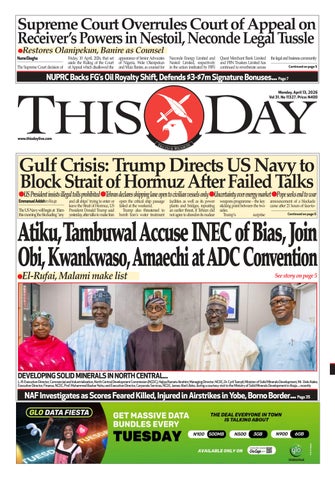
Atiku, Tambuwal Accuse INEC of Bias, Join Obi, Kwankwaso, Amaechi at ADC Convention
El-Rufai, Malami make list
DEVELOPING SOLID MINERALS IN NORTH CENTRAL...
L–R: Executive-Director, Commercial and Industrialisation, North Central Development Commission (NCDC), Hajiya Ramatu Ibrahim; Managing Director, NCDC, Dr. Cyril Tsenyil; Minister of Solid Minerals Development, Mr. Dele Alake; Executive-Director, Finance, NCDC, Prof. Muhammed Bashar Nuhu; and Executive-Director, Corporate Services, NCDC, James Abel Uloko, during a courtesy visit to the Ministry of Solid Minerals Development in Abuja ... recently
Investigates
expor tdeskdepar tment@zenithbank.com
Amid Erratic Power Supply, Adelabu Says He Has Delivered on Two-week Pledge
Insists generation has risen, gas supply improved Urges NEMSA to improve IGR
Emmanuel Addeh in Abuja
Electricity generation has improved in the last two weeks, from March 28 to April 10, 2026, underscoring the federal government’s commitment to delivering on its promises to Nigerians, the Minister of Power, Adebayo Adelabu, said yesterday.
Despite unreliable electricity
supply in many parts of the country, Special Adviser to Adelabu on Strategic Communications and Media Relations, Bolaji Tunji, in a statement in Abuja yesterday, said the gradual rise in generation output within the period was in tandem with the assurance given by the minister to improve supply within two weeks.
Quoting data from the period under review, Adelabu stated that it showed that actual power generation increased from about 3,951MW on March 28 to over 4,300MW by April 10, reflecting a consistent upward trend.
He explained that this improvement closely aligned with the steady increase in gas supply to thermal power plants, which rose from approximately
605 million standard cubic feet (mmscfd) to over 704 mmscfd within the same timeframe.
He further stated that mechanical availability remained stable and even improved, peaking at over 7,796MW in early April, while operational availability rose from about 4,208MW to a peak of over 4,694MW, indicating enhanced efficiency in converting available
gas into electricity.
“Despite minor fluctuations recorded on some days, the overall trajectory points to a gradual recovery in the power sector, driven largely by improved gas supply and better coordination among critical stakeholders,” the statement said.
Adelabu emphasised that the strong correlation between gas availability and
ATIKU, TAMBUWAL ACCUSE INEC OF BIAS, JOIN OBI, KWANKWASO, AMAECHI AT ADC CONVENTION
Former Vice President Atiku Abubakar has accused Independent National Electoral Commission (INEC) of bias and interference in the affairs of opposition parties, stating that the commission is working to keep President Bola Tinubu in power beyond 2027 by all means.
Atiku made the assertion during an interview with the British Broadcasting Corporation (BBC)
The allegation came as ex-Speaker of the House of Representatives and former Governor of Sokoto State, Senator Aminu Tambuwal, declared that Nigerians must collectively rescue the country from Tinubu’s oppression, as well as the deepening poverty,
hunger, and insecurity in the land under his watch.
Tambuwal spoke on Saturday while addressing a large crowd of party faithful, stakeholders, and supporters after the state congresses of African Democratic Congress (ADC) in Sokoto.
Meanwhile, ADC nominated Atiku, former presidential candidate Peter Obi, former Kano State Governor Rabiu Kwankwaso, and former Minister of Transportation, Chibuike Amaechi, to conduct the party’s national convention scheduled to hold tomorrow, April 14, in Abuja.
The convention has former Cross River State Governor, Liyel Imoke, as chairman of a 126-member Convention Planning Committee.
Tambuwal was named deputy chairman of the convention committee, while a former Kaduna
State Governor, Nasir El-Rufai, and former Attorney General of the Federation and Minister of Justice, Abubakar Malami, were also named as members.
National Chairman of New Nigeria Peoples Party (NNPP) camp loyal to Kwankwaso, Dr Ajuji Ahmed, will serve as secretary to the committee.
Equally on the list were Chief Ralph Nwosu, Adamu Maina Waziri, Senator Eyinnaya Abaribe, Mr Emeka Ihedioha, Dr Sam Egwu, Chief John Odigie-Oyegun, Professor Pat Utomi, Chief Achike Udenwa, and Alhaji Kashim Iman, among others.
The convention is expected to ratify the ADC National Working Committee (NWC) with Senator David Mark as National Chairman and Ogbeni Rauf Aregbesola as National Secretary, among other members.
In the interview with BBC Newsday, Atiku said, “We are accusing them of, first of all, misinterpreting the law. We are also accusing them of bias… For sure, for sure.”
He explained that INEC removed officials of African Democratic Congress (ADC) from its portal despite court rulings affirming that internal party affairs were not the prerogative of any external agency.
He added, “They ought not to have removed the officials of the ADC from the national electoral commission portal. They ought not to have done that.”
Atiku described the current situation as an attempt to enthrone dictatorship through government interference in both the electoral and judicial processes.
He said his intention was to safeguard Nigeria’s democracy,
which he helped to establish after fighting military rule.
The former vice president stated, “It’s been four decades that I’ve been involved in trying to make sure that democracy is established in this country. I fought the military and we succeeded.
“And after just less than three decades of democracy, then a political party is trying to completely overthrow what we have been able to achieve.”
Asked what restoration of democracy would look like, Atiku replied, “Free, fair elections without government’s interference, and making sure that you have an impartial electoral umpire.”
On insecurity, Atiku criticised the Tinubu administration, alleging possible collusion and questioning why Nigeria, with its vast resources and manpower, cannot effectively counter terrorism
GULF CRISIS: TRUMP DIRECTS US NAVY TO BLOCK STRAIT OF HORMUZ AFTER FAILED TALKS
face peace negotiations between the US and Iran in Islamabad collapsed on Sunday morning.
Vice President JD Vance, who doubled as the head of the US team, said Iran had refused to give up the possibility of developing nuclear weapons, while the Iranian delegates said Washington needed to do more to win their trust.
But a seemingly frustrated Trump has ordered the US Navy to block the crucial Strait of Hormuz shipping lane, furious with Iran's refusal to surrender its nuclear ambitions after peace talks
as landmark and decisive. In a unanimous judgment of the court read by Mohammed Baba Idris, JSC., the Supreme Court held that the Court of Appeal erred by allowing a receiver manager whose appointment was under challenge to perform functions including appointing counsel for the appellant in the proceeding which challenges the very foundation of the receivership.
The Lagos Division of the Court of Appeal had by Ruling delivered on 23 January, 2026, held that the receiver appointed by the plaintiffs, FBNQuest and FBN Trustees, over some assets of the duo of Neconde and Nestoil was upon his appointment vested with wide powers over the companies including the power to sue and the sole authority competent to appoint counsel for the companies in an action instituted by the said plaintiffs. In the decision of the Court of
in Pakistan broke down without an agreement.
In a lengthy declaration on his social media platform on Sunday, Trump said his eventual goal was to clear the strait of mines and reopen it to all shipping, but that in the meantime Iran must not be allowed to profit from its control of the waterway.
Iran has itself been restricting traffic through the strait - a key route for global shipments of oil, gas and fertiliser - while allowing vessels deemed to be working for friendly countries, such as
Appeal delivered by Yargat Nimpa, JCA; Danladi Senchi, JCA and Polycarp Kwahar, JCA, it held that the appearance of counsel not appointed by the receiver in the suit remained irregular and accordingly, disqualified Olanipekun and Banire, as well as their respective team from appearing for the companies. At the hearing of the appeal at the Supreme Court on 10th March, 2026, Bode Olanipekun, SAN argued that the questions submitted by the plaintiffs before the trial court bordered on whether a receiver manager could be validly appointed and if the receiver manager could perform his duties. Pointing to specific questions in the originating summons, he argued that whilst the court was yet to approve the validity of the appointment, there was an exception to the right to exercise powers of a receiver and conferring the power to appoint
China, to pass. There have been unconfirmed reports that Tehran plans to charge tolls.
Trump later in a Fox News interview again threatened Iran's energy infrastructure, before warning he would impose a 50 per cent tariff on Chinese imports if Beijing tried to help the Iranian military.
The president's latest ultimatum appeared to have been triggered by the failure of talks to secure a deal to end the six-week-old war, which began when the US and Israel launched strikes on Tehran
counsel for the company on the same receiver manager is tantamount to prejudging the substantive suit and a breach of the appellants’ right to fair hearing. Relying on various decisions of the Court of Appeal, Olanipekun contended that it is not the law that where the appointment of a receiver is the subject of a dispute between the appointor and the company in respect of which there is an appointment, the company under receivership cannot appoint counsel to represent it in such proceeding. The Senior Advocate of Nigeria further submitted that an application of section 556 of CAMA to the extent of causing the receiver to appoint counsel for the defendant in an action commenced by his appointor, which puts his appointment in issue, will amount to an absurdity.
Counsel to FBNQuest and FBN Trustees, Jide Koku, SAN leading Victor Ogude, SAN on the other
and killed Iran's supreme leader, Ali Khamenei.
Iran's refusal to give up its right to a nuclear programme frustrated the US delegation, led by JD Vance, White House envoy Steve Witkoff and Trump's son-in-law Jared Kushner.
Trump said in a long post: “So, there you have it, the meeting went well, most points were agreed to, but the only point that really mattered, nuclear, was not. Effective immediately, the United States Navy, the finest in the world, will begin the process
hand, argued that by section 556 (3) of the Companies and Allied Matters Act and item 4 of the Eleventh Schedule of the Act, the receiver has the power to appoint solicitor or accountant or other professionally qualified person to assist him in the performance of his functions.
Arguing in similar vein, counsel appointed by the receiver, Ame Ogie, Esq. and M.B. Ganiyu, Esq., submitted that their respective authorities derived from the power of the receiver conferred by section 556(3) of CAMA and the Eleventh Schedule of CAMA.
Allowing the appeal, the Supreme Court held that where, as in the instant case, the validity of the appointment of the receiver is in issue, the same receiver cannot sanction representation for the company in the same proceeding. Highlighting the questions submitted by FBNQuest and FBN Trustees in their originating
generation output underscores the importance of sustained interventions in the gas-topower value chain, given Nigeria’s heavy reliance on thermal power plants.
and banditry. He said, “We suspect that there is collusion. The terrorism is to intimidate people, particularly farmers, businessmen. You cannot travel. There is no security everywhere in the country.” Atiku maintained that the government had failed to mobilise the armed forces adequately and that unemployment was driving young people into crime.
On corruption allegations from his time in office, Atiku defended himself, saying, “I took the president to court 11 times and I won. There was never a time I was convicted of any corruption.”
He expressed hope that Nigerians would elect the right leaders in 2027, and disclosed that his own role was transitional,
Continued on page 7
of blockading any and all ships trying to enter, or leave, the Strait of Hormuz.
“At some point, we will reach an ‘All Being Allowed to Go In, All Being Allowed to Go Out’ basis, but Iran has not allowed that to happen by merely saying, ‘There may be a mine out there somewhere,’ that nobody knows about but them. This Is World Extortion, and Leaders of Countries, especially the United States of America, will never be extorted.
“ I have also instructed our
summons before the trial court, the apex court noted that a close study of the questions indicates that they do not concern the day-to-day management of the company or realization of the charged assets; but that they go to the very foundation of the receivership itself. While holding that it would occasion conflict of interest for the receiver appointed by the lenders to represent or approve the representation of the company in the same action instituted on behalf of the lenders, the court noted that “the receiver was appointed by the 1st and 2nd respondents whose rights under the instrument are directly in issue. In such circumstances, to insist that the receiver alone must determine the legal representation of the appellant will create an obvious conflict of interest. The receiver’s authority derives from the very transaction which legality and scope are being questioned.
Navy to seek and interdict every vessel in international waters that has paid a toll to Iran. No one who pays an illegal toll will have safe passage on the high seas. We will also begin destroying the mines the Iranians laid in the Straits. Any Iranian who fires at us, or at peaceful vessels, will be blown to hell!
“Iran knows, better than anyone, how to end this situation which has already devastated their country. Their Navy is gone, their
Continued on page 36
Proceedings of this nature cannot be regarded as falling under the general authority of the receiver under section 556(3) of the Companies and Allied Matters Act, and Eleventh Schedule of Act.” According to the court, where, as in the instant case, the dispute concerns the legality and the extent of the receivership itself, the company cannot be deprived of the opportunity to challenge it through its directors. It then held that the defence of the action through its directors and the counsel retained by them cannot be said to be incompetent merely because a receiver has been appointed. In expressing the unanimous position of the court, Justice Idris found that the proceedings before the trial court which questions the enforceability of the security and the validity and scope of the receivership fall outside scope of authority of the receiver.
Chuks Okocha in Abuja and Onuminya Innocent in Sokoto
Adelabu
EMP 19
Train at EXPORT M AN AGEMENT PROGRAMME 19
and enhance your expor t market and funding-access readiness
April 20–24, 2026
9am5pm daily
Programme Overview
Lagos Business School (LBS), Km 22, Lekki-Epe Expressway, Ajah, Lekki, Lagos.
The EMP has been subsidized by Fidelity Bank to provide a practical and comprehensive platform for understanding the fundamentals of non-oil expor ts. It equips par ticipants with insights into emerging expor t oppor tunities, including the benefits presented by the African Continental Free Trade Area (AfCFTA), alongside other policies & initiatives designed to promote expor t development in Nigeria.
R e c e n t g l o b a l d eve l o p m e n t s c o n t i n u e to re s h a p e s u p p l y chains, trade flows, and demand patterns across international markets, creating new oppor tunities for countries that are able to compete effectively in expor t markets.
For Nigeria, strengthening non-oil expor t capacity remains critical for expanding foreign exchange earnings, deepening par ticipation in global value chains, and unlocking sustainable economic growth.
Expor ts therefore remain a key driver of foreign exchange generation, job cre at
economic development.
Programme Objective
T o s t r e n g t h e n n o n - o
sustainable expor t capabilities among Nigerian businesses, Fidelity Bank Plc in Par tnership with Lagos Business School established the Expor t Capacity Building Programme. This 5-day programme is designed to provide par ticipants with the knowledge, tools, and practical skills required to:
♦ Develop & scale expor t businesses in line with global best practices
♦ Access and compete in international markets
♦ Leverage the oppor tunities under the AfCFTA Treaty
♦
mechanisms available in Nigeria
Target Audience
prospective expor ters, and financiers of expor
expor
government agencies, logistics service providers amongst others.
Mode of Deliver y: Hybrid
Programme Outline
N495,000 Inclusive of VAT
♦ Overview of Nigeria’s expor t landscape
♦ Expor t Finance Instruments
♦ Assessing Readiness & Potential to Become a Successful Expor ter
♦ Business Negotiation Strategies
♦ A c c e s s i n g E x p o r t M a r k e t
Countries, etc.
♦ Definition and implementation of the activities required to make a product market-ready
♦ Expor t documentation and Compliance Requirements
♦ Understanding, Selection and Implementation of Supply Chain Management for Expor ts
♦ Expor t Development Processes and Business Systems
♦ Understanding the AfCFTA Treaty and its Oppor tunities
Payment Details
Bank: Fidelity Bank Plc
Collections Account
Account Number: 5020131070
(please send payment information via email to the email
Enquiries & Registration
Nkechi Iwegbu 0802 478 2906 niwegbu@lbs.edu.ng
Facilitators
Umar Idris 0907 040 0317 uldiris@lbs.edu.ng
Prof. Frank Ojadi - LBS Faculty
Dr. Uche Attoh - LBS Faculty
Key industry exper ts in expor t trade
Financial Management specialists
Regulatory authorities
KNOWLEDGE SHARING COLLABORATION BETWEEN LEKKI PORT AND CHINESE CONSULATE...
Verheijen: Tinubu added over 400,000 bpd of crude in less than 3 years Reiterates Nigeria attracted more than $8bn in upstream FIDs last year
The Nigerian Upstream Petroleum Regulatory Commission (NUPRC), has thrown its weight behind the federal government’s decision to withdraw royalty collection powers from the commission, describing the move as a step towards greater fiscal clarity and efficiency.
The upstream regulator
also justified the relatively low signature bonuses set for the ongoing 2025 licensing round for 50 oil blocks, noting that lowering the financial bar to between $3 million and $7 million was done deliberately to prioritise technical competence, strong work programmes and real development capacity over speculative bidding.
NUPRC Chief Executive, Oritsemeyiwa Eyesan, in an
interview published in the agency’s in-house magazine, ‘Upstream Gaze’, explained that the reassignment of royalty collection to the Nigeria Revenue Service (NRS) aligned with the intent of the Petroleum Industry Act (PIA) to strengthen transparency, eliminate overlaps and enhance revenue assurance.
She noted that while the NRS now handles the collection and
enforcement of royalties, the NUPRC retains its technical oversight role, including production measurement, volume verification and royalty computation.
According to her, the delineation of responsibilities ensures institutional clarity and improves accountability across the system. She added that the commission has already established
ATIKU, TAMBUWAL ACCUSE INEC OF BIAS, JOIN OBI, KWANKWASO, AMAECHI AT ADC CONVENTION
possibly for four or eight years, to groom credible younger leaders.
The former vice president urged citizens not to lose hope, promising that the opposition would continue to resist any assault on democratic rights.
Nigerians Must Rescue Themselves from Tinubu’s Oppression, Declares Tambuwal
Senator Aminu Tambuwal declared that Nigerians must rescue the country from Tinubu’s oppressive tendencies, deepening poverty, increasing hunger, and worsening insecurity.
Tambuwal declared that Nigerians must come out to rescue their country from bad governance under Tinubu and his All Progressives Congress (APC), which had pushed the people into unacceptable levels of poverty ahead of 2027.
He said the Tinubu government had clearly failed to meet the expectations of Nigerians owing to lack of planning and careful execution of policies.
He stated that Nigerians
were experiencing the excruciating pains of Tinubu’s maladministration.
Tambuwal said, “Available reality shows that this administration has only been able to deliver much more insecurity, poverty, and hunger.
“This is in addition to the gross mismanagement and diversion of public resources as well as securing of more loans, which undoubtedly will be deployed during the 2027 elections to influence voters.”
He lamented the economic hardship facing Nigerians, emphasising that unemployment and poverty have worsened under the Tinubu administration.
“Most Nigerians would reject continued mis-governance. I am of the firm belief that Nigerians have seen for themselves what Bola Ahmed Tinubu can deliver, if at all they have been able to deliver anything,” he said.
The former governor declared that the 2027 general election would be a contest between the Nigerian people and the Tinubu group, stressing that citizens must prepare to demand better governance.
Speaking on strategies for victory in 2027, Tambuwal urged ADC members to intensify grassroots mobilisation, expand membership registration, and maintain unity within the party.
He stated, “Nigerians have seen how the Tinubu-led federal government has been desperate in their attempt to suppress opposition. But we are standing firm, no shaking, no surrender, no retreat.”
Atiku, Obi, Kwankwaso, Amaechi, Others to Hold ADC National Convention Tomorrow
A notice on Sunday jointly signed by the ADC spokesman, Bolaji Abdullahi, and the party’s National Organising Secretary, Chinedu Idigo, urged all committee members to discharge their responsibilities with diligence. It called on stakeholders to support the convention process.
The convention is coming up on the same day the Supreme Court fixed for hearing in an appeal filed by Mark. The day also coincides with the date
fixed by Justice Emeka Nwite of the Federal High Court in a case filed against Mark by Mr Bala Gombe, who is challenging the legitimacy of the Mark-led national leadership.
Meanwhile, ADC congratulated its newly elected state executives and chairmen on the peaceful conduct of their congresses, describing the process as a reflection of the party’s commitment to internal democracy and the rule of law.
In a statement by Abdullahi, the party announced that the inauguration of the new officials would take place on May 12, or a later date to be communicated.
ADC urged the officials to remain committed to the party’s ideals and align with the leadership direction of its National Chairman, Senator David Mark, as they worked to strengthen the party nationwide.
ADC also congratulated all newly elected state executives and state chairmen across the federation on the successful and peaceful conduct of their congresses.
coordinated frameworks with the NRS covering data integrity, harmonised processes and clearly defined operational roles.
Eyesan stressed that the commission would continue to serve as the technical authority for metering and production validation, while verified data would be shared seamlessly with the revenue agency to prevent leakages.
President Bola Tinubu issued an Executive Order in February 2026, mandating that all revenues from the petroleum
sector, including royalties, taxes and profit oil, be paid directly into the Federation Account, rather than being collected or retained by regulatory agencies or operators.
At the core of the reform is the transfer of royalty collection to the Nigeria Revenue Service (NRS), which is now responsible for receiving and enforcing payments, while the NUPRC retains only technical responsibilities such as production measurement, verification and calculation of royalty liabilities.
UN Lauds NYSC as Agent of Youth Development
Oghenevwede
Ohwovoriole in Abuja
The United Nations (UN) has applauded the National Youth Service Corps (NYSC), as an agent of youth development in the country.
Assistant Secretary General for Youth Affairs, and Head of the United Nations Youth Office, Felipe Paullier, gave the commendation at the flag-off of the NYSC Health Initiative for Rural Dwellers (HIRD) held at Kabusa community, Federal Capital Territory, Abuja.
Paullier said his visit to Nigeria centred on meaningful discussions with critical youth organisations and youth representatives, particularly the NYSC, as well as key stakeholders to advance the youth agenda in the country.
He stated this is by strengthening the role of young people as partners in development, peace, and human rights.
“I have interacted with many young and old Nigerians who are proud of their NYSC experiences," he said.
Commending NYSC's consistent free medical interventions to rural dwellers in the country, Paullier said the free medicare was contributing to building a better world.
Earlier, the NYSC Director General, Brig. Gen. Olakunle Nafiu, told Paullier that since the inception of the NYSC HIRD in 2014, over five million Nigerians have so far benefited from the free medical outreach, adding that this year, the Scheme projects to benefit about 45,000 people across Nigeria's rural communities.
According to him, this by taking advantage of the two brand new mobile clinics donated by the wife of the president, Senator Oluremi Tinubu to extend the reach and expand the scope of the Scheme's operations.
Emmanuel Addeh in Abuja
L-R: Deputy Chief Technical Officer, Lekki Port, Mattew Oloyede; Managing Director, Lekki Port, Wang Qiang; Consul General of the People's Republic of China, Yan Yuqing; Director, Regulatory Services, Nigerian Shippers Council, Margaret Ogbonnah, and Deputy General Counsel, Lekki Port, Opeyemi Emmanuel-Olubake, during the Knowledge Sharing Session in collaboration between Lekki Port and the Chinese Consulate in Nigeria, held at Lekki Port, Lagos, on Friday
AFTER THE INTERMENT OF SENATOR BARINADA MPIGI...
Executive Director
Renaissance: Mergers, Acquisitions to Produce 'Big 5' Nigerian Oil Firms in 10 Years
IOCs’ influence wane, local independents control 50% of assets Attah outlines funding instruments for projects’ execution
Peter Uzoho
Renaissance Africa Energy Company Limited has predicted that mergers and acquisitions in Nigeria's oil industry may within the next 10 years raise five big upstream players possessing high technical, operational and funding capacity to efficiently run the sector, using the model of the International Oil Companies (IOCs).
Managing Director of the company, Tony Attah, said the ‘big five’ are expected to create and add more value to Nigeria’s crude oil and natural gas resources by prioritising feedstock supply to local refining and processing plants to serve the domestic market and facilitate national industrialisation.
Attah made the prediction
during his presentation at the Nigerian Content Academy Lecture held virtually with the topic: “Finding Funds for Effective and Efficient Local Content Initiatives – IPPG Perspective."
Specifically, Attah projected that many indigenous oil and gas operators in Nigeria will within the next decade consolidate strategically and form consortiums to take advantage of emerging opportunities.
He said Nigeria has already produced two of the five–Renaissance and Seplat, with the remaining three being expected, noting that the future of the oil and gas industry and business in the world is about collaboration.
Recent divestment transactions have seen Seplat take over Mobil Producing
NIGCOMSAT Targets Industrial Leap with Startup Push, Skills Drive
Nigeria’s state-owned satellite operator, Nigerian Communications Satellite Limited (NIGCOMSAT), is repositioning itself at the heart of the country’s industrialisation agenda, backing over 5,000 startups and expanding digital skills training as part of a broader push to turn connectivity into economic power.
The Managing Director/CEO, Jane Egerton-Idehen, disclosed the scale of intervention at the SOYUZNIK Alumni National Congress in Abuja, where she framed satellite infrastructure not just as a communications tool, but as a catalyst for production, innovation, and national competitiveness.
In a keynote delivered on her behalf by Acting Director of Technical Services, Engr. Ikechukwu Amalu, EgertonIdehen said the agency’s Space Accelerator Programme—now in its third cohort—has quietly evolved into a pipeline for nurturing technology-driven enterprises, particularly in underserved segments of Nigeria’s digital economy.
The intervention comes amid growing concern that Nigeria’s innovation ecosystem, though vibrant, remains weakly linked to industrial output.
NIGCOMSAT’s approach seeks to close that gap—pairing startup support with handson technical training and expanding connectivity to areas historically left out of the digital economy.
Nigeria Unlimited (MPNU) from ExxonMobil, while Renaissance took over Shell Petroleum Development Company Nigeria (SPDC) assets comprising 18 oil blocks with a reserve size of 11 billion barrels. Also, Oando Plc took over Agip's onshore assets.
In the presentation, Attah mentioned that divestment also gave birth to Heirs Energies, owned by billionaire businessman and philanthropist, Tony Elumelu, and Vaaris that is also coming on board through another divestment by Total.
As the IOCs are exiting and their assets being taken over by Nigerian independents, Attah said that transition was leading to transformation that is already showing value today.
He noted that more than 50 per cent of Nigeria's national oil production is now associated with independents, saying that will make the Independent Petroleum Producers Group (IPPG), the body of local oil firms, more pronounced, relative to the Oil Producers Trade Section (OPTS), an umbrella body of IOCs in Nigeria.
CPPE to FG: Prioritise Expansion of Domestic Refining Capacity, Reject World Bank's Call for Petrol, Food Importation
Dike Onwuamaeze
Centre for the Promotion of Private Enterprise (CPPE) has urged the federal government to prioritise reforms that would expand domestic refining capacity. CPPE advised the government to reject World Bank's advice that Nigeria should favour increased importation of petroleum products and food as a solution to its supply-side constraints.
CPPE gave this advice yesterday in a press statement that expressed its strong reservation about the policy proposition by World Bank in its recent "Nigerian Development Update". The report prescribed that Nigeria
should resort to increased importation of petroleum products and food items.
CPPE said the prescription was deeply troubling and fundamentally misaligned with Nigeria’s current economic realities and reform trajectory.
CPPE stated that the desired policy direction was that Nigeria needed expansion of its domestic refining capacity and not more import licences for petroleum products.
Chief Executive Officer of CPPE, Dr. Muda Yusuf, said in the press statement that "import liberalisation is not a sustainable solution to Nigeria’s supply-side challenges”.
Yusuf stated, "On the contrary, it risks deepening
structural vulnerabilities, accelerating de-industrialisation, and exposing the economy to greater external shocks.
"Nigeria’s development trajectory must be anchored on a production-driven growth model, characterised by strong domestic refining capacity, competitive manufacturing sector, robust agricultural systems, energy and food security.
"The CPPE, therefore, urged policymakers to reject import-dependent strategies and prioritise reforms that build a resilient, self-reliant, and industrialised Nigerian economy."
Yusuf said Nigeria's policy momentum should
be deliberate strengthening of the country's measurable progress and gradual transition towards greater self-sufficiency in petroleum products supply driven by significant private investments in domestic refining capacity.
He stated that encouraging increased importation of petroleum products at this stage would risk reversing hard-won gains, exacerbate foreign exchange pressures, weaken domestic refining investments, and heighten the economy’s vulnerability to external shocks, particularly in a global environment characterised by geopolitical tensions and energy market volatility.
FG, NCDC Partner to Unlock North-central Mining Potential
Folalumi Alaran in Abuja
Ministry of Solid Minerals Development has teamed up with North Central Development Commission (NCDC) to unlock the vast mining potential of the Northcentral region and increase jobs through mineral processing.
Receiving the management team of NCDC in his office, Minister of Solid Minerals Development, Mr. Dele Alake, disclosed that more than 300 small-scale and artisanal miners had been organised
into cooperatives, as part of ongoing persuasive efforts to steer them away from illegal mining and integrate them into the formal sector.
According to Alake, the Bola Tinubu administration has so far arrested over 300 illegal miners while about 150, including foreigners, are currently undergoing prosecution.
He disclosed that the Northcentral region had benefitted immensely from the ministry’s local value addition policy, as new mineral processing
projects had taken off in the region.
The minister said through the value addition policy, mining was contributing more than $2 billion to the country’s economy as the Tinubu administration continued to develop the regenerative sectors of the economy.
He explained that the policy was designed to encourage in-country processing and beneficiation of mineral resources, thereby reducing raw material exportation, while boosting industrial growth, job
creation, and overall economic diversification.
He also assured that the president was focused on building enduring legacies, stating that the commission stands as one of such lasting institutions.
Alake highlighted the need for a robust working relationship between the ministry and other development commissions, stressing the critical role of the solid minerals sector in driving broader economic growth.
L-R:
Projects, Niger Delta Development Commission (NDDC), Sir Victor Antai; National Vice-Chairman of the PDP, South South, Chief Dan Orbih; Minister, Federal Capital Territory (FCT), Nyesom Wike; President of the Senate, Godswill Akpabio and Senate Minority Leader, Abba Morro, during their visit to Wike’s residence in Port Harcourt, after the interment of Senator Barinada Mpigi, on Saturday in Tai Local Government Area of Rivers State
Michael Olugbode in Abuja
ABIMBOLA ONABANJO’S COURTESY VISIT TO THE PRESIDENT...
NÀFDAC: Nigeria Witnessing Boost in Pharmaceutical Sector
Onyebuchi Ezigbo in Abuja Director-General of National Agency for Food and Drug Administration and Control (NAFDAC), Professor Christianah Adeyeye, has emphasised that a strong regulatory framework and intentional government policies are essential for a virile pharmaceutical sector. Adeyeye said as a result of NÀFDAC's regulatory capacity, Nigeria had recorded six-fold increase in local manufacturing. A statement signed by NÀFDAC's Resident Media Consultant, Sanyo Akintola, quoted the director-general as having disclosed this at the commissioning of a new
Stakeholders
ultra-modern facility of SAM Pharmaceuticals Limited, Sango-Ota, Ogun State.
The statement said Adeyeye told the gathering that what was being witnessed was a culmination of deliberate government policies and a dogged regulatory system.
The statement also quoted Adeyeye as saying, "The effectiveness of the agency’s ‘five plus five’ policy and the ‘ceiling list’ has now made it possible for local manufacturers to expand and fully utilise their capacities."
The NAFDAC directorgeneral stated that having been successfully re-benchmarked for the World Health Organisation Maturity Level 3 (ML3) status
Oppose Call to Decentralise Tantita's Pipeline Security Contract
Stakeholders in the Niger Delta region have rejected calls from some quarters to decentralise the pipeline security contract awarded to the Tantita Security Services Nigeria Limited (TSSNL).
This as the stakeholders who came under Niger Delta exmilitants, Board of Trustees (BoT), Critical Stakeholders Forum (CSF) and the Foundation for Heritage Advancement and Development in Niger Delta (FHADND) have hailed the National Assembly for passing a vote of confidence in Tantita's operations and Tompolo's leadership.
The stakeholders, made their position during their meeting in Port Harcourt, Rivers State, yesterday.
They described the call to tamper with the framework of the contract under the leadership
of High Chief Government Ekpemupolo popularly known as Tompolo as premature, dangerous and potentially counterproductive.
They stakeholders lauded President Bola Tinubu for approving the renewal of the contract, saying the President acted in line with the wishes of overwhelming majority of critical stakeholders and the ordinary people, who according to them had seen the stabilising impact of Tantita’s operations in the Niger Delta.
The stakeholders' communique was signed by High chief Reuben Wilson, BOT Chairman, BSF; Mr. Ezekiel Akpasibewei, First Phase Ex-militant Leaders; Chief Francis Waiwei, Executive Director, FHADND; Comrade Nature Dumale Kieghe, BOT Secretary; Prince Emeka Igwe (Imo State Coordinator) and Ideye Granvile (Rivers).
– the first National Regulatory Agency in Sub-Saharan Africa to scale through the re-benchmarking exercise –the next goal for the agency was attaining the WHO ML4 status, and ultimately, the WLA (World Listed Authority) status, which invariably confers on the country’s manufacturers the opportunity of marketing their products anywhere in the world.
According to Adeyeye, “Quality is synonymous with trade. When quality is built into the product, trade will be enhanced.” She also said contract manufacturing had witnessed about six-fold increase.
Adeyeye stated, “We insisted that you must migrate to local manufacturing or if you don’t have the capacity, you should partner with a
local manufacturer. We now have six-fold increase in local manufacturers.
"No investor would like to invest where the regulatory system is weak."
Similarly speaking at the occasion, Consul General of India to Nigeria, Mr. Kannan Chockalingham, said pharmaceutical manufacturers had ascribed the growth in the Nigerian pharma sector
to a strong regulatory system and deliberate government policies to enhance ease of doing business in the country. Given the exponential growth in the sector, Chockalingam pledged India’s commitment to supporting Nigeria, not only in the area of finished pharmaceutical products, but also in strengthening local capabilities and technology capacity building.
Africa, France Move to Reset Economic Ties at Nairobi Summit
Michael Olugbode in Abuja
African leaders and their French counterparts are set for a critical engagement next month as Kenya and France prepare to host the Africa Forward Summit: Africa–France Partnerships for Innovation and Growth in Nairobi, amid growing calls for a new model of cooperation that delivers real economic impact for the continent.
The summit, scheduled for May 11–12, 2026, will convene top political leaders including Emmanuel Macron and William
Ruto, alongside African Heads of State, investors, development partners, civil society groups, and youth representatives.
A Business Forum on May 11 is expected to drive private sector engagement and set the tone for the main summit, where discussions will centre on investment, innovation, and long-term economic collaboration.
Organisers said the summit is designed to move beyond diplomatic symbolism, focusing instead on actionable partnerships in key sectors such as healthcare, agriculture, digital technology,
energy, and infrastructure—areas considered vital to Africa’s transformation.
For countries like Nigeria, the outcomes could be significant, offering pathways to attract investment, create jobs, and strengthen economic resilience at a time of global uncertainty.
The summit comes against the backdrop of evolving relations between Africa and France, marked by increasing demands from African nations for more equitable and transparent partnerships.
Historically, France has
maintained strong political, economic, and military ties with several African countries, particularly in West and Central Africa.
However, in recent years, these relationships have come under scrutiny, with critics calling for an end to perceived imbalances and a shift toward mutual respect and shared benefits.
At the same time, Africa’s global relevance has risen, driven by its growing population, expanding markets, and strategic importance in global supply chains.
BBYDI, Ford Foundation Renew Commitment to End
Gender-Based Violence in Nigeria
Hammed Shittu in Illorin
A non-governmental organisation, Brain Builders Youth Development Initiative (BBYDI) and Ford Foundation have renewed their commitment to collective action at ending the reported cases of Gender-Based Violence (GBV) among women in the various communities
of the country.
Already, the two stakeholders had worked intentionally to move GBV prevention from policy conversations into community structures.
The Executive Director, BBYDI, Dr. Nurah Jimoh-Sanni stated this at the weekend in Ilorin while speaking at the statewide event on Strengthening Traditional
Leadership in Gender-Based Violence Prevention and Response.
According to her, "Today is not simply a convening, it is a milestone as it represents the culmination of a significant phase of work, and more importantly, a transition from commitment to sustained community action".
She said, "Last year, we
gathered with a shared resolve to confront gender-based violence through stronger collaboration with traditional institutions.
"At that time, we asked a critical question: Can tradition become a force for protection rather than silence? Today, we are no longer asking that question, rather, we are witnessing the answer.
Blessing Ibunge in Port Harcourt
President Bola Ahmed Tinubu (right) in audience with Prince Abimbola Onabanjo during a courtesy visit to the President at his residence in Ikoyi, Lagos, weekend
STANBIC IBTC HR BREAKFAST SESSION...
Northern Governors Celebrate Foremost Industrialist, Aliko Dangote at 69
Hail business titan as pride of Africa’s enterprise, philanthropy
Segun Awofadeji in Gombe
The Chairman of the Northern States Governors’ Forum (NSGF) and governor of Gombe State, Alhaji Muhammadu Inuwa Yahaya, has paid glowing tribute to Africa’s foremost industrialist and business titan, Aliko Dangote, on the occasion of his 69th birthday, describing him as a towering symbol of African enterprise and visionary leadership.
In a goodwill message, on behalf of the 19 Northern governors, Governor Inuwa Yahaya said Dangote’s extraordinary journey from entrepreneurship to global industrial prominence is a source of pride not only to Northern Nigeria but to the entire African continent.
the possibilities of indigenous enterprise by building worldclass industries that continue to drive economic growth, strengthen local capacity and create thousands of jobs across Nigeria and beyond.
In the message issued by Ismaila Uba Misilli, Director-General (Press Affairs), Government House, Gombe, and made available to journalists Saturday, the governor noted that through the Dangote Group, the business mogul has redefined
The NSGF chairman particularly commended Aliko Dangote’s bold investments in strategic sectors, especially cement manufacturing, petrochemicals and refining.
He noted that the establishment of the Dangote Refinery and the expansion
of cement plants across Africa have significantly enhanced the continent’s industrial competitiveness and reduced dependence on imports.
Governor Inuwa Yahaya said Dangote’s steadfast confidence in Nigeria’s economy and his readiness to commit long-term investments to national development have made him a shining example of what visionary private sector leadership can achieve.
According to him, the Northern Governors hold
Tax Expert: Nigeria Needs Lawmakers with Strong Legal, Financial Expertise
A legal practitioner and tax expert, Olugbuyiro Akindele Akinola, has said Nigeria’s complex socio-economic challenges require legislators with a deep understanding of legal, financial, and regulatory systems, stressing that the quality of lawmaking must improve to address the country’s governance and economic concerns.
Akinola, a part-time Commissioner at the Tax Appeal Tribunal, argued that effective representation in the National Assembly must go beyond routine participation to focus on accountability, fiscal discipline, and measurable impact on citizens’ lives.
He maintained that lawmakers must possess the technical competence needed to interpret complex policies, scrutinise government spending, and design laws capable of driving sustainable economic growth and development, as
he declared his intention to contest for a seat in the House of Representatives, seeking to represent Akure North/South Federal Constituency.
He said his decision to enter the race was driven by a desire to strengthen governance through informed legislation and to contribute meaningfully to national development using his professional expertise.
With over two decades of experience, Akinola’s career spans legal practice, taxation, banking, and media.
He is the founding partner at Stonewaters Law Office, where he has handled complex commercial transactions, including cross-border financing, corporate restructuring, and regulatory compliance.
His practice also covers insolvency litigation and matters involving federal securities laws.
Before establishing his firm, he worked with leading law firms such as Olaniwun Ajayi LP and George Etomi & Partners, where
he gained extensive experience in corporate and commercial law.
He began his career in the banking sector at Trans International Bank during his National Youth Service before moving into tax practice with Ruku & Associates.
Beyond legal practice, Akinola has contributed to public discourse as a financial journalist with The Comet and The Nation, covering economic and financial issues.
His role at the Tax Appeal Tribunal has further strengthened his involvement in Nigeria’s fiscal and legal system.
The tribunal adjudicates disputes between taxpayers and government revenue agencies, providing him with firsthand experience in interpreting tax laws and public finance frameworks.
He also serves as editor of the Federal Tax Law Reports, a publication that analyses Supreme Court decisions on taxation, reinforcing his
reputation as a thought leader in the field.
Although presenting himself as a competence-driven candidate, Akinola has a long history of political involvement.
He was associated with the Social Democratic Party in the early 1990s and later became active in the Alliance for Democracy before joining the All Progressives Congress.
Within party structures, he has held several roles, including serving as Deputy National Legal Adviser to a Presidential Independent Campaign Council.
He also worked as a Senior Legislative Aide to a lawmaker representing Akure North/South Federal Constituency in 2015, giving him firsthand experience in legislative processes.
He further served as Deputy National Legal Director in a presidential campaign council, deepening his involvement in political strategy and national engagements.
Dangote in high esteem for his immense contributions to economic transformation, youth employment, infrastructure development and the promotion of Africa’s self-reliance in critical industries.
The forum also praised his far-reaching humanitarian interventions through the Aliko Dangote Foundation, particularly in the areas of health, education,
humanitarian relief and poverty reduction, which have touched millions of lives across communities.
On behalf of the governors of the 19 Northern states, Governor Inuwa Yahaya prayed for Allah’s continued blessings upon Dangote, wishing him sound health, greater wisdom, and many more years of impactful service to Nigeria, Africa and humanity.
15 Female Truck Drivers in Ashaka Graduate from Lafarge's Women on Wheels Programme
Segun Awofadeji in Gombe
Lafarge Africa Plc, a leading manufacturer of cement, ready-mix, mortar, and Plaster of Paris products, celebrated the graduation of 15 female truck drivers alongside 5 community drivers under its flagship Women on Wheels initiative.
The graduation ceremony was held on Thursday, April 9, 2026, at the company’s Ashaka Cement Plant in Gombe State.
THISDAY reports the newly inducted female drivers underwent rigorous technical and safety training.
They were equipped with the competencies required to operate heavy-duty vehicles efficiently while upholding industry best practices.
Beyond addressing driver shortages, the initiative is strengthening road safety standards and setting new benchmarks for diversity and inclusion within Nigeria’s construction logistics sector.
Delivering the keynote address, the deputy governor of
Gombe State, Mannasseh Jatau, commended Lafarge Africa Plc for its continued commitment to empowering communities through impactful initiatives. He noted the company has demonstrated a commendable approach to addressing societal challenges by creating opportunities for young women through this transformative programme.
In his opening remarks, the Group Managing Director and Chief Executive Officer of Lafarge Africa Plc, Lolu Alade-Akinyemi, described the graduation as a defining moment that reflects progress, hope, and the evolving future of Nigeria’s construction and logistics landscape.
According to him, the initiative is redefining the logistics value chain by challenging long-standing stereotypes and demonstrating that excellence knows no gender.
He congratulated the graduands and encouraged them to carry themselves with courage, confidence, and professionalism.
Wale Igbintade
L-R: Chief Executive, Stanbic IBTC Insurance, Akinjide Orimolade; Chief Executive, Stanbic IBTC Holdings, Chuma Nwokocha; Founder/ Managing Director, Interswitch, Mitchell Elegbe; Executive Director, Personal and Private Banking, Stanbic IBTC Bank, Olu Delano; and Chief Executive, Stanbic IBTC Pension Managers, Olumide Oyetan, during the HR Breakfast session, held in Lagos…. recently
JOURNEY OF POSSIBILITY IN SUPPORT FOR AUTISM AWARENESS...
We Are Already Operating Some Form of State Police in Nigeria, Says Ex-IGP Adamu
Eyes Nasarawa governorship, promises jobs, security reforms Vows to transform Lafia, fix infrastructure, boost agriculture and mining Dismisses zoning, says electorate, not political elite, give power
Sunday Aborisade in Abuja
Former Inspector-General of Police (IGP) and Nasarawa State governorship aspirant, Mohammed Adamu, said Nigeria was already operating a form of state policing, even if not formally recognised in law.
Adamu spoke as he unveiled his governorship ambition for Nasarawa State with a promise to tackle insecurity through political, economic and community-based strategies.
Speaking during an interactive session with journalists in Abuja, at the weekend, Adamu stated that the ongoing debate over the establishment of state police overlooked the reality on the ground, where various local security arrangements already performed policing functions.
He said, “The constitution provides for one police force, but in reality, we already have
different forms of policing across the country.
“When you see vigilante groups, neighbourhood watch and other local security outfits carrying out policing functions, what are they doing? They are already performing the role of the police.
“So, whether you call it state police or not, we have it in practice. What we need to do is to strengthen these structures so they can function effectively and within the law.”
Adamu is seeking to govern Nasarawa State if he wins the 2027 governorship election in the state.
He said his experience at the helm of Nigeria’s police force had equipped him with the knowledge required to address the country’s complex security challenges, particularly at the sub-national level.
According to him, insecurity in Nasarawa State cannot
be viewed in isolation, as it is closely linked with developments in neighbouring states, such as Benue, Kogi, Kaduna, Plateau and Niger.
“Security issues are interconnected. What affects one state will certainly affect the others. That is why the solution must be both strategic and political,” he said.
Adamu stressed that while security agencies played a critical role, long-term peace could only be achieved by addressing underlying socioeconomic factors.
He added, “You cannot solve insecurity through force alone. There must be political solutions. Poverty and unemployment are major drivers of crime, and if we do not address them, the problem will persist.”
Adamu outlined job creation as the cornerstone of his security strategy,
stating that engaging the youth productively would significantly reduce crime.
“The first step is to create jobs. If young people have something meaningful to do, they are less likely to engage in criminal activities,” he said.
He identified agriculture and solid minerals as key sectors that could absorb a large number of unemployed youths.
“Nasarawa is richly blessed with arable land and mineral resources. With proper investment, these sectors can drive economic growth and create employment opportunities,” he stated.
The former police chief also emphasised the importance of community-based approaches to security, particularly in addressing farmer-herder conflicts and kidnapping, which he described as the dominant security challenges in the North-central region.
NDLEA Busts Nationwide Drug Ring, Arrests 93-yearold Suspect, Medical Doctor in Sweeping Crackdown
Olugbode in Abuja Nigeria’s anti-narcotics war has taken a dramatic turn as operatives of the National Drug Law Enforcement Agency (NDLEA) uncovered a sprawling drug trafficking network, arresting suspects across several states - including a 93-year-old man and a 69-year-old medical doctor - in a series of coordinated, intelligence-driven operations. The arrests and seizures, carried out over the past week, cut across Abia, Kano,
Ogun, Lagos, Imo, Niger, Edo, Borno, and the Federal Capital Territory, exposing the depth and diversity of actors involved in the illicit trade.
In one of the most startling cases, NDLEA operatives arrested 93-year-old Friday Chigbu at his residence in Osisioma Local Government Area of Abia State, with 7.7 kilogrammes of skunk recovered from his home.
According to a statement on Sunday by spokesman of the anti-narcotics agency, Femi
Babafemi, the nonagenarian admitted to decades of cannabis use, claiming he began smoking in 1959 before venturing into distribution barely a year ago.
In a separate but related operation, NDLEA dismantled an international cocaine trafficking attempt involving Ivorian national Gohouri Michael who was intercepted at Mallam Aminu Kano International Airport, Kano, while attempting to board a flight to Milan, Italy. He was found to have
ingested 82 wraps of cocaine weighing 1.49 kilogrammes and was reportedly promised €5,000 upon successful delivery.
Further investigations led to the arrest of Dr. Chudi Ofomata in Ogun State.
The 69-year-old physician is alleged to have coordinated the operation, guiding the courier’s movements and logistics.
NDLEA operatives recovered controlled substances, including promazepam and promethazine injections, from his residence.
“In Nasarawa, the major issues are farmer-herder clashes and kidnapping. To address them, we must bring communities together and promote dialogue,” he said.
He proposed empowering traditional institutions and community leaders to play a more active role in maintaining security.
Adamu stated, “Community policing is key. Traditional leaders understand their people and can help identify potential threats early. If properly supported, they can work with security agencies to prevent crime.”
Beyond security, Adamu
painted a bleak picture of infrastructure in Nasarawa State, citing inadequate electricity, poor road networks, and lack of potable water as major challenges.
He said, “Even in the state capital, you cannot get 24-hour electricity. Small businesses are struggling because they depend on power to survive.”
He also highlighted the poor conditions of rural roads, which he said affected farmers’ ability to transport their produce to markets.
“If farmers cannot move their goods easily, it affects their income and the economy of the state,” he added.
Alumni Donate 20 Interactive Boards to OLAOSA Yaba
Sunday Ehigiator
Old students of Our Lady of Apostles Secondary School (OLAOSA), Yaba, Lagos, under the 1964/1968 and 1965/1969 sets, have donated 20 interactive boards to their alma mater to enhance teaching and learning.
The presentation, held at the school over the weekend, formed part of activities marking its 70th anniversary celebration and underscored growing alumni support for technology-driven education.
Chairperson of the alumni sets, Lady (Lt. Col.) MargaretMary Obigho (rtd) described the initiative as a landmark achievement, noting it was the first major project undertaken by the sets since the inauguration of their new executive about six months ago.
“I want to welcome everybody to this epochmaking ceremony, which could only have been made possible by the Almighty God. It is indeed a unique occasion for our sets because it is our very first time to achieve such a feat,” she said. She explained the donation was conceived during deliberations on how best to support the school, adding: “The ongoing 70th Anniversary gave us a unique platform to come together to brainstorm on what we could do in the shortest possible time to assist training and improve students’ performance in our Alma Mater.”
Obigho disclosed the boards, valued at about N2.5 million each, were procured following consultations with the school management, which identified them as an urgent need.
Michael
L-R: Brand Executive, Frieslandcampina Wamco Plc, Olamide Ogunjimi; Participants, Kanyeyechukwu Tagbo Okeke; his father, Mr. Tagbo Okeke; and Assistant Category Brand manager, Frieslandcampina Wamco Plc. Hope Emori, at the journey of possibility in support for Autism Awareness in Nigeria Supported by Peak in Lagos ... recently
AWKUNANAW CLAN ENDORSES GOVERNOR PETER MBAH...
2027: Clamour for Mbah’s Second Term Heightens with Huge
Rallies, Endorsements Across Enugu
Awkunanaw clan adopts Mbah as sole candidate Ifediche holds 10,000-man solidarity march for gov Enugu
won't deviate from second term tradition, says APC
Emmanuel Ugwu-Nwogo in Enugu
Two huge rallies took place at the weekend in Enugu State in furtherance of Governor Peter Mbah’s growing support as he seeks a second term at the 2027 general election.
Mbah’s bid to return to the Lion Building come 2027 has continued to enjoy widespread support across Enugu State.
rally at Awgu/Oji-River/Aninri Federal Constituency vowed to return the governor.
The two events held at different locations in Enugu East and Enugu West saw the people of Awkunanaw clan, adopting Mbah as their sole candidate for the 2027 governorship election, while party chieftains in another
The clan, comprising several communities in Enugu South and Nkanu West local government areas of Enugu State, took a step further by banning all their sons and daughters from challenging Mbah in the 2027 governorship race.
At the mega rally held at the Civic Centre, Akpasha, the traditional rulers of the clan, led by HRH Igwe Obi Igwesi, jointly presented an Ofo to Mbah, declaring that any Awkunanaw son or daughter, who goes against Mbah’s re-election would be inviting the wrath of their
ancestors.
As the traditional symbol of authority and justice, the Ofo serves as an assurance cover for the unwavering support of Awkunanaw clan for Mbah.
Former President of the Senate, Senator Ken Nnamani, who spoke for the clan, stated that they resolved to throw their weight behind Mbah because he had, "in barely three years, done what other governors could not do in eight years".
He assured that if anyone from the clan had any grouse against the governor, "we are going to settle it indoors as brothers. But the truth remains that we are not going to joke with his second term".
CNS, Security Experts: Military Must Be Fit, Alert to End
Oil Theft, Terrorism,
The Chief of Naval Staff (CNS), Vice Admiral Idi Abbas, alongside senior military officers and security experts, has underscored the urgent need for personnel of the Armed Forces to remain physically fit and mentally alert in order to effectively combat oil theft, terrorism, and violent extremism across Nigeria.
They stressed the evolving nature of security threats requires a disciplined, responsive, and highly
coordinated military capable of swift and decisive action.
According to them, sustained operational readiness and heightened vigilance are critical to dismantling criminal networks and restoring stability in troubled regions.
This position was reinforced at the Nigerian Navy’s first quarter route march for 2026, held over the weekend at Navy Town Parade Ground, Asokoro, Abuja.
Speaking at the event, Admiral Abbas expressed satisfaction with the personnel’s demonstration
Violent Extremism
of strength, stamina, and endurance—qualities he described as indispensable for fulfilling their constitutional responsibilities.
He noted that such responsibilities are central not only to national security but also to the country’s economic prosperity.
Represented by the Director of Manning at Naval Headquarters, Rear Admiral Kolawole Oguntuga, the CNS commended participants for their impressive display of physical fitness and mental alertness, urging them to
Don Faults Opposition to Upgrade MAN, Oron,
Okon Bassey in Uyo
A university don, Prof. Emmanuel Onwioduokit, has faulted recent opposition to the upgrade of the Maritime Academy of Nigeria (MAN), Oron, into a specialised maritime university.
Professor Onwioduokit reasoned the transition would significantly boost Nigeria’s economy and strengthen its position in the global maritime sector.
Onwioduokit, in a response to remarks by chairman of the academy’s Governing Council, Kehinde Akinola, argued that fears of weakened training standards were unfounded.
He pointed out that global best practices show that maritime universities successfully combine academic programmes with professional seafarer training. The university don explained that countries with advanced maritime systems
operate hybrid institutions that integrate degree programmes with industry-standard training, resulting in stronger capacity, improved global relevance, and expanded opportunities for cadets and researchers.
According to him, “Around the world, maritime universities combine academic degrees with rigorous seafarer training without compromising standards. Their transition from academies has
remain resolute despite prevailing challenges.
He emphasised that such exercises must become a sustained culture rather than isolated events.
"That is why this exercise is not meant to be a one-off activity. Rather, it should be sustained individually and collectively, at all times. We must continually strive to maintain both physical fitness and mental alertness so that we can effectively discharge our constitutional responsibilities and uphold the oath we have sworn to defend this nation.
Lists
Nnamani stated, "That is why we trooped out here en masse to show him explicit support. We are standing tall with him without hiding, and we are ready to defend him everywhere.
“We want to make it clear that the people of Awkunanaw are solidly behind Peter Mbah to complete his second term. His good works in Enugu are earning him public acclaim throughout the country."
Nnamani said the presentation of Ofo to Mbah formed the high point of the gathering, adding that an Ofo "is rarely given. So, nobody in Nkanu land should use Governor Mbah’s remaining four years to play with us".
The former senate president assured that his clan had firmly resolved to swim and sink with Mbah, saying, “Awkunanaw does not go to fight and come back defeated. No! We go into a just fight we will win and be proud that we fought."
In his remarks, former governor of old Anambra State, Senator Jim Nwobodo, represented by Enugu State Commissioner for Local Government Affairs, Deacon Okey Ogbodo, said Awkunanaw clan, having presented the Ofo staff to Mbah, would not renege on their support for him.
he stated, “The point is that we have given the Ofo to him, and it is not something you give to two individuals at the same time because our ancestors are also involved, and it is tantamount to endorsing two persons for the same office. So, Mbah is our governorship candidate come 2027.”
Economic Benefits of Maritime University
consistently expanded their capacity, reputation, and global relevance.”
The professor added that Nigeria’s status as a leading maritime nation in Africa, with strategic interests in the Gulf of Guinea and a growing blue economy, makes the establishment of a dedicated maritime university imperative.
“A maritime nation of Nigeria’s size and importance cannot afford to operate
without specialised universities at the centre of its maritime development agenda,” he said, stressing such an institution would help develop skilled manpower, policy experts, and technical professionals needed to drive the sector.
The Professor of Economics and former Commissioner for Economic Development in Akwa Ibom State further noted that the current academy structure limits growth.
“The present framework
cannot fully support degree expansion, attract major research funding, or sustain advanced postgraduate programmes. A university structure unlocks these opportunities and enables global partnerships,” he stated. He said the proposed university would also enhance existing training programmes, stressing that professional certifications under global standards would not only continue but improve.
L_R: Chief of Staff to the Governor of Enugu State, Barr. Victor Udeh; Secretary to the State Government, Prof. Chidiebere Onyia; Speaker, Enugu State House of Assembly, Hon. Uchenna Ugwu; former President of the Senate, Senator Ken Nnamani; Governor of Enugu State, Dr. Peter Mbah; former Member of House of Representatives, Hon. U.S.A Igwesi and Deputy National Chairman (South), All Progressives Congress, Dr. Ben Nwoye, during a mega rally and endorsement of Mbah for a second term by the Awkunanaw clan of the state at the weekend
Linus Aleke in Abuja
When Generals Fall to Broken Guns: A War Tinubu Can’t Afford to Lose
Iyobosa Uwugiaren argues that the recent killing of Brigadier-General Oseni Omoh Braimah and his colleagues by Boko Haram insurgents, is not just a military loss—it is a national indictment. It forces a confrontation with uncomfortable truths about priorities, systems, and commitment to those who stand between the nation and chaos.
The call came in the early hours—one of those calls that never carries good news. A senior officer, a BrigadierGeneral known for his grit and battlefield instinct, had been killed in the North-East. Not due to a careless deployment. Not because of a strategic miscalculation. But at the very moment it mattered most—his equipment failed him.
Around him, some of his troops were also cut down. The enemy: Boko Haram terrorists —ruthless, adaptive, and ever excited to exploit the state’s weakest seams.
It is difficult to process such a huge loss without anger. Harder still to silence the question that predictably follows: how many more must die—not because they were outmatched by terrorists, but because they were underserved?
“This morning, another Brigadier-General (Oseni Omoh Braimah), and some of his troops were mauled down by Boko Haram in the North-East. When it mattered most, their old equipment failed them. We have consistently called for the need to properly equip the military, but it appears that politics takes precedence for President Bola Tinubu and his administration.
“This one hits me hard because of my closeness to the senior officer—a very experienced and tough fighter. It is a shame. I only hope and pray that the military is not pushed to the wall,” a retired army general and close friend of the late Braimah said, his voice heavy with emotion.
Reacting to the killing, President Tinubu described the fallen soldiers as heroes.
“These soldiers are our heroes—unforgettable and irreplaceable,” he said. “The government will never forget their sacrifices. Their sacrifices will not be in vain. Because of the courage and dedication of our troops on the frontline, our resolve to defeat terrorism and all forms of violence across Nigeria is stronger than ever.”
Yet, even as these words offer comfort, they cannot obscure the grim reality.
In the early hours of last Thursday, terrorists attacked the camp of the 29 Task Force Brigade under Operation HADIN KAI, killing an unspecified number of personnel, including Brigadier-General Braimah.
This is not just another tragic entry in Nigeria’s long war in the North-East.
The death of a Brigadier-General under such circumstances is a national alarm bell—one that speaks to the fragility of military readiness, the erosion of troop confidence, and the widening gap between political rhetoric and battlefield reality.
When a seasoned, battle-tested commander falls—reportedly due to equipment failure—the implications are both immediate and far-reaching.
First, there is morale. Soldiers do not fight on courage alone; they fight on confidence—confidence in leadership, in mission, and critically, in the tools of war. When soldiers begin to doubt the reliability of their weapons, vehicles, or communication systems, hesitation creeps in. And in war, hesitation kills.
The emotional blow of losing a senior commander in such circumstances sends a terrifying message down the ranks: even the most experienced are
not shielded from systemic neglect. Over time, this erodes the fighting spirit upon which counterinsurgency operations depend.
The operational consequences are just as severe. A Brigadier-General is not merely another casualty; he is a strategic asset—one who organises, mentors, and anchors operations in a theatre where experience often determines success or failure. His loss disrupts command structures, delays decision-making, and weakens responsiveness to evolving threats.
In a conflict where insurgents rely on speed and surprise, such disruptions—even temporary—can tilt the balance in their favour.
Beyond the battlefield lies an even more troubling dimension: perception. The suggestion that non operational or failing equipment contributed to this tragedy reinforces a dangerous narrative—that Nigeria’s armed forces are not adequately equipped for the war they are asked to fight. In a complex society like Nigeria, perception matters. And when that perception reflects indifference or misplaced priorities, it erodes trust—not just within the military, but among citizens whose security is at stake.
This is where leadership becomes unavoidable. As Commander-in-Chief, President Tinubu bears ultimate responsibility for the welfare and effectiveness of the armed forces. To suggest that politics is taking precedence over
Nigeria’s war against terrorism has been long, costly, and painful. It has claimed thousands of lives and displaced millions. Yet, as President Tinubu has affirmed, it is a fight that must be won—not only for territorial integrity, but for national stability and the promise of a secure future.
military necessity is a grave accusation—one that demands more than routine assurances. It requires transparency, accountability, and decisive action.
The lives of soldiers cannot become collateral damage in the calculus of governance. The repercussions extend further.
For young Nigerians considering a military career, stories like this are deeply discouraging. They raise serious doubts about institutional support and personal safety. For those already in uniform, they fuel disenchantment and provoke difficult questions about whether their sacrifices are matched by the system they serve. Over time, this affects recruitment, retention, and ultimately, the quality of the armed forces.
Meanwhile, the enemy is watching. Terrorist groups thrive not only on tactical victories but on symbolic ones. The killing of a Brigadier-General provides propaganda value—reinforcing their narrative of resilience and state weakness. It emboldens fighters, attracts recruits, and amplifies their message across digital platforms.
In modern warfare, perception can be as powerful as firepower—and this is ground the security agencies, especially the army, cannot afford to concede.
There is also a deeper systemic issue. Equipment failure is rarely isolated; it is often a symptom of broader dysfunction—flawed procurement processes, poor maintenance culture, bureaucratic bottlenecks, and, in some cases, corruption. Addressing this requires more than emergency funding or rushed acquisitions.
It demands a comprehensive overhaul of defence procurement, transparency in military spending, and a long-term commitment to capacity development—not short-term fixes.
NOTE:
lt Gen Shuaibu
Tinubu
FEaturEs
A Bold Step to Enforce Professionalism, Discipline and Restore Public Confidence in the NPF
In a decisive push to reset standards within the Nigeria Police Force, the Inspector General of Police (IGP) Olatunji Disu has unveiled sweeping reforms aimed at ending misconduct, strengthening discipline and rebuilding public trust in law enforcement. Confronting long-standing complaints of extortion, illegal checkpoints and harassment of citizens, Chiemelie Ezeobi writes that in a recent firm charge to state Commissioners of Police, the IGP warned them to take full responsibility for the behaviour of officers under their command, warning that failure to enforce the new standards will attract strict consequences
For years, strained relations between citizens and law enforcement have shaped public perception of the Nigeria Police Force (NPF). Encounters at checkpoints, traffic stops and routine patrols have too often been marked by suspicion rather than trust.
So when the Inspector General of Police (IGP) Olatunji Disu came onboard as the 23rd police chief, one of the major key derivatives he sought was to restore public confidence and trust in the force.
Beyond the talk, the IGP recently set plans into motion by engaging state Commissioners of Police across the country. THISDAY gathered that the candid session was a firm warning that the status quo cannot be maintained.
According to a senior police officer, who spoke on strict condition of anonymity, the charge by the IGP could best be described as a defining moment for the NPF because it was a moment of reckoning, reform and renewed accountability.
THISDAY further gathered that rather than beginning with crime statistics or operational updates, the IGP opened his directive with a stark admission that set the tone for what followed: public fear of the police has become a painful reality that must be confronted head-on, and one he was determined to stamp out.
In acknowledging the problem openly, he went on to demand immediate behavioural change across all commands. Essentially, at the heart of his address was a simple but powerful reminder of purpose that the Nigeria Police Force exists to serve the people, not intimidate them. That principle, he stressed, must guide every officer’s conduct moving forward.
Zero Tolerance For Misconduct
Central to the directive was a comprehensive list of practices that the IGP declared unacceptable and subject to immediate cessation. These included the solicitation of money from motorists and commuters, the operation of illegal checkpoints, harassment of citizens and the misuse of police authority for personal gain. The message was unmistakable: misconduct will no longer be tolerated under any circumstances.
For many Nigerians, roadside extortion has long symbolised the breakdown of discipline within segments of the Force. By addressing the issue directly, the IGP signalled his determination to restore professionalism and dignity to policing operations nationwide.
Equally troubling to the IGP, THISDAY gathered, was the practice of luring members of the public into committing traffic infractions for the purpose of arrest and extortion, an act he described as criminal behaviour by those sworn to uphold the law.
Another area of concern highlighted in the directive was the illegal deployment of officers to private homes and businesses for financial benefit. Such practices, the IGP was said to have emphasised how it undermines operational readiness and distort the mission of the Force.
During his address, he was also said to have touched on professional
appearance as officers were reminded to adhere strictly to uniform regulations, maintain proper grooming standards and comply with prescribed dress codes. He was said to have harped on these measures to reinforce discipline and institutional identity.
According to another senior officer, who was privy to the meeting, these directives from the IGP formed part of a broader effort to re-establish standards of conduct that reflect the values of integrity, service and accountability.
Leadership Accountability at Command Level
Beyond addressing individual misconduct, the IGP was also said to have placed clear responsibility on the shoulders of state Commissioners of Police, underscoring their role as custodians of discipline within their respective commands.
It was gathered that his message to senior officers was both firm and unambiguous: leadership carries responsibility not only for operational performance but also for the behaviour of every officer under their command.
In practical terms, this means that misconduct by junior personnel will no longer be viewed as isolated incidents. Instead, it will be treated as evidence of supervisory failure. The directive reinforced the idea that effective policing begins with strong leadership that sets clear expectations, enforces standards consistently and responds swiftly to violations.
For Commissioners of Police, the new policy represents a shift from reactive oversight to proactive supervision, requiring closer monitoring of field operations and stronger internal discipline mechanisms. The implication is clear,
meaning that accountability now flows upward as well as downward.
Structured System of Consequences
To ensure compliance, the IGP introduced a structured system of consequences designed to reinforce discipline across the Force.
Under the new framework, THISDAY gathered that Commissioners of Police whose commands record incidents of misconduct will be required to provide formal explanations. Unsatisfactory responses may lead to official queries, while persistent supervisory failures could result in transfers or other administrative actions.
Perhaps most significant is the seven-day timeline issued to all commands to demonstrate measurable improvements in officer conduct. This deadline reflects a sense of urgency that has often been absent from previous reform efforts.
In real time, this signals that the leadership of the Force expects visible change within a defined period not promises of reform at some distant point in the future and in essence, the emphasis on measurable outcomes also introduces a performance-driven approach to discipline management, aligning leadership accountability with operational standards.
Strengthening Oversight and Public Participation
Recognising that internal reforms alone cannot rebuild trust, the IGP was also said to have outlined plans to introduce independent monitoring mechanisms across all police commands.
These measures will provide members of the public with
accessible channels to report misconduct directly to the highest levels of the Force, ensuring that complaints are addressed promptly and transparently.
At the same time, the directive introduced a Citizens Commendation System designed to highlight officers who demonstrate professionalism and integrity in their daily duties. This balanced approach of combining accountability with recognition, has reflected an understanding that institutional reform requires both discipline and motivation. Officers who uphold the highest standards will receive public acknowledgment, reinforcing positive behaviour across the organisation.
In addition, Assistant Inspectors General at the zonal level were instructed to conduct unannounced supervisory visits to State Commands, further strengthening oversight and ensuring compliance with operational standards.
Restoring Trust as
National Priority
Ultimately, the directive represents more than an internal administrative order. It is a statement of intent aimed at rebuilding the relationship between the police and the public as a relationship that lies at the core of effective law enforcement.
A stakeholder, who also spoke to THISDAY, noted that the steps taken by the IGP was one in the right direction, noting that “Public confidence is not restored through policy statements alone; it is earned through consistent, respectful and professional interactions between officers and citizens.
“By acknowledging public fear, enforcing discipline and strengthening oversight, the leadership of the Nigeria Police Force is signalling a commitment to change that is both visible and measurable. For officers across the country, the message is clear: professionalism is no longer optional, it is the foundation of policing.”
A New Era of Responsibility
As the directive concluded, the IGP framed the reforms as the beginning of a broader transformation within the Nigeria Police Force. Every command has been instructed to brief personnel on the contents of the directive within seventy-two hours, ensuring that the message reaches officers at every level of the organisation. The emphasis on immediate communication underscores the urgency of the reforms and the expectation of swift compliance.
In many ways, this moment marks the start of a new chapter for the Force as one defined by discipline, accountability and renewed commitment to public service. Whether these reforms succeed will depend not only on policy directives but on the daily actions of officers across the country- a fact the IGP recognises, hence the charge to their supervising commissioners of police.
The message from the top is unmistakable: the cleaning of the Force has begun, and the restoration of public confidence is now a national priority and knowing the type of policeman IGP Olatunji Disu is, the odds are in his Favour.
IGP Disu
Sowore and the Ides of April
For politician and online publisher, Omoyele Sowore, the past two weeks have seen him suffer what could easily pass as the two biggest setbacks since beginning his activism career in 1989, when he was admitted into the University of Lagos.
Early warning signs of the “setbacks” began on March 17, 2026. The setting was the Federal High Court, Abuja. Justice Mohammed Umar was presiding over a matter brought against Sowore by the Department of State Services (DSS). Sowore had late last year made social media posts calling President Bola Tinubu a “criminal.”
The DSS, a security organization vested with the responsibility of according the president physical and psychological protection, made several appeals for Sowore to pull down the “offensive” posts. The politician, who ran against Tinubu at the 2023 presidential polls, stood his ground. Thereafter, the DSS dragged him to court. The secret police prayed the court, to among other things, determine if it is proper for Sowore to call the president a criminal, in violation of the Cybercrimes (Prohibition, Prevention, etc.) Amendment Act.
Ever since the matter began, once noted Akinlolu Kehinde, SAN, who is counsel to the DSS, Sowore and his lawyer had been employing delay tactics to make the matter drag on unnecessarily.
On a particular court sitting, neither Sowore nor his counsel showed up, a move which appeared frustrating for the prosecution.
On March 17, whilst trying to fix a date for the next hearing. Sowore’s lawyer, Marshall Abubakar rejected all the dates proposed by the judge.
At a point, Abubakar literally took over proceedings at the court. He regaled the temple of justice with tales of his judicial exploits against those he dubbed “Goliath lawyers.”
Midway into his address, apparently carried away by the silence of the judge, Abubakar began thumping his fist on the table before him, at the same time raising his voice. The judge frowned at the defence lawyer’s unruly behavior. Let us fast-forward to Thursday April 2, 2026. The setting, again, was the Federal High Court in Abuja.
Sowore had filed a lawsuit against the DSS, its Director General, Oluwatosin Adeola Ajayi, as well as against Meta Corp. In the suit, the politician claimed that Meta’s decision to pull down of his “offensive” post on Tinubu at the request of the DSS amounted to a breach of his fundamental human rights.
However, sadly for Sowore, the court thought otherwise. In the court’s opinion, his suit was frivolous. As punishment, the court fined him N1.5 million ( made up of N500,000 each to
According to the spokesman of ADC, ''These elections, carried out in line with the provisions of the law and the party’s constitution, reflect the ADC’s enduring commitment to internal democracy, transparency, and the rule of law.
''We commend all party members and stakeholders for exercising their democratic rights with maturity, discipline, and a shared sense of purpose.”
Abdullahi also said the party was pleased to announce that the formal inauguration of the new executives was scheduled to take place on May 12, or on a later date to be duly
the DSS, its DG, and Meta Incorporated).
For those who have followed Sowore’s activism decades-old trajectory, this was the first time he would be losing at the courts. For a man used to getting judgements and rulings against government and her agencies, the N1.5 million fine was a huge debilitating blow to Sowore. Unknown to the politician and activist, another blow was to come.
The following day, still smarting from the fine slammed on him by the Federal High Court, another blow hit Sowore. This time the blow came, not from the courts, but from fellow activist Martins Otse, popularly called Verydarkman or VDM.
VDM had been embroiled in a bitter disagreement with cryptocurrency entrepreneur Linus Ifejirika, CEO of Blord Group. The battle of supremacy between VDM and BLord took a very dangerous twist when the former sued the entrepreneur for sundry crimes, including forgery, criminal conspiracy and impersonation.
BLord was on April 1, 2026, arraigned before the Federal High Court, Abuja, and was later remanded at the Kuje Correctional Centre. VDM celebrated Blord’s remand on social media.
communicated by the NWC.
He stated, ''As you prepare to assume office, we urge all elected officials to remain steadfast in their dedication to the ideals and vision of the party. The task ahead requires unity, discipline, and a continued commitment to building a strong, credible alternative for the Nigerian people.
“The ADC remains confident that under your leadership at the state level. The party will continue to grow, deepen its structures, and strengthen its connection with citizens across the country. Once again, congratulations.'' ADC in Nasarawa State also
elected its new state officials to steer the affairs of the party for the next four years.
The election held on Saturday in Lafia was conducted through a consensus arrangement ratified by delegates from all 13 local government areas of the state.
In Sokoto State, the ADC congress, also conducted through consensus and voice affirmation, produced Alhaji Abdullahi Maigwandu as State Chairman, Alhaji Bello Isiaku Meagan, as Deputy Chairman, and Kabiru Sarkin Fulani as State Secretary.
Other executives elected through consensus included Kabiru Hali – Vice Chairman
Responding, Sowore made scathing remarks about VDM’s celebration of Blord’s detention. “No one should celebrate the incarceration of any person under the color of law,” stated Sowore. He pledged to work toward discontinuing the case and securing Blord’s release.
Sowore’s remarks didn’t sit well with VDM. He fired back, accusing Sowore of not reaching out privately to him. He expressed disappointment that Sowore, who had always claimed to be an advocate of the rule of law, didn’t appear concerned that Blord impersonated him, forged documents, and blackmailed him.
VDM warned that if Sowore as much as impersonated him or used his identity without his consent, he would suffer the same fate as Blord.
Taking to Instagram, VDM stated, “If you are truly your father’s son, Omoyele Sowore, try what Blord did. Use my picture on a billboard or to promote anything without my approval, I’ll send you to prison. If you are truly your father’s son, go ahead and do what Blord did; you will learn a new thing, the hard way.
“This will be the biggest battle you have
(Central), Abdullahi Bafarawa –Vice Chairman (Sokoto East), and Sadiq Sayyina – Vice Chairman (Sokoto South), among several others.
Opposition Watch Nigeria Raises the Alarm over Fragmentation of Opposition Parties
A pressure group, Opposition Watch Nigeria (OWN) expressed concern over alleged systematic and well-coordinated destabilisation of Nigeria’s opposition landscape by the Tinubu presidency.
fought since you started activism. This is not government activism. Use your tongue to count your teeth, uncle. If you are truly your father’s son and you think you will discontinue the case, I do not care who you are, but I am telling you, try what Blord did and see what I will do. You are mad.”
Apparently aware that he’s met his match, Sowore, who is 23 years older than VDM, in his response to the threat of sending him to prison, made light of it thus: “Prison has been my home since 1990. I’ve never been afraid of going to prison and if Verydarkman says he wants to send me to prison no problem, let him do it fast he has the capacity.”
It remains to be seen if there will be a de-escalation of the cold war between Sowore and VDM. What is clear is that the last two weeks have been very eventful for Sowore, who is making his third shot at the Nigerian Presidency. In 2019, Sowore polled 33,953 votes. In 2023, it dropped to 14,608 votes. Life is full of surprises. Who knows? Sowore might pull up more surprises in 2027!
•Asuquo is a veteran journalist and lives in Uyo
AT ADC CONVENTION
The group, in a statement by its media coordinator, Aisha Bello, said the current political trajectory under the Tinubu administration suggested a deliberate agenda to emasculate the opposition and transform Nigeria into a de facto one-party state ahead of the 2027 general election.
OWN stated, "As it stands, Nigeria’s democracy is under siege. We are witnessing an unprecedented era where the judiciary has become a primary theatre for political warfare, used to stall, divide, and weaken any viable alternative to the ruling All Progressives Congress (APC)."
The group said almost
every major opposition party was currently embroiled in orchestrated legal or internal crises.
Referencing developments within Peoples Democratic Party (PDP), the group said the party had been experiencing an internal crisis as external influences continued to stoke division, using the courts to frustrate every attempt at genuine reconciliation and reform.
It said ADC was also trapped in a web of factional leadership disputes and litigation that had successfully diverted its energy from holding the government accountable.
Tony Asuquo
Sowore
Verydarkman
LAGOS
AND
TOLU SCHOOLS COMPLEX
The Tolu facilities are good investment in public education, writes KAYODE SANNI
RE: C'RIVER, OTU AND THE CRISIS OF GOVERNANCE LINUS OBOGO
argues that Paul Obi’s piece is unfortunate
TOPE FASORANTI
argues the need to put the oil windfall to good use
THE GULF CRISIS AND NIGERIA'S FISCAL MOMENT OF TRUTH
Three weeks ago, I noted that the Gulf conflict had delivered Nigeria a windfall with a sting. The sting, it was argued, lay not only in rising domestic fuel prices and inflationary pressure, but in the more durable danger that a temporary fiscal gain would be consumed rather than saved. Events since then have confirmed the first fear. They are now confirming the second.
The crisis has deepened considerably. What began as a terms-of-trade shock triggered by hostilities in the Gulf has evolved into something more consequential: the near-total closure of the Strait of Hormuz, the world's most important energy chokepoint. The International Energy Agency (IEA) has described the disruption as the largest supply shock in the history of the global oil market, and its Executive Director has called it the greatest threat to global energy security. Roughly 20 million barrels per day of crude oil and petroleum products passed through the Strait in 2024. Traffic has since been reduced to a trickle, with only limited passage granted to selected vessels.
Brent crude surged well above $100 per barrel in early March, gaining more than 60 per cent from pre-crisis levels, before easing briefly when negotiations with Iran appeared possible, then rising again when those talks collapsed, and Iran's Islamic Revolutionary Guard Corps formally declared the Strait closed. The IEA has reported that more than 12 million barrels per day of regional production have been shut in. Oil executives at CERAWeek in Houston warned that the Strait must reopen by mid-April or supply disruptions will worsen.
Some partial de-escalation signals exist. Iran has granted limited passage to select countries and allowed humanitarian and fertiliser shipments. Saudi Arabia is rerouting some exports through the Yanbu pipeline. But these are narrow relief valves. The Economist Intelligence Unit cautions that even a ceasefire will not restore shipping confidence quickly, citing the Red Sea as precedent: traffic there has still not fully recovered from the Houthi disruptions of 2023. The insurance markets and charterers will take time to return.
The International Monetary Fund's (IMF's) assessment, published last week, is direct: oil-exporting countries in Africa and Latin America that can get their barrels to market stand to benefit from stronger fiscal and external positions. Nigeria qualifies in principle. The question is whether it is actually capturing the windfall and managing it wisely.
Nigeria's 2026 budget was originally benchmarked at $64.85 per barrel with a production assumption of 1.84 million barrels per day. The National Assembly has since revised the oil benchmark to $75 per barrel in the expanded budget, an implicit acknowledgement of the windfall. With Brent remaining well above that revised benchmark through most of March and into April, the directional revenue gain is real and significant, even after accounting for production constraints and committed crude volumes.
But Nigeria is not producing 1.84 million barrels per day. Actual output has averaged closer to 1.48 million barrels per day this year, about 20 per cent below target. A significant portion of what is produced remains encumbered by pre-export financing structures: public reporting based on NNPC's 2024 audited accounts suggests obligations exceeding N9 trillion across forward-sale and pre-export structures. The net windfall reaching the Federation Account is real but meaningfully smaller than the headline price movement suggests.
Recent fiscal decisions must be assessed with care and context. The National Assembly has raised the 2026 Appropriation Act from N58.47 trillion to N68.32 trillion. The revised budget allocates N4.8 trillion to statutory transfers, N15.8 trillion to debt servicing, N15.4 trillion to non-debt recurrent expenditure, and N32.3 trillion to capital projects. The largest single component of the increase, N7.71 trillion, reflects the rollover of capital obligations from 2025 that went unfunded due to revenue shortfalls. By the National Assembly's own account, around 70 per cent of 2025 capital projects were affected. Carrying those commitments forward is a legitimate attempt to prevent the abandonment of contracted infrastructure.
At the same time, the Senate on 31 March formally approved $6 billion in new external loans, and the Federal Government has raised N2.7 trillion via the bond market. The budget deficit now stands at approximately N31.46 trillion, a sharp widening from the N20.12 trillion projected in December 2025. With debt servicing consuming more than a fifth of projected expenditure, the structural fiscal vulnerability that higher oil prices may temporarily obscure remains intact. On a more constructive note, the activation of Executive Order 9 of 2026, which mandates the direct remittance of oil revenues to the Federation Account, should improve the traceability of windfall receipts across all tiers of government.
The harder question is one of sequencing. Higher oil prices provide a genuine opportunity to address legacy capital shortfalls. But they also present a familiar risk: allowing temporary revenue gains to anchor permanent spending commitments. The absence of a formal mechanism to set aside a share of abovebenchmark revenue in a countercyclical buffer remains unaddressed. Spending and saving are not mutually exclusive, and a credible savings framework would, in turn, strengthen the case for higher expenditure in the eyes of investors and creditors.
The human cost of this crisis is being felt most acutely at the pump. Nigeria entered the Gulf conflict with petrol priced below N800 per litre at the gantry. Reuters reported that prices hit record highs in March, with fuel costs rising by about 65 per cent from pre-crisis levels, reaching approximately N1,400 per litre in Lagos and Abuja. A partial reversal has occurred, as Dangote has reduced its gantry prices in response to some easing in crude prices, and NNPC has adjusted its retail prices downward. But the relief may be short-lived. The Major Energies Marketers Association of Nigeria reports that the import parity for Premium Motor Spirit (PMS) climbed to between N1,700 and N2,300 per litre in early April, as Brent remained elevated. If Dangote's gantry price adjusts to reflect import parity, the recent relief reverses. Diesel, which powers generators, trucks and most industrial equipment, has similarly reached record levels.
These numbers carry a multiplier effect that reaches well beyond the pump. Nigeria's minimum wage stands at N70,000 per month.
Dr. Fasoranti is an Economist, Banker, and Enterprise Transformation Strategist
The Tolu facilities are good investment in public education, writes KAYODE
SANNI
LAGOS AND TOLU SCHOOLS COMPLEX
In many conversations, Ajegunle in Lagos is described as a ghetto. The area boasts of a high population density while lacking basic infrastructure and amenities. Call it a mini-Nigeria that attracts many Nigerians from across the country and you would be right. But for many years, most stories about Ajegunle centred around poverty, dirtiness, crowdiness and disorderliness. But recently, the Lagos State government positioned Ajegunle in a different light with the re-construction of the Tolu Schools Complex to modern standards.
As television beamed the inspection by Governor Babajide Sanwo-Olu as he walked across the schools’ complex, one thing was clear. When it comes to education, Lagos is laser-focused on ensuring no child is left behind. Set on 12 hectares, the complex hosts 16 junior secondary schools, 15 senior secondary schools, and five primary schools. As it is, the facility would conveniently serve 20,000 students. Aside classrooms and laboratories, the expansive compound which has been touted as West Africa's biggest school complex, also has sports facilities such as football pitches and courts for Tennis, Basketball, volleyball and handball as well as other indoor sports.
For many Lagosians, particularly those who grew up attending overcrowded public schools, the sight of a 36-school complex built to modern standards is both astonishing and deeply personal. It is astonishing because of its scale — a coordinated cluster of primary, junior secondary and senior secondary schools designed to serve over 20,000 students within one carefully planned environment. It is personal because it touches a collective memory of what public education used to look like in densely populated communities, where cracked walls, insufficient classrooms, pupils learning in shifts, and teachers battling inadequate facilities were normal.
Indeed, for residents of Ajegunle and Lagosians who care about the future of the state, that the Sanwo-Olu administration hit a bull's eye on this project would not be argued against. In a country that is often ridiculed as having the highest population of out-of-school children, it is refreshing that the Lagos State government is positioning a counter-narrative by not only making school attendance compulsory for children but ensuring there are quality public schools to attend by building them.
The intentionality is not isolated but in line with THEMES agenda, the promise on which the governor campaigned on. The THEMES agenda is the six-pillar strategic development plan of the Lagos State Government under Governor Babajide Sanwo-Olu, designed to transform Lagos into a 21st-century economy and a greater city. It focuses on traffic management, health, education, the economy, entertainment, and security.
And with the various investments in education by building and ensuring access to quality public education, the Sanwo-Olu administration has demonstrated that its promise is not a rhetorical talking point.
The tour, a final quality check of the schools complex by Sanwo-Olu, was ahead of its commissioning by President Bola Ahmed Tinubu earlier in the week. That the project is commissioned by the president added another layer of historical continuity. Tinubu’s tenure as governor of Lagos laid many of the fiscal and institutional foundations that subsequent administrations have built upon. In inviting him to commission this monumental educational project, the Sanwo-Olu government underscores a lineage of governance in Lagos that recognizes education as a strategic investment rather than a budgetary burden.
Across Lagos, public schools have undergone renovations, new classrooms have been constructed, learning materials have been updated, and digital tools have been introduced into the classroom environment. There has been a deliberate effort to address not only infrastructure, but also the quality of teaching and learning. There has been intentionality in recruitment of teachers as well as investments in teacher professional development. This indicates the understanding that physical classrooms mean little without competent, motivated teachers to populate them.
Equally important is the embrace of technology in the education space. The introduction of digital learning platforms and access to electronic academic materials for students in public schools represents an acknowledgement of how modern learning happens. It prepares Lagos students not just to pass examinations, but to function in a world increasingly defined by information technology and digital literacy. This is particularly important for children in underserved communities, for whom access to digital resources at home may be limited or non-existent.
The holistic approach is just what every sector needs. While monumental investments like the Tolu Schools Complex address access and infrastructure, parallel initiatives such as the rollout of e-learning platforms and free academic materials through the HOPE programme ensure that learning does not stop at the classroom door but can continue beyond it.
Sanni writes from Lagos
RE:
AND THE CRISIS OF GOVERNANCE LINUS
OBOGO argues that Paul Obi’s piece is unfortunate
C'RIVER,
OTU
I read with consternation Paul Obi's phantom in THISDAY, which he entitled: "C'River, Otu and the Crisis of Governance". In it, he attempted labouriously, a scrutiny of governance in Cross River State. And after reading his interrogation, I couldn't possibly agree more that there is, in the craft of public commentary, a delicate line between scrutiny and distortion, between the noble duty to interrogate power and the subtle indulgence in intellectual mischief.
In the piece, Paul Obi cloaked conjecture in the garb of critique, weaving a tapestry of alarm that unravels upon closer inspection. What he presented as a “crisis of governance” in Cross River State is, at best, a fragile construct, an edifice of assumptions erected without the scaffolding of balance, proportion, or even internal coherence.
Obi’s argument falters not because criticism is unwelcome, but because it is unmoored. He gestures vaguely at “surplus allocations” without the intellectual courtesy of furnishing figures, ignoring the complex arithmetic of governance, the bloated wage bills, inherited liabilities, and the stubborn costs of rebuilding a state long steeped in administrative inertia, literally reduced to a wasteland. Indeed, it is a curious omission for a scholar who ought to understand that governance is not an abstract ideal but a negotiation with realities, often harsh and unyielding.
No doubt, I emerged from Obi’s essay not enlightened, but perplexed. Is his grievance that the governor is doing too little, or that he is doing too much in the “wrong” places? The ambiguity is telling. It betrays not depth, but indecision, a critic unsure of his own thesis, oscillating between accusations without the discipline to anchor them. Such writing may be elegant in tone, but it is ultimately hollow and vapid in substance.
What Obi dismisses as underperformance, others, less eager to indict and more inclined to observe, recognize as measured progress in the face of daunting odds. He conveniently glossed over the institutional atrophy that preceded the current administration: decades of employment stagnation that condemned generations of young people to despair. In less than three years, about 5,000 of these youths have found a foothold in public service, a quiet revolution against hopelessness that Obi’s narrative chose to ignore.
And what of the pensioners, those silent casualties of bureaucratic neglect? The disbursement of ₦10 billion in gratuities to retirees spanning six years is not merely an administrative act; it is a moral restoration, a reclaiming of dignity for citizens long abandoned by the state. This is not the language of crisis, it is the cadence of responsibility, the steady rhythm of a government attempting, however imperfectly, to right inherited wrongs.
Even Obi’s reluctant acknowledgment of the governor’s efforts to reclaim the state’s littoral status betrays the weakness
of his thesis. For in that singular struggle lies a vision far more profound than the ephemeral metrics of road counts and ribbon-cuttings. It is a battle for economic sovereignty, for the restoration of revenues unjustly denied, a strategic recalibration that speaks to foresight, not failure. To dismiss this as incidental is to misunderstand the very architecture of development.
On infrastructure, Obi’s lamentations dissolve under the weight of context. Many of the roads he cited as evidence of neglect are federal arteries, trapped in the labyrinth of national budgetary dysfunction. Yet, even within these constraints, the state government has pressed forward, knitting together communities in the North, revitalizing urban centers like Ogoja, Ukelle, Yala and extending the sinews of connectivity across Boki and Ikom. Development, it must be said, is not always a spectacle; often, it is a quiet, incremental stitching of progress into the fabric of everyday life.
There is also, in Obi’s prose, a faint but unmistakable undertone of impatience, a demand for immediacy in a process that is, by its very nature, gradual. Governance is not alchemy; it does not transmute neglect into prosperity overnight. To judge an administration barely three years into its tenure against the accumulated failures of decades is not merely unfair, it is intellectually disingenuous.
Ultimately, what Obi offers is not a diagnosis, but a dramatization, a phantom crisis conjured to provoke rather than to illuminate. It is criticism untethered from fairness, analysis stripped of empathy. And while such writing may momentarily stir the waters, it does little to advance the serious business of holding power accountable with integrity.
Cross River State, it must be re-emphasised, is not in the throes of a governance crisis; is in the painstaking process of recovery and recalibration. The journey is imperfect, as all such journeys are, but it is neither stagnant nor directionless. Perhaps what is needed is not less criticism, but better criticism, one that tempers passion with precision, and replaces the poetry of distortion with the discipline of truth.
Obogo is Chief Press Secretary and Special Adviser on Media and Publicity to Governor Bassey Otu
Editor, Editorial Page PETER ISHAKA
Email peter.ishaka@thisdaylive.com
HEEDING THE WORLD BANK COUNSEL
The windfall from the Gulf crisis must be prudently used
The war between the United States/Israel and Iran has had mixed effects on the global economy. Oil prices have risen in the last six weeks just as domestic gasoline prices are hitting the roof in many countries. With shipping constraints in the Strait of Hormuz disrupting energy supply chains, many countries have had to put up with rising prices of goods and products that fuel inflation. Meanwhile, oil producing and exporting countries are reaping revenue surpluses as a result of higher oil prices. As a member of the Organisation of Petroleum Exporting Countries (OPEC), Nigeria has had an unplanned income bulge in recent weeks.
The 2026 budget of the federal government was pegged at $69 per barrel, while oil prices have risen as high as $110 per barrel and still fluctuating at higher levels. With an average production of about 1.6 million barrels per day, the additional revenue being accumulated is getting considerably impressive. Already, the Nigerian Economic Summit Group (NESG) has projected that Nigeria could earn between N2.3 trillion and N30 trillion in oil revenues, depending on how long the conflict persists. While the Minister of Finance, Olawale Edun, has confirmed that the government plans to "maximise revenue gains from higher crude oil prices", he has not told Nigerians how that extra gains would be expended.
Assembly recently rushed a $6 billion budget support loan requested by the executive with hardly any questions or scrutiny. And as yet, we are unaware of any dedicated savings scheme from the Iran war oil revenues. Instead, the federal government seems to be spending in anticipation. Neither the Central Bank of Nigeria (CBN) nor the Ministry of Finance has issued any savings-related statement on the matter as yet.
There is need to build fiscal buffers with the windfall from the current war while also ending the borrowing binge
EDITOR SHAKA MOMODU
DEPUTY EDITOR WALE OLALEYE
MANAGING DIRECTOR ENIOLA BELLO
DEPUTY MANAGING DIRECTOR ISRAEL IWEGBU
CHAIRMAN EDITORIAL BOARD OLUSEGUN ADENIYI
EDITOR NATION’S CAPITAL IYOBOSA UWUGIAREN THE OMBUDSMAN KAYODE KOMOLAFE
T H I S D AY N E W S PA P E R S L I M I T E D
For as long as the disputed Strait of Hormuz remains compromised, international oil prices are likely to remain at levels above those in Nigeria’s current budget. This indicates an unplanned income that should be properly managed. The World Bank has advocated saving the excess earnings from this war. Regrettably, rather than heed that wise counsel, what we have witnessed in recent weeks is a new spate of borrowings by the federal government. The National
EDITOR-IN-CHIEF/CHAIRMAN NDUKA OBAIGBENA
GROUP EXECUTIVE DIRECTORS ENIOLA BELLO, KAYODE KOMOLAFE, ISRAEL IWEGBU
DIVISIONAL DIRECTORS SHAKA MOMODU, PETER IWEGBU, ANTHONY OGEDENGBE
DIRECTOR, PRINTING PRODUCTION CHUKS ONWUDINJO TO SEND EMAIL: first name.surname@thisdaylive.com
Letters to the Editor
Indeed, there are serious concerns at the rate these debts are being piled up. Multilateral lenders have continued to advise against increased borrowing and mounting debt, with warnings that the federal government should not hide under the nebulous debtto-gross domestic product (GDP) ratio since there is no record that any country has borrowed its way into prosperity. Aside from the fact that the funds are not being deployed into projects that generate income, borrowing should not be done in such a way to mortgage the future of the country.
No matter the gloss being put on the situation by the current administration, the debts have become huge liabilities, unsustainable and inimical to economic growth and development. We are aware of previous schemes like the Excess Crude Account and the Sovereign Wealth Fund initiated by previous administrations which ought to come in handy at moments like this. As international efforts to resolve the Iran war gather steam, we suggest that strict accountability on the excess oil revenues from the crisis be observed and Nigerians duly informed of savings made therefrom. The World Bank caution is indeed very apt and timely.
While we must deal with fiscal rascality at all levels, it is also important to understand that the solution to our challenges can be found inwards. We therefore hope that the federal government will consider the counsel of critical stakeholders on the need to build fiscal buffers with the windfall from the current war while also ending the borrowing binge.
Letters in response to specific publications in THISDAY should be brief (150-300 words) and straight to the point. Interested readers may send such letters along with their contact details to opinion@thisdaylive.com. We also welcome comments and opinions on topical local, national and international issues provided they are well-written and should also not be longer than (750- 1000 words). They should be sent to opinion@thisdaylive. com along with photograph, email address and phone numbers of the writer.
BANDITRY
In recent years, banditry has emerged as one of the most pressing security challenges in northern Nigeria, blurring the lines between organized crime and terrorism. What initially appeared as isolated incidents of cattle rustling and rural violence has evolved into a widespread crisis affecting millions of people across several states. From mass kidnappings to deadly village raids, banditry has transformed into a complex and deeply rooted threat that raises an important question: is this purely criminal activity, or has it taken on the characteristics of terrorism?
Across states such as Zamfara, Katsina, and Kaduna, armed groups commonly referred to as bandits have carried out relentless attacks on communities. These groups raid villages, loot property, burn homes, and abduct residents for ransom. In many cases, entire communities have been displaced as a result of repeated assaults. The frequency and scale of these attacks suggest a level of
organization that goes beyond ordinary criminal behavior.
One of the defining features of banditry in northern Nigeria is the rise of kidnapping as a lucrative enterprise. High-profile abductions, particularly of schoolchildren, have drawn both national and international attention. Armed groups target schools, highways, and rural communities, demanding large sums of money for the release of their victims. This “kidnapping economy” has not only generated fear but has also created a dangerous incentive structure, where criminal groups see abduction as a profitable and relatively low-risk activity. Recent military operations have recorded some successes in confronting these groups. In parts of Plateau State, security forces have reportedly neutralized several bandits and recovered weapons during targeted offensives. However, these victories are often temporary. Bandit groups tend to disperse under pressure and later
regroup, sometimes launching retaliatory attacks that are even more devastating. This cycle of attack, response, and resurgence highlights the difficulty of achieving a lasting solution through military means alone.
Another troubling dimension of banditry is its potential link to extremist groups. Security analysts have raised concerns about possible collaborations between bandits and terrorist organizations such as Boko Haram and the Islamic State West Africa Province. While not all bandit groups are ideologically driven, there is evidence to suggest that some have begun to adopt tactics, weapons, and operational strategies similar to those used by established terrorist networks. This convergence complicates efforts to categorize and combat the threat effectively.
Ochim Angela odije, Dept of Mass Communication, University of Maiduguri
The Central Bank of Nigeria (CBN) in the first quarter of 2026 raised an estimated N4.86 trillion through the Nigerian Treasury Bills (NTB) as investors hedge against double-digit inflation.
This represents a 12.2 per cent decline from the N5.54 trillion raised in the first quarter of 2025.
Primary market data showed massive interest by investors with subscription reaching N14.84 trillion, N9.75 trillion above the amount offered by the CBN.
The data showed that the
CBN, which planned to raise N4.73 trillion in the period under review, eventually settled for N4.86 trillion.
The CBN uses NTB as a primary open market operations tool to regulate liquidity in the banking system. By issuing NTBs, the apex bank absorbs excess cash from banks and investors, tightening money supply and controlling inflationary pressures.
Amid massive subscription, the spot rates on 91-Day NTB increased to 15.95 per cent as of the March 25, 2026 auction from 15.80 per cent in the first
NTB auction in January 2026.
The stop rate on 182-Day moved from 18.6 per cent January 2026 to 16.42 per cent as of March 25, 2026.
The CBN has been scaling back on elevated discount rates offered on the NTB due to strong demand and the fact that the benchmark interest rate has raced ahead of the country’s headline inflation that has seen decline in recent months.
By tightening its monetary policy through higher interest rates and large NTB auctions, the CBN aims to curb rising inflation and
stabilise the foreign exchange rate, thereby fostering a more balanced economic environment.
This has reflected in the dwindling inflation rate, currently at 15.06 per cent as of February 2026, to mark a decrease from previous months.
Investors’ diversified demand across the different maturities of NTB reflects strategic positioning for various investment horizons and signals a healthy trading environment in the Nigerian debt market.
Meanwhile in the second quarter of 2026, CBN planned
to auction N3.95 trillion in NTBs in the beginning from April 8, 2026.
The projected net issuance amounts to N750 billion after settling N3.2 trillion in maturing bills by the end of June. The programme highlights a strong preference for longer-dated instruments, reflecting prevailing investor demand and the apex bank’s liquidity management strategy.
The breakdown of the programme showed a strong bias toward longer-dated instruments, with N2.85 trillion—representing the bulk of the issuance—allocated to 364-day Treasury Bills. In
comparison, the CBN plans to issue N700 billion in 91-day bills and N400 billion in 182day bills, reflecting relatively lower emphasis on short- and medium-term tenors.
The issuances are expected to be conducted in six sessions over three months, with the first two sessions of N700 billion and N750 billion on April 8 and 22 respectively.
The calendar scheduled another two auctions of N700 billion and N650 billion on May 6 and 20 respectively.
The Nigerian banking sector’s credit to the private sector edged higher to N75.62 trillion in February 2026, as improved capital buffers from the recently concluded recapitalisation exercise bolstered lending to the domestic economy.
Latest data released by the Central Bank of Nigeria (CBN) showed that total credit to the domestic economy increased to N111.39 trillion in February, representing a 1.8 per cent rise
from N109.42 trillion recorded in January.
The figure marks the highest level of aggregate credit since November 2024, when total lending stood at N115.57 trillion, underscoring a gradual recovery in credit expansion following months of tight financial conditions.
A breakdown of the data indicated that credit to the private sector maintained its dominance, rising marginally from N75.24 trillion in January to N75.62 trillion in February. However, on a
year-on-year basis, private sector credit dipped slightly by 0.8 per cent compared to N76.25 trillion recorded in February 2025, suggesting lingering constraints in real sector financing.
In contrast, credit to the government recorded a stronger uptick, increasing from N34.18 trillion in January to N35.77 trillion in February. This represents the highest level since November 2024, when government borrowing stood at N39.61 trillion.
Year-on-year, lending to the government surged by 24.2 per cent from N27.11 trillion in February 2025, highlighting sustained fiscal pressures and continued reliance on domestic financing.
Overall, net domestic credit rose by 7.8 per cent year-onyear from N103.36 trillion in February 2025, reflecting a steady expansion in banking sector assets.
Commenting on the development, Chief Executive Officer of the Centre for
the Promotion of Private Enterprise (CPPE), Muda Yusuf, commended the apex bank for executing what he described as an orderly and confidence-enhancing recapitalisation exercise.
However, he expressed concern over the weak flow of credit to small and medium enterprises (SMEs), noting that the segment accounts for only about one per cent of total bank lending, significantly below the sub-Saharan African average of approximately
five per cent. He described the trend as a major structural deficiency in Nigeria’s financial system, stressing the need for a shift in focus from capital adequacy to economic impact.
According to him, “Priority must shift from capital adequacy to economic impact. Nigeria needs not just stronger banks, but banks that work for the economy.”
^13.98
Kayode tokede
Nume ekeghe
L-R: Head Trust and Legal Services, UTL Trust Management Services Limited, Dr Adekunle Akinbanjo; Executive Director/CFO, Olaide Omotoro; MD/CE, Olufunke Aiyepola; Non-Executive Director, Dr. Biodun Adedipe; Head, Internal Control & Audit, Charles Omoikhoje during the thanksgiving service of the 60th anniversary celebration of the company in Lagos… recently
80% of Vessels Grounded as Rising Diesel Prices Cripple Fishing Sector
It has emerged that more than 80 per cent of their vessels operated by Nigerian trawlers are currently grounded due to the sharp rise in diesel prices.
A visit to the Ijora fish showed that the quantities of fishes caught by Nigerian Trawlers has massively reduced, raising fears of fish scarcity.
The development has also triggered a sharp increase in the prices of available fish across markets.
The current situation was attributed part of the diesel
price surge to global market disruptions linked to the ongoing hostilities involving Iran, which have impacted oil and gas logistics.
The National Executive Secretary of the Fisheries Cooperatives Federation of Nigeria, Navy Captain Oladele Robinson (Rtd.), said both the artisanal and industrial segments of the sector are being adversely affected by the rising cost of diesel and petrol, which is impacting operators’ activities.
Robinson further explained that operators in the artisanal
segment rely on Premium Motor Spirit (PMS) to power their fishing boats, while the industrial sub-sector depends on diesel to run trawlers.
He stated that operators often deploy their vessels without securing sufficient catch to justify the high cost of petrol or diesel, adding
that the situation has become unsustainable for continued operations.
He said: “At times, operators go to sea but are
unable to secure enough catch to justify the cost of fuel, a situation that has driven up the prices of fish and other seafood.”
PowerLabs Secures Pre-seed Funding to Scale AI Energy Platform
Sunday Ehigiator
A Nigerian energy and climate-tech startup, PowerLabs, has announced the successful close of its preseed funding round led by Breega, with participation from Catalyst Fund, Mercy Corps Ventures, and Kaleo Ventures.
The company disclosed in a statement over the weekend, that the investment would
Chinedu Eze
accelerate the rollout of its flagship AI-enabled energy orchestration platform, Pai Enterprise, across commercial and industrial enterprises in Nigeria, while also laying the groundwork for expansion into key West African markets.
According to the firm, the funding will be deployed to ramp up production, expand its engineering and operational teams, and scale deployments nationwide to
enhance energy reliability for businesses.
Speaking on the innovation, the Chief Executive Officer and Co-Founder of PowerLabs, Tobechukwu Arize, said the platform is designed to unify fragmented energy systems. He said: “Distributed energy resources are often seen as fragmented and chaotic, a clutter of devices that don’t speak the same
language. At PowerLabs, we believe decentralization doesn’t have to mean disorder. We’re building the intelligence layer that will prove that distributed energy resources can operate as a unified source while leveraging its disaggregation to offer flexibility, cost efficiency, carbon neutrality and redundancy more than a centralised energy system ever could.”
WATRA Moves to Secure W’Africa’s $216bn Digital Economy for Growth At 80 Years, Ethiopian Airlines Celebrates Relationship with Nigeria
In a bid to position West Africa’s $216bn Digital Economy for Growth, the West Africa Telecommunications Regulators Assembly (WATRA) has reaffirmed its commitment to advancing a secure, inclusive, and
Group Business Editor
Eromosele Abiodun
Deputy Business Editor
Chinedu Eze
Comms/e-Business Editor
Emma Okonji
Asst. Editor, Energy
Emmanuel Addeh
Asst. Editor, Money Market
Nume Ekeghe
Correspondents
KayodeTokede(CapitalMarkets)
James Emejo (Finance)
Ebere Nwoji (Insurance)
Reporter
Peter Uzoho (Energy)
resilient digital ecosystem in West Africa.
The regional regulators reaffirmed this during its 4th Working Groups Meeting in Ouagadougou, Burkina Faso—at a time when the region’s digital economy is expanding rapidly and reshaping growth prospects.
The meeting, hosted by the Autorité de Régulation des Communications Électroniques et des Postes du Burkina Faso (ARCEP), brought together regulators, technical experts, and stakeholders from across the region, themed: ‘Building a Secure, Inclusive, and Resilient Digital Ecosystem for West Africa’.
The ECOWAS region, comprising over 400 million people, has a combined GDP estimated at approximately $700–800 billion in nominal terms, with Nigeria accounting for more than two-thirds of economic output. This makes West Africa one of the most economically significant regions on the African continent.
As Ethiopian Airlines, Africa’s most successful carrier, celebrated 80 years of consistent operations at the weekend, it brought to focus its good relationship with Nigeria.
Speaking at the 80th-
anniversary celebrations at the Murtala Muhammed International Airport in Lagos, General Manager for Ethiopia Airlines in Nigeria, Firiehiwot Mekonnen noted that Nigeria has been an important part of the airline’s story since 1960, marking 65 years of continuous service, having
begun operations just a month after Nigeria’s independence.
She emphasised that the airline’s longevity is rooted in its diversification into MRO (Maintenance, Repair, and Overhaul), aviation training, and hospitality.
Mekonnen said Ethiopian Airlines Group has grown
to an entire aviation ecosystem encompassing passenger and cargo services, Ground Services, MRO (Maintenance, Repair and Ovwehaul), Ethiopian Airports, Aviation University, In-flight Catering, and the Ethiopian Skylight Hotel.
Air Traffic Controllers Raise Deteriorating Working Conditions Concerns
Air Traffic Controllers under aegis of the Nigerian Air Traffic Controllers’ Association (NATCA) have raised serious concerns about the deteriorating welfare, working conditions, manpower levels, and career progression among its members.
The Association said the situation has reached a point where the safety of personnel,
the stability of operations, and the protection of the nation’s airspace can no longer be taken for granted.
NATCA explained that its concerns are not driven by convenience or emotion, but by the reality of a safety-critical profession being stretched beyond acceptable limits.
The Association said controllers are currently operating under sustained operational deficiencies,
inadequate working tools, unresolved welfare issues, and severe psychological strain, all of which create avoidable risks in a sector where precision and alertness are essential every second of the day.
In a statement signed by NATCA President, Edino Ilemona Amos and General Secretary, Umar Fahad, the controllers said that a major concern
is the state of obsolete CNS (Communication, Navigation and Surveillance) infrastructure. According to the Association, critical communication, navigation, and surveillance facilities remain outdated and fail to meet acceptable reliability standards, forcing controllers to work around system weaknesses that should not exist in a modern aviation environment.
AU, ImpactHER to Examine Role of African Female Entrepreneurs in Economic Transformation
The African Union, in partnership with ImpactHER, will host the second edition of the Global African Women Sustainability Conference 2026, in Abuja. The conference is a premier
continental gathering that will spotlight the critical role of women entrepreneurs in advancing Africa’s sustainable economic transformation.
With the theme, “Rethink,
Reinvent, Regenerate: Women Entrepreneurs as Architects of Global Africa’s Sustainable Future”, the event is expected to attract over 3,000 participants, including senior government officials,
investors, development finance institutions, private-sector leaders, policymakers, innovators, and women entrepreneurs from across Africa and the global diaspora.
Chinedu Eze
Emma Okonji
Eromosele Abiodun
Beyond Force: Why Infrastructure Must Sit at the Heart of Nigeria’s Security Strategy
Lazarus Angbazo
I am not a security professional in the traditional sense. I have not served in the military, nor have I led a law enforcement institution. And the organization I lead—The Infrastructure Corporation of Nigeria (InfraCorp)—does not have an explicit mandate in security operations.
Yet Nigeria’s security challenge is too important to be left only to those formally tasked with addressing it. It is a national burden—and a shared responsibility. Every institution, public or private, must ask a simple question: what constructive role can we play in strengthening stabilityand nation-building?
This reflection is offered in that spirit. It seeks to highlight an often underappreciated truth: that beyond force and enforcement, there exists a powerful—and frequently overlooked—pathway to stability. That pathway is infrastructure.
Nigeria’s security challenges are real, visible, and deeply felt across the country. From insurgency in the North-East to banditry in the North-West, from communal tensions in the Middle Belt to criminality in parts of the South, the instinctive response has been to strengthen security operations—and rightly so.
But there is a deeper question we must confront: Why do these challenges persist despite sustained security efforts? I believe the answer lies beyond force. Nigeria’s security challenge is, at its core, a question of economic inclusion, state presence, and the functionality of everyday systems.
Where roads are poor or nonexistent,
communities become isolated and difficult to govern.
Where power is unreliable, businesses struggle to survive, let alone grow. Where young people lack access to jobs and opportunity, frustration builds—and vulnerability increases. In such conditions, insecurity is not merely a threat; it becomes, for some, an alternative system.
This is why infrastructure must be understood differently. It is not only an economic asset. It is a mechanism for cohesion, inclusion, and the visible presence of a functioning state.
This perspective is increasingly recognized beyond Nigeria. In a world
of interconnected risks, instability in large and strategically significant countries is no longer seen as a localized concern.
It carries implications for regional balance, migration, economic flows, and broader global security. Within strategic policy circles in major economies, there is growing recognition that fragility in key nations can evolve into wider systemic risk. Nigeria, given its scale, population, and economic weight, sits squarely within that reality.
Encouragingly, Nigeria is beginning to move in the right direction. Under President Bola Ahmed Tinubu, there is renewed emphasis on infrastructure as a catalyst for economic transformation and national integration.
The Benin–Asaba road project— supported through the Renewed Hope Infrastructure Development Fund and backed by InfraCorp—offers a clear illustration. By improving connectivity between western and eastern Nigeria, it reduces travel risk, enhances mobility, and unlocks economic activity across multiple states.
Similarly, the Federal Government’s Highway Development and Management Initiative reflects a shift toward structured private-sector participation in maintaining and upgrading critical road infrastructure— an approach that brings both sustainability and accountability.
At a broader level, the Lagos–Calabar Coastal Highway represents an ambitious effort to connect nine states while linking Nigeria more effectively into the wider
West African corridor extending toward Dakar. Beyond its economic significance, such connectivity strengthens national integration and expands the physical reach of the state.
Taken together, these initiatives demonstrate a powerful but often underappreciated principle: well-designed infrastructure does not only move goods and people—it reduces isolation, expands opportunity, and strengthens the conditions for stability. This is the deeper opportunity before Nigeria. Infrastructure must be seen not only as a driver of growth, but as a foundation for national resilience. This requires a deliberate focus on connecting underserved regions to economic centers, enabling reliable power for industry and households, strengthening logistics corridors, and supporting industrial ecosystems that create jobs at scale.
It also requires a different approach to financing. Short-term capital cannot build long-term stability. What is needed is patient, domestically anchored capital—aligned with national priorities but delivered with commercial discipline. Institutions such as InfraCorp play a critical role in mobilizing such capital and ensuring that infrastructure projects are not only built, but built to endure. Ultimately, Nigeria’s security will not be achieved by force alone. It will be achieved when more Nigerians have a stake in stability—when opportunity expands, when systems function reliably, and when the state is present not only through enforcement, but through development.
t he story continues online on www.thisdaylive.com
NIGCOMSAT Woos Customers to Achieve N8bn Sales Target by 2029
In order to achieve and surpass its N8 billion target from the
sales of satellite bandwidth by 2029, NIGCOMSAT, the government agency responsible for the launch
Polaris Bank Deepens Youth Financial Literacy Push
Pºolaris Bank has reaffirmed its commitment to youth financial education, leveraging the 2026 edition of Global Money Week to scale awareness around responsible money management among young Nigerians, as the financial landscape grows increasingly complex in a digital age.
In a statement, the bank said the urgency of equipping young people with practical financial knowledge has become more pronounced, noting that “As conversations around money become more complex in a fast-evolving digital world, the need to build a financially smart future and equip young people with the right financial knowledge has never been more critical.”
It stressed that financial literacy now extends beyond basic saving habits,
encompassing “spending behaviour, saving culture, digital transactions, and entrepreneurial thinking,” adding that these competencies are “increasingly becoming a life skill, not just a nice-tohave.”
The bank noted that its participation in the global campaign, which runs from April 7 to April 30, aligns with its broader strategy of promoting financial inclusion and long-term economic wellbeing.
“Global Money Week is an annual initiative led by Child and Youth Finance International in collaboration with key stakeholders, including financial service providers and government institutions, to inspire children and young people to learn about money management, livelihoods, and entrepreneurship,” the statement said.
of Nigeria’s NigComSat1R satellite into orbit, has commenced an awareness drive to win back its old customers.
Managing Director/ Chief Executive Officer, NIGCOMSAT Limited, Mrs. Jane Egerton-Idehen, who disclosed this in Lagos during a media chat, said the awareness drive would further help the agency achieve its N8 billion target from sales of bandwidth by 2029.
“When we came onboard two years ago, we set a target to achieve N8 billion by 2029,
through the sales of satellite bandwidth. Last year we achieved N2.2 billion from the sales of bandwidth alone and we are still on course to achieve the N8 billion target by 2029,” Egerton-Idehen said.
According to her, most of the satellite customers left after Nigeria’s first communication satellite that was launched into orbit in 2007, failed and was deorbited in 2008.
It was however replaced with NigComSat-1R in 2011, but since its replacement, most customers have refused to return back.
THISDAY however gathered that the majority of the old satellite customers decided to cut off the services of NIGCOMSAT to look elsewhere, after the ground station controlling NigComSat1R in Abuja was destroyed in 2019, leading to low patronage.
But Egerton-Idehen said the awareness drive embarked upon two years ago since she assumed office would win back old customers, restore their confidence, and also help in achieving the N8 billion sales target by 2029.
“When people use my service, the experience should be good, because that’s what they are more interested in. If they have issues, I should respond quickly enough in time.”
So it’s not only selling bandwidth. Now we have the awareness programme and we are working internally to fix the infrastructure, to make sure the technology is reliable, and also to improve the service. Those are the things we need to do as we win the customers back,” Egerton-Idehen said.
FCMB Links Value-chain Coordination to Improved Food Security
Kayode Tokede
Stakeholders across Nigeria’s agriculture sector called for stronger coordination across the value chain to improve productivity and food security at a Future of Agriculture Conference held in Lagos.
The conference, themed, “From Seed to Feed: Strengthening Agricultural Inputs for Food Security,” brought together policymakers, agribusiness operators, financial institutions, and
development partners. They discussed constraints in input systems, financing, and infrastructure.
During a panel session at the conference, Kudzai Gumunyu, Divisional Head, Agribusiness and Non-Oil Export at First City Monument Bank (FCMB), said financial institutions have a central role in supporting Nigeria’s largely smallholder-driven agricultural sector.
“With smallholder farmers accounting for nearly 90%
of Nigeria’s agricultural production, the focus must be on building inclusive financing models that address their unique realities.
This means strengthening risk mitigation frameworks through structured guarantees and partnerships that de-risk lending while ensuring farmers have access to the capital they need to grow.”
He said a structured, valuechain-led approach would improve outcomes.
This would benefit production, aggregation, and market access.
“Sustainable agricultural growth requires coordinated value chain mobilisation, where financial institutions effectively channel funds from depositors into well-structured agricultural value chains. By aligning financing with production, aggregation, and market access, we can unlock productivity, improve yields, and ultimately strengthen food security outcomes.”
Emma Okonji
Nume Ekeghe
Fidelity Bank Takes Lead in Banking Recapitalisation Drive
Kayode Tokede
As the Central Bank of Nigeria’s (CBN) recapitaliSation exercise came to an end March 31, 2026, most banks operating in the country rose to the challenge and met the requirement ahead of time.
However, Fidelity Bank’s proactive approach paid off, and it continued to demonstrate its commitment to growth and innovation. In a remarkable display of investor confidence, Fidelity Bank opened and concluded a private placement in just one day on December 31, 2025. Leading institutions, including AFREXIM Bank and its subsidiaries, invested in the bank, showcasing their faith in Fidelity’s vision and leadership.
With the CBN’s verification process complete, Fidelity Bank’s capital base now exceeds the required N500 billion threshold. This milestone positions the bank to expand its footprint, drive growth, and deliver returns to investors.
Market analysts stated that the successful completion of the private placement underscores strong investor confidence in the bank’s growth strategy, governance framework and long-term fundamentals, even amid tightening regulatory standards and evolving macroeconomic conditions.
The lender had announced to the investing public that it has surpassed the N500billion regulatory capital threshold following the successful completion of a N259billion private placement of ordinary shares.
The Company Secretary, Fidelity Bank, Ezinwa Unuigboje in a signed statement on Nigerian Exchange Limited (NGX) disclosed that the private placement, conducted with the approval
of the Central Bank of Nigeria (CBN) and the Securities and Exchange Commission (SEC), was opened and closed on December 31, 2025.
According to her, the proceeds from the exercise lifted Fidelity Bank’s eligible capital from N305.5billion to N564.5billion, subject to final regulatory approvals.
The latest capital raise positions the lender comfortably above the new minimum capital requirement of N500billion for commercial banks with international authorisation, as stipulated by the apex bank under its banking sector recapitalisation programme. According to the bank, the private placement was carried out pursuant to the mandate granted
by shareholders at its Extraordinary General Meeting held on February 6, 2025.
At the meeting, shareholders authorised the board to issue up to 20 billion ordinary shares through a private placement as part of measures to strengthen the bank’s capital base and enhance its capacity to support economic growth. The N259billion raised through the private placement builds on earlier capital-raising efforts by the bank. Fidelity Bank had stolen the show by taking a bold step in June 2024, launching a Public Offer and Rights Issue to raise capital.
Fidelity Bank successfully raised N175.85billion via a combination of a public offer and rights issue, which had increased its eligible capital to N305.5billion at the time. That exercise left a capital shortfall of N194.5billion relative to the new regulatory benchmark, a gap now fully covered by the latest transaction. Fidelity Bank’s strategic moves have set it up for success, and the stage is set for the bank to make significant strides in the Nigerian banking sector.
Fidelity Bank noted that the strengthened capital position will enhance its balance sheet resilience, support business expansion, and enable it to play a more robust role in financing key sectors of the Nigerian economy, in line with regulatory expectations. The bank added that it remains focused on value creation for shareholders, prudent risk management and sustained profitability as it navigates the post-recapitalisation phase of the banking sector. Meanwhile, the stock price of Fidelity Bank closed trading April 10, 2026 at N19.50 per share on the NGX.
FG Tasks Dangote to Hit 600,000MT Sugar Output by 2030
Sunday Ehigiator
The federal government has directed the Dangote Group to scale up sugar production to 600,000 metric tonnes annually by 2030 as part of efforts to achieve self-sufficiency and reduce reliance on imports.
The Minister of State for Industry, John Owan Enoh, gave the directive during a visit to the Dangote Sugar Refinery complex in Numan, Adamawa State.
He was accompanied by the Executive Secretary of the
National Sugar Development Council, Kamar Bakrin.
The visit was part of ongoing inspections of sugar projects nationwide, in line with President Bola Ahmed Tinubu’s directive to accelerate the country’s attainment of self-sufficiency in sugar production.
Speaking during the visit, Enoh stressed the critical role of Dangote Sugar in bridging the gap between local production and Nigeria’s annual sugar consumption, estimated at 1.8 million metric tonnes.
“DSR is a very big player in the industry, one of the three major operators. Our circumstances in this sector will continue to depend on what DSR does. It is very important,” he said.
Emma Okonji
As Africa’s wealthy class continues to expand in both influence and global outlook, experts are of the
He added: “I have lost count of the number of times Mr. President has talked about developments in the sugar industry in Federal Executive Council meetings and other
sessions,” noting that the 600,000MT target must be delivered before 2031.
The minister said achieving the goal under the Nigeria Sugar Master Plan would require stronger collaboration among stakeholders. In his remarks, the Vice President of the Dangote Group, Olakunle Alake, reaffirmed the company’s commitment to meeting the target.
Experts Harp on Global Mobility as New Wealth Strategy Eterna Declares 52.9% Growth in Profit Before Tax
Kayode
Eterna Plc has announced its audited financial results for the full year ended 31 December 2025, delivering a strong performance marked by significant profit growth and improved balance sheet strength. The company recorded revenue of N302.37 billion for the year, while profit before
tax (PBT) rose to N7.27 billion, representing a 52.9per cent year-on-year increase from N4.48 billion in 2024. Profit after tax stood at N2.92 billion, with earnings per share (EPS) of N2.24, reflecting enhanced value creation for shareholders.
The company’s financial position strengthened during the year, with total assets rising to N92.19 billion, driven by
its robust inventory, while shareholders’ funds increased to N7.77 billion, reflecting improved retained earnings and enhanced balance sheet resilience.
Commenting on the full 2025 FY results, Managing Director/Chief Executive Officer, Mr. Olumide Adeosun, stated that the company remains focused on operational efficiency and sustainable asset
view that global mobility, a new approach to wealth management is emerging—one that goes beyond traditional investments and focuses on strategic global positioning and jurisdictional diversification.
According to the experts, high-net-worth individuals across Nigeria and the wider continent are embracing global mobility as a core component of wealth preservation, business expansion, and generational planning.
expansion, while strengthening its market position across its fuels, lubricants, and gas businesses.
The company said it remains committed to building on this performance through retail expansion, increased product offerings, operational improvements, and customerfocused initiatives aimed at enhancing value for our shareholders.
Founder and CEO of Savory & Partners, Jeremy Savory, said: “We are seeing a clear shift in how African wealth is being structured. Today’s high-net-worth individuals are thinking beyond domestic markets and looking at global mobility as a foundation for resilience, access, and long-term security. It’s no longer just about acquiring a second passport—it’s about
building layered optionality across residency, citizenship and frameworks that allow families and businesses to operate, invest, and thrive across multiple jurisdictions.” Director of Wealth Management at Savory & Partners, Luke Coupe, said: “Our approach is designed to integrate mobility with long-term wealth strategy. By structuring globally diversified portfolios and enabling access to liquidity without disrupting core investments, we are helping clients unlock opportunities while preserving capital. This is where global mobility and wealth management converge into a single, strategic solution.”
MD/CEO, Fidelity Bank Plc, Dr. Nneka Onyeali-Ikpe, OON
Tokede
MONDAY INTERVIEW
Jagir Baxi: Why Erha at 20 is Just the Beginning: My Vision for Nigeria’s Deepwater Future
On March 27, ExxonMobil marked a historic 20 years of uninterrupted operations at the Erha Field, a milestone that transcends mere production figures. Since delivering its first oil in 2006, Erha has yielded over 800 million barrels and fueled more than 850 cargo liftings, anchoring Nigeria’s status as a deepwater powerhouse. Yet, for ExxonMobil, the true measure of these two decades lies in the “capacity and capability” built: a sophisticated combination of human capital, career journeys, and world-class technology that has stood the test of a 20-year horizon. As the company celebrates this legacy, it is simultaneously sharpening the “tip of the spear” for Nigeria’s next energy frontier. With a strategy centred on capital efficiency, ExxonMobil is maturing a massive investment portfolio led by a $1 billion Usan infill campaign and the high-complexity $8 billion+ Owowo development. By leveraging existing FPSO infrastructure and new seismic data, the major aims to nearly double its current flowing capacity, potentially pushing production toward 250,000 barrels per day while unlocking critical gas-to-shore resources within the next five years. The Chairman and Managing Director of ExxonMobil Affiliates in Nigeria, Jagir Baxi, in this interview with Peter Uzoho, talks about the decades of uninterrupted oil production at the Erha field, operated by Esso Exploration and Production Nigeria Limited. Baxi shared insights on the company’s planned multibillion-dollar investments in deepwater projects in the Niger Delta, its non-participation in the ongoing Nigerian oil licensing round, and other issues. Excerpts:
ExxonMobil just celebrated 20 years of uninterrupted oil production at the Erha Field. Talk to us about the journey so far.
We achieved the amazing milestone of first oil at our Erha operations on March 27. And this journey of 20 years commenced several years before then, with the discovery and, thereafter, the development of the massive project, which delivered first oil on the 27th of March. From then till now, the Erha field has contributed an immense amount of value that can be measured in terms of production, be it 800 million barrels or more than 850 cargo liftings. But the harder value to measure, and I believe stakeholders feel it too, is the journey of people and careers and jobs, contribution to the economy and the combination of people and infrastructure and technology. When all of these come together, we use the term today: capacity and capability. It’s been proven in a 20-year horizon, with the promise of more to come. So we’re inspired. We want to celebrate this achievement and be inspired by what’s possible at Erha and in the industry.
You have a drilling schedule for later in the year, and you just said you will take a Final Investment Decision (FID) on some development projects. Is that FID on a new field inside Usan, Erha or on a mature field? Or is that an upside that was picked up by seismic? I learnt that the campaign is around 12 wells, from probably July this year or something. Can you clarify?
So what you’re referring to is an opportunity that we’ve been maturing over the last couple of years, anchored at Usan, which is our other operated asset, the newer, if you like, of the two that we operate and three that we have a partnership in. That opportunity is being unlocked by a combination of things. A couple of years ago, we invested in a campaign of new seismic acquisition around the entire OML 138 block where the Usan field lies, and as you would expect, after a little over a decade of production, it’s revealed where the field development plan can continue to recover resources that are within that block. So I think, to use your words, it is about adding drilling and wells to produce more of the resource that we call Usan. It’s not a satellite in the typical sense. It is part of the original Usan reservoir, but it is new infrastructure, brand new wells, new subsea connections, and it leverages the Usan FPSO capability and capacity that exists today. This makes it one of the more cost-effective developments in deep water, where we can utilise existing infrastructure to maximise value from those opportunities. Back to the comment I made about seismic: it became clear that there is a resource. It’s material, it’s valuable, it can be produced with relative speed, different from a brand-new greenfield FID. We do plan to declare the investment ready in a short while. We’ve been working with all the stakeholders here, NNPC Ltd as the concessionaire, our partners in OML 138, regulators like the NCDMB and NUPRC, to achieve all the relevant requirements that meet all stakeholder needs. And we are closing in on the point where all the important execution enablers will be clear and in place, and provide us the basis to declare that investment as ready to go. So we’re excited that it’s close to the point you made. It will
provide new production from deepwater in the near term. Within months of the campaign starting, we’ll be able to produce from this investment. The investment runs through almost all of next year as a total campaign. It’s worth about one billion dollars in total, and we have already committed around 30 per cent of that in the early works, the early long-lead equipment and in the foundational contracts.
That’s about the time a typical large investment would reach FID readiness. So we’ll cross that gate or that milestone very soon. You mentioned something else I want to clarify: the well count. We have a strategy, and it’s needed in the deepwater, where when we mobilise a deep-water drilling
rig, we give it the capacity to work as much as it can. That does a number of things; one, it puts the cost per well down because of the shared cost that can be applied over many opportunities. Secondly, it allows the drilling crew to become ever more efficient. Think about drilling a deepwater well like a Formula One pit stop, and the more practised a drilling crew gets at drilling deepwater wells on an existing rig with defined technology, the better they will get. This is proven out globally in the industry and in our own experience. So we want Usan to be the start, but what we seek to do is to string together a campaign that can keep that deepwater drilling asset active across as many opportunities as we can. Usan represents the start.
We’re trying to mature similarly at Erha. Very similar approach. We have also shot seismic at Erha. We will find opportunities that will make sense, and with the Erha partners and the other stakeholders I mentioned, we want to mature them. And so we hope we can keep a drilling rig active beyond Usan because we will need it, the partners definitely, but the industry will benefit from continuity of deep water drilling.
When you see these rig schedules, operators tend to put the numbers, but some of this might not have been found out. You mentioned
Jagir Baxi
Why I’m Betting on Owowo and $10bn Deepwater Future for Nigeria
now that you hope the campaign extends to Erha, but when you look at that rig schedule, you actually see Erha already. Can you throw more light?
Yes, we’re de-risking that. So, rig schedules are not necessarily entirely actionable. It’s not deterministic, but we have a strategy built on improving the clarity of each piece after Usan to keep a rig schedule active over multiple years. It’s the nature of this business. We look forward two years to try and create the ability to pre-invest through long lead items, which take more than a year to deliver in the deep water, sometimes two years.
To contemplate this future, if we’re thinking about Erha drilling after Usan, the partner group has to make some decisions at least a year, if not a little longer before, to say, I’m willing to take a step of investment so that I can keep that window of opportunity available and build confidence towards it. We speak today, and I speak of Usan with high confidence of its occurrence, but that journey of de-risking started two years ago. It’s the nature of deep-water developments; that is the kind of lead time that’s needed to deploy capital and technology well before the day when we see what is often visible, the FID or announcements, the journey has started many years before, sometimes at least two years ahead.
The $1 billion is about Usan, not Erha, right? Yeah, that’s the commitment of the Usan partners that I’m referring to.
So, do you have any plans for the Owowo field development?
Yes. So, Owowo, as you’re probably aware, represents one of the larger discoveries that is up for development. We describe Owowo in our deepwater portfolio now as the tip of our spear of development. Allow me to paint a picture using some of the FIDs and other programmes you’re aware of. So Usan represents an opportunity to invest in a place where we know the geology, and we have infrastructure. Our partner and our share in Bonga North is similar, a known resource with an existing investment. Owowo represents at least one order of more complexity. It’s in a separate OML. Our objective is to maximise Owowo through the Usan asset, which is very adjacent, but it is a step-out technology. It’s a long subsea tieback. In terms of well counts, it will be at least twice as big as Bonga North, if not more, and it has the ability to have Usan now be a true hub development beyond its own OML. So we see that as the tip of the spear because we understand the geology the most. In terms of step-out, the engineering is more. We can see the path from today’s traditional tiebacks to a step-out tieback, not without its challenges, but still, we can see a path there. We’re very motivated to keep the Usan FPSO fully utilised. Again, it’s because that will provide the most capital-efficient outcome for the investors and for the government. So it’s the tip of the spear. Owowo is the one that we are also maturing rapidly behind Usan infill as the lead investment.
So, Owowo is not a new FPSO?
The lead concept is a tie-in because it falls within the technical boundary for a tieback. It’s a step-out, but it’s within a global experience envelope. Usan FPSO is available. It has capacity. It is largely the kind of FPSO that Owowo needs to develop. Conceptually, a new FPSO at Owowo will entail higher capital expenditure. More CAPEX means the investor group will seek to recover that capital through Owowo production. If that does happen, it means fewer barrels that can then contribute to the betterment of Nigerians, either through revenue, taxes, or profit sharing with the government, right? So when we look at Owowo, we also use the phrase ‘competitive deepwater development’. Competitive here means achieving a capital basis that is the most optimal for Owowo, which is a tieback, because more of the resource is available to create value share for more stakeholders.
An investment that requires higher CAPEX, for whatever reason that may be, in a production sharing contract environment, the investors will recover that because the capital does get recovered. That’s not necessarily good, because lower CAPEX means more production barrels are available to share. Investors will share some of that, but so will the resource owner. So, I don’t want to be lazy about our capital investments. I’m painting this picture for dramatic effect. It has to be the right capital-efficient development for Owowo. Usan provides that opportunity. And the partners in Owowo are the same partners in Usan. So there is a natural environment to capitalise on what’s available at Usan.
If it is this easy, if it’s near Usan enough to take advantage of the Usan infrastructure, why is it taking so long to take FID on Owowo?
I think you’re asking about timing. I don’t want to leave you with the impression that it’s easy. It is not easy. It is at the very edge of global experience for deepwater development. So it is challenging in that sense. And it’s challenging to go from the idea of Owowo to Usan and translate it into an engineered solution we can bank on. ‘We’ meaning, all of us: the investor group, the government, the stakeholders, can bank on what is hopefully more than two decades. So, the journey of Owowo is similar. We work behind the scenes until we get to the point of FID as the visible announcement. Step back several years from that, at least two years, if not more. We have been on the journey to utilise the data of Owowo exploration and appraisal with reprocessing of that data and seismic with the most modern capability that exists in the industry today. We did that through 2021 and 2022. It underpinned a field development plan update we submitted to NUPRC, which they approved. And from there, we have been working and inspired by this administration’s enabling announcements through 2024. I’m referring specifically to Presidential Executive Directives 40, 41, and 42. They were the incentives for national content and contracting. To that end, the intent and mission of those directives by His Excellency the President, and the journey since the FDP for Owowo was approved, have been to translate each intent into project-specific outcomes. You’ve heard me say this before, I believe the project-specific enablers required to be defined from those directives. For example, a national content directive translates into an Owowo-specific national content strategy. The contracting and efficient cycle time of contracting translates to an Owowo contracting strategy. And the incentive structure translates to an Owowo incentive analysis. That’s been the work since our divestment concluded.
So, that’s 15 or 16 months. That’s the kind of time horizon it’s taken, 15 or 16 months since our divestment. Because we have been public about the need for the shallow-water and deep-water separation, we could give our best attention to the deep water. And we have. But we’re in that window of at least two years of work to mature what will be billions of dollars. You should think about Owowo at the $7 to $8 billion-plus range. So, I come back to Usan at $1 billion. Bonga North is at $5 billion. We’re now in the eight-plus range as a measure of complexity and step-up. So, the sense of urgency around the timing of the announcement, I share with you and the stakeholders. But to make an announcement we can all stand behind, the maturity of all the thinking that has to occur is still in flight. And what I hope we’ll be able to be more open about with stakeholders, like you and others, is when we can point to the formative announcements or formative agreements, like long-lead procurement, like establishing shore base capability to support that. These will be the visible early signals before FID, just like we did with the Usan field. So, there’s a lot that occurs today that is within the stakeholder groups, enabling the presidential inspiration. Each of
The Erha tie-back and the Bonga tie-back are in the 10 to 15 wells range. Those tie-backs are single kilometres away. Owowo is 30 plus kilometres away. That’s why I use the term, it’s the edge of industry capability. Resource size: you can characterise Owowo as at least 50 per cent or more larger than either the Erha North tieback or the Bonga North tieback to Bonga. It’s a truly big field. But its geography is spread more than Erha or Bonga today are. So, these are some of the characteristics of complexity that I would share as ways that we can describe and help you understand the progression of the investments to date, the tiebacks that are occurring. To the question you raised about incentives. So, I mentioned before that, among the directives issued in 2024, one was the incentive structure. And it has enabled Owowo to be more globally competitive. But I want to come back to the fact that ExxonMobil is not looking for handouts. We are not. What we want is to be able to bring our best, which is highly competitive cost and schedule, because that will create more value from the resource for more stakeholders, not just for the investor group. The incentives that the president has codified and is continuing to support bring another level of improved ability to invest. It takes all three of those, and I’m not interested in taking advantage of just one.
those will reach a milestone that will underpin more visible commitments.
That’s the journey we’re on. So, when we make an FID announcement, we do it with the partners clearly aligned with us, the stakeholders clearly aligned. It’s a signal to go. We’re not interested in making an announcement that looks like we want to go. That’s not the ExxonMobil way. We want certainty. We’ll work for certainty, and we’ll commit to what we say we will do as operator and move to it. That’s the reputation we want to continue to live by. It’s the clarity of our intent, and then we will do what we say.
Are you involved in the ongoing licensing round?
No, we are not. We’ve chosen not to. We assessed last year’s licensing round and this one. The essential reason for that is that we view participating in the licensing round we’ll do one of two things. One, we need to be clear that we want to make that commitment, but I have three large commitments we’ve talked about. I’d prefer to make sure they mature. It’s just a capital choice at this point. Then, the other is that our very best capability that we can bring to Nigeria from our global organisation is to the development of deep-water resources that we can see. So we have chosen to keep our attention on our discoveries that are available and need development. Last year and this year, we assessed the licensing round opportunities, and we’ll continue to do that. There may be a future in which we are interested in the possible areas NUPRC may make available, and if so, we’ll participate. But our absence is not a signal to the value of that process. I want to be sure that you know that. It’s not. Our absence is more about making rational choices of where to commit our resources at this time.
Certainly, with the present asset that you’re discussing. There’s only one deep water block in this cycle. There was more last cycle, and some of the other IOCs participated, as you know. And it’s really about this. We want to bring our best resources and our focus to those three that we know can go. If we don’t put our attention into maturing those, because we went and did a licensing round, it will end up at the back end of the spear, using that analogy. And then the nature of licensing, and I fully support the government on this, if you grab a licence, you win it, fair and square, to move on it so that the block is not sitting idle. It is not fair for us to go participate, do that, and then turn my attention to the ones I already have. We just don’t want to play in that way.
You mentioned that Owowo is about two or three times the size of Bonga. What’s the resource base like?
Yes, I know. Maybe just one thing. I understand that there have been so many efforts to ensure that maybe the government provide the right incentive that will make Esso make the right investment. I’ll connect all of these together. So, to help characterise Owowo to the more simpler type. Owowo, in a full development case, would be 20 to 40 wells.
I want to bring our best as an investor by capitalising on contracting and national content, along with incentives. All three partners together to unlock. So, to the question of what we are doing to mature Owowo, I come back to the project-specific definition of all three of those. And so, we are working on the project-specific definition of incentives with the stakeholders who are involved in that space. Again, I want all three to be mature. I don’t want to rely on a handout from the government. I want to bring our best to capital, to project delivery, to cost efficiency. Then we will all win. All stakeholders will win in that development.
When you use the phrase ‘tip of the spear’ to describe Owowo, what does that mean? Yeah, we use this phrase for Owowo because it is a true greenfield development, as opposed to tie-backs. And we use the concept of the tip of the spear because there are more developments following it. And I’ll use the names of these developments, so you’re aware. Our next opportunity is Bosi. And then we are heavily invested and supportive of our partner development in Bonga South-west, which has recently been well talked about in the media, because we have a 20 per cent share in Bonga, and so that’s of interest to us. So, in a sequence of the spear piercing the next horizon of deepwater development, we see Owowo as the one we can bring to maturity, we see Bosi as the second one that we can bring, and we want to support the success of Bonga South-west.
So, Bosi is a higher priority for you than Bonga South-west? No, it’s better to look at it in terms of technical maturity. I would describe to you in terms of readiness: technical maturity and readiness. Owowo and Bonga Southwest are more similar in readiness terms. Bosi is less ready in terms of its overall technical maturity. Unlike Bonga and Owowo, Bosi is a much more oil-and-gas development, not a primarily oil development. What does that mean? So it means that the nature of the investment infrastructure is fundamentally different and more involved. Today, Erha doesn’t have and doesn’t need a pathway for gas handling, but Bosi will, from day one. Owowo’s scope will bring a gas outlet for Owowo and Usan. And so part of Owowo’s delivery is a gas pipeline. If we’re successful with FID, it will be gas-to-shore. But Bosi, in its complexity, is from where Owowo is to another step forward. It is aerially bigger than Owowo, multiple times bigger, in terms of the span of that reservoir resource. In geology, there are more geological areas for Bosi than for Owowo. And its proximity to Erha is one measure. It has more reservoirs where the oil and gas are accumulated. But in terms of a net basis, Bosi is bigger than Owowo. But it has more gas than it has oil.
Is that why Bosi has been on the back burner for 25 years or thereabout? It has struggled in a number of areas. The gas development value chain is one of those. Yes, but we can see a path that’s a bit clearer today. We can see that the incentive structure accounts for gas explicitly today. That hasn’t been the case before. The nature of Owowo and Bosi requires top-tier global contracting partners. Those partners are more interested in returning and investing in Nigeria today. ExxonMobil will not be able to make
Jagir Baxi
Amid Middle East Crisis, Every Erha Barrel
Bosi a reality without that added capacity. And then the ability to utilise the contracting and national content directives today is more enabling than it’s been historically. So we can see a clearer path for Bosi. The technical maturity is not as ready as Bongo Southwest or Owowo. So, it will naturally come behind. But it needs more work on the gas side than the other two have needed so far. But there’s an enabling environment, a collaboration space with stakeholders that gives me confidence that it can be matured. But I don’t want to leave you with any guarantees. Not just guarantees, but there’s a journey of development for Bosi that is going to take the kind of time horizon we’ve talked about here.
Which means Bosi won’t happen in the next seven or eight years?
We are motivated to make it happen sooner than that. But in terms of major announcements, there is a journey still to go. The same journey we’ve talked about on the others, we still have to walk that journey together and with our partners. So, your question started with the tip of the spear. This is what I would like you to take away: there are three large, important developments that we are part of and leading. We want to create the space and certainty that contracting can lift all three. National content can lift all three. The incentive structures can lift all three. Bosi has a specific need, which is, how do we maximally develop the gas? At a scale that has not been done in deep water yet in Nigeria.
Let’s look at what’s happening in the global oil market due to the Middle East crisis. How is that shaping your business in Nigeria?
To be clear, I won’t, and I don’t want to comment on prices. That’s not our role, not my role. What I would like to do is draw a connection between the unfortunate events that are occurring and the ripple effects that are occurring. So, I’d say the first other concern for me is that our producing assets produce everything that it can today. Because every barrel is valuable to the country because of the price, the change in price. But every barrel is valuable to the global community because of the ability to minimise and offset an energy gap somewhere. I think, by public record, nearly 20 per cent of global oil capacity has been curtailed in the Middle East. So, every barrel we produce at Erha and Usan, that our partner produces at Bonga, and that we all produce across the Nigerian oil and gas sector, has this double opportunity.
Financial flow for the country today, but perhaps most importantly, the ability to offset an energy deficit somewhere. What does that energy deficit look like in another location? We feel it here in Nigeria. It’s a lack of electricity. It’s a lack of refined products for transportation. It’s a lack of feedstock for plastics, fertilisers, and so on. So, the barrel in Nigeria has great value. So, as the leader of this organisation, I’m strongly incentivised to think about everything we can do to produce safely and responsibly, but, at this time especially, to play a global role as a global partner. I think the next evolution is really about what we can do to accelerate the next tranche of development. We’ve talked about those today. Some of those are in a month’s horizon, and they can make a difference. Some of those are in a year’s horizon. It may make a difference.
Then, the third concern for me is really about business continuity. Being a global industry, we are global in the products we offer and where they go, but we’re also global in our supply chain support. So, I’m concerned about supply chain elements that either produce from the Middle East that are interrupted or flow through the Middle East in terms of shipping routes, transport routes. So, these are the three areas where this global uncertainty scenario we’re facing today affects our business. Broadly speaking, I think it affects the Nigerian oil and gas industry. It’ll take a kind of collaboration across the leaders of this industry to be prepared to navigate all three. But today, the next few months, and then the ripple effects that may affect supply chains, which we probably haven’t seen the full effect of yet. It’s a very difficult environment now. It is.
What’s the company’s five-year outlook as we speak? Both Usan and Erha are roughly producing around 105,000 barrels per day now. With Usan infill, that will roughly go to 130,000. Have you seen a possibility of 250,000 in the next five years? If indeed Owowo takes FID this year?
Allow me to do this in reverse, in building my answer up. Because the five-year horizon is built on some of what you’re asking in terms of production. So, I’ll definitely answer both. But I’d like to start by just helping you see the numbers. So you’re absolutely right. Esso’s operations today accumulate a little over 100,000 barrels per day. We
Counts; We’re Accelerating FIDs Now
also look at and want to support higher volumes, because that’s important to us as a shareholder. But it’s important for the country, too. We expect Usan’s infill programme to unlock somewhere up to 40,000 barrels. So that is almost a doubling of the flowing capacity of Usan.
For the Erha infill programme, we estimate around 20,000 barrels. Based on what we can see today, we hope to grow that. Then, Owowo, our view is that it can produce over 100,000 barrels at peak. So, to your question about whether we can see a future of 250,000 or 200,000 barrels, yes, it is definitely a possibility as we put these investment pieces together. We are motivated to try and do more than that, actually. I mentioned that the Owowo project comes with the expectation of a gas pipeline that can unlock gas from Owowo and Usan to shore. So, 250,000 barrels of liquids, we’d like to be able to get to 100 million cubic feet of gas per day, also, from Owowo, underpinned by Owowo, especially. The horizon has that kind of possibility. There is gas there. It is higher. It has more gas compared to Usan or Erha. It is valuable that we try to monetise it together with doing the oil development. We are incentivised with a partner group to bring gas from the hub of Owowo and Usan to shore. That’s the development path that gets us to 200-plus and a valuable amount of gas in a five-year horizon. It is something that we are motivated to do. But beyond that, we want to mature Bosi in this five-year horizon. I cannot tell you today where that notable FID might occur, but we are investing
to improve its readiness for FID. Part of what’s been needed is an enabling fiscal structure that now exists. But also part of what’s been needed is the maturity of the resource understanding and the maturity of the project-specific application of national content and contracting strategy. So, if the perception is blocking, I would offer to you that we have tried to express first of all, what can make Bonga Southwest compete in our capital portfolio. That’s one partner’s view. But in doing that, it also makes the project more capital-competitive. So that when we do invest, we are not simply getting barrels and recovering extra CAPEX that would otherwise be shared across shareholders. Often, that important factor is lost in the top-line narrative that somehow partners blocked it. It’s more than that. It’s an expression of what can make that investment capital competitive. When it is capital-competitive, it’s also unlocking the best total value for all shareholders. Otherwise, the CAPEX will be high. The schedule will be long. Underlying this is an expression that we should do the work, and we should ask our stakeholders to do the work with us to make as big an investment as Bonga Southwest competitive at a global scale. In Nigeria, it may not be the most competitive, but that’s okay. But it needs to be competitive, the barrels will be produced, the dollars will come, and it will recover for the investors. This is what’s underlying the stance of saying, ‘Hey, it’s not ready’. We’re expressing a view that more needs to be done to make it ready. And this administration, His Excellency the President honourable ministers and other stakeholders have played their part in putting together the pieces, including the most recent announcement of support for Bonga Southwest. Those are the pieces. That’s why we want to support it. We can support it. Is there more to do? Yes, because the full technical definition to achieve an FID with certainty is the journey we’re on. I can’t give you clarity on FID timing. I can tell you we are fully committed to supporting because the conditions are right today. If any one of these conditions was found to be a challenge, I owe it to my principals, I owe it to the operator, and I owe it to the government stakeholders to say what that might be. The environment today allows for honest discussion like that to be tabled, and we can move forward together from that. So that’s the way I would describe it today; it is not blocking for blocking’s sake. It’s an expression of improving the project, and in doing that for the investors, we will do that for everyone.
to mature it as fast as we can. We want to provide all the support we can to the Bonga partners to bring Bonga Southwest to reality. Then, we have a desire to make sure that we have improved and solidified our understanding of all the resource space in our operating blocks, especially around Owowo. As we develop Owowo, what I’m hoping that we’ll do is be able to prove out deeper horizons, adjacent horizons, and just know that we have got the very best picture. All this is in the fiveyear horizon that we have in mind. Our plan to anchor firmly in Nigeria as Esso Nigeria in the deep water flows through multiple investments and improving our ability to see more of what is possible in the deep water, beyond the three that we can see today.
Can you provide specific dates for when the FIDs for the Usan, Bonga Southwest, and Owowo projects will be signed? Also, the narrative out there was that ExxonMobil was the stumbling block in getting FID for Bonga Southwest.
I just can’t give you the specifics on FID timelines today. I’m being very honest with you. But I would like to talk a little bit about Bonga Southwest because I appreciate the narrative that exists. Allow me to at least express our view on Bonga South-west. So, there’s definitely a way to describe it: we are not blocking the FID on Bonga Southwest. That’s not our posture on Bonga. Our posture on Bonga Southwest has been to help and support the operator and the partners to do the necessary work
What is your outlook for the Nigerian oil industry for 2026 vis-à-vis the government’s target of ramping up oil production to around two million barrels per day in the short term and three million barrels by 2030? So how do you see the industry realising these targets? The best way that I would like to answer this with you is that every day that this industry achieves 24 hours of safe, reliable production is the day when natural decline is against us. For these numbers that exist today, let’s even take the basis of the 2026 fiscal budget benchmark of 1.8 million barrels. Because that’s the basis that the government is looking to create the cash flow for this country. But for every day that we are producing barrels today at 1.5 million, 1.6 million or 1.7 million barrels, whatever it may be, to get to 1.8 million, I have to offset a day’s worth of decline and add capacity. To get to two million, I have to offset multiple days of decline, add capacity, and get to three million. It just continues. So what does that mean? The outlook for achieving that kind of outcome translates into the speed of action on new capacity and the very best reliable production on existing capacity. Those two have to work hand in hand. So I think we are all talking today a lot about FIDs. But do you recognise FIDs about new capacity? A lot of value in support of this vision is in existing capacity, protecting, supporting, and optimising existing capacity.
If that drops off, if we lost the ability to produce Erha and Usan today, hypothetical, 100,000 barrels, that’s all of Owowo. I would say to your question about outlook, there’s a need to produce everything we can today. That’s even the global climate we talked about. And then make sure that we are all incentivised for clarity with speed. Because then those capacities will come on and be able to truly lift from today to two to three million barrels. Otherwise, what will happen is that we’re adding capacity on an ever-declining basis. we won’t see the benefit of actual higher production. We’ll simply be offsetting today’s production. To me, speed is really, really important. Again, I want to recognise this presidency. They have created momentum for speed. as stakeholders, we’ve got to play all of our parts to realise that outcome. But we’ve got to protect today with equal veracity as the chase for FIDs. Otherwise, we’ll miss the opportunity to actually lift that outlook.
Jagir Baxi
APM Terminals: Maritime Sector Recorded 1,085%
Eromosele Abiodun
The Chief Executive Officer of APM Terminals Nigeria, Frederik Klinke has said that Nigeria’s maritime sector is demonstrating remarkable resilience and momentum, with a dramatic surge in export volumes positioning the country as an emerging force in global trade.
Speaking at the opening of the Blue Economy Investment Summit in Abuja, Klinke highlighted a significant increase in export activity as evidence that Nigeria’s strategic reforms and investments are beginning to yield tangible results, even as the global maritime industry faces mounting uncertainty.
He noted that while international shipping continues to grapple with disruptions driven by geopolitical tensions and shifting trade routes, Nigeria has maintained forward progress, particularly in its push to expand non-oil exports. According to data from the Nigerian Ports Authority’s third quarter 2025 report, export-laden container volumes surged
by an extraordinary 1,085 per cent, underscoring the scale of transformation underway within the country’s trade ecosystem.
Klinke attributed this growth to deliberate policy measures and operational improvements aimed at enhancing efficiency and reducing bottlenecks. Chief among these is the rollout of the National Single Window, a centralised digital platform designed to streamline import and export processes. The initiative is expected to cut cargo clearance timelines dramatically, from several weeks to as little as 48 hours, thereby improving Nigeria’s competitiveness in global markets.
Despite persistent global challenges, including rising freight costs, longer shipping routes and increased insurance premiums, Klinke emphasised that Nigeria’s export expansion reflects a sector responding positively to reform. He warned, however, that without sustained intervention and coordination, external pressures could still undermine the country’s
diversification agenda.
APM Terminals Nigeria, he said, has aligned its operations to support and capitalise on the upward trend in exports. The company has invested more than 600 million US dollars in its Nigerian terminals, focusing on efficiency, sustainability and infrastructure upgrades to facilitate smoother cargo movement.
He stressed that such measures are critical in sustaining the current momentum in export volumes, particularly at a time when trade patterns are rapidly evolving. With East–West Africa trade volumes having risen by more than 30 per cent in 2025, now the fastest-growing container trade corridor globally, Nigeria is well positioned to capture a larger share of this growth if it continues to strengthen its maritime infrastructure and logistics systems.
Klinke also underscored the importance of maintaining consistent regulatory reforms and advancing port modernisation to support export expansion.
OPS Seeks Tinubu’s Intervention to Halt Passage of CETA Bill
Oriarehu Bonny
The Organised Private Sector of Nigeria, comprising the Manufacturers Association of Nigeria (MAN), Nigerian Association of Chambers of Commerce, Industry, Mines and Agriculture (NACCIMA), Nigeria Employers’ Consultative Association (NECA), Nigerian Association of Small Scale Industrialists (NASSI), and the Nigerian Association of Small and Medium Enterprises (NASME), has called on President Bola Tinubu’s intervention to halt the passage of the proposed Customs, Excise and Tariff Amendment (CETA) Bill currently before
the National Assembly which seeks to introduce a percentage levy per litre of the retail price on non-alcoholic beverages.
The call was outlined in an advertorial published in key newspapers and signed by the presidents of all members of the Organised Private Sectors of Nigeria.
The group urged the federal government to engage with the leadership of the National Assembly to stop the ongoing legislative process with a view to stepping down the CETA Bill, thus allowing the executive-led fiscal reforms to be fully integrated and aligned.
According to the group, this approach would strengthen policy coherence, enhance
predictability, and improve the effectiveness of the nation’s excise framework. it stressed that halting the bill will encourage structured, evidencebased engagement with industry stakeholders, thereby ensuring that any future measures will effectively balance revenue generation, public health objectives, and economic sustainability.
“While we fully support well-designed fiscal reforms and evidence-based public health interventions, we are concerned that the Bill, in its current form, raises significant social, economic, administrative, and legal issues that could undermine Your Excellency’s broader fiscal reform objectives,” it stated. WEDNESDAY,
Providus Bank Launches T2T to Advance African SMEs
Providus Bank has announced the commencement of the Training to Transaction (T2T) Programme, a flagship initiative designed to accelerate African small and medium-sized enterprises (SMEs) from export readiness into active participation in international trade.
Speaking on the launch, Dr. Biodun Ariyo, Head of Global Trade and Structured Finance at Providus Bank, said financial institutions also have a crucial role in supporting regional trade growth, and banks are now
partnering with regional institutions to expand trade financing and facilitate cross-border transactions among businesses.
Backing him up, Head of Strategy & Innovation at Providus Bank, Ernest Elue, said; “At Providus Bank, we believe that sustainable economic growth is driven not just by preparing businesses, but by enabling them to perform. The T2T Programme reflects our commitment to transforming potential into productivity, by equipping African SMEs with the tools, standards, and access required to
compete and transact globally.”
The programme offers participating businesses hands-on export readiness and transaction execution support.
This initiative underscores Providus Bank’s broader strategy to catalyse tradeled economic expansion by empowering indigenous enterprises to scale beyond local markets and integrate into global value chains. It also reflects the Bank’s continued role as a facilitator of enterprise growth, crossborder trade, and sustainable economic development.
CEO of APM Terminals Nigeria, Mr. Frederik Klinke (left) exchanging pleasantries with the Minister of Marine and Blue Economy, Dr. Adegboyega Oyetola (right) at the Blue Economy Investment Summit in Abuja...recently
The price of OPEC basket of twelve crudes stood at $63.14 a barrel on Monday, according to OPEC Secretariat calculations.
The OPEC Reference Basket of Crudes (ORB) is made up of the following: Saharan Blend (Algeria), Djeno (Congo), Zafiro (Equatorial Guinea), Rabi Light (Gabon), Iran Heavy (Islamic Republic of Iran), Basrah Medium (Iraq), Kuwait Export (Kuwait), Es Sider (Libya), Bonny Light (Nigeria), Arab Light (Saudi Arabia), Murban (UAE) and Merey (Venezuela).
Access Holdings’ Market Capitalisation Hits N1.4trn after Private Placement
Kayode Tokede
The market capitalisation of Access Holdings Plc’s increased to N1.4trillion after the listing of additional shares from a successful private placement.
The Holdings listed additional 1,057,958,025 ordinary shares of 50 kobo each arising from private
placement of 1,975,308,641 ordinary shares of 50 kobo each at N20.25 per share, which was 53.54per cent subscribed.
With the additional shares of 1,057,958,025, the total issued and fully paid-up shares of Access Holdings Plc have now increased from 53,317,838,433 to 54,375,796,458 ordinary shares of 50 kobo each, bringing the pan–African’s
financial institution’s market capitalisation to N1.4trillion at stock price of N26.00 per share as of April 10, 2026.
At N26.00 per share, the stock price of Access Holdings has gained 24 per cent from N21 per share it closed for trading in 2025.
The holdings had successfully exceeded the N500 billion minimum share capital required by the Central Bank of
Nigeria (CBN) for banks with international license.
The company achieved this milestone by raising N351 billion through a Rights Issue of 17,772,612,811 ordinary shares at N19.75 each.
The company secretary, Sunday Ekwochi, confirmed that Access Bank has obtained full regulatory approval from both the CBN and
the Seurities & Exchange Commission (SEC).
This achievement makes Access Bank the first Nigerian bank to meet the CBN’s N500 billion recapitalisation benchmark, introduced in March 2024. Nigerian banks have until 31 March 2026 to meet this target or face penalties. Currently, Access Bank is the largest bank in Nigeria by assets.
Following the CBN’s
directive, Access Bank issued new shares to its existing shareholders from 7 June to 28 August 2024, allowing them to buy one new share for every two they already owned.
The rights issue was highly successful, receiving 24,181 applications for 18.82 billion shares worth approximately N372 billion, achieving an oversubscription rate of 105.76per cent.
PRICES FOR SECURITIES TRADED AS OF APRIL 10/26
WHEN BEN NWOYE ASSUMED OFFICE AT APC SECRETARIAT...
L-R: National Leader, APC National Integrity Movement, Sani Yakubu; Chief of Staff to APC National Deputy Chairman, South,
Chairman's official resumption of office and interaction meeting with the APC Staff at the party's
S’Court to Hear PDP Leadership Case Against Nyesom Wike's Faction Tomorrow
Ememobong: our party’s meeting with ADC signposts alliance of opposition for 2027
Chuks Okocha in Abuja
The Supreme Court has fixed tomorrow, Tuesday, April 14, for the hearing of an appeal by Peoples Democratic Party (PDP), led by Tanimu Turaki, against the judgement of the Court of Appeal. This was disclosed by National Publicity Secretary of PDP, Ini Ememobong.
Ememobong said he was confident that the judiciary, as
the last hope of the common man, would restore justice to the Turaki-led party.
Speaking with THISDAY at the weekend, Ememobong said PDP was not in limbo because of the judicial quagmire.
Ememobong said, "No, the party led by Tanimu Turaki is not in any way in Limbo. ''We are getting ready for Tuesday, April 14. The Supreme Court has fixed that date to
hear our appeal against the judgement of the Court of Appeal and we are confident that the entire processes will be in our favour because the Turaki-led PDP represents the entire grassroots membership of the party. We are with the people. We are not imposters.”
Ememobong said they believed implementing the judgement that nullified the Ibadan convention would
cause significant hardship for members of the party.
The PDP spokesman said they went to the Supreme Court because, “The operationalisation of the judgement of the Court of Appeal would, without fail, impose untold hardship on our members.
“To avert this, while we consult with critical organs of our party on the way forward, we instructed our lawyers to
Malami's Triumphant Return Sparks Hope for ADC in Kebbi
Onuminya Innocent
Former Attorney-General of the Federation (AGF) and Minister of Justice, Abubakar Malami, has returned to his home state of Kebbi after 123 days in detention and exile, sparking widespread jubilation among supporters.
Malami's detention by Economic and Financial Crimes Commission (EFCC) and Department of State Services (DSS) had been
the subject of intense public interest, with many of his supporters viewing it as a politically motivated move to silence him.
He was detained on December 8, 2025, after honouring an EFCC invitation, and was later granted bail on March 22, 2026, after 99 days in custody.
The former minister's release was followed by 19 days of limbo in Abuja before he finally returned to Kebbi, where he
was greeted by thousands of supporters.
The turnout was described as one of the largest political gatherings in Kebbi's recent history, with supporters waving ADC flags and chanting slogans in praise of Malami.
The event was marked by scenes of jubilation, with vehicles packed with supporters and roads jammed with people eager to catch a glimpse of the former minister.
Malami's return sparked hopes of a shift in the state's politics, with some viewing him as a potential candidate for the 2027 governorship election.
The former minister's supporters see him as a symbol of opposition to the ruling All Progressives Congress (APC), and his return is being viewed as a significant boost to ADC.
In Kebbi, Malami is known as the "Lion King" of politics, a title that reflects his influence and popularity in the state.
NUPENG Set to Elect Oladiti Next President as Akporeha’s Tenure Ends April
Union
Akporeha announced his exit date at the weekend during the Quarterly National Executive Council meeting of the Petroleum Tanker Drivers (PTD) Branch of NUPENG held in Warri.
Checks indicated that Oladiti, a former National Chairman of the PTD Branch and current
National Trustee of the union, is poised to emerge as the new president at the election scheduled to take place in Lagos.
His emergence would mark a historic milestone for the union, as it would be the first time a member of the PTD Branch ascends to the
presidency of NUPENG.
At the meeting, the Zonal Chairman of PTD-NUPENG, Port Harcourt Zone, Comrade Joseph Okafor, moved a motion for the unanimous ratification of Oladiti for the position, which was seconded by Comrade Adekunle Akinlaja of the Lagos Zone.
immediately take the necessary legal steps to appeal to the Supreme Court, the apex court in the land, for a final determination of the matter.”
He expressed optimism that the apex court would swiftly resolve the dispute in the interest of democracy.
Ememobong urged PDP members to remain united, assuring them that the legal dispute would soon be resolved.
According to him, PDP must be rescued “from the hands of those masquerading as opposition leaders”.
Speaking on the visit of PDP stakeholders to African Democratic Congress (ADC),
Ememobong explained that both ADC and PDP stakeholders had come to the understanding that the opposition parties must realise the need for unity for success in the 2027 general election.
Ememobong stated, “The meeting symbolises that all opposition parties have agreed that it cannot be done alone. At some point in the future, all opposition parties must find a way to come together in whatever form in whatever name called.
“We must travel this way to success as a team, if we want to meet the destination of success in 2027.”
Fubara Eulogises King Jaja's Legacy, Tasks Family on Unity
Blessing Ibunge in Port Harcourt
Governor Siminialayi Fubara of Rivers State has poured encomium on late Amayanabo of Opobo Kingdom, His Majesty Dandeson Douglas Jaja, describing him as a man of peace with lots of achievements.
Speaking during his funeral service held at St Paul's Church Opobo Town, at the weekend, the governor said during his reign King Jaja had two milestones of having a deputy governor and a governor.
He said the King who passed on at the age of 83 made significant mark during his reign.
Eulogising the late king, the governor said he lived a life worthy of emulation, marked by calmness and dignity even
in the face of adversity. He particularly recalled the protracted battle for the throne, which lasted over two decades, noting the monarch’s composure throughout the period ensured that the kingdom remained peaceful.
“He kept his cool and the kingdom was peaceful. I describe him as a man of class and dignity. He was a man who treated everyone as a son and daughter without discrimination. So, today we celebrate him with fulfillment as someone who had finished his work,” Fubara said.
The governor stressed the late monarch’s reign would remain a reference point in the history of Opobo Kingdom, adding that beyond the founding fathers, he was one of the few rulers who left a significant and lasting imprint.
Mr. Timothy Amah and APC, National Deputy Chairman, South, Dr. Ben Nwoye, during the Deputy
national secretariat in Abuja ... recently
PHOTO: ENOCK REUBEN
Sunday Ehigiator
The Nigeria
of Petroleum and Natural Gas Workers is set to elect Comrade Salimon Akanni Oladiti as its next President on April 24, as the tenure of the incumbent, Comrade Williams Akporeha, comes to an end.
OLAM AGRIC MAMA’S PRIDE EDIBLE OIL LAUNCH...
NAF Investigates as Scores Feared Killed, Injured in Airstrikes in Yobe, Borno Border
Troops apprehend terrorist fighter with logistics fund Olawepo-Hashim: underreported killings in Nigeria, global silence worrisome
Chuks Okocha, Linus Aleke in Abuja and Muhammad Sabiru in Maiduguri
Nigerian Air Force (NAF) has commenced investigation into alleged civilian casualties following reports that an airstrike conducted on Saturday, April 11, affected a local market in Jilli, killing many and injuring several others.
The service said it was also handling a related development in which troops apprehended a terrorist fighter in possession of funds intended for logistics support.
Many persons were, reportedly, feared killed, and others injured following the suspected accidental airstrikes at Jilli Market, near Fuchimiram village, in Geidam Local Government Area of Yobe State.
Reuters had earlier reported that about 300 persons may have died.
Jilli is a border community with Damasak in Borno State and is located over 200 kilometres from Damaturu, the Yobe State capital.
Confirming the airstrike, Director of Public Relations and Information, Air Commodore Ehimen Ejodame, said, in a statement, that the operation was targeting Boko Haram insurgents operating in the area.
Ejodame stated that NAF Air Component under Operation HADIN KAI carried out the precision follow-up strikes on April 11 in the Jilli axis of Borno State.
However, residents and hospital officials gave different accounts on the number of people killed during the operation.
According to residents, the incident occurred while traders in their hundreds were carrying out normal business activities at the market
A councillor representing the area, Lawan Zannah, said the incident happened around 4pm and 30 persons were confirmed dead.
Zannah also revealed that 20 people, who sustained various degrees of injuries, had been hospitalised at Geidam General Hospital.
A hospital official, who spoke on the condition of anonymity, said the injured victims were receiving treatment at the Accident and Emergency unit of the hospital.
“We are still receiving injured victims and the A and E unit is currently overstretched. It's not easy to give the number of people killed, but almost 34 injured persons were brought to the hospital so far,” he said.
One of the local sources revealed that the Boko Haram terrorists had earlier converged on the market to collect levies and source logistics when the fighter jet carried out the strike.
“Unfortunately, the intended targets were missed, resulting in civilian casualties. We want the military to gather enough information before such attacks are executed,” he said.
Yobe State Emergency Management Agency said it had received preliminary reports of the incident and had activated emergency response measures.
“Assessment teams have been deployed to the area to ascertain the facts and provide
support to affected victims,” said one of the staff.
In his response, Special Adviser to the Yobe State Governor on Security Matters, Brig-Gen Abdulsalam Dahiru, confirmed that the incident happened in a Borno community.
“The chairman of Geidam local government informed me that Jilli village falls under Gubio LGA of Borno State. I cannot comment on that but you may contact officials in Maiduguri,” Dahiru said.
Meanwhile, the statement by the NAF spokesman insisted that the mission was part of a coordinated air-ground operation with the Nigerian Army under Operation HADIN KAI, targeting fleeing insurgents and regrouping cells in the area.
“Coming amid intensified efforts to track and neutralise terrorist elements responsible for recent attacks on security forces within the wider theatre, the follow-on strikes were aimed at fleeing remnants and regrouping cells seeking to exploit the difficult terrain,” the statement said.
It added that the operation was based on credible intelligence and was aimed at consolidating earlier gains by security forces.
The air force said such actions were intended to deny terrorists freedom of movement and prevent attacks on both security positions and civilian communities.
It said the strikes formed part of ongoing efforts to secure lives, protect property, and stabilise vulnerable areas across Borno State and the wider North-east region, while reaffirming its commitment to
counter-terrorism operations.
Ejodame, in the statement, said the service treated all allegations of civilian harm with utmost seriousness and empathy, stressing that the protection of innocent lives remains central to all NAF operations. He said in line with this commitment, the Chief of the Air Staff had directed the immediate activation of the Civilian Harm Accident and Investigation Cell (CHAI-Cell), which had already been deployed to the location on a fact-finding mission to verify the claims.
He further stated that the Nigerian Air Force remained committed to professionalism, accountability, and transparency in the conduct of its operations.
According to him, the service would work closely with relevant authorities and community representatives to establish the facts, while urging the public and the media to avoid speculation and allow the investigative process to proceed without prejudice.
Ejodame reassured citizens of NAF’s resolve to safeguard both national security and civilian lives, while ensuring that all credible concerns were addressed with diligence and seriousness.
In a separate development, troops of the Joint Task Force North-East, Operation Hadin Kai, apprehended a terrorist fighter found with N850,000 suspected to be meant for the purchase of logistics for the terrorist group behind recent attacks on troops’ locations at Benisheikh and Ngamdu.
In an update, Media Information Officer of OPHK, Lieutenant-Colonel Sani Uba, said the suspect,
identified as Tijjani, aged 15, was arrested on Sunday, April 12, in Ngamdu, Borno State.
He disclosed that the suspect was among those involved in the coordinated attacks on Benisheikh and Ngamdu on Thursday.
Narrating his role in the attacks, Tijjani said, “Before the attack we came from Jilli and returned there after the attack.
“I was sent from Jilli yesterday with N850,000 to collect some logistics from NGAMDU but I was arrested by troops. Yesterday, Saturday, I left other fighters, my colleagues at Jilli, I don't know what happened to them there.”
Olawepo-Hashim:
Underreported Killings in Nigeria, Global Silence Are Worrisome
A presidential hopeful, Dr. Gbenga Olawepo-Hashim, said a fresh wave of mass killings across Nigeria, many of them underreported, had intensified accusations of global indifference.
Olawepo-Hashim said repeated attacks in Shanga Local Government Area of Kebbi State and many spots in the North-central region, as well as other parts of the country had continued to expose what appeared to be a widening and persistent security collapse.
In a statement, OlawepoHashim said the true scale of killings was being dangerously underreported and increasingly normalised.
He said attacks in Shanga Local Government Area of Kebbi State in the past week,
reportedly, left over 40 people dead and houses burnt, with local sources indicating the toll may be higher than 40 as the number of dead rises every day.
He said similar attacks a few week back claimed seven lives, while the community faced persistent attacks from terrorists without any kind of security support from the government.
He described the incident as another in a growing list of mass killings in rural Nigeria that failed to sustain national and global attention.
Olawepo-Hashim stated that in Kwara State, coordinated attacks across Kaiama, Baruten, and Ifelodun had left 20 to 50 people dead in recent weeks, including five forest guards. He said many of the incidents barely registered beyond local reporting channels.
Across the wider Northcentral region, OlawepoHashim said the situation was escalating without meaningful international alarm.
He added that in Benue State, repeated attacks had, reportedly, killed 50 to over 100 people within weeks. In Plateau State, coordinated night raids had left 30 to 80 dead, while Niger State recorded 20 to 50 fatalities, and Nasarawa State suffered 10 to 20 deaths from spillover violence.
Taken together, OlawepoHashim said the reports suggested that between 130 and 300 people might have been killed within weeks across a single region, a scale of mass casualty he lamented was being met with “selective attention and dangerous silence”.
L-R: Vice President, Commercial, Olam Agri, Bolaji Anifowoshe; Managing Director, Wheat-Milling Unit, Nitin Mehta; Africa Head, Edible Oil Processing, Saurabh Kumar; Global Head, Edible Oil Processing, Naveen Sharma; Vice President/ Business Head, Siddarth Suri; General Manager / Head of Marketing, Bola Adeniji; and Head of Sales, Charles Babarimisa, during the launch of Mama’s Pride Edible Oil by Olam Agri in Lagos… weekend
LAFARGE AFRICA TRUCK DRIVERS
L-R: Managing Director, Ashaka Cement Limited, Ibrahim Aminu: Director,
Obasanjo Warns on Africa’s Security Future, Unveils Sweeping Reform Agenda
Michael Olugbode in Abuja
Former President Olusegun Obasanjo has delivered one of his most far-reaching interventions on Africa’s security crisis, warning that the continent stands at a crossroads where failure to act decisively can deepen instability and expose it further to external manipulation.
Speaking at the third Mashariki Cooperation Conference III (MCC III), Obasanjo challenged intelligence chiefs and security leaders to rethink Africa’s security architecture.
GULF CRISIS:
Air Force is gone, their Anti Aircraft and Radar are useless, Khomeini, and most of their ‘leaders,’ are dead, all because of their nuclear ambition. The Blockade will begin shortly.
“Other countries will be involved with this blockade. Iran will not be allowed to profit off this illegal act of extortion. They want money and, more importantly, they want nuclear. Additionally and, at an appropriate moment, we are fully "locked and loaded," and our military will finish up the little that is left of Iran!”
In a follow-up post, he went on to say that Iran's negotiators were "very unyielding” as to the single most important issue, declaring that under his watch, Iran will never have a nuclear weapon.
“Iran promised to open the Strait of Hormuz, and they knowingly failed to do so. This caused anxiety, dislocation, and pain to many people and countries throughout the world. They say they put mines in the water, even though all of their Navy, and most of their ‘mine droppers’, have been completely blown up. They may have done so, but what ship owner would want to take the chance?
“ There is great dishonour and permanent harm to the reputation of Iran, and what's left of their "leaders," but we are beyond all
He stated that current approaches had failed to respond to rapidly shifting geopolitical realities.
Drawing from over six decades of experience in military service, governance, and conflict mediation, he dismissed the notion that Africa’s conflicts were inevitable. He, instead, attributed them to leadership failures and systemic weaknesses that had allowed both internal fragility and external exploitation to thrive.
Obasanjo situated Africa’s security dilemma within what he described as the breakdown of the global order established
DIRECTS
of that. As they promised, they better begin the process of getting this international waterway open and fast! Every law in the book is being violated by them,” he stated.
The failure of the talks will raise concerns that a return to fighting could drive world energy prices higher and further damage shipping and oil and gas facilities. Pakistan, which hosted the talks, urged both countries to continue respecting the temporary truce.
UK PM Seeks Continuation of Ceasefire
A UK government statement said yesterday that the Prime Minister, Keir Starmer, spoke to the Sultan of Oman, His Majesty Sultan Haitham bin Tarik al Said at the weekend, where they agreed that there was the need to continue with the ongoing ceasefire.
“They discussed the peace talks held in Pakistan over the weekend and urged both sides to find a way through. It was vital there was a continuation of the ceasefire, and that all parties avoided any further escalation, the leaders agreed,” the statement added.
Reflecting on international efforts to coordinate safe passage for shipping in the region, the
after World War II, pointing to the fallout from the Russian invasion of Ukraine and contrasting it with the uneven global response to crises across regions, such as Gaza and the Sahel.
He said the inconsistency had eroded trust in international norms and exposed the selective application of the so-called rules-based order, leaving Africa vulnerable in an increasingly competitive and fragmented world.
Against that backdrop, Obasanjo warned about a renewed geopolitical contest on the continent, describing it
as a “new scramble for Africa”.
He cited the growing influence of global powers, including China’s Belt and Road Initiative, as well as the expanding footprint of Russian-linked security actors across fragile regions.
He also referenced the withdrawal of Western forces from parts of the Sahel, which, he stated, had created security vacuums quickly exploited by other actors.
Those developments, combined with a surge in terrorism, violent extremism, and a wave of military coups since 2020, compounded
Africa’s security crisis and exposed the fragility of state institutions, he stated.
Within that complex environment, Obasanjo advanced a set of five interlocking propositions that together formed the backbone of what he described as a new African security architecture.
At the centre of his vision was a decisive shift from regime protection to human-centred security, where the safety, dignity, and well-being of ordinary citizens became the primary measure of success.
TO BLOCK STRAIT OF HORMUZ AFTER FAILED TALKS
prime minister said that following meetings convened by the Foreign Secretary and British military planners, partners continued to work towards restoring freedom of navigation for the long term.
The prime minister, the statement said, reiterated the UK’s commitment to ensuring Oman’s security and updated on the UK’s work with Ukraine on drone technology.
“It was clear Ukraine’s expertise had been vital to the region in recent weeks, while Russia appeared to continue to support Iran’s aggression,” the UK leader added. The leaders agreed to speak again soon.
ADNOC CEO: Oil Route Mustn't Be Left Under Iranian Control
Also, the Chief Executive of United Arab Emirates state oil giant ADNOC, Sultan Al -Jaber, said the Strait of Hormuz has never been Iran's to close or restrict the navigation through.
He said that any disruption would threaten energy, food and health security worldwide, warning that setting such a precedent would be "dangerous and unacceptable". "The world simply cannot afford it and must not allow it," he added.
He insisted that the Strait of Hormuz cannot be controlled
or restricted by Iran, warning that any disruption would have far-reaching global consequences.
In a post on X, Al Jaber said attempts to block navigation through the waterway would go beyond a regional issue, calling it a threat to a critical artery for global trade. “Any effort to restrict passage is not just a regional matter but a disruption to a global economic lifeline, and a direct threat to energy, food and health security worldwide,” he wrote.
He described such actions as unlawful and dangerous, adding that the global economy would not be able to absorb the fallout or allow such a situation to persist.
Al Jaber said that since February 28, at least 22 vessels had been targeted, resulting in 10 crew deaths and leaving around 20,000 seafarers stranded and unable to transit safely. He added that roughly 800 commercial ships were currently stranded, including nearly 400 oil tankers, underscoring the scale of disruption to global shipping flows.
Pope Condemns ‘Delusion of Omnipotence’ Fueling War
Pope Leo XIV has issued his
strongest condemnation yet of the "delusion of omnipotence" he believes is fueling the USIsrael war in Iran, demanding political leaders halt hostilities and negotiate for peace.
The pontiff presided over an evening prayer service in St Peter’s Basilica at the weekend, coinciding with the start of faceto-face negotiations between the United States and Iran in Pakistan, as a fragile ceasefire held.
While the first US-born Pope did not explicitly name Trump in his prayer, which was planned before the talks were announced, his tone and message appeared directly aimed at Trump and US officials.
According to the Pope, prayer for peace is “a bulwark against that delusion of omnipotence that surrounds us and is becoming increasingly unpredictable and aggressive.”
The first US-born pope said: “Even the holy Name of God, the God of life, is being dragged into discourses of death.”
Addressing world leaders who decide to go to war, Leo said: “To them we cry out: stop! It is time for peace! Sit at the table of dialogue and mediation – not at the table where rearmament is planned and deadly actions are decided.”
“Enough of the idolatry of self and money! Enough of the display
He argued that without placing people at the heart of policy, security institutions risked losing legitimacy and effectiveness.
The former president called for renewed commitment to continental solidarity, stressing that Africa must move beyond rhetoric to fully operationalise and adequately fund collective security mechanisms, such as African Standby Force and early warning systems.
Obasanjo said fragmented national responses were no longer sufficient to address transnational threats that moved seamlessly across borders.
of power! Enough of war! True strength is shown in serving life,” he added.
While the pope did not explicitly mention the US-Israeli war with Iran, or name any single country or president, his words will be read as his strongest condemnation yet of a conflict the US defense secretary, Pete Hegseth has cast as a sacred struggle.
The pope’s remarks came during face-to-face negotiations between US and Iranian delegations in Pakistan to shore up a fragile truce and put a permanent end to hostilities.
Iran: Strait Open for Civilian Vessels Only
Iran’s Revolutionary Guard has insisted the Strait of Hormuz is open for civilian vessels, but said that military ships “will be dealt with severely”.
The statement came in response to Trump’s declaration that the US Navy would immediately start blockading the strait, and interdict every vessel in international waters that had paid a toll to Iran.
Iran’s Parliamentary Speaker Mohammad Baqer Ghalibaf blamed the US for the failure of the ceasefire negotiations in Pakistan, saying the US officials failed to gain the trust of the Iranian delegation.
TRUMP
US NAVY
Communications, Public Affairs and Sustainable Development, Lafarge Africa Plc, Viola Graham-Douglas; Group Managing Director/Chief Executive Officer, Lafarge Africa Plc, Lolu Alade-Akinyemi; best graduating student of the Women of Wheels (WoW), Judith Baca; Deputy Governor, Gombe State, Mannasseh Jatau; Logistics Director, Lafarge Africa Plc, Osaze Aghatise; Sector Commander, Federal Road Safety Corps(FRSC), Gombe State, Samson Kaura and Health, Safety and Environment (HSE) Director, Lafarge Africa Plc, Rachael Ezembakwe during the 2025 graduation ceremony of Women’s on Wheel initiative of Lafarge Africa Plc held at Ashaka Cement’s plant, Gombe State...recently
PROJECT INSPECTION……
L-R: Chief of Staff to the Governor, mr. niyi adebayo; Ekiti State Governor, mr. Biodun oyebanji, and Project Engineer, tosin oguntade, inspecting ongoing work at the Indoor Sports Complex during the governor’s tour of projects in ado-Ekiti...recently
Bauchi Gov Raises the Alarm over Removal of Railway Sleepers
Segun Awofadeji in Bauchi
Bauchi State Governor, Senator Bala Mohammed, has raised a concern over the ongoing removal of railway sleepers along rail corridors in Alkaleri and Tafawa Balewa Local Government Areas of the state.
He expressed the concern after observing the activities of contractors reportedly removing the sleepers while traveling to Alkaleri LGA on
a condolence visit yesterday. Mohammed directed his Chief of Staff to write the Federal Ministry of Transport, seeking clarification and expressing worry that national assets in the state are being dismantled without consultation.
According to him, although security personnel accompanying the workers claimed they were acting on federal directives, such explanations were insufficient
Enugu APC Denies Alleged Mass Resignations
Gideon Arinze in Enugu
The Enugu State chapter of the All Progressives Congress (APC) has dismissed recent media reports alleging internal crisis, non-payment of delegates’ stipends, and mass resignations from the party, describing them as “false, misleading, and mischievous.”
In a statement issued yesterday by the state Publicity Secretary, Uche Obute, the party said that reports published in the media were “a deliberate attempt to distort facts and create a non-existent crisis within the party.”
The APC described allegations that delegates at its recent national convention
were not paid stipends as “an outright falsehood,” insisting that no such agitation or disagreement existed within its ranks.
According to the statement, the reports were based on “anonymous and unverified sources” and were intended to distract the party from its preparations ahead of the 2027 general election.
“We urge members of the public and party faithful to disregard the report in its entirety as it does not reflect the reality within the APC in Enugu State. Our delegates remain committed, loyal, and satisfied with the transparent processes and leadership of the party,” the statement read.
Oniru Inaugurates Cultural Site, Begins Iru Festival
The Oniru of Iru Kingdom, in Lagos State, Oba Abdulwasiu Omogbolahan Lawal, has inaugurated the rebuilt Agbo Elegba Ejiwa Iru, which heralded this year Ejiwa Elegba Iru Festival.
The inauguration ceremony was attended by many dignitaries, traditional rulers, government officials, community leaders and sons and daughters of Iruland.
Speaking, Oba Lawal noted that the event symbolised not only the unveiling of a revitalised cultural heritage site but also the reaffirmation of
the enduring traditions and spiritual identity of the Iru people and the sons and daughters of Olofin Atekoye.
The monarch stressed the importance of preserving cultural institutions as pillars of identity, unity, and continuity.
He noted that the reconstruction of the Agbo Elegba Ejiwa Iru zstands as a testament to the kingdom’s commitment to honoring its ancestral heritage while embracing modernity with dignity and purpose.
to justify removing critical infrastructure supporting transportation and agricultural produce distribution in the state. He warned that
dismantling the rail line could signal neglect of vital regions, especially as the infrastructure plays a key role in easing transportation challenges and supporting
the movement of goods.
The governor further emphasised the need for transparency and collaboration between federal and state
authorities, stressing that decisions affecting critical infrastructure must consider the economic impact on local communities and livelihoods.
Hayatu-Deen Dumps PDP, Joins ADC ahead of 2027 Polls
Sunday Ehigiator
Former presidential aspirant of the Peoples Democratic Party (PDP), Mohammed Hayatu-Deen, has formally announced his defection to the African Democratic Congress (ADC), citing deep concerns over Nigeria’s worsening socio-economic conditions and what he described as a steady erosion of democratic values.
In a statement yesterday,
Hayatu-Deen said: “Like many of you, I want a safer, more prosperous future for Nigeria, but the nation faces fundamental problems that are being ignored.”
Reflecting on his political journey, he added: “This was the motivational force behind my entry into politics in 2022, when I threw my hat into the ring as a presidential aspirant in the PDP in what was then a wide-open democratic space.”
The former banker, however, lamented that “since then, the hopes and yearnings of Nigerians have been met with bitter disappointment,” stressing that, “this is why I have taken the decision to join the ADC which I know is the vehicle for change.”
Hayatu-Deen noted that Nigerians are increasingly demanding a responsive government, saying: “Every day I hear from people across Nigeria
that they want a government that is focused on fixing the problems, and delivering a safer and more prosperous future for their families.
“Aspirational Nigerians want a steady, calm and credible government alternative that will tackle insecurity, reduce the cost of living, and foster job creation; ensuring that our hopes for the future are realised and not forfeited to politics as usual.”
Ajimobi’s Ex-aide Joins House of Reps Race in Oyo
Former Special Adviser on Public Affairs to former Oyo State Governor, late Abiola Ajimobi, Deji Aboderin, has declared his intention to contest for the House of Representatives to represent Ibadan North East/Ibadan South East federal constituency on the platform of the All Progressives Congress (APC).
Aboderin, while speaking with journalists in Ibadan, said his ambition was borne out of the need to serve the people, stating that the constituents are in need of a competent lawmaker.
He maintained that he would focus on mass-oriented programmes and grassroots development of the constituency, aimed at improving the quality of life of the constituents.
Aboderin, who claimed he was rigged out the last time he contested in 2019, said he had learnt his lessons, assuring everyone that he would make a difference through developmental projects in the constituency.
He added that he would align his ideology with that of President Bola Tinubu’s Renewed Hope Agenda, which prioritises
the masses’ welfare, promising to deliver on the expectations of the people of Ibadan South East/ North East federal constituency. Aboderin lauded President Tinubu for reforms in the power sector, particularly his approval of the N3.3 trillion payment plan to settle debts owed by power generation companies, as well as gas supplies to stabilise electricity in the country.
NUPENG to Elect Oladiti as President as Akporeha’s Tenure Ends
Sunday Ehigiator
The Nigeria Union of Petroleum and Natural Gas Workers is set to elect Salimon Akanni Oladiti as its next president on April 24, as the tenure of the incumbent, Williams Akporeha, comes to an end.
Akporeha announced his exit date at the weekend
Otuaro
during the Quarterly National Executive Council meeting of the Petroleum Tanker Drivers (PTD) branch of NUPENG held in Warri, Delta State.
Checks indicated that Oladiti, a former national chairman of the PTD Branch and current national trustee of the union, is poised to emerge as the new president at the election
scheduled to take place in Lagos.
His emergence would mark a historic milestone for the union, as it would be the first time a member of the PTD branch ascends to the presidency of NUPENG.
At the meeting, the Zonal Chairman of PTD-NUPENG, Port Harcourt Zone, Joseph
Okafor, moved a motion for the unanimous ratification of Oladiti for the position, which was seconded by Adekunle Akinlaja of the Lagos Zone. In what appeared to be valedictory remarks, Akporeha expressed appreciation to members of the PTD branch for their steadfast support throughout his eight-year tenure.
Hails Tompolo’s Contributions to Peace, Devt. N’Delta
The Administrator of the Presidential Amnesty Programme(PAP), Dr Dennis Brutu Otuaro, has commenced the Chairman of Tantita Security Services Nigeria Limited (TSSNL), High Chief Government Oweizide Ekpemupolo, popularly known as Tompolo, on the sustained peace and development in Niger Delta and entire Nigeria.
Dr. Otuaro described Tompolo as a foremost Niger Delta freedom fighter, a patriot and a distinguished son of Nigeria, the region and the Ijaw nation. According to him, Tompolo’s contributions to peace, security, stability and development of the region and Nigeria are remarkable and impactful.
Dr. Otuaro, while congratulating him on
the occasion of his 55th birthday, described Tompolo as a community builder, a compassionate and humane leader whose philanthropic gestures have touched lives and communities across the region and the nation.
He noted that through his company, TSSNL, Tompolo has empowered over 45,000 Niger Delta youths with jobs, with
many other indigent youths on his scholarship to attain higher education.
The PAP boss hailed Tompolo’s security and intelligence expertise, and the efficient role of his security firm in the protection of crude oil facilities, which has resulted in the steady rise in the nation’s oil production quota, hitting 1.8million bpd recently.
Kemi Olaitan inIbadan
DANGOTE AT 69: THE MAN BUILDING AFRICA’S INDUSTRIAL BACKBONE
continent. With Africa importing the majority of its refined petroleum products, the refinery represents an attempt to anchor energy security within the continent.
Its timing is not incidental.
The global energy market has become increasingly volatile, particularly during geopolitical disruptions such as the recent crises in the Middle East. For African economies, which rely heavily on imported refined fuel, such shocks translate immediately into inflation, currency pressure, fiscal strain and higher poverty.
In those moments, domestic capacity ceases to be a matter of convenience and becomes one of sovereignty.
Dangote Petroleum refinery has already begun to play that role. By supplying refined products at scale, it reduces Africa’s exposure to external supply shocks and dampens the transmission of global price volatility into local economies. It is, in effect, a buffer against instability in a world where supply chains are no longer predictable. The refinery is not infrastructure. It is insurance against global instability.
But the ambition does not end there.
Dangote has articulated a vision to grow his business empire to $100 billion in value by 2030. This is not simply a statement of scale. It is a signal of intent to build globally competitive African industrial capacity.
When realised, such a platform would place an African conglomerate in a category historically dominated by firms from China, United States and India—economies that have long leveraged industrial champions to drive national development.
The implications for Africa are significant.
Industrial scale matters. It lowers costs, improves competitiveness and attracts ecosystems of suppliers, logistics networks and skilled labour. Dangote’s cement operations across more than ten African countries have already demonstrated this multiplier effect, reducing import dependence while stabilising prices in local markets.
The same logic now extends to fertiliser, where Africa’s largest urea complex is helping to address agricultural productivity, and to refining, where fuel supply stability underpins virtually every sector of the economy.
Yet perhaps the most interesting
shift in Dangote’s trajectory is philosophical.
In recent years, Dangote’s interventions have moved beyond industry into social infrastructure. A N1 trillion education commitment aimed at supporting over a million Nigerian students suggests an understanding that industrialisation without human capital is incomplete.
Factories can produce goods. Only education produces capability.
This dual focus—on both production and people—mirrors the development pathways of countries that successfully transitioned from low income to industrial economies. In South Korea, for instance, industrial expansion was matched by aggressive investment in education and skills. The result was not just growth, but transformation.
Africa’s challenge has been the absence of such an alignment.
Dangote’s model, while privately driven, gestures toward that possibility: an ecosystem where energy, manufacturing and human capital evolve together.
Still, there are limits to what just one industrialist can achieve.
No matter how large, private capital cannot substitute for coherent policy, regulatory
clarity and institutional strength. Industrialisation at scale requires coordination between state and market, not tension between them. This remains Africa’s unresolved question.
Beyond scale and industry, Aliko Dangote’s journey is anchored in faith—a belief that success is not merely achieved, but granted by God, and that wealth is a trust, not an end. His philanthropy reflects that conviction: that prosperity must serve a higher purpose. History suggests that, by divine providence, such figures appear sparingly—once in a generation—reminding societies that impact, at its highest level, is both economic and spiritual.
Dangote’s career offers both inspiration and caution. It shows that African industrialisation is possible, that scale can be achieved and that global competitiveness is within reach. But it also highlights how much of that progress still depends on singular vision rather than systemic design.
At 69, Dangote stands at a pivotal moment, not just personally, but historically.
He has built assets that did not previously exist. He has challenged economic assumptions
A 40-YEAR JURISPRUDENTIAL CONTROVERSY LAID TO REST
their Lordships allowed the appeal holding amongst others that, the appointment of a receiver manager does not affect the company nor its legal personality and the rights that attach to it. Instructively, their Lordships clarified with oracular finality that where a debtor company challenges the validity of appointment of a receiver manager over it, it will be ultra vires the powers of the receiver manager to appoint counsel to represent the debtor company in the proceedings, in what is clearly an affirmation
of the Court of Appeal's decision in UBA Trustees Ltd v Nigergrob Ceremic Ltd (1987) 3 NWLR (Pt.62) 600 delivered on 2nd June, 1987. This decision represents a watershed moment for insolvency practice in Nigeria in particular, and Nigeria's adjectival jurisprudence in general. Certainly it would be received with mixed feelings amongst a section of insolvency practitioners who had always relied on the lacunae in the Companies and Allied Matters Act, 2020 and the flux in the case law on the subject, to visit hardship
that persisted for decades. And he has demonstrated that Africa can do more than export potential, it can manufacture reality. But the deeper test lies ahead.
Whether Africa transforms these isolated successes into a broader industrial awakening will determine whether Dangote’s legacy is remembered as exceptional—or foundational.
In a fragmented global economy, where supply chains are shifting and nations are turning inward, Africa has a unique opportunity to redefine its place.
Africa must now make a deliberate choice. For too long, its development path has been shaped by external prescriptions that prioritise consumption over production, imports over industry and short-term stability over long-term capacity. International institutions often speak the language of efficiency, yet the outcome has too frequently been a continent positioned as a market rather than a manufacturer—a destination for surplus goods rather than a source of value creation. This model has delivered dependency, not resilience. Industrialisation is not optional; it is the foundation of economic sovereignty. Africa cannot outsource its future. It must build it—by refining what it produces, manufacturing what it consumes and resisting the quiet drift towards becoming a permanent dumping ground in the global economy.
At 69, Aliko Dangote stands not at the end of a journey, but on the cusp of a larger question. His factories, refineries and investments are more than monuments of capital; they are proof that Africa can build, can produce and can compete. But no single individual can carry a continent across the threshold of industrialisation. The deeper test lies beyond him.
Whether Africa chooses to scale this vision or retreat into the familiar comfort of imports will define the decades ahead. Dangote has shown what is possible when ambition meets execution. The question now is whether others— governments, institutions, and investors—will match that courage with corresponding action.
History is rarely shaped by what is imagined. It is shaped by what is built.
•Abiodun, a communications specialist writes from Lagos.
on alleged debtor companies. Not anymore!
This is a triumphant moment for our much criticised Supreme Court and I should add that it deserves commendation for the dispatch with which it attended to the matter given the far reaching consequences of the Court of Appeal's decision which operated to entrap Nestoil & Neconde in what may be described as a legal limbo. With the clarity afforded by this historic judgment, the coast is thus clear for the embattled companies to pursue their pending appeal at the
self same Supreme Court seeking to set aside the crippling interim orders of the Court of Appeal of 27th November, 2025 which has operated, not only to freeze their operational bank accounts but also the sealing of the iconic Nestoil Towers at the heart of Victoria Island.
Indeed, the wheel of justice may be slow sometimes, but it surely arrives at its destination.
INAUGURATION OF NEWLY REFURBISHED GALLERY OF THE NATIONAL MUSEUMS...
ABIODUN IDRIS
Dangote at 69: The Man Building Africa’s Industrial Backbone
As Aliko Dangote turns 69, his story demands to be read not as a biography of wealth, but as a case study in Africa’s unfinished industrial argument.
For decades, the continent has lived with a structural contradiction. It exports raw materials and imports finished goods. It produces crude oil but imports refined fuel. It grows cotton but imports textiles. It produces cocoa but imports chocolate. It harvests timber yet imports something as basic as toothpicks. This imbalance has not merely
Dangote’s career can be viewed as a sustained attempt to break that cycle.
What began as a trading enterprise has evolved into one of the most ambitious industrial platforms ever built on African soil. Cement, fertiliser, petrochemicals and now oil refining are not random ventures. They are deliberate interventions in sectors where Africa has historically ceded value to others.
Recent analyses, including from global business commentators, have framed Dangote’s model as a “billion dollar path” hidden in plain sight: solving structural inefficiencies at scale rather than chasing fragmented market gains. It is a strategy that requires patience, capital and an unusual tolerance for long gestation periods.
Nowhere is this more evident than in the $20 billion Dangote Petroleum Refinery in Nigeria, a project that signals a shift not just for one country, but for an entire defined Africa’s trade patterns, it has shaped its vulnerability.
This is what many entrepreneurs overlook. Not the opportunity to trade, but treading the harder, riskier path of building production capacity where none exists.
RAYMOND NKANNEBE
A 40-Year Jurisprudential Controversy Laid to Rest
In a landmark judgement, the Supreme Court of Nigeria, has today, put to rest the over 40-years controversy on the right of a company in a disputed receivership, to appoint its own counsel to represent it in a proceeding against its creditors and where the subject of the dispute, is the propriety or otherwise, of appointment of a receiver manager. Until now, decisions of the Court of Appeal have been sharply divided between two parallels. Whilst one school of thought holds that the appointment of a receiver over the affairs of a company or its assets freezes the powers of directors of the company, including the power
to appoint counsel, the other, creates an exception in cases where the company in question challenges the appointment of the receiver manager over it, and argues that in such a scenario, it would be preposterous for a receiver manager appointed by a Creditor company to appoint counsel for the debtorcompany in a proceeding where the debtor company not only disputes the debt, but also challenges the appointment of the receiver.
This jurisprudential landmark finds enablement in the highly controversial dispute between Nestoil/Neconde and its junior lenders led by FBN Quest Merchant Bank Ltd. It may be recalled that in
a considered Ruling of the Lagos Division of the Court of Appeal, on 23rd January, 2026, the intermediate appellate Court disqulified the legal team of Neconde Energy Ltd, holding that it is/was the Receiver Manager appointed by their creditors, that had the powers to appoint counsel and represent it in any proceeding, including those where the propriety or otherwise of the appointment is at issue. In other words, the Court re-enacted the position of the jurisprudential school of thought which posits that the appointment of a receiver manager cripples the powers of directors and leaves the company as it were, at the mercy of its Creditors
and their appointed agents, qua receiver manager.
This state of affairs, laid the foundation for today's historic judgement. Led by Chief Wole Olanipekun, SAN, the Neconde Legal Team approached the Supreme Court and urged it to set aside the judgment of the Court of Appeal which unwittingly compromised a fundamental pillar of Natural Justice, namely, audi alterem partem. It was a very contested appeal, lacking only in the invitation of amicus curiae by the Court. However, in a unanimous decision of a 5-Member panel of the Court,
Dangote
L-R: Mr Olugbile Holloway, Director General of the National Commission for Museums and Monuments (NCMM); Hannatu Musa Musawa, Minister of Art, Culture, Tourism and the Creative Economy, receiving a gift from Mr. Dapo Otunla, Senior Vice President and Chief Corporate Services Officer, IHS Nigeria; and Titilope Oguntuga, Director Sustainability, IHS Nigeria, at the inauguration of the newly refurbished gallery of the National Museums, Onikan, sponsored by IHS Nigeria, in Lagos, weekend