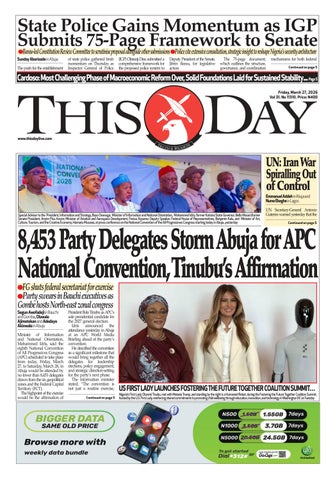
State Police Gains Momentum as IGP Submits 75-Page Framework to Senate
Barau-led Constitution Review Committee to scrutinise proposal alongside other submissions Police cite extensive consultation, strategic insight to reshape Nigeria’s security architecture
Sunday Aborisade in Abuja The push for the establishment of state police gathered fresh momentum on Thursday as Inspector General of Police (IGP) Olatunji Disu submitted a comprehensive framework for the proposed police system to Deputy President of the Senate, Jibrin Barau, for legislative action.
The 75-page document, which outlines the structure, governance, and coordination mechanisms for both federal Continued on page 5
Iran War Spiralling Out of Control
8,453 Party Delegates Storm Abuja for APC National Convention, Tinubu’s Affirmation
FG shuts federal secretariat for exercise Party swears in Bauchi executives as Gombe hosts North-east zonal congress
Segun Awofadeji in Bauchi and Gombe, Olawale Ajimotokan and Adedayo Akinwale in Abuja
Minister of Information and National Orientation, Mohammed Idris, said the eighth National Convention of All Progressives Congress (APC) scheduled to take place from today, Friday, March 27, to Saturday, March 28, in Abuja would be attended by no fewer than 8,453 delegates drawn from the six geopolitical zones and the Federal Capital Territory (FCT).
The highpoint of the exercise would be the affirmation of
President Bola Tinubu as APC’s sole presidential candidate for the 2027 general election.
Idris announced the attendance yesterday in Abuja at an APC World Media Briefing ahead of the party’s convention.
He described the convention as a significant milestone that would bring together all the delegates for leadership elections, policy engagement, and strategic direction-setting for the party’s next phase.
The information minister stated, “The convention is not just a routine exercise,
Continued on page 5
Emmanuel Addeh in Abuja and Nume Ekeghe in Lagos
Secretary-General Antonio Guterres warned yesterday that the
Tourism, and the Creative Economy, Hannatu Musawa, at press conference on the National Convention of the All Progressives Congress starting today in Abuja...yesterday
Cardoso: Most Challenging Phase of Macroeconomic Reform Over, Solid Foundations Laid for Sustained Stability
Says next phase will anchor inflation towards single‑digit, strengthen reserve buffers through organic inflows, sustain exchange rate stability Declares 32 banks have met revised capital requirements, oil price volatility occasioned by Middle East crisis, constitutes major risk to Nigerian economy Wale Edun: close coordination between fiscal, monetary authorities reducing uncertainty Bagudu says CBN must remain active in development financing to boost domestic output
James Emejo in Abuja
Governor of Central bank of Nigeria (CBN), Mr. Olayemi Cardoso, yesterday, declared that the most challenging phase of macroeconomic adjustment in the country was now over, with solid foundations laid for sustained stability.
PARTY
but a moment of reflection, consolidation, and planning.
“It represents our collective resolve to strengthen democratic values, deepen internal governance, and align party processes with national development priorities.”
He said the spread would reflect inclusiveness, unity, and democratic maturity, while reinforcing the party's commitment to advancing national development under Tinubu’s Renewed Hope Agenda.
He assured that exhaustive plans had been made to accommodate all accredited delegates.
Idris stated, “I want to assure you that nobody will be left out. The party is very responsible, and our budget has a self-adjusting mechanism
Cardoso acknowledged that the reforms so far undertaken by the bank were not easy, but necessary and designed to secure the long-term stability and prosperity of the country.
He spoke at the opening of the 2026 Monetary Policy Forum
of the apex bank, with the theme, “Strengthening Nigeria’s Macroeconomic Stability through Effective Monetary Policy: The Role of Critical Stakeholders,” in Abuja.
Minister of Finance and Coordinating Minister of the Economy, Mr. Wale Edun, said
close coordination between fiscal and monetary authorities was helping to reduce uncertainty, support disinflation, and reinforce macroeconomic stability.
Edun said the momentum must be sustained.
Minister of Budget and Economic Planning, Senator
Abubakar Bagudu, while supporting CBN’s position to be less interventionist in development financing, said the apex bank must remain active in that space.
Cardoso stated that reforms had produced clear and encouraging outcomes, including
headline inflation, which had declined significantly, from 34.8 per cent in December 2024 to 15.06 per cent in February 2026, driven by tighter monetary
STORM ABUJA FOR APC NATIONAL CONVENTION, TINUBU’S AFFIRMATION
to accommodate all delegates.
"It represents our collective resolve to strengthen democratic values, deepen internal governance, and align party processes with national development priorities.”
He explained that APC had since its founding remained a platform for progressive ideals, national cohesion, and purposeful leadership.
Idris said APC’s resilience across multiple electoral cycles underscored its strength as a leading political force in Nigeria. He commended the ruling party, stating that it has consistently demonstrated ability to manage leadership transitions in an orderly and structured manner, with strengthened internal systems that would promote accountability, inclusiveness, and stakeholder
participation.
Idris said. “The APC continues to evolve as a broad-based political platform that accommodates diverse perspectives while maintaining unity of purpose. This diversity remains a key strength in advancing national development and democratic consolidation.”
The press briefing had in attendance Minister of Arts, Culture, Tourism and Creative Economy, Hannatu Musawa; Minister of Aviation and Aerospace Development, Festus Keyamo; and former Secretary to the Government of the Federation and Vice Chairman of the Central Committee, Senator Pius Ayim. Equally at the briefing were Special Adviser to the President on Media and Public Communication, Sunday
UN: IRAN WAR SPIRALLING OUT OF CONTROL
Iran war has spun beyond all boundaries, declaring the conflict "out of control," and cautioning that the world faces the prospect of a far broader confrontation.
Calling for an end to the military escalation, Guterres said it was time to ‘stop climbing the escalation ladder and start climbing the diplomatic ladder’ and return to full respect of international law.
Pointing to the key parties involved in the war, he told the United States and Israel that it is high time to end the war as human suffering deepens, civilian casualties mount, and the global economic impact is increasingly devastating.
Guterres urged Iran to end
attacks on the Gulf countries, arguing that they are not parties to the conflict.
"More than three weeks on, this war is out of control," Guterres told reporters at a news conference at UN headquarters in New York, adding that "the conflict has broken past the limits even leaders thought imaginable."
"The world is staring down the barrel of a wider war, a rising tide of human suffering, and a deeper global economic shock," he said, stressing that it "has gone too far."
Highlighting the economic ripple effects of the war, Guterres said the prolonged closure of the Strait of Hormuz is choking the movement of oil, gas, and fertiliser
at a critical moment in the global planting season.
Shipping traffic through the Strait of Hormuz, a critical artery for global goods and energy trade, had been largely disrupted by escalating tensions in the Gulf following US and Israeli attacks on Iran and Tehran’s retaliation.
The strait, which connects Saudi Arabia, the UAE, Kuwait, Qatar, Iraq, and Iran to global markets, handles roughly 25 per cent of global oil trade, about 20 per cent of liquefied natural gas trade, and nearly 30 per cent of fertiliser trade.
The UN chief turned his attention to Lebanon and said, "Israel must stop its military operations and strikes in Lebanon,
Dare; Special Adviser on Information and Strategy, Mr. Bayo Onanuga; and other top party dignitaries.
FG Shuts Federal Secretariat for Convention
The federal government ordered the closure of the Federal Secretariat Complex in Abuja in view of the APC National Convention taking place today and tomorrow.
Permanent Secretary, Service Welfare Office, Abdul Garba, also directed civil servants to work from home as a result of the closure.
Garba said in a circular sighted last night that the directive affected all staff in Phases I, II, and III of the
which are hitting civilians the hardest," adding, "The Gaza model must not be replicated in Lebanon."
In efforts to de-escalate tensions, Guterres further announced the appointment of Jean Arnault of France as his "personal envoy to lead the UN efforts on the conflict and its consequences."
Arnault was the UN chief's personal envoy on Afghanistan and regional issues in 2021.
When asked for details about Arnault's role, Guterres said he "will be doing everything possible to support all the efforts for mediation, all the efforts for peace, to be in contact with all the parties" in the Middle East.
Guterres emphasised the need
complex, as well as Ministry of Foreign Affairs.
He explained that the measure was necessitated by the deployment of Eagle Square for APC National Convention that would have in attendance over 8,000 delegates from across the country.
The circular said regarding the closure of the federal secretariat, “This is due to the use of Eagle Square for the National Convention of the All Progressives Congress (APC) party on the said dates.
“All concerned Permanent Secretaries and Heads of Agencies are kindly requested to bring the content of this circular to the attention of their staff, and ensure strict compliance.”
The notice added that major roads around the Federal Secretariat Complex, notably
for diplomacy and full respect for international law, expressing hope that the parties involved in the Iran war will reach an understanding to end ‘this horrible’ conflict.
He added: "Because the consequences of the conflict, that is totally out of control at the present moment, are absolutely devastating."
The region has been shaken since the US and Israel launched a joint offensive on Iran on February 28, killing more than 1,300 people, including then-Supreme Leader Ali Khamenei.
Trump Extends Planned Bombing of Iran Energy Plants by 10 Days
STATE POLICE GAINS MOMENTUM AS IGP SUBMITS 75-PAGE FRAMEWORK TO SENATE
and state policing systems, was presented at the National Assembly in Abuja as part of ongoing efforts to decentralise policing and strengthen internal security.
The submission was made on behalf of the police chief by Olu Ogunsakin, who chaired the Nigeria Police Force committee tasked with developing the framework on state policing.
Titled, “A Comprehensive Framework for the Establishment, Governance and Coordination of Federal and State Police,” the report detailed the operational modalities for the proposed state police system and sought to provide a roadmap for its seamless integration into Nigeria’s existing security architecture.
According to the IGP, the document represents the culmination of extensive consultations, professional assessments, and strategic evaluations undertaken by the force to address the complexities surrounding the creation of state police.
He stated that the report captured the collective expertise and informed perspectives of stakeholders, while also examining the legal, administrative, and operational implications of decentralising policing powers.
Disu stated, “The report covers the considered views, professional insights and strategic recommendations of
the Force, derived from extensive consultations and a careful assessment of the operational, legal and administrative implications of instituting state police in Nigeria.”
He expressed optimism that the framework would enrich ongoing national discourse and support lawmakers in making well-informed and pragmatic decisions on what he described as a critical component of Nigeria’s security reform.
The IGP said, “It is our expectation that the contents of this report will meaningfully contribute to ongoing deliberations and assist in shaping informed, balanced, and pragmatic decisions on this critical aspect of national
security architecture.”
The police chief explained that the document was formally transmitted to Senate Committee on Review of the 1999 Constitution as the Nigeria Police’s official input on the contentious issue of state policing.
In his response, the deputy senate president, who also chairs the Constitution Review Committee, commended the IGP for what he described as a proactive and timely intervention in the ongoing constitutional reform process.
Barau assured that the committee would give due consideration to the framework alongside other memoranda submitted by stakeholders as
part of efforts to review the 1999 Constitution and address emerging governance and security challenges.
He stated that the initiative aligned with the broader security agenda of President Bola Tinubu, which prioritised enhanced safety and the protection of life and property across the country.
The renewed legislative attention to state police came amid increasing concerns over insecurity and growing calls for a decentralised policing system that would empower sub-national governments to respond more effectively to local security threats.
Advocates of state police argue that a decentralised structure would improve intelligence
Ahmadu Bello Way and Shehu Shagari Way, would be closed from March 27 to 28, because of the convention at Eagle Square. It said, “All Ministries, Extra-Ministerial Departments, Agencies and Offices located within the Federal Secretariat, Phases I, II & III are hereby informed of the closure of all access roads leading to and around the said Federal Secretariat Complex, from Friday, 27th to Saturday, 28th March, 2026.”
APC Swears in Bauchi Executives, Prays for Party Unity, Success Ahead 2027 Elections
APC in Bauchi State inaugurated 36 newly elected
Continued on page 36
Besides, the U.S. will extend a pause on strikes on Iranian energy plants by 10 additional days, President Trump announced on Truth Social. The president said he's extending the pause at the request of the Iranian government.
The president had previously announced a five-day pause striking Iran's energy infrastructure Monday, which was set to expire on Saturday.
"As per Iranian Government request, please let this statement serve to represent that I am pausing the period of Energy Plant destruction by 10 Days to Monday, April 6, 2026, at 8 P.M.,
gathering, rapid response, and community engagement, while critics have continued to raise concerns over potential abuse by state authorities and the need for robust safeguards.
With the submission of the Nigeria Police’s framework, the debate is expected to gain further traction within the National Assembly, as lawmakers weigh competing interests and proposals in a bid to evolve a more responsive and efficient policing system for the country.
The senate committee’s review of the document is expected to play a pivotal role in shaping the final constitutional amendments that would redefine Nigeria’s policing structure in the years ahead.
PRIME MINISTER OF ST. KITTS AND NEVIS CAME CALLING...
Shettima: Tinubu Determined to Reform, Strengthen Power Sector
Adelabu: $2bn attracted to power sector under current government NELMCO reduces inherited liabilities from N2.3tn to N146.76bn Ex-minister, Nnaji, suggests immediate steps to stabilise power sector
Deji Elumoye, Emmanuel Addeh and Sunday Aborisade in Abuja
Vice President Kashim Shettima yesterday reaffirmed the resolve of President Bola Tinubu to overhaul Nigeria’s troubled power sector, declaring that the administration would not compromise on energy security as it pushes reforms aimed at unlocking investment and strengthening supply.
Speaking at the commissioning of the new headquarters of the Nigeria Electricity Liability Management Company (NELMCO) in Abuja, Shettima said the Tinubu administration was committed to building a transparent, accountable and technology-driven electricity market capable of driving national development.
He stressed that Nigeria’s economic future was closely tied to the stability of its power sector, noting that no serious nation could afford to gamble with energy security.
“What we are set to achieve requires data-driven decision-making, intelligent deployment of technology in asset management, and strong partnerships with both local and international stakeholders,” Shettima said.
He added that governance, transparency and accountability must remain central to the operations of institutions like NELMCO, describing the commissioning of the new headquarters as a symbolic turning point for the agency.
According to him, the facility should usher in a new era of efficiency, modernisation and forward-looking leadership
in managing the financial liabilities of Nigeria’s electricity industry.
The vice president also used the occasion to call on private investors and international partners to take advantage of emerging opportunities in Nigeria’s power sector, assuring them of a stable and predictable policy environment.
“We are open for business. We are committed to creating a transparent and investorfriendly environment.
Institutions like NELMCO show that we are not only serious about reform, but capable of sustaining it,” he said.
In his remarks, the Minister of Power, Adebayo Adelabu, said the sector reforms, anchored on policy overhaul, market liberalisation and institutional strengthening,
are repositioning the sector for sustainability, efficiency and increased private sector participation.
The minister described the ongoing changes as deliberate steps to build a viable and investor-friendly electricity market. Central to the reform drive, he noted, is the Electricity Act 2023, which has enabled the decentralisation of the sector and opened the door for subnational participation.
This, he said, has already led to the activation of 16 state electricity markets, while also stimulating competition and innovation within the industry. He added that the development of a National Integrated Electricity Policy, the first in over two decades, now provides a unified framework for implementing the Act, strengthening coordination
FG Expands Presidential Initiative on Compressed Natural Gas Mandate to Include Electric Vehicles
Deji Elumoye
President Bola Tinubu has approved the expansion of the mandate of Presidential Initiative on Compressed Natural Gas (PiCNG) in a new drive to reposition the initiative.
According to a release issued on Thursday by presidential spokesperson, Bayo Onanuga, the initiative will now be known as Presidential Initiative on Compressed Natural Gas and Electric Vehicles (PiCNG & EV).
Tinubu also directed
Executive Chairman of PiCNG & EV, Ismael Ahmed, to immediately establish a coordinated process for the rapid deployment of vehicle conversion kits across the country and ensure that such kits were accessible to Nigerians at a cost that was not burdensome.
To achieve that, the Initiative will work with CreditCorp Nigeria, financial institutions, and relevant partners to design cost-effective financing structures that made vehicle conversions widely accessible to the public.
The president further
directed the accelerated deployment of Mobile Refuelling Units (MRUs) to expand access to CNG while permanent infrastructure continued to scale.
With the approval, PiCNG & EV will lead and coordinate Nigeria’s clean mobility strategy, covering gas-driven vehicles and electric vehicles nationwide.
The initiative will continue to drive the deployment of CNG infrastructure, including Mother and Daughter Stations, Integrated Refuelling Units, CNG vehicles and equipment, and nationwide conversion
programmes. It will also anchor the development and rollout of electric vehicles, EV charging infrastructure, and related investments nationwide.
Gas remains a competitive and strategic fuel for transportation, leveraging Nigeria’s abundant resources to lower costs, strengthen energy security, and conserve foreign exchange.
The inclusion of electric vehicles further strengthens the government’s agenda for affordable, efficient, and environmentally responsible mobility.
between federal and state governments and accelerating access to reliable and affordable electricity.
Adelabu further disclosed that the reforms have attracted over $2 billion in fresh investments into the sector, while ongoing efforts to transition the industry towards full commercialisation have significantly improved its financial outlook. According to him, sector revenue grew
by 70 per cent in 2024, while government liabilities were reduced by about N700 billion, reflecting improved efficiency and cost recovery mechanisms.
The minister also pointed to improvements in generation capacity, which has increased from 13 gigawatts to 14 gigawatts, alongside record operational milestones, including a peak generation of 5,801.44 megawatts.
Former Vice President, Atiku Abubakar, yesterday said that Nigeria cannot build credibility, locally or internationally by ignoring documented facts or dismissing legitimate questions, urging the Attorney General of the Federation (AGF) and Minister of Justice, Lateef Fagbemi (SAN) to address substantive issues raised by him.
Atiku pointed out that in any constitutional democracy, raising questions based on verifiable records is not opposition, stressing that it is a responsibility, which the ruling APC has clearly departed from.
Atiku, who is now a chieftain of the African Democratic Congress (ADC) said this in reaction to remarks credited to Fagbemi suggesting that opposition voices on the OPL 245 matter are driven by selfinterest rather than patriotism.
Atiku stated that the issues at stake are too serious for political spin, stressing that OPL 245 is not a mere talking point, as it is
one of the most consequential oil assets in Nigeria, long entangled in complex litigation and international scrutiny. He insisted that the rule of law must remain supreme. The Attorney General, Atiku maintained, will do well to address the substantive issues raised in his earlier intervention instead of resorting to propaganda.
He maintained that in any constitutional democracy, raising questions based on verifiable records is not opposition, adding that it is responsibility, which the ruling All Progressives Congress (APC) has clearly departed from.
In a statement from his Media office, Atiku said: “Our attention has been drawn to remarks credited to the Attorney-General of the Federation and Minister of Justice, Chief Lateef Fagbemi (SAN) suggesting that opposition voices on the OPL 245 matter are driven by self-interest rather than patriotism.
in Abuja
President Bola Ahmed Tinubu received Prime Minister of the Federation of St. Kitts and Nevis, Dr. Terrance Michael Drew, at the Presidential Villa, Abuja, yesterday
A SOUVENIR FOR THE IGP...
Esso: Erha Oilfield Generated over $23.3bn for Nigeria in 20 Years
Produced more than 800m barrels of crude
Peter Uzoho in Houston, Texas
One of Nigeria’s most economically viable deepwater oil assets, Erha field, located at the Oil Mining Lease (OML) 133, has generated income totaling over $23.3 billion to the federal government over the last 20 years of production spanning 2006 to 2026.
Operated by the Nigerian affiliate of ExxonMobil, Esso Exploration and Production Nigeria Limited (EEPNL), the asset has also within the two decades produced more than 800 million barrels of crude oil worth 850 cargoes.
Esso disclosed this in a statement issued yesterday as it celebrated 20 Years of First Production from Erha Field, marking two decades of safe,
reliable deepwater production and its significant contributions to Nigeria’s economy.
"Over the past 20 years, Erha has generated more than $1 billion in royalties, over $22 billion in taxes, and approximately $300 million in levies, making it one of Nigeria’s most economically impactful deepwater developments", the company disclosed in the statement.
Since first production on March 27, 2006, Esso said the Erha Field has produced over 800 million barrels of oil and delivered more than 850 crude cargoes, supporting Nigeria’s oil output, foreign exchange earnings, and employment.
Since OML 133 was awarded to EEPNL and its partners in 1993, Erha was developed in
Nigeria to Hold High-Level Talks with China on Health Security, Pandemic Preparedness
Onyebuchi Ezigbo in Abuja
Nigeria, through the Federal Ministry of Health and Social Welfare, will host a high level health security dialogue on pandemic preparedness and response in Abuja on Monday. The dialogue, titled, “Lessons on Pandemic Preparedness and Response: Insights from China and Nigeria,” will bring together senior government officials, global health institutions, policymakers, and scientists from Nigeria and People’s Republic of China.
As countries continue to strengthen preparedness for future health threats in the aftermath of COVID 19,
the dialogue will provide a platform to share practical lessons and advance cooperation towards more resilient health systems.
A statement signed by Assistant Director, Information and Public Relations, Federal Ministry of Health and Social Welfare, Ado Bako, said the discussions will focus on strengthening disease surveillance and early warning systems; improving emergency response coordination and health system resilience; enhancing community trust and risk communication; and advancing international collaboration for pandemic preparedness.
partnership with the Nigerian Government, represented by the Nigerian National Petroleum Company Limited (NNPCL), and Shell Nigeria Exploration and Production Company (SNEPCO).
Commenting on the milestone,Chairman and Managing Director of EEPNL, Jagir Baxi, said the anniversary reflects the company’s long‑standing commitment to Nigeria’s deepwater sector.
“This anniversary is a celebration of partnership, performance, and shared national progress.
“For 20 years, Erha has consistently delivered energy and enduring economic value
for Nigeria, made possible through strong collaboration with government, our co‑venturer, and the dedication of our Nigerian workforce", Baxi said.
He added that the project has played a vital role in building Nigerian technical capacity through training, employment, and technology transfer, helping to position Nigeria as a respected deepwater producer globally.
“Beyond being a production asset, Erha symbolises the resilience, innovation, and collaboration that have defined Nigeria’s deepwater energy sector for the past two decades,” Baxi said.
“It stands as a testament to
what can be achieved through strong partnerships, technical excellence, and a shared commitment to safe and reliable operations", he added.
The Erha development is recognized as one of the most advanced projects of its time, featuring pioneering technologies, including some of Nigeria’s deepest subsea wells and the first deepwater crude oil offloading buoy fully built in Nigeria.
Produced via a large Floating Production, Storage and Offloading (FPSO) vessel, the company said Erha sets new benchmarks for deepwater development and operations.
According to Esso, today,
Erha is operated by a 95 per cent Nigerian workforce, with over 800 of them supporting offshore operations.
It added that the field has played a central role in developing generations of Nigerian technical and operations leaders, while ensuring that the benefits of deepwater oil and gas development extend across the broader Nigerian economy.
“Erha proves that world‑class deepwater operations and strong Nigerian content can grow together. It is a clear example of what long‑term investment, stability, and certainty can deliver for the nation", Baxi noted.
President Bola Tinubu has entreated the country's traditional rulers to step up to the demands of the moment by serving as frontline agents of peacebuilding and grassroots stability. Tinubu stated this yesterday in Lagos during the launch of the autobiography of former Secretary to the Government of the Federation, His Royal Highness, Oba (Dr) Samuel Olu Falae.
Represented at the occasion by Secretary to the Government of the Federation, Senator George Akume, Tinubu said the traditional institution was indispensable to governance, especially at a time of heightened security challenges and social fragmentation.
Tinubu said, “Our royal fathers are the closest link between government and the grassroots.
“Your palaces must remain centres of peacebuilding, conflict resolution, and moral guidance."
The president asked traditional rulers to be actively involved in addressing the country’s security challenges and promoting unity across diverse communities.
He said beyond their ceremonial role, royal fathers must serve as stabilising forces within their domains, leveraging their influence to encourage peaceful coexistence and strengthen social cohesion.
“Peace and security are not solely the responsibility of government; they are collective duties,” Tinubu said.
He also appealed to monarchs to promote dialogue, discourage violence, and strengthen cohesion within their domains.
The president described the event, which attracted political leaders, traditional rulers, and members of the diplomatic community, as more than a ceremonial book launch, but a reflection on leadership, service, and national ethos embodied by Falae.
He described Falae as a bridge between tradition and modern governance, and applauded his legacy in public service, economic management, and cultural leadership.
Tinubu x rayed Falae’s career, from his stewardship as finance minister to his current role as Olu Abo of Ilu Abo in Ondo
State, saying it represents a rare blend of technocratic discipline and traditional authority.
He also highlighted Falae’s tenure in government as one marked by fiscal prudence and policy clarity.
Tinubu said Falae’s contributions helped in shaping Nigeria’s economic framework during critical periods.
Tinubu acknowledged Falae’s leadership role within Afenifere, where he served as chairman of National Executive Committee since 2025.
He assured that his administration would continue to strengthen collaboration with traditional institutions, pledging more engagement in efforts to enhance security, social harmony, and grassroots development.
Olawale Ajimotokan in Abuja
The Chief of the Naval Staff, Vice Admiral Idi Abass (R), presenting a memento to the Inspector-General of Police, IGP Olatunji Rilwan Disu during his recent strategic visit to the Naval Headquarters, Abuja
SANWO-OLU INAUGURATING IRELE TOWERS...
FG to Sign Subsidiary Loan Agreement with States on $500m
World Bank-assisted HOPE Governance Programme
Federal Ministry of Budget and Economic Planning has commenced collaboration with Federal Ministry of Finance to ensure the 36 states of the federation sign the Subsidiary Loan Agreement to enable them participate and benefit from the $500 million World Bank-assisted HOPE Governance Programme.
The programme aims to improve service delivery in basic education and primary healthcare sectors at the subnational level.
Permanent Secretary in the Budget Ministry, Dr. Deborah Odoh, made the disclosure when she received the HOPE Governance team from the World Bank on a courtesy visit to her
office.
Odoh stated, “We have been strategising with the Federal Ministry of Finance with the involvement of our Honourable Minister, Sen. Abubakar Atiku Bagudu. We will put in extra efforts to make it happen even faster, given the time constraints. We have a timeline drawn up recently to achieve this.”
A statement issued by Communications Officer, HOPE Governance Programme, Joe Mutah, said the permanent secretary pledged to provide necessary institutional support to ensure that HOPE Governance delivered significant impact across the country.
“I’m glad we are having this meeting, which is long overdue
Nigeria, Finland Sign Memorandum of Understanding on Digitalisation, Innovation
The Governments of the Republic of Finland and the Federal Republic of Nigeria have signed a Memorandum of Understanding (MoU) on Digitalisation and Innovation, marking a significant milestone in deepening bilateral cooperation in the digital sector.
According to a statement issued by the Finnish embassy, the MoU was signed recently in Abuja by the Minister of Communications, Innovation and Digital Economy, Dr. Bosun Tijani, and Under-Secretary of State (International Trade) of the Ministry for Foreign Affairs of Finland, Mr. Jarno Syrjälä.
The MoU, it was learnt, strengthens the framework for collaboration in key areas such as digital government, emerging technologies, digital public infrastructure, cybersecurity, innovation ecosystems, and capacity building.
It reflected both countries shared ambition to leverage digital transformation as a driver of sustainable economic growth, efficient public services, and inclusive innovation.
At the signing ceremony, the Minister, Tijani, said:
“Today’s MoU signing marks an important step in strengthening the partnership between both countries as we work to build a more inclusive, innovationdriven digital economy.
“This agreement is a significant next step following our engagements in Helsinki in February, where we met with key stakeholders, including Finnvera and Finnfund, and held productive discussions on advancing collaboration around digital infrastructure, the Data Exchange Platform, and opportunities for Finnish participation in Project BRIDGE.”
and certainly we are here all the time. We expect to see more tangible results and impact shortly,” she said.
World Bank Task Team Leader, HOPE Governance Programme, Ikechukwu Nweje, earlier appealed to the permanent secretary to utilise all available channels within the ministry to engage state governments and secure the signing of the agreement. Nweje said this would enable the states to access funds under the programme upon
verification of the DisbursementLinked Results.
“However, you can help us to fast track these processes, this will really be appreciated to get this program up and running in terms of disbursement,” he said. He stressed that governance remained a key challenge to improved service delivery in the basic education and primary healthcare sectors, which was why the federal government, in collaboration with the World Bank, initiated the HOPE Governance
Programme to address the issue.
Nweje stated, “If the governance part fails, we will continue to have the same problems we are having on the sectoral side.
“That is why the ministers prioritised governance because they found out that governance is the issue in the two sectors that will help to unlock the ability to deliver results.”
Earlier, National Coordinator of HOPE Governance Programme, Dr. Assad Hassan, stated that
the meeting was convened with the World Bank to apprise the permanent secretary of the milestones recorded and the challenges encountered in its implementation so far. HOPE Governance Programme is a $500 million World Bankassisted initiative domiciled in the Federal Ministry of Budget and Economic Planning, aimed at promoting good governance in the administration of basic education and primary healthcare in Nigeria.
Persistent Budget Failures: CHRICED Demands Transparency, Accountability in Capital Expenditure Implementation
Alex Enumah in Abuja
A civil rights group has expressed profound concern over the alleged failure of the federal government to continue implementation of the capital components of the national budget, despite repeated assurances of reform and improved fiscal performance.
The group, Resource Centre for Human Rights and Civic Education (CHRICED), in a statement issued on Thursday lamented that a review of official budget implementation reports published by the
Budget Office of the Federation shows a troubling pattern of chronic underperformance.
Referencing the 2024 fiscal year, the group stated that out of a capital budget of ₦9.9 trillion, only ₦5.81 trillion was released, with ₦3.27 trillion utilized.
According to CHRICED, Program Manager, Victor Emejuiwe, while this represents 81.91% utilization of released funds, it reflects a far lower performance when measured against the total capital allocation—leaving critical development commitments
unmet.
"The situation worsened in 2025. As of today, the Budget Office has failed to publish the third and fourth quarter implementation reports, in violation of statutory timelines.
"Available data indicates that out of a projected ₦23.44 trillion in capital expenditure, only ₦34.32 billion was released in the first quarter and ₦393.86 billion in the second quarter—less than one percent of the total capital budget. This confirms that both the 2024 and 2025
capital budgets remain largely unimplemented", Emejuiwe stated.
CHRICED expressed worry that while citizens are urged to endure economic hardship in anticipation of promised reforms, there is little evidence of corresponding government action in the execution of capital projects. It added that instead, budget obligations appear to be routinely rolled over into subsequent fiscal years, even as the 2026 budget remains unsigned at the end of the first quarter.
Paedophile: TRCN Sets up Teachers' Investigative Panel, Tribunal Across 36 States
Kuni Tyessi
in Abuja
With rising incidents of sexual abuse and child molestation within primary and secondary schools, the Teachers Registration Council of Nigeria, TRCN, has set up a teachers' investigative panel and tribunal across Nigeria's 36 states.
In curbing and bringing to an end all pedophile activities within
the sector, it has also unveiled a hotline where such cases can be reported for prompt action. According to the council, the response from teachers and schools on the initiative has been overwhelmingly positive, while noting that schools and centres of learning must be safe for learners.
The Executive Secretary of TRCN, Dr. Ronke Soyombo, who
disclosed this on Thursday in Abuja during an interface with the press on her achievements thus far in the last nine months after assumption of office, said the council will continue to make significant strides in enhancing teacher professionalism and safety in Nigeria's schools. Soyombo revealed the council has also launched a compliance department to vet teachers for
criminal records, aiming to create a national database by mid-year. According to her, "The council is making significant strides in enhancing teacher professionalism and safety in Nigeria's schools. Our initiatives include inducting teachers, administering the Professional Qualifying Exam, and establishing a hotline for reporting abuse cases.
Sunday Okobi
Ndubuisi Francis in Abuja
L-R: Deputy Chief of Staff to the Governor of Lagos State, Mr. Sam Egube; Chairman, Lekki Port LFTZ Enterprise Limited, Mr. Abiodun Dabiri; Governor Babajide Sanwo-Olu; Managing Director/CEO, Lekki Free Zone (LFZ), Mrs. Adesuwa Ladoja; Head of Service, Mr. Olabode Agoro; Managing Director/CEO, FCMB, Mrs. Yemisi Edun; and Special Adviser to the Governor on Rural Development, Dr. Nurudeen Agbaje during the official commissioning of Irele Towers, the commercial building of the LFZ, along the Lekki-Epe Expressway, yesterday
SENATE RECEIVES DISU’S FRAMEWORK ON STATE POLICE...
L-R: Chairman of the Nigeria Police Force Committee on State
Professor
Saint Kitts and Nevis PM Visits Tinubu, Seeks Stronger Nigeria-Caribbean Cooperation
Both nations to appoint special envoys to deepen bilateral engagements
Deji Elumoye in Abuja
President Bola Tinubu and Prime Minister of Saint Kitts and Nevis, Terrance Michael Drew, have agreed to appoint special envoys to advance bilateral engagement, strengthen existing areas of cooperation, and ensure that the partnership yields gains for both nations and the wider Caribbean Community (CARICOM).
The Prime Minister made this known to newsmen on Thursday after paying a courtesy visit to Tinubu at the State House in Abuja, where both leaders assessed
existing bilateral engagements and considered new strategic cooperation.
Drew said the move to designate special envoys in Abuja and Basseterre is intended to reinforce institutional follow-through on existing understandings, while broadening collaboration between Nigeria, Saint Kitts and Nevis, and the wider African and Caribbean blocs.
His words: “We have agreed that there will be a special envoy to Saint Kitts and Nevis, and of course, we would have a special envoy here to further the
collaboration and make sure that the tangible benefits for both Saint Kitts and Nevis and the wider CARICOM and for Nigeria and the wider African continent".
The Prime Minister lauded Tinubu for his leadership, openness, and commitment to strengthening AfricaCaribbean ties describing Nigeria as a “significant country” on the African continent and globally.
“It’s always a pleasure for me to be here in Nigeria. I was here last year around this time, and I’m back again, and I want to thank His Excellency, the President,
who has been so gracious as a host,” he said.
Underscoring the historical and cultural ties between both countries, Drew noted that a significant number of citizens of Saint Kitts and Nevis can trace their ancestral roots to Nigeria, particularly the Calabar area.
“This is our people. Our people in Saint Kitts and Nevis fundamentally came from Calabar here in Nigeria. So I always say we have come back home."
Commenting on other areas of cooperation, the Prime Minister said discussions with Tinubu centred around
Shettima Hails Gates Foundation's Sustained Investments in Nigeria
Welcomes its request for deepened partnership to advance Tinubu's reforms
Deji Elumoye in Abuja
Vice President Kashim Shettima has applauded the Gates Foundation for sustaining investments and humanitarian aid in Nigeria, saying the Foundation remains the nation's strategic partner in the drive to change the Nigerian narrative. Accordingly, he pledged support for the Foundation's request to deepen and broaden its partnership with the Nigerian government and the private sector in digital transformation, nutrition, agriculture and health sectors, among others.
Shettima made the
remarks when he received in audience a delegation of the Gates Foundation led by President of the Foundation's Global Growth and Opportunity (GGO) division, Mr. Hari Menon, at the State House, Abuja. He commended members of the Nigerian team of the Gates Foundation for their passion for the Nigerian Project, describing them as very strategic partners.
"I'm mightily proud of them. I call them in the oddest of hours and they attend to us. We deeply appreciate the Gates Foundation. It is our strategic partner in the drive to change the Nigerian narrative. We
need the Gates Foundation not just as a strong and consistent partner but as a major stakeholder in the Nigeria Project.
"You have sustained investments across human capital development, nutrition, agriculture, health system and so many areas. We can't thank you enough, and honestly, I want to assure you that we will elevate that relationship to a higher pedestal, especially in the area of nutrition, which is now receiving the highest level of support."
The Vice President noted that Nigeria is a country with great potential, and that if the nation gets its
act right, it would surpass some major economies of the world, just as he described the country as the sleeping giant of Africa, taking a leaf from Napoleon Bonaparte who once described China as "a sleeping giant."
Shettima stressed the need to increase agricultural productivity by adopting modern technologies, optimizing inputs, and improving farm management practices, even as he identified key strategies in achieving this to include utilizing high-yield and climate-resilient seed varieties, precision farming, and improved irrigation systems.
cultural exchange, education, agriculture, food security, and broader development partnerships between Africa and the Caribbean.
He identified existing collaborations in the health and education sectors as existing successes, emphasising that Nigeriantrained professionals have contributed significantly to development efforts in Saint Kitts and Nevis.
“A lot of Nigerians have studied in my country, and
they are doctors here today. We had a contingent of doctors who went to Saint Kitts and Nevis already. We are seeing some tangible benefits with respect to our collaboration, and now we are taking it to the next level,” he said.
The agreement between Tinubu and Drew to appoint special envoys reflects a move from symbolic diplomacy to more structured and resultsoriented engagement between Nigeria and the Caribbean.
FG, AfDB Push for take-off of $263m Projects in Abia
Boniface
The federal government and African Development Bank (AfDB) are urging Abia State Government to remove all bureaucratic bottlenecks delaying the commencement of the multi-million dollars Abia State Integrated Infrastructural Development (ABSIID) Projects.
A delegation of both the federal government and AfDB which breezed into Abia to parley with Governor Alex Otti over the issue, said that two out of the five years implementation period have already been lost due to the delay.
The ABSIID project was formally launched by Governor Otti on Friday, July 11, 2025, at the JAAC Building in Umuahia but its implementation has been bogged down by bureaucracy.
The project's total capital outlay is USD 263.80. The initiative is designed to be executed with loans from AfDB ($100 million); Islamic
Development Bank ($125 million - already released) and Canada-Africa Development Bank ($15 million) while state will commit a counterpart fund of USD23.80 million, about N2 billion, which it has since paid. The project aims to rehabilitate over 248 kilometres of roads, manage waste, and tackle erosion.
About 126 kilometres of the roads would be constructed in Aba and 35.57 built in Umuahia. Leader of the delegation and representative of the Federal Ministry of Finance, Dr. Mrs. Oyebola Akande, while commending Governor Otti for the timely release of Abia's N2 Billion counterpart funding for the project, said that their mission was to see how they (federal government and AfDB) could team up with Abia State Government and their financing partners to accelerate the implementation of the project without further delay.
Police,
Olu Ogunsakin, presenting, on behalf of IGP Olatunji Rilwan Disu, a framework for the establishment of State Police to the Deputy President of the Senate, Senator Jibrin Barau, at the National Assembly, Abuja, yesterday
Okoro in Umuahia
Politics
ELUMOYE
Email: deji.elumoye @thisdaylive.com
08033025611
Insecurity: As Barau Drives Constitutional Push for State Police...
as the nation continues to face security challenges, momentum for state policing gathers force. deputy President of the Senate, Senator Jibrin Barau’s recent engagement with the police reform committee signals a decisive legislative phase. yet, balancing decentralisation with accountability remains the core challenge shaping Nigeria’s most consequential security reform debate in decades. Sunday Aborisade reports.
Nigeria stands at a defining moment in its long-running search for an effective security architecture. From insurgency in the North-east to banditry in the North-west, kidnapping in the North-central and separatist tensions in the South-east, the country’s overstretched policing system has increasingly come under scrutiny. Against this backdrop, the renewed push for state police has moved from political rhetoric to concrete legislative action.
At the centre of this evolving discourse is the Deputy President of the Senate, Jibrin Barau, whose recent engagement with a high-level police committee underscores the urgency and complexity of the proposed reform.
When Barau received members of the Nigeria Police Force steering committee tasked with developing a framework for state policing, it was more than a routine courtesy call. It represented a strategic convergence of legislative intent and executive initiative.
The committee, inaugurated by the InspectorGeneral of Police, Olatunji Disu, is mandated to design a workable structure for decentralised policing, one that aligns with Nigeria’s constitutional realities while addressing local security needs.
Led by Professor Olu Ogunsakin, the committee’s assignment is both technical and political: to craft a system that enhances security without undermining national unity or enabling abuse by subnational actors.
Barau’s response during the meeting was telling. While expressing support for the initiative, he emphasised accountability, public trust, and the need to address citizens’ fears, which are issues that have long dogged the state police debate.
His position reflects a broader legislative awareness: that without strong safeguards, decentralised policing could replicate the very problems it seeks to solve.
As Chairman of the Senate Committee on Constitution Review, Barau occupies a pivotal role in translating the idea of state police into law. The constitutional amendment process currently underway provides the formal pathway for restructuring Nigeria’s policing system.
One of the key proposals before the National Assembly seeks to establish both state and community police within a clearly defined legal framework. This would fundamentally alter the current centralised model, where the Nigeria Police Force operates as a single national entity.
The Senate has already demonstrated its appetite for reform. In December 2025, lawmakers adopted far-reaching recommendations from a national security summit, endorsing state police, intelligence-led operations, and technology-driven surveillance as critical tools for combating insecurity.
These resolutions reflect a growing consensus that Nigeria’s security challenges are too complex for a one-size-fits-all approach.
The argument for decentralised policing is rooted in practicality. Nigeria’s vast geography, diverse population, and varied security threats make centralised command increasingly inefficient.
Security experts argue that local police forces would be better positioned to gather intelligence, respond swiftly to threats, and build trust within communities. In rural areas, where federal presence is often minimal, state police could fill critical gaps.
Moreover, the recognition of governors as “chief security officers” of their states, without corresponding control over police forces, has long been seen as a structural contradiction.
The push for reform has also gained political backing. In 2024, all 36 state Houses of Assembly endorsed the creation of state police, urging the National Assembly to prioritise it in the constitutional review process.
This rare unanimity across states underscores the depth of concern about Nigeria’s security situation.
Despite widespread support, opposition to state police remains significant, and not without reason.
Critics fear that governors could weaponise state police against political opponents, turning law enforcement into an instrument of repression. Nigeria’s history of political interference in security agencies lends weight to these concerns.
Barau himself acknowledged these fears, noting that Nigerians raised them during zonal public hearings conducted by the Senate across the six geo-political zones.
Addressing this trust deficit is central to the success of any state policing framework.
The proposed constitutional amendment attempts to mitigate these risks through a layered oversight system.
It includes the establishment of a National Police Service Commission and State Police Service Commissions, designed to regulate
recruitment, discipline, and operations. Additionally, provisions for bi-annual certification of state police activities aim to ensure compliance with national standards. Yet, whether these safeguards will be sufficient remains an open question.
Beyond structural reforms, the Senate’s recommendations highlight the importance of modernising Nigeria’s security apparatus.
The shift towards intelligence-driven policing marks a departure from the reactive approach that has characterised the system for decades.
Lawmakers have called for massive investment in surveillance technologies, including drones, CCTV systems, and border sensors. Such tools, combined with decentralised policing, could significantly enhance early warning systems and rapid response capabilities. However, implementing these measures will require substantial funding, technical expertise, and inter-agency coordination, being areas where Nigeria has historically struggled.
The debate on state police also intersects with broader socio-economic issues.
The Senate’s security report identified unemployment, poverty, drug abuse, and illiteracy as key drivers of insecurity.
It proposed the creation of a National Youth Stabilisation Fund to address these root causes, particularly in conflict-affected areas. This holistic approach suggests that policing reforms alone will not suffice.
Without addressing underlying grievances, even the most sophisticated security architecture may fall short.
At its core, the state police debate is a test of Nigeria’s federalism. It raises fundamental questions about the distribution of power between the federal and state governments.
NOTE: Interested readers should continue in the online edition on www.thisdaylive.com
Kogi East: Compelling Case for Bello’s Senatorial Bid
as the conversation around Kogi East representation in the Senate come 2027 intensifies, many indigenes argue that former Governor of the state, yahaya Bello’s track record offers a persuasive case for his senatorial aspiration. Jonathan Eze reports.
For ex-Governor Yahaya Bello’s supporters, the argument is compelling: a leader who delivered measurable transformation across infrastructure, healthcare, education, security, and economic reform possesses the requisite experience and vision to effectively represent Kogi East at the Senate.
His tenure, they contend, reflects not only administrative competence but also a capacity to deliver large-scale transformation across sectors.
In this context, the question remains not merely political, but strategic, whether Kogi East stands to gain from the elevation of a leader whose governance record continues to command widespread acknowledgment.
For many stakeholders and indigenes, the answer is increasingly anchored not in rhetoric but in a demonstrable record of governance. Bello’s two-term stewardship of Kogi State from January 2016 to January 2024 is being revisited as a compelling case for his elevation to the red chamber, particularly by those who argue that his leadership capacity transcends district boundaries.
Bello’s administration was defined by what observers describe as an “integrated governance” philosophy, an ambitious, multi-sectoral framework that combined
infrastructure expansion, human capital development, fiscal discipline, and institutional reform.
According to Adeiza Abdul, a political scientist based in Abuja, Bello’s emergence as Nigeria’s youngest governor at age 40 symbolised a generational shift in leadership, effectively bridging the divide between entrenched political traditions and a more dynamic, youth-driven governance ethos.
Infrastructure Revolution Central to Bello’s legacy is a far-reaching
infrastructure renewal programme that redefined mobility and economic interaction across the state. Extensive road construction and rehabilitation projects in Lokoja, Anyigba, Kabba, Idah, and Ogugu significantly reduced rural isolation and unlocked commercial opportunities.
A youth leader from Kogi West, Abulhakeem Olawale, noted that these interventions lowered transportation costs and strengthened agricultural value chains, thereby stimulating local markets and enhancing productivity.
Lokoja-based businessman, Kingsley Abraham attested to the practical impact of these projects, emphasising that improved road networks drastically reduced losses associated with damaged goods and facilitated seamless distribution across the state.
Urban renewal initiatives in Lokoja further enhanced the functionality and aesthetic appeal of public infrastructure, fostering a more business-friendly environment. Collectively, these developments contributed to a significant increase in internally generated revenue, reportedly exceeding 100 per cent during Bello’s tenure.
Where are the Nigerian Elites?
Audu Oseni writes that there is the need for the Nigerian elites to stand up and be counted in the onerous task of leading the nation aright.
Nigeria today is witnessing unprecedented governance failure. Security has collapsed, schools and hospitals are decaying, and millions remain trapped in poverty. The world watches and asks: where are the Nigerian elites?
In countries where the elite class is functional, conscious, and uncompromised, societies thrive. Elites in those nations hold government accountable, provide visionary leadership, shape policies that uplift society, and speak for the marginalized.
But what do we see in Nigeria? An elite class that is largely compromised, self-serving, and silent in the face of urgent national emergencies. Leaders are protected for personal gain, narrow interests take precedence over public good, and ordinary Nigerians are left hopeless. The result is widening social inequalities and a stagnant nation.
A compromised elite class erodes the foundations of good governance, justice, and development. The country suffers because elites wield disproportionate influence—but use it for themselves
Group Canvasses Support for Bauchi Gov Amid Defection Rumour
Segun Awofadeji reports that a group, the Kaura Force Movement, has been launched to canvass support for Governor Bala Mohammed of Bauchi state, amid reports that he may soon defect from the peoples democratic party to the ruling all progressives congress.
Amid insinuations that Bauchi State Governor, Senator Bala Mohammed might defect to the All Progressives Congress (APC), a political pressure group has been launched in the State pledging its unalloyed solidarity, support and loyalty to the Governor.
The new group, ‘The Kaura Force Movement’ which was formally launched at the NUJ Press Centre, Bauchi, vowed that as a new political pressure group to agitate for Mohammed’s elective office in his political journey of 2027, “we will not allow him to walk alone”.
women, and deliberate investments in education, healthcare, and social development have transformed the trajectory of the State”.
He added that, “under his administration, Bauchi State has transitioned from years of limited development into a period defined by renewed progress, stability, and growing national recognition.
rather than for society.
Elites should be the voices demanding accountability, the minds guiding ethical leadership, and the courage standing for justice and development. In other countries, civic-minded business leaders and public intellectuals pressure governments to uphold transparency and enforce anti-corruption laws. They show politicians that leadership is not merely about office, but about guaranteeing citizens’ welfare and safety.
Where nations have improved lives and safeguarded citizens, it is because their elites prioritized public welfare over personal gain, and justice over privilege. The lesson is clear: when elites serve society, the nation thrives.
Until Nigerian elites reclaim their purpose, the country will continue to drift—not led by vision, but by the whims of those who care only for themselves.
Nigeria deserves better. Its citizens deserve better. The pressing question remains: where are the elites who will make Nigeria better?
-Dr Oseni writes from Abuja.
Although, Senator Mohammed has not publicly denied the defection rumours but a political support group has expressed its unwavering determination, commitment and solidarity to the Governor.
While addressing the press, leader of the Group, Mohammed Maiwada Bello, said the Governor’s landmark achievements in the state deserve their support and loyalty.
According to him, “The Kaura Force Movement emerged at a defining moment in our political history, a moment that calls for clarity, unity, and the defense of credible leadership.
“Governor Bala Mohammed is widely recognized as a tested statesman, experienced administrator, and courageous voice for democratic accountability in Nigeria. His leadership philosophy is grounded in performance, fairness, and the belief that governance must deliver tangible improvements in the lives of citizens”.
Bello stressed that, “across Bauchi State today, the evidence of this leadership is clear and visible. Strategic infrastructure projects, strengthened public institutions, economic empowerment programs for youths and
“One of the most remarkable characteristics of Governor Bala Mohammed’s leadership is his commitment to inclusive governance. In a country where politics sometimes becomes divided along ethnic, religious, or sectional lines, His Excellency has consistently demonstrated that leadership must unite rather than divide”.
The group leader further stated that,”His administration reflects the diversity of Bauchi State and the broader Nigerian Federation, bringing together professionals and technocrats from different ethnic groups and regions to serve based on merit and competence. This governance philosophy reinforces the belief that national cohesion and fairness must always prevail over narrow political interests.”
Acccording to him: “Equally significant is his unwavering commitment to religious harmony and peaceful coexistence. Through consistent engagement with leaders of Islamic, Christian, and traditional faith communities, Governor Bala Mohammed has strengthened the culture of tolerance and unity that defines Bauchi State.
“As a result, Bauchi continues to stand as one of Nigeria’s most politically stable and peaceful states. It is important to emphasize that His Excellency is not a leader who seeks validation through political theatrics or media noise. His focus remains governance, development, and the long-term welfare of the people”.
OKPEBHOLO’S ROAD MAINTENANCE AGENCY
Edo is taking steps to restore public confidence in the state’s road network, argues JOHN MAYAKI
21
RUSSIA–AFRICA RELATIONS AND WHAT IT’S NOT
Africa must resist the temptation to replace one external dependency with another, writes UMAROU SANOU
The country has what it takes to function properly if the basic things are done, contends JOSHUA J. OMOJUWA
WHEN NIGERIA WORKS
Most Nigerians have no idea what a Nigeria that works would look like. When they do, they often are not conscious of their part in its making. There is a version of Nigeria that does not require the sudden emergence of a generation of perfect leaders, or the overnight transformation of a political culture built over decades of incentivised dysfunction. It does not require oil prices to behave, the dollar to weaken, or any of the other external conditions Nigerians have learned to wait for as preconditions for progress. It requires something more modest and more demanding at the same time: a country where the basic systems work well enough that ordinary people can build extraordinary lives.
Start with the simplest thing. A Nigerian who wakes up in the morning should be able to turn on a light. Not because the government has solved electricity as a concept, but because the regulatory and market structures around power have been fixed sufficiently that private investment has filled the gap the public sector could not and never should have tried to fix. This is what happened in telecoms. In 2000, making a phone call in Nigeria was an exercise in frustration and luck. A privilege. Today, over 200 million lines are active and a Lagos street trader processes mobile payments without thinking about it. Nobody declared a national telecommunications miracle. The government created a framework, stepped back far enough to let competition work, and the market did the rest. Electricity is harder, the infrastructure more capital-intensive, the legacy problems more entrenched. But the template exists. A Nigeria that works is one where that template has been applied.
Consider what a functional Nigeria means for a small business owner in Aba. She makes shoes. Nigerianmade shoes that can compete on quality with anything imported, if she can produce at scale, get them to market reliably, and access credit at rates that do not make expansion a losing proposition before it begins. The bank does not require collateral she does not have in exchange for capital she needs. The port does not add three weeks and a bribe to every shipment. None of these fixes require genius. They require sustained institutional attention, the kind that
compounds over years rather than cycles with election seasons.
A Nigeria that works is not a Nigeria without poverty. It is a Nigeria where poverty is not the permanent inheritance of geography. A child born in Zamfara today faces a set of life outcomes that are structurally different from a child born in Lagos, not because of talent, not because of character, but because of where the investment has gone and where it has not. A functional Nigeria does not eliminate that gap overnight. It narrows it deliberately, year by year, through education infrastructure that reaches the farthest of villages, healthcare delivery that does not stop at the end of a tarmac road, and security conditions that allow a farmer in Benue to plant and harvest without calculating the odds of surviving both.
The security piece is not separable from the economic piece. They are the same argument. An investor looking at Nigeria's agricultural potential is also looking at the farmer-herder conflict maps, the banditry corridors, the kidnapping statistics. A Nigeria that works has not necessarily solved every dimension of its security challenge. But it has created enough stability in enough places that economic activity is no longer being held hostage to armed groups. Kaduna's recent experience, complicated and incomplete as it is, points at the direction. Progress is possible. It is slow, it is non-linear, and it requires a level of political patience that Nigerian governance has historically struggled to sustain past the next election cycle.
Which brings us to what a functional Nigeria would feel like for its people, especially in the texture of daily life.
It feels like a parent enrolling a child in a public school without the quiet resignation that this is the best they can do. It feels like a middleclass family not keeping a generator budget that rivals the down payment on a small apartment. It feels like a graduate applying for a job and understanding that merit is at least one of the criteria by which it will be filled. None of these are utopian demands. They are the baseline expectations of citizens in countries that have decided to function. Nigeria has the resources, the talent, and in flashes the institutional capacity to meet them. The question has never been whether it can. The question has always been whether it will. The government's role in this is not to do everything. It is to do its specific things well, and to stop doing the things it does badly that prevent others from doing their own things well. Regulate without strangling. Invest in the infrastructure that no private actor will build because the returns are too long and the risks too high. Enforce contracts. Collect taxes fairly and spend them transparently. Hold institutions accountable to their mandates. There are no ribboncutting ceremonies for a functional judiciary or a consistent power supply. But they are the assignments on which everything else depends, and they are the ones Nigerian governments have most consistently avoided in favour of the visible and the symbolic.
The people's role is harder to articulate because it is less bounded. But it begins with the same decision the government must make; the decision to hold the long view. A Nigeria that works is not built in one administration or demanded in one protest cycle. It is built in the daily choices of citizens who pay their taxes, who refuse the bribe even when it is cheaper to pay it, who hold their representatives accountable between elections and not only during them. Nigeria has all the ingredients. It always has. Our country is not short of capacity. It is short of the collective decision that capacity deserves a system worthy of it. That decision is available. It has always been. The only question is when enough people make it at the same time.
Omojuwa is chief strategist, Alpha Reach/BGX Publishing
Edo is taking steps to restore public confidence in the state’s road network, argues JOHN MAYAKI
OKPEBHOLO’S ROAD MAINTENANCE AGENCY
When governments speak of infrastructure renewal, the conversation often gravitates toward grand construction projects such as new highways, bridges and dualised roads that capture public attention. Yet, in many states, the real battle lies elsewhere in the everyday fight against potholes, drainage failures and the gradual decay of existing roads. These problems, though less glamorous than ribbon-cutting ceremonies, are the true test of governance.
It is in this context that Governor Monday Okpebholo’s activation of enhanced rapid response measures for road maintenance across Edo State deserves attention. With the purchase of equipment and machinery for the Road Maintenance Agency, the administration appears to be signalling a shift from reactive governance to a more organised and proactive maintenance culture. If properly implemented, this initiative could significantly strengthen the state’s readiness for integrated emergency road maintenance.
Road infrastructure deteriorates not only because it ages but also because it is neglected. Across Nigeria, a familiar cycle plays out: roads are constructed with fanfare, but little thought is given to systematic maintenance until they deteriorate badly enough to require expensive rehabilitation. The cost of such neglect is enormous both economically, socially and politically.
The establishment and strengthening of road maintenance agency suggests an attempt to break that cycle. With the right tools and operational mandate, the agency is expected to ensure uninterrupted field operations by workers who will maintain roads, fill potholes and address broken-down infrastructure before such defects escalate into major structural failures.
At its core, the agency is designed to respond quickly to various forms of road defects. This intervention, as understood, will range from full rehabilitation to sectional rehabilitation, routine maintenance and palliative work. Such a layered approach is important. Not all road failures require total reconstruction. Many require swift, targeted repairs that can prolong the lifespan of the infrastructure and save government resources.
For too long, road maintenance in many jurisdictions has been episodic rather than systematic. Crews appear only when deterioration becomes too severe to ignore. By that time, the cost of repair has multiplied. A rapid response system, however, works differently. It is built on the principle of early detection and early intervention such as identifying problems while they are still manageable.
If the new agency functions as intended, it will consolidate an all-year-round approach to road maintenance and re-
habilitation. The use of a wide range of maintenance materials, including asphalt premix, interlocking paving stones, cold mix asphalt, boulders, crushed stones and lean concrete, will give field teams flexibility to respond to varying conditions and types of defects.
These materials are not merely technical details; they represent a practical response to the realities of road maintenance in a tropical environment. Weather conditions, particularly rainfall, often complicate repair work. In many cases, repair efforts stall once the rainy season begins, leaving defective sections of road to worsen until the dry months return.
However, modern maintenance techniques increasingly allow work to continue even under less-than-ideal weather conditions. Cold mix asphalt, for instance, can be deployed in wet conditions, while other materials provide temporary stabilisation until permanent repairs can be undertaken. With proper planning and technical expertise, road maintenance need not grind to a halt simply because the rains arrive.
Governor Okpebholo has already assured steady funding for the agency and has taken the critical step of procuring the necessary equipment. That decision is crucial. Maintenance agencies often fail not because the concept is flawed but because they lack the tools to carry out their mandate. Graders, rollers, asphalt mixers and other essential machinery are the backbone of any serious road maintenance operation.
With equipment in place and funding guaranteed, expectations are understandably high. The hope is that the agency will utilise the dry days of 2026 to rapidly address the majority of road defects across the state. The dry season offers the best conditions for extensive repair works, and it should be maximised.
Yet, the agency must also plan for continuity during the wet season. Road maintenance cannot be seasonal if the objective is to keep infrastructure consistently serviceable. Monitoring weather patterns, deploying appropriate techniques and ensuring that emergency repairs can still take place during rains will be essential components of an effective maintenance strategy.
Mayaki is a Journalist and Diplomat
Africa must resist the temptation to replace one external dependency with another, writes UMAROU SANOU
RUSSIA–AFRICA RELATIONS
AND WHAT IT’S NOT
Africa has moved beyond the era of formal colonial domination. The struggles that defined the continent’s mid-20th-century liberation movements, anti-colonial resistance, and the ideological tug-of-war between the United States and the Soviet Union belong to a different historical moment. Yet, in a curious twist, the mindset of that era still lingers in parts of Africa’s political and intellectual space.
Today’s Africa is no longer fighting for independence; it is fighting for development, stability, and relevance in a rapidly shifting global order. But instead of confronting these modern challenges with clarity, some countries, particularly within the Sahel’s junta-led Alliance of Sahel States (AES), appear to be trapped in a recycled narrative that casts Russia as a natural ally, even a redeemer, in a renewed struggle against Western influence.
This framing is not only outdated; it is dangerously misleading. Russia’s contemporary engagement in Africa is often wrapped in the familiar rhetoric of “anti-imperialism” and “sovereign partnership.” These are powerful phrases, especially on a continent with a painful colonial past. But history teaches us that such language, while emotionally resonant, can sometimes conceal more than it reveals.
The reality is that Russia’s global posture today is not that of a liberator, but of a power pursuing its own strategic interests; often in ways that mirror the very imperial tendencies it criticises.
The ongoing war in Ukraine, widely seen as an attempt to reassert control over a former territory, raises fundamental questions about the credibility of its anti-imperialist messaging. It is difficult to claim the moral high ground against domination while simultaneously engaging in actions that resemble it.
This contradiction should not be lost on Africa. Beyond rhetoric, the more pressing question is practical: what tangible benefits does Russia offer Africa, particularly compared with other global partners?
On security, the record is at best mixed and, in some cases, troubling. In the Sahel, where Russian-linked security actors have replaced or supplemented Western forces, the expectation was that a new approach would yield better results. Instead, the region has witnessed a troubling expansion of extremist violence. Armed groups continue to operate with alarming freedom, and insecurity has spilt across borders, affecting not only Mali, Burkina Faso, and Niger but also coastal West African states and countries like Nigeria.
This raises a critical point: security cannot be outsourced. The reliance on foreign mercenaries or external military support, whether Western or Russian, does not address the root causes of instability, including weak governance,
economic marginalisation, and fragile state institutions. If anything, it risks deepening dependency while offering only short-term tactical gains.
Economically, the limitations of Russia’s engagement are even more evident. Trade between Russia and Africa remains relatively modest. Recent estimates place total trade volume at around $24.5 billion, a fraction of Africa’s trade with other partners. By comparison, China’s trade with Africa exceeds $290 billion, while the European Union’s trade exceeds $350 billion.
These figures are not just statistics; they reflect capacity. Africa’s most urgent needs: jobs, infrastructure, industrialisation, and technological advancement, require sustained investment and deep economic partnerships. Russia, constrained by its own economic challenges and ongoing geopolitical commitments, does not operate at the scale required to meet these needs.
This is not an argument for abandoning engagement with Moscow, far from it. Every partner has a role to play in Africa’s development journey. But it is a call for realism. Africa must resist the temptation to replace one external dependency with another. The idea that rejecting Western influence while embracing Russian or any other external influence constitutes genuine independence is an illusion. It is not liberation, it is substitution.
For the Sahel, this illusion carries even greater risks. The region has become an emerging chessboard in a broader contest between global powers. In distancing themselves from traditional Western partners and aligning more closely with Russia, some governments may believe they are asserting sovereignty. In reality, they risk narrowing their strategic options and exposing themselves to new vulnerabilities.
Sanou is a social critic, Pan-African observer, and researcher focusing on governance, security, and political transitions in the Sahel
Editor, Editorial Page PETER ISHAKA
Email peter.ishaka@thisdaylive.com
WE DEMAND JUSTICE FOR OZORO WOMEN
The perpetrators must be served the full weight of the law
In a barbaric and gross violation of human rights, several women and girls were sexually assaulted last week by some youths during a traditional festival in Ozoro, Delta State. Some of the victims were reportedly students of Southern Delta University located in the headquarters of Isoko North local government area. Viral footage of the incident on social media showed young women being chased and molested in broad daylight, triggering a widespread outrage across the country. An angry First Lady, Oluremi Tinubu denounced the incident, emphasising that while Nigeria’s diverse cultures and traditions are deeply respected, no custom justifies violating the dignity and freedom of any woman.
While we sympathise with the victims, and urge support and protection to rebuild their lives, we strongly condemn the unacceptable behaviour of the youths which posed a threat to the safety and dignity of our women. No individual or group should be allowed to hide under the guise of a festival to perpetrate criminal acts. All relevant security agencies should conduct a thorough investigation, and ensure justice is swiftly served.
No cultural festival should override fundamental human rights, or serve as a cover
EDITOR SHAKA MOMODU
for criminal acts
DEPUTY EDITOR WALE OLALEYE
MANAGING DIRECTOR ENIOLA BELLO
DEPUTY MANAGING DIRECTOR ISRAEL IWEGBU
CHAIRMAN EDITORIAL BOARD OLUSEGUN ADENIYI
The physical and sexual harassment of women in Ozoro has once again brought to fore a national conversation on sexual violence against women and their mistreatment under the guise of some cultural practices. Though sexual violence is a violation of human rights, it is unfortunately a common practice in the country. From physical, emotional, to economic, sexual harassment and assault, to harmful cultural practices, the pervasive nature of gender-based violence reflects deep-rooted societal inequalities. Reports from most recent surveys reveal that no fewer than nine per cent of women aged 15 to 49 have at one time or another suffered sexual assault or physical violence.
According to the National Human Rights Commission (NHRC), 158,517 complaints of sexual and gender-based
EDITOR NATION’S CAPITAL IYOBOSA UWUGIAREN THE OMBUDSMAN KAYODE KOMOLAFE
EDITOR-IN-CHIEF/CHAIRMAN NDUKA OBAIGBENA
GROUP EXECUTIVE DIRECTORS ENIOLA BELLO, KAYODE KOMOLAFE, ISRAEL IWEGBU
DIVISIONAL DIRECTORS SHAKA MOMODU, PETER IWEGBU, ANTHONY OGEDENGBE
DEPUTY DIVISIONAL DIRECTOR OJOGUN VICTOR DANBOYI SNR. ASSOCIATE DIRECTOR ERIC OJEH
violence (SGBV) against women and children were received in 2021, while a study commissioned by the Ministry of Women Affairs recently found that 28 per cent of Nigerian women aged between 25 and 29 have experienced some form of physical violence at age 15. Beyond mere statistics, in 2020, Uwaila Omozuwa, a Microbiology student at the University of Benin was brutally raped and murdered inside a church in Benin City, Edo State. She was assaulted while reading, and died from her injuries, including a fire extinguisher blow to the head. And only last July, armed men said to be operatives of the Agunechemba Vigilante Group were captured on video physically assaulting a female National Youth Service Corps (NYSC) member and her colleagues at their lodge in Anambra State. The video which went viral showed the victim being beaten and stripped. Beyond the fact that sexual violence undermines the principles of equality, dignity, and respect, it has been established that women who have experienced violence are more likely to suffer from depression, and anxiety disorders with long-lasting dire consequences. In addition, Nigeria’s economic losses to GBV are estimated at trillions of naira annually. The losses include productive hours of work lost resulting from victims’ inability to return to their businesses. Indeed, both the United Nations and World Bank have said that gender-based violence transcends the limited perspective of physical abuse to the economic implications that hinder national development.
This is why it is important to demand an end to all forms of violence against women and girls. The states should not only buy into the Violence Against Persons (Prohibition) (VAPP) Act, but they should enforce it by providing protection and effective remedies for victims, while offenders are punished. Indeed, we must ensure that no woman, or girl is subjected to violence in their homes, communities, or workplaces by prioritising their protection and safety. No cultural festival should override fundamental human rights, or serve as a cover for criminal acts.
Letters in response to specific publications in THISDAY should be brief (150-300 words) and straight to the point. Interested readers may send such letters along with their contact details to opinion@thisdaylive.com. We also welcome comments and opinions on topical local, national and international issues provided they are well-written and should also not be longer than (750- 1000 words). They should be sent to opinion@thisdaylive. com along with photograph, email address and phone numbers of the writer.
Nigeria’s persistent struggle with unreliable electricity supply has once again come to the forefront of national discourse. The epileptic nature of power supply across the country has not only crippled economic activities but has also placed an unbearable burden on millions of citizens. From small-scale traders to large manufacturing firms, the impact is widespread and deeply damaging, cutting across every sector of the economy.
Over the years, successive administrations have committed enormous financial resources to the power sector, with promises of reform and improvement. Yet, despite these huge investments, there has been little to no significant progress to justify the billions spent. The gap between policy announcements and tangible results continues to widen, raising serious concerns about transparency, accountability, and efficiency in the management of the sector.
The consequences of this failure are glaring. No nation can achieve meaningful progress without a stable and reliable power supply. Electricity is the backbone of
POWER SUPPLY
industrialization, economic growth, and technological advancement. In its absence, productivity declines, operational costs skyrocket, and investor confidence diminishes, leaving the country at a competitive disadvantage on the global stage.
Statistics paint an even more troubling picture. From 2015 to date, Nigeria has experienced over 110 power grid failures and collapses, repeatedly plunging the nation into darkness. These frequent breakdowns not only disrupt daily life but also expose the fragility of the country’s power infrastructure. Such a pattern is unacceptable for a nation with ambitions of economic transformation.
The manufacturing sector has borne the brunt of this crisis. Many companies have either shut down operations or relocated to neighboring countries where power supply is more stable and predictable. Those that remain are forced to adopt survival strategies, downsizing their workforce or increasing the prices of their goods and services to offset the high cost of alternative energy sources. The ripple effects include rising unemployment and inflation, further
deepening economic hardship.
At the household level, the situation is equally dire. Families now spend thousands of naira weekly to fuel generators, a cost that continues to rise with fluctuating fuel prices. For many, this has become an unavoidable expense, diverting funds that could have been used for essential needs such as education, healthcare, and nutrition. The emotional toll is also significant, as prolonged outages breed frustration, stress, and a general sense of helplessness.
During his campaign, President Bola Tinubu made a firm commitment to Nigerians, promising a steady and reliable power supply. He went as far as urging citizens not to support his re-election if he failed to deliver on this critical mandate. This bold pledge raised expectations and offered hope to a population weary of years of unfulfilled promises.
RATES AS AT M ARCH 26,2026
Airlines on the Brink of Bankruptcy as Aviation Fuel Price Soar
chinedu eze
Some Nigerian airlines are in imminent danger of going under if the hike in the prices of aviation fuel persists, THISDAY checks has revealed.
As at Wednesday evening, aviation fuel price ranged from about N2, 690 per litre in Lagos, N2,750 in Asaba, N2,759 in Port Harcourt, N2, 990 in Kano with indications that it may rise to N3, 000 by today.
The Managing Director and CEO of Aero Contractors, Captain Ado Sanusi, told
THISDAY in a telephone interview on Wednesday that if nothing is done to check the price of aviation fuel, known as Jet A1, some airlines would inevitably stop flight operations. He said that airlines have not reflected the increase in the cost of ticket because it would become unbearable for travellers who are already grappling with the high cost of airfares occasioned by the devaluation of the naira and inflation.
It was learnt that the airlines may not have any
choice but inexorably increase fares because they cannot continue to bear the cost of the increase, which they described as arbitrary.
THISDAY gathered that some airlines operating wet leased aircraft increased fares but passengers shunned their services; so, they had to lower their fares to ensure patronage and probably operating at a loss.
Captain Sanusi admitted that increasing fares would be fraught with challenges, “because this is low season; so, airlines should push for government intervention to
reduce the cost of aviation fuel instead of passing the high cost to the beleaguered passengers.”
He argued that global crude price has increased by 30 per cent but aviation fuel price in Nigeria increased by 50 per cent.
Before the recent increase, the cost of aviation fuel used to be cheaper than what obtained in the United States, but now Nigerian airlines pay more for fuel than the US.
Sanusi lamented that the Nigerian Midstream and Downstream Petroleum
Regulatory Authority (NMDPRA) has not stepped in to check the outrageous spike in the price of the product, insisting that the aviation industry is not having transparent pricing of Jet A1.
He alleged that the agency given the responsibility of monitoring and regulating these prices is not doing its work.
“We cannot operate outside the aviation ecosystem. The price of aviation fuel in Nigeria has recorded the highest increase since the Iran war
started. Government ought to intervene; not that it will fix the price but ensure it operates at a certain range. If there is 30 per cent increase in the cost of crude and you increase your price by 40 per cent, adding taxes, cost of transport, levies, then you put your profit, it will get to the range of about 40 per cent. The price should not differ from what is obtained from the international market. That will mean that the pricing is not fair.
Licensed customs agents in the country have notified the federal government of the duplication of single window application in both the Nigeria Customs Service Act 35 of 2023 and the Tax Administration Act 5 of 2025.
In a petition to President Bola Ahmed Tinubu dated March 20th, 2026, the agents warned that the implementation of the National Single Window will ultimately lead to the high cost of doing business at the port.
National President of the National Council of Managing Directors of Licensed Customs Agents,(NCMDLCA), the umbrella body of customs agents in the country, Lucky Amiwero, said the National Single Window, which was
unveiled to the public early this week, and billed to go live today is a duplication of the provisions in the Nigeria Customs Act 35 of 2023 and the Tax Administration Act 5 of 2025.
Citing the duplicating functions in both the NSW and the Customs Act 35, Amiwero stated that the National single window portal contravenes the International Convention
on Agreement on Trade Facilitation (TFA), which established the Single Window under Articles 4-(1)-(5) and also domesticated under section 4-(d) of the Nigeria Customs Service (NCS) Act, which clearly states, Promote Trade Facilitation in Line with international convention and agreement as it relates to Customs administration.
Amiwero said the Presidential Task force on Customs Reform had introduced Single Window system as a one stop shop trade facilitation tool which he said was part of the interim report of implementation priorities as contain in paragraph 2-(e) of the interim report.
He stated, “The Nigeria Customs Service Act Sc. 28 Clearly states: The service,
in collaboration with other agencies and traders, shall develop, maintain and employ and electronic system while the service shall be the lead agency for the exchange of information between the service, agencies of the government, and traders, for the exchange of information.
Oluchi chibuzor
NCAA, Army Collaborate for Improved Aviation Security at Abuja Airport
The Nigeria Civil Aviation Authority (NCAA) and the Nigerian Army are collaborating towards working out advancing security at the Nnamdi Azikiwe International Airport, Abuja.
This was made known during a courtesy visit by the Nigerian Army delegation of officers of the 176 Presidential Guards Battalion, led by Commanding Officer Lt. Colonel Oladimeji Ajongbo, to the NCAA and both institutions reaffirmed their commitment to work
together to improve security at the Abuja airport.
Director General of NCAA, Capt. Chris Najomo stated that NCAA’s still maintains its uncompromising commitment to aviation security and welcomed the renewed synergy with the Army.
Najomo, described the visit as timely, noting that aviation security is a shared responsibility requiring strong inter-agency cooperation. He commended the military’s professionalism and commitment to national security, emphasizing NCAA’s central role in coordinating
Air WAtCh
aviation security through the National Civil Aviation Security Committee.
In his remarks, Lt. Colonel Oladimeji Ajongbo, reaffirmed the Nigerian Army’s commitment to securing Nnamdi Azikiwe International Airport through patrols, intelligence gathering and joint operation.
Also speaking, the Director of Aviation Security Regulation (DAVSEC), Dr. Bernard Omogo, reiterated the Authority’s commitment to regulatory support and seamless coordination with the military and other partners.
Ethiopian Airlines to Open Four New Domestic Airports
Ethiopian Airlines Group has announced plans to open four new domestic airports within the next two months.
This was made known by the CEO Mesfin Tasew, who said that this initiative aims to streamline domestic flights, enhance accessibility
to regional cities, and boost Ethiopia’s socio-economic growth.
The airports under construction in Negele Borena, Gore Mettu, Mizan Aman (Mizan Teferi), and Debre Markos are nearing completion.
Once operational, the airline said it would increase its domestic destinations
from 23 to 27.
Mesfin emphasised that this expansion is not just a commercial strategy but a national responsibility. As the airline is the only provider of regular domestic flight services in Ethiopia, so, millions depend on the airline for business, mobility, and emergency services.
ValueJet to Start Lagos-Accra Flight Service
Nigeria’s start-up carrier ValueJet, has announced that it would kick-off second regional air connectivity with the launch of its Lagos–Accra service, marking another step in its steady expansion across West Africa.
The inaugural flight, scheduled for March, will operate daily from the new terminal at Murtala Muhammed International
Airport, positioning the airline to tap into one of the region’s busiest travel corridors.
Managing Director of the airline, Omololu Majekodunmi describes the route as a milestone that extends the airline’s footprint beyond Nigeria
while strengthening ties between two of the region’s most dynamic economies.
With growing demand for business and leisure travel between Nigeria and Ghana, the service is expected to stimulate tourism, trade and crossborder collaboration.
Air Traffic Controllers
Morale of Personnel
Chinedu Eze
Group
Comms/e-Business
Asst.
Asst.
Nume Ekeghe
Correspondents
Kayodetokede(CapitalMarkets)
James Emejo (Finance)
Ebere Nwoji (Insurance)
reporter Peter Uzoho (Energy)
Beyond the façade of normalcy, air traffic controllers have warned that the safety of Nigeria’s airspace is facing a critical turning point due to escalating operational pressures that threaten the integrity of national flight security.
Speaking at a joint workshop in Lagos, the National Air Traffic Controllers Association (NATCA) raised the alarm over a deteriorating work environment that has left personnel at a breaking point.
NATCA President, Mr. Amos Edino, revealed that
controllers are currently grappling with the triple threat of obsolete equipment, dwindling morale, and overwhelming workloads.
He cautioned that these systemic failures have transitioned from mere administrative concerns into active threats to aviation safety, placing immense physical and mental strain on the workforce.
These concerns were highlighted during a highlevel industrial relations and negotiation skills workshop organized by the International Federation of Air Traffic Controllers’ Associations (IFATCA) and the Industrial Training Fund (ITF).
As More Airlines Join Domestic Market
Pilots who operate flights on domestic destinations have cried out that as more airlines are joining the market, each airline records reduction in number of passengers because fewer people now travel by air.
The pilots who spoke to THISDAY painted gloomy picture of the situation, saying that if this continues, some airlines may be forced to go out of business.
In the last four years, the Nigeria Civil Aviation Authority (NCAA) has issued operating licences to Xejet, ValueJet, Enugu Air, Green Africa and Binani Air among others, but as these airlines are joining the market, economic crunch and other factors have forced some air travellers out of the airports.
Captain Ibironke Rotimi-Olajide of Air Peace who confirmed this situation, told THISDAY that as new airlines are joining the market, the demand is getting lower with increase in supply.
“Right now, I think the demand is lower and new airlines are coming up; although they are coming with small number of aircraft. So, how do you match demand and supply? With all these airlines coming up, airlines hardly fill up their aircraft because of this depleting passenger traffic. And, as you all know, during COVID-19, a lot of things went virtual,” he said.
Captain Rotimi-Olajide who flies the state-of-the-art Embraer E195-E2, noted that COVID-19 brought a lot of changes in air travel because it was during the pandemic when commercial airlines were not flying that Zoom, Google and other similar apps were embraced for official and informal interaction and after the pandemic, corporate organisations and others adopted them for meetings, conferences and others. Virtual interaction became alternative to traveling.
“So, I noticed that employers were like, oh, so business can actually be run virtually; there was no need for everybody to convene in the office
and do things. So, people work just once a week, and then the rest of the week, they work from home, or from wherever they are. There was no need any more for people to travel. Right now, so to speak, not so many people travel. They just travel for businesses that require them to be physically there, just like the kind of job you need to be there physically,” she said.
On developing new routes in order to have more people travel by air, she said developing new routes in the Eastern part of the country is not profitable because of their short trips, adding that developing new destinations in other parts of the country may not be sustainable as well because if airlines increase the cost of tickets, passengers may shun traveling by air.
A seasoned pilot, now with NCAA, Captain Horis Jaja, told THISDAY that the depleting passenger traffic should be a thing of concern in the aviation industry.
He said, “That’s a super interesting and concerning situation for the aviation industry. If more airlines are entering the domestic market but the overall number of passengers isn’t growing (or is even shrinking), that could lead to a few pretty tough outcomes, which will include increased competition and price wars, with more airlines vying for a smaller pool of passengers. They’ll likely slash prices to attract customers. While this might be good for consumers in the short term, it can make it really hard for airlines to turn a profit, especially for newer or smaller carriers.”
Captain Jaja suggested that for airlines to survive they could consider consolidation or they fail.
“If airlines can’t make enough money, some might go out of business or be forced to merge with larger competitors to stay afloat. This could eventually lead to fewer choices for passengers down the line, despite the initial increase in airlines,” he said.
the story continues online on www.thisdaylive.com
Chinedu Eze
Chinedu Eze
Chinedu Eze
Chinedu Eze
Rising Demand for Pilots
Globally, there is paucity of pilots, particularly commercial airline captains. It is said that experienced flight crew record the highest labour mobility in the aviation industry. Chinedu Eze writes on the challenges faced by young Nigerians who aspire to be pilots and what government can do to help
Studies show that there is always a high demand of pilots globally. This is because pilots are not growing in tandem with the number of airlines emerging every year and the number of aircraft acquired by airlines. Training of pilots follows very stringent standards and no matter which country you are training in, training as pilot costs a lot of money.
Reports indicate that global demand for pilots is exceptionally high with projection of a need of about 300, 000 new pilots over the next decade (by 2034) and over 660,000 new pilots needed over the next 20 years to support fleet expansion and replace retiring pilots.
According to the major aircraft manufacturer, Boeing, “Global air travel demand is outpacing economic growth as markets have remained resilient. Effective training and an adequate supply of personnel remain critical to maintain the health, safety and prosperity of the global aviation ecosystem. Long-term demand for newly qualified personnel remains strong, as 660,000 new pilots, 710,000 new maintenance technicians, and 1,000,000 new cabin crew members will be needed to fly and maintain the global commercial aviation fleet over the next 20 years.” In Nigeria, many parents do not have money to train their children who wish to be pilots. Training as pilot entails obtaining Private Pilot License (PPL), Commercial Pilot Licence (CPL), type-rating or training on the particular aircraft you wish to be flying. Before you are allowed to be a flight officer, you must have garnered some flying hours and you must have recorded between 2, 500 to 5000 of flight hours before you become a captain. Every commercial aircraft operating any kind of service must have a captain and flight officer (co-pilot). It is these stringent measures, aimed to guaranteeing safety, that make it challenging to become a pilot. Because aviation personnel training follows international standards, a pilot who is a captain on Boeing B737 in Nigeria can be engaged in another country and in another airline to operate the same aircraft type. That is why it is said that there is high brain drain or human capital flight among pilots.
The Nigerian Situation
This matter came to the fore recently in Lagos when African Aviation Group organised meeting attended by industry stakeholders and upcoming aviation professionals. Participants x-rayed the challenges, the determination and aspiration of young Nigerians who pushed their will beyond obstacles to actualise their dream of becoming pilots.
Participants agreed that pilot training is expensive. It is only youths from well off families that could pay their ways through different stages of pilot training to rise to become pilots. But those from humble background will have to depend on scholarships from local and state governments, philanthropists and relations for the funding. Some of the pilots who attended the talent hunt workshop told THISDAY that they came from low-income households but had trained as pilots and are successfully working for airlines.
A Senior First Officer with Ibom Air, Theodora Ndabai, told THISDAY that with determination one could find a way to overcome the financial challenge if one cannot source funds form one’s family.
“I know that the funding or financial aspect of pilot training is a major part. Once you overcome the financial challenge and you are willing to learn, everything is settled. Those
are the two major factors. So, for money, I have been exposed to learn that a lot of state governments are funding pilots training. I don’t want to mention names, but I know that there is state bursary. You don’t give up on the first rejection, you continue to push,” she said.
The pilot said that if somebody wants to be a pilot and is determined, help could come from least expected quarters.
“You can go to your state government. State governments actually sponsor people.
A lot of people that are flying today were sponsored either by relatives, church members, you know. We’ve had people who run errands for somebody on the street and you’re like, okay, young boy, you finish secondary school, what do you want to do? And then the person was sponsored, you know. There are stories like that. And then sometimes even when somebody wants to assist you financially, you don’t expect all the funds will come from one person. A closed mouth is a closed destiny. I have learned that over the years because I self-sponsored myself. People should talk and request what they need. You never know where help will come from,” Ndabai said.
She added that staying close to the industry could strengthen a young person’s aspiration and create an opening for him to secure sponsorship. Many pilots and cabin crew officers said that living close to the airport or working at the airport inspired them to become aviators.
“So sometimes coming close to the industry helps. Starting somewhere in the industry. I currently know someone who is a flight dispatcher. She’s now in South Africa. She’s doing her pilot training. She was a flight dispatcher. I know her. She was my colleague in United Nigeria Airlines. She had already gone through. So sometimes coming close to the industry helps. If you know you have the capability, you know, you don’t have the funding, start from somewhere in the sector,” she said.
Government support
Ndabai and others who spoke to THISDAY emphasised that the state government in Nigeria should institute permanent scholarship for the training of pilots and aeronautical engineers because the world needs them and they are always
in short supply. By giving such support to youths, the state governments must have created opportunities for Nigerian citizens trained by state government to work anywhere in the world. He could be a pilot in Dubai, in London, in Seoul or in Nigeria. It must be a thing of pride to that state and the pilot will help put his family in good situation financially.
The participants said raining for Private Pilot License and Commercial Pilot Licence could cost from N60 million to N150 million
“We are talking about $100, 000 as cost of training,” Ndabai said.
Airlines Training Pilots
Captain Callistus Ifeanyi is a pilot who flies Embraer E195-E2 for Air Peace. He is also certified for Embraer E170/175/190 and Boeing B737-300/500. His opportunity to become a pilot fell on his lap. The opportunity came to him and he seized it. Coming from a humble background, others funded his pilot training.
“Like my story always goes, I have never seen an aircraft before. I have never been to an airport before. But when I was growing up, I always had that mind-set that if a human being can do it, I can do it. So, when the opportunity called, Dr Allen Onyema, the Air Peace Chairman asked me that question, ‘would you like to be a pilot?’ First of all, I was surprised. ‘A pilot?’ I remembered him saying, ‘I’m talking about pilot flying an aeroplane.’ I have never thought of me entering an aircraft before, not to talk of flying one. I just finished school; I was just interested in getting a job. But I told myself that if any human being can do it, then I can do it. That was the answer I gave him. If human beings are doing it, I can do it. That was how it started. I now developed the interest while I was on the journey,” he said. He spoke about the funding difficulties, which has contributed in the paucity of pilots in the world.
“Becoming a pilot is a capital-intensive venture, but I was privileged to be among those that were sponsored. I got a sponsorship through our Chairman and CEO, Allen Onyema. So, I give him kudos on that and I appreciate this any day, any time. My parents were not financially buoyant but they made sure
I did not give up on my dreams of getting good education. I didn’t have expensive possessions or enough food while growing up. At some point, I had to save some money to buy my first motor cycle to start Okada riding business. I knew I did not come from a rich family, so I worked hard just to survive. The money I made from Okada riding helped with pocket money in school. I also did other small businesses. “During my university days, I was the Student Union Association President for my community. So, in the middle of that, I had the opportunity to be at the right place at the right time when I met with Allen Onyema who asked me if I was interested in studying as a pilot. So, it was intentional from him and I also positioned myself by being at the right place, at the right time. I had already finished my university. He was the grand patron of the association at the time in our community. We just went to meet him and in the course of our discussion, he came up with this offer. That was how it all happened. Because everybody who is a pilot, has this initial drive, because it’s not an easy area, there are a lot of challenges,” he said.
Failed Bonding Agreement
THISAY learnt that Nigerian airlines have become disinclined to training pilots these days because after training them they do not work for long for that airline that trained them before other airlines would poach them with increased incentives, including salary emolument. Some airline CEOs said that they just wait for another airline to train pilots and they will go and poach them. The airlines tried to bond pilots, which is an agreement that says, if I fund for your training, you will work for me for some number of years before you could move to another airline, if you wish. But pilots renege on the agreement, which has discouraged airlines from training more pilots.
During the meeting, the Convener and Founder of African Aviation Group, Chidozie Uzoezie, emphasised the transformative power of aviation and why it must be supported by government.
“There is something extraordinary about aviation. It is one of the few industries where dreams literally take flight,” he said. The state and local government in Nigeria can adopt it as policy to train aviators and empower the youths.
CBN Halts Cash Pooling Rule, Grants IOCs Full Access to Export Proceeds
Nume Ekeghe
The Central Bank of Nigeria (CBN) has removed the cash pooling requirement for International Oil Companies (IOCs), granting them full and immediate access to their repatriated export proceeds in a move aimed at deepening liquidity and enhancing efficiency in the foreign exchange market.
The decision marks a significant shift from earlier guidelines introduced in 2024, which required Authorised Dealer Banks (ADBs) to pool 50 per cent of export proceeds on behalf of IOCs, while the balance was held for 90 days before repatriation.
In a new circular, signed by the Director Trade and
Exchange Department, Musa Nakorji, the CBN noted that its decision is in line with ongoing reforms to liberalise the FX market and align policy with prevailing market conditions.
It stated: “As part of the reforms aimed at creating more liquidity and stability in the Nigerian Foreign Exchange Market, the Bank issued two circulars in 2024, allowing Authorised Dealer Banks (ADBs) to cash pool 50 per cent of repatriated export proceeds on behalf of International Oil Companies (IOCs) with the remaining 50 per cent retained for 90 days before repatriation.
“However, to further liberalize and deepen
the market in line with current market realities, IOCs are hereby granted unfettered access to their repatriated export proceeds. The 1OCs may repatriate 100 per cent of their export proceeds through the ADBs, who shall ensure adequate documentation and submit a monthly report to the Director, Trade & Exchange Department.”
The CBN noted that the directive supersedes all previous circulars on cash pooling and takes immediate effect.
It said, “Please note that this provision supersedes all other circulars issued by the Bank on Cash Pooling. All Authorised Dealer Banks are to note and be guided accordingly, as this directive takes immediate effect.”
RMB Nigeria Clinches Top Honours at 2025 DealMakers Awards
Nume Ekeghe
Rand Merchant Bank Nigeria Limited (RMB) reaffirmed its advisory strength in West Africa after securing multiple wins at the 2025 DealMakers Awards, including the prestigious Private Equity Deal of the Year.
The bank clinched the highly coveted Private Equity Deal of the Year (West Africa) for its advisory role in the landmark exit of Helios Investment Partners and Sojitz from Axxela, where RMB Nigeria and the RMB Energy Corporate Finance franchise served as Exclusive Financial Adviser.
Head of Corporate Finance, Bimbo Oyeyiga,
also emerged joint Individual Dealmaker of the Year, reflecting a strong year of landmark transactions across M&A and capital markets.
Commenting on the recognitions, CEO of RMB Nigeria, Bayo Ajayi, said: “These awards reaffirm RMB Nigeria’s leadership in delivering high quality, impactful advisory solutions across M&A, private equity, and capital markets. Our recognitions, alongside Bimbo Oyeyiga’s individual honour, reflect the strength of our investment banking franchise, the depth of our client relationships, and the expertise of our team. We remain committed to structuring innovative transactions
that create value for clients and contribute to the growth of Nigeria and the wider West African market.”
Also speaking, Head of Investment Banking, Chidi Iwuchukwu, said: “These recognitions reflect the depth of our advisory expertise, the strength of our client partnerships, and the talent we cultivate within RMB. We are particularly proud of Bimbo Oyeyiga’s individual win, which underscores the calibre of leadership driving our client solutions. We remain committed to executing impactful transactions that unlock value, strengthen industries, and contribute meaningfully to economic development across Nigeria and West Africa.”
Summit to Drive Digital Transformation, Creative Economy Growth in Africa
Mary Nnah
Africa’s digital and creative economy is poised for a major boost with the upcoming Omniverse Africa Summit 3.0, scheduled to take place in June 2026 in Lagos. The summit’s theme, “Connected Future: Synergy for Impact,” reflects the urgent need for collaboration and innovation in Africa’s rapidly evolving digital landscape.
Co-Convener of the Omniverse Africa Summit, Charles Emembolu, emphasised the importance of this gathering, stating, “The Omniverse Africa Summit represents a pivotal moment for Africa’s digital and creative industries. This is where innovators, policymakers, and investors converge to
unlock the true potential of Africa’s technology landscape.”
In an interview with THISDAY, Emembolu explained what inspired the summit: “A few of us who are builders from different sectors of the digital economy and creative economy thought it was time to build a global-facing platform from the African continent that gathers people and provides opportunities for them to collaborate across sectors and sub-sectors.”
On the secret ingredient that will make this summit a must-attend for investors and industry leaders, Emembolu said, “The secret ingredient is that if you’re participating in or interested in the digital economy or creative economy from the African continent, we have something exceptional for you – an opportunity
to be integrated and engage.”
Emembolu highlighted the summit’s focus on bridging the gap between Africa’s tech potential and current reality. “We’re working with partners to create intentional programming that addresses different sector focus areas across connection rooms,” he explained.
The summit promises a dynamic program featuring Digital Transformation Rooms, Main Stage and Exhibitions, Deal Rooms, Career Centre, Roundtables, Creative Forge and Gaming Centre, and Experience Zones. These interactive sessions will bring together government leaders, investors, founders, academics, and creatives to drive innovation and collaboration.
The price of OPEC basket of twelve
The OPEC Reference Basket of Crudes (ORB) is made up of the following: Saharan Blend (Algeria), Djeno (Congo), Zafiro (Equatorial Guinea), Rabi Light (Gabon), Iran Heavy (Islamic Republic of Iran), Basrah Medium (Iraq), Kuwait Export (Kuwait), Es Sider (Libya), Bonny Light (Nigeria), Arab Light (Saudi Arabia), Murban (UAE) and Merey (Venezuela).
OPEC
Investors’ Demand for 30 Stocks Lift NGX ASI by 0.27%
Kayode Tokede
The Nigerian stock market yesterday maintained its upward trajectory, as investors’ demand for 30 stocks advanced the major market indicator by 0.27 per cent.
Specifically, the major market indicator, the Nigerian Exchange Limited All Share
Index (NGX ASI) gained by 32.14 basis points or 0.27 per cent to close at 200,957.89 basis points from 200,925.75 basis points.
Also, market capitalisation gained N21 billion to close at N128.998 trillion as against N128.977 trillion it closed for trading the previous day.
The upturn was impacted by gains recorded in medium and large capitalised stocks,
amongst which are; Premier Paints, Red Star Express, Zenith Bank, John Holt and Nigerian Breweries.
Market breadth turned negative, as 36 stocks declined while 30 gained.
Premier Paints and Zichis Agro Allied Industries recorded the highest price gain of 10 per cent each to close at N34.10 and N12.54 respectively, while Legend
Internet followed with a gain of 9.92 per cent to close at N7.98, per share.
John Holt up by 9.87 per cent to close at N17.25, while McNichols gained 9.76 per cent to close N6.75, per share.
On the other hand, University Press led the losers’ chart by 9.17 per cent to close at N5.45, per share.
SUNU Assurance followed with a decline of 8.88 per
cent to close at N4.31, while Veritas Kapital Assurance declined by 6.98 per cent to close at N2.00, per share.
FTN Cocoa Processors depreciated by 6.67 per cent to close at N5.60, while Nigerian Exchange Group declined by 6.46 per cent to close at N168.75, per share.
Also, the total volume traded rose by 26.05 per cent to 678.129 million units,
valued at N33.139 billion, and exchanged in 42,222 deals. Transactions in the shares of Access Holdings topped the activity chart with 134.593 billion shares valued at N3.498 billion. Wema Bank followed with 105.514 million shares worth N2.794 billion, while Veritas Kapital Assurance traded 74.146 million shares valued at N147.779 million.
PRICES FOR SECURITIES TRADED AS OF MARCH 26/26
with Lanre Alfred …truth behind the headlines, conspiracies, cover-ups, trials and triumphs
Climbing with Jagaban: Do Tinubu’s Men Pay It Forward?
Power in Nigeria travels with amnesia. Men rise, the dust settles, and yesterday’s allies fade into footnotes. That familiar script, however, falters in the orbit of President Bola Tinubu. Love him or loathe him, debate his policies until dawn, one truth refuses to budge: the man remembers. He remembers who stood beside him when federal might bore down on Lagos. He remembers who kept the party engine humming when victory looked distant. He remembers who defended his name and his honour when his battle for the presidential ticket seemed set for failure.
Tinubu carries people upward with him. He builds ladders and invites his loyalists to climb. I have watched this pattern for decades, from smoky backrooms in Lagos politics to the polished corridors of Aso Rock. Tinubu does not discard his old guard once the music changes. He upgrades them. He redeploys them. He plants them in positions of consequence. In a political environment where alliances dissolve after elections and friendships expire at the first scent of ambition, he cultivates continuity. He treats loyalty as capital and compounds it. Consider the roster that trails him like a well-rehearsed orchestra. Dele Alake now sits at the Federal Ministry of Solid Minerals, his loyalty forged in the furnace of Lagos politics. Yemi Cardoso holds the reins at the Central Bank, entrusted with monetary stewardship at a turbulent hour. Wale Edun navigates the economy as Minister of Finance. Bayo Onanuga shapes presidential communications. Hakeem Muri-Okunola moves within the administrative architecture. Sunday Dare remains within the policy and media ecosystem. Babajide SanwoOlu rose from the Lagos political greenhouse to govern Africa’s most restless megacity. Femi Gbajabiamila journeyed from legislative leadership to Chief of Staff at the Presidency. Nuhu Ribadu, who joined the broader coalition years ago, now advises on national security. These names barely scratch the surface. I could list twenty more without pausing for breath.
Tinubu’s Lagos years laid the groundwork. He governed between 1999 and 2007, but governance only tells part of the story. He constructed a network that fused technocrats, politicians, strategists, and grassroots mobilisers into a durable political family. He built structures that outlived his tenure. Those who proved loyalty and competence during that era did not vanish when he stepped aside. They matured within the system he designed. They learned his methods. They absorbed his rhythms. They became custodians of his political grammar.
Critics roll their eyes and mutter the word patronage. Admirers call it loyalty rewarded. I see something more complex. Tinubu understands power as a relay. He hands the baton to trusted runners. He expects them to maintain speed and discipline. Loyalty opens the door, performance keeps you seated at the table. Many who orbit him remain because they delivered during elections, policy battles, and party-building wars. They survived because they produced results.
Yet a question lingers and refuses to leave my mind. Do all beneficiaries of Tinubu’s benevolence replicate his generosity? Do they water their own gardens the way he watered theirs? Do they lift those beneath them, or do they seal the ladder once they reach the rooftop?
Tinubu’s style exudes gratitude. He recalls who stood firm during the storm. He offers them shelter when the sun rises. He signals to the political class that loyalty carries dividends. That message feels revolutionary. Tinubu made loyalty fashionable again. But loyalty as a currency demands circulation. If Tinubu’s protégés absorb his rewards and refuse to extend similar grace downward, the ecosystem shrinks into an exclusive club. Power then concentrates within a tight circle that recycles opportunity among familiar surnames. The nation watches and wonders whether the ladder extends beyond the inner caucus.
I have seen aides who once queued outside his Bourdillon residence now stride through Abuja’s corridors with measured authority. I have watched former commissioners morph into ministers. I have observed media strategists ascend into diplomats. The transformation inspires admiration. It also invites scrutiny. Each beneficiary of Tinubu’s ascent now carries a moral obligation to cultivate successors, to mentor, to open doors for those who lack pedigree but possess hunger. Nigeria groans under youth unemployment, policy volatility, and fragile institutions. Leadership demands renewal. Surrounding oneself with veterans ensures continuity, yet national vitality thrives on fresh blood. Tinubu’s circle balances experience with ambition, but
President BolaTinubu
the broader system requires constant infusion of new voices. I worry when any political family grows too insulated. Insularity breeds complacency. Complacency dulls innovation.
Beyond his inner caucus of aides and political lieutenants, President Bola Tinubu cultivated a quiet, enduring relationship with Nigeria’s media elite that rarely receives full acknowledgement. During his years as Lagos governor and party strategist, he understood the strategic and human value of journalists who shaped public opinion. Senior editors, bureau chiefs and columnists often found in him a door that opened without humiliation. I recall conversations with veteran newsroom figures who spoke candidly about his readiness to assist during difficult seasons, whether through access, counsel or material support.
Several senior journalists, particularly editors who steered influential newsrooms, benefited from one of his most consequential acts of generosity: access to landed property in Lagos. Through allocations in choice neighbourhoods such as Magodo, Gbagada and Ikeja, many of them crossed the threshold from tenants to property owners in a city where real estate prices often mock middle-class earnings. Those parcels of land did not simply appreciate in monetary value; they conferred stability, dignity and long-term security. That is another facet of Tinubu’s expansive generosity, one that illustrates his instinct to reward loyalty and nurture influence beyond the narrow boundaries of formal politics.
Indeed, Tinubu thrives on relationships. He invests in people with patience. He studies their strengths and weaknesses. He positions them where they can win.
He shields them when attacks intensify. That human element distinguishes him. Politics may revolve around ideology and numbers, yet relationships anchor survival. He mastered that truth decades ago.
I admire that constancy. I also challenge those who benefit from it. If Jagaban carried you through lean seasons, will you carry others when your season ripens?
If he remembered your loyalty, will you remember those who served you when your office lacked glamour?
The Nigerian public deserves leaders who multiply opportunity rather than hoard it.
Consider Lagos as laboratory. Tinubu’s protégés governed the state long after he vacated Alausa. They managed revenue reforms, infrastructure expansion,
and political succession with relative coherence. They operated within a blueprint he drafted. That continuity stabilized Lagos politics even when national tides shifted. Admirers credit his foresight. Detractors accuse him of overreach. Either way, the machinery functioned.
Now the machinery runs at federal scale. The stakes tower higher. The audience spans 200 million citizens. Loyalty must coexist with national inclusion. Tinubu’s inner circle holds significant portfolios. Nigerians will judge them by performance rather than pedigree. They must deliver tangible improvements in security, economic stability, and social welfare. Gratitude to their benefactor cannot substitute competence.
Every time I encounter one of his long-time allies occupying a powerful seat, I recall the early battles when aligning with Tinubu seemed risky. During the opposition years, association with him invited federal pushback. Some lost contracts. Others endured harassment. They stayed. They gambled on his trajectory. Today they reap dividends. That arc offers a lesson about perseverance and strategic patience.
Yet gratitude must ripple outward. I ask pointedly: how many of these powerbrokers invest in young professionals without godfathers? How many nurture talent beyond their immediate political tribes? How many allocate resources toward communities that lack political leverage? Tinubu may model loyalty, but each beneficiary must model generosity.
Nigeria’s political class often behaves like a gated estate. Entry requires sponsorship. Exit rarely leads to reentry. Tinubu disrupts that pattern within his own circle by sustaining relationships over decades. That continuity breeds trust. It also demands introspection. A leader who values loyalty should expect loyalty to extend beyond personal allegiance into national service.
I hear rumours of friction within the family. Political households rarely avoid disagreement. Observers speculate about rifts, particularly between Tinubu and some long-standing associates. I will not trade in gossip, but I will ask: when tensions surface, will reconciliation follow? Loyalty thrives on dialogue, after all.
Anyone who has observed Nigerian politics long enough understands that no coalition, however disciplined, moves through decades without bruises. Ambition sharpens as influence expands, and proximity to power heightens sensitivity to relevance, access, and recognition. Some of the president’s long-standing associates built
their reputations alongside him during the opposition years, when aligning with him required nerve and stamina. Today they operate within a vastly different environment shaped by federal authority, intense public scrutiny, and competing expectations. That transition alone can generate tension, especially when old hierarchies confront new realities.
I have spoken with party insiders who insist that disagreements remain natural rather than existential. Yet I cannot ignore the undercurrent of curiosity among observers who study Tinubu’s methods. They wonder how he manages dissent within a network built on personal allegiance and shared history. They ask whether disagreements receive private resolution or linger unresolved beneath the surface. Leadership at this level demands constant negotiation between firmness and flexibility.
I have watched Tinubu navigate conflict before, and I have seen him choose pragmatism over pride when circumstances require accommodation. His political longevity rests partly on his ability to absorb pressure and recalibrate alliances without theatrical fallout. That history suggests he understands that loyalty flourishes through conversation rather than coercion. When tensions surface within his circle, reconciliation serves both personal and strategic interests. The durability of his network depends on dialogue that allows grievances to air without shattering the broader structure. A political family that survives decades must evolve, and evolution requires candour as much as allegiance.
Politics rewards winners, and Tinubu currently occupies the summit of Nigeria’s power hierarchy. His ascent from opposition strategist to president reshaped the internal dynamics of his coalition. Those who once fought beside him from the margins now operate at the centre of federal authority, wielding budgets, influence, and institutional leverage. That transformation brings both opportunity and scrutiny. Proximity to presidential power confers prestige, yet it also imposes responsibility. The Nigerian public watches closely, measuring performance against promises and loyalty against fairness. History will judge not only Tinubu’s decisions but also the conduct of those who benefited from his patronage and mentorship. Each minister, adviser, and agency head drawn from his longstanding circle carries the weight of expectation. Nigerians expect competence, transparency, and results that extend beyond partisan advantage. I often ask whether these beneficiaries interpret their appointments as personal victories or as mandates to broaden access and opportunity. The distinction matters because leadership at the national level must transcend internal alliances and speak to citizens who never participated in the original political battles. The temptation to entrench privilege always shadows political success. Individuals who rise through a tightly knit network may feel compelled to reward their own loyalists in turn, creating concentric rings of patronage that reinforce exclusivity. The country requires openness to talent drawn from diverse regions, backgrounds, and ideological leanings. If Tinubu’s protégés replicate only the inward-looking aspects of political loyalty, they risk narrowing the very system that elevated them. I prefer to view this moment as a test of maturity for the entire political family. Tinubu demonstrated how sustained loyalty can yield long-term influence. His allies now possess the authority to translate that lesson into inclusive governance rather than insular control. They can mentor a new generation of public servants, open competitive pathways into government, and institutionalise merit alongside loyalty. Their choices will determine whether the Jagaban model expands into a national framework for opportunity or contracts into a closed circle of power. Nigeria stands at a crossroads where gratitude to a benefactor must evolve into service to a nation.
Indeed, the Jagaban phenomenon fascinates me because it contradicts Nigeria’s prevailing cynicism. He demonstrates that alliances can endure beyond election cycles. He shows that political gratitude need not evaporate once victory arrives. He proves that long-term strategy can outmaneuver short-term scheming. That narrative deserves acknowledgment. Still, admiration should never silence critique. Power benefits from accountability. I want Tinubu’s loyalists to succeed. I want them to exceed expectations. I want them to expand the circle of opportunity so widely that no talented Nigerian feels locked out. They must translate personal loyalty into institutional fairness. Nigeria aches for leadership that remembers. Tinubu remembers. Now the nation waits to see whether those he remembers will remember others.
e keoma e sther e zeibe: An e nduring Legacy in Law and Insurance Defined
by Discipline, Professionalism
Born into the distinguished OBI Royal Family of the ancient kingdom of Emekuku, Mrs. Ekeoma Esther Ezeibe has built an enduring legacy defined by discipline, professionalism, and service. From her early grounding in law to her emergence as a respected authority in Nigeria’sinsuranceindustry,herjourneyreflectsdecades of commitment to excellence, leadership, and knowledge sharing and come May 2027, she would mount the saddle as the first female Chairman of Insurance Brokers’ association (aIBa). In this interview with Chiemelie ezeobi, the Managing director/CEO of Crystal Trust Insurance Brokers Limited and the current President of the Nigerian Council of Registered Insurance Brokers (NCRIB), who will clock 60 on Sunday, March 29, shared the pivotal role she has played in shaping policy, mentoring the next generation of professionals, and advancing reforms that have strengthened the industry, while remaining deeply devoted to faith, philanthropy, and the empowerment of widows and young people
How did your background shape your values and leadership style?
Iwas born in a family of eight children with me being number 5 and my twin brother being number 6. My beloved father of blessed memory, occupied a leadership position at the Golden Guinea Breweries in Umuahia, Abia State. He was a very kind, loving, caring and God-fearing husband and father. He was also known for being incorruptible. He had a good name and was very well respected. Looking back now, my father was very professional and also knew how not to mix family time with work. He practiced governance as far back as when I was in primary school. My siblings and I watched him chase away people who came to our doorstep and attempted to bring gifts to him so that he would employ or promote them at the Golden Guinea Breweries. He never accepted gifts for doing his job. He was proud of his work and even prouder, of his family. My mother is a retired teacher. She was a great disciplinarian who believed in the mantra: “spare the rod and spoil the child”. She provided the stick while our father provided the carrot as a balance. My parents were deeply religious and we all sat on the same pew with them in the church to worship on Sundays. We also said our morning and evening prayers together, every day. My siblings and I played board games with them and we are very well bonded. The family motto that my parents gave us is, “Nil Desperandum” which means, “Never Despair”. They taught us that the key to a successful life was through belief in God, education and love for ourselves and country. They taught us that a good name was better than silver and gold.
What my parents taught my siblings and I greatly influenced our lives. They bequeathed the values of honesty, integrity, ethics, speaking the truth no matter whose ox was gored because one could be complicit through inaction which could encourage wrongdoings to fester. They taught us the belief in the philosopher king, Edmund Burke’s assertion that “the only thing necessary for the triumph of evil is for good men to do nothing”. The values they instilled in us taught me to love my job by giving of my best such that I would be proud of my work since my name would be on it. From what they taught us, I believe that all good things come from God and that one must always fear God in all that one does.
My leadership style is inclusivity with members of the team drawing strength from one another. This way, the team comes out strong because even the weak in the team are pulled along instead of castigating them. This I believe stems from the way my parents taught my siblings and I to do things together including them. This creates very strong bond in the team such that they become result oriented.
What motivated your decision to study law and later, specialise in insurance?
When I was both in the primary and secondary schools, I fell in love with one television programme, I think from the National Television Authority, Benin City, called “The Assizes”. I so admired the courtroom sessions and the advocacies of the lawyers for their clients which I considered powerful. I started dreaming of becoming a lawyer and how I would advocate for my clients in the law courts with powerful oratorial skills and the law.
Moreover, my parents always wished that one of us could be a lawyer although they never pushed anyone of us towards any particular profession. They made our family to be very democratic with them setting the pace.
After I left the Nigerian Law School, I was posted to the Nigeria Reinsurance Corporation (Nigeria Re) for my National Youth Service Corps. I was posted to the Legal Department and that became the beginning of the end of my romance with advocacy for my clients in the law courts but the beginning of a successful career in insurance where as an Insurance broker, I have been advocating for my clients with oratorial skills, law and insurance policy wordings.
So how did your early experience at the Nigeria Reinsurance Corporation under Professor Joe Irukwu, SAN, impact your career trajectory?
When I got to Nigeria Reinsurance Corporation’s Legal Department, I saw that Insurance was full of legal principles.
I saw that reinsurance treaties were legal documents that bound reinsurers and their reinsured and we were taught to draft and review them. I saw that insurance and law were inextricably intertwined and as such, one could not separate them.
My excitement was further stirred by my drafting the very first constitution of the Professional Reinsurers’ Association of Nigerian (PRAN); an assignment that was given to me by the then Head of the Legal Department of Nigeria Re, Mr. Sylvester Unigwe. He was later to tell me that my draft was approved by the newly formed reinsurers association and was passed as their constitution. I am not sure if it is what PRAN still uses as their constitution till date. It was my first major achievement and I was so proud of myself as a Youth Corper. My second major achievement was being among those that proof read some of the books written and published by Mr. Insurance, the iconic Prof. Joe Irukwu, SAN, who was the first Managing Director/CEO of Nigeria Re. He was quite a prolific writer majorly on insurance. Because there were
no computers then but typewriters, proof reading was done manually. One had to read the entire book while using pencil to mark any typographical error. My young mind was thus enriched by the subject of insurance and how as a lawyer, I could successfully combine the two in order to have two professions. It was easy for me to know that the combination of the two professions worked well with Prof. Irukwu himself being an accomplished lawyer before getting into the insurance profession where he made a name for himself and carved a future for professionals like me and others.
Thus, it was not surprising that after I was offered a job with the Nigeria Re at the end of my Youth Service, even though I had also been offered jobs with a reputable law firm and one of the then big banks, I pitched my tent with Nigeria Re. This marked the beginning of my career in insurance.
Can you share what key milestones marked your transition from legal practice into a distinguished insurance career?
I had actually shared some of these key milestones. The first being posted to the Nigeria Re for my primary assignment during my National Youth Corps Service. The second being posted to its Legal Department where I discovered that Law and Insurance were intertwined. The third being my drafting of the constitution for the Professional Reinsurers’Association of Nigeria during my Youth Service. The fourth and the major one being the proof reading of some of the published works of my then Managing Director/CEO in Nigeria Re, Prof. Joe Irukwu, SAN. There was also a fifth one, being that my eldest sister, Chigozie was stoutly behind my career choice and my second elder sister, Winnie, was already working with an insurance company some few years before then. These are two very influential and respectable women in my life apart from our lovely mother. The sixth
and final one being that Nigeria Re offered me a job just as my youth service was winding up where I ended up not only working as a full time staff in the Legal Department but also in the Technical Department therefore delving fully into core reinsurance work. Although from the Technical Department of Nigeria Re, I was to move back to corporate law by being Company Secretary/Legal Adviser of Liberty Assurance Company Limited and Industrial & General Insurance Company Limited before I ended up being an insurance broker.
What is the significance of your emergence as the first female Vice Chairman of the African Insurance Brokers’ Association (AIBA)?
It is a testament that women can hold their own in the professions once they set their mind to being diligent in a manner that conveys confidence to their peers. It is an opportunity that gives me hope that by the grace of God, around May of 2027, I will be mounting the saddle as the first female Chairman of AIBA. As I continue to make history, I realise that it is a call for more impactful service to the continental insurance broking sub-sector.
Given the position you occupy, in what ways have you promoted mentorship and women’s advancement within and outside the insurance profession?
Apart from my private mentorship programme which encompasses, insurance, insurance law and more, I was part of the mentorship programmes of the Professional Insurance Ladies Association (PILA), Chartered Insurance Institute of Nigeria (CIIN), JCI International and Ocean Ambassadors Foundation. As for the NCRIB, the promotion for mentorship, including women advancement, is of utmost importance to me as it is one of the drivers of my ONE INSURANCE INDUSTRY thrust of office as its 23rd President and the third (3rd) female President in the 63-year existence of the NCRIB. My plan which will soon be unfolded is that it becomes one of the greatest give-back to the future leaders of an industry where I have found fame and fortune by the grace of God.
You co-founded Crystal Trust Insurance Brokers Limited and currently serve as its Managing Director/CEO. Can you tell us about the vision behind Crystal Trust and the range of services the company offers?
Crystal Trust is a dream come through for my husband, Azubuike Ezeibe and I. He is equally a lawyer and my learned senior who hitherto worked in an insurance company as their Company Secretary/Legal Adviser and at some point, their Acting Managing Director. At the time, I was also the Company Secretary/ Legal Adviser of another insurance company. We were always over-worked,such that we were not spending enough time together and with our little daughter who would still be asleep by the time we left early in the morning for work and would have gone to bed by the time we came back late from work. We decided that it was better for us to venture out doing our own thing while we were still young enough to absorb any possible shock of a start-up and equally have control of our time. As professionals, we knew that it had to be a company that we would nurture along ethical lines so that it can endure. That was how we co-founded Crystal Trust with me as the pioneer Managing Director/ CEO; a position I occupy till date. Crystal Trust is licenced to broker all classes of insurance business.
Ekeoma Esther Ezeibe
Adebola Omotosho: Driving Change in Nigeria’s Automotive Industry
Adebola Omotosho, MD/CEO of Tree of Life Autoworld Limited, is steering Nigeria’s automotive industry towards a sustainable future. With a background in History and Strategic Studies, and an MBA, Omotosho has built expertise in CNG conversion, maintenance, and distribution of motor oil and industrial oil. He’s passionate about empowering young Nigerians with automotive skills and driving innovation in the sector. In this interview with MARY NNAH, Omotosho shares his professional journey, the challenges and opportunities in Nigeria’s automotive industry, and his vision for the future
Could you please walk us through your professional background and current role?
My name is Adebola Omotosho, I’m MD/CEO of Tree of Life Autoworld Limited. I have a background in History and Strategic Studies, and a postgraduate degree in Business Administration. Over the years, I’ve acquired more knowledge in the automotive industry, including compressed natural gas (CNG) conversion and maintenance. We’ve also engaged in distributing motor oil and industrial oil for turbines, and done various training programs to build expertise in the industry. We’ve partnered with government agencies and private organisations, training over 500 youths in the automotive sector. Currently, we’re working with the Ministry of Education and the World Bank to train youths on CNG alternative fuel systems, and with PCNGI (Presidential CNG Initiative) to support the president’s goal of 1 million commercial vehicles running on CNG. CNG is an alternative to petrol, making vehicles hybrid, able to run on both CNG and petrol.
Have you implemented CNG as an alternative fuel system?
By the grace of God, we have been able to. Apart from this being a government initiative, By the grace of God, we’ve been able to implement CNG as an alternative fuel system. This isn’t new to us; we’ve been working on it since 2009 to 2019. It was first introduced by the late President Musa Yar’Adua, but didn’t gain traction beyond Benin. The current administration recognized the need to explore alternative fuel systems due to global market forces affecting PMS. We have CNG in abundance - about 1.3 million tons, more than drinkable water in Nigeria. We’re grateful for this administration’s initiative. The president aims to get 1 million commercial vehicles running on CNG; we’ve converted close to 200,000 vehicles across Nigeria, including over 500 private and government-assigned vehicles, since starting in October 2024
What sparked your passion for the automotive industry and how has it evolved over the years?
The transportation system is the lifeblood of any economy. When it fails, people suffer, and goods spoil due to lack of transport, locally and internationally. That’s what drove me to this sector. We’ve explored ways to improve traditional transport methods, like bicycles used in villages to carry farm goods. How can we add value to these? Make it easier to transport goods? And if we stick with conventional transport, how can we make it more affordable? That’s where CNG and electric vehicles come in. At Tree of Life, we’ve contributed by acquiring equipment to locally build vehicles for transporting goods. Our goal is to support Nigeria and make transportation a viable business for all.
So how has this evolved over the years?
Yes, drastically. The journey hasn’t been easy; convincing people to see things from our perspective takes a lot of effort. But it’s had a positive impact over the years. We’ve seen vehicles running on CNG, and drivers taking home more money, unlike before, when they spent most of their earnings on petrol. Companies are assembling CNG vehicles in Nigeria, and some are even coming with electric engines straight from the factory - a huge plus that didn’t happen overnight. Officially, this started gaining traction about two years ago; it’s become a widely accepted initiative. The results are tremendous, thanks to government support like free CNG kits for commercial vehicles. That’s really helped drive the initiative.
As a history major, how do you think your unconventional background has influenced your approach to innovation in the automotive sector?
Yes, drastically. The journey hasn’t been easy;
convincing people to see things from our perspective takes a lot of effort. But it’s had a positive impact over the years. We’ve seen vehicles running on CNG, and drivers taking home more money, unlike before, when they spent most of their earnings on petrol. Companies are assembling CNG vehicles in Nigeria, and some are even coming with electric engines straight from the factory - a huge plus that didn’t happen overnight. Officially, this started gaining traction about two years ago; it’s become a widely accepted initiative. The results are tremendous, thanks to government support like free CNG kits for commercial vehicles. That has really helped drive the initiative.
Can you share a particular challenging experience you’ve faced in your experience as an entrepreneur and how do you overcome it?
The major challenge we started seeing at the initial stage of this business as an entrepreneur is the aspect of funding. The aspect of the fund became something that we were moving around with mentally because people were talking about the fund. So for a very long time, we were concentrating more on the fund. So when we started Tree of Life, we were planning to have it somewhere in Lekki, and we were desperately looking for funds to achieve it around Lekki. So for a very long time we were actually looking for fund and fund didn’t turn up as expected. So something dropped in our mind, why must we start from Lekki? If Lekki is demanding millions of dollars or millions of Naira, why not go to where you can start with 100 thousand? And that now gave birth to where we are today, at Ipaja, Lagos. Where we are today is no longer in thousands but in millions.
So I do say to all my learners not to look at funds as a problem. I should say to them, look at the product itself. How valuable is the product, the idea? Can an investor come in and be willing to buy out your idea? If it’s not up to that level, then you still need to refine that idea itself. You must be able to develop.
For instance, if you are an auto technician and you know how to repair a Japanese vehicle and another auto technician who also knows how to repair a Japanese vehicle, but over the years, technician
B has been able to add how to repair a Range Rover, a German vehicle, and
other types of vehicles to his work. Definitely, this person has added value and is going to get more traffic than you, who have stuck to your customers.
So the financial challenges came, and we were able to see through that it’s not supposed to be a problem. We worked with what we had, and gradually it became what we have today. Another challenge is the human factor, which has to do with staffing and all that.
At the initial stage, it was a bit tough. Over the years, we started carrying out a periodic training for the staff so they can be better at seeing things the way you, the visionary, are seeing things. So I can practically say that that has been a challenge.
Also electricity is one of the challenges that can be attended to, if it can be attended to, which has affected us in the past. But with the innovation of solar panels and other means of generating power, that has really become a thing of the past.
What drives your commitment to empowering young Nigerians with automotive skills and how would you measure your impact on their lives and their outputs?
So I’ve always wanted to have a community full of young people between the ages of 15 and 35, where we can show them what the future holds when they have a skill. I’ve always said that a nation with skilled youth tends to have a creative mind, and a creative mind tends to have a better nation. This has always driven me because of how I was brought up. Even though my parents gave me the best education, my father, in particular, ensured I had skills. I think he gave my brother and me more than 10 different skills. Looking back, I think I’ve independently built and constructed at least 10 buildings without formal engineering training. All these buildings are still standing today, 10 years later, and I don’t see anything happening to them because I was taught at an early age, when I was 10, how to read maps, assess columns, size pyl8ons, metals, and the amount of cement needed for mixing concrete. All those things that don’t require advanced math, just hands-on experience. And that knowledge has stuck with me. I see that many parents didn’t give their children the same opportunities, and graduates struggle because they lack skills. Their focus was on education, and their parents were often wealthy, but when the parents passed away, they were left with nothing. Now, they’re trying to acquire the skills I learned at 10. That’s an inspiration.
We’ve done some free training, but we’ve monetized it because some people don’t value free things. We’re collaborating with sponsors and NGOs to upskill youths.
I’m not sure if you’ve noticed, but since 2004, young people have been saying investors are leaving the country, but they’ve not realized that the number of investors coming in is 10 times the number leaving. Companies are sprouting up on the Lagos-Baden and LagosShagamu Expressways, and the automotive sector is a key part of this growth. If we don’t train people, who will work in these industries when they’re established? We’ll have industries everywhere, but no skilled workers. That’s what drives us.
I commend the Ministry of Education, which is partnering with the World Bank. The training we’re providing leads to an NSQF certification, recognized globally. I give kudos to the president for that initiative.
What advice would you give to young people looking to build a career in the automotive sector, and how can they prepare for the challenges and opportunities that come with it?
Whenever I’m privileged to stand before my learners in class, I always start with three words: Must, readiness, and willingness. There’s no industry, no business, no educational qualification that you want that’s without challenges. It is your readiness and willingness. We tend to focus on our present stage, but what drives you is the destination. Seeing yourself trekking from work to home, from home to work every day - if that’s what you’re focused on, your destination will be far away. But if you focus on your destination, capitalizing on where you want to be rather than the challenges, then the future is bright. Initially, it wasn’t easy. We did what we had to do - picked bottles, collected cartons, did menial jobs to gather funds. I always tell my learners the future is bright if you’re focused, ready, and willing to be who you want to be. People pay for value, and if you don’t offer value, growth is limited.
As a leader in the industry, what do you believe is the most pressing issue facing the Nigeria automotive sector , and how do you think this can be tackled?
If I go through the data, you’ll see that the amount of money we spend on importing parts alone is in the billions of dollars. We’re not helping our nation; we’re developing the countries producing these parts. In the old days, with companies like Peugeot and Volkswagen assembling vehicles here, vehicles were more affordable and created jobs. Today, we only have assembly plants, not manufacturers. That’s an issue affecting us; we need to revive local manufacturing.
I don’t expect one company to manufacture a whole car. Even in the West, brands collaborate - company A produces part A, company B produces part B, and they come together. Kudos to NADDC for identifying parts on tricycles and motorcycles that we can manufacture locally. This will create jobs and lower costs. With this, we can attract more manufacturing companies, addressing poor transportation in Nigeria.
Reflecting on your journey, what stands out as your proudest achievements, and what are the key things you’re eager to accomplish in the future?
My greatest achievement so far is the number of lives I’ve impacted, and it gives me joy every day. There’s a young man in Benin, trained by Tree of Life, who now has a center bigger than ours. Each time he calls and says, “Sir, this business is going,” that’s what drives me. There are others too, not as successful, but seeing them manage and transform their skills into wealth is a plus. As a quality assurance and IQA professional, that’s a big plus. I also envision setting up a manufacturing company. At Tree of Life, we have equipment to build vehicles, not on a large scale, but manually. We source parts locally and have the equipment. That’s another plus, and I’m looking forward to making it happen.
Omotosho
Tobechukwu Nweke: Breaking the 20-year Jinx and Setting a New Legal Standard for Anambra State
Emmanuel Udechukwu
When Governor Prof. Charles Soludo announced the appointment of Tobechukwu Nweke, SAN, as the new Attorney General of Anambra State on March 23, 2026, the decision immediately drew attention across the legal community and political landscape. It was not merely another cabinet appointment; it signalled a deliberate choice to place technical competence, professional distinction, and youthful dynamism at the heart of the state’s justice system.
For many observers, the appointment represents a significant milestone in Anambra’s governance journey. It is the first time in two decades that a Senior Advocate of Nigeria has been entrusted with the office of Attorney General in the state, a development widely interpreted as a renewed commitment to strengthening the rule of law and institutional integrity.
A Rising Legal Mind with Strong Roots
Tobechukwu Nweke’s story begins in Nsugbe, in Anambra East Local Government Area, where he hails from. His early education laid the foundation for what would become a remarkable legal career. He attended All Saints Premier Primary School in Onitsha before proceeding to the prestigious Dennis Memorial Grammar School (DMGS), Onitsha, between 1995 and 2001, institutions known for nurturing discipline, intellectual curiosity, and leadership. Those who followed his academic journey often describe him as focused and driven from a young age. That determination carried him to the University of Nigeria, Enugu Campus, where he studied law and graduated in 2008. He then proceeded to the Nigerian Law School in Abuja and was called to the Nigerian Bar in November 2009 as a Barrister and Solicitor of the Supreme Court of Nigeria. From the outset, his path reflected a blend of ambition and dedication to professional excellence. Rather than pursuing a routine career trajectory, Nweke consistently sought opportunities to deepen his knowledge and sharpen his legal skills.
Building a Reputation in Legal Practice
Nweke began his legal career at the law office of Dr. Onyechi Ikpeazu, SAN & Co. in Abuja, where he undertook his National Youth Service Programme between 2009 and 2010. His performance during that period left a strong impression on the firm’s leadership, leading to his retention as a Solicitor after
completing national service.
His rise within the firm was swift but earned. Barely four years after joining the practice, he was appointed Managing Solicitor in 2013, a position that placed him at the centre of complex legal matters and strategic litigation. Over the years, he developed what colleagues describe as a robust legal practice, handling numerous landmark cases that contributed to shaping legal jurisprudence in Nigeria. It was during this period that his reputation as a meticulous legal practitioner and strategic thinker began to solidify. His work spanned various aspects of law, from litigation to dispute resolution, reinforcing his standing within the profession.
Embracing Arbitration and Global Learning
In 2018, Nweke expanded his professional horizon by venturing into arbitration, a field increasingly critical in modern legal and commercial practice. His commitment to mastering the discipline soon became evident. Through continuous learning and professional engagement, he steadily climbed the ranks within the arbitration community. His efforts culminated in 2023 when he was conferred with the esteemed rank of Fellow of the Chartered Institute of Arbitrators, United Kingdom (FCIArb (UK)), a recognition reserved for practitioners who demonstrate advanced competence and significant professional achievement. Beyond arbitration, Nweke has consistently pursued global exposure and specialised
knowledge. He undertook a short course in “Project Risk Management” at the University of Oxford in the United Kingdom, earning a certificate in February 2025. In February 2026, he completed another short course in “Contract Law: From Trust to Promise to Contract” at Harvard University in the United States, further strengthening his academic and professional credentials.
He also holds a Master of Laws (LLM) degree from Chukwuemeka Odumegwu Ojukwu University in Anambra State, underscoring his commitment to continuous education.
A Historic Elevation to the Inner Bar
Recognition of Nweke’s contributions to the development of law in Nigeria came in September 2024 when he was elevated to the rank of Senior Advocate of Nigeria (SAN) at the age of 39. The achievement was widely celebrated within legal circles, particularly in Anambra State, where he is reported to be the youngest Senior Advocate of Nigeria from the state and among the youngest in the country.
The conferment of the SAN rank is regarded as one of the highest honours in Nigeria’s legal profession, reserved for practitioners who demonstrate exceptional advocacy, integrity, and professional distinction. For many, his elevation symbolised the arrival of a new generation of legal leaders capable of navigating the complexities
of modern governance.
From Legal Adviser to Chief Law Officer
Before his appointment as Attorney General, Nweke served as Special Adviser to Governor Soludo on Legal Matters, a role he assumed in 2022. In that capacity, he played a key role in providing legal guidance to the state government, supporting policy development, and ensuring compliance with constitutional and statutory provisions.
His transition from Special Adviser to Attorney General therefore appears both natural and strategic. Having worked closely with the administration, he is already familiar with the state’s legal and policy priorities, positioning him to deliver continuity while introducing fresh perspectives.
The Attorney General’s office remains one of the most sensitive positions in any government, responsible for safeguarding the rule of law, overseeing prosecutions, and providing legal direction to the state. In Anambra, expectations are particularly high, given the state’s complex legal and developmental challenges.
A Merit Based Appointment and Renewed Expectations
Perhaps the most striking aspect of Nweke’s appointment is its historical significance. The last time a Senior Advocate of Nigeria held the position of Attorney General in Anambra State was more than 20 years ago, when Nnoruka Udechukwu, SAN, served during the administration of former Governor Chris Ngige between 2003 and 2006.
Since the announcement, many stakeholders have commended Governor Soludo for what they describe as a merit based decision rather than one driven by political considerations. The choice of a highly accomplished legal professional, they argue, reflects a broader commitment to strengthening institutions and enhancing public confidence in governance.
For Nweke, the appointment represents both an honour and a responsibility. As he steps into office, he carries the expectations of a state eager to see justice delivered efficiently, transparently, and fairly.
In the months ahead, his leadership will be closely watched, not only for the policies he implements but for the standards he sets. If his career trajectory offers any indication, observers believe Anambra may be entering a new chapter in legal administration— one defined by professionalism, innovation, and a renewed respect for the rule of law.
•Amb. Emmanuel Udechukwu, Chairman Roxbury Leisure Homes, wrote from Lagos.
Nweke (SAN)
PACESETTERS’ INTERNATIONAL CULTURAL DAY...
Appeal Court President Dongban-Mensem, Seeks Elevation of NJI to University Status
As court celebrates golden jubilee, retiring Justice Barka
Alex Enumah in Abuja
President of the Court of Appeal, Justice Monica Dongban-Mensem, has called on Chief Justice of Nigeria (CJN), Justice Kudirat KekereEkun, to elevate the training arm of the judiciary, National Judicial Institute (NJI), to the status of a university.
Dongban-Mensem predicated the call on the grounds that many judicial officers, especially those who had served and retired from the bench, still had a lot to offer the country.
She spoke yesterday in Abuja during a special sitting to commemorate activities marking the Golden Jubilee of the Court of Appeal.
The event was also used to celebrate Presiding Justice of the Abuja Division, Justice
Hamma Akawu Barka, who will formally retire from service on April 17, upon attaining the mandatory retirement age of 70 years.
Dongban-Mensem stated, "Hon. Justice Barka has distinguished himself as a gentleman of the highest order, hardworking, eventempered in disposition, and an exemplary team player.
“For over four decades, His Lordship has dedicated his life to the service of the judiciary and our dear nation.
"Throughout His Lordship’s illustrious career in this court, serving in Benin, Ilorin, Akure Calabar, and Abuja Divisions, he demonstrated commitment, collegiality, and a deep sense of duty, leaving indelible marks wherever he served.”
She added, "We celebrate His Lordship’s remarkable
legacy with gratitude and admiration. He will undoubtedly be greatly missed by his brother Justices, the Bar, and the entire judicial community.
"As His Lordship transitions into the next phase of life, we wish him continued fulfilment, good health and success in all his future endeavours.”
Dongban-Mensem said, "In this regard, I wish to respectfully reiterate my earnest appeal to the Honourable the Chief Justice of Nigeria, Honourable Justice K. M. O. Kekere-Ekun, GCON, on the imperative of elevating the National Judicial Institute to the status of a judicial university.
"Such a transformation will provide a veritable platform for retiring jurists, like our distinguished brother
whom we honour today, to continue to contribute their vast knowledge, experience, and wisdom to the growth and development of the judiciary."
Dongban-Mensem disclosed that as part of activities to commemorate the 50th anniversary of the Court of Appeal, a total of 21 panels were constituted, comprising 63 Honourable Justices drawn from various divisions of the court, including her humble self.
She disclosed that a total of 330 appeals, covering civil, criminal, and commercial matters were listed and heard before the panels.
Dongban-Mensem stated, "The panels sat throughout the duration of the exercise in scheduled sessions. While some panels sat within the
Court of Appeal Headquarters and Abuja Division, others sat at designated courtrooms graciously made available within the Federal Capital Territory.
“I wish to sincerely appreciate our partners and stakeholders whose collaboration and support contributed immensely to the successful organization of this special sitting."
The appeal court president added, "As we mark our Golden Jubilee, may this milestone inspire renewed commitment to fairness,
integrity and professionalism in the administration of justice."
Responding, Barka thanked his brother justices for their support, adding that he would be available to offer his legal expertise whenever he is called upon to do so.
Barka’s career at the appellate court included his service in the Benin, Ilorin, Akure, Calabar and Abuja divisions.
Those at the event included justices of the appellate court, senior lawyers, and staff members of the court.
LASG, Stakeholders Emphasise Leadership, Communication, Skills in Youth Empowerment
The Lagos State Government and stakeholders have highlighted the importance of leadership development, effective communication and emergency response skills in empowering young people to contribute meaningfully to community development.
According to her, effective communication is a vital quality for every leader, noting that the training sessions were structured to help participants develop the ability to communicate clearly and confidently in different situations.
The Managing Director of the Nigerian Ports Authority (NPA), Dr. Abubakar Dantsoho, has declared that women are now at the forefront of driving innovation, operational efficiency and long-term transformation in Nigeria’s maritime sector, as the Authority intensifies efforts to dismantle institutional barriers and deepen gender inclusion.
A statement made available to THISDAY in Abuja on Thursday explained that
Dantsoho stated this at the 2026 International Women’s Day celebration in Apapa, Lagos.
Dantsoho said the NPA had moved beyond symbolic recognition of women’s contributions to deliberately positioning them as key actors in the agency’s modernisation agenda.
economic growth.
“It is a privilege to stand here in Apapa, the heartbeat of Nigerian commerce, to celebrate the true engine room of this Authority, our women,” he said.
“When I look across this organisation, I see more than a workforce. I see professionals breaking barriers, engineers sustaining critical infrastructure, and leaders redefining excellence in maritime operations,” he said. Says
He described the event as a critical moment not only to celebrate women, but to reaffirm their strategic importance to the future of port operations and national
Dantsoho stressed that female professionals within the NPA are no longer confined to traditional roles, but are actively shaping policy, managing complex trade systems, strengthening infrastructure and leading the transition to a technology-driven port environment.
According to him, women have become indispensable to the Authority’s quest to build a globally competitive port system, noting that their contributions cut across technical, administrative and leadership levels.
The call was made during the Youth Leadership, Emergency Action and Development (YOULEAD) programme organised by the Lateef Jakande Leadership Academy in collaboration with the Ibeju-Lekki Local Government Area in Lagos.
Speaking at the event, the Divisional Head of the Adolescent and Youth Health Division at the Lagos State Ministry of Health, Dr. Ayeni Olasumbo, said the initiative was designed to equip young people with practical leadership and communication skills that will enable them to make positive impacts in their communities.
She added the programme will also expose participants to emergency response training, including cardiopulmonary resuscitation (CPR), which will help prepare them to respond appropriately during crisis situations.
Dr. Ayeni noted the knowledge gained during the training is expected to create a ripple effect as participants apply what they have learnt and pass it on to others in their communities.
Also speaking, Vice President of Eagle Toastmasters Club, Feigne Suinner, stressed the role of communication in mobilising communities and driving collective action.
Sunday Aborisade in Abuja
L-R: Emir of North West, Pacesetters’ College (PS), Abuja, Mr. James Bala; Emir of North East, PS, Mr. Imran Abdulkadir; Chairman, Pacesetters’ Schools, Barr. Kenneth Imansuangbon; Super Principal, PS, Abuja, Mrs. Charity Inalegwu; Kabiyesi of South West, PS, Oba Toluwani Liadi; and Igwe of South East, PS, Mr. Nwachukwu David during the 2026 International Cultural Day, Pacesetters’ College, Abuja, yesterday PHOTO: ENOCK REUBEN
2026 STATEWIDE INTER-AGENCY TRAINING FOR SECURITY OPERATIVES BY LSSTF...
NCTC-ONSA, Partners Intensify Push to Localise PCVE Strategy
Michael Olugbode in Abuja Attempts to deepen Nigeria’s response to violent extremism gained renewed momentum as state governments, civil society actors, and development partners intensified efforts to localise the country’s Policy
Framework and National Action Plan on Preventing and Countering Violent Extremism (PF-NAP). The push was driven by Preventing and Countering Violent Extremism Knowledge, Innovation and Resource Hub (PCVEKIRH) of PAVE Network
and National CounterTerrorism Centre of the Office of National Security Adviser (NCTC-ONSA), in collaboration with partners, including Nextier, SPRING Programme, FCDO, Global Community Engagement and Resilience Fund (GCER). It aimed to translate
national policy into practical, state-level action.
At a high-level virtual consultative forum held on Wednesday, over 60 participants drawn from federal and state institutions, civil society organisations, and technical working groups across the country deliberated
eHealth Africa Unveils Strategy to Strengthen Outbreak Detection, Response
eHealth Africa has unveiled a new public health emergency management strategy aimed at strengthening early detection and rapid response systems across the country.
Speaking in Abuja at the unveiling of Africa’s Public Health Emergency Roadmap, the organisation’s Deputy Director for Supply Chain and Programme Delivery, Kazeem Balogun, said the initiative underscores its commitment to working closely with government to improve national health security.
Balogun explained the strategy was developed
Ohanaeze
in collaboration with key stakeholders, including Nigeria Centre for Disease Control (NCDC), World Health Organization (WHO) and Africa Centres for Disease Control and Prevention (Africa CDC), to ensure alignment with Nigeria’s broader health priorities.
According to him, the goal is to ensure that outbreaks are detected early and contained before escalating into national emergencies.
“What we are doing is bringing partners together to ensure that, as a country, we can detect and respond to outbreaks in a timely manner at all levels,” he said.
He noted that while Nigeria has developed strong health policies and frameworks over the years, implementation remains a major challenge.
“As a country, we’ve always had very excellent plans and strategies. The challenge has often been implementation. That is where we are focusing—ensuring these plans translate into action,” Balogun added.
He disclosed that the strategy is anchored on four key pillars, including strengthened coordination through Public Health Emergency Operations Centres (PHEOCs), adoption of the One Health approach integrating human, animal
and environmental health, and improved community-based surveillance systems.
Balogun stressed that empowering communities to detect diseases early is critical to preventing outbreaks.
“The strategy is also focused on strengthening community systems so diseases are identified before they escalate into full-blown outbreaks,” he said.
He further highlighted the organisation’s track record in deploying digital and geospatial solutions, particularly in Nigeria’s polio eradication efforts, noting that such innovations would play a central role in the new strategy.
on pathways to strengthen implementation.
Chair of PAVE Network, Jaye Gaskia, said the meeting built on over a year of pilot interventions focused on bridging the gap between national frameworks and subnational realities.
According to Gaskia, the emphasis is shifting from “domestication” to localisation, allowing states to adapt national policies to their peculiar security and socio-political contexts.
He stated, “We are deliberately focusing on localisation because this is a national policy that must be adapted to local realities.
“States must identify their priorities, develop their own action plans, and establish coordination mechanisms that work for them.”
Gaskia said Technical Working Groups established in several states, particularly in the North-west, had emerged as critical vehicles for implementation, bringing together government actors, civil society, and community stakeholders.
Principal Staff Officer (PSO) of PCVE Directorate at NCTC-ONSA, Ms Iye
Mangset, commended the expanding collaboration among stakeholders.
Mangset recalled that PF-NAP, first developed in 2017 and recently revised in 2025, had been strengthened to reflect emerging realities.
She said the updated framework now included six core pillars: institutionalisation and mainstreaming of PCVE; access to justice; capacity building for individuals and communities; strategic communication; research, documentation and learning; and gender mainstreaming. Mangset emphasised that the priority now was effective implementation at the state level, urging stakeholders to sustain the momentum.
“We desire to see all partners, especially those from the states, continue to support and sustain this effort so that the framework delivers real impact,” she said.
National Coordinator of GCERF Nigeria, Ms. Yetunde Adegoke, underscored the importance of continuity. Adegoke stated that progress made over the past year must be consolidated through sustained engagement and forward-looking strategies.
Condemns Attack on Ebonyi THISDAY Reporter, Alerts Gov Nwifuru
The apex Igbo sociocultural organization, Ohanaeze Ndigbo has condemned the attack on the Ebonyi State reporter of THISDAY newspapers and former Vice Chairman of the Nigeria Union of Journalist (NUJ), Mr. Benjamin Nworie, at his Ugwuechara residence of Ebonyi State by suspected political thugs allegedly loyal to the chairman of Ishielu Local Government Area,
Mrs. Peace Agwu. In a strongly worded statement issued by the Deputy President General of the body, Mr. Okechukwu Isiguzoro, Ohanaeze Ndigbo appealed to Governor Francis Nwifuru to exercise his authority and utilize his esteemed office as the chief security officer of Ebonyi State to conduct an independent and comprehensive investigation
into the deeply disturbing incident surrounding the unwarranted attack on the journalist.
Isiguzoro stressed the attack on Comrade Nworie was a blatant violation of his rights and an affront to the principles of a free and just society.
According to Ohanaeze Ndigbo: "Mr. Nworie is not just an ordinary individual; he is the Ebonyi State
reporter of the reputable THISDAY Newspaper and the former State Vice Chairman of the Nigeria Union of Journalists (NUJ).
"The attack on him, carried out by suspected thugs allegedly loyal to Mrs. Peace Agwu, the Chairman of Ishielu Local Government Area, is a blatant violation of his rights and an affront to the principles of a free and just society.
"Ohanaeze Ndigbo condemns in the strongest possible terms the brutal assault on Mr. Benjamin Nworie in his residence at Abakaliki, Ebonyi State.
"This heinous act took place right in front of his 8 - year - old daughter and his wife. Such brazen acts of bullying and intimidation are completely unacceptable, not only to the general public but also to Ohanaeze Ndigbo".
"We, through this press release, make a passionate and urgent appeal to our beloved Governor Nwifuru to summon his righteous determination. He should call upon the LGA Boss of Ishielu, Mrs Peace Agwu, to appear before him. This is necessary to address her alleged involvement in the attack against Mr. Nworie, who is also a native of Ishielu LGA.
L-R: Sector Commander, FRSC Lagos State, CC Kehinde Hamzat; Commander, 9 Brigade, Nigerian Army, Brig. Gen. Ayokunle Owolabi; AIG Zone 2, AIG Olorundare Jimoh; Executive Secretary/CEO, Lagos State Security Trust Fund, Dr. Ayo Ogunsan; Board Member, LSSTF, DIG Agboola Oshodi-Glover; and Comptroller, Nigerian Immigration Service, Lagos Command, CIS Christopher Onajinrin during the opening ceremony of the 2026 LSSTF Statewide Inter-Agency Training for Security Operatives in Lagos organised by LSSTF, held in Lagos, on Wednesday
Folalumi Alaran in Abuja
HIGH LEVEL INTERNATIONAL HUMANITARIAN LAW DIALOGUE 2026...
Shettima Reassures Nigerians of FG's Commitment to Safeguard Citizens’ Rights
Fagbemi says nation shifting from punishment to rehabilitating offenders
Deji Elumoye and Alex Enumah in Abuja
Vice President Kashim Shettima has reassured Nigerians of the unwavering commitment of the President Bola Tinubu administration to safeguarding the rights of all citizens.
Shettima gave the reassurance yesterday in Abuja, at the 2026 HighLevel Dialogue of the National Committee for the Implementation of International
Humanitarian Law Treaties in Nigeria (NCIHLIN).
He stated that the federal government was determined to ensure that legal frameworks were put in place to address the country's current security challenges, adding that a comprehensive approach in implementing national laws and international treaties is already on course. While stating that recent developments demanded urgent attention and reform,
he encouraged the dialogue to critically evaluate ongoing conflicts fuelled by insurgency and propose actionable solutions that could bring peace and stability to Nigeria. Shettima also commended Attorney-General of the Federation (AGF) and Minister of Justice, Lateef Fagbemi, SAN, for his leadership in pushing the country’s legal reforms.
According to him, Fagbemi remains one of Nigeria’s finest legal minds, whose efforts
have had profound impact on advancing justice in the country.
Deputy Speaker of the House of Representatives, Hon. Benjamin Kalu, commended the minister and the justice ministry for the strategic engagement, stating that it aligns with Nigeria's legal commitment and demonstrates the country's resolve to confront complex humanitarian challenges and internal conflicts.
Oceangate Moves to Appeal Asset Forfeiture Order, Insists No Wrongdoing Established
Group alleges sinister agenda against Sanwo-Olu
Oluwaseyi Adedotun
Foremost energy firm, Oceangate Engineering Oil & Gas Limited, has rejected a recent Federal High Court ruling ordering the forfeiture of its assets, maintaining that the decision did not establish any wrongdoing by the company or its leadership.
That was as a group, The New Gatekeepers, alleged clandestine and sinister agenda linking Lagos State Governor Babajide Sanwo-Olu with the Oceangate Engineering Oil & Gas Limited case, saying it is a deliberate agenda setting, targeting the post-Sanwo-Olu era.
The Federal High Court, Abuja, recently ordered the sum of $13 million traced to businesswoman and socialite Aisha Achimugu’s firm to be permanently forfeited to the Nigerian government.
Delivering judgement on the forfeiture application filed by Economic and Financial Crimes Commission (EFCC), the judge, Emeka Nwite, held that
both the company, Oceangate Engineering Oil & Gas Ltd, and Ms. Achimugu failed to prove that the money was legitimately earned.
Nwite struck down the argument by Oceangate’s lawyer, Darlington Ozurumba, that the $13 million came from gifts to Ms Achimugu and earnings from gas and oil-related contact.
The judge held that the claim could not be substantiated by material facts.
However, in a statement by the Company Secretary, Barrister Nnenna Onyeaso, the firm described the ruling as a civil asset forfeiture order predicated on suspicion rather than proof, and stressed that it fell short of a criminal finding of liability.
The company disclosed that it had already activated the appellate process, instructing its lawyers to challenge the ruling at a higher court.
It expressed confidence that a detailed judicial review would vindicate its operations and
corporate conduct
“The appellate process exists for exactly this kind of outcome,” the statement said.
The company said it was confident that “a thorough review of the facts would speak for itself”.
Despite the ruling, the firm said its operations remained unaffected, reaffirming its commitment to Nigeria’s energy sector and its role in job creation and economic contribution.
Oceangate also sought to reassure stakeholders, including employees, clients, and business partners, of its adherence to transparency and the rule of law, while thanking those who had expressed support following the court’s decision.
Reaffirming its long-term outlook, the company maintained that Nigeria remained a viable destination for investment, expressing optimism that the judicial process would ultimately deliver justice.
Meanwhile, The New Gatekeepers alleged surreptitious
agenda to link Sanwo-Olu with the Oceangate case.
The group, in a response by its leader, Jamiu Akande, said it was a deliberate agenda setting, targeting the post-Sanwo-Olu era.
It stated, "We strongly condemn the recent media narratives being spread against the governor of Lagos State, alleging ongoing investigations by EFCC in connection with some going concerns.
“These claims are unfounded and misleading. It is essential to recognise that such assertions appear to be part of a broader agenda aimed at undermining the governor's reputation and the progress being made in the state.
“We urge the public to critically evaluate the sources of this information and to refrain from spreading unverified claims. It is better to focus on constructive dialogue and support efforts to promote transparency and good governance."
While stating that Nigeria could not afford to work in isolation, the legislator stressed the need for multi-sectoral collaboration and legislative role.
Kalu stated, "The role of legislature is critical and nonnegotiable in all of these. For Nigeria to meet its obligations under the convention, the house will ensure that treaties relating to humanitarian laws are given effective legislative action and consideration."
He urged stakeholders to move beyond dialogue to action, adding that the green chamber is ready to work closely with the executive arms so that the country can make a holistic impact.
The AGF, in his remarks, highlighted ongoing efforts by the current administration to refine Nigeria's justice system, and ensure it met both domestic and international standards.
Fagbemi cited the domestication of key international humanitarian law (IHL) treaties and the enactment of significant legislative reforms, like the AntiTorture Act and Administration of Criminal Justice Act, as recent achievements in the justice sector.
He disclosed that the federal government was making substantial investments to improve the country's correctional facilities, ensuring they meet minimum human rights standards and focus on rehabilitation of offenders rather than punishment.
In the area of combating insecurity, Fagbemi disclosed that Nigeria's forces were being equipped with the necessary training to adhere to the principles of IHL, particularly, the Geneva
Conventions, to ensure they operate in line with global human rights standards.
According to him, Nigeria’s ongoing cooperation with the International Criminal Court (ICC) aims to strengthen the country’s justice system while supporting global peace and security.
Fagbemi expressed gratitude to Tinubu for his support for the implementation of IHL treaties and for prioritising justice reforms in Nigeria.
Permanent Secretary and Solicitor-General of the Federation, and Chairperson of NCIHLIN, Mrs. Beatrice Jeddy-Agba, reiterated the importance of IHL, especially in light of the rising disregard for civilian protection in global conflicts.
Jeddy-Agba stressed that Nigeria must continue to drive compliance with IHL, both on the negotiation tables and on the frontlines, ensuring that the principles of international law are respected in all security operations.
She discussed the role of NCIHLIN in translating global standards into domestic practices, while outlining the committee’s objectives to enhance the systematic application of IHL in Nigeria, particularly through the domestication of additional protocols to the Geneva Conventions and the Convention on Cluster Munitions
Jeddy-Agba emphasised the importance of embedding IHL principles into the country’s security architecture to ensure that respect for humanitarian norms became a core part of military and governance culture.
L - R: Attorney-General of the Federation and Minister of Justice, Lateef Fagbemi; Vice President Kashim Shettima; Deputy Speaker, House of Representatives, Benjamin Kalu; and Minister of Women Affairs, Hajiya Imaan SulaimanIbrahim during the High Level International Humanitarian Law Dialogue 2026 at Fraser Suites, Abuja, yesterday
MEDIA BRIEFING BY BADAGRY YOUTH...
PDP: It's Immoral, Unjust to Endorse Tinubu, Appeals Arrest Order Against Chair
Faction summons NEC meeting to discuss reconciliation terms with Wike’s group
Peoples Democratic Party (PDP) under the leadership of Tanimu Turaki said it would be “immoral and unjust” for the party to endorse President Bola Tinubu for the 2027 general election.
National Publicity Secretary of the party, Ini Ememobong, stated this yesterday during an appearance on “The Morning Show” on Arise Television.
The comments came as the party summoned a meeting of its National Executive Committee (NEC) for Friday to discuss terms of reconciliation with the faction led by Minister of the Federal Capital Territory (FCT), Nyesom Wike.
Meanwhile, Turaki appealed the bench warrant by a high court in Abuja.
Speaking on the idea of endorsing Tinubu, PDP said, “It is improper, it is immoral, it is unjust, it is unfair for an opposition party of the standing of the Peoples Democratic Party to endorse the presidency or
the presidential candidature of President Bola Tinubu of the All Progressives Congress (APC).”
Ememobong expressed optimism that the party’s ongoing reconciliation process would be guided by logic rather than sentiment.
“So it’s part of the underpinning principle. We are hoping that reason will prevail over emotions,” he added.
He stressed that the Turakiled party would insist that any reconciliation effort must strengthen PDP’s role as an opposition, rather than reduce it to a subordinate position.
PDP Summons NEC Meeting to Discuss Reconciliation Terms with Wike
PDP summoned a NEC meeting for Friday to consider reconciliation terms with the faction led by Wike. Turaki had on Wednesday hinted at this, alluding to the advice by the Court of Appeal in Ibadan.
According to the notice of
meeting, the NEC meeting, being the second highest decision making body, apart from the national convention, would review the terms of reconciliation reached between the party and the group loyal to Wike.
THISDAY gathered that one of the terms was that PDP would be on the ballot in all elections, comprising governorship, senatorial, House of Representatives, and House of Assembly polls.
NEC was also to decide whether PDP as presently constituted would participate in the presidential election.
The NEC would consider which group within the party would step down in the harmonisation of offices since the executive offices at the state level were still intact.
Bench Warrant Against Turaki Appealed
Turaki appealed the bench warrant against him by a high court in Abuja.
In a statement by his Principal Private Secretary, Ibrahim Abdulahi, Turaki said, ''Today, the High Court of the Federal Capital Territory sitting in Maitama granted a bench warrant against Kabiru Turaki SAN on a charge of giving false information to the police in a petition he wrote as a private citizen in 2022. The warrant was granted because of his absence in court today when the case was called.
''The said petition was written in 2022, and the case emanating therefrom was charged to court today, and due to his sudden hospital visitation, resulting in his absence from the court.
Additionally, his lawyers had filed an application seeking to quash the charge, which ordinarily would not require his presence.
''With the issuance of the bench warrant, his lawyers have immediately filed an appeal and application for the stay of execution against the said order.
''While it needs emphasising
that this matter is completely unrelated to the Peoples Democratic Party or the contemporary issues therefrom, external political influence cannot be completely exorcised from it.
“We urge all party members to remain calm as Turaki’s legal team is effectively handling the situation.”
Justice Peter Kekemeke of the Federal Capital Territory (FCT) High Court had issued a bench warrant for Turaki’s arrest.
Kekemeke issued the arrest warrant on yesterday, following his failure to make himself available for arraignment on allegations bordering on providing false information to the police.
The one count charge was filed against him by the Inspector General of Police (IGP).
At yesterday's proceedings, when the matter was called, the prosecution counsel, Usman Rabiu, informed the court that the business of the day was for Turaki to enter his plea.
Rabiu stated that the defendant was absent in court
despite being served with the charge and also served with a hearing notice by the court, informing him about the day's proceedings. The prosecution subsequently prayed the court to invoked the provision of Section 396(2) of the Administration of Criminal Justice Act (ACJA), 2015, directing for the issuance of an arrest warrant for the defendant to be produced before the court for the purpose of his arraignment.
Rabiu faulted the reference by the defence counsel, Abdulaziz Ibrahim, SAN, to a motion he filed for the defendant, asking that the charge be quashed. He argued that the defence could only challenge the validity of the charge after the plea of the defendant had been taken.
Ibrahim argued otherwise and urged the court to give him five more days to file written addresses to convince the court that the defendant's presence was not required until the motion was determined.
8,453 PARTY DELEGATES STORM ABUJA FOR APC NATIONAL CONVENTION, TINUBU’S AFFIRMATION
State Executive Committee members, with Alhaji Muhammad Tilde as the committee chairman.
The oath of office was administered yesterday at the state party secretariat by Barrister Abdulmumini Adamu, with the members presented certificates.
THISDAY gathered that out of the 36 elected officials, 29 were sworn-in during the ceremony, while seven were absent.
Those sworn-in included Bauchi State APC chairman, Tilde; Secretary, Mustapha Zurami; Zonal Vice Chairmen Yusuf Kawu Gana (Zone II) and Ibrahim Ahmad (Zone III); Legal
Adviser, Rabiu Garba; Assistant Legal Adviser, Mohammed A. Umar; State Treasurer, Ahmed Yaro; Financial Secretary, Bilya Burna; and Assistant Financial Secretary, Lamara Jajo.
Others were State Organising Secretary, Alhaji Yahaya Muhammad; Auditor, Ayuba Musa; Publicity Secretary, Shehu Mohammed; State Welfare Secretary, Ibrahim Gambo; and State Women Leader, Rabi Musa, among others.
Those absent at the swearingin included Vice Chairman, Ibrahim Makama; Assistant Secretary, Rifkatu Samson Daniel; and Zonal Vice Chairman I, Abdulmumini Kundak.
Speaking on behalf of the newly inaugurated executives, Tilde pledged to justify the confidence reposed in them and provide responsible leadership for the party.
Gombe Hosts N’East APC Zonal Congress
Gombe State Governor, Alhaji Muhammadu Yahaya, Wednesday, joined his counterparts and other eminent party stalwarts in the North-east geopolitical zone at the APC zonal congress held in Gombe, the state capital. During the exercise, leaders adopted consensus candidates to steer the affairs of the party
in the zone for the next four years.
In his welcome address, North-East Zonal Coordinator of APC and Governor of Yobe State, Hon. Mai Mala Buni, emphasised that the zone was a strong bastion of APC, having five out of six governors and many bigwigs in the country’s political landscape.
Buni stated, “The North-east zone is by every standard a major stakeholder in the life of the All Progressives Congress. l wish to emphasise that there is no zone that is more APC than the North-east zone, and we would continue to work and protect the interest of the party at all times.”
Presiding over the proceedings, the chairman of the congress committee, Mr. Simon Ngwan, disclosed that the zone had opted for consensus mode for electing the zonal leadership.
The decision was reaffirmed through a motion moved by former President of the Senate, Senator Ahmed Lawan, and seconded by Chief Whip of the House of Representatives, Hon. Usman Kumo.
A motion for the adoption of the consensus list was moved by Senator Ali Ndume and seconded by Gombe State APC Chairman, Mr. Mohammed Dantata Ndus, which was overwhelmingly supported
by delegates.
Governor Ahmadu Fintiri of Adamawa State delivered the vote of thanks on behalf of his colleagues. Fintiri commended party leaders and delegates for their orderly conduct and the peaceful atmosphere that characterised the exercise. In his remarks, outgoing National Vice Chairman of APC for North-east, Mustapha Salihu, thanked the governors, stakeholders, and other party members for the opportunity to serve the party, and the support and solidarity they enjoyed during their tenure. Salihu stated that they would continue to work for the party’s success.
L-R: Lagos Youth Ambassador, Mr. Talabi Adewale; Convener, Badagry Youth Division, Prince Seyon Adeyemi Akran; Member, Badagry Youth Division, Comrade Aladetun David; and Comrade Gboweh Gabriel at the media briefing by Badagry Youth Division on the request for zoning of Lagos Governorship seat for the 2027 election to Badagry and declaration of support for the re-election of President Bola Ahmed Tinubu, held in Lagos, yesterday
Chuks Okocha Alex Enumah in Abuja
FRENCH
INSTITUTE
DEBATE
ON AI IN HEALTHCARE...
REFORM OVER, SOLID FOUNDATIONS LAID FOR SUSTAINED STABILITY
conditions, improved FX market stability, strengthened policy coordination, and enhanced supply‑side interventions.
He said exchange rate had experienced more orderly conditions, while FX liquidity had improved, adding that Nigerians are once again able to use their cards freely for international transactions as FX settlement systems stabilised.
The CBN governor said the country's reserves were stronger than they had been in over a decade, while balance of payments had improved, with investor confidence rising markedly, reflected in renewed portfolio inflows, greater market participation, and improved sovereign‑risk indicators.
He said the banking sector recapitalisation programme had recorded commendable progress, with 32 banks having already met the revised capital requirements.
Cardoso stated, “This achievement has significantly strengthened the resilience and capacity of the Nigerian banking system, positioning it to effectively mobilise long term capital, support productive investment, and play its critical role in enabling the transition towards a $1 trillion economy.”
Cardoso said the country’s payments system was safer and more interoperable,
while financial inclusion gains continued to consolidate.
Despite the reform gains, Cardoso emphasised that the “journey is far from complete”.
He pointed out that the next phase of reform was focused on consolidation – anchoring inflation firmly on a downward trajectory towards a single‑digit level, sustaining exchange‑rate stability, strengthening reserve buffers through organic inflows, deepening interbank market development, and enhancing the robustness of monetary‑policy transmission.
He said, “Achieving these goals requires continued collaboration with the fiscal authority, disciplined policy execution, and strong stakeholder engagement, which is the very essence of today’s forum.”
The CBN governor stressed that the Middle East crisis, through its impact on oil price volatility, constituted a major source of risk to the Nigerian economy.
He said, “Looking ahead, the macroeconomic prospect remains cautiously optimistic as we are mindful of the ongoing global and domestic risks. Global growth, though projected at 3.3 per cent for 2026, may be tempered by tight financial conditions, lingering effects of monetary tightening, and
geopolitical tensions.
“Domestically, growth is projected at 4.49 per cent, supported by stronger policy consistency, a market driven FX regime, recovering oil production, and sustained reform implementation.
“However, pressures from food supply constraints, infrastructure deficits, and election‑cycle spending will require vigilance.
“Notwithstanding these challenges, our strengthened macroeconomic fundamentals, improved fiscal‑monetary coordination, credible policy frameworks, and sound early warning systems, position Nigeria to mitigate these risks more effectively than in the past.”
Chronicling CBN’s efforts to fix the economy, which was already in bad shape on his assumption of office in September 2023, Cardoso said, “When our administration assumed office in September 2023, the macroeconomic environment was marked by pronounced distortions and significant imbalances, with the economy facing heightened vulnerability and elevated stability risks.
“Headline inflation rose to 29.9 per cent in January 2024, reflecting sustained food price pressures, exchange rate pass through, and structural supply constraints. Excessive monetary
UN: IRAN WAR SPIRALLING OUT OF CONTROL
Eastern Time," he wrote.
"Talks are ongoing and, despite erroneous statements to the contrary by the Fake News Media, and others, they are going very well. Thank you for your attention to this matter," he added last night.
Oil Settles Above $100 as Investors Fear Further Escalation
Crude futures closed higher on Thursday, rebounding from the previous session's losses, as hopes for a swift end to the war in the Middle East faded.
Brent futures rose $5.79 or 5.7 per cent to settle at $108.01 per barrel, while the U.S. West Texas Intermediate crude futures gained $4.16, or 4.6 per cent to close at $94.48 a barrel.
U.S. Special Envoy Steve Witkoff confirmed that the United
States sent a "15 point action list" to Iran as a basis for negotiations to end the war. Iranian Foreign Minister Abbas Araqchi said earlier that Iran was reviewing the U.S. proposal but that there were no talks on winding down the war.
A senior Iranian official told Reuters on Thursday that the proposal was "one sided and unfair," even as U.S. President Trump said Iran has offered to let 10 oil tankers transit the Strait of Hormuz as a goodwill gesture in the negotiations.
"There's pure confusion and frustration over the veracity of stories coming out of the United States and Iran. Investors are once again rotating into safer assets in an effort to preserve capital," said Timothy Snyder, chief economist at Matador Economics, quoted by Reuters.
The war has nearly halted shipments through the Strait of
Hormuz, which typically carries about a fifth of the world's crude oil and LNG supply, in what the International Energy Agency (IEA) has called the biggest oil supply disruption ever.
W’Bank Pledges Support for Vulnerable Economies Amid Price Spikes
The World Bank Group has pledged support for vulnerable economies facing mounting pressures from the escalating conflict in the Middle East, as sharp increases in commodity prices and supply chain disruptions begin to ripple across global markets.
In a statement, the group said the impact of the crisis is extending beyond energy markets to fertilisers and other critical agricultural inputs, heightening concerns over inflation and food
financing had compromised policy integrity; Ways and Means advances had climbed to N26.95 trillion by May 2023, far beyond statutory thresholds, weakening the monetary‑fiscal interface and eroding credibility.”
HE SAID, “The foreign exchange market was severely impaired, with over $7.0 billion in verified FX backlogs, constraining private‑sector operations and damaging external confidence. Parallel market premium widened sharply to over 60 per cent, and the exchange‑rate architecture became increasingly fragmented.
“External reserves were under severe pressure, with net foreign reserves dropping to as low as $3.99 billion at end of 2023, while Nigeria’s balance of payments position oscillated between deficits and instability.”
Cardoso stated, “These conditions collectively undermined the transmission of monetary policy, weakened investor sentiment, and strained the credibility of the central bank at home and abroad.
“With a clear understanding of the gravity of these challenges, we moved swiftly to implement far‑reaching, bold but necessary reforms aimed at restoring credibility, normalizing policy conduct, rebuilding confidence, and stabilising the
security, particularly in import dependent economies. It added that it plans to scale up support by combining immediate financial assistance with policy guidance and private sector interventions to sustain growth and protect jobs.
It stated: “A number of the World Bank Group’s clients in emerging markets have reached out to us as the conflict in the Middle East has started to impact commodity prices and logistics. We are working with governments, the private sector, regional partners, and other stakeholders to help them through this new set of challenges.
“We are closely monitoring global market developments, and we are in direct contact with the most affected client countries to understand what they are facing on the ground. Shipping route disruptions are increasing costs, and supply risks are spreading from energy into fertilisers and
macroeconomic environment.”
He explained, “The first critical step was the restoration of monetary–fiscal discipline.
Ways and Means financing was reined in decisively, declining from N26.95 trillion to N3.51 trillion in December 2024 and further to N2.84 trillion by January 2026, marking one of the sharpest fiscal consolidations in recent history.
“This action restored compliance with the law, strengthened central bank independence, signalled to markets about the bank’s commitment to orthodoxy and transparency, and sent a clear message that the era of fiscal dominance had come to an end.”
Cardoso said, “We complemented these actions with a firm but data driven tightening cycle. Throughout 2024, the Monetary Policy Committee (MPC) maintained a restrictive stance to rein in inflation expectations by raising the policy rate cumulatively by 875 basis points from 18.75 per cent in January 2024 to 27.50 per cent in November 2024.
“While the Monetary Policy Rate (MPR) was kept at elevated levels for most of the year, improved inflation dynamics enabled the first policy rate cut in five years. A modest easing was carefully calibrated, with
other critical agricultural inputs.
“Crude oil prices increased by nearly 40 per cent between February and March, the price of liquefied natural gas shipments to Asia rose by almost two thirds, and the prices of nitrogen based fertilisers increased by nearly 50 percent in March.
“The World Bank Group is moving quickly to help client countries to navigate this crisis. We are ready to respond at scale combining immediate financial relief with policy expertise and private sector support for the recovery of jobs and growth.
“We will draw on the full range of instruments we have available to support governments, firms, and households. Our aim is to deliver immediate relief by leveraging our active portfolio, our crisis response toolkit, and pre arranged financing facilities.
“We will transition progressively to fast disbursing
the policy rate reduced from 27.5 per cent to 27 per cent in September 2025, followed by a further cut to 26.5 per cent in February 2026.”
He added, “Our staff counter factual simulations revealed that, without these firm and coordinated actions, inflation would have been significantly higher, and inflation expectations would have become significantly de‑anchored, underscoring the importance of robust policy communication, disciplined implementation, and strengthened coordination with fiscal authorities.”
He stated, “A major anchor of our reform programme was the comprehensive restructuring of the foreign exchange market. Through decisive actions, including the clearance of over $7 billion in verified FX backlogs, implementation of a rule‑based willing‑buyer willing‑seller system, strengthened reporting requirements, enhanced market surveillance, and reforms to interbank trading, the FX market regained transparency and credibility.
“These reforms have laid the groundwork for the Bank to implement a carefully sequenced transitional roadmap to inflation targeting, thereby strengthening the primacy and effectiveness of price stability mandate.”
instruments anchored in sound policies to underpin recovery. Through our private sector arms, we will provide firms with essential liquidity, trade finance, and working capital,” the bank said.
While acknowledging the fluid nature of the situation, the World Bank warned that prolonged disruptions and damage to infrastructure could deepen the challenges facing already fragile economies.
“Clearly, this is an evolving situation and we cannot predict the full range of impacts. As everyone has said, the longer this lasts, and the more damage there is to critical infrastructure, the more challenging this will be for our clients. That said, we are determined to be helpful and do all we can to safeguard some of the hard won economic progress that these countries are making.”
L-R: Programme Manager, European Union Delegation, Dr. Anthony Ayeka; Founder, AIDx Medica, Dr. Temitope Agbana; Chief Executive Officer, Bloom Public Health, Mr. Chimezie Anyakara; CEO, Premier Health System Consult, Dr. Niyi Osamiluyi; and Deputy General Manager, National Health Insurance Authority, Mr. Joshua Kojalo during the French Institute debate on AI in healthcare, risk or asset, in Abuja, yesterday
PHOTO: KINGSLEY ADEBOYE
EKiTi GOVERNOR VisiT CHiEF OF aiR sTaFF…
and
the CAS in Abuja...yesterday
HRW: Maiduguri Bombings Highlight Boko Haram Resurgence, Threaten Civilians
Troops intensify operations against terrorists in North-west
Wale igbintade and Onuminya innocent in Sokoto
Deadly bombings in Maiduguri, the capital of Borno State, have reignited fears of a Boko Haram resurgence and underscored the persistent threat to civilians in northeastern Nigeria, Human Rights Watch (HRW), has said.
The attacks, which targeted crowded public areas, left 23 people dead and injured over 100, highlighting the continued vulnerability of ordinary citizens despite more
than a decade of military and government efforts against the insurgency.
The March 16 attacks struck a market, the vicinity of a post office, and the gate of the University of Maiduguri Teaching Hospital.
The Nigerian Police confirmed the casualties, while Human Rights Watch warned that the indiscriminate nature of the blasts may constitute a war crime under international law.
“These latest attacks show that civilians in northeastern Nigeria remain dangerously exposed to deadly violence,”
Lagos Guber: It’s Our Turn, Say Lagos West Youths
segun James
As the race for the governorship of the All Progressives Congress (APC) for Lagos State gathers momentum, youths from the Lagos West division of the state have made a strong demand for the consideration of their zone.
The youths said that equity
his is confirm that my name is OKON AKPAN - UDOH and my current phone number is 08074484848.This confirmation is made for record purposes . All former documents remain valid and the general public should please take nate correction
I, whose name was wrongly spelt as Zahrar Sage rhodeS, now wish to be known and addressed as Zarrar Sage rhodeS All former documents remain valid. The general public should please take note. correction
I, MohaMMed aBdULSaLaM eNeMaKU, my date of birth was wrongly written as 26th of April 2008, instead of 26th of april 2007. All former documents remain valid, W.A.S.S.C.E for candidate 2025, and the general public should please take note.
demands that as the only zone that has never produced a governor of the state, they should be allowed to produce the next governor.
The call was made by Prince Seyon Adeyemi Akran while addressing the media on behalf of the APC Youths from Lagos West in Amuwo Odofin.
He declared that the younger generation are united, aware, and determined to support the position earlier taken by traditional rulers across the division. The convener of the APC Youths from Lagos West also promised to give President Tinubu and the governorship candidate 95 per cent of votes from the youths during the 2027 general election.
Akran explained that gone are the days when Badagry was looked down on, noting the area has produced prominent Lagosians doing well in all spheres of life.
On his part, one of the youth leaders, Adewale Talabi declared that over 80 per cent of youth in the Badagry have secured their permanent voter cards towards ensuring another victory for the president and the governorship candidate in 2027 polls.
said Anietie Ewang, Nigeria researcher at Human Rights Watch.
He added: “The resurgence
of such attacks in Maiduguri is deeply alarming and underscores the persistent threat armed groups pose
to everyday life.”
Although no group has officially claimed responsibility, the Nigerian military described the bombings as coordinated attempts by suspected Boko Haram fighters to cause mass casualties and spread panic.
Decentralised Energy Limited Secures $10m to Expand Power Gas Projects
sunday Okobi
Decentralised Energy Limited (DEL), an energy infrastructure company focused on decentralised power and gas solutions in Nigeria, has secured a $10 million in initial equity funding from strategic investor Anergi Group (Anergi) and N8.5 billion in debt financing to fund the start of
operations.
The company stated that the investment provides long-term capital and a solid foundation for growth, as DEL positions itself to deliver decentralised energy solutions in Nigeria.
DEL added that it plans to expand by developing power and gas infrastructure directly and by investing in other bankable projects across the
distributed power and gas sector.
Also, Anergi has partnered with Viathan, Nigeria’s leading embedded energy solutions company, to establish DEL as a growth platform.
DEL is also supported by a seasoned investor community within the Viathan Group, which includes Sango Capital Partners, Synergy Capital
Partners, Kuramo Capital Partners, PIPP Energy, Vista Holdings, and the Infrastructure Credit Guarantee Company (InfraCredit). Collectively, the company noted that these investors have committed over $100 million to Viathan over the past decade, demonstrating a strong belief in the sector and confidence in the platform’s execution track record.
Group Rebrands as Yayi Progressives Movement in Ogun
James sowole inabeokuta
The Omoluabi Movement, a political group in Ogun State, has rebranded as the Yayi Progressives Movement (YPM) ahead of the 2027 general election.
The decision was announced in a statement signed by the Convener, Armstrong ‘Tope Akintunde, and released to
journalists in Abeokuta by the movement’s state Media Director, Oluseun Joshua.
The statement noted that the rebranding reflects a natural progression in the group’s political philosophy.
According to Akintunde, the movement is entering a new phase following the successful completion of its previous political agenda.
He explained that members of the newly rebranded group are committed to mobilising support for all candidates of the All Progressives Congress (APC) in Ogun State, from the presidential election to the state House of Assembly races, with particular emphasis on supporting Senator Solomon Adeola (Yayi)’s aspiration for the Ogun State governorship in 2027. The convener described the Yayi Progressives Movement as a united grassroots initiative comprising artisans, professionals, youth groups, and politically conscious stakeholders, along with an additional 17 groups dedicated to the continued progress and development of Ogun State within the progressive political tradition.
Lawmaker Donates Vehicles to Bauchi APC for Grassroots Mobilisation
segun awofadeji in Bauchi
As political activities continue to gather momentum ahead of the 2027, the Senator representing Bauchi South Senatorial District, Shehu Buba Umar, has donated 25 brand new Volkswagen Sharon buses to the All Progressives Congress (APC) in Bauchi
State to support grassroots mobilisation and promote the party’s aims and objectives.
The vehicles were officially handed over to the Bauchi State APC Chairman, Alhaji Muhammad Hassan Tilde for the distribution to 20 local government chairmen to enhance the party’s ideals.
Speaking during the
handover ceremony held at APC Secretariat in Bauchi, Hon. Aminu Mohammed Danmalaki on behalf of the Senator, said the buses would be distributed across the 20 local government areas of the state to enhance the party’s outreach and strengthen its presence at the grassroots.
He explained that additional
two buses would be given to APC state headquarters in Bauchi, while three would be allocated to the party’s zonal offices, bringing the total number of vehicles to 25. He noted that the gesture reflects Senator Umar’s commitment to democratic development and his continued support for the APC.
Foundation Offers 3,000 Patients Free Medical Services in Imo
amby Uneze in Owerri
Not less than 3,000 patients with various degrees of medical challenges were diagnosed and treated in a five-day Jennifer Etu Foundation Free Medical Outreach held from March 17 - 21, at the foundation’s medical facility in Umunoha,
Mbaitoli Local Government Area of Imo State.
The medical outreach, which offered complete free services included medical consultations, general and specialised surgeries, ophthalmology, dental care, medications, pharmacology, health promotions, obstetrics
and gynaecology and medical laboratories.
Patients’ challenges were identified through a systematic approach by which medical personnel segmented them section by section so as to make it easy and faster to be attended to without wasting too much time on the queue
because many patients needed attention.
The goal of the Jennifer Etu free medical outreach was to ensure that everybody that came had their medical needs attended to and at the end the patients were satisfied with getting their problems solved at no cost to them.
L-R: Technical Adviser to the Governor on Airport Project, AVM Sunday Makinde (rtd); Chief of the Air Staff(CAS), Air Marshal Sunday Kelvin Aneke; Ekiti State Governor, Mr. Biodun Oyebanji,
Member House of Representatives, Ekiti South Constituency 1, Hon Adeniyi Ojuawo, during the governor’s working visit to the office of
FRIDAYSPORTS
Super Eagles in World Cup 2026 Dress Rehearsal with Iran
Duro Ikhazuagbe
As Super Eagles lineup against Iran this afternoon in a preparatory friendly fire in Antalya, Turkey, memories of how Nigeria will be absent from the expanded 48-team 2026 World Cup will flash back with mixed feelings.
Many Nigerian fans are still disappointed after it was recently confirmed last week that the Super Eagles will miss a second consecutive FIFA World Cup.
Both Iran and Jordan, the other team Eagles will play on Tuesday, secured their spots in the Mundial to be hosted by USA, Mexico and Canada in summer. The two countries picked the choice of Super Eagles for the friendlies to gauge their preparations as well as have better ideas of how the nine teams that qualified from Africa play at this level of the game.
Expectedly, there is nothing at stake beyond national pride and a bragging right: Should Super Eagles win, Nigerian ball
fans will feel that perhaps, it was a pointer to the fact that the three-time African champions would have gone far in the tournament. Alternatively, defeat will be greeted with gears and snide remarks that after all, it was better that we missed the party! Football fans are the most difficult set of people to please. It will not matter that Super Eagles are without the team’s talisman, Victor Osimhen; hard as nail central defender, Calvin Bassey is down with back injury; dependable defender, Ola Aina, is out while Nigeria’s Number 1 goalkeeper, Stanley Nwabali was left out because he has been inactive since returning from the AFCON 2025 with quit notice to his South African side, Chippa United. Nigerian fans expect Super Eagles to win every match they play!
This is why many Nigerian fans are still disappointed after it was recently confirmed that the Super Eagles will miss a second consecutive World Cup.
FIFA recently dismissed Nigeria’s appeal following their playoff loss to DR Congo,
Stadium Turf Expert, Ebi Egbe, Calls for New Era of Transparency in Nigerian Football
Ahead of the Nigeria Football Federation (NFF) Elective Congress slated for September 26, 2026, CEO of Monimichelle Sports, Ebi Ezekiel Egbe, has called for a new era of transparency to define the federation’s next leadership cycle.
Speaking following the NFF’s recent Extraordinary General Assembly in Yenagoa, where the roadmap for the elections in Lafia, Nasarawa State was ratified, Egbe urged stakeholders to ensure the transition reflects the “positive wave of reforms” currently reshaping African football governance.
Egbe, a prominent figure in African sports infrastructure, emphasized that the September polls represent a critical junction for the restoration of public and
corporate trust in the Nigerian game.
“Nigeria cannot be exempt from the positive wave of reforms aimed at curbing corruption in African football,” Egbe stated. “As a key stakeholder, we must embrace transparency, accountability, and integrity to strengthen the game and restore public trust.”
The Monimichelle boss noted that with the Confederation of African Football (CAF) intensifying its crackdown on administrative lapses across the continent, the NFF must lead by example. He argued that the upcoming elections must produce a leadership committed not just to winning trophies, but to building a sustainable, “integrity-first” ecosystem that attracts private investment.
Igoche Explores Partnership with ABU to Boost Scholarships for Players
Renowned basketball promoter, Mr. Igoche Mark, is seeking collaboration with Ahmadu Bello University (ABU) to enhance scholarship opportunities for basketball players seeking tertiary education.
Mark, initiator of the Mark D Ball Basketball Championship, paid a courtesy visit to ABU’s Vice Chancellor, Professor Adamu Ahmed, to discuss potential partnerships in supporting basketball development.
During the visit, Mr. Mark emphasised the importance of combining education and sports, highlighting ABU’s exemplary role in offering scholarships to basketball players. “This university has led in terms of offering scholarships to basketball players. I am glad other universities have now started following your footsteps,” he said, citing Nile University in Abuja as an example.
meaning the three-time African champions must wait until 2030 for another shot at the global stage.
Iran on the other hand are also going to be without star player, Saeid Ezatolahi, due to a minor injury. Also, another star forward, Sardar Azmoun, remains unavailable due to ongoing friction with the country’s leadership. However, the rest of the regular squad is fit and available.
Apart from these missing players, Iran faces a much graver situation due to geopolitical instability. Ongoing conflict has cast a shadow over Team Melli’s World Cup participation. In fact, U.S. President Donald Trump, has publicly stated that he cannot guarantee the safety of the Iranian team should they attend the tournament. It is against this backdrop that today’s clash with Nigeria may not have the
expected fire.
On the pitch, Iran’s recent form has been mixed, with two wins and three losses in their last five games—though two of those defeats came after the
regulation 90 minutes.
Their most recent outing was a goalless draw against Uzbekistan, which they eventually lost on penalties.
The Super Eagles, on the
other hand, enter this match in fine form, having won four of their last five matches. Their only defeat in that period was the above mentioned shootout loss to Morocco.
The Nigerian national football team, the Super Eagles, will return to action this Friday when they take on Iran in an international friendly at the Corendon Airline Park in Antalya, Turkey.
Kick-off is scheduled for 2:00 PM Nigerian time, with live coverage on M4STV.
Twenty-two players are in
Antalya for the match, led by captain Wilfred Ndidi. The squad includes experienced midfielder Alex Iwobi, but will be without talisman Victor Osimhen and defender Calvin Bassey, who are both sidelined by injury.
This fixture marks Nigeria’s first outing since winning bronze at the 2025 Africa Cup
of Nations. Fans will also get another chance to watch the team on Sunday when the Super Eagles face Jordan at the same venue, with that match also broadcast live on M4STV.
Nigeria and Iran have met only once in competitive contest before, at the 2014 FIFA World Cup in Brazil, where the game ended in a goalless draw.
M4STV’s coverage begins an hour before kick-off, featuring pre-match build-up, halftime insights, and post-match analysis.
Viewers using the M4STV app will also enjoy access to a wide range of sports, entertainment, hospitality, and health programming.
Ahead of the 2026 World Cup to be jointly hosted by USA, Canada and Mexico, President Donald Trump has restated his directive that most African fans aiming to watch some of the games on American soil will have to pay a $15,000 Visa bond before they enter his country.
The policy primarily affects
citizens from Algeria, Senegal, Ivory Coast, Tunisia, and Cape Verde. The policy has been effected on Nigerian citizens since late last year.
The Trump administration said the policy is a “Visa Bond” aimed at reducing visa
overstays and curbing illegal immigration.
The bond is a refundable security deposit which the traveler gets back if he/she leaves the US within the visa terms.
However, if they overstay,
they lose the deposit. The measure applies to B-1/B-2 tourist and business visas, and according to reports, could apply to both fans and, in some cases, athletes. This rule applies specifically to matches played in the USA. Games in Canada or Mexico are not affected by this bond.
The stage is set for a thrilling finale at the ongoing 5th Nigeria Women’s Invitational WT20i (Patricia Kambarami Cup) as the competition enters its decisive phase with two blockbuster last four clashes scheduled for today at the Tafawa Balewa Square (TBS) Cricket Oval, Lagos.
Group leaders Rwanda, who finished top of the standings with commanding performances, will face a resilient Zimbabwe U19 side that secured the fourth spot while hosts Nigeria, who finished
second on the log, will renew their rivalry with South Africa U19 in a highly anticipated rematch.
Rwanda have been one of the most consistent teams in the tournament, combining disciplined bowling with clinical chases. Their dominance in their previous matches make them strong contenders heading into this clash.
Zimbabwe U19, however, have shown grit and fighting
spirit throughout the tournament, earning their semi-final berth through crucial performances when it mattered most.
With youthful energy and fearless cricket, they will be aiming to upset the table-toppers and book a place in the final.
The second semifinal will feature a mouthwatering encounter between hosts Nigeria, who finished second on the log, and South Africa’s U19 team in a
highly-anticipated rematch. Their previous meeting delivered one of the most dramatic moments of the tournament, ending in a thrilling Super Over finish, a testament to how evenly matched both sides are.
Backed by home support, Nigeria will be eager to capitalise on their momentum and secure a place in the final. Meanwhile, South Africa U19 will be determined to go one better this time and turn the tables in what is expected to be another electrifying contest.
Super Eagles players at last training on Thursday ahead of today’s international friendly with Iran in Antalya, Turkey
SGOBA’S ANNUAL DISTINGUISHED ALUMNI LECTURE...
PRESENTATION OF FINANCING RESULTS TO NATIONAL STAKEHOLDERS AND
L-R: Chairman of Proshare Nigeria, Mr. Olufemi Awoyemi; the Managing Director/Chief Executive Officer of Financial Derivatives Company Limited, Mr. Bismark Rewane; the Governor, Central Bank of Nigeria (CBN), Mr, Olayemi Cardoso; the President, St. Gregory’s College Old Boys’ Association (SGOBA), Mr. Francis Kudayah; the Chief Executive Officer, CFG Advisory, Mr. Tilewa Adebajo; and the Publisher/CEO of Business Day Newspaper, Mr. Frank Aigbogun; after Mr. Cardoso delivered the Annual Distinguished Alumni Lecture of the SGOBA, in Lagos, on Thursday
STEVE OSUJI
Diplomatic Postings: Again, Tinubu Plays The Ethnic Card
NThe Great Lagos Lockdown
Sepotism, cronyism, ethnicism, discrimination, marginalisation and disdain for merit have long become the hallmark of the Bola Tinubu presidency. At every turn, with each opportunity to exhibit statesmanship, Tinubu has fallen short. He has shown over and over again, since May 2023, that he’s a tribal bigot. He spares no thoughts for inclusiveness in a diverse and multi-ethnic country. He seems to care no hoot about the the harmony and abiding unity of Nigeria. Never before has any Nigerian president - not even the military rulers - shown such blindness to equity and the unity and oneness of Nigeria.
omething eerie happened in Lagos last Saturday. It was a traffic logjam that one would rather describe as, 'the great Lagos lockdown'. It happened on the Lekki-Epe Expressway, (LEE). We speak of about five kilometres of traffic in near standstill and stretching from a place called Ogidan which is close to the Lagos Business School, back all the way to Abijo and beyond. It was yours truly's tough luck to be caught up in it. It was a dark, and indeed, ominous occurrence because it signposts the very morass and decadence of a supposed megacity, Lagos. The surreal standstill which lasted for about three hours (2.00 pm to a little over 5.00 pm) speaks to the town planning disaster that Lagos represents.
DIPLOMATIC POSTINGS: YORUBA GET THE PLUM MISSIONS:
According to reports, the calamity started in the wee hours of the same day (Saturday at about 1.00 am) when a sand-laden tipper truck smashed into an LPG truck parked smack on the speed lane. The gas truck was said to have developed a fault which made it difficult for the driver to properly clear it off the road.
In character with all previous appointments, the current diplomatic postings have proved Tinubu true to type. Most of the super missions, all strategic seats of power and all the civilised places have been vired to the Yoruba ethnic group. Some veteran diplomats have noted that never before in Nigeria’s history were the super missions alloted to one zone of the country.
The Ogidan holocaust which ensued from the crash had incinerated everything in its path from the Theranex Estate gate, along the roadside towards the direction of Sangotedo market. It missed the Total Petrol station nearby by a whisker.
From this moment, traffic inward and outward of this axis of the LEE became a nightmare. But it all came to a head in the afternoon when it was time to remove the carcasses of the accidented trucks. The entire road had to be closed for hours, this the lockdown.
These special posts are the US (Washington DC), UN Permanent Representative (New York), United Kingdom (London), France (Paris), Austria (Vienna),
Instead of locking people down for hours, detour routes through the inner roads would have removed commuters out of the trouble spot. But there are very few such escape routes along the LEE.
DERELICT INNER ROADS:
Germany and Canada.
shows a cumulative N10.244 trillion.
Out of these seven top diplomatic spots, all but the UK have been assigned to Yoruba thus: Kayode Are (US), Jimoh Ibrahim (UN/NY), Ayodele Oke (France), Florence Ajimobi (Austria), Femi Fani Kayode (Germany), Isaac Folorunso Adegoke (Canada).
DISREGARD FOR MERIT, IT’S PATRONAGE AND NEPOTISM ALL THE WAY:
In the last three years, LASG's budget has increased by about one trillion naira each year. The current year, 2026, recently signed into law is a staggering N4.444 trillion. Where in the world is all the funds accruing to Lagos State?
Water entertainment and marine economy initiatives stuff for other climes.
NOW, THE REAL LAGOS LOCKDOWN:
Apart from the Lekki-Epe Expressway which has been ongoing for about five years and which is a PPP (public-private partnership), there are hardly any landmark projects rising in the state. The Federal Ministry of Works under Engr. Dave Umahi seems to have more projects on-going in Lagos than the LASG.
But beyond these prime missions, all the most civilised places in Western Europe are also reserved for Yoruba: Switzerland (Akande Wahab Adekola), Italy (Abimbola Fashola), Belgium (Ayeni Adebayo Emmanuel), Sweden (Lola Akande), Australia (Femi Pedro), Portugal (Angela Adebayo), and even Japan (Olumilua Ayotunwa), and Russia (Joseph Sola Iji).
A LITTERING OF UNCOMPLETED
PROJECTS:
The Tinubu presidency must be the most unenlightened and the most provincial ever. It has no regard for merit or intellect. It feels like a gathering of an ethnic cabal. This is rather shocking considering that the Yoruba are supposed to be among the most enlightened races to be found anywhere.
Take out these countries and note that not much is left. Tinubu has heedlessly pushed a winner takes all stance since he came to power. What’s at play here is what Yoruba call ‘iwa wobiya,’ an expression of utter greed and selfishness. A total lack of sensitivity to others in the sharing of commonwealth. Nigeria has never experienced this kind of prebendal tribalism in her federal arrangement. There was always a consideration for fairness and equity for all zones and regions.
The Lagos-Badagry Expressway initiated by the state remains uncompleted after nearly 20 years. No mention is made of the fabled 4th Mainland bridge anymore. The much talked about airport proposed for Ibeju-Lekki has been put on silence mode.
An abandoned bridge remains an ugly spectacle around the VGC gate near Ajah for the past four years. The second phase of the Lagos Blue Rail line extending to Okokomaiko scheduled for completion next year is unlikely to meet the deadline. On and on, hardly any activities in a state that should look like a construction site
LGA'S NIGH EXTINCT:
ONE-TRACK EXPRESSWAY:
Chukwuemeka Ifegwu Eke
PThis incident which traumatized hundreds of commuters for hours on end, again exposed the acute shortcomings in Lagos' road infrastructure and showcases Lagos' town planning nightmare which this column had highlighted several times in previous write-ups.
If Yoruba must grab all the plush capitals, you would expect the president and his team would go out of his way to find the best minds for these centres of learning and culture. Or at best, seasoned diplomats would be posted in the absence of critical Yoruba minds.
It is common knowledge that Lagos State has been held by the jugular since 1999 by the Bola Tinubu Group. The state has been run like an arm of a large, dysfunctional conglomerate. This explains why the state hasn't progressed on the expected trajectories. On the contrary, it has been hamstrung and suffers asphyxia. After governors Fashola and Ambode, who took liberties and pushed the limits, the incumbent, Governor Babajide Sanwoolu was lame-ducked and ring-fenced from the outset.
With the godfather becoming president in 2023, Lagos became completely captured and locked down as in an unending traffic jam.
One thing for sure is that Lagos will never have a governor of her choice so long as it remains under the yoked of pernicious godfatherism.
No. Who do we have heading these historic cities: renegades, house wives and hangers on! What in goodness’ name is Jimoh Ibrahim doing at the UN in New York? A less than stable Fani Kayode is our man in Berlin, Germany! This is just to mention only two examples. It’s a tragedy that the most critical national as-
And that, indeed, is a tragedy; a long-running tragic movie.
LAST LINE:
IS THIS POWER MELTDOWN?
Re-examining Steve Osuji’s ‘Bricklayer’ Thesis on Governor Otti
ublic commentary is the lifeblood of democracy. But commentary that claims intellectual superiority must itself survive scrutiny. Steve Osuji’s essay titled “Governor Otti: Of Bricklaying and Journalism” attempts to present itself as a thoughtful defence of journalism and a critique of Governor Alex Otti. Unfortunately, the piece collapses under its own contradictions. Rather than interrogate governance with discipline, it drifts into theatrical commentary and rhetorical exaggeration.
Again, this column has had cause to lament the abandoned inner roads of Lagos State. During the eras of Governors Babatunde Fashola and Akinwunmi Ambode, visible efforts were made. Inner streets were fixed in their hundreds every year. The LGAs were galvanized to own the responsibility of fixing and paving the streets.
As in all the states, the local government authorities across the country are awash with cash now. But it is more so in Lagos State.
value. In political communication, tone and framing matter.
Federal funding is streaming in in hundreds of billions for the 3rd tier of government. But no significant progress is experienced.
First, the nearly 50 Kilometres LEE which stretches from Epe to Victoria Island is peculiar for its lack of proper access roads or linkway to the mainland of Lagos.
There's no escaping from the main road or making a major detour until one gets to the stretch around Lekki phase two where it becomes possible to do a detour which leads to the Ikoyi link bridge leading to Lagos Island and the Third Mainland bridge.
Today, especially since the ascendance of Governor Babajide Sanwoolu, it appears all the outskirts outside the highways have been abandoned and forgotten. It's especially so in the Ibeju-Lekki area which is littered with ill-planned residential estates. The LASG and its LGAs have practically abandoned the streets of Lagos for residents to fix through self-help efforts.
When a journalist asks a question that presupposes failure despite visible outcomes, it inevitably becomes a political argument disguised as a question. In such situations, leaders are entitled to challenge the framing. That is not hostility to journalism. It is disagreement with narrative framing.
LASG has little or no human development database but evidently, poverty and deprivation is rife and pervasive. All the highways of Lagos are littered with street urchins and touts. Bus routes of Lagos are eye sores with scruffy state thugs chasing bus drivers down like wild hogs. This public show of shame alone betokens an environment bereft of civil governance and leadership.
It's weird but it happened before our eyes. ASO ROCK, the seat of Nigeria's presidency recently jettisoned the abiku (dead-today-awake-tomorrow) national electricity grid. Yes, the president removed himself from Nigeria's epileptic national power supply system. He can't stick it anymore.
ing commercial city like Aba, describing him as a bricklayer is not analysis — it is literary theatrics. Infrastructure development is not primitive governance. It is the foundation of economic recovery.
A nearly N20 billion off grid solar system was reportedly acquired for the exclusive use of the Presidential Villa in Abuja.
Roads, electricity, urban renewal, and transport networks are the physical prerequisites for the very economic and social data Osuji claims to want measured. Without infrastructure, data becomes sterile abstraction.
So once trapped on the LEE there's no escape route.
Now that the Coastal Highway is afoot, opportunities are plentiful for access roads to connect the ongoing "wonder thoroughfare". But none is developed yet. And none may be properly developed for decades to come. That's the nature of the Lagos State Government (LASG).
•. The Manufactured Outrage Osuji’s central grievance is that Governor Otti responded sharply to a journalist’s question about measurable impact. But the columnist carefully omits context. The question posed was not a routine inquiry about governance metrics. It was framed as
Local drains, water channels, culverts and the general environment that are off the major roads, have been jettisoned by the government. The result is that, a city state that prides itself as the Centre of Excellence, has been fast deteriorating into a dungeon - especially in the last six years.
WHERE'S THE LAGOS TRILLIONS GONE?
• The Curious Logic of the Column
THERE SHOULD HAVE BEEN PARADISE:
In proper democracies, the president would have been impeached already on account of this alone. To think that President Bola Tinubu told Nigerians during the last campaign that if he couldn't fix power in one term of four years, he should not be voted for a second term.
• The Data Argument is Su- perficial
But Tinubu has not only failed woeful on this score, Nigeria's electricity system is on the verge of a total collapse. Generation, anaemic at 5mw has dropped further while transmission is in disarray.
Osuji suggests that no governor in Nigeria can stand data and that Otti governs without measurable metrics. But this sweeping claim ignores several realities. Abia State already publishes quarterly budget implementation reports and fiscal updates. These documents contain programme classifications, capital Governor Alex Otti
a provocative challenge implying that the visible changes in Abia have no measurable
Lagos State has been posting trillion naira budgets in the past six years. In fact, its five-year report to 2025
With the huge funding available to Lagos and her limitless capacity to raise development funds, Lagos should be a verisimilitude of a paradise. But the poor state remains half slum, half disheveled and Shambolic like a highway tramp. Lagos struggles without success to become a modern habitable city.
Osuji commits an unusual intellectual manoeuvre. He spends several paragraphs praising Otti as: a “shining star”; a governor who “hit the ground running” ; a leader who has “rendered many governors shamefaced”. Yet the same article concludes that this same governor is merely a “bricklayer.” The contradiction is glaring.
If a governor has delivered transformational infrastructure and revived a previously decay-
The state's much vaunted aquatic splendor is largely exploited. Water transportation is almost non-existent.
Worse still, the so-called Power Minister is busy with campaign for the governorship of Oyo State. While we hope for a Deux ex machina would come solve Nigeria's power snafu, we all owe it a duty to ensure that a certain Adebayo Adelabu never gets into any public office anywhere in Nigeria. He is probably the worst power minister Nigeria ever had.
Continued on page 38
Sanwo-Olu
L-R: UNIDO National Program officer, Dr Reuben Bamidele; Executive Director Risk and IT, Bank of industry BOI, Dr Ifeoma Uz'Okpala; Executive Director Micro Small and Medium Enterprises, MSME, BOI, Oluwatoyin Edu; Assistant Director, NIPC, Mabel Ogbonnaya, Desk officer, GEF , Federal Ministry of Environment, Kabir Jeddah and Divisional head, BOI, Dr Kings Jack during the presentation of
Financing results to National stakeholders and financial institutions in Abuja yesterday