With Attacks on Energy Facilities, Iran War Enters New Phase, Oil Jumps Above $119
Iran attack wipes out 17% of Qatar’s LNG capacity Pentagon
billion more for ongoing war Six Countries Condemn Attacks on
www.thisdaylive.com
Our Correspondents
As Muslims around the world celebrate the end of the Ramadan season, prominent Nigerian leaders, yester-day, with some kind of unanimity, called for prayers for
Tinubu says both nations must nurture trade, economic relationship
At least £236m contracts will go to British firms British Steel to provide 120,000 tonnes of steel billets Agreement aligns with drive to unlock maritime sector, says Oyetola Hitech, ITB to handle refurbishment job Continued on page 12
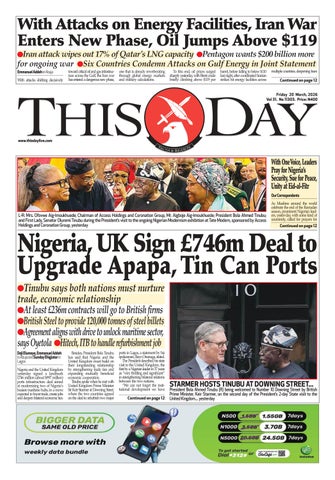
Nigeria and the United Kingdom yesterday signed a landmark £746 million (about $997 million) ports infrastructure deal aimed at modernising two of Nigeria’s busiest maritime hubs, in a move expected to boost trade, create jobs and deepen bilateral economic ties.
Besides, President Bola Tinubu has said that Nigeria and the United Kingdom must build on their longstanding relationship by strengthening trade ties and expanding mutually beneficial economic cooperation.
Tinubu spoke when he met with United Kingdom Prime Minister Sir Keir Starmer at Downing Street, where the two countries agreed on the deal to refurbish two major
ports in Lagos, a statement by his spokesman, Bayo Onanuga, stated.
The President described his state visit to the United Kingdom, the first by a Nigerian leader in 37 years as “very thrilling and significant” in strengthening bilateral relations between the two nations.
“We can not forget the institutional development we have
Nigeria, UK Sign £746m Deal to Upgrade Apapa, Tin Can Ports
Continued on page 12 With One Voice, Leaders Pray for Nigeria’s Security, Sue for Peace, Unity at Eid-al-Fitr
Emmanuel Addeh in Abuja
L-R: Mrs. Ofovwe Aig-Imoukhuede; Chairman of Access Holdings and Coronation Group, Mr. Aigboje Aig-Imoukhuede; President Bola Ahmed Tinubu; and First Lady, Senator Oluremi Tinubu during the President’s visit to the ongoing Nigerian Modernism exhibition at Tate Modern, sponsored by Access Holdings and Coronation Group, yesterday
Deji Elumoye, Emmanuel Addeh in Abuja and Sunday Ehigiator in Lagos
BILATERAL MEETING WITH UNITED KINGDOM PRIME MINISTER, KEIR STARMER...
L-R: Principal Private Secretary to the President, Hakeem Muri-Okunola; Minister of Finance and Coordinating Minister of the Economy, Mr. Wale Edun; President Bola Ahmed Tinubu; Minister of Industry, Trade and Investment, Dr. Jumoke Oduwole; and National Security Adviser, Mallam Nuhu Ribadu, during a bilateral meeting with United Kingdom Prime Minister, Keir Starmer at the Prime Minister’s Office, Downing Street, London, yesterday
ADC: Nigeria’s 4th Global Terror Ranking Confirms Tinubu’s Failure in Security
APC-led FG dancing on blood, says PDP Zulum vows to hunt down collaborators of terrorists
We’ll strengthen operational capabilities for effective performance, CDS tells troops
CSO calls for collective action against terrorism, urges support for armed forces
Chuks Okocha, Linus Aleke in Abuja and Muhammad Sabiru in Maiduguri African Democratic Congress (ADC) has responded to the latest Global Terrorism Index (GTI) 2026 report, describing Nigeria’s ranking as the fourth most terrorism-affected country in the world as clear evidence of the failure of the Bola Tinubu government to secure the country.
Peoples Democratic Party (PDP) also said the ranking was an indication of the failure of security and the terrible level of bloodletting in Nigeria, saying APC is dancing on the blood of the citizenry.
However, Borno State Governor, Professor Babagana Zulum, issued a stern warning to individuals or groups aiding or collaborating with terrorists, vowing to hunt them down to face wrath of the law.
Chief of Defence Staff (CDS), General Olufemi Oluyede, reaffirmed the commitment of the Armed Forces of Nigeria (AFN) to strengthening operational capabilities, improving administrative support, and enhancing the overall effectiveness of military personnel in addressing the country’s security challenges.
A Civil Society Organisation (CSO), Peace and Security Focus Group, called for a united front against terrorism in Nigeria, urging citizens, particularly those in the North-east, to actively support the ongoing efforts of the armed forces to tackle insurgency.
In a statement by its National Publicity Secretary, Mallam Bolaji Abdullahi, ADC cited data from the terrorism report, including a 43 per cent rise in attacks and increasing civilian deaths, saying the findings point to a breakdown in governance, not just a security lapse.
To address the crisis, ADC outlined a three-part strategy focused on improving intelligence coordination, decentralising policing to bring security closer to communities, and shifting from reactive responses to preventive, intelligence-led security
operations.
ADC said, ‘’Against the deeply troubling backdrop of yet another deadly terrorist attack in Borno State, where dozens of Nigerians have been killed and many more injured, the African Democratic Congress (ADC) has reviewed the newly released Global Terrorism Index (GTI) 2026, which delivers a clear and troubling verdict on the state of insecurity in Nigeria today.
‘’Nigeria is now ranked the fourth most terrorism-affected country in the world. That is not an abstract statistic. It is a direct reflection of the failure of the Bola Tinubu-led APC government to secure the country.
‘’At a moment when Nigerians are grieving and communities across the country are living under constant threat, Tinubu, his National Security Adviser, and the Minister of Defence are abroad. The contrast is clear: a country in crisis, and a leadership that is absent.
‘’Nigerians should take note of this moment. It raises a fundamental question about Tinubu and the APC’s priorities. At a time that demands focus, discipline, and urgency, the Tinubu government appears more concerned with pageantry, paparazzi, and propaganda — rather than real performance.”
The opposition coalition added, ‘’The Global Terrorism Index confirms what Nigerians already know from lived experience. Terror attacks have surged by 43 per cent, rising from 120 incidents in 2024 to 171 in 2025.
Violence is increasingly concentrated in Borno State, which now accounts for 67 per cent of attacks and 72 per cent of deaths.
‘’Most concerning, civilians now make up 67 percent of those killed. That is a measure of how exposed ordinary Nigerians have become.’’
PDP: APC-led FG Dancing on Blood
PDP said the just-released Global Terrorism Index 2026 by the Institute for Economics and Peace indicated
the failure of security and the level of bloodletting in Nigeria.
In a statement by National Publicity Secretary of PDP, Ini Ememobong, the party said Nigeria accounted for a 70 per cent increase in deaths when compared with other countries.
‘’While this report is not surprising to Nigerians, it is most painful that people who promised and were elected and appointed to secure our country are wining, dining, and dancing in a faraway land, whilst terrorists are killing and kidnapping citizens rampant-ly,’’ Ememobong stated.
He explained that the global report aligned with the daily lived reality of Nigerians, who were now more insecure than they had ever been in the Fourth Republic.
The PDP spokesman said, ‘’Under President Tinubu’s watch, insecurity has not just become very lucrative, it has attained a trillion-naira economy status.
‘’We call on the President and the entire security hierarchy to stop performing reactive responses that have defined post-attack communications and rather adopt a whole-of-society approach towards solving insecurity.
‘’Furthermore, they should evolve programmes and policies capable of delivering negative peace (cessation of attacks and incidents) immediately and providing the basis for positive peace (voluntary and unforced harmonious co-existence).
‘’It needs reminding that the primary duty of every government is the protection of lives and property – a task that this administration has consistently failed glaringly.
‘’We appeal to the president to deploy his famed political ‘mastery’ to provide a solution to the security of lives and property. Nigerians are tired of being killed for no reason.’’
Zulum: We’ll Hunt Down Collaborators of Terrorists
Borno State Governor, Professor Babagana Zulum, warned individuals and groups aiding terrorists in the
state, vowing to hunt them down to face the wrath of the law.
Zulum, who gave the warning during a state-wide broadcast, said, “To those who feed them (terrorists) with information, shelter them and their sympathisers, and provide logistical support, your time is up.
“You are not patriots; you are enemies of the state. You will be hunted down and made to face the full wrath of the law. Your actions betray our collective peace, and we will no longer tolerate them.”
Zulum said the recent resurgence of insecurity in parts of the state was concerning.
He stated, “As the chief security officer, let me assure you that the overall security environment, while tested, remains under control, and we are doing everything possible to protect lives and property.
“Over the past seven years, we have worked tirelessly to restore peace and prosperity to the great land and rebuild our state. Within the period, we have responded with prompt, positive actions on every occasion.
“We have not allowed the dark dreams of the wayward ones to take root, and instead, we have fostered hope and resilience among the communities affected by the conflict.”
The governor said, “Through a combination of consultations and collective planning, with the strong support of our security agencies and the civilian JTF, the Almighty Allah (SWT) has helped us achieve some measure of success and peace.
“We do not believe that the decrease in past attacks signals the end of the insurgency. No, it is not. In fact, at the leadership level, we are very conscious of the fact that much more needs to be done to permanently address the root of this madness and the menace of illogical attacks among our peace-loving people.”
Zulum said the recent attacks were a direct consequence of the sustained and aggressive military operations being conducted across the theatre.
He stated, “These operations have
dislodged the criminals, forcing them to flee and seek respite by infiltrating our communities. However, I want to reassure you that the worst days are over.
“We have been constantly assessing the situation, and a robust, coordinated response is already in motion. These cowardly elements who seek to disturb our peace will obtain no sanctuary in Borno State. We will deal decisively with their recent resurgence.”
We’ll Strengthen Operational Capabilities for Effective Performance, CDS to Troops
Chief of Defence Staff (CDS), General Olufemi Oluyede, reaffirmed the commitment of the armed forces to strengthening operational capabilities, improving administrative support, and enhancing the overall effectiveness of military personnel in addressing the country’s security challenges.
In his 2026 Eid el-Fitr message to officers and personnel of the armed forces, Oluyede emphasised the need for sustained professionalism, resilience, and dedication, while also calling on Nigerians to continue supporting the military in its efforts to safeguard the country.
Oluyede stated that the successful completion of the Ramadan fast offered an opportunity for reflection on the values of sacrifice, discipline, and compassion, which he described as essential both in personal conduct and in military service.
He urged the personnel to uphold those virtues, stressing that they are critical to fostering unity within the armed forces and strengthening national cohesion.
Oluyede acknowledged the enormous responsibility borne by the military in defending Nigeria’s sovereignty and territorial integrity, paying tribute to personnel, who had lost their lives in the line of duty, as well as those who sustained injuries.
According to him, their sacrifices remain invaluable and would never
be forgotten.
The CDS called on troops deployed across various theatres of operation to remain disciplined, courageous, and committed to their constitutional responsibilities.
He stressed the importance of consolidating joint operations, enhancing synergy among the services, and maintaining a proactive posture to counter emerging threats.
CSO Calls for Collective Action Against Terrorism, Urges Support for Armed Forces A Civil Society Organisation (CSO), Peace and Security Focus Group, called for a united front against terrorism in Nigeria, urging Nigerians, particularly in the North-east, to actively support the ongoing efforts of military to tackle insurgency.
The group, based in the North-east, specifically appealed to residents of Borno and Yobe states to play a more proactive role in combating terrorism.
It stressed that the insurgency extended beyond a security concern, posing a serious threat to the region’s economic stability and long-term development.
Speaking at a community forum in Maiduguri, the organisation’s founder, Ismail Mohammed, stated that Boko Haram and similar groups often operated from within local communities, taking advantage of fear and informal networks to sustain their activities.
Mohammed warned that the continued presence of insurgents within communities had prolonged suffering for ordinary citizens, insisting that the fight against terrorism cannot be left solely to the military.
He said, “For too long, insurgents have hidden among us, carrying out attacks while innocent people bear the consequences. This is a collective responsibility. Residents must take ownership of the fight to reclaim their communities, markets, and livelihoods.”
AGREEMENT SIGNING CEREMONY...
R-L: Minister of Finance and Coordinating Minister of the Economy, Mr. Wale Edun and Parliamentary Under-Secretary of State and UK Minister of Small Business and Economic Transformation, Mr. Blair McDougall sign a £746 million financing agreement to modernise Apapa and Tin Can Island
FG, Britain Sign MoU to Speed Up Deportation of Nigerians with Visa Overstays, Others
Visa overstayers, foreign criminals and failed asylum seekers will be removed from British soil far more easily under a new agreement struck during the state visit of Nigeria’s President, Bola Tinubu, the UK government said in a statement yesterday.
UK letters, an alternative identification document issued to individuals without a valid passport and used to support the return of people with no right to remain in the UK, will be recognised by the Nigerian government for the first time, the release stressed.
The agreement, reached between the Home Secretary, Shabana Mahmood, and Nigeria’s Minister of Interior, Dr Olubunmi Tunji-Ojo, removes one of the major administrative hurdles to returning people, meaning the UK will no longer have to wait for emergency travel documents to be issued by Nigeria.
The new deal adds to the sweeping reforms the Home Secretary has made to the UK immigration system to secure the UK’s borders and remove incentives attracting illegal migrants to Britain, the UK government added.
Minister for Border Security and Asylum Alex Norris said that the
agreement was another step in the UK’s mission to restore order to the border by ensuring those who have no right to be in the country are swiftly removed.
“Anyone who abuses our systems, breaks our laws or tries to cheat their way into Britain will be stopped and removed. Today’s agreement is another step in our mission to restore order to the border by ensuring those who have no right to be here are swiftly removed.
“Nigeria is a key partner in our work to tackle illegal migration, as the UK’s largest African visa market and home to thousands of Nigerians who have built their lives here. We
owe everyone across the system fairness,” Norris said.
For his part, the Minister of Interior, Olubunmi Tunji-Ojo said that those who come to equity must come with clean hands, explaining that Nigeria needs to be as open and as fair as possible in its interaction with the UK.
“For us, as a country, we keep saying that we are totally committed to being a responsible country in fulfilling our core obligations.
“It is good that we are starting this with the UK. This relationship with the UK means a lot to Nigeria.
President Bola Ahmed Tinubu has shown great commitment to this.
House Committee Warns of Imminent Queues, Price Hike Over Dangote Supply Gaps
The House of Representatives Committee on Petroleum Resources (Downstream) has warned about imminent return of fuel scarcity and queues in Nigeria.
The committee stated that petrol prices might also rise if urgent steps were not taken to address crude supply challenges to domestic refineries.
The chairman of the committee, Ikeagwuonu Ugochinyere, gave the warning on Thursday while briefing journalists in Abuja. Ugochinyere said the situation was a major threat to economic stability and the welfare of Nigerians.
He decried the inadequate supply of crude oil to the Dangote refinery, which remains central to Nigeria’s efforts to stabilise fuel supply.
Ugonchiyere revealed that findings from the committee’s oversight activities pointed to a strong likelihood of an increase in
the price of Premium Motor Spirit (PMS), driven not by deliberate government policy but by critical supply chain inefficiencies.
The chairman stated that while the refinery was entitled to about 21 cargoes of crude oil and required at least 15 to operate optimally, it was currently receiving only five cargoes — far below the minimum threshold needed to sustain production.
He cautioned that unless the issues were resolved within 48 hours, the country could witness a resurgence of fuel queues, supply disruptions, and worsening hardship driven by higher pump prices.
Ugonchiyere added, “This shortfall is already undermining refining capacity and poses a direct risk to fuel availability across the country.
“Crude oil produced in Nigeria is being sold to our refineries through middlemen based in London and Dubai, who add no value but collect huge fees.
“For every barrel priced at $100, refineries pay $118, with the additional $18 going to intermediaries.”
To avert a looming crisis, the
committee called on the Presidential Technical Committee on the Crudefor-Naira initiative to reconvene within 48 hours to resolve the supply bottlenecks.
“So it is one relationship that we aim to be able to sustain for generations yet to come. And for us to sustain that relationship, we must remember: ‘He who comes to equity must come with clean hands.’ So we need to be as open and as fair as possible. Hopefully, this strengthened partnership will be a template for other bilateral understandings,” he emphasised.
The agreement, according to the statement, marked a shared commitment to safe, fair and well managed migration.
Annual returns to Nigeria, it said, have nearly doubled to 1,150, while returns and deportations of illegal migrants and foreign criminals from the UK have reached nearly 60,000 since the 2024 election.
A further agreement to launch joint operations and share information, it stressed, has been reached to crack down on criminal gangs abusing visa routes, making sure all arrivals are genuine and ready to contribute.
Following a series of high profile cases involving fake job sponsorships,
sham marriages and forged financial or employment records, it stated that a new standardised document checking system will verify the authenticity of applications.
Nigeria, the UK said, will also review its laws to tackle immigration crime, ensuring the toughest possible sentences are handed down to offenders.
The UK said it has strengthened its commitment to protecting Nigerian women and children at risk of exploitation, while improving business visa schemes to help UK and Nigerian companies pursue investment opportunities aimed at driving economic growth.
A new partnership targeting online scammers involved in romance fraud, investment scams and cryptocurrency schemes, according to the statement, will also deliver stronger protections for the UK public.
The new “fusion cell” model, it explained, will bring together public sector bodies, banks, tech firms and communications companies to rapidly share intelligence on criminal tactics so swift action can be taken.
MultiChoice Talent Factory Extends Application Deadline for 2026 Intake
Pan-African film and television training institution, MultiChoice Talent Factory (MTF), has announced an extension of its application deadline for its 2026 intake to April 27, giving aspiring African filmmakers, directors, producers, scriptwriters and storytellers across the continent additional time to apply for its fully funded, industry-accredited training programme.
The initiative, established by MultiChoice Group, a CANAL+ company, is committed to discovering and nurturing the next generation of storytellers by providing access to
mentorship, technical training, and real-world production experience in film and television.
The programme is open to young creatives aged 18 to 35 with a passion for the screen industry. Applicants may hold qualifications in film, television, media, drama, or related creative disciplines or possess one to two years of industry experience. A formal film degree is not required.
Participants will be exposed to a structured 12-month programme across key areas, including scriptwriting, production management, directing, cinematography, editing,
sound, and various post-production specialities, gaining experience in bringing stories to life.
The programme is fully funded, covering tuition, production costs, and monthly stipends, allowing participants to focus entirely on developing their craft.
MTF operates academies across four African cities: Johannesburg (South Africa), Nairobi (Kenya), Lagos (Nigeria), and Lusaka (Zambia), ensuring a diverse pool of talent is trained to contribute to the growth of Africa’s film and television industry.
Maisha Magic, Zambezi Magic, and Africa Magic. MTF graduates have earned nominations and awards at major platforms such as the Africa Magic Viewers’ Choice Awards (AMVCA), Uganda Film Festival, and Women in Film Awards. Alumni also collaborate in global creative spaces, including the European Film Market and Durban FilmMart.
Since its launch in 2018, MTF has trained nearly 300 filmmakers, with participants producing over 42 movies during the programme. These projects are broadcast on DStv and GOtv channels, including
Adedayo Akinwale in Abuja
Emmanuel Addeh in Abuja
ports in Lagos at Lancaster House, London, yesterday
AGREEMENT TO MODERNISE APAPA AND TIN CAN ISLAND PORTS SIGNED...
President Bola Ahmed Tinubu witnessed the signing of a £746 million financing agreement between Nigeria’s Ministry of Finance, led by Mr. Wale Edun; Parliamentary Under-Secretary of State and UK Minister of Small Business and Economic Transformation, Mr. Blair McDougall; and Citi Bank to modernise Apapa and Tin Can Island ports in Lagos at Lancaster House, London, yesterday
Simbi Wabote: How Niger Delta Wasted Over $258bn in 26 Years
As stakeholders discuss new devt model
Over $258 billion that accrued to the six Niger Delta States in the last 26 years from federal allocation, excess crude, amnesty programme, among other interventions, was not properly utilised for the transformation of the region.
Oil expert and former Executive Secretary of Nigeria Content Development and Monitoring Board (NCDMB), Mr. Simbi Wabote, made the assertion yesterday in Port Harcourt.
Wabote spoke at the first Niger Delta Chambers of Commerce, Industry, Trade, Mines and Agriculture (NDCCITMA) forum.
He said the funds could not be accounted for and channelled properly to the development of the region.
Wabote blamed the situation on policy inconsistency, failure to create a workable framework, and volatile political environment.
The former NCDMB executive secretary, who decried the situation, cited Rwanda, with less than half the population of the Niger Delta, and a lower Gross Domestic Product (GDP) than the region, which transformed its economy, currently ranking among the fastest growing in Africa.
He stated that the failure of both the private and public sectors to synergise and evolve a workable blueprint had put Niger Delta in a backward situation.
He urged concerted effort to diversify the economy from reliance on oil.
“We should establish clear metrics,” Wabote said, to monitor progress, and set targets by institutionalising accountability.
Managing Director of Niger Delta Development Commission (NDDC), Dr. Samuel Ogbulu, called for proper needs assessment in the region.
Ogbuku said a suitable needs assessment template will help to drive development and ensure that projects executed were based on priorities and were tailored to uplift the people.
He said the new NDDC board had committed to changing the old narrative to fit into the realities and needs of the region.
Ogbuku commended President Bola Tinubu for ensuring that board
members completed their tenures for stability and proper management of resources.
Urging all stakeholders to confer and evolve a fresh blueprint for the region’s business development, Ogbuku said, “We need to think out of the box on the necessity of bringing back the region to what it used to be.”
He tasked the private sector to work towards driving the new initiative,
pointing out that government cannot do it alone.
Chairman of NDCCITMA, Ambassador Idaere Gogo Ogan, disclosed that the conference, the first of its kind, and will draw up a template to revive business and economic growth in the region.
“We need to start producing results and go beyond our potentials. And this will help define a new roadmap,”
Ogan stated.
Ogan added, “We must use our brain. If we use our brain collectively and individually, results will come.
The Niger Delta does not begin from insignificance. It begins from weight.
“On the last broadly comparable all-state baseline, the nine-state Niger Delta accounted for roughly one-fifth of Nigeria’s economy.”
Board Secretary of the chambers,
Chief Solomon
commended the huge participation of stakeholders. Edebiri emphasised that the conference will promote ease of doing business, and leverage medium and small-scale businesses by preparing their minds for the future.
He assured that the conference will set up an action plan once resolutions were reached on how to revive the region’s economy.
Ajapa Marginal Field: Ogulagha
Stakeholders Kick Against 2007 MoU
Say it falls short of proportionality
Stakeholders in Ogulagha Kingdom in Burutu Local Government Area of Delta State said yesterday that the agreement signed between Britannia-U Nigeria Limited and the Ogulagha Kingdom in 2007, regarding operation of Ajapa Marginal Field, might not meet transparency and proportionality expectations in 2026. The stakeholders stated that the 2007 MoU was not tied to production, “whether output increases or oil prices rise.” They stressed that Ogulagha Kingdom was not merely a host community, but also a registered shareholder in the Ajapa Marginal Field structure.
Addressing journalists in Warri on behalf of stakeholders of the Ogulagha Kingdom, Mr. Jude Iyalagha, said there was no revenue sharing formula, no indexed development fund, and no
escalation clause in the MoU.
Iyalagha stated, “Over time, inflation reduces value, while oil revenue may grow. That is how inequality expands quietly, through static agreements in a dynamic industry.
“Ogulagha Kingdom is not merely a host community, but also a registered shareholder in the Ajapa Marginal Field structure, documented with Nigeria’s Corporate Affairs Commission.”
Iyalagha stated that the community representatives claimed they had not consistently received audited accounts, production visibility, or clarity on dividend declarations.
He explained, “The introduction of the Petroleum Industry Act has reshaped host community structures in Nigeria, establishing more defined trust mechanisms and governance expectations. Agreements signed before this reform, may now appear outdated when measured against
current standards.
“The agreement provided: N150,000 per community per year for drugs. With seven communities, this totalled N1.05 million annually. Scholarships for two secondary students per community at N30,000 each, and one tertiary student at N75,000. Across the kingdom, this amounted to N945,000 yearly. Two trainees per community at the Petroleum Training Institute in Effurun, plus a N50,000 allowance each. A 20 per cent salary incentive for science teachers. N10,000 per sitting for kingdom committee meetings. In 2007, these figures were considered workable.”
Iyalagha stated that with 2026 economic terms, the value of those arrangements had been sharply reduced by inflation stressing, “What could once stock a modest health centre today barely covers basic medication procurement. The commitments were
fixed sums. They were not indexed to oil prices, production volume, or inflation. That structural detail would later prove significant.
“Marginal fields in the Niger Delta commonly produce between 3,000 and 10,000 barrels per day, depending on development phase. Using a conservative estimate of 5,000 barrels per day: 5,000 barrels x 365 days equals 1,825,000 barrels annually.
“At an average price of 70 US dollars per barrel, annual gross revenue would reach about 127.75 million dollars. At roughly N1,400 per dollar, that converts to approximately N178 billion per year in gross revenue. Even after deducting operating costs, royalties, and taxes, the revenue scale remains in tens of billions of naira annually.”
He added, “For families living near oil installations and flare stacks, development is expected to mean more than small scholarship slots. It
should translate into modern clinics, vocational hubs, shoreline protection, potable water systems, and structured employment pipelines.
“The agreement includes environmental clean-up obligations, yet it does not establish a pre funded restoration pool. For Ogulagha Kingdom, the concern is not simply what was promised, but whether the framework was strong enough to secure long term protection.”
Iyalagha maintained that if shareholding existed in formal filings, but governance participation did not occur in practice, the issue shifted from corporate social responsibility to corporate accountability.
He said, “Without access to Production data, lifting schedules, cost recovery details, royalty payments, dividend records, A shareholder cannot independently verify profitability or entitlement.
Blessing Ibunge in Port Harcourt
Edebiri,
Sylvester Idowu in Warri
Providus, Unity, Keystone, Mauritius Bank Yet to Meet CBN Recap Threshold
30 others meet requirement
Kayode Tokede
With just 11 days to the end of Central Bank of Nigeria (CBN) new minimum capital requirement exercise, facts have emerged that Providus Bank Limited, Unity Bank Plc, Keystone Bank and Mauritius Bank are yet to comply with the apex bank sector’s recapitalisation policy. .
A report obtained by THISDAY revealed that Zenith Bank Plc, 29 others have met the CBN’s March 31, 2026 banking sector
recapitalisation deadline.
Unity Bank, and Keystone Bank, both national banks, required N200 billion minimum capital while Providus, a regional bank, required N50 billion.
The recapitalisation programme, announced in 2024, raised minimum capital to N500 billion for international banks, N200 billion for national banks, and N50 billion for regional banks. Non-interest banks are required to hold N20 billion (national) and N10 billion (regional).
According to the CBN, the recapitalisation drive, which began in 2024, is progressing across the industry as financial institutions strengthen their capital bases through various fundraising strategies.
Also, the recapitalisation programme is part of broader reforms aimed at strengthening Nigeria’s financial system and positioning banks to better support economic growth.
The Acting Director of Corporate Communications
at the CBN, Hakama Sidi-Ali in a statement had disclosed that 30 banks have already met the new minimum capital thresholds introduced under its ongoing banking sector recapitalisation programme.
The statement read, “As of March 6, 2026, the recapitalisation exercise is progressing steadily. Thirty (30) banks have met the new minimum capital requirements applicable to their respective licence authorisations. In total, 33 banks have raised additional capital through rights issues,
initial public offerings (IPOs), and private placements as part of the programme.”
While several banks have already achieved the required capital levels, the CBN said the remaining institutions are currently undergoing routine supervisory checks before their compliance is formally confirmed.
“The CBN reiterates that the Nigerian banking system remains stable and sound. The recapitalisation programme remains firmly on track and will further strengthen
NIGERIA, UK SIGN £746M DEAL TO UPGRADE APAPA, TIN CAN PORTS
enjoyed over the years,” the Nigerian leader said at Downing Street ahead of bilateral talks, noting that discussions covered trade, the economy, climate change, terrorism, and wider global challenges.
“Nigeria is currently going through strong reforms of its economy, and we will discuss that further in our bilateral discussions. Currently, the entire world is challenged. Nigeria is not immune to what is happening around the world. I have seen your reactions on television on certain developments.
“My reaction, as you rightly said, is the economy and the welfare of the people and how we should work together to improve the livelihood of our people,” the Nigerian leader said.
In his remarks, Prime Minister Starmer, described the visit as historic and highlighted the significance of the State Banquet hosted by the King in honour of the Nigerian delegation.
He reaffirmed the United Kingdom’s appreciation of its enduring relationship with Nigeria, particularly the vibrant people-to-
people connections that continue to strengthen both societies. He noted that both countries already maintain strong collaboration in areas such as the economy, defence, and security, and said the newly reached agreements on exports and business exchanges reflect a shared determination to deepen cooperation and broaden engagement on global issues.
Later, at Lancaster House, President Bola Tinubu, together with his wife, Oluremi Tinubu, witnessed the £746m agreement for the modernisation of the
infrastructure at the Apapa and Tin Can Island ports in Lagos. The agreement was signed on behalf of Nigeria by the Minister of Finance and Coordinating Minister of the Economy, Wale Edun and the Parliamentary Under-Secretary of State and UK Minister for Small Business and Economic Transformation, Blair McDougall, on behalf of the British government.
Edun explained that the agreements are consistent with Nigeria’s priority on infrastructure, energy, and industrial development.
He noted that the increasing
WITH ONE VOICE, LEADERS PRAY FOR NIGERIA’S SECURITY, SUE FOR PEACE, UNITY AT EID-AL-FITR
the nation, especially in the area of security, while at the same time suing for peace and unity of Nigeria.
The leaders, who despite their differences in faith and political leaning sent out wishes and greetings, were, however, concerned about many things, chief of which was the security of the country.
President Bola Tinubu, while congratulating the Muslim faithful in Nigeria, urged renewed commitment to the nation and humanity.
The president, in a release by his Adviser on Information and Strategy, Bayo Onanuga, enjoined Nigerian Muslims to rededicate themselves to the noble teachings of the holy month, which emphasised piety, empathy, and unity among humanity.
“We have a lot to draw from the noble lessons of Ramadan, especially at a time like this. We must continue to abide by the virtues of piety, selflessness, perseverance, kindness and compassion beyond this period,” he said.
Tinubu urged all Muslim faithful to extend a hand of kindness to the needy of all faiths, to further show unity and camaraderie.
The president also tasked Muslim leaders to use the occasion to offer prayers for peace and prosperity to prevail in the country.
Atiku Urges FG to Prioritise Security
Former Vice President Atiku Abubakar called on the federal government to prioritise the security of the people.
Congratulating the Muslim faithful in Nigeria and across the world on the successful completion of the Ramadan fasting, Atiku urged the government to pay attention to security.
He stressed, “The protection of the lives and property of citizens is a divine decree and the sole responsibility of every government.
“A greater number of people
are being crushed by the economic downturn and global events in the past three weeks have further exacerbated the situation.
“It is incumbent on the wealthy to be more compassionate by taking up the responsibility of charity to help cushion the effect of the burden on the poor.”
A press statement by his media of- fice admonished Muslims to remain steadfast in piety by maintaining peace and engaging in charitable causes.
He stated, “The completion of the Ramadan fasting is a call to duty that ensures we sustain the good deeds that the noble month requires of us.
“We must ensure that the lessons of the month are not lost on us and that the celebration of today is a reminder to the people, especially Muslims, to follow in the tradition of the noble Prophet Muhammad (SAW) in seeking closeness to God through worship and maintaining peace.”
Akpabio, Barau, Bamidele Rally Nigerians for Unity, Compassion, Security Reforms
Leaders of the Senate called for renewed commitment to national unity, compassion for the less privileged, and far-reaching reforms to tackle insecurity.
They also expressed optimism over ongoing economic and security interventions by the federal government.
President of the Senate, Godswill Akpabio, extended warm felicitations to the Muslim faithful, urging them to uphold the values of compassion, forgiveness, and generosity cultivated during the holy month of Ramadan.
In a message by his Special Adviser on Media and Publicity, Eseme Eyiboh, Akpabio congratu- lated Muslims on the successful completion of the Ramadan fast, describing Eid-el-Fitr as a period that embodies the virtues of empathy,
kindness, and unity.
He emphasised the need for Nigerians to show greater concern for the less-privileged in society, stating that the essence of the season lay in giving and promoting harmony. Akpabio added that the spirit of the season should inspire citizens to work collectively towards a more just and harmonious society, while praying for peace, progress and prosperity in Nigeria and across
of prolonged supply disruptions and wider regional instability.
The escalation followed earlier Israeli strikes on Iran’s South Pars gas field, triggering a cycle of retaliation that has now placed some of the world’s most strategic energy assets directly in the line of fire.
Perhaps, the most consequential blow came in Qatar, where Iranian strikes on the Ras Laffan industrial hub damaged facilities responsible for about 17 per cent of the country’s liquefied natural gas output. The destruction of key LNG trains and processing units is expected to take up to five years to repair, removing millions of tonnes of supply annually from global markets.
As the world’s largest LNG exporter and a supplier of roughly a fifth of global demand, Qatar’s disruption has sent shockwaves through Europe and Asia, forcing contract suspensions and raising the prospect of a prolonged global gas shortage. The targeting of such infrastructure marked a strategic shift in the conflict, from military confrontation to economic warfare with global consequences.
Amid the intensifying conflict, the US Department of Defence is pushing for additional funding to sustain expanding military operations in the region, reflecting concerns that the war is entering a prolonged and resource-intensive
the globe.
Similarly, Deputy President of the Senate, Barau Jibrin, urged Muslims to sustain prayers for global peace amid rising international tensions, while highlighting the economic implications of ongoing global conflicts.
Barau, in a statement by his media aide, Ismail Mudashir, expressed concern over price shocks linked
Continued on page 32
phase.
Also, Israeli Prime Minister Benjamin Netanyahu has rejected claims that Israel’s actions triggered deeper US involvement, insisting that Tehran’s retaliatory strikes, not Israeli offensives, are responsible for widening the conflict.
His comments came amid growing international concern that the war risks evolving into a broader regional confrontation involving multiple state actors. While Israel maintained that its strikes were preemptive and necessary, critics argue that the targeting of Iran’s energy infrastructure set off the current chain reaction now engulfing the Gulf.
In the same vein, highlighting the rising risks to advanced military assets, a US F-35 fighter jet was forced to make an emergency landing after sustaining damage believed to be from Iranian fire.
The incident marked a rare vulnerability for one of America’s most sophisticated aircraft and underscored how contested the operational environment has become.
Iran Attack Knocks Out 17% of Qatar’s LNG Export Capacity
Iranian attacks have knocked out 17 per cent of Qatar’s Liquefied Natural Gas (LNG) export capacity, causing an estimated $20 billion in
sector to support households, businesses, and sustainable economic growth,” the statement noted.
emphasis on bilateral partnerships would help attract the scale of investment required to boost economic activity, create jobs, and reduce poverty, in line with the administration’s ‘Renewed Hope Agenda’.
He said the agreements underscored growing confidence and mutual trust between both countries, as well as a shared commitment to deliver tangible economic outcomes for Nigeria and the United Kingdom.
The agreement, finalised yesterday, will fund the refurbishment of the Lagos Port Complex (Apapa Quays) and the Tin Can Island Port Complex through a financing package guaranteed by UK Export Finance (UKEF).
The project, delivered via UKEF’s Buyer Credit Facility and coordinated by Citibank N.A, London Branch, is expected to support thousands of skilled jobs in both countries while injecting hundreds of millions of pounds into their economies.
Under the deal, at least £236 million worth of contracts will
lost annual revenue and threatening supplies to Europe and Asia, QatarEnergy’s CEO told Reuters on Thursday.
Saad al-Kaabi said two of Qatar’s 14 LNG trains and one of its two gas-to-liquids (GTL) facilities were damaged in the unprecedented strikes. The repairs will sideline 12.8 million tons per year of LNG for three to five years, he said in an interview.
“I never in my wildest dreams would have thought that Qatar would be - Qatar and the region - in such an attack, especially from a brotherly Muslim country in the month of Ramadan, attacking us in this way,” said Kaabi, who is also Qatar’s minister of state for energyHoursaffairs.earlier Iran had aimed a series of attacks at Gulf oil and gas facilities after Israeli attacks on its own gas infrastructure.
State-owned QatarEnergy will have to declare force majeure on long-term contracts for up to five years for LNG supplies bound for Italy, Belgium, South Korea, and China due to the two damaged trains, Kaabi said.
“I mean, these are long-term contracts that we have to declare force majeure. We already declared, but that was a shorter term. Now it’s whatever the period is,” he said.
QatarEnergy had declared force majeure on its entire output
go to British firms, including a record £70 million steel supply agreement awarded to British Steel. The company will provide 120,000 tonnes of steel billets to construction firms Hitech Nigeria and ITB Nigeria for the port upgrades.
UK Secretary of State for Business and Trade, Peter Kyle, described the agreement as a significant boost for British industry and UK-Nigeria relations.
“Hot on the heels of our landmark Steel Strategy, this is a major win for British Steel made possible by UK Export Finance, which is testament to the quality of UK-made steel and the booming UK-Nigeria relationship,” he said. On the Nigerian side, the Minister of Marine and Blue Economy, Adegboyega Oyetola, said the initiative aligned with the federal government’s drive to unlock the full potential of the maritime sector.
“The modernisation and upgrading of Nigeria’s ports represents a major step forward for the country… Through strategic
Continued on page 34
of LNG, after earlier attacks on its Ras Laffan production hub, which came under fire again on Wednesday. “For production to restart, first we need hostilities to cease,” he said.
U.S. oil major ExxonMobil is a partner in the damaged LNG facilities, while Shell is a partner in the damaged GTL facility, which will take up to a year to repair. Texas-based ExxonMobil holds a 34 per cent stake in LNG train S4 and a 30 per cent stake in train S6, Kaabi said.
The scale of the damage from the attacks has set the region back 10 to 20 years, he said.
“And of course, this is a safe haven for a lot of people, to have a safe place to stay and so on. And that image, I think, has been shaken.”
The fallout extends well beyond LNG. Qatar’s exports of condensate will drop by around 24 per cent, while LPG) will fall 13 per cent. Helium output will fall 14 per cent, and naphtha and sulphur will both drop by 6 per cent. The damaged units cost approximately $26 billion to build, Kaabi said.
Oil Jumps Above $119/Barrel on Middle East Energy Attacks Nigeria’s benchmark Brent oil
the capacity of the banking
CBN Governor, Yemi Cardoso
CAF AND THE LONGEST FINAL IN FOOTBALL
JOSHUA J. OMOJUWA argues that CAF’s decision to award the 2025 African Cup of Nations title to Morocco is unfortunate
Kingsley Ude, Minister of Innovation, Science and Technology, is off to a good start, reckons PAT ONUKWULI
A TECHNOCRAT AT THE HELM OF INNOVATION
Leadership does not always arrive with fanfare; sometimes it reveals itself in subdued gestures. On a crowded morning flight from Enugu to Abuja earlier this year, as passengers rose from their seats into the familiar aisle congestion after landing, amid the shuffle of impatience and luggage retrieval, one man quietly stepped aside. He beckoned other travellers to pass ahead, no display of rank, no assertion of authority, just a simple act of courtesy that spoke more eloquently than any speech.
A PARTNERSHIP PRIMED TO WORK
The partnership between UNILORIN and NNPCL promises to be rewarding, writes KUNLE AKOGUN See page 21
Only afterwards did recognition settle in the man was Kingsley Tochukwu Ude, Nigeria’s Minister of Innovation, Science and Technology. In a political culture where proximity to power often magnifies posture rather than humility, such quiet restraint felt striking. Yet the gesture seemed less deliberate than instinctive, suggesting that composure is not merely a mannerism, but a defining thread running through his professional journey.
At 45, Ude belongs to a generation shaped by Nigeria’s democratic rebirth and the rise of the global technology era. His academic journey, from the University of Nigeria, Nsukka, to the Universities of Nottingham and Stellenbosch, reflects both discipline and depth, culminating in a focus on comparative public procurement law. Though often viewed as technical, procurement sits at the very heart of governance, determining whether public funds build infrastructure or vanish into inefficiency, where policy ultimately meets reality.
Ude’s professional ascent followed a similarly rigorous path. Elevated to the rank of Senior Advocate of Nigeria, he distinguished himself in legal practice while contributing to academia as a lecturer and researcher. His tenure as Attorney-General and Commissioner for Justice in Enugu State further bridged theory and governance, translating legal principles into institutional reform. These experiences, academic scholarship, professional excellence, and executive responsibility now converge at the Federal Ministry of Innovation, Science and Technology. Yet credentials alone do not transform institutions. Résumés may impress; results persuade.
Since assuming office in November 2025, the ministry has begun signalling a shift, from symbolic custodian of science policy to a strategic driver of innovation. The emphasis is gradually moving from imagination to implementation, from aspirational rhetoric to practical ecosystems.
One internal milestone illustrates this transition. Five ministry officers recently earned national recognition under the federal government’s Digital Literacy for All workforce initiative. At first glance,
the achievement may appear modest. Yet institutional credibility begins internally. A ministry cannot champion digital transformation while operating with analogue systems. Reform must start at home.
Beyond internal capacity building, Nigeria’s presence in global innovation conversations has expanded. Participation in the World Economic Forum in Davos and the establishment of the Nigeria House platform positioned the country as more than a passive observer in international technology networks.
Visibility alone does not create innovation, but invisibility guarantees irrelevance. More consequential, however, are emerging cooperation frameworks with the European Union under Horizon Europe, partnerships capable of unlocking research funding, collaborative laboratories and technology transfer. After all, innovation policy seldom advances through theatrical announcements; it grows through the quiet accumulation of agreements, alliances and institutional linkages that gradually shape thriving ecosystems.
Perhaps the most consequential shift under Ude’s stewardship is the emphasis on commercialising research outputs. For decades, Nigerian universities have produced commendable scholarship that rarely moves beyond academic journals. Ideas flourished; industries lagged. Publications multiplied; patents remained scarce.
The ministry’s evolving agenda seeks to bridge this divide by encouraging research that continues beyond discovery toward industrial application. In other words, the challenge is no longer generating ideas; Nigeria has plenty of those. The real challenge is ensuring that ideas move from concept to creation and from invention to industry.
Without the right structures, creativity may abound, yet productivity remains constrained. Nigeria’s innovation landscape has long reflected this paradox: vision without execution, strategy
without systems, and conferences without commercialisation. True innovation ecosystems are rarely born from sudden breakthroughs; they emerge through deliberate institutional alignment, education that builds STEM capability, capital that nurtures start-ups, regulation that welcomes new technologies, and infrastructure that sustains digital growth. In this delicate structural design, leadership temperament becomes decisive. Innovation flourishes where collaboration replaces hierarchy and curiosity outpaces arrogance. The quiet courtesy glimpsed in that aircraft aisle may seem anecdotal, yet it hints at a leadership temperament suited to building ecosystems, because arrogance closes networks while humility opens them. Still, humility alone cannot drive national transformation; in cabinet rooms dominated by louder portfolios such as finance, petroleum and defence, the innovation agenda demands not only quiet competence but also firm advocacy. The stakes, therefore, are considerable. Nigeria’s economic future cannot rest indefinitely on natural resources. Oil wells may decline, but intellectual capital expands, and nations that convert knowledge into technology, and technology into industry, shape the modern global economy.
For Nigeria, innovation is therefore no longer a luxury policy but a development imperative. Yet optimism must remain disciplined: structural constraints such as limited research funding, persistent brain drain and fragile university–industry linkages endure. Real transformation rarely arrives through sweeping miracles; it begins with clear direction.
Early signals from the ministry, such as capacity building, international engagement, and a rekindled focus on research commercialisation, suggest that important groundwork is underway. Yet in a country where ambitious policies have often faded once political attention shifted, lasting progress will depend less on individual charisma than on institutional persistence. What is emerging, for now, is the portrait of a technocrat intent on repositioning a ministry long overshadowed by more prominent portfolios.
The task is no longer to celebrate ideas but to build systems that turn them into enterprises. Nigeria is not short of imagination; its universities, entrepreneurs and young innovators prove that daily. What the country needs now are the structures that can transform that imagination into industry.
Dr. Onukwuli is a legal scholar and public affairs analyst. patonukwuli2003@yahoo.co.uk
JOSHUA J. OMOJUWA argues that CAF’s decision to award the 2025 African Cup of Nations title to Morocco is unfortunate
CAF AND THE LONGEST FINAL IN FOOTBALL
A few days ago, an On Air Personality (OAP) on Nigeria Info FM called a caller olodo on air. She said, “You are an olodo you know, you came this far just to prove how much of an olodo you are.” It was not in the spirit of the easy banter that Lagos radio has always trafficked in. Just flatly, as though it were acceptable. That alone would have been enough to register as a moment of concern. But the OAP went further, wishing, on air, that the caller gets kidnapped. This was the kind of statement that should have ended a career, at least momentarily via a suspension, before the hour was out. But there was more.
What happened instead was more instructive than the original offence. The radio station did not quietly reprimand the OAP and move on. It posted the video on social media. Proudly. As if to say, “our OAP, in whom we are well pleased.” They deleted it after they were called out. That sequence, from the statement, the amplification, the deletion only under external pressure, tells you more about the moment we are living in than any piece could. We once lived in a world where you’d be hardpressed to know where an OAP or journalist leans, these days, we take their bias for granted. Standards do not collapse all at once. They erode. The unthinkable becomes edgy, edgy becomes normal, normal evolves into boring, and the search for the next transgression begins. Nigeria Info FM did not invent this dynamic, it simply revealed how far along the erosion has gone. These are crazy times and this wasn’t even the craziest thing to happen this week.
On January 18, in Rabat, Senegal beat Morocco 1-0 in the final of the 2025 Africa Cup of Nations. The match was chaotic, controversial, and genuinely extraordinary. Morocco were awarded a stoppage-time penalty with the scores level. Senegal's coach Pape Thiaw led his players off the pitch in protest for 17 minutes while fans tried to storm the field. Captain Sadio Mané eventually coaxed the team back. Morocco's Brahim Díaz stepped up and chipped a ‘Panenka’ straight at goalkeeper Edouard Mendy. The game went to extra time. Pape Gueye scored. Senegal were champions. Or so we thought.
CAF's initial disciplinary hearing imposed fines exceeding one million dollars on both federations and handed out individual bans, but left the result untouched. That was the correct decision. Senegal's players behaved badly. Their coach did even worse. Punish them, fine them, suspend them; all of that was warranted and proportionate. But the game had been played. The referee had managed it. A winner had been produced on the field of play. That should have been the end of it. It was not.
Two months after the final, CAF's Appeal Board handed Morocco a 3-0 forfeit
victory, invoking Articles 82 and 84 of the AFCON regulations. The ruling is without precedent in the history of AFCON, and indeed at the highest level of international football. Morocco did not beat Senegal on a pitch. They beat them in the boardroom, 57 days after the fact, in a process that has handed African football a reputational wound it will be feeling for years.
The Senegalese Football Federation's secretary general called it "a travesty that rests on no legal basis," adding: "We felt that the panel was not there to apply the law, but to carry out an order." CAF awarded a title to the host nation, whose federation brought the appeal, against the team that won the match on the field. Whatever the legal justification, that sequence of facts will follow this decision everywhere.
Morocco's boardroom prize is their first continental title since 1976. They are a fine football nation with genuine quality in their squad. I have written pieces about their football development programme. Achraf Hakimi, Brahim Díaz, a generation of players playing at the highest level of the game. None of them deserved to have it handed to them like this.
The deeper damage is to CAF itself; an institution that has spent years trying to rebuild credibility after decades of governance failures, corruption scandals, and the kind of administrative incompetence that caused FIFA to intervene in its operations. That rebuilding effort, whatever progress it had made, has taken a significant hit. Senegal has confirmed it will appeal to the Court of Arbitration for Sport (CAS) in Lausanne. This process will keep this ruling in public view for the better part of a year, relitigating the decision at every stage. Every month of that process is another month in which the story of the 2025 AFCON is not about the football. It is about whether the organisation running African football can be trusted to govern it.
The answer CAF has given this week is not reassuring.
Senegal's players behaved wrongly. That much is not in dispute. Thiaw himself admitted it in the heat of the moment, that he reacted badly and should not have led his team off.
Omojuwa is chief strategist, Alpha Reach/BGX Publishing
The partnership between UNILORIN and NNPCL promises to be rewarding, writes KUNLE AKOGUN
A PARTNERSHIP PRIMED TO WORK
In its avowed determination to up the ante of institutional operations and set the University of Ilorin on a true path of sustainable growth and enduring development, the Egbewole Administration would appear to have struck gold with the recent meeting between top officials of the University and the leadership of the Nigerian National Petroleum Company Limited (NNPCL). Preliminary snippets from deliberations at the ground-breaking meeting indicated that a consignment of goodies might be on the way for the University.
The Vice Chancellor of the University of Ilorin, Prof. Wahab Olasupo Egbewole, SAN, led a high-powered delegation of the University management to the meeting while the Group Managing Director/ GCEO of NNPCL, Bashir Bayo Ojulari, led the compact team of the national oil giant to the meeting held in the cosy recesses of the NNPC Towers, Abuja.
Although discussions are still at their embryonic stages, it would not be out of place, at this stage, to make some projections on the potential benefits that a partnership between the NNPC and the University of Ilorin could yield for both parties and, by extension, the Nigerian education system in general.
One good sign that this pristine partnership promises to be very rewarding is the businessman-like manner with which both parties approached the March 11 meeting and the promptness with which they set the ball rolling towards delivering a workable synergy.
Already, a joint strategic committee that would midwife the partnership and ensure effective implementation of its terms has been set up, with a deadline of four weeks to turn in its report.
A terse statement by the University management, last weekend, disclosed that discussions between the two parties at the meeting centred mainly on the possibility of the oil behemoth establishing a Centre of Excellence at the University of Ilorin that would be dedicated to practical engineering and technology-driven research. The plan by the NNPC to endow a professorial chair at the University was also discussed.
As with collaborations of this nature, the envisaged UNILORIN – NNPC partnership has the prospect of yielding significant benefits in the realms of Research and Development, Training and Capacity Building, Entrepreneurship and Innovation, and Community Engagement.
The partnership would encourage NNPC to collaborate with UNILORIN on research and development, especially in existing fields like Geology and Geosciences, Environmental Science, and Renewable Energy, to drive innovation and solve industry challenges. It could also be a catalyst for the introduction of new programmes like Petroleum Engineering.
The University could leverage NNPC’s expertise to develop tailored
training programmes for students and professionals as a way of enhancing skills in areas like oil and gas operations, safety, and management.
The partnership could support startup businesses and Small and Medium Scale Enterprises in Kwara State to foster entrepreneurship and economic growth through initiatives like incubation centers, mentorship programmes, and access to funding.
At its fruition, the proposed collaboration could spur the partners to jointly implement social responsibility projects, such as education initiatives, healthcare programmes, and environmental conservation efforts for the benefit of local communities.
Other potential benefits of the UNILORIN – NNPC partnership also include: enhanced industry-academia collaboration, increased research funding opportunities, improved skills and employability for graduates, as well as economic growth and social development in Kwara State.
Indeed, the proposed partnership would be a veritable game-changer! Establishing a Centre of Excellence with NNPC's backing would boost UNILORIN's research capabilities and provide students with hands-on experience.
The expected NNPC professorial chair would also attract top talents to the University and drive innovation in the energy sector.
Being the first of its kind in West Africa, the proposed Centre of Engineering Excellence would position the University as a hub for innovation and expertise in engineering and technology-driven research. It would also attract regional talent, collaborations, and, very likely, investments.
The partnership has a high workability potential if the antecedents of the two team leads, Egbewole and Ojulari are anything to go by. The respective trajectories of the two chief executives are studies in service excellence. Like the proverbial Midas, the two are go-getters who are known to have turned anything they touch to gold!
Akogun is the Director, Corporate Affairs, University of Ilorin
Editor, Editorial Page PETER
ISHAKA
Email peter.ishaka@thisdaylive.com
THE LESSONS FROM RAMADAN
Self discipline, control and sense of community
The Muslims’ holy month of self-purification and self-denial otherwise known as Ramadan has just ended. While it lasted, the season of fasting and prayer offered all Muslims the opportunity to reflect on their relationship with Allah. It also enabled those with means to share food with the poor, the needy and the less privileged. For all Muslims, it was an opportunity to rededicate themselves to the teachings of the faith and the cause of mankind as a whole. Altogether, it was a period of deep reflection on the inter-relationship between man and his neighbour on one hand, as well as man and his God on another.
Even though the month-long fasting has now come and gone, its lessons must endure.
As one of the five pillars of Islam, Ramadan has a highly spiritual significance. To devotees, it was a period of self-emptying without which no spiritual being can have a truly rewarding relationship with his or her maker. That explains why the exercise was marked in Nigeria as elsewhere by private and group prayers, and abstinence from all forms of worldly comforts and pleasures. The aim was to enhance spiritual growth and foster charity and brotherly love.
the course of Ramadan, we invariably place the welfare of our neighbors as important as ours. By allowing others to partake of our wealth or material possessions, we honour the One who gave us the wealth in the first place.
By paying attention to the plight of the poor, we invariably place the welfare of our neighbours as important as ours
EDITOR SHAKA MOMODU
DEPUTY EDITOR WALE OLALEYE
MANAGING DIRECTOR ENIOLA BELLO
DEPUTY MANAGING DIRECTOR ISRAEL IWEGBU
CHAIRMAN EDITORIAL BOARD OLUSEGUN ADENIYI
EDITOR NATION’S CAPITAL IYOBOSA UWUGIAREN THE OMBUDSMAN KAYODE KOMOLAFE
That the Muslim Ramadan and Christian Lent began on the same day this year was not lost on President Bola Tinubu who said that the uncommon occurrence reminds Nigerians that as a people of faith, we share a lot in common. He enjoined Nigerians “to live by the good precepts of our faiths and be honourable in our duty to God and fellow humans.” As the Muslim faithful therefore mark the end of their annual spiritual exercise, the lessons should endure. By paying attention to the plight of the poor as was amply demonstrated in
T H I S D AY N E W S PA P E R S
EDITOR-IN-CHIEF/CHAIRMAN NDUKA OBAIGBENA
GROUP EXECUTIVE DIRECTORS ENIOLA BELLO, KAYODE KOMOLAFE, ISRAEL IWEGBU
DIVISIONAL DIRECTORS SHAKA MOMODU, PETER IWEGBU, ANTHONY OGEDENGBE
This happens to be at the heart of all religions, but a virtue hardly imbibed by many in Nigeria today. That must change. Since the Ramadan fast, like the other four pillars of Islam, was aimed at promoting both the spiritual and material wellbeing of man, it stands to reason that man is invariably better off doing the will of God than merely pleasing himself. When he is able to rein in the impulse for self-gratification and greedy accumulation of wealth, man is more liable to make his society a better place to live in, not only for himself but also for his neighbour. That for us was one of the most enduring lessons of Ramadan which we hope many would have imbibed.
It is noteworthy that fasting as a spiritual exercise is advocated by all religions ostensibly with the notion that the man who can make sacrifices in the bid to tame his desires would be a better person both for himself and the larger society. As one expert puts it, besides abstention from food and drink, fasting helps the faithful “from looking at the provocative, from hearing the mischievous, and from uttering the obscene...to avoid slander and from thinking about inflicting injury to others.”
All said, the nation’s leaders, political and otherwise, have much to take from the lessons of Ramadan. If they can curtail their materialistic tendencies and pay more attention to the yearnings of the people, the country will become a much happier place to live in.
To our numerous Muslim audiences we say, Eid Mubarak. May Allah reward your sacrifice.
Letters in response to specific publications in THISDAY should be brief (150-300 words) and straight to the point. Interested readers may send such letters along with their contact details to opinion@thisdaylive.com. We also welcome comments and opinions on topical local, national and international issues provided they are well-written and should also not be longer than (750- 1000 words). They should be sent to opinion@thisdaylive. com along with photograph, email address and phone numbers of the writer.
FAREWELL, ARTHUR CHRISTOPHER MBANEFO
The Holy Book says there is a season for everything, a time for every preoccupation under heaven. That, has been my refrain when word came that evening that you have gone away.
Arthur Christopher Izuegbunam Mbanefo, Odu the third, MFR,CON, statesman, Internationalist, Traditional chieftain in many cultures, Natural ruler, Ambassador and Plenipotentiary of Biafra and Nigeria, proud professional, Bibliophile, Renaissance man, a very illustrious and distinguished man, in every respect, physically and otherwise, it is sadly a time to say farewell.
I have had the privilege of a close relationship for decades. Fitted as uncle, cousin and nephew and personal friend, chairman at my wedding 40 years ago.
Late 1970s,I almost agreed to train as an Accountant at AW offices on Toyin Street Obalende by St Gregs; I recall the rebuke when in 1991 I resigned my Vice Chairmanship of the Nigeria Football Association, and to the business meetings and several evenings we shared tapping from your depths of historic and contemporary Nigeria. I will miss the manner you intone my cognomen! A mindful Nwadiana of
Awkuzu. I recall my mischief at public events where I had to remind that Awkuzu is present, thereby you always have to secure our permission to preside at the kolanuts. Great and profound respect. Yourself and late elder brother, Akunne Arc Frank, were instrumental to the seed fund, in 1985, to commence the electrification of Awkuzu with Ijele masquerade display at Rowe Park, Yaba.
Your service saga spans from Pro Chancellorship of Unilag, Unife and ABU, chairmanship of Panel on States creation in 1995 and refusal to be partisan, to Presidency of the United Nations General Assembly in year 2000.
As we sat that penultimate week at the dining table, you were lucid. When you responded to my question that you want a Catholic priest, I felt there is a season for everything. Nkataukwu, Odu, Oke Nwadiana, my friend and my boss, Farewell. May the Good Lord receive your soul and grant consolation to the family.
Omelora Tony J.K. Nnachetta, FCS, F. IoD, KSM, Lagos, tn.chair@yahoo. com
Although we all should head to electric vehicles rather than oil guzzling cars it simply isn't happening, so we do need oil. The petrol I buy has gone from $1.49 a litre to $2.39 a litre in less than two weeks and why, because President Trump and one friend Israel are trying to destroy Iran who have responded in a similar manner. This is probably going to get worse given President Trump is threatening to “blow up” the world’s largest gas field. This is vandalism against Iran and the whole world really. All we see is more deaths, violence and destruction, hardly fitting for the possessor, although not winner, of a Nobel Peace Prize. Maybe I read the wrong papers, watch the wrong TV and listen to the wrong podcasts but this and so many sources suggest these actions and others are designed to improve his 'leader' image, unsuccessful, or to distract from the Epstein files, slightly successful as they aren't front page news at the moment.
Dennis Fitzgerald, Melbourne, Australia
Experts: Nigeria Air Travel Growth Stagnant in the Last Ten Years
chinedu eze
Despite having the highest indigenous travelers in Africa, Nigeria has one of the poorest growth records in air travel both on international and domestic routes in the last 10 years, aviation experts and stakeholders have said.
According to estimates, about 99 per cent of people who travel from Nigeria to international destinations are Nigerians, unlike in
many countries in Africa, where tourists and other expatriates constitute major air travel publics.
Investigations revealed that on the domestic route, after improved growth, from 2016, which peaked in 2019 before the COVID-19 interregnum has continued to hover around 12 million, while the international passenger movement has stayed around 4 million.
Compared to countries close to Nigeria in terms
of economy in Africa, like Egypt, Ethiopia, Kenya, South Africa, passenger growth has remained stagnant over the years.
Nigeria recorded improved growth of 6.3 per cent in 2016 with total 15, 232, 597 passenger traffic, but this declined by 8.039 per cent in 2017 with passenger traffic of over 13 million. It later increased to 17, 320, 438 in 2018, and peaked before COVID-19 to reach 18.1 million in 2019,
which was an increase of 23.19 per cent.
This was made of domestic passenger traffic of 12, 791, 639 and international passenger movement of 4, 438, 799.
In 2024 passenger traffic declined by 6.46 per cent to a little over 12.54 million domestic passenger traffic, while and international passenger traffic was 4.37 million, driven by high demand and migration, which brings to a total of
15.7 million, down from 15.9 million in 2023. The figures indicate fluctuating growth and decline, which reflects the undulating nature of air travel in Nigeria, propelled by intemperate economic growth, foreign exchange and the value of the local currency.
Egypt’s air travel passenger growth between 2016 and 2025 experienced significant recovery postpandemic, culminating in a record-breaking in 2025,
where Cairo International Airport alone handled over 30 million passengers and nationwide tourist arrivals reached 19 million, a 21 per cent increase from 2024. Between 2016 and 2025, Kenya’s air travel sector experienced significant growth, marked by a 34 per cent increase in African connectivity since 2014.
A professor of accounting and taxation, Prof John Ohaka has observed that the evolving tax reforms under the Finance Acts and innovation introduced by the federal government represent important steps towards a more transparent and efficient fiscal system in the country.
Ohaka made the observation during his
paper presentation at a multi-level stakeholders breakfast meeting on the New Tax Law, organised by BusinessDay Media in collaboration with the Rivers State Internal Revenue Service (RIRS), in Port Harcourt, yesterday.
Speaking on the topic:
“Reviewing innovations in the Rivers State Internal Revenue Service (RIRS), the 2026 Economic Outlook, and Sustainable Growth
Enhancers,” Ohaka noted that taxation remains one of the most significant policy instruments available to governments for mobilising revenue, redistributing income, and stimulating economic growth.
He said, “In Nigeria, the tax system is designed not only to generate public revenue but also to create incentives that encourage investment, entrepreneurship, and corporate profitability.”
Ohaka, who is the Dean, Faculty of Administration and Management of the Rivers State University, expressed that companies in Nigeria can leverage the new tax Reform Act 2025 to enhance profitability in several ways.
He explained, “Companies with an annual turnover of N100million or less and fixed assets not exceeding N250million are exempt from corporate income
tax, capital gains tax, VAT, Development Levy. Therefore, lowering total expenses and increasing profit level.
“The act (tax reform) has exempted payment of tax for individuals who earn an annual income of less that N800,000 and below. This provision will increase disposable income and drive sales and enhance the profitability of companies, especially the consumer
focused -sector.”
Speaking on the theme of the meeting, “Leveraging Nigeria’s Tax Laws to Enhance Corporate Profitability,” Ohaka said leveraging the country’s tax laws responsibly, businesses cannot only improve profitability but also contribute to national economic development, job creation, and sustainable growth.
Blessing ibunge in Port Harcourt
Nigeria Okays New Airline as Binani Air Secures Approval
Stories by Chinedu Eze
The Nigeria Civil Aviation Authority (NCAA) has issued an Air Operator Certificate to Binani Air Global Services, giving approval to the airline to begin scheduled flight service.
At a ceremony in Abuja, Director General, NCAA, Capt. Chris Najomo, described the development as a major milestone, highlighting the significance of a female-
led airline breaking new ground in a traditionally male-dominated industry.
He commended the resilience of the airline’s founder, Aishatu Binani Dahiru, and her team for navigating the rigorous certification process.
Najomo however cautioned that the approval marks only the beginning, urging strict adherence to safety standards, professionalism and proper planning, stressing that there is
no room for compromise in aviation.
In her response, the airline’s founder expressed appreciation to the NCAA for its guidance, describing the journey as both challenging and rewarding.
She also acknowledged the support of President Bola Ahmed Tinubu and Aviation Minister Festus Keyamo, noting their roles in fostering an enabling environment for the airline’s emergence.
Overland Airways Resumes Flight to Akure from Lagos
Overland Airways has announced the resumption of flight services to Akure from Lagos, effective March 23, 2026.
Speaking on the development, Chief Operating Officer of Overland Airways, Mrs. Aderonke EmmanuelJames, said: “Overland Airways’ resumption of flight services from Lagos to Akure marks a significant milestone in our
commitment to providing reliable and convenient air travel services to the people of Ondo State and adjoining communities across the Southwestern zone of Nigeria. With the existing Abuja-Akure-Abuja flights, it complements and strengthens our dedication to providing safe, excellent and customer-centric air travel services to our passengers. Welcome back and we look forward to
seeing you on board.”
In addition to the new Lagos-Akure flights, Overland Airways expanding route network has seen restoration of flight services from Lagos and Abuja to several destinations across Nigeria including Ibadan, Oyo State; Warri, Delta State; Jalingo, Taraba State; and Minna, Niger State. Plans are afoot to launch other routes in the coming months.
Air
WAtCh
Iran War Constricting International Travel
The war between Iran, the United States and Israel is disrupting international travels, especially in the Gulf region; causing major Gulf carriers like Emirates, Qatar Airways, Etihad to lose about $200 million daily, according to the latest report by simple. flying, a renowned online aviation magazine.
Media entrepreneur and public strategist Adebola Williams hosted a special Iftar prayer gathering in Lagos to commemorate his 40th birthday, bringing together leaders from business, media, and the creative industries for an evening of reflection, fellowship, and gratitude.
The event forms part of Williams’ year-long milestone celebration titled, “The Year I Turn 40.”
which Williams has hosted annually for the past 11 years, serves as a moment of fellowship with friends and colleagues of the Muslim faith during Ramadan.
This year’s edition was held in partnership with Knorr, whose support helped bring together a diverse community of
The Iftar gathering,
Asst.
Asst.
Correspondents
Kayodetokede
James
reporter Peter Uzoho (Energy)
The Nigerian Meteorological Agency (NiMet) has partnered REX Insurance to provide weather-based insurance solutions designed to help Nigerian farmers safeguard their livelihoods against climate-related losses. By offering protection against unpredictable weather events such as droughts and floods, this initiative aims to make agriculture both safer and more sustainable for farmers across the country.
During the signing ceremony of the Memorandum of Understanding (MoU), Director General and CEO of
leaders, creatives and professionals to share in the evening.
Among the guests were actors Femi Adebayo and Lateef Adedimeji, alongside leading professionals and executives, including Muhammed Lawan, Adedayo Amzat, and Jasmine Tukur, among others.
Adebola Williams, Knorr to Host Iftar Prayer to Mark 40th Birthday NiMet, Rex Insurance Ink Deal on Weather Index Insurance
NiMet, Prof. Charles Anosike, shared a brief history of the agency, highlighting its over 100 years of weather observation in Nigeria.
He explained that the agricultural sector is increasingly vulnerable to the effects of climate change, which can negatively impact crops, livestock, soil, water resources, and rural communities.
Anosike noted the concept of a weather index agricultural insurance scheme, which uses measurable weather data to trigger insurance pay outs when conditions surpass certain thresholds.
The magazine reported that thousands of passengers have been stranded, while many are rerouting their flights at huge cost and global air cargo capacity also affected.
On Monday, Emirates issued statement announcing further suspension of flights, saying the suspension of services followed advice issued by the Dubai Civil Aviation Authority (DCAA), which grounded all DXB flights, but skeletal services may have resumed the following Tuesday.
Emirates stated that all Emirates flights to and from Dubai remained suspended until further notice.
It said it was working closely with the relevant authorities to assess the situation and support the safe resumption of operations when possible.
“Customers are reminded not to travel to the airport at this time and to continue checking this page for the latest updates,” said in a statement.
The flights’ suspension came after the US and Israeli strikes on Iran, a development that US President Donald Trump described as a “major combat operation”, forcing airlines to reroute services that would normally cross the region.
Reports indicate that the impact of the war and suspension of flights include massive financial losses, severe operational disruptions, as airlines are cancelling flights, rerouting planes to avoid closed airspace, and dealing with crew logistics, leading to higher fuel consumption and technical stops.
There is also global connectivity disruption, which has made significant impacts on travel between Europe, Asia, and North America, with major airlines suspending routes to key hubs like Dubai, Doha, and Kuwait.
The war has started affecting cargo, as reduced capacity is driving up passenger ticket prices and increasing air freight rates, particularly for routes between Asia/Europe and the Middle East, with freight rates up to 84% higher, according to The Loadstar.
The war has also affected tourism and travel dependent economies in the Gulf region and beyond.
In an interview with an American news network, Dubai Airport CEO, Paul Griffiths noted that Dubai Airport (DXB) is one of the world’s busiest hubs for international travel, handling about 100 billion passengers per year under normal circumstances. He said Dubai Airport is now operating a limited schedule once again, but “it is clearly far from business as usual”. Asked what the Dubai Airport has been doing to support passengers, Griffiths said, “Well first of all when schedules are disrupted and you know in a normal day we would handle something like 320,000 customers through DXB, so when that supply chain gets interrupted it’s incredibly important that we keep people informed, keep people already at the airport safe and secure whilst we dealt with the backlog and got people to the places they needed to be and also provided the information to make sure that people only came to the airport when they needed to be. That seems to have worked pretty well. The airport has remained calm and composed and the many different comments we are getting from our customers, I think, suggests that for the most part, we’re doing a reasonably good job.”
Reports also showed that more than 2,000 cancelled flights removed critical belly-hold capacity from Asia–Europe–Africa lanes
As of March 2, 2026, airspace closures across Bahrain, Iran, Iraq, Israel, Jordan, Kuwait, Qatar, Saudi Arabia, Syria and the UAE resulted in the suspension or restriction of civilian traffic, with over 2,000 flights to and from seven major Gulf airports were cancelled. That sudden drop in scheduled capacity immediately pinched time-sensitive freight, refrigerated shipments and high-value parcels that normally rely on transits through Dubai, Doha and Abu Dhabi.
Guided by the Civil Aviation Authority of each country, some airlines like Qatar Airways, Etihad, Emirates, Oman Air, Gulf Air and Bahrain International Airport announced temporary closure of their airports and grounding of flights.
British Airways had announced it has cancelled flights to and from several destinations in the Middle East until June as war in the region disrupts the global aviation industry.
Chinedu Eze
Ladoja: Green Channel will Deliver Immediate, Measurable Operational Efficiency for Businesses Operating within LFZ
Green Channel, a dedicated corridor that enables the seamless, controlled movement of Free Zone cargo directly from the Lekki Deep Sea Port to the Lagos Free Zone was launched. The Managing Director and Chief Executive Officer, Lagos Free Zone, Adesuwa Ladoja bares her mind on the initiative in this interview. Excerpts
The Green Channel initiative has been described as a major milestone for trade facilitation. What tangible impact will businesses operating within Lagos Free Zone begin to experience immediately?
The Green Channel will deliver immediate and measurable operational efficiency for businesses operating within Lagos Free Zone. Such businesses will enjoy expedited cargo clearance and movement from Lekki Deep Sea Port to their facility in Lagos Free Zone. Thus, within approximately 48 to 72 hours, once all documents are complete, businesses will have their cargo delivered to their warehouse. This level of predictability significantly reduces uncertainty in their supply chains. It lowers demurrage and storage costs, improves production planning, and strengthens working capital efficiency. For manufacturers, time directly impacts cost and competitiveness. The Green Channel enhances both speed and certainty, which are critical for industrial growth.
How does the Green Channel connection between the Zone and the Lekki Deep Sea Port fundamentally change cargo clearance timelines in Nigeria?
The Green Channel as stated above will fundamentally improve logistics predictability in Nigeria as it reduces congestion related delays, minimizes handling layers, and ensures stronger coordination between port and zone authorities. It will effectively position Nigeria closer to globally competitive port linked industrial ecosystems seen in leading manufacturing economies.
Could you highlight any flagship projects or sectors within the Zone that present particularly strong ROI potential in 2026?
Our strategic focus for 2026 is on pharmaceuticals, petrochemicals, and logistics, all of which present potential strong ROI due to structural demand and infrastructure advantage. Pharmaceuticals offer significant upside given Nigeria’s large domestic market and the push toward local production, reducing import dependency. Petrochemicals benefit from feedstock proximity, scale opportunities, and integration with port infrastructure. Logistics is positioned for growth with direct connectivity to the Lekki Deep Sea Port, improving turnaround times and cost efficiency. We are also working with the Bank of Industry to support qualifying MSMEs to establish manufacturing or processing operations in our standard industrial facilities, giving them access to our worldclass infrastructure. This creates a diversified industrial base, combining anchor investors with scalable manufacturing growth, strengthening long term returns across the ecosystem.
As Nigeria navigates economic reforms heading into 2026, how do you assess the country’s industrial growth outlook from the standpoint of Lagos Free Zone?
We are seeing strong interest from both domestic investors and foreign direct investment into Nigeria. The reforms signal direction and intent, but to actualize results, policy must be married with real infrastructure. Lagos Free Zone provides infrastructure, regulatory certainty, and operational efficiency that allow investors to navigate reform periods with confidence. Ease of doing business is only possible with reliable systems on the ground, and that is where Lagos Free Zone shines as a beacon of excellence in Nigeria.
Which sectors do you anticipate will drive the next wave of investment and industrial expansion within the Zone this year?
We anticipate continued momentum in fast moving consumer goods manufacturing, specialty chemicals, automotive components and light assembly, renewable energy related equipment, and digital infrastructure support facilities. These sectors align with Nigeria’s consumption growth, import substitution priorities, and regional trade expansion under AfCFTA.
With global investors becoming more selective, what makes Nigeria and Lagos Free Zone resilient despite currency and supply chain uncertainties?
Nigeria’s resilience lies in its structural fundamentals. A population exceeding
240 million, rapid urbanization, strategic Atlantic coastline access, and regional trade integration provide a strong foundation for long term industrial investment. Nigeria’s trade competitiveness and supply chain reliability have been strengthened with the advent of Lekki Deep Sea Port, which is situated in Lagos Free Zone. Within Lagos Free Zone, investors benefit from infrastructure ready land, regulatory clarity, coordinated governance support, direct port connectivity, and an industrial ecosystem designed to reduce operational risk. By combining strong national fundamentals with world class port linked infrastructure, we enhance investor confidence even in a selective global environment.
Do you believe Nigeria is witnessing a transition from import dependent trade toward manufacturing led economic growth?
Yes, we are witnessing early but meaningful signs of a transition from import-depending trade towards manufacturing led economic growth. Businesses are evaluating local production and value addition strategies and there are encouraging signs of an increase in non-oil exports. Manufacturing localization is increasingly becoming a commercial necessity rather than purely a policy ambition. That shift is fundamental for Nigeria’s long term economic transformation.
For international investors evaluating Africa today, why is Lagos Free Zone emerging as a preferred gateway into West Africa?
Lagos Free Zone is playing a catalytic role in Nigeria’s transition toward non-oil exports and industrial diversification. With our integrated Lekki Deep Sea Port, we enable export-oriented manufacturing and support a shift toward production-leading growth. At the same time, the Zone combines scale and speed to market. Investors benefit from access to Nigeria’s 240 million consumer market, a business-friendly regulatory framework, infrastructure ready land, world class utilities, compliance support, and plug and play prebuilt factories that allow operations to commence quickly. This positions Lagos Free Zone as a strategic gateway into West Africa.
Sustainability is increasingly shaping investment decisions globally. How is Lagos Free Zone integrating green and future ready infrastructure into its development model?
Sustainability is embedded in our master plan and long-term development framework. A lot of our buildings are certified under the IFC EDGE green building standard, demonstrating measurable improvements in energy efficiency, water conservation, and resource optimization. In addition, 44 hectares of land within the Zone have been earmarked for green and blue cover, preserving ecological balance while supporting industrial development.
Our sustainability approach also extends beyond infrastructure to social impact. We are focusing on improving our gender diversity ratios and we also prioritise local contractors and vendors. In addition, 25 percent of our employees are drawn from our host communities. By combining certified green infrastructure, inclusive employment practices, and forward-looking utility design, Lagos Free Zone is building an industrial ecosystem that aligns with global ESG expectations while remaining commercially competitive.
Looking ahead, what economic impact in terms of investment inflow, job creation, and industrial output should Nigerians expect from Lagos Free Zone over the next few years?
Over the coming years, Nigerians should expect sustained growth in industrial investment inflows, significant direct and indirect job creation, increased export-oriented manufacturing, and meaningful skills and technology transfer.
Our focus is on building a resilient production ecosystem that strengthens Nigeria’s manufacturing base and expands non-oil exports. Beyond industrial output, we are developing a live work play environment within the Zone. By integrating industrial, commercial, and residential components, Lagos Free Zone is evolving into a complete economic hub that supports productivity, talent retention, and long-term community development.
Ladoja
From o kada r ider to Transport Magnate: The r ise of Chukwuemeka Ituma e nviable
In Nigeria’s fast-moving and often unpredictable transport sector, few stories capture resilience and upward mobility like that of Chief Chukwuemeka Ituma Enviable. Rising from his days as a commercial motorcycle rider to leading Enviable Group, a growing multi-city transport enterprise, his journey reflects a blend of determination, enterprise, and forward-thinking innovation. royce okolie reports
In a country where transport is both a daily necessity and a constant challenge, stories of those who rise from within the system to reshape it often stand out. One such story is that of Chief Chukwuemeka Ituma Enviable, a young entrepreneur whose journey from riding commercial motorcycles to building a multi-city transport enterprise reflects the possibilities within Nigeria’s evolving mobility space.
With Hardwork Comes Recognition
His recent recognition as the 2025 MultiBusiness Excellence of the Year Award winner is not just a personal milestone, but a testament to persistence, innovation, and a keen understanding of opportunity in a demanding sector.
The 2025 Multi-Business Excellence of the Year Award highlights Ituma’s evolution from a small-scale transport operator to a business leader overseeing a multi-city enterprise. It recognised not just his commercial success, but also his contributions to innovation, sectoral growth, and youth empowerment because his journey illustrates how practical experience, combined with strategic thinking, can translate into sustainable business success.
Chief Chukwuemeka Ituma, the Group Managing Director and Founder of Enviable Group, earned the award in recognition of his contributions to Nigeria’s private sector, particularly within the transport and oil industries. The honour underscores his steady growth across multiple business areas and his role in building Enviable Transport Services into a notable brand in Nigeria’s vehicle rental and mobility space.
Over the years, the company has expanded its footprint across key cities, including Umuahia, Lagos, Port Harcourt, Asaba, and Abuja. Its services now range from standard car rentals to premium travel solutions, catering to a growing clientele seeking reliability and comfort.
Humble Beginnings and Early Struggles
Chukwuemeka Ituma was born on August 6, 1995, in Nsurakpa Village, Ezzamgbo, in Ohaukwu Local Government Area of Ebonyi State. Raised in a farming family, he developed a strong work ethic early in life, shaped by the realities of rural living and the discipline required to contribute to family sustenance.
He attended Plato Vocational Secondary School in Ezzamgbo before proceeding to Michael Okpara University of Agriculture, Umudike, Abia State, where he studied Business Administration.
Like many students navigating financial constraints, Ituma had to find practical means to support himself. He turned to commercial motorcycle riding, popularly known as Okada, an experience that would later define his entry point into the transport industry.
From Motorcycles to Structured Enviable
What began as a means of survival gradually evolved into an entrepreneurial pursuit. While still in university, Ituma expanded from operating a motorcycle to running a tricycle, commonly known as Keke, providing transport services within the campus environment.
With time, he began to scale the operation by acquiring additional tricycles. Introducing a hire-purchase system allowed
other operators to work under his structure, creating a steady income stream while building a network within the transport ecosystem. This early model laid the foundation for what would become a larger, more structured business.
In 2018, he established Enviable Transport Services with the vision of improving transportation delivery in Nigeria. By 2020, the company was officially registered, marking its transition from informal operations to a recognised corporate entity.
Building a Mobility Brand
As the business grew, Ituma expanded beyond tricycles into cars and premium vehicles, positioning Enviable Transport within Nigeria’s emerging vehicle rental and mobility market. Today, the company offers a wide range of services, including modern vehicle rentals, crossover utility vehicles (CUVs), and corporate travel solutions.
Its expansion into major cities has strengthened its operational capacity and brand visibility, allowing it to serve a broader and more diverse customer base. Each new location has contributed to consolidating its presence in Nigeria’s competitive
transport sector.
Driving Innovation Through Electric Mobility
A defining feature of Ituma’s business approach has been his emphasis on innovation. In response to rising fuel costs and environmental concerns, Enviable Transport entered into a partnership with Wuling Motors Indonesia to introduce electric vehicles (EVs) into its fleet.
This move represents a forward-looking strategy aimed at addressing some of the structural challenges within Nigeria’s transport sector. The launch of the Abuja branch in March 2024 marked a significant milestone, as it included the rollout of EV services, positioning the company among the early adopters of electric mobility solutions in the country.
Expansion and Investment Opportunities
Beyond service delivery, the company has developed a model that allows individuals to participate in the transport business through structured investment opportunities. This approach not only supports business growth but also creates pathways for others to benefit from the sector.
The continuous expansion of Enviable Transport across multiple cities reflects
a deliberate strategy of scaling operations while maintaining service standards.
Commitment to Giving Back
Outside the business landscape, Ituma has demonstrated a commitment to social impact through his scholarship foundation. The initiative focuses on supporting underprivileged students, a cause deeply rooted in his personal experiences as a student who had to work to fund his education.
By providing financial assistance and educational opportunities, the foundation aims to ease the burden on young people facing similar challenges, reinforcing his belief in the transformative power of education.
Personal Life
Chukwuemeka Ituma is married to Mrs. Lydia Ogbansiegbe, who has remained a supportive partner throughout his entrepreneurial journey. Together, they have two kids as they continue to build and expand the Enviable Group and its associated ventures.
From the busy roads of campus life to boardroom decisions shaping a growing enterprise, Ituma’s story reflects a broader narrative of resilience and opportunity within Nigeria’s private sector.
Chika Ikenga’s journey from a young chemist to the founder of Natures Gentle Touch is a story of innovation, resilience, and a deliberate challenge to long-held perceptions about locally made products. At a time when Nigerian consumers leaned heavily towards foreign brands, he built a homegrown solution that addressed both a practical need and a deeper cultural mindset, Precious Ugwuzor reports
In the 1990s, Nigerian women were paying the price for beauty - scalp burns, breakage, and the quiet belief that only foreign products could truly work. While others accepted it, chemist Chika Ikenga saw both a problem and a mindset that needed fixing. What began as lab experiments to protect African hair became Natures Gentle Touch, a homegrown revolution in haircare. Hair was breaking. Scalps were burning. Confidence was fading. Everywhere you looked, women were chasing the fleeting promise of imported haircare brands that whispered of foreign superiority but left behind irritation and disappointment.
Seeing Beyond the Surface
In the mid-1990s, Chika Ikenga, a young chemist, noticed it. But he saw more than the damage on the surface. He saw a quieter, deeper wound, a slow surrender to the belief that anything made at home could never measure up, could never truly be good enough.
Amid all of it, Ikenga saw a business opportunity and a chance to reclaim pride, to craft something that could speak to Nigeria’s potential, a creation that could heal not just the scalp, but the spirit too.
“I saw women struggling, using products the wrong way, and suffering for it,” he said. “At the same time, people believed that foreign products were better. I wanted to challenge that.”
From Laboratory Roots to Entrepreneurial Vision
That challenge eventually grew into Natures Gentle Touch, a brand under Recare Limited that has been transforming Nigerian haircare for almost three decades, creating products made for African hair and giving people pride in locally made goods. But getting from those first lab experiments to shelves across the country was anything but simple or smooth.
Chika Ikenga’s journey began in the labs of the University of Nigeria, where he immersed himself in Industrial Chemistry, graduating in 1986. For most, a degree in chemistry promised a predictable path, research work, a role at a multinational, a steady, unchanging routine.
For Ikenga, chemistry was a practical tool, a way to solve everyday problems that people quietly lived with. After university, he joined Ibachem, an affiliate of Dow Chemicals. It was there that he learned far more than formulas and lab processes. The job opened his eyes to sales, to connecting with customers, and to the subtle, almost invisible art of understanding what the market really wanted.
“I learned how to translate technical knowledge into products people actually needed,” he said. It was an education that went beyond the laboratory, shaping him into both a scientist and a businessman, a dual identity that would later define his entrepreneurial path.
Choosing to Stay and Build
This was also a time when the young and ambitious were leaving in droves, chasing greener pastures abroad. In the late 1980s and early 1990s, many Nigerians were convinced there was little to build at home. Chika watched as his peers packed their bags for Europe, one by one.
He chose to stay. “Most people thought leaving was the only option. I wanted to prove that it was possible to build something meaningful right here,” he said.
What had started as a quiet concern soon hardened into resolve. If the problem were hair, he would solve it. If the problem was perception, he would challenge it. And if the problem was the absence of solutions tailored for home, he would create them, patiently, deliberately, and entirely on his own terms.
The Leap into Entrepreneurship
In 1996, Ikenga took a leap that few would
dare. He walked away from the security of a comfortable corporate job and stepped out of the public eye. For months, he immersed himself in a world of experiments, setbacks, small victories, and long nights illuminated only by determination and hope.
Out of that relentless dedication, Eunisell Chemicals was born, a modest chemical business that would later fund his beauty venture. By 1997, he unveiled the first products under the Natures Gentle Touch brand: a relaxer, a shampoo, and a conditioner.
Breaking into a Foreign-dominated Market
But breaking into a market dominated by imported brands was not easy. At the time, Nigerian haircare was almost entirely foreign. Relaxers were everywhere, seen as a status symbol, but most women did not know how to use them properly.
Harsh chemicals were often applied straight to the scalp, causing burns, irritation, and hair breakage. Natural haircare products were virtually nonexistent. Ikenga’s goal was to create products that actually worked for African hair and climate, a stark contrast to foreign products designed for entirely different conditions.
“I realised the problem wasn’t just a lack of products,” Ikenga explained. “It was a lack of knowledge. Imported products weren’t designed for our climate, our diets, or our hair textures. They simply weren’t made with us in mind.”
Building Trust from the Ground Up
The first Natures Gentle Touch products included hair relaxers to straighten hair and conditioners that strengthened weak strands using plant-based ingredients.
But getting people to try his products was a challenge. Shops were hesitant. Distributors were sceptical. Locally made products carried a stigma. Foreign labels were considered superior, and Nigerian-made goods were often dismissed before anyone even tried them. “There was an inferiority complex,” Ikenga explained.
So Ikenga went straight to the campuses. He targeted students who could influence
their families, handed out free samples, and recruited 200–300 students in Lagos to sell products door-to-door.
“We distributed 1,000 test cups of the product. People said it was gentle on the scalp. Combined with our focus on natural ingredients, the name just clicked, Natures Gentle Touch,” he said.
Not all of them became major distributors, but they helped spread awareness and build trust for a brand that people were not yet ready to believe in.
Innovation Rooted in Local Reality
Unlike other local brands that mostly copied foreign products, Ikenga focused on research, education, and truly understanding his customers. Before launching, he tested products extensively in Nigerian conditions, taking into account things like diet, hair type, and everyday hair practices.
The goal was simple: make products that were safe, effective, and actually worked for local hair, not just imported formulas repackaged for the market.
“To differentiate from imported brands, we created a product category that we would own. We created solutions for Nigerians living in Nigeria only. We felt our unique hair texture, weather, and diet required a special solution. We grew this category and started, in addition, to be at the forefront of solutions for natural hair,” Ikenga said.
Pioneering the Natural Hair Movement
In 2001, Ikenga began championing the natural hair movement, introducing the Monoi Oil range, which caters to natural hair treatment, at a time when a cultural revolution was sweeping across the country.
The business has grown far beyond its original focus on haircare. Yet, even as the brand expands, it remains firmly anchored in a philosophy that prioritises solving consumers’ problems before selling products.
“We’re not following trends — we’re setting them. We pioneered the movement towards natural hair and natural ingredients, and we introduced styles that many people had previously not felt confident enough to wear,” Ikenga said.
More than just a beauty brand, Natures Gentle Touch represents a business built on
problem-solving, credibility, and cultural confidence. According to Ikenga, the vision has always been bigger than products. “We empower women to express their personal style, while also mentoring and developing the next generation of leaders who will carry this vision forward.”
Building an Ecosystem Through Education
Education quickly became a major part of Ikenga’s plan. Natures Gentle Touch set up a Hair Institute to train stylists and fill the huge gaps in the industry. At the time, most hairdressers focused on styling, not safety. Relaxers were often misused, and imported brands were the default choice.
Through the institute, hairdressers became true experts, stylists, and trichologists. Today, even university graduates see hairstyling as a smart, aspirational career because the brand made it respected, profitable, and worth doing. So far, around 3,000 people have completed the programme.
By teaching professionals how to use products properly, Natures Gentle Touch did not just boost adoption of its own line. It helped professionalise the entire industry, create jobs, and empower women along the way.
Expansion and Strategic Growth
As the brand gained recognition, Ikenga broadened Natures Gentle Touch’s product range to keep pace with evolving consumer needs. Today, the company offers over 45 products, from relaxers and shampoos to conditioners and treatments for natural hair.
Growth also involved strategic partnerships. Ikenga acquired HairSavvy Cosmetics, becoming the first Nigerian company to take over a South African haircare brand. The deal provided access to established distribution networks and a deeper understanding of local market dynamics, helping the brand expand beyond Nigeria.
“We did it for two reasons: knowledge acquisition and distribution,” he explained. This move not only facilitated growth in Southern Africa but also provided lessons on scaling a business in diverse markets.
Challenges and Lessons Learned
Innovation, he knew, could never stop. Even today, Ikenga and his team continue developing new products, responding to emerging trends and evolving consumer preferences, ensuring the brand stays relevant in an ever-competitive landscape.
Like any growing business, Natures Gentle Touch has faced its share of hurdles. Staffing is a constant challenge due to a scarcity of skilled talent, and inconsistent government policies sometimes create roadblocks.
Marketing also taught its own lessons. In the early days, the focus was almost entirely direct-to-consumer and campus-driven. “We started focusing on markets more recently,” one executive admits, “but I wish we had done it sooner.” Since then, the company has strengthened retail partnerships and distribution, ensuring its products reach more Nigerians than ever before.
Looking Ahead to a Continental Vision Looking ahead, Ikenga envisions Natures Gentle Touch as a truly continental brand. He aims to deepen Nigerian pride in locally made products while expanding across Africa.
New product lines will continue to address real consumer needs, responding to trends without ever compromising the brand’s reputation for quality and reliability.
In a market that was once dominated by foreign brands, Natures Gentle Touch continues to demonstrate that excellence does not require a foreign label. Its story is proof that innovation, quality, and global standards can emerge from Nigeria’s own roots.
Chika Ikenga
STARMER HOSTS TINUBU AT DOWNING STREET...
President Bola Ahmed Tinubu (L) and United Kingdom Prime Minister, Keir Starmer during President Tinubu’s second day of his working visit to England, at Downing Street, yesterday
Tinubu Celebrates Nigeria’s Cultural Renaissance at London Exhibition Finale
President Bola Ahmed Tinubu yesterday, celebrated Nigeria’s growing cultural influence on the global stage as he rounded off his state visit to the United Kingdom with a grand reception at Tate Modern.
The event, which featured the
‘Nigerian Modernism’ exhibition, drew an array of dignitaries, including Deputy Prime Minister David Lammy, diplomats, business leaders, and members of the Nigerian diaspora.
Speaking at the reception, Tinubu described the exhibition as “a testament to a revolution,” praising the pioneering Nigerian
artists of the mid-20th century who redefined their identity through art beyond colonial influences.
According to him, “It is a profound honour to stand here, to witness the soul of Nigeria on display.
“What we see here is a people who have taken the best of global techniques and infused them
with the enduring rhythms of our heritage.”
He noted that the exhibition reflects a broader cultural renaissance in Nigeria, driven by the country’s thriving creative industries, including art, music, film, and literature, which he described as key components of Nigeria’s global influence.
“Our creative industries are among our greatest exports. They represent Nigeria’s soft power in an interconnected world,” he said.
The exhibition was made possible through a partnership between Access Holdings Plc and Coronation Group, which the President commended for supporting Nigeria’s cultural
Back off Tinubu: Fani Kayode Fires Back at Dele Momodu, Says New Alliances Lack Credibility, Political Clout
Ambassador-Designate, Chief Femi Fani-Kayode, and former Minister of Aviation, has fired back at media entrepreneur and politician Dele Momodu over his reaction to Fani-Kayode’s recent commentary on President Bola Ahmed Tinubu, describing Momodu’s response as “emotional, unhinged, and devoid of logic”.
In a statement titled “Still on Dele Momodu”, on Thursday in Abuja, Fani-Kayode told Momodu to “stay in his lane”, warning that attempts to misrepresent facts or launch personal attacks would no longer be tolerated.”
He added emphatically: “I have maintained respect and restraint towards Mr. Momodu out of longstanding acquaintance, but the time for silence is over. The game is now on.”
Fani-Kayode dismissed Momodu’s claims as being rooted in sentiment rather than substance, reiterating that his own original commentary was measured, fair, and reflective of the political realities surrounding President Tinubu and his reform agenda.
The former minister emphasised he has consistently acknowledged his past positions and mistakes, and unlike Momodu, he has remained
loyal to President Tinubu since joining the APC in 2021.
According to him, he actively campaigned in 2023 and continues to support the administration’s reform programmes because they are in Nigeria’s national interest.
“For Bobby Dee the glory days are certainly over, and I suspect that by 2027 when Tinubu emerges victorious, he will crawl back into the hole that he originally came from.
“Not only did I fight for Tinubu in 2023 during the presidential campaign, but I have remained loyal and committed to him and his cause since then, and I have no apology for that either.
“Unlike Dele, I did not benefit from him for close to 40 years, eat from his plate, collect handouts from him, stay in his house, claim to be his brother and yet refuse to support him in achieving his dream of becoming president,” Fani-Kayode said.
Fani-Kayode also criticised Momodu’s new political alignments, stating that the “new alliances he fronts for lack credibility, cannot engage in real politics, and are unprepared for the challenges of serious governance.”
He described the groups as inef-
fective and unworthy of attention in shaping Nigeria’s political future. He reiterated that Nigeria’s political discourse must remain constructive, focused on advancing national development, and not reduced to personal attacks or sensationalist narratives.
Reaffirming his commitment to President Tinubu’s administration, Fani-Kayode stated the reforms initiated since 2023 are essential for Nigeria’s stability and prosperity and dismissed contrary claims as misleading and unhelpful.
diplomacy and promoting its creative economy.
“By bringing these works to London, you are not just hosting an exhibition; you are facilitating a vital dialogue between our past and our shared future,” Tinubu added.
Addressing Nigerians in the diaspora, the President urged them to draw inspiration from the legacy of innovation and resilience embodied by the artists featured in the exhibition.
“You come from a lineage of pioneers, the ability to innovate, adapt, and lead,” he said.
The reception also highlighted the strengthening relationship between Nigeria and the United Kingdom, particularly in the areas of culture, commerce, and creative collaboration.
Tinubu concluded by emphasising the universal appeal of art as a bridge between nations.
“Art has no borders. It is the language of our common humanity. As we celebrate Nigerian Modernism, we also celebrate the enduring partnership between our nations and the limitless potential of human creativity.”
Rivers Council Workers Protest Against Unpaid Salaries
on Monday
APC: Be Wary of Planned Osun NULGE Protest to UBA Branches in Osogbo
The Osun State chapter of the All Progressives Congress (APC) has alerted the police and other statutory security services in the state to be wary of a wild protest planned by the leadership of the state chapter of the Nigeria Union of Local Government Employees (NULGE).
A privileged information sourced from contacts close to the NULGE
revealed the leadership of the labour union in the state has instructed its branches to mobilize twenty staff per local government to embark on a protest to the United Bank for Africa (UBA) branches in Osogbo on Monday, 23rd of March, 2026. Part of the plots is allegedly to picket the bank, kidnap recalcitrant workers and disrupt commercial activities in the branches of the bank.
It was discovered that the planned NULGE protest to the UBA branches
in Osogbo, the state capital, was the result of a meeting that the leadership of the labour held with some top political functionaries in the administration of Governor Ademola Adeleke few days ago.
Information also has it that the state government which is allegedly the facilitator and sponsor of the destructive protest to the UBA branches in Osogbo has provided the wherewithal like logistics for the planned protest.
Blessing Ibunge in Port
The chairman of Emohua Local Government Area of Rivers State, Dr Chidi Lloyd has faulted protest by some disengaged workers alleging that the Council leadership denied them of their monthly salaries.
It would be recalled that early this week, some disengaged staffs of Emohua LGA had staged a protest to the Office of the Local Government Service Commission, to demand explanation over their delay in submission of the verification report and alleged continuous non-payment of their salaries by the council chairman, Lloyd.
The aggrieved staff of Emohua
took their peaceful protest to the Rivers State House of Assembly Staff Quarters, demanding explanations over the delay in the submission of their verification report and the continued non-payment of their salaries.
The protesting workers, who carried placards with various inscriptions like, “Rivers State House of Assembly compel the Emohua council chairman to pay our salaries”, “Speaker and Honourable Members of the Assembly call Barrister Chidi Lloyd to order to pay Emohua workers their seven months’ salary” also urged for the release of the verification data.
Leader of the protesters, Nwaru
Solomon, lamented that workers have been owed salaries for over seven months despite undergoing verification and being confirmed as legitimate staff of the council. He alleged that out of over three hundred verified workers, only 17 have been paid by the council chairman, calling on the Assembly to compel the Local government chairman to pay their outstanding salaries. Reacting to the allegations, the Emohua Council Boss, Chidi Lloyd, said the verification exercise which is ongoing in the 23 LGAs as directed by the State Governor, Fubara, is intended to track and eliminate ghost workers, fake staff, others.
Yinka Kolawole in Osogbo
Harcourt
Folalumi Alaran in Abuja
Sunday Ehigiator
COURTESY VISIT...
Gov Fintiri Pledges 85% Votes for Tinubu, APC in Adamawa
Says return to APC a ‘homecoming,’ not defection Party leadership assures of full integration ahead of 2027 polls
Sunday Ehigiator
Governor Umaru Fintiri of Adamawa State has pledged that the state will deliver no less than 85 per cent of its votes to President Bola Tinubu and candidates of All Progressives Congress (APC) in the 2027 general election.
Fintiri made the declaration yesterday during a visit to the APC national secretariat in Abuja, where he was received by the party’s National Chairman, Nentawe Yilwatda; National Secretary, Ajibola Basiru; and members of the National Working Committee (NWC).
Describing his return to APC as a “homecoming”, the governor dismissed suggestions of defection. He said he was among those who formed the party in 2014.
“We do not call it defection because we formed the APC together in 2014. This is a homecoming,” he said.
Fintiri assured the APC leadership that political structures across Adamawa State had aligned with the party and were already mobilising ahead of the next general election.
he stated, “We are working towards delivering 85 per cent of the votes in Adamawa, and we will ensure that no other candidate secures up to 25 per cent in the state.
“We are fully integrated, fully on ground, and working tirelessly to achieve this goal.”
He disclosed that the party had held what he described as the largest stakeholders’ meeting in the state in recent times, signalling growing support for APC.
“We are used to winning elections, and we have brought that winning culture back to the party. Everyone is on board, and we will ensure that no one is left behind,” the governor said.
In his response, Yilwatda welcomed Fintiri, describing his return as a reunion with a political family he helped build.
“I welcome you back home. Your place remains here. You are returning to the house you built and the castle you helped to establish,” he said.
Yilwatda reiterated that APC was a party with nationwide appeal and assured the governor of full
integration into its structure.
“Our doors remain open. We welcome you wholeheartedly and assure you of full integration within the party structure,” he stated.
He also disclosed that the party’s membership register was up to date and ready for submission to the Independent National Electoral Commission (INEC) whenever
required.
Yilwatda added that arrangements were underway to formally receive Fintiri at the party’s forthcoming national convention.
The visit underscored ongoing efforts by APC to consolidate its political base in Adamawa State as preparations gather momentum for the 2027 general election.
Fayemi Advocates Bold Economic Reforms in AfricaWest Relations, Seeks End to Unequal Partnerships
Gbenga Sodeinde in Ado Ekiti
Former Ekiti State governor and Visiting Professor at King’s College London, Kayode Fayemi, has called for a far-reaching overhaul of Africa’s economic engagement with Western nations, urging leaders across the continent to push for a fairer, value-driven partnership that prioritises industrialisation, local value addition, and shared prosperity.
Fayemi made the call while presenting a paper titled “Africa–West Relations at a Turning Point: Interests, Agency, and a New
Police Reform: IGP Seeks Improved Partnership with NPTF to Enhance Personnel Welfare
The Inspector General of Police (IGP), Olatunji Rilwan Disu, has reaffirmed his commitment to strengthening collaboration with the Nigeria Police Trust Fund (NPTF) as part of ongoing reforms to modernise the Nigeria Police Force and prioritise the welfare of its personnel.
Disu emphasised that a robust and strategically aligned partnership with the NPTF is central to the Force’s reform agenda.
He made the remarks while receiving Alhaji Mohammed Sheidu, Executive Secretary of the NPTF, and members of the Fund’s Board of Directors during a courtesy visit to Force Headquarters in Abuja.
According to a statement by the Force Public Relations Officer, DCP Anthony Placid, the IGP described
personnel welfare as a non-negotiable priority.
He highlighted that improved housing, accessible healthcare, and prompt payment of insurance and welfare benefits are essential to maintaining morale, discipline, and operational effectiveness within the Force.
IGP Disu specifically urged the NPTF to focus welfare programmes on junior-ranked officers, noting that those at the lower cadre bear the heaviest operational burdens and deserve structured, consistent support.
He also reaffirmed his vision of building a more responsive, technologically driven, and citizenfocused police service through strategic partnerships.
Speaking during the visit, the NPTF Executive Secretary reiterated the Fund’s commitment to supporting the Nigeria Police Force with
sustained, needs-driven interventions in personnel welfare, training, and operational capacity.
He highlighted the Fund’s achievements, including over 100 training programmes for more than 13,000 officers, execution of over 170 infrastructure projects nationwide, and initiatives in housing, healthcare, and smart policing infrastructure.
He further stressed the Fund’s resolve to enhance operational readiness, modernise facilities, and ensure all interventions align with the strategic priorities of the Force.
The visit also provided a platform for strategic dialogue aimed at deepening collaboration between the Nigeria Police Force and the NPTF, with a view to advancing ongoing reforms, improving welfare, and sharpening operational effectiveness across the country.
Bargain” at a closed high-level session of African leaders during the Africa–Europe Strategic Dialogue held at the Sandton Convention Centre over the weekend.
He argued that Africa must move beyond its traditional role as a supplier of raw materials and instead negotiate agreements that prioritise local processing, industrialisation, and technology transfer.
According to him, “any new partnership framework must be anchored on industrialisation, local processing and technology transfer,” stressing that such a shift is not anti-Western but rooted in sound economic principles historically applied by developed nations.
Fayemi, a former Minister of Mines and Steel Development, warned that Africa risks repeating past mistakes if it fails to assert
control over its vast mineral wealth amid the global transition to clean energy.
He noted that key resources such as cobalt, lithium, manganese, coltan, and copper - critical to green technologies - are largely found in Africa, cautioning that exporting them in raw form would mirror the continent’s experience during the oil boom with limited long-term gains.
“The world cannot go green without first going African,” he said, urging leaders to ensure that Africa benefits fully from the emerging clean energy economy.
Highlighting demographic trends, Fayemi said Africa’s growing population presents a strategic advantage in global negotiations.
He projected that by 2050, one in four people globally will be
African, positioning the continent as a major driver of economic growth if its human capital is properly developed.
He however criticised what he described as a long-standing paternalistic approach in Africa-West relations where policies affecting the continent are often shaped externally.
He added that existing global trade systems have historically discouraged local manufacturing through restrictive policies and financial constraints.
Despite these concerns, Fayemi acknowledged ongoing efforts by some European partners to foster more balanced relations, referencing initiatives such as the European Union’s Global Gateway Strategy aimed at strengthening cooperation with Africa.
Environmental Activist Warns Against ‘Junk Food Culture’, Canvasses Decolonisation of Africa’s Food Systems
Michael Olugbode in Abuja
Environmental activist Nnimmo
Bassey has warned the growing dominance of junk food, genetically modified crops and global market forces are undermining Africa’s food culture and deepening the politics of hunger.
Bassey made the remarks on Thursday during the Sustain-Ability Academy session on Food, Power and the Politics of Hunger, hosted by the Health of Mother Earth Foundation in collaboration with the University of Port Harcourt. He stressed that food occupies
a central place in cultural identity and social life, noting that across Nigeria and other societies, food traditions reflect the diversity and history of different communities.
According to him, food goes beyond satisfying hunger and serves as a powerful symbol of acceptance, celebration and communal belonging.
“Food unites people and families and marks one’s acceptance in a home, family or community,” he said.
Bassey traced the evolution of food systems in Nigeria, noting that cross-cultural exchanges, commerce
and colonial influence had spread many local and foreign cuisines across the country and the world. However, he warned that the increasing global spread of fast foods and processed diets was fostering what he described as a “junk culture,” driven largely by the modern obsession with instant gratification.
He criticised the growing popularity of fast-food outlets, saying their flashy environments, loud music and entertainment distractions encourage people to consume highly processed meals containing harmful additives without reflection.
Linus Aleke in Abuja
L-R: Mr. Sam Ogulu, father of Burna Boy; Rivers State Governor Siminalayi Fubara; and Damini Ogulu (Burna Boy), during a courtesy visit to the governor in Port Harcourt... recently
LAUNCH OF HAIR HARMONY BRAND...
L-R: Growth Brand Manager, Hair Care Category, Imperio Cosmetics, Ms. Esther Ahamba; Marketing
Head of Digital Marketing, Ms. Naomi Concordia Atafiri-Biyang; and Digital
WITH ONE VOICE, LEADERS PRAY FOR NIGERIA’S SECURITY, SUE FOR PEACE, UNITY AT EID-AL-FITR
to geopolitical crises, including the tensions involving the United States, Israel and Iran, which he said continued to impact economies around the world, including Nigeria.
The deputy senate president also commended Tinubu for what he described as relentless efforts to stabilise the Nigerian economy through reforms and policy measures, as well as ongoing efforts to combat insecurity.
He said the president’s directive to security chiefs to relocate to Maiduguri following recent attacks would help to flush out criminal elements and restore peace in the affected areas.
Senate Leader, Opeyemi Bamidele, in his Eid message, called for a comprehensive and multi-dimensional approach to addressing insecurity in the country, warning that reliance on military force alone would not guarantee lasting peace.
Bamidele stated that while the efforts of Nigeria’s defence and security agencies remained commendable, there was an urgent need to recalibrate strategies to tackle violent extremism and terrorism more effectively.
He stressed that beyond kinetic operations, government at all levels must invest in human capital development, including education, healthcare, and social safety nets, to address the root causes of insecurity.
Nigeria in New Dawn, Say Abbas, Yilwatda
Speaker of the House of Representatives, Hon. Tajudeen Abbas, and National Chairman of All Progressives Congress (APC), Professor Nentawe Yilwatda, congratulated Nigerian Muslims on the successful completion of Ramadan, saying their prayers and supplication are about to bring the country to a new dawn.
Yilwatda, in a statement by his Special Adviser on Media and Communications Strategy, Abimbola Tooki, said Ramadan was not merely a period of abstinence; it was a sacred journey of the soul — a time of deep reflection, sacrifice, discipline, compassion, and renewed devotion to Almighty Allah.
He stated that over the past month, millions of faithful had demonstrated unwavering com- mitment to the values of faith, patience, and selflessness.
Yilwatda said, “At a time when our nation continues to navigate complex challenges, the spirit of sacrifice and collective responsibility that Ramadan instils in us remains more relevant than ever.
“I particularly commend President Bola Ahmed Tinubu for his steadfast leadership and resilience in steering the affairs of our great nation.
“His administration continues to take bold and necessary steps aimed at repositioning Nigeria for sustainable growth, economic stability, and national cohesion.”
Abbas, in a statement by his Special Adviser on Media and Publicity, Musa Krishi, said Allah (SWT) had been merciful and gracious to Nigeria, especially in the wake of the country’s socioeconomic, security, and political challenges.
He stated that divine intervention, through prayers, remained a major reason for the country’s unity, peace, and stability.
The speaker urged Islamic adherents to continue to imbibe piety, selflessness, charity, and other virtues of Ramadan, stressing that Nigerians cannot afford to reduce their prayers for a better society and nation.
Obi Urges Ramadan Spirit Going Forward
Presidential hopeful, Peter Obi, urged Nigerian Muslims to imbibe the spirit of Ramadan going forward, after the 30-day fast.
Obi, in congratulating them for successfully completing the religious obligation in faith, said, “I join you with heartfelt joy as we celebrate Eid al-Fitr, the blessed festival that marks the successful completion of the sacred month of Ramadan.
“This occasion is a profound reminder of the power of faith, discipline, selflessness, and unwavering devotion to Almighty Allah.
“Throughout Ramadan, you have fasted, prayed, given charity, and drawn closer to God embodying values that inspire not only the Muslim ummah but every person of goodwill.
“These lessons of compassion, humility, patience, and solidarity must not end with the month; may they continue to guide our hearts, our actions, and our shared life as Nigerians.
“In these challenging times for our nation; marked by hardship, insecurity, and the urgent need for renewal. Let the spirit of Eid strengthen our resolve to stand together.
“Let us extend hands of kindness to the vulnerable, promote peace across our communities, reject division in all its forms, and work tirelessly for a just, equitable, and prosperous Nigeria where every citizen thrives.”
Sanwo-Olu Urges Peace Prayers
Governor of Lagos State, Mr. Babajide Sanwo-Olu, urged Nigerians to pray for peace across the land, ask-ing them to unite and work together for the growth and
development of Lagos and Nigeria.
Sanwo-Olu congratulated Nigerians, particularly Muslims in the state, on the celebration of Eid-el-Fitr, which marked the end of a month-long spiritual renewal of fasting, and prayers.
He stated, “Let us continue to remember our state, our nation, and the countless souls around the world who look to Allah for peace, mercy, and guidance. Let us be steadfast in prayers for continued peace and stability in Nigeria.
“As we approach another important juncture in our democratic journey, let us humbly ask the Almighty Allah to grant peace across the land, to guide those entrusted with leadership with wisdom and fairness, and to ensure that our collective actions reflect justice, unity, and the common good for all.”
Sanwo-Olu, in a statement by his Special Adviser on Media and Publicity, Mr. Gboyega Akosile, urged Muslims to continue on the path of spirituality, welfarism, and peaceful co-existence in the state.
He expressed gratitude for the Muslims’ dedication to prayers and sacrifices during the Holy Month. He urged them to continue to emulate the good virtues inherent in Ramadan, such as helping the poor and the vulnerable in society, offering gratitude to Allah, and showing compassion and generosity to one another, among other good deeds.
Mbah Urges Unity, Sacrifice, Compassion
Governor of Enugu State, Dr. Peter Mbah, urged the Muslim faithful and Nigerians, in general, to sustain the virtues of unity, peace, and sacrifice that defined the Holy month of Ramadan.
Mbah made the call in his Eid-elFitr message to Enugu and Nigerian Muslim Ummah on Thursday.
In the message personally signed, the governor said, “I extend my warmest greetings to the Muslim Ummah in Enugu State in particular and Nigerians in general as they celebrate the joyous occasion of Eid-el-Fitr, marking the successful completion of the Holy Month of Ramadan.
“The sacred period of Ramadan, defined by sacrifice, discipline, and deep spiritual reflection, typifies the rebirth that we fervently pray for and look forward to as a nation.
“As we mark this special day, may the enduring lessons of brotherhood, compassion, and the shared humanity that prevailed throughout Ramadan usher in a new season of unity and progress in our country.
“May these virtues inspire us to rise above every challenge and strengthen our bonds to work together towards a more peaceful,
just, and prosperous Nige-ria.” Chairman of Igbo-Eze South Local Government Area of Enugu State, Mr. Ugo-Ferdinand Ukwueze, also called on the Muslim faithful to embrace unity and peaceful co-existence as they celebrate this year’s Eid-el-Fitr.
Ukwueze urged Muslims across the world, particularly those in Enugu State, to reflect on the values of faith, sacrifice, and compassion cultivated during Ramadan, and to recommit themselves to the ideals of charity and communal harmony.
Abiodun Urges Sustained Piety, Compassion
Ogun State Governor, Dapo Abiodun, extended warm felicitations to the Muslim faithful across the state on the successful completion of the holy month of Ramadan.
In a statement issued in Abeokuta, Abiodun described Ramadan as a sacred period marked by deep reflection, devotion, self-discipline, and renewed commitment to the service of Almighty Allah and humanity.
He commended Muslims for their steadfastness throughout the 30-day fast, stating that beyond abstaining from food and drink, the season was characterised by increased acts of charity, compassion, and support for the less privileged—values that strengthen both faith and society.
The governor expressed appreciation to the Muslim community for their continuous prayers for peace, progress, and good governance in Ogun State and Nigeria, at large.
He acknowledged that such spiritual support was vital in fostering unity, stability, and democratic growth.
“As our Muslim brothers and sisters celebrate Eid al-Fitr, we join them in gratitude to Almighty Allah for granting the grace to witness the end of this blessed month,” he said.
Oborevwori Greets Muslims, Urges Peace
Delta State Governor, Hon. Sheriff Oborevwori, extended warm felicitations to the Muslim faithful in the state and across Nigeria on the occasion of Eid-el-Fitr, marking the successful completion of the holy month of Ramadan.
Oborevwori, in a statement by his Chief Press Secretary, Sir Festus Ahon, in Asaba, congratulated Muslims on their devotion, sacrifice, and commitment to the spiritual values of Islam, as demonstrated during the period of fasting and prayer.
He stated that Ramadan represented a period of deep reflection, self-discipline, compassion, and renewed faith, urging Muslims to sustain these virtues beyond the
holy month for the overall good of society.
He emphasised the importance of peaceful coexistence, unity, and tolerance among people of different religious and ethnic backgrounds.
The governor also called on Nigerians to use the occasion to pray for the continued peace, stability, and progress of the country, stressing that collective efforts and mutual understanding are key to overcoming current socio-economic challenges.
Alia: Unity, Prayers Key to Benue’s Peace
Benue State Governor, Hyacinth Alia, reaffirmed the centrality of unity, collective responsibility, and sustained prayers to achieve peace and socio-economic development in the state. Alia stated this yesterday while hosting Muslim faithful to an Iftar (breaking of fast) at the New Banquet Hall of Government House, Makurdi. He described the occasion as both spiritually significant and symbolically unifying.
Reflecting on the rare convergence of the holy seasons of Ramadan and Lent, Alia stated that such alignment presented profound opportunity for deeper interfaith harmony and supplication.
“This rare convergence of Rama- dan and Lent is a divine invitation for us to unite in prayers for our state and our nation,” he stated.
Addressing the prevailing security challenges, he acknowledged the difficulties inherited by his administration, but maintained that government remained resolute and proactive in confronting banditry and criminality across the state.
The governor stated, “While insecurity remains a concern, we are resilient in our commitment to confronting it decisively. With sustained efforts and the grace of God, we shall overcome. This monster is called insecurity, but we have started cutting the head and it must die.”
Bago Seeks Spiritual Help to Security
Niger State Governor, Mohammed Bago, charged Muslims to continue to pray for spiritual intervention in the security challenges facing the state.
Bago also admonished the people to sustain the peace and peaceful coexistence in the state.
In his Sallah message, signed by his Chief Press Secretary, Bologi Ibrahim, the governor rejoiced with Muslims for the successful completion of the month of Ramadan, saying the lessons learnt should be sustained.
The governor said his administra- tion was committed to its “New
Niger Agenda” and would continue to pursue the realisation of the vision with vigour.
Oyebanji Urges Prayers for Prosperous Nigeria, Successful Ekiti Governorship Poll
Ekiti State Governor, Mr Biodun Oyebanji, congratulated Muslims on the Eid-el-Fitri festival. Oyebanji, in a statement by his Special Adviser on Media, Yinka Oyebode, described the completion of the Ramadan fast as a spiritually fulfilling experience for Muslims. He commended the Muslim Ummah in Ekiti State for their devotion and commitment to the observance of one of the most important pillars of the Islamic faith. The governor charged the Muslim community to pray for the successful conduct of the forthcoming governorship election in Ekiti and for the state to enjoy peace before, during, and after the June 20 poll. Oyebanji advocated continuous supplications for Ekiti State, in particular, and Nigeria, in general, for peace, progress, security of life and property, and prosperity of the land.
Gombe State Governor, Alhaji Muhammadu Yahaya, called on Muslims and, indeed, all citizens to sustain the spirit of devotion, sacrifice, and supplication cultivated during the holy month of Ramadan, as they celebrate this year’s Eid- el-Fitr.
In a goodwill message marking the successful completion of the Ramadan fast, Yahaya emphasised that Eid-el-Fitr was not only a time of celebration but also a moment for deep reflection. He urged the faithful to translate the lessons of the sacred month into everyday conduct.
The governor stated, “As we celebrate the Eid-el-Fitr festival, I wish to admonish us to learn from the good lessons of Ramadan which connote piety, obedience and selflessness. We must all imbibe the tenets of Islam which promote peace, tolerance, modesty and love.” According to the message by his Director-General, Press Affairs, Ismaila Uba Misilli, Yahaya stressed the importance of sustaining prayers for peace, unity, and prosperity, particularly at a time when the country was navigating socioeconomic challenges.
He urged citizens not to lose hope, but to remain steadfast in faith and collective resolve, expressing confidence that Nigeria will emerge
Account Manager, Ms. Hannat Mogaji at the launch of the Hair Harmony brand at The Alcove, Lagos, yesterday
19TH COLLEGE LECTURE SERIES OF THE COLLEGE OF NATURAL AND APPLIED SCIENCES...
L-R: Dean, College of Natural and Applied Sciences, Prof. V. Nkechi Atasie; Registrar, Mr. Lamidi Sunmonu Tafa; Deputy Vice-Chancellor, Prof. Ngozi U. Arisa; ViceChancellor, Prof. Jeremiah Oludele Ojediran; Guest Lecturer, Prof. Stella I. Smith; Bursar, Mr. Sina Omotayo Adepoju; and University Librarian, Dr.
Yusuf at the 19th College Lecture Series of the College of Natural and Applied Sciences, Bells University of Technology, Ota, Ogun State… recently
WITH ONE VOICE, LEADERS PRAY FOR NIGERIA’S SECURITY, SUE FOR PEACE, UNITY AT EID-AL-FITR nation.
stronger and more united.
Makarfi Urges Prayer to End National Challenges
Former Kaduna State Governor, Senator Ahmed Makarfi, called on Nigerians to seize the opportunity of the holy season to rededicate themselves to prayers for speedy resolution of the country’s myriad challenges.
In his Eid-el-Fitr message, Makarfi said the country was in dire need of prayers as citizens grappled with security, political, and socio-economic difficulties.
He, however, expressed optimism over Nigeria’s future, insisting that the country’s position as a leader in Africa and beyond remains assured.
Makarfi stated, “My faith in the eventuality of Nigeria attaining its full potential and realising its greatness remains unshaken. All we need to do is, even as we pray, continue to roll up our sleeves in hard work and commitment.”
He expressed gratitude to God for granting Muslims the opportunity to participate in the month-long Ramadan fast and witness its successful completion.
Ilorin Emir, Egbewole Urge Muslims to Sustain Virtues of Ramadan Fast
Emir of Ilorin and Chairman, Kwara State Traditional Rulers Council, Mai-Martaba Alhaji Ibrahim Sulu-Gambari, urged all Muslims to sustain the virtues learned during Ramadan, such as piety, humility, generosity, tolerance, and love for one another.
In a statement by the monarch’s Press Secretary, Dr. AbdulAzeez Arowona, the emir said, “Ramadan is not only a time of abstinence but also a period of deep reflection, compassion, discipline, and renewed devotion to Allah.
“This joyous festival should also serve as a moment to promote peace, unity, and religious harmony in our communities and across the nation.
“Nigeria’s strength lies in its diversity, and we must continue to live together in mutual respect and understanding, irrespective of faith or ethnic background.
“I call on all citizens to shun violence, intolerance, and actions capable of disrupting public order. Let us use this occasion to extend kindness to the less privileged, support the needy, reconcile with one another, and pray for lasting peace, security, and prosperity in our dear country.”
In a similar vein, Vice Chancellor
of the University of Ilorin, Professor Wahab Olasupo Egbewole, SAN, congratulated members of the university’s Muslim community and their counterparts across the world on witnessing the end of the one-month spiritually elevating engagement.
In a statement issued by Director of Corporate Affairs of the university, Mr Kunle Akogun, the vice chancellor called for celebration, particularly in view of the fact that so many of those that started the Ramadan Fast did not live to witness the end.
Bala Wunti Felicitates Bauchi People at Eid el-Fitr, Seeks Peaceful, Issue-based Politics
Philanthropist and politician, Dr. Bala Wunti, extended warm felicitations to the people of Bauchi State and the Muslim Ummah on the occasion of Eid el-Fitr, marking the successful completion of the Holy month of Ramadan.
Wunti urged citizens to use the period of celebration to strengthen unity, compassion, and peaceful coexistence across the state.
In a statement by Chief Commu- nication Officer of BWSO, Abubakar Al-Sadique, Wunti congratulated Muslims on the spiritual discipline, sacrifice, and devotion demonstrated throughout the Ramadan fast.
He encouraged the people of Bauchi State to continue to support the less-privileged and strengthen the bonds of brotherhood and mutual respect within their communities.
Ahead of the 2027 general election, Wunti called on political actors, supporters, and, particularly, the youth to embrace decent and issue-based politics that focused on ideas, policies, and the development of Bauchi State.
NLC Seeks Honest Appraisal of Nigeria’s Security, Economic Situation
Nigeria Labour Congress (NLC) urged Nigerian leaders to engage in soul-searching on the precarious affairs of the country.
In its Sallah message, the labour movement lamented the seemingly unrelenting hardship and insecurity in the land.
It said the Sallah festivities were coming amid continued bloodletting and insecurity in parts of the country.
The message, signed by NLC President, Joe Ajaero, stated that the working class and the poor had been sacrificed on the altar of primitive accumulation.
It said the incessant drumbeats of conflicts and the desperation for
power at all costs by politicians were a distraction from the real task at hand.
According to NLC, the highest gift the government could bequeath to the citizenry was a peaceful nation.
NLC said, “It is only citizens that are alive and free from fear that can be governed, can vote, and can hold you accountable to build a sustainable nation.
“We call on all leaders and gatekeepers of our nation; from the corridors of Aso Rock to the local government secretariats; to use this sacred period for deep and sincere soul-searching.”
Lagos APC, Cleric Charge Muslims on Discipline, Good Virtues after Ramadan
Chairman of All Progressives Congress (APC) in Lagos State, Pastor Cornelius Ojelabi, and Islamic scholar and cleric, Sheikh AbdulRahman Lawal, urged Muslims to sustain the spiritual purification and discipline observed during the fasting period.
Ojelabi gave the advice at the third edition of the party’s annual Ramadan public lecture held at LTV 8 Blue Roof, Ikeja.
The lecture, themed, “Maintaining Our Spirituality After Ramadan,” was attended by party chieftains, members, clerics, and supporters.
In his opening remarks, Ojelabi, represented by Pharm. Muyideen Daramola, urged Muslims to refrain from habits that could diminish the gains of the Ramadan fast.
He identified three categories of people during Ramadan, those who began but did not complete the fast, those who started and dropped midway, and those who witnessed it to the end.
“All the bad habits we refrained from during the fasting period should not return after Ramadan,” he added.
Chairman of the Ramadan Lecture Planning Committee, Hon. Moshood Mayegun, expressed gratitude for the successful hosting of the event, despite logistical challenges.
Mayegun stated that the programme had been postponed three times due to party activities, including congresses and convention processes, as well as changes in the state executive committee.
“Despite the postponements, we thank Allah for sparing our lives to witness today,” he said.
Ataoja Bans Political Attire, Activities at Osogbo Prayer Grounds
The Ataoja of Osogbo, Oba Jimoh Oyetunji, prohibited the display of political materials and activities at Eid-el-Fitr prayer grounds tomorrow across Osogbo, in a move aimed at preserving peace and religious harmony.
The monarch directed that no worshipper should wear clothes, caps, or any item bearing the logo or emblem of political parties during the Eid prayers. He also banned the hoisting of banners and posters, as well as political discussions at all designated prayer grounds in the town.
The directive was conveyed through the Asiwaju of Osogbo land, Justice Moshood Adeigbe (retd), following a stakeholders’ meeting involving Chief Imam of Osogbo, Sheikh Musa Animasahun, security agencies, and representatives of political parties in the state.
The traditional ruler said the decision became necessary in view of the need to sustain the prevailing peace in Osogbo, especially as political activities intensify ahead of the forthcoming governorship election in Osun State.
He warned that security agencies had been placed on alert and directed to take decisive action against anyone who violated the order.
“All Muslims attending Eid-el-Fitr prayers in Osogbo must refrain from wearing political party insignia or engaging in political discussions at the prayer grounds. This directive applies to all Eid grounds within the town,” the statement read.
IPCR Urges Nigerians to Embrace Unity, Peaceful Coexistence
Institute for Peace and Conflict Resolution (IPCR) called on Nigerians to strengthen unity, tolerance, and peaceful coexistence as Muslims across the country celebrate Eid- el-Fitr.
In a statement in Abuja, DirectorGeneral of the institute, Dr. Joseph Ochogwu, congratulated the Muslim Ummah in Nigeria and around the world on the successful completion of the Ramadan fast.
Ochogwu said the occasion provided an opportunity for citizens to renew their commitment to the values of peace, compassion, and national unity.
He urged Muslims to sustain the virtues cultivated during Ramadan, such as self-discipline, patience, charity and piety, beyond the festive period, stressing that such values are essential for building harmonious communities and strengthening the
According to him, Nigerians must also rise above religious, ethnic, and political differences and embrace mutual respect and peaceful coexistence as vital ingredients for national development.
Ochogwu stated, “At a time when the country is confronted with complex challenges, unity of purpose and collective responsibility are crucial to overcoming divisions and building a more secure and prosperous nation.”
Sokoto-based Islamic scholar, Sheikh Musa Luku-wa, yesterday, led his followers to observe Eid al-Fitr prayers in defiance of the directive issued by Sultan of Sokoto, who had declared Friday as the official Sallah day.
The cleric conducted the two-unit Eid prayer at his Mabera mosque at approximately 9:10am, after, reportedly, addressing his followers hours after the sultan’s announcement that the Shawwal crescent moon had not been sighted anywhere in Nigeria.
In a message that later circulated on social media, Lukuwa justified the decision by citing confirmed reports of moon sighting in neighbouring Niger Republic.
According to him, trusted contacts in the country verified the development, prompting his group to proceed with the Eid celebration.
Lukuwa stated, “Niger Republic is very close to us—about 100 kilometres away. If we accept reports from cities like Kano or even Lagos, which are farther away, there is no reason to reject confirmed sightings from a neighbouring country.”
He emphasised that the decision was not an act of disregard for Sultan’s authority but rather adherence to religious teachings.
He stated, “We usually follow the Sultan’s directive in starting and ending Ramadan. However, when it is clear that the moon has been sighted, we must act in accordance with the teachings of the Prophet, even if it differs from the Sultan’s declaration.”
NASFAT Chief Missioner Urges Support for Tinubu, Calls for Patience Amid Reforms
Chief Missioner of Nasrul-Lahil-Fatih Society (NASFAT), Imam Abdu-Azeez Morufu Onike, urged Nigerians to support the Tinubu administration and exercise
patience as the government implemented ongoing reforms.
In his Eid-ul-Fitr message, Onike cautioned against premature criticism, calling on citizens to adopt a more measured and constructive approach to national discourse.
“Islam teaches balance: we hold leaders accountable, but we must also avoid baseless suspicion, offer constructive advice, and support genuine efforts aimed at public welfare,” he said. The cleric acknowledged the economic hardship currently faced by Nigerians, but stated that the federal government was making observable efforts to stabilise the economy and improve security. He pointed to key policy measures, such as fuel subsidy removal, foreign exchange unifica- tion, and fiscal reforms, which he said were already producing positive macroeconomic indicators, including increased government revenue and improved investor confidence.
Delta Police Promise Adequate Security
Commissioner of Police, Delta State Command, CP Aina Adesola, ordered strategic deployment of personnel across the state to ensure a peaceful and secure Eid-el-Fitr celebration.
Adesola assured the Muslim faithful and residents of adequate security, including measures to safeguard life and property, and ensure the free flow of traffic.
He stated that a robust operational deployment comprising conventional police personnel, tactical units, and other operational assets had been placed at all Eid prayer grounds and other strategic locations across the state.
Adesola warned criminal elements, including cultists and other mischief-makers, to desist from their unlawful acts, stressing that the command is fully prepared to deal decisively with any threat to public peace.
He directed Divisional Police Officers, Area Commanders, and Tactical Commanders to intensify intelligence-led raids on criminal hideouts and black spots, while Deputy Commissioner of Police in charge of Operations was to ensure effective coordination and supervision of all deployments for the sustenance of peace and security before, during, and after the celebrations.
Felicia
2026 AFRICA SABRE AWARDS...
L-R: Managing Editor, PRovoke Media, Ms. Diana Marszalek; Founder/Chief Strategist, Chain Reactions Africa, Mr. Israel Opayemi; and Consultant, Strategy and Business Development, Chain Reactions Africa, Mr. Adedamola Danso at the 2026 Africa SABRE Awards as they received the trophy for the Public Relations Campaign in support of the Nigerian Economic Reform Programme on behalf of the Presidency, held in Johannesburg, South Africa… recently
NIGERIA, UK SIGN £746M DEAL TO UPGRADE APAPA, TIN CAN PORTS
partnerships such as this with the United Kingdom, we are laying the foundation for a new era of efficiency, transparency and competitiveness in Nigeria’s port system,” he said.
Oyetola added that the upgraded infrastructure and introduction of digital and automated systems would significantly reduce vessel turnaround times, cargo dwell periods, and logistics costs,
while improving transparency and boosting government revenues.
As part of the broader engagement, both countries also signed a Memorandum of Understanding (MoU) to explore future trade and investment opportunities. The framework outlined Nigeria’s priority project pipeline and sought further UKEF-backed financing, with significant participation expected from UK suppliers.
Besides, the Chief Executive Officer of British Steel, Allan Bell, described the contract as a “record-breaking” milestone for the company.
“This deal represents us moving from stabilisation to building long-term sustainability for the business… it marks a tremendous vote of confidence in British Steel and UK manufacturing,” he said.
Also commenting, Global Head
of Export and Agency Financing at Citi, Richard Hodder, noted that the financing arrangement ranked among the largest export credit agency-backed facilities in West Africa.
“Citi has been present in Nigeria for over 40 years and is delighted to support the Nigerian Ports Authority and the Federal Government of Nigeria in financing this critical infrastructure project,” he stated.
Similarly, CEO of UK Export Finance, Tim Reid, said the deal underscored the growing trade relationship between both countries.
“This deal represents a milestone for UK-Nigeria trade relations… and lays the foundations for a deeper, long-term relationship that will open doors for British exporters across the region,” he said.
Since 2018, UKEF said it has
increased its financial support for West and Central Africa by more than £3 billion, reflecting rising demand for diversified trade partnerships and long-term infrastructure investment.
THISDAY learnt that both the Apapa Port built during British rule in the early 1920s, and the TinCan Port which started operations in 1977, handle more than two-thirds of the nation’s goods trade.
WITH ATTACKS ON ENERGY FACILITIES, IRAN WAR ENTERS NEW PHASE, OIL JUMPS ABOVE $119
prices jumped above $119 a barrel on Thursday after Iran attacked energy facilities across the Middle East following Israel’s strike on its South Pars gas field, a major escalation in the war.
Brent futures were up $6.02, or 5.6 per cent, at $113.40 a barrel. Earlier in the session, Brent had climbed more than $11 to a high of $119.13, close to the three-and-ahalf-year peak touched on March 9.
U.S. West Texas Intermediate (WTI) crude was up 7 cents, or 0.1 per cent, at $96.39 a barrel, after earlier gaining almost $4 to trade at $100.02. WTI has been trading at its widest discount to Brent in 11 years, Reuters said.
Meanwhile, Middle East benchmark Dubai and Oman premiums hit all-time highs at about $65 per barrel, according to trade sources and Reuters data. The U.S. central bank held interest rates steady on Wednesday, projecting higher inflation as policymakers take stock of the impact of the war.
U.S. President Donald Trump’s administration is keen to counteract rising fuel costs ahead of November elections and Treasury Secretary Scott Bessent said the U.S. may soon remove sanctions from Iranian oil that is stranded on tankers, amounting to around 140 million barrels.
‘US Informed of Strike on Iran Energy Facilities’
The U.S., which had previously pledged to rein in attacks on Iran’s energy infrastructure, was informed of the plan ahead of time and had no issues with it, American and Israeli officials said Wednesday.
Trump approved of the strike, U.S. officials said, to pressure Iran to unblock the Strait of Hormuz. The officials said Trump believed Tehran received the message and wants to refrain from further strikes on Iranian energy infrastructure.
On Wednesday night, Trump denied that the U.S. knew in
advance about Israel’s attack on South Pars.
“The United States knew nothing about this particular attack” on South Pars, Trump said. “Unfortunately, Iran did not know this, or any of the pertinent facts pertaining to the South Pars attack, and unjustifiably and unfairly attacked a portion of Qatar’s LNG Gas facility,” he said on social media, referring to Iran’s retaliatory strikes on Qatar’s liquefied-natural gas hub that was hit once on Wednesday and again on Thursday morning local time. “No More Attacks Will Be Made By Israel,” Trump added.
The president went on to say that if Iran strikes Qatar’s gas hub again, the U.S. “will massively blow up the entirety of the South Pars Gas Field at an amount of strength and power that Iran has never seen or witnessed before.”
The attack Wednesday hit facilities that process gas coming from the field. Fars News, which is affiliated with the Revolutionary Guard, reported explosions at several units in that complex.
Iran’s missile attack later Wednesday on Ras Laffan, where Qatar has facilities for gas pumped from its side of the giant field, left extensive damage and set fires after four missiles were intercepted and one got through. Qatar is one of the world’s biggest exporters of liquefied-natural gas, a super-chilled substance that can be shipped around the globe.
Qatar condemned the attack as a dangerous escalation and a direct threat to its national security.
The Revolutionary Guard said that refineries, petrochemical facilities and gas fields in Saudi Arabia, the United Arab Emirates and Qatar have become direct and legitimate targets after the Israeli attack on South Pars. Operators had begun evacuations for sites on the list as well as other energy facilities in the region as a precaution, Gulf
oil officials said.
Pentagon Wants Billions of Dollars More for Ongoing War
Also yesterday, Pentagon Chief Pete Hegseth said the military wanted more billions from Congress to fund the Iran war as gas prices hit an average of $3.90 a gallon nationwide and global oil prices surged after Israel attacked a critical Iranian gas field.
Trump sought to distance the United States from the Israeli strike on the South Pars gas field, which has infuriated Washington’s Gulf allies, saying in a Wednesday night social media post that Tel Aviv had “violently lashed out” and the U.S. “knew nothing about this particular attack.” But he threatened to destroy the rest of the gas field if Iran continued attacks on its neighbors, many of which host U.S. military bases.
Hegseth, speaking at the Pentagon Thursday morning, appeared to confirm a Washington Post report that he would seek $200 billion from Congress to continue the now 20-day-old war.
“It takes money to kill bad guys,” Hegseth said.
Also, the U.S. may soon drop sanctions on an estimated 140 million barrels of Iranian oil to increase global supply and lower prices, Treasury Secretary Scott Bessent said Thursday, but some experts doubted it would make a much difference in the cost of gasoline and crude oil.
Bessent, speaking on Fox Business Network, said the Iranian oil amounted to “10 days to two weeks of (global) supply.” The oil in question has been loaded onto tankers but officially remains unsold due to U.S. sanctions.
I Misled Nobody, Netanyahu Says
Israeli Prime Minister Benjamin
Netanyahu denied misleading foreign leaders about the high costs of going to war against Iran such as spiraling energy costs and the deaths of servicemembers.
“I misled no one,” Netanyahu said. “I didn’t have to convince President Trump of the need to prevent Iran from developing its nuclear programme, putting it underground and being able to launch nuclear-tipped missiles at the United States. He understood that.”
Netanyahu said the U.S.-Israeli partnership is the only way to halt Iran’s nuclear programme. He called the loss of troops painful, recalling how a fellow soldier died in his arms during his military service and how he lost a brother in the historic Entebbe rescue of hostages.
“Freedom is precious. It has its costs,” Netanyahu said. During a press conference, Netanyahu said that there can’t only be attacks from the air during the war.
“You can’t do it only from there. You can do a lot of things from the air … but there has to be a ground component as well,” he said. “There are many possibilities for this ground component, and I take the liberty of not sharing with you all those possibilities.”
President Donald Trump earlier Thursday said the U.S. will not send troops to the Middle East, even as a U.S. Navy warship has been spotted moving into the region. “In war you have to grit your teeth,” Netanyahu said.
US F-35 Damaged By Suspected Iranian Fire
A US F-35 fighter jet made an emergency landing at a US air base in the Middle East after it was struck by what is believed to be Iranian fire, according to two sources familiar with the matter.
Capt. Tim Hawkins, a spokesperson for US Central Command, said the fifth-generation stealth jet was “flying a combat mission over
Iran” when it was forced to make an emergency landing. Hawkins said the aircraft landed safely and the incident is under investigation.
“The aircraft landed safely, and the pilot is in stable condition,” Hawkins added. “This incident is under investigation.”
The incident would be the first time Iran has hit a US aircraft in the war started in late February. Both the US and Israel are flying F-35s in the conflict; the aircraft costs upwards of $100 million, a CNN report said.
The US has lost other aircraft in the war thus far, though none known to have been hit by enemy fire. Three US F-15 fighter jets were mistakenly shot down by Kuwaiti air defenses, with all six crew members ejecting safely. And last week, a KC-135 Stratotanker refueling aircraft crashed in western Iraq, though the cause is still unclear. The US military said the incident was “not due to hostile fire or friendly fire.” All six crew members aboard the KC-135 were killed.
As the war nears the end of its third week, senior US officials continue to claim widespread success in its campaign against Iran.
Defense Secretary Pete Hegseth said Thursday morning that the US is “winning decisively” and that Iran’s air defenses have been “flattened.”
Six Countries Condemn Attacks on Gulf Energy in Joint Statement
A joint statement issued by the leaders of the United Kingdom, France, Germany, Italy, the Netherlands, and Japan yesterday condemned Iran’s attacks on commercial vessels in the Gulf, on civilian infrastructure, including oil and gas facilities, and the closure of the Strait of Hormuz.
The statement, issued by the UK Prime Minister’s Office, called on Iran to immediately cease its
threats, mine-laying operations, and attacks using drones and missiles.
The leaders of the six countries expressed their deep concern over the escalation of the war, calling on Iran to immediately stop its threats, mine-laying operations, drone and missile attacks, and other attempts to close the strait to commercial navigation, and to comply with United Nations Security Council Resolution 2817.
The statement stressed that freedom of navigation is a fundamental principle of international law, including the principles of the United Nations Convention on the Law of the Sea.
It added that Iran’s actions will have a tangible impact on citizens around the world, particularly the most vulnerable groups, noting that under UN Security Council Resolution 2817, the signatory countries affirm that such interference in international maritime navigation and disruption of global energy supply chains constitute a threat to international peace and security.
In this regard, they called for an immediate and comprehensive halt to attacks on infrastructure, including oil and gas facilities.
The six countries also expressed their readiness to contribute to appropriate efforts to ensure safe passage through the strait and welcomed the commitment of countries working on preparatory plans in this regard.
They further welcomed the decision of the International Energy Agency (IEA) to allow a coordinated release of strategic oil reserves, noting that they will take additional steps to stabilize energy markets, including cooperation with certain producing countries to increase production.
The statement added that the six countries will work to provide support to the most affected countries, including through the United Nations and international financial institutions.
HUMAN CAPITAL DEVELOPMENT POLICY FORUM...
L-R: Head of Abuja UNESCO Office, Mr. Jean-Paul Ngome Abiaga; Chief of UNICEF Field Office, Lagos, Ms. Celine Lafoucriere; Chief Executive Officer, Nigerian Economic Summit Group (NESG), Dr. Tayo Aduloju; Special Adviser to the President on National Economic Council, Climate Change and National Coordinator, Human Capital Development (HCD), Ms. Rukaiya El-Rufai; and Senior Country Officer, International Finance Corporation (IFC), Mr. Mohammed Aliyu at the Private Sector Partnership Group (PSPG) Human Capital Development (HCD) Policy Forum themed “Charting Pathways for Collaborative Excellence and Private Sector-Led Sustainable Human Capital Development,” held in Lagos… recently
2027: Nigerian Govt Doesn’t Want Me to Contest Presidential Poll, Declares Peter Obi
Says ADC may not offer him presidential ticket
Mr. Peter Obi, has alleged that the federal government is working to prevent him from participating in the 2027 presidential election.
Obi made the allegation while calling for a transparent and credible electoral process.
Addressing a group of Nigerians
in a video, Obi spoke about his political journey, reflecting on past challenges.
He stated that he had endured
Food Security: Agency Targets Women Farmers to Drive Adoption of Improved Seeds to Enhance Food Production
Emmanuel Ugwu-Nwogo in
Umuahia
Women farmers have been identified as the main channel to introduce locally developed improved seeds into Nigeria’s food production chain to engender sustained bountiful harvests.
Presently, three improved crops - Bt cowpea, Bt maize(tela maize), and Bt cotton developed through genetic engineering by Nigerian research scientists have been officially certified by regulatory authorities.
The seeds were genetically engineered to be resistant to pests and diseases, as well as drought tolerance hence the need to multiply them through traditional plant breeding practices.
To get the improved seeds into farms across Nigeria, SHESTCO has, through its Biotechnology Advanced Research Centre come up with the SeedWise(Strengthening Engagement, Education for Community Women in Improved Seeds) initiative.
Speaking at the take-off phase of the project in Enugu, the Deputy Director of SHESTCO, a multisectorial research agency, Dr. Andrew Iloh, said that women farmers were specifically chosen to drive the initiative because “women are the custodians of biodiversity”.
He said that no fewer than 35 authentic women farmers were identified from Enugu and Anambra States and assembled at Enugu for an interactive session to acquaint them with the improved seeds and pave the way for their
THE BATTLE FOR THE MIND OF THE NIGERIAN VOTER
The woman trying to restock her shop and the father struggling with school fees may understandably rely on cues, reputation, and communal trust more than on elaborate programmatic comparison.
Yet material hardship can also scramble old loyalties. The unresolved question before 2027 is whether identity will continue to overrule lived experience. Will hunger still submit to the tribe? Will insecurity still be excused by party sentiment? Will religious rhetoric continue to soften public anger at poor governance? Or has the social pain become deep enough to force a harder, more performance-based electoral judgment? That is the real battleground. The struggle is not simply between APC and ADC, or between incumbency and opposition. It is between inherited loyalty and observed reality.
There is a precedent here. In 2015, the opposition successfully framed the election as change versus continuity, and that moral contrast helped produce Nigeria’s first democratic transfer of presidential power from a ruling party to the opposition. But 2027 is more complicated. Then, change felt redemptive. Now, change may also feel risky. Many Nigerians are disap-
pointed but also wary. They fear both the continuation of hardship and the uncertainty of replacement. That double anxiety gives the narrative enormous power. The party that best interprets pain without frightening the public may gain the decisive advantage. Over the next several months, this battle will intensify. The APC will likely continue to speak the language of continuity, scale, and stability: we have the governors, we have the legislature, we have the machinery, and we are the safest vessel for a difficult national transition. The opposition, led rhetorically by the ADC coalition, will try to deepen the moral contrast: the ruling party is becoming a refuge for failed politicians, while the alternative camp represents rescue, accountability, and good governance. Both narratives are designed not merely to win arguments, but to organise emotion. Both are bids to occupy the voter’s inner world. That is why the most important democratic work before 2027 may not belong to parties at all. It belongs to citizens. Nigeria needs voters who can listen without surrendering judgment, who can belong to communities without becoming captives of communal instruction, and who can hear every slogan and still ask the old, stubborn
questions: What exactly is the plan?
Who has done what before? Who is simply changing labels? Who is offering policy rather than theatre? Who wants my vote, and who wants my mind?
The deeper test of 2027, then, is not only whether power changes hands. It is whether the Nigerian voter becomes harder to manipulate. If the electorate continues to choose mainly through fear, flattery, ethnicity, religion, and elite choreography, the country may produce another election without producing democratic maturity. But if enough citizens begin to judge more rigorously—measuring power by performance, promises by plausibility, and identity by the broader common good—then 2027 could become more than a contest for office. It could become a contest for civic adulthood.
That is the battle already unfolding before us. The battle for interpretation, allegiance, memory, and hope. In the end, the fiercest struggle of 2027 may be over who controls the story Nigerians tell themselves about what the country is, what has gone wrong, and what they owe the future when they step into the polling booth.
•Dakuku Peterside is the author of two best selling books, Leading in a storm and Beneath the Surface.
adoption.
“If you train a woman, you have trained the whole nation. So we are here to build the knowledge of these local women on these new technologies in agriculture,” he said.
political isolation and legal battles.
The former presidential candidate said, “I have been in this very difficult business where people abandoned you completely for one election. I spent three years in court and no one followed me there.
“I have been impeached, returned to my village where no one wanted to see me, and removed from office twice.”
He added that such experiences had prepared him for future challenges.
“So, there is nothing I will not see again. All these things being said about me are not new,” he stated.
Stating that there were efforts to stop his presidential ambition in 2027, Obi said, “The Federal Government of Nigeria does not want me to contest in the 2027 presidential election.
“We are not asking for much. They already have the governors and ministers; we are only asking for a free and fair election.”
He also suggested that those in power had greater access to influential networks.
“They have all the contacts. They know the queen and the king, while we do not. They have everything,” he added.
‘MOST POWERFUL PRESIDENTS’
In Nigeria, the road to dictatorship began in January 1966 when a military coup terminated the First republic and proclaimed Decree 34 (which abrogated federalism) as the groundnorm. The inherent logic of a military intervention and any dictatorship for that matter is that might is right and it is as dictated by whoever wields the upper hand in the context of balance of terror.
This attendant logic was more brutally enacted in the counter coup of 1966 and thereafter became institutionalised by the outcome of the Nigerian civil war in 1970. The military dictatorship inaugurated in 1966 lasted till 1979 and its unitarist ethic ( the systematic derogation of federalism) was henceforth projected into Nigeria’s subsequent constitutions and political practice.
The military intervention significantly resulted in the displacement and replacement of the First republic Westminster parliamentary model with the Presidential system in which executive power is vested in one person (the commander in chief) as in top down command structure of the military institution. This federalism abnegating evolution gathered momentum with the endless creation of states and consequent flagellation and disempowerment of the supposed second tier of the constitutional/political structure.
The ensuing over-concentration and centralisation of powers in Abuja predisposes the constitutionally enabled wielder of power at the centre to arbitrary, discriminatory and unaccountable exercise of power. The
precursor to what we now contend with as the all powerful president is the appropriation of the entire three organs of government, the judiciary, legislature and the executive into the singular orbit of the president. This lapse into civilian dictatorship is an inherited legacy and historically inevitable.
Pertinent references
An “intensively dysfunctional system of centralized ‘ethno-distributive’ federalism” has emerged: federalism in Nigeria is subverted by de facto hypercentralization, as resource distribution devolves top-down from the center (Rotimi Suberu) .
According to Michael Oriade ‘the slew of defections into the APC are rarely driven by ideology or policy disagreements. Instead, they reflect a calculated survival strategy in a political system where many believe that control of the presidency determines access to party nominations and ultimately the outcome of elections. For others, decampment serves an even more troubling purpose. Politicians facing allegations of corruption or abuse of office often find refuge within the ruling party, where political protection appears more readily available’.
‘The knock-on effect of Tinubu becoming president autonomous of Buhari or any godfather has resolved into a commensurate boost to his authority and power as president. Power is after all the capacity to realise one’s objective regardless of anyone’s contrary wishes’ (Akin Osuntokun).
‘The absence of the President and
the Yoruba (the seemingly indispensable guarantor of a meaningful and sustainable opposition in Nigeria) from the ranks of the opposition has created a most consequential vacuum in contemporary power politics and precipitated the emergence of Tinubu as a powerful President’ (Akin Osuntokun).
‘Increasing immiseration has resulted in the weaponization of poverty as an instrument of power. Given the quantum of patronage and largesse accruable to the President, he is far ahead of any other contending power politics player in the deployment of this instrument’ (Akin Osuntokun).
Concluding remarks Presidents seeking reelection are at their most vulnerable hence the paranoia of wanting to overdetermine the outcome of the election even before the elections are held. The more vulnerable they are, the higher the degree of the desire to dominate their environment and emasculate the opposition. Some have contended that President Tinubu brings to the table the lessons he had learnt in his erstwhile career as opposition leader which lessons he may potentially deploy to disorganise the ranks of his opponents. In effect, he has become the master of the game who knows where all the skeletons are buried. The more prolific he gets in the exercise of his vast powers, the more he would attract the charges of dictatorship before whom all other contenders lay prostrate.
Chuks Okocha in Abuja Presidential hopeful and chieftain of African Democratic Congress (ADC),
2026 SUNU ASSURANCES INTERNATIONAL WOMEN’S DAY...
L-R: Human Resources Manager, Sunu Assurances Nigeria Plc, Ms. Cynthia Areh; Managing Director/Chief Executive Officer, Dr. Samuel Ogbodu; Head, Brokers Unit 2, Mr. Idowu Adelaja; Chairman, Mr. Kyari Abba Bukar; Executive Director, Anglophone Zone, Mr. Elie Ogounigni; and Head, Reinsurance, Ms. Itunuoluwa Somefun during the 2026 Sunu Assurances Nigeria Plc International Women’s Day celebration, held in Lagos… recently
I Have Not Made Any Official Statement on Leaving the PDP Yet, Says Bala Mohammed
Bauchi State Governor, Bala Mohammed, has said he was amused that he had become a subject of discussion over speculated defection, even though he had not made any official statement to that effect.
Mohammed, who was not
categorical on whether or not he was leaving the PDP, however, said the fact that he had become a subject of national discussion indicated his importance and the weight he bore. There have been reports linking Mohammed, who doubles as the Chairman of the PDP Governors’ forum, to possible defection to the
All Progressives Congress (APC).
But speaking on the development shortly after presiding over the swearing-in of 17 newly appointed Permanent Secretaries at the Government House, Bauchi, Mohammed played down the rumours, noting that he had made no official statement about leaving the PDP.
“I find it amusing that even when I have not said anything officially, people are already discussing me as if I have moved,” he said. He added that the speculation reflected his political relevance, describing himself as a figure attracting wide attention.
“It shows the level of attention and relevance we carry. I am now a global personality all of a sudden,” he stated.
The governor stated further that he would grant an interview with Channels Television by 7pm. “Pressmen, no interview for now. I will speak with Channels at 7pm,” he said. He, however, briefly reacted to the reports, stating: “I have not moved; they said that I have defected.”
Auchi College Alumni, Class of 1991, Spearhead Major Renovation Ahead of Gov’s Commissioning April 6
Sylvester Idowu in Warri
Driven by a commitment to give back to their alma mater, Association of Great Achievers, Class of 1991, of Auchi College has undertaken extensive construction, rehabilitation, and beautification projects within the school.
Led by prominent oil and gas entrepreneur, Mr. Peter Dunia, also known as Peter Black, the group undertook the initiative to improve educational standard and enhance staff and student welfare
The multimillion-naira upgrades included state-of-the-art facilities, such as a modern ICT/CBT centre equipped with 320 computers, which also functions as a digital library; a fully equipped science laboratory block for Physics, Chemistry, and Biology; and a sports complex with a standard synthetic football field.
Others are functional drainage systems and newly constructed internal roads; perimeter fencing to ensure student safety and security; a modern gatehouse and security post; a solar-powered borehole with 10,000-liter PVC tanks, steel stanchions, and water reticulation across the campus; a 20KVA lithium hybrid solar power system; six double-lens solar-powered CCTV cameras and forty 20-eye solar street
Thelights.group is also working on renovation of a spacious 1,000-capacity event centre; a new administrative building and multipurpose hall; three refurbished classrooms furnished with desks, fans, and modern teaching aids; a home economics laboratory and conversion of the former vice principal’s residence into a cafeteria
The comprehensive remodelling of the school is nearing completion,
with preparations in place for the project’s commissioning by Edo State Governor, Mr. Monday Okpebholo, on April
During6.a guided tour of the facilities yesterday, Senior School Principal, Mrs. Adam Obetaru-Jato, described the transformation as unprecedented, saying, “What the Class of ’91 Achievers, led by Mr. Peter Dunia, has accomplished is remarkable and unparalleled in the history of this college.”
Obetaru-Jato recalled the school’s previous state, stressing, “When I arrived in 2024, the buildings were in disrepair, roofs were missing and the overgrown for- est made the environment unsafe. This renovation has revived our hopes and we are deeply grateful to everyone involved.”
Project Engineer, Mr. Kenneth Asekome, recounted the school’s dilapidated condition during an
Over 80 Traditional Chiefs Present as Ofoni Honours Okoko
Julius Osahon in Yenagoa
The Ofoni community in Sagbama Local Government area of Bayelsa State has honoured one of its sons, Eric Ogbafedje Okoko, with one of the highest chieftaincy titles in the Ughelli Kingdom.
US-based Okoko, the community said, has made significant contributions to the development of not only the Ofoni community, but also the Urhobo kingdom as a whole.
During his coronation in Ofoni, over 80 traditional Chiefs from the Urhobo kingdom were present to present him with the staff of office alongside his wife, Mrs. Jennifer
Oghenefejiro Okoko. In a conversation with THISDAY, following the elaborate traditional ceremony at his country home in Bayelsa State, Okoko expressed his commitment to utilising the chieftaincy title, Ogba Iroro ‘R’ Ovie Ughelli, as a catalyst for further development within the Urhobo kingdom.
Recognising the significance of tradition and culture in society, particularly in Nigeria and Africa, Okoko, a Finance and Accounting expert, advised Nigerians and Africans in the diaspora to reconnect with their roots and embrace the rich cultural heritage that has long enriched lives.
“Culture is the values of the people, so I will advise that we should start focusing on our African culture. Our fathers before us, there are things they practiced which led to the growth of our communities.
“Those things, even though we have other religious practices that come on board, we have to understand that before we were born, there was a system that was in place.
“And our fathers believed in certain things and if these things are not diabolical or they are not evil practices, then we should continue those practices. Our cultural values and languages are very, very valuable.
initial visit in 2024, which motivated Dunia to mobilise his classmates for the renovation.
“The buildings were crumbling and flooding was common during the rainy season. It was Mr. Dunia’s dedication that inspired this full-scale revitalization,” Asekome explained.
He added, “Since work began, our team has worked tirelessly to ensure timely completion. I urge the alumni to oversee the project’s management post-commissioning.”
On behalf of the alumni association, BoT member, Mr. Dairo Samuel, emphasised that all projects were executed to international standard, particularly the sports centre, aligning with Edo State’s reputation for youth and sports
development.
Local community leaders, including women and youth representatives, praised the Class of 1991 for their intervention.
“We had long been concerned about the school’s decline, and previous appeals to the govern- ment yielded little response. We are thankful to Mr. Peter Dunia and his colleagues for their visionary leadership,” said women’s leader, Mrs. Grace Agatu.
With only minor finishing work remaining, the stage is set for the April 6 commissioning ceremony, which is expected to draw top government officials, business leaders, and stakeholders from across Edo State and beyond.
Addressing the appointed Permanent Secretaries, the governor charged them to uphold integrity and steer clear of corruption in the discharge of their duties.
“This administration will not tolerate corruption or any act capable of bringing the government into disrepute,” he said.
Mohammed urged the appointees to remain disciplined, avoid acts of insubordination, and stay away from partisan politics while in office.
He also tasked them with mentoring younger civil servants, adding that ongoing reforms in the civil service relied on grooming a new generation grounded in ethics and professionalism.
He assured retirees of his administration’s commitment to settling outstanding gratuities put at about N20 billion, noting that payment of 13-year arrears commenced in January 2026. The oath of office was administered by the Chief Judge of Bauchi State, Justice Talatu Musa Umar.
Segun Awofadeji
in Gombe
The World Bank has commended Gombe State for its outstanding performance and strong commitment to the effective implementation of World Bank-supported development projects, describing the state as a model for results-driven governance in Nigeria.
The commendation was given yesterday by World Bank Country Director for Nigeria, Mr. Matthew Verghis, during an official visit to the state.
Verghis lauded the leadership of Governor Muhammadu Yahaya and the level of ownership demonstrated in executing development programmes.
He stated that Gombe was implementing a significant number of World Bank-supported projects, while maintaining exceptionally high performance standards.
“We have observed that projects are performing even better in Gombe compared to many other states. One key factor behind high performance is the active engagement of the governor,” Verghis stated.
He explained that recent World Bank reforms had shifted project implementation responsibilities increasingly to state governments, a move that had significantly improved performance, accountability, and sustainability.
According to him, under the current framework, states access funding based on their readiness and willingness to meet specific performance criteria.
Verghis added, “The projects are evenly distributed, and Gombe has demonstrated that even states with fewer resources can achieve remarkable results through commitment and leadership.”
The country director also outlined
World Bank’s evolving strategy in Nigeria, particularly the transition towards results-based financing, and efforts to leverage private sector investment to amplify development impact.
He emphasised that while the bank remained a major development partner, future strategies will focus on maximising resources through collaboration and innovation.
Verghis acknowledged Gombe State’s efforts in early childhood development, covering maternal health, child survival, nutrition, and education. He described these as a critical priority area that required more coordinated, multi-sectoral interventions.
Responding, Yahaya expressed appreciation to World Bank for its sustained support, describing the partnership as instrumental to the state’s development and progress.
Segun Awofadeji in Bauchi
Clerics Decry Tinubu’s State Visit to UK
Emmanuel Ugwu-Nwogo in Enugu
As President Bola Ahmed Tinubu and his entourage continue to bask in red carpet receptions and diplomatic niceties in London, United Kingdom, a group of clerics has vehemently condemned the presidential visit to the UK.
The clerics, under the umbrella of the Concerned Igbo Ministers, expressed their “utter disgust and righteous anger (at) the spectacle of Nigeria’s president parading in London while Nigeria burns.”
In a statement signed by the Coordinator of the CIM, Rev Tony Uzo Anthony, the group argued that Tinubu’s visit to the
UK has come at an inauspicious time when Nigeria is bleeding profusely.
The group of clerics argued that Tinubu has displayed insensitivity by remaining in London, clicking glasses at a royal banquet, and hobnobbing with the British Prime Minister while a suicide bomber unleashed carnage in Maiduguri, Borno State.
It also lamented that the president prefers to remain abroad “while mass slaughter continues unabated across the North and even in the president’s own backyard in Osun State and the entire Western region.
“This is not leadership. This is criminal negligence,”
Worsening Insecurity:
the clerics said, describing the presidential trip to London as “callous abandonment of a nation bleeding to death.
“Any patriotic world leader confronted with such heightened insecurity would have immediately cancelled the trip, flown to the scenes of slaughter, comforted the victims, and taken personal command of the crisis.
“Instead, President Tinubu has chosen foreign diplomacy over the lives of Nigerians,” the group said, adding that Nigeria’s leader has chosen “red carpets, handshakes with King Charles III and photo-ops with Prime Minister Keir Starmer over the blood of his citizens.”
CSOs
Demand Review of Katsina Peace Agreements
Francis sardauna in Katsina
The Coalition of Civil Society Organisations (CSOs) in Katsina State has expressed deep concern over the resurgence of insecurity in the state, calling for an urgent review of existing peace agreements with armed groups following a fresh wave of deadly attacks in the state.
In a statement issued yesterday by its Public Relations Officer, Dahiru Gambo Rafindadi, the coalition condemned the recent attacks on Farun Bala, Dandume, and Jikamshi communities, where bandits killed several residents and left many others injured.
The coalition said the renewed attacks in the state
CHANGE OF NAME
I formerly known and addressed as Miss Moses ChifuMnaya nina, now wish to be known and addressed as Mrs okoro ChifuMnaya nina. All former documents remain valid. The general public should please take note.
I formerly known and addressed as Margaret owhotu, now wish to be known and addressed as Margaret eMMa-Marie ginikaChi owhotu All former documents remain valid. The general public should please take note.
I formerly known and addressed as enetomeh-awo georgina omoh, now wish to be known and addressed as enetomeh georgina omoh. All former documents remain valid. Nysc and the general public should please take note.
I formerly known and addressed as hadiza rabi usman, now wish to be known and addressed as hadiza rabi usman-ajayi. All former documents remain valid. The general public should please take note.
This is to notify the general public that while registering for my BVN,my name was wrongly captured as VICTORIA DAVID instead of VICTORIA DAVID BROWN Henceforth, I wish to be known and addressed as ViCtoria DaViD Brown All former documents remain valid. The relevant authorities and FCMB should please take note.
This is confirm that my name is okon akPan - uDoh and my current phone number is 08074484848.This confirmation is made for record purposes . All former documents remain valid and the general public should please take nate
represent a major setback to the fragile peace earlier recorded in the frontline and vulnerable local government areas, following dialogue and peace initiatives with the marauding bandits. It warned that the resurgence of violence raises serious concerns about the sustainability of such agreements, especially as communities prepare for the wet farming season, “a period vital to livelihoods and food security.”
Ramadan: LG Supports Muslim Faithful with Iftar, Rewards
LG Electronics (LG) has reaffirmed its commitment to community, compassion, and shared prosperity as it joins Muslim faithful across Nigeria in celebrating the holy month of Ramadan.
Through its annual “Share
The Life’s Good” campaign, the brand continues to create meaningful impact by organizing Iftar outreaches in mosques and community centres across key cities. The initiative provides meals to fasting Muslims, fostering a spirit of togetherness and reinforcing the values of giving and unity that define the season.
Speaking on the initiative, Managing Director, LG Electronics, Mr. Hyoung Sub Ji, described Ramadan as a time that strengthens human connection and shared purpose.
“Ramadan is a sacred period marked by prayer, fasting, and
reflection. It brings people closer and reinforces the importance of kindness and community.
Through our Share The Life’s Good initiative, we are proud to support families and deepen our connection with consumers during this special time,” he said.
Also speaking, Public Relations & CSR Manager, LG Electronics, Moses Osime said LG’s presence spans beyond community outreach to in-store engagements and curated experiences, including special Iftar gatherings for customers and partners, all designed to celebrate the essence of the season.
As part of its Ramadan activities, LG also rewarded customers through its ongoing double-digit campaign, offering washing machines, shopping vouchers, and gift items to consumers who purchased LG products during the period.
Minister: Tinubu ‘ll Continue to Fund PAP
The Minister of Information, Mohammed Idris, has assured the people of the Niger Delta that President Bola Tinubu will continue to support the Presidential Amnesty Programme(PAP) to deliver on its mandate for the socio-economic advancement and development of the region and indeed the country.
dris spoke at the PAP interactive session with its foreign scholarship beneficiaries organised in London by the PAP Administrator, Dr Dennis Brutu Otuaro, on the sidelines of the President Tinubu’s state visit to the United Kingdom.
This was just as the PAP foreign scholarship beneficiaries presented an Award of Appreciation to President Tinubu for strongly supporting the programme, which has resulted in the large-scale onshore and offshore
deployments of beneficiaries for various undergraduate and post-graduate studies.
Among the dignitaries that graced the event were the Minister of State for Petroleum, Senator Heineken Lokpobiri; the Special Assistant on Diaspora Matters to the Governor of Delta State, Olorogun (Mrs) Gloria Aghaghovia; officials of the Ijaw People’s Association, Great Britain and Ireland, and other Niger Delta groups.
Idris, who received the award on behalf of President Tinubu at the event, said the PAP under the leadership of Dr Otuaro is “building a community of intellectuals.”
According to him, there is need for the president to continually fund the PAP, stressing that the programme has changed the hitherto negative narrative of the Niger Delta for good.
This Fleeting World and the End of Ramadan WORLD OF ISLAM
By: Khutbah.info
The sun hardly rises and then it sets, and it seems like a day is merely a moment. And the new moon hardly appears then it disappears, and it seems like a month is just a day. And a year hardly begins then it ends, and it seems like a year is just like a week. And Ramadans come and go quickly through a person’s life until their lifespans end without them realizing it. And time passing speedily is among the signs of the Hour. The Prophet (pbuh) said:
The hour shall not be established until time is constricted, and the year is like a month, a month is like the week, and the week is like the day, and the day is like the hour, and the hour is like the flare of the fire. [Jami` at-Tirmidhi 2332, Grade: Sahih]
And in many instances, the Qur’an and Sunnah indicate the fleeting nature of this worldly life no matter how much hope people place in it or how long they live in it or how much they accumulate in it.
Among the texts that indicate that the establishment of the Hour is very close, include Allah’s words: Al-Anbiya (21) 1: “[The time of] their account has approached for the people, while they are in heedlessness turning away”
And His Words: Al-Qamar (54) 1: “The Hour has come near, and the moon has split [in two]”.
And His Words: Ash-Shura (42) 17: “And what will make you perceive? Perhaps the Hour is near”.
And more emphatic in indicating its nearness are His words:
An-Nahl (16) 77: “And the command for the Hour is not but as a glance of the eye or even nearer. Indeed, Allah is over all things competent”.
And the Prophet (pbuh) said: My advent and the Hour are like these, pointing with his two fingers. [Bukhari 6503 and Muslim 2950]
And this worldly life is likened to water sent down from the sky, which the mingles with the earth’s vegetation, then it turns into dry debris:
Yunus (10) 24: “The example of [this] worldly life is but like rain which We have sent down from the sky that the plants of the earth absorb – [those] from which men and livestock eat – until, when the earth has taken on its adornment and is beautified and its people suppose that they have capability over it, there comes to it Our command by night or by day, and We make it as a harvest, as if it had not flourished yesterday. Thus, do We explain in detail the signs for a people who give thought”.
And this great example is repeated in the Surah’s of Al-Kahf, Az-Zumar, and Al-Hadid. The worldly life is likened to water that nurtures crops, and the water either seeps into the earth or evaporates and does not remain. And likewise, the worldly life vanishes and ends. Water does not stay in one place, and similarly, the beauty of this worldly life does not remain with anyone forever. When water comes down in an amount that benefits the earth, it vibrates with greenery and benefits the living. However, if the water is excessive, it floods the land, destroys the crops, and kills people. And likewise, if a person takes from this worldly life enough to sustain themselves, and help them on their journey to their Lord the Almighty, they benefit from it; because they made the world a means to the Hereafter. But if someone becomes greedy in accumulating and enjoying this worldly life, it destroys them. Therefore, it is said that love of the world is the root of all sins.
And this worldly life was likened to lush green land. For it becomes green and beautiful, then it turns yellow and becomes dusty, and its beauty fades away. Similarly, the delights of this world deceive the beholders, who marvel at its beauty. Then it goes away through a calamity that spoils it, or death that cuts off its pleasure. Thus, it is often described in the Quran as the enjoyment of deception:
Al-Hadid (57) 20: “And what is the worldly life except the enjoyment of delusion”.
On top of the deceiving nature of this worldly life, a person only lives a very small fraction of it. Even if one lived for a hundred years, that is nothing compared to the age of this world which is over thousands of years old and its age is only known to Allah Almighty.
For, lifespans are finite, and death demolishes the pleasures of this worldly life. No one can prevent, repel, or postpone death. As Allah Almighty says:
Al Imran (3) 168: “Say, “Then prevent death from yourselves, if you should be truthful.”
And Allah Almighty says:
An-Nisa (4) 78: “Wherever you may be, death will overtake you, even if you should be within towers of lofty construction”.
And He says: Al-Ankaboot (29) 57: “Every soul will taste death. Then to Us will you be returned”.
And Allah Almighty says: Al-Jumu’ah (62) 8: “Say, “Indeed, the death from which you flee – indeed, it will meet you. “
And no matter how long one lives in this worldly life, even if it is for a thousand years, it will seem at the time of death, resurrection, and reckoning as if they had only lived for a moment. As Allah Almighty says: Yunus (10) 45: “And on the Day when He will gather them, [it will be] as if they had not remained [in the world] but an hour of the day, [and] they will know each other”.
And Allah Almighty says:
Taha: 103-104: (103) “They will murmur among themselves, “You remained not but ten [days in the world].” (104) We are most knowing of what they say when the best of them in manner [i.e., wisdom or speech] will say, “You remained not but one day.”
And Allah Almighty says:
Al-Mu’minun (23)112-113: (112) “[Allah] will say, “How long did you remain on earth in number of years?” (113) They will say, “We remained a day or part of a day; ask those who enumerate.”
And Allah Almighty says:
Al-Ahqaf (46) 35: “It will be – on the Day they see that which they are promised – as though they had not remained [in the world] except an hour of a day. [This is] notification”.
And Allah Almighty says:
An-Nazi’at (79) 46: “It will be, on the Day they see it, as though they had not remained [in the world] except for an afternoon or a morning thereof”.
And the Messenger of Allah (pbuh), the most knowledgeable of people about this worldly life and its reality, said: By Allah, the world compared to the Hereafter is nothing more than like what happens when one of you dips his finger into the sea – let him see what he draws out. [Muslim 2858]
And Al-Hasan Al-Basri – may Allah have mercy on him – said:
O son of Adam, tread the earth with your feet, for soon it will be your grave. By Allah, your lifespan has been diminishing since you came out of your mother’s womb.
The believer should take heed from these Verses and Hadiths that clarify the reality of this world and the duration of human existence within it. Especially since they frequently encounter these verses when reciting and listening to the Quran. Therefore, believers should not make this worldly life their greatest concern or allow their love for it to corrupt their hearts. Instead, they should take from it what helps them obey Allah – the Almighty – and strive to purify their soul with righteous deeds. In this lies success and prosperity. As Allah Almighty says: Ash-Shams: 9-10: “(9) He has succeeded who purifies it, (10) And he has failed who instills it [with corruption]”.
Just like life, Ramadan passed by quickly and this is the first Friday of Shawwal, a day after the month of Ramadan and a day of Eid. So, whoever among us has fallen short during the month, should sincerely repent to Allah while the doors of repentance are still open. And whoever has strived should realize that this is entirely Allah’s grace upon them and they should be grateful, so as not to unravel their efforts.
Internalize that you are now at the end of the Noble month. Let us take heed from those who were with us the previous Ramadan and did not make it to this last Ramadan. Do not lose this opportunity. Make the most of what you imbibed during the month with plenty of acts of obedience, recitation of the verses, engaging in remembrance, plentifully giving charity, and repentance to Allah. For the wise and prudent are those who seize the opportunities of life and take advantage of the seasons of goodness.
Maintain the prayers in the mosques. And increase in giving charity. For Allah – the Exalted – said about the believing men and women who give in charity: Al-Ahzab (33) 35: “For them Allah has prepared forgiveness and a great reward”.
And recite the Quran and act upon it; for it comes as an intercessor for its people on the Day of Resurrection. Adhere to praying at night so you may be among those whom Allah mentioned: As-Sajdah: 16-17: (16) “Their sides part [i.e., they arise] from [their] beds; they supplicate their Lord in fear and aspiration, and from what We have provided them, they spend. (17) And no soul knows what has been hidden for them of comfort for eyes [i.e., satisfaction] as reward for what they used to do’.
From Allah’s grace upon us is that He ordained acts of worship at the end of Ramadan to express gratitude to Him and draw closer to Him. Among these acts is the Takbir on the night of Eid until the Eid prayer.
‘MOST POWERFUL PRESIDENTS’
institutionalisation of an inbuilt system of checks and balances as, for instance, was the practice in the old Oyo empire.
Yoruba Antiquity
Argues Sklar, “In theory and in practice, the powers of the Yoruba kings were regulated by custom and limited institutionally by countervailing organs of the state. Unlike the Northern emirates, the Yoruba monarchies were constitutional rather than despotic. All decisions of the Alafin (King) of Oyo required the approval of his council of chiefs. In former times, a gift of parrot’s eggs from the leader of the council was a sign to the Alafin that his death was desired by the chiefs and the people. Invariably the Alafin complied by taking poison, so the threat of a dread gift was a safeguard against tyrannical rule. As remarked in an authoritative study, the proscription of this custom by the British “dislocated the checks and balances of the old constitution.”.
Another unique traditional check on power excess in Yoruba antiquity is the instrument of women naked protest. “Women naked protest is a powerful, traditional, and often last-resort tool of resistance, particularly in Nigeria and other parts of Africa, used to demand justice
and express extreme outrage. By exposing their bodies, women—often mothers and grandmothers—transform themselves from passive subjects into active agents, using shame and cultural curses to confront authorities”.
A variant of this quaint tradition was the specific incident of the activism of the Abeokuta Women Union, AWU, (spearheaded by the nationalist leader, Mrs Funmilayo Ransome-Kuti in the mid to late 1940s). ‘In mid- October 1946, she led nearly a thousand women in a march to the palace of Alake in Abeokuta to demand the abolition of direct taxation’. the women used soft porn songs such as the one translated below to ridicule the Alake: “Idowu [Alake], for a long time you have used your penis as a mark of authority that you are our husband. Today we shall reverse the order and use our vagina to play the role of husband on you... O you men, vagina’s head will seek vengeance.” The potency of the protests is evident in the resultant abdication of Alake (paramount ruler) of Abeokuta.
Between Nigeria and the United States
It is not a coincidence that both Nigeria and the US share the commonality of the presidential system of government in which the executive power is concentrated
EL-RUFAI AS TINUBU’S QUAGMIRE
Capital Territory.
He lost favour with the Umaru Yar’Adua government in 2007, but after a short interregnum, El-Rufai was to bounce back into the limelight as a founding member of the APC (CPC faction), two term governor of Kaduna State from 2015 - 2023.
Stormy and tempestuous, he had a half successful and half tumultuous tenure in Kaduna. The dark spot being the bloody ethnic and religious conflicts as well as heightened banditry that almost marred his days in office.
HEDGING ON TINUBU:
But his highpoint was in braving all odds to ensure that the presidency moved to the south after President Muhammadu Buhari. And ensuring that candidate Tinubu emerged and standing with him all the way until the ruling APC snatched the polls in 2023.
While Buhari doodled about his successor, El-Rufai read the handwriting that the then incumbent had no particular choice. El-Rufai moved in, outwitted the cabal of that era, rallied some of the governors and even faced down the presidency during the naira redesign ruckus.
Remember it was El-Rufai who went to court to wrought an order staying the hand of the Central Bank of Nigeria and the Presidency. This gallant effort made sure that candidate Bola Tinubu wasn’t asphyxiated by cash scarcity in the heat of the Presidential campaign.
In other words, El-Rufai played no mean role in ensuring that Tinubu sits on the throne today.
BETWEEN RIBADU AND EL RUFAI:
However, when time came to share the booty, El-Rufai was shunted out by his friend turned arch-enemy Mallam Nuhu Ribadu, who was already the National Security Adviser (NSA). President Tinubu was placed in a position of choosing between Ribadu and El-Rufai. It didn’t have to be. El-Rufai could have been managed better under the new administration. Perhaps by keeping them far and away from each other’s path. In any case, El Rufai probably really didn’t need a cabinet position. Having access to the president, being in some kitchen cabinet may have salved his appetite for relevance and power.
But to disqualify El-Rufai outright with ignominy on the guise of being a security risk and to lock him out of the Aso Rock precincts was the ultimate political faux pas of the incumbent. El Rufai accepting disqualification on grounds of security would have impugned future appointments or even bar him from contesting for future elective offices. Of course, that was much more than anyone could accept. How could a screening process that cleared Mr Nyesom Wike, Abubakar Atiku Bagudu, Abdulaziz Yari, Bello Matawale and Godswill Akpabio to name a few, slam El Rufai?
Rejected, ostracised and shamed, El-Rufai had no choice but to exit APC, a party he helped birth and nurture. He had to break with the president he staked everything to install. He moved to the emerging coalition, Africa Democratic Congress, ADC.
MASTER OF POLITICAL MIND GAME:
Not one to be caged or silenced, El-Rufai revved up his fine art of political mind game and activism against his estranged party and even the president. In Nigeria’s political firmament today, any politically savvy president would rather have El-Rufai in his corner than on the other side. Sharp tongued, quick-witted and restless, every waking day was a torment for his erstwhile party, APC. To the point that many members, including the President probably regret keeping him outside the APC gate right now.
El-Rufai was growing by the day to become the most formidable member of the opposition party and a torn on APC’s flesh. It was time to reign him in.
It took the entire armada of the DSS, EFCC and the ICPC to move against El-Rufai. You would think these agencies of state were mobilizing against a new kind of insurgents. He was accused of wire-tap. He was accused of sponsoring terrorism and of course, treasury looting, the common fare of today’s politicians. And we say, if terror finance was a crime, the entire APC members should be in jail as all the Boko Haram masterminds are in this government. They know them, we know them and every adult Nigerian knows the brains behind Biko Haram, for instance. Some of them are currently entrenched in the Presidency. It’s the same with treasury looting: About 90% of APC office holders (from top to bottom) would have been hung if this were China. So when anyone is therefore, singled out for investigation, it becomes clear and unveiled exercise in witch-hunt and political persecution.
One thing however, is to accuse, another is to make the allegations stick before the courts.
But the first motive is probably to break him. Bog him down, keep him away in remand for as long as can be got away with. That explains why since February 18th, he has been looked up in detention without the option of a bail. Again, this is not to exculpate El Rufai of any crime but to put the matter in perspective.
FIGHTING CORRUPTION WITH CORRUPTION:
Ab initio, it’s shameful that the Tinubu administration still pretends to care about official graft. But unfortunately, an environment of free for all looting is what seems pervasive. This is not just what the population can perceive, it’s what they see happening all around them everyday. In the first place, the president’s cabinet is like a dark sea filled with
and consolidated in the President unlike the Westminster (parliamentary) model in which the executive power is vested in the Prime Minister and members of the cabinet under the principle of collective responsibility. The model is further distinguished by the fact that they (cabinet) are members of the parliament where the Prime minister is the leader of the majority party and recognised as first among equals. The Presidential system and the Westminster model are synonymous with the US and the United Kingdom, UK.
It is plausible to argue that the designation of executive power in one individual theoretically renders the President more powerful than his (Prime Minister) counterpart in the cabinet system. Cognisant of this trademark, the American constitution stipulates the countervailing doctrine of the separation of powers among the three organs of government, namely, the legislature, the judiciary and the executive in which the legislature and Judiciary are mandated to serve as checks on the exercise of the executive power. It is the extent to which these two organs are independent and proactive (in the performance of this role) that the discretionary and expansive latitude of the powers of a President can be restrained.
dark creatures. Hardly any in the cabinet can be held to light. In running checks on shortlisted appointees, it seems past corruption records don’t matter anymore, otherwise how could a certain Jimoh Ibrahim pass screening? How could he be posted to one of the most sensitive outposts: the UN Mission? Under proper scrutiny, only a few of the current ministers would pass muster. El-Rufai is by no means a paragon of rectitude in office but to single him or anyone for that matter out for the slammer is outright bad faith. It must be stated that this administration may have lost the moral authority to prosecute anyone for graft. Corruption cannot deign to fight corruption.
PITIABLE AGENCIES OF STATE:
The major losers when politics becomes vendetta are the institutions and agencies of state. The DSS, EFCC, ICPC and the likes being pressed to these ignoble political duties will never be the same again. Their independence and moral authority are being eroded if not damaged outright. They soon begin to practice in the breach. Injustice now thrives in the place of justice, inequity takes the place of equity and opacity is their new transparency.
STELLA ODUAH, PLEA-BARGAIN AS NIGHT BUSINESS:
The EFCC has particularly become a basket case. I watch my friend, the pastor-chairman and I shake my head. Consider the peculiar case of Mrs Stella Oduah who has just been sprung on a supposed plea-bargain process. Mrs Oduah will go down as among the best public servants in the annals of modern Nigeria. As Minister of Aviation ( 2011 - 2014) she revamped and upgraded over a dozen airport across Nigeria in a period of two and half years. Working the sites simultaneously, day and night, she achieved a feat no other minister ever did or could. It was magical for those who witnessed it.
But as Aviation minister, Oduah had a tiff with First Nation Airlines which operated out of Bourdillon in Ikoyi, Lagos, (you guess the owner) which led to its grounding. Since then, 15 years on, she had been hounded by the EFCC canine until she was recently cornered striped naked (!) in a so-called plea-bargain settlement that has been most secret and secretive. Why should this settlement be done in the dark if the funds belong to the federal government. This type of bargain should be transparent and open to avoid compromise and abuse. But this was night market! Meanwhile, Femi Fani-Kayode who served in the same position and had a running case with the EFCC for about 18 years for finagling with about N24 billion of Aviation Funds had his matter cleared last year apparently to pave way for his plum ambassadorial posting to Germany. This
THE BATTLE FOR THE MIND OF THE NIGERIAN VOTER
behave as purely rational, policy-sifting actors. Voters, he suggested, are shaped by predispositions, social groups, limited information, emotional cues, and their sense of whether the times call for continuity or change. Nearly nine decades later, that framework travels uncannily well to Nigeria, where politics is often mediated by identity, rumour, symbolism, and social trust rather than by careful comparison of competing policy blueprints.
Most voters do not enter an election cycle as blank slates. They arrive with memories of old betrayals, with attachments to party symbols, with ethnic and regional solidarities, with religious affiliations, and with the accumulated teachings of family, community, and class position. These social predispositions shape their political judgment more than policy details. They often read the same economic pain through very different lenses. One voter sees a painful but necessary transition. Another sees elite indifference. A third sees the old story of sectional domination wearing new clothes. The point is not that Nigerians are irrational. It is that social identity and community influence political judgment, especially here, before ideology.
The ruling APC understands this very well, which is why its current strategy is not only electoral; it is psychological.
The party now controls 31 of Nigeria’s 36 governorships and holds an overwhelming majority in the National Assembly. APC leaders have openly defended the wave of defections to the party, presenting it as proof of superior organisation and political appeal. In practical terms, the message to the political class is blunt: join the centre of gravity now, or be stranded later. The tactic is clear—consolidate power, weaken rivals, normalise defections, and reduce the opposition to a moral complaint rather than a viable governing force. That strategy matters because institutions shape voter psychology. When one party holds the majority of governors, broad legislative dominance, and the aura of unstoppable expansion, it does not merely gain resources; it gains an atmosphere of inevitability. Many voters, especially in fragile democracies, do not vote only for who they love. They also calculate who looks durable, who appears connected to power, who can protect their interests, and who seems likely to win. Dominance becomes a message in itself. It whispers that resistance may be futile, that access lies in alignment, and that politics is best understood not as conviction but as proximity to the prevailing machine.
The ADC and its allied opposition voices are trying to counter that atmosphere with a different story. They claim
In contemporary America, we have seen this notion tested now and again. The numerical dominance of the Republican party (Trump’s party) nominees in the Supreme Court and elected members of the Congress is reflected in the relative indisposition of the two countervailing organs to rein in the authoritarian impulse and the licentious misuse of power by President Donald Trump. Regardless of the extenuating tradition of partisan nominations to the American Supreme Court, the practice has often resulted in the Court becoming an enabler of the excesses of incontinent leaders like Trump.
On a far more subversive scale and much less restrained is the Republican dominated Congress where overt and outright partisanship is the name of the game. This inclination is prompted by the individual vulnerability of Republican Congressmen to the demagoguery of the American president whose relationship with the base of the party is akin to that of a mobster (and his mafia foot soldiers). With this status he can literally make and unmake the career of any Congressman whose political survival is dependent on the support of the base of the Republican party.
Continued on page 35
is how Nigeria is run today. You may also check out the case of one DCP Abba Kyari of the Hushpuppi-gate! He has been sprung too!
In a nutshell, the EFCC has become a pathetic shadow of itself, a stringed marionette dancing only to the beats of Aso Rock.
FINAL ANALYSIS:
This column hereby posits that the presidency should allow the opposition to breathe; it should let El Rufai be. If APC has corralled 32 out of 36 governors into it fold, why is it still pursuing opposition politicians like El Rufai, Abubakar Malami, Aminu Tambuwal, among others? This El Rufai matter may well become Tinubu’s nemesis if the current quagmire is not resolved pronto!
LAST LINE:
THE MERRY HORDE AT WINDSOR
As you read this, the curtain is being drawn on the Falstaffian comedy at the Windsor (theatre) England. Described as a historic visit to the British monarch, nearly the entire federal cabinet plus a coterie of hangers-on emptied into England. The Brits will never forget the day they opened their gate to a raucous Nigerian crowd. Imagine over 30 governors, cabinet ministers, aides and mistresses invading the ancient sovereign.
An excitable governor Sanwoolu of Lagos tweeted how he was enthralled to welcome President Tinubu to England and the world is still wondering if he’s now the mayor of London!?
Deadly explosions rocked Maiduguri like gun salutes as the president jetted off, leaving lives and limbs of hapless Nigerians in disarray. But the government and officials are over the moon about this so-called historic state visit; explosions have always been with us, they must have said to themselves, but the King and Queen of England is a lifetime experience!
The world continues to snigger at Nigeria’s Falstaff moment: Why are these people so elated at reviving an ossified and withering monarchy that serious people don’t give half penny about anymore?!
The world sees the splurging, the resource laundering and the wild shopping and they wonder whether money is like the sands of the sea in Nigeria? But when they recall that Nigeria has nigh the poorest population under the sun, they shudder and wonder whether the merry entourage is under a certain spell.
We dare not ask about the cost of this historic jamboree. Nobody will tell you anyway. ##
that the APC’s rapid expansion is not the gathering of the best minds in Nigerian politics but the absorption of compromised political actors, opportunists, and discredited elites. They present themselves as the alternative platform for better governance, cleaner politics, and relief from hardship.
At the coalition’s unveiling in 2025, its leaders said they were acting to stop Nigeria from drifting into a one-party state; more recently, ADC voices have cast the party as the credible vehicle for Nigerians seeking an alternative to what they call hardship and bad governance.
It is an appealing message, but it has a weakness the opposition cannot wish away: fragmentation. Reuters noted recently that the opposition remained divided and weakened, even as defections to the APC improved Tinubu’s re-election prospects. That basic problem has not disappeared. The opposition parties are still struggling to present a truly united front. There are coalitions, consultations, tactical friendships, and shared anxieties, but there is not yet a settled architecture of trust. Nigeria has seen enough elite alliances to know that unity declared too early can unravel too quickly. The opposition’s burden, therefore, is not merely to denounce the ruling party. It must persuade Nigerians that it is more than an emergency shelter for
anti-APC sentiment.
This is where Herring’s framework becomes especially useful. Social groups and opinion leaders influence voters, and in Nigeria, those intermediaries are powerful. Churches, mosques, town unions, market associations, old school networks, youth groups, traditional authorities, and social media influencers all help shape political meaning. The average voter does not first encounter politics through a detailed policy paper. He encounters it through sermons, conversations, WhatsApp broadcasts, edited clips, and carefully repeated lines that simplify complexity into moral instinct. Under such conditions, political persuasion often works through cues rather than evidence.
That is why Nigerian elections can become contests of shorthand. A candidate is “our own.” Another is “Godfearing.” One party is “tested.” Another is “a risk.” One coalition is “the masses.” Another is “the elite.” These labels compress complicated realities into emotional shortcuts. They are often crude but effective, especially in a society where many citizens are too burdened by survival to study policy in depth.
MONETARY POLICY DIALOGUE ON THE SIDELINES OF TINUBU’S VISIT TO THE UK...
L-R: The Deputy Governor (Financial System Stability) at the Central Bank of Nigeria (CBN), Mr. Philip Ikeazor; the Governor of the Bank of England, Mr. Andrew Bailey; the Governor of the Central Bank of Nigeria (CBN), Mr. Olayemi Cardoso; and the Deputy Governor (Economic Policy) at the CBN, Dr. Muhammad Sani Abdullahi, when Cardoso led the CBN team to the Bank of England, on Tuesday, March 17, 2026, for a strategic dialogue on the sidelines of President Bola Ahmed Tinubu’s State visit to the United Kingdom.
‘Most Powerful Presidents’
“The Federal Military Government hereby decrees as follows: Subject to the provisions of this Decree, Nigeria shall on 24th May 1966 (in this decree referred to as ‘the appointed day’) cease to be a Federation and shall accordingly as from that day be a Republic, by the name of the Republic of Nigeria, consisting of the whole of the territory which immediately before that day was comprised in the Federation- The Unification Decree: No. 34 of 1966” —General JTU Aguiyi-Ironsi?
Of late, I have repeatedly read the citations of two
political leaders as “most powerful president”. They are Presidents Donald Trump and Bola Ahmed Tinubu of the United States and Nigeria respectively. The reference (most powerful President) has been characteristic of the incumbency of both men in their United States and Nigerian jurisdictions. For the former, the jurisdiction, de facto, actually transcends the US to encompass the whole world in a negative reenactment of Pax Americana.
Power
Max Weber defined power as the ‘’ ‘chance that an
individual in a social relationship can achieve his or her own will even against the resistance of others’. Others have similarly defined it as ‘the capacity to change the probability of action’. In the theory of power, a modern state is defined by the attribute of sovereignty over a given territory and monopoly over the power of coercion therein.
Mindful of Lord Acton’s refrain that ‘power corrupts, absolute power corrupts absolutely’, I argue that power, by itself, is neutral and it is not intrinsically a corrupting agency or instrument. It is subject to its application by incumbent wielders of power.
According to the theory of benevolent dictatorship, authoritarian leadership can be exercised for the positive transformation of society, as exemplified by China. The use or abuse of power follows from the logic and dialectic that every idea poses an alternative, to every thesis is an antithesis, every tendency potentially generates its own contradiction. The presumption of a functional society (and design polity) is to anticipate, mitigate and preclude the tendency for abuse of power through deliberate
Continued on page 47
El-Rufai As Tinubu’s Quagmire
The Tick On The Scrotum: It’s a situation that begs for denouement, not prosecution or persecution at that. Nasir El-Rufai is a tick on President Bola Tinubu’s scrotum. You don’t swat it. You gently maneuver it out of its sensitive perch. It’s a no-brainer that you may crush your vital organ beyond repairs if you attack it with (epic?) fury.
If the President had great heads around him, they would not only tell him so, they would have worked out the deals in great detail, including all the options available to the president.
But it looks like everyone working out of House One is doing his thing and furiously stacking his barn. It seems
like these days, nigh every public official has one abiding
personal agenda - grab, grab - while national assignments are secondary.
But the point is that the Tinubu administration can’t wish away Nigeria’s stormy Petrel and enfant terrible, El-Rufai. Shunting him out of this administration is a tactical error. It’s Tinubu’s quagmire and may well prove to be a grevious error and his nemesis.
It’s not for nothing that some have nicknamed him Hellrufai!
LONG CORRIDORS OF POWER:
Here’s some background to all of this: he’s a brilliant and cerebral fellow who was among the top of his Quantity
Surveying class of the early 80s at Ahmadu Bello University, ABU. He was Muhammadu Buhari’s handyman in General Sani Abacha’s Petroleum Trust Fund of the early ‘90s. He was also to become deeply involved in the General Abdulsalam Abubakar’s transition programme that ushered in the civilian government in 1999. For those who may not know, it’s not by happenstance that El-Rufai fluidly segued into the government of President Olusegun Obasanjo (1999) as he was immediately made head of the Bureau for Private Enterprise (BPE) and later Minister of the Federal
The Battle for the Mind of the Nigerian Voter
Nigeria’s 2027 election has already begun, INEC has released the official timetable but the more consequential truth is that the country has entered the season before the season: the period in which elections are first fought not at polling units, but in memory, emotion, and perception. President Bola Tinubu was endorsed by the APC for re-election in May 2025, while opposition figures have continued to gather around the ADC and other coalition efforts to halt what they describe as a dangerous slide toward one-party
dominance. The campaign, in other words, is already active where it matters most: in the mind of the voter.
That is why 2027 will be more than another contest between parties, regions, and familiar surnames. It is shaping up as a battle for the minds and hearts of Nigerians, emphasising the social and psychological factors that influence voter behaviour. The country is entering this cycle amid economic hardship, insecurity, and deep political mistrust. This week, inflation eased only marginally to 15.06% in February 2026, while food inflation rose, a reminder that
official macroeconomic optimism does not cancel out households’ private anguish. For millions of Nigerians, politics is no longer an abstract argument about reform design. It is about transport fares, school fees, medicine, rent, joblessness, and the slow humiliation of daily arithmetic. In such conditions, elections are rarely decided by manifesto detail. They are decided by interpretation. Citizens ask themselves not only who is running, but what their suffering means. Is today’s pain a necessary sacrifice for tomorrow’s stability? Or is it proof that power
has once again insulated itself from consequence? That is the deeper struggle ahead. The voter is not merely choosing a candidate; he is choosing a narrative through which to understand his own hardship.
An old but enduring insight helps explain this moment. In 1938, E. Pendleton Herring, writing in Public Opinion Quarterly, asked how voters make up their minds and argued against the comforting fiction that most citizens