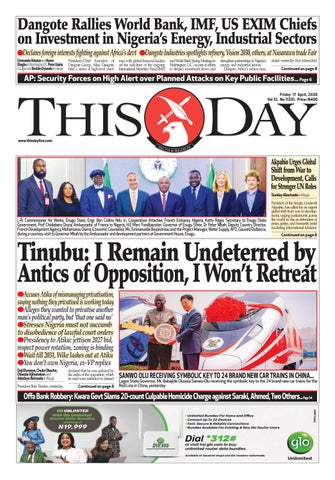
Dangote Rallies World Bank, IMF, US EXIM Chiefs on Investment in Nigeria’s Energy, Industrial Sectors
Declares foreign interests fighting against Africa’s devt Dangote Industries spotlights refinery, Vision 2030, others, at Nasarawa trade Fair
President/Chief Executive of Dangote Group, Aliko Dangote, held a series of high-level meet-
ings with global financial leaders on the side-lines of the ongoing International Monetary Fund (IMF)
and World Bank Spring Meetings in Washington, D.C., as part of efforts to deepen investment flows and
www.thisdaylive.com
stated yesterday that entrenched
strengthen partnerships in Nigeria’s energy and industrial sectors. Dangote, Africa’s richest man, Continued on page 8
Akpabio Urges Global Shift from War to Development, Calls for Stronger UN Roles
Continued on page 8
Tinubu: I Remain Undeterred by Antics of Opposition, I Won’t Retreat
Accuses Atiku of mismanaging privatisation, saying nothing they privatised is working today
Alleges they wanted to privatise another man’s political party, but ‘that one said no’
Stresses Nigeria must not succumb to disobedience of lawful court orders
Presidency to Atiku: jettison 2027 bid, respect power rotation, zoning is binding
Wait till 2031, Wike lashes out at Atiku
You don’t own Nigeria, ex-VP replies
declared
Eromosele Abiodun and Nume
Ekeghe in Washington DC, Peter Uzoho in Lagos and Ibrahim Oyewale in Lokoja
SANWO OLU RECEIVING SYMBOLIC KEY TO 24 BRAND NEW CAR TRAINS IN CHINA...
Lagos State Governor, Mr. Babajide Olusola Sanwo-Olu receiving the symbolic key to the 24 brand new car trains for the Red Line in China, yesterday
L-R: Commissioner for Works, Enugu State, Engr. Ben Collins Ndu Jr.; Cooperation Attachee, French Embassy, Nigeria, Ketty Regis; Secretary to Enugu State Government, Prof Chidiebere Onyia; Ambassador of France to Nigeria, H.E Marc Fondbaustier; Governor of Enugu State, Dr Peter Mbah; Deputy Country Director, French Development Agency, Mohamasou Diarra; Economic Counsellor, Ms. Emmanuelle Boulestreau and the Project Manager, Water Supply, AFD, Gauvald Dulbecco, during a courtesy visit to Governor Mbah by the Ambassador and development partners at Government House, Enugu.
Sunday Aborisade in Abuja President of the Senate, Godswill Akpabio, has called for an urgent global shift from war to development, urging parliaments across the world to rise as defenders of peace, justice, and humanity amid escalating international tensions.
Deji Elumoye, Chuks Okocha, Olawale Ajimotokan and Adedayo Akinwale in Abuja
TINUBU’S MEETING WITH LEADERSHIP AND COORDINATORS OF RENEWED HOPE AMBASSADORS...
L-R: Kaduna State Governor, Senator Uba Sani; Imo State Governor, Hope
Prof. Nentawe
of
and National Secretary
Gulf Crisis: Nigeria Has No Plan to Seek IMF’s Support, Says Edun
UN Deputy Chief, Amina Mohammed says Nigeria’s reforms showing early gains, warns rising inequality threatening progress Fund warns country’s limited fiscal space weakens response to food inflation shock
Eromosele Abiodun and Nume Ekeghe in Washington DC
Following the International Monetary Fund (IMF) disclosure that it was preparing a potential $50 billion support package aimed at cushioning vulnerable economies from the economic shockwaves of rising geopolitical tensions in the Middle East, Nigeria’s Minister of Finance and Coordinating Minister of the Economy, Mr. Wale Edun, yesterday, signalled that the West African country will not seek external bailout support, opting instead to rely on ongoing domestic reforms to navigate rising global uncertainties.
This comes as the United Nations Deputy Secretary-General, Amina Mohammed, warned that while Nigeria’s recent macroeconomic reforms were beginning to stabilise growth, widening inequality and persistent food insecurity risks could undermine those gains unless policy coordination and social protection are significantly strengthened.
Also yesterday, the IMF warned that Nigeria’s limited fiscal space was constraining its ability to respond effectively to surging food inflation, even as rising transport and logistics costs intensify pressure on household incomes. Edun, made the clarification at the African Finance Ministers’ press briefing held at the ongoing IMF/World Bank Annual Meetings in Washington, D.C, where he also highlighted the impact of global economic shocks on African economies.
He said Nigeria’s reform programme over the past two years has helped
restore policy credibility and improved resilience against external pressures, noting that the country has opted for market-based adjustments rather than administrative controls.
He said: “Nigeria has no plans at the moment to approach the IMF or any other such body.”
Edun has called for faster and more coordinated financial support for African economies, as global financing discussions intensify around a proposed $50 billion support package for vulnerable countries.
He said: “The IMF talked about $50 billion and we all know that the funding will largely go to Africa, because those are the most vulnerable countries. And the reality is that what we’re asking for in this instance, is that the funds and the support be released quickly and at scale.”
He also emphasised that while Nigeria has strengthened its domestic buffers through reforms, many African countries remain highly exposed and in need of external support mechanisms.
Edun said Nigeria’s reform programme over the past two years has helped the economy adjust more effectively to global shocks by relying on market mechanisms rather than administrative controls.
He said: “What has happened is that for Nigeria, for instance, at this time, we are and have been in a position to allow the market mechanism to correct and to adjust to the realities of the situation, rather than resorting to administrative controls. The major gain of the macroeconomic reforms has been
market pricing of major items, foreign exchange, petroleum products, etc.
“So that has been the adjustment mechanism that we have relied on, and it has meant that there has been less disruption to our trajectory.”
Meanwhile, UN Deputy Chief Mohammed Says Nigeria’s Reforms Showing Early Gains, Warns Rising Inequality Threatens Progress.
Amina Mohammed says Nigeria’s reforms showing early gains, warns rising inequality threatening progress
Speaking on the sidelines of the IMF/ World Bank Meetings, Mohammed linked Nigeria’s domestic food security challenges to broader global shocks, including conflicts in the Middle East, the Sahel, and Sudan, which she said are worsening an already fragile food system across Sub-Saharan Africa.
She said: “I think that it’s very clear that Nigeria’s efforts at policy have seen
the economy stabilise and to a degree, grow. The challenge is the inequalities that are growing and that has to be addressed at all tiers of government.
“And I think you know the President is making the efforts to try to do that in his engagement with the State governments and the resources that are going to them, but it requires longer term and certainly for now, the cash transfer programs, the social protection programs have been a good effort.
“Let’s remember that where there is conflict, whether it is in Iran or it is in Zamfara or is in Borno, these conflicts exacerbate food security. So already we have been dealing with that in Nigeria and the Sahel and Sudan, which is probably the worst affected in the world today.
She added that geopolitical tensions were worsening supply chain pressures, particularly around fertiliser
and agricultural inputs, warning that attention must shift to protecting the next planting cycles.
“What happens with Iran is it exacerbates it, and when we look at that, we are lucky in Nigeria to have the fertilizer plant that we do at the Dangote refineries we also have in Morocco. And so, what we need to do is to see how we fill those supplies. We don’t allow a breakdown for the next planting season. This planting season, I believe most people have taken care of it. It’s the next one and the one after that.
“Shore up the policies, make sure that we are working better together through the three tiers of government, because the local governments is where it acts. I was in the field the other day, it is local governments and state governments that need to be reinforced with the capacities to deliver to their people,” she added.
In the meantime, the IMF has warned that Nigeria’s limited fiscal space was constraining its ability to respond effectively to surging food inflation, even as rising transport and logistics costs intensify pressure on household incomes.
The Fund said the combination of tight public finances and supply-side shocks are leaving policymakers with difficult trade-offs, as inflationary pressures largely driven by food reassert themselves across the economy.
Speaking at the African Department Regional Press Briefing at the ongoing Spring Meetings in Washington DC, yesterday, the Director of the African Department at the IMF, Abebe Aemro Selassie, said Nigeria was already feeling the strain from a new round of shocks, with transport costs emerging as a key channel through which inflation is spreading.
Late Gen Braimah’s Children Get Scholarships from Edo Govt
Felix Omoh-Asun in Benin
Children of the late Brig. Gen Oseni Omoh Braimah have been offered scholarships by the Edo State Government.
The late General, Commander of the 29 Task Force Brigade, Operation HADIN KAI, who was killed in a coordinated Boko Haram attack on his base in Benisheikh, Borno State recently, hailed from Warake in Owan East LGA of the state.
The scholarships approval, granted by Governor Monday Okpebholo, will ensure the children’s education will be fully funded from their current levels through to university.
The beneficiaries are Farida Hussain-Braimah, 18, a 100-level Software Engineering student at Nile University, Abuja; Amir HussainBraimah, 16, currently in SS3 at Olumawu Senior School, Abuja; and Yasmeen Hussain-Braimah, 12,
a JSS2 pupil at Olumawu Junior Secondary School, Abuja.
Governor Okpebholo, while speaking on the gesture, described it as both a moral obligation and a demonstration of responsible governance.
He noted that Brigadier General Braimah’s death represents a profound sacrifice in the service of Nigeria.
“Brigadier General Braimah paid the ultimate price in service to this
country. It is only right that we stand by the family he left behind and ensure his children have uninterrupted access to education,” the governor said.
He reaffirmed the state government’s resolve to support the children throughout their academic journey, positioning them for stable and meaningful futures.
The governor had earlier described the late officer as a symbol of discipline, courage, and patriotism.
Blue Economy Ministry Forges Strategic Partnership with World Bank to Accelerate Nigeria’s Blue Agenda
Kasim Sumaina in Abuja
The Federal Ministry of Marine and Blue Economy has deepened strategic partnership with the World Bank under the PROBLUE initiative aimed at delivering key projects and actualizing Nigeria’s Blue Economy Blueprint. This much was highlighted during a high-level Technical Cooperation meeting focused on the validation of findings and results
essential to the nation’s maritime future.
The meeting served as a critical platform to review progress made in developing a coherent and actionable Blue Economy Framework for Nigeria.
The framework is designed to strengthen governance, improve marine spatial planning, and enhance data systems, while promoting stakeholder engagement to ensure long-term institutional coordination.
Speaking on Thursday in Abuja at the technical interface, the Permanent Secretary, Federal Ministry of Marine and Blue Economy, Mrs. Fatima Sugra Tabi’a Mahmood, commended the World Bank delegation led by Marcelo Hector Acerbi and Yolanda Molares and the Advisory Committee for the quality of technical assistance provided.
This is as she expressed satisfaction with the comprehensiveness of the work, particularly the
advancements in data systems and analytical outputs.
She further stressed that the focus must now transition from analysis to action, outlining the necessity for the final report to explicitly identify “bankable projects” capable of attracting financing from the World Bank and other international development partners.
According to the Permanent Secretary, “the priority moving forward is investment mobilization
and ensuring that all technical outputs are translated into practical, investable outcomes that drive the development of Nigeria’s blue economy.”
Also speaking, Lead of the World Bank Consortium, Yolanda Molares, expressed profound appreciation to the Minister, the Permanent Secretary, Director of Fisheries and Aquaculture, and the Senior Special Assistant to the President on Marine and Blue Economy for
their pivotal roles in advancing the Technical Collaboration. Molares, observed that the partnership is foundational to establishing a robust Blue Data Bank and implementing precise datageneration methodologies which will culminate into a comprehensive Integrated Coastal Zone Management report and the strategic creation of Blue Clusters across pilot states, marking a significant milestone in the nation’s maritime evolution.
Uzodimma; Vice President Kashim Shettima; President Bola Ahmed Tinubu; APC National Chairman,
Yilwatda;
of the All Progressives Congress (APC), Senator Ajibola Basiru, during the president’s meeting with leadership and coordinators
Renewed Hope Ambassadors held at the Presidential Villa, Abuja, yesterday
PHOTO: GODWIN OMOIGUI
INTERNATIONAL CIVIL SERVICE CONFERENCE BREAKFAST FIRESIDE DIALOGUE...
L-R: President and Chairman of Governing Council, National Institute of Credit Administration (NICA). Dr. (Mrs) Markie Idowu; MD/CEO, Union Bank of Nigeria, Mrs. Yetunde Oni; with the Head of Service of the Federation, Mrs. Didi Esther Walson-Jack, OON, mni, at the International Civil Service Conference Breakfast Fireside Dialogue on Advancing Public-Private Partnerships for Sustainable Governance Outcomes, held in Ikoyi, Lagos ... recently
AP: Security Forces on High Alert over Planned Attacks on Key Public Facilities
Terrorists allegedly target Abuja airport, prison, military detention centre
Emmanuel Addeh in Abuja Nigeria’s security forces are on high alert over a planned attack by Islamist militants on public infrastructure in Abuja and Niger states, an internal memo dated April 13 obtained from the Nigeria Customs Service (NCS) by The Associated Press has shown.
The planned targets include the international airport and a prison facility in the capital city of Abuja, as well as a military detention centre in neighbouring Niger state, the AP report stated.
“Their intention is to release detained terrorists and inflict significant damage on critical aviation
infrastructure,” the memo noted.
According to the report, the plan mirrors a similar attack in Niger Republic in January, in which Islamist terrorists attacked an air force base in Niamey, the memo read in a warning to customs service personnel.
“An analysis of the report reveals
a concerning correlation between the potential targeting of the Nnamdi Azikiwe Airport Abuja and recent large-scale attacks on aviation facilities in Niger Republic, notably in Niamey and Tahoua. This suggests a possible intent by terrorists to replicate the attack patterns within Nigeria,” according to the memo quoted by AP.
Oando JV Provides Critical Gas Supply to Power Bayelsa’s New 60MW IPP
Oando Plc yesterday announced that its upstream Joint Venture (JV) with NNPC E&P Limited (NEPL), the NEPL/Oando JV, has supported the actualisation of a 60-megawatt Independent Power Plant (IPP) in Yenagoa, Bayelsa State.
The project, recently commissioned by President Bola Tinubu, it said, is one of four signature infrastructure initiatives encompassing major developments such as the New Yenagoa City Road 1, the Sagbama–Ekeremor Road, and the 630-metre Angiama–Oporoma Bridge.
In a statement, the company said the NEPL/Oando JV is the sole supplier of gas to the plant, explaining that the JV will supply 11.2 million standard cubic feet of gas per day (MMSCFD) to the plant, providing a steady source of fuel for electricity generation.
According to Oando, the gas is delivered through the JV’s Elebele Valve Station, which is connected to a major trunkline to ensure a continuous supply.
The company recalled Tinubu describing the power plant as a critical enabler of development. “I have commissioned several transformative projects, and the Bayelsa Independent Power Plant stands out as a true blessing and a product of visionary thinking. Thank you for embarking on it. There can be no industrialisation and development, skill development, and empowerment without power,” it quoted the President as saying.
Besides, the statement quoted the Bayelsa State Governor, Senator Douye
Diri, as saying that the project was made possible by supportive federal policies and reforms in the power sector. “The administration’s desire and decisive policy intervention have paved the way for meaningful reforms in various sectors, including the power sector, enabling us to deliver on our pledge of reliable, independent energy through the construction of 60MW gas-fired turbines.
“This project will act as a catalyst for local development, stimulating economic activity and strengthening the socio-economic fabrics of the zones,” he stated.
Group Chief Executive of Oando Plc, Wale Tinubu, speaking on NEPL/ Oando JV’s integral role in the actualisation of the IPP, stated that the project will help to unlock new opportunities for businesses, improve living standards, and stimulate economic growth.
“This project reflects our longstanding commitment to Bayelsa State and its people. By enhancing power reliability, we are helping to unlock new opportunities for businesses, improve living standards, and stimulate broader economic growth across the State.
“Our integrated approach, connecting gas to demand and delivering stable energy where it is needed most ensures that development is both sustainable and inclusive. As one of the largest employers in Bayelsa, we are proud to deepen our contribution to the State’s progress,” Wale Tinubu stated.
The Bayelsa State IPP is expected to deliver stable electricity to tens of thousands of homes and businesses in Yenagoa and its environs, significantly
reducing reliance on self-generation and lowering end-user power costs.
The 60MW plant is designed as an integrated system combining gas supply, embedded generation, and a dedicated distribution network. By locating generation close to demand centres, Oando said the project is expected to reduce transmission losses and improve voltage stability.
The company reported that the JV was responsible for the Front-End Engineering Design (FEED) and Detailed Engineering Design (DED) for the tie-in connection infrastructure linking the IPP to the JV’s existing gas network, a system that incorporates advanced safety mechanisms designed to safeguard all connected assets.
The JV, according to the company, also provided a comprehensive engineering dossier to support project execution. The JV certified that the completed tie-in spur was subsequently safe and fully operable and also provided technical support during the commissioning and gas introduction phases.
“The Bayelsa IPP responds to structural vulnerabilities in Nigeria’s centralised grid, including recent prolonged outages caused by transmission disruptions along the Owerri–Ahoada–Yenagoa corridor due to vandalism. The project introduces a more resilient, localised power model designed to ensure continuity of supply in high-demand urban clusters.
“The supply of gas to Bayelsa’s IPP expands Oando’s footprint in Nigeria’s power sector, building on its track record in developing and operating key energy infrastructure. This includes the
country’s first combined-cycle power plant, the flagship Okpai Independent Power Plant, as well as the Akute Independent Power Project in Ogun State and the Alausa Independent Power Project in Ikeja, Lagos, one of the earliest embedded generation projects in Nigeria,” it stated.
These projects, according to Oando, have contributed to improved power supply both to the national grid and within their host communities, with the Akute and Alausa IPPs serving as early examples of decentralised energy delivery in Nigeria.
In 2022, an attack on the aforementioned prison led to the escape of 879 inmates, including 64 members of the Islamic State West Africa Province, which claimed responsibility for the attack.
“The military and paramilitary forces are all on high alert and ready to forestall the attack,” a senior customs service personnel member who is not authorised to speak to journalists told AP.
The customs service and the Nigerian military had not responded to AP’s request for comments.
Nigeria, which is Africa’s most populous country, is battling a complex security crisis, especially in the north, where there is a decadelong insurgency and several armed groups that kidnap for ransom.
Among the most prominent Islamic militant groups are Boko Haram and its breakaway faction, known as ISWAP. There is also the IS-linked Lakurawa group operating in communities in the northwestern part of the country that borders Niger Republic.
The attacks would be carried out by sleeper cells of ISWAP and Boko Haram, the memo said.
Last week, the U.S. authorised its non-emergency government
employees and their families to leave the Abuja embassy owing to what it called a spike in terrorist attacks, kidnapping, and violent crimes in the country, especially in the north. The embassy has been shut.
Nigeria’s Information Minister, Mohammed Idris, described the U.S. decision as a “routine precaution guided by internal protocols”, insisting that it does not reflect the overall security situation of the country.
Nigeria has in recent days moved aggressively to fast-track the prosecution and imprisonment of terrorism suspects, marking one of the most significant judicial crackdowns in the country’s counterterrorism efforts.
A key development was the mass trial conducted at the Federal High Court in Abuja, where over 500 terrorism-related cases were brought forward in a coordinated legal push, where the courts secured convictions for about 386 suspects, many of whom entered guilty pleas, with sentences ranging up to 20 years imprisonment.
The accelerated process was part of an initiative by the federal government to clear a backlog of terrorism cases that had lingered for many years.
Oyetola Inaugurates NIMASA–UNILAG Institute of Maritime Studies Building
Kasim Sumaina in Abuja
Minister of Marine and Blue Economy, Adegboyega Oyetola, Thursday, inaugurated the Institute of Maritime Studies (IMS) Multipurpose Building at the University of Lagos, reaffirming the federal government’s commitment to advancing Nigeria’s marine and blue economy through sustained investment in human capital and infrastructure.
The facility, donated by the Nigerian Maritime Administration and Safety Agency (NIMASA), is equipped with modern lecture rooms, laboratories, and specialised facilities to support teaching, research, and innovation in
the maritime sector.
Describing the project as a milestone, Oyetola said the initiative reflected the government’s resolve to strengthen institutional capacity and position the blue economy as a key driver of national prosperity.
The minister said, “The future of the blue economy will be shaped not just by natural endowments, but by the quality of minds we nurture within institutions such as this.”
He emphasised that with over 90 per cent of Nigeria’s trade conducted via maritime channels, the sector was critical to economic diversification, job creation, and sustainable development.
Oyetola, in a statement by his
Special Adviser, Bolaji Akinola, highlighted ongoing efforts to build manpower, disclosing that 2,459 Nigerians have been sponsored under the Nigerian Seafarers Development Programme (NSDP) for training in maritime institutions across countries, including the United Kingdom, Egypt, the Philippines, India, and Romania. He added that 1,088 beneficiaries had obtained their Certificates of Competency.
The minister also pointed to opportunities in fisheries and aquaculture, stating that Nigeria’s annual fish demand of 3.6 million metric tonnes presents significant potential for food security and employment.
Emmanuel Addeh in Abuja
80TH PRE- ANNUAL GENERAL MEETING MEDIA BRIEFING OF NIGERIAN BREWERIES...
L-R: Corporate Affairs Director, Nigerian Breweries PLC. (NB), Dr. Uzodinma Odenigbo; Human Resource Director, Mrs. Grace Omo-Lamai; Managing Director/CEO, Mr. Thibaut F.B Boidin; Finance Director, Maria A.Karaseva and the Company / Legal Director, Mr. Uaboi G. Agbebaku at the 80th Pre-Annual General Meeting Media
Briefing of the Nigerian Breweries Plc, held in Lagos, yesterday
IOCs Exit: NAPE Tasks Local Oil Firms to Explore Nigeria-Sao Tome Basin to Boost Reserves
As international oil companies (IOCs) pulled back from further oil search in frontier acreage, Nigerian Association of Petroleum Explorationists (NAPE) called on indigenous oil and gas firms to step in and invest in exploring the Nigeria–São Tomé and Príncipe Joint Development Zone (JDZ) to boost the country’s depleting hyrocarbon reserves.
NAPE made the call at its April Monthly Technical/Business Meeting in Lagos, with the theme, “Joint Development Zone: Hydrocarbon Prospectivity and Exploration Opportunities,” spotlighting the JDZ as a major untapped hydrocarbon frontier.
Nigeria–São Tomé & Principe JDZ is a 34,540-square-kilometre maritime area in the Gulf of Guinea with significant oil potential.
Established by a 2001 treaty, JDZ allows both nations to share resources under a 60:40 arrangement, and operates under the model of Production Sharing Contract (PSC), to manage exploratory and commercial activities.
However, despite high hopes, the area has seen limited success and slow progress, as even the 270 million barrels of crude found in 2006 was deemed marginal and non-commerciable, resulting to the
exit of IOCs, including Chevron, Texaco, Total, and others from further exploration in the area.
Speaking at the session, NAPE President, Mrs. Olajumoke Ajayi, underscored the need for Nigeria to move aggressively to replace maturing assets with new oil discoveries.
Ajayi stated, “As explorers, we must continue to explore because oil and gas will continue to play an important role. As we deplete existing reserves, we must open up new frontier areas and bring in more discoveries.”
She said NAPE’s technical sessions this year focused on “exploration, reserve replacement and strategies for unlocking stranded resources”.
The keynote speaker and Senior Geoscience Manager at Juvicle Energy Resources Limited, Mr. Aleksandra Oshodi, said the JDZ was significantly underexplored, despite a proven hydrocarbon system.
Oshodi recalled strong IOC interest from 2003-2005 and Chevron’s 2006 Obo-1 discovery, which confirmed commercial hydrocarbons with more than 270 million barrels of oil equivalent found.
He stated that progress stalled after 2013 because shallow gas-prone targets were not fully commercial under prevailing conditions.
“Operations stalled, but that does not mean the basin failed
geologically. What it means is that the earlier play concepts were not fully commercial under prevailing conditions,” Oshodi said.
He added that only eight wells had been drilled across the vast acreage, stating that new reprocessed PSDM 3D seismic technology has identified deeper targets between 3,000 and 4,500 metres.
“These deeper fairways suggest a significant opportunity for a disciplined re-entry into the basin. The system is proven, and modern data is helping us reduce uncertainty,”
he said.
In his remark, NAPE Presidentelect, Dr. Anthony Ofoma, said the focus on JDZ at this time was both timely and strategic.
Ofoma stated, “At a time when the global energy industry is evolving rapidly, conversations around frontier exploration, regional collaboration, and unlocking new hydrocarbon potential have become more important than ever.”
Co-founder and Technical Director at Juvicle Energy Resources, Mr. Clem- ent Onyekwelu, said JDZ offered a
timely window for Nigerian firms to step in as IOCs retreated.
Onyekwelu recommended that indigenous firms should form a joint venture and pool their resources together for a coordinated action of fresh exploration in the JDZ acreage.
He said, “There is no better time than now to return to frontier exploration. Other regions are attracting huge value because they are willing to take bold steps into deeper plays. We also have opportunities here that can deliver significant commercial value.
“What we need now is a co-
ordinated effort by home-grown companies that understand the terrain and are willing to invest. Nigerians can lead this process. We have capable professionals and investors who can drive the first wave of new exploration.”
Acting Chairman of the Joint Development Authority Board, Mr. Mohammed Ibrahim, urged local oil firms to come forward and indicate interest to carry out exploration in the frontier acreage, saying the PSC arrangement for JDZ offers better fiscal terms for investors.
Odu’a Investment, Elektron Energy Partner to Deliver 50MW Ogba IPP,
Advance Reliable Power for Industrial Hub in South-west
Sunday Okobi
Odu’a Investment Company Limited (“Odu’a Investment”) has entered into a strategic partnership with Elektron Energy Development Strategies Limited (Elektron), a leading embedded power developer focused on delivering reliable, scalable energy infrastructure, to develop a 50-megawatt (MW) gas-fired Independent Power Plant (IPP) at the former Cocoa Industries Limited (CIL) Complex
Nigeria and other members of Intergovernmental Group of TwentyFour (G24) on International Monetary Affairs and Development yesterday discussed means of addressing rising debt vulnerabilities as well as how to improve debt resolution frameworks, among others.
Members of the Group met on the sidelines of the ongoing IMF/ World Bank Spring meetings in Washington DC, United States of America, a critical moment where emerging markets and developing economies continue to face multiple and overlapping shocks, including geopolitical tensions, tighter financial
conditions, and climate-related vulnerabilities.
The meeting was presided over by Nigeria’s Minister of Finance and Coordinating Minister of the Economy, Wale Edun, chairing the G24.
According to a statement issued by the Ministry of Finance, said under the leadership of Edun, Nigeria continues to work closely with member countries to strengthen collective advocacy on issues central to the development agenda of emerging and developing economies.
The statement said discussions at the Washington DC meeting of the G24 centred around key priorities, including: strengthening global economic resilience in the face of
persistent shocks, enhancing the international financial architecture, including IMF quota, and expanding access to adequate and predictable development financing.
Others are addressing rising debt vulnerabilities and improving debt resolution frameworks, supporting job creation, inclusive growth, and long-term structural transformation, as well as reinforcing multilateral cooperation between the IMF, World Bank Group, and other international partners.
The statement said, “Members reviewed recent global economic developments and exchange views on coordinated policy responses that can better support vulnerable economies.
within the Ogba Industrial Estate in Ikeja, Lagos.
The Odua management said at the joint venture signing ceremony held yesterday at Western House, Lagos, that the IPP would deliver dedicated, reliable electricity directly to industrial and commercial users within the Ogba cluster, reducing exposure to grid instability and eliminating the need for inefficient self-generation.
Odua Investment stated that beyond immediate users, “The project is expected to support job creation across construction and operations, strengthen the competitiveness of businesses within the cluster, and reinforce Lagos’ position as Nigeria’s commercial and industrial hub.
“The project will be delivered through a jointly established Special Purpose Vehicle (SPV), combining Elektron’s technical, commercial, and regulatory expertise with Odu’a Investment Company’s regional investment platform.”
While explaining the intent of the project, Group Chairman, Odu’a Investment Company Limited, Otunba Bimbo Ashiru, said, “This landmark project represents a significant step in Odu’a Investment’s long-term strategy to invest in critical infrastructure that drives economic growth, industrial productivity and sustainable development across south west Nigeria and the broader national
economy.
“This project represents a strategic catalyst for industrial revitalisation, enhanced energy security, and sustainable economic growth across the South-west.”
Commenting on the significance of the project and its broader impact on the Nigerian economy and social development, Founder and CoChief Executive Officer of Elektron Energy Development Strategies Limited, Mr. Tola Talabi, said, “This project reflects exactly how we think about power at Elektron.
Not as standalone generation, but as enabling infrastructure for economic activity.
“The Ogba IPP is a targeted intervention in one of Lagos’ most commercially significant corridors, designed to deliver reliable power where it is needed most, and to do so in a way that is scalable, bankable, and sustainable.
“Our partnership with Odu’a Investment Company brings together long-term capital and execution capability, and demonstrates how embedded generation can materially improve industrial productivity, reduce energy costs, and strengthen regional energy resilience.”
Talabi added, “Today, we are taking a significant step in a journey to provide reliable, efficient and uninterrupted power to what is one of the most critical industrial corridors of South-West Nigeria.
“Reliable power remains the backbone of industrial development: no economy can truly thrive, no factory can operate efficiently, and no industrial hub can compete globally without reliable electricity. With today’s signing, we are taking decisive action to improve power supply for this cluster.”
Talabi said, “This collaboration is built on a shared commitment to support industrial growth and deliver reliable energy where it is needed most.
“At Elektron, we believe power is more than just electricity. It is the enabling infrastructure for economic activity.
“It is what allows businesses to run, grow, and succeed. Without reliable power, productivity drops, costs rise, and opportunities are lost.”
He stated, “Our partnership with Odu’a Investment Company brings together Elektron’s technical and commercial expertise with Odua’s robust regional investment platform and long-term capital.
“This synergy demonstrates how embedded generation can significantly improve industrial productivity, reduce energy costs, and strengthen regional energy resilience.”
He disclosed the 50MW IPP would provide reliable, dedicated power to businesses within one of Lagos’ most important industrial areas.
Peter
PHOTO: SUNDAY ADIGUN
Facing Jet Fuel Crunch, Europe Sees Record Inflows from Nigeria, US
Airlines to begin cutting flight volumes on rising costs IEA Chief:
Emmanuel Addeh in Abuja
Europe is seeing record inflows of jet fuel from Nigeria and the United States, data from Kpler and LSEG have shown, as the continent seeks to shore up supplies due to disrupted imports from the Gulf.
Europe formerly depended on the Gulf for nearly 75 per cent of its jet fuel imports, or around 375,000 barrels per day (bpd), but the Iran war has effectively closed off tanker traffic seeking to exit via the Strait of Hormuz, a Reuters report said.
This comes as the International Energy Agency (IEA) has predicted that Europe has only six weeks supply of jet fuel left owing to the Iran war, and may soon start experiencing flight cancellations if oil supplies are not restored in coming weeks.
Besides, the European airlines have urged the European Union (EU) to step in with emergency measures, including widespread airspace closures, as per a document seen by Reuters.
April imports from Nigeria were around 66,000 bpd so far, data from both sources showed. That is also the highest on record and highlights the country’s growing role as a swing supplier of aviation fuel since the
launch of the Dangote refinery, Africa’s largest, in 2024.
Also, U.S. supply looked set to reach between 149,000 to 200,000 bpd so far in April, based on vessels discharged and those still due, a record high according to data going as far back as 2015 on LSEG and 2017 on Kpler.
An EU requirement stating countries must maintain 90 days of emergency oil reserves does not stipulate levels for specific fuels. Spain is a net exporter of jet fuel, while Britain, the region’s largest consumer, imports 65 per cent of its demand, IEA data showed.
Levels of jet fuel fell to their lowest since March 2023 last week at the Amsterdam-Rotterdam-Antwerp storage hub, data on independently held stocks showed.
Nigeria was also exporting at record levels, with 416,000 bpd of products exported so far this month. While the U.S. is the top consumer of jet fuel, exports to regions worse off such as Europe and Asia were fetching better prices.
However, Nigerian airlines on Thursday said they would suspend all flight operations from April 20 unless jet fuel prices were reduced, noting about a 270 per cent jump since February.
mitments to Nigerians.
The United States is, however, already exporting at record highs. In the week ending April 3, the U.S. exported an estimated 442,000 barrels of jet fuel, double the 219,000 barrel average seen last year, Energy Information Administration data showed.
The IEA’s latest monthly report stated that if European markets were unable to secure more than 50 per cent of the volumes lost from the Gulf, stocks would hit a crucial 23-day stockpile level in June, a level at which physical shortages would begin.
Meanwhile, the Executive Director of the IEA, Fatih Birol, has said there would be flight cancellations “soon” if oil supplies from the Middle East were not restored within the coming weeks.
“I can tell you soon we will hear the news that some of the flights from city A to city B might be cancelled as a result of lack of jet fuel,” he told the Associated Press.
KLM, part of the Air France-KLM group, said on Thursday it would cut 160 flights in the coming month because of high kerosene jet fuel prices. Although less than 1 per cent of its schedule, the cancellations underline the financial pressures on the airline industry.
The Dutch airline said: “This
Europe has only about six-week supply left
concerns a limited number of flights within Europe that, due to rising kerosene costs, are currently no longer financially viable to operate. There is no kerosene shortage.
“KLM expects a busy May holiday period and is making sure passengers can travel to their holiday destinations as planned.”
The US-Israel war on Iran has caused turmoil in global energy markets since the first strikes at the end of February. In retaliation, Iran has effectively closed the strait of Hormuz, a vital export route for oil from the Gulf.
The US and Iran last week agreed a two-week ceasefire, but talks on ending the war failed over the weekend. Indirect talks brokered by Pakistan are continuing, the Guardian UK reported yesterday.
Brent crude oil futures prices, a global benchmark, remain more than 30 per cent higher than they were before the war. The rapid increase in petrol prices has put pressure on the US President, Donald Trump.
However, there have not yet been outright shortages of jet fuel as shipments that set off before the war continued to arrive. The final cargoes have now made it to Europe.
Birol said Europe had “maybe
six weeks or so (of) jet fuel left”, AP reported. His comments add to those of Airports Council International Europe, a lobby group that last week wrote to the EU’s energy and transport commissioners saying the bloc was three weeks away from shortages.
Airports and airlines tend to have about six weeks of fuel supplies in normal times, according to people in the industry. However, the Iran war has dragged on long enough that any extra reserves in the system are being used up, and other suppliers do not have enough capacity to replace supplies that come through the Gulf.
“In the past there was a group called Dire Straits,” said Birol. “It’s a dire strait now, and it is going to have major implications for the global economy. And the longer it goes, the worse it will be for economic growth and inflation around the world.”
The impact will be “higher petrol prices, higher gas prices, high electricity prices”, Birol told AP, with some parts of the world “hit worse than the others”.
Some airlines have cancelled flights that would be loss-making because of higher fuel prices, particularly if they did not have hedging arrangements in place to insure against big increases.
However, even those who have
TINUBU: I REMAIN UNDETERRED BY ANTICS OF OPPOSITION, I WON’T RETREAT him, affirming that his government remains focused on delivering the mandate of its reform agenda.
Tinubu made the assertion in Abuja while hosting leaders and coordinators of the Renewed Hope Ambassadors, led by its Director-General and National Coordinator, Governor of Imo State, Senator Hope Uzodinma.
He stressed that his government will remain focused on performance, reform, and accountability, and not bow to distractions, as it worked to deliver on its com-
Tinubu stated, “The life voyage is not going to be easy. And so many of you that are traveling with me, I can only stand before you and say you will not regret it. That is why we ask you to renew their hope.
“If they don’t want to see the hope and the roads, in the bridge and the children we raise, and the economy we are growing, we lend them Jiggy Bola. We give them eyeglasses.
“I can assure you, whatever you
AKPABIO URGES GLOBAL SHIFT FROM WAR TO DEVELOPMENT, CALLS FOR STRONGER UN
Akpabio made the call while addressing delegates at the 152nd Assembly of the Inter-Parliamentary Union (IPU), where he stressed that the growing wave of conflicts across regions underscored what he described as a deeper “crisis of leadership.”
Speaking on the theme, “Nurturing Hope, Securing Peace and Ensuring Justice for Future Generations,” the Senate President said the time had come for the global community to abandon destructive tendencies and redirect resources toward development and human advancement.
“It is time to turn from destruction to construction and redirect the instruments of war toward the work of development,” he said.
He noted that the gathering took place against the backdrop of mounting global instability, with conflicts stretching across the Middle East, Europe, and Africa, thereby testing the resilience of nations and international institutions.
Drawing from Nigeria’s own experiences in conflict management and nation-building, Akpabio described legislatures as “the first hope of the masses” and “the
ROLES
conscience of the people,” stressing their pivotal role in promoting peace, equity, and justice.
“I bring you warm greetings from the resilient people of Nigeria—a nation that has learned that peace is not inherited; it is built, defended, and sustained,” he stated.
The Senate President warned that no part of the world was immune to instability and urged a collective commitment to multilateralism and democratic values as essential tools for addressing global crises.
Highlighting the devastating human toll of wars, he said the true impact of conflicts went far beyond casualty figures, leaving behind shattered families and displaced communities.
“This is not merely a crisis of security—it is a crisis of leadership. Might must not be mistaken for right, and weakness must never justify injustice,” Akpabio declared.
He called on the IPU to play a more decisive role in strengthening global governance structures, particularly the United Nations, and to amplify the voices of vulnerable nations in global decision-making processes.
say I do. But one thing that you need from me is a promise that I won’t run away from their fight.
“With you, the deal is done. And all I can promise is that I won’t give up. During the primary that got me here, it was tough; during the election, it was tough.”
Commenting on campaigns against him by the opposition, the president dismissed suggestions that he was being intimidated or pressured into retreat, declaring that such efforts will not divert him from his cause.
He reaffirmed his conviction that nation-building required resilience and steadfast commitment.
Tinubu stressed that no country could be developed by external forces, but through the determina- tion and collective resolve of its own people.
He stated, “They want to scare me off? It’s a lie. I’ve been through this path before, and if I have to
come back over and over and over again, I’ll do the same thing. There is no better place than your own country, and no one can build it except you.
“We saw great things because we see skyscrapers, we wonder how the plane takes off and fly also from one destination to the other. These are no magic of yesterday.
“It is thinker of tomorrow and the future that can elevate life, that can reform us all, and being a transformative leader that you are, you are in a good company. Don’t be afraid.”
He emphasised the imperative of national unity, stressing that Nigeria’s pathway to greatness lay in forging a cohesive and shared vision.
The president stated that building one united country anchored on collective prosperity was central to the Renewed Hope Agenda.
He emphasised that the
country must not succumb to the disobedience of lawful court orders, underscoring the centrality of the rule of law in sustaining democratic governance.
The president described the Renewed Hope Ambassadors movement as a defining national platform to break the shackles of poverty and ignorance, while entrenching freedom and strengthening democratic values across the country.
He stressed that Nigeria’s democracy must not be undermined by “the rascality of street conventions,” insisting that the country cannot condone the disobedience of lawful court orders.
He emphasised the need to uphold the authority of the judiciary at all times, stating that adherence to its decisions, whether favourable or otherwise, remained fundamental to the principles of democracy, the separation of
hedged are considering flight cancellations. Air France-KLM has hedged 87 per cent of its fuel exposure, but still decided to cut the flights because of the costs it would otherwise have to bear, the Guardian added. It focused cancellations on busy routes between Amsterdam’s Schiphol and London and Düsseldorf, on which passengers can be easily booked on to other flights. Airlines in the EU and UK can make adjustments to flight schedules without paying compensation as long as passengers are offered alternatives more than two weeks in advance.
powers, and the proper functioning of the Nigerian state.
Tinubu stated, “We cannot submit to the disobedience of unlawful orders in court. We must embrace the judiciary, whether it favours us or it doesn’t, we submit to this principle of democracy, separation of powers and understanding of the dynamics of it and the nation that Nigeria is.
“We must build one country, there is no other way to the path to national greatness other than build one nation, one common vision for prosperity and greatness of our people, that is what we must do. That is what renewed hope is all about.”
Tinubu stated that his govern- ment was a continuation of his predecessor, adding that he inherited assets and liabilities of ex-President Muhammadu Buhari
Continued on page 36
DANGOTE RALLIES WORLD BANK, IMF, US EXIM CHIEFS ON INVESTMENT IN NIGERIA’S ENERGY, INDUSTRIAL SECTORS
foreign interests had continued to undermine Africa’s industrial progress. He urged stronger regional integration and greater domestic investment to unlock the continent’s potential.
Dangote Industries Limited said it will showcase its Vision 2030, which focuses on driving innovation and Africa’s industrialisation, at the Nasarawa trade fair.
At the ongoing Spring Meetings, Dangote delivered the keynote address at the launch of World Bank Group’s flagship global initiative, Water Forward. It is a programme aimed at repositioning water systems from basic social utilities into catalysts for industrialisation, job creation, and large-scale economic growth across emerging and developing economies.
Dangote underscored the critical role of private sector investment and infrastructure in unlocking the economic value of water.
The event drew a distinguished
audience, including heads of government, Secretary-General of the United Nations, leaders of European development institutions, and multilateral development partners.
Others included ministers of finance and economic planning from over 100 countries, central bank governors, global regulators, business executives, and donor agencies.
The audience at the Water Forward launch reflected the scale and urgency of the initiative.
In separate engagements, Dangote met with President of the World Bank Group, Ajay Banga; Managing Director of IMF, Kristalina Georgieva; and President/Chairman of Export-Import Bank of the United States, John Jovanovic.
According to a statement by Dangote Group, discussions at the session focused on private sector-led growth, macroeconomic reforms, and unlocking financing for large-
scale infrastructure, trade expansion, and industrial development across Nigeria and Africa.
The engagements came at a time of renewed momentum in Nigeria’s energy sector.
The country became a net exporter of petrol in March 2026, for the first time in decades, as the Dangote Petroleum Refinery and Petrochemicals drove a shift from import dependence to local production.
Data from Kpler shows Nigeria exported about 44,000 barrels per day of petrol during the month, slightly exceeding imports and resulting in a net surplus of roughly 3,000 barrels per day.
The milestone, the statement said, aligned with Dangote Group’s newly unveiled long-term growth strategy, “Vision 2030: Supercharging Dangote Group for Long Term Success,” a two-phase expansion programme spanning 2025–2028 and 2028–2030.
Under the plan, the group aims to scale and optimise its existing operations while expanding capacity across key sectors. This includes increasing the capacity of the Dangote Petroleum Refinery from 650,000 barrels per day to 1.4 million bpd, as well as quadrupling fertiliser production from three million tonnes per annum to 12 million tonnes per annum, a move expected to position the company as the world’s largest producer of urea. The strategy also outlines expansion across cement, rice, and broader food production, alongside new investments in infrastructure, such as ports and pipelines, gas, mining, data centres, and power, identified as critical to Africa’s industrial transformation and digital resilience.
Meanwhile, Dangote believed entrenched foreign interests had continued to undermine Africa’s
Continued on page 35
Minister of State for Petroleum Resources (Oil), Sen. Heineken Lokpobiri,
CONFERMENT OF FELLOWSHIP AWARD...
L-R: Vice Chairman, Nigerian Institute of Journalism (NIJ) Governing Council, Mr. Ray Ekpu; Chairman, NIJ Governing Council, Aremo Olusegun Osoba; Comptroller General of Customs, Nigeria Customs Service, Mr. Bashir Adewale Adeniyi; Provost of NIJ, Mr. Gbenga Adefaye; and Registrar of NIJ, Mrs. Patricia Kalesanwo, at the special convocation for the conferment of fellowship award on Adeniyi at Ogba, Lagos … recently
N34trn Revenue Hole Sparks Outrage as ActionAid Demands Forensic Probe of Nigeria’s Finances
ActionAid Nigeria has called for an urgent forensic audit of Nigeria’s revenue management system following revelations that more than N34 trillion was deducted from federal earnings before allocation to the three tiers of government.
The organisation said the scale of the deductions—accounting for over 40 per cent of federal revenue in recent years—points
to systemic weaknesses in public financial management and poses a serious threat to fiscal stability and development financing. In a statement issued on Thursday, ActionAid said findings by the World Bank confirmed that a significant portion of government income is being absorbed through pre-distribution charges, including cost-of-collection frameworks and agency remittances, with limited transparency on their composition and utilisation.
“These findings reinforce longstanding concerns about Nigeria’s widening fiscal constraints and rising debt burden,” the group said. “The persistence of large-scale revenue leakages represents both a governance failure and a missed opportunity to strengthen fiscal stability.”
According to the organisation, the deductions—estimated at more than N34 trillion—have continued to rise alongside government revenues, leaving federal, state,
and local governments with significantly reduced resources to fund public services.
ActionAid warned the trend is worsening Nigeria’s reliance on borrowing, citing projections by the International Monetary Fund that the country’s debt-to-GDP ratio could climb to 33.1 per cent by 2027.
“The widening gap between gross revenue and distributable income is constraining development financing and increasing
Audit Report: House Approves N248.6bn Reliefs, Debt Restructuring for Kano, Jos, Ikeja Discos
The House of Representatives has approved financial relief measures and a 10-year debt restructuring framework for the Kano, Jos, and Ikeja Electricity Distribution Companies (DisCos).
The resolution by the House Public Accounts Committee followed the adoption of a technical subcommittee report, which formed part of the 2021 AuditorGeneral for the Federation’s report on the growing indebtedness of eleven electricity distribution companies as escalated by the Nigeria Bulk Electricity Trading Company Plc (NBET).
The Committee Chairman, Hon. Bamidele Salam urged strict compliance with market obligations by all DisCos to prevent further accumulation of debt.
He warned that without urgent financial restructuring and regulatory intervention the sustainability of Nigeria’s electricity distribution sector could remain at risk.
Also, the Chairman of the technical subcommittee, Hon. Mark Chidi Obetta said the recommendation formed part of legislative efforts to stabilise the electricity market and address legacy liabilities affecting the sector’s financial sustainability.
The framework covers accrued interest on debt from 2015 to September 2025 amounting to N128,575,190,740.54, as well
as historical debts totaling N120,061,898,737, bringing the combined outstanding liability to N248,637,089,278.83.
The report, which reviewed the financial obligations of eleven DisCos, showed their cumulative indebtedness rose from N1 trillion from December 31, 2024 to N1.3 trillion on September 25, 2025, comprising both principal and interest components.
Total disco outstanding from January 2015 to September 2025 including interest component as provided by NBET are: Abuja Electricity Distribution Company Ltd: N275,165,755,647.45; Benin Electricity Distribution Company: N82,114,660,624.99; Eko Electricity Distribution Company: N16,491,581,520.79 and Enugu Electricity Distribution Company: 39,114,906,819.66.
Others are: Ibadan Electricity Distribution Company: N103,412,814,294.67; Ikeja Electricity Distribution Company: N47,638,211,980.95; Jos Electricity Distribution Company: N104,377,248,037.96; Kaduna Electricity Distribution Company: N303,809,520,962.8; and.Kano Electricity Distribution Company: N96,621,626,259.92. Also, Port Harcourt Electricity Distribution Company is indebted to the tune of N88,400,282,772.28; Yola Electricity Distribution Company (Old): N61,195,796,813.92; Yola Electricity Distribution Com-
pany (New): N-241,675,202.96 and Ajaokuta Electricity Distribution Company: N58,585,346,744.31.
At the moment, the total outstanding is N1,303,686,080,276.70.
The committee explained the investigation was aimed at verifying the Auditor-General’s claims, establishing the current debt position, and identifying the reasons for the persistent failure of DisCos to meet their payment obligations.
The committee confirmed that as of the end of 2024, the reconciled
liability of the eleven DisCos stood at N1,000,929,477,013.50, covering both principal and interest, but rose to N1.3 trillion by September 2025 due to continued accruals.
Responding to the concerns, the Nigerian Electricity Regulatory Commission (NERC) issued a directive dated January 2026 that NBET should not charge interest on outstanding invoices between 2015 and 2020, it however mandated NBET to charge interest on outstanding invoices from 2021 onward.
dependence on debt,” the statement added.
The group expressed particular concern over what it described as “opaque and fragmented” revenue channels, noting that substantial portions of national income pass through multiple layers before reaching the Federation Account.
It said the lack of public disclosure around these deductions—including their justification, structure, and end-use—raises critical accountability questions.
“There is limited transparency on how these funds are managed,” the organisation stated. “This opacity weakens fiscal oversight and undermines public trust in governance.”
ActionAid also pointed to broader implications for national development, warning that reduced public revenue is limiting government capacity to invest in essential sectors such as healthcare, education, security, and social protection.
The Country Director of ActionAid Nigeria, Andrew Mamedu, said the consequences are already being felt by millions of Nigerians.
“For citizens grappling with rising inflation, declining purchasing power, and economic hardship, the continued reduction in available public resources means fewer
investments in essential services,” he said.
He added that weakening fiscal capacity is also exacerbating insecurity, as economic pressures fuel crime, displacement, and social instability.
“At a time when livelihoods are becoming more fragile, the erosion of public revenue further limits the government’s ability to respond effectively to these challenges,” Mamedu said.
The organisation further criticised the lack of transparency surrounding major public expenditures, citing concerns over projects such as the Nigeria Revenue Service building, where cost details and procurement processes have not been publicly disclosed.
“Citizens have a right to know how public funds are utilised,” the group said, stressing that accountability must extend beyond revenue collection to expenditure. ActionAid warned that without urgent reforms, Nigeria risks entrenching a system where public resources are consistently depleted before they can deliver meaningful impact.
“The continued expansion of unchecked deductions poses a direct threat to equitable development, fiscal stability, and public trust,” it said.
Aiyedatiwa: Varsities Must Train, Equip Future Leaders for Emerging Global Challenges
Fidelis David in
Governor Lucky Aiyedatiwa of Ondo State on Thursday said Nigeria’s future economic and technological advancement would depend largely on the quality of leadership and the strength of its educational institutions.
Governor Aiyedatiwa, who was guest speaker at the Federal University of Technology, Akure (FUTA) Foundation Day Lecture, stated this while delivering a lecture titled “Leadership, Organisational Performance and Technology in a Rapidly Changing World.”
He said universities must play a central role in producing a new generation of leaders capable of responding
to global disruptions and emerging challenges.
The governor described higher institutions as critical to innovation, human capital development and national competitiveness, stressing that their role goes beyond certification to shaping individuals who will influence societal direction.
According to him, “leadership remains fundamental to organisational success,” adding it involves influencing and motivating people towards achieving collective goals rather than exercising authority through coercion. He further stated that “leadership is a continuous process based on interaction between leaders and followers,” noting that its effectiveness depends
on the ability to adapt to changing realities.
Governor Aiyedatiwa noted that “leadership is fundamentally about influence rather than coercion,” stressing that effective leadership relies on inspiration and persuasion.
He also stated that leadership should be understood as a process rather than a position, explaining that it “unfolds through continuous interaction between leaders and followers within an organisational context.”
The governor traced the evolution of leadership theories from earlier beliefs that leaders are born with innate traits such as intelligence and confidence to modern perspectives which emphasise learned skills, behaviour and situational
awareness.
He said, “leadership competence can be developed through education and experience,” identifying technical, human and conceptual skills as essential components of effective leadership.
Governor Aiyedatiwa noted that skills can be developed over time through education, experience, culture, intelligence and environmental influences, stressing that leadership capability is not fixed.
The governor also stated that leadership styles vary across situations, citing autocratic, democratic and laissez-faire approaches, adding that effective leadership often involves a combination of styles depending on circumstances.
Akure
Adedayo Akinwale in Abuja
Michael Olugbode in Abuja
Politics
Acting Group Politics Edito r DEJI ELUMOYE
Email: deji.elumoye @thisdaylive.com
08033025611 s M s O n LY
Lucky Lagos!
The decision to make dr. Obafemi Hamzat the consensus governorship candidate of the all Progressives Congress in Lagos State, for the 2027 election, is certain to change the tenor of the race, writes Olawale Olaleye
The first title idea for this piece is: “The Patient Dog”. It fits in many respects. In fact, an average reader will easily relate. Unfortunately, it may also sound or appear as though embracing or seeking the pity party.
But to situate in context – both in form and content – the thrust of this intervention, the eventual header, “Lucky Lagos” is quite defining, too.
It dissects the very essence of the subject within the entire echo system of the state’s political arrangements and the interdepen dence of their relationships.
Beyond the smiles of his many years of struggles is the fact that the candidacy of Dr. Obafemi Kadri Hamzat, as the governor ship standard bearer of the All Progressives Congress (APC) in the 2027 governorship election in Lagos State, throws up many firsts.
What are they?
This is going to be the first time since the return to civil rule in 1999, that anyone, who had truly desired to be the governor of Lagos, is being put forward to realise his dream with the consent of all who matter, chorusing: “Hamzat lo kan”.
From Asiwaju Bola Tinubu to Mr. Ba batunde Fashola (SAN), Mr. Akinwunmi Ambode and the incumbent, Mr. Babajide Sanwo-Olu – they all were products of ac cidents. Even for the man, who chose them all as successors, they were his last minute choices, albeit with unintended consequences in some instances.
Hamzat has not only waited 12 years to realise this dream, he has refused to consider other offers for the sake of realising his lifelong ambition of becoming the Lagos governor.
Here is another first. Since the return to civil rule in Lagos, no deputy had succeeded his principal. For any of the deputies, who had dared to dream, that dream died in them.
Perhaps, Otunba Femi Pedro, the new ambassador-designate to Australia, will someday tell his story in his memoirs. Hamzat, however, dreamt and that dream is slowly coming to fruition. The result of waiting on God’s time. Maybe.
Directly following this succession dream is the fact that this is first time that the con cept of continuity is being realised in the artery of Lagos politics. After eight years as deputy governor, the phrase, “hitting the ground running” is just about to live its actual meaning.
It is an advantage that should not go to waste. The amount of information and access to the inner workings of the government at his disposal cannot be wished away. They naturally put him in a better stead than any other aspirant can come close to.
In 2019, when the Sanwo-Olu/Hamzat ticket was marketed to the voting public, a familiar line was conceptualised. It was that Lagos was getting two governors for the price or effort of one.
The strength that Hamzat boasts is not oblivious to members of the public except for mischief-makers.
That he is both politically inclined and vast in administration as well as good leadership are clear indications that his governorship might be coming at a most auspicious time in the life of the state.
With a bag full of experience and network of contacts built over the years, Lagos is pushing forward a man that is certain to further change the face of governance and redefine its spirit for the overall growth and development.
Away from political leanings and biases tailored towards any ideology, Hamzat is not just a man of creative thinking and capacity, he is always open to sound ideas, but the ideas must be sound in their true sense, because he functions with facts and figures. This, of course, reflects his predilection as a scientist. Something is however noteworthy about his choice. He’s so far taken nothing for granted, even if anyone thinks he is at an advantage
with critical endorsements by the political establishment.
While some have continued to chant “crucify him” because they thought the supreme leader has anointed him and his governorship is therefore a fait accompli, he is still doing the ideal thing as a thoroughbred politician by first treading the path of rigorous consultations.
Hamzat is not sitting back to be crowned the APC governorship candidate in Lagos, he is taking the bull by the horn by consulting heavily across the state and demonstrating his gravitas.
He’s been visiting core members of the Governor’s Advisory Council (GAC) and some of his predecessors, including Babatunde Fashola, SAN. This way, Hamzat has fulfilled the first creed of the Lagos Political Family – power is not served a la carte. Interestingly, while some other interested aspirants and their supporters, who just woke up to this reality, have been pushing the anti-endorsement narrative and dancing round the state in totally unrelated rallies, the truth is that they are all seeking the supreme leader’s approval since it makes the path to the governorship easier for anyone at all.
Much as the ruling party and its leadership in Lagos might have gambled for the past 19 years with their choices of governorship materials, even though they’ve largely turned out great choices, Hamzat is neither a gamble nor an accident. That is the game changer.
But, like a donkey which they all desire to ride to the promised land, the donkey is also at liberty to choose who it wants on its back. The leader is equally an interested party and will definitely not look away from how things pan out.
Thus, Hamzat’s endorsement, nonetheless, it is still not a settled matter. The party always holds a primary election to give legitimacy to the choice of its candidate.
Fashola partook in a primary exercise to emerge candidate of the party. Ambode, too, did, same as Sanwo-Olu. Hamzat’s path won’t be different. There’ll be a primary election even if anyone can predict the outcome. After all, consensus is a democratic ingredient. Much as the ruling party and its leadership in Lagos might have gambled for the past 19 years with their choices of governorship materials, even though they’ve largely turned out great choices, Hamzat is neither a gamble nor an accident. That is the game changer. For those, who do not know Hamzat, this prognosis may be considered early, the truth is that Lagos is lucky with the APC choice of a pedigreed administrator, who has dedicated many years to the service of the state and the love of his country.
PDP Crisis: S’Court Must Go Beyond Its Not Justiciable Stance
i f the s upreme c ourt must safe Nigeria’s democracy and also redeem whatever is left from its own dented image, the court must go beyond its usual stand of pronouncing internal matters of political parties as not justiciable, in the appeal by the tanimu turaki-led faction of the people’s d emocratic party, pending before it, writes Alex Enumah
Since Nigeria gained independence in 1960, the country has never enjoyed lasting democratic rule like this Fourth Republic, which started in 1999. This pride of 27 years of “uninterrupted” democracy however seems to be under threat by the activities of some selfish politicians and in connivance with the judiciary.
While internal wranglings of political par ties or politicians is not strange to Nigeria’s polity, what is however new and troubling is the increasing involvement of the judiciary, especially the courts, despite the provisions of the laws that prohibits judges from entertain ing cases that centers on the internal affairs of political parties.
When politicians tell you to “go to court”, they say so, not because they are convinced that they have a strong case but, because they have the lawyer that does not necessarily know the laws, but know the judges that would always create grounds to assume jurisdiction in mat ters of internal affairs of political parties and subsequently rule in their favour.
A former judge of the Federal High Court now at the Court of Appeal, would confidently tell lawyers and litigants that he is “not afraid to take decisions one way or the other” because the Court of Appeal and the Supreme Court, the final court in the land are there to either affirm or set aside his decisions.
While this could be seen as a display of courage or independence, the danger here is where such a decision is not affirm or set aside by the apex court, in the name of “not justiciable”. From the All Progressive Grand Alliance (APGA) to the Labour Party (LP) and the People’s Democratic Party (PDP), we have instances where the trial court and appellate court assumed jurisdiction and took decision in favour of their alleged paymasters only for the apex court to rule that the appeal before them is not justiciable. Assuming the judgment of the two lower court which the electoral umpire or other institutions relied upon to act is wrong, because the Supreme Court refused to make any pronouncement beyond “the case is not justiciable”, then that wrong or illegal order remains.
In the appeal marked: SC/CV/166/26, the Turaki-led faction is asking the apex court to set aside the decision of the Court of Appeal which affirmed the judgments of the trial court against the party’s elected officers. Recall that the appellate court had on March 9, 2026 upheld the judgments of the Federal High Court against the conduct of the November 15 and 16, 2025, National Convention of the People’s Democratic Party, held in Ibadan, Oyo State, that produced Turaki and the other executives. The appellate court in its unanimous judgment held that Ibadan convention was conducted against an order of the court. But, the appellants have continued to argue that the convention was an internal matters of the PDP, which no court has jurisdiction.
While Justice James Omotosho of the Federal High Court had in his judgment delivered last year ordered INEC not to participate in the convention, Justice Peter Lifu, on the other hand, held that the convention should not take place until an aspirant, former Jigawa State Governor, Sule Lamido was allowed to purchase form and screened by the party.
The PDP however, went ahead to conduct the convention relying on the orders of a High Court of Oyo State, which gave the go-ahead for the conduct of the November, 2025 convention.
However, delivering judgments in nine appeals filed by both the Turaki-led faction and the faction loyal to the Minister of the Federal Capital Territory (FCT), Nyesom Wike, the appellate court voided the convention and upheld the two judgments against the conduct of the convention. Justice Uchechukwu Onyemenam, who delivered the unanimous judgment of the appellate court, had observed that the PDP instead of appealing against the federal high court decision, opted for a court of coordinate jurisdiction where it got a favourable judgment that was obeyed. Specifically, the court held that denying
Lamido the opportunity to exercise his right by purchasing nomination form for the position of national chairman cannot be an internal affairs of the PDP, adding that internal affairs was not absolute.
“Where a party deliberately breached 1999 Constitution, Electoral Act 2022 and it’s own Constitution and Guidelines has gone beyond any internal affairs that courts cannot adjudicate upon. The court must by law, intervene and resolve the matter in line with the position of the law”, the appellate court held.
Justice Onyemenam took swipe at the Turaki faction for disobeying a lawful order and resorting to self help by running around a court of coordinate jurisdiction to get favourable judgment.
The court held that the action was a direct affront to the authority of court which must not be condoned for whatever reason, adding that resorting to selective judgment to obey cannot be helpful to the party.
“No court will fold its hand while its authorities are being rubbished. The action of the appellant is condemnable as it is contemptuous”, the court held.
The appellate court also upheld the judgment of Justice Omotosho, which had on October 31, 2025 restrained INEC from recognizing the outcome of the Ibadan convention, stressing that the PDP violated its own laws in the process leading to the November 15 and 16 convention.
Recall that Omotosho while delivering judgment in the suit filed by three aggrieved members of the PDP had restrained INEC from participating, monitoring or recognizing the outcome of the convention, on the grounds that congresses were not conducted in many of the states, to warrant the conduct of the national convention.
But, the PDP faulting the decisions of the appellate court is arguing that, “the court has no business meddling into a purely political matter”, adding that the internal affairs of political parties are to be left to the parties to resolve by themselves.
While the appellants in the main appeal filed
on March 17, is praying the apex court to set aside the judgment of the appellate court which sacked them as leaders of the PDP, they also on March 27, filed a Motion on Notice, seeking among others the stay of the execution of the appellate court judgment as well as restraining orders stopping the other faction of the PDP from conducting their own convention fixed for March 29 and 30.
Their team of lawyers led by Chief Chris Uche (SAN) predicated their demands on the grounds that the judgments of the two lower courts are all subject of appeal before the Supreme Court, and that the Record of Appeal has been transmitted and the appeal entered at the Supreme Court as SC/CV/166/2026.
While submitting that the judgments of the two lower courts were delivered without jurisdiction, the appellants claimed that, “the respondents intend, unless restrained, to give effect to the judgment of the Court of Appeal, which affirmed the judgment of the Federal High Court by organizing a fresh National convention, at Abuja on March 29 and 30, 2026, and taking further steps to present “a fiat accompli’ to the appellants and their members and officials while the merits of the appeal are yet to be decided.
“The Supreme Court’s decision, in the instant appeal, in the event that it succeeds, will be rendered nugatory unless this application is granted”.
Unfortunately, whole the application of the Turaki-led faction is still pending at the apex court, the other faction said to be loyal to the Minister of the Federal Capital Territory (FCT), went ahead to conduct its convention on March 29 and 30, that produced the Abdulrahman Mohammed-led leadership of the PDP.
While the Court of Appeal had voided the outcome of the Ibadan convention on grounds that it was held against the order of the trail court which had restrained it from going ahead until certain conditions were met, the question is; what will the apex court say in respect of the Abuja convention which produced the Mohammed-led leadership of the PDP, espe-
The apex court in the instant appeal cannot sit on the fence of, internal matters of political parties are not justiciable. It must this time around take a position which must be in line with the law and in the interest of Nigeria’s democracy and the people.
cially when the matter was still pending before the final court. Would the decision of the apex court be rendered nugatory, because the March 29 and 30 convention has been conducted and its new leadership recognize by the electoral umpire.
Also, would the Supreme Court agree with the position of the two lower courts that the case before them was not an internal affairs of political parties and affirm their decisions or disagree and reverse all their judgments and orders.
The apex court in the instant appeal cannot sit on the fence of, “internal matters of political parties are not justiciable”. It must this time around take a position which must be in line with the law and in the interest of Nigeria’s democracy and the people.
Only few days ago, President of the Nigerian Bar Association (NBA), Mazi Afam Osigwe (SAN) raised concerns over the “disturbing involvement by lawyers and courts in the internal affairs of political parties despite the clear provisions of the Electoral Act, 2026”. According to him, Section 83 of the Act denies courts the jurisdiction to entertain any matter pertaining to the internal affairs of a political party, and also precluded them from granting any interim or interlocutory injunction even where any action has been brought in violation of the Act.
“The section further provides that, Where such an action is brought in negation of this provision, no interim or interlocutory injunction shall be entertained by the Court, but the Court shall suspend its ruling and deliver it at the stage of final judgment and shall give accelerated hearing to the matter.
“What we now see are situations where actions are not only instituted in Courts by lawyers in clear violation of the Act, but Courts purportedly grant interim and/or interlocutory injunctions in clear contempt of statutory provisions of the law.
“This does not augur well for our democracy. Democracy will not thrive in a situation where lawyers and courts take actions and decisions that not only negate our laws but also do violence to them. This emerging trend of subverting the clear letters of the Electoral Act and dragging courts into the internal affairs of political parties through disingenuous litigation, forum shopping, and malafide applications designed to secure undemocratic political advantage, bodes no good for our democracy.
“Such practices, if not immediately curbed, would directly contradict the clear intendment of the Electoral Act and risk transforming the judicial processes into avenues for political score-settling or electoral manipulation”, Osigwe had said.
While assuring that the NBA will bring to book lawyers who deliberately file actions aimed at procuring judicial interference in intra-party affairs, the NBA president called on the National Judicial Council (NJC) to make regulations that will sanction any judge “who knowingly assumes jurisdiction in matters clearly barred by law, grants orders in respect of intra-party disputes in violation of statutory provisions, or lends the authority of the court to partisan political maneuvering”.
He disclosed that the NBA will not shy away from drawing the NJC’s attention to the actions of any judicial officer found to have acted in a manner inconsistent with the judicial oath, constitutional responsibilities, and the preservation of public confidence in the courts.
He warned that Nigeria’s democracy must not be weakened by legal maneuvering, institutional capture, or the misuse of judicial authority, adding that the courts must remain arbiters of justice, not instruments of political advantage.
Also speaking in another forum, Osigwe urged courts to avoid complex phrases in their rulings and instead issue clear, unambiguous orders to prevent confusion and misinterpretation.
THE NORTH AND TINUBU’S RE-ELECTION
Except for some committed individuals and groups, the auguries are not looking good for the President in the north, contends AKIN OMOJOLA
TWO MEN, ONE TICKET, ZERO AGREEMENT
JOSHUA J. OMOJUWA argues that the main opposition is yet a unified whole
AYODELE OKUNFOLAMI urges the ADC to resolve its leadership issues with the courts, woo voters and make up for lost time
2027: THE CHANCES OF THE OPPOSITION
Ever since Eid, a lot has happened to the opposition. Beginning with Peter Obi’s Sallah celebration in Kano with Rabiu Kwankwaso, political viewers suspected something was in the offing. Kwankwaso made it more exciting when he thereafter joined the African Democratic Congress with a possibility of a Kwankwaso-Obi or Obi-Kwankwaso ticket (however they pair). Since the Peoples Democratic Party has lost its numbers as the leading opposition force, the ADC finds itself in pole position as the leading opposition party heading into next year’s election. It is bone obvious that the success of the Labour Party in the last electoral cycle was primarily because of Obi, who has now exercised a higher level of political maturity by aligning with a revamped ADC. Truth is, even if united, Peter Obi is bigger than LP, just as Kwankwaso is bigger than the New Nigeria Peoples Party he dumped. It is expected that if opposition figures should close ranks, the governing All Progressives Congress would have a match come 2027.
Meanwhile, why does the President and his minions bask in the euphoria of opposition politicians decamping to his party? What credential is it that under his watch a once vivacious democratic space is leaning towards a one-party state or an uncontested election like the five fingers of the leprous hand of Abacha? It doesn’t augur well that the strength of your political party is premised on the weakness and instability of other parties. That’s akin to Morocco’s AFCON pyrrhic victory. Yet, I am one of the few that believe, despite the high level of political, electoral and legal slyness taking place, presidential elections would always be razor-thin competitive with vibrant opposition. Nigeria is neither Rwanda, Togo, Cameroon nor Uganda.
Let me begin with Obi. He is arguably the most consequential African politician right now. I never gave him a chance in 2023, but beating the eventual winner of the elections in his Lagos stronghold is no small feat. He won all the states in the South East and a couple in the North Central. Obi is proof that you don’t need structure to give a fight. His 2023 campaign changed the dynamics. He has a very strong organic support base called Obidients, however, they are not on the decision table of party primary politics which may be the hurdle before him and picking the ADC ticket. My advice for the obidients is that they can’t bully their way into Aso Rock. I can understand their sentiments, but democracy has its rules. Also, there are compromises in politics, so insisting that Obi cannot be running mate to anybody is unwise.
My other admonition is that Obi should not chicken out of the ADC the way he
did four years ago when the handwriting was on the wall that he wasn’t going to get the ticket of the PDP. Because the playing field in the ADC is as spirited.
Like Obi, Kwankwaso carries a redhatted Kwankwassiya movement that follows him like a carnival. Buhari, who is now late, was the only other public figure in modern Nigeria politics that can gather a large rally without renting crowds.
Kwankwaso didn’t garner many votes in the last elections but holding and winning 60% of votes of a vital state like Kano could be pivotal for any presidential candidate. If “structureless” Obi alone irritates their skins talk less a Kwankwaso in the mix.
ADC should be game for 2027. Since the former Vice President Atiku Abubakar led the initiative to “reform” the party as the vehicle for a united opposition, I had speculated that a high level of political traffic would move towards the party as the PDP kept scoring own goals and not to the APC, alas, this is not the case so far. The movement appears slow. APC still has a way of attracting everybody. Only the politicians themselves know what is driving them there. How many elective offices, appointments or contracts are available in the first place that they are all moving towards the broom despite economic and security indices not pointing in APC’s favour? Another way to look at the slow political traffic towards ADC could be in its favour as it shouldn’t be seen to attract anybody available without principles or ideology. But this is Nigeria, who ideology epp?
Anyway, let’s look at Atiku’s chances. Yes, he is still in the race. He has been in the race since 1992 and doesn’t look like he is giving up until he has no legs to even run the country. Despite age not being on his side, I think it is unfair to demonise anybody’s ambition. You can’t tell an adult how he wants to live his life. It is easy to share Abraham Lincoln’s testimony of serially contesting until he finally became US President. In fact, Obafemi Awolowo continued to contest for the presidency until he died. So, it is up to the electorate to simply not vote for him if they think him not worthy for the position or Atiku himself convinces them otherwise. Is
the Nigerian political space not largely gerontocratic? So, expecting an under-60 to be president next year is a long shoot.
Three things I think are affecting Atiku. One. It is less about his age (at least there are no controversies about it nor his academic credentials), but the point that in recent years, our presidents have spent more time on the sick bay than behind their work desks and so Nigerians want Aso Rock to be a workstation and not a care home. Secondly, Atiku doesn’t signpost something different for Nigerians. He has been so much in the scene with the same actors changing roles that delivered the same boring script. Thirdly, he is a northerner. This unwritten and unconstitutional arrangement that the presidency oscillates between the north and the south gives him a disadvantage as it is still the turn of the south.
However, he possesses the art of winning party primaries, especially that of an ADC coalition that he brought together. That is a massive advantage. Besides being experienced, Atiku has developed a knack of fighting his political bouts tenaciously and diligently. Whether it be against his former boss Olusegun Obasanjo, the zoning formula or even the perception of the electorate, he never shies away from putting himself in the ring. He is also a friend of the courts. This is one of Atiku’s traits that is overlooked. He is accused of corruption but not political thuggery. His political message of privatization and capitalism has been consistent. He may not be a saint; he has the ideology. Finally, he looks like the only opposition politician that has the political capital in cash, national spread and experience to beat the incumbent.
Many advise Atiku to sacrifice his presidential ambition for a younger and popular candidate. After all his investment in ADC? I doubt. He will only go this route if he sees disgrace not defeat and that would come with strong bargaining that would be in his favour.
The former governor of Rivers State, Rotimi Amaechi is also in the conversation. He is experienced and finishing second behind President Bola Tinubu in the last APC primaries ahead of the then Senate President, Ahmed Lawan and sitting Vice President Yemi Osinbajo which makes him a dark horse.
Like 2015 where the three leading opposition candidates in the previous election in the newly formed alliance, 2027 also sees the three leading presidential candidates of the last election in ADC. In 2015, the then incumbent party was defeated.
Okunfolami writes from Festac, Lagos @ayookunfolami
Except for some committed individuals and groups, the auguries are not looking good for the President in the north, contends AKIN OMOJOLA
THE NORTH AND TINUBU’S RE-ELECTION
The 2027 election is barely nine months away. But unlike in 2023 election, President Bola Tinubu’s popularity in the north is gradually fading. The sad reality is that unlike in 2023 when he got grand support from the north because northern governors openly campaigned and supported him, the music seems to have changed.
Sadly, many people hanging around the President are yet to realise this, or have sycophantly refused to tell him the bleak truth.
Except for Alhaji Bello Matawalle, the Minister of State for Defence and a few others, northern political heavyweights in the All Progressives Congress (APC) are stalling in their support for the President. As at this moment, the pendulum of grassroots support for Tinubu has shifted from the north. On the streets, in marketplaces and anywhere there is political discussion, the Sai Tinubu chants that heralded the 2023 presidential elections in the north have lost noticeable decibels. The enthusiasm for Tinubu has waned.
As someone who has lived in the north for many decades, I could tell when the music is loud or muted. And perish the arcane thought that Tinubu only needed a few votes from the north to win. This theory by some political pundits is sheer tomfoolery. A day-dream and an unfounded fantasy shorn of critical thinking and historical evidence. Truth is, the north still holds the ace in deciding who emerges president via an election. Reason is simple: The votes are in the north. And in terms of structured and strategic alignment, the north are the masters. They are more likely to give a block vote to any candidate than any part of the country. With all his social media acquired popularity, there are many Igbo who will never vote for Peter Obi. They may not voice their disdain for Obi publicly, but on the day of the ballot, they make their statement with their votes, quietly. Igbo are republican and are not easily swayed by sentiments and bandwagon. In much the same way, the Yoruba may not give Tinubu a block vote. Ditto for the south-south which has a historical antecedent of voting diversity reflecting the ethnic diversity of the zone. This has been the pattern of voting as recent as the start of the 4th Republic in 1999. No presidential candidate has ever won without a strong northern support. If in doubt, ask Goodluck Jonathan. He lost his re-election bid in 2015 because the north snubbed him. Despite winning in the southern states, he was defeated by Muhammadu Buhari who enjoyed a cultlike followership from the north. In 1999, with Olusegun Obasanjo and Olu Falae, two south westerners on the ballot, it was easy for Obasanjo to defeat Falae because the north endorsed Obasanjo including the retinue of retired northern military generals. Let’s not forget that in 1999, Obasanjo lost in his polling unit in Ogun state. He was rejected by his own people, yet he won because of northern votes.
Total number of votes cast in Kano and
Kaduna alone sometimes surpass the same votes cast in an entire southern zone. At the end of all permutations, the north holds the aces. This is why the silence from the north concerning Tinubu’s 2027 presidential victory is troubling. Aside Matawalle and governors from north central zone who have openly voiced their support for Tinubu, the rest have been largely ambivalent, unbothered. Recently, the five APC governors of the north central, namely: Abdullahi Sule (Nasarawa); AbdulRahman AbdulRazaq (Kwara); Hyacinth Alia (Benue); Umar Bago (Niger) and Ahmed Usman Ododo (Kogi) openly announced their support for Asiwaju Bola Tinubu. The other northern governors have maintained cautious silence. Their body language does not suggest anything pleasant for Tinubu. They seemed to be echoing the sentiments of some northern political heavyweights that Tinubu will be a one-term president.
Except for Matawalle, an unpretentious devotee of Tinubu, the auguries are not looking good for the President in the north. Even those that have openly endorsed Tinubu for 2027 are yet to match words with action. Political pundits and persons versed in the Nigerian presidential election dialectics and dynamics are wondering why northern appointees of the President, some in very juicy offices, are not showing enthusiasm in marketing the president.
With barely seven months to the election, some analysts believe that Vice President Kashim Shettima should be leading the overtures of the northern elite in Tinubu’s cabinet to woo the northern electorate, not in a campaign-style manner, but with active engagements including townhall meetings, conferences, colloquiums, structured political talks, focus group engagements, among others as have the opposition parties been doing even in their various fractious states. They should emulate Matawalle whose footprints across the northern states to sell the Tinubu landmarks and vision are undeniable. Matawalle is unifying factions within the APC family; mobilising grassroots support for the president, and has been preaching the inherent benefits in Tinubu’s reform agenda. His positivity has been infectious. His message is simple: Tinubu deserves another term to consolidate the reforms he courageously started.
Omojola, political science scholar, writes from Kaduna
JOSHUA J. OMOJUWA argues that the main opposition is yet a unified whole
TWO MEN, ONE TICKET, ZERO AGREEMENT
There is something almost theatrical about watching two experienced politicians sit separately with the same interviewer on consecutive days, answer largely the same questions about the same party and the same presidential ambition, and arrive at conclusions that are entirely incompatible with each other. Charles Aniagolu is a good enough interviewer to have drawn the best out of both men. What the interviews revealed is that the best of both men, in the same political space, may not have offered enough to sway the neutral and certainly appeared on a collision course. That said, we got some clarity on a few things. Not least, Atiku’s last dance is on the horizon, if he sticks to what he said during the interview.
Atiku Abubakar was direct on Arise TV. "This will be my last shot…the stakes are higher, because I believe that would be my last chance.” There is something clarifying about a man who has contested the presidency more times than most Nigerians have changed phones finally saying out loud what everyone already knew; that 2027 is the end of the road, one way or another. It strips away the pretence of strategic ambiguity and replaces it with something more useful: urgency. Whether that urgency translates into the kind of campaign that can actually unseat an incumbent is a different question. With that incumbent being a Bola Ahmed Tinubu, even more stark.
Peter Obi, on his part, has not changed his mind. He remains committed bur conspicuously light on specifics about how he intends to secure a presidential ticket in a party whose structure Atiku entered first, built most deliberately, and is not vacating. When Aniagolu asked him directly whether he could realistically secure the ADC ticket given Atiku's presence, and whether he would step aside for a stronger coalition candidate if he could not, the answer that followed was more revealing for what it avoided than for what it said. Obi is not stepping aside. He has never stepped aside. Stepping aside is not in his political vocabulary and his supporters would not permit it even if it were. They run his show.
Which brings us to the crux of the matter.
Atiku has been equally unambiguous. "No one is stepping down," he declared in January, adding that if anyone should step aside, it should be President Tinubu, whom he described as "a national liability." That line played well on social media amidst his supporters but it did nothing to resolve the fundamental tension inside the ADC. Two men who both believe they should be president, operating inside the same party, with primary elections that will inevitably surface the tensions they are currently managing with careful language and public diplomacy. It’s a collision course.
The ADC held its National Convention on Tuesday, April 14, in Abuja, with delegates announcing new leadership under David Mark and expelling factional rivals. The presence of Atiku, Obi, Amaechi and Kwankwaso at the same event fuelled in-
tensifying speculation about possible ticket combinations. The speculation is understandable. The arithmetic that produces a winning opposition ticket in Nigeria; Northern Muslim, Southern Christian, structural depth, popular appeal and it is not complicated on paper. An Atiku-Obi/Atiku-Amaechi or Obi-Kwankwaso combination solves at least part of it. The problem is that the people whose names appear in those combinations have their own views about which name goes first, and those views are not converging.
The ADC's own spokesperson, Mallam Bolaji Abdullahi, acknowledged as much late last year, describing the unresolved dynamic between Atiku and Obi as "a conundrum" and "a challenge" that the party is "concerned about." Read that again slowly. And he is right. It is looking like an ‘all or nothing’ situation over there.
The deeper issue is structural. The ADC was not built from the ground up as a coherent ideological project. It was assembled as a coalition of convenience, with prominent figures from multiple parties, multiple ambitions, united primarily by the desire to remove President Tinubu from office. That is not an illegitimate political objective. But it is a notoriously unstable foundation for a party that must survive a contested primary, manage the expectations of millions of supporters across geopolitical zones, and then mount a genuinely competitive national campaign against an incumbent with ample resources, a functioning party machine, and the advantage of having already won once and never himself lost an election. Those who underplay the challenge are either deluding themselves or pretending to be asleep.
My egbon, Chief Dele Momodu, himself an ADC chieftain, put it plainly in March: "Nobody owns the party, not Atiku, not Obi or others. My advice to ADC is that time is not on our side." Chief Momodu has contested twice. He knows what a presidential campaign actually requires. His warning about time is not rhetorical because the logistics of running a credible national campaign, building ward-level structures in thirty-six states and the FCT, training agents, funding operations, and developing a policy platform that can survive scrutiny require lead time that is now measurable in only months.
Omojuwa is chief strategist, Alpha Reach/BGX Publishing
Editor, Editorial Page PETER ISHAKA
Email peter.ishaka@thisdaylive.com
THE RACE TO INSURANCE RECAPITALISATION
The consolidation exercise is good for the economy
While revealing that no single insurance firm has crossed the recapitalisation huddle, National Insurance Commission (NAICOM) said last week that it would not shift ground on the deadline of 31 July 2026 for insurance firms to recapitalise their business. Failure to meet this deadline, according to NAICOM, will attract severe sanctions, including liquidation or forced merger. This is in line with the Nigerian Insurance Industry Reform Act 2025, which requires industry players to increase their capital to N10 billion (life insurance) and N15 billion for non-life while reinsurance companies now require N35 billion.
Section 9(4) of the Insurance Act, 2003 empowers NAICOM to increase, from time to time, the amount of minimum paid-up share capital statutorily prescribed for Nigerian insurers. There is no doubt that the new minimum capital requirements will have significant impact on the Nigerian insurance industry. In the last exercise six years ago (June 2020), NAICOM had directed that the minimum paid-up share capital of a Life insurance company be increased from N2 billion to N8 billion; Non-Life insurance from N3 billion to N10 billion and Composite insurance from N5 billion to N18 billion. The capital injection requirement was also raised by 400 per cent (Life); 333 per cent (Non-Life); 360 per cent (Composite) and 200 per cent (Re-Insurance).
just like the banking sector, meeting up with the new minimum capital requirement will help ignite further consolidation of the insurance sector as some insurers may seek to merge or be acquired by bigger firms.
In the ‘2025 Insurance Industry Report’ released last year by the risk and credit rating agency, Agusto & Co, insurance revenue in Nigeria was estimated to have crossed the N1 trillion mark in the financial year ended 31 December 2024. “The industry benefitted from aggressive marketing activities and an upward review of premiums to reflect the prevailing inflationary pressure,” according to the agency while recommending stricter enforcement of compulsory insurance policies, a more efficient product distribution and an enlarged capital base to support the insurance income.
Nigerian insurers should mobilise more capital to facilitate the acquisition of modern digital and technology-driven infrastructure necessary to aid their efforts at deepening insurance penetration in the country
H I S D AY
EDITOR SHAKA MOMODU
DEPUTY EDITOR WALE OLALEYE
MANAGING DIRECTOR ENIOLA BELLO
DEPUTY MANAGING DIRECTOR ISRAEL IWEGBU
CHAIRMAN EDITORIAL BOARD OLUSEGUN ADENIYI
EDITOR NATION’S CAPITAL IYOBOSA UWUGIAREN THE OMBUDSMAN KAYODE KOMOLAFE
We agree with NAICOM that Nigerian insurers should mobilise more capital to facilitate the acquisition of modern digital and technology-driven infrastructure necessary to aid their efforts at deepening insurance penetration in the country. Measured as a percentage of GDP, Nigeria is still far behind South Africa, Kenya and even Ghana in insurance penetration. Meanwhile, despite the astronomical increase in the value of insured assets, consequent exposure to higher level of insured liabilities and operating cost, recapitalisation exercises have been few in the sector. It is therefore expected that
EDITOR-IN-CHIEF/CHAIRMAN NDUKA OBAIGBENA
GROUP EXECUTIVE DIRECTORS ENIOLA BELLO, KAYODE KOMOLAFE, ISRAEL IWEGBU
DIVISIONAL DIRECTORS SHAKA MOMODU, PETER IWEGBU, ANTHONY OGEDENGBE
“The increased spending on infrastructure development by the various tiers of government would also increase the revenue from underwriting the underlying risks.”
Given Nigeria’s untapped humongous potential in the global insurance marketplace, a well-capitalised industry where insurers with deep pockets and excellent local capacity can play is desirable and will contribute to improving the economy. Yet, while most reports portend vast growth potential for the industry, many licensed insurers are still largely under-capitalised, thereby limiting their ability to take on big ticket in-country risks, as may be seen in the oil and gas, marine and aviation sectors of the economy.
Therefore, as insurance and reinsurance companies continue the necessary move towards shoring up their capital base, especially during the next few weeks, it is expected that the market will gear up for new private equity and mergers and acquisition deals in the coming months. With this impending consolidation exercise, it is also hoped that the insurance companies that will emerge at the end of the exercise will be stronger in the capacity to take on profitable high risks. This would enable the Nigerian insurance industry function well and fit into an integrated global financial marketplace.
Letters in response to specific publications in THISDAY should be brief (150-300 words) and straight to the point. Interested readers may send such letters along with their contact details to opinion@thisdaylive.com. We also welcome comments and opinions on topical local, national and international issues provided they are well-written and should also not be longer than (750- 1000 words). They should be sent to opinion@thisdaylive. com along with photograph, email address and phone numbers of the writer.
BIRD STRIKES AND THE ‘HUDSON MIRACLE’
The dramatic emergency landing of US Airways Flight 1549 on January 15, 2009, popularly known as the “Miracle on the Hudson”, remains one of aviation’s most remarkable survival stories. Commanded by Captain Chesley Sullenberger, the Airbus A320 struck a flock of Canada geese shortly after takeoff from LaGuardia Airport, resulting in the failure of both engines. With no viable runway ahead, the aircraft was safely ditched into the Hudson River. All 155 passengers and crew survived.
While this incident is widely celebrated as a triumph of skill, training, and composure under pressure, it also highlights a persistent and often underestimated aviation hazard: bird strikes. In Nigeria, this risk is becoming increasingly frequent, raising serious concerns about safety, operational efficiency, and regulatory oversight. Over the past few years, Nigerian airports have recorded a steady rise in bird strike incidents. Although
many have not resulted in catastrophic outcomes, their frequency and operational consequences are troubling.
At Murtala Muhammed International Airport in Lagos, several airlines have reported bird strikes during takeoff and landing, critical phases of flight. In 2023 and 2024, multiple domestic flights were forced to return mid-air due to suspected bird ingestion in engines, leading to disruptions and costly maintenance checks.
Similarly, Nnamdi Azikiwe International Airport in Abuja has witnessed repeated bird strike occurrences, particularly during early morning and late evening operations when bird activity peaks. In some cases, aircraft sustained damage to engine blades and windshields, necessitating temporary grounding for inspection and repairs.
Port Harcourt International Airport faces its own unique challenges. The surrounding wetlands naturally attract large bird populations, making the airport partic-
ularly vulnerable to wildlife hazards and increasing the likelihood of bird-aircraft encounters. The same applies to Benin and Asaba airports.
The scale of the problem is significant. Between January and September last year, Air Peace alone recorded 49 bird strikes, each incident resulting in aircraft downtime, delays, and financial losses. Similarly, United Nigeria Airlines reported multiple bird strikes, including recent incidents that grounded aircraft for up to eight days and led to the cancellation of approximately 50 flights. Beyond the financial implications for airlines, passengers bear the brunt through delays, cancellations, and disrupted travel plans.
These incidents are not random. Aviation experts identify several largely preventable factors driving the rise in bird strikes across Nigeria.
Fred Chukwuelobe,
Nigeria Intensify Efforts to Deepen Monetary Cooperation, Financial Integration across Africa
eromosele abiodun
and Nume ekeghe in Washington DC
Nigeria has stepped up efforts to host the African Union (AU) African Monetary Institute (AMI), signalling a renewed push toward deeper monetary cooperation and financial integration across the continent, as preparations intensify for the institute’s planned take-off in
September 2026. The renewed commitment was reinforced on the sidelines of the ongoing IMF/World Bank Spring Meetings in Washington DC, where the Governor of the Central Bank of Nigeria (CBN), Olayemi Cardoso and the Minister of Finance and Coordinating Minister of the Economy, Olawale Edun, speaking on behalf of the federal government, assured of Nigeria’s readiness to
deliver on its host country obligations and ensure the timely operationalisation of the institute.
Speaking at a high-level engagement focused on advancing the operationalisation of the AMI, the Nigerian authorities said the country has moved from expressions of support to concrete implementation, positioning Abuja as the hub for the institution that is expected to play a central
role in Africa’s evolving financial architecture.
The AMI, adopted by AU Heads of State and Government in February 2026, is designed to strengthen macro economic convergence, promote monetary policy coordination, and lay the groundwork for a more integrated and resilient continental financial system.
Speaking at the engagement, Cardoso who was represented by
the Deputy Governor, Economic Policy at the CBN, Muhammad Sani Abdullahi said: “The African Monetary Institute is an important moment for our continent’s financial architecture, and it is also a moment that calls for clarity on where we are, what has been achieved, and what remains to be done to ensure that the AMI takes off on schedule.
“Nigeria remains fully committed institutionally,
politically, and operationally, to supporting the timely establishment of the AMI.
Following the adoption of the AMI at the level of our Heads of State and Government in February 2026, Nigeria has intensified the “last mile” actions required to translate that milestone into a functioning institution, not merely a signed statute.”
chinedu eze
Nigerian Airlines may be losing over N8 billion revenue annually, due to the inability of operators to maximise the utilisation of aircraft in their fleet, THISDAY investigation has revealed.
Medium size aircraft like Boeing B737, Embraer E195-E2, Airbus A220 and Bombardier CRJ 900 and 1000 are expected to operate about 14 to 16 hours a day for them to be well utilised and for the airlines to
generate enough revenue that will justify their investment in the equipment.
But due to operational constraints, including infrastructural limitations, security threats and other factors, most airlines only operate for seven to eight hours a day in Nigeria, making them to potentially lose the money they would have earned if they have the right logistics to operate at longer hours.
It was learnt that each
aircraft is supposed to be operated for certain hours for it to remain airworthy and that the longer it is operated, the better it is for the machine.
With the new airfares which reflect the current inflationary rate and exchange rate, the potential losses are estimated to be up to N8 billion per annum, an increase from N4.3 billion estimated three years ago.
One of the limiting factors includes daylight airports. Most Nigerian airports are
designated to be operated only in daytime due to the absence of night landing facilities. Other factors include cost of operating the airports in the night, like cost of fuelling the generator to supply electricity for the airport to remain functional in the night; technical personnel from the Federal Airports Authority of Nigeria (FAAN) and the Nigeria Airspace Management Agency (NAMA) demanding over time allowances and then the disinclination of some
Nigerians to travel at night due to fear of insecurity.
Out of over 30 functional airports in Nigeria, only five operate night landing facilities and these include Lagos, Abuja, Kano, Port Harcourt and Enugu airports. Others that have the facility only operate in the night by special arrangements; so, generally, Nigerian airlines operate largely during the day.
The Chief Executive Officer of Omni-Blu Aviation Limited, Akin Olateru, told THISDAY
in exclusive interview that due to aforementioned factors, airlines do not adequately utilize their equipment and this affects their revenue.
Olateru observed that when an airline spends huge resources to acquire a brand-new aircraft, it may not be able to recover the money used in acquiring it to repay the bank that extended credit facility for the acquisition of the equipment.
L-R: Director, Institute of Maritime Studies, University of Lagos (UNILAG), Prof. Abiodun Odukoya; Director General, Nigerian Maritime Administration and Safety Agency (NIMASA), Dr. Dayo Mobereola; Permanent Secretary, Federal Ministry of Marine and Blue Economy, Mrs Fatima Mahmood; Minister of Marine and Blue Economy, Adegboyega Oyetola; Pro-Chancellor and Chairman of the Governing Council of UNILAG, Wole Olanipekun, SAN and Vice Chancellor of the University, Professor Folasade Ogunsola when Oyetola commissioned the UNILAG Institute of Maritime Studies Multipurpose Building in Lagos… recently
Keyamo Calls for Aircraft Maintenance Hubs in Africa to Stop Capital Flight
Stories by Chinedu Eze
Nigeria’s Minister of Aviation and Aerospace Development, Festus Keyamo, has called for urgent and unified action to transform Africa’s aviation sector, insisting that the region must become self-sustaining in aircraft maintenance to curb current capital flight from the continent.
Speaking at the 2026 Ethiopian Aviation Forum in Addis Ababa, Keyamo commended Ethiopian Airlines and described it as a model of African excellence and a proof that the continent can compete at the highest global level through strategic vision and sustained investment.
The minister lamented the billions of dollars Africa loses
annually to overseas aircraft maintenance, stressing that the continent must develop its own Maintenance, Repair and Overhaul (MRO) capacity.
He said Nigeria is already moving in that direction, with reforms aimed at building regional maintenance hubs, strengthening technical training, and attracting private sector investment.
Keyamo also spoke about air cargo, describing it as the backbone of modern economies and critical to the success of the African Continental Free Trade Area.
He noted that Nigeria is investing in cargo infrastructure and digital systems to position itself as a major logistics hub in West Africa, while urging African countries to harmonise
customs processes and improve connectivity.
On the future of aviation, the Minister said Africa must not remain a passive consumer of global technology.
He pointed to emerging trends such as artificial intelligence, drone operations, and smart airports, stressing that Nigeria is building local capacity through partnerships and training to ensure the continent plays an active role in shaping the industry.
The minister also underscored the growing urgency of climate change, calling for practical steps toward sustainable aviation, including cleaner fuels, modern aircraft fleets, and environmentally efficient airport operations.
Air WAtCh
The Highly Competitive Nigerian Air Travel Route
Nigerian route for international air travel is highly competed for because it is recognised as one of the largest markets in Africa, recording consistent passenger movement every year.
Akanu Ibiam International Airport Gains
Aerodrome Certification for 2026
The Nigeria Civil Aviation Authority (NCAA) has officially presented the Aerodrome Certificate for Akanu Ibiam International Airport, Enugu, to the Federal Airports Authority of Nigeria (FAAN), marking key advancement in national aviation safety.
During the ceremony at NCAA headquarters, Director General, Capt. Chris Najomo described the certification as a landmark achievement
that aligns Nigeria with International Civil Aviation Organization (ICAO) standards.
Represented by the Director Aerodromes and Airspace Standards, Ahmad Abba, Capt. Najomo noted that the milestone is particularly critical as the nation prepares for upcoming ICAO monitoring activities.
The certification concludes a rigorous fivephase evaluation process
characterized by close collaboration between both agencies.
Accepting the certificate on behalf of FAAN Managing Director Olubunmi Kuku, the Director, Commercial and Business Development, Ms. Adebola Agunbiade, expressed gratitude to the technical teams involved and reaffirmed the Authority’s commitment to sustaining high operational standards across all Nigerian airports.
SAHCO Takes Operations to Ogun Airport, Gets Government Backing
Skyway Aviation Handling Company (SAHCO) Plc has reaffirmed its leadership in Nigeria’s aviation industry as the sole ground handling service provider at the commissioning of the newly completed Gateway International Airport at Iperu, Ogun State Airport by the President of the Federal Republic of Nigeria,
Bola Ahmed Tinubu.
The historic commissioning marks a significant milestone in the development of aviation infrastructure in Nigeria, positioning Ogun State as a strategic hub for passenger and cargo operations. SAHCO’s appointment as the exclusive ground handler underscores its reputation for operational excellence, safety standards, and world-class service delivery.
According to allafrica.com, Nigeria is considered to have the highest number of indigenous or native born citizens travelling to international destinations in Africa. It is said that about 99 per cent of passengers traveling from Nigeria on international routes are Nigerian citizens, rather than foreign tourists or expatriates, making it a unique and high-volume market for outbound, indigenous travel.
This was confirmed by Ethiopian Airlines Area Manager, Nigeria, Firiehiwot Mekonnen, who described the Nigerian route as a strong market, saying that the East African carrier has a large chunk of that market because of the competitive edge it has over other airlines.
It has to be noted that British Airways has operated 90 years in Nigeria (including its predecessor, Imperial Airways); Air France, 80 years; KLM, 75 years; while Lufthansa has operated 60 years, but Ethiopian Airlines, the only Africa carrier that has operated longest in Nigeria, 65 years, has remained tops in terms of airlifting passengers and cargo from Nigeria.
Mekonnen, who spoke to journalists recently when Ethiopian Airlines marked its 80th anniversary in Lagos, said the secret of the airline’s success had been its state-of-the-art equipment and its in-flight service.
it has been mentioned on so many occasions and even today, Ethiopian Airlines has been here through thick and thin in numerous circumstances where other airlines have not been around. Yes, the operation in Nigeria has grown.
“Since last July, 2025, we have increased our frequency from 24 weekly flights to 38 weekly flights. That’s for passengers. And we have more than 50, up to 60 cargo flights weekly in and out of Nigeria. So, the operation is really big; something that we look at and something that we take very seriously. And then Nigeria has been treating me personally and as an airline very well. You don’t mess with Nigerians because every Nigerian believe that this airline is also their own; not only Ethiopians,” Mekonnen said.
Asst.
Asst.
Nume Ekeghe
Money Market
Correspondents
Kayodetokede(CapitalMarkets)
James Emejo (Finance)
Ebere Nwoji (Insurance)
reporter Peter Uzoho (Energy)
Speaking on the development, the Chairman of SAHCO, Dr Taiwo Afolabi, expressed pride in the Company’s role in supporting the successful launch of the airport. He noted that the opportunity to serve as the sole ground handling partner reflects the trust placed in SAHCO’s capabilities and its consistent track record in delivering efficient and reliable aviation services across the country.
“This milestone further reinforces SAHCO’s commitment to supporting the growth of Nigeria’s aviation sector through continuous investment in
modern equipment, skilled personnel, and innovative service solutions. Being selected as the sole ground handler at such a landmark event highlights our readiness to deliver seamless operations at new and existing airports nationwide,” he stated.
Afolabi also went on to emphasise that with partnership with Allied Air, a Nigerian owned Cargo Airline of repute, SAHCO was poised to provide efficient cargo operations to boost seamless cargo processing, particularly for time-sensitive and high value goods at the modern warehouse complex for both import and export. This is expected to significantly drive capacity, especially for agriculture, manufacturing and e-commerce.
SAHCO played a critical role during the commissioning, providing comprehensive ground handling services including ramp handling, passenger facilitation, cargo handling and operational support, ensuring a smooth and successful event.
She said that Ethiopian represents the image of Africa and has striven to ensure that it carries that image with success and dignity. She expressed gratitude to the airline’s customers, saying that their feedback is very important to the African carrier.
“As you said, Ethiopian has been the face of aviation in Africa and you know it is because of the resilience, the management and then the entire team of dedicated airline’s staff.
“So, when it comes to the competition, all the products that we are using; our aircraft are modern aircraft, new aircraft, and the on-board customer service is excellent. And in fact, most of the feedback that we get is not even about the price or anything, but the aircraft types and the on-board experience; their transit experience is the best and that makes them choose Ethiopian airlines. So, when it comes to price, we are all competitive. Now, the competition or the advantage that we are getting is on the product type and on customer experience that we have,” she said.
The area manager said that the airline’s operation in Nigeria has grown over the years, adding more destinations and airlifting more Nigerians to different parts of the world.
“The operations in Nigeria have grown. Nigeria is a big market. As I have mentioned in my speech, Nigeria or Lagos or Abuja is not just a destination. We value the partnership we have with Nigeria as a country and Nigerians as citizens. So, as
On challenges, she said that Nigeria as a market does not have any peculiar challenge than you can get elsewhere, noting that besides infrastructure limitation, every other thing is going on well.
“Well, for example, sometimes infrastructure wise. Now, we don’t have any repatriation issues, we don’t have any currency issues, so we don’t have that much of a challenge. It’s a place where we believe that we can grow more together with the partners, the stakeholders, our passengers, and, of course, with the media,” she said.
Talking about what international carriers are facing due to the Iran war, Mekonnen said that the impact is affecting the whole world; so, it is a global issue.
“It is not only for Africa or for the Middle East, it is a global issue. Both in terms of fuel supply and also passengers being inconvenienced, being stuck or stranded in one country, not able to go back to their country, that is also something. So as Ethiopian Airlines, as much as possible, as we always do, we try to be there for our passengers. So, whenever the airspace is open, we try to be there so that we can relieve evacuation flights, depending on the situation. But we put safety first,” she said.
She also confirmed the support Ethiopian Airlines gave the Gulf carriers that came to it at the beginning of the Iran war, when many Gulf states were forced to shut down their airspace due to missile attacks from Iran.
the story continues online on www.thisdaylive.com
Chinedu Eze
Solvency through Strategy: Repositioning Smart Metering in Nigeria’s Power Industry
James Kolawole
Science and technology continue to transform our lives, from routine chores like using the washing machine for laundry to complex processes such as AI-assisted medical diagnostics that enhance healthcare outcomes. Their exponential advancements consistently deliver higher quality results.
This power of technology was evident in the recent rescue of an American navigator whose F-15E fighter jet was shot down over southwestern Iran during the ongoing Israel-US conflict with Iran. Reports describe the mission as one of the most complex operations in recent memory. While modern warfare often showcases sophisticated equipment for both defense and destruction, this rescue highlighted how technology can be harnessed holistically - not only to wage war but also to save lives.
At the core of the multimillion-dollar rescue was a compact, 800-gram satellite-based lifesaving device known as the Combat Survivor Evader Locator (CSEL), manufactured by Boeing. The CSEL is a rugged survival communicator, resembling a military radio combined with a handheld computer. Built to withstand extreme forces during emergency ejection, it begins transmitting immediately after it is activated. It continuously sends location coordinates and short encrypted messages using rapid frequency-hopping signals, making detection by enemy electronic warfare systems extremely difficult. It can also receive encrypted instructions without voice communication, ensuring secure and discreet guidance for the survivor in hostile environments.
The system relies on military communication satellites to relay data from hostile territory to U.S. command centers and strategic bases. By enabling secured two-way communication, the device provides critical data to both the survivor and the rescue team, leveraging a robust infrastructure purposely designed for survival missions.
The CSEL illustrates how a small, rugged device can determine survival in hostile territory. Juxtaposing this with the Nigeria Electricity Supply Industry (NESI), which is grappling with survival and requires a rescue mission from collapse, reveals stark parallels. NESI’s challenges - high ATC&C losses, weak collections, inadequate metering, and unreliable data–mirror the vulnerabilities of a downed pilot stranded without communication. The CSEL’s strength lay in its ability to transmit accurate, encrypted signals under extreme conditions, ensuring both visibility and trust. These features made the survival and extraction of the downed pilot possible. For NESI, the equivalent would be a robust, transparent, and secure revenue assurance system: advanced metering infrastructure (AMI) coupled with reliable communication networks.
To bring about fiscal responsibility in NESI, a rugged, well-designed, and properly implemented rescue mission must be directed toward securing revenue assurance within the Distribution Companies (DisCos). Without this, solvency in the sector will remain elusive.
The Federal and State Governments should urgently review and address the challenges facing recent and ongoing smart metering programs - DISREP, PMI, MAF, and MAP
–which were intended to strengthen revenue assurance. Unlike the CSEL device, which created immediate visibility and secure communication in hostile environments, these programs have fallen short due to inefficient communication solutions and inadequate investment in supporting infrastructure.
Modern utilities deploy AMI not merely to bridge the metering gap, but to achieve full operational control, secure revenue assurance, and enhance customer satisfaction. Smart metering must therefore be understood as a deliberate mission to improve operational performance, create financial sustainability, and drive change management — not just a technical exercise in installing meters.
The federal government’s settlement of accrued legacy debt to Generation Companies (GenCos) is commendable, as it provides temporary financial fluidity. However, such measures alone will not deliver long-term stability or restore investor confidence. At best, they enable GenCos to meet obligations, keep plants operational, and ease cash flow pressures across the value chain for a limited period.
Meanwhile, calls for tariff increases under the MYTO framework, on the grounds that current tariffs are not cost-reflective, remain contentious. While higher tariffs may improve balance sheets in the short term, they do not stop the financial haemorrhage. Such a move risks exploiting customers, who would be forced to pay for operational inefficiencies. The real solution lies in plugging leakages and drastically reducing losses.
There must be a paradigm shift from the current smart metering approach in NESI. Programs like DISREP, PMI, MAF, and MAP have been treated largely as technical exercises to bridge the metering gap. But smart metering should be repositioned as a strategic mission for financial sustainability and operational transformation.
The paradigm shift should look like this: From gap-filling to revenue assurance
From fragmented programs to integrated AMI
From technical rollout to change management
From customer burden to customer satisfaction
From short-term fixes to financial sustainability.
In essence, smart metering should be seen as the CSEL of NESI - a rugged, resilient rescue tool that provides visibility, secure communication, and survival in hostile conditions. Without this paradigm shift, tariff hikes and bailouts will only mask inefficiencies while the industry continues to bleed financially.
A lasting solution to be pursued must be one that halts the ongoing financial haemorrhage and tackles structural inefficiencies at the root. Only through systemic reforms and technology-driven interventions can NESI achieve sustainable stability and regain investor trust. Crucially, greater investment must be directed toward communication infrastructure, ensuring that smart metering programs deliver their full benefits. To achieve this, NESI - particularly the DisCos, must embrace robust and reliable two-way communication solutions purpose-built for utilities, such as the CSEL model.
• James F Kolawole is the Managing Director/CEO of Aquivis Technologies Limited
Nigeria Courts Private Capital to Close $2.3tn
Eromosele Abiodun and Nume Ekeghe in Washington DC
Nigeria is ramping up efforts to bridge its vast infrastructure deficit, estimated at $2.3 trillion over the 2020–2043 period, with a renewed push to attract private capital through Public-Private Partnerships (PPPs).
Director-General of the Infrastructure Concession Regulatory Commission (ICRC), Jobson Ewalefoh, said the scale of the gap underscores the urgency of mobilising long-term investment beyond constrained public finances.
Speaking at the Global Infrastructure Facility on the sideline of the on going IMF/World Bank Spring Meetings 2026 in Washington, Ewalefoh said Nigeria requires about $100 billion annually over the next 23 years to meet its infrastructure needs.
He noted that government budgetary allocations remain insufficient, making private sector participation
critical to delivering projects at scale.
According to him, Nigeria’s National Integrated Infrastructure Master Plan envisions up to 70 per cent of funding coming from the private sector, highlighting the importance of building a pipeline of bankable projects to attract global investors. He added that institutions such as the Global Infrastructure Facility are key to unlocking financing and de-risking investments.
Ewalefoh said discussions at the forum emphasised that PPP frameworks must be tailored to local realities, including political risks, macroeconomic conditions, and the limited appetite for long-term capital in emerging markets.
He stressed that Nigeria is positioning itself as a compelling investment destination, pointing to its population of about 250 million and ongoing reforms aimed at improving the business climate and strengthening investor confidence.
He also assured investors of robust legal and regulatory frameworks, noting that the government remains committed to the rule of law, contract sanctity, and policies designed to guarantee returns while reducing perceived risks.
He said recent reforms have begun to dismantle longstanding structural barriers, boosting transparency and driving increased investor interest in Nigeria’s infrastructure space.
Ewalefoh identified energy and transport as priority sectors, requiring investments of about $759 billion and $595 billion respectively, while ICT, agriculture, healthcare, and education also demand significant capital inflows.
According to him, PPPs provide a viable pathway to address funding constraints, reduce dependence on limited public resources, and enable sustainable infrastructure financing through long-term investment recovery mechanisms.
Lekki Port, Chinese Consulate to Deepen Capacity Development through China Training
Oriarehu Bonny
The management of Lekki Port, promoters of Lekki Deep Seaport, in collaboration with the Consulate General of the People’s Republic of China in Nigeria, has strengthened its human capital development efforts through an international training programme in China for selected staff to enhance technical capacity, operational efficiency, and global best practices in port management.
Speaking at a Knowledge Sharing Session, the Managing Director of Lekki Port, Wang Qiang, expressed his appreciation to the Chinese Consulate for
their continued support and for providing valuable training opportunities that have significantly enhanced the capacity and exposure of Lekki Port’s workforce.
Qiang noted that the training programme reflects Lekki Port’s commitment to publicprivate partnerships, cross-cultural exchange, and continuous workforce development to meet evolving industry demands while deepening global partner relationships.
“At Lekki Port, collaboration is at the core of our business model, and cultural exchange is a key part of that commitment. We will continue to promote
initiatives like this to strengthen our operations and global outlook. We will continuously send our people for such training in the future,” he said.
In her remarks, Consul General of the People’s Republic of China, Yan Yuqing, explained that the initiative reflects China’s commitment to strengthening bilateral cooperation through knowledge exchange and capacity building, with Nigeria playing a key role as a strategic partner.
Yuqing added that the programme is designed not only to expose participants to China’s development and culture, but also to create a platform for mutual learning and stronger institutional ties.
Cryptware Systems Launches First-ever SMEs NRS e-Invoicing Mobile App
Oluchi Chibuzor
Cryptware Systems, a technology service firm, has launched the first ever indigenous Mobile app for small and medium-sized enterprises to comply with the Nigeria Revenue Service (NRS) e-invoicing policy.
Speaking at the launch of the app in Lagos, yesterday, the MD, Cryptware Systems, Mr. Kayode Aluko, said the new app e-invoicely, is available for android and iOS stores simplifies the complexity within the
system to make adoption easy for all.
“We are launching something that changes how SMEs in Nigeria interact with compliance entirely. I want to introduce the first-ever NRS e-invoicing mobile app for SMEs which is available on Android and iOS.
“Our app is not just a technology gap, but we saw a readiness gap because e-invoicing is no longer a conversation. Most businesses are not just struggling because they don’t understand compliance, they are struggling because
compliance can be complex, sometimes too fragmented and disruptive to their everyday operation.
“The e-invoicing space in Nigeria is still being shaped. The rules are evolving and expectations are rising, but the business that responds now will define what this space becomes tomorrow. We intend to be one of those businesses, we are building something bigger- a centralised hub for corporate and business entities in Nigeria. A system that does not just help you comply but helps you operate smarter,” he said.
The price of OPEC basket of twelve crudes stood at $63.14 a barrel on Monday, according to OPEC Secretariat calculations.
The OPEC Reference Basket of Crudes (ORB) is made up of the following: Saharan Blend (Algeria), Djeno (Congo), Zafiro (Equatorial Guinea), Rabi Light (Gabon), Iran Heavy (Islamic Republic of Iran), Basrah Medium (Iraq), Kuwait Export (Kuwait), Es Sider (Libya), Bonny Light (Nigeria), Arab Light (Saudi Arabia), Murban (UAE) and Merey (Venezuela).
OPEC DAILY BASKET PRICE As At 24 t H n OV e M be R , 2025
Amid Uncertainty, Nigerian Breweries Foresees Strong Growth in 2026
Kayode Tokede
The management of Nigerian Breweries plc, yesterday expressed optimism about its performance in 2026 financial year, projecting stronger growth driven by expectations of improved macroeconomic stability.
The Managing Director and chief executive officer, Thibault
Boidin, disclosed this during the company’s pre-80th annual general meeting media briefing in Lagos.
According to him, the multinational company is building on its return to profitability in 2025 and anticipates improved sales volumes in the year ahead.
He cautioned, however, that recent geopolitical tensions in the middle east have disrupted earlier projections. According to
him, the situation has pushed crude oil prices above $100 per barrel in the first quarter, triggering higher petrol and diesel costs in Nigeria.
He explained that while initial indicators suggested 2026 would usher in a period of economic stability and growth following key government reforms, the operating environment remains challenging.
He pointed to persistent
inflation, high borrowing costs driven by tight monetary policy, exchange rate volatility, and weakened consumer purchasing power as major concerns.
The 2025 results presented at the briefing marked a sharp recovery from the difficult years that preceded them. Group revenue grew 35 per cent to a historic record of N1.46 trillion, up from N1.08 trillion in 2024. Operating
profit nearly tripled, rising 194 per cent to N205.2 billion from N69.9 billion reversing a net loss of N145 billion in 2024.
Cash flow also swung from deeply negative to positive, while total borrowings were drastically reduced from over N200 billion at the end of 2024 to N59 billion following the rights issue.
Speaking also, Finance Director, Nigerian Breweries, Maria Karaseva, who delivered
the detailed financial overview, described the performance as a financially successful year achieved through disciplined cost control, premiumisation, and a more stable naira. “strong cost controls helped us to improve gross profit by 77 per cent and operating profit a massive 194 per cent. Net profit returned to positivity,” she said, noting that variable and fixed costs grew slower than revenue.
PRICES FOR SECURITIES TRADED AS OF APRIL 16/26
with Lanre Alfred
…truth behind the headlines, conspiracies, cover-ups, trials and triumphs
The Annual Exposure of Mike Adenuga
Every April, like clockwork, the great paradox of Mike Adenuga unfolds.
It resounds in columns and commentaries, glossy tributes and hurried think pieces, each one straining, almost feverishly, to outdo the other.
It is that time of year again when Nigeria’s most elusive billionaire is “exposed,”not by his enemies, but by admirers; by those who hope, perhaps too eagerly, to be seen by him. And what a spectacle it is.
I have watched this ritual long enough to understand the process. The early starters: journalists with a nose for proximity to power, aides with cultivated loyalty, and beneficiaries of past benevolence rush to publish first. Their words are spruced up and their metaphors lush to the point of exhaustion. They speak of thunder and titans, of destiny and divinity, of a man who is less human than myth. Then come the late entrants, those who, fearing irrelevance, tilt their pens into spears of superlative, each sentence a plea disguised as praise: See me. Remember me. Reward me. It is, frankly, a rat race.
And yet, beneath the almost theatrical excess, there lies something more interesting, something that says less about the writers and everything about the man they are trying so desperately to impress.
Because here is the irony that nobody quite admits: Mike Adenuga does not need any of this. In fact, if one understands him even slightly, one suspects he might quietly disdain it. He is not a man built for applause.
There are men who cultivate visibility like a crop, tending to their public image with the meticulousness of gardeners. Then there is Adenuga, who has spent a lifetime doing the opposite, building an empire in deliberate obscurity, speaking rarely, appearing sparingly, and allowing his work to travel where his voice does not. While his fellow magnates get intoxicated by spectacle, he has remained stubbornly, almost rebelliously, private. Which is why this annual flood of tributes feels, to me, like a kind of exposure, an unveiling not of his secrets, but of his contradictions. For how do you write about a man who refuses to be written into easy narratives? The tributes try, of course. They always do. They reach for the familiar arc: the boy at Ibadan Grammar School, the young man defying parental expectations to study abroad, the entrepreneur who returned to Nigeria not to bask in foreign polish but to build something stubbornly local. They recount the milestones: Devcom Merchant Bank in his thirties, the audacious leap into oil exploration, the Christmas Day discovery that rewrote Nigeria’s indigenous oil story. And then, inevitably, they arrive at Globacom.
Ah, Globacom. The green revolution that did not announce itself with polite intent but stormed the gates of Nigeria’s telecoms industry with something bordering on insurgency. Those who remember the early days will recall the disbelief: SIM cards sold at prices that felt almost absurd, per-second billing that dismantled the old order, queues that stretched like pilgrimages along Awolowo Road and Saka Tinubu. But even this story, as often told, misses the deeper point. Because Adenuga’s genius was never merely in the act of entering industries, it was in how he entered them. He does not tiptoe into markets; he rearranges them. Adenuga does not compete in uncertain steps; he redefines the terms of competition. And yet, for all this, he remains curiously uninterested in narrating his own legend. Which brings us back to the annual chorus of praise.
There is something almost comical in the way grown men—seasoned journalists, accomplished professionals—suddenly become lyrical acrobats every April. They stretch language to its limits, bending syntax and sense in their quest to produce the most dazzling tribute. It is as though the act of writing itself becomes a performance, a coded message sent into the void in the hope that it might reach a man who has made an art form of not responding. Because, honestly speaking, many of these tributes are not written for history. They are written for attention. And there is no shame in that, at least not entirely. We live in a world where access often determines opportunity, and proximity to power redraws the boundaries of one’s life; it is, therefore, understandable that people would seek visibility in whatever way they can. To praise a man like Adenuga is, for some,
not just an act of admiration but a strategic gesture, a way of aligning oneself, however faintly, with his orbit.
But it is also, if we are being candid, a misunderstanding of the man. For if there is one consistent thread in the Adenuga story, it is his indifference to noise. He does not grant interviews on demand. He does not parade his philanthropy with the eagerness of a man seeking applause. His generosity, by most credible accounts, operates in a different tenor: it is quiet, targeted, and often invisible to the public eye. There are beneficiaries who will never write op-eds, never publish glowing tributes, and never participate in the annual April chorus. Their lives, however, bear the imprint of his intervention in ways that no column ever could.
This is not to romanticise Adenuga. He is, after all, a man of immense power, and power is never without its complexities. There are stories of hard decisions, uncompromising standards, and of a temperament that can be as exacting as it is generous. But even these are part of the same person: a titan that resists simplification.
And perhaps that is what makes this yearly “exposure” so fascinating. Because in trying to reduce him to a series of flattering adjectives, the tributes inadvertently reveal how difficult he is to contain within them. They pile on descriptors: visionary, titan, patriot, philanthropist, until the words begin to blur, and the intended meaning itself becomes diluted by excess. Meanwhile, the man remains unchanged.
Seventy-three, on April 29. It is a number that invites reflection, both on longevity and on consequence. What does it mean to have lived not merely long, but significantly? To have altered industries, influenced
economies, and shaped the trajectories of countless lives, often without the fanfare that such impact usually attracts?
In Adenuga’s case, it means inhabiting a peculiar space in Nigeria’s imagination: omnipresent yet unseen, influential yet understated, celebrated yet fundamentally unknowable. And so, the tributes will continue.
They will continue in waves over the coming days, each one polished, each one eager, each one hoping to be the definitive word on a man who has spent a lifetime defying definitive words. Some will be sincere, written from genuine admiration. Others will be strategic, calibrated for effect. A few will be both.
I will read them, as I always do, with a mixture of amusement and curiosity. Not because they tell me anything new about Mike Adenuga, but because they reveal so much about us: our hunger for recognition, our instinct to align with power, and our tendency to mistake verbosity for insight.
And yet, despite my scepticism, I cannot entirely dismiss the impulse behind them. Because beneath the excess, the competitive lyricism and the almost ritualistic urgency to be seen praising him, there is something undeniably valid; something that resists cynicism and demands acknowledgement. There is, quite simply, something worth celebrating.
To understand this is to move beyond the noise and examine the psychology of the man himself—Mike Adenuga—not as a figure inflated by annual tributes, but as a force that has consistently altered the terms of engagement within Nigeria’s economic landscape. His distinction lies in both his success, and in the manner of its pursuit. He is not a man who followed opportunity; he reinterpreted it. Where others hesitated,
measuring risk with caution bordering on paralysis, he demonstrated a peculiar instinct for seeing beyond the obvious contours of danger into the deeper geometry of possibility.
His entry into industries has rarely been ornamental or incremental. He does not arrive to participate timidly; rather, he arrives to test the elasticity of the system itself. In telecommunications, oil, and finance, for instance, his interventions have carried the same signature: an impatience with inherited limitations and a willingness to redraw boundaries that others accepted as fixed. To call him merely an entrepreneur is to understate the scale of his disruption; he is, in many respects, a revisionist of markets, a man who interrogates the status quo until it yields.
And yet, even this does not fully explain the fascination. Because wealth, in isolation, is neither rare nor inherently admirable. What complicates the Adenuga story is the apparent philosophy underpinning that wealth: the sense, whether deliberate or instinctive, that accumulation is not an endpoint but an instrument. He has deployed capital to consolidate his position and reshape the ecosystems in which he operates. Sometimes the intervention is blunt: market-shifting decisions that force entire industries to rejuvenate. At other times, it is precise: targeted moves that unlock value in ways that appear almost surgical in their execution.
This duality is instructive. It suggests a mind comfortable with scale but attentive to detail, capable of both sweeping transformation and granular control. It also hints at a deeper understanding of power, not as static possession, but as something dynamic, something exercised through timing, perception, and restraint. Restraint, in fact, may be the most underappreciated element of his persona. While his billionaire peers increasingly equate visibility with relevance, Adenuga’s insistence on privacy manifests as both a personal preference and a measured act of defiance. He has resisted the gravitational pull of publicity that draws so many of his peers into performative visibility. There are no constant interviews, no curated glimpses into his private world, and no deliberate cultivation of celebrity. Instead, there is silence—strategic, consistent, and, in its own way, powerful.
This choice has consequences. It denies the public the easy intimacy that often fuels adulation, but it also preserves a certain mystique, a distance that paradoxically amplifies his presence. Where too many pander to overexposure, he has made absence a form of authority. And that, perhaps, is no small achievement.
To build at scale is one thing; to do so without surrendering to the seductions of constant visibility is another entirely. It requires a clarity of self that is increasingly rare, a confidence that one’s work can speak loudly enough without the amplification of perpetual narration. It also reflects a disciplined understanding of legacy: that what endures is not the volume of one’s voice, but the durability of one’s impact. So yes, the tributes may be excessive, even self-serving at times. But they are not entirely misplaced. They are, in their own flawed way, attempts to grapple with a figure who complicates easy interpretation, a man whose life invites both admiration and analysis, whose choices challenge prevailing assumptions about power, visibility, and success.
And perhaps that is why, despite everything, the impulse to celebrate him persists. But if we must celebrate him, and we should, in our own way, perhaps we ought to do so with a little more restraint, a little more honesty. Perhaps we should resist the urge to turn him into myth, and instead acknowledge the more interesting reality: that he is a man who has mastered the art of contradiction. A recluse who commands attention. A billionaire who shuns spectacle. A benefactor whose generosity often refuses documentation. Perhaps, in other words, we should let him remain partially unknown. Because there is a dignity in that mystery, a kind of quiet authority that no amount of florid prose can improve upon. As April 29 approaches, I imagine him somewhere far removed from the noise, unbothered by the columns, untouched by the competition, and unmoved by the annual scramble to define him. The tributes will circulate, the headlines will trend, and the adjectives will multiply. And he will remain, as ever, himself. Unexposed in the ways that matter. Which, in the end, is the greatest irony of all.
MikeAdenuga
Dr. Lola olukuewu: on a Mission to Future-proof Africa through Tech
dr. Lola Olukuewu, a renowned aI entrepreneur and educator, is on a mission to equip africans with the skills to thrive in the rapidly evolving tech landscape. as the founder of TOPaS Hub, one of africa’s most eco-friendly tech hubs, and a mentor with BaFaI, dr. Olukuewu is leading the charge to drive innovation and growth on the continent. With her historic achievement as Nigeria’s first female Certified Chief aI Officer, she is breaking barriers and setting new standards in the tech industry. In this exclusive interview with MArY NNAH, she shares her vision for africa’s tech future, her experiences as a pioneer in the field, and her insights on aI, entrepreneurship, and leadership
Your achievement as the first Nigerian female certified as Chief AI Officer from the Copenhagen Institute of Technology is historic. How does it feel?
It is both humbling and deeply significant. While I appreciate the recognition, I see it more as a responsibility than a personal milestone. It represents what is possible for African women in technology and leadership. I hope it inspires more women to step confidently into spaces like AI, which are shaping the future of work and economies. For me, it reinforces my commitment to mentorship, and to creating more pathways for others to rise.
What drives you?
What truly drives me is impact - creating meaningful change at scale. Over the years in my career journey, I have seen how access to the right knowledge and tools can completely transform lives and businesses. Today, with artificial intelligence, we are at a defining moment in history, and I am deeply motivated by the opportunity to ensure that Africa is not left behind. Through my work, especially with BAFAI, I am focused on equipping people with practical AI skills that help them improve efficiency, unlock new revenue streams, and compete globally. For me, it is about building people, not just businesses.
What is the secret to balancing multiple ventures as an entrepreneur and investor?
I would say it comes down to clarity, structure, and people. You need a very clear vision for each venture, and how they align with your broader purpose. Beyond that, building strong systems and empowering capable teams is critical. I rely significantly on technology and delegation to achieve much in record times. I’ve learned that it’s not about being everywhere or doing everything yourself, it’s about creating an ecosystem where each part can function efficiently and grow sustainably.
How do you approach mentorship, especially for women in tech?
My approach to mentorship is very practical and empowerment-focused. I don’t just share theory, I guide people on how to apply technology, especially AI, to real-life business challenges. For women in tech, I am particularly intentional because representation matters.
I encourage them to build soft skills, confidence, improve on relevant skills for their profession, and position themselves for leadership. Throughout my career, and especially through BAFAI, I have had the privilege of mentoring and coaching hundreds of professionals and
entrepreneurs. I help them see what is possible, improve processes, increase productivity, and ultimately grow their income and impact.
What is the most challenging part of being a pioneer in Africa’s tech space?
One of the biggest challenges is navigating both infrastructure limitations and mindset barriers. Sometimes the technology is available, but adoption is slow due to lack of awareness or resistance to change. However, I see these challenges as opportunities. Africa - and indeed the Global South, is uniquely positioned to leapfrog stages of development if we embrace innovation intentionally. Being one of the pioneers means you must have resilience and the ability to see possibilities where others see obstacles.
How do you stay innovative and ahead in your industries?
Continuous learning is nonnegotiable for me. Technology evolves rapidly, especially in AI, so I invest time in staying informed, attending global programmes, and engaging with forward-thinking communities. I also believe innovation comes from collaboration - being in the right rooms, having the right conversations, and constantly asking, “What’s next?” Curiosity and adaptability are key.
TOPAS Hub is one of Africa’s most eco-friendly tech hubs. What’s the vision?
The vision for TOPAS Hub is to create a space where innovation and sustainability go hand in hand. It’s not just about enabling startups or international businesses with the right meeting point, or creative space to work and thrive, it is also about building the ecosystem responsibly.
We are fostering an ecosystem where entrepreneurs can develop solutions that are both technologically advanced and environmentally conscious. I strongly believe that growth in the developing nations must be sustainable, and TOPAS Hub reflects that commitment.
You are an investor in AIpowered call center tools. What’s the impact?
The impact is significant because customer experience is at the heart of every successful business. AIpowered solutions like Ordibl (which is currently being fully developed), are helping organisations automate intelligently, respond faster, and maintain high-quality engagement with their customers. This not only improves efficiency but also reduces operational costs and increases scalability. It’s a clear example of how AI can directly drive business growth.
What is your take on sustainability in business and tech?
Sustainability is no longer optional, it is essential. Businesses today must think beyond profit and consider their long-term impact on the environment
and society. I am an SDG 14 Advocate, encouraging as many as possible to consider the impact and implications of how we live and work on “Life Below Water”. In tech especially, we have a responsibility to build solutions that are efficient, inclusive, and environmentally conscious especially with AI that can pose significant impacts on the environment. This is something I actively promote through both BAFAI and TOPAS Hub.
What is the best advice you’ve received, and who gave it?
One piece of advice or a mantra I have learnt, used many times, and that has stayed with me is: “Focus on the user and all else will follow.”. This is a philosophy I learnt during my time working at Google. It fundamentally shaped how I approach entrepreneurship. While financial success is important, true fulfillment comes from knowing that what you are building is creating value and making a difference in people’s lives.
How do you unwind and recharge? I value moments of quiet reflection. I also enjoy learning. Sometimes, stepping away to read or explore new ideas helps me recharge mentally. For me, rest is not just about stopping, it is about renewing clarity and creativity.
What’s one thing people wouldn’t know about you from your professional profile?
People often see the achievements, but maybe not the depth of my passion for people. I genuinely find fulfilment in mentoring, and seeing others grow. It is something I take very personally, and invest deeply in.
What is a personal sacrifice you’ve made for your career, and was it worth it?
Time is one of the biggest sacrifices. Building across multiple industries and leading at this level requires a significant commitment. However, when I look at the lives impacted, the people mentored, and the systems being built, I can confidently say it has been worth it.
What is next for Dr. Lola Olukuewu?
My focus is on scaling impact. I am expanding AI education and adoption through BAFAI, strengthening innovation ecosystems through TOPAS Hub, and continuing to contribute to global conversations around responsible AI, and encouraging entrepreneurship in various other sectors. The goal is to ensure that Africa and the wider Global South, are not just participants, but leaders in the future of technology.
Dr. Lola Olukuewu
Echoes of a Presidential Visit to Bayelsa
Daniel Alabrah
The sunny skies over Yenagoa, the Bayelsa State capital, on Friday, April 10, 2026, exuded more than the usual humid breeze. They were not only friendly and beautifully blue but also doused the fears of most residents about the unpredictability of the weather. For a state in the heart of the rainforest region, the clatter of rainfall could have been a killjoy on this day.
The atmosphere at the state’s airport was carnival-like as a high-spirited crowd, inside and outside the terminal building, anticipated the arrival of President Bola Ahmed Tinubu. When the aircraft conveying Mr. President touched down at about 2:40 p.m., the first noticeable, pleasant surprise as he alighted was his sartorial elegance. The country’s number one citizen was not dressed in his usual agbada but in a fitting, colourful Ijaw ‘Don’, complemented by a matching black fedora hat. Looking every inch like Ijaw or Niger Delta royalty, the President was indeed at home.
As his convoy — accompanied by a constellation of national and regional leaders that included Senate President Godswill Akpabio; the host, Governor Douye Diri; his wife; and four other governors — snaked into the city, it was welcomed by sonorously rendered songs, enchanting drumbeats, and a rich display of Ijaw culture. Women in vibrantly designed wrappers and colourful headgears, alongside youths waving flags, lined the routes. An equally excited President Tinubu noticed and warmly acknowledged the reception.
About ten minutes after leaving the airport, President Tinubu made his first stop to perform his first assignment of this historic maiden visit to the “Glory of All Lands” since assuming office on May 29, 2023: commissioning the well-paved, freshly minted Road One of the New Yenagoa City linking the Airport Road. Mr. President quickly cut the ribbon and drove through the road into the heart of Yenagoa.
His next stop was the newly completed 630-metre bridge across the River Nun at Angiama — a critical link
to Oporoma, headquarters of the oilrich Southern Ijaw Local Government Area. The story behind this project is emblematic of the developmental neglect the Niger Delta has suffered from the federal government.
For more than six decades, the Yenagoa–Oporoma–Ukubie road had gathered dust in national budgets. The state government, however, ended the frustration of the people when the administration of Dr. Goodluck Jonathan, then as governor, constructed a bridge across the Ekoli River at Swali.
That move paved the way for subsequent administrations, particularly that of former Governor Seriake Dickson, to extend the road to Igeibiri community before he left office in February 2020. The icing on that road was eventually laid by Governor Diri. His administration’s belief in continuity ensured that two major bridges were constructed — one at Aguobiri across the Silver River and the other at Angiama. Significantly, the road has now reached Oporoma, with a completed spur to Otuan community.
From Angiama, the presidential entourage moved to the Independent Power Plant at Elebele, Ogbia Local Government Area, where the President inaugurated the 60MW gas turbines. The itinerary also included the virtual commissioning of the 42km section of the Sagbama–Ekeremor road, which the Dickson administration had taken over from the Niger Delta Development Commission (NDDC). This federal road in Bayelsa West was fully completed by the Diri administration, which undertook fresh asphalting and the construction of five bridges from Toru-Orua to Ekeremor.
As Mr. President, accompanied by his host, drove to the DSP Alamieyeseigha Banquet Hall for the civic reception, the routes told a story of progress: smooth asphalt, gleaming infrastructure, and the visible signs of a state on the move. Inside the hall, the glamour peaked — elegant decorations, the hum of conversations among power brokers, and an
undercurrent of excitement as Bayelsans prepared to watch their governor’s achievements receive national validation.
President Tinubu, ever the statesman, did not disappoint. “You (Governor Diri) have done a great job,” he said, his voice carrying the firm weight of approval. He continued: “I have commissioned some projects — very transformative projects — creating opportunities, jobs, and hope for our nation. Thank you for that commitment and for being a very progressive governor. Diri has demonstrated the power of purposeful leadership.”
Tinubu zeroed in on the IPP, describing it as a visionary leap. “There can be no industrialisation, skill development, and empowerment without power. I assure Nigerians that we will have electricity to power our growth. The Independent Power Plant is a blessing and a product of good thinking. This is what I call vision. And I thank you for embarking on it. I congratulate Diri and the people of this state for this enduring symbol of purposeful leadership.”
The President’s words were more than praise; they were a powerful endorsement. By hailing Diri as a “true progressive” and pledging federal support to “do more in Bayelsa,” Tinubu effectively cemented the governor’s stature as the _numero uno_ figure steering the state’s affairs. In a region long plagued by infrastructure deficits and historical neglect, such high-level affirmation carried profound symbolism. It signalled to investors, federal agencies, and ordinary citizens alike that Bayelsa under Diri was a serious partner in national development, worthy of collaboration and resources.
Diri, in his address, captured the essence of the signature projects. “The iconic 630-metre Angiama–Oporoma Bridge — a project promised by the federal government more than six decades ago. We are delighted that the modest effort of the Government of Assured Prosperity has finally addressed this pain. It has righted a historical injustice against one
of Nigeria’s top oil-producing local government areas.”
He detailed its impact: over 60 communities across Southern Ijaw and parts of Brass LGA would now enjoy drastically reduced travel times and transportation costs. The bridge, along with associated roadworks, promises to catalyse economic activity, stimulate commerce, and weave these once-isolated riverine settlements more tightly into the state’s socio-economic fabric.
The 60MW gas-fired power plant stood as another flagship achievement. Tinubu himself lauded it as “a pathway to industrialisation, skill development and empowerment.” For a state rich in gas resources yet historically starved of reliable electricity, the IPP represented a bold step toward energy independence. The Bayelsa governor credited federal policy interventions, including waivers for turbine imports, for making the project possible. He expressed gratitude while appealing for further support on roads such as the Ekeremor–Agge corridor and Oporoma–Ukubie section, as well as reimbursement for completed phases.
Governor Diri emphasized that the trio of senatorial causeways, including the Nembe–Brass road in Bayelsa East — all terminating at the Atlantic Ocean — aligned perfectly with the federal push for a blue economy, an estimated $2.5 trillion global opportunity annually. As the first state to establish a dedicated Ministry of Marine and Blue Economy, Bayelsa has positioned itself as a forwardthinking player.
One key point underscoring Diri’s road and bridge infrastructure projects is their defiance of the cliché that largely contributed to the region’s neglect and underdevelopment. The Bayelsa governor has proven that a “difficult terrain” can be tamed and completely subdued.
As the sun dimmed over Yenagoa that Friday, the echoes of the presidential visit lingered. For the people of Bayelsa, April 10, 2026, would remain etched in their collective memory as the day national leadership publicly validated local effort.
•Alabrah is the Chief Press Secretary to Governor Douye Diri
L-R: Minister of State for Petroleum (Oil), Senator Heineken Lokpobiri; President of the Senate, Dr. Godswill Akpabio; Imo State Governor, Senator Hope Uzodimma; President Bola Tinubu; host, Governor Douye Diri (Bayelsa); Governor Umo Eno (Akwa Ibom); and Governor Sheriff Oborevwori (Delta), during the inauguration of the Angiama-Oporoma bridge, recently
L-R: President Bola Tinubu and his host, Governor Douye Diri, during the president’s recent visit to Bayelsa State
FAYOSE VISITS OLUBADAN...
Diezani to UK Court: I Was Ready to Go to Jail
Denies owning UK properties, blames NNPC leadership for $1.3bn oil deal crisis Says ‘the oil belongs to Nigeria, not me’
Wale Igbintade
The trial of Diezani Alison-Madueke resumed on Day 20 at the Southwark Crown Court, with the former Nigerian petroleum minister mounting a detailed defence marked by denials of personal enrichment, explanations of her official decisions, and a dramatic assertion that she was prepared to face jail alongside others over actions taken during her tenure.
Proceedings opened with a brief legal exchange before the jury was ushered in, as the trial judge declined to entertain a defence-related document, as he said it was not material to the issues before the court and fell within his discretionary powers.
A defining moment of the day came when Alison-Madueke addressed a juror’s question arising from earlier testimony, particularly concerning her interactions with Nigerian oil trader, Kola Aluko.
Explaining a recorded conversation played in court, Alison-Madueke said she had told Aluko she was willing to go to prison along with others implicated in the matter because, as minister, ultimate responsibility rested with her.
She said the statement was made in the context of claims that Aluko possessed incriminating material and was intended to convey accountability rather than culpability.
The former minister also addressed concerns over her decision to meet
Aluko, despite being aware of alleged threats against her life.
She clarified that the threat was not made directly by Aluko but conveyed through a third party, and that she, nevertheless, proceeded with the meeting because it was her duty as petroleum minister to resolve issues surrounding Nigeria’s oil sector.
She told the court she had reported the matter to relevant security agencies, including Department of State Services (DSS) and Economic and Financial Crimes Commission (EFCC).
Alison-Madueke stated that she had adequate protection, adding that the meeting took place in London where she felt secure.
She maintained that she was not someone who could be cowed by threats, suggesting that her willingness to confront such situations may have contributed to her current predicament.
Alison-Madueke gave further insight into what she described as a major discrepancy in the scale of financial exposure linked to oil transactions.
She told the court she initially believed the liability involved was about $200 million, only to later discover it had risen to approximately $1.3 billion.
She said the situation should have been addressed at the level of the Nigerian National Petroleum Corporation (NNPC) before escalating to her office, maintaining that the
Group Managing Director at the time had claimed ignorance of the issue.
She also disclosed that she sought approval from then President Goodluck Jonathan to remove the NNPC chief.
A significant portion of the proceedings focused on allegations that several high-value properties in the United Kingdom were acquired for her benefit.
Alison-Madueke firmly denied ownership or beneficial interest in the properties, insisting they belonged to business associates, including Aluko and others.
She acknowledged visiting some of the properties and offering interior design advice, citing her background in the field, but maintained that her involvement did not extend beyond that.
Alison-Madueke told the court there was no question that any of the properties were bought for her and
described them, instead, as corporate guest houses occasionally used for meetings, denying ever residing in themShepermanently. also distanced herself from the lavish lifestyle of certain oil traders, particularly Aluko.
She recounted being embarrassed when defending him in conversations with prominent Nigerian businessman Aliko Dangote, especially after claims about the ownership of a yacht were allegedly disproved.
She emphasised that such displays of wealth undermined Nigeria’s image and placed undue pressure on government officials, insisting the oil in question belonged to Nigeria and not to her personally.
The former minister further addressed her relationship with businessman Igho Sanomi, stating she severed ties with him after discovering irregularities involving companies linked to him.
She told the court that contracts associated with those entities were cancelled and that subsequent messages from Sanomi appeared to be attempts to regain her favour.
The defence relied on this line of evidence to suggest that many operational decisions within the oil sector did not reach ministerial level, indicating a degree of separation between her office and certain transactions.
In a more personal segment of her testimony, Alison-Madueke revealed she was diagnosed with an aggressive form of breast cancer in early 2015, which required extensive chemotherapy and surgical interventions.
She said the illness contributed to her departure from Nigeria shortly before the end of the administration, adding that she underwent months of treatment and was later arrested in 2015 after completing chemotherapy.
Addressing financial management issues, she defended her role in pushing for cost-saving measures during official trips to London, citing hotel bills running into tens of thousands of pounds for short stays as justification for advocating the use of rented apartments instead.
Although she said the proposal initially faced resistance within NNPC, it was eventually adopted as policy in 2014.
Following the day’s testimony, the court heard further legal arguments after the jury was dismissed, including discussions on documentary evidence and witness arrangements. In a notable development, the judge approved a defence request for certain witnesses to testify remotely from Nigeria, a move that appeared to surprise the prosecution.
The court is expected to hear a Section 8 application and a hearsay application as proceedings continue.
UK Government Explains Presence of Its Officials at ADC National Convention
The United Kingdom Foreign, Commonwealth and Development Office (FCDO), has declared that the presence
of its officials at the national convention of the African Democratic Congress (ADC) was part of standard diplomatic practice.
FCDO said the UK will
Court Awards N100m Against Peoples Gazette for Defaming Lagos Judge Over Dubai Property Claim
Wale Igbintade
The High Court of Lagos State, sitting in the Yaba/Surulere Judicial Division, has awarded N100 million in general damages against Peoples Gazette Limited over a defamatory online publication alleging that a serving Lagos High Court judge owned a multi-million-dollar apartment in Dubai’s Burj Khalifa. The judgment was delivered by Justice E. O. Ashade in Suit No. L0/ ADR/3649/2621 between Hon. Justice
Adedayo A. Akintoye (retired) as claimant and The Peoples Gazette Limited as defendant.
The claimant, a former judge of the Lagos State High Court, had approached the court seeking damages and injunctive reliefs over a publication dated February 22, 2021, published on the defendant’s online platform, which alleged she acquired a luxury flat in the Burj Khalifa, Dubai, while serving as a public officer. She contended the report portrayed her as corrupt, dishonest, and liv-
ing above her legitimate income, thereby damaging her reputation both personally and professionally.
The claimant was represented by Prof. Taiwo Osipitan, SAN, alongside Oluwatola Akinduro and Ololade Onabamiro, while the defendant was represented by Temitope Clement Alabi. In her suit, the claimant sought declarations that the publication was defamatory, an order of retraction and apology, removal of the article from the defendant’s website, a
perpetual injunction restraining further publication, and monetary damages totaling N200 million, as well as costs.
During trial, the claimant testified as CW1 and called two witnesses, CW2 and CW3, who corroborated her claim that the publication was false and injurious to her reputation. The defendant called one witness, DW1, who sought to justify the publication on the grounds of public interest, qualified privilege, and fair comment.
continue to support credible, inclusive, and peaceful elections in Nigeria through cooperation aimed at strengthening democratic institutions and electoral processes.
FCDO, which stated this while defending its action following reports that a three-member delegation from the British High Commission attended the convention of the ADC held in Abuja on Tuesday, April 14, 2026, said diplomatic missions regularly engage with a wide range of political and civic actors, including political parties.
The ADC had announced that a three-member delegation led by the Political Secretary at the British High Commission, Thomas Samson, and a Nigerian staff member, Damilola Oyedele attended its convention.
According to FCDO, “Of-
ficials from the British High Commission, like other international missions, are invited to and routinely attend a range of events and meetings, including those hosted by political parties.
“Attendance of these events reflects the UK Government’s commitment to and engagement with the democratic process in Nigeria,” it said.
The UK did not however, explicitly confirm or deny the presence of its representatives at the ADC national convention.
While diplomatic missions often maintain contact with multiple political stakeholders, including opposition parties, attendance at such event are usually not made too obvious particularly at party conventions.
The ADC has however attracted several high-profile political figures from across party lines.
Olubadan of Ibadanland, Oba Rashidi Ladoja (L) and former Governor of Ekiti State, Mr. Ayodele Fayose, during a closed door meeting in Ibadan … recently
Chuks Okocha in Abuja
INAUGURATION OF THE INSTITUTE OF MARITIME STUDIES AT UNILAG...
L-R: Pro Chancellor and Chairman, Governing Council, University of Lagos, Chief Wole Olanipekun (SAN); Vice Chancellor, University of Lagos, Prof. Folasade Ogunsola; Minister, Federal Ministry of Marine and Blue Economy, Mr. Adegboyega Oyetola; Permanent Secretary, Ministry of Marine and Blue Economy, Mrs. Fatima Sugra; and Director General, Nigerian Maritime Administration and Safety Agency (NIMASA), Dr. Dayo Mobereola, during the inauguration of the Institute of Maritime Studies at UNILAG donated by NIMASA in Lagos, yesterday
Gov
Mbah,
French Ambassador Bolster FrancoNigerian Ties, Eye Water, Aviation, Agric Sectors
As envoy hails governor’s transformative leadership
The governor of Enugu State, Dr. Peter Mbah, and the Ambassador of France to Nigeria, Marc Fonbaustier, on Wednesday, reinforced the commitment of both governments to stronger bilateral relations for the mutual benefits of their people with immediate focus on urban water, aviation, food agriculture, and culture, among others.
The French Ambassador expressed delight at the tremendous
progress Enugu State has made under Mbah’s leadership, describing him as a man of clear vision and impact.
He expressed the French Government’s readiness to support him in actualising his huge vision for his people.
His words: “I commend you for who you are and what you have achieved to date. I am impressed by your profile, but also your
result-oriented action.
“You are a man obsessed with time, timelines, roadmaps, and measures of impact. You want to transform Enugu State. You are a transformer and an entrepreneur. And this has been detected in various areas: railways, roads, airlines. I mean, how did you do that?
“To shape and build up an airline, which is already certified, with a concession for the Enugu
airport in a short spell of time, is completely amazing and out of the usual standards in Nigeria.
“Let us be honest, you are obsessed with supplying basic services to your people.”
He pledged strong cooperation with the Enugu State Government in speeding up the ongoing process of having the SUEZ Group, a global leader in the water and waste management sectors operating for
FG: Road Infrastructure Critical Driver of
Economic Growth, Improved Connectivity
The federal government has reiterated that road infrastructure is a critical driver of economic growth and improved connectivity, noting that efficient road networks are essential for facilitating trade, easing the movement of people and goods, and improving access to key services such as education and healthcare.
It added that sustained investment in road development supports local economies, strengthens rural-urban linkages, and ultimately enhances livelihoods while accelerating national development.
Speaking at a press conference in Abuja on Wednesday, the Honourable Commissioner representing Enugu State at the Federal Character Commission, Hon. Peter Eze, reinforced this position, emphasising that road infrastructure remains central to economic expansion and social progress.
He further stressed that improved connectivity would boost livelihoods and open up rural areas for greater development.
Eze also pointed to practical examples of this approach, noting the far-reaching infrastructure
drive of Governor Peter Mbah is already yielding visible results at the grassroots, particularly with a 2.5-kilometre road project linking three rural communities in Enugu State which is nearing completion.
Highlighting the project, he attributed its execution to the governor’s deliberate and sustained investment in infrastructure across the state.
Eze, who chairs the commission’s Committee on Works, Transport and Aviation, explained that the road connects the Aji, Isiugwu, and Ufodo communities in Igboeze North Local Government Area, extending access towards neighbouring Kogi State.
He noted the development is expected to significantly ease movement to farms, schools, and local businesses.
According to him, the project aligns with the administration’s broader focus on roads, education, and healthcare, adding that Mbah’s commitment to infrastructure has set a standard that other public office holders are now encouraged to emulate.
“The governor has demonstrated a clear commitment to development, particularly in road infrastructure. Those of us at the federal level are
drawing inspiration from that vision to support our communities,” he said.
Providing an update on progress on the road, Eze disclosed that construction has reached an advanced stage, with the first kilometre nearing completion.
Asphalt laying, he said is expected to commence soon, after which the project will move towards commissioning.
He further noted the road is being constructed with well-designed
drainage systems to enhance durability and address erosion challenges in the area.
Eze clarified the project is not personally funded but facilitated through official government channels, leveraging his office to attract federal intervention to the community.
Residents of the benefiting communities have welcomed the development, describing it as timely given the longstanding challenges associated with poor road access, particularly for farmers and traders.
over 160 years in over 40 countries, to manage the state’s downstream water subsector.
According to him, partnerships between Enugu State and France in the water sector would bring together expertise from both countries, ensuring high-quality infrastructure, management, knowledge transfer, and local capacity building.
The envoy also extended an invitation to Mbah to Airbus in Toulouse in line with his administration’s quest to expand the fleet of the state-owned airline, Enugu Air.
He reminded that France was strong on agriculture and ready for collaboration with Enugu State in that respect.
The ambassador commended the growth of French Language, culture, and cultural diversity in Enugu State and thanked the administration for support in regard.
“The Alliance Francais has experienced in particular a rise in enrollment both across Nigeria, but particularly here in your state. And that demonstrates, I think, the growing enthusiasm of young Nigerians for the French language. So, we will continue to support Enugu through teacher training,
certification and strategic development,” he added.
Receiving the French Ambassador, Governor Mbah thanked the French Government for all its support, including through the French Development Agency, AFD. He said his administration had significantly addressed the upstream challenges by meaningfully increasing water generation, noting that the major challenge was still in the downstream where his administration was expanding reticulation and also laying ductile iron pipes in place of old, asbestos pipes that continued to burst under increased water pressure.
He said the consummation of the downstream management with SUEZ Group would speed up effort to get water to the last mile.
“We are never interested in inundating our people with excuses. We are rather determined to get water to the last mile.
“If you tell them you are generating 80m liters or 120m liters, but they turn their taps and nothing flows, it will not work. When they turn their tap and get water, that is the only time you will make sense to them.
FG Graduates Another Batch of 744 ExCombatants, Victims of Violent Extremism
Linus Aleke in Abuja
The federal government has graduated no fewer than 744 ex-combatants and victims of violent extremism who successfully completed the six-month compulsory deradicalisation, rehabilitation and reintegration programme at the DRR Camp, Mallam Sidi, in Gombe State.
With this development, the government said the total number
of rehabilitated ex-combatants, now referred to as clients, has risen to over 3,000 since the programme was established a decade ago.
The latest batch which graduated on Thursday, was drawn from five geopolitical zones across Nigeria, as well as participants from neighbouring West African countries and the Sahel.
Speaking at the graduation ceremony for Special Batches 7/2024, 8/2025 and Classified Batch 1/2025
at the Sports Arena of the DRR Camp, Operation Safe Corridor, Mallam Sidi, the Chairman of the National Steering Committee of Operation Safe Corridor and Chief of Defence Staff (CDS), General Olufemi Oluyode, clarified the initiative is not an amnesty programme for radicalised extremists.
Represented by the Director of Special Operations Force, Defence Headquarters, Rear Admiral Kabiru Tanimu, the
CDS said the programme reflects Nigeria’s conviction that while kinetic operations are necessary to neutralise threats, sustainable peace depends on addressing the root causes through deradicalisation, disengagement and reintegration.
“Today, we are witnessing the outcome of that belief as 744 individuals who once stood on the fringes of conflicts are now being given a structured pathway back into the society.
Linus Aleke in Abuja
AWARD FOR AIYEDATIWA...
Lucky
Offa Bank Robbery: Kwara Govt Slams 20-count Culpable Homicide Charge against Saraki, Ahmed, Two Others
Court fixes June 4 for arraignment
Alex Enumah in Abuja
Kwara State Government has officially filed a 20-count charge against former Senate President Bukola Saraki and former Governor Abdulfatai Ahmed over their alleged arming of top suspects convicted in the tragic Offa armed robbery incident of April 2018. Those charged alongside Saraki and Ahmed included Ahmed’s Chief of Staff, Yusuf Abdulwahab, and another aide, Alabi Olalekan.
Upon conviction, the two former governors of the state and other defendants could be handed the maximum death sentence.
The long awaited trial with charge No: kWS/114C/26 came after the Court of Appeal upheld the conviction of the suspects, including Ayo Akinnibosun, who had confessed during trial to being a hit man of Saraki’s political dynasty.
The charge dated April 9, 2026 was filed by Attorney-General of Kwara State, Ibrahim Sulyman, and would be served on the defendants on Friday, April 17, 2026.
Saraki and the other defendants were specifically charged with culpable homicide and criminal conspiracy, among others, and would be arraigned before Hon. Justice Haleemah Salman of the Kwara State High Court in Ilorin, on June 4.
It would be recalled that vehicles and some exhibits traceable to the crime scenes were recovered from Kwara State Government House and a government ministry in 2018 and same were used as exhibits, leading to the conviction of the suspects.
Although Saraki had denied knowing Akinnibosun, the two had been seen together in photographs taken during the wedding of Saraki’s child. Akinnibosun and his gang members also escorted Saraki to Offa on a condolence visit following the same bank robbery.
Akinnibosun’s proof of evidence
already filed before the court read,
“The two Ak47 rifle in my possession was given to me by the Chief of Staff to the Governor of Kwara State Hon. Yusuf Abdulwahab (third defendant) two days toward the congress election.”
He also stated, “I head a group of political thugs working for Senator Bukola Saraki and the Governor of Kwara State Fatai Ahmed. He usually gives me money to share to my boys and recently he gave me a Toyota Lexus 300 Jeep with the name of Senator Saraki as number plate. The last money he gave me was N500,000.
“I also know some of the other political thugs who are in Kwara Central with guns and who are sponsored by Senator Bukola Saraki, namely Alhaji Alawo, Alhaji Dona, and Alhaji Jawondo. All the above mentioned political thugs are also armed with rifles. I know about this because we are all working for the Senate President.”
Akinnibosun said he was called to join Saraki for the Offa condolence visit after the robbery by one Samson Bada.
“I then drove my Lexus Jeep and left to pick Arrow and Adex-Adeola so we can leave together,” he added.
In his proof of evidence before the court, Yusuf Abdulwahab, the then Chief of Staff, admitted to giving Akinnibosun the Lexus Jeep as well as other groups.
Abdulwahab also said Akinnibosun and his group members visited Government House occasionally to discuss their empowerment and that the vehicle gift was at the instance of the then government.
In count one, the defendants were accused of having, on or about April 5, 2018 at Offa, Kwara State, within the jurisdiction of this Honourable Court, conspired among themselves to do an legal act, to wit, commit armed robbery in the premises of Guarantee Trust Bank Plc, Offa branch, First
Bank of Nigeria Plc, Offa branch, Eco Bank, Offa branch, and Union Bank Plc, Offa branch. The alleged offence contravenes Section 6(b) of the Robbery and Firearms (Special Provision) Act. CAP R11 Laws of the Federation of Nigeria 2004 and Punishable under Section 1(2) of the same Act.
In count two they were also alleged to have on same date above, while armed with guns and explosives, robbed the staff and premises of Zenith Bank Plc, Offa branch, and thereby committed an offence punishable under Section 1(2) of the Robbery and Firearms (Special Provision) Act. CAP R11 Laws of the Federation of Nigeria 2004.
In count seven, the prosecution claimed that the defendants had on April 5, 2018, at Offa, Kwara State, committed culpable homicide punishable with death by causing “the death of AP/NO. 117312 ASP PELEMO JULIUS (DECEASED) by shooting him with gun and with the intention of causing his death and you thereby committed an offence punishable under Section 221 of the Penal Code, CAP. P4, Laws of Kwara State, 2006.”
Count eight reads, “That you OLUBUKOLA A8UBAKAR SARAKI, ABDULFATAH AHMED, YUSUF ASDULWAHAB, ALABI OLALEKAN, AYOADE AKINNIBOSUN (now a convict}, IBIKUNLE OGUNLEYE (now
a convict), ADEOLA ABRAHAM (now a convict), SALAWU AZEEZ (now a Convict) and NIY! OGUNDIRAN (now a convict) on or about April 5, 2018 at Offa, Kwara State, within the jurisdiction of this Honourable Court, did commit culpable homicide punishable with death in that you caused the death of AP/NO. 126726 INSP. OKE KAYODE (DECEASED), by shooting him with gun and with the intention of causing his death and you thereby committed an offence punishable under Section 221 of the Penal Code, CAP. P4, Laws of Kwara State, 2006.”
Count nine read, “That you OLUBUKOLA ABUBAKAR SARAKI, ABDULFATAH AHMED, YUSUF AB-
DULWAHASB, ALABI OLALEKAN, AYOADE AKINNIBOSUN (now a convict}, IBIKUNLE OGUNLEYE (now a convict), ADEOLA ABRAHAM (now a convict}, SALAWU AZEEZ (now o Convict) and NIYI OGUNDIRAN (now a convict) on or about April 5, 2018 at Offa, Kwara State, within the jurisdiction of this Honourable Court, did commit culpable homicide punishable with death in that you caused the death of AP/NO. 155130 INSP. OANJUMA YUSUF (DECEASED), by shooting him with gun and with the intention of causing his death and you thereby committed an offence punishable under Section 221 of the Penal Code, CAP. P4, Laws of Kwara State, 2006.”
Uche Ogah Justifies Support for Gov Alex Otti, Reaffirms Loyalty to APC
Sunday Ehigiator
Former Minister of State for Mines and Steel Development, Uchechukwu Sampson Ogah, has defended his support for Abia State governor, Dr. Alex Chioma Otti, insisting his stance is guided by principle and not political ambition, while reaffirming his loyalty to the All Progressives Congress (APC).
In a statement addressed to the people of Abia State, Ogah dismissed insinuations that his recent political positions were driven by desperation for power, stressing that backing competent leadership should not be reduced to partisan interpretations. He argued that genuine loyalty must transcend party affiliations, noting that relationships built on trust, shared ideals, and mutual
respect should not be sacrificed on the altar of political convenience.
“It is neither improper nor unusual to support competence and effective leadership, even across political divides. Loyalty to enduring values, principles, and relationships must never be subordinated to the rigidity of partisan expectations.”
Ogah explained that his support for Governor Otti was informed by both personal conviction and what he described as measurable progress in the state.
He highlighted ongoing infrastructure development, youth empowerment initiatives, and reforms within the civil service as evidence of improved governance.
According to him, roads previously in deplorable condition are now receiving attention, while
efforts to enhance human capital development are creating new opportunities for young people. He also noted improvements in civil service welfare, including prompt salary payments and renewed focus on workers’ dignity.
“These developments are not abstract projections; they are lived realities for Ndi Abia,” he stated, adding that acknowledging such progress does not amount to political defection or ideological compromise.
The former minister maintained that his membership of the APC remains firm and his commitment to the party’s ideals unwavering, even as he advocates for a governance approach that prioritises performance over party lines.
He criticised attempts to label his position as desperation, describ-
ing such claims as detrimental to constructive political discourse and a distraction from the urgent need to reposition Abia State. Ogah called on political stakeholders to elevate public engagement by focusing on ideas, policies, and accountability, rather than divisive narratives.
“At this critical juncture, what Abia requires is a higher standard of political culture; one that places performance above propaganda, collaboration above conflict, and the welfare of the people above all other considerations,” he said. He reiterated his commitment to the progress and prosperity of Abia State, urging citizens and leaders alike to prioritise unity and collective development over partisan interests.
Ondo State Governor, Mr.
Aiyedatiwa (left) receiving award from the Vice Chancellor of the Federal University of Technology Akure (FUTA), Prof. Adenike Oladiji, at its Foundation Day Lecture, yesterday
COURTESY VISIT BY MEMBERS OF IKEJA GRA RESIDENTS ASSOCIATION TO MINISTRY OF THE ENVIRONMENT...
L-R: Chairman, Ikeja GRA Residents Association (IGRARA), Dr. Muiz Banire (SAN); Permanent Secretary, Office of Environmental Services, Dr. Omobolaji Gaji; Honourable Commissioner for The Environment and Water Resources, Mr. Tokunbo Wahab; and Permanent Secretary, Office of Drainage Services, Engr. Mahamood Adegbite, during a courtesy visit by executive members of IGRARA to address the environmental challenges of the estate, held at the Ministry of The Environment and Water Resources Conference Room, Alausa Secretariat, Ikeja … recently
PDP: Our Dilemma With Supreme Court Case, Urges Abia to Reject the Ruling APC
The Peoples Democratic Party (PDP) led by Tanimu Turaki, has emphasised the dilemma and implications of the Supreme Court case before the party.
The supreme court has fixed April 22 for the definite hearing of the appeal by the Turaki-led party against the judgement of the Court of Appeal in March this year.
Speaking in an interview with news men, the National Publicity Secretary, Ini Ememobong of the
party, said, “If the Supreme Court upholds the judgment of the Court of Appeal simplicita, it will mean that there is a Peoples Democratic Party without leadership.
‘’This is because the composite judgment of the Court of Appeal recognises the suspension of key dramatis personae on the other side, Senator Samuel Anyanwu, Karumudeen Ajibade, and the rest.
‘’However, if the Supreme Court says, ‘We allow the appeal,’ then it means the main PDP as an opposition, led by Turaki, can then present
candidates,” Ememobong explained.
He added that, ‘’There is a philosophical underpinning you must appreciate. We have bent over backward to say, ‘Let’s reconcile.’
‘’However, you cannot reconcile with an unwilling party. Do you understand? Because that unwilling party has a ‘supernatural hand’ helping them in everything.
‘’So, we are now before the Supreme Court. Whatever the Supreme Court decides will have a significant impact on the PDP. If the Supreme Court upholds the judgment of the Court
of Appeal simplicita, it will mean that there is a Peoples Democratic Party without leadership.
‘’This is because the composite judgment of the Court of Appeal recogniases the suspension of key dramatis personae on the other side—Anyanwu, Ajibade, and the rest. Being suspended—and I have seen today that Anyanwu has now appealed the judgment against him—there is currently no stay of execution on that suspension.
‘’Therefore, if the Supreme Court says simplicita that they uphold the
DANGOTE RALLIES WORLD BANK, IMF, US EXIM CHIEFS ON INVESTMENT IN NIGERIA’S ENERGY, INDUSTRIAL SECTORS
industrial progress. He called for stronger regional integration and greater domestic investment to unlock the continent’s potential.
Dangote said while the promise of the African Continental Free Trade Area (AfCFTA) remained significant, its success hinged on the functionality of regional markets across the continent.
He spoke at an “Investing in Africa Forum,” held on the side-lines of the ongoing IMF/ World Bank Spring Meetings in Washington.
He said, “The African free trade agreement will work, but it can only work when the regional markets work.
“The regional markets must work first because all the dots point to the regional markets and they are not working.
“You must also remember that there are a lot of international interests, and I’m sorry to say, they do not want to see Africa grow.
“We haven’t really had any refinery in Africa for donkey years, even the ones that they started in other countries, they have not been able to because there are so many interests not allowing that to happen.”
Dangote stressed that while foreign investment remained critical, it was ultimately driven by risk perception, one that African investors themselves must first address.
He explained, “Foreigners will invest. But foreigners are also very smart people. Any time you talk about risk, they want to look at it 10 times. So how can we de-risk?
“The only way is that we
Africans must lead by investing in Africa and show that, yes, that risk is a perceived risk and not a real risk. That is because if I’m not investing in Africa, there is no way I can convince anybody outside the continent to come and invest. So, I must now show that this risk is passive.
“Of course, there is risk in China, Asia, everywhere. But you must know how to mitigate this risk.”
Dangote added, “For us in Africa, what I keep advising is, yes, in terms of cash, there might be some people who have more cash than me, but I advise you, don’t keep that money in a foreign bank, bring it back home, invest, the place is good.
“We have this problem of always looking for foreign investors. Foreign investors will never come because the foreign investor is smarter than us, so they won’t come. They can only come when they see that we are committed, we are serious, and we are investing our own money.
“When you invest your own money, then they will join you. So, once you start, other people will come in.”
Highlighting opportunities in value addition, Dangote cited Zambia’s copper exports as an example of missed industrial potential.
He stated, “In terms of business, a place like Zambia, they are busy exporting copper. We want to process that copper before it is exported. So, we want to just lead in some key critical areas, where now other Africans will look and say this thing is easy, and everybody will jump in, even
if they don’t jump in, the other foreigners will now come in and be inspired.”
On his flagship refinery project, Dangote disclosed plans to significantly expand capacity, reinforcing his ambition to position Africa as a major player in global refining.
He said, “But going forward on the refinery, let me start on the refinery. We are taking the refinery to 1.4 million barrels per day. And that will make us the largest refinery in the world.”
Back home, Dangote Industries Limited promised to showcase its Vision 2030, an initiative to drive innovation and Africa’s industrialisation at an impending trade fair in Nasarawa State.
Dangote Group is the major sponsor of the Nasarawa Trade Fair and Exhibition (NASTFE), with the theme, “Unlocking Industrial Synergy: Deepening the Value Chain and Driving Inclusive Growth in Nasarawa State.”
A statement from the company’s spokesman, Anthony Chiejina, said other Strategic Business Units of the company would be participating at the annual event in the state capital, Lafia.
Chiejina stated that products to be featured at the fair would include those from the Group’s Strategic Business Units, such as Dangote Cement, Dangote Sugar, Dangote Salt and seasonings, Dangote SinoTruk, Dangote Packaging, and Dangote Fertiliser.
The statement quoted Regional Director/Senior Adviser to Dangote Group President, Fatima WaliAbdurrahman, as saying that Nasarawa State was key to the
Group’s overall investment in Africa.
Wali-Abdurrahman stated, “It is home to Dangote’s Nasarawa Sugar Company Limited (NSCL). The sugar project, when completed, will be one of the biggest sugar investments in Africa.”
Wali-Abdurrahman stated that the trade fair provided a valuable platform for the company to engage with key stakeholders and Nigerians interested in exploring business opportunities with the organisation.
She stated that a dedicated Help Desk will handle inquiries, enabling the company to effectively engage participants on the Dangote Group’s Strategic Business Units.
Speaking to newsmen in Lafia, Chairman and council members of Nigeria Association of Small-Scale Industrialists (NASSI), Nasarawa State Chapter, Nidan Sambo Manasseh, said the theme for this year’s trade fair aptly aligned with Dangote Group’s vision.
Manasseh stated, “We align strongly with the vision of Aliko Dangote, whose leadership continues to shape Nigeria’s economic future. His focus on industrialisation, local production, and value creation inspires our efforts to connect MSMEs to structured value chains.
“Through this partnership, we are building a bridge between grassroots businesses and large industries, driving inclusive growth.”
Speaking on Dangote Group’s Vision 2030, Manasseh said, “Our strategy is to align local enterprise development with large-scale industrial systems.”
judgment of the Court of Appeal, there will be a political party without leadership. That leads to the answer to your question: it means the PDP may not be able to present candidates.
‘’However, if the Supreme Court says, ‘We allow the appeal,’ then it means the main PDP as an opposition, led by Turaki, can then present candidates. That’s why I needed you to appreciate the journey and the pillars upon which this rex...”
Reacting to a comment credited to the Minister of the Federal Capital Territory, Nyesom Wike that “Anyone who wants to join us should come and beg, we can work something out,” Ememobong said, “Exactly, which is why you should interrogate that boast. You should also look at the concept of the ‘ultimate beneficiary.’
‘’That faction has unashamedly, as an opposition party, stated they are supporting the president. This is a concept very strange to democracy.
‘’While there can be opposition alliances, when the opposition is supporting the incumbent, it is...
perhaps Claude Ake, when he spoke about Afro-centric democracy, did
not envisage this.” Reject APC, We Must Not Import FG’s Failures into Abia, PDP Warns Abians Meanwhile, the PDP in Abia State has called on the people of the state, and by extension Nigerians, to reject the APC at the polls in 2027, saying Abia must not import failures of the federal government into the state. Chairman of the Kabiru Tanimu Turaki-led National Working Committee faction of PDP in Abia State, Ikpegbu Emeka-Yellow, who made the call in Umuahia, yesterday, ata press conference, suggested that other opposition parties, including the ruling Labour Party, should team up with PDP to uproot APC. Emeka-Yellow, during the Press Conference, said, “A government that has failed to improve the lives it’s citizens in 11 years cannot be trusted with even one more day in Office,” stressing that APC has reduced governance to” media spin, while real issues affecting citizens are ignored.”
Mutfwang Meets Former Governors, Moves to Restore Peace and Unity in Plateau State
Yemi Kosoko in Jos
Plateau State Governor, Caleb Mutfwang, has held a meeting with former governors and key stakeholders as part of renewed efforts to tackle insecurity and rebuild unity across the state.
The closed door session, which took place at the Government House, Little Rayfield, Jos, brought together former governors Simon Bako Lalong, Jonah David Jang, Joshua Chibi Dariye, Ambassador Fidelis Tapgun, and former military administrator Rear Admiral Samuel Bitrus Atukum (retd).
Senior government officials and other influential leaders were also in attendance.
According to the information shared by the governor and Government House sources, the meeting extensively reviewed the state’s security situation, particularly the recent wave of violent attacks
in rural communities that have led to loss of lives and destruction of property.
Participants deliberated on the welfare, unity and overall development of Plateau residents, with a shared concern over the persistent instability in some localities. They resolved to work collectively to end the violence by promoting sustainable peace, strengthening inter community trust and encouraging harmonious coexistence.
The leaders also agreed on the need to pursue justice for victims of attacks and to establish stronger frameworks that reflect the values of courage, discipline, hospitality and patriotism for which Plateau people were known.
Part of the resolutions reached included rebuilding fractured relationships among communities and restoring confidence as a foundation for long term peace.
Chuks Okocha in Abuja and Boniface Okoro in Umuahia
INAUGURATION OF ELEGA MILIKI SAJE BODE OLUDE ALHAJI SUGAR ROAD IN OGUN STATE...
L-R: Secretary to the Ogun State Governor, Mr. Tokunbo Talabi; Chairman, All Progressives Congress, Ogun State, Chief Yemi Sanusi; Ogun State Governor, Prince Dapo Abiodun; Olu of Owode; Oba Kolawole Sowemimo; the Alake and Paramount Ruler of Egbaland, Oba Adedotun Aremu Gbadebo; and Commissioner for Works and Infrastructure, Engr. Ade Akinsanya, during the inauguration of the 5.5 kilometres Elega Miliki Saje Bode Olude Alhaji Sugar Road in Abeokuta North and Abeokuta South Local Government Areas of the state on Thursday TINUBU:
I REMAIN UNDETERRED BY ANTICS OF OPPOSITION, I WON’T RETREAT
He explained, “I’ve listened to you. On the economy, I didn’t have to look back, because the truth is, I took over from myself.
“The late Buhari is me. He was a partner. If I took over from him, is that not from myself? Yeah, so if something is wrong, fine, live with it, correct it, move on.”
The president acknowledged that the journey of reform would be demanding, but assured his supporters that their confidence in his administration will not be misplaced.
He urged members of the Renewed Hope Ambassadors movement to deepen coordination from the grassroots and continue to strengthen the administration’s engagement with citizens through sustained awareness and mobilisation.
Taking a swipe at some opposition figures, Tinubu questioned the records of those criticising his administration, saying many of them have held strategic positions in the past without delivering lasting results.
He alleged, “If you look at one of them, no one without history among them – no one without history. The head was the chairman of the privatisation council of Nigeria in this country one time.
“He privatised the steel industry in Delta. Is it working today? No. Is anything they privatised working today? They want to privatise another man’s political party. That one says no.”
Earlier, Uzodinma said the purpose of the visit was to brief the president on the current status of the movement, which he stated was already generating measurable civic value across the country.
He explained that the initiative was designed to drive national renewal by translating Tinubu’s policies and achievements into clear, relatable messages at the grassroots level, thereby deepening public understanding and engagement.
A chieftain of the ruling All Progressives Congress (APC) and former Governor of Katsina State, Hon. Aminu Masari, said at the meeting that reform-driven leadership inevitably faced resistance.
But Masari stated that the Tinubu administration had continued to record significant achievements,
despite the prevailing challenges.
He expressed confidence in the president, saying he possesses the courage and political will required to confront Nigeria’s challenges and steer the country towards sustainable progress.
National Chairman of APC, Professor Nentawe Yilwatda, said the projects being inaugurated across the country stood as clear testimonies to the impact of the administration’s reforms on the economy.Yilwatda assured the president that the party would work in synergy with the Renewed Hope Ambassadors to deepen public enlightenment, mobilise grassroots support, and strengthen voter education ahead of the 2027 general election.
Presidency to Atiku: Jettison 2027 Bid, Respect Power Rotation, Zoning Is Binding
The presidency, yesterday, advised former Vice President Atiku Abubakar to abandon the idea of contesting the 2027 presidential poll.
It insisted that it was the turn of the south under Nigeria’s established power rotation arrangement to still produce the president next year.
The presidency predicted that Atiku would fail again in 2027 if he took another shot at the country’s number one seat.
Minister of the Federal Capital Territory (FCT), Nyesom Wike, also knocked Atiku, saying he is a serial contester, and advising him to only consider run-ning again in 2031.
But the former vice president had accused President Bola Tinubu’s presidency of attempting to subvert democratic principles and silence opposition voices ahead of the 2027 elections.
But presidential spokesperson, Bayo Onanuga, in a post on X, criticised Atiku’s renewed presidential ambition as a “self-serving” move that violated the north-south zoning principle.
Onanuga said Atiku’s position, as expressed during a recent television interview, undermined a political convention that had helped stabilise Nigeria’s democracy since
1999. Atiku, one of the main contenders for the presidential ticket of the opposition African Democratic Congress (ADC), said on ARISE TV on Wednesday that he would be contesting for the office of President for the last time in 2027.
Onanuga wrote, “This Atiku will never learn,” accusing him of attempting to “disrupt Nigeria’s power rotation arrangement.”
He recalled that during the 2023 election cycle, Atiku, then candidate of Peoples Democratic Party (PDP), ignored the party’s zoning tradition by contesting to succeed a fellow northerner, who had completed two terms in office.
Onanuga said that position led to internal divisions within PDP, culminating in Atiku’s defeat at the“Hispolls.ambition fractured the PDP, leading to his resounding defeat at the polls,” Onanuga said, adding that the former vice president appears set to “repeat history” in 2027.
Onanuga faulted Atiku’s argument that he was not bound by zoning because, in his view, the south had held power longer than the north since 1999.
Describing the claim as “dubious political arithmetic,” Onanuga stated that the imbalance cited by Atiku was the result of extraordinary circumstances, particularly the death of former President Umaru Yar’Adua in office, which led to the succession of then Vice President Goodluck Jonathan.
He maintained that such an occurrence did not invalidate the informal but widely observed power-sharing arrangement between the two regions.
Onanuga stressed that following the completion of eight years in office by former President Muhammadu Buhari, it was only equitable for Tinubu, a southerner, to complete his own tenure.
“Since Buhari completed his eight years, Tinubu, too, must complete his own,” Onanuga said, urging Atiku to “bury the thought of running again,” warning that another attempt at the presidency would end in “spectacular failure.”
Wike: Atiku Should Wait Till
Wike dismissed Atiku as a serial contester, who should consider running for the presidency again only in 2031.
Wike spoke yesterday during an inspection tour of the Kuje–Airport Road and Kuje- Gwagwalada road projects. He was responding to remarks ascribed to Atiku.
The FCT minister lashed out at Atiku for criticising the administration of Tinubu for not doing enough to ease the hardship in the land.
Wike said, “Atiku is a serial failure and a serial opposition person and there’s nothing we can do about it. I am sure that in 2031, he will still contest. I would be surprised if he said this government has achieved a lot.
“It is unfortunate for him. But let him leave this 2027 race, it is not available for him. I believe by 2031, he should be 82 years old. We will encourage him to run again because that is the only way he can survive. So, I don’t take anything seriously about what the former vice president says.”
He maintained that the administration will not be distracted by political attacks, stressing that governance must continue regardless of the election seasons.
Wike also challenged Atiku to compare the state of Abuja during his time in office to what was currently obtainable.
He stated, “Let him compare FCT now and when he was Vice President. Can he honestly say what we have now is the same as then?”
The former governor of Rivers State also lambasted his predecessor, Chibuike Amaechi, claiming the former Minister of Transportation cannot deliver the state for the opposition ADC.
Wike stated, “Can they put a bet and say that if an election is conducted in Rivers State today, that Rotimi Amaechi will deliver the state to ADC?
“Remember, he was a governor when I came to run as governor. He was in APC. We defeated him, and he was the director-general of the campaign then.
“In 2019, when I was running for my second tenure, he was Minister of Transportation, and he was the DG of Buhari’s campaign. Of all
the federal might that came, I won.
“The late president, Buhari, never got 25 per cent of votes in 2015. In 2019, he didn’t get it. How do you say that he will win? That means ADC will win Rivers State?
“I would be very glad that they are on the ballot. Let them contest the election. Let the stories be over. Watch out what will happen, PDP will be stronger than ADC. It’s not about noise making. Look at what happened in the FCT election.
“They couldn’t get one councillorship and then you are talking about the entire country. ADC should stop calling other people names. So, be assured that there is no way ADC will win. No way.”
You Don’t Own Nigeria, Atiku Fires Back
Atiku accused Tinubu of attempting to subvert democratic principles and silence the opposition ahead of 2027.
The former vice president’s spokesperson, Phrank Shaibu, made the allegation in a statement on X yesterday.
Replying Onanuga, Shaibu, wrote, “Dear @aonanuga1956, let me tell you clearly: no presidential aide, no matter how loud or reckless, has the authority to rewrite the Constitution of the Federal Republic of Nigeria or reduce democracy to a regional entitlement scheme.
‘’Power rotation is a political convention, not a constitutional decree and certainly not a tool to silence credible opposition.
“This tired attempt to bully @atiku out of the race reeks of fear, not principle. The same people, who shredded zoning within their own party when it suited them now pretend to be its custodians. Hypocrisy has never worn such a cheap costume.”
Shaibu added that if the Tinubu administration had delivered even a fraction of the competence it promised, he would not be hiding behind zoning as a shield.
He insisted that if Tinubu had delivered on his campaign promises, Onanuga would be campaigning on performance, not propaganda.
Shaibu jibed further at Tinubu’s
2027 strategy, saying, “That line about @PeterObi ‘bolting out’ of ADC is nothing but panic speaking. It betrays a camp around @officialABAT that is clearly rattled by the mere idea of a united opposition. You don’t dictate who joins or leaves a coalition, you only expose your fear when you try.
“@PeterObi doesn’t take instructions from jittery aides in Abuja. And if your government had anything solid to campaign on, you wouldn’t be busy hallucinating cracks in the opposition.
“As for the cheap jab about ‘perennial candidate’, it only exposes your anxiety. You don’t attack a man repeatedly unless he remains your biggest threat.
“So, here is the reality your camp must come to terms with: @atiku does not need your permission to run. He does not need validation from aides who confuse loyalty with noise.
“And come 2027, it will not be aides, nor propaganda, nor recycled talking points that decide Nigeria’s future, it will be the Nigerian people. And they are watching. Closely.”
But Special Adviser to the President on Policy Communica- tion, Daniel Bwala, dismissed claims by Atiku that any coalition- backed candidate would defeat the president in 2027.
Bwala, a former spokesman to Atiku, claimed in a post on X that the former vice president lacked the political strength to defeat Tinubu.
He stated, “My former boss @atiku said, ‘with a coalition candidate, President Tinubu @ officialABAT is dead on arrival.’ Lol. But we know you are the coalition candidate. YET (no vex sir), he defeated you in 2023 when you had governors, states, and structures.”
Bwala stated that the current coalition lacked the political base needed to challenge the ruling party.
He said, “These governors, states and structures are with him. With a coalition of aggrieved ‘STATELESS’ leaders, I doubt if President Tinubu would bother to check the scoreboard on the day.”
BLaCKEy’s NaTiONaL ECONOMiC CONFERENCE…
L-R:Immediate past Director of Finance, Nigerian Institute of Management/Guest Speaker, Mr. Emeka Atuma; Chief Executive Officer (CEO), Gravitas Securities Limited/Guest Speaker, Otunba Muyiwa Adeyemi; Convener & Founder, Okwudili Ijezie & Co. (Chartered Accountants), Chief Blakey Okwudili Ijezie; CEO, Gibraltar Properties Limited/Guest Speaker, Mrs. Uche Amatokwu, during the sixth Blackey’s National Economic Conference held in Lagos…yesterday
FCCPC’s Airtime Borrowing Ban Puts the Squeeze on Poor Nigerians
sunday Ehigiator
Millions of Nigerian telecom subscribers have been left stranded following the abrupt suspension of airtime and data borrowing services, a development that has triggered widespread outrage and exposed the heavy reliance of low-income users on the now-disrupted *303# shortcode.
The service, offered by major telecom operators, has been unavailable for several days, triggering widespread complaints on social media platforms, where users described the disruption as a major setback, particularly for low-income earners who rely on the facility for emergency
communication needs.
Findings indicate that the suspension of the service was not a unilateral decision by telecom providers but rather a response to regulatory directives issued by the Federal Competition and Consumer Protection Commission (FCCPC).
A letter dated April 2, 2026, addressed to one of the telecom operators, directed an immediate cessation of services related to the Digital, Electronic, Online, or Non-Traditional Consumer Lending Regulations (DEON) 2025, citing non-compliance with provisions requiring engagement only with FCCPCapproved service providers.
The Commission warned that
Ajaero Wins Award on Labour Activism
Onyebuchi Ezigboinabuja
President of the Nigeria Labour Congress (NLC), Comrade Joe Ajaero, has been named the 2026 laureate of the Arthur Svensson International Award for his courage and unwavering commitment to the defence of
CONFIRMATION OF NAME
his is to confirm to the general public that the names IYALLA TAMUNOMIEBAKA Jnr MIEBAKA, IYALLA MIEBAKA MIEBAKA DAVID, IYALLA MIEBAKA MIEBAKA DAVID, IYALLA MIEBAKA DAVID, MIEBAKA DAVID IYALLA MIEBAKA is one and the same person now wish to be known and addressed as IYALLA TAMUNOMIEBAKA Jnr MIEBAKA. All former documents remain valid the general public should please take note.
CHANGE OF NAME
I formerly known and addressed as Miss Pauline Morenike Oyegunle, now wish to be known and addressed as Mrs Pauline Morenike May. All former documents remain valid, the general public should please take
I formerly known and addressed as Godson chima Ehirim, now wish to be known and addressed as CHIMA GODSON EHIRIM. All former documents remain valid, the general public should please take note.
workers’ rights.
A statement signed by the General Secretary of NLC, Comrade Emma Ugboaja, said the recognition marked the first time this distinguished global honour has been conferred upon a trade union leader from Nigeria.
The Arthur Svensson Award, established in memory of the legendary Norwegian trade unionist and internationalist, Arthur Svensson (1938–2003), is presented to individuals who have demonstrated exceptional courage, strategic acumen, and unwavering commitment to the defence of workers’ rights, and trade union freedoms across the world.
Comrade Svensson stood against capital’s exploitation and fought for cross-border labour solidarity; values that not only burn fiercely in the heart of every Nigerian worker but resonates with our lived realities.
NLC said that in the face of current realities, the honour conferred on Ajaero was very significant especially in the face of state repression and workplace tyranny.
failure to comply would attract enforcement actions, including penalties under existing laws, and mandated operators to provide written assurances
of compliance by mid-April. Industry sources suggest that the directive effectively forced telecom companies to suspend airtime credit services, including
the popular *303# feature, to avoid sanctions.
The development has sparked criticism from consumers and stakeholders, many of whom
argue that the FCCPC’s action has disproportionately impacted vulnerable Nigerians who depend on the service as a financial cushion.
Six Nabbed as Police Avert Planned Bomb Attacks in Ondo
Fidelis david in akure
Residents of Akure, the Ondo State capital, might have narrowly escaped a bomb attack, following a police operation that led to the arrest of six suspects allegedly plotting to unleash terror on key government infrastructure.
Addressing journalists in Akure, yesterday, the Commissioner of Police, Adebowale Lawal, said it foiled the planned attack on April 15, 2026, after acting on what it described as “credible and actionable intelligence” about a criminal syndicate operating across state lines.
“Acting swiftly on intelligence received, our operatives were strategically deployed to the identified location, where the suspects were apprehended before they could execute their planned attack.
“A search of the suspects’ hideout in the Oke-Odu area of Akure uncovered materials suspected to be components for Improvised Explosive Devices (IEDs), alongside other incriminating items.
“Recovered exhibits include 217 bottles, a bag of sugar, 17 mobile phones, two laptops, N187,000 in cash, criminal charms, and motorcycles,” Lawal stated.
Lawyer: INEC Not Monitoring Conventions Could Have Consequences
Chuks Okocha in abuja
A legal practitioner, Todimu Ige, popularly known as ‘Oga The Lawyer’, has warned that the absence of the Independent National Electoral Commission (INEC) at political party conventions could expose such exercises to serious legal challenges, depending on the
circumstances surrounding the development.
Recall that the African Democratic Congress (ADC) last Tuesday conducted its national convention in Abuja despite the Independent National Electoral Commission (INEC) decision not to monitor the process.
Before now, INEC had
announced the removal of David Mark and Rauf Aregbesola’s names from its official portal as National Chairman and National Secretary of the ADC, respectively.
According to the commission, the decision followed a leadership crisis within the ADC and a recent judgment
of the Court of Appeal in Suit No. CA/ABJ/145/2026, which it claimed further complicated the dispute. INEC also said it would suspend recognition of all factions within the party and refrain from monitoring any conventions or congresses organised by groups aligned with the affected leaders.
Ijaw Nation Endorses Tinubu, Oborevwori for Second Terms
sylvester idowuinWarri
The Administrator of the Presidential Amnesty Programme, Dr Dennis Otuaro, and other prominent Ijaw leaders have endorsed President Bola Tinubu and the Delta State Governor, Rt Hon Sheriff Oborevwori, as their candidates for President and Governor in 2027. The Ijaw leaders and the
people in their thousands made the resounding endorsement on Wednesday at a grand reception in honour of the governor of Delta State, organised by the Delta Ijaw Political Leaders at Bomadi, the headquarters of the Bomadi Local Government Area of Delta State.
The motion to endorse the president and the governor for a second term was moved by a member of the House of
Representatives, Hon. Julius Pondi, and seconded by state legislator, Hon. Kenneth Oboro, and subjected to a voice vote by the Speaker of the Delta State House of Assembly, Hon Emomotimi Guwor.
Also, the Governor of Bayelsa State, Senator Douye Diri, thanked his Delta State counterpart for making deliberate moves to develop the Ijaw land.
Prominent state political leaders such as the Speaker of the Delta House of Assembly, Rt. Hon. Guwora residentnt of the Ijaw National Congress, Prof. Benjamin Okaba; ahe Administrator of the Pre-President’s Amnestyty Programme, Dr.and Dennis Otuaro, who attended the event, commended Oborevwori for his developmental exploits in the Ijaw area of the state.
Dangote Spotlights Refinery, Vision 2030 at Nasarawa Trade Fair
Africa’s leading conglomerate will feature its flagship, Dangote Refinery and Petrochemical Company, at the 2026 Nasarawa State Trade Fair, which will be officially declared open by the state Governor, Abdullahi Sule, on April 20, 2026.
Dangote Industries Limited will also showcase its Vision 2030, which focuses on
driving innovation and Africa’s industrialisation.
The Dangote Group is the major sponsor of the Nasarawa Trade Fair and Exhibition (NASTFE) with the theme: ‘Unlocking Industrial Synergy: Deepening the Value Chain and Driving Inclusive Growth in Nasarawa State’.
A statement issued by
the company’s spokesman, Anthony Chiejina, said other strategic business units of the company would be participating at the annual event in the state capital, Lafia. Chiejina stated that products to be featured at the Fair will include those from the Group’s Strategic Business Units, such as Dangote Cement, Dangote Sugar,
Dangote Salt and Seasonings, Dangote SinoTruk, Dangote Packaging, and Dangote Fertiliser.
The statement quoted the Regional Director/Senior Adviser to Dangote Group President, Fatima Wali Abdurrahman, as saying that Taraba State is key to the Group’s overall investment in Africa.
AFN Welcomes Ofili Back to Fold After World Athletics Rejects Her Switch to Türkiye
Ogba describes the decision as justice
Duro Ikhazuagbe
Following the rejection of plans by sprinter Favour Ofili and 10 others to switch their nationalities to Turkiye by the World Athletics, the Athletics Federation of Nigeria has officially welcomed the sprint sensation back into its fold.
The decision by WA to reject the switch of the Ofili and 10 other athletes (1 Nigerian, 5 Kenyans, 4 Jamaicans and 1 Russian), followed a review of the applications submitted by the Türkiye Athletics Federation, all linked to a government-backed recruitment drive ahead of the Los Angeles 2028 Olympic Games.
But in what appears a reconciliation move for a fresh chapter in the relationship between the athlete and the federation, AFN
President, Tonobok Okowa, yesterday expressed delight over Ofili’s return, emphasizing the need for unity and encouragement around one of Nigeria’s brightest track talents.
According to Okowa, the focus now should be on providing the right environment for the 100m and 200m star to thrive, stressing that what she needs most from stakeholders is “love, support, encouragement and more love.”
The federation’s stance comes at a crucial time for Nigerian athletics, as it looks to rebuild trust and strengthen its athlete relations ahead of major international competitions.
Ofili’s return is expected to boost Nigeria’s sprint prospects, with the AFN hopeful that renewed backing from officials, fans,
Edun Summons NBF Board for Emergency Meeting in Abuja
As there seems to be no end in sight in the crisis between the Nigeria Boxing Federation (NBF) and the Nigeria Boxing Board of Control (NBB of C), President of the Nigeria Boxing Federation (NBF), Wale Edun, has summoned an emergency board meeting in Abuja to address the ongoing impasse between the two warring parties.
Edun, who also serves as Nigeria’s Minister of Finance, is stepping in to resolve the crisis that has plagued Nigerian boxing for the past three months.
The board is expected to meet with him to consolidate its position before engaging NBBofC and other stakeholders in a bid to restore harmony to the sport.
According to close source to the
NBF President, the minister has been inundated with concerns over the dispute and is determined to bring an end to it. “I think the minister is not too happy with what is happening in boxing, especially with the ongoing impasse between some board members of NBF and NBBofC. This is not good for the image of the sport, and he has decided to summon an emergency meeting with the NBF before meeting with NBBofC and stakeholders, with the aim of ending the crisis and allow life to return to the sport across the country,” the source said.
The NBF and NBBofC have been at loggerheads over who controls professional boxing in Nigeria, a dispute that has cast a shadow over the sport’s administration and development.
Ola Aina’s Nottingham Forest Through to S’final
Three Super Eagles were in action last night at City Ground as Ola Aina’s Nottingham Forest beat FC Porto aggregate 2-1 to reach the Europa League semi finals.
Zaidu Sanusi and Terem Moffi failed to find range as 10-man Porto exited the competition at the quarterfinal stage. Taiwo Awoniyi was not even dressed in the Forest line up. It was the first time since 1984 thatNottingham Forest will advance to the semi-finals of a European competition. They will face Premier League rivals Aston Villa. Villa
RESULTS
Celta Vigo 1-3 Freiburg
(Aggregate 1-6)
Aston Villa 4-0 Bologna (Aggregate 7-1)
Betis 2-4 Braga(Aggregate 3-5)
Nottingham 1-0
Porto (Aggregate 2-1)
EUROPA LEAGUE
crushed Italian side Bologna 4-0 last night in addition to the 3-1 victory they had earlier recorded last week.
After Nottingham Forest’s last week’s 1-1 draw in Portugal, Morgan Gibbs-White scored the only goal at the City Ground to set up a mouth-watering final-four tie with Villa later this month.
Porto had failed to win any of their previous 24 matches on English soil, including a 2-0 defeat to Forest in October.
The task became even tougher for the Portuguese side when Jan Bednarek was sent off after just eight minutes for a high challenge on Chris Wood.
Referee Danny Makkelie had initially decided against booking the former Southampton and Aston Villa defender before the video assistant referee recommended an on-field review.
and the athletics community will
her
her full potential on the global stage.
for developing countries
In reaching the decision to stop the 11 athletes from switching to Turkiye, World Athletics ruled that
the transfer was part of a wider strategy to recruit foreign athletes with lucrative contracts, which:
• Undermines the integrity of national competitions; • Discourages countries from developing homegrown talent; • Risks replacing local athletes with imported competitors
Despite considering her personal situation, including her participation at the Paris 2024 Olympic Games with Nigeria, the panel concluded that approving the move would compromise these core principles.
Ofili remains eligible to compete for Nigeria but cannot represent Türkiye in international events.
In his reaction, former AFN President and now 1st Vice President of the Nigeria Olympic Committee, Chief Solomon Ogba, described the decision by World Athletics as justice not just for Team Nigeria but for many developing countries that sweat day and night to develop athletes, only for those athletes to be snatched by other countries because of their economic power.
“I want to specially thank the President of World Athletics, Sebastian Coe, a true friend of developing countries, members of the panel and the World Athletics family for standing with the truth.
“How can a country give an athlete the opportunity for his or her talent to blossom from primary school, to secondary school and to the collegiate level, then a country that doesn’t believe in the athlete when he or she is just a potential, come with bags full of money and snatch the athlete? It’s unfair, its unjust and should be discouraged,” observed the former AFN chief.
Ogba urged athletes to be focused and more committed to their careers.
“Usain Bolt did not need to change allegiance before he became one of the very best in
The penultimate day of the MTN CHAMPS Grand Final held at the Lekan Salami Stadium in Ibadan delivered a series of thrilling performances, as multiple finals were decided and medals claimed across track and field events.
In the Senior Men’s 400m, Team MTN’s Ezekiel Asuquo lived up to expectations, storming to victory in 46.60s.
He finished ahead of Benin Republic’s Jules Waiga (47.23s), while Wisdom Alexander claimed third in 47.51s.
His teammate, Miracle Uwem Donald, followed suit in the women’s event, producing a Personal Best (PB) of 54.07s to secure gold. Joy Ayomide (54.61s) and Adepoju Adedoyin (54.84s) completed the podium.
The Junior Men’s 400m provided one of the closest races of the day,
as David Dominion Udoh edged Ghana’s Kazali Iddrisu to retain the title for Nigeria. Udoh clocked a lifetime best of 46.62s, just ahead of Iddrisu’s 46.68s, while Tosin Esan finished third in 47.30s.
In the Junior Women’s 400m, Treasure Okereke powered to gold in 53.30s, ahead of Becky Ebiyade (53.89s) and Faith Ezechukwu (54.04s).
Attention also turned to the 200m heats and semifinals. Ghana’s Marizuk Shaibu emerged as the fastest qualifier in the Senior Men’s semis, posting 21.05s, followed by Osama Chibueze (21.14s) and Enoch Adegoke (21.20s).
Taofikat Sulaimon led the way in the Senior Women’s semifinals, clocking 24.40s to narrowly edge Purpose Excellence Akinpelu (24.43s) and Ofure Johnbull (24.78s).
In the Junior Men’s 200m, Kazali
athletics, Julien Alfred did not dump Saint Lucia, Eliud Kipchoge is the greatest marathoner of all time, he is still wearing the colours of Kenya.’’
He urged athletes to be wary of managers, coaches and friends who usually push them to make decisions that will have a negative impact on their career.
However, despite the WA decision and the olive branch extended to her, insiders in track and field insisted last night that Ofili is not likely to accept to return to race for Nigeria again when viewed from the backdrop of what she suffered at both the Tokyo 2020 and Paris 2024 Olympic Games.
Ofili was one of the nine Nigerian athletes who were refused participation at the Tokyo Games because of the negligence of the AFN to conduct three out of competition tests pre-Olympics. At Paris 2024, Ofili was not entered to run the women’s 100m that she qualified for. Attempts to get to the roots of the matter failed to yield any positive result. Ofili was engaged in a messy back and forth with the AFN leadership, leading to her dumping Nigeria for Turkiye.
Against the pittance $5,000 training grant given to her by Nigerian sports authorities, it was reported that Ofili has secured a $500,000 contract with a Turkish track club. Now that WA has denied her switch, track insiders further hinted that all that she needs to do is stay the mandatory three years without competing for any country to be eligible to reapply for switch. If she opts for this as Plan B, there is the likelihood that she will only miss the 2028 Los Angeles Olympic Games before becoming eligible to run for any country of her choice.
In the interim, Ofili is free to compete and earn money in the Diamond League circuit to keep her busy.
Iddrisu returned to the track to post the fastest semifinal time of 21.30s. He was followed by Liberty Okon (PB 21.51s) and Paul Otagba (PB 21.55s).
Chigozie Rosemary Nwankwo topped the Junior Women’s standings with 23.53s, narrowly ahead of Tejiri Ugoh (23.58s) and Mariam Jegede (23.74s).
In the field events, African Bronze medallist Samuel Kure impressed in the men’s javelin, throwing 79.39m—just shy of his Personal Best—to claim victory ahead of Prosper Eguakun and Oluwatobiloba Bamidele. Meanwhile, Gowon Oghenerunor secured gold in the Junior Men’s long jump with a best leap of 7.22m, while Olaoluwa Akindunbi and Mekioniso Messiah settled for Silver and Bronze respectively.
help
reach
Favour Ofili...application to switch to Turkiye rejected by World Athletics
Ezekiel Asuquo... storms to MTN Champs 400m event gold in 46.60secs in Ibadan Grand Finale on Thursday
Kunle Adewale
IS AMUPITAN WAITING TO BE SACKED?
to absolve yourself from thievery.
Amupitan knows the company he keeps in the APC roguish clan: from top to bottom, roguery is their fare. No man of true integrity would take a job from them. Not such a sensitive job which requires utmost moral rectitude and a character without taint.
Any right-thinking adult knows that President Tinubu would never appoint an electoral umpire who would not be bonded to do his will. Tinubu has a long history of ‘winning’ elections by any ‘means possible.’
Who doesn’t know that Tinubu would move both heaven and hell to get his results at the polls: the entire military, the police, the judiciary and of course, the electoral body. Not forgetting the street urchins better known as ‘Area boys.’ Everyone, every institution and everything is suborned to steal election mandates. We have witnessed this since 1999.
When therefore, Nigerians accuse Amupitan of acceding to a pre-signed resignation letter, one is not surprised. It’s in the character of the APC leadership. What would be baffling is that a professor of Law would accept such criminal conditions. Perhaps it’s in character too?
THE COMPANY YOU KEEP:
This column had also pointed out that Amupitan is soulmates to some APC chieftains and die-hard Tinubu loyalists. They include Babatunde Ogalla (san), Legal Adviser to APC, who actually head-hunted Amupitan and spruced up his CV for the job. There’s also Abiodun Faleke, a kinsman of Amupitan in the Ojumu LGA of Kogi State. Faleke is Tinubu’s man Friday and devoted servant.
All this points to the fact that Amupitan is not and cannot be an impartial arbiter in any Nigerian election. He seems like a man on a mission: he could have been appointed to deliver APC in the 2027 elections. Unfortunately for him and his paymasters, he showed his hands too early. But that’s good fortune for Nigeria and her democracy.
Amupitan’s recent handling of the orchestrated fraction in the opposition ADC was a dead giveaway. In disregard of logic and common sense he ran a bad errand fit only for bonded slaves.
RESIGN NOW!
This column urges Prof Amupitan to resign pronto! He has been damaged. He has lost credibility and no matter how much he may try, nobody believes him anymore.
ADC IS UNSTOPPABLE; IT IS THE SUN OF NIGERIA
answer is simple; it is a scam. If allowed, the regime will continue chanting renewed hope to eternity. We have the duty to stop scammers from retaining power.
Education
As for education, the number of out-of-school children which used to be 18.3 million, has lengthened to some 20 million. Far more children, due to neglect, are being railroaded by the government into poverty and criminality. Today, 130 million Nigerians are multi-dimensionally poor.
Security and the Empathy Deficit
This has been the worst of times in terms of security in the nation, with banditry and terrorism spreading across the country. But equally worrying is the marked lack of empathy by the rudderless Presidency. After the 2025 Yelwata massacres in Benue State, the President, supposedly on a condolence trip, did not visit the affected community. Rather, he held court in the Benue State Government House and returned to the safety of the Presidential Villa in Abuja.
Again in 2026, after the Angwan Rukuba killings in Jos, rather than visit the affected community, the President stayed put at the Jos Airport which is 40 minutes’ drive from the city and had the surviving victims and families brought to him.
Distinguished Delegates, the country is in dire straits and we cannot allow this continued drift into hopelessness. This is why the ADC is on a rescue mission. On this, there is no time to spare. We call on all conscientious citizens to join us, because a fence sitter in moments that require decisiveness is either a traitor or a collaborator with those who seek to destroy the country.
III. THE RISE OF THE NEW ADC
Our party, the ADC, has within nine months of its July 2, 2025 unveiling in Abuja, transformed into the main opposition party in the country. It has also become the Minority Party in the National Assembly as well as the hope of the Nigerian people for liberation from the clutches of the ruling party. We have spent the last ten months consolidating our structures across the country and repositioning for the patriotic duty of providing leadership for our country by the grace of God in 2027.
The Birth of the New ADC: A Legal and Democratic Process
It is necessary to explain to party members and the generality of the Nigerian people, the process that led to the birth of the new ADC.
On March 27, 2025, the ADC National Executive Committee (NEC) met at the party National Headquarters, Abuja. The meeting decided, among other matters, to waive the provisions of Articles 9.3(1)(2)(3) & 9.4(1) on eligibility to hold party positions and contest elections. The then ADC National Legal Adviser, Peter Oyewole Esq., moved the motion for the waiver which was passed. This meeting was observed by INEC officials. The party also sent the report of the NEC meeting to the Chairman of INEC in a letter dated April 3, 2025, acknowledged on April 4, 2025.
On May 15, 2025, a further NEC meeting was held at the Chelsea Hotel, CBD, Abuja. This meeting resolved to:
• Suspend Article 23(4) of the Party’s constitution which could prevent the assumption of vacant offices by merit.
• Mandate and empower the National Chairman, Chief Ralph Okey Nwosu, and the NWC to take all necessary actions, make requisite decisions, and engage relevant stakeholders to ensure the successful formation, coordination and execution of the coalition in line with the vision and objectives of the party.
The resolutions were unanimously passed and adopted. In both his opening and closing remarks, Chief Nwosu emphasised the objectives of the Party as a vehicle for
deepening and consolidating democracy, advancing Nigeria, uplifting the people and edifying the Black Race. The report of the meeting was communicated to INEC on May 21, 2025, and acknowledged on May 30, 2025.
The July 2025 NWC Resolutions and Caretaker Committee
The NWC, following the order of the NEC of May 15, 2025, met on July 2, 2025 and passed the following resolutions:
1. Constitution of a Caretaker Committee to manage the affairs of the party in light of the coalition process and internal restructuring.
2. Composition and appointment of the Caretaker Committee/Interim NWC, including: Senator David Mark as Caretaker National Chairman; Ogbeni Rauf Aregbesola as Caretaker National Secretary; and Bolaji Abdullahi as Caretaker National Publicity Secretary, among other members.
The Caretaker Committee was to manage the affairs of the party for a minimum period of twelve months unless otherwise decided by the National Convention.
On July 29, 2025, the NEC met again at Chelsea Hotel and ratified the NWC resolutions. The entire process was observed by INEC officials and NEC members without any objection. INEC subsequently recognized the new leadership and uploaded the principal officers onto its electronic portal.
From the foregoing, the former National Chairman, Chief Ralph Okey Nwosu, and the entire NWC were legitimately dissolved by the NEC in accordance with the Constitution of the party. No member of the former NWC therefore has any right or claim to any office thereafter. Such claim is superfluous and of no effect whatsoever.
IV. THE LEGAL BASIS OF THIS 8TH NATIONAL CONVENTION
The Independent National Electoral Commission, being a creation of the law, has a duty to abide by the 1999 Constitution of the Federal Republic of Nigeria (as amended) and all other laws of the federation, especially the clear provisions of the Electoral Act 2026.
The duty of attending and monitoring Meetings, Congresses and Conventions of political parties is a mandatory one imposed on INEC by the Electoral Act, 2026. Section 82(3) of the Electoral Act 2026 states:
“The Commission with or without prior notice to the political party, SHALL attend and observe any convention congress, conference or meeting which is convened by a political party for the purpose of: (a) Electing members of its executive committees or other governing bodies; (b) Electing candidates for an election at any level; and (c) Approving a merger with any registered political party.”
The ADC fulfilled its only obligation under Section 81(1) and (2) of the Electoral Act by giving INEC the required 21 days’ notice through a December 2025 letter, which was acknowledged by INEC. We have discharged our responsibility; it is now INEC’s duty to equally discharge its responsibility of attending and monitoring our convention.
The decision of INEC to refuse to attend and monitor our convention amounts to dereliction of duty bordering on a dangerously partisan outlook aimed at unlawfully delegitimizing the otherwise legitimate actions of our party, the ADC.
The only condition that renders a congress or convention invalid is contained in Section 82(6), which addresses failure to give notice. Since ADC has given the required notice, there is no other legitimate ground for INEC’s refusal to monitor this convention.
Hiding under the order of the Court of Appeal which made no reference to attending and monitoring ADC’s convention amounts to INEC assuming the role of the courts. We remind INEC that ADC remains a registered
LAST LINE:
World Bank Says Nigeria Is Bleeding to Death
In other climes where the legislature is alive, President Tinubu would have been impeached many times over. But on this instance of nearly 50% revenue loss, Nigerians must rise in fiery indignation.
The World Bank has lamented the humongous revenue flight happening under the Tinubu administration.
According to the global bank, about 41% of Nigeria’s earnings are under reported and indeed diverted.
Revenue collecting agencies like the internal revenue services and the Customs have become conduit pipes for siphoning revenues.
In this instance, these special agencies are allowed to earn incremental bonuses as revenues increase. For instance, in
political party with registered members and structures from the polling unit level up to the national level. ADC has not been proscribed by any law or court order. It therefore has the right to continue undertaking its legitimate functions under the law.
This conjecture is made solely to deny ADC the right to undertake its statutory functions and to delegitimize its actions in order to pave way for the APC to go into the 2027 elections without any credible challenge from the only opposition party capable of defeating them.
So far, the ADC is the largest and most robust grassroots political party in opposition, populated by major political gladiators who are poised to defeat the APC in the next round of elections. INEC has become a willing accomplice of the APC government on a diabolical hatchet job to ensure APC is the only party on the ballot paper come 2027.
Our party will use all legitimate means to resist it.
We hereby call on the international community to take special interest in the evolving anti-democratic actions of the APC and, more particularly, INEC’s abandonment of its role as an unbiased umpire. Nigeria has gone through similar anti-democratic plots from some governments in the past, stood up to them, and those plots collapsed like a pack of cards. This attempt too will collapse like a pack of cards, and Nigerians will take back their country.
V. PARTY DEVELOPMENT AND ACTIVITIES
National Secretariat
The ADC on November 17, 2025, opened its new headquarters at 121, Adetokunbo Ademola Crescent, Wuse 2, Abuja, Federal Capital Territory. It has since become a beehive of activities from which the party’s rescue mission is being coordinated.
Constitution Review
The Constitution of the ADC has been reviewed with buy-in not only from the members of the party, but also from the general public whose mandate ADC seeks. In this, we aim to advance our core values including being inclusive, receptive and representative. The review also aims at strengthening internal democracy, enhancing accountability and empowering youths, women, the physically challenged and the elderly. The reviewed constitution is hereby presented to this National Convention for ratification, approval and adoption.
Membership Mobilization, Revalidation and Registration
The party has been engaged in a massive Membership Mobilization, Revalidation and Registration drive. Launched formally on February 12, 2026, it is a hybrid programme combining physical and electronic registration with the proviso that all those registering or revalidating their membership must register their names in the Ward Registers provided by the party.
ADC Policy and Manifesto
The party has finalized its Policy and Manifesto which are designed to represent the aspirations of the various segments of the populace and ensure service delivery to the Nigerian people. The Policy and Manifesto Committee submitted its Report to the party on Tuesday, March 17, 2026. This has been presented to the NWC and NEC, which have approved it, and it is hereby presented to the National Convention for ratification.
VI. ELECTIONS, PRIMARIES AND POLITICAL ALLIANCES
Elections and Primaries
Our party participated in the November 2025 Anambra State Gubernatorial Elections and the February 2026 Federal
the last three years, Nigeria reportedly recorded a revenue surge of N81 trillion but in the same vein, about N38 trillion is passed through the sluiceway of graft and official corruption.
It is remarkable that in the face of no subsidy, high taxes and numerous levies; on the back of huge revenues, capital budgets are not being released adequately since 2024. Debt is rising and debt service is crippling the economy. You would wonder why it’s the World Bank that is making this revelation.
Where’s the CBN? Where’s the National Bureau of Statistics and more worrisome, where is the National Assembly?
Perhaps our legislators need some sharp nudging?###
Capital Territory Local Government elections. We were not victorious for various reasons, including the fact that our opponents employed the power of incumbency, monetization of the electoral process and misuse of state power. On our side, we suffered from poor funding and the general non-readiness of our emerging structures. However, we have learnt from these lessons and are ready for the Ekiti State and Osun State Gubernatorial Elections.
Multiparty Summit
Our party has had talks with various political parties that share its vision of a new country built on the welfare and security of the citizenry and social justice for all. These include the Peoples’ Democratic Party (PDP), the Social Democratic Party (SDP), the New Nigeria Peoples Party (NNPP) and the Peoples Redemption Party (PRP).
A follow-up Joint Press Conference of Opposition Political Parties was held in Abuja on February 26, 2026, under the theme “The State of the Nation.”
A Multiparty Summit is planned for broader engagement of opposition political parties on “The Imperative of a United Opposition Front for 2027.”
VII. PERSECUTION OF OPPOSITION
It is very sad and disheartening that the ruling Party and its administration has resorted to cheap blackmail and discriminatory persecution of opposition politicians and personalities. State agencies such as the EFCC, ICPC, DSS, NPF, etc., have been weaponized against the opposition and their members.
Mallam Nasir El-Rufai and Mr. Jimi Lawal are in ICPC detention on bailable offences. Senator Waziri Aminu Tambuwal and Abubakar Malami SAN are being harassed with charges and asset forfeitures. Scores of other prominent politicians are being scared with incriminating threats, charges and crimes for either fraternizing with the opposition or planning to join it. The list is endless.
It has become a crime in Nigeria to be in the opposition or contemplate joining the opposition.
These people claim to be protégés of Chief Obafemi Awolowo, a foremost principled opposition leader in Nigeria. Yet their acts in government make that claim doubtful. It is important to remind them of the philosophy of Chief Obafemi Awolowo:
“Awolowo defined opposition as an ideological ‘institutional conscience of the republic.’ A democracy without opposition is an autocracy. Vibrant, principled and determined opposition is the heart and soul of DEMOCRACY.”
Nigeria must be a virile multi-party democracy and remain a REPUBLIC.
WE SAY BOLDLY AND CLEARLY: NO TO CORONATION.
VIII. CONGRESSES AND CONVENTION TIMELINE
The ADC Polling Unit, Ward and Local Government Congresses were held on Thursday, April 9, 2026. The State Congresses held on Saturday, April 11, 2026. The National Convention is holding today, Tuesday, April 14, 2026.
All these dates, timelines and reports were in accordance with the party constitution, ratified at the National Executive Council (NEC) meeting held on March 25, 2026 in Abuja.
IX. CLOSING DECLARATION
Distinguished Delegates, it is those who dare to stand up for principles that win. We dare to stand up. So, victory will be ours and that of the Nigerian people. By the grace of God.
The theme of this Convention as declared by the Chairman of the Convention Planning Committee is:
“So that Nigeria will work for FREEDOM, SECURITY AND PROSPERITY.”
Let us strive to make our Party realize this vision for our people and the black race. I Welcome You All.
GENERAL ASSEMBLY OF IPU...
L-R: President of the Senate, Godswill Akpabio with Belarus former Minister of Foreign Affairs and member of the National Assembly of the Republic of Belarus, Sergei Aleinik at the on-going 152nd General Assembly of International Parliamentary Union (IPU) in Istanbul, Turkiye yesterday.
STEVE OSUJI
Is Amupitan Waiting To Be Sacked?
Honour and Electoral Integrity: Professor Joash Amupitan should have resigned a few days ago. Is the chairman of the Independent National Election Commission waiting to be sacked? One expected that as a matter of honour and electoral integrity, the chief electoral umpire should have called a world press conference and read a two- paragraph mea culpa. A solemn admission of guilt and a dignified apology is what is left for the Professor of Law, to reclaim a bit of his honour and integrity. If he had wise advisers, this is the route they would press him to follow without further ado.
But his dubious masters would have told him to hang in there and sit it out. They would tell him that it would soon blow over and in any case, resignation would expose their roguery and perhaps, upend their plans for the 2027 general elections.
But Amupitan has been damaged beyond repairs already. He has lost every iota of honour and integrity required of the holder of that esteemed office. He cannot in good conscience continue to act as an umpire with what the world now knows about him. He is tainted and therefore, has lost the moral
authority to conduct a credible election. It would rub more poorly on him as a professional and a law teacher if he lingers and has to be sacked or forced out via civil protestations. That would portend a further damage of integrity.
SMOKING GUN:
This column had previously noted on a couple of occasions that Professor Amupitan wasn’t the right fit for the pristine job of the number one electoral officer in the land. Before the current scandal which exposed him as being deeply sympathetic (if not a card-carrying member) of the ruling APC, one had noted the telling flaws and the baggage orbiting the persona of Amupitan like a dark comet.
For instance, this column had pointed out gaps in his CV at the point of his screening last October. There are also some inexplicable moments in his career trajectory. Beyond these, one didn’t need a psychologist to tell that Amupitan bears a burden. His visage presents a man under the weight of serious internal contradictions and dissonances. Broken down further, Amupitan simply lacks the requisite gravitas that is imbued by years of impeccable life of integrity and character.
Now, he has finally been caught out! The internet is a bitch. It never forgets as they say. It can neither be obliterated, destroyed or disguised as Amupitan has tried to do with his 2022 X account where his
RAUFAREGBESOLA
true colours as an APC man have been exposed. If Amupitan doesn’t resign quickly enough, he stands at the brink of further damaging himself beyond repairs. He is already perjuring unpardonably. He is concocting lies to cover his already disgraceful lies. First he tried to clean out the indicting tweet. When that didn’t work, he cleverly tweaked the handle’s name to seem to make light of his post. Then his media aid tells the world it’s fake news. But all verification procedures proved otherwise. All these only help sink our chairman deeper into the muck.
He is further debased and presented as a fraudulent character. To what end. Only a dignified exit will redeem our sinking professor.
VAULTING AMUPITAN:
He should never have taken the job in the first place. But apparently, he is a man of vaulting ambition - considering his leaping career trajectory. Mother used to say that if you are comfortable in the company of rogues, you would never be able
Continued on page 39
ADC Is Unstoppable; It Is The Sun Of Nigeria
“So that Nigeria will work for Freedom, Security and Prosperity” Secretariat Report to the ADC 8th National Convention | Tuesday, April 14, 2026 | Abuja Ogbeni Rauf Aregbesola
I. OPENING: A CONVENTION OF DEFIANCE AND PURPOSE PROTOCOLS.
We are here today, holding the 8th African Democratic Congress (ADC) National Convention despite the desperate attempts of the ruling party and anti-democratic forces including the Independent National Electoral Commission (INEC) to emasculate our party. Just as no power can stop the Sun from rising, so can the ADC not be stopped. At no other time in our history has the country’s moral compass been so shamelessly bent as it is now. People who deliberately split the Peoples’ Democratic Party, PDP and the Labour Party, LP, are today, being falsely robed as “political strategists.” Since when has criminality become a strategy?
The ADC does not and, will never owe its existence to any individual or group including an electoral body masquerading as a neutral umpire with its leadership
raggedly robed in the attire of political partisanship. The ADC derives its existence from the aspirations and will of the Nigerian people who are tired of the deceit and colossal mismanagement to which this country is being subjugated.
We owe our existence to the Nigerian constitution which declares that freedom of association including, that to form or belong to any political party, is guaranteed and is a fundamental right.
We are here because the ADC is on a rescue mission to prise the country from the strangulating grasp of the ruling party. The APC is a party which has foisted on the country, an electoral law that states forgery and making false claims in electoral documents, is no longer a punishable electoral offence. In other words, the ruling party is decriminalizing criminality.
We proclaim our existence because our country is worth all necessary sacrifices.
II. THE STATE OF THE NATION: A COUNTRY IN DIRE STRAITS
We cannot allow kakistocracy in Nigeria. The evidence is overwhelming and demands urgent attention.
The Economy
The government’s claim that the recent reduction in the exchange rate shows its mastery of economics is false. In truth, the exchange rate which was about N700 to the dollar when this government assumed office in 2023, is now about N1,400. This amounts to a 100 percent devaluation. In an import-dependent economy, this is devastating.
The cost of a litre of fuel was before this administration, between N185-238 depending on the part of the country
you were; now it is about N1,400 per litre and still rising. The cost of transportation has become so prohibitive that it is now unrealistic for some workers to go to work.
Power Supply
The administration told Nigerians that if it does not solve the power problem by providing constant power supply, it should not be voted for a second term. Today, power supply is far worse, with some parts of the country receiving an average of two hours daily and some being in darkness for stretches of weeks and months. Ordinarily, having made such a promise and failed woefully, an honest President should simply step down and not seek re-election. Rather, what we are witnessing is the most desperate attempt by a candidate in Nigerian electoral history to retain power at all cost, even if it means bringing down the entire democratic system.
“Renewed Hope” — Exposed Distinguished Delegates, four years ago, this government promised Nigerians “Renewed Hope.” Now, three years into its four-year tenure, it is still promising “Renewed Hope.” When exactly will this hope come to fruition? The