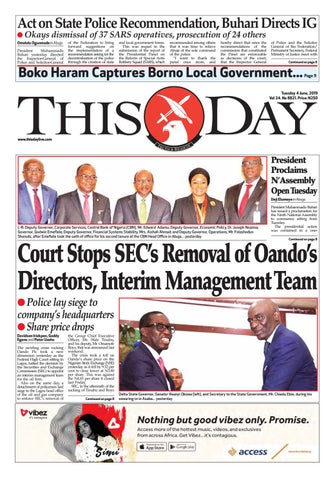
Act on State Police Recommendation, Buhari Directs IG Okays dismissal of 37 SARS operatives, prosecution of 24 others
Omololu Ogunmade in Abuja President Muhammadu Buhari yesterday directed the Inspector-General of Police and Solicitor-General
of the Federation to bring forward suggestions on the implementation of a recommendation asking for the decentralisation of the police through the creation of state
and local government forces. This was sequel to the submission of the report of the Presidential Panel on the Reform of Special AntiRobbery Squad (SARS), which
recommended among others that it was time to relieve Abuja of the sole command of the police. “I want to thank the panel once more, and
hereby direct that since the recommendations of the commission that constituted the Panel are enforceable as decisions of the court, that the Inspector General
of Police and the Solicitor General of the Federation/ Permanent Secretary, Federal Ministry of Justice meet with Continued on page 9
Boko Haram Captures Borno Local Government...
Page 9
Tuesday 4 June, 2019 Vol 24. No 8821. Price: N250
www.thisdaylive.com TR
UT H
& RE A S O
N
President Proclaims N’Assembly Open Tuesday Deji Elumoye in Abuja
L-R: Deputy Governor, Corporate Services, Central Bank of Nigeria (CBN), Mr. Edward Adamu; Deputy Governor, Economic Policy, Dr. Joseph Nnanna; Governor, Godwin Emefiele; Deputy Governor, Financial Systems Stability, Mrs. Aishah Ahmad; and Deputy Governor, Operations, Mr. Folashodun Shonubi, after Emefiele took the oath of office for his second tenure at the CBN Head Office in Abuja…yesterday
President Muhammadu Buhari has issued a proclamation for the Ninth National Assembly to commence sitting from Tuesday. The presidential action was contained in a oneContinued on page 8
Court Stops SEC’s Removal of Oando’s Directors, Interim Management Team Police lay siege to company’s headquarters Share price drops Davidson Iriekpen, Goddy Egene and Peter Uzoho The swirling crisis rocking Oando Plc took a new dimension yesterday as the Federal High Court sitting in Lagos, halted the decision by the Securities and Exchange Commission (SEC) to appoint an interim management team for the oil firm. Also on the same day, a detachment of policemen laid siege to the Lagos head office of the oil and gas company to enforce SEC’s removal of
the Group Chief Executive Officer, Mr. Wale Tinubu, and his deputy, Mr. Omamofe Boyo, that was announced last weekend. The crisis took a toll on Oando’s share price on the Nigerian Stock Exchange (NSE) yesterday as it fell by 9.52 per cent to close lower at N3.80 per share. This was against the N4.65 per share it closed last Friday. SEC, in the aftermath of the sacking of Tinubu and Boyo Continued on page 8
Delta State Governor, Senator Ifeanyi Okowa (left), and Secretary to the State Government, Mr. Chiedu Ebie, during his swearing-in in Asaba... yesterday
2
T H I S D AY • TUESDAY JUNE 4, 2019
T H I S D AY • TUESDAY JUNE 4, 2019
3
4
T H I S D AY • TUESDAY JUNE 4, 2019
TUESDAY JUNE 4, 2019 • T H I S D AY
5
6
T H I S D AY • TUESDAY JUNE 4, 2019
T H I S D AY • TUESDAY JUNE 4, 2019
7
8
TUESDAY, ÍźËœ ͺ͸͚Π˞ T H I S D AY
PAGE EIGHT
Buhari: Kidnappers, Bandits’Days are Numbered Saraki, Ekweremadu seek prayers for sustainable peace Omololu Ogunmade and Deji Elumoye in Abuja President Muhammadu Buhari yesterday commiserated with victims of terrorism, kidnapping and banditry in the country, threatening that the days of the criminals are numbered. The president in his Sallah message to Nigerians in commemoration of the end of Ramadan fasting season, said his administration would never allow criminals and mass murderers to hold the country to ransom. On their part, Senate President Bukola Saraki and his deputy, Senator Ike Ekweremadu, urged Nigerians to seize the occasion to pray for sustainable peace in the country. Presidential spokesman, Malam Garba Shehu, in a statement, quoted Buhari as saying that his administration would pursue the criminals with vigour and bring them to justice. "Their days are numbered because this administration will pursue them relentlessly and bring them to justice," he said.
The statement also quoted the president as saying that he was satisfied with the recent conduct of peaceful elections in Nigeria, despite what he called "doomsday predictions of social disharmony." He also commended the Independent National Electoral Commission (INEC) for what he described as a good job done despite the initial difficulties, praising the voters also for what he described as their tenacity and strong faith in the democratic process. "Before the 2019 general elections, prophets of doom didn't give the country a chance to conduct peaceful elections. Despite these fears, the country overcame its political challenges. "For abandoning their businesses in order to vote, the voters had demonstrated great patriotism in coming out to exercise their civic duty. "Let me use this opportunity once again to reassure all Nigerians that your sacrifices in voting for me won't be in vain. I will ensure the ordinary voters feel the positive impact
of government," the president said. The president also spoke on the lessons of Ramadan, urging the Muslims to always put humanity before personal interests. "The Ramadan period is meant to reinforce us spiritually, therefore, we should use religion as an inspiration to do good at all times. "The virtues of the Ramadan should be sustained beyond the celebration. Going back to bad ways after the Ramadan might defeat the essence of the message and lessons the fasting period was supposed to inculcate in the hearts and minds of the Muslim faithful," he added.
Saraki, Ekweremadu Urge Nigerians to Pray For Sustainable Peace In a goodwill message to mark the occasion, the leadership of the Senate called on Nigerians to pray for sustainable peace in the country.
Saraki, in a statement by his Media Adviser, Yusuph Olaniyonu, said the prayers and sacrifices of the Muslim ummah during the fasting period contributed greatly to the relative peace witnessed across the country in the last one month. He urged all Nigerians to seize the momentum of the completion of this year's Ramadan to work for sustainable peace, security and economic well-being of the country. "Our greatest challenges as a nation are insecurity and economic crises. And there is need for both government officials and those who voted them into office to co-operate in solving these problems. “On the security front, even though we acknowledge that new threats have continued to emerge, we believe that our security forces have all it takes to nip them in the bud in due course. “This is the more reason why all hands must be on deck to ensure the full restoration of
lasting peace and security across the country. This, I believe, will provide a conducive business environment that would encourage investments - through which jobs and better opportunities for our people will be created. “Winning the war on insecurity can only come from the collective efforts of all Nigerians through cooperation with security forces in supplying timely intelligence that would aid them in their job of protecting lives and property across the country,� Saraki stated. While felicitating with Muslims on the completion of the spiritual exercise during the Ramadan, he urged them not to relent in displaying the discipline, restraint, discretion, piety and good neighbourliness, which were very obvious during the fasting period. Saraki further urged Nigerians not to relent in their prayers for the peaceful coexistence of all Nigerians and to be their brother’s keeper at all times. On his part, Ekweremadu
called on the Muslim Ummah to keep praying for the nation and also sustain the virtues imbibed during Ramadan beyond the holy month. Ekweremadu in his Sallah message said continually praying for the peace, security, and progress of Nigeria and walking in the right direction would surely turn the fortunes of the country around. He congratulated the Muslim Ummah on their successful journey of faith, discipline, peace and love throughout the month of Ramadan and implored them to ensure that the great virtues of peace, love, forgiveness, sacrifice, and patriotism imbibed during the Ramadan fast are felt in every aspect of our national lives beyond the holy month. “I urge the Muslim Ummah and indeed all Nigerians to continually pray for the nation in the face of the worrisome security and daunting national challenges. I have no doubt that with prayers and the right attitudes and policies, Nigeria will emerge stronger from her present difficulties,� he said.
of the Clerk of the National Assembly (CNA), Alhaji Mohammed Sani-Omolori, confirmed that the document was actually received from the president, the former Senior Special Assistant to the President on National Assembly Matters (Senate), Senator Ita Enang, feigned ignorance of the document. But he promised to get back to THISDAY after clarifying from appropriate quarters. He was, however, yet to do so as at press time yesterday night.
Meanwhile, House of Representatives members-elect of the opposition Peoples Democratic Party (PDP) and other parties such as Young Peoples Party (YPP), Social Democratic Movement (SDM) and African Democratic Congress (ADC) met yesterday to garner support for the election of Hon Femi Gbajabiamila as speaker of the Ninth House ahead of the inauguration on Tuesday. The meeting, held at Transcorp Hilton Hotel, Abuja, saw Gbajabiamila canvassing
for the support of the main opposition PDP and other legislators-elect to emerge as the next House speaker. Also, the Caucus meeting of the PDP senators and House members-elect initially scheduled for the evening was rescheduled for Friday evening. A ranking PDP senator told THISDAY that the meeting was shifted to allow for many of the lawmakers to attend as sizeable number of the fresh legislators had not arrived Abuja.
the conclusion of investigations into the activities of Oando Plc, following petitions from two shareholders of the company in 2017. The commission said other aspects of the findings would be referred to the NSE, Federal Inland Revenue Service (FIRS) and the Corporate Affairs Commission (CAC) for necessary action.
relationship between himself and the ousted Wale Tinubu. The interim management is charged with the responsibility of convening an extra-ordinary general meeting on or before July 1 2019 to vote new directors, who would subsequently select a new management for Oando. “We view this development as positive for the equities market. In our opinion, the SEC’s hard stance on Oando
PRESIDENT PROCLAIMS N’ASSEMBLY OPEN TUESDAY page document, sighted by THISDAY, titled 'Proclamation for The Holding of The First Session Of The 9th National Assembly,' bearing the president's seal, signed on May 30. Buhari said he was proclaiming the Ninth Assembly in line with section 64(3) of the Constitution of the Federal Republic of Nigeria (As Amended). The document stated inter alia: "Whereas it is provided in Section 64(3) of the Constitution of the
Federal Republic of Nigeria 1999 (as amended) that the person elected as president shall have power to issue a proclamation for the holding of the first session of the National Assembly immediately after his being sworn-in. The president stated: "Now, therefore, I, Muhammadu Buhari, President Commanderin-Chief of the Armed Forces of the Federal Republic of Nigeria, in exercise of the powers bestowed upon me by Section 64 (3) aforesaid
and of all other powers enabling me in that behalf, hereby proclaim that the first session of the Ninth (9th) National Assembly shall hold at 10:00am on Tuesday, 11th June, 2019 in the National Assembly, Abuja. "Given under my hand and the public seal of the Federal Republic of Nigeria at Abuja, this 30th day of May, 2019. Controversy, however, appeared to have dogged the authenticity of the proclamation document. While sources at the office
COURT STOPS SEC’S REMOVAL OF OANDO’S DIRECTORS, INTERIM MANAGEMENT TEAM last Friday, had constituted an interim management headed by Mr. Mutiu Sunmonu, to oversee the affairs of Oando Plc and conduct an Extra Ordinary General Meeting on or before July 1, 2019. The regulatory commission not only barred Tinubu and Boyo from holding director positions of public companies for a minimum of five years, it also ordered other directors of the company to resign their positions immediately. But yesterday, following an ex-parte motion filed by Tinubu and Boyo, through their lawyer, Mr. Tayo Oyetibo (SAN), Justice Mojisola Olatoregun of the Federal High Court in Lagos ordered SEC and Sunmonu to maintain the status quo. The judge said the order to maintain the status quo would remain pending the determination of the motion on notice. She ordered that the order be served on the commission alone with the motion on notice, as well as other processes. The judge directed the applicants to file an undertaking indemnifying the commission in case it later turns out that the orders ought not to have been made. The judge adjourned the case till June 14 for further hearing. The respondents in the suit are SEC and Sunmonu as the first and second respondents respectively. Tinubu and Boyo had approached the court for an
interim injunction restraining SEC, its servants, agents, employees or privies from taking any step concerning or acting on its decisions. They said the decisions, as contained in SEC’s letter dated May 31, 2019, imposed a fine of N91,125,000 on Tinubu and barred he and Boyo from being directors of public companies for a period of five years. They sought the suspension of the orders pending the hearing and determination of the applicants’ motion for interlocutory injunctions. They also sought an order of interim injunction restraining Sunmonu from acting as the head of the interim management of Oando Plc pending the hearing and determination of their motion for interlocutory injunction. The applicants asked for an order staying and or suspending the execution or the enforcement of SEC’s decision imposing a fine of N91,125,000.00 on Tinubu and barring he and Boyo from being directors of public companies for a period of five years, pending the hearing and determination of the motion for interlocutory injunction. They equally asked the court for an interim injunction restraining SEC, its servants and its agents from directing, requesting any agency of government to act upon its decision contained in its letter dated May 31, 2019 pending the hearing and determination
of their motion on notice.
Police Lay Siege When THISDAY visited the company’s headquarters yesterday morning, it saw a detachment of armed policemen, who came in two patrol vans, guarding the entrance of the office complex. It was also gathered that operations at the oil and gas company were shut down as Oando staff, who came to work in the morning, were not allowed to enter the office by the police. One of the security guards at the gate of the complex, who refused to disclose his identity, told THISDAY that the head office had been shut since morning. “Oando is not open for work today. You can see the police there; they will not allow you to enter there. So, I advise you to leave now before they will harass you,� he said. When asked who sent the police to the complex, the guard said he had no idea. Also, when THISDAY asked one of the receptionists at the ground floor of the complex, who also refused to disclose her identity, she said: “Oando is not working today (yesterday). I don’t work for Oando; we came here this morning and discovered that they were not open for work. Their office has been shut since morning. I think that is why the police are here. They will not allow you to access their floor. The
whole place is locked right now.� SEC on Sunday constituted the Interim Management Team (IMT), headed by Sunmonu, to oversee the affairs of Oando Plc and conduct an Extra Ordinary General Meeting (EGM) on or before July 1, 2019. Although other members of the IMT were not disclosed, SEC said in a statement that the team was to also appoint new directors to the board of Oando Plc, who would subsequently select a management team for the company. The head of Oando Plc IMT was the Managing Director of Shell Petroleum Development Company of Nigeria Limited (SPDC), from 2004 to March 1, 2015. In sacking Tinubu and Boyo, which led to the setting up of the interim management team, SEC had said the findings from a forensic report it ordered into the management of the company had revealed serious infractions. It listed the infractions to include false disclosures, market abuses, misstatements in financial statements, internal control failures, and corporate governance lapses stemming from poor board oversight, irregular approval of directors’ remuneration, unjustified disbursements to directors and management of the company, and related party transactions not conducted at arm’s length, among others. The development followed
Share Price Drops In a statement by the company’s Chief Compliance Officer and Company Secretary, Mr. Ayotola Jagun, last night, it said Tinubu and Boyo, by the court interim orders, remain in charge. Meanwhile, the share price of Oando Plc fell to N3.80 per share yesterday. Investors traded 27.145 million units of the stock valued at N103.269 million. Year-to-date, Oando Plc shares have suffered a decline of 24 per cent. Market operators said the ruling by the SEC on the outcome of the forensic audit of activities of Oando sent mixed feelings among shareholders and other stakeholders. Analysts at CSL Stockbrokers Limited, a Lagos-based financial advisory and research company, welcomed the action by SEC. They expressed confidence in the newly appointed IMT. An analyst said: “We believe his (Sunmonu) vast experience in the upstream oil and gas sector bodes well for Oando despite rumours of a close
Continued on page 9
TOP GAINERS NGN NGN % CHAMPBREW 0.10 1.11 9.9 UPL 0.17 1.97 9.4 ACADEMY 0.02 0.27 8.4 STERLBANK 0.10 2.40 4.3 JAIZBANK 0.02 0.48 4.3 TOP LOSERS NGN % GSK 0.85 7.65 10.0 ETI 1.10 10.05 9.8 JBERGER 2.15 19.70 9.8 OANDO 0.40 3.80 9.9 VITAFOAM 0.40 3.85 9.4 HPE Nestle Nig Plc â‚Ś1,460.00 Volume: 246.091 million shares Value: N2.818 billion Deals: 3,850 As at yesterday 3/6/19 See details on Page 31
9
TUESDAY, ÍźËœ ͺ͸͚Π˞ T H I S D AY
NEWS
Emefiele Lists Priorities in Second Term Promises sustained interventions to stimulate economy
James Emejo in Abuja Central Bank of Nigeria (CBN) Governor, Mr. Godwin Emefiele, yesterday emerged from his oath taking, vowing to, in his second term, strengthen efforts to stimulate growth and job creation in critical sectors of the economy in order to insulate it from global economic shocks. He said the CBN would be more people-focused and enabled to play an active role in supporting job and wealth creation in the country. The CBN governor added that more work still needed to be done in building a stronger economy for the benefit of all, adding that he would unfold a new road map for the CBN and the economy next week. Emefiele spoke shortly after being administered the oath
of office for a second term by the bank's Secretary and Director, Corporate Secretariat Department, Mrs. Alice Karau. While evaluating the various intervention programmes undertaken by the CBN to reduce weaknesses in the Nigerian financial system as well as support improved productivity of the Nigerian economy, Emefiele said there was still more work to be done to build a stronger economy. He said all stakeholders must rise to strengthen efforts at building a healthy and stable system in the best interest of the country. According to him, the pace of Gross Domestic Product (GDP) growth remained fragile and below the rate of Nigeria’s annual population growth at 2.7 per cent.
As a result, he said the apex bank would continue to collaborate with the fiscal authorities to strengthen growth and wealth creation in the country. He said: “We must strengthen our efforts over the coming years to stimulate growth and job creation in critical sectors of the economy, which will help insulate our economy from shocks in the global economy. “We must also work to build a healthy and stable financial system that contributes to the growth of our economy, while preserving price stability.� Emefiele, who was received into the bank by the four deputy governors, appeared to be happy by the turnout of excited staff that thronged the venue of the oath-taking ceremony, chanting his name.
He expressed gratitude to God for his return and thanked President Muhammadu Buhari for nominating him and the Senate for confirming his appointment. He also thanked the management and staff as well as the media for all their support during his first term in office. Buhari had on May 8 submitted the name of Emefiele to the Senate for confirmation of his second and last five-year tenure as CBN governor. The Senate at plenary had referred the president’s letter to the banking committee for further legislative action. The committee thereafter screened Emefiele and recommended him for reappointment as CBN governor, saying he performed creditably in his first term.
EmeďŹ ele
Boko Haram Captures Borno LG Troops kill 20 terrorists in Lake Chad Kingsley Nwezeh in Abuja The war against terrorism has suffered a setback as Boko Haram captured Marte Local Government Area (LGA) of Borno State after an attack on a military base in the area. One of the soldiers who was in the military base, but who spoke on condition of anonymity, said the insurgents stormed the 153 Task Force Battalion base on Sunday and opened fire on the troops. The terrorists later set the military base on fire. The source said the attack, which took place at about 6 p.m. caught the troops unaware. News of the capture of
Marte broke as troops from the Multinational Joint Task Force (MNJTF) battled insurgents, mostly fighters of the Islamic State for West Africa Province (ISWAP), in Arege and Malkonory in the Lake Chad area, killing 20 insurgents. "We engaged them in a fierce encounter for about an hour. Initially, we were about getting victorious over them, but they overpowered us, and all troops in the burning base were set asunder, with all of us fleeing in all directions in the bush," the source said. However, efforts to get Army spokesman, Col. Sagir Musa, to give details of the clash were abortive as calls made
to his telephone line were not answered. But MNJTF spokesman, Col. Timothy Antigha, who gave an update on the killing of the insurgents, said the multinational troops killed over 20 terrorists operating around Arege, Malkonory and Tumbum Rego general area. The clash between the multinational troops and ISWAP came just as the terrorist group, Antigha said gun trucks, arms and ammunition, as well as a Vehicle Borne Improvised Explosive Device, which was meant to disrupt troops advance, was also destroyed in the gun duel between the troops and the terrorists.
"Unfortunately, four personnel of the MNJTF were wounded during the fire-fight and have been evacuated for urgent medical attention. "The MNJTF remains committed to delivering the mandate of the force and therefore, urges continuous support and solidarity of the good people of the Lake Chad Region," he said. Meanwhile, the police yesterday paraded 38 suspects some of whom specialised in transnational gun running, using a route spanning North Africa, Ghana, Burkina Faso, and ending up in Shaki town in Oyo State from where arms were moved across the country. Parading the suspects in
Abuja, Force Public Relations Officer, Mr. Frank Mba, a Deputy Commissioner of Police (DCP), said the gun running gang specialised in bringing arms into the country. He said the arrested persons, comprising suspected kidnappers, armed robbers, and car snatchers, were picked up across the country by police special squads under the IG's direct supervision as part of the renewed war against crime and criminalities. Mba said the police recovered 6,000 live ammunition, 20 AK 47 rifles, 10 pistols, 11 weapons and four pump action rifles, all displayed at the SARS office in Abuja. During an interview with
journalists, one of the suspects, Ojomo Adebowale Gbenga, said he had been in the business of gun-running for 15 years. He said he had been bringing in arms from Ghana in concealed boxes at the cost of N300,000 per box. And as Muslims mark Eid-el-Fitri today, the Inspector General of Police, Mr. Mohammed Adamu, yesterday ordered commissioners of police in the 36 States and the Federal Capital City (FCT) to provide security in worship centres throughout the Sallah period. He said all counterterrorism and tactical squads of the police should be placed on red alert throughout the period.
dangers posed to the public by the group could be addressed. According to Ojukwu, the panel received 113 complaints on alleged human rights' violations from different parts of the country, 22 memoranda on the reform and reorganisation of SARS as well as the entire Nigeria Police. He said: "At the end of its public hearing and having listened to complaints as well as defendants and their counsel, the panel recommended 37 police officers for dismissal from the force. Twenty-four were recommended for prosecution. "The panel also directed the Inspector-General of Police to unravel the identity of 22 officers involved in the violation of the human rights of innocent citizens. The police were directed to pay compensation of various sums in 45 complaints and tender public apologies in five complaints and directed to obey court orders in five matters. "The police were directed to immediately arrest and prosecute two retired senior police officers found to have violated the rights of citizens (one for extra-judicial killing and the other for illegal takeover of property of a suspect. The panel also recovered two vehicles illegally auctioned by SARS officers and returned them to their owners."
The NHRC boss listed other recommendations by the panel to include: significant improvement in the funding, kitting and facilities of the Nigeria Police Force; strengthening information and communication technology (ICT) of the Force; establishment of state and local government police; institutionalising a special investigation panel to annually hear and determine complaints on alleged human rights violations against operations of the Nigeria Police Force and strengthening the Police Rapid Response Complaints Unit of the Nigeria Police and other internal complaints mechanisms of the Force to make them more responsive. Ojukwu said the recommendation to rename SARS as ARS only implied a reversal to SARS' original name with a view to making "the section operate under the intelligence arm of the police from the divisional, area command, state command,
zonal command up to the Force headquarters level," adding that doing so would remove the stigma associated with the name SARS. According to him, rechristening the group would also compel ARS to "limit itself to tackling armed robbery while other intelligence and operational units are strengthened to perform their various special tasks." Besides Ojukwu, other members of the committee are: Mr. Tijani Mohammed from the Police Service Commission; Mr. David I. Shagba of the Public Complaints Commission; Mr. Hashimu Argungu, a Deputy Inspector General of Police (Rtd); Professor Etanibi Alemika of the University of Jos; Mr. Chino Obiagwu (SAN), Chairman, Human Rights Agenda Network; Ms. Iyabode Ogunseye, drawn from the Nigerian Bar Association and the panel's secretary, Mr. Abdulrahman Yakubu, from the NHRC.
ACT ON STATE POLICE RECOMMENDATION, BUHARI DIRECTS IG the commission to work out the modalities for the implementation of the Report within three months from today’’ The president also approved the recommendation of the panel for the renaming of SARS as Anti-Robbery Squad (ARS) and for the dismissal of 37 SARS' operatives and prosecution of 24 other police officers. Buhari, while receiving the report of the panel in Abuja from the Chairman, who is also the Executive Secretary of the National Human Rights Commission (NHRC), Mr. Anthony Ojukwu, also accepted the panel's recommendation, which directed the InspectorGeneral of Police to unravel the identity of 22 police officers indicted for violation of fundamental rights of some Nigerians. Buhari also approved other recommendations for the payment of compensation to 45 complainants, apologising to five others and ordering the Nigeria Police to obey court orders in five matters as well as the arrest and prosecution of two retired senior police officers for extra-judicial killing of a citizen and the takeover of the property of a suspect respectively. According to the president, reforming and repositioning
the Nigeria Police Force for more effective and efficient performance has become imperative if the country must guarantee the protection of human lives and property, arrest offenders and improve internal security in accordance with best practices. The president, who added that he had taken certain decisions, including increasing the police workforce and improving the welfare of the police in view of the sensitive jobs they do, said the police were duty bound to act within the ambit of the law. He said whenever the police violate the rights of citizens in the course of discharging their responsibilities, the government was duty bound to intervene in such situations. This, he added, informed the decision to set up the committee. He said: "In order to reposition the Nigeria Police Force to effectively carry out its statutory responsibilities, I have taken major steps by increasing the workforce of the Nigeria Police as well as improving the welfare of police officers, because they put their lives on the front line on a daily basis so that the rest of us may freely go about our business in safety. "However, in carrying out their statutory responsibilities, the police must at all times
act within the ambit of the law and must not violate the fundamental human rights of Nigerians whom they have sworn to protect. "Where the rights of Nigerians are violated by police officers while discharging their functions, the government has a responsibility to address the instances of violation in line with its human rights obligations and ensure that such police officers are held accountable for their actions. "It is in recognition of our obligations under the Constitution of the Federal Republic of Nigeria and international human rights laws, that this administration decided to set up this presidential panel and directed the National Human Rights Commission to constitute its membership in order to investigate the various public outcries and media reports." Earlier, while presenting the report, Ojukwu had said the panel was constituted on August 14, 2018, following the president's directive, which ordered the NHRC to probe various allegations of human rights violations and abuse of office by police officers operating under the aegis of SARS. The president also ordered the NHRC to make recommendations on how the
COURT STOPS SEC’S REMOVAL OF OANDO’S DIRECTORS, INTERIM MANAGEMENT TEAM provides confidence for the investment community that corporate malpractice offenders would be brought to book while ensuring public investments are safeguarded. Though we expect a series of legal battles
to ensue as Wale Tinubu has promised to contest his removal, we believe he has a very slim chance of winning any suit filed by him, considering the depth and rigour of the forensic audit.�
10
TUESDAY JUNE 4, 2019 ˾ T H I S D AY
NEWS
Group News Editor Ejiofor Alike Email Ejiofor.Alike@thisdaylive.com, 08066066268
Obasanjo Urges Aisha Buhari to Engage Her Husband on State of the Nation Femi Ogbonnikan in Abeokuta Former President, Chief Olusegun Obasanjo, yesterday charged the First Lady, Mrs.
Aisha Buhari, to as a matter of urgency engage her husband, in a “pillow talk” in order for him to grasp the true position of the State of the Nation.
My Appointment is in Order, Acting CJN Tells Court Alex Enumah in Abuja The Acting Chief Justice of Nigeria (CJN), Justice Tanko Muhammad, yesterday told the Abuja Division of the Federal High Court that his appointment by President Mohammmadu Buhari in January this year was in line with the provisions of the law. Justice Muhammad made the submission in his reply to a suit challenging his appointment as Acting CJN. The suit was filed by the Board of Incorporated Trustees of Malcolm Omirhobo Foundation, an advocacy group. The plaintiff in the suit marked FHC/ABJ/CS/420/2019, urged the court to declare that Muhammad, having made himself available as a tool that was used in the violation of the Constitution, especially with regards to the alleged illegal removal of the former CJN, is therefore not a proper and fit person to be recommended for appointment to head the judiciary. But in his reply to the suit yesterday, Muhammad told the court that his appointment was made shortly after the former CJN, Justice Walter Onnoghen was suspended from office based on the order of the Code of Conduct Tribunal (CCT), which heard the case of false asset declaration against Onnoghen, adding that President Buhari, who appointed him is legally vested with the powers to suspend a CJN, including Onnoghen. The CCT had in an exparte application directed Buhari to suspend Onnoghen, pending the hearing and determination of corruption charges against him and appoint the most senior justice, (Muhammad) to replace Onnoghen as CJN. In a 39-paragraphed counteraffidavit that was deposed to by one Sadiq Ahmad, the Acting CJN, argued that President Buhari,
being the appointing authority, “has the power to remove or suspend any person occupying the office of the CJN”. Muhammad further submitted that in exercising his powers to suspend a CJN, the president need not seek the approval of the National Judicial Council (NJC), or the Federal Judicial Service Commission, (FJSC). Justice Muhammad equally maintained that there was also no need for President Buhari to approach the Senate “for support by majority of two-third votes, before the erstwhile CJN could be suspended from office”. “That the 5th Defendant (Buhari) followed due process of law in the appointment of the 3rd Defendant as the Acting CJN. “That the 5th Defendant has extended the appointment of the 3rd Defendant as the Acting CJN, by another three months, upon the recommendation of the 1st Defendant (NJC). “I know as a fact that there had not been any negative impact on the Nigerian Judiciary as there is renewed belief by the common man in the judiciary as his last hope”, the Acting CJN added. Justice Muhammad, therefore, prayed the court to dismiss the plaintiff’s suit against his appointment. The Board of Incorporated Trustees of Malcolm Omirhobo Foundation had, in an exparte motion filed on April 15, 2019, asked the court to stop Justice Muhammad’s appointment as CJN, pending the hearing and determination of the motion on notice filed by the foundation. The plaintiff also asked for an order of interim injunction restraining the Senate of the Federal Republic of Nigeria (7th defendant) from confirming the appointment of Justice Muhammad as CJN pending the determination of the substantive suit challenging his appointment.
Sultan Declares Today Eid-el-fitr Day The Sultan of Sokoto, Alhaji Sa’ad Abubakar III, has declared today, June 4, as the Eid-el-Fitr day marking the end of Ramadan fast. The News Agency of Nigeria (NAN) reported hat the Sultan announced the sighting of the new moon of Shawwal in a radio and television broadcast in Sokoto yesterday. Abubakar said that the new moon was sighted in Kaduna, Kebbi, Yobe, Borno, Jigawa and Sokoto states, among others. He said, ”In accordance with Islamic law, we have the honour and pleasure to announce that today, Monday,
the 29th day of Ramadan,1440 AH, which is equivalent of June 3, 2019 marks the end of Ramadan and the beginning of the new month of Shawwal. ”Reliable reports of moon sighting were received from Muslim leaders and religious organisations across the country, which were duly verified and authenticated by us, states and the National Moon Sighting Committee. “Consequent upon this, tomorrow, Tuesday June 4, 2019 becomes the first day of Shawwal,1440 AH and is therefore declared the Sallah day for 2019 Eid-el-Fitr, ” he said.
It would be recalled that Mrs. Buhari had recently voiced out her displeasure on how her husband’s administration was being run, the latest being the inability of the security agencies to proffer lasting solutions to the consistent banditry in the country. Obasanjo, who commended the president’s wife for speaking out her mind, added that it was obvious the First Lady had not adopted the “bedroom approach” to get her husband’s attention to the issues. According to Obasanjo, the First Lady, in recent time, had spoken about her displeasure on how her husband’s government was being run.
The former president, who played host to the Editorial Board of the renowned social media platform, “Penpushing Media,” at his Olusegun Obasanjo Presidential Library (OOPL) boardroom, advocated for more advocacy and sensitisation to get the desired change in the country. Obasanjo, in a statement by his media aide, Kehinde Akinyemi, added that the media should also play crucial role in the mission to turn the country for better. Obasanjo said the advocacy would raise awareness, “and we have to put all things on table to address these problems. Mind
you, we have to be sincere and genuine with ourselves. “It is nice that president wife is talking; I think she did well, and may be, she should also have a pillow talk with the president’ “I believe every Nigerian family, individual, group is entitled to livelihood. It is the responsibility of all to make sure we have a dignify life. That should be our aim collectively,” he said. Earlier in her speech, the Chairman, Editorial Board of Penpushing Media, Mrs. Funke Fadugba, said the visit was to intimate the former president with the programme of events for the Third Anniversary
Lecture of the organisation scheduled to hold on July 19. She said that the anniversary lecture with the theme, “Political Evolution and Multi-party Democracy: Education to the Rescue,” has become imperative in view of the developments in the country. Fadugba said the role of speaking “truth to power” by Obasanjo cannot be overemphasized”, adding that with the statements by the First Lady, Mrs. Aisha Buhari, “these are commendable efforts, but, one wonders what is really happening. The lecture, it is our belief will go a long way to bring the change this country deserves,” she said.
LET’S REFORM SARS…
President Muhammadu Buhari (right), receiving the report of the Presidential Panel on Reform of the Special Anti-Robbery Squad (SARS) from the Chairman of the panel, Mr. Tony Ojukwu, at the Presidential Villa, Abuja...yesterday GODWIN OMOIGUI
Kano Anti-corruption Commission Recommends Sanusi’s Suspension The Kano State Public Complaints and Anticorruption Commission has recommended the suspension of the Emir of Kano, Muhammadu Sanusi. The commission which said it has been investigating alleged misappropriation said it uncovered that N3.4 billion was misspent by the emirate under Sanusi. The amount was said to have been misappropriated between 2014 and 2017. According to the News Agency of Nigeria (NAN), this recommendation is contained in a preliminary report of investigation conducted by the
commission and signed by its Chairman, Muhuyi Magaji. The interim report raised four cardinal issues bordering on indictments, amount involved, obstruction of investigation and recommendations. The report indicated that the Kano emirate council had spent over N1.4 billion in various expenditures believed to be fraudulent and unappropriated. In addition, the emirate council was alleged to have spent over N1.9 billion unappropriated on seemingly personal expenditures, making the total sum of the questionable expenditures. According to the report, the
expenditures contravened the provisions of section 120 of the 1999 constitution of the Federal Republic of Nigeria (as amended) and section 8 of the Kano state emirate council special fund law 2004. Similarly, the expenditure had also violated Section 314 of penal code as well as provisions of section 26 of the Kano State Public Complaints and Anti-Corruption Commission Law 2008 (as amended). “It is also the opinion of this Commission, based on the available evidence, that Emir Muhammadu Sanusi II continued to undermine the
investigation through various means which include giving instruction to all officers invited for clarification to shun the commission’s invitation,” the report read. “The act is seriously affecting the process of our statutory responsibility and offends the provisions of Section 25 of the Commission’s enabling Law 2008 (as amended).” The report, therefore, recommended that the “principal suspect in the person of Muhammadu Sanusi II and all other suspects connected with the case be suspended, pending the final outcome of the investigations”.
Ex-NIMASA DG Sentenced to Seven Years Imprisonment Davidson Iriekpen The Federal High Court in Lagos yesterday sentenced convicted a former acting Director-General of the Nigerian Maritime Administration and Safety Agency (NIMASA), Mr. Calistus Obi, to seven years imprisonment. The court, however, gave him an option of N42 million fine. Justice Mojisola Olatoregun
had on May 23 found him guilty of money laundering and converting the agency’s funds to personal use. Obi was sentenced alongside Dismal Alu, who was the second defendant in the case. But the judge discharged the defendants on counts one and three of the charge. The court also refused to order the forfeiture of his seized assets.
The duo had been standing trial alongside two firms, Grand Pact Limited and Global Sea Investment. They were charged with N225 million fraud. The judge held that the prosecuting agency, the Economic and Financial Crimes Commission (EFFCC), proved the charges against them beyond reasonable doubt. In the eight counts filed
against them, the EFCC said they conspired among themselves on August 5, 2015, to convert N225 million belonging to NIMASA to their own. The prosecution said they acted contrary to sections 15 and 18(a) of the Money Laundering (Prohibition) (Amendment) Act, 2012. To prove the allegations, the EFCC called eight witnesses and tendered 32 exhibits.
T H I S D AY • TUESDAY JUNE 4, 2019
11
12
T H I S D AY • TUESDAY JUNE 4, 2019
T H I S D AY • TUESDAY JUNE 4, 2019
13
14
T H I S D AY Ëž Ëœ Í˛Ëœ 2019
COMMENT
Editor, Editorial Page PETER ISHAKA Email peter.ishaka@thisdaylive.com
BUHARI, NIGERIA AND PALESTINE What is Nigeria’s interest in supporting Palestine? asked Fredrick Nwabufo
T
here is no morality in global politics. It is eat or be eaten. The nucleus of international relations, beyond the niceties of diplomacy, is interest. Substantially, foreign relations is a trade of interests. Nothing is given for nothing. Every country seeks its own even in the extension of charity to another country. But Nigeria’s approach to foreign relations has always been ludicrous. No head or tail, just some whimsical pursuits without accruing benefits to the country or to its citizens abroad. A few weeks ago, the government made a donation of $500,000 to Guinea Bissau for its elections. At the time, I wrote: “When the purpose of giving is to ‘maintain an appearance’, then there is a self-esteem problem. Over the years, Nigeria has had Africa as the “centrepiece� of its foreign policy. The country has played supportive and stabilising role in the affairs of most countries on the continent. It took the throttle in the struggle against apartheid in South Africa; it funded the ANC, and provided academic and corporeal sanctuary to the blacks of the country. Today, Nigerians are, perhaps, the most hated people in that country, routinely harassed, abused and intimidated. It is not out of place to play the ‘big-brother’, but it is unwise to keep playing the role when effort is unrequited and when there is a blistering image problem.� Last week, President Buhari at the summit of the Organisation of Islamic Cooperation (OIC) in Saudi Arabia said Nigeria was in support of an independent state for Palestine. In February 2016, he had made a sterner declaration. At the summit he said: “We support the actions of the OIC in seeking an early resolution to the lingering Palestinian question and the rights of the Palestinian people to an independent homeland.� My reaction to this statement is, is “the support� in the interest of Nigeria? How does it benefit the country in relation to its neighbours, region and partners? Is it in conflict with the interest of the allies of the country in the West and in the region? Is this decision acceptable to at least 70 per cent of Nigerians? Who are the “we� the president
WHAT IS REALLY OUR NATIONAL INTEREST? DO WE HAVE A NATIONAL INTEREST? OR ARE THERE DISPARATE INTERESTS? IN ESSENCE, HAUSA INTEREST, IGBO INTEREST, YORUBA INTEREST AND CHRISTIAN/MUSLIM INTEREST?
mentioned? How was opinion sampled in arriving at the decision that “Nigerians� are in support of the Palestinian cause? The US and some other countries aligning with Israel in this regard are propelled by strategic, security, economic and political interest just like some countries in the Arab world are for the Palestinian cause. Even during apartheid, Nigeria’s support for the ANC and the blacks in South Africa was for strategic and political reasons being the lodestar of Africa at the time. But what is our interest in the Israeli-Palestinian struggle in the Middle East? Is the support for the cause in our national interest or is it driven by some native stimuli? What informed President Buhari’s decision? I desperately need to understand this. I remember in December 2017, Nigeria voted against the US by supporting a UN resolution asking the country to withdraw its recognition of Jerusalem as the capital of Israel. This is while some countries abstained from voting, which I consider the rational and sagacious diplomatic card to play. As I said earlier, global politics is capitalised in interest. What does Nigeria stand to gain by its open support for the Palestinian cause? In March 2016, President Buhari also pledged support for the independence of Western Sahara, which I consider hypocritical. But what is our interest in all of these? This brings me to the question: what is really our national interest? Do we have a national interest? Or are there disparate interests? In essence, Hausa interest, Igbo interest, Yoruba interest and Christian/ Muslim interest? Perhaps, our national interest or foreign policy direction is dependent on the religious or ethnic background of the leadership of the day. Whichever way it swings is predicated on the absurd primordial. As a matter of fact, Nigeria lacks direction on the global scene just as it appears to lack a compass on the national front. fredricknwabufo@yahoo.com
DEBTORS, LAW ENFORCERS AND NIGERIAN BANKING Femi Abimbola writes that regulators are yet to stamp out several malpractices in the banking industry
A
London-based economic and political risk analyst that I have known for more than 10 years reached out to me a couple of weeks ago to ask this poignant question: “What’s going on in your country banking industry?� I wasn’t sure what he was after this time as he often calls me up to catch up on political and economic developments in Nigeria, whenever he was researching to do a report for clients. “What are you on about this time around?� I asked him. “I’m doing a risk assessment for clients who are looking at making some money available to the banking industry and I have come across a lot of reports where the police are being used by debtors to prevent legitimate debt obligations being carried out by the banks. This is odd and is not good for your country.� He explained his observation. In the last few months, there appears to have emerged, a new trend where the relationship between some banks and their debtor-customers goes awry over the latter’s failure to keep up with debt obligations. What is even stranger, and this was what the London economic and political risk analyst was alluding to, is that it would appear that the debtors, many of whom have been established to be chronic defaulters, take refuge in some law enforcement agencies, such as the police, the Economic and Financial Crimes Commission (EFCC), the courts, among others. I have seen and followed cases of these agencies appearing to completely ignore the issue of indebtedness of the chronic debtors and then go after banks, particularly their chief executives; in a manner often bothering on harassment and criminalization. It was only 10 years ago that the world was hit by a global financial crisis, which reverberated in Nigeria and led to some drastic measures being taken, including the setting up of the Asset Management Corporation of Nigeria (AMCON) to take over delinquent debt-assets from the books of banks to keep some of them afloat. Some banks did not survive the crisis, and even now, the financial system and some parts of the economy are still reeling from its aftermath. The peculiarity of the Nigerian financial crisis, which hit the banking industry hard, was largely due to huge loans gone bad that were given to customers, many of whom simply refused to pay because they considered themselves the untouchable in society, who should get away with not observing the obligations that come with borrowing money from the banks. Law enforcement agencies cannot, 10 years later, after all the noise that went down with the develop-
ment, claim to have just forgotten or do not now understand that there are obligations tied to loans or bank advancements that are given to individuals and organisations. They cannot have forgotten the thousands of jobs that were lost in the banking industry because of the crisis that resulted from the many debt defaults on account of this behaviour. It would seem that the new tactics being applied is to create as much embarrassment as possible for banking executives, especially their chief executives, with a view to forcing the hands of these banks. The goal, it is now clear, is to force the banks to stand down from pushing forward with collecting what a chronic debtor owes. This cannot be what the various law enforcement agencies involved in this act want to see themselves being used for at this time of Nigeria’s development. It leads to asking the question, how much of the matter do these enforcement agencies really know in the cases between banks and debtor-customers before they step in to invite bank executives for the purpose of this orchestrated harassment? It is obvious that there is a less than adequate understanding on the part of different law enforcement agencies about the issues involved in the matter between the two parties, especially the simple matter of customer obligation over loans taken from banks. Or they are deliberately choosing not to understand them with that strangeness of the Nigerian kind. Here is a simple scenario. A customer walks into a bank for a facility, which is availed to him with certain obligations to perform. A loan agreement is signed with all parties, including lawyers present and counter-signing, and clearly stated actions the lender can take to recover its money when the debtor fails to meet the obligation. What is now playing out is that at the point where the bank is exercising these actions, some law enforcement agencies are showing up with a chronic debtor to accuse, not just the bank, but its executives (obviously aimed at maximum embarrassment), of some indiscretion. In logic this would fall under some fallacies. There is something particularly unwholesome that this development brings for the Nigerian economy, the banking industry and the executives who run banks. It is unhealthy for the economy because we are having law enforcement agencies appearing to provide a cushion and take sides with recalcitrant and chronic bank debtors, providing them a platform to avoid fulfilling their obligations on loans they obtained with their eyes wide open. For the economy, it is important that this situation should immediately attract the attention of its managers and the relevant authorities as it could easily lead to a
gradual build up to the crisis of 10 years ago. The international financial community feeds on information and information shapes perception. This new method of handling chronic debt matters, where the debtors appear to enlist the police, courts and others, sometimes including the EFCC, on their side so as not to meet their obligations is veritable ground for negative scores on the reputation table for Nigeria, its economy, its banking industry and its bank executives who are supposed to relate with their counterparts across the world on deal negotiation tables. While we are here hyping some banks, their CEOs and other executives as some of the best in the world for their performances, the stories the world is reading and seeing especially on social media are that they are routinely invited based on some rather strange charges raised by debtor-customers before law enforcement agencies. In many cases they are accused of such a serious reputation damaging act as theft of their debtors’ goods. Some credit scores are damaged by this kind of information and they come into play in different global board rooms when determining whether an on-lending facility should come to Nigeria or go elsewhere. If a CEO who has been harassed in this manner, because he or she has been accused by a chronic debtor, whose collateral has been exercised for falling behind on his obligation, is sitting in a board room in London or New York or Hong Kong trying to negotiate an on-lending facility for his or her bank, how is he or she expected to look when asked to explain a report of theft contained in a risk analyst’s report? He will look small and embarrassed, of course! And that would rub off on Nigeria. It is, therefore, being advocated here that this is a matter the relevant authorities must look at seriously. While the authorities are yet to wake up to this developing danger to Nigeria’s economy and its reputation, the group being directly targeted by this, the banking industry, has an onerous responsibility to act. Chronic, defaulting debtors who go from one bank to another throwing their political, economic connections and supposed business weights around to secure loans are well known. But the lack of cooperation among banks, driven by the cut-throat competition among them, is allowing this to carry on. It, therefore, calls for cooperation and collaboration to identify and blacklist such well known loan offenders, who think they can use law enforcement agencies to avoid meeting their obligations. Cooperation and collaboration will allow for a list to be developed, a black book, more or less, with banks sharing information, and refusing to lend to these types of borrowers who are fund of hopping from
one bank to another, once they are caught out by one financial institution or the other. One of the strategies that have become clear is that once these agencies have been brought into the picture, the next thing is to go legal by charging bank executives to court, for sometimes frivolous reasons. Banks often appear to be caught unawares because they seem unprepared that the agencies and the law courts would be involved in the harassment and embarrassment of their executives, when they try to enforce loan agreements. It therefore calls for a deeper understanding of the legal framework that can be used to tackle this matter. There must be robust legal strategy and approach to tackling this matter. Banks in Nigeria, as a group, cannot allow it to just lie low. They must seek wise legal counsel of an industry-wide nature. Aligned to the above will be engagement with the regulatory authorities who seem to have been silent so far on this harassment. It is highly important that regulators are brought into the picture so that this can become an economy-wide matter given its potential to injure the reputation of the country and thus damage the economy, if it is not already doing so; especially going by the question put to me by the London-based analyst. The involvement of regulators is important also because it provides a strengthening of position collectively on the matter. The regulators need to see this as damaging to the credit agency concept, which is currently in place in the country, because it would seem some chronic debtors are still getting away with deliberate infraction of the banking system borrowing rules with regard to their loan obligations. This matter also throws up a lot of ethical issues which need serious attention, especially as they relate to loan defaults in the system. The action of the law enforcement agencies harassing bank executive on behalf of bank debtors leads to international observers raising corporate governance questions. In a world where the demand on the banking industry for their corporate governance credentials is high, the ethical issues that are emerging from all this must be concerning to the Central Bank of Nigeria (CBN) Bankers Committee. There are questions around the ethical behaviour that are coming up because of this development; and it needs deeper examination, exposition and understanding. The earlier this matter is tackled and nipped in the bud, the earlier that we can save the Nigerian economy, its banking industry and those who lead banking institutions and manage the banking industry from international embarrassment and damage to their reputations. Abimbola wrote from Abuja
15
T H I S D AY TUESDAY, JUNE 4, 2019
EDITORIAL The End Of Ramadan It will do us lots of good if the spirit behind the holy month is kept alive
H
ospitality and the spirit of sharing are important components of the holy month of self-purification and self-denial otherwise known as Ramadan which has just ended. The season of fasting and praying also offered all Muslims the opportunity to reflect on their relationship with Allah just as it enabled those with means to empathise with the poor, the needy and the less privileged. For all Muslims, it was a period to rededicate themselves to the teachings of the faith and the cause of mankind as a whole. Although the fasting season is over, today is significant beyond the merriments. Prophet Muhammad (PBUH) was quoted as saying: “When the night of Eid Al Fitr comes it is called in the heavens as Lailatul Jaza (The Night of Reward) and on the day of Eid, Allah sends down angels on earth who call the IF OUR LEADERS CAN praise of Allah, in a PAY MORE ATTENTION TO voice audible to evTHE YEARNINGS OF THE ery creature except human beings. They PEOPLE, THE COUNTRY WILL CERTAINLY BECOME call upon believers to rush to the House A MUCH HAPPIER PLACE of the Master, TO LIVE IN who bestows most graciously His blessings and forgives sins.” The challenge of the moment therefore is for all Muslims to keep the spirit of Ramadan alive. With the aim of enhancing spiritual growth while fostering charity and brotherly love, the past one month was devoted to self-emptying without which no spiritual being can have a truly rewarding relationship with his or her maker. The exercise was also marked in Nigeria (as elsewhere in the world) by private and group prayers, and abstinence from all forms of worldly comfort and pleasures. But it is the spirit of sharing that should endure. Clearly, there has never been a greater need for sharing with the less privileged and the needy of
Letters to the Editor
our society than now when millions of Nigerians can hardly make ends meet due to the economic situation in the country. But sharing is also very rewarding. By paying attention to the plight of the poor as was amply demonstrated in the course of the Ramadan fasting, we invariably place the welfare of our neighbour as important as ours. By allowing others to partake of our wealth or material possessions, we honour the One who gave us the wealth in the first place.
S T H I S DAY EDITOR BOLAJI ADEBIYI DEPUTY EDITORS YEMI AJAYI, DAVIDSON IRIEKPEN MANAGING DIRECTOR ENIOLA BELLO DEPUTY MANAGING DIRECTOR KAYODE KOMOLAFE CHAIRMAN EDITORIAL BOARD OLUSEGUN ADENIYI EDITOR NATION’S CAPITAL IYOBOSA UWUGIAREN MANAGING EDITOR JOSEPH USHIGIALE
T H I S DAY N E W S PA P E R S L I M I T E D EDITOR-IN-CHIEF/CHAIRMAN NDUKA OBAIGBENA GROUP EXECUTIVE DIRECTORS ENIOLA BELLO, KAYODE KOMOLAFE, ISRAEL IWEGBU, IJEOMA NWOGWUGWU, EMMANUEL EFENI DIVISIONAL DIRECTORS BOLAJI ADEBIYI, PETER IWEGBU, ANTHONY OGEDENGBE DEPUTY DIVISIONAL DIRECTOR OJOGUN VICTOR DANBOYI SNR. ASSOCIATE DIRECTOR ERIC OJEH ASSOCIATE DIRECTORS PATRICK EIMIUHI, SAHEED ADEYEMO CONTROLLERS ABIMBOLA TAIWO, UCHENNA DIBIAGWU, NDUKA MOSERI DIRECTOR, PRINTING PRODUCTION CHUKS ONWUDINJO TO SEND EMAIL: first name.surname@thisdaylive.com
ince the Ramadan fast, like the other four pillars of Islam, was aimed at promoting both the spiritual and material well-being of man, it stands to reason that man is invariably better off doing the will of God than merely pleasing himself. When man is able to rein in the impulse for self-gratification and greedy accumulation of wealth, he is more liable to make his society a better place to live in. That for us was one of the most important lessons of Ramadan which we hope many would have imbibed. It is noteworthy that fasting as a spiritual exercise is advocated by all religions ostensibly with the notion that the man who can make sacrifices in the bid to tame his desires would be a better person both for himself and the larger society. As one expert puts it, besides abstention from food and drink, fasting helps the faithful “from looking at the provocative, from hearing the mischievous, and from uttering the obscene...to avoid slander and from thinking about inflicting injury on others.” All said, the nation’s leaders, political and otherwise, have much to take from the lessons of Ramadan, especially in a troubled season such as this. If only they can pay more attention to the yearnings of the people, the country will certainly become a much happier place to live in. We therefore urge our leaders to imbibe the lessons of Ramadan. To our Muslim brothers and sisters, we say Eid Mubarak. May Allah reward your sacrifice.
TO OUR READERS Letters in response to specific publications in THISDAY should be brief (150-200 words) and straight to the point. Interested readers may send such letters along with their contact details to opinion@thisdaylive.com. We also welcome comments and opinions on topical local, national and international issues provided they are well-written and should also not be longer than (9501000 words). They should be sent to opinion@thisdaylive.com along with the email address and phone numbers of the writer.
NIGERIAN JOURNALISM GOING EXTINCT?
T
he ability to tell stories in virtual reality (VR), is now being called story living not story telling. I can bet a rat’s ass that that term poses critical challenges of comprehension to most Nigerian journalists. It was a challenge to me as well, that is, before my recent participation in the threeday VR-360 Degree Journalism workshop organised by the Goethe Institut in Lagos. Most of us who were groomed to tell our stories on precepts developed on Arcadian dimensions and ramifications – what the Microsoft Encarta calls wishful vision of innocent, unsophisticated existence, set in a classical past untouched by the conflicts of contemporary life, still hold fast and strong to those good old precepts - the famous Five Ws and an H. What I noticed as well is that the contemporary world quietly adopted the ‘and so what’ precept to the Five Ws and an H seemingly without our notice. This is why, I am very confident that in the already-here digital revolution in the journalism profession, most of our colleagues stand a good chance of being swept aside and will soon be consigned to the wastebasket of employment. But this digital revolution – what is it really? What are its prospects and challenges? Facilitators at the Goethe VR-360 workshop believe that VR is the last/final/ultimate medium. They say it is an alternate world filled with computer-generated images that respond to human movements. These simulated environments often wear expensive data suits that feature stereophonic video goggles and fiber-optic data gloves. They believe that VR is “a mediated perception of an
environment“ Two levels of production stand VR journalism out. There is the volumetric angle, where journalists use computer-generated images, CGI, to create or contribute to a story. In addition to the CGI, journalists in the civilized world take photos that can be measured to recover exact positions of a surface point. Using this method, some journalists who used to spend days and days under water to bring life under the seas to the surface no longer have to. Yet, the part of the digital revolution that has taken African journalism by storm is the 360-degree revolution. This subclass has two levels - the monoscopic and stereoscopic. What I found particularly exciting about the monoscopic level of image production is that using 360-degree virtual reality, the ‘reader’ experiences from 3 to 6 degrees of freedom to achieve certain levels of immersion. While gamers are usually interested in the fun part of VR, the stereoscopic attribute of 360-degree productions takes digital story ‘living’ separates the men from the boys. Using the Gear 360 camera, a journalist can ‘tell’ and ‘show’ the story in all its goriest and glorious ramifications. What the Five Ws and an H can give you is the ability to tell a soulless story. With a Gear 360 camera however, you give freedom to the soul of your story, all the while seemingly trapped inside your Gear 360 Degree camera. Bob MajiriOghene Etemiku, Benin City Civil Empowerment & Rule of Law Support Initiative
EPILEPTIC POWER SUPPLY IN OGWASHI-UKWU
T
he epileptic power supply in Ogwashi-Ukwu, capital of Aniocha South Local Govt Area of Delta State by Benin Electricity Distribution Company (BEDC), is badly affecting economic activities in the area. Revenues that the council is supposed to be generating from businesses that depend on power supply are no more forthcoming. It is also negatively affecting students of the Delta State Polytechnic Ogwashi-Ukwu who need light to read for their exams, charge their phones and rechargeable lamps. Some areas in Ogwashi-Ukwu have not seen power supply for nine months to over a year now yet BEDC keeps bringing dubious bills and expecting people to pay for power not consumed. Feyisetan Akeeb Kareem, Ogwashi-Ukwu, Delta State
16
T H I S D AY • TUESDAY JUNE 4, 2019
T H I S D AY • TUESDAY JUNE 4, 2019
17
18
T H I S D AY ˾ TUESDAY JUNE 4, 2019
POLITICS
Group Politics Editor NSEOBONG OKON-EKONG Email nseobong.okonekong@thisdaylive.com (08114495324 SMS ONLY)
TRENDING NEWS
In Edo, It’s a Battle Between the Godfather and His Godson
Adibe Emenyonu writes that the rift between Governor Godwin Obaseki of Edo State and his benefactor who is also former governor of the state, and National Chairman of the All Progressives Congress (APC), Comrade Adams Oshiomhole has become obvious
Oshiomhole
Obaseki
N
ot too long ago, precisely on the May Day rally in Benin City, capital of Edo State, Governor Godwin Obaseki who flew in same day after his four-week annual vacation to celebrate the with workers, was confronted with the questions on the differences between him and his predecessor but he bluntly denied, saying there was no rift. Similarly, when the governor visited APC members in Edo Central, he also said there was no rift between him and his predecessor, insinuating that the polity was experiencing some heat due to the activities of some Abuja-based detractors of the, which he did not name. He went further to reiterate that he won’t use Edo resources to satisfy their insatiable greed. In spite of the denial by the governor, investigations revealed that there is actually a face-off between him and Oshiomhole. The way it stands, the battle line has been drawn. Loyalists of both war lords have positioned themselves for the mother of all battles if there is no truce between now and the 2020 governorship election in Edo State. The event at the 10km Okpekpe Road Race, actually exposed all the denials by Obaseki and the taciturn posture of Oshiomhole, which confirmed the speculation that the relationship between the two leaders has become fragile. The annual event, in the past four years, usually features Oshiomhole and his successor, Godwin Obaseki in attendance, along with other political figures in the state. However, this year’s edition, which is the 7th in the series was devoid of the usual pomp and pageantry. During the race, it was observed that not only was Obaseki absent from the event, Oshiomhole ran in another VIP race tagged, “APC Race” which was strange for an international event of that magnitude. While Oshiomhole ran alone, the State Deputy Governor, Philip Shaibu; and Secretary to the State Government, Osarodion Ogie; ran alongside other dignitaries in another VIP race. The fragmentation of the race by the organisers is believed by many political watchers present at the event was as a result of the friction between Oshiomhole, his successor and his political sons (Philip Shaibu and Osarodion Ogie). Besides, his absence at the Okpekpe road race, Obaseki was also not present at the Founders Day ceremony of the University of Benin Teaching Hospital, UBTH which had
in attendance Oshiomhole and former Head of State, Yakubu Gowon. The governor, it was learnt, had to stay away when news got to him that his predecessor was at the event. But his aides were quick to dismiss the assertion and blamed the authority of the teaching hospital for the governor’s absence, attributing it to the sudden change in the time the governor was expected to be there. It was gathered that the sole motive for the seeming fight is the pressure on Oshiomhole by his loyalists to stop Obaseki from flying the party’s flag in the 2020 governorship election. This agitation appears to be gaining momentum by the day. Though Obaseki is serving his third year as governor, unfolding political events in state indicate that not minding the decoy of not being a politician but a technocrat, he is interested in having a second term of office. This is what the Oshiomhole loyalists don’t want to hear. Their reasons for wanting Obaseki out is crystal clear: His inhuman attitude to party men and women who he frequently warns that Government House is not APC party secretariat. The people accuse Obaseki of not handing out political patronage through board appointments, contract and above all, lack of welfare. They also claim that apart from the dualised Ehaikpen Road that runs through TV Road and the Irhirhi - Ogheghe road that is still on going, the governor has not done much. Most road projects in the state which Obaseki has appropriated to shore up his performance index were actually carried out by development agencies like State Employment and Expenditure for Results (SEEFOR), Niger Delta Development Commission (NDDC), Edo State Oil and Gas Producing Area Development Commission (EDSOGPADEC) as well as the World Bank. According to them, most of the projects done by these development agencies that is being claimed by Obaseki, have had their counterpart funds paid by Oshiomhole before he left office in 2016 and so, there was nothing to account for the “wake and see”, a sobriquet that his followers have bestowed on Obaseki. Last week, the lawmaker, representing Oredo East Constituency, Chris Okaeben, came out to accuse Obaseki of trying to obliterate Oshiomhole’s legacies in the state. He recalled the blunt refusal of the governor to open the ultramodern Central Hospital built by Oshiomhole and commissioned by President
Muhammadu Buhari, three years after. Worst still, he said the governor was the Chairman of Edo Economic Team when the hospital was conceived and built. He queried why Obaseki did not advice against it rather that turn around to set up a kangaroo committee to look into the viability of the hospital. The governor is not taking it easy with his critics> At different times, he fired back at those who do not want him to have a second shot at Dennis Osadebey House, seat of Edo Government House. Recently, a chieftain of the APC in the state, Mr. Martins Osakwe, came out in defence of Obaseki, saying well-meaning politicians in the state chapter of the APC are solidly behind the governor and admonished him to ignore the tantrums of a handful of self-serving politicians, who he said are bent on cornering the state’s funds for themselves. Osakwe, a proprietor of Paragon Demonstration Group of Schools, insisted that only enemies of Edo State will deny Governor Godwin Obaseki a second term in office. Osakwe in an interview with journalists in Benin City, added that it is only a handful of greedy politicians that are against another term of office for the governor because of his refusal to settle them with monies meant for the development of the state. According to him, “Only an enemy of Edo State will say Obaseki doesn’t deserve a second term. Governor Godwin Obaseki is perhaps the best we have had. Those against him are people he told he can’t share Edo money to, and they are angry. This state has more than four million people and those of us in politics are not more than five percent. The governor was elected to serve everybody and that is what he is doing. God wants him to serve the majority. The opposition will even vote for the governor with his performance.” The school proprietor cum politician said there was no denying the governor’s sterling performance, he pointed out that Obaseki has astounded many in the state and beyond, noting, “There is no doubt that Governor Obaseki has performed wonderfully well. It is not only the quantity of project that he has delivered but the quality. You can deliver 100 projects without having 10 good ones. But Obaseki has not only delivered so many projects within a short time he has delivered on projects qualitatively.” To Osakwe, there are roads in Benin City
that people thought could not be executed by any state government, one of which was Lucky Way that has being delivered. He further noted that even the much talk that some of the roads are being built by development agencies is neither here nor there because these agencies have existed since the past administrations. The roads they build cannot stand pressure. He asked them to concentrate on building durable that cannot be washed away in the rainy season. With this development, the APC is obviously divided into two camps: The “Abuja” group with the sole agenda to rescue the party from the grip of the governor; and the “Home” front with the mandate to ensure Obaseki is returned for a second term. On the front line for Obaseki in the political show of force is Oshiomhole’s once political strategists and presently the Secretary to the Edo State government, Osarodion Ogie, Deputy Governor, Phillip Shaibu, Chief of Staff, Taiwo Akerele, former Political Advisers to Oshiomhole, Charles Idahosa, APC state Chairman, Anslem Ojezua and Osaro Idah, Political Adviser to the governor among others. Among the anti-Obaseki politicians is former Attorney General and Commissioner for Justice, Henry Idahagbon; former House of Representatives member, Samson Osagie; State Secretary of APC, Lawrence Okah; Frank Evbuomwan, former state Commissioner for Works; Alhaji Charlton Mogaji, Chief Francis Inegbeniki, Hon Patrick Ikhariale, former member of the House of Representatives; former Speaker of Edo State House of Assembly, Thomas Okosun, Ken Ihenseikhien, former member, Edo House of Assembly; and Chris Ebare. Others are the foot soldiers like Tony Kabaka of Akugbe Ventures, Osakpanwan Eriyo , aka ‘Nomoless’ an executive member of Road Transport Employees Association of Nigeria (RTEAN), Abuja. Incidentally, the anti-Obaseki’s group in APC is not resting on its oars to ensure the second term ticket eludes him. Using a special purpose vehicle known as Edo Peoples Movement, (EPM), the group has met twice. They came up with a resolution, handing out a red card to Obaseki and reiterated its earlier stance to sink his second term ambition. NOTE: Interested readers should continue in the online edition on www.thisdaylive.com
19
T H I S D AY ˾TUESDAY JUNE 4, 2019
TRENDING NEWS
Ucha’s Fight to Redeem Ebonyi APC Benjamin Nworie writes that the profile of Senator Julius Ucha has been on the rise since his time as Speaker of the Ebonyi State House of Assembly and later a two-term senator, who engaged an incumbent in the most keenly contested governorship election in the state
T
he 2019 general elections was another eye-opener for the All Progressives Congress APC), particularly in Ebonyi State. Though the 2019 general election has been won and lost, the outcome has led the APC to review mechanisms on how it fared at the polls. There were also allegations of internal sabotage by APC members in the state. The bulk of sabotage was recorded in the APC. Since its emergence, the APC has known no peace in Ebonyi. Leaders and stakeholders of the party have been at each other’s neck over the control of the party. Despite the internal crisis in the state chapter of the opposition APC, the task of repositioning for the advancement of electoral fortunes became the major task of a political strategist, Senator Julius Ucha. Ucha is a household name in Ebonyi politics. He was the pioneer Speaker of Ebonyi State House of Assembly and two-term Senator of Ebonyi Central zone from 2003 to 2011. His influence unsettles his traducers. His political slogan ‘Ucha my Man’ has become an campaign tool in the state. Women, traders and youths feel delighted to call Ucha, their man. Ucha’s influence made the APC a movement in Ebonyi, drawing members from other political parties. The fear of Ucha began to shrink other parties, including the Peoples Democratic Party (PDP). First, Ucha donated his Humanity Foundation secretariat as temporary office to APC in 2014. An office, APC still maintains till date. Since the creation of Ebonyi State and return of democratic rule in 1999, the state has been dominated and ruled by the PDP. The PDP continues to hold sway in all elections in the state, always cruising to overwhelming victory. Undoubtedly, any aspirant who scales through the PDP primary automatically begins jubilation in the hope that ultimate victory is assured. The main election may just be a mere formality. In 2011, Ucha joined the defunct ANPP to contest the governorship of Ebonyi state against Chief Martin Elechi, who was seeking reelection. The election was a major breakthrough for the opposition party. Though Elechi was declared winner, he couldn’t dismiss the fact that his second term election was a battle of titans in the history of the state. With Ucha’s influence, an opposition ANPP made an inroad to the state house of assembly, winning two seats and one Federal House of Representatives. Adjudged as the most keenly contested election, the 2011 governorship election between Ucha and the then incumbent Governor Elechi set a new dimension in the polity. For the time, it became clear to Ebonyi people that power of incumbency did not matter and that they could vote for their choice, not minding their political leanings. There was a rude political re-awakening which started in 2011. From that year, the political consciousness of Ebonyi people changed from wholesale followership of a political party to consideration for individuals, mainly on merit. It brought a time that voters stood firm for their choices. However, instead of consolidating on the strength of the APC, internal leadership crisis took over the new party. Stakeholders and leaders of the legacy parties began to fight for the control of the APC. The fight is between the Minister of Science and Technology, Dr. Ogbonnaya Onu and Senator Ucha. The leadership tussle has lingered unabated. While Ucha has absolute control of the party supporters in the state, Onu enjoys the influence of the national leadership of the party. Though revered at the National Secretariat, Onu is seen as feather-weight in the politics of Ebonyi State. Sources in
Ucha the party noted that Onu has benefitted in the party for being appointed as a Minister by President Muhammadu Buhari, that appointment was not based on his relevance in the state politics but because of his role during the merger of political parties that metamorphosed into the APC. According to the source, Onu has not
There was a rude political re-awakening which started in 2011. From that year, the political consciousness of Ebonyi people changed from wholesale followership of a political party to consideration for individuals, mainly on merit. It brought a time that voters stood firm for their choices. However, instead of consolidating on the strength of the APC, internal leadership crisis took over the new party. Stakeholders and leaders of the legacy parties began to fight for the control of the APC. The fight is between the Minister of Science and Technology, Dr. Ogbonnaya Onu and Senator Ucha. The leadership tussle has lingered unabated
done anything to advance the electoral fortunes of the party in the state. “Worst still is that he failed to deliver his ward, local government to the APC in 2015 and 2019 general elections. What Onu does is to come back on the eve of election and travel out of the state the day after election from his Uburu residence,” an APC member said. An elder statesman who spoke in confidence described Senator Ucha as the voice of APC in Ebonyi state. He said that Ucha’s influence coupled with the numerical strength of his Ezza clan has made APC, another beautiful bride in the polity. Ucha, he noted has become a beacon of hope for any party he finds himself. As the Speaker for Ebonyi State House of Assembly, Ucha laid a solid foundation in the legislative arm, which endeared him closely to the then governor, Sam Egwu. Most of the legal framework upon which Ebonyi has been governed since 1999 was provided in Ucha’s time as head of the legislature. To further display his political sagacity during the 2019 presidential, Ucha and his cronies delivered some wards and local government area for President Muhammadu Buhari in Ebonyi state. However, Ucha’s effort was said to have been whittled down by the 2019 APC governorship candidate, Senator Sonni Ogbuoji. Under Ogboji’s leadership, the party suffered a huge setback in the general election in Ebonyi state. Ogbuoji allegedly dipped the fortunes of APC in the state. With Ogbuoji bearing its flag, 2019 was adjudged the worst election for the opposition parties in the history of the state. It was alleged that Ogbuoji committed many ‘sins’ that led to the cataclysmic defeat of the party in the state. The allegations leveled against him include; substitution of candidates, non-conduct of primaries in some zones, non-release and diversion of election support fund, abscondment and sudden appearance on the eve of presidential and governorship elections, disagreement
with party members and others. Like Onu, Ogbuoji failed to deliver President Buhari in his ward, local government and senatorial zone. However, Onlookers have opined that Ogbuoji merely contested the governorship position not because he would win but to let him appear as a major important personality in the party for other political consideration, especially a possible ministerial appointment. However, sources in the party have commended Ucha for his dogged fight for the APC in the last general election. Ogbuoji neither campaigned nor followed the blueprint developed by his campaign council to win election in the state and or deliver President Buhari. The Director General of Ogbuoji campaign Council, Senator Anthony Agbo accused the APC guber candidate for the low performance of the party in the state. Agbo said, “After the APC primaries in the state, the names of several persons who won the House of Representatives and state House of Assembly tickets were changed in Abuja. This generated a very volatile and inflammable situation in the party and later gave rise to multiple litigation.” “The council made several representations to Ogbuoji and party leadership in the state for the reversal of the damaging action but the appeal was not heeded. Ogbuoji refused to attend a reconciliation which was attended by key party leaders. The DG and members used their private vehicles all through the period. No single financial request presented by the council to Ogbuoji for the purpose of the campaign, no matter how big or small, was honoured.” Many thought that APC would utilize its historic victory in the 2015 presidential election to advance the fortune of the party in Ebonyi State. Some leaders in the state chapter of the party were sharply divided in their stance on how the party should be run. The APC crisis in Ebonyi state started shortly after the Mrs. Adeshola Ndu led committee conducted the maiden congresses of the party in the state in 2014, preparatory to the 2015 general election.
A
WEEKLY PULL-OUT
‘DISCOS ARE A HEAVY DEBT BURDEN ON GENCOS’
04.06.2019
Mr Chiedu Ugbo
2/DASHBOARD
04.06.2019
Effect of Exclusionary Terms on Fundamental Obligations in a Contract PAGE 4
Former EFCC Prosecutor, Obla, asks Court to Quash Alleged Corruption Charges against Him, Justice Ajumogobia PAGE 5
Institutionalising Local Government Committees as Critical Drivers of Child’s Rights Law of Lagos State PAGE 6
‘Specialise in the area of Law that interests You’
QUOTABLES ‘Nigerians may not like corrupt people to be executed, like it is done in China....But, now, take the battle home to corrupt elements. Sequester their wealth from them, increase the sanctions, lock corrupt people up, throw away the keys. Do something radical....’ – Professor Akin Oyebode, Professor of International Law and Jurisprudence
The essence of being a Chief or a Traditional Ruler, is not just to wear the regalia. There are so many responsibilities attached to it, like making sure that there is peace in your domain.’ – Ezenwo Nyesom Wike, CON, GSSRS, Lawyer, Life Bencher, Governor of Rivers State
PAGE 6
Membership of the International Bar Association PAGE 11
COLUMNISTS DR. MIKE OZEKHOME, SAN, OFR, FCIARB, PH.D, LL.D Constitutional Democracy, means a system of government, in which political and governmental power, is defined, limited and shared by a grundnorm called the Constitution, which provides inbuilt checks and balances. This column seeks to fiercely discuss constitutional, legal and political issues, with a view to strengthening, deepening and widening the plenitude and amplitude of democracy and good governance, without fear or favour. The writer of this column, Dr. Mike Ozekhome, SAN, is a Constitutional Lawyer, Human Rights Activist, Pro-Democracy Campaigner, Notary Public and Motivational Speaker. He co-founded the Civil Liberties Organisation (CLO), Nigeria's pioneer human rights league, on October 15,1987, the Universal Defenders of Democracy (UDD), in 1992, and with Chief Gani Fawehinmi and others in 1998, the Joint Action Committee of Nigeria (JACON), to push out the military. In his early days, he lectured at the University of Ife. Dr. Ozekhome is an author of many books. He is also a Special Counsel at the International Criminal Court (ICC), atThe Hague.
STEPHEN KOLA-BALOGUN Stephen Kola Balogun, is a vastly experienced Legal Practitioner who obtained his LL.B from University of Ife and LL.M from School of Oriental & African Studies, University of London. He has Post-Graduate Diplomas in Intellectual Property Law, Construction Law, Management and Arbitration. He has served in various capacities since his Call to the Nigerian Bar in 1982, including practicing at Akinjide & Co., and lecturing part-time at Oxbridge Tutorial College. He was the Honourable Commissioner forYouths, Sports and Special Needs, State of Osun, August, 2011 to November, 2014. He is currently the Principal Partner at Kola Balogun & Partners. SKB, as he is fondly called, is accredited with several publications to his name, both International and Domestic.
ONIKEPO BRAITHWAITE EDITOR JUDE IGBANOI DEPUTY EDITOR AKINWALE AKINTUNDE REPORTER TUNDE BUSARI GROUP HEAD OCHI OGBUAKU II ART DIRECTOR
/3
Memories and Expectations
F
Inauguration: May 29, 2019 inally, May 29, 2019, has come and gone - the President of the Federal Republic of Nigeria, Vice President, 29 Governors and their Deputies, were sworn in that day, some for a second term, and others for the first time – Inauguration 2019! I had a ring side seat at the various inaugurations, sitting on the sofa in front of my television, and I witnessed several of them taking their oaths of office. In the Presidential system which we follow, like that of the United States of America, Article II Section 1 Clause 8 of the United States Constitution makes the recitation of the Presidential Oath of Office mandatory. Likewise, Sections 140(1), 142(2), 185(1) and 187(2) of the 1999 Constitution of the Federal Republic of Nigeria (as amended)(the Constitution) makes the recitation of the Oath of Allegiance and Oath of Office of President, Governor, Vice President and Deputy Governor (as contained in the Seventh Schedule to the Constitution), as well as the declaration of assets and liabilities by these persons, mandatory, before the resumption of office. Going down Memory Lane I remember attending some of the inauguration ceremonies of George W
Bush, the 43rd President of the United States of America, in 2001. The inauguration was preceded by a pre- inaugural ‘Candlelight’ dinner, which held at a few venues, all of which the President-elect attended and spoke. The next morning, I decided to skip the actual swearing in ceremony (where the newly sworn in President delivered his inaugural address), because it was in January, winter time, terribly bitingly cold in Washington D.C., and we would be outdoors, outside the United States Capitol, for the swearing in ceremony. In the evening, we attended an Inaugural Ball, again held at different venues, which the newly sworn in President also attended. What is Inauguration? Inauguration, is nothing more than an oath taking ceremony. The delivery of an ‘inaugural address” or speech, which usually follows the administration, reception and recitation of the oath, is simply a tradition or ceremony, which one is not bound to follow - just like the military parades, inaugural balls and so on, which have been added on, to make the event more memorable and colourful. I saw from my ringside seat, that, for instance, after the inauguration ceremony that took place in the morning, Delta State held a Thanksgiving Praise and Worship service, to mark their own inauguration.
Onikepo Braithwaite at the Inaugural Ball held in honour of George W Bush, the 43rd President of the United States of America, in 2001
‘Actions Speak louder than Words’! Why make a mountain out of a molehill, or a song and dance of Baba (President Muhammadu Buhari) not giving an inaugural address? Constitutionally, he is not obliged to. And, frankly speaking, some of us have had more than our fill of motivational speeches (which is what Baba’s address would have been), that only result in Government’s unfulfilled promises! Or were you hoping to hear more of President Charles de Gaulle’s words, saying: ”I am a man who belongs to no one and who belongs to everyone”, paraphrased by Baba to: “I belong to everybody and I belong to nobody”? The truth of the matter is that, some of Baba’s actions, like appointing Northerners as the heads of practically all the security agencies in the country, betrayed who Baba really belongs to, in spite of this statement which he made in his 2015 inaugural address. Similarly, those from places like Benue State who were dissatisfied with the way Baba’s Government handled the brutal Fulani herdsmen attacks against them, would certainly argue that, contrary to the Oath of Office of President, Baba did not do right for them, nor did he devote himself to their well being. My point? Yes, we are probably all aware that, the purpose of an inaugural address, is for the Speaker to inform the populace of his/her plans for the nation, as a Leader. But, in the Nigerian situation, it is more or less meaningless or irrelevant, what most elected officials say at their swearing in ceremonies, because they never keep to their word. For me, time would be better spent watching the Crime Channel and learning more crime investigation techniques, or even watching one of my Indian ‘soaps’, ‘This is Fate’ or ‘Twist of Fate’ on Zee World, than to listen to empty promises, which will probably never materialise. This habit is not restricted to Baba alone, but most Nigerian leaders/elected officials, past and present. Actions, they say, speak louder than words. I just want to see this newly sworn in administration, do better. As they already have their work cut out for them, truly, there really is not much to say. It is more important for us, to see some more traction in the right direction. After all, the three main issues which Baba emphasised on in 2015, corruption, security and the economy, remain largely unresolved – making these issues the primary focus of his address in 2015, certainly did not automatically make them fade into oblivion. Last week, I watched a television interview programme which featured Femi Adeshina, a Presidential spokesman and another young man (I cannot recall his name). The subject of the debate, was security. While Mr Adeshina stated that Baba’s administration had done rather well in vanquishing Boko Haram and expelling them from many places which pre-2015 they held sway, even collecting taxes and occupying some of their Emirs’ stools, the young man countered Mr Adeshina’s position, by stating that, somewhere in the North East, out of about 52 areas, only three had been liberated from Boko Haram, leaving the other 49 firmly in their grip! Who should we believe? Closer to home, our security man/’Maiguard’, told me last week that he would have to travel to Borno State, to go and bring his wife and child to safety. He told me that, about two years ago, Boko Haram had chased all the residents
ONIKEPO BRAITHWAITE
THE ADVOCATE onikepo.braithwaite@thisdaylive.com onikepob@yahoo.com
“WE NEED TO HEAR LESS NOISE ABOUT THEORY OF “KWARAPTION” (CORRUPTION), WHICH BY NOW, EVEN A NIGERIAN CHILD IS CONVERSANT WITH, AND SEE MORE OF THE ‘PRACTICALS’ - THE ACTUAL CURBING OF IT”
out from their town, and they had to go and settle elsewhere. Now, the elsewhere where they went to settle, has again been overrun by the insurgents, and most people have fled for their dear lives. Going Forward: The Next Four Years What we should be particular about, is that Baba upholds his Oath of Office of President, by preserving the Fundamental Objectives and Directive Principles of State Policy as contained in Chapter 2 of the Constitution, in order to better the lives of Nigerians, and not whether he made an inaugural speech on May 29, or will make one on June 12. After four years in office, we need to hear less of blaming the past administration, and see more actualisation of policies that were set in the first term of the administration, like more power generation and distribution, more development of infrastructure, like the roads, rail system, hospitals and so on; annihilation of Boko Haram, return of the rest of the Chibok girls, Leah Sharibu and others still in captivity. Nigerians need to feel, and be safe (security). We need to see job creation. Most of the new wave of crimes - kidnapping, ritualism etc, are as a result of unemployment and poverty. We need to hear less noise about theory of “kwaraption” (corruption), which by now, even a Nigerian child is conversant with, and see more of the ‘practicals’ - the actual curbing of it; creation of an environment which reduces the temptation to be corrupt. This time around, we need to see Baba’s administration show much more respect for the rule of law, and act in accordance with the provisions of the Constitution; that hopefully, Baba will take a leaf from the book of the South Africans, by appointing a gender balanced cabinet, going forward.
4/LAW REPORT
04.06.2019
Effect of Exclusionary Terms on Fundamental Obligations in a Contract
T Facts
he Appellant purchased the Respondent’s return ticket (electronic) to travel from Dallas–Houston-Dubai-Lagos through a certain Clement Dolor, an employee of the Respondent at its office in Victoria Island, Lagos, months before her travel date of 17th December, 2007. The ticket was confirmed; however, on the scheduled date, she was denied a boarding pass when she presented the ticket, and no reason was given for the action, despite the inscription on the ticket showing that it was confirmed. She was merely told that, the ticket had been cancelled without an alternative travel plan by the Respondent. The Appellant was thereby, constrained to purchase another American Airlines return ticket on 18th December, 2007 for $3,200, to enable her travel on 19th December, 2007 through a longer route. Based on the foregoing, the Appellant’s Attorney wrote to the Respondent, through Clement Dolor, demanding on her behalf, refund of moneys paid for the two tickets, and handed the tickets to him for a refund. By 25th January, 2008, the Appellant gathered that Clement Dolor had left the employment of the Respondent, and was operating his Simba Travel & Tours. The Respondent, through Simba Travel & Tours, unilaterally paid the sum of $1777.00 purporting to be the refund of the ticket, leaving out the refund for the purchase of the American Airlines ticket. Clement Dolor collected the $1,777.00, but the Attorney rejected it and directed him to return it to the Respondent. The Respondent also refused to accept the money. The Appellant, thereafter, filed an action against the Respondent, wherein the court found that the refusal of the Respondent to carry the Appellant, amounted to breach of contract of carriage, and that there is no limitation of liability. Consequently, the court ordered the refund of the ticket to the Appellant, in full; the court also awarded the sum of N2,500,000.00 in general damages and N250,000.00 as costs to the Appellant. The appeal against the judgement was found to be meritorious by the Court of Appeal, which court set aside the award of general damages and costs of the action. The Appellant therefore, appealed to the Supreme Court. Issues for Determination 1. Whether the award of N2.5 million as general damages for breach of contract by the trial court against the Respondent, amounts to a non-compensatory damages contrary to the provisions of the Montreal Convention and the terms of contract between the parties. 2. Whether the Court of Appeal was right to have held that the limitation as to damages claimable under a contract of carriage of passengers, baggage and cargos provided in the Montreal Convention was applicable to this case. 3. Whether the award of N2.5 million as general damages by the trial court in favour of the Appellant, in addition to the refund of the exact amount expended by the Appellant in purchasing the ticket to Nigeria through longer routes, amounts to double compensation. 4. Whether the sum of N250,000.00 awarded by the trial court as costs for the suit, amounts to special damages and thus, required that there must be strict proof of same. 5. Whether the Court of Appeal had jurisdiction to have considered the issue raised by the Respondent herein to wit- appealing on grounds of costs filed without leave of court. 6. Whether the learned Justices of the Court of Appeal rightly held that the Respondent is liable to pay back to the Appellant the sum of USD3200 less the amount already paid to Mr. Dolor, when the said Clement Dolor did not have the authority of the Appellant, to receive any money whatsoever on her behalf. Arguments The Appellant contended that Article 29 of the Montreal Convention, did not eradicate the right of a non-breaching party to damages or completely prohibit the award of general damages against an airline operator for reckless breach of contract of carriage, but merely prohibits the award of aggravated damages. The Respondent argued that Article 29 does not permit the award of general damages in addition to special damages, contrary to the established principles governing the award of damages in breach of contract cases. Court’s Judgement and Rationale Deciding the issues in the appeal, the Supreme Court held that Article 29 of the Montreal Convention did not prohibit the grant of general damages, but punitive, exemplary where the word non-compensatory could only be construed in the likes of exemplary damages, and not general damages or cost of action awarded to a successful party. EHUWA v
Hon. Ejembi Eko, JSC
In the Supreme Court of Nigeria Holden at Abuja On Friday, the 1st day of February, 2019 Before Their Lordships Mary Ukaego Peter-Odili Kumai Bayang Aka’ahs Kudirat Motonmori Olatokunbo Kekere-Ekun Amiru Sanusi Ejembi Eko Justices, Supreme Court SC960/2017 & SC288/2014 Between Miss Promise Mekwunye........Appellant And Emirates Airlines. ...........Respondent (Lead Judgement delivered by Hon. Ejembi Eko, JSC)
OSIEC & ORS (2006) 10 NWLR (Pt. 1012) 544. Compensatory damages is the same as general damages recovered in payment for actual economic loss, and does not include punitive damages, while punitive damages punishes a defending party for his conduct, as a deterrent to the future commission of such acts. Nevertheless, what was required to qualify to the award of the damages, was for the Appellant to prove that she suffered a legally recognisable harm that is compensable by a known amount of money that would be objectively determined by a Judge. CAMEROON AIRLINES v OTUTUIZU (2011) LPELR – 827 SC. In the instant case, the Appellant led evidence at the trial court, to establish that she suffered economic loss, loss
“....THE COURT WILL NOT ALLOW A PARTY TO A CONTRACT TO REFUSE TO CARRY OUT ITS OBLIGATION WITHOUT JUSTIFICATION, AND THEN RELY ON EXCLUSIONARY TERMS TO ESCAPE LIABILITY, WHEN SAME NEGATES THE ESSENCE OF THE CONTRACT”
of valuable time, emotional stress between 17th December 2007 when she was refused boarding and 19th December 2007, when she was eventually able to mitigate her loss, by procuring an alternative flight. Therefore, since general damages were meant to compensate such class of injury she suffered, it follows that, there was no need for specific proof, as general damages were naturally flowing from the act of the Respondent. On the interpretation of the provision of the Montreal Convention, the court refused to be enslaved with the tight inequitable literal interpretation of Article 29, to the detriment of the consumer; hence, the Convention was to be read as a whole, to understand the intention of the legislators. The trial court awarded the special damages of the refund of the American Airlines ticket, but since that could not give adequate compensation for the Appellant’s loss, therefore the award of N2.5 million general damages, to justify the circumstance. The award for damages for breach of contract, is based on resitutio in integrum. That is, in so far as the damages are not too remote, the Plaintiff should be restored into the position in which he would have been, had the breach not occurred. The court found issues 1 and 2 in favour of the Appellant, that the lower court had no excuse to interfere in the exercise of the trial court’s discretion to award general damages. On whether the limitation of liability under the Montreal Convention was applicable to the instant case relating to compensation, relying on Article 22(5), the court noted that the limitation as to compensation provision, was subject to the exception that, the Respondent was not found to have acted with the intent to cause damage. In other words, the Convention would not provide cover to carriers, where they deny boarding to a passenger, as a wilful misconduct and breach of fundamental terms of contract, which translates to failure of performance. SUISSE ATLANTIQUE SOCIETE D’ARMEMENT MARITME, SA v N.V ROTTERDAMSETTE (1967) 1 AC 361. The case was that of a simple contract of carriage, and where the Respondent upon purchase of the flight ticket by the Appellant, was obligated to carry the Appellant aboard its flight to Lagos and back. The failure of the Respondent to allow the Appellant to board on the agreed date, was a breach of a fundamental term, because carriage of the Appellant was central to the contract. It is the law that, there is no contract without consideration; thus, the court will not allow a party to a contract to refuse to carry out its obligation without justification, and then rely on exclusionary terms to escape liability, when same negates the essence of the contract. The limitation of liability under the Montreal Convention, could not find an anchor in a case of breach of a fundamental term of a contract of carriage by air. Similarly, a court has a duty to prevent injustice in any given circumstance, to avoid rendering a decision that would enable a party escape obligation under a contract for his wrongful act. On whether Articles 17-22 of the Convention would avail an airline in breach of its fundamental terms of contract with its passenger, the court noted the concept of wilful misconduct in the case of HARKA AIR SERVICE (NIGERIA) LTD v KEAZOR (2011) LPELR 1353 SC, to hold that, the Respondent was in fundamental breach of the contract, and could not call in aid, the provisions of the Convention. Although the law guards against double compensation, that principle does not rule out the award of both general and special damages, in a deserving situation where a party is able to show from the surrounding circumstance of the case injury suffered. Therefore, where an Appellant has occasioned loss resulting from misconduct of the Respondent, the court is obliged to make an assessment in general damages with the standard of a reasonable man, and would not exclude an award in actual cost of an alternative ticket purchased by the Appellant. Further, a successful party to litigation, is entitled to be awarded costs, except where she misconducts herself. By Order 25 Rules 2 and 7 of the Federal High Court (Civil Procedure) Rules, 2009, the power conferred on the court was discretionary, and not based on pleadings of parties. On the issue that an appeal does not lie as of right against an award of costs, the court found that, based on the provisions of Section 241 of the Constitution, the lower court lacked the jurisdiction to entertain the appeal on ground of costs, without leave of the trial court or the lower court. Conclusively, the Supreme Court resolved issues 1 to 5, in favour of the Appellant. Appeal Allowed. Representation: Dr. Charles Mekwunye with Ejikene Nwonu, Esq., for the Appellant Osayaba Giwa-Osagie, Esq., with Ikechukwu Odozor, Esq., for the Respondent. Reported by Optimum Publishers Limited (Publishers of the Nigerian Monthly Law Reports (NMLR))
04.06.2019
NEWS/5
All Set for Lagos NBA Law Week
L-R: NBA-SBL Administrator, Endurance Uhumuavbi, NBA-SBL Chairman, Seni Adio, SAN and Chairman of the Conference Planning Committee, Dr. Adeoye Adefulu at the Media Parley
‘Why Every Nigerian Lawyer should be at SBL 2019 Conference’ Akinwale Akintunde The Nigerian Bar Association’s Section on Business Law (NBA-SBL), is again set to deliver a world class Conference, June 26 - 28, 2019, at the Eko Hotel and Exhibition Centre, Lagos. Speaking at a media parley last week, NBA-SBL Chairman, Mr. Seni Adio, SAN and Chairman of the Conference Planning Committee, Dr. Adeoye Adefulu, said the Conference will address the nation’s economic challenges and proffer solutions on the
employment and remuneration of young Lawyers. At the parley, which held at the Westwood Hotel, Ikoyi, Lagos, Adefulu also said the Companies and Allied Matters Act Repeal and Re-enactment Bill, needs to be hastened to ensure the ease of doing business in Nigeria. He further noted that, the passage of the Bill will eliminate the several unnecessary bottle necks faced by business promoters in Nigeria. He gave assurance that, the SBL is set to beat its
record at this year’s Conference, with the quality of resource persons and topics to be discussed. He further explained that, the Conference would be of international standard, as delegates are expected from other African countries, Europe and America. Also on the NBA-SBL Conference agenda this year, are Pragmatic Ways to Solve Nigeria’s Growth Challenge; Health, Security and Education (HSE); Sexual Harassment in the Work Place; Discussion on
the Oil & Gas Industry – The Role of the Private Sector in Fixing Nigeria; Making the Civil Justice System Better – The future of Law. Speakers at the event include: Toyin Sani, Emerging Africa Capital, Andrew Nevin, Chief Economist PWC, CEO, Flying Doctor International, CEO for Teach for Nigeria. The 13th in its series, this year’s Conference theme, is ‘Growth, Investment and Employment: Beyond Rhetoric’.
The largest branch of the Nigerian Bar Association, Lagos Branch, has perfected plans to hosts its members to its epic annual Law Week. Addressing the media last Tuesday at the offices of Babalakin & Co., Chairman of the Law Week Planning Committee, Mr. Tola Oshobi, SAN told newsmen that, top rated resources persons have been confirmed for the week’s activities which will run from June 15 – 21 at the Lagos City Hall. This year’s theme he said, is ‘Law And Development in an Emerging Economy’. Ikuazom whose tenure as Chairman of the Branch will be ending immediately after the law week, said that he would ensure that this last law week of his tenure, will be far better than the previous one, which many Lawyers have continued to commend. Highlights of the law week include, amongst others, a Health Walk, Visitation to the Prisons and Home for the Blind, in Lagos state. There will also be plenary and technical sessions, on a wide range of practice areas. The week, he said, will not be a dull one, and a number of social events have been lined up, including Elders Night and a closing party to end the week
Ecobank Cannot Renege on Settlement Agreement with Honeywell, Court Rules Akinwale Akintunde A Federal High Court sitting in Lagos, has ruled in favour of Honeywell Flour Mills Plc, in the N3.5 billion debt suit against Ecobank Nigeria Limited. Justice Olayinka Faji in a judgement delivered last Friday, held that Honeywell’s
Former EFCC Prosecutor, Obla, asks Court to Quash Alleged Corruption Charges against Him, Justice Ajumogobia Peter Taiwo A Senior Advocate of Nigeria (SAN) and former Prosecutor with the Economic and Financial Crimes Commission (EFCC), Godwin Obla, has asked the Federal High Court sitting in Lagos, to quash the alleged corruption charges filed by EFCC against him. Obla in a Motion on Notice brought pursuant to Sections 6(6) and 36(4) of the 1999 Constitution and signed by his Lawyer, Chief Ifedayo Adedipe, SAN, is in the alternative, asking the court presided over by Justice Rilwan Aikawa to issue, “an order severing the Charge before the court, by permitting the separate trial of the 2nd Defendant/Applicant on Counts 1, 2 and 3 of the Charge dated and filed on April 17, 2019. Obla’s application is premised on the fact that, an appeal is currently pending at the Court
of Appeal, Lagos Division on the outcome of a previous trial at the Lagos State High Court, in respect of the same subject-matter as the charge now before the Federal High Court. Obla was first arraigned alongside former Judge of the Federal High Court, Justice Rita Ofili Ajumogobia, by the EFCC in November 2016, on a 30-count charge bordering on an alleged perversion of the course of justice, unlawful enrichment and forgery. According to the charge sheet, five of the charges which directly concerned Obla, are centered on an alleged N5 million bribe given to the Judge by the Senior Advocate, while the remaining 25 charges are on the huge amounts that passed through the accounts of Ofili-Ajumogobia, and her alleged inability to explain her source of wealth.
The EFCC alleged that about $793,800 passed through the Judge’s domiciliary accounts, between 2012 and 2015. According to the anti-graft agency, the offences are contrary to Sections 64(1), 82(a) and 69(1) (a) of the Criminal Laws of Lagos State No. 11, 2011. The Judge allegedly used the money, to buy a house in London. According to counts one to four, Obla, SAN was particularly accused of offering gratification in the sum of N5 million, by transferring the money from his company’s account Obla & Co., domiciled with the United Bank for Africa, to Nigel & Colive. The Defendants however, pleaded not guilty to all count charges, and were granted bail on self-recognisance. Justice Oshodi, on April 16, 2019, struck out the charge
against Ofili-Ajumogobia and Obla, on the ground of a lack of jurisdiction. The former Judge was, however, re-arrested by operatives of the anti-graft Commission, as she made to leave the Ikeja High Court premises. The prosecution preferred the same charges against the Defendants on April 18 before Justice Aikawa, and they were re-arraigned. They both pleaded “Not guilty”, to a charge marked FHC/L/139C/19. However, Obla’s application is premised on the fact that, by a notice of appeal dated and filed on April 16, 2019, Obla, SAN had appealed the decision of the Lagos State High Court. According to Adedipe, this notice of appeal, was served on the EFCC on the same day, but the EFCC on April 17, 2019 still proceeded to file the current charge before the
on the 21st. Oshobi, SAN confirmed that a Justice of the Supreme Court, will be presenting the Keynote Address, and that a leading Nigerian Economist, would speak to the theme of the law week. According to him, this year’s law week, will focus more on Lawyers and how they can tap the opportunities available for them; emerging trends in tech and innovation, and how law is not left out; smart response to these emerging technological trends, and how Lawyers should position themselves for the 21st century Law firm, with focus on the work place, time management, talent management, and many more areas; mental health talk by a professional psychiatrist, administration of justice and justice delivery in Nigeria; sustainable development and the environment, and meeting client’s expectations; Young Lawyers Forum, with this year’s focus on entertainment, sports and media law. Members of the Lagos Branch of the NBA and Lawyers from other Branches, were encouraged to take advantage of the online registration portal, to ensure they enjoy the benefits of early bird registration.
Federal High Court. Adedipe submitted that, continuing with Obla’s trial during the pendency of his appeal, will be an abuse of court process because “counts 1, 2 and 3 of the charge before the court, are in respect of the exact same subject-matter of counts 1, 2, 3 and 4 of the amended information filed at the Lagos State High Court in charge no: ID/3671c/16, and form the substance of the subject-matter of the 2nd Defendant/Applicant’s pending appeal, in Appeal No: CA/ LAG/CR/517/2019.” Adedipe argued that, the filing and continuation of Obla’s trial in the charge before the Federal High Court by the EFCC on the same subject- matter as his pending appeal, is calculated to overreach him in the prosecution of his appeal, and to render the outcome of that appeal, worthless.
payment of N3.5 billion between 2013 and 2014, constitutes the full and final settlement of its indebtedness to Ecobank Nigeria Limited. Three member companies of the Honeywell Group – Honeywell Flour Mills Plc, Anchorage Lesiures Limited and Siloam Global Services Limited – obtained facilities from Oceanic Bank for commercial purposes, between 2006 - 2008. Oceanic Bank was later acquired by Ecobank, in 2011. Following protracted negotiations, an agreement was reached between Honeywell and Ecobank, that the sum of N3.5 billion would be paid in full and final settlement of the total liability of all three companies. But, Ecobank claimed that, the agreement reached by both parties was an “in – principle understanding”, and that the N3.5 billion paid by Honeywell, was only a partial payment. It also asserted that, the Chairman of the Honeywell Group, was a related party to the bank at the time the debt repayment was negotiated, and as such, it would not grant a discharge letter to Honeywell. In order to resolve the dispute, Honeywell Flour Mills Plc; Anchorage Leisures Limited CONTINUED ON PAGE 15
6/
04.06.2019
Institutionalising Local Government Committees as Critical Drivers of Child’s Rights Law of Lagos State Akinwale Akintunde The British Council (Rule of Law and Anti-Corruption Programme), in collaboration with the Lagos State’s Ministries of Youth, Social Development and Community Affairs, have set up the very first Local Government Child’s Rights Implementation Committees in Nigeria. These Committees were successfully inaugurated between May 13 and 21, 2019, in five pilot Local Government Areas of Lagos State, namely Agege, Alimosho, Ikorodu, Surulere and Shomolu. The Committees were tasked with the primary assignment of driving the implementation of the Child’s Rights Law of Lagos, from their respective local areas, as stipulated in Section 252 of the Child’s Rights Law of Lagos State, with a view to ending all forms of violence against children. Dr Willy Mamah, the lead British Council’s Child Justice Consultant for this project, analysed the rationale for the project. According to Dr Mamah, the Child’s Rights Law of Lagos State, which was inspired by the UN Convention on the Rights of the Child 1989 and the follow up domestication instrument in Nigeria, the Child Rights Act 2003, is “the most imaginative, most collaborative, most forward-looking piece of development law, to be enacted in this country in the past 100 years”. Buttressing this point, the Consultant argued that, the Child’s Rights Law tackled the roots of powerlessness in a power-saturated country. The law, in his view, departed radically from pre-existing conceptual framework of over-protection, which viewed children as “appendages” of adults, in order to mainstream the personhood of the Child that understood children as human persons, equal in rights and dignities.
Illustrating this significant movement in the conceptual framework of child rights, Dr. Mamah, called attention to the following overriding Principles of the UN Convention on the Rights of the Child 1989, the African Charter on Rights and Welfare of the Child, (adopted by OAU in 1990 and came into force in 1999), the Child Rights Act 2003, at the Federal level, and the Child’s Rights Law of Lagos State 2007 (as amended in 2015). According to him, the overriding principles of Child’s Rights Law include, “Non-discrimination (Section 9, CRL, Lagos; Article 2 CRC; Article 3 ACRWC). Under this Principle, discrimination against children on the basis of sex or circumstances of birth, has been outlawed. “That the best interests of the child shall be a primary consideration in all matters affecting children (Section I, CRL, Article 3(1) CRC/Article 4(1) ACRWC); “The right of the child to life, survival and development (Section 3, CRL; Article 6 CRC; Article 5 ACRWC); “The right of the child to be heard (Article 12 CRC/Articles 4(2) and Article 7 ACRWC); “The right of the child to be treated in accordance with their dignity and worth(Section 10 CRL; Article 40(1) CRC); “Prohibition against torture and other cruel, inhuman or degrading treatment or punishment (Section 10(b) CRL, Lagos; Article 37(a) CRC)”, Dr. Mamah added. In addition to these imaginative principles, the Consultant stated that the Child’s Rights Law also identifies the need for multidisciplinary collaboration in tackling social problems, hence providing systems that cut across the legal and social, as illustrated in the leading role that the law assigns to the Ministry of Youths and Social Development, the composition of the Family Court and the use of Social Inquiry Reports, to mention but a few.
Sitting: Dr. Willy Mamah in a suit in the middle and other Stakeholders at the Inauguration of Local Government Child's Right Committee in Ikorodu Local Government
The notion of ‘parens patria’ in the law, which allows the State to step in as parents of children, according to the Consultant, is quite innovative, with a high capacity to promote child development. References were also made to what Dr Mamah termed “therapeutic jurisprudence” (philosophy of care), underlying the law’s criminal and civil justice. > “Despite the innovative nature of the Child’s Rights Law of Lagos State, the reality that we confront everyday, is the increase of heart-breaking cases of physical, emotional and sexual violence against ‘children’, defined in the interpretation Section 261 of the law, as ‘persons under the age of
eighteen years’. “The situation in Lagos State, is reflective in varying degrees of the situation in the whole of the country, raising the question, what is the essence of a great law, with great provisions that end up not being implemented? Such laws, in the Consultant’s viewpoint, do not qualify as ‘laws’ as they continue to exist in the realm of conjectures. On the poor level of implementation and consequent impunity, Dr. Mamah cited a recent ‘Violence against Children Survey’, a collaborative study of National Population Commission, UNICEF and US Centres for CONTINUED ON PAGE 15
Legal Personality of the Week Chisom Chude
‘Specialise in the area of Law that interests You’ Please, give a brief introduction of yourself My name is Chisom Chude. I obtained my LLB from Nnamdi Azikiwe University, Awka in 2011, my BL from Nigerian Law School, Abuja in 2012, my PGd. and MSc. in International Affairs and Diplomacy, from Imo State University. I am currently undergoing Arbitration courses at the Nigerian Institute of Chartered Arbitrators. I am a registered member of the Commonwealth Lawyers Association and African Bar Association. I am also a member of the Nigerian Bar Association Section on Legal Practice, Nigerian Bar Association Section on Business Law and Lawyers in Oil and Gas. I founded and registered Chisom Chude Foundation, last year. This foundation, through the theme: "GIVE A GIRL A PAD NOT CONDOM", campaigns for restoring decency amongst teenage girls, and educating them on personal hygiene. Furthermore, the theme, campaigns for the distribution of free sanitary pads on Health Awareness/Remembrance days, as against the distribution of free condoms, also advising the Government to distribute free sanitary pads/reduce the price of sanitary pads for the benefits of teenage girls in public schools, in order to curb infections caused by the use of rags to soak their menstrual flows. I also contested to become a Member of the Anambra State House of Assembly. Have you had any challenges in your career as a Lawyer, and if so, what were the main challenges?
Chisom Chude
Yes I have experienced quite a number of challenges but the main ones are Sexual harassment, Clients indebtedness due to harsh economic situations, Male litigants’ belief that a woman cannot do well in legal practice, and in most cases contract just the men for legal representation and services. What was your worst day as a Lawyer? Honestly, I have never had any worst day in my eight years of being a Lawyer. I have faced several challenges, but none has been my worst.
What was your most memorable experience as a Lawyer? My most memorable experience was getting four judgements under Her Lordship, Ijem Onwuamaegbu, the Acting Chief Judge of Anambra State, who was then the Admin Judge of the High Court of Justice Anambra State, Onitsha Judicial Division. From My Lord, I learnt to always listen attentively, no matter what is being said, accept and implement corrections, and be extremely prepared for any case one is handling, as unexpected issues might spring up at any point in time. She is not just a Judge, but a disciplinarian and a Teacher.
by my mother, who convinced me that studying law would ensure financial independence through legal practice after I graduate, instead of going around looking for jobs. I can confidently tell you that, I am proud today to have harkened to the advice/push of my mother. Legal Practice has exposed me to so many experiences, especially as I took up my dream course International Affairs and Diplomacy at Post Graduate and Masters Level. I have not got to my destination in the legal profession yet, but I believe that, with exuberance and resilience sealed by the grace of God, in few years time, I will be a Rock.
Who has been most influential in your life? My mother has been the most influential person in my life, because of her doggedness, patience, discipline and resilience. She virtually nudges me to my ambition, though not forgetting to remind me that I should put God first and should marry and give her grandchildren.
What would be your advice to anyone wanting a career in law? I advise him/her to pursue same. Law encompasses every aspect of our lives, and there are still very important areas of law yet to be explored. He/ she should discover which area of law interests them, and specialise in the area that that interest lies.
Why did you become a Lawyer? I became a Lawyer because my mother forced me to be one. Do not get me wrong, I am glad I was forced to study law. My mother did not stop there, she encouraged, advised, scolded and pushed me, to concentrate and learn this beautiful course. I actually wished to study Mass Communication or International Relations as my first degree, but was discouraged
If you had not become a Lawyer, what other career would you have chosen? If I had not become a Lawyer, I would have become an Intelligence Specialist, Political Analyst, Journalist or a Diplomat. Where do you see yourself in ten years? In ten years, I see myself as a Senior Advocate of Nigeria, in addition to being highly influential.
04.06.2019
/7
MY BRIEF BY SKB STEPHEN KOLA-BALOGUN
stephenkolabalogun@yahoo.com
Due Process and Fair Hearing at Play in the Oando Boardroom Power Game
T
Jubril Adewale Tinubu, Managing Director, Oando Plc
Mounir Gwarzo, DG SEC
Gabriele Volpi, Managing Director, Intel Nigeria
he decision last Friday of the Securities and Exchange Commission (SEC), to bar the Group Chief Executive Officer of Oando Plc, Mr Jubril Adewale Tinubu, and his Deputy, Mr Godwin Omamofe Boyo, from holding Director positions in Public Companies for a minimum period of five years, following the conclusion of a forensic audit of the Company carried out by Deloitte & Touche at their behest, will undoubtedly have significant and profound ramifications on investor confidence in our blue chip companies, and lead to dismay amongst various shareholders and stakeholders alike, in Nigeria’s leading public quoted companies. The Nigerian capital market regulator, also directed that some other members of the Board of Directors of Oando Plc, resign their positions forthwith, and that an Extra Ordinary General Meeting of the public listed company be held on or before 1st July, 2019, in order to appoint new directors. According to SEC, these regulatory measures were necessary, in order to remedy infractions by the outgoing management of the company, bordering on corporate governance lapses. Oando on their part, in a letter dated 1st June, 2019, addressed to the acting Director of SEC and signed by its Chairman Oba Michael Adedotun Gbadebo, gave a through rebuttal of SEC’s allegations. Bearing in mind that Oando Plc is a Nigerian blue chip company, that also has a one hundred percent listing on the Johannesburg stock exchange, the public both here in Nigeria and abroad, have a
right to know the background to the issues that have precipitated this crisis.
should be rescinded. The company denied any irregular approval of directors remuneration, at any period under review. They also claim that SEC failed to furnish them with instances of any unjustified disbursements, to directors and management. According to the company, everyone is paid with the approved delegation of authority document of the company. The company also stated that, at no point in time did the Audit Committee of the company, fail to hold regular meetings with the management’s internal auditors and external auditors. This allegation was strenuously denied by the company, and according to them, raises quality assurance concerns on SEC findings, since their own records prove otherwise. With regard to directors participation in conflicted matters, Oando claim that SEC provided them with no details, and that, in any case, this is the first item on the agenda of all Board meetings, namely the mandatory disclosure of any interest that may conflict with the business of the day. The company also denied failures of internal controls, incidental issues arising from the sale of its subsidiary, suspected market abuses and insider dealings, non-disclosure of beneficial ownerships, false disclosure of profits, and further maintained that payment of interim dividends only came from profits.
“.... OANDO CAN RIGHTFULLY CLAIM THAT, SEC’S FINDINGS WERE NOT TRANSPARENT, AND THAT NEITHER WERE THEY GIVEN A FAIR HEARING, AS SHOULD BE EXPECTED OF A PUBLIC LISTED COMPANY. THIS DENIAL OF A FAIR HEARING TO OANDO, CAN ONLY LEAD TO FURTHER COURT ACTIONS....”
Background A shareholder battle ensued in Oando Plc two years ago, after two directors Gabriel Volpi cofounder of Intel Plc, and a Northern businessman, Alhaji Dahiru Mangal, accused the company’s management of financial recklessness, and denying them adequate representation on the Board. They also requested that, SEC suspend the company’s annual general meeting. Oando denied it, following which SEC launched an investigation. SEC went ahead to announce it was conducting a forensic investigation on Oando, in October 2017. Oando then took the case to court, alleging that SEC does not have the powers to investigate its affairs, and asked the court to restrain SEC from doing so. As Oando battled with SEC, Mrs Kemi Adeosun, the Minister of Finance at the time, suspended the Director General of SEC, Mr Mounir Gwarzo, accusing him of financial impropriety when he was SEC Commissioner, an accusation Gwarzo denied. The Minister eventually resigned, following a media leak about her NYSC status. Just last week, a Judge of the National Industrial Court, ordered the reinstatement of Gwarzo as SEC DG, a stark coincidence as SEC’s press release on Oando, was issued two days later. SEC’s Directives on Oando SEC’s press release stated that, poor Board oversight resulting in irregular approval of directors remunerations, unjustified disbursements to directors, false disclosures, market abuses and party transactions not concluded at arms length, were the main infractions the company was guilty of. In addition to banning its directors from holding directorships of public companies, SEC also stated that, the company would also be directed to pay monetary penalties for the offences committed. Furthermore, all indicted individual directors and affected Board members, are to refund all improperly disbursed remuneration by the company. Section 304 of the Investment and Securities Act (ISA) 2007, empowers the commission to refer all issues with possible criminality, to the appropriate criminal prosecuting authorities. In addition, SEC said that other aspect of the finding, would be referred to the Nigerian Stock Exchange (NSE), Federal Inland Revenue Service (FIRS), and the Corporate Affairs Commission (CAC), for further action. Oando’s Response Oando in a detailed rebuttal, claim that the actions taken by SEC are illegal, ultra vires and
Conclusion What all these allegations and denials show, is a lack of transparency on the part of SEC and possibly maybe, not the other way round. It is difficult to understand why SEC did not give the findings of the forensic audit to Oando, in order to give them an opportunity to defend themselves. What was the haste all about? The findings of the forensic audit should have been made public, alongside Oando’s responses (so that we can all judge for ourselves). As things stand, Oando can rightfully claim that, SEC’s findings were not transparent, and that neither were they given a fair hearing, as should be expected of a public listed company. This denial of a fair hearing to Oando, can only lead to further court actions, possibly by way of judicial review, which can only have a negative impact on the company’s reputation as a leading indigenous Oil and Gas Company. It is SEC’s duty, no doubt, to protect shareholders, investors and stakeholders, but they can only do this properly, if they are seen to be transparent, by always adhering to the fundamental principles of fair hearing. Finally, the timing of SEC’s findings, coming two days after the reinstatement of its DG, is a grave cause of concern. Is it sheer coincidence or mere retribution? I guess that is for the public to decide, in this endless power game of Oando plc.
8/COVER
04.06.2019
Mr. Chiedu Ugbo Photos: Godwin Omoigui
‘DISCOS are a Heavy Debt Burden on GENCOS’ Power supply, has been identified as one of the greatest incentives to economic and social development in Nigeria. In spite of this, every successive administration, has struggled to meet the growing demand for electricity consumption, without appreciable success. But, these challenges in the power sector, will soon become a thing of the past, according to the Managing Director of the Niger Delta Power Holding Company of Nigeria, Mr. Chiedu Ugbo, who is a Lawyer by training. In a chat with Onikepo Braithwaite last week, he affirmed the commitment of the Federal Government, to providing electricity to every part of the country, including the most remote rural communities, sharing some of the successes achieved, so far. He also highlighted, the huge challenges of power generating companies and distribution companies, and the steps being taken, to overcome them
A
s a major player in the power sector, how would you assess the power supply situation in the country? Our level of power supply seems terribly low, when compared to countries like China that are generating mega watts in millions, compared to our measly 4000 or 7000 mega watts. There is no doubt that, we have challenges in the Nigerian electricity supply industry. It is also not in doubt that the administration of His Excellency, President Muhammadu Buhari, has done a lot in tackling the challenges. Under this administration, installed
“ON FEBRUARY 7, THIS YEAR, 5,375MW WAS ACTUALLY DELIVERED TO END USERS, FROM THE GRID. THIS IS THE HIGHEST ELECTRICITY DELIVERY TO CONSUMERS, IN THE HISTORY OF GRID ELECTRICITY SUPPLY IN NIGERIA”
electricity generation capacity in the country has moved up to about 13,500MW. At NDPHC, we commissioned a gas turbine unit of 125 MW in our Gbarain Power Station, early in 2016. The second unit is currently at commissioning stage. The Azura power project of about 450 MW, was also recently commissioned. In addition, about 3,400 MW are the pipeline from the likes of Qua Iboe IPP (QIPP), AGIP Okpai Phase II, Kashimbila Hydro, Gurara Hydro, Kudenda, Afam Fast Power, etc. You mentioned 4,000 or 7,000 MW. You are not so far, from the truth. It may be asked: why the two figures, with such a wide disparity? Obviously, they cannot be referring to the same thing. Let me try and explain. As I mentioned earlier, the total
04.06.2019 installed capacity from centrally-dispatched generation in the country, is about 13,500 MW. Out of this, we have a subtotal of about 7,500 MW mechanically available, and ready to generate. However, actual generation hovers between 4,500 MW and 5,400 MW. Every day, the Gencos declare an average of 5,800 MW fully available to generate into the grid after backing out transmission, gas and water supply constraints. So, there is Install Capacity of about 13,500MW; there is Available Capacity of about 7,500 MW and there is Actual Capacity of about 5,000 MW. Actual generation is a function of the transmission capabilities, and demand at distribution load centres. As you may be aware, electricity transmission is still under the Federal Government’s control, and a lot of investment has been made in transmission improvement and expansion, especially in the last four years through the Transmission Company of Nigeria (TCN) and our Company, NDPHC. Recent simulation confirms that, the grid is well able to wheel over 8,000 MW to Discos, at the various trading points. There has also been an improvement in distribution in the last four years, although not as significant as the improvement in generation and transmission. In 2015, distribution capability was between 2,500 MWh/h and 3,600 MWh/h. On February 7, this year, 5,375MW was actually delivered to end users, from the grid. This is the highest electricity delivery to consumers, in the history of grid electricity supply in Nigeria. Distribution capability actually moved from somewhere around 3,600 MW in June 2015, to the 5,375 MW in February 2019. There is actually an improvement, though not as expected. So, in a nutshell, the power sector might not have performed as expected, but a lot has been done, and is still being done by the Federal Government under His Excellency, President Muhammadu Buhari, to ensure that Nigerians have light. Is it not ironic that we can generate up to 7,500 MW as you said, and yet we do not have electricity for our homes and businesses? The major challenge to electricity supply in Nigeria, is persistent default in payment by the Discos for energy received from NBET (payment shortfall), and of course, the infamous “load rejection” also by the Discos. We currently operate a centrally managed electricity market today, where a government-owned entity called Nigerian Bulk Electricity Trading (NBET), is the off-taker or purchaser of every molecule of electricity sold to the grid. The Electric Power Sector Reform Act, does not prohibit other purchasers. It actually allows the generation companies to sell electricity through bilateral contracts to three categories of purchasers namely, the Discos, trading licensees like NBET and indeed, big consumers as may be declared by the Minister of Power as “Eligible Customers”. However, in the course of the reforms, the government thought it expedient, to set up NBET to be the bulk off-taker during the transitional stage (post privatisation) under the Market Rules, essentially to incentivise investment in electricity generation as the Discos were not considered credit worthy enough, to attract the required investment in generation. NBET, as the purchaser, now purchases everything generated, and on-sells to distribution companies. The distribution companies being in the last mile of the chain, control all the available revenue in the sector – they distribute the electricity sold by NBET to them, and collect payment from the consumers. The Gencos invoice NBET about N55 billion Naira monthly for electricity generated, and NBET invoices the Discos the N55 billion it is invoiced by the Gencos. Unfortunately, the distribution companies pay a very small portion of NBET’s invoices. The average payment in 2018, was about 34%. NBET being a flow- through entity is, in turn, unable to pay for the electricity it purchased from the Gencos, but could only pay the exact percentage
COVER/9 it received from the Discos. The implication of this is that, the Gencos are unable to meet their financial obligations to their gas suppliers and service providers, and those with debts, are also unable to meet their debt service obligations. The Discos attribute the reason for their inefficiencies to tariff shortfall, failure of Federal Government to make good the promises made to them during privatisation, and indeed, debt owed by government agencies. However, the challenge goes beyond this. There is also the problem of low collection efficiency by the Discos, as a result of lack of metering and the resulting disputed bills, by consumers. Even if the Discos had all the tariff they want, they would still not be able collect full payment from consumers, until customers are metered. There is also the problem of lack of discipline in remittances made by Discos to NBET, as their percentage remittances are disproportionate to their collection. The Discos have also not been able to improve their networks and operations, to the levels expected of them. So, essentially, the Federal Government through NBET, owes Gencos, because Discos owe NBET. The burden is placed on the Federal Government, who in any case, is seen to have the obligation to ensure that there is electricity supply in the country, despite the economic liberalisation and substantial privatisation of the sector. Gencos feel comfortable, to be owed by the Federal Government. The Discos, on the other hand, seem unperturbed by their debt, since the creditor is government. NBET was originally designed, more as a security instrument, to protect Gencos from minor and manageable payment defaults from Discos. However, the high level of default by the Discos, invariably puts NBET as a payment instrument. This is a distortion, of the original design of the market. What, in your view, is the solution to this lingering challenge? Before I express my personal view, let me first tell you what the Federal Government has done, or is doing. As a way to resolve these challenges, the Federal Government came up with certain well-coordinated policy instruments, in the Power Sector Recovery Plan (PSRP). This plan includes the N701 billion Payment Assurance Programme, that essentially provides support to NBET to substantially meet its obligations to Gencos, so they could keep the power plants running. So, the Federal Government, substantially pays its debt to Gencos,
“UNFORTUNATELY, THE DISTRIBUTION COMPANIES PAY A VERY SMALL PORTION OF NBET’S INVOICES. THE AVERAGE PAYMENT IN 2018, WAS ABOUT 34%. NBET BEING A FLOW-THROUGH ENTITY IS, IN TURN, UNABLE TO PAY FOR THE ELECTRICITY IT PURCHASED FROM THE GENCOS, BUT COULD ONLY PAY THE EXACT PERCENTAGE IT RECEIVED FROM THE DISCOS”
without a corresponding payment by the Discos. There is also the Eligible Customer policy, which has now been enacted into a regulation by the electricity regulator, NERC. This regulation allows the Gencos to also sell their electricity to Eligible Customers, hitherto underserved by Discos. Recently, the Meter Asset Provided Regulation, was also released by NERC following the government policy to attract other investors to invest in aggressive consumer metering. In addition, the government is aggressively pursuing transmission rehabilitation and expansion, through TCN and NDPHC, to ensure national grid reliability and stability. NDPHC alone completed over twenty huge transmission projects between June 2015 and May 2019, and several others are at advanced stages of completion. In order to remove the bottleneck in distribution, NDPHC has also completed over 70 projects in distribution injection substations, 33kV lines and 11kV lines. This is, in addition to the distribution expansion plan, being pursued at the Ministry. In addition, His Excellency, the President, also approved The Rural Electrification Strategy and Implementation Plan currently being implemented, to energise economies through electrification of markets like Sura Market in Lagos, Ariaria Market in Aba, and Sabon Gari Market in Kano; to energise education, by electrifying 37 Universities and 7 Teaching Hospitals, across the country. Now to my view, as an industry participant, I have heard a lot of views and options propounded to solve the problems, the loudest being from the Discos, advocating an increase in end-user tariff, arguing that their inability to meet their obligations to NBET and turn around the distribution business, is because the sector is not bankable, due to the low tariffs, which makes it difficult for them to raise capital. They advocate for an increase of tariff from the present average of N30/kWh to upwards of N50/ kWh. While I agree that certain components of the present tariff, like the exchange rate, volume of generation and inflation rate have changed as the tariff has remained unchanged since 2015 even though the law allows biannual minor adjustments, there cannot be a fair tariff, if the actual cost of production is not known. Until recently, the Discos were reluctant to carry out customer enumeration. The loss level and the loss components to be recognised in the tariff models, has also remained a matter of argument. Given that a unit cost is determined by dividing total cost by total production, it would be an arduous task for the regulator to set a fair tariff that would protect the interests of the consumers as well as the investors, if all the cost components are not fairly determined. Even where the cost components are determined, I still have my doubts that a major tariff review would solve the problems, as there would still be resistance from the consumers, if they are not metered. In my view, the solution is a change in structure, towards what the Act envisaged – bilateral contracting. Gencos should compete for the patronage of eligible customers and distribution franchisees for the sale of the electricity, with whom they should work together to ensure that electricity generated gets to end users. Bilateral contracting will bring discipline to the behaviour of contracting parties. Could you explain the concept and place of the National Integrated Power Project (NIPP), in the Government’s determination to provide adequate electricity to Nigerians? NIPP was conceived by the government in 2004 as a fasttrack government initiative, to add significant new electricity generation capacity to Nigeria Electricity Supply Industry given the abysmal level of supply prevalent at the time. The project is funded from the “Excess Crude Account” (Federation Account), which constitutionally belongs to the three tiers of government. Because of the nature of the funding, Niger Delta Power Holding Company Limited (NDPHC), which I presently superintend as the MD/CEO, was formed in 2005 as the legal vehicle to implement NIPP. The shareholders of NDPHC are the Federal and State Governments (for themselves and the Local Governments in their territories). The shareholders are represented on our board. NIPP was originally designed around seven medium-sized gas-fired power stations, to be located near gas sources in the Niger Delta. Three other power stations in Ogun, Ondo and Kogi States were later added, to increase the number to ten. Gas delivery projects were also included in the framework for NIPP, in order to ensure adequate gas supply to the power plants. Certain critical transmission projects were also conceived and included in NIPP, in order to ensure that electricity generated from the ten power plants, is evacuated into the national grid. Specifically, critical projects to close the national transmission grid loop in the East - North flank were included, to ensure that all parts of the country benefit from the additional generation. Distribution Projects were also executed, to improve the delivery of electricity by distribution companies. The design capacity for the ten power plants, is 5,067MW. Eight of the ten, are single cycle plants, while the other two are combined cycle. In total, there are 35 gas turbines; six heat recovery steam generators, and three steam turbines. This makes NDPHC, the single largest fleet owner of power plants in West Africa. How would you describe a typical engineering project, like building a power plant? On one of our visits to the Dangote Cement factory in Obajana, we were shown a power plant big enough to power the whole of Abuja, constructed in a period of one and a half years or less. Why then, are we finding it so difficult to build power plants all over the country, if Dangote Cement was able to do it? Firstly, a power plant is not a “typical” engineering project. It is rather, a complex engineering project comprising many “systems”, designs and considerations, especially if it is a utility-scale power plant. It involves an integration of many
CONTINUED ON PAGE 10
10/COVER
04.06.2019
‘DISCOS ARE A HEAVY DEBT BURDEN ON GENCOS’ components and scenarios - Finance, Environment, Engineering, Fuel, Public Procurement and Regulatory issues (in our particular case). Dangote Cement, is a private investment. In the private sector, while it is a feat to have 135MW power plant, it is comparatively easier to develop and build a 3 x 45MW captive plant, without the attendant issues that arise in a publicly procured project of abut 500 MW. In a captive plant, such as Obajana, everything is in the single value chain. No public transmission or distribution network, is involved. Also, there is a single perspective to issues in a private company, that is, profit. So, everything is situated within the realm of business. In the case of the government, the main objective is social service. Other objectives like commercials or profits, are secondary. The mandate of NDPHC, was to develop an installed capacity of 5067 MW (ISO) across a very restive area (Niger Delta), with attendant issues from sourcing of fuel to dealing with a difficult terrain, in addition to the fact that, we also had to build the required infrastructure to deliver the electricity to the grid, and indeed, the consumers. Way leave was, and is still, an issue. So, if you look at the deliverables in terms of end value (power to the people), there are many aspects in the deliverable value chain, that is not controlled by the single government entity building the plant. Synergies have to be developed with many agencies working together, and the resultant delays. What is the difference, if any, between Power Holding Company of Nigeria (PHCN) and Niger Delta Power Holding company limited (NDPHC). and what is your relationship with the Ministry of Power? PHCN was a successor company to NEPA, in furtherance of the reform under the Electric Power Sector Reform Act. PHCN was a Federal Government wholly-owned, vertically integrated utility. It is now defunct, as it was unbundled into 11 Discos, nine Gencos including Geregu I, Omotosho I and Olorunsogo I. 10 of the Discos, and eight of the Gencos, have been privatised. The remaining Disco and Genco, are currently in privatisation by BPE. NDPHC is a intervention company, owned by the three tiers of Government of the Federation. It was specifically set up, to implement NIPP. The Minister in charge of Power, is a member of the Board of NDPHC. NIPP was initiated in 2004 by former President Olusegun Obasanjo, with a mission to deliver the first project in the first quarter of the year. Looking at your activities in NIPP today, can you say those work delivery plans are on schedule? Most generation projects were contracted in 2006, with an average of 24 months delivery period. Unfortunately, this could not be achieved due mainly to the the 2007 National Assembly probe, that resulted in over two-years suspension of the projects. Consequently, project time lines were adversely affected, with attendant cost over run. In addition to the probe, there was also the problem of inordinate delay by contractors. Notwithstanding these challenges, most of the projects have been completed. Out of the designed capacity of about 5067 MW, about 4,000 MW have so far been delivered. Put differently, out of the ten power plants, eight are currently in grid operations. Six out of the eight, have been fully completed and commissioned. Two are partially completed, with the completed units in grid operation. Alaoji was designed as a combined cycle plant, and presently has 500 MW of its gas turbines already completed and commissioned. The steam turbine, is under construction. Gbarain was designed as a 250 MW power plant, comprising two units of 125 MW each. The first unit was completed and commissioned in 2016, while the second unit is at commissioning stage, now. Omoku II Power Plant in Rivers State and Egbema Power Plant in Imo State, are the only two stations yet to be completed at all. All the uncompleted stations/ units were awarded to a Nigerian contractor, that is now under receivership by Asset Management Corporation of Nigeria (AMCON). We are currently working vigorously with AMCON (as government agencies), to complete the projects. All the gas projects, have since been completed and delivered. The projects include a gas pipeline and metering station at Ihovbor, Gbarain, Egbema, Calabar, Oron, Sapele, Geregu and Omotosho, in addition to a Gas pipeline and CSS transformer in Alaoji. For Transmission, there were 112 high voltage transmission projects, comprising over 1635 km of 330kV Double Circuit Lines,
CONTINUED FROM PAGE 9
over 720 km of 132kV Double Circuit Lines, 14 new 330kV substations, six new 132KV substations, 16 132/33kV existing substation expansion, 6,150MVA of 330/132 transformer capacity, 2,800 MVA of 132/33kV transformer capacity, Expansion of 36 330kV and 132kV TCN substations. These projects have been substantially completed, commissioned, and are in operation. In fact, between 2015 and May 2019, we completed twenty of these projects. In distribution, there were 296 projects initially appropriated, and about 74 more added in 2015. The projects comprise 33/11kV Distribution Injection Substations, 1,712km of 33kv lines, 4540km of 11kv lines, 22,996 completely selfprotected transformers, 3,970 MVA Injection substations and 1,212MVA CSP transformation capacity. These have also been substantially completed, and are in operation. Between 2015 and May 2019 alone, we completed over 70 of these projects. When will Nigeria begin to benefit from NIPP projects, considering the fact that your power plants are expected to play a vital role in the country’s power supply projections? Nigerians are already enjoying the benefit of NIPP. As I stated earlier, NDPHC currently has about 4,000 MW installed capacity for grid operations barring transmission and gas constraints. Electricity generated from these plants, is sold at far cheaper rate than other gas fired plants, except for the legacy JV IPPs. NDPHC has completed 2,194 km of 330Kv transmission lines, and 887 km of 132KV transmission lines. A total of 10 new 330/132KV substations and seven new 132/33KV substations, have also been completed, with several other existing substations significantly expanded, thereby adding 5,590MVA and 3,493MVA capacity at 330kV and 132kV levels respectively, to the national grid. NDPHC’s contribution to the grid system, has transformed the hitherto radial 330Kv/132KV grid, into a more robust grid system with significant provision of alternative power flow routes, which now serve as redundancies, and which has resulted in a more reliable and stable Nigerian grid. Of note in these respects, are the commissioning of the over 220 km long 330kV Double Circuit (DC) lines, providing an alternative supply route into Abuja and the FCT from Geregu, through a new Lokoja substation, a new Gwagwalada substation into the existing TCN Katampe and Apo substations, with several significant expansion works on existing substation developments along this route. There is also the construction of a 12-circuit Switching Station at Ikot Ekpene, which serves as a hub for marshalling electricity evacuated from the power plants based in Calabar, Afam, Alaoji and Ikot Abasi. From this hub, a total of over 800 km long Double Circuit lines emanate as a backbone, to flow power generation to Jos and the North East through Ugwuaji in Enugu State and Makurdi.
“IN ADDITION, THE GOVERNMENT IS AGGRESSIVELY PURSUING TRANSMISSION REHABILITATION AND EXPANSION THROUGH TCN AND NDPHC, TO ENSURE NATIONAL GRID RELIABILITY AND STABILITY” With the commissioning of about 95% of this grid backbone in 2016, the Nigeria transmission Grid bid a firm and final goodbye to the radial grid era, and entered into a new hitherto unattainable level of grid security, reliability and stability, that seemed elusive since the commencement of Nigerian grid operations in 1969. NDPHC’s contribution to overall transmission system growth and reliability, with improvements in transmission capacity, is progressively increasing each day, as the balance of NIPP Transmission projects are being delivered. With our distribution projects, several communities across the country that were hitherto not served by the grid for upwards of ten years, were reconnected to the grid. NDPHC supported the Presidential initiative to provide power to the unreached communities not within the national grid, under our project tagged "NDPHC Beyond the Grid". This commenced in September 2016, with deployment of the first phase in July 2017. As at March 2018, a total of twenty thousand Solar Home Systems (SHS), were deployed. Over five hundred jobs were created, and the initiative impacted over a hundred thousand people. Adequate power supply, is supposed to be one of the priorities of the present administration. What level of contribution will NIPP make, for this dream to become a reality, bearing in mind that the country lacks enough transmission and distribution infrastructure capacity to evacuate and distribute generation in excess of 5,000MW. Our major focus at NDPHC, is to improve the nation electricity supply infrastructure, from electricity generation through transmission, to distribution. This focus is in furtherance of NDPHC’s mandate to increase power generation capacity, and in order to ensure that electricity generated gets to end users, to construct additional high voltage transmission lines, transformation and switching substations and distribution lines and injection substations. As mentioned earlier, we are also actively involved in the process of bringing electricity
to the underserved rural communities, where no grid availability currently exists, thereby stimulating social and economic activities benefitting communities/rural areas located off the grid. We are implementing this project through Presidential Initiative on Rural Solar Home lighting systems, which was launched by His Excellency, the Vice President in Wuna, a rural community in Gwagwalada Area Council of the Federal Capital Territory (FCT), on January 31, 2017. We have installed 20,000 of the Solar Home Systems in rural communities across the Northern States, and we have a plan to cover the whole country in the next few years. We are presently working on several transmission projects, including the Ihiala- Nnewi transmission project and the Lafia transmission project, designed to provide reliable and robust power supply to Lafia, the Nasarawa State capital. This project will, in addition to providing reliable and robust electricity supply to Nasarawa State, also boost power supply to border communities of neighbouring States such as the Northern part of Benue State, South Eastern part of Kaduna State, as well as the Southern part of Plateau State. Furthermore, the project will also serve to back feed Abuja, whenever required in emergency cases. The project is an ideal take off point of the long-term grid expansion plan, to reinforce the Abuja power supply with a third independent supply source to complement the current sources from Shiroro and Geregu. Gas is going to be a major fuel that will drive the NIPP projects, how far have you gone with ensuring that this critical fuel will be available to fire the plants? Gas-to-power remains a major challenge to power generation, in the country. However, for our power plants in the East of the Niger Delta, (Calabar, Alaoji and Gbarain), we have more than sufficient gas supply, but due to the persistent payment defaults and “load rejection” by the Discos, it is difficult to commit to firm gas supply contracts with the customary take or pay terms. The challenge of gas supply for us, is more acute for our five power plants in the West of the Delta, which again, due to the payment issues and low electricity off-take by the Discos, are being served by the Nigerian Gas Company on best endeavour basis. That notwithstanding, we are currently negotiating with a number of gas producers, for increased gas supply to the plants. Why is your office located in Abuja, and not the Niger Delta? We are a Federation company, with the Federal Government as the majority shareholder. All the 36 States and their local governments, are major stakeholders in the company. Besides, our operations cover the whole country, even though eight of our plants are located in the Niger Delta. We have projects from Sokoto to Calabar, and from Borno to Lagos. Our operations are easier to coordinate from Abuja, not only as the Federal Capital, but also as the centre of Nigeria.
04.06.2019
/11
Membership of the International Bar Association As the International Bar Association (IBA)’s 2019 Annual Conference approaches in September in South Korea, this timeous article by Abdullateef Abdul, National Representative from Nigeria of the IBA Young Lawyers’ Committee, attempts to answer most of the frequently asked questions about the IBA, like how to become a member, membership benefits, participation in IBA conferences, with the hope that others, far and wide, may also read, gain insight, and benefit from it
L
ast year, I was privileged to be one of five young Nigerian Lawyers, selected and sponsored to Rome, Italy by the International Bar Association (IBA), to participate in the IBA Young Lawyers’ Training Course, as well as the 2018 IBA Conference, as recipients of the IBA Developing Bar Scholarship Award. Subsequently, I was appointed as Chair of the Regional Development Subcommittee of the IBA. Since then, a lot of my Nigerian colleagues have asked me about the IBA, particularly how to become a member, membership benefits, participation in IBA conferences and programmes, and how to make the most of IBA membership. What is the IBA? First, what is the IBA? The IBA is the foremost organisation for the convergence of legal practitioners, bar associations and law societies globally. The present membership comprises more than 80,000 individual Lawyers, and some 190 bar associations and law societies across 170 countries. In simple terms, the IBA is the Association for Lawyers and law associations, the world over. Membership Benefits of the IBA What are the membership benefits of the IBA? By joining the IBA, a Lawyer becomes part of the leading global network of Lawyers. Indeed, membership of the IBA gives a legal practitioner access to a huge international network of contacts, a unique learning opportunity, discounted rates for IBA’s programmes, and the chance to actively participate in discussions around the development of international legal practice. The necessity of the access to an international network of contacts and participation in discussions on international legal practice, is more glaring in our ever evolving global village. The international network of contacts improves Lawyers’ competence to serve the needs of their clients, and to expand their businesses – locally and internationally. How to Join the IBA How does one join the IBA? There are different membership types, to wit, individual membership, group membership, corporate membership, Bar Association/Law Society membership, and student membership. I will zero in on individual membership. Individual Membership of the IBA, is open to all members of the legal profession, including solicitors, barristers, members of the judiciary,
“THE IBA ANNUAL CONFERENCE, IS THE LARGEST GLOBAL GATHERING OF LAWYERS, AND ONE OF THE LARGEST ANNUAL PROFESSIONAL GATHERINGS IN THE WORLD....A GREAT NETWORKING, BUSINESS DEVELOPMENT AND KNOWLEDGE ACQUISITION EVENT”
IBA President, Horacio Bernardes Neto
full-time professors and law students. Two types of individual membership packages are available: Full membership and General membership. Full membership includes membership of the IBA, one committee in the Legal Practice Division (LPD), one committee in the Public and Professional Interest Division (PPID), and one regional forum. Membership of any additional committees in either divisions or regional fora, can be purchased at £25.00 per committee or forum. This membership is designed for private practitioners in international legal practices. General membership includes membership of the IBA, one committee in the PPID and one regional forum. Membership of any additional committees in the PPID or regional forum, can be purchased at £25.00 per committee or forum. Nigeria is one of the countries that enjoys discounted membership rates. The discounted rates for full membership and general membership, are £162 per year and £87 per year, respectively. This is great! How do I sign up? Go to the IBA website (ibanet.org), click the membership dropdown, select ‘Join the IBA’, and thereafter click ‘join online now’. You may also email member@int-bar.org. How do I use my membership? This is after you become a member. At the IBA, member participation is crucial to the continuous development of the IBA Committee community. Member participation is also important because, the more active a committee member is, the more the member will get out of IBA. Specific membership activities include writing articles, attending IBA conferences, speaking at IBA conferences, and getting involved in committee projects. For instance, there is the UNIDROIT (International Institute for the Unification of Private Law) project: a number of IBA LPD committees are involved in updating the UNIDROIT Principles,
to harmonise principles of national laws on private law matters. IBA members, are generally advised to contact and keep in touch with their Committee officers and members. IBA Annual Conference Tell me about the IBA Annual Conference? IBA hosts about 50 conferences throughout the year. The ultimate of these conference, is the IBA Annual Conference. The IBA Annual Conference, is the largest global gathering of Lawyers, and one of the largest annual professional gatherings in the world. This year’s Annual Conference, is scheduled to take place in Seoul, South Korea. The Annual Conference represents a great networking, business development and knowledge acquisition event. How can I attend the conference? The regular route is to book and register online, on the IBA’s website. There are early bird rates up till 5 July, for this year’s Conference. The Conference rates, are quite pricey. The good news is that, the IBA awards (limited) scholarships to young Lawyers who wish to participate at the Annual Conference, but may find it financially difficult to do so. The scholarship award includes waived registration, free accommodation for the Conference, and airfare. The scholarship is also a membership route, as it includes two year free membership of the IBA. Applicants are usually required, to submit an essay on a topic to be considered for the scholarship award. The 2019 Conference scholarships, are now open. All, but one of them, closed on 21 April 2019. For more information about the IBA and the 2019 Conference scholarships, you may visit and navigate the IBA website at ibanet.org. Abdullateef Olasubomi Abdul, National Representative for Nigeria (IBA Young Lawyers' Committee)
12/
04.06.2019
Supreme Court Decision on Zamfara: A Post Mortem Analysis This article by Rilwan Balogun, examines the recent decision of the Supreme Court, on the last primary election tussle in Zamfara State. He disagrees with the decision, asserting that, it in effect, allowed the will of the minority to prevail over that of the majority, and that, it would have been better, if a rerun election had been ordered by the Apex Court, instead “Where two people are fighting over something, the third party takes it all’’ Anonymous
O
Delivery of an Epoch Judgement n Friday 24th of May, 2019, the Supreme Court of Nigeria gave what could be regarded as an expansion of the electoral jurisprudence in Nigeria, by delivering an epoch, thought provoking judgement on the Zamfara All Progressives Congress (APC)’s primaries. The Apex Court declared that, the supposed primary conducted in the State for the last general elections, lacked legal recognition, hence, the nullification of the votes cast for the parties’ participants’ members in the State. The consequential effect of this judgement, is that all the elected members of the APC in the last elections in Zamfara State, would cease to be recognised as winners of the elections, or a fortiori, be deemed not to have participated, ab initio, in the last elections, hence, they cannot be declared the winners in any of the elective seats in the last election in Zamfara State. This piece is a fair attempt to analyse the legal and political intrigues, vis a vis the applicable extant laws and the Supreme Court decision on the last primary election tussle in Zamfara State. It is pertinent at this juncture, to provide a background to the whole political and legal debacle, and the court’s decision that changed the baton of leadership in Zamfara State on May 29. Background In the exercise of the power conferred on the Independent National Electoral Commission (INEC), by Part 1 Item F, Paragraphs 14 and 15 of the third schedule to the 1999 Constitution of the Federal Republic of Nigeria and the Electoral Act, the INEC had given a directive that, all political parties in the country should conduct their primary elections between August 18, 2018 and October 7, 2018, and submit their respective candidates, who emerged therefrom. Hitherto to the directive by the INEC, the APC in Zamfara State had been enmeshed in teething internal crisis between the Governor Yari led faction, and the Senator representing Zamfara Central, Senator Kabiru Marafa led faction. The two factions were at loggerheads, on the mode to adopt for the conduct of the primary elections to all the political offices in the State, and playing covertly, who takes the party’s control in the next political dispensation. This imbroglio would later culminate in a stiff legal battle, forum shopping, appeals, cross-appeals from the Zamfara State High Court, Federal High Court (Abuja Division), Court of Appeal, (Sokoto Division), and ultimately, the Supreme Court. For a proper understanding of the extant laws relating to this matter, recourse must be made to Section 179 (2) (a) and (b) of the Constitution. This
Abdul-aziz Yari Abubakar
New Zamfara Governor-elect, Bello Matawalle
section, has two limbs. Section 179 (2) a and b state thus: “A candidate for an election to the office of the Governor of a State shall be deemed to have been duly elected where there being two or more candidates (a) He has the highest number of votes cast at the election AND (b) He has not less than one-quarter of all the votes cast in each of at least two-thirds of All the local government areas in the State. A critical and fair examination of the above section, will translate to the conclusion that the above requirements must be satisfied conjunctively and not otherwise. It suffices to say that, for a candidate to be declared winner in a gubernatorial election, he must satisfy the two requirements. Now, the question that would prick the mind of every political enthusiast is that, did the People’s Democratic Party (PDP)’s candidate satisfy the above two requirements under Section 179 (2) (a) and (b) of the Constitution conjunctively? This can only be answered, after digesting the analysis stated below.
judgement of the Apex Court, it can now be summed up that, the whole votes that accrued to APC are cancelled and wasted votes, as stated by the Apex Court, thus leaving the only valid votes cast to be considered as the remainder of the total number of the accredited votes which was 810,782 less the total number of votes accrued to the APC, and what you get is 276,241votes, which is what the Supreme Court worked with, to arrive at the judgement that
Analysis The electoral umpire, INEC had declared the APC candidates as winners of the polls that were conducted in all the elective positions in Zamfara State. In the gubernatorial poll, out of the total valid accredited votes cast across the 14 local government areas of the State, the APC candidate, Alhaji Mukhtar Shehu Idris polled 534,541 votes, to defeat Dr. Bello Mattawalle of the PDP who polled 189,452 votes, to trail a distant second. From the above scores, it can be settled that, the APC candidate in the gubernatorial poll satisfied Section 179 (2) (a) of the Constitution with a margin of 345,089 votes. However, with the
the PDP candidates having polled the highest number of valid votes considered/worked with by the Apex Court, were declared elected and returned. Watching Mr. Festus Okoye, the National Commissioner and Chairman Voters’ Education and Information of the INEC reeling out on Channels TV’s ‘Politics Today’, on Sunday, May 26, 2019, the workings or calculation and the ratio on how the Supreme Court arrived at the above decision, thus, affirming the judgement of the Court of Appeal, Sokoto Division, one would be satisfied with the level of judicial activism undertaken by the Apex Court Justices. It can be recalled that, this hitherto novel cancellation of votes and working with the valid votes left after cancellation, has precedent in Nigerian courts. This was also the “judicial mathematics” adopted by the Court of Appeal, Ibadan Judicial Division in Aregbesola v Oyinlola case. Critique In the light of the above decision of the court, this writer seeks to offer a post mortem critique, coming from another angle, with a view to evaluating the consequences of the Apex Court’s decision in this case In election matters, the attitude of the
“.....THE SUPREME COURT SHOULD HAVE CONSIDERED A BETTER APPROACH, OR, AT BEST, A RERUN BETWEEN THE REMAINING POLITICAL PARTIES, AFTER THE APC CANDIDATES HAD BEEN EXPUNGED FROM THE LIST OF THE CONTESTANTS”
Nigerian courts has always been that, where the requirements are specified by laws as a sine a qua non to declaring a party as winner, then such requirements must be satisfied conjunctively, as was held in Faleke v Oni, Ikpeazu v Otti. In the Ikpeazu case, the Supreme Court held that, where there is cancellation of results in some local government areas the tribunal should, after expunging the invalid votes, still have determined whether the Respondent still won the majority of lawful votes cast, and satisfied the provisions of Section 179 of the Constitution. This must be satisfied, mutatis mutandis. This assertion is also given a legal backing, in the Supreme Court’s decision of Fayemi v Oni. The contribution of this writer is that, the Supreme Court should have considered a better approach, or, at best, a rerun between the remaining political parties, after the APC candidates had been expunged from the list of the contestants. This is premised on the fact that, this is a democratic dispensation where the will of the majority of the people, needs be considered. In the Zamfara gubernatorial poll, going by the decision of the electorate in the State, it can be deduced that, more than half of the electorate which represents 65.9 %, voted for the APC candidate, while the beneficiary of the court judgement, PDP candidate, garnered only a paltry of 23.36% votes of the electorates, and a fortiori, the PDP candidate had only secured one-third (25%) of total votes cast in 6 local government areas (Namoda, Maru, Kaura, Buggundu, Maradum and Anka), out of the 24 local government areas in Zamfara State. The consequential effect of this judgement is that, the Will of the minority prevails over that of the majority, which is a clear contradiction to the dictates of modern democracy. Conclusion In conclusion, though the ancestors have spoken; the Apex Court has staunchly decided, it has become a template, modality and an expansion of our electoral jurisprudence, as this can be seen in the very recent decision of the Federal High Court sitting in Owerri, Imo State, where a member- elect of the House of Representatives was sacked, this case having the same facts with that of Zamfara State’s primary election’s imbroglio. This happened three days after the epochal decision of the Supreme Court, on Zamfara State’s primary election case. Though the decision of the Supreme Court is applauded in some quarters, on the basis that it serves as a checkmate aimed at submerging the ego of some political leaders who see themselves as the generalissimos of their States’ politics, thus, audaciously thumbing their noses against the law, but in other circles, it is viewed as a poignant hurricane, a decision taken too far, which amounts to throwing away a baby with bath water, because it is ridiculously devastating to arrive at a decision where over 500,000 votes by the electorate, are left to evaporate like a smoke in the air. Rilwan Balogun, Legal Practitioner, Lagos
04.06.2019
/13
TALKING CONSTITUTIONAL DEMOCRACY DR. MIKE OZEKHOME, SAN, OFR, FCIARB, PH.D, LL.D
SMS only to 08098898888
Nigeria’s Presidential System: Taming the Unruly Bull in a China Shop (Part 8)
I
Introduction t was Narendra Modi that once said, “good governance with good intentions, is the hallmark of our government, implementation with integrity should be the core passion”. Last week, and in the weeks before, we had thoroughly discussed the presidential system of government, its definition, structure, advantages/disadvantages, characteristics of legislative functions in a presidential system of government, vis-à-vis the parliamentary system of government, its definition, structure, advantages/disadvantages, and thereafter, commenced with the characteristics of legislative functions in a parliamentary system of government, which we shall continue and conclude our 8 part series, on the above discourse.
6. Vote of Confidence In the parliamentary system, there is a doctrine of responsible government, called the vote of confidence. If one loses a vote of confidence, the Prime Minister and cabinet must resign, or request another election. This allows for unpopular governments or unpopular policies/measures to be defeated in parliament, paving the way for fresh elections. In the presidential system, there is no equivalent of the confidence rule. So, there is the fixed term where the President stays in power, and elections stay at their scheduled times. This makes it very difficult to remove the President from power, even if he/she becomes unpopular. 7. Experience In the parliamentary system, Prime Ministers usually come in after many years of service in parliament, and in senior cabinet positions. In the presidential system, the chief executive is more likely to take office with little or no prior experience, in national government.
Characteristics of Legislative Functions in a Parliamentary System are as follows (Continues): b. Committees: There are significantly fewer permanent or standing committees, with relatively few professional staff, to help draft and review legislation. (There are exceptions – Germany’s semi- parliamentary system has relatively strong committees, where legislation can be initiated, reviewed and amended by individual members. Australia has a larger staff system, than does the UK). c. Important policy decisions can, and often, are made at party caucuses, rather than within committees.
President Muhammadu Buhari
1. Debate Styles Debate styles also differ, between the two systems. Presidential system legislators make use of a filibuster, or the right to prolong speeches, to delay legislative action. Parliamentary systems will call for cloture or an end to debate, so voting can begin.
In countries that are transitioning to a two or multiparty system, whether presidential, hybrid or parliamentary, party discipline may be generally weak, owing to the fact that parties may be newer, lack a strong internal structure and constituent base,q and/or lack experience in operating in a multiparty legislature.
2. Election of Legislative Branch In the Presidential form of government, both houses of the legislature – i.e. the Senate and the House of Representatives - are directly elected. In the parliamentary form of government, one of the house is directly elected, and the second house is nominated i.e. the House of Commons is directly elected, and the House of Lords is largely appointed, as in the UK.
Structure of Both Systems Parties in presidential systems, tend to be less structured than parties in parliamentary systems. Failure to vote with one’s party, does not threaten to bring the government down. Therefore, members of the legislature are freer to identify with regional, ethnic, economic or other divisions, when considering policy issues. Because they are usually directly elected and identifiable with particular districts or regions, many members see a duty to their constituents (in a District or State) as the first priority, with allegiance to a party and its platform, as secondary. While the legislators are under some pressure to vote with their party, particularly on important votes, the consequences of not doing so, are not as serious to the individual legislator and to the system. Legislatures and executives are elected separately, and often for different terms; it is therefore, not uncommon for them to be controlled by different parties.
3. Selection of Ministers In the Parliamentary system, the Prime Minister and/or the Chief Minister are totally dependent upon their respective Legislatures, in the matter of selection of Ministers. On the other hand, they are expected to select men of vision, integrate, honesty, having professional knowledge and practical experience. They are also supposed to give adequate representation to the privileged, as well as to the neglected sections of society. In case of the Centre, for instance, the Prime Minister has to select his/her entire team from a small pool of 446 Members. Under the Presidential system, on the other hand, the President is not hampered by such considerations. He is not tied to, or subordinate to the legislature. He is free to choose his cabinet of Ministers, from outside the members of the legislature. In this way, he can induct really competent, experienced and deserving people, into the government. He can choose freely, men of vision and integrate, those having professional knowledge and practical experience. 4. Treaties A big difference between the presidential and parliamentary executive, lies in the field of foreign affairs. In the parliamentary system, the executive has exclusive authority over foreign relations, and can sign treaties without the formal approval of parliament. In the presidential system, the President must submit treaties to the legislature for ratification, and in the United States, they must be approved by at least two thirds of the Senate. 5. Differences in Party Discipline Party discipline, refers to the practice where legislators vote with their parties. Party discipline is typically stronger in parliamentary systems, than in presidential. This is because the “executive” government requires majority party cohesiveness, for its own survival.
“AT THE 2014 NATIONAL CONFERENCE, WHEREIN I WAS A FEDERAL GOVERNMENT DELEGATE, WE MADE A GREAT ATTEMPT TO HAVE A UNIQUE FUSION OF THE PRESIDENTIAL AND PARLIAMENTARY SYSTEMS OF GOVERNMENT”
Party Discipline: How they fare Parliamentary systems in developed countries, are characterised by parties that are highly structured and tend toward unified action, block voting and distinct party platforms. This party discipline is required in parliamentary systems, primarily because deviation from the party line, could result in bringing down the government. Parliamentary systems require that the “executive” and legislative members come to agreement upon issues, lest it forces the dissolution of the government. In addition, majority parties in parliamentary systems, are perceived by voters to have a mandate to run the country. Therefore, each party may develop a system of punishments and rewards. Individual members of the legislature who deviate from a party vote may be punished, by exclusion from their party within parliament, or may not be nominated by the party in the subsequent election. Similarly, opposition parties theoretically want to maximise their power in a system dominated by the majority, by voting as a block and squelching internal dissent. Opposition party discipline is more likely, if the party or parties perceive that they can eventually gain the majority. Consequently, for both majority and minority parties in parliament, important policy decisions are made within party structures, such as party caucuses, rather than within the legislature itself. Obviously, it is not possible for the legislature and executive to be controlled by different parties, in a parliamentary system. The parliamentary system, has strict party discipline, which can be constraining to backbench members of parliament. This leaves very little room for members of parliament to properly represent local interests, especially where those interest conflict with the policies and interests of the party that the Member of Parliament belongs to. Disciplined parties provide individual MPs with some degree of protection, against the efforts of powerful lobbying groups. The presidential system, has looser party discipline. This leaves enough room for representatives in the legislature, to break ranks with their party on some issues, which allows more scope for the representation of local interests. This has often been the case in Nigeria, especially in the 8th National Assembly led by Dr. Bukola Saraki, who led the NASS to assert total independence from a bullish Executive, led by President Buhari.
8. Dissolution of Legislature In the parliamentary system, the Prime Minister may request a dissolution of parliament, so a political stalemate can be avoided. In the presidential system, the President cannot dissolve the legislature, which means the President cannot end stalemates with parliament. 9. Political Responsibility In the parliamentary system, the concentration of power in the cabinet, clarifies political responsibility. The opposition parties in parliament, hold the government responsible for both its policies and its administrative competence. In the presidential system, the fragmentation of powers obscures the line of political responsibility, which can result in a political 'blame game', where the executive and legislative powers blame each other for problematic outcomes. Common Features in the Two Systems In both presidential and parliamentary systems, the Chief Executive can be removed from office, by the legislature. Parliamentary systems use a ‘vote of no confidence’, where a majority of parliament members vote to remove the Prime Minister from office. A new election, is then called. In presidential systems, a similar process is used, where legislators vote to impeach the President from office. Conclusion Since the beginning of the 20th Century, the whole world strengthened their fight for freedom, liberties and they began to develop governmental systems unlike hitherto unknown. Depending on the nature of the nation and its citizens, people tend to choose the parliamentary system, over the less strict presidential system. Later, the semi-presidential system was also created; the system which adopted the best, from the two opposing systems. It is important to remember, the main differences between the parliamentary and the presidential system of government. The major difference between these two systems, is that in a Presidential system, the executive leader, the President, is directly voted upon by the people (or via a body elected specifically for the purpose of electing the President, and no other purpose), and the executive leader of the Parliamentary system, the Prime Minister, is elected from the legislative branch directly. In the Presidential System, it is more difficult to enact legislation, especially in the event that the President has different beliefs from the legislative body. The President only responds to the people, the legislative branch can't really do anything to threaten the President. As a result, he can make it more difficult for the legislative body to do anything. In the Parliamentary system, if the Parliament does not like the Prime Minister, they can cast a vote of no confidence, and replace him. This tends to make the executive leader subservient to the Parliament. The bottom line is, if you believe that government should have more checks and balances, then a Presidential system will give you that. If you believe that it should have the power to enact laws quickly, then you should go for a Parliamentary system. At the 2014 National Conference, wherein I was a Federal Government delegate, we made a great attempt to have a unique fusion of the Presidential and Parliamentary systems of government. But, the powers that be, have warehoused the over 600 recommendations report in their imperious cupboards and drawers, to gather dust and moth. God bless Nigeria. The End. THOUGHT FOR THE WEEK “Good governance with good intentions, is the hallmark of our government. Implementation with integrity is our core passion”. (Narendra Modi).
14/
04.06.2019
Do Sections 96, 97, & 98 of the Sheriffs and Civil Process Act Apply to National Industrial Court? In this article, Chukwuma Ekomaru, SAN discusses the controversy as to whether the provisions of Sections 96, 97 & 98 of the Sheriffs and Civil Process Act, are applicable to the National Industrial Court of Nigeria (NICN), and concludes that, they apply to the proceedings of the NICN
T
Raging Controversy he question as to whether Sections 96, 97 & 98 of the Sheriffs and Civil Process Act applies to the National Industrial Court (NICN), has been a raging controversy in legal circles. This question is compounded by the provisions of Order 7 Rule 15 (1) & (2) of the National Industrial Court of Nigeria (Civil Procedure) Rules, 2017 which provides as follows: 1.The National Industrial Court has one jurisdiction throughout the Federal Republic of Nigeria; and is only divided by the President of the Court into Judicial Divisions or Registries, for adjudicatory and administrative convenience. 2.All originating processes or other Court processes filed by any party before the Court, shall be served on any other party in any part of the Federation, without leave of Court. Jurisdiction Service of originating court process outside the territorial jurisdiction of a court, raises jurisdictional issues. A jurisdictional issue is a threshold issue, and it transcends any rule of court. We submit that Order 7 Rule 15 (1) & (2) of the National Industrial Court of Nigeria (Civil Procedure) Rules, 2017 does not apply, once an issue of jurisdiction is raised. This is because, any issue of jurisdiction cannot be subjected to the provisions of a rule of court. Rules of Court begin to operate, once a court assumes jurisdiction in a case, and not before a court assumes jurisdiction in a case. A jurisdiction point of law is so fundamental, that it will constitute a waste of judicial time to embark on a whole trial of a case, when there is a cancer that has made the case still born. A jurisdictional point of law, is a point of law, which, if it is successfully raised, is capable of ending the case. It is this kind of point of law, that can be raised at
any time. You do not need to file a statement of defence, before you can raise it. Judicial Decisions In the Supreme Court decision on the issue of jurisdiction in the case of Dr Tosin Ajayi v Prince Olajumoke Adebiyi & 3 Ors (2012) 11 NWLR (Part 116) at 137 O.O. Adekeye JSC held as follows in her lead judgement: “Limitation Law and Locus Standi are both threshold issues which can be raised anytime, or for the first time, in the Court of Appeal or in the Supreme Court. It is not limited to being raised as a special defence and pleading them specifically, as required by the Rules of Court under Order 22 Rule 2 of the Lagos State High Court Civil Procedure Law. It transcends any High Court rules. It can be raised by preliminary objection at any stage of the proceedings
“.....THE UNREPORTED CASE OF CA/L/789/2013 NNPC V DR. I. NWOBODO & 22 ORSDELIVERED ON FRIDAY, 26TH OCTOBER, 2018, THOROUGHLY EXAMINED THE PROVISIONS OFSECTIONS 96, 97 & 98 OF THE SHERIFFS AND CIVIL PROCESS ACT AND HELD THAT, THE SAID SECTIONS OF THE LAW, APPLY TO THE PROCEEDINGS OF THE NICN”
before any court, by any of the parties, or even suo motu by the court. It is therefore, noteworthy, that an application or preliminary objection seeking an order to strike out a suit for being incompetent, on the ground of absence of jurisdiction is not a demurrer, and therefore, can be filed and taken even before the defendant files a statement of defence. The reason being that, the issue of jurisdiction are the facts as deposed to in affidavits, the writ of summons and the statement of claim, where one had to be filed and served. The statement of defence, is not one of the relevant materials for the purpose”. The Court of Appeal holden in Lagos, Coram Tom Shaibu Yakubu JCA, Ugochukwu Anthony Ogakwu JCA, Gabriel Omoniyi Kolawole JCA in their judgement in the unreported case of CA/L/789/2013 NNPC v Dr. I. Nwobodo & 22 Ors delivered on Friday, 26th October, 2018, thoroughly examined the provisions of Sections 96, 97 & 98 of the Sheriffs and Civil Process Act and held that, the said Sections of the law, apply to the proceedings of the NICN. I shall quote in extenso the brilliant conclusions and scholarly industry displayed by Hon. Justice Tom Shaibu Yakubu JCA, who wrote the lead judgement in NNPC v DR. I. Nwobodo (supra). The NICN has 15 divisions, in 15 States of the Federation. The decision of the Court of Appeal, Lagos Division in NNPC v Dr. I. Nwobodo (supra), is the latest
decision of the Court of Appeal. I am not unmindful of the decision of the Court of Appeal, Abuja Division, in an unreported appeal No. CA/A/795/205 between Mrs. Ludmila Andreevna, A. B. Tukur v Kaduna Polytechnic & 2 Ors delivered on 30th July, 2018, where the Court of Appeal held that Sections 95, 96, 97 and 98 of the Sheriffs and Civil Process Act do not apply to matters filed at the NICN. The two Court of Appeal decisions, namely NNPC case and Tukur’s case, are in conflict. However, lower courts, that is, the NICN cannot pick and choose which one to prefer, with respect to the application of Sections 96, 97 & 98 of the Sheriffs and Civil Process Act. The NICN is mandated to follow the latter decision of the Court of Appeal on this matter, and that is the NNPC decision of the Court of Appeal, Lagos delivered on 26th October, 2018. In Cyril Osakue v Federal College of Education (Technical Asaba) & Ors 2010 10 NWLR Part 1201 1, the Supreme Court, per Ogbuagu JSC held that, “the position of the law is that, where there are two conflicting judgements of the Supreme Court, the lower Court or Courts is or are bound by the latter decision, and must follow it.” See also the case of Ikeni v Efoma & 2 Ors 2001 10 NWLR Part 720 1 @ 121 (2001) LPELR – 1474 (SC). Chief Chukwuma Ekomaru, SAN, Abuja
04.06.2019
THE LIGHTER SIDE/15
LEGAL HUMOUR
We Hold Your Brief TOBI SONIYI Dear Counsel, I am a student of the Nigerian Law School (Lagos Campus), and currently on attachment to a big law firm in Lagos. Recently, we went to court with one of the senior Lawyers in the firm, to witness the trial of a case of armed robbery. The accused person, was led in evidence and cross-examination. He claimed that the Police tortured and forced him to write his confessional statement, which was being used in evidence against him in court. That he never did what he wrote, in the statement. Our senior defending the accused person, stated that, since there was no video recording of the confessional statement, it cannot be used against the accused person. The Prosecution disagreed, and maintained that, it doesn’t necessarily follow. I tried to ask our Senior to clarify this, but he said I should go and research it. Kindly, help shed some light on this. O.O., Ikorodu, Lagos. Dear O.O., This is one of the most contentious issues, in criminal trials now. Even with the introduction of
the Administration of Criminal Justice Law at the State level, and Act at the Federal level, it is still a source of serious contention in criminal trials. However, the Lagos State Administration of Criminal Justice Law provides clearly in Section 9(3) that: “where any person who is arrested with or without a warrant volunteers to make a confessional statement, the police shall ensure that, the making and taking of such statement, is recorded on video and the said recording and copies thereof may be produced at the trial, provided that in the absence of video facility, the said statement shall be in writing in the presence of a legal practitioner of his choice”. Therefore, the bone of contention has always been that, where there is no video recording and the confessional statement was obtained in the absence of the suspect’s Lawyer, it may not be admitted in evidence. What most defence Lawyers do under such circumstances, is to ask the Judge for a trial within trial, to determine veracity of the claim that the confessional statement was made under duress. At the end of trial, the Judge will come to a conclusion as to whether there was duress or not, and whether in the absence of video recording and the Defendant’s Lawyer, the evidence can stand.
A Lawyer, who was talking to his son about entering College, said, "Now got into your head that you want to be a Doctor instead of a Lawyer?" "Well, Dad," answered the son, "did you ever hear anybody get up in a crowd and shout frantically, 'Is there a Lawyer in the house?' " ˾˾˾ A Mexican bandit made a specialty of crossing the Rio Grande from time to time and robbing banks in Texas. Finally, a reward was offered for his capture, and an enterprising Texas Ranger decided to track him down. After a lengthy search, he traced the bandit to his favourite cantina, snuck up behind him, put his trusty six-shooter to the bandit's head, and said, "You're under arrest. Tell me where you hid the loot or I'll blow your brains out." But the bandit didn't speak English, and the Ranger didn't speak Spanish. Fortunately, a bilingual Lawyer was in the saloon and translated the Ranger's message. The terrified bandit blurted out, in Spanish, that the loot was buried under the oak tree in back of the cantina. “What did he say?" asked the Ranger. The Lawyer answered, "He said 'Get lost, you Turkey. You wouldn't dare shoot me.' ” ˾˾˾ An airliner was having engine trouble, and the pilot instructed the cabin crew to have the passengers take their seats and get prepared for an emergency landing. A few minutes later, the pilot asked the flight attendants if everyone was buckled in and ready. "All set back here, Captain," came the reply, "except one Lawyer who is still going around passing out business cards." ˾˾˾ When the man in the street says: "If it ain't broke, don't fix it," the Lawyer writes: "Insofar as manifestations of functional deficiencies are agreed by any and all concerned parties to be imperceivable, and are so stipulated, it is incumbent upon said heretofore mentioned parties, to exercise the deferment of otherwise pertinent maintenance procedures."
INSTITUTIONALISING LOCAL GOVERNMENT COMMITTEES AS CRITICAL DRIVERS OF CHILD’S RIGHTS LAW OF LAGOS STATE CONTINUED FROM PAGE 6 Disease Control and Prevention, which found that 6 out of every 10 Children would suffer one form of violence before the age of 18. In Lagos State, the Consultant called attention to the growing spate of physical abuse, incest, and sexual violence against children. What the social realities tell us, is that there is impunity with regard to Child’s Rights Law. Twelve years after the passage of innovative Child Rights Law of Lagos State, budgeting for its implementation, at best, remains epileptic and meagre; many people including key operators of the law, continue to lack knowledge of this law, and act as if the law does not exist at all. “What can we do? That is question that the British Council and Ministries of Youths and Local Government Affairs asked, to arrive at the inauguration of the Local Government Child’s Rights Implementation Committees.
Laws cannot implement themselves. Structures are needed, to give meaning to the wordings of the Law. “The Child’s Rights Law envisioned a multi-stakeholder approach to implementation, hence Section 247 provides for State’s Child’s Rights Implementation Committee, which is already functional in Lagos State, unlike many other States of the Federation. The gap in Lagos State was at the Local Government Areas, where families with children live. Following the inauguration of the Local Government Committees in 5 pilot Local Government Areas, the gaps have begun to be filled. “Committee members would need to be supported by government and international donor agencies, to be able to discharge their roles as laid out in Section 252 of the Child Rights Law of Lagos State. It is also important that, these Committees be replicated across all the Local
Government Areas in Lagos State. Continuous training of Committee Members on the Law and Child Protection Systems/ Processes, would also be critical to success. “In conclusion, Child Rights Law and Child Protection, are at heart of development. No country, no State can be said to be developed, if it does not prioritise the interests of children who carry the genetic codes of what it truly means to be human; to advance, to become. The Local Government Child’s Rights Committees, are critical in driving the implementation of this laudable law at the local level, close to families and homes. It is hoped that, with these inaugurations of local Committees, Lagos State will maintain its leading place, not only as a centre of excellence for economic growth in Nigeria, but as a place of distinction in child protection and human development”, Dr. Mamah stated.
ECOBANK CANNOT RENEGE ON SETTLEMENT AGREEMENT WITH HONEYWELL, COURT RULES and Siloam Global Limited, sued Ecobank in suit No: FHC/L/CS/1219/2015, asking the court to declare that they were no longer indebted to Ecobank, having paid an agreed sum of N3.5 billion, as the full and final payment of their debt to the bank. Delivering judgement on the matter last Friday, Justice Faji held that, Ecobank cannot renege on the settlement agreement with Honeywell. According to the court, a valid agreement was reached at various meetings between representatives of Honeywell and Ecobank on July 22, 2013, and in line with this agreement, Honeywell made payments to the Bank, in order to settle its indebtedness. However, same could not be said of Ecobank, who rather than keep to the terms of the Agreement, sought to introduce new terms. The court further held that, all through the course of the instalmental payments being made by Honeywell, Ecobank did not at any time raise any objections to the
payments. The amount now being claimed by the bank, was not at any time mentioned in the meetings or series of correspondence with Honeywell. Testifying in court during the trial, Honeywell Group’s Head of Treasury and Finance, Oluwakemi Owasanoye told the court that, by an agreement reached at a meeting held on July 22, 2013, the bank agreed to merge the collective indebtedness of Honeywell’s three subsidiaries, which amounted to N3.5 billion. Owasanoye added that, part of the agreement reached with the bank was that, N500 million must be paid immediately, while the balance of N3 billion would be paid, before the exit of the Central Bank of Nigeria (CBN) examiners from the bank. According to her testimony, Honeywell complied with the terms of the agreement, and thereafter, wrote to inform the bank of its compliance, and the need for the bank to formally discharge the company of any further obligation. She stated that, the bank in its reply
CONTINUED FROM PAGE 5
to the letter, did not raise any objections. Honeywell, she said, was however, surprised, when the bank proceeded to demand for further payments in respect of the debt which had been fully liquidated for over a year. She further stated in her testimony that, when the dispute arose, the Company referred the matter to the Bankers' Committee, which resolved the matter in favour of Honeywell. In his own testimony, Ecobank witness, Mr Elemi Agbor, Head of Corporate Communications of the bank, while being cross examined by Honeywell’s Lawyer, Mr Olabode Olanipekun, SAN, insisted that the agreement for the payment, was for a two-term payment only. He said the agreement stipulates that, N500million must be paid that same day, and the balance, later. He was however, unable to substantiate his assertion before the court. The judgement of Justice Faji, gives victory to Honeywell in the protracted legal tussle, which commenced in 2015.
16/
04.06.2019
WORDS OF WISDOM
(Culled from the Internet)
20
T H I S D AY Ëž Ëœ Í˛Ëœ Ͱ͎ͯ͡
FEATURES
Group Features Editor: Chiemelie Ezeobi Email chiemelie.ezeobi@thisdaylive.com, Tel: 08152252325
A Strong Passion for Africa Always passionate about the rise ofAfrica, Chairman of Heirs Holdings, Tony Elumelu, was recently in France to pitch, as he has done many times, the viability of the continent to some of the world’s deepest pockets. Charles Ajunwa writes
M
r. Tony Elumelu, one of Africa’s greatest investors and entrepreneurs himself, spoke at French President Emmanuel Macron’s flagship initiative, Tech for Good summit, which held at the Elysee Palace in Paris. The summit aims to encourage global tech leaders to think about how new technologies can contribute to the common good, in areas such as education and health. This year’s edition had, in attendance, the likes of Chairman of Alibaba, Jack Ma, Ken Hu of Huawei, IBM boss Virginia Rometty, and Uber chief Dara Khosrowshahi. World leaders such as Prime Ministers of Canada and Britain, Justin Trudeau and Theresa May, Irish politician, Leo Varadkar and former United States Secretary of State, John Kerry, were also at the summit, which gained commitments from 45 tech giants to double the number of women on their management boards to 30 per cent by 2022. Push for Technology Elumelu, who is passionate about issues concerning Africa, said he remains “a committed founding member of French President Emmanuel Macron’s flagship initiative, Tech for Good, because it deals directly with two themes very close to my heart – technology and gender equality,� adding “the summit which took place at the Elysee Palace, we retained our attention on technology while also broadening our focus to address diversity and gender inclusion.� Challenge to World Leaders In his speech at the summit, Elumelu acknowledged the power of technology to drive economic transformation and development. “Technology is the leading accelerator for economic transformation and development. From efficient payment systems, to access to data that fosters connection and collaboration — technology is our new reality and it offers a world of opportunity and promise,� he said. He also noted that Africa cannot be left behind. “Africa needs this type of gathering – we are a continent with over 60 per cent of its people under the age of 30 – they need economic opportunities, they need hope. They need Tech for Good and just as important, Tech for All�, Elumelu said. Continuing, Elumelu said “I represented the African continent to draw attention to our young ones who seek economic hope and opportunity via technology. Technology is a great employer of labour, technology drives inclusiveness, technology helps to alleviate poverty, but we must not forget that in Africa we are just starting out and we cannot afford to lag behind. We need the world to pay attention to Africa so that young Africans are not disenfranchised and left behind in this new technology era. “We need the world to pay attention to the plight of young Africans so that issues of migration can be addressed in a more fundamental way - by tackling the root cause which is a lack of economic hope. We must address these issues holistically to fight poverty which as we all know is a threat to everyone everywhere.� Elumelu challenged the leaders present at the Paris summit to train and invest in young Africans. “I challenged the world leaders who gathered in Paris today, specially invited by President Macron from the most competitive nations in the world and the most innovative and profitable private sector organisations. I challenged them to train and invest in young Africans, and to make capital investments
Elumelu (L) with President Macron at the Tech for Good summit held at the Elysee Palace in Paris
Elumelu with Justin Trudeau of Canada
on the continent that will ensure that tech is truly for all. Tech is for good but we must make sure it is for all. These commitments will make the world a more equitable and inclusive place. I reiterated to them that even as they gathered in the next G7 and G20 summits, they should prioritise tech for all on the African continent,� Elumelu urged the world leaders. Living by Example Elumelu’s call for increased investment and focus on Africa is a reflection of his own legacy. He said: “At the Tony Elumelu Foundation, we have led in committing to Tech for All.
Our digital hub for African entrepreneurs, TEFConnect, demonstrates the possibilities that can be unlocked on our continent when we leverage technology in business, investment and social good. Our platform is a demonstration of what can be achieved when the digital revolution is democratised – personal empowerment, business growth, equitable bilateral relationships and a more gender balanced and inclusive society.� In 2015, he committed $100 million of his own money to identify, train, mentor and fund 10,000 African entrepreneurs over a 10-year period. The Tony Elumelu Foundation Entrepreneurship Programme has been described
as the “largest African philanthropic initiative committed to empowering African entrepreneurs and entrepreneurship on the continent.� “The private sector must be the core driver of Africa's economic transformation, but this sector cannot attain its full potential if entrepreneurs are left behind,� Elumelu said in a press statement announcing entries into the 2019 cohort of the programme. After four years, the entrepreneurship has been so successful that it has attracted the support of other international organisations willing to invest in African entrepreneurs. This year, in addition to the programme’s 1,000 entrepreneurs selected annually, The
21
T H I S D AY Ëž Ëœ Í˛Ëœ Ͱ͎ͯ͡
FEATURES
In 2015, he committed $100 million of his own money to identify, train, mentor and fund 10,000 African entrepreneurs over a 10-year period. The Tony Elumelu Foundation Entrepreneurship Programme has been described as the largest African philanthropic initiative committed to empowering African entrepreneurs and entrepreneurship on the continent
Elumelu with Theresa May of the United Kingdom
Elumelu with John Kerry, former US Secretary of State
Elumelu with Jack Ma, Chairman AliBaba Group
United Nations Development Programme sponsored an additional 745; the International Committee of the Red Cross (ICRC) paid for 180; and the African Development Bank
(AfDB) sponsored another 1,000 entrepreneurs. Also, Elumelu is the driver of the Africapitalism philosophy, which holds that the private sector, supported by good government
reforms and support, has the capacity to transform Africa. Last year, he was named one of the most influential philanthropists in the world by a UK-based digital platform.
Advocate of Gender Balance In Paris, Elumelu wasn’t just asking for more investment into Africa. He was also calling for the use of technology to “bridge the gender divide in today’s fast-evolving workspace, drive a more inclusive work environment and accelerate innovations that will further simplify our lives and make us more efficient. “Why? Because Africa needs to act. According to a report by the Africa CEO Forum, only five per cent of CEOs of major groups in Africa are women. These numbers are staggeringly low - but we are pacemakers and role models. Elumelu, who co-signed the gender diversity pact aimed at increasing participation of women in leadership and technology by 2022 with other global corporate leaders on behalf of the United Bank for Africa (UBA), said a report by the Africa CEO Forum noted that only five per cent of CEOs of major groups in Africa are women. “These numbers are staggeringly low - but we are pacemakers and role models,� he said. However, he was quick to point out the gender balance gains made by some of the companies he has major stakes in. “In our group, we walk the talk – in UBA, we are currently leading in diversity across the 20 African countries we operate in, as well as in the UK, USA and France,� he said. “31 per cent of senior/executive management positions group-wide are held by women, with nearly 30 per centfemale representation on the boards within the UBA Group – we have female regional CEOs, and some critical functions are female-led – because we appoint on merit – and merit alone. Last September, we announced the appointment of four new directors at UBA, two of which – by no coincidence — were women, bringing the total female representation on our Board to 30 per cent.� He also noted that similar appointments have been “made at Transcorp Plc, with the appointment of a female CEO for the Hotels and two female Non-Executive directors. At the Tony Elumelu Foundation, we currently have 50 per cent female representation on the board, and a remarkable 100 per centrepresentation in our Senior Management! “Yet, we remain committed to achieving an even higher representation of women broadly in leadership, including representation on Board and Management Committees within the Group. In our flagship Entrepreneurship Programme, we have seen a dramatic increase in the applications from women-run businesses, from 25 per cent in 2015 to 42 per cent in 2019! “I thank my good friend, President Macron, for this wonderful opportunity to champion African entrepreneurs, while reconnecting with old friends. It was especially good to touch base again with world leaders including Theresa May of United Kingdom, Justin Trudeau of Canada, and Leo Varadkar of Ireland, and friends including Jack Ma and John Kerry,� he said.
22
T H I S D AY • TUESDAY JUNE 4, 2019
23
T H I S D AY Ëž JUNE 4, 2019
Group Business Editor Obinna Chima
BUSINESSWORLD R A T E S MONEY MARKET OBB OVERNIGHT
A S
A T REPO
9.86 % 10.67 %
CALL 1-MONTH 3-MONTH
7.50 % 9.63 % 10 %
M A R C H S & P INDEX INDEX LEVEL 1-DAY MONTH-TO-DATE
Email obinna.chima@thisdaylive.com 08152447875
2 9 , 2 0 1 9 386.81 % 0.04 % 1.26 %
S & P INDEX 1/4 TO DATE YEAR TO DATE
8.36 % 8.36 %
EXCHANGE RATE ͹͎ʹ˛͡ͳ˚ͯ ̊ ̊
Quick Takes SAA CEO Resigns
South African Airways (SAA) Chief Executive Officer, Vuyani Jarana, has resigned due to what he said was the lack of progress on a strategy to turn around the loss-making airline, Fin24 financial news website reported yesterday. The state-owned airline has not turned a profit since 2011. Citing Jarana’s resignation letter to SAA board chairperson Johannes “JB�Magwaza, Fin24 said the CEO cited uncertainty about funding and how slow decision making processes were delaying the airline’s turnaround strategy. “The strategy is being systematically undermined, and as the Group Chief Executive Officer, I can no longer be able to assure the board and the public that the LTTS (long term turnaround strategy) is achievable,�he was quoted saying in the letter. SAA spokesmanTlali Tlali neither confirmed nor denied the report but said the airline board would issue a statement shortly. Jarana, a former executive at telecoms company Vodacom, was appointed in 2017 to implement a strategy intended to help the airline return to profit and wean it off government bailouts. SAA, which has not made a profit since 2011, has drawn up a fiveyear turnaround plan that includes slashing costs and cancelling unprofitable routes as it grapples with cost increases that far outstrip revenue growth. Jarana said in April the airline has reached an agreement in principle with lenders to roll over 9.2 billion rand ($631.00 million) of debt.
Ecobank’s‘DigitalCampus’CampaignReturns
PROMOTING SHIPPING
L-R: Director General, Nigerian Maritime Administration and Safety Agency (NIMASA), Dr. Dakuku Peterside; Immediate Past Minister of Transportation, Rotimi Amaechi and President Ship Owners Association of Nigeria (SOAN), Dr McGeorge Onyung, at a stakeholders’ interactive session on maritime security held in Lagos‌recently
NNPC Targets 393.3% Increase in Domestic Gas Demand by 2027 Stories by Chineme Okafor in Abuja Demand for gas supply in Nigeria’s domestic market is expected to rise exceptionally by 393.33 per cent within the next eight years, the Nigerian National Petroleum Corporation (NNPC) has disclosed. According to the NNPC, demands for natural gas by the country’s domestic market which currently comprise mostly of power and industries, would rise from 1.5 billion standard feet per day (bscfd) to 7.4bscfd in 2027. But the corporation said it was making plans to plug this expected rise in demand with seven natural gas projects it christened the ‘Seven Critical
ENERGY Projects Gas Development (7CGDP)’ which would bring in about 3.5bscfd of gas in 2021. Speaking at a recent meeting in Lagos by the Society for Petroleum Engineers (SPE), the Chief Operating Officer (COO) Gas and Power of the NNPC, Mr. Saidu Mohammed, explained that the projected demand growth would be expected from the western part of the country with a total demand of 3.6bscfd; the northern area with 0.90bscfd demand profile; Ajaokuta axis with total demand of 0.84bscfd; and eastern area with total demand of 2.9bscfd. Most of the demand growth, Mohammed noted would be driven by the power sector with the power plants in the
western zone asking for 2bscfd; those in the north demanding for 0.85bscfd; in Ajaokuta - 0.71bscfd; and the east - 2.15bscfd. Following closely, he added would be demands by commercial entities or industries with 0.8bscfd; 0.05 million standard feet per day (mmscfd); 0.13bscfd; and another 0.13bscfd expected from the west, north, Ajaokuta and the east respectively. Mohammed, indicated that there would also be 0.6bscfd demand respectively by other Gas Based Industries (GBI) in the western and eastern areas as well as 0.2bscfd demand by the West African Gas Pipeline (WAGP) situated in the west. “Base case domestic gas demand is expected to grow to
7.4bscfd by 2027,� Mohammed said in his presentation which THISDAY obtained. “Based on all currently known domestic gas supply projects, domestic gas supply is forecast to close the demand by 2021 as we have identified Seven Critical Gas Development Projects (7CGDP) that are currently being fast tracked to bridge the foreseen supply gap by 2021: additional 3.5bscfd of gas,� he added. He also said with regards to infrastructure to deliver the gas: “The anticipated completion of the ELPS II (Escravos Lagos Pipeline System) looping and OB3 (Obiafu/Obrikom/Oben) will be a game changer as hitherto Continued on page 22
‘Nigeria Keen on Downstream Deregulation, Liberalisation’ The Department of Petroleum Resources (DPR) has indicated that Nigeria has not given up on its intention to fully liberalise its downstream oil sector, as well as introduce price deregulation. But the agency did not give a timeline for that to happen. It said this amongst others were part of the country’s target in her oil and gas industry. It also gave reasons why several attempts to eliminate the uneconomical practice of flaring natural gas from oil fields in the country were not successful. According to a presentation made recently by the Director of DPR, Mr. Mordecai Ladan, at a Technical Symposium organised in Lagos by the Society
AVIATION for Petroleum Engineers (SPE), Nigeria in the upstream oil sector, aspires to raise its oil reserves to 40 billion barrels; grow gas reserves to 200 trillion cubic feet (TCF) by 2020; and raise daily oil production capacity to four million barrel (mb). In the midstream, Ladan, noted that the country would pursue a gas monetisation drive and eliminate routine flaring of gas by 2020. It would also ensure domestic gas supply sufficiency for power generation, commercial users, and other gas based industries, as well as push to achieve 50 per cent of domestic
crude oil refining capacity. In the downstream, he explained that, “full price deregulation and liberalisation; integrated petroleum products/ gas distribution networks; petroleum products supply sufficiency,� would be pursued by the country. Currently, data from the Nigerian National Petroleum Corporation (NNPC) shows the country heavily relies on imported petroleum products especially petrol to run her domestic economy. The country also subsidises domestic petrol consumption which the World Bank had said cost her national treasury N731 billion in 2018 to maintain.
This has also led to calls on her by key local and international agencies such as the International Monetary Fund (IMF) to end the practice of petrol subsidy and allow for downstream market deregulation. Also, Ladan gave reasons why the country’s attempts to eradicate flaring of natural gas at her oil fields failed in the past. He said chief amongst the reasons were that gas was regarded as an unwanted by-product of oil and this was further amplified by the euphoria on the discovery of oil. According to him, there was also, “unwillingness of operators Continued on page 22
EcobankPay, the lifestyle digital payment and collections service of Ecobank Nigeria leads the pack as the bank takes its financial inclusion campaign to higher institutions of learning across the country. The digital campus campaign is making available digital bankingplatformstostudents,teachers,otherworkersandbusinesses within campuses enabling them transfer and receive funds easily, engage in cardless withdrawals from ATMs and make payments with EcobankPay using their mobile phones. EcobankPay which enables convenient and stress free digital payment is accompanied by Xpress pay point which facilities seamless transactions. Commenting on why the bank decided to embark on the campus campaign, Ecobank Nigeria’s Head, Consumer Banking, Ayodele Osolake, said “the last edition of this campaign has warmed us more to the students, lecturers and other workers on the campuses visited, as they are now able to do banking just with their phones. “This has eased the entire banking process for them, whether they are opening accounts, sending and receiving money, paying school fees or withdrawing cash without cards through the Ecobank Xpress cash. Parents and guardians are now able to transfer money to their children’s Ecobank accounts, which they can withdraw without a debit card at any Ecobank ATM (using Xpress Cash) or Xpress Point�. “We feel it will be a disservice not to reach other campuses not visited during the first edition.
Mozambique to Restructure Bonds
Mozambique’s finance ministry said on Friday that it had reached a restructuring deal in principle with holders of its defaulted 2023 bonds and that the new arrangement would not offer creditors instruments linked to future gas revenues. It had said last year it would share future revenues from gas projects as part of the restructuring of the $726.5 million Eurobond. But the latest announcement said these value recovery instruments would not now be included. Instead it will issue a $900 million bond maturing in September 2031, paying a five per cent coupon rate until 2023. After that the coupon steps up to nine per cent, Reuters quoted the statement to have said. “(Creditorcommittee)membershaveagreedtoprovideMozambique with $1 billion cash flow relief through 2023, at which point the government’s revenue is projected to increase significantly for the long term,�it added. Mozambique will also make a cash payment to eligible bondholders of up to $40 million and hopes to wrap up the restructuring by September 1.
“But the reality is that countries where the political leaders or those at the helms of affairs do not use tax money to grow the economy, would find that in such situation, trust will be broken. And for Nigeria, that is the first step Senior Partner, KPMG Nigeria/ Chairman, KPMG Africa,
Kunle Elebute
24
T H I S D AY Ëž JUNE 4, 2019
BUSINESSWORLD NNPC TARGETS 393.3% INCREASE IN DOMESTIC GAS DEMAND BY 2027 stranded gas would be able to enter the market.� “Projects such as the AKK and NGMC’s Ajaokuta mini LNG project will facilitate gas supply to northern parts of the country,� Mohammed further explained. He said Nigeria was also recording an upsurge in gas processing projects, adding: “There has been an upsurge in the development of gas processing plants and NNPC has responded by creating a subsidiary company in NGC to drive all investments and partnerships to develop gas processing plants.� While identifying gas pricing as a challenge in the industry, Mohammed stated that a convergence of factors such as government intervention; commissioning of the OB3 projects; NNPC’s 7-Critical Gas Projects and other upstream gas investment should lead to the lowering of domestic gas price. He also noted that, “greater power generation and improved sector efficiency would lead to a more dominant power sector and reduction in commercial customers on the gas value chain.� “As more GBI projects are being developed, gas utilisation would significantly increase, which would have a positive effect on domestic industrialisation, employment and economic wellbeing. ‘NIGERIA KEEN ON DOWNSTREAM DEREGULATION, LIBERALISATION’ to re-inject gas or utilise - no interest in conservation; poorly developed gas market and network of Infrastructure. Lack of cost-effective means of transporting gas to market. “Quick returns on investment from oil production. Government avoiding disruption from oil revenues,� he said were also parts of the reasons for the past failures. Despite the setbacks, Ladan however said that Nigeria has outperformed many countries in optimising associated gas for own consumption and export, but that the most viable option was the development of a flare gas-to-market solutions driven by a robust regulatory framework as contained in the Nigeria Gas Flare Commercialisation Programme (NGFCP).
NEWS
AMCON’s N5tr Debt Requires ADR Approach, Says Jurists Nume Ekeghe As the Asset Management Corporation of Nigeria (AMCON) continues to seek better ways to recover its huge outstanding debt of over N5trillion, 80 per cent of which is owed by just 350 individuals in the country, leading jurists have urged the corporation to explore the opportunities offered by Alternative Dispute Resolution (ADR) centres established by the Federal High Court. Speaking in Abuja, respected jurists such as Justice I.N.Buba; Justice A.M. Liman; Justice C.M.A. Olatoregun; Justice B.F.M. Nyako; Justice Nnamdi Dimgba, Dr. Chuka Agbu and Mr. Olugbenga Bello, among others urged AMCON to refer some of its cases to ADR, saying that could provide faster ways towards recovery rather than wait endlessly for the courts especially now that the corporation has over 3,000 court cases and counting with imminent sunset date fast approaching. They made the call at the Abuja version of the 2019 Annual Seminar for External Solicitors and Asset Management Partners (AMPs) of AMCON, which took place in Abuja. Justice Buba, who chaired one of the sessions said, “Every judge is supposed to promote ADR because it is faster. ADR was set up to help the courts. If you say you don’t want ADR, then you have to be ready to waste your time in court. It is not that the courts deliberately delay your cases, but the courts are overwhelmed by the barrage of cases before them.� Justice Nyako, who also chaired a session, while commenting on why cases were piling up in court urged AMCON lawyer to familiarise themselves with the legal procedures before appearing
Chineme Okafor in Abuja
The Nigerian Electricity Regulatory Commission (NERC) has stepped up its regulatory crackdown of illegal generation and supply of large capacity volume of electricity in Nigeria without approval. The commission in this regards disclosed its imposition of a heavy fine on a firm Cummins Power Generation Nigeria Limited (CPGNL), for allegedly violating the terms of its operational license by extending electricity distribution services to a new customer without approval from its. The NERC which recently fined a third-party electricity
Ë×ÓÎ ãÙÎ�ÔÓ Capital Market Editor
Jonathan Eze Comms/e-Business Editor
Emma Okonji Senior Correspondent
Raheem Akingbolu (Advertising) Correspondents
Chinedu Eze (Aviation) Eromosele Abiodun (Maritime) James Emejo (Finance) Ebere Nwoji (Insurance) Chineme Okafor (Energy) Reporters
Nume Ekeghe (Money Market) Nosa Alekhuogie (ICT)
up especially in the face of hard fighting obligors, he added, “We have noticed increased incidences of obligors taking advantage of the appeal process to deny us the benefit of favourable judgments obtained. “Going forward, we should be conscious of the availability of the opportunity to request the courts to order litigants to deposit judgment consideration with the court registrars. This will mitigate the practice of obligors deliberately dragging their matters in court.�
He urged AMCON council and Asset Management Partners (AMPs) to take advantage of the special provision on accelerated hearing of AMCON matters since the Practice Rules allow the courts to sit from day-to-day, even on the weekends, at their discretion, adding, “The starting point for all our external lawyers and AMPs, is the AMCON Act. If you are not familiar with the provisions of the AMCON Act, you will not be able to understand why AMCON is a unique institution.
Ě‹ Ë? Ęś Ă‹Ă–Ă&#x;Ă? Ă’Ă‹Ă“Ă˜ Ă‹Ă˜Ă‹Ă‘Ă?Ă—Ă?Ă˜ĂžËœ Ă?ĂŁĂ?ĂžĂ™Ă˜Ă? Ă‹Ă˜Ă• Ă“Ă—Ă“ĂžĂ?ĂŽËœ Ă™Ă’Ă˜ Ă?Ă—Ă?ĂŽĂ?Ëž ĂŽĂ‹Ă?Ă’Ă? ĂŒĂ? Ă™Ă? Ă‹Ă?Ă?ĂŒĂ™Ă™Ă•Ëž Ă?Ă‹ĂŽËœ Ęś Ă‹Ă–Ă&#x;Ă? Ă’Ă‹Ă“Ă˜ Ă‹Ă˜Ă‹Ă‘Ă?Ă—Ă?Ă˜ĂžËœ Ă?ĂŁĂ?ĂžĂ™Ă˜Ă? Ă‹Ă˜Ă• Ă“Ă—Ă“ĂžĂ?ĂŽËœ Ă?Ă–Ă?Ă˜ ĂĄĂ?Ă–Ă–Ă?Ëœ Ă‹Ă˜ĂŽ Ëœ Ă‹ĂŒĂŒĂ“Ă˜Ă‘ĂžĂ™Ă˜ Ă?ĂŽĂ“Ă‹Ëœ Ă•Ă?Ă—Ă“Ă˜Ă“ ĂžĂ&#x;Ă—Ëœ Ă‹Ăž ÞÒĂ? Ă?ËÚËĂ?ÓÞã ĂŒĂ&#x;Ă“Ă–ĂŽĂ“Ă˜Ă‘ ĂžĂœĂ‹Ă“Ă˜Ă“Ă˜Ă‘ Ă™Ă˜ Ă?Ă™Ă?Ă“Ă‹Ă– Ă—Ă?ĂŽĂ“Ă‹ Ă—Ă‹ĂœĂ•Ă?ĂžĂ“Ă˜Ă‘ Ă™ĂœĂ‘Ă‹Ă˜Ă“Ă?Ă?ĂŽ ĂŒĂŁ Ă?ĂŁĂ?ĂžĂ™Ă˜Ă? Ă‹Ă˜Ă• Ă“Ă˜ Ă?Ă™Ă–Ă–Ă‹ĂŒĂ™ĂœĂ‹ĂžĂ“Ă™Ă˜ åÓÞÒ Ă‹Ă?Ă?ĂŒĂ™Ă™Ă• Ă‹Ă˜ĂŽ Ă‹ĂŒĂŒĂ“Ă˜Ă‘ĂžĂ™Ă˜ Ă?ĂŽĂ“Ă‹ Ă“Ă˜ Ă‹Ă‘Ă™Ă?˛˛˛ ĂœĂ?Ă?Ă?Ă˜ĂžĂ–ĂŁ
distributor in Lagos – PIPP LVI Disco Limited, the sum of N10, 000 for each day that it allegedly supplied electricity illegally to customers that were not within its license terms, disclosed in a new enforcement action that it has imposed similar fine on CPGNL. It explained it issued off-grid electricity generation licences to CPGNL the Electric Power Sector Reform Act (EPSRA) which imposes obligations on the holder of an electricity generation licence to comply with the terms of issuance of the licence, regulations, codes and other requirements issued by the Commission from time to time.
CPGNL, it added applied for an off-grid electricity generation licence in 2016 to supply power to the Nigerian Carton and Packaging Manufacturing Company Limited (NICAPACO) in lIupeju area of Lagos, but an objection to that application was raised by the Ikeja electricity distribution company (Disco) which has a franchise to distribute electricity within the area. According to the NERC, in 2018, Ikeja Disco wrote a petition alleging that CPGNL was encroaching o/n its distribution network, and it investigated the allegation to confirm that CPGNL was supplying electricity to NICAPACO contrary to
condition 7(1) (b) of the terms and conditions of its licence it issued it. It further stated that its investigation uncovered that CPGNL had further constructed distribution infrastructure from its plant in the NICAPACO premises to the Fountain of Life Church, lIupeju, Lagos without its approval, and was subsequently issued a Notice of Intention to Commence Enforcement (NICE) in January 2019. “The NICE states that CPGNL had breached condition 7(1)(b) of the terms and conditions of its off-grid generation license which states that the licensee shall not engage in
the distribution or trading of electricity outside the approved distribution area specified in schedule 1 of its license,� said the NERC which added that CPGNL immediately sought to rectify the infraction by filing an application in February 2019 to supply excess electricity from the unapproved facility that was constructed at NICAPACO to Fountain of Life Church. Stating its resolution on the development, the NERC thus ordered the CPGNL to immediately suspend its supply of electricity to NICAPACO, as well as the decommissioning of the distribution infrastructure from NICAPACO to Fountain of Life Church.
Nestle to Support Entrepreneurs
Obinna Chima
AgriBusiness/Industry Editor
decongest the courts.� AMCON Managing Director/ Chief Executive Officer, Mr. Ahmed Lawan Kuru, who was represented at the annual seminar by Mr. Aminu Ismail, an Executive Director of Operations at the corporation, had earlier in his welcome speech lamented the huge outstanding debt of the corporation of over N5trillion, which would eventually become a burden to the federal government if at sunset AMCON failed to recover. Urging AMCON lawyers to sit
NERC Continues Clampdown on Illegal Power Trading
Group Business Editor
Goddy Ogene
in court. According to her, if a lawyer handling AMCON case does not follow procedure, the case will not take off. But to help ease off the pressure, she added that the Federal High Court was trying to establish three more ADR centres in the country for ease of dispensing justice. Again, a statement quoted her to have she: “Once the ADR centres are open, I want to encourage our lawyers to refer some of these AMCON cases to the ADR centres and help
NestlÊ’s Research and Development (R&D) innovation challenge has been launched in Lagos, aimed at boosting local entrepreneurship. The challenge, which kicked off recently in Ghana, was part of the company’s efforts to contribute to the local innovation ecosystem. It was expected that the challenge would help boost local entrepreneurship, as well as provide a platform for start-ups, researchers and developers to contribute to local sustainable growth by bringing breakthrough ideas
to the market. The innovation challenge aims to bring partners together to identify sustainable and scalable science and technology solutions that help to accelerate the innovation of products that meet local consumer needs. The R&D innovation challenge would also take place in Kenya, South Africa, Côte d’Ivoire and Senegal. The goal was to work collaboratively with start-ups and universities to identify sustainable and scalable science and technology solutions that help to accelerate the innovation of products that meet local
consumer needs. The R&D innovation challenge calls for novel solutions across four areas: environmentally friendly packaging solutions, sustainable cocoa plantlets, affordable nutrition and new routes to market. NestlÊ’s Chief Technology Officer, Stefan Palzer said, “There is a growing number of Africa-based entrepreneurs and local researchers with creative ideas to address issues facing their communities. This R&D innovation challenge presents for our company an exceptional opportunity to leverage the outstanding creativity, while
helping to turn the most promising ideas into reality.� To engage with local start-ups, NestlÊ partnered with Kinaya Ventures as part of the Spring Fellowship Program, which was designed to accelerate corporate start-up partnerships and catalyse digital entrepreneurship. The challenge also calls upon universities in Central and West African countries to submit solutions. The selected teams would enter an accelerator program to help advance and potentially commercialise their ideas. During the accelerator, the start-up and university
teams would have access to NestlÊ’s R&D expertise and infrastructure at the R&D Centre in Abidjan, CĂ´te d’Ivoire, including shared labs, kitchens and pilot-testing equipment. At the end of the accelerator, teams will have the opportunity to pitch their proof of concept to NestlĂŠ management. Speaking on the challenge, the MD/CEO of NestlĂŠ Nigeria, Mr. Mauricio Alarcon said, “Today, consumer needs and challenges are rapidly evolving. Individuals and families expect tasty nutritious food choices that are at the same time affordable and accessible.
T H I S D AY ˾ JUNE 4, 2019
25
BUSINESSWORLD
ENERGY
Cost of NNPC’s Decrepit Refineries From its monthly reports, the Nigerian National Petroleum Corporation recently admitted its three refineries in Warri, Port Harcourt and Kaduna are crumbling. This however have deeper implications on the Nigerian economy, writes Chineme Okafor place before JGC of Japan which built it and Tecnimont would be invited to undertake the repair on an Engineering Procurement Construction (EPC) basis. But its optimism with the new model is rather cautious following Kachikwu’s disclosure that Nigeria would be hardpressed to self-fund the repairs which he said would cost $2.5 billion.
I
n December 2015, the immediate past petroleum minister, Dr. Ibe Kachikwu, told members of the National Assembly that about two of the country’s refineries would begin full operation to minimise Nigeria’s reliance on imported petroleum products. Unfortunately, we are in 2019, and none of the refineries are working at the level he promised. On assumption as NNPC’s chief before he became the country’s oil minister, Kachikwu, had set a December 2015 deadline for the refineries in Port Harcourt, Warri and Kaduna to become fully functional. He had explained that this was needed to guarantee uninterrupted fuel supply in the country as well as minimise importation. Then, he was really confident that two of the refineries which he didn’t name then, would be re-streamed for production before the end of that month - December. Shortly after Kachikwu’s statement then, an ex-Managing Director of NNPC’s subsidiary, the Pipelines and Products Marketing Company (PPMC), Esther Nnamdi-Ogbue, had disclosed to Nigerians that the refinery in Kaduna with a nameplate refining capacity of 110,000 barrels per day (bd) had restarted production after it was shut for months for repairs. Nnamdi-Ogbue, had explained then that the refinery came back on ahead of the Kachikwu’s 90-day target for them to resume full production. The ultimatum was to end in December of that year, but Nnamdi-Ogbue, indicated Kaduna was primed to produce 1.6 million litres daily upon its resumption. She also said other refineries would come back to production before the year ended, starting with the 210,000bd Port Harcourt refinery. However, by December 2015, the overall capacity utilisation of the refineries was according to the corporation’s reports, only 4.88 per cent, with its yield efficiency abysmal. That same year, the best months for the refineries in terms of capacity utilisation was August, when they collectively did a 24.08 per cent capacity utilisation. The Kaduna refinery which came back within that 90-day revamp ultimatum was the poorest with 2.95 per cent capacity utilisation while Port Harcourt and Warri managed 4.62 and 7.01 per cent respectively. To cap it up, they also recorded huge financial deficits in their operations of N1,940.12 billion in January; N5,768.40 billion in February; N2, 893.56 billion in March; N6,234.59 billion in April; N5,596.15 billion in May; N5,899.34 billion in June; N3,211.34 billion in July; N139.12 million in August; N8,841.63 billion September; N1,445.06 billion in October; N7,211.38 in November; and then N7,824.40 in December. By January 2016, the NNPC announced its Port Harcourt and Kaduna refineries had been shut down because of breaches on their crude supply lines, it said the supply interruptions were huge setbacks to its plans for fully-operational refineries, and it would embark on a comprehensive rehabilitation of the refineries. At that time, its spokesperson, Mr. Ndu Ughamadu, had said in a statement: “The plan for next year is to get the comprehensive rehabilitation programme done.” The statement had quoted NNPC’S Chief Operating Officer, Refineries, Mr. Anibor Kragha, on this. Again, all through 2016, the refineries from NNPC’s records did not fare any
Buhari
Kachukwu
The calculations for the fuel subsidy are based on heavily inflated fuel consumption estimates, with the fiscally severely constrained Nigerian government effectively subsidising neighbouring countries’ petrol consumption as some of the fuel is informally re-exported through the porous borders
N1,577.79 billion; May - N2,678.88 billion; and June - N3,343.19 billion, and posting deficits of N522.82 million in February; N8,517.78 billion in July; N4,636.29 billion in August; N3,518.60 billion September; N7,762.25 billion in October; N11,144.81 billion in November; and N11,095.28 billion in December. In 2018, when the refineries’ utilisation dropped to 8.02 per cent, they equally posted deficits of N13,586.11 billion in January; N8,055.05 billion in February; and N11,889.51 billion in March, before making a one-off profit of N6,321.63 billion in April, and then resumed its losses in May with a huge N20,081.80 billion deficits. Similarly, in June, it recorded a deficit of N14,510.02 billion; N10,449.19 billion in July; N10,793.03 billion in August; N6,972.98 billion in September; N9,326.32 billion in October; N9,585.04 billion in November; before ending the year with another remarkable deficit of N17,317.03 billion in December. Even as the year 2019 turned in, the refineries according to NNPC’s records equally started the year with a loss of N8, 362.02 billion, to underpin their inefficiency. Again, with such inefficiencies, fixing the refineries have remained a tough call for the NNPC, with a couple of models suggested to address the situation. The last model which would have had investors come in to finance the revamp under mutually agreed business terms failed after negotiations reportedly broke down between the corporation and the investors who were initially interested. After the breakdown of negotiations, the NNPC then announced it would now use its own money and debt financing from the financial markets to fix the refineries, starting with Port Harcourt, followed by the Warri, and the Kaduna. It had explained the new strategy would involve the original builders and would be in phases. At the end of the first phase, the NNPC explained the Port Harcourt refinery would hit a 60 per cent capacity utilisation level before shooting up to a minimum of 90 per cent upon the completion of the repair work. It equally announced that Italian oil firm, Eni/NAOC was engaged as technical advisor for the exercise and disclosed the first phase would run for six months within which detailed integrity check and equipment inspection of the refinery would take
better with a paltry 5.08 per cent capacity utilisation – some 0.2 per cent changes. They also did not produce in most part of the year and recorded financial deficits as well, such that by May 2017, Kachikwu, had in a BBC show, vowed to resign his post if Nigeria continued to import petrol by 2019. “2019 is the target time… I target 2019. If I don’t achieve it, I will walk…I put the date and I will achieve it,” Kachikwu, was reported to have said then. Refineries Still Unproductive Despite the 90-day deadline; promises of revamp and even threats of resignation, nothing with regards to the reports of the NNPC has changed at the refineries which are still decrepit. With a mild growth in capacity utilisation of 17.56 per cent in 2017 – representing the best so far in four years, and then a sharp drop to 8.02 per cent in 2018, the refineries have remained broken, to the disadvantage of the country’s national purse and efficiency as the nation continues to rely completely on imported petrol. For 2017, the NNPC report showed that all through the year, the Warri refinery managed a 9.56 per cent capacity utilisation record; Port Harcourt made efforts with 24.14 per cent; while Kaduna recorded 14.10 per cent. They still did not do so well financially, recording profits only in January - N3, 356.14 billion; March - N3,399.07; April -
Cost of Dilapidated Refineries Due to their inability to function optimally, Nigeria through the NNPC have resorted to importation of petrol and other associate products to continue to run its economy, and this development in very simple description means the country relies solely on imported petrol which she also subsidises to operate. That, equally means she’s profoundly vulnerable to energy crisis. For instance, in 2018, the NNPC indicated it imported 21,100,118,126.30 (21 billion) litres of petrol which translated to 57.8 million litres daily, into the country. In 2017, it said it was 14,430,373,377.03 (14 billion) litres; in 2016, it was 9,264,855,130.33 litres; while it was 6,179,719,852.27 litres in 2015. All these volumes were imported and not locally produced. Again, because the volumes of petrol are all imported, it also implies the country outsources or exports jobs in its midstream oil industry to other countries where it buys its refined petroleum products from. This then means that her huge unemployed population are short-changed and impoverished. Besides the conceivable job loss, and because the government subsidises petrol consumption, it also means scarce financial resources that should fund steady provision of socially-beneficial and optimal infrastructure like roads, hospitals and schools, are less and often cut down in the budget. It thus suggests the country struggles year-on-year with fixing her widening public infrastructure gap. Furthermore, to underpin the import of leaving NNPC’s refineries decrepit, a recent report of the World Bank indicated that Nigeria spent N731 billion subsiding petrol consumption. The report also said most of the petrol volume Nigeria spent money subsidising in 2018 were inflated as daily consumption rose to 54 million litres per day (ml/d) from 40ml/d in 2017, ostensibly due partly to out-smuggling. It specifically said with regards to the country’s revenue from oil: “The oil revenues continue to underperform both relative to the budget targets and their realistic potential due to the unbudgeted fuel subsidy (Nigerian National Petroleum Corporation (NNPC) ‘cost under-recovery’), which amounted to N731 billion in 2018, among other discretionary deductions, and the dollar-naira conversion using an exchange rate lower than that prevailing in the convertible IEFX window. “The NNPC financial reports indicate that about US$2 billion (equivalent to 0.6 per cent GDP) were deducted from the gross oil revenue prior to the transfer to the federation account for the unbudgeted fuel subsidy (‘cost under-recovery’). “The calculations for the fuel subsidy are based on heavily inflated fuel consumption estimates, with the fiscally severely constrained Nigerian government effectively subsidising neighbouring countries’ petrol consumption as some of the fuel is informally re-exported through the porous borders.
T H I S D AY Ëž JUNE 4, 2019
26
BUSINESSWORLD
INTERVIEW
NDPHC and Challenges of Nigeria’s Power Sector Ó�ÒË�Ö Î�×ÙÖË
I
n August 2016, the Buhari administration confirmed a new board for the Niger Delta Power Holding Company (NDPHC) to lead it into a new phase of actualising the original vision of the National Integrated Power Project (NIPP) which was conceived as a fast-track intervention in Nigeria’s the electricity supply chain. Planned in 2004 to build 10 new power Gencos to address the problem of erratic power supply, the NIPP was to be managed by the NDPHC. It has built enviable and world-class power stations, as well as huge transmission network to become the largest intervention in power infrastructure in Africa. Its creation was originally meant to give out cumulative generation volume of 5055 megawatts (MW) of electricity. To transmit and distribute this energy to Nigerians, it has built 114 transmission lines and substations and 296 distribution injection substations. This is a major feat. The country’s electricity supply would be stabilised with the construction and full operation of these gas fired power plants. Seven of the 10 are believed to be in operation and producing 25 per cent of Nigeria’s generation output. Challenges The 2010 Power Sector Roadmap had put December 2013, as the deadline for the completion of the NIPP projects to usher in a new lease of life for Nigerians via adequate power supply. The NIPP has actually gone far in its mandate but it has not reached its full goals. Power generation deficit in Nigeria occasioned the establishment of the NIPP, with an opportunity to get it right by increasing and using gas. However, debilitating factors have led to inadequate gas supplies to the power generation plants. There are reports that in some cases there are limited gas turbines not completed in the power plants, thus limiting the amount of gas that can be actually supplied. There are also instances of stranded capacities owing to transmission problems. What was meant to be a fast-track project was at a time actually suspended. Perhaps the most pressing factor stopping the full realisation of the original vision is the absence of strong private investors, the non-take-off of a privatisation process where capable and decent people who really know the power business are given the ease and legal backing to buy the NIPP generation plants and add value to them. Then there was the restiveness of host communities resulting in pipeline and infrastructural vandalism and theft. NDPHC’s CEO, Chiedu Ugbo, had enumerated several factors militating against the smooth operation of the NIPP to also include huge debts owed it as unpaid cost of gas supplied. The company was forced to almost operate on subventions or as a charity organisation. Ugbo, also pointed to funding an an issue. “In 2011, we invoiced N8.2 billion; in 2012, we invoiced N21.9 billion; 2013, N46.9 billion; 2014, N51.3 billion; 2015, N62.4 billion and 2016, N44.6 billion, and that is the total of N235.4 billion. “Of these invoices, in 2011 we got 39 per cent, 2012 we got 26 per cent, 2013 we got 62 per cent; 2014 we got 72 per cent of the invoice, 2015 we got 62 and 38 per cents in 2016. When you compare this to our operational expenses, you will see that we are already in red. “There is no month we have a gas bill less than 2.4 billion. The total we owe for gas now is about 42.207 billion,� Ugbo
Ă‘ĂŒĂ™
was quoted to have said recently. The NIPP project once ran into stormy weather. In 2009 the project was stopped, leading to most of the contracts being cancelled and re-negotiated, and procurement process done all over again leading to massive loss of revenue and time. During this process, the country lost more than 18 months. Another challenge is the tariff structure in Nigeria. Investors are concerned not just about making profit, but to be able to continue in business, covering their cost. It has been stated that Nigeria has one of the most depressed tariff structures; its tariff rate for electricity is still one of the lowest in the whole world. The agitation of consumers to not paying more has been because they feel there is no sufficient quantity in supply, the number of hours they actually enjoy public power supply is low. Considering the non-cost reflectivity of tariff, investors will be concerned because the right tariff is actually a function of quantity, that is, the higher the megawatts produced, the lower the tariff with tariff being total cost divided by the quantity. When the asset valuation, the cost profile, the capital and operating cost, maintenance gives a certain amount, this will be divided by the megawatts. Therefore, the higher the megawatts the better. The expectation is for the full completion of the NIPP to inject additional megawatts to the national grid. This will change the energy scenario in Nigeria. Thus, completing the NIPP will lead to capacity increase and lowering of tariff. Some other challenges that the NIPP has had to grapple with include security and community issues; right-of-way challenges for distribution equipment and transmission lines; port clearing coordination hitches and contractor performancerelated problems. Even though the three tiers of government own the NIPP, equipment imported for the power projects are often delayed or seized at the ports by the Nigeria Customs Service (NCS) because of nonpayment of import tariffs thereby stalling the execution of some power projects. Sadly, some of the equipment at the ports were at one time auctioned by the port authorities after demurrage charges had accrued on them. It took the intervention of an alarmed Senate to recover some of the equipment sold off under questionable circumstance.
Ă’Ă? Ă“Ă?Ă?Ă™Ă? An average distribution company in Nigeria today needs huge funds to invest, especially to bridge the metering gap. The investors will have to make that investment, calculating their profit and find a way to put that in the eventual tariff. In our fixed tariff per every kilowatt of electricity, investors would have to do their arithmetic and see what they can get as revenue. Discos rate of revenue collection has been found to be less than 30 per cent effective but the present state of things still benefits them because when people are not metered, things are done by the process of elimination, either to underestimate or overestimate. Most times it is overestimation in Nigeria. Officials can then collude to rip off the consumers. The Discos also need to invest more in distribution infrastructure to alleviate the sufferings endured by customers due to failed equipment. Equipment overload and aged infrastructure are common causes of such failures. Value for money is an important consideration by the customer as regards the quality of power supplied. Customers are clamouring for cost reflectivity in services. Studies have also shown that the average Nigerian spends a sizable portion of his or her income on electricity bills only, yet most of these customers enjoy less than eight hours of supply availability daily. This value for money mismatch is worrisome and can be a potential seed for deviant customer behaviour. State governments’ rural electrification schemes have not been largely successful to complement the work of federal agencies. In some instances, it became a veritable money laundering scam. ĂšĂžĂ“Ă™Ă˜ Ă™Ă? Ă?Ă–Ă–Ă“Ă˜Ă‘ ÞÙ Ă–Ă“Ă‘Ă“ĂŒĂ–Ă? Ă&#x;Ă?ÞÙ×Ă?ĂœĂ? NERC had issued the Eligible Customer Regulations effective from October 2017. This declaration had the direct effect of enthroning competition in the market, allow third party access to transmission and distribution networks with a view to serving the underserved as well as allowing generating companies to operate their assets on a more efficient and flatter profile. Following the issuance of the regulation, NDPHC has been actively involved in seeking willing and able parties, which would serve as off-takers. Eligible customer focus would be initially for those off-takers on transmission voltages of 330kV and 132kV and those with direct connection via 33kV lines to transmission injection substations. It was however, necessary to note that NDPHC currently has eight generating assets spread across various parts of the country and with its ownership structure it would take considerable time to contract power with eligible customers. Ă’Ă? Ă&#x;ĂžĂ&#x;ĂœĂ? Under phase one of the NDPHC, 10 Gencos close to source of gas were built. Under phase two, it would further strengthen Nigeria’s transmission infrastructure, build hydropower plants, and move into the utilization of alternative sources of power generation including renewables. Since the return to constitutional rule in Nigeria in 1999, the federal government has invested heavily into the power sector to meet Nigeria’s huge energy demand and the NDPHC has been part of a special arrangement to fast-track the attainment of stable power supply. It has contributed over 22,000,000 megawatt hour (MWH) of energy daily to the national grid. It has also provided the System Operator with critical services.
The NDPHC has already grown Nigeria’s power generating capacity by about 60 per cent within the 12 years of its existence, contributing over 35 per cent of the current installed capacity. It has expanded the nation’s transmission capacity at the 330kV level by over 90 per cent of its installed capacity within the same period. Contributions in the distribution value chain in terms of numbers of 33/11/.415KV substations exceed 160 per cent since inception. There is the paramount need for continued accelerated growth of the power sector through a one-stop shop vehicle for government intervention in the light of current challenges in the sector. Consequently, there must be provision of opportunities for foreign investment in the sector at the bilateral and multilateral levels. There must be a continued use of the capacity and experience collected under a single roof for fast track project execution. The NDPHC should take the path of diversification of the energy mix to reflect a more balance approach in terms of national development through solar energy projects for the north and more thermal, modularised generation technologies for the southern zones of the country, taking advantage of the peculiar challenges in each of the regions. NDPHC, in the light of current sector challenges highlighted by market liquidity issues and widening infrastructural deficit at the distribution end has strengthened its engagements with foreign investors, multilateral agencies and companies with the aim of closing the gap. The coming of the NIPP was a good plan to confront Nigeria’s huge energy crisis, and to bring it to a better end, a transparent privatization process for credible international investors will push the NIPP across the finishing line. NDPHC’s generation, transmission and distribution projects have prevented the total collapse of electricity supply in Nigeria. Furthermore, to fast track the attainment of stable electricity for Nigerians, the federal government should seriously consider waving duties on equipment for power projects. It needs to seriously educate contractors on their patriotic duty to deliver and on time. There is need for a special para-military unit to ruthlessly tackle the activities of vandals, and address the kidnap of the employees of the contractors. Host communities also need to be educated on the recurring problem of right-of-way for electricity installation routes. The NDPHC had paid heavily to divert the transmission line to the Ihovnbor station in Edo State because of the presence of shrines created overnight on the new route by community members. These attitudes were best addressed with steady enlightenment. We must not disregard the truth that some Nigerians have made a living for decades from national dysfunction, and will continue to engage in such illicit acts, however, to get them out of the way, they need now to be handled carefully to minimise collateral damage. Nigeria is Africa’s most populated country and it is also the foundation of the West African economy. The coming of the NDPHC has helped Nigeria avoid a collapse of its electricity system – imagine a Nigeria today without the NIPPs! If the NDPHC is allowed to function as it should, supported more to do its work, it is very likely it will help address most of Nigeria’s power outages. t "EFNPMB BO FOFSHZ TZTUFNT BOBMZTU XSJUFT GSPN "CVKB
T H I S D AY ˾ JUNE 4, 2019
27
BUSINESSWORLD
INTERIEW
Ajisafe: Why SMEs Should Be Supported The Chief Executive Officer, Terminal 3, Bunmi Ajisafe, in this interview spoke with Hamid Ayodeji see what we have to unveil. One customer told us that before we came, he usually travels to get the kind of food he wanted and was delighted when we finally opened to the public and he tasted our signatures items. Every day, we experience increased number of customers and I am happy that we have not disappointed them. They have also observed that the architectural design of our spacious lounge/outlet has become the destination for celebrating birthdays, wedding showers, pre-marital photo shoots, and business over lunch etc . We are happy to be in Ogudu and we are currently collaborating with some associations and organised bodies in the area to see how we can affect the neighbourhood positively.
C
onsidering how dynamic the QSR industry is in Lagos, how does Terminal 3 plan to compete in such a competitive space? First, let me start by saying Terminal 3 combines three offerings namely: Restaurant, café and lounge. We specialise in Nigerian and continental foods and drinks. We offer full breakfast, quick bites breakfast, lunch and dinner in various forms. We also run a cozy lounge for our customer’s pleasure. We also do “a la carte” and have some signature items/foods. To us at Terminal 3, dynamism means the industry is not static which of course bring its’ own opportunities in a space that has no boundary. The competitiveness also means we must innovate and be able to satisfy the ever changing needs of our customers. This is where Terminal 3 is different. We are 21st century restaurant. We bring comfort and relaxing experience to the way we serve and treat our customers. We have also invested in modern day QSR technology to provide efficient service with speed. I can go on and on but a visit will surely convince you. Why a restaurant and not another business? Business is business and you set it up with purpose and objectives. The drive to go into the QSR industry is borne out of three things - passion, need and giving back to the society. If you ask me, I will also say it is a profitable business. In today’s world, dietary requirements have become a critical aspect of quality of living and what we eat could be a major determinant of our life span, therefore, it is serious business. Restaurants play an important role in corporate business and it is part of the social fabric of any society. Lagos for example has become increasingly densely populated and with the traffic situation, many homes rely on restaurants as their kitchen. In going into the business, we believe we are as well solving a problem. Do not forget that restaurants bring people together and unites communities. Is this restaurant targeted at a specific customer? If you look at the demography of Ogudu, you will observe that we have businesses
Should more Terminal 3 outlets be expected in Lagos? Yes, more outlets should be expected. We want to be in every city and town in Lagos. Though I may not be able to give a specific date for now, expansion is part of our strategic plan. We have the support of our directors and are already fine tuning at management level. We believe medium scale enterprise like Terminal 3 restaurants and lounge should be encouraged. It is pivotal to reducing unemployment in the country and drive macro-economic activities.
ÔÓÝËÐÏ
and also private dwellers at all levels. Our targeted customers are simply people who are most likely to buy what we are offering. We are set up as a family restaurant providing QSR services to both businesses and private individual. Don’t forget, we sell Nigerian food and a bit of continental. We provide for all classes of individual - rich, middle or low class, our foods are affordable. With as little as N500, you can have a menu. Either breakfast, lunch, brunch or dinner, our food meets the needs of everyone. What difference should the customers expect from Terminal 3?
IWFI Enhances Organisational Performance ßØÎËã ÒÓÑÓËÞÙÜ The Institute of Work and Family Integration (IWFI) at its recently held 2019 edition of Work and Family conference; themed, ‘Employee Journey: Enhancing Organisational Performance Across Life Changes’, charged employers, and human resources experts to care more about their employees’ family-work balance, dignity and development. In his welcome address, MD/CEO Ecobank Nigeria Ltd, and a Member, Board of Governors IWFI, Mr. Patrick Akinwunmi said, since its debut in 2014, the Work and Family Conference has focused on conversations around the new trends and challenges in the field of human resources as it pertains work life integration and productivity. According to him, “The conference also aims at enabling us look beyond our performance management system/structure by examining the impact of policies and the environment on the people and our next generation of workers. “Over the last five years, discussions at the conference have highlighted the rapidly changing roles in the families, in the wake of growing dual income households, and its impact on family stability in the emergent family ecology, emerging global practices in family responsible policies, corporate family responsibility in challenging
times, employee engagement amidst scarce resources and last year’s focus was on Humanistic Management and Employee Experience. “These dialogues focused on influencing policy review of corporate bodies has been a result of IWFI’s painstaking research in the field of work and family life, which is at the crux of the Institute’s commitment to encourage employers to implement friendly policies for better family, better business and better society. “In its twelve years of existence, IWFI has devoted its resources and energy in coming up with activities for the business community through its Work-Life Integration Training and Human Capital Development program, our Executive Teachers Program on Integration Student Education, Internet Safety Seminar and Married Couples Relationship (MCR) Programmes are focused on the family. Through our advocacy efforts, our annual Society and Technology Conference and Exhibition and this event – the Work and Family Conference. “With the continued economic recession in Nigeria and the need for organisations to find creative ways to boost their businesses and keep their employees fully engaged and happy at work. There has also been an increased recognition by organisations on the need to pay close attention to their employee experience in the work place and how it affects their productivity or lack of it.”
The taste of our food is our trade mark. Our unique signature items have the power to transform guests into regulars. We do not pretend to know it all. We listen to our customers and we continuously refine our signature items in order to create that forte and customers unique experience that define us from others. What is the reception from the market towards Terminal 3 thus far? We are relatively new in the industry but it is interesting to know that we have been widely accepted in Ogudu and its environs. When we came, the residents were eager to
What in your view does a healthy lifestyle entail? A healthy lifestyle is not magic. It is not something that you want to spend your whole life dreaming about. A healthy lifestyle is simply ensuring that you take a balanced diet, do regular exercise and effectively manage your stress. Very simple. Maintaining these simple rules every day will transform your physical appearance magnificently. Your lifespan is also likely to increase because maintaining a healthy lifestyle boosts your immunity making you immune to most diseases. Other than improving the quality of your life, it also makes you healthy emotionally. However, living a healthy lifestyle can mean something different depending on an individual. Some believe that living a healthy life is being diseased free while others believe that living a healthy life is following a strict workout routine. But in reality, what you eat makes who you are and how you look.
Firm Pledges Cheap, Alternative Source of Power ÑÙ ÖÓÙÑÙ
The Country Manager, Eaton Nigeria, Temitayo Awojole, has expressed the desire of the company to provide cheap and alternative source of electricity through its micro grid solution as part of measures to address the country’s poor power supply. Awojole, who disclosed this at a meeting in Lagos, noted that the micro grid solution was a system that works automatically to manage different power sources, to ensure that customers get 24 hours of electricity. He also said one of the benefits of the solution was that it helps to save cost on energy supply, while protecting the environment and the ozone layer. “So what we do with the micro grid is to harness all the sources of energy we have such as utility and also to look at renewables, then combine these sources of energy together. We have a logic that determines which source of energy is cheapest for a customer based on discussions, the right time and the energy mix in order to ensure that there is reliable power,” he added. Awojole, explained that presently, the company was still prospecting for clients and it is also concluding some transactions with customers who are interested
in micro grid. He added that in a bid to penetrate the market, the company had trained its personnel in Nigeria to be able to deploy the solutions, “also we have been able to bring information and train customers and prospects technically on what to do and the benefits of the solution.” According to him, “We are looking at solutions in the real estate and hospitality business, why we are doing that is that utility is not reliable. So we are trying to provide an alternative source of energy, that will be cheaper and aid production, and most especially reliable and efficient. “We have solutions that cut across all the sectors of the economy, and one key segment is oil and gas. We are trying to cut across other segment of the market and it is interesting. We are getting more prospects than what we did last year. Therefore, we are bringing solutions gradually, especially solutions that will be more beneficiary to the economy. “The feedback we got today is that people are relying 24hours electricity, they are also looking at how to save cost of energy, and if you have a solution that can combine these two for them, it will be great. We have deployed micro grid into South Africa.”
28
T H I S D AY Ëž Ëœ Í˛Ëœ Ͱ͎ͯ͡
PROPERTY & ENVIRONMENT WED: Govts, Industry, Communities, Individuals Urged to Explore Renewable Energy, Improve Air Quality Bennett Oghifo As humanity begins activities, tomorrow, to commemorate this year’s World Environment Day (WED), governments, industry, communities and individuals have been urged to take action to explore renewable energy and green technologies, and improve the air quality in cities and regions across the world. The call is engrained in the theme of World Environment Day 2019, #BeatAirPollution. This year, China will host World Environment Day, with events taking place in the eastern city of Hangzhou; in addition, there will be a large number of events and celebrations around the world. Data show that air pollution harms kids more than adults, and that “Breathing dirty air can slow mental development and cause numerous other health problems in children. Air pollution is responsible for almost 10% of deaths of under 5.� According to the World Health Organization, every year, around 7 million people die prematurely from disease caused by air pollution. That is 800 people every hour, or 13 every minute, dying because of the dirty air they breathe. Approximately, 4 million of these deaths occur in the
Asia-Pacific region. The Global Assessment Report on Disaster Risk Reduction 2019, published earlier this month by the UN Office for Disaster Risk Reduction, further exposes how threats such as air pollution, diseases, earthquakes, drought and climate change combine and feed on each other to exacerbate their impact on human health and the environment. “People and assets around the world are being exposed to a growing mixture of hazards and risks, in places and to an extent previously unrecorded. Heatwaves mixed with drought conditions can trigger intense wildfires that cause high levels of air pollution‌ a perfect storm is created by the complex interlinkages of different natural and anthropogenic events and processes,â€? says the report. “As one of the most significant environmental hazards after climate change, air pollution contributes to the global burden of disease through atmospheric concentrations of greenhouse gas emissions and their precursors, particulate matter, heavy metals, ozone and associated heatwaves (‌),â€? the report adds. According to UN Environment, “This complex, existential challenge (of reducing
air pollution) demands immediate attention and action. More than 6 billion people, one-third of them children, regularly breathe air that is so polluted it puts their health and well-being at risk. That is more than 90 per cent of the world’s population. In many developing countries, people face the double burden of indoor and outdoor pollution.� Air pollution also goes
to the heart of social justice and global inequality, said the UN environment body, adding “According to the World Health Organization (WHO), 97 per cent of cities in low- and middle income countries with more than 100,000 inhabitants do not meet air quality guidelines. That percentage falls to 49 in high-income countries. “The good news is that air
pollution is preventable. The solutions -- laws, standards, policies, programmes, investments and technologies -- are widely known and can be implemented. “Clean air is a human right. It is everyone’s right and everyone’s responsibility. Each one of us has a role to play in ensuring that the air we breathe does not end up killing us.� Celebrated every year on
June 5, World Environment Day is the United Nations’ biggest annual event for positive environmental action to encourage worldwide awareness of the need to protect our planet. “Since the first World Environment Day in 1974, the event has grown to become a global platform for positive public outreach on the environment in over 100 countries.�
L-R: Director of Operations, Pazino Homes and Gardens, Mr. Soji Ogunbanwo; Business Development Manager, Pazino Homes and Gardens, Ms. Abe Soyemi; Brian Abah, 1st prize winner of the LASPARK Children’s Day Debate Competition sponsored by the company; and Director at LASPARK, Mrs. Olaide, at the presentation of a free plot of land to Abah... recently
Cosgrove Emerges 2019 Best Real Estate Developer Cosgrove Investment Limited emerged as the ‘Best Residential Innovation and Real Estate Developer of the year, at the 2019 Sustainable Smart Cities award, held in Abuja, recently. Vice President Yemi Osinbajo, at the event, called on real estate industry leaders to harness the potentials of the sector to stimulate economic growth,
while creating more smart cities solutions in the country. Osinbajo, who was represented by the Minister of Communications Technology, Barr Adebayo Shittu, assured that government was determined to put in place measures that would strengthen and create more smart cities’ solutions in the country and that govern-
ment was anxious to collaborate with Nigeria’s smart cities’ leaders to solve the economic challenges facing the country. The Vice President identified natural disasters as some of the possible consequences of failing to embrace advancement in technology, noting that innovation and smartness of cities have become necessary
because cities are threatened by the disadvantages of failing to embrace innovative technology. “For this reason, governments in the world are forced to rely on ICT and smartness of cities to help protect public safety,� he said. CEO Cosgrove, Mr. Umar Abdullahi, who was represented by the Head, Business Development and Strategy, Miss
Chioma Ugwu, thanked the Smart City Forum for the recognition and assured that Cosgrove will intensify its research and development in order to produce improved homes. While commending Cosgrove’s penchant for innovations in housing technology, the CEO Afritex, Mr. Sola Owuru, commended Cosgrove’s penchant for innova-
tions in housing technology and said “Cosgrove’s contributions in Research and Development in Smart Cities Space and building homes that are uncommon and sustainably ready for tomorrow’s technology is an exceptional achievement that is important to the continued growth of Smart Cities initiative in Nigeria and Africa at large.�
Edo Housing Agency Set to Sell Repossessed Properties at BDPA Estate, Ugbowo Adibe Emenyonu in Benin City
R-L: Head, Business Development and Strategy, Cosgrove, Miss Chioma Ugwu, who represented the CEO Cosgrove, Umar Abdullahi; Minister of Communications Technology, Mr. Adebayo Shittu; and other awardees, after the conferment of the 2019 Sustainable Cities Awards, in Abuja‌ recently
After concluding the repossession of some abandoned properties at the BDPA Housing Estate in Ugbowo, Benin City, the Edo Development and Property Agency (EDPA) has set modalities for the sale of the properties to interested members of the public. Executive Chairman, EDPA, Isoken Omo, in a statement, said that the buildings were discovered during the recertification exercise, and that the ownerships of the properties were revoked as they posed nuisance and had become locations for anti-social activities in the estate. She said the agency was making the sale of the properties public in line with the state government’s stance on
transparency, noting, “EDPA discovered some abandoned properties within the EDPA Housing Estate during our recertification exercise and commenced the revocation process as the properties posed nuisance and were locations for anti-social activities.� She said, “We have repossessed the properties in line with the subleases and intend to sell them to the general public so that they can be brought back into use. Interested persons are to purchase Expression of Interest (Eol) forms from our tempAorary office at Public Private Partnership (PPP) Office, Government House.� The EDPA was recently revamped by the Governor Godwin Obaseki-led administration in Edo State, making it a private sector facing agency. In the last year.
T H I S D AY • TUESDAY JUNE 4, 2019
29
30
T H I S D AY Ëž Ëœ Í˛Ëœ 2019
BUSINESS/MONEYGUIDE
NIMASA Facilitate Release of Nigerian Crew in Equatorial Guinea Eromosele Abiodun The Nigerian-flagged vessel, MV CHARIS, which was attacked by unknown assailants recently and subsequently rescued by the Spanish Navy and handed over to Equatorial Guinea, has been released the Nigerian Maritime Administration and Safety Agency (NIMASA) disclosed. The release of the vessel according to a statement by the agency, was facilitated by the Nigerian Ambassador to Equatorial Guinea, Ambassador Toko Ali Gongulong, with the assistance of the Defence AttachĂŠ, Navy Captain Seyi Oladipo, and officials of NIMASA. According to the agency, “Reports had circulated on certain online news platforms
lsst week claiming that Nigerian crewmen were arrested in Malabo, Equatorial Guinea, on suspicion of involvement in piracy activities. “The Vice President of Equatorial Guinea, Teodoro Nguema Obiang Mangue had also claimed on his country’s on national radio that 10 sea pirates of Nigerian origin were arrested with regard to an attack on a vessel, MV BLUE MARLIN. “It was on this premise that the Nigerian Ambassador, the Defence AttachĂŠ, and officials of NIMASA, in a combined effort, moved to correct the erroneous information and thereafter secure the release of the Nigerian crew. “ It added, “Meanwhile, a clearer light on the details of the incident involving the Nigerian-flagged vessel, MV CHARIS, has now
emerged. MV CHARIS is a tugboat, which was on its way to execute a vessel recovery contract in Equatorial Guinean territorial waters, when it was attacked by unknown armed assailants on Sunday, May 5, 2019.� The vessel, NIMASA added, was commandeered by the attackers and used to attack the much larger Maltese-flagged vessel, MV BLUE MARLIN, around the same area of the initial attack. “However, in the latter case, the Captain of MV BLUE MARLIN was able to send a distress call, which was responded to by a Spanish Navy vessel. “It was the intervention of the Spanish Navy that stopped the attack, as the attackers took to their heels at the approach of the naval ship.
Keystone Partners Facebook to Empower Entrepreneurs Nume Ekeghe Keystone Bank Limited has again reaffirmed its commitment to providing support for the real sector as it recently partnered Facebook via its partners, Rabbington Media, to organise a capacity building training on digital marketing for its micro, small and scale medium enterprises (MSMEs) customers in Lagos State. According to the lender, the training on Social Media Marketing held recently was part of the bank’s corporate social responsibility (CSR) initiatives under the scheme ‘Boost-Your-Business.’
According to a statement, participants (comprising both existing and prospective customers of Keystone Bank), were trained on the advantages of internet marketing through the social media to grow their businesses and achieve their dreams. Speaking at the event, the Ag. Managing Director, Mr Abubakar Danlami Sule, represented by the Head, MSME/Value Chain Management of Keystone Bank Limited, Helen Nwelle, said the bank was providing businesses and organisations the opportunity to expand their customer reach by projecting their message on global platforms like Facebook
thereby promoting exposure. “We are committed to ensuring that our self-employed customers thrive at their various businesses hence we constantly seek ways and means to connect them to the market and ensure they succeed in reaching their customers. “Giving them a social media presence will aid their appeal to the emerging middle-class customers in Nigeria who will most likely form a larger percentage of their customer base in the near future and are majorly upwardly mobile youths who connect daily on these platforms at a reassuring rate.
Fidelity Restates Commitment toYouth Development The Managing Director / Chief Executive Officer, Fidelity Bank Plc, Nnamdi Okonkwo, has described sport as a strong element in youth development. Okonkwo, stated this at the closing ceremony of the Anambra State U13/U17 Academicals which took place at St. Mary’s High School, Ifitedunu, Anambra State at the weekend. He explained that Fidelity was pleased to partner with the state as a way of giving back to the society, stressing that through the initiative the bank also intends to curb youth restiveness by engaging them meaningfully. “Since sport is a very strong element in youth development, we felt we needed to partner with the state to make sure we get this competition going
strongly. “You can see what happened here today and I think that it was really an international standard show they put up. We are proud to have supported that and we are looking forward to continuing this support,� a statement quoted the Fidelity Bank boss to have said. Earlier, the Deputy Governor, Dr Nkem Okeke, who represented the governor, Chief Willie Obiano, said the competition was a demonstration of the Governor’s belief and commitment towards advancing the cause of the youths in the state. According to him, engaging the youths in all forms of programmes, projects, sporting activities, skills acquisition are all part of youth development to keep them away from social
vices. “We’ve all had a wonderful day seeing these kids show their skills in football. You can see the enthusiasm of these kids,� Okeke said. He commended Fidelity Bank Plc for sponsoring the tournament, noting that the presence of the MD/CEO of the bank at the finals showed the commitment of the bank to the initiative. He called on other corporate organisations to take a cue from Fidelity and sponsor other events. “It’s not just football that we play here. There are other games like basketball, tennis, whatever, they can be involved in organising these and I know we have the players in Anambra,� he stated.
L:R: Deputy Governor, Anambra State, Dr Nkem Okeke and MD/CEO, Fidelity Bank Plc, Mr. Nnamdi Okonkwo, at the finals of the U-13 and U-17 championships organised by Anambra State Sports Development Commission, sponsored by Fidelity Bank Plc, which held at Ifitedunu, Anambra State‌recently
MARKET INDICATORS MONEY AND CREDIT STATISTICS Money Supply (M3)
31,794,803.44
-- CBN Bills Held by Money Holding Sectors
6,333,064.28
Money Supply (M2)
25,461,739.17
-- Quasi Money
14,773,076.98
-- Narrow Money (M1)
10,688,662.18
---- Currency Outside Banks
1,711,763.59
---- Demand Deposits
8,976,898.59
Net Foreign Assets (NFA)
18,990,400.78
Net Domestic Assets(NDA)
12,804,402.66
-- Net Domestic Credit (NDC)
26,062,986.22
---- Credit to Government (Net)
2,980,229.66
---- Memo: Credit to Govt. (Net) less FMA
7,093,619.43
---- Memo: Fed. and Mirror Accounts (FMA)
-4,144,571.43
---- Credit to Private Sector (CPS)
23,082,756.56
--Other Assets Net
13,258,583.57
Reserve Money (Base Money
6,811,192.37
--Currency in Circulation
2,100,129.91
--Banks Reserves
4,366,259.05
Month
March 2018
Inter-Bank Call Rate
15.16
Minimum Rediscount Rate (MRR) Monetary Policy Rate (MPR)
14.00
Treasury Bill Rate
11.84
Savings Deposit Rate
4.07
1 Month Deposit Rate
8.82
3 Months Deposit Rate
9.72
6 Months Deposit Rate
10.93
Emma Okonji
12 Months Deposit Rate
10.21
Prime Lending rate
17.35
Maximum Lending Rate
31.55
The formal signing for the first series of the N100 billion Bus Rapid Transit Systems (BRTS) Securitisation transaction sponsored by Primero Transport Services Limited, took place recently in Lagos, as the company raise N16.5 billion via a seven-year bond at a fixed rate of 17 per cent per annum. The bonds were solely backed by BRT receivables and had an investment grade rating from all three rating agencies. The Board Chairman, Primero Transport Services Limited, Hon.
Exchange Commission (SEC), DLM, other Issuing Houses and all other parties in the transaction have shown us. We shall not let them down and will do all it takes to maintain that confidence.� The Managing Director of Primero, Mr. Fola Tinubu, in corroborating the Chairman’s statement said the bond proceeds would be utilised to meet Primero’s working capital requirements, which would significantly improve the company’s daily operations to ensure a lot more buses can be put on the corridor to ease the suffering of Lagosians.
Ëž Ă™Ă&#x;ĂœĂ?Ă? Ě‹
Money Market Indicators (in Percentage)
PrimeroTransport Services Raises N16.5bn via Bond Ademola Seriki, while speaking at the signing ceremony, highlighted the significance of the Series 1 Bonds in what he considered to be the best solution designed by DLM Advisory Partners in being able to connect long term capital to the urban transportation sector using securitisation technology. He further emphasised the commitment of Primero in ensuring that the proceeds of the bond issue are judiciously utilised; stating that, “as a company we do not take lightly the confidence that our investors, the Security and
(MILLION NAIRA)
NOVEMBER 2018
Ëž Ă™Ă˜Ă?ĂžĂ‹ĂœĂŁ ÙÖÓĂ?ĂŁ Ă‹ĂžĂ? Ě‹ ͯ͹Ϲ
OPEC DAILY BASKET PRICE ËœÍąÍŻ Ͱ͎ͯ͡
The price of OPEC basket of fourteen crudes stood at $64.15 a barrel on Friday, compared with $67.10 the previous day, according to OPEC Secretariat calculations. The OPEC Reference Basket of Crudes (ORB) is made up of the following: Saharan Blend (Algeria), Girassol (Angola), Djeno (Congo), Oriente (Ecuador), ZaďŹ ro (Equatorial Guinea), Rabi Light (Gabon), Iran Heavy (Islamic Republic of Iran), Basra Light (Iraq), Kuwait Export (Kuwait), Es Sider (Libya), Bonny Light (Nigeria), Arab Light (Saudi Arabia), Murban (UAE) and Merey (Venezuela) SOURCE: OPEC headquarters, Vienna
31
T H I S D AY Ëž Ëœ Í˛Ëœ 2019
MARKET NEWS
NSE Defers Implementation of New Free Float Rule Indefinitely Goddy Egene The Nigerian Stock Exchange (NSE) yesterday said it has deferred the effective implementation date for the new rules governing free float which ought to have become effective yesterday, till further notice. The NSE had last month disclosed that the Securities and Exchange Commission (SEC) approved some new rules and amended existing ones.
The rules were: Rules on securities transactions between dealing members of the NSE; Rules for listing on the Growth Board of the NSE, to be effective June 17; Rules on price stabilisation of securities, effective July 15 and Rules on release calendar for regulatory announcements and filings of listed companies, effective September 2, 2019 and Rules governing free float requirements for issuers listed on the NSE. While the rule of
P R I C E S MAIN BOARD
F O R DEALS
free float ought to be effective yesterday, the NSE, in notification to market operators, said the effective has been deferred indefinitely. According to rule, free float means the number of shares that an issuer has outstanding and available to be traded on the exchange. “ It includes all shares held by the investing public, and excludes shares held directly or indirectly by promoters, directors
S E C U R I T I E S MARKET PRICE
QUANTITY TRADED
VALUE TRADED ( N )
and their close relatives; strategic investors holding five per cent and above of the issued share capital or government,� it said. The rule states that for any issuer seeking to list on the Premium Board, its free float shall be: (a) 20 of the Issuer’s issued share capital made available to the public and held by not less than three hundred (300) shareholders; or (b) valued at N40 billion or more, or any value prescribed
T R A D E D MAIN BOARD
A S
by the exchange from time to time, on the date the exchange receives the issuer’s application to list. For issuer seeking listing on the Main Board, its free float must be 20 per cent of shares held by not less than 300 shareholders or valued at N20 billion or more, or any value prescribed by the exchange from time to time, on the date the exchange receives the Issuer’s application to list.
O F
For Alternative Securities Market (ASeM) Board, free float shall be 15 per cent of the shares and held by not less than 51 shareholders or valued at N50 million. The rule provides that the exchange may grant extension of time to an Issuer to comply with the minimum free float requirements if: it believes that the market can operate fairly and in an orderly manner with the issuer’s existing level of free float.
3 0 / 0 5 / 2 0 1 9 DEALS
MARKET PRICE
QUANTITY TRADED
VALUE TRADED ( N)
32
TUESDAY, JUNE 4, 2019 ˾ T H I S D AY
MARKET NEWS
More Shareholders Oppose SEC’s Plan to Ban Distribution of Gifts at AGMs Goddy Egene More shareholders have kicked against plans by the Securities and Exchange Commission (SEC) to stop companies from distributing gifts at annual general meeting and holding of pre-annual general meeting (pre-EGMs). The commission is planning to create a subrule to regulate
the conduct of annual general meetings (AGMS). The new sub-rule specifically seeks to reduce the cost of organising shareholder meetings, by stopping the distribution of gifts to shareholders, observers and any other persons at annual and extraordinary general meetings. While some shareholders have opposed this move, more under
A Mutual fund (Unit Trust) is an investment vehicle managed by a SEC (Securities and Exchange Commission) registered Fund Manager. Investors with similar objectives buy units of the Fund so that the Fund Manager can buy securities that willl generate their desired return. An ETF (Exchange Traded Fund) is a type of fund which owns the assets (shares of stock, bonds, oil futures, gold bars, foreign currency, etc.) and divides ownership of those assets into shares. Investors can buy these ‘shares’ on the
the aegis of the Independent Shareholders Association of Nigeria (ISAN) have also berated the commission, saying it should drop the plan. ISAN, in a statement signed by its national coordinator, Mr. Adeniyi Adebisi, said AGMs and EGMs are established and administered by the provisions of the Companies and Allied
floor of the Nigerian Stock Exchange. A REIT (Real Estate Investment Trust) is an investment vehicle that allows both small and large investors to part-own real estate ventures (eg. Offices, Houses, Hospitals) in proportion to their investments. The assets are divided into shares that are traded on the Nigerian Stock Exchange. GUIDE TO DATA: Date: All fund prices are quoted in Naira as at 31May-2019, unless otherwise stated.
Matters Act (CAMA). According to him, SEC has no mandate over these important meetings and expected to go to the AGMs/EGMs to observe proceedings just like a number of other observers. He said: “No laws or regulations prescribe giving of gifts at AGMs or EGMs. There are no laws or regulations that public companies
should hold pre-AGMs or preEGMs. Any law or regulation therefore, that seek to prohibit these practices are simply toying with issues of fundamental human rights of individuals and corporate entities. “SEC does not define what constitutes a gift or a pre-AGM or pre-EGM. This is opening the whole exercise to abuse if the rules
become operational. Anything, even a bottle of water given to a shareholder at an AGM can be interpreted as a gift. In like manner, a meeting of two or three persons can be construed as a pre-AGM/EGM. Worst still, there are no judicial processes to ascertain liability. SEC will be the accuser and the judge, a clear breach of natural justice.”
Offer price: The price at which units of a trust or ETF are bought by investors. Bid Price: The price at which Investors redeem (sell) units of a trust or ETF. Yield/Total Return: Denotes the total return an investor would have earned on his investment. Money Market Funds report Yield while others report Year- to-date Total Return. NAV: Is value per share of the real estate assets held by a REIT on a specific date.
DAILY PRICE LIST FOR MUTUAL FUNDS, REITS and ETFS MUTUAL FUNDS / UNIT TRUSTS AFRINVEST ASSET MANAGEMENT LTD aaml@afrinvest.com Web: www.afrinvest.com; Tel: +234 818 885 6757 Fund Name Bid Price Offer Price Yield / T-Rtn Afrinvest Equity Fund N/A N/A N/A Afrinvest Plutus Fund N/A N/A N/A Nigeria International Debt Fund N/A N/A N/A ALTERNATIVE CAPITAL PARTNERS LTD info@acapng.com Web: www.acapng.com, Tel: +234 1 291 2406, +234 1 291 2868 Fund Name Bid Price Offer Price Yield / T-Rtn ACAP Canary Growth Fund 0.88 0.88 4.25% ACAP Income Funds 0.76 0.76 33.70% AIICO CAPITAL LTD ammf@aiicocapital.com Web: www.aiicocapital.com, Tel: +234-1-2792974 Fund Name Bid Price Offer Price Yield / T-Rtn AIICO Money Market Fund 100.00 100.00 13.23% AIICO Balanced Fund 2.30 2.32 3.54% ARM INVESTMENT MANAGERS LTD enquiries@arminvestmentcenter.com Web: www.arm.com.ng; Tel: 0700 CALLARM (0700 225 5276) Fund Name Bid Price Offer Price Yield / T-Rtn ARM Aggressive Growth Fund N/A N/A N/A ARM Discovery Fund N/A N/A N/A ARM Ethical Fund N/A N/A N/A ARM Money Market Fund N/A N/A N/A AXA MANSARD INVESTMENTS LIMITED investmentcare@axamansard.com Web: www.axamansard.com; Tel: +2341-4488482 Fund Name Bid Price Offer Price Yield / T-Rtn AXA Mansard Equity Income Fund 97.26 97.94 -3.88% AXA Mansard Money Market Fund 1.00 1.00 12.37% CAPITAL EXPRESS ASSET AND TRUST LIMITED info@capitalexpressassetandtrust.com Web: www.capitalexpressassetandtrust.com ; Tel: +234 803 307 5048 Fund Name Bid Price Offer Price Yield / T-Rtn CEAT Fixed Income Fund 1.82 1.82 14.20% CHAPELHILL DENHAM MANAGEMENT LTD investmentmanagement@chapelhilldenham.com Web: www.chapelhilldenham.com, Tel: +234 461 0691 Fund Name Bid Price Offer Price Yield / T-Rtn Chapelhill Denham Money Market Fund N/A N/A N/A Paramount Equity Fund N/A N/A N/A Women's Investment Fund N/A N/A N/A CORDROS ASSET MANAGEMENT LIMITED assetmgtteam@cordros.com Web: www.cordros.com, Tel: 019036947 Fund Name Bid Price Offer Price Yield / T-Rtn Cordros Money Market Fund 100.00 100.00 12.57% Cordros Milestone Fund 2023 98.91 99.37 Cordros Milestone Fund 2028 98.87 99.18 CORONATION ASSEST MANAGEMENT investment@coronationam.com Web:www.coronationam.com , Tel: 012366215 Fund Name Bid Price Offer Price Yield / T-Rtn Coronation Money Market Fund 1.00 1.00 12.37% Coronation Balanced Fund 0.83 0.83 Coronation Fixed Income Fund 1.20 1.20 7.27% EDC FUNDS MANAGEMENT LIMITED mutualfundng@ecobank.com Web: www.ecobank.com Tel: 012265281 Fund Name Bid Price Offer Price Yield / T-Rtn EDC Nigeria Money Market Fund Class A 100.00 100.00 12.45% EDC Nigeria Money Market Fund Class B 1,000,000.00 1,000,000.00 12.17% FBNQUEST ASSET MANAGEMENT LTD invest@fbnquest.com Web: www.fbnquest.com/asset-management; Tel: +234-81 0082 0082 Fund Name Bid Price Offer Price Yield / T-Rtn FBN Fixed Income Fund 1,192.73 1,193.57 6.83% FBN Heritage Fund 144.12 145.10 0.94% FBN Money Market Fund 0.00 0.00 0.00% FBN Nigeria Eurobond (USD) Fund - Institutional 115.65 116.09 4.72% FBN Nigeria Eurobond (USD) Fund - Retail 115.62 116.05 4.96% FBN Nigeria Smart Beta Equity Fund 139.80 141.78 -6.80% FIRST CITY ASSET MANAGEMENT LTD fcamhelpdesk@fcmb.com Web: www.fcamltd.com; Tel: +234 1 462 2596 Fund Name Bid Price Offer Price Yield / T-Rtn Legacy Money Market Fund 1.00 1.00 11.28% Legacy Debt Fund 3.41 3.41 5.05% Legacy Equity Fund 1.13 1.15 -7.56% Legacy USD Bond Fund 1.05 1.05 1.97% FSDH ASSET MANAGEMENT LTD coralfunds@fsdhgroup.com Web: www.fsdhaml.com; Tel: 01-270 4884-5; 01-280 9740-1 Fund Name Bid Price Offer Price Yield / T-Rtn Coral Growth Fund 2,987.37 3,016.92 0.10% Coral Income Fund 2,902.63 2,902.63 5.95% GREENWICH ASSET MANAGEMENT LIMITED assetmanagement@gtlgroup.com Web: www.gtlgroup.com ; Tel: +234 1 4619261-2 Fund Name Bid Price Offer Price Yield / T-Rtn Greenwich Plus Money Market Fund 100.00 100.00 11.11% Nigeria Entertainment Fund 107.81 108.23 0.62% GROWTH & DEVELOPMENT ASSET MANAGEMENT LIMITED assetmanagement@gdl.com.ng Web: www.gdl.com.ng ; Tel: +234 9055691122 Fund Name Bid Price Offer Price Yield / T-Rtn GDL Money Market Fund N/A N/A N/A
INVESTMENT ONE FUNDS MANAGEMENT LTD enquiries@investment-one.com Web: www.investment-one.com; Tel: +234 812 992 1045,+234 1 448 8888 Fund Name Bid Price Offer Price Yield / T-Rtn Abacus Money Market Fund 100.00 100.00 12.45% Vantage Balanced Fund 2.16 2.19 0.75% Vantage Guaranteed Income Fund 1.00 1.00 15.98% Kedari Investment Fund (KIF) 131.13 131.22 4.92% LOTUS CAPITAL LTD fincon@lotuscapitallimited.com Web: www.lotuscapitallimited.com; Tel: +234 1-291 4626 / +234 1-291 4624 Fund Name Bid Price Offer Price Yield / T-Rtn Lotus Halal Investment Fund 1.21 1.23 5.70% Lotus Halal Fixed Income Fund 1,103.31 1,103.31 5.67% MERISTEM WEALTH MANAGEMENT LTD info@meristemwealth.com Web: http://www.meristemwealth.com/funds/ ; Tel: +234 1-4488260 Fund Name Bid Price Offer Price Yield / T-Rtn Meristem Equity Market Fund 10.80 10.89 -6.09% Meristem Money Market Fund 10.00 10.00 12.30% PAC ASSET MANAGEMENT LTD info@pacassetmanagement.com Web: www.pacassetmanagement.com/mutualfunds; Tel: +234 1 271 8632 Fund Name Bid Price Offer Price Yield / T-Rtn PACAM Balanced Fund 1.28 1.30 4.08% PACAM Fixed Income Fund 11.47 11.54 3.09% PACAM Money Market Fund 10.00 10.00 12.97% SCM CAPITAL LIMITED info@scmcapitalng.com Web: www.scmcapitalng.com; Tel: +234 1-280 2226,+234 1- 280 2227 Fund Name Bid Price Offer Price Yield / T-Rtn SCM Capital Frontier Fund 122.50 123.29 1.56% SFS CAPITAL NIGERIA LTD investments@sfsnigeria.com Web: www.sfsnigeria.com, Tel: +234 (01) 2801400 Fund Name Bid Price Offer Price Yield / T-Rtn SFS Fixed Income Fund 1.02 1.02 6.01% STANBIC IBTC ASSET MANAGEMENT LTD assetmanagement@stanbicibtc.com Web: www.stanbicibtcassetmanagement.com; Tel: +234 1 280 1266; 0700 MUTUALFUNDS Fund Name Bid Price Offer Price Yield / T-Rtn Stanbic IBTC Balanced Fund 2,353.25 2,366.93 1.69% Stanbic IBTC Bond Fund 202.09 202.09 6.28% Stanbic IBTC Ethical Fund 0.92 0.93 -2.63% Stanbic IBTC Guaranteed Investment Fund 255.59 255.69 5.45% Stanbic IBTC Iman Fund 158.89 160.80 -2.56% Stanbic IBTC Money Market Fund 100.00 100.00 1278.00% Stanbic IBTC Nigerian Equity Fund 8,071.09 8,174.60 -4.88% Stanbic IBTC Dollar Fund (USD) 1.11 1.11 2.55% UNITED CAPITAL ASSET MANAGEMENT LTD unitedcapitalplcgroup.com Web: www.unitedcapitalplcgroup.com; Tel: +234 803 306 2887 Fund Name Bid Price Offer Price Yield / T-Rtn United Capital Balanced Fund 1.19 1.20 -0.15% United Capital Bond Fund 1.69 1.69 6.26% United Capital Equity Fund 0.68 0.69 -3.86% United Capital Money Market Fund 1.00 1.00 13.10% United Capital Eurobond Fund 110.79 110.79 3.29% United Capital Wealth for Women Fund 1.12 1.12 2.41% QUANTUM ZENITH ASSET MANAGEMENT & INVESTMENTS LTD service@quantumzenithasset.com.ng Web: www.quantumzenith.com.ng; Tel: +234 1-2784219 Fund Name Bid Price Offer Price Yield / T-Rtn Zenith Equity Fund 10.65 10.83 2.02% Zenith Ethical Fund Zenith Income Fund Zenith Money Market Fund
11.49 21.88 1.00
11.65 21.88 1.00
-2.90% 13.41% 11.99%
REITS NAV Per Share
Yield / T-Rtn
5.40 121.26 52.38
-44.85% 3.00% 1.24%
Bid Price
Offer Price
Yield / T-Rtn
10.08 100.00 82.79
10.18 102.12 84.32
-4.45% -14.75% -6.63%
Fund Name FSDH UPDC Real Estate Investment Fund SFS Skye Shelter Fund Union Homes REIT
EXCHANGE TRADED FUNDS Fund Name Lotus Halal Equity Exchange Traded Fund SIAML Pension ETF 40 Stanbic IBTC ETF 30 Fund
VETIVA FUND MANAGERS LTD Web: www.vetiva.com; Tel: +234 1 453 0697 Fund Name Vetiva Banking Exchange Traded Fund Vetiva Consumer Goods Exchange Traded Fund Vetiva Griffin 30 Exchange Traded Fund Vetiva Industrial Goods Exchange Traded Fund Vetiva S&P Nigeria Sovereign Bond Exchange Traded Fund
funds@vetiva.com Bid Price
Offer Price
Yield / T-Rtn
3.60 6.27 13.47 11.23 155.56
3.64 6.35 13.57 11.43 157.56
-10.06% -17.63% -9.89% -9.05% 8.32%
NAV Per Share
Yield / T-Rtn
106.90
17.40%
INFRASTRUCTURE FUND Fund Name Chapel Hill Denham Nigeria Infrastructure Debt Fund
The value of investments and the income from them may fall as well as rise. Past performance is a guide and not an indication of future returns. Fund prices published in this edition are also available on each fund manager’s website and FMAN’s website at www.fman.com.ng. Fund prices are supplied by the operator of the relevant fund and are published for information purposes only.
TUESDAY JUNE 4, 2019 ˾ T H I S D AY
33
EID-EL-FITR MESSAGES...
EID-EL-FITR MESSAGES....
Sallah: IG Directs AIGs, CPs to Beef up Security Our Correspondents As Muslims celebrate Eid-el-Fitr to mark the end of Ramadan, the Inspector-General of Police (IG), Mr Mohammed Adamu, has directed Assistant Inspectors General of Police and Commissioners of Police in Zonal and State Commands to step up security in their areas of responsibility during the sallah. Force spokesman Frank Mba, a Deputy Commissioner of Police disclosed this while addressing newsmen in Abuja on Monday. Mba said that the commissioners of police have also been directed to put adequate security in place on the highways, recreational centres and worship grounds. He said that the Police Mobile Force (PMF), Special Tactical Squad (STS) and other units of the force have been put on red alert. The spokesman said Adamu assured Nigerians and foreigners of the readiness of the police to provide adequate security during the sallah celebration. In a related development, the Police Command in the Federal Capital Territory (FCT) has deployed adequate security measures to ensure a hitch-free sallah celebration. A statement by the command`s spokesman, DSP Anjuguri Manzah on Monday in Abuja, assured residents of adequate security during the sallah celebration. He said the command has put in place proactive security measures to fortify praying grounds, shopping malls, recreational spots, critical infrastructures, motor parks and other areas that would be a beehive of activities during the Sallah Manzah said the Commissioner of Police, Mr Bala Ciroma, felicitates with all Muslim faithful as they commemorate the Eid-el-Fitr celebration. He enjoined residents of the territory to be security conscious and report all suspicious movements to the nearest police formation. The spokesman said that members of the public can also call the following police distress numbers: 08032003913, 08061581938, 07057337653 and 08028940883.
CAN Urges Elected Leaders to Imbibe Fairness, Equity
The Christian Association of Nigeria (CAN) has asked all elected leaders at all levels, to embrace fairness, equity and justice in their appointments and governance. While extending warm wishes to Nigerian Muslims on the occasion of Eid-el-Fitr, CAN admonished leaders to stop discrimination against fellow Nigerians because of their political, ethnic and religious differences. CAN in a statement issued yesterday by its Acting General Secretary, Joseph Daramola, urged Muslims to continue to restrain themselves from worldly desires and other negative tendencies as commanded by the Qur’an. The Christian association also enjoined Muslims and their Christian counterpart to pray to God to help leaders get it right in their search for solutions to problems ravaging the country before it is too late. It said: “We rejoice with the leadership of the Nigerian Supreme Council for Islamic Affairs (NSCIA) and all Nigerian Muslims as they celebrate and pray that God will answer all their prayers offered while the holy month lasts. It is our prayer that the celebration will be free of any terror or suicide bomber’s attack,’’ the group stated. CAN admonished Muslims to continue restraining themselves from pleasurable and all kinds of ungodly activities after Ramadan, having purified their souls with fasting, and promote peace, unity and love of the country.
Ugwuanyi Calls for Prayers, Congratulates Muslims
Enugu State Governor, Mr. Ifeanyi Ugwuanyi, has enjoined Nigerians to take advantage of the celebration to offer special prayers for the peace, unity, security and progress of the country. Ugwuanyi, in a message made available to THISDAY yesterday, congratulated President Muhammadu Buhari and other Muslim faithful on the successful completion of Ramadan, stating that Nigerians stand to benefit immensely from the spiritual rebirth offered by the fast. He emphasised the compelling need for Nigerians to continue to live in peace and harmony, to love and cherish one another as a people of one nation bound in freedom, peace and unity. Ugwuanyi said: “I urge everyone to remain committed to the core values that strengthen the bond that brought us together as a prosperous nation.”
Oyetola, Osun APC Greet Muslims at Ramadan
Osun State Governor, Gbenga Oyetola and the All Progressives Congress (APC) in the state have joined the rest of Nigerians to congratulate Muslim faithful for observing the Ramadan and the message it represents. Oyetola, in a message made available to THISDAY yesterday and signed by his Chief Press Secretary, Adeniyi Adesina Ramadan encapsulates Almighty Allah’s commandment on the faithful to get closer to Him and to live totally in self-denial and moderation. He said: “The holy month of Ramadan is the time when all Muslims are expected to seek the face of Allah and to relate in holiness, love, peace and personal sacrifice with others. I thank you all for keeping the faith and for making personal sacrifices as commanded by Almighty Allah.” The Osun APC, through its Publicity Director, Kunle Oyatomi, said the process of 30-day fasting, meditation, prayers and personal sacrifice was a test of endurance and commitment to the faith, adding that those who have scaled the mountain successfully have emerged in the spirit of renewal for a peaceful and rewarding life, not only for themselves but also for the community in which they live.
Fintiri Assures Residents of Peaceful Celebration in Adamawa Governor of Adamawa State, Hon Ahmadu Umaru Fintiri, has
President Muhammadu Buhari, addressing a cross section of members of the diplomatic corps during the breaking of Ramadan fast with them at the State House in Abuja…yesterday SUNDAY AGHAEZE assured the people of a hitch-free Eid-el-Fitr celebration in the state. The governor made this known in a statement signed by his Press Secretary, Mr. Solomon Kumangar in Yola yesterday. He said following the security meeting he held with all security chiefs in the state, there was no cause for alarm. Fintiri emphasised the need for a peaceful co-existence among citizens in keeping with the lessons of the holy month which he said was dedicated to fasting and prayers to the will Allah.
teachings. While congratulating Muslims on the successful completion of the holy month of Ramadan, Governor Dickson enjoined them to continue to pray for the unity of the country. He said: “I call on Muslims to live in peace with one another irrespective of any differences. As they celebrate Eid-el-Fitr, they should uphold the vital lessons of love, peace and perseverance which the holy month teaches.
Obaseki Felicitates with Muslim Faithful Orji Kalu Felicitates with Muslims The Edo State Governor, Mr. Godwin Obaseki, has felicitated with Muslim faithful on Eid-el-Fitr celebrations, after the completion of the Ramadan fast - a major pillar of Islam. In a statement made available to THISDAY yesterday, Governor Obaseki urged Muslims to promote a life of sacrifice, charity and love for one another in the spirit of the celebrations. He said: “The holy month of Ramandan is an opportunity for our Muslim brothers and sisters to deepen their relationship with Allah, promote a life of sacrifice, charity and love for one another.”
Makinde Urges Muslims to Imbibe Spirit of Sharing
The Governor of Oyo State, Seyi Makinde, has urged Muslims around the world to imbibe the culture of sharing love and kindness to promote humanity. Makinde said this in his message to Muslims yesterday, and signed by his Chief of Staff, Bisi Ilaka on the occasion of Eid-el-Fitr celebration. The governor said that if those with affluence and wealth could share from their possessions, the rate of poverty in Nigeria and the world would reduce. He said: “The holy books have taught us that when we make others happy, the tendency that we will be happy will be very high. Those who are poor today were not just destined to be poor and same goes for those that are rich. It is just a matter of opportunity.”
Senator-elect, for Abia North senatorial district, Chief Orji Uzor Kalu, has felicitated with the Muslim community on the successful completion of Ramadan fast. A statement made available to News Agency of Nigeria (NAN) yesterday in Abuja by Mr. Kunle Oyewunmi of Orji Kalu Media Office, urged Muslim faithful to sustain the teachings of the holy Quran. Kalu also urged the Muslim faithful to sustain the exemplary qualities of Prophet Mohammed beyond the holy month of Ramadan. While condemning perpetrators of hate campaign in the country, the former governor of Abia noted that the unity of Nigeria was not negotiable. He commended spiritual leaders for promoting peaceful co-existence and admonished Nigerians to imbibe the spirit of selflessness and patriotism in their pursuits. He said: “I join our Muslim brothers and sisters across the globe to celebrate yet another Eid-el-Fitr, which marks the end of Ramadan fast. “Let us uphold and sustain the virtues of the holy month in our endeavours. “We must demonstrate piety, brotherliness, selflessness, forgiveness and patriotism in our daily activities as enshrined in the holy Quran. “Nigeria, as a heterogeneous country, is blessed and as such Nigerians must live in peace and harmony, regardless of religious, political and ethnic differences,” Kalu said. He also called on the Muslim Ummah to offer prayers for leaders at all levels of government and admonished the political class to make life meaningful for Nigerians. Kalu wished Muslims a hitch-free Sallah celebration.
Sanwo-Olu Greets Muslims, Seeks Glo Rejoices with Muslims Telecommunications solutions provider, Globacom, has joined Prayers for Peace, Harmony Nigerian Muslims in rejoicing over the successful completion of Lagos State Governor Mr. Babajide Sanwo-Olu, has felicitated with Muslims on the occasion of Eid-ul-Fitr celebration, urging them to direct their actions towards attaining peace and progress in the country. The governor said beyond spiritual uplifting, Ramadan fasting also taught lessons in tolerance and peaceful co-existence, pointing out that the lessons would be useful if everyone played his role in strengthening peace and harmony in the country. In a statement signed by his Deputy Chief Press Secretary, Mr. Gboyega Akosile, Governor Sanwo-Olu said: “As our fellow Muslim compatriots celebrate Eid-ul-Fitr, which signalled the end of Ramadan, I urge all Muslims to deeply reflect on the lessons taught by the blessed month by promoting values that will uplift them spiritually and also improve the condition of humanity in general. “While we abstained from food and other luxuries in line with the obligations of the blessed month, we learnt patience, perseverance and courage as key values to our spiritual and material success. These lessons would further be useful in our lives when we play our roles in strengthening peace and harmony in our respective communities and also encourage others to do same.” Sanwo-Olu enjoined Muslims to pray for peace and progress in Lagos and Nigeria.
Dickson Sues for Peace, Religious Tolerance
Bayelsa State Governor, Seriake Dickson has called on Muslim faithful across the country to continue to live in peace with members of other religious sects. The governor in a statement signed by the Commissioner for Information and Orientation, Daniel Iworiso-Markson, said peace remains the panacea for the development of the country. He stressed that the current division along religious lines was affecting the growth of the country and tasked Muslim leaders to always promote religious tolerance, peace and unity in their
the Ramadan fast and the celebration of Eid-el-Fitr. In a goodwill message sent to the Muslim community, Globacom advised them to abide by the innate lessons of the holy month of Ramadan which include godliness, philanthropy, good neighbourliness, contentment and righteousness. While congratulating them on the celebration of Eid-el-Fitri festival, the company urged the Muslim faithful to see the season as a time for worship, piety and sober reflection. The ‘grandmasters of data’ also called on its subscribers to take advantage of the new Glo Daily Data Splash and other innovative packages to reach out to friends and family members in and outside Nigeria to share love and goodwill during the season and after.
Police Assure Katsina Residents of Adequate Security
The Katsina State Police Command yesterday said adequate security arrangements have been put in place to ensure a hitch-free Edil-el-Fitr celebration in the state. Despite the low-key celebration announced by the Katsina Emirate Council, the command said it has massively deployed its officers to cover praying grounds, recreation centres, shopping malls, flash and vulnerable places in the state. The spokesman of the command, Gambo Isah, in a statement yesterday, assured the people of the state that the command would not relent in its effort to fight crime and assured residents of their safety. He urged parents to monitor the movement and activities of their wards, adding that motorist should drive carefully so as not to endanger their lives and that of others during the festivity. He said: “Notwithstanding that the celebrations are going to be low-keyed in the state, adequate security arrangements have been made to cover all the praying grounds, recreational centers, shopping malls, flash and vulnerable points in the state.”
34
TUESDAY JUNE 4, 2019 Ëž T H I S D AY
NEWSEXTRA
Compulsory Retirement: Court Orders Reinstatement of General Ijioma Alex Enumah in Abuja The National Industrial Court in Abuja yesterday has ordered the reinstatement of Maj. Gen. Ijioma Nwokoro Ijioma in the Nigerian Army. Ijioma was one of the 38 officers of the Nigerian Army retired in June 2016. Delivering judgment, Justice Edith Agbakoba, held that there was evidence that due process was not followed in the compulsory retirement of the claimant. She held that he was not informed about his offence and neither was he tried before a court martial for any offence before his compulsory retirement. Agbakoba also held that the
claimant was not accorded fair hearing by not giving him opportunity to defend himself. She therefore, declared that the compulsory retirement was wrongful, illegal, null, void and of no effect. She also declared that the claimant was still a staff of the Nigerian Army. The judge further set aside the letter of the compulsory retirement dated June 9, 2016. Agbakoba also ordered reinstatement of the claimant to his position with payment of all entitlements and privileges accrued to him. The judge equally directed that the defendants, their agents were restrained from stopping, interfering or victimising the
claimant. She concluded by awarding the sum of N200,000 in favour of the claimant as cost of prosecuting the suit. Joined in the suit as codefendants were the Chief of Army Staff, Minister of Defence, and the Chief of Defence Staff. The general approached the court, seeking redress and several reliefs among which was reinstatement, stating that his compulsory retirement did not follow due process and procedure as stipulated by the Armed Forces Act for an officer of his status. He argued that because his retirement did not follow due process, he consequently sought for court declaration to declare
it as illegal, invalid, wrongful, unlawful, unconstitutional, null, void and of no effect whatsoever. He also prayed that the court compel the defendants jointly and severally to pay him the sum of N1 billion as general, aggravated, punitive and exemplary damages for the unlawful, wrongful, illegal, unconstitutional and oppressive compulsory retirement. The N1 billion, he argued was also for the attendant humiliation, psychological trauma, mental agony and odium caused him and his family, by the actions of the defendants. Counsel for the first and fourth defendants, Dare Owolabi had earlier before the judgment
accused the court’s staff of bias in their dealings with him. Counsel to the claimant, Godwin Iyinbor said there was no justifiable reason for the claimant’s early compulsory retirement as he had not attained the mandatory retirement age nor had he served the army for 35 years as stipulated in the army. Iyinbor said the retirement age for Major Generals was 56 years and the claimant was only 53 years as at the time of the retirement, and had only served for 32 years, 11 months and five days, as against the mandatory 35 years of service for retirement as provided for by Rule 020810 of the Federal Government Public Service
Rules, which is also applicable to the military. Ijioma, in his statement of claims, stated that on June 10, 2016, while at work, he got a text message from one Lt.Col. S.O.G. Aremu, Staff Officer to the Military Secretary in charge of recruitment, deployment, appointment informing him that the Army Council, which sat on June 9, 2016, had retired him. He said he later got another letter that the Army Council at its meeting of June 9, 2016, approved his compulsory retirement from the Nigerian Army, with effect from June 9, 2016, pursuant to the provisions of Paragraph 09.02c(4) of the Harmonised Terms and Conditions of Service.
T H I S D AY • TUESDAY JUNE 4, 2019
35
36
T H I S D AY • TUESDAY JUNE 4, 2019
TUESDAY JUNE 4, 2019 ˾ T H I S D AY
37
NEWS
Zamfara APC Expels Marafa, Others Party faction expels ex-gov Yari, Shuaibu over electoral loss Deji Elumoye in Abuja The All Progressives Congress (APC) in Zamfara State has expelled Senator Kabiru Garba Marafa for alleged anti-party activities. This is coming as another faction of the party in the state has expelled the immediate past governor of the state, Alhaji Abdulaziz Yari from the party for allegedly scuttling the APC’s electoral chances in the 2019 general election in the state. Also expelled by the faction is the party’s Deputy National Chairman (North), Lawali Shuaibu for conniving with Yari to sabotage the National Working Committee (NWC) of the party during the botched primary elections in the state.
Marafa is representing Zamfara Central in the outgoing Senate. Others expelled along with the Federal lawmaker for the same alleged offence are Hon. Aminu Sani Jaji, and Mal Ibrahim Wakkala Liman. In a statement signed by its state Publicity Secretary, Shehu Isah, and made available to journalists in Abuja yesterday, the party said the decision followed the activation of the provisions of Article 21 (A) ii and (D) V, which spells out the punishment for members who violate the APC’s constitutional provisions and engaged in acts inimical to the interest of the party. “For the avoidance of doubt, the said Article 21 (A) (ii) and (D) (V) of the APC Constitution (2014 as amended) provides as
follow:” “A (ii) Anti-party activities or any conduct, which is likely to embarrass or have adverse effect on the party or bring the party into hatred, contempt, ridicule or disrepute” “D (V) Any member who files an action in court of law against the party or any of its officers on any matter or matters relating to the discharge of the duties of the party without first exhausting the avenues for redress provided for in this Constitution shall automatically stand expelled from the party on filling such action and no appeal against expulsion as stipulated in this clause shall be entertained until the withdrawal of the action from court by the members.” “We are therefore by this
notice, informing the general public that from the date of the said resolution, the aforementioned members cease to be members of the All Progressives Congress and consequently are disentitled from enjoying right, privileges and benefits from the party, the statement added. Meanwhile, another faction of the party has also expelled Yari from the party for allegedly scuttling the APC’s electoral chances in the 2019 general election in the state. Also expelled is the party’s Deputy National Chairman (North), Lawali Shuaibu for allegedly conniving with Yari to sabotage the NWC of the party during the botched primary elections in the state.
The decision to expel the former governor and the Deputy National Chairman was taken yesterday at the end of an emergency meeting of the party held in Gusau, the state capital. A statement jointly signed by the chairman of the party in the state, Alhaji Surajo Mai Katako and the Publicity Secretary, Muhammad Bakyasuwa, said the expulsion was sequel to the electoral misfortune, Yari and his co-travellers, exposed the party to in the state. The party recalled how the former governor frustrated its efforts to conduct primaries last year, thus laying the foundation for the electoral misfortune that befell it in the state. “After reviewing the outing
of our party in the last general election and the outcome of the Supreme Court judgment, we hereby dismiss the former governor of Zamfara State, Abdulaziz Yari and the Deputy National Chairman, Lawali Shuaibu from the APC. “Following this development, we are urging them to immediately surrender all the belongings of the party in their possession including funds. “Yari and his boys scuttled the efforts of our national headquarters to conduct primaries on the 3rd and 7th of October 2018,” the party said. It stated that the expulsion would be communicated to APC national headquarters for appropriate action after the Sallah break on Thursday.
Kwara Governor Begins Probe of Predecessor Prepares supplementary budget to accommodate new priorities Hammed Shittu in Ilorin Kwara State Governor, Alhaji AbdulRahman AbdulRazaq, may have commenced the probe of the administration of the immediate past governor of the state, Abdulfatah Ahmed, with a view to ensuring justice and equity in the distribution of public resources in the state. Abdulrazaq has also said he would send a supplementary
budget to the state House of Assembly to fund intervention projects in parts of the state. The governor yesterday approved the appointment of committee on review of sales of government property. Abdulrasaq had last week, during his inauguration as the seventh executive governor of the state, said that the new administration would look into how public resources had been
deployed in the past but to the extent that such inquiry would turn the page for the state in its quest for socioeconomic development. However, in a statement issued yesterday in Ilorin and signed by the deputy Chief Press Secretary to the governor, Mr. Agboola Olarenwaju, the committee’s terms of reference include: identifying the affected property and beneficiaries,
to examine the procedure/ processes for disposal/sale and examine whether or not such sales is in conformity with the public interest among others. The statement stated further that the committee has two weeks to submit its findings, adding that the appointment is with immediate effect. The statement, however, listed the members of the committee to include Senator
Ajadi Makanjuola Suleman (chairman), Alhaji Abdulrahman Giwa (member), Mr. Tunji Balogun Alanamu (member), Alhaji Abdulrahman Oynloye (member) ,Alhaji Umar Jimada (member), Alhaji Ibrahim Salman (DG Bureau of Lands (member), Mr. Odetokun A. M. PS General Services (member), Alhaji Ibrahim Baki, Mr. Shina Akorede (member), Mr. Kayode Ibiyemi (member) and Mr.
Tunde Aremu who will serve as the secretary of the committee. Meanwhile, Abdulrazaq has said he would send a supplementary budget to fund intervention projects in parts of the state. Abdulrazaq stated this yesterday in Ilorin during a visit to the scene of the two storey-building that collapsed in Ikokoro area of Ilorin, the state capital.
TUESDAY JUNE 4, 2019 ˾ T H I S D AY
38
NEWSEXTRA
Court Hears Suit Seeking Disqualification of Gbajabiamila June 7 A Federal High Court sitting in Abuja has adjourned until June 7, hearing in a suit challenging the nomination of Hon. Femi Gbajabiamila, a member of the House of Representatives vying for the position of Speaker of the House of Representatives in the incoming ninth National Assembly. Justice Inyang Ekwo adjourned the suit, following the prayer of Chief Philip Undie’s counsel, Mr. Olasupo Azeez, that the defendant was yet to be served with the originating process.
Azeez earlier prayed the court for a short adjournment to enable the plaintiff to regularise the processes before the court and to serve all the defendants by way of substituted means and it was granted.Undie in the suit No. FHC/ABJ/ CS/539/2019 is challenging the eligibility of Gbajabiamila on the grounds that he has a criminal allegation in the state of Georgia, United States Other defendants in the suit are: the House of Representative, Attorney
General of the Federation (AGF) and the All Progressives Congress (APC).
The plaintiff in the suit said that Gbajabiamila ought not to be allowed to contest for
the position of the Speaker of the House of Representatives based on information that he
had been criminally convicted by the Supreme Court of the State of Georgia.
Oyo Gov Appoints Tribune’s Politics Editor, Adisa, as CPS Governor Seyi Makinde of Oyo State has appointed the Group Politics Editor of Tribune Newspapers, Mr. Taiwo Adisa, as his Chief Press Secretary. The appointment, which takes immediate effect, was confirmed in a statement made available to journalists in Ibadan by the Chief of Staff to the Governor, Chief Bisi Ilaka. Makinde, shortly after his inauguration, had announced the first appointment last week Wednesday, when he named Chief Bisi Ilaka the Chief of Staff and Professor Sayed Malik as Chairman of Muslim Wing of the state Pilgrims Welfare Board. Until his appointment, Adisa was the Group Politics Editor and Abuja Bureau Chief of Tribune Newspapers. He had earlier served as Special Assistant (Media Relations) to former President
of the Senate, Senator Adolphus Wabara, between 2003 and 2005. He was educated at the University of Ibadan, where he earned BA and MA degrees in Communication and Language Arts. The new Oyo Press Secretary has had an illustrious career in journalism spanning stints in The News/Tempo Magazines, The Punch and lately Tribune, which he joined in July 2005. Apart from serving as the Group Politics Editor and Abuja Bureau Chief of Tribune, he also runs a weekly column in the Sunday Tribune called The Lynx-Eye, which he uses to dissect political developments across the country. Adisa who hails from Ogbomoso South Local Government Area of the state is currently undertaking a Ph.D programme in Media Arts at the University of Abuja.
We Expect 35% Affirmation in Next Federal Cabinet, Says NCWD Calls for increase in budget Kuni Tyessi in Abuja Nigerian women yesterday expressed optimism in their representation in the forthcoming federal cabinet, expecting President Muhammadu Buhari to achieve the 35 per cent affirmation. The Director General for the National Centre for Women Development (NCWD), Mrs. Mary Ekpere-Eta, who stated this at a media briefing during the induction of female icons into the Nigerian Women Hall of Fame, said 22 women have been selected for the recognition. In the event themed “Celebrating Nigerian Women Icons of Hope”, Ekpere-Eta said that apart from the expectations of women in the new cabinet, budgetary allocation for women programmes need to be increased as there is so much more to be done, especially in training and empowerment. She added that despite the fact that the country’s population has half or more of the women, the opportunity to participate in all human
endeavours has been limited, hence the induction which is expected to break barriers and pave way for young girls, especially secondary school girls. She said, “We are expecting 35 per cent representation in the next cabinet and in the scheme of things. The federal government needs to increase the budget being allocated to women in order for us to fulfil our mandate, which is very high; and we have a lot to do. We need to train in several things. Improvement is needed to do much more. “It has been very difficult for women to attain high status. So for, a woman who can break such a glass ceiling, such a woman needs documentation. The icons will serve as role models to young ladies. This is not about decoration; but to pave way for secondary school girls.’’ She added that the selection was done on merit with proofs, which have been documented, and assured that modalities, which includes quest for excellence, integrity and other positive attributes, were the ingredients considered for selection.
SIGNED AT LAST…
L-R: Lagos State Governor, Mr. Babajide Sanwo-Olu; Chairman, state House of Assembly Committee on Appropriation, Hon. Gbolahan Yishawu; Chairman, House Committee on Finance, Hon. Yinka Ogundimu; and Chief of Staff to the Governor, Mr. Tayo Ayinde, during the signing of the 2019 Appropriation bill and three others into law at Lagos House, Alausa, Ikeja ...yesterday
After Six-month Impasse, Sanwo-Olu Signs 2019 Budget Gboyega Akinsanmi Lagos State Governor, Mr. Babajide Sanwo-Olu yesterday signed the 2019 appropriation bill valued at N873.5 billion into law, thereby ending a sixmonth impasse between the executive and legislative arms under the administration of former Governor Akinwunmi Ambode. The governor, also, signed the Domestic Staff Service Provider Registration Bill; Lagos State House of Assembly Commission Service (Amended) Bill; and the Lagos State Neighbourhood Safety Corps Agency Law, all of
which were enacted under the Ambode’s administration. He signed the four bills into law at the State House, Alausa yesterday alongside the Deputy Governor, Dr. Obafemi Hamzat; the SolicitorGeneral of the state, Mrs. Funmilola Odunlami; and the Chairman of the Appropriation Committee, Hon. Gbolahan Yishawu, among others. The Lagos State House of Assembly had passed the 2019 appropriation bill on April 29, precisely four weeks to the end of the Ambode’s administration. But the assembly refused to transmit the bill to Ambode
for assent for no clear reason. The disagreement came to the open when Ambode sent the 2019 appropriation bill to the assembly on December 24 with a note requesting to formally present the budget on December 28. But the assembly declined the request on the ground that the lawmakers were on recess. Subsequently, the assembly agreed that the governor would present the appropriation bill on January 21. But the lawmakers did not attend to the governor on the day the budget was scheduled for public presentation. Just before Sanwo-Olu’s
inauguration, THISDAY exclusively reported that the assembly might not transmit the 2019 appropriation bill to Ambode for endorsement due to political intrigues and succession politics that eclipsed the budgetary process since December 2018. THISDAY had, equally, reported that the delay in transmitting the 2019 appropriation bill was a phase in the politics of succession, which some governmental officials claimed, had undermined the delivery of social services in the state for a period of one and half years.
Ondo Speaker, Deputy Retain Positions in Ninth Assembly James Sowole in Akure The Speaker of the Ondo State House of Assembly, Hon. Bamidele Oloyelogun, and his deputy, Hon Ogundeji Iroju, were yesterday returned to their respective offices during the inauguration of the ninth Assembly of the state. The House was proclaimed following a letter sent by the Governor of the state, Mr
Oluwarotimi Akeredolu and read by the Clerk of the House, Mr. Bode Adeyelu. While Oloyelogin, a third term legislator is representing Ifedore State Constituency, Iroju, a second term legislator is representing Odigbo 1 Constituency. They were both elected on the platform of the All Progressives Congress (APC). The two principal officers
were nominated unanimously by members of the House and returned unopposed on the floor of the House. The two principal officers were subsequently sworn in by the Clerk. Other principal officers are Hon Jamiu Maito (Akoko North West), Majority Leader; Hon. Rasheed Elegbeleye (Akoko North East) as Minority Leader; and Hon. Adeyemi Oluyemi
(Owo) Constituency) as Chief Whip. While addressing the House, Oloyelogun promised to work with his other colleagues to work for the development of Ondo State in line with the Next Level Agenda of the Federal Government.Seven out of the 26 members of the House are returning either for the second or third term as lawmakers in the state.
MFM Suspends Member over Indecent Relationship with Teenager Esther Oluku The Mountain of Fire and Miracles Ministries (MFM) has slammed an indefinite suspension on Mr. David Onyekachukwu of its Life Camp branch, Abuja, over a reported indecent relationship he had with a 16-year-old girl. The indefinite suspension, according to a statement by the Church’s spokesman, Mr. Collins Edomaruse, is in line with the rules and regulations of MFM, which forbid such acts. He also said Onyekachukwu’s
indefinite suspension was the outcome of an investigation carried out by the Church, which established that he was culpable of the reported offence of rape that resulted in the reported pregnancy of the female teenager. Confirming the incident, Regional Overseer (RO) of the Gwarimpa Region of the church, Pastor Babalola Niyi, said Onyekachukwu was not an ordained pastor in Mountain of Fire and Miracles Ministries. “He is just a member/worker in that Life Camp branch
and he has been suspended from the branch immediately. The church cannot stop the law from taking its course as doing so will amount to condoning evil and being an accessory after the fact. After investigation, we confirm that the raping and impregnating of the girl is true and the matter is currently being handled by the Police. “However, we want to say that the accused is not an ordained pastor or an officially appointed pastor in MFM Gwarimpa Region. This
is, therefore, a personal issue between the brother and the innocent victim. It has nothing to do with Mountain of Fire and Miracles Ministries.“ “In MFM, the leadership does not condone indiscipline. Absolute holiness within and without is our hallmark in Mountain of Fire and Miracles Ministries. This is of a priority in all our trainings and teachings to our Pastors and members. The alleged brother is already in the Custody of the Police to allow the law to take its course,” Niyi explained.
TUESDAY JUNE 4, 2019 ˾ T H I S D AY
39
TUESDAYSPORTS
Group Sports Editor: Duro Ikhazuagbe Email: duro.ikhazuagbe@thisdaylive.com 08111813083
Flying Eagles Crash out of U-20 World Cup in Poland Duro Ikhazuagbe
Flying Eagles of Nigeria lost 2-1 to Senegal yesterday evening at the Lodz Stadium to end their campaign in the second round
stage of the FIFA U-20 World Cup Poland 2019. Junior Teranga Lions’ forward Amadou Sagna broke the deadlock in the 36th minute with a low, right-footed effort
PGA Europe to Partner PGAN on Golf Development Olawale Ajimotokan and Tayo Olaleye, in Abuja The PGA of Europe has expressed desire to collaborate with the Professional Golfers Association of Nigeria (PGAN) on development of golf in Nigeria. The Director of Development, PGA of Europe, Martin Wesphal elaborated on this plan recently at a meeting with the Nigerian golf stakeholders in Abuja. His visit to Nigeria was part of the application process to understand the needs of the Nigerian body after PGAN sought membership of PGA Europe last year. The parley with the stakeholders, which included the Nigeria Golf Federation (NGF), also centred on how Nigeria can seamlessly assess development funds from the Royal and Ancient (R and A). A development programme sanctioned by the PGA of Europe will thrust PGAN to the next level and make possible the vision to educate the first set of professional golfers by next year in many facets of the game. Wesphal similarly revealed
that PGA Europe is in the process of building a university of golf that will make golf education accessible for professionals and amateurs, who are seeking better understanding of golf. As one of the world’s leading organisations for professional golf, PGA of Europe is affiliated with 38 countries, out of which 11 are from other continents. Nigeria, some North African countries and South Africa are the only African members of the body. “I have come because a part of our membership services is to share knowledge. So whenever they have got a need for knowledge or education, then we give them the understanding on how to apply and the best way to join the international hub of intelligence,” Wesphal, a golf professional for 40 years and development worker for the R and A and the PGA of Europe for 26 years said. Stressing that while part of the curriculum of PGA Europe is to deliver the international golf coaching framework, he added that through the Nigeria Olympic Committee, PGAN can access solidarity funds from IOC and the R and A.
Sanusi Edges Udoh on Disciplinary Count to Emerge NPFL’s Top Scorer Enyimba’s Oladapo sets sight on glory as Super Six begins Ibrahim Sanusi of Nasarawa United has been declared the highest goals scorer in the just ended regular season of the Nigeria Professional Football League (NPFL). Sanusi tied with Akwa United’s Mfon Udoh on ten goals at the completion of matches going into the Championship Playoff to determine the season’s Champions. The League Management Company (LMC) in arriving at the decision to declare Sanusi the top scorer of the season relied on provisions in Rule A9.4, A9.5-2 which stipulated considerations to choose the lead scorer in the event of a tie of two or more players. Disciplinary records which is the second consideration to brake a tie favoured Sanusi as he only bagged a yellow card all through the season as against two recorded for Udoh. Chief Operating Officer of the LMC, Salihu Abubakar in making this known, said “from our records, Ibrahim Sanusi of Nasarawa United and Mfon Udoh of Akwa United have ten goals to their credit but the Framework and Rules of the NPFL made provisions for determining the top scorer should there be a tie as has happened” We have considered the provisions including Rule A9.4 which prescribed that the player that scored the highest number of goals at the end of the season shall be declared as highest goal
scorer”. Abubakar further cited Rule A9.5 which states that If two or more players scored the same number of goals, the next consideration as listed on Rule A9.5.1 is that the player with the least number of goals from the penalty spot. “Again, we have ascertained from the records that both players scored twice for their respective clubs from the penalty spot which led us to the next consideration in Rule A9.5.2 which states that the player with the better disciplinary records in terms of the least number of caution and expulsion cards will be declared as highest goal scorer for the season’, Abubakar clarified further Meanwhile, Enyimba midfielder Austin Oladapo has set his sights on the top prize of the NPFL Super Six Playoffs which begins today at the Agege Stadium in Lagos. The six-team tournament will offer The People’s Elephant, alongside five others, the opportunity to claim the NPFL title, as well as entry into Africa’s club competitions next season. Oladapo, was an integral part of Enyimba’s qualification for the playoffs with consistent performance in the regular season, and the CHAN 2018 silver medalist is bidding to replicate such displays and win laurels for his team.
while Ibrahima Niane made it double lead for the Senegalese late in first-half stoppage time. Sadly, Flying Eagles who played uncharacteristic brand of football not associated with any of Nigeria’s previous team continued their wastefulness in the clash with the Senegalese. They had similar opportunity that Sagna utilized for Senegal’s first goal but Flying Eagles Collins Sor failed to take the chance for Nigeria through sloppy and uncoordinated play in front of goal. Eagles appeared to have been fired up by pep talk during the half time break as they had a
superb start to the second half, scoring five minutes after the whistle. From a free kick just outside the penalty area, Success Makanjoula sent his cross left of the wall and found the boot of Aniekeme Okon, who flicked in the easy goal. Thereafter, the Paul Aigbogun tutored lads returned to their wasteful game of not been able to finish build up into the Senegalese box. All attempts to get the equaliser and drag the game into extra time failed as the junior Teranga Lions held their nerve till the final whistle. Senegal willed their way to victory and a spot in
the quarter-final against either Korea or Japan Earlier, Ukraine qualified for the quarter-finals for the first time in their history following a 4-1 victory over Panama at Tychy Stadium. While both sides sought to find their footing for the first 20 minutes of the match, the Ukrainians emphatically took control by half-time. Danylo Sikan and Yukhym Konoplia combined down the right side twice to lethal effect, as Konoplia served up one-touch finishes for Sikan in the 23rd minute and the first minute of first-half stoppage time.
Sandwiched in between those goals was a 41st-minute headed goal from Denys Popov, his third of the tournament, and Ukraine went into the locker room with a commanding 3-0 lead. Los Canaleros reeled one back five minutes into the second half. Ernesto Walker exhibited strength and control using his chest to settle a deep cross and finish from close range. Serhii Buletsa shut the door on Panama seven minutes from full time, however, slipping unnoticed into the penalty area and beating Panama goalkeeper Emerson Dimas to cement Ukraine’s position in the last eight.
Flying Eagles’ Aniekeme Okon (right) is challenged for ball possession by a Senegalese defender during their fixture of the 2019 Under-20 FIFA World Cup in Poland…yesterday
Second Round GETTY IMAGES
Super Falcons to Land in France Today for World Cup African champions Super Falcons are expected to land in France today ahead of the 8th FIFA Women’s World Cup finals starting this weekend. The players and officials departed their Avita Resort in Bad Tatzmannsdorf in Austria, where they were on a two-week residential camping. Falcons spent Monday night in Vienna ahead of the trip to the host country of the women’s Mundial. NFF’s Communications Director, Ademola Olajire confirmed yesterday that “spirit is high in the team’s camp after handsome wins in two friendly matches against top clubs in eastern Europe.
“On Tuesday, they defeated Hungarian Premier Division side, Halandas Viktoria 5-1 in Hungary and on Sunday, put three past ZNK Pormuje in Slovenia,” he noted Asisat Oshoala, who scored a brace in each of the friendly matches, has secured a substantive contract with FC Barcelona Ladies in Spain. Only weeks ago, she became the first African to score in the final of the UEFA Women’s League even as FC Barcelona lost to defending champions Olympique Lyon in France. Uchenna Kalu, who scored the other goal against Pormuje on Sunday, is in a rich vein of form, after scoring nine
goals to emerge top scorer of the WAFU Women Cup of Nations in Abidjan just before the trip to Austria. “There is a new bounce to the steps of power forward Desire Oparanozie, who has been made captain of the squad, and energetic winger Franciscca Ordega is rearing to go after fully settling down to football life in China. Petite forward Rasheedat Ajibade will be attending her first major finals as a foreign-based professional, and Chinwendu Ihezuo, who scored against Viktoria in Hungary, is also in great mood after settling down in China,” concludes Olajire.
Goalkeeper Tochukwu Oluehi, defenders Onome Ebi, Osinachi Ohale and Ngozi Ebere, and midfielders Ngozi Okobi and Halimatu Ayinde, who played key roles in Nigeria’s triumph at the Women Africa Cup of Nations finals in Ghana late last year, are all confident the Falcons can pull surprises in France. The Falcons are up against Norway in their first match of the 8th FIFA Women’s World Cup at the Stade Auguste Delauney in Reims on Saturday, before other Group A matches against Korea Republic (Grenoble, 12thJune) and host nation France (Rennes, 17th June).
Swiss Court Clears Semenya, to Compete again Caster Semenya will not need to take testosterone-reducing medication to compete after a Swiss court temporarily suspended a new IAAF ruling. The Olympic 800m champion, 28, last month lost her challenge to the Court of Arbitration for Sport (CAS) against the implementation of a restriction on testosterone levels in female runners. The ruling would have affected women competing from 400m to the mile. “I hope following my appeal I will once again be able to
run free,” she said. “I am thankful to the Swiss judges for this decision.” Following the decision by CAS, the South African took her appeal to the Federal Supreme Court of Switzerland, citing the need to defend “fundamental human rights”. Her legal representative Dr Dorothee Schramm said: “The court has granted welcome temporary protection to Caster Semenya. “This is an important case that will have fundamental implications for the human
rights of female athletes.” In a statement to BBC Sport, the Federal Supreme Court of Switzerland said it had “super-provisionally instructed the IAAF to suspend the application of the ‘Eligibility Regulations for the Female Classification for athletes with differences of sex development’ with respect to the claimant, until the decision on the request for issuance of provisional measures”. It added: “At present, it is not known when the Swiss Federal Supreme Courts will
issue an interlocutory order concerning these provisional measures.” The IAAF said it had yet to receive notification of the new decision from the Swiss court. In its initial judgement CAS found that the new rules proposed by the IAAF athletics’ world governing body - for athletes with differences of sexual development (DSD) were discriminatory, but concluded that the discrimination was “necessary, reasonable and proportionate” to protect “the integrity of female athletics”.
Tuesday June 4, 2019
TR
UT H
& RE A S O
N
Price: N250
MISSILE PDP to Sagay “To the PDP, Sagay’s words and stance are inciting and unbecoming of a senior lawyer and must be taken seriously as professional misconduct within the contemplation of Section 24(1)(a) and (b) of the rules of professional conduct.” – The PDP in Lagos State charging the Legal Practitioners Privileges Committee and the Legal Practitioners’ Disciplinary Committee of the Nigerian Bar Association and the courts to withdraw all the privileges that Prof. Itse Sagay enjoys as a SAN.
TUESDAY WITH REUBENABATI abati1990@gmail.com
The Speech Buhari Didn’t Make N igerians were left speechless on May 29 when after taking the oaths of office and allegiance, President Muhammadu Buhari and Vice President Yemi Osinbajo left the Eagle Square, the venue of the Presidential Inauguration ceremony without uttering a word. The President had nothing to say to Nigerians. He simply went back into his car and returned to the Presidential Villa. I thought that was an anti-climax. It was such a beautiful ceremony, what with the prayers, parades, gun salute and the symbolic retirement of the Defence flag and the national flag and the hoisting of new ones to signal the end of a term and the beginning of another. The Constitution does not outline how an inauguration ceremony should be conducted, except that in Nigeria’s case, a President, who has been elected for a first term, or re-elected for a second term in office, must take an oath of office. It would amount to an illegal extension of tenure to shift the day and date. Over the years, certain traditions have also developed around Presidential inaugurations; these may vary from one country to another. In the United States, an inaugural speech is standard practice. Every US President, with the exception of about eight Presidents whose predecessors suddenly died before completing their term, have delivered an inaugural speech since George Washington (1789). Be it in Brazil, Indonesia, South Africa or India, Presidents or Prime Ministers use the opportunity of Inauguration Day to set the tone for their administration, by articulating their vision and mission. A well-written inaugural speech should capture the mood of the nation, reassure the people, connect with them, stir hope and build confidence. The beginning of a new administration provides an opportunity for the leader to give the people something to look forward to. It can also be used as a platform to send a strong message to the international community and assert leadership. Great speeches have been made on Inauguration Day particularly in the United States. Abraham Lincoln’s inaugural speech (1861), Franklin Delano Roosevelt’s inaugural speech (1933) and that of John F. Kennedy (1961) are among some of the most quoted and referenced inaugural speeches ever. Some American Presidents to deepen the event have even added a touch of poetry to the occasion as President Barack Obama did with Maya Angelou in1993. On May 29, 2019, President wasted a good opportunity to reach out to Nigerians. He made it look as if the whole event was a distraction if not a piece of inconvenience. And yet, the occasion called for a speech given the state of the nation. On Friday, May 29, 2015, the then newly elected 15th President of Nigeria, and the 4thsince 1999 seized the day when he made that famous statement: “I belong to everybody and I belong to nobody.” He tried to reassure all Nigerians who had been entertaining fears that he would be vindictive as civilian President. He told Nigerians: “..There will be no paying off old scores. The past is prologue.” He reminded Nigerians of the glory of the past and the nobility of our ancestors. Then he defined the priorities of his administration and his vision for the future. For weeks, Nigerians analysed and debated the President Buhari’s 2015 inaugural speech. There was hope in the air. President Buhari promised Nigerians he would deal with the security challenge in the country, strengthen the economy and also wage war against corruption. Those who voted him into power were excited. Every country needs such a moment of re-awakening. So why would the same man treat Nigerians with such contempt on May 29? A Presidential speech is not just words. Thousands have gone to war to defend their nation by just listening to the words
Buhari of the leader. Winston Churchill was most effective in using his gift of the gab to mobilise an entire nation in pursuit of defined goals. In the 2019 Presidential election, over 15 million Nigerians voted for President Buhari. Even if he did not have a written speech, he could have spoken ex tempore, on May 29, if only to thank his supporters and all the party members across the nation who worked hard to ensure his reelection. A day after the inauguration, the President left for Saudi Arabia to attend a meeting of the Organization of Islamic Co-operation. He could while speaking ex tempore refer to that meeting and assure Nigerians work had indeed begun. There is no rule prescribing the format or nature of a Presidential inaugural speech. During his second inauguration in 1793, President George Washington’s speech was just 135 words long! Nonetheless, President Buhari had every reason to talk to Nigerians. There is widespread insecurity in the land, far worse than the situation Nigerians faced in 2015. If President Buhari inherited certain challenges in 2015, those challenges have become worse, four years later. Insecurity is no longer about Boko Haram but banditry, farmers-herdsmen clashes, kidnapping, and the reign of impunity in parts of the country. The Buhari government may have taken Nigeria out of economic recession, but we have also been told by those who should know that we should expect slow growth and the months ahead may bring greater hardship. The evidence is already available: the spate of suicide cases in the country continues to rise. The people are depressed, there is hunger, poverty and despair. On May 29, the President had an opportunity to talk to the people he leads and allay their fears. What the people need is someone to give them hope and who will back that promise with action. As Commander-in-Chief of the Armed Forces, the President could also have addressed the troops. Too many innocent lives have been lost in the battlefields of Nigeria: young men and women – military officers, the police, security and intelligence agents generally, whose duty it is to keep Nigeria safe and secure in the face of the assault on the integrity of the Nigerian state by bandits and terrorists. They deserved the President’s recognition and appreciation on the occasion of his swearing in for a second term in office. Some of the President’s handlers and supporters have tried to dismiss objections to his failure or is it refusal (?) to make a speech on Inauguration day as much ado about northing. They argue that the government had announced previously that May 29 would be a low-key ceremony and that the main celebration would be on June 12 which has now been declared a Federal Holiday for the celebration of Democracy Day. We have now
been told to expect a speech on Democracy Day. This sounds like some Presidential staff making an excuse for their own laziness. Inauguration Day and Democracy Day are two separate and distinct events requiring two different kinds of speeches. It is not as if the President even gave a national broadcast on May 29. If he did, then those who dropped the ball on May 29, could easily offer that as excuse. The President of a country cannot be accused of talking too much. President Ronald Reagan addressed the American people virtually every week, on television, on radio or through direct communication and appeal. Jeffrey K. Tulis in his book, The Rhetorical Presidency (1987) says the essence of the modern presidency lies in “rhetorical leadership”, that is power of words, engagement and connection with the people who the President has been elected to lead and serve. Charles O. Jones in an essay titled “The Inaugural Address: Ceremony of Transitions” (2010) argues that “the inaugural address is the most exclusive of presidential speeches.” Those who have been defending President Buhari have also argued that the President has invited 90 or more world leaders to come and celebrate Democracy Day with Nigerians on June 12. Those world leaders who will attend the June 12 event obviously understand that they are not coming for President Buhari’s inauguration, but an entirely different event. It is up to them to decide whether to attend or not. In 2015, Nigeria invited 54 African countries to President Buhari’s inauguration. About 32 African Heads of State or their Deputies, and at least one King (the King of Swaziland) attended the event. The First Lady of Namibia, and the second Lady of Tanzania attended too; there were over 22 Foreign Ministers, the US Secretary of State, Heads of Parliaments and Heads of International Organizations including the then AU commission Chairperson, Nkosazana Dlamini-Zuma. On that occasion too, President Buhari enjoyed the solidarity of all living former Nigerian Heads of State. This year, only General Yakubu Gowon was in attendance. Nobody has told us whether other former Heads of State were invited or not, and even if they showed up on June 12 at Democracy Day celebration, it wouldn’t make up for their conspicuous absence on May 29. In the absence of anything concrete to hold on to, Nigerians have resorted to speculations and the ridiculous about what happened on May 29 at the Eagle Square in Abuja. There are those who insist that the President indeed said a lot with his silence and body language. I don’t quite understand what that means. Every President can make a difference with his or her own style, but body language is such a confusing style that may be appropriate in the 19thcentury but certainly not in this century. It was US President Woodrow Wilson who observed in 1907 that “the President is at liberty, both in law and conscience, to be as big a man as he can.” Richard Neustadt tells us: “But nowadays he cannot be as small as he might like” (1960). Neustadt is right. The people ordinarily expect the President to rise to every occasion. When he fails them, they opt for the mundane. Heavy weather has been made out of the absence of former Heads of State at this year’s inauguration day in Abuja. There has also been some tittle-tattle about the supposedly brand new Mercedes Benz that brought President Buhari to the Eagle square. That is idle talk of course – should the President have gone to his own inauguration in a rickety vehicle? During the Presidential campaigns, the key message by President Buhari and his party, the All Progressives Congress (APC) is that if given a second term in office, he the President will run a government that will take Nigeria to “the next level.” He is yet to define the content of that “next
level”. He could have done so on May 29. Weeks after the dissolution of the Federal Executive Council and one week after his swearing-in, President Buhari is yet to take any step to indicate that the promised journey to “the next level” has begun. The minimum that Nigerians expect by way of difference is that by now, President Buhari would have announced some key appointments, even if all he does is to reappoint the same persons. South African President Cyril Ramaphosa was sworn in on May 25, three days after he was elected to his first full term as President of South Africa, with his party gaining a majority in parliament with 57.5% of total votes cast. In his inaugural address, President Ramaphosa promised South Africans “a new era.” He told them: “There shall be no longer be any person in this land who will be unable to meet their basic needs.” He invoked the name of Nelson Mandela. He paid tribute to him. Ramaphosa’s predecessor, Mr. Jacob Zuma did not attend the inauguration. He said he did not have time. This has not stopped Ramaphosa from “hitting the ground running.” He has taken some important steps including the announcement of a cabinet within four days after he was sworn in. He has used the composition of his cabinet to make some statements. He reduced the size of the cabinet from 36 to 28 Ministers. He has also appointed a member of the opposition, Patricia de Lille (GOOD party) to head the Ministry of Public Works and Infrastructure. He got rid of persons in the former cabinet who had been implicated one way or the other in acts of corruption, except perhaps Vice President David Mabuza who seems to have been retained in order not to further factionalize the ANC. There are more young persons and women. Women constitute 50% of the new South African cabinet. Ramaphosa says: “In appointing a new national executive, I have taken a number of considerations into account: including experience, continuity, competence, generational mix, and demographic and regional diversity.” I believe there are lessons here, that can be learnt from South Africa and also from India where Prime Minister Narendra Modi also provides a good example of how a leader can send the right signals. Modi was sworn in on Thursday, May 30. He announced a new cabinet immediately. Like President Buhari, Prime Minister Modi has been elected for a second term. Unlike Ramaphosa’s cabinet, Modi’s cabinet is big – 58 Ministers - and out of these, only six are women, and only three have been appointed to full Ministerial positions. It is not necessarily an inclusive cabinet. There is even only one Muslim Minister and he is Minister of Minority Affairs! Every country has its own politics. The Indian election 2019 was a referendum on Modi’s leadership. He has proven to be the main issue in Indian politics. He ran a Presidential-style campaign. He won by a landslide because the people trust him. He continues to build on that trust, like Ramaphosa in South Africa, by settling down to work quickly after election and swearing-in. In Nigeria, that has not happened. One week after inauguration, we are still in the dark, stuck in a limbo. Meanwhile, some aides of the President continue to work for him. By the sheer effluxion of time, the assignment of those aides automatically ended on May 28. If the President wants to reappoint them, it is within his prerogative to do so, but they cannot continue to work for him by conduct. This would amount to a violation of Sections 151 and 171 of the 1999 Constitution. President Buhari should quickly emulate the examples of President Ramaphosa (South Africa) and PM Modi (India) and get this “next level” thing off the ground. Getting the momentum right is an essential part of Presidential power.
Printed and Published in Lagos by THISDAY Newspapers Limited. Lagos: 35 Creek Road, Apapa, Lagos. Abuja: Plot 1, Sector Centre B, Jabi Business District, Solomon Lar Way, Jabi North East, Abuja . All Correspondence to POBox 54749, Ikoyi, Lagos. EMAIL: editor@thisdaylive.com, info@thisdaylive.com. TELEPHONE Lagos: 0802 2924721-2, 08022924485. Abuja: Tel: 08155555292, 08155555929 24/7 ADVERTISING HOT LINES: 0811 181 3085, 0811 181 3086, 0811 181 3087, 0811 181 3088, 0811 181 3089, 0811 181 3090. ENQUIRIES & BOOKING: adsbooking@thisdaylive.com