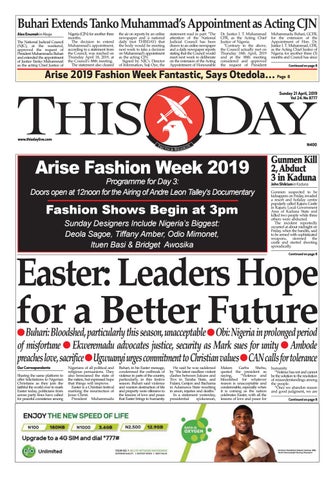
Buhari Extends Tanko Muhammad’s Appointment as Acting CJN Alex Enumah in Abuja The National Judicial Council (NJC), at the weekend, approved the request of President Muhammadu Buhari and extended the appointment of Justice Tanko Muhammad as the acting Chief Justice of
Nigeria (CJN) for another three months. The decision to extend Muhammad's appointment, according to a statement from the Council, was reached on Thursday April 18, 2019, at the Council's 88th meeting. The statement also cleared
the air on reports by an online newspaper and a national daily (not THISDAY) that the body would be meeting next week to take a decision on Muhammad's appointment as the acting CJN. Signed by NJC's Director of Information, Soji Oye, the
statement read in part: "The attention of the National Judicial Council has been drawn to an online newspaper and a daily newspaper reports stating that the Council would meet next week to deliberate on the extension of the Acting Appointment of Honourable
Dr. Justice I. T. Muhammad CFR, as the Acting Chief Justice of Nigeria. "Contrary to the above, the Council actually met on Thursday 18th April, 2019 and at the 88th meeting considered and approved the request of President
Muhammadu Buhari, GCFR, for the extension of the Appointment of Hon. Dr. Justice I. T. Muhammad, CFR, as the Acting Chief Justice of Nigeria for another three (3) months and Council has since Continued on page 8
Arise 2019 Fashion Week Fantastic, Says Otedola…
Page 8
Sunday 21 April, 2019 Vol 24. No 8777
www.thisdaylive.com TR
UT H
& RE A S O
N400
N
Arise Fashion Week 2019
Programme for Day 3: Doors open at 12noon for the Airing of Andre Leon Talley's Documentary
Fashion Shows Begin at 3pm Sunday Designers Include Nigeria’s Biggest: Deola Sagoe, Tiffany Amber, Odio Mimonet, Ituen Basi & Bridget Awosika
Gunmen Kill 2, Abduct 3 in Kaduna John Shiklam in Kaduna
Gunmen suspected to be kidnappers on Friday, invaded a resort and holiday centre popularly called Kajuru Castle in Kajuru Local Government Area of Kaduna State and killed two people while three others were abducted. The incident reportedly occurred at about midnight on Friday, when the bandits, said to be armed with sophisticated weapons, stormed the castle and started shooting sporadically. Continued on page 8
Easter: Leaders Hope for a Better Future Buhari: Bloodshed, particularly this season, unacceptable Obi: Nigeria in prolonged period of misfortune Ekweremadu advocates justice, security as Mark sues for unity Ambode preaches love, sacrifice Ugwuanyi urges commitment to Christian values CAN calls for tolerance Our Correspondents Sharing the same platform to offer felicitations to Nigerian Christians as they join the faithful the world over to mark Easter today, politicians from across party lines have called for peaceful coexistence among
Nigerians of all political and religious persuasions. They also bemoaned the state of the nation, but expressed hope that things will improve. Easter is a Christian festival marking the resurrection of Jesus Christ. President Muhammadu
Buhari, in his Easter message, condemned the outbreak of violence in parts of the country, particularly, in this festive season. Buhari said violence and wanton destruction of life and property were offensive to the lessons of love and peace that Easter brings to humanity.
He said he was saddened by “the latest needless violent clashes between Jukuns and Tivs in Taraba State, and Fulani, Genjon and Bachama in Adamawa State resulting in arson, injuries and deaths." In a statement yesterday, presidential spokesman,
Malam Garba Shehu, quoted the president as saying, “Violence and bloodshed for whatever reason is unacceptable and condemnable, especially when it is coming as the nation celebrates Easter, with all the lessons of love and peace for
humanity. “Violence has not and cannot be the solution to the resolution of misunderstandings among the people. “Once we abandon reason and good judgment, we are Continued on page 8
2
T H I S D AY ˾ SUNDAY APRIL 21, 2019
T H I S D AY ˾ Ͱͯ˜ Ͱͮͯͷ
3
4
T H I S D AY ˾ SUNDAY APRIL 21, 2019
T H I S D AY ˾ Ͱͯ˜ Ͱͮͯͷ
5
6
T H I S D AY ˾ SUNDAY APRIL 21, 2019
T H I S D AY ˾ Ͱͯ˜ Ͱͮͯͷ
7
8
ͺ˜ ͺ ˾ T H I S DAY, T H E S U N DAY N E W S PA P E R
PAGE EIGHT
Arise 2019 Fashion Week Fantastic, Says Otedola Joseph Ushigiale Business mogul and billionaire who made his fortune in oil and gas sector, Mr. Femi Otedola has described the 2019 Arise Fashion Week as a fantastic show put together by the Arise Media group as the show entered its second day in Lagos yesterday. Otedola, who shied away from answering follow up questions and rather chose to point this reporter to his
daughter, was among other businessmen and women including captains of industry drawn from several sectors, including, Chairman of Stanbic, IBTC, Atedo Peterside, Amaju Pinnick, Bello Osagie, Oskar Ibru, Segun Ogunsanya of Airtel. The 3-day fashion week which kicked off Friday and enters its second day yesterday witnessed tumultuous crowds drawn from stakeholders in the fashion and creative industry,
private and public sectors and fashion enthusiasts who swarmed Intercontinental Hotel, the venue of the show. Yesterday's event was preceded by an Arise Talks - where a panel comprising Arzi Ifrah, Liya Kebede, Eniola Dawodu, Olivia Singer, Niyi Okuboyejo and Adeola Bali discussed 'The Essence of Design and Textiles: Preservation, protection and the advancement of the craftsmanship. This was
followed by a conversation with Andrea Leon Talley of the Vogue Magazine where he shared his experiences reporting fashion and entertainment, his meeting with Naomi Campbell and the journey so far. The show closes today with presentation from Ahluwalia Studio presenting U-MI-1, Asai, Bethany Williams, Style Temple, Mwinda, Odio Mimonet, Pyer Moss, Rich, Minsi, Mmuso Maxwell, Bridget Awosika, Esteban Cortazar, Iteun Basi,
Tiffany Amber, Okunoren Twins. Super Model, Naomi Campbell, on Friday announced that she, in partnership with the Gucci brand, is set to launch an ambitious fashion fellowship in universities in Lagos, Ghana, Kenya and Cape Town in a bold move aimed at unleashing the hidden talents that abound in the continent. The University of Lagos will be the beneficiary in Nigeria. Making the disclosure at
the second session of Arise Talks moderated by Laila Johnson-Salami where a panel comprising Campbell, Reni Folawiyo, Barbara James and Funsho Olusanya deliberated on the topic, ‘Business of Fasion – Exploring all Facets of the Emerging Markets in Africa, the fashionista explained that after 33 years on the runway, she had decided that the time has come to use her network, experience and talent to work for Africa.
on Easter, I enjoin everyone to be their brother's keeper, work to foster peace and togetherness, and uphold the collective good of all in our dealings.” In the spirit of Easter, Akwa Ibom State Governor Udom Emmanuel made a reconciliatory offer to his political opponents, saying they should join in building a state whose economy will be the envy of all. Emmanuel said in a broadcast weekend, “We have just concluded an election cycle where the chords of our brotherhood and amity were severely tested. Even though some of our political gladiators had likened the contest to going to war and had unfortunately invoked certain metaphors of war and violence, the battle has been fought and won to the glory of the ONLY GOD we worship and serve. “The time, therefore, has come for us to close ranks and show love to one another. We went to the polls as sons and daughters of Akwa Abasi Ibom State joined together by shared hopes and aspirations for our state and our people. “My opponent and I were both motivated by the need to serve our people and advance the cause of our development, but the people have spoken and made their choice. We must respect the will they expressed in my capacity to lead our people for the next four years. “In the spirit of Easter, I am again inviting my brothers and sisters on the opposite side of the political divide to join hands with me to build a prosperous, safe and secure state where our people will continue to rise and claim the faith of their greatness.” Governor Ibikunle Amosun of Ogun State enjoined Nigerians to eschew hatred and bigotry, which Christ preached against before paying the ultimate price on the Cross. In his Easter message, signed by his Special Adviser on Information and Strategy, Mr. Rotimi Durojaiye, Amosun stated, “As we celebrate Easter, let us reflect
on the significance of the season, which is love and sacrifice, to unite as a people. “Easter gives us the spiritual power to appreciate the truth that His dying moment on the Cross offers us the greatest illustration of forgiveness, faith and belief necessary to strive as one indivisible nation.” President of the Christian Association of Nigeria (CAN), Rev. Samson ‘Supo Ayokunle, in his Easter message, enjoined Christians in the country, as well as Muslims and people of other religions to pursue peace, tolerance and love for one another. “This is one of the greatest needs today in our dear country and it requires genuine sacrifice to achieve it,” Ayokunle stated. “This is because it is in the atmosphere of peace that we would have progress as a nation.” He added, “In this season and beyond, I advise Nigerians to love one another as Christ loved us and gave His life for us! Lack of love today is the breeding ground for religious intolerance, killings and destructions, which in turn lead to insurgency and other forms of violence with their attendant humanitarian crises, such as mass human displacements, hunger, outbreak of sicknesses and diseases, etc., in many parts of the country today.” Ayokunle appealed to President Muhammadu Buhari to tackle the spate of kidnapping and armed banditry in the country. The ruling All Progressives Congress (APC) charged Nigerians to remember the essence of Easter, which is love, sacrifice and suffering. In a statement by its National Publicity Secretary, Mallam Lanre Issa-Onilu, APC urged all citizens, irrespective of religious affiliation, to imbibe the selfless attributes displayed by Jesus Christ. “In our collective efforts to progress as a nation, we must all rise above our perceived differences which pit brothers and sisters against themselves.
Love and tolerance will take us above internecine violence, killings, agitations, and other divisive tendencies,” the statement said. It also urged Nigerians to use the occasion of Easter to pray for the safety and wellbeing of members of the Armed Forces and other security personnel deployed to flashpoints around the country. The main opposition Peoples Democratic Party (PDP) called on Nigerians to use the occasion of Easter to pray for national rebirth and fulfillment of their aspirations for a safe and prosperous nation where love, truth and justice will prevail. The party, in a statement by its National Publicity Secretary, Mr. Kola Ologbondiyan, said Nigerians must remain optimistic. The statement said, “The Easter festival, which marks the celebration of the resurrection of the Jesus Christ from the dead, offers great lessons on the inevitable victory of life over death; truth over falsehood; light over darkness and freedom over captivity. “Nigerians must, therefore, use this occasion to rekindle their bonds of love, unity and oneness of purpose while standing firm against oppressive forces that are using intimidation, lies, institutional manipulations, propaganda and deprivation in their desperation to divide, subjugate and ultimately subvert our will as a people.” Minister of the Federal Capital Territory, Malam Muhammad Musa Bello, called on the Christian faithful to pray for peace and unity in the country, particularly, the FCT, which is the centre and symbol of Nigeria’s unity. Bello reminded residents of the upcoming inauguration of Mr. President on May 29. He urged residents to pray for a smooth transition to the next political dispensation, saying as residents of the host city, they have a significant role to play in the success of the international event.
EASTER: LEADERS HOPE FOR A BETTER FUTURE giving violence the chance to take over and make a bad situation more complicated and difficult to resolve. “The primary initiative for ending violence once and for all must originate from the local actors involved in these clashes.” The statement said the president had mandated a religious group, which had led successful efforts to mend broken relationships among communities in Plateau State, to work with security agencies and take up the challenge of reconciling the communities in Kaduna, Taraba and Adamawa states. It also said the president had directed the National Emergency Management Agency (NEMA) and the National Commission for Refugees and Internally Displaced Persons to scale up their efforts in bringing succour to displaced people in the affected areas. Furthermore, it said Buhari assured that intervention by the military had doused the situation in the affected communities, adding, “The government will not rest on its oars to provide security for all Nigerians, and will at the same time engage in dialogue with local stakeholders in order to get to the root of the crises.” In his own message, the vice presidential candidate of the Peoples Democratic Party (PDP) in the just concluded election, Mr. Peter Obi, lamented that the country was undergoing a prolonged period of misfortune. Obi called on Nigerians to use the period of Easter to reflect on the situation in the country and pray specially for the survival of Nigeria’s democracy. He stated, “This country has been undergoing a prolonged period of misfortune that this period of Easter provides huge opportunity for Christians to return to God in supplications for lasting solutions to our myriads of challenges. “At this critical stage in our nation's journey to development only standing on the side of truth on the state of the nation and nothing else can set us free from the economic bondage “Indicators are apparent that the country is under siege and Nigerians should use this solemn period of Easter to pray for God to intervene and raise good leaders for the country.” Deputy Senate President Ike Ekweremadu and former Senate President David Mark urged Nigerians to remain steadfast and hopeful of a better nation. In separate Easter messages on Saturday, Ekweremadu and Mark urged Nigerians to use the occasion of Easter to pray for the security of the country and return to the path of reconciliation, peace, and justice. Ekweremadu added that prayers should also come with the necessary steps to rethink the country’s security
architecture, especially the policing arrangement. “We must also muster the political will to take on these security challenges head-on, beginning with the decentralisation of policing such that constituent parts of the nation are constitutionally empowered to take responsibility for the security of lives and property of the citizens, like other federal states and as was the case in this nation before 1966,” Ekweremadu stated. He stressed, “Importantly, we need to move away from the path of disunity, mutual suspicion, discrimination, and injustice to make any progress. At Easter, therefore, we must rededicate ourselves to the virtues of love, unity, peace, justice, forgiveness, reconciliation, and sacrifice, which the ministry, death and resurrection of Christ represent.” Mark canvassed the need to strengthen the bond of unity among the diverse ethnic and religious groups in Nigeria, insisting that there is hope for the country if it remains together. He said in spite of the challenges of insecurity, ethno- religious conflicts, and declining economy, “We should not be discouraged because the challenges are surmountable.” The former senate president urged the citizens to reflect on the sacrifices and resurrection of Jesus Christ, which symbolise peace, tolerance and forgiveness, in order to coexist harmoniously with one another. He said the authorities must work to restore the people’s trust and confidence in the system. Lagos State Governor Akinwunmi Ambode called on Nigerians to imbibe the virtues of tolerance, peaceful co-existence, and sacrifice, which Jesus Christ lived and died for. In his Easter message, Ambode said, “We must therefore see this period as a time that presents us the viable opportunity to think about how we can help to steer our nation back on the road to peace, stability and prosperity, by working in the spirit of togetherness
because no nation can make any meaningful progress in an atmosphere riddled with pockets of violence and killings.” Reflecting on the recent general election, the governor stated, “The elections have come and gone, we must not allow our political leanings determine our actions. The Nigeria we desire will only be a reality if all hands are on deck towards achieving a peaceful, united, strong, progressive and prosperous country. This is the time for us to avoid all divisive, parochial, ethnic and religious sentiments and rivalries, and begin to live more harmoniously with one another, as Jesus Christ enjoined us to.” Enugu State Governor, Rt. Hon. Ifeanyi Ugwuanyi, advised Christians and Nigerians, generally, to use the occasion of Christ’s resurrection, which Easter symbolises, to reinvent their abiding faith in God and promote peace, love, and unity. Ugwuanyi said observation of 40 days of Lent through fasting, abstinence, prayer and charity in memory of Christ’s suffering, death and resurrection, “reinvigorates the spiritual strength of Christians and God’s amazing grace for salvation of mankind”. He added, “God’s extraordinary act of love for mankind should be cherished, celebrated and sustained.” In his message at Easter, Edo State Governor Godwin Obaseki urged Christians to imbibe the virtues of selfless service and love. Obaseki stated, “I join Christian faithful in Edo State and across the world in celebration of the resurrection of Jesus Christ, whose sacrifice to redeem mankind is an enduring example to all. “As we mark Easter Sunday, it is important to reflect on the lessons of selflessness, the virtue of love and redemption. I encourage everyone not just to uphold the love shared this period but also to ensure that it becomes a part of our lives every day.” He added, “With selfless service and passion for the downtrodden as key teachings
GUNMEN KILL 2, ABDUCT 3 IN KADUNA An expatriate woman was said to be one of the two people killed, while the other victims were said to be among the 12 people, came from Lagos to the Castle for the Easter holiday. Those who sustained injuries had since been rushed to the St. Gerald Catholic Hospital, Kaduna. Spokesman of the Kaduna State police command, Yakubu Sabo, also confirmed the development in a statement last night. According to Sabo, “At about 0020hrs, we received an information through DPO Kajuru that at about 23:40hrs,
some suspected kidnappers armed with dangerous weapons gained entry into a recreational resort called Kajuru Castle in Kajuru Local Government Area, shooting sporadically and in the process shot dead two persons including an expatriate lady and took away three others. ”Patrol teams led by the DPO (Divisional Police Officer) rushed to the scene evacuated the victims to St. Gerald Hospital. Investigation later revealed that the victims along with twelve others came from Lagos on tourism after which they organised a party at the Castle located at the Hill
Top during which the incident happened. “Normally, whenever such social events would happen, the organisers used to inform the police for security coverage, but the party was done without the knowledge of the police in the area as traditionally done. However, intensive efforts are being made by the command to rescue the kidnapped persons, apprehend the fleeing culprits and bring them to justice.” He however appealed to members of the public to assist the police with relevant information that could help in the arrest of the perpetrators of the heinous act.
BUHARI EXTENDS TANKO MUHAMMAD'S APPOINTMENT AS ACTING CJN forwarded its approval to the President.” Acting on the orders of the Code of Conduct Tribunal (CCT), President Buhari had on January 25, sworn in Justice Muhammad as acting CJN, following the suspension of his predecessor, Walter Onnoghen over corruption charges. Onnoghen’s suspension followed an exparte application by the federal government, seeking to suspend Onnoghen, pending the determination of his trial at the CCT over alleged breach of the Code of Conduct for public officers and was subsequently approved by the CCT.
The CCT, in its judgment delivered last Thursday, April 18, 2019, convicted Onnoghen on all the six count charges of false assets declaration preferred against him and ordered his removal from office as CJN, including the forfeiture of monies in contest. The convicted CJN had on April 4, 2019, turned in the notice of his resignation to the president, but the president kept quiet until he was sacked by the CCT. Onnoghen's tenure was due to lapse in December 2020, when he would have attained the mandatory retirement age of 70 years.
T H I S D AY, T H E S U N D AY N E W S PA P E R ˾ APRIL 21, 2019
9
SUNDAY COMMENT
Editor, Editorial Page PETER ISHAKA Email peter.ishaka@thisdaylive.com
EASTER: BEYOND THE MERRIMENT There is need to embrace peace, tolerance and unity
E
s we rejoice and celebrate with Christians all over the world today, there is a lot in the Easter story that resonates for all humanity. Easter time, as one Christian authority put it, is a forceful reminder “that the human spirit cannot be confined. It does not deny the reality of death, but it offers us an assurance that God has preserved life beyond the grave.” The sacrifice, love, mercy and unity that the death and resurrection of Jesus Christ exemplified are some of the enduring values of Easter that transcend doctrine and they are worthy to be reflected upon by all Nigerians at a time like this when we are increasingly suffused with rhetoric of hate and incitement to violence. The application of the virtues of Jesus Christ would no doubt address some of the challenges facing our country, especially given how deeply divided we have become as a people. Easter demands that we all rise above bitterness and strive to live in peace with one another. President Muhammadu Buhari underlined these in his Easter message when he urged all Nigerians to “use this auspicious season to show love to our neighbours, and cater to the needs of the less-privileged in our midst,” adding: “Our nation is currently gripped with gloom over unfortunate killings, kidnappings
The application of the virtues of Jesus Christ would no doubt address some of the challenges facing our country, especially given how deeply divided we have become as a people
Letters to the Editor
S U N DAY N E W S PA P E R EDITOR SHAKA MOMODU DEPUTY EDITORS OLAWALE OLALEYE, TOBI SONIYI MANAGING DIRECTOR ENIOLA BELLO DEPUTY MANAGING DIRECTOR KAYODE KOMOLAFE CHAIRMAN EDITORIAL BOARD OLUSEGUN ADENIYI EDITOR NATION’S CAPITAL IYOBOSA UWUGIAREN MANAGING EDITOR JOSEPH USHIGIALE
T H I S DAY N E W S PA P E R S L I M I T E D EDITOR-IN-CHIEF/CHAIRMAN NDUKA OBAIGBENA GROUP EXECUTIVE DIRECTORS ENIOLA BELLO, KAYODE KOMOLAFE, ISRAEL IWEGBU, IJEOMA NWOGWUGWU, EMMANUEL EFENI DIVISIONAL DIRECTORS BOLAJI ADEBIYI , PETER IWEGBU, ANTHONY OGEDENGBE DEPUTY DIVISIONAL DIRECTOR OJOGUN VICTOR DANBOYI SNR. ASSOCIATE DIRECTORS ERIC OJEH, PATRICK EIMIUHI ASSOCIATE DIRECTOR SAHEED ADEYEMO CONTROLLERS ABIMBOLA TAIWO, UCHENNA DIBIAGWU, NDUKA MOSERI DIRECTOR, PRINTING PRODUCTION CHUKS ONWUDINJO TO SEND EMAIL: first name.surname@thisdaylive.com
and violence…This should not be. We must reinforce the bond of brotherhood and good neighbourliness that citizens of a cohesive country must share.” The mystery of today’s celebration is anchored on the fact that Jesus chose death because that was the penalty to which all in the flesh were liable on account of sin. In taking this dolorous path Jesus was able to bring salvation to mankind. As we therefore rejoice in His resurrection today, we must also pause and reflect on the sacrifice of the cross. A day such as this also calls for us to shun selfishness and dedicate our energy to the promotion of the common good as we seek to build a new society based on mutual respect. Perhaps more than at any period in history, it is important that Nigerians use this season to reflect on things that bind us together rather than on those that divide us. We must use religion to not only strengthen our nationhood but as a vehicle for deepening harmony. Besides, Easter’s enduring message, which is about love, can be transmitted by sharing with the less privileged of our society not only material possessions but also through simple gestures like kind words and sincere smiles. Unfortunately, that is where we fail most miserably. And the tragedy of that failure can be seen in the poverty and deprivation of majority of our people. It is noteworthy that Christians stake their eternal destiny on the message of Easter which is about the resurrection of Jesus Christ who demonstrated a remarkable form of servant leadership, by washing the feet of His disciples in the days preceding His death on the cross. As an eloquent testimony to the virtue of selfless service to the people, Jesus fed the hungry, healed the sick, consoled the sorrowful and wept for the dead. He remains a model for those who would lead, especially at a time when human miseries continue to worsen. What Easter then demands of Christians, and indeed all of us, is the need to shun unbridled individualism. It is only when we adopt this selfless attitude that we would be able to focus attention on other people, their safety and welfare as well as the optimal allocation of scarce resources for effective implementation of policies for the greater good of our society. And as the message of a resurrected Jesus Christ continues to give hope, peace and strength to people around the world, we wish all our readers a very happy Easter.
TO OUR READERS Letters in response to specific publications in THISDAY should be brief (150-200 words) and straight to the point. Interested readers may send such letters along with their contact details to opinion@thisdaylive.com. We also welcome comments and opinions on topical local, national and international issues provided they are well-written and should also not be longer than (950- 1000 words). They should be sent to opinion@thisdaylive.com along with the email address and phone numbers of the writer.
NIGERIA: A COUNTRY IN GRIP OF VIOLENCE
L
ord Fredrick Lugard, one-time governor general of Nigeria, didn’t get the consent of the people of Nigeria before he cobbled the northern and southern protectorates together. And, his wife, Christine Shaw, christened the geographical space Nigeria. That’s how the disparate ethnic entities came together to become Nigeria. So, owing to our country’s heterogeneous nature, we embraced and adopted the federal system of government. However, today, not a few federal nation-states have collapsed. The USSR that was made up of 15 republics dismembered irrespective of its implementation of the policy of perestroika and glasnost. Yugoslavia broke up, too. And some countries emerged from Czechoslovakia after it had disintegrated. On the African continent, Eritrea pulled out of Ethiopia while Somaliland emerged from Somali. After suffering
years of bloody conflicts, Sudan was bifurcated with South Sudan emerging from it. Till now, some heterogeneous countries on the African continent with are still being buffeted by bloody conflicts. In Kenya, the Lou and Kikuyu people(s) who are acutely aware of their different ethnic origins are still locked in the battle for political dominance and supremacy. In Cameroun where Paul Biya is in the saddle of power for decades, the English-speaking people there are ceaselessly agitating for state-hood .Like the afore-mentioned African countries, Nigeria has had its fair share of violence and ethnic troubles dating back to the colonial era. In 1953, the northern people threatened secession in their nine- point programme. Adaka Isaac Boro declared the Niger-Delta republic in 1963; however, it was short-lived. And, the Nigeria- Biafra war raged between
1967 and 1970 with its devastating consequences. Since the end of the Nigeria-Biafra civil war, Nigeria hasn’t known true peace, as ethno-religious and political troubles have become features of our national life. After the cancelled June 12, 1993 Presidential election, Sani Abacha shoved aside Ernest Shonekan, the interim president, and instituted a reign of terror in Nigeria. Today, Boko Haram, a deadly insurgent group, has emerged in the north. Their hatred or distaste for western education underpins their philosophy. The crazed and murderous insurgents have seized the north-east of Nigeria by the jugular, killing people and taking female students captive. Some years ago, the Boko Haram group raided Chibok Girls’ Secondary in Borno State and took many school girls captive. It took intense negotiations between the federal government and members of
the Boko Haram group before some of the girls were released from captivity. Last year, the insurgents raided Dapchi Girls’ Technical College, Yobe and abducted school girls. While other girls who are Moslems had been released and united with their families, Leah Sharibu is still in captivity for holding fast to her Christian faith. While the Boko Haram insurgency has remained unabated, the Fulani herdsmen are causing havoc in every nook and cranny of Nigeria. The Fulani cattle herders, who have encircled proprietary hands of kinship around Aso Rock, the seat of power, are emboldened in their despicable acts of homicide because of the indifference and inaction of President Buhari. From Lafia to Taraba, and from Enugu to Anambra, the Fulani cattle herders have run amuck, killing people and destroying the farmlands of farmers in their host communities. In the past week, they raided a community in Anambra West Local Government in Anambra State and killed six people. Where
are the killers? In addition, in Zamfara State where governance is on recess for many years, the state government is conceding the state to the rampaging bandits. In Zamfara, anarchy reigns while Governor Yari, a globetrotter, is keen on satisfying and fulfilling his wanderlust desires. In other states like Kastina and Kaduna, pockets of violence do erupt there causing loss of human lives and property. Nigeria has returned to the Hobbesian state of nature where life is short, brutish, and nasty. In today’s Nigeria, we do not place high premium on human lives. That’s why a trigger-happy policeman shot and killed Kolade Johnson, recently, for violating no laws of Nigeria. Now, teenage school boys, who are cultists relish listening to mordant tales instead of imbibing the habit of reading. Now, the entire south-east is suffering from the infestation of cultism with its attendant deaths of young people. Chiedu Uche Okoye, Uruowulu-Obosi, Anambra State
10
T H I S D AY ˾ SUNDAY APRIL 21, 2019
T H I S D AY ˾ Ͱͯ˜ Ͱͮͯͷ
11
12
T H I S D AY, T H E S U N D AY N E W S PA P E R ˾ APRIL 21, 2019
NEWS
Acting News Editor Gboyega Akinsanmi E-mail: gboyega.akinsanmi@thisdaylive.com, 08081986590
Aisha Plans to Establish University Named After President Buhari
Daji Sani in Yola
Wife of the President, Aisha Buhari, has expressed plan to establish a private university to be known as Muhammadu Buhari Uni-
versity. She disclosed this yesterday during a town hall meeting in Yola organized by her in collaboration with concern indigenes of Adamawa. Mrs Buhari, who did reveal
when or where the university would be sited, explained that the university would be established in collaboration with partners from Sudan and Qatar. She also advocated for the
formation of a trust fund to curb widespread poverty and other development challenges in her state of birth, Adamawa. She lamented the challenges facing education and
STRUTTING THEIR STUFF
Fashion designer, Triple RRR. Robert Cavalli (middle), flanked by supermodel Naomi Campbell (right) and Liya Kebede during the on going Arise Fashion Week with Naomi Campbell held at The Lagos Continental Hotel, Victoria Island, Lagos...yesterday KUNLE OGUNFUYI
various sectors in the state and called for active support of the state indigenes in complementing government efforts. “I cannot conclude without suggesting how we can complement the efforts of government in achieving some of its developmental goals. “I would like to advocate for the establishment of Adamawa Development Trust Fund through which prioritized developmental projects can be financed and implemented,” she said. She urged the incoming government to form a cabinet of capable people who could come from any political party as long as such people possess the capacity to contribute meaningfully to the development of the state. Justifying the event and the need for other concerted efforts, she said, “With the rampant security challenges, interethnic conflicts, poor educational enrolment of children in schools, poorly functioning health system, annual flood being experienced, and continued influx of displaced people, our hope and solution as a people lies in our ability to join hands and form a coalition towards uplifting the state from its present predicament.” The town-hall meeting was a mix of cultural entertain-
ment and speeches from notable individuals, including the Secretary to the State Government (SSG), Dr Umar Bindir, who first spoke of the state as one in which most residents live under acute poverty. In his passion to demonstrate how Adamawa people were so poor that they ate the most pitiable of food and drank water that fails all safety qualities, he shot the government which he serves in the foot, as one of the speakers that followed would indicate. A former military governor of Lagos State, Gen Buba Marwa, who is noted for being a critic of Governor Mohammed Bindow despite being in the ruling All Progressives Congress (APC) together, said with the SSG’s account, nobody needed to look further for why Bindow failed re-election. “Adamawa State is in a mess. The SSG said it. We all now know why APC lost the state,” Marwa said. However, the state Deputy Governor, Hon Martins Babale, who represented Governor Bindow at the event, said the government had in the last four years done its best to improve the human and institutional profiles of the state.
Goje Better than Lawan, Ndume, Says APC Scribe Segun Awofadeji in Gombe As campaigns for Nigeria’s 9th Senate leadership gathers momentum, the Gombe State All Progressive Party publicity secretary, Naomi Joel Awak, has lent her voice to the call on elected senators to back Senator Mohammed Danjuma Goje for the position of the Senate President. In an interview with journalists in Gombe yesterday, the APC spokesperson said senators Ali Ndume of Borno State and Ahmed Lawan of Yobe State cannot match the former Gombe State Governor in terms of political qualifications for the plum Senate seat. According to her, Goje is not only a powerful figure in
Gombe politics but a political force to be reckoned with in the power equation of the Northeast geo-political zone. She said Goje is a grassroots politician having won elections for State Assembly in the former Bauchi state and rose to the position of Governor for eight uninterrupted years adding that he was also a former Minister and currently going for his third term in the Senate. The APC Publicity Secretary said one of the greatest leadership qualities bestowed on Goje is his political patriotism to the APC and his ability to keep the APC intact in Gombe State despite the party’s daunting challenges in other states. These are qualities that surpass senators Lawan and Ndume put together, she opined.
Sanusi, Omole Celebrate with Oni at 85 Former governor Central Bank of Nigeria, Joseph Sanusi, and the former Vice Chancellor, Obafemi Awolowo Universit y, Ile-Ife, Prof. Wale Omolev were among those who celebrated with Elder Michael Ayodeji Oni on the occasion of his 85th birthday at his Dolphin Estate Lagos residence. They used the occasion to urge Nigerians, irrespective of calling, religion, tribe or political leaning, to thank God for His mercy, kindness and goodness
and advised that they desist from the mad rush to acquire perishables of life, but to rather emulate Biblical teachings with absolute faith i n God. T he celebra nt, Elder O n i, ex pre s s e d his profou nd g rat it ude to God, t he e nt i re Rot a r y Club of Lago s com mu n it y a nd ot her d i st i ng u i shed g ue st s, c ler ics, other religious faithful and his family members that heartily contributed to t he u lt i m ate succe s s of t he day.
“Goje is capable of leading the Senate because he was able to lead the party in Gombe state to capture power convincingly from the ruling
Peoples’ Democratic Party in the last general elections.” Speaking on the party’s position at the national level to support Lawan, Awak said
that as a party loyalist, she is only appealing that the party and elected senators look the way of Goje as she is convinced he is the man ca-
pable of doing the job well and who will protect the integrity of the party, the country and the President of the country.
Arise Fashion Week Ends Today as Naomi Campbell, Oluchi Orlandi Excite on the Runway VanessaObioha The ARISE Fashion Week will be drawing to a climactic end today after two days of an exuberant show of African creativity. From international model and activist Naomi Campbell who is the major headliner for this edition to former editor-in-chief of Vogue Magazine Andre Leon Talley, whose swirling print attire caused quite a stir at last night’s show, the visual feast has excited all comers. The show last night featured bold and enigmatic designs from local and international designers such as Lanre DaSilva, Lulu Lingerie, the Moroccan designer Maison ArtC; Triple RRR by Robert Cavalli,
Ivorian American designer Loza Maléombho to name a few. For Lulu, it was all about inclusivity as her models donned sheer intimate apparel for men and women. Maison ArtC on the other hand featured multicoloured apparels embellished with traditional elements of the North African country. From the ancient warrior-like head gear to layered robes, his collection spoke volumes of the culture of the Moroccans. Maléombho on the other played with African print. Her collection featured cutout dresses and jackets. Again, supermodel Campbell dazzled on the runway when she opened for Triple RRR by Robert Cavalli, in a plunging animal skin piece.
International models Alton Mason and Liya Kedebe also walked the runway for the designer. Campbell would later return to the runway, this time for Kenneth Ize in his new collection ‘Amaka’. The black diamond also graced the stage with a medley of his hit songs. Described as the most beautiful runway in Africa, the three day event kicked off with Arise Talks on Easter Friday, April 21 where industry heads and experts deliberated on diverse issues in the fashion industry and how it can change the African narrative. The conversations were part of the organisers, Arise Media, mission to continue to empower African designers to compete globally. Campbell, at one of the ses-
sions unveiled a deal with Gucci brand that reward hidden fashion talents in three universities across Nigeria, Ghana and South Africa. University of Lagos is the beneficiary in Nigeria. Campbell revealed that it was her own way of giving back to the continent since her over three decades sojourn in the fashion industry. The first runway show exploded with an assortment of fabrics, beautifully constructed into cuts, frills, layers and a luxury of colours from designers such as Mai Atafo, Torlowei, Tokyo James and Turfah. Today’s show will see designers such as prominent Nigerian brand Tiffany Amber, Studio, Pyer Moss among others on the runway.
Kebbi Approves Recruitment of 2000 Teachers, Says Current Ones Can’t Speak English Kuni Tyessi in Abuja The Kebbi State government has lamented the spate of unqualified teachers in the state, and has disclosed that most graduates in the state lack the skills needed in teaching and has therefore approved the recruitment of 2000 more teachers into the system.
The commissioner for education, Muhammad Aliero, who disclosed this in an interview, said several of the graduates and teachers in waiting cannot speak English and cannot write correct sentences in English despite having double honours. While commending the United Nations Children’s
Fund (UNICEF) alongside Educate A Child (EAC), for their support towards education through the Cash Transfer Programme (CTP), the commissioner said the state government has put mechanisms in place to take over the programme when it runs full cycle. He said: “Most of these
university graduates are not qualified to teach. There was a time I brought a graduate here, he could not define economics. “We have finished the recruitment of 2000. We designed a very nice format where we will give automatic offer to anyone who made ‘A’.
T H I S D AY ˾ Ͱͯ˜ Ͱͮͯͷ
13
14
T H I S D AY, T H E S U N D AY N E W S PA P E R ˾ APRIL 21, 2019
OPINION NIGERIAN EDUCATION: THE TRIGGER AND THE CATCH The education system falls short of standard, writes Agada Ikechukwu
T
he glory of yesteryears education system in Nigeria has vanished like the vapours of a dewy morning. No vehicle can run indefinitely without a refuel, just as no tree can hope to remain sturdy without water and sunshine. The events of recent years have no doubt inscribed this truth deeply into the breasts of our near comatose education system. It is apparent that we are still practicing a backward oriented education system in Nigeria in this digital age. The current system has continued to fail the internationally recommended tests. A clinical assessment of the Nigerian education system calls for emergency and a 360 degrees mental disruption. The challenges that plague the education sector in our country are legion but a few highlights will be made. The over-westernised culture in the modern education curriculum is a welcome development but has retarding effect on our indigenous ones. The mad quest for British curriculum has deleted the necessary ingredients in the Nigeria scheme thereby rendering some core Nigerian subjects impotent in the classroom. Nigeria history has been totally obliterated from the educational curriculum. The real truth about Nigeria political pilgrimage has been stolen, the spiral effect is a generation of students who are ignorant of the political ecosystem called Nigeria. These students go into leadership offices totally oblivious of the Nigeria political system since they are not well informed via tutelage. There is also the issue of infrastructural decay in our schools, chiefly public schools. A patriotic
visit to most public schools in the country will leave you breathless. From cities to rural areas, the story is the same. It is very unfortunate that some students are learning seated on the floor without chairs. Some school structures are life threatening as they expose students to danger. Poor road network to schools, maladministration, bad governance and negligence have taken the Nigerian children into depression. Many of our public officials are interested in stealing money, take their children abroad and imprison the children of the poor in poorly managed schools manned by hungry teachers. Furthermore, the near absence of an education economy in Nigeria is sickening. The education economy will handle issues of non-payment of teachers, payment of peanuts to teachers and act as a catalyst that will encourage brilliant students who distinguished themselves in their different areas of academic endeavours. It is unfair that students who are academically outstanding are not recognised in Nigeria but a reality TV show participants are celebrated, enriched and almost worshipped. The Nigerian system discourages academic investment in the education sector and encourages mass move-
The Nigerian system discourages academic investment in the education sector and encourages mass movement into the showbiz world
ment into the showbiz world. Finally, wrong policies by the government and companies lead to discrimination against individuals with Nigerian certificates as opposed to foreign certificates. Individuals with foreign certificates are better positioned to pick most employment openings in Nigeria than those with indigenous certificates .This anomaly has triggered a high number of visa applications for tertiary institutions abroad in order to bridge the certificate gap leaving our home universities deserted. The Nigeria government should as a matter of urgency declare state of emergency in the education sector so as to right the wrongs of the past years and emblazon our educational flag in the sands of time. The National Assembly should legislate the total restructuring of the education system to make our schools attractive and to discourage excessive travelling abroad for schooling. All public officials should be mandated to take their kids to public schools in Nigeria as that will fast-track government’s intervention to any of her plight. There should be a head count, enrolment and scholarships to all out of school children to encourage them to be better persons in the society. Government should equip states with standard library to instil reading culture and encourage students who are doing research. Educational grants should be constitutionalised to encourage indigent students. In Nigeria education sector, the government is the trigger while the schools are the catch. bishopagada@yahoo.com
RESOLVING BENIN REPUBLIC POLITICAL CRISIS Govern Adeniyi Adewale canvasses the closure of Nigeria-Benin Republic land border to compel President Talon to open up the political space
N
igeria’s President Muhammadu Buhari, who is also currently the Chairman of the Economic Community of West African States (ECOWAS) is reportedly considering all options, including the extreme measure of shutting Nigeria’s strategic land border Seme, as a possible last resort to pressure Benin Republic’s President Patrice Talon to comply with the ECOWAS Protocol on Democracy and Good Governance, regarding the forthcoming parliamentary elections scheduled to hold on 28th April 2019. The ECOWAS Protocol on Democracy and Good Governance stipulates that all political stakeholders be allowed to participate, without any restriction whatsoever, in the entire electoral processes [i.e. pre- election, election and post-election], in order for such polls to be recognized as free, fair, transparent and credible. The genesis of the ongoing political crisis is traceable to sometime last year when, as Benin Republic was preparing to commence the series of grassroots political activities that were expected to precede the April 2019 legislative elections, that nation’s hapless citizens received several rude shocks as President Talon unilaterally and in a heavy-handed manner, without the required, extensive consultation among the nation’s diverse political stakeholders, swiftly decreed several draconian declarations. Initially, the introduction of humongous pre-election fees was deliberately targeted at excluding President Patrice Talon’s political opponents, while benefiting his allies. The obvious objective is presumably to enable the execution of a self-perpetuation agenda, through another attempt to amend the current constitution, if he is able to secure an overwhelming majority during the impending legislative polls. Next, President Patrice Talon, perhaps not wanting to leave anything to chance, decreed the proscription of all the country’s opposition political parties, allowing only two parties whose membership constitute his supporters exclusively. Then strangely and in stark contrast to the environment that one would expect in the context of a preelection season, when free and unfettered exchange of political ideas and policies should be the order of the day, President Talon suddenly decreed an inexplicable
and total ban on public gatherings; processions, debates, protests, and political campaigns; the exception being such public events that are initiated, promoted and/or sponsored by either of the two political parties, movements and/or organizations affiliated to the incumbent leader. This panic measure was apparently precipitated by the spontaneous eruption of a series of protests across the entire Benin Republic, in response to the above listed repressive actions; the most worrying to the Beninese government probably was a massive rally that was reportedly attended by over 100,000 citizens. Furthermore, in a move that probably brought back painful memories of that nation’s past military era, President Talon recently deployed dozens of armoured vehicles nationwide, in a pre-emptive move to quell any further people-led uprisings, such as the world is currently witnessing, most notably in the Republic of the Sudan and the Republic of Algeria. The deteriorating political situation witnessed a new low with the declaration by Benin Republic’s Minister of the Interior and Public Security, Mr. Sacca Lafia, on Monday 15th April 2019, that he had been ordered by President Talon to impose public safety at any expense, even if it meant “killing all offenders and/or all Beninese people”. Benin Republic’s economic fate has not fared any better since President Talon assumed office in 2016, as he has reportedly utilized his enormous power to effect complete capture of virtually all the profitable businesses in the country, thereby impoverishing the average citizen. Taking into consideration that an earlier ECOWAS mission to Benin Republic comprising Nigeria’s Foreign Affairs Minister Geoffrey Oyeama and ECOWAS Commission President, Mr. Jean Claude Brou were effectively snubbed by President Patrice Talon, the Beninese people are earnestly counting on the intervention of President Buhari, to rescue them from political doom. Meanwhile, in order to halt the grave socio-political and economic situation in Benin Republic that is degenerating by the day, in a contiguous nation that shares deep, ethnic, cultural and trade ties with Nigeria, Africa’s most important nation may,
once again have to dig deep and select the most appropriate tool among all the options at its disposal (including moral, diplomatic, trade, military, etc.), to ensure that the political crisis is swiftly resolved, to the satisfaction of all the Beninese stakeholders. It is expected that the closure of Nigeria’s land border with Benin Republic will be a very strategic instrument for leverage with the latter, which relies greatly on this particular corridor for its economic survival. In this particular instance, the shutting of the above referred Nigeria-Benin Republic land border would hit President Talon where it hurts most, as his front company is currently, reportedly controlling Benin Republic’s seaport, which in turn needs the border to remain open, in order to sustain their extremely lucrative port revenue stream. The objective of the closure of the Nigeria-Benin land border will presumably pressure President Talon to immediately re-open Benin Republic’s political space, by implementing certain actions that meet the minimum conditions for compliance with the ECOWAS Protocol on Democracy and Good Governance. These would include, but may not be limited to the re-admission of all the opposition political parties that had previously been excluded, thereby deepening and widening the political landscape and culture; the suspension of the ongoing political process to enable prompt consultations among and betweeen all the stakeholders – a step that may culminate in the postponement of the April 2019 date for legislative election, by say thirty days. Moreover, the punitive fees recently imposed on opposition political parties ought to be waived; while the subsisting ban on public gatherings, protests, campaigns, etc., by the opposition parties, should be lifted. All the foregoing measures, if promptly put in place, will go a long way to create the much sought-after level playing field and restore the confidence of all the political actors, while boosting the chances for the most beneficial outcome whenever the election eventually holds. Dr. Adewale wrote from Lagos
T H I S D AY, T H E S U N D AY N E W S PA P E R ˾ APRIL 21, 2019
15
LETTERS CURBING THE MENACE OF KIDNAPPING According to a Freedom House report, Nigeria recorded one of the highest rates of kidnapping in the world in 2013. Similarly, the US Department of State's Country Reports on Human Rights Practices for 2013 indicates that kidnapping and related violence were "serious" problems in Nigeria. In Nigeria, kidnapping grew to become a national phenomenon courtesy of the activities of Niger Delta militants in 2006 that originally were campaigning against environmental degradation. The agitation, fear of the unknown and unending calls for the release of beloved ones escalated the demands of kidnappers and contributed in no small measures to the increasing rate of kidnapping cases. Often, family members of victims go through traumatic experience while some even lost their lives in the process of meeting the tough demands of the kidnappers. In some cases, ransoms were paid and captives unreleased while some were released dead. The effect is more enormous on the victim, who may likely live with depression, everlasting fear and above all loss of trust in people which might likely lead to depression. Initially, the menace was limited to the oil servicing employees, particularly the expatriates within the southern axis of the country, where security and safety became a matter of negotiation. The
Buhari dearth of loose money from the multinationals eventually made kidnappers shifted attention on perceived rich individuals. So the charade continues unchecked, bargaining continues and money continues to come in for the kidnappers and their powerful godfathers. In 2015, the world woke up to the dramatic turn in the method of kidnapping and abduction in Nigeria as Boko Haram members abducted 150 girls from Girls Secondary School, Chibok, Borno State. Naturally, global attention was
focused on Nigeria for the safe return of the school children. Five years after, Nigerians are still waiting for the return of the remaining girls still held hostage by the abductors. It later became a frequent operation in the area as the Dapchi abduction in February, 2018, followed the pattern. Kidnapping has, no doubt, become a booming venture in our nation. This is partly as a result of security lapses, inability to sustain the integration system of amnesty beneficiaries properly into the system, lack of
basic amenities, unemployment, corruption, flaunting of wealth by the rich and, perhaps, most importantly lack of transparency and accountability of stewardship by public officers. Lack of political will on the part of government to implement capital punishment as enshrined in the constitution is also a strong factor in the upsurge of kidnapping in the country. Legally, kidnapping attracts life sentence or jail terms of between 10 and 30 years for convicted person. But even the famous reported case of Evans, the self-styled Lagos-based kidnapping kingpin, is yet to be concluded months after the arrest. The result is that kidnappers have become more audacious in their approach to the business and more parts of the country are becoming highly prone to the menace. Recently, eight states including Zamfara, Rivers, Lagos, Jigawa, Delta, Kogi, Bayelsa and Kaduna were listed as places with the highest rate of kidnapping cases. In Lagos, kidnappers with swimming skill make use of the waterways to perpetrate their heinous crime. Riverine communities, thus, become a hidden place for these criminals who often mingle freely with unsuspecting natives. It has been revealed that criminals are harboured within the community for a give-away token or with threat of coming back for reprisal if their identity or existence is revealed. Some of
FUTA JALLON MOUNTAIN
T
he origin of SPIED was amorphous. All my hope is that the divine illumination was given in good-faith and pleasure, for only then can the purpose be served. Each SPIED article is a mosaicsermon, rendered in about three minutes. The narrative is fragile in precision and tedious in articulation. Because it says much in few words, the script invariably leaves more than less issues, requiring fuller consideration. SPIED tends to get more concise and down-reaching in subsequence, in much the same way as paracetamol replaced aspirin, as a casual palliative. The precept is such that, it can only take on meaning, rendered in a good deal of vernacular. For novelty of the writing, in creativity, many would doubt the certainty of SPIED-self-evident gospel truths. For as 1cor2:14 puts it, ‘…the natural man receiveth not the things of the spirit of God, for they are foolishness unto him, neither can he know them, for they are spiritually discerned’. To the un-learned mind or the mind that is ever learning but never coming to knowledge of the truth, the articles may be coming across as esoteric or vulgar, even apostate. But these are facts known to the world but ignored by the church, as a denial of the first position of God and if the full gospel is not preached,
we can only end up in half education. Kindly make reference to ‘Name Re-numbering Matrix’ in particular, published on 24th February 2014 and all the other SPIED preceding this topic. A matrix of re-numbered name of bank account, is a cook up of figures in trance. Transfiguration of name-numbers in matrix Gen27:16, Mamatricks figured-out for Jacob, the cook up of re-numbering as pottage at mess. Mess-age pot of water, the pitcher on Ribekas’ shoulder, of response-ability of Isaac, I-sac of water-pot-age at mess. Message of Isau, the elderdemon-star as son of god, the sun-god Ra, in ozimoo-odibo. Odibo, the servant, that puteth forth his hand under the thigh of leg and taketh ‘Nnamchi’, his father and god, by the secret, given as alm. Amu a sack-cloth of ‘okpaa otere’, the feet of Jacob, in a halt on the thigh-hold on Isaus’ heel. Heel of ten toes, of his foot, Ajallon ogbaturu, as the kick, on mountain of woman, by man made out of a dust-mole-hill. Heel of his shoe as wear. Swear to take to his own masters’ home, a wife, on be-half of the beast, best-Isau not, Jacob, the better-half, of their mothers’-otele-cast, as ration of venison. Very-son of Isaac and Ribeka, as the Sun and Moon of the Stars. Ra-stars, Rastas’ holy-ground to offshoe as wear. Swear in a mono mono-language of incantation
in a rite of asusu-utara isi ewuulo, which translates to deeper connotation of, ‘building with goats’ head or for a herd of goats’, but literarily to ‘the pound with pestle, of fofo, in mortar, as goat-head-served’. Served as woman and man domestic-sport, spotted-goatherd of Jacob ‘ewu azuzu’, slain in chamber. Chambers-lane of the 3rd-heaven, gone-to in spirit, as coffin ‘igbe-ozu ahia’ ie enterprise monopoly, monopoly-game of Isau, ‘ewu-anuohia’, the wild-goat that taketh the curse, for iniquity of Israel, away to wander in the wilderness, never to return as income of Jacob, that taketh the blessing as answer of the god-father ‘uza-Nna’, Nna the chamberlayer. Layer of upper-room to lodge for mono-monooratory-prayer. Prayeroratory, the watch-tower of skype, sky-ape, a scape goat, escape go-to Shinar, China-plain na-earth, planet. Planet found by man-heart, man-hat, an tower, manhattan, scrapping off bed-sheets of heaven from the sky. Ski on water-bed-sheets, as mats in low-deeps. Diplomat escape go-to Mess-opotamia Gen24:135 Lev16:10-21 Gen27:1-34 Gen11:1-7 Gen32:31 Gen25:2333 Gen30:32-39 Gen50:26 Dt25:11. Messopotamia upper-room-lodge, for pottage of Jacob found as Isaus’ star at large. Star-lager bear of his loss of birth-right as profit of Jacob, in a profit and loss account,
trans-figured as star of Israel, that was Jacob, leaving God, the ‘I AM He’ brewing over beer. Beer, the tears of Isaus’ loud and exceeding bitter cry for his re-numbered bank account name at bank on odd and even as bet. Bet-esda pool, pool of bet on chance as to whether foul or fair-weather, as perhaps, harps of prayer oratory of scents Rev5:8, not of the beast, best Isau, but of Jacob, the better-half cast in stonedead peter, the amu-let in to lodge, of hook to check at the bank for fish as peterfishers-coat, the pool-step-in stone of Israel as the help of self by joe. Joe-self by the pool of bath with soap-lather-ura, as-sleep with mother-instep, to glassy-sea-mennumbering as six hundred and sixty six, the name of the beast-mark-et, his mark on earth, fire and wind of smoke out of sight in hide of skin in rain-water, of man ozoro in ezotus-upperroom-layer-uza Nna, the tall mans’ heart. Layan-za Nna talisman-hat, an sacred hat. Heart, a sac read as scroll, scroll-tum, scrotum of testis. Thirst, IS sayeth Jn19:28, the Word of God, the Nna-zaa nna-layer and the Man IS Tall-born answer, Bonanza, Hossa-Nna in the highest, Jesus, He rose of Sharon and the tombo-Lily-nkwor-valley, the cross at Gabatha of Mess, as enter-price Gen Acts 10:10-16 Abili Willy, Lagos
the natives allegedly volunteer to carter for the hostages or source for intelligence for the kidnappers as a result of economic hardship and ignorance of the evil being perpetrated. Their method of operation varies. Sometimes, their targets could be important personalities while they could also go after petty traders, peasant farmers and the likes. All is business in as much as their demands could be met. A top public official who was recently released from the den of kidnappers disclosed that the experience is better imagined as they were exposed to all sorts of torture, trauma and threats to life, if demands were unmet by family members. Like a tree, the perpetrators are branched, connected and well-equipped with stateof-the-art devices that make tracking cumbersome and are always a step ahead of the
security. Collectively we can rid our country of this evil or reduce it to barest minimum. Since the evil agents have learnt how to work as a team, our security agencies and other vital stakeholders also need to operate as a team and give information that will ensure swift tracking and rescue of victims. Similarly, the police need to build on the confidence of the people in doling out intelligence. Our country is bigger than all the evil doers and as such all hands must be on deck to curb this menace to ensure our nation is investor friendly. No rational investor would put his money in an unsafe environment. Kidnapping undermines the country’s economic prospect. Bola Ajao, Lagos State Ministry of Information and strategy, Alausa, Ikeja
THAT UEFA CHAMPIONS LEAGUE CUP PARADE
C
lairvoyance is not my forte, but I can still postulate with a degree of certainty that Daniel 'Baba Ibeji' Amokachi would have rated his chances of winning the then Sekou Toure Cup (now rechristened CAF Champions league) with Ranchers Bees of Kaduna higher than scoring the first-ever goal in the commercially viable UEFA Champions league! Circa May 1994, I watched on Samaru Campus of ABU, the finals between AC Milan and Barcelona in anticipation of scrutinizing the Bulgarian national team captain, Hristo Stoichkov playing in his part in the Johan Cruyff's expertly assembled Dream Team. Stoichkov's led Bulgaria was billed as the first foe of the Super Eagles in our debut outing at the World Cup, a couple of weeks later in a match the Eagles confirmed their superiority as African Champions with a three nil win over the Bulgarians that later defied the odds in their historic march to the semi-finals. The following year, I was in UNILAG watching the final in the King Jaja Hall common room (there were no viewing centres then), and the youthful Ajax team parading our compatriots in Finidi George and Nwankwo Kanu toppled the very experienced AC Milan side lacking danger man Marco Van Basten, and till I left Zaria, the exclusive shot of the Cup parade by Kanu and Finidi as published by the now rested Complete Football International magazine was a permanent feature on my walls. The recent UEFA Champions League trophy parade in our shores is a stark reminder of the nadir of our domestic football. In 2003 and 2004, the now
elected Senator Orji Uzi Kalu was having a back to back parade of the CAF Champions league trophy as the then Abia State Governor responsible for the double African Champions Enyimba FC, but by the 15th anniversary of that heroic triumph yet to be equaled by any Nigerian clubsides, state governors are now contented with the UEFA Champions league trophy parade (what an irony!) Those governors, though blameless are mere victims of global commercialization. The handlers of domestic football in our shores are more responsible for this comedy show due to the premium or lack of it placed on a viable framework for the development of the beautiful game. For years now, the domestic league has been on auto ‘abridged’ run, yet the English Premier league is due to announce the fixtures for the 2019/2020 football season by Thursday June 13th, 2019. Yet we cannot predict with scientific accuracy the next two fixtures in our own abridged version. It is instructive to note that any single mileage gained by the league is quickly frittered away in a double reverse gear mode. While men slept and dreaming about the possible and predictable outcome of the ‘stubborn’ Rivers State gubernatorial election, the League Management Company defiled the league with the ludicrous and swap arrangement between the owners of Delta Force FC and Kada City, even though league officials have tried in vain not to refer to that curios mid-season deal as a swap. Opeyemi Ajala FCA, Lagos
16
T H I S D AY ˾ SUNDAY APRIL 21, 2019
T H I S D AY ˾ Ͱͯ˜ Ͱͮͯͷ
17
18
A ͺ˜ ͺ ˾ THISDAY, THE SUNDAY NEWSPAPER
INTERNATIONAL Recklessness of Political Governance in and Citizenship of Nigeria: Preventing a Second War of National Unity
T
olitical governance under Nigeria’s Fourth Republic is increasingly becoming reckless, especially under President Muhammadu Buhari. The recklessness is largely characterised by foreign policy remissness and adoption of dishonesty of purpose in the conduct and management of national questions. The recklessness is now to the extent of seriously threatening national unity and security. In fact, protection of national unity means nothing anymore. Whereas the protection of national unity and interest is believed to be the main focus of every sovereign foreign policy in international relations. This is a common objective to all the Member States of the international community. However, the mania of the protection varies from one country to the other. For instance, when Western European countries especially wanted to impose democracy on Africa, they came up with the conditionality of democratisation as a pre-condition for the grant of development aid during the La Baule Franco-African Summit in France in the early 1990s. Whenever the national interest of the United States is at stake, the Washingtonian authority uses visa denial, visa restriction or visa cancellation as weapons, in addition to economic sanctions, in order to defend and advance US interests. When Saudi-Arabia’s anti-drug law is violated, it is the sanction of death penalty without room for begging that is always advanced. Also, in an attempt to protect the national character of Sudan, dual nationality is not tolerated. Thus, national interest largely drives the conduct and management of bilateral and multilateral relations. The protection of Nigeria’s national interest cannot be said, stricto sensu, to be taken seriously in international relations. One critical example is the tardiness with which Government is handling the Nigerians on death row in Saudi Arabia. This is foreign policy recklessness, to say the least. Most unfortunately, too, Nigeria’s national interest is, at best, ill defined. This is in spite of Professor Ibrahim Agboola Gambari’s theory of foreign policy concentricism and Ambassador Oluyemi Adeniji’s further submission on it, that is, ‘constructive and beneficial concentricism. Professor Gambari wanted articulation of spheres of operation for Nigeria’s foreign policy, while Ambassador Adeniji agreed with Professor Gambari but posited that such operational spheres would only be meaningful if the national interests at stake in each sphere are first articulated. Again, most unfortunately, Nigeria’s foreign policy lacks potency and articulation. Even with Nigeria’s President Muhammadu Buhari as current Chairman of ECOWAS Authority, his impact is not felt nationally and regionally. Without doubt, Nigeria’s foreign policy can be reactive but it must not always be. It must not only be a reactive policy of its own. The foreign policy of any vibrant or great nation, especially in the making, must always be anticipatory in design and always protective in defense. Without scintilla of doubt, the Ministry of Foreign Affairs is by far the best Ministry in Nigeria as it is generally the case in developed countries. This is simply because the best skills, the best in knowledge depository, in fact, the best brains are, more often than not, attracted to Foreign Ministries. The nature of diplomacy necessarily warrants this. So the issue is how to explain the where about of the sagacious minds of the Foreign Service Officers? And if the problem is not at the level of the diplomats, what is the problem with the leadership capability of the Foreign Minister, Geoffrey Onyeama, a former international functionary for that matter? Vie internationale will specially espy this issue later in order to put its understanding in context Apart from the challenge of foreign policy remissness, there is also the issue of nationality of Alhaji Atiku Abubakar, the standard bearer of the People’s Democratic Party at the last 2019 presidential election. Alhaji Atiku Abubakar not only contested in the presidential election but also strongly believed that he won the election. This prompted him to seek court redress. In the defense of the INEC-declared winner, President Muhammadu Buhari, his lawyers submitted that Alhaji Atiku Abubakar was not even qualified to contest in the presidential election by virtue of the consideration that he is not an eligible Nigerian to contest for the highest office in the land.
VIE INTERNATIONALE with
Bola A. Akinterinwa Telephone : 0807-688-2846
e-mail: bolyttag@yahoo.com
Buhari Thus, who really is a Nigerian? Which category of Nigerians is eligible to contest for the position of the President of Nigeria? These questions raise the issue of citizenship by rule of ius sanguinis, that is, ‘blood ties,’ as a condition for citizenship. What is the position of the Constitution of Nigeria before 1999 and in the 1999 Constitution as amended?
Political Governance Recklessness and Nigerian Citizenship The mania of political governance in Nigeria has little or no regard for the governed. Whatever is done or seen by members of Government is considered as correct, but most unfortunately, and more often than not, always far from the truth. Perhaps more disturbingly, when untruth telling is favourable to Government, it is covered up. It is policy of muteness. The politics of the 2019 presidential election, and particularly its aftermath, has the potential to destabilise Nigeria if care is not taken. This cannot but be so with the allegation that Alhaji Abubakar Atiku was not a Nigerian as at the time of independence in 1960. And yet, as a non-Nigerian he was still allowed to register to contest for the 2019 presidential election. Who really is a Nigerian before and after October 1, 1960? Why was he allowed to register to contest if he is known to be ineligible? This is a pointer to the political recklessness we are talking about in the political governance of Nigeria. As provided in Nigeria’s 1999 Constitution as amended, there are three types of citizenship of Nigeria: citizenship by birth, citizenship by registration and citizenship by naturalisation. The citizenship of Nigeria can be renounced and can also be deprived, especially in the context of dual citizenship. Renunciation of citizenship is at the level of the individual citizen while deprivation of citizenship is by the Government. It is citizenship
If Atiku Abubakar is suddenly not a citizen of Nigeria by birth, implying that all the people born in Adamawa before October 1960 cannot and must never aspire to be President of Nigeria, it simply means that Nigerians are making haste towards self-destruction.Government is entrenching justice selectively and on temporary basis which should not be.Besides,President Buhari cannot be flouting court orders and be also expecting others to comply with his own manu militari-driven rule of law. There is need for great caution, especially in light of the threats of the Conference of MinorityTribes ‘to mobilise its members across the nook and crannies in Nigeria to a street protest should Alhaji AtikuAbubakar fail to tender unreserved apologies to Nigerians,and also return to Cameroon or seek naturalisation in Nigeria. Let the issues of election irregularities be first addressed and let the truth be known.Atiku Abubakar’s alleged non-citizenship by birth is a different matter entirely which can destabilise Nigeria in an unprecedented manner different from the experiences from Biafran conflict.
by registration and by naturalisation that can be deprived by Government. Citizenship by birth cannot be deprived even if the citizen decides to reject it. Citizenship by birth is natural and it is often referred to as the principle of ius sanguinis. In explaining this principle, Section 25 (1) of Nigeria’s 1999 Constitution defines a citizen of Nigeria as ‘every person born in Nigeria before the date of independence, either of whose parents or any of whose grandparents belongs or belonged to a community indigenous to Nigeria.’ In this regard, the person must have his parents and grandparents born in Nigeria. The constitution put it this way: ‘provided that a person shall not become a citizen of Nigeria by virtue of this section if neither of his parents nor any of his grandparents was born in Nigeria.’ This definition of a citizen simply emphasises a combination of the principle of ius soli, that is place of birth, and blood descent or linkage to someone who is already a citizen of Nigeria by affiliation to a community before Nigeria acceded to national sovereignty in 1960. The requirement of being a child or descendant of Nigerian parents is the aspect of ius sanguinis. That the Nigerian parents must also belong to an indigenous community raises the requirement of the principle of ius soli. True enough, citizenship by birth is more important than the other two modes of acquisition of Nigeria’s nationality. For instance, citizenship by registration, as provided in Section 26 of the Constitution, says that, subject to the provisions of Section 28 which deals with the acquisition of dual citizenship, ‘a person to whom the provision of this section apply may be registered as a citizen of Nigeria if the President is satisfied.’ The satisfaction of the president is expected to have been attained if the would-be citizen meets three conditions: good character, intention to be domiciled in Nigeria, and taking the Oath of Allegiance as required in the Seventh Schedule of the Constitution, Two points are noteworthy about the acquisition of Nigeria’s citizenship by registration. The first is the expression ‘a person to whom this Section applies MAY be registered...’ The emphasis is on the word ‘may.’ It simply implies that registration can be refused, especially if the three conditions for satisfying the President are not appealing enough to be acceptable. The second point is that Section 26 only applies to women married to citizens of Nigeria. This is citizenship by marriage if put differently. This Section is also to accommodate ‘every person of full age and capacity born outside Nigeria any of whose grandparents is a citizen of Nigeria.’ In other words, it is to provide for the children of citizens of Nigeria living abroad. From the foregoing, citizenship by registration is subject to the whims and caprices of the President. The circumstances under which the President can refuse to register the children of citizens of Nigeria born abroad or whose grandparents is a citizen of Nigeria will be difficult to see. As noted above, citizenship by registration can be deprived while citizenship by birth cannot. In the same vein, citizenship by naturalisation, as provided in Section 27 of the Constitution, says ‘any person who is qualified in accordance with this Section may apply to the President for the same of a ‘Certificate of Naturalisation,’ if seven conditions are met: if the applicant is of full age and capacity; of good character, has clear intention to be domiciled in Nigeria; acceptable to the would-be local community of residence, especially in terms of assimilation into the way of life of Nigerians; have capacity to contribute to growth and development of Nigeria; has taken Oath of Allegiance; and has ‘immediately preceding the date of his application either resided in Nigeria continuously for a period of 15 years, or resided in Nigeria continuously for a period of 12 months, and during the period of 20 years immediately preceding that period of twelve months, has resided in Nigeria for periods amounting in the aggregate to not less than 15 years.’ The extent of importance of citizenship by birth is well explained not only in the cases of registration and naturalisation but particularly by Article 28 on dual citizenship which says, ‘subject to other provisions of this section, a person shall forfeit forthwith his Nigerian citizenship if, not being a citizen of Nigeria by birth, he acquires or retains the citizenship of nationality of a country, other than Nigeria, of which he is not a citizen by birth.’ In fact, if a person has acquired citizenship of Nigeria by registration or naturalisation and the person is not a citizen by birth of the other country, Nigeria requires an effective renunciation of the citizenship or nationality of that other country by such a naturalised or registered Nigerian within a period of not more than five months from the date of such registration or grant. The essence of the foregoing is to determine how a citizen by birth or a non-citizen by birth is not only eligible or ineligible to be President of Nigeria, but also how national unity and security is seriously threatened by the same factors of eligibility and ineligibility. This brings us now to the constitutional or electoral code on presidential elections, as the relevant issue at stake is the question of eligibility to contest in a presidential election. Section 131 of the 1999 Constitution stipulates that ‘a person shall be qualified for election to the Office of President if: a) he is a citizen of Nigeria by birth; b) he has attained the age of forty years; c) he is a member of a political party and is sponsored by that political party; and d) he has been educated up to, at least, school certificate level or its equivalent.’ (See concluding part on www.thisdaylive.com)
19
THISDAY, THE SUNDAY NEWSPAPER ˾ ͺ˜ ͺ
BUSINESS
08033204315, 08111813084
ÎÓÞÙÜ˝ Kunle Aderinokun ×ËÓÖ˝ ÕßØÖÏ˛ËÎÏÜÓØÙÕßØ̶ÞÒÓÝÎËãÖÓàÏ˛ÍÙ×
Yari
N30,000 Minimum Wage : The States Must Pay Onyebuchi Ezigbo
W
ith the assent by President Muhammadu Buhari to the National Minimum Wage (Repeal and Enactment) Bill 2019 passed by the NationalAssembly, the battle for the new wage increase has now shifted to implementation. The president’s assent to the bill may have laid to rest several months of agitations and controversies over a new national minimum wage but it has opened yet another struggle, that of the implementation of the minimum wage law. As the Act prescribed, henceforth, workers in both the private and public sectors will not earn below N30,000 as minimum wage. Furthermore, the implementation of the National Minimum Wage (Repeal and Enactment) Act 2019 would take immediate effect. The expected impact of the new minimum wage Act is far reaching both in terms of scope of coverage of the nation’s workforce and the financial implications.According to the minimum wage Act, only employers whose workers are below 25 in number were exempted from complying with the law. The Minimum Wage Act empowers any employee who is paid below N30,000 approved minimum wage to drag his employer to court. In the same vein, the law also authorises the minister of labour and employment or his nominee to take up such a case on behalf of the affected employee and recover his/her balance. In addition, the Act mandatestheNationalSalaries,IncomeandWages Commission as well as the minister of labour and
Employment to serve as the chief and principal enforcers of the provisions of the law. It also gives the workers the right if you are compelled by any circumstance to accept salary that is less than N30,000 to sue your employer to recover the balance and authorises the minister of labour and any person nominated by the minister of labour or any person designated by the ministry in any department or agency to take action on your behalf against such employer to recover the balance of your wages. “It also ensures and mandates National Salaries, Income and Wages Commission and the minister of labour, to be the chief and principal enforcers of the provisions of this law. And this law applies to all agencies, persons and bodies throughout the Federal Republic of Nigeria”. Speaking while announcing the signing of minimum wage bill by the president, last Thursday, the Special Adviser/Liaison Officer to the president onNationalAssemblyMatters,SenatorEtaEnang, said the effective date of implementation is 18th of April, 2019. States’ Ability The capability of the states to pay their workers the N30,000 minimum wage should never be in doubtastheyhave hugeresourcesattheirdisposal to do the needful. The issue at hand should not be whether or not the states can pay, what needs to be urgently addressed is the management of funds by the governors. The state governors must be fiscally responsible. Outside the federal allocations collected by the states every month, security votes running into billions, put under the managementofthegovernorsareneveraccounted for. In the interest of fairness and equity, no state worker should go home empty handed at the end of the month when the bank account(s) of
his governor continue to swell. Given the reported excesses of the state governors, economic analysts are of the view that the state governors must cut down on their security votes with a view to freeing up the needed funds to cater for the welfare of the workers. Apart from the wasteful spending of security votes, huge resources committed tofrivolous trips and medical tourism by these governors at the expense of their states, should be channeled to successfully implementing the new minimum wage bills. Challenges But with some states presently owing huge amounts as salary arrears and with their economy genuinely groaning under the weight of heavy debt burden, it is doubtful if they will be able to pay. It is not only the states that are finding difficult to pay, even the federal government and the private sector are going to be facing serious challenges with the implementation of the new minimum wage bill. Nevertheless,thesechallengesarenotinsurmountable if they get their acts together. Governors’ Claim The enactment of the new minimum wage law will no doubt reignite the conflict between many state governments and their workers. Before the minimum wage bill was signed into law, most state governors have rejected it saying that their states cannot bear the extra financial burden. The Chairman, Nigerian Governors’ Forum, Abdulaziz Yari, who canvassed the position of his colleagues in response to the report of the tripartite committee on minimum wage said the governorsareagainsttheN30,000minimumwage. According to him, the states are going through
rough times and therefore lack the capacity to implement the new wage for its workers. He said the payment of N30, 000 wage was impracticable and may lead to retrenchment of workers in the states. Yari, however, said the states can only take up the challenge of paying the minimum wage if labourwouldagreetodownsizingoftheworkforce across the country “or federal government itself accedes to the review of the national revenue allocation formula as well as other measures that will boost the revenue profile of the state governments. The governors had earlier in the heat of negotiations with the labour movement set up a committee headed by the Governor of Kebbi state, to assess the state of finances of most state governments. Although the report of the committee was not made public, it was gathered that the states have made considerable progress in the effort to improve on their internally generated revenue. It also came up with revenue and expenditure statistics which portrayed majority of the states as incapable of even paying its workers the minimum wage. However, it was evident that despite the money that accrued to the states from Paris Club refund, bailout fund and increased internally generated revenue, some of these governors were still not able to offset arrears of salaries for upwards of six monthly and more. Yari said: “Situation where our report was not taken or considered by the tripartite committee in the presentation to the president, then, I don’t know how the committee wants us to work. “We still said that we want to pay but the issue is the ability to pay. If we say no, just pay, I don’t know how this formula will work and I don’t know how we can get solution to the issue. Today it is N18, 000. In 2015 when the president assumed office, 27 states were not able to pay, not that they
20
THISDAY, THE SUNDAY NEWSPAPER Ëž ÍşÍšËœ ͺ͸͚Î
Ëš N30,000 Minimum Wage : The States Must Pay
Buhari
Wabba
chose not to pay. Now you say N30, 000, how many of us can pay? We will be bankrupt�. The NGF chairman said from the Forum’s calculation, it is only Lagos state that will be able to pay 30,000 comfortably. He added that it was the same labour leadership pushing for N30, 000 that would turn around to say that governors did not build any infrastructure “and how are we going to achieve that by paying only salaries�. The agitation by the labour movement was being spearheaded by the NLC which rejected the governors’ position, insisting that states are capable of paying the new minimum wage only if the state chief executives will allow prudent management of resources. The NLC President, Ayuba Wabba, tried to puncture the excuses of the governors that their revenue profile cannot support the implementation of the N30,000 minimum wage,, by blaming them for being extravagant in the expenditure.
After its deliberations, the technical committee proposed among other initiatives that federal government should take steps to increase the value added tax by 50 per cent. Since VAC is presently charged at 5 per cent , with the proposed 50 per cent hike, it will now be 7.5 per cent.Another measure that is being considered by the government is the removal of subsidy on fuel. Both measures being proposed by the technical committee appear not to be popular amongst Nigerians. First, the NLC kicked against the plan saying that fuel price increase will inflict more economic hardship on the people. On its part, NLC has opposed the idea and cautioned the federal government against relying on the advice by the International Monetary Fund to remove subsidy on petroleum products. In opposing the idea, the labour movement said that it will result in astronomical increase in fuel price as well as cost of other goods and services.
Against Governors’ Stand As expected, the National Chairman of the All Progressives Congress, (APC), Comrade Adams Oshiomhole, took side with the labour movement in the face-off between Nigerian governors and labour unions over the N30,000 minimum wage. Oshiomhole, who was the President of the Nigerian Labour Congress, NLC, also argued that delaying or refusing to pay workers will hinder the economic development of any state. He said the governors have no excuse not to implement the new minimum wage, adding that a “labourer deserves to be paid as at when due�.
Wabba said Labour would rather advise the federal government to do something urgently to revamp the local refineries which are presently comatose due to high-level conspiracies. He said among the agenda normally set for any president that emerges in the country were devaluation of currency, removal of subsidy, and opening of the country’s borders to free trade.. Wabba said the meaning of fuel subsidy in the understanding of the NLC is nothing but funding inefficiency in the downstream sector. According to Wabba, the solution to the problem of subsidy in the petroleum industry is local refining of products which will drive down cost products and end the corruption associated with the present subsidy regime. “ In Nigeria, the removal subsidy is synonymous with price increase and all of us know that the system is shredded in corruption. So clearly, that recommendation is not only faulty it is wrong. NLC consistently what needs to be done is to refine products for domestic use. So naturally, you will kill subsidy and corruption. And do what IMF is prescribing is to transfer the corrupt tendencies of the so-called subsidy now to the citizens. Wabba said the fact of the matter is that Nigerians are so impoverished that any price increase certainly cannot be pushed down the throat of every Nigerian and so let tell our government that they should weary of this decision,� he said. According to NLC scribe, the issue of whether there is indeed fuel subsidy or not was raised by President Muhammadu while campaigning in 2015 but the question has not been answered. “We are actually collaborating what the president said in the past that subsidy is corruption. Who
Rewane Committee Determined to break the deadlock and to avoid a major showdown with workers, the federal government quickly constituted a Technical Committee to work out means of sourcing revenue to help pay the minimum wage. The committee was headed by the Chief Executive Officer of the Financial Derivatives Company Limited, Mr. Bismarck Rewane. According to the Minister of Budget and National Planning, Senator Udoma Udo Udoma, the task of the technical committee was to identify additional sources of revenue to pay the minimum wage and the consequential salary adjustment that would follow. The committee was also mandated to identify additional sources of revenue to ensure that the government could meet the increased costs that would arise from the implementation of a new minimum wage without affecting government’s ability to meet the other obligations, particularly with respect to the ambitious infrastructure development plans of the current administration.
subsidising what? This has remained the position of the NLC for many years,� he said. Wabba who argued that refining the crude locally was not rocket science, said that the NLC will soon submit a documented position on how to solve the troublesome issue of fuel subsidy in the country.� NLC had consistently said that it is opposed to deregulation of the downstream sector of the oil industry but that the nation’s refineries must be up and running and that federal government should promote local refining capacity rather than depend on imports.Additionally, the labour movement said that nothing is wrong with the country’s refineries other than conspiracies by those who are beneficiaries of the fuel subsidy scam. “ There is nothing wrong with our refineries, the existing refineries can be upgraded from one capacity to another. Even the four refineries that we have, if the service are upgraded they serve the entire West African sub-region and beyond but because it pays more for corrupt tendencies, that is why we prefer importation than refining products locally for domestic use�. Similarly, the proposed increase in VAT attracted the attention of no less a person than the national leader ofAPC, Bola Tinubu, our season who criticised it on the grounds that it is going to inflict economic hard ship on the people. With Tinubu joining other Nigerians to oppose the hike in VAT, it may mean that the APC- led administration will not want to go against his advice. Labour’s Demand Having scaled the hurdle of getting the minimum wage bill signed, NLC and other labour centres will now be launching another struggle for the implementation of the wage increase.According to the Head of Information and Publicity, Mr. Benson Ukpah, labour expects implementation of the new minimum wage to commence immediately. He said: “We are delighted by the signing of the new minimum wage Act by the president. We commend him for it and urge for the immediate implementation of the N30,000 minimum wage considering that the matter has been pending for so long. “We urge various governments and employers of labour to commence immediate implementation with arrears.� Chaos However, a former Minister of Information, Prince Tony Momoh, expressed fear that the new N30,000 minimum wage would lead to chaos. Momoh, a chieftain of the ruling APC reportedly made the statement while addressing newsmen
on Friday in Abuja as part of activities to mark his 80th birthday. While he was happy over the new wage, he held the view that it will lead to a situation where many states will not be able to pay and this will lead to industrial unrest and strikes. “Minimum wage is not a living wage. My prediction is that the N30,000 minimum wage will cause chaos because many state governments that were paying N7,500 before N18,000 was introduced could not pay then. “A lot of them are currently finding it difficult to pay N18,000 now. They are already saying they can’t pay and this will lead to strikes. When that happens, the nation is in trouble. “The N30,000 minimum wage is not a living wage. What is the percentage of the workers in Nigeria that are entitled to the N30,000 minimum wage? What is the percentage of the public servants compared to the percentage of the entire working population in Nigeria?� Private Sector Most often, it is taken for granted that the national minimumwageisdirectedatgovernmentworkers alone without also ensuring that the employers of labour in the private sector implement the minimum wage. While it may be true that most of the private sector entities are already paying the staff above the minimum wage, it is important to note that a lot other employees in the private sector are usually shortchanged by the management of the private companies where they work. States currently owing its workers salary arrears in excess of three months may not cope with additional burden of the increased wage bill. For instance, in the north, only states like Kano, Kaduna,Kebbi,Sokotoandperhaps,Gombecould boost of not being in heavy arrears of workers’ salaries. For the south, where the states are said to be economically strong, many of them still owe arrears of workers’ salaries and will most likely struggle to pay the new minimum wage. Such states like Osun, Ondo, Imo, Ebonyi, Ekiti, Oyo and Cross River may find it difficult to pay the new minimum wage. On the whole, one can say the assent given to the new minimum wage bill by Buhari may remain a good political move meant to placate the teeming impoverished workforce in the country, allowing peace to reign, especially at the most critical period of the general election and its aftermath. More importantly, the belief in some quarters is that, if something is done to find a mutually acceptable means implementing it, the new minimum wage may be the soothing balm to the plight of workers across the country.
THISDAY, THE SUNDAY NEWSPAPER Ëž ÍşÍšËœ ͺ͸͚Î
21
Ëš
How Realistic is Proposed 2019 Budget? About four months ago, President, Muhammadu Buhari presented a total of N8.83 trillion as the proposed budget for the fiscal year 2019 to a joint session of the National Assembly. Close to N7trillion of that figure, representing 79 per cent of the total, is expected to be financed by government from different revenue resources major of which is oil. Judging by the opinion of experts, Bamidele Famoofo reports that achieving the budgetary target remains a herculean task for the government
T
he federal government proposes to spend a total of N8.83 trillion, a figure lower than the current fiscal year’s budget by N300 billion to run the economy in the year 2019. In 2018, N9.12 trillion was signed into law as budget, which was a 6 percent (N508 billion) increase from the N8.61 trillion proposed to lawmakers in 2017. In the spirit of cutting down on spending due to scarcity of funds, the amount allocated for statutory authorities including the National Assembly was put at N492.36 billion, which is lower than the N530 billion figure set aside in 2018. The figure earmarked for the sinking funds component of the proposed budget was set as N120 billion; a figure which according to the president will be used in retiring maturing bonds to local contractors. The government is proposing to spend N2.14 trillion or 24 percent of the budget for debt servicing with 80 percent of this amount set aside for servicing its domestic debt component which overall accounts for about 70 percent of its total debt portfolio. The proposed federal government budget is predicated upon revenue projections of N6.97 trillion for the 2019 fiscal year. From the oil sector, the federal government is expecting revenue of about N3.73 trillion, while N710 billion will come from the proceeds of government equity in joint ventures. As part of the government’s non-oil revenue push, it anticipates to receive about N799.52 billion from businesses as part of its own share of company income tax receipt. Also, the federal government’s share of revenue from customs duties and value added tax(VAT) are estimated to come to a region of N302.5 billion and N229.34 billion respectively. Furthermore, the independent revenue of the government is expected to contribute about N624.58 billion to the overall revenue projections for the 2019 fiscal year. The federal government’s proposed total expenditure for 2019 is projected to be close to N8.83 trillion. The recurrent component of the proposed budget is projected to be about N6.18trillion while N2.03 trillion has been earmarked for capital expenditure and projects. Oil Revenue Government’s projection is that about N3.73 trillion or 42 percent of funding will come from the sales of oil. This figure was derived from assumptions of oil price benchmark of $60 per barrel and an oil production of 2.3 million barrels per day. Daily crude oil production estimate of 2.3 million barrels per day is the same amount as budgeted for the 2018 fiscal year. However, Nigeria currently produces about 1.8million barrels per day, which according to some experts in the oil sector, is believed to be a more realistic production estimate. The contribution of oil to government revenues has slipped from its peak in the early 2000’s to the low price since 2014. This significantly weakened Nigeria’s revenue position. Meanwhile, oil’s contribution is expected to increase as Q3 2018 figure shows that oil revenues contributed 50 per cent to the federation account. Financial experts at BudgIT are of the opinion that the huge reliance on the oil sector as the main revenue source will, on the long run, place a huge strain on economy due to fluctuating international oil prices and the gradual move away from fossil fuels by Europe and the rest of the world. As such, efforts should be made to shift Nigeria’s economy from its over-reliance on oil revenues. Non-oil Revenue Nigeria’s non-oil revenue is mainly divided into value added tax, Corporate Income Tax, customs duties and levies. FG receives 14 percent of the VAT, while other taxes are paid into the Federation Account, which FG is entitled to 48.5 per cent. Nigeria’s non-oil r e v e n u e ( e x c l u d e s independent revenues from agencies by classification) has usually followed the GDP growth and the economic health of the country. VAT CEO of BudgIT, Oluseun Onigbinde, noted that as oil price and production swings had been critical to Nigeria’s economic growth, foreign reserves and currency stability, non-oil revenue growth has also been strongly influenced by oil. “It is evident that when oil revenue declined in 2016 due to the oil price slump, the growth of non-oil revenue marginally reversed. We see this in the change in Company Income Tax revenue—N1.2 trillion in 2014, N1.0 trillion in 2015, N0.9 trillion in 2016, and back to N1.2 trillion in 2017.� A total VAT uptake of around N229.34 billion was proposed by government for 2019. This amount is higher than about N207.51 billion in 2018. In 2014 and 2015, the federal government’s share of VAT was N106.74 billion and N104.66billion respectively. For the 2017 fiscal year, the federal government’s share of VAT came to about N130.05 billion. A Globalist article states that, “Nigeria doesn’t fare much better
Zainab Ahmed
Udoma Udo Udoma
with value-added tax and corporate tax. A paltry 9 percent of Nigerian companies pay corporate tax, while only12 percent of registered businesses comply with VAT obligations. With some estimates finding as many as 99 percent of small businesses are unregistered, those percentages are even lower in reality.�
The federal government has profited from the modest rise in oil prices after the 2016 slump. It cannot achieve sustainable development by depending on the swings of oil prices; this has remained an existential issue for Nigeria, especially how it links the structure of its economic activity (GDP) to taxes and also reduces the heavy influence of oil in its public revenues.
Company Income Tax For the 2019 fiscal year, the federal government projects a CIT uptake of N799.51 billion, which is an increase from the approved N658.55 billion for the 2018 fiscal year. FG’s share of CIT rose from the 2015 level of N473.32 billion to an estimated N543.34 billion in 2017. As at the third quarter of 2018, actual CIT uptake was at N500.37 billion, a N92.78 billion increase from the actual of N407.59 billion in 2017, for a corresponding period. Considering the trends of the past five years, it will be overly optimistic to believe that the federal government will meet its 2019 CIT revenue projections. “At 30 percent, Nigeria’s CIT rate is higher than the average CIT rate in Africa which is at 28.53 per cent. In the European Union and Asia, CIT rates lie between 18.88 percent and 20.14 percent respectively. With serial reforms to boost corporate taxes which include Voluntary Assets and Income Declaration Scheme (VAIDS), that failed to significantly boost taxes revenues, it is evident that Nigeria lacks the formal private sector depth to deliver huge corporate taxes.�, BudgIT disclosed in its recent report on the budget. BudgIT believes the recent approach of using bank as agent of tax collection has been heavily resisted, but has a potential of increasing the number. “Another N799billion target by FIRS is commendable, but we do not expect magic in FIRS CIT collection which might reach N1.3trillion in 2019, raising FG’s share (48.5 per cent after cost of collection) to around N650billion,� it said. Customs and Excise Duties Tariffs and customs duties revenue projections expected by the federal government for the 2019 fiscal year is pegged at N302.55 billion, down from the 2018 budget figures of N324.86 billion. In 2012, 2013 and 2014, FG’s share of customs and excise duties revenue projections was N323.25 billion, N412.42billion and N453.24 billion respectively while actual collection in these periods came to about N214.21 billion, N195.11 billion and N255.40 billion respectively. While the Nigerian Customs Services (NCS) announces the collection of trillions in its press report, there is wide divergence when compared to what it remits to the Federation Account. According to the Budget Office, Nigerian Customs Service’s payments to the federation account stood at N579billion in 2017, a wide mark off the N1.37trillion announced in the papers. Revenue Comments Comment Nigeria’s revenue is too low for the status and size of its GDP. BudgIT analysis shows that Nigeria’s tax to GDP is less than 5per cent, way below average sub-Saharan Africa tax to GDP of 15 percent. Boosting Nigeria’s revenues will require investment in growth enabling sectors, formalisation of tax systems, deepening trust through accountability, easing the tax systems and also reviewing Nigeria’s exemption list.
Expenditure Analysis The federal government has proposed to spend a total of N8.83 trillion on its expenditure obligations for the 2019 fiscal year, which includes grants and donor funds in the region of N209.92 billion subject to the National Assembly’s review and approval. Of this total figure for expenditure, 77 percent has been designated for recurrent expenditure while 23 percent has been earmarked for capital expenditures/projects (excluding capital projects in statutory transfers). The total expenditure figure for 2019 at N8.83 trillion represents a 3.17percent decrease from the approved total expenditure of N9.12 trillion for 2018 fiscal year. Actual spending of the federal government in 2015, 2016 and 2017 was N4.76trillion, N4.4trillion and N6.46trillion respectively. In 2019, the federal government projects that its debt servicing costs will come to about N2.14 trillion which is expected to take up a huge chunk of the projected revenue for the fiscal year. To meet up with its debt servicing obligation(s), Nigeria will need to improve its overall revenue uptake especially from its non-oil sectors. The cost of servicing debt is increasingly a challenge for Nigeria. A total of N1.64 trillion was spent in 2017 on servicing debt, against the N1.06 trillion spent in 2015. Buhari’s recent haste in boosting infrastructure is leading to rapid expansion in debt, but it is expected that there will be a more conservative signature approach to debt in its second term. Nigeria’s recurrent expenditure is made up of debt recurrent (mainly used in servicing debts) and non-debt recurrent expenditure (personnel costs, overheads, pensions, etc.) The amount set out for the federal government’s non-debt recurrent activity is about N4.04 trillion, which shows a significant increase from the 2018 fiscal year figure of N3.51 trillion. Recurrent expenditure from 2016 up till 2018 has been on an upward trajectory, and with the recent approved minimum wage, it will see a sharp rise. While the current government has greatly expanded the budget size, the recurrent expenditure has also been on the rise in nominal terms. Recurrent expenditure vis-a-vis the federal government’s total spend has been on an upward trajectory, which means that the bulk of the government’s spending is fed into recurrent items. In 2016, spending on recurrent items relative to the federal government’s total spending was as high as 96.06 per cent. However, this percentage reduced to 71 percent in 2017 due to the huge capital expenditure boost in the fiscal year. This continuous hike of its recurrent obligations may further push the country into a debt trap since the federal government may have to borrow more funds to fulfill its recurrent obligations. To prevent this, the federal government would have to reduce its recurrent expenditure and associated costs, so it can mirror the reality of its revenue.
22
THISDAY, THE SUNDAY NEWSPAPER Ëž ÍşÍšËœ ͺ͸͚Î
L-R; Governor of Central Bank of Nigeria, Mr. Godwin EmeďŹ ele; Minister of Finance, Ms. Zainab Ahmed and Minister of Budget & National Planning, Senator Udoma Udo Udoma during the ministerial brieďŹ ng at the end of 2019 Spring Meetings of the IMF/World Bank Group in Washington DC‌last Sunday ÒÙÞÙĂ?Ë? ĂŒĂ“Ă™ĂŽĂ&#x;Ă˜ ÔËÖË
Proposed Second Eurobond Will Help Spur Economic Growth The 2019 spring meetings of the International Monetary Fund and the World Bank held recently in Washington, DC, United States. At the meetings, where Nigeria was represented by a delegation led by the Minister of Finance, Mrs. Zainab Ahmed, and which included the Minister for Budget and National Planning, Sen. Udoma Udo Udoma, and the Central Bank of Nigeria Governor, Mr. Godwin Emiefiele, various issues affecting the country were on the front burner. Among the topical issues were economic growth, fuel subsidy removal, Chinese loans, issuance of another Eurobond and management of Sovereign Wealth Fund. At the end of the meetings, the Nigerian delegates fielded questions from journalists. Funke Olaode, Shola Oyeyipo and Martins IďŹ jeh, who attended the briefing, present the excerpts ZAINAB AHMED Global Development
W
ell, we had a successful outing. As you are aware the spring meetings provide an opportunity to review developments in the global economy, examine emergent and associated risks and offers potential policy menu to ameliorate the situations going forward For instance, on the global economy, the meeting noted the slowing down of the global economy with a revised global growth from 3.3 per cent in 2019 to 3.6 per cent in 2020, mainly due to heightened trade tensions, tightening financial market conditions, softening industrial activity,
dampening global investment, monetary policy normalisation and geopolitical tensions like uncertainties over Brexit all resulting in policy uncertainty. In terms of fiscal policy, government debt to GDP ratios have reached unprecedented levels and this limits the capacity of some of these countries to provide countercyclical policies. Consequently, potential growth remains subdued in most of these countries partly as other factors like aging populations, declining birth rates and raising barriers to immigration weigh in as well. We suggested that policy makers in EMDEs should prioritise cost-effective policies that increase resilience to shocks, boost overall productivity, raise incomes of the bottom 40 per cent of the income distribution, and involve private sector solutions. Prioritisation of structural reforms to reflect country-
specific constraints will be critical as identified in systematic country diagnostics and country partnership frameworks. For instance, where fiscal positions are weak, priorities may include shifting public spending towards more productive and poverty-reducing expenditures and improving revenue frameworks. Where regulatory or tax burdens constrain growth, priorities may include better public sector effectiveness and governance, etc., These reforms should be supplemented by steps to strengthen social safety nets, to mitigate climate change risks and to maximise the benefits of new technologies. Takeaways We had a meeting with the International Monetary Fund
THISDAY, THE SUNDAY NEWSPAPER Ëž ÍşÍšËœ ͺ͸͚Î
23
Nigeria to Achieve 80% Financial Inclusion by 2020 Committee, the managing director requested for a mandate to pursue some negotiations with governors for temporary financing options for ensuring that the fund remains adequately resourced by maintaining the current resource envelope of the fund through borrowed resources. This arose partly due to the delay in completing the 15th general review of quotas. While governors endorsed this position, we called for an ambitious timetable for the 16th general review of quota, which should result in increased quota shares for dynamic economies in line with their relative positions in the world economy, while protecting the voice and representation of the poorest members. In my capacity as representative of 23 African countries, I addressed the MPG and issued a statement calling for normalization of trade relations among the contending parties and called for concerted efforts to support multilaterals and avoid protectionist sentiments. Also, at the G24, I drew the attention of the WBG to some of the challenges we face in implementing our portfolio like the implementation of the new environmental and social safeguards framework, which tends to slow down implementation of infrastructure projects and called on the WBG to reflect on this and do something about this. Engagement at the IMFC also focused on the global policy agenda. Governors took note of the key policies to anchor the new multilateralism focusing on domestic policies. Governors underscored the importance of strengthening market competition, encouraging innovation tackling weak governance and corruption and meeting the SDGs. Governors underlined the importance of strengthening international coordination and cooperation to tackle shared challenges, given the potentially damaging effects of trade tensions on global economic developments, and impact of natural disasters on developing countries. I also participated in the Development Committee meeting but South Africa spoke on behalf of our constituency comprising Angola, Nigeria and South Africa. The discussions here focused on global economic context, mainstreaming disruptive technology in the World Bank Group and implementation update on the Forward Look and lBRD/IFC capital package. For commodity economies like ours, even though commodity prices including crude oil prices are expected to stabilise around $ 67 per barrel in 2019, uncertainty remains high around the forecast. Accordingly, the policy prescriptions for countries like ours are to increase domestic revenues, increase productivity, especially through clearing of supply constraints, diversify the economy and consciously formalise the informal sector and increase the drive for tax revenues. In the area of disruptive technology, we know that disruptive technology is transforming societies and markets across the world including Africa. The World Bank Group is hoping that these disruptive technologies can help Africa increase its productivity, create jobs and reduce poverty. Human Capital Development On Human capital development, you will recall that at the Bali meetings last October, when the human capital project was released, many of us were concerned that Nigeria was placed 157 out of 189 and I did promise that we would go back home and address this issue. I am happy to report that we used this spring meetings to showcase what the government is doing in this important area. We have set up an inter- ministerial working group with representatives of the state governors and are currently piloting some initiatives in health, education and of course you are all aware of the social safety nets programmes of the federal government where we have 15 million people already on the register. The WBG was pleased with our efforts and promised to offer some assistance. Green Bond In view of our efforts as finance ministers, who play a key role in steering the economy and managing risks, including from climate change, climate finance, we were invited to join the coalition of climate finance ministers
Ahmed
EmieďŹ ele
a coalition of finance ministers with long experience with climate actions and are well aligned with the principles of the coalition. Nigeria endorsed the coalition principles as one of the founding members. Recall, we were the first SSA country to issue a green bond in December ($10.97 billion) for the financing of solar and we are currently in the process of issuing a second green bond N15 billion later this year to finance various sectors in agriculture, power, health and water resources. The issuance is going to be the second one this year and the bond is going to be utilised for some agricultural projects, for some power projects; mostly solar projects as well as projects in the water sector. The essence is that the project must be green. They must be projects that are not contributing to emissions in the society. The green bond is a success one. All the projects that were scheduled to be financed by the green bond have been so financed and the projects are at various levels of completion
found viable alternative, so, we are not yet at the point of removing subsidy.
Social Safety Net Also, on the sidelines of the spring meetings, the Governor of Central Bank and I held a bilateral meeting with Queen Maxima of the Netherlands. As you are aware, Queen Maxima is the UN Secretary-General Special Advocate leading global advocacy efforts to advance financial inclusion, opening a path to empowerment for all. Following her last visit to Nigeria about 18 months ago, she wanted to know what progress has been made in the’ area of financial inclusion and how she could be of help. I informed her of the various initiatives like the National Social Net Programme, Trader Moni Scheme, etc. On the fiscal side, I informed her of the ongoing work in the area of National Savings Strategy and that we will reach out to the World Bank to help us with this initiative. Fuel Subsidy Removal Despite pressures from the International Monetary Fund (IMF) and the World Bank that Nigeria should stop the fuel subsidy regime, the federal government of Nigeria has reiterated that there is no immediate plan to remove fuel subsidy. The subsidy will remain because government is yet to have an alternative to cushion the effect of the removal. So there is no imminent plan to remove fuel subsidy. We are here to discuss with the global community on various policy issues. One of the issues that always come up in the reports, especially IMF Article IV Report is how we handle subsidies. So, in principle IMF will say fuel subsidy is better removed so that you use the resources for other important sectors, and in principle that is a fact, but in Nigeria, we don’t have any plan to remove subsidy at this time. Why? Because we have not yet designed buffers that will enable us remove the subsidy and provide cushions for our people. We will discuss this at the EMT. We have not yet
UDO UDOMA Economic Growth Nigeria is set for greater economic growth with the re-election of President Muhammadu Buhari. The slow pace of growth in Nigeria is due to the downward trend in the economy. You know when you are moving backwards, it takes a lot of efforts to stop the decline and reverse it and when it is reversed, at the beginning, it moves slowly. It takes time for momentum to build up and that is why the growth is still a little slow. In my presentation during an investor lunch organised by the Corporate Council on Africa (CCA), I let them know that Nigeria is set for faster growth with the re-election of Mr. President and that in his second term, the President will continue to be committed to his three pronged programme on the basis of which he campaigned, namely, improving security, fighting corruption and reviving and growing the economy. With regard to the economy, I informed them that the president intends to fast track the implementation of the investor friendly policies of the Economic Recovery and Growth Plan so as to generate even faster growth. In particular, I informed them that the president has set up a committee, headed by the Vice President, to produce an implementation guideline for the incoming cabinet.
GODWIN EMEFIELE World Trade Organisation At this meeting, it was acknowledged that there will be need for World Trade Organisation to begin a process of reform that will lead to an update of the role of the game and aimed at protecting even the weaker economies. We are delighted that the good news is being heard back home. This spring meetings that is being held annually, we have normally in attendance, not only me, but minister of finance, minister for budget planning and other delegates from different part of the world and other very important stakeholders in attendance. The purpose is to deliberate on global economy and based on the outlook and some of the presentation that were made by the honourable minister, casting our minds back, we are leaving Washington DC with level of optimism that the global activity is accelerating in almost part of the world. Financial inclusion Queen Maxima of Netherland is the United Nations Envoy on Financial inclusion and when she visited Nigeria about 18 months ago with Bill and Melinda Gates Foundation, we promised that by 2020, the financial inclusion in Nigeria would be accelerated to 80 percent. We reviewed the position so far, observing
Udoma
the rate of financial inclusion is moving up aggressively and we are optimistic that in 2020 we would be able to meet the 80 percent target that we had set. Foreign Investors We met with foreign investors who expressed confidence in what we are doing in Nigeria, which had been supported by massive growth we had recently between December and this time. For me, a major takeaway at this year’s meeting, although the GDP numbers for Nigeria is low at 1.9 per cent in 2018, I am encouraged by the expression by IMF committee here in Washington DC that global growth begins to pick up during the second half of 2019 and like emerging market, like India, Brazil, Nigeria will help to drive this growth to the kind of level that is expected by the world community. This means to me that a lot of eyes are on Nigeria and we must work hard to push it. I am hopeful this can be achieved given the kind of interest after President Mohammad Buhari won the election and at this time we have to work on consolidating growth, creating more jobs for our people and there is also need for us to diversify the economy. Economic Recovery Plan On the Economic Recovery and Growth Plan (ERGP), the Central Bank, being the monetary monitoring authority in Nigeria, was also part of the process of developing the ERG document which is applauded in all parts of the world as a standard plan that will lead to the development and the industrialisation of Nigeria. It is followed through like a Bible. Naturally, as you know about the plan, you find that sometimes you overshoot the target or sometimes, for one reason or the other you are not able to meet those targets. But by and large, looking at the document that specifies the need for us to achieve micro-economic stability, I can say that we have achieved a relatively stable micro-economic environment in Nigeria with inflation stabilising at about 11 per cent, with exchange rate looking good, with reserves buildup and all that. The slow growth rate is not affecting Nigeria in isolation assuring Nigerians that efforts are on to accelerate growth. Possible Impact of Brexit Well, either with or without deal, Brexit, being immigration and trade, portends no danger to Nigeria. I will say Britain and Nigeria have trade relationship but it is not as strong as the trade relationship that we have with China and the United States. For instance, China is Nigeria’s largest trading partner followed by the United States and Britain comes quite low on the scale. If you look at that, in my view, there is not going to be any adverse effect on Nigeria, but we are reviewing it to see the implications, which I would expect to be naturally positive.
24
T H I S D AY, T H E S U N D AY N E W S PA P E R t APRIL 21, 2019
BUSINESS IMAGES
An Evening with Godwin Emiefiele in Washington DC The round of applause has since ceased, and accolades in far away United States has since stopped, but the achievements of a man would continue to trail every of his steps all the way. It was a moment of joy for the Governor of the Central Bank of Nigeria, Mr. Godwin Emiefiele, at the just-concluded IMF-World Bank meetings in Washington DC, United States, when he presented his scorecards to the business world. After days of deliberation and hobnobbing with the top echelons of multilateral institutions, on Friday, April 12, the Nigerian delegates moved to the Willard Intercontinental on Pennsylvania Avenue, Washington DC, where Emefiele addressed foreign investors, the diplomatic community, including the Nigerian Ambassador to the United States, Justice Sylvanus Nsofor, and former US Ambassador to Nigeria, Ms. Robin Sanders, as well as the media, about the journey so far. Without playing to the gallery, the unassuming CBN governor reeled out his achievements since the mantle of leadership fell on him over four years ago. In his address, the elated Emiefiele said he was extremely happy to stand before the audience to give accounts of his stewardship. “I stand here today very happy because three years ago, in this same Washington DC, with some of the problems facing us in the country at that time, it was difficult for us to stand confidently to tell the people what we were doing. People did not believe us. They thought we were jokers and until we decided to do what they think is right, we were heading in a completely different direction. But I am happy today that the story is different and people are applauding what we have done in Nigeria. Speaking further, he added: “A couple of days ago, the IMF Article IV was released and very unlike the IMF, we saw the IMF applauding our policies and saying that we have done what they think is right and what they can do is to encourage us to continue to do what is right to take our country even to greater heights. He also spoke on the efforts of the CBN to help drive economic growth, reduce inflation and manage external reserves. Besides, Emefiele recounted the strategy adopted by the apex bank to get the country out of recession as well as how it was able to tame the exchange rate of the Naira to the dollar. It was indeed a night of glitz and glamour for an accomplished man as witnessed by the THISDAY team , comprising Funke Olaode, Shola Oyeyipo, Martins Ifijeh and Abiodun Ajala
L-R; CBN Governor, Mr. Godwin Emefiele; Nigerian Ambassador to USA, Mr. Sylvanus Nsofor, and former US Ambassador to Nigeria, Robin Sanders
L-R: Deputy Governor, CBN, Joseph Nnana, and DG, West African Institute for Financial and Economic Management, Dr. Baba Musa
L-R: Femi Soneye; DG, Debt Management Office, Patience Oniha; and James Eze
L-R: Deputy Director. Media Relations, Corporate Communications Department,CBN, AbdulMumin Isa., and Director, Corporate Communications Department, CBN, Isaac Okorafor
L-R: Registrar/Chief Executive, Chartered lnstitute of Bankers, Nigeria, Seye Awojobi; President/ Chairman of Council, Institute of Bankers, Uche Olowu and President, Sims Graham, Donna Wilson
L-R: Nigeria Ambassador to USA, Sylvanus Nsofor; and NonExecutive Director, CBN, Prof. Mike Obadan
The THISDAY Team L-R: Senior Correspondent, Sola Oyeyipo; Photo Editor, Abiodun Ajala; Assistant Editor, Glitterati, Funke Olaode and Anchor, THISDAY Health Section, Martins Ifijeh PHOTOS:Abiodun Ajala
THISDAY, THE SUNDAY NEWSPAPER Ëž ÍşÍšËœ ͺ͸͚Î
25
˚ significantly in accretion to foreign reserves, expand the industrial base and apparently diversify the growth potential of the economy. “The ABP programme ensures that Nigeria emerges from being a net importer of foods such as rice, to becoming a major exporter of rice; supplying key markets in neighbouring countries. For instance, the data from the Thailand Exporters Association indicates that in 2012, about 1.2 million metric tonnes of rice was exported to Nigeria, however, in 2016 which is the first one year of the implementation of our anchor borrowers scheme, rice import to Nigeria had dropped to less than 1000 metric tonnes. “Activities in the manufacturing sector also witnessed a significant improvement between august 2016 and as the Manufacturing Purchasing Managers’ Index grew in 23 consecutive months, from 42 points in August 2016, to about 57 points in February 2019. This development was attributed to the sustained supply of foreign exchange and the stability of the naira.� The Minister of Agriculture, Chief Audu Ogbeh, had described the ABP as revolutionary. According to Ogbeh, with the ABP, rice revolution has started in the country. Ogbeh noted that the ABP remains one of the greatest achievement by the CBN in the last 50 years. For instance, he pointed out that there had been tremendous pressure on the government to import rice in order to meet the demand for the commodity, which was an indication that those mounting such pressure never believed that the ABP was working. Ogbeh said that it does not make any economic sense to continue to spend scare foreign exchange resources on rice importation and other produce the country has huge potential to grow rice in commercial quantity, noting that each ship load of rice imported into the country displaces 12, 000 farmers from employment. According to him, the CBN ABP initiative is making rural dwellers rich.
A farmer working on a farm
Impact of CBN Intervention in Agriculture, Other Non-oil Sectors Bayo Akinloye writes on the contribution of the Anchor Borrowers’ Programme and other development finance initiative of the Central Bank of Nigeria aimed at raising productivity in the agriculture sector
I
n order to develop other sources of revenue as well as to protect the economy from perennial shocks occasioned by the drop in crude oil prices, the federal government has been paying more attention to the agricultural sector. Indeed, that has prompted the Central Bank of Nigeria (CBN), through its Anchor Borrowers’ Programme (ABP), under its development finance function to continue to seek for ways to support operators in the agricultural sector in order to create job opportunities and help preserve foreign exchange (forex) revenues. The ABP was also one of the reasons why the non-oil sector’s contribution to the country’s Gross Domestic Product figures released recently by the National Bureau of Statistics. Specifically, the non-oil sector contributed 92.94 per cent to real GDP in the fourth quarter (Q4) of 2018, slightly higher than the 92.65 per cent recorded in Q4 2017. The sector grew by 2.70 per cent in real terms within the review period. This was 1.25 per cent higher than the growth rate recorded in Q4 2017, and 0.38 per cent higher than the growth rate recorded in Q3 2018. On an annual basis, the non-oil sector recorded a growth rate of 2 per cent in 2018, performing considerably better than 0.47 per cent in 2017. For 2018, annual contribution of the non-oil sector was 91.40 per cent compared to 91.33 per cent in 2017. A breakdown of the sectoral contribution to growth showed that agriculture contributed 26.15 per cent to overall GDP in real terms in Q4, compared to 29.25 per cent in the preceding quarter but slightly higher than the 26.13 per cent recorded in Q4, 2017. The pilot phase of the ABP with rice cultivation that commenced in Kebbi State had proven to be a success, which was extended to other states. The ABP programme was designed and
to commercial production levels. In terms of the modalities for implementation, the programme was hinged on three pronged approach namely the out-grower support programme; training of farmers, extension workers and banks; and risk mitigation. In addition, the major stakeholders in the agricultural value chain worked with financial institutions, including the insurance industry and CBN, to create the linkages required to sustainably ramp up production. The second leg is the training of farmers, extension workers and banks. The training component involved customised value-chain finance modules for banks and an agri-business training protocol for farmers that is consistent with the aspiration of the ABP.
EmeďŹ ele
introduced by the Governor, Central Bank of Nigeria, Mr. Godwin Emefiele, to assist small scale farmers to increase the production and supply of feedstock to agro-processors. The programme is aimed at creating an ecosystem to link out-growers (small holder farmers) to local processors, increase banks’ financing to the agricultural sector enhance capacity utilisation of agricultural firms involved in the production of identified commodities and as well as the productivity and incomes of farmers. The anchor borrowers’ programme is also a platform to build capacity of banks in agricultural lending to farmers and entrepreneurs in the value chain, reduce commodity importation. It is also expected to reduce the level of poverty among small holder farmers and create jobs while assisting rural small-holder farmers to grow from subsistence
Disbursement under ABP The CBN recently said it has so far cumulatively disbursed N174.48 billion through 19 financial institutions under the programme since 2015. The Director, Corporate Communications Department of the Bank, Mr. Isaac Okoroafor, said the programme had supported 902,518 farmers working with 194 anchor companies. He said the scheme has so far created 2.8 million and 8.4 million direct and indirect jobs respectively. He explained that the scheme initiated in 2018 was to facilitate access to credits in various sectors, adding that the Bank had supported several interventionist programmes including the micro, small and medium enterprise development facility, Commerce Agricultural Credit Scheme that had contributed to the economic growth. Emefiele had explained that the far reaching objectives of the CBN in the implementation of schemes and programmes for real sector development focuses on the inherent potential in the sector vis-a-vis the Bank’s conviction that the sector has sufficient employment capabilities, high growth potential, would contribute
Other Agric Sector Intervention Also in the agriculture sector, the central bank has through other schemes have continued to support farmers. For instance, the total amount released by the central bank under the Commercial Agriculture Credit Scheme (CACS) from inception to the participating banks for disbursement stood at N596.44 billion for 576 projects as at the end of the fourth quarter of 2018. Of the total number of projects, 34 were in respect of state governments. The CBN disclosed this in its Economic Report for the fourth quarter of 2018, released recently. A total of N852.15 million was guaranteed to 5,454 farmers under the Agricultural Credit Guarantee Scheme (ACGS) in the fourth quarter of 2018. The amount represented a decrease of 40.1 per cent and 5.9 per cent below the levels in the preceding quarter and the corresponding period of 2017, respectively. The report noted that the cessation of rainfall led to widespread dryness of severe to-extreme intensity across the country in fourth quarter of 2018. Generally, the predominant agricultural activities during the review quarter were the harvesting of tubers, grains and vegetables, while pre-planting operations in preparation for dry season planting commenced. In the livestock sub-sector, farmers engaged in the fattening of cattle and stocking of broilers to take advantage of yuletide season sales. Sub-sectoral analysis of the ACGS showed that food crops got the largest share, amounting to N369.54 million (43.4per cent), guaranteed to 2,373 beneficiaries; followed by mixed crop sub-sector, which received N162.75 million (19.1per cent), guaranteed to 1,710 beneficiaries N138.44 million (16.2per cent) was guaranteed to livestock sub-sector in favour of 564 beneficiaries; while cash crop, fisheries and ‘others’ sub-sectors got N105.28 million (12.4per cent), N58.82 million (6.9per cent), and N17.32 million (2.0per cent), guaranteed to 542, 175 and 90 beneficiaries, respectively. Analysis by state showed that 30 states and the Federal Capital Territory benefited from the scheme with the highest and lowest sums of N95.83 million (11.3 per cent) and N1.99 million (0.2 per cent) guaranteed to Ogun and Bayelsa states, respectively. Therefore, considering sustained efforts by the central bank under Emefiele to support the federal government’s drive to reposition the sector and increase its contribution to revenue generation and economic development in the country. Emefiele’s leadership at the CBN has been phenomenon to say least. It is to his credit that he aggressively redirected focus to the agricultural sector and actually spearheaded initiatives and unique programmes that have greatly contributed to the growth of the economy. Even those who don’t like him grudging concede to his tireless efforts to ensure that Nigeria’s economy is diversified from over-dependence on oil as source of revenue.
26
THISDAY, THE SUNDAY NEWSPAPER Ëž ÍşÍšËœ ͺ͸͚Î
Ëš
Oniha
Chairman, Governors’ Forum and Zamfara State Governor, Abdulaziz Yari
Amidst Increasing Debts, States Hard-pressed for Alternative Revenues Amid the fiscal constraints currently being experienced by all the tiers of government and the rising debt profile, the onus is on state governments to devise innovative means of sourcing revenue to complement their monthly allocations from the national treasury to stay afloat, writes James Emejo
T
he concerns over the country’s rising debt stock came to the fore once more, following the recent disclosure by Director-General of the Debt Management Office (DMO), Ms. Patience Oniha, that total public debt stood at N24.387 trillion ($79.437 billion), indicating a growth of 12.25 per cent or N2.66 trillion year-on-year as at December 31, 2018, compared to N21.7 trillion posted over the same period in 2017. A breakdown showed that external debt stood at N7.759.23 trillion ($22 billion) while the domestic component was valued at N16.627.84 trillion ($56 billion). According to the DMO, the debt figure comprised those owed by federal and state governments as well as the Federal Capital Territory Administration. However, Oniha noted that the share of domestic debt dropped to 68.18 per cent from 73.36 per cent as at December 31, 2017, thereby achieving a mix of 68.18 per cent and 31.82 per cent in the debt stock. Notably, the DMO public debt update was succeeded by a similar report released by the National Bureau of Statistics which also put the country’s total domestic debt stood at N16.63 trillion while the foreign component was valued at $25.27 billion as at 31 December, 2018, according to the National Bureau of Statistics (NBS). It is however, unclear, why there was variation in the external debt figures released for same period by both agencies. While the NBS put the external debt stock at $25.27 billion, the DMO had estimated the figure to be about $22 billion. Nevertheless, a further breakdown of the foreign debt profile showed that $11.01 billion represented the multilateral portion including
$344.63 million as bilateral (AFD) and another $2.75 billion bilateral from the Exim Bank of China, JICA, India and KFW. The sum of $11.17 billion was commercial, basically Eurobonds and Diaspora Bonds. Instructively, Lagos State had the highest foreign debt profile among the 36 states and the FCT, accounting for 5.64 per cent while Edo (1.09 per cent ), Kaduna (.0.90 per ) and Cross River (0.75 per cent ) followed closely. In the same vein, out of the total domestic debt stock of N16.63 trillion, Lagos accounted for 3.19 per cent of the total domestic debt while Yobe had the least debt stock in the category with a contribution of 0.17 per cent to the total domestic debt stock. But, there had been concerns by economic analysts as well as the opposition political party that the rising debt profile was unjustifiable and unproductive to the economy, particularly as infrastructural challenges largely remained unsubdued. There are further worries that the rising debts have not translated into meaningful development and better living conditions as a larger portion is mismanaged. The government has continued to defend the borrowings, insisting that it remains sustainable and still within the global threshold. However, there is no gainsaying the fact that the heavy debt repayment obligations have begun to exert pressure on state government finances as most of them currently struggle to meet their contractual obligations to contractors and workers. The states’ deplorable fiscal conditions had in the recent times, necessitated the intervention of the federal government which provided some sort of reprieve by way of the now famous “bailout�, which includes helping them to access their share of the Paris Club refund recently. Severally, the states have been challenged to
devise other innovative means of generating alternative revenues, beside the monthly allocation from FAAC, which in itself had arguably rendered state governments lazy and incompetent, as local resources remain largely untapped. This, perhaps, explains why the diversification agenda of the present administration, particularly in the area of agriculture remains a far cry given that not so much has happened to the sector as the various tiers of government still rely on oil proceeds amid mounting debts. There are several illegal mining activities going on in some states, which if tackled and formalised could boost revenue receipts. The State Disaggregated Mining and Quarrying Data - 2018, released recently by the NBS showed that limestone is the most produced solid minerals in 2018 with 27,195,278.76 tonnes of minerals representing about 49 per cent of the total tonnes of minerals produced. Granite and Laterite followed closely with 9,627,160.29 and 5,076,092.07 tonnes produced representing 17 per cent and 9 per cent of the total tonnes of minerals produced in 2018. However, Garnet and Ruby are the least produced solid minerals in 2018. The report reflected serious mining activities in a few states as the country produced 55,850,075.43 tonnes of solid minerals. Ogun State produced the highest tonnes of solid minerals among the 36 States and the FCT. The state produced 16,497,405.35 tonnes of solid minerals representing 30 per cent of the total tonnes of solid minerals produced in the year under review. Kogi and Cross River States followed closely with 15,134,541.35 and 3,493,458.00 tonnes of solid minerals produced, representing about 27 per cent and 6 per cent of the total tonnes of the minerals produced while Bayelsa and Borno States produced the least tonnes of solid minerals with
zero and 8,403.30 tonnes of minerals produced respectively. Even though almost every state had evidence of one mineral resource or the other, most of the natural endowments are largely under-utilised. Also, of concern is the fact that the Internally Generated Revenue at State Level (Q3 2018) report released by the NBS, indicated 20 states recorded decline quarter on quarter at the end of Q3, while 17 states recorded growth in IGR. The figure indicated a negative growth of 5.08 per cent quarter on quarter. Also, a recent report by the NBS on the Federation Account Allocation Committee (FAAC) February 2019 Disbursement already indicated that external and domestic debt repayment obligations were affecting their monthly net receipts. For instance, Bayelsa State, which had gross statutory allocation of N10.78 billion had deductions for external debt valued at N34.37 million, contractual obligation of N421.54 million and other deductions valued at N1.09 billion. Also, Benue State had gross statutory allocation of N3.49 billion with N26.89 million in external debt, N103.85 million in contractual obligations as well as N423.54 in other deductions. Others are Cross River with gross allocation of N3.13 billion, external debt of N229.32 million, N633.13 million in contractual obligations and N714.42 million in other deductions. Ekiti had total gross revenue of N2.78 billion, which was subject to N53.51 million deductions for external debt, a contractual obligation of N102.45 million and other deductions, totalling N456.64 million. Several other states are in similar dilemma. The ensuing scenario could only be addressed, if state governments heed the advice from all quarters to be creative in alternative resources mobilisation and be less dependent on monthly allocations from FAAC.
T H I S D AY ˾ Ͱͯ˜ Ͱͮͯͷ
27
28
T H I S D AY ˾ Ͱͯ˜ Ͱͮͯͷ
T H I S D AY ˾ Ͱͯ˜ Ͱͮͯͷ
61
A
WEEKLY PULL-OUT
21.04.2019
OSASU IGBINEDION How One Woman’s Voice Fills a Void in Nigeria’s Media Space ASSISTANT EDITOR OLUFUNKE OLAODE/funkola2000@gmail.com
30
T H I S DAY, T H E S U N DAY N E W S PA P E R ˾ Ͱͯ, Ͱͮͯͷ
COVER
Using a TV Show to Speak to Power in Nigeria With a slight grin forming on her visage, the delectable woman sits still staring at the camera. Then, she turns her head to acknowledge her guest on the TV show with a smile and a glint in her eyeballs. Her mellifluous voice wafts through the studio with grace, as she amicably put her guest on the hot seat. Driven –not by political patronage – but the development of her people and nation, Nigeria, Osasu Igbinedion, has jettisoned any political pedigree she might have been linked with, speaking to the powers that be. With consistency and commitment, she has – in the last four years through her TOS TV Network – been pursuing extraordinary causes that touch the very life of Nigerians. Bayo Akinloye explores the highlights of the adventures of one woman using the media for sustainable development goals in Nigeria
T
Osasu
ateline was December 2014. The United Nations headquarters was a beehive of activities. That year the Millennium Development Goals had faltered in Africa but the global body was already preparing to launch another project so that “nobody is left behind.” The project, Sustainable Development Goals (SDGs), was billed to take off on January 1, 2015 as the UN Millennium Campaign (UNMC) had figured out that one of the reasons the MDGs’ objectives were not achieved in Africa, especially Nigeria, was because the media did not play a major role in driving them. This was a mistake never to be made with the SDGs. So, the UN gathered a handful of development journalists from West Africa – who they thought could drive the SDGs if given the right awareness – and one of the select journalists was Osasu Igbinedion, a development journalist and communications expert. Between 2015 and 2019, Osasu has gone on to build one of the strongest new media brands in Nigeria – not just delivering news but driving conversations, interrogating the rich and the poor, the mighty and the feeble, the president and the petty trader. She has defied the political divides, religious affiliations, and ethnic fault lines, to ensure development in Nigeria – one conversation at a time. As a media entrepreneur of repute, she kicked off The Osasu Show alongside her dogged drive for the SDGs in 2015, and has now
moved from just a journalist to the chief executive officer of TOS TV Network, and a key development driver in the African media space – reaching millions of people on the continent and beyond on a weekly basis. In the last four years, she has engaged policymakers, lawmakers, ministers, governors, and even the president of the most populous black nation. She takes the questions ordinary Nigerians itch to ask and brings the answers to their doorstep via her flagship The Osasu Show. When the herder-farmer crisis was ravaging Agatu in Benue State and the media was awash with deaths and destructions, The Osasu show went into the depths of the battlefield, investigating the realities, speaking to the victims, the players, and the governor of the state, Samuel Ortom – who said the herdsmen attack was a grand agenda against the people of Benue. She did not mince words when she called out prominent figures like the Sultan of Sokoto, Emir of Kano, and all who have been publicly affiliated with the Miyetti Allah. “Lawmakers, policy experts, ministers, and core politicians in Nigeria often seen to take actions without recourse to the people who elected them into office,” says Osasu “and this, more often than not leaves Nigerians with tons of questions on why some policy actions or inaction prevail. Many Nigerians do not have the means or place to directly engage these political actors.” But Osasu fills the void. The Osasu Show took the findings of the investigations of the Agatu killings to the seat of power, asking Femi Adesina, the special adviser to the president on media and publicity,
T H I S D AY ˾ Ͱͯ˜ Ͱͮͯͷ
31
32
T H I S D AY ˾ SUNDAY APRIL 21, 2019
T H I S D AY ˾ Ͱͯ˜ Ͱͮͯͷ
57
58
T H I S D AY ˾ SUNDAY APRIL 21, 2019
59
APRIL 21, 2019 ˾ T H I S DAY, T H E S U N DAY N E W S PA P E R
COVER
Using Development Journalism to Change Nigeria’s Sordid Narrative
Osasu
why President Muhammadu Buhari had not visited the Benue people, “whose blood was shed repeatedly” at the time. “Adesina’s response that Buhari did not have to visit Agatu led to a heavy online and offline backlash, which eventually forced the president to visit the state,” Osasu recounts. Relentless and intrepid, Osasu explains that the same measures were taken during the initial resurgence of the now “famous” Southern Kaduna killings, saying, “The Osasu Show visited the state to speak to all the players involved in the crisis and brought out the truth about the ethno-religious crisis.” In 2016, when there was the raging controversy that a cabal was running the country instead of Buhari, Osasu caught up with the president at the United Nations General Assembly and asked him brave questions about the Northeast Development Fund and the authority of the president – that auspicious encounter, she notes, shaped the national conversations for months in the country. The inevitability of The Osasu Show dogging the tail of the principal actors in Nigeria’s socio-economic-political-religious crisis was also evident when the
TOS TV brought all the players of 2018 Shiite-Nigerian Army clashes in different conversations to tell a balanced and objective story. In her viral interview with John Agim, spokesman for the defence headquarters (DHQ), it was revealed that the army did not “have rubber bullets when we are sent on assignments”. The same interview was later used by the New York Times in its stinging investigations into the saga. Similarly, in 2018, Osasu hosted the third series of ‘The Osasu Show Symposium’, which doubled as the first presidential debate in the buildup to the 2019 presidential election. By 2019, Osasu had a one-onone interview with the Chairman of the Independent National Electoral Commission, Mahmoud Yakub, during which the latter told Nigerians that he “can’t foresee any possibility of postponement (of the election)”. About one month later, when the national elections were eventually postponed, The Osasu Show was also the “first news medium to categorically state” that the elections had been postponed. In driving these conversations, the show has not lost its objectivity and balance – interrogating Shiites and the army; the president and his contenders; the Minister of Transportation, Rotimi Amaechi,
and his prime political opponent, Rivers State Governor, Nyesom Wike; Governor Yahaya Bello and Senator Dino Melaye; among other principal players in Nigeria’s polity, including ordinary compatriots. Osasu confronted Amaechi about his affiliation with thugs, including Ojukaye Flag-Amachree and his cohorts, and served Wike tough questions about the millions of naira withdrawn from the state government’s account and his alleged criminal case with the Economic and Financial Crimes Commission. Over the four years of existence, Osasu has used the TOS TV platform to become the voice of the masses, transmitting their concerns from street interviews to the corridors of influence and power, effecting change in the remotest parts of the nation. From Ogoni to Kaduna, from Agatu to Ogbia, she has run nation-defining investigations, echoing the concerns of the downtrodden in society. As an astute UNMC-certified media ambassador for the SDGs, Osasu has used the show to reflect the heart of the sustainable development goals, which is to ensure “no one is left behind”. As host of The Weekend Show, media ambassador for SDGs with UNMC, humanitarian and founder of The Osasu Show Foundation, media entrepreneur and CEO of TOS TV Network, Osasu fills a vacuum that
Over the four years of existence, Osasu has used the TOS TV platform to become the voice of the masses, transmitting their concerns from street interviews to the corridors of influence and power, effecting change in the remotest parts of the nation. From Ogoni to Kaduna, from Agatu to Ogbia, she has run nation-defining investigations, echoing the concerns of the downtrodden in society has long existed in the Nigerian media space. Still waxing stronger and going into the future with more belief, following four years of exhilarating, life-changing and nation-building engagements, Osasu’s TOS TV Network is changing the frontiers of media in Nigeria – from that of harbinger of bad news to one that promotes development, understanding, unity, and gives hope.
60
T H I S D AY ˾ SUNDAY APRIL 21, 2019
62
APRIL 21, 2019 ˾ T H I S D AY, T H E S U N D AY N E W S PA P E R
High Life The Match-Maker: Ibidun Ighodalo Helping Young Ladies to Find Perfect Partners You can never measure the milk of human kindness unless you throw yourself at charity and benevolence and ensure succour for victims of unfair circumstances. In the last few years, Ibidun Ighodalo, the former Miss Lux and wife of top Lagos Pastor Ituah Ighodalo, has used her own life’s experience as the platform through which to extend a helping hand to those going through the same journey. The beautiful woman and social influencer isn’t stopping there. She has brought out a new scheme to connect desiring young ladies with potential partners through the power of social media. Ibidun’s journey towards impactful living was borne out of her desire to help those who are looking for the fruits of the womb like she did and does. She got married to pastor Ituah in 2007 but no fruit of the womb was forthcoming despite her best efforts. Numerous hospital appointments which were very hard, very expensive, and very unsuccessful In-Vitro Fertilization procedures later, Ibidun finally had enough. Now blessed with two cute adopted kids, Keke and Zenan, Ibidun floated the Ibidun Ighodalo Foundation to bring succour to those who cannot afford the expensive pregnancy procedures. Through her foundation, quite a few women have become mothers of healthy children. This gives Ibidun the utmost fulfilment, as if those deliveries are her own children. The ex-beauty queen is always in the zone whenever she discusses the burdens the society piles on women, especially the childless and the unmarried. Thus, just as she floated a foundation to help the former to the best of her ability, she is taking baby steps in her desire to alleviate the pressures on the latter. Her Instagram page has become a mini matchmaking zone of late. She uses the platform to display the credentials of vetted eligible maidens and pairs them up with interested Mr Rights.
with KAYODE ALFRED 08116759807
...Amazing lifestyles of Nigeria’s rich and famous
Royal Rumble: Who Will Settle Oba Enitan Ogunwusi and Oba Akinruntan’s Fight? When two elephants fight, it is the grass that suffers. But when those two elephants also happen to be royal fathers, and no measly village royals either, but two of the most respected monarchs in Yorubaland, then what suffers is much more than mere grass. There is no gainsaying that the Ooni of Ife HRH Oba Adeyeye Enitan Ogunwusi and his counterpart king regnant of Ugbo Kingdom, Oba Frederick Obateru Akinruntan aren’t best chums. The two of them are always looking for one reason or the other to fight. They were at it again recently, like the proverbial boxers that do not surrender until one is knocked out cold, they have taken their game of one-upmanship to new levels. When one goes south, the other must go north. When one walks the left path, the other will turn around and move to the right. Such is the depth of animosity between the duo; as each of them claims that their respective domain is the authentic cradle of the Yoruba nation. During the recent Aje Festival in Ile-Ife, the Ooni had linked the beginnings of commerce in Yorubaland to the economic daring and commercial enterprise of Igbo traders. Not only that, Oba Enitan who recently remarried following his acrimonious divorce with his former queen Zainab, went ahead to ascribe Yoruba ancestry to the Igbo. He bluntly referred to them as the lineage o
Enitan Ogunwusi
Akinruntan
Obatala—a venerated figure in Yoruba mythology and legends. Expectedly, this development did not go down well with the Olugbo. He came out all guns blazing and lambasted the Ooni for playing fast and loose with Yoruba history in a bid to score cheap points with certain quarters. The irate Oba Akinruntan claimed Oba Ogunwusi, in an effort to avoid admitting the status of the Ugbo indigenes as the original aborigines
of Ile-Ife, substituted Ugbo with Igbo. The shocking salvo has further stoked the flames between the two kings who treat each other with disdain. The claim of Oba Akinruntan that the Ugbo kindred are the genuine custodians of the Yoruba race remains a sore sticking point with the Ooni who regards it as an affront and challenge to the status of his own kinghood, widely considered paramount in Yorubaland.
Honour across the Ocean…Dr Louis Ekere Bags Lifetime Achievement Award From President Donald Trump Without much ado, preeminent Nigerian businessman and Chief Executive Officer, Homeland Integrated Offshore Services, Dr Louis Ekere personifies the famous quote of Vince Lombardi that “Winning is not a sometime thing; it’s an all the time thing. You don’t win once in a while; you don’t do things right once in a while; you do them right all of the time. Winning is a habit.” Barely four months ago, precisely in November 2018, Dr Ekere was conferred with an honorary doctorate from Trinity International University of Ambassadors and also graduated from Harvard Business School, Boston, Massachusetts. The award is conferred on individuals deemed worthy, and who have great experience, knowledge and impact, doing great work at home and abroad. He is starting the year on a winning note again. April 15, Dr Ekere was conferred with the Lifetime Achievement Award by President Donald Trump of the United States of America. Representatives of the American president were on hand to present him with the coveted medal and certificate. The award was bestowed upon Ekere because he “serves as a model of the American spirit and his many hours of service have strengthened the bonds of
Ekere
cooperation and trust that bring people together while helping to address some of the greatest challenges of our time.” Famed for his compassion, selflessness and love for humanity, Dr Ekere is a giver without measure and whose philanthropic
activities include among others, the free medical testing on World Hepatitis Day, free medical outreach in Lagos and environs where residents were screened for chronic lifestyle diseases including diabetes, hypertension and obesity. He has offered free high-end radiologic and pathology investigations including MRI and CT scan, hitherto unaffordable to indigent patients of public hospitals including Massey Street Children’s Hospital, General Hospital, Lagos and Epe General Hospital. He has employed and sponsored indigenes of host communities where Homeland IOS Ltd operates amongst several other activities. He recently opened the multibillion naira WellMed Healthcare Ltd, an indigenous healthcare company in Lagos that offers one-stop diagnostic solution services with state-of-theart medical equipment including 1.5 Tesla MRI, 64-slice CT Scan, 4D Ultrasonography, fully digital X-ray, 3D Echocardiography, Resting and Exercise ECG and fully automated pathology laboratory with a menu of over 3,000 tests. Dr. Ekere has a passion to improve neighborhoods and communities through educational collaboration.
Taiwo Afolabi, the Ultimate Rocker
Ibidun
Taiwo Olayinka Afolabi is a name that needs no introduction to those who follow happenings in the business world. One of the bonafide members of the sleeper billionaires club, Taiwo rules over SIFAX Group, a wide-ranging conglomerate whose main areas are maritime and oil and gas. The group comprises over 8 companies including SIFAX Ports and Cargo, SIFAX Offdock, SIFAX SAHCOL, SIFAX Shipping, SIFAX Haulage, SIFAX Forwarding and SIFAX Oil and gas. It is an international brand with appreciable footprints in the United States, the UK, Spain, the Netherlands, Ghana, South Africa, Morocco, and Djibouti.
Less known about the ambitious dude is his loud social lifestyle. Whenever there is any high-octane shindig around, you can count on the SIFAX boss turning up in one of his expensive customized automobiles. The self-made aristocrat is no slouch when it comes to partying with the best of them. He has become the favourite of many a member of the Lagos socialites club because of the way he spends money as if it is going out of fashion. Taiwo doesn’t hold back at all; he embraces a philosophy of living life to the hilt. Anytime he turns up at an event, you can be sure that everyone is gonna have a great time.
Taiwo
63
T H I S D AY, T H E S U N D AY N E W S PA P E R ˾ Ͱͯ˜ Ͱͮͯͷ
HIGHLIFE
Golden Boy: Pastor Femi Faseru Plans High-Octane 50th Birthday Pastor Femi Faseru, the national superintendent of KICC Nigeria is over the moon at the moment. The resident pastor of Kingsway International Christian Centre, Maryland, Lagos would be 50 next month. On Saturday May 25, 2019 at the KICC Prayer Dome, Mende, Maryland, there will be a big celebration in his honour. Femifash, as the respected man of God is fondly called by admirers, is the man entrusted with the onerous task of running the Nigerian operations of KICC by the President/Senior Pastor of KICC, Pastor Mathew Ashimolowo. And it is a responsibility he carries out with vim and vigour, earning plaudits for his stellar work in growing KICC to a force to reckon with in the Christian community. A graduate of botany from the Obafemi Awolowo University, Pastor Faseru obtained a master’s in computer science and further certification in software quality assurance in the United Kingdom. Not long after his road to Damascus moment, he floated an IT firm, first in the UK, and later in Lagos, but not before doing consulting work for the likes of GlaxoSmithKline, Bank of Boston and
Mediasurface. Under divine leading and the urging of KICC senior pastor, Mathew Ashimolowo, Pastor Faseru jumped into the Lord’s Vineyard and became quickly known for his dedication and his calm way of going about things. This earned him a promotion as he became the face of KICC in Lagos, regularly gracing television screens and sharing his inspired thoughts with audiences locally and internationally. The celebrated father of three is putting finishing touches to preparations in anticipation of his diamond jubilee. Interestingly, his wife of many years, Sade, who has been by his side for so many years turned 50 last month. True to form, the man of God spared no expense as he treated her to a surprise birthday party in Legends Hotel, Ikeja. So popular is Pastor Femifash among the KICC faithful that some have already dubbed him the heir apparent to Pastor Mathew. But the unassuming deacon isn’t thinking about such things. He has many times shouted to the rooftops about his gratefulness for the chance to serve and how he is focused on carrying out the task entrusted to him with utmost dedication.
Pastor Femi Faseru
Man on a Mission: Julius Rone Spreads His Wings Across Africa
Julius
Give most people wings and they will use it to fly away to heights previously unattainable. Give Julius Rone, chairman of UTM Group, the same and he will tear the structure apart and examine it insideout untill he figures out how to construct something that can help him soar higher, fly wider and glide faster than before. Such is the burgeoning repute of a man
who has seemingly mastered the magical art of turning coal-black ideas into profitability’s golden hues. The billionaire businessman who calls the Niger Delta region home has never been shy to take his quest for a grander footprint far beyond the shores of the country. He has already weathered all kinds of terrains imaginable in the local business climate. Having become a king in his own land, he is up to the challenge of becoming an emperor on a continental scale. Julius is banking on his experiences garnered through many years of relentless hard work to make a success of himself as he seeks to expand his company’s operations. Several West African countries have already experienced the dawn of UTM’s regional operations and the number will only keep increasing. The one and only beau of pretty Utibe Rone, Julius exudes the aura of the proverbial leading light thus distinguishing his lustre amid a range of
middling height. UTM—which consists of UTM Offshore Limited, UTM Dredging Limited, UTM Engineering and Construction Limited, UTM Properties Limited, and UTM Logistics and Marine Services Limited among others has maintained a renown for exceptional service delivery where quality is more than just a byword. Under the astute leadership of the seasoned graduate of Obafemi Awolowo University, Ile-Ife and the University of Calabar, UTM stands like a beacon of strength and organizational excellence amid a sea of mediocrity. But for Rone, the sky of dreams conceived in a past of limited promise is no longer the limit. There is a vast universe of untapped potential begging to be tapped by the adept and exploring mind. Hence he embarked on the voyage to spreading the company’s name beyond Nigeria. UTM has already fostered subsidiaries in Ghana and Liberia among others, further burnishing Rone’s shining name in ever more vibrant colours.
Seyi Makinde in Dilemma … As Elites Put Pressure on Him Over Appointments After spending many years on the outside looking in from the window at the presumed opulence and ease of power, Oyo Governor-Elect Seyi Makinde is finding out the hard way that uneasy lies the head that wears a crown. And not just any crown but the crown of Oyo executive, a position that throws him bang into the centre of numerous intrigues and scheming by entrenched political gladiators. As you read this, Seyi is nursing a giant headache the size of Mount Kilimanjaro. The band of political merry men that united to ensure he triumphed over the outgoing governor Abiodun Ajimobi and his incumbent APC party machinery, has morphed into a committee of vultures. The spoils of war are ready to be shared and they are getting angsty. The incoming governor has been engaging in a charm offensive, trying to win the people and powerbrokers of the state to his side in order to ensure a smooth transition. Few weeks back he scored big with the youth as he donated Twenty-Five Million Naira for the repair of damaged structures in the University
Seyi Makinde
of Ibadan, the state’s pride. Still, the problems he is running linger like an accused patiently awaiting the judge’s summons. Despite winning on the platform o the PDP, the nature of Oyo is such that a
few mainstays still wiled huge control over the state’s political pulse. Wary of offending any party beyond the point of no return, Makinde is caught between a rock and a hard place. Of course he has to consider the efforts of the stalwarts of the Oyo chapter of the PDP on whose coattails he rode to victory. But not to ignored in the powersharing equation are former governors Rasheed Ladoja and Otunba Adebayo Alao-Akala. The remnants of the oncepreeminent Adedibu political structure are also on ground and are not to be underestimated. Then there is the outgoing governor Ajimobi who still angles for a say in Oyo politics despite the ignominious manner he lost his bid for the Senate. With all these complex calculations to contend with, no wonder Seyi Makinde is getting sleepless nights. As he tries to balance appointments for loyalty with a need to appease the powers that be in the state, his head must be spinning relentlessly from having to consider all the permutations and combinations to appointing his commissioners who will help steer his state policy for the next four years.
Party of the year: Hajia Bola Shagaya Plans Jaw-Dropping 60th Birthday In a clime that is known for its short termism, where the celebrated men and women of today become the discarded clothes of tomorrow with hardly a memorial to honour their existence, Hajia Bola Shagaya stands like a towering exception to the rule. Whereas some of her mates with whom she entered the glamorous corridors of high society have become refuse in the dustbin of history, the amazing amazon demonstrates rare staying power. From glamour queen of yore to matriarch of high society, her longevity on the scene is the stuff legends are made of. Come October, the popular socialite reputed to be among Africa’s richest women will celebrate her diamond anniversary. It is an event that will shake the country to its foundations. Looking more like she is in her 30s, Bola is making plans to throw the biggest bash of the year in celebration of life, love and allround health despite the troubles of recent. Her children aren’t left out of the planning either. According to those who should know, they have already gathered mammoth resources, to be lavished on giving their mother a befitting and memorable shindig that will he talked about for a long time. Endowed with an ethereal beauty that makes mockery of time’s tendency to rust even the tenderest flower, Hajia Bola exudes a confidence comparable to the sun’s, secure of his eternal domination of the sky. She struts her stuff with poise and charisma. Whenever she glides, rivers part and men make way. They recognize her grandeur and unique nature and marvel with appreciation at the way she comports herself gracefully, a swan navigating the affairs of men with effortless ease. Hajia Bola Shagaya is the CEO/ Managing Director of Practoil Limited, one of Nigeria’s largest importers and distributors of base oil. Not only is she a household name in social and business circles, she maintains a deep web of connection with those at the summit of power. Hers is a well-rehearsed name in the corridors of power. She has the ears of prominent politicians who are ready to do her bidding at a moment’s notice. Even wielders of great authority with life and death in their grasp are defenceless against her charms.
Bola Shagaya
64
APRIL 21, 2019 ˾ T H I S D AY, T H E S U N D AY N E W S PA P E R
HIGHLIFE
End of an Era: Bisola Daisi (Nee Ajimobi) Prepares for Life After Government … Reduces Social Engagements
Bisola
Some cannot come to terms with the closing of a chapter. They take long, lingering looks behind until they are
trapped in continuously playing loops of memories of things long gone. Some refuse to contemplate it, like cinemagoers sitting expectantly, popcorn in hand, hours after the show has ended. Some like Abisola Kolapo Daisi see the ending on the horizon and prepare to welcome it as an old friend, secure in the knowledge that when one door closes permanently another opens. If we talk about which governor’s daughter is the most stylish and inyour-face, Bisola Daisi, nee Ajimobi, is in number one. Even after three children, she is up there with the most fashion-conscious divas, always turning heads with her loud lifestyle and devilmay-care approach. She is not the kind of woman that haggles over items no matter how expensive. Once she sees something that catches her fancy and/
or looks good on her, she is ready to pay over the hilt. Despite being a governor’s daughter with the expectation that she rides her father’s coattails to a life of luxury, Bisola is actually as self-made a governor’s daughter as you’ll ever see. She was already killing it big time in the showbiz world long before her father because the landlord of Oyo Government House. Not to mention her money-spinning ventures in oil and gas that have made her very rich indeed, Bisola is the complete package. Even her husband of seven years is no slouch either when it comes to the money-making department. Bisola is married to very handsome Ibadan dude and banking guru Kolapo KolaDaisi, the son of well-conn,ected Ibadan businessman, Chief Kola Daisi. She
even has a Christian Louboutin store in upscale Victoria Island which she named after her mother. It stocks some of the most sought after brands in female shoes. Not to mention her giant supermarket in Lekki or her event company that organized her brother’s recent fabulous wedding, it is obvious that Bisola is more than well off, with or without her father. No wonder she is not losing any sleep over his impending exit from the government house. The fame associated with his tenure certainly brought her more attention than money, and since she has an abundance of the former, she can certainly do without much of the latter. So even though she has reduced her social engagements in recent times, it was more out of a need to avoid any unwanted attention to the Ajimobi clan
Friendship Gone Sour: How Messy Fight Forced Afromedia’s Who Is After Akin Olapade and Muhammed Gobir Out of Circulation Nasiru Danu? Nothing sums up the moment when former Afromedia supremo Akin Olopade first crossed paths with Kwara-born former darling of high society, Muhammed Gobir, better than the immortal quotes of Charles Dickens. It was the best of times that also turned out to be the worst of times. It was the age of wisdom. It was the age of foolishness, It was the epoch of belief, it was the epoch of incredulity, it was the season of light. It was the season of darkness. It was the spring of hope. It was the winter of despair. Just ask both parties. It was a moment that promised much but delivered little. When they met, both were at the zenith of their public profile, cresting waves of recent accomplishments that had elevated them to the status of recognizable faces. While Olopade held forth as the innovator-in-chief at outdoor advertising agency Afromedia,
Gobir was coming into his own as consummate businessman and mainstay of the social scene. Yet a friendship that threatened to blossom into a beautiful flower for the ages eventually withered and died, sunstarved and unwatered. Olopade and Gobir were on great terms with each other before things fell apart, never to be patched together again, like the fragments of a broken eggshell. The duo can still recall, in those quiet moments of dreamlike contemplation, how they laughed and dared together, planned and erected grand visions of domination. Sadly, all lies crumbled to dust, victims of the hammer of untrustworthy dealings. Gobir, in his bequeathed position as chairman, Business Development, of Afromedia, allegedly mismanaged a huge amount of company funds running into billions of Naira.
Akin Olapade
Mission Accomplished: Akinwunmi Ambode Completes Legacy Projects
Ambode
The easiest thing to break is a promise, states a time-honoured adage. And the most common promise breakers are of course politicians. Most of them, already drunk on the foretaste of power, spout towering assurances of which they execute only a pale, dwarfish imitation, if they execute anything at all. However, the outgoing governor of
Lagos State, His Excellency, Akinwunmi Ambode is not an ordinary politician. He is a breed rapidly going out of fashion, a man for whom his word is his bond and his compact with the people a sacred oath which cannot be violated. When he promised to transform transportation in Lagos during the campaigns and shortly after he assumed office, not a few skeptics sneered in profound disbelief. Fortunately for the longsuffering people of Lagos who have long desired an eye-catching and above all efficient transport network comparable with the best on offer anywhere else, Ambode is a man of his word. He might have been schemed out of a second term but he refused to be schemed out of his desire to leave an outstanding legacy that will ease the burden of multitudes of Lagosians who have to contend with poor and badly-managed road networks. The jewel in the crown of his transport vision for Lagos, the Oshodi Transport Interchange Project, is finally ready before he leaves office, just as he promised. And what a wonder to behold it is. The interchange has 18 lifts, six each for the three terminals that are equipped with CCTV, with the capacity for commuters to predict when a bus would arrive or leave the terminal. The first terminal is dedicated for handling
all inbound and outbound inter-state bus services, the second will handle BRT commutes to and from north, north-east and north-west of Oshodi. The third, meanwhile, is earmarked for passengers commuting from Oshodi to Ikorodu, Victoria Island, Surulere, Lagos Island, etc. The revamped International Airport Road is another high point of his concluding tenure. Expanded into a 10-lane super highway dotted with pedestrian bridges, a flyover and a connecting ramp bridge from Ajao Estate to Airport, the road network will further reduce traffic congestion while allowing Lagosians to go about their daily commutes in a stress-free manner. What of the multipurpose recreational Eko Centre concept? Conceived to give the youth a viable platform to harness their creative minds and potential, 4 of those transformational centres have already sprung up in Ikeja, Alimosho, Badagry and Epe local government areas. The health sector isn’t left out either as the government upgraded the popular Ayinke Maternity Centre— home of babies—within the Lagos State Teaching Hospital from an 80-bed to a 170-bed high class birth-delivery hospital. The new legacy projects will be officially commissioned before May 29 handing over to governor-Elect Babajide Sanwo-Olu
Even a mild-mannered mother hen will fight to the death to protect her young from being carried off by any bird of prey. In the same vein, the most sedate of men can transform into a ferocious animal to protect his dignity, not to mention reputation, if it is being tarnished by a bunch of unscrupulous elements. Charming and suave Nasiru Haladu Danu, the Dan Amana Dutse, is not in the mood for hugs and jokes at the moment. The soft-spoken northern businessman is apoplectic with rage at the conscienceless actions of some fortune-seeking jobbers who are using his sweatheart to fleece the unsuspecting public. We gathered that the unidentified group is hiding under his identity to milk his friends of money and favour. The group’s modus operandi is to create Instagram pages using the pictures of the dude who got married to his heartthrob Amne Kam Salem a some years ago. They would then send messages to friends of the respected northern socialite claiming an urgent need. Having being tipped off about the development which is dragging his precious name through the mud, Naladu has boldly informed the general public that he is not even on social media. Thus, he has urged everyone to disregard any message from anybody or social media account purporting to be him. He has lodged a formal complaint on the matter and the state security agencies have cast a wide net and are closing in for the kill. Meanwhile, with his feathers ruffled a bit by the development, the man dubbed Buhari’s adopted son is not in happy mood.
Nasiru
T H I S D AY ˾ Ͱͯ˜ Ͱͮͯͷ
65
THISDAY, THE SUNDAY NEWSPAPER ˾ ͺ˜ ͺ
66
with DEMOLA OJO demola.ojo@thisdaylive.com
SOCIAL MEDIA BITS
Last week, Omotola spoke out, Onnoghen was convicted, and Bill Gates called the President...
A
ast wee k Atiku Abubakar, the PDP’s presidential candidate in February’s election, revealed a few days ago that he would be calling on Microsoft, IBM and Oracle experts to authenticate his claim that he won the election. Hours later, the Presidency went to town with news that Microsoft founder Bill Gates called President Muhammadu Buhari to congratulate him on winning the election. Coincidence? It seemed like an unspoken message: If the owner of Microsoft endorses Buhari, there’s no reason Atiku should continue with the case, or at least, the tech aspect. Stroke of genius! It sort of confirms the President’s assertion that he’s way more intelligent than Atiku. Actually, he didn’t really say that. What he said was that he surpasses Atiku in terms of acquisition of knowledge, certificates, laurels, medals and experience. This was the President’s response to
accusations that he doesn’t possess an authentic WAEC certificate. But a director of the President’s election campaign, Festus Keyamo, said the Nigerian constitution doesn’t need you to have a WAEC certificate to be governor or president. However, if it’s forged you have a case to answer. He may have been throwing shade at Osun State gubernatorial candidate, Ademola Adeleke, but Atiku’s legal team claim President Buhari is guilty of a similar offence; not forgery but perjury. The President’s aides are very vocal and combative on social media. Posts or comments that paint their principal in bad light are swiftly addressed, usually by giving the “perpetrator” a good dressing down. Nollywood actress Omotola JaladeEkeinde got a taste this week for voicing out about the state of the nation and how difficult it is for many to make ends meet. Presidential aide Bashir Ahmed let her know that people working for “CLEAN”
APRIL 21, 2019 ˾ THISDAY, THE SUNDAY NEWSPAPER
67
SOCIAL MEDIA BITS money are not complaining. Another social media “influencer” sympathetic to the ruling party’s cause slut-shamed her. This set the stage for Oby Ezekwesili of the Bring Back Our Girls campaign, and End SARS activist, Segun Awosanya (aka Segalink), to tear into each other over a similar incident that happened years ago. The Nigerian twitter space is a virtual slugfest, with different parties hurling brickbats with reckless abandon. On the subject of clean/dirty money, a Federal High Court ordered the arrest of Mohammed Adoke(SAN), the immediatepast Attorney-General of the Federation and Dan Etete, the Minister of Petroleum under General Sani Abacha, over a $2.1billion oil deal. Despite being a major oil producer, Nigeria still imports petroleum products which subsidised f domestic use. The Minister of Finance, Zainab Ahmed, says the Federal Government has still not found a formula to end subsidy. Music to the ears of (most) Nigerians, with rumours of another fuel price hike flying in the air. Former Chief Justice of Nigeria Walter Onnoghen was convicted on six counts of false declaration of assets by the code
of Conduct Tribunal, with the money in undisclosed back accounts seized. He is also banned from holding public office for 10 years. On social media, some see the judgment as a feather in the cap of the anti-corruption war, while others think its witch hunting. A fallout of the decision by the CCT is the Socio-Economic Rights and Accountability Project (SERAP) sending a Freedom of Information request to the Code of Conduct Bureau. It wants information provided on asset declarations submitted to the CCB by successive presidents and state governors since the return of democracy in 1999. The FOI request read in part: “SERAP is concerned that many politicians hide behind the fact that members of the public do not have access to their asset declarations to make false declarations, and to cover up assets illegally acquired in corruption or abuse of office. “The CCB can use the opportunity presented by the Onnoghen judgment to increase the accountability of politicians through the asset declaration provisions if it is not to be accused of witch-hunting the judiciary.”
68
T H I S D AY, T H E S U N D AY N E W S PA P E R ˾ APRIL 21, 2019
LOUD WHISPERS
with JOSEPH EDGAR (09095325791)
Atiku, A CAMEROONIAN? That mean say we are plenty o! Is it true that the APC defence at the election petitions tribunal was that Atiku Abubakar former Vice President, and many former things is not a Nigerian and as such was declared a Cameroonian. Mbok, this Nigeria can really make things happen o. So because the man has gone to court to seek the interpretation of the magic that happened during the elections, all of a sudden na Cameroonian. If you ask me na very powerful form of defence, put the man under pressure to prove that he is not a ‘bastard’ so that he loses concentration in the main fight and start making careless mistakes. This is classic and I doff my hat for the APC defence team. They should have been drafted to defend O.J Simpson. You see this kind of tactic is what you use when you are
Festus Keyamo
FESTUS KEYAMO – ARE YOU SERIOUS? I am reading that you are saying that you do not need to have WAEC to be president of the country. If this is true then what we now have is a bitter-sweet moment. First, I am personally happy at the minimum academic qualifications to be Nigeria’s president. This means that the millions of Nigerians due to our poor educational level who would have been disenfranchised can now aspire o. Na just primary six and on the flip side you begin to see where the problem of leadership is coming from. How can we compete or even begin to understand the issues that pervade the global polity? When you carry someone with primary six to go and sit at the United Nations where global warming and green gas issues are discussed, or the threat to global peace by the upsurge in nuclear proliferation especially in the Korean peninsula. Or the threat to global security with the issue of Facebook and the new threat that is cyber terrorism , why won’t you be talking about fighting corruption, looters and resettling herdsmen as your main contributions to global discourse? You see this na very sensitive topic and as my dear mother who called from Uyo last week once again to advise and warn me ’Ini- that is what she calls me – mbok my son, leave Buhari o, can’t
defending a client who is first son in a hugely polygamous family and is trying to corner everything and they are contesting the will. You will just attack his paternity, accuse him of being sired by the family driver and as such not even having a platform to even commence a fight for his birth right. You will use years to struggle that one and pushing the DNA test as far as you can get. Even the man sef, will start looking at his mother with one kind eye. That is what is being done to Atiku, saying that because he was born before one kind referendum that means say he is not Nigerian. My people I am not a lawyer and have no plans to be but if I have ever heard any hogwash na in be this. Mbok can someone then answer who is a Nigerian. This thing that APC is doing is not a small thing o, do they think
Sylvanus Nsofo
you write about me and your father, yab us as much as you want and if that is not enough for you look for some actress and musician to be yabbing o. Mbok leave Buhari o.’ me I am taking my mother’s advice o on this matter I will keep quiet o. I cannot come and shout. I dey find school fees. FATIMA ZARRA SALE – IT IS WELL MY SISTER Fatima used to be Fatima Anderson and she was my secondary school crush. Extremely beautiful o, tall and fair in complexion. She was a prefect and a very firm prefect. From that time, you knew not to mess with her especially those of us who had a crush on her. She will deal with you; she was a stickler for rules and everybody knew her for that. Those of us who were in the underground knew better than to go against her when she was the prefect on duty. We usually took a day off on her days. So when she threw in her hat to vie for a House of Representatives seat in Borno on the platform of the PDP, I immediately threw in my support. I gave her moral support as the things happening in that Borno axis could not let me physically go there, because the day I show face in that place, these Boko Haram people will hear it. Just be looking at them since, time never reach. Anyways I wished Fatima well and prayed that
they can isolate only Atiku with this argument to win case and now leave the millions of Nigerians who fall into this category. This argument if it holds will throw out millions of Nigerians on the same boat as Atiku. Please let’s answer the question the bobo has taken to the Tribunal to ask, ‘was the election truly free and fair? Did it meet the minimum globally accepted standards of transparency? Did the officials act with the highest levels of integrity? Mbok let’s face matter and leave where Atiku come from. When INEC was clearing him for all the elections the man has contested they did not realize he was from Futa djallon? Atiku can come from the Kahalari desert for all I care, the answers to this inquest are needed urgently so we can all rest. Thank you.
Atiku
Mounr Gwarzo
she emerged because Nigeria will have nothing to lose with someone like Fatima in the House. Weeks after the elections when I no hear anything from her, I suspected that the worse had happened. Anyways, I reached out during the week, mbok she had overcome her bitterness and could only wish us well. She sent me a YouTube video where the rigging and barefaced robbery was manifest. I also saw her press briefing where she categorically told the world what went on in that part of the world. I tell you things I saw in that video just tell us that we are in a Hobbesian state. But my sister don’t give up just yet, help is coming from Cameroun. Mbok don’t let me laugh this na serious matter. Mbok leave Nigeria matter and come and face the more critical issue of getting this our alumni people to lift the indefinite suspension they have placed on me o. This na the kind thing we dey talk for national politics. How will they just suspend me like that and even if na me kill Jesus its over one year and the suspension is still in force o. I will vex o. Fatima do something. MOUNIR GWARZO – SWEET VICTORY! Well in the middle of this wahala this fine gentleman had reached out to me. He wanted to discuss the issues surrounding his problems and needed a detached mind. What a lot of people don’t know is that Mounir
and I have come a long way. We were young greenhorn stockbrokers together but him get money pass me o. That time my salary na N2,700 a month. Then we met again at Habib Bank under the great leadership of my lord for life – Mr. Akin Kekere Ekun. So you will understand my more than passing interest in this matter. We talked for hours and I even did a small piece asking for a dispassionate look at his matter. The jury was out amongst the community of stockbrokers on this matter. Some were of the opinion that he really had it coming with the way he ran the markets especially the effects on Foreign Investors while others were of the opinion that he was doing a fine job. Anyways, when the House of Reps summoned both him and the then minister of finance, I wrote a piece hailing his performance and declaring him the victor as his answers were very clear and devoid of the usual muddiness that characterize such exchanges between government officials and the people. So you will understand that I especially did not expect anything less from the courts. The man was innocent all the while. So this victory is a victory for transparency, good governance and all that is good for our markets. The Capital Market is an engine for growth of the economy and even though some of us have run
69
APRIL 21, 2019 ˾ T H I S D AY, T H E S U N D AY N E W S PA P E R
LOUD WHISPERS
Justin Trudeau
away we still watch the market very closely as it impacts on the real economy. Well done my brother, I remain happy that you have emerged victorious. Just go bath, rest and sleep, you will be ok. Nothing you do. OMOTOLA – DON’T VEX When these kinds of people begin to complain then you know wahala don burst. A person like this who really does not understand ‘serious’ issues but garner a lot of followership from the fickle population should not be treated with kid gloves; they can cause ‘Nigerian Spring’. so the madam must have gone to price wig or her skin cream and the price due to government policy has doubled in a short space of time na him be that tweet una see so. You can do anything you want to do, call people Cameroonians, or tear their WAEC certificates but do not touch the price of skin cream. The moment your policy touch that one you have looked for trouble o. You see, this talk reminds me of when my brother I will not mention his name wanted to open his arrowhead shop in Accra and sought Omotola’s attendance to showcase Nigeria in the most positive light, what she showed us was truly ‘hellish’. First we cannot talk to her directly, we had to deal with her staff and then we had to pay the sum that could put 600 children in school for a year just for a 15-minute appearance. Then the conditions came. My people listen o. Business class tickets for Omotola, PA and make-up artist, limousine waiting with air-conditioner running at Accra airport and also in Lagos, basket of fruits mbok so many things that we just tire. My people we leave am o. So my plea to government is to quickly look at the policies especially the ones that affect cosmetics, phone, wigs, fashion that kind thing make this woman no carry Twitter bring down government o. Hell had no fury than that of a woman scorned abi no be so dem talk am. Hellish – mbok laugh want kill me. US EMBASSY – WHO CARES? I just saw a post purportedly from the US embassy saying that they do not enjoy refusing Nigerians visas to their land and inviting us to a Facebook meeting to discuss the issue. Mbok, AMERICA listen carefully, who cares? Not me. My position on this matter has always been very clear: if we had cleaned up our acts, won’t you have been
W. Stuart Symington
Omotola
KINGSLEY MOGHALU – A GOOD MAN He has just announced his retirement from politics. He is a good man, a strong believer in Nigeria with the right complement of intelligence that could have been deployed towards the greater good. You see my brother you don’t have to give up, you cannot go back. You owe the 21,000 of us who voted for you the duty to grow the numbers into a wave of fresh aspiration. You must be in the vanguard of the greater tomorrow.
begging us to come? Whose loss is it any way? We have heard how Nigerians are doing so well over there especially in health, education, sports and music and if we truly understand the influence that is our destiny, we will not be queuing for our daily dose of national humiliation at your doors. Who really cares? Me I don’t o. It is really not your fault, it is the madness that is our fate where despite all the resources and great human capital, we still remain in the dark ages that I blame. So I am settling down jeje in my seat and I receive a mail that my visa had been revoked after being a conscientious traveller for over 10 years. The arrogance of it all was very annoying o. Just like that no reason, no request to come and have a meeting to explain all I have been told is to go reapply and join queue again so that hungry Nigerian security men at your gates will now be using me to eat guguru. See if the millions of Nigerians don’t know their true self-worth, me I know. I am the Duke of Shomolu , a confirmed traditional title holder and the 746th to the throne of my forefathers in Nsit Ubiom, Afanga Nsit in Akwa Ibom. My days of queuing in front of that embassy are over. When I am ready to address the United Nations they will bring the visa to Shomolu and if that does not happen we will be going to Idanre hill for vacation. Nigerians should realize the true meaning of their destiny as a proud people and stop all this humiliation, it is a national disgrace. Except for health, educational reasons and also business, stay here and let’s develop this country abeg. The monies we repatriate to that place for tourism, don’t let me add education will go a long way to develop this country and make Donald Trump beg for our
I listened attentively to you and you made sense. Yours was not a play to the gallery but a sincere appeal to be given the opportunity to do what you believe was best for us. But did we listen? Expectedly no! We stabbed you in the back and in return you want to stab us back by quitting. No o, you cannot quit, you must continue in the struggle; it is a lifetime one. Just go and take a little rest and come back into the fray. We are waiting.
visa. I know all this one I talk na for breeze, na una sabi. CANADA – COME AND TAKE Still on this matter, a news report emerged that the Canadian Prime Minister had asked our President to borrow him one million Nigerians and before the President could volunteer himself and his entire cabinet, another news report came out denying the first one. Well, the message is very clear, true or not Nigerians are all trying to run away. For me I think this is an opportunity for us to donate some very critical human capital to go and help the development of some areas in Canada. So Fashola, we can donate to help them in their power sector, Nnamdi Kanu can also be donated, he will be very critical in the separatist movement between the French and English speaking parts of Canada. Okoroacha will export statue building there. Bobrisky, Lai Mohammed, Rotimi Amaechi, Dino Melaye all these we can willingly give up. It will be our own contribution to global socioeconomic development. The point has been made that a lot of Nigerians no longer see this country as a viable option in their quest for fulfilment. This is sad, really sad because we have all it takes to be the cradle of human existence. But today, we remain a laughing stock amongst responsible nations and the Nigerian is derided, hounded, maimed, or even killed as in South Africa as they run away from the malaise that is our home in search of greener pastures. Our ancestors weep, our fathers cry in their graves as our children are being sold into slavery and dehumanized while our leaders and elites live in arresting opulence while the nation burns. The beautiful ones
Kingsley Moghalu
are truly not yet born or have they all been aborted in their mothers’ wombs. Seems like. NIGERIAN US AMBASSADOR- FOR REAL? No na, it cannot be true. 84-yearold at the Nigerian embassy in Washington? I have been hearing this gist for sometime now and really did not believe until I saw the video of the Baba attending a function with the CBN governor. Mbok someone should tell me that it is not true jo. Maybe Emefiele went to visit his grandfather or something, that cannot be our ambassador to the most powerful country in the world. Are we for real? Is this true? If it is true then whoever is doing his juju is doing it well. kai of all the young and agile smart guys we parade na this one dem carry go US. No wonder Donald Trump say we are lifeless. I will not even mind if it is Abike Dabiri dem put there. Mbok can someone get that person out of there IMMEDIATELY. Na wa. OGELLE – LET THE GAMES BEGIN It’s one million people, it’s massive global influence, it’s African content, it’s liquid gold, it’s an extra-terrestrial convergence of African stories told in a lucid and colourful manner only us can tell. It is Osita Oparaugo and his Ogelle. Ogelle is a first of its kind user-generated content platform showcasing 100 per cent African content. The vision is huge and the young man’s determination to pull this through is amazing. I was with him during the week as they were putting together finishing touches to its launch and the energy in the room was palpable. This is what we are talking about, giving us back our pride, pushing and struggling despite the ‘hellish’ terrain to deliver a platform that would create thousands of jobs, boost very significantly government revenues and better position us in the global eyes all from a room in Lekki. As he looked into my eyes with his own sparkling from the excitement of the power he was about to unleash, he screamed ‘ Edgar, can you imagine, one million people globally paying just $50 to access this platform?’ Mbok, I imagine o as I hold him trousers say, na who hear na him gain. With over 200 hours of fun-filled content, this young man is poised to take on the world. This is what we are saying no be to go dey queue for American embassy dey find visa to go wash plate. Abeg.
70
T H I S D AY ˾ SUNDAY APRIL 21, 2019
ARTS & REVIEW A
PUBLICATION
READING CULTURE GOES TO THE NEXT LEVEL PAGE 69
21.04.2019
PLAUDITS FOR UCHE OKEKE P O E T, PA I N T E R , P R O P H E T EDITOR OKECHUKWU UWAEZUOKE/ okechukwu.uwaezuoke@thisdaylive.com
T H I S D AY, T H E S U N D AY N E W S PA P E R Ëž APRIL 21, 2019
72
ARTS & REVIEW\\MUSEUM
PLAUDITS FOR UCHE OKEKE POET, PAINTER, PROPHET One of the leading lights of the Zaria Art Society, Uche Okeke’s practice was inuenced by his Igbo tradition which also informed his ethno aesthetics. As a tireless advocate for a new aesthetic paradigm, especially in the post-colonial era, he appropriated Asele, the mythical Uli artist as his "patron saint" with the earth goddess as fountain and creative forge. Toni Kan reviews his book, Art In Development – A Nigerian Perspective, which though was originally published in 1982, has just been republished by Iwalewa Books
Okeke
I
n reflecting upon Uche Okeke’s paintings, poems and drawings collected under the handle, Art In Development – A Nigerian Perspective, one is constrained to appropriate a Roman Catholic analogy; Asele is Uche Okeke’s patron saint and Ana is the deity. Who is Asele? She is the mythical Uli artist and designer, who excelled in both the land of the living, Anammadu, and the land of the dead, Anammuo. Asele is, in that sense, more than a being, she is an essence, the aesthetic and ethical conscience of the Earth Mother, Ana. Asele was not the first to create Uli designs. Uli preceded Asele having been used to decorate the skin of Eke the sacred python by Chineke, the creator and master designer. There were also, according to Uche Okeke, “women in the distant past who worked their way to fame by embellishing the female folk with such beauty marks as are found on the sacred python and with motifs derived from the earth spirit’s place.� (p.115) Ana or Ala or Ani, on the other hand, is the fount, the forge, the sacred origin. Mother earth, the mainspring of all creativity. An understanding of these connections between Asele and Ana as well as the long line of artists that have emerged is essential in understanding Uche Okeke’s works, which are forged in the smithy of his Igbo ethno aesthetics one which considers the role of the artist as communal and his function almost akin to that of a priest. Uche Okeke was a seminal Igbo artist, regarded far and wide as the founding father of Nigerian modernism through his leadership roles in the Zaria Art Society and Mbari club, his championing of the Society of Nigerian Artists and pioneering role in evolving a fine art curriculum at the University of Nigeria, Nsukka. But he was a theorist, who was fervent in his interrogation of the artistic practice of early contemporary Nigerian art. His practice was informed essentially by what he called Natural Synthesis, an understanding of the past which he sees as critical in informing the present. For him, the African artist must not be slavishly beholden to the past or overwhelmingly modernist. In his view, the artist must be fully aware of his past in order to forge a distinct identity in the present and future.
Adam and Eve by Uche Okeke
For Uche Okeke, the modern artist must evince a concern for “the ritual sense, the proportion, the concern for the decorative, and not the least, the mastery of ethnic symbolism� (p.59) something he would go ahead to describe as Mythical or Ritual Realism. Writing in his essay, “The Growth and Development of Contemporary Nigerian Art� he attempts an explanation of the terms - “Traditional art philosophy is, therefore, a complex system based on unity or oneness of human and natural elements and the acceptance of super-natural law. It is a religion, a way of worship; it is a social system, a way of protecting or strengthening the moral code of a dynamic human group with common ancestry and destiny.� (p.28) His thesis, as encapsulated in his theory of Natural Synthesis, is akin to the sentiments expressed by TS Eliot in his influential essay “Tradition and the Individual Talent� in which he, like Okeke, expresses the view that for the artist or poet to function optimally, he or she must be aware of the “pastness of the past� and in so doing should make sure that the past is “altered by the present as much as the present is directed by the past.� Eliot then goes on to say that the real artist or poet must undergo a process of self-abnegation in which the poet expresses not just his personality but a conglomeration of all that has gone before him and is impacting upon him. It is the synthesis of the past and his multifarious experiences that define the work of the poet or artist. Okeke describes the process in his own words “New Nigerian realism demands synthesis of old and new influences.� P.38 Uche Okeke was not content with espousing a theory. He was quick, like TS Eliot did with The
Wasteland, to put his views into practical form. He was no armchair critic or pundit, expounding on what is wrong without showing how to fix it. Time and time again, through lectures and essays and poems as well as drawings and paintings, he tried to explicate his theory of Natural Synthesis and how an artist’s work should shape his milieu. His first published works were his visual interpretations of what he calls “Igbo Folktales experimental drawings which were published in 1961 in Ibadan as their first monograph by the historical Mbari Club.â€? In his 1978 essay, The Future of Visual Arts In Nigeria –Strategy for Survival, he not only makes a case for the Society of Nigerian Artists (SNA), he goes ahead to propose an Organisational Structure for the SNA complete with an organogram. When he saw that Murray and his acolytes were unrealistically infatuated with what he called the “marionette peopleâ€? and did not, as he wrote “produce great artâ€? while the likes of Aina Onabolu were perpetuating a culture fascinated with satisfying the aesthetic tastes of the emergent Lagos elites as well as the missionaries, he personally evolved an art school curriculum that was better suited to the modern Nigerian artist. In essay upon essay, he harangued the builders of the new capital city, Abuja for what he called the soullessness of the proposed city – “For example, the National Capital Planning Authority is seen as a merely functional machine capable of transforming Abuja into a soulless modern city. No visual artist is in that body...â€? (p..79) Concerned about the lack of spaces for tutelage, archiving and perpetuation of artistic legacy especially with calls for a National Gallery Arts not being heeded he set up the Asele Institute which today houses the bulk of his works Never afraid to criticise what he perceived as unhelpful in contemporary Nigerian art, he was also quick to give praise where due. Having accused Ben Enwonwu of “alienationâ€?, Uche Okeke does not stint with praise. According to him, “The best known and perhaps the most controversial artist to come out of Nigeria in the late 40’s was‌Ben Enwonwu, painter and sculptor, Enwonwu’s style was mostly eclectic but very experimental. His technical ability was of the highest quality.â€? (p.125)
Uche Okeke’s Art In Development – A Nigerian Perspective is a magisterial compilation on modern Nigerian art. It offers unique insights and fresh perspectives on a defining epoch and its leading lights. It was first published in 1982 by the Asele Archives because he was appalled by the paucity of books and reference materials on traditional and modern African arts. Writing in his earlier referenced 1978 essay, “The Future of Visual Arts In Nigeria – Strategy For Survivalâ€? he noted that: “I am concerned by the state of art historical research in Nigeria today, I am worried that art scholarship has been so badly neglected... I am aware of the paucity of work so far done in this direction by our different art schools and the limitations imposed by the absence of depositories of documents or archives and a national gallery system‌ It is my view that some of the present problems of art teachers and lecturers in our institutions could be traced to the seeming indifference of artists to theorise in their areas of interest.â€? (p.81) The book has now been republished by the Germany-based Iwalewa House and in republishing it, they have stayed faithful to its original form, the only major change being the cover which now has Okeke’s iconic paintings Aba Women’s Riot (1965). Uche Okeke was, as his daughter, Ijeoma Loren Uche-Okeke writes in the preface, “a multi-faceted, multi-talented man who was ahead of his time, a deeply intellectual and highly intelligent man. A visionary on many levels, who believed in the greater good and the power of community.â€? (p.16) But he was above all that a poet, teacher, artist, theorist, thinker, humanist and I dare say, prophet. Why would I refer to Uche Okeke as a prophet when he disavowed the term at a UNESCO summit in Belgrade Yugoslavia. “Mr. Chairman, I am not a prophet, I am a painter and poet,â€? he had said. (p.109) The answer is that he was being modest because his publishers, Nadine Siegert and Katharina Fink, in their Note from the Publisher have commented on the topicality of his subject matter –“there are many passages in this book that speak directly to the present condition, be it migration, transnationalism, decolonial education, and a society in which art is not an add-one but a driving force.â€? (p.15) In an April 1980 letter to the editor, Uche Okeke complained about what he termed the unnecessary “veneration of the deadâ€? and huge sums of money expended in burying the dead in Igboland which he said was putting the people under undue pressure. “For how else can one justify more convincingly the regular weekends of festivities all over the state and the consequent deaths by accident and the resultant economic depression suffered by the celebrants. (p.92) Thirty-nine years later, Uche Okeke has been proved prescient by a new piece of legislation passed uncannily in April 2019. Termed “Law To Control Burial/Funeral Ceremonial Activities in the Stateâ€? and sponsored by Charles Ezeani, member representing Anaocha II constituency. The new law is aimed at cutting down the cost of burial activities in the state. The law states that “No person shall deposit any corpse in the mortuary or any place beyond two months from the date of the death, while burial ceremonies in the state shall be for one day.â€? It also prohibits “destruction of property, gunshots, praise-singing, blocking of roads and streets during burial ceremonies in the states.â€? t 5POJ ,BO XSJUFT GSPN -BHPT
73
T H I S D AY, T H E S U N D AY N E W S PA P E R ˾ APRIL 21, 2019
CICERO
Editor:Olawale Olaleye Email:wale.olaleye@thisdaylive.com, SMS: 08116759819
IN THE ARENA
SARS: Addressing the Bigger Challenge! The solution to the growing impunity of the security agencies in the country is not only in seeking an end to the Special Anti-robbery Squad but in ensuring a thorough recruitment process into the entire security architecture, writes Olawale Olaleye
T
he renewed call for an end to the Special Anti-robbery Squad (SARS) gained a rather impossible traction for the second time in season following recent extra-judicial killings by men of the force’s special initiative, SARS. The two recent killing of Kolawole Johnson, a football fan by Inspector Olalekan Ogunyemi in Mangoro area of Lagos and the shooting of two lovers, Ada Ifeanyi and Emmanuel Akomafuwa, who were reportedly returning from a night club in Olodi, Apapa, Lagos, by a team of police officers, have naturally scaled up the protests against SARS lately. The End SARS advocacy, mooted by Segun Awosanya, according to Wikipedia, started as a social media campaign, using the hashtag #ENDSARS and demanding of government to scrap as well as end the deployment of SARS operatives. This development encouraged many Nigerians to share their ugly stories of how the SARS operatives had engaged in unlawful arrests, high-handedness, humiliation, detention and extortion of hapless citizens, thus exacerbating tension. A petition signed by 10,195 people was subsequently submitted to the National Assembly, calling for the scrapping of SARS. Thus, moving the campaign from social media to the streets of Nigeria, the campaigners organised series of protests in Abuja and threatened to go on with the protests if the government failed to scrap SARS. The campaign gained such grounds that then Inspector General of Police, Ibrahim Idris, ordered a reform and reorganisation of SARS. And while the Senate backed the call for scrapping SARS, an international human right organisation known as Amnesty International, justified the protests when it accused the officers of SARS of detaining young Nigerians illegally and extorting money from their relations. But with the IG intervention, the protest subsided Segun Awosanya, brain behind end SARS at the time and everything seemed to have returned to normalcy until the killings of Kolade and now Ada weeks Sometime in November 2017, a Director of Operations in apart. the Department of State Security (DSS), Godwin N. Eteng, This, perhaps, might have motivated the Senate, which last gave a clue on what the problem actually was, but sadly, not week passed the Police Reform Bill and recommended a five many people paid attention to his prognosis. year single tenure for the Inspector General of Police. Admitting that some unscrupulous individuals in the Following the adoption of the report of the Senate Comarmed forces and other security agencies were engaged in the mittee on Police Affairs presented by the Chairman, Senator sale of small arms, a development he reckoned had further Tijjani Kaura (APC, Zamfara North), having passed the third compounded the security situation in the country, Eteng mainreading, the Senate recommended a five year single tenure for tained that the real problem was in the recruitment process the IGP, notwithstanding the retirement age of the appointee. by the various security agencies, which are now saturated by Whilst Senator Kaura presented the report, it was seconded cultists, armed robbers and men previously involved in variby Senator Mao Ohuabunwa (PDP, Abia North) and they ous nefarious activities without thorough background check. both asked the Senate to consider the report of the Committee Speaking before the House of Representatives Joint Comon Police Affairs on the Police Reform Bill, 2019 (SB. 683), mittee on Customs and Excise and National Intelligence that following which the Senate moved into the presentation and investigated the “frightening influx of small arms and light consideration of the report. weapons into the country”, he lamented that there were curAt the end, Senate President Bukola Saraki, noted that the rently persons with criminal records in the security services. bill was passed to “ensure that the Police officers are of better According to him, “Some agencies have over a period of condition and are more productive,” adding that “We want to time recruited people, who were before cultists and armed ensure that our people are protected at all time. I think this is robbers and are now wearing uniforms. And the question a very great achievement for all of us and I hope we continue is: are we doing enough checks on our people who were to provide better security for our people, protect lives and recruited into security services? citizens. “Like we had a situation where in one of the armouries Unfortunately, while these moves were commendable and belonging to one of the armed forces, how many pistols just in the long run could partly enhance the police performance got missing with quantities of ammunition and all the pistols and character, they have failed to look at the core of the issue were new. In the armoury, no place was broken into, but the touch-lighting the palpable misbehavior of men of the police weapons were missing. And we’re interested in knowing and operatives of other sister security agencies.
what happened?” Since this revelation, none of the security agencies in the country had consciously taken up the challenge of reviewing the backgrounds of its men, let alone safeguarding subsequent recruitment processes. Even more frightening were reports that some members of the Boko Haram, who professed to having changed from their old ways, were glibly recruited into the security agencies and government is still wondering how things got this bad? To think that bad companies would naturally corrupt good manners, it goes without saying that the infiltration by the bad companies had worsened the already deteriorating police standard and other sister agencies, the reason the current impunity is on the rise unabated. As it is, the solution is clearly in going back to the basics – re-evaluating the recruitment process employed by these security agencies and also updating the files of the old hands through a thorough background review, such that could help put some of them on close monitoring and ensuring they were of minimum standard behaviour. In the final analysis, this should not be about SARS or the police force alone but the entire security architecture of the country, which is confirmed to being populated more by unscrupulous elements than those who genuinely seek to serve their fatherland. After all, there have been cases of extra-judicial killings by men of the army, customs and other agencies and so, the approach must be holistic if the results must be overwhelming and across the board.
P O L I T I CA L N OT E S
R
Falana
Falana’s Hypocritical Letter
enowned Lagos lawyer, Mr. Femi Falana (SAN), last week, raised curious eyebrows of some members of the public, when he wrote a letter to the Minister of State for Petroleum Resources, Dr. Ibe Kachikwu, questioning the basis of the nation’s alleged $60billion loss in oil revenue. Although Kachikwu had acknowledged his letter, he however remained silent on his posers. But the question is: on what strength did Falana write Kachikwu, a minister of state, when the substantive Minister of Petroleum is President Muhammadu Buhari? What was wrong with Falana, who knew better, to have
directly asked Buhari to provide the answers that he sought on the alleged revenue loss, knowing he’s been the man in charge of the ministry? Do not look any further whenever you seek answers to some of the problems besetting Nigeria. Dispositions like these, clearly, are some of the burdens that have continued to weigh down the progress of the nation. Were the tables turned today, the president, who professes to be the oil minister would be undergoing fire by now, not only in the hands of the like of Falana, who choose what battle they fight depending on who is president, but in the hand of an equally hypocritical opposition. This is a miss, Mr. Falana!
THISDAY, THE SUNDAY NEWSPAPER ˾ APRIL 21, 2019
74
BRIEFINGNOTES
The Atiku Citizenship Debate Although Alhaji Atiku Abubakar’s citizenship controversy appears no less a distraction, it is above all a good debate that could help to strengthen the laws of the land in such a sensitive matter. Olawale Olaleye writes
F
or generations yet unborn, the debate stirred by the ruling All Progressives Congress (APC) on Alhaji Atiku Abubakar’s controversial birth place is going to remain a critical talking point, both in law and political sciences classes, which in the final analysis would help to enrich the body of the nation’s constitution and other extant laws. The APC, last week, at the Presidential Election Petition Tribunal in Abuja said Atiku was not a Nigerian. That, of course, changed the tenor of the election debate as well as the mood of the nation. This was supposed to be APC’s response to Atiku’s petition on the presidential election after the tribunal gave a go-ahead to serve his petition against the outcome of the election, which declared President Muhammadu Buhari winner. Perhaps, in a bid not to waste the time of the tribunal, the APC declared that in the first instance, Atiku was not eligible to contest the election on grounds of his nationality. It claimed that since Atiku is a Cameroonian and not a Nigerian citizen by birth, his petition against Buhari, should be dismissed for lacking merit. In the response filed by its lead counsel, Lateef Fagbemi (SAN), APC faulted the candidacy of Atiku in the election, insisted that Atiku was born on November 25, 1946 in Jada, Adamawa in Northern Cameroon and is therefore a citizen of Cameroon and not a Nigerian by birth. Prior to 1919, APC claimed, Cameroon was administered by Germany and that following the defeat of Germany in the World War I, which ended in 1918, Cameroon became a league of nation’s mandate territory split into French Cameroon and British Cameroon in 1919. Thus, in 1961, APC posited that a plebiscite was held in British Cameroon to determine whether the people preferred to stay in Cameroon or align with Nigeria. But while northern Cameroon preferred a union with Nigeria, the southern Cameroon chose to align with her mother country and so, it was as a result of the plebiscite that northern Cameroon which included the present Adamawa became a part of Nigeria. Consequent upon this, the APC said contrary to the assertion by Atiku in his petition, he (Atiku) had no right to be voted for as a candidate in the election to the office of president of the Federal Republic of Nigeria held on February 23, 2019 for reason of a critical constitutional requirement. But Atiku had since responded. In his reply made through his media adviser, Mr. Paul Ibe, he described APC’s response as idiotic, shameful and disrespectful to the office he once occupied as vice president of Nigeria. “It is disrespectful of the office Osinbajo occupies and others will still occupy in the future. This is the downside of excluding history as a subject in our schools. The APC is unaware that those in the defunct Northern Cameroon became Nigerian citizen a long time ago after a plebiscite. “Are they trying to rewrite history or is this a case of dementia? It shows that the APC has no defence in this case. We are hopeful that the judiciary will dispense justice fairly,” he said in his reply. But beyond the political fisticuffs that might have arisen from this is the very serious constitutional and historical perspectives that must be dealt a distinct legal context for future clarity and by so doing, put paid to the matter once and for all. Indeed, many commentators had since come up with different interpretations of that part of the constitution that deals with the issues of citizenship and indigenship as well as the constitutional expectations from both with respect to standing for an election. Whilst a majority of the interpretations were largely informed by political leanings, it is the one reason the judiciary must make a profound pronouncement on the matter so that moving forward and for the sake of the foreseeable future, even the layman could have a ready-made answer to such posers. This notwithstanding, there is a simple interpretation of the
Atiku...the debate is good for the nation constitution, which a majority of the commentators have failed to dissect or deliberately ignored and which seemed to have inadvertently diminished the stature of the debate as it currently stands. Start off this way. Sections 25, 26 and 27 of the 1999 Constitution stipulated how a person can become a citizen of Nigeria in any of these three ways: birth, registration and naturalisation. However, the debate is citizenship by birth, because only Nigerian citizens by birth can contest for the office of the president. Thus, Section 25 of the Constitution states without ambiguity, who is a citizen by birth. Here: “The following persons are citizens of Nigeria by birth, namely: (a) every person born in Nigeria before the date of independence, either of whose parents or any of whose grandparents belongs or belonged to a community indigenous to Nigeria; Provided that a person shall not become a citizen of Nigeria by virtue of this section if neither of his parents nor any of his grandparents was born in Nigeria. (b) every person born in Nigeria after the date of independence either of whose parents or any of whose grandparents is a citizen of Nigeria; and (c) every person born outside Nigeria either of whose parents is a citizen of Nigeria. In this section, “the date of independence” means the first day of October 1960.” First, going by the provision of this section of the constitution and the clear fact that Atiku was born on November 25, 1946 (before independence) in Jada, in the present Ganye Local Government Area of Adamawa State, an area which wasn’t part of Nigeria until February 1961, when the people voted to join Nigeria, you will see that Atiku is not a Nigerian by birth. But just before you screamed yeah, that is not all there is about the interpretation of that section. Bouncing off his constitutional and historical understanding of the subject matter on his Facebook page, First Baba Isa (FBI), an Abuja-based legal practitioner, reckoned that “The problem is that people are not looking at other sections of the constitution. They are not looking at the whole law, that’s why they are coming to
the conclusion that Atiku is not a Nigerian citizen by birth.” Here are some of his facts. According to him, “Section 309 of the same 1999 Constitution of Nigeria states that: ‘Notwithstanding the provisions of Chapter III of this Constitution but subject to section 28 thereof, any person, who became a citizen of Nigeria by birth, registration or naturalisation under the provisions of any other Constitution shall continue to be a citizen of Nigeria under this Constitution.” He claimed further that, “Many persons have argued that no section of the 1999 Constitution took cognizance of the citizenship of those, who voted in 1961 to become citizens of Nigeria. I agree. But there is nothing to worry about as long as section 309 of the 1999 Constitution is concerned. “The valid question now will be has there been any other Constitution that recognised, defined and determined the citizenship of those who voted in 1961 to become Nigerians? Yes. There is. The 1963 Constitution of Nigeria, Section 10. The title of this section is ‘Special Provisions as to Northern Cameroons’. The said section 10 of the 1963 Constitution states that: “10(1) For the purpose of determining the status of persons connected with the part of Northern Nigeria, which was not included in the federation on the thirty-first day of May, 1961. The forgoing provisions of this chapter and subsection (3) of section 17 of this constitution shall have effect as if: “(a) for any reference to a particular date they were substituted a reference to the last day of the period of eight months beginning with the day next following that date; and (b) for any reference to the former colony or protectorate of Nigeria (other than the second reference in section 7) there were substituted a reference to the part aforesaid; and (c) That other reference included a reference to the part aforesaid “(2) nothing in subsection (1) of this section shall prejudice the status of any person, who is or may become a citizen of Nigeria apart from that subsection.” “There it is. Very clear! The 1963 Constitution recognised the plebiscite of the people of Northern Cameroon and then backdated it to before 1st October, 1960 to give them the status of citizens by birth.” Concluding, he noted that “1. Conceding that Atiku Abubakar was born before independence in an area, which wasn’t part of Nigeria; his parents were not from an area indigenous to Nigeria before independence in 1960. “2. Through a plebiscite, the people from the place, where Atiku is from, voted to be part of Nigeria in 1961. 3. This plebiscite was captured in Section 10, supra, of the 1963 Constitution and backdated to give these people citizenship by birth. 4. Section 309 of the present 1999 Constitution stated that any person who became a citizen of Nigeria by birth under any other Constitution shall remain a citizen by birth under the present Constitution. “5. And since Alhaji Atiku Abubakar became a citizen by birth under the 1963 Constitution, he is by all intents and purposes and by the ordination of Section 309 of the present Constitution, a citizen by birth and therefore eligible to run for the office of the President of Nigeria.” Further arguing that there were other valid defences to this challenge to Atiku’s citizenship by birth, Isa said “But I will stop here. I trust that his lawyers know these defences already.” Suffice it to say that while Isa made it as easy and as thorough as possible with simple constitutional references that the ordinary Nigerian could relate to, those who thought otherwise seemed to have picked their constitutional references merely on the surface, including the defence team of the president and ran to the public arcade, the very reason the debate appears no less a tactical distraction from the real issues of election petition. It is for this reason that the judiciary must take the matter as seriously as it is now, succinctly adjudicate on it and lay to rest the diversion the debate has created now and which it is also capable of creating in the foreseeable future, at least, for posterity.
NOTES FOR FILE
Will the Roads Ever be Safe for Leah?
Leah
President Muhammadu Buhari said recently that the reason, Leah Sharibu, the last of the kidnapped Dapchi School girls in February of 2018, is yet to be released was, because of her safe movement given the kind of security now mounted in that part of the country. The president also said the security of the nation could not be compromised on that account but reiterated his commitment to getting Leah out. Unfortunately, that presidential excuse is lame and unable to satisfy some of the posers surrounding why Leah has remained in the captivity of her adductors, over a year after her colleagues were released and she held back over her choice of faith.
And one of the reasons the excuse offered appears lame is, because the security of that part of the country is not likely to change anytime soon, which means the kind of safe movement Buhari seeks for the Boko Haram members is not feasible anytime soon and therefore, Leah’s people and the world should prepare for her longer night in captivity. Fair enough, it would truly make no strategic security sense to relax the measures already put in place in that part of the country against insurgency for just one person. However, since the president is unable to come up with other options as it so seems, he should be honest to admit Leah’s release is unlikely anytime soon. Period!
T H I S D AY, T H E S U N D AY N E W S PA P E R ˾ APRIL 21, 2019
75
CICERO/REPORT
Onnoghen: Ignominious End to a Career The trial of a former Chief Justice of Nigeria, Justice Walter Onnoghen, came to an ugly denouement last Thursday, writes Davidson Iriekpen
F
or Justice Walter Onnoghen, the way his 30 years on the Bench ended last Thursday was certainly not how he had planned it. But a different script might have been foisted on him. Even if the Court of Appeal or Supreme Court quashes his conviction, he would always remember Thursday, April 18, 2019 as the saddest day of his life. On this day, the Code of Conduct Tribunal (CCT), a quasi-criminal court saddled with the responsibility of handling complaints of non-compliance with the Code of Conduct for Public Officers, rubbished the 30 years he had put into his career as a judge of the Cross River State High Court, Chairman of Cross Rivers State Armed Robbery and Firm Arms Tribunal, Justice of the Court of Appeal, Justice of the Supreme Court and Chief Justice of Nigeria (CJN). Delivering judgment on the six counts charges preferred against him, the tribunal Chairman, Danladi Umar, ordered his removal from office. He banned him from holding any public office for a period of 10 years and also ordered the forfeiture of the funds in the five bank accounts, which he was said to have failed to declare as part of his assets in breach of the Code of Conduct for Public Officers. For those who followed the proceedings at the CCT in the past three months, it was not a surprise that the former CJN was convicted. To them, from day one, it was evident that every step taken by those who wanted him removed from office had been carefully scripted and choreographed. Onnoghen was appointed a Justice of the Supreme Court in 2005. He was the longest to serve as acting CJN in the country. In line with the practice and in a bid to avoid a vacuum upon the exit of the then CJN, Justice Mohammed Mahmud, who clocked the mandatory retirement age on November 10, 2016, the NJC, forwarded two names to the Presidency – Onnoghen’s name and that of his next in rank, Justice Tanko Muhammad. The tactical delay by President Muhammadu Buhari to transmit Onnoghen’s name to the Senate for confirmation as provided in section 231(1), fuelled insinuations of conspiracy to truncate seniority status of the Supreme Court. Aside alleged plot to sideline the former CJN, who happened to be the first Southern jurist, in about 30 years, to attain such judicial height, insinuations were also rife that the second nominee, Justice Muhammad, who hails from Bauchi State, was President Buhari’s first choice for the position of the CJN. The theories got a boost after President Buhari, who hesitantly succumbed to pressure by allowing Onnoghen to head the judiciary in acting capacity, deliberately ignored him in that position till he almost became statutorily ineligible to take over as the substantive CJN. Onnoghen had till February 10, 2017, to get his appointment validated by the National Assembly or be removed from office, and President Buhari had then travelled outside the country on medical leave. Perturbed by the situation, the NJC, at the end of its emergency meeting, wrote to the then Acting President, Prof. Yemi Osinbajo, urging him to extend Onnoghen’s tenure as the Acting CJN. According to Section 231(5) of the 1999 Constitution, as amended, “Except on the recommendation of the NJC”, Onnoghen’s appointment by President Buhari, “shall cease to have effect after the expiration of three months from the date of such appointment, and the president shall not re-appoint a person whose appointment has elapsed.” Unknown to the NJC, Prof. Osinbajo had on February 7, 2017, transmitted Onnoghen’s name to the Senate for confirmation as substantive CJN. On March 1, 2017, the Senate screened and confirmed him as the 17th CJN, and on March 7, Onnoghen, who would turn 70 years mandatory retirement age on December 20, 2020, was sworn in by Acting President Osinbajo, while his boss was away. The first streak of trouble for the new CJN started simmering after President Buhari, upon his return to the country, described the judiciary as the “major headache” of his administration. The lamentation of the president came not too long after operatives of the Department of State Service (DSS), raided homes of eight superior court judges. It did not end there. From time to time, there were reports that the Economic and Financial Crimes Commission (EFCC) was investigating the embattled former CJN, but the commission would deny the reports. He was however taken by surprise on January 9, after the Code of Conduct Bureau (CCB) acting with unprecendented supersonic speed, recommended him for prosecution on the strength of a petition dated January 7. The said petition was lodged against the embattled former CJN by a group known as Anti-Corruption and Research Based Data Initiative, promoted by a former aide to President Buhari, Mr. Dennis Aghanya. It accused Onnoghen of corruption and failing to declare his
Onnoghen...a devastating denouement assets as prescribed by law. The CCB, having recommended the former CJN for prosecution, the federal government immediately entered a six-count charge against him before the Code of Conduct Tribunal (CCT) on January 11. Danladi Umar-led CCT quickly summoned Onnoghen to appear before it on January 14 to take his plea to the charge. Determined to fight back, the embattled former CJN declined to honour Umar’s summon but challenged the jurisdiction of the CCT to try him on allegations contained in the charge. He contended that the federal government failed to follow the laid down judicial precedent as encapsulated in a recent Appeal Court decision in Nganjiwa v Federal Republic of Nigeria (2017) LPELR-43391(CA), to the effect that any misconduct attached to the office and functions of a judicial officer, must first be reported to and handled by the NJC pursuant to the provisions of the laws. The same day, the federal government filed a motion for the tribunal to compel Onnoghen to step aside as the CJN and Chairman of the NJC, and for him to hand over to his next in commend, who incidentally was the man Buhari had always wanted in the position, Justice Muhammad. While the CJN was contending with the CCT, three separate high courts, as well as the National Industrial Court, issued interim injunctions stopping the tribunal from taking further steps in the matter. On January 21, in two to one split decision, the CCT panel, said it would proceed with the trial the next day, despite the court orders. Not relenting, Justice Onnoghen, through his team of lawyers led by a former President of the Nigerian Bar Association (NBA) persuaded the Abuja Division of the Court of Appeal to suspend further proceedings at the CCT, pending the determination of an appeal he lodged against his trial. Though he succeeded at the appellate court, in a counter move, the federal government secretly obtained an interim order from the CCT, which empowered it to suspend the CJN and appoint Justice Muhammad in his stead. It was later gathered that while chairman of the tribunal, Umar and another member, Mrs. Julie A. Anabor, granted the ex-parte orders sought by the federal government, the third member, Mr. William Agwadza Atedze, declined to accede to the request, insisting the applicant should go and put Justice Onnoghen on notice. Placing reliance on the said ex-parte order, President Buhari, immediately suspended Onnoghen and installed Muhammad to take over as acting CJN. For many who had followed the proceedings closely, it was not surprising that the CCT reached the verdict it did after using very questionable procedures from the very start. From day one, it showed it hands that it was bent on a particular outcome, and that it would look neither to the
left nor to the right in the blind pursuit of that goal. At several pivotal junctures in the course of the trial, it appeared to demonstrate that it was clearly on the same side with the government, and was not sitting as an unbiased umpire or judicial arbiter. Nowhere was this more evident as when the tribunal displayed desperation to convict Justice Onnoghen, such that it had to overturn or side-step its previous judgments on similar matters, decisions such as those given in a prior case involving another Justice of the Supreme Court even when he knew that the cardinal principle of our Common Law system is that similar cases are decided alike in other to prevent arbitrariness and caprice in the adjudication of cases. Many were also puzzled by the basis Onnoghen was convicted, when the evidence by the prosecution witnesses showed that the federal government did not have a case against the former CJN. For instance, from the testimony of the 1st prosecution witness, Mr. James Akpala, it was clear that the charges against Onnoghen had been prepared before investigation commenced, showing that there was an ulterior motive in his prosecution. The 2nd prosecution witness, Awal Yakassi, put further dent to the trial when under cross-examination, he denied the allegation that Onnoghen did not declare his assets in 2016. He admitted openly that two assets declaration forms submitted by the former CJN three years ago had till date not been verified by the CCB. The climax of the case was when Ifeoma Okeagbue, a Relationship Manager with Standard Chartered Bank mounted the witness box. Contrary to the allegations that Onnoghen had billions stashed in his accounts, she revealed that the former CJN had five accounts. While three of the accounts were domiciliary, two were naira accounts. Okeagbue disclosed that as at December 2018, one of the naira accounts had N2.6 million while the other had N12.8 million, the euro account as at December 2018, 10,187 euros, the pounds sterling accounts as at December 2018, had 13,730 pounds and the dollar account as at January 2019 had $56,878. The only defence witness in the case narrated how he drove his principal to the CCB and how he paid for and collected the assets declaration forms and how he completed as well as returned the forms. Bad as the verdict is, many observers feel that since Onnoghen has already resigned from office before the verdict came, there is nothing else to do than to wait and see if there would be respite from the Court of Appeal or the Supreme Court which is the terminal point, more so that the federal government had done everything humanly possible to damage him.
T H I S D AY, T H E S U N D AY N E W S PA P E R ˾ APRIL 21, 2019
76
CICERO/TRIBUTE
Kalu, Businessman and Politician, is 59 Kunle Oyewumi pays tribute to Senator-elect and former governor of Abia State, Orji Kalu, who turns 59 today
E
minent businessman and former Governor of Abia State, Orji Uzor Kalu, has been described by many as a “People’s Person.” Though a Forbesrated billionaire with diverse business interests across the globe, what has made him who he is as a “people’s person” is not the enormous wealth he has or number of employees and those at his beck and call, but his great charm. OUK, as he is fondly called by his fans, like every other mortal has been through the positive and negative sides of life. However, today, the story of Kalu is truly inspiring and encouraging. In the business world, many refer to Kalu as a quintessential entrepreneur and global investor. The man of means, who was the President of the Student Union Government, University of Maiduguri, commenced palm oil trading and furniture business in the North immediately he was suspended from the higher institution following a protest by students (Alli Must Go) against the unpopular policies of the institution. Today, through hard work, innovation, sincerity and perseverance, Kalu has built a business empire with vast investments in oil and gas, banking, insurance, media and publishing, real estate, agriculture, aviation, hospitality, shipping, construction, manufacturing and others operating under the parent company: SLOK Group. These business entities have on their payroll thousands of Nigerians and non-Nigerians. For Kalu, creating jobs and wealth are his calling. Kalu did not venture into politics by chance but for his passion for genuine leadership, good governance and democracy. Kalu served as a member of the House of Representatives from 1992 to 1993 on the platform of the National Republican Convention (NRC) and held two key positions of Deputy Chairman of the Finance and Internal Affairs Committees. He moved for the famous Dual-Citizenship Rights Bill in the House of Representatives. In 1998, Kalu alongside a few others founded the Peoples Democratic Party (PDP). Kalu solely made an initial donation of N100 million aside a loan of N500 million to the party at the formation stage. He won the governorship contest in Abia State in 1999 on the platform of the PDP. Kalu steered the affairs of the state from 1999 to 2007. The focus of his administration was health, sports, education, youth and women empowerment and roads among others. In less than six months of assuming office, most of the major roads in Umuahia and Aba, including Azikwe, Park, Market, East Street, Mosque and Ehi were fixed. This feat earned Kalu the nickname: “Action Governor.” It was given to him by the then President, Chief Olusegun Obasanjo, who, after taking a tour of the state, couldn’t hide his joy over what he described as the unprecedented transformation of Abia State within a short time. It was also during Kalu’s administration that Enyimba Football Club of Aba won the Confederation of African Football Champions League in 2003 and 2004. The team was partly coached by Kalu, a football enthusiast, who not only supported national and international football clubs, but also encouraged sports development at the grassroots. During Kalu’s era as Abia State helmsman, salaries and wages were paid on or before 25th of every month, education was free,
Like Kalu re-emphasised in his victory speech, the collective interest of Abians is paramount and must be placed above selfish ambitions. Kalu enjoys cult-like followership and goodwill among the people at the grassroots not only because of his large heart and generosity, but also his interpersonal skills of managing people. As a philanthropist and community leader, Kalu has impacted lives positively beyond his community. Before the formal birth of Orji Uzor Kalu Foundation, the global businessman had been giving back to the society through free petty traders loan and graduate and post-graduate scholarship schemes since the early eighties. The Orji Uzor Kalu foundation is a household name in philanthropy as robust, responsive and sustainable initiatives aimed at complementing government’s efforts are rolled out from time to time for the betterment of the society. The programmes of the foundation include peace advocacy, mentorship, women and youth empowerment, transport scheme, zero-interest petty traders’ loan, free palm seedlings and free medical scheme. The less privileged and indigents have benefitted in no small measure from the gestures of the foundation. Kalu, who couldn’t have been successful without guidance and counseling from his parents and mentors, has equally taken it upon himself to guide and support young entrepreneurs in Africa. The Forbes rated billionaire has trained and provided financial support for the younger generation in various sectors of the economy. Of particular reference is the “Kalu Youth Development Programme.” The project has over the years identified and supported talented individuals in the areas of entrepreneurship, Fayemi...getting down to brass tacks commerce, politics, leadership, entertainment and sports. Today, beneficiaries of the initiative are successful in their respective profession and they are employers of labour. primary health was free, unemployment was low and above all, Kalu, through various platforms has presented papers and the state was peaceful. The remarkable, unbeatable and historic achievements of Kalu’s administration couldn’t have been possible lectures to both local and international audience on a wide array of national and global issues, including good governance, without the judicious management of the slim resources of the economy, leadership, philanthropy, peace, politics, gender equality, state by the fine businessman. development, security, human capital development, agriculture, Kalu, upon completing his tenure as Governor, with the wealth creation, sustainable development among others. Nigerians support of the people of Abia and Imo States, threw his weight behind the candidacies of Chief T. A. Orji and Chief Ikedi Ohakim and non-Nigerians alike have benefitted from the reservoir of knowledge of Kalu in various spheres of life. as Governors of the two states respectively on the platform of the Kalu, a strong advocate of a united and indivisible Nigeria, Progressives Peoples Alliance (PPA) a political party he singlehandedly formed less than six months to the 2007 general election. has over the years traversed through the length and breadth of Nigeria thereby building relationships aimed at fostering peaceful Kalu brought to bear his political dexterity in ensuring victory for co-existence among the people. With over 180 chieftaincy titles, the duo of Orji and Ohakim. Kalu was the presidential standard membership of social, political, humanitarian and professional bearer of the PPA in the 2007 general election. organisations and numerous national and international awards, In the February 23, 2019 presidential and national elections, including Member of the Order of the Niger (MON), bestowed Kalu emerged the representative of Abia North Senatorial District on him by the then President of Nigeria, Ibrahim Badamasi on the platform of the All Progressives Congress (APC). In his victory speech, Kalu dedicated his victory to Abians and promised Babangida, in 1986. Kalu has carved a niche for himself in all facets of life. With to work closely with everyone regardless of party affiliation in Kalu’s indelible and remarkable contributions to the social, ensuring a robust and qualitative representation for the people of economic and political development of Nigeria and beyond, Kalu Abia North Senatorial District. During the presentation of Certificates of Return to senators-elect has equally demonstrated to the world that he is a rare gem, statesman, philanthropist per excellence, astute businessman, by the Independent National Electoral Commission (INEC) consummate politician and pan-Nigerian strategist. at the International Conference Centre in Abuja, recently, it Here is wishing the celebrant and senator-elect (Abia North) was interesting watching the trio of Kalu, Orji and Enyimba continued success in his service to humanity. Abaribe, representing Abia North, Abia South and Abia Central Happy celebration, OUK! senatorial districts respectively, despite their differences, exchange -Oyewumi wrote from Lagos pleasantries.
Proof of The Pudding Babatunde Moshood
T
he proof of the pudding is in the eating, says an old English proverb but let’s tweak that a little to say that the proof of a sterling performance in public office may be said to lie in the quantum of verifiable evidence made available to the public. This is the first impression that strikes you upon perusing the compendium from the Ministry of Power, Works and Housing. Title “Proof of Infrastructure Delivery Across Nigeria,” a special presentation of three years of work in the three-in-one ministry. If there were any such thing it would be said that Proof of Infrastructure is a beautiful book. Hardcover, wrapped and carefully produced by people with eye for photographic quality and aesthetic page design and management. The book is pleasing to the eye and a joy to read unlike most documents that emanate from government agencies. It is a mixture of well-written first-hand accounts and if we might add, independent articles, policy papers, speeches and a surfeit of photographs of real places. Since photographs don’t lie as we say, it means an independent assessor can check out every claim made in this 320 page compendium. But we do not speak about beauty pageant and fashion show here, far from it. We are dealing with the arcana of brick and mortar. We are talking about issues that trouble the average Nigerian most viz: Power, Works and Housing. To break it down further, we are talking about the whole gamut of road infrastructure, bridges, electricity generation,
transmission and distribution. We are talking about mass housing across the country especially for the low and medium income earners. Any Nigerian who cares about the situation in Power, Works and Housing in Nigeria must get a copy of this book. Journalists, analysts, private sector heads, businessmen and Nigerians generally who seek to understand issues in this sector need to go through this compendium. Particularly notable is that the publication takes us to every nook and cranny of Nigeria; indeed the pictures and words from the six regions of Nigeria are as enchanting as they are eye-opening. Readers of this book are exposed to governance in motion; perhaps for the first time in this country, Nigerians see a minister at work. The book reveals to Nigerians, Mr. Babatunde Fashola SAN at work. It shows us his leadership methods, his mindsets, his capacity and drive. It shows us how three major ministries merged into one has been lead to operate seamlessly by producing enormous results over three years. The quantum and quality of information provided in this compendium are in themselves stunning and delightful. For instance, the annual budget for this ministry rose from N57.91billion in 2015 to N467.6billion in 2016 - an increase of 700 percent under the leadership of President Muhammadu Buhari. With the same quantum progression, projects have literally leapt into life across the country. This compendium billed for public presentation on April 29 should be in every home and office in Nigeria. -Moshood, a freelance journalist, is based in Lagos.
77
THISDAY, THE SUNDAY NEWSPAPER Ëž PRIL 21, 2019
Why Illegal Bunkering Thrives in the Niger Delta ĂœĂ?Ă?Ă?Ă˜Ăž Ă“Ă˜Ă?ĂšĂ?Ă?ĂžĂ“Ă™Ă˜ Ă‹Ăž ÞÒĂ? ĂœĂ‹Ă?Ă? Ă“Ă Ă?Ăœ ĂžĂ?ĂœĂ—Ă“Ă˜Ă‹Ă– Ă™Ă? ÞÒĂ? Ă“Ă‘Ă?ĂœĂ“Ă‹Ă˜ Ă‘Ă“Ăš Ă“Ă– Ă™Ă—ĂšĂ‹Ă˜ĂŁ ĂŒĂŁ ÞÒĂ? Ă?Ă˘ĂšĂ–Ă‹Ă“Ă˜Ă? ĂĄĂ’ĂŁ ÞÒĂ? Ă“Ă–Ă–Ă“Ă?Ă“Ăž Ă‹Ă?ÞÓà ÓÞÓĂ?Ă? Ă™Ă? Ă“Ă–Ă–Ă?Ă‘Ă‹Ă– ĂŒĂ&#x;Ă˜Ă•Ă?ĂœĂ?ĂœĂ? Ă“Ă˜ ÞÒĂ? Ă“Ă‘Ă?Ăœ Ă?ÖÞË Ă?Ă™Ă˜ĂžĂ“Ă˜Ă&#x;Ă?Ă? Ă&#x;Ă˜Ă‹ĂŒĂ‹ĂžĂ?ĂŽËœ Demola Ojo ĂœĂ?ĂšĂ™ĂœĂžĂ?
A
few weeks ago, troops from the Join t Task Force, Operation Delta Safe, stormed the Brass River terminal of the Nigerian Agip Oil Company (NAOC) on an investigative mission. Operation Delta Safe was set up with the mandate to protect oil and gas infrastructure, deter and prevent sea robbery, crude oil theft and other criminalities within the joint area of operation that could impact negatively on economic activities in the Niger Delta. According to an eyewitness at the location, the inspection was most likely based on reports that the terminal in Brass had been running its operations on “cooked AGO�, a colloquial term for illegally refined diesel. The source alleged that the Brass terminal had become a dumping ground, a market for practically anybody with these “off-spec� products; that is, products that don’t meet the required specifications. He continued that this is operation has been going on for months and possibly, years.
The Back Story
Brass is an island in Bayelsa State that began as a fishing village. At a time, the town was the main port of the Nembe Kingdom, prompting a historian to call it the “the Venice of the Niger Delta�. Blessed with beautiful Atlantic Ocean beaches, it has a coastline of approximately 90 km and lies at the mouth of the Brass River, a major inland waterway. The Nigeria Agip Oil Company - a subsidiary of the Italian multinational group ENI - was established in 1962. The company discovered some oil fields a few years later. By the early 70s, it started production. In 1972, the Nigerian National Petroleum Corporation acquired a stake in the company. NAOC’s Brass River terminal, about 100km west of Port Harcourt, was inaugurated a year after. By February 2010, the terminal produced 37,300 barrels of oil per day and two million cubic meters of gas. NAOC (also referred to in this article as Agip) operates in the land and swamp areas of the Niger Delta, and owns 20 per cent of a joint venture arrangement with NNPC (60%) and Oando (20%), with concessions lying within Baylesa, Delta, Imo and Rivers States. NAOC’s production asset includes 11 flow stations, two plants and one export terminal. The flow stations and gas plants are connected to the terminal in Brass through a 460 km pipeline network.
The Inquest
During the week starting March 18, 2019, the JTF’s Operation Delta Safe under the command of Rear Admiral Apochi Suleiman stormed the Agip terminal. As fate would have it, there were two vessels at the location to supply products. One was a ship named “Messiah 1�and the other, an unmarked non-propelled barge. However, non-propelled barges have been banned by the Navy from operating in these waters. According to the source, this particular barge along with other vessels, frequently deliver products to the terminal. “Some of the vessels have a capacity of 500,000 litres with others capable of up to 800,000 litres,� he said. He reckons that about four million litres of AGO (a conservative estimate) must have been discharged at the AGIP facility within a month. The JTF team duly detained the vessels found at the terminal and went aboard to collect samples of the products for analysis.
Murky Business
Cooked AGO can be visually identified. It is a darker colour than regular diesel because it isn’t well refined. However, the samples are usually subjected to analysis to dispel any doubts. While good quality diesel sells for around N250 per litre, cooked AGO can be procured for as low as N40 per litre. According to a barge owner who operates in the creeks but would not want to be identified, the whole cost, which includes the product, the vessel, man power, certification and more, amounts to N100 per litre at most. “Let me shock you,� he said. “It is still sold to the buyer at close to the market price of 250.� This has allegedly been going on for years, and allegedly not limited to Brass but also, to some other terminals operated by IOCs in the Niger Delta, in spite of the commendable fight put up by the Nigerian Navy led by chief of Naval Staff, Vice Admiral Ibok-Ete Ibas. In 2018 alone, the Navy destroyed no fewer than 637 illegal refineries in the Niger Delta. However, illegal bunkering has continued because the local communities are complicit, along with some rogue security personnel. It is big business in the creeks for those in this nefarious chain. On the other hand, it is reported that marketers with good quality AGO are forced out of doing business as they simply
An illegal reďŹ nery cannot compete with those who get their products for a fraction of the legitimate rate. These are the companies that employ labour and pay taxes; the loss is not just theirs but extends to the country’s coffers. The economic ramifications of the illegal bunkering going on the Niger Delta go beyond profits ending up in the wrong hands. The source of cooked AGO is crude stolen from vandalised pipelines. Invariably, any IOC running its operations on cooked AGO is indirectly sabotaging its own business, as well as denying the country billions of naira in revenue. If there is no market for cooked AGO and other illegally refined products, there would be less incentive to vandalise pipelines.
Cold Trail
When this reporter put a call through to Rear Admiral Suleiman a day after his initial inspection of NAOC’s Brass River terminal, he sounded surprised that word was out. “I’m still working. Don’t let the cat out of the bag. I need to analyse the samples. Call me at the end of the week.� However, it increasingly became more difficult to reach him, despite numerous calls and text messages. On one occasion he picked up the phone, he cautioned about going to press. “You need to hold on. Your story will not be complete, until you get my input,� he said without confirming the status of the samples he took. This was an assertion that this reporter reluctantly agreed to at the time. The next time the JTF Commander picked the phone, he told this reporter off for continually calling him. “If I’m not picking your calls, it means I can’t talk,� he retorted. A few days later, he was redeployed to Defence Headquarters in Abuja as Chief of Defence Administration. Rear Admiral Akinjide Akinrinade took over from Rear Admiral Apochi Suleiman as JTF Commander of Operation Delta Safe on April 1. Speaking during the handover ceremony at the headquarters in Yenagoa, he promised criminal elements in the region a tough time. However, Rear Admiral Akinjide seems to be in the dark over the operation at Agip’s Brass terminal. Or at least, that is what he said when this reporter reached him over the phone. “I don’t have a firm idea of what you are talking about. It’s the same Suleiman you will have to reach out to,� he replied. Still following the trail of the investigation, a call was placed to the Flag Officer Commanding Central Naval Command, Yenagoa, Rear Admiral Saidu Garba. “Since you have been speaking with the former JTF Commander, I think you should speak with the person that took over from him, because that is an operation that they are doing. I’m not even aware of it,� Rear Admiral Garba said. “Obviously, if Suleiman had been conducting an inves-
tigation, probably he has already submitted it to the people that directed him to conduct the investigation. “I suspect maybe that task has been completed. You know everything is subject to a lot of cross-checking and corroboration, so if you’re talking of somebody committing an offence of that nature, you need all your facts in place. You cannot make an allegation out of nowhere. “So you have to follow up with him. It’s not within my purview. I may be responsible for everything that happens there but sometimes, when an investigation comes from outside like that, it may be for checks and balances,� Rear Admiral Garba informed. With the former JTF Commander still difficult to reach, this reporter decided to hear NAOC’s side of the story. First was the General Manager District (Port Harcourt), Mr Tianni Alessandro, who neither picked his calls nor replied text messages in a period spanning more than a week. Next was General Manager, Nigeria Content Development, Tajudeen Adigun, who picked up the phone and promised to refer the reporter to a public affairs personnel since he was not authorised to speak. He thereafter stopped responding to calls. Finally, an email was sent to NAOC’s Managing Director, Lorenzo Fiorillo, who is yet to reply.
Staggering Numbers
If an estimated four million litres of cooked AGO is being sold per month, this amounts to a N1 billion (at a price of N250 for good quality AGO) loss to legitimate, tax-paying suppliers. Multiply this by months and years and you get a picture of how much is being lost to illegal bunkerers not just in Brass, but across the Niger Delta. This is the root of the proliferation of illegal refineries in the region. It is a running battle that the JTF in the region has made great strides in, but has not totally won. In his remarks while handing over to his successor, Rear Admiral Suleiman affirmed that the operation under his command has destroyed and dislodged major militant camps in the Niger Delta, thereby boosting security in the region. As a result, crude oil production in the country has risen steadily in the past couple of years to over two million barrels per day. “When I came here in 2016, there were issues of militancy all over my joint operation area,� he said at the ceremony in Yenagoa. “But diligently, we have taken out the major militant camps in the Niger Delta region.� He reeled out a number of militant camps and kidnapper bases that his troops routed and dislodged. However, there is more to the winning the war against the economic saboteurs in the creeks than destroying their bases and illegal refineries. If there is no demand, there will be little incentive to cook these products.
78
T H I S D AY, T H E S U N D AY N E W S PA P E R ˾ PRIL 21, 2019
POLITY
Obaseki: The Peoples’ Choice Ikponmwosa Kingsley Osamede
O
ne would be mistaken to think that courteousness, finesse and stellar performance in governance cannot all be imbued in one man, especially one from Nigeria. It smacks of a seared brute mind therefore to declare that civility and thoughtful calmness has no place in Nigeria’s polity. That line of thought has severe fault lines that has been pared open and made unmeaning in the performance of Governor Godwin Obaseki in just three years as he didn’t fail to deliver the muchneeded dividends of democracy so rapidly and more so with a levelheadedness bereft of any air of pride or overconfidence. The good people of Edo State have stated unambiguously that the good things taking place in the state today deserve continuity and wish to see the polity tend towards the interest of the entire people of the state and not the interest and bellies of few individuals in the political scene. Such a paradigm shift, the good people of Edo reckon, is the way great economies are grown. It wasn’t that her daughter had just arrived from Italy that made Mrs. Janet Omorogbe , a senior citizen in her 80s, to leap for joy while almost discarding her wrappers in front of her house to testify to all who cared to listen that the road leading to her house was being tarred almost in the nick of time. The road to her house was never motorable whenever it rained. It was fast becoming impassable even by foot when she heard that the road was one of the many to be tarred by Mr. Wake and See, a sobriquet for Governor Godwin Obaseki. She expressed sheer incredulity, as she thought she wasn’t that lucky. Well, not that day. She woke up to hear the vibrations of the massive earth movers and proceeded to see for herself. Mr. Wake and See had come to the rescue. It is not unusual for great leaders to be nicknamed. For such monikers are the ways their people connect with them. John Adams, one of America’s greatest Presidents was nicknamed ‘Old Sink or Swim’ for his famous patriotic speech: “Sink or swim, survive or perish with my country, is my unalterable determination.” Nelson Mandela was nicknamed ‘Khulu’ because of his fatherly disposition to the people of South Africa. Abraham Lincoln’s nickname was ‘The Great Liberator’ for he saw to the emancipation of slaves in America. Governor Obaseki’s case wasn’t different. He was nicknamed the “Wake and See Governor” only months after being inaugurated for the fact that he pleasantly surprises people every day with developmental projects. With the construction of over 300 roads in the state, one can attest to the fact that the government of Godwin Obaseki is truly one that God has used to bless the good people of Edo State. The lips of the market women never cease to sing the praise of Mr. Wake and See. These women had had their fair share of the malady of ‘agberos’ who had taken the city hostage. Some had been physically assaulted by young lads whose mouths reeked of early morning ogogoro, all in a bid to collect money for tickets. The hardworking mothers of our lands have Governor Obaseki to thank for the reform and sanity now seen in the market places today. Was it that the people had no modicum of hope in the people that led them that made them subservient to indolent feudal lords branded as community youths? So, it was until the ‘Wake and See Governor’ came to the rescue. Not many were lucky to purchase a landed property and still be able to lay legitimate claim to such asset weeks after because of the so-called Community Development Association (CDA) leaders. Our Governor who truly hears our pains have since proscribed them. When we say that sanity has returned to our state, words are not been minced. It would amount to being economical with the truth to state the diametrical. Workers in the state civil service have never had it this good. They have seen building contractors returning to site in their famed institutional edifices. It wasn’t uneasy for them to join in Governor Obaseki’s exultation. The thinking faculty of Mr. Governor is light years ahead of his time. He foresees and envisages the future. This quality of his is one of his strengths. He foresaw that there was a need to recreate what is obtainable in other cities in our dear state by creating an estate replete with modern
Obaseki housing layout and architecture. This he has done with the Emotan Gardens Estate, built in collaboration with MIXTA Africa, renowned property developers. The education sector has also had a touch of the wake and see phenomenon, as several thousands of teachers have been digitally trained in the Information Technology (IT). This innovation is under the Edo – Basic Education Sector Transformation program, popularly called Edo-BEST. This program has been wholly successful to the extent that delegates from the Rwanda Ministry of Education were in Edo State recently to understudy the program for replication in their country. Also, there is currently an ongoing revamp and reconstruction in about 500 public primary and secondary schools in the State with thousands of indigenes in the employ of the contractors. For many years, students at the University of Benin were victims of automobile accident whenever they attempted to cross the busy federal highway due to the absence of a pedestrian bridge. Governor Obaseki quickly came to their rescue and built a sturdy pedestrian bridge. The speed at which the bridge was constructed beat the imagination of the road users and pedestrians. And such pace can only be attributed to the loving nature of Mr. Governor who noted that the accidents and deaths caused by its absence had become one too many. As if paying of Edo State workers’ salaries and building roads in Edo State were not enough dividends of democracy, Obaseki launched the State Security Trust Fund that saw him committing huge tranche of funds to ensure the security of the people who entrusted him with power. He didn’t stop at setting up of a trust fund, he went ahead to purchase scores of police patrol vehicles, motorcycles and high-end Police communication gadgets to the Police Force in an architecture called the ‘Wabazigan,’ which translates to ‘eliminating crime’ in English. The people of Edo who were enjoying a civil and sane community now sleep with their two eyes closed at night as well.
Local Government Councils were in previous times an entity only found in books and not practicable on ground. It would take Governor Obaseki only months to realize that the third tier of government that is much closer to the people deserved a comeback. An election was conducted and the people who had not had local government chairpersons in years were seen happy to elect people they wanted to work with the Wake and See Governor to bring developments even closer to them. Governor Obaseki has also ensured that these local government councils join in implementing his government’s master plan for the state. This has resulted in the council chairpersons delivering with steadfastness the needed succor in their council areas. The Internally Generated Revenue (IGR) from these councils has seen an unprecedented high, and the people have Mr. Wake and See to thank for that. The self-sufficiency of these councils is fast becoming a reality with a progressive governor like Mr. Godwin Obaseki. More than 80,000 people have been gainfully employed since Governor Obaseki was elected. The teeming population of youth has been matched with ready employers in various ministries of government as well as the private sectors. Many have also been made employers of labour themselves. This has been made possible through the learning of various crafts and professions, including photography and video production, web designing, culinary services, tiling, fashion design e.t.c. There has also been an attendant empowerment of such individuals to set up shop. The Edojobs portal is by far one of the most interactive online manpower recruitment platforms in the country. The portal is the tool for matching employees to employers. This digitalized recruitment process has since been emulated by other State governments and organizations. With a digital governor that is in tandem with the happenings and developments in the fast-paced technological world, Edolites are rest assured that such developments would be domesticated in the state and in our time. We were not disappointed by Governor Obaseki. Digitalization has also been successfully employed in the procurement of Certificate of Occupancy (C-of-O). The ease of obtaining the C-of-O as well as the drastic reduction of its cost from more than N300, 000 to as low as N50,000 has indeed made the people of Edo the luckiest people in the country. No more would you be beaten by the fainéant and shady feudal lords masquerading as CDA leaders, and no more would you pay through your nose to obtain the certificate of occupancy. Also, the Geographical Information Service (GIS) is a treatise of its own. Governor Obaseki is delivering on a mandate to serve the people in all spheres of life. God bless him. It can be said that a man who respects his elders shall surely receive their blessings and live long. Godwin Obaseki indeed respects the elders in our land and wants what’s in their best interest. Our fathers and mothers now happily receive bank alerts in their phones just before the month ends without having to protest at King Square while cursing the day they chose to work for the state government; and never has Mr. Governor defaulted in the payment of their pensions or emoluments. It would amount to spitting on their faces and all the good people of Edo if this Godsent Governor is not re-elected without much ado. –––Ikponmwosa Kingsley Osamede, 400-level medical student of the University of Benin (UNIBEN) and winner of the 2017 Nigerian Content Development and Monitoring Board (NCDMB) Annual Oil & Gas Undergraduate Essay Competition, wrote from Benin City, Edo State.
T H I S D AY ˾ Ͱͯ˜ Ͱͮͯͷ
79
80
THISDAY, THE SUNDAY NEWSPAPER ˾ ͺ˜ ͺ
SMS: 08116759819
Lawan
ÎÓÞÙÜ˝ Olawale Olaleye ×ËÓÖ˝ áËÖÏ˛ ÖËÖÏãÏ̶ÞÒÓÝÎËãÖÓàÏ˛ÍÙ×
Ndume
9TH N’ASSEMBLY LEADERSHIP:
The Battle Thickens… With the recent orientation course organised for elected members of the ninth National Assembly over, those interested in leading both chambers have intensified consultations ahead of their inauguration this June even as the race for leadership gets tougher, writes Deji Elumoye
T
he management of the National Assembly recently organised a two-week orientation programme for all elected members of the Ninth Assembly to acquaint the legislatorselect with the workings of the legislative arm and what is expected of them once the two chambers are inaugurated in June. The turnout of the legislators made up of 60 per cent new intakes and 40 per cent returnees, who were divided into two batches was largely impressive. Some of the legislators-elect during the orientation programme held at the Congress Hall of Transcorp Hilton,
Abuja, bared their minds on the kind of leadership they looked forward to in the Ninth Assembly. Speaker of the House of Representatives, who is a ranking member, Hon Yakubu Dogara, advised the political parties against imposing any candidate on the 9th National Assembly. Dogara, a PDP member, who is also known to be interested in being re-elected Speaker emphasised that leadership is something that emerges from people. In his words, “It is always better for the leadership of the legislature to emerge from members but where leadership has been forced on the people, it doesn’t usually endure. If you look at the history of the National
Assembly, it (imposition) has never endured. “The leadership selection process from outside the chamber has always been causing crisis in the Assembly. Parties should ensure that whoever they are supporting has the backing of the legislators so that they can accept such candidate, because they own the process and they own the leadership”. On her part, a female Senator-elect, Akon Ejakenyi, “If the leaders chosen to lead the National Assembly do not have what it takes, it therefore means we are going to have a chaotic sessions. We have been told that it would be by secret ballot and the exercise would be properly conducted”. For Taofeeq Ajilesoro, a fresh House
member-elect, he sought the election of presiding officers that would protect the interest of all legislators and not leaders that would be an appendage of the Executive. “I believe the party should not determine whoever that would be chosen as our officers. This is a matter of who is going to protect our interest. National Assembly is supposed to be an independent arm of government, meant to check the executive”. A former governor of Abia State and Senator-elect, Orji Uzor Kalu, emphasised that as a loyal party man, he would abide by the party’s zoning arrangement for the election of presiding officers of the Senate. He, however, advised the ruling APC to
81
THISDAY, THE SUNDAY NEWSPAPER ˾ ͺ˜ ͺ
9th N’Assembly Leadership: The Battle Thickens… zone the Deputy Senate President to the South-east “so that I can contest with whoever is contesting from the South-east or our caucus from the zone will go and meet in order to produce a consensus candidate”. On the part of the outgoing governor of Ogun State, Ibikunle Amosun, he believed the executive and the legislative arm should work together without compromising the principles of separation of powers, adding that “I am ready to work with my colleagues all over Nigeria so that we can take our country to the next level”. Former governor of Benue State, Hon Gabriel Suswan, was of the belief that the imposition of any candidate for the Ninth Senate will boomerang. In his words, “When subterranean moves are made from outside and produced presiding officers, there is likelihood and tendencies that some members would stoutly object to it. There might likely be surprises even within the APC, because there are lots of resistances. “We are talking to a lot of them. They are just keeping quiet, but what would happen on the floor, will be different because it is we that are going to vote. People who are bringing up names will not vote. So, you should expect anything but that is not to say that the people whose names have been bandied are not competent”. The gladiators however took advantage of the orientation course to subtly campaign for the support of the legislators-elect. While some went as far as sharing souvenirs to the lawmakers, others went on one-on-one consultation with their colleagues. In the last couple of days, the candidates have stepped up their consultations. Just last week, the leadership of the APC at a dinner for APC House members-elect by President Muhammadu Buhari formally announced the adoption of House Leader, Hon. Femi Gbajabiamila, as the party’s candidate for Speakership of the Ninth Assembly. But the adoption raised some dust with some members-elect from the North Central zone, who kicked against it, saying the zone should be allowed to produce the Speaker in the spirit of fairness and equity. For the Ninth Senate, Senate Leader, Senator Ahmad Lawan and his predecessor, Senator Ali Ndume, who have publicly declared their intention to vie for the Senate Presidency, are not leaving anything to chances. Another Senator, Danjuma Goje, who is also said to be eyeing the seat, is however yet to make public his ambition but some groups in the North East have urged him to throw his hat into the ring for the coveted position. Lawan, the favourite of the leadership of the ruling APC, has continued to reach out to all Senators-elect across party lines. A group of APC Youths also formally endorsed him for the position recently. The All Progressives Congress Youth Forum led by its Chairman, Mr. Ife Adebayo while declaring their support for the aspiration of the Senate Leader, said Lawan possessed all the qualities for the number three position, having served as a legislator in the two chambers of the National Assembly in the last 20 years. The group described Lawan’ s choice as the best for the next Senate “as he is the round peg that can perfectly fit into the round hole going by his track record of performance in the Parliament within the last twenty years.
National Assembly Complex
Lawan used the opportunity of the group’s endorsement of him to say his leadership of the 9th Senate would not be an appendage of the Executive. In his words, “For those saying I will be a rubber stamp Senate President, they should know that there will be clear separation of powers and we will stick to the rules and will definitely carry out our duties including constructive engagement of the Executive but if supporting the Executive towards delivering the dividends of democracy to the citizenry is what they term as rubber stamp, so be it “. He expressed fears about the future of APC after President Buhari leaves office in 2023, saying the party revolves around his personality. “I’m concerned about the future of our party, because right now everything revolves around President Buhari, because of his integrity that is why some of us at the legislative level want to give the necessary back up for the party to remain relevant even after President might have retired to his home town in Daura”. The chances of Lawan were also boosted with the recent endorsement of his ambition by the governor of Borno State, Kashim Shettima. THISDAY gathered that Shettima threw his weight behind Lawan following the intervention of the National Leader of APC, Bola Tinubu, and other party leaders, who pleaded with the Borno governor to prevail on Ndume to drop his bid for the Senate presidency. Before Shettima declared his public support for Lawan, the Borno governor was believed to be one of the major sponsors of Ndume. A group of 13 Pro-Lawan senators-elect and serving senators had travelled to Maiduguri, Borno State capital few weeks ago to meet Shettima, who is also a senator-elect, but the governor had travelled out of the country before their arrival. It was gathered that the senatorselect met the deputy governor, who confirmed that Shettima had travelled to Saudi Arabia. The Senators, it was
learnt, had used the opportunity to attend the wedding of Lawan’s niece and to condole with the family over the death of her father. Ndume, who is Lawan’s main rival, hails from Borno, and his camp appears unperturbed about Shettima’s stand. To Ndume’s group, Shettima is just one out of 109 Senators-elect that would vote for the presiding officers of the Ninth Senate. Come to think of it, between Senators Ndume and Lawan, who would President Buhari first pat on the back for loyalty, except that he chose to look the other way while former Governor Bola Tinubu nominated Senator Lawan for him and APC for the 9th senate presidency? This was a question asked by Alhaji Yakubu Umar, one of the conveners of the Concerned Borno Citizens group over Senator Lawan’s recent endorsement by Oshiomhole. The Concerned Borno Citizens had drummed up support for Ndume for the 9th senate presidency. According to Umar, Ndume is undoubtedly the senator, who sacrificed the most in defence of his party interest and policy in the 8th senate. “He lost his senate leadership position in the defence of President Buhari administration, just as he went on 90 legislative-day suspension in the bid to shield the presidency from ridicule. Ndume was elected to represent Chibok/Damboa/Gwoza Federal Constituency in the House of Representatives on the platform of ANPP in 2003, a position he occupied from 2003 to 2011. “On the inauguration of the sixth (6th) Assembly in 2007, he was unanimously elected as the Minority Leader. Of course, Ndume had toiled with President Buhari under the ANPP days. He was first a Minority Leader and Majority Leader before Lawan, in other words he has more ample legislative experience than Lawan. “In terms of productivity and efficiency, Ndume has the highest number of bills passed and also topped the chart of bills sponsorship with 64
bills barely within the 2 years he was senate leader. This was just as no bill passed by the National Assembly was denied assent by the President within the period.” Ndume, in justifying his ambition, said he consulted widely and was given the go-ahead by party leaders to vie for the position, insisting that the Constitution provides the procedure for the election of the Senate President For him, the best the party could have done was to zone the slot of Senate President to a geo-political zone and allow the zone to choose their candidate “As a party that is supposed to be democratic and as a government that insists on allowing due process to prevail, this is strange. A candidate of APC normally emerges by one of three means, namely consensus, indirect elections and direct primaries. “If you look at the history of the National Assembly, such decisions have never gone down well. In 1999, Evan Ewerem was imposed. He didn’t last. Wabara was also imposed. It didn’t last. After that, the PDP we have accused of impunity didn’t do this. “In 2007, the PDP showed wisdom by zoning the position to North Central. That was what led to the contest between David Mark and George Akume. Because that happened, Mark served for two terms. Mark would have served for another term if PDP had won. He served his tenure peacefully”, Ndume said. The election of the presiding and principal officers of the Ninth National Assembly is still some few weeks away. It will not be out of place if the APC leadership has a rethink about imposing candidates for the two chambers. The Oshiomhole-led Executive could revisit the issue by calling all legislators-elect from the zones to produce the leaders to a roundtable and resolve the matter once and for all. If this is not done, the main opposition party, PDP, is waiting in the wings and may spring surprises on the inauguration in June.
82
T H I S D AY ˾ SUNDAY APRIL 21, 2019
T H I S D AY ˾ Ͱͯ˜ Ͱͮͯͷ
83
84
T H I S D AY, T H E S U N D AY N E W S PA P E R t APRIL 21, 2019
EVENTS
M
ajor General David Jemibewon(rtd) and his wife Modupe, last weekend hosted friends, associates and well wishers at the traditional wedding of their daughter Omolola to a Briton, Samuel Taylor Forster. The ceremony took place at the Jemibewon country home in Iyah Gbede, Kogi State. Photos: Julius Atoi The newly married, Samuel Taylor Forster and wife Omolola
Bride’s parents, Gen David Jemibewon and wife, Modupe
Groom’s parents, Ian James Taylor and wife, Sarah Judith Forster
l-R; Titi Abubakar; Yeye Bello and Senator Grace Bent
L-R: Former Kogi State Governor, Alh Ibrahim Idris; Engr Sam Uhuotu and Olori Margaret Orebiyi.
Arc Yomi Awoniyi (l) and Olorundare Thomas.
Dr. Mike Bello (R) and Mrs Sarah Awoseyin
Bright Nwachukwu and Titi Adeyemo
L-R: Oladele Oyelola (l) and EngrTola Oludemi
85
T H I S D AY, T H E S U N D AY N E W S PA P E R t APRIL 21, 2019
EVENTS
R-L: Eniola Bello; Femi Bello and Arc Salman Idris.
L-R: Amb Roland Omowa (L) and Mrs Janet Owolokun-(nee Jemibewon)
L-R: Yemisi Adeleye-Balogun; Yemisi Abiola and Richard Akanmode
L-R: Gen Funso Owonibi; Col Segun Toba and Gen JOS Oshanupin
L-R: Dr Dayo Ajayi and wife Roli
Prof. Kingsley Ologe and wife, Esther
Dr and Mrs Titus Adeboye
Bar and Sola Ojo.
L-R: Hon Sunday Toluyemi ; Hon Dayo Akanmode; and Hon Muideen
L-R: Adedoyin Simon; Funke Ajetunmobi and Orenibi John
86
T H I S D AY, T H E S U N D AY N E W S PA P E R ˾ APRIL 21, 2019
NEWSXTRA I’m Not Aware of My Suspension, Says Akeredolu James Sowole in Akure Mr Segun Ajiboye, the Chief Press Secretary to Governor Rotimi Akeredolu of Ondo State yesterday has said that his boss has yet to receive any query from the All Progressives Congress’ National Working Committee. The party has reportedly suspended the governor for anti-party activities. However, when contacted, the governor’s spokesman said: “As far as we are concerned, it is a rumour. The governor did not receive any query. The matter itself is an internal affair of the party which will be handled by the party.” However, the alleged action of the party’s NWC has caused friction among party members in Ondo State as those loyal to Akeredolu and those who are displeased with what is going on in the party at state level, have taken to social media to attack one another. The caretaker Chairman of Ilaje Local Government, Hon Otito Atikase said, “Aketi is a principled man who does not play politics with ‘anything goes’. He will not allow anything that is not right to be done. “Tinubu and Oshiomole should not rule the party for their expansionist and narrow agenda.” Atikase who posted on his Facebook page, noted that the same party failed to punish Tinubu for a similar offence. “All I can see is the aftermath of the defeat Tinubu suffered when he sponsored AD against Aketi in 2016. What disciplinary action did the party put in place?
“Aketi has put Ondo state on the right path of sustainable development and we cannot afford to miss this opportunity. “Some political predators in Lagos are scared of Aketi’s bold step to unlock our economic potentials which will invariably compete favourably with Lagos in the area of economic prosperity. All I know is that Ondo State people will determine who govern them,” he said. In a counter reaction, a legal practitioner and member of the APC in Ondo State, Mr Tolu Babaleye, advised that Tinubu should not be dragged into the alleged governor’s indiscipline. “What concerns Tinubu about this suspension? Is Aketi not guilty of anti-party activities? When he was singing all about, were you people not encouraging him? “Let him answer the query and explain why he worked for AA in Ondo State to the extent that money meant for APC was hijacked and used to work for AA,” Babaleye said. Not stopping at that the Ilaje Local Government caretaker Chairman insisted that Akeredolu was not given a fair hearing. He said: “As far as I am concerned, there is no evidence that Aketi supported AA in that election. “All I know is that Aketi campaigned for Buhari throughout the campaigns. That he worked for AA is unfounded. It is a matter of fact that some people somewhere don’t want Aketi to succeed because his success will be an albatross to their personal gain.” APC’s NWC had on March
Group Calls for Senator Gaya’s Recall A pro-Buhari organisation within the All Progressives Congress, Next Level Youth for Buhari, has accused the lawmaker representing Kano South in the Senate, Senator Kabiru Gaya of betraying the APC by aligning with elements within the Peoples Democratic Party to canvass for the secret ballot system for the election of the Senate President of the 9th Assembly. In a press release at the weekend signed by the Convener of the group and former House of Representatives member, Durosinmi Meseko, the APC youth group said they had very compelling reasons to believe that Senator Gaya might be one of the 13 APC Senators reported in a national daily to have been lured to support the scheme by the PDP as well as PDP’s proposed candidate for the position. “When we read the report in some national dailies about how 13 Senatorselect from the APC had been approached with mouth watering promises to jettison the position of
the party on Senator Ahmed Lawan and the adoption of open balloting system, we never believed it until Senator Kabiru Gaya recently granted OAK TV an interview during which he openly canvassed for secret balloting in the election of the 9th Senate President. “What is Senator Gaya hiding from his constituents, the party that sponsored him and the public that he wants to do secretly? He has indirectly opposed the position of the party without minding the consequences of anti-party activities. “We hereby call on the leadership of the APC to call Senator Kabiru Gaya to order to retrace his steps immediately or face recall by his constituents.” The Statement wondered why Senator Gaya would show “such open disregard” for President Muhammadu Buhari by openly opposing him. It called on the Kano South electorate to brace up for a recall action against Senator Gaya if he does not retrace his steps forthwith.
1 resolved to issue a query to the governor over what it described as glaring anti-party activities.
In a statement by its National Publicity Secretary, Lanre Isa-Onilu, after a meeting presided over by the national
chairman, Adams Oshiomhole, the party had said the governor’s anti-party activities “greatly affected the fortunes
of its candidates in the recently conducted presidential and National Assembly elections in the state.”
WAY TO CALVARY
St. Dominic Catholic Church members during Good Friday’s procession in Lagos
ETOP UKUTT
Arewa Youth Kicks against Adoption of Gbajabiamila as Speaker John Shiklam in Kaduna The Arewa Youth Awareness Forum (AYAF) has kicked against the adoption of Majority Leader of the House of Representatives, Femi Gbajabiamila, for the position of speakership in the 9th Assembly by the leadership of the ruling All Progressives Congress. In a statement yesterday in Kaduna, the group said the endorsement of Gbajabiamila was against the collective interest of the north ahead of 2023 presidency. The statement was signed by Mohammed Sani-Kabir, Ben Alege and Salisu Abdurrahaman, Chairman, Vice-Chairman and Secretary General of the group
respectively. The APC had on Tuesday at a dinner hosted by President Muhammadu Buhari at the Presidential Villa, Abuja, for the party’s National Assembly members elect, adopted Gbajabiamila as the speaker. Some members-elect from the North-Central geopolitical zone had since kicked against the endorsement of Gbajabiamila as the party’s preferred candidate. AYAF maintained that Gbajabiamila was not the best option for northern interest. The group accused the National Leader of the APC, Asiwaju Ahmed Tinubu and its National Chairman, Adams Oshiomole of scheming for the 2023 presidency. The group said it was
Senate Passes Proceeds of Crime Bill Segun James
The Senate last Wednesday passed the Proceeds of Crime bill which will now pave way for the country to become full member of the Financial Action Task Force (FATF). The bill is one of two bills which are key requirements for the membership of the global body where only South Africa represents the African Continent presently. The new law as an executive bill also establishes the Assets Management Agency of Nigeria to manage and dispose all forfeited criminal assets in the country by law enforcement agencies such as the Economic and Financial Crimes Commission (EFCC), the Inde-
pendent Corrupt Practices Commission (ICPC), the National Drug Law Enforcement Agency, NDLEA and the Nigeria Police. The FATF is an intergovernmental organisation founded in 1989 to develop policies to combat all predicate crimes through the prevention of laundering, terrorism financing and proliferation of weapons of mass destruction. The National Assembly had earlier passed the Mutual Legal Assistance Bill (MLA) and most importantly, a similar important bill granting autonomy to the Nigerian Financial Intelligence Unit ,NFIU which has since been signed into law by President Muhammadu Buhari on July 11, 2018.
alarmed by the dictatorial and insensitive manner in which the party was trying to foist the leadership on the two chambers of the National Assembly. AYAF cautioned the APC against “compromising the interest of the region” ahead of the 2023 presidency and urged the party leadership to allow the lawmakers to freely choose their principal officers for the 9th National Assembly. According to the group, the move by some leaders of the party to impose principal officers on the National Assembly members was undemocratic and unacceptable and urged the lawmakers to resist the plot. “We are alarmed by the
dictatorial and insensitive plot by the APC leadership for foisting leadership on the two chambers of the National Assembly. ”We are also concerned by the fact that northern interests are being compromised with great implication for the future of the region. “We also note with grave concern, the undemocratic posture of some party leadership which is already structuring a game plan for the APC’s 2023 presidential primaries and we note with delight the quiet but firm resistance of APC members who will not concede to being used for such game plans under the façade of party interests.
FAAN: No Cause for Panic over Abuja Airport Incident Kasim Sumaina in Abuja The Federal Airports Authority of Nigeria (FAAN), has reassured passengers and the general public that there is no cause for panic, as the minor incident that occurred at the equipment room of the new international terminal of the Nnamdi Azikiwe International Airport, Abuja, at about 3:00pm, yesterday, is under control. FAAN, in a statement through its General Manager, Corporate Affairs, Mrs. Yakubu Henrietta, said: “Our firemen are clearing the remnants of powder after which operations will resume.” According to Yakubu,
the incident was swiftly curtailed by the in-built fire detection and protection system at the new terminal that triggered automatically. “The building was designed and built with this protection system. The system comes up when it senses high ambient temperatures and sprays fire extinguishing agent. “The residue of powder sprayed by the system was seen in the cloud, there was no fire at all. “The Authority will like to reassure passengers and the general public that there is no cause for panic as FAAN is committed to her core values of safety, security and comfort,” she said.
87
THISDAY, THE SUNDAY NEWSPAPER ˾ ͺ˜ ͺ
SUNDAYSPORTS
Edited by Demola Ojo Email: demola.ojo@thisdaylive.com
Man United Seek Redemption at Everton
A
fter crashing out of the UEFA Champions League to a Lionel Messi-inspired Barcelona, Manchester United seek to reignite their quest to qualify for next year’s edition by finishing in the top four places in the Premier League. Goodison Park heralds the start of a defining eight-day period for United as Manchester City and Chelsea follow the trip to Everton for Ole Gunner Solskjaer’s team, who incidentally, have lost five of their last seven games and dipped dramatically since his hasty appointment as permanent manager. United will find the going tough, as Everton have beaten Chelsea and Arsenal in their last two home fixtures. However, Everton have lost more Premier League matches against Manchester United than any side has against another in the history of the competition (36). Following a run of three straight away defeats against Everton without scoring a single goal, Manchester United have won two of their last three top-flight games at Goodison Park (D1). In their meeting earlier this season, Manchester United scored their 100th Premier League goal against Everton in a 2-1 victory, making them just the second side to net 100+ goals against a single opponent in the competition (also Arsenal against Everton). Everton’s only previous league win, and Man Utd’s only previous league defeat on Easter Sunday came in this exact fixture in the 2013-14 campaign (Everton 2-0 Man Utd). After a run of just one home win in eight Premier League games, Everton have won their last two at Goodison Park. Everton have won their last two home Premier League games against ‘big six’ sides, as many as they had in their previous 19 in the competition (W2 D7 L10). They last won three home league games in a row against such opponents in the
United celebrate a 2-1 win over Everton at Old Trafford earlier this season
competition in March 2012. Manchester United have lost their last two Premier League away games - they’ve not lost three in a row on the road since January 1996. Anthony Martial has scored in each of his last three Premier League games Everton - the last Man Utd player to score in four straight matches against a single opponent was Wayne Rooney vs Hull in November 2014.
Paul Pogba is Man Utd’s highest scorer in the Premier League this season with 13 goals. It’s the most in the competition by a French player in a season for Man Utd since Eric Cantona in 1995-96 (14), while seven of his goals have been penalties - only Ruud van Nistelrooy (8 in 2002-03) has scored in a single campaign for the Red Devils. Alexis Sanchez and Nemanja Matic are in contention for United while Luke Shaw is available again after
serving a one-match ban in Barcelona. Ander Herrera is back in training, but today’s clash is expected to come too soon for Eric Bailly and Antonio Valencia. Everton are still without Colombia defender Yerry Mina ahead of United’s visit. Mina has been out with a hamstring injury since the end of last month and is expected to resume full training within the next week.
Juventus Win 8th Straight League Title Juventus confirmed their domestic supremacy in Italy by sealing a record eighth consecutive Scudetto win after yesterday’s 2-1 victory over Fiorentina. The Turin giants suffered disappointment in Europe in midweek, losing to Ajax to crash out of the Champions League at the quarter-final stage. But in Italy at least Massimiliano Allegri’s men remain on top of the pile. Alex Sandro hit in the first half to cancel out Nikola Milenkovic’s early strike for Fiorentina, bringing the scoreline to 1-1. After the break Juve then took the lead, German Pezzella turning a Cristiano Ronaldo cross past his own keeper to complete the comeback for the hosts. Juve needed just a draw to wrap up the title with five games to spare and celebrations started at the final whistle, with Napoli’s clash against Atalanta tomorrow now irrelevant to the Scudetto chase. It also marks a first Serie A for Ronaldo, who has contributed 19 goals to the Juve cause in the league so far this season in his maiden campaign since joining from Real Madrid in 2018. The team’s glittering run of success dates back
to the 2011-12 season when, under the stewardship of Antonio Conte, they lifted their first silverware since the breaking of the Calciopoli scandal in 2006 with that year’s Scudetto. Conte went on to win the next two titles before leaving in the summer of 2014 to take the Italy job. His replacement Allegri has continued Juve’s dominance with four Scudetti in as many seasons since taking over from the ex-Chelsea boss. This latest victory marks Juventus’ 35th Serie A title, just short of double the number achieved by nearest rivals Milan, who have prevailed on 18 occasions. The Turin side have additionally finished top on two further occasions, in 2004-5 and 2005-6, only to see those wins overturned due to Calciopoli, with the former revoked and the latter awarded to second-placed Inter. European success, however, continues to elude Allegri’s charges. The last Champions League victory for Juventus came all the way back in 1995-6, despite making the final on five separate occasions since then.
Ronaldo congratulates goal scorer Alex Sandro after winning his first title with Juventus
U17 AFCON: Eaglets Top Group Korean Centre Graduates 70 Kids in Taekwondo after Draw with Uganda Olawale Ajimotokan and Udora Orizu in Abuja
Two-time champions Nigeria finished as winners of Group A of the ongoing Africa U17 Cup of Nations in Tanzania after forcing Uganda to a 1-1 draw at the Chamazi Stadium in Dar es Salaam yesterday. In a pattern that has stuck with them since the tournament began, the Golden Eaglets created a basketful of chances, wasting them one after the other, starting from Akinkunmi Amoo’s poor touch after a sweet team move in the 17th minute. In the 70th minute, Uganda drew first blood as the Nigeria defence ball-watched from a corner kick. Davis Ssekajja’s pull out only got a slight touch from Sunday Stephen, and substitute John Alou had the simplest task of nodding into an empty net. Two minutes later, with the goalkeeper to beat, Wisdom Ubani – who got a brace
against Tanzania on the opening day but is yet to add to that despite his high work rate and activity – wasted another clear chance. But a minute later, Nigeria were level as Ibraheem Jabaar read a long pass from substitute Olakunle Olusegun quite well and pushed it beyond onrushing goalkeeper Komakech with the Ugandan defence in no man’s land. In Wednesday’s semi finals, the Golden Eaglets will play against the second –placed team in Group B, which would be sorted out today as leaders Cameroon confront Senegal and second –placed Guinea tackle Morocco. Angola join Nigeria in the semi finals from Group A, following their 4-2 defeat of Tanzania, as the host nation ended up losing all three group phase matches, conceding 12 goals.
The Korean Cultural Centre in Nigeria (KCCN), Abuja has graduated 70 kids into their next ranks in Taekwondo as the first semester comes to an end. Aisha Jelilove, Chizea Chisom and Chizea Ikechukwu received the Excellence Award in the under-8 beginners, under-8 coloured belt and over-8 coloured belt categories respectively. Speaking during the graduation ceremony in Abuja, the Director of Korean Cultural Centre, Lee Jin-Su said at KCCN, they want to develop the game rapidly in Nigeria and make it a Taekwando nation. Lee expressed optimism that the kids will make the dreams of KCCN come to pass in the future. He said: “KCCN has produced so many students. The students have come a long way but still have a long way to go. I urge them to continuously develop their skills. For us to become greater as a team in Taekwondo, there is a long way to go.” The Taekwondo coach, Abdulmalik Mohammed
said during the promotion test about 10 were absent, while 58 of the remaining 60 passed. “In the under 8 category sometimes we don’t promote because of their ages, we wanted them to have fun and not think so much about the belt. In the under 8 colored belt category almost all of them passed except for one.
RESULTS & FIXTURES
Man City Bournemouth Huddersfield West Ham Wolves Newcastle Juventus Inter Eibar Barcelona Everton Arsenal Cardiff
1–0 0–1 1–2 2–2 0–0 3–1 2–1 1–1 0–1 2–1 v v v
Tottenham Fulham Watford Leicester Brighton Southampton Fiorentina Roma Atletico Madrid Real Sociedad M’United 1:30pm Crystal Palace4pm Liverpool 4pm
Sunday April 21, 2019
TR
UT H
& RE A S O
N
Price: N400
MISSILE
Buhari to Perpetrators of Violence “Once we abandon reason and good judgement, we are giving violence the chance to take over and make a bad situation more complicated and difficult to resolve.” – President Muhammadu Buhari while calling on those engaging in violence to sheath their swords.
SIMONKOLAWOLE SIMONKOLAWOLELIVE!
simon.kolawole@thisdaylive.com, sms: 0805 500 1961
The Search for the Nigerian Dream
I
n July 2005, aboard an Egypt Air flight from Cairo to Lagos, a number of Nigerians spent hours discussing the state of the nation. We were from different parts of the country and different religions. We discussed virtually every topic — from the horrible roads to the unending importation of petroleum products, from the inhospitable hospitals to the abysmal education sector. We spoke extensively on corruption in public institutions across the country, the bazaar of contract awards, the hyperinflation of contract costs, as well as the obscene lifestyles of civil servants, politicians and political appointees. I was fully charged as passengers narrated their experiences. Then something happened: we could not land at the Murtala Muhammed International Airport in Lagos. The pilot said a cargo aircraft had broken down on the runway and flights were being diverted. He announced that we were going to land in Kano. That clearly meant we would spend the night there. The first question I asked was: is there only one runway at the Lagos airport? Someone, who seemed to know a lot about the airport, said there were two but the other one was undergoing maintenance and had been shut down for a while. We were all frustrated because spending the night in Kano was not part of the plan. It added one day to our journey. And then a young man from the Niger Delta dropped a bombshell: “All this nonsense will not stop until there is resource control! Nigeria is paying for the injustice being meted out to the Niger Delta! The rest of Nigeria will continue to suffer too!” I was shocked. The cabin initially went quiet, and suddenly we started arguing over the outburst. It soon became a bitter exchange about how the rest of Nigeria was a parasite on “our oil”, how the federal government needed to urgently organise a sovereign national conference to take a final decision on how to divide the country, and so on and so forth. I was disappointed. I gently withdrew from the discussion. My disappointment stemmed from just one fact: for nearly two hours, we had discussed as Nigerians and reached a consensus that we had a serious leadership problem. We agreed that the political and economic mismanagement of Nigeria at all levels was at the root of our backwardness. We complained about how our council chairpersons were not up to scratch and how the governors were having fun at our expense. We agreed that the federal government was failing in its responsibilities. We went as far as saying all Nigerians, irrespective of “tribe and tongue”, were victims of this gross mismanagement. I was delighted that we could discuss so frankly without bitterness. We collectively reasoned that ordinary Nigerians did not have problems with one another; we were just victims of elite manipulation for political purposes. We concluded that Nigerians needed a united front to confront the leadership deficit pervading the land. We all appeared to be on the same page! Then the Niger Delta “activist” dropped his bombshell — despite having been part of the “consensus” we had reached at the impromptu “national conference” on the flight. My spirit dropped. How could someone ruin such a beautiful conversation by introducing a divisive item on the agenda? Why are some people never satisfied until they play up our faultlines and frailties? A few minutes earlier, the “activist” had
Buhari
been complaining about how the governors of the oil-producing states were wasting the 13% derivation payment and leaving the people of the Niger Delta poorer and poorer. He was complaining about a state governor who had bought up houses in Lagos, Abuja, UK and the US. He said some Niger Delta governors were arming militias to take out their political opponents. Virtually all of us made damaging allegations against our governors. Abruptly, the Niger Delta “activist” arrived at another conclusion that it was lack of “resource control” that led to the breakdown of an aircraft on Lagos airport runway. In my previous article, “Nigeria and the Hegemony Ideology” (April 14, 2019), I adapted the theory of “cultural hegemony” propounded by Antonio Gramsci, the 20th century Italian Marxist philosopher and communist politician, to explain how the Nigerian elite class has successfully diverted the public agenda from bad governance and, instead, got us talking about our ethnic and religious differences every minute and every second of the day. This they do through institutionalised processes, with their intellectual sidekicks and pressure groups using up prominent pages in the newspapers to discuss all issues — except the ones that impact directly on the welfare of ordinary Nigerians. As a follow-up to my proposal that we need a new generation of “thought leaders” in the media, academia, civil society and polity that will focus public discourse on issues of development and stop blaming Lord Lugard for all that is wrong with Nigeria, I would love to argue that there are several things Nigerians already appear to agree upon which should form the basis of our engagement with the political system. If we are able to discuss these issues openly and sincerely, we may just be able to evolve the Nigerian Dream and arrive at a consensus on the best way forward. I have not met a single Nigerian who says this is the best Nigeria can be. We aspire to have a better country. I will point out at least three plagues most of us seem to have agreed upon as impediments to the progress of Nigeria, and these cut across ethnic, religious and regional lines. The first is “leadership without conscience”. Contrary to what you might have been led to believe, we run a multi-layered leadership structure in Nigeria: federal, state and local council. Each layer has its responsibilities and failings in the underdevelopment of Nigeria. However, if we are ruled by men and women of conscience, I believe our story would have changed. A moral morass is severely plaguing Nigerian
leadership — and that includes commissioners, ministers and perm secs, to name but a few. It takes only a dead conscience to see the poor state of public utilities and look the other way. The roads are bad, so the leaders buy Prado SUVs to be able to navigate the potholes deftly rather than fix them. Kidnappers are on the prowl so the leaders get a detachment of security officers for protection rather than attack the problem frontally. The schools are bad so they send their children to the best institutions around the world rather than fix the education system. The hospitals are horrible so they treat themselves abroad rather than make them world-class. Any leader with human feeling will not look the other way: the welfare of the masses will always be priority. The second plague is “leadership without competence”. I do not mean paper qualifications. You can be a professor and be incompetent in leadership. The skill set for political leadership is different. One basic definition of leadership is “getting people and using resources to achieve results”. How can you develop a country, a state or a council when you don’t have a “vision of society” — a mental picture of where you want to take it, the same way an architect designs a structure before you begin to build? Most of the people who end up in public office in Nigeria do not have this basic competence. And it cuts across all divides, although we often limit this to a section of Nigeria. The third plague is “leadership without accountability”. In Nigeria, public officers have unfettered access to state resources with little or no accountability. This has led to untold corruption and waste of resources. This works mainly through collusion. The constitution allows state lawmakers to remove governors for corruption and abuse of office, but that is only on paper. A minister can be fired for corruption but how often does that happen? How many can sincerely say they scrutinise their state budgets the way they talk about federal budgets? The thought leaders would rather we discuss Sharia and true federalism. That is how the status quo wants it. I have listed three plagues that we seem to agree are hurting the development of Nigeria. Imagine a Nigeria governed by leaders with conscience, leaders with competence and leaders with accountability at ALL levels? Imagine the direction we would be facing! Many of my critics have repeatedly accused me of campaigning against restructuring. This is a wrong reading but I have given up trying to explain myself. I believe in restructuring. My point of departure is that it is a different thing we need to restructure — our mindsets, first and foremost. We have been bewitched to think our problem is the “tribe and tongue” of a fellow victim of poor governance. We can have a consensus on critical issues that affect the ordinary Nigerian and begin to push an all-encompassing agenda for national development. Divisive agenda will only poison public discourse, as we saw with the “activist” on the flight from Cairo. I do not seek to silence the agents of sectional agenda — everybody enjoys freedom of thought in a democracy. They probably have their own convictions that drive their arguments. But I am afraid that we cannot construct the Nigerian Dream and achieve our aspirations for as long as those who believe in playing up our differences continue to dominate the public space. Remember we all are victims of poor governance.
And Four Other Things… MINIMUM VALUE President Buhari has now signed the new national minimum wage of N30,000 into law. In 1999, President Obasanjo inherited N3,500 as the minimum wage and increased it to N7,500 in 2000, while President Jonathan raised it to N18,000 in 2011. Many have argued that we are a federation and each state should determine what to pay, but most — if not all — countries have a national minimum; sub-national governments and businesses can decide to pay higher. The big issue, for me, is the value of the wage. In the 1980s, when minimum wage was N125, the value was roughly $200. Today’s N30,000 is worth $80 only. But N30,000 is still better than N18,000. Consolation. ROUGH JUSTICE? An African proverb says once the snake became pregnant, you knew it would give birth to a ‘long’ child. That Justice Walter Onnoghen was going to be convicted by the Code of Conduct Tribunal (CCT) over alleged false declaration of assets was predictable from the beginning. The CCT chairman never hid it. Ordinarily, Nigerians should be happy that even the chief justice has not escaped justice, but the smell of the alleged political persecution has so much polluted the air that Nigerians cannot even have a consensus on what is right or wrong again. But let us cheer up and take this as a wake-up call — our culture of “too big to touch” is being broken. Precedent. SUBSIDY SINK By some estimates, we spent $5 billion on fuel subsidy in 2018 alone — the highest ever. The Nigerian National Petroleum Corporation (NNPC) has been less than transparent in its dealings in recent years — and that is saying a lot for an organisation that historically stinks from lack of transparency. The Buhari administration has also been playing games on the subsidy issue, preferring to call it “under recovery”, as if calling a spade by another name changes anything. The time has come to have an honest national conversation on this subsidy issue, no matter how bitter it would be. Truth is: our finances are going under. Inflammable. AND FINALLY… Abayomi Shogunle, the oga for the Public Complaints Rapid Response Unit (PCRRU), don talk am say make we no dey blow big big grammar for police dem when dem dey ask us question. Some pipu laff when him talk am but na the truth the man talk o. Me I sabi police pipu well well bicos I don dey research dem no be today. The pipu wey we dey call officers for road think say dem oga for office no dey treat dem well. To come add insult plus injury, dem think say Nigerians no dey respect dem at all at all. Everything come join dey vex dem, so when we come dey form say we sabi Queen’s English plenty plenty, we sef dey put petrol for fire. Kasala!
Printed and Published in Lagos by THISDAY Newspapers Limited. Lagos: 35 Creek Road, Apapa, Lagos. Abuja: Plot 1, Sector Centre B, Jabi Business District, Solomon Lar Way, Jabi North East, Abuja . All Correspondence to POBox 54749, Ikoyi, Lagos. EMAIL: editor@thisdaylive.com, info@thisdaylive.com. TELEPHONE Lagos: 0802 2924721-2, 08022924485. Abuja: Tel: 08155555292, 08155555929 24/7 ADVERTISING HOT LINES: 0811 181 3085, 0811 181 3086, 0811 181 3087, 0811 181 3088, 0811 181 3089, 0811 181 3090. ENQUIRIES & BOOKING: adsbooking@thisdaylive.com