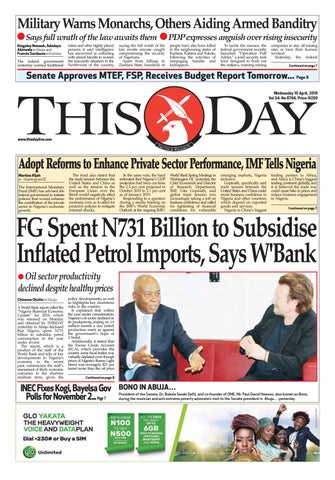
Military Warns Monarchs, Others Aiding Armed Banditry Says full wrath of the law awaits them Kingsley Nwezeh, Adedayo Akinwale in Abuja and Francis Sardauna in Katsina The federal government yesterday warned traditional
rulers and other highly placed persons it said intelligence has uncovered as colluding with armed bandits to worsen the insecurity situation in the North-west of the country,
PDP expresses anguish over rising insecurity
saying the full wrath of the law awaits anyone caught compromising the security of Nigerians. Apart from killings in Zamfara State, hundreds of
people have also been killed in the neigbouring states of Kaduna, Katsina and Sokoto, following the activities of rampaging bandits and kidnappers.
To tackle the menace, the federal government recently launched “Operation Puff Adder,” a joint security task force designed to flush out the outlaws, warning mining
companies to stay off mining sites or have their licenses revoked. Yesterday, the federal Continued on page 7
Senate Approves MTEF, FSP, Receives Budget Report Tomorrow... Page 8 Wednesday 10 April, 2019 Vol 24. No 8766. Price: N250
www.thisdaylive.com TR
UT H
& RE A S O
N
Adopt Reforms to Enhance Private Sector Performance, IMF Tells Nigeria Martins Ifijeh in Washington DC The International Monetary Fund (IMF) has advised the federal government to initiate policies that would enhance the contribution of the private sector to Nigeria’s economic growth.
The fund also stated that the trade tension between the United States and China as well as the tension in the European Union over the Brexit would negatively affect the performance of Nigeria’s economy, even as it called for proactive policies to mitigate external shocks.
In the same vein, the fund reiterated that Nigeria’s GDP projection had been cut from the 2.3 per cent projected in October 2018 to 2.1 per cent as of January 2019. Responding to a question during a media briefing on the IMF’s World Economic Outlook at the ongoing IMF/
World Bank Spring Meetings in Washington DC yesterday, the Chief Economist and Director of Research Department, IMF, Gita Gopinath, said global trade tension was increasingly taking a toll on business confidence and called for tightening of financial conditions for vulnerable
emerging markets, Nigeria inclusive. Gopinath, specifically said trade tension between the United States and China could erode business confidence in Nigeria and other countries which depend on exported goods and services. Nigeria is China’s biggest
trading partner in Africa, and Africa is China’s biggest trading continent globally, and it is believed the trade war could cause hike in prices and reduce business engagement in Nigeria. Continued on page 7
FG Spent N731 Billion to Subsidise Inflated Petrol Imports, Says W'Bank Oil sector productivity declined despite healthy prices Chineme Okafor in Abuja A World Bank report called the “Nigeria Biannual Economic Update” for 2018, which was released on Monday and obtained by THISDAY yesterday in Abuja disclosed that Nigeria spent N731 billion to subsidise petrol consumption in the year under review. The report, which is a product of the staff of the World Bank and tells of key developments in Nigeria’s economy in the recent past, summarises the staff’s assessment of likely economic outcomes in the short-tomedium term, given the
policy developments; as well as highlights key short-term risks in the country. It explained that within the year under consideration, Nigeria’s oil sector declined in its productivity, ending on 1.9 million barrels a day (mbd) production mark as against the government’s hope of 2.3mbd. Additionally, it stated that the Excess Crude Account (ECA), which provides the country some fiscal buffer, was virtually depleted even though prices of Nigeria’s Bonny Light blend was averagely $21 per barrel more than the oil price Continued on page 8
INEC Fixes Kogi, Bayelsa Gov Polls for November 2... Page 7
BONO IN ABUJA… President of the Senate, Dr. Bukola Saraki (left), and co-founder of ONE, Mr. Paul David Hewson, also known as Bono, during the musician and anti-extreme poverty advocate’s visit to the Senate president in Abuja… yesterday
2
T H I S D AY ˾ WEDNESDAY APRIL 10, 2019
T H I S D AY ˾ ͯͮ˜ Ͱͮͯͷ
3
4
T H I S D AY ˾ WEDNESDAY APRIL 10, 2019
T H I S D AY ˾ ͯͮ˜ Ͱͮͯͷ
5
6
T H I S D AY ˾ WEDNESDAY APRIL 10, 2019
7
WEDNESDAY, ˜ ͺ ˾ T H I S D AY
PAGE SEVEN
INEC Fixes Kogi, Bayelsa Gov Polls for November 2 Adedayo Akinwale in Abuja The Independent National Electoral Commission (INEC) has said that the governorship elections in Kogi and Bayelsa States will now hold on Saturday 2nd November, 2019. The electoral body in a statement yesterday by its National Commissioner and Chairman Voter Education and Publicity, Mr. Festus Okoye, said the official notice for both elections would be issued on August 1, 2019, while political parties that intend to sponsor candidates are to hold their primaries for the nomination of such candidates from 2nd to 29th August 2019. He said: “The commission at
its meeting held today (yesterday) approved the Timetable and Schedule of Activities for the Governorship elections in Kogi and Bayelsa States, which will hold in both states on Saturday 2nd November 2019. “Campaigns by Political Parties in public shall commence on 2nd August 2019 and end on 1st October 2019. “The parties sponsoring candidates are required to submit the list of their agents not later than 2nd October 2019.” Okoye explained that the stated timelines are in line with the provisions of the 1999 Constitution (as amended) and the Electoral Act 2010 (as amended), stressing that all
stakeholders are urged to take cognizance of and adhere strictly to them. He revealed that details of the timetable and schedule of activities for the election are on the commission’s website. Meanwhile, the commission after its meeting yesterday approved a proposal to conduct an extensive review and debriefing on the 2019 general election in line with its existing practice. The national commissioner said that this was intended to evaluate the commission's performance of the key activities of the general election, with a view to addressing identified challenges and strengthening
operational and institutional capacities to conduct free, fair, credible and peaceful elections. He explained that the review would focus on the planning, organisation, conduct and coordination of the general elections, particularly on Logistics, Procurement and Deployment of personnel and materials; Continuous Voter Registration and Collection of permanent voter's cards; Legal environment of the elections, particularly the legal challenges experienced over nomination of candidates and conduct of elections. Okoye said the review would also focus on processes of party registration, party primaries and nomination of candidates; quality
of ad-hoc staff; relationship between the commission and diverse stakeholders, including political parties, security agencies, civil society organizations, the media and development partners; and quality of inclusivity of the elections, particularly regarding persons with disability, IDPs and gender balance. He noted that the two sets of activities are envisaged in the reviews as follows: Internal reviews involving National Commissioners, Resident Electoral Commissioners, Electoral Officers, Collation and Returning Officers, as well as other key staff of the commission; Review meetings with key stakeholders such as political parties, civil society
organizations, security agencies, the media and development partners. Okoye revealed that these reviews and debriefing would take place between May and June 2019. He added that the commission has commenced work on a comprehensive report of the 2019 general election and has mandated its Electoral Institute to undertake detailed researches into various aspects of the elections. The national commissioner said it is the commission hopes that the outcomes of these reviews and studies would feed into further electoral reforms and its preparations for handling future elections.
reason Nigerians are anxious for the retrieval of the party’s stolen presidential mandate, which they freely gave to its candidate, Alhaji Atiku Abubakar, at the tribunal, so that the nation could have the benefit of a purposeful government that is alive to its responsibility - of ensuring the security and wellbeing of the Nigerian people. The main opposition party, therefore, tasked the APC to give account of the whereabouts of the political mercenaries it allegedly imported into the country from neighbouring countries, particularly from Chad and Niger Republic during the build-up to the 2019 general election. This demand, it said, was predicated on fears in the public space of the possible involvement, of the imported political thugs to unleash violence on Nigerians during the elections, in the heightened acts of banditry in the nation. The PDP said: “Nigerians could recall that the PDP had raised a red flag on the dangers of the heavy importation of unscreened aliens by the APC to participate in its presidential election campaign rallies. “The PDP and other well-meaning Nigerians had expressed fears that such aliens could be used by unpatriotic elements to unbridle violent acts against Nigerians.”
community of Kankara Local Government Area of Katsina State. The bloodbath in Katsina coincided with the accusation by the federal government yesterday that some highly placed traditional rulers were conniving with bandits to perpetrate insecurity in the North-west. The clash between bandits and vigilantes in the Katsina community, according to residents, started on Sunday when vigilantes killed one Baban Kusa, suspected to be a bandit terrorising the community. The vigilantes were said to have stormed the community market about 1.39.p.m. and killed Kusa, leading to reprisal attack by the bandits. Confirming the incident to journalists yesterday, the Village Head of Tsamiyar Jino, Alhaji Ja'afaru Bello said 36 persons were killed and many sustained various degrees of injuries. He said: "The reports I received indicates that 36 persons were killed during the unfortunate incident. As I speak to you, corpses have littered at our farmlands. "We called the security personnel, but when they came and saw what was going on they just left without any information. So, we were scared of retrieving the corpses yesterday. "But since the security personnel could not retrieve them, I directed my subjects this morning to retrieve the corpses for mass burial today." A victim of the incidence, Malam Shu'ibu Tsamiya, said: "They killed my two brothers and my son at Ungwar
Sarkin-Aiki and denied us access to their corpses. The number of people killed in this community is more than 40." But another resident, who pleaded anonymity, said 27 persons were killed at Unguwar Rabo, while eight were also massacred at Unguwar Sarkin Aiki and one at Centar Na Ade. The source lamented that despite the repeated attacks on Tsamiya and other local governments in Katsina, the bandits still moved freely during the act without being challenged by security operatives. According to him, "It is just like there is no constituted authority or no security agencies in Katsina State. Nobody cares about our lives. We have become easy prey for Bandits in the state." The police, however, said 14 people were killed during the clash. When contacted, the Katsina State Police spokesman, Mr. Gambo Isah, said: "Only 14 people died,” adding that security personnel have been mobilised to the area. He added: "Out of this figure seven are bandits, while the remaining seven are members of the civilian JTF also known here as Yan Sakai. The civilian JTF went into the forest to fight the bandits having refused to heed police advice." The attacks on communities in Katsina have continued in the past few months, despite the deployment of f military and police personnel in the state.
The Head of Policy, EURODAD, Bodo Ellmers said: “High debt levels became a key constraint for spending on infrastructure projects and public goods in poor countries. “Every euro that goes to creditors is a euro that does not go to poverty eradication and sustainable development.” He warned that IMF needs to do more such that their programmes do not harm poor people, adding that when crisis strikes, IMF loans are often the last resort for affected countries. “But they come with harsh austerity and adjustment conditions attached. The IMF conditionality review that takes place while the spring meetings are ongoing should be used to ensure that IMF programmes respect democracy and human rights. We also call on the IMF to conduct human rights impact assessment of all its programmes,” Ellmers said.
TOP GAINERS GTBANK CHAMS PLC STANBIC UNIONDAC SOVETRUST TOP LOSERS NEMINSURE ETI LIVESTOCK
MILITARY WARNS MONARCHS, OTHERS AIDING ARMED BANDITRY government moved a step further, saying in a statement in Abuja by the Ministry of Defence that some royal fathers were providing intelligence to the bandits to either carry out their criminal activities or compromise military operations. In view of this development, it directed the military to deal decisively with any individual or group of persons collaborating with the bandits no matter how highly placed. The statement signed by the Public Relations Officer to the Ministry of Defence, Col. Tukur Gusau, said government was taking concrete steps to address the twin menace of banditry and kidnapping in the North-west, noting that the decision of government to suspend mining activities in Zamfara State followed advice provided by the ministry. It said: “It is instructive to mention here that insurgency and terrorism are global phenomena that cannot be addressed through military actions only. The whole society has to rise in unison to support the government’s efforts to address the problem. “However, in spite of the concerted efforts of the Armed Forces and other security agencies, some unpatriotic persons including highly placed traditional rulers in the areas were identified as helping the bandits with intelligence to perpetrate their nefarious actions or to compromise military operations. “In the last three years, the Ministry of Defence had carried out several reforms geared towards the reorganisation and expansion
of the Armed Forces in order to meet up with contemporary security challenges across the nation and the sub-region.” “The Ministry of Defence, therefore, wishes to warn any person or group of persons, who choose to connive or sympathise with the bandits to perpetrate crime against law abiding citizens to henceforth retrace their steps or face the full wrath of the law. “The Armed Forces of Nigeria have been directed to deal decisively with anybody identified to be helping the bandits under whatever guise no matter how highly placed the person or persons may be.” The Defence Ministry said government was looking at the remote and immediate causes of spiraling banditry in the North-west. According to it, “The Ministry of Defence is very concerned about the security challenges in the North-west particularly, in states of Zamfara, Sokoto, Katsina and Birnin Gwari axis of Kaduna State. Due to the recent prevailing security situation in the states the ministry through the Nigerian Army is now conducting Exercise Harbin Kunama IV simultaneously in Zamfara, Katsina and Sokoto States. “The purpose of the exercise is to effectively flush out the activities of criminal elements in the North-west. The Nigerian Air Force has also intensified air strikes against the bandits in Zamfara. So far, the combined efforts have yielded a lot of successes leading to the killing of many bandits, rescue of many innocent persons including the renowned Islamic scholar
Sheik Ahmad Suleiman.” PDP Expresses Anguish over Rising Insecurity In the meantime, the Peoples Democratic Party (PDP) has expressed anguish over horror Nigerians have been subjected to following escalating insecurity, including killings, rising spate of kidnapping, banditry and acts of terrorism in various parts of the country, particularly in the Northern states. The party lamented that the federal government has failed to show enough commitment in protecting the lives of Nigerians and curb the bloodlettings and kidnapping of compatriots in Zamfara, Borno, Yobe, Kogi, Kaduna, Taraba, Adamawa, Plateau, Bauchi and other states. In a statement yesterday by its National Publicity Secretary, Mr. Kola Ologbondiyan, the party said that the PDP had been proved right that President Muhammadu Buhari and the APC do not believe in their campaign promises. According to the PDP, “The party is heavily grieved by the pain, anguish and horror Nigerians have been subjected to in the hands of marauders following the failure of the President Muhammadu Buhari administration to provide adequate security in the country, despite the huge resources at its disposal.” The party noted that by every indication, the Buhariled federal government has no solution to the security challenges of the country, which it said has festered under its watch. It added that this was the
Bandits, Vigilantes' Clash Claim 36 Lives in Katsina Meanwhile, no fewer than 36 persons have been killed in a clash between vigilantes and bandits in Tsaminyar-Jino
ADOPT REFORMS TO ENHANCE PRIVATE SECTOR PERFORMANCE, IMF TELLS NIGERIA Gopinath said: “Brexit and softening oil prices are the main risks. For Nigeria, what is very important is the oil price, so to the extent that other global risks transmit into a weaker oil price or there are other developments that are oil market specific that would be a factor weighing on Nigeria. “We expect a growth recovery for the country. Growth was reasonably strong last year and we think that things will improve a bit going forward. We cut our forecasts for 2019 precisely because oil prices are going to be a bit weaker than we expected last time we did the forecast.” Therefore, the IMF official stressed the need for policymakers to be cautious. “Fiscal policy needs to tighten further for which mobilising more non-oil revenue is very important,” she said, adding: “For monetary policy, it has to
stay tight for some more time. It has to be well communicated and transparent. There has been some convergence on the exchange rate front, there is also much more that needs to be done there and the structural reforms, all of these has to be put in a context of reforms that help boost private sector performance.” Also, the Deputy Director, Research Department, IMF, Gian Maria Milesi-Ferretti, said low and middle income countries that rely mostly on oil could experience additional public financial stress following dwindling oil prices. He said in whichever case, there should be social security for vulnerable population in any country, such that they are protected from further hardships. In general, the released World Economic Outlook showed that the world economic situation was deteriorating with many poor countries already struck
by debt crisis. Continuing, Gopinath said global growth softened to 3.6 per cent in 2018 and was projected to decline further to 3.3 per cent in 2019. She said the downward revision in growth for 2019 reflected the weakness in major economies in Europe, Latin America, the United States, United Kingdom, Canada and Australia. She stated: “After the weak start, growth is projected to pick up in the second half of 2019. “This pickup is supported by significant monetary policy accommodation by major economies made possible by the absence of inflationary pressures in spite of growing at near potential. “The US Federal Reserve, the European Central Bank, the Bank of Japan and the Bank of England have all shifted to a more accommodative stance.
“China has ramped up its fiscal and monetary stimulus to counter the negative effect of trade tariffs.’’ Gopinath called for greater multilateral cooperation to resolve trade conflicts, address climate change and risks from cyber security, and to improve the effectiveness of international taxation. She said that monetary policy should remain data dependent, well communicated, and ensured that inflation expectations remained anchored. Meanwhile, the European Network on Debt and Development (EURODAD), a major network of European civil society organisations working on development finance has warned that progress on sustainable development goals could be derailed or even reversed, adding that poverty and inequality could rise if counter measures are not taken.
NGN NGN 2.45 34.00 0.02 0.28 2.80 46.00 0.01 0.23 0.01 0.24 NGN 0.23 2.10 0.75 10.50 0.03 0.50 NIGERINSURE 0.02 0.20 NASCON 0.95 19.05 HPE Nestle Nig Plc ₦1,450.00 Volume: 374.026 million shares Value: ₦3.057 billion Deals: 3,634 As at yesterday 9/4/19 See details on Page 39
% 7.7 7.6 6.4 4.5 4.3 % 9.8 6.6 5.6 4.7 4.7
8
T H I S D AY Ëž Ëœ ͚͸˜ ͺ͸͚Î
Otedola Offers Christian Chukwu Lifeline Promises to pick his medical bills
Billionaire businessman and Chairman of Forte Plc, Mr. Femi Otedola, has offered a lifeline to ailing former Super Eagles’ coach, Mr. Christian Chukwu, by agreeing to pick his medical bills. The offer came on Monday to the relief of Chukwu, his family, friends and admirers around the country. Chukwu, one of Nigeria’s most influential footballers in history, who captained the national team to their first Africa Cup of Nations title in 1980, is suffering from prostate cancer, which has affected his
leg and has struggled to raise the necessary funds to make the trip abroad for treatment. Although the surgery on his leg has been done, he reportedly needs an additional $50,000 for the prostate operation. Mr. Norbert Okonkwo, media officer of Enugu Rangers, told TheCable that the Enugu State government donated N1.5 million for the leg surgery. In the first two days, a GoFundMe appeal raised $4,305 of the $50,000 needed for further treatment. Speaking on phone, Otedola
said he would foot the entire cost of the operation as a “token of support to a great Nigerian, who served his country to the best of his ability.� Otedola previously settled the medical bills of the veteran actor, Mr. Victor Olaotan, who was at risk of double amputation following a ghastly car accident in 2016. An accomplished actor, Mr. Richard Mofe-Damijo, had announced by posting on his twitter handle that he reached out to Otedola to solicit help for Olaotan’s medical bills and that he had agreed.
A patron of Chukwu’s former club, Enugu Rangers FC, Mr. Benson Ejindu, broke the news of the ailment last weekend. Chukwu also captained the Enugu Rangers FC team that won the Africa Cup Winners’ Cup in 1977. He was nicknamed ‘Chairman’ for his authority on the field as a central defender. Chukwu also served as assistant coach of the first team to win a FIFA World Cup trophy for Nigeria, the Golden Eaglets that triumphed at the FIFA U16 World Cup
in China in 1985. He was also assistant coach of the team tagged the Golden Generation, the 1994 Class of Super Eagles that qualified Nigeria for her first FIFA World Cup finals. As assistant coach, he helped Nigeria win the Africa Cup of Nations title and reached the round of 16 at the FIFA World Cup in America. Between 2002 and 2005, Chukwu was head coach of the Super Eagles, leading the team to bronze medal at the 2004 Africa Cup of Nations in Tunisia.
Chukwu
Senate Approves MTEF, FSP, Receives Budget Report Tomorrow Adopts N1.64 trillion as new borrowing to fund deficit Deji Elumoye in Abuja The Senate yesterday approved the 2019-2021 Medium Term Expenditure Framework (MTEF) and Fiscal Strategy Paper (FSP), of the federal government six months after it was sent to it by President Muhammadu Buhari in November last year. The upper legislative chamber also yesterday directed its Appropriations Committee to ensure that the 2019 budget report is laid before it tomorrow. The approval of the MTEF and FSP by the Senate was sequel to the presentation of the 18-page report of the Committee on Finance by the committee Chairman, Senator John Enoh (Cross River Central), which considered the president's request. While adopting N1.64 trillion borrowing to fund the budget deficit, the Senate, however, advised relevant government agencies to continue exploring ways of generating additional revenues for government to bring down the fiscal deficit. "Also, the federal government should harness the full optimal potential of
the Federal Ministry of Mines and Steel Development in terms of revenue generation to minimise the level of new borrowing,� the committee added. The upper legislative chamber approved all the critical projections in the MTEF/FSP as proposed by the executive arm of the government. The MTEF/FSP, a three-year rolling expenditure plan, spells out the medium-term expenditure priorities and provides the basis for the preparation of the annual national budget. The Senate retained the oil output of 2.3 million barrel per day oil price benchmark of $60 per barrel; an exchange rate of N305/$1; GDP Growth rate of three per cent; and inflation growth rate of 9.98 per cent. Other provisions of the MTEF and FSP approved by the Senate include: proposed expenditure of N8.83 trillion; FGN retained revenue of N7.92 trillion; fiscal deficit of N1.86 trillion; statutory transfers of N492.4 billion; debt service N2.14 trillion; Sinking Fund of N120 billion; total recurrent (non-debt)
N4.72 trillion; personnel costs (MDAs) N2.29 trillion; capital expenditure of N2.86 trillion; Special Intervention of N500 billion, among others. Earlier in his presentation, Enoh admitted that crude oil production output stood at two million barrels as of December 2018, and explained that the 2.3million daily target was achievable “due to the continuous efforts of all stakeholders in checkmating the issues of oil facilities vandalism and other vices associated with such regard�. While recommending an exchange rate of N305/$1, the committee encouraged the Central Bank of Nigeria (CBN) "to continue adopting strategies that will aid the strengthening of the naira and bridging the gap between the official and parallel market rate of the foreign exchange". Senate to Receive 2019 Budget Report Thursday Meanwhile, the Senate also yesterday directed its Appropriations Committee headed by Senator Danjuma Goje (Gombe Central) to submit the 2019 budget report by tomorrow.
Senate President, Dr. Bukola Saraki, gave the directive after the submission of the Vice Chairman of the Appropriations Committee, Senator Sunny Ogbuoji (Ebonyi South) who disclosed that only 24 out of 61 subcommittees had submitted their reports as at yesterday. Ogbuoji said: "We are still having some challenges with the subcommittees on Appropriation because out of the 61 committees that we have, only about 24 committees have submitted their reports. And we are not able to go ahead and write the Appropriations report unless we get further directive from here. Our request would have been that we be allowed to now prepare this report even on behalf of the committees that have not submitted their reports." Saraki, thereafter, insisted that the budget report must be presented on Thursday ahead of the April 16 approval of the budget. According to him, the Appropriations panel will be forced to use Executive submissions if the subcommittees fail to submit their reports to the Appropriations
Committee by today. He said: "It is unfortunate that only 24 committees have submitted their reports. Last week, we all took a decision here that we are not going to waiver on our position. Our position is very clear: that all committees should submit (their budget reports). And those that don't submit, then the Appropriations Committee should use the Executive submission. "That position is still where we are. And I want to appeal to all our committees that you really have just till tomorrow (Wednesday) to make sure that your reports get to the Appropriations Committee because Thursday, you must lay this report. "Vice Chairman of Appropriations Committee, if you don't get report from our committees by tomorrow (Wednesday), then you just use the submission of the Executive. But come Thursday, you must lay that report." President Muhammadu Buhari had on December 19, 2018 submitted a N8.83 trillion budget proposal for 2019 to a joint session of the National Assembly on December 19, 2018.
Senate ConďŹ rms Tarfa as North-East Development Commission Chairman
depleted, despite the actual Bonny Light price exceeding the budget benchmark by US$21/bbl on average throughout 2018. “The ECA was established on the basis of Section 35 of the Federal Fiscal Responsibility Law which stipulates a commodity (oil) price-based fiscal rule requiring that savings should accrue to the ECA if the price exceeds the budget benchmark. “In 2018, the small balance of US$ 2.5 billion available at the beginning of the year was almost fully exhausted by special withdrawals from the account, (e.g. the purchase of the new military air-fleet), and the closing balance dropped to US$ 0.6 billion, leaving no fiscal buffer going ahead.� Putting the development into context, the World Bank warned that with the country’s continued heavy dependence on volatile oil revenues, and the depletion of fiscal buffers,
its fiscal situation remained fragile. “The country also faces the risk of reversion to procyclicality of fiscal policy and this has important consequences for macroeconomic stability and the sustainability of growth. Procyclicality of public spending implies that primary spending and real GDP growth move in the same direction. “Procyclical fiscal policies tend to generate macroeconomic instability and amplify economic fluctuations. The latter are associated with the volatility of long-term economic growth by discouraging new investment, undermining human capital through high unemployment, generating volatile government revenues and the terms of trade, and undermining debt sustainability. Furthermore, there is significant evidence across the world that the procyclicality of fiscal stance
Meanwhile, the upper legislative chamber yesterday confirmed the nomination of former military governor of Oyo State, Major-General of Paul Tarfa (rtd), as Chairman of the North-East Development Commission (NEDC). Also confirmed are 10 other nominees of the president as members of the governing board of the commission. Their confirmation followed the consideration of the report of the Senator Abdulaziz Nyako-led Committee on Special Duties that screened the nominees by the Committee of the Whole. The confirmed NEDC board members include Mohammed Alkali, MD/CEO; Musa Yashi, ED, Humanitarian Services; Muhammed Jawa, ED, Admin and Finance; Omar Mohammed, ED, Operation; and Mr Obasuke Mcdonald (South-south). Others are Asmau Mohammed (North-west), Hon David Kente (Northeast), Hon. Benjamin Adanyi (North-central), Hon. Olawale Oshun (South-west) and Dr. T. Ekechi (South-east).
FG SPENT N731 BILLION TO SUBSIDISE INFLATED PETROL IMPORTS, SAYS W'BANK that was or budgeted for in the year. The World Bank had in November 2018 stated in another report titled: ‘Nigeria Bi-annual Economic Update for Fall 2018,’ that petrol subsidy deductions for 2017 full year was N107.3 billion, but its current report showed that N731 billion was spent in 2018 alone. According to it, most of the petrol volumes Nigeria spent money to subsidise in 2018 were inflated as daily consumption rose to 54 million litres per day (ml/d) from 40ml/d in 2017, ostensibly due partly to out-smuggling. “Oil and gas revenue collection increased in 2018 but remained below potential. Net oil and gas revenues retained in the federation account grew by 73 per cent in nominal terms: as oil production remained stable, the increase has been driven by the oil price increase – on
average, 32 per cent higher in 2018 (US$ 72/bbl) relative to 2017 (US$ 55/bbl). “As cost is not linearly proportional to the oil price increments, more growth in the oil revenues were expected, and only about two-third of the budgeted net oil and gas revenues were actually collected. “The oil revenues continue to underperform both relative to the budget targets and their realistic potential due to the unbudgeted fuel subsidy (Nigerian National Petroleum Corporation (NNPC) ‘cost under-recovery’), which amounted to N731 billion in 2018, among other discretionary deductions, and the dollar-naira conversion using an exchange rate lower than that prevailing in the convertible IEFX window,� said the report. It further explained that: “The NNPC financial reports indicate that about US$2 billion (equivalent to 0.6 per
cent GDP) were deducted from the gross oil revenue prior to the transfer to the federation account for the unbudgeted fuel subsidy (‘cost under-recovery’). “The calculations for the fuel subsidy are based on heavily inflated fuel consumption estimates, with the fiscally severely constrained Nigerian government effectively subsidising neighbouring countries’ petrol consumption as some of the fuel is informally re-exported through the porous borders.� With regards to real Gross Domestic Products (GDP) growth by sector, it noted that the oil sector started the year with a 14.8 per cent growth which slumped to -4.0 in Quarter two (Q2 of 2018) and then -2.9 in Q3-2018, before ending in Q4-2018 with -1.6. “The oil sector’s real growth slowed to 1.1 per cent in 2018 from a more robust level of 4.7 per cent in 2017. After
growing by as much as 14.8 per cent in the first quarter of 2018 (partly due to base effects), the sector fell into decline (in real terms) in the second quarter of the year, partly due to various force majeure episodes declared by oil companies at different times during the year as well as maintenance disruptions. “Oil output did not increase as envisaged by the government (Medium Term Fiscal Framework and Federal Government Budget 2018 projected 2.3mb/d for 2018) but remained relatively stable overall in 2018 at an estimated average of 1.9mb/d,� it added. New investments in the sector, it said, have been limited, indicating that even with the strengthening of oil prices, the sector fell back into contraction in three out of four quarters of 2018. Turning to developments in the ECA, it said: “Fiscal buffers in the Excess Crude Account were virtually
T H I S D AY ˾ ͯͮ˜ Ͱͮͯͷ
9
10
WEDNESDAY APRIL 10, 2019 ˾ T H I S D AY
NEWS
Group News Editor Ejiofor Alike Email Ejiofor.Alike@thisdaylive.com, 08066066268
Senate Accuses AuGF of Failing to Submit Audit Report Since 2016 Passes Police Trust Fund Bill
Deji Elumoye in Abuja The Senate has accused the Auditor General of the Federation, Mr. Anthony Ayine, of failing to submit the federal government’s audit report to the Senate since 2016. This is coming as the lawmakers yesterday passed the Nigerian Police Trust Fund Bill, which will provide a legal framework for the management of special intervention funds for the police. Responding to the allegations made last week by Ayine that no audit report submitted to the National Assembly since 1999 had been worked on by the lawmakers, the Chairman of the Senate Committee on
Public Accounts, Senator Mathew Urhoghide, said Ayine was yet to submit any audit report since he took over as AuGF in 2017. He said the AuGF ought to have concluded work on 2018 audit report because the law states that report should be submitted six months into the new financial year. “The much I know since I became the Chairman, Senate Committee on Public Accounts, about a year and half ago, is what I can say. “When the Auditor General came for his budget defence, I told him that the fact that we have not conducted hearing on his queries does not mean that he should not bring audit reports. “We have not received audit
report for 2016. The Auditor General resumed office in 2017. Since he came, he has not submitted any audit report to the National Assembly. He is even supposed to be concluding works on 2018 because the law said that it must be submitted, six months into the new financial year. “This is the fourth month. By the time we get to June end, he is expected to submit audit report for 2018. He doesn’t have the
competent manpower to conduct audit,” the senator said. Urhoghede noted that the major problem facing the office of the AuGF is incompetent manpower. According to him, some of those who work in the office of the AuGF were those who have nothing to do with auditing. Urhoghede insisted that the Public Accounts Committee was not created only to consider audit report and noted that in
2016, the committee discovered that N14 billion was removed from one federal fund meant for intervention in the states that were distressed and given to the Ministry of Defence. He noted that although the AuGF queried the removal of the fund, he (Urhoghide) called the Permanent Secretary, Ministry of Defence to draw his attention to it, “because it is an extra-budgetary allocation made to them.”
According to him, the removal of the N14 billion was apart from the N2.7 billion given to the Defence Ministry “behind the doors from the Service Wide Votes.” The committee chairman who said “it is only Public Accounts Committee that can see all those things,” noted that the Permanent Secretary expressed surprise and said, “we didn’t form a new division in the army.”
Continued on page 50
Over 3,000 Killed, 500 Villages Affected in Zamfara, Says Yari The Zamfara State Government has said that a total of 3,526 persons were killed by armed bandits in the state in the last five years. This was disclosed yesterday by the state Governor, Abdulaziz Yari, in Gusau during a Town Hall Meeting attended by the acting Inspector General of Police, Mohammed Adamu. “Nearly 500 villages have also been devastated and 8,219 persons injured, some are still in critical condition,” the governor said. The governor, who was represented by the Secretary to the State Government, Prof. Abdullahi Shinkafi, also said that over 13,000 hectares of farmlands were either destroyed or made useless as the farmers can no longer farm there. “The economy of the state has seriously suffered because thousands of shops were destroyed by the rampaging
bandits who had displaced thousands of our people from their places of abode, many of whom cannot sleep with their two eyes closed because of fear,” he added. Yari said the government had written volumes of reports containing over 7,000 pages, giving details of the crises right from the beginning to the infiltration from Libya and Boko Haram. He disclosed that the government was aware of eight prominent bandits’ camps at different bush locations in the state, and urged that they should all be neutralised in order to decimate the criminals. The governor said that recent suspension of mining activities in the state by the federal government must “be followed by enforcement, because, it is one thing to ban, and another to enforce.”
We’ve Resolved Exam Schedules with WAEC, Says JAMB Regina Ogwuche The Joint Admissions and Matriculation Board (JAMB) yesterday assured candidates sitting for this year’s Unified Tertiary Matriculation Examination (UTME) that they would not be denied the opportunity of writing the examination. Head of Public Relations, JAMB, Dr. Fabian Benjamin, gave the assurance in an interview with the News Agency of Nigeria (NAN) in Lagos following fears concerning a clash in the timetable of West African Senior School Certificate Examination and UTME. According to the timetable, WAEC students who are expected to write Animal
Husbandry on April 11 by 9 a.m. are also expected to sit for the UTME on the same day. At least 1.8 million candidates are expected to write this year’s UTME, while over one million students also registered for the May/June examinations of the WASSCE across the country. Benjamin explained that WAEC starts with practical subjects, adding that it has so many sessions for its practicals. “People have been talking about clashes between WAEC and JAMB timetable. “We (JAMB) have met with the WAEC management and WAEC has just given us an assurance that there is no clash; that people don’t just understand the modus operandi of the timetable especially as it affects the practicals.
WALKING TOWARDS STRONGER TIES...
President Muhammadu Buhari (left), Crown Prince Mohammed Bin Zayed All Nahyan of Abu Dhabi, during the courtesy visit to the Crown Prince in Abu Dhabi ....yesterday
Boko Haram Attacks Yobe Town Michael Olugbode in Maiduguri
Boko Haram yesterday launched a bold attack on Damaturu, the Yobe State capital. The attack forced the town into an early lockdown as vehicles were not allowed to come into it or out of the town. THISDAY gathered that many of the residents were forced to stay indoor as the military engaged the insurgents, who were said to have tried to gain entry into the town
through Maisandari, on the outskirts. Some of the residents of Maisandari, who spoke to our correspondent, said the attackers came through the eastern part of the town and started shooting sporadically. One of the residents, Abba Mohammed, said they saw the assailants coming into the area in Hilux vans mounted with anti-aircraft gun. “Immediately we saw them, we had to scamper for safety,” he said. Mohammed who spoke
at about 6 p.m., said “we are still hearing exchange of gunfire and we surely need your prayer.” Some of the residents of the mainland area of Damaturu, confirmed on phone to our correspondent, that they saw heavy armed soldiers in four armoured carriers and many Hilux vans advancing towards Maisandari, where the insurgents were said to have followed to enter the town. One of the residents, Sani Ahmed said the shooting was first heard at about 5 p.m.
He said some suspected Boko Haram members attempted to invade the Red Bricks Housing Estate along Maiduguri road, in Damaturu. He said there were heavy sounds of gunfire and explosions, adding also that a fighter jet was seen hovering on Damaturu around 5.30 p.m. As at the time of filing the report, military authority was yet to issue a statement. A high ranking officer of the Police in the state who preferred anonymity, however confirmed the attack.
Okorocha Tells South-east to Forget 2023 Presidency Amby Uneze in Owerri The Governor of Imo State, Chief Rochas Okorocha has advised the people of the South-east to shelve their 2023 presidential ambition, saying that the race for the nation’s number one seat would directly be between the North and the South-west . He said the rejection of the All Progressive Congress (APC)’s presidential candidate, Muhammadu Buhari in preference to his Peoples Democratic Party (PDP) counterpart Atiku Abubakar by the South-east foreclosed the prospect of the zone to clinch the
presidency in the next four years. The governor who made this disclosure to journalists while giving an update of political developments in the state, described the outcome of the last election in the zone as a huge minus to the Igbo nation, lamenting that the zone might no longer be represented where the APC would be discussed in the country. He however, promised to rebuild and to reposition the party in the state, which did not produce a single member in the state House of Assembly. Okorocha berated the Independent National Electoral
Commission (INEC) for its abysmal performance in respect of the conduct of elections in the state, contending that what the electoral umpire did was a mockery and an embarrassment to the democratic world. “The Resident Electoral Commissioner (REC) of the Independent National Electoral Commission (INEC) in the state was merely recruited to do a hatchet job and the allegation of my election result being declared under duress was nothing but a fabricated fallacy which does not reflect the reality. “More than 70 agents of political parties, the Police
and the DSS were there and they all reported that there was nothing like that and I hope to get my Certificate of Return from INEC soonest or else who will they give it to?, he queried. The embattled governor however, stated that the APC had continued to wallow in controversies, which led to its abysmal outing in the state and the South-east during the just- concluded general election. He accused the party National Chairman of APC, Adams Oshiomole, of piloting the affairs of the party with impunity, envy, greed and arrogance.
WEDNESDAY APRIL 10, 2019 ˾ T H I S D AY
11
NEWS XTRA
Nnamani: Uwais Report Can Restore Credibility in Electoral System Adedayo Akinwale in Abuja A former Senate President, Senator Ken Nnamani, has said that the recommendations of the Uwais Report represents a high point in the search for an electoral system that would suit Nigeria’s peculiar circumstances, adding that the report contains
proposed innovations that could restore credibility and fairness to the country’s electoral system. He however, said it was unfortunate that many of these innovative proposals were not implemented. Nnamni also said that there was need to end the impunity in the country’s electoral system by
prosecuting electoral criminals, stressing that this lack of prosecution was the biggest encouragement to politicians to breach the law. Nnamani who was represented by Mallam Muhammed Bello Tukur, disclosed this yesterday in Abuja at the 3rd Oronto Douglas Memorial Lecture with
Terror Financing: EFCC Moves to Probe NGOs over 40 Bank Accounts Kingsley Nwezeh in Abuja In a renewed bid to track the movement of laundered funds in the banking system used to finance terrorism, the Economic and Financial Crimes Commission (EFCC) yesterday declared that it would commence an investigation into the financial dealings of some Non-Governmental Organisations (NGOs) operating in the North-east. A military source had recently raised posers about the upfront payment of hotel accommodation for upwards of 10 years by some NGOs operating in Borno State, making it difficult for travellers to secure accommodation in Maiduguri, the state capital. The source had also questioned the genuine desire on the part of the organisations to see the end of the insurgency.
Speaking at a meeting with banks’ compliance officers in Maiduguri, Chairman of EFCC, Ibrahim Magu, queried the rationale behind a single NGO keeping 40 bank accounts. He warned that banks should comply with Money Laundering Act by reporting to the anti-graft agency, any person or persons moving cash above the allowed threshold. “Nobody should carry cash above the threshold of above N10 million for corporate organisations and N5 million for individuals; anything above the threshold must be routed through financial institutions,” he said. Magu said EFCC would soon commence the profiling of NGOs with a view to monitoring their financial activities. He said: “We must profile all the NGOs in the North-east.
I don’t know why an NGO will open more than 40 bank accounts. “We are going to ask your various banks to give us statements of accounts for each and every NGO. “The issue of money laundering, terrorist financing and leakage of information will be eliminated by the commission with the help of bankers across the country.” While answering question from a bank official, according to an EFCC statement, Magu said, “aside from terrorist financing, the commission is trailing the activities of ‘yahoo -yahoo boys’ on how victims were defrauded in the hands of those fraudsters by using latest technology. “The commission through the Nigerian Communications Commission is working assiduously to stop the menace”
Tribunal Grants PDP Request to Access INEC Materials on Kano Guber Election Ibrahim Shuaibu in Kano The governorship election petition tribunal in Kano State yesterday ordered the Independent National Electoral Commission (INEC) to allow the Peoples Democratic Party (PDP) access to all electoral materials used in the gubernatorial poll. In an exparte motion filed before the tribunal, which was presided over by Justice Halima Shamaki, counsel to PDP governorship candidate, Abba Kabir Yusuf, Maliki Umar Kuliya, had sought the order of the tribunal to direct the first respondent (INEC) to allow PDP access materials used for the conduct of March 9 and 23 governorship elections.
In her five-count prayers, the PDP lawyer wanted the tribunal “to direct the 1st respondent to forthwith grant access to the petitioners/applicants and their solicitors, agents, experts and other staff to inspect, photocopy, scan, pay for and obtain certified copies of all the documents used by the 1st respondent for the conduct of the Kano State governorship election held on March 9 and 23, 2019, for the purpose of instituting and maintaining an election petition, the said documents being the ones contained in the schedule attached to the supporting affidavit to this application.” In her ruling, Justice Halima granted the PDP prayers, directing INEC to surrender
photo copies, scan and other certified materials used in the conduct of Kano State elections. The chairperson of the three-member governorship tribunal, however, ordered for two or three members of All Progressives Congress (APC) (respondent) as observers during the inspection exercise. PDP still has less than five days to file its petition against the ruling party having exhausted almost 15 days out of the 21 days provided by the Electoral Act 2010 as amended. The gubernatorial candidate of PDP, Abba Kabiru Yusuf, is challenging the declaration of Governor Abdullahi Umar Ganduje of the APC as winner of the March 23 supplementary election in the state.
Ugwuanyi Performs Ground-breaking of First Education University in South-east Governor Ifeanyi Ugwuanyi of Enugu State yesterday performed the groundbreaking ceremony for the administrative building of the first University of Education in the South -east geo-political zone, the Enugu State University of Education in Ihe, Awgu Local Government Area of the state. The university, which would be a degree-awarding institution in the area of education, will serve as a training ground for teachers of primary, secondary and tertiary
education. The establishment of the new institution was recently approved by the Ugwuanyi administration, and the contract for the construction of the administrative building was awarded last week by the State Executive Council. Performing the ceremony, Ugwuanyi, who expressed delight and fulfillment, stated that the quest for the establishment of the university was in consonance with his administration’s commitment to providing and promoting better access
to higher education as a way of stimulating knowledge, productivity and industry among the teeming population of youths in Enugu State. The governor recalled that his administration had earlier announced the release of the sum of N200 million for the commencement of preliminary construction works on the site, stressing that the proposed university will help to bring about a significant and positive transformation of the socioeconomic fortunes of the entire Awgu LGA and environs.
the theme: “Nigeria’s Broken Electoral System: Uwais Report and Unfinished Business.” Delivering his paper on ‘Towards a More Credible, Fair and Free Elections in Nigeria,’ Nnamani, said that as a politician he had seen first-hand flaws of the electoral system so glaringly that nobody can be sure that the votes cannot counts. He noted that many Nigerian politicians would acknowledge that there were historical flaws with the electoral system, adding that these flaws hinder the protection of the right to vote and the sustenance of democracy. The former Senate President said he believed that critical to strengthening democracy was ensuring that the electoral process was free, fair and credible. “It is obvious that the Uwais report represents a high point in the search for an electoral system that will suit Nigeria’s peculiar circumstances. The eminent members of that committee proposed many innovations that could restore credibility and fairness to our electoral system. Unfortunately, many of these innovative proposals were not implemented,” he said. He added that it was in this context that President Muhammadu Buhari appointed him and others to the Constitutional Electoral Reform
Committee to, amongst other things, review Uwais report and make recommendations for reform of the constitution and electoral law to institutionalise free, fair and credible elections. “The most important part of a good electoral system is the credibility and independence of the electoral management body. Often times, we have argued as if independence is just a matter getting a credible person as chairman of the electoral body. It is far more than that. The independence of the election management body is mostly determined by the mode of appointment. “In South Africa and some other African countries, the process of appointment of electoral management officials is more of competitive recruitment where those appointed will have a sense that they merited the position not that they are beneficiaries of political patronage. “Therefore, we recommended that although the President still appoints but another body advertises the job, interviews and recommends to the president for appointment. In this process, both the president and the Senate play a role.” The former Senate President insisted that the strength of democracy is better defined by the quality of the institution band
not necessarily by the heroism of persons. According to him, “The 2019 elections also highlight a serious pathology of Nigerian elections. There is so much violence and crimes associated with elections. Political desperation makes ordinary resemble wars. “We spend so much on providing security, yet we continue to witness a high level of violence and electoral crimes. This does not require religious exhortation and appeal to conscience of politicians.” Nnamani pointed out that due to attractive nature of the public offices in a third world like Nigeria, politicians have incentive to fight dirty to gain access to these political offices. “Until we can reduce the financial rewards of occupying political offices through anticorruption and accountability measures, we should expect desperation from politicians. We must deal with violence through international redesigning.” Nnamani was of the opinion that politicians sponsor violence and commit other crimes because they calculate that the benefits of criminal behaviours are more than the cost, stressing that to reduce the rate of violence, there was need to reduce the benefits and make if difficult for those who sponsor or commit such comes to go scot-free.
12
T H I S D AY ˾ WEDNESDAY APRIL 10, 2019
T H I S D AY ˾ ͯͮ˜ Ͱͮͯͷ
13
14
T H I S D AY • WEDNESDAY, APRIL 10, 2018
COMMENT
Editor, Editorial Page PETER ISHAKA Email peter.ishaka@thisdaylive.com
WITH A LITTLE LIGHT
Our little light can do others a lot of good, writes Sonnie Ekwowusi
A
few days ago I engaged a certain lawyer friend in a telephone conversation. Half way in our conversation he frankly opened up and said to me, “Sonnie, what is happening to us in this country? “What do you mean”, I interjected. “Are there not enough sane people in this country who could come together and start reasoning properly, or, are you suggesting that we outsource Nigeria to a civilized country which can manage her properly? Look, our humanity is being defeated every day. It seems as if we are living in a dark tunnel without any hope for the future. Are we going to continue living like this?” he concluded. I must confess that I had no answer to the aforesaid thought-provoking questions. I was so lost in thought about the state of affairs in our country that it was difficult to utter a word. But I think I have an answer now. No honest person who has carefully reflected on the quality of life we are living in Nigeria especially in the last few years would remain unperturbed. Our lives in Nigeria are ruled by perpetual fear. Although a seemingly external calm and peace may pervade the atmosphere but beneath the seeming calm lies a great fear, the fear that the government which is supposed to be a bulwark of liberty is unleashing terror on the citizenry; fear that our next neigbour may turn out to be an armed robber or a kidnapper capable of pulling the trigger and snuffing life off us; fear of the incapacity to eke out a simple living in our professional work; fear of the future of our children; fear of losing our jobs in our places of work; fear that we might go to bed and not wake up the next morning.; fear that the air we breathe has been adulterated by our enemies. In short, our lives are so ruled by fear that we are even afraid of ourselves. I agree. This is not life. We are not living in Nigeria. But nothing is gained by being perturbed or fleeing the shores of Nigeria. Each of us has a light that we must show to light up our dark tunnel otherwise we will continue to grope in the dark forever. Many years ago at the UNIV International Forum in which I attended a certain university student asked Dr. Christopher Kolade how he could positively change Nigeria. Without giving the question a second thought, Dr Kolade gave the student an unexpected simple answer. He simply told the student, who probably was expecting a very complex scientific answer, that he (student) could effect change in Nigeria by the way he makes his bed in the morning. There was a momentary silence among the students followed by a loud ovation for Kolade. A loud ovation because it probably did not occur to any of the students that the way we make our beds in the morning could contribute to national development. Therefore wherever we find ourselves, whether in public
OUR COMMON HUMANITY DICTATES THAT WE SHOULD PLAY A ROLE IN THE PROMOTION OF THE WELL BEING OF OUR FELLOW HUMAN BEINGS REGARDLESS OF THEIR CREED, TRIBE, SOCIAL STATUS OR POLITICAL AFFILIATION
places, at the bus stops, in government offices, in stadia, at home, in the village squares, in market places, even in churches and mosques we should try show the light. Let your light shine before men wherever you are. In his bestseller novel “The Little Prince” (translated into about 300 languages), Antoine de Saint-Exupery invites us to consider that in our respective places in the wider universe each of us is a light bearer. We cater for the sick, the poor and marginalized in society. We share and exchange ideas with others. We respect the dignity of the people around us and so forth. But, conversely, when we rush anyhow, shout anyhow, talk anyhow, abuse other people, injure others we cease being merchants of light and instead become merchants of darkness. The social relationships between most people are of course but a small part of the complex pattern of organization of a country, but it is indeed crucial in assessing the progress of a country. Our little light can do others a lot of good. There was this little girl who upon seeing the economic hardships her parents were going through decided to write a letter to Jesus Christ. In the letter entitled “Dear Jesus”, she complained about all the sufferings her parents were experiencing. She told Jesus Christ that her father had lost his job and that her mother could hardly cater for the family with the little money she gets from her petty trading. “My Mum cannot pay my school fees, Jesus. Jesus, help us. I am always hungry”, she wrote. After writing the letter she folded the paper carefully and put it inside an envelope addressed to Jesus Christ. Then one Sunday after Mass she took the letter to the Parish priest of her local church to deliver on her behalf to Jesus Christ. When this girl’s parents learnt of this from the priest they resolved with greater determination to work harder and provide for this girl and for the entire family. Good girl. By doing what appeared childish in the eyes of adults this little girl rejuvenated her parents drooping spirit. It is sad that we now live in an age of unbridled individualism and egocentrism when many people are just out to cater for their stomachs and nothing else. But our common humanity dictates that we should play a role in the promotion of the well being of our fellow human beings regardless of their creed, tribe, social status or political affiliation. In fact one does not need to be in government or wield any political power to contribute to the good of the society. There is a nice story which many people I know keep retelling. It is about a young youth corper who hails from Enugu State. This corper was posted to Lagos State for his youth service. While commuting from Mile Two to Festac area of Lagos
RIVERS APC PRIMARIES, INEC AND SUPREME COURT Kenneth Atavti argues that the final decision on the appeal will be guided by precedence
E
ven though the 2019 general elections in Rivers State have now come and gone, the controversy surrounding the disqualification of the APC from fielding any candidates at the elections shows no sign of abating. In an unprecedented decision, on 7 January 2019, Hon. Justice Omotosho of the Federal High Court, Port Harcourt Division delivered a judgment (in a suit instituted by Senator Magnus Abe) barring the APC in Rivers State from fielding any candidates at any level for the 2019 general elections and restraining INEC from accepting or presenting the names of any APC candidate for the elections. The court based this decision on the failure of the APC to conduct valid primaries “in accordance with due process”, particularly because the primaries were conducted during the pendency of a suit on the same issue and the existence of a ruling barring the APC from fielding candidates delivered by Hon. Justice C. Nwogu of the Rivers State High Court. The Court of Appeal, Port Harcourt Division subsequently granted an order of stay of execution against the judgment of the Federal High Court, with the Hon. Justice A. Gumel who delivered the lead judgment declaring that: “And by this ruling today, APC in Rivers State and their candidates are free to participate in the elections. They can go about their campaigns, go about everything that is lawful to ensure that they are on the ballot and that INEC should ensure that their names get back to the list.” Shortly thereafter, the Court of Appeal upturned the decision of the High Court of Rivers State and affirmed the right of the APC to field candidates at the elections. This ruling of the Court of Appeal was later set aside by the Supreme Court which invoked its original jurisdiction under Section 22 of the Supreme Court Act. This, in effect, meant that the judgment of the Federal High Court remained valid, binding and subsisting against the APC in Rivers State. In what may be described as delivering a final
and mortal blow to the APC’s chances at the general elections in Rivers State, in February 2019 the Supreme Court dismissed a separate appeal filed by the faction of the APC in Rivers State loyal to the Minister of Transportation, Rotimi Amaechi, as well as three other appeals filed by the APC, Ojukaye Flag-Amachree and Tonye Patrick Cole on the grounds that they were statute-barred, having been filed outside the time allowed under Section 285(9) and (12) of the Constitution (4th Alteration Act). On the basis of these decisions of the apex court, INEC excluded all candidates of the APC in Rivers State from the ballot. To many keen watchers of Rivers State politics, the decisions of the Supreme Court upholding the decisions of the Federal High Court and the High Court of Rivers State barring the APC from fielding candidates had finally and completely disposed of the controversy surrounding the subject. Indeed, many had taken the matter as conclusively settled, given the fact that the apex court had finally pronounced on the matter. For these persons, the subsequent announcement of fresh dates for the hearing of four appeals filed by Senator Magnus Abe, Tonye Cole and the APC at the Supreme Court would have come as a rude shock indeed. These appeals ostensibly arose from various suits instituted by members of the heavily-factionalised Rivers State APC seeking an interpretation as to whether valid primaries held, and if so, which faction of the party is to be recognised as having the right to present candidates. The Supreme Court has now fixed April 8 and 11, 2019 for the hearing of these appeals. Ordinarily, the pendency of these appeals ought not to evoke any worry or controversy, given the prior repeated affirmation by the Supreme Court of the decision of the Federal High Court and the High Court of Rivers State which both held that the Rivers APC could not validly nominate candidates for the 2019 general elections. It ought to be predictable that the Supreme Court will stand firm on its own established precedents as it did yesterday.
However, given the recent upheaval at the Supreme Court, the ascendancy of a new Acting Chief Justice of Nigeria and the hushed insinuations of a political colouration to the entire saga, many commentators have expressed worry over what appears to be the introduction of an element of uncertainty at this stage. For some of these analysts, the delivery of a contrary decision by the Supreme Court, whilst not ideal or legally-justifiable, is not altogether impossible, particularly where certain political ends are sought to be achieved. However, other legal analysts have pointed out some nearly-insurmountable legal bottlenecks that may confront the Supreme Court were it to consider reversing itself on the matter of the Rivers APC primaries and eligibility. Firstly, it is to be noted that none of the appellants currently before the court has formally invited the Supreme Court to reverse its position as expressed in its preceding decisions on the Rivers APC debacle. This is crucial because unless this procedure is invoked, upon which the Acting Chief Justice of Nigeria will be obligated to empanel a full constitutional panel of seven Justices of the Supreme Court, the Supreme Court will have not the jurisdiction to reverse an earlier decision [Adegoke Motors Ltd V Adesanya; Unreported Decision of the Supreme Court in SC 186/1988 delivered on 19th May 1989]. Thus, the current panel slated to hear the appeals cannot possibly wield any jurisdiction to reach a contrary position on the matter. Again, legal commentators have expressed concern over the hearing of these appeals after the conduct of elections and the announcement of a winner. The reasoning appears to be that because INEC has proceeded to conduct elections in Rivers State, any dispute or legal question that might affect the outcome of that process is no longer within the purview of the Supreme Court or any other conventional court, but falls exclusively within the jurisdiction of the election petition tribunals. This appears particularly important when it is
considered that a decision of the Supreme Court which has the effect of nullifying the elections already conducted may be tantamount to a situation where the apex court has usurped the functions and powers of election petition tribunals. Already, the law is clear that election petition tribunals can nullify elections on the ground of the improper exclusion of a validly nominated candidate. Still another hurdle for the Supreme Court to cross, should it be inclined to reverse its prior decisions, is the fact that about 91 political parties which participated in the elections in Rivers State at several levels have not been joined to the appeals currently pending before the Supreme Court. Thus, the question that seeks an answer is whether the apex court can proceed to make a decision affecting the interests of these 91 political parties in their absence. The unanimous position of legal practitioners interviewed in the course of this article is that the law frowns at such a situation. According to one, “you cannot shave a man’s head in his absence.” Finally, from a study of the appellants’ processes, it is apparent that the various appeals seek orders as to whether primaries held or, if they did, what faction’s primaries is to be recognised. None of these appeals seek any order nullifying the elections in River State - precisely because the elections were not in contemplation. It is elementary law that a court cannot grant reliefs not sought of it. The question again arises: what will be the effect of a Supreme Court decision which effectively nullifies the election, even though it has not been prayed to do so and given the fact that it is the election petition tribunal that has the jurisdiction to do so? As all eyes now focus on the Supreme Court, it remains to be seen what course a court still reeling from the effect of its greatest upheaval in decades would chart going forward, particularly in politically-charged cases. Atavti, is the Judiciary Editor of Nigerian pilot Newspaper in Abuja
15
T H I S D AY • WEDNESDAY, APRIL 10, 2018
EDITORIAL MATERNAL MORTALITY IN NIGERIA Health authorities should give adequate attention to primary health care at the grassroots
T
he scale of maternal mortality in Nigeria has become so alarming that we must call on the health authorities to fashion out a blueprint that will extenuate the problem. An estimated 576 women, out of every 100,000 live births, die in Nigeria while giving birth, according to the National Population Commission (NPC). This means that in every 1000, five Nigerian women die while delivering their babies. The figures were given by the Acting Chairman of the commission, Hassan Bashir, who also disclosed that girls in Nigeria, between the ages of 15 and 19, are already reproducing. Last year, Mr Bill Gates, who co-chairs the Bill and Melinda Gates Foundation, classified Nigeria as one of the most dangerous places in the world to give birth and also the 4th country with the worst maternal mortality rate after Sierra Leone, WE MUST END THE African AGONY AND TEARS OF Central Republic and Chad. MOTHERS WHO CARRY When a pregnant PREGNANCY FOR NINE woman avoids prenatal care, MONTHS ONLY TO DIE AT she puts herself THE POINT OF DELIVERY under the risk of postpartum hemorrhage (PPH), a complication arising from childbirth, which can be fatal. Meanwhile, women who do not have access to healthcare are prone to unassisted delivery carried out by quack midwives in unhealthy conditions with dire consequences for both the mother and foetus. To address this serious public health issue, we must begin to examine how to mitigate the acute poverty that has become the lot of our people, especially in the rural areas. According to a World Health Organisation (WHO) report, only 40 per cent of women in low-income countries, including Nigeria, visit pre and antenatal care units. But that may also be because many of the rural communities in the 36 states of our country lack cottage hospitals and medi-
T H I S DAY EDITOR BOLAJI ADEBIYI DEPUTY EDITOR DAVIDSON IRIEKPEN MANAGING DIRECTOR ENIOLA BELLO DEPUTY MANAGING DIRECTOR KAYODE KOMOLAFE CHAIRMAN EDITORIAL BOARD OLUSEGUN ADENIYI EDITOR NATION’S CAPITAL IYOBOSA UWUGIAREN MANAGING EDITOR JOSEPH USHIGIALE
T H I S DAY N E W S PA P E R S L I M I T E D EDITOR-IN-CHIEF/CHAIRMAN NDUKA OBAIGBENA GROUP EXECUTIVE DIRECTORS ENIOLA BELLO, KAYODE KOMOLAFE, ISRAEL IWEGBU, IJEOMA NWOGWUGWU, EMMANUEL EFENI DIVISIONAL DIRECTORS BOLAJI ADEBIYI, PETER IWEGBU, ANTHONY OGEDENGBE, DEPUTY DIVISIONAL DIRECTOR OJOGUN VICTOR DANBOYI SNR. ASSOCIATE DIRECTOR ERIC OJEH ASSOCIATE DIRECTORS PATRICK EIMIUHI, SAHEED ADEYEMO CONTROLLERS ABIMBOLA TAIWO, UCHENNA DIBIAGWU, NDUKA MOSERI DIRECTOR, PRINTING PRODUCTION CHUKS ONWUDINJO
cal facilities that will address these challenges. Where they exist, there is shortage of manpower, medical equipment are obsolete while skeletal services more or less worsen the situation. Many a time pregnant women die in the process of commuting from their homes to a medical facility. However, we must put the blame on the state governments and the lack of attention by many of them to primary health care system at the grassroots. It is even worse that most of them have rendered prostrate the local government administration in their states, leaving healthcare delivery at that level comatose. The solution therefore goes beyond mere formulation of policies by the federal government. There should be a framework where states and local governments are held accountable for maternal child health care services in their domains. The authorities, at both the federal and the states, should also find ways to cushion the economic burden on most of the women who dwell in the rural areas, as that has been identified as the reason for their inability to afford quality prenatal and postnatal care. There should be a special focus on maternal, new born and child health. That many hospitals in the country are without the necessary drugs while their facilities are out-modelled and begging for urgent renovation should be redressed urgently. We cannot continue to put the lives of our women at risk and expect to develop as a nation. Going forward, we believe the National Primary Health Care Development Agency (NPHCDA) should be strengthened in such a manner that enables it effectively collaborate with the states. There is also a need to go beyond rhetoric and promises, to actionable plans and address all the existing gaps in the primary health sector. We must end the agony and tears of mothers who carry pregnancy for nine months only to die at the point of delivery. There is need to go beyond rhetoric to actionable plans and address all the existing gaps in the primary health sector
TO SEND EMAIL: first name.surname@thisdaylive.com
Letters to the Editor
TO OUR READERS Letters in response to specific publications in THISDAY should be brief (150-200 words) and straight to the point. Interested readers may send such letters along with their contact details to opinion@thisdaylive.com. We also welcome comments and opinions on topical local, national and international issues provided they are well-written and should also not be longer than (9501000 words). They should be sent to opinion@thisdaylive.com along with the email address and phone numbers of the writer.
SCHOOL CHILDREN NEED INFRASTUCTURE TOO
I
read in one of the national dailies that the federal government feeds school children weekly with 594 cattle, 138 000 chickens and a whopping 6.8 million eggs. I am not going to doubt you because, in Nigeria, anything is possible. However, I would like to say that school children also need good infrastructure. I am an educationist and I know that children who learn under good and conducive infrastructure tend to learn better and faster than children learning under dilapidated condition. Education is supposed to be the bedrock of our society; it ought to be at the forefront. But may I let you know in case you don’t know that entertainment, especially music, has taken over the trail. Our once education which happens to be the legacy our parents crave to leave for their children no longer hold waters. Children tend to prefer entertainment to education. It would interest you to know that our children now prefer musicians as their mentors and role models than our scholars. These are the musicians whose songs are solely based on codeine, Indian hemp, sensual and sex. To make matters worse, our dear Nigerian Broadcasting Corporation is not helping issues. They don’t censor these songs again unlike then. Television and radio stations prefer to air these songs free of charge than educational programmes. Educational competition comes with a meager prize of N100,000 while a mere entertainment competition prize will come at stupendous millions of
naira. Is this not a deterrent to our educational system in Nigeria? Sir, I can bet it that if we handpick 20 children randomly in my area, and they are asked to choose among you, Olamide or Whizkid as a role model, I believe strongly that only one of them will choose you while the rest will choose between Olamide and Whizkid. The reason is not far-fetched. These children believe that musicians have more impact and make more money in our society than our so-called scholars. Schools no longer interest our children! Please sir, don’t just feed them, provide a good infrastructure for them too as this will afford them the opportunity to learn under a conducive environment. Your generation will go but what legacy or precedence will you be remembered for? I want to believe your children school in Nigeria but if not, you are part of our problem sir. I can also bet it and I know strongly that you and our leaders cannot send your children to a school like the one below. So, while propagating your feeding programme, please note that conducive environment is paramount to quality education. What is sauce for the goose is sauce for the gander. Every child, just like yours, deserves a better education. I will be happy if our educational system can improve. I crave a better life for our children. Dada Monday Oluwaseyifunmi, Lagos
TIME TO END ZAMFARA KILLINGS
T
he killing of defenseless poor people in Zamfara State has become a matter of great concern. Zamfara State has turned to another Syria or Somalia where attacks are being carried out with impunity and lives are lost on daily basis. What started as pure banditry has transformed to monster defying any solutions. Now, some villages in the state have become no go area.The dare devil kidnappers and bandits have continued to terrorise the state. The state government has become helpless and looking up for help from the federal government which controls the security apparatus.The curious question begging for answer is: What happened to the operation Harbin Kunama, an outfit launched by Mr President two years ago? The operation was launched to rid the state of bandits and other criminals. But sadly, instead of getting respite, the crime is blooming. The Minister of Defence, Mansur Dan Ali, who hails from the state expressed fears that the murderous group of Boko Haram might have infiltrated the cattle rustlers in Zamfara. His assertion may be true. But the problems persist. It had been going on for many years. However, the inability of the state government to speedily respond and tackle the problem might have confounded or made the matter worse. It is reported that some highly traditional and local chiefs or leaders are behind the rampant cases of abduction in the state. With this evidence, it baffles many people on what efforts the state government is putting in place to identify and punish the culprits? The state governor should be blamed for his failure to address these killings at early stage. As a leader, you can not be globetrotting while your state is on fire. For Abdulazziz Yari, he hardly stays when his attention is needed. This has contributed immensely towards aggravating the problems. The state governor, who is serving his last tenure, has been preoccupied by the politics of successor. His attention is not on the daily onslaught and killings of hapless and defenceless people of his state. Governor Yari just wants his anointed candidate to succeed him. Unknown to him, his successor could only govern the living. Ibrahim Mustapha, Pambegua, Kaduna State
16
T H I S D AY ˾ WEDNESDAY APRIL 10, 2019
T H I S D AY ˾ ͯͮ˜ Ͱͮͯͷ
17
18
T H I S D AY ˾ WEDNESDAY APRIL 10, 2019
MIDWEEKPOLITICS
Group Politics Editor NSEOBONG OKON-EKONG Email nseobong.okonekong@thisdaylive.com 08114495324 SMS ONLY
NEWSMAKER
Ganduje Lands Again on His Feet Nseobong Okon-Ekong writes that Governor Abdullahi Ganduje of Kano State was able to overcome an adverse image in a decisive moment many though he would go under
K
ano State Governor, Abdullahi Umar Ganduje has an unchanging principle about his traducers, “The blackmail is not effective, it has failed, it is a deception and it is fictions.” Ganduje has given this standard reply everywhere he is accosted with questions on the alleged USD5 million bribe he was captured on video collecting. The purported inducement has since defined the governor introducing a new moniker, ‘GanDollar’, to his identity. More than all the development projects to his credit, accusation of corruption against the governor rose like turbulent waves of mighty waters that swallowed his developmental achievements. Not much else appears to matter to the public, whose attention has been fixated on the fraud episode. Ordinarily, a grave matter of communal concern like that should count against the electoral fortunes of the governor, but Ganduje must know something about voters in Kano that is hidden to the larger public. In a decisive moment that many though he was going under, he re-emerged again with his red cap intact, on the mountain top of victory. After the Independent National Electoral Commission (INEC) declared the initial ballot inconclusive, because the leading candidate’s margin of victory was less than the number of votes cancelled, a supplementary poll was ordered. The candidate of the Peoples Democratic Party (PDP), the main opposition party, Abba Kabir Yusuf was leading Ganduje. The prevailing opinion indicated a win for Yusuf, largely due to the corruption issue against the Kano governor. His loss in the first ballot was surprising given that President Buhari garnered tremendous votes in the state in the presidential polls. Ganduje quickly addressed the setback by embarking on a project spree in local government areas that were set to vote. In addition, the Kano governor did not leave any stone unturned, as the ruling All Progressives Congress (APC) in the state was accused of strong-arm tactics. The party was blamed for disrupting voting in PDP strongholds. Specifically, it was held responsible hijacking ballot papers and mass thumb printing in favour of the governor. A cat with nine lives, Ganduje survived a sustained attempt to kick him out of office on the strength of multiple videos that showed him receiving Dollar denominated bribe from contractors in the state. An attempt by the Kano state legislature to probe the issue was blocked by a court order initiated by the governor. He claims the bribe videos are doctored and has sued the publisher, seeking damages of about USD8.2 million. At 70 years, Ganduje, a former deputy governor, who came to office in 2015 will complete his eight-year tenure in 2023. He is probably the oldest among his colleague governors. In the supplementary election held in 28 of the 44 local government areas in the state, Ganduje won by scoring 45,876 votes to Abba Yusuf’s 10,239. The governor got 1,033,695 votes, Yusuf polled 1,024,713. Kano was one of the battleground states projected to present a lot of security issues and it did not disappoint. With 5.4 million registered voters, the state is second to Lagos on the list with the highest number of registered voters. Apparently, with its enticing number of voters, the struggle for the control of Kano is usually fierce.
Ganduje
In recent years, Kano has become known for the ill reputation of habouring alleged under-aged voters, which has cast a blur on the election that brought President Buhari to office. Thus, Kano is perceived as hostile or peaceful, depending on who is making the description. The current political character of Kano is a far departure from the days of the late distinguished philosopher and politician, Mallam Aminu who was known for his love for ‘talakawas’. Perhaps, the closest that Kano has witnessed of the Aminu Kano hue of politics is the emergence of Senator Rabiu Musa Kwankwaso, former boss of Ganduje. The sitting Kano governor previously served as deputy governor twice between 1999 to 2003 and 2011 to 2015, both under Kwankwaso. Over the course of political campaigns, Kwankwaso has raised an army of zealous followers known as ‘Kwankwasiyya’. Generally identified with their red cap, Ganduje was formerly a fanatical Kwankwasiyya until obsession for power truncated his relationship Kwankwaso. The Kwankwaso versus Ganduje saga is not the first time, a former deputy (or ally) will turn aggressively against his erstwhile principal. Many examples of this narrative abound on the political landscape. Unlike Kwankwaso, the current governor of Kano State, Ganduje has not been able to elevate himself to a cult hero. Since Kwankwaso had switched political party loyalty to the PDP, Ganduje supposedly lacked the kind of enthusiastic supporters that
could secure victory for him. This assumption was apparent in the first ballot in which the governor trailed with 987,819 votes behind the PDP candidate, Yusuf’s 1,014,474 votes. In the supplementary election, however, Ganduje cancelled out the 26000 vote difference and went on to win! How did he perform this feat? It’s possible that long-standing relationship with certain influencers in Kano softened the ground for Ganduje at the critical minute, enough to allow the alleged use of thugs and security agencies to ensure victory for the governor. Still, no one can deny the Kano governor has spent billions of Naira on health projects. Hundreds of millions of Naira have been paid to contractors for various projects by the Ganduje administration, though critics insist that he gives the money with one hand and goes back to collect it from them with another hand. Under Ganduje, the people of Kano have enjoyed improved power supply due to the government’s independent power project. Several road projects valued at hundreds of millions of Naira have also been commissioned in Kano by Ganduje On the surface, Ganduje and Kwakwaso have much in common. They used to share a political party (and perhaps, ideology), and both profess love for the common man. However, Ganduje’s willingness to be more liberal and embrace peoples from a critical voting segment of Kano residents from other ethnic groups is diametrically opposed to Kwankwaso’s need to consolidate on religious and
tribal weakness. Kwankwaso’s efforts usually concentrates on the capacity of his devoutness and sophistication. He has shielded both assumed virtues without apologies. A science teacher who studied at Advanced Teachers’ College, Kano between 1969 and 1972; and Ahmadu Bello University, Zaria, where he graduated with a Bachelors in Science Education in 1975, he obtained master ’s degree in applied educational psychology from Bayero University Kano. Ganduje later returned to Ahmadu Bello University from 1984 to 1985 for a Master of Public Administration degree. He got his doctorate in Public Administration from University of Ibadan in 1993. In a 40-year political career, Ganduje has probably reached the peak of his aspiration for public office. Passion to serve his people took him into politics, he joined now-defunct National Party of Nigeria (NPN) during the Second Nigerian Republic and served as Kano State Assistant Secretary from 1979 to 1980. He contested the House of Representatives election in 1979 under the NPN but lost the election. From that shaky start, he soldiered on, confronting and overcoming many adversity in the process. Today, he governs one of states with the most serious economic and human capital indicators in Nigeria. Kano posted N579.49billion as internally generated revenue in the second quarter of 2018, owing largely to the astute management skills of Ganduje.
19
T H I S D AY ˾WEDNESDAY APRIL 10, 2019
ANALYSIS
Task to Rebuild Imo Begins Amby Uneze writes that the upbeat Governor-elect of Imo State, Rt. Hon. Emeka Ihedioha has inaugurated an all-star transition technical committee with the task of breathing life into his campaign manifesto
Imo State Governor-elect, Rt. Hon. Emeka Ihedioha (in his trademark green cap) with members of the transition committee
N
obody in Imo state has expressed doubt on the ability of the Governor-elect, Emeka Ihedioha to rebuild the state from the ruins of maladministration which the outgoing government had subjected it. It is on record that the state was under suppression during the administration of Governor Rochas Okorocha, who governs the state with impunity, disregarding due process and rule of law. One of the sad landmarks of the Okorocha era is the dilapidation of the structures of government such as the civil service system, where iti s alleged that no single file can be found in any ministry or department to measure the extent of work-in-progress or work done at any point in time. The other arms of government, the legislature and judiciary (at the state level) were non-existent because the executive arm swallowed what would have been the principle of democratic norm. Realizing the difficulty his government may face on assumption of office next month, in getting proper hand-over notes and relevant information from the outgoing government, Ihedioha decided to set up 140 egg-heads that are specialists in their various fields of endeavour, ranging from academicians, technocrats, legal luminaries, medical doctors, telecommunication experts, retired military and police personnel, accountants, bankers and politicians of repute to assemble an effective document that can guide the new government. While announcing the 12 sub-committees of the Transition Technical Committee (TTC) on April 4 at the Rockview Hotels, Owerri, the Governor-elect gave them four weeks to conclude their assignment and deliver their report, while the Main Committee of TTC was given six weeks to work. Ihedioha disclosed that, “To make the job of this Transition Technical Committee more effective, it has been sub-divided into sub-committees with clear terms of reference which shall be handed over to the chairmen of the respective sub-committees. The sub-committees will be given four weeks to complete their work and forward to the Main Committee which will now have a further two weeks to consolidate their report - making a total of six weeks.” While defining the main task of the TTC, he maintained that the committee must bring life to the manifesto of the incoming administration so that the process of steering the government for best results would be enhanced. He said, “When we started this journey, we had a carefully articulated manifesto put together by respected professionals from this state. Our people keyed into this manifesto,
and with their votes and the grace of God, we are here today. Your principal task, therefore, is to bring life to the manifesto so that we can hit the ground running, with deliverables and timelines. “Let me say here that we are not bereft of ideas as to what we want to achieve. We, however, believe in team work and we will not shy away from harnessing the well acknowledged potentials of our people. We also know that with accomplished men and women like you, our job can only be easier to make Imo great again. “You came from different professional backgrounds with competences that will help us identify measurable policy frameworks and how to raise and manage the requisite resources after taking a critical look at what the out-going administration is handing over to us.” Ihedioha restated his resolve to enthrone the regime of purposefulness, transparency in governance and observance of the rule of law in the practice of democracy in Imo State. “My dear brothers and sisters,” he said, you will agree with me that in recent times, our dear state, Imo has been in the news for negative reasons, depicting what we are not, but we are determined and motivated to change the narrative. Ordinarily, we boast of the best in all sectors in the land, and we have to make this count. “We will work very hard to sustain the trust
Knowing the huge task ahead of him, the governor-elect reminded Imo people of his desire to work very hard to sustain the trust and confidence they reposed in him by their vote in the March 9 governorship election, he vowed not to let the down
of Imo people. God helping us, we intend to bequeath a legacy of purposefulness, transparency in governance and observance of the rule of law in the practice of our democracy,” he said. Knowing the huge task ahead of him, the governor-elect reminded Imo people of his desire to work very hard to sustain the trust and confidence they reposed in him by their vote in the March 9 governorship election, he vowed not to let the down. “On 9th March this year, the people of Imo State voted overwhelmingly for us because they believe that we can give them good leadership. And with elections over, the business of governance has to commence. Our people are eager, expectant and seem assured that we will be true to our words. I find this enthusiasm humbling and at the same time challenging,” he assured. Ihedioha, however, thanked everybody present and stated that the TTC became necessary because of the need to purposely lay the proper foundation for the task of rebuilding the State. He said, “In the course of the campaign, we promised good governance while stimulating development in all sectors and across all the zones of our dear state. “Having recognized that we cannot deliver on that promise without leveraging on the experiences, and expertise of the broadcast possible diversity of Imo people, we are here today to inaugurate the transition committee that will help us with a clearer roadmap to achieve the goals we have set for ourselves,” he added. He consequently concluded, “The task of rebuilding our state at this time of our history is very daunting and enormous. I have every confidence that you will all help us to achieve that objective. Some leaders made few remarks with Chief Emmanuel Iwuanyanwu reminding the audience that the governor-elect is now for the entire Imo State. He urged Imo people to regroup and close ranks and provide necessary support to the governor-elect and the incoming administration. The committee has the former deputy governor of the Central Bank of Nigeria (CBN), Prof Ernest Ebi as Chairman with Ambassador Kema Chikwe as Vice Chairman. It is divided into 12 sub-committees with Dr. Chinedu Okpaleke as Secretary. Each of the sub-committees has a Chairman and a Secretary. The sub- committees are: Projects and Review, Finance Review and Funding Initiative, Integrated Infrastructure, Human Capital Development, Good Governance, Agriculture, Commerce and Industries, Job and Wealth Creation, Tourism and Hospitality, Talents and
Opportunities, Security, Diaspora Initiatives and Owerri Town Planning. Projects Review Sub-Committee has Dr. Chris Asoluka as Chair with Dr. Sam Amadi, Mr. Tony Abili, Dr. Ikechi Iwuagwu, Engr. Ben Ekwueme, Barr. Alozie Nwokoro, Mr. Dan Onwu while Barr. P.G.U Madu will serve as Secretary. Agriculture, Commerce and Industries SubCommittee has Engr. Charles Ugwu as Chair with Clem Owunna, Sen. Bright Nwanne, Frank Nneji, Mr. Ben Obinali, Dr. Frank Jacobs, Chidi Okoro, Dr. Nnaemeka Obiaraeri as members while Dr. Chijioke Osuji serves as Secretary. Finance Review and Funding Initiative Sub-Committee has Dr. Abraham Nwankwo as Chair, Dr. Emeka Osuji, Johnson Chukwu, Okey Nwosu, Prof. Uche Uwaleke, Dr. Okey Nwuke, Ano Anyanwu, Dr. Casmir Anyanwu, Mr. Paully Ajoko with Ken Orji as Secretary. Integrated Infrastructure Sub-Committee has Capt. Emma Iheanacho as Chair, Prof. Ike Azogu, Deputy, Mazi Nnamdi Udoh, Engr. Johnny Chukwu, Engr. Chibuike Achigbu, Dr. Albert Okorogu, Mr. Philip Chukwu, Chidi Keneth Nwachukwu, Engr. Emeka Ugoanyanwu, Engr. Christian Akamnonu, Engr. Uzoma Achinanya, Dr. Iheanyi Ohiaeri, Mr. Chika Okafor, Mr. Tony Anyaegbu, Engr. Emeka Ekwebelem, Engr. John Otti, Engr. Celestine Omeni and Mr. George Nwangwu as Secretary Human Capital Development Sub-Committee has Prof Jude Njoku as Chair, Prof. Viola Onwuliri, Deputy Chair, Prof. Ukachukwu Awuzie, Prof. Obioma Iheduru, Dr. Ikenna Nwachukwu, Dr. Mrs. Uche Moneke, Prof. I. C. Okonkwo, Prof B.E.B Nwoke, Prof Fr. Ethel Amaku, Prof. P.U. Okorie, Dr. Livinus Obilor, Engr. Charles Okoro, Prof. Florence Nduka, Nneka Davis–Ihekweme, Dr. Emeka Onyema, Dr. Mrs. Cate Osuji, Prof. I.N.S Dozie, Sir Evans Uzorkwe and Prof. Fr. Ogbonna as Secretary. Good Governance Sub-Committee has Justice Paul Onumajuru (Rtd) as Chair, Innocent Chukwuma, Joe Abah, Reginald Ihebuzo, Mrs. Agatha Ndugbu, Prof. Chidi Odinkalu, Mr. Paschal Egwim, Mr. Emeka Diwe, Dr. Eddie Mbadiwe, Dr. Mrs. Joy Njemanze, Mr. Dan Nwanyanwu, Hon. Stanford Onyirimba, Sir Emma Ohakim, and Bar. Nnaemeka Maduagwu as Secretary Security Sub-Committee has, Sir. Mike Okiro as Chair, Dr. Martin Ejidike, AIG. Charles Ugomuo (rtd), Sir. Joe Nwachukwu, Amb. Paul Njoku, Chief Ben Opara, Gen. Chijioke Egwuagu as Secretary. In his vote of thanks, the Chairman of the Transition Technical Committee, Dr. Ernest Ebi, pledged that they will do a good job and produce a good roadmap for the incoming administration.
20
T H I S D AY Ëž ÍŻÍŽËœ Ͱ͎ͯ͡
FEATURES
Group Features Editor: Chiemelie Ezeobi Email chiemelie.ezeobi@thisdaylive.com, 08152252325
Catching them Young Joining the rest of the world to observe the 2019 Global Money Week, United Way Greater Nigeria, a member of the United Way Worldwide took its financial literacy programme to St George Primary School, Ikoyi, Lagos, where it taught the teenagers in the school about money and the principles of success, Peter Uzoho reports
L-R: Education OďŹƒcer, School Service Unit, Ikoyi/Obalende LCDA, Ms Biodun Lawal; Administrative OďŹƒcer, Dyslexia Nigeria, Ms Sandra Onyegbule; Head of School, St George Primary School, Ikoyi, Mr Peter Ajayi; Executive Director, United Way Greater Nigeria, Mrs Olayide Olumide-Odediran; Chief Executive OďŹƒcer, Page Financial Services Limited, Mr. Segun Akintemi; Education OďŹƒcer, School Service Unit, Ikoyi/Obalende LCDA, Mrs Lateefat Giwa; Head of Marketing, Page Financial Services Limited; and Company/Project Coordinator, Verod Foundation, Ms Ola Abiodun, during the ďŹ nancial literacy outreach
C
hildren live what they learn and, as asserted by John F. Kennedy, the 35th President of America, “a child miseducated is a child lost�. This means that whatever they learn during their childhood can make or mar their future. No wonder parents, guardians, loved ones and other members of the society, who have the interest of children and their wellbeing at heart, devote a lot of effort and time in ensuring that they are well-guided ahead of time. At homes, schools, Churches and Mosques, they are taught good moral values which will help them as they grow into adulthood. A lot of philanthropic organisations have even taken this task further by creating avenues where children will not only learn good morals but also learn how to generate income, manage their resources, and sustain themselves even in their teens. To this end, in commemoration of the 2019 Global Money Week, United Way Greater Nigeria, a member of an international philanthropic non-governmental organisation, United Way Worldwide, carried its financial literacy message to teenagers at the St George Boys/Girls Primary School, Ikoyi, Lagos, where they taught the pupils the value of money and principles of success.
United Way Greater Nigeria United Way Greater Nigeria is a local partner of the United Way Worldwide, the world’s largest privately-funded nonprofit organisation, with presence in 1, 800 communities and in 40 countries of the world. Sometime in January, the Nigerian chapter of the global body was relaunched after it stopped operation in the country for some years. In line with the objectives, goals and standards of the global body, United Way Greater Nigeria brings people and organisations together to tackle challenges in Nigerian communities with a focus on improving education, financial stability and health. Its projects are funded by donors who serve as major partners in common good. It also improves lives by mobilising the caring power of Nigerian communities to advance the common good and facilitates outcomefocused cross-sector coordination, bringing
Ms Chinelo Awotoye, engaging the boys in class together businesses, individuals, and non-profit organisations to deliver measurable changes for low and lower-middle income Nigerians. The organisation also partners with companies to help them realise their employee-engagement efforts and achieve their social responsibility goals.
Financial Literacy Outreach On a recent Tuesdays, United Way Greater Nigeria took its financial literacy outreach to St George Boys/Girls Primary School on Awolowo Road, Ikoyi, Lagos. The movement was organised in conjunction with its partners including Dyslexia Nigeria, Page Financial Services Limited, and Verod Foundation. It was in commemoration of the Global Money Week/Financial literacy Day, a day set aside for businesses and organisations to reach out to children and young people to inspiring them
to learn about money matters, livelihoods and entrepreneurship. Decked in branded T-shirts, young men and women who worked as volunteers were deployed to the classrooms –four to six, to engage in meaningful interaction and conversation with the children to make them financially conscious. They used a literacy kit developed from the story of The Magic Magpie, a financial fairy Tale, written by renowned UK-based author and educator, Daniel Britton, which sharedimportant messages about money, enterprise and the business of life in a fun and engaging atmosphere. The captivating Magic Magpie tells the story of two siblings, Jacob and Hannah, who have different approaches to money and life. While Jacob is practical and sensible, Hannah is greedy and looking to get rich quick through cutting corners. In the process, Hannah’s greed lands her brother, Jacob in a great trouble and, she is
left faced with the challenge of trying to work hard to rescue him. The teaching and learning experience was so involving and exciting. At intervals, the children punctuated the sessions, asking intelligent questions in a bid to understand better. It was essentially about knowledge sharing and impartation as well as feedback generation.
Objectives Met The Executive Director of United Way Greater Nigeria, Mrs Olayide Olumide-Odediran who led the trip to the school, expressed her satisfaction, saying the objectives of the visit had been met. “The excitement has been fantastic. The feedback was great; the children are very intelligent; they were very engaging. They learnt some good lessons; they asked strong questions, and they were able to tell us what they’ve learnt from the story. So the objectives
21
T H I S D AY Ëž ÍŻÍŽËœ Ͱ͎ͯ͡
FEATURES that we came here today have absolutely been met,� she said. Shedding more light on the Global Money Week and the need to educate children about financial issues, Olumide-Odediran said: “This is Global Money Week, it’s a week when we all take time to educate both children and adult about financials, money, how to invest, how to save, how to earn and spend. “For young children, the principles are a bit simpler. They are about sharing, caring, earning, working hard for their money; studying so that they can get to a point where they can earn money. And this is an opportunity where we have companies with us and we want to share that knowledge with them. “Money is a big part of our lives. Teaching young children from a young age what to do with money ensures that they don’t get into problem when they are older. That they know how to save so that they can save for the rainy day; and that they know how to get the skill they need to earn, and get an income to be able to live good lives. “When you get to the point where you are financially stable, health is not a problem for you, work is also not a problem for you; and education is no longer a problem for you and all the other generations after you. So this is a really critical thing that we are getting young children to understand for now. And for us, this covers both education and financial literacy as two parts of what we focus on.� She explained that “the beauty about what we’ve done today is that we taught the principles by using a wonderful story that we’ve done in partnership with Financial Fairy Tales, and this ensures that children can take those simple principles because it’s a story that they enjoy and they can hold on to them for a much longer time. That means that over time, they can make better money decisions that also improve the way they contribute to our economy.� She added: “Our partner, the Financial Fairy Tales, shared with us this wonderful story, The Magic Magpie. The story is written to specifically teach young children about money principles and, that’s why all our volunteers today, have read the same story to all of the children. Our volunteers have also been trained to know how to teach the children the lessons from that story.�
A volunteer, Mr. Ikem Nweke, engaging the pupils during the United Way Greater Nigeria Financial Literacy outreach to St George Primary School, Awolowo Road, Ikoyi, Lagos...recently
A Volunteer’s Experience One of the volunteers, Ms Uju Ngene of United Way Greater Nigeria, who taught primary six pupils (girls), shared her experience engaging with the children, stressed the importance of catching the children young in such sensitive life issue. “It’s very important to start from the bases, to start from the foundation, which is why our going to schools is a wonderful platform. And, when we’re talking about financial literacy, it’s important to get kids to understand what exactly financial literacy is – how to spent money, how to save money, earning and sharing and saving, all the different concepts associated with money,� she said. She said the children were very much excited, adding: “even this was also impacting on the volunteers. They came excited, expectant and ready to engage. “And the story is a fun and very relatable story as well. It’s a normal story but then you get to learn the concepts about money, you get to learn about being content with what you have, and working hard, and studying hard. So we taught them different areas, from life, finances, and being a hardworking individual.�
One of the volunteers, Ms Idoroenyin Alao, engaging some of the pupils on facts about money
Excited Pupils Meanwhile, some of the children who were full of excitement shared what they’ve learnt with this reporter, thanking their august teachers and the United Way Greater Nigeria for coming to teach them. An 11 year old primary five pupil, Miss Gift Bulus, said: “I learnt that we should work together to achieve great things. I also learnt that before we take something, we should take permission. That we should work hard to make money and not to take people’s things without permission. I thank them for coming to teach us.� For Master Nosa Emmanuel, 11, and in primary six, he said: “I’ve learnt not to be borrowing, but to work hard and earn your money. I’ve learnt that we should not follow short cuts to make it in life; rather we should follow the right way. I learnt that you don’t have to steal. And I’ve learnt that if you see people in need that you need to help them. I also learnt that you should not just stay in one place doing
Ms Abiola Fabiyi, in one of the classes, teaching the children the value of money nothing and expect people to help you; that you should try and help yourself first.� Also, Master Moses Bright, who is equally 11 years and in primary six, shared the knowledge he acquired at the session: “I learnt that there is no shortcut in what you are doing, that anything you want to do you should follow the right way. I’ve also learnt that you should try and work very hard instead of just sitting down and waiting for help.
“And I learnt that teamwork is the best way to achieve good result; that no man is an Island. I learnt that we should not be greedy. That we should check whatever we want to do very well before we start doing it. They also taught us how to save money for future. That any amount we make, we should remove some amountfrom it and save it, so that when we are in need, we go and take it and use it to solve our problem.�
On her part, Miss Marvelous Zacharia, 9 and in primary four, said: “I learnt that if you have something you should share it with others, and that you should not take what does not belong to you. I learnt that weshould always be thankful to we have and where we are at the moment. I learnt that we should work hard to make money. They also taught us how to save money and manage what we have. I thank them for teaching us financial literacy.�
22
T H I S D AY ˾ WEDNESDAY APRIL 10, 2019
23
T H I S D AY Ëž Ëœ ÍŻÍŽËœ Ͱ͎ͯ͡
BUSINESSWORLD R A T E S MONEY MARKET OVERNIGHT OBB
A S
A T
REPO 16.14% 15.29%
CALL 1-MONTH 3-MONTH
13% 13.25% 13.88%
A P R I L 5 , S & P INDEX INDEX LEVEL 1-DAY MONTH-TO-DATE
Group Business Editor Obinna Chima Email obinna.chima@thisdaylive.com 08024557078, 08152447875
2 0 1 9
384.92% 0.04% -0.43%
S & P INDEX 1/4 TO DATE YEAR TO DATE
-0.43% 7.83%
EXCHANGE RATE N307/1US DOLLAR* ĚŠ
Quick Takes AfDB, MDB Strengthen Collaboration
MEDIA PARLEY
L-R: Group Head, Corporate Affairs, First City Monument Bank (FCMB), Mr. Diran Olojo; Managing Director, Corporate Shepherds Limited and Guest Speaker, Mr.IdorenyenEnangandRegionalHead,South-east&South-south,FCMB,Mr.OkeyOgelle,duringamediaparleyorganisedbyFCMBinPortHarcourt,Rivers State...recently
10 Banks Facilitate N26tr Transactions on FMDQ OTC in 2 Months Stories by Goddy Egene Stanbic IBTC Bank, the United Bank for Africa Plc and Access Bank Plc led seven other banks to facilitate transactions worth N25.63 trillion on the FMDQ OTC Securities Exchange in January and February 2019. Total transactions in the two months stood at N34.27 trillion, but the 10 banks accounted for N25.63 trillion, which was 74.79 per cent of the entire transactions. The other seven banks were: Standard Chartered Bank Nigeria Limited, Ecobank Nigeria Limited, First Bank of Nigeria Limited, Coronation Merchant
ECONOMY Bank Limited, Citibank Nigeria Limited, First City Monument Bank Limited, and Zenith Bank Limited. Trading in the fixed income and currency (FIC) market had opened with N15.08 trillion in January and rose by 27.2 per cent to N19.18 trillion in February to bring total value of transactions to N34.27 trillion. In month of February alone, for instance, the Treasury Bills (T.bills) and Foreign Exchange (FX) market segments remain the major drivers of turnover in the
FIC markets, jointly accounting for 77.88 per cent of turnover. A breakdown of the transaction in FX market showed that turnover was $14.59 billion, representing a 20.6 per cent decrease from the turnover recorded in January. Also, a further analysis of FX turnover by trade type indicates a decline across all three segments, as FX turnover for Inter-member, Member-clients and MemberCBN trades declined by 11.61 per cent, 25.52 per cent and 11.59 per cent respectively. Conversely, turnover at the Investors & Exporters (I&E) FX Window in February recorded a
232 per cent increase to close at $9.96 billion, from the $3 billion recorded in January2019. Analysis of FX turnover by product type showed a decline for both FX Spot and FX Derivatives, with FX Spot recording a decrease of 23.33 per cent and accounting for 70.44 per cent of the total decline in FX turnover. The decrease of 16.14 per cent in FX Derivatives was driven by a 57.04 per cent decline in FX Futures turnover, despite increases in FX Swaps and FX Forwards turnover by 5.89 per cent and 0.99 per cent respectively. Continued on page 24
Infrastructure Deficit Hindering Economic Diversification,Analysts Insist Capital market experts have cited infrastructure deficit as a major impediment to the industrialisation and diversification of Nigeria’s economy. This, according to them has continued to affect the Ease of Doing Business in the country. They also noted that given stricter capital adequacy and liquidity regulations for the banking sector, banks have reduced lending to infrastructure. Moreover, they noted that the huge financing requirements for infrastructure cannot be provided by banks alone. According to them, capital markets which have pools of long term funds can provide the required financing for infrastructure. To this end, the experts re-
ECONOMY stated their call on government at various levels, to take advantage of the multiple benefits inherent in the nation’s capital market to facilitate their respective infrastructure projects. To the Head, Debt Capital Markets, FBNQuest Merchant Bank Limited, Oluseun Olatidoye, the federal government can tap into the capital markets to fund, using infrastructure bonds and other long term debt securities, for the development of various infrastructure such as housing and urban development. This enables government to free up cash to be used for public goods. He stressed that most infra-
structure financing through the capital markets involve active participation of private sector operators which enhances the construction and utilisation process, given the private sector participants’ drive for efficiency and increased productivity. “For instance, over the last two years FBNQuest Merchant Bank Limited has supported the federal government in developing road infrastructure by issuing N200 billion Sukuk, dedicated to rehabilitation and construction of roads across the six geopolitical regions. The completion of these roads will significantly improve transportation, opening up access to hinterlands, and enabling the agriculture sector by giving farmers, aggregators and Agripreneurs access to markets,�
he said. According to Olatidoye, when it comes to helping companies leverage funding from the capital market to promote affordable home ownership in Nigeria, the bank has assisted two major real estate developers to obtain short term and long term financing from the capital markets. “In the just concluded Mixta Real Estate N5.281 billion series 2 bonds, and the N11.92 billion series 1 and 2 Commercial Papers issuance, the bank acted as Financial Adviser and Lead Issuing House/Bookrunner for the transaction and worked with the stockbroker to ensure listing on the Nigeria Stock Exchange, and the FMDQ OTC,� he said. Continued on page 24
The African Development Bank Group recently hosted 11 sister institutions for the annual multilateral development bank (MDB) roundtable on trust funds and co-ďŹ nancing. The aim of the roundtable was to enhance benchmarking across the development ďŹ nance institutions (DFIs), raise awareness of emerging innovative approaches to resource mobilisation and of new tools for cooperation, and to share institutional knowledge and best practices. Ultimately, its goal was to share the most eďŹƒcient methods for mobilising resources towards the achievement of the Sustainable Development Goals (SDGs). This year’s roundtable took stock of ongoing institutional reforms to thetrustfundandco-ďŹ nancingenvironmentineachMDB.Delegates noted the increased decentralisation of partnership and donor relation functions and outlined solutions to some of the challenges that such changes can bring. The group also discussed the role of developing countries in the establishment and management of the trust funds, and best practices in donor reporting. Roundtable sessions also considered blended ďŹ nance and lessons learned in implementingEuropeanCommission(EC)fundedprojects,giventhe EC’s increasing inuence on concessional resource ows, despite not being represented on the boards of most MDBs. TheWorld Bank’s director for trust funds and partner relations, Dirk Reinermann, led a dedicated session on the growing business of ďŹ nancial intermediary funds (FIFs), 25 of which the World Bank is currently trustee.The African Development Bank team provided a number of case studies during a session on de-risking tools to crowd in private sector investments in low-income countries, highlighting the work of the private sector credit enhancement facility (PSF) as well as its balance sheet optimisation work, which has helped to release headroom for further investment in fragile states.
FG Seeks Investors for Aircraft Leasing
Nigeria plans to set up an aircraft leasing company to help domestic andAfricancarriersobtainnewplanesandisseekingprivatepartners for the venture, the government said on Monday. MostairlinesinNigeriawanttoexpandtheireets,buthighďŹ nancing costs and currency risks have hampered growth. Nigerian airlines’ revenues are in naira, while most of their costs are in U.S. dollars. The government said in a statement the new company would initially lease aircraft from international lessors and sub-lease them to domestic operators. It wants the partner to be a consortium of international lessors, ďŹ nancial institutions and investors, and said biddershaduntilMay20toshowinterest,accordingtothestatement quotedbyReuters.Thegovernmentwouldownaminoritystake. Last Friday, Medview Airline said it had been in talks with some ďŹ nancial institutions to raise capital and that a lack of infrastructure as well as dollar shortages were complicating its operating environment. The company added its short-term growth prospects were limited after posting losses. The government has said it plans to hand over airports to private managers to attract investment and overhaul aviation infrastructure that has suered decades of neglect and under-investment.
Rain to Boost Cocoa
Above-average rainfall last week in most of Ivory Coast’s cocoa regions should boost the April-September mid-crop but strong windsareworrying,farmerssaidonMonday,afterweeksofdryness. IvoryCoast,theworld’stopcocoaproducer,isnowintherainyseason, which runs from mid-March to late October. Abundant showers are expected to begin this month. In the centre-western region of Daloa, which produces a quarter of the national output, farmers welcomed recent rainfall as they hope it will help small pods grow bigger. “We still need abundant rainfall this month for pods and beans to be bigger in the next couple of months,â€? said Serge N’Da, who farms near Daloa. “The harvest is going on well.â€? Data collected by Reuters showed that rainfall in Daloa, including the region of Bouae, was at 24.1 millimetres last week, 3.9 mm above the ďŹ ve-year average. In the western region of Soubre, farmers said plenty of pods were ripeningontreesthankstogoodweather,butstrongwindsfollowing rains threatened owers and cherelles.
“The transfer window is an opportunity as well as a threat for every operator. I don’t think that the smaller firms would be under threat. I do think it will be left for the operator to get their acts right. There could be opportunities and also the threat of people moving their Retirement Savings Account (RSA) from a particular operator. But it is also an opportunity to market everybody� MD/CEO, FCMB Pensions Limited (formerly Legacy Pension)
Mr. Misbahu Yola
24
T H I S D AY Ëž Ëœ ÍŻÍŽËœ Ͱ͎ͯ͡
10 BANKS FACILITATE N26TR TRANSACTIONS ON FMDQ OTC IN 2 MONTHS Meanwhile, T.bills outstanding recorded an increase of N1.08 trillion to close at N16.10 trillion , with opening market operations (OMO) Bills accounting for 100 per cent of the increase while actual T.bills outstanding remained unchanged, as the CBN continued its liquidity mop up via OMO auctions to curtail build-up of inflationary pressure. Similarly, FGN Bonds increased by N0.26 trillion to close at N8.52 trillion as at February 28, 2019. Furthermore, the split in sovereign debt between longand short-term debt as at February2019 was 76:24(long vs. short term), higher than the target ratio of 75:25 outlined in the Debt Management Strategy. Monthly Trading Intensity in the T. bills and FGN Bonds markets increased from 0.46 and 0.08 in January2019, to 0.54 and 0.12 in February 2019 respectively. INFRASTRUCTURE DEFICIT HINDERING ECONOMIC DIVERSIFICATION, ANALYSTS INSIST He explained that infrastructure bonds provide several benefits as an attractive asset class for investors. This ranges from stable, long term and predictable source of annuity to diversification for portfolio managers and investors. In terms of capital preservation, due to the low default rates and protection from inflation, it makes it a natural fit for long lasting, inflation-linked pension liabilities, with direct connection to development activities. This can encourage financing opportunities and directly impact both communities and the public sector. To reverse the negative trends of unemployment and poverty and propel real growth, the Association of Issuing Houses of Nigeria (AIHN) recently stated that the country requires capital investment of N35 trillion per annum consistently over the next 10 years. The association stated this in a communique signed by its President, Mr Chuka Eseka, at the end of its first business lunch meeting held in Lagos.
Africa Urged to Prepare for China’s 85 Million Jobs Export Peter Uzoho African countries have been called to take advantage of opportunities being presented by China as the Asian nation is moving 85 million light manufacturing jobs out of the country in the next five years. The Vice President and Dean, China Europe International Business School (CEIBS), Prof. Ding Yuan, made the call in Lagos, at a lecture organised by CEIBS Nigeria, with the theme: “China’s New Economic Model: opportunities for Africa.� Yuan, said those jobs were no longer attractive in China as most businesses in the country were rather moving toward high-end manufacturing and services, coupled with their global urge for diversification. He noted that China was no longer a manufacturing hub as long perceived by the public, especially the media, stressing that the country was gradually becoming a nation, “with huge and increasing domestic consumption demands.� According to him, extremely low birth rate, less working-age population which would be absolved in the manufacturing sector, rising wages with attendant growing middle class and increase of labour cost were responsible for the loss of attraction to the low-end manufacturing jobs. “There is a huge increase in domestic consumption demands. So how can we see anything for Africa? The first one is that, in the coming five
Group Business Editor
years, Chinese manufacturers including the multinationals and private companies will move roughly 85 million jobs to exports out of China; either because it’s not competitive or it’s geopolitically too sensitive. So you need to move that out anyway and increase the import,� Yuan said. He, however, advised African
countries to adopt China’s new economic model which centres on freeing up the market and driven by entrepreneurs, saying that would facilitate economic development of the continent. He added: “There are some experience that African entrepreneurs can borrow from China, how you develop a business in an imperfect institutional
environment; how to find the resources to do it and making use of the industrial pack that I mentioned here. “How can we really boost the quality of education in Africa? The primary driver of this globalisation or the shift of manufacturing is related to the reasonably priced skilled workers. So I think this is
something that we really need to work hard on it.� Also speaking, the Country Manager, CEIBS Nigeria, Ms Olayinka Aworetan, said the essence of the lecture was to bring the Dean of CEIBS to Nigeria so he could enlighten the audience on the opportunities that China and Africa can have together.
BUSINESS EXPANSION
L-R: Managing Executive, Digital Imaging Service, Mrs. Folake Ogunleye; Assistant Director ICT, Ministry of Science and Technology; Mr. Adeyemi Alex; ManagingDirector,BusinessConnexion,Mr.AyoAdegboye;DeputyDirector,SupportServices,FederalInlandRevenueService(FIRS),Mr.AustinOdeyand Director,Cartography,NationalPopulationCommission,Mr.AhmedShehu,duringtheofficialOpeningBCX/CanonShowroominAbuja...recently
PETAN: Nigeria MustTake Advantage of Opportunities in Oil Industry Emmanuel Addeh in Yenagoa The Petroleum Technology Association of Nigeria (PETAN) has urged Nigerians in the oil and gas industry to build capacity in order take full advantage of the growing opportunities in the sector. PETAN, an association of Nigerian Indigenous Technical Oilfield service companies in the upstream and downstream sectors of the oil industry has over 89 organisations as members and encourages the full participation of Nigerians in the entire spectrum of the
Obinna Chima
industry. In an interview, with THISDAY, the Chairman of the organisation, Bank-Anthony Okoroafor, who spoke on the sidelines of the just-concluded Nigerian Oil and Gas Opportunity Fair (NOGOF) in Bayelsa, noted that if the country must wean itself off the dominance of the oil industry by foreigners, operators should be ready take the lead in building capabilities. He said: “Anybody interested in the oil and gas industry should be here because all the opportunities in the downstream, midstream and upstream are all laid bare here. Now, all we
need to do is to build capacity and capability to be able to take part in those businesses. “The NCDMB has presented the opportunities, but you can take a horse to the stream, you can’t force it to drink water. The opportunities here are for the grabbing. “PETAN has built capacity over the years in terms of personnel, technical, operations and finance. We are ready and we are looking out for the jobs.� On insinuations that advertisements for contracts in the industry were opaque and not transparent, Okoroafor, an engineer, maintained that
the industry has always been open, since jobs are given on the basis of know-how. “The industry does not single-source where they have capabilities. They only do that when there’s only one company having that capability. There is no underhand dealings in this business. Your capacity and capabilities speak for you,� he added. To ensure quality in the industry, the chairman explained that the process to validate all its members was ongoing with the issuance of a seal of confidence to its members.
“PETAN’s seal of confidence is on track. Now, Bureau Veritas has written to all the companies and sent out all the requirements. We are waiting for veritas to start visiting the companies for the audit� he noted. He bemoaned the seeming lack of attention being paid to some areas of the industry, stressing that industry operators must begin to see it as whole. “For the past 10 years, nothing much has happened in the deep water. It’s time to unlock the deepwater opportunities, whether its in fabrication, well construction, pipelines or production.
Firm Harps on Skill Acquisition for Organisational Performance
Capital Market Editor
ÙÎÎã Ă‘Ă?Ă˜Ă? AgriBusiness/Industry Editor
Ă™Ă˜Ă‹ĂžĂ’Ă‹Ă˜ äĂ? Comms/e-Business Editor
Ă—Ă—Ă‹ Ă•Ă™Ă˜Ă”Ă“ Senior Correspondent
Ă‹Ă’Ă?Ă?Ă— Ă•Ă“Ă˜Ă‘ĂŒĂ™Ă–Ă&#x; (Advertising) Correspondents
Ă’Ă“Ă˜Ă?ĂŽĂ&#x; äĂ? (Aviation) ĂœĂ™Ă—Ă™Ă?Ă?Ă–Ă? ĂŒĂ“Ă™ĂŽĂ&#x;Ă˜ (Maritime) Ă‹Ă—Ă?Ă? Ă—Ă?ÔÙ (Finance) ĂŒĂ?ĂœĂ? åÙÔÓ (Insurance) Ă’Ă“Ă˜Ă?Ă—Ă? Ă•Ă‹Ă?Ă™Ăœ Ě™(Energy) Reporters
Ă&#x;Ă—Ă? Ă•Ă?Ă‘Ă’Ă? (Money Market) Ă™Ă?Ă‹ Ă–Ă?Ă•Ă’Ă&#x;ÙÑÓĂ? (ICT)
Oluchi Chibuzor The Workforce Group, one of the leading human resources and business consulting firms has urged organisations to start investing to equip their employees with skills required to thrive in the future workplace. This declaration was given at the Workforce Group third annual learning and development leaders’ conference in Lagos. Speaking to the topic ‘building a future-fit workforce
through organisational learning agility’, the Chief Executive Officer of Avon Healthcare, Adesimbo Ukiri emphasised that organisations must be agile enough to equip their employees with a variety of skills for jobs that do not exist today, if they are to thrive in the future. According to her, “A knowledge-enabled, learningbased workforce offers a unique competitive advantage in today’s rapidly evolving marketplace.�
Lending his voice to the debate, the Deputy Managing Director, Workforce Group, Foluso Aribisala, shared a few tips on the best and next practices for organisations to optimise returns from their leadership development investments. He underscored the importance of developing leaders by deliberately cascading the leadership philosophy across their organisations. The 2-day event with the theme: ‘The Future is Now:
Learning and Development as a Catalyst for Shaping the Future of Work and Organisational Performance,’ attracted learning and development heavyweights across a broad spectrum of industries and sectors. The gathering of CEOs, learning and development professionals discussed how forces of disruption and innovation were reshaping the world of work and the pivotal role of learning and development in building
competencies required to drive high performance and long term competitiveness. Some speakers at the forum included the CEO of CARS45, Etop Ikpe; Regional Head, Learning & Talent Management, PZ Cussons, Temitope Adedayo-Ojo; Head, Learning & Development, Ecobank, Ayotunde Opeoluwa; Head, Learning & Development, Sterling Bank, Adewunmi Oluremi and Head, Talent Management & Career Development, Airtel, Tonye Boham.
T H I S D AY Ëž Ëœ ÍŻÍŽËœ Ͱ͎ͯ͡
25
Sigma Boss Calls for Increased Ethical Investments Nume Ekeghe The Managing Director, Sigma Pensions, Mr. Dave Uduanu has called for an increased ethical investments as a means to aide financial inclusion nationwide. Uduanu said this at the second edition of Sigma Pensions business roundtable with the theme: ‘Navigating the frontiers of ethical investing,’ held in Abuja recently. He said: “Ethical Finance will help drive greater financial inclusion and pension enrolment. Nigeria’s financial exclusion rate at the end of 2018 was estimated at 37 per cent, with large exclusion observed in the northern regions. “The demand for ethical finance products is increasing in Nigeria and increasingly more products and services are being introduced by conventional asset manag-
ers, banks and insurance companies. The pension fund industry cannot be left out as more and more RSA holders indicate increased interest in ethical finance products. In this light. “It is on this premise that Sigma Pensions has put together this event with industry experts as well as key stakeholders in the broader pension fund and wider financial sector to brainstorm on ideas to catalyse a significant transformation in ethical investing in Nigeria.� He added: “The benefits of fostering growth in the provision of ethical investment for the pension fund industry is manifold. A vibrant ethical financial system will help crowd in a new class of institutional and retail investors into the Nigerian financial system which will help deepen the
breadth and sophistication of the fund management industry. “A key tenet of robust financial markets is the existence of many players on both demand and supply having diverse opinions, desires and needs which allow for a more efficient price setting mechanism. It will help drive greater financial inclusion and pension enrolment. Nigeria’s financial exclusion rate at the end of 2018 was estimated at 37 per cent with large exclusion observed in the northern regions. He further added: “Among other reasons, the reluctance towards the formal financial sector in the north likely reflects unease with conventional products. With the option of retirement savings products suited to ethical preferences, it is easy to see a ready outlet for raising financial inclusion.�
Infinix to Introduce New Smartphone Ugo Aliogo Infinix is set to launch an all-screen smartphone with five rear camera lenses. According to a statement by Infinix Mobility, with the new product, the phone maker intends to raise the bar with an all screen device with rear camera lenses. The statement also noted that a tech industry tipster shared a picture which presumably depicts the outline
of the rumoured next Infinix smartphone, but noted that it didn’t show whether the news of an all-screen smartphone with five rear camera lenses was legit or just another hoax. “One thing is certain in the wake of this speculation, an Infinix smartphone is coming soon and should it come with any of the stated features, it would be a step in the right direction for Infinix looking to get one up over
its competitors. “We also gather that the device would be in the midrange category and come with a long-lasting battery and glass body design. “With Infinix Mobility seemingly willing to experiment with new features in a smartphone market that is in dire need of some new ideas, 2019 might be the year for a technology like this to actually be released,� the statement added.
Firm Unveils Nigerian Office Esther Oluku and Hamid Ayodeji An International Business Process Outsourcing firm, Teleperformance has unveiled its first Nigerian office situated in Lagos State. The development was part of its plan to increase employment in the country as well as enhance its services. According to the Regional Director for Middle East and Africa, Teleperformance, Giorgio Modesti, who spoke during the unveiling of the new office in Lagos, with the support of Innovatum Technology Limited the firm would open new frontiers to global investors, thereby increasing the business productivity of Lagos State and the country as
a whole. Modesti said, “Our mission as a brand is that our clients get standard service which is in line with global practice. And we are confident that Lagos is a fertile ground for this business. “I would like to state that about sixty per cent of Forbes staff is our clients. We have clients at Forbes and Fortune 500 companies.� He also explained that Teleperformance as a brand of Business Process Outsourcing (BPO) currently operates in 76 countries of the world with a staff strength of about 100,000 in the Philippines. On his part, the Chief Executive Officer of Innovatum Technology Limited, Abiola Lawal said: “The exciting thing is that it’s high time we realised
that technology would drive the future workplace and we are thankful that Teleperformance is coming to incorporate these modern trends to the Nigerian work place which it hopes to achieve through her world class training. “Hence innovatum as a partner would help global companies come into Nigeria and succeed whether in terms of finding people and training already existing people. “Also during our meeting with the Lagos State Governorelect, Babajide Sanwo-Olu, he encouraged us to be tenacious in our pursuit and has given us his support which for us is a task on our delivery and we will leverage on this support to create an enabling environment for business growth.�
Eaton Wins Int’l Energy Award Ugo Aliogo Power management company, Eaton, has won the Hannover Messe Industrial Energy Efficiency award for its microgrid system installed at its Wadeville headquarters and manufacturing facility in Johannesburg, South Africa. According to a statement, the newly-created award was dedicated to identifying and awarding prizes to outstanding industrial processes and
applications based on their energy efficiency. The statement also noted that the award targets providers and users of energy-efficient solutions for production processes. It explained that the microgrid in Wadeville includes the first-ever deployment of Eaton’s xstorage energy storage system in Africa. It added that the innovative solution strengthens the energy supply for Eaton’s Wadeville site, “thereby reducing demand
on the national grid and on regional infrastructure.� The Managing Director, Eaton, Seydou Kane, added: “The microgrid will be an important driver towards a resilient, cost-effective power future for Africa. “It forms an integral part of our mission to improve people’s lives on the continent through power security and stimulation of infrastructure development, where a substantial portion of our business will come from.�
ELEVATING TO THE NEXT LEVEL Marie-Therese Phido
Politician Must MarketThemselves Just as in business, politicians are selling a product. That product is themselves. They are selling their image, their views, sometimes even their appearance. They have a public persona that must be marketed to try to obtain the votes they need to achieve public office. Usually, they market themselves to various target populations and there is no better time to do so now that the elections are over. Many people erroneously believe the best time for politicians to market themselves and their reputations is before elections. I strongly disagree with that assertion, the best time for politicians to market themselves is when they have nothing at stake. Have you noticed that in Nigeria, many politicians cannot discuss their ideological leaning coherently? We usually do not know what they stand for, believe him and what changes they want to bring to the people they represent and hope to represent. This is why we all view them suspiciously when they get up to say they want to vie for office. We never think it has anything to do with us but everything to do with their own personal agendas. Any discerning politician should work actively on cleaning up with image and brand in order to present a viable product to the electorate. Going by the last elections, many people were more interested in voting for individuals than the parties. The parties are beginning to take a secondary position, especially in view of the fact that we are increasingly find it difficult to distinguish the ideological leanings of the two largest contending parties. What many people say today, is that “they are all the same�. So, as a politician, what is you differentiating factor? What makes you different from the next man? What stands you out? What are your values? How are you positioning yourself? What promotional strategies are you using to do so? What problem are you solving? Who and what are they disrupting? One of the key questions to ask then, is “what is political marketing? “Political marketing strategy is about how parties, candidates and governments think and plan in order to achieve their goals. It requires consideration of many different factors such as the nature of the market, history, culture, governance, stakeholders, competitors, resources and goals. It includes targeting, positioning strategies, attack and defence strategies, sales and market orientations, populist strategies, strategy and the environment, measuring and implementing strategy.� How do you do this? According to Jelly Shah. Know Your Audience Before starting your political campaign, know your specific audience that you want to address. Political parties need votes from all adult people. But to consolidate your vote bank, you should be targeting a particular section such as low income-group, middle-income people, or those who are suffering from a particular issue. So, find out your target audience depending on your election agenda. Know More About Your Political Rivals Who are your political rivals? Get as much information about their political campaign, agenda, issues, and their personal data. You must also find out about their websites and social media
pages as well as their followers. Find out about their strategies and techniques to engage people so that you can make a counter marketing plan of your own. Marketing Professionals Marketers are the one’s who have mastery and experience of handling different digital campaigns. Since you are a busy politician, hire some experienced marketing people who understand the nuances of marketing. You should be hiring marketing planners, graphic designers and photographers, social media managers, writers, and other professionals to run your campaign smoothly. Do Some Blogging Posting some content about your personal experiences in reaching to the people is an effective way to connect with your audience. They want to hear stories. So, tell them about your political journey, your success and some hurdles that you faced. Some personal blog posts in your spare time on your website and social pages goes a long way in winning hearts and minds of your audience. You can be much closer to your audience by writing your personal experiences very often. You should blog about existing problems of your area and your solutions. But do not start a negative campaign about your political competitors as that may backfire. Create A Logo For Your Campaign Political parties have their own election symbols. These symbols can be called as logos as people identify a political party by seeing its logo. But in case you are an individual politician who is fighting an election on your own, then have a nice logo created for your campaign. People will see the logo to identify your ideology, campaign issues, solutions, and your personality. Make it certain that your Political logo design is unique and it stands out from your competitors’ logos to make a lasting impression on your audience. Put the logo on your website and social channel pages. Use Paid Ads To Your Advantage Another effective way to enhance the reach of your digital marketing campaign is to use paid advertising. In fact, this marketing way is much more effective than the other conventional methods. Many marketers think that paid advertising is expensive. But that is not true. The fact is that you can buy Facebook Ad at affordable costs and you get worth of your money. Your reach of Facebook posts increases manifold. Google AdWords is another avenue you can explore for paid ads. Make sure that your political campaign runs successfully. Monitor and analyze the progress of your marketing campaign. You can use tools to assess and evaluate your campaign performance and progress. Then, improve your campaign with intelligent data generated by your campaign and remember you are a product that must be marketed. .
Marie-Therese Phido is Sales & Market Strategist and Business Coach Email: mphido@elevato.com.ng tweeter handle @osat2012 TeL: 08090158156 (text only)
26
T H I S D AY Ëž Ëœ ÍŻÍŽËœ Ͱ͎ͯ͡
Oando on Steady Recovery Goddy Egene writes that the N29 billion profit after tax recorded by Oando Plc for the 2018 financial indicates a steady recovery expected to lead to payment of dividend in no distant time “We remain confident in our ability to deliver significant value to shareholders in the years ahead as well as resuming our dividend payments.� The above were the words of the Group Chief Executive Officer, Oando Plc, Mr. Wale Tinubu while speaking on the prospects of the integrated energy firm to start the payment of dividend very soon, following improvement in the company’s fortunes. Tinubu stated this after the company released its audited results for the year ended December 31, 2018, showing a growth of 46 per cent in profit after tax (PAT). Oando Plc had a rough patch years back, recording losses and unable to pay dividend. However, the company has bounced back to profitability and recording steady recovery, thereby raising the hopes of shareholders of receiving dividend in the not too distant future. Financial performance Following the negative fallout from the plunge in oil prices in 2014, the company has successfully executed strategic initiatives that has enabled continued growth across all financial performance indices three years in a row. In 2018, Oando Plc posted a turnover of N679 billion, indicating a growth of 37 per cent from N497.4 billion in 2017. Cost of sales rose from N409 billion to N683.2 billion, bringing gross profit to N96.274 billion, up from N88.081 billion in 2017. The increase is primarily driven by higher revenue as a result of higher commodity prices and higher oil production. The company reduced its administrative expenses to N70.457 billion from N72.558 billion. Net finance cost declined from N33.784 billion to N32.441 billion. PAT rose by 46 per cent from N19.8 billion to N28.8 billion in 2018. The PAT was buoyed by higher revenue as well as income tax credits. The company has also reduced its debt and liabilities, decreasing 55 per cent from N473.3 billion in 2014 after the acquisitions of ConocoPhillips to N210.9 billion in 2018. Analysts said the company’s 2018 results are further evidence that its management team is focused on maintaining a strong balance sheet, profitability, value creation and a business that is indeed here for good. According to them, the third year of strong financial performance is evidence that the company is back to business as usual, thus rebuilding stakeholder confidence in the brand as a viable business to invest in. Company explains performance Speaking on the results, Tinubu said: “Our 2018 results demonstrate the solid foundation we have built across volatile commodity price cycles, and our ability to deliver profitability despite a challenging local operating environment. Over the last few years, we have developed a reliable platform for future growth through the execution of a corporate strategy designed to streamline our operations, reduce our debt and optimize our asset portfolio.� Commenting on the significant reduction in borrowings, he said: “Our asset base is delivering strong free cash flows as evidenced by a 70 per cent reduction in our Upstream Borrowings since the closure of our landmark acquisition of ConocoPhillips’s Nigerian assets in 2014.� Operational highlights In addition to an impressive financial statement, the company recorded operational highlights. In the Upstream, Oando recorded a two per cent increase in proven oil reserves to 479.8 Million Barrels of Oil Equivalent million barrels of oil equivalent (mmboe) from 470.7mmboe while net revenues in 2018 increased to $407.0 million from $333.7 million in 2017. According to the company, during the 12 months ended December 31, 2018, production was in line with prior year at 40,023boe/day,
Tinubu
compared with 40,188boe/day in the same period of 2017. Oil production in particular increased by 10 per cent from 15,492bbls/ day in 2017 to 16,967bbls/day in 2018. “Working interest proven and probable (2P) reserves, as assessed by an independent reserves evaluator, stood at 479.8mmboe as at December 31, 2018 compared to 470.7mmboe in the comparative prior year period. This represents an increase in overall 2P reserves of two per cent year on year in line with the group’s reserve replacement ratio,� the company said. Oando recorded capital expenditure of N38.0 billion in 2018 compared N17.1 billion in 2017. In 2018, Oando Trading traded over 14 million barrels of crude oil under various contracts with the Nigerian National Petroleum Corporation (NNPC) as well as delivering 739,876 metric tonnes of refined products, acting as a key source of liquidity to the Oando Group. Oando Trading continues to solidify its relationships with leading international and local banks, maintaining a sizeable and well diversified structured Trade Finance facilities required to support future growth.
Looking ahead According to the company, its upstream business will continue to pursue production growth initiatives through strategic alliances, whilst ensuring operational efficiency and fiscal prudence. “Our trading business will continue to solidify its position in Nigeria and carry out growth initiatives, whilst exploring opportunities for expansion across Africa. The group as a whole remains focused on driving profitability via growth in our upstream business and achieving further reduction of borrowings to ensure value accretion to shareholders,� it said. Oando streamlined its portfolio in 2016, by focusing on its dollar denominated businesses in the upstream and downstream trading sector to drive profitability and ensure value accretion to shareholders as a mechanism to navigate the crash in oil prices which negatively impacted all players in the oil and gas sector. Since the successful implementation of its corporate strategic initiatives the company has recorded its third consecutive year of profit.
Divestment from power and gas Oando fully divested from gas and power business by selling its residual 25 per cent interest in Axxela Limited (formerly Oando Gas & Power Limited) to Helios Investment Partners. The leading private equity firm with a focus on investments in Africa had in 2016 had acquired the initial 75 per cent interest in Axxela for $115.8 million. However, Oando Plc last week announced the divestment of the remaining 25 per cent for $41,500,000, thereby optimising value from a non-core business activity of the group. According to the company, the net proceeds of the transaction will be applied in partially prepaying the group’s medium term loan. Tinubu said:�The completion of this divestment signifies another win for the company.We pioneered the development of Nigeria’s foremost natural gas distribution network which has subsequently grown to become the largest private sector gas distributor in Nigeria creating a lasting impact on both the sector and the Nigerian economy. The divestment further reinforces Oando’s ability to create value that can be monetised and the company’s status as the indigenous partner of choice for international companies looking to invest in Nigeria. This transaction favorably positions us to significantly reduce our debt profile and remain focused on growth through our dollar denominated businesses.We will continue to maintain significant presence in the Midstream as well as grow our gas aspirations via our upstream gas assets in our NAOC Joint Venture wherein we have four gas projects within the NNPC’s Seven Critical Gas Development Projects (CGDPs), which are responsible for almost 50 per cent of the 42 TCF that will be delivered by the seven CGDPs by 2020.� Also commenting, CEO, Axxela Limited, Bolaji Osunsanya said: “As we position to become the preferred and fast-growing gas and power portfolio across sub-Saharan Africa, we pay homage to our origins, legacy, and storied history as an Oando portfolio company. As we commence a new journey, our audacious growth initiatives across Nigeria and the subregion will leverage our industry expertise, experience, and longevity; while our affiliation as a full-fledged Helios company will improve our access to capital. The continued growth, robustness, and stability of our business enterprise, enables Axxela provide required efficient and environmentally-friendly energy solutions for industrial and commercial clients, leading to positive socio-economic impact in our markets of operation.�
T H I S D AY ˾ ͯͮ˜ Ͱͮͯͷ
27
28
T H I S D AY Ëž Ëœ ÍŻÍŽËœ Ͱ͎ͯ͡
CBN’s Devt Finance and Nigeria’s Economic Recovery Journey Hameed Babagana The International Monetary Fund (IMF) last week acknowledged the fact that the Nigerian economy is the path of recovery. “Executive Directors welcomed Nigeria’s ongoing economic recovery, accompanied by reduced inflation and strengthened reserve buffers,� the IMF stated in its latest Executive Board’s 2019 Article IV Consultation with Nigeria. It noted that real Gross Domestic Product (GDP) in the country increased by 1.9 per cent in 2018, up from 0.8 per cent in 2017, on the back of improvements in manufacturing and services, supported by spill-overs from higher oil prices, ongoing convergence in exchange rates and strides to improve the business environment. According to the Fund, headline inflation fell to 11.4 per cent at end-2018, reflecting declining food price inflation, weak consumer demand, a relatively stable exchange rate and tight monetary policy during most of 2018, but remains outside of the central bank’s target range of 6- 9 per cent. It is worthy to note that the improvement in manufacturing, services and agricultural activities that was pointed out by the fund has been the focus of the Central Bank of Nigeria (CBN) under Mr. Godwin Emefiele as it continues to carry out its developmental finance functions, focused on all the key sectors of the economy. Clearly, the central bank has carrying out this responsibility in collaboration with the fiscal authorities. In the past five years, the CBN under the leadership of Emefiele has been involved in intervening in critical sectors across Nigeria. No doubt, the core function of the CBN is the maintenance of price stability. However, for this to be achieved, there must be monetary stability and sound financial environment with unhindered access to credit by the real sector. The developmental role and monetary policy functions of the Bank are mutually complementary. The neglect of one would lead to under development. To stimulate increase in the flow of long-term financial resources to critical sectors that have multiplier effect on the economy. Its focal areas include agriculture; manufacturing; micro, small and medium enterprises (MSMEs); and infrastructure. The rationale for the intervention by the CBN includes to champion the improvement of financial inclusion level and poverty reduction; quantitative easing measure to stem the impact of the global financial crisis and improve the financial position of banks, promote agricultural value chain development, job and wealth creation and diversification of the economic base. Indeed, central banks in developing economies aim at the promotion and maintenance of a rising level of production, employment and real income in the country. This they do by working in alignment with the fiscal authorities for effective policy transmission. The CBN recently put the value of its development finance interventions across the country at over N1.36 trillion. Some of these include the N373.73 billion that had been expended on the Commercial Agriculture Credit Scheme (CACS) as at the end of July 2016; the N381.99 billion that had been deployed into the SME Restructuring and Refinancing Facility (SMERRF); the N74.797 billion disbursed under the Micro, Small and Medium Enterprises Development Fund (MSMEDF); the N261 billion so far disbursed under the Power and Airline Intervention Fund (PAIF); and the Nigeria Electricity Market Stabilisation Fund (NEMSF) which received N106.64 billion as at July, 2016. Some other interventions by the central bank included the Agriculture Credit Guarantee Scheme Fund (ACGSF) which has so far received N100.10 billion; the SME Credit Guarantee Scheme (SMECGS) whose intervention was put at N4.219 billion as well as the Anchor Borrowers’ Programme (ABP) through which N15.77 had been deployed.
The ABP launched by Emefiele, aims at creating economic linkages between over 600,000 smallholder farmers and reputable large-scale processors with a view to increasing agricultural output and significantly improving capacity utilisation of integrated mills. Under the programme, the sum of N40 billion has been set aside from the N 220 billion micro, small and medium enterprises development fund for farmers
The far reaching objectives of the CBN in the implementation of schemes and programmes for real sector development focus on the inherent potential in the sector is-a-vis our conviction that the sector has sufďŹ cient employment capabilities, high growth potentials, contributes signiďŹ cantly in accretion to foreign reserves, expands the industrial base and apparently diversiďŹ es the growth potentials of the national economy
at a single-digit interest rate of nine per cent. In addition, the central bank created a N300 Billion Real Sector Support Fund (RSSF) established as part of the efforts to unlock the potential of the real sector to engender output growth, value added productivity and job creation. N152 billion has been approved five projects under the RSSF. Emefiele recently emphasised that the central bank’s determination to improve lending to the real sector of the economy would stimulate employment generation and boost accretion to foreign reserves through non-oil exports. No doubt, the sharp fall in crude oil prices since June 2014, has led to a significant drop in the country’s revenue and as well as the country’s external reserves. Also, the CBN has been acting as a financial catalyst in specific sectors of the economy particularly agriculture, in a bold effort to create jobs on a mass scale, improve local food production, and conserve scarce foreign reserves. For instance, it had introduced the Youth Innovative Entrepreneurship Development Programme (YIEDP). The scheme was launched in furtherance of the CBN’s intervention in the real sector of the economy and job creation effort. The pilot phase of the programme had targeted 10,000 youths in productive activities within the next four years. Under the scheme, a credit line of up to N3 million would be made available to each eligible youth, while recipients who made good utilisation of the funds would be encouraged to migrate to other CBN intervention schemes that would enable them access more funds Emefiele, while commenting on the initiative had explained that: “The far reaching
objectives of the CBN in the implementation of schemes and programmes for real sector development focus on the inherent potential in the sector is-a-vis our conviction that the sector has sufficient employment capabilities, high growth potentials, contributes significantly in accretion to foreign reserves, expands the industrial base and apparently diversifies the growth potentials of the national economy.� In addition, as part of efforts to boost activities in the non-oil sector of the economy, the CBN recently unveiled a N500 billion low interest rate non-oil export facility. The banking sector regulator had explained that the fund was established to support the diversification of the economy away from oil and to expedite the growth and development of the non-oil export sector. According to the guidelines for operating the fund, the CBN will invest in a N500 billion debenture to be issued by Nigerian Export-Import Bank (NEXIM) in line with section 31 of CBN Act. It further stated that the facility was essentially designed to redress the declining export credit and reposition the sector to increase its contribution to revenue generation and economic development. It will improve export financing, increase access of exporters to low interest credit and offer additional opportunities for them to upscale and expand their businesses in addition to improving their competiveness. The Nigerian Export – Import Bank (NEXIM) shall be the Managing Agent of the Non-Oil Export Stimulation Facility (ESF). It shall be responsible for the day-to-day administration of the Facility and rendition of periodic reports on the performance of ESF to CBN. Beside these, the CBN and banks, under the aegis of the Bankers’ Committee, last week said they have resolved to commence the disbursement of single-digit loans to the creative industry, some targeted cash crops, as well as to intensify their support for other operators in the non-oil sector. The amount to be disbursed to operators in these sectors was put at N200 billion. The Group Managing Director/Chief Executive of Access Bank, Herbert Wigwe, the committee revisited the entire value chain of music, movies, information technology and fashion, right from production facilities to capacity building, to ensure that whatever is produced is world-class. “At the Bankers Committee, we got the approval to take it to the next level, which is simply to do a final presentation and share it with the market and how it’s going to happen. So by next week there will be announcement for people who want to participate in each of these segments. “The specific amount will depend on which of the strata you fall into and what you are doing. The loans are for a maximum of 10 years, they are single-digit interest rate loans and reflective of the fact that in these industries, what you require is long term financing at single-digit; while we will ask for collateral it will be flexible,� Wigwe added. On his part, the Managing Director of the United Bank for Africa Plc (UBA), Mr. Kennedy Uzoka, who spoke on the resolutions of the committee to enhance support for the real sector said: “The committee believes that we really haven’t made so much progress in this direction and subsequent to that, the committee set up a sub-committee and the sub-committee of members are those who have operated in continents where export have done very well. We have seen some countries that have similar products and have excelled in exporting while we have dropped.� With the foregoing, there is clearly the need for Nigerians to support the central bank as it continues to design policies that would propel Nigeria’s economic recovery. Also, considering Emefiele’s laudable performance in the last five years, it will not be out of place to retain him to ensure economic stability. t#BCBHBOB B QVCMJD BGGBJST BOBMZTU XSPUF GSPN "CVKB
29
T H I S D AY Ëž Ëœ ÍŻÍŽËœ Ͱ͎ͯ͡
BUSINESSWORLD
INTERVIEW
Olaitan: CBN Committed to Increasing Access to Finance The Director, Development Finance Department, Central Bank of Nigeria, Dr. Mudashiru Olaitan, in this interview speaks on efforts by the Bank to increase financial inclusion in the country. Hamid Ayodeji presents the excerpts: Tell us about yourself, your current what would you say are the key mandates of the Central Bank of Nigeria’s Development Finance Department I am currently the Director of the Development Finance Department, Central Bank of Nigeria (CBN) charged with the responsibility of implementing the development finance initiatives. My task involves the formulation and implementation of various policies, innovation of appropriate products and creation of enabling environment for financial institutions to deliver services in an effective, efficient and sustainable manner. The key mandate of the development finance department is promoting access to finance to ensure job creation and sustainable inclusive economic growth in Nigeria.
How would you describe the future of the ďŹ nancial industry in Africa considering the advent of automation, ArtiďŹ cial intelligence and big data? The availability of mobile phones in Africa, has presented a huge opportunity to reach the consumer more than ever. With Artificial Intelligence (AI) and Big data, customer insights can now be readily available to address specific needs in specific ways. This will bring strongly to the fore, the issue of consumer and data privacy especially amongst the unbanked. To harness these potential, we need to first address the existing infrastructure gap plaguing the region. Also, we need to look at the regulation space in the region such that it is well balanced and does not stifle innovation.
Why are you excited about attending the Future Banking Technology West Africa conference and what is the added value brought by this event? We at the Central Bank of Nigeria are open to attending conferences like this, because it gives us insights into emerging innovations in the financial, banking and technology landscape. It also provides an avenue for us to learn about innovative financial service solutions that could enhance delivery of development finance services to clients in Nigeria.
There have been a lot of discussions surrounding telcos entering the ďŹ nancial space, especially since the CBN launched Payment Service Banks late last year. Do you believe this will directly threaten the traditional ďŹ nancial institutions and what recommendations are you sharing with organisations applying for this new licence? The primary objective of the Payment Service Bank is to provide Financial services to about 36.6 million Nigerians who currently unbanked. At the core of the revised National Financial Inclusion strategy are two principles: Regulators providing a level playing field and promoters playing according to their strength. From the foregoing the intent of this new category of financial services producers is to enable non-traditional players come in and play to their strength with eyes on reaching the unbanked. So, we believe the telcos and the banks have their strengths and this policy will facilitate collaboration for the interest of the stakeholder.
A key focus of the event, an initiative driven largely by your department at the Central Bank of Nigeria, is to increase ďŹ nancial inclusion. What are the emerging technologies and programs in the region that are increasing access to ďŹ nance? The CBN in its bid to increase access to finance has embarked on a number of initiatives such as the establishment of National Collateral Registry (NCR) for movable assets particularly for MSMEs and reduce the risks associated with lending to the sector. With the NCR Nigeria’s “getting credit ranking has improved from 32nd to 6th Position and the country is adjudged one of the 10 most improved economies. Credit penetration in Nigeria is currently at three per cent according to recent surveys by EFInA, as part of the Financial Inclusion strategy, we hope to improve that number to 40 per cent. This initiative will help towards that objective. Also, there is the Shared Agent Network Expansion Facility Nigeria seeks to roll out 500,000 agents across the 774 local governments in the country by 2020, capture 40 million Bank Verification Number (BVN) and rapidly drive Financial Literacy
Olaitan
amongst the unbanked. This is to address the gaps of Agent Network, functional Identity and Financial literacy in Nigeria. In addition, the central bank has established a National Microfinance Bank that leverages Nigerian Postal Service (NIPOST) outlets in rural communities to deepen access to finance. The NMFB will revamp the postal system in Nigeria and make NIPOST agent outlets financial service points across the country. We have also introduced Payment Service Banks. This initiative is aimed at leveraging mobile and digital service to enhance financial inclusion and stimulate economic activities at the grass roots. Promoters are expected to have 25 per cent of their location in excluded areas of the country. Also, non-traditional players like the Telcos and Fast-Moving Consumer
Goods companies (FMCGs) can now play in providing Financial services. How do you foresee consumer demand driving the regions banking sector? The new age consumers of financial services in Nigeria demand convenient, fast, affordable, responsive and reliable products from financial service providers. In responding to these demands, the financial and banking sector in the region have begun to innovate, embark on technology transformation and change internal processes to adapt to the needs of their consumers and compete in acquiring new customers. For us as regulators, our policies most constantly consider and reflect the dynamic nature of an increasingly sophisticated consumer base, while also constantly seeking ways to develop policies that will close the financial inclusion gap.
Don Explains Why AIICO Launches NUPENCO Was Established Entrepreneurship “This arose from doubts by Development Programme Stories by Ebere Nwoji the academic staff of universities A lecturer from the University of Nigeria Nsukka, Dr Emeka Anorue, has provided reasons why university workers opted for the establishment of their own separate Pension Fund Administrator (PFA) known as the National University Pension Company (NUPENCO). According to him, NUPENCO was established because of confidence on the existing PFAs. PenCom had after several years of agitation by university workers for the establishment of a separate body that would manage their pension contributions, last month announced the licencing of NUPENCO as a PFA that would manage the pension contributions of the university workers. But the don from the Department of Mass Communication, in a chat with THISDAY said: “The struggle for an independent body, no matter whatever name it is given was partly due to lack of confidence on the existing PFAs.
on the capability of the existing PFAs to manage their pension fund effectively and efficiently too. Bearing in mind that survival of every pensioner is strictly tied to whatever happens to the pension fund.� He noted that the fact that the military has a PFA designated to it adds value to the struggle by the Academic Staff Union of Universities(ASUU), for such designated body for its members to restore confidence on the administration of pension fund for its members. PenCom had barely a month ago yielded to the agitation of university workers by establishing a separate body to manage pension contributions through the licencing of NUPENCO, to manage their contributions. Since the development, contributors from other sectors have raised a lot of questions with some sector workers agitating to have their own body established.
AIICO Insurance Plc has launched a free Entrepreneurship Development Programme. The company, said as a socially responsible organisation, the initiative was part of its contributions to nation building. Head, Strategic Marketing & Communications Department, AIICO, Atinuke Jose, said through the enrogramme, it has targeted at empowering Nigerians with the requisite knowledge and skills for entrepreneurship. “This is aimed at employment generation, poverty reduction and economic growth. “The programme is open to individuals who desire to have the freedom to pursue their own vision; become their own bosses; have flexible lifestyle and potentials for alternate sources of income beyond salary�. She explained. She noted that while entrepreneurial opportunities are hanging low, not everyone is able to spot
them and only few succeed in leveraging them, adding that the programme helps to spot new business opportunities in Nigeria today and guides on dos and don’ts of succeeding. According to her, it is based on cutting edge information, tools and concepts of entrepreneurship. Speaking on the programme, AIICO Executive Director and Chief Operations Officer, Babatunde Fajemirokun said, “Nigerians with entrepreneurial potentials and dreams of self-reliance can now take advantage of the programme to gain momentum and become viable, irrespective of challenges. “We want to help them to see opportunities around them and equip them with the knowledge and skill to make the most of it, profitably. We have the manpower and have made adequate provisions to ensure the continuity of this programme.�
In your opinion how have digital ďŹ nancial services changed over the last 5 years? What are some of the local, regional and international developmental ďŹ nance programs you are most excited about seeing rolled out this year and into 2020? From our experience, a focus on consumer needs is important to increase usage of these technologies. There is need to constantly up skill our staff to enable them to manage digital platforms and process. Our interest is and will always be on programmes that will help achieve of monetary stability objective while ensuring inclusive growth and economic development.
FBNInsurance Records General Growth Across Indices in 2018 Financial Result FBNInsurance Ltd, said it achieved a general growth across various measurement indices in its financial statement for the 2018 business year which ended December 31, 2018. The company, said in the audited statement, its profit before tax (PBT) grew by 44% from N4.26 billion in 2017 to N6.13 billion in 2018; while the gross premium written (GPW) grew from N19.6 billion in 2017 to N26.0 billion in 2018, accounting for a 33% increase. While commenting on the financial statement, Managing Director/Chief Executive Officer, FBNInsurance, Val Ojumah, attributed the performance of the company to the management resilience in achieving the strategic aspiration of becoming the most profitable life insurance company in Nigeria. “The 2018 result has not only moved us several steps
towards this goal, it has also raised the bar for our performance in 2019. Given our track record of strong and sustainable growth, we are confident that FBNInsurance will wax stronger in 2019 despite the anticipated lull in economic activities due to political and electioneering activities� According to the FBN financial statement, Return on Equity (RoE) rose to 45% (up from 34% in 2017) and achieved a post-tax Return on Assets (RoA) of 8%. FBNInsurance last year won the 2018 Africa Re/AIO Insurance Company of the Year and was also assigned an “A+� rating by Agusto & Co. FBNInsurance is an FBNHoldings company associated with the Sanlam Group SA and was incorporated in 2010 to transact life insurance business in Nigeria and currently operates out of over 40 sales outlets and three branches nationwide.
T H I S D AY Ëž ÍŻÍŽËœ Ͱ͎ͯ͡
30
WastedDecadeinPowerSector Adeoba Michaels A critical reading of the largely self-contradicting and self-indicting interview, granted the BUSINESSWORLD column of THISDAY by Dr. Sam Amadi, a former Chairman of the Nigerian Electricity Regulation Commission (NERC), and published in the newspaper’s edition of Tuesday, March 26, 2019, should have most appropriately borne the title, “ Sam Amadi’s Wasted Decade in the Power Sector� and not the hypocritical finger pointing headline given to it. Indeed, reading the interview one is reminded of the assertions of Shannon L. Alder and Fulton J. Sheen, two famous Inspiration writers, concerning critics and their criticisms. While the former observes that often those that criticise others reveal what they lack, the latter sees the criticism of others as an oblique form of self-condemnation by the critics themselves. These observations could not be truer of a man like Dr. Sam Amadi, who as Chairman of NERC regulated the power sector and its operators for a decade. In fact, the entire interview was an expose of the inefficiencies and shortcomings that attended the privatisation exercise by the previous administration in which Amadi played a significant role. In fairness, perhaps, one would say that he was honest enough to admit that there were flaws and inconsistencies in the privatisation exercise. For example, he admitted that the power assets were sold on wrong assumptions that the private sector investors would come with equity and improve on them. But by that admission, he also tacitly admits that the entire privatisation exercise of the sector was poorly executed with friends and cronies of those in government being the beneficiaries at the expense of investors that have the technical and financial capacities. What he failed to add though was that he, as head of the regulatory body, carried out a tariff increase in 2014 only to reverse same due to political pressure. That reversal cost the government and the sector huge sums which would have been better deployed for the reform that was going and contributed immensely to the liquidity crisis in the sector. Worse still, that reversal marked the genesis of the problem of cost reflective tariff in the power value chain. But, perhaps, what is most intriguing and also interesting, in the responses given by Amadi was that he asserted that growth in the sector in four years of the current administration should be greater than growth recorded in the 10 years post-privatisation. He also claimed that the sector achieved 80 per cent remittance. In fact, to quote him, “At some point when we were there, there were up to 80 per cent remittance level and to think that debate has gone further down four years after means that where we are now is similar to where we were in 2013�. First the comparison in growth; what are the parameters used in the measurement of growth during those periods? And if he admitted that the assets were “sold to people who had little financial assets to invest and didn’t have managerial competence to recover losses,� it stands to reason to assume that the investors were not only unable to deploy enough machinery for collection but also lacked the managerial competence to even check losses due to irregularities among consumers. So, the logical question is, where
Amadi did the 80 per cent remittance come from? So far, records available from the Distribution Companies (DisCos), Transmission Company of Nigeria (TCN) and the Generation Companies (GenCos) do not support the assertion. Then there is the question of where they left the power sector in 2015. As a regulator, Amadi should tell Nigerians what was the power output by May 29, 2015, when this administration took over. Of course Nigerians are not likely to have forgotten their experience with power when the last administration, of which Amadi was part, was leaving. If during the 10 years period he was referring to Nigeria had no sufficient grid power to distribute and four years down the line the narrative has changed from not enough power to challenges in distributing the power generated, what better parameter is there to measure the growth within the two periods. It is no longer news that there is 2,000 MW of grid electricity waiting for off-takers not to talk of the many more hydro and gas plants coming on stream this year. And while we are still at the issue of growth comparison, I am sure Nigerians have not forgotten their experience with CAPMI which the Amadi-led NERC championed and how it turned out to be a big scam that put the present administration in the middle of a controversy; how so many people who paid for the prepaid meters had to
wait for months or even years without getting them. Today, as a result of that default, the present administration and consumers are contending with the problem of estimated or crazy bills; consumers getting outrageous bills for power they did not consume. Thankfully, the present administration has by policy initiative, risen to the occasion with the introduction of the Meter Asset Provider (MAP) Regulation by which the supply of meters has been decentralised to allow private investors partake in the business under some regulatory conditions. Perhaps the best way to respond to Amadi’s tirade is to refer Nigerians to some of the reported testimonies of Nigerians regarding their experiences in terms of electricity supply especially in the last three years. The place to start, of course, is the amount of generated power in 2015, which stood at 4,000 MW but which is now 7,000 MW and still growing; transmission capacity which was 5,000 in 2015 but now 8,100 and still growing; power distribution which was 2, 690MW in 2015 but for the first time in the history of power generation in Nigeria peaked at 5,222 by February 2016 and a more recent peak of 5,375MW in February this year. The numerous power projects which have either been commissioned and operational over the last three years or currently being completed across the country are well reported in the media
and the improvements therefrom are equally reported. Today, for example, some states of the federation are reporting between averages of 16 to 18 hours of power daily. A particular state in one of the geopolitical zones has even reportedly complained of having 24 hours supply which they want reduced because of the cost. In fact, in Odogunyan, Agbede and its environs of Ikorodu area in Lagos State, residents can attest to unprecedented constant power supply. I can say that authoritatively as a resident. All these reports are out there and are verifiable. They also include the gradual but steady rehabilitation of NESI which was left in a mess by the time they were leaving. Finally, let me return to the words of the inspiration writers I mentioned at the beginning- Shannon L. Alder and Fulton J. Sheen- and to say that it is only human for some class of people to resort to the pull-him-down syndrome when they see another person making progress where they could not when they had the opportunity. Shannon L. Alder says such a person is only revealing what he lacks while Fulton J. Sheen sees it as an oblique form of self-condemnation. Let the reader take his pick. .Michaels , a Public Affairs Analyst writes from Lagos
Farmcrowdy to Link Farmers to International Buyers, Processors Jonathan Eze With the launch of its new subsidiary, Farmgate Africa, a technology-driven agro-trading market place for agriculture commodities in Africa, Farmcrowdy Group (FCG) is set to bridge the gap between rural farmers and the market place by providing major processors and international buyers the opportunity to purchase commodities directly from local farming clusters through technology. The Co-Founder & Manag-
ing Director, Farmgate Africa, Kenneth Obiajulu, at the launch said the platform would also serve the purpose of building relationship with local farmers and enabling major processors to place orders through the platform without having to go through various layers of intermediaries. ‘‘In addition, it helps with aggregating the commodities from smallholder farmers while paying attention to the unique specifications of the buyers for specific produce and ensuring the delivery of the commod-
ity to major processors or the international buyer’s agent,’’ he said. According to Obiajulu: “Our business model is one that brings the farmers closer to the processors and off-takers by eliminating several layers of intermediaries. By doing this, Farmgate optimizes market access to African farmers and also improves their income by at least 30 per cent.� He said leaning on the wealth of experience and operational expertise provided by the Farmcrowdy Group,
Farmgate Africa, will over the next two years, focus on deploying funds across various market points, focusing on beef processing and developing aggregation capacities across maize, soybean, sorghum and dried-split ginger for markets across Nigeria, UAE and UK. The Founder and Chief Executive Officer (CEO), Farmcrowdy Group Onyeka Akumah, said the launch of Farmgate Africa as one of the subsidiaries in the Farmcrowdy Group would give the company the opportunity to
continue to innovate and build new solutions driven by technology to finance agriculture. ‘‘We have received a lot of feedback from farmers and major agro buyers who need to fund market access to agrocommodities but are constantly held back because the market place is unstructured. Farmgate Africa is our response to this need. “As we launch Farmgate Africa today, we have tirelessly worked for the past 6 months with the team to build relationships with blue-chip companies
in and outside Nigeria, extend our relationships with thousands of farmer networks across the country and now, we are set to launch to the market with a strong team behind the idea,’’ he added. In his words, ‘‘Farmgate Africa will allow every day Nigerians fund the process of buying and selling what farmers have already harvested. This will give every farmer that has produced high quality farm produce, the opportunity to sell to major buyers through Farmgate Africa’s website.’’
T H I S D AY ˾ ͯͮ˜ Ͱͮͯͷ
31
32
T H I S D AY Ëž ÍŻÍŽËœ Ͱ͎ͯ͡
EDUCATION Forging Noble Partnership between Academia, Industry Funmi Ogundare reports that the recent National Universities Commission and National Economic Summit Group academia-industry retreat is aimed at ensuring that higher education works for Nigeria
T
he importance of repositioning the education sector to deliver national outcomes and impact cannot be overemphasized. However, due to an unwholesome combination of neglect and mismanagement, the Nigerian higher education system, especially, has over the years, fallen into a squalid state of disrepair, requiring serious concern and immediate attention. With this in mind, stakeholders drawn from the National Universities Commission (NUC), government parastatals, Nigerian Economic Summit Group (NESG) and the industry converged on the Ijewwere Hall, Chartered Institute of Bankers of Nigeria (CIBN), Victoria Island, Lagos for a two-day NUC-NESG academia-industry retreat with the theme ‘Making Higher Education work for Nigeria’. The retreat commenced with a current state analysis that assesses and analyses the past and present. It saw stakeholders leveraging the strategic analysis conducted by NUC and NESG microanalysis, emphasising on the role of industry practitioner clusters and communities of practice while preferring options for collaborative mechanisms between academic/ theoretical and industry professional/practical. Discussions at the retreat focused on how university curriculum will be reviewed to drive industry competencies for socio-economic performance and impact; how teaching and research can be retooled to fit in and produce a graduate workforce that can deliver the national development mandates. Issues on how university system could develop proactive mechanisms for monitoring and assessing the evolving of industry competencies and requirements as the impetus for research and innovation; facilitating industry competencies revalidation and accreditation alignment, as well as how cross-fertilization of competencies and skills across university and industry could be better managed, among others, were emphasised. In his remarks, the Head, NESG, Human Capital Development Policy Commission, Mr. Tope Toogun, said already, his organisation has adopted the concept of the triple helix of university-industry-government relationship model, as the core operating framework for setting and delivering the university education reform agenda in the medium term (2019-2023) and the long term (2023-2050) focused on repositioning the education sector to deliver national outcomes and impact. “The retreat will seek to upgrade the current NUC blueprint by inspiring, informing, discussing, debating and reaching consensus about the necessary short, medium and long term objectives for the future of our national university system. “The retreat will seek a consensus for academia and industry as to what the future, state of national university system should be; fit for purpose and capable of ushering Nigeria into peaceful, prosperous and productive future, where its millions of citizens are equipped with quality education to make significant and tangible contributions to the advancement of the Nigerian state,� he said. The Executive Secretary of NUC, Professor Abubakar Rasheed commended NESG for its enthusiasm to work with the commission for the future of the country, Sub-Saharan Africa, adding that with the MoU signed, the future of the Nigerian university system will not be the same again. “We have been challenged to know what is outside and inside the classroom. If Nigeria as a nation is to develop truly, we need the interaction for the development of the blueprint.� The Permanent Secretary, Federal Ministry of Education, Mr. Sunday Echono emphasised the importance of human capital, saying that this can be developed through tertiary education. “We believe that the university system plays a critical role in the development of
L-R: The Pro-Chancellor/Chairman, Governing Council, Plateau State University, Bokkos, Professor Attahiru Jega; Organisation/Human Resources Director, Lafarge Africa, Mrs. Fidelia Osime; Executive Secretary, TETFund, Professor Suleiman Bogoro; CEO, Nigerian Economic Summit Group (NESG), Mr. Laoye Jaiyeola; Permanent Secretary, Federal Ministry of Education, Mr. Sunday Echono; and Economist/Member of Faculty, Lagos Business School, Mr. Doyin Salami, during the NESG/NUC policy dialogue in Lagos... recently the country. The figure at the tertiary level is still very poor in terms of number. We need to quadruple the number of students to sustain the academic system. He also emphasised on the critical features countries adopt to determine what human resources are and ensure that they build a consensus around them, while expressing concern about the low output of human resources in the country. According to him, “how many doctors are we providing in the country? How many should we have? The reality is that people are depending on quacks because of the small number. At the basic level, we have students that are being taught by teachers that are not qualified. What kind of a country is this? We are marginal in terms of production, but higher in terms of consumption.� He said a synergy between the academia and industry will be important so as to produce people that will solve problems and create jobs, adding that there should be a cross fertilization of ideas between them such that would allow people from the private sector to share their experience with those in the classrooms and vice versa. The programmes featured panellists having conversations centred on the future of education in 2050 and the role of university-industrygovernment nexus. Rasheed said universities must create knowledge-based innovation for invention, which he said would translate into product that will be utilised by the industry. A Director on the Board of NESG, Mr. Doyin Salami said the dynamics of the industry must be relevant to the university curriculum, adding that academics must be compelled to look beyond the environment in which they operate. “The Tertiary Education Trust Fund (TETFund) must begin to deemphasise physical infrastructure while university can generate resources from entrepreneurship rather than just depending on internally generated revenue (IGR),� he said. The Executive Secretary of TETFund, Professor Suleiman Bogoro, who commended NESG for supporting NUC’s idea, stressed the need for a
strong investment in research and development with less emphasis on teaching and that the role of government must not also be underplayed. He also commended the Academic Staff Union of Universities (ASUU) for its role in deepening TETFund and former Chairman of the Independent National Electoral Commission (INEC), Professor Attahiru Jega under whom the fund operated. “Most researches are funded and ASUU came up with out of the box budgetary window which today. The creative thinking and innovation by ASUU today led to the creation of the research and development department. “Since 2011, when ETF changed to TETFund, the idea was to go into the content component unit including research, academic staff and library development, as well as student attendance library. Today there are 70 per cent overall of staff with PhD because of TETFund’s support.� Bogoro promised to make a case at the board of the fund’s committee meeting this week so as to increase funding for non-infrastructure components. Jega, a Professor of Political Science, Bayero University, Kano in his submission stressed the need for universities in the country to go back to the fundamental objective of promoting learning and character aside just entrepreneurship, adding that entrepreneurship could be emphasised in their curriculum and programmes. “The primary challenge is to ensure that our universities contribute to national development. We need to go back to the objective of ensuring that students are found worthy in learning and character. How can we recreate an environment for the university that chose to be entrepreneurial and ensure that they do it? We need incremental changes in our education sector,� he said. The Human Resources Director, Lafarge Nigeria, Mrs. Fidelia Osime regretted that graduates lack the initiative when they get to the work environment, while explaining how her organisation has been training and retraining graduates so that they fit into the work place.
She said there is need for the curriculum and the books used by the universities to be updated for current realities. “When we employed graduates, we found out that they don’t have the initiative, they want to be told what to do, so we had to take them through our training school and at the end , we get people who are able to work and add value to what we do. The challenge is that students only want hand-out.� Osime said conversations should be held around vision 2050, adding that stakeholders should begin to look at how to harness the skills of graduates. Emeritus Professor, University of Port Harcourt, Nimi Briggs said since institutions are producing workforce for the country, there must be clarity of purpose between the academia, industry and government. “The industry should work with the university in partnership. We will start with the triple helix and at the same time, we should put the university system in order,� Briggs, who is the Pro-Chancellor and Chairman of Council, Federal University, Lokoja, said. The Dean, Lagos Business School, Dr. Enase Okonedo highlighted the manpower needs of the country, saying that universities must endeavour to produce people that have skills needed by the industry. “We could do a lot more in imbibing in people the creativity and skills required by the industry. The industry has a role to play to determine their needs. We need to marry practice orientation with practitioners’ perspective.� The President of ASUU, Professor Biodun Ogunyemi said government must create an enabling environment for the industry and the university to thrive, adding, “The university seems to have become a constituent to the government, rather than improve on what they have, they keep on establishing more universities.� The Director, Accreditation, NUC, Dr. Noel Salisu said it is imperative for universities management, directors of research and development to attend the annual economic summit to set the agenda for the country’s development and take it back to the academia.
33
T H I S D AY Ëž ÍŻÍŽËœ Ͱ͎ͯ͡
EDUCATION
UNIFEMGA: Human Devt, Energy, Enabling Infrastructure, Imperative for Sustainable Growth At the 19th annual public lecture, organised by the Lagos chapter of the Obafemi Awolowo University Muslim Graduates Association, human development, energy and enabling infrastructure were identified as key for sustainable growth and inclusive national development in Nigeria. Sunday Ehigiator reports Development is a process that creates growth, progress, positive change or the addition of physical, economic, environmental, social and demographic components. The purpose of development is a rise in the level and quality of life of the population and the creation or expansion of local regional income and employment opportunities, without damaging the resources of the environment. Development is visible and useful, not necessarily immediately, and includes an aspect of quality change and the creation of conditions for a continuation of that change. For an economy that would drive nation development and sustain it, certain things must be put in place. The 19th annual luncheon/ public lecture organised by the Lagos chapter of the Obafemi Awolowo University Muslim Graduates’ Association (UNIFEMGA) at the Banquet Hall of Sheraton Hotel, Ikeja, Lagos offered a veritable learning experience and networking platform to over 200 participants and also addressed societal problems, that are impediment to human development. The theme of the lecture was ‘Human Development, Energy and Enabling Infrastructure: Imperative for Sustainable Economic Growth and Inclusive National Development’. No doubt, the event, which had several economic experts, including the Lagos State Deputy Governor-elect, Dr. Kadiri Hamzat in attendance, was a strategic one with opportunities for investment and wealth creation by Nigerian Muslim professionals in Lagos. In his welcome address, the Chairman, Lagos chapter of UNIFEMGA, Mr. Goke Adeyemi said Nigeria’s stunted growth could be attributed to dearth of infrastructural development, inadequate energy development strategies and inefficient government policies, among others. “The topic for today’s event has been chosen to address the huge deficits in the areas of human development, energy and enabling infrastructure in Nigeria. There is no gain saying the fact that investing in sustainable and enabling infrastructure is key to tackling the three central challenges facing the Nigerian communities on reigniting growth, delivering on the sustainable development goals, and reducing climate risk in line with the Paris agreement. The challenge is urgent and we must collectively tackle it. “The current global economy indicates that human development is fast becoming a central issue
in the area of sustainable development due to its indispensable nature in the enhancement of sustaining the developmental goals. In this case, developing countries, including Nigeria, now see the reason to align their infrastructural growth with human development, which is particularly crucial in building a sustainable economy,� Adeyemi said. In his keynote address, Hamzat said over the past four years, the country has witnessed record investments in critical infrastructure, adding, “the economy has moved from one dependant on oil revenues that perpetually fuel an inexhaustible demand for imported goods and services, to one that maximises non-oil revenues to develop domestic productive capacity and create local jobs for our people. This growth has been driven by the non-oil sector, which grew 2.32 per cent in Q3 of 2018, representing the strongest growth in the sector for 12 consecutive quarters since fourth quarter of 2015. In 2019, GDP growth of 3.01 per cent is predicted. “Foreign investment has almost tripled from $5.124 billion in 2016 to $14,672 billion in only January to September 2018. Similarly, trade balances with the world have increased from a negative trade balance of - $572.13 billion in Q2 of 2016, which as at now, records a values of $681.7 billion, demonstrating that our economic policies of encouraging exports and restricting imports to what we cannot produce locally are working. “The FG’s investment in capital segment of the budget was increased from an N557 billion in 2015 to the N2.87 trillion in 2018. As at early January 2019, N1.226 trillion of this had been released and cash-back. Also, 100 per cent of salaries have been paid and debt service obligations and eight-month overheads funding has been released. “On the 25th of February 2018, the president approved the establishment of a Presidential Infrastructure Development Fund (PIDF), through which the Nigerian Sovereign Investment Authority (NSIA) is investing in critical roads and power projects nationwide, such as the second Niger Bridge, Lagos to Ibadan Expressway, East-west Road, Abuja-Kano Road and the Mambila hydroelectric power project. Over 90 transmission projects are underway nationwide, including Mayo Balewa in Adamawa, Ejigbo, and Odogunyan in Lagos, Apo in Abuja, Ikot-Ekpene Switching Station, in Abia, Maiduguri in Borno, Damaturu in Yobe; off-grid power solution are bringing more power closer to businesses and consumers,
L-R: Mr. Niyi Yusuf; the Chairman, UNIFEMGA Lagos chapter, Mr. Goke Adeyemi; Chairman, BoT, UNIFEMGA, Alhaji RaďŹ u Ebiti; guest speaker and Lagos State Deputy Governor-elect, Dr. Obafemi Hamzat; Chairman of the occasion, Mr. Kolawole Ayanwole; and National President, UNIFEMGA, Alhaji Abdulwahab Odeyimka, at the 19th annual public lecture/luncheon organised by UNIFEMGA in Lagos‌ recently through eligible customers regulations allowing willing buyers to buy power directly from willing sellers.â€? He encouraged citizens to join government in making “a collective decision to be the change that we want. We cannot move to the next level without taking that first step of unity. We cannot seek a greater Lagos when we choose to be less than great in our own personal lives. Our administration will make that commitment to a better life and we ask all well-meaning Nigerians to join us on this exciting journey.â€? At the panel session moderated by Mr. Niyi Yusuf, Country Manager, AFEX Nigeria Ltd, Mr. Ayodeji Balogun identified some of the policies chasing away investors and advised that government should relax its tax reform process. “The tax system in Nigeria and especially Lagos is too cumbersome; too many unions collecting tax. This
is a big catastrophe. It gets tiring for private sectors to come into the system and remain in operation with this kind of system. He advised that the unions can be submerged like it is done in other developed countries. “All due taxes should be submerged as one so we can just pay a one-off and leave the rest to the union to redeploy to appropriate quarters.� A panellist and Managing Director, Matrix Energy, Alhaji Abdulkabir Aliu in his remark on how private sector can help in infrastructural development highlighted some of the actions of the government scaring away private players from the development of the economy. “Before a private personality comes into business, the government doesn’t know him. But immediately he starts a business no matter how little; harassment begins from several government quarters. This
should be looked into by the government. Before a private ownership engages in business, he wants to be sure his capital is safe and it can grow; without this assurance, he stays out of business. In his speech, the CEO, Centerspread Advertising Limited, Mr. Kolawole Ayanwale attributed the whole concept of development, energy and infrastructure to humanity. “There are three items into this lecture, first is human development, second is energy, and the third is infrastructure. All coming together are imperative for growth. But I must say that the other ones like the energy and infrastructure are all serving the most important one; which is humanity. Speaking with THISDAY, the BoT Chairman, UNIFEMGA, Alhaji Abdul-Rafiu Ebiti stressed that the adoption of efficient technologies in energy generation and deployment of more renewable
sources of clean energy will promote development in the power sector. He added that it will help “reduce hidden energy bills we have to pay among other benefits.� On his take home from the lecture, he said, “all the speakers have done excellently well in helping us understand where we were, what next to expect and where we are going and how to improve on the status-quo and push for sustainability. All said and done, we have been able to understand the concept of human development not only through the human capital gains but much more through the approach of human development index concept. And we have seen how the statement of the agenda 2030, driven by a clean energy concept and enabling infrastructure could fast-track sustainable economic growth and an inclusive national development.�
COEASU Threatens Strike over Failed Agreements Kuni Tyessi in Abuja The Colleges of Education Academic Staff Union (COEASU) has threatened to resume strike over the failure of the federal government to keep to its side of the agreement it reached with the union four months ago. The government had agreed to release N15 billion as palliative intervention to cushion the effects of decay of the colleges’ infrastructure. The union’s grouse is that beside FG’s failure to provide the palliative intervention funds, other relevant government departments have also failed in their obligations. Precisely, COEASU faulted
the office of the Head of Civil Service of the Federation on non-issuance of an awaited circular on a new cadre purportedly created to cater for HND; the office of the Accountant-General of the Federation for refusing to remit to the union check-off dues; and the Tertiary Education Trust Fund (TETFund) for sustained bias against colleges of education. In a letter to the Minister of Education, Mallam Adamu Adamu, signed by COEASU President, Nuhu Ogirima, the union stressed that it reserves the right to seek redress on the persistent insensitivity to the plight of colleges of education. Consequently, COEASU has
threatened to resort to another round of labour action to seek a redress over the epileptic state of colleges of education across the country should the government further default in fulfilling its promise. “The union is compelled by the prevailing atmosphere of non-commitment of the federal government to the fulfilment of the resolutions reached with the union on issues of industrial concern, relative to the colleges of education, to call for urgent redress. “The union suspended its industrial action on December 5, 2018, having accepted FG’s offer to release N15 billion as palliative intervention to cushion the effects of the decay
in the infrastructure in public colleges of education. This, along with the other resolutions reached at the meeting of the Rapid Response Team, chaired by the permanent secretary, on the payment of Peculiar Academic Allowance (PAA); dual mode; implementation of CONTISS 15 on lower cadre; stalled renegotiation of 2010 COEASU-FGN agreement; among others, informed the decision of the union at the time.� “It is however, quite disheartening to note that more than four months after the resolutions, the status of the issues remains as they had been,� the letter reads in part,� the president said.
34
T H I S D AY Ëž ÍŻÍŽËœ Ͱ͎ͯ͡
I Will Retire to My Farm, Says King’s College Principal Having attained the official retirement age of 60, the Principal of King’s College, Lagos, Kolawole Issac Sola is ready to bid the civil service farewell. He shared his 35 years’ experience and future plans with Uchechukwu Nnaike, just as he proffered solutions to some of the challenges confronting education in the country Among other legacies that he wishes to be remembered for as he exits the civil service is the fact that he facilitated the positive transformation and development of schools he had worked in. The outgoing Principal of King’s College, Lagos, Kolawole Issac Sola, who recently attained the statutory years of retirement- 60- after 35 years of active service, recalled with nostalgia some of his contributions and the impact he made at the schools he worked. Sola, who took up appointment with the Federal Ministry of Education on November 6, 1984, said he first worked at the Federal Government College, Ogbomosho, Oyo State as a classroom teacher, a form teacher and sports officer from 1984 and 1991. From 1991 to 2006, he said he worked at the Federal Government College, Ijanikin, Lagos State and has no regret spending the bulk of his service career there serving at different times as transport officer, boarding house staff, senior boarding house officer, as well as the project officer. As the project officer, he said he influenced a lot of projects at the school such as the fencing of the girls’ hostel to provide additional security, adding that he designed the sports field and was instrumental to the building of the sports pavilion; influenced the deployment of female staff to boys’ hostel as house mistresses; facilitated the donation of a bus to the school by the PTA; introduced living in the hostel according to classes, among other reforms that were sustained at the school. From 2006 to 2008, he served as Vice-Principal Admin II at the Federal Government Boys College, Apo, Abuja, where he computerised the entire school result, among other reforms and achievements. He was transferred to Federal Government College Ikole-Ekiti in 2008 and was there till 2010, when he was moved back to Apo as viceprincipal. In 2011, he said he was posted to Federal Government College Okposi, Ebonyi State as principal, where he met a dilapidated school, and embarked on massive renovation and transformation with the help of other members of staff. Sola said on assumption, the school recorded 25 per cent pass in WAEC result and he promised to move the result to 80 per cent before leaving, adding that he surpassed that projection because the school achieved 92.8 per cent by the time he was leaving was ranked one of the best 10 unity schools in the country, among other achievements. In 2015, he said he was transferred back to Ikole-Ekiti as principal, where he improved on the existing standard and when he was leaving the school in 2018, the result of the 2017 WAEC exam was 98 per cent. Then he was moved to King’s College on March 5 2018, where he made an impact within the one year he spent at the school. He said he was able to convince the old boys to come shelve the idea of taking over the school, but to collaborate with the government in restoring the glory of the school and they bought into the idea and
Kolawole Issac Sola various sets have identified projects to execute in the school ahead of the school’s 110th anniversary in September. On his part, Sola said he focussed more on the junior students and has imbibed in them the culture of discipline and cleanliness, aside renovating their hostels and classrooms, among other projects. He said he want to be remembered by all the legacies he left in the school and expressed hope that his successor would sustain them. On his plans after retirement, he said he would retire to his farm, adding that he plans to run a consultancy outfit on education and probably float a non-governmental organisation that will create political awareness. “We need to educate the electorate on how to make decisions.� In his opinion the greatest strength of the unity colleges is the unity of purpose because “we are championing the same agenda under the same umbrella, under the same authority using the same rules and regulations and bringing children from various backgrounds regardless of their socioeconomic status under one umbrella to see themselves as Nigerians.� However, he said some of the challenges confronting unity schools are inadequate members of teaching staff. “King’s College has the highest number of PTA-paid teacher about 80 of them. I am happy that the Federal Ministry of Education is making arrangement with the Federal Civil Service Commission to ensure that some of these PTA teachers are absorbed into the system on a permanent basis. “Then another major challenge is the attitude of parents, they seem to believe their children rather than believing the school authority. There are certain things that if they are not approached with maturity can bring about crisis. Parent should crosscheck what their children are telling them with the school management to avoid
crisis. “I will also talk about funding; the federal government is trying, I know government cannot provide everything we need in the school, but there is need to beef up budgetary allocation, particularly to King’s College, which operates from two campuses and these two campuses by virtue of our environmental challenges, are below sea level. So there are a lot of things that we need to cope with,� he said. He noted that the current administration is worried about the state of infrastructures in unity colleges, which was why there were a lot of federal government interventions in the 2018 budget, adding that King’s College is one of the beneficiaries. “We are benefitting from the security intervention by the Federal Ministry of Education.� He expressed hope that by the time the 2019 budget is approved, there would be more interventions by the federal government. On how more females can be encouraged to study science-related courses, Sola said it is by providing the basic facilities for the teaching of sciences. “Teaching is no longer stereotyped, that is my worry to that in Nigeria, we are still behind the world. By now, we are supposed to be practicing the integrated learning approach, where there are interactive boards in all classrooms and students are with their tablets, sitting arrangement changed then teachers will assume the role of facilitators of learning. The students are supposed to be doing many things on their own. By so doing, more girls will be encouraged to take to science rather than looking at it from the abstract point of view. If the basic facilities are provided, it will serve as impetus,� he said. He also stressed the need for teachers to embrace self-development if they wish to remain relevant in the ever-changing world.
KEHINDE OMORU www.kayomoru.com
MY DIARY-MY LEGACY Ă˜ Ă“ Ă˜ Ă’ Ă? Ăœ Ă“ Ăž Ă‹ Ă˜ Ă? Ă? Ëœ Ă™ Ă? Ăž Ă? Ă˜ Ăž Ă“ Ă— Ă? Ă? Ă‹ Ă Ă‹ Ă– Ă&#x; Ă‹ ĂŒ Ă– Ă? Ăœ Ă? Ă? Ă? Ă“ Ă Ă? ĂŽ Ă? Ăœ Ă™ Ă— Ă‹ Ăš Ăœ Ă? ĂŽ Ă? Ă? Ă? Ă? Ă? Ă™ ĂœËœ Ă&#x; Ă? Ă&#x; Ă‹ Ă– Ă– ĂŁ Ă— Ă‹ Ă•Ă? Ă? Ăž Ă’ Ă“ Ă? Ă Ă? Ăœ ĂŁ Ă? Ă’ Ă‹ Ă– Ă– Ă? Ă˜ Ă‘ Ă“ Ă˜ Ă‘ Ă– Ă“ Ă?Ă? Ă– Ă“ Ă Ă‹ ĂŒ Ă– Ă? Ë› Ăš Ăœ Ă™ Ăš Ă? Ăœ Ăž ĂŁ Ă– Ă? Ă? Ăž Ăž Ă™ ĂŁĂ™ Ă&#x; Ëœ Ă‹ ĂŒ Ă&#x; Ă? Ă“ Ă˜ Ă? Ă? Ă? ĂŁĂ™ Ă&#x; Ă’ Ă‹ Ă Ă? ĂŒ Ă? Ă‘ Ă&#x; Ă˜ Ăž Ă™ Ăœ Ă&#x; Ă˜ Ă‹ Ăž Ăž Ă’ Ă? ĂŽ Ă? Ă— Ă“ Ă? Ă? Ă™Ă? ĂŁĂ™Ă&#x;Ăœ ÖÙà Ă?ĂŽ Ă™Ă˜Ă?Ëœ Ă?Ă‹Ă?Ă’ ĂŁĂ™Ă&#x; Ă?Ă™Ă&#x;Ă–ĂŽ ĂžĂ&#x;ĂœĂ˜ Ùà Ă?Ăœ Ă“Ă˜ Ă“ĂžĂ? Ă—Ă&#x;ÖÞÓÚÖĂ?Ă? Ă™Ăœ ĂĄĂ’Ă‹Ăž Ă’Ă‹Ă Ă? ĂŁĂ™Ă&#x;Ëœ Ă’Ă?Ă–ĂšĂ? ĂŁĂ™Ă&#x; ÞÙ Ă‘ĂœĂ‹ĂšĂšĂ–Ă? Ă’Ă?Ă‹ĂŽ Ă™Ă˜Ëœ åÓÞÒ ÞÒĂ? Ă?Ă?Ă?Ă?Ă˜ĂžĂ“Ă‹Ă– Ă˜Ă?Ă?ĂŽĂ? Ă™Ă? Ă–Ă“Ă?Ă?Ë› Ă? Ă’Ă? Ă“Ă? Ă‘Ă“Ă Ă?Ă˜ ÞÒĂ? Ă‘ĂœĂ‹Ă?Ă? ĂžĂ™Ëœ ËŤĂ‹ ÑÙÙÎ Ă—Ă‹Ă˜ Ě™Ă™Ăœ ĂĄĂ™Ă—Ă‹Ă˜Ěš Ă–Ă?Ă‹Ă Ă?Ă? Ă‹Ă˜ Ă“Ă˜Ă’Ă?ĂœĂ“ĂžĂ‹Ă˜Ă?Ă? ÞÙ Ă’Ă“Ă? Ă?Ă’Ă“Ă–ĂŽĂœĂ?Ă˜ËŹË› Ă? Ă‹ Ă’Ă“Ă‘Ă’Ă?Ăœ Ă?Ă‹ĂŽĂœĂ? ĂžĂ’Ă‹Ă˜ Ă‹Ă˜ Ă“Ă˜Ă’Ă?ĂœĂ“ĂžĂ‹Ă˜Ă?Ă?Ëœ Ă“Ă? Ă‹ Ă–Ă?Ă‘Ă‹Ă?ĂŁË› Ùå ĂĄĂ?Ă–Ă– Ă“Ă˜ĂžĂ™ ÞÒĂ? Ă?Ă?Ă?Ă™Ă˜ĂŽ Ă’Ă‹Ă–Ă? Ă™Ă? Ă—ĂŁ Ă?Ă™ĂœĂžĂ“Ă?Ă?Ëœ ÞÙÙÕ Ă‹ Ă?ÞÙĂ?Ă• Ă™Ă? ĂĄĂ’Ă‹Ăž
ĂĄĂ‹ Ă? Ă‘ Ă“ Ă Ă? Ă˜ Ă‹ Ă˜ ĂŽ ĂĄ Ă’ Ă‹ Ăž Ă’ Ă™ Ăš Ă? Ăž Ă™ Ă‘ Ă“ Ă Ă? Ăœ Ă? Ă? Ă? Ă˜ Ăž Ă– ĂŁË› Ă?Ă™ĂœĂ—Ă?ĂœĂ–ĂŁ ĂœĂ?Ă‹Ă–Ă“Ă?Ă?ĂŽ ÞÒËÞ ĂĄĂ‹Ă? Ă‘Ă“Ă Ă?Ă˜ ĂŒĂŁ Ă—ĂŁ ĂŽĂ?Ă?Ă?Ă‹Ă?Ă?ĂŽ Ăš Ă‹ Ăœ Ă? Ă˜ Ăž Ă? Ëœ Ă‹ Ă˜ Ă&#x; Ă— ĂŒ Ă? Ăœ Ă™ Ă? Ă‹ Ă? Ăž Ă™ Ă&#x; Ă˜ ĂŽ Ă“ Ă˜ Ă‘ Ă– Ă? Ă‘ Ă‹ Ă? Ă“ Ă? Ă? Ë› Ă™ Ă˜ Ă? Ă™Ă? ÞÒĂ?Ă— Ă“Ă? Ă—Ă‹ĂžĂ?ĂœĂ“Ă‹Ă– ĂŒĂ&#x;Ăž Ă‹Ă–Ă– Ă™Ă? ÞÒĂ?Ă— Ă’Ă‹Ă Ă? ĂŒĂ?Ă?Ă˜ Ă—ĂŁ ĂŒĂ?ĂŽĂœĂ™Ă?Ă•Ëœ ĂœĂ?Ă?Ă?ĂœĂ?Ă˜Ă?Ă?Ă?Ëœ ÞÙÙÖĂ?Ëœ Ă?ĂžĂœĂ‹ĂžĂ?Ă‘Ă“Ă?Ă?Ëœ ĂŒĂ–Ă&#x;Ă?ĂšĂœĂ“Ă˜ĂžĂ? Ă‹ Ă˜ ĂŽ Ă— ĂŁ ËŠ Ă— Ă™ ĂŽ Ă&#x; Ă? Ă™ Ăš Ă? ĂœĂ‹ Ă˜ ĂŽ Ă“ ËŞ Ă?Ă™ Ăœ Ă– Ă“ Ă Ă“ Ă˜ Ă‘ Ë› Ă‹ Ă? Ă’ Ă™ Ă? Ă— ĂŁ Ă–Ă?Ă‘Ă‹Ă?Ă“Ă?Ă? Ă“Ă? Ă?Ó×ÚÖĂ? ĂœĂ?Ă‹Ă–Ă–ĂŁË› Ă’Ă? ĂŒĂ?Ă‹Ă&#x;Þã Ă™Ă? Ă?Ă‹Ă?Ă’ Ă“Ă? ÞÒËÞ Ă“Ăž Ă’Ă‹Ă? ĂŒĂ?Ă?Ă˜ ËÚÚÖÓĂ?Ă‹ĂŒĂ–Ă? ÞÙ ÞÒĂ? ĂŽĂ“Ă?Ă?Ă?ĂœĂ?Ă˜Ăž Ă?Ă™Ă˜Ă?Ă?ĂœĂ˜Ă? Ă‹ Ă˜ ĂŽ Ă“ Ă? Ă? Ă&#x; Ă? Ă? Ă™ Ă? Ă— ĂŁ Ă– Ă“ Ă?Ă? Ă‹ Ă? ĂĄĂ? Ă– Ă– Ă‹ Ă? Ăž Ă™ Ăž Ă’ Ă? ĂŽ Ă“ Ă? Ă?Ă? Ăœ Ă? Ă˜ Ăž Ă› Ă&#x; Ă“ Ă? Ăž Ă‹ Ă˜ ĂŽ Ă? Ă? Ăœ Ă? Ă˜ Ă? Ăž Ă“ Ă— Ă? Ă? Ă™ Ă? Ă— ĂŁ Ă– Ă“ Ă?Ă? Ë› Ă’ Ă?ĂŁ Ă‹ Ăœ Ă? Ă‹ ÚÚÖÓĂ?Ă‹ĂŒĂ–Ă? ÞÙ Ă—ĂŁ ĂŽĂœĂ?Ă‹Ă—Ă? Ă‹Ă˜ĂŽ ÒÙÚĂ?Ă? Ă‹Ă˜ĂŽ Ă&#x;ÖÞÓ×ËÞĂ?Ă–ĂŁ ĂĄ Ă“ Ă– Ă– ĂŽ Ă? Ă? Ă“ Ă˜ Ă? ĂĄ Ă’ Ă? Ăœ Ă? Ă? Ăš Ă? Ă˜ ĂŽ Ă— ĂŁ Ă? Ăž Ă? Ăœ Ă˜ Ă“ Ăž ĂŁË› ĂŁ Ă– Ă? Ă‘ Ă‹ Ă? Ă“ Ă? Ă? Ă? Ă&#x; Ăœ Ă— Ă™ Ă&#x; Ă˜ Ăž Ă‹ Ă˜ ĂŁ Ă“ Ă˜ Ă’ Ă? Ăœ Ă“ Ăž Ă‹ Ă˜ Ă? Ă? Ë› Ă? Ăž Ă? Ă˜ Ăž Ă“ Ă— Ă? Ă? Ëœ ĂĄ Ă’ Ă? Ă˜ Ă‹ Ă— ĂŒ Ă™ Ă– ĂŽ Ă? Ă˜ Ă™ Ă&#x; Ă‘ Ă’ Ăž Ă™ ĂŽ Ă“ Ă? Ăš Ă– Ă‹ ĂŁ Ăž Ă’ Ă? Ă— Ëœ Ăž Ă’ Ă?ĂŁ Ă’ Ă‹ Ă Ă? Ă? Ă‹ Ă&#x; Ă? Ă? ĂŽ Ă— Ă? Ăš Ă‹ Ă“ Ă˜ Ëœ Ă— Ă&#x; Ă? Ă’ Ăž Ăœ Ă™ Ă&#x; ĂŒ Ă– Ă? Ëœ ĂŒ Ă? Ă“ Ă˜ Ă‘ Ă—Ă“Ă?Ă&#x;Ă˜ĂŽĂ?ĂœĂ?ÞÙÙÎ ĂŒĂ&#x;Ăž ÞÒĂ?ĂŁ Ă’Ă‹Ă Ă? Ă˜Ă?Ă Ă?Ăœ ĂŒĂ?Ă?Ă˜ ÙÚĂ?Ă˜Ă–ĂŁ Ă” Ă&#x; ĂŽ Ă‘ Ă? ĂŽ Ă‹ Ă? Ă&#x; Ă˜ Ă” Ă&#x; Ă? Ăž Ă“ Ă? Ă“ Ă‹ ĂŒ Ă– Ă? Ë Ă˜ Ăž Ă’ Ă“ Ă? Ëœ Ă? Ăš Ă? Ă‹ Ă• Ă™ Ă? Ă— ĂŁ Ă?ĂžĂ‹Ă˜Ă?Ă?Ëœ Ă—ĂŁ Ă Ă“Ă?ĂĄ ĂšĂ™Ă“Ă˜ĂžĂ?Ëœ Ă—ĂŁ ËŠĂ˜Ă™Ă˜Ě‹Ă Ă?ĂœĂŒĂ‹Ă–ËŞËœ Ă—ĂŁ ËŠĂ Ă?ĂœĂŒĂ‹Ă–ËŞ Ă—ĂŁ ĂœĂ‹ĂžĂ“Ă™Ă˜Ă‹Ă–Ă? Ă‹Ă˜ĂŽ Ă—ĂŁ Ă‹Ă?ĂžĂ“Ă™Ă˜Ă?Ë› Ă™ ĂšĂ‹ĂœĂŽĂ™Ă˜ Ă—ĂŁ Ă?Ă™Ă“Ă˜Ă‹ Ă‘ Ă? Ă? Ëœ ĂŽ Ă? Ă‹ Ăœ Ăœ Ă? Ă‹ ĂŽ Ă? Ăœ Ă? Ëœ Ă? Ă‹ Ă˜ ËŞ Ăž Ăš Ăœ Ă? Ă? Ă? Ă˜ Ăž Ă– ĂŁ Ă? Ă“ Ă˜ ĂŽ Ă“ Ă˜ Ă— ĂŁ Ăœ Ă? Ăš Ă? Ăœ Ăž Ă™ Ă“ Ăœ Ă? Ă? Ă&#x; ĂŒ Ă? Ăž Ă“ Ăž Ă&#x; Ăž Ă? Ă˜ Ă‘ Ă– Ă“ Ă? Ă’ ĂĄĂ™ Ăœ ĂŽ Ă? Ë›
Ă˜ Ăž Ă’ Ă? Ăž ĂĄĂ? Ă– Ă Ă? Ě‹ Ă‹ Ă˜ ĂŽ Ě‹ Ă‹ Ě‹ Ă’ Ă‹ Ă– Ă? ĂŁĂ? Ă‹ Ăœ Ă? Ă™ Ă˜ Ă– ĂŁËœ Ăž Ă’ Ă‹ Ăž Ă• Ă˜ Ă?ĂĄ Ă— ĂŁ Ă— Ă™ Ăž Ă’ Ă? Ăœ ĂŒ Ă? Ă?Ă™ Ăœ Ă? Ă? Ă’ Ă? Ăš Ă‹ Ă? Ă? Ă? ĂŽ Ă‹ ĂĄĂ‹ ĂŁËœ Ă? Ă’ Ă? ĂŽ Ăœ Ă“ Ă– Ă– Ă? ĂŽ Ă?Ă™ Ă—Ă&#x;Ă?Ă’ Ă?ĂžĂœĂ‹ĂžĂ?Ă‘Ă“Ă?Ă? Ă“Ă˜ĂžĂ™ Ă—Ă? ÞÒËÞ ÞÙ ÞÒÓĂ? ĂŽĂ‹ĂŁ Ă?ÞÓÖÖ ĂĄĂ‹Ă˜ĂŽĂ?Ăœ ÒÙå Ă™Ă˜ Ă?Ă‹ĂœĂžĂ’ Ă?Ă™Ă&#x;Ă–ĂŽ Ă’Ă‹Ă Ă? Ă“Ă˜ĂžĂ?ĂœĂ˜Ă‹Ă–Ă“Ă?Ă?ĂŽ Ă?Ă™ Ă—Ă&#x;Ă?Ă’Ëœ Ă“Ă˜ Ă?Ă™ Ă?Ă’Ă™ĂœĂž Ă‹ ÞÓ×Ă?Ëœ Ă?ĂœĂ™Ă— Ă‹Ă˜ĂŁĂŒĂ™ĂŽĂŁË› Ă?ĂœĂ?Ă?Ă–Ă? Ă‹ ĂžĂ?Ă‹Ă?Ă’Ă?Ăœ ĂĄĂ’Ă™ Ă’Ă‹ĂŽ Ă?ĂžĂ&#x;ĂŽĂ“Ă?ĂŽ Ă?ĂŽĂ&#x;Ă?Ă‹ĂžĂ“Ă™Ă˜ Ă“Ă˜ ÞÒĂ? Ă‹Ă˜ĂŽ Ă‹ Ăž Ăž Ă’ Ă? Ă˜ Ă“ Ă Ă? Ăœ Ă? Ă“ Ăž ĂŁ Ă™ Ă? Ă‹ Ă‘ Ă™ Ă? Ă‹ Ă˜ ĂŽ Ă’ Ă‹ ĂŽ Ăž Ă‹ Ă&#x; Ă‘ Ă’ Ăž ĂŒ Ă™ Ăž Ă’ Ă“ Ă˜ Ă˜ Ă‘ Ă– Ă‹ Ă˜ ĂŽ Ă‹ Ă˜ ĂŽ Ă“ Ă˜ Ă“ Ă‘ Ă? Ăœ Ă“ Ă‹ Ëœ Ă? Ă’ Ă? Ă– Ă? Ă? Ăž Ă— Ă? Ă‹ Ă– Ă? Ă‘ Ă‹ Ă? ĂŁËœ ĂĄĂ’Ă“Ă?Ă’ Ă“Ă?Ëœ ÞÒĂ? Ă?Ă™Ă˜Ă?Ă?Ă“Ă™Ă&#x;Ă?Ă˜Ă?Ă?Ă? ÞÙ ĂŽĂ™Ă?Ă&#x;Ă—Ă?Ă˜Ăž Ě‹ Ă•Ă?Ă?ĂšĂ“Ă˜Ă‘ Ă‹ ĂŽĂ“Ă‹ĂœĂŁË› Ă™Ă&#x;Ă˜ĂŽ ĂŽĂ™Ă?Ă&#x;Ă—Ă?Ă˜ĂžĂ‹ĂžĂ“Ă™Ă˜ Ă‹Ă˜ĂŽ ĂœĂ?Ă?Ă™ĂœĂŽĚ‹ Ă•Ă?Ă?ÚÓ Ă˜ Ă‘ ĂĄĂ™ Ă&#x; Ă– ĂŽ Ă? Ăž Ă‹ Ă˜ ĂŽ ĂŁĂ™ Ă&#x; Ă™ Ă&#x; Ăž Ă“ Ă˜ Ăž Ă? Ă‹ Ă? Ă’ Ă“ Ă˜ Ă‘ Ëœ Ă‹ Ă˜ ĂŁ ĂŽ Ă‹ ĂŁË› ĂŁ ÙÞÒĂ?ĂœËœ ĂœĂ?Ë› ĂŽĂ?ĂŁĂ“Ă˜Ă•Ă‹ Ă‹ĂžĂ&#x;Ă˜ĂŽĂ?Ě‹ Ă‹ĂŽĂ‹Ëœ ĂšĂ?Ă˜Ă˜Ă?ĂŽ Ă‹Ă˜ĂŽ Ă’ Ă‹ ĂŽ Ă— Ă? Ăš Ă? Ă˜ Ă™ Ă˜ Ăž Ă™ Ăž Ă’ Ă? Ă Ă? Ăœ ĂŁ Ă— Ă‹ Ă˜ ĂŁ Ă? Ă‹ Ă– Ă? Ă˜ ĂŽ Ă‹ Ăœ Ă? Ă‹ Ă˜ ĂŽ Ă‹Ă–Ă—Ă‹Ă˜Ă‹Ă?Ă? Ă’Ă‹Ă˜Ă‘Ă“Ă˜Ă‘ Ă™Ă˜ ÞÒĂ? ĂĄĂ‹Ă–Ă–Ă? Ă™Ă&#x;Ăœ ÒÙ×Ă?Ëœ Ă‹Ă˜ĂŽ Ă“Ă˜ĂžĂ™ ĂŒĂ™ĂžĂ’ Ă™Ă? Ă™Ă&#x;Ăœ ĂŽĂ“Ă‹ĂœĂ“Ă?Ă?Ë? ÞÒĂ? ĂžĂ’Ă“Ă˜Ă‘Ă? ĂĄĂ? ĂĄĂ?ĂœĂ? Ă‘Ă™Ă“Ă˜Ă‘ ÞÙ ĂŽĂ™ Ě™ Ăž Ă’ Ă&#x; Ă? Ă? Ă‹ Ăš Ăž Ă&#x; Ăœ Ă“ Ă˜ Ă‘ Ăž Ă“ Ă— Ă? Ă? Ă&#x; Ăž Ă&#x; Ăœ Ă“ Ă? Ăž Ă“ Ă? Ă‹ Ă– Ă– ĂŁ Ěš Ëž Ăž Ă’ Ă“ Ă˜ Ă‘ Ă? Ăž Ă’ Ă‹ Ăž ĂĄĂ?ĂœĂ? ĂŒĂ?Ă“Ă˜Ă‘ ĂŽĂ™Ă˜Ă? ̙ÞÒĂ&#x;Ă? Ă—Ă‹Ă˜Ă‹Ă‘Ă“Ă˜Ă‘ ÞÒĂ? ÞÓ×Ă? ÞÒËÞ Ă“Ă? ĂšĂœĂ?Ă?Ă?Ă˜ĂžĂ–ĂŁ Ă‹Ăž Ă™Ă&#x;Ăœ ĂŽĂ“Ă?ÚÙĂ?ËÖ̚˞ ĂžĂ’Ă“Ă˜Ă‘Ă? ĂĄĂ? Ă’Ă‹ĂŽ ĂŽĂ™Ă˜Ă? Ă™Ăœ ÞËĂ?Ă•Ă? Ă?Ù×ÚÖĂ?ĂžĂ?ĂŽ ̙ÞÒĂ&#x;Ă? ĂžĂ‹Ă•Ă“Ă˜Ă‘ Ă?ÞÙĂ?Ă• Ă™Ă? ÞÒĂ? ĂžĂ’Ă“Ă˜Ă‘Ă? ĂĄĂ? Ă’Ă‹ĂŽ Ă?Ă“Ă˜Ă“Ă?Ă’Ă?ĂŽ ĂœĂ?ĂžĂœĂ™Ă?ĂšĂ?Ă?ÞÓà Ă?Ă–ĂŁ Ă‹Ă˜ĂŽ ĂœĂ?Ă‘Ă“Ă?ĂžĂ?ĂœĂ“Ă˜Ă‘ Ăž Ă’ Ă? Ă— Ă“ Ă˜ Ă’ Ă“ Ă? Ăž Ă™ Ăœ ĂŁ Ěš Ëž Ăž Ă’ Ă“ Ă˜ Ă‘ Ă? ĂĄĂ? Ă— Ă‹ ĂŁ ĂŒ Ă? ĂŽ Ă™ Ă“ Ă˜ Ă‘ Ă“ Ă˜ Ăž Ă’ Ă? Ă— Ă™ Ă˜ Ăž Ă’ Ă? Ă– Ă? Ă? Ăž Ă™ Ă? Ăž Ă’ Ă‹ Ăž ĂŁĂ? Ă‹ Ăœ Ě™ Ăž Ă’ Ă&#x; Ă? Ă— Ă‹ Ă? Ăž Ă? Ăœ Ă“ Ă˜ Ă‘ Ăž Ă“ Ă— Ă? Ăš Ăœ Ă™ Ă‹ Ă? Ăž Ă“ Ă Ă? Ă– ĂŁ Ěš Ă‹ Ă˜ ĂŽ Ăž Ă’ Ă“ Ă˜ Ă‘ Ă? ĂĄĂ? Ăš Ă™ Ă? Ă? Ă“ ĂŒ Ă– ĂŁ Ă? Ă™ Ă&#x; Ă– ĂŽ Ă˜ Ă™ Ăž Ă?Ă˜Ă Ă“Ă?Ă“Ă™Ă˜ ÞÒËÞ ĂŁĂ?Ă‹Ăœ ĂŒĂ&#x;Ăž ĂĄĂ™Ă&#x;Ă–ĂŽ ÞËĂ?Ă•Ă–Ă? ÞÒĂ? Ă?Ă™Ă–Ă–Ă™ĂĄĂ“Ă˜Ă‘ ĂŁĂ? Ă‹ Ăœ Ě™ Ăž Ă’ Ă&#x; Ă? Ă? Ă˜ Ă˜ Ă™ ĂŒ Ă– Ă“ Ă˜ Ă‘ Ăž Ă’ Ă? Ă? Ă™ Ă— Ă“ Ă˜ Ă‘ ĂŁĂ? Ă‹ ĂœËœ Ă? Ă‹ Ă? Ăž Ă“ Ă˜ Ă‘ Ă? Ă™ Ă— Ă? Ă Ă‹ Ă– Ă&#x; Ă? Ă™ Ă˜ Ăž Ă™ Ă“ Ăž Ă‹ Ă˜ ĂŽ Ă‹ ĂŽ ĂŽ Ă“ Ă˜ Ă‘ Ă™ Ă˜ Ăž Ă™ Ă™ Ă&#x; Ăœ Ă? Ă? Ă– Ă Ă? Ă? Ëœ Ă‹ Ă˜ Ă?ĂĄ Ă’ Ă™ Ăš Ă? Ă?Ă™ Ăœ Ăž Ă’ Ă? Ă˜ Ă?ĂĄ ĂŁĂ? Ă‹ Ăœ Ěš Ë› Ă?ÙÚÖĂ? ĂĄĂ’Ă™ ĂŽĂ™Ă˜ËŞĂž Ă‹ĂŽĂŽ Ă?Ù×Ă? Ă Ă‹Ă–Ă&#x;Ă? Ă™Ă˜ĂžĂ™ ÞÒĂ?Ă—Ă?Ă?Ă–Ă Ă?Ă? Ă‹ Ă˜ ĂŽ Ă™ Ă˜ Ăž Ă™ ĂĄ Ă’ Ă‹ Ăž Ăž Ă’ Ă?ĂŁ ĂŽ Ă™ Ă‹ Ă– Ă– Ùå Ăž Ă’ Ă? Ă“ Ăœ Ùå Ă˜ Ă— Ă“ Ă˜ Ă&#x; Ăž Ă? Ă? Ă‹Ă˜ĂŽ Ă’Ă™Ă&#x;ĂœĂ? ÞÙ ĂŒĂ? Ă—Ă“Ă?Ă?ĂœĂ‹ĂŒĂ–Ă?Ë› ĂœĂ? ĂŁĂ™Ă&#x; Ă‹ ËŠĂ?Ă™Ă&#x;ÑÒÞ̋Ă?Ă™ĂœËŞ ĂžĂ?Ă‹Ă?Ă’Ă?ĂœËŁ Ă™Ă&#x;Ă–ĂŽ ĂšĂ‹ĂœĂ?Ă˜ĂžĂ? ĂžĂœĂ‹Ă Ă?Ă– Ă?ĂœĂ™Ă— Ă‹Ă?Ă‹Ăœ ÞÙ Ă‹Ă?Ă?Ă?Ă?Ă? ĂŁĂ™Ă&#x;Ăœ Ă–Ă?Ă?Ă?Ă™Ă˜ËŁ Ă™ ĂŁĂ™Ă&#x; ËŠ Ă?Ă‹Ă?Ă’ Ă“Ă˜ ÞãÖĂ?ËŞËŁ Ă™ ĂžĂ?Ă‹Ă?Ă’ Ă“Ă˜ Ă?ÞãÖĂ?Ëœ ĂĄĂ’Ă“Ă?Ă’ Ă“Ă˜Ă?Ă“ĂŽĂ?Ă˜ĂžĂ‹Ă–Ă–ĂŁ Ă“Ă? ÞÒĂ? ÞÓÞÖĂ? Ă™Ă? Ă™Ă˜Ă? Ă™Ă? Ă—ĂŁ Ă Ă? Ă˜ Ăž Ă&#x; Ăœ Ă? Ă? Ëœ Ă“ Ă? Ă“ Ă˜ Ăž Ă’ Ă? ĂĄĂ‹ ĂŁ ĂŁĂ™ Ă&#x; Ă? Ă™ Ă— Ăš Ă™ Ăœ Ăž ĂŁĂ™ Ă&#x; Ăœ Ă? Ă? Ă– Ă? Ă“ Ă˜ Ă?Ă–Ă‹Ă?Ă? Ă‹Ă˜ĂŽ ĂŒĂ?Ă?Ă™ĂœĂ? ÞÒĂ? ĂšĂ‹ĂœĂ?Ă˜ĂžĂ?Ë› Ăž Ă“Ă? Ă“Ă˜ ÞÒĂ? ĂĄĂ‹ĂŁ ĂŁĂ™Ă&#x; Ă? Ă? Ăž Ă&#x; Ăš ĂŁĂ™ Ă&#x; Ăœ Ă? Ă– Ă‹ Ă? Ă? Ě‹ ĂŁĂ™ Ă&#x; Ăœ ĂŽ Ă“ Ă? Ăš Ă– Ă‹ ĂŁ Ă? Ëœ Ăž Ă‹ ĂŒ Ă– Ă? Ă‹ Ăœ ĂœĂ‹ Ă˜ Ă‘ Ă? Ă— Ă? Ă˜ Ăž Ă? Ëœ Ă? Ă– Ă‹ Ă? Ă? Ăœ Ă™ Ă™ Ă— Ă? Ă– Ă? Ă‹ Ă˜ Ă– Ă“ Ă˜ Ă? Ă? Ă? Ă‹ Ă˜ ĂŽ Ăž Ă“ ĂŽ Ă“ Ă˜ Ă? Ă? Ă? Ă‹ Ă˜ ĂŽ Ă‹ ĂŒ Ùà Ă? Ă‹ Ă– Ă– ĂŁĂ™ Ă&#x; Ăœ Ùå Ă˜ ĂŽ Ă? Ă— Ă? Ă‹ Ă˜ Ă™ Ăœ Ë Ă– Ă? Ă‹ Ă? Ă? Ăš Ă‹ Ăœ ĂŽ Ă™ Ă˜ Ă— ĂŁ ĂŒ Ăœ Ă“ Ă? Ă? ĂŽ Ă? Ăž Ă™ Ă&#x; ĂœË› Ă? Ă? Ë ĂŁ Ă— Ă™ Ăž Ă’ Ă? Ăœ Ă— Ă‹ ĂŽ Ă? Ă— Ă? Ă•Ă? Ă? Ăš Ă— ĂŁ Ùå Ă˜ ĂŽ Ă“ Ă‹ Ăœ ĂŁË› Ăž ĂĄĂ‹ Ă? Ă™ Ă˜ Ă? Ă™ Ă? Ăž Ă’ Ă? Ă?ĂžĂ‹Ă˜ĂŽĂ‹ĂœĂŽ ĂšĂœĂ‹Ă?ÞÓĂ?Ă?Ă? Ă‹Ăž ÒÙ×Ă? ÞÒĂ?Ă˜Ë› ĂœĂ?Ă—Ă?Ă—ĂŒĂ?Ăœ Ă™Ă˜Ă? Ă™Ăœ ÞåÙ Ă™Ă? Ă—ĂŁ ĂŽĂ“Ă‹ĂœĂ“Ă?Ă? Ă‹Ă? Ă›Ă&#x;Ă‹Ă“Ă˜Ăž ÖÓÞÞÖĂ? Ă‘Ă“ĂœĂ–Ă“Ă? ĂŒĂ™Ă™Ă•Ă–Ă?ĂžĂ? Ă? Ă’ Ă? ËŞĂŽ ĂŒ Ă™ Ă&#x; Ă‘ Ă’ Ăž Ă? Ăœ Ă™ Ă— Ă?Ă Ă? Ă˜ Ăž Ă“ Ă? Ăž Ă™ Ăœ Ă? Ă? Ă‹ Ăž Ăž Ă’ Ă? Ăž Ă™ Ăš Ă™ Ă? Ă™ Ă&#x; Ăœ Ă‹ Ă— Ă? Ă? ËŞ Ă™ ĂŒ Ă? Ăœ Ăž Ă? Ă™ Ă˜ Ă™ Ă‹ ĂŽ Ă&#x; Ăœ Ă&#x; Ă– Ă? Ăœ Ă? Ă’ Ă™ Ă— Ă? Ăž Ă’ Ă? Ă˜ Ă“ Ă˜ Ăž Ă’ Ă? ÍŻ ͡ Íľ ÍŽ Ă? ËŞË› Ă˜ Ă— ĂŁ Ă™ Ă˜ Ă? Ă? Ëœ Ă— Ă&#x; Ă? Ăž ĂĄ Ăœ Ă“ Ăž Ă? Ă— ĂŁ Ă? Ă’ Ă™ Ăœ Ă? Ă? Ă‹Ă?ĂžĂ?Ăœ Ă?Ă?ÒÙÙÖ Ă‹Ă˜ĂŽ Ă‹Ăž ÞÒĂ? ĂĄĂ?Ă?Ă•Ă?Ă˜ĂŽËœ Ă‹Ă–Ă– ĂŁĂ?Ă‹Ăœ ĂœĂ™Ă&#x;Ă˜ĂŽ Ě‹ Ă‹Ă? Ă? Ăž Ă‹ Ă˜ ĂŽ Ă‹ Ăœ ĂŽ Ă? Ă˜ Ăž Ăœ Ă“ Ă? Ă? Ëœ Ă‹ Ă˜ ĂŽ Ă“ Ă˜ Ă? Ă™ Ăœ Ăœ Ă? Ă? Ăž Ă? Ăš Ă? Ă– Ă– Ă“ Ă˜ Ă‘ Ă? Ăž Ă™ Ă™ Ë Ă’Ă?Ă?Ă•Ă?ĂŽ ÞÒËÞ Ă—ĂŁ Ă?Ă’Ă™ĂœĂ?Ă? ĂĄĂ?ĂœĂ? ĂŽĂ™Ă˜Ă? Ă‹Ă˜ĂŽ ÞÓĂ?Ă•Ă?ĂŽ Ă‹Ă? ĂŽĂ™Ă˜Ă? Ă?Ă’Ă? ĂŽĂ“ĂŽË Ă’Ă? Ă—Ă‹ĂœĂ•Ă?ĂŽ Ă—ĂŁ Ă?Ù×ÚÖĂ?ĂžĂ?ĂŽ ĂŽĂ&#x;ÞÓĂ?Ă? åÓÞÒ ÞÓĂ?Ă•Ă? Ă‹Ă? ĂŁĂ™Ă&#x; ĂĄĂ™Ă&#x;Ă–ĂŽ Ă‹ Ă?Ă™ĂœĂœĂ?Ă?Ăž Ă?Ă&#x;Ă—Ë Ă’Ă‹ĂŽ ĂœĂ?ĂĄĂ‹ĂœĂŽĂ? Ă‹Ăž Ăž Ă“ Ă— Ă? Ă? Ă?Ă™ Ăœ Ă? Ă’ Ă™ Ăœ Ă? Ă? ĂĄĂ? Ă– Ă– ĂŽ Ă™ Ă˜ Ă? Ë› ĂŁ Ă— Ă™ Ăž Ă’ Ă? Ăœ ËŞĂ? Ă? Ăš Ă‹ Ăœ Ă? Ă? Ăœ Ă?ĂĄĂ‹ Ăœ ĂŽ Ă? ĂĄĂ? Ăœ Ă? Ăš Ă™ Ă? Ă“ Ăž Ă“ Ă Ă? Ăœ Ă? Ă“ Ă˜ Ă?Ă™ Ăœ Ă? Ă? Ă— Ă? Ă˜ Ăž Ă? Ă— Ă“ Ăœ Ăœ Ă™ Ăœ Ă“ Ă˜ Ă‘ Ăž Ă’ Ă? Ă? Ă“ Ă˜ ĂŽ Ă“ Ă˜ Ă‘ Ă? Ă™ Ă? Ăž Ă’ Ă? Ăœ Ă? Ă˜ Ùå Ă˜ Ă? ĂŽ Ăš Ă? ĂŁĂ? Ă’ Ă™ Ă– Ă™ Ă‘ Ă“ Ă? Ăž Ă“Ă˜ ĂŽĂ&#x;Ă?Ă‹ĂžĂ“Ă™Ă˜Ëœ Ë› Ë› Ă•Ă“Ă˜Ă˜Ă?Ăœ ̙͎ͯ͡ͳ͎̋ͯ̚͡͡˛ Ă’Ă? ĂĄĂ‹Ă? Ă‹ ĂžĂ?Ă‹Ă?Ă’Ă?Ăœ åÓÞÒ Ă‹Ă˜ Ă?ĂŁĂ? Ă?Ă™Ăœ ĂŽĂ?ÞËÓÖĂ? Ă‹Ă˜ĂŽ ÞÒĂ? Ă?Ă Ă“ĂŽĂ?Ă˜Ă?Ă? Ă™Ă? Ă’Ă?Ăœ ĂšĂ?ÎËÑÙÑã˛ Ă?Ăœ ĂŽĂ“Ă‹ĂœĂ“Ă?Ă? Ă’Ă™Ă&#x;Ă?Ă?ĂŽ Ă—Ă‹Ă˜ĂŁ Ă™Ă? Ă’Ă?Ăœ Ùå Ă˜ Ă?Ă Ă“ ĂŽ Ă? Ă˜ Ă? Ă? Ë› Ă?Ă‹ĂœĂ?Ă?Ăž Ă?ÙÖÖĂ?Ă‹Ă‘Ă&#x;Ă? Ă™Ă? Ă™Ă&#x;Ăœ Ă˜Ă™ĂŒĂ–Ă? ĂšĂœĂ™Ă?Ă?Ă?Ă?Ă“Ă™Ă˜ Ě‹ ĂžĂ?Ă‹Ă?Ă’Ă“ Ă˜ Ă‘ Ëœ ĂŽ Ă™ ĂŁĂ™ Ă&#x; Ă’ Ă‹ Ă Ă? Ă‹ Ă˜ Ă?Ă Ă“ ĂŽ Ă? Ă˜ Ă? Ă? ËŁ Ă? Ă? Ă™ Ăœ ĂŽ Ă•Ă? Ă? Ăš Ă“ Ă˜ Ă‘ Ă˜ Ă? Ă? ĂŽ Ă˜ Ă™ Ă– Ă™ Ă˜ Ă‘ Ă? Ăœ ĂŒ Ă? Ă– Ă‹ ĂŒ Ă™ Ăœ Ă“ Ă™ Ă&#x; Ă? Ë› Ă™ Ă&#x; Ă? Ă™ Ă&#x; Ă– ĂŽ Ă? Ăž Ă™ Ăœ Ă? Ă‹ Ă˜ ĂŽ Ăœ Ă? Ăž Ăœ Ă“ Ă?Ă Ă? ĂŁĂ™ Ă&#x; Ăœ Ă˜ Ă™ Ăž Ă? Ă? Ă™ Ă˜ Ăž Ă’ Ă? Ă?Ă™ Ă– ĂŽ Ă? Ăœ Ă? Ă™ Ă? ĂŁĂ™ Ă&#x; Ăœ Ăš Ă’ Ă™ Ă˜ Ă? Ă™ Ăœ Ă? Ă™ Ă— Ăš Ă&#x; Ăž Ă? Ăœ Ă‹ Ă˜ ĂŽ Ă•Ă? Ă? Ăš ĂŁĂ™ Ă&#x; Ăœ Ă“ Ă˜ Ă?Ă™ Ăœ Ă— Ă‹ Ăž Ă“ Ă™ Ă˜ Ă™ Ă˜ ĂŁĂ™ Ă&#x; Ăœ Ă? Ă– Ă‹ Ă? Ă’ Ă? Ăž Ă“ Ă? Ă• Ëš ĂŽ Ă?Ă Ă“ Ă? Ă? Ă™ Ăœ Ă“ Ă˜ Ăž Ă’ Ă? Ă? Ă– Ă™ Ă&#x; ĂŽ Ë› Ăœ Ă? ĂŁĂ™ Ă&#x; Ăœ Ăœ Ă? Ă? Ă™ Ăœ ĂŽ Ě‹ Ă•Ă? Ă? Ăš Ă“ Ă˜ Ă‘ Ă? Ă•Ă“ Ă– Ă– Ă? Ă&#x; Ăš Ăž Ă™ ĂŽ Ă‹ Ăž Ă? Ă‹ Ă˜ ĂŽ Ă“ Ă˜ Ăž Ă’ Ă? Ă?ĂžĂ‹Ă˜ĂŽĂ‹ĂœĂŽ Ă?Ă™ĂœĂ— Ă™Ă? ĂŁĂ™Ă&#x;Ăœ Ă–Ă‹Ă˜Ă‘Ă&#x;Ă‹Ă‘Ă? Ă™Ă? ĂžĂ?Ă‹Ă?Ă’Ă“Ă˜Ă‘ËŁ ĂœĂ? ĂŁĂ™Ă&#x;Ăœ Ă–Ă?Ă?Ă?Ă™Ă˜ Ă˜Ă™ĂžĂ?Ă?ËšĂšĂ–Ă‹Ă˜Ă? Ă?Ă™Ă˜Ă?Ă“Ă?Ă?ËŁ Ă‹Ă˜ ĂŁĂ™Ă&#x; Ă?Ă˘ĂšĂ–Ă‹Ă“Ă˜ ĂŁĂ™Ă&#x;Ăœ Ă?ĂžĂ?ĂĄĂ‹ĂœĂŽĂ?Ă’Ă“Ăš Ă“Ă˜ ÞÒĂ? ÚËĂ?ĂžËœ Ă‹Ăž ĂšĂœĂ?Ă?Ă?Ă˜Ăž Ă‹Ă˜ĂŽ ĂĄĂ’Ă‹Ăž Ă“Ăž ĂĄĂ™Ă&#x;Ă–ĂŽ ĂŒĂ? Ă“Ă˜ ÞÒĂ? Ă?Ă&#x;ĂžĂ&#x;ĂœĂ?ËŁ ĂœĂ? ĂŁĂ™Ă&#x; Ă™Ă˜ ÞÙÚ Ă™Ă? ÞÓ×Ă? Ă™ Ăœ ĂŽ Ă™ Ă? Ă? Ăž Ă“ Ă— Ă? Ăœ Ă&#x; Ă– Ă? ĂŁĂ™ Ă&#x; ËŁ Ë› Mrs Kehinde Omoru writes from the UK
T H I S D AY Ëž ÍŻÍŽËœ Ͱ͎ͯ͡
35
UNILAG Graduates 12,811, as 271 Bags First Class Funmi Ogundare It was celebration all the way recently at the University of Lagos, as a total of 271 graduands bagged first class degrees with 56 from the faculty of Engineering, Out of this number, three of them emerged the best graduating students with Cumulative Grade Point Average (CPGA) of 4.96 for the 2017/2018 academic session. They are Miss Ogechi Ekeh, Faculty of Pharmacy; Oluwaseyi Adeyeye, Department of Insurance; and Daniel Ogbechi, Department of Business Administration. They were part of the 12,811 graduands that received their degrees, diplomas and certificates at this year’s 50th convocation ceremony of the institution. Of the number, 7,406 bagged first degrees or diplomas, while 5,405 received postgraduate degrees. At the postgraduate category, a total of 150 graduands were awarded Doctor of Philosophy (PhD) degrees, 4,771 masters degrees and 484 postgraduate diplomas. The overall best PhD Thesis in Science was awarded to Oluwaseyi Ajibade of the Department of Metallurgical and Material Engineering, while Olumide Oyebade of the Department of Philosophy was awarded the best PhD thesis in Humanities. The Vice-Chancellor, Professor Oluwatoyin Ogundipe, who congratulated the graduating students for braving the odds to complete their programmes and join the alumni community, highlighted some of the achievements of the institution in the past one year under his administration. “The university under my watch has pursued an uncompromising aca-
demic standard, local and global networks; innovative fund raising mechanisms; transformational and transnational leadership; and accountability in all university processes.� With the understanding that research is one of the core obligations of a university, he said since government cannot singlehandedly fund research, the institution has in the past one year, having raising about the need for faculty members to apply and attract more research grants to the university, especially through multi-disciplinary research. “We have equally strengthened our research centres and given them the mandate to pursue researches that can attract grants from multi-national corporations and government agencies. To further advance research in the university, our centre research laboratory has been better equipped through donation of a polyurethane laboratory worth over N20 million by Vitafoam Nigeria PLC,� Ogundipe said. On the institution’s collaboration with industries, government agencies, international organisations and foreign governments and institutions, he said in the past one year, it has expanded the mandate of the entrepreneurship and skills development centre to engage in critical activities to promote entrepreneurship training for staff and students. In his convocation lecture titled ‘Nigeria Rising: The Path to Posterity’, the VicePresident, Professor Yemi Osinbajo said the country will attain prosperity if it can address the issues of extreme poverty, productivity, corruption, the rule of law and the deficiencies in the quality of human resources caused by poor education and healthcare.
Agric Institute has Lived up to Expectation, Says Director Kemi Olaitan in Ibadan The Executive Director of the Institute of Agricultural Research and Training (IAR&T), Ibadan, Prof. James Adediran, has said the institute has lived up to the expectations of its founding fathers as a centre of excellence in agricultural research since it was established 50 years ago. Speaking on activities to herald the institute’s 50th anniversary, Adediran highlighted its achievements in the areas of soil, crop and livestock research, improved farming systems, among others. “We then ask ourselves, have we done enough to showcase the reasons for our establishment and even celebrate at 50? I can confidently say yes, in that our breakthroughs in agricultural research are based on the level of resources available for our use. I am convinced that the IAR&T has lived up to expectation as a centre of excellence in agricultural research.� The executive director added
that the environment in which research is carried out has made the institute stronger and resilient to forge ahead and is looking forward to a vibrant future with greater achievements. He said the institute has experienced various stages of growth and has gone through different sets of reforms and transformation that require proper attention for celebration. According to him, the institute has developed some proven technologies that have benefited millions of farm families in Nigeria, targeting resource poor farmers growing a wide range of agricultural commodities. Highlighting the achievements of the institute, he said: “Some of them are soil research where we achieved production of soil and nutrient maps for farmers’ use; provision of guidelines for soil management techniques; development of fortified organic fertilizer and enriched composts through partiality aerated technique and within a highly reduced period of preparation.
As a way of maximizing the potential of the abundant human resources in the country, Osinbajo who had earlier inaugurated some projects in the institution, stressed the need for the country to have a robust healthcare system that will ensure that the average person is in good health; an education system that guarantees education capable of preparing children for the opportunities and challenges of a knowledge economy; a
thriving private sector-led economy supported by a business-friendly environment. “There has to be a system of wealth creation options and safety nets capable of taking millions out of poverty and providing for those who cannot work. The wealth creation options must include access to cheap credit for small holder farmers, traders and artisans. The safety nets include government
created job schemes for the unemployed and cash transfers for the poorest and most vulnerable,� he said. In his remarks titled ‘Academics Must Return to the Academia’ the ProChancellor and Chairman, Governing Council of the institution, Mr. Wale Babalakin, who listed academics that have made impact in their respective fields, said only academics should find their way into the institutions.
“They are positioned to display variety and show that their knowledge base is wide. We must create an environment that will attract the best scholars and put an end to those who come here because they have no other option. It is a citadel of learning and we must achieve our objectives,� he said. The four-day programme also featured the conferment of honorary awards on some prominent Nigerians.
L-R: The Deputy Vice-Chancellor, First Technical University (Tech-U), Ibadan, Professor Adesola Ajayi; the Vice-Chancellor, Professor Ayobami Salami; and the immediate past Registrar, Obafemi Awolowo University, Mr. David Awoyemi, at the 2019 TechU sta retreat‌ recently
Loyalist College, Grace School Sign MoU for a Year Programme in Nigeria
Proprietress Calls for Synergy between Academics, Sports
Ogechukwu Obi
Uchechukwu Nnaike
Loyalist College, Canada has signed a curriculum partnership agreement with Grace School, Lagos, Nigeria. The agreement, which has been described as the first of its kind between an Ontario college and a Nigerian secondary school, provides Nigerian students the opportunity to earn the first year of a Loyalist Business Diploma in Nigeria before transitioning to the college‘s Belleville Campus to complete their programme. Grace School, in collaboration with Loyalist College of Applied Art and Technology, Ontario, Canada, had launched the admission programme to enable Nigerian students seeking opportunities to study abroad achieve their desire at a reduced rate. Speaking at the event, the President, Loyalist College, Dr. Ann Marie Vaughan said: “We are pleased to work with Grace School to make Loyalist a destination for Nigerian students to acquire employability and life skills that prepare them to succeed in their future careers. Through inclusive student life experiences and empowered learning environments, Nigerian students contribute to our vibrant student body and cross-cultural understanding.� According to her, in the second year, the students have the option to transfer into the three-year Business Administra-
tion, Accounting, and Advanced Diploma programme, adding that graduates that wish to build on their diploma can earn a Bachelor of Commerce degree in just two additional years through the Business-Accounting - UOIT BCOM Stream programme or pursue one of several one-year Loyalist postgraduate certificate programmes. Marie added that Loyalist College is Ontario’s destination college, empowering students, faculty, staff, and partners through experiential, industry clusterbased education, training and applied research programmes. She said the college provides job-ready graduates for and knowledge transfer to industry and the community. “When it comes to Ontario college graduates getting jobs, Loyalist is the top college in the province, according to KPI results, released November 2018. Of 201617 Loyalist graduates, 90.8 per cent were employed within six months after graduation. Located on more than 200 acres in the beautiful Bay of Quinte region, the college is perfectly positioned between Toronto, Ottawa and Montreal. Loyalist offers more than 70 full-time diploma, certificate and apprenticeship programmes in biosciences, building sciences, business, community service, health and wellness, media studies, public safety, and skilled trades,� Marie said.
The Proprietress of the Brains Premier School, Lagos Mrs. Ezinne Onoh has called for the revival of school sports, as that is students that are talented in sports are discovered and given adequate training to represent the state and country in future. She also advised school administrators and proprietors to create a synergy between academics and sports, as well as to encourage and support students that engage in sports to combine the academics with sports and excel in both. Onoh, who made this known during the interhouse sports competition of the school recently, recalled that she quit sports as a student because she was not allowed to write the test that she missed while she was away representing the school in sports. On the importance of sports to academic excellence, she said “when a child is athletic, the child is sound all round and alert. It helps the brain and every other area, including academics. So it develops the brain further and helps the student to do well even
in academics.� She added that the school does not want the students to excel only in academics, so apart from sports, the students are trained in one or more vocations because the school believes in raising a total child. In his remarks, the Chairman of the occasion, Mr. Lawrence Nwogoh emphasised the importance of sports to the development of the students, saying that it helps them to keep fit and burn the excess sugar they consume at home and in school. He added that sportsmen and women that would represent the school, state and even the country both locally and internationally are discovered from such sporting activities in school. At the end of the competition, Amber House emerged winner with 10 gold, seven silver and seven bronze medals; Topaz House came second with eight gold, three silver and three bronze medals; Emerald House came third with five gold, eight silver and nine bronze medals; while Pearl House came fourth with three gold, eight silver and seven bronze medals.
36
T H I S D AY Ëž ÍŻÍŽËœ Ͱ͎ͯ͡
CITYSTRINGS
ĂœĂ™Ă&#x;Ăš Ă?Ă‹ĂžĂ&#x;ĂœĂ?Ă? ĂŽĂ“ĂžĂ™ĂœË? Ă’Ă“Ă?Ă—Ă?Ă–Ă“Ă? äĂ?Ă™ĂŒĂ“ Ă—Ă‹Ă“Ă– Ă?Ă’Ă“Ă?Ă—Ă?Ă–Ă“Ă?Ë›Ă?äĂ?Ă™ĂŒĂ“ĚśĂžĂ’Ă“Ă?ĂŽĂ‹ĂŁĂ–Ă“Ă Ă?Ë›Ă?Ă™Ă—Ëœ ͙͖͓͓͖͓͔͓͖͑͒
Aborted Dreams for Medical Doctor Cut in His Prime Chiemelie Ezeobi and Sunday Ehigiator write that for late Dr. Stephen Urueye, a medical doctor attached to Lagos University Teaching Hospital, who was cut down in his prime just a day after he graduated from medical school, his dreams were aborted just before it even began
"W
e did our best, all of us, from the blood bank team to the chest compression team. We fought for you and you fought to remain with us. Each time you squeezed a hand, we felt joy. Each time we found a shockable rhythm, we had hope. When you started making respiratory effort, we believed. I believed so much that I looked forward to nodding at you from afar during intersecting ward rounds. I looked forward to you being The Guy That Lived. We all wanted you to live, we prayed in various tongues, in tears and in every single action. Stephen, I don't understand. I am not angry, I am not tired, I am just numb to think of your body in that morgue. cold. still, unmoving.� Those were the moving words of one of late Dr. Stephen Urueye’s colleague, as posted by one @Zihnne. The deceased, a house officer with the Lagos University Teaching Hospital (LUTH), was killed barely a day after he convocated from the University of Lagos College of Medcine. Urueye, the only son of a widow, had burnt the midnight candle for seven years and graduated only to be stabbed to death by armed robbers at the Idi Araba area of Mushin. According to reports, his death would have been preventable if the authorities had done the needful in providing security in the area, given the rampant attacks recorded in the area. The deceased was said to have been walking along the Idi Araba road where LUTH is located, when two hoodlums had attacked him, stabbed him and still made away with his properties.
Late Dr. Stephen Urueye
Protest To protect the senseless death, students and doctors took to the streets of Lagos to protest. Calling for justice with the hashtag #JusticeforStephen, they also tasked the authorities for improved security of lives and property in the university community and beyond. The call for security according to THISDAY checks is of necessity given the porous nature of the environment. For an area that parades a federal hospital of LUTH’s caliber, it’s environs pose a serious security breach. Arrest The police also who were not resting on its oars immediately swung into action. At about 9.45pm the next day, they made some arrests. According to the state Public Relations Officer, DSP Bala Elkana, “the Itire Police Station had received a distress call that some hoodlums armed with knives attacked one Dr Stephen Urueye 'm' a Resident Doctor with LUTH and dispossessed him of his valuables such as handsets. “They equally stabbed him at his right thigh and back with knife. The incident happened around Canal Area of Ishaga Road, Idi Araba while the victim was going somewhere with his friend. “The victim was rushed to LUTH Idi Araba where he eventually died in the early hours of April 5. Two suspects namely Gbadebo Jimoh and Malik Adeboye were arrested in connection with the case. CP Zubairu Muazu directed the Deputy Commissioner of Police Panti to take over the investigation.� LUTH Reacts As emotions ran riot, LUTH had to react to quell the situation. According to LUTH Public Relations Officer, Kelechi Otuneme, all efforts to resuscitate Urueye both at the accident scene, afterwards at the emergency ward and at the intensive care unit failed. In a statement issued on behalf of the hospital he said: “Members of top management and Specialist Consultants, including the Chief Medical Director were on the ground till late the morning when he passed on. The matter has since been reported to the police and investigation is ongoing. “We implore all staff to be calm and refrain from speculative or inflammatory comments or statements and go about their lawful duties as
Some of the protesters investigation continues. Our heart goes out to his family, colleagues, friends and the LUTH community as we pray that God will comfort us all on this time of great mourning.� Reactions Joel Nwokeoma in a dirge titled ‘Tears for Stephen’, wrote on his Facebook page. He said: “Stephen, my boy, and brother to my beloved sister, Aminat Mojisola Wahab-Gbadamosi, it's devastating to learn you were the UNILAG trained medical doctor chap on housemanship at LUTH knifed to death in Lagos. “I can't think of your death and what it means to your family especially your aged mum, who invested all she had in you and your sisters who loved and doted on you all your life. “I watched you grow and astonishingly you grew and towered above all in your family. I said as much in the comment I made sometime ago on your photo I saw on Facebook on your sister, Memunat's wall. Being told by my colleague, Eric Dumo, who was seeking to speak to your family on Friday afternoon, that I knew you, was the worst and depressing tale I had in recent times. “How a quiet boy like you could die such a violent death is most ludicrous. Trained to save lives yet had your life wasted by monsters in a country that cares less about the living. So sad, my Steve. Still speechless.� His friend and former UNILAG SUG president, Adeyeye Olorunfemi, also took to his Facebook
The suspects to mourn his passing. He said: “And we lost Stephen. We lost this young doctor who wants to save lives to insecurity. He died 24 hours after his graduation. After eight years of struggle in the jungle called Nigeria. “He was stabbed by armed robbers and died of stab wounds right in front of a government teaching hospital- LUTH. Stab wounds! “The medical students said they have always complained about the frequent robbery attacks around and on the College of Medicine, Idi-Araba Campus but the management kept turning deaf ears. “You know ‘noisemakers’ like us like to protest. But you don’t want to protest because you don’t want to die. Events have shown us that you don’t have to partake in any protest before you die in Nigeria. Just be a Nigerian! We are all in this together. My heart is heavy!� On other social media platforms it was no different. As curated by THISDAY, the comments were soaked in pains, anguish anf sorrow at the life of a young budding doctor cut down in his prime. @sanmi_O said: “#JusticeForStephen did not end yesterday (the day of the protest). His widowed mother needs all the assistance we can give right now. We would be pooling resources to donate to the grieving family.The goal is to take care of their finances until they have recovered. It’s not enough to sigh or rant.� Tweeting via @certifiedad, one Bukola said: “The government knows these areas prone 2 attacks
by history of reports should be fortified with d police and security operatives #JusticeForStephen Kunle Adeniran said: “I don't understand how the once fortified security achitecture of Lagos State suddenly collapsed. The story of #JusticeForStephen still vibrates.� Dr. Chioma Nwakanma said: “A hospital in an environment of high crime rate. Yet the government has done nothing to tighten security Now in one night a young promising doctor, only son, who just convocated on Wednesday, stabbed to death by 9pm AT LUTH gate, plus male and female hostels robbed!� @DrOlufunmilayo said: “He became a medical doctor last year. His mum is a widow. She sent him to medical school for six years. Dr Stephen was going to work in LUTH yesterday. Today he is dead. How do you explain to his mum that her son who just did convocation two days ago was killed?� Funa Chukwuma said: “Nigeria yet loses another star! How many lives have to go before we get it right? A young medical doctor, murdered around the hospital environs! I did not know him personally but he represents everyone of us who faces these challenges in the line of duty.� @pictaler said: “Hi Mushin/Surulere, You know LUTH! This is where medical doctors are trained! You remember them? The ones that will take care of you when you get all wobbly sick! The ones that pay your bills when you can't meet up! Why are you harming us? Why?!! #JusticeForStephen�
37
T H I S D AY Ëž ÍŻÍŽËœ Ͱ͎ͯ͡
CRIME&SECURITY CRIME SITUATION REPORTS
TIDBITS ABOUT THE NIGERIAN AIR FORCE
Establishment The suspect
Security Guard Allegedly Kills Colleague in Magodo Estate Sunday Ehigiator A young man identified as Monday Shakiru, aged 25, is currently on the run over the murder of his colleague identified as Alhaji Ibrahim, aged 60, at Tunde Obitayo Street, Magodo Estate, Lagos. According to THISDAY investigations, the incident happened in the early hours of Friday morning following a fracas between the duo in the compound they both secure. Ibrahim traded in front of the compound, but resided in a selfcontain apartment, with which he was compensated with by one Alhaja, after he had served her for 17 years. According to reports, he had complained to some community members about the threat to his life by the suspect, who is now at large. According to a close associate of Ibrahim who spoke to THISDAY on anonymity, “Ibrahim was a very popular man in the community and we all related with him including Monday. They both live in the same compound. “The owner of the house in which Monday secured is known as Jeff, but he is based in the United States. That was why he employed Monday to help secure his house and take care of his dogs. “Jeff’s house is behind Ibrahim’s
apartment. So, Ibrahim always complained about how Monday used his employer’s properties in his absence, and he had on several occasion apprehended him while trying to sell such properties including jewelleries, cloths and other moveable items in the house. “It got to a stage that Ibrahim could no longer condone Monday's mischievousness that he had to report him to his own benefactor; Alhaja who owns the whole compound. Alhaja asked Ibrahim and one other security guard in the area to evict Monday from the apartment, which they communicated to him some days before the incident. “After they communicated the eviction notice to Monday, Ibrahim told us that Monday has been threatening to kill him. But we didn’t think he had the ability to do such till we heard the news on Friday that Ibrahim was hit on the head with the iron rod he patrols with.� Another guard who also spoke to THISDAY on condition of anonymity said: “Ibrahim always opened his store very early in the morning because sold cigarette and most of us that smoke in this area buy from him. “That Friday, it was quite unlike him as he didn’t open his store that morning. Apparently, Monday has killed him on Thursday night and dragged his lifeless body into the
bush at the back of the compound so that nobody will discover him. “In fact, I saw Monday on Thursday morning before he committed the crime. He was complaining bitterly about Ibrahim not minding his business and was swearing to me and some other guys around that he would deal with him. “He even said he was going to kill him. In fact, he was even beating his chest and hitting his hands on the ground. But we didn’t believe he could really do that.� “So after waiting till about 10am, we started getting suspicious as we also didn’t see any trace of Monday. We remembered Ibrahim’s complaints and so we went to report to the Alhaja that gave him the apartment to report his absence. “ She came around and we entered Ibrahim’s apartment together to look for him. We didn’t see him there. Then we started searching the whole compound and we noticed the small gate behind the compound was opened. “We went through it to the back of the compound and there we found Alhaji lying lifeless inside the bush. That was how we immediately raised alarm and the police came to pick the body away.� As at press time, it was not yet clear whether a manhunt has been launched to arrest the fleeing suspect.
Navy Reiterates Commitment to Secure Nigeria’s Maritime Domain The Nigerian Navy (NN) in Lagos, has reiterated its commitment to securing the nation’s maritime domain and its inherent resources. The Commander, Nigerian Navy Ship (NNS) BEECROFT, Rear Admiral Okon Eyo, made this disclosure during the inauguration of some projects within its area of operations in Lagos. At the inauguration, he revealed that no fewer than 50 projects were undertaken and completed in the course of 12 months. Eyo said the completion of the projects were aimed at safeguarding the nation’s maritime environment, adding that the base had unfortunately been living in deficit of some of the crucial inputs.
He said: “For instance, as a key requirement of a complete army, this base in its status as a brigade had no functional band. It’s expanse was in the main replete with worn out looking colonial structures, badly in need of dressing, with the waterfront severely restricted by widespread wrecks. “What more, most of the available offices were at various states of disrepairs and needed urgent rehabilitation. The base’s welfare outlets were also similarly affected and this situation had the potential of negatively affecting the administration of personnel and undermining operation. “Three blocks of classrooms and offices at the Nigerian Navy Primary School (NNPS), Okokomaiko and the
security booth at Aremu Junction, both are already done with. “I therefore charge all who would be opportune to use them to do so responsibly, maintain the equipment therein and derive maximum benefit.� Some of the projects inaugurated were the rehabilitation of offices and construction of facilities like the car park, fleet sustenance, overhaul of platforms and facilitation of expansion and provision of operational logistics. Others were the mitigation of some security concerns, through the provision of a fence to the detention quarters and the NNPS Ojo; and the reconstructed security booth; and a number of other categories including the substantial attention to welfare projects.
The Nigerian Air Force was founded in 1964 with the passage of the Air Force Act in 1964 by the National Assembly with the following mandates: r5P GVMMZ DPNQMJNFOU UIF NJMJUBSZ EFGFODF TZTUFN PG UIF /JHFSJBO "SNFE Forces both in the air and on the ground. r5P FOTVSF QSPNQU NPCJMJUZ PG QFSTPOOFM PG UIF BSNFE GPSDFT XIFO OFFEFE r5P DMPTFMZ TVQQPSU UIF HSPVOE BOE TFB CPSOF NJMJUBSZ PQFSBUJPOT JO BMM phases and ensure the territorial integrity of the Federal Republic of Nigeria. r5P HJWF /JHFSJB UIF QSFTUJHF PG BO JOEFQFOEFOU "JS 'PSDF XIJDI JT HSFBUMZ important in international affairs. It also has some formations such as the NigerianAir Force Holdings Company, Nigerian Air Force Post-service Housing Development Limited, Nigerian Air Force Investment Limited, and Nigerian Air Force Properties Limited.
Ranks of Commissioned OfďŹ cers r Marshal of the Air Force: This is a five-star rank. It is the most senior rank in the Nigerian Air Force which has never been attained by any officer. It is the only rank that has a symbol completely different from any other rank. It is equivalent to the rank of Admiral of the Fleet in the Navy and Field Marshal in the Army. r Air Chief Marshal: This is a four-star rank and the second highest rank in the Nigerian and other Air Forces in the world. The rank of Air Chief Marshal have been attained by Air Chief Marshal Peterin and immediate past Chief of Defence Staff, Late Alex Badeh. Both of them were former Chiefs of Defence Staff. It is equivalent to Admiral in the Navy and General in the Army. r Air Marshal: This is a three-star Air Force rank. It is the rank for all past Chiefs of Air Staff. It is equivalent to the rank of Vice Admiral in the Navy and Lieutenant General in the Army. r Air Vice Marshal: This is a two-star rank of the Air Force next to the Air Marshal rank. It is equivalent to the rank of a Rear Admiral in the Navy and Major General in the Army. r Air Commodore: This is a one-star rank and the most junior general rank of the Air Force next to Air Vice Marshal. It is equivalent to the rank of Commodore in the Navy and Brigadier General in the Army. r Group Captain: This is a senior commissioned rank next to Air Commodore. It is equivaIent to the rank of Captain in the Navy and Colonel in the Army. r Wing Commander: This is the rank next to the Group Captain. It is equivalent to Commander in the Navy and Lieutenant Colonel in the Army. r Squadron Leader: This is the rank next to Wing Commander. It is equivalent to the rank of Lieutenant Commander in the Navy and Major in the Army. r Wing Commander: This is the rank next to the Group Captain. It is equivalent to Commander in the Navy and Lieutenant Colonel in the Army. r Squadron Leader: This the rank next to Wing Commander. It is equivalent to the rank of Lieutenant Commander in the Navy and Major in the Army. r Flight Lieutenant: This is the is a Junior commissioned officer rank of the Air Force. Equivalent to Lieutenant in the Navy and Captain in the Army. r Flying Officer: This is a junior commissioned rank. It is the rank attained by Direct Short Service officers on commissioning. It’s equivalent to SubIieutenant in the Navy and Lieutenant in the Army. r Pilot Officer: This is the most junior rank for commissioned officers attained upon commissioning as regular cadets. It’s the equivalent to Midshipman in the Navy and Second Lieutenant in the Army.
Ranks of Non- commissioned OfďŹ cers Known as airmen/air women, their ranks in descending order are: r Air Warrant Officer: Same as Navy Warrant Officer and Army Warrant Officer r Master Warrant Officer: Same as Navy and Army r Warrant Officer: Same as Navy and Army r Flight/Pilot Sergeant: Petty Officer in the Navy and Staff Sergeant in the Army. r Sergeant: This is equivalent to Leading Seaman in Navy but same with the Army. r Corporal: This is the equivalent of Able Seaman in Navy and Corporal in Army. r Lance Corporal: This is the equivalent of Seaman in Navy but same with the Army. rAircraftman/woman: Same as Navy and Army. Source: Infoguidenigeria.com
38
T H I S D AY Ëž Ëœ ÍŻÍŽËœ 2019
BUSINESS/MONEYGUIDE
CBN Incentivises Agents, Mobile Money Operators Nume Ekeghe In line with its drive to enhance access to financial services in the country, the Central Bank of Nigeria (CBN) has said it will incentivise mobile money operators (MMOs) and Super Agents with financial support of up N500 million. This, it explained would come under its Shared Agent Network Expansion Facility (SANEF). The central bank disclosed this in a document on the SANEF Framework that was posted on its website yesterday. The facility was introduced through a collaboration between the CBN and commercial banks and would have an interest rate of five per cent per annum, a maximum tenor of 10 years and is to be disbursed in tranches.
This, is however subject to satisfactory performance by the MMO or super agents. SANEF provides financing to CBN-licenced Super Agents and Mobile Money Operators, to expand their networks to deepen financial inclusion in Nigeria. The facility is expected to enhance the capacity of the operators to roll-out more financial access points across the 774 local government areas in Nigeria particularly in the financially excluded locations. To be eligible for the loan, MMOs and Super Agents according to the framework, “need to demonstrate capacity in agent network roll-out and management over a period not less than six months of commercial operations.�
It added: “Obligors shall not have a non-performing facility under any CBN intervention; verified existing and running technology infrastructure (software, hardware and processes) for agent management; verified existing provision of the services.� It also must have verified existing agent structure presence in at least 10 states and 100 LGAs; evidence of agent banking transaction and operations based on returns to the CBN and six months transaction data on the CBN’s Global Mobile Payments Regulatory and Monitoring Platform (GMPM); certified Financial Systems platform application and Payment Card Industry Data Security Standard (PCI DSS) Compliance or other relevant industry certifications.�
Survey Shows Rise in Unsecured Lending in Q1 Nume Ekeghe Demand for total unsecured lending from households increased in the first quarter of 2019 and was expected to increase this quarter as the availability of secured credit to households increase. The Central Bank of Nigeria (CBN) disclosed this in its Credit Conditions Survey report released yesterday. It stated that the availability of secured credit to households was expected to increase this quarter, based on the improving economic outlook. Banks had reported that availability of unsecured credit to households increased in Q1 2019, but it was expected to contract in Q2 2019, as most lenders adduced higher appetite for risk for this increase. The overall availability of credit to the corporate sector increased
in Q1 2019 and was expected to increase this quarter. The report also showed that demand for secured lending for house purchase decreased in Q1 2019, but more lenders expected demand for secured lending to increase this quarter. The proportion of loan applications approved increased even though lenders tightened the credit scoring criteria. It states: “Demand for total unsecured lending from households increased in Q1 2019, and was expected to increase in the next quarter (Q2). Despite lenders’ resolve to leave the credit scoring criteria unchanged, the proportion of approved unsecured loan applications decreased in the current quarter but is expected to increase in the next quarter.� “Lenders reported increased demand for corporate credit from all firm sizes in Q1 2019.
They also expect increased demand from all firm sizes in the next quarter. Secured loan performance, as measured by default rates, improved in the review quarter, and lenders still expect lower default rates in the next quarter.� According to the report, total unsecured loan performance to households, as measured by default rates, deteriorated in Q1 2019, but was expected to improve in this quarter. It further added: “Corporate loan performance improved across all sizes of firm in the current quarter. Lenders generally expect lower default rates for all firm sizes in the next quarter. Lenders reported that the overall spreads on secured lending rates on approved new loans to households relative to MPR remained unchanged in Q1 2019, and was expected to narrow in the next quarter.�
Strive for Excellence, Female Business LeadersTold Funmi Ogundare The Acting Managing Director and Chief Executive Officer of UAC of Nigeria, Mrs. Omolara Elemide, has called on women business leaders to ensure that their competence and capability as entrepreneurs are never in doubt, while making excellence their watchword. Elemide, who made this known, recently, at the Business Club, Ikeja, Lagos’ monthly luncheon, with the theme, ‘Women in Business: The Challenges,’ said female leaders must remain true to themselves and find a voice to rise above pre-conceived expectations rather than conform themselves to a man’s idea of what a leader should look like. “All business owners face certain challenges in the course of achieving their business goals and
objectives, but women particularly often have additional and unique obstacles to overcome which are, to a lesser extent, encountered by their male counterparts,� she said. She emphasised on this year’s International Women’s Day which focused on innovative ways in which gender equality and women empowerment could be advanced, particularly in the areas of social protection systems, access to public services and sustainable infrastructure. She added: “We must recognise the deliberate and sustained moves by selfless women and the commitment of some international bodies to ensure that issues that affect women beyond the business frontiers continue to share the front burner of discourses globally.� Elemide, commended women for their strides in business and corporate leadership, saying:
“Today, the map of the executive leadership positions has not only changed, but continues to change in Nigeria and beyond with the assumption of prime and elevated positions by women in business. “The fact that the standards have not fallen with the rise of women executives shows that such women are competitive and possess the requirements for such high offices. “If we recognise that more women are marching on to claim the high ground in corporate leadership, why have the decibels for canvassing for more women rights and prominence in business not in the low mode by now? “The answer is simple! That women have made giant gains over the years does not mean that the obstacles and the chasm that sway the balance towards the male folk no longer exist�.
Forex Market Gets $210m Intervention The Central Bank of Nigeria (CBN) yesterday injected the sum of $210 million into the interbank foreign exchange market, in continuation of its sustenance of liquidity in that segment of the market. Figures obtained from the CBN on indicated that authorised dealers in the wholesale segment of the market were offered the sum of $100million, while the Small and Medium Enterprises
(SMEs) segment received the sum of $55 million. Similarly, customers requiring foreign exchange for invisibles such as tuition fees, medical payments and Basic Travel Allowance (BTA), among others, were also allocated the sum of $55 million. A statement by the Bank’s spokesman, Mr. Isaac Okorafor, reiterated the CBN’s commitment to continue to boost
interbank foreign exchange market to ensure liquidity and stability in the market. The CBN had last Friday, injected the sum of $247.8million and CNY34.8million into the Retail Secondary Market Intervention Sales (SMIS) segment. Meanwhile, the naira yesterday exchanged at an average of N360/$1 in the BDC segment of the market.
MARKET INDICATORS MONEY AND CREDIT STATISTICS
(MILLION NAIRA)
NOVEMBER 2018 Money Supply (M3)
31,794,803.44
-- CBN Bills Held by Money Holding Sectors
6,333,064.28
Money Supply (M2)
25,461,739.17
-- Quasi Money
14,773,076.98
-- Narrow Money (M1)
10,688,662.18
---- Currency Outside Banks
1,711,763.59
---- Demand Deposits
8,976,898.59
Net Foreign Assets (NFA)
18,990,400.78
Net Domestic Assets(NDA)
12,804,402.66
-- Net Domestic Credit (NDC)
26,062,986.22
---- Credit to Government (Net)
2,980,229.66
---- Memo: Credit to Govt. (Net) less FMA
7,093,619.43
---- Memo: Fed. and Mirror Accounts (FMA)
-4,144,571.43
---- Credit to Private Sector (CPS)
23,082,756.56
--Other Assets Net
13,258,583.57
Reserve Money (Base Money
6,811,192.37
--Currency in Circulation
2,100,129.91
--Banks Reserves
4,366,259.05
Ëž Ă™Ă&#x;ĂœĂ?Ă? Ě‹
Money Market Indicators (in Percentage) Month
March 2018
Inter-Bank Call Rate
15.16
Minimum Rediscount Rate (MRR) Monetary Policy Rate (MPR)
14.00
Treasury Bill Rate
11.84
Savings Deposit Rate
4.07
1 Month Deposit Rate
8.82
3 Months Deposit Rate
9.72
6 Months Deposit Rate
10.93
12 Months Deposit Rate
10.21
Prime Lending rate
17.35
Maximum Lending Rate
31.55
Ëž Ă™Ă˜Ă?ĂžĂ‹ĂœĂŁ ÙÖÓĂ?ĂŁ Ă‹ĂžĂ? Ě‹ ͯ͹Ϲ
OPEC DAILY BASKET PRICE Ëœ Íś Ͱ͎ͯ͡
The price of OPEC basket of fourteen crudes stood at $70.33 a barrel on Monday, compared with $69.02 the previous Friday, according to OPEC Secretariat calculations. The OPEC Reference Basket of Crudes (ORB) is made up of the following: Saharan Blend (Algeria), Girassol (Angola), Djeno (Congo), Oriente (Ecuador), ZaďŹ ro (Equatorial Guinea), Rabi Light (Gabon), Iran Heavy (Islamic Republic of Iran), Basra Light (Iraq), Kuwait Export (Kuwait), Es Sider (Libya), Bonny Light (Nigeria), Arab Light (Saudi Arabia), Murban (UAE) and Merey (Venezuela) SOURCE: OPEC headquarters, Vienna
39
T H I S D AY Ëž Ëœ ÍŻÍŽËœ Ͱ͎ͯ͡
MARKET NEWS
First Aluminium Opts forVoluntary Delisting from NSE Goddy Egene First Aluminium Nigeria Plc has explained its decision to delist from the Nigerian Stock Exchange (NSE), saying its shareholders were not benefiting from the continued listing and were not getting exit opportunities, while the company’s shares have continued to trade at a significant discount to the intrinsic value. First Aluminium Nigeria Plc was listed in the daily official list
of the Nigerian Stock Exchange in 1992. ALUCON Holdings S.A. holds about 75.48 per cent of the current shareholding with minority shareholders holding about 24.52 per cent. However, in a notification to the NSE yesterday, First Aluminium said over the last seven years, there has been little or no trading activity on the shares held by the minority shareholders. “The share price was stuck at 50 kobo for about six years
P R I C E S MAIN BOARD
F O R DEALS
between June 2011 and June 2017, and thereafter experienced further diminution, both in share price and trading volumes. Over the last 18 months daily average volume ranged between 2,815 to roughly 2,918 units during the period July 2017 to December 2018. Shareholders are not benefiting from the continued listing as they are not getting exit opportunities and their investments have been locked up, thereby finding it difficult
S E C U R I T I E S
MARKET PRICE
QUANTITY TRADED
VALUE TRADED ( N )
to dispose of their shareholding. Neither the company nor its shareholders have benefitted as the company’s shares continue to trade at a significant discount to the intrinsic value,� the company said. Furthermore, rationalisation of operational expenses to support the company’s business and to meet the needs of various stakeholders as the attendant cost required to comply with its listing requirements including filing fees, penalties or sanctions,
T R A D E D MAIN BOARD
A S
are not commensurate with the benefits to the company. Also, the increasing competitive environment and the struggle to defend market share have resulted in market pressure to reduce price and this might significantly impact operating margin. According to the company, the delisting will afford the company to carry-out an imminent corporate restructuring exercise to take advantage of emerging opportunities and may consider re-listing the
O F
company in the future if the market conditions are favourable. “The voluntary delisting will not occasion loss of business opportunities as there are similar unlisted aluminium companies who are commanding significant share of the aluminium market. Also, minority shareholders will not lose their shares because of the voluntary delisting and such shareholders may retain their membership in the unlisted company.
1 0 / 0 4 / 2 0 1 9 DEALS
MARKET PRICE
QUANTITY TRADED
VALUE TRADED ( N)
40
T H I S D AY ˾ WEDNESDAY APRIL 10, 2019
41
MONDAY, APRIL 10, 2019 ˾ T H I S D AY
MARKET NEWS
Firm Moves to Recognise Dividend Paying Companies The second edition of the Dividend Payment Awards for Listed Companies in Nigeria will hold tomorrow(April 11, 2019) in Lagos. The maiden edition of the event was held on February 10, 2018 with 10 companies receiving awards. According to a statement signed by Managing Director, Third Observers Nigeria Limited, organisers of the awards, Mr.
Abiodun Ayodele, the theme for the year’s awards is ‘How regulations protect investments and help secure dividend.’ He explained that the key presenters of the theme will include the Securities and Exchange Commission (SEC) and the Investments and Securities Tribunal (IST). “The dividend payment awards for Nigeria’s listed companies is a yearly event for investors,
A Mutual fund (Unit Trust) is an investment vehicle managed by a SEC (Securities and Exchange Commission) registered Fund Manager. Investors with similar objectives buy units of the Fund so that the Fund Manager can buy securities that willl generate their desired return. An ETF (Exchange Traded Fund) is a type of fund which owns the assets (shares of stock, bonds, oil futures, gold bars, foreign currency, etc.) and divides ownership of those assets into shares. Investors can buy these ‘shares’ on the
investment professionals, political leaders, journalists, to toast to dividend payment performances of listed companies in Nigeria with the core objective of enabling investors and particularly retail shareholders of quoted companies in Nigeria keep abreast of dividend payments by the listed companies including other outstanding performances with a view to encouraging non-dividend paying
floor of the Nigerian Stock Exchange A REIT (Real Estate Investment Trust) is an investment vehicle that allows both small and large investors to part-own real estate ventures (eg. Offices, Houses, Hospitals) in proportion to their investments. The assets are divided into shares that are traded on the Nigerian Stock Exchange. GUIDE TO DATA: Date:All fund prices are quoted in Naira as at 08Apr-2019, unless otherwise stated
companies to catch up with their peers,” Ayodele said. According to him, the 2019 award winners are the companies that have paid dividend for a minimum of 10 years and above among which include Nigerian Breweries Plc, Vitafoam Nigeria Plc, NAHCO Plc, FBN Holdings of Nigeria Plc, FCMB Group Plc, Unilever Nigeria Plc, CAPPlc. He said in all, there are 52 winners
with the awards ranging from bronze, silver to gold. “The key benefits of the dividend payment for Nigeria’s listed companies include the following: to promote the culture of dividend declaration by listed companies in Nigeria; to encourage annual good performances by listed companies in Nigeria; to promote greater public interest in listed companies in Nigeria; and
to increase the existing number of retail and institutional shareholders in the Nigerian capital market and to generally promote the Nigerian capital market,” he said. He added that the event would be attended by shareholders of listed companies, officials of government, investment professionals, entrepreneurs, Nigerian capital market operators and consultants among others.
Offer price: The price at which units of a trust or ETF are bought by investors. Bid Price: The price at which Investors redeem (sell) units of a trust or ETF Yield/Total Return: Denotes the total return an investor would have earned on his investment. Money Market Funds report Yield while others report Year- to-date Total Return. NAV: is value per share of the real estate assets held by a REIT on a specific date
DAILY PRICE LIST FOR MUTUAL FUNDS, REITS and ETFS MUTUAL FUNDS / UNIT TRUSTS AFRINVEST ASSET MANAGEMENT LTD aaml@afrinvest.com Web: www.afrinvest.com; Tel: +234 1 270 1680 Fund Name Bid Price Offer Price Yield / T-Rtn Afrinvest Equity Fund N/A N/A N/A Afrinvest Plutus Fund N/A N/A N/A Nigeria International Debt Fund N/A N/A N/A ALTERNATIVE CAPITAL PARTNERS LTD info@acapng.com Web: www.acapng.com, Tel: +234 1 291 2406, +234 1 291 2868 Fund Name Bid Price Offer Price Yield / T-Rtn ACAP Canary Growth Fund 0.88 0.89 4.97% ACAP Income Funds 0.62 0.62 11.98% AIICO CAPITAL LTD ammf@aiicocapital.com Web: www.aiicocapital.com, Tel: +234-1-2792974 Fund Name Bid Price Offer Price Yield / T-Rtn AIICO Money Market Fund 100.00 100.00 13.62% AIICO Balanced Fund 2.28 2.30 2.63% ARM INVESTMENT MANAGERS LTD enquiries@arminvestmentcenter.com Web: www.arm.com.ng; Tel: 0700 CALLARM (0700 225 5276) Fund Name Bid Price Offer Price Yield / T-Rtn ARM Aggressive Growth Fund 16.11 16.59 -2.91% ARM Discovery Fund 352.38 363.00 -1.19% ARM Ethical Fund 29.23 30.11 3.51% ARM Money Market Fund 1.00 1.00 13.32% AXA MANSARD INVESTMENTS LIMITED investmentcare@axamansard.com Web: www.axamansard.com; Tel: +2341-4488482 Fund Name Bid Price Offer Price Yield / T-Rtn AXA Mansard Equity Income Fund 99.50 100.20 -1.67% AXA Mansard Money Market Fund 1.00 1.00 12.70% CHAPELHILL DENHAM MANAGEMENT LTD investmentmanagement@chapelhilldenham.com Web: www.chapelhilldenham.com, Tel: +234 461 0691 Fund Name Bid Price Offer Price Yield / T-Rtn Chapelhill Denham Money Market Fund 100.00 100.00 13.45% Paramount Equity Fund 11.97 12.11 1.50% Women's Investment Fund 105.32 105.85 1.64% CORDROS ASSET MANAGEMENT LIMITED assetmgtteam@cordros.com Web: www.cordros.com, Tel: 019036947 Fund Name Bid Price Offer Price Yield / T-Rtn Cordros Money Market Fund 100.00 100.00 12.68% Cordros Milestone Fund 2023 101.15 101.37 Cordros Milestone Fund 2028 101.41 101.77 CORONATION ASSEST MANAGEMENT investment@coronationam.com Web:www.coronationam.com , Tel: 012366215 Fund Name Bid Price Offer Price Yield / T-Rtn Coronation Money Market Fund 1.00 1.00 12.16% Coronation Balanced Fund 0.82 0.83 Coronation Fixed Income Fund 1.18 1.18 4.93% EDC FUNDS MANAGEMENT LIMITED mutualfundng@ecobank.com Web: www.ecobank.com Tel: 012265281 Fund Name Bid Price Offer Price Yield / T-Rtn EDC Nigeria Money Market Fund Class A N/A N/A N/A EDC Nigeria Money Market Fund Class B N/A N/A N/A FBNQUEST ASSET MANAGEMENT LTD invest@fbnquest.com Web: www.fbnquest.com/asset-management; Tel: +234-81 0082 0082 Fund Name Bid Price Offer Price Yield / T-Rtn FBN Fixed Income Fund 1,241.57 1,242.43 4.73% FBN Heritage Fund 141.65 142.82 -1.23% FBN Money Market Fund 100.00 100.00 13.17% FBN Nigeria Eurobond (USD) Fund - Institutional 117.74 118.10 3.38% FBN Nigeria Eurobond (USD) Fund - Retail 117.66 118.01 3.56% FBN Nigeria Smart Beta Equity Fund 143.68 145.76 -4.21% FIRST CITY ASSET MANAGEMENT LTD fcamhelpdesk@fcmb.com Web: www.fcamltd.com; Tel: +234 1 462 2596 Fund Name Bid Price Offer Price Yield / T-Rtn Legacy Equity Fund 1.14 1.16 -6.29% Legacy Debt Fund 3.35 3.35 3.23% Legacy USD Bond Fund 1.04 1.04 1.26% FSDH ASSET MANAGEMENT LTD coralfunds@fsdhgroup.com Web: www.fsdhaml.com; Tel: 01-270 4884-5; 01-280 9740-1 Fund Name Bid Price Offer Price Yield / T-Rtn Coral Growth Fund N/A N/A N/A Coral Income Fund N/A N/A N/A GREENWICH ASSET MANAGEMENT LIMITED assetmanagement@gtlgroup.com Web: www.gtlgroup.com ; Tel: +234 1 4619261-2 Fund Name Bid Price Offer Price Yield / T-Rtn Greenwich Plus Money Market Fund 100.00 100.00 10.98% Nigeria Entertainment Fund 106.40 107.16 -0.67% INVESTMENT ONE FUNDS MANAGEMENT LTD enquiries@investment-one.com Web: www.investment-one.com; Tel: +234 812 992 1045,+234 1 448 8888 Fund Name Bid Price Offer Price Yield / T-Rtn Abacus Money Market Fund 100.00 100.00 12.91% Vantage Balanced Fund 2.11 2.13 -1.87% Vantage Guaranteed Income Fund 1.00 1.00 15.16% Kedari Investment Fund (KIF) 124.28 124.48 -0.51%
LOTUS CAPITAL LTD fincon@lotuscapitallimited.com Web: www.lotuscapitallimited.com; Tel: +234 1-291 4626 / +234 1-291 4624 Fund Name Bid Price Offer Price Yield / T-Rtn Lotus Halal Investment Fund 1.16 1.18 1.24% Lotus Halal Fixed Income Fund 1,109.23 1,109.23 3.66% MERISTEM WEALTH MANAGEMENT LTD info@meristemwealth.com Web: http://www.meristemwealth.com/funds/ ; Tel: +234 1-4488260 Fund Name Bid Price Offer Price Yield / T-Rtn Meristem Equity Market Fund N/A N/A N/A Meristem Money Market Fund N/A N/A N/A PAC ASSET MANAGEMENT LTD info@pacassetmanagement.com Web: www.pacassetmanagement.com/mutualfunds; Tel: +234 1 271 8632 Fund Name Bid Price Offer Price Yield / T-Rtn PACAM Balanced Fund 1.25 1.27 1.97% PACAM Fixed Income Fund 11.42 11.47 2.62% PACAM Money Market Fund 10.00 10.00 12.73% SCM CAPITAL LIMITED info@scmcapitalng.com Web: www.scmcapitalng.com; Tel: +234 1-280 2226,+234 1- 280 2227 Fund Name Bid Price Offer Price Yield / T-Rtn SCM Capital Frontier Fund 121.88 122.48 0.97% SFS CAPITAL NIGERIA LTD investments@sfsnigeria.com Web: www.sfsnigeria.com, Tel: +234 (01) 2801400 Fund Name Bid Price Offer Price Yield / T-Rtn SFS Fixed Income Fund 1.00 1.00 0.20% STANBIC IBTC ASSET MANAGEMENT LTD assetmanagement@stanbicibtc.com Web: www.stanbicibtcassetmanagement.com; Tel: +234 1 280 1266; 0700 MUTUALFUNDS Fund Name Bid Price Offer Price Yield / T-Rtn Stanbic IBTC Balanced Fund 2,355.26 2,368.60 1.77% Stanbic IBTC Bond Fund 197.85 197.85 4.05% Stanbic IBTC Ethical Fund 0.94 0.95 -0.53% Stanbic IBTC Guaranteed Investment Fund 255.19 255.22 3.25% Stanbic IBTC Iman Fund 163.51 165.27 0.21% Stanbic IBTC Money Market Fund 100.00 100.00 12.79% Stanbic IBTC Nigerian Equity Fund 8,277.65 8,377.07 -2.49% Stanbic IBTC Dollar Fund (USD) 1.13 1.13 1.66% UNITED CAPITAL ASSET MANAGEMENT LTD unitedcapitalplcgroup.com Web: www.unitedcapitalplcgroup.com; Tel: +234 803 306 2887 Fund Name Bid Price Offer Price Yield / T-Rtn United Capital Balanced Fund 1.17 1.18 -2.04% United Capital Bond Fund 1.67 1.67 4.47% United Capital Equity Fund 0.66 0.68 -6.42% United Capital Money Market Fund 1.00 1.00 13.34% United Capital Eurobond Fund 109.78 109.78 2.35% United Capital Wealth for Women Fund 1.10 1.11 1.10% QUANTUM ZENITH ASSET MANAGEMENT & INVESTMENTS LTD service@quantumzenithasset.com.ng Web: www.quantumzenith.com.ng; Tel: +234 1-2784219 Fund Name Bid Price Offer Price Yield / T-Rtn Zenith Equity Fund 10.85 11.01 3.68% Zenith Ethical Fund 12.23 12.37 2.16% Zenith Income Fund 21.49 21.49 11.53% Zenith Money Market Fund 1.00 1.00 12.02%
REITS NAV Per Share
Yield / T-Rtn
5.40 119.90 52.08
-44.85% 1.84% 0.66%
Bid Price
Offer Price
Yield / T-Rtn
10.08 104.71 83.21
10.18 106.95 84.75
-4.42% -10.73% -6.16%
Fund Name FSDH UPDC Real Estate Investment Fund SFS Skye Shelter Fund Union Homes REIT
EXCHANGE TRADED FUNDS Fund Name Lotus Halal Equity Exchange Traded Fund SIAML Pension ETF 40 Stanbic IBTC ETF 30 Fund
VETIVA FUND MANAGERS LTD Web: www.vetiva.com; Tel: +234 1 453 0697 Fund Name Vetiva Banking Exchange Traded Fund Vetiva Consumer Goods Exchange Traded Fund Vetiva Griffin 30 Exchange Traded Fund Vetiva Industrial Goods Exchange Traded Fund Vetiva S&P Nigeria Sovereign Bond Exchange Traded Fund
funds@vetiva.com Bid Price
Offer Price
Yield / T-Rtn
3.68 6.50 13.62 11.39 153.14
3.72 6.58 13.72 11.59 155.14
-8.01% -14.63% -8.84% -7.77% 6.65%
NAV Per Share
Yield / T-Rtn
107.24
17.42%
INFRASTRUCTURE FUND Fund Name Chapel Hill Denham Nigeria Infrastructure Debt Fund
The value of investments and the income from them may fall as well as rise. Past performance is a guide and not an indication of future returns. Fund prices published in this edition are also available on each fund manager’s website and FMAN’s website at www.fman.com.ng. Fund prices are supplied by the operator of the relevant fund and are published for information purposes only.
42
T H I S D AY ˾ WEDNESDAY APRIL 10, 2019
T H I S D AY ˾ ͯͮ˜ Ͱͮͯͷ
43
44
T H I S D AY ˾ WEDNESDAY APRIL 10, 2019
T H I S D AY ˾ ͯͮ˜ Ͱͮͯͷ
45
46
T H I S D AY ˾ WEDNESDAY APRIL 10, 2019
T H I S D AY ˾ ͯͮ˜ Ͱͮͯͷ
47
48
WEDNESDAY APRIL 10, 2019 ˾ T H I S D AY
INTERNA TIONAL
New York City Declares Health Emergency over Measles Outbreak New York City declared a public health emergency and issued an order for mandatory vaccinations on Tuesday over a “huge spike’’ in measles cases. The public health order makes the measles vaccine
mandatory for people living in the affected areas of Brooklyn and fines will be issued to those who remained unvaccinated, Mayor Bill de Blasio said at a press conference. The affected area in
Williamsburg, Brooklyn, is home to an Orthodox Jewish community. The New York mayor’s office said they had been reaching out to the community in both English and Yiddish.
Zuma Denies Report He Hid Gaddafi’s $30m in South African Home Former South African President, Jacob Zuma, on Tuesday denied hiding some $30 million belonging to the late Libyan leader, Moamer Gaddafi, in his mansion. “Sigh! I owe millions in legal fees… I now hear that I have been keeping money belonging to my late brother Gaddafi,’’ tweeted Zuma, who is embroiled in numerous corruption scandals. Over the weekend, South Africa’s Sunday Times newspaper published an investigation that said Libyan military authorities have asked President Cyril Ramaphosa to help recover Gaddafi’s millions – now
believed to be in eSwatini, formerly Swaziland. “Where’s this money, because His Majesty knows nothing about it?’’ Zuma tweeted, referring to the Swazi king, who the Times said had recently confirmed the existence of the money to Ramaphosa. Before he was deposed and killed in 2011, the Libyan leader had a strong relationship with South Africa and Zuma had offered his “brother” safe-haven, according to the Times. Gaddafi instead asked him to safeguard about $30 million, to be used for lawyer fees should he be taken to the International Criminal
Court, the Times said. After keeping the money at his luxurious rural home Nklanda – itself a source of Zuma’s myriad troubles after he used public money to pay for upgrades – Zuma then gave it to King Mswati of eSwatini to look after, the paper alleges. However, South Africa’s International Relations Minister, Lindiwe Sisulu, has rubbished the Times story. “This is a story that has been circulating for many, many years, that the Libyans had brought their money here,’’ she told reporters this week. “There is no money in Swaziland, there is no money that we’re aware of.’’
There have been almost 300 recorded cases of measles since October 2018, de Blasio said. In 2017, there were only 2 recorded cases of measles. The mayor’s office placed the blame largely
on intentional campaigns to discredit the safety of vaccinations, the so-called anti-vax movement that has gained prominence across the United States. “It is crucial for people to understand that the measles
vaccine works, it is safe, it is effective, it is time-tested,’’ de Blasio said. He also warned against “measles parties,’’ where parents expose their children to the measles infection in a bid to give them immunity.
Israelis Vote in Tight Election that Tests Netanyahu’s Grip on Power Israelis headed to polling stations on Tuesday to vote in the country’s general election, in what is being seen as the toughest challenge in years for current Prime Minister Benjamin Netanyahu. The emergence of popular former army chief Benny Gantz on the political scene, coupled with a string of corruption scandals resulted in a difficult election campaign for Netanyahu. “With God’s help the state of Israel will win,” Netanyahu said as he cast his vote together with his wife Sara in Jerusalem. “There are many people, who want us to continue this fantastic journey which brought Israel to its best decade in history and we have so much more to do,”
Netanyahu said afterwards, as he urged Israelis to vote for his right-wing Likud party. His main rival Gantz cast his vote in his hometown Rosh Haayin and said: “This is a day of hope. A day of unity. I am looking the people of Israel in the eyes and telling them – this change is possible.” “I offer myself as Israel’s prime minister and together, we will take this new path. I call out to all of you – let’s respect democracy and go vote,” Gantz added. The tight race materialised after Gantz teamed up with lawmaker Yair Lapid to form the new centrist Blue and White party, which has had a slight edge in most polls over Netanyahu’s Likud.
However, polls have shown that most Israelis believe Netanyahu will be the one to form the next coalition. This is partly because the right-wing bloc of parties is expected to be larger in the Knesset than the centre-left bloc, handing Netanyahu the mandate to retain the premiership. Of a handful of voters who spoke to dpa at a polling station in the liberal city of Tel Aviv, the majority said they were voting Blue and White. “Only Blue and White!” one woman shouted on her way to vote. Adi Grinberg said she was hoping for a revolution and, referring to Netanyahu by his nickname, said: “Bibi has to go.
WEDNESDAY APRIL 10, 2019 ˾ T H I S D AY
49
NEWSXTRA
PSC Dismisses Nine Police Officers, Demotes Six over Misconduct Kingsley Nwezeh in Abuja
The Police Service Commission (PSC) yesterday approved the dismissal of nine senior police officers
for gross misconduct. Six others were also demoted for the same offence. A statement issued in Abuja said the commission
approved the punishment of severe reprimand for five officers and reprimand for another five. Those dismissed officers are Abdul Yahaya Ahmed, a
NBS Puts Domestic Debt Stock at N16.63tn, Foreign $25.27bn External component at variance with DMO estimate James Emejo in Abuja The country’s total domestic debt stood at N16.63 trillion while the foreign component was valued at $25.27 billion as at December 31, 2018, according to the National Bureau of Statistics (NBS). A breakdown of the foreign debt profile showed that $11.01 billion accounted for the multilateral portion including $344.63 million as bilateral (AFD) and another $2.75 billion bilateral from the Exim Bank of China, JICA, India and KFW. The sum of $11.17 billion was commercial debt, which are basically Eurobonds and Diaspora Bonds. Lagos State has the highest foreign debt profile among the 36 States and the FCT, accounting for 5.64 per cent while Edo (1.09 per cent ), Kaduna (.0.90 per ) and Cross River (0.75 per cent ), followed closely. In the same vein, of the total domestic debt stock of N16.63 trillion, Lagos State accounted for 3.19 per cent of the total domestic debt while Yobe had the least debt stock in the category with a contribution of 0.17 per cent to the total domestic debt stock. The figures from the statistical agency came barely a week after the Debt Management Office (DMO) had released figures, which indicated that the country’s total public debt stood at N24.387 trillion ($79.437 billion), indicating a growth of 12.25 per cent or N2.66 trillion year-on-year as at December 31, 2018, compared to N21.7 trillion posted over the same period in 2017. A breakdown of the debts showed that external debt stood at N7.759.23 trillion ($22 billion), while domestic component stood at N16.627.84 trillion ($56 billion). The DMO’s Director General, Ms. Patience Oniha, who briefed journalists in Abuja, said the debt figure comprised those owed by federal, states and Federal Capital Territory administrations. She disclosed that the share of domestic debt dropped to 68.18 per cent from 73.36 per cent as at December 31, 2017 thereby achieving a mix
of 68.18 per cent and 31.82 per cent in the debt stock. However, while the NBS
put the external debt stock at $25.27 billion, the DMO indicted about $22 billion.
Superintendent of Police (SP) who will also be prosecuted; Adamu Damji Abare, another SP who also had his promotion from SP to CSP (Chief Superintendent of Police) withdrawn before his dismissal. Other dismissed officers include DSP Osondu Christian; DSP Samson Ahmidu; and DSP Pius Timiala, who will be prosecuted and whose promotion from DSP to SP was withdrawn. Four ASPs were also dismissed for various
wrongdoings. They are Agatha Usman, Esther Yahaya, Idris Shehu, and Usman Hassan Dass. Oluwatoyin Adesope and Mansir Bako were reduced in rank from SP to DSP while Gbenle Mathew; Tijani Saifullahi; Sadiq Idris, and Alice Abbah were demoted from the rank of DSP to ASP. The commission further requested the IG to furnish it with information on the punishment awarded to other officers mentioned in the Police Investigation
Reports involving SP Abare with regards to irregularities in the conduct of the 2011 recruitment exercise. According to the statement signed by the spokesman of PSC, Ikechukwu Ani, the punitive measures took immediate effect. The commission’s decisions were part of the outcome of its 5th Plenary Meeting which held in Abuja on March 26 and 27, 2019 and presided over by its Chairman, Musiliu Adeola Smith, a retired Inspector General of Police.
WEDNESDAY APRIL 10, 2019 ˾ T H I S D AY
50
NEWSEXTRA
Osinbajo Charges New NDIC Board to Sanitise Banking System Davidson Iriekpen The Vice President, Prof. Yemi Osinbajo, has charged the new Board of the Nigeria Deposit Insurance Corporation (NDIC) to sanitise the banking sector. He said a lot still needs to be done in the area of sanitising the banking system. Osinbajo, who spoke while receiving the board and management of the NDIC during a courtesy visit, also called for fresh ideas on how to address non-performing loans. He added that the government was not ready to repeat the mistakes of the past. A statement by the Head,
Communications and Public Affairs Department, Mohammed Kudu Ibrahim, said the vice president assured the new board being led by the Chairperson, Mrs. Ronke Sokefun of support. The statement said: “The vice president noted that a lot still needs to be done in the area of sanitising the banking system. “He also stressed the need for fresh ideas to produce a more resilient structure involving the NDIC and other relevant stakeholders to address the issue of non-performing loans in the industry and warned that the federal government
Imo Guber Election: Araraume Drags Ihedioha, PDP to Tribunal Iyobosa Uwugiaren in Abuja The governorship candidate of All Progressives Grand Alliance (APGA) in the last governorship election in Imo State, Senator Ifeanyi Godwin Araraume, has asked the Imo State Election Petition Tribunal to nullify and set aside the Imo State governorship election held on March 9, 2019 for being invalid and non-compliant with the provision of the Electoral Act 2010 and the 1999 Constitution of the Federal Republic of Nigeria. He also asked for an order voiding the Certificate of Return issued to Hon. Emeka Ihedioha of the Peoples Democratic Party (PDP), as the governor-elect of the election. The suit also has the Independent National Electoral Commission (INEC) and the Peoples Democratic Party (PDP) as respondents. In his petition no: IM/EPT/ GOV/03/2019 dated March 29, 2019 and filed on his behalf by Ahmed Raji (SAN); K.C Nwufo (SAN); I. K Bawa (SAN) and others, the petitioner also asked for an order directing the INEC to conduct a fresh gubernatorial election in Imo State, in compliance with the provision of the 1999 Constitution and the Electoral Act. The petitioner averred that all the scores and purported votes from Aboh Mbaise, Ahiazu Mbaise, Ehime Mbano and other 17 local government council areas of the states, were void and unlawful votes. Giving “facts’’ in support of the voiding of the election in the stated LGAs, Araraume added that INEC, in preparation for the election, had sourced electoral officers from University of Agriculture, Umudike. He alleged that the said electoral officers were “inexplicably’’ changed hours to the election, and replaced with a different set of untrained electoral officers and ad-hoc staff. He further averred that the new, untrained electoral officers and ad-hoc staff, most of who hail from Mbaise LGA, were then appointed and deployed within hours to the commencement of the governorship election, stating that these untrained electoral staff did not subscribe to the oath of neutrality.
The APGA candidate also averred in his petition that there was massive hijacking and diversion of ballot papers and other electoral material to places other than polling units where several booklets of ballot papers were “massively thumb printed’’ by agents of the PDP in favour of Ihedohia in the aforementioned LGAs, coupled with ballot box snatching and stuffing with ballot papers. He said that the multiple thumb-printed ballot papers for Ihedioha were subsequently stuffed into the ballot boxes and recorded in favour of the PDP and its candidate in the stated LGAs. The petitioner further averred that the agents of PDP and Ihedioha, acting on their instructions and authorisation, procured massive numbers of Permanent Voter Cards (PVCs) and wrongfully used them on the Smart Card Readers - resulting in false record of accreditation on the Smart Card Readers, as shown by the serial and sustained fingerprint verification failure in the polling units. Araraume further stated that the consequences of the alleged corrupt practices allegedly perpetrated by PDP and its candidate, acting through their agents and surrogates, led to the purported victory of PDP and its candidate at the election. He said the respondent did not win one-quarter of the votes cast at the said election in each of at least two-third of all the local government areas in the state, as required by section 179(2) and (3) of the 1999 constitution. The APGA candidate said that he submitted the said result sheets as in Forms EC8B, EC8C, EC8D and EC8E to a specialist for his professional analysis, adding that upon the said computation, he discovered that the PDP’s candidate did not secure one-quarter of all the votes cast in each of at least two-third of all the 27 LGAs in the state, as required by the constitution. He also averred that out of the 27 LGAs in the state, the purported winner of the election scored 25 per cent of total votes cast in 12 local government areas, thereby rendering his purported return invalid.
was not prepared to repeat the mistakes of the past. “On the issue of financial inclusion, the vice president remarked that it was desirous for millions of poor Nigerians to be empowered through the extension of credit and urged for a sustainable framework to achieve the objectives set by the regulators. “He expressed concerns over the current structure for the operation of Micro-Finance Banks (MFBs) had failed to achieve the desired goals and called for concerted efforts of the relevant institutions including CBN and NDIC to come up with a framework that would facilitate the funding of federal government social
intervention programmes such as the N-Power, Trader-Money, and Market-Money so as to alleviate the suffering of millions of Nigerians. Earlier, the Chairman of the Board of the corporation, Mrs. Ronke Sokefun had thanked the vice president for his warm reception. She recalled that the NDIC as “a critical player in the Nigerian financial safety-net, had achieved remarkable success in the execution of its primary mandates of effective supervision of the insured banks, timely payment of insured deposits and the implementation of a robust and efficient failure resolution regime.
The chairman drew the attention of the vice-president to the NDIC Amendment Bill currently pending before the Senate. She solicited for his assistance in ensuring a quick passage of the bill before the expiry of the present legislative session. In his remarks, the MD/ CEO of the corporation, Umaru Ibrahim, said the speedy passage the bill to amend the NDIC Act will “strengthen the capacity of the Corporation effectively to supervise insured financial institutions for a safe and sound banking system in the country. On the activities of the corporation, the NDIC boss
informed the vice president that it “undertakes periodic examination of banks in collaboration with the CBN and issues reports with farreaching recommendations to the boards of banks for compliance to ensure the safety, soundness and stability of the Nigerian banking system. The MD/CEO recalled the efforts of the regulatory/ supervisory authorities to sanitise and strengthen the micro, small and medium scale enterprises (MSMEs). He said, “Enhanced capital requirements of MFBs and the establishment of a National Microfinance Bank will enable that subsector to play their role of providing credit.”
COURTESY VISIT ...
Vice President Yemi Osinbajo (second right), in a handshake with NDIC Board Chairperson, Mrs. Ronke Sokefun, during a courtesy call by members of Board of the Nigeria Deposit Insurance Corporation (NDIC) to the vice president at the Presidential Villa in Abuja….yesterday
Nigeria, Japan Sign $14.2m Grant on Disease Diagnostics Iyobosa Uwugiaren in Abuja Nigeria and Japan yesterday in Abuja exchanged notes on a $14.2 million grant aid that would strengthen the diagnostic capacity of the Nigerian Centre for Disease Control (NCDC) The signing ceremony carried out by the Minister of Budget and National Planning, Senator Udoma Udo Udoma for Nigeria, and the Ambassador of Japan to Nigeria, Mr. Yukata Kikuta for Japan, was witnessed by the Minister of Health, Professor Isaac Adewale.
The total cost of the project is put at JPY 1,580,000,00, which is an equivalent of $14. 246 million. Udoma noted that the project was in line with the objectives of the Economic Recovery and Growth Plan (ERGP), which has ‘investing in our people’ as one of the three broad objectives. According to him, “Under the ERGP we are committed to improve the accessibility, affordability and quality of healthcare. We are therefore appreciative of the Japanese Government for supporting this project which is directed at
improving healthcare in Nigeria.” While noting that Nigeria, like many other African countries, has had outbreaks of infectious diseases from time to time, the Minister said the Nigerian government was determined to address emerging public health threats whenever they occurred. He stated however, that “given the limited resources that we have, we therefore appreciate this support given by the Government of Japan to improve and strengthen the work of the NCDC.” He reiterated Nigeria’s
commitment to achieving sustainable economic development as set out in the ERGP and was appreciative of the support the country continues to receive from the Japanese government. The Minister of Health, Prof Adewale, while acknowledging that this would not be the first time the Japanese Government would be intervening in critical sectors in Nigeria, expressed the hope that the new project will enlarge the capacity of the NCDC to diagnose and treat serious cases.
SENATE ACCUSES AUGF OF FAILING TO SUBMIT AUDIT REPORT SINCE 2016 Urhoghede shed more light on other tasks performed by his committee saying “Our committee is not set up to consider audit report alone. We have a lot of motions that we moved, we have submitted reports on status enquiries of those whose audited accounts have been submitted. “We investigated and submitted reports on the subsidy issue, the $1billion euro-bond issue, withdrawals made from the Service Wide Vote from 2012 till date. “If we have audit reports from 2015 till date, we would be able to establish a pattern. For instance
in 2016, we saw that N14 billion was removed from one federal fund meant for intervention in states that were distressed and given to the Ministry of Defence. Meanwhile, the Senate yesterday passed the Nigeria Police Trust Fund Bill which will provide a legal framework for the management of special intervention funds for the police. The bill, which was presented by Senate Leader, Senator Ahmad Lawan, for concurrence having earlier been passed by the House of Representatives, is to provide a legal framework for the management and control of the special intervention funds
established under the Act for the training of personnel of the Nigeria Police Force. The fund will also be utilised to enhance the skills of the personnel of the Police, in order to ensure their efficiency, overall performance, and constant improvement while they perform their duties. The trust fund, among other functions, will be used to ensure that the Nigeria Police Force has the necessary operational equipment, instructional materials, police stations and living quarters. Speaking after the passage of the bill, Saraki said: “by passing this bill, we will be creating big
strides towards providing and improving security and the policing in our country. “One of the major concerns has always been the issue of funding. We believe that this bill will provide the funding needed for training and recruitment. “I am confident that by the time we lay the report on the Police Reform Bill, we would have gone a long way in moving the police in the right direction. “It is our view that once we have these Police Bills as laws, we will relieve the burden on the military, so that it can focus on its Constitutional responsibility,” the Senate President said.
WEDNESDAY APRIL 10, 2019 ˾ T H I S D AY
51
NEWSEXTRA
Civil Defence Officer Kills Colleague, Shoots Korean in LADOL Free Zone Chiemelie Ezeobi and Peter Uzoho Tragedy struck at the Lagos Deep Offshore Logistics (LADOL) base on Monday as an operative of the Nigeria Security and Civil Defence Corps (NSCDC), Mr. Innocent Oshemi, guarding the LADOL Free Zone shot and killed his colleague and severely injured a Korean staff working at the fabrication and integration yard of Samsung Heavy Industries (SHI) located in the free zone. The LADOL’s armed security guard went on a rampage around the SHI-MCI yard, killing his colleague during an argument and shooting a Korean SHI-MCI employee operating a crane within the yard at the time According to eyewitness report, the severally wounded Korean was however not involved in the original argument between the gunman and his colleague. After killing his colleague at about 1.53 pm local time, the NSCDC officer then made his way towards the exit of the SHI-MCI yard but was confronted by guards and other Korean SHI-MCI employees and prevented from leaving the yard. Their bravery prevented the gunman from inflicting further harm on other employees within the free-zone.
The gunman was detained and taken into custody by Apapa police. The gunman, who was supplied to LADOL Free Zone by the Nigeria Security and Civil Defence Corps, was tasked with the responsibility of defending the Samsung yard from any external attack. The Korean employee who was taken to hospital , underwent several hours of surgery, having suffered serious and life-changing injuries as a result of this incident. Some workers at the free zone who witnessed the incident, blamed it on poor management of LADOL as the Free Zone operator. “LADOL armed guards are supposed to be properly trained to protect Nigerian and foreign workers. SHI-MCI had previously argued against having armed guards at the yard, as it posed unnecessary risk to employees due to insufficient training of guards,” said a female employee who spoke off the record. “It is vital that those responsible for such a serious failing that has resulted in death and serious injury are held to account. This was a violent act in a Free Zone which is supposed to be a safe zone for foreign nationals, investors and Nigerian workers conducting their daily business. Zone operators like LADOL
should have measures in place to ensure the safety and security of all their subleases at the zone and if those measures fail there should be contingencies,” another eyewitness told journalists. In a statement issued yesterday, Samsung Heavy Industries Nigeria confirmed that one of its Korean employees was critically injured after being shot by an armed guard from LADOL Free Zone,
adding that it has arranged expert medical care for this employee. “We give thanks to the quickthinking and bravery of its employees who apprehended the rogue LADOL employee. Samsung will conduct a full investigation and demands answers from LADOL as to how this employee was screened, and what protection they can offer to workers within the LADOL Free Zone who are
now extremely concerned for their safety and welfare,” the company said. “Samsung is working with the International SOS service and the Korean embassy in Nigeria to ensure that proper medical care is provided to its employee and that his family have all the support they need. We have already started our own investigation into what happened. We will be encouraging the Nigerian
GLOBAL ECONOMY ON THEIR MINDS ...
L-R: Division Chief, Research Department, International Monetary Fund (IMF), Oya Celasun; Deputy Director, Research Department, Gian Maria Milesi-Ferretti; Chief Economist and Director of Research, Gita Gopinath; and Senior Communications Officer, Raphael Anspach, during a press briefing on World Economic Outlook at the ongoing IMF/World Bank Group 2019 Spring Meetings in Washington D.C. USA... ABIODUN AJALA yesterday
NDDC, Oil Companies Sabotaging Buhari’s Efforts in N’Delta, Group Alleges FG Earmarks N55bn for NEDC’s Take-off Ahamefula Ogbu The Niger Delta Peace Agitators, a group in the region, has while commending the developmental paradigm being executed by President Muhammadu Buhari, alleged that political leaders, oil companies and intervention agencies like the Niger Delta Development Commission (NDDC) had abandoned or neglected their core mandates resulting in underdevelopment of the region. The group which rose from a stakeholders’ meeting yesterday in Port Harcourt, Rivers State, alleged that by not carrying non-violence agitators in the region along in their programmes, they were indirectly working at cross purposes with the government with the impression that violence was the only avenue to be recognised and carried along. A communique issued by the group, which was signed by its spokesperson, Kenule Barido Nwiya Jnr, called for the relocation of the head offices of all oil companies to the Niger Delta as well as the facilitation of a peaceful dialogue among all stakeholders to smoothen every rough edge that threatens peace in the region. The group said: “As a mother body of a non-violent group in the Niger Delta region, we consider President Buhari love and passion towards the peace and development of the Niger Delta area second to none as his administration is ensuring
peace and adequate security in the region. “It is no doubt that we cannot exhaustively talk about all the remarkable achievements in the region less than four years in office, some of them which are the availability of fuel produce; the general overhauling/ rehabilitation of Port Harcourt refinery, the rehabilitation of Eleme East West Road in Rivers State to a dual six lane road; the renovation and completion of Port Harcourt International Airport; the Ogoni cleanup project; the Niger Delta Maritime Academy; appointments of Niger Delta indigenes in position of trust both in Nigeria and beyond among others. “It is not in doubt that President Buhari has done incredibly well, but sadly, some multi-nationals, political leaders and even federal parastatals like the NDDC whose core mandate is to ensure development in all Niger Delta states are sabotaging the efforts of the president by not carrying the non-violent youths along in all their critical programmes domiciled in the region. “Having reviewed all the petition that have been written against multi-nationals operating in the region, we hereby demand that all administrative and operational headquarters of multi nationals operating in the region be returned back to the region as that will help in sustaining and enhancing the peace process in the Niger Delta region.”
authorities and the Korean embassy to commence a full and thorough investigation into this terrible incident,” the statement added. Meanwhile, SHI-MCI has excused all its employees for work from yesterday and until further notice. “SHI-MCI plans to issue a claim of damages and will request compensation on behalf of the victim as well as commercial loss,” the company added.
Deji Elumoye in Abuja
The federal government has earmarked N55 billion for the take off of the North East Development Commission (NEDC) established through an Act of 2017. NEDC’s Managing Director, Mohammed Alkali, in his first official assignment after his confirmation by the Senate yesterday, presented a total budget of N55 billion to the National Assembly Joint Committee on Special Duties for approval. Alkali gave a breakdown of the sum to include N10 billion
for take-off while N45 billion is earmarked for humanitarian interventions. “In the 2019 federal government budget, the commission was allocated a sum of N55.00 billion - N10 billion for take-off and N45 billion for humanitarian and developmental interventions in the region.” “ln the budget, these figures were allocated as line items and below we express how the commission plans to utilise the amounts towards achieving the desired outcomes”. According to him, recruitment of the initial core staff as well as appointment of critical
consultants/professionals to assist in the take-off of the commission is included in the budget estimate. The commission, he said, will develop Special Programmes on access to education and capacity building to cater for children to ensure continuity of schooling in the camps or in other locations, accelerated learning for those whose education had been truncated, organised vocational and skill acquisition training for youths and women and will also give specialized training for all vulnerable groups. According to him, UN Office for the Coordination of
Humanitarian Assistance (UNOCHA) estimated that in 2019, 7.1 million people would be in need of humanitarian assistance in Borno, Adamawa and Yobe States out of the total population of about 13.4 million people. “This needs assessment cut across all the focal areas; food security, nutrition, health, water, sanitation and hygiene (WASH), shelter, early recovery and livelihood, education, protection, gender-based violence, child protection, logistics, Displacement Management Systems, coordination and emergency telecommunications amongst others.
Oyetola Charges SSG, CoS on Efficient Service Delivery Osun State Governor Adegboyega Oyetola has urged appointees of his government to be efficient in service delivery. He also urged them to “hit the ground running, show leadership by example and give direction,” because the people are in a hurry to experience development. He gave the advice on Tuesday while inaugurating Secretary to the State Government (SSG) Mr. Wole Oyebamiji; Chief of Staff Dr. Charles Diji Akinola and Deputy Chief of Staff Mr. Abdullah Adeyenju Binuyo. Oyetola said the appointees “must be creative, proactive and come up with contemporary ideas and innovations that will speedily lead to efficient governance in the 21st century knowledge- and technologydriven world.”
At the inauguration held at the State Executive Council Lounge were Deputy Governor Benedict Alabi; President, Customary Court of Appeal, Mrs Gloria Oladoke; Representative of House of Assembly Speaker, Hon. Folorunso Bamisayemi; Head of Service, Dr Festus Oyebade Olowogboyega, Commissioner of Police Mrs Abiodun Ige, members of the state’s steering committee, and political leaders. The governor explained that “Offices of the Secretary to the State Government; the Chief of State to the Governor and Deputy Chief of Staff to the Governor are very important to the government and to the Governor’s office as they constitute the brain box and the engine room of
my administration. “Your decision must be guided by the fear of God, fairness and justice. You must roll up your sleeves so that we can take our dear state to the next level. “You have been considered for your respective positions on merit, but you must note that the skills and competencies that qualify you for these jobs will need to be constantly improved upon to ensure adequate service delivery”. Oyetola enumerated some of the achievements of his administration in the last four and a half months saying his government had “demonstrated beyond a doubt that, in the face of limited resources, appreciable and equitable service delivery is possible.” He said the tremendous
impact and impressions made by his government on the people of the state within the short time of the inception of office, has further fired the people’s expectations despite the dwindling financial resources. According to him, Osun had taken off on a high tempo as the government is massively rehabilitating township and rural roads across the state to further improve on infrastructure. “We are working assiduously to ensure quality and affordable education for our children so that they can compete with their peers anywhere in the world. “We are also poised to turn the other sectors around to deliver prosperity to our people. We are adopting a holistic approach to boosting the economy of the state.
52
WEDNESDAY APRIL 10, 2019 ˾ T H I S D AY
NEWSEXTRA
FG Approves N100bn for Completion of East-West Road HOSTCOM demands release of gas flare penalty fund Ndubuisi Francis and Ufora Orizu in Abuja The federal government has approved N100 billion for the completion of Sections 1 to 4 of the East-West road project. The Minister of Niger Delta Affairs, Usani Uguru Usani made the disclosure in Abuja at a meeting with the Host Communities of Nigeria Producing Oil and Gas (HOSTCOM), led by its National Chairman, Chief Style Benjamin Tamaranebi. At the meeting, HOSTCOM,
the parent body of all oil and gas producing, impacted, satellite communities in the Niger Delta region, appealed to the federal government for the release of the lingering gas flare penalty fund as discussed and approved by late President Musa Yar’Adua in 2009. In 2018, findings from a Presidential Inter-Ministerial team on assessment tour of Sections 1 to 4 of the East-West road from Warri, Delta State to Oron, Akwa Ibom State indicated that contractors would require about N100 billion to
complete the four sections of the flagship project in the Niger Delta region. Usani told the HOSTCOM representatives during the Abuja meeting yesterday that the submission from the committee culminated in the federal government’s approval of the N100 billion. China Export-Import Bank, the minister added, had also agreed to support the construction of Section 5 of the road from Oron to Calabar at
the cost of $500 million, while the federal government would pay counterpart funding. According to Usani, the federal government was on the verge of awarding the contract with a new design. The Nigerian Sovereign Investment Authority (NSIA), the minister stressed, is to monitor the completion of Sections 1 to 4 of the road, adding that the Ministry of Niger Delta Affairs had acquisced to the directive of the Presidency that the N100
billion should be paid directly to the contractors from the Federation Account. The minister revealed that the federal government had also directed that the Gas Flare Penalty Fine being requested by the host communities, be released to them. Earlier, the Minister of State for Niger Delta Affairs, Prof. Claudius Omoleye Daramola, decried a situation where contracts were awarded to the indigenes of the Niger
Delta region, who ended up abandoning the projects after payments, warning that decisive actions would be taken to address such misdeeds. In his remarks, the National Chairman of HOSTCOM, Chief Style Benjamin Tamaranebi, said their visit was to seek the federal government’s collaboration through the Ministry of Niger Delta Affairs, in a bid to address the challenges of various communities in the Niger Delta region.
Amnesty Office Justifies N88m Barbing Salon Contract Ndubuisi Francis in Abuja The Amnesty Office has maintained that it breached no public procurement law in the award of N88 million contract for the empowerment of 22 Niger Delta youths in barbing and beauty salon business under the Presidential Amnesty Programme (PAP). The contract awarded to Messrs Tovo Vicks Nigeria Enterprises Limited, it said, was in line with its mandate of providing human capital development and skills acquisition for beneficiaries of the Amnesty Programme towards deepening peace and stability in the Niger Delta. In a statement issued yesterday by Mr. Murphy Ganagana, Special Assistant (Media) to the Special Adviser to the President on Niger Delta and Coordinator, Amnesty Programme, Prof. Charles Dokubo, the agency said that the N88 million contract for 22 beneficiaries was based on a business set-up template of N4million per beneficiary. He explained that the cost includes provision of refresher/entrepreneurial training course to prepare beneficiaries for effective
management of their businesses; land acquisition or shop rent for use by the beneficiaries, business name registration, tax papers, account opening and branding; provision of mentorship/monitoring and evaluation for three months after successful setup process for beneficiaries, and comprehensive documentation of empowered beneficiaries. “We wish to state that the contract was awarded in line with due process and the company, Tovo Vicks Nigeria Ent. Limited is duly registered by the Corporate Affairs Commission (CAC) with RC 1150012. “Therefore, Dokubo did no wrong by awarding the contract in furtherance of the mandate of the Presidential Amnesty Programme. However, it should be noted that implementation of the contract is yet to commence. “This clarification has become necessary in view of the post of a bromide of the contract award letter in the social media by mischief makers, thereby causing opprobrious remarks from undiscerning members of the public.
Banditry: Police Adopt New Strategies to Tackle Insecurity in Zamfara The acting Inspector-General of Police (IG), Mr. Mohammed Adamu, has announced that the police would introduce more practical strategies to end security challenges facing Zamfara State. Adamu disclosed this during an on-the-spot assessment of the security situation in Gusau, the state capital, yesterday. He said that the recent suspension of mining activities in the state by the federal government was part of the new strategies to tackle insecurity. “We understand that there is a growing relationship between the criminals and those engaged in mining activities and we have also identified other collaborators to the criminals who we will soon arrest. “We are also determined to break all linkages to criminals in
the state while the operation to flush out the bandits continues in all parts of the state,” he said. In his remarks, Zamfara Governor, Abdulaziz Yari, commended the federal government for its renewed effort at tackling insecurity in the state. Yari, who was represented by Secretary to the State Government, Prof. Abdullahi Shinkafi, reiterated the state government’s willingness to partner organisations in finding lasting solution to insecurity in the state. He urged the IG to deploy more police personnel to the state to tackle the persisting security challenges in the state. He said that the engagement of 8,500 youths from the 17 emirates of the state was aimed at complementing the federal government’s efforts.
WELCOME ON BOARD…
L-R: President of Osun State Customary Court of Appeal, Justice Gloria Oladoke; Deputy Governor of Osun State, Mr. Gboyega Alabi; state Governor, Gboyega Oyetola; (3rd left); his deputy,); Secretary to the State Government, Prince Wole Oyebamiji; Chief of Staff to the Governor, Dr. Charles Akinola; and Deputy Chief of Staff, Hon. Abdullahi Binuyo, during the swearing-in ceremony of SSG, Chief of Staff and Deputy Chief of Staff, at the State Secretariat, Abere, Osogbo…yesterday
Udoma Harps on Usefulness of Geospatial Data in National Development Iyobosa Uwugiaren in Abuja The Minister of Budget and National Planning, Senator Udoma Udo Udoma, yesterday emphasised the potential of evidence-based decision-making and the power of geospatial data in providing solutions to developmental problems. He therefore, called on agencies whose focus are on geospatial data generation and mapping to help generate data that can help both government and the private sector in planning more accurately based on established data. This, he said, will further help in
economic development and help government to achieve the objectives of the Economic Recovery and Growth Plan (ERGP). The Media Adviser to the Minister, James Akpandem, quoted Udoma as stating this in his remarks at the opening of a two-day workshop on Geo-Referenced Infrastructure and Data for Development (the GRID3) Use Case, in Abuja. He said that the potentials of geospatial data and technology applications became evident in Nigeria when it was first used for polio vaccination efforts through the GRID3 Project.
According to him, after an upsurge in polio cases in 2011, geospatial vaccination tracking efforts were put in place, which provided updated settlement maps, population data, and health ward boundaries. “The data collected was integrated into a Vaccine Tracking System that allowed vaccinators to reach every settlement. As a result, polio cases dropped to zero by 2015. “This example is a demonstration of the potential of evidence-based decision making and the power of geospatial data in providing solutions to development
problems”, the Minister added. Following that success, he stated that it became obvious that geospatial data could also be useful in other areas of government concerns such as health, education, agriculture, water resources and infrastructural development. The minister said in order to develop this further, the Ministry of Budget and National Planning, working in collaboration with relevant development partners, established the Nigeria GRID3 secretariat and initiated consultations with stakeholders.
HURIWA Condemns Killings by Herdsmen in Anambra Deplores govt’s ineptitude on Zamfara massacres Esther Oluku A prominent Non-Governmental Organisation (NGO), Human Rights Writers Association of Nigeria (HURIWA), has condemned the alleged attacks in Enugu and Anambra States by Fulani herdsmen and urged the South-east governors and lawmakers to pass laws in their States to institute armed vigilante groups and grant licences to citizens to bear arms to protect themselves. Fulani herdsmen were alleged ..
to have stormed Anambra West Local Government Area of Anambra State leaving six people dead, including one Dr. Nnamdi Ogueche, a senior lecturer at the Nnamdi Azikwe University; burning houses and raping helpless women. “We condemn the Nigerian government for doing nothing to stop the spread of reprisals whenever these undesirable armed elements undertake their sordid and despicable crime against humanity. “Where were the armed
security forces in Anambra amd Enugu states before the armed Fulani herdsmen struck and why are the soldiers being deployed to protect the suspected killers? The government must be made to come clean on these serial killings by armed Fulani herdsmen all over the country if Nigeria must be stopped from nosediving into a state of civil war. These killings must stop or must be stopped by all means,” the group said Quoting a report by an eyewitness, Mr. Orjiako Nnaluo (Ideh Anam), HURIWA stated
that before the people of the area knew what was going on, the herdsmen had killed six people, leaving about 30 others with various degrees of injuries. The group expressed their bewilderment at the action taken by the federal government to end the chaos saying, “Mr. President, banning mining activities makes no sense. What will make sense is to clinically arrest the killers and their sponsors and deal decisively with them in accordance with the laws.”
T H I S D AY ˾ ͯͮ˜ Ͱͮͯͷ
53
WEDNESDAY APRIL 10, 2019 ˾ T H I S D AY
54
WEDNESDAYSPORTS
Group Sports Editor: Duro Ikhazuagbe Email: duro.ikhazuagbe@thisdaylive.com 08111813083
AHEAD AFCON 2019
Finidi Makes Case for Mikel as Eagles Face Prospects of Tough Draw Counts on the experience of the Boro star to boost the Nigerian squad Former Super Eagles winger, Finidi George has called on Super Eagles Head Coach Gernot Rohr to have a oneon-one talk with Captain John Mikel Obi to enable them reach a mutual understanding before the three-time African champions head to Egypt for the Africa Cup of Nations. The former Ajax Amsterdam
star stated categorically that the player’s experience would be of a huge advantage despite not featuring in any of the qualifiers “Personally, I don’t know the situation concerning his availability, but he is a respected captain and if his current form is okay, then it’s a plus for the team. He doesn’t need to play
FIFA Women’s World Cup Trophy Arrives Nigeria The Federal Capital Territory, Abuja is already agog in anticipation of the arrival of the FIFA Women’s World Cup trophy, which is expected on Nigerian soil on Thursday. The Women’s World Cup trophy’s stop-over is coming 13 months after the FIFA World Cup trophy (for men) also made a stop in Nigeria ahead of last year’s FIFA World Cup finals in Russia. World football-governing body, FIFA has informed the Nigeria Football Federation that former Nigeria international striker, Osaze Peter Odemwingie, who is one of the FIFA Legends for this year’s World Cup finals in France, will arrive Nigeria this morning, with three other FIFA officials due in the country hours later. Nicole Fisch (lead for women’s football project), Sarai Bareman (chief women’s football officer) and Vanessa Marques (lead for marketing project) are the FIFA officials expected today. After a special welcome at the Office of the Minister of Youth and Sports on Thursday morning, the FIFA team alongside Ministry and
NFF officials will move to the Transcorp Hilton Hotel, Abuja for the display of the trophy, for which the best 24 women national teams in the world will battle in nine cities in France between 7th June and 7th July 2019. At the Transcorp Hilton, there will be a video documentary on the evolution of women football in Nigeria, an address by the President of Nigeria Football Federation and FIFA’s perspective on women football, before individuals will have opportunity to take photos with the glittering trophy. Acting President of the NFF, Seyi Akinwunmi, Chairman of the Nigeria Women Football League, Aisha Falode, NFF Management officials and directors in the Sports Ministry are expected at the Transcorp Hilton Hotel. Some players of the Super Falcons, who returned from a two-match tour of Spain on Tuesday afternoon, pupils from two schools within the Abuja metropolis as well as media representatives and other stakeholders will also be part of the event.
all qualifiers for him to have the opportunity to join the team. “He could be with the team even if he doesn’t get 90 minutes in all games; he could just help them in team building because he is a player other colleagues respect and the young ones will learn from. “But as a coach you need to speak to him before the tournament and clarify his role in the tournament to avoid a possible burst up and if he agrees then for me it will be a massive boost for
the country in Egypt,”Finidi told AOIFootball.com. Mikel last played for the Super Eagles in Nigeria’s 2-1 loss to Argentina at the 2018 World Cup in Russia. The 31-year-old former Chelsea star did not feature in any of the qualifiers as Nigeria returned to the continent after a six- year wait. Meanwhile, the Super Eagles are pitched against Senegal or Tunisia in the Pot 1 of the 2019 Africa Cup of Nations draw ceremony scheduled
to hold on Friday. Eagles are certainly going to face a former champion of the competition in the group stage. The seeds for the draw were released at the weekend showed Nigeria on the second tier of the seeding. The seedings were based on performances of qualified teams at the 2013, 2015 and 2017 finals as well as the in the qualifying tournaments for 2015, 2017 and 2019 and the March 2019 FIFA rankings. After winning the 2013 edition in South Africa with Late Stephen Keshi in-
charge, Nigeria failed to qualify for the 2015 and 2017 edition. There are six teams in each pot. Nigeria along with Morocco, DR Congo, Algeria, Mali and Guinea belongs to the second pot. It means that these teams will not be in the same group for the final competition. Nigeria, like the other teams, will draw one opponent from each of the remaining three pots. In Pot 1 which includes; Egypt, Ghana, Tunisia, Ivory Coast, Cameroon and Senegal.
Mikel was in action for Middlesbrough against Bolton Wanderers in the English Championship… last night
Reconstruction of Ogbemudia NTTF Ratifies Federation’s 2019 Draft Constitution Nigeria, Egypt qualify for ITTF World Junior Championships Stadium ‘ll Boost Sports Devt, Olawale Ajimotokan and to and also meet up with the but later on they always see be organising competitions with April, 30, 2019 deadline set by how they can help. They have logistics and equipment. Udora Orizu in Abuja Say Edo Acting Gov the Federal Ministry of Sports. been there for us.” He said many senior and Adibe Emenyonu in Benin City
Edo State Acting Governor, Mr. Philip Shaibu, has assured stakeholders in the state’s sport that the Samuel Ogbemudia Stadium being renovated by the Governor Godwin Obaseki-led administration would be delivered in time to drive sports development in the state. Shaibu disclosed this when he led members of the state’s Executive Council to the Samuel Ogbemudia Stadium to inspect the pace and standard of ongoing reconstruction work at the complex in Benin City. He said considerable work has also been done at the swimming pool and lawn tennis sections of the stadium, adding, “The work is of good standard. The main bowl, lawn tennis
court, swimming pool are being worked on according to plan. The new stadium is bigger than what it used to be and we are meeting up our timeline.” Shaibu noted that professionals were engaged to rebuild the stadium, while locals were employed to provide unskilled labour in carrying out minimal works which require less supervision. The contractor handling the project, Mr Olanrewaju Adeleke, said the work on all sections of the stadium would be fully ready by December 2019, adding that the rains would not affect the pace of work. “We will be able to meet up with the deadline for completion of the stadium. The rains will be helpful to grow natural grass on the field and not stop work,” he added.
The Nigerian Table Tennis Federation (NTTF) has ratified the federation’s draft constitution for 2019 that will enable it move the sport forward and enhance the lots of players and administrators. The President of NTTF, Ishaku Tikon in his welcome address at the maiden edition of NTTF General Assembly in Abuja, said the ratification of the federation’s draft constitution would address issues which were not attended
Tikon, who spoke on the issue of funding, commended the Federal Ministry of Youth and Sports for its help. He said: “We are expected in this assembly to address issues that concern the federation that have not been attended to, such as funding. The Federal Ministry of Youth and Sports has tried, it has been the one supporting us. When they are not available, we go round to see how we can come up with something
He said that mass grassroots sports participation and involvement is the catalyst for sports development. Tikon also appealed to state association chairmen to key into the federation’s vision of grassroots sports development drive by organising tournaments in their respective states annually. Speaking further, he said the federation is ready to partner and support any state that will
junior players have been exposed to ITTF Pro Tours and competitions to improve on their World and Africa rankings. The NTTF in conjunction with the Nigeria Olympic Committee (NOC) will hold the Olympic Solidarity Course in June, 2019 for 15 Nigerian coaches, who have attend the ITTF Level 1 coaching certification to further enhance their experience. The course is to be conducted by ITTF Course Instructor.
Bayelsa’s Restoration Starlets to Participate in Africa Youth Cup Bayelsa State’s Restoration Starlets will take part in the maiden edition of the Africa Youth Cup (AYC) slated for between April 19 and 27 in Praia, Cape Verde. Special Adviser to the Governor on Public Affairs and Media Director of the Governor Seriake Dickson Football Tournament otherwise known as
the Restoration Cup, Mr. Daniel Alabrah, who disclosed this to journalists, said the decision was communicated to the organisers, Serahana Sports, through its co-Tournament Director, Mr. Godson Ekadi, at a meeting in Yenagoa on Tuesday. This followed the approval granted by Governor Henry Seriake Dickson.
Alabrah said youths selected from the 2018 Restoration Cup in the state will participate in the competition for Under-16 male players, with a provision for four to six overage players not above 17 years. He said the players have been directed to immediately report for closed camping and training at the Samson Siasia
Sports Complex in Yenagoa. He commended Governor Dickson’s commitment to youth development and empowerment, noting that the sports-loving governor has time and again proved that positively and productively engaging youths of the state was at the heart of his administration’s restoration agenda.
55
WEDNESDAY APRIL 10, 2019 Ëž T H I S D AY
WEDNESDAYSPORTS CHAMPIONS LEAGUE Q’FINAL
Reality Check for Solskjaer as Barca Strolls into Old Trafford Pique charges teammates to kill off United’s comeback dream Ole Gunnar Solskjaer enjoyed a charmed life as interim Manchester United manager but Barcelona’s visit to Old Trafford this evening will show him the scale of the task he faces as the new full time boss. The Norwegian was rewarded with a three-year deal after dramatically reviving United’s fortunes since taking caretaker charge in December, lifting them back into contention for a topfour place and transforming the mood at the club. The highlight of his reign so far was a dramatic 3-1 away victory over Paris Saint-Germain in the last 16 in the Champions League, which enabled United to overturn a 2-0 first-leg defeat to reach the quarterfinals on away goals. Solskjaer has given his creative players licence to attack, with Paul Pogba and Marcus Rashford let off the leash to devastating effect. But some of the gloss has come off in recent weeks, with three defeats in four matches badly denting United’s chances of qualifying for next season’s Champions League and dumping them out of the FA Cup. Solskjaer, who famously scored the winning goal for United against Bayern Munich in the 1999 Champions League final in Barcelona, was upbeat after drawing the Spanish league leaders in the quarterfinals last month, before he was confirmed
as the new long-term boss. “We want these games against the biggest clubs and the biggest teams. We had the final against them in 2009 and 2011 (both of which Barca won) and the semifinal in 2008 when Scholesy (Paul Scholes) scored,� Solskjaer said. “It’s these games our fans and this club crave. We are looking forward to this one.� Worryingly for Solskjaer, though, some of United’s familiar failings under Jose Mourinho have returned to haunt them in the weeks since the draw was made. They were unfortunate to lose at Arsenal but appeared short of inspiration in losing twice to Wolves in the FA Cup and Premier League, while even Solskjaer admitted they did not deserve their solitary win since he was given the permanent job as Watford enjoyed the better of the chances in a 2-1 defeat at Old Trafford. Solskjaer had a free ride when he took over from Mourinho, with morale at a low ebb and the club 11 points off the top four. Despite recent hiccups, he has had notable success in his short time at the club and ultimately has his sights set higher than finishing in the top four. The 46-year-old will probably be forgiven if United fall short against a Lionel Messi-inspired Barcelona. But if he fails to reverse the
The Wells Carlton Hotel Joins Okpekpe Race Train The Wells Carlton Hotel and Luxury Apartments, a five-star luxury hospitality icon in Abuja has signed in as a friend of the IAAF silver label Okpekpe International 10km Road Race in the hotel and hospitality category. Zack Amodu, Director of Organisation for the first label road race in West Africa told the media yesterday that the hotel and luxury apartments which is majestically situated in the plush Asokoro District of Abuja decided to join the historic race because of its pace-setting role in getting international recognition for a road race to showcase the rustic and beautiful landscape of Okpekpe, a town in Etsako East local government area of Edo State. “The owner of the hotel, Captain Idahosa Wells Okunbo is an illustrious son of Edo State. He is a Nigerian business magnate, investor, philanthropist and trained commercial pilot who spared no expense in creating the world-class Wells Carlton Hotel and Luxury Apartments for those who demand only the very best. “We are delighted to have this respected and highly successful Nigerian join us as we continue to put the country’s name on the map of the world as a very safe place to come to and a destination for sports,� said Amodu who revealed that Captain Okunbo has registered as a celebrity runner for this year’s race.
“So friends and admirers of this great son of Edo State can track his race via the special application developed for this purpose or watch him live on SuperSport and AIT on race day,� he stressed. Amodu also disclosed that this year’s race which holds on Saturday May 25, 2019 will be organised with a gold label template. He further revealed that Pamodzi Sports Marketing , organisers of the race want to use the seventh edition to benchmark subsequent editions as they move to get the first and only IAAF silver label race in West Africa upgraded to a gold label event and become in the process the first in the sub-region and second in the continent of Africa after the Sanlam Cape Town Marathon in South Africa. “We are organising an IAAF Gold Label race this year albeit the Okpekpe International 10km Road Race status is still silver. This is because the IAAF have changed the method of application for a label race. The international governing body for the sport wants application for the desired label at least two months before the race. What this means is that requirements for the label you are applying for must be the template for the preceding race,� the race director concluded.
mini-slump and United suffer a heavy defeat to the Spanish champions there is a danger the season could peter out and momentum could be lost. Meanwhile, Gerard Pique has said that Barcelona must learn from last season’s Champions League collapse against Roma and be wary of Manchester United’s powers of recovery ahead of the clash. Defender Pique, who was
part of the United squad that won the European Cup in 2008 before returning to Catalonia, was on the winning side as Barca beat United in Champions League finals in 2009 and 2011. “The game against PSG is a great example. They (PSG) were better, but you cannot let United off the hook because they have a great team and a great history as they showed in
Paris,� Pique said on Tuesday. “We learned (from Roma) that things happen, even if it seemed unimaginable that they will. “We learned that you cannot let an opponent back into a tie if they are not killed off. That will help us for facing a team like United. “If at any point we can kill off the tie, we have to do it.� Tasked with derailing Barca’s
bid for a third treble since 2009 and stopping an in-form Lionel Messi and Luis Suarez, United will be cast in the role of underdog just as they were in the last round. The appointment of Ole Gunnar Solskjaer as the new permanent manager of the English giants has coincided with a dip in form, with United losing three of their four games since winning in Paris.
Tottenham Hotspur players celebrating Son’s goal against Manchester City in the first leg of the UEFA Champions League quarter-final clash at Spur’s new stadium‌ last night
6RQ *LYHV 6SXUV )LUVW /HJ 9LFWRU\ RYHU &LW\ 5HGV :LQ DW $QĂ€HOG Son Heung-min scored the only goal as Tottenham beat Manchester City in the first leg of their Champions League quarter-final last night. Elsewhere at Anfield, Liverpool took command of their quarter-final with Porto thanks to two first-half goals in the first leg. Spurs looked deflated as striker Harry Kane hobbled off just before the hour mark
after a committed challenge with Fabian Delph. City began to take a comfortable hold of the game but Son sprung the offside trap before cutting back on to his left foot and smashing the ball under Ederson. Sergio Aguero had earlier seen a penalty saved after the visitors were awarded a spot-kick following the first VAR review at the new
Tottenham Hotspur Stadium. In the other game last night, Naby Keita put Liverpool in front in just the fifth minute when his shot from the edge of the penalty area deflected in off Oliver Torres. Roberto Firmino then tapped home the second from Trent Alexander-Arnold’s cross after Jordan Henderson’s fine ball from midfield. Porto did create chances
but striker Moussa Marega failed to convert meaning his side leave Merseyside without what could have been a crucial away goal. Liverpool goalkeeper Alisson produced an excellent block with his feet to deny him in the 30th minute and moments later the Mali international failed to connect fully with a volley from eight yards.
Heineken Set to Thrill Fans with Puyol’s Arrival to Uyo, Lagos As the clock ticks to the arrival of Spanish legend, Carlos Puyol with the iconic UEFA Champions League trophy on April 16th, 2019, International Premium Lager beer, Heineken, is poised to give Nigerian football fans a treat during the three-day activities in the country. Puyol, a three-time winner of the trophy with FC Barcelona in 2006, 2009 and 2011 was unveiled last month in Lagos and thousands of football fans especially those with affinity with the UEFA Champions League competition are already looking to the three days of loaded activities in both Uyo and Lagos. The Marketing Director, Nigerian Breweries Plc, Mr. Emmanuel Oriakhi, described the coming of the Spanish legend with the iconic UEFA Champions League trophy to Nigeria as a way to reward
long standing consumers of Heineken and fans of UEFA Champions League competition with a unique opportunity not only to have a feel of the trophy but a wonderful photo opportunity with the strong defender, courtesy of Heineken. “Puyol is often ranked as one of the best centre backs of all time and with an average height, he has won most aerial battles against towering footballers either to defend or score crucial goals for his team and he is one of the legends of the Number 5 jersey. “Such a player fits into what we want to achieve by bringing the world’s best into our country for Nigerians to have a chance to meet him for the first time and have photo opportunities with him and the iconic UEFA Champions League Trophy too. “We are excited to be
creating premium experiences for our consumers and this is just part of the package we have in the ongoing season of unmissable moments,� Mr. Oriakhi remarked. Although the UEFA Champions League trophy experience is in its third installment, this is the first time fans outside Lagos will have the rare opportunity to come very close to the trophy because consumers in Uyo, Akwa Ibom State and surrounding cities will enjoy the viewing experience courtesy of Heineken. The thrill in Uyo will see the former FC Barcelona captain involve in an “Unmissable� football match at the Uyo International Stadium and play with the Shine Shine Bobo team which would be made up of some of the brand’s most loyal consumers as well as past and present
football players like former Super Eagles Captain, Austin Jay Jay Okocha. Active footballers in the domestic football scene largely from Akwa United, a Nigeria Professional Football League (NPFL) side will also have the privilege to flex muscle with the former international football star when team Shine Shine Bobo led by Okocha and a host of other former national team players take on the Chairman’s team at the Uyo Stadium on the 16th of April with kick-off time at 5pm. This window of opportunity provided by Heineken for consumers and passionate fans is in its 12th year and has reached 32 countries across Africa, Asia, North and South America. The tour will land in Nigeria for the third time since the 2009 and 2014 experiences.
TR
Wednesday April 10, 2019
UT H
& RE A SO
N
Price: N250
MISSILE
Yari to Critics
“To hold Yari solely responsible for insecurity in Zamfara State is not only wicked and mischievous, but it is also a clear evidence of the attempt to hoodwink Nigerians in order to make him a scapegoat. Like other governors, Yari expended billions of naira on our security personnel, but mischief-makers are playing down this aspect of the story because their agenda is to pull him down.” – Zamfara State Governor, Abdulaziz Yari, firing back at critics accusing him of being the mastermind behind banditry in the state.
OKEYIKECHUKWU EDIFYING ELUCIDATIONS
okey.ikechukwu@thisdaylive.com
When Chikelu was Minister I f, as the constitution says, the primary purpose of government is to cater for the welfare and security of the people, then it must be said that we are faced with a situation wherein government epitomises the absence of its raison d’etre. If the primary business of anyone in public office is to focus on everything that would strengthen the welfare of the people and ensure a more secure nation, then it must also be said that many have held, and are still holding, public office for the wrong reasons in Nigeria. The nation is not doing well on all fronts; and this is not about the Buhari government, or the one before it. It is about a leadership elite that has been so unintelligent and incompetent, even from the angle of enlightened self-interest, that it is now the primary target of all crimes. After 20 years of democracy, we have only harvested bad roads we cannot ply because of kidnappers and robbers. We have also enthroned consumption, the cheerful squandering of humongous wealth, unpaid salaries and poverty among other markers of our democracy. That is why the Abuja-Kaduna rail route is over now subscribed, especially by the high and mighty who have become too scared to travel by road. The criminals are young Nigerians who will not have had to resort to crime today if the nation had invested in the their development as national assets. Just as the Abuja-Kaduna federal highway and many other roads in the country have been taken over by kidnappers and a motley collection of small and big time criminals, the people of Uzo-Uwani community in Enugu State now live in the full glare of their powerlessness, before an occupation army of marauding herdsmen. It was the same way that Isiadu Ibeku in Abia State was saddled with a near-curfew for months last year, for the same reason. The story is the similar in every state of the South-east, as a helpless and not sufficiently equipped police force is confronted with a problem it is not designed to handle. Marauders, who wield banned assault rifles in broad light in our villages and cities, outnumber and outgun our policemen. The foregoing were the precipitating factors at a recent round table, put together to dwell on the crisis of leadership in Nigeria. That was how the name of the Former Minister of Information and National Orientation, Chief Chukwuemeka Chikelu, came up with nostalgic reference and acclaim. As his former Special Assistant and Chief of Staff, I found myself in the rather uncomfortable situation of having to give an impromptu account of the man and what propelled him to serve Nigeria the way he did as a minister. Chikelu came into office determined not to allow the melodrama of “authority” to becloud the fact that the only reason
Minister of Information, Lai Mohammed
he was reporting to work as a minister was to serve the people and the national interest. He clearly separated his person from the frills of office, lived in his own house, drove in his own car and ensured that the personal expenses of his aides were not borne by the ministry, or government. He was a methodical young man, with very pronounced personal preference for orderliness, clear targets and easily measurable results. For every proposal from civil servants on any issue, he always summon me for us to address four questions: (1) how will this benefit the people and the nation?, (2) how do we measure the results?, (3) can we work out how what is being proposed can cost less than the figures put forward?, and (4) would we like to do this if our money was involved and we are being asked to do this for your family? He was that thorough. At no point during his watch in the
He always said that government credibility suffers when the job of Information Minister is defined solely, or at least largely, in terms of appearances on the print and electronic media at every possible and impossible opportunity; to say something and show that he is working for government.
Ministry of Information and national orientation did he approve anything that violated any clear policy framework guiding such actions. He took a clear position on public “events”, ceremonies and “programmes”, making it clear that these are often excuses for wasting public funds. Any expensive programme designed without any real value to the nation was seen as a dishonest way of pretending to be working when you are no and shot down. Of course there was consternation, irritation and subtle protest from some functionaries around him. But Chikelu always insisted that records of expenditure should not be mistaken for development, or benefit to the people in whose name the money was being spent. Some objected to “a serious Minister” looking into the routine “chop and let others chop” in government, as if his father’s money was involved. The ministry got a totally new approach to a lot of things under him. He explained that it was an efficient information machinery, and not the high visibility of government ministers, that made the US, UK, use behind the scenes efficiency to maintain effective global communication. He redefined the role of the Resident Information Officers (Chief Press Secretaries), pointing out that the nearly-defunct Federal Information Centres and other arteries of the national information network, are the real engines of national communication and not necessarily the minister. The neglect and dearth of training of information officers in the ministry over the decades was proof of his position on this matter. While admitting that robust personal interventions by government information managers are important and critical for effective government communication, he maintained that when this is overdone and abused, preoccupation with political visibility undermined the information machinery and authentic communication. Generalisations and threadbare pronouncements, usually designed to satisfy political office holders, would then take the place of truth, political mobilisation and information management. He always said that government credibility suffers when the job of Information Minister is defined solely, or at least largely, in terms of appearances on the print and electronic media at every possible and impossible opportunity; to say something and show that he is working for government. He must keep his mouth open at all times, so that whoever accused him of not talking will be quickly countered with: “I was talking but you didn’t hear, can’t you see that my mouth is open?” Chikelu would argue that if there were Best Practices in all human affairs, including information management and
public communication. Modern nations build, develop and sustain government communication as part of the overall social process. That is why he brought into the very idea of the job of Information Minister an agenda for national reorientation on what to expect from, and demand of, that office and other institutions of state. He also was averse to the view that every critic of the government, or was automatically an enemy of the Federal Republic of Nigeria. Once government communication tries to please itself, it becomes conspiratorial, declarative, impatient and unable to present the thread that runs through the diverse activities of the state as a focused mission. That is why we have now developed a new generation of leaders, bred on a political diet of purposeless speech making and executive arbitrariness. For them, the word “authority” means ‘the right to misbehave and not be challenged’. Expertise, for them, is nothing more than facilitated upward movement, with or without ability. Capital consumption is their philosophy of leadership and most “prominent” Nigerians have been fed on this nihilistic philosophy of management for four decades. Three problems confronted Chikelu on the job, namely; (a) procuring authentic information and using credible platforms to present it; (b) separating what is useful from what is useless; and (c) making the information available to his various publics in such a way that even if he did not win them over he would, at least, not swell the ranks of those who would not bother to listen at all. In this regard, his concern was more with (i) developing personnel skills and strengthening structures and processes in the ministry; (ii) restoring the government’s institutional capacity for distilling useful information; (iii) synchronising the activities, programmes and projections of the information and related agencies for unity of purpose and to avoid duplications and wastages; (iv) and showing that public office holders have a duty to insist on the right paradigms and not play to the gallery, even if uninformed public opinion wanted it otherwise. Rounding up our roundtable engagement, the issues agreed upon with regard to the out-going-in-coming Buhari government was that we had cause to discuss Chikelu because of his performance while in office. We agreed that Buhari should: (1) abolish security votes, since the armed forces, police and security agencies have their budgets, (2) use his party’s strength in the national assembly to cut down the pay of lawmakers, if he loves the nation, (3) be more honest in addressing the herdsmen issue, (4) forbid his new ministers from organising “Summits” and use extant records from previous summits to address the problems of their respective ministries.
Printed and Published in Lagos by THISDAY Newspapers Limited. Lagos: 35 Creek Road, Apapa, Lagos. Abuja: Plot 1, Sector Centre B, Jabi Business District, Solomon Lar Way, Jabi North East, Abuja . All Correspondence to POBox 54749, Ikoyi, Lagos. EMAIL: editor@thisdaylive.com, info@thisdaylive.com. TELEPHONE Lagos: 0802 2924721-2, 08022924485. Abuja: Tel: 08155555292, 08155555929 24/7 ADVERTISING HOT LINES: 0811 181 3085 0811 181 3086, 0811 181 3087, 0811 181 3088, 0811 181 3089, 0811 181 3090. ENQUIRIES & BOOKING: adsbooking@thisdaylive.com