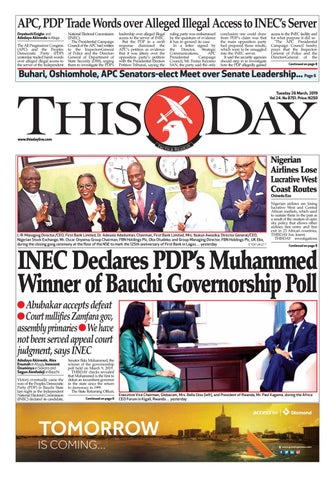
APC, PDP Trade Words over Alleged Illegal Access to INEC’s Server Onyebuchi Ezigbo and Adedayo Akinwale in Abuja
The All Progressives Congress (APC) and the Peoples Democratic Party (PDP) yesterday traded harsh words over alleged illegal access to the server of the Independent
National Electoral Commission (INEC). The Presidential Campaign Council of the APC had written to the Inspector-General of Police and the DirectorGeneral of Department of State Security (DSS), urging them to investigate the PDP's
leadership over alleged illegal access to the server of INEC. But the PDP in a swift response dismissed the APC’s petition as evidence that it was jittery over the opposition party’s petition with the Presidential Election Petition Tribunal, saying the
ruling party was embarrassed by the quantum of evidence it has to ground its case. In a letter signed by the Director, Strategic Communications, APC Presidential Campaign Council, Mr. Festus Keyamo SAN, the party said the only
conclusion one could draw from PDP’s claim was that the main opposition party had prepared those results, which were to be smuggled into the INEC server. It said the security agencies should step in to investigate how the PDP allegedly gained
access to the INEC facility and for what purpose it did so. "The APC Presidential Campaign Council hereby prays that the InspectorGeneral of Police and the Director-General of the Continued on page 8
Buhari, Oshiomhole, APC Senators-elect Meet over Senate Leadership... Page 6 Tuesday 26 March, 2019 Vol 24. No 8751. Price: N250
www.thisdaylive.com TR
UT H
& RE A S O
N
Nigerian Airlines Lose Lucrative West Coast Routes Chinedu Eze
L-R: Managing Director/CEO, First Bank Limited, Dr. Adesola Adeduntan; Chairman, First Bank Limited, Mrs. Ibukun Awosika; Director General/CEO, Nigerian Stock Exchange, Mr. Oscar Onyema; Group Chairman, FBN Holdings Plc, Oba Otudeko; and Group Managing Director, FBN Holdings Plc, UK Eke, during the closing gong ceremony at the floor of the NSE to mark the 125th anniversary of First Bank in Lagos… yesterday etop ukutt
Nigerian airlines are losing lucrative West and Central African markets, which used to sustain them in the past as a result of the creation of open sky policy that allows other airlines free entry and free exit in 23 African countries, THISDAY has learnt. THISDAY investigations Continued on page 8
INEC Declares PDP’s Muhammed Winner of Bauchi Governorship Poll Abubakar accepts defeat Court nullifies Zamfara gov, assembly primaries We have not been served appeal court judgment, says INEC Adedayo Akinwale, Alex Enumah in Abuja, Innocent Onuminya in Sokoto and Segun Awofadeji in Bauchi Victory eventually came the way of the Peoples Democratic Party (PDP) in Bauchi State last night as the Independent National Electoral Commission (INEC) declared its candidate,
Senator Bala Muhammed, the winner of the governorship poll held on March 9, 2019. THISDAY checks revealed that Muhammed is the first to defeat an incumbent governor in the state since the return to democracy in 1999. The State Returning Officer, Continued on page 6
Executive Vice Chairman, Globacom, Mrs. Bella Disu (left), and President of Rwanda, Mr. Paul Kagame, during the Africa CEO Forum in Kigali, Rwanda… yesterday
2
5 ) * 4 % ": t TUESDAY, MARCH 26, 2019
5 ) * 4 % ": t TUESDAY, MARCH 26, 2019
3
4
5 ) * 4 % ": t TUESDAY, MARCH 26, 2019
5 ) * 4 % ": t TUESDAY, MARCH 26, 2019
5
6
TUESDAY, ÍşÍžËœ ͺ͸͚Π˞ T H I S D AY
PAGE SIX
Buhari, Oshiomhole, APC Senators-elect Meet over Senate Leadership Vow to resist PDP’s interest Ndume writes APC, indicates interest in Senate presidency Iyobosa Uwugiaren, Deji Elumoye, Omololu Ogunmade and Onyebuchi Ezigbo in Abuja President Muhammadu Buhari and the National Chairman of the All Progressives Congress (APC), Mr. Adams Oshiomhole, yesterday in Abuja met with APC senators-elect to brainstorm on who becomes the next Senate president. A major agenda of the meeting was to create a platform for a harmonious position among senators with a view to avoiding the pitfalls of 2015 when Senator Bukola Saraki emerged as the Senate president against the wish of the party and an opposition senator, Dr. Ike Ekweremadu, became the deputy Senate president. The senators-elect were hosted to a dinner in the Presidential Villa last night. Speaking with journalists after the meeting, Oshiomhole, who vowed that with 65 senators-elect on the platform of APC and 230 members of the House of Representatives, the party was well positioned enough to produce leaders of both houses, threatening that the opposition Peoples Democratic Party (PDP) would not be allowed to have a share of leadership positions in both houses in this tenure. The national chairman who
tasked the lawmakers to reach a consensus on who will lead them to avoid giving any room for the opposition PDP to express interest in Senate leadership, said the essence of the meeting was to bring the senators-elect together and discuss how they would work effectively with the president. Oshiomhole said: "We had the first meeting with the president who is also the leader of the party and also with serving senators, newly elected senators and ranking senators. The whole purpose of this is to bond the new and old members, to establish a new relationship between the executive and the legislature. "The system talks about the separation of powers between the executive and legislature and the two must handshake for things to happen. And when you have a president that is determined to drive changes, fundamental changes that will affect our habits, our life style, review the economy, deal with the security situation, fight corruption as fiercely as he is trying to do, he will need a very supportive legislative arm of government. And happily, the Nigerian people have given us the number in the legislative arm of government. "All we have agreed today is that we will use these numbers as
a functioning whole to determine the leadership of the Senate in a way that we are not going to go to the floor of the Senate and allow the opposition dictate who becomes the Senate president. Because, we have comfortable majority to drive that, what we have to do is to manage that majority. “We have discussed those specifics and because these are businesses that have to do with elections, as a caucus, this is more or less a meeting of the incoming caucus to discuss leadership question and to build consensus around individuals so that people don’t have to go trading, generating heat in a way that can weaken internal solidarity in the party. “Of course, we are aware that the opposition is expecting that the APC senators are going to fight themselves, the House of Representatives members are going to fight themselves and then they will take advantage and pick who they will support. "They will be disappointed because our senators are seasoned senators. We have a cream of ranking senators that are in their own right capable of providing leadership of the Senate. So, what we have to do is to weave all these together and arrive at a consensus of who leads and everybody follows so that we will
have this time, a more cohesive National Assembly and I think it went extremely well.� In the race for Senate presidency are Senate Leader, Senator Ahmad Lawan, former governor of Gombe State, Senator Danjuma Goje, and Senator Ali Ndume. Those jostling to become deputy Senate president are: former Senate Leader, Senator Teslim Folarin, Senator Oluremi Tinubu, Senator Ajayi Borofice and Senator Ovie Omo-Agege. Oshiomhole had earlier in the day met with newly elected members of the House of Representatives. He said the ruling party will ensure that all the leadership positions in the National Assembly, including chairmen of committees, except ones that are statutorily reserved for opposition, are occupied by APC members. Oshiomhole, who met the new members at the Musa Yar'Adua Centre in Abuja, said the APC was aware of the clandestine meetings already being held by the PDP to plot how to infiltrate APC ranks for pecuniary gains. He said the APC national leadership is determined to checkmate any such attempt by the PDP to apply the tactics it used in 2015 to pick up plume positions in the National Assembly. "We will not share power in the
House of the Representatives and the leadership must ensure that critical committees that drive government are chaired only by APC members. If the Nigeria people wanted them to be chairmen of committees they would have voted for them," he said. Oshiomhole said that in the next edition of the National Assembly, APC will not allow disunity among its members, adding that "PDP and other minority parties can have their say but working together, APC must have its way in legislative agenda, in the leadership of the National Assembly and the leadership of the committees in the National Assembly.� He said the party's administration led by President Muhammadu Buhari will require the full support of the legislature to ensure that it delivers on the fight against corruption, insecurity and other key promises made to Nigerians. He warned newlyelected APC members to avoid the PDP's trap and work as a united team to ensure that all the government policies trust are given the necessary backing by the National Assembly. While responding to the chairman's entreaties, one of the coordinators of the newly elected APC House of Representatives Forum and a member from Ondo State, Mr. Olubumi Tunde Ojo, assured
the leadership of the party of the support of members. Also another member, Hon. Ugonna Ozuligbo, representing Nkwere Ideato, Isu Federal Constituency of Imo State, said he and his colleagues are going to ensure that the party remains supreme and that its decisions are upheld.
Ndume Writes APC Leadership on His Ambition Meanwhile, a former Senate Leader, Senator Ali Ndume, yesterday formally wrote the national leadership of the APC about his intention to vie for the office of Senate president, when the 9th Senate is inaugurated in June. Ndume in a two-page letter dated March 25 addressed to Oshiomhole, announced his intention to run for the office and sought the blessing of his party to contest for the position, saying he is throwing his hat into the ring believing that the Senate president position would be zoned to the North-east geo-political zone, where he hails from. According to him, the decision to seek election into the exalted office was borne out of his desire Continued on page 8
INEC DECLARES PDP’S MUHAMMED WINNER OF BAUCHI GOVERNORSHIP POLL Prof. Muhammed Kyari, said: "PDP candidate polled a total 515,113 votes, while his closest rival, Governor Muhammad Abubakar of the ruling APC scored 500,625." Kyari said 2,462,843 registered but 1,143,019 were accredited to vote. He put the valid votes at 1,111,406 saying 22,566 votes were rejected. "I Professor Muhammed Kyari, the returning officer for the governorship election on March 10, 23 of March and concluded today, March 25, 2019, having satisfied with requirements of the law, Bala Muhammed of PDP has scored highest number of votes is hereby declared the winner and he is return elected," Prof. Kyari declared. Muhammed’s closest opponent, Governor Muhammed Abubakar, immediately accepted defeat and congratulated Muhammed. A congratulatory message signed by his Special Adviser on Media and Strategy, Mallam Ali M. Ali and made available to newsmen in Bauchi last night said the governor wished governor-elect well. “I congratulate my brother, Senator Bala, on this victory at the polls," he said, adding: "I am delighted to note that in spite of the intensity of the campaigns in our dear state, a peaceful election took place without bloodshed.� Abubakar stated further: “Let me therefore invite the governor-elect to join me in working out the process of a smooth transition. "I sincerely thank the entire people of Bauchi State for their support to my administration and urge them to extend the same to the incoming administration. "I also urge the governor-elect to caution his supporters to be law abiding while celebrating since the period of campaigns is now over.� Earlier in the day, a Federal
High Court in Abuja had dismissed a suit filed by Abubakar, and the APC challenging the decision of INEC to resume collation of results of the state’s gubernatorial election. Justice Inyang Ekwo gave INEC, the go-ahead to precede with the collation and announcement of the Bauchi State’s governorship election results, held on March 9. In a similar, case, Justice Ekwo, yesterday adjourned till March 28 hearing in a suit seeking to stop the INEC from proceeding with the collation, conclusion and announcement of results in the March 9, Governorship and House of Assembly election in Rivers State. INEC had declared the Bauchi election inconclusive on the grounds that the number of cancelled votes was higher than the margin of lead between the two top political parties. The electoral body later announced that it would resume collation because it found out that the number of cancelled votes was tampered with, a decision Abubakar and the APC challenged in court. In a judgment yesterday, Justice Ekwo declined jurisdiction and disagreed with plaintiffs’ lawyer, Mr. Ahmed Raji SAN, that the suit related to pre-election matters. Justice Ekwo set aside the order for maintenance of status quo earlier made by the court and ordered INEC to proceed with its activities geared at concluding the governorship election in Bauchi State. The judge said although his court has jurisdiction to determine the questions, relating to the interpretation of the Constitution and Electoral Act, raised in the suit, he would prefer to allow election tribunal with an overall jurisdiction over election matters to handle the case. He directed that INEC should be allowed to conclude its
constitutional responsibilities in relation to the Bauchi governorship election, following which any aggrieved party could approach an election tribunal. Justice Ekwo said: “My view is that this court has jurisdiction to interpret the provision of the Constitution as to the alleged breach of the plaintiff’s fundamental right to fair hearing and interpret the provision of the Electoral Act tabled before the court. “And also looking at the provision of Section 60 of Electoral Act, the court or tribunal can determine the issues thereof. It can then be said that there is concurrence of jurisdiction between this court and the Election Petition Tribunal on this issue. “The difference in this case is that the alleged infringement occurred in the process of an election and the decision of the defendant in Exhibit B (the press releases issued by INEC on March 15, 2019) also occurred in the process of an election.�
Court NulliďŹ es Zamfara Gov, Assembly Primaries In another development, the APC suffered a setback yesterday as the Court of Appeal, Sokoto Division, set aside the judgment of a Zamfara State High Court, which allowed the APC to field candidates in the general election held in February and March 2019. The practical implication of the appellate court’s judgement is that all the candidates of the party that swept the polls in the just concluded general election have been left in the cold as their certificates of return would have to be withdrawn since in the eyes of the law, they did not participate in the election. The party also appears to be walking the tight rope in Bauchi State as a Federal High
Court in Abuja has dismissed a suit filed by Governor Mohammed Abubakar and the APC challenging the decision of the Independent National Electoral Commission (INEC) to resume collation of results for the governorship election in Tafa Balewa Local Government Area of the state. The electoral umpire has, however, stated that it has not been served the Court of Appeal judgment on Zamfara State APC congresses, but assured that it would continue to obey court orders and enforce them in accordance with constitutional dictates. The appeal was filed by the Chairman of the Senate Committee on Petroleum (Downstream), Senator Kabiru Marafa, and 129 others through their counsel, Mr. Mike Ozekhome SAN. Respondents are Kabiru Liman-Danalhaji and 139 others represented by Mr. Mahmud Magaji SAN as lead counsel. Delivering the lead judgment, which was adopted by two other justices, Tijjani Abubakar and Jamilu Tukur, Justice Tom Yakubu, held that the lower court failed in its duty to properly evaluate the evidence before it. Yakubu said judges have the legal power to produce judgment and reach decisions with reason, noting that in the instant case, it was not done. He said: “I am convinced that the lower court has failed to evaluate the evidence before reaching the decision. “The Appeal Court has power in law to access pieces of evidence on appeal, which we have done. “Based on available facts, the respondents did not contradict the INEC evidence on conducting the said primary election.� The presiding judge said: “Documented evidence has upper consideration than oral ones.� Justice Yakubu held that the
plaintiffs being card-carrying party members and aspirants in the said primary election have legal capacity to institute the suit. He added that federal, states and FCT High Courts have jurisdiction to entertain such matter. The judges agreed that the judgment should serve as “bitter lesson� for political parties as they ought to follow legitimate guidelines and rules. “Domestic affairs of political party activities must act within the confines of the law in dealing with party members and elections,� the judges said. The Zamfara State High Court had recognised the primary elections that produced governorship, state and National Assembly candidates held by APC in the state and declared that INEC accepts the party’s candidates for the elections. Dissatisfied with the state high court decision, the appellants approached the appeal court, challenging the decision on the grounds that the state high court lacked jurisdiction to entertain the suit among others. A similar case was instituted before the same appeal court by Alhaji Aminu Jaji, a governorship aspirant and member representing Kauran Namoda/Birnin Magaji Federal Constituency, and was dismissed after Jaji withdrew the suit.
We Have Not Been Served Appeal Court Judgment, Says INEC The electoral body, however, said yesterday that it had not been served the Court of Appeal judgment but assured Nigerians that it would continue to obey court orders and enforce them in accordance with constitutional dictates. The INEC National Commissioner, Mr. Festus Okoye, told THISDAY: “The
commission has not received the judgment of the Court of Appeal Sokoto Judicial Division. On receipt of the judgment, the commission will study it, have a full understanding of its import and consequential orders (if any) and communicate its decision to the Nigerian people. “The commission notes that it has conducted elections in Zamfara State and issued Certificate of Return to National Assembly candidates. The commission notes that it has slated for March 27 to 29, 2019 for the presentation of certificates to elected governors and members of state assemblies. “The commission will continue to obey court orders and enforce them in accordance with constitutional dictates.�
TOP GAINERS REDSTAR UNIPRESS STANBICIBTC AIICO WEMABANK TOP LOSERS ACADEMY CHIPLC ACCESSBANK
NGN NGN 0.50 5.50 0.15 2.00 3.00 48.50 0.03 0.75 0.03 0.77 NGN 0.03 0.33 0.02 0.27 0.45 6.40 NEM 0.13 2.21 FIDELITYBANK 0.12 2.25 HPE Nestle Nig Plc â‚Ś1,498.00 Volume: 168.721 million shares Value: N3.751 billion Deals: 3,048 As at yesterday 25 /3/19 See details on Page 31
% 10.0 8.1 6.5 4.1 3.9 % 8.3 6.9 6.5 5.5 5.0
5 ) * 4 % ": t TUESDAY, MARCH 26, 2019
7
8
TUESDAY, ÍşÍžËœ ͺ͸͚Π˞ T H I S D AY
NEWS
NERC Insists Metering Still Discos’ Responsibility May punish slippages Chineme Okafor in Abuja The Nigerian Electricity Regulatory Commission (NERC) yesterday responded emphatically to the electricity distribution companies’ (Discos) claims that they were no longer responsible for providing meters to consumers under their networks, stating clearly that they had not been absolved of such responsibility. The NERC also said the Discos failed to meet up with July 2018 timeline it approved for them to engage third-party meter vendors under the new Meter Asset Providers (MAP)
scheme, adding that it was reviewing such slippages with a view to taking enforcement actions against them. According to a statement sent to THISDAY last night in Abuja by NERC’s General Manager, Public Affairs, Dr. Usman Arabi, the commission said it was reviewing the MAP procurement report and would soon announce preferred bidders to participate in the scheme. It also explained that it was desirous of ending estimated billing by Discos in the country, using the MAP scheme, and expected the Discos to support the target.
Minister of Power, Works and Housing, Babatunde Fashola “The obligation to ensure that all electricity consumers are metered remains with the electricity distribution companies
(Discos) under Meter Asset Provider (MAP) Regulations 2018. This is consistent with their respective licensing terms and conditions and Section 4 (1) of the said regulations that provides that, inter alia, “Distribution licensee is responsible for the achievement of metering targets as specified by the commission from time to time. “Furthermore, Section 4 (3) of the MAP Regulation requires that all distribution licensees shall engage the services of a Meter Asset Provider(s) towards meeting the metering targets as specified
by the commission and in accordance with the provisions of the MAP Regulations 2018. The Discos were expected to engage MAP(s) within 120 days of coming into effect of the regulations,� said NERC in the statement. It added: “The deadline was fixed for July 31, 2018 but was extended to November 30, 2018 to engender more competition between potential MAPs thus providing better value for consumers. “Several of the Discos experienced slippage in the timeline stipulated by the commission and this infraction
is being handled in line with the enforcement regulations of the commission.� The commission said it is currently reviewing the MAP procurement reports and successful Meter Asset Providers shall be announced after a meeting with the Discos and preferred bidders scheduled to hold next week. “The commission wishes to reaffirm its commitment to expedite a closure of the current metering gap thus limiting the practice of estimated billing to very exceptional cases in line with the provisions of the MAP regulations,� it explained.
binding force on the authorities and persons throughout the Federal Republic of Nigeria. And our constitution says the leadership of the Senate shall be through election and not selection. “Our constitution does not recognise any selection or decision by any political party with respect to the election of the leaders of the National Assembly but that the leaders must be elected by the members of the National Assembly themselves. Our party, APC is a democratic party and I am sure the leadership will respect the provisions of our constitution, as they affect the election of the Senate’s leadership.’’ Also, a ranking senator, elected on the platform of the PDP, Senator Mathew Urhoghide (Edo South), told THISDAY that the office of the Senate President is not an exclusive right of the majority party, APC, adding that what the constitution recognises is competence in electing the
leadership of the Senate. He said unlike the position of APC, every elected senator will decide how the leadership of the Senate will emerge. The APC’s spokesman had said that the national leadership of the party was expected to enforce its decisions on the zoning of offices in the National Assembly, but said, there were various options before the party, including retaining the existing zoning arrangement. It was gathered that some stakeholders of the party are proposing that the Senate presidency goes to the Northeast this time around instead of the North- central, while those with this line of thought are also pushing for the South-west to produce the Speaker of the House of Representatives, and the South-east and North-central zones, being tipped for Deputy Senate president and Deputy Speaker, respectively.
The PDP in its response called on Buhari and the APC to stop, what it called, their unnecessary fabrications, smear campaign and prepare to face its legal team at the presidential election tribunal. The party in a statement
yesterday by its National Publicity Secretary, Mr. Kola Ologbondiyan, noted that by resorting to shadow-boxing outside the tribunal, Buhari and the APC have shown that they have no defence to present to the court against PDP’s submission that they stole the party's mandate. According to him, "President Buhari is overweighed by the burden of illegitimacy, following overwhelming evidence before the tribunal that he stole the presidential mandate, hence this lame attempt at blackmailing the tribunal by engaging in clear acts of subjudice." Ologbondiyan stressed that the facts and issues touching on the INEC server are already within the public domain and Nigerians
are already at home with them. He stated: "It is even more appalling that Festus Keyamo, a Senior Advocate of Nigeria (SAN) and a member of Buhari’s legal team, who should know better, would engage in this act of subjudice designed to distort facts already known to Nigerians that our presidential candidate and former Vice President, Atiku Abubakar, clearly won the February 23 presidential election. "Since it has become clear that President Buhari has no defence to present to the court, we counsel him to save the nation further stress by surrendering our mandate, which was freely given by majority of Nigerians to Atiku Abubakar."
would have reciprocated the high charges by also charging those African carriers the same amount they charge their Nigerian counterparts. Sources at Arik Air also told THISDAY that all the routes in the sub-region are unprofitable, disclosing that Nigerian airlines incur losses because of high charges heaped on them by the countries they operate to. “The charges in Accra are too high. After paying them, you cannot get up to N5,000 from the base fare and you have not counted the cost of operation. Their ground handling charges are so high; the same with navigational charges by ASECNA (airspace services provider) and if you don’t pay in time they seize your aircraft,� the source said. Accra and other airports in the sub-region charge Nigerian airlines for both inbound and outbound passengers, which in
Nigeria, the Federal Airports Authority of Nigeria (FAAN) charges only for outbound passengers and all weight charges for landing and then parking, but the total charges, including passenger service charge of $50 per passenger are about 25 per cent of what airports in West Africa charge Nigerian airlines. Nigeria contributes more than 50 per cent of the total passenger traffic on the West and Central Africa, but now it is other African airlines that are making money from those routes because the host countries exempt their airlines from many of the charges which they level on Nigerian operators. However, the organiser of Akwaaba African Travel Market, Ikechi Uko, said the only way the West African routes could be profitable to the airlines in the sub-region would be to
standardise the charges. He added that a former Minister of Aviation, Ghana and the International Air Transport Association (IATA), had started moves to make the charges uniform in the sub-region. He noted that West Africa has the highest population in Africa, adding that for the airlines in the sub-region to maximise the opportunities offered by the high passenger traffic, the countries that form the West Coast must work together and agree on the charges. “Most airlines in the subregion are small operators with short lifespan because they have not taken advantage of the high passenger traffic in the area. For SAATM to work, every sub-region should operate like domestic service and the charges must be uniform. That way the airlines can operate profitably in the sub-region,� he said.
BUHARI, OSHIOMHOLE, APC SENATORS-ELECT MEET OVER SENATE LEADERSHIP to help accelerate socio-economic development of the nation. The letter read, "Following the successful conduct of the 2019 general election and the overwhelming victory of our great party the APC at all levels, I hereby forward my letter of intent to contest for the office of the President of the Senate in the 9th National Assembly. "I wish to emphasise that my decision to contest for the Senate Presidency is informed by my conviction to contribute my quota to nation building." Ndume, who was majority leader of the 8th Senate until February, 2017, assured of his capacity to deliver on party policies and programmes, saying, "My vast legislative experience and my deep desire to take Nigeria to the next level of development" are reasons for contesting. Ndume, in the letter called on his colleagues, both within the North East and other parts of the country to encourage his
aspiration. He added, "For these reasons and more, I wish to forward myself for the blessings of the Party, my Colleagues in the Senate and fellow Nigerians for the post of the President of the Senate." He expressed optimism that the party leadership will see the desired wisdom in zoning the Senate Presidency to the North-East due to the sterling performance of the zone in the 2019 polls, giving the President the second highest votes cast.
Senators Oppose Consensus Senators have, however, began to politick with some of them saying it might be very difficult to pick the leadership of the apex legislative arm through consensus as a result of the resistance of some of the senators of the ruling party, THISDAY’s investigation has revealed. THISDAY had reported that
APC said that it would ensure that the party’s decisions were respected by members in electing the principal officers, unlike what happened during its assumption of power in 2015, when the minority party, the Peoples Democratic Party (PDP), interfered in choosing who emerged as the Senate President and the Speaker of the House of Representatives. The National Publicity Secretary of the APC, Mallam Lanre Isa-Onilu, who spoke with THISDAY, had assured that the party would not allow a repeat of what led to the crisis within its caucus at the National Assembly at the onset of the out-going legislature, vowing to apply the principle of party supremacy in handling the emergence of new leadership of the incoming National Assembly. “We will enforce party discipline. And you have seen what we have done to our very important and mighty party men. So, you could see that APC is
instilling party discipline, bringing cohesion and harmony into our system and we expect everyone who now subscribe to the world view of the APC, to abide by the decision of the party’’, he stated. But some of the senators elected under the platform of APC, who spoke with THISDAY in confidence yesterday in Abuja, said it will be very difficult for the leadership of the party to narrow down the choice of the Senate President, for example, to a particular person – as being planned. “I am a disciplined-party man. I will abide by the zoning of the office of the Senate President by my party. But if it is zoned to my geo-political zone, I will surely contest the position. That is what democracy is about, and that is what our constitution recognises’’, a former governor and ranking APC senator told THISDAY in Abuja. “Chapter I of our constitution says the constitution is supreme and its provisions shall have
Continued on page 45
APC, PDP TRADE WORDS OVER ALLEGED ILLEGAL ACCESS TO INEC’S SERVER Department of State Services use your good offices to investigate the hacking of and/or illegal tampering with the INEC server by the PDP. The leadership of the PDP must be invited, interrogated and investigated and those identified as perpetrators must be arrested and prosecuted," said APC. The party added that while opposition is healthy in a democracy, it is not a license for criminality and illegality, adding that it will be wrong for the country to condone such a blatant criminal claim by the PDP of having illegal access to INEC’s server. APC alleged in the petition that following the last-minute postponement of the February
16, 2019 presidential and National Assembly Elections, the country was shocked to see already prepared presidential elections results floating around in the cyber space just less than 24 hours after the postponed election was originally billed to hold. It said that the fake results had details of the scores of the candidates of the major parties. The APC Campaign Council said the fake results gave victory to the candidate of the PDP, Alhaji Atiku Abubakar, even when elections did not hold. It further said that despite the approval of the February 23 presidential elections as credible by nearly all local and international observers, the PDP cried foul and made shocking
claims. It said PDP claimed that from purported results it obtained from INEC’s server, it has proof that its candidate won the election by about 1.6million votes! It said: "Shockingly and coincidentally, this margin was about the same margin by which it also purportedly won by the fake results released just hours after the postponement of the February 16, 2019 presidential and National Assembly Elections. "As if this expensive joke was not enough, the PDP and its presidential candidate, Alhaji Atiku Abubakar, have gone ahead to file an election petition against the clear victory of President Muhammadu Buhari and have repeated the same outlandish
claim of having access to INEC’s server, which shows that they have some purported results at their disposal giving victory to Alhaji Atiku Abubakar." The APC campaign team explained that INEC’s server is the back end of electronic records of INEC and not just its website.
You Are Jittery PDP Tells Buhari, APC
NIGERIAN AIRLINES LOSE LUCRATIVE WEST COAST ROUTES revealed that the Single African Air Transport Market (SAATM), which was ratified by the African Union early last year created open sky for 23 African countries that are already signatories to the policy. The implication of this policy, it was learnt, is that the airlines of these 23 countries can freely enter and exit these membercountries without hindrance. It was, however, gathered that while Nigeria allows airlines from the West Coast like African World Airlines (AWA), Air Senegal, Air Cote d’Ivoire and others to operate in the country with minimum charges, other countries over charge Nigerian carriers to discourage them from flying to lucrative destinations such as Accra, Abidjan, Dakar, Freetown and others. With such strangulating charges and taxes, THISDAY learnt that the Nigerian airlines are forced to charge high
fares to these routes to offset operation cost, thus making them uncompetitive. Investigation has revealed that Medview Airline, Dana Air have stopped operations to West Coast destinations, while Arik Air has cut back its operations in the West and Central African destinations. The airline, it was learnt, no longer operate to Gabon, Banjul, Abidjan, Freetown, and Douala, and has restricted its destinations to Accra, Ghana, Luanda, Angola, Dakar, Senegal and Monrovia, Liberia. Also, Air Peace, which started operations four years ago, has launched operations to many destinations in the sub-region, which include Accra, Lome, Abidjan, Banjul, Freetown, Dakar and others. However, Air Peace had disclosed that it loses about N500 million monthly on those routes due to exorbitant charges that
are not reciprocated in Nigeria for airlines from those countries. The Chairman of the Nigerian carrier, Allen Onyema, told THISDAY that time had gone when the routes were lucrative for Nigerian operators. “We lose over N500 million monthly to the West Coast. This is the money we make from domestic operations. Except this SAATM is re-addressed, Nigerian airlines will go into extinction. Unless government intervenes, we may leave the routes to these foreign airlines. “This is because if you continue operating the West and Central routes, it will affect your revenue base on the domestic scene and you will crumble. That is why most Nigerian airlines could not succeed on those destinations,� Onyema said. He added that if the federal government supports domestic airlines as other countries, it
5 ) * 4 % ": t TUESDAY, MARCH 26, 2019
9
10
TUESDAY MARCH 26, 2019 ˾ T H I S D AY
NEWS
Group News Editor Ejiofor Alike Email Ejiofor.Alike@thisdaylive.com, 08066066268
Rivers AAC Deputy Guber Candidate Defects to PDP Ernest Chinwo in Port Harcourt The deputy governorship candidate of the African Action Congress (AAC) in Rivers State , Chief Akpo Bomba Yeeh, has withdrawn from the state governorship election and defected to the Peoples Democratic Party (PDP). He has also accused the Minister of Transportation, Chibuike Amaechi, of plotting
to run the state through the governorship candidate of the AAC, Biokpomabo Awara, when elected. The Amaechi faction of the All Progressives Congress (APC) had adopted Awara, two days to the governorship and state assembly elections and promised to ensure his success at the poll using the structure of the APC. Addressing journalists at his home in Port Harcourt on yesterday, Yeeh said the
EFCC: N1.3tn Stolen in Four Years Kingsley Nwezeh in Abuja The Economic and Financial Crimes Commission (EFCC) yesterday disclosed that N1.3 trillion was stolen from government coffers in the last four years by 32 corporate entities and individuals. A statement issued yesterday in Abuja by the anti-graft agency quoted the Chairman of the commission, Mr. Ibrahim Magu as saying that the financial infractions took place between 2011 and 2015. Magu said if applied for development purposes, the looted funds would have constructed 500 kilometres of roads, built 200 schools and educated 4,000 children. Magu, who did not mention the entities and individuals, spoke at the opening ceremony of the 2019 First Batch Conversion Training Programme to Procurement Cadre for Federal Parastatal and Agencies, organised by the Bureau of Public Procurement (BPP), in Lagos,. “One third of this money, using World Bank rates and cost, could have comfortably been used to construct well over 500 kilometres of roads; build close to 200 schools; educate about 4,000 children from primary to tertiary levels at N25 million per child; build 20,000 units of two-bedroom houses across
the country and do even more. “The cost of this grand theft, therefore, is that these roads, schools and houses will never be built and these children will never have access to quality education because a few rapacious individuals had cornered for themselves what would have helped secure the lives of the future generations, thereby depriving them of quality education and healthcare, among others,” he posited. He stated that the poor state of procurement process in Nigeria was one of the major reasons why corruption has continued to thrive in government agencies and parastatals. The EFCC boss further noted that the training, organised by the BPP was aimed at giving the participants the tools, knowledge and understanding they would need to carry out their duties in their respective places of primary assignments in an efficient and transparent manner. “I sincerely hope that at the end of this training, we will see a few cases of financial propriety in our procurement processes in government agencies and parastatals. Indeed, corruption could kill Nigeria, if we do not scale up our proficiency in contract and procurement management process,” Magu said.
Herdsmen Kill Two Persons in Nasarawa No fewer than two people were feared dead while houses and other properties have been allegedly destroyed in attacks suspected to have been carried out by herdsmen in Akwanga Local Government Area of Nasarawa State. The attacks, according to reports, were carried out between Saturday and Sunday continuously within the affected communities in the area. Speaking to journalists on the attack, the Paramount Ruler of Akwanga, the Chun Mada, Samson Gamuyare, disclosed that the internally displaced persons from Mante and Nidam villages mostly hit are presently taking refuge in Akwanga town, the headquarters of the local government area. The monarch who called for urgent deployment of security operatives to the area to help restore peace to the area lamented the unfortunate incident that has brought untold hardship to the affected persons.
The Chun mada who used the opportunity to appeal for calm and ensured that peace is maintained, also solicited for relief materials from public-spirited individuals and other corporate organisations to enable the displaced put themselves to life. Meanwhile, several attempts through calls and text messages to the local government chairman, Samuel Meshi proved abortive as he could not pick calls or response to messages. Samuel who was said to be in Lafia arranging for food stuff and other relief materials after persistent calls, promised to speak to journalists, which he never did till the time of this report. When contacted, the Commissioner of Police, Nasarawa State Command, Bola Longe, confirmed the attack and said security personnel have been deployed to the affected communities to avert possible escalation of the clash as well as to restore peace in the area.
reason for his decision is for him to join hands with Governor Nyesom Wike to move Rivers State forward. He said: “After due consultations with my immediate family, friends and supporters, I, Chief Akpo Bomba Yeeh, the deputy governorship candidate of the AAC for the 2019 governorship election hereby resign my membership of the AAC and announce my defection to the PDP to join hands with Governor Wike to move the state forward.” He added: “I was the deputy dovernorship candidate of the AAC in Rivers State up till today March 25, 2019 , when I decided to withdraw my candidature and resign from
the party with immediate effect. “The March 9 governorship election in Rivers State has been lost and won; lost by my party, African Action Congress (AAC) and its candidate, Biokpomabo Awara and undoubtedly and overwhelmingly won by the Governor of Rivers State, the candidate of PDP, Nyesom Ezenwo Wike.” He said that despite the interference of the security agencies, Rivers people stood their ground and voted for Wike. He said: “The collated results further showed that contrary to the false claim of fictitious lead by the AAC/APC alliance, the PDP overwhelmingly won all the elections in 18 out
of the 19 LGAs, culminating in the declaration and return of the party’s 26 House of Assembly Constituencies by the Constituency Returning Officers. “This fact was confirmed on March 13, 2019, when INEC stated, as a matter of fact, that it had in its safe custody collated results for 17 Local Government Areas as well as the declaration of the PDP candidates for 21 state constituencies. “The outcome of the elections on March 9, 2019 clearly showed the preference of the people of Rivers State. Even the blind can see and the deaf can hear the echo that Rivers people overwhelmingly voted to stick with Governor Wike for the next four years to
encourage him to continue with the good works”. Yeeh alleged that the Minister of Transportation forced him to sign an undated letter of resignation to be effective after their expected inauguration. “I was forced to sign an un-dated letter of resignation as the deputy governor of Rivers State to pave way for Rotimi Amaechi to nominate another person as deputy governor. “These were slavish conditions for any rational politician worth his name to accept, but I pretended to play along because doing otherwise at that time would have been too dangerous for the safety of my life,
Cont’d on page 42
STRENGTHENING BILATERAL TIES…
L-R: Minister of Transportation, Mr. Chibuike Amaechi; High Commissioner of India to Nigeria; Mr Abhay Thakur; and Second Secretary, Political and Information, Indian High Commission in Nigeria, Dr. Tejeswar Garika, during the visit of the High Commissioner to the Ministry of Transportation in Abuja...yesterday
EU Observers: Violence Marred Supplementary Elections Shola Oyeyipo in Abuja The European Union Election Observation Mission (EU EOM) deployed to Bauchi, Benue, Kano, Plateau and Sokoto State where supplementary governorship elections were held on March 23 has again observed that the process was flawed with irregularities, particularly insecurity. A statement issued by the EU EOM Press Officer, Sarah Fradgley, indicated that some polling units were inaccessible to the observer team during the election due to violence. According to her, “extensive electoral security problems were observed in some areas, with groups of men with weapons intimidating and obstructing the process, and security agencies ineffective at protecting citizens’ right to vote. “In particular, parts of Kano
were largely inaccessible to EU observers, and citizen observers and journalists were also obstructed. EU observers also witnessed increased interference by party agents and cases of vote-buying. Party leaderships did not appear to take any steps to rein in their supporters,” she explained. Fradgley noted that “the environment was intimidating and not conducive to voters’ free participation in the election. Party leaderships locally and centrally did not appear to take any steps to rein in supporters and prevent evident violence, intimidation or other misconduct. Throughout the day, INEC did not comment on electoral disturbances, despite its overall responsibility for the election and security arrangements. “In Nasarawa Local Government Area (LGA) in Kano State, which accounted for approximately one-third
of all registered voters for the supplementary governorship election, EU observers witnessed organised intimidation of voters. “For example, groups of youths with clubs and machetes patrolled the streets, and people with party agent tags harassed voters. During collation in Kano, EU observers saw that several INEC polling staff had been attacked. Large groups of men with weapons were not contained by the police. “Due to intimidating crowds and disturbances, EU observers in Kano could not access or continue observation in polling units in Dala and Nasarawa LGAs. The electoral process in Kano was further compromised by the harassment and obstruction of citizen observers, and journalists from BBC Hausa, the Nigerian Television Authority (NTA), and TVC. This compromised scrutiny of both polling and collation of results in the affected areas.
“Isolated violent incidents also disrupted voting and counting in other states. In Bauchi, EU observers witnessed around 50 people with clubs disrupting counting in one polling unit. In Benue, election materials were burnt; resulting in the cancellation of polling affecting 13,000 registered voters, and a collation officer carrying result sheets was shot in the leg,” she added. She acknowledged that due to the high stakes and the reduced electorate involved, supplementary elections are systemically vulnerable to parties strategically pressurising voters and disrupting the process. According to her, there were improved logistical arrangements and procedures were mostly followed in some of the polling units that could be fully observed, stressing that “although there were problems with secrecy of the ballot.”
TUESDAY MARCH 26, 2019 Ëž T H I S D AY
11
NEWSEXTRA
Fashola Advocates $10bn Fund for Infrastructural Bond Shola Oyeyipo in Abuja The Minister of Power, Works, and Housing, Mr. Babatunde Fashola, yesterday called for legislative support to facilitate a $10 billion infrastructural bond to be set aside to cater for infrastructural deficit and sustain Nigeria’s development in the coming years. The minister who made the call yesterday while addressing members of the House of Representatives’ Committee on Works during the defence of his ministry’s 2018 budget performance and 2019 budget proposal, said rather than depending on annul budgetary allocations to develop critical infrastructure, such funds could be applied to rail, road, airport, seaports and others areas. Fashola, who got commendations from members of the House of Representatives’ Committee for Works over his performance, said government is constrained to operate within budgetary approvals, noting that it is in the bid to improve the ministry’s performance that it is relying on the Sukuk Bond, which he said government cannot alter the agreement. According to him, “I wish
to see Nigeria launch a $10 billion infrastructure bond. If such is created, we can draw from it without resorting to the annual budget, but of course it has to be done with legislative backing to solve our problems once and for all. If we have such consensus it can be applied to rails, road, airports and other infrastructure,� he said. The committee chairman, Hon. Toby Okechukwu (PDP, Enugu), who also acknowledged that the minister has done considerably well in the light of inadequate cash flow from budgetary allocations, called for more funding for the ministry. “It is important to note that the minister concluded and the committee alluded, the major problem is funding. It is my position that annual appropriation be interventionist in nature. The funding should be from tolls.� However, Fashola expressed optimism that President Muhammadu Buhari is favourably disposed to signing the Road Infrastructure Fund Bill, once the provisions are not in conflict with existing laws governing the sector.
Okechukwu, however, mandated the minister to
inform the committee on how the 2019 budget
can capture road maintenance so that
roads don’t fail as seen in most cases.
ActionAid Decries Low Turnout, Electoral Abuses in 2019 Elections Esther Oluku ActionAid Nigeria, an accredited observer of the 2019 general election, has identified low turnout, electoral abuses, low voters’ education and improper use of the card readers as some of the challenges witnessed in the elections. In a statement issued yesterday, ActionAid observed that the turnout of eligible voters on Saturday, February 23 was relatively low at 35 per cent when compared to the total number of accredited voters. It said the low turnout has been largely attributed to the postponement of elections, which led to voter apathy. “Added to this are logistic delays; late opening of polling units and late arrival of necessary supplies such as ballot papers, stamps and markers across the country which was put at 55 per cent,� the statement said. ActionAid noted that the most serious challenge during the elections was that of electoral abuses, adding that polling units
in different areas of the country reported various types of electoral interference, from the destruction of ballot papers and boxes to the use of scare tactics, such as firing weapons into the air, to disperse potential voters during which 39 Nigerians lost their lives. “Another issue was the improper use of card readers. Based on ActionAid’s observation of the election, the major issues with card readers were improper handling and use of the machines as most of the polling officers appeared unfamiliar with the gadget. A significant issue is low voters’ education. ActionAid Nigeria observed that most voters, especially in the hinterlands are still unaware of the voting process and this is evident in the large number of void votes across polling units in the country. Worthy of mention is the poor welfare of INEC ad-hoc staff, especially Corps members which can make them vulnerable to manipulations by political actors,� ActionAid explained. Commenting on the elections, the Country Director of ActionAid, Ene Obi stated that “Nigerians
are a passionate people.� “But we must never let passion overrun our logic; reacting to the results of an election with violence is deeply illogical. ActionAid urges all Nigerians to accept the results of the elections in good faith so that we, as a united nation, can move forward in building a better Nigeria. For those who reject the credibility of the elections, we encourage them to take appropriate legal action. Violence will not resolve the issues; it will only create new ones,� Obi said. ActionAid noted that while there are a great number of issues that undoubtedly need to be urgently addressed, it added that insecurity, human capital development, poverty eradication and corruption should be prioritised by the re-elected president. “Addressing poverty must be an immediate and long-term priority for the re-elected president. The current levels of poverty in the country are completely and utterly unacceptable. We are the richest nation in Africa and
yet over 87 million of us live in poverty. It is deeply unjust, but more than that, it is dangerous. “Boko Haram was able to take hold in Nigeria as a direct result of the impoverishment and marginalisation of the people. It is no coincidence that the insurgents’ stronghold is in the north-east of Nigeria, where poverty is at its worst. It is evident that an effective implementation of pro-poor policies is needed to defeat them. “To bring an end to poverty and insecurity in Nigeria, Buhari must vastly improve public services and infrastructure, intensify efforts in tackling the corruption that plagues this country, and look for alternate revenue sources, such as the proper taxation of foreign companies. Currently Nigeria loses an average of 15 billion USD a year to illicit financial flows, of which most are harmful tax practices. This lost revenue could put millions of out-of-school children back in the classroom,� Obi explained.
),1$1&,$/ 67$7(0(176 ,1'(3(1'(17 $8',725Ăœ6 5(3257
67$7(0(17 2) &2035(+(16,9( ,1&20( 67$7(0(17 2) ),1$1&,$/ 326,7,21 )25 7+( <($5 (1'(' '(&(0%(5 $6 $7 '(&(0%(5
7R WKH 0HPEHUV RI )LUVW 3HQVLRQ &XVWRGLDQ 1LJHULD /LPLWHG
$66(76 3URSHUW\ SODQW DQG HTXLSPHQW ,QWDQJLEOH DVVHWV 'HIHUUHG WD[ DVVHWV /RDQV RWKHU UHFHLYDEOHV 2WKHU DVVHWV ,QYHVWPHQW 6HFXULWLHV &DVK DQG FDVK HTXLYDOHQWV 727$/ $66(76
'HFHPEHU
'HFHPEHU
'HFHPEHU
'HFHPEHU
1Ăœ
1Ăœ
1Ăœ
1Ăœ
(48,7< $1' /,$%,/,7,(6 (48,7<
2SHUDWLQJ LQFRPH
2SHUDWLQJ H[SHQVHV
3URÄ?W EHIRUH LQFRPH WD[
,QFRPH WD[ H[SHQVH
5HWDLQHG HDUQLQJV
727$/ (48,7<
&UHGLWRUV DFFUXDOV
,QFRPH WD[ OLDELOLWLHV
727$/ /,$%,/,7,(6
6KDUH FDSLWDO
,QWHUHVW DQG RWKHU LQFRPH
&XVWRG\ IHH
3URÄ?W IRU WKH \HDU
7RWDO FRPSUHKHQVLYH LQFRPH IRU WKH \HDU
N
N
&855(17 /,$%,/,7,(6
727$/ (48,7< /,$%,/,7,(6 3(16,21 $66(76 81'(5 &8672'<
121 3(16,21 $66(76 81'(5 &8672'<
(DUQLQJV SHU VKDUH
.XQOH -LQDGX 0DQDJLQJ 'LUHFWRU &(2 )5& ,&$1
,Q RXU RSLQLRQ WKH DFFRPSDQ\LQJ VXPPDU\ ILQDQFLDO VWDWHPHQWV GHULYHG IURP WKH DXGLWHG ILQDQFLDO VWDWHPHQWV RI )LUVW 3HQVLRQ &XVWRGLDQ 1LJHULD /LPLWHG DV DW 'HFHPEHU DUH FRQVLVWHQW LQ DOO PDWHULDO UHVSHFWV ZLWK WKRVH ILQDQFLDO VWDWHPHQWV LQ DFFRUGDQFH ZLWK WKH ,QWHUQDWLRQDO )LQDQFLDO 5HSRUWLQJ 6WDQGDUGV &RPSDQLHV DQG $OOLHG 0DWWHUV $FW &DS & /)1 3HQVLRQ 5HIRUP $FW DQG WKH )LQDQFLDO 5HSRUWLQJ &RXQFLO RI 1LJHULD $FW 6XPPDU\ )LQDQFLDO 6WDWHPHQWV 7KH VXPPDU\ ILQDQFLDO VWDWHPHQWV GR QRW FRQWDLQ DOO GLVFORVXUHV UHTXLUHG E\ WKH ,QWHUQDWLRQDO )LQDQFLDO 5HSRUWLQJ 6WDQGDUGV &RPSDQLHV DQG $OOLHG 0DWWHUV $FW &$3 & /)1 3HQVLRQ 5HIRUP $FW DQG WKH )LQDQFLDO 5HSRUWLQJ &RXQFLO RI 1LJHULD $FW DSSOLHG LQ WKH SUHSDUDWLRQ RI WKH DXGLWHG ILQDQFLDO VWDWHPHQWV RI )LUVW 3HQVLRQ &XVWRGLDQ 1LJHULD /LPLWHG 5HDGLQJ WKH VXPPDU\ ILQDQFLDO VWDWHPHQWV DQG WKH DXGLWRU V UHSRUW WKHUHRQ WKHUHIRUH LV QRW D VXEVWLWXWH IRU UHDGLQJ WKH DXGLWHG ILQDQFLDO VWDWHPHQWV DQG WKH DXGLWRU V UHSRUW RI )LUVW 3HQVLRQ &XVWRGLDQ 1LJHULD /LPLWHG 7KH VXPPDU\ ILQDQFLDO VWDWHPHQWV DQG WKRVH ILQDQFLDO VWDWHPHQWV GR QRW UHIOHFW WKH HIIHFWV RI HYHQWV WKDW RFFXUUHG VXEVHTXHQW WR WKH GDWH RI RXU UHSRUW RQ WKRVH ILQDQFLDO VWDWHPHQWV 7KH $XGLWHG )LQDQFLDO 6WDWHPHQWV DQG 2XU 5HSRUW 7KHUHRQ :H H[SUHVVHG DQ XQPRGLILHG DXGLW RSLQLRQ RQ WKRVH ILQDQFLDO VWDWHPHQWV LQ RXU UHSRUW GDWHG 0DUFK 'LUHFWRUV 5HVSRQVLELOLW\ IRU WKH 6XPPDU\ )LQDQFLDO 6WDWHPHQWV 7KH 'LUHFWRUV DUH UHVSRQVLEOH IRU SUHSDULQJ DQG SUHVHQWLQJ DQ DSSURSULDWH VXPPDU\ RI WKH DXGLWHG ILQDQFLDO VWDWHPHQWV LQ DFFRUGDQFH ZLWK 6HFWLRQ RI WKH &RPSDQLHV DQG $OOLHG 0DWWHUV $FW &DS & /)1 3HQVLRQ 5HIRUP $FW DQG WKH )LQDQFLDO 5HSRUWLQJ &RXQFLO RI 1LJHULD $FW DQG WKH ,QWHUQDWLRQDO )LQDQFLDO 5HSRUWLQJ 6WDQGDUGV
7KH Ä?QDQFLDO VWDWHPHQWV ZHUH DSSURYHG E\ WKH %RDUG RI 'LUHFWRUV RQ -DQXDU\ DQG VLJQHG RQ LWV EHKDOI E\
8PDU <DKD\D &KDLUPDQ )5& 2'1
2SLQLRQ 7KH DFFRPSDQ\LQJ ILQDQFLDO VWDWHPHQWV ZKLFK FRPSULVH WKH VXPPDU\ VWDWHPHQW RI ILQDQFLDO SRVLWLRQ DV DW 'HFHPEHU WKH VXPPDU\ VWDWHPHQW RI SURILW RU ORVV DQG RWKHU FRPSUHKHQVLYH LQFRPH IRU WKH \HDU HQGHG 'HFHPEHU DUH GHULYHG IURP WKH DXGLWHG ILQDQFLDO VWDWHPHQWV RI )LUVW 3HQVLRQ &XVWRGLDQ 1LJHULD /LPLWHG IRU WKH \HDU HQGHG 'HFHPEHU
%XQPL $GHURQPX &KLHI )LQDQFLDO 2Ä‘FHU )5& ,&$1
7KH VXPPDU\ ILQDQFLDO VWDWHPHQWV GLVFORVHG ZHUH GHULYHG IURP WKH IXOO ILQDQFLDO VWDWHPHQWV RI )LUVW 3HQVLRQ &XVWRGLDQ 1LJHULD /LPLWHG IRU WKH \HDU HQGHG 'HFHPEHU DQG FDQQRW EH H[SHFWHG WR SURYLGH D IXOO XQGHUVWDQGLQJ RI WKH ILQDQFLDO SHUIRUPDQFH ILQDQFLDO SRVLWLRQ DQG FDVK IORZV RI WKH FRPSDQ\ 7KH FRPSDQ\ V DXGLWRU LVVXHG DQ XQTXDOLILHG RSLQLRQ RQ WKH IXOO ILQDQFLDO VWDWHPHQWV IRU WKH \HDU HQGHG 'HFHPEHU IURP ZKLFK WKHVH VXPPDU\ ILQDQFLDO VWDWHPHQWV ZHUH GHULYHG 7KH FRPSDQ\ V DXGLWRU PDGH D UHSRUW XQGHU VHFWLRQ RI WKH &RPSDQLHV DQG $OOLHG 0DWWHUV $FW 7KH IXOO ILQDQFLDO VWDWHPHQW IURP ZKLFK WKHVH VXPPDU\ ILQDQFLDO VWDWHPHQW ZDV GHULYHG ZRXOG EH GHOLYHUHG WR WKH &RUSRUDWH $IIDLUV &RPPLVVLRQ
$XGLWRU V 5HVSRQVLELOLW\ 2XU UHVSRQVLELOLW\ LV WR H[SUHVV DQ RSLQLRQ RQ ZKHWKHU WKH VXPPDU\ ILQDQFLDO VWDWHPHQWV DUH FRQVLVWHQW LQ DOO PDWHULDO UHVSHFWV ZLWK WKH DXGLWHG ILQDQFLDO VWDWHPHQWV EDVHG RQ RXU SURFHGXUHV ZKLFK ZHUH FRQGXFWHG LQ DFFRUGDQFH ZLWK ,QWHUQDWLRQDO 6WDQGDUGV RQ $XGLWLQJ ,6$ UHYLVHG Ăž(QJDJHPHQW WR UHSRUW RQ 6XPPDU\ )LQDQFLDO 6WDWHPHQWVĂ&#x; 5HSRUW RQ 2WKHU /HJDO DQG 5HJXODWRU\ 5HTXLUHPHQWV 7KH FRPSDQ\ FRPSOLHG ZLWK WKH VL[WK VFKHGXOH RI WKH &RPSDQLHV DQG $OOLHG 0DWWHUV $FW &$3 & /)1
-RVKXD 2MR )5& ,&$1 )RU 'HORLWWH 7RXFKH &KDUWHUHG $FFRXQWDQWV /DJRV 1LJHULD 0DUFK
',5(&7256 80$5 <$+$<$ &+$,50$1 .81/( -,1$'8 0$1$*,1* ',5(&725 &(2 ,-(20$ 1:2*:8*:8 %$<2 2'(1,<, 3+,/,3 2/8)81:$ 5(0, 21, )8162 62%$1'(
12
5 ) * 4 % ": t TUESDAY, MARCH 26, 2019
5 ) * 4 % ": t TUESDAY, MARCH 26, 2019
13
14
T H I S D AY Ëž Ëœ Í°Í´Ëœ Ͱ͎ͯ͡
COMMENT
Editor, Editorial Page PETER ISHAKA Email peter.ishaka@thisdaylive.com
DATA PROTECTION AND DIGITAL REVOLUTION
The president’s refusal to accent to the Digital Rights and Freedom bill is worrisome, writes Tope Akinyode
I
n the era before the advent of sophisticated technology, collating information required distributing plenty papers by way of questionnaires for a feedback. Through that means, people had considerable control over what information to disclose and what not to. That era has since gone for good. Right now, the mechanics of new technologies such as spywares, cookies, web-bugs, malwares, phishing, etc., has opened up the internet space in a way that sensitive information of the people who surf the net may be collated with neither their knowledge nor consent. The growing dependence of the world on the internet of things, and on the digital space, as a whole, comes alongside serious threat of privacy intrusion with very minimal regulation or no regulation at all. The ease of collating and processing personal data mirrors the difficulty to find out effective legal measures to protect privacy. With a host of companies; and a case in study is America’s Netflix, making use of data to drive success, anybody is no longer in doubt that data is golden. But as valuable as it is, ineffective protective measures may occasion scandal, loss of job, loss of goodwill, mischief, fraud and many other hazards. Therefore, technological architectures must adopt specific standards to safeguard personal information. There is a broad-spectrum of two methods to solve the problem: a harmonized data legislation, first of all and incorporation of minimum security measures into the digital architectures. All Nigerians have right to privacy as encoded under Section 37 of the 1999 Constitution. Apart from the constitution, there are industryspecific regulations on privacy rights. The Nigerian Communications Commission Consumer Code of Practice Regulations, 2007 mandates all telecommunications service providers to protect consumers’ data against accidental disclosure. There is a thing about this “accidental disclosure� which fascinates. Ordinarily, accidental disclosure is a form of negligence under the Law of Tort and the position of the law is that unless negligence has directly occasioned harm, it cannot become actionable in a law court. This refers to the principle of causation which has formed the reasoning of court in many cases like Nigeria Airways Ltd. V. Abe (1988) 4 NWLR (PT. 90) 524; Anyah V. Imo Concorde Hotels Ltd. (2002) 18 NWLR (PT.799) 377, Universal Trust Bank of Nigeria V. Fidelia Ozoemena (2007) 3 NWLR (PT. 1022) 448; (2007) 1-2 SC (PT. 11) 211. However, with the NCC regulations, “accidental disclosure� becomes industry-specific without even causing harm and can be sanctioned through the 2005 Nigerian Communication’s Regulations (Enforcement Processes, etc.). Another notable regulation is the Central Bank of Nigeria’s Consumer Protection Framework of 2016. The framework compels banks to organize training for members of staff on
FROM A FUNDAMENTAL STANDPOINT, LAWS WHICH GOVERN DATA PROTECTION IN NIGERIA ARE DISPERSED AND MOSTLY INDUSTRYSPECIFIC
data protection. We must indeed admit that there is a technical side to the digital operations. For example, no one acquires knowledge of cloud computing at child birth. So, various data regulations must cohere to compel data controllers to update knowledge according to technological trends. In number, many legislations foray into privacy right issues which include The Child Rights Act, 2003, The Freedom of Information Act No. 4 of 2011, the Cybercrimes Act, 2015 and some others but none bears any direct significance, in terms of protecting privacy in the digital space, as much as the National Information Technology Development Agency Regulations. The National Information Technology Development Agency (NITDA) is empowered by law to regulate electronic governance and to monitor the use of electronic data interchange in Nigeria. In January, 2019, the NITDA created a guideline for data protection upon eight principles which bear international similitude. Under the regulation, organizations must employ data security officers to ensure internal compliance with the provisions of the regulation. It further compels organizations to develop and publish a data privacy policy statement in line with the eight principles of the guidelines. On 20th March 2019, Nigeria’s president declined assent to the Digital Rights and Freedom Bill. From a fundamental standpoint, laws which govern data protection in Nigeria are dispersed and mostly industry-specific. Also, the NITDA regulation which is Nigeria’ most comprehensive data regulation is a delegated legislation. A delegated legislation derives authority from a superior or parent enabling statute, the delegated legislation cannot give powers that its parent statute does not give. See Psychiatric Hospital Management Board V. Ejitagha(2000) 11 NWLR (PT.677)154; (2000) 6 S.C (PT. II) 1; (2000) LPELR-2930(SC). Nigeria needs harmonized stand-alone data legislation and the president’s refusal to accent to the bill is worrisome. Furthermore, privacy sensitive principles should be incorporated into the digital space while non-compliance should be criminalized. Cookies and other intercepting technologies should be user friendly to enable data privacy options. The wordings of the anticipated harmonized legislation should not be permissive like the existing regulations. It should compel a uniform standard of anti-virus software, back-up procedures, and physical measures like burglar or fire alarms installation for all offices where data are stored. Technology offers opportunities and risks both at once. Citizen privacy in the digital age is possible in Nigeria if proactive laws are implemented. We need to keep in mind that data privacy is not a privilege but a full-fledged right. Akinyode is a Lagos-based Legal practitioner
BUHARI, ATIKU AND NIGERIA’S FUTURE Maimuna Salami urges Atiku Abubakar to ‘cease-fire’ in the nation’s interest
T
he greatest challenge facing the democratic process in Nigeria, as in most developing nations, has to do with management of the post-election transition process. The political tension and acrimony between parties and politicians peaks at the polls and tends to escalate during collation and announcement of results, giving electioneering a “do-or-die� tendency. This situation impacts negatively on the democratic process as election-related violence often takes a heavy toll on lives and property, disrupts elections and ultimately threatens national stability. Those who predicted the chaotic demise of the Nigerian state in 2015 based their pessimism on the high level of political antagonism and general insecurity. They expected the elections to ignite the explosive situation with the usual winner takes all-bad loser outcome that unleashes deadly ethno-religious mayhem across the land. Though political leaders routinely preach against political intolerance and vandalism, their sermons do little to prevent election-related violence, necessitating increased deployment of military forces to effectively restore law and order. It took the historic telephone call by incumbent President Goodluck Jonathan to General Muhammadu Buhari, victorious winner of the 2015, conceding defeat and congratulating him even before the full results were released by INEC, to dramatically turn the tide from high tension and imminent civil disturbances to unprecedented peaceful transition of power from an incumbent government to an opposition party. Instructively, this welcome departure from do-or-die politics of uncompromising competition for power at the expense of national stability and safety of lives and property, was predicated on the profound pronouncement by the former president that his “political ambition was not worth the blood of any Nigerian�, which he eloquently demonstrated by opting for voluntarily conceding defeat rather than rejecting results, alleging rigging, stoking political tension and eventually resorting
to protracted court action that could provoke more post-election crises. The victorious President Buhari was equally instrumental to the peaceful transition by accepting the unexpected gesture with reciprocal espirit de corps, commending his erstwhile rival in the tradition of good sportsmanship thereby projecting the principle of no victor-no vanquished to douse the potentially provocative celebrations among his elated supporters. With the benefit of hindsight, it was all a matter of two statesmen, then President Jonathan and General Buhari magnanimously rising above the fray of competing political interests and conscientiously relegating their individual self-esteem in favour of preserving the divine dignity of life of their respective supporters as well as the peace and stability of their fatherland. Such basic humane thoughts and actions by two leaders, with profound, inestimable and indelible physical and spiritual dividends for themselves, their people, their country and, indeed, humanity as a whole! By the same token, Nigerians have proved to the world that they cannot be perpetually predictable as a failed nation state. Nigeria has not only survived 2015 intact and consolidated as a viable democratic nation with exemplary statesmen as leaders who cherish their citizens, it has also endured the political strains of another general election without “falling�. The country has also admirably managed its electionrelated trauma though not without the inevitable skirmishes here and there. These instances further testify to the resilience of the political fabric of the country and the citizens’ collective commitment to sustain the integrity of the federation and viability of the democratic dispensation against all odds. This patriotic trait has always been a timely intervention and saving grace in desperate times, notably deployed as pragmatic approach to unforeseen eventualities, such as ending the civil war, June 12 crisis, Abiola’s death and the memorable “doctrine of necessity� during the Yar’Adua health crisis. However, Nigerians are still apprehensive about the prospects for achieving the much desired lasting post-election political reconciliation to effectively
bury the hatchet between the two leading parties and their political leaderships as the surest anti-dote against election-related antagonism and outbreaks of civil disturbances. With simmering challenges to national security like the Boko Haram terrorist insurgency, resurgent skirmishes between herdsmen and farmers as well as the deadly sporadic attacks on rural communities by gunmen still engaging our combined defence and security forces, we cannot afford any prolongation of no less calamitous post-election turbulence. Unlike former President Jonathan, former VP Atiku Abubakar, the PDP presidential candidate in the just concluded presidential elections, has chosen to challenge the outcome at the election petitions tribunal. Obviously, not only are the personalities different, the circumstances surrounding the elections are not the same. Besides, the option of seeking judicial review of the results remains the most civilized and lawful alternative to unleashing violent unrest or making Nigeria “ungovernable�. Nevertheless, seeking judicial review of presidential election results does not preclude exploring promising possibilities for adding Atiku Abubakar to the roll of honourable, selfless, patriotic, people-oriented and, above all, God-fearing Nigerian political leaders who share former President Goodluck Jonathan’s noble political principle that his “political ambition was not worth the blood of any Nigerian� which motivated him, even as an incumbent president, to magnanimously pre-empt the conclusive declaration of his election loss by summarily calling his rival to concede defeat and extend congratulations. Former VP, Atiku Abubakar surely will, as a God-fearing, people oriented patriot and political leader, find greater fulfilment in this post-election attainment! Remarkably, President Buhari has not lost touch with the glorious inspiration he gained from his noble predecessor’s “call to honour humanity�. Even as an incumbent president, savouring the revalidation of his momentous 2015 election, he has found the humility to promise to run an inclusive
administration that will be willing to partner with all patriotic stakeholders in the Nigerian Project to keep the country on the track of progress and development. He had earlier dissuaded his exuberant supporters from subjecting the opposition to humiliation while celebrating, emphasizing that after electioneering, all hands should be on deck in the national interest, irrespective of party affiliation. Clearly there is an enabling environment for enthronement of the much-anticipated no-victor-novanquished spirit of post-election goodwill, cooperation and common commitment to national unity and stability waiting to be fully exploited. Just as in 2015, it is essentially a matter requiring the focused commitment of both President Buhari and former VP Atiku Abubakar respectively, to heroically rise above the fray of competing political interests and consciously suppress their self-interest to prioritize preserving the dignity of human life and promoting the peace and stability of Nigeria. They both must actively adopt constructive engagement to create avenues for political reconciliation and ultimately resist the pressure of hawks to be uncompromising. Atiku Abubakar has certainly attained the age and national stature to think more about leaving a living legacy that will preserve his patriotic value to the progress and development of our democratic dispensation as a more befitting recourse after his unsuccessful presidential bid than the acrimonious judicial challenge of election result that has rarely, if ever, reversed the expressed will of the people. President Buhari too should now be enlisting the goodwill and support of all leading political leaders across partisan and geo-ethnic divides, including Atiku Abubakar, to form an impactful inclusive government and also restore and strengthen national dialogue and consensus, desperately required to heal several open wounds and mend many fences, so as to bequeath a more united, peaceful and purposeful nation as a parting gift in 2023. This is another doctrine of necessity that must be applied in the national interest. Salami wrote from Ilorin
15
T H I S D AY TUESDAY, MARCH 26, 2019
EDITORIAL Challenges Of Corporate Governance In Nigeria There is need for instituting an effective corporate governance culture
T
he continued rise in the percentage of quoted companies sanctioned by the Nigerian Stock Exchange (NSE) for flouting its post-listing rules is a sad commentary on the nation’s corporate governance environment. It is also a serious indictment on the relevant regulatory authorities. According to reports, the number of quoted firms sanctioned by the NSE for flouting post-listing rules rose by 28 per cent in 2018, signposting a decline in transparency and accountability in the nation’s capital market. There is therefore an urgent need for instituting a more effective corporate governance mechanism. For most stakeholders, the NSE and other regulators are to blame for this slide in corporate governance due to a glaring unwillingness to sanction directors and members of management staff responsible for the default of post-listing rules. It is particularly noteworthy that while the number of companies that flouted the requirement of timely disclosure of REGULATORS IN THE interim and audited BANKING, CAPITAL financial performance for the year 2018 rose MARKET AND to 36 per cent from INSURANCE SECTORS the 28 per cent posted SHOULD TAKE THEIR in previous year, the RESPONSIBILITIES quantum of penalty MORE SERIOUSLY imposed in monetary terms dipped by 12.6 per cent from N229.2 million to N200.3 million. That companies run afoul of the requirement of accountability is, to say the least, very unfortunate. And to think that such a breach emanates mostly from the unwillingness of the NSE to sanction the defaulters is even more regrettable. A cardinal principle of good corporate governance is that stakeholders be duly informed about the company’s activities, including business strategies and the risks associated with all the available options. When there is a lack of willingness to make those disclosures, then there is a breach of good corporate governance. That unfortunately is what
prevails in the Nigerian business environment today. This is where NSE as the regulator and by extension, the Securities and Exchange Commission (SEC) should come in to whip any errant company or organisation in line. But they are failing in their responsibility. Meanwhile, it is clear that when one regulator defaults in completing its work on time, it affects the prompt filing of results by companies to the NSE. There is also an argument about the unwieldy number of regulators within the system. This not only hamstrung companies from meeting regulatory requirement as at when due, it also creates some perverse incentives that do not help the corporate environment in Nigeria.
W
T H I S DAY EDITOR BOLAJI ADEBIYI DEPUTY EDITOR DAVIDSON IRIEKPEN MANAGING DIRECTOR ENIOLA BELLO DEPUTY MANAGING DIRECTOR KAYODE KOMOLAFE CHAIRMAN EDITORIAL BOARD OLUSEGUN ADENIYI EDITOR NATION’S CAPITAL IYOBOSA UWUGIAREN MANAGING EDITOR JOSEPH USHIGIALE
T H I S DAY N E W S PA P E R S L I M I T E D EDITOR-IN-CHIEF/CHAIRMAN NDUKA OBAIGBENA GROUP EXECUTIVE DIRECTORS ENIOLA BELLO, KAYODE KOMOLAFE, ISRAEL IWEGBU, IJEOMA NWOGWUGWU, EMMANUEL EFENI DIVISIONAL DIRECTORS BOLAJI ADEBIYI, PETER IWEGBU, ANTHONY OGEDENGBE DEPUTY DIVISIONAL DIRECTOR OJOGUN VICTOR DANBOYI SNR. ASSOCIATE DIRECTOR ERIC OJEH ASSOCIATE DIRECTORS PATRICK EIMIUHI, SAHEED ADEYEMO CONTROLLERS ABIMBOLA TAIWO, UCHENNA DIBIAGWU, NDUKA MOSERI DIRECTOR, PRINTING PRODUCTION CHUKS ONWUDINJO
hat the foregoing says very clearly is that the regulators in the banking, capital market and insurance sectors, the Central Bank of Nigeria (CBN), SEC, and the National Insurance Commission (NAICOM) should take their responsibilities much more seriously. In the case of bank failure for instance, the build-up is usually over a reasonable period, and results from poor management, insider abuses by both management and board members among other unwholesome practices that could have been dealt with by regulators that most often look the other way until the bubble bursts. Going forward, the best way to enforce good corporate culture in companies is for the NSE to begin to directly sanction officers/directors whose mandate is to process returns, rather than imposing corporate fines which shareholders end up bearing. That creates a situation of double jeopardy. There should be other ways of punishing companies that flout listing rules beyond monetary fines so as to avert negative ripple effects on investment. We also call on the Financial Reporting Council of Nigeria (FRCN) to activate its legally provided mechanism for monitoring the corporate governance financial records of companies operating within the country. Until the management of these companies begins to pay for the consequences of bad behaviour, there will be no end to the malaise.
TO SEND EMAIL: first name.surname@thisdaylive.com
Letters to the Editor
TO OUR READERS Letters in response to specific publications in THISDAY should be brief (150-200 words) and straight to the point. Interested readers may send such letters along with their contact details to opinion@thisdaylive.com. We also welcome comments and opinions on topical local, national and international issues provided they are well-written and should also not be longer than (9501000 words). They should be sent to opinion@thisdaylive.com along with the email address and phone numbers of the writer.
TUBERCULOSIS: IT’S TIME FOR MORE ACTION
T
uberculosis is a contagious disease caused by a bacteria known as mycobacterium and it usually affects the lungs of human and other parts of the body like the brain and spine. It is transmitted either by physical contact with person suffering from the disease or by casual contact with their secretions or objects coughed out by them or airborne route, among other
routes. According to World Health Organization (WHO), tuberculosis, popularly known as TB, remains a security threat to health as it is one of the top 10 causes of death worldwide, causing about 1.3 million deaths in Nigeria in 2016. As stated earlier, tuberculosis is caused by a bacterium and can be transmitted from an infected person to an uninfected person through microscopic droplets released into the air through sneezing, coughing, talking amongst others and is inhaled by the uninfected person. There are types of contagious disease that affect the human immune system, but the common types are the active and latent tuberculosis infection. Active tuberculosis is a situation in which the human immune system is unable to fight off the TB bacteria, therefore causing infection in the lungs or other parts of the body while latent tuberculosis is the stage where the virus or bacteria is inactive but remains alive in the body of the victim. Latent tuberculosis can later become active if not properly treated or managed. Symptoms of this disease are not easily noticeable especially in the case of latent tuberculosis, but the symptoms mostly noticeable in cases of especially active TB include severe coughing, weight loss, night sweats, fever, blood in saliva, or phlegm while some may experience pains in the chest region, swollen lymph nodes, as the case may be.
As contagious as tuberculosis is, it is not easy to contact, but someone with close contact from the victim like a colleague at work or a family member poses a high risk of getting infected. It is therefore advisable for tuberculosis patients to protect themselves so that family and friends will not be infected. According to research, most people with active TB who had appropriate treatment for at least two weeks cannot spread the virus nor infect the other person, but could be complicated if the virus is not properly treated or treatment not completed. It is the quest to tackle this world’s deadliest infectious killer which according to WHO daily claims the lives of nearly 4500 people with about 30,000 people falling ill that made the global body to show more urgency making the theme of the World TB Day 2019, ‘It’s Time’. Meanwhile, research has shown that factors that have led to the increased rate of the virus in Nigeria amongst others include weakened immune system, poverty and substance abuse, lack of medical care, living or working in residential care facility and tobacco use. Out of the listed factors responsible for increase in TB in Nigeria and some Africa countries, lack and ignorance of medical care has been considered the major factor. In most cases, infected people do not have access to proper treatment and some could not afford the treatment of the virus. In this wise, one most commend the Ogun State Government under the leadership of Senator Ibikunle Amosun for being the first state in the country to set up a mobile clinic for diagnosing and treating TB. The initiative which is a one- stop shop tagged “wellness on wheels”( W O W) concentrates on taking the campaign against tuberculosis to all the 20 local governments and 37 local council development areas (LCDAs) of the state. Soneye Nosimot, Abeokuta
FACE THE FACEBOOK FACTS
I
t appears that somewhere between 50 and 150 million Facebook account access tokens have been hacked. This seems to mean that your privacy settings may have been affected.
The thing that is puzzling is why? It would seem that privacy is not so much a concern as most Facebook users want to be seen by as many people as much as possible. They may be happy that even more people can see their wisdom, their lovely and talented children and their deeply thought out views on complex political issues. Lets face it, Facebook has lost face yet again. Dennis Fitzgerald, Melbourne, Australia
16
5 ) * 4 % ": t TUESDAY, MARCH 26, 2019
5 ) * 4 % ": t TUESDAY, MARCH 26, 2019
17
T H I S D AY ˾ TUESDAY MARCH 26, 2019
18
POLITICS
Group Politics Editor NSEOBONG OKON-EKONG Email nseobong.okonekong@thisdaylive.com (08114495324 SMS ONLY)
TRENDING NEWS
The Politics of Lalong’s Re-election
Seriki Adinoyi writes that beyond the blame game and alleged electoral fraud,some factors defined the re-election of Governor Simon Lalong of Plateau State
Lalong
P
lateau citizens were in the early hours of Sunday greeted with the news of the re-election of Governor Simon Bako Lalong for another four years. The governor was declared winner by the Returning Officer, Prof Richard Anande Kimbir, the Vice Chancellor of the University of Agriculture, Makurdi, Benue State, who announced that Lalong polled 595,582 votes to defeat his closest opponent, Senator Jeremiah Useni of the Peoples Democratic Party (PDP) who polled a total of 546,813 votes. To many, the victory was not really a surprise considering that Lalong was already leading Useni with 44,929 votes in the earlier election before it was declared inconclusive. The election was declared inconclusive because a total number of 48,828 registered voters in 49 polling units had their results disputed, a figure that superceded the 44,929 that Lalong led Useni with. In the supplementary elections in nine LGAs of Langtang South, Barkin Ladi, Bassa, Bokkos, Jos North, Kanam, Mangu, shendam and Pankshin Lalong still led Useni polling 12,327 additional votes against Useni’s additional 8,487 votes. Lalong was therefore declared winner and returned elected as the Governor of Plateau state for a second term. While the APC received the results with jubilation, thanking Plateau people for the confidence reposed in Lalong, Useni on his part has outrightly rejected the results of the election as announced by INEC, insisting there was massive electoral fraud, He said, while addressing a press conference that investigation has revealed that the results announced by the INEC were completely different from the correct results signed by the PDP agents. “I want to give you my word that we would pursue this matter and recover our stolen mandate. I assure you that it is not yet over; we have just entered the critical phase. We are approaching the tribunal to seek legal redress,” Useni reiterated. He said, “Democracy must be democracy or nothing else. If it is not democracy, it cannot be made to look like democracy. True democracy means that we must respect the wishes of the people who vote. We must
Useni therefore stand firm against those who must steal votes to survive and celebrate in politics. “What happened in Plateau was shameful. It was no democracy. It was a mixture of deception and violence. The whole election is about the soul of Plateau, its heritage and its people who always bear the loss of any cancellation. I therefore call on our supporters and stakeholders to stand taller and even stronger than before.” Useni contended the deployment of the military to harass and intimidate his supporters at their polling units and collation centres, urging the military to remain neutral and stick to their constitutional role and not to add electoral matters as extra responsibility. He said, “Those who are expecting me to get tired, angry, frustrated, or outwitted and quit the struggle are making a very poor judgment of who I am.” Saying that elections have never been as bad in Nigeria in general and in Plateau state in particular, he alleged widespread thumb printing, vote buying and outright intimidation by some security men who had absolutely no business to do with the election. He said what APC did during the last election was to be buying votes and buying over their party (PDP) agents with money, adding that “don’t forget this money is our tax money. This money is the N20 billion given to the state to help in rehabilitating those affected during the crises in Plateau state. And the state government has not done anything. So, the N20 billion which came which was used during this election, while we give N100,000, they will go and give N5 million. When we give N1 million, they will go and give N10 million. “If you look at the state, what has he done? They say there is no money, there is money now. It is the money given to him to rehabilitate people.” But responding, the State Commissioner of Information, Mr Yakubu Dati said in a statement that Plateau people have spoken loud and clear through the ballot by voting overwhelmingly for Governor Simon Lalong. He expressed worry that “the Peoples Democratic Party (PDP) in Plateau State,
instead of toeing the path of honour by celebrating its second position in the keenly contested governorship race, is rather trying to claim what it could not get through the ballot box through allegations and innuendoes. “It is unfortunate that the PDP governorship candidate, has been misled into throwing tantrums over the election by lending his voice to the attempt to fault the elections rather than act as an elder statesman and concede victory to the winning party. “No doubt the PDP tried by scoring a handful of votes in the elections by a margin thought to be impossible considering the manner it mismanaged the state in the past years, but to claim that it can defeat and APC administration that has cleared the mess it visited on the people of Plateau State is the worst form of self-delusion.” He observed that the PDP is only crying wolf where there is none. “Its allegations of alleged widespread thumb printing, vote-buying and intimidation by some security men are things that are alien to the APC and an attempt to cover for its failures.” He added that Lalong does not need to threaten civil servants and traditional rulers to vote for him, as claimed by the PDP, because he has been the only governor who has been consistent in the payment of workers’ salaries in the state and has seen to the improvement of the welfare of traditional rulers with the creation of chiefdoms and upgrading traditional stools. “His all inclusive governance of emancipation won him several ardent followers. The claim that some PDP supporters were not allowed to vote cannot be true as all with PVCs were duly accredited and allowed to vote. “Besides, how does an election official know which party a prospective voter is going to vote for that would warrant stopping the person even if the claim is to be considered?”, He queried. How Lalong Won Beyond the blame game and alleged electoral fraud,some factors defined the outcome of the election. These include the emergence of Useni as PDP candidate and the crisis that trailed the nomination of
his running mate which nearly tore the party into shreds. Useni was the oldest of about eight aspirants that contested the party’s gubernatorial primaries in the state. And many had believed that the ticket will go to a younger and more vibrant aspirant but the lot fell on Useni, a development that discouraged many party supporters. The other aspirants who believed that Useni bought his way into victory in the primary election failed to give the needed collaboration and support required to give Useni victory in spite of truce by a reconciliation team set up by the National Headquarters of the party. The emergence of Dr James Dalok as Useni’s running mate was also believed to have brought cracks in the party as it was short of the usual consensus required for such position. The failures of the PDP Presidential candidate, Alhaji Abubakar Atiku to win the presidential election went a long way to dampen the people’s spirit against the party and it’s possibility to make any reasonable impact. They would rather go for a party that has a link with the federal government. So PDP’s defeat in Plateau is believed to be more of a consequence of internal wrangling within the party than the challenge APC posed. Lalong enjoyed federal support as he has been one of the governor’s that have found favour with President Buhari in the first tenure. The success of Buhari naturally added a boost to his chances because the people would want a party that will be in tune with the federal government. The civil servants in the state have enjoyed regular payment of salaries by Lalong’s administration compared to previous ones. This may have won him substantial votes considering that Plateau is largely a civil servant state. Whichever way, now that Plateau citizens have spoken through their ballots, Lalong also owes them an obligation to reciprocate their kind gesture by bringing the dividends of democracy to their door steps especially in terms of security, occasioned by persistent crisis between farmers and herders that has divided the people along ethnic fault lines.
T H I S D AY ˾TUESDAY MARCH 26, 2019
19
STATE OF THE POLITY
Another Titanic Legal Battle for Anambra Central Senatorial District David-Chyddy Eleke writes that a repeat of the legal fireworks witnessed in 2015 for who represents Anambra Central in the Senate is imminent as Senator Victor Umeh has dragged Senator Uche Ekwunife to the tribunal over her declaration as the winner of the Anambra Central senatorial election
Ekwunife
S
ince 1999, when democracy returned to Nigeria, no election into the senate to represent the people of Anambra Central has gone without litigation. The outcome of this is that instead of the five senators that have represented various zones, Anambra has had about eight, while in most other cases, even though there are litigations, opposing politicians have been unable to unseat the serving senator. A typical example is Dr Chris Ngige who was dragged to court by Prof Dora Akunyili, yet served out his term. In other cases, two senators served the zone in just one dispensation, splitting it among themselves. In 2015, Uche Ekwunife was declared winner of the Anambra Central Senatorial Election after she contested the election on the platform of the Peoples Democratic Party, PDP, and her opponent, Chief Victor Umeh of the All Progressives Grand Alliance, APGA, headed to the tribunal. Umeh had contended among other things that Ekwunife did not win the election, and that she was not also validly nominated by her party to run for the position. While the matter progressed at the tribunal, Senator Ekwunife was already sworn-in and was drawing emolument on behalf of the people of the zone. The matter proceeded to the Appeal Court Enugu and lingered until December of 2015 when the court sacked Ekwunife and ordered for immediate conduct of a rerun election, excluding Ekwunife who was of the PDP, and also barring her party from replacing her with another candidate as the period for substitution of candidates had long elapsed. The court also barred the All Progressives Congress, APC, from fielding any candidate except Dr Chris Ngige who had also run in the original election in 2015, but had been appointed a Minister by President Muhammadu Buhari. Ngige declined to join in the rerun election, citing that he had a new task bestowed on him by the federal government and was more committed to contributing his quota to move Nigeria forward than running for senate.
Umeh
Ekwunife in her smartness had immediately moved to the APC, and contested the flag of the party, defeating Mrs Sharon Ikeazor, in the hope of replacing Ngige in the rerun election, but was also stopped by the court. This eventually left Chief Umeh with a motley of feather weight politicians to contest with, and even though the contest was dogged by further legal contests, Umeh made it to the senate in one of the easiest election in history, after the seat had remained vacant for close to three years. In the recently held National Assembly election, Umeh and Ekwunife emerged again as the heavy weight candidates for the Anambra central senatorial post. While Umeh contested on the platform of the APGA where he had remained a foundation member and always belonged, Senator Ekwunife contested for the ticket of the APC and won, but later dumped the party to move into the PDP where the ticket was waiting for her, for grabs, owing to the unattractiveness of the ticket because of an intractable feud that had dogged the party, until former governor Mr. Peter Obi was appointed running mate to Atiku Abubakar, and his popularity caused all to jettison their difference and follow him. Meanwhile, THISDAY gathered that Umeh has dragged Ekwunife to the National Assembly Election petition tribunal, contesting that Ekwunife never stood for any primary election as was required by law to be elected as the candidate of the PDP. Umeh, in a petition marked EPT/ AN/SEN/16/2019/ filed by APGA and Umeh as petitioners had Sen. Uche Ekwunife of the PDP, INEC and Anambra senatorial district election Returning Officer as defendants. However, reactions have continued to trail the decision by Umeh to challenge Ekwunife’s victory in court . While some people have hailed Umeh for always doing what is right by going to court to seek redress for any perceived political injustice, than resorting to any other way to ventilate his grouse, another section of the society have on the other hand criminalised the senator for daring to go to court, insisting that Umeh had used his suit in court in
2015 to keep the Anambra Central seat in the senate vacant for close to three years, thereby denying the people of the zone, democracy dividends that were accruing to every other zone within the period. Chukwuemeka Ubani, a media aide of Senator Uche Ekwunife in a recent press statement accused Umeh of trying to use the court again to truncate the wishes of the people. Ubani called on Anambra Central people to defend their mandate by pressuring Umeh to withdraw his suit at the tribunal. He said, “The February 23, 2019 election in Anambra Central was seen by all supporters of fairness as one where the people were allowed to freely choose who will represent them at the hallowed chambers of the Senate. By mid day of the election day, when results from polling units began to trickle in, it was clear to all and sundry, that the people have made a clear, unanimous choice. To some of his supporters, Senator Umeh’s petition to the tribunal may seem like a move to keep hope alive, but then how would a man who sought the mandate of a people, engage in an exercise that is clearly anti-people? Umeh’s approach to the tribunal though lawful lacks every sense of legitimacy. It is anti-people - this is because just like the PDP Candidate, Umeh campaigned through the seven local governments in the zone, however, in the end the people made their choice. A loud, sound and unanimous choice! For the same Umeh to approach the tribunal in a bid to truncate the efforts of ndi Anambra Central who came out under the scorching sun of the 23rd of February is most unfortunate.” Meanwhile, in defense of his principal, media aide to Umeh, Mr Chizoba Ejiofor said that the candidate of the PDP and the Senator-lect was only afraid of being dragged to court because she is aware of some of the wrong things she did during the election. He added that the entire Ekwunife camp had been jittery since they found out that Umeh had approached the tribunal over the election. He said in a short message to THISDAY that, “I have never seen a people as confused as Hon. Lilian Uche
Ekwunife’s supporters. They are busy congratulating and celebrating Senator Adeleke for his victory at the Osun Governorship Tribunal. They are also in total support of Atiku challenging the victory of PMB in court and at the same time abusing and insulting Senator Victor Umeh, for challenging the dubious victory of Ekwunife at the tribunal. To me, the useful idiots should be taught that going to court is better than violence. In the game of football, can Liverpool substitute its player with Chelsea player?” He asked rhetorically, referring to the claims of Senator Umeh that Ekwunife won the APC ticket but ended up flying the PDP ticket for the election. But speaking on whether it was wrong for Umeh to go to court again, after what transpired in the 2015 election, a lawyer, Mr Paul Nwaezeugo said, “What is wrong about going to court? Did Umeh drive to her house and challenge her to a fight or drag her out and rain punches on her for what he(Umeh)considered her wrong doings during the election? I am not from the zone, or even from this state, but the court is deemed to be the last hope of anyone who feels shortchanged in any deal, and it is open for anyone.” Nwaezeugo added that, “that Umeh won the other time is not enough assurance that he will always win if he goes to court. I urge Ekwnife to go to court and face Umeh, hire good lawyers and assemble credible witnesses. There is no reason to fear, except if she had done things she knows are wrong, which Umeh may capitalise on to stop her going to the senate. As for bullying Victor Umeh or employing emissaries to persuade him to dump his suit, I think that is not fair, or even inciting the people against him as wanting to truncate the dividends of democracy that will accrue to them. We are still a developing democracy, and if we keep challenging the wrong things politicians do during elections, chances are that they will refrain from it and before long, we will have a democracy which everyone knows the right thing to do, and will also be sure that if they try to circumvent the process, the law will catch up with them.”
T H I S D AY Ëž Í°Í´Ëœ Ͱ͎ͯ͡
20
FEATURES
Group Features Editor: Chiemelie Ezeobi Email chiemelie.ezeobi@thisdaylive.com, 08152252325
Building Bridges to Foster Greater Regional Integration Ayodeji Ake writes that at the recently held Intra-African Trade Fair, organised by AFREXIM Bank Cairo in Egypt, Fidelity Bank reaffirmed its commitment to advancing the course of Micro Small and Medium Scale Enterprises, as well as Nigerian exporters through its robust engagement with over 100 exhibitors
Executive Director, Lagos & South-West, Fidelity Bank Plc, Nneka Onyeali-Ikpe exchanges pleasantries with the Vice President of Nigeria, Professor Yemi Osinbajo
S
ince the decolonisation and political liberation of Africa in the mid-to-late 1950s and 1960s, greater economic integration has long been keenly sought after by the continent’s political leaders. In many countries across the black continent, the political hierarchy at various official conferences and formal summits have promoted the idea and even gone ahead to formulate and implemented various trade policies and agreements at a regional level to enhance trade integration. However, the results leave much to be desired. Accelerated growth in Africa since the year 2000 has given rise to a renewed impetus to establish closer economic and political ties among the continent's numerous nations. In fact, this current disposition is based on a heighten appreciation of regional integration as a critical imperative to Africa’s growth and a clearer understanding of the past failures. That said, the just concluded IntraAfrican Trade Fair 2018 (IATF 2018) in Cairo, Egypt was a defining moment for Africa and signaled the beginning of a new trade paradigm in the continent.
Considered the first of its kind and conceived as the first major outcome of the African Continental Free Trade
We are indeed proud to witness this indication of what the AfCFTA Agreement can yield for intra-continental trade. By bringing together buyers and sellers under one roof, in the ďŹ rst intraAfrican trade fair of its nature on the continent, Afreximbank is succeeding in facilitating the transformation and integration of African economies
Area (AfCFTA), Africa’s single market of over one billion people, the fair was expected to herald a shift from the current extra-continental skewed trade landscape to increased intra-continental trade footprints and regional market integration. It is imperative to note that the inaugural edition of the IAFT came with big promises particularly in relation to trade facilitations and financing deals brokering. The fair delivered on all fronts with total deals in excess of $25 billion brokered at bilateral and multilateral business and country levels. Interestingly, the federal government signed a total $2.2 billion investment deals at the IATF for regional trade expansion and industrial parks. Professor Benedict Oramah, President, African Export-Import Bank (Afreximbank) while responding to the investment drive said, “We are indeed proud to witness this indication of what the AfCFTA Agreement can yield for intra-continental trade. “By bringing together buyers and sellers under one roof, in the first intra-African trade fair of its nature on the continent, Afreximbank is succeeding in facilitating the transformation and integration of
African economies�, he added. Fidelity Bank Plc was part of the Nigerian delegation at IATF, which held from December 11-17, 2018 to forge stronger business ties with foreign investors as well as address the prevailing challenge of access to trade and market information amongst countries on the continent. Led by the Bank’s Executive Director, Lagos and South-West Directorate, Mrs. Nneka Onyeali-Ikpe and other senior executives, the bank through its robust engagement with over 100 exhibitors reaffirmed its unbridled commitment to advancing the course of Nigerian exporters and Micro Small & Medium Scale Enterprises (MSMEs). “As a bank, we are really passionate about building Nigerian entrepreneurs. We have committed ample human and material resources to run the products and platforms in order to drive this objective. Its short-term goal is to become the most innovative SME banking business in Africa in the next two years, whilst helping our clients build sustainable businesses of the future�, Onyeali-Ikpe said. The bank’s long-running support for the growth of small businesses in Nigeria was evident as it extended invitations to
T H I S D AY Ëž Í°Í´Ëœ Ͱ͎ͯ͡
21
FEATURES its customers’ bank-wide to the attend the week-long event. The following companies made the trip including the following: Honeywell Flour; African Agricultural Products; Tigers Foods Limited; GB Tannery; amongst others. From a purely banking business perspective, Fidelity had an excellent outing as demonstrated by the lender securing financial deals in excess of $110 million. The bank’s customers secured product off-take deals in excess of $5 million. Key deals negotiated in this regard but are not limited to the following: GB Tannery secured leather off-take deals with two Italian companies; African Agriculture Products secured a sesame seeds trade deal with a Sudanese commodity trader; Honeywell secured deal with the Egyptian Army. Speaking on his experience at the Fair, Garo JijjaniSule, Managing Director, GB Tannery Limited was full of adulation for the bank, further disclosing that the bank has consistently supported efforts aimed at boosting non-oil sectors of the economy by providing innovative funding schemes and technical advisory services to small businesses. Asides the transactional benefits of the IATF outing, the trip also afforded the bank the opportunity to forge stronger bonds with its customers to unlock more values from the relationships. At the event, Nigeria hosted its Country Day with the Vice President, Prof Yemi Osinbajo, leading a tour of the Nigeria pavilion at the IATF 2018. In his address, he said, “Nigeria places a high premium on the economic integration of the continent and has come to the IATF with a delegation that represents a wide variety of industries and goods, showcasing the rich diversity of the country.� He said Nigeria’s digital economy was one of the fastest growing in Africa, with the technology sector contributing nine percent of the nation’s GDP. The vice president also lauded the country’s growing entertainment sector, noting that Nigeria’s film industry, the third largest film industry in the world, generating about $600 million annually and being a critical employment generator in the country. Conversely, the specific target of IATF and the broader AfCFTA is to move intra-African trade from 15 per cent of total continental trade to 22 per cent by 2021. In contrast, intra-continental trade levels in Europe and Asia are 59 per cent and 51 per cent respectively. To this end, Fidelity Bank will continue to explore fresh opportunities to improve the competitiveness of exporters and MSMEs in Nigeria. The lender had partnered with the Nigerian Export Promotion Council (NEPC) and the Lagos Business School (LBS) to provide impactful, world-class training needed to improve the attractiveness of Nigerian enterprises, particularly export-oriented businesses and the associated value-chain players in the international market.
As a bank, we are really passionate about building Nigerian entrepreneurs. We have committed ample human and material resources to run the products and platforms in order to drive this objective. Its short-term goal is to become the most innovative SME banking business in Africa in the next two years, whilst helping our clients build sustainable businesses of the future
Cross section of Fidelity Executives and customers
Regional Bank Head (RBH), Apapa, Jude Monye; Olamide Ladipo, Team Member, Treasury; Executive Director, Lagos & South-West, Nneka Onyeali-Ikpe; Head, Event Management & Protocol, Harriba Pepple; Divisional Head, Exports & Agric, Isaiah Ndukwe, all of Fidelity Bank Plc at the fair in Cairo
Customers at the Fidelity Stand at the exhibition
22
5 ) * 4 % ": t TUESDAY, MARCH 26, 2019
A
WEEKLY PULL-OUT
26.03.2019
‘EKITI STATE HAS ZERO TOLERANCE FOR VIOLENCE AGAINST WOMEN AND CHILDREN’ Olawale Fapohunda
2/DASHBOARD
26.03.2019
Federal High Court lacks Jurisdiction in Claim for Declaration of Title to Land PAGE 4
Lagos Judges to Begin Easter Vacation on April 17 PAGE 5
By-Election: NBA Ikorodu Branch Elects Vice-Chairman PAGE 5
QUOTABLES ‘The APC Presidential Candidate....did he win in Rivers? There are areas you cannot win, no-go areas. You don’t then go there and kill people, just because you want someone to win....Going to shed innocent blood, because they want people to get 25%, or to satisfy the ego of one or two individuals, who cannot win their local governments.’. – Nyesom Ezenwo Wike, CON, Lawyer, Life Bencher, Governor of Rivers State
‘What greater threat could there have been, to the rule of law and the administration of justice in Nigeria, than the murder of the Attorney-General of the Federation (Bola Ige, SAN), who is the official leader of the Bar, in such a callous and gruesome way?’ – Yemi Candide Johnson, SAN
COLUMNIST DR. MIKE OZEKHOME, SAN, OFR, FCIARB, PH.D, LL.D Constitutional Democracy, means a system of government, in which political and governmental power, is defined, limited and shared by a grundnorm called the Constitution, which provides inbuilt checks and balances. This column seeks to fiercely discuss constitutional, legal and political issues, with a view to strengthening, deepening and widening the plenitude and amplitude of democracy and good governance, without fear or favour. The writer of this column, Dr. Mike Ozekhome, SAN, is a Constitutional Lawyer, Human Rights Activist, Pro-Democracy Campaigner, Notary Public and Motivational Speaker. He co-founded the Civil Liberties Organisation (CLO), Nigeria's pioneer human rights league, on October 15,1987, the Universal Defenders of Democracy (UDD), in 1992, and with Chief Gani Fawehinmi and others in 1998, the Joint Action Committee of Nigeria (JACON), to push out the military. In his early days, he lectured at the University of Ife. Dr. Ozekhome is an author of many books. He is also a Special Counsel at the International Criminal Court (ICC), at The Hague.
SERAP to Launch Report on Nigeria’s Corruption Assessment Performance Survey Today PAGE 5
Lagos Chief Judge Makes Case for Plea Bargaining PAGE 6
‘Every Lawyer must develop Logical Reasoning and Critical Thinking Skills’ PAGE 6
ONIKEPO BRAITHWAITE EDITOR JUDE IGBANOI DEPUTY EDITOR AKINWALE AKINTUNDE REPORTER TUNDE BUSARI GROUP HEAD OCHI OGBUAKU II ART DIRECTOR
/3
Lagos, DNA Centre and Justice Administration
W
Congratulations Niji Kazeem, SAN e must give kudos to Niji Kazeem, SAN, Honourable Attorney-General and Commissioner for Justice, Lagos State, for being the ‘catalyst’ for the establishment of the Lagos State DNA and Forensic Centre, Broad Street/Odunlami Street, Lagos (‘DNA Centre’) in 2017. Even though the DNA Centre is still work in progress, as different facilities are still to be installed there, like a Ballistics and Firearms Section, its establishment is more than a step in the right direction. It is the first of its kind in Nigeria, “a deep vision to use science to transform the administration of justice, not just in Nigeria, but beyond our shores”. I remember some years back, there was this ridiculous saga that was featured on Newsline, Frank Olize’s show on NTA, which aired every Sunday night (‘Sunday-Sunday tonic’), where two women, Mama probably in her sixties or seventies, and a younger lady, were claiming to be the mother of a child. There was no DNA testing in Nigeria at the time, so their samples had to be sent abroad for testing, and it took several months, for the results to come back. I can’t remember who turned out to be the real mother of the child, whether the younger lady or someone else, but, it certainly was not Mama. She had lied that, the baby was a miracle baby, whom she had given birth to. If not for the technological breakthrough that was able to resolve this controversy, there may still have been doubts about the maternity of that child to date, especially since many Nigerians are quick to believe in miracles and the supernatural. Today, depending on the workload at the DNA Centre, you can get your results in two weeks. Last Friday, I was invited to join the team of the Honourable Attorney-General and Commissioner for Justice, Ekiti State, Olawale Fapohunda, on a study visit to the DNA Crime Centre. Finally, I got to see some of the things which I had seen on the Crime Channel on DSTV. One of the examination rooms we were shown during our tour of the facility, had darkened windows. A duvet from a crime scene, was being examined for evidence. We were given a special pair of goggles to wear, and the lights in the room were switched off. We were able to see various white secretions on the duvet, which were not visible to the naked eye. We were told that, the secretions could may be semen or urine, which would be used to create DNA profiles of those who
had been in contact with the duvet/were at the crime scene. Definition of DNA DNA or Deoxyribonucleic Acid, in very simple terms, is “a complex molecule that contains all the information necessary to build and maintain an organism. All living things have DNA within their cells....whenever organisms reproduce, a portion of their DNA is passed along to their offspring”. Some Uses of DNA Profiling: Identification of Accident Victims A person’s DNA is unique to them, and is used to establish whether an individual is related to another by blood. I remember one of the plane crashes, that occurred some years ago. An acquaintance of mine, who lost his sister in the incident, told me that they had to wait for several weeks to get her remains, because with the aid of DNA, they used the bones collected from the accident site, matched with samples from family members, to identify victims. Probate The Director of the DNA Centre, Dr Richard Somiari, told us that Nigerians have started to make use of their facility, in cases of Probate and sharing of deceased’s estates, to establish who the rightful beneficiaries are. Paternity Test Dr Somiari gave us an extremely interesting lecture on their set up and functions. He also gave us a tour of the facility. It turns out that the ‘paternity test’, is one of the most popular tests they conduct. I couldn’t help but laugh, when one of the ladies who is responsible for giving couples the paternity results, told me that the facility has Policemen attached to it, who are usually in the vicinity when the paternity results are presented to couples, in case the results don’t go down well, and the recipients get violent. Apparently, a good percentage of those who do the paternity test, turn out not to be the fathers of their children! Crime Detection We are all aware that, thorough investigation has never been a strong point of the Nigeria Police. Instead, the Force is infamous for torturing people into making confessional statements, so much so that, the Anti-Torture Act had to be passed in 2017, to curtail this primitive, inhumane, unlawful and unconstitutional method of investigation. Help has come! Now, the Nigeria Police Crime Scene Investigators, can be well trained at the DNA
Centre, on how not to contaminate, and how to process a crime scene, in order to collect evidence which will be tested at the DNA Centre, to be able to assist in the apprehension of criminals, especially in cases involving sexual offences and homicides. Dr Somiari showed us the part of the building, that has been designated as the training area. Where you have a suspect in a crime, a sample of the person’s DNA can be taken to compare with those collected from the crime scene, to either eliminate a person as a suspect or establish the person’s guilt, especially in cases of violent crimes like rape and murder, where blood, semen, or even skin (where there may have been a violent struggle between the victim and the perpetrator, resulting in the skin of the latter maybe being embedded in the nails of the victim) samples can be retrieved. A cooperative suspect, may willingly provide a DNA sample, by allowing the sample collector to simply swipe a swab, which is similar to a long q-tip, in his/her inner cheek. If the suspect refuses, the Police can obtain a court order to collect the DNA sample. Using DNA profiles to solve crimes, has brought revolutionary results. Cases that have been ‘cold’ for 30 years, that is, have remained unsolved for 30 years, have been solved when samples which were taken from crime scenes and preserved all those years ago, before the advent of technology, are now tested and used to generate DNA profiles. It makes the case much easier if the suspect is a habitual offender. Though in the USA, the laws differ from State to State, I believe everybody who has been convicted of a crime has their profile stored in the ‘Combined DNA Index System’ (CODIS), the national database created and maintained by the FBI. When profiles are generated from old samples, they are simply uploaded, to see if they will get a hit/match on CODIS. If there is a hit, the rest is history. Dr Somiari believes that, Nigeria can have her own version of CODIS. In cases where the DNA profile generated, is that of a person who may never have been arrested or whose profile is not on record, the Police have more work to do. They have to interrogate those who were interrogated before, especially those who were listed as suspects or persons of interest at the time, possibly taking DNA samples from the old suspects, to try to get a match. Mr. X I watched a real life story of a black American man, Mr. X, who was wrongly convicted and given a life sentence, for rap-
L-R: Onikepo Braithwaite, Honourable Attorney-General and Commissioner for Justice, Ekiti State, Olawale Fapohunda, Permanent Secretary, Ministry of Justice, Ekiti State, Lawrence Ojo, and other members of the team, listening intently to the lecture delivered by Dr Richard Somiari, Director of the DNA Centre
ONIKEPO BRAITHWAITE
THE ADVOCATE onikepo.braithwaite@thisdaylive.com onikepob@yahoo.com
“DR SOMIARI GAVE US AN EXTREMELY INTERESTING LECTURE ON THEIR SET UP AND FUNCTIONS. HE ALSO GAVE US A TOUR OF THE FACILITY. IT TURNS OUT THAT, THE ‘PATERNITY TEST’, IS ONE OF THE MOST POPULAR TESTS THEY CONDUCT”
ing and killing a white lady. He had already spent 15 years or so in prison. Mr. X had been convicted, on the strength of an eye witness’ testimony. The witness had identified him, as the person she saw escaping from the crime scene. He had always maintained his innocence. With the advent of DNA technology, Mr X wrote to one of the NGO Projects, engaged in looking into cases where there may have been a wrongful conviction, before the advent of DNA technology. Mr. X had begged them to take up his case, take his DNA sample, and compare it with those that had been found at the crime scene, because there was no such testing at the time of his conviction, and he knew that he was nowhere near the crime scene, nor was he the perpetrator. It was discovered that, Mr. X’s DNA did not match the one found at the crime scene; it was matched to someone else, who was already in prison for another violent crime. The eye witness then admitted that, she had not been 100% sure that it was Mr. X she saw running from the crime scene, though he looked like the person she had seen. Turns out that, the only common denominator was that, it was also a black man who had committed the crime, and Mr. X was just unfortunate, because he happened to live in the same apartment block as the victim, with his white girlfriend. The use of DNA and other forms of modern technology, can be as powerful as an eye witness account, or as in Mr X’s case, even more powerful. Therefore, it is encouraging that Lagos State has decided take administration of justice to the next level, by making use of science in crime detection, and other related matters. The DNA Centre is one of the few laboratories in the world, that has been accredited under the most recent 2017 ISO standards in forensic DNA analysis and serology. Even if it is not on as grand a scale as Lagos, it is my hope that other States will follow suit. Using this type of modern technology, will help solve crimes quicker and possibly, with less difficulty. Who knows? It may also help, to decongest the Prisons a little bit. Well done, Lagos State.
4/LAW REPORT
26.03.2019
Federal High Court lacks Jurisdiction in Claim for Declaration of Title to Land
T Facts
he Appellants took out a Writ of Summons against the 1st and 2nd Respondents at the High Court of Rivers State in 1992, claiming against them, a declaration that the land known as Ugbate situate at Ubarama in Ekeye District of the Ahoada Local Government Area of Rivers State, is the bonafide property of the Appellants without encumbrance. While the suit was ongoing, the 3rd Respondent entered the disputed land in 1997, and caused massive destruction of cash crops, buildings and ancestral landmarks in the process of laying gas pipelines. The development prompted the Appellants to apply to amend the Writ of Summons and Statement of Claim, to join the 3rd Defendant. The Appellants pleaded that the 3rd Defendant entered the land without their consent, caused the destructions aforesaid, and entered into negotiations with the 1st and 2nd Respondents, and indeed, paid compensation to them for the damages occasioned to the property. The Appellant therefore, sought special damages in the form of compensation and general damages. Upon being joined as a party, the 3rd Respondent raised a preliminary objection to the jurisdiction of the court, alleging that by the provisions of Section 7(1)(n) of the Federal High Court Act and Section 251(1)(n) of the Constitution of the Federal Republic of Nigeria 1999, the entering into the land for the purpose of laying gas pipelines, is a matter connected with and pertaining to the mining of natural gas. It therefore, posited that exclusive jurisdiction over the subject of the suit is vested in the Federal High Court. The trial court upheld the Preliminary Objection, which ruling was sustained by the Court of Appeal. Issue for Determination The sole ground of appeal filed by the Appellants, was to the effect that, the Justices of the Court of Appeal erred in law when they upheld the ruling of the trial court, that the State High Court lacked jurisdiction to entertain the claims of the Appellants. Thus, the issue formulated by the Appellants therefrom was: Whether the court below was right when it held that the Federal High Court was the appropriate forum for the Appellant’s claim for declaration of title to land, perpetual injunction and damages for trespass. The 1st and 2nd Respondents in their brief formulated a sole issue thus: Whether the insistence of the Appellants to prosecute their claim against the 3rd Respondent operated to oust the jurisdiction of the trial court. The 3rd Respondent on its part formulated its issue as follows: Whether the claims as recited in the Statement of Claim, is connected with or pertains to the subject of mining and natural gas as envisaged by Section 251(1)(n) of the Constitution of the Federal Republic of Nigeria, 1999. The Supreme Court found that, the issues formulated by the Respondents did not arise from the sole ground of appeal filed by the Appellants, as their issues touch on the claim before the trial court. In the absence of a Cross-Appeal by the Respondents, the issues are incompetent, as the Supreme Court cannot hear appeals from the High Court. The court thereby, adopted the sole and surviving issue of the Appellants, as the issue for determination of the appeal. Arguments Counsel for the Appellants contended that jurisdiction of court over a matter, is circumscribed by the claims of the Plaintiff as endorsed on the Writ of Summons and Statement of Claim, relying on ONUORAH v K.R.P.C. (2005) 2 SCNJ 179 at 185. Counsel submitted further that, the Appellants’ claims at the trial court, did not relate to the provisions of Section 251(1)(n) of the Constitution, and that the claim for damages and trespass against the 3rd Respondent in this case, is an ancillary relief. Calling in aid, the decisions in COOPERATIVE BANK PLC v NIGERIAN DEPOSIT INSURANCE CORPORATION (2004) 31 WRN 55 at 63; ALPHONSUS NKUMA v JOSEPH OTUNUYA ODILI (2006) 6 NWLR (Pt. 977) 587, counsel submitted that, a court cannot adjudicate over an ancillary claim, if it does not have jurisdiction to entertain the main claim. Court’s Judgement and Rationale Deciding the sole issue, the Supreme Court held that, the Federal High Court is a court with limited, but exclusive jurisdiction, as specified under Section 251 of the 1999 Constitution, which jurisdiction does not include a claim
Paul Adamu Galinje, JSC
In the Supreme Court of Nigeria Holden at Abuja On Friday, the 14th day of December, 2018 Before Their Lordships Mary Ukaego Peter-Odili Amiru Sanusi Ejembi Eko Paul Adamu Galinje Sidi Dauda Bage Justices, Supreme Court SC120/2009 Between 1. Zimiro Emejuru 2. Ogbonna Josiah (for themselves and as representing other members of Odegwu Family of Ubarama). .... Appellants And 1. Obediah Abraham 2. Opara Monday (For themselves and as representing other members of Umuakpa family of Ubarama) 3. Nigeria Liquefied Natural Gas (LNG) .......Respondents (Lead Judgement delivered by Hon. Paul Adamu Galinje, JSC) for declaration of title to land. It is the law that, the jurisdiction of a court is determined by the claims of the Plaintiff as endorsed on the Writ of Summons and Statement of Claim – TUKUR v GOVERNMENT OF GONGOLA STATE (1989) 4 NWLR (Pt. 117) 517. The decision of the trial court, which was upheld by the Court of Appeal, was based on the interpretation of Section 7(1) of the Federal High Court Act, which is impari materia
“....THE FEDERAL HIGH COURT IS A COURT WITH LIMITED, BUT EXCLUSIVE JURISDICTION, AS SPECIFIED UNDER SECTION 251 OF THE 1999 CONSTITUTION, WHICH JURISDICTION DOES NOT INCLUDE A CLAIM FOR DECLARATION OF TITLE TO LAND”
with Section 230(1)(o) of the 1979 Constitution as amended by Decree No. 107 of 1993. The provisions referenced, is to the effect that the Federal High Court shall, to the exclusion of any other court, have original jurisdiction to try civil causes and matters connected with or pertaining to – (o) mines and minerals (including oil fields, mining, geological surveys and natural gas). Section 7(1) of the Federal High Court Act goes further to state in sub-paragraph (5) that, notwithstanding anything to the contrary contained in any other enactment or rule of law, including the Constitution of the Federal Republic of Nigeria, any power conferred on a State High Court or any other court of similar jurisdiction to hear and determine any civil cause or matter or proceedings, shall not extend to any civil matter in respect of which jurisdiction is conferred on the court under the provisions of this Section. The lower court referred to the definition of the phrases – “pertaining to” as defined in SPDC v ISAIAH (2001) 11 NWLR (Pt. 723) 168, and came to the conclusion that, the claim of the Appellant “pertain to” and connected with “the laying of gas pipelines” is an area of adjudication reserved for the Federal High Court. The Supreme Court observed that the 3rd Respondent was joined in 2001 when the 1999 Constitution had come into operation. In Section 251(1)(n) of the 1999 Constitution which is impari materia with Section 230(1)(o) of the 1979 Constitution, the phrases – “connected with” or “pertain to” as prefix to “mines and minerals (including oil fields, oil mining, geological surveys and natural gas)” are clearly missing. The lower court merely imported these phrases into the provisions of the 1999 Constitution. The law is trite that, the court, in any disguise of exercising its interpretative jurisdiction, is not permitted to play the role of the legislature. It is not permitted to place a gloss on the provisions, by reading or importing into the provisions extraneous matters or words not used by the legislature in enacting the provisions in the first place - UNIPETROL v E.S.B.I.R. (2006) All FWLR (Pt. 317) 413. The court cannot venture outside the provisions of the statute, by introducing there into, extraneous matters that may lead to circumventing or giving the provisions an entirely different meaning from what the law maker intended them to be. “A court does not have jurisdiction to import or impute” into the Constitution, words which are not used therein – OBUSEZ v OBUSEZ (2007) 30 NSCQR 329. The other provision relied on by the court below, is Section 7(1) of the Federal High Court which adopted the phrases in Section 230 of the 1979 Constitution. The section provides that, the court shall have original jurisdiction to the exclusion of any other court to try civil causes and matters connected with or pertaining to – (p) mines and minerals, including oil fields, oil mining, geological surveys and natural gas. Subsection (5) goes further to state that, notwithstanding anything to the contrary contained in any other enactment or rule of law, including the Constitution of the Federal Republic of Nigeria, any power conferred on a State High Court or any other court of similar jurisdiction to hear and determine any civil matter or proceedings, shall not extend to any civil matter in respect of which jurisdiction is conferred on the court under the provisions of the Section. The Federal High Court Act is subordinate to the 1999 Constitution and by Section 1(3) thereof; any law which is inconsistent with the provisions of the 1999 Constitution, shall be void to the extent of the inconsistency. It follows that, though the Federal High Court is imbued with jurisdiction to determine the ancillary relief relating to compensation for damages caused during the laying of gas pipelines, the court cannot assume jurisdiction to determine the main claim (which touches on determination of title to land, an exclusive preserve of the High Court). This is more so, where the ancillary relief will inevitably involve a discussion of the main claim. Thus, mere laying of gas pipelines, without more, does not relate to mining activities, so as to oust the jurisdiction of the State High Court which is empowered by Section 39 of the Land Use Act to determine the issue of ownership of the disputed land, and the ancillary claim for compensation for trespass to the land. Appeal Allowed. Representation: Mr. Chidozie Ogunji with Mr. C. Okafor for Appellants. Mr. V.N. Ihua-Maduanyi for the 1st and 2nd Respondents. Mr. Oluseyi Sowemimo, SAN with Remi Coker, Esq. for the 3rd Respondent. Reported by Optimum Publishers Limited (Publishers of the Nigerian Monthly Law Reports (NMLR))
26.03.2019
NEWS/5
Lagos State Judiciary Launches E-Probate Platform The Lagos State Judiciary has improved its Probate Registry, by creating an E-Probate for easier and faster processing of Letters of Administration/Grant of Probate. A statement by the Chief Registrar, Mrs D. T. Olatokun, stated that
E-Probate can be accessed at probate.lagosjudiciary. gov.ng Olatokun also advised that, all suggestions and complaints in respect of the new E-Probate should be forwarded to: feedback@probate. lagosjudiciary.gov.ng
By-Election: NBA Ikorodu Branch Elects Vice-Chairman
WORKING VISIT L-R: Director, Civil Litigation, Lagos State Ministry of Justice, Mr. Saheed Quadri, Solicitor-General and Permanent Secretary, Lagos State Ministry of Justice; Mrs. Funlola Odunlami, Ekiti State Attorney General and Commissioner for Justice, Mr. Olawale Fapohunda and Solicitor General and Permanent Secretary, Ekiti State Ministry of Justice, Mr. Lawrence Ojo, during a working visit of a delegation of Lawyers from Ekiti State Ministry of Justice to Lagos State Ministry of Justice last Thursday
Lagos Judges to Begin Easter Vacation April on 17 Stories by Akinwale Akintunde The Lagos State Chief Judge, Hon. Justice Opeyemi Oke, has approved Wednesday, April 17 to 29, 2019 as Easter holiday for all Judges of the State High Court. A statement signed by the Chief Registrar of the High Court of Lagos State, Mrs D.T. Olatokun, stated that the Chief Judge approved the break pursuant to Order 49 Rule 4(a) & (b) of the High Court of Lagos State (Civil Procedure) Rules, 2019. According to the statement,
the Chief Judge has made arrangements for dealing with urgent cases during the break, by directing Judges to preside over all urgent applications related to any substantive case already assigned to them. “It is hereby stated for general information, that the Chief Judge of Lagos State, the Honourable Mr. Justice Opeyemi O. Oke, has pursuant to Order 49 Rule 4(a) & (b) of the High Court of Lagos State (Civil Procedure) Rules, 2019, approved that the period between Wednesday the
17th day of April, 2019 to Friday the 26th day of April, 2019 shall be the period fixed for Easter vacation 2019. Please, note that work shall resume on Monday the 29th day of April, 2019”, the statement explained. “Arrangements for dealing with urgent cases during the Easter vacation, are that each Judge will deal with all urgent applications related to any substantive cause already assigned to him/her. Any urgent application, the substantive cause of which has not
already been assigned, will be dealt with by the Judge to whom the application is specifically assigned. “Notwithstanding the provision of Order 49 Rule 4, any cause or matter may be heard by a Judge during the period of the Easter vacation where such a cause is urgent, and provided that the condition prescribed by Order 49 Rule 4(a) shall be observed and complied with”, she stated. All Judges are expected to resume duty on Monday, April 29, 2019, the Chief Registrar stated.
Mrs. Gloria Cassius, has emerged the winner of the by-election conducted by the Nigerian Bar Association (NBA), Ikorodu Branch, Lagos State, for the post of the Vice-Chairman last week. NBA Ikorodu Branch held its main election on July 25, 2018, after which the post of the Vice- Chairman was declared vacant, following the disqualification of a candidate. Cassius polled 31 votes to beat Mr. Ezekiel Ugbaide, who scored only one vote. Declaring the result at the Branch Secretariat, the Chairman of the Electoral Committee, Mr. Bidemi Sulola, said that the election was free and fair.
ICMC Holds 145th Mediation Skills Accreditation and Certification Training The 145th Mediation Skills Accreditation and Certification Course of the Institute of Chartered Mediators and Conciliators, has been scheduled to hold
SERAP to Launch Report on Nigeria’s Corruption Assessment Performance Survey Today The Socio-Economic Rights and Accountability Project (SERAP), will today, March 26, launch a report titled: ‘Nigeria’s Corruption Assessment Performance Survey’. The Report, according to SERAP, which will be launched at Sheraton Hotel, Ikeja, Lagos, reveals important information and statistics about the current state of corruption across several sectors of governance in Nigeria. “The report is the outcome of a national survey and research, which started in
September 2018. It is a detailed analysis of information and data from questionnaires administered to respondents across the six geopolitical zones of the country, regarding the level of corruption and the performance of anti-corruption programmes in Nigeria. “The report is also based on a review of Nigerian legislation, international anti-corruption treaties to which Nigeria is a State party, and high-level extensive interviews with government agencies, public
officials, anti-corruption agencies, Lawyers, human rights activists, academics, civil society and business leaders. “The report makes several recommendations to the Federal Government; State governments; National Assembly; State Houses of Assembly; the Judiciary, the Police; anti-corruption agencies; and the international community, among other key stakeholders, on how to address the problem of corruption in Nigeria. “The ultimate aim, is to
use the report’s findings and recommendations to promote transparency and accountability in Nigeria, push for critical reforms in the areas identified, and to encourage citizens’ active participation in the fight against corruption, as well as empower them with the information and tools to hold their leaders to account”, a statement signed by SERAP Deputy Director, Kolawole Oluwadare stated. SERAP is a non-profit, nonpartisan, legal and advocacy organisation, devoted
“The election took place in a very conducive environment; it was credible, peaceful, free and fair, because the two candidates were given a level playing ground”, he said. The Chairman of the Branch, Mr. Bayo Akinlade, hailed members of the Association and the Committee, for the success of the election. He said that members of the Branch freely expressed their choices, through votes. Akinlade urged Cassius to make integrity her watchword, and justify the confidence reposed in her by the members of the Branch.
to promoting transparency, accountability and respect for socio-economic rights in Nigeria. SERAP received the Wole Soyinka Anti-Corruption Defender Award in 2014. It has also been nominated for the UN Civil Society Award, and Ford Foundation’s Jubilee Transparency Award. SERAP serves as one of two Sub-Saharan African civil society representatives on the Governing Committee of the UNCAC Coalition, a global anti-corruption network.
from April 8th to 11th, 2019. The Training is billed for NBA Port Harcourt Branch House, Port Harcourt, Rivers State and the time is 8am to 4pm daily. A statement by the Registrar of the Institute, Engr. Segun Ogunyannwo, stated that the course is a rich blend of legal and therapeutic disciplines, creating an inspiring learning experience. “It is a 4-day program, but in 5 parts: 1. Theories 2. Practical sessions – Roleplays 3. Accreditation Examination 4. Post Course Assignment 5. Induction Ceremony “Course fee: N150,000 (One hundred and fifty thousand Naira) only. “Payment should please be made in favour of the Institute of Chartered Mediators and Conciliators :Zenith Bank Account No: 1012451855. “l look forward to the privilege of warmly welcoming you to the program”, he added.
6/
26.03.2019
Lagos Chief Judge Makes Case for Plea Bargaining Akinwale Akintunde Lagos State Chief Judge, Hon. Justice Opeyemi Oke, has stressed the need for Nigeria to join developed countries that have embraced the culture of plea bargaining, in their judicial systems. Speaking at the opening ceremony of the Plea Bargaining Training Programme for Magistrates of the Lagos State Judiciary, organised by Rule of Law & Anti-Corruption in Nigeria (ROLAC), Justice Oke said that, in the United States where it is deeply entrenched, the culture has greatly advanced the judicial sector of the country. "In the United States where plea bargaining is deeply entrenched, the Columbia Law Review reports that, about ninety percent of the criminal defendants convicted in State and Federal
Courts plead guilty, rather than exercise their right to stand trial before a Court or Jury”, Justice Oke stated. The Chief Judge said though the plea bargain system is gradually gaining ground in Nigeria, the system, since its inception, has proven to be a useful tool in aiding criminal justice administration, and has also curtailed undue delays in the dispensation of criminal justice. According to her, a considerable number of high profile cases prosecuted by anti-graft agencies, have been concluded using the plea bargaining tool which she said is a form of criminal justice package on its own. She added that, in Lagos State, the Administration of Criminal Justice Law, has lent its hands in a push towards the adoption of the concept of plea bargaining, as an accepted procedure
in criminal proceedings. “Sections 76 and 77 of the Administration of Criminal Justice Law of Lagos State, has firmly entrenched Plea Bargaining into our Criminal Justice system. Plea Bargain saves precious judicial time and resources, reduces the trauma to the victim, helps with prison decongestion, case management for the courts, and reduces the awaiting trial inmates in our prisons”, Justice Oke said. While thanking the ROLAC, for partnering with the Lagos State Judiciary to train the State Magistrates, and for the efforts of the organisation towards improving the administration of justice in Lagos State, the Chief Judge expressed the belief that, the Magistrates will benefit immensely from the training considering the calibre of resource
Hon. Justice Opeyemi Oke
persons that would facilitate different sessions of the training.
Legal Personality of the Week ‘Dayo Adamolekun
‘Every Lawyer must develop Logical Reasoning and Critical Thinking Skills’ Please, give a brief introduction of yourself? My name is ‘Dayo Adamolekun. I have been practicing law, for over a decade now. Currently, I am a Senior Associate and the Head of Litigation and Dispute Resolution Practice Group in Kusamotu & Kusamotu, a Nigerian and Pan-African commercial law firm, with offices in Lagos, Abuja, Kano and Onitsha, with wide correspondent relationships with law firms across the globe. I attended Obafemi Awolowo University, Ile-Ife, Nigeria where I got my LLB. I then attended Nigerian Law School, Abuja where I obtained my BL. Additionally, I recently concluded a Master of Law programme, with special bias in Energy and Natural Recourses Law, at the University of Lagos. My areas of practice/interest include dispute resolution, international arbitration, oil and gas/power, election matters, infrastructure, international trade and corporate/ commercial practice. I am a Fellow of the Institute of Corporate Administration of Nigeria. I’m also a member of the International Bar Association, Chartered Institute of Arbitrators (UK) Nigeria Branch, and Nigerian Institute of Management (Chartered) (NIM). I am also a public affairs analyst, and speaker at local and international conferences. Have you had any challenges in your career as a Lawyer, and if so, what were the main challenges? I have had my fair share of challenges as a private legal practitioner, from day one. Of note, is the poor earning while still a green horn. The take home pay, couldn’t take me home. The earning was not much, but the learning was much, so as to increase my competitive advantage. Each case you handle, also comes with its own peculiar challenges. For instance, I have handled some good cases, but had no good witnesses to lead credible evidence, in support of the case. This is problematic, because no matter how good you are as a Lawyer, you need credible evidence by competent witnesses, to win a case. What was your worst day as a Lawyer?
favourable judgement. Having my first appearance before the Chief Judge, and being able to articulate my position, in spite of the initial confusion, made the experience unforgettable to me.
‘Dayo Adamolekun
In a particular instance, I made the mistake of going to court, without studying the case file exhaustively. An issue arose in court, and I could not properly address the court on the issue. Nonetheless, the good thing is, all the experiences over the years have been valuable, and are part of the process that has sculpted my quest to become a consummate professional. What was your most memorable experience as a Lawyer? The first time I presented a case, in court. This was in 2008, and I was doing my NYSC in Bayelsa State. My principal then gave me a file the day I resumed work, to go to court the following day. I was instructed to argue an application for summary judgement, before the Chief Judge of the State – Justice Kate Abiri. I made sure I read and researched extensively on the application, that day. However, after announcing my appearance in court, my confidence took flight, as I was intimidated by the fact the Chief Judge drilled some senior Lawyers, whose cases were called before mine. Thankfully, before long, I regained my confidence, argued the application, and the Judge delivered a
Who has been most influential in your life? This is a very tough question, in that so many people have been influential in my life at different stages, and phases. I will not be able to do justice to this question, but I shall make an attempt here. I will start with the Almighty God – the supplier and expounder of knowledge. I have been a beneficiary of His grace all through. Also, I learnt a lot from my late father, Pa Michael Adamolekun’s martinet lifestyle, and my mother, Mrs Felicia Adamolekun’s daily prayers and care. I will similarly mention my wife, Eniola Adamolekun, and my children. They keep me buoyed, and provide the love and stability in my life. Professionally, so many people, particularly, my bosses and some of my classmates/friends who are doing very well in legal practice, have been momentous to me. I will mention my boss, Mr. Ayo Kusamotu, who has taught me the business angle to law practice. I admire his energy and dedication to work. Late Chief Ope Okusanya, also influenced me in so many ways. I admired his social and advocacy skills. Why did you become a Lawyer? To be honest, I would say that I studied law by happenstance. I can still recall that while I was in senior secondary school, I was more at home with Fine Arts. I was good in drawing, and I became the best student in Fine Arts. The Fine Arts teacher then, Mrs Ajiboro, encouraged me to study the course, and I actually applied to study Art and Design at the Polytechnic, Ibadan in 1999. Again, some friends also encouraged me to study Law, English language or Mass Communication, in view of my sterling performance at the Senior School Certificate Examination. I eventually decided to study Law, after some attempts to study English language failed. What would be your advice to anyone wanting a career in law?
Becoming a Lawyer, is an exciting and noble goal. However, there are a number of things to consider before you start down the road, towards accomplishing this career. First, you must develop logical reasoning and critical thinking skills. These are essential, to the practice of law. Analytical skills are necessary for all practice areas, whether you're structuring a multi-million dollar deal, or developing a trial strategy. Legal issues can be very complex, and solutions are not always straightforward. Finding an answer, would require a significant amount of analysis, research, discussion, and hard thinking. You need to be able to handle uncertainty, and exercise critical and creative thinking. Again, it is important to know early that, Law school doesn't really teach you how to practice law. You will need to learn on the job. Start practice in a reputable and a full- service law for some years, before diverting to other areas of practice. It is also pertinent get a good mentor in the profession. Mentorship will also give a budding Lawyer, an idea of the area of law to focus on and specialise in. Needless to state that, litigation and other traditional areas of practice have already become overcrowded, with many Lawyers competing for limited opportunities. However, there are untapped opportunities for Lawyers in emerging areas of law, such as Electricity Law, Intellectual Property, Sports Law, Entertainment Law, Cyber Law, Solid Minerals and so on. In order to take advantage of these opportunities, there is need for capacity building and acquisition of competencies in these specialised areas. If you had not become a Lawyer, what other career would you have chosen? I would have chosen a career in Fine Arts or Mass Communication, if I had not become a Lawyer. Where do you see yourself in ten years? In ten years, I hope to be a recognised as a go-to professional, in my areas of practice in Nigeria and beyond. By God’s grace, I hope to have also become a Senior Advocate of Nigeria, and bagged doctorate degree in Law.
26.03.2019
/7
8/COVER
26.03.2019
26.03.2019
COVER/9
‘Ekiti State has Zero Tolerance for Violence against Women and Children’ This is his second time around, as Ekiti State AttorneyGeneral and Commissioner for Justice. In his first tenure, Olawale Fapohunda, initiated many enduring innovations in justice administration, including opening a Sex Offender’s Register, the first of its kind in Nigeria. Now in his second tenure, he told Onikepo Braithwaite and Jude Igbanoi in a chat, that he intends to broaden his agenda, and align with the Governor’s vision for the State, and his determination to make a sustainable difference in the lives of the people of Ekiti State. He further identified areas of top priority, some of which include, ensuring that Government thinks of justice as a sector, and gives it a place of prominence within the governance framework of the State, provision of fair and equal access to justice for all residents of the State, and reviewing the laws of the State
T
his is your second term as Attorney-General of Ekiti State, how significant is that? I am truly grateful, for the rare privilege and the opportunity. I do not take this for granted. It also comes with additional responsibilities. My Governor’s vision for the State, and his determination to make a sustainable difference in the lives of our people, has ensured that those of us who work with him are challenged on a daily basis, to deliver on our mandates. I do hope that, at the end of it all, I will have made a significant contribution to the development of the justice sector in the State. What agenda have you set for yourself, in terms of justice sector reforms? How do you intend to improve the justice delivery system in your State during your tenure? My number one priority, is to ensure that Government thinks of justice as a sector. The same way as the health, education and agriculture sectors. There is often the temptation, to relegate the justice sector. I have been in government long enough to know that, the nonprioritisation of the justice sector, means limited funding and relegation to the back of government priorities. So, yes it is my priority to appropriately position the justice sector, and give it a place of prominence within the governance framework of the State. On the issue of vision, My Governor told me in very clear terms that, my performance in office will be evaluated on our key areas. The first, is my ability to establish a framework for the provision of fair and equal access to justice for all those living in Ekiti State, regardless of their ethnic group, gender, economic status, disability, religion, belief, culture, language or any other attribute. The second area, is my ability to work with stakeholders in the sector, to ensure justice processes that are fast, effective, and as cheap as possible. They should also be sensitive to the needs of all users, and understandable to all users. The third, is my ability to ensure that the Ministry of Justice provides efficient and cost effective legal services to the government. Fourth, is my ability to provide career advancement possibilities for all those who work in the Justice Ministry, regardless of their ethnic group, gender, religious affiliation, disability or any other distinction. I have put in place a number of interventions, aimed at translating these key deliverables into tangible outcomes. As a first step, I have published a 12-month activity plan for the Ministry of Justice, which was approved by the State Executive Council. The activity plan, affirms the official vision for the sector, the reform objectives, and commits government to specific interventions, necessary to realise that vision. The activity plan includes various legal, policy and administrative interventions, for managing the justice sector and the institutions that deliver justice. What are these specific legal, policy and administrative interventions? In the area of legal intervention, we are now reviewing the Laws of Ekiti State. An important component of this review process, is updating existing laws and proposing
laws that respond to our need for socio-economic growth and development. For example, we have proposed a novel Administration of Civil Justice Bill. The idea is, to provide an additional legal framework for the speedy resolution of civil and commercial disputes. We will also review our Administration of Criminal Justice Law. There have been new developments in the implementation of the law, and we have provisions for amendment. In the area of policy, our policy priorities revolve around access to justice for the poor, vulnerable and marginalised groups. We have prioritised gender equality, and legal protection of women and girls. I know that our Zero Tolerance Policy for all forms of Violence against Women and Children, and the measures we recently put in place in support of this policy, has generated public debate. Yes, you recently announced some measures aimed at curbing sexual violence in Ekiti State. These measures has generated much debate, specifically the compulsory psychiatric tests for persons accused of child defilement. What is your response to those who say that this measure is draconian? I do not see anything draconian about this, or the other measures we recently announced. We have simply strengthened existing measures that we have found to be inadequate, in responding to cases of sexual violence in the State. We had previously opened a register of sex offenders, to capture the details of offenders. Before now, there was no means by which we could identify repeat sex offenders. We can now identify them, and seek maximum punishment for such offenders. We also made sure that, convicted sex offenders do not benefit from Mr. Governor’s Power of Prerogative of Mercy, at least until they have served a substantial part of their sentence. These are, in addition to the vigorous prosecution of such offenders. The new measures that we have now announced, recognise that it cannot be all about prosecution. We simply had to take this issue, to the public space. Our communities need to know, if there exists sex offenders in their midst. That is why we have decided to publish names of convicted offenders in the local media, and paste their pictures in prominent places in their communities. Now, I note that, the issue of compulsory psychiatric test for person’s accused of child defilement, has attracted a lot of commentary, including criticism especially by Lawyers. In my view, it will be tragic to adopt a purely legalistic response, to what is a very serious issue. Child defilement by any stretch of imagination, is a grave crime. Our wig and gown, should not take way our humanity. No one can reasonably argue that, a man who defiles a two-year-old baby is mentally stable. Subjecting such offenders to a psychiatric test, is simply to check the sanity of such person. This is a process. The DPP will first have to advice that, the Defendant has a case to answer. As part of pre-trial protocols, we will seek an order of the court, directing that the Defendant be referred to a psychiatric hospital, for thorough mental examination. If the Defendant is found to be mentally unstable, we will seek confinement in a psychiatric home. If the Defendant is found to be mentally fit to stand trial, we will prosecute and seek the maximum punishment. There is nothing draconian about this measure. Is there a link between this initiative, and your visit to the Mirabel Centre and the Lagos State
Mr. Olawale Fapohunda DNA and Forensic Centre? Yes, our approach to the issue of sexual violence and our response, is not dogmatic. We are constantly looking for best practices and ideas, on how to deal with this issue. We note the limitations, in our criminal justice system. More often than not, we are preoccupied with the Defendant. Once we get a conviction, the matter is closed. Little attention is paid, to the victim of the crime. We are trying to reverse this. We are working on a victim-centric approach, to prosecution. This involves, responding to the needs of victims. Mirabel Centre does sterling work, in the care of victims of sexual violence. One of the reasons for our visit, was to learn and see
“OUR COMMUNITIES NEED TO KNOW, IF THERE EXISTS SEX OFFENDERS IN THEIR MIDST. THAT IS WHY WE HAVE DECIDED TO PUBLISH NAMES OF CONVICTED OFFENDERS IN THE LOCAL MEDIA, AND PASTE THEIR PICTURES IN PROMINENT PLACES IN THEIR COMMUNITIES”
if we can establish such an institution in Ekiti State. Our visit to the Lagos State DNA Centre, was also very useful. Sustaining prosecution is a major challenge that confronts us, in prosecuting matters of rape and child defilement. We are working towards establishing a working relationship, with the Centre. Who know we may yet set up a similar Centre, in Ekiti State. You earlier spoke about the key deliverables of your Ministry, one of which is the provision of career advancement possibilities for all those who work in the Ministry. How do you hope to achieve this? Concerning the provision of career advancement possibilities for State Counsel, the State Executive Council recently approved the establishment of the Ministry of Justice Academy. The Academy, is an important part of our Human Resource Development programme. The Academy was established to provide a framework for the improvement of the skills, and the motivation of all the people who work in the Ministry of Justice. So that we can provide excellent service, to the Government and people of Ekiti State. The curriculum of the Academy, focuses on professional development, leadership and management development, and training programmes, including attitudinal awareness for administrative and support staff. The Academy will co- operate, with a variety of private and public training institutions You said your State Executive Council recently
approved the enactment an Administration of Civil Justice Law, can you tell us what this law is about? Ok, there are three key interrelated problems, facing the civil justice system in Ekiti State. The first is delay, the second is cost, and the third problem, is complexity. In my view, the cumulative effect of these problems, constitutes a denial of access to justice. Now, it is easy to pass the buck. If you ask me, the Bar and the Bench are jointly responsible for much of these problems. I will also readily admit that, there are other extraneous factors, over and above the applicable High Court Civil Procedure Rules. The intention behind this legislation, is to strengthen the existing High Court Civil Procedure Rules, while at the same time, enabling a culture of best practice. It is simply not acceptable under any circumstances, for civil matters to go on ad infinitum. We cannot allow loss of public confidence, in the way we administer civil justice. For us in Ekiti State, it is not simply about law and justice reform. Our economic survival, depends on our ability to assure potential investors, local and foreign, that we offer efficiency and speed, in the resolution of disputes. The general principle behind this legislation bill, is to eliminate delays, make litigation less complex, while at the same time, encourage appropriate and timely settlement of disputes. The emphasis is on, ensuring the efficient use of judicial and administrative resources. We are now in the process of hosting public consultations on the
“CHILD DEFILEMENT BY ANY STRETCH OF IMAGINATION IS A GRAVE CRIME. OUR WIG AND GOWN, SHOULD NOT TAKE WAY OUR HUMANITY. NO ONE CAN REASONABLY ARGUE THAT, A MAN WHO DEFILES A TWO-YEAR-OLD BABY IS MENTALLY STABLE” Bill, before we engage the State House of Assembly. Let us talk about your area of expertise, your passion - justice sector reforms, How do you intend to go about decongesting the prisons in Ekiti State? Ekiti State has just one prison. It has a capacity of 600, and now holds over 400 prisoners. One may be tempted to assume that, given this statistics, all is well. Ado Ekiti Prison, has many of the challenges faced by other prisons nationwide. Under staffing, lack CONTINUED ON PAGE 10
10/COVER
26.03.2019
‘EKITI STATE HAS ZERO TOLERANCE FOR VIOLENCE AGAINST WOMEN AND CHILDREN’ of adequate medical care, inadequate conditions for female and juvenile detainees, long detention of those awaiting trial, and limited access to legal advice and representation, are some of the challenges. These have frequently led to poor health conditions, and at least one jailbreak. The issue of prisons reform, has been an agenda item on meetings of our State Security Council. We are particularly concerned, about the high number of awaiting trial prisoners. On the directive of Mr. Governor, we have embarked on a number of interventions, aimed at reducing the prison population. We are strengthening the relationship between the Office of Public Prosecutions and the Police, to ensure that case files are sent to the DPP without delay, and the DPP’s advice, are promptly issued. We have introduced timelines, for issuing DPP’s advice. Certainly, my office will approve or reject the DPP’s opinion within 24 hours, from the time the case file gets to my desk. We have activated the plea bargain provision, in the Ekiti State Administration of Criminal Justice Law. We have commenced prisoner education, on this provision. Mr. Governor, recently inaugurated, the Prerogative of Mercy Committee. We have identified a number of prisoners that could potentially benefit from the powers of Mr. Governor, in this regard. These include convicts who are unable to pay fines, short-term offenders, convicts over 70 years of age, and those with life threatening ailments. We are also working with the legal profession, in the State. We are constantly appealing to defence Lawyers, not to unnecessarily delay trials. Ultimately, prison decongestion is not a favour done for prisoners or prison officers. Given the limited resources available to us as a State, our modest contribution to prison decongestion, is by itself a significant chunk of our budget. These are funds that could be put to better use, in strengthening other parts of the justice system. Are you an advocate of State Police? Do you believe that having State Police will help to promote law and order, decrease the crime rates and make individual States more secure? I think what Nigerians need today, is not a Federal or State Police, but an effective and efficient Police that is competent and able to maintain law and order. The debate about State Police, is a fall out from the lack of citizen’s confidence in our Police. Over the years, Government, especially policy makers, have been preoccupied with too much debate, about the kind of Police we need. This discussion, has gone on for too long. We talk endlessly, about appointments of successive Inspectors- General of Police. We talk ceaselessly, about reports of Government created committees and commissions on police reform. We have talked about the promise of successive governments, of a radical overhaul of the Nigeria Police. The talk about State Police, is also in furtherance of our penchant for all talk, and no action. The end result of these talks, is a severely weakened Police, that inspires little confidence in the citizenry. What about Community Policing? Oh yes, we have recently added community policing to our talking points. Community policing, is perhaps, the most misunderstood and frequently abused theme in police management in Nigeria. Even the leadership of the Nigeria Police, appears to have misunderstood the essence and concept of community police. Organisational tinkering and advertisements on national television stations, cannot by any stretch of imagination, be labelled community policing. Community policing is not a program, that can be launched like a book. It is a value system, in which the primary organisational goal is working cooperatively with individual citizens, groups of citizens, and both public and private organisations, to identify and resolve crime, safety and security issues. So the problem is about not about nomenclature, but efficiency? Yes, providing a sense of security to all Nigerians, irrespective of economic status or any other difference, and attending to their grievances is dependent on the establishment of a police, which is efficient, honest and professional to the core. The clamour for State Police, is largely because, such a Police does not exist in Nigeria. Let’s talk about the Judiciary and the current discussions on judicial corruption. President Buhari recently inaugurated a Presidential Committee on judicial autonomy. Will this achieve judicial integrity? I have said elsewhere that, while I agree that there can be no justification for any form of judicial corruption, I am unable to accept that to serve on the Bench, is a call to national service and penury. I do not agree with the reasoning in some quarters, that a judicial officer who is unable to survive on his meagre salary, should resign from the Bench. I think it is also self-defeating, to continue to preach integrity and judicial independence, without removing the temptations that come with poor conditions of service. In my view, judicial salaries must be set at a comparatively high public-service level, in order to remove both the temptation to corruption and public contemplation of the possibility of such temptation. Judicial salaries, pensions and benefits, should be reviewed every four years. Consideration should be given to the establishment of an independent Judicial Benefits and Compensation
CONTINUED FROM PAGE 9
“....WE HAVE PROPOSED A NOVEL ADMINISTRATION OF CIVIL JUSTICE BILL. THE IDEA IS, TO PROVIDE AN ADDITIONAL LEGAL FRAMEWORK FOR THE SPEEDY RESOLUTION OF CIVIL AND COMMERCIAL DISPUTES”
Commission appointed by the President, in consultation with State Governors, to undertake a comprehensive review of salaries, allowances and benefits of all judicial officers in Nigeria, including lower court Judges. The Commission should be required to submit a report with its recommendations, to the National Council of States for deliberation and possible implementation. The report of the Presidential Committee on Judicial Salaries and Allowances Review Committee, will leave no one in doubt about the urgency of this intervention. The Committee found inter alia that, between May 1999 and March 2011, the Federal Government reviewed the salaries and allowances of Public Servants and Political office holders on four occasions, specifically in 2000, 2005, 2007 and 2011. However, the salaries of judicial officers were only reviewed twice, during the same period. As a result, judicial officers have been on the same salary structure, for more than 10 years. So, in direct response to your question, judicial integrity and autonomy, should not be seen as theoretical concepts. The practical implications of a poorly resourced Judiciary, are serious enough to negatively impact on our democracy. You have been a strong advocate for the abolition of the death penalty, and it is on record that you were in the forefront of urging the Federal Government to adopt a moratorium. You were also Secretary to the National Study Group, on the death penalty. Today, the death penalty is alive and kicking in Nigeria, as many are convicted to death almost on a daily basis. What, in your view, are we not doing right, especially in the civil society? Well, given the state of crime and security in Nigeria, and the effects of terrorism, kidnapping and armed robbery on the psyche of large number of our citizens, it will take a brave person or institution, to speak against death penalty. How for example, do you tell victims of Boko Haram, those of killer herdsmen and robbery, that killing the killers is wrong? I believe that the death penalty, diminishes all of us. It increases disrespect for human life, and offers the tragic illusion that, we can stop killings by killing the killers. Discussions around death penalty, are always emotional. The arguments for and against, are always backed by the scriptures. I have taken a simplistic view. There is a national consensus that, we are struggling with our criminal justice system, even if the reasons are as diverse as our population. Citizens confidence in the institutions of criminal justice, is today, at its lowest ebb. Public perception of corruption, impunity, absence of accountability,
incompetence, plagues our criminal justice system. It therefore, seems to me, a contradiction in terms, to support the imposition of the death penalty under a system we largely agree, is flawed. My view is that, we should pay more attention to strengthening our criminal justice institutions. We need to be assured by the certainty, predictability and efficiency of our criminal justice system, and not on the false assurance of any deterring value of the death penalty. The first term of the Buhari administration will shortly come to an end. It has been said that, a lack of collaboration between the three arms of government has ensured limited progress in the reform of our justice system. Kindly, comment on this. The simple response to that, is yes, we have made progress, but I agree that, the administration could have done a lot more if it had a Legislature that believed in the President’s agenda for the sector. The breakdown in the relationship between the Legislature and the Presidency, may now be responsible for the non-passage of key bills, like the Police Act Amendment Bill and the Prisons Act Amendment Bill. This will be very sad, especially when one realises that, both bills have been on the agenda of the National Assembly since 1999. The non-passage or enactments of these Bill, will mean that we have had 19 years of multiple failed attempts at enacting Bills, in support of two important criminal justice institutions. I am sure many will also say that, the Judiciary, for the most part, was also not on the same page as the Presidency. That will explain why there has been appreciable progress on matters within the control of individual arms of government, and less progress on matters that need joined up action and collaboration between the three arms of government. We can have an unproductive conversation, about who is to blame. Truth be told, a lot more could have been achieved, if there was cooperation between the three arms of government. The goal of a justice system capable of working in the interest of all Nigerians without distinction, remains largely a challenge, due in large part, to the lack of coordination among the numerous levels of government, and relevant justice institutions within the three arms of government. The idea of a single forum in which the three arms of government meet to discuss and agree on concrete interventions for the justice sector, has long been proposed. The need to ensure the reinforcement of recent reforms in the justice sector, and the prompt follow-up of outstanding reforms, requires an implementation and monitoring body. Every aspect of the infrastructure of our justice system, requires fundamental rethinking. Our approach to the administration of criminal and civil justice, needs change in significant ways. The idea of a National Consultative Committee on Administration of Justice, has been suggested to provide high-level policy making, implementation and oversight of interventions, in the Justice Sector. Its mandate would be, to ensure a coordinated, efficient, effective and consultative approach, in the administration of justice and reform of the justice system. Specifically, the NCAJ should be empowered to formulate, implement, monitor, evaluate and review strategies, for the administration of justice, and mobilise resources for such purposes.
26.03.2019
Last Friday, March 22, 2019, a team of Lawyers from the Ministry of Justice, Ekiti State, led by the Honourable Attorney-General and Commissioner for Justice, Olawale Fapohunda, went on a study visit and facility tour, to the Lagos State DNA and Forensic Centre, Odunlami Street, Lagos. The highlights of the visit are captured here...
IMAGES/11
Taking a tour of the facility, L-R: Olawale Fapohunda, Onikepo Braithwaite, Editor, THISDAY Lawyer, and Dr. Richard Somiari, Director of the Lagos State DNA and Forensic Centre , with members of Team A
Dr Somiari delivering lecture to the Ekiti Justice team led by the Attorney-General, Ekiti State, Olawale Fapohunda (front left). Sitting next to him is the Permanent Secretary, Ministry of Justice, Ekiti State, Lawrence Ojo
Dr Somiari pointing out the receptacle for samples to Team A led by Olawale Fapohunda
Dr Somiari explaining the functions of the equipment in one of the Labs to Team A
Dr Somiari demonstrating how to use some equipment in one of the Labs to Team B
Team A Entering the Facility
Members of the Ekiti Justice team listening intently to Dr Somiari
Members of Team A with Dr Somiari
12/
26.03.2019
TALKING CONSTITUTIONAL DEMOCRACY DR. MIKE OZEKHOME, SAN
SMS only to 08098898888
Can the President deploy the Military during Elections? (Part 3)
T Introduction
he last two weeks saw us discussing the constitutionality, or otherwise, of the President deploying the military during elections. My humble intervention is that, he cannot, should not and must not do so. Our rabidly partisan military, can no longer play the role of an unbiased umpire. They should stay put within their constitutional roles, man borders, put down external aggression, and only come in to aid civil authorities and suppress internal insurrection, that overwhelms the normal Police Force. And this, usually when properly empowered and called upon so to do, under the Constitution. This involves deployment of Armed Forces, as in Boko Haram insurgency, in which the NASS plays a critical role. Let’s now conclude this three part serial. Under both Section 218(3) of the Constitution, and Section 8 (1-2) of the Armed Forces Act, the law is that, the President shall have power to deploy the armed forces for operational use. It goes further to state that, the President shall have power to delegate the power to deploy armed forces for operational use, to either the Chief of Defence Staff, Chief of Army Staff, the Chief of Naval Staff and that of the Air Force Staff, as the case may be. This provision is echoed mutatis mutandis, by Section 8(3) of the Armed Forces Act. Section 8 (3) of the Armed Forces Act, defines what is meant by the operational use of the armed forces. It includes, provision of aid to civil power. It provides: In this section, "operational use of the Armed Forces" includes the operational use of the Armed Forces in Nigeria for the purpose of maintaining and securing public safety and public order. The Court of Appeal in the case of ALL PROGRESSIVES CONGRESS v PEOPLES DEMOCRATIC PARTY & ORS (Supra) in referring to Section 217 (2) (c), stated emphatically, that the President can indeed, deploy military to quell insurrection in accordance with the section, subject to the condition which MAY be prescribed by an Act the National Assembly. However, the Court, coram Aboki, JCA, made it clear that, such deployment shall not cover the electoral process or the conduct of elections. Hear the intermediate court through Abdul Aboki, JCA: “Of course, Section 217(2) (c) is what the Armed Forces Act is all about, and the provisions therein can further be enriched or amended by further Acts of the National Assembly. See Section 217 (2) of the 1999 Constitution, and Section 1 of the Armed Forces Act, which elaborates on the functions, command structure and activities of the Armed Forces. None of the above mentioned functions, has anything to do with Electoral process and the conduct of elections in the country to select political leaders, even the item (2) (c) which talks about "suppression of insurrection and acting in aid of civil authorities to restore order when called upon to do so by the President, appears to be applicable only in the event of insurrection, to restore order and, even then, the Military must be invited by the President, upon fulfilment of specified conditions, prescribed by an Act of the National Assembly. Thus, even the President of
“.... THE PRESIDENT (OR HIS DELEGATES, I.E. ARMED FORCES), SURELY HAS POWER (SUBJECT TO CONDITIONS PRESCRIBED BY THE NASS), TO DEPLOY THE MILITARY IN AID OF CIVIL AUTHORITIES UNDER THE ARMED FORCES ACT, WHEN CALLED UPON TO DO SO, TO QUELL INSURRECTION. BUT, NOT FOR ELECTION PURPOSES”
President Muhammadu Buhari
Nigeria, has no powers to call out the Armed Forces and unleash them (Military Officers) on a peaceful citizenry who are exercising their franchise to elect their leaders. And even in the event of insurrection or insurgency, the call on the Armed Forces to aid civil authorities to restore order, must be with the approval of the National Assembly, which must provide conditions as specified in Sections 217 (2) and 218 (4) of the 1999 Constitution, (as amended).” What Section 217 (2) (c) really provides for, as can be seen from the provisions of the section above, is not necessarily that the President cannot deploy the military in aid of civil authorities, but that he cannot do so to terrorise peaceful citizenry exercising their franchise to elect their leaders. Not only that, he can do so ONLY when an Act of the National Assembly so prescribes. For emphasis, the section is replicated below: (2) The Federation shall, subject to an Act of the National Assembly made in that behalf, equip and maintain the armed forces as may be considered adequate and effective for the purpose of (c) suppressing insurrection and acting in aid of civil authorities to restore order when called upon to do so by the President, but subject to such conditions as may be prescribed by an Act of the National Assembly First, Section 8 (1-2) of the Armed Forces Act which is an Act of the National Assembly, provides as follows: (1) The President shall determine the operational use of the Armed Forces, but may, under general or special directives, delegate his responsibility for the day-today operational use(a) of the Armed Forces, to the Chief of Defence Staff; (b) of the Army, to the Chief of Army Staff; (c) of the Navy, to the Chief of Naval Staff; and (d) of the Air Force, to the Chief of Air Staff. (2) It shall be the duty of the Chief of Defence Staff, the Chief of Army Staff, the Chief of Naval Staff and the Chief of Air Staff, as the case may be, to comply with any directive given to them by the President under subsection (1) of this section. As can be seen above, the President (or his delegates, i.e. Armed Forces), surely has power (subject to conditions prescribed by the NASS), to deploy the military in aid of civil authorities under the Armed Forces Act, when called upon to do so, to quell insurrection. But, not for election purposes. This is more so, since the word expressly used in the Section 217(2) (c) of the Constitution is “MAY”. It is trite law that, when “may” is used in a statute, it conveys permissiveness and is not mandatory. The Black's Law Dictionary, Seventh Edition at page 993, states that, where the word 'MAY' is used in a legislation in its primary legal sense, it is permissive or discretionary. In the case of EDEWOR V UWEGBA & ORS (1987)
LPELR-1009(SC), the Supreme Court, defining the word “may”, held as follows: Generally the word 'may' always means 'may'. It has long been settled that, may is a permissive or enabling expression. In Messy v Council of the Municipality of Yass (1922) 22 S.R.N.S.W. 494 per Cullen, C.J at pp.497, 498 it was held that, the use of the word 'may' prima facie conveys that the authority which has power to do such an act has an option either to do it or not to do it. See also Cotton, L.J. in Re Daker, Michell v Baker (1800) 44 CH.D 282. Going by the above authorities, it is fervently submitted that, the phraseology employed by Section 217(2) of the Constitution, is to the effect that, the President as Commander-in-Chief of the Armed Forces, can only deploy such in “suppression of insurrection and acting in aid of civil authorities, to restore order when called upon to do so by the President, but subject to such contributions as may be prescribed by an Act of the National Assembly”. This section never gave the President powers to populate Nigerian streets with the military, especially the Army, as if they were the usual Police or Civil Defence Corps. The military have always been quarantined in their barracks, save when they go to war, or when called upon to the streets to suppress insurrection. To see Army personnel on the streets before and after the civil war, was a rare sight in those days. This was usually during peaceful street parades and processions, to demonstrate their prowess. It was watched with awe by the populace, peeping through their windows. The Army would sing, march and gyrate along streets to the admiration and awe of the civilian populace. It is different from the present day Army, that wrestles with politicians, unarmed civil protesters and opposition, right inside the mud and gutters. That demeans it, and degrades its importance and rating. Conclusion Sifting from my above analysis, my new belief, (as against my 2015 innocent opinion), is that taking cognisance of the partisan and highly politicised use of the military after the just concluded elections, the President CANNOT AND DOES NOT constitutionally, legally and morally, have the power to deploy the military during elections for electoral purposes. His deployment of the military, can only be to aid civil authorities, when called upon to do so; to nip in the bud, cases of insurrection; and to restore law and order. Their primary duty remains defending Nigeria’s territorial integrity, and securing Nigeria’s borders from violation, whether by land, sea or air. These are the exact words of Section 217 of the Constitution. Consequently, I end this three-part humble intervention, with the conclusion that, the military should never again be deployed, nor be found near, present at, or around polling booths or polling units during elections. These are functions and duties exclusively preserved for the usual Police Force and Civil Defence operatives. But, Military Personnel may be deployed to man all borders, whether air, land and sea, before, during and after elections, to prevent infiltration of aliens, who may be imported by politicians to come and participate in our electoral process. They should never be found on the streets, terrorising voters who desire to exercise their civil obligation of voting for candidates of their choice. The ugly visibility of the military, especially the Army, during the last elections, as seen in numerous videos that went viral, aiding politicians and political thugs to decimate opponents, snatch ballot boxes, invade citizens’ homes, and forcefully and partisanly preventing citizens from voting, and allowing preferred party representatives into the collation centres to the exclusion of others, leaves a sour taste in the mouth. These shameful acts, cast us in the mould of uncivilised people, coming straight from the stone age of the early cave man and Australopithecus. It must never, repeat itself. We are not a Banana Republic. We are supposed to be, the biggest black democracy in the world. We must live up to expectation of best international practices, in our electoral process. We did it in 1993, when Nigerians beheld the freest, fairest, most credible and most transparent elections ever witnessed in Nigeria. Most of the other elections after that, have been a sham, or at best, below average. (The End). THOUGHT FOR THE WEEK “The essence of Government is power; and power, lodged as it must be in human hands, will ever be liable to abuse”. (James Madison).
26.03.2019
/13
AFBA Preliminary Statement on the February 23 and March 9 Elections Justice Mama Fatima Singhateh
and all other members of the observation team were fully accredited, and had all their photo identification tags and accreditation letters with them at all times. In Edo and Anambra States, our observers reported instances of very limited security personnel at polling units. Our Observers at Ward 2 in Rivers State, reported the absence of any security which posed a risk to the INEC staff on ground.
T Background
he African Bar Association (AFBA) was accredited to observe the 2019 General Elections, for the Presidential and Gubernatorial Elections in Nigeria objectively and impartially. The AFBA was established in 1971, as a continental body by a group of progressively minded Lawyers, as a federation of National Legal Associations. The Association as a professional body, sought to bring together independent legal professional bodies and individual Lawyers in the different regions of Africa, to exchange opinions and experiences in a friendly, informal and intimate atmosphere, mainly for the pursuit and achievements of varying, but common, professional objectives. Although this is the first time that AFBA as body has participated in the observation of any election, some of its members have a wealth of experience in election observation. The AFBA mission’s objectives, include observation of crucial, including the political and security situation, role of the security agents, election process, situation of polling units, role of the polling officers, INEC’s level of preparedness, the will of the people, and challenges observed. The mission’s findings are based on on-site observations at polling stations, as well as analyses derived from strategic questionnaires completed by our observers, after their observation missions on the 23rd February and on the 9th March. An inherent element of the mission objective, was to establish that the election was free, fair, credible, transparent, and reflected the will of the people, while adhering to the Nigerian laws guiding electoral processes, in particular the 1999 Constitution (as amended) and the Electoral Act 2010 (as amended). It is hoped that, the recommendations derived from the outcome of the Association’s observation exercise, will prove useful to the INEC and the people of Nigeria. The observation mission comprised of 70 delegates, it lasted the duration of the days leading to the election and on the election days of 23rd February, for the Presidential and National Assembly elections, and 9th March, for the Gubernatorial and State legislative elections. General elections in the Federal Republic of Nigeria, are held every four years in accordance to the provisions contained in the Constitution of the Federal Republic of Nigeria 1999 (as amended) and the Electoral Act 2010 (as amended). There are 91 registered political parties, and 73 candidates vied to be elected President of the Federal Republic of Nigeria. However, the two major parties that contended in this election, are the All Progressive Congress (APC) headed by the incumbent President Muhammadu Buhari, and the People’s Democratic Party (PDP) headed by Atiku Abubakar. A total of 84.3 million voters were registered to vote as at February 2019 according to figures released by INEC; this is a marked increase from the 69.7 million voters registered to vote in 2015. The incumbent President Buhari of the APC, was announced the winner of the Presidential election with 15,191,847 votes, whilst the PDP candidate carried 11,262,978 votes. The PDP candidate rejected the results, and announced that his party would file a petition in court against said results. Situational Context of the Election Preliminary observations of the AFBA indicate that, the 2019 General Elections in the Federal Republic of Nigeria experienced difficulties from the very beginning, led by the arson attack of three of the offices of INEC, and concluded with the postponement of the elections. As the largest and most populated multiethnic country in Africa, the Federal Republic of Nigeria has adequate resources to conduct relatively credible, free, fair and violence free elections. However, our observers reported sporadic violence and interference by the military. There were reported shootings and resulting deaths. Moreover, the collation of gubernatorial elections results in Rivers State was suspended, while the declaration of inconclusive results after the votes were counted in Bauchi, Sokoto and Plateau seemed to have discounted the votes of all those people who voted. Despite the complications observed, in many instances peaceful and problem free voting were reported. Summary of Observation Commencement of voting During its briefing sessions prior to election day, INEC officials had assured all stakeholders that accreditation and voting would be between 8am and 2pm. This was however, not the case on the 23rd February. Bottlenecks including unavailability of ballot boxes, late arrival of election materials and network problems for the card readers, were cited as being responsible for massively delaying the commencement of voting in many of the polling units visited. In particular polling units in Abuja FCT at Dutse Makarante
Ballot Boxes Observation teams reported instances of insufficient ballot boxes, and improper labelling on ballot boxes. In particular at polling units in Dutse Makarante LEA Primary School in Abuja FCT on 23rd February, only one ballot box was made available for all the three offices of President, House of Representatives and Senate. Observation teams at polling units in Buguma, Asari Toru local Government area in Rivers State, also reported the improper labelling on ballot boxes by INEC staff
INEC Chairman, Professor Mahmood Yakubu
at the Customary Court Premises and the LEA Primary School, were among those severely affected. Despite this inconvenience, it was observed that voters remained patient, and waited until voting started. Accreditation problems. The majority of problems observed on the election day of the 23rd February, were technical. Many of the polling units visited in the FCT, Anambra State, Edo State and Rivers State, cited problems associated with the smart card readers and or interrupted internet network without which card readers cannot function. Exacerbating the situation, was the absence of back up card readers. In addition, technicians were unavailable to address the problems. These complications were partially responsible, for the delays in the commencement of voting. As a solution to reduce the delay time, INEC officials proceeded to accredit voters without the card readers in some of these polling units, such as polling unit 09/009 under ward 2 at the Community Secondary School in Anambra. Security The reports received from our observers on ground relating to security, were varied. Some observers reported that, the security deployed at polling units were unarmed and very supportive of the INEC staff on the ground. Other reports received, particularly in Rivers State, reported violence and intimidation by army personnel, on both election dates. Gun shots by army personnel were reported in Abonnema in Rivers State, and a killing of an INEC ad hoc staff by army personnel, was also reported at Buguma Rivers on 23rd February. Furthermore, there were sporadic violence and disruptions reported in Sokoto and Bauchi on 9th March, 2019. Due to security issues among other things, the electoral process in Rivers States was suspended on 10th March by INEC, and a fact-finding Committee was established to assess the situation. Our observer at Surulere LGA in Lagos, reported that he was detained on 23rd February by army personnel for over two hours, on the basis that they could not confirm that he was a foreign observer, in spite of the fact this observer
“OTHER REPORTS RECEIVED, PARTICULARLY IN RIVERS STATE, REPORTED VIOLENCE AND INTIMIDATION BY ARMY PERSONNEL, ON BOTH ELECTION DATES. GUN SHOTS BY ARMY PERSONNEL, WERE REPORTED IN ABONNEMA IN RIVERS STATE, AND A KILLING OF AN INEC AD HOC STAFF BY ARMY PERSONNEL, WAS ALSO REPORTED AT BUGUMA RIVERS ON 23RD FEBRUARY”
Voting Our team of observers reported on the high voter turnout on 23rd February for the Presidential and National Assembly elections, in spite of some of the delays in the commencement of accreditation and voting. Voters were reported, in many instances, to have waited patiently at the polling units to cast their votes. Voting in some cases, was generally conducted in accordance with the announced INEC procedures. There were however, instances where voters were not allowed to vote after they turned up for accreditation, and could not find their names on the register. There were also instances where there were no INEC officials at polling units, save for ad hoc staff, some of whom appeared to lack sufficient training on election procedures. The setup of voting booths provided voters with little or no privacy, which runs contrary to ballot secrecy. Reports received on voter turnout on 9th March at the Gubernatorial elections, was markedly low compared to the Presidential and National Assembly elections. Recommendations The following recommendations are hereby proposed to relevant stakeholders, to improve the electoral process and related areas: Independent National Electoral Commission i. INEC should plan far ahead of the next general elections, to address those problems that are easily addressable. Such problems include, the network problems on the card readers, updating the register of voters, and design the voting booth in a manner that would ensure privacy. ii. INEC must also provide sufficient ballot boxes for all polling units, in order to avoid a situation where one ballot box is used for different categories of offices. iii. The INEC premises at the State and local government, should be properly secured in the months leading to the election period, to avoid arson or any other attack on the property and electoral materials. iv. INEC should recruit staff with requisite knowledge, and provide extensive training to same in order to ensure an effective and efficient delivery of service for the next cycle of elections. v. INEC should also ensure an extensive and effective training for its ad hoc staff well in advance of the election cycle, to ensure an efficient service delivery and avoid many of the confusion some staff in some polling units exhibited. It must be noted however, that, this does not apply to all ad hoc staff, as in most cases many of them performed admirably well. vi. INEC must also provide a better way, in locating polling units. Many of the voters complained about being unable to locate their polling units on election day. Security Agents vii. Only accredited security agents on election duties, must be allowed near the polling and collation centres. viii. All stakeholders must ensure that, members of the armed forces are kept away from civilians and around polling units. Many incidences were reported of personnel of the military interfering with the voting process, and with the ballot boxes. Citizens and Voters ix. The responsible use of social media platforms must be strongly encouraged, in order to avoid heated political rhetoric and related violence. The foregoing consists of our observations, thus far. Bearing in mind that INEC had declared inconclusive results in the gubernatorial elections in Kano, Plateau, Benue, Bauchi, Adamawa and Sokoto, AFBA will publish a final report which would contain a full analysis and recommendations, after the conclusion of all the elections. Justice Mama Fatima Singhateh, Team Leader Afba Election Observers, 2019 General Elections of Nigeria
14/
26.03.2019
Handbook of Arbitration and ADR Practice in Nigeria Book Review Title:
Handbook of Arbitration and ADR Practice in Nigeria
Authors:
Tinuade Oyekunle and Bayo Ojo
Publisher:
LexisNexis, 2018
Hardcover:
ISBN 978-0-639-00355-9
Number of Pages:
521
Name of Reviewer:
Prof. Paul Obo Idornigie, SAN, PhD, C.Arb
I
Introduction would like to start my review of this book, by examining it’s title – ‘Handbook of Arbitration and ADR Practice in Nigeria’. This is because there is a huge debate among academics, practitioners and users, as to whether Arbitration is part of ADR. In other words, what is or is not ADR? While conciliation and mediation are consensual, arbitration is both consensual and adjudicatory. Its ‘sui generis’, as it is both adjudicatory and consensual. The Authors of this book, without expressly delving into the jurisprudential and conceptual polemics as to whether arbitration is part of ADR, have impliedly taken a position that arbitration is not part of ADR and hence, the title of the book – Handbook of Arbitration and ADR Practice in Nigeria. Coming from two very distinguished Legal Practitioners and Arbitrators, this is reassuring, and the matter, settled. The book starts with a Foreword which was written by Hon. Mr Justice Walter SN Onnoghen, GCON, Chief Justice of Nigeria. After tracing the origin of arbitration and other forms of ADR processes in Nigeria from pre-colonial times to the present, His Lordship extolled the qualities of the Authors and their contributions to arbitration, and recommended the Handbook for its enriching value. In the Preface to the book, the Authors gave an insight, as to what inspired the writing of the Handbook. According to them: The idea to write this book emanated from the late Chief Sunday Oladeinde Oyekunle. A couple of years ago, he told his wife, Tinuade that “you and Bayo, who are the first and second Chartered Arbitrators in Nigeria, have had varied experience in arbitration cumulatively over eighty years. Why don’t you both try to put something down from your experience over the years, for the coming generation to learn from”. In order to achieve this objective, the Authors divided the book into twenty-four chapters. Chapters 1-17 are devoted to arbitration, while 18-24 deal with mediation and other forms of ADR. Review of Chapters Chapter One examines the historical background of arbitration practice and the intervention by the Asian African Legal Consultative Organisation (AALCO) and the UN General Assembly. The UN through the United Nations Commission on International Trade Law (UNCITRAL) promoted the Model Law, which has influenced domestic and international commercial
arbitration. These instruments influenced the Arbitration and Conciliation Act (ACA), 1988. The proposals made by the Orojo Committee set up by Chief Ojo, SAN to reform the law since 2006, have been unsuccessful, except in the case of Lagos State that passed the Arbitration Law (AL) in 2009. It must be stressed that, other States in Nigeria are still using the UK Arbitration Act of 1899, which later became the Arbitration Act of 1958, and Arbitration Laws of the various Regions. Chapter Two deals with the means of settling commercial disputes. These include litigation, arbitration, mediation, conciliation, negotiation, mini-trial, expert determination (including adjudication and dispute review boards) and court-annexed arbitration and ADR. In discussing arbitration, the advantages of arbitration were carefully examined. Characteristically, Chapter Three provides an in-depth analysis of the provisions of the ACA. It traces its origin, the legislative competence of the Federal Military Government to promulgate the Decree in 1988, and the status of the enactment since May 29, 1999, when the 1999 Constitution (as amended), came into being. I am glad that the Doyen of Arbitration and ADR practice in Nigeria, share the view that arbitration is within the legislative competence of the National Assembly, particularly matters dealing with treaties and other treaty obligations. In Chapter 4, the Authors exhibit their wealth of experience on the fundamental principles/doctrines on which commercial arbitration is anchored – the principle of party autonomy, the principle of arbitrability, the principle of separability and competence-competence. I prefer to refer to this chapter as Arbitration 101. One unique feature of this chapter, is that it provides techniques for drafting enforceable arbitration clauses to avoid pathological clauses. If there is a valid arbitration agreement and the parties have the legal capacity to contract, is the dispute arbitrable?
In Chapter 5, the Authors focus on arbitral tribunal – sources of appointment of arbitrators, nationality of arbitrators, composition of arbitral tribunal, grounds for challenge and challenge procedures, qualification, principle of disclosure, independence and impartiality of an arbitrator, the IBA Guidelines on Conflicts of Interest in International Arbitration (the red, orange and green lists), immunity of arbitrators, powers and duties of arbitrators. The character of the Authors, their wealth of experience and exemplary qualities, are amply manifested in their exposition in this Chapter. Chapter 6 is concerned with the commencement of arbitral proceedings. It discusses the various ways arbitral proceedings are commenced in ad hoc and institutional arbitration, as well as the contents of the notice of arbitration (request for arbitration). The Authors draw attention to statutory and judicial pronouncements on statutes of limitation, and submit in Lagos State, the decision reached in City Engineering Limited v FHA is no longer good authority, because of the provisions of Section 35(2) of the AL, 2009. However, the matter is unsettled in other States of the Federation. Chapter 7 deals with the stay of
“THE STYLE OF WRITING IS SIMPLE, AND EASY TO READ. IT IS WRITTEN IN A FLUENT LANGUAGE, EXUDES SCHOLARLY PRESCIENCE COUPLED WITH ANALYTICAL VIGOUR, AND IS USER-FRIENDLY. IT IS A VALUABLE BOOK FOR THE STUDENT, ACADEMICS, JUDICIAL OFFICER, PRACTITIONER, AND RESEARCHER, WHO DESIRES TO KEEP UP TO DATE WITH DEVELOPMENTS IN ARBITRATION AND ADR IN NIGERIA”
court proceedings, in favour of arbitration. We are faced with a situation in which, in one enactment, there are Sections 4 and 5 of the ACA dealing with the same issue. According to the Authors, ‘this has raised confused commentaries’ as to whether Section 4 refers to international arbitration and Section 5 to domestic arbitration. Evidence in arbitration is essentially the same as evidence in litigation, except that the Evidence Act does not apply to arbitral proceedings. It is the arbitral tribunal that determines the admissibility, relevance, materiality and weight of any evidence placed before it. This was thoroughly examined, in Chapter 8. Chapter 9 examines the conduct of arbitral proceedings. It starts with the conduct of a Preliminary Meeting, pre-hearing review, pleadings – traditional and statement of case, joinder of parties, consolidation, the conduct of actual proceedings, post-hearing briefs and termination of arbitral proceedings. The Authors in Chapter 10 note that, there are no provisions on costs in Part 1 dealing with domestic arbitration, but Articles 38-40 of the Arbitration Rules. However, fees are discussed in Part III of the ACA in terms similar to the Arbitration Rules. Similarly, the evolving phenomenon of Third Party Funding (TPF), was critically examined. The Authors highlighted issues concerning confidentiality, legal privilege, disclosure, conflicts of interests, cost and the attorney-client relation; factors to be taken into account before resorting to TPF; the benefits of TPF, and acknowledged that TPF plays an essential role in international arbitration today. Can an arbitrator award interests in jurisdictions like Nigeria, where there is no such express provision under the ACA? The Authors turned their searchlight on this in Chapter 11. CONTINUED ON PAGE 15
26.03.2019
THE LIGHTER SIDE/15
LEGAL HUMOUR Trappiest Place on Earth “A man won an $8,000 settlement from Disneyland after he got stuck on the ‘It’s a Small World ride’. He said he’ll use the money to cut out the part of his brain that won’t stop playing “It’s a Small World After All.” — Conan O’Brien ˾˾˾
We Hold Your Brief JUDE IGBANOI jude.igbanoi@thisdaylive.com Dear Counsel, Kindly, advice me on this. After a long search, I secured a three-bedroom apartment at College Road, Ogba, Lagos. The Landlord who was introduced to me by an estate agent, turned out to be a pleasant personality, unlike others I have met before. I paid one years rent fully, including the 10% agency and 10% agreement fees. The Landlord assured me that, his Lawyer would prepare and give me the agreement to sign. This is the seventh month; he hasn’t given me the agreement to sign. Each time I ask him, he asks me whether anybody is disturbing me over the agreement. My major worry is that, the agency and agreement fees weren’t stated in the receipt he gave me through the agent. I initially didn’t think much of it, until recently. I spoke with other tenants I met on the premises, and they told me that, they too weren’t given any agreement to sign, although they paid for it. Although I have stopped asking him, should this be a cause for concern? R.O., Ogba, Lagos. Dear R.O., It should be a cause for concern, because
you are entitled to what you paid for. If you paid 10% of your total rent value as fee for an agreement, the Landlord is bound to instruct his Lawyer to prepare it, and give you to sign. It is a very important legal document, which sets out your contract with him. I have always asked, why do Landlords demand and collect money for agreement, when they know they are not ready to provide it for the tenant to sign and keep a copy? Section 47 of the Lagos State Tenancy Law 2011 provides that, “agreements whether written or oral, express or implied, is between a landlord and a tenant regarding possession of premises”. A tenancy agreement is a relationship between an individual and his Landlord, and it gives rights to both parties to the contract. The most predominant factor of a tenancy is that, it is for a term certain, which is usually between one to three years with the option to renew. Any tenancy agreement exceeding three (3) years, is considered a lease agreement and not a tenancy agreement. Under the new law, a Landlord cannot demand or accept any rent for a period of more than one year. My advice is that, when your rent is due for renewal, politely demand firmly, that you need a copy of the tenancy agreement which you paid for.
HANDBOOK OF ARBITRATION AND ADR PRACTICE IN NIGERIA In Chapters 12, 13, 14 and 15 the Authors examine the arbitral award, publication of awards, recognition and enforcement of awards and foreign awards, respectively. They explore the remedies and reliefs available in arbitration. What is the relationship between courts and arbitral proceedings? Chapter 16 focuses on the various ways that the courts support arbitration – revocation of arbitration agreement, stay of proceedings generally, stay of proceedings pending arbitration in admiralty matters, appointment of arbitrators, attendance of witnesses, production of documents, setting aside an award, remission of award, enforcement and recognition of awards, and refusal of an award. Section 34 of the ACA underscores all these provisions. The issue of multi-party arbitration, was sufficiently addressed in Chapter 17. Chapters 18 to 24 deal with Mediation. The Authors acknowledge that mediation is at the heart of ADR, but arbitration is the most prominent and a special spectrum of ADR. Chapter 18 is a general overview of mediation, while in Chapter 19, the Authors compare mediation with other dispute resolution mechanisms including litigation, conciliation, negotiation and arbitration. Chapter 20 examines the development of mediation, in Nigeria. In its development, ADR has its core area in mediation, and has been influenced by the court
Long Tour of Duty I work in a courthouse, so when I served jury duty, I knew most of the staff. As I sat with other prospective jurors listening to a woman drone on about how long the process was taking, a Judge and two Lawyers passed by, giving me a big hello. A minute later, a few maintenance workers did the same. That set off the malcontent: “Just how long have you been serving jury duty?” ˾˾˾ A Little too Literal If you’re interested in becoming a Lawyer, you’ll need a degree. But, as these court transcripts reveal, the question is, in what? Attorney: “How was your first marriage terminated?” Witness: “By death.” Attorney: “And by whose death was it terminated?” Witness: “Guess.” Attorney: “Doctor, how many of your autopsies have you performed on dead people?” Witness: “All of them. The live ones put up too much of a fight.” ˾˾˾ Roll Call I was in juvenile court, prosecuting a teen suspected of burglary, when the Judge asked everyone to stand and state his or her name and role for the court reporter. “Leah Rauch, Deputy Prosecutor”, I said. “Linda Jones, Probation Officer.” “Sam Clark, Public Defender.” “John,” said the teen who was on trial. “I’m the one who stole the truck.”
CONTINUED FROM PAGE 14
rules and multi-door courthouses, including Citizens Mediation Centres. Chapter 21 deals with the general principles of mediation. In this Chapter, the Authors review the subject matters that can be referred to mediation, including inter-corporate disputes, family disputes, commercial disputes, medical malpractice cases, disputes between school authorities and students/ parents of school children, environmental disputes, employment disputes, neighbourhood disputes, public-policy disputes, international disputes. For those interested in the actual practice of mediation, Chapter 22 is a must read, as it deals with how to prepare for a mediation, conduct a preliminary conference and the phases in the mediation process leading to a settlement agreement. While Chapter 23 deals with types of mediation, Chapter 24 concludes with the future of mediation in Nigeria. The Authors are of the view that, given the rapid expansion of ADR around the world, it is not inconceivable that it may one day replace litigation in civil matters. Annexures - there are two Annexures with Appendices. There are also Tables of Statutes, and Cases and Bibliography. General Comments The objective for writing this book was clearly stated in the Preface – putting something down
from the experience of the Authors, for the coming generation to learn from. I asked myself, was the objective achieved? From merely looking at the Table of Contents, I think that the aim is achieved. The concise title of the book – ‘Handbook of Arbitration and ADR Practice in Nigeria’, aptly defines the subject matter, scope and spatial domain. The book is extensive, in its coverage. Those interested or engaged in the area of arbitration and ADR practice, seeking more profound knowledge of the law and practice, will find the book particularly informative. The Authors have demonstrated their considerable wealth of experience and scholarship, from which readers should benefit. I also asked myself, how does this work stand with other works in the area of arbitration and ADR in Nigeria? It is the first work in the area of arbitration and ADR, with particular emphasis on mediation. It is the only text in Nigeria, that has exhaustively discussed arbitrability and third party funding. The style of writing is simple, and easy to read. It is written in a fluent language, exudes scholarly prescience coupled with analytical vigour, and is user-friendly. It is a valuable book for the student, academics, judicial officer, practitioner, and researcher, who desires to keep up to date with developments in arbitration and ADR in Nigeria. I commend the book, to all who have an interest in arbitration and ADR.
16/
26.03.2019
WORDS OF WISDOM
(Culled from Social Media)
23
T H I S D AY ˞ Ͱʹ˜ 2019
BUSINESSWORLD
Group Business Editor Obinna Chima
Email obinna.chima@thisdaylive.com 08152447875
Í° Í° Ëœ Í° ÍŽ ÍŻ ͡ MONEY MARKET OVERNIGHT OBB
REPO 14.83% 14.25%
CALL 1-MONTH 3-MONTH
110.50% 12.25% 13.10%
S & P INDEX INDEX LEVEL 1-DAY MONTH-TO-DATE
͹͜Ͳ˛͡ʹϹ 0.27% 0.78%
S & P INDEX 1/4 TO DATE YEAR TO DATE
7.84% 7.84%
EXCHANGE RATE ͹͎ʹ˛͎͡˚ͯ ̊ ̊
Quick Takes NASS Urged to Open Budget
CHIEF FINANCIAL OFFICERS’ FORUM
L-R: Partner/Chief Operating Officer, KPMG Nigeria, Victor Onyekpa; Partner/Head, Management Consulting, Segun Sowande; Chief Financial Officer, First Bank, Patrick Iyamabo; Partner/Head, Audit Services, KPMG, Nigeria, Tola Adeyemi; Executive Director/COO, Nigerian Sovereign Investment Authority, Stella Ojekwe-Onyejeli and Vice-President, Finance, Unilever, Adesola Sotande-Peters, at the CFO forum and CFO 2019 outlook report presentation by KPMG Nigeria in Lagos‌recently ETOP UKUTT
Oil Price: Nigeria, Others Commit to Exceed Voluntary Output Cut Stories by Chineme Okafor in Abuja Nigeria and other member countries of the Organisation of Petroleum Exporting Countries (OPEC) as well as their non-OPEC allies led by the Russian Federation have said they are committed to making their voluntary oil production adjustment plan work efficiently, and would in this regard follow through their respective commitments in the next coming months. The group, according to a statement from OPEC after its recent meeting in Baku Azerbaijan, noted that overall adherence to the voluntary output cut observed by them in
ENERGY the ‘Declaration of Cooperation,’ framework got to 90 per cent in February, some seven per cent higher than the 83 per cent recorded in January. The statement disclosed that Nigeria, Iraq, Kazakhstan and the United Arab Emirates (UAE), were appointed into the Joint Ministerial Monitoring Committee (JMMC) which periodically reviews developments in the oil market with regards to the adjustment framework. “The Joint Ministerial Monitoring Committee (JMMC) convened in Baku, the Republic of Azerbaijan, for its thirteenth meeting on 18 March 2019. “The Committee reviewed
the monthly report prepared by its Joint Technical Committee (JTC) and recent developments in the global oil market, as well as immediate prospects for the remainder of 2019. “The JMMC reiterated the critical role that the ‘Declaration of Cooperation’ has played in supporting oil market stability since December 2016 and took note of the expressed commitment of all participating countries to ensure that such stability continues on a sustainable basis, as overall conformity reached almost 90 per cent for the month of February 2019, which is up from 83 per cent in the month of January,� OPEC stated. It explained that the com-
mittee recognised the current, critical uncertainties surrounding the global oil market throughout 2019, and indicated the need for shared responsibility of all participating countries to restore market stability and prevent the recurrence of any market imbalance. According to the organisation, “All participating countries present at the meeting, individually and collectively, assured the committee that they will exceed their voluntary production adjustments over the coming months. “To this end, the JMMC also urged all participating countries, including those not present at Continued on page 24
New Gas Commercialisation Plan Seeks to End Flaring in Three Years The new framework - the Nigerian Gas Flare Commercialisation Programme (NGFCP), initiated by the federal government to monetise the volume of gas flared in Nigeria’s oil fields is expected to ensure that wasteful practice ceases to exist in the country within three years from when it becomes operational. Besides its expected environmental impacts on the oil-bearing Niger Delta region, the programme according to its operation’s officer, Mr. Justice Derefaka, was equally estimated to contribute about $1 billion to Nigeria’s Gross Domestic Product (GDP), while providing up to 300,000 direct and indirect jobs as well as unlocking about 600,000 metric tonnes (mt) of Liquefied Petroleum Gas (LPG) to be supplied to six million
ENERGY Nigerian homes. Providing an update on the progress of the programme upon the March 22 cut-off date for submission of Expression of Interest (EoI) and issuance of Request for Qualification (RfQ) package for its first bid round to be conducted, Derefaka, noted that about 700 bids had so far been harvested, and that the opening of the Statements of Qualification (SOQs) will follow next. “The NGFCP is designed as the strategy to implement the policy objectives of the federal government for the elimination of gas flares from Nigeria’s oil and gas fields in the near term (2-3 years), with
potentially enormous multiplier and development outcomes for Nigeria. “It is also designed as the contribution of the petroleum sector to Nigeria’s Intended Nationally Determined Contributions (INDC) under the Paris Agreement (COP21). “It is an approach to eliminate gas flaring through technically and commercially sustainable gas utilisation projects developed by competent third party investors who will be invited to participate in a competitive and transparent bid process. “The commercialisation approach has been considered from legal, technical, economic, commercial and developmental standpoints. And it is a unique and historic opportunity to attract major investment
in economically viable gas flare capture projects whilst permanently addressing a 60-year environmental problem in Nigeria,� Derefaka said. According to him: “Third party investors are to access and utilise flared gas that is currently being sent to flare and convert same into Flare-Gas-toMarket-Products (FG-2-MP) and demonstrate project development experience and proven technology in commercial application. “The NGFCP is also designed as an important climate change action plan for the nation. And, it is the first market driven program undertaken on this scale globally. Bidders will have flexibility of choosing which Continued on page 24
That Nigeria’s National Assembly, an arm of government that supposedlyupholdsaccountability,hasremainedanimpregnableblackbox which deďŹ es public scrutiny is an irony of all ironies, BudgIThas stated. Astatementfromtheorganisationnotedthatasidefromthelawmakers being ranked as world’s top-paid legislators, at public expense, the annual budget of the National Assembly was a one-line statutory transfer which is neither reviewed by any authority nor, at the very least,madeaccessibletothepublicthusenablingunbridledcorruption. “At this age of digital governance plus global calls for transparency in public institutions, it is a national disrepute that the parliament has refused to eschew anti-democratic practices, as it continues to bury its yearly allocations under the hallowed chambers. “Moredisappointingisthefactthat,despiteNigeria’smembershipin OpenGovernmentPartnershipandtonsofpledgesbySenatePresident BukolaSarakitorunan“openNASS,â€?theNationalAssemblyimmediately relapsed into its default setting after a breakdown of the budget was made public in 2017, thanks to public pressure. “Asserting that the 2017 record must be made permanent, we are making a renewed demand from the leadership of the eighth assembly to fully redeem its promise. Starting again with the 2019 budget, a line-by-line breakdown of the NASS allocation must be made public going forward. “That is the ultimate way the legislature can lead by example in making public accountability a Nigerian culture,â€? BudgIT’s principal lead, Gabriel Okeowo, was quoted to have said. Saraki and Dogara were urged to leave behind “a great legacy, one that history would never forget, by truly and ďŹ nally opening NASS.â€?
Star Unveils New TV Commercial
Few weeks after unveiling Burna Boy as its brand ambassador, Star Lagerhasreleasedanewcommercialwhichfeaturestheafro-popartist. The commercial followed Burna through a photo shoot as he poses with the Star bottle and cans, and also features a very catchy hook which plays as a jingle all through the commercial. TheStarbrandhasbeenknownforiconiccommercialsintheNigerian beer industry. These include the now infamous Shine Shine Bobo radio ad which was delivered by the late Theodore Austin Mukoro. “Burna Boy seems to have drawn inspiration from this by infusing bits of the classic melody in his own rendition of the new Star jingle,â€? a statement explained. “Over the years, Star has been unrelenting in its eorts at encouraging the Nigerians who are aspirational in their ambitions,â€? it added. The new theme “Celebrate the brighter sideâ€? was referenced in the newadasStarcontinueswiththisbrandmessagingacrossvariousforms of media and touchpoints. Speaking on the release of the commercial, Portfolio Manager, National Premium brands, Sarah Agha, expressed delight on the commercial saying, “Burna Boy is an amazing talent with a very likable personality, It’s no surprise he’s been so successful in the entertainment scene. “It was interesting to have him star in our TVC as we prepare our consumers for what is to come in 2019. As you can see, his performance was full of joy and energy, and we look forward to unveiling bigger and brighter content with Burna Boy.â€?
Tanzania Holds Talks on LNG
Tanzania has said it plans to conclude talks in September with a group of foreign oil and gas companies led by Norway’s Equinor on developing a liqueďŹ ed natural gas (LNG) project in the East African country. Construction of an LNG export terminal near huge oshore natural gas discoveries in deepwater south of the country has been held up for years by regulatory delays. “The government has oďŹƒcially decided to begin talks in early April for construction of the LNG project,â€? Reuters quotedTanzania’s energy ministrytohavesaidinastatement.“Wearekeentoimplementthiskey projectfortheeconomyandweplanto...concludethetalksinSeptember this year,â€? the ministry said. The country’s central bank believes just starting work on the plant would add another two percentage points to annual economic growth of around seven per cent. The talks are aimed at negotiating a host government agreement, which is seen as a crucial step towards reaching a ďŹ nal investment decision for the long-delayed project.
“We have done quite a lot. In our performance agreements. There are a number of meters that we were required to provide within five years, and within the five-year period, we did 88 per cent of what we were required to do�
ED, Research and Advocacy, ANED,
Mr. Sunday Oduntan
24
T H I S D AY Ëž Í°Í´Ëœ Ͱ͎ͯ͡
BUSINESSWORLD OIL PRICE: NIGERIA, OTHERS COMMIT TO EXCEED VOLUNTARY OUTPUT CUT
today’s meeting, to achieve full and timely conformity with their voluntary production adjustments under the decisions of the 175th Meeting of the OPEC Conference, 6 December 2018, and the 5th OPEC and non-OPEC Ministerial Meeting, 7 December 2018.� It said that in consideration that market fundamentals were unlikely to materially change in the next two months, “the JMMC adopted a recommendation to forego the full Ministerial Meeting in April and instead schedule a JMMC meeting in May ahead of the OPEC Conference meeting on 25 June, during which a decision will be taken on the production target for the second half of 2019.� NEW GAS COMMERCIALISATION PLAN SEEKS TO END FLARING IN THREE YEARS
flare sites to bid for, the gas price, and the end market or gas product, as well as the technology to be used.� Continuing, he explained that: “As at today, over 700 investors have registered to download the RfQ package to submit their statements of qualification (SOQs) for participation in the programme. “In terms of developmental impact, the NGFCP benefits are huge, ranging from an overall inward investment of around US $3 - $3.5 billion; a potential annual revenues/gross domestic product (GDP) impact around $1 billion/annum. “The NGFCP could also generate approximately 300,000 direct and indirect jobs and unlock and supply around 600,000MT of Liquefied Petroleum Gas (LPG) product to six million homes in Nigeria.� Consistent with Nigeria’s commitments for reduction of greenhouse gas (GHG) under the Paris Climate Change Agreement, Derefaka, stated that the program would reduce Nigeria’s CO2 emissions by approximately 13 million tons per year, which could further be monetised under an emission credits or carbon sale programme.
NEWS
Attah: How NLNG Can Shrug Off Rising Market Rivalry Stories by Chineme Okafor in Abuja
substitute a huge,� he said. According to the International Gas Union (IGU) 2018 LNG market report, the number of LNG producers and exporters in 2017 across the world remained 18, but with Qatar maintaining its leading position as the world’s top exporter of LNG with its 2017 liquefaction reaching 81.0 million tonnes per annum (MTPA). IGU explained that Australia came next to Qatar followed by Malaysia and then Nigeria as the number fourth accounting for 7.3 per cent of the global
market share. Indonesia, and the United States were the other countries in the leading LNG producer and exporter rung, but with Australia and the United States having led in growth of exports by increases over 2016 of 11.9MTPA and 10.2MTPA, respectively. The IGU, equally noted that there were 92MTPA of liquefaction capacity under construction world-wide, and it expected about one-third of such to come online in 2018 from locations that included Australia, Cameroon, Indonesia,
Malaysia, Russia and the United States. Similarly, Attah, stated that within the 19 years of NLNG’s operation, its six trains plant have generated more than $100 billion in revenue and paid over $16 billion dividends to Nigeria’s federal government through Nigerian National Petroleum Corporation (NNPC) which holds a 49 per cent shareholding in the gas company. “We have also paid over $13 billion to the federal government for feed gas purchases
and $6.5 billion in taxes. A 35 per cent increase in NLNG’s production capacity will further boost the country’s GDP significantly,� he further explained. With regards to further potential impacts of the Train-7 project on Nigeria’s environment and economy, Attah, noted: “Gas flaring is gone. With Train-7, and you heard our senior shareholder say Train-8, 9, 10, our ambition is to remain the receptacle for gas, and gas flaring will become history in this country.�
The Managing Director of the Nigerian Liquefied Natural Gas Limited (NLNG), Mr. Tony Attah, has disclosed that the gas company can overcome rising competition and potential cuts from its market shares by emerging LNG companies if it can remain competitive in its operations. Attah, also stated at a recent meeting in Abuja that the company’s Train-7 expansion project which was expected to have its final investment decision (FID) taken by the fourth quarter (Q4) of 2019, would offer Nigeria a unique opportunity to end the wasteful flaring of natural gas from her oil fields. Speaking to journalists on the side-lines of the meeting where the NLNG and Nigerian Content Development Management Board (NCDMB) signed off the Nigerian content plan of the Train-7 project, Attah, explained that the NLNG would rather emphasis on remaining competitive in its operations than fretting over new entrants into the global LNG market. “What we talk about is not competition but competitiveness, essentially if we stay competitive, we believe that we will continue to be in business. But you have to look at the reality of the energy transition, the changing energy mix, there is a huge replacement. “Today, you see competition R-L: Organisational Change Manager, UAC of Nigeria (UACN) Plc, Mr. Albert Thomas; Acting Group Managing Director/CEO, UACN, Omolara but demands for gas is set to Elemide; Mrs. Mojisola Bakare of MDS Logistics Limited; Group Human Resources Director, UACN, Mr. Vitus Ezinwa and Acting Chief Financial grow and we believe gas will Officer, Mrs. Muhibat Abass, during a poetry competition organised to celebrate the 2019 International Women’s Day in Lagos‌recently
CELEBRATING THE WOMEN
Electrocuted Man in Nasarawa Not Our Staff, Disco Claims The Abuja electricity distribution company (Disco) has said that a man - Tanko Lawal - who recently died from electrical shocks at the School of Health, Angwan NEPA Keffi in Nasarawa State was not its staff. It also said that another man - Mr. Mohammed Lawal - who invited Lawal perhaps to work on the electrical installation that electrocuted him, was also not its staff, stating that the deceased - Lawal and the man who invited him were unauthorised persons without approved access to its distribution facility. A statement from the Disco’s General Manager, Corporate
Communications, Mr. Oyebode Fadipe, claimed that the two men had illegally gained access to the distribution facility in the compound of the school to do a job for which they lack the required expertise and therefore did not take heed of safety rules that are absolutely necessary before working on any electrical circuit. It noted that the deceased was invited by Mohammed Lawal, who up till 2016, was a staff of the Disco, to help restore electricity to the school. He added that from investigations, while students of the school played football, their ball hit the lines which
twisted and created a fault that led to the dropping of two J&P fuses. “In an attempt to restore electricity, one of the students introduced Mohammed Lawal to the authorities of the school who in turn invited the deceased to the school,� the Disco said, adding that the lines feeding the school was without electricity from it as at the time of the incident but that the victim perhaps suffered electrocution as a result of back feeding from the generator of the school. “Electricity was only restored to the lines about 4pm on the same day of the incident, which
was long after the electrocution which occurred about 11am. “Facts from the investigation also revealed that the deceased on arrival, obtained a steel ladder from the school and climbed the pole to close back the J&P fuses, which had dropped as a result of the fault created while the students were playing football. “While at the top of the pole, he managed to close the J&P fuses but made contact with cable that was apparently charged by electricity from the generator while he was trying to come down,� the Disco further explained. It noted that the death was re-
grettable, and that the incident had brought back the need for unauthorised persons to stay away from its electrical equipment since they are illequipped to deal with such situations. “It is also important to state here that even if they have worked with the utility and have acquired expertise but are no longer staff, they are not authorised to have any contact with any property of AEDC anywhere especially the ones carrying electricity as they are no longer authorised persons who can be allowed to request for permission to open an existing circuit for safe working space,� it added.
Samsung Heavy Industries Attains 1,200 Days of No LostTime Injuries Group Business Editor
Obinna Chima
Capital Market Editor
Goddy Egene
AgriBusiness/Industry Editor
Jonathan Eze
Comms/e-Business Editor
Emma Okonji
Senior Correspondent
Raheem Akingbolu (Advertising) Correspondents
Chinedu Eze (Aviation) Eromosele Abiodun (Maritime) James Emejo (Finance) Ebere Nwoji (Insurance) Chineme Okafor ((Energy) Reporters
Nume Ekeghe (Money Market) Nosa Alekhuogie (ICT)
Peter Uzoho Samsung Heavy Industries Nigeria has announced that it has reached a significant health and safety milestone of 1,200 days with no lost time injuries at SHI-MCI, Africa’s largest ship fabrication & integration yard located in Lagos. This achievement, according to the company, was reflective of SHIN’s intense focus on ensuring the health and safety of its entire workforce through significant investment in training and oversight. The ship-building industry is
potentially a very dangerous one with heavy machinery in operation, explosive gases used for welding and high temperatures in enclosed spaces. This means that there are many challenges to ensuring the health and safety of a large and diverse workforce.
Commenting on the achievement, Senior Health, Safety and Environment (HSE) Manager of Samsung Heavy Industries Nigeria, Bala Adjuya, said: “The main challenge for Samsung is that we have many employees who have never worked in the industry before. So it is hard to instill an awareness of health and safety. But once you train them, it becomes a skill for life. “In addition to continuous staff training, every worksite is investigated for hazards, mitigation measures implemented and active HSE personnel are constantly present onsite to ensure
safety protocols are followed.� Samsung Heavy Industries had set for itself, a target of 0.9 per cent LTIs on the Egina FPSO Project in Nigeria. LTI is a HSE term which means “lost time injury�, which is an injury sustained by an employee that will lead to loss of productive work time. Even one minor incident will result in a complete reset of the LTIs counter to 0. As of 25th March 2019, SHI-MCI has achieved 1,207 days of no LTIs. In order to achieve this challenging target, SHI-MCI follows a rigorous process.
“It begins from the day that new people come into the yard. We first take people to HSE training even if they only come onto the site for a job interview,� Adjuya said. “It makes me proud that during the massive Egina FPSO Project [Africa’s largest FPSO recently completed] we were able to pull through with no sanction from regulators.� At the peak of the Egina FPSO Project, Samsung Heavy Industries Nigeria employed approximately 5,000 employees at its fabrication & integration yard in Lagos.
25
T H I S D AY Ëž Í°Í´Ëœ Ͱ͎ͯ͡
BUSINESSWORLD
ENERGY
Amadi: We’ve Had Four Wasted Years in Power Sector A former chairman of the Nigerian Electricity Regulatory Commission, Dr. Sam Amadi, in this interview with Chineme Okafor, says the country’s privatised electricity market has performed badly in the last four years. In fact, Amadi argues that the future of the sector is very bleak. Excerpts: What do you think may have gone wrong with a market that was reformed for productivity and efďŹ ciency? There are historic and new problems. Historic problems are that I believe the design of the electricity market in the reform has some faults which relate to some fundamental assumptions. The reform was designed at the height of what is known as liberal market reform. In the third world, that reform had too much faith in the market. Most economic underdevelopment were described as market failure because of the failure of government ownership of means of production, and based on that, the diagnosis in the National Electric Power Policy (NEPP) and the prescriptions were a bit overboard in terms of their ideological character. The fact that it was a reform borne out of deep-seated ideological problem with the state and over confidence in the role of the market created problems; and some assumptions especially that when you privatise and liberalise, the private sector investors will have enough incentive to invest heavily in capacity growth are from evidence flawed in my view. There was also the assumption in the reform that somehow private investment or capital will drive up corporate practice quickly and management change such that without a very strong regulatory framework and hands-on public sector, the electricity market can exist as an efficient island in the midst of inefficiency, and that again was a wrong assumption. These assumptions coupled with very poor project management created failure even before we left. First we had a false hypothesis about how the market worked, and then poor project management. But, did we skip any steps in the reform process? We skipped some vital processes in the transition from liberalisation to privatisation. The notable phase that we skipped was corporatisation and commercialisation. Even as flawed as the reform plan and Act was, the idea was that when you liberalise and unbundle the public monopoly, you will now fully corporatise them to engender efficiency and full commercialisation after which the option of privatising them arises. So by 2005 when the Act came into force and NERC became functional in 2006, the PHCN was established but we did not fully corporatise and commercialise which would require that you create a fully autonomous board for the successor companies of the PHCN and independent management team. They will then run as fully corporatised and commercialised entities and that would have given us the opportunity to build good corporate practices, audit accounts and create financial viability in terms of footprints and recoveries so that they become at least efficient going concerns and you’ll privatise entities that are already performing in the market because you want to acquire greater efficiency and take off government bureaucracy from the balance sheet and transfer ownership to the public sector who will now take ownership and bring the finance. However, we continued to run them as part of the ministry of power; made policies for them; fathered them; subsidised them; and created moral hazards such that they were not exposed to any degree of market discipline. Was the idea of corporatising the successor ďŹ rms originally in the NEPP and reform law? Yes, it was part of the NEPP and structured aspects of the EPSRA. The idea was to unbundle and corporatise which was why it was called Power Holding Company of Nigeria, 18 companies with different corporate entities. It was done in a formal sense but they were all incorporated that way but were managed and centrally administered in the ministry of power. And, was this done deliberately?
Amadi Deliberately or creeping bureaucracy. Because the government did not first respond to regulatory challenge by connecting everything to a regulatory entity. The idea for the ministry of power was a policy making entity distinct from the operations of the market. However, we saw where these entities that were supposed to be independent, were now working as units of the ministry of power. From 2005 to 2010, when we came in, it was basically a dead-end. No improvement both in the financials and corporate behaviours of these entities. Even until 2013 when they were sold off to the private sector, there were still little improvements. We commissioned the first audit of accounts of the PHCN companies for the first time – because there was no data of their operations, and what that meant was that these were thoroughly inefficient companies. By 2013 when we were selling, we sold entities that were not attractive to the market and they were basically dumped to people who had little knowledge about the market and had not much to lose and were capable of asset striping. So, we sold on the wrong assumption that the private sector will come with equity and improve it but we have seen that they cannot come with that equity because they all bought with borrowings from the banks and cannot access capital. How about the sequencing of the reforms,
The idea for the ministry of power was a policy making entity distinct from the operations of the market. However, we saw where these entities that were supposed to be independent, were now working as units of the ministry of power
was it proper? Some people have argued and I am one of those, that perhaps we should have phased the privatisation process. Sell those that were a bit ahead of others in corporate efficiency and create competition between them and sell off overtime, but not necessarily the idea of divesting no matter the results. Power all over the world is not an ideal product for privatisation because of several other positive and negative externalities like the level of increment in cost reflectivity that the private market might demand in a country like Nigeria with several risks, might not be feasible given the socio-economic conditions. There are many public interests that the power sector caters for, these are things that necessitate a strategic process on how you privatise, you phase them, but we did not phase ours. Phasing would have allowed us to think about what we sell first. Again, the model for the sales was problematic, some argued that government should have sold on notional prices with secured undertaking to make defined and quantified investments. Instead of extracting money, we could have given it up based on verifiable investments they can make and managerial competence they can bring. When NERC did its ‘fit and proper’ test, none of the entities qualified, but we discovered later that the BPE lowered its entry level to allow the investors in and we sold to people who had little financial assets to invest and didn’t have too much managerial competence to recover losses. So, all these came together to create problems post-privatisation, and what we now have as an almost collapse sector. What about projects like NIPPs that were designed to provide buffers? Even projects like NIPPs which were to provide buffer, so that while we made gains from the privatisation efforts with about 10,000 megawatts between 2005 and 2015 from its first and second phase, have not delivered up to 4,800 megawatts fully in the first phase due to corruption, inefficiency and poor project management. That should have actually happened in 2010. So, imagine adding 10,000 megawatts to this market, we would have effectively been regulating a 10,000 to 15,000 megawatts electricity market and that would have helped create enough power to encourage payers to pay more,
as well as provided lower tariff and perhaps enough money for investment in metering and network expansion. That project failure and design and methodology failures created the crisis we have now. Experts have largely blamed the government for the problems of the sector. Before you left, what red ags did you see that are obvious now? I saw this ideological obstinacy around the market. I had my doubt about whether a country should rely on private sector for its power growth. I think power globally has grown from public sector investment. When countries have some capacity, they now go for factor productivity efficiency to make sure that one kobo gives you 100 per cent yield, and so, efficiency has be dynamic as against factor productivity. We can bring private sector in, but they may not be able to create the level of investment we need, and even at that they may not be efficient investment at the beginning. We took our design from the UK but by the time they started their privatisation in earnest in 1991, they had already established large quantities electricity in the market. They were only inefficient in the sense that government production was inefficient and needed to bring in private investment but they had capacity while we didn’t have capacity and it was wrong. I knew we were later not going to have capacity because the private sector would not find enough attraction to make the level of investment we need to grow into any of our national economic visions. Apart from the oil majors, how many megawatts have come into the sector since 2005? If you look at the level of non-oil investment in the sector, you will find that it is very negligible which suggests that the private sector cannot be the driver of electricity growth, it has to be the government leveraging on private market. We see a model of development in East Asia where we see Govern through the Market (GM) as against Free Market (FM) model. I prefer the govern through market in the sense that government is the one strategically making decisions about allocation and leveraging on private skills and financing as well as providing comfort for those private persons to make decisions. For instance, when going into renewables, government CONTINUED ON PAGE 26
26
T H I S D AY Ëž Í°Í´Ëœ Ͱ͎ͯ͡
Institute to Train 500 Girls in Auto-mechanic Skills Kasim Sumaina in Abuja The Nigerian Institution of Mechanical Engineers (NIME) has disclosed its preparedness to train not less than 500 girls in auto-mechanic skill. NIME, noted that the beneficiaries of the project, ‘Girls Auto Squad,’ would be drawn from Abuja and Lagos. The programme project, NIME, stated was in collaboration with Nenis Auto Care and Auto Lady Synergy Coy Ltd, Abuja. Speaking to the press, shortly
after the inauguration of the project in Abuja, the National Chairman of the institute Engr. Robinson Ejilah, revealed that the project was being put together to address the problem of shortage of skillful population in the economy. He said building capacity of girls and young women through productive skill acquisition would enable them realise their potential and enhance the country’s Gross Domestic Product. According to him, “While this project intends to achieve this
on one hand, it also seeks to encourage gender inclusion and celebrate diversity as a deliberate social intervention project.� Elijah, also said the project was employed to close the gender gap in the hitherto male dominated automotive engineering sector in Nigeria by equipping socially vulnerable girls and young women with requisite technical skills and competences through empowering and training programmes. Similarly, the Director General, National Automotive Design
and Development Council (NADDC), Mr. Jelani Aliyu, stated that girls’ empowerment was key to economy development. He observed that, the council was working with relevant stakeholders to ensure that Nigeria produces brand new vehicles at affordable prices. He added that, in other countries, “certificate is not relevant in getting employed, rather the skills acquisition is required.� He, however, advised that, Nigeria should look beyond the certificate of individuals, and
focused on what they could offer in the practical terms and not what they studied in school. Also speaking, the Chief Executive Officer (CEO) of Auto Lady Synergy Company Limited, Mrs. Joyce Adams, said Girls Auto Squad (GAS) was conceived as an advocacy and empowerment programme for disadvantaged girls especially Internally Displaced Persons(IDP). Adams, said the first phase of the project would reach 500 beneficiaries in Lagos and Abuja. She disclosed that GAS
was a direct response to the myriads of challenges facing young girls in urban centres, absence of educational support and extreme poverty. According to her, “The beneficiaries would acquire the rudiments and relevant knowledge of running a mobile maintenance enterprise during the one-year course. “They would receive ongoing mentorship and business management assistance to ensure that their enterprises are not only profitable but successful and sustainable.�
Group Managing Director, Kewalram Chanrai Group, Mr. Victor Eburajolo, said all Bridgestone tires have five years lifespan, counting from the date of manufacturing. Eburajolo, added that the firm’s major concern was to make the company’s product visible in the Nigerian market. “In the last three years, we have gained the market share. So, we’re focused on giving the right product to the market,� he noted. However, he noted that the company would have wished
to establish its manufacturing plant in Nigeria but that the business environment was not yet favourable enough for them to embark on that. Also commenting, the Managing Director, Asahi Brands, sole distributor of Bridgestone and Firestone tires, Mr. Ani Sahgal, said the biggest strength of the corporation’s business was in pushing the right products to the market, training and developing the people (drivers and technicians), and provision of safety education to both customers and staff.
Bridgestone Opens Showroom in Lagos Peter Uzoho Bridgestone Corporations, manufacturer of Bridgestone and Firestone tires, has expanded its presence in the Nigerian market with the unveiling of another showroom in Lagos State. The distribution outlet located at the Lekki-Epe axis of Lagos, is fully-equipped with modern machines to enable the company’s distributing partner, Vico Vis, also provide after-sale auto maintenance services to customers.
Bridgestone, a subsidiary of Kewalram Chanrai Group with 40 years of operation, has 11 regional offices in Nigeria including Abuja, Lagos, Kano, Kaduna, Maiduguri, Port Harcourt, among others and is present in all 36 states of the federation. Speaking at the unveiling ceremony, the Regional Director, Middle East and Africa, Bridgestone, Mr. Stefano Sanchini, said Nigeria remains a focus area and part of the company’s business strategy. Sanchini said: “We’re trying
to bring our product, our vision, our values, to our customers. We’re bringing our technology to serve the Nigerian market and the Nigerian community. “We’re bringing the product to satisfy the end user – bringing the service, selling the safety, and promoting the welfare of our customers. “When you are in a business, the people are your responsibility. We’re not just selling gadget, we’re selling safety. We take care of the people in the car, the children of the people in the
car, their wives, and take care of the community. And that’s why we’re very proud sharing the same values with the man that is partnering with us. “Being the number one tire manufacturing company in the world, we want to be the number one in the auto product; we want to be the number one in customer care; we want to be the number one that when people look at us they say this people are taking care of me and my car and my safety.� Also speaking, the Deputy
AMADI: WE’VE HAD FOUR WASTED YEARS IN POWER SECTOR
I think the future of the sector is very bleak. We are not seeing technical improvements from a technical market based approach. We have no capacity growth, but ash in the pan improvement. We have not seen qualitative improvements even in regulatory perspective
should not wait for the private sector, but go in and stimulate it for the private sector. So, I expected that these private companies will not be willing and unable to expand their exposure to the sector because of the risks that are not been covered and at that point government continuous dependence on them would hurt our strategic objective. I also expected that the power sector would now be a site for all kinds of political meddling if the regulator is not well managed, and that is dangerous because the Nigerian policy management has been easily manipulated by private business interests – it is easy for businesses to capture policy makers, and they strategically misdirect policy making. I knew that at some point, there will be this torpedoing or NERC will be constrained by hurdles. I also expected that at some points, the government will fall out with the investors because they would not have been able to carry out the promises they made. There was also the risk that politics will overcome real positive thinking in the sector, gimmickry and short-term political gains will now crowd out strategic objectives. Did this government contribute to this seeming torpedoing, especially of the NERC? When they came, there was a sense in which they swallowed the lines and fictions of the Lagos business class, which was that the regulator was killing the market, and they should give them the opportunity to grow it and they were swept off their feet. But this sector has to be fixed by an intelligent and capable public sector. What that means is that the electricity sector is not for easy experimentation because it has huge public good asset. It needs to be regulated properly and I had fears that the sanity we achieved briefly before 2015 will be carried away by the public sector sewage we were trying to clean out, and then fire NERC off the line. So, what has not been done in the sector? What we have not done in this sector apart from shouting down on Discos and others is that we have not used strategic regulatory tools to put upon them bearable, but significant burden. And after now, it is the right time to review their agreements like their franchise areas which are too large. Of course, the Act talked about unbundling retail and distribution so that customers can have choices on level
Amadi of service supplies. There are many things that can happen in this sector – we need an active regulatory process that will work with public spirited policy framework because we have had so much of self-interests masquerading as public interest – too much political projects here and there that cannot expand the network or create capacities. They are at best soundbites for political noise. Some experts believe the last four years of this government is a wasted one for the power sector, do you believe it is? I think in a way it is a wasted four years. I wrote over three letters alerting the government that our tenure would be over, and it took government too long – even the stop-gap measure we did was not right, there was a discontinuation of regulation which weakened a lot of things. At the tail-end of our tenure, we were doing forensic
regulation and moving away from political issues, and more into the model of problem-solving that the Presidential Taskforce on Power that Prof. Barth Nnaji headed used. If we had a team come in immediately and were debriefed, there would be strong continuity in sector regulation as designed originally. Government missed that boat completely and it took them time to confirm appointees. NERC lost steam, there was degradation and downgrade of policy and regulatory framework put in place and the industry had gone higher than the regulator in terms of knowledge base. The industry has very little regard for the regulator; and then the ministry almost usurped the regulator further reducing the prestige and credibility of the regulator – which is the key thing about regulation. So, government’s commission and omission created a state where NERC was unnaturalised,
and no longer had the clout to regulate the market. Today, with a wonderful staff, I think the NERC no longer have a full-arm embrace of the sector. There are rejections which have resulted in lawsuits because regulatory stability and authority has collapsed partly due to government’s policy failure and failing to empanel a full regulator in time. Where then is the sector headed if all these are not fixed quickly? I think the future of the sector is very bleak. We are not seeing technical improvements from a technical market based approach. We have no capacity growth, but flash in the pan improvement. We have not seen qualitative improvements even in regulatory perspective. We have also seen the regulator drop in terms of credibility, public and industry acceptability, as well as authority. Financially, it is not looking good for the sector. At some point when we were there, there were up to 80 per cent remittance level and to think that the debate has gone further down four years after means that where we are now is similar to where we were in 2013, when out of fear we enabled the interim market rule. So, evidence- based, we have moved backwards and it is fair to say we have not made progress within the last four years. In a chart of one to 10, we probably have recorded just two points, which is very poor because growth in four years after privatisation should be greater than growth in 10 years before privatisation when we did a lot of work and should be seeing rapid growth.
27
T H I S D AY Ëž Í°Í´Ëœ Ͱ͎ͯ͡
Enyo Retail Unveils New Fuel Station Hamid Ayodeji A retail and supply oil and gas company, Enyo, recently launched its newest ultra-modern fuel station, at the Lekki axis of Lagos State. The station is in line with the company’s vision to increase its investments in the fuels distribution space by further expanding its retail outlets and services across the country, whilst using affordable technology to improve its business value chain. The Chief Executive Officer, Enyo retail and supply, Abayomi Awobokun, disclosed this during the event. Awobokun said: “The launch of our Olowo-Eko station comes at a time when we believe customers are asking for more in terms of quality of service in the distribution space and Enyo Retail is rising to this challenge. “We are committed to being part of the positive stories being told about the Nigeria fuels distribution sector, we believe in the industry, in this country and we commend all stakeholders including the government for their efforts over the last few years to keep fuel supply levels as stable as they have been.�
He also explained that Enyo Retail currently operates fuel stations in ENYO brand and colours in over 13 states including the Federal Capital Territory and is affiliated to Folawiyo Energy and other local and International partners. He said the launch was one of a few planned for 2019, as the company seeks to continue to grow its market share in the fuel distribution space. Awobokun added, “One of our affiliate companies, Folawiyo Terminals in Apapa is one of the biggest and most efficient storage terminals in the country, catering to the services of the industry in addition to Enyo retail. “The efforts of the government, Folawiyo Terminals and our own efforts I believe we would be one of the most consistent when it comes to supplying customers in the nearest future. “ Speaking at the event, Oba of Lagos, Rilwan Akinolu said, “Well done to Enyo for breaking ground in the area of retail and supply, and it goes to show that Lagos is a good environment for businesses to grow.
La Casera Deepens Market Penetration Raheem Akingbolu The management of The La Casera Company has expressed commitment to further grow the La Casera Apple brand in the Nigerian market. The company has also disclosed that feedbacks have been positive as consumers across Nigeria were said to have continued to fall in love with the crisp apple richness of the Apple soft drink. The firm said in a statement that the La Casera Apple soft drink contains five per cent of real apple juice. It also stated that the soft drink was largely seen as refreshing and ideal to quench thirst. To establish its position on the market acceptability of the product, the company made reference to two consumers - Miss Rita Chukwudi, 24 and 20 year-old Richard Akinyemi - who both admitted their loyalty and preference for the brand. The Managing Director, La Casera Company, Mr Chinedum Okereke, while speaking at a stakeholders’ engagement, said
in many homes and various events, La Casera Apple had become a common drink for those searching for a refreshing apple taste. He said the drink was largely seen as the best apple drink in the Nigerian soft drink market. According to him, the brand has maintained its strong position in the apple segment of the soft drink market in the past 17 years. The statement added: “La Casera Apple has brought several innovations into the Nigerian soft drink market. “For instance, when other players in the industry were still using recycled glass bottles, La Casera Apple pioneered the use of polyethene terephthalate bottles in the market. “It took other players three years to follow suit. Today, the brand offers the best apple content in the soft drink market. “La Casera apple drink is produced under very hygienic conditions and the production process is fully automated, making it free from human contact.�
DirectorsUrgedtoFocusonImpactfulPolicies Emma Okonji The federal government through the newly appointed Permanent Secretary, Federal Ministry of Communications, Mr. Istifanus Musa Fuktur, has advised directors and heads of units in the ministry to focus more on policies that impacts on the lives of Nigerians rather than pushing for their personal comfort. He gave the admonition during the recent handing over ceremony by the Director, Human Resources Management,
standards ensure that products and services are safe, reliable and of good quality. According to Country Director, World Quality Alliance, Mr. Desmond Esorougwe, the summit would focus on product innovation because with innovation no organisation can progress. “As part of the event, an International Standard Leadership Exhibition will also hold on the same day. The exhibition is a professional trade show that focuses on standard products and services in all organisation,� he said.
would soon be made available to all departments and units to present their departmental briefs, to enable him to coordinate ministries’ activities for effectiveness and efficiency. Fuktur, urged them to be accurate while submitting their briefs and to be careful not to live out any important detail from the briefs to prevent costly mistakes that could cause developmental retrogression. Fukur added: “Government is paying to ensure we are comfortable, we stay in Abuja, receive
our salaries, enjoyed power supply, good roads and so on, we, therefore, need to give our people something back so that they can appreciate our efforts. “I am not saying you shouldn’t table your challenges, but it shouldn’t overshadow the general needs of Nigerians.� Earlier, Abubakar welcomed the permanent secretary to the ministry and stated that handing over ceremony remained a common practice in service in order to ensure continuity in government operations.
YOU ARE WELCOME
L-R: Business Development Specialist, West Africa, United States Trade and Development Agency (USTDA), Mr. Joshua Egba; Ag. Director, Mr. Thomas Hardy; Executive Vice Chairman/CEO, Nigerian Communications Commission (NCC), Prof. Umar Garba Danbatta; Board Chairman, Senator Olabiyi Durojaiye; Country Manager, sub-Sahara Africa, USTDA, Shannon Roe and member of NCC Board, Mr. Clement Baiye, during a courtesy visit by USTDA team to NCC in Abuja...recently
Canon Launches New Products in Nigerian Market Nosa Alekhuogie and Ezekiel Okpuzor Canon Central and North Africa (CCNA), one of the leaders in imaging solutions, has reiterated its commitment to the Nigerian market by announcing the launch of three new exciting products – the EOS R Camera, PIXMA TS9540 Printer and the ZOE MINI Printer. The new range of printers and the camera are poised to expand Canon’s imagery range in Nigeria and help customers manage productivity. The EOS R System is redefining the frontiers of photography and film making. Over 30 years on from the original, era-defining EOS launch, the bold, new EOS R System has the capacity to expand photographic possibilities in countless ways. Its new RF lens mount has been engineered with the perfect blend of optical, mechanical and electronic design to capture unique moments previously seen as very challenging.
Summit to Discuss Service Innovation The World Quality Alliance, a global quality organisation has made product and service innovation a theme for this year’s International Standards leadership Summit, Exhibition and Award. The 2019 international standards leadership summit holds next week in Lagos. International Standard Leadership Summit is a multidisciplinary event that brings stakeholders together to discuss the contribution of International Standards of trade and commerce. International
Mr. El Baff Abubakarat, which held in Abuja. The permanent secretary expressed displeasure on briefs from various departments that were dominated by staff comfort rather than the comfort of Nigerians generally and urged the directors and their unit heads to focus more on things that would translate to a better life for Nigerians so that the positive effect of governance would be felt. The permanent secretary disclosed that a timetable
Esorougwe, said the 2019 International Standard Exhibition would give top visibility to sweeping trending innovations and excellent networking opportunity for decision makers, innovation managers, and standard solution providers. The award recognises the distinguished leadership in promoting the role of standardisation in eradicating the global barrier to trade. The event would honor companies, individuals and government institutions.
A pioneering lens mount built from the best of EOS legacy Since its inception in 1987, the EOS System – including Cinema EOS – has grown into the most recognized imaging system in the world. The Canon PIXMA TS9540 is a compact All-In-One inkjet printer that is capable of A3 printing, with a comparable A4 printer footprint. It delivers professional results with the help of Canon’s class leading fine print head technology and its five individual inks give photos a rich gradation and up to a 100-yearalbum life. The ZOE MINI is Canon’s smallest and lightest mini photo printer, the perfect accessory for those who enjoy snapping and sharing treasured moments with family and friends. It features ZINK technology, meaning zero ink is required. With customisation at its foundation, the mini printer, through the Canon mini print app, offers the option to print not only individual smudgefree and water-resistant 2� x 3�
prints or stickers, but also a tile print that is made up of four or nine prints, as well as over ten unique collage templates that print on one 2x3 photo. Speaking on the product launch, Senior Manger Sales and Marketing - B2C, Canon Central and North Africa, Mr. Amine Djouahra, said: “We are very proud to have officially launched and announced the availability of our EOS R System in Lagos- Nigeria. This market plays a significant role in our growth plans and we hope that the local launch event will further cement our position as innovators in imaging technology. “Canon is globally committed to investing in the unrivalled EOS world with cameras, lenses and accessories that set new heights in image quality, optical excellence and performance.� Sharing her experience with the new range of products that are already available in the market, Canon ambassador, TY Bello said: “Canon is constantly working to
better understand the needs of its customers in Nigeria, thus coming up with innovations that will make photography and printing, more attractive, with ease in handling the new range of products.� She called on Nigerians who are lovers photography and professionals in photography to explore the many advantages that the new Canon EOS M mirrorless camera brings. With the introduction of the new products, Canon is also launching the professional consumer photo competition in Nigeria under the Campaign. Meanwhile, the CCNA recently organised a private press screening of golden effects pictures’ latest movie known as ‘Mokalik’. The Mokalik movie screening was produced and directed by filmmaker, Kunle Afolayan, using the Canon EOS C300 mark II alongside the range of Canon Cinema Lenses, CN-E14mm, CN-E24mm, CN-E50mm, CNE85mm and CN-E135mm.
Ecobank Wins Sustainability Award Nume Ekeghe The Central Bank of Nigeria (CBN) has recognised Ecobank Nigeria’s sustainability and corporate social responsibility (CSR) initiatives. The CBN at its 2018 annual awards for sustainability in Lagos recently, recognised Ecobank’s activities in four categories which included: ‘Sustainability Bank of the Year; Sustainability Bank of the Year - oil and gas; Sustainability Bank of the Year -power sector and the Women Empowerment category – where
the the bank was first runner up in all four categories. According to a statement from the bank, the recognitions were an acknowledgement not only its bank’s efforts at supporting industrial sector development, but also in the development of efficient sustainability programmes for the good of the citizenry. The CBN Sustainability Awards – a part of the Nigerian Sustainable Banking Principle (NSBP) - initiated in 2012, is an award that appreciates the efforts of financial service providers who have been able to
successfully integrate social and environmental considerations into their operations, spanning across their processes and strategies. In his comment, Managing Director, Ecobank Nigeria, Patrick Akinwuntan, said: “It is a deliberate policy of Ecobank Nigeria to embark on sustainable projects that impact people and the environment. Last year we focused on removing plastic waste and other nonbiodegradable elements from our streets, and this recorded huge success.
28
T H I S D AY ˾ TUESDAY MARCH 26, 2019
PROPERTY & ENVIRONMENT Nigeria Moves in Right Direction, Improves Procedures for Property Registration, Construction Permits Bennett Oghifo
T
he Presidential Enabling Business Environment Council (PEBEC) says systems have been implemented to reduce the time, cost and procedures for doing business in Nigeria, and that this would raise the country’s ranking in the ease of Doing Business Index (DBI) of the World Bank. The Doing Business Index (DBI) is an annual ranking done by the World Bank group that objectively assesses prevailing business climate conditions across 190 countries based on 10 focus areas (starting a business, getting credit, enforcing contracts etc). The index captures ease of doing business reforms that have been validated by the organised private sector and offers comparative insights based on this validation. The PEBEC was set up in July 2016 to improve the doing-business environment in Nigeria for SMEs by working to eliminate critical bottlenecks, and procedural restrictions to doing business in the country. According to PEBEC, it “collaborates with Ministries, Departments and Agencies (MDAs) and other partners to reduce the costs, time and number of procedures to make the process of setting up and doing business in Nigeria simpler and effective – from starting a business to getting a location to getting finance to dealing with day-to-day operations and ultimately to operating in a secure business environment. PEBEC has enumerated the milestones reached in the ease of doing business in Lagos and Kano states. In respect of registering property
in Lagos, PEBEC said a number of reform initiatives have been implemented to reduce process times, associated costs and charges, amongst others, to make the registering property process simpler and cheaper. In addition, the initiatives cover ways to improve the quality of land administration system in the economy such as reliability of infrastructure, transparency of information, geographic coverage, land dispute resolution, and equal access to property rights. The reform initiatives it championed in conjunction with the Lagos State Government, include: An online portal for payment of relevant fees in registering a property; Providing clarity on requirements and steps for registering property as well as relevant land information for registering properties (fees, schedules, etc) all available online; Updating information on land disputes and list of properties with pending court cases; Accepting the National Identity Card as a means of identification that can be verified through the national identity database; and Ensuring the stamping of deeds is done internally within the Lands Bureau to reduce procedures. In Kano, a number of reform initiatives have been implemented to reduce process times, associated costs and charges, amongst others, to make the registering property process simpler and cheaper. The reform initiatives, PEBEC said it championed in conjunction with the Kano State Government (through the Kano State Bureau for Land Management [KSBLM]/Kano State Geographic Information System [KANGIS]), include: issuance of Governor’s Consent which has been delegated to
the Attorney General of the state to reduce time of getting approval to 7 days from 30 days. Information recorded by the Lands Bureau for properties and the Office of the State Surveyor General (OSSG) for mapping are linked within a single database; the Lands Bureau and the OSSG office process and track client files based on a single unique file identification number; the Lands Bureau has computerised its records and introduced the Systematic Land Title Registration (SLTR) as well as the Rapid Capture of properties to cover over 80% of the Kano Metropolis; providing vital information on the requirements and schedule of fees required for acquisition and transfer of property online; enabling online payment of fees for property registration; and providing independent dispute resolution mechanisms to resolve land related disputes. Prior, Getting the Governor’s signature as approval for registering property required Physical visit to the office to make payment done, Critical information needed for transfer of property including procedures and associated costs not publicly made available; and land disputes were handled internally through the KSBLM department for Disputes, Complaints, Investigation and Verification Department. But now, the governor’s signature is no longer required. Approval can be gotten from the Attorney General of Kano State. Time to complete procedure reduced from 30 days to 7 days, and Payments can be made online at KSBLM website. The Kano State Bureau For Land Management (KSBLM) website has been updated with vital information required for acquisition and transfer of
L-R: President of Nigerian Institution of Estate Surveyors and Valuers (NIESV), Dr. Abonta; Minister of Power, Works and Housing, Mr. Raji Fashola; and Esv Wole Aboderin, at the annual conference of NIESV, held in Lagos… recently
property; Schedule of fees and other vital information are on KSBLM website, and land disputes are now handled by an independent body as required by international best practice – the Kano State Public Complaint and Anti-Corruption Commission. Other benefits are it promotes economic growth and development; over 80% of the Kano Metropolitan area has been digitally mapped for ease of title searches, and the KSBLM will continue the rapid capture of the entire State. In respect of dealing with construction permits in Lagos, it said a number of reform initiatives have been implemented to reduce process times, associated costs and charges, amongst others, to make the construction permits application process simpler and cheaper. In Kano, a number of reform initiatives have been implemented to reduce process times, associated costs and
charges, amongst others, to make the construction permits application process simpler and cheaper. The reform initiatives, championed by the PEBEC in conjunction with the Kano State Government (through the Kano State Urban Planning and Development Authority (KNUPDA), include: enabling an online application and payment process for construction permits and building plans at www. knupda.org/apply<http:// www.knupda.org/apply>; improving the water connection timeline to 7 days from time of payment and reducing the cost of connection to one-third of the former cost (from N250,000 to N84,000). On the ease of getting electricity in Lagos and Kano, the presidential committee said application for connection to the electricity grid could be done online and connection to the grid can be done in 30 days. “The initiatives are driven by the Prsidential Enabling
Business Environment Council, the Nigerian Electricity Regulatory Commission (NERC), Eko Electricity Distribution Company (EKEDC), Ikeja Electricity Distribution Company (IKEDC) and Kano Electricity Distribution company (KEDCO). “The reform comes from the passage of NERC Order 172: Order on Timelines to Facilitate Distribution Grid Connections; Reduced steps for connections to 5 and timeline to 30 days.” They said there is reduction of time for new connections to the distribution grid to 30 days; reduction of number of procedures for new connections to the distribution grid to five; introduction of E-system for application and approval for new connections to the grid by discos (EKEDC, IKEDC, KEDCO, etc.); notification of customers in advance of planned power outages; encouragement of timely Environmental Impact Assessment (EIA) application process to drive efficiency.
ERC, Role UK Review Legal Preparedness for Implementation of Paris Agreement Rule Book Fadekemi Ajakaiye Environmental Resource Centre, ERC, in collaboration with Role UK held a one-day Roundtable on Climate change in Lagos recently. The Roundtable which was tagged “The Legal Preparedness for the Implementation of the Paris Agreement Rule Book in Nigeria” brought professionals from both legal and environment sectors.
Mr. Huzi Mshelia, a board member on Environmental Resource Centre, ERC, as well as a speaker stated the essence of the roundtable as a means of generating a roadmap on how to use the legal framework to address issues relating to climate change in Nigeria. He defines Climate change as a ‘wicked problem’which defies established concepts of law and
legal boundaries thus presenting a ‘whole legal system problem’. In his example, international law is premised on the idea that countries’ coastlines are a constant – not any more. Climate Change is receding coastlines and national boundaries, he said. He stated that “If a country disappears, due to sea-level rise induced by climate change, is it still a country? Does it keep its
NCF Commemorates 2019 International Day of Forests The Nigerian Conservation Foundation (NCF) joined nature enthusiasts recently to observe the 2019 International Day of Forests themed “Forests and Education”. A statement by the Director General of NCF, Dr. Muhtari Aminu-Kano, said this was in line with the proclamation by the United Nations at its 2012 General Assembly where every 21st March was set aside to celebrate and raise awareness about the importance of the different
types of forests; and the need to protect and conserve forests for the benefit of present and future generations. First observed in 2013, the International Day of Forests has become a useful platform to showcase the contributions of forests to global development efforts as well as the preservation of the world’s global cultural heritage and diverse biological resources. The Day offers a unique opportunity to reflect on the state of forests and challenges
confronting the world’s forests in order to rally actions on how to tackle the threats and advocate for sustainable management of the global forest resources. Forests are estimated to cover 31% of the world’s land surface. According to a recent Global Forest Resources Assessment, more than 80% of the natural forests with its associated resources had been destroyed at an estimated rate of 20,000 hectares per day.
seat at the United Nations? Who controls its offshore mineral rights? Its shipping lanes? Its fish?” These are Legal questions asked by the Marshall Islands. He said every country is vulnerable to climate change. Vulnerability is a function of three factors: exposure, sensitivity and response. First two factors have to do with scientific assessment and data collection, while response
entails policy and legal. While policy response is available, the legal is still absent. Climate impacts are still uncertain and often irreversible, therefore requires a needs-driven and customised legal response that are developmental, transformational, dynamic, evidence-based, balanced, cost effective and fully integrated and aligned with national aspiration, he said.
Mr. Christoph Schwarte of Role UK in his review stated that Mechanisms for stakeholder involvement, a climate-aware public and effective rules and procedures, including comprehensive legislation and policy as well as transparent, inclusive and effective decision making processes with enough political authority to limit reversal are important for a country’s ability to meet their NDCs.
NIWA Stops Apple Island Estate Project The Nigeria Inland Waterways Authority (NIWA) has placed a stop-work order on the development of Apple Island Estate that is being constructed on the edge of the Lagos Lagoon off Banana Island Ikoyi. Apple Island, which is being constructed by the Nigeria Army Property Company Limited (NAPCL) and Tauraf International Limited, Joint Venture Partners, has drawn the ire of Banana Island Residents and homeowners, under their body, Banana Island Residents
and Property Owners Limited. The proposed Apple Island is located within the Lagos Lagoon waterways, which requires appropriate technical and stakeholders’ engagement before approval can be given by NIWA. Residents of Banana Island complained that an estate of such stature should follow due process, complete with environmental impact assessment, not to talk of security impact of high volume traffic that is expected to cut across
their pristine environment to the new island estate. NIWA’s stop work order was placed on March 18, this year, and it is intended to ensure the developer of the new estate positively follow their guidelines before dredging can proceed. They also need to provide environmental impact analysis, obtain approval from Federal Ministry of Environment to create the Island, hold public hearing, present a survey Plan and Certificate of Ownership\ Occupancy and make payments.
29
T H I S D AY ˾ TUESDAY MARCH 26, 2019
PROPERTY & ENVIRONMENT
EchoStone Applies Special Technology to Build Home in 14 Days Fadekemi Ajakaiye The prospect of rapid home delivery became more apparent with the construction of a building in 14 days flat by EchoStone Nigeria Limited, in partnership with the Lagos State government. The only other company that has achieved this feat is Royal Sanderton that applies revolutionary their Royal Building System, and now EchoStone Nigeria Limited has proven that they could do rapid construction of homes to close the nation’s housing gap. A demonstration home built by EchoStone on the premises of the Lagos State Vocational Education Centre at Agidingbi in Ikeja, Lagos was inaugurated by the Lagos State Commissioner for Housing, Gbolahan Lawal, during the week. Lawal said, “Echostone represents technology at its best,” saying their achieving construction time of 14 days was proof that technology fast-racks development. “It is satisfying to note that a 64-square meter house can be completed from scratch in just 14 days. Echostone is fired up to do more because of the response they have received from government. They have the funding and technological know-how to help us greatly in tackling the deficit in the state.” The commissioner assured Echostone that the capital investment it brought into the state would yield good return-
on-investment, and that the state government was already in talks with the developer to work out a modality of deploying the same technology to assist the state in building compact storey buildings, as this was the way to go to really accommodate Lagosians. He said, “We want to build compact storey buildings. We are in discussion with echostone and they have assured us that it is doable.” Chief Executive Officer and co-Founder, Echostone, Anthony Rechhia said the delivery of the building in 14 days and handing over of the keys to the commissioner was a feat that many thought would be impossible. “So, we have made the impossible possible in just 14 days,” he said. EchoStone Co-Founder and President, Business Development, Mr. Ander Lindquist, remarked that for the firm, it was a promise kept, saying they looked forward to building more houses in the state and the country at large. Also, the Managing Director of the Nigerian Mortgage Refinance Company (NMRC), Mr. Kehinde Ogundimu said the company was set to remove barriers to home ownership, and provide liquidity for the purpose of achieving the goal. NMRC, Ogundimu said was determined to make affordable accommodation a reality, particularly in Lagos where the demand acutely falls below supply.
EchoStone home built in 14 days
“Beyond engaging EchoStone, efforts by the Lagos government and the Ibile Holdings and Lagos Homes Developers, through Public Private Participation (PPP), the involvement of NMRC to ensure that mortgage will be made available for those who needed it to buy houses will be fully supported,” Ogundimu said, adding that EchoStone technology was a much needed solution to the housing deficit in Lagos state in particular, and Nigeria as a whole. These problems, he noted “will never be
solved if we continue to build in the traditional way of one block at a time.” The Managing Director, Families Home Fund, Mr. Femi Adewole, declared that the body would engage Messrs EchoStone Nigeria, in the provision of 100,000 housing units in four years for Lagos residents, with the memorandum already in the pipeline. “We have a product known as Home Loans Assistance, put in place by the federal government’s social intervention to
assist the Nigerian people in getting decent, but affordable accommodation. “Besides the provision of housing, the scheme will create huge employment opportunities for the Nigerian youths. This, we will do in conjunction with the Lagos state government, which has shown an enormous goodwill that attracts the attention of foreign firms such as EchoStone America,” he stated. Speaking on the completed prototype, an official of EchoStone Nigeria, Mr. Sammy
Adigun assured that his firm would meet the housing needs of Lagos residents, with the support of all the relevant stakeholders, without compromising quality. While congratulating the firm for identifying the need for improvement in the building sector and for taking this bold step, the Operations Officer, Green Building Lead, Accra, Ghana, of the International Finance Corporation (IFC), Mr. Dennis Quansah, said Nigeria’s future depends on how it is built today.
UN Acting Executive Director Issues Appeal Ahead of UN UN Environment Acting Executive Director Joyce Msuya has issued a forceful call to action ahead of the Fourth UN Environment Assembly, which will gather in Nairobi from 11-15 March. “Time is running short,” Msuya wrote in a letter to United Nations Member States. “We are past pledging and politicking. We are past commitments with little accountability. What’s at stake is life, and society, as the majority of us know it and enjoy it today.” Citing recent United Nations reports, Msuya stressed the urgency of addressing climate change and other pressing global challenges.
The call comes as Heads of State and environment ministers from across the globe prepare to travel to Nairobi to participate in the world’s highest-level environmental forum. Negotiations at the Fourth UN Environment Assembly are expected to tackle critical issues such as stopping food waste, promoting the decarbonization of economies, tackling the crisis of plastic pollution in our oceans, among many other pressing challenges. “It is time for us to truly give shape to the fundamental transformations that will be required to sustain human life – transformations in our food systems, energy systems, waste systems, economic
systems – and indeed our value systems,” Msuya wrote. She outlined five key entry points for driving the transformative changes that the planet requires: circularity, a New Deal for Nature, cities, clean cooling and renewable energy. “If we are able to drive systemic change across these areas, then we will contribute to lifting people out of poverty and building a safer, healthier and more equitable world. Because by protecting the planet – as we have seen on so many occasions – we are also protecting its people.” Seizing on the theme of the fourth UN Environment Assembly, Msuya called attention
to the many opportunities to be found in the shift to a more sustainable world. “Some of the most important solutions to the climate crisis – and to biodiversity loss, and to so many other challenges – will come from innovation,” she wrote. “And we have proof that well-crafted policies can kickstart innovation and help to diffuse critical new technologies at a pace and on a scale that would have seemed impossible just a generation ago.” Msuya closed the letter with a strong and direct appeal to UN Member States, urging them to come to the Environment Assembly with courage and determination to fight for a sustainable future.
“Let us all work together to craft solutions with resolve, that transform our level of ambition. Let us strive for resolutions that demand that all of us – UN Environment, our Member States, our partners in civil society and the private sector, our citizens – make the kinds of changes that humanity needs to thrive.” The United Nations Environment Assembly is the world’s highest-level environmental forum, attended by heads of state, environment ministers, CEOs of multinational companies, NGOs, environmental activists, and more, to discuss and make global commitments to environmental protection. The Assembly is the year’s best
opportunity to track the latest developments in environmental policy and action, report on new stories and interview people in power, the world’s foremost environmental innovators and those whose lives and livelihoods are threatened unless we embark on a path to sustainable consumption and production. The Fourth UN Environment Assembly gathers under the twin themes of innovative solutions for environmental challenges and sustainable consumption and production, aiming to inspire nations, companies and individuals to #SolveDifferent and take a critical look at how they produce and consume.
AfDB Group Approves Investment in Climate Investor One’s Construction Equity Fund
Current Technologies in HVAC Industry to Dominate ASHRAE 2019 Conference
The Board of Directors of the African Development Bank Group has approved a USD 32.5 million equity investment in Climate Investor One’s (CIO) Construction Equity Fund (CEF), a platform that uses a unique blended finance approach, and targets the entire asset lifecycle to deliver viable renewable energy projects to the market. According to a statement by AfDB, CIO will provide capital and technical assistance for early stage project development to ensure that bankable energy projects are delivered to the
Players in the Heating, Ventilation and Airconditioning (HVAC) industry will be exposed to current trends and technologies at the 2019 Annual Conference in Kansas City, Mo., in June. Officials of ASHRAE said in a statement that the five-day conference includes sessions addressing the HVAC&R industry, as well as tours, social events and a keynote message from Mike Massimino, former NASA astronaut, advisor and author. Additionally, the incoming 2019-2020 ASHRAE President Darryl K. Boyce, P.Eng., Fellow ASHRAE, Life Member, present the Society theme for the
market; invest equity for the construction of projects; and provide debt at competitive terms. The Bank’s participation will be limited to investments within Africa. The Bank’s investment in the CIO’s CEF will be managed by Climate Fund Managers (CFM), a joint venture between Netherlands Development Finance Company (FMO) and Sanlam InfraWorks. The Fund’s focus on investing in early stage project development will also assure the timely implementation of well-prepared projects. Speaking at the Board
meeting, Amadou Hott, the Bank’s Vice President for Power, Energy, Climate Change and Green Growth said, “Significant investments are required to close the infrastructure gap and meet energy access goals. The Bank’s investment in the Fund will complement its operations in the energy sector, and unlock at least an additional USD 40 million dollars of investments into Africa. With nearly 600 million Africans without access to energy, there is a huge market for the Fund to invest and generate a return for its investors.”
coming year during the President’s Luncheon on Monday, June 24. “With the global movement towards sustainable energy, the HVAC&R industry is everchanging,” said Carrie Anne Monplaisir, chair of the 2019 Annual Conference. “We continue to face new challenges as we adapt our designs, codes, and technology to fit this constantly changing criteria. The 2019 ASHRAE Annual Conference aims to address these challenges, and offer best practices, lessons learned, and innovative design strategies to be applied in a wide range of topics.” This conference’s technical
programme will include sessions addressing engineering practices, research and professional development as follows: Research Summit – nearly one-quarter of the technical program is devoted to the presentation of current research in the HVAC&R industry. Fifteen of the 23 scheduled sessions present peer-reviewed papers on ongoing research with a total of 26 conference papers and 31 extended abstracts accepted for presentation. The Research Summit includes a partnership with ASHRAE’s archival journal, Science and Technology for the Built Environment.
30
T H I S D AY ˞ Ͱʹ˜ 2019
BUSINESS/MONEYGUIDE
Businesses Must Respect Consumer Rights,Says Irukera James Emejo Ă“Ă˜ ĂŒĂ&#x;ÔË The Director General, Federal Competition and Consumer Protection Commission (FCCPC), Mr. Babatunde Irukera, has said one of the biggest challenges to consumer rights protection was determining “whether companies do enough to respect their obligation to regard those rightsâ€?. He said it had become crucial to recognise what consumer rights are, to respect those rights, ensure their enforcement and consumer satisfaction. Speaking at a stakeholders’ forum organised by FCCPC to commemorate the World Consumer Rights Day 2019, with the theme: “Trusted Smart Products’’ he further lamented that most constitutions across the
world do not capture consumerism as a fundamental human right and the nature of business practiced is mainly centered on making profit. He said: “The biggest problem in the World today is whether consumers truly recognise their rights and whether companies do enough to respect their obligation to regard those rights. “And so, to dedicate a specific day to the rights of consumers, I think it is appropriate, with the number of years this has happened, I think consumers are more aware of their rights. “Although in spite of this, there is still a long way to travel for consumers to truly understand their rights and for them to have the motivation and
understand the enforcement mechanism that is available. “This is also an opportunity for governments to reinforce and deepen the regulatory framework and the enforcement mechanism to ensure consumer rights are respected.� Irukera said the choice of the popular Bannex plaza for the sensitisation programme was “because it is the hub for exchange and sale for smart products whether telephone devices, televisions, computers and the like’’. However, Chairman, Bannex Tenant Association, Mr. Chibuike Nzedimma, tasked the commission to collaborate with channels of smart products to ensure that proper standards for products were set.
AfDB PartnersTEF onYouth Empowerment The African Development Bank (AfDB) and the Tony Elumelu Foundation (TEF) have signed a Letter of Intent to accelerate youth entrepreneurship across Africa. The partnership would bring about future collaboration focused on strengthening small to medium sized enterprises, talent and skills development and optimisation initiatives for Africa’s youth. A total of 3,050, young entrepreneurs across 54 African countries over the next year would receive support under this partnership. The Bank’s participation would enable an additional 1,000 entrepreneurs to benefit from the Tony Elumelu Entrepreneurship Program (TEEP), which provides much needed opportunities to help stem the rising tide of unemployment and inequality facing the continent’s youngest citizens. The agreement was signed in Abuja, according
to a statement from the AfBD yesterday. Parminder Vir, the outgoing CEO of the Tony Elumelu Foundation signed on behalf of the foundation, while Mrs. Oley Dibba-Wadda, the Bank’s Director of Human Capital, Youth and Skills Development represented the development finance institution. “Youth are not Africa’s future, but our present. When youth have the chance to succeed, economies across Africa will grow, job opportunities will increase and the quality of life for the people of Africa will improve,� Dibba-Wadda said. Each year, more than 12 million youth enter the labor market, yet only 3 million jobs are created, leaving vast number of youth unemployed. Consequently, the poverty rate among youth in sub-Saharan Africa is 70 per cent and expected to rise if urgent action is not taken. The Bank
disclosed that it was committed to reversing this trend, working with public and private sector partners to help young people secure meaningful employment. This year, the Tony Elumelu Foundation received a total of 215,000 entries from African entrepreneurs, up from 151,000 applications last year, with female representation from 62,000 in 2008 to 90,000 in 2019. “These rising figures demonstrate the burning desire of the African entrepreneur to develop our continent; and we must urgently convert this passion into viable businesses to develop our continent,� Ifeyinwa Ugochukwu, the Foundation’s incoming CEO said. This was a good signal for African youth, and a testimonial to the fact that strategic alliances between African institutions can achieve great impact for the benefit of Africa’s young men and women.
GTBank, Unity Win e-Payment Awards Nume Ekeghe Guaranty Trust Bank Plc won eight of the twelve honours available to banks in the 2019 edition of the Central Bank of Nigeria’s (CBN) Electronic Payment Incentive Scheme (EPIS) Efficiency Awards. However, Unity Bank Plc won the award as the financial service brand with the ‘Most Extensive Fraud Channel Coverage.’ The fourth EPIS Efficiency Award 2019 took place in Lagos at the weekend. With eight awards, GTBank took home two more honours than the six awards the bank won the previous year and the highest number of awards
presented to financial institutions, fintechs, merchants and other stakeholders in the EPIS. The eight awards won by GTBank included, ‘Best Customer Experience Award, Real-Time Payments Transaction Efficiency, Cashless Driver, USSD Channel Champion, Cashless Driver, Point of Sale (POS) Transactions, Cashless Driver and Card Usage on Point of Sales (POS) Terminals Other were Direct Debit Driver Award, E-Reference Operations and ID Services Driver Commenting on the Bank’s EPIS awards, the Managing Director and Chief Executive Officer of Guaranty Trust Bank plc, Mr Segun Agbaje said: “We are proud to be recognised by
the CBN EPIS Efficiency Awards for our efforts in driving excellence in electronic payments and providing customers with a superior banking experience across all digital touchpoints. “These awards serve as extra motivation for us and we continue to find new and exciting ways to reduce our customers’ pain points and offer them benefits beyond banking.� For Unity Bank, the financial institution said it won the award in recognition its outstanding compliance in fraud and cybercrime reporting as well as for being the financial institution with the most fraud channel coverage on the Central Antifraud System in 2018.
BPP PromotesTransparency in Public Procurement The Bureau of Public Procurement (BPP) yesterday said it will in the coming weeks, unveil price checker to promote transparency and ensure that prices of commonly procured goods through the agency are uniform. Speaking yesterday during ongoing first batch of 2019 procurement conversion training for Ministries, Departments and Agencies (MDAs) in Lagos, the BPP Director-General, Mamman Ahmadu, was quoted in a statement to have said the price checker was to ensure that across all government agencies,
commonly procured goods like stationary, are bought at a price that is uniform, not likely the same, so as to discourage malpractices. He said the agency was working very hard to digitise its operations and reduce the level of human intervention in the public procurement process. He said the ongoing procurement reforms had helped in preventing corruption in Nigeria, adding that the BPP is taking the lead on the procurement reform process by developing the capacity for its workforce to implement the reforms using training. “The reform
is imperative for the purpose of good governance, which is the hallmark of any serious system. As it were, efficiency, transparency, accountability and value for money in the public procurement process ca only be achieved through concerted, sustained and consistent effort of government at skill acquisition needed for the process,� he said. “Nigeria’s status as a signatory to the United Nations Convention Against Corruption (UNCAC) makes it necessary that all hands must be on deck to see to it that Nigeria escapes from corruption,� he said.
L-R: Director, Meyer Plc, Mr. Toyin Okeowo; Managing Director, Mr. Devashish Nath; Chairman, Board of Directors, Mr. Kayode Falowo and a Director, Mr. Tony Uponi, at the company’s management graduate training program press conference, held in Lagos...recently
MARKET INDICATORS MONEY AND CREDIT STATISTICS
(MILLION NAIRA)
NOVEMBER 2018 Money Supply (M3)
31,794,803.44
-- CBN Bills Held by Money Holding Sectors
6,333,064.28
Money Supply (M2)
25,461,739.17
-- Quasi Money
14,773,076.98
-- Narrow Money (M1)
10,688,662.18
---- Currency Outside Banks
1,711,763.59
---- Demand Deposits
8,976,898.59
Net Foreign Assets (NFA)
18,990,400.78
Net Domestic Assets(NDA)
12,804,402.66
-- Net Domestic Credit (NDC)
26,062,986.22
---- Credit to Government (Net)
2,980,229.66
---- Memo: Credit to Govt. (Net) less FMA
7,093,619.43
---- Memo: Fed. and Mirror Accounts (FMA)
-4,144,571.43
---- Credit to Private Sector (CPS)
23,082,756.56
--Other Assets Net
13,258,583.57
Reserve Money (Base Money
6,811,192.37
--Currency in Circulation
2,100,129.91
--Banks Reserves
4,366,259.05
Ëž Ă™Ă&#x;ĂœĂ?Ă? Ě‹
Money Market Indicators (in Percentage) Month
March 2018
Inter-Bank Call Rate
15.16
Minimum Rediscount Rate (MRR) Monetary Policy Rate (MPR)
14.00
Treasury Bill Rate
11.84
Savings Deposit Rate
4.07
1 Month Deposit Rate
8.82
3 Months Deposit Rate
9.72
6 Months Deposit Rate
10.93
12 Months Deposit Rate
10.21
Prime Lending rate
17.35
Maximum Lending Rate
31.55
Ëž Ă™Ă˜Ă?ĂžĂ‹ĂœĂŁ ÙÖÓĂ?ĂŁ Ă‹ĂžĂ? Ě‹ ͯ͹Ϲ
OPEC DAILY BASKET PRICE Ëœ Í°Í° Ͱ͎ͯ͡
The price of OPEC basket of fourteen crudes stood at $66.67 a barrel on Friday, compared with $67.78 the previous day, according to OPEC Secretariat calculations. The OPEC Reference Basket of Crudes (ORB) is made up of the following: Saharan Blend (Algeria), Girassol (Angola), Djeno (Congo), Oriente (Ecuador), ZaďŹ ro (Equatorial Guinea), Rabi Light (Gabon), Iran Heavy (Islamic Republic of Iran), Basra Light (Iraq), Kuwait Export (Kuwait), Es Sider (Libya), Bonny Light (Nigeria), Arab Light (Saudi Arabia), Murban (UAE) and Merey (Venezuela). SOURCE: OPEC headquarters, Vienna
31
T H I S D AY Ëž Í°Í´Ëœ Ͱ͎ͯ͡
MARKET NEWS
11 Plc Records N9.3 Billion Profit, Market Remains Bearish Goddy Egene Double One Plc (formerly Mobil Oil Nigeria) has reported a profit after tax of N9.329 billion for year ended December 31, 2018. This represented an increase of 24.1 per cent compared with 7.518 billion in 2017. The PAT was made from a revenue of N164.609 billion, as against N125.257 billion in 2017. A breakdown of the results showed that cost of sales went
up to N148.015 billion compared with N109.984 billion in 2017. Selling and distribution expenses rose from N5.796 billion to N6.924 billion, while administrative expenses jumped to N5.024 billion as against N3.828 billion in 2017. Finance cost reduced to N41 million, from N87 million in 2017. Profit before exceptional items stood at N13.695 billion in 2018, showing a marginal growth of 2.4 per cent. However, unlike last year
P R I C E S MAIN BOARD
F O R DEALS
when the company incurred an exception item of N2.228 billion, nothing was recorded this year. Hence, PAT grew faster by 24.1 per cent to N9.329 billion, compared with N7.518 billion in 2017. Based on the results, the board of the company has recommended a dividend of N8.25 per share, which would be approved by the shareholders at the next annual general meeting. Commenting on the fourth
S E C U R I T I E S
MARKET PRICE
QUANTITY TRADED
VALUE TRADED ( N )
quarter results, analysts at FBN Quest said compared with their estimates, while sales were slightly below their N40.8 billion forecast, profit before tax (PBT) missed by 44 per cent. According to them, the variance was driven by negative surprises on the operation expenses and other income lines. “Full year PBT of N13.7 billion came in well behind consensus estimate of N16.5 billion. Management proposed a final dividend of
T R A D E D MAIN BOARD
A S
N8.25, slightly behind consensus forecast of N9.35,� they said. Also, in their comments, analysts at Cordros Capital Limited said the earnings per share and earnings before interest and taxation were above 2017 levels because of absence of previous year’s exceptional charge. “Adjusting for the charge, EPS would have been down by 4.3 per cent, reflecting a weak operational performance in the period, amidst the still challenging
O F
operating environment. We foresee a negative reaction,� they said. The stock was among the price losers yesterday, shedding N3 to close lower at N167 per share. The market remained bearish with the Nigerian Stock Exchange (NSE) All-Share Index depreciating 0.30 per cent to close at 31,042.32. Similarly, market capitalisation shed N36 billion to close loser at N11.576 trillion. In all, 19 stocks declined while 12 appreciated.
2 1 / 0 3 / 2 0 1 9 DEALS
MARKET PRICE
QUANTITY TRADED
VALUE TRADED ( N)
˾ TUESDAY, MARCH 26, 2019
32
Tuesday, March 26, 2019 Thisday Afrinvest 40 Index Sheds 74bps
THISDAY AFRINVEST 40 INDEX
Yesterday, the Thisday Afrinvest 40 Index shed 74bps to ƐĞƩůĞ Ăƚ ϭ͕ϱϭϴ͘ϵϱ ŽŶ ƚŚĞ ďĂĐŬ ŽĨ ůŽƐƐĞƐ ŝŶ ZENITH (-Ϯ͘ϱйͿ͕ DANGCEM (-Ϭ͘ϲйͿ ĂŶĚ NESTLE (-Ϭ͘ϭйͿ͘ dŚĞƐĞ ƐƚŽĐŬƐ
Fundamental Performance Metrics for THISDAY AFRINVEST 40 Index
ĐƵŵƵůĂƟǀĞůLJ ĂĐĐŽƵŶƚ ĨŽƌ Ϯϳ͘ϲй ŽĨ ƚŚĞ ŝŶĚĞdž͘
>ŽĐĂů ŽƵƌƐĞ KƉĞŶƐ ŽŶ Ă EĞŐĂƟǀĞ EŽƚĞ͙ ASI Down 31bps
>ŽƐƐĞƐ ŝŶ ŵĂƌŬĞƚ ďĞůůǁĞƚŚĞƌƐ – DANGCEM (-Ϭ͘ϲйͿ͕ ZENITH (Ϯ͘ϱйͿ ĂŶĚ ACCESS ;-ϲ͘ϲйͿ – ĚƌĂŐŐĞĚ ƚŚĞ ůů ^ŚĂƌĞ /ŶĚĞdž ; ^/Ϳ ĚŽǁŶ ϯϭďƉƐ ƚŽ ϯϭ͕ϬϰϮ͘ϯϮ ƉŽŝŶƚƐ͕ ƌĞǀĞƌƟŶŐ ŝƚƐ ƉŽƐŝƟǀĞ ĐůŽƐĞ Ăƚ ƚŚĞ ƉƌĞǀŝŽƵƐ ƚƌĂĚŝŶŐ ƐĞƐƐŝŽŶ͘ Ɛ Ă ƌĞƐƵůƚ͕ ŝŶǀĞƐƚŽƌƐ ůŽƐƚ Eϯϲ͘ϮďŶ ŝŶ ǀĂůƵĞ ĂƐ ŵĂƌŬĞƚ ĐĂƉŝƚĂůŝƐĂƟŽŶ ĨĞůů ƚŽ Eϭϭ͘ϲƚŶ ǁŚŝůĞ zd ƌĞƚƵƌŶ ǁŽƌƐĞŶĞĚ ƚŽ -ϭ͘Ϯй͘ ,ŽǁĞǀĞƌ͕ ĂĐƟǀŝƚLJ ůĞǀĞů ǁĂƐ ŵŝdžĞĚ ĂƐ ǀŽůƵŵĞ ƚƌĂĚĞĚ ĨĞůů Ϯϲ͘ϵй ƚŽ ϭϲϴ͘ϲŵ ƵŶŝƚƐ ǁŚŝůĞ ǀĂůƵĞ ƚƌĂĚĞĚ ƌŽƐĞ ϰϯ͘ϰй ƚŽ Eϯ͘ϴďŶ͘ dŚĞ ƚŽƉ ƚƌĂĚĞĚ ƐƚŽĐŬƐ ďLJ ǀŽůƵŵĞ ǁĞƌĞ GUARANTY ;ϰϳ͘Ϭŵ ƵŶŝƚƐͿ͕ ZENITH ;Ϯϴ͘ϲŵ ƵŶŝƚƐͿ ĂŶĚ ACCESS ;ϭϴ͘ϱŵ ƵŶŝƚƐͿ ǁŚŝůĞ GUARANTY ;Eϭ͘ϴďŶͿ͕ ZENITH ;EϲϮϳ͘ϲŵͿ ĂŶĚ NESTLE ;EϮϲϮ͘ϮŵͿ ůĞĚ ƚŚĞ ƚŽƉ ƚƌĂĚĞƐ ďLJ ǀĂůƵĞ͘
Ticker
Current Price
THISDAY AFRINVEST 40
ĐƌŽƐƐ ƐĞĐƚŽƌ͕ ƉĞƌĨŽƌŵĂŶĐĞ ǁĂƐ ůĂƌŐĞůLJ ďĞĂƌŝƐŚ ĂƐ Ăůů ŝŶĚŝĐĞƐ ƵŶĚĞƌ ŽƵƌ ĐŽǀĞƌĂŐĞ ĐůŽƐĞĚ ŝŶ ƚŚĞ ƌĞĚ͘ dŚĞ /ŶĚƵƐƚƌŝĂů 'ŽŽĚƐ ŝŶĚĞdž ůĞĚ ƚŚĞ ĚĞĐůŝŶĞƌƐ͕ ĚŽǁŶ ϭ͘ϲй ĨŽůůŽǁŝŶŐ ƉƌŝĐĞ ĚĞƉƌĞĐŝĂƟŽŶ ŝŶ DANGCEM (-Ϭ͘ϲйͿ ĂŶĚ CCNN (-ϰ͘ϯйͿ ǁŚŝůĞ ƚŚĞ /ŶƐƵƌĂŶĐĞ ŝŶĚĞdž ƚƌĂŝůĞĚ͕ ƐůŝĚŝŶŐ ϭ͘Ϭй ĚƵĞ ƚŽ ƐĞůů ŽīƐ ŝŶ NEM (-ϱ͘ϲйͿ ĂŶĚ LASACO (-ϯ͘ϭйͿ͘ /Ŷ ƚŚĞ ƐĂŵĞ ǀĞŝŶ͕ ƉƌŽĮƚ ƚĂŬŝŶŐ ŝŶ ZENITH (-Ϯ͘ϱйͿ͕ ACCESS (-ϲ͘ϲйͿ ĂŶĚ FIDELITY (-ϱ͘ϭйͿ ĚƌĂŐŐĞĚ ƚŚĞ ĂŶŬŝŶŐ ŝŶĚĞdž ďLJ -Ϭ͘ϴй͘ dŚĞ Kŝů Θ 'ĂƐ ŝŶĚĞdž ĞdžƚĞŶĚĞĚ ŝƚƐ ďĞĂƌŝƐŚ ƌƵŶ ĨŽƌ ƚŚĞ ĨŽƵƌƚŚ ĐŽŶƐĞĐƵƟǀĞ ƚƌĂĚŝŶŐ ƐĞƐƐŝŽŶ͕ ĚĞĐůŝŶŝŶŐ Ϭ͘ϳй ŽŶ ƚŚĞ ďĂĐŬ ŽĨ ůŽƐƐĞƐ ŝŶ OANDO (-ϯ͘ϱйͿ ĂŶĚ MOBIL (-ϭ͘ϴйͿ͘ &ŝŶĂůůLJ͕ ƐĞůů ƉƌĞƐƐƵƌĞƐ ŝŶ
ƚŚĞ
ŽŶƐƵŵĞƌ
'ŽŽĚƐ
ŝŶĚĞdž
ďLJ
ROE
ROA
P/E
P/BV
Divindend Earnings Yield Yield
1,518.95
-0.74%
3.5%
51.9%
21.3%
7.7%
5.9x
0.8x
5.2%
37.50
0.0%
20.1%
8.9%
8.7%
31.2%
5.5%
5.7x
2.0x
7.3%
17.4%
2 Zenith Bank PLC
21.50
-2.5%
11.1%
-6.7%
3.7%
22.6%
3.2%
3.7x
0.8x
13.0%
27.2% 12.1%
3 Dangote Cement PLC 4 Nestle Nigeria PLC
13.5%
188.50
-0.6%
8.6%
-0.6%
1.3%
44.6%
23.2%
8.3x
3.3x
8.5%
1,498.00
-0.1%
7.9%
0.9%
1.6%
90.4%
27.8%
27.6x
23.6x
3.9%
3.6%
69.50
0.0%
4.7%
-18.7%
-9.2%
11.3%
5.0%
28.2x
3.3x
3.7%
3.5%
8.20
-0.6%
5.2%
3.1%
2.5%
6.6%
0.8%
5.9x
0.4x
3.0%
17.0%
20.00
-4.3%
4.5%
3.1%
3.1%
34.2%
19.6%
4.8x
1.5x
6.3%
20.7%
3.5x
0.6x
10.9%
28.2%
5 Nigerian Brew eries PLC 6 FBN Holdings Plc 7 Cement Co Northern Nigeria PLC 8 United Bank for Africa PLC
7.80
0.0%
4.2%
1.3%
0.0%
15.4%
1.8%
9 International Brew eries PLC
26.00
0.0%
2.9%
-14.8%
-17.5%
-23.8%
-3.2%
550.00
0.0%
2.9%
-14.1%
-14.1%
9.4%
5.7%
5.9x
0.5x
3.3%
16.8%
7.6%
51.7%
10 SEPLAT Petroleum Development C 11 Access Bank PLC
6.3x
-1.4%
6.40
-6.6%
3.1%
-5.9%
-1.5%
19.1%
2.1%
1.9x
0.4x
12 Ecobank Transnational Inc
13.50
0.7%
2.7%
-3.6%
-5.6%
12.1%
1.0%
4.2x
0.5x
13 Stanbic IBTC Holdings PLC
48.50
6.6%
2.6%
1.1%
1.1%
34.5%
4.7%
6.8x
2.1x
3.1%
14 Unilever Nigeria PLC
38.50
0.0%
2.4%
4.1%
4.1%
14.7%
9.0%
19.0x
2.7x
1.3%
5.3%
15 Lafarge Africa PLC
12.95
0.0%
1.7%
4.0%
7.9%
-53.7%
-7.9%
0.9x
11.2%
-48.6%
23.5% 14.6%
16 Guinness Nigeria PLC
64.00
0.0%
1.1%
-11.1%
-11.1%
8.5%
4.5%
17.9x
1.6x
2.9%
5.6%
17 Okomu Oil Palm PLC
79.00
0.0%
1.3%
3.7%
3.7%
39.3%
29.7%
7.5x
2.6x
3.8%
13.3%
18 Total Nigeria PLC
196.00
0.0%
1.2%
-3.4%
-3.4%
34.6%
7.5%
6.8x
2.2x
8.7%
14.6%
19 11 PLC
167.00
-1.8%
1.1%
-10.0%
-10.0%
38.0%
16.8%
5.6x
1.9x
4.9%
17.9%
18.95
0.0%
0.9%
-18.0%
-14.6%
6.6%
2.0%
8.8x
0.5x
5.3%
11.4%
21 Oando PLC
5.60
-3.4%
1.2%
12.0%
16.7%
10.9%
1.7%
4.7x
0.4x
22 Fidelity Bank PLC
2.25
-5.1%
1.2%
10.8%
10.8%
11.3%
1.5%
2.9x
0.3x
4.9%
23 Transnational Corp of Nigeria
1.26
-0.8%
0.9%
-4.5%
0.0%
19.3%
4.3%
4.1x
0.8x
2.4%
24.4%
24 Dangote Sugar Refinery PLC
14.10
0.7%
0.8%
-7.5%
-4.7%
32.6%
16.4%
5.6x
1.6x
8.9%
17.8%
21.4% 34.1%
25 Diamond Bank PLC
2.42
0.0%
0.9%
12.6%
-5.8%
-0.7%
26 FCMB Group Plc
1.95
-1.0%
0.6%
3.2%
8.3%
8.4%
1.2%
2.6x
0.2x
5.1%
27 UAC of Nigeria PLC
8.00
0.0%
0.4%
-17.9%
-16.2%
0.4%
0.2%
62.9x
0.4x
8.1%
1.6%
28 Sterling Bank PLC
2.40
3.4%
0.6%
26.3%
26.3%
10.6%
1.1%
6.3x
0.7x
0.8%
15.8% 37.2%
0.3x
-29.0%
29 Presco PLC
68.00
0.0%
0.4%
6.3%
6.3%
37.0%
24.8%
2.7x
0.9x
2.9%
30 NASCON Allied Industries PLC
19.00
-5.0%
0.3%
5.6%
5.6%
47.0%
17.5%
11.4x
4.4x
5.3%
31 Forte Oil PLC
27.70
0.0%
0.3%
-3.5%
-1.1%
84.6%
8.3%
11.3x
2.1x
32 Union Bank of Nigeria PLC
7.05
2.9%
0.4%
25.9%
25.9%
5.3%
1.0%
12.8x
0.7x
33 Julius Berger Nigeria PLC
27.50
0.0%
0.3%
36.8%
24.4%
31.5%
3.6%
4.3x
1.1x
39.2%
8.8% 8.8% 7.8%
7.3%
23.1%
34 PZ Cussons Nigeria PLC
10.50
0.0%
0.2%
-13.2%
-14.6%
1.0x
1.4%
35 Chemical and Allied Products P
37.40
0.0%
0.2%
7.3%
7.3%
66.2%
30.2%
17.5x
11.7x
5.9%
36 Wema Bank PLC
0.80
3.9%
0.2%
27.0%
27.0%
6.6%
0.8%
9.2x
0.6x
37 Beta Glass PLC
71.95
0.0%
0.2%
5.3%
5.3%
21.1%
14.7%
6.6x
1.3x
1.5%
15.0%
38 Dangote Flour Mills Plc
11.10
-4.3%
0.2%
62.0%
68.2%
14.9%
4.2%
9.8x
1.4x
1.8%
10.2%
39 Transcorp Hotels Plc
5.40
0.0%
0.1%
-11.5%
-9.2%
11.0x
0.7x
2.8%
9.1%
40 AXA Mansard Insurance PLC
2.20
0.0%
0.1%
20.2%
20.2%
9.7x
1.1x
2.7%
10.3%
NASCON (-ϱ͘ϬйͿ͕ DANGFLOUR (-ϰ͘ϯйͿ ĂŶĚ NESTLE (-Ϭ͘ϭйͿ ƚƌŝŵŵĞĚ
Price Change Index to Date
1 Guaranty Trust Bank PLC
20 Flour Mills of Nigeria PLC
Bearish Sector Performance
Price Previous Current Change Price Weightin YTD Change g
T o p 10 G a i n e r s
11.6%
3.5%
5.7% 10.9%
T o p 10 T r a d e s b y V o l u m e
-Ϭ͘Ϯй͘ T ic k er
/ŶǀĞƐƚŽƌ ^ĞŶƟŵĞŶƚ tĞĂŬĞŶƐ
P ric e
P ric e C hg %
R ED ST A R EX
5.50
10.0%
GUA R A N T Y
47.0
0.0%
UP L
2.00
8.1%
Z EN IT H B A N K
28.6
-2.5%
ST A N B IC
/ŶǀĞƐƚŽƌ ƐĞŶƟŵĞŶƚ ĂƐ ŵĞĂƐƵƌĞĚ ďLJ ŵĂƌŬĞƚ ďƌĞĂĚƚŚ ;ĂĚǀĂŶĐĞͬĚĞĐůŝŶĞ ƌĂƟŽͿ ǁĞĂŬĞŶĞĚ ƚŽ Ϭ͘ϲdž ĨƌŽŵ ϭ͘Ϭdž ƌĞĐŽƌĚĞĚ ƚŚĞ ƉƌĞǀŝŽƵƐ ǁĞĞŬ ĂƐ ϭϮ ƐƚŽĐŬƐ ĂĚǀĂŶĐĞĚ ƌĞůĂƟǀĞ ƚŽ ϭϵ ƐƚŽĐŬƐ ƚŚĂƚ ĚĞĐůŝŶĞĚ͘ dŽƉ ŽƵƚƉĞƌĨŽƌŵŝŶŐ ƐƚŽĐŬƐ ǁĞƌĞ REDSTAREX ;нϭϬ͘ϬйͿ͕ UPL ;нϴ͘ϭйͿ ĂŶĚ STANBIC ;нϲ͘ϲйͿ
T ic k er
Vo lum e
P ric e C hg %
48.50
6.6%
A C C ESS
18.5
-6.6%
A IIC O
0.75
4.2%
FB NH
16.4
-0.6%
WEM A B A N K
0.80
3.9%
UB A
8.1
0.0%
UN IT YB N K
0.84
3.7%
F ID ELIT YB K
7.9
-5.1%
ST ER LN B A N K
2.40
3.4%
UC A P
3.7
-1.1%
UB N
7.05
2.9%
ST A N B IC
3.5
6.6%
1.21
0.8%
P R ESC O
3.3
0.0%
13.50
0.7%
OA N D O
3.0
-3.4%
H ON YF LOUR ET I
ǁŚŝůĞ ACADEMY (-ϴ͘ϯйͿ͕ ACCESS (-ϲ͘ϲйͿ ĂŶĚ NEM (-ϱ͘ϲйͿ
T o p 10 L o s e r s
T o p 10 T r a d e s b y V a l u e
ůĞĚ ůĂŐŐĂƌĚƐ͘ ŽŶƚƌĂƌLJ ƚŽ ďƌŽĂĚ ĞdžƉĞĐƚĂƟŽŶƐ͕ ŶĞŐĂƟǀĞ T ic k er
ƐĞŶƟŵĞŶƚ ƉƌĞǀĂŝůĞĚ ŝŶ LJĞƐƚĞƌĚĂLJ͛Ɛ ƚƌĂĚŝŶŐ ƐĞƐƐŝŽŶ͘ ,ŽǁĞǀĞƌ͕ ǁĞ ŵĂŝŶƚĂŝŶ ŽƵƌ ƉŽƐŝƟǀĞ ŽƵƚůŽŽŬ ŝŶ ƚŚĞ ŶĞĂƌ-ƚĞƌŵ ĂƐ ƉƌŝĐĞ ĚĞƉƌĞĐŝĂƟŽŶ ŝŶ ĨƵŶĚĂŵĞŶƚĂůůLJ ƐŽƵŶĚ ƐƚŽĐŬƐ ƉƌĞƐĞŶƚ ĂƩƌĂĐƟǀĞ ĞŶƚƌLJ ŽƉƉŽƌƚƵŶŝƟĞƐ ĨŽƌ ŝŶǀĞƐƚŽƌƐ͘
P ric e
P ric e C hg %
T ic k er
Value
A C A D EM Y
0.33
-8.3%
GUA R A N T Y
1762.7
0.0%
A C C ESS
6.40
-6.6%
Z EN IT H B A N K
627.6
-2.5%
N EM
2.21
-5.6%
N EST LE
262.2
-0.1%
F ID ELIT YB K
2.25
-5.1%
P R ESC O
225.0
0.0%
1.51
-5.0%
ST A N B IC
169.3
6.6%
19.00
-5.0%
D A N GC EM
152.9
-0.6%
NP FM CRFB K N A SC ON D A N GF LOUR
11.10
-4.3%
FB NH
134.4
-0.6%
20.00
-4.3%
A C C ESS
122.0
-6.6%
OA N D O
5.60
-3.4%
UB A
62.8
0.0%
LA SA C O
0.31
-3.1%
ET I
39.5
0.7%
CCNN
Afrinvest West Africa Limited
P ric e C hg %
Brokerage
Asset Management
Investment Research
Ayodeji Ebo | aebo@afrinvest.com
Ola Belgore | obelgore@afrinvest.com
Robert Omotunde | romotunde@afrinvest.com
Adedoyin Allen | aallen@afrinvest.com Oluwarotimi Ashimi | oashimi@afrinvest.com
Jolomi Odonghanro | jodonghanro@afrinvest.com
33
TUESDAY, MARCH 26, 2019 ˾ T H I S D AY
MARKET NEWS
Cadbury Nigeria to Pay N471m Dividend as Profit Rises to N823m Goddy Egene Adopting cost curtailment strategy, Cadbury Nigeria Plc significantly grew its bottomline and recommended higher returns to shareholders for its 2018 financial year. According to the audited results for the year ended December 31, 2018, Cadbury recorded a revenue of N35.9 billion, showing an
increase of nine per cent from N33 billion in 2017. Cost of sales went up from N25.644 billion to N28.017 billion in 2018, bringing gross profit to N7.959 billion compared to N7.435 billion in 2017. Selling and distribution expenses reduced from N5.228 billion to N4.706 billion while administrative expenses declined to N1.571 billion compared with N1.594
A Mutual fund (Unit Trust) is an investment vehicle managed by a SEC (Securities and Exchange Commission) registered Fund Manager. Investors with similar objectives buy units of the Fund so that the Fund Manager can buy securities that willl generate their desired return. An ETF (Exchange Traded Fund) is a type of fund which owns the assets (shares of stock, bonds, oil futures, gold bars, foreign currency, etc.) and divides ownership of those assets into shares. Investors can buy these ‘shares’ on the
billion the previous year. Consequently, profit before tax jumped 249 per cent from N350 million to N1.2 billion, while profit after tax rose by 174 per cent to N823 million, from N299 million in 2017. The shareholders are to share N471.428 million as dividend for year, which translates to 25 kobo per share. The dividend is higher than the 16 kobo or N301.512
floor of the Nigerian Stock Exchange. A REIT (Real Estate Investment Trust) is an investment vehicle that allows both small and large investors to part-own real estate ventures (eg. Offices, Houses, Hospitals) in proportion to their investments. The assets are divided into shares that are traded on the Nigerian Stock Exchange. GUIDE TO DATA: Date: All fund prices are quoted in Naira as at 22Mar-2019, unless otherwise stated.
million paid the previous year. The shareholders had last year hailed the return to profitability and payment of dividend. For instance, Mr. Emmanuel Popoola, said it was very encouraging for the company to post profit and declare dividend despite the challenging operating environment. He had therefore, urged the company to work harder in order
to ensure enhanced dividends in the years ahead. Another shareholder, Mr. Oderinde Taiwo, tasked the company to introduce new products in order to increase its market share and bottom line. He said the company should target products that would address health issues like diabetes. Taiwo also called on the company to look for cheaper
means of financing its activities to reduce finance cost, advising the company to consider floating rights issue in the future for fresh capital instead of working for banks. The Chairman of Cadbury Nigeria, Mr. Atedo Peterside, had said the company was working on some new products, which would be launched at the appropriate time.
Offer price: The price at which units of a trust or ETF are bought by investors. Bid Price: The price at which Investors redeem (sell) units of a trust or ETF. Yield/Total Return: Denotes the total return an investor would have earned on his investment. Money Market Funds report Yield while others report Year- to-date Total Return. NAV: Is value per share of the real estate assets held by a REIT on a specific date.
DAILY PRICE LIST FOR MUTUAL FUNDS, REITS and ETFS MUTUAL FUNDS / UNIT TRUSTS AFRINVEST ASSET MANAGEMENT LTD aaml@afrinvest.com Web: www.afrinvest.com; Tel: +234 1 270 1680 Fund Name Bid Price Offer Price Yield / T-Rtn Afrinvest Equity Fund 160.38 161.02 1.46% Afrinvest Plutus Fund 100.00 100.00 8.11% Nigeria International Debt Fund 280.77 281.61 2.92% ALTERNATIVE CAPITAL PARTNERS LTD info@acapng.com Web: www.acapng.com, Tel: +234 1 291 2406, +234 1 291 2868 Fund Name Bid Price Offer Price Yield / T-Rtn ACAP Canary Growth Fund 0.85 0.86 1.49% ACAP Income Funds 0.63 0.63 12.47% AIICO CAPITAL LTD ammf@aiicocapital.com Web: www.aiicocapital.com, Tel: +234-1-2792974 Fund Name Bid Price Offer Price Yield / T-Rtn AIICO Money Market Fund 100.00 100.00 13.60% AIICO Balanced Fund 2.28 2.31 2.78% ARM INVESTMENT MANAGERS LTD enquiries@arminvestmentcenter.com Web: www.arm.com.ng; Tel: 0700 CALLARM (0700 225 5276) Fund Name Bid Price Offer Price Yield / T-Rtn ARM Aggressive Growth Fund 16.83 17.34 1.44% ARM Discovery Fund 362.05 372.97 1.52% ARM Ethical Fund 29.11 29.99 3.08% ARM Money Market Fund 1.00 1.00 13.81% AXA MANSARD INVESTMENTS LIMITED investmentcare@axamansard.com Web: www.axamansard.com; Tel: +2341-4488482 Fund Name Bid Price Offer Price Yield / T-Rtn AXA Mansard Equity Income Fund 102.94 103.67 1.73% AXA Mansard Money Market Fund 1.00 1.00 12.76% CHAPELHILL DENHAM MANAGEMENT LTD investmentmanagement@chapelhilldenham.com Web: www.chapelhilldenham.com, Tel: +234 461 0691 Fund Name Bid Price Offer Price Yield / T-Rtn Chapelhill Denham Money Market Fund 100.00 100.00 13.59% Paramount Equity Fund 12.15 12.26 2.91% Women's Investment Fund 105.65 106.23 1.98% CORDROS ASSET MANAGEMENT LIMITED assetmgtteam@cordros.com Web: www.cordros.com, Tel: 019036947 Fund Name Bid Price Offer Price Yield / T-Rtn Cordros Money Market Fund 100.00 100.00 13.01% Cordros Milestone Fund 2023 101.18 101.27 Cordros Milestone Fund 2028 102.63 103.22 CORONATION ASSEST MANAGEMENT investment@coronationam.com Web:www.coronationam.com , Tel: 012366215 Fund Name Bid Price Offer Price Yield / T-Rtn Coronation Money Market Fund 1.00 1.00 13.21% Coronation Balanced Fund 0.85 0.85 Coronation Fixed Income Fund 1.17 1.17 4.09% EDC FUNDS MANAGEMENT LIMITED mutualfundng@ecobank.com Web: www.ecobank.com Tel: 012265281 Fund Name Bid Price Offer Price Yield / T-Rtn EDC Nigeria Money Market Fund Class A 100.00 100.00 12.33% EDC Nigeria Money Market Fund Class B 1,000,000.00 1,000,000.00 11.77% FBNQUEST ASSET MANAGEMENT LTD invest@fbnquest.com Web: www.fbnquest.com/asset-management; Tel: +234-81 0082 0082 Fund Name Bid Price Offer Price Yield / T-Rtn FBN Fixed Income Fund 1,233.72 1,234.59 4.07% FBN Heritage Fund 145.72 146.96 1.61% FBN Money Market Fund 100.00 100.00 14.17% FBN Nigeria Eurobond (USD) Fund - Institutional 117.04 117.41 2.77% FBN Nigeria Eurobond (USD) Fund - Retail 116.97 117.34 2.96% FBN Nigeria Smart Beta Equity Fund 0.00 0.00 -100.00% FIRST CITY ASSET MANAGEMENT LTD fcamhelpdesk@fcmb.com Web: www.fcamltd.com; Tel: +234 1 462 2596 Fund Name Bid Price Offer Price Yield / T-Rtn Legacy Equity Fund 1.21 1.23 -0.85% Legacy Debt Fund 3.33 3.33 2.68% Legacy USD Bond Fund 1.04 1.04 1.06% FSDH ASSET MANAGEMENT LTD coralfunds@fsdhgroup.com Web: www.fsdhaml.com; Tel: 01-270 4884-5; 01-280 9740-1 Fund Name Bid Price Offer Price Yield / T-Rtn Coral Growth Fund N/A N/A N/A Coral Income Fund N/A N/A N/A GREENWICH ASSET MANAGEMENT LIMITED assetmanagement@gtlgroup.com Web: www.gtlgroup.com ; Tel: +234 1 4619261-2 Fund Name Bid Price Offer Price Yield / T-Rtn Greenwich Plus Money Market Fund 100.00 100.00 12.68% Nigeria Entertainment Fund 110.13 110.80 3.12% INVESTMENT ONE FUNDS MANAGEMENT LTD enquiries@investment-one.com Web: www.investment-one.com; Tel: +234 812 992 1045,+234 1 448 8888 Fund Name Bid Price Offer Price Yield / T-Rtn Abacus Money Market Fund 100.00 100.00 13.13% Vantage Balanced Fund 2.19 2.21 1.82% Vantage Guaranteed Income Fund 1.00 1.00 15.42% Kedari Investment Fund (KIF) 124.94 125.20 0.04%
LOTUS CAPITAL LTD fincon@lotuscapitallimited.com Web: www.lotuscapitallimited.com; Tel: +234 1-291 4626 / +234 1-291 4624 Fund Name Bid Price Offer Price Yield / T-Rtn Lotus Halal Investment Fund 1.16 1.19 1.73% Lotus Halal Fixed Income Fund 1,101.25 1,101.25 2.93% MERISTEM WEALTH MANAGEMENT LTD info@meristemwealth.com Web: http://www.meristemwealth.com/funds/ ; Tel: +234 1-4488260 Fund Name Bid Price Offer Price Yield / T-Rtn Meristem Equity Market Fund 11.53 11.63 0.21% Meristem Money Market Fund 10.00 10.00 11.39% PAC ASSET MANAGEMENT LTD info@pacassetmanagement.com Web: www.pacassetmanagement.com/mutualfunds; Tel: +234 1 271 8632 Fund Name Bid Price Offer Price Yield / T-Rtn PACAM Balanced Fund N/A N/A N/A PACAM Fixed Income Fund N/A N/A N/A PACAM Money Market Fund N/A N/A N/A SCM CAPITAL LIMITED info@scmcapitalng.com Web: www.scmcapitalng.com; Tel: +234 1-280 2226,+234 1- 280 2227 Fund Name Bid Price Offer Price Yield / T-Rtn SCM Capital Frontier Fund 126.88 127.62 5.16% SFS CAPITAL NIGERIA LTD investments@sfsnigeria.com Web: www.sfsnigeria.com, Tel: +234 (01) 2801400 Fund Name Bid Price Offer Price Yield / T-Rtn SFS Fixed Income Fund 1.03 1.03 3.32% STANBIC IBTC ASSET MANAGEMENT LTD assetmanagement@stanbicibtc.com Web: www.stanbicibtcassetmanagement.com; Tel: +234 1 280 1266; 0700 MUTUALFUNDS Fund Name Bid Price Offer Price Yield / T-Rtn Stanbic IBTC Balanced Fund 2,383.46 2,397.45 3.00% Stanbic IBTC Bond Fund 195.97 195.97 3.07% Stanbic IBTC Ethical Fund 0.97 0.98 2.63% Stanbic IBTC Guaranteed Investment Fund 253.48 253.51 2.55% Stanbic IBTC Iman Fund 166.13 167.97 1.83% Stanbic IBTC Money Market Fund 100.00 100.00 13.14% Stanbic IBTC Nigerian Equity Fund 8,510.42 8,614.38 0.26% Stanbic IBTC Dollar Fund (USD) 1.12 1.12 1.38% UNITED CAPITAL ASSET MANAGEMENT LTD unitedcapitalplcgroup.com Web: www.unitedcapitalplcgroup.com; Tel: +234 803 306 2887 Fund Name Bid Price Offer Price Yield / T-Rtn United Capital Balanced Fund 1.22 1.22 1.51% United Capital Bond Fund 1.65 1.65 3.72% United Capital Equity Fund 0.70 0.72 -0.75% United Capital Money Market Fund 1.00 1.00 14.81% United Capital Eurobond Fund 109.40 109.40 1.99% United Capital Wealth for Women Fund 1.12 1.12 2.28% QUANTUM ZENITH ASSET MANAGEMENT & INVESTMENTS LTD service@quantumzenithasset.com.ng Web: www.quantumzenith.com.ng; Tel: +234 1-2784219 Fund Name Bid Price Offer Price Yield / T-Rtn Zenith Equity Fund 11.21 11.37 5.77% Zenith Ethical Fund 12.30 21.44 2.94% Zenith Income Fund 21.37 21.37 35.98% Zenith Money Market Fund 1.00 1.00 11.57%
REITS NAV Per Share
Yield / T-Rtn
5.95 119.47 52.08
-39.35% 1.48% 0.66%
Bid Price
Offer Price
Yield / T-Rtn
10.54 113.93 89.29
10.64 116.35 90.95
-0.14% -2.88% 0.70%
Fund Name FSDH UPDC Real Estate Investment Fund SFS Skye Shelter Fund Union Homes REIT
EXCHANGE TRADED FUNDS Fund Name Lotus Halal Equity Exchange Traded Fund SIAML Pension ETF 40 Stanbic IBTC ETF 30 Fund
VETIVA FUND MANAGERS LTD Web: www.vetiva.com; Tel: +234 1 453 0697 Fund Name Vetiva Banking Exchange Traded Fund Vetiva Consumer Goods Exchange Traded Fund Vetiva Griffin 30 Exchange Traded Fund Vetiva Industrial Goods Exchange Traded Fund Vetiva S&P Nigeria Sovereign Bond Exchange Traded Fund
funds@vetiva.com Bid Price
Offer Price
Yield / T-Rtn
4.14 7.00 14.59 12.61 152.61
4.18 7.08 14.69 12.81 154.61
3.43% -8.13% -2.41% 1.97% 6.28%
NAV Per Share
Yield / T-Rtn
107.24
17.42%
INFRASTRUCTURE FUND Fund Name Chapel Hill Denham Nigeria Infrastructure Debt Fund
The value of investments and the income from them may fall as well as rise. Past performance is a guide and not an indication of future returns. Fund prices published in this edition are also available on each fund manager’s website and FMAN’s website at www.fman.com.ng. Fund prices are supplied by the operator of the relevant fund and are published for information purposes only.
34
5 ) * 4 % ": t TUESDAY, MARCH 26, 2019
5 ) * 4 % ": t TUESDAY, MARCH 26, 2019
35
36
5 ) * 4 % ": t TUESDAY, MARCH 26, 2019
5 ) * 4 % ": t TUESDAY, MARCH 26, 2019
37
38
5 ) * 4 % ": t TUESDAY, MARCH 26, 2019
TUESDAY MARCH 26, 2019 ˾ T H I S D AY
39
INTERNATIONAL
Mueller Report: Trump Cleared of Conspiring with Russia US President Donald Trump’s campaign did not conspire with Russia during the 2016 election, a summary of Special Counsel Robert Mueller’s report says. The allegation clouded the first two years of Trump’s presidency and his allies see the report’s finding as a boost to his re-election chances. But Attorney General William Barr’s summary is inconclusive as to whether Trump obstructed justice. Opposition Democrats are demanding full access to Mueller’s report. Having repeatedly described the inquiry as a witch hunt, Trump said it was an “illegal takedown that failed”. Despite the inconclusiveness of the report regarding allegations he obstructed justice, the president said it constituted “complete and total exoneration”. The report was the culmination of two years of investigation by Mueller which saw some of the president’s closest former aides prosecuted and, in some cases, imprisoned, although not on charges related to the alleged Russian collusion. The special counsel did not find that any US person or Trump campaign official conspired or knowingly co-ordinated with Russia,” Barr wrote. On the issue of whether justice was obstructed, Mueller’s report says: “While this report does not conclude that the president committed a crime, it also does not exonerate him.” In his summary, Barr said the report “ultimately determined not to make a traditional prosecutorial judgment”. There was, he adds, insufficient evidence “to establish that the president committed an obstruction-of-justice offence”. Barr ended his letter by saying further extracts from the report will be released but notes that some of the material is subject to justice department restrictions. Republican Senator Lindsey Graham, who has been sharply critical of the president in the past, tweeted that it was a “great day for President Trump and his team”. “The cloud hanging over President Trump has been removed by this report,” he said. “Great job by Mueller and his
team to thoroughly examine all things Russia,” he added. “Now it is time to move on, govern the country, and get ready to combat Russia and other foreign actors ahead of 2020.” White House adviser Kellyanne Conway sent the president “congratulations” on Twitter, saying: “Today you won the 2016 election all over again. And got a gift for the 2020 election.” “They’ll never get you because they’ll never ‘get’ you.” Trump’s lawyer, Rudy Giuliani, said the report had been better than he had expected while Republican Senator Mitt Romney welcomed the “good news”, tweeting that it was now “time for the country to move forward”. Democratic House Speaker Nancy Pelosi and Senate Democratic Leader Chuck Schumer said in a joint statement that Mr Barr’s letter “raises as many questions as it answers” and called for access to the full report. “For the president to say he is completely exonerated directly contradicts the words of Mueller and is not to be taken with any degree of credibility,” the statement said. Congressman Jerry Nadler, the Democratic Chair of the House of Representatives Judiciary Committee, emphasised that Mr Trump had not been cleared of obstructing justice. “Barr says that the president may have acted to obstruct justice, but that for an obstruction conviction, ‘the government would need to prove beyond a reasonable doubt that a person, acting with corrupt intent, engaged in obstructive conduct’.” Democratic Senator Richard Blumenthal, a member of the Senate’s Judiciary Committee, said that while there was a lack of evidence to support “a prosecutable criminal conspiracy”, questions remained over whether Trump had been compromised. Russia has denied being involved in hacking to influence the 2016 US election result. Responding to news that Trump had been cleared of collusion, Alexei Pushkov, a member of Russia’s upper house, tweeted:”Democrats, Russophobes and leading media created a virtual conspiracy which
existed only in their heads and in headlines, and nowhere else.” The release of the report’s key findings on Sunday could mark the start of a lengthy battle to see the entire Mueller report made public. Whenever further details are handed to Congress, Democrats may mount legal challenges if it is anything less than the entire report. Jerry Nadler said he would ask Barr to testify in front of the House Judiciary Committee “in the near future” over “very concerning discrepancies and final decision making at the Justice Department”. About a dozen other investigations are continuing into Trump’s activities. These include a federal inquiry in New York into possible election law violations by the Trump campaign and his businesses, and possible misconduct by the Trump inaugural committee. Congress is also continuing its own inquiries, mostly in the Democratic-controlled House of Representatives. Attorney General Barr summarises, mostly in his own words, the conclusions of the special counsel’s investigation. In one key line, however, he directly quotes the report. “The investigation did not establish that members of the Trump campaign conspired or co-ordinated with the Russian government in its election interference activities.” There, in Robert Mueller’s own words, is the end result of nearly two years of work, 2,800 subpoenas, hundreds of search warrants and countless hours of interviews. There were “multiple offers” of help from “Russian-affiliated individuals” to the Trump campaign, but they never took the bait. There was, as Donald Trump might say, “no collusion”. At least, no evidence of it was unearthed. The obstruction of justice component is a murkier matter. The decision of whether to charge Trump with interference with the various investigations wasn’t Mr Mueller’s. Saying it involved “difficult issues”, the former FBI director punted.
AU Member States Reaffirm Commitment to United, Stable Africa Member States of the African Union (AU) on Monday reaffirmed their unwavering commitment to a united, stable and prosperous Africa. In a declaration read on behalf of the Member States, Mr. Nasser Bourita, at a news conference in Marrakech, they spoke with one voice on multidimensional challenges of today’s and tomorrow’s complex world. News Agency of Nigeria (NAN) reports that the briefing was on the outcome of a oneday conference on “African Ministerial Conference on the AU’s Support to the UN Political Process on the Regional Dispute over the Sahara”. The conference was organinised by the Moroccan Foreign Affairs Ministry and
International Cooperation. Members also declared to implement the concerted vision of Heads of State and Government enshrined at the 31st. Ordinary Session of the Assembly of the Union, held between July 1 and July 2, 2018 in Nouakchott, Mauritania on the regional dispute over the Sahara. Members also welcomed the in unanimous adoption of decision Assembly/AU/ Dec. 693(XXXI), on the report of Chairperson of the AU Commission on the Sahara. According to Member States, it reaffirms the exclusivity of the UN as the framework for seeking a mutually acceptable, realistic, pragmatic and lasting political solution to the Sahara issue.
” We recognise the imperative of consolidating unity, gathering and converging our efforts to achieve the Africa we want. “To this end, we are committed to the strategic choice of our Heads of State and Government to overcome the causes of division, cleavage and fragmentation that threaten the unity of our continent. “We are aware of the urgent need for our continent to address priority issues, including sustainable human development, African integration and the prosperity of our citizens in line with the Agenda 2063,” Bourita said. The conference was attended by 38 African countries out of 40 which make up the five subregions of the continent.
40
TUESDAY MARCH 26, 2019 ˾ T H I S D AY
INTERNATIONAL
British PM, May Battles to Keep Control of Brexit Prime Minister Theresa May on Monday battled to keep control of Britain’s exit from the European Union as some in her party called on her to quit. The parliament, however, plotted to wrest the Brexit process away from her government. At one of the most
important junctures for the country in no less than a generation, British politics was at fever pitch and, almost three years since the 2016 EU membership referendum. Meanwhile, it was still unclear how, when or if Brexit will take place. With May weakened,
ministers lined up to insist she was still in charge and to deny any part in, or knowledge of, a reported plot to demand she name a date to leave office. As speculation swirled around May’s future, parliament prepared to try to take control of the Brexit process from the
EU Offers Helicopter to Support Zimbabwe after Cyclone Idai Zimbabwe’s relief efforts got a boost on Monday when the European Union (EU) offered a helicopter to support relief efforts in the eastern part of the country following the devastating impact of Cyclone Idai over a week ago. “The helicopter, a Mi8AMT, will be operated by the World Food Programme and started its mission in Mutare, capital city of Manicaland province. “It can transport up to three metric tons or 19 people and will connect responders with cut-off and hard-to-reach areas
of Chimanimani and Chipinge,’’ the EU said. According to EU, this enables transport of necessary relief items but also personnel and injured people for a period of approximately three weeks. “The helicopter will be at the free disposal of about 20 humanitarian organisations, and will do about five rotations per day,’’ it added. Media reports say the helicopter comes at a time when the government has been lamenting slow movement of relief items to the effected people due to damaged infrastructure
especially roads and bridges. The helicopter is therefore expected to speed up distribution of food and other relief items to areas ravaged by the cyclone. The cyclone has, however, killed over 150 people and displaced thousands others particularly in the hardest hit Chimanimani District. EU Ambassador to Zimbabwe, Timo Olkkonen, is expected to visit the affected areas later. Olkkonen expressed hope that the helicopter would go a long way in improving the difficult relief operations underway.
Morocco to Oppose Any Debate Aimed at Exploiting Sahara Morocco on Monday said that it would oppose any “sterile debate” aimed at exploiting the Moroccan Sahara. Mr Nasser Bourita, the Moroccan Minister of Foreign Affairs and International Cooperation said this at a one -day African Ministerial Conference on the “African Union’s Support to the United Nations Political Process on the Regional Dispute over the Sahara”. The News Agency of Nigeria (NAN) reported that the conference was held in Marrakech, Morocco. The conference, organised by the Moroccan Government was attended by representatives of 40 African countries, including Nigeria. Bourita said the conference
was organised to rub minds and exchange ideas on how to move forward on issues that are important to Africa. The minister said the conference was also organised as part of the wise and enlightened vision of the African states to strengthen the unity of the continent against any attempt to deviate from its urgent priorities in sustainable human development and regional integration, “Our meeting comes at a time when Africa is facing substantial challenges which require that we meet more, consult more and work more together to move Africa forward. “Because our countries and our continent have considerable expectations.
The expectations of a youth which is free from the dogmas of the past, lucid about its needs and demanding in its aspirations. “This very youth which is on the receiving end of the restructuring projects of tomorrow’s Africa: the ZLECAf, Agenda 2063, the Open Sky. “Africa’s best interest, therefore, calls us to come together, it forbids us to fight the wrong battle. “Our watchword should resolutely be that of unity, cohesion and coherence,” Bourita said. He said: “we Africans must be coherent with ourselves first, with the organisation that unites us and with the partners that challenge us.
Hong Kong Enhances Vaccination Services at Airport to Control Measles Infection Over 400 people got vaccinated against measles on Monday at vaccination stations set up at the Hong Kong International Airport to prevent the spread of measles infection. “From January 1 to March 24, 2019, 20 measles cases have been registered in Hong Kong,’’ a spokesperson of the Hong Kong Special Administrative Region (HKSAR) government’s Health Department told Xinhua. Report said this year’s number is higher than the annual totals of the past few years. Out of the 20 cases, no less than nine have been categorised
as imported cases and several recent cases concern people working at the Hong Kong International Airport. The CHP held a health talk on Friday at the airport to deliver measles-related health advice, and set up a vaccination station on Saturday at the airport to provide measles vaccination to non-immune people working there. “This mop-up measles vaccination exercise aims to protect those non-immune to measles. “For those who were born before 1967 in Hong Kong,
it is expected that they have contracted measles in the past and thus have antibodies against measles. “Separately, those who have received two doses of measles-containing vaccine will also be protected against measles,’’ a CHP spokesman explained. The vaccination services were enhanced on Monday. According to the CHP, another vaccination station has been set up at the airport, and on Monday alone 484 people received measles vaccination at the stations.
government in a series of votes due from 2200 GMT. “May’s divided cabinet of senior ministers met on Monday to discuss a way forward,’’ May’s spokesman said, though contradictory reports of the discussions, which are supposed to remain private, were swiftly published on Twitter. “The PM opened by suggesting that “no deal’’ is not a viable option. “Other ministers said no deal is better than no Brexit.
“Other reports said her cabinet war-gamed an election,” the Daily Telegraph’s deputy political editor Steven Swinford reported. Amid the chaos, it was unclear when May would bring her divorce deal back to parliament. The deal May negotiated with the EU was defeated in parliament by 149 votes on March 12 and by 230 votes on Jan. 15. “We will only bring the vote back if we believe that we would be in a
position to win it,” May’s spokesman said, declining to comment on whether it would take place on Tuesday. May had to delay Britain’s original March 29 departure date because of the deadlock in London. Now, the country will leave the EU on May 22 if May’s deal is approved by parliament this week. If not, Britain will have until April 12 to offer a new plan or decide to leave without a treaty.
Ethiopian Airlines CEO Promises to Unravel Cause of Crash Ethiopian Airlines will work with investigators in Ethiopia, the U.S. and elsewhere “to figure out what went wrong with flight 302’’, the airline’s CEO, Tewolde Gebremariam, said on Monday. His pledge follows reports the investigation was under strain because information about the March 10 crash, which killed 157 people, was not being shared with international partners. Planemaker, Boeing,
has come under intense scrutiny since the crash was the second in five months involving its new 737 MAX 8 model. But Gebremariam said the airline’s relationship with Boeing was sound. “In spite of the tragedy, Boeing and Ethiopian Airlines will continue to be linked well into the future,’’ he said. `We pledge to work with Boeing and our colleagues in all airlines to make air
travel even safer.’’ Boeing’s 737 MAX fleet has been grounded worldwide since the crash, wiping $28 billion off the company’s market value and throwing doubt over advance orders of the plane, worth more than $500 billion. “I fully support this. Until we have answers, putting one more life at risk is too much,’’ Gebremariam said of the grounding.
41
TUESDAY MARCH 26, 2019 ˾ T H I S D AY
NEWSEXTRA
Buhari, Jonathan, Dickson Mourn Literary Icon, Gabriel Okara Bayelsa govt declares three-day mourning
Emmanuel Addeh in Yenagoa President Muhammadu Buhari, former President Goodluck Jonathan and Bayelsa State Governor, Seriake Dickson have expressed sadness over the passage of the renowned poet, novelist and playwright, Gabriel Okara, aged 97. This is coming as the state government yesterday declared a three-day mourning in honour of renowned literary icon, Okara. In a statement issued yesterday by his Special Adviser on Media and Publicity, Mr. Femi Adesina, in Abuja, the president extended his condolences to the Okara family. President Buhari also condoled
with the government and people of Bayelsa, the literary community and all who drank from the writer’s fountain of knowledge. The president believed that Okara, who was deservedly known as the ‘‘founder of Modern African literature’’ would be fondly remembered for his immense contributions to the development of African literature, drawing on experience from his native Ijaw language. The president extolled the “great story-teller whose powerful use of imagery and symbolism in his literary writings helped the world to appreciate and understand the richness, complexities and uniqueness of the African heritage
and culture.’’ On his part, former President Jonathan has condoled with the Okara family, the Bayelsa State Government as well as the literary world over the demise of the foremost poet and novelist. In a message of condolence he personally signed, Jonathan described the exit of the literary giant as a colossal loss to the Ijaw nation, the country and the African literary community. In a statement, which was
released by Mr. Ikechukwu Eze, his media adviser, the former President extolled Okara as a great man of arts and wit, whose legacies permeated the field of humanities and statesmanship. It said: “The death of a loved one, no matter his age, brings grief to our heart and tears in our eyes, but we must take solace in the fact that Pa. Okara lived a long and glorious life. “He was a pioneer voice in modern African literature, a
consummate journalist, a seasoned administrator and a statesman who lived a life worthy of emulation.” Dr. Jonathan also prayed that God will continue to bless members of the Okara family, and grant them the fortitude to bear his exit.” Okara, who is from Boumadi, Bayelsa State, died at the Federal MedicalCentre,Yenagoa,intheevening of Sunday, March 24, 2019. It was gathered that the
legendary poet and novelist died at the age of 97, approximately a month to his 98th birthday. The Association of Nigerian Authors, Bayelsa State chapter, in a statement by its chairman, Mrs. Bina Ilagha, said, “The association is ruffled by the news because it came at a time when preparations were in top gear to celebrate his masterpiece, The Voice, at 55. “We are saddened by the news, but are consoled that he left behind lofty legacies.
Court Adjourns El-Zakzaky’s Trial Indefinitely John Shiklam in Kaduna The trial of the leader of the Islamic Movement in Nigeria (IMN) also known as Shiites, Sheikh Ibrahim Zakzaky, was yesterday adjourned indefinitely by the trial judge, Justice Gideon Kurada, of the Kaduna State High Court. When the case came up yesterday, the judge said the indefinite adjournment was as a result of his appointment as the judge in the Presidential and National Assembly Elections Petitions Tribunal in Yobe State. The Shiites leader and his wife, Zeenat, had been in detention since December 2015, following a clash between his followers and the Nigerian Army in Zaria, Kaduna State. Over 300 of his followers were killed during the incident. El-Zakzaky and his wife are standing trial over allegations of culpable homicide, unlawful assembly and disruption of public peace among others.
In an interview with journalists shortly after the adjournment, a Senior Advocate of Nigeria (SAN) Femi Falana, who is the lead counsel to the defendants, said his client were unable to appear in court because of their deteriorating health condition. He said since December 14, 2015, when they were detained, they had not been given adequate medical care, stressing that they were in need of urgently medical attention. “The court has adjourned Sine die, meaning, indefinitely. “My clients are yet to access any form of medical attention even after the court had ordered so. “The case had to be adjourned as my clients need time to attend to their health,” Falana said. Justice Kurada had, on January 22, 2019, ordered the Kaduna State Government to avail Zakzaky and his wife access to medical care.
PDP Wins 13 of 24 State Assembly Seats in Adamawa The Independent National Electoral Commission (INEC) has disclosed that the Peoples Democratic Party (PDP) has won 13 seats of the Adamawa State House of Assembly. The commission said in a statement issued yesterday by its Head of Voters Education and Publicity, Mrs. Rifkatu Maxwell, in Yola, that the All Progressives Congress (APC), which is the ruling party in the state, won 11 seats. The statement also said that the African Democratic Congress (ADC) won one seat. “Adamawa has 25 state assembly seats and out of these, the Peoples Democratic Party (PDP) won 13 seats and the African Democratic Congress (ADC)
won one seat. “The ruling party, the All Progressives Congress (APC) won 11 seats,” it said. It listed the PDP elected state constituencies to include Demsa, Gombi, Guyuk, Uba/Gaya, Hong and Jada/Mbulo. Others are: Lamurde, Madagali, Nassarawo/ Binyeri, Michika, Numan, Song and Yola North state constituencies. The commission said the 11 seats won by APC, include Fufore/Gurin, Fufore/Verre, Ganye, Girei and Leko/Koma. Others are: Maiha, Mubi North, Mubi South, Shelleng, Toungo and Yola South. The African Democratic Party won only Mayo-Belwa state constituency, the electoral umpire added.
SUCCOUR TO VICTIMS OF HERDSMEN ATTACKS...
L-R: Chairman of Sanga Local Government Area of Kaduna State, Mr. Charlies Danladi (left), and Commander, Operation Safe Haven, Maj. Gen. Augustine Agundu, during the free drugs and feeding programme for the victims of suspected herdsmen attack organised by Operation Safe Haven in Nandu community of Kaduna State... yesterday
We Have Sustained Akunyili’s Legacy, Says NAFDAC DG KingsleyNwezehinAbuja The Director General of the the National Agency for Food and Drug Administration and Control (NAFDAC), Dr. Mojisola Adeyeye, said yesterday that the agency had sustained the legacy of its former director general, the late Professor Dora Akunyili. This is coming as the agency made a drug haul (tramadol) worth N198 billion in 2018. Speaking at an occasion to mark the 25th year anniversary of the agency, Adeyeye said the agency still retained the aggressive drive of the late Akunyili and the work ethic that stood her out.
She further disclosed that NAFDAC was laying a foundation that would enable it to exist for many decades to come without anybody having the capacity to destroy it. The celebration, according to her, was to enable the agency “look back to see what we have learnt in the past 25 years.” “Dr. Akunyili carried the fight against substandard medicines on her head literarily, so that the country will not have substandard medicines. “We have continued on that. What is more important for these 25 years is almost like closing the loop of legacy. We are setting a
much stronger foundation for NAFDAC to exist for decades and decades to come so that it will take a genius to destroy NAFDAC.” “We are working towards ensuring that our manufacturers are able to sell their products globally. So, we are doing things that will position NAFDAC as an agency to be competitive globally”, she said. “Our GDP when it comes to pharmaceutical manufacturing is low. Our goal is to improve the GDP. We are pursuing towards ensuring that we improve local manufacturing to make sure we don’t have drug insecurity. We
are changing so many policies,” she said. On the seizure of N198 billion worth of tramadol, she said at a point, the organisation “was removed from the Ports, a situation that saw “the use of psychoactive medicines or drugs went up and our children became addicted and many homes became broken. “But by May 2018, we were returned back, and that is why we are celebrating. We are not there yet, but we are now in the right path to do the control that we are supposed to do. Last year, NAFDAC was able to seize 23 containers of Tramadol worth about 198 billion naira.
Ikeja Electric Sets up Panel on Disputed Bills Esther Oluku As part of its efforts to mitigate customer complaints arising from estimated bills, Ikeja Electric has set up a Bill Dispute Resolution Panel (BDRP) across its undertaking offices to help expedite cases of disputed bills. The panel, which comprises selected staff with expertise in the business operations and customer services, will meet with customers once in every month across its six business units to resolve persistent complaints arising from estimated billing. The panel will be empowered to resolve these cases expeditiously
relying on company processes and regulatory requirements. According to a statement issued by the company’s Head of Corporate Communications, Felix Ofulue, the idea of setting up the panel is to quickly and amicably resolve lingering service issues raised by customers He explained: “in a service industry like the power sector, disputes occurring as a result of dissatisfaction from customers are inevitable. However, if inadequately managed, disputes can be bad for business and even go as far as negatively impacting on customers’ loyalty and business brand respectively.
So, we understand that fact and we are doing the best within our control to manage our customers’ expectations” “In line with our business objectives, we seek to be the provider of choice. Our customers need to be satisfied for us to be in business. The BDRP also enables customers plan their visits according to their itinerary since the panel sits for resolution once every month. This initiative is in addition to the daily attendance to customer complaints through the customer service channels and the IE offices across the network,” he explained.
Ofulue also pointed out that in addition to the newly introduced initiative, the company also recently launched the e-billing of Maximum Demand (MD) customers, a paperless and seamless billing technology aimed at providing MD customers easier option of receiving their monthly bills via sms, emails and subsequently the use of USSD and IE website”. “Ikeja Electric continues in its quest for excellent service with innovations that reflects the company’s long-standing commitment to delivering practical solutions for customers,” he added.
TUESDAY MARCH 26, 2019 ˾ T H I S D AY
42
NEWSEXTRA
India Wants Bilateral Ties with Nigeria Strengthened Udora Orizu in Abuja India has called for the strengthening of bilateral ties with Nigeria, especially in the areas of renewable energy, sustainable development and other environmental challenges. The newly-posted Indian High Commissioner to Nigeria, Mr. Abhay Thakur, made the call yesterday when he paid a courtesy visit to the Minister of Environment, Hassan Suleiman Zarma, in Abuja. The Indian envoy recalled that Nigeria and his country have always enjoyed healthy and strategic cooperation with some Indian teachers and doctors even taking permanent residence in Nigeria in the past. According to him, “It is very encouraging to note that the relationship between our two countries dates back to three to four generations, with our doctors and teachers contributing their quota to Nigeria’s healthcare and education respectively. “Nigeria is indeed a very hospitable country as most of them do not want to leave Nigeria anymore.” Thakur, therefore, called for renewed cooperation and collaboration between
the two countries, owing to the fact that Nigeria has the highest population in Africa, and India, with a staggering population of over 900 million, is world’s third most populous nation. He noted that there was need for both countries to mutually synergise and speak with one voice on global environmental issues at international stage, assuring stakeholders that a memorandum of understanding (MoU) on renewable energy between the two countries will soon be signed. In his remarks, the minister reaffirmed the existing healthy bilateral relations between Nigeria and India, stressing that the relationship has benefited both countries in education, health care and economic development. He informed his guest that he was a direct beneficiary of the relationship as he was taught by Indian teachers. Zarma disclosed that the Federal Executive Council (FEC) has just ratified the International Solar Alliance and expressed optimism that the president will soon append his signature. He observed that Nigeria is bedeviled
RIVERS AAC DEPUTY GUBER CANDIDATE DEFECTS TO PDP given Rotimi Amaechi’s desperation to remove Governor Wike from office and install his stooge in the person of Awara against all odds”. He said that though the AAC campaign was never serious and never campaigned for the office of the position of governor of Rivers State, Amaechi during the adoption of the party, said that he would fund the elections and do everything under the sun to give AAC victory at the polls. “Amaechi disclosed to us that he had already assembled security personnel drawn from the Nigerian Army, the Police, DSS and FSARS to provide adequate security cover and enablement for members of the AAC and APC to effectively rig the governorship election and have us declared as winners on March 9, 2019”. He stated that the adoption and promise to deliver AAC was with conditions that conferred de facto governance on Amaechi. Yeeh outlined the conditions: “First, he (Amaechi) must be the one to appoint 90 per cent of all political office holders, including commissioners, special advisers, and chairmen and members of government agencies and
parastatals. “Second, he must be the one to nominate and produce all the 23 Local Government Council chairmen and other principal officers of the councils. “We, that is, Awara and my humble self must consult and take instructions from him on all financial, policy and fiscal matters, as well as award and payment of all contracts and other financial transactions upon inauguration as governor and deputy governor of the state”. He added: “As a practicing Christian, I have come to the conclusion that the actions and desperate attempts by Amaechi and the AAC/APC alliance to rig the governorship and State Assembly elections in Rivers State are both morally and legally wrong, reprehensible and inimical to the collective interest of the people of Rivers State. “The Almighty God will not forgive me if I continue to lend my support to Rotimi Amaechi’s perfidy against the democratic rights of the people of Rivers State to freely elect their own leaders “. Yeeh said he has informed Awara in writing of his withdrawal and resignation from the governorship race and the AAC.
with a lot of ecological challenges that require the support and assistance
from countries that had already tackled those challenges.
“We request for the support of your country to address some of our issues and
concerns with bio-safety at the forefront of the challenges,” Zarma said.
INTERACTING WITH LEADERS OF TOMORROW...
Oyo State Governor, Senator Abiola Ajimobi (middle), and pupils of Glory Land Group of Schools, Ibadan, who were on excursion at the Ibadan Airport, on his way to Abuja... yesterday
Two Kids Injured, 20 Others Unhurt in Another Building Collapse in Lagos ChiemelieEzeobi Two kids were yesterday injured as another three-storey building, which was already marked for demolition, collapsedatKakawaStreet,LagosIsland. This is just as 20 persons cheated death after the marked building caved in and fell on a nearby bungalow and another three-storey building at its back. The collapse came barely two weeks after the Itafaji building collapse on Lagos Island claimed 20 lives and a similar one at Egerton
Square, Oke Arin, injured four persons. At Kakawa, one of the survivors, an Islamic scholar, Ahmed Lawal, who resides at No. 50A with his family, said his daughter was one of the injured kids. According to him, his daughter had used the toilet and was returning, when the collapsed building fell on their structure. He said: “When the incident happened at about 12.50 p.m., majority of us (tenants) in 50A Kakawa Street were outside, trying
to assist a shop owner at the down floor of the collapsed building when it came down on ours. “We all took to our heels, but I immediately turned back when I remembered that my daughter was inside. “With the help of other people around, we were able to rescue my daughter, Fatimo and Alaba Audu, my neighbour’s son. My daughter was taken to Fehintola Private hospital at Bamgbose street, while Alaba was taken to the General Hospital for medical
attention.” The owner of the boutique under the collapsed building, Muritala Ageshin, while thanking God for sparing his life and that of his junior brother, said they were packing out their goods when the incident occurred. He said: “My brother and I were inside the shop packing our good because the Lagos State government officials came last Friday and gave all the tenants in the building quit notice with instruction that they are coming today to demolish it. “
Enugu East Senatorial Seat: Nnamani to Know Fate April 8 Alex Enumah in Abuja Justice Inyang Ekwo of the Federal High Court, Abuja, will on April 8, decide on the eligibility of the senatorelect representing Enugu East senatorial district, Chimaroke Nnamani, in the just-concluded National Assembly election in Enugu State. Justice Ekwo fixed the date yesterday after counsel to both parties in the suit adopted
their briefs of arguments in the suit seeking Nnamani’s disqualification on the grounds that he (Nnamani) did not physically appear before the Commissioner of Oaths to depose to Form CF001 known as Independent National Electoral Commission’s (INEC) Affidavit in support of person seeking election to the office/ membership of senate. In a pre- election suit marked FHC/ABJ/CS/1574/2018,
the plaintiff, Lawrence Ezeh, a candidate of the All Progressive Congress (APC) is seeking an order restraining Nnamani from further parading or holding himself as the People Democratic Party (PDP) senatorial candidate for Enugu East. The plaintiff in the suit filed by his counsel, Mr. Frank Ikpe, is further praying the court for an order compelling INEC (2nd Defendant) to stop further
parading or holding Nnamani as the PDP senatorial candidate for Enugu East. Meanwhile, both Nnamani and the INEC have filed their motions challenging the competence of the suit as well as the jurisdiction of the court to adjudicate on the matter. While the former governor was represented in court by Obina Onya, Mr. Tobechukwu Nweke appeared in court for the electoral body.
Court Orders SARS to Pay Businessman N5m for Unlawful Arrest,Torture David-Chyddy Eleke in Awka A High Court in Ogidi, Idemili North Local Government Area of Anambra State has ordered officers of the Special AntiRobbery Squad (SARS) and an officer of the Nigerian Police Force to pay the sum of N5million as compensation to Ugochukwu Oraefo for extortion, illegal arrest, unlawful detention and torture.
Oraefo, an Onitsha-based businessman, was in 2018 arrested at his factory by men of the squad and taken to their office at Awkuzu, where he was unlawfully detained, subjected to excruciating torture and criminally extorted the sum of N6milion as ransom. The officers had accused Oraefo of working with kidnappers, and having also paid some money to
kidnappers, without alerting the police. But the victim rather confessed that he paid ransom to kidnappers who had called and threatened to kidnap him, and also warning him not to disclose it to the police. The victim, who spoke to journalists upon his release, had said he was kept in detention and tortured for five days, after which a mock execution was carried out on
him, with the threat that he would also pay them to secure his freedom. Though Oraefo, through his lawyer, Justus Ijeoma, was able to get a refund of the N6million he paid to secure his release from the police, Ijeoma, who is also the Executive Director of International Human Rights and Equity Defence Foundation (I-REF), instituted a fundamental right enforcement action against the SARS.
TUESDAY MARCH 26, 2019 ˾ T H I S D AY
43
NEWSEXTRA
PASAN Decries Delay in Appointment of New N’Assembly Commission The Parliamentary Staff Association of Nigeria (PASAN) has expressed concern over the continued
delay in the presentation of the nominees into the National Assembly Service Commission (NASC),
Sirika Defends N48.027bn Aviation Budget Proposal for 2019 Scores 2018 budget implementation low Deji Elumoye in Abuja The Minister of State for Aviation, Mr Hadi Sirika, yesterday appeared before the Senate Committee on Aviation to defend the N62.027 billion proposed for the aviation sector in the 2019 Appropriation Bill. He however rated the performance of the 2018 budget in the aviation sector very low, saying only 11.6 per cent of the total capital appropriation for the sector was released during the period under review. Sirika, who appeared before the committee headed by Senator Adamu Aliero for the 2019 budget defence, gave a breakdown of the N48.027 billion estimate to include N47.518 billion for capital expenditure; N508.800 million as overhead expenditure and N1.440 billion as personnel cost for the 2019 fiscal year. According to the minister, the sum of N47,518,775,322 is being proposed for capital expenditure at the headquarter in the aviation sector He added that emphasis will be placed on sustaining the infrastructural renewal at the airports by driving the remodeling projects to a logical conclusion, “as well as upgrade and provision of necessary air navigational equipment and that of weather forecast with special attention given to safety and security infrastructure”.
Sirika further revealed that N508.8 million is also being proposed as aviation overhead expenditure for the 2019 fiscal year in line with the envelope system arising from budget guidelines. “Similarly, and in line with the same guidelines, the sum of N1,440,117,020 is being proposed as personnel cost bringing the total recurrent cost to N1,948,917,020 for your consideration. It should be noted, however, that the personnel cost is paid from FGN Treasury by the Office of the Accountant General of the Federation under the Integrated Personnel Payroll Information System (IPPIS)”. On funding of the ministry’s budget and that of the parastatals, the minister noted that while the main ministry is funded from the national budget, “those of the agencies like Nigeria Meteorological Agency (NIMET), Nigerian Airspace Management Agency (NAMA), Nigeria College of Aviation Technology (NCAT) and Accident Investigation Bureau (AIB) derive their funds from both the National (FGN) and Internally Generated Revenue (IGR) budget, while Federal Airports Authority of Nigeria (FAAN) and Nigerian Civil Aviation Authority (NCAA) are wholly funded from their Internally Generated Revenue (IGR).”
Ugwuanyi Embarks on Inspection of Enugu Roads The Enugu State Governor, Hon. Ifeanyi Ugwuanyi, yesterday embarked on pre-contract inspection of roads within Enugu metropolis preparatory to immediate rehabilitation and reconstruction. Ugwuanyi, who was accompanied by the Commissioner for Works and Infrastructure, Greg Nnaji, inspected the old UNTH road, Enugu; Ogidi street and Onyeama lane in Asata, Enugu amid jubilation and excitement from the residents, told them that now the election is over he has come to inspect their roads for government’s intervention. The governor, who used the opportunity to once again thank the elated people of the areas for their overwhelming support during the elections, appealed to them to cooperate with the contractors when the projects commence, saying: “I will continue to serve you with the fear of God”. Ugwuanyi also inspected the ongoing reconstruction of Carter street, Asata, Enugu, which was awarded last week by his administration.
He equally inspected the erosion menace at Okwuosa bridge, Ogui, Enugu and promised his administration’s swift intervention. It would be recalled that the governor in his acceptance speech after his reelection, declared that “now is the time to get back to work”, pledging “to devote our energies and time to work harder for the wellbeing and prosperity of all our people”. According to him, “I hereby reaffirm that we will continue to serve you with the fear of God, with humility and an unwavering commitment to improving the lives of our people and lifting the state to unprecedented heights of development and progress. “Now is the time to get back to work. We are inspired by the sacrifices and support of our people in renewing our mandate. I am confident that by the special grace of God and with your continuing cooperation and prayers, all things concerning Enugu State will continue to end in praise”.
the body that regulates the National Assembly bureaucracy. The concern is coming against the background of alleged conspiracy between a senior presidency official and a top bureaucrat in the National Assembly to stall the inauguration of the new commission. PASAN had gone on strike last December with the demand for the inauguration of the commission among other
demands. PASAN Chairman, Musa Bature who noted in a statement yesterday that the constitution of the board was long over- due said: “The legislators have done their part by sending the list to Mr. President for his approval but till date nothing has been received. “As you are aware nothing can be done except he approves the list to enable us have a new board. “If you remember during
our protest, it was one of the demands we made before we called off the strike,” he said in an interview. The National Assembly had in December according to extant laws forwarded to the president the list of the members of the commission. The lawmakers had last December forwarded to the president the list of 12 members as members of the commission. The president according
to tradition was expected to forward the names back to the National Assembly. However, it was gathered that a senior presidency official had dilly-dallied over the issue. In the absence of the commission, the civil service bureaucracy in the National Assembly has operated without supervision, resulting to indiscriminate actions by some of the bureaucrats in the legislature.
ESTABLISHING A NEW PARTNERSHIP…
R-L: Edo State Deputy Governor, Hon. Philip Shaibu; Team Leader of World Bank delegation, Edda Ivan-Smith; and Managing Director, Edo Geographic Information Service Agency, Frank Evbuomwan, during a meeting between officials of the state government and the World Bank, at Government House in Benin City…yesterday
Offa Bank Robbery Trial: Court Refuses Post-mortem Analysis on Corpse of Principal Suspect, Adikwu Hammed Shittu in Ilorin The ongoing trial of the five suspected armed robbers that robbed a bank in Offa, Kwara State, on April 5, 2018, yesterday continued at the state High Court in Ilorin, as the court refused a post-mortem analysis on the corpse of late principal suspect, Michael Adikwu, in the bank robbery incident. However, the court granted the prayer of the defence asking for an independent examination of the alleged gunshot injuries sustained by the first, second and third accused persons in the case. Earlier, the fifth accused person (Niyi Ogundiran) narrated in the court how the police extracted a confessional statement from him under duress. The first, second and third accused persons had at the last adjourned date accused the police of shooting them on the legs to instill fear in them before extracting statement from them. They also alleged that the police shot and killed Adikwu while in their
custody contrary to what the police said that the man died of an ailment in a hospital. As a result, the defence counsel, Mathias Emeribe, said: “In view of the fact that the four accused persons had given their stories, I hereby apply for an independent medical examination of the legs of the first, second and third accused persons to determine whether the wounds on their legs are products of gunshots. “I also ask for an order to carry out autopsy on the death of Adikwu, the principal suspect, in order to find corroboration to evidence of especially the fifth accused person as well as all the other three persons. “The essence of this is not unconnected to the fact that Adikwu was initially one of the accused persons charged along with others, and it is also important that one of their own was allegedly killed before them. “The fact of the cause of the death must be determined in order to find
out the truth as to how the confessional statements were obtained. “The name Michael Adikwu was repeated consistently by all the four accused persons in this trial within trial, and I think it will be in the interest of justice for the accused persons to put in a proper defence to get the result of that medical examination.” But the prosecution counsel, Prof Wahab Egbewole (SAN), opposed the application vehemently, describing it as strange. Egbewole said: “I urge the court to refuse this strange application; justice is not a one way traffic. It is available to all the parties and not only for the accused. “For the record, this is a trial within trial specifically to determine the voluntariness of the statements of the accused persons. “It is not for the court to look for evidence to corroborate his allegation. It is for him to do that. “This application is tantamount to inviting
your lordship to come to the arena. The application is clearly shopping for evidence. The shooting of Adikwu has no relevance to the issues of a trial within trial.” Having listened to both parties, presiding judge, Justice Halima Salman, took a short break of proceeding before delivering her ruling. In her ruling, Justice Salman said: “The court will avail all the parties all the facilities available in this case. It is therefore in the interest of justice and fair hearing to allow for a medical examination to know whether the healed wounds on the three suspects’ legs emanated from gunshots. I therefore grant the first prayer. “On the post-mortem examination of the corpse of the dead Michael Adikwu, there is nothing the autopsy will add to this case. It is baseless and pointless to grant the second prayer.” She ordered the court Registrar to prepare the “enroll order today to be served on both the defence and prosecution.”
44
TUESDAY MARCH 26, 2019 ˾ T H I S D AY
NEWSEXTRA
Enugu CP Orders Probe of Psychiatric Hospital Nurse’s Murder Christopher Isiguzo in Enugu The Enugu State Commissioner of Police, Sulaiman Balarabe, has ordered investigation into the murder of Mrs. Maria Amadi at Federal Housing axis of Trans Ekulu, Enugu by suspected gunmen. The deceased was until her gruesome murder by unknown gunmen last Thursday, the Head of Nursing Services (HNS) at Federal Psychiatric Hospital, Enugu. She was reportedly shot dead at about 4p.m. in front of her house at Federal Housing estate near NOWAS filling station, Enugu. Sources said she had closed from work and got to her house, and was about to open the gates when she was shot by her assailants who made a U-turn and sped off. The psychiatric nurse was said to have been rushed to
Parklane Hospital, where doctors battled unsuccessfully to save her life. The deceased who worked at Parklane Teaching Hospital, Enugu later moved to the State Ministry of Health before she got appointed as the Head of Nursing Services at the Federal Psychiatric Hospital, Enugu. In a statement signed by the State Police Public Relations Officer (PPRO), Ebere Amaraizu, the Enugu State Commissioner of Police, Balarabe expressed displeasure over the dastard incident. The statement said that the suspected gunmen operating on a navy blue vehicle had allegedly shot at the victim severally as she was gaining access into her compound and thereby leaving her unconscious before they escaped. “Following the development, she was subsequently rushed to ESUT Parklane for medical
Daughter of NGE’s Deputy President Escapes from Kidnappers’ Den Mrs. Habiba Abdulsalam, the daughter of the Deputy President of Nigerian Guild of Editors (NGE), Mallam Suleman Uba-Gaya, who was abducted recently in Kano, has regained her freedom and reunited with her family members. Speaking on the terrifying incident, Uba-Gaya told PRNigeria that his daughter miraculously escaped from her kidnappers’ den on Saturday night. Gaya, who disclosed that the abduction of his daughter happened between 5 and 6 p.m. on Friday evening, described the incident as most ‘horrific and traumatic’ for him and the extended family. He said they could not sleep properly, just as many of them were traumatised and lost appetite for foods. He added that they got to know of Habiba’s kidnap when his younger brother called some few minutes past 5 p.m. to inform him that his daughter’s phone number was not reachable, after she had spoken to a close family member at about 4.49 p.m. “On the fateful Friday, Habiba went to plait her hair in the house of one of her friends. And after making her hair, she then proceeded to my late father’s house in Kano metropolis. But the ugly fate that would later befall my daughter started when she boarded a tricycle, and the Keke rider thereafter took two other women at various locations in Kano town, immediately he carried her. “According to my daughter, the Keke rider then took a road leading to the popular Aminu Kano Teaching Hospital. Immediately, a bus came and overtook them. It quickly stopped, and three hefty men emerge and whisked them into the vehicle and zoomed towards Zaria. “When the kidnapers arrived at an area in Kaduna that Friday evening, they took my daughter and the two other women to an
unknown house. They were blindfolded and taken to a thick forest in Niger State,” Mal. Gaya narrated. However, Gaya explained that his daughter’s escape was miraculous in nature, owing to the intensive supplications offered by family members and teeming well-wishers, since the news of her abduction broke on Friday. Uba-Gaya further told PRNigeria that Habiba’s freedom was secured without paying any ransom to the kidnappers even when some members of the family had started negotiating the sale of assets. Narrating her escape, Uba-Gaya said: “What happened was that on Saturday night, my daughter told her abductors that she wanted to relieve herself. So, one of them followed her to an isolated area, some metres from the place they were held hostage. But unexpectedly, the man who accompanied her to urinate told Habiba that she had been disturbing them and told her to leave them alone. “So, my daughter took the opportunity and took her heels that night. By Sunday morning she arrived at a certain settlement in Niger State, where she met some people and narrated with tears her ordeal. They took her to Dikko Junction, along KadunaAbuja highway and gave her a phone to call her family about her escape. “We are glad that Habiba was not hurt by her kidnappers. Right now, she is back in Kano after boarding a flight from Abuja yesterday. Her abduction and subsequent reunion with us was without paying a dime as ransom.” The Deputy President of NGE expressed gratitude to the Police, and other security agencies, especially the army for the robust intelligence gathering on the circumstances surrounding his daughter’s abduction and the timely release by the kidnappers.
attention and was later confirmed dead. “On receipt of the report, the Commissioner of Police, Sulaiman Balarabe has directed the state Criminal
Investigation Department Enugu State to commence a full- scale investigation, which has led to the arrest of two vital suspects in connection with the dastard act.
“Suspects are now helping the operatives in their investigations. The Commissioner of Police has further assured that any further person linked
in the said crime will be arrested, investigated and be brought to book just as manhunt on the remaining fleeing suspects have been intensified.”
NATIONAL SECURITY ON THEIR MINDS…
Chief of Naval Staff, Vice Admiral Ibok-Ete Ibas (right), and Commandant, Naval War College, Nigeria, Rear Admiral Thaddeus Udofia, during the inauguration of Course Three at the college in Calabar, Cross River State…recently
Power Ministry Wants NERC to Admit New Discos, Gencos Chineme Okafor in Abuja The Ministry of Power, Works and Housing has asked the Nigerian Electricity Regulatory Commission (NERC) to admit new operators into the distribution and generation sectors of Nigeria’s electricity industry, to primarily stimulate competition in the two segments. According to a communique at the end of a retreat, which was organised for its staff last week in Owerri, Imo State, the ministry stated that it wanted NERC to amend its licensing procedures to allow new operators come into the two segments and engender efficiency. The communique said participants, “advocated the review of Nigerian Electricity Regulatory Commission’s (NERC) extant licences and regulations
governing the operations of Generating Companies (Gencos) and Distribution Companies (Discos) so as to accommodate new entrants to increase competiveness and performance in the Nigerian Electricity Supply Industry (NESI).” It equally explained that participants at the retreat supported the merger of government’s agencies and parastatals whose functions are duplicated for greater efficiency and productivity. It also noted the need to restore geo-political slots in appointing Permanent Secretaries in the federal public service in addition to the existing states’ representation as a means of reducing stagnation in the service. Noting how official corruption has affected the business of governance in the country, the
civil servants stated that it was a hydra-headed monster and a major obstacle to actualising good governance, adding that it requires their collective efforts to eliminate it in the interest of Nigeria. They appreciated the role of the Independent Corrupt Practices and Other Related Offences Commission (ICPC) in curbing corruption and ensuring good governance. They also resolved to strengthen the systems, processes and structures within the ministry to fight corruption. The communique said the workers “resolved to continue to liaise with ICPC to conduct corruption risk assessment with the aim of identifying corruption vulnerabilities and mitigating same through integrity planning.” It urged the ICPC to always furnish the MDAs with names
of erring officers found complicit in corrupt acts for disciplinary action, even as it advocated for reform initiatives that will enable civil servants own and take responsibility for policies, programmes and activities in driving effective governance as it relates to productivity and target setting in respect of salary review, promotion, union matters, adherence to the principle of federal character. Acccording to the the communique, the Minister of Power, Works and Housing, Mr. Babatunde Fashola, in his keynote address, urged participants to draw inspiration from the short but impactful life of late Nigerian academician, Prof. Pius Adesanmi, who died recently in an Ethiopian Airlines crash, to improve their services to the public.
Kagame, Disu Seek Collaboration for Regional Integration at Africa CEO Forum Rwandan President, Paul Kagame and Globacom’s Executive Vice Chairman, Mrs Bella Disu, yesterday began discussions on the use of digital technology to help the march towards economic prosperity in Africa. The two leaders held a private meeting after the opening session of the two-day Africa CEO Forum taking place in Kigali, Rwanda. Globacom could use its massive infrastructure, including the Glo 1 international submarine cable, to drive digitalisation on the continent. President Kagame said Africa’s hopes of achieving regional integration and economic growth would not be realised without modern technology. He also commended the success Globacom
has made. The Rwandan leader who had in his opening remarks at the forum called for “open, responsive and accountable governance” on the continent, said the private sector was critical to growth because of its ability to “envision on what needs to be changed to achieve desired improvement in the private and public sectors”. Disu said Globacom’s Glo 1 armoured submarine cable and digital solutions such as mobile money, artificial intelligence, E-Health, Smart Cognitive Learning and Smart Energy, could help Africa achieve a digitalised economy. “I commend President Kagame for his exemplary leadership
and for the tremendous success Rwanda has achieved under him. Like President Kagame, I have no doubt that greater integration will lead to continental growth and a more prosperous Africa. Globacom is committed to Africa’s economic renaissance,” Disu stated. The Globacom EVC also chaired a session on “Women in Business” on the opening day of the forum. She called for more gender parity on the boards of companies and applauded Rwanda’s policy of 50 per cent female representation in appointments as a good model. “There are no two ways about it, women must continue to advance. After all, we make up more than half of the world’s population.
My charge to women is to keep climbing the career ladder. Climb it anxious. Climb it confidently. But just keep climbing. And when you get to the top, because you will - give a helping hand to the women coming behind you - this is how we grow”, Mrs Disu said. The opening session was attended by Cote d’Ivoire’s Prime Minister, Amadou Gon Coulibaly; Ethiopian President, Sahle-Work Zewde; Togolese President, Faure Gnassingbé; President of Congo Democratic Republic, Felix Tshisekedi, Prime Minister of Rwanda, Édouard Ngirente, and over 1800 leading decision makers in the private and public sectors in Africa.
45
TUESDAY MARCH 26, 2019 ˾ T H I S D AY
NEWSEXTRA
Atiku under Pressure to Withdraw Petition, South-west PDP Alleges Kayode Fasua The South-west zone of the Peoples Democratic Party (PDP) yesterday accused the ruling All Progressives Congress (APC) of desperation, saying that the agents of the party have been reaching out to respected national leaders and friends of Alhaji Atiku Abubakar, to help persuade him to withdraw from the Presidential Election Petition Tribunal. Disclosing this in a chat with THISDAY, the party’s publicity secretary in the zone, Mr. Ayo Fadaka, said the party has uncovered moves by loyalists of President Muhammadu Buhari, who tried to enlist the intervention of highly respected political leaders and those close to the former Vice President. “We got feelers that the ruling
party, out of desperation, is now trying to blackmail Atiku by reaching out to respected opinion leaders and close allies of the former vice president with a view to making him withdraw his petition before the tribunal and embrace a political solution. “They are doing this knowing well that that there had never been a case that Atiku instituted and did not win; and they are scared of the fact that our presidential candidate has overwhelming evidence to recover his stolen mandate through legal means and that’s why they have been running from pillar to post. “They reached out to people whom Atiku has great regards for, but whose names I will not mention for confidentiality purpose. But mark it, Atiku is resolute to claim back his mandate
and the party is fully behind him,” Fadaka said. But reacting for his principal, spokesman to the former Vice President, Mr. Paul Ibe, told THISDAY that no level of pressure or persuasion could make Atiku back down from seeking justice at the election petition tribunal. He said, “Atiku is committed to due process, democracy and the rule of law. I wonder why anybody
would want him to withdraw (his case) after they had encouraged him to go to court. “What they have is a stolen mandate and it will not stand. And under this circumstance, what you do is to hold your tongue and count your teeth.” In its reaction, however, the Afenifere Renewal Group, a SouthWest socio-cultural group backing the Atiku candidature, along with
the Ohanaeze Ndigbo from the South-east, said no Buhari lobbyist dare approach it or the Ohanaeze. Speaking with our correspondent, Afenifere’s publicity secretary, Mr. Yinka Odumakin, said, “Afenifere is a principled group that believes that a party challenging marred elections in court is fulfilling a constitutional right. “Both Afenifere and Ohanaeze have backed Atiku to challenge
Buhari in court and we stand by our position. We are not a mortician who encourages people to go into prostitution and later ask them to come for HIV test.” But sneering at the PDP, the APC’s Buhari Support Volunteers Group for the last election said the President had no need to engage any lobbyist to persuade Atiku from going ahead with his election petition suit.
Nigeria’s Largest Rural Minigrid to Electrify 600 Households in Ogun Solar Nigeria for the People Limited (Solar Nigeria FTP), the Nigerian subsidiary of Solar Philippines has signed a Community Agreement with Ode Omi Community to invest about half a million dollars to build Nigeria’s largest rural minigrid. Signing the agreement, the Country Director of Solar Nigeria FTP, Dr. Tobi A. Oluwatola said the project when completed will electrify 634 households, seven schools, three hospitals, eight religious organizations, and more than 90 businesses in the community. The project which is due to be inaugurated in September 2019, will supply a peak load of 99kW to the community in its first phase, and up to 500kW in its second phase. Giving highlights of the benefits of the project to the community, Dr. Oluwatola explained that the company plans to train and employ more than 50 youth from Ode Omi Community in the construction phase and also employ security personnel from the village as well as empower existing recharge card vendors to make additional revenue from selling prepaid meter credits for the minigrid in the operations phase. “Other benefits to the community will include free street lighting and better health and education outcomes as hospitals can have necessary cooling, heating and lighting solutions and children will have light to study at night. Women also would not have to travel long distances to fetch water and wood as electric stoves and water pumps will replace firewood and stream water,” Dr Oluwatola explained. Oluwatola noted that the Ode Omi project is the first out of hundreds to be constructed by his company, just as he assured of his firm’s commitment to work with Distribution Companies (Discos) to build interconnected mini-grids that will supply many areas in urban centres. “This is the first of many. Our goal is to build 100 minigrids in our first year and to also work with Discos to build interconnected
mini-grids that will supply previously underserved urban areas. We think that with solar today being cheaper than diesel (and gas in some countries), it is unconscionable that Nigerians continue to endure power cuts when we can aggressively deploy solar to solve the problem at scale. Our aim is to end energy poverty everywhere it exists,” he said. Speaking for the community, His Royal Highness, Oba Adenuga Beyioku Okuniyi (Ojafoyewa II) thanked the company for building its pilot mini-grid in Ode Omi community. He stressed the importance of the community and its rich history going back to Oduduwa, the ancestral father of the Yoruba people, one of whose direct descendants reportedly founded the Ode Omi dynasty. The signing of the community solar agreement was witnessed by the Chairman of the Ogun Waterside Local Government, Honorable Abajo Musa Olabode; the Chairman of the Ode Omi Community Solar Power Committee, Apostle Ahmed Surakatu; and Solar Philippines officials, Mr. Terence Dy Echo and Mr. Carlos Fernandez. Some of the members of the community interviewed were excited about the prospects of 24 hours uninterrupted power in the community. Mr. Babatunde Ajose, a local entrepreneur said the project will make his business be more productive and profitable. According to him, he would not have to travel four miles, and spend N1000 on transportation to Folu village to buy fuel for his generator on a weekly basis. He was also pleased to know that the tariff, would ensure that he spends less than he currently spends on fuel to get reliable and clean power. Like Mr. Ajose, five rice millers, and several fishermen interviewed also echoed similar sentiment, saying that constant electricity will enable them to save costs and also preserve their products better with affordable cold storage options.
IN HONOUR OF LIONS…
L-R: Region 2 Chairperson, Lions Internationals District 404 B-2, Esther Benson; Guest Speaker and wife of late former Governor of Ondo State, Mrs. Olufunke Agagu; and Chairperson, New Voices Initiative, District 404 B-2 Nigeria, Lions International, Olukemi Eribake; during the 2019 Lions International District 404 B-2 Symposium held at Our Saviour’s Church Hall, TBS, Lagos…recently
Obaseki Proceeds on AnnualVacation,Transfers Powers to Deputy Peter Uzoho Edo State Governor, Mr. Godwin Obaseki has proceeded on annual vacation and in line with democratic practice, has transmitted a letter to the Edo State House of Assembly, to transfer powers to his deputy, Hon. Comrade Philip Shaibu, who will act as governor during
the period while he is away. A statement signed by the clerk of the Edo State House of Assembly, Alhaji Audu Yahaya Omogbai, said that the Speaker, Hon. Kabiru Adjoto has received a letter from the governor notifying the legislature of his annual vacation, beginning from Sunday, March 24, to April 23, 2019.
According to him, “the letter states that the Deputy Governor, Philip Shaibu will act as the governor during the period. “The parliament hereby extends her commendation to the governor for setting a democratic and constitutional landmark in the state by temporarily transferring power to his deputy, while away and
ensuring that the house is duly carried along, which is in full compliance with section 190 of the 1999 Constitution as amended.” He added: “Edo State House of Assembly assures the good people of Edo State of its unwavering cooperation with the Acting Governor as he carries out his constitutional responsibilities.”
BUHARI, OSHIOMHOLE, APC SENATORS-ELECT MEET OVER SENATE LEADERSHIP Cont’d from page 8 There are yet other options being canvassed for the sharing of leadership positions in the incoming National Assembly. It was also learnt that some party leaders, especially those from the South-east and South-south are lobbying that their zones be considered for the Senate presidency. The South-east party leaders said that since the position eluded the zone in the eighth Senate because there was no senator elected on the party’s platform in 2015, it would be wise now to compensate them. But the APC spokesman said the new leadership of the party is mindful of what is at stake and will do everything possible to thwart any move by the PDP to encroach on its interests. Group Advocate Zoning National Assembly Offices Also commenting on the National Assembly leadership discourse, a pressure and lobby
group, Justice Advocacy Group, has advised the APC leadership to ensure the legislature’s helm reflect regional balancing. In a statement yesterday by the coordinator of the group, Mr. Akintunde Lawal, the body said Nigeria could not afford a repeat of the feud that characterized the 8th assembly where the leadership of the National Assembly and the executive could not work together in the interest of the nation. He said: “Now that APC has won the elections, the critical issues should be how the APC will deliver to the electorates the dividends of democracy. So what the party leaders need to do is to allocate key offices to respect geopolitical sensitivity and standing among geopolitical zones.” Arguing further Lawal said: “We should guide against the crisis that characterized the 8th assembly. The incoming Nigerian legislature cannot afford any unnecessary feisty political relationship with the executive and to forestall
this, the APC leadership must do what is right. “There must be justice and fairness as enshrined in the constitution of the party and Nigerian constitution. “As it is now, the North-west has the president while the Southwest has the vice president and the national leader of the APC leaving four zones bare. “So it is incumbent on the party to reflect political balancing in considering the leadership of the 9th Assembly. All the zones must be considered on the basis of equity as enshrined in the APC constitution. Doing otherwise would be courting crisis in the coming Assembly.” Lawal said. He noted that ceding the positions to the appropriate zones “would not amount to sacrificing competence but strengthening the foundation of democracy in the country. It is important that every geopolitical zone in the country has a sense of belonging,” stressing
further that politics “also recognises the number of votes and therefore every zone must be recognized on the basis of their contributions to the party”. In the just concluded presidential election the Northwest APC comprising seven states produced 5,995,651 representing 72.45% of the votes cast; North-east comprising six states produced 3,238,783 votes representing 74.36%; North Central comprising six states produced 2,465,599 votes representing 54.92%; South-west comprising six states produced 2,036,450 votes representing 53.41%; South-east comprising five states produced 403, 968 votes representing 19.26% and South-south comprising six states produced 1,051,396 votes representing 32.01%. Lawal, however, warned: “If APC goes into the contest of principal officers in the National Assembly with a divided house, it will be detrimental not only to the party but the ninth Assembly.”
46
T H I S D AY ˾ TUESDAY MARCH 26, 2019
TUESDAYSPORTS
Group Sports Editor Duro Ikhazuagbe Email duro.ikhazuagbe@thisdaylive.com 0811 181 3083 SMS ONLY
AFCON U-23 QUALIFIERS
Victor Osimhen’s Hat-trick Sinks Libya in Asaba rAhmed Musa doles out N4m to Olympic Eagles for four goals scored Duro Ikhazuagbe
Former junior international, Victor Osimhen scored a hat-trick in the 4-0 defeat of Libya yesterday in Asaba as the Nigerian Olympic Eagles progressed to the third stage of the qualification series of the African Under-23 Cup of Nations. David Okereke contributed the fourth goal as Nigeria canceled the 2-0 deficit from the first leg of the second round played in Tunisia last week. The Wolfsburg forward in the German Bundesliga who is on loan at Belgium’s Sporting Charleroi was the hero of the evening as the Libyans who came to defend their two-goal edge from the first leg played frustrating defensive game until the goals started to pour in from the boots of the former Under-17 World Cup winner at Chile 2015. Super Eagles stand in Captain, Ahmed Musa who had promised the Olympic Eagles N1million for every goal scored against the Libyans redeemed the pledge even before the team departed the Stephen Keshi Stadium here in Asaba for their hotel base. The Al Nassr winger whose Saudi Arabia club ferried back to the Middle East for a crucial league game with a private jet on Sunday afternoon sent the money through his associate to the team immediately after Kenyan Centre Referee, Anthony Ogwayo signaled the end of proceedings. Osimhen opened the scores in the 33rd minute, following up on another blocked effort from another Kelechi Nwakali
free -kick to hook the ball into the roof of the Libyan net with goalkeeper Islam Alharam stranded. Now, the Olympic Eagles started to fire from all cylinders. Samuel Chukwueze, from a free-kick, rocked the crossbar in the 35th minute, and two minutes later, Orji Okonkwo’s shot was parried. Osimhen picked up the ball from the left side, dashed past a defender and unleashed a scorcher that rocked the upright on the dot of 45 minutes. Four minutes after the re-start, Nwakali’s shot went over the bar, and in the 65th minute, Alharam, just too busy, saved from Victor Osimhen. A minute later, Osimhen would not be denied, as he stole the ball when Alharam thought he had saved from a pull –out, and slammed into the net to equal the scoreline on aggregate. The Nigerian boys became unstoppable. Coach Imama Amapakabo brought in Dennis Bonaventure for Orji Okonkwo and David Okereke replaced the ineffective Awoniyi. From a glorious pass in the middle, Osimhen latched onto the ball, outran a defender and left Alharam with no chance as he scored his third of the afternoon. On the dot of 90 minutes, Chukwueze, with Alharam to beat, failed to make impact with the ball. But there would still be a fourth, and again Osimhen was involved, as he back-heeled the ball from a goalmouth tussle, gifting substitute David Okereke with a glorious opportunity to slot past Alharam.
Gernot Rohr Not Good Enough to Handle Eagles, Says Sodje Former Super Eagles defender, Sam Sodje has passed a vote of no confidence on Super Eagles coach, Gernot Rohr stating that the Franco-German tactician is not good enough to handle the three-time African champions. Nigeria is to play an international friendly with Pharaohs of Egypt this afternoon in Asaba as part of the team’s preparations for the AFCON 2019 the Egyptians are hosting in June. Sodje, 39, told brila.net that the pattern of play of the present Super Eagles team is not impressive and despite the fact that Nigeria is blessed with talented players, Rohr has failed to blend the players into a formidable side . “I have played under top coaches and I can say here that he is not good enough. What has he done that no Nigerian or any other coach has never done? He is not good enough to handle our Super Eagles”, he blasted. Sodje, who played for Leeds United, Watford FC, Reading, Portsmouth and West Bromwich Albion in England
also questioned the presence of six foreigners on the Super Eagles’ list of backroom staff wondering why the Nigeria Football federation(NFF) would allow Rohr have more than one foreign assistant in the team. “Why do we have six foreign assistants in the Super Eagles’ camp? I watched the team’s training on Saturday morning and I think it is a very big joke for us to have six white men as coaches or coaching staff in the Super Eagles. The NFF has to wake up and get this fixed. The president should fix this because it is wrong and it is a big joke. The Super Eagles already booked a ticket to the 2019 Africa Cup of Nations to be hosted in Egypt but the unimpressive performance of the team in the final qualification match against Seychelles has sparked very serious reaction across board with ex-players, coaches and even fans expressing huge disappointment despite the 3-1 win at the Stephen Keshi Stadium in Asaba.
Nigeria will square up against the winner of the Kenya/Sudan fixture in the
final round of qualifiers in June, with the winner to be eligible for a place at the 3rd Africa
U23 Cup of Nations in Egypt in November. The three-top placed teams at that championship
will represent Africa at the Men’s Football Tournament of the 2020 Olympics in Tokyo.
Nigeria’s Under-23 team in a goal mouth melee during the second leg AFCON 2019 qualifier the Olympic Eagles won 4-0 in Asaba ..... yesterday
Qualification Matches for Euro 2020 Continue on DStv The qualification tournament for UEFA Euro 2020 began last week, with 55 teams (including first-timers Kosovo) battling for 24 berths in the tournament finals. The action got underway on Thursday 21 March, where the pick of the games came from Group I and when Belgium hosted Russia at the Stade Roi Baudouin in Brussels. The Red Devils won 3-1 to better their performance from the shock 5-2 loss to Switzerland back in November at the end of the
group stage for the UEFA Nations League. On Friday saw Gareth Southgate’s England opened their Group A campaign with a 5-0 win against the Czech Republic at Wembley, while reigning European champions Portugal recorded goalless against Ukraine in a Group B clash in Lisbon and World Cup winners France spanned host 4-Moldavia in their opener in Group H. On Saturday saw Spain and
Italy face Norway and Finland respectively, while yesterday featured a heavyweight battle in Group C from the Johan Cruyff Arena in Amsterdam, as the Netherlands host Germany. The ‘Oranje’ famously put ‘Der Mannschaft’ out of the Nations League last year with a 3-0 home win and 2-2 away draw (featuring a last-gasp equaliser from Virgil van Dijk in the latter) and the resumption of this rivalry is the highlight of the European
qualifying action over the next week. England returned to action yesterday with a match away to Montenegro, while Portugal and France have tasty clashes at home to Serbia and Iceland respectively on the same night. The final batch of matches for this international window take place tonight and features Switzerland v Denmark, Norway v Sweden, Malta v Spain and Italy v Liechtenstein.
Little League Nigeria to Host 2019 Tournament in Ibadan Little League Nigeria (Baseball and Softball) has announced that it has concluded arrangements to hold Tournament, Camp and Clinic at Ibadan. The District Administrator, Kayode Laniyan told NAN that the programme, which is supported by the US Consulate General, Lagos will hold from April 12th to 19th April at the Obafemi Awolowo Stadium in
Ibadan. Laniyan said the programme, which had the theme “Little League Says No to Drugs”, will include educational, health and leadership talk for participants. Little League International is a non-profit organisation based in the U.S, which organises local youth baseball and softball leagues throughout the U.S. and the rest of the world.
Laniyan added, “We are prepared for this year tournament, coaching clinic and camp for our players; this year’s programme is fully packed with a lot of activities for the various participants”. “Coach Gerard Hall and Raymond Thomas from the U. S will be on ground as facilitators throughout the event”.
“Accommodation and feeding will be free for all participants, while teams will be given awards, trophies and sets of uniforms for participating,” he said. The administrator also said,” 12 teams from Lagos, Oyo, Ekiti, Kwara, Ondo and Abuja would participate in 4 divisions of Little League Major and Senior”.
2019 Okpekpe 10km Road Race Gets Obaseki Boost The seventh edition of the International Association of Athletics Federations (IAAF) Silver label Okpekpe international 10km road race which holds on May 25 received a boost from the host state governor,Obaseki during the recent National Council of Sports meeting in Benin,capital of Edo state. At the meeting,Governor Obaseki told the gathering which had the Sports Minister,Barrister Solomon Dalung in attendance as well as the directors of Sports from the 36 states of Nigeria and the Federal Capital Territory that this year’s race will serve to benchmark subsequent editions. Obaseki,who has been a strong
supporter of the first road race in Nigeria and West Africa to get an IAAF label rating since its inception in 2013 also used the opportunity to invite the Sports Minister to this year’s race which holds on Saturday May 25 in Okpekpe,a rusty town in Etsako East local government of Edo state. ‘I am using this opportunity to invite the Honourable Sports Minister as well as the whole world to world class road race holding on May 25 in Okpekpe town here in Edo state,’said Obaseki while extolling Barrister Dalung for reviving the National Sports Festival. “For whatever you did or
did not do, history will be fair to you for rescuing the National Sports Festival.Today you have spoken about retirement and the imminent dissolution of the National Executive Council, but before you go, permit me to invite you to come and race with me at the Okpekpe Road Race.’ In his response,the Sports Minister promised to be present at the only IAAF Silver label road race that will be run in West Africa this year. ‘’I will always be part of the Okpekpe Road Race whether I am in office or not.It is a well organized event that has helped to elevate and dignify the organizational prowess of
Nigeria,”said Dalung. The Okpekpe international 10km road race is one of the races across the globe the IAAF has designated as one of the “leading road races around the world.” The classification was first introduced for the 2008 running season, upon the suggestion of the IAAF Road Running Commission. The Okpekpe race was accorded a bronze label status in 2015 and last year,after meeting the stringent criteria listed for a would-be silver label race which also included the required number of the international elite field,the race was elevated to a silver label status which is also the first in Nigeria nay West Africa.
T H I S D AY ˾ MONDAY MARCH 26, 2019
47
MONDAYSPORTS
Victorious U-19 Cricket Team Returns Home Nigeria U-19 cricket team, the Young Yellow Greens, returned to the country yesterday after their victorious performance at the ICC U-19 World Cup qualifiers in Windhoek, Namibia. The News Agency of Nigeria (NAN) reports that the team unbeaten run at the qualifiers earned the country a slot in the ICC-19 World Cup slated for South Africa in 2020 for the first time. The country also won the Africa Division 1 after defeating Sierra Leone, Uganda, Tanzania, Kenya and host, Namibia. Ogbimi Uthe, Coach of the team, told NAN at the Murtala Muhammed International Airport in Lagos that the victory was a feat for the country in cricket. He attributed the team’s success to hard work and
adequate support from the Nigeria Cricket Federation before and during the competition. “I am happy and proud of the boys with what they have been able to achieve for the country in cricket. “Before the qualifiers in Namibia, the team was in Zimbabwe for tournament tour and that really brought the best out of them because Zimbabwe is far ahead of us in cricket. “They faced some of the top countries at the qualifiers and were able to achieve an unbeaten run at the end of the event,” he said. The coach said that the next agenda was to prepare the team early enough for the World Cup, adding that they want to compete with the best. “The next thing on our agenda is preparations
for South Africa 2020, we don’t want to be there for participating sake but we want to compete as well, ” he said. Also, Silvestre Okpe, captain of the team, told
NAN that he was grateful to God for the team’s performance in Windhoek. Okpe thanked the NCF for doing everything possible to ensure a good outing for the players, urging for more
support for the task ahead in 2020. “I am excited and the team is grateful to God for giving us the victory because it was not an easy one for us. “We appreciate the
federation and we hope our performance will spur the government and other corporate organisations to support our preparation for the World Cup,” he said. (NAN).
2019 LAGOS INTERNATIONAL POLO
Abuja Almat Wins Majekodunmi Cup in First Attempt Abuja Almat team won the highly coveted Majekodunmi Cup in first attempt as curtain fell on the GTB 2019 Lagos International Polo Tournament last weekend. The prestigious polo carnival that pitch over 34 polo teams and top Nigerian and foreign players left in its glowing trail many memorable highpoints both on and off the pitch. One such glittering highlight was the final game that decided the winners of the event’s biggest prize and Nigeria’s oldest polo trophy, the Independence Cup. The tense final game that was decided before loaded galleries of the foremost Ikoyi polo club saw Bode Makanjuola’s Centaurs taking an early lead with two quick goals through Diego White and held on till the third chukka, when Maurice Ekpenyong’s Almat responded with two goals. Almat fought back gallantly to draws level 6-6 in the fifth chukka, but their rally came rather late as Centaurs enjoying huge added two more goals in the dying minutes
of the last chukka, stunning their Abuja opponents 8-6 final scores to cart home the Independence Cup. The Low Cup final that preceded the final game, also produced a new winner as Bello Buba pivoted Sublime team out gun Aplus RCF 51/2-5 in a closely fought final game to win, to win Low Cup, while Kano Ibah got the better of Lagos Agad team to clinch the subsidiary prize. But the finest moments of the finale stage of the international polo grand slam that was inaugurated in 1904, belong to Abuja Almat whose stunning performance fetch them the Majekodunmi Cup after winning their opening game 11-8 against Lagos STL, to clinch the glittering Italian Ambassador’s Cup Seyi Tinubu’s STL who were also pushing to win the Majek Cup title on first attempt finished runnersup, in a promising campaign that stands them out as one of the best performing teams in the 2019 Lagos tournament that include APlus Renmoney, Carverton / Saopolo and Lagos NRT.
Captain’s Day: Ikeja Golf Club Honours Winners The 2019 Ikeja Golf Club Captain’s Day came to an end on Saturday at a Gala Nite, where winners of competitions were presented with prizes. The event capped the week-long activities marking the end of the tenure of club captain, Bola Temowo. The biggest winner at the event was Kehinde Afolayan, the Club Treasurer, shot 67 net to win the men’s Handicap 0-17 competition and went home with the overall trophy. Muyideen Olaitan came second with 68 net, while Ayuba Abubakar finished third also with 68 net. In the ladies’ tournament, Lynda Obieze emerged top after she shot 66 net, while Chichi Alamu and Oyinlola Mamudu finished second and third with 70 net and 72 net respectively. Sanusi Mubasiru won the pro-invitational tournament with 72 gross, while Kayode Amusan shot 67 net to win the Veterans’ category. The competition for the club’s
caddies was won by Kazeem Fadeseru, who shot 73 gross. Temowo, who was elected in March 2018, thanked all members of the club for actively supporting him and the committee members throughout his tenure as the helmsman of the club. He stated that without their co-operation, it would have been impossible for the club to have achieved its modest feats in terms of successful projects in the past one year. “The celebration of today is not just for me as the Captain but also in celebration of all committee members, whose teamwork and cooperation I have enjoyed throughout my tenure. I want to appreciate all the time and hard work they invested in ensuring the smooth running and progress of our club. I couldn’t have had a successful tenure without them,” Temowo said. The outgoing Captain also urged club members to support the incoming Captain, Jolomi Ideh.
The victorious Nigeria’s U-19 cricket team, the Young Yellow Greens on arrival at Murtala International airport in Lagos.....yesterday
Semenya: United Nations Slams IAAF over ‘Humiliating’ Rule United Nations Human Right Council has condemned the plans by IAAF to classify female athletes by their testosterone levels which they claimed “contravene international human rights”. Olympic 800m champion Caster Semenya, 28, is challenging the International Association of Athletics Federations (IAAF) over its bid to restrict levels of testosterone in female runners. The UN called the plans “unnecessary, humiliating and harmful”. The IAAF said the motion given to the UN contained “inaccurate statements”. Under the IAAF rules, female athletes with naturally high testosterone levels would have to race against men or change events unless they took medication to reduce those levels. The regulations will apply to women in track events from 400m up to one mile and require that athletes have to
keep their testosterone levels below a prescribed amount “for at least six months prior to competing”. The issue was discussed at the UN Human Rights Council’s 40th session in March, at which delegates asked for a detailed report to be put together for a future meeting. In the meantime, the body put on record its “concerns” with the IAAF proposals. The council said it wanted governing bodies “to refrain from developing and enforcing policies and practices that force, coerce or otherwise pressure women and girl athletes into undergoing unnecessary, humiliating and harmful medical procedures in order to participate in women’s events in competitive sports”. Writing in the British Medical Journal, experts recently claimed the IAAF’s regulations risked “setting an unscientific precedent for other cases of genetic advantage” Speaking in June, two-time
Olympic champion and threetime world champion Semenya called the rule “unfair”, adding: “I just want to run naturally, the way I was born.” The IAAF intended to bring in new rules on 1 November 2018 but the subsequent legal challenge prompted that to be delayed until the Court of Arbitration for Sport (CAS) had ruled on the matter. That ruling was due on 26 March but Cas has postponed it until next month. A win for Semenya would see her free to continue competing the way she has always done, but a loss means the South African athlete could end up not competing altogether, competing against men or having to take medicine to lower her hormone levels. Semenya has previously been asked to undertake gender testing by athletics chiefs, but no results have officially been made public. Testosterone is a hormone that increases muscle mass,
strength and haemoglobin, which affects endurance. In a statement provided to BBC Sport, the IAAF said “It is clear that the author is not across the details of the IAAF regulations nor the facts presented recently at the Court of Arbitration for Sport. “There are many generic and inaccurate statements contained in the motion presented to the UN Human Rights Council so it is difficult to work out where to start. “The common ground is that we both believe it is important to preserve fair competition in female sport so women are free to compete in national and international sport. “To do this it is necessary to ensure the female category in sport is a protected category, which requires rules and regulations to protect it, otherwise we risk losing the next generation of female athletes, since they will see no path to success in female sport.”
EURO QUALIFIERS
Ronaldo Injured, Barkley Shines in England’s Win against Montenegro Portugal Captain, Cristiano Ronaldo left the field with a thigh injury in Portugal’s Euro 2020 qualifier against Serbia after half an hour of play yesterday on the same night that all the other big teams won their matches convincingly. Ronaldo’s Juventus play the first leg of their Champions League quarterfinal at Ajax on April 10. The five-time Ballon
d’Or winner, making his international return after a nine-month absence, was replaced by Benfica winger Pizzi as Portugal trailed 1-0 after 30 minutes but the European champions were able to secure a 1-1 scoreline. Meanwhile Ross Barkley scored twice and provided an assist as England came from behind to hammer Montenegro in their Euro 2020 qualifier in Podgorica. Barkley’s cross was
headed in by Michael Keane after Marko Vesovic’s curler had given the hosts a shock lead. The midfielder then diverted in a shot from 18-year-old Chelsea teammate Callum Hudson-Odoi - who impressed on his full debut - before half-time, and coolly finished from Raheem Sterling’s cutback after an hour. Sterling set up Harry Kane to make it 4-1 before slotting
in England’s fifth. The Three Lions, who also thrashed the Czech Republic 5-0 on Friday, remain top of Group A. In other matches, Ukraine won 2-1 away at Luxembourg while World Champion, France defeated Iceland 4-0 with goals from Samuel Umtiti, Oliver Giroud, Kylian Mbape and Antoine Griezmann. Bulgaria and Kosovo share the spoil in 1-1 in Pristina.
Tuesday March 26, 2019
TR
UT H
& RE A S O
N
Price: N250
MISSILE MOSOP to FG “It is sad, pitiable and regrettable that they are not only celebrating the pains and deaths caused by Shell and her irresponsible business conduct in Ogoni, but also using the funds to enrich themselves” – The Movement for the Survival of Ogoni People (MOSOP) describing the federal government’s N3.039bn expenditure on Ogoni clean up as a scam.
TUESDAY WITH REUBENABATI abati1990@gmail.com
Nigeria 2019: Have We Learnt Any Lessons?
T
he 2019 general election in Nigeria has been described by international and local observers, stakeholders, direct participants and the electorate themselves as a “disappointment”, “ a bad day for democracy”, “a step back from whatever Nigeria may have achieved since the return to civilian rule,”, “a shameful exercise”, “below par”, “an affront on international standards and best practice”… indeed, there is a near-universal consensus that the 2019 elections have failed the test of integrity. However, no one should expect that democracy will produce perfect results: it is in the nature of democracy itself to spring its own surprises and contradictions, be it in the United States which is yet to recover from the issues arising from the 2016 Presidential election, or in the United Kingdom where democracy has created a Brexit crisis and the people are seeking to correct the problem with more democracy, or in Thailand where a military junta and the monarchy seem to have conspired to extend military rule through the vehicle of democracy. But even in these examples, nothing compares to what Nigeria has just gone through or is still going through in the name of democracy. Since 1999, there has been a concerted effort, and clamour, for the need to strengthen the electoral process, to ensure that the people’s vote counts, and to reduce the menace of electoral malpractice and irregularities. In 2007, the newly elected President Umaru Musa Yar’Adua publicly acknowledged the need to address the crisis to move the country forward. This led to the establishment of the Uwais Committee on Electoral Reform which made far-reaching recommendations on how the electoral process could be improved. The Uwais Report suffered a Nigerian fate. It was swept under the carpet. In the 2011 and 2015 general elections, with Professor Attahiru Jega as the Chair of the Independent National Electoral Commission, Nigeria managed to reduce the scope of electoral abuses. One clear sign would be the relative gradual reduction in the number of election petitions. By 2015, Nigeria’s electoral chiefs were being sought after by other West African countries to help train their election officials, to help manage electoral processes across the sub-region and to offer useful advice. In 2015, the unusual happened when a sitting President and a ruling party lost power at the centre and every one hailed the development as the triumph of democracy. What was overlooked was the fact that Nigeria’s democracy often described hitherto as “fledgling”, “nascent”, “putative,” in spite of the appearances of progress, had not yet grown in any real sense. It remained a “nascent” democracy. The relevant institutions for delivering credible outcomes were still problematic. We were carried away by the good sense and intentions of temporary leaders, we were carried away by short term achievements of good men, we failed to realize that it is better to keep power in the hands of good institutions and to protect the integrity of the state itself. With the transfer of power to a new set of leaders, the illusion vanished, the situation unravelled. New managers took over the same institutions for electoral processing, and whereas they make the right noises about “free, fair and credible” elections, they have proven to be more desperate for power, strictly Macchiavellian, and ready to use the instruments of state to achieve their objectives, fair or foul. The residue is this: the state cannot be entrusted to the whims and caprices of individuals. The Nigerian state must either evolve or continue to be recursive. Greedy and unfeeling political leaders cannot be trusted. In 2019, Nigeria took many steps backwards. Every electoral malaise that we have identified over the years was on full display in larger and
Yakubu surprising proportions. The images may not be entirely new, but the scope and character were shocking. Those who have been handed victory may be holding thanksgiving services and prayer sessions, but they obviously know in their hearts, if they have any conscience, that is, that they have not done well at all. We are now in the era of “Inconclusive elections”, but it is, the electoral umpire the Independent National Electoral Commission (INEC) itself that suffers from this newly discovered disease that is called “inconclusive”, it is the country itself that is “inconclusive” to the extent that it is yet to evolve beyond its original fault lines. The cracks have opened wider, the reign of impunity has been enlarged, the people do not want the worst
to happen, so they seem to have opted for the default mode of cowardly acquiescence. “What can we do? I can’t come and kill myself for Nigeria. I beg, let them do whatever they want, is it not just another four years? This is the back-face of voter apathy in Nigeria. The front-face is the brazen manner in which the electorate bartered votes for cash on election day. In many polling units, voters sold their future at the rate of N2, 500 per year and hence for the next four years, they collected N10, 000. The Nigerian professional political elite has perfected the art of exploiting the people’s poverty for political ends. Where this may not work, the goal was still achieved through violence – in 2019, thuggery was openly declared to be a profession like law, engineering, or medicine, and the state simply looked the other way. More lives were lost in the 2019 Nigerian general election than the casualty rate in the aftermath of the Cyclone Idai that caused massive devastation in the Southern African countries of Mozambique, Zimbabwe and Malawi. Nigerians found themselves in a situation worse than a state of nature, and they just seem to be moving on. Something is wrong with Nigeria. We need to worry about its future. Beginning with INEC and its leadership. How is the INEC Chairman, Mahmood Yakubu feeling right now? Those who know him say he is a welleducated man. They describe him as a gentleman. But he has just presided over one of the roughest elections in contemporary Nigerian history. He has taken INEC to the lower depths. He makes Attahiru Jega before him, look like a star. The irony of it all is that Mahmood Yakubu is in addition to being INEC Chairman, the Chairman also of the ECOWAS Network of Electoral Commissions (ECONEC). In that capacity, he has in the last two
years, been more or less, the chief electoral officer across West Africa, providing technical support and advice, and getting Nigeria to play a leading role in ensuring sub-regional stability. Wherever he went, the ECOWAS team celebrated him. But here we are: the same Professor Yakubu Mahmood has not been able to provide the same quality of leadership in his own country. I don’t know what the judgment of history would be, but I can see very clearly that only a minority will be satisfied with the performance of INEC under Yakubu Mahmood’s watch. He once boasted that he has conducted over 180 elections since his assumption of office but Nigerians will remember him more for the number of inconclusive elections that he and his team presided over. INEC under his watch, has disappointed Nigerians. The police failed Nigeria. The military also failed Nigeria. The 2019 general election in Nigeria is won and lost at the expense of the people’s blood. It is indeed comparable to a Boko Haram operation. Nigeria is paying the price for not paying enough attention to the Uwais panel report of 2008. Nigeria is paying the price for refusing to implement the 2014 National Conference Report. Nigeria is paying heavily for refusing to amend the Electoral Act 2010. The spiritually-minded may well add that “Karma is at work.” Will Nigeria or the government learn any lessons from what has happened so far in these elections? I don’t think so. Have we learnt any lessons yet? No, we haven’t. I think Nigeria and its people will just move on. They will forget very soon and 2023 will not be any different. Amnesia is this country’s principal ailment. The failure of the people is the original source of the failure of the country itself. This is what gives the architects of impunity and violence so much audacity.
The Forgotten and Lonely Change-Agents
S
omehow, Nigerians seem to have forgotten some of the valiant men and women who sought to take over the governance of Nigeria at the highest level and who campaigned vigorously for change and progress. The 2019 general election is probably the most intense in Nigerian history, with the largest number of voters – 84 million registered voters we are told, the largest number of political parties – 91, and the largest number of Presidential candidates – 71. It was a general election that broke the statistics on all scores including the number of recorded killings, number of persons injured, the number of inconclusive elections, vote buying, militarization, inconsistency, manipulations and violations. The change agents expressed their intention to help save Nigeria but they were denied and ignored because they didn’t have the instruments of state and the forces of coercion under their control, I am worried that many of these gladiators, those change agents who thought they could get involved in the game – that is what it is, to be honest- and make a difference have all been forgotten and abandoned. To tell the truth, they have all been consigned to a lonely place in the corridors of power and history. The Presidential race was reduced to a two-man, two-party race. A 76 –year old Muhammadu Buhari vs. a 72year old Atiku Abubakar, PDP vs, APC, in a country that is predominantly dominated by youths, with as many as 91 registered political parties. Nigeria’s 2019 Presidential election was a battle of the septuagenarians. And you still wonder where were the youths? They were busy collecting N10, 000 per vote, brandishing
machetes, killing people in Rivers, Plateau. Bauchi and Kano. They supported the old men. They sold their souls for cash. Some of them got killed. Many of them have survived and they hope to be compensated for their criminality. Nigeria must spare a thought for those now forgotten and lonely young men and women who lost out because they did not have the instruments of state under their control. They failed because they could not match the masters of impunity money for money. These change agents, many of them went round Nigeria, but they had no money to give the electorate on election day. Only people who have access to good money and licensed bullion vans win elections jn Nigeria. Now we know that. Many of them were articulate and charismatic. But nobody wins a Presidential election in Nigeria by being articulate. They had big ideas about the future of Nigeria. Nigeria 2019 was not about ideas. It was about brawn, cash and impunity. As we take stock of the tragedy and the disappointment that has befallen us, it is important that the triumphant crowd, staging hollow victory parties, remembers the true change agents who tried but failed. It is important we pay tribute to those gladiators whose messages of hope and redemption remain nevertheless all-time relevant. Please step forward Emmanuel Etim (38) of the Change Nigeria Party (CNP), Omoyele Sowore (47) of the African Action Alliance (AAC), Gbenga Olawepo-Hashim (49) of the People’s Trust (PT), Kingsley Moghalu (55) of the Young Progressives Party (YPP, Ali Soyode (55) of the Yes Electorates Solidarity (YES), Olufunmilayo Adesanya-Davies (56) of the Mass Joint Action Alliance (MAJA), Adeshina Fagbenro-Byron (59) of the Kowa Party, Obadiah Mailafia (61) of
the African Democratic Congress (ADC), Fela Durotoye (47) of the Alliance for New Nigeria (ANN), Tope Fasua (47) of the Abundant Nigeria Renewal Party (ANRP), Eunice Atuejide (40) of the National Interest Party (NIP)…. Obiageli Ezekwesili (55) of the Allied Congress Party of Nigeria (ACPN), former World Bank staff and former Minister of the Federal Republic was also part of that crowd until she saw the handwriting on the wall, and announced her withdrawal from the race but of course, she was nicely remained by INEC that expression of interest in Nigerian politics is at some point, a trap from which no one can escape. But all of these key Presidential aspirants/ candidates and similar persons at the state and local levels, like Banky W in Lagos, didn’t get any chance to make the significant impact they wanted to make. They were shut out by moneybags, Godfathers, thugs, the threat of violence, and the triumph of impunity. Many of their parties may soon be de-registered in accordance with with the law. These were men and women who probably suspected that they would not win because of the transactional and pre-bendal nature of Nigerian politics, still they went to the field and spoke their mind. Their message, collectively is clear: they want a different Nigeria, a new Nigeria, a better Nigeria, a Nigeria that serves the interest of the people, not the interest of a cabal. I salute their courage. The future of Nigeria belongs to those persons who take the risk to challenge the status quo. This is our only source of future strength. As we can see - too many activists and radicals in civil society have voted for sheer pragmatism and hope has become the most expensive item in Nigeria today.
Printed and Published in Lagos by THISDAY Newspapers Limited. Lagos: 35 Creek Road, Apapa, Lagos. Abuja: Plot 1, Sector Centre B, Jabi Business District, Solomon Lar Way, Jabi North East, Abuja . All Correspondence to POBox 54749, Ikoyi, Lagos. EMAIL: editor@thisdaylive.com, info@thisdaylive.com. TELEPHONE Lagos: 0802 2924721-2, 08022924485. Abuja: Tel: 08155555292, 08155555929 24/7 ADVERTISING HOT LINES: 0811 181 3085, 0811 181 3086, 0811 181 3087, 0811 181 3088, 0811 181 3089, 0811 181 3090. ENQUIRIES & BOOKING: adsbooking@thisdaylive.com