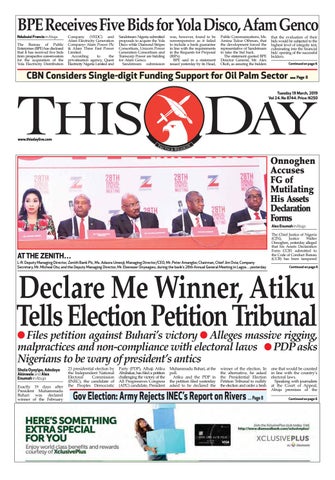
BPE Receives Five Bids for Yola Disco, Afam Genco Ndubuisi Francis in Abuja The Bureau of Public Enterprises (BPE) has disclosed that it has received five bids from prospective core-investors for the acquisition of the Yola Electricity Distribution
Company (YEDC) and Afam Electricity Generation Company- Afam Power Plc & Afam Three Fast Power Limited. According to the privatisation agency, Quest Electricity Nigeria Limited and
Sandstream Nigeria submitted proposals to acquire the Yola Disco while Diamond Stripes Consortium, Unicorn Power Generation Consortium and Transcorp Power are bidding for Afam Genco. Sandstream submission
was, however, found to be non-responsive as it failed to include a bank guarantee in line with the requirements in the Requests for Proposal (RfPs). BPE said in a statement issued yesterday by its Head,
Public Communications, Ms. Amina Tukur Othman, that the development forced the representative of Sandstream to take the bid back. The statement quoted BPE Director General, Mr. Alex Okoh, as assuring the bidders
that the evaluation of their bids would be subjected to the highest level of integrity test, culminating into the financial bids' opening of the successful bidders. Continued on page 6
CBN Considers Single-digit Funding Support for Oil Palm Sector ... Page 8 Tuesday 19 March, 2019 Vol 24. No 8744. Price: N250
www.thisdaylive.com TR
UT H
& RE A S O
N
Onnoghen Accuses FG of Mutilating His Assets Declaration Forms Alex Enumah in Abuja
AT THE ZENITH… L-R: Deputy Managing Director, Zenith Bank Plc, Ms. Adaora Umeoji; Managing Director/CEO, Mr. Peter Amangbo; Chairman, Chief Jim Ovia; Company Secretary, Mr. Micheal Otu; and the Deputy Managing Director, Mr. Ebenezer Onyeagwu, during the bank’s 28th Annual General Meeting in Lagos…yesterday
The Chief Justice of Nigeria (CJN), Justice Walter Onnoghen, yesterday alleged that his Assets Declaration Form CCB1 submitted to the Code of Conduct Bureau (CCB) has been tampered Continued on page 6
Declare Me Winner, Atiku
Tells Election Petition Tribunal
Files petition against Buhari’s victory Alleges massive rigging, malpractices and non-compliance with electoral laws PDP asks Nigerians to be wary of president’s antics Shola Oyeyipo, Adedayo Akinwale and Alex Enumah in Abuja Exactly 19 days after President Muhammadu Buhari was declared winner of the February
23 presidential election by the Independent National Electoral Commission (INEC), the candidate of the Peoples Democratic
Party (PDP), Alhaji Atiku Abubakar, has filed a petition challenging the victory of the All Progressives Congress (APC) candidate, President
Muhammadu Buhari, at the poll. Atiku and the PDP in the petition filed yesterday asked to be declared the
winner of the election. In the alternative, he asked the Presidential Election Petition Tribunal to nullify the election and order a fresh
Gov Election: Army Rejects INEC’s Report on Rivers … Page 8
one that would be counted in line with the country’s electoral laws. Speaking with journalists at the Court of Appeal, Abuja premises of the Continued on page 6
2
5 ) * 4 % ": t TUESDAY, MARCH 19, 2019
5 ) * 4 % ": t TUESDAY, MARCH 19, 2019
3
4
5 ) * 4 % ": t TUESDAY, MARCH 19, 2019
5 ) * 4 % ": t TUESDAY, MARCH 19, 2019
5
6
TUESDAY, ͚Π˜ ͺ͸͚Π˞ T H I S D AY
PAGE SIX DECLARE ME WINNER, ATIKU TELLS ELECTION PETITION TRIBUNAL tribunal, where the legal process was instituted, the PDP National Legal Adviser, Mr. Emmanuel Enoidem, said over 400 witnesses have been assembled from all over the country to testify during the hearing of the petition. Also at the tribunal were the National Secretary, Senator Umaru Ibrahim Tsauri; the National Publicity Secretary, Mr. Kola Ologbondiyan; other leaders of the opposition and some international observers. Atiku and his party are challenging the electoral victory of Buhari and the APC on the grounds of alleged massive rigging, malpractices and noncompliance with the electoral laws. Respondents in the suit are the ruling APC, Buhari and INEC. Though a copy of the petition was not provided as at the time of filing this report, Enoidem confirmed to journalists that the petition had been filled. According to him, the PDP and its presidential candidate have already assembled a powerful legal team comprising 20 Senior Advocates of Nigeria (SANs) and other retinue of lawyers who will establish the facts of the petition. On the order earlier granted Atiku to inspect materials used in the conduct of the presidential election, he said his party, which will be using the report of polling agents across the country to establish facts of the petition, also have trained personnel to carry out the inspection. A member of the legal team, Chief Mike Ozekhome (SAN), while confirming the
filing of the petition said: "The petition was solid, strong and unassailable,� adding: "The true owner and keeper of the people's mandate would soon be declared." Ozekhome, however, lamented the noncooperative attitude of INEC with the petitioners. Speaking on calls on Atiku to drop the legal action in the interest of peace in Nigeria, Tsauri said: “If you are cheated in Nigeria and in the world over, the last resort for the common man is the court. We believe, we are very confident and we are very optimistic that we won the election. There is always a difference between common sense and legal jurisprudence. In my region, if you have 10 children and they cannot feed themselves and you go and look for food for them and you kill somebody in the process, the law does not say you should not be killed. The law says you should be killed! “So, simply because people are saying let Nigeria be in peace, it does not mean we should not seek redress and reclaim our mandate. We still stand on our point that we won the election and we are going to claim our mandate. “We want the tribunal to look at the merit of our litigation approach. Like you know, the court has given us the go ahead to inspect the election materials, which INEC has not given us the go ahead up till now. We want the court to insist on us inspecting the election materials. Then after that we will open the arguments. We have our team of lawyers, who are very conversant with the procedure, very
qualified, very fearless and very wise.� Talking about the chances of his party to get free and fair judgment from the court, he said: “We know that we are dealing with a government that is ruthless and government that does not respect law. We know. But then, that does not mean we should not seek redress from the court because if we don’t do that it means the courts are not useful. So, we are coming to the court. They should declare us and I believe the court is going to do the right thing because we are very confident; if you start with the Court of Appeal, these are judges that you cannot compromise anytime of the day. Their integrity is guaranteed and we believe in them. They will do the right thing and the right thing is to get our mandate.� Reacting to suspicion in some quarters that owing to the sudden defection of the Director-General of the PDP presidential candidate’s campaign organisation, Mr. Gbenga Daniel, to the APC, Atiku might have been back-stabbed by members of his party, Tsauri said: “No! No! No! Forget about that! Even when he was in the campaign organisation we believe and we are confident that he has been a mole in the system. We expected his leaving the party. We don’t have any ill-feeling. He will not add value or subtract value from anything we are doing.� Be Wary of Buhari’s Antics, PDP Tells Nigerians Meanwhile, the PDP and the Coalition of United
Political Party (CUPP) have described Buhari’s posturing on free and fair supplementary elections as a fresh subterfuge to divert public attention from the APC’s rigging plots. The Senior Special Assistant to the President on Media and Publicity, Malam Garba Shehu, had said on Sunday that Buhari had, to the displeasure of his party men, said he would not interfere in the conduct of the extra elections billed to hold in five states on Saturday. But the PDP and the CUPP yesterday described the president’s assurance as a direct confession that the presidency used its overbearing influence to rig the February 23 presidential election. They, therefore, called on Nigerians, especially those in states where the supplementary elections have been scheduled to hold, to be wary of the antics of the Buhari presidency, as it has never been committed to free, fair and credible election. The PDP in a statement yesterday by Ologbondiyan said Buhari could not exonerate himself of the harm inflicted on the country’s polity by the deployment of soldiers in the general election, as nobody deploys the military except the President and Commander-in-Chief. It stated: “The presidency’s confession that APC members are mounting pressure on Buhari to help them to rig the supplementary elections further confirms the Buhari presidency’s manipulative and rigging capacity, including militarisation
of the electoral process, instigating of violence and alteration of results, as were freely used by the APC in the presidential election.� “Nigerians can recall that ahead of the presidential and National Assembly elections, President Buhari had promised to allow for a free, fair, transparent and credible process, only for his presidency and party, the APC, to engage in downright manipulations at INEC, deployment of military and thugs to intimidate and suppress voters, as well as outright alteration of results delivered from the polling units. “Now that President Buhari, in his official capacity, has come out to state that he will not intervene in the March 23 Supplementary election; we ask, is Mr. President assuring Nigerians that any ‘soldier’ seen directly involving in the rerun election is fake and should be treated as such?� The PDP also cautioned INEC officials to note that Nigerians are very eager about the outcome of the governorship supplementary elections, given that the PDP is already leading in these states. The party warned that Nigerians are not ready to accept any results that do not reflect the reality of our victory, which is already known to all. The PDP also urged the military to note the import of the statement by the presidency and steer clear of the supplementary elections. Also reacting to the presidency statement, the CUPP said that the president was playing to the gallery, because he had
already interfered and ruined the gains of past electoral processes. The spokesperson of CUPP, Mr. Ikenga Ugochinyere, while reacting to THISDAY enquiry, noted that Buhari’s quest to get re-elected and the fear of defeat made him ‘desecrate the sanctity of our electoral process.’ According to him, “He likes to market a personality of honesty but behind the curtain he weighs zero on the integrity scale. What kind of comment coming from a man who refused to sign the electoral act that would have helped make our electoral process better. He deliberately refused to sign the law and pushed our people into witnessing the worst bloody electoral battle.� Ugochinyere lamented that the president said that the army would shoot ballot box snatchers but ended up encouraging his armed military soldiers aiding his party thugs to snatch ballot boxes and kill those resisting their evil act of ballot boxes snatching. He stated: “A commanderin-chief who watched his soldiers overthrown INEC collation of result centre in Rivers and used their own hands to attempt to smuggle in fake result. Is only a kid can take the president serious. “We have told the people of the supplementary election states to get ready to defend their votes and never put their trust in a president who in the first place provided the environment for the electoral violence already visited on them.�
registered. Responding to another question, the witness said investigation into the petition against Onnoghen was concluded within 24 hours. Drama, however, started when Awomolo confronted the witness with the charge against Onnoghen, proof of evidence, list of exhibits and witnesses, which were all dated January 10, when investigation into the petition had not been completed. Also, when the witness attempted to deny involvement of the Economic and Financial Crimes Commission (EFCC) in the CCB investigation, he was confronted by Awomolo with documents from Standard Chartered Bank addressed to the EFCC but tendered by the witness.
In all, the witness said he was not aware that the charges against Onnoghen was filed before the completion of the investigation and declined comments on the bank's document addressed to EFCC. At yesterday's proceedings, the petition against Onnoghen two documents from his bank, his cautionary statement and the two assets declaration forms he submitted to the CCB, were admitted as exhibits by the tribunal. Meanwhile, hearing on the matter was adjourned till March 21, 2019, when the account officer to Onnoghen already summoned by the tribunal, is expected to appear before the tribunal in relation to the documents submitted to the CCB. Prosecution counsel, Mr.
Aliyu Umar SAN, had asked the court to subpoena the bank official, after Awomolo had opposed to the tendering of the bank document on the grounds that since the witness did not author nor sign the document, he cannot tender it as exhibit before the tribunal.
The transaction for Afam Power Generation Company on the other hand fell through due to the delay in signing the Gas Supply Agreement (GSAA) and the Gas Transportation Agreement (GTA). In 2017 the National Council on Privatisation (NCP) gave approval for a fresh transaction to privatise the two power companies.
It is expected that the successful bidders will be responsible for operating the generation and distribution companies, making the necessary investments to improve the generation and distribution networks and customer service in line with the objectives of the Federal Government of Nigeria set out in the National Electric Power Policy (NEPP).
ONNOGHEN ACCUSES FG OF MUTILATING HIS ASSETS DECLARATION FORMS with by agents of the federal government. Onnoghen made the allegation yesterday at his resumed trial on alleged non-declaration of some of his assets before the Code of Conduct Tribunal (CCT) in Abuja. The said documents are the CCB Assets Declaration forms of 2014 and 2015. The prosecution having called its 1st witness, Mr. James Akpala, a Senior Investigative Officer with the CCB, had sought to tender the said documents in support of his evidence against Onnoghen. However, when the documents were shown to the defendant, Onnoghen through his counsel, Chief Adegboyega Awomolo SAN, told the tribunal that a careful
look at the documents showed that they had been tampered with. According to him, the 2014 form has become loosed, part of it mutilated and has become blue in a way. Awomolo said a similar observation was made on the 2015 form with some duplications and omission of some pages. "We have some reservations on the documents, we will not object in the interest of justice but we have reservations that would be addressed at the end of the day," the senior lawyer stated. Akpala in his evidencein-chief, told the tribunal that the CCB on January 10 referred a petition written by the Anti-Corruption and Research Database Initiative
to his team for investigation. The witness said that on the strength of the petition signed by one Chief Dennis Aghanya, he visited Onnoghen in his office at the Supreme Court, during which a cautionary statement was obtained from him while letters were also written to the Standard Chartered Bank for account details of the defendant with the bank. He further stated that the following day, January 11, 2019, the bank responded, prompting the investigating team to conclude their investigation and prepare their report. Under cross-examination, the witness informed the tribunal that he did not know whether the CCB has a central registry and register where returned assets forms are deposited and
BPE RECEIVES FIVE BIDS FOR YOLA DISCO, AFAM GENCO Okoh said the evaluation committee would meet immediately to discuss and finalise the scoring criteria before commencing the evaluation process on Monday, March 18, 2019 and end on Thursday, March 21, 2019. It would be recalled that 19 firms had indicated interest to acquire the Afam Power Company and the Yola Distribution Company (YDC)
put up for sale by the federal government at the close of the submission of bids for the Expression of Interest (EOIs) at 1 p.m. on Tuesday, September 26, 2018. The request for expression of interest in the two companies was published by the BPE in national newspapers on August 16, 2018 and after evaluation of the EOIs, 11 firms qualified for the next
stage but only the five were successful. Although Yola Distribution Company was successfully privatised and handed over to the core investor in 2013, a force majeure was declared in 2015 by the core investor citing insecurity in the North-east region of the country. Following this, the company was duly repossessed by the federal government.
TOP GAINERS DANGFLOUR UNIONDAC MCNICHOLS CAVERTON UNITEDCAP TOP LOSERS IKEJHOTEL CUTIX SOVEREIGNTRUST
NGN NGN 0.75 10.95 0.02 0.30 0.03 0.60 0.08 2.25 0.05 2.85 NGN 0.20 1.87 0.20 2.05 0.02 0.23 WEMBANK 0.06 0.71 LINKAGEASSURE 0.04 0.55 HPE Nestle Nig Plc â‚Ś1,450.00 Volume: 205.725 million shares Value: N1.925 billion Deals: 3,821 As at yesterday 18/3/19 See details on Page 31
% 7.3 7.1 5.2 3.6 1.7 % 9.6 8.8 8.0 7.7 6.7
5 ) * 4 % ": t TUESDAY, MARCH 19, 2019
7
8
TUESDAY, ͚Π˜ ͺ͸͚Π˞ T H I S D AY
NEWS
CBN Considers Single-digit Funding Support for Oil Palm Sector In furtherance of its intervention programmes in the agricultural sector of the economy, the Central Bank of Nigeria (CBN) yesterday reeled out measures currently being considered to address the challenges that had stifled the growth of the palm oil industry. The apex bank said the move was aimed at identifying “promising approaches� to revitalise the sector and enable the country regain its position as one of the leading global producers of palm oil. Speaking yesterday during a meeting with the governors of the South-south and Southeast states, the CBN Governor, Mr. Godwin Emefiele, noted that Nigeria still expends close to $500 million on palm oil importation annually. He also said the CBN will in due course address challenges in the cocoa, cassava, beef/cattle ranching, dairy and fish sectors. He said: “We are determined to change this narrative. We intend to support improved production of palm oil to meet not only the domestic needs of the market, but to also increase our exports in order to improve our forex earnings. Present at the stakeholders engagement were Governor of Edo State, Mr. Godwin Obaseki, Governor Udom Emmanuel of Akwa Ibom State and Governor of Abia State, Mr. Okezie Ikpeazu,
who all commended the CBN governor for his laudable initiatives towards economic revolution. However, Emefiele further disclosed that the apex bank will work to encourage viable off taker agreements between farmers and large-scale palm producing companies, adding that loans will be granted through the Anchor Borrower Programme (ABP) and the Commercial Agriculture Credit Scheme (CACS) initiatives at not more than nine per cent interest per annum to identified core borrowers. He said with an estimated three million hectares of land under cultivation, abundance of suitable arable land, the cooperation of state governments in the oil palm producing zone is desired to make land available to investors with proven financial and technical capabilities, who will be able to support developments of large scale palm oil plantations in the country. He, however, disclosed that all the states in the South-south and South- east regions have already agreed to provide at least 100,000 hectares for the initiative, which is also designed to accommodate the small holder farmers. Emefiele also emphasised that the renewed focus by the CBN to support improved growth in the agriculture and manufacturing sectors
EmeďŹ ele
was “clearly in line with the federal government’s determination to diversify the base of Nigeria’s economy away from a reliance on crude oil, so as to insulate the economy from the vagaries and shocks associated with volatility in crude oil prices.� He also reiterated the resolve of the bank to deal with unrepentant smugglers who are bent on frustrating its efforts to revive key sectors of the economy as well as create jobs for Nigerians. He said: “Let me stress that we are not unmindful that our current focus to make life difficult for smugglers of the products being targeted under our intervention will be resisted by unpatriotic and recalcitrant beneficiaries of the status quo. “We will not be deterred by their criticisms but will appeal to Nigerians to support these initiatives. No doubt,
there will be initial pain caused by this new focus, but the medium and long run benefits remain unassailable and glorious for our dear country.� He added: “Soon every region of our beloved country will feel the positive impact of our intervention in the agricultural sector. “These efforts we hope will not only enable us to conserve our foreign exchange, but also create jobs on a mass scale. As these measures begin to bear fruits, we are very optimistic that our states will become more economically viable, given the massive economic activities that will occur from catalysing activities in our agricultural and manufacturing sectors. “Although the economy has recorded some investments in the oil palm value chain over the last three years, these investments fall short of our expectations, and our expected target of self-sufficiency in oil palm production is far from being achieved. “Prospective investors, both local and foreign, have at different fora identified the factors preventing investments in the sector to include, among others, difficulty in acquiring farmlands and the dearth of long term funding sources at affordable costs.� According to him, the stakeholders’ engagement had been expanded to include executive governors and other top government functionaries
from the oil palm producing states to elicit their buy-in and set a partnership model that would, with immediate effect, stimulate investments in the palm oil plantations, such that within the next three to five years, the global share of the country’s oil palm production would more than double. “Our ultimate vision is to overtake Thailand and Columbia to become the 3rd largest producer over the next few years,� Emefiele added. Lamenting the shortcomings of the oil palm value chain, he said: “As some of you may recall, in the late 50’s and 60’s, Nigeria was not only the world’s leading producer of palm oil, it was also the largest exporter of palm oil, with close to 40 per cent of the global market share. “Today we are a distant 5th among leading producers of palm oil; we barely produce up to three per cent of the global supply of palm oil, with estimated production of 800,000 metric tonnes (MT) of palm oil, while countries like Malaysia and Indonesia produce 25million and 41 million tonnes of palm oil respectively.� Continuing, he said: “We have also become a net importer of palm oil, importing between 400,000 – 600,000 MT of palm oil in order to meet local demand for this commodity. Despite the availability of over 3m hectares of farmland for palm oil cultivation, production
remains low at close to two tonnes per hectare, relative to a global benchmark of 25 tonnes per hectare. “This is as a result of the maturation of existing palm trees, as some of these trees were planted in the 50’s, as well as low investment in replanting high yielding palm oil seeds. As some of you may know, the usual life cycle for optimum palm production is 25 years. “Ladies and gentlemen, if we had kept pace with our peers in supporting improved cultivation of palm oil, at the current global market price of $600 per tonne, and an assumed production level of 16m tonnes, Nigeria could have generated close to $10 billion worth of foreign exchange for the country. This analysis does not take into consideration the amount of jobs that could have been created in our rural communities from large scale small holder developments. “This conversation is indeed important as it forms part of our overall strategy to reduce our reliance on crude oil imports, diversify the productive base of our economy, create jobs and conserve our foreign exchange. Despite placing oil palm in the forex exclusion list, official figures indicate that importation of palm oil had declined by about 40 per cent from the peak of 506,000 MT in 2014 to 302,000 MT in 2017.�
Governorship Election: Army Rejects INEC’s Report on Rivers Reviews joint activities with police Ernest Chinwo in Port Harcourt Army has described as lopsided the report of the Independent National Electoral Commission (INEC) on the governorship and state Houses of Assembly elections in Rivers State, accusing the commission of ignoring the input of the army. The army also said it would review its participation in joint operations with the police because of the failure of the police command to punish its personnel allegedly involved in the shooting of a soldier during the elections.
Deputy Director Army Public Relations, 6 Division Nigerian Army, Col. Aminu Iliyasu, in a statement issued yesterday night, said: "Headquarters 6 Division Nigerian Army (NA) have observed with dismay and sense of betrayal in the statement made by INEC signed by its National Commissioner and Chairman Information and Voter Education Committee Festus Okoye, on March 15, 2019. The statement according to INEC was the findings of its Fact-Finding Committee that assessed the situation in Rivers State.
"It is however pertinent to note that, representatives of the 6 Division met with the Fact-Finding Committee on Tuesday 12 March 2019 at the INEC Headquarters in Port Harcourt and had honest discussions and made a written submission to aid the committee in its task. "Regrettably, none of the Division’s input formed any of the findings of INEC as made public. This clearly indicates lack of trust by an institution that the NA sacrifices so much to assist in the course of performing their role." He said INEC failed to
capture in its report that two soldiers were attacked by police personnel attached to Governor Nyesom Wike and suspected political thugs. He said Wike stormed the collation centre at Obio/ Akpor at about 10.30p.m on Election Day with his aides. According to Iliyasu, "In the ensuing melee, Captain Adams Salami was shot at close range by the security aides of Governor Wike while Corporal Adeosun Adebayo was matcheted by Governor Wike’s thugs. Both victims are currently receiving treatment at University of Port Harcourt Teaching Hospital
(UPTH) Intensive Care Unit and Military Hospital Port Harcourt respectively with life threatening injuries." He said the army had been consulting with the police over the attack but expressed surprise that two press conferences scheduled by the police to address the issue were aborted at the last minute. He stated: "To this end, in the circumstance, the 6 Division NA as a stakeholder in the 2019 general election takes exception to the lopsided and therefore unfair INEC report and is hereby strongly and totally rejected by the NA.
"The Division is equally disappointed with the attitude exhibited by the Nigerian Police in this regard and hereby request the police leadership to commence full scale investigation of those security aides to Governor Wike that attacked troops at the Obio/Akpor LG Headquarters Collation Centre and shot at Capt AA Salami with a view to appropriately sanction those found responsible/culpable. "Until that is done, Headquarters 6 Division NA will have to review all existing joint activities with the Rivers State Police Command."
Bauchi Gov to Challenge Cancellation of Rerun Polls in Court Omololu Ogunmade in Abuja The Bauchi State Governor Mohammed Abubakar yesterday in Abuja secured the backing of President Muhammadu Buhari to challenge the decision of the Independent National Electoral Commission (INEC) to resume the collation of the March 9 governorship election results in the court, describing it as illegal. Abubakar, who stated this in the State House after meeting the president
behind closed-doors, faulted the electoral commission’s decision to reverse its earlier decision to conduct supplementary polls in Tafawa Balewa Local Government Area of the state following the commission’s declaration that the election was inconclusive in the state. He said he had opted to visit Buhari to brief him on the situation, adding that he succeeded in securing the president’s support for his intention. “I am a lawyer and I am pursuing the legal
angle. I briefed him and he emphasised on that legal angle that it is the best way to go,� he said. The governor, who also briefed the president on other issues concerning the development, queried INEC’s sudden change of decision after it had earlier cancelled the results of the election in the local government. Abubakar, who also queried INEC’s move to reverse its decision on supplementary polls only on Bauchi, said it had become compelling to brief
the president on the latest development on the election because it has the tendency of affecting the security situation of the state. “I briefed him on the issues surrounding the inconclusive elections. The returning officer for Bauchi State at the end of collation, rejected the result of Tafawa Balewa Local Government and then 36 other units spread around 15 local governments of Bauchi State and ordered a rerun. “Surprisingly, we woke up one morning and INEC came up with a procedure
that is not known to law. Because, where a returning officer has declared the result, only an election petition tribunal can reverse the result. But INEC is attempting to reverse itself in the case of Bauchi. And when one juxtaposed that of Bauchi and other states with inconclusive elections, one wondered why that is happening only in Bauchi State. “So, for that reason, there is a need for me to come and brief Mr. President because that has the potential of touching on the security
of the state and it is our paramount duty to secure the state,� the governor said. Asked on why he was seeking the president’s intervention in the matter, he said: “No, no, no. I said I came to brief Mr. President. I am not seeking any action of Mr. President. We all know Mr. President, he is a stickler for procedure. What I pointedly told him was ‘that I am not here to seek for you to interfere on our behalf, sir, but to brief you on what is happening and what actions I have taken.�
5 ) * 4 % ": t TUESDAY, MARCH 19, 2019
9
10
TUESDAY MARCH 19, 2019 ˾ T H I S D AY
NEWS
Group News Editor Ejiofor Alike Email Ejiofor.Alike@thisdaylive.com, 08066066268
Panic in Bauchi as Gunmen Kill Army Garrison Commander Segun Awofadeji in Bauchi Military authorities in Bauchi State were yesterday thrown into mourning following
the killing of the Garrison Commander, 33 Artillery Brigade of Nigerian Army in Shadawanka Barracks, Bauchi, Col. Mohammed Barack, by
Again, Generator Fumes Kill Four People in Bayelsa Emmanuel Addeh in Yenagoa The erratic power supply in the country again claimed four casualties in Bayelsa State, yesterday as four persons, including three sisters and their cousin were killed in their sleep by generator fumes in Aghoro, Ekeremor Local Government Area (LGA) of the state. The sleepy coastal community is said to be always in darkness. Electricity supply in the area is overseen by the Port Harcourt Electricity Distribution Company (PHED) which distributes power to Rivers, Bayelsa, Cross River and Akwa Ibom States. The deceased were said to be primary school pupils identified as the children of Demedogha London and Stephen Binasuode. According to sources from the community, the deadly fumes emanated from a new generator placed at the balcony of Demedogha’s bungalow. Parent of the deceased, Demedogha, whose compound was besieged by sympathisers, said he kept the generator at the balcony far from the room of the girls, explaining that when he woke up at 6 a.m the next day, he discovered that the generator had shifted close to the door
of the girls’ room. He said he found that the floor tiles aided the movement of the generator, adding that the girls were already dead when he rushed to their room to find out why they hadn’t woken up. “The generator was outside but it was on tiles. The generator shifted close to the door. At about 6 a.m, I came out to put off the generator and saw that it was close to the door. Eventually when I entered the room I saw that all the children were dead,” the distraught father lamented. A chief in Aghoro community, who identified himself as Etiti, described the incident as painful, adding that the community would create awareness on the dangers of generator fumes. However, a resident, Victor, in a chat with journalists, said the devastating incident would not have occurred if there had been electricity in the community and called on the authorities to expedite action to address the epileptic power supply in the state. He added that the electricity problem was further compounded because the Shell Petroleum Development Company (SPDC), which he said had earlier commenced an electrification project in the area, later abandoned it.
suspected gunmen. The killing, which has brought panic to the city, could however not be ascertained if it was a case of armed robbery attack or assassination, although unofficial and unconfirmed sources said it could be by armed robbers. The incident which took place on Bauchi-Jos Road, was said to have taken place on Sunday
while the deceased was riding a power bike from Kaduna. A source said, “The Garrison Commander of 33 Artillery Brigade of Nigerian Army (Shadawanka Barracks) Bauchi, Col. Mohammed Barack, has been shot dead. He was shot on Sunday along Jos Road, while on a power bike and was coming back from Kaduna. He is from Kano State.”
As of the time of this report, preparations are in top gear to convey his corpse to Kano for burial, according to Islamic tradition, after the necessary military rites. When contacted, the spokesperson of 33 Artillery Brigade, Major Yahaya Nasir Kabara, confirmed the incident saying, “Yes, it’s true.” When asked to give details
of what happened, he said “Come to the Brigade because it is a matter that needs investigation; investigation is ongoing, I will get back to you when the finding is out. Let me communicate with my Commander, I will get back to you.” But as of the time of this report, he had yet to get back
CELEBRATING 125 YEARS OF BANKING…
L-R: Chief Executive Officer, First Bank, Dr. Adesola Adeduntan; Group Executive Director, Commercial Banking Group, Mr. Seyi Oyefeso; Chairman, Mrs. Ibukun Awosika; and Group Managing Director, FBN Holdings, Mr. UK Eke, at the First Bank 125km Relay Walk held to PHOTO:ETOP UKUTT commemorate the 125 anniversary of the bank in Lagos …yesterday
EFCC Re-Arraigns Ex-SGF, Boko Haram Attacks Adamawa Community Shortly thereafter her phone knows what will happen come Saturday. Daji Sani in Yola Babachir Lawal A resident of Bassa in went off. I am so scared now to us”.
Kingsley Nwezeh in Abuja
The Economic and Financial Crimes Commission (EFCC) yesterday re-arraigned a former Secretary to the Government of the Federation (SGF), Babachir Lawal and three others before Justice Jude Okeke of a Federal Capital Territory, FCT High Court, Maitama. Lawal and his younger brother, Hamidu David Lawal, one Suleiman Abubakar, Apeh John Monday and two companies, Rholavision Engineering Ltd and Josmon Technologies Ltd, were rearraigned on an amended 10-count charge bordering on fraud, diversion of funds and criminal conspiracy to the tune of over N500 million. They were earlier arraigned before Justice Okeke on February 13, 2019 and the prosecution was meant to open its case today, March 18, 2019. At the resumed hearing, counsel for the EFCC, Offem Uket told the court that the charges against them had been amended, and that they had to take a fresh plea. However, citing Section 218 (2) of the Administration of Criminal Justice Act, ACJA 2015, Akin Olujimi (SAN), counsel for Lawal, argued that “before the charge is taken, the prosecution ought to have filed the amended charge to ensure that it was properly
endorsed”. Other defence counsels aligned themselves with the submission of Olujimi. Justice Okeke, while ordering the prosecution to comply with the section cited by Olujimi, however, ruled that in the interim, the amended charges be read to the defendants. One of the counts reads: “That you, Babachir David Lawal, while being the Secretary to the Government of the Federation (SGF) and a director of Rholavision Engineering Ltd on or about August 22 2016 at Abuja in the Abuja Judicial Division of the High Court of the Federal Capital Territory did knowingly hold indirectly private interest in the contract awarded to Josmon Technological Ltd but executed by Rholavision Engineering Ltd for the removal of invasive plant species and simplified irrigation to the tune of N258,132,735.99 (Two Hundred and Fifty Eight Million, One hundred and Thirty Two Thousand, Seven Hundred and Thirty Five Naira only) by the office of the Secretary to the Government of the Federation (OSGF) though the Presidential Initiative for North East (PINE) and thereby committed an offence punishable under Section 12 of the Corrupt Practices and Other Related Offences Act, 2000.”
Suspected members of the Boko Haram insurgency have again attacked Michika, the headquarters of Michika Local Government Area (LGA) of Adamawa State, A resident of Michika, Ussa Gebriel, said Boko Haram terrorists attacked their communities barely few days to the supplementary governorship election. He said the attack was unfortunate as it may scare the electorate from voting
Michika, Madam Amos, said she managed to escape to the mountainous areas for safety. “Presently we are taking refuge at the mountainous areas as I speak with you, only God can help us now,” she said. Another indigene of Michika, who gave his name as Mr. Paschal, told THISDAY that “I called home from Maiduguri, only to hear my sister crying and I could hear loud bang at the background.
I couldn’t reach them again,”, he said. A resident of the neighboring Bazza town, Abu James, said “we heard that Boko Haram people have entered a village called Kwapa, between Shuwa and Michika. So, we have been placed on red alert,” she said. Also a former chairman of Michika LGA who pleaded anonymity, confirmed that “presently, we have fled to the mountains. Only God
Meanwhile, Adamawa State Police Public Relations Officer (PPRO), Abubakar Othman said he was yet to get the details of the attack. “I am hearing about the attack from you, but please give me sometimes to verify what happened,” he said. Michika is one of the 14 LGAs where the Independent National Electoral Commission (INEC), will be conducting supplementary governorship election on Saturday.
Court Sacks Delta APC Executive Committee Omon-Julius Onabu in Asaba A Federal High Court in Asaba has sacked the Prophet Jones Erue-led executive council of the All Progressives Congress (APC) in Delta State. The court upheld Chief Cyril Ogodo-led executive council as the authentic state APC executive body. Although Ogodo was sworn in as the state Chairman of the party by the immediate past APC National Chairman, Chief John Odigie-Oyegun, his successor, Adams Oshiomhole, inaugurated the Erue-led body. The court also sacked ward and local government executives in the Erue-led executive and upheld the Ogodo wards and local
government executives. Delivering the judgment, the presiding Judge, Justice Tosin Adegoke, said primary election conducted by the Erue-led executive body was null and void, invalidating the nomination of Chief Great Ogboru, Senator Ovie Omo-Agege and all other candidates nominated by Erue for the 2019 elections. In a suit number FA/ASA/ CS/76/2018, the plaintiffs had sought 13 reliefs among which is a declaration that the Ogodo-led executive committee is the authentic state executive of the party. Among other prayers sought by the plaintiffs was a declaration that candidates that emerged from the primaries
conducted by the Ogodo-led executive is the authentic list of candidates for the 2019 general election. The court in the judgment, granted all the reliefs sought by the plaintiffs. However, counsel to the defendants, Dr. Okubor Nwachukwu, said they would challenge the judgment in the appellate court, expressing hope that the appeal court would upturn the judgment. On his part, counsel to the plaintiffs, Roland Ekpe, said the judgment did not fall short of their expectations, adding that all the nominations done by the Erue-led executive council in the 2019 general election were null and void. Ogodo, in his reaction,
expressed joy that judgment has finally be served on the contentious state executive committee of the party, commending the judge for his stance. According to him, “Despite all the intimidation and frivolous petitions, justice was delivered.” Nonetheless, the state legal adviser of the Erueled executive body, Ebata Onojeghuo, said the judgment was inconsequential, as the consent judgment they got from a Federal High Court in Abuja was not set aside. He said all actions taken by the Erue-led executive council, including nomination of candidates, were empowered by the consent judgment.
11
TUESDAY MARCH 19, 2019 ˾ T H I S D AY
NEWS
Success’s Viral Video: Delta Suspends Head Teacher over Illegal Fees Uchechukwu Nnaike Following the public outcry over the dilapidated structures at Okotie Eboh Primary School, Sapele, Delta State and the collection of illegal levies, as exposed in a video of a
seven-year-old Miss Success Adegor, who was allegedly sent home for not paying fees, the Delta State Government has suspended the head teacher of the school, pending the outcome of a formal enquiry into the issue of unauthorised
APC to Challenge C’River Elections Outcome at Tribunal Accuses N’Delta minister of working for PDP Onyebuchi Ezigbo in Abuja The All Progressives Congress (APC) has vowed to challenge the results of the recent general election in Cross River State at the tribunal. The party said it was not only contending with the alleged antics of the state Governor, Ben Ayade, the Peoples Democratic Party (PDP), and the Independent National Electoral Commission (INEC) during the elections, but the Minister of Niger Delta Affairs, Pastor Usani Uguru Usani whom it accused of having actively worked for the PDP. While urging INEC to order the cancellation and rerun of the governorship and state assembly elections in the state, the APC described the elections as a sham. It also claimed that apart from the harassment and intimidation suffered by its members during the polls, names of the party candidates were exluded by INEC. Addressing a press conference at the APC national secretariat yesterday, the National Vice Chairman of the party for South-south, Ntufam Hilliard Eta, said they would do all that is required to recover the people’s mandate.
“Based on the general atmosphere of exclusion of our candidates, intimidation, manipulation and hijacking of materials, we hereby reject the result declared by INEC and call for the cancellation of the elections in Cross River State in its entirety,” he said. He accused the Minister of Niger Delta Affairs, Usani Uguru Usani of collaborating with Ayade to undermine the interest of the APC during the elections. While sharing the greviances of the party with journalists, the APC chieftain said INEC delayed the decision about getting the APC candidates’ names back on the candidates’ list until the election day. He said there was nothing more devastating and compromising than the attitude of the state INEC Resident Electoral Commission (REC), Frankland Briyai. He alleged that Briyai had on the eve of the presidential and National Assembly elections on February 22, addressed journalists and unilaterally announced the delisting of APC candidates purportedly on the orders of a High Court whereas the matter was already in the domain of the Appeal Court from where a stay of execution order was secured.
levies and fees she imposed in the school. The state Commissioner for Basic and Secondary Education, Chiedu Ebie, said in a statement issued yesterday that he had been inundated with messages and calls since the video broke and went viral last Friday. He said the ministry conducted preliminary investigations on the matter at the weekend before his trip to Sapele to officially address the matter. “For purposes of clarity and to address the initial issues which the video threw up, I state as follows: That by virtue of the Universal Basic Education (UBE) Act, education at the basic education level is free. However, in Delta State, that provision is also extended to senior secondary
level with the resultant effect being that basic and secondary education - primary, junior and secondary- in Delta State is and still remains free. “It, therefore, means that the head teacher of the school had no right to impose any levy or fees on the pupils of her school. In my brief encounter with the head teacher this morning, there appeared to be numerous inconsistencies in her response on this issue as she was unable to categorically state who authorised her to impose the levies or fees which is in clear breach of the extant rules. “Consequently I have directed the State Universal Basic Education Board (SUBEB) to suspend the head teacher, pending the outcome of a formal inquiry into the issue of unauthorised levies and fees
imposed by her in the school.” On the state of the infrastructure, the commissioner said: “It is important to clarify that Okotie Eboh Primary Schools I and II, Sapele exist in two locations in the same neighborhood and within a minute’s walk of each other. Having discovered the dilapidated state of the infrastructure in the schools, steps were immediately taken by the state government, through the Ministry of Basic and Secondary Education, to carry out a phased renovation and upgrade of the infrastructural facilities beginning with Okotie Eboh Primary School II. It is important to place on record and for the avoidance of doubt that the contract of the first phase was awarded on December 29, 2018 and work
has since commenced.” He stressed that as a responsible and responsive government, “it is our duty to address issues that affect the citizenry of the state and in doing so, we will ensure that renovation works are carried out satisfactorily and within reasonable time to ensure that we continue to provide conducive learning environment for our pupils and students.” Ebie added that since the inception of the current administration, the state government, through the Ministry of Basic and Secondary Education and its parastatals have carried out the construction and renovation of 4,738 classrooms in addition to rehabilitating and repositioning the six technical colleges in the state.
LET’S REFORM OUR PRISONS…
Delta State Governor, Senator Ifeanyi Okowa (left), and Justice Ishaq Bello, during a courtesy call by members of Presidential Committee on Prison Reforms and Decongestion on the governor, in Government House, Asaba...yesterday
Benue PDP Petitions IG over Supplementary Governorship Poll Marked Lagos Building Collapses during Demolition George Okoh in Makurdi The People Democratic Party (PDP) has petitioned the Inspector General of Police(IG) over what it terms the activities of Senator George Akume and other the leaders of the All Progressives Congress ( APC) in Benue State. The PDP Benue State Chairman, Mr. John Ngbede, while briefing journalists in Makurdi, said Akume at several meetings held with his party members and stalwarts alleged that result of the supplementary election to be held in the state will be declared in favour of the governorship candidate of his party, Emmanuel Jime, whether he wins it or not. “He has assured his followers that such brazen rape of democracy will be made possible through collaboration he claims APC is enjoying with the Independent National Electoral Commission (INEC), and that Mobile Policemen and other security agents will be deployed, and with the help of thugs as well as militia, to hijack election materials for the
supplementary elections, and thumb-printed ballots would then be returned and announced as the results giving victory to Jime,” he said. According to Ngbede, Akume particularly assured his followers that the national leadership of APC with the backing of the presidency has already infiltrated INEC, and Jime will be announced as governor of the state without the supplementary governorship election taking place, and that this will be achieved through already doctored results which will be compiled by INEC Returning Officers and staff who are already being posted to the affected polling units. He stated that “as a direct consequence of the actions of Akume, the leadership of APC in the state has taken to airing views boldly in the public domain that the result of the March 23 supplementary election will be declared in favour of Jime, regardless of whether Governor Samuel Ortom of the PDP wins by another landslide as he did in the first round of the governorship election or not.”
No fresh building collapse in Lagos Island, LASBCA Insists
Chiemelie Ezeobi and Sunday Ehigiator Barely five days after the building collapse at Itafaji, Lagos Island claimed 20 lives with 45 still recuperating in the hospital, another building caved in yesterday within the same suburb, leaving some people injured. But the General Manager of Lagos State Building Control Agency (LASBCA), Mr. Lekan
Shodeinde, has insisted that there was no fresh building collapse in the state. THISDAY gathered that the building located at No. 57 Egerton Square, Oke Arin area of Lagos Island, was already marked for demolition and the exercise was ongoing when it caved in without warning and buried the demolishers. However, Shodeinde yesterday insisted that there was no fresh building collapse in the
state. According to a statement by Mrs. Titi Ajirotutu of the Public Affairs Unit if LASBCA, Shodeinde said that a threefloor structure was marked as distressed and was undergoing demolition as at press time. He said the building in question was within a built-up area flanked by other adjoining structures at the rear, adding that the demolition of the distressed building became
necessary in order to avert another disaster. According to him, the present administration of Governor Akinwunmi Ambode will leave no stone unturned to sanitize the building construction industry in the State by removing all the distressed, illegal structures and buildings prone to collapse as well as those that were not in conformity with the state Building Laws.
Judge’s Absence Stalls Arraignment of Ex-NIA DG, Wife Davidson Iriekpen The absence of Justice Chukwujekwu Aneke of the Federal High Court in Lagos yesterday stalled the arraignment of former Director General of the National Intelligence Agency (NIA), Ambassador Ayo Oke, and his wife, Folashade, over an alleged $205 million fraud. The defendants were charged by the Economic and Financial Crimes Commission (EFCC) on counts of money laundering,
fraud, concealment of crime proceeds, and criminal breach of trust. The case, which was earlier billed for arraignment of the defendants, was yesterday, further adjourned to a date that will be communicated to parties, as the court did not sit. The judge is said to away on an official assignment. On February 7, the court had issued a bench warrant for the arrest and production in court of the defendants, following
an application moved by the prosecutor, Mr. Rotimi Oyedepo. According to the charge, on April 12, 2017, the accused indirectly concealed the sum of $43.5 million, property of the Federal Government of Nigeria in Flat 7B, No. 16, Osborne Road, Osborne Towers, Ikoyi, Lagos. The accused were also alleged to have between August 25, 2015 and September 2, 2015 in Lagos, indirectly used the sum of $1.7 million, property of the Federal Government of Nigeria to acquire
Flat 7B, No. 16, Osborne Road, Osborne Towers, Ikoyi, Lagos. The prosecution also alleged that the defendant directly converted the sum of $160.8 million property of the Federal Government of Nigeria, to their own use. The prosecution said that the defendant reasonably ought to have known that the said sums formed part of the proceeds of an unlawful act of criminal breach of trust and concealment of crime proceeds.
12
5 ) * 4 % ": t TUESDAY, MARCH 19, 2019
5 ) * 4 % ": t TUESDAY, MARCH 19, 2019
13
14
T H I S D AY Ëž Ëœ ÍŻÍˇËœ Ͱ͎ͯ͡
COMMENT
Editor, Editorial Page PETER ISHAKA Email peter.ishaka@thisdaylive.com
PRESIDENT BUHARI AND THE NEXT LEVEL Carl Umegboro urges Buhari to lighten the burden of living during his second term
“
To whom much is given, much is expected� is a universal maxim. The Bible in the third of the four canonical gospels, Luke 12:48 affirmed it. By Section 130 (1) and (2) of the 1999 Constitution as amended, which established the office of the president, the first mandate given to President Muhammadu Buhari in 2015 expires on 29 May, 2019. In Section 135 (1), “Subject to the provisions of this Constitution, a person shall hold the office of President until – (a) when his successor in office takes the oath of that office�, forbids a vacuum, President Buhari having been declared the winner of the 23 February - presidential poll will on May 29, once again take the oath of office for the next political dispensation which will lapse in 2023. Amidst his campaign, President Buhari launched the ‘Next level’ with litany of stunning packages, principally, a consolidation of his groundbreaking policies. From the policy directions, ‘Change’ is deductively, necessarily a strategic precursor to Next level. All things being equal, the people should be happy at the end of Buhari’s second term. Therefore, not only will improvements be perceptively made, they should manifestly be felt by the masses. Above all, the nation’s supposed status as the ‘giant of Africa’ must observably be actualized. And this time, not just by numerical strength but economic empowerment, developments and significant attainments. Buhari’s manifesto unambiguously emphasised better economy, education, infrastructure, health and social investment programmes, hence, their facelifts in terms of service delivery are non-negotiable. The Executive Order seven of 2019 recently signed for better strides in infrastructural developments should gather momentum after inauguration. Possibly, the merged ministries positioned under a minister during the economic recession may have to be unbundled having prudently exited the economic crisis to enable more capable hands come on board. This will also reduce workload on the minister. By the strategic policy remarkably unveiled by Buhari’s administration, numerous projects will simultaneously be in progress across the nation unlike the existing ‘slow-motion’ system. Amongst major tasks that demand action is slashing of outrageous allowances for members of the National Assembly. It is unreasonable, imprudent and exploitative for a lawmaker to collect a monthly running cost of N13.5million amidst agonizing unemployment ratio and hardships in the society. Sensibly, there’s no basis for a legislator to earn more money than professors, permanent secretaries or ministers let alone the inexplicably additional monthly-running costs. All the electoral malpractices and violence leading to scores of deaths of citizens are traceable to excessively attractive financial benefits attached to political offices. Unconsciously, it has got to the point that not one person enthusiastically wants to return to primary vocation after partaking in the outrageous packages. Again, Section 14(2)(b) emphatically provides that “Security and welfare of the people shall be the primary purpose of government�.
ALL THINGS BEING EQUAL, THE PEOPLE SHOULD BE HAPPY AT THE END OF BUHARI’S SECOND TERM. NOT ONLY WILL IMPROVEMENTS BE PERCEPTIVELY MADE, THEY SHOULD MANIFESTLY BE FELT BY THE MASSES
Unfortunately, the masses interests clearly, have never been a priority in the country. Instead, the masses are usually more or less like abandoned properties but only treasured during elections by the political class either for lawful franchise or thuggery. Hence, in orchestrating the ‘Next level’ programmes, federal government should create meaningful pragmatic schemes for economic empowerment of the masses especially youths vis-Ă -vis nation’s revenue generation through commendably proactive policies. Any poll that must necessarily gather the public at designated locations without adequate security personnel for safety of the vulnerable population is not only antediluvian but a threat to security of lives. As preventive measures on hostility and violence during general elections which is on the increase, the government should plan to migrate to digital voting system like many other countries. If not, the ugly situation may worsen in the next general elections in 2023 due to increased political interests, conceivably for pecuniary reasons. To put it another way, the population is grossly excessive for manual ballot system in relation to security and financial implications. For example, INEC recorded 82,344,107 registered voters for the 2019 presidential election. Abysmally, only 29,364,209 of the voters representing 35.66% showed up for accreditation. Imagine what would have been the situation if about 82 million registered voters had shown up to participate in the election. Sensibly, the nation cannot effectively manage the scenario vis-Ă -vis the available work force. Thus, the practicable remedy remains digital electoral system where registered voters can vote from anywhere without fear of attacks, intimidation or manipulations. With that in place, the ethnic crisis that has repeatedly ensued particularly in Lagos between Yorubas and Igbos will be averted as people can still be resident outside their home state and effectively participate in their home elections except desired otherwise. On socioeconomic goals, Section 16(2)(b) of the Constitution unequivocally provides “the State shall direct its policy towards ensuring - that the material resources of the nation are harnessed and distributed as best as possible to serve the common goodâ€?. The subsection 2(d) crowns it “that suitable and adequate shelter, suitable and adequate food, reasonable national minimum living wage, old age care and pensions, and unemployment, sick benefits and welfare of the disabled are provided for all citizensâ€?. Regrettably, Fundamental Objectives and Directive Principles of State Policy in Chapter two which extensively contains striking socioeconomic rights are non-justiciable pursuant to Section 6(6)(c) supra. Nonetheless, they profoundly and justifiably remain yardsticks for measuring progress in the court of public opinion. If the viable foundations laid by Buhari’s present administration will be tenaciously consolidated to the latter, without doubt, the masses in no distant time will eventually feel a sense of belonging. Umegboro is a public affairs analyst and Associate, Chartered Institute of Arbitrators
DAWN OF A NEW DAY Things are beginning to look up again at the Securities and Exchange Commission, writes Dayo Omoogun
A
fter a long dark night, comes a glorious dawn. Watchers of the Nigerian capital market admit painfully that the scenario at the apex regulatory body of the capital market has been marked with one leadership crisis after another which has negatively affected the commission’s image and resulted in loss of confidence and respect by players and investors alike. However, things are beginning to look up again for the commission, which for many years before the upheavals, used to be the toast of both local and international stakeholders and analysts. The Acting Director-General of the Commission, Ms. Mary Uduk, is championing this new ray of hope with the understanding that the most important resource of any organization is the human resource, and that a disenchanted and demotivated workforce is toxic to the system. One of the first issues, which the Uduk-led administration gave priority to was staff welfare. Staff promotions, which had been long overdue, dating as far back as 2016, have now been cleared. With the assurance of a smooth and steady career progression, staff morale is high and productivity greatly enhanced. The working environment at the commission is currently devoid of tension, rancour and disenchantment. Rather it is exciting to state that there is noticeable comradeship and cordiality among management and staff. Another category of persons whom the new leadership of the commission believes should be celebrated, are distinguished capital market practitioners who have at one time or the other headed or have been members of the capital market committees. These highly respected persons in the sector have consistently given their time, energy and intellect towards the
development of the market. It is to the credit of these icons that the SEC10-year capital market master plan was put together and continues to be faithfully implemented. Over a period of time, several capital market committees were constituted to deliberate on critical issues such as full de-materialization, e-dividend mandate, new listings, review of the Investment and Securities Act 2007 and other relevant laws, road map on commodities ecosystem, market transaction costs, etc., with a view to deepening the capital market by facilitating wealth creation. Surely, these professionals deserve some recognition as a mark of appreciation for their invaluable efforts. This issue, according to credible sources is already being attended to by the leadership of the Securities and Exchange Commission. Recent reports in the media indicate that the apex regulator is already checkmating activities of illegal capital market operators, especially Ponzi scheme promoters. The commission has sealed off many business premises of illegal operators who have defrauded Nigerians of millions of Naira and caused untold hardship and pain for many. Examples of such enforcement actions recently carried out include the sealing of the premises of some companies in Kano and Lagos. Prior to this intervention by the commission, many unsuspecting members of the public had fallen for their mouthwatering scams. The commission must continue to ensure that its surveillance ante is upped in order to curb the nefarious activities of these illegal operators and as much as possible nip them in the bud before they negatively affect the investment climate. Investor education is key to winning this war against Ponzi schemes and the commission is increasing its commitment to this critical function.
The Acting Director-General, Ms. Uduk had this to say amongst others, at a recent function: “These fraudsters or promoters of Ponzi Schemes are the false prophets of the investment environment; they are the ill wind that blows no good and at whose sight you must flee. They are to be avoided. This is one message you must take to your family, friends, relations and acquaintances, in order to save them from the agony of loss of their ‘hard earned’ money.� For the avoidance of any doubt, it is important to state here that the investor owes himself a duty of due diligence before committing funds to any investment in order to avoid regrets and losses. The way to go about it is to satisfy the five cardinal requirements of internationally accepted investors guide viz: Is the promoter or seller licensed? Is the investment registered? How do the risks compare with the advertised rewards? Do I understand the investment? Where can I turn to for help? The commission, in an effort to further deepen the market has introduced new rules and made amendment to existing ones within the last one year. One of such new rules is the rule on Green Bonds. The rules specify the definition of greenbonds, qualification for the bond, conditions for approval, utilization and management of proceeds, reporting and refinancing. Thus, a new frontier has been created by the commission, which would serve as a bulwark against the ugly effects of environmental degradation. This culminated in the approval granted by the commission to Access Bank for the floating of its Access Bank Green Card Bond which offer size was N15 billion at a coupon rate of 15.5 per cent and a tenor of five years. Also, the North South Power Green Bond Issuance is for a tenor of 15 years with an offer size of N8.5 billion
and a coupon rate of 15.6 per cent. This is quite commendable because it is the first of its kind in Africa. A notable amendment made to the SEC Rules is the inclusion of BVN as a valid means of identifying individual clients in the market while others cover the investment advisory services, nominee accounts and investment advisers. These far-reaching amendments show the professionalism and expertise of those at the helm of affairs and the capacity of the commission to regulate the market properly. Ms. Uduk joined SEC in 1986 as an Assistant Financial Analyst and at various times headed several departments in the commission, including the Internal Control, Securities and Investment Services, Investment Management department among others. She has demonstrated professionalism in handling the regulatory functions of the commission, showing capacity to take the necessary steps that are in the best interest of the market, while giving a listening ear to both staff of the commission and other stakeholders. Indeed, she has shown capacity to take the commission and the market to the next level and needs to be supported. Her performance has shown that excellence in leadership and management is not necessarily a function of gender and that indeed what a man can do, a woman can do even better. Her tenure might just be the beginning of a renaissance, which the commission so desperately needs. As the saying goes, the morning shows the day, and so if in an acting capacity she has achieved so much stability and progress, then it is better imagined what she would deliver in a substantive capacity. A new day beckons at the Securities and Exchange Commission. Omoogun wrote from Abuja
15
T H I S D AY TUESDAY, MARCH 19, 2019
EDITORIAL Tragedy Of Collapsed Buildings There is need to enforce the nation’s building codes
L
quacks have taken over the building sector. Quite naturally, most of these characters seem interested only in how to cut costs, even if it means circumventing laid down regulations. Such a state of affair can only breed the kind of disaster we experience from time to time.
ast Wednesday, a three-storey residential building that also had within it a nursery and primary school and a shopping complex, collapsed at Ita Faaji on the Lagos Island. By the last count, according to the Lagos State government, no fewer than 20 persons, mostly school children were killed with dozens of others injured. Barely four days later, another three-storey building also collapsed at Molete in Ibadan, Oyo State, trapping many people in the process. While we await official reports from the authorities in both states, the collapse of these buildings would appear to have resulted from the failure of oversight and criminal negligence. Unfortunately, this is a recurring tragedy that may yet happen again. In July 2017, for instance, no fewer than eight persons died when a four-storey building collapsed within the same Lagos Island in similar circumstance. The building was initially a bungalow before it was converted to a fourTHERE IS A GLARING storey building with FAILURE OF THE a penthouse while a REGULATING AGENCIES telecommunication TO PROPERLY PERFORM masthead was erected on it, along with a THEIR SUPERVISORY big generator just ROLES, GIVING RISE TO two weeks before A SITUATION WHERE everything came QUACKS HAVE TAKEN down. Despite the promises by the Lagos OVER THE BUILDING authorities to get to SECTOR the root of the matter and bring culprits to book, nothing was ever heard about the case again. While we commiserate with the families of the deceased at Ita Faaji and wish speedy recovery for the injured, it is important to state that unless drastic steps are taken, the nation will continue to experience this kind of tragedy. All over the country, there is a glaring failure of the regulating agencies to properly perform their supervisory roles, giving rise to a situation where
S
T H I S DAY EDITOR BOLAJI ADEBIYI DEPUTY EDITOR DAVIDSON IRIEKPEN MANAGING DIRECTOR ENIOLA BELLO DEPUTY MANAGING DIRECTOR KAYODE KOMOLAFE CHAIRMAN EDITORIAL BOARD OLUSEGUN ADENIYI EDITOR NATION’S CAPITAL IYOBOSA UWUGIAREN MANAGING EDITOR JOSEPH USHIGIALE
T H I S DAY N E W S PA P E R S L I M I T E D EDITOR-IN-CHIEF/CHAIRMAN NDUKA OBAIGBENA GROUP EXECUTIVE DIRECTORS ENIOLA BELLO, KAYODE KOMOLAFE, ISRAEL IWEGBU, IJEOMA NWOGWUGWU, EMMANUEL EFENI DIVISIONAL DIRECTORS BOLAJI ADEBIYI, PETER IWEGBU, ANTHONY OGEDENGBE DEPUTY DIVISIONAL DIRECTOR OJOGUN VICTOR DANBOYI SNR. ASSOCIATE DIRECTOR ERIC OJEH ASSOCIATE DIRECTORS PATRICK EIMIUHI, SAHEED ADEYEMO CONTROLLERS ABIMBOLA TAIWO, UCHENNA DIBIAGWU, NDUKA MOSERI DIRECTOR, PRINTING PRODUCTION CHUKS ONWUDINJO
everal reasons are responsible for the incessant collapse of buildings in Nigeria. These causes range from violation of safety measures when erecting the structures, to the use of untested products and materials as well as lack of adequate regulations and sanctions against offenders. It is therefore important that there be a synergy between government and professional bodies to minimise the occurrence of these tragedies. This can be accomplished through the imposition of regulatory control and enactment of laws to guarantee that buildings are designed and constructed in such a way that is conducive to public safety and welfare. From the architectural design stage to civil and structural engineering, actual construction and completion of a project, efforts must be made to ensure that stipulated regulations are strictly adhered to and there are no shortcuts aimed at minimising costs. Until we begin to do that, buildings will continue to collapse in our country like packs of cards with the attendant loss of lives. What should worry the authorities is that the kind of tragedy witnessed in Lagos had occurred in Port Harcourt, Abuja, Aba, Benin and Kano among other urban centres in the country but no lessons were learnt. Indeed, watching on television gory scenes of buildings where several people are trapped and killed in the mangled debris of iron rods and concrete slabs is now becoming a routine occurrence in our nation. While we recommend sanctions for those who may be found guilty of the criminal negligence that led to many of the fatal collapse of buildings in recent years, government should do a complete overhaul of the nation’s building and construction regulations. There should be a policy that prescribes serious punishment for landlords and builders who, in cutting corners, put the lives of others at risk.
TO SEND EMAIL: first name.surname@thisdaylive.com
Letters to the Editor
TO OUR READERS Letters in response to specific publications in THISDAY should be brief (150-200 words) and straight to the point. Interested readers may send such letters along with their contact details to opinion@thisdaylive.com. We also welcome comments and opinions on topical local, national and international issues provided they are well-written and should also not be longer than (9501000 words). They should be sent to opinion@thisdaylive.com along with the email address and phone numbers of the writer.
DO NIGERIANS NEED INCONCLUSIVE POLLS?
E
lection is a decision-making process whereby citizens elect those they think are competent and capable of carrying their expectations. Nigerians engaged in formal and non-formal election before independence with the sole aim of avoiding leadership crisis. Presidential election has come and gone but leaving governorship and state house assembly ones with lots of controversies ranging from electoral violence to the high number of votes cancellation. One of the major issues is how the election recorded high inconclusive status in five states: Kano, Sokoto, Benue, Plateau and Adamawa. Although inconclusive election is not a new thing to our infant democracy as records showed that between 2011 and 2019 alone the Independent National Electoral Commission (INEC) had declared 32 elections inconclusive. But this time around the number is high and thus becomes a bone of contention. Why is the number of inconclusive elections rising? Based on the reaction and what I have read so far, inconclusive elections can be attributed to where challenged ballots are not sufficient to affect the outcome of the election or when the margin between the two leading contestants is less than the total number of cancelled votes. Therefore, an election can be declared inconclusive based on the following condition provided by the electoral law. As encapsulated in paragraph 41 (e) of the Election Manual 2019, a gubernatorial election can only be declared inconclusive where “the margin of lead between the two leading candidates is not in excess of the total number of registered voters of the Polling Unit(s) where election was cancelled or not held in line with Sections 26 and 53 of the Electoral Act, the returning officer shall decline to make a return until polls have taken place in the affected Polling Unit(s) and the results incorporated into new form EC 8D and subsequently
recorded into form EC 8E for Declaration and Return.” While inconclusive election is not new in Nigeria, many Nigerians are conversant with the old way of computing elections results where election officers will sit in their hotel rooms in cohort with the ruling party and write results. Inconclusive election is a sign of deepening democratic culture. Many do not want it because it appears strange to them due to the level of their political awareness. However, the desperation of our politicians to win election is another factor that led to inconclusive elections in some states. This desperation leads to massive irregularities, electoral violence and cancellation of election results. Such incidents were witnessed and recorded in most of the states; also over-voting is another challenge that leads to inconclusive election. To make matters worse, some of these desperate politicians including the electorate do not have full knowledge of the electoral law. Thus, their interpretation may differ, which may further create violence, causing unnecessary killing and destruction of property. Therefore, INEC needs to educate voters and party supporters ahead of the forth coming rerun elections in the affected states. But do Nigerians need inconclusive poll? The answer is no. This will enable us cut a lot of expenses, stress, and curb voter apathy. This can be realistic if we are able to amend our electoral law and adopt simple majority system just like in senate and house or representatives’ elections. Also, militarization of the process should be avoided because it enables desperate politicians tamper with the integrity of the process which may lead to cancellation of votes, ballot box snatching and over voting. INEC should also be given the power to disqualify any candidate or political party that causes electoral violence from participating in such elections. Idris Mohammed, Program Officer, YIAGA Africa, Abuja
A PICTURE’S WORTH THOUSAND WORDS
T
he saying is that a picture is worth a thousand words although sometimes this is an understatement especially with war photos. No one can forget the horror of the nine- year Vietnamese napalm girl, Kim Phuc. Nor can anyone forget the sadness of the drowned three- year old Syrian refugee boy Alan Kurdi being carried by a soldier. As to why these photos have a greater effect on us than other photos of injury or death it is probably the realization that they wouldn’t have occurred if there were no wars and thus they represent the worst of humanity. There are thousands of war images and most show the sadness of what war does to humanity. A recent war photo however creates a perplexing image - a balloon seller in Kabul. A quick internet search will show many similar pictures. The photo shows a man pushing a wheelbarrow full of equipment and holding a collection of a hundred or so balloons. If the picture was chopped to show just that then it could be set anywhere in the world. When the rest of the picture is examined, there are bombed out buildings, farm animals, lots of people who look like they have lost so much and oddly no living plants. It is a sad sight and there seems to be little joy. So why the balloons? Balloons are to most a source of joy and happiness but how can there be a market for joy in such a sad place? Perhaps these balloons are a hope for a better time. The smiles that they bring may be the first time a child has smiled and from there people will look for solutions. Dennis Fitzgerald, Melbourne, Australia
16
5 ) * 4 % ": t TUESDAY, MARCH 19, 2019
5 ) * 4 % ": t TUESDAY, MARCH 19, 2019
17
T H I S D AY ˾ TUESDAY MARCH 19, 2019
18
POLITICS
Group Politics Editor NSEOBONG OKON-EKONG Email nseobong.okonekong@thisdaylive.com (08114495324 SMS ONLY)
TRENDING NEWS
There’s Still Dust in The Air
Igbawase Ukumba reports that despite the recent declaration of the candidate of the All Progressives Congress, Abdullahi Sule, as winner of the just concluded governorship election in Nasarawa State by the Independent National Electoral Commission (INEC), there is still dust in the air
Almakura
Ombugadu
Sule
Maku
C
in the state was 1,617,786 while accredited voters stood at 686,303, and valid votes at the end of the election were 670,879. Professor Bala concluded that the total number of rejected votes were 10,521, even as he added that the total number of votes cast during the election stood at 681,400. But the Nasarawa State chapter of the Peoples Democratic Party (PDP) had alerted the governor-elect, Abdullahi Sule, that the party has the capability to do any magic and reverse his victory as long as the politics of the state is concerned. The state chairman of the party, Francis Orogu, stated this in Lafia, the state capital, when briefing journalists shortly after a meeting he held with stakeholders of the PDP in the state at the state party’s secretariat. He said: “Our advice is that the governor-elect can go ahead and smile, but should not be in a hurry to laugh because what goes around, comes around. We will consult ourselves and take a position on this matter soon. We don’t have any choice than to appeal to our supporters not to be discouraged by the interference of the security agents in the electoral process. For the fact that INEC officials were mostly working for the All Progressives Congress (APC); cancelling elections where we were winning and allowing every mess to go through where APC was manipulating.” The PDP chieftain continued that the party has gone through all the records which all complaints made by the party were not taken by the returning officers of those elections in Nasarawa State, insisting that the PDP will continue to fight within the provision of the law, adding that consultation to that effect has commenced with leaders of the party in the state to seek their opinion on how PDP can work with the various candidates to reclaim victory. “We have copies of results that differs from what is been presented to the state Resident Electoral Commissioner (REC) and the returning
officers. So many of such cases exist in Nasarawa State not to talk about lots of cancelled votes that were manipulated by the returning officers. But we are not discouraged and we can not be pinned down by these conspiracies of those agencies that make up the electoral team,” Orogu maintained. Similarly, the governorship candidate of the All Progressives Grand Alliance (APGA) Labaran Maku, has rejected the result of the governorship election in the state over alleged fraud. Maku rejected the outcome of the governorship election in the state at Wakama village in Nasarawa Eggon Local Government Area of the state as declared by the INEC. According to him, “the election was marred by irregularities perpetrated by the INEC in collusion with the security agencies.” Maku said that the preliminary reaction of the party was that the result was not the true reflection of the votes cast by the people of the state hence APGA rejected it in totality. “The All Progressives Congress (APC) led government colluded with INEC and security agencies to announce a pre-allocated election results. They decided to allocate APGA in third position in order to shut us up to create an impression that the people are not with us,” Maku added. Maku, who is a former Minister of Information, also alleged that electoral rules were totally ignored in Toto, Wamba, part of Lafia, Awe and Keffi local councils. Card readers were not used at all in these areas so as to perfect their plans. They brought results from Toto and other deserted areas affected by crisis.” He therefore said that for now, the party is still consulting with other critical stakeholders in order to decide on the next line of action. In a violent reaction to the development, youths in the state went on rampage vandalizing property estimated at millions of Naira, while protesting against the just concluded governorship election
results released by the INEC in the state. The youths who were alleged to be reacting to the outcome of the governorship poll attacked the Karu Local Government secretariat destroying doors, windows, shattered glass windows, toilet fittings, furniture, vehicle belonging to the Nigeria Security and Civil Defense Corp, (NSCDC), skills acquisition centre among others. Governor Umaru Tanko Al-Makura has promptly visited the scene to ascertain the extent of the damage done to the public property, describing the action as unfortunate. According to the governor, “those whose trade in stock is to cause trouble in the state should have a rethink as the government would not continue to fold its arms and watch government property and lives of the citizens being threatened. However, the Nasarawa State governor-elect, Abdullahi Sule, has invited his opponents in the just concluded governorship election to join him to form a government of unity. Sule consequently extended his hands of fellowship to the opponents during a press conference in Lafia, the state capital, recently. He said: “Let me use this opportunity to extend my hands of fellowship to my fellow contestants across party lines to join me in the task of building a united and peaceful state for the benefit of all. This victory is not only for APC, but for the entire people of Nasarawa State, irrespective of any political, religious or tribal affiliation.” The governor-elect continued that his election had not only opened another vista for consolidation on the achievements recorded by the outgoing governor of the state, Umaru Tanko Al-Makura and his predecessors, but has become a dream come true for the people of the state whose yearnings and aspirations is to have a leader who is fully prepared to sustain the tempo of development. “I want to assure you that the confidence reposed in me will not be misplaced, Sule assured.
ollation of results from the 13 Local Government Areas of Nasarawa State was completed on Monday at about 1:00am at the Lafia office of the Independent National Electoral Commission (INEC). Consequently, the returning officer for the governorship election in the state, Professor Bala Abdullahi, announced the scores of the various political parties that contested the governorship seat. In the course of announcing the scores by each of the contending candidates in the governorship, Prof Abdullahi declared the candidate of the All Progressives Congress (APC), Sule as winner of the governorship poll. According to the pronouncement by the returning officer, the APC candidate polled 327,229 votes to defeat his closet rivals, Hon. Emmanuel Ombugadu of the Peoples Democratic Party (PDP) who scored 184,281 votes and the All Progressives Grand Alliance (APGA) candidate, Hon. Labaran Maku, who came third with 132,281 votes. A breakdown of the result as announced by the returning officer for the governorship election in the state showed that out of the 13 Local Government Areas of the state, the APC candidate, Sule won in 11, while Maku of the APGA and Doma Aliyu of the Zenith Labour Party sheared the remaining two local councils. But, the candidate of the PDP, Ombugadu, who came second in the guber race could not win any council area. The 11 Local Government Areas won by Sule of the APC include Awe, Keana, Obi, Lafia, Wamba, Akwanga, Kokona, Keffi, Karu, Toto and Nasarawa. Accordingly, the governorship candidate of APGA, Labaran Maku, and that of the Zenith Labour party, Aliyu Doma, won in Nasarawa Eggon and Doma Local Government Areas respectively. The Returning Officer while declaring Sule winner of the governorship election of the state said that the total number of registered voters
T H I S D AY ˾TUESDAY MARCH 19, 2019
19
STATE OF THE POLITY
The Hurdles, the Merits Before an Atiku-Buhari Legal Tussle Raheem Akingbolu takes a look at the impending legal battle between former Vice President Atiku Abubakar and President Muhammadu Buhari
Buhari
C
hallenging disputed electoral results is as old as election in Nigeria but it became popular when Chief Obafemi Awolowo challenged the 1979 Presidential election, in which Alhaji Shehu Aliyu Shagari was pronounced winner. The climax of legal tussle was when Chief Richard Akinjide, the lead counsel for Shagari and National Party of Nigeria (NPN), who later became the Minister of Justice and Attorney General of the Federation, came up with what he called ‘12 2/3 majority’. The mathematical angle introduced by the senior lawyer attracted huge legal debate, with lawyers in Awolowo camp arguing that the interpretation had no precedence in law. The rest as they say is history. Nigeria had 19 states then. To win presidential election, the winner must secure simple majority and at least, 25 percent of the votes cast in not less than 2/3 of the states. In 1983, Awolowo stated that he didn’t go to the tribunal because the 30 days allowed for filing election petition was not enough to present an iron cast case. Now, it’s 21 days in a country that has grown in population times four or five of that time and the law appears to be more complex now. Since 1999, when the country returned to civil rule, election petition has become popular in Nigerian political space. After Chief Olusegun Obasanjo was winner of the 1999 election, Chief Olu Falae of the then Alliance for Democracy had approached the tribunal but he was unable to upturn the result of the election. In 2003, the All Nigeria Peoples Party (ANPP), presidential candidate, Major General Muhammadu Buhari (rtd), also tried unsuccessfully to upturn the result of the election. This was also the situation in 2007 and 2011, first between the late Umaru Yar’Adua of Peoples Democratic Party and Buhari and later between former President Goodluck Jonathan and Buhari. The 2007 case was even surprising because despite the global condemnation of the election as the worst in Nigeria history, Buhari and his legal team couldn’t prove their case to the satisfaction of the law. In fact, not even Yar’Adua’s admittance that the election that brought him into power was fraudulent could do the magic for Buhari and his party. Call for caution Perhaps as a result of this background and the fact that the 2019 elections cannot be said to be rigged in the way Nigerians perceived rigging, this informed the reason behind the calls from various quarters that Atiku should move on without dissipating his energy into legal war. The first advice came from Olisa Agbakoba, a Senior Advocate of Nigeria, SAN, who explained why the People’s
Agbakoba Democratic Party, PDP, and its presidential candidate, Alhaji Atiku Abubakar, may lose in court. To many political observers, this statement was seen as coming from an unusual quarter, considering the previous position held by the senior lawyer towards Buhari’s presidency. Agbakoba, a former President of the Nigerian Bar Association, NBA, had succinctly urged Atiku to assume the role of a statesman instead of going to court. He pointed out that it would be difficult for the PDP to prove that the votes in the South-East were reduced and to identify whether INEC or APC was responsible. In an interview with a national newspaper, Agbakoba insisted that there is a lot Atiku can do even though he is not the President instead of going to court. He explained, “I feel that going to court will not necessarily prove that the election was marred by massive irregularities. “I feel that the stage Abubakar Atiku has attained now is a national one. And having garnered 12 million votes, I feel that, against all odds, the side of irregularities that came out of the election predicts more to the weak electoral processes that we have. “I should advise that former Vice President Atiku Abubakar moves into the position of a statesman and leaves a legacy by assisting the civil society, the small parties and the PDP in reconstructing Nigeria on the question of a strong electoral system and the question of a strong legal system. “There’s a lot Atiku can do even though he is not the President. “At 74, 73 or 72 years of age, I feel that this should be his last chance. And more so, what will the petition’s outcome be? In the same manner, human rights lawyer, Mr. Femi Falana (SAN), also insisted that, Alhaji Atiku had “insurmountable legal obstacles” to face at the Presidential Election Petitions Tribunal Falana, however, said in a statement that the former Vice-President should not be blackmailed not to take the legal step, adding that the calls prevailing on him not to approach the tribunal were uncalled for. He recalled that President Muhammadu Buhari who was declared the winner of the February 23 election had challenged his losses in court in the successive presidential elections of 2003, 2007 and 2011. He added: “Regrettably, however, the failure of the PDP and APC-led Federal Government to reform the electoral process has created insurmountable legal obstacles for election petitioner,” He also stated that the frustration of election petitioners has been compounded by several judicial authorities, with some decisions holding that “an election cannot be questioned on grounds of corrupt practices”.
Abubakar Besides, religious leaders and 32 of those who took part in the presidential election have also appealed to the presidential candidate of the PDP not to challenge the outcome of the recent presidential election in court. They spoke under the umbrella of The Forum of Presidential Candidates and Political Parties for Good Governance. The forum made up of chairmen and candidates of 36 political parties, who contested the election with the winner, President Muhammadu Buhari, specifically urged Atiku to disregard the advice of those asking him to challenge the outcome of the poll in court. The position of the law Much as many agree that it is the right of Alhaji Atiku to challenge the result of the election if he is not comfortable with it, it is believed by many legal experts that doing so may be an effort in futility because of the intricacies and legal quagmires associated with the presidential election petition in Nigeria. Speaking with THISDAY in Lagos, an expert in election petition, Mr. Kabir Akingbolu, also admitted that it is within the right of the PDP candidate to approach the tribunal but argued unequivocally that the standard approved and the quality of evidence expected by the law is difficult to surmount by any presidential candidate. To this end, he stated that rather than being a panacea to election rigging, election petition tribunal or electoral law set a lot of obstacles in the way of any petitioner, who is willing to challenge the validity or authenticity of election result. He said: “The electoral jurisprudence in Nigeria has a lot of precedence to show that to upturn an election result, a petitioner must be needlessly be a wizard. First of all, by the state of our laws, any result declared by Independent National Electoral Commission (INEC), enjoys the sanctity of inviolability. In other words, the law has already presumed that the result is valid and that anybody who challenges the validity of that election results will have to prove beyond reasonable doubts how and why those results are not genuine. This is called the presumption of regularity of official act under the law,” Another legal practitioner, Mr. Olusola Salawu, while urging Atiku to tread with caution, made reference to a few cases while Atiku’s decision to upturn the result of the election might be a tall dream. He said: “In MD Yussuf vs Obasanjo, it was held that an election cannot be questioned on grounds of corrupt practices. In Falae v Obasanjo, it was held that it has to be proved that financial inducement was authorized by the winner of an election. In Buhari v Obasanjo, it was
held that the onus of proof on electoral malpractice rests on the petitioner. Besides, several fraudulent elections have been upheld under the doctrine of substantial compliance. “In Buhari v. Obasanjo (2005) 50 WRN 1 at 311, Pat-Acholonu JSC condemned the massive rigging of the 2003 General election but expressed serious regret over the impossibility of satisfactorily proving nationwide spread of ineptitude, violence, intimidation and other acts of terrorization as well as other barefaced acts that literally chill the bones and wound as Shakespeare said in Macbeth (“make the sinneth heart knock at my few evidence the use of nature”) some of the revelations, that is, where the few evidence was led and proved are blood cuddling”. On the insurmountable legal hurdles to be crossed before a petitioner can have a fraudulent election annulled by a court in Nigeria, Salawu quoted his Lordship as saying that; “The very big obstacle that anyone who seeks to have the election of the President or Governor upturned is the very large number of witnesses he must call, to the size of the respective constituency. In a country like our own, he may have to call about 250,000 – 300,000 witnesses. By the time the court would have heard from all of them with the way our present law is couched, the incumbent would have long finished and left his office and even if the petitioner finally wins, it will be an empty victory benefit of any substance.” In conclusion, the legal practitioner stated that since allegations of electoral malpractice are criminal in nature, a petitioner is required to prove them beyond reasonable doubt. Propaganda Meanwhile, a marketing communications expert, Mr. Temitope Ajayi, has also called on Alhaji Atiku not to allow any of his promoters to push him into embracing propaganda while pursuing his case. In an interview with this reporter on the report in a national newspaper that opposition parties had ‘leaked’ names of panel members, Ajayi said the approach was nothing but cheap blackmail, concocted to discredit the election petition process before taking off. “I’m not a lawyer but a Public Relations practitioner but with my experience, I know that propaganda and blackmail doesn’t win cases in the court of law but the position of law on the case at hand. Rather than jumping the gun, I will advise Alhaji Atiku and PDP not to allow desperacy to push them into resulting to blackmail and propaganda because it will backfire. Judiciary is a respected institution that should not be blackmailed into submission,” he said.
T H I S D AY Ëž ÍŻÍˇËœ Ͱ͎ͯ͡
20
FEATURES
Group Features Editor: Chiemelie Ezeobi Email chiemelie.ezeobi@thisdaylive.com, 08152252325
Black Tuesday in Afuze
Tuesday, March 12, 2019 is a day the people of Afuze, headquarters of Owan East Local Government Area of Edo State will not forget in a hurry. On this day, some armed men stormed the police station in the area, killed four police officers, including a pregnant policewoman, leaving the entire town to sorrow, Adibe Emenyonu writes
Burnt police vehicles and a motorcycle at the station
M
rs. Ruth Ifijeh, is petty trader. She has been doing the business for more that 10 years where she sell her goods close to the police divisional headquarters situated at Afuze, the administrative headquarters of Owan East Local Government Council with ease. Apart from the bank robbery that occurred some time ago, there is nothing else to be afraid of in that sleepy community. That was soon to change on Tuesday, March 12, at about 8pm when she was about closing for the day since it was already dark. Suddenly, she fled from her shop without locking up. Some gunmen had arrived and were shooting sporadically. Narrating her experience, Mrs Ifijeh said: "It was a wonder beyond the imagination of everybody in the area. I thought that day was my last but God said no. The people I saw outside were four in number and they had opened fire immediately they arrived the police station. I ran and fell down. I lost my handset and other things, when I returned back to this place (shop) and I didn’t know if they were the ones who stole the items or other people. "Even my store I didn’t lock the door; I sustained wounds because I fell into the gutter. I have been here for about 10 years. This kind of thing has never happened in this place except for banks they attack. The DPO was our father here; he was a very nice man to us, very good man. It was not up to one year the DPO came here.� Another resident of Afuze town who witnessed the incident but refused his name in print, told THISDAY that the gunmen arrived the station with Improvised Explosive Device (IED), which they detonated before leaving the facility. He added that most of the vehicles parked at the station were destroyed He said, "After the attack on the station where they killed the DPO, a pregnant policewoman and two others, the gunmen went to the office of the Independent National Electoral Commission (INEC) in the local government where they destroyed police vehicles parked at the premises". Godwin Ikpekhia, a resident of Afuze, said the incident occured at about 8:pm when many of the officers of the division had gone for outside duty. "We only heard gunshots and nobody
knew what happened until in the morning when we discovered that the divisional police officer and three other officers who were
After the attack on the station where they killed the DPO, a pregnant policewoman and two others, the gunmen went to the ofďŹ ce of the Independent National Electoral Commission (INEC) in the local government where they destroyed police vehicles parked at the premises
on duty were killed on-the-spot inside the building. The hoodlums didn't stop at that. They went to the INEC office and were shooting sporadically in order to attack those on duty. Election materials and police van at the INEC office were burnt down by the hoodlums," he said. Giving a vivid description of how the gunmen attacked the station, another source in the area who preferred anonymity, disclosed that the gunmen on arrival into the town went straight to the late DPO’s house but did not meet him before they proceeded to the station where they locked all the four policemen in one room after killing them. According to the source, "It took the discovery of one of the rescuers few minutes after the ugly attack to break open the door to discover to their shock the lifeless bodies of the policemen.� Roll Call of the Dead After the attack, the roll call of the dead revealed the identities of the four police
officers who were murdered in cold blood by the hoodlums. Those killed were the Divisional Police Officer (DPO) in charge of the station, Tosimani Ojo (a Superintendent of Police); Sergeant Justina Aghomon (a pregnant policewoman); Inspector Sado Isaac, (DCO) and Corporal Glory David. Cause According to THISDAY investigation, trouble started when the police in Afuze arrested a member of a notorious gang and detained him in the cell. The suspect was said to contacted the leader of the gang who came to appeal to the DPO for bail. He was said to have offered some money for bail but the DPO turned it down and requested for the case to be transfered to the state CID in Benin City, the state capital for further investigation . Infuriated with the refusal, the leader of the gang directed his men who were outside to unleash mayhem on the police station which led to the killings of the four
T H I S D AY Ëž ÍŻÍˇËœ Ͱ͎ͯ͡
21
FEATURES policemen on duty and the forceful release of their detained member. Apart from the killing, two cars, a motorcycle within the police station and part of the station’s office complex as well as a police Hilux patrol van inside the office of the Independent National Electoral Commission (INEC) were torched by improvised explosive devices (IDEs) during the attack by the gunmen. The Governor’s Condemnation Swiftly, the state Governor, Mr Godwin Obaseki, condemned the attack and promised that the culprits will be arrested and made to face justice. Obaseki who stated this when he visited the scene with the state Commissioner of Police, Mr. Muhammed Danmallam, described the incident as the height of lawlessness. "We have not gotten this lawless in Edo State, that people can go to the extent of attacking police officers at their station. I have ordered the release of all the resources required to apprehend and bring the culprits face-to-face with justice. Our hearts are with the families of the deceased and we will stand by them in these difficult moments. I have ordered the immediate refurbishment of the police facility for policing to continue in Afuze and environs," the governor added. Police Show of Force Also in his reaction, Edo Commissioner of Police, Mr. Muhammed Danmallam said investigation would commence immediately, vowing that those responsible for the attack will be brought to book. He noted that urgent steps would be taken to curb the increasing cases of criminality in Owan axis of the state, adding that his men are working round the clock to apprehend the culprits, just as he called on citizens to assist the police with information and report suspicious activities in their neighbourhood to the police. To match words with actions a joint team of security operatives including soldiers, anti-riot mobile policemen, officials of the Directorate of the State Service (DSS) and other agencies have been drafted to the area. Among the joint security outfits are regular policemen led by DPOs from various divisions in Edo North senatorial district and men of the Nigeria Security and Civil Defense Corps (NSCDC). Also deployed were hunters and vigilante groups within the council to trail the fleeing hoodlums. A visit to the area yesterday by THISDAY showed the presence of the security operatives with over 10 patrol vans stationed outside the secretariat complex of the council. The officers in show of force had patrolled round Afuze town with a vow to arrest the perpetrators of the dastard act which left many families in pains and tears, as well as destruction of millions of naira worth properties, including the state police station and vehicles in the process. Worrisome Trend Nevertheless, some residents of the area have lamented the increasing attacks by gunmen, who enter the community and escape mysteriously. According to them, the trend is becoming worrisome. Their worry is not unfounded. On July 14 last year, a similar gruesome attack took place at a checkpoint near Uzeba-Aviosi junction along Ifon road, Sabongida Ora, headquarters of Owan West Local Government Area where four police officers were attacked at a check point in the area, killed and burnt inside their patrol hilux van. Against this backdrop, THISDAY findings
We have not gotten this lawless in Edo State, that people can go to the extent of attacking police ofďŹ cers at their station. I have ordered the release of all the resources required to apprehend and bring the culprits face-to-face
The police charge room blown up with IED explosives
Another room in the police station blown up with IED explosives
Edo State Governor, Mr. Godwin Obaseki (second right); and Commissioner of Police in-charge of elections in Edo State, Danmallam Muhammed, during the governor's visit to the Nigerian Police Divisional Headquarters, Afuze have revealed that the seeming night attack by hoodlums on policemen may not be unconnected with issues relating to drug cartels who make use of the Owan axis as their route to ferry hard drugs like cannabis, otherwise, known as Indian hemp, with activities linked to towns and communities from neighbouring Ondo state and adjoining areas. Call for Justice More so, family members of the one of the deceased officers, late Inspector Sadoh Isaac have demanded for justice over the death of their bread winner. Mr. Sadoh Louis, a 36 year old Lagos
state based Civil Servant and second son of the late Inspector Sadoh told newsmen that his father was due for retirement in few years but had died in active service to his fatherland, the Afuze community and members of his family. He described the father of seven as ‘a lion and tiger’ who remained fearless while in service, as an exceptional police officer who stood for justice, peace and love for both his family and all throughout his profession. The secretary of Owan East council, Mr. Godwin Imoudu said the entire people of the council were mourning the sad event, describing the late DPO and others as a quintessential police officers who stood for
peace and had worked tirelessly towards the peaceful coexistence of all segments of people of the council. Particularly, Imoudu recalled that the late DPO (Tosimani Ojo), who was a member of the council’s peace and security committee, “was very neutral during the just concluded elections and had called a meeting of all stakeholders and politicians�, a feat he said boosted the peaceful polls in the area. Meanwhile, the Edo Police Command, has arrested eight of the 10 suspected to have carried out the heinous crime. Of particular reference is the man said to have pulled the trigger that snuffed life out of the pregnant policewoman.
A
WEEKLY PULL-OUT
ARMY, POLICE: THEIR NOXIOUS ROLE IN THE 2019 ELECTIONS
19.03.2019
Mr. Clement Nwankwo
2/DASHBOARD
19.03.2019
Validity of Legal Title Obtained over Property with Knowledge of Prior Equitable Interest PAGE 4
HURILAWS Calls for Urgent Need to Rebuild Nigeria’s Electoral Processes, Institution PAGE 5
Court Awards Costs against IGP, Others, for Breach of Fundamental Rights PAGE 5
QUOTABLES ‘Some Lawyers think that their job is to delay, obstruct, obfuscate, and they take delight in it. What many Nigerian Lawyers boast about, that they can deploy technicalities to evade the justice of a case, in many jurisdictions, would be considered to be professional misconduct.... Where a Lawyer starts multiplying technicalities, he begins to look like a liar.’ – Yemi Candide Johnson, SAN
‘I always put the blame, squarely on the political actors.....Right from the primaries......The acrimony arose from that.....The attempt by so-called godfathers to impose particular candidates on people......Most of the candidates who were imposed on the electorate, were rejected....These are some of the things, affecting the development of our democracy.’ - Professor Tahir Mamman, SAN, Vice Chancellor, Baze University, Abuja, former Director General, Nigerian Law School
COLUMNIST DR. MIKE OZEKHOME, SAN, OFR, FCIARB, PH.D, LL.D Constitutional Democracy, means a system of government, in which political and governmental power, is defined, limited and shared by a grundnorm called the Constitution, which provides inbuilt checks and balances. This column seeks to fiercely discuss constitutional, legal and political issues, with a view to strengthening, deepening and widening the plenitude and amplitude of democracy and good governance, without fear or favour. The writer of this column, Dr. Mike Ozekhome, SAN, is a Constitutional Lawyer, Human Rights Activist, Pro-Democracy Campaigner, Notary Public and Motivational Speaker. He co-founded the Civil Liberties Organisation (CLO), Nigeria's pioneer human rights league, on October 15,1987, the Universal Defenders of Democracy (UDD), in 1992, and with Chief Gani Fawehinmi and others in 1998, the Joint Action Committee of Nigeria (JACON), to push out the military. In his early days, he lectured at the University of Ife. Dr. Ozekhome is an author of many books. He is also a Special Counsel at the International Criminal Court (ICC), at The Hague.
Prison Decongestion: NBA Ikorodu frees Five Awaiting Trial Inmates PAGE 5
New Measures at Curbing Sexual Violence in Ekiti State PAGE 6
‘No Lawyer should be afraid of Deep Research’ PAGE 6
ONIKEPO BRAITHWAITE EDITOR JUDE IGBANOI DEPUTY EDITOR AKINWALE AKINTUNDE REPORTER TUNDE BUSARI GROUP HEAD OCHI OGBUAKU II ART DIRECTOR
/3
The Unconstitutionality of Inconclusive Polls
F
The Itafaji Tagedy irst and foremost, my heartfelt condolences goes to the families of all those who lost their children and loved ones, in the collapse of the building at Itafaji, Lagos Island, last Wednesday. I could not stop the tears from falling, when I saw two parents who lost their children, being interviewed at General Hospital. One man, who lost two out of his three children, stated that he had expressed concern to his wife, that the building that housed their children’s school, seemed unsafe. If the building could look so bad to an untrained eye, it most certainly must have been in a terrible condition. The other parent said that, she lost one child, while her two other children, were in hospital receiving treatment. If the Government educational system was decent enough, people would not have to risk the lives of their children, by sending them to mushroom private schools situated in unsafe environments. All of a sudden, after this horrible incident, the Lagos State Governor has ordered the demolition of 80 buildings. Does that mean that those buildings had already been adjudged to be unsafe, but were just not demolished for reasons best known to the authorities? What was the reason for the delay in demolition? Why was it only after tragedy struck, that the Lagos State Building Control Agency swung into action? Or was it within about 48 hours, more like in a flash of lightening, that Lagos State Government was able to identify 80 buildings that are unsafe, and mark them for demolition? I wrote about building collapse in December 2016. Up till now, the leadership of Synagogue Church for All Nations, has not been punished for causing the death of 116 people (84 South Africans), who were lodged in their badly constructed guesthouse, which was built with sub- standard materials without building plan approval. Their General Overseer or Reverend of the Church, is still going round preaching and ‘performing’ miracles, and everybody has forgotten about that tragedy. The owners of the Itafaji building, the Proprietors of the school which was situated in the building, and the officials in Government who failed to do their jobs, will probably all go scot free, as is usually the case in Nigeria. Without dire consequences for those who are responsible for such criminal negligence, recklessly acting without caution and putting the lives of others at risk of injury or death, this type of mishap with continue to be a common occurrence. As if this unfortunate incident is not bad enough, a three storey building in the Idi Arere area of Ibadan, Oyo State, also collapsed over the weekend. Strong Opinions I’m sure that you noticed that last week, I did not write anything about the March 9 elections. It was deliberate. I seem to have made a few enemies, with my ‘strong’ opinions and observations! However, I refuse to be cowed into submission, by anybody. What is my role as Law Editor, if not to report on the most major event of 2019 in our country, the general elections, highlighting the legal issues, including the types of crimes that were
committed during the elections, in order that the electoral process may be improved upon, in subsequent elections? After my March 5 piece, ‘Presidential Election Blues’, I was roundly ticked off by X, someone who I have a great deal of respect for (and never imagined could be so partisan, partial and blinded), about my comments on the February 23 elections, especially as I dared to make mention of the two bullion vans that were seen driving into Senator Bola Tinubu’s compound on February 22. We are all aware that, in Nigeria, a bullion van is generally used to transport cash to and from banks, and not to peoples’ homes. Anyone that chooses to believe that the bullion vans were delivering yams and vegetables to Senator Bola Tinubu’s house, is quite free to do so, just as I am also within my rights, to draw my own logical conclusions. The last time I checked, Section 38(1) of the 1999 Constitution of the Federal Republic of Nigeria (as amended)(the Constitution), guarantees the right of every Nigerian to freedom of thought. In any event, Senator Tinubu put paid to any speculations, as he was quoted to have said it was his money, and not ballot papers, that was the content of the bullion vans, and he could decide to store his money wherever he chooses to. I just wonder whether Government or EFCC, would have benevolently ignored it, as in Senator Tinubu’s case, had the bullion vans ported at Jimi Agbaje or Chief Bode George or Kingsley Moghalu’s house! I have noticed that, when people make observations which are perceived to be anti-APC, anti-Buhari or anti-Government, they are more or less vilified and labelled as the opposition. Sections 39(1) and 40 of the Constitution guarantee my rights to freedom of expression and association. I however, restate the fact that I am ‘AGIP’ (any government in power). Most of my friends, North and South, are all in the APC. In fact, I have more friends in the APC, than any other political party, so if it was a case of partisanship, APC should be my natural choice. But, the truth of the matter is that, my decision about good governance and the welfare of Nigerians, has nothing to do with personal friendships. I support any government that will better the lot of Nigerians, and do right by us. I believe in true democracy, and abhor oppression, force, gagging and strong arm tactics, which are all the antithesis of democracy. X practically bit my head off, when he said Alhaji Atiku Abubakar should not have gone to the Tribunal, and I disagreed. Pray tell, how else is he supposed to ventilate his grievances, if not by seeking legal redress? By inciting violence? I think not. Of course, some have said that nothing will come out of his court case, but for any responsible Nigerian, seeking legal redress is the proper step to take, when one is dissatisfied. When I pointed out that, not only did President Buhari go to court when he lost the elections in 2003, 2007 and 2011, violence erupted in the North after his 2011 loss to President Jonathan, X told me that I was partisan. When did it become partisan or a crime, to state facts? March 9 Elections The voter turn out on March 9 was poor,
For those who say I’m partisan, L-R: My close friend, Prince Dr Adedapo Abiodun MFR, APC Governor-elect, Ogun State, Myself, and Mr Sola Braithwaite, at the dinner party to celebrate my 50th birthday in 2015
compared to February 23, in which I was No. 98 on the queue, and it took me two hours to vote. This time, I was No. 99, and it took me less than 10 minutes to vote. Again, though the smart card reader was able to authenticate my voters card, it was unable to read my fingertips, so I had to thumbprint the voters register and provide my phone number, before I voted. We had more than one card reader at our unit, and one of them broke down. So, for those who were on the queue of the malfunctioning machine, they had to come back several times, until the machine was replaced, and they were eventually able to vote. Inconclusive Elections Most of the elections are said to have gone fairly smoothly, except in six States where the elections were declared inconclusive, and Rivers State where the election/collation was suspended. Like I said after the Osun gubernatorial election last year, I have a problem with declaring elections inconclusive. Though there may be a rationale behind it, in cases which may be genuine, some see it as a more progressive way of manipulating/rigging elections. You simply look at the margins between the existing results, and proclaim that the number of registered voters in other areas where voting may not have taken place, is higher than the margin between the two candidates with the highest and second highest number of votes! I believe that, the practice of declaring elections inconclusive, is unconstitutional. In the case of gubernatorial elections, Section 179(2)(a) and (b) clearly states that, once a candidate has the highest number of votes cast and not less than one quarter of all the votes cast in each of at least two thirds of all the local government areas in the State, such a person is deemed to have been duly elected. It is only when these particular provisions have not been satisfied, and not that the election is inconclusive as per the interpretation that the term ‘inconclusive’ has been given, that the Constitution provides for another election - Section 179(3)-(5). Even though the Supreme Court in Hon. Abiodun Faleke v INEC & Anor SC. 648/2016 appears to have lent support to the idea of INEC declaring elections inconclusive, I still maintain that, a constitutional amendment is required to make this practice lawful, because the provisions of Section 179(2) are as clear as crystal or daylight, and seeking to do otherwise, by declaring an election that has met this constitutional standard, inconclusive, will be seeking to alter the provisions of the Constitution, without making the necessary amendments, in accordance to Section 9(2) of the Constitution. That said, the nervousness or jittery disposition of people about the elections that were declared inconclusive, is understandable. One would imagine that in a State like Benue, where all the Senate seats, and 8 out of 11 House of Representatives seats (there are questions about the ninth seat) were won by the PDP, it would be a given, that PDP is most likely to win the gubernatorial election, unless of course Benue National Assembly members- elect have done an ‘Amosu’ or ‘Okorocha’, by being in one party to
L-R: Yours Truly with Salamatu Gbajabiamila and her husband, my very old friend from Secondary School, Hon. Femi Gbajabiamila, APC House of Representatives Majority Leader, at a function at Terra Kulture in 2014
ONIKEPO BRAITHWAITE
THE ADVOCATE onikepo.braithwaite@thisdaylive.com onikepob@yahoo.com
“I’M SURE THAT YOU NOTICED THAT, LAST WEEK, I DID NOT WRITE ANYTHING ABOUT THE MARCH 9 ELECTIONS. IT WAS DELIBERATE. I SEEM TO HAVE MADE A FEW ENEMIES, WITH MY ‘STRONG’ OPINIONS AND OBSERVATIONS! HOWEVER, I REFUSE TO BE COWED INTO SUBMISSION, BY ANYBODY” vie for their positions, while supporting a candidate of another party, for the position of Governor. However, in Nigeria, it is not unusual for some of the results of an election, to be like that of a perverse judgement, against the weight or preponderance of the evidence! It is therefore, no surprise that, not only have the youths been protesting in Kano where the election was also declared inconclusive, last week, a member of the House of Representatives emphatically issued a warning openly on the floor of the chamber, that Kano was not like Lagos, and any attempt to make any imposition of a candidate on the people, would be resisted. Rivers State The case of Rivers State, though different because the collation of results was suspended, not that the election was declared inconclusive, is tragicomic. Comic because, having messed up the chances of APC to field candidates in the Rivers State 2019 elections, some State leaders of the party, are more than desperate to impose a candidate from another party on the people, by hook or by crook. I watched an interview of Dr Chidi Lloyd, an APC chieftain in Rivers State (who is facing charges of attempted murder of one Michael Chinda), on Arise TV last Friday, in which he was insisting, rather ferociously, that INEC must declare the AAC candidate, the winner of the election! The tragic part, is the violence that was unleashed, on the innocent people of Rivers State, like Ferry Gberegbe, who was shot at Bori, Kana Local Government. I watched the disturbing video of his shooting, and was informed over the weekend, that he had succumbed to his injuries and died. There have been serious allegations against the Army and Special Anti- Robbery Squad (SARS), of shooting, unleashing violence on people, including INEC officials, invading the INEC collation centre and homes of those perceived to be anti-APC (I watched some of the videos of the invasions), intimidation of voters and election Observers, and so on, all in an effort to truncate the election/ impose a particular candidate. Is it proper, for security agencies to be so partisan? What is the business of SARS with elections? The level of desperation that has been displayed by some of our politicians to win elections, is unprecedented. Unfortunately, it is obvious that, the reasons for them hankering after victory, is far from altruistic, or about trying to improve the lot of the people, since we all know that, the average Nigerian politician, is mostly selfish, greedy and egotistical.
4/LAW REPORT
19.03.2019
Validity of Legal Title Obtained over Property with Knowledge of Prior Equitable Interest
T Facts
he Appellant applied to the Kwara State Land Use Allocation Committee (LUAC), for a plot of land. His application was successful with an approval communicated to him through a letter signed by the Secretary of the Committee for and on behalf of the 3rd Respondent, wherein he was allocated Plot 9 on TPS/ MISC.168 in April, 2005. In the letter, he was informed of the conditions to be fulfilled, and after fulfilling same, the plot of land was surreptitiously re- allocated to the 1st Respondent, under the guise that there was an error in the numbering of the layout survey plan which had to be withdrawn and renumbered. Upon the renumbering exercise, the Claimant’s allotted plot of land (Plot 9) was renumbered as Plot 6, and allocated to the 1st Respondent. The foregoing resulted in a dispute between the parties, and the Appellant commenced an action against the Respondents, seeking among others, a declaration that with the offer and acceptance coupled with the payment of consideration in full, he acquired title to and a vested right in (the) commercial Plot TRP/MISC.168 along Ajase-Ipo Road, Ilorin, and that the act of the Respondents going on the property, amounts to trespass. The Appellant also claimed damages and injunction, restraining the Respondents from committing any further act of trespass. The trial court found for the Appellant; necessitating the appeal filed by the Respondents to the Court of Appeal, which court reversed the decision of the trial court, even after holding that courts have a duty to protect a vested right and that rights which have been vested will not be affect by subsequent change of policy, decision or law. The Appellant, who was dissatisfied with the decision, appealed to the Supreme Court. Issue for Determination The issue adopted for determination of the appeal is: Whether the Court of Appeal was right, when it held that Appellant had no enforceable right to claim the title to the plot of land in dispute, and in doing so, had attended to all the issues before it. Arguments The Appellant submitted that, it acquired an equitable interest over the land, enforceable against the Respondents who had notice of the interest. He argued further that, the court below failed to consider crucial issues before it, which strengthened the case of the Appellant. The 1st Respondent argued that, the Court of Appeal had considered and pronounced on all issues raised, such that the Appellant has no enforceable right to claim title to the land. He submitted that, the decision reached by the trial court was perverse, and the Court of Appeal rightly upturned same. For the 2nd and 3rd Respondents, it was argued that the lower court pronounced on all issues raised before it, and no miscarriage of justice was occasioned by its decision, as the findings were supported by law and evidence before the court. Court’s Judgement and Rationale Their Lordships commenced determination of the issue, by stating that an allocation in equity is a grant, subject to payment of the necessary consideration that would entitle the grantor to subsequently, grant the Statutory Right of Occupancy. It vests an interest, which though not fully legal, is equitable in nature, pending the formal grant of the Statutory Right of Occupancy for which the requisite fees had been paid by the grantee. Once the Governor, pursuant to his powers under Section 2(1) (a) and 5(1)(a) of the Land Use Act, vests a possessory right in any person, that interest, as vested, is Right of occupancy – NWOKOCHA v GOVERNOR OF ANAMBRA STATE (1984) SCNLR 634. The Right of occupancy, which a Governor is statutorily empowered to vest in an individual, is a legally recognisable possessing right in land. Section 44(1) of the Constitution of the Federal Republic of Nigeria, 1999, enjoins the 2nd and 3rd Respondents that no movable property or any interest in any immovable property shall be acquired compulsorily in Nigeria, except in the manner and for the purposes prescribed by a law that requires prompt payment, and gives to any person claiming such compensation, a right of access to the property and the amount of compensation to a court of law or tribunal having jurisdiction in Nigeria. Their Lordships noted that the grant of Plot 9 TPS/MISC. 168, in principle,
Hon. Ejembi Eko, JSC
In the Supreme Court of Nigeria Holden at Abuja On Friday, the 14th day of December, 2018 Before Their Lordships Olabode Rhodes-Vivour Mary Ukaego Peter-Odili Ejembi Eko Paul Adamu Galinje Sidi Dauda Bage Justices, Supreme Court SC182/2008 Between Dr. Atiku Aderonpe. .... Appellant And 1. Alhaja Sobalaje Eleran 2. Governor, Kwara State ...........Respondents (Lead Judgement delivered by Hon. Ejembi Eko, JSC)
to the Appellant by the 2nd and 3rd Respondents, vested in him an interest in the plot that Section 44(1) protects. The Apex Court agreed with the findings of the trial court, that the Appellant was given a general approval for a grant of a Statutory Right of Occupancy, and that believing the D.W.2, that the Appellant having paid all the fees required as consideration within the stipulated time, the Government owed him a duty to issue the Right of
“….WHERE THERE IS NO RIGHT AND A CERTIFICATE IS ISSUED, SUCH CERTIFICATE, AS IN THE CASE IN HAND, IS NOT WORTH EVEN THE PAPER IT IS WRITTEN ON. THE LAW MAKES NO DISTINCTION IN THE TREATMENT OF AN EQUITABLE INTEREST, AGAINST INDIVIDUALS OR AUTHORITIES WHO HAD NOTICE OF A SUBSISTING INTEREST, BEFORE VESTING A LEGAL TITLE ON A THIRD PARTY, IN ORDER TO DEFEAT OR FRUSTRATE THE EARLIER INTEREST”
Occupancy the Appellant had paid for, over the Plot 9. The evidence of D.W.2 was an admission against interest, and that finding of fact was neither challenged by the Defendants nor found to be perverse by the Court of Appeal. Further, under evidence, there was no fact suggesting that the allocation had been revoked for any reason. The 2nd and 3rd Respondents had argued at the lower court that, because the Appellant entered the plot and erected a perimeter fence round it without approval, he had lost the allocation to him; which argument the lower court found persuasive. The Supreme Court, however, held that, there was no evidence of the alleged breach of a fundamental term by the Appellant, further to which the 2nd and 3rd Respondents revoked the grant. It was proffered that the Respondents had a right under Section 28, to revoke the allocation for breach of fundamental term, however, the fact that they chose not to exercise that right of revocation, suggested their acquiescence in the erection of the fence, which was found to amount to a waiver. It also made it unconscionable on ground of estoppel by conduct, to rely on the fact of the act they condoned, as justification for re-allocating the same plot to the 1st Respondent. A cardinal principle of land law guaranteed by Section 44(1) of the Constitution and Section 28 of the Land Use Act, is that a vested interest in land, legal or equitable, cannot be extinguished without the due process of law. The court acknowledged the position of the lower court, when it relied on the case of OBA OYEBADE LIPEDE & ORS v CHIEF ADIO SHONEKAN (1995) 1 SCNJ 184, when it restated the law that, the courts have a duty to protect vested rights, otherwise a regime of lawlessness will flourish such that interest in will not be affected by a subsequent change in policy as in the instant case, the seat of the Commissioner of Lands in Kwara State. The court agreed with the trial court that, the right of an individual over a plot of land could only be extinguished by due process of law for the revocation of same, and such revocation must be for public purpose, and not for the benefit of a private individual which is reinforced by the Section 44(1) and Section 28 of the Land Use Act – FOREIGN FINANCE CORP v LSPDC (1991) 4 NWLR (Pt. 184) 157. Therefore, the lower court was in error when it held that, the above principles were not material and relevant precedent in the instant case. The lower court misdirected itself, when it found that the grant to the Appellant had been revoked for breach of fundamental term. Their Lordships agreed that the grant was subsisting and not a deemed grant, as it preceded the formality of issuance of certificate as evidence of the grant of a Statutory Right of Occupancy. All necessary prerequisites for the formal grant, had been fulfilled. The Court of Appeal had held that, where there is a statutory grant, any other deemed grant would be invalid. This postulation is not in tandem with the provisions of Section 9(1)(c) of the Land Use Act, which stipulates that there must have been an entitlement to a Statutory Right of Occupancy, before a certificate can be given as evidence of such right. Thus, where there is no right and a certificate is issued, such certificate as in the case in hand, is not worth even the paper it is written on. The law makes no distinction in the treatment of an equitable interest against individuals or authorities who had notice of a subsisting interest before vesting a legal title on a third party, in order to defeat or frustrate the earlier interest. It follows that, the Appellant having acquired an equitable interest over the land in dispute, enforceable against the Respondents who were well aware of the interest, the subsequent purported allocation to the 1st Respondent by the 2nd and 3rd Respondents and the grant of the Certificate of Occupancy which was backdated to precede the allocation granted to the Appellant, remained a wishful thinking without value. Conclusively, the court allowed the appeal; upturned the decision of the Court of Appeal and restored the decision of the trial court. Appeal Allowed. Representation: T.A.B. Oladipo, Esq. with D.D. Enikanolaiye, Esq. for the Appellant. Akin Akintoye II, Esq. with Gbenga Oyewole Esq. for the 1st Respondent Oludare Akanbi, Esq. for the 2nd & 3rd Respondents. Reported by Optimum Publishers Limited (Publishers of the Nigerian Monthly Law Reports (NMLR))
19.03.2019
NEWS/5
SHIPPING TRAINING
YOUNG LAWYERS FORUM
L-R: Managing Director/CEO, Crystal Trust Insurance Brokers Limited, Mrs. Ekeoma Ezeibe, Director General, Nigerian Chamber of Shipping, Ms. Obiageli Obi and Maritime Unit Head, Olisa Agbakoba Legal, Dr. Oluwole Akinyeye at the Nigerian Chamber of Shipping Training Programme in Lagos
L-R: Senator Ihenyen, Unit Head, Sport, Entertainment & Technology Law, Olisa Agbakoba Legal, Beverly Agbakoba-Onyejianya, Olayemi Oladapo and Kelechi Ugbeva, Resource Persons and Facilitators at the Benin Young Lawyers Forum, at NBA House, Benin City, recently
HURILAWS Calls for Urgent Need to Rebuild Nigeria’s Electoral Processes, Institution t3FDPNNFOET *NQMFNFOUBUJPO PG 6XBJT &MFDUPSBM 3FQPSU Stories by Akinwale Akintunde A group, Human Rights Law Service (HURILAWS), has called for the urgent need to rebuild Nigeria’s electoral processes and institution. HURILAWS also recommended the implementation of Uwais Electoral Report, as a panacea to solving most of the shortcomings of the 2019 general elections. The group made the call through its Senior Legal/ Programme Officer, Mr Collins Okeke, while highlighting the shortcomings of the 2019 general elections, in a document titled: “Rebuilding Nigeria’s Electoral Processes and Institutions Using the Justice Uwais Report”. According to Okeke, the recently concluded 2019 general elections, have revealed that there are major issues with Nigeria's electoral processes and institutions. “There is an urgent need, to rebuild the electoral processes and institutions. The Uwais Report, contains viable recommendations that can transform Nigeria's elections. It is our hope that, the Government will reconsider some of the recommendations of the Uwais Report, with a view to
making the outcome of elections in Nigeria transparent, credible and acceptable”, he stated. Okeke identified four major issues that characterised the 2019 general elections, namely: the apparent inability of the Independent National Electoral Commission (INEC) to deliver on its mandate; slow and cumbersome procedure of voting and collation of election results; and the lack of confidence in election conflict management processes and Institutions. “The 2019 general elections were conducted on the framework of the Constitution of the Federal Republic of Nigeria 1999 (as amended) and Electoral Act 2010 (as amended). There were many problems with the 2019 general elections, as the reports of local and international election observers reveal. “In sum, there were logistical problems. INEC could not efficiently distribute election materials across the country, resulting in the postponement of the elections from February 16th to February 23rd, 2019. Even after the postponement, INEC did not get election
materials to some polling booths in the country, until midday of the election. The card reader machines used to authenticate registered voters failed to work in most parts of the country, disenfranchising thousands of eligible voters. “The voting and collation procedure for the general elections was slow and cumbersome. INEC did not collate and announce election results in real time. This created tension, and a lot of anxiety. The 91 registered political parties, did not show any remarkable improvement in electoral penetration. Many of the parties behaved as annexes of the dominant political parties, that is, the People's Democratic Party (PDP), and the All Progressives Congress (APC)). The few political parties that actively participated in the electoral process, garnered about 3 percent of total votes cast. “There is a general lack of confidence in the courts and election tribunals. The courts and election tribunal rules, are skewed unfairly against the Petitioner. Four major issues, can be said to have characterised the
2019 general elections. The first is, the abject performance of Nigeria's political parties. The second issue, is the apparent inability of the independent National Electoral Commission (INEC) to deliver on its mandate. The third is, the slow and cumbersome procedure of voting and collation of election results. The Fourth is, the lack of confidence in the election conflict management processes and institutions”, he said. Okeke noted that, there is no doubt that political parties have become rent seekers, extracting value for their existence. “The Uwais Report tried to address. this mischief, by incentivising genuine political parties.The Uwais Report recommended a combination of proportionate representation and the majoritarian rule of representation at Federal, State and local levels. “In the aftermath of the 2007 general elections, the Federal Government, established a 22 Member Electoral Reform Committee. The Committee was chaired by Hon. Justice Mohammed Lawal Uwais Retired. The Committee was charged with examining "…. the entire electoral process, with a
view to ensuring that that we raise the quality and standard of our general elections, and thereby, deepen our democracy". This was understandable, since that election was regarded as one of the worst in the nation's electoral history. The Electoral Act 2010, was a direct response to the Uwais Report published in 2008. “Even though many aspects of the Uwais Report influenced the Electoral Act 2010, there are many aspects of the Uwais Report that were abandoned. Certain amendments to the Constitution of the Federal Republic of Nigeria 1999, were also a reaction to the Uwais Report; it was felt in some quarters that, the adopted portions of the Uwais Report provided an adequate legal framework for elections in Nigeria. Regrettably, that has not been the case. The outcome of 2011, 2015 and 2019 general elections in Nigeria, has been far from acceptable. This paper examines the four major issues that characterised the 2019 general elections, and proffers solutions from the Uwais Report. “Nigeria has 91 registered political parties. 73 out of the 91 registered political parties
participated in the February 23, 2019, Presidential Elections. This is the highest number of Presidential candidates, in Nigeria's electoral history. However, the results of the elections released by INEC, did not reflect the huge number of political parties that participated. Out of a total of 27, 324, 583 valid votes cast at the election, the dominant parties that is, PDP and APC, garnered a total of 26,454,825 votes. The other 71 political parties scored 869, 758 votes, which is about 3% of total valid votes cast. This has raised concern, about the continued existence of 91 registered political parties. In the past, several efforts were made to limit the number of registered political parties in Nigeria, by imposing stringent registration requirements. “The Uwais Report contains viable recommendations, that can transform Nigeria's elections. It is our hope that, the Government will reconsider some of the recommendations of the Uwais Report, with a view to making the outcome of elections in Nigeria transparent, credible and acceptable”, Okeke added.
Court Awards Costs against IGP, Others, Prison Decongestion: NBA Ikorodu frees Five for Breach of Fundamental Rights Awaiting Trial Inmates The sum of NN200,000 has been awarded against the Inspector General of Police (IGP) and eight others, for breach of the fundamental rights of one Okesuji Obatoyinbo and three others. Justice Chuka Obiozor of a Federal High Court sitting in Lagos, awarded the amount as damages in a judgement he delivered in a suit filed by Obatoyinbo January 15 last year. Obatoyinbo and three others, had through his Lawyer, Richard Komolafe, dragged the Inspector General of Police and eight others to court, for the breach of his fundamental
rights over dispute in a 12,605 square meters landed property in Ilupeju, Lagos. The other Applicants in the Motion on Notice, FHC/L/ CS/46/2018, are Kunle Amosun, Eunice Obasohan and Stephen Ogunleye, as second to fourth applicants respectively. While sued alongside the IGP as Defendants are, Assistant Inspector General of Police, Commissioner of Police, Lagos State, one Patrick Atayero (ACP), Zone 2, Adeniyi Adekunle (DSP), John Faluyi (ASP), Emmanuel Victor (SGT), also of Zone 2, Gbagada police
station, Alex Gwarzah and Kayode Aiyetiwa as second to ninth Respondents, respectively. The Applicants had accused the IGP and others, of arresting, threatening to arrest, detaining and violating their fundamental right over the landed property in Ilupeju, Lagos, which ownership they claimed followed its purchase in 1972. They claimed to have initially let part of it to one Mrs. Ilaka for an event centre, but later decided to develop the land into residential housing units.
Following threats of arrest and intimidation by the Police allegedly at the instance of the ninth Defendant, the Applicants had approached the court, and asked it for a declaration that the action of the Respondents constitutes a violation of their fundamental rights as guaranteed by Section 35(1) of the 1999 Constitution (as amended) and the African Charter on Human and Peoples Rights (Ratification and Enforcement) Act Cap 10, Laws of the Federation of Nigeria 2004. CONTINUED ON PAGE 6
As part of its Court Centered Prison Decongestion Initiative, the Nigerian Bar Association (NBA), Ikorodu Branch, last Thursday, freed five awaiting trial inmates in Ikorodu Magistrate Courts. A total of about 85 inmates have now been discharged through this initiative, since the branch started it in September 2018. Every Thursday, members of NBA Ikorodu Branch volunteer their time, to represent awaiting trial inmates who have no legal representation The initiative is supported by the Lagos State Judiciary, Total
E & P Staff Multipurpose Cooperative, PZ CUSSONS and in collaboration with Ministry of Justice OPD.
NBA Ikorodu Chairman, Bayo Akinlade
6/
19.03.2019
New Measures at Curbing Sexual Violence in Ekiti State Today, I am announcing new measures, aimed at curbing sexual violence in the State. The State Government, is concerned about the frequency of reported cases of sexual offence. It has therefore, become necessary to put in place proactive measures to halt this trend. There currently exists a number of measures including: the aggressive prosecution of sex offenders, the opening of a sex offender’s register to capture the data of offenders, and the disqualification of offenders from benefitting from Mr. Governor's Power of Prerogative of Mercy.
All these measures, have been implemented within the framework of the Fayemi Administration’s zero tolerance policy for all forms of violence against Women and Children. However, it would appear as if, these measures are not enough to curb this scourge. The additional measures which we now put in place, are the following: i. Pasting the photographs of convicted sex offenders, in prominent public spaces in their communities and their Local Government Headquarters. ii. Issuing an advisory to the traditional
ruler of the sex offender's community, on the status of the offender; iii. Uploading the sex offender’s photograph on the website of the Ministry of Justice; iv. Showing photographs of sex offenders on Ekiti State Broadcasting Service, and announcing their names on Radio Stations in the State; v. Compulsory psychiatric tests for all Persons of whom the Director of Public Prosecution (DPP) has issued 'a case to answer' Legal Advice, for the offence of child defilement. This also includes Persons
COURT AWARDS COSTS AGAINST IGP, OTHERS, FOR BREACH OF FUNDAMENTAL RIGHTS They prayed the court, to declare that the action of the ninth Respondent in threatening and intimidating them, using second to the eighth Respondents who are officers of the Nigeria Police Force (NPF), pertaining to ownership of the land, is unlawful, unjustifiable, illegal and unconstitutional, having regard to the facts and circumstances of the case. Although, the Respondents filed no processes throughout the pendency of the case, Justice Obiozor held that, the court “is entitled to look up its records suo motu”, to do justice in the matter. Delivering judgement in the matter, the Judge granted three reliefs out of the
five reliefs sought from the court, by the Applicants. The court declared the arrest, threatened arrest, and detention of the Applicants as a violation of their fundamental rights as guaranteed by Section 35(1) of the 1999 Constitution (as amended) and the African Charter on Human and Peoples Rights (Ratification and Enforcement) Act Cap 10, Laws of the Federation of Nigeria 2004. The court also declared as unlawful, unjustifiable, illegal and unconstitutional, the use of the second to the eighth Respondents who are officers of the Nigeria Police Force (NPF), pertaining to ownership of the land by the ninth Respondent.
currently standing trial, for the offence of child defilement. I am aware that, prosecution alone will not solve the problem. Therefore, the Ministry of Justice will embark on public education and awareness, including consultations with key persons and institutions in the State. So that there is no confusion, the measures that have been announced today, refer specifically to the offences of rape and child defilement. These measures take effect, immediately. Olawale Fapohunda Attorney-General & Commissioner for Justice, Ekiti State
CONTINUED FROM PAGE 5
Justice Obiozor said he had assessed the allegations against the Applicants and “failed to find criminality in it to justify the arrest, threat, harassment and detention of the Applicants by the second to the eighth Respondents, at the behest of the ninth Respondent”. The Judge said the action of the Respondents therefore, was tantamount to breach of the Applicants’ fundamental rights. “Upon a careful review of the peculiar facts of this case, I find that the arrest, threat, harassment and detention of the Applicants, justify grant of relief”, he said. The court, therefore, fixed damages at N200,000 jointly and severally, against the
Respondents. Citing related decided cases, the Judge held that, “the Police have no business dabbling in a question of ownership of land. The ninth Respondent, who purported to lay adverse claim to the land involved in this case, ought to head for the courts to assert his right, if any, but not to use the Police to wrest possession or assert title. ”To obviate the prospects for mendacious, vindictive and fictitious reports and possibility of the Police abusing their powers, the court insists that the citizen’s fundamental rights remain sacrosanct, and their breach can only be excused, by lawful justification”, he held.
Legal Personality of the Week Mofiyinfoluwa Oluwatemilorun Enitan
‘No Lawyer should be afraid of Deep Research’ old tennis professional, at the time of his arrest. Capping these experiences, would be my first visit to the Supreme Court, accompanying an array of Silks and other senior Barristers, in successfully defending our clients’ interests in an election matter.
Please, give a brief introduction of yourself My name is Mofiyinfoluwa Oluwatemilorun Enitan. I am a 5th Year Associate at Africa Law Practice(ALP) ,acommercialsetofBarristersandSolicito rsinNigeria. IattendedKeele University, Stoke-on-Trent, UK for my undergraduate degree. I attended the Abuja campus of the Nigerian Law School for the Bar Part I program, and later the Lagos Campus for Bar Part II. I was admitted to practice law in Nigeria in 2014; immediately after which, I commenced practice as a Trainee Associate at Pinheiro & Co (today known as “Pinheiro LP”). I later moved to the city firm of Ajumogobia & Okeke, before landing at ALP. It really has been quite a journey! Haveyouhadanychallengesinyour careerasaLawyer,andifso,whatwere the main challenges? Being a Lawyer in Nigeria is a challenge, in and of itself.. Being a young Lawyer in Nigeria, can be even more challenging. A major challenge I have with the Nigerian system, is the difficulty juniors encounter trying to get their voices heard in the profession. By virtue of our hallowed principles of seniority at the Bar, it can be difficult getting a word in when dealing with senior colleagues, even when in the face of a Judge. However, the up side to this, is that, making meaningful contributions will eventually get a junior noticed, especially when one is able to make the point without being disrespectful to seniors. What was your worst day as a Lawyer? Thursday, 26 July 2018, I witnessed what I considered to be a violation of the temple of justice. I experienced a Judge recusing herself from a matter, in the face of what was, in truth, fairly extreme pressure. It caused me to reconsider deeply, the principle that justice needs be done without fear or favour, and
Mofiyinfoluwa Oluwatemilorun Enitan
regardless of the heavens falling. Of course, no reason was given by the court for the recusal, which, perhaps, made it worse, as it lent itself to speculation as to whether the course of justice had been interfered with. What was your most memorable experience as a Lawyer? The candidates for my most memorable experience, are manifold. One memorable experience, was using the instrumentality of the courts to resist a hostile takeover of a client’s interest in a major manufacturing company, and forcing a settlement which greatly benefitted the client; another was, successfully representing an indigent client who had been arrested without cause (at a suya stand), and charged with attempting to levy war and subvert the government of Lagos State – it may interest you to note that, this client was a 17 year
Who has been most influential in your life? In my personal life, my dear mother, without a doubt. She gave me everything and made me the man I am today; many times, even to her own detriment. Because of my mother, I am very endeared to women and issues that concern women. My mother is my greatest treasure, and my strongest ally. My father gets an honourable mention here, because he funded the dream, with almost no complaint. My English teachers in secondary school, especially Mrs Fadeke Uguru, and my Maths teacher and boarding house master, Prince Odunubi, also deserve a mention. Professionally, I have many mentors. While at University, I met Mr Kemi Pinheiro, SAN for the first time. He had known my father for many years, and meeting him was my first close look at the greatness one could attain within the legal profession; I credit him for my work ethic today. My current boss, Mr Olasupo Shasore, SAN is also a man for whom I have the greatest admiration.; working with him these past 3+ years has been an insight into what I consider to be, the highest standards of the Bar. He is a throwback to the Barristers of the olden days, described by Kayode Eso JSC in his novel, The Mystery Gunman. Why did you become a lawyer? This is quite an interesting story. Up till the second term of my last year of secondary school, I thought I wanted to be an Electronic Electrical Engineer. I was just barely passing all the required exams to stay on track, but I had always been drawn to the Arts, and I had chosen
English Literature as an elective. To cut a long story short, the morning after the results for my Cambridge O’ Level exams were published, I had passed all my exams, but my only As were in English and English Literature. I made a course correction that day, and made up my mind to go where my strengths lay. Fortuitously, I had mentors such as my dear father Olukayode Enitan and Mr Kemi Pinheiro, SAN, who helped nurture the dream in those early days. What would be your advice to anyone wanting a career in law? It sounds like a cliché to say this, but truly, the law is a demanding mistress. In my experience, the people who have made the most of it, are the ones who stayed the course and eschewed distractions. It took me a while to learn to love the library, but no Lawyer should be afraid of deep research. I also think its important, to try not to let the law take all ones time; a good work life balance is imperative. Ultimately, the keys I have identified are selecting the right mentors, diligence, hard work, perseverance, and the willingness to be accountable, especially to oneself. I think having the right mentor, is the most important key though; I would be much further behind in this journey without my great mentors. IfyouhadnotbecomeaLawyer,wha tothercareerwouldyouhavechosen? As I said earlier, I thought I would be an Electronic Electrical Engineer. Where do you see yourself in ten years? Wow, in ten years, I hope I should have earned the respect of my colleagues across the breadth of Nigeria (regardless of age), and internationally as well. With a bit of luck and elbowgrease,Is houldliketothinkIwouldhavemadepartn er, andthatthefirmwould have by then, surpassed the bounds of Nigeria, and become a global legal brand.
19.03.2019
/7
8/COVER
19.03.2019
Mr. Clement Nwankwo PHOTOS: Godwin Omoigui
Army, Police: Their Noxious Role in the 2019 Elections Some may have adjudged the 2019 elections, not to be the best of elections that Nigeria has witnessed so far, in her democratic history; while others believe that, the Independent National Electoral Commission (INEC), was simply overwhelmed by the humongous logistics challenges, and the unprecedented levels of desperation, displayed by political actors, some going to the extent of utilising security agencies, in an attempt to achieve their unholy goals. Though the jury is still out, the recently concluded general elections, was for many, a thumbs-down for Nigeria’s democracy. Onikepo Braithwaite and Jude Igbanoi sought out Mr. Clement Nwankwo, Executive Director, Policy and Legal Advocacy Centre (PLAC), and Convener, Nigeria Civil Society Situation Room, to give a first hand narration and analysis of the elections, from the civil society perspective
A
t last, the general elections have come and gone. As the Convener of the Nigeria Civil Society Situation Room, the main CSO election group in the country, how would you score INEC and the elections, in terms of organisation, logistics, fairness and security? All in all, can you safely conclude that, the elections were credible? In general terms, the 2019 Nigerian General
“IN GENERAL TERMS, THE 2019 NIGERIA GENERAL ELECTIONS, CANNOT BE DESCRIBED AS FREE AND FAIR. THERE WERE SERIOUS CREDIBILITY ISSUES IN A LOT OF PLACES, AND ASPECTS OF THE ELECTIONS”
elections, cannot be described as free and fair. There were serious credibility issues in a lot of places, and aspects of the elections. In some places, citizens and voters had to strongly defend their votes, in spite of deliberate and forceful attempts by officials of State, especially security forces, to subvert their will. With respect to INEC, I think it failed to live up to the expectations that citizens had of it. INEC offered a lot of promises, on its abilities. It promised an election, that was to be better run than the 2015 one. Unfortunately, its delivery on its promises, was lesser than it promised.
19.03.2019 There is indeed, concern that, the 2019 General elections fell far short of the 2015 elections. Nigerians did not expect the shock postponement of elections that we saw in the early hours of the morning of February 16, the date that had been earlier scheduled for the elections. INEC did not have a complete handle on the logistics for the elections, so it was disappointing to see it fail so badly. But, the biggest discrediting factor of the 2019 General elections, was the role of the Army in it. It seemed that, the military set out to run circles around the elections, and force outcomes in ways that questions Nigeria’s democratic growth. Indeed, the conduct of the elections and the role played by the military in it, represents a major setback for our democratic development, and ridicules the country in the comity of democratic nations. The elections reminded one of the whirlwind days of elections that took place in Nigeria in 1983, where State institutions took control in support of the then ruling party, to the disadvantage of the opposition at the time. It was reported that, in many locations, local and international Observers were prevented from observing the elections. Did your team experience similar hurdles? We received reports from our Observers, of obstruction to their work. In Anambra State, Observers reported harassment. In one particular instance, a team of military personnel reportedly stopped observers, seized their telephones and the keys to the vehicle they were travelling in, effectively demobilising them. International observers, particularly European Union observers, stated in their report that, security personnel were preventing their access into the State Collation Centre in Port Harcourt. World over, countries use their elections to showcase their level of democratic development,
COVER/9 and advertise themselves as desired destinations. This country advertised itself in the most negative way possible, in the 2019 elections. Nobody goes to invest in a country where there is uncertainty, lawlessness and impunity. And it does not matter how many economic roadshows you organise in Western capitals- London, New York, Frankfurt, etc. What matters is worth, by your practices you show to the world. Nigeria portrayed itself to the world in the lead up to the 2019 elections, and during the elections, as a fragile, unstable and insecure investment destination. It is sad that, the country’s leadership and politicians, displayed such reckless desperation and impunity with our 2019 General elections. Did Governor El Rufai’s comment about body bags have any noticeable effect on Observers, especially the external ones or were they able to go about their duties without any cause for alarm?
“INTERNATIONAL OBSERVERS, PARTICULARLY EUROPEAN UNION OBSERVERS, STATED IN THEIR REPORT, SECURITY PERSONNEL PREVENTING THEIR ACCESS INTO THE STATE COLLATION CENTRE IN PORT HARCOURT”
First, to say that, Governor El Rufai’s body bag statement was one of the lowest points of desperate politics around the 2019 elections. However, Observers felt challenged by the statement, and determined that, the observation of the 2019 elections must be taken seriously. So, Nigerian and international Observers, prepared and deployed effectively around the country, including Kaduna. It is for this reason, that there is apparent unanimity among Observers that the elections had serious flaws. Many have criticised the deployment of military personnel to some polling units, and to the chagrin of most, their presence complicated the exercise as voters felt intimidated, and consequently, refused to come out. What is your view on this? The military have no business carrying out civilian duties, unless the Police is overwhelmed and specifically makes a demand for the military to back them up. In the case of the elections, the law is very clear in Section 29(3) of the Electoral Act. It prohibits the use of military in elections, stating very clearly that, they can only be involved at INEC’s request in securing election materials and officials. It follows, therefore, that implications of several reports of the military’s interference in the elections, is illegal and amounts to an affront to democracy. These reports of the military’s interference in our elections, should give rise to a special independent investigation, to determine the extent of it, who authorised it, and why it was authorised. The Nigerian military must subject itself to civilian democratic control, and the President who is elected under this democracy, must act to ensure that democracy is not truncated. The country is waiting for the President’s action, on this matter. The gubernatorial elections nationwide witnessed voter-apathy. What, in your view, could have been responsible for this? What would you offer as a panacea to such in the future? I think that voters who turned out massively to vote in the earlier Presidential and National Assembly elections, felt betrayed by those who had the responsibility of ensuring that democratic votes counted. Again, the extent of militarisation of the elections and general fear of an over-militarised elections, sowed fear and dissuaded genuine voters from coming out to vote. This country will continue to witness low voter turnout, as long as we do not allow for citizens vote to count and be counted, and as long as we take election as war. Nobody should die, in the course of coming out to vote. Yet, the number of deaths in the 2019 general elections is so high, and very unacceptable. Should INEC continue to rely on smart card readers, given the failure of the machines in the just concluded elections? In many polling units, apart from the card readers failing outright, many were only able to read the voters card, and not the fingertips. The use of technology in elections, reduces the human element that is mostly disruptive. What INEC needs to do, is to simplify the existing technology, and ensure effective deployment and use. The elements of human interference in the electoral process, is far too much, and with little consequences for bad behaviour. The human factor continues to be prevalent, leading to abuse. We need to enhance technology use, and guarantee their protection. While some are urging Alhaji Atiku Abubakar to go to the Tribunal to challenge the presidential election result, others are advising him to let go. In your candid opinion, as an election observer, do you believe that he has cogent reasons to contest the results? Some give the reason that the unity and peace of the country should be paramount. Do you see any connection between challenging election results, and unity and peace of the country? On which side of the divide do you belong? There is no divide on the question, whether Atiku Abubakar should go to the Tribunal or not. The electoral process concludes at the end of litigation, if a candidate so desires to pursue that option. I will not place myself in a position of providing advice, in this matter. Given however, that he has now gone to the Tribunal, it is the responsibility of INEC, the Tribunals and Courts and all persons who have played a role in these elections, to ensure that every effort is made to guarantee credible and transparent adjudication of the matter, in the interest of our democratic development. You recently recommended and advocated for an Electoral Offences Tribunal in Nigeria. What informed your opinion? Why do you think that is the ultimate solution to election CONTINUED ON PAGE 10
10/COVER
19.03.2019
ARMY, POLICE: THEIR NOXIOUS ROLE IN THE 2019 ELECTIONS related crimes? What we have advocated in Civil Society, is for an Electoral Offences Commission. The Commission should have powers to apprehend electoral offenders and prosecute them in the regular Courts, not a Tribunal, so that lessons can be taken and electoral offences reduced. A few months ago, President Buhari presided over his Federal Executive Council meeting, where it was decided that the bill to set up the Electoral Offences Commission as recommended by the Senator Nnamani Committee on Constitutional Electoral Reform, be sent to National Assembly for passage. To date, this has not happened. Very disappointing. What are your views on independent candidacy in Nigeria’s electoral system, given the perception that most political parties are shallow in terms of ideology? I do not support independent candidacy. What this country needs are strong, disciplined political parties, well grounded with internal democracy, and devoid of impunity and lawlessness that we see with existing political parties. We even need to prescribe more stringent conditions, that will ensure that only serious political parties get to contest elections at any level. A situation where you have 72 candidates running for office of President under flimsy political parties, is a waste of everybody’s time and resources and should be dissuaded. You founded the Policy and Legal Advocacy Centre in which you are Executive Director. It has done so much in public sector advocacy. One of its laudable achievements, is coordinating the civil society community in Nigeria, for a review of the Police Act. The Bill is now at the National Assembly. Kindly, shed some light on the high points of that Bill and how far PLAC and other CSOs are ready to run with it. PLAC’s legislative work, is actually very extensive. PLAC runs one of the most up to date websites and holds an incredible amount of legislative information on its website and archives, which has proved very useful to persons from all over the world, including Lawyers, Teachers and students, the business community. We have worked and collaborated closely with the National Assembly, to promote legislature as an independent arm of Government, especially as it is that arm of Government that is closest to the people, providing law making, representation and oversight functions.
CONTINUED FROM PAGE 9
The Police bill, is one of the several bills that we have been involved in supporting in the National Assembly. It is a very important bill, because, if passed, it will be the first time that there will be any deliberate effort to provide legal
“FIRST TO SAY THAT, GOVERNOR EL RUFAI’S BODY BAG STATEMENT WAS ONE OF THE LOWEST POINTS OF DESPERATE POLITICS, AROUND THE 2019 ELECTIONS”
reform of the Police law inherited from colonial rule since 1943. The bill seeks to provide for greater effectiveness and independence for the police, increase its funding options, and entrench safeguards for human rights. I am happy that the National Assembly, and indeed, the Police and the Executive arm of Government, agree on the passage of the bill and we are looking forward to the 8th Assembly passing the bill and sending it to the President for his assent before May 29, 2019. PLAC also joined effort with other Civil Society groups, to support the National Assembly’s effort at amending the Electoral Act. The President had refused assent on the grounds that, the last version of the bill was passed too close to the elections that just took place. Now that the elections have been held, it is important that the bill be revived, and sent back to the President for his assent. What advice can you give, towards improving our election process for 2023, and for the gubernatorial elections which will take place in between? Do you believe that reducing the number of political parties to about three or four will improve the electoral process? What kind of amendments to the Electoral Act, if any, are required to further improve the electoral process? We will need to finalise electoral reforms, in a way that responds to the lessons learnt on these recent elections, and enshrines flexibility for improvement in the electoral process, including protection of the use of technology, and safeguarding independence and the ability of INEC to carry out its roles, without interference from incumbency factors and political interests.
19.03.2019
/11
TALKING CONSTITUTIONAL DEMOCRACY DR. MIKE OZEKHOME, SAN
SMS only to 08098898888
Can the President deploy the Military during Elections? (Part 2)
L
Introduction ast week, we incisively discussed the impropriety of the President deploying the military, operationally, during elections. This was a reversal of my earlier views, on this issue. And I gave copious reasons for this new thinking, especially because of the politicised and ethnicised nature of our present military apparatchik. We continue same today. The judgement of the Court of Appeal, in the case of ALL PROGRESSIVES CONGRESS v PEOPLES DEMOCRATIC PARTY & ORS CA/EK/EPT/GOV/1/2015 delivered on Monday, the 16th day of February, 2015, (hereinafter referred to as the APC v PDP case), has clarified this grey area of the law, with regard to the legality, plenitude and amplitude of the President’s powers, to deploy the military during elections. Using this Court of Appeal’s judgement as a base or launching pad, many Nigerians have opined (and I am one of them), that the President lacks the power to deploy the military to provide security during elections, without first resorting to the conditions stipulated by the National Assembly. To be sure, this argument becomes sound, based on the above judgement, wherein the learned Justices of the Court of Appeal, dilated as follows: “...Thus, even the President of Nigeria, has no powers to call out the Armed Forces and unleash them (Military Officers) on a peaceful citizenry, who are exercising their franchise to elect their leaders. And even in the event of insurrection or insurgency, the call on the Armed Forces to aid civil authorities to restore order, must be with the approval of the National Assembly, which must provide conditions as specified in Sections 217 (2) and 218 (4) of the 1999 Constitution, (as amended).” This statement follows a similar trend established in the case of Buhari v Obasanjo (2005) 2 NWLR (pt 910) 24, at 520-521, whore Nsofor, JCA made the following scathing remarks, on the use of the Military and armed mobile Policemen to conduct elections. He had considered the provisions of Section 218 of the 1999 Constitution and held: “Evidence is galore which I accepted, that the 1st Respondent [President Obasanjo] as Commander-in-Chief of the Armed Forces of Nigeria called out the military and the mobile policemen armed, to almost every Local Government Area in Akwa Ibom (See D.W.4). In Benue, see D.W. 72 (Colonel Emmanuel Clement Samuel Ifon), and in Enugu State, Ebonyi, indeed, in each of the States above enumerated. And there was no state of war in any of those States, no emergency declared therein. On the other hand, there was peace and calm and tranquility. And I ask this: Had he, 1st Respondent, the constitutional authority so to do, where there
“.... THE ARMED FORCES (THE MILITARY) HAS NO ROLE IN THE CONDUCT OF ELECTIONS, AND MUST NOT BE INVOLVED, EXCEPT PERHAPS IN THE AREAS OF LOGISTIC SERVICES TO AGENCIES OF GOVERNMENT, IN THE PREPARATION FOR THE ELECTIONS”
President Muhammadu Buhari
was peace and calm during the election? See Section 217 and 218 of the Constitution, 1999. Based on the evidence on both sides, I am satisfied that the 1st Respondent had no such constitutional authority so to do. The deployment of the military and police was therefore, unconstitutional. There was evidence overwhelmingly, that the soldiers illegally deployed before the presidential election in the States shot and killed several innocent Nigerians e.g. in Bayelsa State, in Akwa Ibom; injured so many in Igbo-Eze North L.G.A. of Enugu. Not one single arrest was made. No police investigation. Why? The principle applicable is: Qui peccat per alium, peccat per se. I am satisfied based on the evidence from these States, that the soldiers and police were called in crisis-free, peaceful and calm States of Nigeria before the 19/04/2003 presidential election, to intimidate and harass the electorate.” It is important to stress that, in coming to the conclusion that the deployment of troops to election venues was illegal and unconstitutional, the Honourable Justice of the Court of Appeal, expressly took the provisions of Section 218 of the Constitution into consideration. This should put an end to the deliberate confusion being injected into this debate, by people who have “Ekiti” type of agenda in mind for the 2019 general elections. The said Section 218 of the 1999 Constitution provides as follows: i. Subject to the provisions of this Constitution, the Nigerian Police Council may, with approval of the President and subject to such conditions as it may think fit, delegate any of the powers conferred upon it by this Constitution to any of its members or to the InspectorGeneral of Police or any other member of the Nigerian Police Force. ii. Before making appointment to the office of the Inspector- General of Police or removing him from the office the President shall consult the Nigerian Police Council. Interestingly, while those Nigerians still in support of deployment of the military during elections, especially given our present state of prevalent and precarious insecurity, have strenuously argued that, apart from the fact
that the Justices of the Court of Appeal, in the APC v PDP case stated above, being Nigerians themselves and living in Nigeria, with a glaring state of insecurity, ought not to have made such pronouncements, since the law is made and operative because of the society and not the other way round, they also argue that the provisions of Section 217 (2) (c) of the Constitution and Section 8 (1-2) of the Armed Forces Act give the President the fiat to deploy the military without more. The danger inherent in these well founded arguments in the light of the Court of Appeal judgement in the APC v PDP case, is that such could easily be dismissed as emotive, partisan, political, given to undue lachrymal effusion, being quintessentially ad populum, and ultimately failing the basic tests of the principles of legal logic. Since the various arguments above indent on both law and legal logic therefore, we shall examine the power of the President or otherwise, to deploy troops during elections vis-à-vis the above judgement of the Court of Appeal in the APC v PDP case. From the arguments of those who are not amenable to the deployment of the military during elections, the provisions of Section 217 (2) (c) especially as pronounced on by the Court of Appeal, in the case above, are sacrosanct and non-negotiable. The anti-military sentiments in being deployed for election matters, are well watered, tended, and should be so accordingly harvested. It is instructive to note that, while delivering the judgement in ALL PROGRESSIVES CONGRESS v PEOPLES DEMOCRATIC PARTY & ORS (Supra), the Court of Appeal, held, per Aboki, JCA, as follows: While therefore resolving the issue 2 against the Appellant, that the Tribunal was right to strike out the names of the 4th and 5th Respondents and the related paragraphs of the petition, complaining against the purported agents/servants of the 4th and 5th Respondents, we resolve that though the Tribunal, had no jurisdiction over the 4th and 5th Respondents, in the circumstances, that did not stop it from making a pronouncement deprecating the unlawful role of the Military (Armed Forces) in the conduct of the Ekiti election, since the Tribunal had made a finding that the pleadings of the parties revealed a consensus that soldiers were used in the conduct of the elections. It must be stated by way of emphasis that, the Armed Forces (the Military) has no role in the conduct of elections, and must not be involved, except perhaps in the areas of logistic services to agencies of Government, in the preparation for the elections. They should not be called out on the streets or places of elections in the name of security, as that would militarise the process and create an atmosphere of military siege, fear and intimidation of the public. It is true that, one of the duties of the Armed Forces under the Constitution, particularly, Section 217 (2) (c), is the suppression of insurrection and acting in aid of civil authorities to restore order. Under the section, it is provided: (2) The Federation shall, subject to an Act of the National Assembly made in that behalf, equip and maintain the armed forces as may be considered adequate and effective for the purpose of (c) suppressing insurrection and acting in aid of civil authorities to restore order when called upon to do so by the President, but subject to such conditions as may be prescribed by an Act of the National Assembly; (To be concluded next week). THOUGHT FOR THE WEEK “A positive attitude causes a chain reaction of positive thoughts, events and outcomes. It is a catalyst and it sparks extraordinary results”. (Wade Boggs).
12/
19.03.2019
Ministering Justice Book Review Title:
Ministering Justice
Authors:
Olasupo Shasore, SAN and Akeem Olajide Bello, PhD
Number of Pages:
319
ISBN
978-978-967-958-4
Publisher:
Quramo Publishing
Book Reviewer:
Olawale Fapohunda
I
want to start this review, by congratulating the authors of this book ‘Ministering Justice’, Mr. Olasupo Shashore, SAN and Dr. Akeem Bello. The authors did what many of us who are either now in office or have served as Attorney – General have talked about for years - Writing our experiences in the Ministry of Justice. We now have a book, that largely reflects our experiences. May I also add that, the timing of the public presentation of this book, cannot be more auspicious. It comes at a time, when the state of our justice system is in question and key institutions are under scrutiny. Indeed, there has never been a time in the history of Nigeria, when the entire justice sector has been subject of much public debate. ‘Ministering Justice’ is a 319-paged book, that, in the words of the authors, ‘is part road map for the justice sector and part memoire’. It vividly describes the journeys of the authors, through the justice sector reform struggles of Lagos State. Lagos State has the reputation of being the place where reforms in the Nigerian Justice Sector was laid. The book is however, not limited to the Lagos State experience. Readers will specifically find useful legal, policy and administrative proposals for managing the transformation of the administration of justice system in Nigeria. The preface of the book, appropriately defines its rationale. The important role of the AttorneyGeneral in leading reforms in the justice sector, is a reoccurring theme throughout the book. It is a book that, in many words, demonstrates the possibilities that exist when the office of the Attorney-General is held by a person with a passion and vision for the transformation of the justice system. Ministering Justice, is divided into 12 Chapters. My presentation provides an overview of each chapter, but because I am mindful of the limited time available, I will identify and speak to those chapters that, in my opinion, should interest any reader. My views on the major issues raised, will be made in my concluding remarks. Chapter 1 focuses on the history and evolution of the Office of the Attorney-General. The authors, with an eye on historical details, delve into the experience of the United States and the United Kingdom. The reader will be fascinated by the evolving mandate of the Attorney- General and his place in the government of both countries. For legal historians, you may want to know that the year 1461 was when the title of AttorneyGeneral was first used in the United Kingdom. They may also be interested to note that, the Ministry of Justice first came into existence in the UK in May 2007. The evolution of the Department of Justice in the USA, dates as far back as 1870. The Chapter also includes a historical review of the office of the Attorney-General from Lagos Colony to Nigeria, from the period 1863 to date. The reader cannot, but be impressed, by the depth of research, particularly on the names of succeeding AGs since 1863. The Chapter concludes with a description of the growth and alteration of the prosecutorial powers of the office of the Attorney-General in Nigeria. From the 1960 Constitution, which clearly vests the power of prosecution in the office of the Director Public Prosecution to the Republican Constitution of 1963, which recognises the office of the DPP but vests absolute control of prosecutorial powers in the Attorney-General, and the 1979 Constitution which vests in the
Attorney-General sole authority over public prosecutions, without any reference to the DPP. Chapter 2 examines the Office of the Attorney- General and Minister or Commissioner for Justice. The Chapter includes a discussion on the qualifications for appointment as AttorneyGeneral. The reader will find instructive the description of the quality that an AttorneyGeneral should possess per the opinion of Fatai Williams CJN in State v Ilori. .... It is of paramount importance that, when an Attorney- General is appointed, the appointer should, at all times, bear in mind the integrity, experience and maturity required of the person holding this high and important office. He should be a person who, in the discharge of his duties, will always ‘ have regard to the public interest, the interest of justice, and to the need to prevent any abuse of the legal process’. The issue of the prosecutorial powers of the AG is discussed at length including the question as to whether the AG can initiate criminal prosecution without prior police investigation – the case of Onyuike v The People of Lagos State. Where the Court of Appeal held that, given the provisions of Section 74(7) of the Administration of Criminal Justice Law 2011, the Attorney- General is not bound to await a police investigation or receive a police report or issue a legal advise before filing an information. The Chapter also discusses the debate over the discretionary powers of the Attorney-General to enter a nolle prosequi. The locus standi in Nigeria, is the decision of the Supreme Court in The State v Ilori. It was held that, the courts couldn’t pronounce on the validity of the exercise of the powers of the Attorney- General. The dissenting opinion of Nnemeka Agu JSC in Amaefule v State, is worth noting. In summary, the learned jurist was of the opinion that, while the court cannot inquire into whether in entering a nolle prosequi, the Attorney-General acted maliciously or was motivated by ill-will, the court can intervene when the powers are exercised in a manner as to amount to an abuse of legal process, or to deprive the accused person of the right to fair trial, or in a manner contrary to public interest. The Chapter discusses the debate on separation of the office of the Minister for Justice, from that of the Attorney-General. Reasons such as, the burden of the workload, independence and impartiality, are adduced among other reasons, for the suggested separation. The authors appear to agree that a separation will offer the potential that adequate focus and attention will be directed to the two core functions imbibed in the office of the Attorney-General and that of the Minister for Justice, and that this reform is necessary for the proper functioning of the Justice Sector. I disagree. Chapter 3 discusses the situation of the
Magistracy in Lagos State. It is particularly gratifying that, a whole chapter is dedicated to this topic, given the manner in which this important institution in the Justice Sector, is often ignored. The chapter recognises the important role of the Magistracy, in justice delivery in Lagos State. It describes the efforts of the Lagos State Government, in strengthening the legal and institutional framework of the Magistracy around four key areas infrastructure, human capital, administration and structure, and Law, Rules and Procedure. Chapter 4 focuses on the structure of Criminal Justice Administration in Nigeria. The Chapter highlights the challenges inherent in the administration of criminal justice in Nigeria, specifically as it affects the four principal government agencies responsible for the administration of criminal justice – namely police, prosecution, courts and prisons. The authors deal extensively with the limitations confronting these institutions, and proffer practical solutions. I will comment on the state of these institutions in my concluding remarks. However, issues of corruption, lack of capacity, incompetence, and lack of coordination are key concerns raised by the authors. I particularly note that the role of the Bar is mentioned, howbeit briefly, I will come back to this in my conclusion. The debate on State control of criminal justice agencies, specifically as it relates to the police and prisons was also discussed. The States Police Bill in the House of Representatives, was mentioned as a solution to inadequate policing in Nigeria. It was argued that, State
“‘MINISTERING JUSTICE’ IS A 319-PAGED BOOK, THAT, IN THE WORDS OF THE AUTHORS, ‘IS PART ROAD MAP FOR THE JUSTICE SECTOR AND PART MEMOIRE’. IT VIVIDLY DESCRIBES THE JOURNEYS OF THE AUTHORS, THROUGH THE JUSTICE SECTOR REFORM STRUGGLES OF LAGOS STATE
Governments willing to carry the burden of establishing State prisons, should be allowed to do so. The role of Civil Society Organisations and the need for a constructive partnership with government, was mentioned. This was said particularly, in relation to advocacy around conditions of awaiting trial prisoners. Chapter 5 Includes a discussion on interventions in the administration of criminal justice system, much of it during the tenure of the authors. It describes the workshops and order interventions, including development of performance indicators, crime data register, practice guide for prosecutors, reform of criminal code. Much of the interventions flowed from the administration of criminal justice law. The authors note the need to implement the provision of the Administration of Criminal Justice Law 2007, relating to the registration of bondspersons. In their view, this will address many of the challenges confronting bail administration in Lagos State, and set yet another template for other States in Nigeria to follow. Chapter 6 discusses law and order within the framework of the frequency and impunity with which many Nigerians flout and disregard basic rules, that are designed to promote safety and wellbeing of the society. Readers will find particularly informative, the leadership role of the former Attorney-General in providing a solution to the daunting challenge of the Oshodi market phenomenon, and how the Lagos State Government solved the problem. In the words of the authors, ‘the Oshodi intervention attests to the fact that, there is no societal problem that is beyond solution if government and the people are committed to effecting positive change’. Those who have first hand experience of the radical transformation that took place in Oshodi, will agree. Chapter 7 describes the Coroner’s System in Lagos State. The authors describe the importance of the Coroners Law, in ensuring accountability in cases of extra – judicial killings and deaths occurring in custodial institutions. Readers will be interested to learn, about the controversy around the review of Coroner’s System Law,
CONTINUED ON PAGE 13
19.03.2019 MINISTERING JUSTICE
/13 CONTINUED FROM PAGE 12
2017 and the reasons this has remained unresolved till date. Chapter 8 discusses the role played by the Attorney-General, in the enactment of various Executive Bills relating to the socioeconomic transformation of Lagos State. Some of these laws include: Mortgage and Property Law, Urban and Regional Planning and Development Law, Tenancy Law, to mention a few. The Chapter recognises the very important role played by the State House of Assembly, in the enactment of these Laws. Underlying the possibilities that exist, when there exists a functional House of Assembly. Chapter 9 describes the relationship between Federal and State Governments, within the context of our Federal system of government. The authors describe a number of issues that arose between Lagos State Government and the Federal Government of Nigeria, during their tenure in office. These include the regulation of inland waterways, land and physical development matters, regulation of lotteries and value added tax, excess crude oil account, regulation of hotels and tourism, ownership of land/real properties in Lagos. The Authors recommend a standing Federal and State Intergovernmental Body be established, to continuously attend to such disputes, without resort to court. Chapter 10 describes Arbitration Law Reform. The authors describe steps taken to reform the Arbitration and Conciliation Act 1988. They describe the work of the Attorney-General in reforming Arbitration in Lagos State, as well as work of the National Committee on the Reform and Harmonisation of Arbitration and ADR Laws. They describe the Lagos Court of Arbitration, and efforts that were made to reform these rules. Chapter 11 describes the role of the Law Reform Commission, in keeping Lagos State at the forefront of legal transformation in Nigeria. The Chapter chronicles the work of the authors an other Commissioners, the ad hoc Committee members, and the pioneer staff of the Lagos State Law Reform Commission. In the words of the authors, the concluding Chapter 12 attempts to identify ‘the pernicious locusts feasting on the Nigerian legal system, and the clogs and fetters impeding its growth’, followed by recommendations of preventive solutions. Some of the pernicious locusts identified include, the mode of appointment of Judges, ethics and standards in the law and justice sector, the absence of the general council of the Bar, absence of law reporting regulation, the absence of technology and innovation within the court system. The abuse of jurisdiction was discussed extensively in this chapter, and the need for constitutional reforms. On a calm assessment of the book, the immediate question that immediately comes to mind is how the Lagos experience that is so positively reflected in this book, be translated into the Nigerian experience. I say this against the background that, there is nothing wrong with the justice sector in Nigeria that has not been subject of many- now uncountable reports, from both government and non–governmental initiatives. The inconvenient truth, is simply that we have decided as a nation, that the justice sector is insignificant, and has little to no effect on our socio-political and economic development. We are wrong. Regrettably it would appear that, the three arms of government are joined together in a conspiracy to undermine the sector. Nigeria is yet to witness a joined up and concerted effort by key justice institutions within the three arms of government, to implement fundamental and far reaching reforms in the justice sector. Indeed, since our return to democracy we have been served an unpalatable cocktail of meaningless and ad-hoc reforms, that are neither sustainable nor responsive to the needs of the average Nigerian. Such is the toxic effect of this cocktail, that majority of Nigerians have come to accept that a justice system that works in the interest of injustice, is a normal feature of our everyday life. The Book Ministering Justice identified four principal government agencies, responsible for the administration of criminal justice. Since many of the recommendations of the authors revolve around these institutions, I will within the limited time available highlight additional concerns on each one of them. The Judiciary Judicial corruption, is an issue that presently dominates national discussion. Let me state immediately that, while I agree that there can be no justification for any form of judicial corruption, I am unable to accept that to serve on the Bench, is a call to national service and penury. The position in some quarters, that a judicial officer that is unable to survive on his meagre salary should resign from the Bench, is ridiculous and unrealistic. It is also self- defeating to continue to preach integrity on the Bench, without removing the temptations that come with poor conditions of service. In my view, judicial salaries must be set at a comparatively high public-service level, in order to remove both the temptation to corruption and public contemplation of the possibility of such temptation. The Buhari administration took an important step aimed at responding to this concern, by establishing the Judicial Salaries and Allowances Review Committee. A cursory read of the report of the Committee, will leave no one in doubt about the urgency of this intervention. The Committee found inter alia that, between May 1999 and March 2011, the Federal Government reviewed the salaries and allowances of Public Servants and Political office holders on four occasions, specifically in 2000, 2005, 2007 and 2011. However, the salaries of judicial officers were only reviewed twice during the same period. As a result, judicial officers have been on the same salary structure, for more than 10 years.
of competence. The conditions of service under which the prison staff work, are grossly inadequate. The pay is poor and cannot match the dangers, emotional stress and social isolation to which prison officers are exposed. It is obvious that, inadequately motivated staff cannot find satisfaction in their jobs neither can they be expected to perform optimally. The Nigerian Prisons Service has for long, been supervised by the Ministry of Interior (formerly Internal Affairs). The Ministry of Interior jointly supervises the prisons service and other paramilitary services, like the Fire Service, the Immigration Service, and the Civil Defence Corps. The duties of the Prison Service, is fundamentally different from that of the Fire service, Immigration and Civil Defence Corps. Therefore, a situation where they are treated in the same way and administered by one administrative body, will continue to militate against the efficiency and effectiveness of the prisons service.
Olawale Fapohunda
“I COMMEND THE BOOK TO ALL LAWYERS, LAW INSTITUTIONS AND POLICY MAKERS SEARCHING FOR PRACTICAL IDEAS ON ACHIEVING SUSTAINABLE REFORMS, IN OUR JUSTICE SYSTEM. THIS IS A BOOK THAT, ALL MINISTRIES OF JUSTICE SHOULD HAVE IN THEIR LIBRARIES”
The guarantee of adequate conditions of service, is not meant for the benefit of the Judiciary. Rather, financial security is a means to the end of judicial independence, and is therefore, for the benefit of us all. The Police There is evidence of a deep-seated and strong resistance, to the idea of police reforms in Nigeria. Indicative of the deeply entrenched resistance to police reform, is the fact that there have been more than two decades of debate on policing and reform facilitated by several multiple high level committees. The findings and reports from these initiatives, have largely gone unimplemented. Public perception of corruption, impunity, absence of accountability, incompetence, and failure to control the law and order situation, plague the police force. The immediate challenge is to reverse this perception and transform the Nigeria Police into a true public servant, capable of elevating the sense of security of Nigerians. It is disheartening that, with all the issues affecting policing and the Nigerian Police as an institution, the sole issue that preoccupies both government and much of the news media, is the appointment of a new Inspector General of Police. It is trite that, the change in the leadership of the police, will not by itself guarantee police reforms. Meaningful Police reforms, will require a wide range of interventions including replacing the outdated Police Act 1968 with a new legislation that reflects Nigeria’s constitutional imperatives, and entails a whole sale review and redefinition of the role, function of the Nigeria police. It is regrettable to note that, 18 years into democracy, we do not have an appropriate legal framework for the Nigerian Police. The Nigerian Prisons The Nigerian penal system, is an extreme symptom of a chronic illness afflicting our criminal justice system: it suffers from a basic lack of humanity. Our prisons have over the years, been a source of concern, due to overcrowding, under staffing, lack of adequate medical care, inadequate conditions for female and juvenile detainees, poor administration, long detention of those awaiting trial and limited access to legal advise and representation. These have frequently led to poor health conditions, including frequent jailbreaks. Prison law reform, is the first step in the creation of a proper context for a humane prisons system. The Prisons Act 1972 is palpably outdated. The Act does not provide for the proper and efficient administration of prisons, protection of human rights, and upholding of international standards. The need therefore, for a new Prisons Act that will bring the prisons regime in line with constitutional and international human rights standards, cannot be overemphasised. The majority of persons in our prisons, are remand prisoners. The rate of overcrowding in Nigerian prisons in general, is 70%, however, there are specific prisons with overcrowding rate of 90%. The inability of the courts to process persons charged with criminal offences quickly, has led to congestion of this population in our prisons. Any improvement in conditions for prisoners, will be dependent on prison staff taking a pride in their work, and a proper level
MinistryofJustice Prosecution lies, within the Ministry of Justice. The image of our Justice Ministries nationwide, is that of Ministries of Injustice. Reading the book Ministering Justice, it is good to see that the Lagos State Ministry of Justice has taken giant strides, to reverse this perception. This is not the story, nationwide. Poor remuneration of State Counsel, poor physical conditions of work and limited funding of key interventions including prosecution of cases, have contributed to this negative image. On the positive side, it may be good to constantly remind our detractors that many of the reforms across the justice sector, were initiated by the Federal and State Ministries of Justice. I could mention a few, The Administration of Criminal Justice Law, The proposed Administration of Civil Justice Law, the Office of the Public Defender, to mention a few. Government should place a high value on delivering quality services to the public, and set out minimum conditions for public service. These include efficiency, effectiveness and responsiveness to peoples needs. Many of the existing systems and processes, prevent the Justice Ministry from being effective and efficient. TheNigerianBarAssociation “....Legal practice has an important context not shared by other occupations. Lawyers have a special position in society, not because they are loved or because they are particularly admirable people, but because they are responsible for the rule of law.” .... Lord David Neuberger, President, Supreme Court, United Kingdom The frenzy over who leads the Nigeria Bar Association and the bitterness that often accompanies bar elections, has led to the weakening of the role of Lawyers in facilitating and providing leadership to critical reforms for the transformation of our justice system. If this continues, it will be not just to the detriment of the profession, but also to the detriment of our justice system. The ideal that Lawyers work to ensure that all can enjoy the benefit of the protection of the law, including those who are vulnerable by reason of limited means, limited education; their minority status or their gender, has long been a talking point within the legal profession. Regrettably, there has been too much talk. The unmet need for access to justice has led, among other things, to an increase in the number of unrepresented poor and indigent litigants. No one can reasonably suggest that, we do not have enough Lawyers in Nigeria. What we have, is a tragic situation of too few Lawyers, working in public interest. The legal profession has to help meet that need, if it is to retain the central position it now has in our justice system. If the profession is unable to provide that representation, it will not be long before the question is asked: ‘Why do we need Lawyers?’ Our current reality is that, public perception of Lawyers and the justice system is at low levels. Nowhere is this perception more pronounced, than in the discussion around the anti-corruption measures of the Buhari administration. It would seem that, for most Nigerians, person’s accused of corruption should not be afforded legal representation. This narrative needs to be reversed. We need to respond to citizen’s perception, that Lawyers are only interested in representing high fee paying person’s accused of grand corruption. This perception gives the impression of a profession that is selfish, self-centred, and has lost touch with the concerns of Nigerians. It will be good to see Senior Advocates in their hundreds represent some of the more than 40,000 awaiting trial persons in our prisons, many who have spent upwards of five to ten years awaiting trial, or poor individuals communities who are frequent victims of official highhandedness. In conclusion, the conversation about the state of our justice system should be an ongoing one. If there is one positive development about the debates around the matter of the Presidency and the Judiciary, it is the priceless publicity that has been gifted to the Justice sector. Hopefully, when all the dust is settled, we will not return to business as usual, but we will finally commence the long overdue task of undertaking far reaching reforms in our justice sector. This publication, Ministering Justice, has provided an important roadmap for this task. I commend the book to all Lawyers, law institutions and policy makers searching for practical ideas on achieving sustainable reforms, in our justice system. This is a book that, all Ministries of Justice should have in their Libraries. Olawale Fapohunda, Honourable Attorney-General and Commissioner for Justice, Ekiti State
14/
19.03.2019
Face off Between Kogi Judiciary and Executive
Yekini Jimoh in Lokoja
R
ecently, the Kogi State Judiciary and the Governor of the State, Alhaji Yahaya Bello, have been at loggerheads, over non- payment of salaries which has resulted in a seven month industrial strike. The current crisis rocking the Kogi State Judiciary and the State Government, has paralysed judicial activities in the State. For long now, staff of the Judiciary, have embarked on an indefinite strike, to press home their demands from the State Government. The financial autonomy of the States’ Judiciaries, is sine qua non to the effective and efficient administration of justice in the States of the Federation Based on this, the Kogi State Judiciary since 1999, had a Judicial Service Commission that oversees the affairs of the judicial staff, in terms of employment, discipline of workers, and payment of salaries, among others. However, the Kogi State Governor, Alhaji Yahaya Bello, who embarked on the screening of workers, decided to also screen Judiciary workers, by embarking on table payments, including the Magistrates. After the workers screening that resulted in the removal of ghosts workers, unintended beneficiaries, certificate forgers, among other unpardonable offences discovered and expunged from the payroll of the State, it was expected that the wage bill will be depleted by at least 40 percent, but to the surprise of many the monthly worker, salaries grew progressively from the N2.6 billion inherited by the present administration, to over N3.2 billion Worried by this ugly situation, Governor Bello instituted a Pay Parade, otherwise known as Table Payment in the month of November, 2018, to check the mysterious rise in the salaries. Not happy with the stand of the Governor, the State Chairman of JUSUN, Comrade Emmanuel Waniko, said JUSUN's interest was in the payment of their salaries through the normal channel, just like the NJC does to the Federal judiciary workers, notwithstanding all the commendable reforms so far introduced by President Muhammadu Buhari administration, without necessarily embarrassing or attempting to humiliate the leadership of the other arms of government. According to him, "To say some staff of the Kogi Judiciary are "genuine", therefore, creates a credibility question on the Judicial Service Commission, which is largely constituted by appointees of the Executive. "In addition, it needs be pointed out that, in describing workers of the State Judiciary as "our civil servants", the speech writers of the Governor manifested utter ignorance of the operation of the principle of separation of powers, secured under the Constitution. "Section 197(1)(c) of the 1999 Constitution of the Federal Republic of Nigeria (as amended), creates the Judicial Service Commission which regulates the affairs, employment and discipline of workers of the Judiciary, and separates them from the core civil service. The Unionist added that, for the purpose of clarity and misinterpretation, the Constitution elaborated further in Section 318, where it clearly categorised Judiciary workers as public servants, distinctive of civil servants. "Let it be said, therefore, that by these Constitutional provisions, workers of the Judiciary are not servants of the Executive, but that of the Judiciary. "Therefore, the point of confusion, is the comparison between the House of Assembly and the Judiciary, where the Governor found respite in expecting a master-servant relationship with the Judiciary, may not stand.” However, the State Government petitioned the Chief Judge, when the Secretary to the State Government, Dr Folashade Arike Ayoade, wrote a petition to the State House of Assembly against the Judiciary, alleging an impasse between the Executive and Judiciary in the State, suggesting
Kogi State Governor, Yahaya Bello
that State Legislature should investigate the crisis. Though pundits in the State are of the view that the Ayoade petition was a repraisal attack on the Judiciary, as she is currently standing trial before High Court 1, which is the Chief Judge’s court, on charges proffered against her by the Independent Corrupt Practices Commission (ICPC), over an alleged issue that borders on freedom of information. Expectedly, the State Assembly upon the receipt of the petition, set up an ad-hoc Committee to look into the “impasse" between the Judiciary and the Executive arms of government, with a view to providing guidance and a way forward.” However, the ad-hoc Committee while kick starting the task given to them, asked the Chief Judge of the State, Justice Nasiru Ajanah, and the Chief Registrar of the Judiciary, Yahaya Ademu, to step aside pending their investigation. Apparently, the Chief Judge and the Chief Registrar who perceived the plan as a gimmick or a calculative attempt to remove them from office, approached a Koton-Karfe division of the High Court of Kogi State, to restrain the State Government and the State’s House of Assembly, from taking steps that would hinder the discharge of the duties of the two arrow heads of the State Judiciary. In the ex-parte application filed at the court by Yemi Muhammed, counsel to the two Applicants, he sought the court’s urgent intervention through three prayers. He requested for an interim injunction, restraining the Defendants from threatening or interfering in the discharge of the duties of the Applicants. Muhammed also urged the court, to restrain the Defendants from taking cognisance of any report emanating from the ad hoc Committee set up by the State Assembly on 11th December, 2018, pending the determination of the substantive suit, asking the court to also expedite action on the matter expeditiously through accelerated hearing. The Defendants in the matter, are the Kogi State House of Assembly; its Speaker, Mathew Kolawole; the Chairman of the ad hoc Committee, Hassan Abdullahi; the Governor and the Attorney-General of the State. In his ruling, Hon. Justice Alaba Ajileye, said after considering the application and reflecting on the attached documents and the submission by the counsel to the Chief Judge, he was convinced on the strength of the facts deposed to in the affidavit in support of the motion, that “an urgent intervention of this court is required to maintain the status quo ante bellum between the parties, lest the Claimants/Applicants be clogged with a fait accompli. Accordingly, I grant the application, as prayed”.
Kogi State Chief Judge, Hon. Justice Nasiru Ajanah
While also granting the request for the accelerated hearing of the motion, the court adjourned to 18th December, 2018, and directed that the order be served on all the Defendants. Surprisingly, When the case came up on the stipulated date, Counsel for the Defendants, Mr Rotimi Oguneso, SAN, announced his personal conviction that the nature of the matter was such that ought to be resolved out of court, and as such, applied for an adjournment to allow him explore the possibility of setlement out of court. Obviously, Chief Adegboyega Awomolo, SAN, who led four other Senior Advocates, for the Plaintiff, did not oppose the application, but applied for extension of time of the lifespan of the earlier orders of the court, to avoid embarrassment to the parties, and preserve the res. However, the presiding Judge, Justice Alaba Omolaye-Ajileye, in his ruling, again, noted that it was part of the duties of a court to encourage amicable settlement of matters out of court, and commended the initiative of Mr Oguneso, SAN, in seeking to get the matter resolved out of court. The Judge, however, held that the fears expressed by Chief Awomolo, SAN, over the need to preserve the res of the matter, was well-founded. According to him "It was expedient that the lifespan of my earlier orders be extended in the interest of justice, and in order to prevent occurrence of any irreparable mischief. "I order that my earlier orders remain in force, pending the hearing and determination of the motion on notice of 12th December, 2018, and I have restrained the Defendants from taking any step, under any guise, that will have the effect of frustrating the case. I also adjourn the case to the 4th February, 2019". In a dramatic twist to the saga, Governor Yahaya Bello seems not satisfied with the out of court settlement, while presenting the 2019 budget to the State Assembly for approval, urged the Legislators to probe into the affairs of the State Judiciary, to unravel the reasons why their payroll remained a document for the eyes of only some senior initiates. The Governor lamented that, while the State's legislative arm of Government encouraged it's staff to participate fully in the transparent Table Payment, the State Judiciary refused to participate, and instead, cited notions of independence and autonomy, which he noted are dodgy in law, stressing that the Judiciary Service Union of Nigeria (JUSUN) Kogi State chapter, blindly supported the claims which he said led to unwarranted indefinite strike. According to him "The effort of this House
to broker a middle ground, was stopped in its tracks by an ex-parte injunction, curiously obtained while the courts' staff were on strike, and at a time when no one else could undertake legal activities in the registries of the Courts in the State, owing to the strike action. "As things stand now, the genuine civil servants serving in the Judiciary, are boycotting or being forced to boycott their own salaries and pensions, while the money for their several months' pay remain in the bank”. He lamented that, it is most unfortunate that the Judiciary which is supposed to be in the vanguard of transparency and accountability, is acting otherwise. "I pray Mr Speaker and the Honourable House, to take notice of these curious events, to ask the right questions, especially why the payroll of the Kogi State Judiciary, seems to be a document for the eyes of only some senior initiates alone, but above all, to assist us in resolving the impasse so that our people who have worked hard for their money, can do the needful to receive it.” Meanwhile, the State branch of the Judiciary Staff Union (JUSUN), has once again dragged the Governor of the State, Alhaji Yahaya Bello and the Chief Judge, Justice Nasiru Ajanah, before the National Industrial Court sitting in Lokoja, over non- remittance of funds due to the State Judiciary. In the affidavit deposed to by the Chairman of the Union, Comrade Emmanuel Waniko, he declared that as at December 2018, after being owed salary arrears for six months, Kogi Judiciary workers, could no longer afford to transport themselves to work neither were they credit worthy. He said the Judiciary itself, was on the verge of collapse, as there were no funds to procure stationery or run generators and the offices, noting that the strike action became inevitable, when the attention of the executive arm was drawn to this poor state of the Judiciary, and was told that, the staff must first submit themselves to screening and table payment as a condition for the continuous funding of the Judiciary, without recourse to extant laws of the Federation and the State. In the originating summons filed at the court by counsel to the Union, Chief U. M. Enwere, other Defendants in the matter, are the Attorney-General of the State, the Commissioner for Finance, the Accountant-General, the Auditor-General, the Grand Kadi, the President of the Customary Court of Appeal, and the State’s Judicial Service Commission. The Union is asking the court, to determine
CONTINUED ON PAGE 15
19.03.2019
THE LIGHTER SIDE/15
LEGAL HUMOUR Unless It’s One of Our Witnesses, Of Course ... What separates witnesses from the lowest form of life on earth? The wooden partitions around the witness stand. ˾˾˾ You Can’t Get Mad at Gravity ... How do you get a Lawyer out of a tree? Cut the rope. ˾˾˾
We Hold Your Brief JUDE IGBANOI jude.igbanoi@thisdaylive.com Dear Counsel, I will rely on your usual legal advice, to deal with the situation at hand. Please, what can I do? During the elections on February 23, my younger brother went out to cast his vote, along with others a few streets from ours. While they were on queue, the sun became so hot, that he and two of his friends left the queue to seek shelter somewhere close to the polling unit. When they returned to the queue, a little argument arose as to whether they were there originally. It resulted in a little fracas, and youths suspected to be supporters of a particular politician, took hold of two of them and accused them of all sorts of things. They held them and beat them up, inflicting them with serious injuries. They eventually ended up not voting. On the intervention of the Baale, they were later allowed to go after three hours in captivity. What should we do? K.E., Ketu, Lagos.
Dear K.E., These kind of incidents, are not uncommon during elections. Of course, this year’s elections were fraught with all manner of violence. However, what baffles me in this situation, is whether the Police weren’t present or close to the scene of the incident. But, even if they were far from the polling unit, where Police should necessarily have been , they should have been handed over to the Police, if they were suspected of committing or trying to commit an offence. Section 12 (1) & (2) of the Administration of Criminal Justice Law of Lagos State, provides that “A private person may arrest any person who commits an indictable offence in his presence or whom he reasonably suspects of having committed an indictable offence. After the arrest of the person under Subsection 1, a private person shall not subject the arrested person to torture, inhuman or degrading treatment”. If you still feel so aggrieved, I advice that, you lodge a complaint at the police station, if the youths who assaulted them can be identified.
FACE OFF BETWEEN KOGI JUDICIARY AND EXECUTIVE among others, whether Kogi State Judiciary is not entitled, as of right, amounts standing to its credit in the Consolidated Revenue Fund of the State, and payable to the heads of courts, in line with Section 231(3) of the 1999 Constitution (as amended) and Section 5 of the Kogi State Public Finance (Judiciary Special Provisions) Law No 6 of 1991. Whether the Governor and his appointees joined in the case, have the power or right to withhold Judiciary’s funds, and thereby, failing in the payment of monthly salaries, allowances and emoluments of Judiciary staff, and whether the executive arm can place such conditions as staff screening, staff data capturing, table payment or any other condition as a prerequisite for the release of the funds, without respect for the doctrine of separation of powers as envisaged by the Constitution and the Kogi State Public Finance Law. The Union also wants the Industrial Court, to determine whether the executive arm of the State, has the powers or constitutional right, to usurp the powers of the Judicial Service Commission by scheming to takeover payment of Judiciary staff salaries and other emoluments, without reference to and approval of the Judicial Service Commission, or whether, on the other hand, the CJ and other heads of courts have received any subvention since 1st July, 2018 and have refused to pay the salaries and other emoluments of Judiciary staff. The Union therefore, wants the court to declare that subject to the provisions of the Constitution and laws of Kogi State, amounts standing to the credit of Kogi State Judiciary in the Consolidated Revenue Fund of the State, be paid directly to the heads of courts in the State. It also wants the court to declare that, the Executive lacks the power to withhold Judiciary’s funds, and the Executive’s continued refusal to pay such funds due to the judiciary, as unconstitutional, illegal, ultra vires, wrong, null and void and of no effect. It finally asked for, an order of the court to direct the full
Of Swine and Men ... A Rabbi, a Hindu, and a Lawyer, are in a car that breaks down in the countryside one evening. They walk to a nearby farm, and the Farmer tells them it’s too late for a tow truck, but he has only two extra beds and one of them will have to sleep in the barn. The Hindu says, “I’m humble, I’ll sleep in the barn.” But minutes later he returns and knocks on the door and says, “There is a cow in the barn. It’s against my beliefs to sleep in the same building as a cow.” So the Rabbi says, “It’s okay, I’ll sleep in the barn.” But soon, he is back knocking on the door as well, saying, “There is a pig in the barn, and I cannot shelter in a building with a pig.” So, the Lawyer is forced to sleep in the barn. Shortly after, there is another knock on the door, and the Farmer sighs and answers it. It’s the pig and the cow.
CONTINUED FROM PAGE 14
payment of the accumulated eight months subvention owed the three courts and the Judicial Service Commission, and a perpetual injunction restraining the Governor and his agents from continuing to withhold amounts standing to the credit of Kogi State Judiciary in the Consolidated Revenue Funds of the State, in addition to restraining the Executive from taking steps that tend towards usurping the powers of the JSC, in terms of payment of emoluments and discipline of Judiciary staff. The Union has sought the intervention of the court, as there has been no concrete effort by the State Government, towards the resolution of the strike action already in its third month. The court is yet to give a date, for commencement of hearing the matter. The Director General Media and Publicity to Kogi State Governor, Mr Kingsley Fanwo, while speaking on the objectives behind the Table Payment through a text message, said the aim is to ensure that ghost workers do not take the resources of the State, in the name of salaries. Fanwo added that, some unintended beneficiaries were discovered at the House of Assembly, and hundreds were also discovered at the Ministries, Department and Agencies (MDAs), stressing that the people of Kogi State will want to know why the Judiciary doesn’t want the State Government to pay by cheques. "They should know better, and also explain to the people who own the resources Government holds in trust", he said. Commenting on the crisis between the Executive and the Judiciary in Kogi State, a legal practitioner from Ofante , Unyi- Ogugu in Olamaboro local government area of the State, but based in Abuja , Mr Ogwu James Onoja, SAN, described the issue between the Kogi State Government and the Judiciary, as most unfortunate, saying that, by virtue of separation of powers as enshrined in the Constitution, all arms of government ought to enjoy financial autonomy.
According to him "One cannot imagine a government planning a table payment for Judges and other staff of the Judiciary, and the Chief Judge said it is not possible, because judiciary is supposed to be independent, to be able to discharge justice on behalf of the ordinary man. "So what we are seeing now, is an attempt by the State Government, to emasculate the Judiciary, to bring them to total subjugation in this political era where we need an independent Judiciary to mediate in a political cases that will end in the Judiciary.” Onoja who owns Bar and Bench Law Chambers in Abuja, however, called on Nigerians to rise up and support the Judiciary, for the purpose of Judiciary independence, to save the arm of government from the tyranny of the Executive. A Human Rights Activist and Executive Director, Centre for Human Rights and Conflict Resolution, Idris Maliki Abdul, while lending his voice to the crisis, condemned the action of the SSG of the State, saying that, the act of sending a petition to the House of Assembly, has undermined the power of the Judiciary as an arm if government. According to him "Imagine a government which was inaugurated by law, is busy subverting the law. The present government in Kogi State, is not obeying the rule of law. This issue is a constitutional issue, which is very clear, that funds meant for the Judiciary, should be given to them by the first line charge, which means that, if a budget is approved for the Judiciary, the Executive is expected to release the funds to them on a quarterly basis, based on the availability of funds. "Now as a result of this crisis, all courts are shut down in the State, which means that, many cases that are supposed to have been determined by the Judges, are still in the court, people who have transactions to do in the courts cannot do them, and above all, the Judiciary staff are left in bewilderment, as far as payment of salaries is concerned . All this, can only set the State back, instead of moving it forward.”
16
5 ) * 4 % ": t TUESDAY, MARCH 19, 2019
22
5 ) * 4 % ": t TUESDAY, MARCH 19, 2019
23
T H I S D AY ˾ ͯͷ˜ 2019
BUSINESSWORLD R A T E S MONEY MARKET OVERNIGHT OBB
A S
A T
REPO 11.67% 11.17%
CALL 1-MONTH 3-MONTH
12.50% 13.25% 13.88%
M A R C H S & P INDEX INDEX LEVEL 1-DAY MONTH-TO-DATE
1 5 , 383.73% 0.20% 0.46%
Group Business Editor Obinna Chima Email obinna.chima@thisdaylive.com 08152447875
2 0 1 9 S & P INDEX 1/4 TO DATE YEAR TO DATE
7.49% 7.49%
EXCHANGE RATE N306.95/1US DOLLAR* ̩
Quick Takes Danbatta Harps on Standards
COURTESY VISIT
L-R: Registrar/CEO, Chartered Institute of Bankers of Nigeria (CIBN), Seye Awojobi; Group Managing Director/CEO, Keystone Bank Limited, Obeahon Ohiwerei; President/Chairman of Council, CIBN, Dr. Uche Olowu and Group Deputy Managing Director, Keystone Bank Limited, Abubakar Sule, during a courtesy visit to the bank by the institute, in Lagos…recently
The Executive Vice Chairman of the Nigerian Communications Commission (NCC), Prof. Umar Garba Danbatta, has assured Nigerians that the commission will continue to maintain high standards in its operations as a regulatory body. He also said the NCC was committed to surpassing the record of platinum rating it received from a sister agency, the Bureau of Public Service Reform (BPSR), two years ago. DanbattaspokeattheweekendinAbujawhilereceivingtheManaging Director of the Nigerian Security Printing and Minting Plc, Alhaji Abbas Umar Masanawa, who paid him a courtesy. TheNCCbossexpresseddelightthatthecommissionisnowglobally acclaimedforregulatoryexcellenceandoperationalefficiency,helping it to achieve great success in the key areas of its mandate. “The verdict is out there on the performance of the commission as a word class regulatory agency.We didn’t pass this verdict by ourselves. “Butittookalotofhardworkandcommitmentbybothmanagement and the entire staff of the Commission for us to achieve the enviable positionwearetoday,”Danbattasaid.Masanawa,observedthatdespite inheriting a world class organisation Danbatta had not left any stone unturned in his efforts to add to the success story. He said he was at the headquarters of the Commission to seek for partnership, especially in the areas of printing of sensitive documents. Masanawa, who was accompanied by top staff of the company, however, said like the NCC, the company was aiming to become a world class organisation, which can attract business from outside the shores of the country.
LSETF Boss Resigns
OPEC: Nigeria’s Bonny Light among Top Price Earners Stories by Chineme Okafor in Abuja The Organisation of Petroleum Exporting Countries (OPEC) has revealed that Nigeria’s crude oil blend – the Bonny Light - was among the top price earners in its February Oil price Reference Basket (ORB), with a 7.7 per cent price gain from where it previously traded in January. OPEC in the March edition of its Monthly Oil Market Report (MOMR), published on its website, explained that on the average the Bonny Light traded for $65.19 per barrel in February, up from the $60.51 that it was in January. It indicated that there was a
ENERGY $4.68 gain in this regards. Similarly, other blends in the OPEC ORB that did well alongside Nigeria’s Bonny Light were Angola’s Girassol blend which recorded an 8.9 per cent price movement from $59.98 per barrel in January to $65.30 and thus making a gain of $5.32. The report equally noted that the United Arabs Emirates’ (UAE) Murban blend recorded an upward price movement from $60.81 in January to close at $65.64, a difference of $4.83, which represented a percentage difference of 7.9. “The basket value continued to increase during February, reaching $66.56/b, the high-
est daily settlement since last November. This came on the back of strong crude demand for March loading and concerns about tightening oil supply in the coming months, amid rising unplanned outages owing to technical and geopolitical factors. “Oil prices also were supported by a more balanced oil market, which was helped by the start of OPEC and nonOPEC production adjustment in January and tightening supply from several regions. “Market sentiments continued to improve in February, given the high conformity levels of the countries participating in the ‘Declaration of Cooperation,’ the report stated.
It further explained: “Light sweet crude ORB components from West and North Africa, including Bonny Light, Djeno, Es Sider, Girassol, Rabi Light, Sahara Blend and Zafiro, increased $4.86 on average, or 8.2 per cent m-o-m (month-onmonth) to $63.93/b in February. “West African crudes, particularly heavier Angolan crudes, increased strongly in February on robust buying interest from Asian refiners amid lower availability of similar grades in the market. “The narrowing Brent/Dubai Exchange of Futures for Swaps (EFS) gave more support for crudes linked to Brent. North Continued on page 24
Global Oil Exploration Spend Increases Expenditure on oil and gas exploration and production (E&P) rose by eight per cent between 2017 and 2018, when the global oil industry was still climbing out of the price slump that affected its operations, the Secretary General of Organisation of Petroleum Exporting Countries (OPEC), Dr. Mohammed Barkindo, has disclosed. Barkindo, said during a recent luncheon at the Center for Strategic & International Studies (CSIS) in Washington, United States, that the eight per cent increase in E&P expenditure for the two years was after it had fallen by an enormous 27 per cent in 2015 and 2016. He stated this in a speech obtained by THISDAY. He also hinted that it took OPEC and its allies led by the
ENERGY Russian Federation, approximately 18 months to rebalance the global oil market, and get it working for both producers and consumers which he claimed were happy with the work the group has done through its ‘declaration of cooperation’ framework. According to Barkindo, oil producers and companies must invest heavily to offset the impact of natural decline rates. He explained that the general consensus was that there was an annual decline rate of five per cent which then suggests that the industry needs to add over four million barrel a day (mbd) each year to just maintain current production levels. “This is all brought home by the scale of the investment
requirements. Oil-related investments across the upstream, midstream and downstream are estimated at around $11 trillion in the period to 2040. “We also need to recall that exploration and production spending fell by an enormous 27 per cent in both 2015 and 2016, and only increased by eight per cent, in both 2017 and 2018,” said Barkindo. He further stated: “This only adds to the worry that if our industry is concerned about policies that detrimentally impact oil and investments, with talk of stranded assets and declining values of oil; then we have a potentially dangerous scenario, one that could increase volatility significantly and lead to a future energy shortfall.” Speaking on the ‘declaration of cooperation’ framework,
Barkindo said: “It took us around 18 months to return OECD inventory levels to the five-year average, our stated metric. “Moreover, when we saw conformity levels to the voluntary production adjustments overshoot in the middle of 2018, we were agile and flexible enough to modify course and stay ahead of the curve.” He noted that OPEC and its allies were committed to their production cap agreement, adding: “When the market has appeared skewed to oversupply, we reacted accordingly, and equally, when concerns were expressed regarding demand outpacing supply, the partners in the ‘Declaration’ took the appropriate action. “The ‘Declaration’ has had Continued on page 24
The Lagos State EmploymentTrust Fund (LSETF) has announced the exit of its Executive Secretary, Mr. Akintunde Oyebode, who is expected to leave the fund on March 31 2019, to take up a senior role with the Ekiti State Government. Commenting, the Chairman of the LSETF, Mrs. Ifueko M. Omoigui Okauru,wasquotedinastatementtohavesaid:“WethankMr.Akintunde Oyebode for his work as pioneer Executive Secretary of the Fund. His leadership and commitment to job creation contributed to the Fund’s success and impact. “Akintunde has demonstrated that young people have the capacity tosucceedinleadershiproles.WearegladthattheFundhaspositioned him for higher responsibilities. “We will miss his leadership and wish him the best in his future endeavours. Our strong leadership team and succession plan will ensure the Fund continues to operate seamlessly.” In his remarks, Oyebode said, “I am grateful to Governor Akinwunmi Ambode for finding me worthy to serve the people of Lagos State, especially in supporting job creation, and as a result, lifting our most vulnerable people out of poverty. “I am also very grateful to the Lagos State House of Assembly, especially the House Committee on Wealth Creation and Employment, Ministry of Wealth Creation and Employment and Ministry of Finance for their support.
Mouka Celebrates World Sleep Day
Mouka Limited has disclosed that it celebrated the World Sleep Day in style by opening another Sleep Gallery at its corporate head office in Lagos. The Ikeja Sleep Gallery was an addition to seven others across the nation. The World Sleep Day is an initiative of the World Sleep Society to recognise the impact of sleep on human health.This annual event also focuses on the many effects of sleep problems, as well as the importance of healthy sleep at any age. Speaking at the World Sleep Day Press conference, the CEO of Mouka Limited, Mr. RaymondMurphy,explainedthatqualitysleepwasatreasuredfunction and one of the core pillars of good health. Headdedthatwhensleepfails,healthdeclines,decreasingthequality oflife.This,hesaidexplainshiscompany’scommitmenttoprovidingthe best mattresses, pillows and other products to enhance quality sleep. Also speaking at the event, the National President of the Nigeria SocietyofPhysiotherapists(NSP),Dr. RufaiAhmed,statedthatsleeping on a wrong mattress would alter the natural curvature of the spine thereby resulting in musculoskeletal problems and possible injury.
“If you look at the Nigerian fixedincome market and the Nigerian equity market, they behaved differently during the elections. There was a significant inflow of foreign portfolio investment into Nigeria before and during the elections”
MD/CEO, Coronation Merchant Bank,
Mr. Abubakar Jimoh
24
T H I S D AY ˾ ͯͷ˜ Ͱͮͯͷ
BUSINESSWORLD OPEC: NIGERIA’S BONNY LIGHT AMONG TOP PRICE EARNERS
crudes linked to Brent. North Africa crude differentials were also supported by lower supply as Libya’s El Sharara oil field remained closed.” According to the report, while crude oil futures prices continued their upward trend in February to reach levels not seen since last November on a number of factors including the improving market balance, supply outages, better performance of equity markets and growing optimism that US-China trade talks would result in a deal, they were however capped by weak refining margins, refinery run cuts as well as persistent worries about global oil demand and economic growth as Asian key economies showed signs of slowing. GLOBAL OIL EXPLORATION SPEND INCREASES
a transformational impact on the global oil industry. The change we have seen over the past two years or so is like night and day.” “These noble efforts have not only received positive comments from producers; we have also heard positive comments from consumers too. To double down on a key message: sustainable oil market stability benefits us all. “Let me stress that we take a very measured approach through the ‘Declaration of Cooperation’ – we look at the market outlook, we listen to consumers and other stakeholders, and I assure you that we are focused on the interests of the global economy,” he explained. In terms of current market conditions, he stated that since the beginning of the year, the market has been slowly, but steadily moving towards a more balanced state and market sentiment has cautiously improved. “But we still believe we need to see inventory levels drop further. We also recognise the fact that underlying risks remain, such as ongoing trade negotiations, monetary policy developments, as well as increasingly complex geopolitical challenges,” he noted.
NEWS
LCCI Faults Forex Ban on Textile Products Jonathan Eze The Lagos Chamber of Commerce and Industry (LCCI) has urged the Central Bank of Nigeria (CBN) to reconsider its decision to exclude access to foreign exchange (forex) for the importation of all forms of textile materials from various segments of the forex under its regulation. According to the LCCI, the move would have grave implication on over 500,000 jobs provided by the industry. Acknowledging that the N5 trillion worth industry was one of the fastest growing in the economy and has created opportunities for many young Nigerians to express their creativity and innovation, the Chamber in a statement signed by its Director General, Muda Yusuf, noted that the policy would put investments in the sector at risk. “Trading in textiles is also a major economic activity in the country, both in the northern and southern part of the country. It is a market that responds to changing tastes and fashion trends in the country and beyond. “Hundreds of thousands of women and men make a living in the marketing of textiles. The policy makers cannot afford to ignore this segment of economic players. “The traders are the bridge between the producers and the consumers. It is therefore very important for policy makers to take into account the full ramifications of the
consequences of policies and collateral outcomes. “Today, Nigeria is clearly the leader in Africa as far as the fashion industry is concerned. Currently the range of fabrics produced by the Nigerian textile industry cannot support the fashion industry in terms of the quantity and quality. This vibrant industry should not be sacrificed on the altar of textile industry regeneration,” it argued. The LCCI suggested a
strategic approach to industrialisation with a view to strengthening the capacity of domestic industries, enhance their competitiveness, and reduce their import dependence as espoused in the Nigeria Industrial Revolution Plan (NIRP). It added that “The power issue needs to be addressed. It is almost impossible to achieve rapid industrialisation without resolving the issue of power and the deficit in key infrastructures. Textile
production is energy intensive. This is a high energy cost environment and it is very difficult for any energy intensive sector to survive. “The textile industry has been a beneficiary of several fiscal incentives and protectionist measures over the years, yet it has remained in stagnation. “Some of them have even gone into receivership as they could not repay their loans. The lesson is that we should deal with the fundamental
issues of production competitiveness in our economy. “The textile industry needs to be saved from the excruciating burden of high operating and production cost. Meanwhile, and in the spirit of the executive order of the President, all uniforms of military and paramilitary institutions should be made from Nigeria produced textiles. This is a low hanging fruit that could be explored while the issue of high production cost is being addressed.”
BUSINESS ROUNDTABLE
L-R: President, Risk Management Association of Nigeria (RIMAN), Mr. Magnus Nnoka; Associate Executive Director, Corporate Development, FMDQ OTC Securities Exchange (FMDQ), Ms. Kaodi Ugoji; Managing Director/CEO, Dreadnought Capital, Mr. Allan Ralph Thomson and Vice President, Market Architecture, FMDQ, Ms. Jumoke Olaniyan, at the FMDQ-sponsored Quarterly Risk Roundtable of RIMAN held in Lagos... recently
Samsung Has Transformed Nigeria into FPSO Construction Hub, Says NCDMB Peter Uzoho The Nigerian Content Development and Monitoring Board (NCDMB) has declared that Korean shipbuilding giant, Samsung Heavy Industries (SHI), has transformed Nigeria into a hub for fabrication and integration of Floating Production Storage Offloading (FPSO) unit in Africa. Speaking to journalists in Lagos on the local content milestones in Nigeria’s oil and gas industry, the Executive Secretary of NCDMB, Mr. Simbi Wabote stated that the massive investment of SHI in
Lagos is a major breakthrough in the implementation of local content in Nigeria. Wabote, said the successful construction and local integration of the Egina FPSO in the company’s fabrication yard in Lagos was a key success story in the Nigerian content initiative. “Under the local content implementation we have seen a major breakthrough with the massive investment by Samsung in Lagos. “The successful construction and integration of the FPSO for the Egina project is worthy of mention, and this is a key success story and going
forward this singular asset will bring about massive revenue to the country as we expect other African countries to take advantage of this facility than going outside the shores of the continent for FPSO construction,” Wabote explained. “Samsung has proved to have efficiently transformed the country into FPSO construction hub, and recall we were doing this in Korea before now,” Wabote added. The Korean giant had set a new record on Nigerian content when it successful completed the FPSO unit, the largest floating oil platform in the world, and also achieved of first oil in the
facility. A number of records were broken during construction as the project was the first ever project to meet Nigeria’s demanding new standards for local content as attested to by the NCDMB. For instance, out of the 18 modules in the Egina, six modules were fabricated in the various fabrication yards across the country, and integrated locally in the company’s yard in Lagos, unlike the previous FPSOs, which were all fabricated and integrated outside the country. The Korean firm had declared that during the construction phase, “Nigerian parts and expertise were even
flown to Samsung’s headquarters in Korea to be installed in the early stages of construction of the Egina before it was sailed to Lagos for final construction”. “This success story has been made possible through Samsung Heavy Industries’ belief in the potential of Nigerian companies and workers to deliver to their tough, exacting standards. “Over 9.7 million hours of time have been spent by the Nigerian workforce, with over 6,000 Nigerians in employment on the project at its peak via Samsung and its partners and subcontractors,” the statement added.
to meet growing deployment demands is a high priority.” Oguegbu added: “RETTI will prepare a new generation of skilled human resource for the solar industry. This greatly increase the sustainability of solar projects and make the general public trust that solar products work. “Our goal is really to train, mentor and support them to be able to establish as entrepreneurs and then be equipped to create solutions for the energy demands of their communities. The reason you hear about failed solar projects is because of the lack of capacity of the installers. “Many of them have not been
trained to handle solar jobs. They don’t understand the technicality and science behind it. Because of this lack in knowledge, they wrongly size and pair systems that are bound to fail after a few months. “This is the gap we are working to fill, to build the next generation of efficient technicians who will then become better employees and better solar entrepreneurs.” Oguegbu, who revealed that the institute’s target was the six geopolitical zones of Nigeria, expressed the determination to take the training as far as everywhere it’s needed.
Firm to Support Solar Entrepreneurs Group Business Editor
Obinna Chima
Capital Market Editor
Goddy Egene
AgriBusiness/Industry Editor
Jonathan Eze
Comms/e-Business Editor
Emma Okonji
Senior Correspondent
Raheem Akingbolu (Advertising) Correspondents
Chinedu Eze (Aviation) Eromosele Abiodun (Maritime) James Emejo (Finance) Ebere Nwoji (Insurance) Chineme Okafor ((Energy) Reporters
Nume Ekeghe (Money Market) Nosa Alekhuogie (ICT)
Peter Uzoho Renewable Energy Technology Training Institute (RETTI), a subsidiary of Renewable Energy Technology Training Company, has disclosed its plan to raise 1,000 installers and entrepreneurs in the solar energy sub-sector this year. Specifically, RETTI, stated that its goal for this year was to train and mentor 1,000 individuals and support them to establish as solar installers and entrepreneurs Based in Lagos, RETTI is one of Nigeria’s foremost institutes focused solely on renewable
energy technology education. The institute in a statement, stressed that its mission was to promote the knowledge of renewable energy and energy efficiency best practices through tailor-made courses that address the energy value chain. It added that it also contributes to capacity building thereby creating efficient energy technicians, engineers, developers and employees, who will create solutions to solve the energy problems in their communities. The statement explained that, “after training, RETTI don’t just leave the students
on their own. The students who become alumni of the institute are inducted into the Business Growth Support Plan launched this year, where they receive constant support and advisory from professionals to help them start and grow their businesses. So far, more than 10 solar businesses have been established through this plan.” However, the Chief Executive Officer and Lead Instructor, RETTI, Ms. Glory Oguegbu, said opportunities in the solar sector have risen rapidly in the last five years, adding that training a prepared and skilled workforce that enables the solar industry
25
T H I S D AY ˾ ͯͷ˜ Ͱͮͯͷ
BUSINESSWORLD
ENERGY
Avoiding the Venezuelan Route Today, all signs indicate that Nigeria’s petroleum sector is burdened by market and governance failures with the possibilities of things getting worse than they are if urgent reforms are not taken, writes Chineme Okafor. In September 2016, just a little over a year after President Muhammadu Buhari assumed office and at a time Nigeria’s oil production was greatly challenged by political, governance and market issues, an agency of the federal government – the Nigeria Extractive Industries Transparency Initiative (NEITI) released a policy paper titled: ‘the urgency of a new petroleum sector law,’ and stressed the need to reform the oil industry. At that time, Nigeria’s oil output was about 1.805 million barrels a day (mbd), down from the 2.127mbd which was the average production in 2015 when Buhari’s government took off in May. Reports from NEITI had indicated that the productivity level of the country’s oil industry was declining and that reforms were seriously needed. Besides the reports from NEITI, the Petroleum Products and Pricing and Regulatory Agency (PPPRA), had also disclosed that between 2006 and 2016, Nigeria had spent over N8.97 trillion to subsidise petrol consumption by its citizens under the Petroleum Support Fund (PSF) scheme. By implication, this meant that because Nigeria had consistently failed to refine the petrol consumed by its citizens, the country spent that much to import and sell the product at rates ordered by the government. Nonetheless, the NEITI 2016 audit report showed in its assessment that Nigeria’s crude oil production continued to drop between 2012 and 2016, just the same way revenue accrued to the federation from oil did. For instance, NEITI stated then that the total crude oil production in 2016 was 659,137 million barrels (mbbls), which was less than 2015 production figure of 776,668mbbls by 117,531mbbl, thus representing a 15.13 per cent drop. With regards to the production decline, it added: “There has been a steady decline from 2012 to 2016, with the sharpest drop occurring in 2015 and 2016. Similarly, total crude oil lifting in 2016 dropped by 112,280mbbls from 780,429mbbls in 2015 to 668,148mbbls in 2016, representing a 14.39 per cent decrease.” On the revenue end, the audit report had shown that oil incomes to Nigeria in 2012 was $62.94 billion, which fell to $58.08 billion in 2013, and further down to $54.56 billion; $24.79 billion and $17.05 billion in 2014, 2015 and 2016 respectively, to suggest that the sector which kept Nigeria running was under immense threat, and needed some adjustments. Like Venezuela, Nigeria looks unconcerned Although no new reports on the status of Nigeria’s oil industry have been produced by the NEITI, activities in the industry in the last two years suggest the situation hasn’t changed. Even data from the Nigerian National Petroleum Corporation (NNPC) suggest that the sector is only but managing to hold up. But with the obvious threats, and the option of halting its grim impacts with reforms which have been flaunted for years by different governments, Nigeria like its fellow Organisation of Petroleum Exporting Countries (OPEC) member – Venezuela, stands unworried about what could happen. The country’s president, Buhari, even ignored these threats when in 2018, he held back his signature on a vital reform bill which experts believed could have kicked off the reform trail. In context, the troubles with the oil industry in Nigeria and Venezuela do not look different, especially when considered on the back of the lack of or inadequate investment through market and governance reforms, both of which have shortened their efficiencies. While for Venezuela, its oil industry has reportedly been in a nose-dive since its government took retrogressive actions that pulled off investments, which saw its output in recent years fall from 2.4mbd in 2015 to only 1.34mbd at the end of 2018, Nigeria,
on the other hand has elected to continue to run its oil industry with a 1969 law experts consider archaic and unfit for purpose in a sector that has evolved over decades. But by choosing to continue with the 1969 Petroleum Act, and delaying reforms through the Petroleum Industry Bills (PIB), the NEITI in its policy brief had clarified that the country was at the losing end when compared with what she had lost and continues to lose to market and governance failures associated to the old law and other ineffectual supplementary legislations. The urgency of reform Just like most industry experts, the NEITI explained that there was need for reforms in Nigeria’s oil sector. It had explained: “The process of enacting
While for Venezuela, its oil industry has reportedly been in a nose-dive since its government took retrogressive actions that pulled off investments, which saw its output in recent years fall from 2.4mbd in 2015 to only 1.34mbd at the end of 2018, Nigeria, on the other hand has elected to continue to run its oil industry with a 1969 law experts consider archaic and unfit for purpose in a sector that has evolved over decades
a new law for Nigeria’s petroleum sector has gone on for far too long, and at enormous costs to the country. More urgency, more clarity and better coordination are needed.” The agency further noted that the failure of Nigeria to pass an over-arching law for her petroleum sector after repeated attempts had continued to accumulate huge costs to it, and estimated that more than $200 billion must have been lost by the country to such failure. Hinting that governance deficiencies have been prolific in Nigeria’s oil sector, NEITI stated: “In the 16 years the process of reforms commenced, and in eight years since the PIB was first drafted, there was no question that the petroleum industry was in desperate need of regulatory reforms.” “Some of the reasons like imprecise rules, excessive regulatory discretion, and the fusion of regulatory, policy and operator roles were first-order problems which in turn created second order causes. “Others like corruption, lack of transparency and accountability were consequences in a chain of ripple effects, leading ultimately to a severely underperforming economy, loss of benefits to the country, and a largely impoverished population,” it noted. Furthermore, it stated that the PIB which was later separated into four – Petroleum Industry Governance Bill (PIGB); Petroleum Industry Host Community Bill (PIHCB); Petroleum Industry Administration Bill (PIAB) and Petroleum Industry Fiscal Bill (PIFB), by the National Assembly for ease of passage had suffered repeated setbacks due largely to disagreements among stakeholders. Some of these disagreements which would eventually feature in Buhari’s rejection of the legislated PIGB the National Assembly sent to him in 2018 to assent and pave way for reforms in the sector, centered mostly on regulatory framework which included the power of the minister petroleum; ownership and control of the resources; host community benefits; environmental concerns; as well as fiscal regime. The PIBs, routes out of the Venezuela scenario Even though Buhari in 2018 refused to
set off the process of reforming the sector’s governance framework by withholding his assent to the PIGB, industry experts believe the bill and the three others yet to be passed by the National Assembly remained Nigeria’s best shot at avoiding continuous deterioration of its oil industry. For instance, the NEITI’s policy brief stated that attempts at capturing the economic losses of Nigeria to the lack of reforms in a single figure was almost impossible given the scale of effects and size of the multiplier. NEITI had explained that stretching back to the period before the life of the PIB, the country’s oil sector had continued to deteriorate largely due to the fact that the laws that govern it are either not sufficient for effective regulation of the sector, or too outdated to be relevant in today’s global energy environment. “For instance the Petroleum Act (1969) was enacted when the country’s economy revolved less around oil and when the global oil market was less competitive than today’s. Yet the country has failed to enact laws to adapt to the changing realities in the sector locally and internationally. “Relying on rules and methods that were crafted for the market as it was four decades ago is not only a wrong choice, it is a very costly one in reality. Inevitably, the cost of failure of policy and regulation to adapt as the industry evolved has left a yawning gap between endowment and performance,” said the NEITI. Further, other experts explained that even if Nigeria relies on higher oil prices to gain momentary reprieve, it would hardly guarantee her any long term solution especially with regards to her fluctuating oil production volumes and huge financial subsidy paid by the government to keep the pump prices of petrol within its regulated rates. As indicated by the NEITI, while oil revenues continue to fall and investments in the sector continues to dwindle, it thus should be a no-brainer to the government and other stakeholders to reform the sector through the PIBs before Nigeria heads the path Venezuela is on now.
26
T H I S D AY Ëž ÍŻÍˇËœ Ͱ͎ͯ͡
Oladepo: Nigeria’s Regulatory Environment Fraught with Challenges MainOne’s Regional Executive, responsible for West Africa and the Francophone countries, Kazeem Oladepo, in this interview speaks on the company’s recent partnership and efforts towards expanding the international bandwidth market in Africa. Jonathan Eze brings the excerpts: To what extent has MainOne overcome challenges affecting connectivity in West African countries? MainOne is West Africa’s internet backbone and continues to drive the internet revolution across the region. We currently have coverage in 10 West African countries including Nigeria, Ghana, Cameroun, Cote D’Ivoire, Senegal among others. We have invested over $300 million in broadband infrastructure in West Africa via submarine cable, terrestrial networks and data centres and led to a rebirth and launch of over 50 ISPs across West Africa. MainOne has led unparalleled reduction in the price of broadband and connectivity services in general; provided unlimited access to international connectivity capacity with a cable system that has the capability to deliver 10tbps connectivity capacity and significantly improved the quality of service and consumer experience in our current markets. This has led to significant improvement in broadband penetration rates, with countries where we have achieved landing today, ranking very high on the list of the continents’ most connected countries and of course having the highest broadband density rates in West Africa. Can you comparatively tell us about the reception of MainOne across countries; government and regulation and enterprise with Nigeria in view? From a policy and regulatory standpoint, we encounter less red-tape outside Nigeria and things worked better in Ghana and the Francophone region. It is easier to make rational arguments for permits to allow the development of infrastructure and get ready support in Ghana and Cote D’Ivoire, for example, than in Nigeria. When you put in investment and effort into other countries, you get results. Regulation seems to be more enabling than in Nigeria. From an environmental standpoint, Nigeria is more fraught with challenges; power supply is less predictable; regulation is less transparent, and it is not as straightforward to get things done. Why did MainOne choose Orange as a partner in its drive to boost internet connectivity in Francophone West Africa? I believe our partnership with Orange adds value to both parties, given the opportunities for improved connectivity across the continent, especially the Francophone region. Orange is a major multinational telecommunications company operating in Francophone West Africa, as Orange Telecoms and Sonatel in Cote D’Ivoire and Senegal respectively, the region’s biggest Francophone economic hubs. While Orange has stakes in the three submarine cables serving Cote D’Ivoire: SAT3, WACS and ACE, the telecoms sector in the Francophone countries is undergoing a transition from a purely voice market to a data-driven one, enabling the digital economy. This growth is increasing the region’s bandwidth requirements as more data-hungry applications, tech services and products consumed by the private, public sector and individuals has increased the connectivity demands. The Francophone market needed an open-access submarine cable to help redefine not only connectivity services, but also to open up areas such as cloud computing, software and the development of lasting IT clusters. As West Africa’s premier connectivity and value added
We are committed to collaborating with incumbent operators within these countries to crash connectivity costs in the region towards enhancing regional integration and global access. We believe this will make the internet more accessible to all users in the region and support the rapid pace of development in the region, facilitate increased non-resources trade, globalization and ultimately improve public services to aid the evolution of regional businesses Olawepo services provider, MainOne built and operates Africa’s first privately-led non-consortium openaccess submarine cable system, spanning 7000 kilometres and connecting West Africa to the rest of the world through landings in Ghana, Nigeria, Portugal and Cameroun. We have sought to become the infrastructure backbone of the West African market and planned subsequent landings in Senegal, Cote D’Ivoire, Morocco and the Canary Islands, among others. Thus we had the opportunity to extend our subsea cable to these new Cable Landing Stations across the region and Orange needed additional capacity on a submarine cable to meet its connectivity challenges and consolidate its leadership position in the international data services wholesale market across the region. With this collaboration, MainOne and Orange can improve connectivity quality and reduce costs, enable access to new technology services and deepen internet density in Cote D’Ivoire and Senegal. We believe this development will significantly drive innovation, entrepreneurship and job creation, improve global competitiveness and FDI for these countries and grow the economy and the contribution of ICT to GDP, but more importantly, leverage ICT as a tool for enabling improvement in socio-cultural and economic integration amongst the UEMOA countries. Direct connectivity into Abidjan and Dakar will enable us expedite this goal and help the region drive the deployment of additional broadband connectivity and other infrastructure across these countries and the region in general. When will the cable landing stations in Senegal and Cote D’Ivoire come online?
They will be ready for service during the second half of 2019. Why Francophone? What does MainOne hope to achieve in these West African francophone countries over the next ďŹ ve years? MainOne is focused on the entire West African market and we have raised the infrastructure level over the last eight years in Anglophone West Africa, including Nigeria and Ghana with our submarine cable, investments in terrestrial networks and partnerships and new data centres to sustain the rise of data consumption while opening the door for more content delivery within the continent. Focus on Francophone, now with Cote D’Ivoire and Senegal offers us the opportunity to have a direct presence in all the major economic hubs in the West. These two countries - Senegal and Cote D’Ivoire - are focus markets for MainOne, not only as the largest UEMOA (West African Economic and Monetary Union) markets, but also due to their relevance as the top two key francophone hubs in the region. Cote d’Ivoire and Senegal account for more than half the block’s GDP and trade flows, acting as vital lifelines for their landlocked neighbours, Burkina Faso, Mali and Niger. Both countries also have the largest banking sectors in UEMOA and are emerging as the key Fintech innovation hubs in Francophone Africa. Given this socio-economic relevance, these markets are important to our customers and highly attractive to MainOne, given our interest in growing the digital economy and supporting innovation and entrepreneurship for the overall growth of West Africa. Over the next few years, we plan to drive more international
bandwidth into the Francophone region to drive down costs, support local businesses, especially Internet Service Providers and to address the challenges of procuring capacity at competitive rates. We are committed to collaborating with incumbent operators within these countries to crash connectivity costs in the region towards enhancing regional integration and global access. We believe this will make the internet more accessible to all users in the region and support the rapid pace of development in the region, facilitate increased non-resources trade, globalization and ultimately improve public services to aid the evolution of regional businesses. What is next after Cote D’Ivoire and Senegal? We would like to see more regional traffic within the continent and will definitely continue to invest in extending our services to other countries, building data centres and raising the region’s digital profile by deepening technology penetration and availability of connectivity services. We will continue to focus on improved services in our countries of operation while we identify new countries to target. We also plan to drive improved regional integration, especially of landlocked countries such as Niger, Burkina Faso, Chad and Mali. Though MainOne already delivers services to Burkina Faso through Ghana, and Chad through Cameroun, our new Ivorien route will open up more countries and have a multiplier effect on Africa’s economies still battling with inferior access infrastructure.
Manufacturers Can Revive Nigerian Economy, Says Fashola Jonathan Eze The Minister of Power, Housing and Works, Mr. Babatunde Fashola, has described the 2019 edition of the Nigeria Manufacturing Equipment Expo, as a great enabler towards awakening the consciousness of manufacturers in the country. This, he said was fundamental
to the development and prosperity of the country. According to him, the manufacturing sector has the potential of reinvigorating the Nigerian economy and diversifying the reliance on oil. Fashola, made the disclosure in Lagos, while addressing manufacturers at the 4th Edition and opening ceremony of the Nigerian Raw Materials Expo
(NIMRAN), organised by the Manufacturers Association of Nigeria, (MAN) recently. The theme of the event was: ‘’Optimising the value chain towards growth and competitiveness in the manufacturing sector.� He maintained that the promotion of manufacturing sector in Nigeria was high on
the agenda of the Muhammadu Buhari’s administration, which informed the Economic Recovery and Growth Plan (ERGP). The ERGP is focused on stimulating growth in the economy, investing in the Nigerian people and making the economy globally competitive. Fashola, who was represented by the Director, Highways
Development Planning, Engr. Ibi Terma, said the federal government was committed to enabling the private sector operate at its optimum capacity, by creating an attractive environment for better collaboration between the public and private sector. He added that government would enable private sector investment to drive the economy
while playing a regulatory role to remove all constraints and bottlenecks to growth. He further assured that the federal government was intensifying efforts to revamp comatose road projects like the Enugu-Port Harcourt Highway, Apapa Oworonshoki highway, Lagos-Ibadan highway, Kano, Maiduguri and Lokoja highways.
5 ) * 4 % ": t TUESDAY, MARCH 19, 2019
27
28
T H I S D AY ˾ TUESDAY MARCH 19, 2019
PROPERTY & ENVIRONMENT World Pledges to Protect Polluted, Degraded Planet, Adopts Blueprint for more Sustainable Future Bennett Oghifo
T
he world needs to speed up moves towards a new model of development in order to respect the vision laid out in the Sustainable Development Goals for 2030. This was a bold blueprint for change ministers from more than 170 United Nations Member States delivered after five days of talks at the Fourth UN Environment Assembly in Kenya, which took place in sombre atmosphere after the crash of Ethiopian Airlines flight to Nairobi, recently.
The Assembly, according to a statement by the UN, started on a sombre note after the crash of an Ethiopian Airlines flight from Addis Ababa to Nairobi, which claimed the lives of all 157 people on board, including UN officials and other delegates who were travelling to the meeting. A minute’s silence was held for the victims at the opening ceremony, where officials also paid tribute to their colleagues’ work. About the outcome of the Assembly in Nairobi, the UN statement said the world has laid the groundwork for a radical shift to a more sustainable future, where innovation
will be harnessed to tackle environmental challenges, the use of throwaway plastics will be significantly reduced, and development will no longer cost the earth. Noting that they were deeply concerned by mounting evidence that the planet is increasingly polluted, rapidly warming and dangerously depleted, the ministers pledged to address environmental challenges through advancing innovative solutions and adopting sustainable consumption and production patterns, the statement said. “We reaffirm that poverty eradication, changing unsustain-
able and promoting sustainable patterns of consumption and production and protecting and managing the natural resource base of economic and social development are the overarching objectives of, and essential requirements for, sustainable development,” the ministers said in a final declaration. “We will improve national resource management strategies with integrated full lifecycle approaches and analysis to achieve resource-efficient and low-carbon economies,” they said. More than 4,700 delegates, including environment ministers, scientists, academics,
business leaders and civil society representatives, met in Nairobi for the Assembly, the world’s top environmental body whose decisions will set the global agenda, notably ahead of the UN Climate Action Summit in September. As well as pledging to promote sustainable food systems by encouraging resilient agricultural practices, tackle poverty through sustainable management of natural resources, and promote the use and sharing of environmental data, the ministers said they would significantly reduce single-use plastic products. “We will address the damage
to our ecosystems caused by the unsustainable use and disposal of plastic products, including by significantly reducing singleuse plastic products by 2030, and we will work with the private sector to find affordable and environmentally friendly products,” they said. To address critical knowledge gaps, the ministers promised to work towards producing comparable international environmental data while improving national monitoring systems and technologies. They also expressed support for UN Environment’s efforts to develop a global environmental data strategy by 2025.
Periwinkle Lifestyle Estate Unveils BBN Star, Nina as Brand Ambassador Periwinkle Lifestyle Estate has unveiled Nigeria’s Reality TV show star, Miss Nina Onyeonobi of Big Brother Naija as its brand Ambassador. The Lagos based celebrity is an actress, model and a top influencer with more than a million followers on her social media platforms. She is an exciting and vivacious personality who is on the upward-rise as a brand. At the unveiling event, which held in Lagos recently, the CEO/ MD of the company, Chiedu Nweke noted that signing up a brand ambassador was expedient and a strategic move to increase brand awareness and reposition the company’s luxury products and services, in line with fresh challenges in the
property sector of the nation. He noted that “As a brand ambassador, Nina embodies the brand identity in every appearance, demeanor, values and would help create awareness and drive sales to the Periwinkle brand.” In her remarks, the 2018 top five finalists of the most viewed Reality TV show, Big Brother Naija expressed her overwhelming joy and delight; describing the agreement signing as another remarkable milestone in her career path and stated that it was a pleasure teaming up with a company that is genuinely committed towards redefining exclusive lifestyle of the elites. She further maintained that the location of the estate, the serene environment, the
Waterview, the value and return on investment associated with properties at the estate are first-of-its-kind and thanked the management for conceptualising and delivering such iconic project, particularly for making her a part of the history. According to her, “Periwinkle lifestyle is located in a serene and waterfront environment and in one of most sought-after locations, Lekki Phase 1, Lagos. The estate presents unique residences and prides itself on the tenets of innovation, quality and exclusiveness. Each apartment in the estate is designed by top interior designers with an enviable blend of foreign and timeless trends that merges into contemporary themes. The
estate incorporates first class amenities and luxurious materials in delivering exceptional services and first-class luxury living experience giving buyers a perfect blend of live, work and play environment.” Nweke said he was confident that with a partner like Nina and other stars who would be appointed as Brand Ambassadors presently, the company’s efforts at redefining luxury lifestyle and rebranding real estate in the country would become flexible through their influence. He added that the exclusive lifestyle estate is an opportunity for investors to diversify their portfolio and capitalise on one of Lagos’ most sought-after property market which guarantees 100% return on investment.
Nina
Nigeria’s Construction Sector Has Been Brutal, Says Andrea Geday
L-R: Development Manager, Elalan Construction Company, Mr Kenneth Leech; Director, Africa Capital Alliance, Osita Okonkwo; and Group Managing Director, Elalan Construction Andrea Geday, at the launch of Blue Water Sapphire Penthouses in Lagos, recently
Fadekemi Ajakaiye The construction sector in Nigeria has been brutal in these past couple of years,
the Group Managing Director of Elalan Construction, Andrea Geday has said. He stated this at the launch of Blue Water Sapphire
Penthouses in Lagos, recently. Geday stated that the market had been very rough and things slow in the standard market, but that they survived
as they had sold 50% already. Blue Water Sapphire Penthouses has been described as the definition of luxury, top of the world living. It has duplex penthouse apartments on the 17th and 18th floors, and there are just four of these penthouses. The penthouses feature some of the best views in Lagos, with both the Atlantic and the Lagos city in sight. It has double height reception and sitting room with large dining area and kitchen. One also gets to enjoy the outdoor living room with refreshing sea breezes, with magnificent master bedroom suite with large dressing area and luxury bathroom. Geday commended the quality of the project, its promoters, African Capital Alliance, ACA, and Elalan Group, who have gained
the trust of the people and are known to provide quality services. He attributed the fast demand of their products to its unique project design, location, luxury lifestyle and many facilities. “Despite how brutal the sector had been, we survived by managing the recession well, by reducing prices, margins, taking jobs at some loss to keep the structure together. We also had to freeze salaries, which the team agreed. It was a collaborative effort,” he said. He stated that the government can assist developers by providing affordable mortgages. The cheapest rate is 19% which will double the loan obtained in three years, this is not encouraging, he said. “Also, technical education should be reviewed as it is
fast disappearing. We had to set up our own in-house vocational school for the group. There is a big shortfall in the availability of skilled workmanship. We had to buy experts, train people as well as setting up a school in order to meet up,” he said. The project, which was developed by Elalan Group and African Capital Alliance construction and civil engineering companies in Nigeria, defines the ultimate lifestyle community. “Blue Gate Lagos guarantees to make you experience beautiful views of the sea, harmonic waves, and soothing breeze, courtesy its waterfront living, as well as its ample open exterior spaces, gorgeous resident’s recreational park offers interaction with the environment and promotes passive recreation,” Geday said.
Government’s Revenue Will Increase, if Companies Operate Optimally, Says Oyedele Fadekemi Ajakaiye If companies are operating optimally, it will increase the quantum of government’s revenue from company tax, the Chairman, Nikoy Nigeria Ltd, Mr Adewale Oyedele has said. Oyedele, who stated this
at the commissioning of Ace Wash N Dry Laundromat and Work Hive Co-Work Space in Lagos recently, obsersed that provision of infrastructure such as regular power supply would go a long way in reducing operational cost. “When the federal govern-
ment creates an enabling environment for the operators in the private sector, it will reduce the cost of doing business,” he said “Our goal at Ace Wash N Dry Laundromat and Work Hive Co-Work Space is to provide quality service at affordable
cost. On these two major performance indicators our customers can appraise us,” he said. “Our new companies have the human capital, technology, drive, capability and integrity to prove that Nigerians can compete favourably in the
global space,” he said. Nikoy Nigeria Ltd is the parent company of Ace Wash N Dry Laundromat and Work Hive Co-Work Space, he said. The concept of Laundromat is not new in developed countries but new in Nigeria, here you bring the clothes, wash and dry
yourself within an hour at a cheaper rate. An average of 25 pieces of clothing, equivalent to 10kg, is to be washed and dried at N1500 only. This is made possible through the use of advanced technology, which covers more at reduced time and cost per unit, he said.
5 ) * 4 % ": t TUESDAY, MARCH 19, 2019
29
30
T H I S D AY Ëž ÍŻÍˇËœ 2019
BUSINESS/MONEYGUIDE
CBN Revises Recapitalisation for MFB,Extends Deadline Nume Ekeghe The Central Bank of Nigeria (CBN) has extended the recapitalisation date for microfinance banks in the country and has directed the banks to meet up with half of the new capital requirement by next year. The CBN had last year raised the capital base for MFBs, with a 2020 deadline. It had increased the minimum capital base for national MFBs to N5 billion while that of state was increased to N1 billion. Prior to the policy, the minimum capital base for national MFBs was N2 billion while state MFBs were required to have N100 million. However, in the latest circular that was signed by the Director, Financial Policy and Regulation, Kevin Amugo, the CBN said
it reviewed the capital base to aid the recapitalisation process. Furthermore, it stated that the move was to ensure ensure continued operations of micro finance banks in the rural, unbanked and underbanked areas of the economy. It added: “Accordingly, Unit microfinance banks shall comprise two tiers; tier 1 Unit microfinance banks, which shall operate in the urban and high density banked areas of the society; and tier 2 Unit microfinance bank, which shall operate only in the rural, unbanked or underbanked areas.� Under the categorisation, tier 1, unit microfinance bank is to be capitalised to the tune of N200 million, while tier 2 unit micro finance bank would have a capital base of N50 million.
State microfinance banks, would have capital base of N1 billion, while National Microfinance banks are to be capitalised to the tune of N5 billion. “To aid the process of recapitalisation, all microfinance banks shall be required to comply with the following: Tier 1 microfinance bank shall meet a N100 million capital threshold by April 2020 and N200 million by April 2021. “Tier 2 Unit microfinance banks shall meet a N35 million capital threshold by April 2020 and N50 million by April 2021. A State microfinance bank shall increase its capitalisation to N500 million by 2020 and N1 billion by April 2021 and national microfinance bank shall hold a capital of N3.5 billion by April 2020 and N5billion by April 2021,� it added.
Ovia: Zenith Bank Committed to Delivering Superior Returns Obinna Chima The Chairman of Zenith Bank Plc, Mr. Jim Ovia, yesterday assured shareholders that the bank remains committed to delivering superior returns, by ensuring that a good chunk of its profit is set aside to reward investors. Ovia, said this during the financial institution’s 28th Annual General Meeting held in Lagos. Shareholders at the meeting approved the total dividend of 280 kobo per share for the year ended December 31, 2018, that was earlier recommended by the board of directors. Zenith Bank’s total deposits was N2.82 trillion for the year ended December 31, 2018, representing a 2.9 per cent increase over the previous year’s figure of N2.74 trillion. Its profit before tax rose by 13.6 per cent, from N169 billion in 2017, to N192 billion in 2018. Also, profit after tax rose by 7.8 per cent, from N153 billion in 2017 to N165 billion in 2018. During same period,
its total assets grew by 2.7 per cent, from N4.83 trillion to N4.96 trillion; while shareholders’ fund declined by 3.3 per cent, from N698 billion to N675 billion. Gross earnings similarly declined by 20.2 per cent, from N674 billion in 2017, to N538 billion. According to Ovia, the bank remains a clear leader in the digital space, with several firsts in the deployment of innovative products, solutions and an assortment of alternative channels that ensure convenience, speed and safety of transactions. “In order to continue to cater to the varied appetites of our customers in a constantly changing world and stay ahead of the competition, therefore, we have invested massively in new technologies and innovative solutions in the last financial year. “This is geared towards ensuring that we continue to provide best in class quality services that create value for all our stakeholders,� he said. He pointed out that in 2018, Zenith Bank made significant
progress in its adoption and integration of sustainable banking principles into its business, especially in its credit administration process. Commenting on his outlook for 2019, the Zenith Bank’s chairman said: “The beacon of optimism in the outlook for 2019 is the gradual improvement in the performance of the non-oil sectors and their contribution to the Gross Domestic Product, which is expected to continue in the short to medium term. “The major downsides to Nigeria’s growth outlook for 2019, are significant fall in global crude oil price and disruption to optimal oil production.� On his part, the meeting, the Group Managing Director/Chief Executive Officer, Zenith Bank, Mr. Peter Amangbo, pointed out that since its inception, Zenith Bank has been synonymous with innovation and the deployment of cutting-edge technology to cater to the expectations of its customers.
Shareholders Approve Transcorp Hotels’ Dividend Pay-out Shareholders of Transcorp Hotels Plc have extolled the company for its impressive financial results for the year ended December 31, 2018. The remarks were made at the company’s 5th Annual General Meeting, which took place in Abuja. Following the company’s 26 per cent increase in turnover, the shareholders unanimously endorsed a final dividend of N1.14 billion for the 2018 financial year. The final dividend translated to 15kobo per ordinary share, which was a 20 per cent improvement over the 12kobo per ordinary share for 2017. Speaking on the company’s growth milestones, Chairman
of the Board of Directors, Mr. Emmanuel N. Nnorom said: “Transcorp Hotels Plc has exceeded the bar with an impressive turnover of N17.4billion from N13.8 billion recorded in 2017, representing an improvement of 26 per cent. “This is an unprecedented achievement in the history of the company. It is a further demonstration of our ability to adapt quickly to a changing business environment while keeping pace with global best standards in hospitality.� The Chairman also thanked the shareholders for their continued support and faith in the board and management of the company. Commending the company for its overall
performance, the President, New Dimension Shareholders Association, Patrick Ajudua, said Transcorp Hotels Plc is an embodiment of what privatisation in Nigeria should be. He further stated that good corporate governance and the presence of a focused management team concerned with giving returns to shareholders are some underlying factors behind the company’s continued success. The Managing Director/ CEO, Mrs. Owen Omogiafo, reiterated the company’s commitment to quality and global standard customer experience, drawing on the varied international awards conferred on the Company.
MARKET INDICATORS MONEY AND CREDIT STATISTICS
(MILLION NAIRA)
NOVEMBER 2018 Money Supply (M3)
31,794,803.44
-- CBN Bills Held by Money Holding Sectors
6,333,064.28
Money Supply (M2)
25,461,739.17
-- Quasi Money
14,773,076.98
-- Narrow Money (M1)
10,688,662.18
---- Currency Outside Banks
1,711,763.59
---- Demand Deposits
8,976,898.59
Net Foreign Assets (NFA)
18,990,400.78
Net Domestic Assets(NDA)
12,804,402.66
-- Net Domestic Credit (NDC)
26,062,986.22
---- Credit to Government (Net)
2,980,229.66
---- Memo: Credit to Govt. (Net) less FMA
7,093,619.43
---- Memo: Fed. and Mirror Accounts (FMA)
-4,144,571.43
---- Credit to Private Sector (CPS)
23,082,756.56
--Other Assets Net
13,258,583.57
Reserve Money (Base Money
6,811,192.37
--Currency in Circulation
2,100,129.91
--Banks Reserves
4,366,259.05
Ëž Ă™Ă&#x;ĂœĂ?Ă? Ě‹
Money Market Indicators (in Percentage) Month
March 2018
Inter-Bank Call Rate
15.16
Minimum Rediscount Rate (MRR) Monetary Policy Rate (MPR)
14.00
Treasury Bill Rate
11.84
Savings Deposit Rate
4.07
1 Month Deposit Rate
8.82
3 Months Deposit Rate
9.72
6 Months Deposit Rate
10.93
12 Months Deposit Rate
10.21
Prime Lending rate
17.35
Maximum Lending Rate
31.55
Ëž Ă™Ă˜Ă?ĂžĂ‹ĂœĂŁ ÙÖÓĂ?ĂŁ Ă‹ĂžĂ? Ě‹ ͯ͹Ϲ
Access, Diamond Get Final Approval to Merge Access Bank Plc and Diamond Bank Plc have gotten final merger approvals from the Central Bank of Nigeria (CBN) and the Securities and Exchange Commission (SEC). The two financial institutions, in separate corporate disclosures issued on the Nigerian Stock
Exchange (NSE) at the weekend, confirmed that the approvals have been secured. “Access Bank Plc is pleased to announce that the bank has received the final approval of both the Central Bank of Nigeria (CBN) and the Securities and Exchange Commission (SEC) to the
proposed scheme of merger between the bank and Diamond Bank Plc,� a statement by Access Bank disclosed. “The scheme is subject to judicial sanction by the Federal High Court. We will provide further update to the market upon receipt of court sanction of the scheme.�
OPEC DAILY BASKET PRICE Ëœ ÍŻÍł Ͱ͎ͯ͡
The price of OPEC basket of fourteen crudes stood at $66.91 a barrel on Friday, compared with $67.29 the previous day, according to OPEC Secretariat calculations. The OPEC Reference Basket of Crudes (ORB) is made up of the following: Saharan Blend (Algeria), Girassol (Angola), Djeno (Congo), Oriente (Ecuador), ZaďŹ ro (Equatorial Guinea), Rabi Light (Gabon), Iran Heavy (Islamic Republic of Iran), Basra Light (Iraq), Kuwait Export (Kuwait), Es Sider (Libya), Bonny Light (Nigeria), Arab Light (Saudi Arabia), Murban (UAE) and Merey (Venezuela). SOURCE: OPEC headquarters, Vienna
31
T H I S D AY Ëž ÍŻÍˇËœ Ͱ͎ͯ͡
MARKET NEWS
Market Opens Negatively on Continuing Bearish Sentiments Goddy Egene The stock market opened the week on negative note yesterday on continuing sell off in bellwether stocks. As a result, the Nigerian Stock Exchange (NSE) All-Share Index (ASI) declined by 0.06 per cent to close lower at 31,125.39 while market capitalisation shed N6.5 billion to close at N11.6 trillion. Contrary to expectations that the market will witness some
bargain hunting following losses suffered by most stocks last week, the first day of the week recorded more price losses. In all, 20 stocks depreciated while 11 stocks appreciated. Dangote Cement Plc, Zenith Bank Plc and Transcorp Plc, which some of the highly capitalised stocks, were among the price losers. But Ikeja Hotel Plc with 9.6 per cent, trailed by Cutix Plc that went down by 8.8 per cent. Sovereign Trust Insurance Plc
P R I C E S MAIN BOARD
F O R DEALS
shed 8.0 per cent, just as Wema Bank Plc, Linkage Assurance Plc and NEM Insurance Plc dipped by 7.7 per cent, 6.7 per cent and 6.0 per cent respectively. UACN Property Development Company Plc fell by 4.6 per cent, while LASACO Assurance Plc, FCMB Group Plc and Transcorp Plc closed 3.2 per cent, 2.7 per cent and 2.4 per cent lower in that order. Transcorp Plc last week held its annual general meeting (AGM),
S E C U R I T I E S
MARKET PRICE
QUANTITY TRADED
VALUE TRADED ( N )
where the chairman of the conglomerate, Mr. Tony Elumelu said it remained committed to the fulfilment of the purpose for which it was founded which is improving lives and transforming the country. “We believe that excellent execution of our strategic priorities will be critical in our success as a company and a Group and in our achievement of this purpose. Excellent execution will therefore remain our philosophy as we
T R A D E D MAIN BOARD
A S
step into 2019. As we face the challenges of the times ahead. I am convinced that our shared values of enterprise, excellence and execution provide the surest route to achieving our 2019 aspirations,� he told shareholders. Meanwhile, Dangote Flour Mills Plc led the price gainers with 7.3 per cent, followed by Union Diagnostics and Clinical Services Plc with 7.1 per cent. Mcnichols Plc chalked up 5.2 per cent, while Caverton Offshore
O F
Services Group Plc garnered 3.6 per cent. United Capital Plc and United Bank for Africa Plc appreciated by 1.7 per cent and 1.3 per cent respectively. Activity also weakened as volume and value traded fell 2.0 per cent 42.2 per cent to 205.4 million shares and N1.9 billion respectively. The top traded stocks by volume were Access Bank Plc (56.0 million shares), Zenith Bank (27.6 million shares) and UBA (22.6 million units).
1 5 / 0 3 / 2 0 1 9 DEALS
MARKET PRICE
QUANTITY TRADED
VALUE TRADED ( N)
T H I S D AY Ëž Ëœ ͚Π˜ ͺ͸͚͡
32
MARKET NEWS
Access Bank Plc Raises N15bn to Finance Green Projects Goddy Egene
offer was achieved by way of a in our business operations, we Book Building, which was fully are confident that this issue Access Bank Plc has successfully subscribed. The bond priced at with further help in supporting the issued a 5-year Fixed Rate a coupon of 15.5 per cent, had environmentally friendly investors Senior Unsecured N15 billion participation from a wide range to meet their investment objectives Green Bond, the first ever of asset managers and pension whilst simultaneously supporting the bank’s customer towards Climate Bonds Standard fully fund administrators. Commenting on the landmark realizing growth opportunities certified corporate green bond issue, Group Managing Director, in fast-developing low carbon to be issued in Africa. The bond has been awarded Access Bank Plc, Mr. Herbert economy� “With our According to him, the an Aa- rating by Agusto & Wigwe said: Co, the underlying framework pace-setting experience in the new funding will be directed verified by PwC (UK). The mainstreaming of sustainability towards financing new loans A Mutual fund (Unit Trust) is an investment floor of the Nigerian Stock Exchange. vehicle managed by a SEC (Securities and A REIT (Real Estate Investment Trust) is an Exchange Commission) registered Fund Manager. investment vehicle that allows both small and Investors with similar objectives buy units of the large investors to part-own real estate ventures (eg. Fund so that the Fund Manager can buy securities Offices, Houses, Hospitals) in proportion to their that willl generate their desired return. investments. The assets are divided into shares that An ETF (Exchange Traded Fund) is a type of are traded on the Nigerian Stock Exchange. fund which owns the assets (shares of stock, bonds, oil futures, gold bars, foreign currency, GUIDE TO DATA: etc.) and divides ownership of those assets into Date: Date: All fund prices are quoted in Naira as shares. Investors can buy these ‘shares’ on the at 15-Mar-2019, unless otherwise stated.
and refinancing existing loans and the Securities & Exchange in accordance with the Bank’s Commission(SEC). Green Bond Framework, and The bank said in a statement support projects directed at flood that it supports the global defence, solar generation facilities climate change mitigation and and agriculture. adaptation agenda and seeks In anticipation of the to promote responsible green Issuance, the management of lending globally. “The green Access Bank had launched the bond issuance demonstrates the Nigerian Green Bond Market bank’s commitment to sustainable Development Programme in operational practices and being a June 2018, in partnership with pioneer operator, both in domestic FMDQ OTC Securities Exchange and international capital markets, Offer price: The price at which units of a trust or ETF are bought by investors. Bid Price: The price at which Investors redeem (sell) units of a trust or ETF Yield/Total Return: Denotes the total return an investor would have earned on his investment. Money Market Funds report Yield while others report Year- to-date Total Return. NAV:is value per share of the real estate assets held by a REIT on a specific date.
Access Bank views the global drive for responsible and sustainable green financing as an opportunity to raise capital for the creation of assets through climate change financing,� it said. According to the bank, it has a strong track record in deploying environmental and social risk management tools, partnering with local and international agencies to deliver a greener outcome from investing activities.
DAILY PRICE LIST FOR MUTUAL FUNDS, REITS and ETFS MUTUAL FUNDS / UNIT TRUSTS AFRINVEST ASSET MANAGEMENT LTD aaml@afrinvest.com Web: www.afrinvest.com; Tel: +234 1 270 1680 Fund Name Bid Price Offer Price Yield / T-Rtn Afrinvest Equity Fund 156.41 156.99 -1.07% Afrinvest Plutus Fund 100.00 100.00 8.11% Nigeria International Debt Fund 281.31 282.08 3.10% ALTERNATIVE CAPITAL PARTNERS LTD info@acapng.com Web: www.acapng.com, Tel: +234 1 291 2406, +234 1 291 2868 Fund Name Bid Price Offer Price Yield / T-Rtn ACAP Canary Growth Fund 0.85 0.86 1.36% ACAP Income Funds 0.64 0.64 14.86% AIICO CAPITAL LTD ammf@aiicocapital.com Web: www.aiicocapital.com, Tel: +234-1-2792974 Fund Name Bid Price Offer Price Yield / T-Rtn AIICO Money Market Fund 100.00 100.00 13.35% AIICO Balanced Fund 2.28 2.31 2.72% ARM INVESTMENT MANAGERS LTD enquiries@arminvestmentcenter.com Web: www.arm.com.ng; Tel: 0700 CALLARM (0700 225 5276) Fund Name Bid Price Offer Price Yield / T-Rtn ARM Aggressive Growth Fund 16.80 17.31 1.26% ARM Discovery Fund 361.28 372.17 1.30% ARM Ethical Fund 29.39 30.28 4.08% ARM Money Market Fund 1.00 1.00 13.71% AXA MANSARD INVESTMENTS LIMITED investmentcare@axamansard.com Web: www.axamansard.com; Tel: +2341-4488482 Fund Name Bid Price Offer Price Yield / T-Rtn AXA Mansard Equity Income Fund N/A N/A N/A AXA Mansard Money Market Fund N/A N/A N/A CHAPELHILL DENHAM MANAGEMENT LTD investmentmanagement@chapelhilldenham.com Web: www.chapelhilldenham.com, Tel: +234 461 0691 Fund Name Bid Price Offer Price Yield / T-Rtn Chapelhill Denham Money Market Fund 100.00 100.00 13.74% Paramount Equity Fund 12.09 12.19 2.36% Women's Investment Fund 106.15 106.71 2.45% CORDROS ASSET MANAGEMENT LIMITED assetmgtteam@cordros.com Web: www.cordros.com, Tel: 019036947 Fund Name Bid Price Offer Price Yield / T-Rtn Cordros Money Market Fund 100.00 100.00 13.18% Cordros Milestone Fund 2023 100.78 101.02 Cordros Milestone Fund 2028 102.05 102.65 CORONATION ASSEST MANAGEMENT investment@coronationam.com Web:www.coronationam.com , Tel: 012366215 Fund Name Bid Price Offer Price Yield / T-Rtn Coronation Money Market Fund 1.00 1.00 13.10% Coronation Balanced Fund 0.83 0.84 Coronation Fixed Income Fund 1.16 1.16 3.83% EDC FUNDS MANAGEMENT LIMITED mutualfundng@ecobank.com Web: www.ecobank.com Tel: 012265281 Fund Name Bid Price Offer Price Yield / T-Rtn EDC Nigeria Money Market Fund Class A 100.00 100.00 12.41% EDC Nigeria Money Market Fund Class B 1,000,000.00 1,000,000.00 11.77% FBNQUEST ASSET MANAGEMENT LTD invest@fbnquest.com Web: www.fbnquest.com/asset-management; Tel: +234-81 0082 0082 Fund Name Bid Price Offer Price Yield / T-Rtn FBN Fixed Income Fund 1,231.81 1,232.70 3.91% FBN Heritage Fund 144.86 146.11 1.01% FBN Money Market Fund 100.00 100.00 14.15% FBN Nigeria Eurobond (USD) Fund - Institutional 116.51 117.06 2.30% FBN Nigeria Eurobond (USD) Fund - Retail 116.44 116.99 2.49% FBN Nigeria Smart Beta Equity Fund 149.44 151.66 -0.37% FIRST CITY ASSET MANAGEMENT LTD fcamhelpdesk@fcmb.com Web: www.fcamltd.com; Tel: +234 1 462 2596 Fund Name Bid Price Offer Price Yield / T-Rtn Legacy Equity Fund 1.21 1.24 -0.43% Legacy Debt Fund 3.32 3.32 2.39% Legacy USD Bond Fund 1.04 1.04 0.97% FSDH ASSET MANAGEMENT LTD coralfunds@fsdhgroup.com Web: www.fsdhaml.com; Tel: 01-270 4884-5; 01-280 9740-1 Fund Name Bid Price Offer Price Yield / T-Rtn Coral Growth Fund 2,998.86 3,031.98 0.54% Coral Income Fund 2,830.20 2,830.20 3.33% GREENWICH ASSET MANAGEMENT LIMITED assetmanagement@gtlgroup.com Web: www.gtlgroup.com ; Tel: +234 1 4619261-2 Fund Name Bid Price Offer Price Yield / T-Rtn Greenwich Plus Money Market Fund 100.00 100.00 13.21% Nigeria Entertainment Fund 108.54 109.18 2.06% INVESTMENT ONE FUNDS MANAGEMENT LTD enquiries@investment-one.com Web: www.investment-one.com; Tel: +234 812 992 1045,+234 1 448 8888 Fund Name Bid Price Offer Price Yield / T-Rtn Abacus Money Market Fund 100.00 100.00 13.17% Vantage Balanced Fund 2.19 2.22 2.01% Vantage Guaranteed Income Fund 1.00 1.00 14.65% Kedari Investment Fund (KIF) 123.94 124.18 -0.77%
LOTUS CAPITAL LTD ďŹ ncon@lotuscapitallimited.com Web: www.lotuscapitallimited.com; Tel: +234 1-291 4626 / +234 1-291 4624 Fund Name Bid Price Offer Price Yield / T-Rtn Lotus Halal Investment Fund 1.17 1.19 1.95% Lotus Halal Fixed Income Fund 1,099.26 1,099.26 2.75% MERISTEM WEALTH MANAGEMENT LTD info@meristemwealth.com Web: http://www.meristemwealth.com/funds/ ; Tel: +234 1-4488260 Fund Name Bid Price Offer Price Yield / T-Rtn Meristem Equity Market Fund 11.51 11.61 0.06% Meristem Money Market Fund 10.00 10.00 11.28% PAC ASSET MANAGEMENT LTD info@pacassetmanagement.com Web: www.pacassetmanagement.com/mutualfunds; Tel: +234 1 271 8632 Fund Name Bid Price Offer Price Yield / T-Rtn PACAM Balanced Fund 1.38 1.40 7.94% PACAM Fixed Income Fund 12.33 12.40 1.09% PACAM Money Market Fund 10.00 10.00 12.01% SCM CAPITAL LIMITED info@scmcapitalng.com Web: www.scmcapitalng.com; Tel: +234 1-280 2226,+234 1- 280 2227 Fund Name Bid Price Offer Price Yield / T-Rtn SCM Capital Frontier Fund 126.42 127.11 4.76% SFS CAPITAL NIGERIA LTD investments@sfsnigeria.com Web: www.sfsnigeria.com, Tel: +234 (01) 2801400 Fund Name Bid Price Offer Price Yield / T-Rtn SFS Fixed Income Fund 1.03 1.03 3.00% STANBIC IBTC ASSET MANAGEMENT LTD assetmanagement@stanbicibtc.com Web: www.stanbicibtcassetmanagement.com; Tel: +234 1 280 1266; 0700 MUTUALFUNDS Fund Name Bid Price Offer Price Yield / T-Rtn Stanbic IBTC Balanced Fund 2,534.00 2,548.24 9.49% Stanbic IBTC Bond Fund 195.52 195.52 2.83% Stanbic IBTC Ethical Fund 0.98 0.99 3.68% Stanbic IBTC Guaranteed Investment Fund 252.74 252.77 2.26% Stanbic IBTC Iman Fund 169.63 171.53 3.98% Stanbic IBTC Money Market Fund 100.00 100.00 13.20% Stanbic IBTC Nigerian Equity Fund 8,619.80 8,725.69 1.56% Stanbic IBTC Dollar Fund (USD) 1.12 1.12 1.27% UNITED CAPITAL ASSET MANAGEMENT LTD unitedcapitalplcgroup.com Web: www.unitedcapitalplcgroup.com; Tel: +234 803 306 2887 Fund Name Bid Price Offer Price Yield / T-Rtn United Capital Balanced Fund 1.21 1.23 1.60% United Capital Bond Fund 1.65 1.65 3.51% United Capital Equity Fund 0.70 0.72 -0.97% United Capital Money Market Fund 1.00 1.00 14.65% United Capital Eurobond Fund 109.30 109.30 1.90% United Capital Wealth for Women Fund 1.12 1.12 2.35% QUANTUM ZENITH ASSET MANAGEMENT & INVESTMENTS LTD service@quantumzenithasset.com.ng Web: www.quantumzenith.com.ng; Tel: +234 1-2784219 Fund Name Bid Price Offer Price Yield / T-Rtn Zenith Equity Fund 11.13 11.29 5.06% Zenith Ethical Fund 12.35 12.49 3.02% Zenith Income Fund 21.11 21.11 9.66% Zenith Money Market Fund 1.00 1.00 11.33%
REITS NAV Per Share
Yield / T-Rtn
5.95 119.37 51.97
-39.35% 0.03% 0.00%
Bid Price
Offer Price
Yield / T-Rtn
10.64 113.18 89.32
10.74 115.60 90.98
0.81% -3.51% 0.74%
Fund Name FSDH UPDC Real Estate Investment Fund SFS Skye Shelter Fund Union Homes REIT
EXCHANGE TRADED FUNDS Fund Name Lotus Halal Equity Exchange Traded Fund SIAML Pension ETF 40 Stanbic IBTC ETF 30 Fund
VETIVA FUND MANAGERS LTD Web: www.vetiva.com; Tel: +234 1 453 0697 Fund Name Vetiva Banking Exchange Traded Fund Vetiva Consumer Goods Exchange Traded Fund Vetiva GrifďŹ n 30 Exchange Traded Fund Vetiva Industrial Goods Exchange Traded Fund Vetiva S&P Nigeria Sovereign Bond Exchange Traded Fund
funds@vetiva.com Bid Price
Offer Price
Yield / T-Rtn
3.98 7.16 14.62 12.30 152.41
4.02 7.24 14.72 12.50 154.41
-0.38% -5.96% -2.23% -0.44% 6.14%
NAV Per Share
Yield / T-Rtn
107.24
17.42%
INFRASTRUCTURE FUND Fund Name Chapel Hill Denham Nigeria Infrastructure Debt Fund
The value of investments and the income from them may fall as well as rise. Past performance is a guide and not an indication of future returns. Fund prices published in this edition are also available on each fund manager’s website and FMAN’s website at www.fman.com.ng. Fund prices are supplied by the operator of the relevant fund and are published for information purposes only.
5 ) * 4 % ": t TUESDAY, MARCH 19, 2019
33
34
TUESDAY MARCH 19, 2019 ˾ T H I S D AY
NEWS
Peterside, Wigwe, Others Urge FG to Probe Rivers Election Violence Jonathan Eze Prominent citizens of River State, including founder of Stanbic IBTC Plc, Atedo Peterside; and Access Bank Managing Director, Herbert Wigwe, have condemned the violence and killings in River State, and urged President Muhammadu Buhari to set up a judicial commission of inquiry into the massive loss of lives, which occurred before, during and after the elections in the state. The group, in a statement
titled: ‘Rivers Lives Also Matters’, argued that elections, which are designed to enable the people choose their leaders should not lead to their death instead. “Therefore, every single death must be investigated and the culprits brought to justice,” they said. The stakeholders condemned the role played by the Nigerian Army in these events and welcome the announcement by the Army Command that they had set up a panel to investigate
Rerun Poll will Be Walkover for Me, Lalong Boasts Omololu Ogunmade in Abuja The Plateau State Governor, Simon Lalong, yesterday said the forthcoming March 23 supplementary governorship election in the state would be a walkover for him because the number of votes he needs to win are very meagre. Answering questions from journalists after a meeting with President Muhammadu Buhari in the State House, Lalong who dismissed insinuations that he was panicking, said such insinuations were unnecessary because he was already ahead with 45,000. Lalong who is one the five governors that will be standing for supplementary elections on March 23, faulted cancellation of votes during the election which resulted in the declaration of March 9 governorship election inconclusive by the Independent National Electoral Commission (INEC). However, he said he had
decided to accept the declaration in conformity with laid down rules. According to him, being ahead of the candidate of the opposition Peoples Democratic Party (PDP), Jerry Useni, with 45,000 votes had already given him a competitive edge over his closest rival, adding that the rerun will provide the opportunity for those who had earlier been disenfranchised to cast their votes. “How can I be (panicking) when all the votes that were cancelled were my votes? These were areas that I won. There was no need for cancellation but then as a lawyer, I still want to comply with the rules. “I don’t want to be talking about infringing on the rules when the election’s result is very clear. They said registered voters were 49,000 but the votes were not up to 20,000 but people were still saying we need 49,000 and I was already on top with 45,000 votes. So we are going to get the 49,000.
JAMB Unveils Innovations Ahead of 2019 UTME Kuni Tyessi in Abuja Ahead of the 2019 Unified Tertiary Matriculation Examination (UTME), the Registrar, Joint Admission and Matriculations Board (JAMB), Prof. Ishaq Oloyede has revealed that the board has introduced new innovations for the successful conduct of the 2019 UTME. Oloyede made this known in Abuja yesterday at a meeting of critical stakeholders on strategic planning and preparations for the supervision and evaluation of administration of the 2019 UTME slated to hold between April 11 and 15, 2019. He said a robust item in banks with appropriate safeguard had been developed by moving toward open examination with one million questions per subject which would soon be effected. “A separate indicator had also been created for the deaf (mute) to differentiate them for special attention at the examination centre. Efforts are on to provide option of special centres or mainstreaming for the blind. “We now have live report on centres that registered any candidate, the time the candidate was registered,
who registered the candidate, computer system used, and the location of registration. “All these are done through our enhanced monitoring system. I want to warn candidates expected to sit for its examination to ensure their biometrics were taken and verified or risk sitting for the examination,’’ he said. According to him, biometric verification will be the only mode for admittance of candidates into the examination centres, adding that increasing threat of identity fraud during the UTME before the advent of BVM necessitated its introduction for capturing the biometrics of candidates to counter fraud. “Any candidate that cannot be verified by the Biometric Verification Mode (BVM) must not be allowed to take the examination under any guise. “All candidates whose fingerprints could not be captured during registration from centres across the country were brought to JAMB Headquarters and were registered appropriately. “In other words, exemption mode is not allowed for any candidate. Therefore, no biometric verification, no examination,” Oloyede warned.
the conduct of their personnel who were deployed on election duties. The statement read in parts: “We the undersigned are concerned citizens and stakeholders of Rivers State. “We have watched with disbelief the recent violent incidents which occurred before, during and after the elections that were held in Rivers State on February 23 and March 9, 2019. These incidents occurred supposedly as a result of the elections. “These violent incidents have led to the needless loss of so many lives, especially youths in various communities. “We do not believe that elections which are designed to enable the people choose their leaders should lead to their death instead. Therefore, every single death must be investigated and the culprits brought to justice. “We are particularly concerned about the role played by the
Nigerian Army in these events and welcome the announcement by the Army Command that they have set up a panel to investigate the conduct of their personnel who were deployed on election duties. “In the light of numerous disturbing video footages which have gone viral across the globe, it is important and imperative that the investigation is thorough, professional and unbiased. “While we cannot and should not stop the Nigerian Army or indeed any professional body from reviewing the conduct of its own personnel, we hereby call for a Judicial Commission of Inquiry to be speedily set up by the Federal Government of Nigeria to secure a broader thorough, professional and unbiased inquiry into the massive loss of lives which occurred before, during and after the elections in Rivers State. “We are deeply troubled
by the inability of the political leaders in our state to manage their rivalries and differences within acceptable norms of a civilised society as has been done in several other states in Nigeria. “Rivers State comprises many ethnic groups which have largely lived in harmony since its creation. Random killings are bad enough, but where patterns are discernible and some communities become angry because they hold others responsible for the needless loss of lives in their own immediate vicinity the potential exists for a general and more troubling breakdown of law and order.” The group expressed fear that if not checked immediately, the escalating cycle of violence will drive away investors and investments thereby leaving the people impoverished. It further stated: “Rivers State hosts some of Nigeria’s
critical oil and gas facilities and it is crucial that we do not inadvertently encourage a return to pre-amnesty acts of vandalism and destruction that could send the national economy into a tailspin. “We, therefore, urge all indigenes of Rivers State who are engaged in politics and their political parties to act with restraint at all times and avoid utterances that may further inflame passions. “We are willing to work with sincere and responsible stakeholders and all genuine friends of Rivers State (who understand and agree that Rivers lives also matter) to find a lasting solution to the problems that have bedevilled the state of recent.” Other signatories to the statement are George Etomi, Tein George, Emmanuel T. Georgewill, John Azuta Mbata, O.C.J. Okocha.
HERE’S OUR BLUEPRINT FOR MEGA CITY…
L-R: Lagos State Governor-elect, Mr. Babajide Sanwo-Olu; President Muhammadu Buhari; and Lagos State Deputy Governor-elect, Dr. Obafemi Hamzat, during a courtesy call on the President at the Presidential Villa, Abuja...yesterday
FIRS Arraigns Companies, Three Others over Tax Evasion, Assault on Staff Regina Ogwuche The Federal Inland Revenue Service (FIRS) yesterday arraigned Fortless Global Concept Limited and Everyday Wine Shop and their representatives at the Federal High Court, Abuja on alleged tax evasion, obstruction of official duty and attack on staff of the FIRS on duty, among other charges. In the Charge No: FHC/ ABJ/CR/48/2019, between the Federal Government of Nigeria (Complainant) and Fortless Global Concept Limited (also known as Fortless Supermarket and Stores and Chukwu Ejike (Defendants), the FIRS preferred a six-count charge bordering on tax evasion and assault on FIRS staff on duty on the defendants pursuant to Section 174 (1) of the Constitution of the Federal Republic of Nigeria 1999 (As Amended) and Section 47 of the FIRS Establishment Act No: 13, 2007. Similarly, in the Charge No: FHC/ABJ/CR/47/2019, between the Federal Government of Nigeria (Complainant) and Everyday Wine Shop (also known as Everyday Wine Shop &Bar), Mbah Sunday and Epkeha
Peter (Defendants), the FIRS preferred a six-count charge also bordering on tax evasion and assault on FIRS staff on duty on the defendants pursuant to Section 174 (1) of the Constitution of the Federal Republic of Nigeria 1999 (As Amended) and Section 47 of the FIRS Establishment Act No: 13, 2007. Representatives of the two companies who are currently on administrative bail: Mbah Sunday and Epkeha Peter for Everyday Wine Shop and Chukwu Ejike for Fortless Global Concept pleaded not guilty to the charges. Justice Taiwo O. Taiwo of the Federal High Court 10, Abuja granted the application of FIRS prosecution counsel, James Binang and scheduled March 21, 2019 for the FIRS to prove the charges against the defendants. Following undertaking by the counsels of the defendants, the court also granted that the counsels should to bring the defendants to court on March 21, 2019 for further hearing. Binang said FIRS took the measures to prosecute the defendants to serve as a deterrent for other people who would want to evade taxes or tow the ignoble route of
preventing tax officers from carrying out their official responsibilities. “We cannot allow this to continue. Our staff were assaulted and their dresses torn.
The FIRS wants to prosecute these cases to their logical conclusions to send signals to other people who would want to commit similar offences”, Binang told the Court.
5 ) * 4 % ": t TUESDAY, MARCH 19, 2019
35
36
5 ) * 4 % ": t TUESDAY, MARCH 19, 2019
5 ) * 4 % ": t TUESDAY, MARCH 19, 2019
37
38
T H I S D AY ˾ TUESDAY MARCH 19, 2019
TUESDAYSPORTS
Group Sports Editor Duro Ikhazuagbe Email duro.ikhazuagbe@thisdaylive.com 0811 181 3083 SMS ONLY
AFCON 2019 QUALIFIER
Ighalo, Iwobi, Ajayi Early Birds in Eagles’Asaba Camp rUzoho, Ezenwa, Akpeyi also in town along with home-based Ikouwem, Ndifreke and Ozornwafor Forward Odion Ighalo and midfielders Alex Iwobi and Semi Ajayi were among the first arrivals in the Super Eagles’ camp in Asaba yesterday as the countdown began for Friday’s 2019 Africa Cup of Nations qualifying match against the Pirates of Seychelles. Three-time African champions have already made sure of a place at the Africa Cup of Nations holding in Egypt this summer, and the encounter against the Pirates is hardly more than an academic affair.
But the Eagles have spoken of a need to end the qualification series on a high and maintain reputation while using the game to kick-start preparations for the AFCON. They take on the Pirates at the Stephen Keshi Stadium as from 4pm on Friday. Goalkeepers Francis Uzoho, Ikechukwu Ezenwa and Daniel Akpeyi are all in town, as well as home-based professionals Ikouwem Utin, Ndifreke Effiong and Valentine Ozornwafor. The bulk of the invited
group of 23 are expected to arrive Asaba today, with the international friendly against the
Pharaohs of Egypt on Tuesday next week also in mind. Technical Adviser Gernor
Rohr called up 23 players for the two matches, with Ikouwem Utin and Effiong
leaping onto the list as a result of injuries to Samuel Kalu and Ola Aina.
Awoniyi, Nwakali Top Olympic Eagles’ Squad for Libya Clash Ahead of their first round, first leg Africa U-23 Cup of Nations qualifying match against Libya in the Tunisian city of Bengerdan tomorrow, the Nigeria Under-23 squad departed the shores of the country through Lagos in the early hours of Monday aboard a Royal Air Maroc flight. Head Coach Imama Amapakabo named a 23-man squad for the game. After camping for almost three weeks, the former Enugu Rangers’ coach opted for a mixture of local and foreign-based professionals for the battle against the Libyans. In the list of home-based players are Flying Eagles shot-stopper Olawale Oremade who led two other goalkeepers whilst Lobi Star’s trio of John Lazarus, Ebube Duru, and Ugochukwu Anumudu also made the cut. Other home-based players in the party include Akwa United full-back Etiboy Akpan and Enyimba’s Oluwadamilare Olatunji. Portugal- based Tosin Kehinde and Chidera Ezeh and Russia-based Olabiran Muyiwa were the only overseas-based players to depart with the team from Nigeria. Other invited overseas-based professionals such as Taiwo Awoniyi, Kelechi Nwakali, Azubuike Okechukwu, and new Club Brugge forward Dennis Bonaventure were scheduled to join the team in Tunisia yesterday evening directly from their bases in Europe. The first leg of the clash will
be played on Wednesday in Bergandan and the return leg is scheduled for Asaba on 25th March with the winner over both legs advancing to the final round of qualifiers in June. The delegation of Nigeria’s Under-23 squad landed at the Djerba International Airport, which is 20 minutes’ drive to the town of Bengerdan. THE INVITED SQUAD Goalkeepers: Olawale Oremade (Kwara Utd), Adamu Abubakar (Wikki Tourists), Mohammed Galadima (Nasarawa United) Defenders: Joshua Akpudje (MFM FC), Ugochukwu Anumudu (Lobi Stars,), Oluwadamilare Olatunji (Enyimba FC), Stephen Egbe (Enyimba FC), Adebayo Ojo (Brookes FC, UK) John Lazarus (Lobi Stars), Etiboy Akpan (Akwa United) , Ebube Duru (Lobi Stars), Midfielders: Kelechi Nwakali (FC Porto B, Portugal), Azubuike Okechukwu (Caykur Rizespor, Turkey), Orji Okonkwo (Impact Montreal, Canada), Samuel Chukwueze (Villarreal CF, Spain), Tosin Kehinde (CD Feirense, Portugal), Fatai Gbadamosi (Shooting Stars FC) Forwards: David Okereke (Spezia FC Italy), Chidera Ezeh (Portimonense FC, Portugal), Taiwo Awoniyi (Royal Mouscron, Belgium), Muyiwa Olabiran (Tanbov FC, Russia), Kingsley Michael (AC Perugia, Italy), Dennis Bonaventure (Club Brugge FC, Belgium).
Alex Iwobi (entre) is as usual amongst the early birds as Super Eagles camp opens in Asaba for the AFCON 2019 qualifier and the International friendly with Egypt on Friday and Tuesday respectively
Odegha Surges into NNPC GMD’s Cup Lead Olawale Ajimotokan in Abuja
Sunday J. Odegha eased into a three-shot lead as the professional competition of the NNPC GMD’s Cup teed off yesterday at the IBB International Golf and Country Club, Abuja. Odegha arrived as the club-house leader, hours after the GGM Frontier Exploration Service Division, NNPC, Abdulahi Bomai, performed the ceremonial tee off. The Minna-based player shot four under par 68 to lead a pack of contenders led by Andrew Oche Odoh, Vincent Ikemefuna of Ikoyi Club 1938 and Martin Odoh, also from Minna Golf Club. Each of the three players carded 71- 72 and 73 respectively to be in the top rung of the leaderboard. It was the first official tournament on the 2019 schedule of the Professional
Golfers Association of Nigeria (PGAN), and Odegha, who ranked sixth on the Order of Merit for last year, appeared comfortable on the first day of the competition over the lush IBB course. His form was reinforced by the ease at which his irons ripped through the middle of the greens. He hit 14 of the 18 greens in comparison to only nine fairways he found from the tee box. Odegha, who played in company with A.U. Baba and
Emeka Obi, also harvested five birdies, 12 pars and one bogey to finish as the only player on the 60 side. He birdied the par 5 Hole 3 and par 3 Hole 8 before gaining more grounds on the back-nine at holes 11, 12 and 17 respectively. “I got a good start and drained those birdies in between the holes. The first one on Hole three actually defined my entire day,” Odegha, whose only dropped shot was a bogey at the par
4 15th. Bomai, who was joined at the tee off event by Mike Balami, NNPC GGM Accounts, who also doubles as tournament coordinator, and the PGAN Director, Samson Lawal and a member IBB Lady Golf Section Committee, Mrs Mary-Rose Richard- Obioha, declared that NNPC is sponsoring the tournament to reinforce its commitment to development of Nigeria’s talent in all areas of human endeavour.
NPFL: Bassey Dedicates Akwa Utd’s Victory over Heartland to Gov Udom Akwa United FC management and players have dedicated last Sunday’s NPFL Match-day 11 victory over Heartland in Okigwe to Governor Udom Emmanuel. Addressing journalists in Okigwe, Chairman of Akwa United, Elder Paul Bassey said the tension in the Akwa Ibom State Sports community prior to the election “was so thick that you could cut it with a knife. Governor Udom Emmanuel has invested so much in the youth and sports of our state that we feared for the worst should he lose at the polls. “Our fears were allayed as he recorded a resounding victory
that sent the sports community rejoicing and thanking God for his re-election. “Akwa United is one team that has flourished so much under his administration, winning two FA Cup trophies in three years and becoming one of the major clubs in the annals of club football reckoning in this country in the last three years. “So, when that victory came, we did not waste time but to dedicate it to a God-fearing leader who has impacted the socio-economic fortunes of millions of Akwa Ibomites. “The re-election of sports loving Governor Udom
Emmanuel for another term in office is a vote of confidence and a clear demonstration of the endorsement of his sound leadership attributes and mature politics of equity, justice, fair play, security and industrialization driven administration advantage Akwa Ibom State.” Bassey also poured encomiums on his Commissioner for Youth and Sports Sir Monday Ebong Uko who he described as his backbone. “As far as Akwa United is concerned, I can afford to wake him up at midnight. He has been very supportive, always available,” Bassey revealed.
AFA Sports Hails Defenders for Making Africa Elite 8
Action from the Caddies and Staff competition of the activities marking the end of the tenure of Ikeja Golf Club Captain, Mr. Bola Temowo
AFA Sports management has hailed the achievement of Civil Defenders Basketball Club in their Africa League campaign, describing the players as a rare breed. AFA who spoke through its Chief Executive Officer,
Ugo Udezue said the team exhibited a lot of determination and professionalism in their preparation and run at the topmost African club competition. He said the Defenders were able to pick an Elite 8 ticket in their very first outing on the
continent because they dared to and followed up with a lot of sweat. “We’re celebrating them because they have proven that they have the heart and the required approach to reach their goals.”
5 ) * 4 % ": t TUESDAY, MARCH 19, 2019
39
TR
Tuesday March 19, 2019
UT H
& RE A S O
N
Price: N250
MISSILE
Okorocha to Ihedioha
“Where in Imo State, with meagre federal allocation and internally generated revenue (IGR) can one see N17 billion to withdraw?” – Governor Rochas Okorocha of Imo State telling his would-be successor, Emeka Ihedioha, to wait till he has taken over on May 29 before embarking on any investigation into the activities of his administration.
TUESDAY WITH REUBENABATI abati1990@gmail.com
Nigeria 2019: Eshu Laalu as Polling Agent
H
ere is yet another account of what I saw in the politics of Ogun State and Nigeria. One of my early teachable moments was the realization that you are required to dress like the people whose votes you are looking for, and operate at that level, be like them, connect with them. When the 2019 political struggle began, I used to attend meetings wearing suits. Party members looked at me suspiciously. I couldn’t miss the glances, the whispers, the murmurs but I couldn’t quite figure out what was amiss until one Sunday afternoon, I arrived at a scheduled meeting all suited up. As soon as I stepped in, I thought I overheard someone saying quietly: “Even on Sunday evening!” I didn’t think that comment was meant for me. Whoever said that was probably talking to someone else. The pieces soon fell in place when one of our apex leaders accosted me: “Deputy, e ma de ku asiko yi o. E ku igbiyanju. Oro kan ma ni mo ma fe ba yin so.” “Go ahead sir.” “N se ni mo kan de ti e n wo kini na. O dabi e ni pe, you don’t like to dress like us. I see you don’t wear Sokoto and Buba, or any traditional attires. You just like these white man’s suits” “Of course, I have caftans. But I prefer to wear suits for work and formal meetings,” I responded. I also tried to explain that I was just coming from a television programme. ‘Ha ha. Okay. But e joor sir., for this our campaign, you have to take it easy with these your suits oh. In politics, you must always look like the people you want to lead and speak like them. That is the only way they can feel comfortable with you. E joor sir oh. Si so okun mo orun ni igba gbobo yi fe po ju. Please do something about it. In this part of the country, a politician cannot go about wearing ties. Lai kii se aja!” Of course, my wardrobe went through a quick transformation. I no longer heard any complaints or whispers, or murmurs. I had adjusted. I made friends very quickly. But that was not all. Our principal, Senator Buruji Kashamu operated mostly during the campaigns, from his Lagos office and his office in Ijebu Igbo. The latter is the Omo Ilu Foundation headquarters, a sprawling multi-purpose complex, sitting on about three acres, complete with a hall large enough for over 5, 000 persons, in addition to an open pavilion, offices and a row of chalets with about 20 rooms. Omo Ilu Foundation, founded in 2010, is Senator Kashamu’s philanthropic organization and political structure through which he provides help for orphans, widows and the indigent. We either met in Lagos or in Ijebu-Igbo, and given my position as his running mate, I was constantly present at meetings and activities. It didn’t take a while before the Senator noticed that I always came alone. I didn’t travel in a convoy. I didn’t have a retinue of hangers-on. One day, he called me aside and told me: “Dokita, why are you always walking alone? A politician does not walk alone. In politics, you must have your own team. You must have your own followers. You must have your own structure. I am going to help you set up your own structure and you can recruit your own followers over time. That is how to play politics. You can’t be going about alone. Politics is about people, strategy, hardwork.” In no time, I had my own team and till the campaign ended, I never walked alone. Bouncers, security men, campaign vehicles, a team of drivers and assistants, party associates,
INEC Chairman, Prof. Mahmood Yakubu advisers, supporters, family friends, consultants etc. My house became a beehive of activities. In Nigeria, a politician is not expected to close his doors. Men, women trooped in. People I had not seen in the last three years showed up. They sat in the compound, some came into the house and took over the sitting rooms. The house of a politician must have a ready supply of food and drinks. The house was soon flooded with cartons of assorted drinks. Dry gin. Schnapps, Brandy. Beer. Whatever. Some politicians insist that politics is better when it is fueled with the engine oil of alcohol. I had an inner crowd of regulars, male and female. At certain times of the day, someone will raise his hand and say: “De-pu-ty, e fun wa ni amala! Maa-anu n –fa-gi.” Time to eat! I never got a chance to meet this ever-hungry Maaa-nu, the apocryphal carpenter of the stomach! These are experienced politicians who have been here and there. Some of them have participated in virtually every major political party since the return to civilian rule in 1999. They know every key political figure in the State. If you want to know your great grandmother’s biography, she may have died in the 15thcentury, you just join politics, you will hear stories about your ancestors who you never knew ever lived. Interacting with those veterans, I received much education about local politics. They know everyone and their habits. There was never a short supply of anecdotes about the public and private habits of prominent Ogun State politicians, their wives and concubines, children and the underground network that seems to be a strong and dominant factor in Nigerian politics. People came in and out, sometimes staying till 12 mid-night. Even if I slept off, they would stay on and have their own conversations. It was a diverse, motley crowd. They argued oftentimes, over this or that, but I admired their dedication, knowledge, experience, their energy and commitment. They have all become part of an emerging political ecosystem around my space. Only a few days away from Abeokuta, I miss them already: the women and their creativity with songs and ideas, the men and their knowledge of the terrain. I got a rude shock however, in December, when one of my new friends started pestering me to give him money to buy a ram. “Ram? Se iyawo yin sese bi mo, e fe se ikomo ni?,” Has your wife just put to bed and you need support for the naming ceremony?, I asked.
“No. Rah – rah o, deputy, a fe fi se etutu ni. We want to use the ram to make sacrifice of protection for you. You need some protection.” What sacrifice? I couldn’t figure out what the man was driving at. But he was persistent. “It won’t cost you a lot of money. Just the money for the ram and something on top. You are our own Governor in Ogun Central as far as we are concerned. Many people have seen you. They are talking about you. We also have enemies within the party. There are cases in court. The party people in Abuja don’t like us. As your own people, we have to protect you. Nothing must happen to you. You can be sure the Ijebus will also protect their own son.” I waved it all off. December is a delicate month. That is when people use all kinds of trick to get money for the festive season. January is even worse: school fees have to be paid in January. I told the man I was not interested in any ritual sacrifice. The blood of Jesus is sufficient for all Believers! He didn’t argue. He left quietly. But he came back two days later, imploring me to give “Unto Caesar what is Caesar’s”. He said I should realize that Nigerian politics is like a Dinner with the Devil and that I would need to acquire a long spoon of my own if I was serious about getting a seat at the table. Before his return, another person, who described himself as a Good Samaritan, had also called to say he was bringing to me a charmed waistband which I should tie around my waist any time we were going out for campaigns. I rejected the offer. I told the man I had no plans to become a shamanist because of politics. Our conversation ended in the shape of an argument with him telling me that I didn’t know what I had put myself into. “Do you know what all those other people you sit down with have under their clothes? Deputy, Oju lasan ko se politics ni Nigeria yi oh. You must fortify yourself. You need ayeta (local bullet-proof charm), okigbe (protection against machete cuts) gbetugbetu (all-purpose Yoruba charm), awise afogbohun,, ma-y-e-hun (charms for commanding persons), eyonu, atewogba (charms for popularity and acceptance)…after the waist-band, we still have a lot to do. Agan ni kini yi, ko se da gbe! A jo ma gbe ni. We are in this thing together. Anybody whose friend is disgraced is the one who has been disgraced.” I was not scared, but I was worried that 21stcentury Nigerian politics was beginning to sound like a return to the inter-tribal wars of the 14thCentury. I wasn’t going to part with a penny for any amulet or sacrifice. I was left alone for a while. We organized political activities: visited key stakeholders, communities, arranged consultation meetings, we stormed the town and other parts of our Constituency. The women and my wife had their own group. They focused on markets and house-to-house campaigns. The only thing that worried me was that each time we went to some places, some members of the opposition will later call me to complain that they heard I was spending money and giving people gifts. I would deny of course but they would then proceed to mention the exact place, the person visited and what exactly happened. I became worried. I concluded that there was need to be very watchful. On more than one occasion, persons came to me to show me lists of voters, numbers of Permanent Voters Cards and the phone numbers of their owners. They claimed the voters were under their direct
control and they could deliver entire wards and local governments. They needed money to mobilize the owners of the voters’ cards. It sounded strange to me. I didn’t play ball. Before long, one of my self-appointed protectors came and said he would like me to go to a church somewhere in Abeokuta. According to him, every politician had already visited the church and whatever the man of God pronounced would come to pass. I refused. If the man of God had already promised every Gubernatorial candidate, victory, why bother? The battle for the protection of my soul and life in politics later reached a peak when one of the initial protectors returned to say that even if we did not do anything, we needed to send Eshu on errand, and he had identified the Eshu in the Igbein quarters of Abeokuta as the most potent agent that will ensure our victory in the 2019 Gubernatorial polls. I tried to fence him off by showing off my knowledge of the Yoriuba belief system and traditions. I even chanted the panegyric of Eshu, the trickster-god, the two faced, Janus member of the Yoruba pantheon. “Eshu Laalu, onile orita, ogirimoko okunrin, a ba ni wa oran bi a ri da, elekun n sun ekun, Laaroye n sun eje…” Eshu is usually regarded as the equivalent of the Devil, but Yoruba Traditional Thought identifies him as an oxymoronic agent for both good and evil, an attribute translated as drama, form, antonym, and performance in Femi Osofisan’sEshu and the Vagabond Minstrels. The man was not interested in my anthropological, hermeneutic analysis. I even told him that in actual fact, the most potent Eshu in Egbaland is in Imo, not Igbein and I told him… I was trying to pass a message across. The man flared up. “Eshu Igbein is very strong. If you give it what it wants. It will stand up and go out and deal with our enemies. It will bring us all the votes in Ogun State! It will go to every polling unit and vote.” “Is it Eshu that will vote or the people of Ogun State? Is he a human being? Does he have a voter’s card?”, I inquired. “Deputy, you don’t know this Eshu. After sending him on errand, you can’t come home straight. Otherwise, it will follow you. You must have a special, spiritual bath. Even then, three days later, it will still come to this house to give you a sign to show that he is already working.” “I don’t want Eshu to come here,” I said emphatically. “After he has worked for us, once you give him what he wants in return, he will go back. He is our best bet.” Olawale Folorunso and Bode Sowunmi who were with me and who had been listening to the argument over the proposed recruitment of Eshu as a polling agent eventually intervened. Bode Sowunmi wanted to know if the Eshu could survive in a compound with interlocking tiles and air conditioners and whether he would occupy one of our rooms. Wale thought the whole proposal was bizarre. Bode asked: “Okay, Egbon, if you believe so much in this Eshu, why don’t you go and do the ritual and send Eshu on errand on behalf of Dr Abati and Senator Kashamu. You are a politician yourself and you are all in this campaign together. Dr says he doesn’t want Eshu in this matter.” “I am not the one running for Governor. I can’t spend my own money. Anybody that wants to be Governor must be ready to give Eshu his due,” the man insisted. I refused.
Printed and Published in Lagos by THISDAY Newspapers Limited. Lagos: 35 Creek Road, Apapa, Lagos. Abuja: Plot 1, Sector Centre B, Jabi Business District, Solomon Lar Way, Jabi North East, Abuja . All Correspondence to POBox 54749, Ikoyi, Lagos. EMAIL: editor@thisdaylive.com, info@thisdaylive.com. TELEPHONE Lagos: 0802 2924721-2, 08022924485. Abuja: Tel: 08155555292, 08155555929 24/7 ADVERTISING HOT LINES: 0811 181 3085, 0811 181 3086, 0811 181 3087, 0811 181 3088, 0811 181 3089, 0811 181 3090. ENQUIRIES & BOOKING: adsbooking@thisdaylive.com