Finally, Teleology takes over 9mobile, Appoints New Board Emma Okonji Teleology has finally received approval to take full ownership of 9mobile, 10 months after Barclays Africa, the financial adviser handling the sale of the telecoms, announced Teleology
Holdings as the preferred bidder and Smile Telecoms Holdings as the reserve bidder. Despite the announcement by Barclays Africa and the subsequent transmission of letters of notification to both the preferred bidder and the reserve
bidder since February 21, 2018, Teleology could not take over 9mobile because it was yet to get the letter of 'No Objection' from the Nigerian Communications Commission (NCC), the telecoms industry regulator. The Executive Vice Chairman
of NCC, Prof. Umar Danbatta, had said NCC needed to conduct due diligence on Teleology Holdings to ascertain its technical competence in managing 9mobile. He, however, said the due diligence had been conducted
and the report submitted to the NCC board, but that the board was yet to decide on a position statement, based on the findings of the report. THISDAY gathered that NCC had concluded on the 9mobile deal and had transmitted a letter
of 'No Objection' to Teleology, the basis on which Teleology had to quickly appoint a new Board of Directors for 9mobile, having received the NCC nod to take full control of 9mobile. The announcement of the new Continued on page 6
Osinbajo Restates Support for Fiscal Federalism, State Police … Page 8 Tuesday 13 November, 2018 Vol 23. No 8609. Price: N250
www.thisdaylive.com TR
UT H
& RE A S O
N
Fashola: FG’s Massive Spending on Infrastructure Will Soon Pay Off … Page 12
Buhari in Paris, Promises More Investments in Education Omololu Ogunmade, Alex Enumah in Abuja
President Muhammadu Buhari yesterday in Paris, France promised to investment more in the education sector, premising this, however, on improvement in the revenue of the country. The president, who spoke during an interactive session with the Nigerian community in Paris, also told Nigerians in the Diaspora that he was doing his best to effectively utilise Nigeria's resources
but was often frustrated by huge volume of stolen money stashed in the United States, Europe and other countries. Buhari’s pledge to uplift the education sector, which he admitted was the engine room of the nation’s development, came against the background of the strike by university teachers, who downed tools last week to protest government’s poor funding of the nation’s universities. Special Adviser to the
Continued on page 6
Obi Lists Atiku’s Priorities, Says Nigeria Will Be Reunited Adedayo Akinwale in Abuja The vice presidential candidate of the Peoples Democratic Party (PDP), Mr. Peter Obi, yesterday said his principal, Alhaji Atiku Abubakar, would prioritise security, national unity, education and job creation, if elected president of Nigeria, saying the country is broken, that another four years of the All
Progressives Congress (APC) is beyond contemplation of any right thinking Nigerian. Obi, who was also a former governor of Anambra State, spoke on ARISE News, a sister broadcast station of THISDAY and said never in the history of Nigeria has the country been so divided, adding that since the Continued on page 8
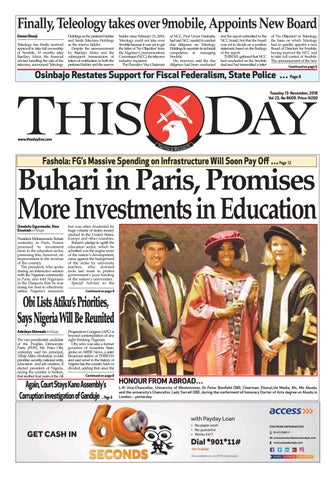
FROM ABROAD… Again, Court Stays Kano Assembly’s HONOUR L-R: Vice-Chancellor, University of Westminster, Dr Peter Bonfield OBE; Chairman, EbonyLife Media, Ms. Mo Abudu; and the university’s Chancellor, Lady Sorrell OBE, during the conferment of honorary Doctor of Arts degree on Abudu in Corruption Investigation of Ganduje … Page 6 London…yesterday
2
THISDAYt 56&4%": /07&.#&3 ĊČ ċĉĊđ
THISDAYt TUESDAY NOVEMBER 13, 2018
55
4
THISDAYt 56&4%": /07&.#&3 ĊČ ċĉĊđ
THISDAYt TUESDAY NOVEMBER 13, 2018
5
6
TUESDAY, ÍšÍťËœ ͺ͸͚΀ Ëž T H I S D AY
PAGE SIX
Again, Court Stays Kano Assembly’s Corruption Investigation of Ganduje Ibrahim Shuaibu in Kano Following a Kano High Court ruling yesterday that the status quo in the investigation of corruption allegation against the state Governor, Alhaji Abdullahi Ganduje, be maintained, the Kano House of Assembly has suspended further action on the enquiry. The Chairman of the committee investigating the alleged corruption, Mr. Baffa Dan Agundi, told journalists at the end of yesterday’s proceedings that the assembly would obey the court and suspend the investigation. The court on presided over
by Justice A. T Badamasi had again ordered the assembly investigative committee and all parties involved in the investigation of alleged $5 million bribery saga involving Ganduje to maintain the status quo ante. The court the order would also remain pending till the determination of the originating summon filed by the National Coordinator of Lawyers for Sustainable Democracy in Nigeria, Mr. Mohammed Zubair. When the case came up for hearing, Mr. Kalid Abdullatif, who stood in for Mr. Nuraini Jimoh, lead counsel to the plaintiff, stated that going by
Order 29, Rule 1 and Order 28, Rule 1 and 4 of the Rules of the Court, 2014, the application filed on behalf of the plaintiff on November 5, 2018, restraining the defendants, Kano State House of Assembly, Mr. Baffa Babba Dan Agundi and the state Attorney-General from further investigation of the bribery allegation, still subsisted. He said, “The application still remains an order of interlocutory injunction, restraining the defendants, either by themselves, agents, privies, or officials, or other persons, whosoever, from further inviting anybody, questioning, examining, making any further press releases,
Babba Dan Agundi (second defendant), Mr. Mohammed Sa’ad Waziri, described his clients as law-abiding citizens, who would not breach the law in any way. He said. “Before I proceed, I wish to state that the 1st and 2nd defendants are law-makers and law-abiding citizens. The order came a day to the date slated to listen to witnesses at the investigative panel. “Since then, no step has been taken by the state House of Assembly or the Investigative Committee to breach the law, this is to tell you that Kano State House of Assembly is law-abiding. The assembly
has no intention whatsoever to take any further steps until the subsisting matter is decided upon because constitutional issues are being raised.� The third defendant, who is also the state Attorney-General, Mr. Ibrahim Muktar, did not object to the prayers of counsel to the plaintiff. In his ruling, Justice Badamasi ordered all the parties involved in the case to maintain the status quo ante, pending the determination of the originating summon. He commended the counsel to the defendants for advising his clients wisely and adjourned the case to November 21 for further hearing.
approval of no objection by the Board of the NCC to the effect that the technical and financial bids Teleology submitted for 9mobile met and satisfied all the regulatory requirements. This is indeed the dawn of a new era in the evolution of the 9mobile brand in the Nigerian market." The new chairman, Bayero, welcomed the appointment, stating, "As we begin this new epochal phase, we wish to thank all the employees who built this viable business. Our
debt of gratitude also goes to our subscribers even as we assure them to get ready for real best-in-class additional value for their relationship with the 9mobile brand. Without you, there could not have been a 9mobile business for us to invest in today. We will justify your confidence in our brand by making significant investments that will improve the value you get for using 9mobile." The CBN in collaboration with the NCC had in July 2017 appointed a board chaired by
Dr. Joseph Nnanna, the Deputy Governor of the bank, to oversee the affairs of the company pending the completion of regulatory due diligence of the bid documents submitted by Teleology and 16 others for its acquisition. The bid process was superintended by Barclays Africa. But with the emergence of the board, the long process for the acquisition of 9mobile has reached a definitive end, marking the beginning of a new era for the telecommunication company.
Meanwhile, Acting Chairman of the Economic and Financial Crimes Commission (EFCC), Mr. Ibrahim Magu, yesterday told journalists he was not bothered over the issue of his non-confirmation as the substantive chairman of the anti-graft agency in Nigeria. Magu also explained that his commission was seeking the extradition of former Minister of Petroleum Resources, Diezani AlisonMadueke, because the United Kingdom authorities have failed to take legal action against her since 2015. Responding to questions from journalists at a media parley to mark his third anniversary in office, Magu said he was more concerned with uprooting the monster of corruption from the country, redeeming the much bartered image of the country as a result of corruption and his shared belief with President Buhari that “if Nigeria don’t kill corruption, then corruption will kill Nigeria.� Magu was appointed by President Buhari in November 11, 2015 to head the nation’s anti-corruption agency, the EFCC, but the Senate on different occasions, declined to confirm his appointment over allegations of corruption said to have been levelled against him by the Department of State Services (DSS). Despite the position of the Senate, the president in what some believed to be a demonstration of his strong confidence in Magu’s ability
to prosecute effectively the corruption war, however, refused to have him replaced. Given his stewardship in the last three years as acting chairman of the EFCC, Magu in response to a question on the issue of his non confirmation by the Senate said, “If people are in a hurry to confirm you in this work that I am doing, it means you are not working, it means you are derailing, you are not doing what is required because in this job there is no fear or favour. “You just concentrate on targets and get the work done that is the most important. If you are busy lobbying for confirmation you can’t be fair, you can’t be balanced. My only concern is to focus and I want you to help me to be focused, there is nothing wrong in you telling me Magu this is how it should be done, do it that way maybe you will have a better result�, he said. According to him, despite corruption always fighting back and his life and that of his men being constantly threatened, he would not relent in his effort in tackling corruption in the country. He said, “Indeed, the task of fighting corruption in Nigeria has never been, is not and can never be an easy one. The battle to make our dear country a place where foreign investors will be confident to invest in is, without doubt, one that must be fought by all Nigerians who love this country, if we are to make any appreciable progress.
“Notwithstanding all that, we can still say that overall, for us as an anti-graft agency, it has been, so far, so good. The past three years have been very eventful, and in spite of the obstacles, we have consistently made progress in the areas of convictions, and particularly the recovery of assets stolen from our commonwealth. Magu disclosed that following court orders, which granted the commission’s prayers for interim and final forfeiture of looted funds, the agency under his watch between November 2015 and today recovered over
releasing or playing any further video tapes, investigation or further proceedings, with the, or any bribery allegation against Governor Abdullahi Umar Ganduje, or anybody, whatsoever, therewith, pending the determination of the substantive suit before this honourable court.� He further argued that the act of the defendants to have constituted a committee to investigate the bribery allegation against Governor Ganduje remained unconstitutional. However, counsel to the Kano State House of Assembly (first defendant) and Investigative Committee Chairman, Mr. Baffa
FINALLY, TELEOLOGY TAKES OVER 9MOBILE, APPOINTS NEW BOARD board also coincided with the completion of the tenure of the former board. When contacted on phone, the Director, Public Affairs at NCC, Mr. Nnamdi Nwokike, did not respond to his phone calls and text messages. THISDAY later gathered that he was out of the country on official assignment. Teleology in a statement yesterday, said it was pleased to announce the constitution of a new Board of Directors for 9mobile, following the successful completion of the tenure of the
former board appointed by the Central Bank of Nigeria (CBN) and in fulfillment of the consequential transfer of final ownership to the new investors, Teleology Nigeria Limited. The seven-man Board of Directors include Chairman, Mr. Nasiru Ado Bayero; nonExecutive Directors, Mr. Asega Aliga, Mr. Adrian Wood, Mr. Mohammed Edewor, and Mr. Winston Udeh; and Executive Director, Mr. Abdurrahman Ado. Ms. Stephane Beuvelet was appointed acting Managing
Director. According to the statement, which was signed by one of the newly appointed members of the board, Edewor, the telecoms said, "We thank all out-going members of the board for helping to shepherd 9mobile through the critical transition phase it has passed through since July 2017 and wish them the very best in their future assignments. “For us, the composition of the new Board of Directors is another significant milestone, and this follows the issuance of final
BUHARI IN PARIS, PROMISES MORE INVESTMENTS IN EDUCATION President on Media and Publicity, Mr. Femi Adesina, in a statement, said Buhari lamented that even though his efforts were already yielding results in the transport and power sectors, he was being frustrated by the huge looted funds kept abroad. “I am doing my best now to utilise our resources to develop the country. We are already getting results on road, rail and power. My frustration is that some people still have plenty stolen money stashed in Europe, U S and other countries," Buhari was quoted as saying. Adesina said the president also noted that about five per cent allocation to the education sector was inadequate to propel the desired growth for the economy, noting that the United Nations target of 26 per cent remained the ideal standard. “We are currently reviewing investments in the entire infrastructure of the country like road, rail and power, including investing more in education. We will certainly need to do more in education,’’ he was further quoted. According to him, Buhari enjoined the Nigerian elite, both at home and in the Diaspora, to do more in contributing to the educational sector of the country, expressing surprise that the elite tolerated the fall in standards and structures of educational institutions despite oil windfalls in the past that would have made
all the difference. Furthermore, the president's spokesman said Buhari submitted that the return of stolen assets in some safe havens would bolster the administration’s current effort to invest more in critical infrastructure that would directly impact on the livelihood of Nigerians. He also said the president pledged that the war against terrorism would be reinforced with new weapons and hardware for the military, adding that the challenge of abduction and kidnapping in some parts of the country would also receive more attention with better gathering of intelligence. “We campaigned on three key issues; security, improving the economy, and fighting corruption, and we have not been controverted by anyone that we have not recorded some results,’’ he further quoted the president. The statement said Buhari also spoke on issues bordering on Nigerians' in Diaspora participating in elections back home, saying the president reasoned that the population of citizens in various countries across the world had already necessitated their involvement in the election of their leaders. However, he said the president noted that this desire might not be realisable in the 2019 elections because the Independent National Electoral Communication (INEC) had been more focused on moves to strengthen and consolidate on the effort to
conduct credible elections within the country but expressed optimism that it might come to fruition in future. The statement added that the Nigerian Ambassador to France, Dr. Modupe Irele, in her remarks, told the president that the Nigerian community in France had demonstrated a high sense of responsibility, dedication and morality. According to her, the large number of professionals in the community had been encouraged to also contribute to the country’s development. “Nigerians here are law abiding, peaceful and resourceful,’’ she reportedly said. According to the statement, Irele said Buhari’s commitment to change would make Nigeria the envy of other African countries. It also said the Nigerians in Diaspora, who participated in the meeting, raised questions on education, inclusive elections, security, infrastructure and the economy. It added that the meeting was facilitated by the Senior Special Assistant to the President on Diaspora Affairs, Mrs. Abike Dabiri-Erewa and attended by Governors Willie Obiano, Aminu Masari and Kayode Fayemi, of Anambra, Katsina and Ekiti States respectively, as well as other top government functionaries.
Magu Explains Plan to Extradite Diezani Alison-Madueke
Continued on page 8
TOP GAINERS NGN NGN % REGALINSURE 0.02 0.22 10.0 UNIONDAC 0.02 0.27 8.0 FLOURMILLS 1.10 16.50 7.4 OANDO 0.30 4.95 6.4 HONEYWELL 0.03 1.08 2.8 TOP LOSERS NGN % ABBEYMORTG 0.11 1.06 9.4 DIAMONDBANK 0.12 1.16 9.3 NEMINSURE 0.23 2.57 8.2 LIVESTOCK 0.04 0.52 7.1 FCMB 0.04 1.59 2.4 HPE Nestle Nig Plc â‚Ś1,46.00 Volume: 142.111 million shares Value: N1.556 billion Deals: 2,772 As at yesterday 12 /11/18 See details on Page 31
THISDAYt TUESDAY NOVEMBER 13, 2018
7
8
TUESDAY, ÍšÍťËœ ͺ͸͚΀ Ëž T H I S D AY
NEWS
Osinbajo Restates Support for Fiscal Federalism, State Police Segun James Vice-President Yemi Osinbajo has again accused former President, Dr. Goodluck Jonathan’s administration of plunging the country into debt. He equally accused the previous administration of grand corruption and impunity. Osinbajo has also stated that he is an advocate of fiscal federalism and state police. The vice-president, who spoke in Lagos at a lecture titled: ‘Restructuring and the Nigerian Federation’, he delivered yesterday as part of activities marking the 40th anniversary of Association of Friends, said he was taken aback on assumption of office at the kind of grand corruption that took place under the previous governments. He said for instance, he was shocked to find that in one day, $292million (about N70billion) was moved out from the Central Bank of Nigeria (CBN), “without any contract or real explanation.� According to him, the dollars
hauled from the CBN left the apex bank dollar-broke for two weeks. He said it was unimaginable that despite earning $381billion from crude oil sale between 2010 and 2014-the highest that the country had ever earned-the country’s external reserves fell to $30billion by 2014, and that the Jonathan administration left behind a debt of $63.806billion. The vice president noted that between 2010 and 2015, Nigeria’s debt jumped from $35,093.10billion to $63,806.53billion. He said: “What do these figures show? They show that when oil prices were at the highest between 2010 and 2014, the government was borrowing heavily. “From 2010 to 2014, debts moved from $35billion to $63billion. When we assumed office in 2015, the debt that the previous government left was $63billion. Today, three and half years later, the debt is $73billion. “There are two reasons why despite high earnings, we
Osinbajo are poorer. The first is grand corruption and mismanagement of resources. And there is a difference between grand corruption and ordinary corruption. “Grand corruption is directly stealing from the CBN, directly taking money from the treasury
without any contract, no pretence or caution, you just take the money. That was going on, and I will give you several examples. “When I got to the office as vice-president, I couldn’t believe it. In one day, $292million was signed out and it disappeared.
After that period, for two weeks, the CBN did not have dollars-$292m without any real explanation! We later discovered what became of the money.� Osinbajo has also stated that he is an advocate of fiscal federalism and state police. “I have been an advocate, both in court and outside, of fiscal federalism and stronger state governments. “I have argued in favour of state police, for the simple reason that policing is a local function. “You simply cannot effectively police Nigeria from Abuja; only recently, I made a point that stronger, more autonomous states would effectively eradicate poverty. “So, I do not believe that geographical restructuring is an answer to Nigeria’s socioeconomic circumstances. “That would only result in greater administrative costs; but there can be no doubt that we need deeper fiscal federalism and good governance.�
Osibanjo further said: “On another occasion, N60billion was moved out ostensibly for security purposes; but we know what happened. “When you have a corrupt government, large sums of money which can be used for development is simply taken. If you are the President of Nigeria, you can literally say: ‘Go and bring money.’ “Look at a sum of N60billion; when someone can take such amount of money and $292million, that’s almost N70billion. Today, our TraderMoni scheme is costing us N20billion, where we’re giving to petty traders a loan of N10,000, and when they pay back, we give them N15,000 and when they pay back, we give them, N20,000. But somebody will take $292million, almost N70billion. If you have such money, you will solve the problem of seven million of those petty traders. That’s the kind of thing we are talking about and the kind of contrast that we’re trying to draw.�
Minimum Wage: Labour Gives President Two Weeks to Submit Bill to N’Assembly
Onyebuchi Ezigbo in Abuja
The Nigeria Labour Congress (NLC) yesterday said the organised labour expects President Muhammadu Buhari to submit the new national minimum wage bill to the National Assembly for passage into law within the next two weeks, explaining that it was prepared to constructively engage the federal legislature to ensure quick passage of the bill. Speaking to THISDAY on telephone last night, the General Secretary of the NLC, Mr. Peter Essom, said labour
expects speedy transmission of the outcome of the negotiations to the legislature without further waste of time, warning that any delay could attract a reaction from workers. "We insist that a bill reflecting the agreement reached at the tripartite negotiations be forwarded to the National Assembly as soon as possible; that is what we are standing on. If that is not done within a reasonable time, then you will hear from us,� he said. On what would amount to a reasonable time for the organised labour under the
circumstances, Essom said, "We will determine what reasonable time is; remember that the NLC President had indicated that within a period of two weeks, we expect this bill to be forwarded to the National Assembly. So let us wait and see. When we believe that there is an unnecessary delay in the process, we will take decisions need to be taken and we will communicate to members of the public," he said. The NLC scribe said that labour was appealing to President Buhari to kindly expedite action
on the proposed new national minimum wage by transmitting it to the National Assembly in good time. He said the Tripartite Committee on the New National Minimum Wage had concluded its meetings and a report on N30,000 minimum wage agreed upon, adding that the ball was now in the court of government to do the needful. “We all signed up on the N30,000, so why should there be any controversy. The report has been submitted to Mr. President and what we expect now from Mr. President is to
do justice to that report, by quickly raising an executive bill on the new National Minimum Wage. And when that bill gets to the National Assembly, we want to assure Nigerian workers that we will be ready to engage them constructively,’’ he said. The Tripartite Committee on the new National Minimum Wage concluded its negotiation process on November 5 and submitted the report to Mr. President on November 6. Before then, the federal government had offered to pay N24,000, while the organised labour had agreed with the
Organised Private Sector (OPS) to stand on N30,000 as the new National Minimum Wage. President Buhari while receiving the committee report, said: “In a way, both arguments are valid. I want to assure you all that we will immediately put in place the necessary machinery that will close out these open areas. Our plan is to transmit the Executive Bill to the National Assembly for passage within the shortest possible time. I am fully committed to having a new National Minimum Wage Act in the very near future,’’ he said.
unreasonable that she is not being tried there. “So, we are tired of waiting and that was why I said if you cannot prosecute her, bring her and we will prosecute her. There is no prosecution going on in the UK. “We are involved in the investigation in this country and outside the country, including America and London. I have been there. We have worked and sat together. We cannot wait endlessly. I think three years and above is sufficient for you
to take her to court. There is no court process against her in the UK. Nobody is prosecuting her there.� Magu refused to answer questions on whether the Kano State Governor, Abdullahi Ganduje, was on a probe. During the question and answer session, the EFCC boss was asked to confirm if the commission was investigating Ganduje who was allegedly caught on camera collecting kickbacks from contractors.
He simply said, “Next question please.� The Kano State House of Assembly had begun investigations into the matter but was stopped by a court from going further. The Chairman of the Presidential Advisory Committee Against Corruption, Prof. Itse Sagay (SAN), had said the Kano Assembly was not competent to probe the governor, adding that only an anti-graft agency like the EFCC could do so.
no one listened to me. Today, IMF, World Bank has said the same thing. “We are using almost 60 per cent of our revenue to service debts. We are borrowing more. The Nigerian financial system, National Assembly, everybody is flying to London for a road show to borrow more money. This is what we should be discussing, what is this money going to be used for? Not discussing whether Peter Obi comes from Anambra or Imo.� The vice presidential candidate commented on the ongoing conversation on minimum wage and said while he wasn’t speaking for the presidential candidate or the party, he said there was need to sit down with labour, look at the income of the nation
and the various states and determine the appropriate figure. “Personally, I do not believe that somebody from Lagos should pay same thing with somebody from Ebonyi State. If you go all over the globe, there is no place where two states pay the same salary even America that we always cite as example,� he said. Reacting to a statement credited to the governor of Kaduna State, Mallam Nasir El-Rufai that there is no single thinking brain left in the PDP, he mocked the Kaduna governor, saying, “All the good brains are in the APC and yet the country isn’t working.� He stated, “Well, all the good brains are in APC, but the country is not working. The good brains are in APC, yet the country is collapsing. That’s
all I can say. When APC came, this country was growing at six per cent, since they came, look at where we are! Everything has headed south, not one item is positive.� The vice presidential candidate stressed that in 2015, APC came to campaign with a bundle of lies and presently, instead of the ruling party telling Nigerians if they had been able to fulfill their promises, they were spinning more lies. Obi said what the PDP was concerned with now was to bring the country back to where it used to be. On the search on Atiku by the security agencies, he said that the opposition leaders were not only targeted and persecuted, but the ruling party was turning the whole thing into childish affair.
BUHARI IN PARIS, PROMISES MORE INVESTMENTS IN EDUCATION N794billion. “Over $261million has been recovered. The Pounds Sterling recovered stands at 1, 115, 930.47 Pounds. The Euros recovered in the period is: 8, 168, 871. 13 Euros. There is also the sum of 86, 500 CFA,� he stated. In the area of conviction, Magu said within the same period the EFCC secured 703 convictions. 103 convictions in 2015, 194 convictions in 2016; 189 in 2017 and 217 from January 2018 till date.
Apart from monies recovered, other items recovered, he said, included hundreds of properties such as filling stations, petroleum products, land, jewelry, automobiles, real estate, vessels, hospitals, company shares and heavy machinery and broadcast equipment. Magu added that his commission was seeking the extradition of former Minister of Petroleum Resources, Alison-Madueke, because the United Kingdom authorities
had failed to take legal action against her since 2015. He added that the commission was equipped to successfully prosecute the former minister who had been accused of mismanaging oil funds to the tune of $20bn. When asked if her extradition to Nigeria would not affect her pending case in the UK, Magu said, “There is no court trial. She was being investigated even before I assumed office. So, it has taken so long and it is very
OBI LISTS ATIKU’S PRIORITIES, SAYS NIGERIA WILL BE REUNITED APC took power, six Nigerians attain poverty every minute. According to him, “This year alone, between January and September, over four million people lost their jobs. Every minute, six Nigerians are being pushed into poverty. Go to the market now, there is no demand. People don’t have money to do anything.� While explaining some of the priority areas that the Atiku/Obi presidency would tackle, he said security was most critical and the Atiku presidency would do everything possible to restore security to the country. He stated, “The country is so divided that you can’t imagine it, along tribal lines, religious lines between Muslims and Christians; an Atiku presidency will unite the country. Everybody knows
that Atiku has friends in every part of the country, even in his own personal team, his friends are from everywhere.� He spoke about the primacy of education in national development and said Nigeria under Atiku’s watch would pay special attention to the sector. Obi said, “Atiku presidency will deal with the issue of education, which is the most critical investment any nation can do. The more educated the people are, the better the development of the society. “Atiku as a person built a primary school, a secondary school, a university and he was not doing them for money. If he was doing them for money, he had the opportunity to build them in Abuja or Lagos, while he was the vice president. That’s when he built those
schools, but he built them in Adamawa.� Obi regretted the country’s debt burden and carpeted the APC-led administration for not curbing the trend, explaining, however, while he was not against borrowing, there must be a purpose for it, and that this must be explained to Nigerians. According to him, “On May 1, 2017 I said the country’s debt was too high. The debt keeps getting worse. Everybody was busy playing politics. The Minister of Finance then questioned this revelation. I said, ‘Minister, I have managed money all my life.’ Most of the people contesting today, I have managed money more than they have managed money as a business man. I know when things go wrong. Because I wasn’t a famous economist,
TUESDAY NOVEMBER 13, 2018 ˾ T H I S D AY
9
NEWS
Group News Editor Ejiofor Alike Email Ejiofor.Alike@thisdaylive.com, 08066066268
1,801 Persons Killed in Plateau Attacks, Says Report Loss of lives won’t go in vain, Lalong assures victims
Seriki Adinoyi in Jos No fewer than 1,801 persons have been confirmed dead and 50,212 others displaced in recent attacks in Plateau State. The Committee on Resettlement of Internally Displaced Persons (IDPs), set up by the state government, made the confirmation yesterday. This development is coming as the Governor of the state, Simon Lalong, has assured the people of the state that the deaths and loss of properties won’t go in vain, as it is the responsibility of government to exhibit the duty of care towards them as well as all citizens. The Chairman of the committee, Air Vice Marshall Bala Danbaba (rtd), presented his report to Lalong in Jos. Danbaba said the committee identified 115 communities cutting across Jos North, Jos South, Bassa, Riyom, Barkin Ladi and Bokkos Local Government Areas, that were affected by the crises. He said the committee, whose one month period was later increased to two months, received 55 memoranda and
visited 27 camps where the IDPs were quartered. “The only IDPs camp we did not visit was the one at Lere, in the Dorowa area of Barkin Ladi Local Government Area. We could not go there because of security reasons. “The committee also visited all the affected communities for an on-the-spot assessment,” he stated. He said the committee had recommended that the IDPs be returned to their ancestral homes, saying the exercise should be carried out in four phases. “The committee also emphasised the provision of adequate security in the affected areas,” he said, adding that the IDPs were willing and anxious to return to their homes, if security was guaranteed. Danbaba suggested that a victim support programme be initiated to reduce their sufferings. The committee also called for the establishment of temporary camps within the victims’ communities, for them to live in, while their houses were being reconstructed. Lalong, who received
Obasanjo Accuses State Governments of Stealing LG Funds Femi Ogbonnikan in Abeokuta Former President Olusegun Obasanjo, yesterday came hard on state governors who were opposed to local government autonomy, accusing them of stealing the councils’ funds. The former president stated this while playing host to members of a Non-Governmental Organisation, Friends of Democracy, at his residence inside Olusegun Obasanjo Presidential Library (OOPL), Oke-Mosan, Abeokuta. He added that many councils could not perform their statutory functions because they have been “incapacitated financially” by the state governments. Obasanjo who went down the memory lane, noted that the Local Government Reforms carried out in 1976 was meant to strengthen local government as the third tier of government and not an appendage. The former president asked the leadership of the Nigerian Labour Congress (NLC) and the Nigerian Union of Local Government Employees (NULGE) to demand for the autonomy in the interest of the people at the grassroots. He said, “When in 1976, we brought in Local Government Reforms, it was meant to be third tier of the government and not meant to be subjected to whims and caprices of any other government - just the same way that the state government is autonomous from the federal government. “Local government is meant to be autonomous from the state government. “But from what we know, by design, most states have incapacitated the local government.
They have virtually stolen the local governments’ money in what they called Joint Account. They were to contribute 10 per cent but they never contributed anything. “So, what we have across the country are local government areas that have functions, but cannot perform the functions. They have staff but most of them cannot pay the staff, and we keep getting excuses upon excuses. “And I see no reason if the federal government allows the states to enjoy their autonomy except in the case of state of emergency. “The bill passed by the National Assembly which requires 24 state Houses of Assembly and like I am told only nine states have signed it. “I am proud of those states because they are what you will call progressive states that really believe in democracy. “My own state (Ogun) is one of them. I will say kudos to Ogun State. In the South-South, only Bayelsa and Cross River States have signed it - kudos to those two states. In the North-east, it’s only Bauchi. In the North-west, it’s only Sokoto. In the North-central, we have four states, Kwara, Niger, Plateau and Benue. I will say kudos to the executives and the legislature of those states. “But we must say those state executives and the legislatures that have prevented the bill from being passed, they must be taken as the enemy of the people and they should be treated as such. Because if you enjoy autonomy from the federal government why don’t you want local government to enjoy autonomy?
the report, commended the committee for carrying out a good job, and announced that the seven-man committee would be responsible for its implementation. Lalong assured the people of the state that the deaths and loss of properties of all victims in the various crises in the state
won’t go in vain, as it is the responsibility of government to exhibit the duty of care towards them as well as all citizens. He added that having attracted the establishment of the 205 Combat/Rescue Units in Kerang and Mobile Police Squadron in Shendam, and with the recent approval
to establish Mobile Police barracks in troubled Gashish district of Barkin Ladi, where herders/farmers clashes had repeatedly occurred, IDPs from the area would soon be re-settled back to their homes. Lalong stated that it was in the spirit of restoring peace in the state that “on assumption of
duty in May 2015, we made it a priority that security, peace and good governance must take the centre stage for any meaningful and sustainable development to take place. This led to the establishment of the Peace and Reconciliation Committee that met and made far-reaching recommendations for the government to implement.”
ACKNOWLEDGING CHEERS...
L-R: All Progressives Congress governorship candidate in Lagos State, Mr. Babajide Sanwo-Olu; Lagos State Governor, Mr. Akinwunmi Ambode; and Vice President, Prof. Yemi Osinbajo; during the TradeMoni for petty traders, at Ikotun market in Lagos...yesterday
PDP, INEC Disagree over Sokoto Gubernatorial Candidate Adedayo Akinwale in Abuja The Independent National Electoral Commission (INEC) and the Peoples Democratic Party (PDP) have disagreed over the names of the governorship candidate of the party and his deputy in the state. While the electoral body said it did not reject or exclude the name of the governorship candidate in Sokoto State, the main opposition party accused the commission of manipulating the list of its candidates in the state. The name of incumbent Governor of the state, Aminu Tambuwal, was conspicuously missing when the electoral body displayed the list of candidates for the forthcoming governorship in the state last week. But, the main opposition party through its National Publicity Secretary, Mr. Kola Ologbondiyan accused INEC of manipulating the process, while insisting that the party
submitted the name of Tambuwal. However, the National Commissioner of INEC on Voter Education and Publicity, Mr. Festus Okoye, told THISDAY yesterday that the two names published by INEC were the names submitted by the PDP. He stressed that the said names emanated from the party’s primary elections conducted by the PDP in Sokoto State. Okoye said, “As at the close of nomination for governorship and State House of Assembly election, the PDP submitted the two names for governorship and deputy governorship, and the name that was submitted to INEC was that of Manir Muhammed Dan’iya and for the deputy governorship candidate for the same position was Abubakar Zaki Bashir.” “INEC did not reject or exclude any name that was submitted by the national headquarters of the PDP. That is the current situation
of things. “We have made it very clear that we shall only accept names of candidate submitted by the political parties and signed by the National Chairman and National Secretary of the party. “And the names submitted by the national chairman and national secretary of the PDP are the two names that have just mentioned, that of Manir Muhammed Dan’iya and that of Abubakar Zaki Basir for governorshipanddeputygovernorship for the PDP for Sokoto state.” Okoye noted that any party can substitute any candidate between now and November 17, 2018 for presidential and National Assembly, and December1,2018forgovernorship and State House of Assembly, saying the issue of substitution of candidate is a legal matter. “Every political party that submitted list can substitute those candidates if one; the candidate whose name was submitted died
within this particular process or a candidate that was nominated uses his handwriting that he’s no longer indeed in being the candidate of the party,” he explained. But, Ologbondiyan while featuring on ARISE News on Monday, a sister organisation of THISDAY, said that it was strange if Tambuwal’s name did not make it to INEC. According to him, “It is strange if his name did not make it to INEC as the candidate of the party. INEC has become very manipulative and they are shopping for candidates from the states. Candidates who didn’t obtain form from the party, candidates who never participated in processes or our primary election are now being enrolled on their list as their candidate.” He noted that the party would insist and every order that contravenes the party’s position will be vacated in court.
Ondo Assembly Leadership Crisis Deepens, Sacked Speaker Presides over Plenary James Sowole in Akure The leadership crisis rocking the Ondo State House of Assembly over the removal of the Speaker, Hon. Bamidele Oloyeloogun and his deputy, Hon. Ogundeji, deepened yesterday as the former speaker presided over the House plenary. The sitting was attended by the speaker and the eight lawmakers loyal to him.
During the plenary, which was attended by nine lawmakers, the 2018 Appropriation Bill sent by the state governor, Mr. Rotimi Akeredolu, for amendment, was read. Eighteen lawmakers had last Friday announced the removal of Oloyeloogun and Ogundeji subsequent upon which Olamide George and Abimbola Fajolu were elected as speaker and deputy speaker of the Assembly,
respectively. While George claimed that 18 members of the Assembly endorsed the change of leadership, Oloyeloogun said only 16 members attended the session and not 18. He alleged that signatures of two members were forged. According to Oloyeloogun, two members whose signatures were allegedly forged are : Mr Sunday Olajide and and Olusola
Oluyede, who represent Akure South Constituency II and Ose Constituency, respectively. Olajide, said he was neither informed nor briefed on the move by his colleagues on the purported removal. He stated that it was criminal for anyone to forge his signature, emphasising that he was not part of any meeting and did not participate in the removal process.
10
TUESDAY NOVEMBER 13, 2018 ˾ T H I S D AY
NEWSEXTRA
Invasion of Atiku’s Plane Premeditated Intimidation Tactic, Says Campaign Team Adedayo Akinwale in Abuja The Atiku Presidential Campaign Organisation (APCO) has said that the invasion of the private jet of the presidential candidate of the Peoples Democratic Party (PDP), Alhaji Atiku Abubakar by the special security squad was a premeditated intimidation tactic
by the All Progressive Congress (APC)- led federal government. The campaign organisation in a statement yesterday in Abuja said last week, the ruling party had released a statement accusing former Vice President of having strategy meetings for the purpose of moving “illicit cash” into Nigeria and asked the security
Killer Beans: SON Issues New Standards for Beans Production Jonathan Eze The Standards Organisation of Nigeria (SON) has given highlights in line with the Nigerian Industrial Standards (NIS) Codes of Practices for beans seed planting across the country. The Director General of SON, Osita Aboloma, in a statement commended a consumer for reporting a beans vendor who preserved beans with pesticide, stated that the standards are relevant NIS and Codes of Practice for beans along the value chain in order to take care of issues concerning the proper preservation of the crop from planting to the table, while also assuring the safety of consumers. He enumerated the Standard and Codes of Practice as follows; Standard for Dry Beans (NIS 1030: 2018) Code of Good Agricultural Practice: Planting of Dry Beans (NCP 065: 2018) and Code of Good Practice: Harvesting of Dry Beans (NCP 067: 2018). Code of Practice for Packaging of Dry Beans (NCP 064: 2018) and Code of Practice: Storage
services to investigate Atiku and his plane. The APC in the statement had said, “Our intelligence, anti-graft and security agencies must be awake to its responsibility of investigating the Dubai meeting. Cash-and-carry politicians must be prevented from moving illicit cash around to induce voters and sponsor election violence and rigging. Again, relevant agencies must check suspicious movement of cash both locally and internationally by politically
exposed persons under the guise of a “Dubai meeting” or any clandestine meeting”. APCO stated: “That statement evinced an obvious premeditated intention by the APC and its federal government to deliberately embarrass the former vice president by invading his plane with security personnel and possibly to set him up for the crimes they had already officially accused him of in their statement.” “The official denial by the All Progressives Congress and the
Presidency of any hand in the ordeal of the former vice president is put to lie when you examine their statement of last week which was clearly what was implemented against the former vice president. It also shows that both parties have no credibility and will do or say anything to further their interests. “The statement by the aviation ministry that the search of Atiku Abubakar’s plane is “routine” is an afterthought that does not hold water for the simple reason that
the PDP Presidential candidate has been flying in and out of Nigeria without ever receiving such a treatment until the APC released their statement.” This event, it added, raises grave concerns about using government services for purely political purposes and what this portends for the conduct of free and fair elections in February 2019, and shows as hollow President Buhari’s promise to superintendent over credible polls.
and Transportation of Dry Beans (NCP 066: 2018). The SON helmsman urged Nigerians to take greater interest in their welfare by reporting to relevant regulatory and security agencies any suspected unwholesome, sub-standard or life-endangering products or practices. He, however, commended the consumer who reported to the police the beans vendor who was using a pesticide to preserve the crop for sale. According to him, such individual and collective awareness by consumers in general are essential for effective standards implementation and enforcement in Nigeria. He pointed out that the standard and codes of practices, which have been approved for use by the Standards Council, were results of consensus decisions by stakeholders, including, farmers, processors, L-R: Publisher/Editor-in-Chief, BrandPower Magazine, Nnanke Harry Willie; Chief Executive Officer, MultiChoice Nigeria, and Winner of the Federal Ministry of Agriculture Youth Empowerment Through Access to Information and Thought Leader Par Excellence Awards, John Ugbe; and Partner, Alatta Nzewi officials, regulatory agencies, Oyeka & CO, Ralph Okorocha, during the 2018 BrandPower Golden Icon Awards held in Lagos…recently academicians, research institutes, consumer advocates among others, while SON officials provide the secretariat. “Things must be done in Kalu’s treatment arrangement, but counsel for the EFCC, Mr. Rotimi Davidson Iriekpen Jacobs (SAN), was aware of the accordance with the law. In he said the defence counsel failed to Justice Mohammed Idris of the development, and urged Justice my own view, what happened attach any medical report to guide is that the first defendant has the court as to Kalu’s post-surgery Federal High Court in Lagos has Idris to further adjourn the case. But the EFCC prosecutor, Jacobs, jumped bail. This is an attempt treatment. revoked the bail granted former Justice Idris said in the Governor of Abia State, Orji Uzor said he was surprised at Kalu’s to further frustrate this trial because Kalu, in 2007 for flouting his order. absence from court, adding that no application was made to the court circumstance, he would, in the interest of justice, adjourn the case to give you our assets declaration Kalu is standing trial after he he did not know if or when the to travel. “I urge your lordship to treat the for the last time, stressing that Kalu form and within 30 days, you are was arraigned by the Economic ex-governor obtained the court’s absence of the first defendant as that mustreturnfromGermanywithinseven required to fill and return them. If and Financial Crimes Commission permission to travel out. days and appear before the court. you fail to return them, then we (EFCC) for an alleged fraud of Jacobs noted that having submitted he has jumped bail,” Jacobs said. The judge ruled: “I have always Responding, however, the can charge you to court. We have N7.65billion. his passport to the court as part of charged him before the Federal The judge had last week given his bail conditions, Kalu must always defence counsel urged Justice Idris stated that every citizen of this country is High Court for failure to declare Kalu a seven-day ultimatum to apply to the court for the passport to discountenance Jacob’s argument, entitledtoandhastherighttoseekmedical sayingasofwhenKalutravelledout,the treatmentabroad.Thisright is guaranteed his assets. He has notice of our return from Germany to face his whenever he wished to travel. invitation. We pasted the asset trial. Describing the ex-governor’s courthadadjournedthecaseindefinitely. bythe constitution, theAfrican Charter Ruling on the lawyers’ submissions, on Human and Peoples Rights, the declaration form in his residence The ultimatum came when Kalu’s absence from court as an attempt in accordance with the law.” lawyer, Prof Awa Kalu (SAN), told to frustrate the case, Jacobs urged Justice Idris noted that it was true that International Covenant on Civil and Obono-Obla equally said the the court that his client was away Justice Idris to interpret Kalu’s absence thematterwasadjournedindefinitelyon Political Rights and the Universal September 27, 2018, but Kalu was Declaration of Human Rights. It arrest has nothing to do with the in Germany for surgical operation. to mean that he had jumped bail. crisis rocking the state chapter of the “I am not aware when the first on November 2 served with a is an inalienable right. He added that the ex-governor “However, this right has exceptions. All Progressives Congress (APC), had been advised by his doctors defendant wanted to travel. We only hearing notice that the case had as the panel only did its job. “It has to remain in Germany for some got to know that he travelled abroad been scheduled for last Monday. Therefore, in exercising this right, due The judge also noted that the regard must be had for the law and nothing to do with politics. Why is it time to recuperate. for medical treatment through his that each time we invite somebody, The defence counsel said media aide, one Kunle Oyewunmi. court received a mail confirming due process. people will begin to read political meaning to it?” he asked. “We have no business with what is happening in Imo State. We have been given a job to do and we have Kuni Tyessi in Abuja He buttressed the necessity government fully implements public tertiary institutions nor to do it. If he has issues, he should enough to settle their demands of the strike and questioned the all outstanding issues as have taken steps to clear all those The Academic Staff Union of in terms of remuneration and offer of N20 billion revitalisation contained in the Memorandum issues before vying for the election. Nigerian Universities (ASUU) others. fund despite the fact that the same of Understanding (MoU) of 2017 We have no business with that. We has vowed to sustain its nine National President of ASUU, government released N1.3 trillion and concludes the renegotiation have been asked to do something day old strike despite the federal Prof. Biodun Ogunyemi, while to a distressed bank recently. of the 2009 agreements. and we are doing it.” According to him, “This strike Ogunyemi lamented that government offer to release N20 reacting to the claims of the Meanwhile, the Independent billion as part payment for the federal government over the the ruling class has continued is total, comprehensive and National Electoral Commission union demands for improved ongoing strike in an interview, to regroup themselves in their indefinite. Our members shall (INEC) had published the name funding of public universities said universities in Nigeria have various factions “which they sadly withdraw their services until of Uzodinma as the candidate of the in the country. government fully implement all been subjected to 20 years of call political parties.” APC in Imo state, against the wish of He further reiterated that the outstanding issues as contained in The union said the yet-to-be continued re-colonisation under the state governor, Rochas Okorocha, released ‘paltry’ sum is neither ‘alleged’ democracy, with claims strike is total, comprehensive the MoU of 2017, and concludes whose preferred candidate is Uche capable of solving the myriad of that this has further retrogressed and indefinite as members have the renegotiation of the 2009 Nwosu, his son in-law. withdrawn their services until agreements. challenges facing the country’s the economy in all spheres.
WINNER OF ICON AWARDS…
Alleged N7.65bn Fraud: Court Revokes Orji Kalu’s Bail
Uzodinma, Imo APC Gov Candidate Nabbed in Abuja Emmanuel Otaru The governorship candidate of the All Progressives Congress (APC) in Imo State, Hope Uzodinma was arrested at Nnamdi Azikiwe Airport in Abuja on Sunday, over a breach of contract. Chairman of the special presidential investigation panel for recovery of public property panel, Okoi Obono-Obla confirmed this yesterday. According to him, Uzodinma was arrested over a breach of contract, when the company of the senator representing Imo West Senatorial district was awarded a $12m contract by the Nigerian Ports Authority (NPA) for the dredging of Calabar channel but did not execute the contract. Adding, “We have been looking for him for the past 13 months over a case of failure to execute a contract of $12m dollars awarded for the dredging of the Calabar channels awarded by the Nigeria Ports Authority”. “We have written countless letters to the clerk of the national assembly in accordance with their procedure. He has shunned all our invitations and he has been very evasive. “We pasted our assets declaration form because the first procedure when we are investigating you is
We’ll Sustain Lecturers’ Strike, Says ASUU Boss
THISDAYt TUESDAY NOVEMBER 13, 2018
11
12
TUESDAY NOVEMBER 13, 2018 ˾ T H I S D AY
NEWSEXTRA
Buhari Assents to 2018 FCT Appropriation Bill, Extradiction Treaty, Others Omololu OgunmadeinAbuja President Muhammadu Buhari has assented to the Federal Capital Territory (FCT) Appropriation Bill 2018. The president also assented to the Nigerian Centre for Disease Control And Prevention (Establishment ) Bill,
2018; the Extradition (Amendment ) Bill 2018; National Environmental Standard and Regulations Enforcement Agency (Establishment ) (Amendment ) Bill 2018; and Nigerian Institute of Mining And Geosciences, Jos (Establishment ) Bill, 2018. Consequent upon the assent,
CBN Cuts Bills on Wheat, Milk, Rice, Others to $698m OlawaleAjimotokaninDutse The Central Bank of Nigeria (CBN) said it cut down bills on wheat, milk, rice, tomato and sugar in the past five years to $698.6 million. Olatunde Akande, the Personal Assistant to the CBN Governor, Godwin Emefiele, made this disclosure yesterday at the Special Town Hall Meeting organised by the Federal Ministry of Information and Culture in Dutse, Jigawa State. Akande said the figure represented almost 50 per cent cut on $1.424 billion incurred on imported foods in 2013. He said some positive impacts had been recorded since government banned the importation of these commodities. According to him, at the end of 2015, the figure reduced by 30 per cent, as $971 million was spent importing the commodities. He disclosed that N160 billion had been disbursed to 850,000 smallholders farmers under the CBN Anchors’ Borrowers Scheme since the programme was conceived in November last year, to assist farmers in the cultivation of Rice, Cotton, Maize, Cassava, Groundnut, Sorghum, Cocoa, Palm Oil, Tomato
and Soybeans. The theme of the 15th Town Hall meeting, attended by the Minister of Information and Culture, Alhaji Lai Mohammed and his counterparts in Water Resources, Suleiman Adamu; Agriculture, Chief Audu Ogbeh and Trade and Investment (State) Aishat Abubakar, was “Agriculture and Agric Value Chain”. Ogbeh said that in the first year of the CBN Anchors’ Borrowers Programme, N294 billion was yielded as turnover by the rice farmers from the initial N40 billion given as loan by the apex bank, adding that the reduction of interest rate on lending to farmers to nine per cent has ignited a revolution in agriculture in the country. Ogbeh said with the reform of the Bank of Agriculture, which will be completed by the end of this year, the government is targeting five per cent lending rate to farmers. He disclosed that Nigeria exported $35 million worth of Hibiscus to Mexico and Russia last year, while China is demanding for shiploads of Nigerian White Sorghum. Mohammed, who thanked Jigawa State Governor, Badaru Abubakar for hosting the meeting, identified agriculture as one of the success stories of the Buhari administration.
the bills have now become Acts. Briefing State House correspondents on the content and objectives of the Acts, Senior Special Assistant to the President on National Assembly Matters, Senator Ita Enang, said the FCT Appropriation Act, 2018 was made up of aggregate capital and recurrent expenditure of N371.532 billion meant for implementation “up to the financial year ending December 31, 2018.”
Enang also explained that the Extradition (Amendment) Act, 2018 vests jurisdiction on extradition proceedings henceforth on the Federal High Court and no longer on the Magistrates Court or Magistrates. According to him, amendment to the Act introduces a new Section 15(2) with the aim of “preventing double jeopardy as protected by Section 36(9) of the Constitution” and in accordance with extraction
treaty. He explained that anyone surrendered to Nigeria in accordance with the treaty could not be arrested, detained, extradited or otherwise dealt with in Nigeria or any other country within the Commonwealth or any other country having same extraditing agreement with Nigeria if the proceedings relate to an offence for which he has been previously convicted or acquitted
in the requesting country for which extradition is sought by the Nigerian authorities. On the other hand, he said the Nigeria Centre for Disease Control and Prevention (Establishment Act, 2018) is aimed at promoting, coordinating and facilitating the prevention, detection and control of communicable diseases and other public health emergencies in Nigeria.
REMEMBERING ALMA MATER…
L-R: Rector, Lagos State Polytechnic’s Business School, Dr. Biyi Oyetade; immediate past Group Managing Director, First Bank of Nigeria Plc, Mr. Bisi Onasanya; and National President, Lagos State Polytechnic, Alumni National Association; Muyiwa Olugbile, during Oyetade’s inspection visit to his alma mater, Isolo Campus, where he donated ICT accountancy laboratory on behalf of his set (Accountancy 79/83), in Lagos…recently
Fashola: FG’s Massive Spending on Infrastructure Will Soon Pay Off Chineme Okafor in Abuja The Minister of Power, Works and Housing, Mr. Babatunde Fashola, yesterday said that the investments made so far by President Muhammadu Buhari, in Nigeria’s road, housing and power sectors would soon come to full fruition, thus urging Nigerians to give the administration some more time for that to happen. Speaking to reporters at a press briefing in Abuja, Fashola who claimed that the government inherited an infrastructure budget of N18.132 billion in 2015, and expanded it to N394 billion in 2018, had done well in fixing Nigeria’s poor infrastructure. He said the expansive infrastructure budget was possible despite the government earning less revenue as a result of a dip in oil prices, and then blamed past governments for not effectively utilising revenue earned from crude oil sales to develop the country’s roads, power and housing infrastructure. While presenting what he
termed as a three-year scorecard of his ministry, Fashola said the government had initiated and implemented a good policy to upgrade the country’s infrastructure stock, but would now need Nigerians to give it some more to become fruitful and beneficial to the country and its citizens. “We have prepared for the worst and we now hope for the best. The success of our plans now depend on the cooperation of road users who must drive carefully and energy users who must conserve energy when not needed. “Ladies and gentlemen, we came to this job in November 2015 with a mountain to climb. With careful thinking, planning, and a dedicated team of public officers, we have a firm foothold on our way to the top. Our policies have shown what is possible with critical sectors recording growth,” said Fashola. “What remains is time that it takes for the full harvest of the
fruits of our policies in plenitude and prosperity of our people. We cannot go back to the bottom of the mountain when the plateau is now within reach,” he added. While fielding questions from reporters on the poor road networks in the country, the minister admitted this existed, but blamed the past administrations for the situation. He said: “Yes, we know they are bad. There is no magic to it. If those who came before us had done their work, we won’t meet bad road. That is the simple truth. We earned $100 per barrel of crude oil for about five years. “We knew what other countries like Abu Dhabi (UAE), Saudi Arabia did with their own, what did we do with ours? So, this is a president and a government that is now trying to do more with less that it has. So, give us some time, we will get there.” He explained the federal government was doing road projects across every state of the federation especially abandoned
projects like the Lagos – Ibadan Expressway; the Second Niger Bridge; Enugu-Port Harcourt Road; and Jebba-Mokwa Road, among others. According to him, in 2016, about 277 kilometres of road was constructed, 345 kilometres rehabilitated, while 17,749 people were employed in the process. For 2017, he said 488 kilometres of roads were constructed while 256 kilometres were rehabilitated and 31,227 persons engaged in the process. And, so far in 2018, he added that 497 kilometres of road has been constructed, 284 kilometres rehabilitated and 30,402 persons employed. He said the figure could rise in December due to more rehabilitation projects going on nationwide. In the power sectors, the minister said: “With regard to power, we have improved on what we met, by increasing generation from 4,000MW to 7,000MW, transmission from 5,000MW to 7,000MW and distribution from 2690 MW to 5,222MW.”
40m Nigerians Suffering from Mental Disorders, Says FG The federal government yesterday said an estimated 40 million Nigerians are believed to be suffering from mental disorders. Permanent Secretary, Federal Ministry of Health, Abdulaziz Mashi Abdullahi, stated this at the ongoing mental health action committee and stakeholders workshop in Abuja. Abdullahi, who attributed the country’s high
burden of mental disorders to inadequate attention paid to mental illnesses, misconceptions and lack of awareness on the part of the Nigerian public, said more people will be disabled by psychological challenges than complications arising from HIV/AIDS, heart disease, accidents, and wars combined by the year 2020. He identified ways of addressing
the country’s mental health burden to include: fast-tracking the enactment of the Mental Health Act as well as the resuscitation of the national mental health action committee for the coordination of stakeholders’ activities on mental health and psychosocial supports in the country. He said: “In Nigeria, an estimated 20–30 per cent of our populations are believed to suffer from mental
disorders. This is a very significant number considering Nigeria has an estimatedpopulationofover200million. “Unfortunately, the attention given to mental health disorders in Nigeria is inadequate. The level of awareness of the Nigerian public on mental health issues is also understandably poor, and with lots of misconceptions.
THISDAYt TUESDAY NOVEMBER 13, 2018
13
14
T H I S D AY Ëž Ëœ ÍŻÍąËœ Í°ÍŽÍŻÍś
COMMENT
Editor, Editorial Page PETER ISHAKA Email peter.ishaka@thisdaylive.com
A WAKE-UP CALL ON ABUJA EARTH TREMORS
There is need for a proper monitoring of all earthquake-prone areas in the country, writes Adewale Kupoluyi
N
atural disasters often occur without giving notice. In most cases, when they happen, they have devastating effects on human lives and property. While not much can be done to prevent nature from taking its course, early warning mechanisms should be taken seriously to mitigate the effects of natural disasters. Few weeks back, there were outbreaks of multiple earth tremors in some parts of the Federal Capital Territory of Abuja that caused many residents to be in dire state of panic, agony and discomfort. For three days, the tremors caused great fears in communities of Mpape, Katampe District and parts of Maitama. Uncertainty faced the residents because earth tremors were unheard of in the FCT. Not only that, buildings and roads also suffered damage, forcing residents in the affected areas to relocate. The intense trembling of the ground made many to feel that the vibration took place was a sign of earthquake. Earthquake ordinarily inflicts substantial human, material and economic losses, which many affected countries rarely recover from when it happens. The Nigerian Geological Survey Agency and other emergency agencies had always downplayed the likelihood of earthquake in the country. However, findings of the presidential committee, chaired by the Director-General, National Space Research and Development Agency (NARSDA), Prof. Seidu Mohammed, revealed the dangers inherent in human activities. The committee has revealed that the country is now prone to seismic hazards and that the possibility of an earthquake cannot be ruled out. Before the report of the committee, there had been a wrong perception that the nation was not at risk of earthquake meaning that without putting in place necessary measures, the safety of lives and resources would be jeopardised. Going down the memory lane, Nigeria is said to have been rocked by earth shakes between 1933 and 1999. The 1999 tremor reverberated across many communities in the south-west states of Oyo, Ogun and Osun. The Abuja experience, which is 19 years after, is a wake-up call that there is need for a proper monitoring of all earthquake-prone areas in the country, just as some were recorded two years ago in Kwoi, Kaduna State; Saki, Oyo State; and Igbogene in Bayelsa and in 1984, around Ijebu-Ode, Ogun State; as well as Ibadan, Oyo State. Earthquakes tend to be concentrated in zones that coincide with boundaries of tectonic plates into which the earth is divided, even though Nigeria is said not to be situated at such plate boundaries. Updated appraisals in the geological, hydrological and geotechnical reports for Abuja have identified the underneath rock layers of the affected area as very weak and bearing several fractures and faults system. For many years, the upland area is said to be exposed to unregulated drilling and blasting of rocks by quarrying companies, artisanal miners as well as indiscriminate drilling of boreholes. NARSDA has raised an alarm that Abuja presently has a major vacuum underground due to excessive drilling of over 110,000 boreholes. To be adequately prepared for eventualities, the Nigerian Geological Survey Agency (NGSA) should enforce the laws criminalising indiscriminate mining, rock blasting and digging of boreholes while sister
THE NIGERIAN GEOLOGICAL SURVEY AGENCY SHOULD ENFORCE THE LAWS CRIMINALISING INDISCRIMINATE MINING, ROCK BLASTING AND DIGGING OF BOREHOLES WHILE SISTER AUTHORITIES SHOULD DEPLOY NECESSARY TECHNOLOGY THAT WOULD EFFECTIVELY MONITOR GEOLOGICAL SURVEYING METHODS ACROSS THE COUNTRY
authorities should deploy necessary technology that would effectively monitor geological surveying methods across the country. Emergency agencies should put in place consistent awareness programmes and safety training in the communities prone to tremors and earthquakes on how to respond in the event of any emergency. The six earthquakemonitoring seismograms procured to enable proper monitoring of all ground disturbances for all the geological zones of the country should be put to maximum use. In a similar vein, Nigeria is no doubt under the fury of flooding in many states across the federation, just the same way that some states in the United States of America are negatively affected by Hurricane Florence. Both phenomena are water-inspired but response to them depends a lot on the attitude of the people when it comes to adhering to regulations and precautionary measures. In the US, citizens listen to and take predictions by meteorological services seriously unlike in Nigeria, where people that are bound to be affected by the calamity often decide to live in denial when told that the floods are coming. For instance, the timely response of the National Emergency Management Agency (NEMA) has helped in no little way to mitigate the impact of disasters. By conducting on-the-spot assessments of the impacts of the floods, NEMA often provided relief materials, rescued trapped people, defined areas of intervention and rescued vulnerable persons. The attitude and behaviour of the people who live in and disaster-prone areas should change. These precautionary warnings are always overlooked by the same people that would be affected when the time comes, due to ignorance, superstition and poor disposition to safety information. On a lighter mood, we recall that natives of FCT, under the aegis of Coalition of Abuja Indigenous Association (CAIA), have alluded that their ancestors were responsible for the recent earth tremors in Abuja, saying the claim by some government agencies and officials was not correct because the earth tremor was a natural incident to them. The natives had threatened to invoke the spirits of their ancestors to join them in the genuine struggle to liberate their people from the perceived marginalisation by the government! Therefore, consistent awareness and enlightenment should be embarked upon by the government on what should be done at periods of emergencies. Adequate funding should be provided for agencies that are saddled with the responsibilities of mitigating the impact of these calamities and providing succour to the people. This would enable them to have up-to-date technological equipment needed to address the challenge and the resources to provide welfare when judiciously utilised. Regulatory agencies should screen more closely, activities of miners and construction companies that are engaged in various works in Abuja and other parts of the country, especially those that are prone to earth tremors. They should be closely monitored. Indiscriminate drilling of boreholes should be curtailed. Failure to provide municipal water services to the people is what is encouraging individuals to look for alternative water sources. Kupoluyi wrote from Federal University of Agriculture, Abeokuta
WIKE AND ELECTORAL CONSPIRACY Emma Okah canvasses electoral integrity during elections
F
ears are rife that the 2019 election may be marred. If this happens, hold the security agencies and the electoral umpire responsible. The fears seem to be so real that the EU officials paid a visit to the Buhari Campaign Organisation to extract commitments on the elections. Campaign Director General Chibuike Amaechi made a promise of credible polls even when he knew he meant the opposite. Recently, a US Agency (USIP) has raised the red flag and warned of electoral violence in eight states of Rivers, Kano, Ekiti, Kaduna, Lagos, Plateau, Anambra and Adamawa. This is an indication of fears on the side of the international community, a recurring decimal that characterise Nigeria’s elections. Of all these, Rivers faces the worst threat because everything has been “put in place� to write results and bring down Gov Nyesom Wike at all cost. When some of us raise alarm over threats to Nigeria’s democracy, it is dismissed with a wave of the hand as the opposition crying wolf. They even say it was the way the opposition party did it when they were in power. This means to them that bad is good if it is your turn. By every iota of logic, doing bad because you think somebody did it first is failed leadership. Yet, many of those in the ruling party today were also leaders in the party in power during that period. Nigeria’s democracy seems to be exactly at that point. The All Progressives Congress (APC) seems to be obsessed with vengeance over real or imagined harm done to them even when many of them were on the other side in the past. The victim of the harm is Nigeria’s democracy and the progress that ought to launch Nigeria to leadership position in Africa. The truth is that the security agents and the Independent National Electoral Commission (INEC) seem to do more harm to democracy than whatever
they said the PDP did, but should this be so? An APC leader in Rivers State recently boasted that whatever method the PDP used in capturing power in Rivers State is what they (APC) would now do. Assuming the Peoples Democratic Party did bad and you condemned it and asked Nigerians to allow you do better, why resort to the same thing you said was evil? Some of us have always said that democracy is like a vehicle. If the driver is not committed enough, the journey would end in peril. Right now, every part of Africa is striving to move to another level, no more playing at the level of primitive political violence and open brutality. Small African countries have gone beyond thinking of how to run election. Even in Ghana, people go to work like in America, while voting is going on. It does not matter which party is in power at the centre, the truth is, until we operate by electoral integrity across board, there would never be an end to misrule. Office holders must fear the power of the people to vote them out, not federal might. This is because as the office-holder ascends the throne, what comes immediately to his/her mind is the people. Nigeria must resolve this issue of election. At the moment, it seems to be about INEC and partisanship, doing exactly the opposite of what they swore to do, and security agencies marching as collaborators to wrest power from any opponent of the party in power. See how they crushed Osun to take power even when it was glaring the APC failed; see how they humiliated a sitting governor in Ekiti just to take power. The federal government merely sits and watches while these go on. Most persons feel bad that everything now seems to be about election. After every election, the gladiators start immediately to jostle for the next one and increase the volume of evil needed to overcome.
In Rivers, we saw printing of result sheets and use of security agencies and INEC to defeat the will of the people. Now, handkerchiefs and blue caps have become symbols for thugs and security agencies to know who to eliminate or stop on voting day as in Osun. This raises the question of whether truly Nigerians want to build a nation. To build a true nation, some institutions do not take instructions from the presidency but from the Constitution: police, armed forces, central bank, the attorney-general, electoral body, etc. What we have is that right in our eyes people are being disenfranchised and maltreated, as we saw in the Osun State election. If it happened in Rivers State, they would say Gov Wike is always raising alarm or shouting. Many now fear that what may happen in 2019 would be mere journey to Kigali. Evil is now being encouraged and rewarded. People would want to resist this in 2019. Nigerians must continue to cry out until President Muhammadu Buhari gets to know these things and act because we believe he may not know all of these evils. This is because, no matter what politics does to a man, Buhari has a pedigree. His aides and the cabal around him seem to be doing everything to shield him from full awareness of what is happening. He said so when he visited Kaduna and confessed he did not know that so many people were killed. In the Benue crisis, he asked the IGP to relocate to Benue State but the man relocated to Lafia, the headquarters of the state seen to be hostile to Benue. This triggered the alarm and suspicion on the Benue side. If you do not fix your country, nobody will. The international community cannot do it for us. Buhari was once a military head of state and he was many young people’s idol. I adored him and Tunde Idiagbon, his deputy. But I am worried by the turn of events. Mr President, God has blessed you
with another opportunity to save Nigeria. God has blessed only two of you; you and Chief Olusegun Obasanjo in this category. Mr President, this thing happening now is not your previous trade mark, or your brand identity but your silence is changing your colour as I knew you. Are you happy that these things are happening? The same people that voted for you yesterday are crying today. Mr President, many off-season elections took place under Goodluck Jonathan such as in Ekiti, Anambra, Ondo, Osun, and Edo. Out of these, PDP won only one. Yet, this was in the presence of heads of security agencies and service chiefs appointed by that president. Mr President, compare with what is happening today. Where are we heading to today, Mr President? Truth is, there is great threat to civilian rule. Many are scared. Mr President, know that not all those enemies they paint and show you truly hate you. Gov. Wike in particular does not hate you. When you returned from medical sojourn, he made sure he came to receive you at the airport. This sent signals that such important leaders in the opposition did not wish you death, and that there is a line between politics and humanity. This is no small message. Mr President, note this; Gov Wike supports federal agencies and causes in his state more than any governor in any other state, including APC ones. Rivers people will respond to love if you show one. The FGN and Rivers need each other because heavy economic installations are in the state. Despite this, you do not plant projects in Rivers State and promised ones are not executed; the FGN does not support the state in critical moments. Many view these as signs of hatred of Rivers people. We cried during reruns but the federal government did not intervene. Okah is Rivers State Commissioner for Information and Communications
15
T H I S D AY TUESDAY, NOVEMBER 13, 2018
EDITORIAL Making The Police More Effective The move to repeal the Police Act is in order
T
he recent passage, for the second reading in the Senate, of a bill to repeal and re-enact the Police Act of 1943 is a step in the right direction. Highlights of the bill include modernising an institution established under colonial environment and imbue it with a renewed mandate to protect and safeguard the lives and property of Nigerian citizens; establish guiding principles to ensure efficiency and effectiveness; instil accountability and transparency in its operations; defend and protect the human rights and fundamental freedoms of the people while partnering with other security institutions. In endorsing the bill and asking the National Assembly to work towards its swift passage, we must commend several civil society groups who championed it, especially the movement led by Mr Segun Awosanya (@segalink). While the challenges facing the Nigerian Police are deeply rooted in its history, reforming the institution has become a necessity, especially given that several of its men and officers now seem to be more comfortable doing guard duties at the residences IT IS ONLY WHEN WE of members of the TAKE DUE CARE OF THE political and business elite than in fighting RANK AND FILE THAT WE CAN LEGITIMATELY crimes. Ordinarily, the DEMAND THAT THEY duties of the police PERFORM THEIR DUTIES are to maintain law WITH OPTIMUM ZEAL and order in the society, protect lives and property, prevent the commission of crimes and where committed, detect those responsible and bring them to justice, using the instrumentality of the law. Unfortunately, from deploying military troops to quell civil disobedience to using them to fight armed robbery, kidnapping and sectarian violence, the police as an institution has practically been relegated into irrelevance in roles that are constitutionally theirs. Yet, we cannot continue to outsource policing duties to an already overstretched military.
Letters to the Editor
Over the years, government funding of the security sector had dwindled owing to shortfalls in its revenue profile. Subsequently, it had set up several committees to suggest the way forward. Regrettably, however, none of the reports and recommendations of the committees had ever been comprehensively implemented. The result is what we are now dealing with: a police force that cannot defend its own against violent hoodlums.
W
T H I S DAY EDITOR BOLAJI ADEBIYI DEPUTY EDITOR DAVIDSON IRIEKPEN MANAGING DIRECTOR ENIOLA BELLO DEPUTY MANAGING DIRECTOR KAYODE KOMOLAFE CHAIRMAN EDITORIAL BOARD OLUSEGUN ADENIYI EDITOR NATION’S CAPITAL IYOBOSA UWUGIAREN MANAGING EDITOR JOSEPH USHIGIALE
T H I S DAY N E W S PA P E R S L I M I T E D EDITOR-IN-CHIEF/CHAIRMAN NDUKA OBAIGBENA GROUP EXECUTIVE DIRECTORS ENIOLA BELLO, KAYODE KOMOLAFE, ISRAEL IWEGBU, IJEOMA NWOGWUGWU, EMMANUEL EFENI DIVISIONAL DIRECTORS BOLAJI ADEBIYI, PETER IWEGBU, ANTHONY OGEDENGBE DEPUTY DIVISIONAL DIRECTOR OJOGUN VICTOR DANBOYI SNR. ASSOCIATE DIRECTOR ERIC OJEH ASSOCIATE DIRECTORS PATRICK EIMIUHI, SAHEED ADEYEMO CONTROLLERS ABIMBOLA TAIWO, UCHENNA DIBIAGWU, NDUKA MOSERI DIRECTOR, PRINTING PRODUCTION CHUKS ONWUDINJO
ith a public hearing on the new bill expected to be held by the National Assembly, several other issues are bound to come up. But even at that, we must also recognise that there is a strategic relationship between the well-being of the police and the security and safety of the nation and the citizens. In many cases, entitlements and benefits of officers killed in the line of duty remain unpaid for years, leaving their families and dependants to the vagaries of the harsh social and economic situations in the country. As we have stated in the past, even those Nigerians who for one reason or the other do not like the police must admit that what they do is a dangerous job while the welfare scheme is abysmal. Yet, it is only when we take due care of the rank and file that we can legitimately demand that they perform their duties with optimum zeal. A demoralised police force cannot fulfil that duty. In the several attempts at reforming the police over the years, various committees have been established by successive governments but they have mostly been dominated by former police officers. It is therefore no surprise that their reports have often focused on increasing policing capacity in the areas of personnel strength, materials for work and welfare. Meanwhile, experience from other jurisdictions has shown that much more is required for the police to win the confidence of the people and be more efficient and effective at performing their core functions. Until we succeed in building a modern police, able and equipped to tackle the emerging security challenges, we cannot have sustainable peace in the country.
TO SEND EMAIL: first name.surname@thisdaylive.com
TO OUR READERS Letters in response to specific publications in THISDAY should be brief (150-200 words) and straight to the point. Interested readers may send such letters along with their contact details to opinion@thisdaylive.com. We also welcome comments and opinions on topical local, national and international issues provided they are well-written and should also not be longer than (9501000 words). They should be sent to opinion@thisdaylive.com along with the email address and phone numbers of the writer.
ASUU AND NEW MINIMUM WAGE
A
fter a long drawn battle with threats of fire and brimstones, the organised labour alongside the private sector suspended its proposed mass action over their demand for a N30,000 minimum wage as President Muhammadu Buhari warmly received the report of the Tripartite Committee of the National Minimum Wage. Even if the federal government accepted the offer as assumed, it has to follow due process particularly legislative actions to become effective. Obviously, the Nigerian workers deserve improved package far above the existing N18,000 benchmark. Whilst the heat was temporarily put under control, the Academic Staff Union of Universities (ASUU) grounded academic activities by going on strike. All clamouring for one thing: workers welfare. Unarguably, albeit the proposed increment is justifiable, it goes beyond the justifiability but essentially the sustainability of the demands. The reason is simple. A lot of state governments still struggle to pay their workforce on the existing rate as at when due. The looming danger if adequate measure is not put in place is that downsizing of workforce is imminent. In other words, as the negotiations continue between the government, organised labour and private sector alongside ASUU, the resources for implementing the new wage structure should also extensively be given a premium consideration. Regrettably, the labour unions in the country over the years have remained visibly weak and self-centered when it comes to general issues. Labour unions are never bothered about odd developments in the polity as their counterparts from other nations do. For example, each of the 109 senators in the senate merrily cruises home with
outrageous N13.5million monthly running-cost separate from salaries and phantom constituency projects annually budgeted at N200 million that are never accounted for since 1999. Ditto at the House of Representatives with 360 members. Yet, the labour unions remained tight-lipped and unperturbed but continually clamour for commensurable welfare packages. It is expected that by the acclaimed comradeship amongst labour unions, the first action point would be to fight against sundry aberrations that have been crippling the economy especially the jumbo allowances federal lawmakers allocated to themselves. It cannot be a battle for the executive arm alone. Patriotically, labour unions especially Nigerian Labour Congress (NLC), Trade Union Congress (TUC) and host of others shouldn’t only heat up the polity exclusively for their workers’ welfares but must doggedly fight for the nation knowing that the executive may not utterly checkmate excesses in the legislative arm without fracas. No doubt, workers have always been victims of ‘robbing Peter to pay Paul’ in the system, and welfare is a desideratum. However, it is one thing to compellingly make demands and another to sustainably implement them accordingly. It therefore amounts to naivety for the organised labour to be determined over increment without first joining hands to recover wastes and leakages to fund the new regimen. Until something remarkable is done to the bicameral legislature that Nigeria hurriedly copied from developed nations, wastages will continue at the detriment of economic progression and workers welfare. As a matter of fact, Nigeria at the moment has nothing to do with two arms in the legislature. If the outrageous allowances lawmakers self-interestedly allotted
to themselves could be reviewed and properly channelled to the appropriate quarters, the government without a doubt can comfortably take care of its workforce even with a better package than the proposed minimum wage being clamoured for. The bogus monthly allocations to the National Assembly can go a long way in boosting allocations to state governments to meet up with whatever proposed increments. Otherwise, the labour unions may endlessly be signing agreements or remain on queues for mass actions over improved workers’ welfares. The legislative arm has for years unquestionably become a major drain pipe to the economy and therefore needs collaborative actions to overcome. This accounts for the overzealousness of lawmakers making the chamber their permanent abode. Some have taken the National Assembly as their birthright thereby depriving the younger generation opportunity to participate and make meaningful contributions to governance. Yet, they ostentatiously considered and passed the ‘Not too young to run’ bill. Obviously, labour unions should sit up, be patriotic and resourceful in the Nigerian project. To always turn deaf ears to abnormalities in the society at large but only strong, resolutely determined to fight for its members’ welfare is the height of egocentrism. As action groups, labour unions can competently fight for the welfare of the entire society knowing that good policies affect and improve the standard of living of all citizens; workers inclusive. In other societies, labour unions remarkably serve as the voice of the voiceless. Hence, let organised labour for once show concern in general issues in the society. Carl Umegboro, Lagos
16
THISDAYt 56&4%": /07&.#&3 ĊČ ċĉĊđ
THISDAYt TUESDAY NOVEMBER 13, 2018
17
18
T H I S D AY ˾ TUESDAY NOVEMBER 13, 2018
POLITICS
Group Politics Editor NSEOBONG OKON-EKONG Email nseobong.okonekong@thisdaylive.com (08114495324 SMS ONLY)
TRENDING NEWS
Still Many Rivers to Cross Emmanuel Ukumba writes that Governor Umaru Tanko Al-Makura of Nasarawa State is faced with an uphill task in the bid to sell his favoured governorship candidate, on one hand, as well as, realise his dream to become a senator
G
overnor Umaru Tanko Al-Makura may have successfully managed the feud between him and the erstwhile governor of the state, Sen. Abdullahi Adamu, over his (Al-Makura) choice of Abdullahi Sule as governorship candidate of the All Progressives Congress (APC) in the state, while positioning himself for a senatorial seat. However, it is not yet ‘Uhuru’. Apparently, there are still obstacles in the way of his anointed candidate for the 2019 Nasarawa State governorship race, ditto his quest to serve in the National Assembly as a senator representing Nasarawa South senatorial district; when his tenure elapses on May 29, 2019. THISDAY checks reveal that the feud between the two political heavyweights in the state started over the alleged refusal of the Senator Adamu to support the Al-Makura’s anointed candidate for APC governorship ticket, Abdullahi Sule. The ex-governor who is regarded as the father of Nasarawa state politics was alleged to have opposed the candidature of Sule on the basis that it was not in the interest of the people of the state. Adamu’s stand was fuelled by the notion that the candidature of Sule may hamper the chances of the APC and President Buhari in the state, since the predominant tribes in the state such as the Eggons, Alagos, Madas, and the Tivs will vote against the APC governorship candidate in favour of any opposition party that fields one of their own from the People’s Democratic Party (PDP) or the All Progressives Grand Alliance (APGA). He also posited that Sule was not popular among the people and majority of them have vowed to vote against Sule who is believed to have a deep pocket, but had a bad reputation for being stingy. Speaking in Keffi recently with ward and local government officials of the APC, Adamu vowed to teach the governor the political lesson of his life for attempting to dethrone him from the senate and as well trying to impose an unpopular candidate on the people of the state, insisting that such will not happen. He said that any attempt to foist a candidate on the people will be rebuffed, noting that was not unelectable. He predicted that an opposition party will humiliate the APC in Nasarawa state if Sule remained the governorship candidate of the APC. But Al-Makura immediately fired back at Senator Adamu saying that his outburst was a misreading of history and vowed to retire the exgovernor from politics, noting further that the state does not have two political leaders. He said Nasarawa state was no longer interested in political godfathers and that if the senator attempted anything funny, he would demystify and retire him from politics. The governor who spoke through his Director General Strategic Communications and Press Affairs, Yakubu Laimai, claimed the right to support
Al-Makura
any candidate of his choice, noting that though he respected the exgovernor, it was time to demystify his political credentials. As the candidature of Sules continue to generate ripples in and outside Nasarawa State, Al-Makura recently noted with shock the remarks made by the presidential candidate of the African Democratic Congress (ADC) Dr. Obadiah Mailafia, who alleged that the APC governorship primaries were conducted in Nasarawa State to favour a foreigner and to deny the people of Nasarawa State an opportunity to be governed by a bona fide son rather than a non-indigene who was a sugar cane seller from Kano State. Again, Al-Makura’s spokesman
While Al-Makura battles to sell his anointed governorship candidate to the Nasarawa electorates, his recent victory at the primary election to contest for the Nasarawa South senatorial zone’s seat at the National Assembly on the platform of the APC also has peculiar challenges staring at him
cautioned Mailafia that his utterances were unbecoming of one vying to become Nigeria’s president. He reminded him that his task was to bring greater understanding and shape the attitude of ordinary citizens to collectively build the country on the basis of unity and faith, peace and progress instead of whipping up primordial sentiments to heat up the polity. The statement read in part: “The position of Governor Al-Makura is clear. And we make no apology for it! The old order of igniting indigenes versus settlers or excavating vestiges of tribe and religion as political campaign issue to divide people, must be swept aside for the sake of equity and justice.” Amidst the recent haggling over who becomes the torchbearer of the party in the 2019 general elections, a coalition of Directors General of APC governorship aspirants in the state, led by the campaign organizations of Hon. Arch Ja’afar Mohammed and Barrister Danladi Envuluanza, said on behalf of all the APC governorship aspirants in the state, that they completely reject the candidature of Sule as proposed by the outgoing governor of the state. The APC governorship aspirants who were represented by their campaign DGs said that they have discovered a grand plan by the governor to impose Sule on the party as its governorship candidate and if the governor does not rescind his decision, they will be forced to act in a collective manner. While Al-Makura battles to sell his anointed governorship candidate to the Nasarawa electorates, his recent victory at the primary election to contest for the Nasarawa South senatorial zone’s seat at the National Assembly on the platform of the APC also has peculiar challenges staring at him. Al-Makura’s candidature was dismissed with the wave of the
hand by the state chairman of the People’s Democratic Party (PDP), Hon. Francis Orogu, He said, “Governor Al-Makura is not a legislative material. He (Al-Makura) knows that he is contesting for the zone’s senatorial seat predominantly against the Alago people. I will use everything in the constitution to fight and win the senatorial seat for PDP.” Against this backdrop, watchers of political events in the state envisage the brick of wall already erected by the Alago ethnic nationality; who are the majority tribe and currently occupying the seat of the senatorial zone at the National Assembly, to vehemently checkmate the emergence of Al-Makura as senator representing the zone by 2019. The Alagos claimed that they were short-changed in 2011 governorship poll of the state when their own, late Governor Aliyu Akwe Doma, was defeated at the poll by the incumbent governor thereby stopping them (Alagos) from completing their eight-year tenure as governor of the state. Therefore, they have vowed to hold the senatorial seat of the zone; come rain, come shine. The other ethnic group which could have reached worked with the governor, but is set to part ways with him is the Tiv ethnic nationality. Observers allege that the governor has failed grossly in his campaign promises to the Tiv people of the state, who are said to be the second largest ethnic nationality in the zone after the Alago. Watchers of political events in the state posit that the bone of contention between the Tiv ethnic group and Al-Makura was the failure of the governor to fulfil his major campaign promise of creating a traditional chiefdom, district and village areas in order to emancipate the ethnic nationality from the shackles of marginalisation meted against them for decades. Also, the Koro (Migili) ethnic group, whose influence on the political landscape of the zone remains indelible considering their numerical strength. Analysts say the Koro people are uncomfortable with the governor ’s ambition to represent them at the National Assembly. Consequently the Koros are equally determined to truncate Al-Makura’s journey to the senate. The Koros are still very bitter over the beating of their kinsmen by political thugs from Lafia during the Lafia/ Obi House of Representatives APC primary election. This unfortunate treatment was allegedly meted to them for voting their Koro kinsman, Sonny Agassi, who also aspired for the same seat on the platform of the APC. The inability of the Nasarawa state government to return the Eggon displaced persons back to their ancestral abodes, even when the crisis that engulfed parts of the senatorial zone was far over, to enable them vote during the 2015 general election was also counted as a negative factor against the governor ’s senatorial dream.
19
T H I S D AY ˾ TUESDAY NOVEMBER 13, 2018
NEWS
Imo SDP Guber Candidate Pays Tribute to Mbakwe Oghenevwede Ohwovoriole The gubernatorial candidate of the Social Democratic Party (SDP) in Imo state, Mr. Casimir Anyanwu has promised to run an inclusive government if elected governor. He stated that it was only the late Chief Sam Mbakwe-first civilian governor of the state, who once ran an open government in the state and also promised to improve upon that by reviving ailing and moribund industries. Anyanwu disclosed this at a meeting with journalists to dispel rumours that he has sold his gubernatorial ticket to someone else. He said that the Mbakwe tenure which was truncated by the military brought governance to the doorsteps of everyone in the state. He noted that Mbakwe was the only governor in the history of the state who left his footprints in the sands of time. Every community was touched through the establishment of cottage industries. According to him, “Mbakwe’s
government touched everybody. It left nobody behind. I want to bring an improvement of that model of governance to the people of Imo state. “In Mbakwe’s time, there was no community that he didn’t establish some kind of economic programme. For example, he established Imo State University, he established Concord Hotel, Progress Bank, Shoe factory, Owerri, Avutu poultry, Ada Palm, International Glass industry in Aba, amongst others,” he stated. He promised to remove poverty from the state, wipe out hunger, pay salaries make the people proud by taking their shame away. “I want to remove poverty; I want to remove hunger from them; I want to pay salary as and when due, I want to pay pensioners as and when due; a lot pensioners have died while waiting for their money. Imo people feel disgraced at this point in time. I want to bring pride back to the good people of Imo,” he said.
Banky W Explains MDP’s Fielding of Two Reps Nominees
r We do not have the reach to compete nationally Nseobong Okon-Ekong Mr. Olubankole ‘Banky W’ Wellington, candidate of the Modern Democratic Party (MDP) for the House of Representatives from Eti-Osa, Lagos State has explained that the decision to limit the party’s candidacy to two aspirants was intentional and strategic, saying the goal was to build the MDP from the ground up, one community at a time. A recent publication by the Independent National Electoral Commission (INEC), ‘Summary of Submission of Form CF002 for Presidential and National Assembly Elections’, exposed the MDP as one of the political parties whose total number of candidates for the 2019 presidential and national assembly elections are in the single digit bracket. The
MDP and the Youth Party (YP) have two nominees each for the House of Representatives. The MDP is led by Prince Bukunyi Olateru-Olagbegi, a 27 year-old youth activist and entrepreneur. The party along with 21 other parties received their certificate of registration from the INEC last January. Olateru-Olagbegi is believed to have also entered the race for the House of Representatives and will contest from Ondo State. Wellington who made public his political ambition at the weekend in Lagos at the debut convention of the MDP, a political party founded in 2017 by a consortium of youth associations, admitted that the MDP does not yet have the reach, network or muscle to compete nationally. He said, “It would have been
delusional for us to say we want to field a presidential candidate right now. That’s something you build capacity towards, and that’s something we have to earn the right to do. From a standpoint of multiple seats in the House of Representatives or the Senate. We are certainly dreaming big, but we want to start small. We want to become the rallying point for this generation, and start at the level of our communities, where we have the strongest voice, reach and network and convince our immediate communities to chart a new course with us. It was important to us that we don’t start out trying to spread ourselves too thin. If we do that, and spend the next few years proving ourselves in office, while building up the party, come 2023, we can infiltrate the system via
multiple credible candidates across all levels of government; local and state and possibly federal.” Confident that his gambit in politics will be as successful as in entertainment, Wellington said he will devote the next three months to a door-to-door campaign across his constituency; from Ajah to Obalende. He stressed that, “The people of Nigeria, starting with the people of this community, need to see that this sort of thing is possible, if we do it together. We know that it will not be easy, but we feel like we have a small window of opportunity to pull off an upset, if the people believe enough in the message and join hands with us. When we win, then it signals the start of a new dawn in the average Nigerian’s participation in leadership and governance.”
Kwara Accord Guber Candidate Promises to Pay N30,000 Minimum Wage Hammed Shittu The gubernatorial candidate of Accord Party in Kwara State, Prince Ayorinde Adedoyin at the weekend promised to pay N30,000 as minimum wage for workers if elected as the next governor of the state. Adedoyin disclosed this in Ilorin while speaking with journalists on the state of the nation. According to him, “the N30,000 which is currently a bone of contention between the Nigeria Labour Congress (NLC) and the Federal Government does not sufficiently address the economic challenges being faced by the workers.” He urged workers and other stakeholders in the state to vote for him assuring that he would pay workers the minimum wage and ensure abundant prosperity for all with his economic blueprint.
Adedoyin said, “The issue of N18,000 being paid workers as minimum wage with the current economic reality in Nigeria is inhumane considering the fact that the workers too have families to cater for. “When you get to the homes of most Nigerian workers, the suffering is just unbearable, while those they voted into office are living in affluence. My administration would pay workers in Kwara State N30,000 wage and I have an economic blueprint that would ensure abundant prosperity for all. “ He added, “I am assuring the civil servants in Kwara State that I won’t disappoint them, so they should take a far reaching decision now and consider me. Adedoyin therefore criticised the ruling All Progressives Congress (APC) for their lack of concern for the welfare of Nigerian workers.
NIM Coordinator Accuses Buhari of Desperation Coordinator of the Nigeria Intervention Movement (NIM), Ekiti State chapter, Mr. Moses Jolayemi has described as strange the search carried out by plain clothes security agents on the presidential candidate of the People’s Democratic Party (PDP), Alhaji Atiku Abubakar, saying it was a clear indication that President Muhammadu Buhari, was desperate, jittery and grossly ill-advised. According to Jolayemi, the show of desperation was also an indication of what to expect in the 2019 presidential election as the incumbent president may want to retain the seat at all cost. Jolayemi, a former Special Adviser to Ekiti State government said the attempt by the Aviation Minister, Sen. Sirika Hadi to hoodwink Nigerians by describing the search as “routine” was shallow, hollow and totally unintelligible by every standard, adding “no discerning mind in this country
will gulp such porous excuse. He questioned the minister’s statement, “If that is the routine, are you saying the man (Atiku) had never plied that route before? Was that the way he had always been treated?” According to him, Buhari and his handlers are unwittingly helping to further boost Atiku’s chances as Nigerians are not as dumb as they sometimes think. Jolayemi explained that though NIM Ekiti state chapter has not formally endorsed any presidential candidate, Atiku appears to be the most potent threat to the current president. “We in the NIM, Ekiti state particularly, are not oblivious of the current mood of the nation which is totally against President Buhari but the fact is that we are still studying the presidential candidates from different political parties. At the appropriate time, we will advise our teeming members on the way to go”
INCHING HIS WAY FROM ENTERTAINMENT TO POLITICS
L-R Efe Omoregbe, Adesua Etomi, Olubankole ‘Banky W’ Wellington and MI Abaga at the declaration of Wellington’s interest to run for a seat in the House of Representatives
Mobilise to Change the APC Government, C4C Presidential Candidate Tells Nigerians Udora Orizu Ahead of the 2019 general election, Coalition for Change (C4C) has vowed to mobilise Nigerians across the globe to effect a leadership change in the nation. Speaking to THISDAY exclusively, Chairman/Presidential Candidate, Coalition for Change (C4C), Mr. Geff Ojinika, disclosed that the party has identified that leadership was a major critical
issue in the country. The party, hinted that it was unacceptable that a nation that should be one of the richest in Africa is now rated as headquarters of poverty. According to Ojinika, “Coalition for Change was formed out of necessity to ensure that we mobilise Nigerians to effect a leadership change in the nation. We identified that leadership is a major critical issue in the country, because you find it unacceptable
that in a nation that should be one of the richest nations in the African continent still we have Nigerians as the poorest people in the world.” “The only way that can be done is to effectively get a leadership that can make Nigerians the rich people that they ought to be by virtue of the human and natural resources that are in our country.” He further said corruption was a major problem, adding if leaders do the right thing, the nation has
all it takes to be the richest country in the world. “ In terms of natural resources, there’s no local government in this country that’s not endowed with one form of mineral resource or the other. In terms of human resource base, this country happens to be one of the best in the world.” “We have Nigerians in all over the world and they are excelling, but when such people come here they find it difficult to operate in this environment.”
Female Presidential Candidate Promises to Form Unity Govt Hammed Shittu in Ilorin The presidential candidate of the Mass Action Joint Alliance (MAJA) Prof. Funmilayo Adesanya-Davies has announced plans to form a unity government if elected as Nigeria’s president. The MAJA presidential hopeful rolled out 35 cardinal programmes with which she plans to return Nigeria to the path of glory, growth and development. Adesanya- Davies who hails from Irra in Oyun local government council area of Kwara State stated this in a statement issued
in Ilorin. She said that, she would form an inclusive government by incorporating most of the presidential aspirants and candidates of other political parties in the MAJA- led federal government if given the mandate to rule the country. Adesanya- Davies posited, “I will form a unity government with most of the 2019 presidential aspirants towards rebranding of mentality, re-orientation and revamping of Nigerians. “I will empower the Nigerian youths by creating massive jobs, promoting massive mechanized
farming, providing loans, and facilitating industrialization. “I will encourage and galvanize all universities with innovations by putting their productive innovations into budget.” She promised to employ the use of technocrats both at home and in diaspora in running the affairs of the country and as well support and encourage the media agencies to effectively discharge their onerous but very important duties. Among other things, the presidential hopeful promised to increase women’s participation
up to 40 percent in her government; ensure that Boko Haram, as well as Fulani herdsmen violence becomes history, by liaising with international bodies, to enhance security, law and order. “I will set up a Constitutional Review Committee geared towards promoting a secular and multi-religious Nigeria to ensure peace and freedom. I will eliminate every trace of the oil subsidy scam and make fuel price about N75 per litre. I will provide free education at every level for the first three children (by the first wife) in a family.”
20
THISDAYt 56&4%": /07&.#&3 ĊČ ċĉĊđ
THISDAYt TUESDAY NOVEMBER 13, 2018
21
A
13.11.2018
WEEKLY PULL-OUT
NO JUSTIFICATION FOR KILLING PROTESTING SHIITES Sheikh Ibraheem El Zakzaky
2/DASHBOARD
13.11.2018
Tort of Libel: When Defence of Qualified Privilege would Avail Defendant PAGE 4
Osinbajo Expresses Concern over Falling Standards of Advocacy Skills in Nigeria PAGE 5
Women, Girls Urged to Ensure they Reach their Full Potential PAGE 5
Lagos Issues 313 Legal Advice in three Months PAGE 5
Legal Blitz Celebrates Outstanding Nigerian Lawyers, Firms
QUOTABLES ‘There’s so much wastage of funds, that you ask yourself, whether we are a serious people. A public officer is going on the road, and you have about 15/20 vehicles in a convoy. To achieve what purpose?’ – Femi Falana, SAN, Human Rights Activist
COLUMNIST DR. MIKE OZEKHOME, SAN, OFR, FCIARB, PH.D, LL.D Constitutional Democracy, means a system of government, in which political and governmental power, is defined, limited and shared by a grundnorm called the Constitution, which provides inbuilt checks and balances. This column seeks to fiercely discuss constitutional, legal and political issues, with a view to strengthening, deepening and widening the plenitude and amplitude of democracy and good governance, without fear or favour. The writer of this column, Dr. Mike Ozekhome, SAN, is a Constitutional Lawyer, Human Rights Activist, Pro-Democracy Campaigner, Notary Public and Motivational Speaker. He co-founded the Civil Liberties Organisation (CLO), Nigeria's pioneer human rights league, on October 15,1987, the Universal Defenders of Democracy (UDD), in 1992, and with Chief Gani Fawehinmi and others in 1998, the Joint Action Committee of Nigeria (JACON), to push out the military. In his early days, he lectured at the University of Ife. Dr. Ozekhome is an author of many books. He is also a Special Counsel at the International Criminal Court (ICC), at The Hague.
PAGE 5
‘A Good Lawyer Must Dress Well and be of Good Character’ PAGE 6
The Illegalities of Executive Order No. 6 and Travel Ban PAGE 11
ONIKEPO BRAITHWAITE EDITOR JUDE IGBANOI DEPUTY EDITOR AKINWALE AKINTUNDE REPORTER TUNDE BUSARI GROUP HEAD OCHI OGBUAKU II ART DIRECTOR
/3
The Economy, I Tire!
T
Mr Robinson, the Macroeconomics Teacher he other day, I went somewhere with my friend, and someone I know approached me saying, “Ikepo, please, give me money. Anything. I don’t even have N500”. A grown man with a family! I felt sad. I immediately started to wonder what Nigeria has become, and how people have become so impoverished. I suddenly remembered our A level Macroeconomics teacher, in the UK. I think his name was Mr Robinson. Which economic theory would Mr Robinson have used, to describe the current situation that obtains in Nigeria? Would he say that Nigeria is experiencing ‘stagflation’, amongst other economic phenomena? That is, high inflation plus high unemployment and a stagnant economic growth? In my friend’s case, he is gainfully employed; his salary is just no longer a living wage, as it does not seem to be able to cover his outgoings anymore – rent, children’s school fees, feeding money and so on. With the 2015 devaluation of the Naira, and the resulting increase in prices, most people’s books stopped balancing a long time ago. I didn’t particularly like that Mr Robinson. His style of teaching, just seemed to make the course harder and more confusing. He loved excitedly and animatedly introducing new economic theories, almost on a daily basis. Before you finished grasping one theory, he was annoyingly on to another. Starting from the “Father of Economics”, Adam Smith, his book “The Wealth of Nations”, and his famous “Laissez-faire” policies, which included a free market economy (capitalism of sorts) and limited government intervention in regulation, taxes, tariffs and subsidies, to John Maynard Keynes (Keynesianism), to Karl Marx’s Communism, that is, the antithesis of capitalism - economic equality, abolition of private property, based on the fact that he believed that capitalism results in economic inequality, and consequently, enjoyment for a few and suffering for the majority. 1999 Constitution and Communism Even though Chapter 2 of the 1999 Constitution of the Federal Republic of Nigeria (as amended)(the Constitution), is not exactly justiciable, it would have been easy for Mr Robinson to draw a similarity between, say for example, the provisions of Sections 14(1), (2)(a), 16(1) (a)-(d), (2)(a)-(d) of the Constitution, and possibly, Marxian Communism – a sort of government of the people, by the people, for the people, harnessing the country’s
The ‘Father of Economics’, Adam Smith
resources to promote national prosperity, distribution of the resources of the nation to serve the common good, promotion of a planned and balanced economy, and most importantly, that wealth or means of production, must not be concentrated in the hands of only a few. People oriented. Alas, in reality, this is not what obtains in our country. As I have always maintained, most of the constitutional provisions seem to be decoration, and nothing else. Last week, I watched an interview of Learned Silk, Femi Falana, on the Channels TV programme, Sunrise Daily, in which Mr Falana said “You have individuals that are richer than State Governments, by simply trading off or leasing out oil blocks given to them by the Government....So, why are you not giving it to State Governments? I have repeatedly campaigned for the distribution of oil blocks to State Governments, because the Constitution, Section 16 provides.....”. The Way Forward While Section 16 of the Constitution and Mr Falana’s assertion, seem to somewhat be in consonance with Communist type/ common good theory to an extent, this is the opposite of laissez-faire/capitalism. Mr Robinson, please, come to my aid. What should we do? Which theory should Nigeria follow, Adam Smith or Karl Marx/ Friedrich Engels? Our economy seems to be in shambles. Honestly, I believe the answer to the latter question is NEITHER, or maybe a combination! Statistics show that in most fields, Nigeria has some of the best brains in the world. We should encourage our Economists, to develop our own home grown economic system, best suited to us, as opposed to copying and pasting economic theories which may not exactly apply to our circumstances. It is crucial that such an initiative, must go hand in hand with a more effective system of fighting corruption. Corruption With all due respect to the Learned Silk, if corruption is not eradicated from our polity, even if State Governments are allocated oil blocks, it will be of no use; the people will still not benefit from them, because most of the revenue would end up in private pockets anyway. Several Governors from the previous administrations, are facing graft charges, and a couple of them have even been imprisoned. A few weeks ago, I discussed the accusations which Reformed-APC Chairman, Alhaji Buba Galadima, openly levelled against the former Governor of Edo State and current Chairman of APC, in an interview,
Karl Marx
with regard to amassing ‘unexplained’ wealth. Likewise, the other day, a video was trending about a South East Governor and his wife, showing a vast estate which his wife had purportedly built during his tenure. With more money from oil revenue, such Governors would build more estates, and amass more personal wealth for themselves! Minimum Wage The recent issue of the standoff between labour and government on the increase of the minimum wage from N18,000 to N30,000 - what would Mr Robinson have said about this situation? Would he have proposed that we adopt Adam Smith’s theory that workers are entitled to a living wage, and therefore, in our situation, N18,000 is certainly not a living wage? We would also consider the issue of if N30,000 is indeed, a realistic living wage. Meanwhile you have Parliamentarians and government officials, being paid obscene salaries and expenses/allowances! So inequitable. Would Mr Robinson have been on the side of Economists, who believe that an increase in minimum wage will make workers happier, more productive and stimulate consumer demand, possibly making the economy fare better? Or on the side of those who believe that a high minimum wage could increase unemployment, as it may fix the price of labour above the demand for it. An illustration - a small factory producing ‘pure water’ wants to employ three members of staff at a salary of N25,000 per month each, but the minimum wage is N50,000 per month, that is, N150,000 monthly for three workers, as opposed to the budget of N75,000. In this scenario, the factory will only be able to employ one staff member at N50,000, leaving the other two slots unfilled and two more people, unemployed. Or would the issue of minimum wage only be applicable to government workers, and organisations that meet certain criteria? Proletariat Revolution One of the conclusions of the Marxian theory, is that, eventually, there will be a revolution by the angry Proletariat - the Workers, against the Bourgeoisie, that is, “the capitalist class who own most of society’s wealth and means of production”, to overthrow them. In fact, Karl Marx believed that, such a revolution must include some members of the middle class, to succeed. Here today, we have many dissatisfied/penurious members of the middle class like my friend (the one who said he didn’t even have N500),
ONIKEPO BRAITHWAITE
THE ADVOCATE onikepo.braithwaite@thisdaylive.com onikepob@yahoo.com
“WITH ALL DUE RESPECT TO THE LEARNED SILK, IF CORRUPTION IS NOT ERADICATED FROM OUR POLITY, EVEN IF STATE GOVERNMENTS ARE ALLOCATED OIL BLOCKS, IT WILL BE OF NO USE; THE PEOPLE WILL STILL NOT BENEFIT FROM THEM, BECAUSE MOST OF THE REVENUE WOULD END UP IN PRIVATE POCKETS ANYWAY”
who have even had to withdraw their children from the more expensive private schools, to either cheaper ones or public schools, or bring their children back to Nigeria from institutions abroad, because of the prohibitive foreign exchange rate. In the Nigerian scenario, I would imagine that government officials and the political class, may also be considered to be a part of the Bourgeoisie. My standard illustration of this Proletariat Revolution principle, is that, in a country where there are 100 citizens, and only 10 of them are living well; the remaining 90 citizens, the majority, are starving and wallowing in abject poverty and misery; such a country is unsafe. What stops the 90, from overwhelming/killing the 10 by whatever means necessary, and taking over their assets and belongings? Poverty, lack and blatant inequity and inequality, are a perfect combination for corruption, crime and desperation. For instance, the situation in which each of the 109 Nigerian Senators are said to earn about N14,220,000 per month (according to their fellow Senator, Shehu Sani, about N720,000 monthly salary plus N13.5 million in monthly expenses) – at the former N18,000 minimum wage, the salary of one Senator could pay almost 800 workers, and at N30,000, 474 workers! A Government that came in on a mantra of ‘change’ (change for the better, we presume), even though some of these imbalances were not of its own making, should search for ways to try to bridge this huge gap of unevenness, or at least, give the masses a better life, not make it worse. A word, they say, is enough for the wise. “Eni a wi fun, oba je o gbo” (Let him who has ears, listen)!
4/LAW REPORT
13.11.2018
Tort of Libel: When Defence of Qualified Privilege would Avail Defendant
T Facts
he Appellant is the Managing Director of a security company, engaged by the 1st Respondent to provide security services at its residential camp, office and warehouse. The 2nd Respondent, is the Head of Administration of the 1st Respondent. The Appellant worked for a while, subsequent to which his appointment was determined. The 2nd Respondent alleged that this development did not go down well with the Appellant, who threatened him through text messages. Further to this, the 2nd Respondent wrote a letter to the Commissioner of Police, reporting the threats and seeking Police protection. The Appellant instituted an action at the High Court of River State, claiming that the letter written by the 2nd Respondent was defamatory of him. The 2nd Respondent relied on the defences of Justification and Qualified Privilege. At trial, the Appellant gave evidence and called two witnesses, while the Respondents also called two witnesses and tendered six documents in evidence. The trial Court found the plea of Qualified Privilege unsustainable, and delivered judgement in favour of the Appellant, awarding the sum of N2,500,000.00 jointly and severally against the Respondents. Dissatisfied with the decision of the trial Court, the Respondents appealed to the Court of Appeal which set aside the judgement of the trial Court, and ordered that all monies paid in satisfaction of the judgement, should be refunded to the Respondents. The Appellant subsequently appealed to the Supreme Court. At the Supreme Court, the Respondents filed a Notice of Preliminary Objection, challenging the competence of the Grounds of Appeal and issues formulated therefrom. Issue(s) for Determination In the Notice of Preliminary Objection, the Respondents made the following complaints: 1. That the Grounds of Appeal in the Appellant’s Notice of Appeal dated and filed on 1st March, 2006, are incompetent. 2. That the appeal be dismissed, for being incompetent. The issue considered by the Court in the main appeal was: 3. Whether the defence of Qualified Privilege, avails the Respondents. Arguments Arguing the Preliminary Objection, Counsel for the Respondents submitted in respect of the Appellant’s second ground of appeal, that the Appellant raised the issue of Justification which was an obiter dicta of the Court of Appeal and therefore, the ground was incompetent. He relied on the case of ADELEKAN v ECULINE N.Y. (2006) All FWLR (Pt. 321) 1213 in arguing that a ground of appeal should be distilled from the ratio decidendi of a case, and that an issue can only be formulated from such a ground. The Respondents contended further that, since the second ground from which the Appellant’s second issue was formulated was liable to be struck out, the court ought to strike out the second issue. Lastly, the Respondents argued that, since the first ground of the Notice of Appeal was also incompetent, the court could not determine the appeal, as a party cannot formulate two or more issues from a single ground of appeal. In his submission on the main appeal, Counsel for the Appellant contended that, the Respondents’ plea of Qualified Privilege was destroyed by malice, as can be seen in the Amended Statement of Defence. He argued further that, the particulars of malice, are evidence from which to infer that the publication was actuated by malice. He relied on the case of EMEAGWARA v STAR PUBLISHING CO. LTD (2000) 10 NWLR (Pt. 676) 409. Responding to the above submission, Counsel for the Respondent reasoned that, the Court of Appeal properly considered the effect of malice on the defence of Qualified Privilege, before setting aside the judgement of the trial court. He relied on the case of KANU v OPARAOCHA (2006) All FWLR (Pt. 309) 1499. Court’s Judgement and Rationale Determining the Notice of Preliminary Objection, the learned Justices of the Apex Court, opined that there is a clear distinction between ratio decidendi and obiter dicta. While ratio decidendi has a binding effect in the judgement and it is an authority for what the case decides, obiter dicta are mere observations of the court, and a court is entitled to make observations in the process of preparing its judgement. With respect
Olabode Rhodes-Vivour, JSC
In the Supreme Court of Nigeria Holden at Abuja On Friday, the 1st day of June, 2018 Before Their Lordships Olabode Rhodes-Vivour Mary Ukaego Peter-Odili John Inyang Okoro Amiru Sanusi Sidi Dauda Bage Justices, Supreme Court SC.90/2007 Between Eddy I. Onah .........
Appellant
And 1. Schlumberger (Nig.) Ltd 2. Mr. Philip Maquet ............Respondents (Lead Judgement delivered by Hon. Olabode Rhodes-Vivour, JSC)
“FOR THE DEFENCE OF QUALIFIED PRIVILEGE TO BE CONSIDERED BY THE COURT, IT MUST BE ROBUSTLY PLEADED BY THE DEFENDANT....FOR THE DEFENCE TO AVAIL A DEFENDANT, THERE MUST HAVE BEEN COMMON INTEREST BETWEEN THE MAKER OF A DEFAMATORY STATEMENT, AND THE PERSON TO WHOM IT IS MADE....A COURT MUST CONSIDER THE MOTIVE FOR THE PUBLICATION, IN ORDER TO BE SATISFIED THAT THE MAKER OF THE DEFAMATORY STATEMENT, WAS NOT ACTUATED BY MALICE, AS THE DEFENCE COLLAPSES, WHEN MALICE IS ESTABLISHED”
to the judgement of the Court of Appeal, the Supreme Court held that the ratio decidendi of that judgement, was that the defence of Qualified Privilege is established when a person who makes the publication has a moral duty to make it to a person to whom he makes it, and the person who receives it has an interest in hearing it. Since these twin conditions exist in this case, there was no malice, and so, the defence of Qualified Privilege availed the Respondents. The Apex Court held that, the defence of Justification was not an issue formulated for determination by either of the parties, and it was not one of the two issues considered by the Court of Appeal. The Court stated that, in the process of considering the defence of Qualified Privilege, the Court of Appeal merely explained the difference between the two defences; consequently, it was an obiter dictum of the Court of Appeal. The Supreme Court held that, since an appeal must relate to the decision appealed against, and the issues must arise from the grounds, the Appellant’s second ground which is an obiter dictum and the second issue formulated therefrom, are incompetent. Accordingly, the Appellant’s second ground of appeal and second issue distilled from it, were struck out. However, as regards the Appellant’s first ground of appeal, the Supreme Court held that, it is a Ground of Appeal against the ratio decidendi of the judgement of the Court of Appeal; therefore, the said ground and the issue formulated therefrom, were competent. With regard to the main and surviving issue, the Supreme Court held that, the Tort of Defamation is either libel or slander, which is written or spoken words that expose a person to hatred, ridicule or contempt. That is, to be shunned or avoided, and to be lowered in the estimation of right thinking people in the society. The Court relied on the case of GUARDIAN NEWSPAPER LTD v AJEH (2011) All FWLR (Pt. 584) 1. The essential ingredients of libel are that: (1) the words complained of must have been written; (2) the libellous matter must be published; (3) the words must refer to the Plaintiff; (4) it must be the Defendant who published the words; (5) the onus is on the Plaintiff, to prove that he was the one referred to in the alleged libel; (6) the publication must be false, except when the defence of Qualified Privilege is relied on. In this case, the words complained of are contained in the letter written by the 2nd Respondent to the Commissioner of Police, referring to the Appellant. However, the Respondents relied on the defence of Qualified Privilege. For the defence of Qualified Privilege to be considered by the Court, it must be robustly pleaded by the Defendant as the Respondents have done in this case. Also, for the defence to avail a Defendant, there must have been common interest between the maker of a defamatory statement, and the person to whom it is made. The maker of the defamatory statement must have an interest or duty (legal, social or moral) to make it, and the person to whom it was made, must have a corresponding interest or duty to receive it. A Court must consider the motive for the publication, in order to be satisfied that the maker of the defamatory statement was not actuated by malice, as the defence collapses when malice is established. The Court relied on EMEAGWARA v STAR PUBLISHING & COMPANY & ORS. (2000) 5 SCNJ 175. The Court held further that, the Respondent’s letter which contained defamatory words, was written and sent to the Commissioner of Police who is a Public Officer, with the constitutional responsibility for maintenance of law and order. The letter was written to the Commissioner of Police, who has a duty to receive a complaint from a person who is duty bound to report such complaint. The defence of Qualified Privilege, avails a Defendant in an action for libel, once there is a corresponding interest and absence of malice, as in this case. Their Lordships concluded that, the Appellant failed to adduce credible evidence that the letter was actuated by malice; hence, the defence of Qualified Privilege avails the Respondents. Based on the foregoing, the Supreme Court affirmed judgement of the Court of Appeal. Appeal Dismissed. Representation: O. Iheniyen for the Appellant S.A. Somiari, Esq. with I.L. Okoye for the Respondents Reported by Optimum Publishers Limited (Publishers of the Nigerian Monthly Law Reports (NMLR))
13.11.2018
NEWS/5
CONFERMENT OF NIALS FELLOWSHIP L-R: Managing Partner, SimmonsCoopers Partners, Mr. Dapo Akinosun, Vice President of the Federal Republic of Nigeria, Prof Yemi Osinbajo, SAN, NBA President, Mr. Paul Usoro, SAN, Mr. George Etomi, former Attorney-General of Ogun State, Mrs. Abimbola Akeredolu, SAN
L-R: Asiwaju Adegboyega Awomolo, SAN, Dr (Mrs.) Valerie Azinge, SAN, Prof Epiphany Azinge, SAN, Hon Justice Abdulahi (former President of Court of Appeal), Prof. Adedeji Adekunle, SAN, (DG NIALS) Hon. Justice Mary Peter Odili of the Supreme Court, Chief JK Gadzama, SAN, and NBA President, Paul Usoro, SAN at the conferment of NIALS Fellowship on Professor Azinge, last Tuesday at the National Judicial Institute Auditorium, Abuja
Osinbajo Expresses Concern over Falling Standards of Advocacy Skills in Nigeria Stories by Akinwale Akintunde The Vice President, Professor Yemi Osinbanjo, SAN, has expressed concern over the falling standard of advocacy skills in the legal profession in Nigeria. Osinbajo, who made these remarks at the SimonsCooper Advocacy Development (SCAD) Competition in Lagos, last week, noted that for the law profession in Nigeria to do better, there was need for Lawyers to improve in their advocacy skills. The award, which is a biennial event, is sponsored by the SimmonsCoopers Partners, a law firm founded in 2006 by the Vice President, Babatunde Irukera, the current Director-General of the Consumer Protection Council, and Mr. Dapo Akinosun. According to Osinbajo, if the nation’s legal profession failed to do better, it would spell doom for the justice system and governance. "Law and Advocacy is the very firmament of democracy. We are falling far behind in advocacy. Out of every 10 Lawyers we have in Nigeria, We can only get two who are very good in advocacy . “In the past, most Lawyers had a passion for advocacy. Although the legal profession
has greatly improved in its overall quality, there is still need to encourage more Lawyers to take up advocacy”, Osinbajo said. Osinbajo, who was a Senior Partner at SimmonsCoopers then said SCAD, through the advocacy awards, not only want to give out to society, but also want to encourage upcoming Lawyers in advocacy. “Law firms, should not be all about profit. We must find ways of giving back to the profession, and mentoring the young and upcoming ones”, he said. SCAD competition, affords young Lawyers, a platform for the expression of thought and writing skills in Advocacy. The SCAD competition which is its fourth edition, presented dispute scenarios such as Federalism, Anti-inflammatory Trust Law, Administrative Law, Electricity Law, among other legal perspectives. The 2018 competition had entries from 23 Universities across Nigeria, but only 10 of the Universities emerged successful for the finals. The finalists include: Mr Aganin Ntieno-Owor from the Nigerian Law School Kano,
Miss Mariam Agbontafara from Afe Babalola University Ekiti, and Mr Ikusika Bamidele from Obafemi Awolowo University, (OAU), Osun. Others are: Mr John Ojelabi from the Lagos State University, Mr Olalere Adamu from the University of Ibadan, Mr Samuel Olajide from the University of Illorin, and Mr Kolawole Oladeji from the Ekiti State University, The remaining are: Mr Paul Msughter from the Benue State University Makurdi (BSU), Mr Israel Oyarinde from the Obafemi Awolowo University Osun, and Miss Emmanuella Ujam from the Nnamdi Azikiwe University, Anambra. The finalists were given 10 minutes each, to argue a case scenario on Electricity Distribution in Lagos State. The mock case scenario was between one Ayade Disco as Plaintiff, and joining Defendants such as: the National Electrical Regulatory Commission (NERC), the Attorney-General of Lagos State, and the Lagos State House of Assembly. After taking various arguments from the respective students, the panelists read
out the scores as follows: Mr. Ordam Msughter as winner, Mr. Olaitan Ojelabi from the Lagos State University as first runner up, and Mr. Bamidele Ikusika from the Obafemi Awolowo University, as second runner up. The winner went home with a cash prize of N200,000, a computer tablet, as well as a SimmonsCoopers Partners Internship opportunity. The first runner up won a cash sum of N150,000, and a SimmonCoopers Partners Internship Opportunity, while the Second runner up won the sum of N100,000 and a SimmonCoopers Partners Internship opportunity. Dignitaries at the event included the Vice President, Prof Yemi Osinbajo, SAN, former Solicitor-General of Lagos State, Mr. Fola Arthur Worrey, Dr. Yemi Oke, a lecturer of Electricity Law at the Lagos State University, Group Managing Director at Aiteo group, Dr Ransome Peanut and Hon. Justice Kudirat Abike of the Lagos State High Court. Benue State University’s Ordam Msughter, emerged as Winner of the 2018 SimmonsCooper Advocacy Development Award for Young Lawyers.
Lagos Issues 313 Legal Advice in three Months The Lagos State Government has disclosed that, in the last three months, it has issued a total of 313 Legal Advice through the office of the Director of Public Prosecution (DPP), out of a total of 320 police duplicate files received. The information was disclosed in a quarterly report of Lagos Criminal Information System (LCIS), which serves as the databank of all prison inmates in the State, and administered through the office of the State’s AttorneyGeneral and Commissioner for Justice, in the report of activities between June and September 2018. The LCIS also revealed that, the five Federal prisons in the State were overstretched, with about 5,000 inmates. In a statement by Mr. Adeniji Kazeem, SAN, the
State Attorney-General and Commissioner for Justice, “The Lagos State Ministry of Justice Directorate of Public Prosecution, received a total of 320 police duplicate case files, and advice has been issued for 313 representing 97 per cent, while seven out of the total number of cases received, are pending, representing three per cent”. A breakdown of the report shows that, 56 miscellaneous cases (stealing related offences), 95 sexual related offences, 79 robbery cases, 48 fatal motor accident, and 35 homicide cases, were received in the period under review. The report further revealed that, out of the 4,087 capacity of the five Federal prisons in the State, actual prison open out was 9,303, while the
total inmates enrolled on the LCIS system with complete records, including biometrics and photographs as at September 30, 2018, was 12,439. “In the period under review, reports indicate that the Federal Prison facilities in Lagos State are overstretched, while the State Government through the Advisory Council on Prerogative of Mercy and the Judiciary, are working with the Lagos State Ministry of Justice to get the list of inmates with minor offences, for possible consideration”, the LCIS reports said. Also in the report, there are 48 inmates with minor offences, who are in the awaiting trial list for three years and above, as well as 72 juvenile inmates, out
of which 15 are in the age bracket of 0 to 14 years, and 57 in the age bracket of 15 to 17 years. With respect to inmates charged for domestic and sexual offences, the report revealed that the top three offences in this category were those of defilement representing 57 per cent, sodomy (22 per cent), and rape (18 per cent). “There has been improvement of legal representation of inmates, facing trial. In the last quarter report, 82 per cent of the inmates facing trial, did not have legal representation, while in this quarter, that percentage has reduced to 43 per cent”, the report revealed. Copies of LCIS report, is available for members of the public at the Justice Ministry, free of charge.
Women, Girls Urged to Ensure they Reach their Full Potential President of African Women Lawyers Association (AWLA) Nigeria Chapter, Mrs. Mady Asagba, has urged Nigerian women and girls, to make sure that they reach their full potential and fully participate in the work force. Asagba said they can achieve this, through a very deliberate and intentional tackling of gender issues, and addressing the systematic barriers they face. AWLA President said this last week in her opening speech at the AWLA 2018 International Conference, held at Nigerian Law School, Lagos, Nigeria. The theme of the Conference was ‘The African Woman in Sustainable Develooment: The Road Map to 2030’. According to Asagba, the Conference was organised to enhance greater synergy and networking, to brainstorm and proffer solutions to the peculiar challenges facing women and the girl child, in the African continent. She said in the absence of clear statutory or constitutional rights, the reality is that, the future of the African woman looks bleak. "There are so many injustices to deal with. These issues cover domestic violence, sexual violence, poverty, poor health, discrimination, cultural and religious impediments, lack of quality education, economic empowerment, access to justice and much more. "The theme of this Conference, is very apt. I will want to refresh our memory, by saying that the historic journey of the Sustainable Development Goals (SDGs) also called Agenda 2030 was launched in 2016 after the world leaders at the 70th session of the United Nations General Assembly (UNGA), signed a new global partnership for development which culminated into 17 goals. In the strict sense, these 17 target goals, are in essence, a universal call to action to end poverty, to protect the planet and to ensure that we all live in peace and prosperity. "Briefly the 17 goals emphasised good health, gender equality, decent work and economic growth, envi-
ronmental sustainability, zero hunger, quality education, peace, strong justice institutions and viable partnerships, to achieve all the goals mentioned here. "Note that, these 17 goals are supposed to surpass the former 8 goals of the Millennium Development Goals (MDGs) which ended in year 2015. Our dear ladies and gentlemen, can we just reflect for a second, by asking ourselves whether Africa has achieved the MDGs in the first place. And now that we are even trying to pursue the goals of the 2030 Agenda, let us remind ourselves that the journey is not far, although Africa has mapped out its Agenda 2063. "Nevertheless, it is pertinent to state that, AWLA is deeply concerned with this universal call for action, hence the subthemes have been carefully chosen to identify and proffer workable solutions, not only for African governments, but also for the ordinary man and woman on the streets. Most especially women, I must say. "This is critical because, when women are adversely affected, it impacts negatively on the family and the nation as a whole. Our sub-themes therefore, will examine how we can advance the human rights of women. On The Hague Conventions in Africa and the 2003 Maputo Protocol which guarantees comprehensive rights to African women, what has been the journey so far? What is the role of gender in global peace and security? What are the crimes against women? What is the plight of rural women and how can we infuse technology into their lives? How can we engage women who are in power? Access to Justice: whither the ADR? What is the African experience? Taxation: a burden or a tool for women advancement? In fact, all these and more issues, will be critically discussed so it will assist us to partner with government stakeholders, who will eventually integrate the goals into our national and local policies", she stated. Asagba stressed the need to take a continuous look at women and empower them, so they can make significant difference, to enable them contribute their quota to the economy.
6/
13.11.2018
Legal Blitz Celebrates Outstanding Nigerian Lawyers, Firms Akinwale Akintunde Legal Blitz Limited, last weekend in Lagos, hosted the 2nd edition of the biggest and largest legal award in Africa – The Esq. Nigeria Legal Awards. It was a celebration of the important contribution of Lawyers, to the Nigerian economy. The award ceremony, which took place at the Landmark Event Centre, Oniru, commemorated the various breakthroughs of commercial deals, across the various sectors of the Nigerian economy. It also recognised outstanding law firms and legal professionals, who have contributed to the successful execution of deals in Nigeria. Lere Fashola, CEO Legal Blitz said: “It has become important that dedicated and committed individuals in the Nigerian legal practice be set aside, recognised and celebrated. This is also an effort, to encourage young individuals who are interested in pursuing a career in law”. Adepetun Caxton-Martins Agbor & Segun (ACAS-Law) won the Law Firm of the Year 2018, Large Practice Category. Felicia Kemi Segun, Managing partner at ACAS-Law, expressed gratitude in her remarks. She said: “We are humbled to be recognised. It is a good thing when your work is recognised and acknowledged, this encourages us to do even more. We appreciate the Legal Blitz team for the award”. Bloomfield Law Practice and AO2 Law emerged winners of the Law Firm of the Year 2018, Mid-size and Small practice category respectively. Legal Blitz Limited, also recognised the need to commend the brilliant contributions and commitment to the
L-R: Senior Vice President, AFC, Chinekwe Duru, CEO, Legal Blitz, Lere Fashola, Felicia Kemi Segun receiving the Award for Managing Partner of the Year; Executive Director, International Lawyers for Africa (ILFA), Cynthia Lareine, Partner for Lexington Consultants, Moray Mclaren and Chairman, Nigerian Bar Association, Section on Business Law, Seni Adio, SAN at the event
future prosperity of the legal profession. Forty Lawyers under the age of 40 in the Nigerian Rising Stars, 40 under 40 category, were celebrated. Moray McLaren, Partner, Lexington Consultants, a member of the panel of Judges responsible for selecting the winners of the various categories said: “I think it is important for us to be here
to celebrate these outstanding young Lawyers, because they will shape the future”. Rashida Afolabi, Odi Gboegwu, and Joy Harrison, were among the brilliant Under 40 Lawyers recognised in this category. Other notable recognitions were: The Central Bank of Nigeria, as the Best Regulatory Team of the Year, The
Nigerian Bottling Company as The Best Manufacturing Legal Team of the Year, and MTN Nigeria as the Best Telecommunication In-house Legal Team of the Year, Eko Electricity as Energy and Power Team of the Year, Felicia Kemi Segun (ACAS-Law) as Managing Partner of the Year, and Adeniyi Duale (DOA-Law) as Young Managing Partner of the Year.
Legal Personality of the Week Madu Joe-Kyari Gadzama
‘A Good Lawyer Must Dress Well and be of Good Character’ I am Madu Joe-Kyari Gadzama, a junior partner at J-K Gadzama LLP. I obtained my Bachelor of Laws from the University of Reading, UK, where I was also President of the Afro-Caribbean Society (2011/12) and a Member of the Law Society (2010-2013). I was called to the Nigerian Bar and I hold a Master of Laws from the University of Warwick, UK. I am currently a Member (MCIArb) of the Chartered Institute of Arbitrators, UK, and was formerly the General-Manager of Janada International Centre for Arbitration and Mediation (JICAM) from January 2017 to December 2017. I have had the rare privilege, of working with esteemed Senior Advocates of Nigeria. I was an intern at K. T. Turaki & Co., Kanu G. Agabi & Associates and Adegboyega Awomolo & Associates. I also worked as an Associate at Wole Olanipekun & Co. during my National Youth Service (NYSC), before joining J-K Gadzama LLP in October 2016. Have you had any challenges in your career as a Lawyer, and if so, what were the main challenges? My main challenge, is not necessarily personal. I believe it is a general challenge, contributing perhaps to the reasons why lots of young Lawyers lose interest in our Nigerian court system. After repeated occurrences, one naturally grows a thick skin, when receiving consistent administrative adjournments. This is an area of our court practice in Nigeria, which I personally detest. Although, understandably, majority of our Judges may have extenuating circumstances justifying their lateness to court or complete absence on court return dates, there should at least be a medium through which court staff can adequately communicate same to Lawyers, at the latest, a day ahead. This will decongest our courts, provide our Lawyers with more time to attend to their clients and other
Madu Joe-Kyari Gadzama
competing interests, and make life generally easier for everyone! It is really discouraging, especially when you prepare all night for a case, putting every other competing interests aside, dress up, go to court and then wait till mid-day to be told: “Unfortunately, the court will not sit today. Please pick a date”. The more this happens, the less the enthusiasm for younger Lawyers to go to court. What was your worst day as a Lawyer? I live by certain principles, and believe that everything happens for a reason. This helps me to see the good and disguised blessing, in every situation. To this end, my most valuable experience so far, was during my NYSC, when I was asked to hold brief for a senior and request for a stand
down at the Federal High Court. I was given strict instructions, and did not bother going through the file. Unfortunately, I met some resistance from the court which asked me to go ahead and move the application myself. For a brief moment, I was lost in a trance, before I regained consciousness and anxiously flipped through the file searching for the relevant processes and dates. This was a really unsettling moment, an experience I believe a Lawyer must experience at least once in a lifetime, well, if in active practice. I have since developed a strict regime when appearing in court for any type of matter, whether I’m to lead or not, which has helped to shape my practice as a young Lawyer.
me through life.
What was your most memorable experience as a Lawyer? My first appearance in court. This was on the 18th of November, 2015, exactly a month after my birthday and on the birthday Chief Wole Olanipekun, SAN, my NYSC boss only a month later. Although I was being led at the time, the feeling I had appearing in court was exhilarating. This was a proud moment, hearing my name being called. The thoughts have always remained fresh in my mind!
What would be your advice to anyone wanting a career in law? Work hard. Be the best you can be. Law is a very rewarding career, but it requires patience and a lot of stamina (as always echoed by most of our learned senior colleagues, sometimes too loudly, but true nonetheless). Don’t try to be someone that you are not, and get a sense of humour, if you don’t already have one. Remain humble, be polite and always dress well. Character is everything!
Who has been most influential in your life? My parents. I give glory to God for my parents, for my upbringing and life as a child. My parents invested a lot in me, and for that, I will forever be grateful. My mother taught me what love is and was the spiritual pillar of my life, while my father carried us all on his back, constantly teaching us how to navigate through life and has been the pillar that has held our family. My parents have had the most influence in my life, with their prayers and words of advice, constantly guiding
If you had not become a Lawyer, what other career would you have chosen? I would have chosen to become a professional footballer, or golfer.
Why did you become a Lawyer? I chose to become a Lawyer, on the advice of my father. When the time came to finally discuss my future, my father asked me what I wanted to do. I said: “Daddy, I would like to study IT and become a professional footballer.” While my mother who had surreptitiously been pitching the idea of medicine, was shocked at my response, my dad in his usual way, gave rather convincing reasons as to why law was the better option for a more secured future. I was then asked to make my own decision, without undue influence. Of course, I picked law and the discussion was over!
Where do you see yourself in ten years? Well, Man proposes, while God disposes. We can make our plans, but whether or not they are successful depends on God. That being said, I see myself reaching greater heights, and making significant contributions to the legal profession in Nigeria, as a Senior Advocate. I also see myself remaining a good husband, father and family man.
13.11.2018
/7
TALKING CONSTITUTIONAL DEMOCRACY DR. MIKE OZEKHOME, SAN, OFR, FCIARB, PH.D, LL.D
SMS only to 08098898888
The Constitutionality or Otherwise of President Buhari’s Travel Ban on Nigerians (Part 2)
S
Executive Order No. 6 cannot even enjoy the derogation qualification granted under Section 45 of the Constitution, which permits restriction and derogation from the observance of Section 41 under a law “reasonably justifiable in a democratic society in the interest of defence, public safety, public order, public morality, or public health, for the purpose of protecting the rights and freedom of other persons”. This is because E06 is not a law, but a mere Executive Order. Nothing more.
Introduction
ome weeks ago, I had written about the unconstitutionality of Executive Order 6 (EO6), and President Buhari’s travel ban on Nigerians. I had traced the origin of Executive Orders to the United States of America, starting with George Washington; the cases of Marbury v Madison 5 US I Cranch 137 (1803), Myers v US 272 UC 52; and the operation of Executive Orders in Nigeria, starting with the case of Attorney-General Abia State v Attorney-General Federation (2003) 4 NWLR (Pt 809) 124. I also discussed how Justice Ijeoma Ojukwu’s decision on EO6, was misinterpreted and taken out of context. She did not give a blanket endorsement of EO6. She tempered its operation with the caveat that, the EO6 must conform with the hallowed doctrine of separation of powers; triumph of rule of law, respect for an individual’s fundamental rights; and that the AGF must first obtain an order exparte, before seizing any citizen’s properties allegedly linked to proceeds of crime. This ruling was itself, however, contrary to the clear provisions of EO 6, which had given the AGF an option as to whether or not to apply to a court of law for forfeiture, if he so desires. President Muhammadu Buhari
Court does not give Advisory Opinions However, strangely, rather than nullify the order outright, the Judge issued what can be called a judicial caveat or caution, to the effect that, the powers of the AGF must be exercised in accordance with the provisions of the Constitution; and that it must not breach rule of law, the doctrine of separation of powers, or individual rights. These constitute a mere advisory opinion, which courts are not allowed to indulge in. In Attorney-General Federation v ANPP (2003) 18 NWLR (pt. 851) 182 at 210 – 211, Tobi JSC, held: "Courts of law do not embark on academic exercise, because they are not academic institutions. Therefore, there must exist between the parties to a suit or an appeal, a matter in actual controversy which the court is called upon to decide as a living issue. This is because, on the basis of the extant grundnorm upon which the judicial authority of the courts is based, courts in Nigeria have no jurisdiction to give advisory opinions. Similar decisions were arrived at in Action Congress v INEC (2007) LPELR-8988(CA) and Okonkwo v AG Anambra State & Ors. (2009) LPELR-4286(CA). EO6 is an Ad Hominem Law What was not pushed, or perhaps not pronounced upon by the trial court, is that EO6 is also unconstitutional, for being a law made ad hominem, directed or targeted at a person. Aside from dressing itself up in the borrowed robes of a law (which it is not and can never be, that being a function of the NASS), EO6 specifically named 155 politically exposed persons (PEP) and some business and military personnel, whose cases are already before courts of law. This, undoubtedly, amounts to interfering with the judicial process, and ham stringing courts of law as to how best to arrive at decisions. In the famous case of Liyanage v R (1967) I.A.C. 259, the Privy Council (PC) struck down a legislation, which was specifically designed to punish those responsible for a coup d’tat. The PC held that, it was an attempt to usurp judicial powers. Lord Pierce, with great depth of lucidity, illuminated thus: “Blackstone in his commentaries said: ‘Therefore a particular act of the legislature to confiscate the goods of Titius, or to attain him of high treason, does not enter into the idea of a municipal law: for the operation of this act is spent upon Titius only, and has no relation to the community in general: it is rather a sentence than a Law’.” “If such Acts as these were valid, the judicial power could be wholly absorbed by the legisla-
ture, and taken out of the hands of the Judges. It is appreciated that, the legislature had no such general intention. It was beset by a grave situation and it took grave measures to deal with it, thinking, one must presume, that it had power to do so and was acting rightly. But, that consideration is irrelevant, and gives no validity to acts which infringe the Constitution. What is done once, if it be allowed, may be done again, and in a lesser crises and less serious circumstances. And thus, judicial power may be eroded. Such an erosion, is contrary to the clear intention of the Constitution. In their Lordships’ view the Acts were ultra vires and invalid.” In Kable v DPP (NSW) (1996) 138 ALR 577, the Australian High court upheld Kable’s challenge to the legality of a 6 month detention order made against him, on the ground that the Act was invalid. The Community Protection Act, 1994, passed by Parliament of New South Wales, was a remarkable example of ad hominem legislation. EO6 is even in a worse state, it not even being an Act of Parliament (NASS), but a mere Executive or Presidential directive. It is null and void, on account of its ad hominem nature. Quite aside the fact that Justice Ijeoma’s judgement never gave President Buhari the power to arbitrarily ban citizens from travelling, Section 5 of the 1999 Constitution from which the President allegedly derived his powers to make EO6, only gives the President powers for the execution and maintenance of all laws already duly passed by the NASS, and not to turn the Executive into a second law-making arm of government. EO6 Cannot Derogate from the Constitution
“THAT EVIDENCE OF SUSPICION, NO MATTER HOW GRAVE, CANNOT REPLACE LEGAL PROOF OF THE COMMISSION OF THE CRIME ALLEGED AGAINST A PERSON CHARGED WITH THE OFFENCE, IS TRITE IN LAW”
EO6 Violates the Doctrine of Separation of Powers and Rule of Law Executive Order No. 6 also violates the hallowed doctrines of separation of powers, ably propounded in 1748 (Sections 4, 5, 6, of the 1999 Constitution), by Baron de Montesquieu, the rule of law as espoused by Prof A.V. Dicey, and all tenets of constitutional democracy. It is high-handed, obnoxious, pristine, capricious, whimsical and arbitrary. It violently erodes cherished fundamental rights, that are inalienable and God-given. It seeks to strike terror and fear in the minds of Nigerians, especially the opposition and critical voices. EO6 usurps the functions of a court of law, and the NASS that has already promulgated the EFCC, ICPC, Money Laundering Acts and Recovery of Public Property (Special provisions) Act, all of which allow for interim forfeiture and attachment of citizens’ money and properties, but with an order of a court of law. That was what Justice Ijeoma Ojukwu said, in her judgement. She made it clear that although Executive Order No. 6 was not itself invalid, but that the Attorney-General of the Federation, must first obtain an order of court under Section 174 of the Constitution, and that the enforcement of the order must never derogate from the rule of law, or from the doctrine of separation of powers, or from the fundamental rights of Nigerians. Executive Orders are not in themselves, Illegal No one had ever doubted the legality of Executive Orders in presidential systems, which are regularly issued by American Presidents, wherefrom we borrowed our Presidentialism. We had demonstrated this earlier with the 1803 Marbury case. But, such an order must conform with laid down procedure, due process, respect for citizens rights and rule of law. After all, as far back as 1999, President Obasanjo had issued Executive Orders to abolish the Petroleum Trust Fund (PTF), and also to proclaim May 29 as Democracy Day (I have never agreed with this. June 12 is Nigeria’s real Democracy Day). Also, in 1980, President Shehu Usman Aliyu Shagari, issued an Executive Order to modify the Public Order Act. However, in the OBJ instance, it was to bring the issues at stake to be in conformity with the Constitution, as provided for in Section 315 of the 1999 Constitution. Mere Suspicion is no Proof of an Offence EO6 which seeks to attach a citizen’s property on mere suspicion of being proceeds of acrime, is also unconstitutional, for being in conflict with Section 36 of the Constitution, which provides that a person is not guilty of an offence, until proven to be so guilty before a competent court of law. In the case of Ajaegbo v State (2018) LPELR 44531 (SC) 36, the Apex Court held that, “the law is that suspicion, no matter how grave, cannot take the place of legal proof”. That evidence of suspicion, no matter how grave, cannot replace legal proof of the commission of the crime alleged against a person charged with the offence, is trite in law. See also Abieke v State (1975) NSCC 404. Thus, the vain attempt by E06 to assault and circumscribe citizens’ fundamental rights (even if it were an Act of the NASS, which it is not), is unconstitutional. For the avoidance of doubt, “the time honoured principle of law is that, wherever and whenever the Constitution speaks, any provision of an Act/Statute on the same subject-matter, must remain silent” (Saraki v FRN (2016 LPELR 400 13 (SC).
8/COVER
13.11.2018
D
I
S
C
13.11.2018
O
COVER/9
U
R
S
E
No Justification for Killing Protesting Shiites Since December 2015, the fundamentalist leader of the Islamic Movement of Nigeria (IMN)(also known as the Shiites), Sheik Ibrahim El-Zakzaky, and his wife, Zeenah, have been in ‘incommunicado’ detention in Abuja, following a violent clash between his followers and the Nigerian Army in Zaria. Despite having been granted bail by the courts, his continued detention led his followers to embark on massive protests in the nation’s capital, Abuja, a couple of weeks ago, leaving many people dead and injured, as a result of the Nigerian Army opening fire on the protesters. Emmanuel Onwubiko, Daniel Igiekhumhe and Okey Nwanguma, condemn the killings as extra-judicial, inhumane, and a breach of international law, while calling on the Government to adhere to the rule of law, and obey the court orders to release the detained cleric and his wife
Trump as ‘Poster Boy’ of Nigerian Army
Nigerian Army-Shiite Clash: When will Enough be Enough?
Emmanuel Onwubiko
Daniel Igiekhumhe and Okey Nwanguma
I
n both Nigeria and the United States of America, the past couple of weeks has become a historical watershed in the area of enforcement and respect of the fundamental human rights, vis-à-vis the rules of engagement in internal military operations. In Nigeria, the Nigerian Army has come under serious scrutiny, over its handling of the public protests within the Federal Capital Territory, of the followers of the detained leader of the Islamic Movement of Nigeria, also known as Shiites(IMN)- Sheikh Ibraheem El Zakzaky. The Nigerian Army has had nearly half a dozen confrontations with 'caravan' of the IMN protesters, following what looks like an instruction from the President, to crush the longstanding civil protests by this resilient group. How it Started It would be recalled that, the ongoing issues of confrontations between the State and these religious people, started over three years ago in Zaria. The story was told, of how the Chief of Army Staff Lieutenant General Tukur Yusuf Buratai was in an official convoy enroute Zamfara, and on getting to Zaria, Kaduna State, a huge caravan of members of the IMN reportedly blocked the right of way, thereby halting the free flow of traffic on the Federal High Way, which also affected the Army Chief. It was further reported that, the soldiers in the convoy of the nation’s military chief, unsuccessfully attempted to convince the leadership of the procession to steer clear of the right of way, so as to allow other road users to proceed with their movement. One thing led to another, and a confrontation ensued, resulting in the killings of scores of members of the Islamic Movement of Nigeria, just as the convoy of the Chief of Army Staff reportedly managed to escape from the riotous scene, so as to avoid being hit by any accidental discharge from both groups of State supported and IMN supported sets of combatants. Soon after this incident, the leader of the Shiites group Sheikh Ibraheem El Zakzaky alongside his wife, were arrested and taken into the custody of the Department of State Services (DSS). The detained leader of this group of Moslems, has since secured over half a dozen bail orders from competent courts of law, but President Muhammadu Buhari has simply refused to obey any of those binding orders of the court.
1999 Constitution of Nigeria The court in Nigeria, has the judicial powers of the Federation, in accordance with Section 6 of the Constitution. For the avoidance of semantic doubts, this is what the Nigerian Constitution says in Section 6: “(1) The judicial powers of the Federation shall be vested in the courts to which this section relates, being courts established for the Federation; (2) The judicial powers of a State shall be vested in the courts to which this section relates, being courts established, subject as provided by this Constitution, for a State; (3) The courts to which this section relates, established by this Constitution for the Federation and for the States, specified in subsection (5) (a) to (1) of this section, shall be the only superior courts of record in Nigeria; and save as otherwise prescribed by the National Assembly or by the House of Assembly of a State, each court shall have all the powers of a superior court of record; (4) Nothing in the foregoing provisions of this section shall be construed as precluding:- (a) the National Assembly or any House of Assembly from establishing courts, other than those to which this section relates, with subordinate jurisdiction to that of a High Court; (b) the National Assembly or any House of Assembly, which does not require it, from abolishing any court which it has power to establish or which it has brought into being; (5) This section relates to:- (a) the Supreme Court of Nigeria; (b) the Court of Appeal; (c) the Federal High Court; (d) the High Court of the Federal Capital Territory, Abuja; (e) a High Court of a State; (f) the Sharia Court of Appeal of the Federal Capital Territory, Abuja; (g) a Sharia Court of Appeal of a State; (h) the Customary Court of Appeal of the Federal Capital Territory, Abuja; (i) a Customary Court of Appeal of a State; (j) such other courts as may be authorised by law to exercise jurisdiction on matters with respect to which the National Assembly may make laws; and (k) such other court as may be authorised by law to exercise jurisdiction at first instance or on appeal on matters with respect to which a House of Assembly may make laws; (6) The judicial powers vested in accordance with the foregoing provisions of this section - (a) shall extend, notwithstanding anything to the contrary in this constitution, to all inherent powers and sanctions of a court of law; (b) shall extend, to all matters between persons, or between government or authority and to any persons in Nigeria, and to all actions and proceedings relating thereto, for the determination of any question as to the civil rights and obligations of that person; (c) shall not except as otherwise provided by this Constitution, extend to any issue or question
O Introduction
Sheikh Ibraheem El Zakzaky
as to whether any act of omission by any authority or person or as to whether any law or any judicial decision is in conformity with the Fundamental Objectives and Directive Principles of State Policy set out in Chapter II of this Constitution; (d) shall not, as from the date when this section comes into force, extend to any action or proceedings relating to any existing law made on or after 15th January, 1966 for determining any issue or question as to the competence of any authority or person to make any such law.” October 2018: Abuja Demand So, it is fair to say that the genesis of the heavy confrontations that took place in three working days a couple of weeks ago within Abuja, is directly related to the demand by these followers for the President of Nigeria at this moment, to release their leader who already has bail orders (not one but many bail orders) to that effect, but which have been recklessly disrespected by the powers- that-be. The members of the Shiites Movement, then decided to troop into Abuja for a grand
protest, and they reportedly planned to gain entrance into Abuja’s City Centre, from the two strategic entry points located in Niger and Nasarawa states. However, the Nigerian Army tried to dissuade the caravan of Islamic protesters from making good their threat to stage a huge rally in Abuja, but this attempt to drive them back led to a violent confrontation. Several other confrontations then followed between IMN and combined armed forces and police, leading to dozens of fatalities. The Nigerian Army, however, blamed the IMN by stating that: "Troops of the Nigerian Army deployed on routine duty at Kugbo/
“THIS PATTERN CLEARLY SHOWS, SOLDIERS AND POLICE APPROACHED IMN PROCESSIONS, NOT TO RESTORE PUBLIC ORDER, BUT TO KILL”
Karu bridge checkpoint of the Federal Capital Territory (FCT), were attacked by the IMN sect at about 3:00pm on 29th October, 2018." "The sect in massive numbers, forced their way into the troops checkpoint, after overrunning the Police Force. The Police withdrew back to own troops position, to join efforts to repel them. They fired weapons at own troops, throwing bottle canisters with fuel, large stones, catapults with dangerous objects and other dangerous items at troops, causing bodily harm and stopping motorist movement, breaking their windscreens and causing heavy traffic. However, Troops repelled the attack in conjunction with the Nigeria Police Force, to stop the situation from further deteriorating." The Nigerian Army spoke further: "Unfortunately, during the encounter, three members of the sect were killed, while four soldiers sustained various degrees of injuries and are being treated at a military medical facility. Meanwhile, the situation has been brought CONTINUED ON PAGE 10
n Saturday October 27th, 2018, during a public protest in Zuba, a suburb of the Federal Capital Territory, several members of the Islamic Movement of Nigeria (IMN) were shot and killed by Nigeria’s military forces. The Islamic Movement of Nigeria (IMN) (also known as Shiites), are a Moslem minority group in Nigeria, who have, over the course of many years, been the targets of a sustained military offensive, and this has resulted in the summary killing of over a thousand people between 2014 and 2018. The IMN are not a terror group: they have frequently held public protests to press for the release of their leader, Sheik El-Zakzaky and his wife, both of whom have held by the government, in incommunicado detention since 2015, in spite of judicial orders directing their immediate release. The Military, in a media statement after the October 27 incident, alleged that the members of the sect had hurled stones at a military convoy transporting ammunition, “with the intention of overpowering the convoy and hijacking the weapons”. On Monday 29th October, 2018, less than forty-eight hours after the initial altercation, soldiers of the Nigerian Army again opened fire on a procession of members of the IMN in the Federal Capital Territory, Abuja, resulting in many civilian fatalities. IMN members had been undertaking a religious procession tagged “Arbaeen 2018” (a religious observance), at the time they were attacked. In another press statement, the Army stated that members of the sect “... while wielding dangerous weapons had overrun and orchestrated a breach of several security checkpoints deployed by the Army to checkmate the Shiites”. Amnesty International has said that, its investigation of the two incidents showed “... that the horrific use of excessive force by soldiers and police led to the killing of at least 45 supporters of the Islamic Movement in Nigeria (IMN) over two days...”. A History of Deadly Repression and Killings of Shiite Members by the Army Since 2014, the Army has carried out systematic attacks against the Shiite group, and the latest episodes mirror the persistence of a deadly and longstanding campaign to exterminate members of this group, by the military. In December 2015, military officials in a convoy of the current Chief of Army Staff,
Lieutenant General T.Y. Buratai ran into a roadblock mounted by IMN members in Kaduna State, and after an unfruitful dialogue to ease access to the road, soldiers opened fire on the protesters, so that the Army Chief’s convoy could get through, causing the loss of several lives, including those of women and children. A soldier also lost his life, in the incident. However, over the course of the two following days, Nigerian soldiers ferociously attacked the residence of Sheik Ibrahim El Zakzaky, the leader of IMN, killing several hundred people in the aftermath. The Judicial Panel of Inquiry set up by the Kaduna State Government to investigate the incidents, found that, at least 348 members of the IMN were killed during the clashes. The panel noted specifically that, the force used by the Army resulting in the deaths, was “disproportionate”. Prior to this time, the Army had also, in July 2014, shot dead over thirty members of the IMN in Kaduna State, during a peaceful religious procession. Among those killed, were three sons of the leader of the group, Sheik El Zakzaky. Nigerian Government Systematically Fails to Hold the Military Accountable for Deaths President Buhari’s administration, unfortunately, turned a blind eye to all this. A President who came to power after assuring the international community and Nigerians that he was “a converted democrat who is ready to operate under democratic norms”, has fired up a “feeding frenzy” within the military, to shed the blood of Nigerians, and emboldened the the military’s impunity to treat human life as expendably as it chose. How a “reformed democrat” would allow his country’s soldiers, to fatally shoot scores of protesters over a two-day period, is a bitter reflection of the deceptions of electoral politics. President Buhari’s government, has allowed some of the most treacherous bigotries to take place on Nigerian soil, as it concerns the Shiites. Recall that the Judicial Commission of Enquiry, which inquired into the clashes between the Army and the Shiites had recommended both the prosecution of IMN members who were “involved in the killing of Cpl. Dan Kaduna Yakubu” (killed during the clashes), as well as other Army officers who led the operation that culminated in the deaths of at least 348 IMN’s members. Was any Army officer prosecuted? None. The Kaduna State Government turned victims of the Army’s brutal and genocidal aggression, into its perpetrators, and commenced the criminal prosecution of 259 IMN members for the murder of one soldier. However, of the more than 348 persons who were killed by the Army (as the Judicial Commission of
“THE IMN ARE NOT A TERROR GROUP: THEY HAVE FREQUENTLY HELD PUBLIC PROTESTS TO PRESS FOR THE RELEASE OF THEIR LEADER, SHEIK EL-ZAKZAKY AND HIS WIFE, BOTH OF WHOM HAVE HELD BY THE GOVERNMENT, IN INCOMMUNICADO DETENTION SINCE 2015, IN SPITE OF JUDICIAL ORDERS DIRECTING THEIR IMMEDIATE RELEASE”
Enquiry found), not one soldier, or any of their commanders, has been arrested or charged. All of this happened, under the watch of our “reformed democrat” President! The Log in our Own Eyes must be Removed, before we Speak Again on treatment of Protesters In May 2018, the Nigeria’s Ministry of Foreign Affairs, expressed our Government’s concerns over the killing of civilians by the Israeli Government, and criticised the deadly force deployed by the Israelis against protesting Palestinians, describing the force as excessive, while calling on the Israeli Government to respect the human rights of the demonstrators. How hollow this sounds, in view of the Government’s treatment of Shiite protesters. Should the Government not begin first by removing the log in its eyes, before preaching to others? Let other countries that are not tarred by the same brush, do the preaching instead, and not Nigeria please! The Nigerian Army Must Face Justice and Accountability It is hard to imagine that, in the 21st century, a nation’s military would be called out to shoot and kill protesters, who are expressing legitimate grievances, in the casual way this happens in our country. When it comes to
CONTINUED ON PAGE 10
10/COVER
13.11.2018
TRUMP AS ‘POSTER BOY’ OF NIGERIAN ARMY under control, and normalcy restored in the general area, and there is free flow of traffic." The spokesperson of the IMN, however, claimed that soldiers simply opened fire with lethal weapons, killing dozens of their members. Both parties also had violent confrontations for upward of three days, leading to a tragic consequences. Amnesty International’s Report However, Amnesty International (AI), condemned what they termed as excessive use of force and open deployment of lethal weapons, by the Nigerian Army against Shiites. AI stated as follows: "An investigation by Amnesty International shows that the horrific use of excessive force by soldiers and police, led to the killing of at least 45 supporters of the Islamic Movement in Nigeria (IMN) over two days, as the Shi’a Muslim group held a peaceful religious procession around Abuja". "Amnesty researchers visited five different locations in Abuja and Nasarawa State, where wounded IMN supporters were receiving treatment, including two locations where bodies were deposited. Researchers spoke with victims, eyewitnesses and medical practitioners, and analysed videos and photographs of those injured and killed during the protests, which took place on Saturday and Monday." “We have seen a shocking and unconscionable use of deadly force by soldiers and police, against IMN members. Video footage and eyewitness testimonies, consistently show that the Nigerian military dispersed peaceful gatherings by firing live ammunition without warning, in clear violation of Nigerian and International law”, said Osai Ojigho, Director of Amnesty International Nigeria. “Those injured were shot in different parts of the body – head, neck, back, chest, shoulder, legs, arms – and some of them had multiple gunshot wounds. This pattern clearly shows, soldiers and police approached IMN processions, not to restore public order, but to kill.” Amnesty International has evidence that, the military used automatic firearms during Monday’s protest, in which at least 122 protesters sustained gunshot wounds, and at least 39 were killed. At least six people were killed in protests on that Saturday. The organisation’s research team counted 24 bodies (23 male and one female), and trusted sources provided details of 21 others. Two of the bodies seen, had their legs severed, which Amnesty International’s military and weapons expert, analysed as consistent with injuries caused by a heavy fully-automatic machine gun, such as a PKM or DShK. “It seems the Nigerian military are deliberately using tactics designed to kill when dealing with IMN gatherings. Many of these shootings, clearly amount to extrajudicial executions”, said Osai Ojigho. “This violent crackdown on IMN protesters, is unjustified and unacceptable. They were perfectly within their rights to hold a religious procession and protest, and there was no evidence that they posed an imminent threat to life.” Many injured IMN supporters have sought medical treatment in unofficial buildings, due to fear of arrest if they go to hospital. One medical worker near Abuja told Amnesty International: “From yesterday (Monday) I attended to 57 people with gunshot wounds, most of them still having the bullets lodged in their bodies. We are only trying to stabilise them by arresting the flow of blood, before sending them to hospital.
CONTINUED FROM PAGE 9
It is not an ideal situation, because this is an uncompleted building, not a hospital. I am hoping that they get to hospital today.” Since the massacre of over 350 IMN supporters, which took place in Zaria in 2015, the Nigerian authorities have consistently sent in the military to respond to IMN protests or marches. This strategy appears to be, at least partly to blame for the bloodshed witnessed on the Saturday and Monday. There are reports that stones were thrown by protesters, as a response to the use of lethal force, to which security forces responded with tear gas and more gunfire. “We are once again calling on the Nigerian authorities to impartially investigate and bring to justice those responsible for the extrajudicial execution killing of IMN supporters, including the commanders who gave the orders for live bullets to be used”, said Osai Ojigho. “The continuous failure to investigate these gross human rights violations, is fuelling a dangerous disdain for the sanctity of human life in Nigeria.” International law is clear that, security forces policing demonstrations must not use firearms against protesters, unless they pose an imminent threat of death or serious injury, and only if there is no lesser way to avert such threat. They must never use firearms to disperse a demonstration, even if it turns violent. Firearms must never be used, as a tactical tool for the management of demonstrations: they may only be used for the purpose of saving another life. The Nigerian authorities have an obligation under international law, to ensure there is a full and independent investigation of the deaths at the hands of security forces, and that those responsible, including in the command structure of the security forces, are held accountable under criminal law. The Nigerian Army having run out of ideas on how to explain the circumstances that led to the killings of so many protesting Shiites, however, got lucky that on the day Amnesty International and many other groups attacked the Army over the extralegal execution of Shiites, the President of the United States of America Mr. Donald Trump, gave the Nigerian Army what looked to them as a better explanation. Recall that at the beginning of this piece, I alluded to the striking coincidences that happened in both Nigeria and the United States of America. President Donald Trump and Mexican Migrants In the United States of America, just like in Nigeria, the borders of the United States have come under closer watch, because of the rapidly advancing caravans of immigrants running away from many Central American troubled States, and they are headed to the United States of America seeking for succour. But, as this globally respected group known as Amnesty International was sounding critical to the killings of civilians in Nigeria, who were protesting for the release of their leader, Donald Trump gave an interview, whereby he said he will command the special forces he has sent to stop the advancement of the immigrants onto the United States soil, to shoot to kill, should they come under stone throwing attacks. The US will adopt harsh, Israeli-style tactics, and will treat migrants at the Mexican border as armed and dangerous invaders, if they throw rocks at US law enforcement, Donald Trump has stressed, amid a mass military deployment.
NIGERIAN ARMY-SHIITE CLASH: WHEN WILL ENOUGH BE ENOUGH? respecting the rights of members of civil society, our military is still rooted in the idea of the invincibility (not accountability) of power of civilisations gone by. Today’s world has
changed by so much, and both those who govern and those who are governed, are ruled neither by jackboots nor by the barrel, but by law (or at least, that is how it ought to be).
“THE JUDICIAL PANEL OF INQUIRY SET UP BY THE KADUNA STATE GOVERNMENT TO INVESTIGATE THE INCIDENTS, FOUND THAT, AT LEAST 348 MEMBERS OF THE IMN WERE KILLED DURING THE CLASHES. THE PANEL NOTED SPECIFICALLY THAT, THE FORCE USED BY THE ARMY RESULTING IN THE DEATHS, WAS “DISPROPORTIONATE”
Chief of Army Staff, Tukur Buratai
“SINCE THE MASSACRE OF OVER 350 IMN SUPPORTERS, WHICH TOOK PLACE IN ZARIA IN 2015, THE NIGERIAN AUTHORITIES HAVE CONSISTENTLY SENT IN THE MILITARY TO RESPOND TO IMN PROTESTS OR MARCHES” While the US Commander-in-Chief "hopes" the US military will not have to engage the so-called ‘migrant caravans’ with firearms once they reach the US border, Trump stated that pelting the American forces with rocks, will not be tolerated. “‘Anybody throwing stones, rocks, like they did to Mexico... we will consider that a firearm.” “It's the military. I hope there won't be that. But I will tell you this: Anybody throwing stones, rocks, like they did to Mexico and the Mexican military, Mexican police – where they badly hurt police and soldiers of Mexico – we will consider that a firearm, because there is not much difference if you get hit in the face with a rock,” Trump said to reporters. Calling the caravans –at present making their way towards the US– an “invasion” that has already managed to overrun the Mexican military and police forces, Trump stressed that, the US military is fully prepared to deal with criminals and other “tough people” in that crowd. “These illegal caravans will not be allowed into the United States. And they should turn back now, as they are wasting their time,” he suggested, noting that many criminals and drug dealers, are hiding in the crowd. So, this is not an innocent group of people. They’ve injured, they’ve attacked. Information filtering in from the USA states that, as part of the dramatically-named Operation Faithful Patriot, over 5,000 fully armed soldiers, are currently being deployed to help some 2,000 National Guardsmen secure the 26 entry points along the 2,000mile land border with Mexico. Trump and the Pentagon said, they will not hesitate to deploy more troops, if the need arises.
While General Terrence O'Shaughnessy of US Northern Command earlier noted that soldiers will "understand the rules" of interaction with migrants, which will "be consistent with CBP" rules of engagement, he failed to say whether troops will be allowed to use deadly force. Trump seemed to shed a little bit more light on the leeway American soldiers will have against the caravans, which currently comprise roughly 6,500 people, heading towards the US. The Nigerian Army, immediately adopted the weird and substantially extralegal position of Trump, as a justification for the killings of dozens of protesting members of Islamic Movement of Nigeria. However, both the United States President and the Nigerian Army that quickly adopted his somewhat irrational statement, are wrong, because international human rights laws are against such unlawful killings. It is indeed on the ground of these binding global rights provisions, that the United Nations have severally passed resolutions condemning the extreme use of lethal force against the Palestinian stone throwing protesters, by the Israeli Army. International Law “The Nigerian Armed Forces, when deployed for either internal or external operations, are bound by the laws of war and international law, in the conduct of the operations. The laws regulate and limit the conduct of operations, by acting as checks against arbitrary use of force. They are intended to minimise unnecessary suffering by combatants and non-combatants, during war. The laws of war and international law are therefore, sources of military law in Nigeria and include the following: The four Geneva Conventions of 1949; The two Additional Protocols of 1977 to the Geneva Conventions of 1949; Multilateral and bilateral agreements to which Nigeria is a signatory and have bearing on military service or operations; The decisions of: The International Court of Justice (ICJ) at the Hague, Ad hoc war crimes tribunals set up by or with the backing of the UN Security Council; The International Criminal Court (ICC) at the Hague...." "It is noteworthy that the four Geneva Conventions and the two additional Protocols of 1977 have been formally given effect in Nigeria by the enactment of the Geneva Conventions Act Cap G3 Laws of the Federation of Nigeria 2014. In sum, the conventions and protocols which are now an Act of the National Assembly, elaborately spell out the laws of armed conflicts on the use of force, and the legal implication of disregarding rules regulating the means and methods of warfare, among other things. Specifically, Section 3 of the Act, provides for trial and punishment for breach of the Geneva Conventions as follows: In case of grave breach involving wilful killing of a person protected by the Convention, sentence of death; In any other such grave breach, imprisonment for 14 years.” (From the book “Military Law in Nigeria, Under Democratic Rule” by Brigadier General T.E.C. Chiefe (Rtd) Ph.D.) The Nigerian Army must desist from adopting the illegal opinions of Donald Trump, when there are clear guidelines on how to tackle civil protests and rules governing use of maximum military force. By the way, the US Congress and the US embassy in Nigeria, have condemned the extralegal killings of Shiites protesters. Emmanuel Onwubiko, Head, Human Rights Writers Association of Nigeria (HURIWA)
CONTINUED FROM PAGE 9 Let us recall that in May 2013, Lee Rigby, a British soldier, was murdered outside his barracks in London by Mike Adebolajo and Mike Adebowale, two British citizens of Nigerian descent. How did British Soldiers react to a murder? Given the public outrage that followed the killings, one could imagine that revenge, extrajudicial killings could have happened. Not so! The perpetrators were not attacked by British soldiers, but were arrested, charged to court and convicted of their crimes. Today, they are serving life sentences! It is a thing of shame and disappointment, that the current Chief of Army Staff, is still part
of a supposedly democratic nation’s military. Under General Buratai, the Nigerian Army has shown that, it will remain an unrepentant and un- regenerated military institution, that neither has regard for the sanctity of human life, nor will abide by the rule of law. He should go, immediately. Not only that, he and those who have authorised the brutal killing of several hundred innocent lives, should face justice and accountability. We hope the International Criminal Court is listening. Daniel Igiekhumhe, Access to Justice and Okey Nwanguma, National Coordinator the Network on Police Reform in Nigeria (NOPRIN Foundation)
13.11.2018
/11
The Illegalities of Executive Order No. 6 and Travel Ban This article by Ebunolu Adegboruwa, thoroughly examines President Muhammadu Buhari’s Executive Order No. 6 and the ensuing Travel Ban, pointing out their illegalities, contradictions, and violations of several constitutional provisions, while suggesting measures like a holistic upgrade of law enforcement and the Judiciary, as a more effective way of fighting corruption
A Introduction
few weeks ago, Nigerians woke up to learn about a certain Executive Order No. 6 of 2018 (EO 6), on the preservation of suspicious assets connected with corruption and other relevant offences. By this Order, it is expected that persons affected thereby, will be denied access to any sum of money that is suspected to be a proceed of crime. The President in signing this Order, placed heavy reliance upon Section 5 of the Constitution of the Federal Republic of Nigeria, 1999 (as amended). The general purport of EO 6, is to place a general restrictions upon dealings connected with suspicious assets, subject to corruption related investigations or inquiries, in order to preserve same. It then listed in its Schedule, several cases already filed in court, against certain named individuals. The Manifest Contradictions Inherent in EO 6 By simple logic, the target of the President in signing this Order, is SUSPICIOUS ASSETS, not persons. Also, these suspicious assets are deemed to be the subject of ongoing investigations or inquiries, meaning clearly that they are outside the purview of ongoing prosecution or existing court proceedings. EO 6 in its Schedule, would however, proceed to list a number of pending cases which have already been filed in court with extant charge numbers, taking Order away from suspicious assets. So, from the outset, the Schedule is fighting against the Order itself. An asset or a person is under investigation, when it or he, has not been subject of any court proceedings, as once a charge or information has been filed before a court of law, it is outside the province of investigation or inquiry; what is left, is immediate prosecution. The logic here is that, the prosecution will not prefer a charge against any person, unless investigation has been concluded and a prima facie case has been established, necessitating the need to file an information against the suspect, in court. So, you cannot arraign a person before a court, and at the same time, be claiming to be investigating the same person; it’s a huge contradiction, both in law and in fact. Thus, the locus classicus case of Ogor v Kolawole (1983) 1 NCR 342, is very instructive on this point. In that case, the applicants had applied for a declaration, that the orders remanding them in custody were unconstitutional, and applied for the quashing of the orders. The Magistrate had in a charge against the Applicants, refused the Applicant’s bail in order to afford the police more time to conduct their investigation without interference and remanded the Applicants in custody. Ayorinde J, (as he then was) in quashing the said remand order, gave a most logic
and sound dictum as follows: “The reason given by the first Respondent suggests that he was under the impression that the police had not completed their investigation of the offences supposed to have been committed by the Applicants before the latter were brought to court.” His Lordship further, went on to hold that, by virtue of Section 18 of the Criminal Procedure Ordinance (which has been replicated as Section 31 of the ACJA), “it may be said that, a police officer is expected to release a suspect in a criminal complaint on bail where investigations into the complaint have not be completed.” The High Court Judge therefore, in relying on Section 32(4) of the 1979 Constitution of Nigeria (now section 35(4) of the 1999 Constitution) held that it will be wrong in law and unconstitutional, to incarcerate or keep an accused in custody, pending the completion of investigations into the complaint against him... It should be assumed that, criminal cases when taken to court are ripe for hearing, not for further investigation, and that they are not there on mere suspicion, which cannot be regarded as reasonable suspicion as required under Section 32 (1)(c) of the Constitution (now 35(1)(c) of the 1999 Constitution). It is therefore, manifestly clear, that the Executive arm of government, cannot reasonably rely upon Section 5 of the Constitution to distrain assets of citizens who are subject of criminal prosecution in a court of law. It is a contradiction of the absurd. The prosecution, either through the police, the EFCC, ICPC, Customs, NAPTIP, etc, is part and parcel of the Executive arm of government. The powers to be exercised by these agencies on behalf of the Executive over suspects and their assets, is limited in law, to when they are still under investigation. And that is why, Section 31 (1) and (2) of ACJA has granted wide powers to the Executive, to deal with this. However, once a person has been arraigned before a court of law, he leaves the realm of suspicion or investigation, by the Executive. Section 5 (1) (a) and (b) of the 1999 Constitution provides as follows: “Subject to the provisions of this Constitution, the executive powers of the Federation – a. Shall be vested in the President and may, subject as aforesaid and to the provisions of any law made by the National Assembly, be exercised by him either directly or through the Vice-President and Ministers of Government of the Federation or officers in the public service of the Federation; and b. Shall extend to the execution and
President Muhammadu Buhari
maintenance of this Constitution, all laws made by the National Assembly to all matters with respect to which the National Assembly has, for the time being, power to make laws.” It is trite that, the Constitution is seen as a body of fundamental principles or established precedents, according to which the State and all its agencies are acknowledged to be governed. It is a charter, social code, canon, body of laws, rules and regulations, which guarantees inalienable fundamental rights to certain freedoms inherent in human beings. However, executive orders as apparently
“IT IS THEREFORE, MANIFESTLY CLEAR, THAT THE EXECUTIVE ARM OF GOVERNMENT, CANNOT REASONABLY RELY UPON SECTION 5 OF THE CONSTITUTION, TO DISTRAIN ASSETS OF CITIZENS WHO ARE SUBJECT OF CRIMINAL PROSECUTION IN A COURT OF LAW....ONCE A PERSON HAS BEEN ARRAIGNED BEFORE A COURT OF LAW, HE LEAVES THE REALM OF SUSPICION OR INVESTIGATION, BY THE EXECUTIVE”
seen in the current administration, seem to negate from these basic principles, tenets of law and governance, as enshrined and guaranteed under the 1999 Constitution. In the whole gamut of EO 6, there is nowhere reference is made to any law or regulation that the Executive seeks to maintain through this Order, save to seek to preserve assets subject of criminal prosecution, before the court. Section 5 does not confer any power on the Executive, to maintain or preserve pending court cases. and then, at the same time, empower the Executive to steal those powers, through Executive Orders. EO 6 Violates the Principle of Separation of Powers Just in the same way that Section 5 of the Constitution vests executive powers in the President, so also has Section 4 thereof vests upon the Legislature, the power of law making. That power is deemed to have been exercised for the promulgation of the 1999 Constitution which, in its Sections 35 and 41 respectively, has granted the right to CONTINUED ON PAGE 12
12/
13.11.2018
THE ILLEGALITIES OF EXECUTIVE ORDER NO. 6 AND TRAVEL BAN personal liberty and freedom of movement, to all citizens. These sections can be altered, either by amending the Constitution, or through judicial intervention, by the court, but surely the Executive arm of the Realm, cannot rely upon EO 6, as the basis of tinkering with constitutional provisions. The liberty of a citizen is as sacrosanct as the right to life, it shouldn’t be toyed with or threatened, just by the fiat of the Executive arm. Ditto the freedom of movement. The same Constitution has also empowered the courts, in Section 6 thereof, with the power of adjudication, in respect of all disputes. So, if the Executive, either through the regular police force or specialised agencies such as EFCC or ICPC, has raised certain allegations against a citizen through an information filed in court, it becomes a dispute, which has entered the realm of judicial powers, taking such dispute completely away from the executive. In this regard, it will be a constitutional aberration, for the executive to submit a dispute before the court through an information already filed and entered in the court, and at the same time, seek to regulate, take over or monitor the assets of persons already charged to court as Defendants. That surely is not the purport of Section 5 of the Constitution, as the same document cannot be read to be fighting itself, to give powers to the courts, and then, at the same time, empower the Executive to steal those powers, through Executive Orders. The doctrine of separation of powers therefore, means that the three arms of government must function independently and without interference from another arm, save in situations of checks and balances, for the ultimate good of the State and the citizens. In EO 6, the executive arm is combining the power of legislation, along with the power of adjudication, leading to a situation of dictatorship, conflict of interest and totalitarianism. That should not, and cannot happen in a constitutional democracy. So, in this regard, resort to examples in Britain and other jurisdictions, are unhelpful to interprete the express provisions of our own unique Constitution. Indeed, there are other extant legislations, such as the EFCC Act, which contain ample provisions, for the interim or permanent forfeiture of assets subject of criminal prosecution, as to totally make EO 6 unnecessary. EO 6 became manifestly illegal, the moment it listed several criminal cases already filed and pending before various courts, in its First Schedule, altogether numbering about 155. The Executive arm, cannot be dragging the issue of jurisdiction with a court properly created by the Constitution, as Courts are always mindful to guard their jurisdiction, jealously. Consequently, the courts should find no difficulty in striking down Executive Order No 6. Illegalities of the Travel Ban Not long after EO 6 was signed and published, Nigerians again received news of a travel ban, also listing the names of several prominent Nigerians, whose liberty was being circumscribed. Like its parent ‘legislation’ (as indeed that is what EO 6 is), the travel ban also listed the names of prominent citizens, who are already listed as Defendants in several criminal cases pending and continuing before various courts across the land. The executive order banning about fifty Nigerians from traveling abroad, flagrantly violates the provisions of Section 41 (1) of the 1999 Constitution, which states that: “41 (1) – Every citizen of Nigeria is entitled to move freely throughout Nigeria and to reside in any part thereof and no citizen of Nigeria shall be expelled from Nigeria or refuse entry thereto or exit therefrom”. The freedom of movement, is key to the exercise of the right to life, as indeed a person restrained hardly has access to meaningful life of his own. Thus, in Agbakoba’s case, even though the Supreme Court agreed with the Federal Government on the ownership of the international passport, it nonetheless makes its arbitrary seizure unconstitutional simply because the passport is tied to the right of ingress and egress. To therefore deprive a citizen the right to move, is to deprive him of life in itself. This shouldn’t come through the fiat of the Executive, subject to its usual abuses, as we have witnessed in similar circumstances. Presumption of Innocence The presumption of innocence, is the legal principle in criminal cases, which states that one is considered, treated and regarded as innocent until otherwise proven guilty. This basically means that, until a judicial pronouncement is made by a competent court of law on the guilt or otherwise of a person, he is to be treated the same way that a regular and free person in the society will be treated; any suggestion to the opposite would constitute a breach of the fundamental rights of the individual citizen, as guaranteed under Section 36 (5) of the 1999 Constitution. The purport of this section means that, where an individual is charged to court with an offence under the Nigerian criminal laws, we cannot presume his guilt until he has been so adjudged by the court, after a full trial. The logic of this is simply that, for one reason or the other, the accused person may turn out to be innocent, whereas if his innocence had not been presumed and preserved at the outset, certain damning decisions may have been taken against him, wrongly. This was indeed the reason behind the change in nomenclature, in the various criminal procedure statutes, of referring
CONTINUED FROM PAGE 11 that he may otherwise not have suffered, had he had access to his funds and liberty. Ultimately therefore, it is prosecution through oppression, just to secure the ‘guilt’ of the Defendant, at all cost. A case in point in this regard is that of Lakanmi & Anor. v A-G., West & Ors (1971) 1 U.I.L.R 201, wherein the executive tried unsuccessfully, to usurp and trample upon the powers of the court. And even when the Supreme Court eventually struck down the odious executive order, the military still purported to annul judicial authority. But, that was a military regime, which we have all now sworn never to tolerate in governance again, forever. See also, Emezue & Ors v Governor, Delta State & Ors (2014) LPELR-CA/B/286/2009.
Attorney-General of the Federation, Abubakar Malami, SAN
to citizens undergoing criminal trials as ‘Defendants’ instead of ‘accused persons’, as in some cases ultimately, they may have been wrongly accused. If it is odious enough to describe a person going through criminal trial as ‘accused’, will it not be more defamatory and judgemental, to even restrain him from traveling or having access to his property, when his guilt has not been properly established? The other element to Section 36(5) of the 1999 Constitution and presumption of innocence, is that the burden of proving the guilt of the Defendant lies and will forever lie, on the prosecution, which has the duty and obligation to produce sufficient evidence and material facts, to prove the guilt of the Defendant “beyond reasonable doubt”; and once the prosecution cannot decisively convince the court of the Defendant’s guilt through full and proper trial, then the latter remains legally ‘not guilty’ and free to exercise the freedom of movement. Surely, a person cannot on his own, raise criminal allegations against his own self, and be begging to be dragged to court; so, it is the body that prefers the criminal charge, that should be held accountable to prove it. To this extent, tampering with the assets or the liberty of the Defendant, whilst the prosecution is yet to establish its case beyond reasonable doubt, is to cleverly shift the evidential burden to the Defendant. The other issue is, delay in trials generally, as we now know in Nigeria, it takes average five to ten years, for a criminal matter to be concluded up to the final court. If the sole reason by the executive in digging up the executive order and the subsequent travel ban, is to deny the Defendant access to his assets whilst undergoing criminal trial, two disturbing issues arise from this. First, it shows clearly that, the government itself is aware that prosecution Lawyers are not well paid, and so criminal prosecution is not attractive to the very good Lawyers. So, how do you then transfer the burden of inadequate funding, or poor prosecution, to the Defendant? The second issue, is that of State oppression. It is established in our laws already that, one of the factors that the court will consider in granting bail to a Defendant in very serious criminal trials, is the likelihood of his incarceration affecting his financial capacity to defend his case or prosecute his appeal, if already convicted. To strip the Defendant who is yet to go through full trial, of access to his finances and his liberty and freedom, is for the State to indirectly seek to castrate its opponent in legal battle, and thus, render the trial an unfair exercise. It is to muzzle the Defendant and cripple him and in that wise, force him to surrender to a conviction
“IN EO 6, THE EXECUTIVE ARM IS COMBINING THE POWER OF LEGISLATION, ALONG WITH THE POWER OF ADJUDICATION, LEADING TO A SITUATION OF DICTATORSHIP, CONFLICT OF INTEREST AND TOTALITARIANISM. THAT SHOULD NOT, AND CANNOT HAPPEN IN A CONSTITUTIONAL DEMOCRACY”
Executive Order is Usurpation of Judicial Authority The other aspect of the travel ban, is the usurpation of the power of the judiciary. In virtually all the cases pending in court, the Defendants have all been arraigned and granted bail, by the court. Under and by virtue of Section 35 of the Constitution, every citizen is entitled to right to personal liberty, but one of the restrictions to the exercise of that right as expressed under Section 35 (1)(c), is where it is necessary to bring him before a court to be arraigned. That is where the Executive comes in, namely to bring the Defendant to court. However, once the arraignment has taken place, the opportunity for bail is a temporary restoration of the right to personal liberty. According to the learned authors of the authoritative text The Criminal Law and Procedure of the Southern States of Nigeria, Akinola Aguda, page 76 at paragraph 253, “Bail are sureties taken by a person duly authorised, for the appearance of an accused person at a certain day and place, to answer and be justified by law”. Thus, in Ekwenugo v F.R.N (2001) 6 NWLR (Pt. 708) 171 at 187 para G, bail means to set at liberty a person arrested or imprisoned, on security being taken for his appearance, on a day and place certain. In the case of Elisha v C.O.P. (1974) 4 ECSLR 362 at page 367, it was held that: “The essence of bail is that the accused person appears to take his trial.” See also, Eyu v State (1988) 2 NWLR (Pt. 78) 602, where it was held that, the sole purpose for granting bail is to enable an accused person to come back to face his trial; Dogo v COP (1980) 1 NCR 14 at 19, where it was held that the sole requirements as to bail, are primarily to secure the attendance of the accused person at the trial. A court granting bail to a Defendant, is a temporary restoration of his right to personal liberty, upon certain conditions. And this being the case, he remains on bail for the entire duration of his trial, subject to good behaviour. In that regard, nobody or authority should have the power to intermeddle with the right to personal liberty or movement, of a Defendant who is already enjoying an order of court admitting him to bail. The bail is an order of the court, which should not be subject to another variation from the executive arm of government. This being the case, a travel ban, upon the life and liberty of a Defendant already admitted to bail by the court, is a direct affront by the executive upon judicial power. In some specific cases of Defendants like Mr. Dele Belgore, SAN, Chief Jumoke Akinjide, etc, the courts before which they appeared, already granted them permission to travel abroad for medical treatment. A travel ban upon such a Defendant, would be a direct reversal of the order of the court, by the executive, which indeed should not be. Again, it must be stressed that, most of the Defendants have already deposited their international passports with the various courts, as part of the conditions for their bail, such that it is only the court that can release such passport to enable the Defendant travel. What the travel ban has done, is to take over the administration of the Defendant from the court, as in some cases, the court may grant leave to travel, but the executive may frustrate such leave via the travel ban. For us as free born citizens, it matters not that a Defendant undergoing criminal trial has been labelled with the toga of murder or corruption in any charge sheet, it is the ingredients stated in the proof of evidence, the real trial proceedings and the totality of the case presented by the prosecution, that will determine the guilt or otherwise of such Defendant. And until we come to the conclusion of such trial, in any case, no executive power should be relied upon to trample on the rights and liberties of the citizen, merely on account that he is suspected to have committed a crime, but yet without proof. Consequence of the Illegality of Executive Order 6 Section 6 6(b) of the Constitution, vests judicial powers in the courts created by the Constitution. Section 4 of the same Constitution, grants the power of law making upon the legislature. Section 35 grants right to personal liberty, whilst Section 41 guarantees right to freedom of movement. Section 36 donates the right to be presumed innocent before and during trial. It is clear that, the executive order and travel ban both constitute a derogation from these clear sections of the Constitution. By Section 1 (1) of the Constitution, it is the supreme law of the land and it is stated expressly in Section 1 CONTINUED ON PAGE 13
13.11.2018
/13
THE ILLEGALITIES OF EXECUTIVE ORDER NO. 6 AND TRAVEL BAN
CONTINUED FROM PAGE 12
law of the land and it is stated expressly in Section 1 (3) that “if any other law is inconsistent with the provisions of the Constitution, this Constitution shall prevail and that other law shall to the extent of the inconsistency be void.” The courts have a sacred duty to protect and preserve the fundamental rights of the citizen, especially in relation to right to liberty and freedom of movement. It is better to have a State where citizens are free, than a prosperous State where rights are violated and denied. If the reason for all these draconian actions is simply to fight corruption, then they cannot be justified at all, and the courts must rise in defence of the citizens to strike them down. See A-G., Kebbi State v Jokolo & Ors (2013) LPELR-35/2010CA. Circumstances of Derogation from Constitutional Rights The Executive may seek to place reliance upon the provisions of Section 41(2)(a) of the 1999 Constitution, as the basis of derogation from the rights of movement granted to citizens, to claim that EO 6 is a regulation that is reasonably justifiable in a democratic society, if under Section 41(2)(a), it imposes “... restrictions on the residence or movement of any person who has committed or is reasonably suspected to have committed a criminal offence in order to prevent him from leaving Nigeria.” First, the executive has no power to make laws, such that it cannot hide under the derogation principle as stated above. Second, the burden placed upon the prosecution (the executive) in respect presumption of innocence, is a heavy one which cannot be discharged on the platform of the derogation principle. Thus, in the case of COP v Amuta 2017) LPELR-SC.117/2012, the Supreme Court, per Ogunbiyi JSC confirmed that “the constitutional provision on the presumption of innocence of an accused person, is sacrosanct and settled.” Third, the principle of derogation, is not applicable under the African Charter, which is now an enforceable legislation in Nigeria. Under and by virtue of Article 12(1) of the African Charter on Human and Peoples’ Rights (Ratification and Enforcement) Act, freedom of movement of every Nigerian citizen consists of freedom within Nigeria and freedom of exit from Nigeria. See the cases of Director, SSS v Agbakoba (1993) 3 NWLR (Pt. 595) 314 at 373, FRN v Ifegwu (2003) 15 NWLR (Pt. 843) 113 at 180, Ejiofor v Okeke (2007) 7 NWLR (Pt. 665) 373, Onagoruwa v IGP (1991) 5 NWLR (Pt. 193) 593. So that, in all ramifications, the EO 6 and the travel ban made under it, both remain illegal and unenforceable. Likely Incidence of Political Persecution and Witch Hunting through EO 6 The timing of EO 6 makes it more suspect, coming as it were, after about three years of governance, by the present administration. The 2019 general elections are around the corner and the integrity of Mr. President to combat and fight corruption, constitutes the biggest hurdle to win back or sustain his image before the public eye. In some quarters, he has been praised as sending some former governors to jail, but a holistic review of the crusade against corrupt public office holders shows that it is more of a selective campaign, on those perceived enemies of his political agenda. Imperatively, the 50 Nigerians affected by the travel ban, constitute those individuals who are viewed as not being in the good books of the Federal Government, and to score a political goal. In essence, the executive order on travel ban coming at this point in time, amounts to ruling by decree in a democracy, which is being interpreted as an indirect attempt to weaken the opposition and pave way for an easy ride, for the President’s men. People readily point at similar people who have similar cases, but were not listed in the travel ban, or the case in point of the former Finance Minister, who confessed to certificate forgery, but was let off the hook, and a serving Senator, whose record was confirmed as having attended College, but failed and is being prosecuted. Holistic Upgrade of the Judiciary as Solution Now the other point about the EO 6, is the seeming helplessness of government in the prosecution of corruption cases. The gateway to truly fight corruption is the Judiciary, in this case, the law courts. It should be easier for the government to genuinely invest in the Judiciary, and in that wise, get good results, than pursuing perceived enemies through Executive Orders. In the Federal High Court where the Honourable Justice
Mohammed Idris held sway before his deserved elevation to the Court of Appeal, Lawyers and Litigants would stand outside the court room, come rain come shine, for hours on end, without any space to sit. How do you conduct meaningful criminal proceedings, in such an atmosphere? And yet, many prominent corruption cases were assigned to that court. The Federal Government has been building the new Federal High Court complex on Bourdillon Road in Ikoyi for over seven years, without any hope of immediate completion. How on earth, can such a system fight corruption? There is nationwide outcry against the intolerable delay in the prosecution of high profile corruption cases no doubt, but these cases have received public attention because of the status of the Defendants therein, whereas several other criminal cases are delayed even for longer periods, due mainly to lack of judicial personnel, poor infrastructure, avoidable congestion and long hand recording of court proceedings. Several other land, chieftaincy, admiralty and even fundamental rights cases, are also pending in several courts across the land, beyond the hype about corruption cases. The better approach, is to adopt a holistic evaluation of the judicial process, to rescue it from imminent decay and disaster, otherwise, the war against corruption will just keep moving in circles. There is no way this government can sustain Executive Order No 6 of 2018, and the travel ban following after it. As many Nigerians have already indicated in their wholesome condemnation of this illegality, it is best to withdraw it and return to the drawing board, in order to discover how to empower the prosecuting agencies for better performance, fund the Judiciary and then partner with the major stakeholders, in the administration of justice, the NJC, NBA, EFCC, ICPC, the Police and other allied partners, to achieve smooth and effective administration of criminal justice; as if that is truly accomplished, even corruption cases will fall in line of speedy adjudication and there will be no need to be clamouring for special courts, special Judges and even special Lawyers, to handle corruption cases. Sometime in May, 2018, the Sun newspaper the report of The Corruption and Other Financial Crimes published Cases Trial Monitoring Committee, set up by the National Judicial Council, as follows: “The Corruption and Financial Crime Cases Trial Monitoring Committee (COTRIMCO), has identified poor prosecution and multiplicity of charges, among others, as some of the factors militating against speedy disposal of corruption cases. Other factors listed by the Committee included absence of counsel for parties in Court; reliance on irrelevant documentary evidence; non-adherence to Court rules/procedures; retirement/ transfer of Judges; re-assignment of cases to start de- novo; amendment of charges after commencement of trial, and cumbersome record transmission process to Court of Appeal. These were contained in the Interim Report presented by the Chairman of the Committee, Justice Suleiman Galadima (rtd), at the 86th Meeting of the National Judicial Council (NJC).
“IN SOME SPECIFIC CASES OF DEFENDANTS LIKE MR. DELE BELGORE, SAN, CHIEF JUMOKE AKINJIDE, ETC, THE COURTS BEFORE WHICH THEY APPEARED, ALREADY GRANTED THEM PERMISSION TO TRAVEL ABROAD FOR MEDICAL TREATMENT. A TRAVEL BAN UPON SUCH A DEFENDANT, WOULD BE A DIRECT REVERSAL OF THE ORDER OF THE COURT, BY THE EXECUTIVE.....”
According to a statement by the Director of Information, National Judicial Council (NJC), Soji Oye, the Committee distilled the issues from its findings from discussions with Heads of Courts, and observations made from the surprise visits of the Members to Courts handling corruption and financial crime cases in some parts of Country. On the issue of poor prosecution, the Committee observed that offenders are charged to Court before proper investigations of the charges are done, and afterwards, expecting the Court to detain such alleged offenders till conclusion of their investigation. The Committee also identified inadequate prosecuting personnel at the Prosecution Agencies, to the effect that some prosecutors lack the requisite experience to prosecute corruption cases, which invariably leads to poor handling of such cases. COTRIMCO further blamed the delay on lack of commitment on the part of some prosecutors, and collusion between them and defence counsel, to pervert justice either by stalling the trials of cases or achieving pre-determined results. It also observed that, there is no threshold to the number of witnesses the prosecution calls; inadequate funding of Prosecution Agencies to carry out thorough investigation of the corruption cases with attendant low quality prosecution cases, and frequent requests for adjournment by the Prosecutors. In the area of duplication of charges, the Committee submitted that the prosecution in most cases, duplicate charges which could be up to 170 against a Defendant, but at the end, are unable to substantiate them, leading to the discharge of such Defendant. On multiplicity of charges, the Committee also observed the issue of multiplicity of cases involving the same Defendants, and on similar subject-matters going on in different Courts at the same time. This particular factor, according to the Committee,, makes it impossible for some trials to proceed. In spite of the fact that the Administration of Criminal Justice Act (ACJA) 2015, provides for day-to-day trials of Criminal Cases, a Defendant who is undergoing trial in other Courts is always unavailable for trial. On the part of the Court, the Committee identified retirement\transfer of Judges handling such cases. It noted that, when this happens, such cases which may have gone far, are re- assigned to another Judge to start de-novo; Granting of remand order by a Court, without following up to ensure suspects are brought to Court; inadequate provision for proper record keeping, and shelving of Court files and other relevant documents in some Courts; cumbersome process of transmission of records from trial Courts, which impedes the early disposal of appeals; and difficulties associated with ascertaining addresses for service of process by Bailiffs. It said the prison on its part, contributes to the delay, by failing to remind courts of subsisting orders to reproduce suspects in court, and most times lack means to convey awaiting trials to the law court. For the speedy trial of corruption cases, the Committee recommends the importance of proper training for prosecution in the area of investigation, especially in the area of Administration of Criminal Justice Act (ACJA) 2015. It also recommended the need for Prosecuting Agencies, to have competent prosecution departments manned by qualified personnel; synergy between the various Prosecution Agencies, to enhance proper prosecution of criminal cases; use of professionals, such as Accountants, Auditors, etc, to investigate high profile and complicated cases; need for training and re-training of staff of court handling criminal cases, as well as proper funding for the Judiciary and Prosecuting Agencies.” If we do not hasten to address these vital issues which have been raised in this detailed report, issuing dozens upon dozens of Executive Orders, will only be like the proverbial case of leaving leprosy to treat ringworm. Ebunolu Adegboruwa, Constitutional Lawyer and Human Rights Activist, Lagos
14/
13.11.2018
Stemming the Tide of Frivolous Injunctions with Enforcement of Undertaking as to Damages In this article, Efe Etomi and Elvis Asia, discuss the way in which Applicants frivolously obtain interim injunctions in court, which end up doing more harm than good, to economic activities. They believe that there must be consequences for such flippant actions, and therefore, suggest a viable solution to stemming this tide, with the aid of the rules of courts, starting with the Committee which is presently reviewing the Lagos State High Court Rules, hoping they may take a cue from their suggestion
A Introduction
major challenge of resolution of disputes in Nigeria, is the inappropriate use of injunctions. Although the main essence of an interlocutory injunction, is to protect a legal right pending the determination of an action, it is common practice today for applicants to apply for injunctions to ‘steal a march’ on the defendant. These injunctions include Mareva Injunction, which is a worldwide freezing injunction, Anton Piller injunction in intellectual property claims, and other Interim Injunctions. In all such cases, businesses are crippled, funds are frozen, contracts are put on hold, property development is prevented, goods are wasted and economic activities are curtailed. These all happen in most cases, before the defendant is put on notice. By the time the substantive matter is determined or the application is set aside, the defendant would have suffered severe damages. The writers of this article were involved in a matter, where the petitioner in a winding-up proceedings obtained injunctions against a public company in ‘camera’. The tenor and effect of the injunctions were such that, the company’s activities would cease even before it was served the petition. The Judge refused to deliver ruling on the application to discharge the orders, for almost two years. It took the intervention of the Court of Appeal, to set aside the orders. Rules of various courts have attempted to reduce the effect of injunctions, by limiting the life span of ex parte orders. The appellate courts, have in many cases, expressly disapproved of undue application and grant of injunctions, because of its effect on the constitutional right to fair hearing. However, these attempts have not stemmed the tide, largely due to the slow movement in dispute resolution in our courts, lack of accountability by Lawyers, and external influences in the judicial process. Control Mechanism There is however, an important control mechanism for discouraging the abuse of injunctive reliefs, which is strangely not explored in Nigeria. A condition precedent for the grant of injunctive reliefs, is that the applicant must undertake to compensate the defendant in damages, if it is later determined that, the applicant was not entitled to the relief granted by the court. This requirement, is an equitable safeguard against frivolity in seeking injunctions. The effect is that, where an applicant wrongly applies for an injunctive relief and the orders are subsequently set aside, the applicant is bound to compensate the defendant upon an assessment of loss, made by the court. It is also possible for other persons who were not parties to the action, to claim damages from the applicant, if they were affected by
the orders. The undertaking as to damages and the consequential right of a defendant to apply for assessment of loss, are powerful tools in curbing frivolous injunctive applications. Injunctive reliefs are important in deserving cases, but applicants open themselves to claims in serious damages, when the order is wrongly sought. The damages that a defendant may be entitled to include: General Damages for loss of business, Special Damages, such as damages for loss of profit and future trade, and Aggravated and Exemplary Damages, in cases where an applicant deliberately conceals information from the court, at the time of making the application. In ideal and advanced jurisdictions where civil procedure rules are express on the issue, an applicant must carry out a serious costbenefit analysis, before seeking an injunctive order. The decision to apply for injunction is tactical, and not a box-ticking exercise as practiced in Nigeria. Lawyers and litigants do not apply for injunctions, unless they are sure of their claims. Although Nigerian law recognises the right of a party to claim damages upon an undertaking as to damages made by an applicant, it is not a common practice. As with most things, Nigerians prefer to leave things in the ‘hands of God’. This largely explains the frequent and inappropriate resort to application for injunctions. Given the frequency with which applications for injunctions are made, and what many have termed ‘Oluwole’ injunctions in Nigeria, one would expect that claims for damages would be a common practice. Our jurisprudence urgently needs a way, of self-regulating application for injunctions. Procedure for Claim of Damages The right of a defendant to apply for damages crystallises when the injunctive orders are set aside, after a finding that the applicant was
“....AN IMPORTANT CONTROL MECHANISM FOR DISCOURAGING THE ABUSE OF INJUNCTIVE RELIEFS, WHICH IS STRANGELY NOT EXPLORED IN NIGERIA. A CONDITION PRECEDENT FOR THE GRANT OF INJUNCTIVE RELIEFS, IS THAT THE APPLICANT MUST UNDERTAKE TO COMPENSATE THE DEFENDANT IN DAMAGES, IF IT IS LATER DETERMINED THAT, THE APPLICANT WAS NOT ENTITLED TO THE RELIEF GRANTED BY THE COURT”
not entitled to it, or when the substantive suit fails. The circumstances for setting aside of the injunction, is immaterial. It is settled law, that it does not matter whether the grounds for setting aside the injunction was of fact or law. The undertaking to pay damages applies, whether or not the applicant has been guilty of misrepresentation, suppression or other default in obtaining the injunction. The reason for the setting aside of the order, may only be relevant in determining whether aggravated damages can be awarded. This will be in cases where the applicant misrepresents or suppresses facts, to obtain the injunction. Unlike in other jurisdictions, there are no provisions in our various Rules of Courts, on the procedure for enforcing undertaking. Judicial authorities are however; to the effect that, this can be done by way of application (motion on notice), requesting the court to enquire into the damage suffered, due to the unjustified injunctive reliefs. The application is made to the court, in which the undertaking was given. Upon the grant of the application, the applicant is ordered to establish the damage suffered. Nothing stops a party from filing a fresh action to make the claims, but that approach may take longer considering the demands of a new suit and the delay in the judicial process. It is easier to make an application in the same suit, and when granted, the court may order proof of damage by affidavit evidence to simplify the process. Assessment of Damages There has been no Nigerian case law found, where the principles for the assessment of damages has been expressly considered. However, in Onyemelukwe v Attamah (1993) 5 NWLR (Pt.293)350@366; Victory Merchant Bank v Pelfaco Ltd (1993) 9 NWLR (Pt.317)340@356 and Anike v Emehul (1990) 1NWLR (Pt.128) 603 @ 610, the court decided that the amount of loss cannot be fixed at the time of giving the undertaking, because it is not predicated on damages which is known beforehand. This means that, the court will award any damages that is proven to have been suffered due to the injunction. Persuasive authorities from the UK, have exhaustively laid down factors that Nigerian courts should take into consideration. Lord Diplock in Hoffmann-La Roche & Co AG v Secretary of State for Trade and Industry [1974] 2 All ER 1128 @ 1150 stated that, the assessment is made on the same basis as damages for breach of contract. The application of contractual principles in assessment of
damages, was recently modified in the UK to introduce a liberal approach in Fiona Trust & Holding Corporation v Privalov and Others [2016]. In this case, the applicant got a freezing injunction with respect to a claim of $577 million. At trial, the applicant’s claim succeeded to a limited extent ($16 million damages). The value of frozen assets, far outweighed the damages awarded to the applicant. The defendant consequently, applied to enforce the undertaking as to damages. The court granted the application, and ordered the applicant to pay more than what it got from the case, in damages to the defendant. The court held that, it would assess compensation using the contractual basis for assessing damages, by reference to the principles of causation, remoteness and mitigation. The court adopted the principle in Hone and others v Abbey Forwarding Ltd and another [2014] EWCA Civ 711, to the effect that the court may make "logical and sensible" adjustments to the assessment, to reflect the fact that it is dealing with compensation for loss caused by an injunction that was wrongfully granted, rather than a breach of contract. The court added that, courts should adopt a “liberal assessment” of the defendants’ damage. It however, explained that, this did not mean that a defendant should be treated generously, in the sense of being awarded damages which it had not suffered, but the court had to recognise that the assessment of damages suffered as a result of an order, would often be “inherently imprecise” – for example, if the defendant could not precisely state what it would have done with the funds in that case, but for the freezing order. It is not clear how the Nigerian courts will interprete and apply these decisions, but it is safe to say that, the strict principles on proof of damages in breach of contract, may be relaxed in claims of this nature. In addition, the conflicting decisions on whether general damages can be awarded for breach of contract, will not be relevant in claims pursuant to an undertaking in damages. The court would recognise the difficulty of establishing loss caused by injunctions, and will be flexible in determining whether damages have been proven in these cases. Conclusion A major way of stemming the tide of injunctive applications based on impulse in Nigeria, is for affected parties to insist on claiming damages from the applicants, where the injunctions obtained are eventually determined to be wrongful. Unfortunately, there seems to be lack of awareness by litigants, that it is possible for the party who unduly obtained injunctive orders, to be compelled to pay compensation in damages. Defendants are comfortable, with simply setting aside injunctive orders. It is opined that, the Rules of Courts should be amended to include an express provision on procedure for claiming damages, where injunctive reliefs wrongfully obtained occasion damages to the defendant and third parties. This will encourage Lawyers and Litigants, to take advantage of this important legal procedure, in curbing undue applications for injunctions. The Lagos State Rules is currently undergoing review, it is hoped that the Review Committee, will consider this issue. Efe Etomi, Partner, and Elvis E. Asia, Senior Counsel, Chief Rotimi Williams’ Chambers, Lagos
13.11.2018
THE LIGHTER SIDE/15
LEGAL HUMOUR A Lawyer died suddenly, at the age of 45. He got to the gates of Heaven, and the angel standing there said, “We’ve been waiting a long time for you.” “What do you mean,” he replied, “I’m only 45, in the prime of my life. Why did I have to die now?” “45? You’re not 45, you’re 82,” replied the angel. “Wait a minute... I’m only 45, I can show you my birth certificate.” “Hold on. Let me go check,” said the angel and disappeared inside. After a few minutes the angel returned. “Sorry, but by our records you are 82. I checked all the hours you have billed your clients, and you have to be 82. ˾˾˾
We Hold Your Brief JUDE IGBANOI jude.igbanoi@thisdaylive.com Dear Counsel, Kindly, assist in clarifying the legal position on this issue. I have a neighbour, who has three dogs. The way he treats the dogs, is unimaginable, and I wonder how someone can spend money to acquire pets and handles them so wickedly. Sometimes, he will travel for two or three days, and lock up the dogs in a cubicle without any food. The dogs will howl and bark for days. Even when he is around, he uses electric cables to beat the dogs, when they defecate around the house. I had cause to confront him one day, and he told me that the dogs are his, and that he can do anything he wants with them. We observed that one of the dogs ran away from the house, but the other two are still there, and he has continued to treat them the same way. I don’t know any authority or agency to report to. M.E., Shangisha, Lagos. Dear M.E., What your neighbour is doing to his dogs, is clearly illegal, and it is a criminal offence. Its just that many Nigerians are not aware of it.
The Criminal Code Act Chapter 77, Laws of the Federation of Nigeria 1990, criminalises cruelty to animals. Section 495 (1) provides ‘Any person who-(a) cruelly beats, kicks, ill-treats, over-rides, overdrives, over-loads, tortures, infuriates, or terrifies any animal, or causes or procures, or, being the owner, permits any animal to he so used; or (b) by wantonly or unreasonably doing or omitting to do any act. or causing or procuring the commission or omission of any act, causes any unnecessary suffering, or, being the owner, permits any unnecessary suffering to be caused to any animal; ..... is guilty of an offence of cruelty and is liable to imprisonment for six months or to a fine of fifty Naira, or to both such imprisonment and fine. 497. If the owner of any animal shall be guilty of cruelty within the meaning of this Chapter to any animal, the court upon his conviction thereof, may if it thinks fit, in addition to any other punishment, deprive such person of the ownership of the animal, and may make such order as to the disposal of the animal as it may think fit.’ What you can possibly do, is to call the Police on your neighbour. That, I am sure, will help take the poor animals out of their present misery, if the Police takes the right steps.
Q: Why won’t sharks attack Lawyers? A: Professional courtesy. ˾˾˾ A Lawyer passed on and found himself in heaven, but not at all happy with his accommodation. He complained to St. Peter, who told him that his only option was to appeal. The Lawyer immediately said that he intended to appeal, but was then told he would be waiting at least three years before his appeal could be heard. The Lawyer protested that a three year wait was ridiculous, but his words fell on deaf ears. The Lawyer was then approached by the devil, who told him that he would be able to arrange an appeal to be heard in a few days, if the Lawyer was willing to change the venue to Hell. When the Lawyer asked why appeals could be heard so much sooner in Hell, he was told, “We have all of the Judges”. ˾˾˾ Q: When Lawyers die, why are they buried in a hole 24 feet deep? A: Because deep down, they are all nice.
Review Criteria for Release of Inmates, Rights Advocacy Group Appeals to Lagos Chief Judge Akinwale Akintunde Prisoners’ Rights Advocacy Initiative (PRAI), has appealed to Lagos State Chief Judge, Hon. Justice Opeyemi Oke, to review the criteria for the release of awaiting trial inmates, to enable prisons decongestion across the State. In a letter titled, “Appeal for Review of Criteria for Release of Inmates”, to the Chief Judge signed by PRAI Director, Ahmed Adetola-Kazeem, the group stated that the present criteria set out for the inmates release, will achieve little. PRAI is a non-governmental organisation, which provides pro bono legal and rehabilitation services to prison inmates. Its areas of focus include advocacy, representation, rehabilitation and reintegration of inmates, which is achieved through its ‘Educate an Inmate’; ‘Empower an Inmate’ and ‘Represent an Inmate’ programmes. “We were relieved when we saw the circular from your office, on the planned release of awaiting trial persons from Lagos prisons. Considering the fact that over 70% of the 8000+ prison population of Lagos State are inmates awaiting trial, many of whom have been in that state for over 5 years, it is the first time we are seeing such notices to the public, and we are grateful. “It is however, unfortunate that, the criteria set out by your revered office will achieve little. Our team was at the Ikoyi Prison yesterday to interview inmates and to liaise with the record office, to see how many inmates can benefit from your kind gesture. On getting to the
records office, we were informed that only one inmate out of the over 3000 inmates awaiting trial in that facility, qualifies. We decided to interview inmates to confirm the assertion of the records office, by conducting personal interviews with the inmates. Out of the 151 inmates, who were in prison for minor offences that we interviewed, less than five met the criteria set out by your office. We have been reliably informed that, it will be rare to find anyone who will qualify from the Kirikiri Maximum Prison and Female Prison. As at the 31st of July, 2018, only about 14 inmates met the criteria in Kirikiri Medium Prison, out of over 3000 inmates awaiting trial in the prison. “We are humbly appealing for a review of the conditions for release, in view of the difficulty in achieving much with the current criteria, particularly the fact that, only inmates who have spent three years in prison awaiting trial for minor offences, are being considered. We shall be suggesting the following: “Awaiting Trial Persons who have spent more than one year in prison for minor offences, should be considered for release. “Awaiting Trial Persons who have spent more than two years for serious offences, should be considered. “An audit should be done, to identify and release inmates who have spent a period longer than the maximum period of imprisonment which they could have served, had they been convicted of the offence in respect of which they were detained. “Consider organising a rehabilitation programme for those to be released before their release, and a possible follow up programme after release, to reduce
to a minimum the possibility of them reoffending and returning to the prison. This leg can be done in partnership with government parastatals and nongovernmental organisations, offering such services. Prisoners’ Rights Advocacy Initiative (PRAI) is available to support your good office in this regard, as well as other areas your Lordship may deem fit. “My lord, we are not unmindful of the fact that the power you reserve in releasing the inmates is discretionary, we appeal that you use your good offices to ensure that more inmates benefit from your magnanimity. We recall that in 2012, your predecessor in office released about 250 inmates who had spent above two years in prison awaiting trial for minor and serious offences. That release was a huge relief to the inmates, and the system. Things have gone more awry now, with the influx of inmates to the prison on a daily basis. Yesterday alone, the records office of the Ikoyi prison received over 70 new inmates in the prison, no thanks to the police for their arbitrary arrests. “Your Lordship has been a model, that has inspired us greatly. I had the opportunity of doing my court attachment in your court and my first fundamental rights case on behalf of an inmate who had spent 11 years in prison awaiting trial, was equally assigned to your court. Your guidance in those moments really shaped me, and contributed greatly to the modest achievements we have attained. “We are hopeful of a favourable response, and the inmates are equally hopeful of the best parting gift anyone could ask for – FREEDOM”, the group stated.
16/
13.11.2018
CELEBRATION OF ATTESTATION AND CONFIRMATION OF RESULT WAEC CERTIFICATE
(Culled from Social Media)
President Muhammadu Buhari receiving his certificate from WAEC Registrar, Dr. Iyi Uwadiae last Friday
22
IMAGES
T H I S D AY Ëž ÍŻÍąËœ Í°ÍŽÍŻÍś
Photo Editor ĂŒĂ“Ă™ĂŽĂ&#x;Ă˜ ÔËÖË Email Ă‹ĂŒĂ“Ă™ĂŽĂ&#x;Ă˜Ë›Ă‹Ă”Ă‹Ă–Ă‹ĚśĂžĂ’Ă“Ă?ĂŽĂ‹ĂŁĂ–Ă“Ă Ă?Ë›Ă?Ù×
L-R: Chief of Naval Sta, Vice Admiral Ibok-Ete Ibas; Prince of Wales, Prince Charles; Flag OďŹƒcer Commanding, Western Naval Command, Rear Admiral Habila Ngalabak, and Commandant, Joint Maritime Security Training Centre, Captain Noel Madugu, onboard NNS EKULU in Lagos during the monarch’s visit to the Nigerian Navy...recently
L-R: Director OďŹƒces of Executive Secretary National Universities Commission, Mr. Chris maiyaki; Minister of Communication Dr Adebayo Shittu; MD Huawei Technologies Company Nigeria Limited, Mr.Tank Li; and Commercial Counselor Chinese Embassy, Mr. Zhao Linxiang during the Nigeria ICT Talents Development Summit and Huawei ICT competition Launch Ceremony in Abuja.....recently
L-R: Acting Head, Marketing and Communications, Stanbic IBTC, Mrs. Bridget Oyefeso-Odusami; Chief Executive, Stanbic IBTC Bank PLC, Dr. Demola Sogunle; First Prize Winner, Mr. Osagie Zogie-Odigie; and Experience and PR Lead, Yochaa App, Mr. Joseph Agha, during the presentation to the winner after the selection session of ‘Stanbic IBTC Chief Executive Innovation Challenge’ in Lagos...recently
L-R; xecutive Director Rainoil Limited, Mrs Godrey Ogbechie; Group Managing Director, Dr Gabriel Ogbechie and, Chairman Governing Board of Oil and Trading Logistics (OTL) Downstream, Mr Reginald Stanley during the presentation of the 2018 Downstream Man of the Year Award to Dr Ogbechie at the OTL Conference in Lagos...recently
L-R: Chairman Board of Trustees Dr. Pius Tawo; National coordinator of Atiku/Obi Political Associates, Honorable Peremobowei Ebebi and Deputy Coordinator Chief Mike Audu, during the Atiku/Obi Political Association Inauguration in Abuja...recently
Hon Gowon Yakubu. Special Adviser and Representative of Edo State Governor (4th left) handing over relief materials donated by Afenmai World Congress USA lnc, to ood victims from South Uneme Clan at IDP camp Ekperi in Etsako Central. LGA., Edo State...recently
Newly ordained Priests, L-R; Rev. Paulmary Otukpe; Rev. Martins Ozonwafor; Rev. Toye Abiodun; Rev. Joseph Oyekunle; and Rev. Emedo Uchenna, during their ordination at Catholic Church of the Ascension, International Airport, Lagos recently. PHOTO: KOLAWOLE ALLI
23
T H I S D AY Ëž ÍŻÍą, 2018
BUSINESSWORLD
Group Business Editor ĂŒĂ“Ă˜Ă˜Ă‹ Ă’Ă“Ă—Ă‹
Email obinna.chima@thisdaylive.com 08024557078, 08152447875
͡ Ëœ Í° ÍŽ ÍŻ Íś MONEY MARKET OVERNIGHT OBB
REPO 5 % 4.25%
CALL 1-MONTH 3-MONTH
5% 8.88 % 9.08%
S & P INDEX INDEX LEVEL 1-DAY MONTH-TO-DATE
͹Ͳ;˛͎͹Ϲ 0.00% -0.25%
S & P INDEX 1/4 TO DATE YEAR TO DATE
-0.08% ͳ˛͹͹Ϲ
EXCHANGE RATE ͹͎ʹ˛ʹͳ˚ͯ ̊ ̊
Quick Takes NDIC Wins Award
TheNigeriaDepositInsuranceCorporation(NDIC)hasbeendeclared the best performing public sector institution in Nigeria on compliance with Information Technology Clearance Regulation. The feat was achieved after a rigorous selection process in Nigeria. TheawardwasconferredontheCorporationbytheNigeriaTechnology Development Agency (NITDA), which is the promoter of ITregulation and development in Nigeria. It instituted the awards to encourage and stimulate growth within the nation’s ICT ecosystem. The Managing Director/Chief Executive of NDIC, Umaru Ibrahim, received the award on behalf of the corporation during a dinner and award night organised as the climax of the 2018 edition of the e-Nigeria conference held in Abuja recently. Accepting the award, the NDIC boss assuredtheManagementofNITDAthatthecorporationwouldcontinue toenhanceitsITsystemstofacilitateitsservicedeliveryandachieveits mandateofdepositguarantee,banksupervision,failureresolutionand bank liquidation. He added that the corporation regards the honour as a spur to redouble its eorts towards the pursuit of excellence in all its operations, especially with the emergence of block-chain technology with its attendant challenges and opportunities.
Guinness Nigeria Launches initiative
AFRICA INVESTMENT FORUM
L-R: Vice President Yemi Osinbajo; President, Africa Development Bank (AfDB), Mr. Akinwunmi Adesina and the Executive Secretary, Nigeria Export Promotion Council (NEPC), Segun Awolowo at the AfDB Africa Investment Forum in Johannesburg, South Africa...recently
NERC: Gas Shortage Contributed 74% to Power Sector Limitations Stories By Chineme Okafor in Abuja The Nigerian Electricity Regulatory Commission (NERC) has disclosed that a larger part of the constraints experienced in the country’s electricity sector in the first quarter (Q1) of 2018, was contributed by shortage of gas to power generation companies (Gencos). The NERC in its Q1 2018 quarterly report of activities in the sector, explained that 74 per cent of the operational constraints the market recorded within the period was from shortage of gas to the Gencos, while 18 per cent; three per
ENERGY cent; and five per cent of the constraints were linked to distribution; transmission and water management issues respectively. The report also coincided with disclosure by the Power Advisory Team in the office of the Vice President, Prof. Yemi Osinbajo, that an estimated amount of N461.564 billion have been earned by the power sector in 2018 on account of insufficient gas supply; distribution; transmission; and water reserves issues. According to the NERC, resolving these constraints
have remained its priority, hence, its decision to begin implementing actionable items in its strategic plan for the sector. “As stated in the 2017Q4 report, resolving these constraints remains as a top priority of the commission. On its part, the commission has started executing the actionable items identified in its 2017-2020 strategic plan towards addressing constraints in transmission and distribution networks. “The commission has initiated a process for thorough technical assessment of Discos’ utilisation of capital expenditure allowances for
relevance and cost efficiency. “The commission is also planning a tariff reset that adequately provides for revenue requirement necessary for TCN and Discos’ optimal performance,� the NERC stated. It added: “Similarly, to resolve the issue related to gas supply shortage, the government has started the implementation of gas payment assurance facility for power generation to enable Gencos fulfil their payment obligations to gas suppliers.� Turning to the status of Continued on page 24
Report: Nigeria, Third Preferred Destination for Green Economy Projects Nigeria is the third most preferred destination for member countries of the Organisation for Economic Co-operation and Development (OECD) seeking to fund projects that would promote green economy in Africa, a research done by the Governing Inclusive Green Growth in Africa (GIGGA) Network has disclosed. The first two countries according to the report are Ethiopia and Kenya. Authored by a team of researchers involved in climate change, renewable energy and sustainable environment, but funded by the Economic and Social Research Council (ESRC) and Global Challenges Research Fund (GCRF) of the UK government, the research titled: “Mapping inclusive green growth projects in Africa,�
ENERGY explained that 21 per cent of the funds OECD countries put into developing renewable energy solutions; climate change technologies and sustainable green environment in Africa come to Nigeria. The summary of the report by the lead researcher, Chukwumerije Okereke, a professor in environment and development from the University of Reading, stated that Kenya and Ethiopia recorded financial receipts for green economy development of 38 and 24 per cent respectively. It further explained that though Nigeria has no dedicated national green growth plan, it has however included a couple of green growth projects - especially renewable energy, in its Economic Recovery and
Growth Plan (ERGP). Also, it explained that more of private and government funding for green growth projects in renewable energy are seen in Nigeria. “In the face of the global climate change, increasing natural resource degradation and rising environmental pollution, many African countries are attempting to embrace the concept of green economy as a means of growing their economies while enhancing social justice and protecting the environment. “With the exception of South Africa, Sub-Saharan African (SSA) countries are not systematically documenting their green economy activities in a way that could allow coordination, measure progress, and offer lessons from best practice.
“The distribution of the OECD-DAC commitments among the five case study countries. It shows that Kenya and Ethiopia are the first and second highest receipts at 38 per cent and 24 per cent receptively. Nigeria is in third place at 21 per cent. “The flow of green growth funding is dependent on many factors, but it is likely that having a clear and ambitious green growth plan contributes to the high rate of attraction of finance by Kenya and Ethiopia,� it explained. According to the report, the UK, Japan, and Germany are the leading funders of green economy projects in Sub-Saharan Africa. It added that funding from Continued on page 24
Guinness Nigeria has announced a new initiative known as ‘More Than a Job,’targeting young Nigerian graduates who would intern for the global brand. According to a statement by the company, the four ultimate Nigerians would be absorbed as interns and are expected to consolidate the brand with their bold, passionate and extraordinary attributes. Tojointheinitiative,interestedparticipantsareexpectedto applythroughadedicatede-mail.“Guinness,theextraordinarybeerlike no other, launches this initiative in furtherance of the brand objective to shine the light on bold and passionate young Nigerians. “With‘MoreThanAJob’,fouryounggraduateswhoaredemonstrably bold, with rich and distinct personal traits and characteristics, and who possessanabidingdesiretobemore,willjoinamultifacetedprojectteam asinterns.Theextraordinary4willexperiencewhatitmeanstobeMade of More.â€? In the same vein, the Managing Director of Guinness Nigeria, Baker Magunda, described working for Guinness as an extraordinary opportunitythatwillenabletheinternsanopportunitytomakeanimpact in today’s world with brands that contribute signiďŹ cantly to Nigeria’s culture of greatness and celebration. Guinness Nigeria, a subsidiary of Diageo Plc of the United Kingdom, was incorporated in 1962 with the construction of a brewery in Ikeja, the heart of Lagos.The brewery was the ďŹ rst Guinness operation outside Ireland and Great Britain.
Chivita Ice Tea Unveiled
Chi Ice Tea, one of the fastest growing brands from Chi Limited has now been rebranded to Chivita Ice Tea. As part of the rebranding exercise that was described as a strategic move to integrate with the Masterbrand Chivita, “Chivita IceTea now comes in a new product pack that is more aspirational, modern and trendy, with the promise of the same refreshing goodness,â€? a statement from the company explained. “WithanexcitinglogothatreectsitsnewpositioningundertheChivita Masterbrand, the product’s innovative back of pack prominently features its health beneďŹ ts, product quality and consumer beneďŹ ts. The pack’s design also has a top to bottom label that is bolder, visually disruptive and combines perfectly with the colour pallet. “Chivita Ice Tea’s new pack design also reveals images of fruits, premium natural tea leaves and tea ow which depict the rare exciting blend of natural tea extracts with real fruits to provide consumers a delightful and natural great-tasting beverage for rejuvenation. “It is expected that the new product pack would energise the brand in the marketplace and endear Chivita IceTea to a growing number of consumers who have embraced a tea drinking culture because of its antioxidant properties and vitamins which rejuvenate and invigorate the mind, as well as the body,â€? it added. Commenting about the product rebranding,MarketingDirectorofChiLimited,Mr.ProbalBhattacharya said that the overall objectives of developing, “a fresh visual identity for Chivita IceTea is essential not only to key the product into the Chivita Masterbrand,butalsotoreinforceitsattributeofrejuvenationthrough more appealing visuals that evoke its refreshingly natural goodness.â€?
“IThe current capitalisation of the Bank of Agriculture is negative. It has negative shareholders’ funds right now. So, we want to recapitalise to the tune of N250 billion�
DG, BPE, Mr. Alex Okoh
24
T H I S D AY Ëž ÍŻÍąËœ Í°ÍŽÍŻÍś
BUSINESSWORLD NERC: GAS SHORTAGE CONTRIBUTED 74% TO POWER SECTOR LIMITATIONS
the country’s transmission network, the NERC explained that although there was no partial system collapse in the quarter under review, total system collapse however worsened, increasing from one recorded in the last quarter of 2017 to six the first quarter of 2018. It added: “Five of the system collapse incidents occurred in January 2018 while one occurred in February 2018. The system collapse was attributed to lack of generation by Egbin, Olorunsogo and Omotosho power plants, among others, due to gas constraints which resulted from the breakdown in the Escravos gas pipeline. REPORT: NIGERIA, THIRD PREFERRED DESTINATION FOR GREEN ECONOMY PROJECTS
the USA, Canada, Australia and many of the Nordic countries is troublingly low. It further noted that while SSA is the most vulnerable continent to climate change, it contributes only about four per cent of global greenhouse gas, and that to a large extent, green economy activities represent extra burden imposed on SSA by advanced countries who are responsible for much of the global carbon stock causing climate change. Disclosing more on how SSA countries source for fund for green economy projects, it explained that: “Funding of inclusive green growth projects in SSA varies across countries in our sample but largely depending on foreign investment and support. “Domestic sources to finance inclusive green investment have been very limited. Within domestic sources, the involvement of private sector investment has also been very limited. “More specifically, Ethiopia, Kenya, and Rwanda appear to depend mainly on international organisations to fund their green projects, while South Africa and Nigeria seem to rely more on domestic sources of funding from both the public and private sectors.
NEWS
Nigerian Economy in Dire Need of Private Investments, Says LCCI Jonathan Eze The President, Lagos Chambers of Commerce and Industry (LCCI), Mr. Babatunde Ruwase, has said the Nigerian economy is in dire need of private investments. According to him, the country need investments to create jobs, diversify its economy and improve the welfare of the people. He noted that it was gratifying that government at all levels have now realised the urgent need for economic diversification. He stated this recently at an international investment conference organised by the chamber in Lagos, themed: ‘Promoting Investment, Connecting Business.’ Ruwase, said the non-oil economy was more inclusive, integrated and more growth-oriented, offering better job creation prospect that is characterised by high economic linkages. However, he commended the activities of the Presidential Enabling Business Environment Council (PEBEC), under the chairmanship of the Vice President, Prof. Yemi Osinbajo, for its various interventions. He said: “We appreciate the parley between the economic team led by the Vice president
and the private sector. “Since its inauguration, the consultation has been regular and consistent with the improved communication between the government and the private sector.� Ruwase added: “It is evident
we need to do more to attract private investment into the Nigerian economy and for this to happen, our policies must be right, and our institutions must be investment friendly. “These conditions are very important to stimulate both
domestic and foreign investment.� He further stated that the outcome of the conference would form valuable contents for policy advocacy and engagement activities with the government. In the same vein, the
Lagos State Commissioner for Commerce and Industry, Mrs. Olayinka Oladunjoye, commended the steadfastness and ingenuity of LCCI, in providing good leadership and ensuring consistent policy advocacy towards supporting business
MANPOWER DEVELOPMENT
L -R: Nigerian Content Industry Collaboration Manager, Shell Nigeria Exploration and Production Company, Bolarinwa Onaolapo; Marketing Manager, SAP West Africa, Juliet Omorodion; Commissioner for Science and Technology, Lagos State, Hakeem Fahm Popoola; Head of Finance, SAP West Africa, Gbemisola Adelowore and Director, Training, SAP Training and Development Institute, Johann Pretorius, at the SAP Skills for Africa Graduation and Networking Programme held in Lagos‌recently SUNDAY ADIGUN
Senate Proposes Bill on Energy Theft, Vandalism Peter Uzoho Worried by incessant power challenges in the country caused partly by stealing energy and vandalisation of electricity facilities by disgruntled members of the public, the Senate Committee on Power, Steel Development and Metallurgy has disclosed its plan to harmonise all laws in the country dealing with energy theft and vandalism into single bill. The initiative is expected to help drive growth in the power sector and help Distribution Companies (DisCos) mitigate losses. The Chairman, Senate committee, Senator Enyinnaya Abaribe, stated this recently in Lagos, during the committee’s
oversight function visit to Eko Electricity Distribution Company (EKEDC). “The response to energy theft, vandalism and others is scattered all over different laws and different areas in our laws, and so we want to see whether we can consolidate them into one bill and that will help everybody in the sector,�Abaribe said. According to him, we know that they (DisCos) are operating under a tremendous difficult and anybody who starts a business, stands at a loss when the cost of what you are given is not what you are told to sell. He said: “It is a regulated industry which means that you cannot charge more than what the government says you should charge.
“And so, if government is selling to you at N100 and now tells you to charge at N50, you are already at a loss. “That is what we want to let Nigerians know – that there are some things that are in this regulated industry which we need toresolve; and it is the resolution that has brought us here.� However, the senator assured the management of EKEDC that the senate would assist in ensuring that the outstanding debts of N20 million owed the company by the Ministries, Departments and Agencies (MDAs) were paid directly from the debtors rather than from NBET. Abaribe, also urged the EKEDC to ensure effective distribution of electricity to consumers within
its network, stressing that issues related to estimated billings and metering should be put at the front burners. Also speaking to journalists on the sidelines of the senators’ visit, the Managing Director/Chief Executive Officer of EKEDC, Mr. Adeoye Fadeyibi, called for legislation on stringent punishment and prosecution of offenders involved in the act of vandalism, energy theft and meter tampering. He explained that such legislation should also cover those tampering with electricity facilities and building on right of way. Earlier in his remark, Fadeyibi equally revealed that the EKEDC had installed over 100,000 prepaid meters in the last five years, adding that the Disco is currently working towards
ensuring 100 per cent metering of customers within its network in the next five years. He said: “We are also putting up the Supervisory Control and Data Acquisition (SCADA) in the next first quarter in our network for effective monitoring of distribution and faults. “We are in this together, and we must solve the issues because there are contractual obligations to fulfil by the government and the private investors. “For Eko Disco, we are encouraged with the fact that the chairman of the Senate committee commended us for the improvement that he saw. They are obviously impressed by what we have done and want us to continue to do more of what we are doing well.
Kachikwu, Wabote, Tinubu Canvass Greater Local Content Group Business Editor
Obinna Chima
Capital Market Editor
Goddy Egene
AgriBusiness/Industry Editor
Jonathan Eze
Comms/e-Business Editor
Emma Okonji
Senior Correspondent
Raheem Akingbolu (Advertising) Correspondents
Chinedu Eze (Aviation) Linda Eroke (Labour) Eromosele Abiodun (Cap Mkt) Ejiofor Alike (Energy) James Emejo (Nation’s Capital) Chineme Okafor (Energy) Ebere Nworji (Insurance) Reporters
Nume Ekeghe (Money Market) Nosa Alekhuogie (e-Business
The Minister of State for Petroleum, Dr. Ibe Kachikwu; the Executive Secretary of the Nigerian Content Developing and Managing Board (NCDMB), Engr Simbi Wabote and Oando Plc’s Group Chief Executive, Wale Tinubu, have stressed the need for increased investments in Nigeria’s oil and gas sector. The all spoke at the recently concluded 25th edition of the Africa Oil Week (AOW) that took place in South Africa. The spoke extensively on Nigeria’s local content development approach and its overall contribution towards the African oil and gas industry. Oando, one of Nigeria’s leading oil and gas company
led several discussions during the course of the week. In addition to being a platinum sponsor, delegates from the company provided the Nigerian business perspective on various panels. Speaking on an economic outlook panel titled: “Can Africa’s upstream play a significant role in the context of the global and regional energy landscape,� Tinubu was quoted to have said: “We have been substantially supported by the Government’s local content policies which have effectively enabled indigenous players step in and play a significant role in the sector. “In Nigeria today, out of the two million barrels of oil
being produced, 400,000 can be attributed to indigenous production.� Over 1,900 guests including CEOs, government officials, key business decision makers and oil and gas executives from over 70 countries were in attendance to discuss ‘The Leading Business Intelligence and Transaction Platform for Africa’s Oil and Gas Sector,’ at the conference. It provided a platform for sector participants, to share their strategies for growth, better government participation in the sector and engage in high level discussions on the future of the continent’s oil and gas industry, focusing on current challenges and trends
and proffering solutions that would provide a positive and lasting impact for all. Alongside Tinubu on the panel were Jens Frølich Holte, State Secretary, Ministry of Foreign Affairs, Norway; David Hicks, Senior Vice President: Upstream, IHS Markit; Jasper Peijs, Exploration Vice President, BP; Mounir Bouaziz, VP Commercial/New Business Development South America & Africa, Country Chair Dubai & Northern Emirates, Shell and Paul McDade, CEO, Tullow Oil. The statement explained that Oando’s participation at the conference further reinforced the company’s position as the preferred indigenous oil and
gas company in the country. “The company has truly carved a niche for itself as an independent indigenous oil and gas company flying the Nigerian flag at global events that shape the future of the sector and the world in general. “Events such as the World Economic Forum (WEF) in Davos, CERA in Houston, Oil Council, Africa Assembly, Africa CEO Forum, OPEC International Seminar, to name but a few. “At these events, Oando has engaged in open and transparent dialogue with a broad range of stakeholders to analyse and proffer solutions to global issues,� the statement added.
25
T H I S D AY Ëž ÍŻÍąËœ Í°ÍŽÍŻÍś
BUSINESSWORLD
INDUSTRY
Timely Warning against Poisoned Beans Jonathan Eze writes that the warning against killer beans in circulation is not another hoax targeted at causing panic among members of the public and should be adhered to
The Consumer Protection Council has advised consumers to beware of contaminated beans currently being sold in some markets. It called on consumers to properly wash their beans before consumption as well as make sufficient enquiries before engaging in new purchases. The Council gave the advice in a statement by its Director-General, Mr. Babatunde Irukera. The warning was against the backdrop of a video that had gone viral where some people were seen using sniper, a highly effective insecticide/ miticide that controls over 30 foliar and soil borne pests, to preserve beans. The case was also confirmed by some arrest and parade of the culprits by the Lagos State Police Command. The CPC had noted that in addition to the cooking method and making enough enquiries before purchase, consumers should sufficiently wash their food items before cooking. The council added: “Thoroughly washing food items before consumption or preparation for consumption is a generally accepted method of protecting and promoting safety. “The CPC has recently confirmed by credible information that retailers, mostly in the open market, are using a pesticide, 2,2-dichlorovinyl dimethyl phosphate compound, otherwise marketed and known as ‘Sniper’, to preserve beans and more particularly to eliminate or protect from weevils.� In view of the revelation and the need for circumspect, the Director General, Standards Organisation of Nigeria, Osita Aboloma, has commended the consumer who reported the beans vendor for using a pesticide for the preservation of the crop on sale to the Police. A statement from his office in Abuja posited that such individual and collective awareness by consumers in general are essential for effective standards implementation and enforcement in Nigeria. Aboloma urged Nigerians in general to take greater interest in their welfare by reporting to relevant regulatory and security agencies any suspected unwholesome, substandard or life endangering products or practices. According to him, there are relevant Nigeria Industrial Standard and Codes of Practice for beans along the value chain, to take care of issues concerning the proper preservation of the crop from planting to the table and assure the safety of Consumers in Nigeria. He enumerated the Standard and Codes of Practice as follows: Standard for Dry Beans (NIS 1030: 2018), Code of Good Agricultural Practice: Planting of Dry Beans (NCP 065:
2018), Code of Good Practice: Harvesting of Dry Beans (NCP 067: 2018), Code of Practice for Packaging of Dry Beans (NCP 064: 2018), Code of Practice: Storage and Transportation of Dry Beans (NCP 066: 2018). The Standard and Codes of Practices, which have been approved for use by the Standards Council according to the statement, were results of consensus decisions by stakeholders, including, farmers, processors, Federal Ministry of Agriculture (FMoA) officials, regulatory agencies, academicians, research institutes and consumer advocates among others, while SON officials provided the Secretariat. The SON boss stated that arrangements were ongoing among the FMoA, other regulatory agencies and SON for a nationwide advocacy programme for farmers, processors and extension workers in States and Local Governments on the standard and codes of practice for beans and other grains.One of the biggest challenges that confront beans and grains farmers and merchants in the country is how to effectively control weevils and beetles in their stored products. This has led to the indiscriminate use of excessive chemicals by many grains farmers and merchants to preserve these produce for future sale; as a result, most of the crops have high pesticide residues harmful to human health. Recently, the European Union (EU) banned Nigerian beans because of the high level of dichlorvos pesticide residue at 0.3, which was beyond the 0.1 acceptable limits in the beans.
We appeal that they use natural means such as pepper to prevent weevils in beans instead of sniper. We hear this and we send people to warn them but the ministry can’t catch everybody. We are going to use the National Orientation Agency and state ministries of agriculture to create awareness on the need for people to desist from these acts
Other chemicals like Chlorpyrifos, Cyhalothrin, Dimathoate, Trichlorphon, Omethoate and so on were also discovered in high, unacceptable levels in dried beans for export. These pesticides were either applied in the farm during cultivation or at storage to preserve the beans from weevils FG’s Appeal On his part, the Minister of Agriculture and Rural Development, Chief Audu Ogbeh, expressed displeasure at the use of chemicals for food preservation and fruit ripening, and urged traders not to use sniper to preserve beans. Ogbeh said the act was detrimental to human health and the environment. “Sniper is very dangerous; people also use carbide to ripen bananas and some other fruits; people do all kinds of things. “Suddenly, people are developing different diseases, something is wrong,’’ he said, in reaction to the reported use of 2,2-dichlorovinyl dimethyl phosphate, otherwise marketed and known as sniper, to preserve beans by retailers. He appealed to foodstuff and fruit sellers and others Nigerians to adopt natural means of preservation. The minister said that the ministry would collaborate with the National Orientation Agency (NOA) to create more awareness on the need for citizens not to use chemicals for food preservation and fruit ripening. “We appeal that they use natural means such as pepper to prevent weevils in beans instead of sniper. We hear this and we send people to warn them but the ministry can’t catch everybody. “We are going to use the National Orientation Agency and state ministries of agriculture to create awareness on the need for people to desist from these acts. “We just have to keep educating people,� he said. The National Agency for Food Drug Administration and Control (NAFDAC) also warned citizens against eating and buying foodstuffs and fruits preserved or ripened with chemicals. NAFDAC also advised that sale of grains or beans suspected to be preserved with chemicals be reported to the agency. New Initiative To tackle this problem, the Purdue Improved Crop Storage (PICS) system was developed by Larry L. Murdock, professor of Entomology at Purdue University, USA and scientists in Cameroon in a research funded by a USAID and the university’s International Programs in Agriculture. According to the website of Purdue Agriculture, PICS had led the way in
smallholder farmer grain storage over the past 10 years with the Purdue Improved Crop Storage (PICS) project funded by the Bill & Melinda Gates Foundation and other donors. The PICS technology is a triple layer sealed plastic bag that cuts off the oxygen supply to create hermetic conditions, thereby eliminating insect damage in storage of dry grain. This low-cost technology was developed and initially disseminated for cowpea grain, but it has more recently been found effective for all types of grain and even other products. “PICS bags allow farmers to store their grain without the use of insecticides, and provides them the flexibility to sell when prices are high, while having chemical-free high quality food for their families throughout the year. “The PICS program originally involved 10 countries in West and Central Africa, but has been expanded to Eastern and Southern Africa and to South Asia. “The success of the technology has been shown by it transfer to farmers in 40,000 villages in sub-Saharan Africa, the training of 2 million farmers on use of the bags, and by the private industry developing to manufacture and sell PICS bags in 23 countries in Africa and Asia. “The PICS consists of two high-density polyethylene plastic bags, and an outer sack of nylon that protects them. It can store grains safely for eight to 12 months without the produce being damaged by insects.� To make the technology available to farmers in Nigeria, a company based in Kano State has been given the license to produce the bags for farmers and merchants for grains and beans storage. The system reduces the amount of damage the weevils inflict upon stored beans and other grains. Murduck, on the Purdue University website, stated that the PICS bags are uninhabitable environments for beetles and weevils,� adding that “the keys to the success of PICS are that insect reproduction is essentially stopped quickly and most eventually die of dehydration.� An Agricultural Economist with the International Institute for Tropical Agriculture (IITA), Ibadan, Tahirou Abdoulaye, stated that the “PICS bags simply eliminate the need to use any chemicals for storage.� In the same vein, the block extension supervisor for Tudun Iya Funtua Zonal Office, Katsina State Agricultural and Rural Development Authority (KTARDA), Malam Ahmad Idris, noted that they don’t use or recommend chemicals for maize storage, adding that the only thing a farmer needs to do is to make sure the maize is properly dried before storing it.
26
T H I S D AY Ëž ÍŻÍąËœ Í°ÍŽÍŻÍś
BUSINESSWORLD
NEWS
Dangote Sinotruk Automobile to Enhance Local Content
NNPC Reassures Nigerians of Availability of Fuel DuringYuletide
Jonathan Eze
Peter Uzoho
The Dangote Sinotruk West Africa Limited recently disclosed plan to increase its input into the assembling plant to up to 60 per cent, even as it plans to roll out commercial vehicles soon. The expansion drive, which was part of the backward integration plan, was meant to enhance value addition and local content. Group General Manager of the Company, Hikmat Thapa, made this known during a facility tour of the Ikeja plant by the Lagos State Commissioner of Commerce, Industry and Cooperatives, Mrs. Olayinka Oladunjoye. He said having done with the phase one of the project, the company had embarked on the phase two which has to do with adding of the facility for cab welding, painting& trimming. Thapa, stated that the third phase of the project expansion would be to add the facility that would be used to fabricate, paint & assemble different type of Trailer bodies, load bodies with dual & triple axles, Tipper bodies & tankers and so on. He explained that Dangote Sinotruck has installed capacity to assemble and produce 15 –16 trucks per shift or 10,000 trucks annually and will create over 3,000 different jobs across Nigeria. “The company has the plan to have welding & painting shops to fabricate& paint truck cabin & Trailers of different type so as to enhance local content of Completely Knocked Down (CKD) operation of commercial vehicle manufacturing. “In next one year, we have
on our agenda to assemble and fabricate Truck Cabins, different type of trailers, Tipper bodies and Tankers etc. in our plant to increase value additions up 40 – 60 %,� he added. The automobile company said it hopes to expand sales to all the neighbouring West African States saying “we are targeting to sell our products to ECOWAS countries in addition to fulfilling local market requirement.� The commissioner expressed surprise at the level of activities going on at the plant and commended the entrepreneur spirit of Alhaji Aliko Dangote, the Chairman of the Company whose businesses are geared towards touching lives. Oladunjoye was optimistic that with the level at which the company was going, it would soon be a matter of time when Nigerians would opportunity for cheap vehicles. He enjoined other businesses to emulate Alhaji Dangote in the efforts to create jobs through manufacturing rather than importation of finished products. She promised to relay the message of what she saw back to the state governor. Dangote Sinotruk West Africa Limited is a Joint Venture between Dangote Industries Limited and Sinotruck of China with the total investment of $100 million formed for assembling different type of Trucks, with the Nigerian Dangote Industries owing 65 per cent equity and 35 per cent by Sinotruk. The company was established to assemble and produce full range of commercial vehicles covering heavy duty truck, medium truck, light truck and other semi-trailers etc.
The Nigerian National Petroleum Corporation (NNPC) has again assured the Nigerian public that the ugly experience witnessed last year, during the Christmas and New Year festivities due to scarcity of petroleum products will not happen again this year. The Group Managing Director of NNPC, Dr. Maikanti Baru, made the pledge at the just concluded Lagos International Trade Fair. Baru, who was represented at the event by the Chief operating Officer, Downstream Division, Mr. Henry Ikem Obi, said the corporation was working hard to ensure it has more than enough fuel to serve Nigerians during the period. “Let me use this opportunity to assure Nigerians that NNPC has made extensive arrangement to ensure that the recent experience in December 2017 of fuel supply challenge
across the country does not repeat this year. We will ensure that our fuel supply is more than enough to serve everyone,� Baru said. He noted that the NNPC had in the last couple of years engaged itself in the transformation of its entities to make the corporation competitive, stressing that the corporation sought to continue creating values by increasing its competitiveness in the global market place. He said: “Consequently, in the last couple of years, NNPC has engaged itself in the process of transformation. Part of these transformation include the creation and rebranding the corporation’s entities. “Some of the rebranded entities are the Petroleum Product Marketing Company (PPMC), the Nigerian Pipeline Storage Company (NPSC), the NNPC retail company, and various divisions of the corporation.�
However, the GMD while commending the Lagos Chamber of Commerce and Industry for remaining consistent in organising the highest trade fair in Africa, stressed that the impact of the fair on the economy of the state was undeniable. He added that the corporation would continue to support such business associations helping to develop the Nigerian economy. Earlier in his welcome address, the President of the Lagos Chamber of Commerce and Industry, Mr. Babatunde Ruwase, thanked the NNPC for supporting the chamber over the last 32 years of its existence. Ruwase, stated that the LCCI was setting a platform for public and private engagement for the achievement of sustainable growth and development. According to him, the theme of the fair was chosen to highlight the importance
of relationship between businesses and end users for the purpose of wealth creation. While appealing the federal government to create an enabling business environment to encourage more participation of people in the country’s economic activities, the LCCI boss also called for speedy passage of the Petroleum Industry Governance Bill (PIGB) in order to open up the petroleum industry for competitive growth and development. He said: “The oil and gas has remained the highest source of revenue for Nigerian economy. Despite the diversification of our economy, the oil and gas sector remained a critical sector that required the utmost attention from government. Let me use this opportunity to reiterate our call for government to wield the needed political will to ensure the passage of the Petroleum Industry Governance Bill without any further delay.�
Group Seeks Adoption of Forensic Investigations Omolabake Fasogbon The Association of Forensic Accounting Researchers (AFAR) has said the reported $148 billion African countries, including Nigeria lose to fraudulent acts on annual basis has not been properly investigated. It noted that the trend would become almost irreversible until businesses and government agencies approached economic and financial crime with science based forensic investigations. The United Nations Economic Commission for Africa (UNECA) had revealed that African continent lose a whopping $148 billion annually to various fraudulent activities, saying the act represented about 25 per cent of the continent’s average Gross Domestic Products (GDP). But AFAR argued that most of these fraudulent activities lacked depth in terms of forensic research and has continued to sabotage various efforts to get to the root of the scourge. Speaking at the inaugural lecture of the association in Lagos, the President of AFAR, Dr Godwin Oyedokun, reiterated that absence of research in forensic investigation had opened doors to more offences in critical sector of the economy including petroleum, trade,
industrial, infrastructure, power and banking sector. He noted that deep research would answer the questions of why, how and when of fraudulent activities and how it can be curbed to help Nigeria realise its potentials and retain its pride of place in Africa. “Unfortunately, most employers engage the services of accountant instead of forensic accountants who are versed and professional enough to detect fraud red flags and handle situation,� he stated. “The economy still suffers huge deficit because of the incompetence of its managers in various sectors. “In most organisation, there is a gap with respect to who is a forensic professional, how can forensic engagement resolve allegations of corruption, what body of knowledge is suitable for the practice of forensics etc, these and many more are the gaps AFAR sought to bridge. “AFAR as an organisation is established to enhance education in forensic accounting research in Africa and beyond ,with members in Nigeria, South Africa, Kenya, Tanzania, Zambia, Mozambique, Cameroon, Ghana, Canada, United Kingdom and in the United State of America.
DIRECTORS’ CONFERENCE
L-R: Director General, Institute of Directors (IoD) Centre for Good Governance, Alhaji Ahmed Rufai Mohammed exchanging pleasantries with Nigeria Deposit Insurance Corporation (NDIC) MD/CEO, Umaru Ibrahim at the 2018 Annual Directors’ conference in Abuja‌recently
GPPS Expands Activities with New Operational Base A Nigerian company, Global Process and Pipeline Services (GPPS) Limited, is set to unveil its new office complex and operations base in Port Harcourt, as it broadens its reputation as a frontline oil services company. It is to showcase Nigerian indigenous capability on land, swamp and offshore terrains. The Managing Director of the company, Mr. Obi Uzu said in a statement, that the new office complex, which would be unveiled in Port Harcourt, Rivers State, later this month, would further enhance GPPS’s operational efficiency for a superior service quality delivery in line with the highest industry standards and best practices.
This he said, would be in accordance with the tenets of ISO 9001:2015 with attestations pouring in for the young and dynamic company from such giants like Exxonmobil, Total, NLNG, Shell Companies in Nigeria just to mention a few. “Our new office complex and operations base will further enhance our partnership with our clients to develop and maintain long-term relationship that adds value to their projects. “Our dedicated teams are experts in our line of business with a track record of safely and efficiency in executing complex projects in challenging environments. “Change is constant and that is why we are sensitive and
flexible in responding to our clients’ demand; leveraging on the full strength of our brand, differentiated new equipment fleet and technical know-how,� Uzu said. “We use the most fit for purpose equipment on all our projects. Anyone can hire equipment but using GPPS equipment means reliability, efficiency, deliverability based on the best in-class industry preventive maintenance standards. “Our most important asset is our people and we value them and their skills highly. They are central to our success and as such we build our business around a valued and motivated workforce�, said the company’s Executive Director, Operations,
Chamberlin Duruike . “We have an established competency programme which aims to ensure hands on and classroom trainings for improved safety and enhanced efficiency with our personnel,� Duruike added. GPPS is a success story of indigenous specialists coming together to form an enduring partnership in the oil and gas service sector. The company’s infrastructure comprises of a head office facility in Port Harcourt including workshops, and a sales office in Lagos with a staff strength of over 50 employees and the largest selection of brand new, high-end pumping capacity that meets the industry pressure and volume pumping requirements.
28
T H I S D AY ˾ TUESDAY NOVEMBER 13, 2018
PROPERTY & ENVIRONMENT ‘National Fire Safety Code not Robust, Leaves Lots of Room for Mediocrity’ As efforts are being pulled together to save the environment and economy from huge loss arising from fire disaster, Omolabake Fasogbon examines the National Fire Safety Code and the need for its strict enforcement In 2013, when the Federal government approved the National Fire Safety Code, which was believed to be long overdue, many heaved a sigh of relief, believing that the nation can now take a rest from incessant fire outbreak. The National Fire Safety Code contains what should be done by property owners before, during and after construction of property in order to quickly arrest the spread of fire during outbreaks. The Code also spells out, amongst others, what should be considered when planning commercial, residential or any other type of building, so that fire outbreaks can quickly be brought under control if they happen. The expectation is for the code to be enforced in all public buildings as contained in the Federal Government’s circular Ref no SGF6/S.18/VII/907,2112. Five years after the implementation of the code, not much expected changes have taken place; rather, the situation has gone from fry pan to fire, judging from available statistics. In 2017 alone, the Lagos State Fire Service said it recorded not less than 1,273 fire calls. Similarly, a total number of 660 fire outbreaks were recorded in Kano State in 2017 according to Kano state Fire Service with about 123 lives lost. In 2018,there have been several reported cases of fire incidents across the country, with the most prominent being the Otedola
bridge tanker fire in Lagos, which has been described as one of the greatest tragedies in Nigeria. According to Fire Disaster Prevention and Safety Awareness Association of Nigeria, incessant fire outbreaks in the country has cost the national economy about N6 trillion between 2012 and 2017, while on annual basis, Nigeria is said to be losing about N50 billion and one million lives to fire disasters. Expert blame this occurrence on so many factors including increments in population and urbanisation with no commensurate improvement and expansion in public infrastructure, poor safety culture, as well as wide gap in skills, knowledge, security risk management and mitigation. In particular, experts say while the fire safety code does exist, not many are familiar with the provision of the code and so cannot act on it and as a result, the country continued to wallow in huge human and material avoidable loss. They noted that government at various levels have not effectively operated the fire safety code while enforcement officials mostly spring to action only when disaster erupted. The Technical Director of Safety Consultants and Solution Providers Limited, SCSP, Anthonia Beri did not only see reason for a review of the code but also sought for enhancing knowledge of it. She said, “The code is far
from being robust yet, it leaves lots of room for mediocrity and interpretation. It has, to a large extent, become a tool for harassment in the hands of aspiring practitioner. “How can the fire service carry out sales and servicing of equipment they audit and certify, I mean how can institutions like the Lagos state department nominate and certify consultants and the appoint them from jobs they audit. In fact, all these are really frustrating to the citizens. I dare the government to carry out a survey on this.” Upon checking this code, there is greater need to educate the populace on its contents to maintain the very highest standards of fire safety management, she emphasised. Beri stated that SCSP is contributing its quota in raising awareness and enhancing capacity development on safety codes and safety solutions by organising a capacity development programme. She said the issue became a priority for the company, considering Nigeria’s strategic position in the Economic Community of West Africa State, ECOWAS region. “Operational Risk Management is key to strategic and sustainable growth for any company, country or institution. With the African Unions’ 2063 Agenda, Nigeria is called upon as champions of industries and nations to ensure capacity development in this core area for sustainability cross border
Antonia Beri
trade and integration as Africa seeks to operate on one platform. “This is a daunting task requiring extensive capacity development in managing risk towards the continents growth. There is no sustainable growth without operational risk management. Our economy is as strong as we manage the components in our risk basket. Operational risk is a major risks that falls under the control of the operator.” She said the company will deliver the task in collaboration with its technical global partners, Leader Group and Johnson Controls to ensure that Nigeria is also abreast of development outside its boundaries.
While calling on all stakeholders to take advantage of the free to attend programme scheduled for 23rd and 28th of November, 2018, she added that the initiative sought to drive compliance to codes and standards, use of modelling tools and also best engineering practice based on codes. “We seek to drive sustainability through risk mitigation via best risk management practices based on compliance, codes and best practice. This is therefore the time to drive niche specific knowledge in life & fire Safety, environmental sustainability as well as security and cyber risk management. We comment the
Ministry of Environment on the initiatives that it has taken so far especially those geared towards our ecosystem but we believe they can do better,” she noted. In the same vein, another expert, Oserogho & Associates pointed out that the safety of lives and properties especially from avoidable fire accidents must occupy a higher place in risk management priorities of every business and nation. “It is therefore very important for all business owners, operators and managers to ensure that they are constantly abreast with all fire safety laws, regulations, codes and industry, all of which have impact on investment.”
Akwa Ibom Raises Stake in Infrastructure Development Ime Atim At this point in the history and political life of Akwa Ibom State, one cannot but agree with Late General Sani Abacha when he labeled the State “Land of Promise. Akwa Ibom state since its creation has truly been a land of promise. It had the right vegetation and resources (both natural and human) to see it rival states like Lagos and Rivers, and also the Federal Capital Territory, Abuja. Ever since its creation in 1987 by the Babangida regime, Akwa Ibom has never had it this good, or close to fulfilling its potentials as it does under the stewardship of Governor Emmanuel Udom. On his assumption of office on May 29 2015, and being faced with huge debt burden and contractual obligations, many were pessimistic about purposeful and impactful governance. He (Emmanuel Udom) truly hit the ground running, and three years down the line, one can say he has lived up to most if not all his campaign promises to the good people of Akwa Ibom state. In a bid to buttress my point, I will avail you of an excerpt of his speech in his swearing-in on May 29 2015, and a verifiable list of achievements on ground. You will all agree with me that he has indeed lived up to his words and
promises. In his inauguration speech, he promised to continuously develop mobilise, and empower women and the youths via planned and well-articulated welfare and capacity-building programmes. In a bid to achieve this, he introduced compulsory basic education in public schools, take-over of seven community secondary schools, construction and renovation of 62 school blocks, Strategic interventions in tertiary institutions (roads, equipment, academic blocks, etc), Procurement and distribution of free text books and other educational materials, Subventions to public primary and secondary schools, Over N600 million WAEC fees for indigenes in public secondary schools annually, Upgrading of Akwa Ibom state college of Arts & Science, Nung Ukim, Ikono to College of Science and Technology. He further demonstrated his commitment to this by ensuring over 20,000 youths were trained in various skills. There is an ongoing construction of 10 Modern Sports Centres to combat youth restiveness and a two billion naira (N2bn) interest free loan for small scale entrepreneurs and traders. A social welfare programme was initiated in which over 800 Orphans and less privileged children are catered for in five Government
Homes. viz: Special Children’s Home, Uyo; Divine Children’s Home, Uyo; Correctional Centre, Uyo; Shelter Afrique Transit Camp, Uyo; Government Children’s Home, Ikot Ekpene. Some of them are presently in higher institutions. Under the social welfare scheme, there was a provision of N200,000.00 grant each for about 500 women organisations across the 31 LGAs to enable them leverage on the public-partnership Initiative of the State Government and another provision of N50,000.00 grant each and wrappers for about 600 widows across the 31 LGAs to boost their businesses and alleviate poverty and lastly, a provision of N50,000.00 each and wrappers as well as food item for about 350 mothers with multiple births across the 31 LGAs. In the said speech, he promised to give all Akwa Ibom persons (both within Nigeria and the Diaspora) a proud sense of belonging-built on good governance, economic advancement and due respect for the Fundamental Human Rights of all. No doubt, his Dakkada ideological campaign strongly connects these initiatives. I recall he also promised to pursue the task of Rural Development and Integration with all vigour, bring the benefits and dividends of our democratic governance to every nook and cranny in the state,
and provide basic amenities of life to all, and ensure Accountability and Transparency in government by fighting and tackling corruption in all facets of our Administration. He went further by pledging to provide trade, commerce and tourism between Akwa Ibom and the rest of Nigeria, and in fact, the rest of the world, and also to foster, develop, and maintain a good working relationship with both the legislative and the Judiciary arms of Government in the state, as well as ensuring an effective Local Government Administration for grassroots
development, mobilisation and empowerment. In furtherance of delivering on his campaign promises, Governor Emmanuel Udom embarked on improvement of existing infrastructure by constructing and carried out repair works when needed on over 1700km of roads and thirty-five (35) bridges. He also constructed the second Airport Runway and upgraded the Airport main runway to category 2. It is noteworthy to state that these efforts made Akwa Ibom State the only state in Nigeria to independently own and maintain
an airport. Under his ongoing administration, he saw to the completion of the State Secretariat Annex. Emmanuel Udom promised immediate diversification of the economy of the state, and this went about with so much commitment. He initiated a massive industrialization agenda for the state which brought about the establishment of Syringe Manufacturing Factory (Largest in Africa), Pencil Factory and Toothpick factory, Electric Digital Metering Solutions Manufacturing Factory, and resuscitation of Peacock Paint Industry.
Real Art Meets Real Estate at Eximia Realty Partners Plovercrest Capital Fadekemi Ajakaiye Eximia Realty Company, a real estate firm, has announced partnership with Plovercrest Capital Ltd. at the Lagos Chamber of Commerce and Industry, Victoria Island, Lagos recently. The event tagged ‘Real Art meets Real Estate’ started with an exhibition followed by the market presentation of the partners, people and projects of Eximia Realty Company and declared opened Chief Mrs Nike Akande. Eximia Realty Company, a
real estate company will ‘lead the world through Africa’. The overall objective is to re-define the narrative by challenging the status quo, creating a unique and innovative platform to deliver real estate solutions in Nigeria and eventually Africa. Mr Hakeem Ogunniran, founder and Chief Executive of the Company stated that the vision of the company is ‘to become Africa’s pace setting property company by creating real value for our customers, our people, our communities and our investors’ and
whilst its mission is to ‘build future dreams today through innovative, value-driven and customer focused real estate solutions. Our unique offerings are targeted primarily at the mid-tier market, especially first-time home buyers. Two projects in this category are set for launch in Lekki in November, 2018, he said. The available apartments include, Lawton Park of 64 Apartments, Studios, 1- and 2-Bedroom Flats; Maestroville of 42 Apartments, Studios, 1- and 2-Bedroom Flats, he said.
29
T H I S D AY ˾ TUESDAY NOVEMBER 13, 2018
PROPERTY & ENVIRONMENT
Climate Change: Confab Emphasises Necessity of Effective, Efficient Adaptation Strategies Bennett Oghifo
P
articipants at an International Conference on Adaptation Metrics and Techniques to Climate Change, for water, agriculture and resilient cities, have emphasised the importance and the necessity to implement effective and efficient adaptation strategies and actions using appropriate techniques and metrics resulting from research and scientific development. A statement by the organisers said the conference, which held on October 26 and 27, 2018 in Benguerir, Morocco, was organised by the Mohammed VI Polytechnic University in collaboration with the Climate Change Competence Center of Morocco (4C Morocco), the United Nations Economic and Social Commission for South-West Asia (UN ESCWA), the Intergovernmental Panel on Climate Change (IPCC), the German Agency for International Cooperation (GIZ) and the French Institute for Research for Development (IRD). “For two days, it brought together experts, economists, academics, representatives of international organisations, think tanks, actors in the water and agricultural sectors, as well
as representatives of local and regional authorities, civil society and the media.” In all, the conference brought together 230 participants, including several IPCC members and senior authors, experts and scientists, representing more than 44 countries (from Africa, America, Asia and Europe). Representatives of GIZ, ESCWA, KFW, FAO, Perspectives Climate Group, and Overseas Development Institute, Higher Ground Foundation, SITEPA, Epsilon Innovation Group, EESC and other institutions also brought their contribution to the conference. According to the statement, the conference began with an awareness-raising and analysis event, particularly in terms of adaptation, the results of the recent IPCC special report on the 1.5 °C warming released in early October. This report was elaborated as part of the decision to adopt the Paris Agreement; the IPCC was invited to produce it in 2018. Three important sessions then followed to report on knowledge and needs for developments and research related to techniques, monitoring tools and metrics for water adaptation, agriculture and resilient cities. IPCC Chair Hoesung Lee
Members of Senate Committee on Works, during a tour of projects in Lagos… recently
emphasised Morocco’s laudable efforts, as well as their results which are likely to encourage and motivate several member states to follow the same path. IPCC Secretary-General Abdalah Mokssit reminded the IPCC’s reporting process and the rigor of the methodology adopted to ensure, as usual, their internationallyrecognised quality and pertinence. The statement said at the
opening ceremony, Mr. Hicham El Habti, Executive Vice-President of the University, announced the creation of the International Institute for Water Research, whose establishment was entrusted to Professor Driss OUAZAR, an eminent international expert in the field of modeling and simulation of water resources, former Provost at the University and president of the organising committee of the
International Conference. Rising from the conference, participants stressed: “The importance and need for improved knowledge of appropriate monitoring tools and adaptation metrics; the urgent need for improvement and mastery of appropriate techniques for adaptation to water, agriculture and resilient cities, mainly in Africa and the Arab region; the need for research development in
adaptation techniques and metrics in Africa and the Arab region; the importance of international cooperation. The establishment of an African and Arab network focused on metrics and adaptation techniques for the extension of the Cluster Metrics and Adaptation Techniques Water, Agriculture and Resilient Cities, hosted at UM6P (https://www. adaptation.um6p.ma).”
International Rivers, Arcadia Partner to Protection of Vital Freshwater Ecosystems International Rivers has announced a new partnership with the UK-based Arcadia Fund, a charitable fund of Lisbet Rausing and Peter Baldwin – to support efforts to protect vital freshwater ecosystems from the threats posed by dams and overexploitation. “Rivers are critical freshwater resources that provide drinking water for billions of people, sustain the world’s farms and forests, and are
home to greater density of biodiversity than any other ecosystem. Yet these rich ecosystems are experiencing unprecedented threats globally from the planned surge in hydropower construction, threatening the livelihoods of rural and urban communities around the world,” said Kate Horner, International Rivers’ Executive Director, according to a statement by the organisation. “We are immensely grate-
ful for the Arcadia Fund’s support, which will enable us to scale up our long-standing approach to protecting the world’s most ecologically sensitive river basins at this critical time.” With support from this grant, International Rivers will take a holistic approach to addressing the threat to freshwater biodiversity posed by water infrastructure and over exploitation. Free-flowing rivers work
UNILAG International Confab Calls for Decentralisation of Land Management in Lagos Fadekemi Ajakaiye Participants at an international conference at the University of Lagos have called for the decentralization of land management in Lagos for effective development. Any form of development takes place on Land, which makes it a very crucial issue. This constituted the major discussions at the just concluded University of Lagos International conference tagged ‘Land and Development’ held at the UNILAG Multipurpose Halls in Lagos, recently. The difference between an exclusive area and a slum is the planning. How sincere is the planning of Lagos, as almost 70% of it being a slum is not acceptable, said Prof Timothy Gbenga Nubi in his welcome address at the conference. Prof. Peter Chigozie Nwilo, the Immediate Past Surveyor General of the Federation, and keynote speaker, explained Geodetic infrastructure, as it provides accurate information about fundamental properties of the earth and how
like arteries, providing the world’s ecosystems with critical freshwater resources. These resources nurture the animal and plant life within rivers, recharge fertility in floodplains and provide nutrients to delta, estuarine and near-shore reefs. Water infrastructure has consistently been found to be among the leading causes of decline of freshwater biodiversity and ecosystems. International Rivers will
stated that there are three broad forms of decentralisation; The first form of decentralisation is de-concentration, which transfers resources and decision-making powers from central (or state headquarters) to local authority while still remaining centralised. He said Devolution is the second form of decentralisation in which the local authority is given more independent powers over the delivery of public services. The third form of decentralisation is delegation. It involves transferring resources and specified powers from government to organisations outside the bureaucratic government structures through a business oriented or privatisation programme but which is still indirectly controlled by central government (World Bank, 1983; White and Smoke, 2005; Sarker, 2003). The Lagos State Land Records Company is a typical example of decentralisation through delegation. Each or any combination of the forms may apply in a particular context, he said.
International Rivers received the prestigious MacArthur Award for Creative and Effective Institutions. Founded by Lisbet Rausing and Peter Baldwin, Arcadia supports charities and scholarly institutions to preserve cultural heritage, protect the environment, and promote open access. Since 2002, the Arcadia Fund has awarded more than $500 million in grants to projects around the world.
Senate Works Committee Wants Tin Can Trailer Park to be Ready by December Bennett Oghifo
it also constitutes the foundation for any economic activity reliant on spatial data. All states government should be encouraged to produce ortho-photos of their geographic areas at 50cm resolution (10cm preferably) to make it possible for the implementation of systematic land registration of Survey plans, he said. He stated that states should ensure that their local datum are harmonised into the national geodetic network, as well as collaboration with international agencies. A decentralised system of land administration creates more opportunities to the local people in the decision-making process, promotes peoples’ participation and encourages sustainability, offers more efficient and effective administration and management, said Prof Peter Adeniyi, a keynote speaker at the conference. Adeniyi, Chairman of the Presidential Technical Committee on Land Use and Land reforms
work to protect riverine ecosystems by influencing how rivers are governed, how they are protected in law, and how they are valued through planning and management with the aim of ensuring that rivers are used sustainably and can continue to perform their critical biodiversity functions. International Rivers works to protect rivers and defend the rights of the communities that depend on them. In 2013,
The contractor, Borini Prono, handling the construction of the Trailer Park opposite the Tin Can Port at Apapa has been told to ensure its completion before the end of next month. Chairman of the Senate Committee on Works, Senator Kabiru Ibrahim Gaya, who led other members of the committee on oversight of some federal government road projects in Lagos State, charged the construction company to ensure they also incorporate, in the park, facilities like restaurant, heath centre Senator Gaya said, “The contractor promised to complete the project by December next year. We are not taking it lightly, we are not happy with the progress of work; the project has been there
for many years. We have told the contractor that the facilities at the trailer park are not enough. We intend to return next month to make sure that the project is completed. Funds have been released to the contractor and so they should not have any excuse.” The committee members, who included Senator Barnabas Gemade, Senator Clifford Ordia, Senator Biodun Olujimi, Senator Mustapha Sani, and Senator Mao Ohambuwa, later inspected the 2-kilometre concrete road being constructed by AG Dangote in collaboration with Nigeria Flour Mills and Nigeria Ports Authority. Senator Gaya commended the work being done by AG Dangote, saying “They are doing a great job; we understand they have another project
coming and we wish them well. We need some concrete roads, whether in the North or in the South,” and urged the Dangote Group to keep it up. The committee members inspected the slab replacement work/ rehabilitation of Apapa Wharf road Rehabilitation of the failed section Ijora Apapa flyover and approach road by leventis, Apapa-Ijora via Duct. Also inspected was the rehabilitation of Lagos ring road bridge abutment approach ramp to the Third Mainland Bridge at the Ilubirin axis of the bridge. Their next stop was the Ikorodu-Sagamu road that is being reconstructed and the 1.5 KM road leading to the NNPC Depot at Mosimi off the Ikorodu-Sagamu road.
THISDAYt TUESDAY NOVEMBER 13, 2018
27
˾ TUESDAY, NOVEMBER 13, 2018
32
dƵĞƐĚĂLJ͕ EŽǀĞŵďĞƌ ϭϯ͕ ϮϬϭϴ
$ ! #
ThisDay Afrinvest Index Sheds 44bps Yesterday, the ThisDay Afrinvest index shed 44bps to
71(%0)16%/ )4*240%1') )64-'5 *24 $ ! 1()9
ƐĞƩůĞ Ăƚ ϭϯϯϱ͘ϱϵ ĂƐ ƐĞůů ŽīƐ ŝŶ GUARANTY ( ϭ͘ϳйͿ ĂŶĚ ZENITH
-'.)4
( ϭ͘ϲйͿ ĚƌĂŐŐĞĚ ƚŚĞ ŝŶĚĞdž͘ dŚĞƐĞ ƐƚŽĐŬƐ
ĐƵŵƵůĂƟǀĞůLJ ĂĐĐŽƵŶƚ ĨŽƌ ϯϲ͘ϯй ŽĨ ƚŚĞ ŝŶĚĞdž͘
$ !
Investors' sell ŽīƐ ƌĂŐƐ DĂƌŬĞƚ WĞƌĨŽƌŵĂŶĐĞ͙ ASI down 0.2% Yesterday, investors' in ZENITH ( ϭ͘ϲйͿ͕ GUARANTY ( ϭ͘ϴйͿ and / DKE E< ( ϵ͘ϰйͿ ůŽǁĞƌĞĚ ƚŚĞ ďĞŶĐŚŵĂƌŬ index by Ϭ͘Ϯй ƚŽ ϯϮ͕ϭϰϯ͘ϰϭ ƉŽŝŶƚƐ ĂƐ ŵĂƌŬĞƚ ĐĂƉŝƚĂůŝƐĂƟŽŶ ĂůƐŽ ƐŚĞĚ EϮϳ͘ϱďŶ ƚŽ ƐĞƩůĞ Ăƚ ϭϭ͘ϳƚŶ ǁŚŝůĞ zd ůŽƐƐ ǁŽƌƐĞŶĞĚ to ϭϱ͘ϵй͘ ,ŽǁĞǀĞƌ͕ ĂĐƟǀŝƚLJ ůĞǀĞů ǁĂƐ ŵŝdžĞĚ as ǀŽůƵŵĞ ƚƌĂĚĞĚ ŝŶĐƌĞĂƐĞĚ ďLJ ϭϳ͘Ϭй ƚŽ ϭϰϮ͘Ϭŵ ǁŚŝůĞ ǀĂůƵĞ ƚƌĂĚĞĚ ĚƌŽƉƉĞĚ ďLJ Ϯ͘Ϭй ƚŽ Eϭ͘ϲďŶ͘ / DKE E< ;ϯϮ͘Ϯŵ ƵŶŝƚƐͿ͕ GUARANTY ;ϮϬ͘Ϭŵ ƵŶŝƚƐͿ ĂŶĚ h ;Eϭϲ͘ϭŵ ƵŶŝƚƐͿ ǁĞƌĞ ƚŽƉ ƚƌĂĚĞĚ ďLJ ǀŽůƵŵĞ ǁŚŝůĞ GUARANTY
;Eϳϯϴ͘ϭŵͿ͕
ZENITH
;EϮϴϱ͘ϮŵͿ
744)16 4-')
ĂŶĚ
h ;EϭϮϴ͘ϯŵͿ ǁĞƌĞ ƚŽƉ ƚƌĂĚĞĚ ƐƚŽĐŬƐ ďLJ ǀĂůƵĞ͘
ĞĂƌŝƐŚ ^ĞĐƚŽƌ WĞƌĨŽƌŵĂŶĐĞ WĞƌĨŽƌŵĂŶĐĞƐ ĂĐƌŽƐƐ ƐĞĐƚŽƌƐ ǁĂƐ ďĞĂƌŝƐŚ ĂƐ ŽŶůLJ Ϯ ŽĨ ϱ ŝŶĚŝĐĞƐ ƵŶĚĞƌ ŽƵƌ ĐŽǀĞƌĂŐĞ ĐůŽƐĞĚ ŝŶ ƚŚĞ ŐƌĞĞŶ͘ dŚĞ Kŝů Θ Gas and ŽŶƐƵŵĞƌ 'ŽŽĚƐ ŝŶĚŝĐĞƐ ĂƉƉƌĞĐŝĂƚĞĚ Ϭ͘ϳй ĂŶĚ Ϭ͘Ϯй ƌĞƐƉĞĐƟǀĞůLJ͕ ĨŽůůŽǁŝŶŐ ďƵLJŝŶŐ ŝŶƚĞƌĞƐƚƐ ŝŶ K E K ;нϲ͘ϱйͿ͕ &>KhZD/> ;нϳ͘ϭйͿ ĂŶĚ ,KEz&>KhZ ;нϮ͘ϵйͿ͘ KŶ ƚŚĞ ŇŝƉ ƐŝĚĞ͕ ƚŚĞ /ŶƐƵƌĂŶĐĞ ŝŶĚĞdž ĚĞĐůŝŶĞĚ ƚŚĞ ŵŽƐƚ͕ ĚŽǁŶ ϭ͘ϯй ŽŶ ƚŚĞ ďĂĐŬ ŽĨ ƉƌŝĐĞ ĚĞƉƌĞĐŝĂƟŽŶ ŝŶ E D ( ϴ͘ϮйͿ͘ ^ŝŵŝůĂƌůLJ͕ ƚŚĞ ĂŶŬŝŶŐ ŝŶĚĞdž ƚƌĂŝůĞĚ͕ ĨŽůůŽǁŝŶŐ ƐĞůů ŽīƐ ŝŶ / DKE E< ( ϵ͘ϰйͿ͕ ZENITH ( ϭ͘ϲйͿ ĂŶĚ GUARANTY ( ϭ͘ϴйͿ ǁŚŝůĞ ƚŚĞ /ŶĚƵƐƚƌŝĂů 'ŽŽĚƐ
9
9
=
=
',409/ (41
=
=
0.,70(4 7,< ,70,8
=
=
,892, 0.,70(
=
=
(4.59, ,3,49
=
=
52+04.8 2*
=
=
**,88 (41
=
=
#409,+ (41 -57 -70*(
=
=
*5)(41 "7(484(9054(2 4*
=
=
! " ,9752,:3 ,;,2563,49
=
=
!9(4)0* " 52+04.8
=
=
#402,;,7 0.,70(
=
=
:044,88 0.,70(
=
=
(-(7., -70*(
=
0+,209> (41
=
=
(4+5
=
=
(4.59, !:.(7 ,-04,7>
=
=
153: 02 (23
=
=
49,74(9054(2 7,< ,70,8
=
=
25:7 0228 5- 0.,70(
=
=
"7(484(9054(2 576 5- 0.,70(
=
=
# 5- 0.,70(
=
=
0(354+ (41
=
=
=
=
=
=
"59(2 0.,70(
75:6 2*
579, 02
' :88548 0.,70(
=
=
(+):7> 0.,70(
=
=
7,8*5
=
=
=
=
=
! 220,+ 4+:8970,8
# ,(2 89(9, 4;,893,49 "7
#4054 (41 5- 0.,70(
=
=
:20:8 ,7.,7 0.,70(
=
=
=
!9,7204. (41
(4.59, 25:7 0228 2*
=
=
2(=5!309/ 204, 548:3,7 0.,7
=
=
/,30*(2 (4+ 220,+ 75+:*98
=
=
,9( 2(88
=
=
"7(48*576 59,28 2*
=
=
2 3 % -1 ) 45 " 0* 1 ,7
70*,
!" #
2 3
70*, /.
" 0* 1 ,7
$5 2:3 ,
70* , /.
!!
!
#
#
"
#
#
!
#
!
"&
2 3
2 3 2 5 ) 45
4 % ( ) 5 & : ! % / 7 )
" 0*1,7
70*,
70*, /.
" 0* 1 ,7
$(2:,
!"
!!
ůĂƐƚ ǁĞĞŬ ǁĂƐ ƐƵƐƚĂŝŶĞĚ ŝŶ LJĞƐƚĞƌĚĂLJΖƐ ƐĞƐƐŝŽŶ͘ ,ŽǁĞǀĞƌ͕
ǁĞ ŽƉŝŶĞ ƚŚĂƚ ƚŚŝƐ ƚƌĞŶĚ ǁŝůů ƉĞƌƐŝƐƚ Ɵůů ŵŝĚǁĞĞŬ ǁŚŝůĞ
#
#
#
' "
# $
#
$ " !"
%
! !
"&
70* , /.
"
4 % ( ) 5 & : ! 2 / 7 0 )
'
and E D ( ϵ͘ϰйͿ ǁĞƌĞ ƚŚĞ ǁŽƌƐƚ ƉĞƌĨŽƌŵŝŶŐ
% " &
=
" &
% -)+ +*,&
ƚĞƌŵ͘
/ŶǀĞƐƚŽƌ ƐĞŶƟŵĞŶƚ ĂƐ ŵĞĂƐƵƌĞĚ ďLJ ŵĂƌŬĞƚ ďƌĞĂĚƚŚ
ŵĂŝŶƚĂŝŶŝŶŐ ŽƵƌ ďĞĂƌŝƐŚ ŵĂƌŬĞƚ ŽƵƚůŽŽŬ ŽǀĞƌ ƚŚĞ ŶĞĂƌ
ƐƚŽĐŬƐ͘ ŐĂŝŶƐƚ ŽƵƌ ĞdžƉĞĐƚĂƟŽŶ͕ ƚŚĞ ďĞĂƌŝƐŚ ƚƌĞŶĚ ĨƌŽŵ
#
ƐƚŽĐŬƐ ǁŚŝůĞ z ^ ( ϵ͘ϰйͿ͕ / DKE E< ( ϵ͘ϰйͿ
-8-1()1 %41-1+5 ( $-)/( $-)/(
/ŶǀĞƐƚŽƌ ^ĞŶƟŵĞŶƚ tĞĂŬĞŶĞĚ
and &>KhZD/>> ;нϳ͘ϭйͿ ǁĞƌĞ LJĞƐƚĞƌĚĂLJΖƐ ŽƵƚƉĞƌĨŽƌŵŝŶŐ
!
ƚŚĂƚ ĚĞĐůŝŶĞĚ͘ REGALINS ;нϭϬ͘ϬйͿ͕ hE/KE ;нϴ͘ϬйͿ
ϭ͘ϯdž ƌĞĐŽƌĚĞĚ ůĂƐƚ Friday ĂƐ ϭϰ ƐƚŽĐŬƐ ĂĚǀĂŶĐĞĚ ĂŐĂŝŶƐƚ ϭϮ
:(7(49> "7:89 (41
# " &
;ĂĚǀĂŶĐĞƌƐͬĚĞĐůŝŶĞƌƐ ƌĂƟŽͿ ƐůŝŐŚƚůLJ ǁĞĂŬĞŶĞĚ ƚŽ ϭ͘Ϯdž ĨƌŽŵ
ŝŶĚĞdž ĐůŽƐĞĚ ŇĂƫƐŚ ĂƐ ŐĂŝŶƐ ŝŶ s/d &K D ;нϮ͘ϮйͿ ĨĂŝůĞĚ ƚŽ ďƵŽLJ ƚŚĞ ŝŶĚĞdž͘
4-') 4-') 4)8-275 744)16 ,%1+) ,%1+) 4-') $ 1()9 62 ")-+,6-1+ ,%1+) %6)
#
# ' ( ! $
' ( ! $
# ' # ( ! $
' ( ! $
33
T H I S D AY Ëž Ëœ ÍšÍťËœ ͺ͸͚͜
MARKET NEWS
CBN: Operations of FMDQ OTC Helped to Stem Naira Devaluation Goddy Egene The Central Bank of Nigeria (CBN) has said that the active participation of FMDQ OTC Securities Exchange in the Nairasettled OTC foreign exchange (FX) futures assisted to stem the naira devaluation. The CBN Governor, Mr. Godwin Emefiele, stated this at the FMDQ OTC Securities Exchange Gold Awards in Lagos as part of activities to mark the exchange’s fifth anniversary.
Naira-settled OTC FX Futures is a non-deliverable forwards which is a contract that obligate the counterparties to purchase or sell a specific currency (the US Dollar, which is a notional amount) on a predetermined future date (the settlement date) for a fixed rate agreed on the date the contracts were entered into (trade date). Emefiele, who hailed the active participation of the exchange in the design and implementation of Naira-settled OTC FX futures,
A Mutual fund (Unit Trust) is an investment vehicle managed by a SEC (Securities and Exchange Commission) registered Fund Manager. Investors with similar objectives buy units of the Fund so that the Fund Manager can buy securities that willl generate their desired return. An ETF (Exchange Traded Fund) is a type of fund which owns the assets (shares of stock, bonds, oil futures, gold bars, foreign currency, etc.) and divides ownership of those assets into shares. Investors can buy these ‘shares’ on the
said that it helped the apex bank in stopping the slide in the value of the naira. “The history making event which was launched in June 2016 made the CBN the pioneer seller of the Naira-settled OTC FX futures contracts on Tuesday FMDQ platform,� he said. The CBN boss said that the development led to the elimination of spurious demand, enhanced market liquidity and heralded foreign exchange market stability during the 2016 crisis.
floor of the Nigerian Stock Exchange. A REIT (Real Estate Investment Trust) is an investment vehicle that allows both small and large investors to part-own real estate ventures (eg. Offices, Houses, Hospitals) in proportion to their investments. The assets are divided into shares that are traded on the Nigerian Stock Exchange. GUIDE TO DATA: Date: All fund prices are quoted in Naira as at 0911-2018, unless otherwise stated.
According to him, the company has proven to be a reliable partner in the effort to ensure sustainable growth and development in Nigeria. He said that FMDQ’s contributions towards the development of an efficient and transparent financial system had helped to ensure systemic liquidity and deepen the market. “We at the CBN appreciate the professionalism of your collaboration and co-operation, which have facilitated our efforts
in restoring confidence and ensuring stability of the financial system,� Emefiele said. He noted that the decision to establish FMDQ five years ago was impeccable and timely for the Nigerian financial market. “By pioneering efficient financing in the Nigerian debt market, FMDQ has enhanced market liquidity,� he added. Emefiele added that the exchange had helped to deepen the Nigerian financial market by opening diversified products
and services. He, however, urged the company to pursue its vision of becoming by 2019 the foremost platform for fixed income and currency markets in Africa. The governor said that the company must not be deterred by the inherent imbalances of the economy. “You must keep your eyes on the prize, which is the benefit of stationing Africa’s number one financial market platform in Nigeria,� Emefiele said.
Offer price: The price at which units of a trust or ETF are bought by investors. Bid Price: The price at which Investors redeem (sell) units of a trust or ETF. Yield/Total Return: Denotes the total return an investor would have earned on his investment. Money Market Funds report Yield while others report Year- to-date Total Return. NAV: Is value per share of the real estate assets held by a REIT on a specific date.
DAILY PRICE LIST FOR MUTUAL FUNDS, REITS and ETFS MUTUAL FUNDS / UNIT TRUSTS AFRINVEST ASSET MANAGEMENT LTD aaml@afrinvest.com Web: www.afrinvest.com; Tel: +234 1 270 1680 Fund Name Bid Price Offer Price Yield / T-Rtn Afrinvest Equity Fund 162.51 163.65 -8.42% Afrinvest Plutus Fund 100.00 100.00 11.00% Nigeria International Debt Fund 272.63 273.95 17.91% ALTERNATIVE CAPITAL PARTNERS LTD info@acapng.com Web: www.acapng.com, Tel: +234 1 291 2406, +234 1 291 2868 Fund Name Bid Price Offer Price Yield / T-Rtn ACAP Canary Growth Fund 0.83 0.84 0.94% ACAP Income Funds 0.62 0.62 6.36% AIICO CAPITAL LTD ammf@aiicocapital.com Web: www.aiicocapital.com, Tel: +234-1-2792974 Fund Name Bid Price Offer Price Yield / T-Rtn AIICO Money Market Fund 100.00 100.00 12.45% AIICO Balanced Fund 2.20 2.21 -4.46% ARM INVESTMENT MANAGERS LTD enquiries@arminvestmentcenter.com Web: www.arm.com.ng; Tel: 0700 CALLARM (0700 225 5276) Fund Name Bid Price Offer Price Yield / T-Rtn ARM Aggressive Growth Fund N/A N/A N/A ARM Discovery Fund N/A N/A N/A ARM Ethical Fund N/A N/A N/A ARM Money Market Fund N/A N/A N/A AXA MANSARD INVESTMENTS LIMITED investmentcare@axamansard.com Web: www.axamansard.com; Tel: +2341-4488482 Fund Name Bid Price Offer Price Yield / T-Rtn AXA Mansard Equity Income Fund 132.79 133.72 -12.46% AXA Mansard Money Market Fund 1.00 1.00 12.19% CHAPELHILL DENHAM MANAGEMENT LTD investmentmanagement@chapelhilldenham.com Web: www.chapelhilldenham.com, Tel: +234 461 0691 Fund Name Bid Price Offer Price Yield / T-Rtn Chapelhill Denham Money Market Fund 100.00 100.00 11.19% Paramount Equity Fund 11.60 11.90 4.63% Women's Investment Fund 101.64 104.24 1.00% CORDROS ASSET MANAGEMENT LIMITED assetmgtteam@cordros.com Web: www.cordros.com, Tel: 019036947 Fund Name Bid Price Offer Price Yield / T-Rtn Cordros Money Market Fund 100.00 100.00 12.15% Cordros Milestone Fund 2023 99.44 99.54 Cordros Milestone Fund 2028 98.90 99.24 CORONATION ASSEST MANAGEMENT investment@coronationam.com Web:www.coronationam.com , Tel: 012366215 Fund Name Bid Price Offer Price Yield / T-Rtn Coronation Money Market Fund 1.00 1.00 11.84% Coronation Balanced Fund Coronation Fixed Income Fund 1.09 1.12 5.34% EDC FUNDS MANAGEMENT LIMITED mutualfundng@ecobank.com Web: www.ecobank.com Tel: 012265281 Fund Name Bid Price Offer Price Yield / T-Rtn EDC Nigeria Money Market Fund Class A 100.00 100.00 11.70% EDC Nigeria Money Market Fund Class B 1,000,000.00 1,000,000.00 11.61% FBNQUEST ASSET MANAGEMENT LTD invest@fbnquest.com Web: www.fbnquest.com/asset-management; Tel: +234-81 0082 0082 Fund Name Bid Price Offer Price Yield / T-Rtn FBN Fixed Income Fund 1,161.18 1,161.91 10.74% FBN Heritage Fund 142.35 143.57 2.07% FBN Money Market Fund 100.00 100.00 12.37% FBN Nigeria Eurobond (USD) Fund - Institutional $112.32 $112.95 3.35% FBN Nigeria Eurobond (USD) Fund - Retail $112.09 $112.7 4.11% FBN Nigeria Smart Beta Equity Fund 146.91 148.98 -7.54% FIRST CITY ASSET MANAGEMENT LTD fcamhelpdesk@fcmb.com Web: www.fcamltd.com; Tel: +234 1 462 2596 Fund Name Bid Price Offer Price Yield / T-Rtn Legacy Equity Fund 1.23 1.25 -4.90% Legacy Debt Fund 3.19 3.19 10.56% Legacy USD Bond Fund 1.02 1.02 1.74% FSDH ASSET MANAGEMENT LTD coralfunds@fsdhgroup.com Web: www.fsdhaml.com; Tel: 01-270 4884-5; 01-280 9740-1 Fund Name Bid Price Offer Price Yield / T-Rtn Coral Growth Fund 2,964.73 2,993.32 -0.71% Coral Income Fund 2,745.54 2,745.54 12.15% GREENWICH ASSET MANAGEMENT LIMITED assetmanagement@gtlgroup.com Web: www.gtlgroup.com ; Tel: +234 1 4619261-2 Fund Name Bid Price Offer Price Yield / T-Rtn Greenwich Plus Money Market Fund 100.00 100.00 12.02% Nigeria Entertainment Fund 105.46 105.68 5.07% INVESTMENT ONE FUNDS MANAGEMENT LTD enquiries@investment-one.com Web: www.investment-one.com; Tel: +234 812 992 1045,+234 1 448 8888 Fund Name Bid Price Offer Price Yield / T-Rtn Abacus Money Market Fund 100.00 100.00 11.89%
Vantage Balanced Fund 2.15 2.17 1.98% Vantage Guaranteed Income Fund 1.00 1.00 14.78% Kedari Investment Fund (KIF) 122.38 122.60 6.34% LOTUS CAPITAL LTD ďŹ ncon@lotuscapitallimited.com Web: www.lotuscapitallimited.com; Tel: +234 1-291 4626 / +234 1-291 4624 Fund Name Bid Price Offer Price Yield / T-Rtn Lotus Halal Investment Fund 1.19 1.21 4.13% Lotus Halal Fixed Income Fund 1,080.49 1,080.49 11.96% MERISTEM WEALTH MANAGEMENT LTD info@meristemwealth.com Web: http://www.meristemwealth.com/funds/ ; Tel: +234 1-4488260 Fund Name Bid Price Offer Price Yield / T-Rtn Meristem Equity Market Fund 11.26 11.36 -13.06% Meristem Money Market Fund 10.00 10.00 11.53% PAC ASSET MANAGEMENT LTD info@pacassetmanagement.com Web: www.pacassetmanagement.com/mutualfunds; Tel: +234 1 271 8632 Fund Name Bid Price Offer Price Yield / T-Rtn PACAM Balanced Fund 1.33 1.36 11.88% PACAM Fixed Income Fund 12.01 12.07 8.79% PACAM Money Market Fund 10.00 10.00 12.10% SCM CAPITAL LIMITED info@scmcapitalng.com Web: www.scmcapitalng.com; Tel: +234 1-280 2226,+234 1- 280 2227 Fund Name Bid Price Offer Price Yield / T-Rtn SCM Capital Frontier Fund 126.71 127.11 -2.32% SFS CAPITAL NIGERIA LTD investments@sfsnigeria.com Web: www.sfsnigeria.com, Tel: +234 (01) 2801400 Fund Name Bid Price Offer Price Yield / T-Rtn SFS Fixed Income Fund 1.68 1.68 12.89% STANBIC IBTC ASSET MANAGEMENT LTD assetmanagement@stanbicibtc.com Web: www.stanbicibtcassetmanagement.com; Tel: +234 1 280 1266; 0700 MUTUALFUNDS Fund Name Bid Price Offer Price Yield / T-Rtn Stanbic IBTC Balanced Fund 2,339.32 2,348.36 6.28% Stanbic IBTC Bond Fund 186.94 186.94 7.36% Stanbic IBTC Ethical Fund 0.97 0.99 -2.97% Stanbic IBTC Guaranteed Investment Fund 243.99 244.02 13.06% Stanbic IBTC Iman Fund 162.12 163.97 -9.47% Stanbic IBTC Money Market Fund 100.00 100.00 11.48% Stanbic IBTC Nigerian Equity Fund 8,766.12 8,874.31 -7.86% Stanbic IBTC Dollar Fund (USD) 1.10 1.10 6.42% UNITED CAPITAL ASSET MANAGEMENT LTD unitedcapitalplcgroup.com Web: www.unitedcapitalplcgroup.com; Tel: +234 803 306 2887 Fund Name Bid Price Offer Price Yield / T-Rtn United Capital Balanced Fund 1.16 1.17 -2.13% United Capital Bond Fund 1.57 1.57 9.70% United Capital Equity Fund 0.70 0.71 -7.58% United Capital Money Market Fund 1.00 1.00 12.50% United Capital Eurobond Fund 106.04 106.04 5.97% United Capital Wealth for Women Fund 1.08 1.09 4.14% ZENITH ASSETS MANAGEMENT LTD info@zenith-funds.com Web: www.zenith-funds.com; Tel: +234 1-2784219 Fund Name Bid Price Offer Price Yield / T-Rtn Zenith Equity Fund 11.17 11.33 -7.79% Zenith Ethical Fund 11.98 12.08 -7.23% Zenith Income Fund 20.48 20.48 11.00% Zenith Money Market Fund 1.00 1.00 11.97%
REITS NAV Per Share
Yield / T-Rtn
9.00 139.12 51.55
-20.11% 5.03% 1.42%
Bid Price
Offer Price
Yield / T-Rtn
10.47 117.32 91.32
10.57 119.82 93.04
-11.64% -17.86% -16.41%
Fund Name FSDH UPDC Real Estate Investment Fund SFS Skye Shelter Fund Union Homes REIT
EXCHANGE TRADED FUNDS Fund Name Lotus Halal Equity Exchange Traded Fund SIAML Pension ETF 40 Stanbic IBTC ETF 30 Fund
VETIVA FUND MANAGERS LTD Web: www.vetiva.com; Tel: +234 1 453 0697 Fund Name Vetiva Banking Exchange Traded Fund Vetiva Consumer Goods Exchange Traded Fund Vetiva GrifďŹ n 30 Exchange Traded Fund Vetiva Industrial Goods Exchange Traded Fund Vetiva S&P Nigeria Sovereign Bond Exchange Traded Fund
SPECIALIST FUNDS*
funds@vetiva.com Bid Price
Offer Price
Yield / T-Rtn
4.15 7.22 15.03 13.36 143.22
4.19 7.30 15.13 13.56 145.22
-12.33% -24.42% -13.94% -31.92% 6.45%
NAV Per Share
Yield / T-Rtn
107.13
17.03%
FOR HNI & PROFESSIONAL INVESTORS ONLY
Fund Name Chapel Hill Denham Nigeria Infrastructure Debt Fund
The value of investments and the income from them may fall as well as rise. Past performance is a guide and not an indication of future returns. Fund prices published in this edition are also available on each fund manager’s website and FMAN’s website at www.fman.com.ng. Fund prices are supplied by the operator of the relevant fund and are published for information purposes only.
30
T U E S DAY Ëž NOVEMBER 13, 2018
BUSINESS/MONEYGUIDE
Management, Directors of Defunct Skye Bank Under Investigation, NDIC Insists James Emejo The Nigeria Deposit Insurance Corporation (NDIC) and the Central Bank of Nigeria (CBN) are monitoring the investigations the law enforcement agencies instituted against the directors and management of the defunct Skye Bank Plc determine their culpability in the failure of the financial institution. Managing Director and Chief Executive of the NDIC, Umaru Ibrahim, disclosed this at the opening ceremony of the corporation’s, 2018 sensitisation seminar for Federal High Court Judges in Abuja. A statement from the corporation which was signed by its Head, Communication and Public Affairs, NDIC, Mohammed Kudu Ibrahim, quoted Ibrahim to have said the corporation’s risk assessment and forensic investigation reports had revealed that the erstwhile management of the failed Skye
Bank Plc. contributed to its failure by engaging in insider abuse, poor corporate governance and banking malpractices. He added that the reports identified various malpractices such as fraudulent false accounting, manipulation of accounting records to present false profits and ratios, unlawful loan and credit facilities, non-disclosure of directors’ interests and lending beyond the single obligor limit. The NDIC boss noted that the corporation’s implementation of the bridge bank resolution option that established Polaris Bank Limited, which assumed the assets and liabilities of the defunct Skye Bank Plc, resulted in depositors’ unhindered access to their funds, the continuity of the operations of about 300 branches and the preservation of over 6,000 jobs. Speaking further, the NDIC boss informed participants that the corporation has commenced the payment of insured deposits to depositors of the 153 microfi-
nance and six Primary Mortgage Banks whose licences were recently revoked by the CBN. He noted that the Corporation performs this statutory mandate by its appointment as Liquidator through a Winding Up Order granted by the Federal High Court. The NDIC boss described the collaboration between the corporation and the judiciary as a valuable engagement towards the development of the financial system and the effective implementation of the corporation’s mandate. He said the seminar for Federal High Court Judges with the theme: “Challenges to Deposit Insurance Law and Practice in Nigeria,� was specifically designed to address topical issues in bank supervision such as the regulatory framework of systematically important banks, the robustness of the legal system to facilitate criminal prosecution of bank directors and debt recovery under the failed Banks Act.
L-R: Vice President, Regional Sales, Daikin Middle East and Africa FZE, Mr. Tuna Gulenc; Chairman, Mr. Yuji Miyata; Promoter, Panaserv Nigeria Limited, Mr. Suraj Rupani and the Regional Director, Africa and Near East Daikin Middle East and Africa FZE, Mr. Mohamed Abbas, during the launch of the new R-32 inverter split wall units in Lagos‌recently
FG Optimistic about Economic Growth Chris Uba Buoyed by the rising oil prices in the international market and increase in oil production, the federal government has expressed confidence that the Nigerian economy will record significant growth in the last two quarters of 2018, notwithstanding activities surrounding the upcoming elections. This sanguine expectation was further boosted by the fact that the seismic forces which led to the deceleration of the growth in the Gross Domestic Products (GDP) in the second quarter are being addressed and would continue to be tackled to achieve expected growth and other macroeconomic objectives by the end of 2018 and the first quarter of 2019. The first quarter of the year had registered a GDP growth rate of 1.95 per cent, which raised hope of better performance, but this was followed by a 1.5 per cent in the second quarter. The Minister of Budge and National Planning, Senator Udoma Udo Udoma, who expressed this optimism in
an interview published in the current edition of NextMoney magazine, said the challenges that induced the lacklustre performance in the second quarter were being nipped in the bud, saying the government was not expecting anything not positive given the level of corrective measures that had been put in place. The federal government had projected that the GDP growth would grow by 3.5 per cent, but according to the minister, based on the actual performance of the economy in the first two quarters of 2018, “we have revised our expectations for 2018 downwards to 2.5 per cent.� Explaining the reasons for the poor outcome in the second quarter, Udoma ,who said he was disappointed with the outcome blamed the drop in GDP growth rate for the second quarter principally on the contraction in the oil sector. He noted that the oil and gas sector contracted by -3.95 per cent in the second quarter of 2018, compared to a growth rate of 14. 77 per cent recorded in the first of the year.
“This was due to some technical projection issues which are being addressed by the Nigerian National Petroleum Corporation (NNPC). “For instance, average crude production was only 1.84 million barrels a day in the second quarter of 2018 as opposed to an average production of 2.0 million barrels a day in the first quarter of 2018,� he said. In addition, according to the minister,� there was slight weaker growth in Agriculture sector in the second quarter compared to a growth rate of 3 per cent in the first quarter of 2018. “This was partly due to communal clashes and other security challenges in the north-east and middle belt regions of the country, which affected farms. Indeed, some states in the north-west such as Zamfara , were affected by such clashes. “These are however being contained and there has been significant improvement in security across Nigeria. Crude oil production and agriculture account for about 35 per cent of our GDP,� he added.
Access Bank Incentivises Women in Business In a bid to promote best practice and support women entrepreneurs globally to drive change, economic expansion and advance communities around Africa, Access Bank Plc through its ‘W’ Initiative has further deepened its relationship with female entrepreneurs in Nigeria. A statement from the bank yesterday, said this was evident in the resultant benefits and testimonials from capacity building sessions and trainings from the ‘W’ Academy, access to market as well as access to finance from the discounted financing product. Speaking on the purpose of Access Bank’s involvement in Women Entrepreneurship, the Head, Women Banking of Access Bank Plc, Ada Udechukwu said: “We are aware that SMEs in Africa are estimated to account for over 90 per cent of all firms outside of the agricultural sector in the region.
“We also understand that Women’s formal ownership of SMEs currently stands at around a-third of all registered SMEs in Africa, and women-owned SMEs are more likely to have lower sales and annual turnover, less employees, and smaller size than those enterprises owned by men. It is on this note that that Access Bank contributes to the development of SMEs in Nigeria and beyond.� It is believed that Access Bank’s commitment to empower female entrepreneurs would continue to contribute immensely to the growth of SMEs in Nigeria with its resultant economic benefits on a global scale, the statement added. According to the World Bank, the rate of women’s entrepreneurship in Africa is high – higher than in any other region. Dwelling on this discovery, the ‘W’ Initiative, in 2018, facilitated several Womenpreneur Business
Workshops in conjunction with the Enterprise Development Centre, Pan Atlantic University to facilitate better understanding of entrepreneurship, improve business skills and consolidate learning. Also, the W Academy partnered with subject matter experts to facilitate scores of networking and capacity building sessions that has given women an opportunity to be inspires, connected and empowered. The ‘W’ Power Loan is a discounted financing scheme introduced in July 2018, to bridge the financing gaps for women-in-business. With a primary focus on eight key business sectors, female entrepreneurs who need financing for business expansion, working capital or purchase of equipment can apply for the loan to a tune of N100million at an annual interest rate of 15 per cent.
MARKET INDICATORS MONEY AND CREDIT STATISTICS
(MILLION NAIRA)
MARCH 2018 Broad Money (M2)
24,303,049.86
-- Narrow Money (M1)
10,912,604.10
---- Currency Outside Banks
1,668,378.21
---- Demand Deposits
9,244,225.90
-- Quasi Money
13,390,445.76
Net Foreign Assets (NFA)
15,619,134.18
Net Domestic Assets(NDA)
8,683,915.68
-- Net Domestic Credit (NDC)
26,267,136.53
---- Credit to Government (Net)
3,823,345.45
---- Memo: Credit to Govt. (Net) less FMA
5,433,209.43
---- Memo: Fed. and Mirror Accounts (FMA)
-1,609,863.98
---- Credit to Private Sector (CPS)
22,443,791.08
--Other Assets Net
-17,583,220.85
Reserve Money (Base Money)
6,746,646.49
--Currency in Circulation
1,668,378.21
--Banks Reserves
4,357,551.58 Ëž Ă™Ă&#x;ĂœĂ?Ă? Ě‹
Money Market Indicators (in Percentage) Month Inter-Bank Call Rate
March 2018 15.16
Minimum Rediscount Rate (MRR) Monetary Policy Rate (MPR)
14.00
Treasury Bill Rate
11.84
Savings Deposit Rate
4.07
1 Month Deposit Rate
8.82
3 Months Deposit Rate
9.72
6 Months Deposit Rate
10.93
12 Months Deposit Rate
10.21
Prime Lending rate
17.35
Maximum Lending Rate
31.55
Ëž Ă™Ă˜Ă?ĂžĂ‹ĂœĂŁ ÙÖÓĂ?ĂŁ Ă‹ĂžĂ? Ě‹ ͯ͹Ϲ
The price of OPEC basket of ďŹ fteen crudes stood at $68.89 a barrel on Friday, compared with $70.68 the previous day, according to OPEC Secretariat calculations.. The OPEC Reference Basket of Crudes (ORB) is made up of the following: Saharan Blend (Algeria), Girassol (Angola), Djeno (Congo), Oriente (Ecuador), ZaďŹ ro (Equatorial Guinea), Rabi Light (Gabon), Iran Heavy (Islamic Republic of Iran), Basra Light (Iraq), Kuwait Export (Kuwait), Es Sider (Libya), Bonny Light (Nigeria), Qatar Marine (Qatar), Arab Light (Saudi Arabia), Murban (UAE) and Merey (Venezuela). SOURCE: OPEC headquarters, Vienna
31
T U E S DAY ˾ NOVEMBER 13, 2018
MARKET NEWS
SEC Restates Commitment to Investor Education, Develops Market Studies Goddy Egene The Securities and Exchange Commission (SEC) has restated its commitment to further educate and enlighten investors in the Nigerian capital market to enhance their ability to make informed investment decisions. The Acting Director General of the Securities and Exchange Commission (SEC) Ms. Mary Uduk stated this at the planning and writing workshop for
the development of Capital Market Studies Curriculum (CMSC) for Basic and Senior Secondary Schools levels held in Lagos yesterday. Uduk said that the commission has been in the vanguard of inculcating financial literacy for quite a long time because the SEC has realised that it is very important for students to imbibe the culture and habit of being financial literate and
P R I C E S MAIN BOARD
F O R
DEALS
to be familiar with the operations of the capital market. “This partnership with the Nigerian Educational Research and Development Council (NERDC), to actualise this ground breaking capital market literacy programme, is part of the SEC’s effort at vigorously pursuing the implementation of one of the essential initiatives of the 10-year Nigerian Capital Market Master Plan,” he said.
S E C U R I T I E S
MARKET PRICE
QUANTITY TRADED
VALUE TRADED ( N )
The DG said the implementation programme kickstarted with the signing of a Memorandum of Understanding between the commission and the NERDC in 2016, to develop a Standalone Capital Market Studies (CMS) curriculum for infusion into Basic and Senior Secondary Schools. “I am happy to announce that, after a successful workshop for contents selection, the stage is now set for the
T R A D E D MAIN BOARD
A S
planning and writing of the standalone curriculum. The commission recognises the efforts required for other stages of the programme and remain confident that with the active support and commitment of our stakeholders we will complete this project,” she stated. In his address, Executive Secretary, (NERDC) Prof. Ismail Junaidu said the capital market connects the financial
O F
sector with the real sector of the economy and in the process, facilitates real sector growth and economic development. He added that this increases the proportion of long term savings that are channelled to long term individuals/ households and channels them into long term investments and fulfils the transfer of current purchasing power from surplus sectors of the economy to deficit sections.
1 2 / 1 1 / 2 0 1 8 DEALS
MARKET PRICE
QUANTITY TRADED
VALUE TRADED ( N)
34
THISDAYt 56&4%": /07&.#&3 ĊČ ċĉĊđ
THISDAYt TUESDAY NOVEMBER 13, 2018
35
THISDAYt TUESDAY NOVEMBER 13, 2018
37
36
TUESDAY NOVEMBER 13, 2018 ˾ T H I S D AY
INTERNATIONAL
Neo-Nazi Couple Awaits Sentencing for Naming their Baby after Hitler A neo-Nazi couple who named their baby after Adolf Hitler have been convicted of being part of a terrorist group.
Adam Thomas, 22, and Claudia Patatas, 38, were found guilty of being members of the extreme right-wing organisation
Amnesty International Strips Aung San Suu Kyi of Highest Honour Amnesty International yesterday stripped Aung San Suu Kyi of its highest honour over the de facto Myanmar leader’s “indifference” to the atrocities committed by the military against Rohingya Muslims. It was the latest in a string of awards the 1991 Nobel Peace Prize winner lost since Myanmar’s military drove 720,000 Rohingya out of the Buddhist majority country in what the United Nations has called an act of genocide. The London-based global human rights organisation said it was revoking the Ambassador of Conscience Award it gave Suu Kyi in 2009 while she was still under house arrest. “Today, we are profoundly dismayed that you no longer represent a symbol of hope, courage, and the undying defence of human rights,” Amnesty International chief Kumi Naidoo said in a letter to Suu Kyi released by the group. “Amnesty International cannot justify your continued status as a recipient of the Ambassador of Conscience award and so with great sadness, we are hereby withdrawing it from you.” Amnesty said it informed the 73-year-old of the decision on Sunday. She has so far issued no public response. Suu Kyi was globally hailed as a freedom fighter who stood up to her country’s feared military junta while spending 15 years under house arrest.
Her plight received added attention when she was visited by Hillary Clinton when the two-time US presidential candidate was still Secretary of State in 2011 Suu Kyi then reaffirmed her commitment to working with the United States to bring democracy to her country of around 50 million people. Her National League for Democracy (NLD) party swept to power in a 2015 landslide that brought hope of Myanmar correcting injustices inflicted over 50 years of brutal military rule. But her tenure has been marred by a failure to speak up for Rohingya Muslims. Her government is also fighting an uphill struggle against corruption and local conflicts. Amnesty said it believes thousands of Rohingyas were killed in Myanmar’s western Rakhine province since the campaign began August 2017. Many more are thought to have been either tortured and raped. Myanmar has justified the military’s actions as necessary to combat terrorism. Amnesty conceded that the civilian government Suu Kyi informally heads does not directly control the powerful security services. But it accused her of standing up for the crimes and “obstructing international investigations into abuses”.
Iran Sticking to Nuclear Deal Conditions, Says IAEA Iran has been abiding by the terms of its nuclear deal with global powers, the latest report from the UN atomic watchdog indicated Monday, days after fresh US sanctions hit the country. The International Atomic Energy Agency’s latest report showed that as of early November, Iran had been complying with the restrictions to its nuclear programme laid down in the 2015 Joint Comprehensive Plan of Action (JCPOA). Sweeping new American sanctions against Iran, which came into effect on 5 November, have raised fears about whether the deal can survive. Some parts of the fieldwork in the report took place before the sanctions came into effect, but a senior diplomat with knowledge of the situation said there was “nothing that indicates that… cooperation from Iran or its attitude has changed since 5 November”. The report said that as of November 4, Iran’s stockpiles of low-enriched uranium stood at 149.4kg, 10kg up from the
time of its last report in August. However, this is still well within the limits set by the JCPOA. The agency repeated language which has appeared in two previous reports emphasising the importance of “timely and proactive cooperation in providing such access” on Iran’s part. However, the senior diplomat suggested that this was meant less as an admonition to Iran than as an encouragement to maintain the current level of cooperation. The report makes no mention of recent claims made by Israeli Prime Minister Benjamin Netanyahu that Iran was harbouring a secret atomic warehouse. The latest American sanctions aim to cut off Iran’s banks from international finance and significantly cut its oil exports. Those have already fallen by up to one million barrels a day since May, when US President Donald Trump withdrew from the JCPOA, branding it a “disaster”.
National Action, which was banned in 2016, Yahoo News UK has reported. The jury at Birmingham Crown Court was told the couple, from Waltham Gardens, Banbury, Oxfordshire, had given their child the middle name “Adolf”, which self-confessed racist Thomas said in evidence was in “admiration” of Hitler. Photographs recovered from their home showed Thomas
cradling his newborn son while wearing the hooded white robes of a Ku Klux Klansman. A third defendant – a leading member in National Action’s Midlands’ chapter, warehouse worker Daniel Bogunovic, 27, of Crown Hills Rise, Leicester – was also convicted of being a National Action member. Former Amazon security guard Thomas and Patatas, a photographer originally from
Portugal, were found guilty after a seven-week trial at Birmingham Crown Court. Jurors were told Bogunovic already had a conviction from earlier this year for stirring up racial hatred after being part of a group that plastered Aston University, in Birmingham, with the group’s offensive stickers. Thomas, a twice-failed Army applicant, was also convicted of having a terrorist manual,
namely the Anarchist’s Cookbook, which contained instructions on making “viable” bombs. The Crown’s case was that after being banned by the government in December 2016, National Action simply “shed one skin for another” and “rebranded”. Thomas, Patatas and Bogunovic will be sentenced on December 14.
A protestor holding the Bulgarian national flag while blocking a central boulevard during a protest against high fuel prices in Sofia… yesterday. AFP
Former Catalan Leader Ordered to Pay 4.9m Euros overVote Spain’s audit office yesterday ordered former Catalan president Artur Mas and nine others to repay 4.9 million euros ($5.5 million) of public money spent on staging a 2014 independence referendum. Mas was banned from holding public office for two years in March 2017 for pushing ahead with the symbolic vote that was declared illegal by the courts. His successor Carles Puigdemont staged another independence vote last year in the northeastern region. The audit office – which oversees public spending –
said Mas and nine members of his administration were responsible for the spending on the November 2014 referendum which amounted to 4.9 million euros. The funds were used to create a website for the ballot, buy 7,000 computers used in voting centres set up in schools and other public buildings, print ballots and pay for advertising for the vote, the office said. While the office ordered the ten to repay the money to state coffers “to the extent of their possibilities”, it cited
Mas, who was Catalan leader from 2010 until 2016, as the main responsible party for the payment of the fine. Around 80 per cent of those who cast their ballot in the 2014 vote did so for independence – although just 2.3 million people out of a total of 6.3 million eligible voters took part. Catalonia’s parliament declared independence to no effect on October 27 last year following another banned secession referendum staged by Puigdemont’s government. That triggered Spain’s worst political crisis since the death of dictator
General Francisco Franco in 1975. The central government sacked the Catalan government, took control of the region and called a snap regional election. In a separate case, Spain’s Supreme Court last month ordered 18 former Catalan leaders to stand trial over last year’s declaration of independence. Prosecutors are seeking jail terms of up to 25 years on charges of rebellion or misuse of public funds over the failed secession bid. The sensitive trial is expected to start in early 2019
DR Congo Opposition Chief to Quit Joint Candidate Deal The head of DR Congo’s biggest opposition party, Etienne Tshisekedi, yesterday said he was abandoning a day-old agreement to field a joint opposition candidate in next month’s presidential elections. “I gather that the agreement reached in Geneva was not accepted by the grassroots and was rejected by them. As a result, I am withdrawing my signature from this agreement, which we signed yesterday,” Tshisekedi said in an interview with the radio station Top Congo. He spoke shortly after the
secretary general of his party, the Union for Democracy and Social Progress (UDPS), gave him 48 hours to row back from the decision in the face of protests by activists. Seven opposition leaders, meeting in Geneva on Sunday, picked little-known MP Martin Fayulu as their joint candidate in the December 23 vote to succeed President Joseph Kabila, in power for 18 years. The elections are critical for the future of the Democratic Republic of Congo (DRC), a sprawling, mineral-rich country that has never known a peaceful transition of power
since independence from Belgium in 1960. The ballot has 21 candidates, but only four of them are from the opposition. The opposition leaders sought to choose a unity candidate to boost their chances of winning against Emmanuel Ramazani Shadary, a hardliner and former interior minister hand-picked by Kabila. Tshisekedi was defensive about his decision to back Fayulu but did not say whether he intended to maintain his own candidacy for the elections. “If I went to Geneva, it
was with the approval of the grassroots,” he said. “It’s not a personal initiative, but a desire from the grassroots and the public to nominate a joint opposition candidate.” The UDPS is the oldest and biggest opposition party in the DRC. It was co-founded in 1982 by Tshisekedi’s popular father, Felix Tshisekedi, who died in February 2017. In March this year, Tshisekedi was elected party leader and the UDPS’s election candidate by 90 per cent of votes cast.
TUESDAY NOVEMBER 13, 2018 ˾ T H I S D AY
38
NEWSEXTRA
US Crude Weakens After Trump Calls on OPEC to Keep Output Peter Uzoho withagencyreports United States crude prices turned negative yesterday as President Donald Trump said he hoped there would be no oil output reductions, after Saudi Arabia said the Organisation of Petroleum Exporting Countries (OPEC) was considering cutting supply next year, citing softening demand. US benchmark West Texas Intermediate crude fell 18 cents a barrel to trade at $60.01 a barrel yesterday. Following four sessions of losses, Brent crude futures crude further dropped to $69 per barrel barrel, paring gains after trading as high as $71.88. Oil prices had strengthened earlier in the session, after Saudi Arabia said
the Organization of the Petroleum Exporting Countries and its partners believed demand was softening enough to warrant an output cut of 1 million barrels per day next year. Saudi Energy Minister Khalid al-Falih said OPEC and its allies agree that technical analysis shows a need to cut oil supply next year by around 1 million bpd from October levels. Saudi Arabia, the world’s largest oil exporter, said on Sunday it would cut its shipments by half a million bpd in December due to seasonal lower demand. The market had anticipated that exports from OPEC member Iran would fall precipitously following the institution of US sanctions in November. However, the US has granted
waivers to certain major importers of Iranian crude, diminishing the expected cuts. OPEC and the International Energy Agency release their respective monthly reports on the outlook for oil supply and demand later this week. ] Oil prices have fallen around 20 percent in the last month, hit by an increase in global supply and the threat of a slowdown in demand, especially from customers whose currencies have weakened against the dollar and eroded their purchasing power. Output from the world’s top oil producers Russia, the United States and Saudi Arabia has risen by 1.05 million bpd in the last three months, based on official output figures.
Emmanuel Donates N48m to Corps Members, Officials The Governor of Akwa Ibom State, Udom Emmanuel, yesterday announced the donation of N48 million as transport allowance to the 2018 Batch C Stream 1 Corps members from camp to their areas of primary assignment. The governor who spoke at the closing ceremony of the stream in Ikot Itie Udung in Nsit Atai Local Government Area of the state, also extended the magnanimity to the camp officials for facilitating the corps members training at the orientation camp. Emmanuel said that the state government would continue to place a premium on the welfare
of corps members posted to the state. He lauded the contributions of the corps members towards the enhancement of education, health and infrastructure development of the state. According to him, the camp needed a facelift to enhance the welfare of corps members and camp officials, adding that the state government had directed NYSC Governing Board to sustain the initiative of the scheme. The governor charged the corps members to take their security very important and put into practice all the security lessons
in camp. Emmanuel also urged them to respect the culture and tradition of their host communities for an atmosphere of harmony and rewarding experience. In his speech, the State Coordinator of NYSC, Mr Julius Amusan, reminded the corps members of the consequences of unauthorised journeys. “Arising from the concern of management of the scheme to corps welfare safety, I wish to remind you that corps members are not allowed to undertake unauthorised journeys.
Bamigbetan, Akinnola to Speak at News Express Anniversary Three eminent Nigerians have joined the list of speakers at the News Express 6thAnniversary Lecture and Economic Forum holding next week, November 20, 2018, at the main hall of Sheraton Hotel and Towers, Ikeja, Lagos. They are the Commissioner for Information and Strategy, Lagos State, Kehinde Bamigbetan; Executive Director of Media Law Centre, Richard Akinnola; and Manager, Corporate Communications and Public Affairs, Nigeria LNG Limited, Andy Odeh. “A seasoned journalist, politician and administrator, Bamigbetan boasts about two decades experience in government; so, he is in a pole position to speak on how successive governments in Lagos State have been able to raise the bar of development and retain the state’s title as Centre of Excellence,” News Express Publisher, Mr. Isaac Umunna, said in a statement issued yesterday in Lagos. On Akinnola and Odeh, he said: “A renowned activist and influencer widely regarded as one of those who presently constitute the conscience of the Nigerian Nation, Mr. Akinnola will develop the Lecture theme, Transparency – Bedrock of Sustainable Development, from the populist perspective. “On his part, Odeh, a communication and boardroom expert, will offer useful insight into how Nigeria LNG has been able to emerge as a world-class company and the poster boy of Corporate Nigeria.”
39
ÍšÍťËœ ͺ͸͚΀ Ëž T H I S D AY
TUESDAYSPORTS
Group Sports Editor Duro Ikhazuagbe Email duro.ikhazuagbe@thisdaylive.com 0811 181 3083 SMS ONLY
Onyekuru, Aina, Simon Are Early Birds in Eagles’ Camp in Asaba r NB Plc charges Eagles to Beat S’Africa Duro Ikhazuagbe
Super Eagles’ camp for the AFCON 2019 qualifier against South Africa in Asaba, Delta State formally opened yesterday with Henry Onyekuru, Ola Aina and Moses Simon amongst the early birds to begin strategising on how to inflict maximum damage on the Bafana Bafana. Most of the invited 21 players are expected to troop into the Elomaz Hotel base of the team in the Delta State capital this morning for full training to begin in the evening. The grudge AFCON Matchday 5 clash between Nigeria and South Africa has been scheduled to hold at the 94, 000 FNB Stadium in Johannesburg. Bafana Bafana defeated Nigeria 2-0 at the Godswill Akpabio Stadium in Uyo, Akwa Ibom State in the opening Group E game of the qualifiers June June last year. However, in a press statement issued by Emmanuel Oriakhi, the Marketing Director of Nigerian Breweries Plc on the AFCON qualifier, the brewery
company believes Coach Gernot Rohr and his Eagles are motivated enough to avenge that loss and confirm their ticket to the biennial African football fiesta in Cameroon next year. “As an official partner of the Nigeria Football Federation, Nigerian Breweries Plc is solidly behind the Super Eagles to deliver the goals and the points to seal the very important ticket that will guarantee Nigeria’s return to the Africa Cup of Nations after failing to qualify for the last two editions in 2015 in Equatorial Guinea and 2017 in Gabon,� Oriakhi stated. Nigerian Breweries Plc, whose brands, Star Lager beer and Amstel Malta are the Official Beer and Official Malt drinks of the Super Eagles respectively has assured NFF and the team of its support all the way to South Africa. “As the Official Beer and Official Malt drink of the Super Eagles, the two brands will be providing support to players and coaching crews, as well as premium satisfaction to millions of passionate fans that will be
Nigerian Internationals Dominate Leagues in Europe Super Eagles players have continued to hug the headlines for the right reasons as most leagues go on recess in Europe for international duties. Super Eagles central defender, William TroostEkong was named in the Serie A Team of the Week alongside Juventus superstar Cristiano Ronaldo and nine others. Ekong was rated 7.8 out of 10 when he featured for Udinese in the 2-1 loss at Empoli at the weekend. The Nigerian international was paired alongside Napoli and Senegal star defender, Kalilou Koulibaly. The no-nonsense Ekong has been consistent for Udinese since his summer switch from Bursaspor of Turkey. He has made 12 starts for the Italian club so far this season. In England, Super Eagles midfielder, Wilfred Ndidi, made it into the Premier League Team of the Week after shining in Leicester City’s goalless draw against Burnley at the King Power Stadium last Saturday. Ndidi was the only Foxes player selected in the top eleven outstanding players in each position by Whoscored. Ndidi lined up with Chelsea dazzler Eden Hazard, Bernardo Silva (Manchester City) and Manolo Gabbiadini (Southampton) in a fourman midfield, with the
Nigerian deployed as a central midfield. The other central midfield spot was taken by Silva, Hazard played as a left midfielder while the Southampton man operated as a right midfielder. Against the Clarets, Ndidi was the top interceptor with three and made two tackles over the course of 90 minutes. The 21-year-old had a total of five shots with two on target which was a gamehigh, made two key passes and won an astonishing ten aerial duels, another game-high. The former Racing Genk starlet was awarded a rating of 8 out of ten. In Portugal, Mikel Agu was also named in the Team of the Week in after yet another superlative performance for Vitoria Setubal, the Portuguese club where late Rashidi Yekini remains a legend. The Super Eagles defensive midfielder made the of Team of the Week after he helped Vitoria Setubal beat Feirense 2-1. Agu earned the rating of 6.5 out of 10 in this Team of the Week alongside his teammate Andre in the midfield. Agu who is on a seasonlong loan from Portuguese giants FC Porto, has already arrived the Asaba training camp of the Super Eagles for Saturday’s clash with South Africa.
cheering the Super Eagles before, during and after Saturday’s game in Johannesburg to secure the ticket to participate in the 32nd edition of Africa’s premier football competition, Cameroon 2019,�
Oriakhi added further. He reiterated that Star Lager has always been a strong supporter of Nigerian Football and its fans, while Amstel Malta is well known for inspiring people to be the best they can be. “We are dedicated to the growth of Nigerian Football at
Onyekuru
Aina
all levels,� he further explained. Meanwhile, the Confederation of African Football (CAF) has named Gambia’s Bakary Gassama as the centre referee for the game with his countrymen, Sulayman Sosseh and Omar Darboe as the first and second assistant referees respectively.
Nigeria leads Group E with nine points from four games while South Africa is second with eight points from same number of games while Libya is third with four points. Seychelles with just one point from the draw with Bafana Bafana is at the rear of the standing.
Agu
Okocha, S’Africa Coach Differ on Expectations in Jo’burg Femi Solaja with agency report As the much-awaited Group E clash between the Super Eagles and the Bafana Bafana of South Africa draws near, former Nigerian Captain Austin Jay Jay Okocha has expressed confidence in the ability of the threetime African champions to claim maximum points in the showdown in Johannesburg. Okocha’s optimism however is contrary to what the Head Coach of the South African team, Stuart Baxter, is thinking of the grudge game. Baxter has tasked his wards not to be carried away with the 2-0 away win against Super Eagles last year but
to work hard in order to grind the same excellent result before their capacity home crowd on Saturday. “South Africa versus Nigeria is always that kind of match where bragging rights are everything. That will be a big motivating factor for both teams, especially for us because we lost the first match in Uyo,� said Okocha who was in South Africa for a Bundesliga promotion event last week. “We have a slight advantage. A draw will be enough for us. South Africa are under pressure even though they might be confident because they beat us in the first leg. I know the
teams are a little different now but we will take pride in getting revenge.� He added, “We have a squad of good young players who can turn things around, they have the ability. But our problem is always great expectations. Let’s change our mentality and allow them to mature. The experience they got from the World Cup has built them and they will go on to achieve big things. I believe we’re on the right track.� But the Bafana Coach has charged his players not to be over confident going into the all-important match after the famous 2-0 win. The coach hopes that the
memory of the triumph in Uyo doesn’t go to his players’ heads. “I hope it (the win in Uyo) has broken the – almost – belief that we can’t beat Nigeria. But that comes from somewhere deep down, not just from a load of words but your actions on the field,� said Baxter. “When looking in their eyes, you’ve got to make sure that it is deep, deep down that you really believe it. So, I hope it’s broken that.� Nigeria leads Group E with nine points coming from three straight wins against Seychelles and Libya and is one point ahead of South Africa.
RAINOIL TENNIS CHAMPIONSHIP
Atseye, Other Top Seeds Cruise into Second Round Rainoil Open Tennis Championship defending champion, Henry Atseye and the women’s singles title holder, Sarah Adegoke cruised easily into the second round of the weeklong tennis fiesta taking place at the tennis section of Ikoyi Club 1938 in Lagos. Atseye beat youngster Abayomi Philip 6-2, 6-3 to book a second round berth against the winner of the match between Chinedu Iwuagbu and Charles Nwandu. Adegoke, on her part, coasted to a commanding win over Stella Udokwelu
and she is joined in the second round by another top seed Christy Agugbom who defeated Abiodun Oyegoke. Osariemen Airhuwunde is another top seed who cruised past rising Nigeria junior player Olamide Aluko to land in the second round. The men’s match on Centre Court saw Abujabased Atseye, dictating the flow of the game despite the tricks up the sleeves of the national junior player. Top seed and 2017 finalist, Joseph Imeh also pull through to the second round with a 6-2,
6-2 win over qualifiers, Franklin Ronald same as Sylvester Emmanuel , the second seed who proved too much for Isaac Attah 6-1, 7-5. The Rainoil-sponsored Emmanuel, made a shock second round exit last year, but he showed why it would take something special for him to be stopped on his track to seal the game despite a late fight back from Attah. The first round of matches in the men’s singles go with the seedlings with Lawal Shehu brushing aside David Dawariye 6-2, 6-1.
Emmanuel Idoko also progressed to the second round. Former Nigeria number one player, Thomas Out, also moved to the second round by beating Aliyu Idris 6-2, 6-4. Albert Bikom defeated John Dickson to join the second round train and he will face Peter Lawal for a place in the quarterfinal on Wednesday. Emmanuel Sunday edged Nonso Madueke, in a keenly-contested match that lasted almost two hours with scores at 6-4, 6-6, 10-5.
Tuesday November 13, 2018
TR
UT H
& RE A S O
N
Price: N250
MISSILE Okorocha to Oshiomhole “To say the least, Adams Oshiomhole is the ‘father – father’ of family dynasty or nepotism or familiocracy. But Oshiomhole is the known family dynasty builder. And Edo State is the victim. In fact, he is the architect of familiocracy.” –Governor Rochas Okorocha of Imo State accusing the Chairman of the All Progressives Congress (APC), Mr. Adams Oshiomhole, of nepotism.
TUESDAY WITH REUBENABATI abati1990@gmail.com
Aig-Imoukhuede and the Initiative for Public Governance
A
week ago, I stumbled on an article titled “Africa and the burden of Leadership” (The Guardian, Nov. 7), written by Aigboje Aig-Imoukhuede, banker, investor and entrepreneur, former Managing Director of Access Bank Nigeria, our compatriot. The piece was actually excerpted from a speech he delivered at the graduation ceremony of government and public policy students at the Blavatnik School of Government, University of Oxford, UK, in his capacity as founder of the Africa Initiative for Governance (AIG). The AIG was founded by him in 2014. The piece made me curious and I had to check out the Africa Initiative for Governance online. In this age of “google-it” or what others call the “white man’s oracle,” if you are in doubt about anything or you are looking for information, just consult the google-oracle. So I googled it to double-check some of the information already provided in the article before me. Indeed in 2014, Aigboje Aig-Imoukhuede founded the Africa Initiative for Governance (AIG) as a notfor-profit, private sector-led Foundation to promote good governance and public sector reform. Every year, since 2016, the AIG, in partnership with the Blavatnik School of Government has provided post-graduate scholarships for a Masters in Public Policy (MPP) programme at the University of Oxford. To date, persons selected from Nigeria and Ghana have benefitted from the programme. Five of them graduated in November 2018. They are expected to return to their home country and become change agents in their country’s public sectors. Five other AIG scholars enrolled for the MPP in September 2018. Every year, the Foundation also awards the AIG Fellowship to an outstanding public official in Nigeria or Ghana. To date, Professor Attahiru Jega, former Chairman of Nigeria’s Independent National Electoral Commission (INEC) and the immediate past Chief Justice of Ghana, Justice Georgina Wood have benefitted from the Fellowship. The AIG is involved in partnership with the Office of the Head of Service of the Federation (OHCSF) to give teeth to a 2017-2020 Federal Civil Service Transformation Strategy and Implementation Plan to ensure the transformation of the Nigerian civil service, and general public sector reform. As recently as October 2018, the Africa Initiative for Governance(AIG) sponsored and facilitated a session: “The Unfinished Business of Reforms” at the 24thNigerian Economic Summit held at the Transcorp Hilton in Abuja, FCT. I further discovered that my friend and brother, Olusegun Adeniyi sits on the board of the AIG. I recall that he actually once wrote a piece on the initiative when it was first launched. Aigboje Aig-Imokhuede is a member of the emergent generation of Nigerian wealthy men and women, the 80s generation that made its money in the last two decades, from banking, finance, securities, real estate, oil and gas and just about anything that could be turned into money as the decades progressed. This rise of new money in Nigeria as different from “old money” (represented by the the Odutola brothers, Dantata, Ibru, Ojukwu, daRocha, Fernandez etc) also seems to have coincided with a rising consciousness about the need to give something back to society, that is philanthropy or social responsibility. There has been, in Nigeria, a re-definition of capitalism, in terms of a more benevolent construction, and the rich man as a responsible man of community and an agent for social good. What has been seen, therefore, is the growth of institutions and initiatives devoted to the public good or ostensibly so, with too much money seeking to do much good. Alhaji Aliko Dangote, President of the Dangote Group, and one of the richest men in Africa, has the Dangote
Aig-Imoukhuede Foundation. Jim Ovia, owner of Zenith Bank, has a Jim Ovia Foundation, and is founder of the Jim Hope Schools. Tony Elumelu, Chairman of the Union Bank for Africa (UBA) runs the Tony Elumelu Foundation (TEF) which has been supporting and grooming entrepreneurs in 44 African countries. Of all these efforts that I know, the least publicized in my view is the Africa Initiative for Governance (AIG). Or to put it differently, in a country where a Foundation that distributes food to the poor, and another small one that gives out second hand clothes, are much better known, a Foundation like the AIG which focusses on reform, governance and policy deserves more aggressive publicity - not to promote ego, but to inspire a much broader debate about its goals and objectives. The only significant thing I notice however is that the acronym of the Africa Initiative for Governance is AIG. The founder, Aigboje AigImoukhuede, is also more popularly known as Aig, a shortened form of his name. But greater publicity for the Foundation should expand access to the opportunities it offers. This is my point. How many persons in Nigeria or Ghana are aware of the scholarships and Fellowships on offer? Who knows that the Foundation exists? Aig-Imoukhuede may assume that the work of the Foundation will speak for it. These days, Foundations speak, and they should speak for themselves. It remains for us to interrogate the foundations of the initiative, and some of the points raised in Aig-Imoukhuede’s article. The original assumption is that the civil service is the engine-room of a country and that for a country to function effectively, attain a competitive edge and for democracy to work, there must be in place a developmentoriented civil service in place. Aig-Imoukhuede obviously believes as shown in his piece “Africa and the burden of leadership”, that the failure of African states is a function of the failure of the bureaucratic machinery in those countries, and that reform is required to reverse the trend, rediscover lost glory and reposition African countries for progress. There is a touch of nostalgia in this. Many Nigerians growing up in the 60s, 70s, and early 80s in Nigeria will remember a country that once worked. Chinua Achebe referred to this when he titled one of his books, “There was once a country”. In that country referred to by Chinua Achebe, there may have been small corruption within the system, tongue and “tribe” may have differed, but Nigeria was a country that worked. There was in place a state bureaucracy that provided opportunities and service for the average citizen. We had in the country some of the best schools in the sub-region, if not in the entire continent. Scholars from around the world
came to teach at the country’s universities; there were foreign students in Nigeria as well. As a secondary school student, some of my teachers were from Pakistan, India and other parts of the Commonwealth. As an undergraduate, we had Faculty members from the United States, France, UK and Canada. Nigerian roads were fixed by a department called PWD, that is Public Works Department. In those days, teachers were special citizens because students and their parents celebrated them and appreciated their value. A school principal or a primary school headmaster or headmistress was definitely a member of the local elite. There was a Sanitary and Hygiene Department at the Health Office. Today, Nigeria ranks second on the ignoble, global list of countries that are guilty of open defecation due to the absence of public latrines! There was regular power supply in those days. Nobody had any need for a generator. Today, every home is a power station. You have to generate your own water, your own electricity too. The situation is so bad that the Federal Government has had to declare a national emergency on water supply, sanitation and hygiene (WASH). AIG believes that the narrative can be changed and that new thinking can produce a new Nigeria. Aig-Imoukhuede is convinced that public sector reforms focused on human capacity development and institutional capacity building can change our circumstances. The truth is that there have been many public service reforms in Nigeria as has been convincingly argued and rigorously analysed by Tunji Olaopa, our former Perm. Sec at the State House who in a few days will be delivering an inaugural lecture as a Professor at the Lead City University in Ibadan. (see for example: Tunji Olaopa, Managing Complex Reforms, Ibadan: Bookcraft, 2011, 315 pp). Nonetheless, in spite of all of those reforms, Nigeria remains classified as a “hesitant reformer”. Countries like Ethiopia, Ghana, Rwanda, South Africa, Mauritius, Botswana, and Kenya are ahead of Nigeria. Nigeria remains resistant to new thinking. Aig-Imoukhuede through the AIG, wants to intervene from within, through private sector injection, into the policy making process. His entry route is education. He believes that if the private sector can invest over time, in human capital, create a pool of public policy experts who have been schooled in some of the best institutions in the world, when such individuals are injected into the system, they can make a difference. He even intends to set up a public policy university in Nigeria where such new thinkers can be produced. I get the point about human capacity investment. Many countries in the developing world have learnt to recruit into their bureaucracy only the best and the brightest available. In India, Bangladesh, Malaysia, Pakistan, you must be really smart to be a civil servant. It is understood that what happens in terms of the management of the state determines everything else. In Nigeria, our civil service system has been overtaken by nepotism, lack of merit, incompetence and complete disregard for critical thinking. The same Nigerian civil service that once produced Super Permanent Secretaries (including Philip Asiodu, the late Allison Ayida and late Hayford Alile), now produces ethnic champions, looters, “area boys”, and closet politicians. AigImoukhuede believes that a carefully groomed and intellectually exposed new elite can create a revolution. He has taken the strategic step of involving beneficiaries from Ghana and other African countries. I assure Aig-Imokhuede that he may end up having more success stories from Ghana and elsewhere in Africa. But that does not mean he must give up on his own country. He made his money here and he has an obligation to contribute to the re-making of the country of
his birth. The path he has chosen is much better than donating money to politicians who do not understand policy or the developmental process that will produce a better society. It is a much wiser way of spending his money than acquiring additional wives or side chicks, living large like an octopus, dressing like a coxcomb, or becoming an embarrassing face of capitalism. My worry is this: when the new bureaucratic elite that he is helping to create through first world education return to Nigeria or Ghana, how do they fit in, into the rot in Nigeria especially? How do they fit into the prevalent culture of anti-intellectualism? A Masters in Public Policy (MPP) from Oxford is great but is Nigeria’s civil service today, ready for Oxonian intellect and competence? What is the guarantee that some of AIG’s products will not end up elsewhere in other countries where they may be better valued? Aig-Imoukhuede wants to create 21st century technocrats for a 19thcentury system in Nigeria. Will elite public policy education also prepare his beneficiaries for the primordial constraints of the Nigerian public sector? Let me simplify that. In Oxford, and I believe in the elite school that Aig-Imoukhuede wants to build, they will teach things like planning, processes, innovation, creativity, efficiency and outcomes as parts of the bureaucratic engine. How will the AIG agents when they return to Nigeria respond to their other colleagues who in the first place are holding strategic positions because of Federal Character and whose secondary school certificates cannot be traced and who have never been to anywhere close to Oxford? How will they relate with the horde of civil servants who will leave the office before noon every Friday and will not return? How will they deal with a system where records are not kept and nobody wants to keep any record because of an established “Guardian syndrome” - the this-is-how-we-have-always-done-it mentality that has always made new thinking impossible in the Nigerian civil service? The plan is to train AIG Fellows to think modern, post-modern even, but what should they do with that other colleague who during the weekend had been shown wearing a masquerade attire and prancing about with a primitive sword in his hands, and paraded as the chieftain of a 9thcentury society? I am not knocking AIG’s emphasis on human capacity development and institution building. I am trying to problematize what they propose by saying that there is a whole lot more beyond the development of a new skills-set, and a new generation of thinkers. Nigeria failed first at the level of values, culture and ideals before its public service followed suit and failed. The entire country itself needs to be re-built before the input of private institutions like AIG can be better felt. We need a different kind of leadership: a leadership that values ideas and the capacity of human beings to make a difference, and a governance system that is driven by ideas and a competitive spirit. Nigeria cannot afford to continue drifting. It is the reason many of our capitalists are beginning to jump into the fray to see what they can do from the private sector-end to reduce the spread of institutionally generated madness. It is probably in their enlightened self-interest to be seen to be actively creating new currents within the country, and an enabling environment for capital to thrive, but we should hold Aig and others at the higher end of the spectrum: their love for country. The founders of AIG and similar others have proven one point: that leadership is a collective responsibility and more so, between the public and private sectors. In doing so, they all hold up a candle to future generations and offer hope that some day, this country will reach the turning point of progress. AIG doesn’t want Nigeria and the rest of Africa left on the tarmac. That’s fine. Nigeria needs to board a flight to a higher destination…
Printed and Published in Lagos by THISDAY Newspapers Limited. Lagos: 35 Creek Road, Apapa, Lagos. Abuja: Plot 1, Sector Centre B, Jabi Business District, Solomon Lar Way, Jabi North East, Abuja . All Correspondence to POBox 54749, Ikoyi, Lagos. EMAIL: editor@thisdaylive.com, info@thisdaylive.com. TELEPHONE Lagos: 0802 2924721-2, 08022924485. Abuja: Tel: 08155555292, 08155555929 24/7 ADVERTISING HOT LINES: 0811 181 3085, 0811 181 3086, 0811 181 3087, 0811 181 3088, 0811 181 3089, 0811 181 3090. ENQUIRIES & BOOKING: adsbooking@thisdaylive.com