Lagos Speaker: No Plan to Remove Ambode, for Now Says gov’s actions will determine his survival Gboyega Akinsanmi In an apparent response to growing public disapproval of the elbowing of Lagos State Governor, Mr. Akinwunmi
Ambode, by political power brokers in the state, the House of Assembly yesterday said it had no plan to remove the governor from office for now, explaining that his actions
would determine if it would initiate removal proceedings against him or not. The assembly also denied the allegation by the Solidarity Group of Nigeria (SGN) and
a faction of All Progressives Congress (APC), Lagos State, that it threatened the governor to open the treasury of the state to fund the governorship and legislative elections in
2019. The Speaker of the assembly, Hon. Mudashiru Obasa, made this denials during plenary yesterday, noting that the reports of purported plan to
remove the governor in the social and traditional media were fictitious and unfounded. After the controversial Continued on page 6
Low Returns on Investments Hurts Insurers’ Expansion Bid… Page 8 Tuesday 23 October, 2018 Vol 23. No 8588. Price: N250
www.thisdaylive.com TR
UT H
& RE A S O
N
APC: Battle Between Impunity and Rule of Law Segun James A storm is blowing over the ruling All Progressives Congress (APC) as some governors and other stakeholders who lost out in
N E W S A N A LY S I S the recent primaries for elective positions in the 2019 general elections are raking dust. On one side is the National Chairman, Mr. Adams
Oshiomhole, who insists on handing control of the party to its members by encouraging more inclusive participation in the affairs of the party, and on the other side are some governors, who want to
dominate it to the exclusion of the rank and file. This divergence of views about the administration of the party was reflected by the preference of Oshiomhole for direct primary for the selection
of the party’s candidates, while the governors wanted the indirect selection mode. Actually, there has been no love lost between these governors and the national chairman as they had preferred
the former chairman, Chief John Odigie-Oyegun, who was forced to stand down by the presidency. The governors had Continued on page 6
Buhari Gives APC Marching Orders to Take Over Kwara from Saraki Amosun, Yari lead charge against Oshiomhole Party chairman dismisses removal threat Olawale Olaleye in Lagos and Omololu Ogunmade in Abuja
President Muhammadu Buhari yesterday in Abuja, gave the Kwara State chapter of the All Progressives Congress (APC) marching orders to dislodge Senate President Bukola Saraki and win Kwara State. The presidential order, issued during a closeddoor meeting with leaders of the chapter in the State House, Abuja provided an opportunity for diversion of attention from brewing crises in the ruling party that its National Chairman, Mr. Adams Oshiomhole, is battling to survive a rebellion by some of its governors, who
are mobilising to remove him from office. Although Oshiomhole told State House correspondents yesterday that he was on a firm ground, THISDAY gathered that Governors Ibikunle Amosun and Abdulaziz Yari of Ogun and Zamfara States respectively, are relentlessly mobilising the party’s 21 governors to force a National Executive Committee (NEC) meeting, where he would be removed from office. At the Presidential Villa yesterday Oshiomhole was still in charge, leading the Kwara State chapter of the party and its governorship candidate, Mr. Continued on page 8
INEC: APC Lied, Didn’t Submit Zamfara Candidates’ List... Page 6
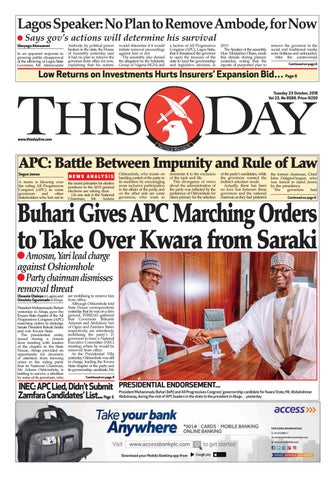
PRESIDENTIAL ENDORSEMENT... President Muhammadu Buhari (left) and All Progressives Congress’ governorship candidate for Kwara State, Mr, Abdulrahman Abdulrazaq, during the visit of APC leaders in the state to the president in Abuja… yesterday
2
THISDAY˾TUESDAY OCTOBER 23, 2018
THISDAY˾TUESDAY OCTOBER 23, 2018
3
4
THISDAY˾TUESDAY OCTOBER 23, 2018
THISDAY˾TUESDAY OCTOBER 23, 2018
5
6
TUESDAY, ͺͻ˜ ͺ ˾ T H I S D AY
PAGE SIX
INEC: APC Lied, Didn’t Submit Zamfara Candidates’ List S’Court nullifies Rivers’ congresses Abe hails ruling
Alex Enumah, Adedayo Akinwale in Abuja and Ernest Chinwo in Port Harcourt The Independent National Electoral Commission (INEC) has denied receiving any list of candidates for Zamfara State from the All Progressives Congress (APC) as claimed by the party. The electoral body had disqualified APC from fielding candidates for the 2019 general elections in Zamfara State on the grounds that the party did not conduct primary elections in the state within the time it stipulated in its guidelines. But the APC National Publicity Secretary, Mr. Lanre Isa-Onilu, had told THISDAY after the deadline for submission of candidates’ for the presidential and National Assembly elections on October 18, 2018, that the party submitted candidates for all positions in all states of the federation, including Zamfara. "We submitted applications for all the positions in all the states, including Zamfara,” Isa-Onilu told THISDAY. However, INEC National Commissioner on Voter Education and Information, Mr. Festus Okoye, told THISDAY on phone yesterday that the commission did not receive the list of candidates from Zamfara State from the ruling party. He said based on the provisions of Section 31 and 87 of the Electoral Act 2010 (as amended), “the commission does not expect that your party will submit names of any candidates from Zamfara State.” Okoye added, “For clarity, our position is that the APC, will not be fielding candidates for the governorship, National
Assembly and state assembly elections in Zamfara State for the 2019 for the general elections. “There are two matters relating to the party primary election conducted in Zamfara State pending before the State High court and Federal High Court in Zamfara. Those two matters are yet to be decided. “So APC did not submit any list from Zamfara and INEC did not release any list of candidates from Zamfara.”
Supreme Court Nullifies Rivers’ Congresses The Supreme Court has set aside the decision of the Court of Appeal, Port Harcourt Division, which permitted the conduct of congresses by the APC in Rivers State. The order of the Appeal Court issued on June 21, 2018 against the ruling of a Rivers State High Court was voided by the apex court on the grounds that the appellate court acted in bad faith. Justice Centus Nweze, in a judgment in an appeal filed by one Abdullahi Umar and 22 other aggrieved members of the APC, held that the Court of Appeal, ought not to have vacated the injunctive order issued against the APC by the Rivers State High Court on the conduct of the congresses. Justice A. C. Nwosu of the Rivers State High Court had in an ex-parte motion filed by Umar, restrained the APC from conducting the congresses pending the determination of the suit instituted by Umar, complaining against their exclusion from the party’s congresses. But while the injunctive order of the High Court was subsisting, the APC
went ahead and conducted the ward, local government and state congresses on May 19, 20 and 21. After the conduct of the congresses, the Court of Appeal in a ruling on an application by APC seeking stay of execution of the High Court injunctive order and stay of proceedings of the main suit, vacated the injunctive order and refused to stay hearing of the substantive matter, prompting Umar to complain to the Supreme Court. The Supreme Court in the judgment lambasted the appeal court for judicially indulging APC and vacating the injunctive order in the party’s favour when there is abundant evidence that the APC was in contempt of court. The apex court further held that the Court of Appeal ought not to have granted its discretion in favour of APC because the party was in grave violation of the order of the High Court. Justice Nweze said that the appeal court had a duty to protect a lawful subsisting order and ought not to have granted favourable judicial discretion for a party that willingly disobeyed valid court order. He said, “It is unfortunate and wrongful for the Court of Appeal to have entertained a party in contempt of a valid court order to the extent of granting judicial favour by way of staying of execution of an injunctive order when the party at the center of the dispute was in gross contempt of court. “It is a serious matter for anyone to flout a court order and in the instant case, it is clear that the respondent (APC)
was in grave disobedience to two lawful court orders.” The learned justice added, “It is sacrilegious, ill-fated and a suicide mission for the Court of Appeal to have departed from various decisions of the Supreme Court that any party in contempt of court ought not to be granted judicial discretion and in this matter the appeal court is bound to follow Supreme Court final decision.” He said, what was more, refusal of the Court of Appeal to be bound by final decision of Supreme Court was a gross insubordination. The apex court, therefore, nullified and set aside the decision of the appeal court delivered on June 21, 2018.
Reacting to the Supreme Court ruling, Senator representing Rivers South East Senatorial District in the National Assembly, Senator Magnus Abe, described the judgment of the Supreme Court which set aside the decision as historic. But the state party Chairman, Mr. Ojukaye Flag-Amachree, who emerged from the annulled congresses, insisted that he remained the chairman of the party as the Supreme Court judgment did not remove him from office. Addressing journalists in Port Harcourt yesterday evening, Abe, who had emerged the governorship candidate of a faction of the party through direct primaries, said the judgement meant the Ojukaye Flag-Amachree's faction loyal to Minister of Transportation, Mr. Chibuike Amaechi, had fallen into a pit from which it could not be rescued. Abe said, "This judgment
is historic and affirmed the position of a High Court in Rivers State that the action of the party in excluding members of the party from the processes of the congresses and depriving them their constitutional right was wrong. And to do so in the face of a clear order of a court of competent jurisdiction was nothing but clear stupidity. "And so for anybody to parade himself either as a candidate of the party arising from a processes that has clearly been voided by the court is nothing but political rascality. And I think it is time for right thinking members of this party to put this whole thing to an end and put the party in a proper place for the realisation of taking over Rivers State.” He however said the party had a way out of the mess as it had to adopt candidates who emerged from the direct primaries conducted by his own faction of the party. But Flag-Amachree said the judgment did not remove his executive from office. According to him, “What the Supreme Court did was to set aside the stay of execution of the Court of Appeal on an order given by Justice Wogu, which has been overtaken by his judgment. Because after the stay of execution, Justice Wogu has given his judgment. However, no court has set aside the perpetual injunction by Justice A.O Musa of the Federal High Court, Abuja. So party members should keep calm as it’s just an academic exercise with no effect.” Also in a statement signed by the state Publicity Secretary of the APC, Mr. Chris Finebone, the party said aside setting aside the order of the Court of Appeal,
the Supreme Court did not make any other orders that could affect the party. The statement said, “The appeal filed at the Supreme Court by Ibrahim Umar & 22 others of which the ruling was given today, three issues were canvassed before the Supreme Court one of which was that the Appeal Court did not act correctly by granting a stay of execution on the interlocutory orders of the State High Court. "The Supreme Court agreed with them. However, the Supreme Court did not make pronouncements on the other issues since the State High Court had already given final judgment on them, an action that has left the present development a mere academic exercise. "The Supreme Court only granted the appeal in parts and did not make any consequential orders as that can only be subject matter at the Appeal Court when the appeal hearing of the State High Court judgment commences. "The Supreme Court allowed the appellant appeal which was against the stay of Order of Injunction of 11/05/2018. The Court said the said order should not have been stayed. The Supreme Court made no orders except to set aside the Court of Appeal order. "That clears the way for hearing of the main appeal at Court of Appeal, Port Harcourt against the judgment of the High Court. Their prayer that Supreme Court should hear the pending appeal at Court of Appeal was rejected .The appeal is to be heard and determined by Court of Appeal, Port Harcourt." He called on members to remain calm as the judgment has no effect on the party.
has been so well entrenched. And what we are trying to do under my leadership of the APC is to work consciously to entrench the core values of progressive politics, which is that the people must necessarily lead, the members should not be distant spectators, the party members should be the drivers of this process. "Yes, we recognise power; yes we recognise protocol but at the end of the day, power must flow from the membership when it comes to primaries and it must flow
from the Nigeria people when it comes to the popular election. “Anyone who knows me knows that I have been committed. I am organised. It has been in history that I have organised a huge rally, which was solely dedicated to the history of one man, one vote campaign. I organised that when I was in Edo State. I fought and I defeated the rigging machine. So, having done that, I now being privileged to be Chairman of All Progressives Congress, I cannot watch people who have
power try to suppress those who are powerless. "Somehow it has been my lot to be on the side of the oppressed whether that oppressed is a worker, whether is a senator or House of Representatives member, whoever you are that I think that my job is simply well cut out for me so that we uphold the rule of our party and the Electoral Act and the spirit of progressive politics and I think that I can say comfortably
proceeding, it will be done in the open. As a matter of fact, there is no (removal) plan against the governor before us. Rather than planning to remove the governor, however, Obasa promised that the assembly had been working with Ambode and other stakeholders in the state to ensure peace and development in Lagos State. Also speaking at the plenary, the Majority Leader
of the assembly, Hon. Sanai Agunbiade buttressed Obasa’s position, noting that the constitutional procedure for removal of the governor “does not encourage secrecy.” Agunbiade, a third-term lawmaker, said members of the public would definitely know if the assembly would initiate removal proceedings against the governor, thereby dismissing the reports of the impeachment plan.
Abe Hails Ruling
APC: BATTLE BETWEEN IMPUNITY AND RULE OF LAW chosen Odigie-Oyegun and had sought to prolong his tenure, largely, according to party insiders, because they found him to be more amenable to control. The state chief executives wanted to have control of the party and determine the faith of everyone else. Oshiomhole, with his pro-democracy and labour background, opposed this and pushed for the democratisation of the party by encouraging more openness and transparency.
He made his case eloquently yesterday at the Presidential Villa, where State House correspondents confronted him about reported moves by some of the party’s governors to unseat him. Dismissing the moves as of no moment and serious consequence, Oshiomhole insisted that he was more interested in reforming the party through the entrenchment of respect for the rules and the laws guiding the democratic processes of the APC, contending that he, as
the chairman, would want to guide the party away from the pitfalls that derailed the former ruling Peoples Democratic Party (PDP) and brought it to its ruins. He said, “Most people today who are actively involved in politics that we might describe as not too young to run, the only model that they have seen was the PDP model which ran for 16 years. "So understandably, the culture of opposition, the culture of cheating, the culture of power determine outcome
Continued on page 8
LAGOS SPEAKER: NO PLAN TO REMOVE AMBODE, FOR NOW primary election that produced the APC governorship candidate, Mr. Babajide Sanwo-Olu, there have been unconfirmed reports that the APC National Leader, Senator Bola Tinubu, has directed the lawmakers to commence removal proceedings against Ambode at a meeting in Tinubu’s Bourdillon residence. The reports alleged that the APC national leader had not only initiated a plot to unseat Ambode despite his public pronouncement to support Sanwo-Olu’s candidature, but also gave a direct order to the assembly on the grounds that the governor might work against the APC. During plenary yesterday, the speaker denied the reports that the assembly was plotting to remove the governor.
Specifically, Obasa said that the reports of some social and traditional media platforms on the matter were not true. “I received telephone calls from prominent citizens over the alleged (removal) plan against the governor. Honestly, we had no such plan,” he said. He lamented that the Solidarity Group of Nigeria (SGN) and factional Chairman of Lagos APC, Mr. Fouad Oki, “have been alleging that we threatened the governor to open the state treasury for them and that we threatened to impeach him if he failed to do so. “So, nobody can threaten us, if it happens, because we are representatives of the people. We do not need the wailers to guide us in performing our duties. It is not out of place
for us to do our job.” Consequently, the speaker noted that the lawmakers “are not embarking on any (removal) proceedings against Ambode now. If there will be (removal) proceedings, it will be from the governor. If there will not be any need for (removal), it will be from him based on governor’s actions.” He said removal was a constitutional procedural. “All over the world, many speakers, senate presidents and presidents, among others have been (removed). So, nobody can threaten us if it happens because we are representatives of the people.” To prove the assembly never initiated clandestine plan to removal the governor, the speaker noted that if there “is going to be any impeachment
CORRIGENDUM To illustrate the opinion article by Sonni Anyang entitled: 'MTN and the bleeding of a Nation,' published in THISDAY, The Sunday Newspaper of October 21, 2018, we inadvertently used the picture of Mr. Michael Ikpoki and referred to him as CEO of MTN Nigeria. We have since learnt that Mr. Michael Ikpoki resigned his position as CEO of MTN Nigeria in 2015. We regret the mix-up and apologise for any embarrassment the erroneous use of his picture may have caused Mr. Ikpoki whom we hold in very high esteem.. - Editor
TOP GAINERS NGN NGN % UNILEVER 3.60 47.50 8.2 CUSTODIAN 0.40 5.10 7.8 UNIONDAC 0.02 0.30 7.1 SEPLAT 29.90 644.90 4.8 ZENITHBANK 1.10 24.00 4.8 TOP LOSERS NGN % LAFARGE 2.10 18.90 10.0 NEIMETH 0.06 0.54 10.0 MCNICHOLS 0.05 0.54 8.4 HONEYWELL 0.09 1.15 7.2 DANGFLOUR 0.50 7.50 6.2 HPE Nestle Nig Plc ₦1,400.00 Volume: 257.919 million shares Value: N4.950 billion Deals: 3,178 As at yesterday 22/10/18 See details on Page 31
THISDAY˾TUESDAY OCTOBER 23, 2018
7
8
TUESDAY, ͺͻ˜ ͺ ˾ T H I S D AY
NEWS
Low Returns on Investments Hurts Insurers’ Expansion Bid Ebere Nwoji Despite the suspension of recapitalisation of insurance companies by the National Insurance Commission (NAICOM), low returns on investment as well as the poor performance of operators have continued to scare investors from the sector. THISDAY learnt that operators in the sector vehemently opposed the earlier directive by the regulator that they should shore up their capital base because of the apparent investor apathy in the sector. Findings also showed that some firms were even advised against raising capital from the stock market because of their poor returns on investments, especially the uninspiring performance of the sector on the Nigerian Stock Exchange (NSE). A number of insurance firms
that called for extra ordinary general meetings following the NAICOM directive were disappointed over shareholders' reactions about their fund raising proposals. Speaking on the development, President, Progressive Shareholders Association of Nigeria, Mr Boniface Okezie, pointed out that with the situation on the ground and considering Nigeria's investment climate, insurance sector is the whipping boy. According to him, the insurance sub-sector on the NSE is a no go area for investors because of its low returns. He queried why any investor would want to touch insurance stock some of which sell for 20 kobo against N10 price investors purchased some of the shares several years ago. He alleged that some of
NAICOM boss, Mohammed Kari the insurance managers misused the money they realised from the market through investment in other less viable businesses. He said the worst challenge facing the operators is that the regulator did not carry out a proper feasibility study before announcing the recapitalisation. According to him, directing firms to recapitalise on the
eve of a general election was wrong “as everything centres around politics now and given the uncertainty in Nigerian political terrain, even foreign investors are afraid of coming into the country because they do not know what 2019 holds for everybody in Nigeria.” On the way forward for the industry, Okezie said NAICOM should employ the services of risk analysts and other relevant professionals to analyse the challenges facing the industry and come up with lasting solution that would change the face of the sector. But the Managing Director, AIICO Insurance, Mr. Edwin Igbiti, said investors were free in their choice on how and where to spend their money. He also said every company has its strategy, but insisted that AIICO pays dividend annually and rewards its
investors appropriately. He advised insurance companies whose offers were rejected to look inwards in their bid to raise capital. He said, “The small companies should look inwards, insurers should reinvent themselves, insurance is a business of the future, investors should better buy now before it becomes expensive. “Investors have right and choice of where and how to invest their money." Also, the Director General, Chartered Insurance Institute of Nigeria(CIIN) and former Managing Director Royal Exchange, Mr Richard Borokini, said it was certain that only quoted companies have right to trade their shares on the floor of the NSE. According to him, some investors might prefer preference shares because it attracts more dividend.
He argued that the share prices of insurance stocks depend on performance and dividend pay-out, adding that capital would naturally go to where it is optimally utilised. He, however, noted that the greatest challenge confronting the sector is awareness and low purchasing power of the people. NAICOM last week formally announced the suspension of the implementation of its tierbased minimum solvency capital policy, otherwise known as the recapitalisation of the industry. The regulator, in a circular to all insurance institutions entitled: “Update on the implementation of the Tier-based Minimum Solvency Capital policy for insurance companies in Nigeria,” had directed insurance companies to continue with the subsisting regulatory framework prior to the circular.
happy, I don’t have issues with anyone, only one or two may have some situations that they may want to see differently but that is how the world is. “It is not correct to suggest that there is a move. Though, one governor has publicly said he will ensure that I am removed, that is fine. The beauty of democracy
is anyone or two could say something, but the majority is what matters. But I think even those two, when they have deeper reflection, they will recognise that all I have done is to stubbornly insist that the rules must be obeyed, nothing more, and nothing less.” For Oshiomhole, therefore, the prevailing battle is not
about him but about the need to reform and entrench clearly identifiable processes that would be based on rules that are applicable to all and not a few. According to him, the dispute is between impunity and rule of law, and as he puts it, he would do everything within his power to ensure that the latter prevails.
Ogun State, who visited him last Sunday, noting that he had since issued an ultimatum to Oshiomhole, to resolve the issues, which arose from the primaries. It was also gathered that the president had immediately sent words to the national chairman to ensure that all the controversies surrounding the governorship and state assemblies’ primary elections must be resolved as soon as possible. “The president appears to be embarrassed by the continued controversy, which keeps mounting by the day. Even the latest embarrassment came yesterday with the reported exit from the party of one of the president’s staunchest loyalists, Senator Shehu Sani. "You have the vexed issue of Zamfara and Adamawa. Then you have the spectacle in Ogun State. Yes, the national chairman is insisting on doing what he claims to be the right thing, but in some of the cases in question, even the president is not too comfortable with the handling of the matter, because some of the governors have made a very strong case on the impropriety of some of the decisions of the national chairman. “The president has told him to clear the mess as soon as possible, because the distraction the controversy continues to ignite does not bode well for the polity, presidency, the party and even the wellbeing of members,” the source said. According to the source, “By far the most embarrassing for even the president and which has presented the chairman as lacking capacity and emotional intelligence is the allegation that the governorship primary in Ogun State that was said to have produced the individual, Dapo Abiodun, whom the chairman is supporting never held.
“When Governor Amosun met with the President in the company with some other governors last week, it was made clear that the part being followed by the national chairman was capable of totally destroying the party. The Ogun State chapter of the party organised a primary that everybody witnessed. And we have been asking where the other people and Oshiomhole’s NWC members conducted their own governorship primary,” the source asked. But the latest development, which is the removal plot against Oshiomhole is expected to create new outcomes as the president is reported to have told Amosun, Yari and Bello that whatever injustice that might have occurred would be dealt with. Already, the deadline for the submission of names of candidates for the House of Representatives and the Senate had lapsed and therefore, the only way substitution could be made is for the APC to provide cogent and verifiable reasons why the names of those, who won were substituted with those that did not. In the case of the governorship candidates, the last date for the submission and possible substitution is November 2, 2018, some 13 days from today. Expectedly, Oshiomhole has continued to insist that the APC under his watch now is undergoing a transformation, has also acknowledge the removal plot and alleged gang-up of governors. The national chairman is said to draw strength from Vice President Yemi Osinbajo, who was alleged to have insisted Ogun must be conceded to him, the national leader of the party, Asiwaju Bola Tinubu and a billionaire businessman man from the Northern part of the country, said to be funding him.
APC: BATTLE BETWEEN IMPUNITY AND RULE OF LAW that about 90 per cent of APC membership are happy, it is not possible to have 100 per cent. “So, on the whole I am a very happy person, it has been quite challenging but I can say tough time doesn’t last, but tough people will always do. And I think we have been toughened by our history of struggle. And I am
humbled by the amount of support we are getting from critical stakeholders of the All Progressives Congress. “There maybe one or two governors who have issues and those issues can only be resolved democratically within the spirit, the letter and all the relevant provisions of APC Constitution, Electoral
Guidelines and of course the Electoral Act. The Electoral Act is completely blind and our party rules too are completely blind to power that it is sensitive to procedures, it is sensitive to processes. “The good news is that the overwhelming majority, we have about 23 governors, I think we are very much
BUHARI GIVES APC MARCHING ORDERS TO TAKE OVER KWARA FROM SARAKI Abdulrahman Abdulrazak, to Buhari, who charged them to end the reign of the Saraki dynasty in the state. The news of the president’s order came through Abdulrazaq, who boasted that the era of the dominance of Saraki in Kwara politics was over. He said, "Kwara has become a battle ground and as you can see, we have come here to see Mr. President having gone through a hectic process of primaries. We went through direct primaries in which about a 100, 000 party faithful voted. "We had our difficulties but we have come to see the president to tell him that all is well and we are in unison and he has given us marching orders to go and take Kwara. He is history, we have gone pass him and we are looking at Government House. Meanwhile, the president's spokesman, Mr. Femi Adesina, said the president described the late Major General Tunde Idiagbon as a very rare example of what loyalty to one's fatherland and to a superior should be. According to him, the president made the remark when he received APC governorship aspirants and members of the party from the three senatorial zones of Kwara State. Adesina said Buhari advised Nigerians to remain faithful and loyal to the country, threatening, however, that anyone who has another place to go other than Nigeria should proceed. "You don’t have to be in uniform to be loyal. What I said long ago in 1984 is still valid today. We have no other country but Nigeria. Others who feel they have another country may choose to go. We will stay here and salvage it together,” he said.
Oshiomhole Dismisses Threat of Removal Leading the Kwara delegation out of the meeting with the president, Oshiomhole seized the moment to brief State House correspondents on the moves against him, dismissing them as non-events that could not harm him. “This is my finest hour,” he said, explaining that he was encouraged by the level of participation in the party's recently concluded primaries. He also said in view of the news making the round that some governors had vowed to remove him, it would be necessary for him to consult his lawyer on what that threat meant to enable him have insight into how to handle it. Oshiomhole who added that he had been committed to the principle of one man one vote, also said he would not stay there as the party chairman and watch vulnerable people oppressed by powerful people. According to him, such vulnerable people may be senators or House of Representatives' members whose interest, he said, he was duty bound to protect, pointing out that he was only aware of one or two governors who have issues with him. Submitting that only two of 23 governors on the platform of democracy cannot remove him bearing in mind that democracy is a game of numbers, Oshiomhole said even the issues that such governors have with him can be resolved in the spirit of democracy. He said, "I need to consult a lawyer who understands legal language to decode it to my layman understanding to be able to deal with it. But the only thing that I just want to clarify is that I have seen banner headlines, people are
just calling me, there is crisis in APC, that my office is under threat, some APC persons are very angry and all that. "I just want to say that this is my finest hour. I am being encouraged by the level of participation in our primaries and of course the more open, the more the democratic process is.”
Amosun, Yari Lead Charge Despite Oshiomhole’s confidence, some governors of the party, THISDAY gathered, will today meet in Abuja, to commence his removal process over alleged manipulation of recent primary elections conducted by the national secretariat of the party. Leading this cause are Amosun and Abdul-Aziz Yari, the two most hit of the APC leaders and governors, and had allocated mobilisation of the process geo-politically to each other. The primary elections conducted recently by Oshiomhole’s appointed National Working Committee (NWC) members had schemed out candidates of Amosun and Yari as well as 15 other state governors, a development the duo reckoned was orchestrated by Oshiomhole to humiliate them and make the party vulnerable hence their fight back. This, interestingly, is happening at a time President Buhari had sent words round to the affected states that he would make sure the alleged injustice in all the affected states would be addressed. Apart from Amosun and Yari, other governors believed to be disposed to Oshiomhole’s removal are Rotimi Akeredolu (Ondo), Mohammed Abubakar (Bauchi), Mohammed Abubakar (Jigawa), Rochas Okorocha (Imo), Tanko Al-
Makura (Nasarawa), Abubakar Bello (Niger), Kayode Fayemi (Ekiti), Yahaya Bello (Kogi), Aminu Masari (Katsina) and Abubakar Bagudu (Kebbi). The Oshiomhole-MustGo governors believed that governors like Simon Lalong of Plateau, Nasir el-Rufai of Kaduna, Abdullahi Ganduje of Kano and Akinwunmi Ambode of Lagos are though not happy with Oshiomhole, may no longer show interest in his removal, because they either have what they seek or not in a position like Ambode to get anything done. They are, however, meeting in Abuja today to write their names and sign, undertaking that Oshiomhole must go. They are also believed to be doing this with the full support of the president’s men in Aso Rock, including the First Lady, Aisha Buhari, who reportedly felt disappointed with his management of the party so far. His protagonists questioned the rationale behind announcing the names of people, who either did not partake in any process or switching the names of winners for those who can hardly deliver their ward in a major national election where the opposition is already menacing. Although THISDAY sources did not hint at what the president’s men are doing next, they, however, maintained that they, otherwise called the cabal, are working on their own plan to tame the national chairman or completely get him out of the way. Regardless, Buhari, on Sunday, had reassured all those that were allegedly poorly treated in the just concluded primary elections of the APC, reiterating that justice would be served, ultimately. The president, THISDAY gathered, gave this reassurance to some traditional rulers from
THISDAY˾TUESDAY OCTOBER 23, 2018
9
10
TUESDAY OCTOBER 23, 2018 ˾ T H I S D AY
NEWS
Group News Editor Ejiofor Alike Email Ejiofor.Alike@thisdaylive.com, 08066066268
Backed by Policemen, Suspended NHIS Boss Forcibly Resumes Duties PDP queries Buhari
Adedayo Akinwale in Abuja Backed by heavily armed policemen, the suspended Executive Secretary of the National Health Insurance Scheme (NHIS),
Prof. Usman Yusuf, forcefully resumed office yesterday at the NHIS Headquarters at Jabi, Abuja. The Peoples Democratic Party (PDP) has therefore, challenged President Muhammadu Buhari
AIB Releases Aviation Accident Reports, Issues Safety Recommendations to FAAN, NCAA Chinedu Eze The Accident Investigation Bureau (AIB) has released four accident and serious incident reports, which occurred in the country between July 2004 and August 2015. With the release of the reports, Commissioner of AIB, Akin Olateru, said the current management of the agency has achieved 52.1 per cent on publication of accident and serious incident reports and 47.4 per cent of safety recommendations since coming onboard in January, 2017. Olateru who made this known yesterday when he briefed aviation journalists, also noted that some of the accidents and serious incidents would have been averted if parties involved had adhered to safety policies in the aviation industry. The reports released by AIB included the accident involving Bristow Helicopters (Nigeria) Limited Sikorsky S-76C+ helicopters with the registration number 5N-BGD, which occurred on August 12, 2015 at the Oworonshoki area of Lagos. The agency also released the accident report on Pan African Airlines Nigeria Limited’s Bell 412 EP Helicopter with the registration number: 5N-BDZ, which crashed near SEDCO Energy Platform on July 26, 2004 a few minutes after takeoff. Also released were reports on two serious incidents involving an Emirates Boeing 777-200’s aircraft with the registration number: A6-EWD and Aero Contractors Nigeria Ltd B737-42C aircraft with the registration number 5N-BOB, which equally occurred in July 2015. The Sikorsky S-76C+ helicopters with the registration number: 5N-BGD, had crashed into Oworonshoki lagoon with 12 persons onboard, including two crew members shortly before landing at Murtala Muhammed Airport, Ikeja. There were six fatalities including the two pilots, while other six
persons onboard sustained serious injuries. The helicopter had departed SEDCO Express oil rig at about 14:55 hours with an endurance of one hour and thirty minutes maintaining 3,000 feet with the estimated arrival at Lagos Airport at 15:36 hours, according to the crew information before departure from the rig. Olateru explained that the helicopter experienced “sudden un-commanded pitch up, yaw, and roll for about 12 seconds until it impacted water at about 15:31hours”, stressing that the pilots were not able to make any form of distress call to Air Traffic Controllers (ATC), SEDCO Express rig or communicate with the passengers before impact. He added: “Rescue operation was swift, prompt and carried out by local fishermen who were in the area. There were six fatalities, including two crew members and six seriously injured passengers. The crew members were recovered the following day. The helicopter was destroyed, but there was no post-impact fire.” In its safety recommendation, like the Bristow Helicopters crash of 2015, AIB issued a sole recommendation of the crash. AIB advised NCAA to ensure that heliport operators provide full weather report for helicopter operations. On the serious incident involving an Emirates Boeing 777-200 aircraft with the registration number: A6-EWD, AIB emphasised that the aircraft had an impact with another B737-400 aircraft belonging to HAK Air with the registration number: 5N-BOU. The accident had occurred at Lagos Airport on July 6, 2015. According to the report, the Emirates aircraft with 285 passengers had requested to take off through the 18R runway, which the ATC replied that was unavailable at the time, but the pilot opted to use the 18Left runway for take-off.
President Muhammadu Buhari yesterday in Abuja, said Nigeria would not be in a haste to sign any treaty without verifying the impact it would have on the lives of citizens. The president made the remark at the Presidential Villa, while inaugurating the Committee for Impact and Readiness Assessment of the African Continental Free Trade Area (AfCFTA). According to him, Nigeria will henceforth make a
aides and forced his way into the office after one of his aides broke the padlock to the gate so as to allow the vehicle of the suspended Executive Secretary into the premises. While the workers were still trying to resist, the police who were deployed to the agency to keep law and order teargassed the crowd. Reacting to the development, the main opposition party described it as reprehensible that an administration, which prides itself as fighting corruption would continue to provide official cover for its officials indicted of corruption. The National Publicity Secretary of the party, Mr. Kola Ologbondiyan, in a statement yesterday in Abuja, called on Nigerians to hold President Buhari responsible for the corruption in NHIS, as well as the siphoning of trillions of naira from various agencies, under his watch.
The PDP said with yesterday’s forceful repression of the suspension of the Yusuf by the NHIS Governing Council over humongous corruption allegation and abuse of office, it had become clear that the Presidency cabal is directly complicit in the NHIS fraud and is seeking every means to ensure a cover-up. The party wondered why the Presidency has vehemently opposed any form of investigation into the activities of NHIS under Yakubu. The party queried, “Is it true that there are fears in the Presidency that an investigation will expose the alleged involvement of individuals close to the President in the reported fraud in the scheme?” Ologbondiyan said Nigeria could recall that this same Executive Secretary was in July 2017 suspended by the Minister
of Health, Prof. Isaac Adewole over alleged gross misconduct and corrupt practices, only for President Buhari, upon his return to the country in February, 2018, reinstated him while he was still a guest of the Economic and Financial Crimes Commission (EFCC). Ologbondiyan said, “We ask: Why is the Presidency protecting an official of government openly indicted for corruption? What is the Presidency trying to conceal by ensuring that Prof. Yusuf remains the Executive Secretary after his indictment?” The PDP said Nigerians should note how the Presidency had continued to provide official cover for accused official even without the slightest investigation on the allegations and sanction by both the minister and the Governing Council.
20 HEARTY CHEERS...
Award-winning musician and leader of the popular Shuga band, Akin Tofowomo, and his band thrilling audience during shuga-coated concert to celebrate 20 years of Shuga band on stage, in Lagos...recently. KUNLE OGUNFUYI
Fayose Arraigned, Remanded in EFCC Custody Davidson Iriekpen
Former Governor of Ekiti State, Ayodele Fayose, was yesterday arraigned on an 11-count charge of conspiracy and money laundering before a Federal High Court in Lagos. Fayose and his company, Spotless Limited, pleaded not guilty to all the charges. The judge, Mojisola Olatoregun, ordered that he be remanded in complete departure from the custody of the Economic and the past when treaties were Financial Crimes Commission signed without thoroughly (EFCC) and then adjourned till evaluating the clear benefits October 24 for hearing of his bail they could bring to the country. application. “We are determined to break According to the EFCC, Fayose away from the past practice of received 1.2 billion to fund his 2014 committing Nigeria to treaties gubernatorial campaign in Ekiti without a definite implementation State, a sum they said he ought plan to actualise the expected to have known formed part of benefit while mitigating the risks. the proceeds of an unlawful act. “We cannot go back to the days Fayose arrived at the court of signing agreements without premises at about 8.30a.m, understanding and planning for accompanied by EFCC officials the consequences of such actions and armed police officers. and our country,” he said. Femi Fani-Kayode, a former
AfCFTA: We Won’t Sign Any Treaty Hastily, Buhari Insists Omololu Ogunmade in Abuja
to come out clear on why he has been protective of Yusuf, who has been variously indicted for alleged corrupt practices, including the alleged siphoning of over N25 billion from the coffers of the agency. Yusuf was suspended last Thursday by the NHIS Board over alleged infractions. The council had noted that he would not be allowed into the office premises so as to allow the administrative panel do a thorough job. But with heavy police presence within the NHIS Headquarters, it was obvious that the Executive Secretary would not just go without a fight as he had challenged the power of the council to suspend him, insisting that it is only the president who appointed him that can remove him from office. He defied the council and arrived office at around 9 a.m yesterday accompanied by his
aviation minister and member of the Peoples Democratic Party (PDP), was also in court “to show solidarity.” “I’m here to let people know that he’s not alone, I know what he’s going through because I’ve been there before,” Fani-Kayode told journalists after the court sitting. Fani-Kayode said the federal government “has subjected every member of the opposition PDP to one form of persecution or another.” In the charges, the EFCC alleged that on June 17, 2014, Fayose “took possession of the sum of N1, 219,000,000 to fund your 2014 gubernatorial campaign in Ekiti State, which you reasonably ought to have known formed part of the proceeds of an unlawful act, to wit: criminal breach of trust/stealing.” He was also alleged to have on the same day “received a cash payment of $5,000,000 from Senator Musiliu Obanikoro, the then Minister of State for Defence, which sum exceeded the amount authorised by law, and you thereby
committed an offence contrary to sections 1 and 16(d) of the Money Laundering (Prohibition) Act, 2011 (as amended) and punishable under Section 16 (2)(b) of the same Act.” In another count, Fayose was accused of “taking control of an aggregate sum of N317,000, 000,” which he allegedly deposited into the bank account of Spotless Limited, “a company controlled by you and your family.” He was also accused of “using an aggregate sum of N1,151, 711,573 to acquire chalets 3, 4, 5 and 9 of the property situated at Plot 100 Tiamiyu Savage Street, Victoria Island, Lagos, in the name of JJ Technical Service.” Fayose was equally accused of purchasing a property at Plot 1504, Yedsema Street, Maitama, Abuja for N270million from one Rabi Kundili. The former governor was also alleged to have purchased another property at No.44, Osun Crescent, Maitama, Abuja, for N200million in the name of his elder sister, Moji
Oladeji. Among other allegations, the EFCC further accused Fayose of receiving gratification from a firm, Samchase Nigeria Limited. After pleading not guilty to the charges, the prosecuting counsel for the EFCC, Mr. Rotimi Oyedepo, prayed for a trial date and an order remanding Fayose in the prison custody. However, the defence counsel, Chief Kanu Agabi (SAN), told Justice Olatoregun that while he agreed with a trial date, he was opposed to the prayer that his client be remanded in the prison custody. Agabi said he had already filed a bail application for Fayose, and urged the judge to allow the former governor to return to the custody of the EFCC pending the hearing and determination of the bail application. Justice Olatoregun granted Agabi’s prayer, ordered that Fayose should be remanded in the custody of the EFCC and adjourned till October 24 for the hearing of the bail application.
THISDAY˾TUESDAY OCTOBER 23, 2018
11
12
TUESDAY OCTOBER 23, 2018 ˾ T H I S D AY
NEWSEXTRA
Despite 24-hour Curfew, Three Killed in Kaduna Airline temporarily suspends flights to state John Shiklam in Kaduna Three people were confirmed killed yesterday in Kaduna despite the 24-hour curfew imposed on the metropolis on Sunday by the state government. This is coming as Air Peace, has temporarily suspended flight operations on its Kaduna route due to the 24-hour curfew imposed on Kaduna metropolis and its environs following reports of violent clashes. THISDAY gathered that violence broke out in some parts of the metropolis at about 4p.m on Sunday, resulting in the burning of scores of houses and vehicles. The state government had imposed curfew to stop the violence from escalating to other parts of the city after about 55 lives were lost. However, in the early hours of yesterday, gunmen said to have posed as members of a vigilante group, killed three young men in Narayi area of the city. The gunmen who were said to be driving in a Hilux Van marked “JTF”, arrived the community at about 2a.m and abducted the young men who were later killed. The burial of the victims also took place yesterday,
amidst mass protest by the youths who blocked the major road leading to the community. It took the efforts of religious and community leaders to pacify the angry youths who accused security personnel of “not doing enough to protect” them despite the curfew. Speaking in an interview with journalists when the General Officer Commanding (GOC), 1 Division of the Nigerian Army, Maj. Gen Muhammad Mohammed, visited the area as part of his assessment tour of security situation within the metropolis, a youth leader in the area, Emmanuel Godwin, said the gunmen came when people were sleeping. “They came at about 2a.m in a Hilux Van and claimed they were vigilante members from Barnawa. We told them that Narayi is not their jurisdiction and they have no business coming to our community since we have our own vigilante group. As they were driving away, they picked three of our boys as if they were arresting them. “Shortly after they left with the boys they shot them and dumped the corpses by the roadside” the youth leader
said. Meanwhile, Air Peace Communications Manager, Mr. Chris Iwarah, confirmed the suspension of flights by the airline to the News Agency of Nigeria (NAN) yesterday in Lagos. Iwarah said the airline
took the decision after the Kaduna State Government imposed the curfew due to security threats, adding that the operations would resume as soon as normalcy was restored. He said: “If it was a half day curfew, we would have
taken another approach to it but now what we heard is that the curfew is for 24 hours. “We expect that this will not last for long, maybe a day or two and we can change our position, but for now, there is nothing we can do
because we cannot risk the lives of our valued guests and crew. “We don’t want anybody to be caught up in the clashes around that environment. We believe the government knows better,” he said.
ACADEMIC PROCESSION...
Senate President, Dr. Bukola Saraki; Speaker, House of Representatives, Hon. Yakubu Dogara; Governor of Sokoto State, Aminu Disregard for Rule of Law a L-R: Tambuwal and Senator Sam Egwu, embarking on an academic procession during the 2nd Convocation ceremony of National Institute for Greater Form of Corruption, Legislative and Democratic Studies (NILDS) / University of Benin (UNIBEN), at the National Assembly, Abuja...yesterday Says US Envoy Operation of Nigeria’s Oil Industry Driven by Patronage, Symington who expressed Hammed Shittu in Ilorin belief in future greatness of Economists Tell FG The United States Ambassador to Nigeria, William Stuart Symington, yesterday declared that the disregard for justice and the rule of law is a greater form of corruption than stealing of public funds. Symington stated this in Ilorin, Kwara State, after he declared the 34th convocation lecture of the University of Ilorin. He delivered a lecture entitled “Citizen Leadership and the Link between Economic Diversity and Democratic Good Governance” where he also said the task of making Nigeria was that of both the government and the citizenry. But responding to a question from a member of the audience on how the country could develop as the United States, Symington identified patriotism, selfless and transparent service, justice, and consistency in doing good, as important factors. He argued that the disregard for justice and the rule of law should be seen as greater form of corruption than stealing of money. “What many consider as the great corruption is stealing of money but what to me is the greatert corruption is when people are deprived of justice, when you do things without regard to the rule of law,” he added. Speaking further, the US envoy said the process of making Nigeria great requires a collective effort of all the stakeholders. He said that all the Nigerian citizens must be working with the government instead of only relying on government for an improved fortunes.
Nigeria, urged the citizens to always do at home as they do in abroad. He explained that, the people of the country must giving priority to their Nigerian identity as against tribal or regional one. He said that any young one who desires to contribute in future to transformation of the country to a better one should start the process now by endeavour to change life of his partner to a better where necessary. The Ambassador noted further that, security and other challenges in the country would be surmounted when the citizens unite and work together. He said, “One of the most important things that I want you to leave today with is the idea that good governance can only come from strong independent citizens. So, I think the right answer is there is no person who can make Nigeria more secure. “There was that time in Nigeria when security was not the job of only the soldier and the police, but every village chief and every person who lived in the town was involved”. The envoy added, “There is no police force in the whole world that keeps the neighbourhood safe all by itself. If you have such a police force, I would not want to live in that neighbourhood. Every security in the world derives from the support of the people in the place that is insecure. “If you will have the tenacity to change Nigeria, look around you right now and change the life of one person today”.
Chineme Okafor in Abuja
Energy economists under the aegis of the Nigeria Association for Energy Economics (NAEE) yesterday told the federal government that its choice of policies for governing Nigeria’s energy sector were driven largely by sentiments and patronage, stating clearly that these would not work. The energy economists who addressed journalists in Abuja on the occasion of the World Energy Day (WED), which was initiated by the World Energy Forum in July 2012, and celebrated for the first time in Nigeria on October 22, 2015, explained the energy policies of the Buhari government, especially subsidy on petrol, have not helped the country’s economy. NAEE’s President, Prof. Wumi Iledare, who spoke for
the association at the briefing, stated that the government’s insistence on cheap petrol for all Nigerians has rather impoverished the economy and further made it difficult for it to fund its budget for infrastructure which are needed mostly by the country. Iledare, equally noted that while the Nigerian National Petroleum Corporation (NNPC) could be commended for ensuring there are no queues for petrol in the country for a while now, the negative impacts of such intervention through subsidy are however huge on the economy of the country. “Subsidy has not helped this economy. If Nigeria must think rationally within the context of the global energy landscape, petroleum product subsidy is a gorilla the Nigeria economy cannot continue to tolerate. “Access to petroleum products
as economic goods makes treating hydrocarbons as commodities illogical. I hasten to say this irrational economic philosophy to a large extent contributes quite immensely to Nigeria’s energy security dilemma and has explicitly limited Nigeria’s economic growth and development potential,” Iledare said. He further stated: “Petroleum products are not public goods, they are economic goods. And, you cannot govern the energy sector with patronage and sentiments.” Iledare, said that available data showed Nigeria can provide only 0.06 megawatts (MW) of electricity for 1000 Nigerians at a time from its installed generation capacity. He said: “Based on total installed capacity, only 0.06 MW of electricity is available for 1000 Nigerians. This leaves much to be desired when compared with those of
Angola (0.21MW/1000 people), Algeria (0.45MW/1000 people) and 0.82MW/1000 people for South Africa. “Thus, Nigeria needs to have a self-adjusting energy policy, national and regional, which recognises and addresses energy poverty as a critical limitation to economic growth with its sociological embarrassment.” To ensure Nigerians gain access to energy faster, Iledare, stated that NAEE believed the review and perhaps some amendments to the 2005 Electric Power Sector Reform Act with respect to sections on institutions and governance, as well as market reform were necessary. “There is need to avoid overlaps among energy regulatory and policy institutions and NERC must be allowed to function as an institution with zero tolerance for political interference.
Edo Assembly Removes Deputy Speaker, Suspends Two Others Adibe EmenyonuinBeninCity The Edo State House of Assembly yesterday removed its Deputy Speaker, Mr. Victor Edoror, representing Esan central state constituency. In his stead, the former Speaker, Justin Okunbo, (Igueben state constituency) was nominated as the new Deputy speaker. The lawmakers also suspended the member, representing Owan East and Etsako West II constituencies, Folly Ogedegbe and Gani Audu respectively for three months over
alleged unruly behaviour. During plenary, Chief Whip of the House, Osaigbovo Iyoha, (Oredo I) constituency drew the attention of the House to the impeachment notice purportedly signed by 16 members accusing the deputy speaker of misappropriation of funds, corruption and act of desperation capable of throwing the Assembly into confusion The impeachment motion was seconded by the member representing Akoko Edo constituency II, Emmanuel Agbale, amidst chaos The plenary was however
thrown into confusion when the embattled deputy speaker rushed for the mace and laid hold to it for over 45 minutes, an aftermath of unfruitful attempt to move a counter motion of impeachment against the speaker. In the drama that ensued, the speaker (Alhaji Kabiru Adjoto, refused to recognise Ogedegbe who in a counter motion accused Adjoto of embezzling N100 million fund belonging to the Assembly. It took the efforts of the security men, mainly armed mobile policemen who were stationed
at the three entrance gates to the assembly as early as 7: am from stopping the fierce looking thugs armed with dangerous weapons from attacking the anti- speaker lawmakers Addressing the crowd, the Speaker appreciated the people for coming to defend democracy. He said: “I will always be loyal to APC. The interest of the state is greater than the interest of an individual. As APC members, we are working hard to ensure President Muhammadu Buhari wins in 2019.’’
THISDAY˾TUESDAY OCTOBER 23, 2018
13
14
T H I S D AY ˾ ˜ Ͱͱ˜ ͰͮͯͶ
COMMENT
Editor, Editorial Page PETER ISHAKA Email peter.ishaka@thisdaylive.com
CHANGE WE CAN BELIEVE IN
Kayode Fadahunsi argues the urgent need to diversify the country’s revenue base
A
s Nigeria continues to face revenue challenges despite high crude oil prices, there arises a need for the federal government to urgently implement policies aimed at growing and diversifying the country’s shaky revenue base. Nigeria’s 2018 budget deficit currently stands at N1.954trillion, a reduction of N56billion over last year, on the back of expected increased revenue from oil. Moreover, according to the Debt Management Office (DMO), the nation’s external debt figure stands at N6.779 trillion whilst domestic debt was at N12.15trillion in June 2018. However, the ugly truth is that, in a matter of years, revenue from oil will be a thing of the past and both federal and state governments are ill-prepared for this imminent crisis. A look at the sequence of events which unfolded in Osun State when the oil price tanked, leading to a reduction in FAAC, reveals the state’s struggles to pay staff salaries for almost a year. A bone of contention at federal government level at the moment is the proposed sale of the Ajaokuta Steel Company under the privatisation programme aimed at raising more money to implement the country’s 2018 deficit-based budget. This is coming on the heels of the recent sale of the Nigerian Security Printing and Minting Company to the Central Bank of Nigeria for similar reasons. Key national assets like the ASC and NSPMC ought to be guarded as a projected source of long-term revenue generation, but perhaps that argument is null in light of audit reports that a hefty injection of approximately $652 million is required for the revitalisation of the steel factory. We should not be quick to forget that 24 state governments appealed to the federal government for relief packages during the period of the oil price crash, as most were either unable to pay or struggled to pay salaries and dues to their workers. It is sad to say that we have not learnt our lesson because now that oil prices have risen somewhat, we are back to the business of spending as usual. The reality in Nigeria today is that, state governments struggle to keep up with their expenses and as a result, the gap between the income of most states and their expenses widens daily. For the most part, investment banks assist state governments by financing these deficits. However, this is not a sustainable practice as expenses continue to outgrow income. Nigeria copied its democracy from the United States; however, in the United States, cities/states do not have any form of allocation coming from the sovereign arm. All states depend solely on both internally generated revenue and business-type activities to survive, as opposed to depending on borrowings, as we are wont to do in Nigeria. These business-type activities allow the state to have an income and clear its deficit. Major sources of revenue for most states in Nigeria are mainly external: the Federation Account Allocation Committee (FAAC), Joint Account Allocation Committee (JAAC), ValueAdded Tax (VAT), dividends and grants etc., and internal
IT IS SAD TO SAY THAT WE HAVE NOT LEARNT OUR LESSON BECAUSE NOW THAT OIL PRICES HAVE RISEN SOMEWHAT, WE ARE BACK TO THE BUSINESS OF SPENDING AS USUAL
sources - Internally Generated Revenue. However, there is a third source of funding/revenue which has remained relatively untapped up until now, and this is the funding from the private sector especially those backed by business-type activities or the state’s IGR (i.e. debt serviced from future cash flows from IGR and business-type activities). Also states can partner with the private sector by investing in projects/businesses (by establishing a state corporation), allowing the private sector to run these companies and the state government can re-coup its capital as well as returns from these companies. An example is the Lagos State Municipality Waste Management Company Limited. Looking at the external sources of revenue mentioned earlier – FAAC, JAAC, VAT, dividends and grants – the only area we haven’t realised revenue in, as a nation, is dividends, as state governments hitherto have not made significant investments in companies and private sector corporations. A valid example of the benefits of dividends is the Gombe State and GTBank parallel: Gombe State was established in 1996 with FAAC allocation of more than 100million. In 1991, GTBank began commercial banking operations with less than 100million shareholders’ funds. Today, Gombe State has one of the lowest internally generated revenue of N5.272 billion, whereas GTBank has gross earnings of c.N419billion and net profit of N169billion. If the state of Gombe had invested up to 50% in GTB in 1996, Gombe would not be in the state it is in right now, just by getting dividends from a company like GTBank as a significant shareholder. One key point to note is that, Lagos State currently has the highest internally generated revenue (IGR) in Nigeria. The budget for Lagos stands at N1.4 trillion for 2018. Lagos State is the only state that has been innovative about the structure of financing its infrastructural needs. The state appointed Lagos Municipality Waste Management Company Limited (MWMCL) as its waste management vehicle and went ahead to issue a green bond backed by an ISPO on the IGR of the state. This is the first time a bond is not being tied to the ever-fluctuating oil price and it remains the single biggest investment in the environment. Lagos State’s Public-Private partnership (PPP) with Visionscape Sanitation Solutions not only results in faster project completions and reduced delays on infrastructure projects, but also frees up state funds to be channelled towards other fundamental sectors such as healthcare and education. Other states need to realise this is a pioneer move that Lagos State has embarked on, one which they equally need to follow suit. Public-Private Partnerships are increasingly being modelled in countries around the world and are not only cost-effective, but if properly structured, will provide a viable profit-sharing system and revenue stream capable of bridging and eventually solving Nigeria’s budget deficit issues. Fadahunsi is CEO, Prosperis Holdings
NIGERIA’S ‘DEMOSLAVERY’AND THE ‘SLAVE’ MERCHANTS Nigerians must vote wisely in 2019 and reclaim the country from hopelessness, writes Oludayo Tade
C
ontemporary Nigerian politicians, particularly the so-called godfathers share many characteristics with African slave merchants who worked as collaborators with their European counterparts during the Trans-Atlantic slave trade. While the Atlantic Slave trade may have ended, neo-colonial slave trade is now coordinated by political slave merchants in Nigeria who have captured their people, enslaving them and cornering their collective patrimony and only return pittance to the enslaved. Like their pre-colonial mentors worked with outsiders to take their people across the Atlantic Ocean through the Door of No Return, Nigerian political slave merchants are working with the clergy in churches and mosques, monarchs, traditionalists, and communal godfathers to put their people in chains. But even if we were not part of those commodified at Vlekete slave market in Badagry, we are currently witnessing different dimensions of slave trading under what I have called ‘demoslavery’. ‘Demoslavery’ (demonstration of slavery) is a system in which the people are manipulated, duped, coerced and killed by ethnic political merchants to enthrone themselves and set their people on the journey of no return of underdevelopment and penury. Under ‘demoslavery’, provision of water, health, security, good roads and power have entered a symbolic ‘door of no return’ as making these a reality has been delivered in falsehood even under the messiah of Daura. The victimisation experiences suffered by Nigerians during the slave trade era was observed, imagined and re-narrated to research students of Diaspora and Transnational Studies of the University of Ibadan. Significantly, there were 25 historic Diasporans who came from Maryland in the United States of America to reconnect with their root at the 2018 edition of the annual Badagry Diaspora Festival put together by the Door of Return Initiative (DRIN) headed by the Senior Special Assistant to the
President on foreign affairs and Diaspora, Honourable Abike Dabiri and Vice Chair, Mr Babatunde Mesewaku. Dr David Anderson, leader of the delegation had lamented the split image experience of African-Americans in the USA. With hyphenated status, he noted that they were neither here nor there and suffers discrimination and differentiated citizenship. The 25-man delegation literally went through the Journey of No Return experienced by Africans captured as slaves and was welcomed back through the symbolic Door of Return (DOR). By experiencing the wickedness of slave traders and their African/Nigerian collaborators, some members of the delegation could not hold back tears. They got Nigerian names and chieftaincy titles from the Akran of Badagry and promised to facilitate development. I dare say that only the trans-Atlantic slave trade ended, post-colonial African and Nigerian experiences have reproduced and continue to manifest political slave merchants who continue to trade with the destinies of their people either with external collaborators such as IMF and neo-liberal financial institutions and agencies or home-grown political godfathers who use their people from the six geo-political zones to trade to enrich themselves while their people suffer like the Seriki Williams Abass of Badagry who commodified his people yet was part of the aristocracy in Badagry. Seriki Abass exchanged human beings with mirrors and umbrellas, built a Baracoon where fellow Nigerian slaves were chained and shed sorrowful tears and the women raped and hot iron used to press their breasts to designate slaves reserved for French, English and Dutch ships. Fast forward to the 21st century Nigeria, we are free but everywhere in chains. Modern day Badagry, like other parts of Nigeria, bear prints of terrible experiences during the slave trade. Underdevelopment is a moderate way to describe the ruins found in that area of
Lagos State that one often wonders if modern political godfathers in Lagos consider that part in their skewed development agenda. The ‘demoslavery’ construction of Lagos is Eko o ni baje (Lagos will not be ruined), implicating that development shall be skewed to only the area called Lagos and not other parts. Despite Nigeria’s present poor ratings in fighting corruption, checking insurgency, terrorism, unemployment, health, education and poverty; political slave merchants with their collaborators are repositioning themselves on how to consolidate new forms of capturing narratives. Rather than witnessing positive changes at the individual, group, communal and state levels, what we have ranges from stagnation to retrogression. But the lives of the political slave merchants continue to witness positive changes. They jet abroad to treat themselves and visit their children in school while stifling funds to our health and educational institutions. While failing to declare emergency in education as promised in April 2018, the deceitful political slave merchants whose governments at all levels allocated about seven per cent to education now plans to re-enslave the people by claiming to direct states to allocate 15 per cent to education with another promise to declare a state of emergency! While the 25 African-Americans were welcomed through the symbolic Door of Return, the political slave merchants in Nigeria have also opened their door of return from either the leaking umbrella to the lying broom party. The market of return is a flourishing market in which political slave traders switch camps with a master plan to continue to keep their people in bondage. In their lips, they use the masses to negotiate. At the zonal level, their godfathers shout about marginalisation of their zones instead of telling the truth that it is their self-marginalisation. Their people are traded off for self-aggrandisement. They mortgage the future of their people while building mansions
everywhere. It is fine if the corrupt works with their party but unacceptable if they are located in enemy camp. The mission of exploiters and their world are same: they deploy different enslaving strategies to keep Nigerians in their slave camps. That is why they just realised, after more than three years of allocating seven per cent to education in national budget that states should allocate up to 15 per cent to education. Elections are around and the slave merchant antics have begun. The 19 years of demoslavery (as against democracy) sustains the slave trade of Nigerian political slave merchants who have kept Nigeria and Nigerians underdeveloped through unrealised promises. With our seeming rootedness in demoslavery, are we not journeying through the Door of no Return like in the trans-Atlantic slave era? Is it possible that 2019 holds greater promise of reclaiming Nigeria and receiving genuine change agents through the Door of Return to development as pathway to ending this modern day demoslavery? To realise this return to development, we must demystify political slave merchants who are strategically positioned in all ethnic groups and resist the narration of God makes leaders preached in churches and mosques as they are collaborators of contemporary enslavement of Nigeria. Kings who receive cars and road contracts without executing them but pocket the money are also associate slave merchants. They are harbingers of underdevelopment but get their families fixed in political positions. As ending slave trade took resistance, the Nigerian voter in 2019 must reclaim Nigeria from hopelessness implicated in our current journey through the door of no return through a protest but conscious vote that will dethrone associates of modern slave trade in Nigeria, break the chains of political slave merchants and set us free. Dr Tade, a sociologist sent this piece via dotad2003@yahoo.com
15
T H I S D AY Ëž Ëœ Í°ÍąËœ Í°ÍŽÍŻÍś
EDITORIAL
THE TRAVEL BAN ON 50 NIGERIANS The travel ban is flawed
A
cting on the Federal High Court judgment which upheld the legality of Executive Order Six signed by President Muhammadu Buhari on 5th July this year, the federal government swiftly placed 50 Nigerians under watch, and restricting their movements. But the action has generated considerable furore from a broad section of Nigerians who see in it another extra-constitutional method by this government to gag the opposition. The Executive Order Six seeks to seize assets that are under investigation with a view to ensuring that no further transaction is done OF WHAT ESSENCE IS on such assets THE DECISION TO PLACE while trials of the purported A BAN ON THOSE THAT owners last. But THE COURT HAD ALREADY in placing the travel ban, the RESTRICTED THEIR federal governMOVEMENTS? ment believed that the move would go a long way in preventing affected citizens from carrying out further transactions on their foreign assets. Besides, the executive by the order is targeting the assets of some notable former public ofďŹ ce holders including ex-governors and ex-ministers as well as their aides who were believed to have aided and abetted the laundering of government funds for their principals. Those who describe the move as draconian and dictatorial point to the fact that most of those affected by the ban are already standing trial and already granted bail. Therefore, the decision of the federal government in swiftly placing travel ban on the suspects seems curious and hasty especially when some high proďŹ le convictions had been secured by the federal government without placing any travel ban on the suspects. One of the arguments against
Letters to the Editor
T
T H I S DAY EDITOR
DEPUTY EDITOR MANAGING DIRECTOR DEPUTY MANAGING DIRECTOR CHAIRMAN EDITORIAL BOARD
EDITOR NATION’S CAPITAL MANAGING EDITOR
T H I S DAY N E W S PA P E R S L I M I T E D EDITOR-IN-CHIEF/CHAIRMAN GROUP EXECUTIVE DIRECTORS ˜ ˜
˜ ˜
DIVISIONAL DIRECTORS ˜ ˜ DEPUTY DIVISIONAL DIRECTOR
SNR. ASSOCIATE DIRECTOR ASSOCIATE DIRECTORS ˜ CONTROLLERS ˜ ˜
DIRECTOR, PRINTING PRODUCTION TO SEND EMAIL: ďŹ rst name.surname@thisdaylive.com
TO OUR READERS Letters in response to speciďŹ c publications in THISDAY should be brief (150-200 words) and straight to the point. Interested readers may send such letters along with their contact details to opinion@thisdaylive.com. We also welcome comments and opinions on topical local, national and international issues provided they are well-written and should also not be longer than (9501000 words). They should be sent to opinion@thisdaylive.com along with the email address and phone numbers of the writer.
THE NDIC IN ACTION
he National Deposit Insurance Corporation (NDIC) has consistently been in the news for the right reasons. This is probably an evidence of the excellent work the management of the banking watchdog and deposit insurer is doing. The NDIC was established to foster confidence in the banking industry by providing insurance cover and guaranteeing the safety of deposits in banks and other financial institutions. This is done by the corporation in line with the provisions of the act establishing it. Thus, in the event of failure of an insured financial institution, the payment of the insured deposits to customers of the concerned bank is guaranteed up to a specified limit. The corporation is equally assigned the role of fostering monetary stability; the promotion of efficient payment system, competition and beneficial innovation in the Nigerian banking industry. Through its banking supervision role, the NDIC detects signs of risk of failure. It takes immediate action to ensure that the signs of failure caused by unsafe and unsound banking practices are eliminated. The latest result of such prompt action by the NDIC, which put the corporation in a positive limelight, was the liquidation of the
the move is that since these suspects had been travelling and returning to the country without jumping bail, placing any ban on them is misplaced. Furthermore, the decision is largely believed to be a violation of the freedom of movement accorded the affected persons by the constitution. The claim of the federal government is that the travel ban is not a new development because the international passports of more than 50 of such suspects had earlier been seized by the court. But were this to be true, of what essence would be the decision to place a ban on those that the court had already restricted their movements? Indeed, many have dismissed the travel ban with a wave of the hand in view of the insincerity and inconsistencies in the so-called ďŹ ght against corruption. The war is seen as little more than a political weapon against the opposition. In all, it would appear as if President Buhari is yet to come to terms with the fact that we are in a democracy. On several occasions, Amnesty international has had to highlight the danger posed by this government’s scant regard for the rule of law. Makmid Kamara, Interim Director of Amnesty International (AI) Nigeria last year lamented that “if the government deliberately disregards the orders of its own courts, it will demonstrate a agrant and dangerous contempt for the rule of law.â€? In the instant case of executive order six, whether the federal government has not acted beyond the powers granted it by the court on its implementation remains an issue of concern. While the judiciary in Nigeria needs to rise above political and pecuniary interests in the discharge of their onerous responsibility, the Buhari administration should also understand that it cannot continue to take the laws into its own hands. That is what the ban on travels by 50 Nigerians means.
distressed Skye Bank Plc. The liquidation of that bank and the creation of Polaris Bank to ensure that millions of depositors of Skye Bank do not lose their money are commendable. The Assets Management Corporation of Nigeria (AMCON) will inject N786 billion to return the bank to life and profitability under its new name. A statement from the corporation explained that “The NDIC carried out the Bridge Bank option to resolve the SKYE Bank Plc in order make certain that its depositors are fully protected as their deposits with Polaris Bank limited remain insured under the NDIC Act, and that the customers of SKYE Bank Plc can also continue to transact their businesses with Polaris Bank Limited.� Another very important related explanation and point made by the NDIC is that “the adoption of the Bridge Bank model for the resolution of SKYE Bank Plc guarantees that most of the employees of that bank will not lose their jobs and they will continue their employment with Polaris Bank Limited under fresh contracts of employment.� Indeed, guaranteeing the depositors’ money from any possible loss despite the liquidation of Skye Bank Plc can deepen the confidence of Nigerians in depositing their money in banks instead of the risky habit
of keeping it in their shops and homes, thus promoting financial inclusion. Additionally, the fact that most employees of the liquidated bank, who are bread winners to their families, will retain their jobs in Polaris Bank is commendable. This will boost the morale of young persons aspiring to join the banking industry and have stable careers. However, the Chief Executive Officer of the NDIC lamented cases of abuse of extant banking regulations and ethical standards, which would not be tolerated because they have negative impact on confidence in the banking industry and the entire financial system. He cited the recent involvement of some deposit money banks in illegal foreign exchange transfers and called for better corporate governance and ethical behaviour by the banks. The recent unanimous election of the Managing Director and Chief Executive Officer of the Corporation, Umaru Ibrahim, as the Chairman of the Africa Regional Committee (ARC) of the International Association of Deposit Insurers (IADI) is another good story from the NDIC. It projects the good name of Nigeria in the worldwide deposit insurance industry. Salisu Na’inna Dambatta is a retired Federal Director of Information
CHALLENGES OF ABUJA URBAN MASS TRANSPORT
A
buja Urban Mass Transport Company, since its formation, is faced with a plethora of challenges, both internal and external. These challenges constitute some of the factors militating against the growth and development of the mass transport company which was created to provide good and affordable transport services for the residence of the Federal Capital Territory. Prominent among these constraints is the high cost of operations. There are also revenue leakages, inadequate workshops and equipment, inadequate bus terminals and bus stops, disruptions of operational services by overzealous law enforcement agents and above all, lack of regulations and enforcement of urban transit laws. Due to the importance of the mass transit company to the development of the FCT, it is important that we elucidate on the challenges and find a solution to them. The fare structure in the FCT is too low to cover the costs of operations. The present route costing analysis of the company indicates a loss of over 48.85 per cent per passenger conveyed. This fare structure is unsustainable and may only be covered by a subsidy regime which can only be provided by the government and administration of the FCT. Jamila Musa, Abuja
16
T H I S D AY ˾ TUESDAY OCTOBER 23, 2018
POLITICS
Group Politics Editor NSEOBONG OKON-EKONG Email nseobong.okonekong@thisdaylive.com (08114495324 SMS ONLY)
TRENDING NEWS
Making Another Bid for the Prize Udora Orizu writes in spite of his temporary setback in politics in the past few years, Senator Ifeanyi Ararume, the Imo State All Progressive Grand Alliance governorship candidate in the 2019 general election, remains the main issue in the state’s politics
A
raraume left Abuja on Friday morning, October 19, via Air Peace for Owerri town. Ordinary, it would have taken him 30 minutes from the Sam Mbakwue International Airport to his Guest House, along Douglas Road, Owerri. But that was not to be; as thousands of his joyous supporters and party’s members, were at hand to receive him at the airport. Drumming, singing, and stamping their feet, as they danced . They forced Araraume to ride with them from the airport to the APGA state secretariat, Owerri. And a journey of less than 30 minutes took Araraume four hours, 45minutes. Apart from thousands of supporters, who came to the airport to welcome him to Owerri, he was at every junction blocked by his followers -- with loud greeting. In some instances, it took the intervention of the armed security men attached to him, to free him from the warmed hands of his supporters by appealing to them. The ecstasy of welcoming Araraume to Owerri town got to its peak, when he received thundering ovation from another huge crowd at the state party’s secretariat. Apparently overwhelmed by the show of endorsement by his people, Araraume addressed party’s members at the secretariat, promising not to disappoint them. He said APGA will take over the Imo State Government House on May 29, 2019 “I want to use this wonderful opportunity to recognize and thank our State Chairman Ezeobi, all the members of the State Working Committee, the 27 LGA Chairmen, Zonal, youth and women leaders and members of APGA, more especially all the delegates, statutory and ad-hoc for their support. Let me assure you all that APGA will, by the grace of God, take over the Imo State Government House on May 29, 2019’’, Araraume stated to the thundering ovation of the party supporters. He also acknowledged all those who aspired in different positions: the House of Assembly, House of Representatives, Senate and governorship, those who emerged the candidate of the party across board and the National chairman of the party, Ozonkpu Dr Victor Ike Oye, Governor Willie Obiano of Anambra State and the entire National Working Committee’s members for the role they played for his emergency as candidate. He added, ‘’I want to thank all for the role they played. At a point it looks like APGA will not have a candidate due to external influence. But we thank God for today. I assure you that APGA will produce members of the State Assembly, National Assembly and governor of Imo State come 2019. ‘’APGA will remain and lead not just Imo, Anambra but entire South East states. Our women and youths be ready, APGA will rule this state. For those who have misruled the state, God has put confusion in their camp. Everybody will play positive role to make sure that Imo is developed. We are going to work together. ‘’All of us, we are going to join hands to make such that this party and state is developed and be greater. APGA
Ararume
has shown example of development in Nigeria. The lead others follow. In Imo we have a total collapse of the system. No hospital, no road, no
With the mandate given to me, the party is not going to rest until we accomplish the task of occupying the Douglas House. The party will not rest until we clinch the 27 seats in the Imo State House of Assembly. APGA will not rest from now until we ensure the victory of all our National Assembly candidates in the three senatorial districts and the 10 Federal constituencies in the state
electricity, no water. By May 29, 2019, there will be change of government in Imo State. APC will be voted out and APGA will take over in Owerri.’’ The two-time senator and businessman said those who emerged in APGA are the best, saluting APGA candidates and aspirants for their sacrifice, and called for synergy in order to win the 2019 general election for the party. From the state party secretariat, Araraume moved to his campaign Secretariat, to the waiting hands of his huge supporters. While also addressing the party members and admirers, he expressed optimism that the party will win the 2019 Imo governorship election, the State and National Assembly for the party. Speaking earlier, the state Chairman of APGA, Peter Ezeobi, expressed pleasure that despite all that happened before, during and after the party’s primaries, it had been able unite and remain a stronger party ahead of the general elections. Ezeobi charged Araraume not to relent in carrying his fellow contestants and the party along, ahead of the big fight to reclaim Imo State, promising that the party would do its best to continue to lead his campaign and that of others to emerge victorious during the 2019 elections. He urged all members of the party, particularly aggrieved members, to
show faith in the party by supporting the decision of the party to use Senator Ararume as its governorship candidate. Next day, Saturday, October 20, Araraume had a peace and reconciliation interaction with the party’s aspirants and candidates at all level. He was happy that the candidates and the aspirants had agreed to work together for the interest of the party and the huge expectation of Imo people, who are yearning for change in government in Imo State come May 29. He promised to ensure that aspirants’ campaign running costs are not in wasted. He later set up a committee to look into the expenses of those who failed to get the party’s ticket, promising to make them smile again, so as to forget the incident of the past -- as part of their sacrifices to ensure Imo is recovered and rebuild for the good of all. Araraume also assured that every one of them will be carried along in the scheme of things, as APGA is fully prepared and determined to form the government in Imo next year. He promised to hold similar meeting with the gubernatorial aspirants of the party in the next few days. The Federal Commissioner, National Communication Commission (NCC), also used the opportunity to reiterate that nobody amongst Imo State gubernatorial candidate has the cognate experience in leadership, governance, administration, business and family more than him, stating that he is more qualified and equipped to govern Imo better. Talking about how prepared the party is, the governorship hopeful described APGA as a mass movement that would usher in a new government in 2019, pledging to accommodate every aspirant under the party, saying he would run an all-inclusive administration if he wins the governorship poll next year. He equally commended the national leadership of the party, for upholding the outcome of the governorship primaries in the state. He said: “With the mandate given to me, the party is not going to rest until we accomplish the task of occupying the Douglas House. The party will not rest until we clinch the 27 seats in the Imo State House of Assembly. APGA will not rest from now until we ensure the victory of all our National Assembly candidates in the three senatorial districts and the 10 Federal constituencies in the state. “Whether you contested for House of Assembly, National Assembly or governorship position, I assure you that you must be involved in this government we’re going to form. I want to assure you that every effort anyone of you made or will make on the way to our victory in 2019 will never be in vain. ‘’While we recognise the fact that it is only one person that will be governor at one point in time, there are people who will be deputy governor, commissioners, heads of boards and various parastatals and agencies. It will no longer be business of one man or one-man government in Imo State after 2019.”
17
T H I S D AY ˾ TUESDAY OCTOBER 23, 2018
NEWS
Group Commends Aisha Buhari’s Role as First Lady Segun James The Re–elect Buhari Movement (RBM), a support group for President Muhammadu Buhari, has said that the activities and actions of Mrs. Aisha Buhari is changing the face of the Office of the Lady, a situation which is having a possitive impact on the polity. A statement signed by its Convener, Mr. Emmanuel Umohinyang noted that though the office is unconstitutional, the wife of the President, Mrs. Aisha Buhari has, since assuming office, carved a positive image for the office by being on the side of truth and the people in the last three and a half years. According to him, this has not only positively impacted on nation’s image, it has proved that she can hold her own without her husband. Umohinyang said that unlike the experience of the recent past, the office has complemented the office of the President instead of competing with it. “In the past, Nigerians were not pleased with the operations of that office, I think it has been modified by the wife of the President under the present adminitration “Be that as it may, I travelled to the village recently and I saw the picture of the wife of the President on a ‘future assured banner’ and I was curious because I needed to know what the banner could be doing in my village. “I walked into the compound out of curiousity, only to be told that the woman who had displayed the banner got it from an event she attended. “Being a widow, she happened to be a beneficiary of Mrs. Aisha Buhari’s pet project. Imagine a widow who had lost hope now been empowered, been given money to start up a business
to be able to fend for herself and children “I was really touched by that woman’s explanation and how she came about the banner. It tells you that the ‘future assured programme has really gone far, traveled several kilometres away from Abuja where it was launched. “The impact of a programme like this on the lives of people make it compelling to say if we had this type of robust programme, Nigerians would not have called for the scrapping of that office. “When you look at previous administrations, especially the recent past, you discover that, it was badly abused. The office was raised to a level that it was presumed that it running at par the office of the President. “What has happened under this administration is that the wife of the President, Mrs. Aisha Buhari has complemented her husband very well. “Recently, I read about the gigantic medical facility erected in Yola to provide health care to the poorest of the poor in the society. We now have a meaningful and purpose of the wife of the President. “My appeal to the wife of the president is that she should continue her pet project even after the President has finished his term because of the impact on the widows, orphans and the poor. “If you go to the website of that project, you will marvel at the massive changes that programme has brought to our people. When you have such offices, we should also support the wife of the President to do more. “From what we have seen in the last three and a half years, it is not near the abuse they have seen of that office in the recent past.”
ANRP leader speaks on NLC, TUC, ULC Strike Threat Udora Orizu In reaction to the indefinite strike action warning issued by the Nigeria Labour Congress (NLC), the Trade Union Congress (TUC) and United Labour Congress (ULC) to the government on the implementation of the new minimum wage, The National Chairman and Presidential Candidate of Abundant Nigeria Renewal Party (ANRP), Tope Fasua agrees that the indefinite strike will send a resounding message to an inept government. According to him, “I will support the indefinite strike 100% if only to send a resounding message to this utterly inept and apparently wicked government that has consistently treated the people with so much disgust and disdain, the workers have every right to an increase in wages and the government must wake up and look for the money, rather all they have done at state and Federal is make themselves comfortable, the top politicians and civil servants”. He said, “They have even reduced the budget for 2019 meaning they have absolutely no intention to add N1.00 to the minimum wage. I also have a statement from Adamu Fika wherein he alleged that the Revenue Mobilisation Agency
biannually increases the salaries and allowances of selected, connected politicians especially those in ‘juicy’ offices”. “With the blind and embarrassing incompetence and total disconnect of this government Nigeria is reaching an inflection point where the only option is a people’s revolution. The reason they cannot pay is due to the elite rape of this country and their further unwillingness to do right by this country and pay their way. Smaller African countries are raising thrice our national revenue but all we see here is wastage and braggadocio. Enough already”. He added that by his calculations, taking inflation only into account year on year, 62% of the value of the Naira has eroded since 2011 when workers last had an increase. “N19,800 in 2011 is worth only N7,500 today. If we add a little of the 51% devaluation of our currency by this government that amount is only N5,000. Then government says it wants to take the minimum wage to N20,000 meaning it can only add N200 after 7 years of work. These people have perfected the art of mental and physical abuse on Nigerians. This is totally reprehensible, unacceptable, unconscionable, insensitive and nonsensical”. Says Fasua
Maintain Neutral Posture to Political Parties, NOA Tells Security Agencies Udora Orizu The Director General, National Orientation Agency (NOA), Dr. Garba Abari has urged the police and other security agencies to be fair and neutral to all political parties during the 2019 elections. The DG who was represented by the Director, Documentation, Translation and Publication, Dr. Davidson Aminu in his keynote address at a conference organised by the Centre for Democracy and Development on Electoral Corruption and Integrity in Nigeria in Abuja
said achieving electoral integrity in Nigeria is a task that requires collective responsibility of all Nigerians, particularly critical stakeholders. According to the DG, “We cannot talk of democratic consolidation in Nigeria, if elections are not integrity driven in terms of being free, fair, credible, transparent and violence free. Parties to the electoral process must perform their duties with the highest level of efficiency, responsibility and transparency”. He stated that the police
as a critical stakeholder in the electoral process should maintain law and order and ensure that there’s a social environment that is germane for peace and conducive for electoral activities to take place, adding that the police and other security agencies must be seen to display the highest level of neutrality and treat all political parties with equality. He further said INEC must provide a level playing field for all the political parties and must sustain the current momentum in the planning and preparation for elections.
Abari appealed to Nigerian youths to resist every temptation to be used by desperate politicians to perpetrate electoral fraud that could lead to the breach of peace, law and order. “In discharging their respective and collective responsibilities both INEC and other stakeholders must be guided by the need for the process to be transparent, both state and non-state actors in the electoral process must place national interest over and above any personal interest to be able to achieve a successful conduct of 2019 general elections”.
TRIUMPHANT ENTRY TO OWERRI
A huge crowd of supporters welcome the Imo State gubernatorial candidate of the All Progressives Grand Alliance, Ifeanyi Ararume to Owerri
Gombe Residents Express Support for Gwamna Dr Jamil Isyaku Gwamna and a chieftain of the All Progressives Congress (APC) in Gombe State has been touted by residents of Gombe as the needed catalyst for APC’s victory in 2019. Residents of Gombe expressed optimism in separate interviews. They noted that Gwamna had built a political structure across the state that was fit for a governor, adding that such structures would entrench APC as the party with the highest supporters in the state. Dr. Mohammed Tukur, a political analyst and an educationist who lives in Gombe Metropolis lauded Gwamna’s sincerity, saying it was transparent and attractive to attract people. According to him, politics is about garnering supporters
through proven integrity from the way one relates with the grassroots. He commended Gwamna has done well in that regard. “When you have that kind of transparent integrity as a person, getting unrepentant supporters will be easy. Gwamna has been tested and the people are clamouring to make him governor. “So he has the governor-kindof-support in Gombe State as a whole. This is a development that will give APC the added advantage to victory in 2019. “If you add the supporters of Gwamna to those of Senator Danjuma Goje and Alhaji Inuwa Yahaya, the vote will be too massive for any party in the state to compete.
“With the enviable track record of Gwamna, it was a mistake for the People’s Democratic Party (PDP) to have denied him its ticket. Gwamna’s open declaration of working to ensure victory for APC in Nigeria and Gombe should not be taken as gimmick because Gwamna is a man that keeps his words,’’ he said. Gwamna recently declared his total support for President Muhammadu Buhari’s 2019 bid and Alhaji Inuwa Yahaya, APC gubernatorial candidate in Gombe State. A PDP delegate of Tangale descent who spoke on the condition of anonymity said that the majority of the Tangale /Waja had decided to turn in their votes for the APC for two
reasons: “The people of Tangale are going to vote APC because Gov. Ibrahim Hassan Dankwambo reneged on his promise to Gombe South and also denied the most credible candidate the chance he deserved. “It would have been difficult for APC to win Gombe South if Gwamna was elected but with Senator Nafada, I will rather vote for APC because of Gwamna, as I did vote for him during the primaries,’’ he said. Alhaji Abdullahi Ibrahim, a rice farmer who lives in Kumo Metropolis said he had been a direct beneficiary of Gwamna’s benevolence like many others especially the youths and so he owed much to the Sardaunan Gombe.
Ita-Giwa Denies Interest in Deputy Governor Nseobong Okon-Ekong Former Presidential liaison on National Assembly Matters, Senator Florence Ita-Giwa has denied her purported interest in becoming the running mate to Governor Ben Ayade of Cross River State in the 2019 election. Insinuations about her eyeing the seat of the deputy governor became rife when she accepted to work with Ayade to fast track the industrial advancement of the state. She was recently appointed
Ambassador of the Cross River State Industrialisation Initiative. The working relationship between Ita-Giwa and Ayade has been interpreted in some quarters to mean that she quitting the All Progressives Congress (APC) to return to the People’s Democratic Party (PDP). While she did not deny making a comeback to the PDP out rightly, she skirted the subject of her interest in becoming deputy governor. According to her, she “has had no discussions about
the deputy governorship ticket of the state and wishes to make it clear that she owes no one any explanations even if she did.” She said, “as a very busy individual she does not need the office of deputy governor to impact positively on the fortunes of the state or to support the governor in the development of the state.” This is happening against the background of the recent launch of a campaign, ‘No Woman No Vote’ by a coalition
of women groups championed by the senator, during which she encouraged women to vote for governors who make women their deputy and political parties that favoured women candidates for various offices. Ita-Giwa was reported to have called a meeting of leading stakeholders from Calabar South to solicit their support to return the governor for a second term. She explained that her action was prompted by her avowed desire to serve humanity.
18
T H I S D AY ˾ Ͱͱ˜ ͰͮͯͶ
FEATURES
Group Features Editor: Chiemelie Ezeobi Email chiemelie.ezeobi@thisdaylive.com, 07010510430
Addressing the Needs of the Girl-child Peter Uzoho writes that the recently commemorated 2018 International Day of the Girl-child has re-echoed the need to expedite action towards empowering and nuturing young female children
Empowering the girl-child requires dedication and commitment on the part of all
G
lobally, the International Day of the Girl-Child is marked every October 11. This year was no exception as its seventh edition in cities all over the world was heralded with seminars, talk-shops and goodwill messages to honour the girl-child all over the world. Same was obtainable in Nigeria, as she joined other countries of the world to observe the annual event. At schools, churches, mosques, outdoor parties, and in the homes, Nigerian girls and women at large seized the moment to celebrate themselves. Men and boys who recognise the indispensable position of girls in the existence of mankind took turns to wish them happy celebration. Interestingly, while the last International Day of the Girl-child was used to honour and celebrate girls and women, leaders both national and international, girl-centric organisations, religious societies, and others also used the day as a time to reflect and have conversations on the challenges facing them and proffered solutions.
Background The International Day of the Child-child first started as a project called: ‘Because I Am Girl’, the initiative of Plan International, an international organisation. The project was aimed at raising awareness of the importance of nurturing girls globally, but particularly in developing countries. That project was later given more life by then Canadian Minister of the Status of Women, Rona Ambrose, who, during the 55th United Nations Commission on the Status of Women, moved a motion for the UN to set aside a day to raise support for the empowerment of the girl-child. Subsequently, on December 19, 2011, the UN General Assembly voted in support of the motion, and October 11, 2012, was agreed upon as the inaugural International Day of the Girl-child. The day was not just created for funfair, merriment, and good wishes but, according to the UN, “aims to highlight and address the needs and challenges girls face, while promoting girls’ empowerment and the fulfilment of their human rights.” The UN said: “Today's generation of girls are preparing to enter a world of work that is being transformed by innovation and automation. Educated and skilled workers are in great demand, but roughly a quarter of young people – most of them female – are currently neither employed or in education or training. “Of the one billion young people – including 600 million adolescent girls – that will enter the workforce in the next decade, more than 90 per
cent of those living in developing countries will work in the informal sector, where low or no pay, abuse and exploitation are common. “On 11 October, International Day of the Girl, we are working alongside all girls to expand existing learning opportunities, chart new pathways and call on the global community to rethink how to prepare them for a successful transition into the world of work.”
Skilled Girl Force The world body however, explained that under the theme of the 2018 edition, “With Her: A Skilled GirlForce,’ International Day of the Girl will mark the beginning of a year-long effort to bring together partners and stakeholders to advocate for, and draw attention and investments to, the most pressing needs and opportunities for girls to attain skills for employability.”
Obstacles Although, the girl-child by her gender, has some privileges bestowed on her by nature, which enables her to wriggle through certain obstacles and rise above her male counterparts, however, across the world, girls who form an integral part of the society, are subjected to a lot of inhuman treatments by numerous forces. Such include child/ forced marriage, female genital mutilation (FMG), rape, unwanted pregnancy, deprivation of rights to education and property, kidnapping, battering
If we make the education of our girls a priority, we make the girls knowledgeable family planners, more competent mothers, more productive and better paid workers, informed citizens, confident individuals and skillful decision makers
PHOTO: JAMES SOWOLE
by husbands, deprivation of freedom of speech, movement and association, etc.
Statistics According to the UNICEF State of the World’s Children (2017), 17 per cent of girls are married off at age 15, while 44 per cent married by at age 18. Child marriage prevalence is the percentage of women 20-24 years old who were married or in union before they were 18 years old. It stated that in Nigeria, specifically, 43 per cent of girls are married off before their 18th birthday. 17 per cent are married before they turn 15. The prevalence of child marriage varies widely from one region to another, with figures as high as 76 per cent in the North-West region and as low as 10 per cent in the South-east. While the data shows a nine per cent decline in the prevalence of child marriage since 2003, action is needed to prevent thousands of girls from being married in the coming years. These are driven by a number of issues ranging from poverty, poor educational attainment, and strong social and religious traditions, which are drivers of child marriage in Nigeria. The data also pointed that education is a strong indicator of whether a girl will marry as a child, revealing that 82 per cent of women with no education were married before 18, as opposed to 13 per cent of women who had at least finished secondary education. In Northern Nigeria, it said parents have complained that the quality of education is so poor that schooling cannot be considered a viable alternative to marriage for their daughters. Also according to the UN, over 90 per cent m of adolescent girls may face abuse and exploitation when they start working. But, the narrative can be changed if all the agents of socialisation will rise up to their responsibilities.
Call for Action To mark the 2018 edition, the United Nation's Secretary General, national and international leaders, as well as concerned members of the society sent out messages via the social media and public gatherings to felicitate with girls across the world, and called for urgent actions to address challenges faced by girls. In his tweets, the UN Secretary-General, Mr. Antonio Guterres, pointed out that “roughly 1/4 young people, most of them girls and women, are neither employed nor in education or training. So, on this International Day of the Girl, let us recommit to supporting every girl to develop her skills, enter the workforce on equal terms and reach her full
potential." The Deputy Secretary-General of the UN, Amina Mohammed, in her own tweets, described girls everywhere as “our hope, inspiration, future leaders, innovators and pacesetters, who will make economies more inclusive and dynamic, families more resilient and communities free from fear, violence and poverty”. Amnesty International on its part, used the opportunity to call on the government of Burkina Faso “to urgently protect the country’s girls from female genital mutilation and forced marriage”. Nigeria’s Senate President, Dr. Bukola Saraki, also tweeted: “We join the world in celebrating International #DayOfTheGirl. We also recommit ourselves to furthering the empowerment and fulfilment of young women and girls across the nation.” Kaduna State Governor, Mallam Nasir el-Rufai, who also tweeted via his own handle, stated that his administration had “implemented free education for all female students in public secondary schools” as part of efforts at giving them equal opportunities as boys to go to school and contribute more meaningfully to societal growth. Also lending her voice on the drive for a better life for the girl-child, one of the advocates for girl-child education in Nigeria and Managing Director of the Nigerian Ports Authority, Hadiza Bala-Usman, called for girls’ education to be given top priority in the scheme of things. “If we make the education of our girls a priority, we make the girls knowledgeable family planners, more competent mothers, more productive and better paid workers, informed citizens, confident individuals and skillful decision makers,” she said. She further said: “With the singular instrument of education, we would have tackled the dangers of poverty, income inequalities, underdevelopment, gender disparities, discrimination, poor education, conflict, gender-based violence and even harmful traditional practices which all combine to diminish the capacity of the woman to make the best of herself. “Besides, it is also important for critical stakeholders to reflect on the impediment placed on the paths of the girl child in our country. Particularly disturbing is that repeated attacks on schools by the insurgents have created fear in many vulnerable students and their parents and is affecting the attitude to education with Boko Haram (whose guiding philosophy is ‘western education is sinful’) winning the psychological war. Yet, according to UNICEF, when children are denied opportunity for education 'not only are their lives shattered, the future of the nation is stolen'.”
THISDAY˾TUESDAY OCTOBER 23, 2018
19
20
IMAGES
T H I S D AY ˾ Ͱͱ˜ ͰͮͯͶ
Photo Editor ÌÓÙÎßØ ÔËÖË Email ËÌÓÙÎßØ˛ËÔËÖË̶ÞÒÓÝÎËãÖÓàÏ˛ÍÙ×
L-R: National Leader, All progressives Congress (APC), Asiwaju Bola Ahmed Tinubu; Party Governorship Candidates in Lagos and Mr. Babajide Olusola Sanwo-Olu and Adebayo Adelabu, during the swearing in ceremony of Ekiti State Governor, in Ado-Ekiti.....recently
L-R: African Democratic Congress (ADC) Ogun East Senatorial Candidate, Dr. Deji Ashiru; Party Gubernatorial Candidate, Ogun State, Prince Gboyega Nasir Isiaka and Chairman, Ogun state, Dr. Gbolade Osinowo, during the official commissioning of Ogun East Senatorial office, at Ijebu Ode, Ogun State....recently
L-R: Senior Special Assistant to the President on Diaspora and Chairperson, Door of Return Initiative, Nigeria, Hon. Abike Dabiri-Erewa; Special Guest, Timothy McPherson; Global Public Speaker, Dr. David Anderson and the representative of Akran of Badagry, High Chief Hundegen Samuel, during the opening of a 3-day Diaspora Festival “tagged: Badagry 2018”, in Badagry Lagos.....recently PHOTO: KOLA OLASUPO
L-R : Zonal Director (North), Leadway Assurance, Mr. Allan Olufade;; MD, Nigeria Sovereign Investment Authority, Mr. Uche Orji; MD, Xenergi Limited, Mr. Emeka Ene and Managing Partner, Olaniwun Ajayi LP, Prof Konyinsola Ajayi SAN, during the panel discussion on Financing Gas Projects at the 2018 NGA International Gas Conference and Exhibition in Abuja ...recently
L-R: Nollywood Actress, Juliana Olayode; Chief Executive Officer, Princess Naturals Spa Limited, Mrs. Yemisi Akinrinola and Principal, Beauty Therapy Institute, Dr. Ifeoma Abajue, during the launch of Princess Naturals Spa in Lagos......recently
L-R: Co-founder/Board member, Teach For Nigeria, Folasade Adefisayo; Board member, Teach For Nigeria, Ahmed Mansur; Governor, Kaduna State, Malam Nasir El-Rufai; Chief Executive Officer, Teach For Nigeria, Folawe Omikunle and Commissioner for Education, Science and Technology, Kaduna State, Malam Ja’afaru Sani at a meeting with the management and board of Teach For Nigeria in Kaduna... recently
L-R: United State of America Ambassador to Nigeria, Mr. Stuart Syminton, Kwara State Governor, Dr. Abdulfatah Ahmed, Secretary to the Kwara State Government, Alhaji Isiaka Gold and Chief of Staff, Government House, Alhaji Yusuf Abdulwahab during courtesy visit to the Governor by US Ambassador at Government House, Ilorin...recently.
21
T H I S D AY ˾ OCTOBER 23, 2018
BUSINESSWORLD R A T E S MONEY MARKET OBB OVERNIGHT
A S
A T
REPO 13.33 % 12.67%
CALL 1-MONTH 3-MONTH
12.50% 13.50% 13.58%
O C T O B E R S & P INDEX INDEX LEVEL 1-DAY MONTH-TO-DATE
Group Business Editor Obinna Chima
Email obinna.chima@thisdaylive.com 08024557078, 08152447875
1 9 , 2 0 1 8
350.58% 0.01% 0.94%
S & P INDEX 1/4 TO DATE YEAR TO DATE
0.94% 6.41%
EXCHANGE RATE N306.50/1US DOLLAR* ̩
Quick Takes OTLDownstreamConferenceHoldsinLagos
BUSINESS MEETING
L-R: Norwegian Ambassador to Nigeria, Jens-Petter Kjemprud; CEO Marine Platforms and Consul General of Norway, Taofik Adegbite; Regional Director for Middle East and Africa, Innovation Norway, Ole Johan sandvaer; Director for Central and West Africa Norwegian Seafood Council, Trond Kostveit and Chairman, Nigerian-Norwegian Chambers of Commerce and CEO Deltalift Resources Nigeria Limited, Chijioke Igwe, at a stakeholders’ meeting in Lagos…recently
NNPC: Nigeria’s Gas Reserves Now 202trn Cubic Feet Stories by Chineme Okafor in Abuja Nigeria’s current proven gas reserve has gone up to 202 trillion cubic feet (tcf) from the initial figure of 199tcf, the Nigerian National Petroleum Corporation (NNPC) has disclosed. The corporation also stated that the country’s unproven gas reserves is now about 600tcf. It explained that based on these numbers, Nigeria had almost 10 times the gas reserves base of Trinidad and Tobago, and could be in the same league as Iran, Qatar, and Russia. Providing an update on Nigeria’s gas credentials, the Group Managing Director of NNPC, Dr. Maikanti Baru, equally revealed that on the average, Nigeria’s current gas production is in the region of
ENERGY 8.5 billion standard cubic feet per day (bscfd). He noted that of this volume about 3.7bscfd, representing 43 per cent of total gas production was exported, while 2.7bscfd – 32 per cent of total gas production is used upstream for gas re-injection and gas-lift, 1.5bscfd – 18 per cent of total gas production is used domestically for power generation and industries, while the balance of 0.6bscfd representing seven per cent of total gas production is currently being flared at fields in the Niger Delta. Baru, said the country had significantly increased domestic gas supply and reformed the commercial framework for gas by reviewing the domestic gas price to export parity as well as developed standard gas supply
agreements. According to him, the NNPC has equally developed a clear cut strategy for growing gas supply to meet the unprecedented growth in domestic gas demand by completing its short term gas supply projects and increasing supply from its subsidiary – the Nigerian Petroleum Development Company (NPDC) Oredo, Utorogu and Odidi re-entry projects. Speaking at the just concluded 11th edition of the Nigerian Gas Association (NGA) international conference and exhibition in Abuja, he also said upon completion, the projects would deliver about 240 million standard cubic feet of gas per day (mmscfd) to the domestic market by the fourth quarter (Q4) of 2018. Baru, indicated the NNPC had made massive investment
in the promotion of the usage of cooking gas with the revamp of the eight liquefied petroleum gas (LPG) butanisation plants in Apapa; Ibadan; Oshogbo; Enugu; Ilorin; Gombe; Makurdi and Kano. “Our plan is to connect all the stations through pipelines to bring LPG closer to consumers,” Baru said, while calling on members of NGA to join forces with the NNPC and other stakeholders to ensure Nigeria’s gas sector is developed. He stated the NNPC had executed a novel contract with a private firm for the activation of virtual gas pipeline network for power generation. The project, he noted would be facilitated with the installation of mini liquefied natural gas (LNG) plants designed to Continued on page 22
Lawmaker Gives Reasons for Downtime in Oil-Related Restiveness The Chairman of the House of Representatives Committee on Gas Resources, Hon. Fred Agbedi, has given reasons why there is less of oil-related restiveness in parts of the oil-bearing Niger Delta region. According to the lawmaker, the Global Memorandum of Understanding (GMoU) which is the community engagement strategy adopted by the joint venture (JV) between the Nigerian National Petroleum Corporation (NNPC) and Chevron Nigeria Limited in their oil and gas operations in areas of the region where they operate has helped calm nerves.
ENERGY Agbedi, said the GMoU strategy of the JV partners has proven to be a solution to the many community related challenges of the oil firms in the Niger Delta region. Agbedi, noted that through the GMoU model, Chevron and its JV partner has shown that peace and harmonious relations with Niger Delta communities was possible and practicable. He explained that the cause of restiveness among the youths in the area was anger occasioned by neglect and insensitivity of
the government to the plights of the people. According to him, Chevron instituted an effective system of engaging with the communities in a profitable manner, which has continued to enhance cordial relationship between the communities and the company. “The GMoU by Chevron has created the desired enabling environment for oil and gas operations in the Niger Delta. What Chevron is doing is to bring the communities together and work with them for sustainable socio-economic development in a transparent and genuine
way. “I urge other organisations to emulate the NNPC/Chevron joint venture for steady development in the Niger Delta region,” said Agbedi who was represented by Hon. Ayebide Fatiede, at the just ended 2018 edition of the Nigerian Gas Association’s (NGA) conference. Similarly, the General Manager, Policy Government and Public Affairs (PGPA) of Chevron, Mr. Esimaje Brikinn, stated that since 2005 when the GMoU was established, it has Continued on page 22
For three days, oil and gas experts will gather in Nigeria to discuss issues affecting downstream regulatory compliance; regional cooperation for sustainable petroleum infrastructure projects; as well as strategiestoharnessopportunitiesinWestAfrica’soil,gasandshipping industries, organisers of the annual Oil Trading and Logistics (OTL) Africa Downstream Week have disclosed. Now in its 12th edition, the Chairman of OTL Africa Downstream, Mr. Emeka Akabogu, stated that key players in the global downstream oil and gas industries would be in attendance at the annual conference, widely regarded as the continent’s biggest downstream petroleum event. Akabogu, stated that operators confirmed for the event scheduled to take place in LagoswithinthelastweekofOctoberincludedinternationaloiltraders; refining firms; shipping companies; marketing, logistics, storage, retail, professional services firms; as well as government and civil society persons. He noted that recent developments in today’s complex and competitive downstream oil market have shown that across the value chain,opportunitiesareopeningupwithincreasingdemand,unexplored assets, underdeveloped infrastructure and the potential to expand refining and petrochemical capacities. These opportunities, he stated increasetheneedforcooperationandcoordinationacrosssectorsand borders in order to optimise the potential of the industry. According to him, African countries are beginning to focus on expanding the frontiers of their downstream petroleum sectors, and this renewed consciousness could push the margins of investment thus indicating a paradigm shift that emphasises on integration, technological evolution and the potential of trans-national collaboration. “This leads experts to posit that cooperation and industry synergy will provide the opportunity to maximise resources and significantly improve returns on investments,” Akabogu explained in the statement.
Bimmerfest2018 Holds Exhibition
The third edition of Bimmerfest has been organised. It featured super cars, power bikes and exhibitions. Tecno Mobile led by the mascot Tboy and its cheerleaders, gave guests the opportunity to experience its various smartphone categories. A statement noted that the event featured a parade of classic and modern BMWcars and bikes with riders who displayed wonderful stunts to the admiration of the audience. The statement added: “Organised by the BMW Club Nigeria, BimmerFest Nigeria is poised to become the biggest drag race event in the whole of Africa.This year’s edition had a twist to it as other brands such as Dodge Challengers, Chevrolet Cameros, Range RoverSports,MaseratiQuattroporte,Ferrari488,AudisandMercedes Benz were allowed to participate. “With the success of Bimmerfest 2018 and the powerful partnership between Tecno and the “BMW Club’, there is definitely a lot to look forward to at the next edition.”
Uber Launches Safety Toolkit
Uber has introduced a new safety toolkit which over the next few weeks, will be rolled out to the millions of riders, drivers and deliverypartners using the app across Europe, Middle East and Africa. The toolkit would introduce new innovative features which aim to raise the bar on safety, and increase transparency, accountability and peace of mind for all users. Since launching the app, Uber has provided millions of people with technology that allows them to get a ride at the push of a button, track every trip with GPS technology and report any issues 24/7 with a dedicated safety team. With the introduction of new safety features, the company aims to double down on safety and help make the Uber community safer.These new safety features will be a phased rollout, not all riders, drivers and delivery partners will have access to the features immediately. “With more than 15 million trips on the Uber app every day, there is nothing more important than the safety of riders, drivers and couriers. Over the last year we’ve been working to develop innovative products that increase transparency, accountability and peace of mind for all users. “The rollout of our new SafetyToolkit features across Europe, Middle East and Africa is the next step in making sure that we’re helping everyone stay safe and connected, wherever you might be,” Uber’s Global Head of Safety Product, Sachin Kansal said.
“Concerning the risk factor, you just don’t give money to somebody to invest for you. You need adequate information, you need facts and there is need to know the kind of structures available and the regulations”
MD/CEO, Heritage Bank, Mr. Ifie Sekibo
22
T H I S D AY ˾ Ͱͱ˜ ͰͮͯͶ
BUSINESSWORLD NNPC: NIGERIA’S GAS RESERVES NOW 202TRN CUBIC FEET
supply, in the first instance, about 84mmscfd of gas from production fields using customised cryogenic tankers to areas that are not easily accessible through pipelines. Baru, said the supply technique would develop Nigeria’s energy sector and consequently help revitalise the manufacturing, textile and housing sectors with the provision of affordable electricity. In his remarks, the immediate past president of NGA, Mr. Dada Thomas, highlighted the need for Nigeria to achieve optimisation of its enormous gas resources through constructive engagements with stakeholders across value chain. LAWMAKER GIVES REASONS FOR DOWNTIME IN OIL-RELATED RESTIVENESS
recorded significant achievements especially in areas of education, health, and economic development. Brikinn, said that the NNPC/ CNL JV had contributed over N20.6 billion to implement projects and programmes for about 600,000 beneficiaries in more than 400 communities. “In terms of managing conflict and enhancing peace in communities, the GMoU story is one we are very proud to tell and has resulted in very impressive footprints in various communities and the model has helped improve CNL’s relationship with its neighboring communities, as it created a clearer and more predictable channel for dialogue,” Brikinn, noted. He also commended the commitment of the traditional institutions; government security forces; community and leaders of the Regional Development Committees (RDC) for driving the multi-stakeholder collaboration for asset protection and stressed that CNL will continue to work to strengthen relationship with these stakeholders. According to him: “The community leaders have shown great commitment to this process and has seen the connection between CNL’s operations and their livelihood.
NEWS
Wabote: Nigeria in Darkness, But Electrifies Other Countries Chineme Okafor in Abuja While Nigeria remains in darkness, the country however sells to other countries, an average of 22 million metric tons per annum (mtpa) of liquefied natural gas (LNG) to provide electricity that powers their homes and industries, the Executive Secretary of the Nigerian Content Development Management Board (NCDMB), Mr. Simbi Wabote, has disclosed. Wabote, equally said in a presentation he made at the just concluded 2018 edition of the Nigerian Gas Association (NGA) conference and exhibition in Abuja, that every day the country spends $78 million on imported petroleum products, as well as $3 million every hour on same. Speaking on the topic, ‘deepening local content participation in the gas industry: unpacking the bigger picture’, Wabote, stated that Nigeria’s energy challenges were ironical. He maintained the country could export gas and still use same to power her economy with neither of the two endeavors taking a back seat. “We have heard for decades that Nigeria is a gas province with pockets of oil. We have 180 trillion cubic feet of gas reserves which is considered the largest in Africa and the 9th largest in the world. “Our gas reserves is more than double that of Canada and five times that of Netherlands. But electricity generation
in Netherlands is five times more than that of Nigeria while Canada generates 20 times more than what we currently churn out,” said Wabote. According to him: “The irony of our energy balance is largely known. We export crude oil and import refined products daily spending about $76 million every day or $3million every hour on petroleum products. “We export 22 million tonnes of LNG cargoes every year to light up other countries while we sleep in darkness. Yet the
gas reserves is enough to support our domestic and export requirements for many years to come.” Speaking further on how Nigeria has continued to lose out on the values her gas resources could bring to her, Wabote, stated that the country has over 10 million vehicles nationwide but less than 10,000 of them are running on compressed natural gas (CNG) which he said is cheaper than petrol and more environmentally friendly. He also said: “You must have
heard that the estimated demand for LPG cylinders far outweighs the current manufacturing capacity of 460,000 units per annum. “There is an unmet demand in excess of 20 million cylinders. There is also the opportunity to manufacture accessories such as hoses, valves, clips, burners, and others. “At a conference last year, I highlighted that in 2016 alone, the country flared about 245 billion standard cubic feet of natural gas equivalent to $490 million. In 2017, DPR reported
that the country flared 324BCF of gas equivalent to about $650 million in burnt revenue.” “The amount of gas flared in 2017 was enough to generate 3,000MW of electricity in one year or could have been processed to produce 600,000 metric tonne of LPG,” he added. He said he was worried the country would likely remain the same without taking steps to overturn these anomalies, and thus challenged the new executives of the NGA to push for a shift in the conversation.
AWARD WELL DESERVED
L-R: Immediate past President, Nigerian Gas Association (NGA), Engr. Dada Thomas, giving an award of recognition to Chevron Nigeria Limited, which was received by the company’s Director, Downstream, Sanjay Narasimhalu, in Abuja…recently
Dangote Refinery to Boost Economic Activities in Downstream Sector, Says LCCI Jonathan Eze The Lagos Chamber of Commerce and Industry (LCCI) has described the proposed Dangote Oil Refining and Petrochemicals as a looming economic transformation of the downstream sector of the petroleum industry. Beyond that, the group said the economic benefits of the oil refinery, when completed would have a far -reaching positive effects on the lives of Nigerians. Speaking after leading members of the Chambers on tour of the site of the facilities, President of the LCCI, Mr. Babatunde Paul Ruwase, described the project as massive, adding that the impact on the petroleum sector would be too spectacular.
Ruwase, who led members of the chamber on a tour of Dangote Jetty, Refinery and Fertilizer plants recently in Lagos, expressed excitement over the pace of work at the Refinery and Fertilizer plants, which he described as a game changer for the Nigeria oil sector. He commended the President/Chief Executive of Dangote Group, Alhaji Aliko Dangote, for the enormous investment in Africa, saying, “Dangote’s patriotism remains unparalleled when it comes to investment and that his investments in many sectors have been a key factor behind Nigeria’s improving economy. “Dangote is doing so much to positively impact the lives of Nigerians through the production of household products.”
He said the world was waiting for Dangote Oil Refinery project to bail Nigeria out from the clutches of importation of petroleum products. “This project is the first of its kind. There is no investor in Nigeria that has developed the courage to come up with such gigantic project. From what we have seen today, we now have a better perception about the project. From what we have seen on ground, it shows that the project is a reality and it is possible for Nigeria to become exporter of petroleum product,” he said. He also commended the company for building a jetty to cater for the movement of heavy equipment to the refinery site. “This will greatly reduce the congestion at Apapa port
and also help to cut down traffic on the Apapa road,” he added. Ruwase therefore appealed to other investors to thread the pact of Dangote by investing heavily in the Nigerian economy. Speaking on the progress made so far, the Head, Quality Assurance/Quality Control, Dangote Oil Refinery Company Limited, Rama Rao Putta, described the project as the largest single train petroleum refinery in the world with capacity to process 650,000 barrels per day of crude oil. He said the refinery would lead to the protection of forex revenue of around $16 billion a year at current market prices and saving of $10 billion a year through domestic supplies of petroleum products.
Putta said that the refinery was going to create 100,000 indirect employments through retail outlets and ease availability of petroleum products in the country. He noted that the company has completed the training of the first and second batches of Nigerian Engineers in India and that the employees were being acclimatized at site. Speaking also at the event, the General Manager of Dangote Fertiliser Limited, Anurag Jaiswal, described Dangote Fertiliser project as the largest granulated urea fertiliser complex coming up in the entire fertiliser industry history in the world. He put the investment at $2 billion with capacity to handle three million tonnes yearly.
Group Business Editor
Obinna Chima
Capital Market Editor
FG Commits $30m to Cassava Ethanol Project In Ondo
AgriBusiness/Industry Editor
James Sowole in Akure
Comms/e-Business Editor
The federal government has dedicated $30 million for the Cassava Ethanol Project at Okeluse in Ose Local Government area of Ondo State. The project, which would be sited on 15, 000 hectares is between the Ondo State Government and the Nigeria National Petroleum Corporation (NNPC). The move by the federal government was disclosed by
Goddy Egene Jonathan Eze Emma Okonji
Senior Correspondent
Raheem Akingbolu (Advertising) Correspondents
Chinedu Eze (Aviation) Linda Eroke (Labour) Eromosele Abiodun (Cap Mkt) Ejiofor Alike (Energy) James Emejo (Nation’s Capital) Chineme Okafor (Energy) Ebere Nworji (Insurance) Reporters
Nume Ekeghe (Money Market) Nosa Alekhuogie (e-Business
the Senior Special Assistant to Governor Oluwarotimi Akeredolu on Agriculture, Mr Akin Olotu. Olotu, spoke in Akure, Ondo State, during the dedication of five awards won by the officers of the State office of FADAMA III Project to the state government. The governor’s aide, who commended the activities of workers under FADAMA III project for the awards, said the ethanol project would
solve many problems that cassava farmers had been facing. Olotu disclosed that the ethanol project was initiated by the administration of the Late Dr Olusegun Agagu but was abandoned. He said the project was brought up again by the former Managing Director of NNPC, Engineer Funsho Kupolokun when the Economic Team was working on the Road Map to Progress at the take-off of the
current administration. Olotu said the ground breaking of the project would be done in November, adding that clearing of land for the project would start this week. According to Olotu, the project would generate not less than one million jibs both directly and indirectly. He added that the project when on operation would bring Ondo State up that in the area of renewable energy. Speaking earlier, the
Coordinator of FADAMA III in Ondo State, Mr Olusiji Olatunji, said the successive administration in the state had been demonstrating commitment to the project. Olatunji said Ondo is the only state that has paid its counterpart fund since 2007 to 2018. He said it was the consistency of the government that excited the World Bank that had been supporting the state FADAMA project.
23
T H I S D AY ˾ OCTOBER 23, 2018
BUSINESSWORLD
BeyondtheBeat CHIKA AMANZE-NWACHUKU
Tel: 08033294157, 08057161321 Email: chika.amanzenwachukwu@thisdaylive.com
Resolving the Impasse in New Minimum Wage
A report released in June by the Brookings Institution, rated Nigeria as the country with the largest number of people living in extreme poverty. The findings, based on a projection by the World Poverty Clock noted that an estimated 87 million Nigerians, or around half of the country’s population, live on less than $1.90 a day. Unemployment and underemployment are among the factors that often contribute to poverty. Many people live in poverty either because they are unable to find a job that pays a living wage or because they are not able to find a job at all. A former Chairman, Press Council of India Justice Markandey Katju, said the basic call of crime is poverty. “The main cause of crime is poverty. As long as you have poverty, you’ll have crime. Most of the people you will find in jails in India, in America and other countries are poor,” said Katju. The N18,000 minimum wage for workers in Nigeria is grossly insufficient to ensure a decent standard of living for them and their families. The labour law stipulates that wages for workers must be reviewed within a circle of five years. The extant N18, 000 minimum wage negotiated in 2011, when the exchange rate was almost N110 to the dollar, was due for a review since 2016, the period Nigeria’s economy was in recession. The hardship that hit the country owing to the economic downturn had prompted Nigerian workers to push for increased minimum wage. Accordingly, labour unions submitted a proposal to the government two years ago, demanding for N56, 000 as minimum wage. In November last year, President Muhammadu Buhari inaugurated a 30-member tripartite committee to negotiate a new national minimum wage for Nigerian workers. The committee, chaired by a former Minister of Housing, Ms. Ama People, which began sitting in March 2018, was mandated to conclude its work by the end of September. However, in April this year, the organised Labour made a new national minimum wage demand of N66,500 per month, explaining that the N57,000, presented to government two years ago was no longer desirable given the present
economic reality. The new demand was presented to the government through a joint memorandum submitted to the Tripartite Committee on the Review of the National Minimum Wage. As a reminder, the NLC President, Ayuba Wabba, had in a pre-May Day symposium jointly organised by the NLC and the Trade Union Congress (TUC) in Abuja, cautioned the federal government against missing the timeline for the implementation of the new national minimum wage for workers. Wabba said: “The organised labour will ensure that the timeline set by the Tripartite Committee on the Implementation of the National Minimum Wage was not altered.” He added: “Workers, who create wealth, must also be well taken care of as we are not unmindful of the situation of the Nigerian workers, particularly with the increasing inflation in the land.” Buhari had at the inauguration of the committee, pledged that the committee would “complete its deliberations and submit its report and recommendations as soon as possible” to enable other requisite machinery to be set in motion for implementation of a new National Minimum Wage. Also, the Minister of Labour and Employment, Dr. Chris Ngige, had promised that the committee would come up with a recommendation by the end of September (last month). But as the workers were expecting a favourable response from the government, the Minister of Labour, Dr. Chris Ngige, declared recently that the Organised Labour cannot fix a figure to be paid by the federal government. He therefore called on labour to accept the new minimum wage proposal, considering the capacity and ability of the government and the private sector to pay. The minister had in the wake of workers’ decision to commence full strike over the minimum wage issue, disclosed that the federal government had offered to pay N24,000 to the workers. Ngige argued that it was imperative for organised labour to accept the proposed figure instead of N30, 000 in line with social dialogue and the overall interest of the nation.
“We need to arrive at a figure, which the employers can afford to pay as an employee cannot fix a figure for the employer. “Rather, it must be based on collective bargaining and mutual agreement by the tripartite partners. “It is not a function of moving motions or voting at the National Tripartite Negotiation Committee to insist that the figure must be as the organised labour appears to make it look.” He even cautioned the workers against heating up the polity. But the NLC ordered its members to commence on an indefinite warning strike after the federal government failed to heed its 14-day ultimatum on an upward review of the national minimum wage from N18,000. The parties again failed last week to reach at an amicable settlement of the issue. Whereas the labour leaders have insisted that they had an agreement with the federal government on N30,000 new minimum wage, the federal government claimed no such agreement was reached. Following the parties’ inability to again reach an accord over the issue, particularly the disagreement on the subject of N30,000 new minimum wage, the unions have vowed to resume strike, accusing the government of “manipulating and bending of facts” to delay the process of passing a new minimum wage. But last week, the federal government implored the organised labour to accept a mutually agreeable new National Minimum Wage in order to avert labour crisis. Sources hinted that the government team offered workers a new minimum wage of N20,000, which they rejected. Ngige said the new wage offer was based on the capacity and the ability of both the government and the private sector to pay in line with social dialogue and the overall interest of the nation. Governors of the 36 states of the federation under the auspices of the Nigeria Governors Forum had declared that they were not opposed to the ongoing plans to approve a new minimum wage but that they lacked the capacity to foot the new wage bill. Most governors were said to have been lobbying the federal government to allow
minimum wage to be set by individual states, taking into account their individual economic capabilities. Rather than find amicable solution to the issue, the federal government threatened last week to activate the “no-work- no pay’’ rule clause, a development, which the workers have vowed to resist. Describing the pronouncement as a negation of workers’ right of association, Wabba noted that the right to strike is a human and trade union right and cannot be wished away by any government policy. “That’s why strike is legalised by our laws and has been exercised since colonial era to date. “The right to strike is what differentiates a worker from a slave; just like the right to strike, right to picketing the right to work to rule, right to protest and peaceful assembly. “So, the issue of no work no pay has always existed. It is morally and legally wrong to apply a phrase in a body of law without respecting all other provisions of the same law. “Same law provides that a worker’s wage is due after 30 days; where this and or any collective bargaining agreement is violated, it is legally and morally justifiable for unions and workers to apply “no pay no work,’’ he said. The NLC president has vowed that the threat of no-work-no-pay would not deter workers and trade unions from exercising the right to strike. Wabba stressed that there were clear procedures provided by law on how workers can embark on a strike, saying “once this legal requirement is met, no- work- no pay rule cannot apply.” From all indications, both the federal and state governments have not showed enough commitment to review the national minimum wage. Paying workers meager minimum wage is tantamount to labour exploitation and ‘normalisation of poverty, which has been identified as the main cause of crime. Corruption and poverty exist together. Corruption leads to crime, poverty, diseases etc. It has fierce impacts on economic and societal development. Therefore any government that is serious about fighting corruption must first address the issues of unemployment and underemployment.
24
T H I S D AY ˾ Ͱͱ˜ ͰͮͯͶ
BUSINESSWORLD
ENERGY
Isa: Our Modular Refinery Will Attain Peak Capacity of 30,000bpd The Chairman/Chief Executive Officer of Waltersmith Petroman Oil Limited, Mr. Abdulrazaq Isa, spoke to journalists on his company’s new modular refinery project and the vision to transform Waltersmith into an integrated energy company. Ejiofor Alike presents the excerpts: Other investors are waiting for the passage of the Petroleum Industry Bill (PIB) to take certain investment decisions, but your company keeps on investing. Are you not worried that the non-passage of PIB has created uncertainty in the operating environment? Well, PIB is very important for the energy industry, especially for international investors. It should provide clear fiscal terms and certainty, especially in the deep offshore space, that is where I see the real impact of the PIB. This is where the International Oil Companies (IOCs) and the government will have to arrive at a consensus of what is fair for taxes and other things. These are some of the things constraining investment in that space. For us, onshore players, we think there are opportunities especially if you are a Nigerian company. The existing fiscal terms that we have for onshore assets are not decent for us to be able generate revenue and invest. If you are just focusing on oil production and export, I think there is still opportunity for us to invest and make decent revenue based on the existing fiscal terms. Yes, it can be improved upon. However, all of us in this space are comfortable to just produce oil and export. That gives you dollar revenues and some are satisfied with that. I come with a different mind-set, may be because I am not traditionally part of the industry. Some of my colleagues in the industry think I am crazy to be doing what I am doing. But I am passionate about this. I want to make money and believe me there is money to be made in Nigeria and if we invest in the right sectors, we still have opportunity to make money. We are not going to stop. We will continue to look for new assets to buy and acquire. If we see a good asset today, we go for it, especially now that we are building a refinery; we need assets that will serve as feedstock for our refinery. The PIB will improve it for us for sure. However, an absence of it does not constrain us from acquiring onshore assets. I always go back to the main reason for wanting to do what we are doing. It was to keep our upstream business running efficiently without losing about 15 percent to crude oil theft. Your company recently performed a ground-breaking for modular refinery project, but critiques of modular refineries point its limitations. Are you optimistic about returns on investment since you will be restricted to two or three products instead of the entire derivatives from crude oil? Our modular refinery is going to make available diesel and kerosene which is currently being imported into the country. No matter what people say about the inefficiency of modular refinery, we are utilising what is available in this country and adding value to it to provide diesel, kerosene which some industries utilise. Nigeria needs products, refined products. Despite the existence of four large scale refineries, we depend almost 100 percent on imported products. There is no other modular refinery that is operating successfully in Nigeria today, apart from NDPR. That modular refinery does not make money? I do not hear that. I do not see it. I have gone to a global financial institution like African Finance Corporation (AFC) and convinced them to give us me money to fund our project. With our modular refinery project, Nigeria is going to have a private sector-owned refinery by an oil producing company that is providing its own feedstock and operating it as efficiently as it has operated its upstream business. Apart from NDPR no other company in Nigeria is currently doing that. For us, our motivation is to add value to the crude oil we produce and this is a critical motivation for us and we are going to do this in a very efficient way. Our aspiration, which is why we have gone modular, is to add and progressively grow capacity. We started with 5,000 barrels a day and we are going to add more modules that will take it to about 25,000 to 30,000 barrels a day. Our
Isa strategy is to take crude oil that we produce, that is close to us, put the plants very close to the source of the crude oil, refine it and distribute it within our area of operation. So, the critical issues that people refer to, we would have eliminated some of them. Refining margins are big issues, transportation cost is a big issue and we have eliminated this through the location of our plants to a large extent. This is because the plant itself is located right where the crude oil is produced, which improves our project economics. Our market is just about 30 kilometres away from where we are. We know that as a standalone modular refinery, the margins are very thin. We are not oblivious of the criticism of modular refinery. If you are not in our own situation and you set up a modular refinery somewhere, you will
People are already talking to us about wanting to do one deal or the other. You must invest money in the development of the project. This is risk capital; it does not give you anything. This enables you to de-risk the project and make it attractive to investors, both local and international
have these challenges you are talking about. Once we get this going, we will then improve on it by increasing the modules to about 30, 000 barrels a day and when we are able to do that, then the whole economics will begin to actually be more positive. We see this as a starting point despite the inefficiency that people claim exists in it. We have started and are positioning ourselves to be one of the pioneers of privately owned refineries in Nigeria. Despite the scepticism, I believe we have a business case. We are helping to solve some of Nigeria’s energy needs. Are you going to be solely dependent on your producing asset for the feedstock for your refinery? Not at all! We are looking at other third party crude oil producers not too far from us. Our location is close to about 300 million barrels of oil in reserves sitting 30 km radius of where we are. This is our estimate. For most of this oil, the current strategy is to produce them, put them in pipelines for export. In the process, a number of things happen, you lose over 90 days due to the vandalisation of oil pipelines, so you are not able to produce and export that oil due the vandalisation of oil pipelines. Secondly, you have a fixed transportation cost. The cost of transporting it from that area to Bonny terminal for export is $5 per a barrel. On top of that you are going to have 10 to 15 percent loss of oil due to crude oil theft. When we run the numbers, we see an opportunity to build refining capacity of about 30, 000 barrels a day. When we do 30, 000 barrels a day we can access feedstock from all these oil assets around us and we will be a clear option for the producers instead of taking oil to Bonny for export. We are going to target other sources of crude oil and third party producers who are close to us; we take the crude from them, refine it and put the products in the domestic market. Of course we will have to negotiate the price.
What level of investment are you looking at in the next 10 years? In the next 10 years we plan to increase our oil production to 100, 000 barrels per day. Now, the size of the investment that will enable you achieve this entails a number of things. You have to get the reserves, you have to buy the oil, buy the concession - we are looking at anywhere around $500 million dollars or more. This will give you the level of reserve you need for that size of production. Given this range, in the next 10 years we are talking of investment to the tune of $2 billion to cover upstream, refining and petrochemicals and power. The next question, how are you going to fund this? It is not easy to find funds but you can find money when you have good quality project. I believe so. Getting funds for our modular refinery was tough because we had to approach international development financeial institutions and were subjected to rigorous financial evaluations. Once this is up and running, it opens doors for similar projects. People are already talking to us about wanting to do one deal or the other. You must invest money in the development of the project. This is risk capital; it does not give you anything. This enables you to de-risk the project and make it attractive to investors, both local and international. For us, it is a mark of faith in our country and a way of giving back by adding value. For a power plant, for instance, you need development capital of between $7 – 10 million that you spend and all you have are just papers. This is because at the end of the day all you would have are reports from various consultants, feasibility, market and environmental studies etc. Mind you, you are engaging international consultants that you have to pay. This is the documentation you require to approach international development finance institutions.
T H I S D AY ˾ OCTOBER 23, 2018
25
BUSINESSWORLD
INDUSTRY
Osunkwo: Why Made-in-Nigeria Products Are Rejected Abroad Professor Uche Osunkwo is the President of the Nigeria Society for Toxicological Sciences. In this interview with Jonathan Eze, he speaks about activities of his association and how it intends to collaborate with government to boost the economy. Excerpts: What informed the formation of this group? The Nigeria Society for Toxicological Sciences (NSTS) was registered with the Corporate Affairs Commission (CAC) in 2010, and since then, we have been trying to articulate the toxicological issues in Nigeria and thinking of ways to proffer solutions to these concerns. So, the body of Toxicologists in Nigeria, found in various Universities, Research Institutes and private organisations have been collectively thinking about these toxicological challenges. It is against that background that we came up with the theme of our first Scientific Conference, which is ‘health, environmental and economic impacts of man-made and naturally released toxicants’. These challenges are numerous in Nigeria and we further created some themes that touched on oil and gas pollution, food toxicology, tobacco harm reduction, agricultural produce, heavy metals (lead and Mercury) and industrial chemical including Pharmaceuticals and pesticide toxicology, etc. However, when the executives of the NSTS paid a courtesy call on the Minister of Science and Technology, Dr. Ogbonnaya Onu, to intimate him on the conference and invite him to declare the conference open, he expressed the opinion that members of the NSTS should tackle as a matter of urgency scientific discourse and research on Nigerian agricultural produce. He informed us that made in Nigeria products are been rejected abroad because of issues ranging from hygiene to fertilisers and pesticides (excessive chemical content). The minister charged NSTS with the need to address the issue with a view to developing systems and strategies for minimising the challenges and making Nigerian agricultural produce more internationally competitive and acceptable. It is a challenge that we as members of NSTS are pleased to take on, so, we promised him that in the next one year, we will come up with propositions on meeting up with the challenge and finding solutions. I am glad to say that we already have a strategy to solve this in place and immediately after this conference, during our annual general meeting, we are going to get toxicologists working in Nigeria to face the challenges. We hope to come up with an initial document that will outline measures that will be undertaken by members by way of risk assessment to proffer solutions to the challenge. We are also poised to evolve a strategy document that would help Nigeria address toxicological issues holistically. We notice that Nigeria has been rather reactionary on toxicological issues, merely responding to media reports on some of these incidents but we have now decided as a society to gather and keep a data base of toxicological challenges with informed solutions before they get out of hand To aid this, we have partnered with some organisations to develop an app called ReporTox. ReporTox is a free android app and it can be downloaded from our website. With the app, anyone can send a report on toxicological challenge or exposures to the NSTS from any location across Nigeria. What do you intend to do with the data gathered? We intend to apply artificial intelligence in
desire, and the way they have been using it before processed tobacco products were introduced. This could pose greater risk to all parties. For instance, in my village, there are many elderly women who buy raw tobacco to put in their bags and use their fingers to apply it into their mouths for five or ten minutes. You also find some men scoop it into their nostrils as if they are sniffing cocaine. So the challenges are there. Sometimes harm is done to the body following the use of traditional tobacco but we have not been able to provide alternatives yet.
Osunkwo making use of the historical data so gathered to predict the future, and be able to identify clusters of these toxicological challenges/exposures and the region they are prevalent for better planning. This is the key function of ReporTox. Once you tap the app, the app takes you to the NSTS website to guide you file your report. The NSTS would take it up from there and research will be carried out with the data collected and then the government will be notified on the outcomes. We are optimistic that the government will be realistic so that the people of Nigeria can benefit from it. What types of toxins would you say have been identified as regards health, the environment and the economy? From our conversations, so far, you would notice that there are toxins in the areas of food toxicology. One of the presentations at this conference speaks to aflatoxins. The aflatoxins are a family of toxins produced by certain fungi that are found on agricultural crops such as maize (corn), peanuts, cottonseed, and tree nuts. The main fungi that produce aflatoxins are Aspergillus flavus and Aspergillus parasiticus, which are abundant in warm and humid regions of the world, one among many accountable for the rejection of Nigerian agricultural produce abroad. What is the likely economic impact? The immediate economic impact is that we lose a lot of foreign exchange and that affects our GDP and as a country. The climate and temperature in Nigeria are conducive for the growth of this microorganism. We intend to identify all of them for action. On oil and gas sector, we listened to the presentation from the studies done in Port-Harcourt and Bayelsa State, we saw clear indications of exposure by individuals to the
fumes, different types of gases (sulphur, carbon monoxide, etc) and how they affect the health of the people around the gas flaring sites, this will also be looked into. Lung cancer and many other diseases are what research studies have shown, which is due to mutagens and carcinogens present in the burning of the tobacco as well as the compositions of nicotine and all other chemicals users are exposed to. Again, there is Chemical toxicology, food toxicology, oil and gas, and many others. However, the one that has not been featuring is telecommunication toxicology. Some studies have been done to show that the associated challenges of staying around the telecommunication mast but such studies are still on going, to help ascertain the extent of the toxicity. Our members are trying to determine if the toxicological challenge can be tolerated or not. At this conference, we will have a chance to listen to some presentations on that. The conference saw a claim by a tobacco company on the provision of alternatives to reduce harm. As a society, what’s your take on this? We have not been able to find alternatives traditionally. I mean we don’t have any scientific proof on reduced risk products yet. It must be noted thought, that it is the white man that introduced processed tobacco products to us. From their research findings, we learnt that the same tobacco products could come with harm to health and the environment. The third chapter of the tobacco story now is what we are learning, to be the possibility of risk reduction. The interest of the NSTS is the science and knowledge in the claim, because, if you remove the tobacco companies, people will continue to use traditional tobacco products the way they
Have you as a body of scientists at any point engaged government on the need to empower your group or scientists to embark on research that would proffer solutions to some of these problems? I can say that we have engaged government. We have contacted the Minister of Science and Technology to intimate him of what we are doing for which he was very happy. He commended us for doing a great job. As part of the opening ceremonies of this Conference, the Director General, National Institute for Pharmaceutical Research and Development, Dr. Odiadi described our job as fantastic and that his Institute will want to collaborate with the society. He expressed concern on toxicological challenges associated with traditional medicine and new pharmaceutical products. So that’s part of government but we need to help government more. Still on e-reporting of toxicological issues, how would you carry the people living in rural areas along? That would be down to the level of support we get from the Nigerian media. It’s about time that the media started championing scientific discussions. Show some interest in toxicology, do some sensitisation. Everything cannot be left to the government, that’s not feasible. Government cannot do everything. Government cannot be everywhere, even when the police are everywhere and trying to enforce law, government is not in everywhere but you can see the manifestation of the government like the police. But for the media, there is radio all over this country, there is television in every part of this country. Start the discussion, let everything not be politics and socials, let some discussions be on the methods of science and technology. Interestingly, they are simple. The scientific and technological results are media friendly with most of the designs easily representable. Open up scientific feats for public discourse. The design must be understandable by the people since science and technology accepts second opinion. It is not what I say that is final. Never, there must be a second opinion which we call peer review process. So the media have a strong role to play in the sensitization and all that go with it, for these toxicological challenges, news like safety can come up, news like protective mails on public health and protection can come up. The underlining factor is that, there has to be a toxicological challenge before public health can be at risk, there has to be a toxicological challenge before you think of safety of individuals and communities so the media has a role to play.
Group Raises Awareness against Human Trafficking Jonathan Eze The Chief Executive Officer of Footprint to Africa, Mr. Osita Oparaugo, is leading a movement in Africa against the dangers of human trafficking and irregular migration. The campaign commenced in Lagos recently, with others to take place in some other countries in Africa subsequently. The Footprint to Africa is a media and investment company
that is focused on creating a blueprint that would retrace Africa footprints from the lost footpath of human trafficking and irregular migration. It is majorly concerned about the influx of Africans who cross the Mediterranean Sea to pour into other countries as slaves and sex workers. However, he urged youths in Nigeria to desist from taking deadly routes and suicidal adventure in search of green
pastures in foreign land. Perhaps, Nigeria youths should stay back and be engaging. According to Osita, “there is a menace that has become a big problem for Africa to handle which is migration and human trafficking.” He added: “There would be several walk and movement in the cities in Africa. The next one would take place in Malputo in December.” “Conferences, white paper and talks will not stop the
problems of irregular migration. We have to come out to create an awareness campaign. “This exercise we have embarked upon today would graduate to what will teach Africa about the dangers of human trafficking. We will engage with the rural, communities, churches, schools and mosque and we want to make sure that we educate them to know that human trafficking is killing the best of Africa.”
He added that major stakeholders such as the International Organisation for migration (IOM), NAPTIP, Refugee agency, among others have signed into this. “We are not engaging in any kind of policy whatsoever, we have adopted a different kind of strategy because we have travelled over Africa and we have seen that those white paper do not work.” Osita promised to join hands and set up migration parks for
those who feel rejected in the society.He said, “we will bring them back, integrate them to fit properly into the society by teaching them to learn skills and trade.” One of the male returnees pointed out the dangers of irregular migration. He said, the traumas and the dangers of the Mediterranean seas and the desert route were the major reason for the campaign against irregular migration.
26
THISDAY˾TUESDAY OCTOBER 23, 2018
THISDAY˾TUESDAY OCTOBER 23, 2018
27
28
T H I S D AY ˾ TUESDAY OCTOBER 23, 2018
PROPERTY & ENVIRONMENT New Report: Sub-Saharan African Real Estate Markets to Benefit from Global Capital Bennett Oghifo with agency report
E
xceptional liquidity in global capital markets is providing impetus for investors to seek new markets and real estate markets in Sub-Saharan Africa (SSA) are positioned to benefit, according to a new report by JLL, ‘Emerging Beyond the Frontier’. JLL says it creates rewarding opportunities and rewarding spaces around the globe where people can achieve their ambitions, building a better future for their clients, people and communities. “As home to some of the
world’s fastest-growing city economies, with rapid rates of urbanisation and burgeoning middle classes, Sub-Saharan Africa is now firmly on the radar of a number of multinational corporations, hotel operators and investor groups,” said Mark Bradford, Chairman Sub-Saharan Africa at JLL. “Investment is still not without its risks; however those maintaining a long-term view and willing to take on strong partnerships to manage and mitigate the challenges could find themselves reaping big rewards in the long term.” JLL’s report reveal that sustained economic and demographic growth in SSA countries are combining to create
urban markets of global scale which is generating a need for significant investment in the region’s urban infrastructure. As demand from corporations and consumers for modern office, retail and commercial infrastructure increases; SSA is entering a high-growth period of development. As the more established markets become saturated and yields hit record lows, international investors are being drawn to the growth story in SSA, and as market transparency and liquidity continues to improve, the potential return premium over more established markets is making a compelling long-term investment case for the region.
The regional fund platforms and international investors making their first acquisitions in Sub-Saharan Africa are targeting core locations and sectors (office and retail) in the commercial capitals that have scale and growth potential. Over time, as markets mature, it is anticipated that these groups will broaden their search. The top five markets in Sub Sahara Africa showing greatest improvements in transparency are; South Africa, Zambia, Nigeria, Ghana and Kenya. The 10 cities in Sub-Saharan Africa that will attract the majority of international capital flows and, consequently, development and investment
activity include; Abuja, Addis Ababa, Dar es Salaam, Kampala, Kigali, Lagos, Luanda, Lusaka, Maputo and Nairobi. There has been acceleration in the number of new real estate fund platforms created to focus on the Sub-Saharan African (SSA) commercial real estate market, and there is also a broad range of new equity sources including private equity, sovereign wealth and pension funds, REITs and institutions which are becoming increasingly available and active. Of these JLL estimates that 20-25% of equity commitments are from North American sources and 15-20% are from European sources. “While the region’s rapidly-
expanding economies have much to offer, significant challenges to investing in Sub- Saharan Africa’s real estate remain - for now, investment-grade stock is still limited, and the lack of liquidity, low transparency and short-term uncertainties in many markets may deter investors with limited appetite for risk.” explains Anthony Lewis, Director, Capital Markets JLL Sub-Saharan Africa. “Nevertheless, there is tangible progress and momentum, as developers respond to the urgent need for modern commercial real estate, and political and economic governance continues to selectively improve across the region.”
Firm Unveils 16 new Trucks for Waste Management in Sea Ports The management of African Circle Pollution Management Limited (ACPML) has unveiled 16 new modern trucks it procured for the management of wastes in the nation’s sea ports. This is to fulfill its mandate as contained in the agreement it signed with the Federal Government. The trucks, which are fitted with the latest technological features, were manufactured overseas by one the motor vehicle manufacturing giants, Mercedes Benz. The trucks, in addition to the earlier ones procured by the company, are expected to enhance the operations of the company in the nation’s seaports situated in Lagos, Calabar, Port Harcourt, Warri and Onne. The procurement of the trucks is in line with the requirements of Maritime Pollution (MARPOL) 73/78, one of the key guidelines of the global maritime watchdog, the International Maritime Organisation (IMO)
with headquarters in London, United Kingdom. With the provisions of MARPOL 73/78, the management of the Nigerian Ports Authority (NPA) is mandated by IMO to provide adequate waste reception facilities for waste generated in vessels calling in Nigerian ports. Unveiling the trucks in Tin Can Island Port Complex, Apapa, Lagos, the Managing Director of NPA, Ms. Hadiza Bala Usman commended the management of African Circle Pollution Management Limited (ACPML) for the strides it has made since it signed the Build, Operate and Transfer (BOT) agreement with the Federal Government. Usman, who was represented at the occasion by NPA General Manager, Security, Mr. Nasir Anas Mohammed, stated that the additional modern trucks the company has procured would go a long way in enhancing its operations
in the months ahead. The NPA helmsman, after a test drive of one of the trucks said the move would help Nigeria to meet the requirements of the IMO as regards the evacuation of waste generated by ships in Nigeria’s territorial waters. The Acting Co-ordinating Officer, ACPML, Mr. Ahmadu Fidi Ahmadu said the firm procured the trucks to meet the increase in the demands for its services over the years. He disclosed that while eight of the trucks would be used in the ports situated in Nigeria commercial nerve centre, Lagos, the other eight would be utilised in Onne Port Complex, Onne, Rivers State. According to him, the choice of Mercedes Benz was informed by the fact that it is known for efficiency, performance and safety. We usually have service level agreements (SLAs) with an authorised distributor/dealer for training, service and
L-R: Vice President, AITEO Gas & Commercial, Mr. Victor Okoronkwo; Dean/Chairman of Nigerian Institute of Quantity Surveyors (NIQS) Fellows Forum, Mr. Tony Ndah; the President of the Nigerian Stock Exchange, Mr. Abimbola Ogunbanjo; and the President of the NIQS, Mr. Obafemi Onashile, at NIQS Fellows Forum October Ball, at the Transcorp Hilton Hotel, Abuja…recently
support for our personnel. In her remarks, the District Manager, ACPML, Mrs. Latifat Ibrahim stated that the firm has the support of the Federal Ministry of Transportation and the NPA in the discharge of
its mandate. While commending them for their support and cooperation over the years, she reiterated the readiness of ACPML to live up to expectations of stakeholders in its areas of operation.
Usman was accompanied to the occasion by top officials of the authority, including a representative of the NPA General Manager, Health Safety, Environment (HSE), Engr. Yunusa Ibrahim.
Renewable Energy to Feature in MoroccoNigeria Strategic Dialogue in Abuja
Climate Change: Ambode Calls for Lifestyle Change for Sustainable Environment
Bennett Oghifo
Lagos State Governor, Mr. Akinwunmi Ambode has urged a change in lifestyle in favour of nature conservation to attain sustainable environment in Lagos State. He stated this during the 2018 Walk for Nature, an annual event held by the government in collaboration with the Nigeria Conservation Foundation (NCF). The walk, which took place at the State House, Marina, Lagos last Saturday was to advocate sustainable living and conservation of natural resources. Ambode, who was represented by the Commissioner for the Environment, Mr. Babatunde Durosinmi-Etti, stated that it was imperative to combat the impacts of pollution on our ecosystem, its biodiversity and human health by shifting to a more conscious approach to consumption and interaction with the environment. “The theme of this year’s
The strategic role of renewable energy in Africa’s economic development will be thoroughly addressed at a brainstorming session to be organised by the Africa Economic Development Policy Initiative (AEDPI) and OCPPC Policy Center of Morocco in Abuja tomorrow. The AEDPI and OCPPC Policy Center are jointly launching the first edition of the “Morocco-Nigeria Strategic Dialogues: Enhancing Opportunities for Growth and Development”. The initiative, according to a statement by officials of OCPPC, aims to implement a platform for dialogue on topics related to economic development of African countries, partnerships in the energy
sector, the mobilisation of financial resources and the role of youth. “The ‘Morocco-Nigeria Strategic Dialogues’ will constitute an opportunity to further explore the inputs of Morocco and Nigeria, as two strategic players within the African continent. “The partnership between AEDPI and OCPPC plays a pivotal role in bridging the two countries, and places both institutions as catalyzers of ideas and knowledge related to Morocco and Nigeria,” the statement said. Morocco and Nigeria, as emerging countries, have considerable leverage in multiple sectors such as energy. In 2016, both countries have brokered a deal on the construction of a gas pipeline from Ni-
geria to Morocco. Nigeria remains one of the leading producers of oil and gas in Africa while Morocco has developed an increasingly robust expertise in renewable energy. The officials said this first edition would be an opportunity to discuss key issues and challenges faced by Morocco and Nigeria on the economic front, in order to deliver creative and edge-cutting solutions for cooperation and partnership in terms of growth and development. “The event will also constitute a forum for a better understanding of the sectoral similarities and complementarities, and a platform, for stakeholders that would facilitate experience-sharing on respective lessons learned and good practices.
annual walk for nature, ‘beat pollution, live a sustainable lifestyle’ is very appropriate in view of the ever increasing pollution levels in our society due to human activities”, he said. He urged the people to optimise the use of natural resources and exert minimal impact on the environment, adding that both government and the citizenry must work together to enforce policies that would prevent people from embarking on activities that could have negative impact on the environment. He said that the concerted efforts of his Administration at greening, landscaping and provision of scenic gardens and conservation parks were geared towards achieving sustainable development for the benefit of over 23million citizens of Lagos State. The Lagos State governor
noted that the impact of pollution on the ecosystem could not be overemphasised as it affected the planet through the food we eat, the water we drink and the air we breathe. He stated that the annual Walk for Nature was a wakeup call to all Lagosians to rise in defense of the environment and collaborate to address the unconscionable pollution of the environment by focusing on attitude that despoil the land. He said, “Nature has blessed us with the resources that we need to survive; it is up to us to optimise their usage and conserve for posterity, so that we do not compromise the benefits of future generations.” The governor urged Lagosians to refrain from activities that could cause pollution and degradation of the environment and enjoined all to advocate the culture of re-use, recycle and clean production.
THISDAY˾TUESDAY OCTOBER 23, 2018
29
A
WEEKLY PULL-OUT
23.10.2018
TRAVEL BAN ON 50 NIGERIANS: UNLAWFUL AND ILLEGAL
President Muhammadu Buhari
2/DASHBOARD
23.10.2018
Credibility of Confessional Statement not Verified by Senior Police Officer PAGE 4
New Civil Procedure Rules will Ensure Speedy Dispensation of Justice, says Lagos Chief Judge PAGE 5
Lagos High Court Judges, Magistrates, Inducted as Scout Members PAGE 5
QUOTABLES ‘While we do recognise that payment of salaries and pensions is essential, we are also conscious of the fact that, the increasing cost of living, and the recognition to ensure a fair and decent living wage, has rendered the minimum wage instrument, obsolete. The Federal Government and State Governments, will continue to work together, to improve the conditions of workers across the country.” – Professor Yemi Osinbajo, SAN, Professor of Law, Vice President, Federal Republic of Nigeria ‘I told my agents,”look we cannot be a part of a process, we want to change. I will not buy votes, even if I’m going to lose. I have a very good practice of law, so, it’s not as if I’m desperate.” ’ – Daniel Hassan Bwala, Legal Practitioner, Abuja, Barrister of England and Wales, Lincoln’s Inn, UK, Former APC Aspirant for Senate, representing FCT
Former CJN, Kutigi, Passes On PAGE 6
‘In Law Practice, Expect the Unexpected’ PAGE 6
COLUMNIST ABUBAKAR D. SANI Abubakar D. Sani holds a Bachelors degree from the University of Maiduguri, and has been in active private legal practice since he was called to the Nigerian Bar in 1987.He is the Principal of Abubakar D. Sani & Co., which has offices in Abuja and Kano. " INSIGHT" aims to unravel, analyse and proffer solutions to numerous anomalies in Nigerian law and practice, particularly statutes, vis-a-vis the Constitution, International Treaties and Conventions to which Nigeria is a signatory, Judicial Precedent and other relevant statutes and issues.
ONIKEPO BRAITHWAITE EDITOR JUDE IGBANOI DEPUTY EDITOR AKINWALE AKINTUNDE REPORTER TUNDE BUSARI GROUP HEAD OCHI OGBUAKU II ART DIRECTOR
/3
UWO, E0 6, Politicians and Anti-graft War
W
Zamira Hajiyeva
hen I was in London two weeks ago, the news story of Zamira Hajiyeva, was trending. She was said to have spent a little over £16 million at Harrods (the most upscale department store in the UK), over a period of 10 years. Apa! (Wastrel!). When people are dying of hunger and poverty in her country, Azerbaijan. In Nigerian parlance, ‘OPM (other people’s money) is sweet to spend’! Mrs Hajiyeva is the wife of the former Chairman of International Bank of Azerbaijan, Jahangir Hajiyev, who in 2016, was sentenced to a jail term of 15 years in their country, for fraud and embezzlement of about £128 million. Fearing for her safety, Mrs Hajiyeva relocated to London. The couple had a series of off-shore shell companies, which are said to own choice assets and properties in England, including the mansion in Knightsbridge which Mrs Hajiyeva resides, adjoining townhouses in Belgravia (two very exclusive areas in London), a golf club in Ascot, and a private jet. Mrs Hajiyeva is the first casualty of the UK’s ‘Unexplained Wealth Order’ (UWO), the new anti-corruption law, which is an amendment of the Proceeds of Crime Act 2002 through the UK Criminal Finances Act 2017. Apparently, Mr Hajiyev’s salary amounted to about £54,000 or so, per annum. How then, could they possibly legitimately afford assets like a mansion in Knightsbridge worth £11.5 million, and all those other goodies, except of course they came into a huge inheritance or won the lottery? The Unexplained Wealth Order The UWO, which came into force on January 31, 2018, is an order issued by a British court compelling a person (the Respondent), to explain the source of their unexplained wealth. A Respondent who is unable to provide a satisfactory explanation and evidence to the court, as to the source of wealth, is liable to have his/her assets seized by the UK Government, via subsequent recovery of assets enforcement steps. Knowingly or recklessly giving false or misleading answers, is a criminal offence, which can attract two years imprisonment. For a court order to be issued, in the case of landed property, it must be worth £50,000 or more; there must be reasonable suspicion that the Respondent does not have any visible means of income to support such a purchase; and the Respondent must be a politically
Zamira Hajiyeva
exposed person (PEP) or connected to a PEP, for instance, a family member or close business associate, or suspected to have made the purchase with the proceeds of a crime or criminal activity. Assets can also be extended to cash, money held in the bank, stocks and shares, and personal movable items like aircrafts, cars, jewellery, maybe even valuable handbags, in the case of females. A PEP, is someone who has occupied, or is still in occupation of a “prominent public function of an international organisation or a State other than the UK or another EEA State”. These include Presidents, Governors, Ministers, Parliamentarians, Judges, Ambassadors, members of Governing Bodies of Political Parties. Sadly, a host of Nigerians, qualify to be served with UWOs. The UWO is retrospective, and applies to properties acquired even before the law came into force, in January, 2018.
and pool of dollars, would probably be confiscated (possibly his Jimmy Choo’s too)! Examples of unexplained wealth abound, especially with those who have, in the past, and presently, occupy public offices in Nigeria. Therefore, I find it scandalous and insulting, when the Nigerian Government claims to be fighting corruption, and cronies and members of its ruling party are left to roam around the streets, full of unexplained wealth and unanswered questions – “Physician, heal thyself”! Though some have argued that the UK’s UWO is too broad, giving the courts too much power, I have more confidence in the British judicial system than many others, and I do not envisage any abuse of the process. Of course, whatever is recovered, should be returned to the coffers of the rightful owners, for example, the Nigerian Government for Nigerian confiscations, while the British are paid an administration fee, for their troubles.
Comrade Recently, I watched an interview of the Chairman of the R-APC, Buba Galadima, which made the rounds on social media, in which he openly referred to the Chairman of the APC, Comrade Adams Oshiomole, in highly uncomplimentary and disparaging terms. He challenged Comrade, to tell the Nigerian public, where he got the funds to build a palace in his village (the biggest in the whole of Africa, Mr Galadima claimed), a University, a police station, a mansion in Maitama Extension, and one on Aso Drive, when according to Mr Galadima, Comrade is just “a common tailor”. Even with a Governor’s salary for eight years, it would be impossible to acquire all those assets. These are the types of questions, that the UWO seeks answers for, failing which, the assets may qualify as being recoverable. Likewise, there were photos of a young man, said to be the son of the President of South Sudan, which also made the rounds on social media. He was really ‘living the life’! Not only did he pose with a trunk full of US Dollars, he also lay down, surrounded in a pool of $100 bills. He went on to inform Jeff Koinange in an interview, that the Jimmy Choo shoes he was wearing, cost $10,000 (N3,620,000), his Rolex wristwatch, was encrusted in diamonds, and the Serena Hotel where he was staying, was $2,500 (N905,000) per night. He claimed that he has always been a businessman, and he got his money from the Lord Jesus Christ! It seems to me that, an answer like that to an UWO, will not only elicit the maximum prison term for reckless responses, his assets
Nigeria: Proceeds of Crime Bill 2017 There is the Proceeds of Crime Bill 2017 (PCB). I believe that it has been passed, by the House of Representatives. As far as I’m concerned, it is superfluous and unnecessary. It seeks to establish yet another law enforcement agency, the Crime Recovery and Management Agency (CRAMA), to recover and possibly, manage stolen assets. It is simply a duplication of efforts, of the existing agencies, like the EFCC, ICPC, AMCON, and the Police. My humble opinion is that, Nigeria does not require a new asset recovery/management agency. We also probably also have sufficient laws in most areas, including this. What we need, is to take the implementation of the laws, more seriously, and utilise the recovered loot, judiciously. What the PCB seeks to accomplish, ought to be incorporated into the duties of the existing agencies, to make them more efficient. I personally, welcome the UWO, but in Nigeria, not just for PDP members and government opposition, but for members of the APC too, and government officials. That is the only way the so-called fight against corruption, can earn some much needed credibility, and be taken more seriously. A fight that is selective, is not much of a fight.
Son of the President of South Sudan
UWO v Executive Order 6 However, I seem to prefer UK’s UWO to our Executive Order 6 (EO 6), because the UWO gives a Respondent a chance to explain his/herself first, before any subsequent action like confiscation, may be taken against such a Respondent. The UWO in a way, respects the provisions of ‘innocent until proven guilty’, as enshrined in Section 36(5) of the 1999 Constitution of the Federal Republic of Nigeria (as amended)(the Constitution), the right to fair hearing (Section 36(1) of the Constitution), and allowance for a Respondent to “make representations to the administering authority, before that authority makes the decision affecting that person (Section 36(2) of the Constitution). ‘Au contraire’, Section 1(a) & (b) of EO 6, for example, seem to portray a presumption of guilt or complicity of a Respondent from the onset, contrary to the provisions of Section 36 of the Constitution. I therefore, see EO 6 as a contradiction, because though it provides in Section 1(a) that only lawful or statutory means will be used in completing its task, the act of freezing or confiscation on what could be little more than an unproven hunch, seems to run foul of Section 36 of the Constitution. Knowing Nigerian agencies, EO 6, would be subject to even more abuse than the UWO in UK. All one needs to do, is to be in the opposition, or make an enemy of the EFCC or some other agency or highly placed person, and ‘presto!’ before you can
ONIKEPO BRAITHWAITE
THE ADVOCATE onikepo.braithwaite@thisdaylive.com onikepob@yahoo.com
“EVEN WITH A GOVERNOR’S SALARY FOR EIGHT YEARS, IT WOULD BE IMPOSSIBLE TO ACQUIRE ALL THOSE ASSETS. THESE ARE THE TYPES OF QUESTIONS, THAT THE UWO SEEKS ANSWERS FOR, FAILING WHICH, THE ASSETS MAY QUALIFY AS BEING RECOVERABLE”
say ‘EO 6’, you may find your assets frozen, or your property seized by Government, followed by years of useless litigation. However, since our country has been referred to, even with the acquiescence of President Buhari I might add, as being “fantastically corrupt” (we cannot deny that Nigeria is riddled with corruption), it could very well be that, in many cases, corruption allegations may be more than just a hunch, and indeed, corrupt assets have to be preserved before they are dissipated. How then does Government strike the right balance between preventing the dissipation/ recovery of assets on one hand, and upholding the Constitution and the rule of law, on the other? The trick, so as not to raise questions of constitutionality, breach of the rule of law etc, as is being done now, would have been to draft the EO 6 on lines similar to that of the UWO, since our Constitution has not yet been amended, to include a proviso to Section 36(5), that in the case of corruption allegations, the reverse obtains, and there is a presumption of guilt, which must be rebutted by the Respondent. P.S. Nigerian Government, as the saying goes, “He that goes a borrowing, goes a sorrowing” (Benjamin Franklin). Last week, I was watching an interview programme, where it was revealed that, between 2014 and present day, Nigeria’s debt profile has experienced a 100% increase, from about N11.4 trillion to N22.4 trillion. What could be the reason, for Nigeria’s incessant borrowing? To spend more on recurrent expenditure, by establishing more needless agencies like CRAMA, paying Parliamentarians exorbitant salaries, and buying state of the art official cars? Or for capital expenditure, and to boost the manufacturing sector, thereby creating more jobs and wealth? Nigerians need to know, as our debt profile, has definitely reached scary proportions, and the Government’s thirst for borrowing, is still unquenched.
4/LAW REPORT
23.10.2018
Credibility of Confessional Statement not Verified by Senior Police Officer
T
requirement of law, and failure to comply with such practice, would not render a Confessional Statement inadmissible. He relied on DIBIE v THE STATE (2007) 9 NWLR (Pt 1038).
Facts:
he Appellant was charged at the High Court of Kwara State, for offences of stealing and criminal breach of trust, in respect of the sums of N46,201,100.00 and N25,000,000.00 belonging to Guaranty Trust Bank (GTB). The money was part of the sums, to be loaded into the Automated Teller Machine (ATM). The trial Judge held that the Respondent had proved its case beyond reasonable doubt and found the Appellant guilty. Consequent upon the Appellant’s conviction, the trial Judge inter alia, ordered that the Appellant pay the sum of N25,000,000.00 to GTB as compensation, and further ordered the forfeiture of the proceeds of the crime to GTB, in addition to a prison term of 3 years. The Appellant’s appeal to the Court of Appeal was unsuccessful; hence, his further appeal to the Supreme Court. Issues for Determination: 1. Whether the learned Justices of the Court of Appeal were right, in their failure to express the reasoning for affirming the judgement of the learned trial Judge. 2. Whether the Appellant’s property is liable to be forfeited, despite the terms of sentences and payment of compensation orders made against him. 3. Whether the Court of Appeal was right in affirming the decision of the trial Court, admitting the statement credited to the Appellant as his confessional statement worthy of being relied upon, in convicting the Appellant. Arguments On issue 1, Counsel for the Appellant argued that, there was no appraisal of the case before the Court below, and that the Court of Appeal merely restated arguments of both Counsel and the position of the trial Court, without giving its input or reasons for agreeing with the position of the trial Court. He submitted that, the basic rule of law that a judgement must have reasons for the Judge’s conclusion in the judgement, was not compiled with; therefore, the judgement of the Court below, occasioned a miscarriage of justice. He relied on CHIEF GREAT OGBORU & ANOR v EMMANUEL UDUAGHAN & 2 ORS (2010) 2-3 SC 66 at 92-94. Counsel for the Respondent in his response, submitted that, once the appellate Court affirms the decision of the trial Court, the reasoning of the trial Court is deemed to have been the reasoning of the appellate Court. He submitted further that, the Court of Appeal was on a perfect pedestal, in affirming the findings of the learned trial Judge. On issue 2, Counsel to the Appellant argued that, the learned trial Judge had no power under Sections 19 and 20 of the EFCC Act, to forfeit the Appellant’s property to GTB, when the Appellant had been sentenced to a term of imprisonment, and also ordered to pay compensation to GTB. He stated that, for the trial Court to have the power to order forfeiture, the Appellant must have been charged under the EFCC Act. He submitted that, it would amount to double jeopardy having convicted the Appellant, and having ordered the payment of compensation to GTB. On his part, Counsel for the Respondent argued that by the combined provisions of Section 78 of the Penal Code and Section 365 of the Criminal Procedure Code, the trial Judge had the requisite jurisdiction to order restitution to the victim of crime, and that no limit has been set on the amount that a trial Judge can award to the victim of a crime, by way of compensation. He relied on MARTINS v COP (2013) 4 NWLR (Pt. 1343) page 25 at 47 paragraph F-GG. Arguing issue 3, it was submitted on behalf of the Appellant that, the Court of Appeal wrongly admitted the statements credited to the Appellant, as his Confessional Statements. He submitted that, exhibits P5 and P21 being purported as Confessional Statements of the Appellants, were not legal evidence, as they were not admissible. He stated that, the statements were wrongly admitted, notwithstanding the conduct of a trial-within-trial. He pointed out that, a certain DSP Ronke Oyeleyin, the Superior Police Officer before whom the Appellant was said to have been taken, ought to have been called as a witness at the trial-within-trial. He also submitted that, the Appellant was denied the right to have his Counsel present, despite the request by the Appellant. He stated that the Appellant was directed to write Exhibit P21, contradicting the fact that he wrote the statement voluntarily, because a statement requested from an Accused can never be said to be voluntary. He referred to THE STATE v MATI AUDU (1971) NNLR 91 at 92. He concluded by submitting that, the Confessional Statements did not pass the test of admissibility i.e. (i) whether it is corroborated; (ii) whether there is anything outside the confession to show that it is true; and (iii) whether
Hon. Amiru Sanusi, JSC
In the Supreme Court of Nigeria Holden at Abuja On Friday, the 18th day of May, 2018 Before Their Lordships Olabode Rhodes-Vivour Mary Ukaego Peter-Odili John Inyang Okoro Amina Adamu Augie Sidi Dauda Bage Justices, Supreme Court SC.519/2015 Between Adeyinka Ajiboye .........Appellant And Federal Republic of Nigeria ............Respondent (Lead Judgement delivered by Hon. Amiru Sanusi, JSC) the confession is possible. Responding to the argument on this issue, Counsel for the Respondent stated that, the recordings in the statements conform to the formal requirements of the statements of the Appellant. He stated that, the failure to call DSP Ronke Oyeleyin was not fatal to the Prosecution’s case; that the practice of taking an accused person along with his Confessional Statement before a Superior Officer, is not a
“THE PRACTICE OF HAVING A SENIOR POLICE OFFICER TO VERIFY AND CONFIRM THAT A CONFESSIONAL STATEMENT OF AN ACCUSED WAS VOLUNTARILY GIVEN, DOES NOT HAVE THE FORCE OF LAW. IT IS MERELY A DESIRABLE PRACTICE, THEREFORE, ANY CONFESSIONAL STATEMENT WHICH WAS NOT SO VERIFIED, SHOULD NOT, OF NECESSITY, WITHOUT MORE, BE VIEWED WITH ANY AIR OF SUSPICION”
Courts Judgement and Rationale Deciding the first issue, the Supreme Court held that judgement writing is an art of itself, and there could be numerous ways or methods of writing judgements. The methods normally adopted by Judges, may vary from one Judge to another. There is no particular style approved for Judges to adopt, in judgement writing. - GARUBA v YAHAYA (2007) 3 NWLR (Pt. 1021) 390. In the instant case, the learned Justices of the Court of Appeal, had summarised the submissions of Counsel for the parties, and also relied on or endorsed the findings of the trial Court, and adopted them before resolving the issues. It would therefore, not be very correct to say that the lower Court merely resolved the issues without appraising them, or without giving reasons for its resolution. Their Lordships concluded on this issue, by holding that there was no evidence that the method adopted by the learned Justice of the Court below, had by the said judgment, caused a miscarriage of justice to the Appellant, which could be said to have vitiated the judgement in question. The Court referred to DAVID OMOTOLA & ORS v THE STATE (2009) 2-3 SC 7. In resolving issue 2, the Supreme Court stated that, a Court Order cannot be vitiated or does not become null and void, simply because the Court relied on a wrong law. Such Order is valid, provided that there is any law that backs the grant of such Order. The Apex Court held further that, the Appellant was tried for committing offences under the Penal Code, and that the same Penal Code by its Section 78 and also by Section 365 of the Criminal Procedure Code, gives a trial Court power to make Order of Forfeiture or compensation to any party, after convicting an Accused person, and such forfeiture order remains valid. Reference was made to MARTINS v COP (supra). The Supreme Court concluded on this issue that, the lower Court was right in affirming the decision of the trial Court, as the Court had powers under both Section 78 of the Penal Code and Section 365 of the Criminal Procedure Code, notwithstanding that the Court stated that it granted the Order under Sections 19 and 20 of the EFCC Act. Resolving issue 3, it was held that a free and voluntary confession of guilt by an Accused person, be it judicial or extra judicial, if direct and positive and properly proved, is sufficient to ground a conviction, once the trial Court is satisfied with its truth. - ODEH v FEDERAL REPUBLIC OF NIGERIA (2008) 3-4 SC 147. The Supreme Court stated further that, the burden is always on the Prosecution to prove that a statement was made voluntarily. In the instant case, the trial Court, after a trial-within-trial, found that the Confessional Statement, was made voluntarily by the Appellant. On the question of endorsement of the statement by a Superior Police Officer (SPO), the law Lords held that the practice of having an SPO to verify and confirm that a confessional statement of an Accused was voluntarily given, does not have the force of law. It is merely a desirable practice; therefore, any Confessional Statement which was not so verified, should not, of necessity, without more, be viewed with any air of suspicion. In other words, the Court stated that failure to call an SPO to testify, would not affect the admissibility or credibility of the Confessional Statement. Reference was made to the case of DIBIE v THE STATE (2007) 2 NSCQR 1431. The Appellant, in this instance, had confirmed that he was taken to Ronke Oyeleyin’s office, who endorsed the statement after same was read over to him, before he signed it. It is not the law, that the Prosecution must call a host of witnesses to establish its case. All it is required to do, is to call witnesses who are material and would assist in proving its case. The confessional statements of the Appellant in this case, were adequately corroborated by the testimonies of the Prosecution witnesses. Finally, the Supreme Court found that the two offences were duly proved by the Respondent against the Appellant, beyond reasonable doubt. The appeal was found to be without merit, and was consequently, dismissed. Appeal Dismissed. Representation Dr. D.A. Auyonsu with M.A. Oladipo for the Appellant Rotimi Oyedepo Iseoluwa for the Respondent Reported by Optimum Law Publishers Limited (Publishers of the Nigerian Monthly Law Reports (NMLR))
23.10.2018
NEWS/5
LEGAL UPDATE
IBA 2018 CONFERENCE SESSION L-R: Erik Linnarsson, Mike Igbokwe, SAN and Kaare Christoffersen, at the ‘Hot topics in Shipping’ session, presented by the Maritime and Transport Law Committee of the International Bar Association (IBA), chaired by both Mr. Linnarsson and Mr. Igbokwe, SAN at the IBA 2018 Conference in Rome, the penultimate week
New Civil Procedure Rules will Ensure Speedy Dispensation of Justice, says Lagos Chief Judge Akinwale Akintunde Lagos State Chief Judge, Hon. Justice Opeyemi Oke, has said it will no longer be business as usual for Lawyers who are in the habit of delaying trials, as the State Judiciary is set to review its 2012 Civil Procedure Rules, to ensure speedy dispensation of justice. Justice Oke, who disclosed this at a summit to review the 2012 Civil Procedure Rules, held last week at City Hall, Lagos Island, said the new rules is expected to come into effect as from January next year. According to her, the reason for the review, is to the effect that there is need for a more effective administration of justice system, and block the loopholes that have become hinderances to the wheel of justice. She said, if possible, she would love to see a situation where a Lawyer will lose his practicing licence for delaying justice, as it is done in Singapore. The Chief Judge pointed out that, court congestion of cases has been a major problem in the justice sector, as such unnecessary adjournment will no longer be tolerated. She said all cases must first be
referred for mediation, and that courts will henceforth, be the last resort, as is done in other jurisdictions around the world. Justice Oke therefore, encouraged members of the Bar to always advice their clients on the usage of Alternative Dispute Resolution (ADR), in resolving issues, so as to reduce the workload of Judges. "We need to take a firmer position, particularly on adjournments. In Singapore, adjournment is only allowed on a matter of life and death. Things we tolerate here, are not tolerated in America and UK. Why can't we replicate those rules in our court rules in Nigeria, if it will hasten justice delivery?”, she asked. Justice Oke emphasised the need to always review the court rules to suit socio-economic demands, and for laws in the State to remain sound, active and functional. The Chairman of the Civil Procedures Rules Review Committee, Justice Kazeem Alogba, gave an insight into the proposed review already carried out. Justice Alogba said the essence of the summit, was to
get opinions of the Bar on the proposed working rules, and urged Lawyers to block delay in justice delivery. He disclosed that, one of reviews expected in the proposed rules is that, any Lawyer who scuttled any trial date will pay a minimum fine of N100,000.00, and N50,000 in the case of an interlocutory application for which a date has been fixed for hearing. The Review Committee Chairman also stated that non-compliance with Form 01 on Pre-Action Protocol, will render the process a nullity in addition to 'serious punishment'. According to Justice Alogba, with the new rules, any matter left unattended to in the docket of a Judge six months after commencement of trial, will be summarily struck out. To ensure diligent prosecution, Justice Alogba said default fees will be N1,000 per day, as against the old N200. He said the proposed new Civil Procedure Rules, made provision for video conferencing in taking evidence, and limited the main written address to 20 pages on A4 paper, 14 point type size, and five pages for
reply on points of law. He said all means of electronic communication personal to a Respondent, would be deployed for service and be taken as proof of service by substitution. On her part, the Chairman of the event, Justice Williams Dawodu of the Court of Appeal, commended the Lagos Judiciary for setting the pace, by coming up with new rules that can be replicated by other States and comparable in other jurisprudence of the world. "We want to ensure that the rules in Lagos State continue to be functional, and for them to be functional, they must adapt to changes in the society", she said. In his remark, Dr. Muiz Banire, SAN urged Lawyers to save the legal profession, by embracing the new rules and desisting from delaying trials. Banire agreed with the recommendations of the Review Committee, to sanction any Lawyer who filed a frivolous application aimed at frustrating trial. He however, suggested that the number of days for filing responses be reduced to 21 days, instead of former 41days.
THE 2018 ANNUAL CONFERENCE OF THE CHARTERED INSTITUTE OF ARBITRATORS NIGERIA The Energy and Power Committee of the Chartered Institute of Arbitrators Nigeria Ltd/Gte, during the 2018 Annual Conference of the Chartered Institute of Arbitrators Nigeria, themed ‘Enforcement of Arbitral Awards and Economic Growth in West Africa’ taking place on October 24 & 25, 2018, will hold a lecture on the topic: “The Intended Impact of the ECOWAS Energy Protocol on the Settlement of Energy Disputes in Nigeria”, on Wednesday, October 24, 2018 at 1.40pm at Oriental Hotel,Victoria Island, Lagos. The main purpose of the lecture, is to create public awareness on how the ECOWAS Energy Protocol can be explored in the settlement of Energy disputes in Nigeria, by bringing experts in the Energy Sector to speak on the topic, from their different perspectives. The guest speakers at the lecture are: (1) Mr Babatunde Raji Fashola, SAN, the Honourable Minister of Power, Works and Housing; (2) Engr. Franklin Ossuetta, the Managing Director of Pacific Energy Systems Limited; (3) Mr Adeola Samuel, the Convener of the Electricity Consumer Protection Forum; (4) Engr. Adeoye Fadeyibi, the Managing Director of Eko Electricity Distribution Company Plc.; and (5) Mr Dafe Akpeneye the Legal, Licensing and Compliance Commissioner of the Nigerian Electricity Regulatory Commission.
Mortgage Bank Loses bid to Regain Forfeited Property Akinwale Akintunde Legal moves by Safetrust Mortgage Bank to regain its high-rise property called, Safetower Estate located at Ikate Lekki, Lagos, which is still under construction, has failed following the dismissal of the application by a Federal High Court, Lagos. The said property located on a parcel of land measuring 50027.147 square metres, and particularly described as Block 116, Plot III, Ikate Ancient City, Eti-Osa Local Government, Lagos State in Survey Plan No BAS258/2013/130-1, was being investigated by the Economic and Financial Crimes Commission (EFCC). Safetower Estate promoted by Safetrust Mortgage Bank Limited and Macbosh Properties Limited, ran into controversy following contractual disagreements between the developers and an investor. In an application filed before Justice Sule Hassan of the Federal High Court Lagos, the developer had urged the court to vacate its earlier order of forfeiture of Safetower to EFCC, pending the completion of the investigation by the Commission on the said property development. The Bank had alleged that, the judgement was obtained by fraudulent facts presented
by EFCC to the court, to obtain the judgement. But Justice Hassan, in a ruling delivered on Monday and obtained from the court last week, dismissed the application of Safetrust, on the ground that the Applicant’s counsel, Mr. James Oyetunde, did not provide any proof to show that EFCC deceived the court to obtain the forfeiture order. EFCC through its counsel, Mr. Nkereuwem Anana, had earlier in a deposed affidavit presented before the court, stated that the property in question is the subject of grand fraud, which is under investigation by the Commission, and should therefore, remain forfeited to the Commission until investigation is completed. He reminded the court that, Safetrust had fraudulently obtained funds that run into millions from one Mr. Kunle Ogunmefun, and diverted the funds for other purposes, when by the law governing Mortgage institutions, the Bank is not supposed to engage in property development nor energy business. Safetrust Bank was also said in the affidavit, to have failed to honour an agreement the Bank had with Mr. Ogunmefun since July 2017, as regards the said property. The court also dismissed a second application filed by the former Managing Director of the Bank, Mr. Yinka Adeola.
Ex-SSG Denies Petitioning Management of FMC
Fresh Facts Emerge in Danish Citizen’s Murder Trial
Yekini Jimoh in Lokoja
Akinwale Akintunde
A former Secretary to the Kogi State Government, Mr Stephen Yakubu, has said that he did not append his signature to a petition written against the management of the Federal Medical Centre, Lokoja. Yakubu who stated this, while testifying before a Chief Magistrate Court sitting in Lokoja, in a case of forgery brought against Mr Julius Elukpo, the Chairman of Kogi Elders Forum, said that there was never a time he sat and agreed on the content of the petition, with anybody. According to him, the petition which contained his signature, and was sent to the Minister of
Health, alleging corruption and gross abuse of office against the management of the Centre, was without his knowledge and approval. The State Commissioner of Police, had filed a onecount charge against Elukpo before the Chief Magistrate Court, presided over by Mr Abubakar Sulaiman Ibrahim. “When I saw a copy of the petition, I noticed that the signature was mine. I was amazed. I did not sign the petition. My signature must have been lifted from previous documents which I signed on behalf of the forum”, Yakubu told the court. The witness who was led
in evidence by the counsel to the Police, Mr Theophilus Oteme, said that he later dissociated himself from the content of the petition, in writing, alongside two other alleged signatories to the petition . However, Yakubu, admitted before the court that, he along with others, at a meeting of the forum, agreed to write a letter to the Minister of Health, to appeal to him to consider a qualified indigene of the State for the then vacant position of the Chief Medical Director of the FMC. Further hearing in the case, was adjourned to November 14 by Magistrate Ibrahim.
Fresh facts have emerged in the trial of a Danish citizen, Mr. Peter Nielsen, who is being tried for murder at the Lagos High Court sitting in Igbosere. The case has attracted local and international attention. The constant presence of the Danish Embassy in Nigeria was felt, in the course of the three-day trial earlier this month. The Danish Ambassador to Nigeria, Mr. Jesper Kamp, was present in court throughout the proceedings. Given the interest generated by the case in Denmark, Danish journalists from TV2 Denmark, were also in court to witness
the trial. News broke on April 5 this year, of the murder of Zainab Nielsen, an upcoming musician also known as Alizee and her three-year-old daughter, Petra. They were found dead at their Bella Vista Apartment, in Banana Island, lkoyi on April 5, 2018. There were five people in the apartment the night of the incident: Nielsen, Zainab, Petra, Gift and Favour Madaki, both of whom are Zainab’s step sisters. Nielsen was arrested the same day, and was later charged with the murders of the members of his family, by the Lagos State Government. Trial in this case started on
October 8, 2018 before Hon. Justice Okikiollu-lghile, sitting at the High Court of Lagos State in lgbosere. Justice Okikiolu-lghile herself, was a former Director of Public Prosecutions in Lagos State. The Prosecution was led by Lagos State Attorney-General, Mr. Adeniji Kazeem, SAN, and Ms Titi Shitta-Bey, Lagos State Director of Public Prosecutions. In what appears to be a reversal of functions, the Defence team of seven Lawyers was led by a former Attorney-General of Lagos State, Mr. Olasupo Shasore,
CONTINUED ON PAGE 13
6/
23.10.2018
Lagos High Court Judges, Magistrates, Inducted as Scout Members Akinwale Akintunde Seventeen Judges and nine Magistrates of the Lagos State Judiciary, were last week, inducted as members of the Lagos State Scout Council. The investiture was held at the Lagos State High Court foyer, Igbosere, as part of activities marking the 2018/2019 new legal year. Activities marking the new legal year comenced on Monday with a Church service at the Cathedral Church of Christ, and Muslim prayers at the Lagos Central Mosque. It would be recalled that State Scout Council had in May this year, inducted the Lagos Chief Judge, Hon. Justice Opeyemi Oke, as its President. Speaking at the induction ceremony for the Judges and Magistrates, Justice Oke asked the inductees to see their membership
of the Scout Council, as a way of serving in another capacity to help the society, especially the young ones. Justice Oke admonished the new scout members, to see themselves as agents of positive change. She also promised to set up a Committee, which will ensure that despite their busy schedules as Judges and Magistrates, they find time to contribute to the education of young people, through a value system based on the Scouts laws. Lagos Scout Council Commissioner, Chief Jonathan Tawose, in his short address, described the investiture as epoch making one, adding that the scout movement is a voluntary non-political educational movement for young people, which is also open to all, without distinction of gender, origin, race or creed. "Scouting offers young people the opportunity to develop their full emotional,
Former CJN, Kutigi, Passes On A former Chief Justice of Nigeria, Honourable Justice Idris Legbo Kutigi, died in a London hospital on Sunday, October 21, at the age of 79, after a brief illness. News of his passage was confirmed by his eldest son, Sani Kutigi, who stated that “We are making arrangements to transport our father back for burial”.
Kutigi was CJN from January 30, 2007 to December 30, 2009. He was a one time Attorney-General of Niger State, until his elevation to the Bench in 1976, as a High Court Judge. He was elevated to the Apex Court in 1992, and was one of the longest serving Justices of the Apex Court, as he spent over a decade at the court.
Lagos State Chief Judge, Hon. Justice Opeyemi Oke, Commissioner, Lagos State Scout Council, Chief Jonathan Tawose, Assistant Chief Commissioner, Prince James Oyelami (front row) and newly inducted judges and magistrates
intellectual, physical, social and spiritual potentials as individuals, as responsible global citizens, and as members of their local, national and international communities. "It is important to emphasise that, the role the adult leader plays, consists of assissting young people in achieving the objectives of scouting, while the boy or girl is 'learning to know', 'learning to be' and 'learning to do', the adult leader should confine himself/herself to merely facilitating and educating as credited to the founder - Lord Robert Baden Powell, who
said: "here then lies the most important aim of scout training"", he stated. The Judges and Magistrates, who were inducted last week, include Justice B.A Candide-Johnson, Justice M.O Obadina, Justice J.E Oyefeso, Justice O.A Taiwo, Justice S.O Nwaka, Justice A.O Opesanwo, Justice O.A Olayinka, Justice O.A Okikiolu-Ighile, and Justice O.A Akinlade. Others are Justice I.O Harrison, Justice O.A Ogala, Justice G.A Safari, Justice I.O Akinkugbe, Justice O.A Adamson, and Justice A. Soladoye.
Legal Personality of the Week Dele Ogun
‘In Law Practice, Expect the Unexpected’ My name is Dele Ogun. I am an International (Nigeria and England) Company and Commercial Lawyer, with a unique reputation in franchise law and shareholder disputes. I was called to the English Bar in 1985, and the Nigerian Bar in 1986, before returning to England to do an LLM in Company and Commercial Law at LSE. I joined the Legal and Tax Unit, at the London headquarters of Coopers & Lybrand, which later became PWC. After three years at PWC, I joined the international law firm, Hogan Lovells LLP in 1991, where I became a Corporate Tax Lawyer for just over six years. While at Lovells, I passed tough exams (dominated by accountants), for admission into the Institute of Taxation for England and Wales. In 1997, with close to ten years of high level corporate law experience behind me, I left Lovells to establish the first (and still the only) African-led corporate law firm in England, Ogun@Law, which now trades as Akin Palmer LLP (the “Akin” is from my first name “Akindele”). In 2015, after a major success in the London practice, I set up the Nigeria practice, OGUN The Law Firm, to bring home the skills and training gained from my years of practice in the City of London. Have you had any challenges in your career as a Lawyers, and if so, what were the main challenges? The challenges in my career path have been many and varied but I have always managed to overcome them. To begin with, I was the first of a generation of African lawyers to break into City Law. The norm then was for most of us to end up in Legal Aid practice but it was “the two Deles” who first broke through the gates into City Law: my friend and contemporary ‘Dele Martins’, now of HFP, broke into Slaughter and May while I, ‘Dele Ogun’, broke into Lovells. We had both qualified as barristers but found our career paths blocked at the Commercial and Chancery Bars respectively. The next major challenge for me was to establish and build my own commercial law firm after leaving Lovells. It was a feat that had never been done in English legal history at the time or since. Getting good quality corporate work in competition with established white-led firms
Dele Ogun
in a country as old as England is a tough call: the black business/corporate space was thin on the ground and the white businesses and corporates had many alternatives. We overcame the challenge by playing to our strengths which was my long experience in shareholder transactions and disputes. The London practice is now twenty-two years old. The full story is told in my autobiography, ‘The Law, The Lawyers and The Lawless’. Then came the challenge of setting up the Nigeria practice OGUN The Law Firm in 2015. The years of practice in London, whilst affording me a competitive edge at the technical level, came at the cost of having been out of the social circuits and so finding staff and junior lawyers of the right quality and attitude presented a tough challenge. We have been very lucky to find the ones we have who are world- standard. What was your worst day as a Lawyer? I was at the International Bar Association Conference in Vienna, Austria, in October 2015, when I received the Judgement of Mr Justice Nugee, in the case of Swarandeep Birdi v Specsavers Optical Group Ltd. Specsavers is one of the biggest companies in the world, with reported global sales exceeding £2billion, with
close to 800 stores in the United Kingdom. I had been advising Ms Birdi, who was a joint- venture partner with Specsavers, in this case since 2008, in respect of the store in Dartford, England. We had filed a petition in the Companies Court in 2011, for an order that Specsavers should buy her shares from her at fair value, on the grounds that they, as the majority shareholders, had been conducting the joint-venture business in a manner which was unfairly prejudicial to her interests, as a minority shareholder. We had been made to fight hard by Specsavers and their legal advisors, Taylor Wessing LLP. Despite fighting against such odds, and having been kept waiting a for a year for the judgement, I was shocked to find upon reading the judgement that day, that, though we had won the legal argument by way of a finding of unfairly prejudicial conduct in Ms Birdi’s favour, we lost out on the costs rules, because Mr Justice Nugee went out of his way to award her a paltry figure by way of damages (little more than £12000 out of a potential £340,000 when all she had to beat was £40,000), such that she had to pay Specsavers costs, which were substantial. Breaking the news to her, was a tough experience. What was your most memorable experience as a Lawyer? In 1994, while a member of the Corporate Tax team at Lovells, I worked with one of the greatest advocates of modern times, Sir Sidney Kentridge, on a joint-claim by two of the biggest banks in England (National Westminster Bank and Barclays Bank), against the United Kingdom Inland Revenue. The case, which went before the Law Lords, concerning the point at which a share is issued under English Company Law, is reported at [1994] 3 All ER 1, [1995] 1 AC 119, and remains the leading authority on the issue. As explained more fully in my autobiography, ‘The Law, The Lawyers and The Lawless’, the case was decided on a split 3:2 decision in favour of the Inland Revenue: that a share is not issued until the name of the member has been entered into the register of members. The contrary argument, favoured by the two dissenting Law Lords, was the argument which I had devised for Sir Sidney Kentridge, that a share is issued once
it has been subscribed and allotted, even if the name of the member had not yet been recorded in the register of members, because the register was only a record required to be made after the event of the particulars of membership. It was this experience, that convinced me to move from corporate tax, back to commercial litigation and arbitration. Who has been most influential in your life? The honours would have to go to my old boss at Price Waterhouse Coopers LLP London office, John Shoebridge, who taught me the art of writing in simple English, a skill that has served me well, in my legal and literary careers. Why did you become a Lawyer? The idea was implanted into my head by my father, Emmanuel Akinlade Ogunetimoju, of blessed memory. It was his aspiration for himself which he fulfilled through me, whilst providing the necessary financial support within the limits of his resources. What would be your advice to anyone wanting a career in law? Expect the Unexpected: You will encounter ungrateful clients, unscrupulous colleagues, and lawless Judges. Beyond that, the career can be fun. If you had not become a Lawyer, what career would you have chosen? (Assuming my father had allowed), I would have chosen to be a professional footballer and played No. 10 for Super Eagles: we desperately needed one in Russia. Where do you see yourself in ten years? I am on course, to being simply-the-best nonfiction writer in Africa! Recently, I was admitted as a Member of the Society of Authors in England, having authored four books, all touching and concerning Nigeria: "Ostrich Nation"; "Identity and Development"; "The Law, The Lawyers and The Lawless" and, most recently, "A Fatherless People: the Secret Story of How the Nigerians Missed the Road to the Promised Land", which is a history of Nigeria. I have so many more books in the pipeline, waiting to be finished.
23.10.2018
/7
INSIGHT ABUBAKAR D. SANI
xL4sure@yahoo.com
Governor Ganduje’s Viral Videos: Between Fact and Fiction
S
duty of or responsibility for disbursing or administering moneys appropriated, or to be appropriated by the House. Such powers are, however, to be exercised strictly for the purpose of enabling the House to make or correct laws, or to expose corruption in the disbursement or administration of funds appropriated by it. See Section 128(2) of the Constitution and DIEZANI ALISON-MADUEKE v HOUSE OF REPRESENTATIVES (2014).
Introduction
everal videos, which purportedly show Governor Abdullahi Ganduje of Kano State, receiving American dollars alleged to be kick-backs from contracts, have arguably put him on the spot like nothing else, since he assumed office – if not in his entire life. The Governor has categorically denied the allegations, and has reportedly instructed his Attorney – General to institute proceedings for criminal defamation and malicious falsehood, against the online publication which broke the ‘story’. The State House of Assembly has also waded in, by setting up a Committee to investigate the videos. Regardless of the veracity or otherwise of the allegations, I believe that, it is worthwhile to examine the status of the law on the issue, particularly the legal framework for investigating allegations of graft against public officers generally, and State Governors in particular. The Allegations The videos appear to show the Governor receiving cash, alleged to be gratification for purportedly using his position to award or influence the award of a contract or contracts, to a faceless/anonymous contractor. This is a serious criminal allegation. However, like everyone else, His Excellency is presumed innocent, until proven guilty. Suffice it to say that, if the allegations are true, they constitute gross official misconduct, for which the Governor may not only be impeached, but can be prosecuted (after leaving office) for violating the Code of Conduct for Public Officers under the Constitution, as well as relevant provisions of the Independent Practices and Other Related Offences Commission (“the ICPC”) Act. As previously stated, the Kano State House of Assembly, has launched an investigation into the affair. It will be conducted by a 7-man Committee, constituted by members of the House. The House reportedly took the step pursuant to its “mandate to investigate any matter of public concern”, with the aim of “ensuring peace and harmony in the State”. As lofty as this motivation might sound, however, it doesn’t appear to suffice to justify the probe, having regard to relevant constitutional provisions, which confer oversight powers on the House. In launching the probe, did the House overreach itself, having regard to those constitutional provisions? That is the question. I believe that an analysis of relevant provisions of the 1999 Constitution and the ICPC Act, would suggest that the House acted rather hastily in initiating the probe. This necessarily calls for an in-depth look, at relevant provisions of both statutes. Are they complementary or are they mutually-exclusive? This all-important question, in my view, will determine the validity of the probe launched by the House. The ICPC Act By virtue of Sections 8, 10 and 17 of this Act, it is an offence punishable with 5 or 7 years imprisonment (in the former case, with hard labour), for a public officer, inter alia: “to receive any property of any kind for himself or any other person, on account of anything already done or omitted to be done, or for any favour already shown to any person by himself in the discharge of his official duties, or in relation to any matter connected with the functions, affairs or business of a Government department, public body or other organisation or institution in which the public officer is serving as such”. Section 52 of the Act, empowers the Chief Justice of Nigeria, to appoint an independent counsel (a legal practitioner of at least 15 years post-call experience), to investigate allegations such as those against Governor Ganduje and report “his findings to the State House of Assembly”. Code of Conduct for Public Officers Paragraph 6(1) of the Code of Conduct for Public Officers contained in Part I of the 5th
Kano State Governor, Abdullahi Ganduje
Schedule of the 1999 Constitution, prohibits a public officer from asking for or accepting “property of any kind for himself or any other person on account of anything done or omitted to be done by him in the discharge of his duties”. Paragraph 6(2) drives home the point, by providing that “the receipt by a public officer of any gifts or benefits from commercial firms, business enterprises or persons who have contracts with the government, shall be presumed to have been received in contravention of sub-paragraph 1, unless the contrary is proved”. Paragraph 12 provides that, an allegation that a public officer has committed a breach of, or has not complied with the provisions of the Code, shall be made to the Code of Conduct Bureau established under Section 153(1) of the Constitution. These provisions are complemented by those of Paragraph 3(d) and (e) of the Third Schedule to the Constitution. There is no question that, as a State Governor, Mal. Ganduje is subject to the Code of Conduct. See Section 209 and Paragraph 4 of Part II of the Fifth Schedule to the Constitution. Oversight Powers of State Houses of Assembly I believe that, the investigation launched by the Kano State House of Assembly into the videos, ought to have been located within the powers conferred on it under Section 128 of the 1999 Constitution. Regrettably, this does not appear to be the case. Those provisions give the Assembly wide powers to, inter alia, direct an investigation into the conduct of any person charged with the
“....WHERE A SPECIFIC ALLEGATION AGAINST A GOVERNOR AMOUNTS TO A MISCONDUCT UNDER THE CODE OF CONDUCT FOR PUBLIC OFFICERS, ONLY THE CODE OF CONDUCT BUREAU IS COMPETENT TO INVESTIGATE IT. THIS OBVIOUSLY RULES OUT THE PROBE, PURPORTEDLY LAUNCHED BY THE KANO STATE HOUSE OF ASSEMBLY, INTO THE VIDEOS”
Are these Provisions Co-extensive? It can be seen that, the oversight powers of a House of Assembly under the Constitution, are couched in general terms. However, whilst they may be invoked against any public officer (such as Governor Ganduje), the House is impotent to impose any sanctions on a serving Governor, for any misconduct adjudged against him or her - apart, of course, from impeachment, pursuant to Section 188 of the Constitution (subject to the recommendation of an independent panel set up by the State Chief Judge). By contrast, the Code of Conduct for Public Officers under the Third and Fifth Schedules to the Constitution makes copious provisions which ban specific behaviour by public officers, including demanding and receiving gratification, bribes and kick-backs, for government contracts. The Code establishes distinct structures and institutions (Code of Conduct Bureau and the Code of Conduct Tribunal), which are charged with investigating such allegations and imposing sanctions in established cases. See Paragraphs 15 and 18. While Governors admittedly enjoy immunity from prosecution, by virtue of Section 308(1) and (3) of the Constitution, they can however, be investigated by relevant law enforcement agencies, such as the ICPC and the Code of Conduct Bureau, as aforesaid. To that extent, I humbly submit that, the Code of Conduct provisions of the Constitution, are applicable to the allegations against Governor Ganduje in the videos. This is because, special constitutional provisions, derogate from general ones – specialibus generalia derogant. See INDEPENDENT TELEVISION AND RADIO v EDO STATE BOARD OF INTERNAL REVENUE (2014) All FWLR pt. 759 pg. 1144 @ 1167G; ATT-GEN OF THE FEDERATION v ATIKU ABUBAKAR (2007) All FWLR pt. 375 pg. 405 @ 524. In other words, where a specific allegation against a Governor amounts to a misconduct under the Code of Conduct for Public Officers, only the Code of Conduct Bureau is competent to investigate it. This obviously rules out the probe, purportedly launched by the Kano State House of Assembly, into the videos. Conclusion Given the overwhelming majority enjoyed by Governor Ganduje’s party in the State House of Assembly, the probe launched by the House into the videos must be seen to be credible, transparent and objective. Anything less, risks being perceived as a white-wash. This is all the more reason, in my view, why the independent counsel-driven investigation, provided for under Section 52 of the ICPC Act, referred to above, is to be preferred. After all, the outcome of such an investigation, will still be subject to ratification by the House. As for the authors and publishers of the videos, they should either stand by them (i.e. justify them), or face the consequences. To accomplish the former, their witnesses (if any), will have to give up the toga of anonymity conferred by the videos. Furthermore, the video’s authors and/or publishers (and the State Attorney-General?), will have to contend - in court with the provisions of Section 84 of the Evidence Act, which prescribes the modalities for tendering electronic evidence, such as the videos in question. Either way, the saga is a cautionary tale to all media practitioners (including so-called bloggers), that free speech is not a licence to defame others. On a final note, one cannot but wonder, what a certain royal father (whose abode is not too far from Governor Ganduje’s, in Kano), would be making of all this. A little amused, perhaps, that the shoe is now on the other foot. It wasn’t that long ago that .
8/COVER
23.10.2018
D
I
S
C
23.10.2018
O
COVER/9
U
R
S
E
Travel Ban On 50 Nigerians: Unlawful and Illegal The recent announcement, that the Federal Government has placed 50 alleged corrupt Nigerians on a travel ban, on the heels of President Muhammadu Buhari’s Executive Order Number 6, has drawn both the approval and ire of many, including concerned Legal Practitioners, Human Rights Activists and Civil Society Organisations. While some have applauded the recent developments, as a step in the right direction for the anti-corruption war, others have described it as being without any legal basis, arbitrary, repressive and illegal. Professor Fidelis Oditah QC, SAN, J.S. Okutekpa, SAN and Chief Goddy Uwazurike, query the rationale behind Executive Order No. 6 and the travel ban, and their likely implications on the nation’s fight against corruption, and march towards true democracy
Presidential Executive Order Number 6 Fidelis Oditah QC, SAN
N
Corruption in Nigeria igeria has been plagued by corruption since independence. Every administration, save perhaps Goodluck Jonathan’s, has pledged to tackle corruption, with little success. Corruption is perhaps the single most significant challenge to our economic, political and social development. Corruption has undermined all efforts at development. Our country ranks unenviably, amongst the most corrupt countries in the world. Corruption in our country is a pervasive and deep rooted cancer, eating away steadily at the fabric of our society. Whilst corruption is not the only impediment to our development and cohesion, it remains perhaps the single most challenging, largely because of the incapacity and/or unwillingness of our institutions and political leadership, to stem the epidemic. There is therefore, much to gain from successfully tackling corruption and fraud, especially in the public sector, and we should be supportive of any honest and well meaning initiative, aimed at tackling corruption in Nigeria. President Muhammadu Buhari fought and won the 2015 presidential election, with the promise to tackle corruption. He promised to wrestle corruption to the ground, because, according to him, ‘if we do not kill corruption, it will kill the country’. He has repeatedly said that, he wants to be remembered as the President who wrestled corruption to the ground. If he achieves this objective, his place in Nigerian history would be assured, and we should encourage and support him, while pointing out the other challenges to our development, which have either received little or no attention from President Buhari, or have been mismanaged, such as our foreign exchange policy and administration. That is perhaps, why there has been little or no economic growth during his three and half years as President. In relation to his flagship policy of fighting corruption, many have lauded the President’s courage and apparent determination to tackle corruption, but, some have noted the feeble and selective approach of the President’s anti corruption fight, citing his reluctance to allow his charity to begin at home (including the recent spat between his wife and her ADC over an allegedly missing N2.5 billion, to mention but just one example of the President’s duplicity in his anti-corruption crusade). What is undeniable is that, his approach to tackling corruption in Nigeria, has been, and remains, a public relations disaster for the country. It frightens away local and foreign investors, and paints Nigeria with
Executive Order 6 is Ok, if it’s Not Selective J.S. Okutekpa, SAN
T
he Executive Orders being issued by the present government of President Muhammadu Buhari (PMB), is being criticised by some sections of Nigerians. While some are hailing the orders, as being in the right direction, others see them as too draconian and intended to muzzle oppositions. Some see it as being unconstitutional.
too broad a brush. His message to us and the outside world, should be one of hope and progress, not the doom and gloom of corruption, that has dominated most of his policy speeches at home and abroad. What is an Executive Order? In furtherance of his fight against corruption, on 5 July, 2018, President Buhari issued Presidential Executive Order No. 6, on the preservation of suspicious assets connected with corruption and other relevant offences. Executive No 6 purports to be issued pursuant to Sections 5 and 15(5) of the 1999 Constitution. What is an executive order? The phrase “executive order” is not a term of art and has no legal significance whatsoever, but as a matter of usage, appears to refer to written directives from the President exercising the powers given to him by the Constitution or National Assembly or inherent in the office of President. The President has no additional power by virtue of issuing an “executive order”, as opposed to any other means of communication. The tools available to the President when giving instructions and policy directives to members of the executive branch of the Federal Government, include presidential executive order, memorandum and press release, each of which he may use to clarify or modify the policies of his government. Each of these three communication tools, has equal validity. There is no magic in the label, “executive order”. Indeed, such an order, could be contained in any written instrument. The order itself is not a source of Presidential power, but must be validated by reference to the 1999 Constitution or an Act of the National Assembly or by recourse to inherent powers which are not spelt out, unlike inherent powers of a court of law which are preserved by Section 6(6) of the 1999 Constitution. If an executive order purports to be legislation or a source of power or to usurp the powers of the National Assembly or the court, it is plainly invalid. Elements of Executive Order No. 6 President Buhari relied on Sections 5 and 15(5) of the Constitution in issuing Executive Order No 6. Section 5 of the Constitution vests the executive powers of the Federation in the President, while Section 15(5), which is contained in Chapter II of the Constitution on Fundamental Objectives and Principles of State Policy, provides that “the State shall abolish all corrupt practices and abuse of power”. The President is charged with, implementing the fundamental objectives and principles of state policy. He could implement any policy by issuing an executive order, a memorandum or press release. None is superior to the other. Each must be validated, by reference to the Constitution, Statute or inherent powers. The contents of Executive Order No. 6, could have been communicated to the Attorney-General
UK: UWO But, is Nigeria the only country where these kind of Executive Orders are being issued? I do not think so. In UK, there is what is called the Unexplained Wealth Order (UWO). It is issued, to get those who have property which is far above what their legitimate income can buy, to appear before appropriate authorities to explain their sources of wealth or income to purchase or acquire those properties. Essence of Executive Orders I think the essence of these orders, is to ensure that, corruption is dealt a fatal blow in our land. I think the greatest enemies of Nigeria, are Nigerians, not PDP or APC. The
President Muhammadu Buhari
in a memorandum or by press release. Seen in this context, Executive Order No. 6 is nothing more than the means chosen by President Buhari, to communicate his government’s policy in implementing extant anti corruption laws, including the procedural aspects of such laws, which allow the interim preservation from dissipation of assets that are suspected to be the proceeds of a crime or other unlawful activity. Executive Order No. 6, can also be regarded as largely aspirational, being designed to implement the fundamental objectives and principles of our national policy of elimination of corruption, provided the implementation is carried out by “all available lawful or statutory means”, in the language of Section 1(a) of Executive Order No. 6. Plainly, the President has power to formulate and implement his government’s anti corruption policy, but only within the framework of existing substantive and procedural law. Executive Order No. 6 could be seen as such a policy, especially given that the President based it explicitly on Section 15(5) of the 1999 Constitution which, on its own, is non-justiciable, largely aspirational, and should not ordinarily violate any citizen’s fundamental human right, unless the policy is required to be implemented in a manner which exceeds the executive powers of the President, for example, by being treated as legislation or usurping the powers of courts and tribunals established by law. 9. The question is, whether Executive Order No. 6 in fact, purports to usurp legislative and/or judicial powers, which are vested in the National
Assembly and courts respectively. Critics of Executive Order No. 6 say that it purports to permit the Attorney-General of the Federation, to confiscate and seize private assets during corruption investigation and/or trial, and therefore, is a potent weapon for witch-hunting perceived political opponents. For example, Prof Chidi Odinkalu, writing in the Vangaurd newspaper of 12 July, 2018, dismissed Executive Order No. 6 as “a poor attempt at a power grab or an unauthorised act of constitutional vandalism, in defiance of the separation of powers in the 1999 Constitution”, which is not worth the paper on which it is written. What in Executive Order No. 6 encourages this view? Section 1(a) of Executive Order No 6, states
CONTINUED ON PAGE 10
“....IT WOULD BE VERY CLEAR THAT A WITCH-HUNT, RATHER THAN THE FIGHT AGAINST CORRUPTION, IS THE OBJECTIVE OF THE TRAVEL BAN....THE ALLEGED TRAVEL BAN (FOR A MERE ALLEGATION IT IS), WOULD VIOLATE SUNDRY FUNDAMENTAL AND OTHER RIGHTS OF THE 50 PERSONS”
primitive acquisitions of material wealth in Nigeria and the unbridled manner is which it is done and being done, should worry any right thinking person. The primaries of political parties have come and gone, but we all saw what the aspirants went through. We should be worried that, people buy their way to power. Human Rights The rate of corruption and corrupt influences in Nigeria, require extraordinary measures to deal with. Those talking about human rights of those who have sentenced us to this economic death sentence, should appreciate that when those people were killing us vide corruption, they did not think of our own human rights to good roads, health care, and other social amenities. Nigerians must see that, corruption is the greatest business enterprise in Nigeria. We all hate it, but love its practice. For me, any measure that will bring corruption to an end, is good for Nigeria. Corruption is a heavy weight wrestler. It cannot be fought, with kids glove. After all, by the provisions of Section 15(5) of the 1999 Constitution (as amended), it is the duty of the state to abolish all corrupt practices and abuse of power. We need necessary process to fight it, and I believe that, the Orders of Government are necessary instruments, with which to fight corruption and abuse of power. The question of witch-
“THERE MUST NOT BE SELECTIVE APPLICATIONS. ASIDE FROM THIS, I SEE NOTHING WRONG IN THE EXECUTIVE ORDERS ISSUED BY THE PRESIDENT” hunting, fails to address the question, as to whether those being witch- hunted, engaged in corruption and corrupt practices and abused their power while in the service of the nation. It is imperative that, Nigerians should demand to know whether those people are saints, and the Executive Orders turned them into Satan. As Nigerians we should insist on even application to all and sundry, without fear or favour, affection or ill will. There must not be selective applications. Aside from this, I see nothing wrong in the Executive Orders issued by the President. Even in the most advanced democracies, executive orders are being issued. J.S. Okutekpa, SAN, lead Prosecutor for the NBA Disciplinary Committee
Executive Order 6, Travel Ban: The Executive v Nigerians Goddy Uwazurike
T
he resort to Executive Order, when the Constitution of Nigeria has stipulated the areas of operation of the three arms of the government, is an admission of incompetence. The Constitution provides for times of emergency, and how to give protection to the people. It then requires the Executive to approach the Legislature for the declaration of State of Emergency. The import is that, the fundamental human rights of people will be suspended for a fixed period, in a given area. The government of Olusegun Obasanjo used it. The Constitution does not envisage Executive Order, as a default power to be used by the Executive. Today, the Travel Ban allows the government to stop a citizen at the airport, and order him not to proceed on his journey.
Our knowledge of the rule of law, did not start today. The earlier celebrated law scholars like Aristotle and his colleagues, the middle age ones, and of course, our own Justices Kayode Eso, Chukwudifu Oputa, Mohammed Uwais, Prof Nwabueze, have shown great insight into how abuse of power, emanates from the arbitrary use of power by public office holders. The great Lawyer, Olisa Agbakoba, SAN, will tell you his experience, which led to his suit, over the seizure of his passport by the State Security Services. The great Lawyer, late Chief Gani Fawehinmi, SAN, devoted his life, to fighting the arbitrary use of power. Travel Ban: Abuse of Executive Power Let it be known by all, that this travel ban, is an abuse of power by the Executive, clothed as national security. The opponents of this government in an election year, are the obvious targets. The only business of the government today, is how to retain power. Any other business, is adjourned to March 2019. There is no pretence,
when the police is emboldened to go after PDP members, or when EFCC goes after a governor who has just exited his office and the State Security people refuse to obey court orders, or even the Attorney-General, telling us that, the government will not obey all orders.
“LET IT BE KNOWN BY ALL, THAT THIS TRAVEL BAN, IS AN ABUSE OF POWER BY THE EXECUTIVE, CLOTHED AS NATIONAL SECURITY. THE OPPONENTS OF THIS GOVERNMENT IN AN ELECTION YEAR, ARE THE OBVIOUS TARGETS”
The President himself, telling us that rule of law will bow to national security. The opponents of this government must navigate the election process, because the potential for abuse of power through this travel ban, is present in the action of the office holders. The Dasuki, El Zakzaky, are only two of the notorious cases trending. The Senators who no longer belong to the ruling party, can tell us their experiences. The campaign against fake news, is akin to Decree 4, detention without trial is akin to Decrees 2,3 and 13, dismissal from work is akin to Decree 17, all of 1984. Arbitrary use of power through draconian laws, led to the deaths of Ambrose Ali, Buhari Adelakun, Barkin Zuwo and Uwajumogu. There is no alternative to the rule of law. RULE OF LAW v NATIONAL SECURITY, is a ruse to make sure that we will not have a free and fair election in 2019. Chief Goddy Uwazurike, Lawyer, former President of Aka Ikenga, Delegate to the Centenary Conference of Nigeria, 2014
10/COVER
23.10.2018
PRESIDENTIAL EXECUTIVE ORDER NUMBER 6 CONTINUED FROM PAGE 9 as follows: “ "Without prejudice to any laws or existing suits or any other rights arising out of or in respect thereof, all Assets of any Nigerian citizen within the territory of the Federal Republic of Nigeria, or within the possession or control of any person known to be a current or former government official, a person acting for or on behalf of such an official, any politically exposed person or any person who is responsible for or complicit in, or has directly or indirectly engaged in Corrupt Practices and Other Relevant Offences are forthwith to be protected from dissipation by employing all available lawful or statutory means, including seeking the appropriate Order(s) of Court where necessary, and shall not be transferred, withdrawn or dealt with in any way until the final determination by a court of competent jurisdiction of any corruption related matter against such a person. shall not be transferred, withdrawn or dealt with in any way until the final determination by a court of competent jurisdiction of any corruption related matter against such a person”. Many aspects of this provision deserve emphasis. The first is that, the Executive Order is without prejudice to, and therefore, subordinate to existing laws and pending criminal and perhaps civil suits. The second is that, it applies only to assets of persons suspected of complicity in corruption or other relevant offences. The third is that, the assets of such a suspect should be “protected from dissipation by employing all available lawful or statutory means”. The fourth is that, Executive Order No. 6 requires obtaining of freezing orders from the court, “where necessary”. And, finally, Executive Order No. 6 specifies the consequence of the preservation of suspect assets from dissipation, namely that such assets “shall not be transferred, withdrawn or dealt with in any way until the final determination by a court of competent jurisdiction of any corruption related matter against such a person” Executive Order No. 6 is no doubt, clumsily and inelegantly drafted, but its intention and thrust are clear. It enjoins the Attorney-General and law enforcement agencies to employ only “lawful or statutory means”, to protect suspect assets from dissipation. The lawfulness of the means used for any temporary asset seizure during the investigation or trial of a person accused of corruption or complicity in corruption, cannot be measured by reference to Executive Order No. 6, since it cannot fairly be construed as a standalone source of the power to seize any asset. Section 1(a) of Executive Order No. 6 is therefore, no more than an unnecessary and self–congratulatory declaration of existing law. Nothing in Executive Order No. 6, suggests that it is a legislation, still less a standalone legislation, capable of authorising or justifying temporary asset seizures in Nigeria. Nothing in Executive Order No. 6, empowers the Attorney- General of the Federation or any law enforcement agency, to seize the assets of anyone by unlawful or unauthorised means. The power to seize the assets of a person suspected of corruption or complicity in corruption, must be exercisable by reference to extant laws, not Executive Order No. 6. Ambiguities in Executive Order No. 6 It must be admitted that, there are a number of ambiguities in Executive Order No. 6, of which three need to be highlighted. The first is, the phrase “seeking appropriate orders of court where necessary” in Section 1(a) of the Executive Order. The second is, the phrase “shall not be transferred, withdrawn or dealt with in any way until the final determination by a court of competent jurisdiction of any corruption related matter against such a person” in the same section 1(a). The third is, the request to apply the provisions of the Order to the assets of the persons listed in the first schedule to the Executive Order. Each of these, taken in isolation and at face value, could suggest that, Executive Order No 6 is a standalone quasi or pseudo legislation. A closer examination shows that, their vice, if anything, is clumsiness not illegality. The phrase “seeking appropriate orders of
No 6. did not violate the citizen’s right to own property. According to media reports, Mrs Justice Ojukwu held that: “The President of the Federal Republic of Nigeria has powers under Sections 5 and 315 of the 1999 Constitution of the Federal Republic of Nigeria to issue Executive Orders on routine administrative matters to state policies, especially for the internal operations of state’s agencies insofar as it does not step on the toes of legislative judicial powers under the constitution.” Although the media reports indicate that reliance was placed by the court on Section 315(2) of the Constitution, it is doubtful whether Executive Order No. 6 could be validated by recourse to the President’s power in Section 315(2), to modify “existing laws” that are inconsistent with the 1999 Constitution. No existing law is identified in Executive Order No. 6, no inconsistency with the 1999 Constitution is identified in the Executive Order, and no attempt is made to modify any pre 1999 law. Attorney-General of the Federation of Nigeria and Minister of Justice, Abubakar Malami,SAN
court where necessary”, encourages the view that the Attorney-General of the Federation, has a discretion whether or not to seek a court order before freezing suspected proceeds of crime, or that there might be circumstances in which it would be unnecessary to obtain a court order to freeze the assets of a suspect during investigation or trial. The physical newspapers and online media reports of the recent decision of the Federal High Court in Ugochinyere v Attorney-General suggest that, Mrs Justice Ijeoma Ojukwu, in upholding the validity of Executive Order No. 6, apparently expressed the view that the Attorney-General of the Federation, must, in ALL cases, not just “where necessary”, apply to the court for a temporary freezing order before attaching or purporting to attach the assets of a person being investigated or tried for corruption. With respect, that view is correct. There is no statute that gives the Attorney-General of the Federation power unilaterally and by self-help, to attach any person’s asset merely because the person is being investigated or tried for corruption. It follows that, in all cases, an application by the Attorney-General to the court for a seizure or attachment order is necessary. This does not invalidate Executive Order No. 6, however, given that the overarching directive in Section 1(a) of the Executive Order, is the use of “all available lawful or statutory” means to preserve suspect assets from dissipation. Section 1(a) does not allow, still less require, the use of unlawful means for temporary asset freeze. And the lawfulness or otherwise of the means used in preserving suspect assets from dissipation during an investigation or a trial, must be tested by reference to extant legislation or judicial decisions, not to Executive Order No 6. Nonetheless, a number of statutes give law enforcement agencies such as the EFCC, power in very limited circumstances, to seize assets without first obtaining a court order. Under Section 26(1) (a) of the EFCC Act, for example, property may be seized or attached without an order of the court, if such seizure or attachment is incidental to an arrest or search. It would be ludicrous to require the EFCC or any law enforcement agent, to leave a suspect with the suspected proceeds of a crime such as cash or jewellery, while it is applying to the court for an interim attachment order. Such cash or jewellery, being highly mobile, may very well be dissipated or spirited away before any order of court is obtained. It makes sense therefore, for such assets to be seized or attached without court order, provided the seizure or attachment is incidental to an arrest or a search. In every other case, an order of the court is necessary for a seizure or attachment of assets, pursuant to Section 26(1)(b) of the EFCC Act. The phrase “where necessary” in Section 1(a) of Executive Order No. 6, may possibly be a reference to seizure and attachment powers such as Section 26(1)(a) of the EFCC Act, which
“IF, CONTRARY TO MY VIEW, THE AIM OF EXECUTIVE ORDER NO. 6 IS TO GIVE THE ATTORNEY- GENERAL OF THE FEDERATION A STANDALONE SELF-HELP POWER TO FREEZE ASSETS WITHOUT RECOURSE TO THE COURTS, OR THE PRESIDENT TO IMPOSE TRAVEL BAN ON THOSE LISTED IN SCHEDULE 1, THE EXECUTIVE ORDER WOULD BE PLAINLY UNLAWFUL AND INVALID....IT IS MY VIEW THAT, EXECUTIVE ORDER NO. 6 IS VALID”
does not require an order of the court, but it is not a power specifically vested in the AttorneyGeneral of the Federation. Besides, other than the exercise of a citizen’s very limited common law power of arrest which is available to all Nigerians, the Attorney-General of the Federation has no power to arrest or search any person or property, and has no power to attach any asset. Therefore, in all cases where he desires attachment of suspect assets, he must obtain a prior court order. The statement at the end of Section 1(a) of Executive Order No. 6 that, assets subject to a protective order during investigation or trial “shall not be transferred, withdrawn or dealt with in any way until the final determination by a court of competent jurisdiction of any corruption related matter against such a person”, appears correct, if strictly unnecessary. It merely spells out the consequence of using “all available lawful or statutory means” to preserve a suspect asset or proceed of crime, from dissipation. It does not purport to be a standalone directive to the Attorney-General, or any law enforcement agent. One must determine whether there is an available lawful or statutory means of protecting suspected proceeds of a crime from dissipation during investigation or trial, before considering what the consequences of such a protective measure are or could be. If an asset or a proceed of corruption or other crime could be transferred or dealt with pending investigation or trial, it could easily be dissipated or put beyond the reach of law enforcement agencies, and prevent the criminal from being stripped of his unlawful gain. The directive that the assets of persons listed in the first schedule to Executive Order No. 6 should be frozen, appears to be nothing more than an over zealous invitation to the law enforcement agencies and the courts to do their work. Perhaps President Buhari thought in his own mind, that the assets of the persons listed in schedule 1 could be frozen by Presidential fiat. Such a view, is utterly mistaken. President Buhari has no iota of power to freeze any persons assets, whether suspect or otherwise. He could deploy the EFCC or other law enforcement agencies to do so, but that is another matter, and even in relation to such enforcement agencies, their powers have to be measured against extant laws. I am unable to read Executive Order No. 6 as a directive to the Attorney- General, unilaterally and by self-help without reference to the court, to freeze the assets of the persons listed in Schedule 1, because of the overriding requirement of Section 1(a) of Executive Order No. 6 to use only “all available lawful or statutory means” to protect suspected proceeds of crime from dissipation, during an investigation or trial. Self-help by the Attorney-General would be an unlawful means of preserving the proceeds of a crime, and could be disregarded completely by the apparent owner of the proceeds of crime. Decision in Ugochinyere v AttornetGeneral: Per Ifeoma Ojukwu J In my view, Mrs Justice Ifeoma Ojukwu, was plainly correct when her Ladyship held on 11 October, 2018 that, Executive Order No. 6 is not legislation, but a policy directive for the implementation of extant laws, that the directive contained in the Executive Order must be exercised in consonance with the 1999 Constitution and existing laws, that the Attorney-General of the Federation has no discretion whether or not to apply for a seizure order, and must do so in all cases although he could apply ex parte (without notice), and that Executive Order
Travel Ban 19.Shortly after the decision of Mrs Justice Ojukwu, the President purportedly announced a travel ban on 50 Nigerians in pretended exercise of the powers he gave to himself under Executive Order No. 6. This is severe delusion, a worst form of bootstrap. President Buhari cannot pull himself up, using his own bootstraps. In the first place, Executive Order No. 6 did not refer to any travel ban, and it cannot be read as empowering the President to ban anyone from travelling from Nigeria. Nothing in Mrs Justice Ojukwu’s decision, could possibly encourage, let alone provide support, for such obvious illegal travel ban. In the second, the so called 50 Nigerians listed in Schedule 1 to Executive Order No. 6 are persons being prosecuted in different courts in Nigeria by the Police, EFCC, ICPC and NDLEA. To the extent that these cases are in court and that the suspects are enjoying bail granted to them by the courts, President Buhari cannot curtail their rights. He is not a court of law. All of us, including President Buhari, are subject to the rule of law, not to the whims and caprices of anyone. It is only the courts that can curtail the suspects’ travel rights, if a case for such curtailment is made. It cannot be done, by executive or Presidential fiat. Thirdly, such an obviously unlawful and arbitrary exercise of non-existent powers, would do more harm than good to the fight against corruption. The President cannot expect the sympathy or support of the courts, in his illegal enterprise. Fourthly, it would be very clear that a witch-hunt, rather than the fight against corruption, is the objective of the travel ban. We operate a constitutional democracy, not a dictatorship. Finally, the alleged travel ban (for a mere allegation it is), would violate sundry fundamental and other rights of the 50 persons. To recap, the power to freeze assets in very limited circumstances during investigation or trial for a crime, exists in the 1999 Constitution and other extant laws of Nigeria. What does not exist, is the self-help power of the Attorney-General of the Federation, to freeze anyone’s assets, including suspected proceeds of crime, without recourse to the courts, or the power by executive fiat to ban Nigerians (including the 50 persons listed in Schedule 1 to Executive Order No. 6) from travelling out of Nigeria, if they so desire. If, contrary to my view, the aim of Executive Order No. 6 is to give the Attorney-General of the Federation a standalone self-help power to freeze assets without recourse to the courts, or the President to impose travel ban on those listed in Schedule 1, the Executive Order would be plainly unlawful and invalid. So also, any attempt to ban any person from travelling. If the secret service were to implement such an illegal directive, they and President Buhari, would be acting in abuse of constitutional and statutory authority. In conclusion, it is my view that, Executive Order No. 6 is valid, but is at best, simply a policy directive from President Buhari to the Attorney- General of the Federation, to use “all available lawful or statutory means” to preserve suspected proceeds of crime from dissipation during investigation or trial, and at worst a superfluous, unnecessary and attention-seeking gimmick. The President routinely communicates policy directives, to the Attorney-General and other members of the executive. Why he chose to communicate so publicly, the need for interim preservative attachment or seizure orders in respect of the proceeds of crime, remains a mystery, perhaps driven by political considerations and the upcoming 2019 elections. Professor Fidelis Oditah QC, SAN, Bencher of Lincoln’s Inn (England) and President of International Law Association, Nigerian Branch
23.10.2018
COVER/11
‘AT CIARB CONFERENCE, YOUNG ARBITRATORS WILL BE MENTORED’ Hon. Sola Ephraim- Oluwanuga, FCIArb
12/COVER
23.10.2018
‘At CIArb Conference, Young Arbitrators will be Mentored’ From October 24-26, 2018, Abuja, the nation’s capital, will play host to Arbitrators from around Africa and beyond, when the Chartered Institute of Arbitrators, holds its 19th Annual Conference. The Annual Conference of CIArb Nigeria Branch, is one of the premier international Arbitration and ADR Conferences, held in the region. It brings together scholars, practitioners, and students from all over the world, for an annual discussion on the prospects and challenges, which drive the international arbitration and ADR community. The Chairman of the 2018 Conference Planning Committee, Hon. Sola Ephraim- Oluwanuga, FCIArb, spoke to Onikepo Braithwaite and Jude Igbanoi about the upcoming Conference; informing us that, delegates drawn from different regions of the world, and highly experienced speakers in the field of Arbitration and ADR, will be in attendance, to provide different perspectives on the highly topical issues to be discussed, and why the Conference is a must, for all Arbitrators, young and old
T
he 2018 Annual Conference and Gala Nite of the Chartered Institute of Arbitrators Nigeria Branch slated for October 25-26 in Abuja, will be preceded by a mini-conference for the Young Members Group on October 24. Who exactly is the Young Arbitrator? Why has the Institute decided to devote a separate day to the group this year? Does this mean that those who qualify to attend the Young Members conference, are precluded from attending the main conference? The Chartered Institute of Arbitrators (CIArb), the internationally recognised home for alternative dispute resolvers, an organisation established in 1915 over a hundred years ago, appreciates the importance of diversity and inclusion to international arbitration. Indeed, one of the core values of the Institute is “Dignity and Respect; treating all individuals with respect, valuing their contribution, and recognising the importance of diversity, by the inclusion of all”. Ensuring generational diversity in international arbitration is important to the CIArb, and we, therefore, strive to support our young members, mentor them and guide them, in the development of their careers. The CIArb Young Members Group (YMG), is open to all members aged 40 and under. It has over 3,000 members, in over 90 countries. As a platform, it caters to the need of our young members, by providing networking opportunities and the forum for discussions on issues pertinent to the special interest group, while showcasing their respective talents and achievements. This year is the second edition of the YMG Conference, and the rationale for this is not farfetched. The CIArb, understands the importance of mentorship. At the YMG Conference, young arbitrators come together to glean insights from the older generation. It also gives the older generation, an opportunity to hear the views
of their younger colleagues on the practice of arbitration, how they think the practice can be advanced, and any challenges they feel should be brought to the fore. Indeed, it has so far been great. Our young members are knowledgeable, and appreciate the industry and hard work in building up careers as internationally recognised arbitrators and dispute resolvers. Many of them act as mediators, tribunal secretaries or counsel in arbitration proceedings, and arbitrators. The training they receive from the CIArb, stands them in good stead. The CIArb YMG, is overseen by a Global Steering Committee composed of representatives from North America, Europe, Asia, Africa and the Middle East. The Chair of the YMG, Nigeria Branch is Ms. Folake Sadiq, who is also a member of the Global Steering Committee. The primary objective of the Global Steering Committee, is to promote and represent the interests of CIArb's young members worldwide. The Committee's priorities are, developing the YMG as an active global community of young and future ADR professionals, ensuring that the diversity of the YMG’s membership is reflected in its work at all levels, and raising awareness of CIArb and its work with students and young practitioners worldwide.
Hon. Sola Ephraim-Oluwanuga, FCIArb Indeed, the CIArb appreciates the need, to build up future generations of international dispute resolvers. What should be expected from the Young Members conference? The Young Members 2018 Conference, promises to be an exciting day. The Goodwill message will be delivered by the Chairman of the Nigeria Branch, Mrs. Adedoyin Rhodes-Vivour, C.Arb. Other seasoned arbitrators will interact with the delegates, in engaging panel discussions. To this end, the discussions will focus on Avoiding and Managing Pathological Arbitration Clauses, Qualities to look out for in the appointment of Arbitrators, the perspectives of Arbitral Institutions and disputing parties in appointing Arbitrators, Challenges in Arbitration - when they should be made and how Arbitrators address them, Evidence in International Arbitration, and Strategy Considerations in International Arbitration. The conference will culminate in, a mock arbitration session. Mock arbitrations, are tools for building the functional capacity for young and upcoming arbitrators. Does this mean that those who qualify to attend the Young Members conference are precluded from attending the main conference? Registered delegates that are below 40 years of age, can attend both conferences. Attending the YMG conference, doesn’t preclude our young members from attending the main conference. Indeed, for our Young members, it is two conferences for the price of one. The theme “Arbitration and ADR in Africa: Challenges, Gains and Lessons for the Future”, presupposes that conferees and speakers from other African countries will attend the conference. Which other countries are scheduled to participate in the event?
“AT THE YMG CONFERENCE, YOUNG ARBITRATORS COME TOGETHER TO GLEAN INSIGHTS FROM THE OLDER GENERATION. IT ALSO GIVES THE OLDER GENERATION, AN OPPORTUNITY TO HEAR THE VIEWS OF THEIR YOUNGER COLLEAGUES ON THE PRACTICE OF ARBITRATION, HOW THEY THINK THE PRACTICE CAN BE ADVANCED, AND ANY CHALLENGES THEY FEEL SHOULD BE BROUGHT TO THE FORE”
Would there be resource persons from other jurisdictions outside Africa? Will there be breakout interactive sessions? Now in its 19th edition, the Annual Conference of CIArb Nigeria Branch, is one of the premier international arbitration and ADR conferences in the region, bringing together scholars, practitioners, and students from all over the world, for an annual discussion on the prospects and challenges that drive the international arbitration and ADR community. Delegates are drawn from different regions of the world, and we have highly experienced speakers in the field of arbitration and ADR, to bring in different perspectives on the highly topical issues to be discussed. Arbitration does not exist in a vacuum. Thus, we have experts from various industries, to bring in critical views relevant to the respective sectors. Indeed, Africa has come a long way in the field of arbitration and ADR, and we now have various African centres, encouraging the use of Arbitration and ADR in Africa. These centres showcase African Arbitrators, and promote the seating of arbitration in Africa. Gains have been made, but there are still challenges. The conference will provide a platform for delegates from within and outside Africa, to discuss on the way forward. Given the correlation between Alternative dispute resolution outside the courts and economic development, this is indeed an opportunity for alternative dispute resolvers, policymakers and other stakeholders, to strategise on the way forward. Speakers and Delegates are expected from Cameroon, Ghana, Kenya, Rwanda, Zambia, Botswana, France, the United Kingdom, the United States of America and South Africa. Regarding the use of technology, we will be using a platform that provides delegates an opportunity to submit questions to the panelists, and vote for preferred questions submitted by others. The questions are thus, placed in a ranked order. Delegates can also share their opinions, by voting in live polls during the panel discussions. Indeed, the Conference promises to be a learning experience, in online and interactive presentation. Tell us about the highlights of the 2018 Conference The theme of the 2018 Conference, “Arbitration and ADR in Africa: Challenges, Gains and Lessons for the Future”, focuses on contemporary frontline issues in Arbitration and ADR in Africa.
CONTINUED ON PAGE 13
23.10.2018
COVER/13
‘AT CIARB CONFERENCE, YOUNG ARBITRATORS WILL BE MENTORED’ CONTINUED FROM PAGE 12 The topics have been carefully chosen, to give insight into the challenges facing the development of arbitration in Africa, the gains we have achieved, and the way forward for arbitration in Africa. The program features a session with the Chief Justice of Nigeria, Hon. Mr. Justice Walter Onnoghen, GCON, who will share his thoughts on leading the quest for an effective dispute resolution system. The session will be moderated by Chief Bayo Ojo SAN, Member, Board of Trustees, CIArb and Past Chairman of CIArb Nigeria Branch. Indeed, the conference will commence with opening remarks from the Chairman, CIArb Nigeria Branch Mrs. Adedoyin Rhodes-Vivour, C.Arb. The President of the Institute Mr. James Bridgeman SC, C.Arb, will be travelling down from the Republic of Ireland to deliver the Goodwill message. To discuss the African Arbitration landscape, will be Mr. Thierry Ngoga from Rwanda, Dr. Lawrence Schäfer, Deputy Chairman of the CIArb South Africa Branch, Dr. Sally El Sawah from Egypt, Dr. Gaston Kenfack Doujni from the OHADA region and Mr. Momoh Kadiri from London. The session will be moderated by Mrs. Funke Agbor, SAN, Partner ACAS-Law, Lagos. Diversity, a key topic, will have speakers including Dr. Fidele Masengo, Secretary- General, Kigali International Arbitration Centre (KIAC), Diane Okoko and Chikwendu Madumere from Nigeria, and Dr. Emilia Onyema of the School of Oriental and African Studies (SOAS), University of London. Specialised areas such as the construction industry, are not left out, with Mr. Nasiru Dantata, Executive Director, Dantata & Sawoe Construction. Mr. Patrick Kisia, Secretary CIArb Kenya Branch, Ms. Suzanne Rattray, Chairman Zambia Branch. Other expected speakers include Dr. Jumoke Oduwole, Senior Special Adviser to the President on Industry, Trade and Investment, Mr. Gregory Falkof, a Partner in the London office of Eversheds Sutherland and Adetola Onayemi, Head, Trade Remedies Authority/Assistant Chief Negotiator at the Nigerian Office for Trade Negotiations, amongst many others. Our organising committee, has assembled International and domestic speakers, who have distinguished themselves in their various fields, and who will, no doubt, bring in diverse perspectives from their various industries and experience. We look forward to having with us, members of the other African Branches of the Institute and representatives of African arbitral institutions. Indeed, this will be a worthwhile networking experience, for those interested in furthering their careers. Arbitration practitioners have in the past few years, been yearning for Nigeria, especially Lagos, to become the arbitration hub of Sub-Saharan Africa. How can this be realised, given the weak infrastructure, slow judicial system, monolithic economy, and the preference of multi- nationals to have seats of arbitral proceedings in Europe, Asia or the Arab enclave? Could their preference have anything to do with the fact that, some may view not just our judicial system, but our country as a whole, as corrupt, and therefore, unable to give them a fair deal? What is the Institute doing to change this narrative? Firstly, the CIArb’s centenary principles on safe seats of Arbitration, lists the Principles necessary for an effective, efficient and "safe" seat, for the conduct of International Arbitration. These include modern arbitration laws, an independent judiciary, independent legal expertise, education, right of representation, accessibility and safety, facilities, ethics, enforceability and arbitral immunity. Therefore, for Nigeria to build up a reputation as a preferred
“OUR ORGANISING COMMITTEE, HAS ASSEMBLED INTERNATIONAL AND DOMESTIC SPEAKERS, WHO HAVE DISTINGUISHED THEMSELVES IN THEIR VARIOUS FIELDS, AND WHO WILL, NO DOUBT, BRING IN DIVERSE PERSPECTIVES FROM THEIR VARIOUS INDUSTRIES AND EXPERIENCE.... INDEED, THIS WILL BE A WORTHWHILE NETWORKING EXPERIENCE, FOR THOSE INTERESTED IN FURTHERING THEIR CAREERS” arbitration seat, we must take specific steps. We need to have an independent and supportive judiciary, good infrastructure, secure environment, up to date arbitration laws, expeditious and supportive court systems, good interconnectivity within Africa, and ease of visa arrangements. A concerted effort is being made by Nigeria, to have in place a favourable atmosphere for the growth and development of ADR and Arbitration. Recently, the Chief Justice of Nigeria, Hon. Mr. Justice Walter Samuel Nkanu Onnoghen GCON, requested all Heads of the various Courts, to introduce Practice Directions to the effect that courts enforce clauses requiring parties to go to arbitration, decline jurisdiction, and award substantial costs against parties wanting to ventilate contracts containing arbitration clauses in court, among others. This position will help the perception of arbitration, and promote Nigeria as a veritable seat and venue for arbitration. Following international best practice, arbitration and ADR are self-regulated. Arbitral Institutions have drawn up codes
FRESH FACTS EMERGE IN DANISH CITIZEN’S MURDER TRIAL SAN, now of ALP (Africa Law Practice). Contrary to the general belief and perception that it was an open and shut case, the case appears to have taken a new turn, since the opening of trial. The testimony of the three witnesses called so far, now provides a new angle to the unfolding story. In the first part of the trial which lasted three days (October 8,9 and 10, 2018), the court granted the requests made by defence counsel to gain access to the crime scene. The court also ordered that, blood samples of the late Zainab and those of her mother (Ruth Madaki) and her two step sisters (Gift and Favour Madaki), be taken for the purpose of scientific evidence. During the trial, Peter Nielsen's former driver, informed the court of how he was called and informed by security personnel from Bella Vista in Banana Island, of the death of the late Zainab and her daughter. The driver stated that, he was in Kaduna on the day of the incident, but immediately got on a Dana flight, as soon as he was told about the sad incident. The second witness, Evelyn was the house help to the Nielsen family, from February 2017 to the day of the incident. She gave her testimony to the court, with the aid of an interpreter. Evelyn spoke in Hausa language. In her testimony, she stated that, she went to the Nielsen’s apartment on the morning of the incident around 6.00am and attempted to gain access into the apartment, through the kitchen. During cross-examination, she told the court that she had never seen Peter take drugs or alcohol, nor seen him spank any of the children in the house. Neither had she seen him or his wife, quarrel or fight. Mr. Christopher Madaki, the step father to Zainab Nielsen and step grandfather to Petra Nielsen, was the third prosecution witness. At the start of his testimony, Chris Madaki refused to give his address in open court ,for security reasons.
of ethics, with which members are obliged to comply. The Chartered Institute of Arbitrators, takes ethical issues very seriously. The Institute’s priority, is the maintenance of the highest standards of knowledge and practice, in the delivery of alternative dispute resolution (ADR) across the world. Its Practice Guidelines and Code of Ethics, are aimed at meeting that priority. The Institute requires its members to adhere to, the strict standards set out in the Code of Professional and Ethical Conduct. Overseeing compliance with the Institute’s Code of Ethical Conduct, is the Professional Conduct Committee (PCC). The Nigeria Branch has an Ethics Committee that looks into any complaints against our members and refers same, when necessary, to the Institute’s Professional Conduct Committee (PCC). Appropriate disciplinary measures, are meted out against any erring members. The Arbitration Bill, which is presently before the Federal legislative houses, provides for immunity of arbitrators, in accordance with up to date international legal frameworks. However, an arbitrator is accorded immunity only in the absence of bad faith. The Nigerian Judiciary, is largely made up of reputable jurists. It will be most unfair for the few erring ones, to tarnish the image of our Judges. The National Judicial Council (NJC), vested with the responsibility to look into complaints against our Judges, also lives up to its duties by examining petitions, and taking necessary disciplinary action where appropriate. We should also try to understand that, not every petition writer is acting in good faith, and not all complaints are substantiated. The important factor is that, action should be taken when allegations are properly justified. Recently, the NJC recommended the dismissal of some erring judges. The CIArb, advocates strong ethical values and standards. An arbitrator, is as good as his or her reputation. The Institute, as a global body, is subject to international best practices and there is no room for compromise. How affordable will this conference be for conferees, seeing as Abuja is not a cheap city, in terms of hotel accommodation and other logistics? What type of financial incentives, will be offered to the Young Members? A key priority of the planning committee, is to make this conference affordable especially for young members, the future of arbitration. Hence, the registration fees are the same value to what was paid last year, irrespective of the fact that Abuja is an expensive city. Of the 581 registered delegates, 266 are young members. The CIArb is a charitable, not for profit organisation. Its income is always ploughed back into promoting the objects of the Institute. Our focus is not profit, but promoting arbitration and ADR, as the preferred mechanism of dispute resolution and spreading knowledge in the field. Delegates and young members, have been taken into account, in negotiating some hotel rates within a reasonable distance of the Conference Venue. What are the social highlights of the conference this year? What type of entertainment, do you have planned for the relaxation of conferees? This conference offers the best of two worlds, intellectual and social. The social highlight, will be a perfect complement to the highly educative sessions. Tea/Coffee Breaks will encourage networking. Our conference will culminate in our Gala Nite, when our new members are inducted, and we can all take time to relax together in Abuja, the Centre of Unity.
CONTINUED FROM PAGE 5
Defence counsel questioned this statement and informed the court that, Chris Madaki did not want to disclose his address as the defence strongly believes that he currently lives in the house Peter Nielsen had built/bought for the late Zainab and Petra as insurance, in case anything happens to him while in Nigeria. Defence counsel also stated that, Zainab had informed Mr. and Mrs. Madaki to vacate the house, shortly before she was killed. Mr. Madaki informed the court that, he is a football coach, even though in his statement to the Police he stated his occupation as “military”. He said he got a call from Peter Nielsen on the day of the incident, asking him that they (Mr. and Mrs Madaki), should immediately be on their way to Lagos. He said they took a Dana flight, from Abuja. He stated that the flight left Abuja at 9.45 am and got to Lagos at around 10.25. This however, turned out to be contrary to what he said in his statement to the Police where he stated that their Dana flight left Abuja at 13.45pm and arrived Lagos 14.45 pm. When his attention was drawn to the inconsistency, he claimed that his statement to the Police was altered, even though he did not state who he suspected to have carried out the alteration. Mr. Madaki stated that, in June of 2017, Zainab reported an incident between her and Peter Nielsen to her parents, Mr and Mrs. Madaki. In his testimony, he stated that, the matter was reported to the lkoyi Police Station. He stated that they (Mr. and Mrs. Madaki), were able to resolve the matter while advising Zainab not to seek a divorce. The Defence counsel however, referred Mr. Madaki to his statement to the Police, in which he stated that the incident occurred between August and November 2017. He was unable to provide an explanation, for the inconsistency. He informed the court that he has known Peter Nielsen since 2007, and was very sad on the day of the unfortunate incident. He confirmed that he has a Facebook account, but
that he could not remember posting anything on Facebook on 5th April 2018, the day of the incident. Defence counsel however, showed Mr. Madaki photographs from his Facebook account. The photographs were those of Zainab and Petra, some of which included the pictures of their dead bodies. The photographs were posted on 5th April, 2018. The pictures were tendered and admitted in evidence. When asked why he was comfortable sending his second daughter (Favour aka Mimi), to go and live with the Nielsens when he knows that Peter Nielsen was violent, Mr. Madaki immediately stated that, Peter Nielsen was not a murderer and a violent person. In the course of proceedings on the third day, the Defence sought to tender a letter from Mr. Madaki’s family Lawyer. The letter was written by the said Lawyer to the Danish Embassy in Nigeria, alleging that Mr. Nielsen, a Danish citizen had killed Zainab Nielsen, who according to the letter was the breadwinner of her family. The court listened to counsel arguments, and rose briefly to write a ruling on the issue. In its ruling, the court admitted the letter in evidence. Defence counsel, however, informed the court that when the court rose to write the ruling, Mr. Madaki, who was still under oath and in the witness box, was caught hiding in the witness box and making telephone calls on his mobile phone. The court was alarmed, about this development. In her response, the Director of Public Prosecutions attempted to provide an explanation for the behaviour of the witness, and applied that he be resworn before he continued with his testimony. Mr. Madaki was subsequently resworn on oath. Defence counsel put it to Mr. Madaki, that he slept in BelIa Vista on the night of the murder, and that he (Mr. Madaki) took Zainab’s safe where Mr. Madaki believed she kept her valuables, including the title documents to Zainab’s property in Abuja. But, Madaki denied the allegation.
14/IMAGES
23.10.2018
On Monday, October 15, 2018, the Lagos State Judiciary commenced its 2018/2019 Legal Year. Major activities to mark the New Legal Year, included Church and Mosque Services, Summit on the Civil Procedure Rules, and the Legal Year Dinner. Here are some of the personalities that attended the various events..... photos: Kolawole Alli
L-R: Justice Bisi Akinlade, Lagos State Chief Judge, Justice Opeyemi Oke, Bishop of Lagos Diocese, Church of Nigeria, Anglican Communion, Rt. Rev. Humphrey Olumakaiye, Justice B.A Oke-Lawal, Justice O.A. Olayinka and Justice Okikiolu-Ighile
L-R: Hon. Justice Opeyemi Oke, Rt. Rev. Humphrey Olumakaiye and Governor Akinwunmi Ambode
L-R: Justice Adenike Coker, Justice L.A.F Oluyemi, Justice M.A Savage and Justice Iyabo Akinkugbe
L-R: Justice A.A Akintoye, Justice E.I Alakija and Justice E.O Ogundare
L-R: Justice Adenike Cokeer, Justice R.I.B Adebiyi, Justice Josephine Oyefeso and Justice Sybil Nwaka
L-R: Mrs. Olamipo Akinsulire-Jinadu, Justice Adeniyi Adebajo (rtd) and Justice Babajide Candide-Johnson
L-R: Justice Olabisi Ogungbesan, Justice F.J Bankole-Oki, Justice Sybil Nwaka and Justice Sodetan Ogunsanya
L-R: Dr. Babajide Martins, Lagos State Attorney-General and Commissioner for Justice, Mr. Adeniji Kazeem, SAN and Mr. I. Adeyemi
L-R: Justice Kudirat Jose; Justice Adenike Coker and Justice Olabisi Akinlade
L-R: DCR Special Duties, Mrs. Omolade Awope and DCR Legal, Mrs. Busola Okunuga
23.10.2018
IMAGES/15
Mr. Adeniji Kazeem, SAN and Hon. Justice Opeyemi Oke
L-R: Senior Special Assistant to the President on Sustainable Development Goals, Mrs. Adejoke OrelopeAdefulire and Rt. Rev. Humphrey Olumakaiye
L-R: Life Bencher, Chief Ziggy Azike, Sir Bonajo Badejo, SAN and Mrs. Titilola Akinlawon, SAN
L-R: Mr. Olumide Sofowora, SAN, Otunba Jimi Oduba, SAN, Mrs. A. Williams-Akinjide, SAN and Mrs. Funke Adekoya, SAN
Mr. Dele Adesina, SAN (left) and Mr. Adekunle Oyesanya, SAN
L-R: Funke Agbor, SAN, Toyin Pinheiro, SAN and Yode Delano, SAN
Justice TaoďŹ quat Oyekan-Abdullahi (left) and Justice Iyabo Kasali
EditorTHISDAY LAWYER, Mrs Onikepo Braithwaite and Justice Opeyemi Oke
Justice Oladokun Ishola (rtd) and his daughter, Olayemi Ishola Gbeleyi
L-R: Chief Magistrates Gbajumo, Bofafu and Alli-Balogun
16/IMAGES
23.10.2018
L-R: Justice Opeyemi Oke, Lagos State Governor, Akinwunmi Ambode and Supreme Court Justice Bode Rhodes-Vivour
L-R: Chief Layi Babatunde, SAN, Justice Aishat Opesanwo, Justice Bisi Akinlade, Justice Kazeem Alogba, Mrs. Adejoke Layi-Babatunde, Justice Lateef Lawal-Akapo and Justice Seri Solebo
L-R: Justice Hakeem Abiru of the Court of Appeal, Justice E.O. Williams-Dawodu of the Court of Appeal, Supreme Court Justice Kudirat Kekere-Ekun, Justice Opeyemi Oke, Justice Helen Moronkeji Ogunwumiju of the Court of Appeal and Justice Bode Rhodes-Vivour
L-R: Supreme Court Justices Kudirat Kekere-Ekun, Bode Rhodes-Vivuor, Justice Opeyemi Oke, Governor Akinwunmi Ambode, Oba of Lagos, Oba Rilwan Akiolu and Ayangburen of Ikorodu, Oba Kabiru Shotobi
Editor THISDAY LAWYER, Mrs. Onikepo Braithwaite, Justice Opeyemi Oke; and Dr.Wale Babalakin SAN
L-R: Justice Omotoso, Justice Yetunde Pinhiero, Justice Eniola Fabamwo, Justice Bolaji Olajuwon, Justice Seri Solebo and Justice Funmi Demi-Ajayi
Admin Judges, Justice Doris Okuwobi and Justice Kazeem Alogba
L-R: Justice Bisi Akinlade, Mrs. Onikepo Braithwaite and Justice Adenike Coker
Hon. Justice Hakeem Olatunde Oshodi
Chief [Mrs.] Abimbola Williams-Akinjide, SAN
L-R: Mr. Sina Sofola, SAN, Mr. Chris Abugo, Mrs. Gloria Abugo, Justice TaoďŹ quat Oyekan-Abdullahi, Mrs. Yetunde Fawehinmi and Ayodeji Omotoso
30
T H I S D AY Ëž Í°Íą, 2018
BUSINESS/MONEYGUIDE
Worst Days Over for Nigeria’s Economy, Says Elumelu Obinna Chima The founder of the Tony Elumelu Foundation (TEF), Mr. Tony Elumelu, yesterday said Nigeria’s economy is headed in the right direction, describing 2016 as a terrible year for the economy. Elumelu, who said this in an interview monitored on CNN yesterday, also disclosed that his Group would in the next few weeks, close a $2.5 billion oil asset acquisition deal in the country. According to him, “things are changing in Nigeria and it appears our economic managers have finally gotten a strong grip on the economy.� The Chairman of the United Bank for Africa Plc, however, pointed out that there was still room for improvement, stressing that as an investor in several sectors in the Nigerian economy, “I see improvement and I am optimistic about the future.� “Oil prices going up is good and encouraging. Our group is in the process of closing a $2.5 billion oil asset acquisition in the country. We are doing this as a demonstration of confidence
in the economy. If the economy was not good or improving, we would not be contemplating that. “The truth is that in 2016, we had a bit of challenge with capital control, but in 2018, we don’t have such any more. Access to dollar is now easy. I speak as someone who invests significantly in Nigeria. “Raising $2.5 billion for investment would not come through if the foreign investors were scared about capital control,� he explained. According to Elumelu who is also the Chairman of Heirs Holdings, a lot of investors outside the country don’t have enough information about Nigeria. He stressed the need for policymakers to continue to take steps towards improving Ease of Doing business in the country so as to attract more capital inflow. “I am a long-term investor, i was born in Africa and I made my money in Africa and i am happy to invest in Nigeria and other African countries. “Today we have investments in 23 African countries. Ultimately, we keep making
investments because it helps in creating wealth,� he added. When asked about the sectors he is excited about, Elumelu said: “I am excited about oil and gas and I am excited in banking, most importantly, power. Power is important for me because Nigeria and Africa needs power to develop. “Our group is the largest generator of electricity in Nigeria. But we can do more. We just need the debt we are owed in that sector. So, If I was to complain, I would complain about the debts owed us as power operator. “In other sectors, I think things are improving. I think the CBN particularly has gotten the grip on the economy and a lot of windows and markets have been created for investors who want to bring in money into Nigeria and those who want to take out money from the country. We should keep encouraging investors because we need massive investments in Nigeria to develop, to help create employment for our young ones and to help us alleviate poverty,� he added.
Access Bank Grows Nine Months Earnings to N375 Billion Goddy Egene Access Bank Plc yesterday announced earnings of N375.2 billion for the nine months ended 30 September 2018, up three per cent from N365.1 billion recorded during the corresponding period in 2017. Net interest income improved from N121.8 billion to N122.9 billion, while net fee and commission income rose from N38.43 billion to N43.188 billion. Impairment charges fell from N12.824 billion to N8.353 billion. Access Bank’s profit profit after tax (PAT) increased 12 per cent to N62.9 billion from N56.4 billion of which subsidiary contribution increased to 32 per cent, from 15 per cent from the corresponding period. The asset base of the bank remained strong and robust with
growth of 11 per cent year-to-date (YTD) in total assets to N4.55 trillion in September 2018 from N4.10 trillion in December 2017. Loans and advances totaled N2.08 trillion as at September 2018 (December 2017: N2.06 trillion). Customer deposits increased by 10 per cent to N2.48 trillion in September 2018, from N2..25 trillion in December 2017. Capital Adequacy of 20.3 per cent and liquidity ratios of 44.2 per cent, remained consistently above the regulatory minimum requirement. Commenting on the performance, Group Managing Director/CEO, Herbert Wigwe said: “Our capital and liquidity position remained adequately above regulatory levels, as we continued to implement a disciplined capital plan, ensuring sufficient levels of profit retention to support our growth.
We remain committed to our cost containment plan, as we strive to balance operational efficiency with earnings growth in a constrained environment.� Further analysis of the results showed non-performing loans stood at 4.7 per cent as at September 2018 compared to 4.8 per cent in December 2017. Cost of risk decreased to 0.5 per cent in nine months to September 2018 from 0.9 per cent in 2017 on the back of prudent risk management practices during the period. “The bank will remain resilient in the achievement of its strategic imperatives; maximizing our strong market position and solid capital base, while leveraging digital innovation to improve service touch points as we sharpen our retail play with emphasis on cheaper funding sources,� Wigwe said.
Elumelu
MARKET INDICATORS MONEY AND CREDIT STATISTICS Broad Money (M2)
24,303,049.86
-- Narrow Money (M1)
10,912,604.10
---- Currency Outside Banks
1,668,378.21
---- Demand Deposits
9,244,225.90
-- Quasi Money
13,390,445.76
Net Foreign Assets (NFA)
15,619,134.18
Net Domestic Assets(NDA)
8,683,915.68
-- Net Domestic Credit (NDC)
James Emejo Ă“Ă˜ ĂŒĂ&#x;ÔË A report by the Central Bank of Nigeria (CBN) has revealed that Nigerians will rather have inflation rise than experience further surge in interest rates. Respondents also believed that the economy would end up weaker if prices rose faster than their current levels. The Headline index is presently at 11.28 percent according to
the National Bureau of Statistics (NBS) while the CBN has the Monetary Policy Rate (MPR), also known as interest rate at 14 percent. The MPR is the rate at which the apex bank lends to commercial banks and often determines the cost of borrowing in the economy. But according to the Inflation Attitude Survey (IAS) report for the third quarter of the year, Q3 2018, which was posted on its website, “Given a
trade-off between inflation and interest rates, more respondents prefer interest rates to fall, while inflation rate rises. ¡ “Majority of the respondents are of the view that it would be best for the Nigerian economy if interest rates went down.â€? The survey added:â€?While some of the respondents are aware that the CBN influences the direction of interest rates to control inflation, majority has no idea.
Credit Direct Celebrates Customer Service Week Tunde Wahab One of Nigeria’s leading micro-finance institution, Credit Direct Limited, recently joined the global community to mark the Customer Service Week from October 1- 5 as the company impacted several communities across the country. Drawing from the theme of this year’s celebration:
“Excellence Happens Here,� the company provided free health checks and drugs to over 2,000 beneficiaries in five states. These free health services were provided simultaneously to teachers in public primary and secondary schools in Abuja, Lagos, Kaduna, Port Harcourt and Kwara states, where health professionals provided free consultation, free tests, free drugs, eye glasses and crutches.
A statement explained that while celebrating itsA customers, Credit Direct Limited also executed different projects aimed at improving the educational sector ranging from the painting of public schools, construction of bus terminals for schools to rehabilitating dilapidated restrooms, equipping laboratories and libraries as well as providing writing materials to students and generators for small businesses.
26,267,136.53
---- Credit to Government (Net)
3,823,345.45
---- Memo: Credit to Govt. (Net) less FMA
5,433,209.43
---- Memo: Fed. and Mirror Accounts (FMA)
-1,609,863.98
---- Credit to Private Sector (CPS)
22,443,791.08
--Other Assets Net
-17,583,220.85
Reserve Money (Base Money)
6,746,646.49
--Currency in Circulation
1,668,378.21
--Banks Reserves
4,357,551.58 Ëž Ă™Ă&#x;ĂœĂ?Ă? Ě‹
Money Market Indicators (in Percentage) Month
Report Suggests Nigerians Prefer Low Interest Rates, High Inflation
(MILLION NAIRA)
MARCH 2018
March 2018
Inter-Bank Call Rate
15.16
Minimum Rediscount Rate (MRR) Monetary Policy Rate (MPR)
14.00
Treasury Bill Rate
11.84
Savings Deposit Rate
4.07
1 Month Deposit Rate
8.82
3 Months Deposit Rate
9.72
6 Months Deposit Rate
10.93
12 Months Deposit Rate
10.21
Prime Lending rate
17.35
Maximum Lending Rate
31.55
Ëž Ă™Ă˜Ă?ĂžĂ‹ĂœĂŁ ÙÖÓĂ?ĂŁ Ă‹ĂžĂ? Ě‹ ͯ͹Ϲ
OPEC DAILY BASKET PRICE AS AT FRIDAY OCTOBER 19, 2018
The price of OPEC basket of ďŹ fteen crudes stood at $78.15 a barrel on Friday, compared with $78.25 the previous day, according to OPEC Secretariat calculations. The OPEC Reference Basket of Crudes (ORB) is made up of the following: Saharan Blend (Algeria), Girassol (Angola), Djeno (Congo), Oriente (Ecuador), ZaďŹ ro (Equatorial Guinea), Rabi Light (Gabon), Iran Heavy (Islamic Republic of Iran), Basra Light (Iraq), Kuwait Export (Kuwait), Es Sider (Libya), Bonny Light (Nigeria), Qatar Marine (Qatar), Arab Light (Saudi Arabia), Murban (UAE) and Merey (Venezuela) SOURCE: OPEC headquarters, Vienna
31
T H I S D AY ˾ Ͱͱ˜ ͰͮͯͶ
MARKET NEWS
Dangote Cement Records N158 Billion Profit After Tax in Nine Months Goddy Egene Leading cement manufacturing company and most capitalised stock on the Nigerian Stock Exchange (NSE), Dangote Cement Plc, yesterday reported a profit after tax (PAT) of N158.227 billion for the nine months ended September 30, 2018. The financial statements of the company showed a revenue of N685.290 billion in 2018, showing an increase of 14 per cent
compared with N603.575 billion recorded in the corresponding period of 2017. Cost of sales went up from N259 billion to N287 billion, bringing gross profit to N397.608 billion, up from N343.721 billion in 2017. Administrative expenses increased from N32.673 billion to N38.112 billion, while selling and distribution expenses similarly rose from N80.824 billion to N97.152 billion. Other income improved from N2.915 billion to N4.516 billion,
P R I C E S MAIN BOARD
F O R
DEALS
while finance cost declined from N39.917 billion to N30.115 billion. Consequently, profit before tax went up from N220.182 billion to N247.364 billion, just as PAT increased from N154.122 billion to N158.227 billion. Earnings per share (EPS) rose to N9.25 per share, up from N9.01 in 2017. If the same momentum is maintained for the last quarter of the year, Dangote Cement Plc would be ending the year with an EPS of N12.30.
S E C U R I T I E S
MARKET PRICE
QUANTITY TRADED
VALUE TRADED ( N )
Given the fact the company paid a dividend of N10.50 last year, the expectations are high that it will pay higher dividend this year considering the level of EPS already achieved as at the end of nine months. The shareholders of the company had, at the 7th annual general meeting (AGM), expressed excitement at the dividend paid, saying Dangote Cement had continued to create value for them and urged the board and
T R A D E D MAIN BOARD
A S
management to maintain that impressive performance. Chairman of Dangote Cement, Alhaji Aliko Dangote had said the board believed that the recommended dividend was at an appropriate level and was consistent with the company’s aim of delivering superior returns to shareholders, while at the same time balancing the company’s need to invest in growth. According to him, as a com-
O F
pany, Dangote Cement was accorded international credit ratings that were actually higher on a standalone basis than the sovereign country of Nigeria. “This recognition should assure you, our shareholders, that our long-term view and prudent management are serving us well at a time when others in our industry are facing difficulties that challenge their independence and only serve to erode shareholder value,” he said.
1 9 / 1 0 / 2 0 1 8 DEALS
MARKET PRICE
QUANTITY TRADED
VALUE TRADED ( N)
˾ TUESDAY, OCTOBER 23, 2018
32
Tuesday, October 23, 2018
ThisDay Afrinvest Index gains 34bps
THISDAY AFRINVEST 40 INDEX
Yesterday, the ThisDay Afrinvest Index rose 34bps ƚŽ ϭ͕ϯϲϮ͘ϳϰ ĚƵĞ ƚŽ ďĂƌŐĂŝŶ ŚƵŶƟŶŐ ŝŶ ACCESS (+6.4%), OANDO (+2.0%) and ZENITH (+1.6%) ǁŚŝĐŚ ĐƵŵƵůĂƟǀĞůLJ ĂĐĐŽƵŶƚ ĨŽƌ ϭϬ͘Ϭй ŽĨ ƚŚĞ ŝŶĚĞdž͘
Fundamental Performance Metrics for THISDAY AFRINVEST 40 Index
THISDAY AFRINVEST 40
>ŽĐĂů ŽƵƌƐĞ KƉĞŶƐ ƚŚĞ ǁĞĞŬ ŽŶ Ă WŽƐŝƟǀĞ EŽƚĞ͙ ASI up 37bps dŚĞ ĚŽŵĞƐƟĐ ĞƋƵŝƟĞƐ ŵĂƌŬĞƚ ŐĂŝŶĞĚ ϯϳďƉƐ ŝŶ today͛Ɛ ƚƌĂĚŝŶŐ ƐĞƐƐŝŽŶ ƚŽ ƐĞƩůĞ Ăƚ ϯϮ͕ϵϲϮ͘ϴϮ ƉŽŝŶƚƐ ĚƵĞ ƚŽ ďĂƌŐĂŝŶ ŚƵŶƟŶŐ ŝŶ ZENITH ;нϰ͘ϴйͿ͕ UNILEVER ;нϴ͘ϮйͿ ĂŶĚ SEPLAT ;нϰ͘ϵйͿ͘ Ɛ Ă ƌĞƐƵůƚ͕ ŵĂƌŬĞƚ ĐĂƉŝƚĂůŝƐĂƟŽŶ ĂƉƉƌĞĐŝĂƚĞĚ ďLJ Eϰϰ͘ϮϮďŶ ƚŽ E ϭϮ͘ϬϯƚŶ ǁŚŝůĞ zd ƌĞƚƵƌŶ ŝŵƉƌŽǀĞĚ ƚŽ ϭϯ͘ϳй͘ ŽŶƐĞƋƵĞŶƚůLJ͕ ĂĐƟǀŝƚLJ ůĞǀĞů ŝŵƉƌŽǀĞĚ ĂƐ ĂǀĞƌĂŐĞ volume and value traded advanced 21.4% and Ϯϯϵ͘ϵй ƚŽ ϮϭϮ͘ϰŵ ƵŶŝƚƐ ĂŶĚ Eϰ͘ϵďŶ ƌĞƐƉĞĐƟǀĞůLJ͘ GUARANTY (74.2munits), DIAMOND (43.0m units) and UACN (16.7m units) were the top traded ƐƚŽĐŬƐ ďLJ ǀŽůƵŵĞ ǁŚŝůĞ ƚŚĞ ƚŽƉ ƚƌĂĚĞĚ ƐƚŽĐŬƐ ďLJ value were GUARANTY ;EϮ͘ϳďŶͿ͕ NIGERIAN BREWERIES;Eϵϴϰ͘ϬďŶͿ ĂŶĚ STANBIC ;EϮϯϬ͘ϴďŶͿ͘
Current Price
Ticker
ROE
ROA
P/E
P/BV
Divinden Earnings d Yield Yield
1,362.74
0.34%
-11.7%
36.3%
19.9%
6.7%
5.8x
0.7x
6.5%
Guaranty Trust Bank PLC
36.80
0.0%
21.9%
-9.7%
-9.2%
34.1%
5.6%
5.5x
2.1x
7.3%
18.2%
2
Zenith Bank PLC
22.90
1.6%
13.2%
-10.7%
-11.7%
23.7%
3.4%
3.9x
0.9x
12.0%
25.4%
88.50
-0.1%
6.7%
-34.4%
-34.5%
15.9%
7.3%
25.4x
4.1x
4.7%
3.9%
1,370.00
-2.1%
8.0%
-12.0%
-12.0%
92.0%
23.0%
28.1x
24.4x
3.1%
3.6%
3
Nigerian Brew eries PLC
4
Nestle Nigeria PLC
5
Dangote Cement PLC
6
FBN Holdings Plc
12.8%
210.00
1.9%
6.4%
-8.7%
-8.7%
21.7%
9.9%
21.4x
5.0x
5.0%
4.7%
9.10
-1.6%
6.5%
3.4%
3.5%
7.4%
0.9%
6.0x
0.5x
2.7%
16.8%
7
Access Bank PLC
8.30
6.4%
4.1%
-20.6%
-21.7%
13.3%
1.6%
3.8x
0.5x
8.1%
26.3%
8
United Bank for Africa PLC
8.15
1.2%
3.9%
-20.9%
-21.7%
15.4%
1.8%
3.7x
0.6x
10.5%
27.1%
2.9%
35.5% 14.3%
9
Ecobank Transnational Inc
10
SEPLAT Petroleum Development C
17.00
0.0%
3.7%
0.0%
4.5%
12.2%
1.0%
5.5x
0.7x
615.00
0.0%
3.4%
-1.8%
-1.8%
25.0%
14.6%
2.8x
0.7x
18.3%
11
Stanbic IBTC Holdings PLC
45.00
0.0%
3.6%
8.4%
10.0%
35.4%
4.9%
7.0x
2.2x
2.2%
12
Unilever Nigeria PLC
43.90
0.9%
3.1%
7.1%
9.2%
20.4%
8.7%
24.3x
3.2x
1.1%
4.1%
13
Guinness Nigeria PLC
79.50
0.6%
2.2%
-15.4%
-15.4%
10.3%
4.5%
23.6x
2.0x
2.3%
4.2% -30.9%
14
Lafarge Africa PLC
21.00
0.0%
0.9%
-53.2%
-53.2%
-53.7%
-7.9%
1.4x
7.9%
15
Fidelity Bank PLC
1.89
1.1%
1.1%
-23.2%
-26.7%
11.5%
1.5%
1.4x
0.3x
5.9%
16
Oando PLC
5.20
2.0%
1.3%
-13.2%
-13.2%
10.3%
1.5%
4.6x
0.3x
71.9% 21.8%
17
Dangote Sugar Refinery PLC
14.60
-0.7%
1.0%
-27.0%
-28.3%
41.5%
18.1%
4.9x
1.7x
8.6%
20.2%
18
Okomu Oil Palm PLC
79.80
0.0%
1.5%
17.9%
17.9%
35.8%
26.6%
7.6x
2.8x
4.0%
13.1%
19
International Brew eries PLC
32.00
0.0%
0.5%
-41.3%
-41.8%
24.6%
7.4%
33.5x
7.6x
20
Flour Mills of Nigeria PLC
20.55
0.0%
0.5%
-29.1%
-29.1%
9.8%
2.9%
5.1x
0.6x
4.9%
19.8% 15.4%
3.0%
21
Transnational Corp of Nigeria
1.26
0.0%
0.6%
-13.7%
-14.9%
12.9%
2.8%
6.5x
0.8x
1.6%
22
UAC of Nigeria PLC
10.15
1.5%
0.4%
-39.9%
-39.9%
1.4%
0.6%
18.1x
0.4x
6.4%
23
Diamond Bank PLC
1.20
0.0%
0.5%
-20.0%
-23.6%
-7.2%
-0.9%
-20.4%
-20.4%
33.1%
6.9%
6.8x
2.1x
9.5%
14.6%
-1.9%
6.7%
1.0%
2.5x
0.2x
6.3%
39.2%
6.0x
2.1x
4.6%
24
Total Nigeria PLC
25
FCMB Group Plc
183.00
0.0%
0.5%
1.55
-3.1%
0.6%
26
11 PLC
175.00
0.0%
0.5%
-10.1%
-10.1%
40.2%
16.0%
27
Forte Oil PLC
20.15
-9.2%
0.3%
-53.7%
-52.0%
29.7%
3.0%
12.40
-1.6%
0.3%
-39.8%
-41.4%
9.80
0.0%
0.3%
-37.5%
-37.2%
5.9%
2.2%
53.00
0.0%
0.3%
-22.6%
-22.6%
28
PZ Cussons Nigeria PLC
29
Cadbury Nigeria PLC
30
Presco PLC
0.0%
0.4%
0.0%
-3.7%
0.0%
0.3%
-10.0%
-10.0%
0.1x
1.6x
29.1x
0.0%
0.2%
-35.9%
-33.4%
0.0%
0.3%
-23.0%
-23.0%
17.3%
20.6%
8.8x
1.2x
1.2%
1.6x
1.6%
3.4%
3.8%
45.0%
5.0x
8.1%
11.4%
0.8x
7.8%
8.0x
0.5x
1.8%
6.0x
0.9x
3.9x
0.0%
0.4%
38.9%
32.7%
11.0%
1.1%
0.0%
0.2%
-34.2%
-34.2%
0.0%
0.0%
-5.9%
0.2%
-41.2%
-41.2%
6.5%
3.6%
-3.1%
0.2%
-11.6%
-15.8%
66.2%
30.2%
16.6% -13.0%
2.2x 62.4%
5.5% -72.1%
12.6% 4.7%
16.8% 25.6%
0.4x
1.3%
1.0x
2.5%
18.3x
1.8x
59.1%
5.5%
14.0x
9.4x
6.8%
7.1%
0.0%
0.2%
36.8%
36.8%
17.7%
11.5%
8.5x
1.4x
1.5%
11.7%
0.0%
0.1%
-15.4%
-15.4%
6.0%
3.3%
14.0x
0.8x
2.0%
7.2%
T o p 10 T r a d e s b y V o l u m e
P ric e C hg %
Vo lum e
P ric e C hg %
GUA R A N T Y
74.2
-0.8%
D IA M ON D B N K
43.0
2.5%
7.1%
UA C N
16.7
0.0%
644.90
4.9%
FCM B
15.5
0.0%
24.00
4.8%
ST ER LN B A N K
13.7
0.0%
LA WUN ION
0.52
4.0%
NB
11.1
-0.7%
OA N D O
5.35
2.9%
SOVR EN IN S
10.1
-4.8%
1.48
2.8%
FB NH
6.5
1.6%
1.23
2.5%
Z EN IT H B A N K
5.8
4.8%
46.00
2.2%
F ID ELIT YB K
5.6
1.1%
SEP LA T
Z EN IT H B A N K
/ŶǀĞƐƚŽƌ ^ĞŶƟŵĞŶƚ ^ƚƌĞŶŐƚŚĞŶƐ C ON T IN SUR E /ŶǀĞƐƚŽƌ ƐĞŶƟŵĞŶƚ ĂƐ ŵĞĂƐƵƌĞĚ ďLJ ŵĂƌŬĞƚ ďƌĞĂĚƚŚ D IA M ON D B N K ;ĂĚǀĂŶĐĞͬĚĞĐůŝŶĞ ƌĂƟŽͿ ƐƚƌĞŶŐƚŚĞŶĞĚ ƚŽ ϭ͘ϭdž ĨƌŽŵ ST A N B IC Ϭ͘ϵdž ƌĞĐŽƌĚĞĚ ŽŶ &ƌŝĚĂLJ͕ ĂƐ ϭϳ ƐƚŽĐŬƐ ĂƉƉƌĞĐŝĂƚĞĚ Top ĂŐĂŝŶƐƚ ϭϲ ĚĞĐůŝŶĞƌƐ͘ dŚĞ ďĞƐƚ ƉĞƌĨŽƌŵŝŶŐ ƐƚŽĐŬƐ T ic k er were UNILEVER ;нϴ͘ϮйͿ͕ CUSTODIAN ;нϳ͘ϴйͿ ĂŶĚ N EIM ET H UNIONDAC (+7.1%) while WAPCO (-10.0%), WA P C O NEIMETH (-10.0%) and HONEYFLOUR (-7.3%) led M C N IC H OLS H ON YF LOUR the worst performers. Although we maintain a D A N GF LOUR ďĞĂƌŝƐŚ ŽƵƚůŽŽŬ ĨŽƌ ƚŚĞ ŵĂƌŬĞƚ ŝŶ ƚŚĞ ůŽŶŐ ƚĞƌŵ͕ C A D B UR Y we do not rule out the possibility of a sustained A F R IP R UD ďƵůůŝƐŚ ƌƵŶ ĂŵŝĚƐƚ ƚŚŝƌĚ ƋƵĂƌƚĞƌ ĞĂƌŶŝŶŐƐ ƌĞůĞĂƐĞƐ͘ SOVR EN IN S
(A Dealing Member of the Nigerian Stock Exchange)
Price Price Change Change YTD Index to Date
1
Industrial Index Emerges Lone Loser NASCON Allied Industries PLC 18.50 31 UPDC Real Estate Investment Tr 9.00 32 Performance across sectors was bullish as 4 of 5 Union Bank of Nigeria PLC 5.00 33 indices under our coverage trended upwards. The 34 Julius Berger Nigeria PLC 21.55 Sterling Bank PLC 1.50 35 Kŝů Θ 'ĂƐ ŝŶĚĞdž ĂĚǀĂŶĐĞĚ ƚŚĞ ŵŽƐƚ͕ ƵƉ Ϯ͘ϵй͕ Dangote Flour Mills Plc 8.00 36 following buy interests in SEPLAT ;нϰ͘ϵйͿ͕ OANDO 37 GlaxoSmithKline Consumer Niger 12.70 Chemical and Allied Products P 30.05 ;нϮ͘ϵйͿ ĂŶĚ FO (+1.7%) while the Insurance and 38 Beta Glass PLC 70.20 39 ĂŶŬŝŶŐ ŝŶĚŝĐĞƐ ƚƌĂŝůĞĚ͕ ĂƉƉƌĞĐŝĂƟŶŐ Ϭ͘ϴй ĂŶĚ Ϭ͘ϱй 40 Transcorp Hotels Plc 6.10 ƌĞƐƉĞĐƟǀĞůLJ ŽŶ ĂĐĐŽƵŶƚ ŽĨ ŐĂŝŶƐ ƌĞĐŽƌĚĞĚ ŝŶ T o p 10 G a i n e r s CUSTODIAN ;нϳ͘ϴйͿ͕ CONTINSURE ;нϮ͘ϴйͿ͕ ZENITH ;нϰ͘ϴйͿ ĂŶĚ STANBIC (+2.2%). UNILEVER T ic k er P ric e ;нϴ͘ϮйͿ ůĞĚ ƚŚĞ ŽŶƐƵŵĞƌ 'ŽŽĚƐ ŝŶĚĞdž ƵƉ Ϭ͘ϰй͘ UN ILEVER 47.50 C UST OD IA N 5.50 KŶ ƚŚĞ ŇŝƉ ƐŝĚĞ͕ ƚŚĞ /ŶĚƵƐƚƌŝĂů /ŶĚĞdž ƐŚĞĚ Ϯ͘ϳй ĚƵĞ UN ION D A C 0.30 to losses in WAPCO (-10.0%).
Afrinvest Securities Limited (RC 603 315)
Previous Current Price Weighting Change
8.2% 7.8%
T ic k er
10 L o s e r s
T o p 10 T r a d e s b y V a l u e
P ric e
P ric e C hg %
0.54
-10.0%
18.90
-10.0%
0.54
-8.5%
ST A N B IC
230.8
2.2%
1.15
-7.3%
UN ILEVER
222.0
8.2%
T ic k er GUA R A N T Y NB
Value
P ric e C hg %
2708.2
-0.8%
984.0
-0.7%
7.50
-6.2%
UA C N
169.7
0.0%
9.20
-6.1%
Z EN IT H B A N K
138.4
4.8%
3.97
-5.5%
SEP LA T
64.7
4.9%
0.20
-4.8%
FB NH
59.9
1.6%
A C C ESS
8.00
-3.6%
D IA M ON D B N K
51.6
2.5%
UC A P
2.90
-3.0%
UB A
38.5
-0.6%
Investment Research
Brokerage Ayodeji Ebo | aebo@afrinvest.com
Robert Omotunde |
Bolaji Fajenyo | bfajenyo@afrinvest.com
Jolomi Odonghanro | jodonghanro@afrinvest.com
romotunde@afrinvest.com
33
T H I S D AY ˾ ˜ ͺͻ˜ ͺͶ
MARKET NEWS
SEC Makes Case for Commodities Exchange to Enhance Economic Devt Goddy Egene The Securities and Exchange Commission (SEC) has said that a more organised commodities exchange market in the country would enhance efficiency and lead to economic growth and development. The Acting Director General of the SEC Ms. Mary Uduk stated this when she received members of the Commodities Trading Ecosystem Implementation Committee in her office in Abuja recently.
According to her, commodities market is an integral part of the economy whose potential have not yet be fully harnessed for the country to enjoy the benefits therein. She said there is a lot of benefits in promoting commodity exchanges and the ecosystem in general as they provide a transparent pricing mechanism, promote attractiveness of agribusiness, foster financial inclusion and improve quality of agricultural output and profitability as well
A Mutual fund (Unit Trust) is an investment vehicle managed by a SEC (Securities and Exchange Commission) registered Fund Manager. Investors with similar objectives buy units of the Fund so that the Fund Manager can buy securities that willl generate their desired return. An ETF (Exchange Traded Fund) is a type of fund which owns the assets (shares of stock, bonds, oil futures, gold bars, foreign currency, etc.) and divides ownership of those assets into shares. Investors can buy these ‘shares’ on the
as government revenue. “It also enhances the wellbeing of the farming communities and help reduce rural - urban drift,” she stated. The Commodities Trading Ecosystem Implementation Committee has Nigerian ExportImport Bank (NEXIM), NIRSAL, Central Bank of Nigeria (CBN), NCX, FSS2020, Chartered Institute of Stockbrokers (CIS), FMDQ OTC Securities Exchange and AFEX as members that have been mandated to implement recommendations of the report
floor of the Nigerian Stock Exchange. A REIT (Real Estate Investment Trust) is an investment vehicle that allows both small and large investors to part-own real estate ventures (eg. Offices, Houses, Hospitals) in proportion to their investments. The assets are divided into shares that are traded on the Nigerian Stock Exchange. GUIDE TO DATA: Date: All fund prices are quoted in Naira as at 1910-2018, unless otherwise stated.
of the Technical Committee on Commodities Trading Ecosystem. Ms. Daisy Ekineh who led the team, gave an update of the committee’s activities to the SEC team. Ekineh commended the SEC on its efforts towards ensuring a vibrant commodities ecosystem in Nigeria. The committee developed a roadmap for educating and enlightening all stakeholders to enable them understand their responsibilities. It is planning an international stakeholders conference chaired by NIRSAL
with people from all over the world expected to be in attendance. While there are some existing commodities exchanges, the Association of Stockbroking Houses of Nigeria (ASHON) is also planning to float a commodities exchange. Preparatory to the floating of the exchange, the association has already organised a training on the fundamentals of commodity derivatives . Speaking on the plans, Chairman of ASHON, Chief
Patrick Ezeagu said: “An emerging trend is that government is now expanding its scope of diversification in terms of earning foreign exchange from other access other than crude oil . If we are diversifying and they have to go into commodities which has to do with agricultural products as well as solid mineral and gas, it means that there must be a platform where our members can play their intermediating roles in terms of trading on warehouses receipts electronically which is actually a major issue.”
Offer price: The price at which units of a trust or ETF are bought by investors. Bid Price: The price at which Investors redeem (sell) units of a trust or ETF. Yield/Total Return: Denotes the total return an investor would have earned on his investment. Money Market Funds report Yield while others report Year- to-date Total Return. NAV: Is value per share of the real estate assets held by a REIT on a specific date.
DAILY PRICE LIST FOR MUTUAL FUNDS, REITS and ETFS MUTUAL FUNDS / UNIT TRUSTS AFRINVEST ASSET MANAGEMENT LTD aaml@afrinvest.com Web: www.afrinvest.com; Tel: +234 1 270 1680 Fund Name Bid Price Offer Price Yield / T-Rtn Afrinvest Equity Fund N/A N/A N/A Afrinvest Plutus Fund N/A N/A N/A Nigeria International Debt Fund N/A N/A N/A ALTERNATIVE CAPITAL PARTNERS LTD info@acapng.com Web: www.acapng.com, Tel: +234 1 291 2406, +234 1 291 2868 Fund Name Bid Price Offer Price Yield / T-Rtn ACAP Canary Growth Fund N/A N/A N/A ACAP Income Funds N/A N/A N/A AIICO CAPITAL LTD ammf@aiicocapital.com Web: www.aiicocapital.com, Tel: +234-1-2792974 Fund Name Bid Price Offer Price Yield / T-Rtn AIICO Money Market Fund 100.00 100.00 12.10% AIICO Balanced Fund 2.20 2.21 -4.33% ARM INVESTMENT MANAGERS LTD enquiries@arminvestmentcenter.com Web: www.arm.com.ng; Tel: 0700 CALLARM (0700 225 5276) Fund Name Bid Price Offer Price Yield / T-Rtn ARM Aggressive Growth Fund N/A N/A N/A ARM Discovery Fund N/A N/A N/A ARM Ethical Fund N/A N/A N/A ARM Money Market Fund N/A N/A N/A AXA MANSARD INVESTMENTS LIMITED investmentcare@axamansard.com Web: www.axamansard.com; Tel: +2341-4488482 Fund Name Bid Price Offer Price Yield / T-Rtn AXA Mansard Equity Income Fund N/A N/A N/A AXA Mansard Money Market Fund N/A N/A N/A CHAPELHILL DENHAM MANAGEMENT LTD investmentmanagement@chapelhilldenham.com Web: www.chapelhilldenham.com, Tel: +234 461 0691 Fund Name Bid Price Offer Price Yield / T-Rtn Chapelhill Denham Money Market Fund 100.00 100.00 10.84% Paramount Equity Fund 11.63 11.92 4.85% Women's Investment Fund 102.23 104.85 1.59% CORDROS ASSET MANAGEMENT LIMITED assetmgtteam@cordros.com Web: www.cordros.com, Tel: 019036947 Fund Name Bid Price Offer Price Yield / T-Rtn Cordros Money Market Fund 100.00 100.00 11.89% CORONATION ASSEST MANAGEMENT investment@coronationam.com Web:www.coronationam.com , Tel: 012366215 Fund Name Bid Price Offer Price Yield / T-Rtn Coronation Money Market Fund 1.00 1.00 11.24% Coronation Balanced Fund Coronation Fixed Income Fund 1.08 1.11 4.13% EDC FUNDS MANAGEMENT LIMITED mutualfundng@ecobank.com Web: www.ecobank.com Tel: 012265281 Fund Name Bid Price Offer Price Yield / T-Rtn EDC Nigeria Money Market Fund Class A 100.00 100.00 11.81% EDC Nigeria Money Market Fund Class B 1,000,000.00 1,000,000.00 12.20% FBNQUEST ASSET MANAGEMENT LTD invest@fbnquest.com Web: www.fbnquest.com/asset-management; Tel: +234-81 0082 0082 Fund Name Bid Price Offer Price Yield / T-Rtn FBN Fixed Income Fund 1,165.11 1,165.84 11.08% FBN Heritage Fund 141.05 141.99 0.67% FBN Money Market Fund 100.00 100.00 11.97% FBN Nigeria Eurobond (USD) Fund - Institutional $114.87 $115.10 4.19% FBN Nigeria Eurobond (USD) Fund - Retail $114.64 $114.87 4.09% FBN Nigeria Smart Beta Equity Fund 150.41 152.54 -5.49% FIRST CITY ASSET MANAGEMENT LTD fcamhelpdesk@fcmb.com Web: www.fcamltd.com; Tel: +234 1 462 2596 Fund Name Bid Price Offer Price Yield / T-Rtn Legacy Equity Fund 1.22 1.25 -5.24% Legacy Debt Fund 3.18 3.18 10.00% Legacy USD Bond Fund 1.01 1.01 2.05% FSDH ASSET MANAGEMENT LTD coralfunds@fsdhgroup.com Web: www.fsdhaml.com; Tel: 01-270 4884-5; 01-280 9740-1 Fund Name Bid Price Offer Price Yield / T-Rtn Coral Growth Fund N/A N/A N/A Coral Income Fund N/A N/A N/A GREENWICH ASSET MANAGEMENT LIMITED assetmanagement@gtlgroup.com Web: www.gtlgroup.com ; Tel: +234 1 4619261-2 Fund Name Bid Price Offer Price Yield / T-Rtn Greenwich Plus Money Market Fund 100.00 100.00 11.55% Nigeria Entertainment Fund 105.61 105.72 5.18% INVESTMENT ONE FUNDS MANAGEMENT LTD enquiries@investment-one.com Web: www.investment-one.com; Tel: +234 812 992 1045,+234 1 448 8888 Fund Name Bid Price Offer Price Yield / T-Rtn Abacus Money Market Fund 100.00 100.00 12.00% Vantage Balanced Fund 2.14 2.16 1.48%
Vantage Guaranteed Income Fund 1.00 1.00 15.20% Kedari Investment Fund (KIF) 122.50 122.74 6.45% LOTUS CAPITAL LTD fincon@lotuscapitallimited.com Web: www.lotuscapitallimited.com; Tel: +234 1-291 4626 / +234 1-291 4624 Fund Name Bid Price Offer Price Yield / T-Rtn Lotus Halal Investment Fund 1.19 1.21 3.74% Lotus Halal Fixed Income Fund 1,071.45 1,071.45 11.10% MERISTEM WEALTH MANAGEMENT LTD info@meristemwealth.com Web: http://www.meristemwealth.com/funds/ ; Tel: +234 1-4488260 Fund Name Bid Price Offer Price Yield / T-Rtn Meristem Equity Market Fund 11.48 11.58 -11.50% Meristem Money Market Fund 10.00 10.00 11.47% PAC ASSET MANAGEMENT LTD info@pacassetmanagement.com Web: www.pacassetmanagement.com/mutualfunds; Tel: +234 1 271 8632 Fund Name Bid Price Offer Price Yield / T-Rtn PACAM Balanced Fund 1.33 1.35 11.43% PACAM Fixed Income Fund 11.94 11.99 8.14% PACAM Money Market Fund 10.00 10.00 12.22% SCM CAPITAL LIMITED info@scmcapitalng.com Web: www.scmcapitalng.com; Tel: +234 1-280 2226,+234 1- 280 2227 Fund Name Bid Price Offer Price Yield / T-Rtn SCM Capital Frontier Fund 128.50 128.94 -0.92% SFS CAPITAL NIGERIA LTD investments@sfsnigeria.com Web: www.sfsnigeria.com, Tel: +234 (01) 2801400 Fund Name Bid Price Offer Price Yield / T-Rtn SFS Fixed Income Fund 1.66 1.66 12.07% STANBIC IBTC ASSET MANAGEMENT LTD assetmanagement@stanbicibtc.com Web: www.stanbicibtcassetmanagement.com; Tel: +234 1 280 1266; 0700 MUTUALFUNDS Fund Name Bid Price Offer Price Yield / T-Rtn Stanbic IBTC Balanced Fund 2,266.42 2,281.00 3.17% Stanbic IBTC Bond Fund 187.02 187.02 7.41% Stanbic IBTC Ethical Fund 0.95 0.96 -5.45% Stanbic IBTC Guaranteed Investment Fund 243.47 243.51 12.82% Stanbic IBTC Iman Fund 161.17 163.17 -9.96% Stanbic IBTC Money Market Fund 100.00 100.00 11.48% Stanbic IBTC Nigerian Equity Fund 8,560.18 8,664.64 -10.00% Stanbic IBTC Dollar Fund (USD) 1.09 1.09 6.04% UNITED CAPITAL ASSET MANAGEMENT LTD unitedcapitalplcgroup.com Web: www.unitedcapitalplcgroup.com; Tel: +234 803 306 2887 Fund Name Bid Price Offer Price Yield / T-Rtn United Capital Balanced Fund 1.16 1.17 -1.77% United Capital Bond Fund 1.56 1.56 9.44% United Capital Equity Fund 0.69 0.71 -8.29% United Capital Money Market Fund 1.00 1.00 11.80% United Capital Eurobond Fund 105.33 105.33 5.28% United Capital Wealth for Women Fund 1.08 1.08 3.65% ZENITH ASSETS MANAGEMENT LTD info@zenith-funds.com Web: www.zenith-funds.com; Tel: +234 1-2784219 Fund Name Bid Price Offer Price Yield / T-Rtn Zenith Equity Fund 11.25 11.42 -7.09% Zenith Ethical Fund 12.20 12.37 -5.56% Zenith Income Fund 20.46 20.46 10.90% Zenith Money Market Fund 1.00 1.00 11.55%
REITS NAV Per Share
Yield / T-Rtn
9.00 138.63 51.55
-20.11% 4.66% 1.42%
Bid Price
Offer Price
Yield / T-Rtn
10.62 121.55 93.11
10.72 124.12 94.85
-10.37% -14.90% -14.77%
Fund Name FSDH UPDC Real Estate Investment Fund SFS Skye Shelter Fund Union Homes REIT
EXCHANGE TRADED FUNDS Fund Name Lotus Halal Equity Exchange Traded Fund SIAML Pension ETF 40 Stanbic IBTC ETF 30 Fund
VETIVA FUND MANAGERS LTD Web: www.vetiva.com; Tel: +234 1 453 0697 Fund Name Vetiva Banking Exchange Traded Fund Vetiva Consumer Goods Exchange Traded Fund Vetiva Griffin 30 Exchange Traded Fund Vetiva Industrial Goods Exchange Traded Fund Vetiva S&P Nigeria Sovereign Bond Exchange Traded Fund
SPECIALIST FUNDS*
funds@vetiva.com Bid Price
Offer Price
Yield / T-Rtn
4.14 7.42 15.29 15.10 143.90
4.18 7.50 15.39 15.30 145.90
-12.56% -22.40% -12.45% -23.12% 6.90%
NAV Per Share
Yield / T-Rtn
105.44
17.63%
FOR HNI & PROFESSIONAL INVESTORS ONLY
Fund Name Chapel Hill Denham Nigeria Infrastructure Debt Fund
The value of investments and the income from them may fall as well as rise. Past performance is a guide and not an indication of future returns. Fund prices published in this edition are also available on each fund manager’s website and FMAN’s website at www.fman.com.ng. Fund prices are supplied by the operator of the relevant fund and are published for information purposes only.
32
T H I S D AY Ëž Í°Í˛Ëœ Í°ÍŽÍŻÍś
EDUCATION Transforming Lives through Language, Culture In Ila-Orangun, Osun State, the Adeabeke Fabola Educultural Organisation, a non-governmental organisation, has been promoting the Yoruba Language and culture among youths to harness their talents and enable them achieve what they want in life. Funmi Ogundare reports
T
he importance of language and culture in our everyday live cannot be undermined; while culture is a product of the human mind defined, propagated and sustained through language, language forms the basis for ethnic, regional, national or international identity. It plays a vital role in the customs, traditions, ideas, art and values the people. With these in mind, the Adeabeke Fabola Educultural Organisation (AFECO), a nongovernmental organisation, has decided to take it upon itself to groom youths in these areas with the intent of promoting the rich culture and tradition of the Yoruba land. The NGO, which has its roots in the old and rusty community of Ila-Orangun, Osun State, was founded by a senior lecturer at the Department of Linguistic and African Languages, Faculty of Arts, Obafemi Awolowo University, Ile-Ife, Dr. Adeola Faleye. It is designed to promote the latent talents of youths, gender, special focus for craft and traditional knowledge dissemination. Faleye told THISDAY at the inauguration of the organisation, which also coincided with her 50th birthday celebration and book launch recently, how she had nursed the idea 15 years ago to ensure that the youths live a purposeful life. “I have always nursed the idea of having a school and teaching the youths; my focus has always been on children making it in life. I grew up learning the hard way because when I should have been encouraged to learn, I was abandoned. “I picked an interest in the fact that I have some latent talents tapped from the exposure I had from my parents to improve on not just the local or indigenous language, but to also add value to it with the knowledge of reading and writing, which my parents never had. I have never for once felt inferior to myself even while I was growing up or my mates.� The cultural ambassador ascribed her love for the Yoruba Language to destiny, her determination, exposure to and acceptability of the factors around her. “I grew up among parents that chant and sing, my mother was a trader and food vendor. I also lived among local people in Ile-Ife, but the art of speaking the right language is also heredity because in my family, we chant and sing. “My plan was to study Law, but it didn’t work out, so I applied for English Law and Accounting, which didn’t also work out, but the only course I was admitted for was Yoruba Language at the College of Education in Ila. When I got there, I told myself, I wanted to go to the university, I had to fend for myself in order to grow academically, I had no supporter especially after I left secondary school. But I was determined and I told myself that I would make it. So when I eventually saw myself in Yoruba Studies, I told myself that I was going to be the best in the studies, which assisted me.� She emphasised on the relationship between language and culture, saying that language cannot stand in isolation without culture. “They are intertwined and connected because it is your culture that will boost your language. If you want to buy something in the market, your language can either assist your culture to grow or be jettisoned. Language is derived from your culture and culture can promote it. “There is a way you dress, speak and greet in languages. Language is a concept that speaks to different periods, seasons and context of the users. So language is contextual sometimes, likewise your culture. If you are not one who is conversant with your culture, you can’t apply the rules of the language. Your language is embedded in your culture, they can’t be separated.� On the training of youths, Faleye said the organisation had brought together a total of 437 candidates, drawn from communities in Ila-Orangun, Oke-Ila, Ajaba, Ayedun-Ekiti,
The Chairperson and founder of Adeabeke Fabola Educultural Organisation (AFECO), Dr. Adeola Faleye, with the youths at the inauguration of the organisation’s Board of Trustees (BoT) and her 50th birthday celebration in Ila-Orangun, Osun State... recently Osogbo, among others, trained them on drama and songs and they participated in a competition to reduce their number, adding that it is currently developing a centre where the youths will be continuously trained and have the opportunity to impact others before they leave. “The idea was to sensitise the youths, empower them so that they can imbibe our culture from childhood. The motto of the organisation is ‘Transforming Lives, Protecting our Cultural Heritage’, we created this so that they can remember and know that it stands for transforming their lives from the worst to the best because they never knew they had the talents. The aim is to discover those talents so that they can turn it to something good for themselves and their community and make a livelihood from it.� Faleye, who is also the Yeye Asa of Ila-Oragun, thanked God for hitting the golden jubilee, while stressing the need to protect cultural values. “There is need for transformation, except that we don’t want to be realistic, there are certain things we do now. I can’t train my children the way my mother trained me because of my exposure, so what I do now, I balance it by training my children, I believe in quality and fairness and empowering children to thrive.� Asked where she sees the organisation in the next five years, the chairperson of the organisation said, “I see it going international, I am very optimistic and anything I lay my hands on, God has always helped me, it may be tough and rough, but with the saying, ‘without pains, there can’t be gains’. So if I want it to go international, I have a website, a board inaugurated, we have a registered name under Corporate Affairs Commission (CAC), we are linking with NGOs who can collaborate. “It is going to be such that will accommodate as many people who come to assist the children to run different programmes and workshops. I reach out to people who I know have similar
vision to assist me, I have written series of letters to philanthropists and people have been wonderful and that was after I erected the building we inaugurated today to make it a home and habitable place for the youths. I brought trainers to train the students so that they can gain from their wealth of experience.� The Chairman of the occasion and former Governor of Osun State, Chief Bisi Akande expressed delight about the AFECO centre, saying, “I am very proud of her because thinking can make a person great and make a nation grow. It is her thinking that has made it possible which is the beginning of growth as a seed centre for development. It is about culture and education of the youths and for those who are interested in the Yoruba Language, culture with educated background or support can grow our society.� He admonished the indigenes of Ila-Orangun Community to bring back the profits of their investment to develop the place and empower the poor community. “There are some investments that may not be able to grow in a rural community, but the profits of investment should be brought back here so that it can circulate around the people, it will empower the poor community. When we were growing up, in the whole of Osun State, there was no institution that could employ one graduate, so definitely, when you get educated, you go to the city to get employed; the fruit of investment must be brought back home. The people don’t come back to give back to the community and that is very sad.� The wife of the in-coming governor, Mrs. Kafayat Oyetola described Faleye as a hard working woman, who wants to impact positively on the youths. The son of the late Attorney General of the Federation and Minister of Justice, Chief Bola Ige, Honorable Muyiwa Ige argued that over the
years, the country has continuously lost track of upholding its culture, adding that culture and values should not be lost. “What you see out there in the present day Yoruba land is nothing to speak about and the only thing we have responsibility of doing is to ensure that we protect and guard our culture jealously and encourage people to get an understanding of what their culture is all about and in particular great values. The Yoruba culture is the deepest in the entire world, which teaches you not only good manners. “When you talk about our culture dwindling, hope is not lost and this programme being nurtured by Yeye Asa of Ila is a step in the right direction. Others are embarking on similar ideas in Ibadan, but this one is quite interesting and encouraging the children of the community and of the Yoruba land to have a thorough understanding of what their culture is about, not only mannerism but even in the language. If we can’t speak our language properly, it may go into extinction.� On ways to address the poor reading culture among youths, he said he is currently working on a programme to set up neighbourhood libraries. “Unfortunately with social media, young people are getting away with reading and writing. Back then in the days of my parents, when we were growing up, we wrote letters, nobody between the ages of 18 and 25 can tell you they have written a letter in the last 10 years. We must encourage reading English and Yoruba. “I am working on a programme to set up libraries everywhere, particularly Oriade, Obokun Local Government Areas and Ijesha Land, which will be stacked with books to encourage the reading culture. We have to let our children know that there is a lot of information hidden in these books, so we must read and dissect all the information; we will add greater value, readers are great leaders.
33
T H I S D AY Ëž Í°Í˛Ëœ Í°ÍŽÍŻÍś
EDUCATION
Crescent Varsity Honours Babalola, Others at 10th Convocation Ceremony At the 10th convocation ceremony of Crescent University, held in Abeokuta, Ogun State last Saturday, outstanding students were rewarded, while three distinguished Nigerians were also honoured with Doctor of Science Honoris Causa in various disciplines. Funke Olaode reports
T
he Nigerian education sector got a boost at the recent 10th convocation ceremony of Crescent University, when it graduated 424 students with 30 outstanding ones who made first class; 171 with second class upper division; 156 with second class lower division; while 67 came out with third class. Among the outstanding graduands was 21-year-old Tiamiyu Ayokunumi Latifat of the College of Natural Science and Applied Science, who graduated with a first class in Microbiology with a Cumulative Grade Point Average (CGPA) of 4.91, the best ever produced in the history of the 13-year-old institution. Of course, that earned her several academic laurels and an automatic employment. As a part of its norms to honour outstanding Nigerians that have shone brilliantly in their endeavours, the management led by its founder and Proprietor, the erudite legal luminary, Judge Bola Ajibola SAN awarded Doctor of Science Honoris Causa to Chairman of Telemobile Nigeria Limited, Alhaji Sakariyau Babalola; Professor of Engineering, The Ohio State University, United States, Prof. Alfred Soboyejo; and Chief Executive Officer of ZGM Investment Group of Companies Limited, Mr. Abbey Onas. In his opening remarks, Ajibola thanked God that the management has been able to sustain, the academic activities of the university in 13 years, as they have continually kept faith in God, and kept the institution’s gate open for seekers of education, knowledge and understanding. He said just like all human endeavours, the management is constantly faced with a multiplicity of challenges in keeping the institution abreast of its mandate and not running afoul of its core philosophy of education plus, that is academic excellence, high moral rectitude and the fear of God. The joy he said is that with determination, the conscientiousness of management and staff and the support of men and women of goodwill, the institution has continued to triumph. “In the last five years, some five programmes of the university have received accreditation. The atmosphere of learning and the quality of faculty have continued to ensure that our products can compete with the best available anywhere in the world. It is our hope that these stars in whom we are pleased will sooner become a legion and indeed will form a galaxy shining forth for the entire world to see.� On the management’s effort to encourage indigent but brilliant students whose education may be truncated due to lack of finance, he said the institution has instituted a scholarship scheme that comes to their aid after establishing the merit of such cases. “I am glad that one of those beneficiaries, Ayokunumi Tiamiyu performed exceedingly well to be the best graduating student.�
L-R: The Vice-Chancellor, Crescent University, Prof. Ibrahim Gbajabiamila; 2018 awardee, Alhaji Sakariyau Babalola; and the Registrar of the institution, Zakariyya Ajibola, during the 10th convocation ceremony and award of Doctor of Science Honoris Causa, Business Administration to Babalola by the institution‌ recently In his acceptance speech on behalf of other honorary awardees, Babalola thanked the management of the university, especially the proprietor for the honour bestowed on him. “It is uplifting that this award is coming from this great citadel of learning that is rooted in integrity, moral, values and standard in all facets of academic. I am proud to associate with this institution, which happens to be one of the best private universities in Nigeria. “Its impact in turning out the best brains in its 13th year of establishment is laudable as its products have continued to keep the flag flying in academic excellence both at home and abroad, and their tentacles are being felt in multinational companies globally. This feat attests to the vision of the founder who is also one of the brightest Nigerians ever produced in the legal circle to produce nothing but the best. “No doubt, Crescent University is playing its part in providing quality education to the Nigerian citizenry because education has the power to transform the society, education is the tool and power that one can use to realise one’s potential. Above all, it is the only liberator from the shackles of poverty. Once again, I thank the management of this great institution for this honour bestowed on us and I believe as the year progresses, coupled with the achievements recorded within a short period of time, Crescent University will not only be an enviable university in Nigeria nay Africa, but it will be a global reference,â€? he said.
Born into the notable family in the town of Ede, Osun State over 80 years ago, Babalola started his intellectual journey with the acquisition of Qur’anic education which he commenced when he was barely six years old. Though his parents insisted that he should continue his Islamic education for the next four years after which he joined the St. Peters Anglican School, Oke-Egan in Ede where he had his conventional primary education between 1948 and 1953. A visionary young man with global traits, shortly after his primary education, he sought greener pasture in Lagos with a meagre sum of thirty shillings. The 30 shillings business grew into a conglomerate, diversifying into areas such as haulage, oil and gas, communication and solid minerals development. Having set out to conquer the world of business, commerce, science and humanity, SOB as he is fondly called shone brilliantly in the telecommunication sector where he made the most significant contribution. His company, Telemobile Nigeria Limited was the first indigenous telecommunication company to deploy satellite communication in Nigeria. By this feat, he was honoured by the federal government with the Officer of the Order of the Niger (OON) in 2003. Alhaji Babalola is many things to many people; to his family, he has been the exemplary father, teacher and guide, while to several others he is simply a combination of philanthropist, life coach, and motivator and compassionates religious figure
whose love for humanity has endeared him to the hearts of many. In philanthropy, he is legendary. Having realised the importance of education, his scholarship award to many indigent Nigerian students in various disciplines both in local and foreign universities has reawakened many dreams that would have been aborted. In appreciation of his quality of leadership and contribution to the society, Babalola has been honoured by his faith and community and federal government. The Crescent University is not the first recognition that would be bestowed on him. In 2003, the University of Calabar honoured him with Doctor of Science honoris causa in Telecommunications, Fountain University, Osogbo and Oduduwa University also gave him honorary doctorate degree in Business Administration. He is also a Fellow of the Federal Polytechnic, Ede, Osun State. Happily married and blessed with outstanding children who are making marks in their endeavours; one of his sons once served as Minister of power and his eldest daughter is currently the Commissioner for Federal Matters in the Osun State Government. Among the dignitaries at the event were former Deputy Governor, Lagos State, Alhaja Sinatu Ojikutu; Vice-Chancellor of the institution, Prof. Ibrahim Gbajabiamila; the Registrar, Zakariyya Ajibola, among others. The event was rounded up with a fully equipped medical ambulance donated by the Parents’ Forum to the university clinic.
Stakeholders Canvass Inclusive Edo Best Teacher Pledges Better Education for Socio-economic Stability Commitment Funmi Ogundare Stakeholders have called for a scalable quality and inclusive education that cater for children from all incomes if the country is to unleash the potential of young Nigerians and achieve socio-economic growth and stability. They said this recently at the presentation of the Department for International Development (DFID) Education Data Research and Evaluation in Nigeria (EDOREN) report on Bridge International Academies in Lagos. Already, EDOREN, funded by the UK DFID has launched a comparative study to describe the learning levels of students in Bridge, public and private schools in Lagos State and identify factors that might help account for differ-
ences in achievement on literacy and numeracy. The Vice-President of Measurement and Evaluation at Bridge, Dr. Steve Cantrell affirmed that there is no learning gap at Bridge schools, adding that the report from the study showed that teachers have high expectations for every pupil, irrespective of the family income, poor educational attainment or the language. “Bridge schools are places of equal opportunity and equal learning benefits for all types of children and especially for the poor,� he said, adding that the independent report is assisting children from poor families in Lagos to learn, improve access to quality education, as well as provide the best learning attainment in communities it serves. Cantrell highlighted some of the
report findings on Bridge school to include; its pupils knowing more than peers on literacy; teachers having the best relationship with pupils, majority of who are from poor families; as well as the schools being managed more effectively. The Education Adviser, DFID, Mrs. Esohe Eigbike said leadership is critical if schools are to be better managed, adding that huge impact will be achieved if teachers are supportive. The Executive Director and Chief Operating Officer, Nigeria Sovereign Investment Authority (NSIA), Mrs. Stella Ojekwe-Onyejeli expressed delight about the company’s support for Bridge’s efforts in scaling education in the country through the deployment of its innovative technology and unique teaching methodology.
Adibe Emenyonu in Benin City Moved by the car and N1 million cash gifts which the Edo State Governor, Mr. Godwin Obaseki promised her, the second best school administrator in Nigeria, who also received the best teacher award, Mrs. Noragbon Osaru has pledged to do more for her pupils in Emotan Primary School. At the unveiling of 7,000 digital trained teachers in Benin City, Osaru was promised N1 million and a brand new car by the governor for emerging the second best head teacher in Nigeria and the best in the state. Speaking to journalists at the event, she dedicated the awards to Almighty God who singled her out for the honour by the governor. “I also dedicate the awards to my
fellow teachers and pupils of my school and I am grateful to the Edo State government that gave me the platform to teach. Our governor is a man of his words and I promise to do more for Edo pupils.� She also expressed excitement about the rare reward from the governor “who promised us months ago that he will reward hard working teachers in the state and I am so happy to be favoured by his administration that believes in merit and hard work.� Osaru thanked the Chairman of the Edo State Universal Education Board (SUBEB), Dr. Joan Osa Oviawe, who is implementing the governor’s vision in the basic education sector with a high sense of professionalism. “These awards are to all of us in our school; the
teachers and pupils because I could not have done the work alone.� On how she emerged the second best head teacher in the country, Osaru explained that the journey started in August, when she was screened alongside 17 other best head teachers and teachers representing the 18 local government areas of the state. “I was interviewed and drilled by the officials of government who found me worthy after the assessment, to represent Edo State at the national level and I emerged second best school administrator in Nigeria. To her colleagues, she said: “I will advise other teachers in the country to be more committed to their duty. They should see their job as an opportunity to contribute to the growth of the country.
34
TUESDAY OCTOBER 23, 2018 ˾ T H I S D AY
NEWSEXTRA
Presidency Accuses National Assembly of Sloppy Legislation Saraki, Dogara commend lawmakers for saving Nigeria from collapse Shola Oyeyipo, Oghenevwede Ohwovoriole in Abuja The presidency has blamed the high number of returned bills by the executive on the legislature, accusing the lawmakers of sloppiness in their legislative works. The Special Assistant to the President on National Assembly Matters (Senate), Senator Ita Enang, stated this recently while addressing the newly inaugurated working group on the actualisation of the four anti-corruption bills before the National Assembly. He said the National Assembly was only making decrees and not laws, saying the president should be commended for not assenting to those bills that would have caused confusion in the law books. According to him, “One of the things is how do we ensure that the president does not return bills because of drafting issue? I have continued to fight this from 2003, as a former member of the National Assembly. But the National Assembly we have today is working as if it is a body that is being worked for by consultants.” “And the laws that are passed do not seem as if they are laws that enjoy the blessing of the gavel. Because after the bills have been passed in perhaps, some imperfect form; they pass them onto the legal department and the legal department redrafts the bill and then forward them to the legal department before they are sent to the president for assent. “In 2006 or 2009 I had the opportunity of going with Sani Omolori, who is now the Clerk of the National Assembly, who was then Director of legal drafting, to Ogunyomi, who was the Deputy Clerk of the National Assembly. And I went to advise Ogunyomi that we should attach lawyers to every bill so that a lawyer will draft; he doesn’t need to be a secretary of a committee. “I said that for every bill you attach a lawyer, he takes responsibility for the drafting at every stage before it comes up for consideration on the floor. And Secretaries (Clerk of Committees) protested that the lawyers want to take their jobs and I said no; that all I need is that let there be particular cleansing of these bills legally before forwarding to the executive. “Ogunyomi told me and Sani Omolori to walk out of his office because he didn’t agree with me. And this is why we are still having problems of incoherent bills imperfectly drafted and even different from the ideas of the promoters of the bills or what the legislature thought about.” He added that the legislature and not the executive should be blamed for the high number of bills that are returned by the president. The senior presidential assistant further explained, “Somewhere yesterday, a legislator joked about the president being the president that had returned the highest number of bills; it is not the president that should be taking as wrong in this case but it should be to the credit of the president that bills are returned. Because if a bill is wrongly drafted and
president assents to it, he has created confusion in the law. “Because the chief executive cannot correct a coma or put a full stop or apostrophe but say I accept or I withhold assent. So if the president returns bills for drafting errors or for some other reasons, the president should be commended. And the legislature should go back to its working system and really work itself.” He also blamed it on lack of experience as most members of the legislature do not come back or spend longer period acquiring legislative procedures, saying this may have caused confusion to judges in the interpretation of the laws. He further stated, “There is something very dangerous that may happen in the future about the interpretation of laws; under the Evidence Act. When a judge at Federal High Court, Court of Appeal or Supreme Court is looking at the law and confused about either the drafting or presentation or a particular section or the arrangement, he will go to the answers and say: ‘what was the intention of the legislature in making this law? “As at today you go to second reading and the consideration in committee of whole you will not see any debate about any of the sections to know what was the intention of the legislature. Which now appears that the legislature is not expected to think whereas; law making is a very cerebral matter. You are called an honourable: honourable because you have passed the stage of (wetin children go chop), honourable because in your career of profession you have attained the zenith of intellectual calculation.” He also advised legislators to do more thinking before making laws, adding that the legislature should reason before it makes a law. Saraki, Dogara Commend Nigerian Lawmakers Meanwhile, the President of the Senate, Dr. Bukola Saraki, and the Speaker of the House of Representatives, Hon. Yakubu Dogara, have underscored the important roles the National Assembly has played in helping to save Nigeria from collapse. The two leaders, who spoke yesterday at the convocation ceremony of the National Institute for Legislative and Democratic Studies (NILDS)/University of Benin Post Graduate Programmes for the 2015/2016 and 2016/2017 academic sessions, held at the National Assembly premises, said lawmakers in the eight assembly, especially have committed themselves to improving the life of Nigerians. According to Saraki, who is the chairman, NILD governing council, the core legislative, oversight and representative functions of the legislature is to contribute to the quality of governance. He said, “In the eighth National Assembly, the legislature has played a greater role in policy formulation and has engaged more robustly with the executive at the various stages of policy formulation. This stems from our conviction that the task of nation-building must be a collective one, and this sometimes
requires sacrifices on the part of the individual. “Many of the legislative measures we have pursued since 2015 have been targeted at driving productivity, easing access to finance, creating jobs and improving livelihoods. Legislative proposals in this area are focused on Micro, Small and Medium Enterprises (MSMEs), particularly in reducing regulatory burdens and easing access to capital, with the objective of having a large number of sustainable fast-growing small and mid-size businesses. We have also taken legislative action to tackle tax avoidance and evasion, to
encourage compliance with tax obligations by all persons.” Also listing aspects of basic healthcare and human capital development as areas that have attracted the attention of the lawmakers, Saraki attributed the successes recorded by the legislators to the professional permanent staff and legislative aides, describing them as the “main resource for continuity and sustainable change in a legislature is the legislative bureaucracy.” Also noting that the National Assembly has helped save Nigeria from collapse, Dogara said to attain stable, strong and effective
governance in Nigeria, the National Assembly must receive priority attention in terms of capacity building. Arguing that the legislature is the true face of democracy, especially in maturing democracies such as in Nigeria, where it serves as the stabilising force with robust constitutional powers to checkmate the executive misuse and abuse of power, Dogara said it was preferable to build healthy and strong institutions like the legislature than strong personalities. He said, “It is our considered opinion that if there is any institution of government that should receive
priority attention in terms of capacity building, it is the legislature. This is because the legislature is the true face of democracy. In our maturing democracy in this country, the legislature is the stabilising force as it has robust constitutional powers to check-mate the executive misuse and abuse of power which occasionally rears its head. “Credit must be given to the Nigerian parliament, which has continued to make laws, perform its representative functions and make robust use of the power of oversight in order to preserve our hard-won democracy and achieve good governance.”
LET THERE BE LIGHT...
L-R: Business Manager, Ikeja Business Unit, Mr. Jide Kumapayi; Commander Area ‘F’, Ikeja, Assistant Commissioner of Police Ibrahim Zungura; Group Managing Director, Shara Power Group, Mr. Kola Adesina; Mr. Biodun Sanusi, representing the Chairman of Ikeja GRA Residents Association; former National Legal Adviser, All Progressives Congress (APC), Dr. Muiz Banire; Major Hamad Ibrahim, representing Commander 9 Brigade, Nigerian Army, Brigadier Gen. M G Ali, and Chief Executive Officer, Ikeja Electric, Dr. Anthony Youdeowei, at the unveiling of PTC Undertaking Office, Ikeja GRA, Lagos …yesterday ABIODUN AJALA
Oil Slips Below $80 Despite Saudi’s Pledge of Output Rise Ejiofor Alike with agency reports Crude oil price slipped below $80 a barrel yesterday as Saudi Arabia pledged to raise its crude production to curb global outrage over the killing of a journalist, Jamal Khashoggi. Saudi’s pledge to boost output is coming two weeks before United States’ sanctions take off on November 4 and potentially choke off Iranian crude supplies. The kingdom’s pledge to increase daily production from 10.7 million barrels per day to 11 mbpd is also seen as part of her efforts to contain the global outrage over the killing of Khashoggi. Brent crude futures, which hit $86 per barrel last month, were further down 39 cents at $79.39 per barrel yesterday, while United States crude futures fell 45 cents to $68.67. Several United States’ lawmakers have suggested imposing sanctions on Saudi Arabia over the killing of Khashoggi but the kingdom, the world’s largest oil exporter, pledged to retaliate against any sanctions with “bigger measures.” However, Saudi Energy Minister, Khalid al-Falih, told Russia’s TASS news agency that his country had no intention of unleashing a 1973-style oil embargo on Western
consumers, but rather was focused on raising output to compensate for supply losses elsewhere, such as Iran. “There is no intention,” Khalid al-Falih, told TASS news agency when asked yesterday if there could be a repetition of the 1973-style oil embargo. Top US lawmakers have berated Saudi Crown Prince Mohammed bin Salman on Sunday and said they believed he ordered the killing of Khashoggi. “This incident will pass. But Saudi Arabia is a very responsible country, for decades we used our oil policy as responsible economic tool and isolated it from politics,” al-Falih said. “My role as the energy minister is to implement my government’s constructive and responsible role and stabilising the world’s energy markets accordingly, contributing to global economic development.” The Saudi official said that if oil prices went up, it would affect global economy and trigger economic recession. He explained however that with Iranian sanctions coming into full force next month, there was no guarantee oil prices would not go higher. When asked if the world can avoid oil prices hitting $100 per barrel again, he said he cannot give a guarantee because he cannot
predict what would happen to other suppliers. He said, “We have sanctions on Iran, and nobody has a clue what Iranians export will be. Secondly, there are potential declines in different countries like Libya, Nigeria, Mexico and Venezuela. “If 3 million barrels per day disappears, we cannot cover this volume. So we have to use oil reserves,” he said. The minister also disclosed that SaudiArabia would soon raise output to 11 million barrels per day (bpd) from the current 10.7 million, adding that global supply next year could be helped by Brazil, Kazakhstan and the United States. On October 2, Khashoggi, a critic of the Saudi political establishment, was reportedly killed at the Kingdom’s consulate in Istanbul, Turkey. He was last seen entering the consulate and the Saudis had initially offered conflicting accounts of his whereabouts. The Kingdom initially said he had left the building unharmed on October 2 but admitted during the weekend, for the first time, that he had been killed in a fight. Reuters also reported that Saudi credit default swaps, a form of insurance against a sovereign debt default, have shot to one-year highs, reflecting investor nervousness.
United States’ sanctions on Iran’s oil sector start on November 4 and analysts believe up to 1.5 million bpd in supply could be at risk. The Organisation of the Petroleum Exporting Countries (OPEC) agreed in June to boost supply to make up for the expected disruption to Iranian exports. However, an internal document reviewed by Reuters suggested OPEC is struggling to add barrels as an increase in Saudi supply was offset by declines elsewhere. The outlook for demand next year, meanwhile, is deteriorating. OPEC estimates demand for its crude will fall to an average of 31.8 million bpd next year, from an average 32.8 million bpd this year. “The full impact of the U.S.-China trade war will hit markets in 2019 and could act as a considerable drag on oil demand next year,” Emirates NBD bank said in a note. Meanwhile, the International Energy Agency (IEA) yesterday said it was not worried Saudi Arabia would cut oil supply in response to any potential sanctions over the killing of journalist Jamal Khashoggi. IEA chief, Fatih Birol, however told Reuters that analysts and industry stakeholders must deploy ‘common sense’ as political developments may impact energy markets.
TUESDAY OCTOBER 23, 2018 ˾ T H I S D AY
35
NEWSEXTRA
Obi: My Nomination as Atiku’s Running Mate a Mystery Benjamin Nworie in Abakaliki Vice presidential candidate of the Peoples Democratic Party (PDP), Mr. Peter Obi has said that his nomination as the running mate to the presidential candidate of the party, Alhaji Atiku Abubakar, was an act of God and a mystery to him. The former governor of Anambra State also confirmed that Igbo leaders as well as governors of the zone never disagreed on his nomination but disagreed with the process. Obi who visited Governor David Umahi in the Government House Abakaliki, Ebonyi State, yesterday, said he was in the state to intimate the people about his nomination as the Vice Presidential candidate of PDP in the forth coming general election and to solicit their support.
Obi said he also came to solicit the support of the Governor of Ebonyi State and commended the governor for his developmental strides since he assumed office. “Umahi is our leader, he is a man of impeccable character, he was at the centre of the storm but I want to tell the people that Umahi and Igbo leaders were misrepresented badly. Igbo leaders never disagreed with my nomination as VP candidate but disagreed with the process but I am here to solicit for your support “, he said. He lamented the mismanagement of the country by the present administration. “PDP as a party is desirous of returning to power at the centre not just because we want to return to power but because we have seen that in our country, Nigeria, every indices of development today is heading
south and we cannot continue that way in terms of borrowing and all other indices everything is heading south. So, PDP wants to come back and continue rebuilding the nation”, Obi added. Reacting, Governor Umahi commended the former governor for his humility and described him as an asset to the country and the PDP. He said the state is completely with Peter Obi and Atiku ticket. He noted that the zone will still meet with the Presidential candidate of the party, Atiku Abubakar to discuss his plans for the region. ‘I have every reason to be happy very with you. There is no way even if I was nominated I will be the Vice Presidential candidate. I still have more than four years as a governor. Secondly, we have always supported ourselves. During my campaign, you came and even gave us vehicles”
DSS Denies Facilitating IPOB Leader, Nnamdi Kanu’s Escape from Nigeria Alex Enumah in Abuja
The Department of State Services (DSS) has denied report insinuating that some of its personnel aided the self-acclaimed leader of the outlawed Indigenous People of Biafra (IPOB), Nnamdi Kanu, to escape from Nigeria, when operatives of security agencies, including the army invaded his family home in Umuahia, Abia State last year. The whereabouts of Kanu had remained a mystery since the September 14, 2017 invasion of his family home, forcing his lawyer and sureties who guaranteed his bail to trade blame over his whereabouts even as some claimed he must have been killed during the attack. However, following the sudden
reappearance of Kanu in Israel, questions have been raised as to how he was able to escape from Nigeria, with report fingering some operatives of the DSS. But reacting through its spokesperson, Peter Afunanya, the agency refuted the report, describing it as fake, malicious and intended to malign the DSS. “The attention of the Department of State Services (DSS) has been drawn to the malicious report suggesting that five of its personnel allegedly aided Nnamdi Kanu, the self-acclaimed leader of the outlawed Indigenous People of Biafra (IPOB) to escape his abode in Umuahia, Abia State on September 14, 2017. “The Service wishes to state that the news is fake, mischievous
and defamatory. It is nothing but a figment of the imagination of the originators. The public should, by now, have noted the antics of Kanu, IPOB and their collaborators whose stock in trade is to peddle unfounded rumours, and gossips aimed at subverting the government, its key agencies and officials. “The DSS is aware that some unscrupulous elements are keen on exploiting the situation to constitute a nuisance to the freedoms of all persons as guaranteed in the Constitution and as well disrupt the forthcoming general elections. The DSS will not idly standby and watch these undesirable elements achieve their aims”, the statement read.
Court Halts Order for Prosecution of Three Channels TV Presenters Alex Enumah in Abuja Justice Okon Abang of the Federal High Court, Abuja yesterday granted an order for the stay of execution of an order he made on July 3, directing the Attorney General of the Federation and Minister of Justice, Abubakar Malami, to prosecute three Channels Television presenters, over alleged broadcast of prejudicial materials in respect of the trial of former Publicity Secretary of the Peoples Democratic Party (PDP), Chief Olisa Metuh. Metuh and his company Dextra Nigeria limited are standing trial on a seven-count charge of money
laundering preferred against them by the Economic and Financial Crimes Commision (EFCC). They were accused of receiving the sum of N400 million from the Office of the National Security Adviser (ONSA), prior to the 2015 presidential election, without executing any contract. However, as the case progresses in court, the three presenters were said to have commented on the matter in a manner prejudicial to the court. Justice Abang had maintained that the conduct of the three presenters- Chamberlain Usoh, Gimba Umar and Anneota Egbe- in asking questions on a case pending before his court,
was contemptuous. Consequently, he directed that the AGF to arraign them before any court of same coordinate jurisdiction as the Federal High Court, alongside the former Speaker of Anambra State House of Assembly, Ben-Chuks Nwosu, who is a member of the legal team of the first defendant. However, Justice Abang temporarily suspended the order for their prosecution while ruling on an application filed by the lawyer to Channels TV, G. T. Ogunlewe, seeking a stay of execution of the order, pending the outcome of an appeal the media outfit filed against his ruling.
We Don’t Owe AMCON, Says Bicourtney Ugo Aliogo BiCourtney Limited has refuted claims that it is indebted to Assets Management Company of Nigeria (AMCON). According to a letter signed and made available to THISDAY by a Senior Advocate of Nigeria (SAN), Olawale Akoni, from Babalakin and Companies, the firm disclosed that on April, 2012, the Federal High Court in FHC/ ABJ/CS/50/2009- Bicourtney Limited vs Attorney General of the Federation ordered that whatever debt was outstanding to
any federal agency by Bicourtney and companies related to it should be deducted from the sum of over N132 billion, which the federal Government owed Bicourtney. The letter also stated that Bicourtney and companies associated with it had a judgment credit of N132 billion, N20 billion, N9billion, N83billion, “Bicourtney had a net judgment credit of N83 billion.” Akoni in the letter said: “AMCON however continued to publish the names of Bicourtney companies associated with it in newspapers. Consistent with
its misguided behaviour, the organisation filed in an action against one of the said companies (Resort International Limited) claiming amongst other things the sum of N20b (twenty billion naira). “Notwithstanding this clear position of law which is that Bicourtney and companies associated with it do not owe AMCON any money whatsoever, AMCON continues to publish or threaten to the name of Bicourtney and other companies related to it in the newspapers and electronic media.”
36
THISDAY˾TUESDAY OCTOBER 23, 2018
37
TUESDAY OCTOBER 23, 2018 ˾ T H I S D AY
NEWSEXTRA
We Will Record Victory in Ogun Guber Race, Says Dimeji Bankole Femi Ogbonnikan in Abeokuta Ogun State governorship candidate of the Action Democratic Party (ADP), Hon. Dimeji Bankole, has pledged that his
party would make a surprise victory in the upcoming 2019 gubernatorial election in the state. Speaking at his formal unveiling as the governorship standard bearer of the ADP at the party’s
NAF Redeploys Idi Amin, AOCs, 27 Others Kingsley Nwezeh in Abuja The Nigerian Air Force yesterday redeployed Air Officers Commanding (AOCs) and 27 other senior officers in what it said was a “routine exercise aimed at operational efficiency and effectiveness.” The newly appointed AOCs are Air Vice Marshal (AVM) Mohammed Suleiman, who is now the AOC Air Training Command (ATC) Kaduna, and AVM Idi Amin, who has been moved to Ground Training Command (GTC) in Enugu as AOC. Also redeployed are AVM Dayo Adeluoye as Director of Strategy, Defence Headquarters (DHQ); AVM Olusoji Awomodu, who is now the Director of Evaluation, DHQ and AVM Tunde Awoyoola as Director of Operations DHQ. In the same vein, AVM Ismaila Kaita, the erstwhile AOC GTC, has now been appointed as the
Deputy Commandant Nigerian Defence Academy (NDA); AVM Mohammed Idris, who was the immediate past AOC ATC, is now the Deputy Chief of Defence Space Agency while AVM Charles Ohwo is now the Director of Operations, Headquarters NAF (HQ NAF). A statement signed by the Director of Information and Public Relations of the Nigerian Air Force, Air Commodore Ibikunle Daramola, also listed those affected to include Air Commodore Christopher Egwoba, who is now Director of Evaluation, HQ NAF; Air Commodore Amos Bulus, as Director of Information Technology, HQ NAF; Group Captain Francis Edosa as Commander 307 Executive Airlift Group, Abuja; Group Captain Abiodun Oyekunle as acting Managing Director of NAF Housing Construction Company; Group Captain Haliru Badamasi as Director of Works, HQ NAFandWingCommanderDooyum Laha as Commander 401 Flying Training School, Kaduna.
state secretariat in Onikolobo, Abeokuta, yesterday, Bankole, who is the former Speaker of the House of Representatives, said his confidence in the ADP winning the 2019 governorship election in the state is predicated on the competence and credibility which his party have built in the last two years. “We have a massive structure in place that we have built in the last two years. “We are united. We are in for a surprise because we have the competence and credibility which is our watchword to win the coming governorship election
in the state,” Bankole said. Also, the state Chairman of the party, Chief Wale Egunleti, yesterday said the resolve by the party has strengthened the chieftains and members to abide by democratic principles as well as distinguish themselves from those who engage in acts which are detrimental to our democracy. “In light of recent events in which primaries by other parties were marred by violence and are even subject to litigation, we in the ADP have set ourselves apart by conducting primaries in a most peaceful manner, which will remain a point of reference
for years to come. “I deem it imperative to emphasise that while others have chosen to promote divisive rhetoric, for us in ADP, we believe that Ogun State is one. As a party which believes in inclusion, we went to all local government areas of the state consulting our people and seeking their opinion on what matters to them most in a leader. We were told repeatedly that competence, not sectionalism, is the most important quality of all, and in answering the call of our people, members of the party unanimously elected Bankole, a tested and trusted leader, whose
competence and readiness for the task of effectively governing the state cannot be questioned. “Unconstitutional divisive principles which guide the operations of some political parties should not be a deciding factor for us, and what is happening now in other platforms should serve as a lesson to us all to eschew sectionalism and politics of bitterness,” Egunleti said. However, the chairman said despite the young age of Bankole as speaker, he exhibited competence to preside over the affairs of the House of Representatives.
Iyayi Efionayi’s Remains Arrive Benin City from France The corpse of the foremost industrialist and philanthropist, Dr Iyayi Efionayi, yesterday arrived the Benin airport in preparation for burial slated to take place in his country home in Egba, Uhunmwode Local Government Area of Edo State, on a date to be announced by the family. Efionayi’s eldest son, Dr Caesar Osaheni-Iyayi, received the corpse of the late business icon, who was honoured by the federal government with the prestigious award of Member of the Federal Republic (MFR).
Caesar, who described his late father as a man with very good heart, said that he died at the age of 87, was survived with three wives and 18 children. According to him, one of his father’s legacies is the number of lives he touched positively, “which made make him a great Benin man.’’ Caesar described his late father as a hard-working man, who invested both in human capacity and infrastructure for the development of his Egabland and the state in general. Former House of
Representatives Minority Chief Whip, Hon. Samson Osagie, described the late Iyayi as “one of the best men ever to live on the planet earth. “Pa Iyayi created jobs for thousands of Edo people and residents and supported the church and the lessprivileged in several ways. His passing is a great loss to the state and our great country. “He was a God-fearing man, whose legacies will continue to remain in the annals of the entire Benin Kingdom. Among dignitaries who have condoled with the
Iyayi family, is Edo Governor, Godwin Obaseki. Obaseki noted that “Iyayi led a humble and great life that is worthy of emulation. He was a trailblazer on so many fronts; in business, philanthropy and community service’’ Iyayi died on Thursday, October 11 in France, while on transit from United States of America where he went for medical checkup. Some of his legacies include Egba Grammar School and Egba Health Centre which he donated to the State government.
38
ͺͻ˜ ͺ ˾ T H I S D AY
TUESDAYSPORTS
Group Sports Editor Duro Ikhazuagbe Email duro.ikhazuagbe@thisdaylive.com 0811 181 3083 SMS ONLY
Raja Confident to Complete the Job against Enyimba Raja Casablanca will look to secure progression when they host Enyimba for the second leg of the teams’ 2018 CAF Confederation Cup semifinal tie tomorrow. The match is scheduled to kick-off at 9pm CAT at the Stade Mohamed V in Casablanca. The Moroccan side come into the match holding all the cards: not only will they have home advantage, but they also boast a 1-0 lead from the first leg at the Enyimba International Stadium in Aba on October 3. Abdelilah Hafidi scored the only goal of the game as the Green Eagles secured a vital victory. They are looking to advance into their first continental
final since winning the CAF Cup (the predecessor to the Confederation Cup) back in 2003. The People’s Elephant will have the odds stacked against them as they chase a first CAF club final since winning the Champions League for the second successive year back in 2004. Enyimba goalkeeper Theophilus Afelokhai, who has recently shaken off an injury, stresses that the Nigerian side need to keep their determination in Casablanca. “I have fully recovered and I have been training without issues for the past few days now. It was important that I was rested for the game with Kano Pillars and it has allowed me to recover
fully,” the shot-stopper explained. “We are all working towards the same target which is to ensure that we surprise our opponents in the second leg. We are not deterred by our first leg result and we are all focused on the same goal which is to secure a
positive result that will take us to the final in Casablanca next week.” Raja coach Juan Carlos Garrido says his team will have to put up another strong performance to secure a place in the final. “We knew the strength and
weaknesses of Enyimba before the game and we set our tactics to reflect that,” said Garrido after the first leg. He added, “We have to play another very organised match and beef up the team to ensure that we play very well if we have
to qualify for the next round.” Gabonese referee Eric OtogoCastane will take charge of the match in Casablanca. The aggregate winners will advance into next month’s final against either Egypt’s Al Masry or DR Congo giants AS Vita.
Angels in Titanic Battle in Yenagoa for AITEO Cup It is a replication of last year’s final match as defending champions, Rivers Angels and Ibom Angels clash at the Samson Siasia Stadium, Yenagoa today for the right to hold aloft and keep the AITEO Women’s Cup for the next one year. The champions overpowered Bayelsa Queens in Enugu 2-0 in the semi finals, while the girls from Akwa Ibom saw off the challenge of fit –fighting Edo Queens at Owerri’s Dan Anyiam Stadium. The women’s final comes 24 hours before the men’s battle, with Rangers International of Enugu and Kano Pillars going for each other’s jugular at the Stephen Keshi Stadium in Asaba tomorrow. Coached by Whyte Ogbonda, the Ibom Angels have earned the respect of the average women football follower, having stretched Rivers Angels in last year’s Final in Jos and generally showing consistency on the domestic scene. No doubt, their ‘star woman’ today would be defender Glory Ogbonna, who has become an integral part of the Super Falcons squad and is one of the principal reasons Ibom Angels are making their second successive appearance in the AITEO Cup final. She commands a solid defensive set-up and ensured her side has not conceded in this year’s competition. They also boast the precocious
Emem Essien, a winger with so much promise and potential, as well as strong defender Fehintola Mabokanje. Cup holders Rivers Angels are certainly not coming to Yenagoa to admire the riverine landscape. Coached by former Super Falcons’ chief-in-the-dugout, Edwin Okon, the Angels have won the National Cup (which became AITEO Cup last year following the acquisition of the competition rights by AITEO Energy Group) more than any other club in the land and are looking to successfully defend their title. The girls from Garden City represent an array of some of the best performers in women football in the country, and names like Evelyn Nwabuoku, Chiamaka Nnadozie and Rofiat Sule easily strike a note in that sector. Former Super Falcons’ captain Nwabuoku has a point to prove, having been overlooked in the recent list of players called up for the defence of the Women Africa Cup of Nations title, and the prolific Sule knows her goals will matter when the whistle goes for kick off in the Bayelsa State capital. Goalkeeper Chiamaka Nnadozie, who shone brilliantly for the Nigeria U20 girls at the FIFA U20 Women’s World Cup in France in August, will try to stand between Ibom Angels and a first national trophy.
Lagos Goes Gay for NOC Investiture The place to be today will be the Elegushi’s Palace in Ikate, off Lekki-Epe Expressway where the low and mighty would converge to witness the investiture ceremony of the Nigeria Olympic Committee, NOC, on Nigeria’s heavyweights. Oba Saheed Ademola Elegushi (Kusenla III), the youngest Oba in Lagos State, the national leader of the ruling All Progressives Congress and former Governor of Lagos State, Asiwaju Bola Ahmed
Tinubu, former Governor of Delta State, Dr Emmanuel Uduaghan, Mrs Kofoworola Adejoke Nwokedi and Sir Marc Wabara would be honoured today by the Executive and Board of the NOC led by President Habu Gumel. Gumel arrived Lagos yesterday and was seen making contacts to see to the smooth investiture. ’I can confirm that all is well’’, the IOC member said at the secretariat of the NOC with Scribe, Hon. Tunde Popoola.
Arsenal forward, Alex Iwobi (middle) beats Leicester City’s Wilfred Ndidi (left) and Amartey to the ball in the 3-1 win at the Emirates last night. The win takes the London side to fourth position on the log
Diversity Helping Female Basketball Boom in Nigeria, Says Senegalese Legend Olawale Ajimotokan in Abuja Senegal female basketballer legend, Astou Ndiaye has ascribed the success of Nigeria’s female basketball team in the world to diversity. Astou said Nigeria is now a global force in the game because many of its female national team players have dual citizenship by virtue of being born outside the country. The Tigress ranked as the eighth best team at the recent FIBA Women Basketball World Cup in Tenerife, Spain and raised the bar by becoming the first African team to advance to the quarter finals in a world cup. The impressive flourish also lifted the team in world ranking
as they climbed by 15 points from 34th in the world to 19th in the latest global world ranking. They are the continent’s second highest ranking team, behind Senegal in the 17th place. “If you look at the landscape, a lot of them (the Tigress) grew outside Nigeria and other places as dual citizens. Also many of the kids are able to play at higher level by going to different colleges around the world, where you have top level competition. And when they come back to play for the national team, they improve,“Ndiaye said, while in Nigeria recently for the Power Forward basketball clinic. Ndiaye, who played in WNBA for franchise teams including Seattle Reign, Indiana
Fever and Houston Comets, in addition to representing Senegal at the Olympic Games and Women World Cup, showered praises on Nigeria for the remarkable feat in Spain. She described the accomplishment of Otis Hughley led team as a giant stride for Africa. “It is a step forward for Africa because you are talking about reaching the quarter final at the World Cup, which is huge and unprecedented. What we need to do in Africa, not just about Nigeria, is to keep on developing the game. To get to that stage was not a stumble by Nigeria, it is a product of hard work and everybody getting behind the team. In the past, African teams
used to be dominated in the first round and we try to beat others in the rankings. Kudos to Nigeria, onward and forward and no going backward,” she said. The retired player said Africa is capable of producing good players of her status in the WNBA only by hard-work, dedication, having in place the right support system and going through the process. “It is not just only Senegal and Nigeria, there is also a lot of organisation taking place in some other places. I wouldn’t say at the top level but the people are trying. I know Mali is doing great things with youths and a lot of few countries are also on the right track”.
UEFA CHAMPIONS LEAGUE
Ronaldo Reflects on Emotional Return to Old Trafford Ahead of Match Day-three of UEFA Champions League tonight, Cristiano Ronaldo insisted he is a happy man as he faced the press yesterday evening for the first time since allegations of sexual assault surfaced last month. The former United star was accused of rape by American model Kathryn Mayorga, who claims the incident happened in a Las Vegas hotel in 2009 and that she was paid £288,000 to sign a non-disclosure agreement. He has previously vehemently denied the allegations put against him and has dismissed it as ‘fake news’. But now he has addressed them directly, insisting he is not going to lie and that he and his
lawyers are confident. He said: ‘I’m a happy man. We did the statement two weeks ago. ‘Of course I’m not going to lie on this situation. My lawyers are confident and of course I am too. ‘The most important thing is that I enjoy football and enjoy life. I have people who take care of my life. ‘The truth always come in the first position. I am good.’ The 33-year-old added that off-field issues do not affect him: ‘I know I am an example, 100 per cent, in the pitch and outside the pitch. ‘I always smile. I’m blessed. I play at a fantastic club, I have a fantastic family, I’m healthy. I
have everything. ‘The rest does not affect on me.’ Ronaldo and his Juventus team-mates were granted a police escort as they arrived in Manchester yesterday night. Earlier in the day, Jose Mourinho referred to Ronaldo as one of football’s all-time greats. ‘’Cristiano is one of the best players of all time,’ Mourinho said. ‘And nobody can tell different than that, he’s one of the best players of all time.’ Ronaldo and Juventus trained in Turin before flying to Manchester in the afternoon. The 33-year-old has scored five goals in 10 games so far for Juventus since his £100m move from Real Madrid.
He was sent off in their first Champions League group match against Valencia and served a one-match ban, missing the victory over Swiss side Young Boys. Ronaldo returns to the fold in Europe’s elite club competition with Juventus first in Group H, having won both their games so far.
UCL FIXTURES AEK Vs Ajax Vs Hoffenheim Vs Shakhtar Vs Madrid Vs Roma Vs Young Boys Vs Man Utd Vs
Bayern 7:55 Benfica 8:00 Lyon 8:00 Man City 8:00 Plzen 8:00 CSKA 8:00 Valencia 7:55 Juventus 8:00
THISDAY˾TUESDAY OCTOBER 23, 2018
39
Tuesday October 23, 2018
TR
UT H
& RE A S O
N
Price: N250
MISSILE Labour to FG “A nation where the government owes its workforce several months in arrears of unpaid salaries has not sought ways to eliminate it but is rather seeking ways to gag same workers from protesting this crime against them and their families. It is akin to beating a child and denying him the right to cry. Has the government considered ‘No Pay, No Work’? Has it considered criminalising non-payment of workers’ salaries?” –The labour berating the federal government on its ‘No work, No pay’ rule.
TUESDAY WITH REUBENABATI The ‘Oshiomhole Must Go’ Coalition C abati1990@gmail.com
hief John Odigie Oyegun, former National Chairman of the All Progressives Congress (APC) must be having a good laugh wherever he is. If he is just finishing a meal, he can afford to pick his teeth and belch from the deepest part of his biological system, and even turn up his nose as he asks for a glass of water. He can also look around and thank Karma for being kind to him, as he gulps down the water and reflects on the circumstances of the APC since he was shunted aside and Adams Oshiomhole, former Governor of Edo State and former labour leader, supplanted him. Oyegun’s waterloo was the election in Ondo State and the emergence of Rotimi Akeredolu as Governor, and before then, his power-tussle with some key stakeholders in the South West wing of the ruling party. Oyegun was accused of being disdainful of reconciliation within the party, and not willing to work with some prominent stakeholders. He was seen as an obstacle to party cohesion. He was sacrificed. His place was taken by Adams Oshiomhole. Oyegun took his humiliation with absolute equanimity and has not since then uttered any fighting words nor has he openly worn his hurt on his sleeves. If he is aggrieved, it would be difficult to find enough evidence, in this season of extreme emotionalism, to prove that such is the case. But if he has been so studiously silent, why we do we think he should laugh and pick his teeth? Our answer is as follows. His successor, Adams Aliu Oshiomhole, in less than one year of supplanting him has blown nearly all the bridges of goodwill and conspiracy that brought him to power as Chairman of the ruling party. In October 2017, 17 APC governors plotted to remove John Odigie-Oyegun as Chairman of the ruling APC. He was accused of being too close to only 7 out of the 24 APC governors in the country then and that he was using his position to the advantage of the purportedly famous 7. These seven Governors were named as Nasir el-Rufai (Kaduna), Abdullahi Ganduje (Kano), Mohammed Abubakar (Bauchi), Rochas Okorocha (Imo), Simon Lalong (Plateau), Yahaya Bello (Kogi), and Samuel Ortom (Benue). They were called Oyegun’s “anointed Governors” with whom he was ruling the party. The loyalists of John Odigie-Oyegun at the time insisted that Adams Oshiomhole who had left the Governorship of Edo State and was looking for a job - so they alleged - was the man behind the anti-Oyegun plot. The detractors took their case to President Muhammadu Buhari. Oyegun soon lost his job. Oshiomhole replaced him. But right now, in what looks like poetic justice, Oshiomhole is at the point where Oyegun was in 2017, and I dare say, he is in a worse position. We are told that 15 out of the 21 Governors of the APC, are now collecting signatures to force the National Executive Committee of the APC to unseat Adams Oshiomhole. In 2017, 17 APC Governors out of 24 wanted Oyegun out. Today, it is not just even 15 Governors that are against Adams Oshiomhole, there is a coalition of APC Presidential aspirants and you can add to that, other aspirants at every level in the recently concluded APC primaries, who are calling for Adams Oshiomhole’s head. They accuse him of extortion and fraud. They say he has become “a cancer to APC”. Since his assumption of office, Adams Oshiomhole began to carry on like a “little Hitler”- that is what his own party members say behind him - and don’t ask anyone to come forward to say so publicly. Oshiomhole having won the crown of Chairmanship began to pound the floor like a conqueror. He issued threats to Ministers and threatened to sanction them if they did not listen to the party. He in fact began to sound as if he was President of the country. At more illumined moments, he even tried to do the job of the Minister of Information, party spokesperson and presidential spokespersons. He projected himself as
Oshiomhole a bundle of exaggerated enthusiasm and ambition. The recent party primaries exposed the limits of Chairman Oshiomhole’s over-reaching politics. The Governors that were against Oyegun were 17. The ones that were for him were 7 as reported. In less than one year of taking over, Oshiomhole is far less popular. Under his watch, all the alleged pro-Oyegun Governors are biting their fingers. They have been battered, crippled, harassed and humiliated. Nasir el-Rufai almost had a heart-ache trying to prove his relevance in Kaduna politics. The same with Rochas Okorocha of Imo. In Plateau, Simon Lalong began to sound openly like a member of the opposition. Samuel Ortom of Benue chose the option of defection back to the Peoples Democratic Party (PDP). Yahaya Bello (Kogi) is neither here nor there. He follows wherever the Buhari tide flows. But the real issue is that even the Governors that used to be anti-Oyegun and pro-Oshiomhole have turned against Oshiomhole. They don’t want him anymore. In the same manner in which a majority rose against Oyegun in 2017, they have risen against him. This time, the problem is not coming from just Governors, but members of the National Assembly, and all the way down to the grassroots. Evidentially, the APC, with Chairman Oshiomhole’s NWC in charge, conducted problematic primaries
in states like Edo, Ogun, Delta, Rivers, Imo, Zamfara, Kaduna, Kano, Oyo… with negative results. Oshiomhole deployed the powers of the National Working Committee and his influence as Chairman, but he alienated the party’s power base. For this reason, the state Governors and other critical stakeholders are up in arms. In Ogun, Ibikunle Amosun does not understand why some Godfathers in Lagos and Oyo State will be allowed to have their way and he would not be allowed to have a say in the choice of his own successor. In Zamfara, the Governor even threatened to take the law into his hands if his importance was ignored. In Kaduna, Governor el-Rufai’s arch-rival, Senator Shehu Sani is on his way out of the APC, into another party, and that has split the party in Kaduna state. In Lagos state, the party’s incumbent Governor, Akinwunmi Ambode has been left in limbo, dangling between survival, a lost bid for a second term, and the threat of impeachment around his neck. On October 21, Oshiomhole, through his aide, issued a statement saying that the reason there is a rebellion against him is because he has been a champion of party supremacy and internal democracy within the APC. Nobody believes that wordy, rambling statement. What is clear is that the party primaries conducted by the APC under Oshiomhole’s watch have been far from transparent. They have been divisive and disruptive. The state of the APC right now, as I have argued elsewhere, is where the PDP was in 2015. Too many APC aspirants feel that they have been marginalized and excluded because Oshiomhole working with other actors, has hijacked the party. His argument that he is being persecuted because he is insisting on party supremacy is unimpressive. The APC party primaries were riddled with double standards and a descent into fascism by a man once known as a comrade. Oshiomhole may have committed the error of too much identification with the master. He talks about party supremacy. Those who use that phrase should be diplomatically reminded to double-check the source and quality of their knowledge. They like to quote the United Kingdom, but not even in the UK is the party absolutely supreme – people hold on to their right to differ and be independent. Nobody votes in the House of Commons or the House of Lords like a robot. That is why Prime Minister Theresa May doesn’t have
the absolute support of either her cabinet or the parliament on the question of Brexit. In the United Sates, the jurisdiction that we model our democracy after, nobody is a zombie under the banner of party supremacy. That explains the prolonged debate over the suitability of Brett Kavanaugh as a nominee for the US Supreme Court bench, despite the 51-49 majority in favour of Republicans. In Nigeria, the party Chairman expects party members at all levels to be zombies who take directives from the party. Adams Oshiomhole has not been defending party supremacy. He has been defending the supremacy of Adams Oshiomhole, and that is why he may lose his position as Chairman of the party. Two things: we must remind ourselves that Governors are very powerful members of either ruling or opposition parties in Nigeria. They control the grassroots for the party and when their party is in power, they wield even greater influence. In either the PDP or the ruling APC, they insist on the control of the party through indirect primaries. In the last APC party primaries, the National Working Committee of the APC marginalized the Governors by voting for direct primaries, despite an earlier agreement that some latitude will be allowed based on the peculiar circumstances in each state. In handling the petitions from the various states, Oshiomhole ignored what had been previously agreed. The tragedy for the APC is that President Buhari is reportedly on the side of the party and Adams Oshiomhole. President Buhari may support Oshiomhole but can he afford to go into the 2019 elections with a broken, damaged party? I may have predicted the implosion of the APC somewhat too early, but it seems to me that with Oshiomhole now asking the “Red Cross” to save him from drowning, the ruling APC in Nigeria, may have finally arrived at the crossroads. In 2015, the PDP talked about changing the game. The APC said they were bringing change. Now, the pre-election circumstances of the ruling APC may well be the game changer for the 2019 Nigerian Presidential and general elections. My simple view is that while changing Oshiomhole on the eve of the game may be the inevitable outcome of his own self-inflicted nemesis, perhaps the APC needs to beware of the lessons of history. If he is removed, there will be no orchids for him. If he survives as Chairman, the APC will still pay a price. The APC faces a Hobson’s choice.
Nnamdi Kanu as ‘Wailing Wailer’ Nnamdi Kanu, leader of the separatist Indigenous People of Biafra (IPOB) movement suddenly resurfaced in Jerusalem, Israel at the Wailing Wall, after his one-year disappearance that resulted in speculations about his whereabouts. Kanu has since issued a statement through Radio Biafra in which he denounced the Nigerian state and boasted that no Nigerian court can do anything to him. Before disappearing from sight, under the cloud of the invasive Operation Python Dance in his home state of Abia, IPOB leader Nnamdi Kanu had accused the Nigerian government of trying to kill him and destroy the Biafran movement that he leads. He has now been quoted as saying: “(The) Nigerian court is a kangaroo court. I did not jump bail. I left because the court failed to protect me. I shall not be honouring the court. I cannot be tried by a court I do not recognize. Nigeria cannot jail me.” Whatever may be the quality of Nnamdi Kanu’s grievances, he must be told in clear terms that he cannot make such claims of superiority to the state as he has done. No non-Nigerian can even say that Nigerian courts are unacceptable and yet engage in acts that could have implications for Nigeria’s sovereignty. Kanu says he escaped
during the invasion of his home by Nigerian soldiers. We have condemned that invasion - its manner, style and intent. We have defended the right of indigenous peoples to ask for selfdetermination, under the right circumstances. But no other Nigerian, including Igbos, believes that Nnamdi Kanu is superior to the Nigerian state. He is on record as having said: “I am Nnamdi Kanu, no mortal flesh can kill me. They have not given birth to that very person. Since they didn’t want me to come to court, I shall come back to Biafra land…” If no mortal flesh can kill him, why run away then? Ple-a-se! Some other reports indicate that when Nnamdi Kanu returns, he will bring “hell”. I am not sure that is a correct public statement to make. I do not see many Nigerians who are looking forward to a promised “hell”. They are in hell already. And they are not likely to rely on the words of a man who vanished, when the Nigerian hell became too hot, but he is now bragging that he will return and lead his followers to a hotter part of hell. When and if Kanu returns, (he is probably just bluffing), he may find a smaller crowd behind him. What will he say to the many families who lost loved ones and
property while he and his own family fled to safety? “I owe my survival to the state of Israel”, Kanu says. “I want to send my solidarity to @ GovAyoFayose”, he purportedly added. There may be politics tied to Nnamdi Kanu’s return. Why now, when an Igbo man, has been named by the opposition party as Atiku Abubakar’s running mate? Is anyone using Nnamdi Kanu as a curve ball to frustrate the Atiku-Obi ticket? Who dragged him out of whatever hole he crawled into, now to use him to play politics? However, by his conduct, and utterances, Kanu has watered down the potency of the revolution that he leads. He disappointed many. He has also failed to realise that while he was absent from the battle front, the dynamics of the revolution changed. He wants to hold a Biafra referendum. The only referendum Nigerians are interested in at this moment is a referendum on the Buhari government. Nnamdi Kanu and associates should tarry a while. You can’t just jump off the train of revolution and expect to jump back, at an opportune time, from the Wailing Wall in Jerusalem, with a ticket made of spittle and a sheet of prayer requests.
Printed and Published in Lagos by THISDAY Newspapers Limited. Lagos: 35 Creek Road, Apapa, Lagos. Abuja: Plot 1, Sector Centre B, Jabi Business District, Solomon Lar Way, Jabi North East, Abuja . All Correspondence to POBox 54749, Ikoyi, Lagos. EMAIL: editor@thisdaylive.com, info@thisdaylive.com. TELEPHONE Lagos: 0802 2924721-2, 08022924485. Abuja: Tel: 08155555292, 08155555929 24/7 ADVERTISING HOT LINES: 0811 181 3085, 0811 181 3086, 0811 181 3087, 0811 181 3088, 0811 181 3089, 0811 181 3090. ENQUIRIES & BOOKING: adsbooking@thisdaylive.com