Forbes Names Aiteo Founder, Benedict Peters, Oil & Gas Leader of the Year
Bayo Akinloye
International business leader and founder of Aiteo Group, Benedict Peters, has been honoured with “Africa’s Oil and Gas Leader of the Year” award at Forbes’ Best of Africa Gala, which held at Forbes Headquarters, New York, last Thursday. The award was in acknowledgement of Peters’
contributions to oil and gas development in Africa through visionary leadership, distinguished service, and transformational realignment of a sector dominated by international oil companies, according to a statement by Aiteo Group on Saturday.
The Forbes award also recognised Peters’ commitment to bettering the lives of people and societies across Africa through philanthropic engagement. On presenting the award, CEO and Vice Chairman of Forbes Media, Mike Perlis,
said, “Recipients are singled out for their work in bringing prosperity to all 55 countries of the African continent.” In a similar vein, the Editor, Emerging Markets for Forbes, Paul H. Trustfull, was quoted as saying, “Peters’ ascendancy in Africa’s oil and gas sector
has been exemplary as well as revolutionary. His company, Aiteo, has thrived for about two decades – going from a downstream start-up to becoming a leading integrated energy conglomerate with strategic investments in hydrocarbon (or commodities)
exploration and production.” Trustfull noted further, “Peters reinvented himself in times of great personal challenge. He resurrected his identity and reputation while battling injustice. He proves that inspirational leadership in a difficult industry is possible.” Dedicating the coveted award to all Aiteo employees worldwide, Peters said, “The
Alhassan Resigns, Picks UDP Guber Form… Pages 85
Continued on page 8
Sunday 30 September, 2018 Vol 23. No 8565
www.thisdaylive.com TR
UT H
& RE A S O
N400
N
October Deadline: Leah Sharibu’s Parents Beg Buhari to Save Her Boko Haram commander, who planned to free 300 captives, killed for treachery Seriki Adinoyi in Jos Following the October deadline given by Boko Haram, which said after that
date Leah Sharibu, the last of the abducted 110 Dapchi schoolgirls still in captivity, will be slain if their demands were not met, her parents, Mr.
Nathan Sharibu, and his wife, Rebecca, have cried out to the Federal Government to help secure her release by meeting the insurgents’ demands.
Addressing a press conference yesterday in Jos, the Plateau State capital, Mrs. Sharibu, wept bitterly, saying, “If the Federal Government does not
respond to the demands of the insurgents, my daughter might be killed.” In a related development, a top commander in the camp
of Mamman Nur, which is believed to be the deadliest faction of the Boko Haram Continued on page 8
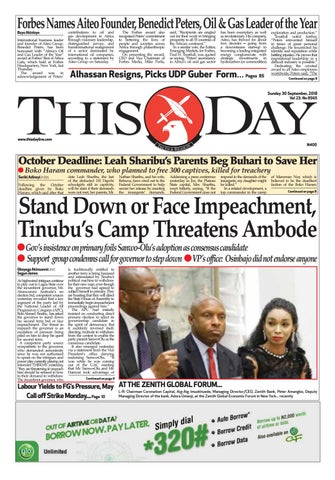
Stand Down or Face Impeachment, Tinubu’s Camp Threatens Ambode Gov’s insistence on primary foils Sanwo-Olu’s adoption as consensus candidate Support group condemns call for governor to step down VP's office: Osinbajo did not endorse anyone Gboyega Akinsanmi and Segun James As high-wired intrigues continue to play out in Lagos State over the incumbent governor, Mr. Akinwunmi Ambode’s reelection bid, competent sources yesterday revealed that a key segment of the party led by the National Leader of All Progressives Congress (APC), Bola Ahmed Tinubu, has asked the governor to stand down his second term bid or face impeachment. The threat to impeach the governor is an escalation of pressure being piled on him to drop his quest for second term. A competent party source sympathetic to the governor, who demanded annonimity since he was not authorised to speak on the intrigues and power play currently playing out informed THISDAY yesterday, “they are threatening to impeach him should he refused to bow to their demand to withdraw. The incumbent governor, who
is traditionally entitled to another term is being harassed and intimidated by Tinubu's political machine to withdraw for their new man, even though the governor had agreed to subject himself to primary. They are boasting that they will direct the State House of Assembly to immediatly begin impeachment proceedings against him.” The APC had initially insisted on conducting direct primary election to select its governorship candidate in the spirit of democracy. But it suddenly reversed itself, directing Ambode to withdraw from the contest to enable the party present Sanwo-Olu as the consensus candidate. It also emerged yesterday via a statement from the Vice President’s office denying endorsing Sanwo-Olu. “It was while he was coming out of the GAC meeting that Mr. Sanwo-Olu and Mr. Hamzat took advantage of Continued on page 8
Labour Yields to FG’s Pressure, May AT THE ZENITH GLOBAL FORUM... L-R: Chairman Coronation Capital, Aig-Aig Imuokhuede, Managing Director/CEO, Zenith Bank, Peter Amangbo, Deputy Managing Director of the bank, Adora Umeoji, at the Zenith Global Economic Forum in New York... recently Call off Strike Monday... Page 10
2
T H I S D AY ˾ ͱͮ˜ ͰͮͯͶ
T H I S D AY ˾ SUNDAY SEPTEMBER 30, 2018
3
4
T H I S D AY ˾ ͱͮ˜ ͰͮͯͶ
T H I S D AY ˾ SUNDAY SEPTEMBER 30, 2018
5
6
T H I S D AY ˾ ͱͮ˜ ͰͮͯͶ
T H I S D AY ˾ SUNDAY SEPTEMBER 30, 2018
7
+, &
*-!
& & %
!
" ! "! #$ % & ! % ' !! & & &( ) & % & & *
8
ÍťÍ¸Ëœ ͺ͸͚΀ Ëž T H I S DAY, T H E S U N DAY N E W S PA P E R
PAGE EIGHT
Election: US, EU, UK Express Concern over Results, Call for Calm Say they have no preferred candidate
Bayo Akinloye The United States, United Kingdom, and the European Union yesterday expressed worry about the outcome of the Osun State governorship election rerun, citing unwholesome interference and intimidations of voters, journalists and other stakeholders. In a statement jointly signed and made available to THISDAY on Saturday, the
US, UK, and EU, however, commended Osun voters for coming out to exercise their democratic rights despite the atmosphere of intimidation. The statement read in part, “Delegations from the Missions of the European Union, the United Kingdom and the United States observed the voting in the Osun State re-run election on September 27. We once again commend the vast majority of the voters
in the state for exercising their democratic rights peacefully.� It, however, added, “In contrast to our overall findings on the vote of September 22, we were concerned to witness widespread incidents of interference and intimidation of voters, journalists, and civil society observers by some political party supporters and security agencies. Many of our findings mirror those of leading civil society groups that
observed the election.� But despite allegations of complicity in objectionable practices in the electoral process being levelled against the Independent National Electoral Commission by some opposition figures, the US, UK and the EU commended the way INEC conducted itself, saying, “We commend the work of INEC leadership during both elections. But it is clear that the
neutrality of the security services and responsible conduct by party agents, both inside and outside polling units, will be essential to ensure free, fair, credible and peaceful elections in 2019.� They urged all sides in the election to pursue peace. “We continue to call for calm from all stakeholders and urge that any challenges to the election result be made through peaceful and lawful means,� the statement said.
Although concerned about the rerun, the trio promised not to take sides with the ruling All Progressives Congress or any of the opposition parties, including the Peoples Democratic Party. “We restate our position of firm neutrality among all parties and candidates. We remain committed to supporting the Nigerian people in seeing free, fair, credible, and peaceful elections,� the statement said.
commanders loyal to Mamman Nur faction who had been tipped off about his plans. The source said Garga was a Fulani man from Taraba State and he had been forced to join the Nur faction of the group three years ago after his cows were seized from him by Boko Haram on the fringes of Lake Chad. “Garga was trained on how to fight war and engage in combat operations by the terrorist group. He also possessed an extraordinary ability of knowing the terrain because he was a herdsman.
This made him to be elevated to the level of a Commanding Officer by the Mamman Nur's Faction fast,� the source stated. He added, “Garga was not interested in holding captives for ransom like others. What is paramount to him is getting his livestock back and continuing the life of a herdsman and being allowed to reunite with his family.� The source said before Garga was killed, he was in touch with a foreign influencer who planned to rescue him and others.
by one of the governorship aspirants, Dr. Obafemi Hamzat, of his decision to graciously step down and endorsed Jide Sanwoolu. The GAC has equally endorsed Sanwo-Olu as its preferred candidate ahead of the primaries.� Immediately after announcing the decision of the GAC to endorse Sanwo-Olu as the party’s preferred candidate, thousands of party faithful started chanting songs of disapproval and some pelted Adefuye and other party leaders with satchet water at the stakeholders’ meeting. With the angry reaction of party faithful, Adefuye abruptly stopped addressing the stakeholders’ meeting, which they described as undemocratic and one-man show. Before Adefuye addressed the stakeholders meeting yesterday, Osinbajo had addressed the GAC leaders at its Saturday meeting, warning them about the dire consequences of denying Ambode the ticket which he said, might culminate in a repeat of what happened during the Osun governorship election. An entirely different party leader revealed that Osinbajo told the GAC leaders to be mindful of their actions and not place personal interest above that of the electorate, who had made up their minds to vote continuity. According to the source, Osinbajo categorically said he was asked by Buhari to proceed to Lagos to again appeal to APC national leader and some party leaders opposed to Ambode’s second term bid to rescind the
decision in the interest of the party. He said, “Osinbajo frankly told the GAC leaders that Lagos State Senate Caucus has endorsed Ambode. He referred to the endorsement of the chairmen of 20 LGAs and 37 LCDAs. At the meeting, he said Hon. Femi Gbajabiamila had led the House of Representatives Caucus in the state to endorse Ambode. “The whole world knows that all these personalities have endorsed Ambode and all of a sudden, what shall we tell the world now that Ambode has done wrong all of a sudden after all the endorsements that you have made to warrant your current position? “Osinbajo specifically asked the GAC leaders: Will it be enough to tell the whole world that it is for our own selfish interest that we are saying that we are not going to endorse Ambode? Is it because Ambode has not performed? Ambode has performed and everybody knows that.� Reacting to the endorsement of Sanwo-Olu by the GAC, Director General of AMSG, Hon. Hakeem Sulaimon, said, “I don’t think the GAC would have done such a thing as represented by Senator Anthony Adefuye, because a few days ago, the GAC came out to say that they have resolved that His Excellency the Governor will not be granted the same privilege granted fellow governors in other states and that every aspirant should go for the primaries.
to support football on the African continent. Through Aiteo, he sponsors the Nigerian Football Federation, CAF Awards, Aiteo Cup (the Federation’s foremost tournament in Nigeria) and a football team in his company’s host community. “He has also assisted thousands of internally displaced persons in northern Nigeria while supporting clean water sanitation initiatives in Africa, in partnership with Face Africa, improving the lives of over 25,000 people in rural Liberia. Peters addresses social and environmental issues in the agricultural sector through the Joseph Agro Foundation, set up in July 2014 to tackle chronic unemployment and water shortage.�
In recognition of his “groundbreaking contribution to development�, Peters was one of four recipients of the Marquee Award for Global Business Excellence at the Africa-US Leadership Awards in 2014. In the same year, he received the “Leadership CEO of the Year� award. In 2015, Peters was conferred with the “Dr. Martin Luther King Jr. Legacy Awards� in the “Economic Empowerment� category. He was listed among the “50 Most Influential Nigerians in 2017� by BusinessDay. More recently, he has been recognised as the “Oil and Gas Man of the Year� at the prestigious 2018 Guardian Awards.
OCTOBER DEADLINE: LEAH SHARIBU’S PARENTS BEG BUHARI TO SAVE HER terrorist group, was assassinated for alleged treachery, in a major revolt. A source said Ali Garga had planned to free 300 Boko Haram captives, but his plan was exposed. He was subsequently arrested and killed by other commanders still loyal to the Mamman Nur faction of the terrorist group. The source said Garga, a Fulani, also planned to surrender to the Nigerian military after leading the abductees to freedom. Mrs. Sharibu, while she addressed the press in Jos, was
flanked by founder of Citizen Monitoring Group (CMG), Gideon Para-Mallam; Executive Secretary of International Fellowship of Evangelical Students (IFES), Mr. Mike Adegbile; Apostle Chris Bature; and Dr. Gloria Samdi. “I call on the President of Nigeria, Mohammadu Buhari, Vice President, Prof Yemi Osinbajo, Secretary to the Government of the Federation (SGF), Mr. Boss Mustapha, and to other wellmeaning Nigerians, and indeed, to the whole world, to do whatever
they can to secure the release of my daughter before she is killed,� she said. “A threat has been sent out by Boko Haram that Leah will be the next in line to be killed in October if their demands are not met. By Monday, October will set it, so the ultimatum is now here.� Also speaking by telephone, Mr. Sharibu said, “I do not know what their demands are, but whatever they are, the Federal Government should, please, meet them so that our daughter will be free.� While thanking Nigerians and
the world for standing with them in prayers and for pushing hard to ensure that Leah, who has been held for seven months, is released, the Sharibus also denied knowledge of any court case instituted against the federal government over the matter. They said, “We do not know anything about the court case, and our concern is not money but how to secure the safe release of our daughter.� Meanwhile, a source told THISDAY that Garga was killed on September 27 by other
STAND DOWN OR FACE IMPEACHMENT, TINUBU’S CAMP THREATENS AMBODE the VP’S presence to take the photos which are now being falsely paraded as proof of endorsement. “The VP did not go there to endorse Sanwo-Olu., they only took advantage of his presence,� a source at the meeting confirmed last night.� Rather, sources at the GAC meetings hinted that Prof Osinbajo, who is believed to be supportive of a second term bid for Ambode, conveyed the view of the Buhari presidency that there should be a level playing field in the overall conduct of the primaries. Party chieftains spoke with THISDAY yesterday in confidence on the drama that took place at the meeting of the Governor’s Advisory Council (GAC) held Friday night. They disclosed that the APC leader threatened to impeach Ambode if the governor refused “to step down for Sanwo-Olu.� Ambode was said to have looked him squarely in the face and refused. But Ambode Mandate Support Group condemned the call for the governor’s withdrawal as undemocratic. The group also reacted to the postponement of the APC governorship primary in the state, which has now been scheduled for October 1, saying they were confident that Ambode would fly the party's flag in 2019 election as it has received overwhelming support from several quarters for him. There has been uncertainty about governor's re-election after Sanwo-Olu, currently the managing director of Lagos State Development and Property Corporation (LSDPC),
and former commissioner for Works and Infrastructure, Dr. Obafemi Hamzat, declared their intention to challenge the governor in a primary contest. As a result, the Mandate Movement, a powerful political machine of Tinubu, endorsed Sanwo-Olu for the governorship contest, heating up the state’s political climate ahead of the primary election. Ambode’s travails had attracted the intervention of President Muhammadu Buhari; former Ogun State Governor, Chief Olusegun Osoba; Oyo State Governor, Senator Abiola Ajimobi; the Progressives Governors Forum (PGF); and the Nigerian Governors Forum (NGF). They all tried to persuade Tinubu to make up with Ambode. With the presidential intervention, Tinubu decided to consult the Governor's Advisory Council (GAC), the state’s highest advisory political organ, comprising 22 APC chieftains across the three senatorial districts. But in its resolution, the GAC directed Ambode and two other aspirants to face the direct primary election. At the GAC meeting held at Tinubu’s residence, Bourdillion, Ikoyi, Friday night, one of the party chieftains explained how Ambode addressed the leaders of the GAC, justifying point by point the reasons he decided to seek re-election in 2019. Specifically, according to the chieftain, Ambode hinged his re-election bid on the need to complete various infrastructure projects and urban renewal programmes that his
administration initiated in the last three years. Despite his justifying his reelection bid, the party chieftain stated that Lagos Central APC leader, Prince Tajudeen Olusi, asked the governor “to step down for Sanwo-Olu. He claimed that the GAC had already endorsed SanwoOlu as the party’s consensus candidate.� Another party chieftain revealed that a member of the GAC, Prof. Tunde Samuel, interrupted Olusi while he was telling Ambode to withdraw from the race, observing that Olusi’s statement did not reflect a common position of all GAC members that all aspirants should face primary contest. In response to Olusi, however, the party chieftain claimed that Ambode simply told the meeting that he “will not step down for any governorship aspirants on the ground that it is undemocratic. He also said he stood by the earlier position of the GAC that all aspirants should face direct primary contest to foster democracy in the country. The source stated, at this point, Tinubu, who chaired the GAC meeting, became angry and quickly interjected, threatening Ambode with impeachment, if he failed to stand down for Sanwo-Olu before the primary election earlier scheduled to hold today which was later postponed till tomorrow by the APC national secretariat. THISDAY learnt that it was resolved at the meeting that a stakeholders’ meeting should be held on Saturday at the party
secretariat, Acme road, Ogba. It was expected that Tinubu would come to the meeting to endorse Sanwo-Olu. To their surprise however, thousands of Ambode’s supporters thronged the venue chanting Ambode solidarity songs and raining curses on national leader: Tinubu ole Tinubu ole. Eventually, Tinubu was forced to stay away. When THISDAY contacted Tinubu’s Special Adviser on Media, Mr. Tunde Rahman, for his reaction to the threat to impeach the governor by Tinubu's camp, he responded, saying he did not “have any comment to make.� Rather than attending as originally planned, Tinubu delegated a GAC leader, Senator Anthony Adefuye, to represent him. At the stakeholders’ meeting, Adefuye acknowledged that there was another GAC meeting, which held by 10 am on Saturday, noting that the meeting was attended by the Vice President, Prof. Yemi Osinbajo, Majority Leader of the House of Representatives, Hon. Femi Gbajabiamila, and Speaker of the Lagos State House of Assembly, Hon. Mudashiru Obasa, among others. Adefuye said, “The meeting was chaired by the APC national leader, Tinubu. This is a meeting that we started at 10am. And we could not finish early. After the meeting, I have been mandated by the GAC to announce this to you that the primary earlier scheduled for Saturday, September 30 has been shifted to Monday, October 1. “Also, the GAC was informed
FORBES NAMES AITEO FOUNDER, BENEDICT PETERS, OIL & GAS LEADER OF THE YEAR acknowledgement by Forbes as ‘Oil and Gas Leader of 2018’ is inspiring. It means a lot to me and the entire Aiteo Group. I am delighted that the international community recognises our contribution towards Africa’s self-sufficiency in energy and our aspiration to become a reference point for indigenous capacity in oil and gas.� Continuing, the Aiteo boss added: “This award motivates us to broaden our vision for the continent, despite all odds, and accelerate her economic transformation. We believe that Africa has what it takes to lead the world and we will continue to push the frontiers of development through our investments in people and
technology. The success of our oil and gas upstream subsidiary proves that the future we envision in Africa rests to a large extent in the hands of Africans.� It would be recalled that Peters ventured into the oil and gas sector as an entrepreneur in 1999 and initially traded mainly in the downstream sector. According to the statement, Aiteo is currently the highest-producing indigenous oil exploration and production company in Nigeria. In 2015, Peters consolidated Aiteo’s asset portfolio with a $3 billion acquisition of sub-Saharan Africa’s largest onshore block (OML 29). “Subsequently, Aiteo optimised the asset’s yield
from 17,000 barrels of oil per day (bopd) to almost 70,000 bopd within the year of the asset’s acquisition. The largest indigenous energy provider currently peaks production at around 100,000 bopd, doubling its initial asset value to $6 billion within three years. The company plans to invest another $4.3 billion acquiring additional offshore assets with a projected total output of 250,000 bopd in the short to medium term,� the company said in the statement. It further disclosed that beyond oil, the Aiteo Group had investments in mining, agriculture, infrastructure development, electricity generation and distribution, with a fast-growing retail distribution
network and focus on serving the needs of communities across the continent by leveraging a unique combination of a strategic asset base, technology, innovation, and some of the best technical and business minds across the industries it operates in. The group has been expanding rapidly and extending its operations to different countries across Africa and beyond with emerging international presence in the DRC, Ghana, Guinea, Liberia, Zambia, Zimbabwe as well as offices in Geneva and Paris, the statement further revealed. It added, “Peters is passionate about youth empowerment and has donated generously
Continued on page 86
T H I S D AY, T H E S U N D AY N E W S PA P E R ˾ SEPTEMBER 30, 2018
9
SUNDAY COMMENT
Editor, Editorial Page PETER ISHAKA Email peter.ishaka@thisdaylive.com
INEC AND BUNGLED ELECTIONS The Osun governorship election seems to suggest that we are harking backwards
I
f justice, equity and fairness are the metric used, it is safe to conclude that the Osun State gubernatorial election was wide off the mark. The security agencies and indeed the Independent National Electoral Commission (INEC) unwittingly allowed for several unwholesome practices such that the supplementary poll held last Thursday became nothing but a sham. More disturbing is that all these too frequent inconclusive elections in our context undermine integrity by introducing gang-ups, intimidation, thuggery, and voter alienation. In the process, the initial verdict of the electorate is often thwarted while an unpopular outcome is rigged into place and legitimised through INEC’s stamp of authority. Therefore, the best way for INEC to restore confidence in the system is to avoid constantly While Nigeria is walking into the anxious to enthrone technicalities that a lasting democracy, lead to inconclusive elections. great care needs to Before last Thursbe taken to ensure day’s victory for the that our variant ruling All Progresdoes not end up sives Congress (APC) enshrining the rule candidate, Mr Gboyega Oyetola, the opposition of violent moneyed Peoples Democratic mobs that vitiate public expectations Party (PDP) candidate, Senator Ademola and disappoint the Adeleke had led with 353 rest of the world votes. At the end, the most significant factor in the rerun was the role played by the Social Democratic Party (SDP) candidate, Mr Iyiola Omisore who endorsed the APC candidate. In his stronghold where the rerun poll held last Thursday, election observers, journalists and agents of the PDP were harassed and molested by thugs who practically took over the entire process while the police looked the other way. It is therefore understandable that many critical stakeholders have condemned the election. “We hold strongly the view that the rerun poll does not meet up with the minimum standards for free, fair and credible elections. It falls short of global best practices in democratic elections which Nigeria aspires towards,” an election monitoring group, the Centre for Democ-
Letters to the Editor
A
racy and Development (CDD), said on Thursday.
T
S U N DAY N E W S PA P E R EDITOR SHAKA MOMODU DEPUTY EDITORS OLAWALE OLALEYE, TOBI SONIYI MANAGING DIRECTOR ENIOLA BELLO DEPUTY MANAGING DIRECTOR KAYODE KOMOLAFE CHAIRMAN EDITORIAL BOARD OLUSEGUN ADENIYI EDITOR NATION’S CAPITAL IYOBOSA UWUGIAREN MANAGING EDITOR JOSEPH USHIGIALE
T H I S DAY N E W S PA P E R S L I M I T E D EDITOR-IN-CHIEF/CHAIRMAN NDUKA OBAIGBENA GROUP EXECUTIVE DIRECTORS ENIOLA BELLO, KAYODE KOMOLAFE, ISRAEL IWEGBU, IJEOMA NWOGWUGWU, EMMANUEL EFENI DIVISIONAL DIRECTORS BOLAJI ADEBIYI , PETER IWEGBU, ANTHONY OGEDENGBE DEPUTY DIVISIONAL DIRECTOR OJOGUN VICTOR DANBOYI SNR. ASSOCIATE DIRECTORS ERIC OJEH, PATRICK EIMIUHI ASSOCIATE DIRECTOR SAHEED ADEYEMO CONTROLLERS ABIMBOLA TAIWO, UCHENNA DIBIAGWU, NDUKA MOSERI DIRECTOR, PRINTING PRODUCTION CHUKS ONWUDINJO TO SEND EMAIL: first name.surname@thisdaylive.com
hat position has been echoed by most other observers, including members of the international community that had earlier commended the manner the first exercise was conducted. “The missions of the United States, European Union and the United Kingdom observed voting at polling stations in Osun today (Thursday). We witnessed what appeared to be incidents of interference and intimidation of voters and have reports of harassment of party monitors, journalists and domestic observers. We are very concerned by these reports and we will be checking with stakeholders to determine the facts. We call on all stakeholders to remain calm,” the United States Consul General, Mr John F. Bray said. The pertinent question is: What changed between Saturday and Thursday? The answer has to do with the nature of supplementary elections and that is why INEC cannot continue with the practice which allows for underhand deal-making and disproportionate deployment of partisan security agents and policemen that would not have been possible were the election conducted on the same day. In close elections such as we had in Osun State, the process of a supplementary poll in a few polling units could easily be gamed by the party in power. That, many believe, was what actually happened last Thursday. In the end, an election that was ordinarily between 48 candidates became a contest between two with all the implications for the eventual outcome even when it is not a run-off. The purpose of democracy is to afford the people the opportunity to choose their leaders and subsequently participate in the way they are governed. The basic way this is done is through the ballot box. But when citizens are scared away from performing this civic duty, they are denied a fundamental right that is guaranteed by the constitution. In both the Osun and other recent standalone state governorship elections, the ruling APC displayed an uncanny residue of the military hangover in our polity. Electoral victory is being pursued as a battle objective into which a combination of brute force, intimidation and aggressive vote-buying are deployed to conquer the opponent. While Nigeria is anxious to enthrone a lasting democracy, great care needs to be taken to ensure that our variant does not end up enshrining the rule of violent moneyed mobs that vitiate public expectations and disappoint the rest of the world.
TO OUR READERS Letters in response to specific publications in THISDAY should be brief (150-200 words) and straight to the point. Interested readers may send such letters along with their contact details to opinion@thisdaylive.com. We also welcome comments and opinions on topical local, national and international issues provided they are well-written and should also not be longer than (950- 1000 words). They should be sent to opinion@thisdaylive.com along with the email address and phone numbers of the writer.
For NOT-TOO-YOUNG-TO-RUN Campaign
t the age of 32, former Head of State, General Yakubu Gowon, assumed the mantle of leadership and became Nigeria’s leader in 1967. A time it was when the legendary Zik of Africa, Dr. Nnamdi Azikiwe, at the youthful age of 44, became Nigeria’s first ceremonial president. The memories of the iconic General Murtala Ramat Muhammed, who was murdered in a bloody coup, shall remain green in our hearts. It was at the graceful age of 37 that providence foisted on his shoulders daunting leadership responsibilities. Chief Olusegun Obasanjo, erstwhile civilian president, first piloted the Nigerian ship as Head of State while a youth. In 1976 when he succeeded the late Muhammed, he was barely 39. There are still some precedents. President Muhammadu Buhari also belongs to the league of eminent
personalities who became Nigeria’s leader in their youthful age. In 1983, the 41- year-old Daura-born became the Commander- in-Chief of the armed forces after toppling the civilian government of Alhaji Shehu Shagari. Suffice to say that it was after the Buhari/Idiagbon junta was dethroned that General Ibrahim Badamasi Babangida came into national reckoning at 44. No doubt, they (the aforementioned) all emerged as Nigerian leaders—at different points—through military fiat. When I checked last, most of the celebrated nationalists who stoically campaigned and fought for the country’s sovereignty were youths in their 30s and early 40s. There abounds Nigerian youths who have, and are still making waves, in notable fields of human endevours. Back here in the country, just like across the globe, sensational accounts
of extraordinary accomplishments by our youths are many. I will prefer not to chronicle the enviable feats and sterling successes recorded by young, enterprising, resilient, talented and innovative Nigerians in sports, education, business, sciences, literature, ICT and music, to mention a few. Sadly, the narrative about Nigerian youths in politics or democratic governance—since 1999—is everything but gratifying. Our youths—who desire to be lucky as the Gowons, Murtalas, and Obasanjos of the 70s—wish they are (at the moment) privileged as other global youth leaders. At informal social gatherings, they dissipate their boundless energies discussing how the suave-looking and 39 years old Emmanuel Macron (now 40), became French president in May 2017. They marveled at the reality of a then 31 years old Sebastian Kurz emerging as Austria’s Chancellor. It had also baffled them, as to how
Emil Dimitriev, born in March 1979, is presently the acting Prime Minister (PM) of Macedonia. It also beggars their belief that the punk hair-styled Kim Jong Un, North Korea’s supreme leader is still in his mid-30s; while Justin Trudeau was only 43 when he was sworn-in as Canada’s Prime Minister three years ago. To address the political marginalisation of Nigerian youths, the #NotTooYoungToRun campaign, a social movement by a group of youths, aimed at widening the political space for young, charismatic and visionary minds, was birthed last year. Though, an advocacy bill, but perhaps its principle resonated with Mr. President’s reformative mantra of ‘Change’. Thereafter, the bill became a recipient of a deserving presidential assent from PMB at a colourful event in the Villa. This time around, it was so-much hoped that several young Nigerians will throw their hats in the political ring, with the eligibility age for presidential aspirants now lowered to 35 from 40; that of governorship hopefuls and aspiring federal lawmakers
pegged at 30 and not 35 any longer; while that of State House of Assembly contestants cut down to 25, instead of 30 years. Indeed, the euphoria that greeted the historic assent was indescribable. But it will soon be short-lived. Fast forward to 2018; eve of next year’s general election, and the prospects of greater political fortunes hitherto envisaged for the youths became a mirage. The commencement of Expression of Interests (EOI) and Nomination Forms’ sale by the dominant political parties (namely APC and PDP), were greeted with utter indignation. Nigerians of sincere goodwill, in their unison, lampooned the behemoth parties. Their exclusionary and repulsive nomination fees, they maintained had disenfranchised many competent youths from vying for elective positions. The youths whose eyes were fixated on 2019, consequently perished their lofty ambitions, owing to lack of huge war chest.
––Abdulsalam Mahmud, Abuja.
10
T H I S D AY, T H E S U N D AY N E W S PA P E R ˾ SEPTEMBER 30, 2018
NEWS Labour Yields to FG’s Pressure, May Call Off Strike Monday Omololu Ogunmade and Onyebuchi Ezigbo in Abuja The organised labour may call off tomorrow the strike action it embarked upon last Thursday, THISDAY learnt last night. A top government official who did not want to be named said this followed talks
between Federal Government officials and labour leaders at the weekend. He disclosed that organised labour might announce the suspension of the strike on Monday ahead of the tripartite committee meeting scheduled to hold on October 4. It was gathered that labour
leaders, which insisted on guarantees that Thursday’s meeting will be used to strike a deal on the new minimum wage, were prevailed upon to soft-pedal to allow the committee to conclude action on the matter. The decision to call off the strike might not be uncon-
nected with the intervention of the Presidency on Thursday through the Chief of Staff to the President, Abba Kyari, who tried to persuade labour leaders to end the strike. At the meeting of the chief of staff with the leadership of the organised labour on Thursday at the State House,
ANOTHER MILESTONE...
L-R: Chairman of Ikoyi Club, Mr. Babatunde Akinleye Vice President, Prof. Yemi Osinbajo; Lagos State Governor, Akinwunmi Ambode, and a member during the 80th anniversary of Ikoyi Club
Abuja, the Presidency pleaded with labour to end the strike, which has affected economic activities in different parts of the country. After the meeting, President of the Nigeria Labour Congress (NLC), Ayuba Wabba, told journalists that the meeting was fruitful. Wabba promised that the meeting’s outcome would be tabled before relevant organs of the organised labour to determine the next line of action. According to him, the federal government, through the chief of staff, had made a promise to the group that their agitations would be addressed. However, Wabba failed to disclose the nature of the promise made by Kyari. “The Chief of Staff tried to give us details of government position which we will have to go and convey to our members and then we can revert back to him,” Wabba had said. But on Friday, Senior Special Assistant to President Muhammadu Buhari on Media and Publicity, Malam Garba Shehu, in a statement, said the federal government was working assiduously to ensure the strike was called off. “The Presidency wishes to assure that the federal government is taking every step necessary to get the unions to call off the strike,” Shehu said. He said the organised labour had accepted the federal government’s demand to reconvene the tripartite
committee meeting on the proposed new national minimum wage. According to him, the meeting between the leadership of labour and representatives of various employers of labour, including the federal and state governments, has been rescheduled to reconvene on October 4. He also explained the tripartite nature of the meeting, saying it is so called because it is made up of representatives of the public sector, that is, federal and state governments, as well as the private sector, which he said comprised the largest private employer group, the Nigeria Employers Consultative Association (NECA). Shehu listed other members of the body to include the Manufacturers Association of Nigeria (MAN), Nigerian Association of Chambers of Commerce, Industry Mines and Agriculture (NACCIMA), and Nigerian Association of Small and Medium Enterprises (SMES). Various labour unions, particularly in the public sector, had on Thursday mobilised their members to embark on a warning strike action following the breakdown in negotiations on a new national minimum wage between the unions and the federal government. The organised labour had demanded an upward review of the current N18, 000 monthly minimum wage to N65, 500 across board.
Mark: Why I’m Most Qualified to Rule Nigeria Emmanuel Addeh in Yenagoa Former Senate President and Democratic Party’s Presidential Aspirant, Senator David Mark, has boasted that among those seeking to fly the party’s flag in the 2019 presidential election, he remains the most qualified. Mark, who spoke when he led his campaign team on a consultative visit to Bayelsa State governor Seriake Dickson at the Government House, Yenagoa, said that of all the aspirants, he knew Nigeria’s problems better and therefore was in the best position to solve
them. Specifically, he appealed to Bayelsa delegates to vote for him, noting that as someone who had worked in the old Rivers State, his deep knowledge of the problems of the Niger Delta placed him above the rest to address the challenges confronting the region. The Benue-born politician, however, pledged to abide by the outcome of the party primaries billed to hold on the 6th of October 2018 even if it wasn’t in his favour. He said: “ I have been in politics since 1998. I know the
problems of the Niger Delta I have worked here when the whole this area was under the old Rivers State. As far as I am concerned, what you are asking for is not a difficult thing to do. “You are saying you lay the golden egg and therefore should be allowed to eat it. I want to assure you that I have the political will to enable you eat this golden egg you are laying when I become the president of this country.” He promised to work closely with the Niger Delta and Dickson if he emerges the party’scandidate.
“Your Excellency, you have worked very hard to make Bayelsa a progressive state. You have also been able to stem the high rate of insecurity in this area. You worked hard to stabilize and keep our party going. “I will join you in reducing the unemployment rate in Bayelsa and even fix the insecurity in this country which has become more worrisome. Today, Nigeria has become so divided, it has never been like this before,”he said. In his comments, Dickson reiterated the need for all presidential aspirants of the PDP to
Okowa to Clinch PDP Guber Ticket Today Omon-Julius Onabu in Asaba
Governor Ifeanyi Arthur Okowa of Delta State is set to be formally named the 2019 governorship candidate of the Peoples Democratic Party (PDP) as the state chapter of the party conducts its gubernatorial primary election today. THISDAY received confirmation Saturday evening that the event would take place today in Asaba from both the state PDP Publicity Secretary, Dr Michael Ifeanyi Osuoza and the Government House Asaba. The event, scheduled to hold in Asaba, the state capital, is being perceived by political observers as a mere formality, because there is practically no
opposition in the party to the second term bid of the imcubent governor. Unlike in the past, since the PDP has maintained its seeming stranglehold on the governorship seat from 1999, no one has apparently come out within the party to challenge for the number-one position in Delta State in 2019. Okowa who is about to complete his first in office is from Delta North is entitled to seek another term in office under the unwritten rotaional policy of the party in the state, which allows two terms of eight years for each governor from the three senatorial zones on rotational basis. All the ‘leading’ 2019 governorship aspirants in the state,
including former speaker of the Delta State House of Assembly, Hon Victor Ochei, Dr Cairo Ojougboh, Prof Pat Utomi and Chief Great Ovedje Ogboru are in the All Progressives Congress (APC), leaving the coast clear for Okowa to clinch the PDP ticket unchallenged. With the zonal executive committees in Delta South, Delta Central and Delta North having, at separate rallies, declared Okowa as the sole gubernatorial candidate in next year’s general election, the tone appears long set for the smooth process to again present him as the PDP governorship flagbearer. Other groups and individuals, includng the over 65-mem-
ber influential Delta State Council of Traditional Rulers, had similarly thrown their weight behind the reelction ambition of Okowa. THISDAY gathered that the obvious expression of implicit confidence in the incumbent has been strengthened by the leadership qualities of Okowa with his regular choice for dauntung PDP national assignments in recent time, including his inauguration in Abuja earlier in the week as Chairman, PDP Presidential Convention Committee towards 2019. Okowa also chaired the last national convention of the party in Abuja, where Prince Uche Secondus emerged as the PDP National Chairman.
close ranks and work for the overall success of the party. He added that the party could not afford to disappoint Nigerians as the citizenry is looking up to the party to effect the desired change in country’s political leadership in 2019. He further urged all the aspirants to pursue their ambition of becoming the PDP standard bearer with a spirit of sportsmanship and readiness to obey the overriding will of the party at all times. While acknowledging the contributions of the former Senate President towards na-
tion building, the governor described him as a true patriot who played a pivotal role in stabilising the polity especially during the Dr Goodluck Jonathan’s administration. “You are one of the most qualified Nigerians to run for the Presidency of this country. You know this country very well as somebody who has gone through the entire mill. Let me therefore once again commend you for throwing your hat into the ring because our country is currently in dire need of experienced, tested and broadminded leaders like you.
Flood Kills Father of Nine in Anambra David-Chyddy Eleke in Awka
Flood has claimed the life of Chief Ojike Ajanwu, a father of nine children in Umuokpalaoma kindred, Obolo village, Ogwuaniocha in Ogbaru Local Government Area. According to the wife of the deceased, Mrs. Chinasa Ajanwu who is nursing a one-month-old baby with eight other children, they received the news while taking refuge at an IDP Center in the Community’s Primary School. She said her husband was drowned while attempting to evacuate his harvested cassava, which were staked close to his farm. The deceased left behind a young
wife, Chinasa who hails from Ossomala and nine children, the oldest of the children is 13 years old. Meanwhile, a son of late highlife musician, Osita Osadebe was also drowned in the flood, in same Ogbaru local government area. The 18 year old Okechukwu was swept away by the flood in Atani, late Thursday night but his body was found Friday morning. According to the wife of the deceased, Mrs. Amaechi Osadebe, Okey as he was fondly called was in company of two persons when the flash flood swept him with no opportunity to swim out of danger as the current was too strong and turbulent.
T H I S D AY ˾ SUNDAY SEPTEMBER 30, 2018
11
12
T H I S D AY ˾ ͱͮ˜ ͰͮͯͶ
T H I S D AY ˾ SUNDAY SEPTEMBER 30, 2018
13
14
ÍąÍŽËœ Í°ÍŽÍŻÍś Ëž THISDAY, THE SUNDAY NEWSPAPER
OPINION In Pursuit of Functional Education Ayobami Salami argues the need to refocus our education to build skill sets in innovation, technology and entrepreneurship
I
t is disturbing that despite the immense human and material resources Nigeria is endowed with, the country is still firmly handicapped and unable to wriggle her way out of entrenched developmental quagmire. Aside the retinue of our moral woes, the biggest indictment comes from a failing educational system. The educational problems are never about the absence of policies because there is indeed a handful of policies and conference proceedings, not to talk of the National Policy on Education (NPE). The NPE was developed by some of our brightest experts. Pouring through, one could not but be enamoured by the depth of ideas that litters the 50-page document, addressing critical areas of education – from the cradle to the tertiary levels. It also contains advisory details on funding and partnerships. But then, that is almost where it all ends: Good ideas only – often not backed with the requisite impetus necessary to bring about transformation. For example, on the need for concerted education that can produce self-reliant, innovative and entrepreneurial citizens, the NPE rightly enunciated the specific goals of education in Nigeria as follows: Ensure and sustain unfettered access and equity to education for the total development of the individual; ensure the quality of education delivery at all levels; promote functional education for skills acquisition, job creation and poverty reduction; ensure periodic review, effectiveness and relevance of the curriculum at all levels to meet the needs of society and the world of work; collaborate with development partners, the private sector, non-governmental organisations, and local communities to support and fund education; and promote information technology capability at all levels. The policy went on to highlight the necessary measures to be taken to achieve the said goals. While the propositions are laudable, what is befuddling is that, in many instances, those propositions have rather remained mere statements of intents only, without results. As a strident advocate of Technical and Vocation Education Training (TVET), convinced of its capacity to close-up the
abysmal skills deficit we currently face in the economy, it is fascinating, for instance, that the NPE recognises TVET as a critical tool in charting developmental pathways. TVET, accordingly, is defined as “the comprehensive term referring to those aspects of the educational process involving, in addition to general education, the study of technologies and related sciences and the acquisition of practical skills, attitudes, understanding, and knowledge relating to occupations in various sectors of economic and social life�. Hence, from pre-primary education the policy identified specific skills capable of nurturing self-reliant and innovative competencies in individuals. As a matter of fact, the number one clear-cut objective of junior secondary education enshrined therein speaks of the need to “provide Nigerian with diverse basic knowledge and skills for entrepreneurship and educational advancement�. With these laudable ideals and ideas, it is pertinent to ask: what went wrong? Why has the nation continued to churn out graduates who are anything but assets to nation-building - as thinkers, competent professionals and wealth creators? Of course the answer
Backed by an efďŹ cient monitoring and evaluation framework, priorities must be placed on the production of students imbued with skills such as innovation and entrepreneurship, critical and disruptive thinking skills and civic competence skills
to that isn’t far-fetched. The ‘devil’, unmistakably, is in our approach to implementation. For so long, we have only paid lip service to issues germane to and are at the heart of national development. Nevertheless, it is not all gloomy, provided we negotiate a different path laced with the hope of redemption. Such pathway, informed by a deliberate investment in functional educational, is our best bet. To this end, stakeholders in the sector need to urgently seek ways of arresting the skills deficit in the country. It is important to underscore that no meaningful development can take place in the absence of qualitative, competent and industrious manpower. The formal education sector must be retooled and funded to realise set developmental objectives. Backed by an efficient monitoring and evaluation framework, priorities must be placed on the production of students imbued with skills such as innovation and entrepreneurship, critical and disruptive thinking skills and civic competence skills. The integration of the informal sector is key to stimulating a culture of productivity, excellence and consistent wealth creation. As obtainable in developed climes, Nigeria must push for the standardisation of artisanal skills. Generating reliable database for the various informal sector groups will not only make it much easier to implement quality assurance mechanisms but to also monitor and invest in capacity building for greater developmental good. The instant gain that would accrue is that government is able to sanitise the informal sector, track contribution to national development in view of the strategic quest of generating requisite skills to propel socio-economic aspiration. It bears restating that for Nigeria to compete favourably in an increasingly globalised economy, we must refocus our education to build skill sets in innovation, technology and entrepreneurship. That is the only way to equip our teeming citizens and get them immersed in the building of a virile, resilient and truly prosperous economy. ––Salami is the pioneer Vice-Chancellor of Nigeria’s premier technical university, First Technical University, Ibadan
Anambra And Homage To Education Anambra State is reaping the premium it places on knowledge, writes C. Don Adinuba
T
he golden prize won by Regina Pacis Model Secondary School students in Onitsha, Anambra State, which participated in the $10,000 2018 Global Technovation Challange in which students from 115 countries participated on August 9 in California came to most Nigerians as a surprise. The school girls emerged victorious by designing an internet application to detect fake drugs, which has been a social scourge in the country and elsewhere. Nigerians were also surprised to learn of the bronze medal clinched by Tochukwu Anyigbo, a student of Lagoon Secondary School in Lagos, but sponsored by Governor Willie Obiano because she hails from Anambra State, in the International Robotics Competition held in Mexico a few days after the world competition in California. The prizes should not have surprised many Nigerians. Anambra State has in the last few years been undergoing an unmistakable educational renaissance. In one of my most well received articles published in the mass media in January, 2016, entitled “Anambra: Leading the Return of Education and Enlightened Values�, I called national attention to the infectious enthusiasm which Gov Obiano, winner of the 1974 John Kennedy Memorial Essay Competition organised by the American Embassy in Lagos, has been demonstrating towards educational excellence. The immediate context was how Obiano invited to a meeting of the state executive council students of a public school who had just won the first prize in a Mock World Debate in South Korea as part of the preparation for the contest in Germany where they were also to do very well. He repeatedly called them heroes and heroines. The lads received rock star treatment which is reserved for mostly victorious football players in Nigeria. Pius Okigbo, one of the most engaging economists and polyvalent intellectuals from modern Africa, must be feeling good in his grave at the turn of events in Anambra State. At the graduation lecture at the University of Lagos in 1992 entitled “Crisis in the Temple�, Okigbo showed with facts and figures that the intellectual tradition has been abandoned in Nigeria even by the universities. Higher institutions were no longer paying homage to knowledge but to mammon, as the rest of Nigerian society engaged in what Okigbo called calibration of our national life in pecuniary terms. He cited several examples of how our universities were falling over themselves to award honorary degrees to barely literate “men and women of power and money�, and not to persons of ideas or integrity. Therefore, Okigbo must be satisfied, wherever he may be now, to see his state governor demonstrate reverence to knowledge rather than mammon, as the scripture calls money in a very derogatory manner. He must be proud that his home state has in recent times
been excelling in various competitions. Loretto Special Science School at Adazi, Anaocha Local Government Area, for instance, last year won the first prize in the senior secondary school category of an intensive assessment of schools throughout Nigeria while Queen of the Rosary Secondary School in Onitsha took the first position in the junior secondary school category. Ave Sancta Maria School, also in Onitsha, made the second best result among primary schools, and Clement Okodo from Abagana in Njikoka Local Government Area was judged the best primary school teacher in Nigeria. A teacher in another school in the state won the previous year the award of the Best Teacher in a nationwide competition sponsored by Nigerian Breweries Plc. Olusegun Adeniyi, former presidential special adviser who now chairs THISDAY editorial board and participated in the teacher’s award, told me in a private conversation that he found Anambra teachers very competitive in every area. Anambra is the only state in Nigeria where teachers generally earn higher than civil servants. Science, English and Igbo teachers receive an additional 10% of their salaries because these subjects are considered key. Those who teach in hard-to-reach places like Anambra West Local Government Area which is a riparian place, are paid an additional 20%. In other words, a science or English or Igbo teacher in a hard-to-reach place earns not just his or her monthly salary like the counterpart in the civil service but an extra 40%. The impression should not be given that Governor Obiano pays great attention to basic education but not higher education, for it will be misleading. He made it possible for medical students of the state university to graduate for the first time since they were admitted nine years earlier into medical school. They could not graduate because the medical school established by ex-Governor Peter Obi failed to get the accreditation from the Medical and Dental Registration Council of Nigeria which regulates medical education. It was starved of funds. It did not possess the right number and calibre of staff, the right equipment and other critical facilities. Obiano quickly provided the needed funds, with a directive to the authorities to get it accredited for training not just medical doctors but also specialists. Gynaecologists, paedetricians and other consultants are today trained there. At executive council meetings, Obiano defers to professor members. In the middle of a debate, he often would say, “I rule in your favour because the professors are supporting you. You know I admire professors because of their knowledge�. No wonder, the two education commissioners, both incidentally female, are professors. Kate Omenugha, Commissioner for Basic Education, is
the hardworking Nigeria’s second mass communication female professor and Theresa Nkechi Obiekezie, the young Commissioner for Higher Education, is a geophysics professor who in 2010 won the African Union-World Academy of Science National Young Scientist following a ground-breaking research in life and earth sciences. In consideration of Anambra’s prioritisation of education, former World Bank vice-president Oby Ezekwesili who is an exMinister of Education, counselled the state government two years ago to take education from its list of economic enablers to its list of development pillars. Ezekwesili advised the governor to consider making the state Nigeria’s knowledge hub the way Massachusetts has become in the United States. California is another American knowledge centre. California would be the fifth or sixth largest economy in the world if it were a separate country. Its economy is driven by ICT and entertainment, and its excellent institutions like Stanford Business School are central to the development. The United Kingdom earns huge revenues from its excellent education. The University of Manchester prides itself on soft power because it has produced, more than any other British higher institution, more foreign heads of state, prime ministers and other leaders. Any government, national or sub national, which places premium on knowledge is most likely to do well. Therefore, it is no surprise that Anambra State has been doing exceedingly well in various areas in the last few years. Just a month ago, Vice-President Yemi Osinbajo, assisted by Health Minister Isaac Adewole, presented the first prize for excellent immunisation campaign to the Anambra State government. Of course, the state remains Nigeria’s safest, and is increasingly recognised as the most peaceful and socially harmonious state in Nigeria. It has the best road network in the country and the rate of its agricultural and industrial development is very impressive. The only state to increase workers’ salaries in the past six years, Anambra always pays workers and pensioners before any other. These are, indeed, good times for the government and people of Anambra State. It says a lot about Gov Obiano’s attitude towards education that a number of his commissioners and other senior officials have just returned from a leadership programme at Harvard. Another set will soon leave for the Lagos Business School. The significance of Obiano’s commitment to lifelong learning and development is the topic of another article. In the meantime, other states can borrow a leaf from Anambra which has proved to be truly the Light of the Nation. ––Adinuba is Anambra State Commissioner for Information & Public Enlightenment.
15
T H I S D AY, T H E S U N D AY N E W S PA P E R ˾ SEPTEMBER 30, 2018
LETTERS Lagos, Urban Development And Livability
A
t the turn of the millennium, and for the first time in human history, about half of the world’s population began to live, not just in ‘cities’, but in ‘megacities’. In this league of cities are Tokyo, New York City, Mexico, Mumbai, Sao Paulo, Delhi, Shanghai, Calcutta, Los Angeles, Karachi, and Rio de Janeiro. Lagos joined the league in 1995 when it reached population of over 10 million from about 665,000 in 1963. Observably, difficulty in waste management, scarcity of resources, air pollution, human health concerns, traffic congestions, deteriorating and aging infrastructure among others are inescapable physical and material problems in mega-cities. Lagos was caught in the web of some of these problems largely because it has developed independently of the efforts of city planners, through unstructured urbanism. The state was a good case study of everything that is wrong with Nigeria’s pseudo-federal system. Ordinarily, large cities, towns and even small neighborhoods do not spring up overnight. They are the
Ambode
result of careful planning by civil and design engineers, project managers, architects, environmental planners and surveyors. The reverse was the case with Lagos State. No one foresaw or planned for the disarray and congestion caused by exponential increase in the population of the state sequel to influx of Nigerians from
different geo-political zones, especially starting from period after the Nigeria’s civil war. Before Alhaji Lateef Jakande came on board in 1979, the state had gradually become a city with reverse development as investment on infrastructure was far below the requirement. The Jakande administration worked tirelessly to bridge
deficit of infrastructure in education, housing, transport, environment, health and other sectors until its tenure was halted on 31st December, 1983. From the period of military misrule until 1999, Lagos had become a slum known more for contravention of building code, traffic jam, heaps of refuse and decayed infrastructure. Nigeria itself was underdeveloped and left to be surpassed in terms of development by the likes of Singapore, Malaysia and South Africa. In other words, military rule failed Lagos, just as it failed the entire country. Urban sociologists and perceptive Nigerian observers who are watching what’s going on in Lagos State today would rightly agree that making Lagos a more livable city is emerging as a strategy to mitigate the problems engendered over the years. Improving on the strides of preceding administrations, especially from 1999-2015, the present government is focused on formulating policies and implementing programmes that will change the narrative of a city that has largely developed independently of the efforts of city planners. Consequently, the current administration has adopted a
Curbing Revenue Losses From Illicit Tobacco Trade
T
he Federal Ministry of Health in August 2017 disclosed that about 4.5 million Nigerians consume 20 billion cigarettes yearly. However, it is not known what portion of this volume is supplied via illicit trade. Illicit tobacco trade is defined by the Financial Action Task Force (FATF 2012) as “the production, import, export, purchase, sale, or possession of tobacco goods which fail to comply with legislation”. The World Health Organisation (WHO), in its 2015 report on illegal trade in tobacco products, revealed that one in every 10 cigarettes globally might be illicit and this number is much higher (averaging 16.8%) in low income countries that have higher incidence of smuggling. It also estimated in the WHO report that governments would gain $31billion annually by eliminating illicit trade in tobacco. The major factors that influence illicit trade and smuggling were listed to include the ease and cost of operating in a country; tobacco industry participation; level of sophistication of organized crime networks; the tax administration system’s efficiency and integrity; and the likelihood of being caught and punished. Illicit tobacco trade occurs in several forms. Some criminal gangs produce counterfeit cigarettes that are usually difficult to distinguish from genuine products and these are sold at cheaper prices. Smuggling rings also peddle cigarettes across borders thereby engaging in large scale tax evasion. Smuggling occurs for both real and counterfeit products. This scourge is being tackled
globally by various agencies such as WHO, through the Framework Convention on Tobacco Control (WHO FCTC) with the establishment of an International Tobacco Protocol that will be ratified and implemented by governments. Its overarching objective is to eliminate illicit trade in tobacco products. So far, 54 countries are signatories to the protocol, while 48 countries are categorized as parties to the protocol because they have gone ahead to either ratify or accent it. The International Police (INTERPOL) has also partnered with the major cigarette manufacturers such as British American Tobacco, Philip Morris International, etc., to create an international framework to combat illicit trade in tobacco. Other fronts from which illicit trade is being fought are The United Nations Convention against Transnational Organized Crime (UNTOC) and the United Nations Convention against Corruption (UNCAC) with greater involvement of national governments. These global efforts notwithstanding, every country must identify the peculiarities of the problem within its borders and establish effective measures to tackle them while also pursuing transnational initiatives to prevent smuggling and illegal importation. In March 2014, Premium Times, an online news publication, released details of its investigative report into the threat of illicit tobacco trade. The report suggested that the WHO report on illicit tobacco in Nigeria, which showed a reduction to 10% in 2012 from 30% in 2005 was not robust enough as a lot of illicit products entering the country through the land borders were not factored into
the findings by the WHO. The report detailed how illicit cigarettes are smuggled through various land borders across Nigeria and how easily peddlers sold these items on the streets and shops. The report also revealed the existence of locally manufactured cigarettes with false locations listed as their factory addresses. In 2015, the National Assembly passed the National Tobacco Control Act (NTCA) 2015 to regulate and control the manufacture, sale, advertising, promotion and sponsorship of tobacco or tobacco products in Nigeria and for related matters. The NTCA 2015, which was enacted with the support and cooperation of the major cigarette manufacturers in Nigeria, facilitated the establishment of the National Tobacco Control Committee as well as the Tobacco Control Fund. The provisions of this act, which cover sundry aspects of the industry, including regulation of smoking; prohibition of tobacco advertising promotion and sponsorship; tobacco product sales; tobacco contents and emission disclosures; tobacco product packaging and labelling; licensing of dealers; enforcement; education, communication, training and public awareness, provided effective regulation for the legal players in the industry. However, illicit trade has continued to thrive despite the NTCA and this may not be unconnected with the level or quality of enforcement of its provisions. While it has encouraged the legal industry players to adhere to international best practice, the NTCA apparently has very minimal effect on the activities of illegal business operators. The likelihood of being
caught and punished is a major deterrent to engaging in illicit trade but the risk remains abysmally low in Nigeria. Therefore, a lot of unscrupulous entities are drawn to a seemingly “low risk, high reward” environment that Nigeria offers. Additionally, the ease with which they can operate within a country is an important determinant for smugglers and illicit traders. Nigeria’s porous land borders provide very little resistance and there exists yet many illegal entry points into the country. This continues to make Nigeria very attractive to various syndicates that are involved in the global illicit tobacco trade. Expectedly, illicit trade results in revenue loss to the nation as taxes and excise duties that would have accrued on the legal trade of these items are lost to smuggling syndicates. It also poses a great danger to the commercial investments of industry operators as increasingly bigger chunks of businesses are lost to illicit traders who sell at far cheaper prices by marketing counterfeits and through tax avoidance. Illicit tobacco trade poses yet another threat to Nigeria. Interpol, WHO, The United States Department of Justice all claim that the black market in tobacco is a chief source of funding for organized crime syndicates and terrorist organizations. Curbing illicit trade in Nigeria could thus stifle the funding of the different terrorist activities in the country while reducing government’s escalating costs of combating terrorism and other forms of organized crime. To curb illicit tobacco trade in Nigeria, the battle must begin at the entry points. ––NojeemAdetuberu,Lagos.
proactive strategy to turn identified activity centres within the state into vibrant and organized areas through the preparation of master and model city plans. Twelve model city plans had so far been prepared. These are Lekki Comprehensive Master Plan, Badagry Master Plan, Ikoyi-Victoria Island Model City Plan, Ikeja Model City Plan, Alimosho Model City Plan, Mainland Central Model City Plan, Apapa Model City Plan and Agege-Ifako Model City Plan. Others are Epe Master Plan, Ikorodu Master Plan, Oshodi-Isolo Model City Plan and revised Ikeja Model City Plan. Urbanization is being raised as the major thrust of government to provide a safe, secure, productive and functional state as an essential ingredient for the physical, psychological, social and economic well-being of the people of Lagos State in accord with Itesiwaju Ipinle Eko (Lagos’ Progress) dictum of the current administration. The logic of Lagos urban renewal could be better understood from the new research that postulated that if Nigeria’s population continues to grow and people move to cities at the same rate as now, Lagos could become the world’s largest metropolis, home to 85 or 100 million in the next 50 years. This is why government policies are focusing on today and the future. A lot is also being done in the area of building control as an inventory of abandoned buildings in the state is being undertaken. Recently the state government published the first batch of these abandoned buildings and issued a 90 days ultimatum to owners to take possession or be ready to face the legal wrath of the law. The focus of the state government is to continue to carry out this inventory and other such control mechanisms until every building constructed in Lagos State is fit for human habitation. Government is determined to ensure that no developer is allowed to put people's lives at risk. It is worthy of commenda-
tion that the state government is embarking on substantial projects simultaneously across the state and still lining up more to bridge huge infrastructure deficit estimated at over US$50bn. The truth is that ongoing infrastructure development, upgrade and urban renewal of the state are the impetus that could actually propel and consolidate the state in the global livability ranking. That is the enviable story of the trends in road infrastructure development, light up Lagos, equipping the youths with technological and educational skills they can use to develop solutions to challenges, security, quest for 24 hours economy and ongoing redeveloping of about 100 slum settlements across the state to make them more habitable. Through the Lagos State Urban Renewal Agency (LASURA), attention is being shifted from the traditional way of tackling slum issues to a more pragmatic approach such as the introduction of tax increment financing to fund infrastructural development in slum areas. Rightly, all encumbrances on the Right-of-Way for all infrastructure renewal projects in the state are being removed while government is insisting on compliance with layout plans to guide against and or correct haphazard developments, thereby eradicating the growth of slums and ensuring a livable environment. Government has also intensified efforts in vital areas such as Processing and Approval of Layout Plans; Preparation of Development Guide for Excised Villages; Monitoring of Existing Public and Private Estates and Determination and Establishment of Right-of-Ways (ROW). All these are necessity in a population with unstoppable growth to enhance guided development and to discourage continued growth of slums in both public and private estates. –––Rasak Musbau, Lagos State Ministry of Information and Strategy, Alausa, Ikeja.
Private Jets and the Economy
T
he narrative by successive spokesmen of the All Progressives Congress (APC) political party plus the Federal Minister of Information to the effect that the Buhari’s administration has proudly crashed the middle-class and the super-rich class is the height of insensitivity and intellectual backwardness. Is it not a shame that a sitting democratic government would boast about reversing the fortunes of a country and its people and trump the creation of poverty? No wonder Nigeria finally overtook India this 2018 as the country having the largest number of people living in poverty. Suffice to point out here that when the
citizens of a country own more private jets and drive in armoured limousines it can only mean that the economy has been so liberalised that hardworking folks can enjoy their newfound wealth. Hard work pays immensely and the rewards accruing from hard work as a result of shrewd entrepreneurship and investments is not “looting.” Maybe we should tell the APC that the real “looter” is the chieftain who ignores the services that his country can provide at home for his health and pleasure and then resorts to foreign trips for medical attention and holidays. ––Sunday Adole Jonah, Department of Physics, Federal University of Technology, Minna, Niger State
16
T H I S DAY, T H E S U N DAY N E W S PA P E R ˾ SEPTEMBER 30, 2018
THISDAY WEEKLY GUIDE TO 2019
Adebayo Shittu
Sanwo-Olu
Ifeanyi Ararume
Aisha Alhassan
The Road to 2019: Flashpoints to Watch (III) After today’s primary elections of the ruling All Progressives Congress in all the states of the federation except for Lagos and a few others, the countdown to the 2019 elections might have begun for real, writesOlawale Olaleye
T
oday, the ruling All Progressives Congress (APC) will hold its primary elections in all the states of the federation and across all elective offices. Although Lagos has moved its primary to tomorrow for technical reasons, the party, of course, spent the most of yesterday waiting for results of the presidential primaries to be affirmed later by the Governor Abiola Ajimobi 21-member National Convention Committee. Originally slated for yesterday, the party leadership had moved its primary elections to today for convenience, being a major step to the general election. It goes without saying therefore that the APC and its members had approached today’s primary with a lot of trepidation even though the dynamics vary from state to state. Also, as a prelude to today’s exercise, the APC had last Tuesday approved both direct and indirect primaries for its state chapters, depending on what it thought best suited the different states. A statement by its acting National Publicity Secretary, Yekini Nabene stated that the party approved direct primaries for 18 states and indirect primaries for 19 others, including the Federal Capital Territory (FCT). Thus, to hold direct primaries today are Lagos, Imo, Abia, Akwa Ibom, Delta, Anambra, Bauchi, Bayelsa, Cross River, Edo, Ekiti, Kano, Niger, Ondo, Ogun, Taraba, Zamfara, Bauchi and FCT. But approved for indirect primaries are Adamawa, Borno, Ebonyi, Enugu, Gombe, Kaduna, Kebbi, Katsina, Kogi, Nasarawa, Kwara, Oyo, Plateau, Rivers, Sokoto, Jigawa, Borno and Yobe States. The notion from this development is that the leadership of the party had allowed most of its governors to have their way and adopt their choice primaries. In the PDP, however, on the card now is the presidential run for which the party parades about six major aspirants. In the week, also, the party held its 82nd National Executive Committee (NEC) meeting, where it emphasised the need to embrace unity if it must properly approach the elections of next year. Not so much has been said about other categories of elections as the PDP appears obsessed with the presidential contest. While the APC has unapologetically settled for incumbent President Muhammadu Buhari, just like the PDP did in the 2015 elections, whoever emerges from amongst the PDP line-up would face Buhari in 2019. Those angling for the PDP ticket are Senate President Bukola Saraki, former Vice-President Atiku Abybakar, Governor Aminu Tambuwal, Senator Rabiu Kwankwaso, former Senate President David Mark and former Kaduna State governor, Ahmed Makarfi, amongst other fringe aspirants. However, the one thing today’s primaries of the APC would do for the polity is to properly situate some of the dynamics presently obtainable in each of the states, going forward.
But first, what were the updates before arriving at this juncture.
LAGOS It’s Fight to the Finish
If there was anyone, who ever doubted the fact that the ‘owners’ of Lagos had resolved not to return Governor Akinwunmi Ambode in 2019, events of the last one week had given fillip to this development that had long been kept under wrap. The last few days, for instance, has seen one of the aspirants to the seat of governor, Obafemi Hamzat stand down for Mr. Babajide Sanwo-Olu, the anointed candidate of the APC leadership, even though they might be running together on the same ticket as a pair. In the same week, Mrs. Folashade Tinubu-Ojo, daughter of the leader of the party in the state, Bola Tinubu openly endorsed Sanwo-Olu, whilst 36 out of the 40 members of the state House of Assembly had also followed suit. And what appears the icing on the cake, Vice-President Yemi Osinbajo, yesterday met with the duo of Sanwo-Olu and Hamzat, in a manner that depicted ‘end of discussion’. Interestingly, however, Ambode too had resolved to take his chances, regardless. The incumbent governor was said to have told the leader of the party at a meeting Friday night that he would rather go to the primary and lose than stand down his second term bid. He was said to have also queried the rationale behind the push for him to forgo his re-election, when he had done his best as far as the development of the state is concerned. Sources claimed he also requested to know from Tinubu what he had done to him to deserve the denial of re-election, asking if there was anything he had asked him to do that he did not do. Well, the decision had been taken and tomorrow, the fate of Lagos would be put to its first major test, being the first time an incumbent would be denied the privilege of first refusal. In the PDP, however, not much has been happening except that it appears the party is waiting on the wing to reap from the internal discontent of the APC. Although Mr. Jimi Agbaje appears the man to fly the flag of the APC, how he would seize advantage of the current situation, assisted by the national leadership of the APC is yet to be seen.
OSUN Signs of Things to Come
Before September 22 and 27, when Osun State held its governorship election and its rerun ballot respectively, what was prevalent in the state was basically the governorship election, which sought to replace the incumbent and outgoing governor, Rauf Aregbesola, after serving his constitutional eight years of two terms. The battle was initially pegged as a fourhorse race amongst the quadruple of APC’s
Gboyega Oyetola, PDP’s Ademola Adeleke, SDP’s Iyiola Omisore and ADP’s Moshood Adeoti. But after the first ballot on September 22, the contest became narrowed to two between Oyetola and Adeleke, whilst Omisore became the game changer. In the end, after some high-wire horsetrading, Omisore pitched tent with the APC and the rerun, in spite of its many flaws, was declared in favour of Oyetola with only some paltry 500 votes to his credit – the lowest in recent time. The takeaway, therefore, from this is that the PDP is still a major force in the state as two major elections done within the last two years had shown. Adeleke had emerged Senator from the state following the demise of his brother, Senator Isiaka Adeleke, after he was denied the opportunity by the APC. He has also not only proven to be strong in the state, the party has shown to be of immense relevance even when the APC is the ruling party. This may not, however, be a good sign for the ruling party in the event of a presidential run. It would take more than the weight of a demystified incumbency for the APC to pull off a convincing win for the party in next year’s election. As it is, the PDP looks really good for Osun except something changes between now and then when the national election would hold, knowing full well that the party might be unable to invest as many resources as it did when it was a lone election.
Akinlade and the CEO of Heyden Oil and Gas, Mr. Dapo Abiodun. Although there are other interested aspirants like Mr. Jimi Lawal and a former Commissioner for Commerce, Mr. Bimbo Ashiru, there are indications that Ashiru might have slowed down and quietly backing one of the candidates, what today’s primary presupposes is a battle between the establishment and the revolutionary members of the party. Governor Ibikunle Amosun of the state had weeks ago, in consultation with other critical stakeholders of the party, come up with a list of 40 aspirants in the party including himself as the consensus candidates for 2019. But Abiodun, who had initially agreed with the governor to contest the Ogun East senatorial seat, refused to tag along with the plan and created an upset in the party. And since the APC leadership had said where consensus fails, direct primary would be embraced, the party therefore agreed to proceed to the primary, albeit with its list intact. But with Amosun evidently in charge, nothing appears changing today as everyone who genuinely matters in the party is said to be with him.
IMO A Popularity Test for Okorocha
The political situation in Oyo State is gradually building up to an interesting climax following the disqualification of one of the governorship aspirants and Minister of Communication, Adebayo Shittu, for failing to serve the compulsory one year National Youth Service Corps (NYSC). Adebayo, who has been having a running battle with Governor Abiola Ajimobi over his aspiration, is though yet to resign as minister; he might however face prosecution over his NYSC certificate scandal. With Adebayo technically out of the equation, the space remains open to others in the party, whilst also depleting the worries of the eventual candidate of the PDP in the state. Although it is not clear yet what effect this would have on the party in the state since Shittu’s supporters are supposed to swing elsewhere, what is certain is that it would have its own effect however insignificant!
For a second critical moment, the Imo State Governor, Rochas Okorocha has another opportunity to test his popularity within the party in the state. He tried it for the first time during the congresses in the state and fell flat. But President Muhammadu Buhari came to his rescue, when he ordered that the party structure be handed over to him without recourse to its implications. This development is believed to have pitted some members of the party like Senators Ifeanyi Ararume, Ese Madumere and Osita Izunaso against the governor. Whilst they had since maintained a curious silence, there is a general belief that they had withdrawn to their shell, waiting for this day to repeat what happened during the congresses. Okorocha seeks to install his son-in-law, Uche Nwosu, regardless of what other members of the party desire. He too wants to go to the senate after his eight years as governor. But whilst other stakeholders in the party are not averse to his senate ambition, they frown at his plan to install Nwosu, this being at the core of the crisis in the state. This is why Okorocha’s popularity would be out for this second time in the state. If he was able to pull this off without unsettling the turf, it could mean he was popular after all, otherwise, it might signal death of his political career.
OGUN It’s Akinlade Versus Abiodun
TARABA It’s Payback Time!
OYO Sifting the Stakes
Today’s governorship primary in Ogun State is a direct fight between the consensus candidate of the party in the state, a member of the House of Representatives, Hon. Adekunle
Exactly a year ago, the Minister of Women Affairs, Aisha Jumai Alhassan, openly declared support for former Vice-President Atiku Abubakar despite serving with President
17
SEPTEMBER 30, 2018 ˾ T H I S DAY, T H E S U N DAY N E W S PA P E R
THISDAY WEEKLY GUIDE TO 2019
Abdullahi Adamu
Shehu Sani
Danjuma Goje
Ayogu Eze
The Road to 2019: Flashpoints to Watch (III) Muhammadu Buhari. She said her support for Atiku was regardless of party affiliations and nursed no regrets whatsoever. This was not a development that would go without attracting its own traffic in terms of the heated debate it later generated. Everyone in the system except for Buhari condemned her open display of loyalty to Atiku. Some even canvassed her removal. But in all, Buhari maintained his typical silence and Alhassan continued with her work. It was however payback time recently when the party leadership refused to clear her for the gubernatorial contest on the grounds that it doubted her loyalty. This was not unexpected. Everyone knew that Alhassan was going to pay for that sacrilege but how was what no one could say. Not unexpectedly too, she has left the party and also resigned from the Buhari government. This is certainly going to be a challenge for the APC in the state. Here was a woman, who gave a good fight in the 2015 election to the extent that a rerun was scheduled. What it means is that she is on the ground and now that she has left the party, APC should expect a good fight in next year’s election and importantly, Governor Darius Ishaku should brace up for the challenge her exit from the party might have thrown up.
ABIA Now, Things Are Warming Up
Until recently, the political situation in Abia State had been somewhat drab and docile. Otherwise considered a PDP state, effort to wrest power from Governor Okezie Ikpeazu for nearly two years of his assuming office had failed, right from the tribunal to the courts proper, including fighting personal battle. As such, it was PDP fighting PDP in Abia. It therefore goes without saying that the governor has had a field day and was comfortably in charge of things since there was no serious opposition. Suddenly, everything appears to be changing and fast with the emergence of Chief Ikechi Emenike of the party, who has declared his intention to challenge the governor in next year’s governorship election. Emenike, who recently toured all the local governments in the state as part of his familiarisation tour as well as sell the ideals of the APC, appears confident about his chances in the election. He has been going round demarketing the governor and PDP and touting the APC as the ideal alternative for the state. Ironically, the governor does not appear perturbed and has done nothing but ignored what PDP members dismissed as the mere ranting of someone seeking attention, because as far as they were concerned, Emenike was merely seeking attention and that the PDP would not make itself available for such undeserving attention. But it would be nice to see how Abia turns out in the coming week.
NASARAWA A Brewing Supremacy Battle
Hitherto marked safe because it was devoid of the typical rancor that is evident in other states, Nasarawa State has also caught the bug of power tussle as Governor Tank Al-Makura and one of his predecessors, Senator Abdulahi Adamu now tango over the leadership of the state. Indeed, their disagreement stemmed from the choice of successor in next year’s governorship election. Whereas the governor wanted a candidate from the Northern senatorial district in the person of Mr. Abdulahi Sule, a Managing Director at Dangote Sugar Refinery, because the zone has never produced a governor since created in 1996, Adamu thought the idea would be costly in lieu of what was at stake. But what was initially a harmless
disagreement has gradually dovetailed into personal attacks as the governor has not only set up a panel to probe the tenure of the former governor between 1996 and 2007, he is not taking the current disagreement with kids’ gloves. While he has not personally spoken about the development, his media office has gone on the offensive against the former governor. Ironically, Adamu has taken the development in his stride but warned there would be consequences for the governor. As far as he was concerned, Adamu thought he had been fair and kind to the governor and would therefore leave him to undo himself. From the state of things in Nasarawa, it is not going to be a child’s play as the outcome of today’s primary would point where the battle would shift next.
RIVERS Let the Die be Cast!
It appears the tension preceding today’s primary in Rivers State has begun to subside. The rivalry between former governor Rotmi Amaechi and Senator Magnus Abe had peaked in the countdown to the primary before the national leadership of the APC said the mode of primary to be adopted in Rivers would be indirect primary. With this order, Abe threatened to opt out of the race, perhaps, because he knew he stood no chance in the current equation. He had announced his pending boycott of the exercise because according to him, the indirect primary was against the initial understanding. He also said he would not accept the result of such a process. His threat regardless, nothing seemed to have changed as the party leadership has approved indirect primary for today’s exercise. Besides, Amaechi has refused to respond to his attacks in the last couple of days. Although Amaechi and co have been accusing Abe of hobnobbing suspiciously with Governor Nyesom Wike of the state, it would be an interesting watch what options are open to Abe after tomorrow. But clearly, Amaechi seems to be effectively in charge of Rivers APC.
SOKOTO Tambuwal’s Yielding Negotiations
Governor Aminu Tambuwal of Sokoto State and one of the presidential hopefuls of the PDP appears to be taking effective charge of the state with the way he has been building consensus and negotiating with other actors in the state, ahead of both the governorship and presidential primaries of the PDP. In the week, one of the governorship aspirants, Professor Hamza Maishanu withdrew from the race, because according to him, the party in the state was better off together than allow ambition split them. This sacrifice, he claimed to have made because he wanted to make things easy for Tambuwal. But this does not mean that the APC led by former governor Aliyu Wamakko is resting on its oars. There is no doubting the fact that the APC is not taking the political situation with levity and so, either for the APC or PDP, it is not going to be a run-over. Yet, with the way he has continued to prosecute his presidential campaign, albeit with a tinge of reservation, Tambuwal appears confident about having Sokoto in his grip. How true is this? Time will tell.
KADUNA Survival of the Fittest
No doubt, Governor Nasir el-Rufai has successful pushed out his adversaries in the APC. The last of them, Senator Shehu Sani, is not finding it funny. He was one senator believed to have initially had his back covered by President Muhammadu Buhari for refusing to go when
other senators defected on the floor of the state. Unfortunately, he is up in arms against a governor, who detests being dictated to by anyone, to say the least, the president. In fact, the governor was said to have frowned at how the president unilaterally handed the Imo State party structure to Governor Rochas Okorocha without recourse to legality or due process. Thus, when the president allegedly promised he would get Sani his ticket to return to the senate, el-Rufai must have snickered cheaply, since he knew he would never take such an order from the president. As it is, Sani, who recently left the APC and with a poem to depict the state of the party has a huge battle to fight. But other tendencies like Senator Suleiman Hunkuyi might eventually cooperate with him to confront a common enemy. Kaduna, evidently, would be a battle ground with its many interesting dynamics.
GOMBE Surging against Dankwambo
After eight years in the saddle, there seems to be a movement currently being steered against Governor Ibrahim Dankwambo of Gombe State. And behind this movement is no other person than former governor Danjuma Goje of the state. Suddenly, Goje has realised the need to take back the state from what he described as the years of the locust, saying Dankwambo’s eight years was notorious for underdevelopment, which he claimed has stressed the gains of the past. Surprisingly, the governor is yet to dignify the attacks against his person and government with any response. But it would be interesting to see here as a former and sitting governor, both of whom spent eight years, battle for survival.
ENUGU Ugwuanyi is Still Marked Safe!
It goes without saying that since Senator Ayogu Eze of the APC, signified interest in the governorship of Enugu State, the development had revved up the frenzy of political interests. Whilst many had dismissed the fact that Eze’s governorship dream could alter the subsisting equation, the PDP governor, Ifeanyi Ugwuanyi has remained calm and rather counting on his performance sheet as the only way to go. Recently, when workers and youths rallied round him and gave his re-election project a boost, analysts had queried the chances of Eze, not only in a South-east PDP state but against a governor deemed to have done well in the last almost four years. But that would not deter anyone, and this is why observers feel the decision by Eze to test the waters should not be taken for granted, more so that there could be other yardsticks outside of performance in choosing leaders in a democracy.
I
ADAMAWA Bindow Clutches at Straws
Before the latest development, which raised allegation of forgery of the West African Examination Council (WAEC) certificate against the Adamawa State Governor, Muhammad Jibrilla Bindow, the governor is believed to have had only the Atiku Abubakar factor to deal with. But, as it is, he has more than he envisaged on his plate. A rights group, Global Integrity Crusade Network (GICN) had sued the governor, because according to the originating summons, the governor did not complete his secondary education at the Government Secondary School, Mangu in Plateau State. GICN therefore asked the court to compel WAEC to produce the governor’s certificate, even as it included as defendants, the Independent National Electoral Commission (INEC), the All Progressives Congress (APC), WAEC and the police. Naturally, this has brought a different colour into the Adamawa mix and as it is, the current development is bound to constitute huge distraction for the governor pending when he finds a solution to it. And unfortunately, it may further open up his flaks for more attacks.
Situating the Presidential Run
Nearly every day, the stakes for the presidential run scale up and in each of the parties, varying from candidate to candidate. In the APC, the party has elected President Muhamamdu Buhari in nearly all the states of the federation as its candidate for the 2019 elections. He is waiting only for ratification by the national convention of the party. In the PDP, however, the battle continues. All the aspirants have continued to canvass for support ahead of the party’s national convention slated for October 5. In fact, prelude to the presidential primary, the party held its 82nd National Executive Committee (NEC) meeting, where it further fine-tuned modalities for the primary. Although the party has had to battle over the choice of location for the primary, a development that even compelled Governor Nyesome Wike to threaten the party of the consequences of moving the convention from Port Harcourt, Rivers State, it was later resolved with a clear understanding that there would not be any undue interference from any quarters. So, far so good, everything is running according to plans in both parties except anything changes in the last minute. Whilst a recent poll is said to have placed Saraki as the most favoured to win the ticket, followed by Atiku, this extrapolation is not sacrosanct yet in view of the changing dynamics a few days to the main event.
…And the Unforced Errors!
t was only expected that the week that just ended had its fair share of some of the unforced political and economic errors that are fast becoming a norm in the life of the nation. The recent attack in Jos, Plateau State, which left no fewer than 11 dead, is a sad development that was avoidable if security agencies had been alive to their responsibility. The fact that Plateau has remained a flashpoint for nearly over two decades presupposes that the policing of the state should be top notch, given its volatile character. But the fragile peace so far enjoyed over a short period was
taken for granted, resulting in yet the killing of some 11 innocent lives. It was also shocking to note that in spite of the promise by INEC to go after vote-buying, a lot of money exchanged hands in the just concluded governorship election in Osun State, with the security agencies allegedly playing the usual compliance card. Sadly, what happened in Osun has not shown that INEC was genuinely ready to combat that growing scourge. While it was true that a few arrests were made, it changes nothing because it ended there. If only INEC could live up to its promises for posterity sake.
18
ÍąÍŽËœ Í°ÍŽÍŻÍś Ëž THISDAY, THE SUNDAY NEWSPAPER
INTERNATIONAL Nigeria’s 2019 Presidential Election Scenarios and Issues: Likely Implications for Foreign Policy
P
reparation for Nigeria’s 2019 presidential election is heating up day after day, but with pointers to a difficult election. With the three previous gubernatorial elections, largely characterised by vote-buying, rigging, etc, and with the acquiescence of the general public, it is clear that the incumbent All Progressives Congress (APC)-ruling government wants to stay in power by all means, regardless of what the rule of law might say. It is transparently becoming a do-or-die political fiasco and the international community is quietly watching. One basic rationale for this hypothetical observation is the position of President Muhammadu Buhari (PMB), who has not only posited that national interest should, in the order of precedence, take priority over the rule of law. Most Nigerians are agreed that political governance, and especially for the purposes of good governance, the rule of law should be the pivot of public governance. This is why many observers have raised several questions over the nature and constituents of national interest. For instance, is respect for the rule of law not in the national interest? Is rule of law not also a priori the epicentre of whatever national interest we may want to talk about? Put differently, it is on the basis of this strong belief of PMB that the national interest, and particularly, national security, takes priority over rule of law that it should be expected that the PMB-led administration of Nigeria is not likely to respect any rule of law that has the potential to impede the re-election of the APC government, come 2019. PMB is most likely to act on the basis of defending the national interest to the detriment of the rule of law. In fact, most of the acts are likely to be engaged under the rubric of national security. In other words, national security cannot but be one of the main presidential questions to be addressed: what will be the position of the Indigenous People of Biafra (IPOB) and the MASSOB (Movement for the Actualisation of the Sovereign State of Biafra? Would the issue of disappearance of Nnamdi Kanu have been sorted out by then? What about the unending boko haramism which is also challenging the sovereign existence of Nigeria? These questions are raised here in order to draw attention to the fact that they are not currently taken seriously as they deserve, and yet they are tilting towards security imbalance. This presents a special scenario that deserves greater attention. In fact, the APC government is not likely to win the 2019 presidential election under normal circumstance, especially in light of public grievances. The people’s take is that the Ekiti gubernatorial election was rigged, particularly in light of transparent vote-buying during voting and in the presence of law enforcement agents. On the election in Osun State, the question frequently asked is that, if it was the APC that had a marginal majority and the INEC truly had an inconclusive election, would the election results not have been declared if it was in favour of the APC? Whatever is the answer, the truth remains that public perception of the PMB administration has changed from belief in his good person to disbelief. The people’s change has also changed PMB’s own agenda of change. This is why the APC may have to change strategy to ensure re-election, even if it has to be by manu militari.
Foreign Policy Implications The first, and perhaps the most critical implication is the fact that the international community is most likely to frown at unfair and non-credible election in Nigeria. The international community is much interested in the protection of democratic governance in Nigeria, and, therefore, is not likely to condone both electoral violence and rigged elections. Election rigging has the potential to attract much violence, in the event of which Nigeria may be heavily sanctioned. In the event of such a violence, foreign investors will be frightened. In fact, the election observers will not only be many but will also have damaging reports to contend with and most of which can only be detrimental to Nigeria’s national interest. Secondly, international politics is gradually moving away from globalism, and particularly, multilateralism, to nationalism and bilateralism-oriented international politics, but this is not an issue in Nigeria’s political engineering and electioneering calculations. For instance, when the US President, Donald Trump first addressed the United Nations General Assembly (UNGA)
VIE INTERNATIONALE with
Bola A. Akinterinwa Telephone : 0807-688-2846
e-mail: bolyttag@yahoo.com
Buhari
in 2017, he told the Assembly that he would destroy North Korea, describing the leader of the country, Kim Jong-Un, as ‘rocket man on a suicide mission for himself.’ At the current UNGA, Donald Trump described Kim Jong-Un as a ‘very good’ man. Is the change in perception of the North Korean leader because of the classical saying that there is no permanent enemy or friend but permanent interest? It may be so, but partly. The permanency of any interest is also partly but largely a resultant of several factors: attitudinal disposition of the leaders, change of interest, extent of acceptability of such interests by neighbouring countries, capacity and capability to defend the interest, the extent of sustainability of the interest, etc. It is contended in this column that the main rationale for the change in perception of Donald Trump on the North Korean leader is the new bilateral collaboration with Kim Jong-Un, who is considered to be disposed to the idea of possible denuclearisastion, a major US foreign policy objective. It should be recalled that the US and North Korean leaders had a bilateral summit on June 12, 2018 in Singapore. And perhaps more significant, the North Korean leader has again asked for a second summit to address the unfinished aspects of the bilateral talks, to which Donald Trump has again shown a favourable disposition. The issue is, therefore, the new importance being given to bilateralism to the detriment of globalism in international relations. As Donald Trump put it himself at the UNGA, the people of America ‘reject the ideology of globalism and we embrace the doctrine of patriotism.’ This statement is important and loaded with many implications. The placement of emphasis on patriotism simply means that the national interest should always come first. Donald Trump has repeated it several times that ‘America First.’ Even within the context of multilateral politics, there cannot be any allowance for American interest to be subjected to that of another country or organisation plurilaterally and multilaterally. Thus the United States wants to negotiate its own
Finally, the electoral scenarios of the 2019 presidential cannot but be quite interesting: it will majorly be a contest between the ruling APC government and the main opposition party, PDP. Most Nigerians are likely to vote in anger against the PMB administration, mainly because of government’s don’t care attitude towards public complaints and outcries.The public is most aggrieved by PMB’s subjection of rule of law to national security and ill-defined national interest. Nepotism means nothing to PMB. Many of PMB’s officials have been indicted, and yet, PMB is not much concerned about public observations. In fact, the issue of certificate saga is another area of concern that is not in favour of the PMB administration.The environmental conditionings are therefore currently in favour of the PDP
national interests bilaterally and no more within the framework of multilateral set-ups. The problem, however, and perhaps most unfortunately too, is that the United States under Donald Trump wants to dictate and define the direction of international politics while also underscoring bilateralism and withdrawing its commitment to many international organisations. In this regard, to what extent is the current administration of PMB and the would-be administration of Nigeria reckoning with the scenarios of globalism and bilateralism come next year? For now, we submit that foreign policy is hardly an issue in Nigeria’s development and strategic calculations. Thirdly, patriotism and nationalism Ă la Donald Trump is not in any way different from what they are in Africa, particularly at the level of intra-ECOWAS politics. For instance, Nigeria-Ghana ties are fraught with the problems created by Ghanaian policy on retail trading. Hundreds of Nigerians are into retail businesses in Ghana. The Ghanaian authorities made them pay heavily in the spirit of the need to protect local businesses and not in the spirit of competitiveness. This problem has been there for almost a decade now without enduring solution. When this issue was again raised on the margins of the ongoing UNGA, the Ghanaian president, Nana Akufo-Addo, said he had met with the different groups and had assurances that ‘there was no agenda to send anybody away. It is just that they (Nigerians) needed to regularise their positions according to the trading laws of the country.’ President Akufo-Addo’s explanation is that the Minister of Trade and Industry, Mr. Alan Kyerematen, had issued a press statement according to which ‘the National Committee on Retail Trade will continue to ensure that all businesses operating in the retail trade sector of Ghana are given the opportunity and support to regularise operations and comply with the laws and regulations in the country.’ Put differently, Ghana’s main concern is the need for compliance with the country’s laws and regulations on retail trading. The right of establishment of any Community citizen is not the issue but when a government regulation is in conflict with Community interest, there is problem. This is where Community issue (ECOWAS multilateralism) may be competing with Nigeria (national patriotism). Ghana says that ‘there is no orchestrated action by Government or any State institution targeted at Nigerian nationals or any particular foreign nationals.’ As much as there may be truth in this statement, the fact also remains that Nigerian nationals are basically the victims of the retail trading policy. In this regard, should we be talking about multilateralism or nationalism in the context of Nigeria’s foreign policy towards the ECOWAS? Should it be Nigeria as centre piece or Africa as centrepiece or ECOWAS region as centrepiece of Nigeria’s foreign policy in light of emerging emphases on national interest first? Without doubt, national interest has a more meaningful interpretation in international politics, but such constructive meaning is difficult or is, at best, controversial at the national level. The debate between proponents of regime interest and public interest clearly illustrate the problem. Fourthly, population and national development is another possible area of controversy. In the eyes of PMB, we should be talking about demographic dividends. At the High-Level Meeting on ‘Investing in Youth Jobs in Africa,’ hosted on the margins of the 2018 UNGA by Prime Ministers Theresa May of Britain and Justin Trudeau of Canada. In a Press Release no. MFA/PR/53/2018/34 of 27 September, 2018, signed by Dr. Tope Adeleye Elias-Fatile, a Fellow of the Nigerian Institute of Public Relations and Spokesperson for the Foreign Ministry, PMB is much concerned about the beauty of Africa’s teeming youth. The population in some other countries are ageing while the challenge for Africa is that of a ‘youth bulge.’ Consequently, there is the need to address the challenges of changing global demographic patterns. PMB believes that there is the need to ‘capitalise on the opportunities which demographic dividend offers to promote poverty eradication and global sustainability, as well as to create jobs that would be economically productive and absorptive of the skilled youth.’ More importantly, PMB not only called on African leaders and the private sector to ‘promote gender-neutral hiring practices to benefit the growing number of female applicants seeking participation in the work force,’ but has also ‘directed that a Multistakeholders Committee be commissioned to develop a national roadmap’ predicated on ‘employment and entrepreneurship, education and skills development, health and well-being for harnessing the potentials of Nigeria’s teeming youthful population, and governance and youth empowerment.’ The point being made with the foregoing quotations is that population, and especially that of the youth, is likely going to be an issue regardless of how it is perceived. While PMB sees it positively, the viewpoint of US President Donald Trump is quite different. Nigeria’s population in 2050 is projected to become the third biggest in the world after that of India with 1.73 billion and China’s 1.46 billion. Nigeria’s population is expected to be 411 million while that of the United States will be in the fourth position with 398 million. Indonesia and Pakistan follow in that order with 327 million and 309 million respectively. (See concluding part on www.thisdaylive.com)
THISDAY, THE SUNDAY NEWSPAPER Ëž ÍťÍ¸Ëœ ͺ͸͚΀
BUSINESS
19
08033204315, 08111813084
ĂŽĂ“ĂžĂ™ĂœË? Kunle Aderinokun Ă—Ă‹Ă“Ă–Ë? Ă•Ă&#x;Ă˜Ă–Ă?˛ËÎĂ?ĂœĂ“Ă˜Ă™Ă•Ă&#x;Ă˜ĚśĂžĂ’Ă“Ă?ĂŽĂ‹ĂŁĂ–Ă“Ă Ă?Ë›Ă?Ù×
Nigerian Stock Exchange Building
In 7 Years, 15 States Raise N595bn from Capital Market Bamidele Famoofo
Fifteen out of the 36 states of the federation have issued N595.3billion (about $1.6billion) in bonds from the domestic capital market in the last seven years. Leading the states is Lagos, which issued about N312 billion worth of bond instruments in four years. Lagos, the most vibrant of all the states in Nigeria in internal revenue generation, accounted for more than half the total issuance in the debt market in the review period. According to a recent report on Nigerian States and their Credit Worthiness by Moody’s Investors Service, “The number of states tapping the domestic capital market tripled in this period.� Meanwhile, as of 2017, Lagos is the most heavily indebted of all the states with the largest external debt of $1.5 billion and the largest domestic debt stock at N363 billion (about $1 billion). Delta State, one of the oil- rich states, which enjoys extra revenue from derivation besides the general monthly federal allocation from the central purse came behind Lagos with N50billion debt from a state bond that was issued in 2011. Osun, one of the poorest states in the federation in terms of revenue generation and least earner from the federal purse, borrowed N41.4billion from the debt market in 2012 and 2013 respectively. The state issued N30billion worth of bond in 2012 and later visited the capital market for N11.4billion in 2013. Though Lagos is the most indebted state in the federation as of 2017, Osun state is more burdened with debt compared to any other state in the country considering its lean revenue sources. Plateau, a non-oil producing state in the North-central space of the federation ranked fourth on the domestic debt table with N28.2billion, which it borrowed in 2015. Other states on the debt list of the local capital market include Ondo, N27billion; Ekiti and Gombe raised N25billion a piece from the bond market in two tranches respectively. Niger raised N21billion in two tranches while Benue’s N18billion was raised
both in 2011 and 2015 respectively. Among the top 10 leading debtors in the bond market is Bauchi with N15billion in 2014. According to Moody’s Investors Services unit, the debt of Lagos state does not weigh on its revenue, as deductions are made from Lagos’ statutory allocations for external debt service and domestic debt service for which there is IPSO contract. In 2017, these deductions reduced Lagos’ total gross allocation by more than 80 percent. However, Lagos’ ability to raise internally generated revenue (IGR), combined with a larger value added tax (VAT) allocation, means that the state is not as reliant on Federation Account allocations as its peers. Furthermore, although Lagos is the most heavily indebted state in Nigeria, its debt-to-revenue ratio is low relative to Nigerian state peers that rely primarily on statutory revenue. “A key differentiator for Nigerian states is their ability to generate IGR, which is made up of income tax, property taxes and other levies the state may choose to impose. IGR, like VAT, is relatively stable and has proved to be resilient when the oil price dropped sharply. As such, those states that are able to raise significant IGR have more predictable revenue and greater fiscal flexibility�, says Moody’s. Meanwhile, the states with the highest levels of IGR are Lagos, Ogun and Rivers. Of these, Lagos was by far the top performer in 2017, with an IGR level more than three times higher than Rivers, the second-best performing state. All three states benefit from being located in wealthier and more urbanised parts of the country. Pay-as-you-earn (PAYE) income taxes make up the largest portion of IGR, accounting for about two-thirds of the total amount. As PAYE is levied on salaried employees, states which have more rural economies are at a disadvantage in raising revenue in this way, whereas the reverse is true for those states with larger urban populations working in the formal economy. “States, which have taken advantage of the fiscal flexibility in this institutional framework, and are successful in raising IGR, also benefit from an
increased borrowing capacity’, Moody’s noted. For states that are primarily reliant on their statutory allocation (as revenue received from the Federation Account is sometimes known), this volatility can affect the ability of states to service debt, as was the case during the last oil price shock when several states required assistance from the federal government. The two other main components of state revenue- the VAT allocation and own-source revenue, known as IGR (internally generated revenue), are a much smaller proportion of the all states’ total revenue, but they are generally more stable. VAT revenue, like the Federation Account revenue, is collected centrally. The states receive 50 per cent of all VAT collected, and this allocation has been growing slowly, but steadily, over the last 10 years. The Investment and Securities Act of 2007, which was enacted at a time when the Nigerian government was “resetting� public debt sustainability, provides the legal basis for state bond issuances. The guidance provided makes clear that the
debt remains an obligation of the borrowing state alone, and that there is no guarantee by the federal government unless explicitly stated. However, the legislation outlines a repayment structure for state bonds, requiring the establishment of a sinking fund to repay the debt. In applying for permission to issue on the capital markets, states must submit an Irrevocable Standing Payment Order (ISPO), giving the Accountant General of the Federation the authority to deduct at the source of statutory allocation in event of insufficient funds in this sinking fund. In practice, debt service deductions are made regularly from statutory allocations, as can be seen in revenue flows published by the Federation Account Allocation Committee. This is a credit supportive feature of the Nigerian institutional framework for regional and local governments (RLGs), which although not as powerful as a sovereign guarantee, establishes debt service as a priority claim in future cash flow.
20
THISDAY, THE SUNDAY NEWSPAPER Ëž ÍťÍ¸Ëœ ͺ͸͚΀
BUSINESS/ECONOMY
Alarm Bells Ringing for Nigeria’s Economy The recent warning by the Central Bank of Nigeria (CBN) over a possible relapse of the economy into a recession should be a concern to the federal government, Obinna Chima and James Emejo write
E
xactly a year after the country exited a biting economic recession, the alarm bells have started ringing again. The warning of a possible relapse of the economy into recession was sounded last week by the Central Bank of Nigeria (CBN) Governor, Mr. Godwin Emefiele, same way he did prior to the last recession the economy suffered about two years ago. More worrisome is the fact that the CBN Governor’s warning came exactly 24 hours before the United States Federal Reserve effectively reduced the Nigerian market’s attractiveness to offshore investors after widening its benchmark rate by another 25 basis points to between two to 2.25 per cent, would clearly worsen the country’s woes. To add to this, the Federal Reserve Chairman Jay Powell has given strong indications that the Fed was gearing up for another hike in December and would maintain its tight monetary policy till 2020. In effect, carry trade in Nigeria would increasingly yield lower returns over the next two years, especially given the current subdued short-term domestic debt yields, analysts at CSL Stockbrokers Limited disclosed. With this development, Nigeria will most likely see a decline in future net foreign inflows with external reserves likely to come under additional pressure. Unfortunately, this came just as few days into the last quarter of the year, the federal government is yet to begin the implementation of the 2018 capital budget, a development that is already impacting the economy adversely. Clearly, politics has taken the centre stage as the 2019 elections draw closer with economic activities relegated to the background. Indeed, the N9.12 trillion aggregate budget, which was passed by the National Assembly on May 26, and signed into law on June 20, 2018 by President Muhammadu Buhari, has a capital component of N2.8 trillion. Over three months after presidential assent and about three months to the end of the year, the implementation of the capital budget has remained in abeyance. Fiscal policy lag has over the years contributed to the weakness in Nigeria’s economy. THISDAY findings had revealed that failure to implement the capital vote might have nothing to do with paucity of funds. This is just as CBN’s data showed that Nigeria’s total non-oil export earnings, at $480.56 million, fell by 13.1 per cent in August. Indeed, Emefiele, who briefed journalists at the end of last week’s Monetary Policy Committee (MPC), warned that the country’s much-celebrated exit from recession last year, may be under a threat of relapse, considering the weak economic growth recorded by the country in the second quarter of 2018. Also, of particular concern to the monetary authorities was the fact that efforts to curb inflation, stabilise exchange rate and grow the reserves, appeared to be under threat as evidenced by latest macro-economic fundamentals. Emefiele, precisely attributed the dismal performance of the economy partly to the continued delay the fiscal authorities to commit to the implementation of the 2018 budget to relieve the supply side growth constraints as well as address the flooding incidents, which has become perennial. He, therefore called on the government to fast track the implementation of the 2018 budget to help jump-start the process of
Tomato sellers in a local market awaiting patronage
sustainable economic recovery, and to facilitate passage of the Petroleum Industry Bill in order to increase the contribution of the sector to overall GDP and to forestall further contraction of the economy as well as avoid a likely fall-back to a recession. To the chief executive of Global Analytics Consulting Limited, Mr. Tope Fasua, the CBN’s red flag on the economy was “very serious.� He added: “It’s a very serious alarm because central banks don’t do that often. By the time central banks make such statements I believe the horse has bolted from the ban. “The statement is a clear symptom of a broken economy. I hope we aren’t in for another rough economic ride.� To the Director General of the West African Institute for Financial and Economic Management, Prof. Akpan Ekpo, “If the government does not sit up, we would be in trouble. We just exited recession and it will be very bad for the economy to slip back into recession.� To the Chief Executive of the Financial Derivatives Company Limited, Mr. Bismarck Rewane, “Policy makers in Nigeria will now have to sit up and do more work.� Rewane added, “The US has increased interest rate by 25 basis points. Inflation in the US has come down, while inflation in Nigeria has gone up and interest rate in Nigeria remains the same. “So, the difference between inflation and interest rate in Nigeria has increased in favour of the US. Therefore, what this means is that in the near future, the naira will come under pressure, relative to the US dollar.� Also, Prof. Uche Uwaleke of the Nasarawa State University, Keffi, said it would be dangerous for the federal government not to heed the warning. According to him, the CBN warning can only be ignored at the economy’s peril. Nigeria has been through this road before. “Only some months ago, soon after the
recession by mid 2017, the economy appeared set to embark on a journey of sustained positive economic growth especially on the heels of oil price recovery. GDP growth rate headed north. “External reserves grew and exchange rate stabilised. Inflation rate maintained a downward trend amidst a bullish stock market,� he added. Uwaleke also stated, “As a matter of fact, the Nigerian stock market was rated among the top three in 2017. Today, the table is turning for the worse, GDP growth plunged from 2.11 per cent in Q4 2017 to
There is the need to prioritise the economy over politics at this time by paying closer attention to the Economic and Recovery Growth Plan (ERGP), including through the vigorous implementation of the capital components of the 2018 budget
1.95 per cent in Q1 2018 and further down to 1.5 per cent in Q2 2018. “Worse still, the agric sector, which recorded relatively high growth rates in previous years, including the period of recession was only able to grow by 1.19 per cent in Q2 2018. Headline inflation is now witnessing a spike after several months of disinflation with the food index accounting for much of the increase. “The pressure on external reserves has resumed, following a drop from over $48 billion only a few months ago to less than $45 billion. “This development threatens exchange rate stability. The stock market has been in the bearish territory for most part of the year. A lot of foreign investors have fled the country partly on account of the political tension and economic uncertainty fuelled by the non-implementation of the capital component of the 2018 budget.� Uwaleke stressed that, “There are concerns that government borrowing is becoming unsustainable. Although debt to GDP ratio is still well below International threshold of 56 per cent, the high debt service to revenue ratio, a superior debt burden indicator, at over 60 per cent is choking out government expenditure on critical infrastructure. “There is the need to prioritise the economy over politics at this time by paying closer attention to the Economic and Recovery Growth Plan (ERGP), including through the vigorous implementation of the capital components of the 2018 budget. “Furthermore, the government should take advantage of the rising oil prices to build fiscal buffers. More effort should be put in place to ramp up oil production including sustained engagements with stakeholders in the Niger Delta region. “Also, threats to agricultural output from farmers/herders’ clashes and flooding should be addressed pro-actively.�
21
THISDAY, THE SUNDAY NEWSPAPER Ëž ÍťÍ¸Ëœ ͺ͸͚΀
BUSINESS/ECONOMY
Oil Price Increase: Blessing or Curse for Nigeria? Chineme Okafor weighs the implications of rising oil prices on Nigeria, which relies on imported petroleum products to run its economy
O
il prices have continued to rise to new levels and underpinning the higher oil prices is the spectre of far-reachingsanctionsthe United States has placed on the Iranian regime and which is intended to isolate it from economic interactions. As at Tuesday, reports indicated crude oil prices jumped more than two per cent to a four-year high after Saudi Arabia and Russia ruled out any immediate increase in production despite calls by United States President, Donald Trump for action to raise global supply. Already, benchmark Brent crude hit its highest since November 2014 at $80.94 per barrel, up $2.14 or 2.7 per cent, before easing to around $80.65 per barrel. Similarly, United States light crude was $1.30 higher at $72.08. This happened after leader of the Organisation of Petroleum Exporting Countries (OPEC), Saudi Arabia and its biggest oil-producer ally outside the group, Russia, rebuffed a demand from Trump for moves to cool the market. The new price hike equally followed what was obtained a week earlier when reports from Bloomberg indicated that West Texas Intermediate (WTI) crude for October delivery rose by $1.27 to close at $71.12 on the New York Mercantile Exchange, while Brent for November settlement added 37 cents to close at $79.40 on the ICE Futures Europe exchange. Notwithstanding, commodity traders, Trafigura and Mercuria said within the week that Brent could rise to $90 per barrel by Christmas and pass $100 in early 2019, as markets tighten once US sanctions against Iran are fully implemented from November. The expected US sanctions on Iran, according to JPMorgan, could lead to a loss of 1.5 million barrels per day (mbd) of oil, just as Mercuria warned that as much as 2mbd could be knocked out of the global market. Yet these predictions have been supported by disclosure from the OPEC that its priority was to ensure stability in oil prices that would encourage the industry to return to investing. At a recent oil and power conference in Cape Town, South Africa, OPEC’s Secretary General, Mohammad Barkindo, signified the prices of oil could remain on a healthy trajectory, when he said, global oil demand will reach 100 million barrels per day (mbd) later this year. He equally indicated this could be much sooner than the cartel previously anticipated. “The world will attain the 100 million barrels a day mark of consumption later this year, much sooner than we all earlier projected. Therefore stabilising forces, which create conditions conducive to attracting investments are essential,� Barkindo was quoted to have told Reuters. OPEC had in its latest Monthly Oil Market Report for August projected that this year, total oil demand will reach 98.83mbd. Nigeria’s Position Ordinarily, such consistent rise in crude oil price should be a blessing to Nigeria considering the revenue that should accrue to the federation account. However, the country spends a lot of money to subsidise the consumption of petroleum products especially petrol by its economy. Based on the oil price rally, a new OPEC Revenues Fact Sheet released by the Energy Information Administration in August indicated Nigeria had recorded a significant increase in oil export revenue, noting that it earned an estimated $26 billion in the first seven months of 2017 from oil sales. The increase in revenue was basically hinged on price and production increases. Brent crude, which is the global oil benchmark against which Nigeria’s oil is priced, rose to $66.87 per barrel at the end of 2017 from around $53 per barrel at the start of 2017 and continued in 2018.
Barrels of crude oil
According to the US EIA, member countries of the OPEC earned about $567 billion in net oil export revenues (unadjusted for inflation) in 2017. It said the 2017 net oil export revenues increased by 29 per cent from the $441 billion earned in 2016. Yet subsidy on petrol appears to have denied the country benefits from the oil price rise. Petrol supply figures sighted by THISDAY recently indicated that the amount of financial subsidy Nigeria currently absorbs to keep the pump price of petrol at N145 per litre instead of the expected open market price may have gone up to N65.6k. Based on the oil price rise, the landing cost of petrol into the country had increased. THISDAY gathered from operators in Nigeria’s downstream petroleum sector that the landing cost of a litre of petrol had gone up to N196.3k per litre. Based on this, it added the N14.3k distribution margin approved in the last pricing template for petrol by the Petroleum Products Pricing Regulatory Agency (PPPRA) – an agency of the federal government responsible for periodically calculating and approving products’ pricing for the market – to the N196.3k landing cost, and arrived at N210.6k, which should be the current open market price of a litre of petrol in the country. Following from this, it then calculated the difference between N210.6k (actual market price per litre) and N145 (government price per litre) and arrived at N65.6k, which is the subsidy or under-recovery recorded over every litre of petrol supplied by the Nigerian National Petroleum Corporation (NNPC), which has since October 2017 reportedly became the sole importer of petrol in Nigeria. Further to this, THISDAY multiplied the N65.6k by 46.54 million litres the ministry of petroleum resources disclosed recently in its newsletter was the daily petrol consumption level of the country in August and arrived at N3, 053,024,000, which was the figure the country may have incurred daily as subsidy on petrol consumption. Additionally, for a period of 31 days in August,
the calculation indicated that N94, 643,744,000 could have been absorbed as subsidy by the NNPC to keep the pump price at N145 per litre. Though the NNPC did not confirm the figures, its Group General Manager, Public Affairs, Mr. Ndu Ughamadu, however explained to THISDAY that it has the financial capacity to absorb any gap between the landing costs and pump price of petrol in the country. Ughamadu equally stated that the NNPC would continue to shoulder such burden to keep petrol supplies stable for all Nigerians. As it stands, the NNPC is currently playing the role of a ‘social supplier’ with reference to PMS. The NNPC has the financial capacity to absorb any gap between the landing cost and prevailing pump price of PMS,� said Ughamadu. He added: “The corporation, therefore, will continue to shoulder associated losses in order to ensure adequate and robust supply of petroleum products to consumers and all Nigerians.� In December 2017, when oil price was $64.37 per barrel, the NNPC’s Group Managing Director, Dr. Maikanti Baru, disclosed to journalists that the landing cost of petrol was N171.40, and that a metric tonne cost $620. Similarly, Baru explained that NNPC’s crude for product swap programme - the Direct Sales Direct Purchases (DSDP) - was under pressure and unable to satisfy increased petrol consumption in the country because it was originally programmed to meet the country’s 35 million litres daily consumption level. He particularly stated then that: “The landing cost goes with the CIF (Cost, Insurance and Freight) price of PMS. As of Friday, the CIF price was in the neighbourhood of $620 per metric tonne, with the official exchange rate of N305 to the dollar, the landing cost should be N171.40 per litre. “The government has consistently indicated that the N145 per litre is the price and to do that, it has mandated the NNPC to keep the equivalent depot price of N133.28 per litre, which will keep a cap of N145 per litre, there is a lot of
profit in-between after taking the transportation cost of N7 off, so there is sufficient margin for the marketers in that PPPRA template at the price cap.� Poor Social Service Putting a context to the situation, the United States recently linked Nigeria’s poor social service delivery system to its continued practice of state-sponsored subsidy for petroleum products consumption in the country as well as its refusal to allow its electricity market operate on market-based principles. According to the US, the decision of the country to continue to transfer public funds to keep petrol pump price at lower levels, as well as electricity rates below cost-recovery levels, meant that less funds are available to fund education, health care and other social sector services. The US Agency for International Development (USAID) Country Mission Director, Stephen Haykin, who represented the US Ambassador to Nigeria, Stuart Symington, at a public function stated that apart from the inefficient energy sectors of the country, low tax revenues were also responsible for poor government investments in the social sector. Haykin spoke at the 10th Anniversary Colloquium of the Financial Nigeria Magazine in Abuja. He said: “One proximate cause of poor health, education and nutrition standards is low public expenditure. This in turn is related to very low public revenues due in fact to low tax rates and weak systems for tax collections. “Low social spending is also as a result of transfers from government to petroleum and power sectors because fuel and electricity tariffs are below cost recovery levels.� Further, an energy expert, Mr. Dan Kunle, in his analysis of the situation, stated that Nigeria had done poorly with its management of the oil price boom. He noted that earning revenue from oil sale and paying off subsidy on petrol was a bad economic decision. According to him, the situation was not sustainable and would continue to impact the oil revenue accrual to the country.
22
THISDAY, THE SUNDAY NEWSPAPER ˾ SEPTEMBER 30, 2018
TRAVEL
Edited by Demola Ojo Email demola.ojo@thisdaylive.com
Captivating Cape Town —ß s‚sœrØn»‚Øn‚Ôøœe‚ ›ân‚âhØúh‚Üeøns‚ ßhe‚ùesß‚Ü›nßhs‚›º‚ßhe‚¡eør‚øre‚øheø¸Î‚ here‚Øs‚n›‚ùeßßer‚ßØÜe‚ß›‚œÛøn‚¡›àr‚ esúøœe‚ ß›‚ ßhe‚ Ôøœe‰‚ Demola Ojo reœ›rßsÎÎ΂
Clfton Beach Cape Town
C
ape Town is one of the most picturesque cities in the world but it can be chilly and windy some months of the year. From September till March however, it is sunny and warm. The ‘Mother City’ regularly ranks high on the Most Beautiful City in the World index. Statistics show it is the second most visited city in Africa after Johannesburg but South Africa’s top tourist hub featuring the country’s most visited attractions. Cape Town has been in the news for the better part of the last 12 months because of a water crisis and the dreaded Day Zero, the day when it was projected to run out of water. In case you haven’t heard, this is in the past. This was reiterated at the recently held Airbnb Africa Travel Summit in Cape Town by the CEO of South African Tourism Sisa Ntshona, and the CEO of WESGRO, Tim Harris. WESGRO is the official tourism, trade and investment promotion agency for Cape Town and the Western Cape province of South Africa. According to the duo, Cape Town dam levels are now at 70 per cent and there is no chance of the city running out of water. It is obvious in the little details; compared to six months ago when there were signs in hotel bathrooms encouraging guests to save water, there was nothing of such this last visit, at least not overtly. Of course, this means tourist numbers are back up with fun seekers returning in droves to what has traditionally been one of the world’s leisure hotspots. It’s summer in December because South Africa is in the Southern Hemisphere, so while it is winter in most of the world’s other premier holiday spots, it is peak season during Christmas and the months closest to it. This means if you’re to get the best rates and deals, there’s no better time than now to start planning your vacation. There is no shortage of activities to engage in when in Cape Town and by extension, the Western Cape region of South Africa. My weeklong trip took in the Airbnb Travel Summit before being hosted (along with other media personnel and tour operators from West Africa) by South Africa Tourism. It goes without saying that every day was filled with exciting and memorable activities. As a repeat visitor to Cape Town, it’s safe to say a week is never enough and there’s always some place and something new to discover. As a guide though, below is a firsthand account of the top places to see and things to do while in Cape Town. Along the line, you’re sure to discover lots more on your own. Table Mountain A visit to Cape Town is incomplete without getting to the top of Table Mountain. One of the New 7 Wonders of the World, the Table Mountain is a flat-topped mountain forming a prominent landmark overlooking the city of Cape Town.The mountain forms part of the Table Mountain National Park. The main feature of Table Mountain is the approximately three-kilometre level plateau edged by impressive cliffs. The plateau, flanked by Devil’s
Peak to the east and by Lion’s Head to the west, forms a dramatic backdrop to Cape Town. This broad sweep of mountainous heights, together with Signal Hill, forms the natural amphitheatre of the City Bowl and Table Bay harbour. Good news is that while many do, you don’t have to hike it; you can go on the cable car and be at the summit in less than five minutes. The upper cable station offers views overlooking Cape Town, Table Bay and Robben Island to the north, and the Atlantic seaboard to the west and south. Construction of the cableway was first started in 1926, and officially opened in 1929. With recent upgrades, new cars can carry up to 65 passengers. They rotate through 360 degrees during the ascent or descent, giving a panoramic view over the city. Very visible from the top of Table Mountain is another famous tourist attraction, Robben Island. Robben Island Robben Island is an island in Table Bay and is Dutch for ‘seal island’. It is roughly oval in shape, is flat and only a few metres above sea level. South Africa has a well-publicised history of segregation during the period of Apartheid which gave rise to political uprisings. The Apartheid regime sent many political prisoners to the island including former President of South Africa, the late Nelson Mandela, who was imprisoned there for 18 of the 27 years he served behind bars before the fall of apartheid. To date, three former inmates of Robben Island have gone on to become President of South Africa; Mandela, Kgalema Motlanthe, and Jacob Zuma. A tour of Robben Island is a sobering one but also showcases the triumph of the human spirit in the face of adversity. It is even more touching as we were taken round the prison turned museum by a former inmate. In a reversal of roles, Table Mountain is also visible from Robben Island. Mandela said that the view of Table Mountain was one of the things that gave him hope and belief that he would be free someday. Robben Island is a South African National Heritage Site as well as a UNESCO World Heritage Site. The boat ride from the Victoria and Alfred Waterfront to the island takes between 20 and 45 minutes depending on the speed of the ferry. Our group went on the slower Mandela 2 craft but returned on the much faster and comfortable Mandela 1. This isn’t a function of price but of luck as it’s a flat rate to embark on the tour. Cape Winelands Further away from Cape Town’s Central Business District further out into the Western Cape Province are the Cape Winelands. The Winelands boast some of the most majestic scenery in the world with its beautiful wine valleys and mountains. The 18 official wine routes and two brandy routes feature many historic wine estates that date back centuries, and are a premier Western Cape visitor attraction. Wine tasting, winemaking tours, excellent cuisine and magnificent scenery collectively create an irresistible attraction for international and local
Table Mountain from the Cableway station
Behind the writer is a panoranic view of Table Bay from the Table Mountain travellers alike. Most Cape wine estates are characterised by classic Cape Dutch-style buildings and massive vineyards with picturesque mountains as a backdrop. There is also a distinct European influence in number of regions, thanks to the arrival of French, Dutch and German settlers during the 18th century. Stellenbosch and Franschhoek are two famous towns in the winelands. Despite visiting Stellenbosch on an earlier trip, I still wasn’t ready for the jawdropping natural beauty of Franschhoek. The Franschhoek Wine Valley is also famous for its food and is acknowledged as the ‘gourmet capital of South Africa’. Franschhoek is Dutch for ‘French Corner’ and
is a town nestled between the mountains. Even though most people don’t speak French, many of the street names, restaurant names and wine farms in the ‘French Quarter’ have French names. Franschhoek makes a serious attempt at being the food and wine capital of South Africa and there are many fine restaurants, like the Grande Provence Villa where we had a sumptuous three-course meal in a spectacular natural setting beautified by giant sculptures. The Franschhoek Wine Tram hop-on hop-off tour is one of the best ways to discover the Franschhoek Valley. Passengers aboard the tour journey through rolling vineyards in an open-side tram and open-air tram-bus stopping by at some of South Africa’s oldest wine estates. Grande Provence for example, was established in 1694. The tour includes a narration focusing on the history of Franschhoek and wine cultivation in the valley, complimentary wine tastings and unparalleled views of the valley and vineyards. Our tour also passed through the Rickety Bridge winery for – you guessed right – some more wine tasting. Beaches, Dining, Shopping and Night Life... Like earlier stated, there’s so much to do in Cape Town. The beach lovers have so many options of beautiful beaches, from the Clifton Beaches to Boulders Beach where you can get close to penguins to Camps Bay where the rich and famous congregate. Dining is a great feature of Camps Bay with so many restaurants to choose from. For the many Nigerians who love to shop, the V&A Waterfront and the Canaan Walk shopping centre offer numerous options. Cape Town also has a vibrant nightlife and with summer coming, there is no better time to party. A good choice among many options is Long Street. The popular strip has a range of restaurants, pubs and clubs that will, surely, take more than a week to explore.
23
THISDAY, THE SUNDAY NEWSPAPER ˾ ͻ˜ ͺ
Durotoye
PADE DUROTOYE
Nigeria’s Oil Industry Requires Alternative Funding to Unlock its Potential
he‚ØnÍú›ànßr¡‚Ønße»røßØ›n‚›º‚ßhe‚Ä3Î3‚ùØÛÛØ›n‚Ö»Ønø‚”Û›øßØn»‚{r›¸àúßØ›n‚|ß›rø»e‚ÿººÛ›ø¸Øn»‚…”{|ÿ†‚høs‚ùeen‚ ¸esúrØùe¸‚ù¡‚Üøn¡‚øs‚ø‚ùreøÚßhr›à»h‚œr›Ùeúß‚Øn‚NØ»erØø s‚‚›ØÛ‚øn¸‚»øs‚‚seúß›r‚øn¸‚ø‚úeÛeùrøßØ›n‚‚›º‚ßhe‚ú›ànßr¡ s‚ Û›úøÛ‚‚ú›nßenß‚‚úøœøúØߡ΂NØ»er¸›úÚ‚”ZÖ‰‚ø‚sàùsظØør¡‚›º‚‚˜ø»øÛ‚Öner»¡‰‚‚Û›úøße¸‚Øn‚|nøÚe‚—sÛøn¸‚—nße»røße¸‚”ree‚ Z›ne‰‚üø»›s‰‚âøs‚‚øùÛe‚ß›‚¸eÛØáer‚‚øù›àß‚‚ȉ’00‚ß›nnes‚›º‚ßhe‚”{|ÿ‚øœœàrßenønúes‰‚ßhe‚hØ»hesß‚øÜ›ànß‚›º‚ºøùrØúøßØ›n‚ ù¡‚øn¡‚¡ør¸‚›n‚ßhe‚Ö»Ønø‚ú›nßrøúß΂ he‚ú›Üœøn¡‚Øs‚‚ºøÜ›às‚øs‚h›Üe‚ß›‚øn‚›ººsh›re‚ºøùrØúøßØ›n‚ºøúØÛØß¡‚øs‚âeÛÛ‚ øs‚ßhe‚Ûør»esß‚shØœ¡ør¸‚Øn‚òesß‚ÒºrØúø΂NØ»er¸›úÚ s‚Mønø»Øn»‚ÕØreúß›rÏÔÖÿ‰‚Mr΂{ø¸e‚Õàr›ß›¡e‰‚reáeøÛs‚ ß›‚Kunle Aderinokun‚ßhe‚ú›Üœøn¡ s‚r›Ûe‚Øn‚ßhe‚ß›œsظe‚ºøùrØúøßØ›n‚›º‚ßhe‚Ö»Ønø‚”{|ÿ‚øn¸‚Øßs‚Û›úøÛ‚ú›nßenß‚ ¸rØáe‰‚âhØúh‚søâ‚Øß‚en»ø»e‚›áer‚’‰000‚NØ»erØøns‚Øn‚ßhe‚Üe»ø‚œr›Ùeúß΂‚Õàr›ß›¡e‚øÛs›‚shøres‚hØs‚ØÜÜe¸Øøße‚øn¸‚ Û›n»ÍßerÜ‚œÛøn‚ß›‚reœ›sØßØ›n‚ßhe‚ú›Üœøn¡‚øs‚ø‚œørßner‚›º‚úh›Øúe‚Øn‚ßhe‚›ØÛ‚øn¸‚»øs‚seráØúe‚Øn¸àsßr¡
24
THISDAY, THE SUNDAY NEWSPAPER Ëž ÍťÍ¸Ëœ ͺ͸͚΀
With Respect for Global Standards of Contract, Capital Control, FDIs Will Flow on the Jagal Energy angle and the very successful relationships that Jagal has been able to build with world class companies such as Subsea 7. Jagal and Subsea 7 jointly own a company called Nigerstar 7, a leading indigenous EPCI company that is focused on engineering, transportation, installation and project management of subsea to surface systems. Nigerdock is closely collaborating with Nigerstar 7 and a few other companies, and this is another significant differentiator. It puts us in a value chain that is very unique, that allows us to deliver our solutions to our clients in a very safe, cost-effective and project assured way. That is what makes us unique; there is no configuration like that in the industry today.
Before the Egina FPSO, nobody thought a project of that magnitude could be done in Nigeria. How were you able to pull it off?
Durotoye
A
s the new CEO of Nigerdock, what is your short-term and long-term vision for the company?
In 2014, the oil industry went into oil price and activity slump and we are just beginning to recover. All the service companies in the industry right now are still going through a very difficult period. There is still not enough activity. Therefore, my primary responsibility in the short-term is to focus on winning new contracts and increasing profitability while ensuring whatever assets and contracts we already have are fully leveraged. I must uphold Nigerdock’s operational excellence and protect the safety of our people, communities and environment. Even though the situation is tough, people have to be motivated. My plans in the short-term are thus very tactical. Making sure that we deliver on our promises, keeping the company as strong as it should be and keeping our clients delighted. And finally, ensuring that we remain competitive. In the long-term, we need to reposition Nigerdock. Nigerdock started out as a shipyard, and very quickly in 2007, we became a fabrication leader. Before then, nearly all the topsides and jackets in the country and offshore were imported, largely from Asia and the US. The Koreans did a lot of work and the leadership of Nigerdock at the time decided that it was time for us as a company to step into that arena. This was way before Nigerian content became fashionable. In the long run, our goal is to change Nigerdock to a production systems company, not just the fabrication of topsides, but also their maintenance, upkeep,modificationdesignsandreconfiguration. Whatever production systems help our clients remainoptimumintheircostandintheirefficiency, we will seek to bring to them. Historically, the clients will decide on the designs of the platforms, lob them over the wall to the fabrication industry and we will build it for them. Now we are saying, let’s integrate a little bit better with you, let’s understand what your objectives are and let us
help you with our own skills, not just as a fabrication company, but as an engineering company, to proffer solutions to industry challenges in the most cost-effective manner, using the capacity of the Nigerian environment, Nigerian talents and the Nigerian industry to your advantage. For Nigerdock, it is really about transformation. We want to be a closer partner to our clients, aligned to theirkeyobjectivesandinameasuredway,sharing in some of their risk, all the while continuing to fly the flag of an indigenous company. We were the first to set the tone of the in-country fabrication capabilities.Now,alotofotherNigeriancompanies have come up and very competently entered the market. We are very proud to be pioneers, but it is time to redefine the game.
Are there plans to expand and diversify your operations, speciďŹ cally Nigerdock exploring other industries? The answer is both yes and no. No, because we are already diversified, but not enough people are aware of that. In addition to the shipyard which is stillthecoreofourbusinessandoffshorefabrication, we have the logistics and supply base business. The range of services we currently offer include full integrated engineering, procurement and construction (EPC), or stand-alone engineering, procurement management, onshore and offshore fabrication, brown field modifications, fabric maintenance, asset maintenance management, ship repair, marine services and associated base support services. So we are already diversified. What we need is to broaden our client reach beyond oil & gas by leveraging more of our existing infrastructure. Furthermore,SnakeIslandIntegratedFreeZone has full port status similar to any cargo port, which allows us handle international marine traffic direct to Nigerdock. The Free Zone has customs, port health, immigration and all the full requirements to import into Nigeria and clear goods faster and better. If fully functional, this will ease the traffic at otherterminals,wherevesselshavetostayoffshore and wait for a rotation number.As a result, we are able to bring significant cost savings to our clients.
Thosearethethingsthatwewanttodo.Wealready have the resources, we have the investments, we have the materials, the talent, the balance sheet, we just need to leverage all of these. With over $500 million invested in Nigerdock post-privatisation, the capacity is there, the fabrication yard and the equipment. We now have to bring this to our clients in the new configuration that helps them to reduce their overall cost.
How will you assess Nigerdock before and after privatisation? Well, I can only tell you from stories I heard because privatization was done from 2001 to 2003, long before I got here. Prior to that, Nigerdock was largely a shipyard, a very good one. There are many people I have met who talk about remembering the Nigerdock of old, it was a good shipyard and also attempted some ship building. But the transformation since privatisation went beyond the diversification of the business; it went into the transformation of the corporate mindset, of training, and development of talent of service delivery focus, of efficiency, those things have come post-privatisation. The focus on safety, the focus on customer satisfaction, the focus of profitability, those are the other things that came after the privatisation. Those are the things that primarily differentiate the two eras.
What are the value propositions that differentiate Nigerdock in the industry? First and foremost is our capacity. We are by far the most resourced fabrication yard in Nigeria. We have the size to pull off fabrication of up to 25,000 tonnes annually. We are also integrated on an Island, which is self-contained and secured. We have all the key resources to not just in-load equipment and material cheaply, but off-load completed work. We also have apartments and bungalows,wherewecanaccommodateupto500 people on the island. There is nobody else that can do that. We have the shipyard with our floating and dry docks, nobody else has that. What we can provide as Nigerdock in and of itself on the Island, is already unique, then you have to layer
Well, it is not true that nobody thought we couldn’t, we’ve always had the capacity to carry out the project. For example, as far back as 2009, Nigerdock fabricated 7,500 tonnes of topside modules for the Usan FPSO. We have also had experience on four other FPSOs. What was done with the Egina FPSO that was novel was the in-country integration. What is really fascinating about the whole Nigerian content push is that there are many things we always had intellectual capacity to execute in-country, but didn’t have the will, as a people, to insist it should be done. And so, the real success story of the Egina FPSO integration and all the fabrication that was done is largely the success of willpower and determination. It is not that the capacity was not there, but now we have the will to say it must be done in-country. The second thing we need to know is that we will continue to partner with international companies. The Egina integration was done by Samsung Heavy Industries on Ladol’s site. Sometimesweneedtoprovidethatdistinctionthat it was really a Samsung contract using Nigerian talent, using equipment that has been invested in Nigeria on Ladol to create the capacity. So, now that the willpower has been imposed on the system, the investments have been made, you will continue to see the next steps, and the next steps and the next steps. These are extremely complex and expensive projects. They are very dangerous if you get it wrong. We need to be careful as we pace ourselves as an industry, but clearly there is no going back.
What role did Nigerdock play in the Egina project? FPSO construction and integration is a very complex project and there are many bits and pieces to it. We were fortunate to be one of the contractors that provided certain aspects of the construction of the Egina FPSO. We built about 7,500 tonnes of what we call the appurtenances, these are the helideck, riser porches, bumpers, various aspects of that FPSO which were shipped to the Samsung yard in Korea and Nigeria for installation and integration on the FPSO. The 7,500 tonnes performed by Nigerdock for the Egina FPSO was the highest amount of fabrication by any yard on the Egina contract in Nigeria. Nigerdock has historically taken a very lowprofile approach to touting our achievements. We are very professional; we just want to get things done safely. So, we didn’t blow our horn even though a substantial amount of construction and fabrication was done in Nigerdock. Very few people know that. We have however realised that it is also important that we tell our success story, not in a way that is self-serving, but in a way that acknowledges the contributions of the 5,000 plus Nigerians who worked on that project. What they did was world class. The capacity that they developedwasworldclass.Thesafetyenvironment and their safety result were world class. So, it is because of those people that we are telling the story, not because we want any other glory, but because we need to recognise the contributions of those people and their families to the Nigerian economy. It is significant.
What were the challenges faced in fabricating the Egina FPSO? Safety and operational excellence were top priorities. Ensuring our people were trained and ready to perform. Maintaining the programme to
25
THISDAY, THE SUNDAY NEWSPAPER Ëž ÍťÍ¸Ëœ ͺ͸͚΀
Nigeria Has Capacity to Do More Projects Like Egina FPSO platform. All these are large fabrication projects that we have done over the years from 2006/2007 all the way up to 2016.
the client’s deadlines as we were part of a complex supply chain of contractors and service providers on a massive project. We were doing all these things, lifting equipment, rigging, scaffolding, welding at heights, welding at angles, all the while ensuring that nobody got hurt. Those were the standard challenges, but that is our business. That is what we do and that is why we are a preferred contractor to the oil and gas industry.
Nigerdock recently announced that it got an ISO certiďŹ cation. What are the business implications of this latest qualiďŹ cation? I think there was a slight misunderstanding in the way it was reported. It was a re-certification. Thestringencyofthestandardwaschanged,sowe went for a re-certification at a new and higher level. We have always had our ISO certification, but we have now got it at higher and newer standards.
How is Nigerdock contributing towards making Nigeria the hub of innovation in oil and gas services in Africa? Being the hub of innovation in Africa is good, but it is really more important that we are innovating for ourselves as a country. The oil price environment has changed, we need to focus on sustainablyreducingcostandincreasingefficiency. We need to focus on the amount of work that is done in-country and that is where Nigerdock is leading the charge. We need to continue to grow Nigerian talents, develop our capacity, and our ability to deliver, to show and give the people who own the assets that we work on the confidence that work can be done here.
Attracting investments into Nigeria remain a serious challenge because of the high-level risk involved, what can be done to improve FDI inow in your industry?
In what way is Nigerdock contributing towards local content development in Nigeria in its sector? Nigerdock is recognised in the industry as the “Nigerian Content Champion�. We have an industrial training arm, the Nigerdock Training and Development Academy, that is committed to providing the highest quality needs-based training obtainable in our industry. One of the things that we like to talk about is the number of Nigerians we have trained. We have trained over 6,000 people. In the past, we have concentrated a lot on technicians but, now we are working on building the capacity of those at the management cadre. Personally, I have some very talented young managers and leaders that I mentor. We are not just talking about the ability to weld and do things that are complex, but we are also talking about the ability to manage the people that weld, manage the technical, manage the financial, manage the supply change, manage the safety. This is our next horizon.
Apart from training Nigerians, what other things are you doing to contribute to the development of local content? Typically, when you are talking about building Nigerian content, you will be speaking from two angles; one is bringing in equipment capacity into the country, the other is developing the human capacity.Wehavedoneboth.Wenowhaveenough capacity to take on different kinds of projects.
Can Nigeria achieve 100 per cent local content participation in oil and gas projects? One hundred percent local content may not be a desirable target. There is no country in the world that has 100 per cent local content, not the UK, not the US. For example, we still don’t have a steel industry here, and as long as we are still importing steel, we cannot speak of 100 per cent. There are special steels, not just the raw pig iron or the standard steel, but you also have special alloys and coatings, corrosion resistant alloys, made of material that naturally don’t exist here. I don’t think it is possible for any country to be 100 per cent local content compliant. That should not be our immediate target. While significant progress has been made on Nigeria content, there is still room to do more, much more. As oil prices recover and investments resume in the sector, whatever can be efficiently and effectively done in country must be done here, no stories. That is what we should be pursuing.
As an oil and gas expert, what do you think of the oil sector and the Nigerian economy in general? I have always said to people that Nigeria is a land of promise, and this is particularly true of our oil and gas sector. We are currently producing about 2 million barrels of oil per day, and we have been at that point for way too long. Our production to reserve life ratio is too far from optimum. Our production should be at least 3 million to 4 million barrels per day, for us to be able to impact the economy the way we should. That is what the leadership of the country and the industry should be focusing on. How
Durotoye
do we get to the point where we remove all the bottlenecks that impede production? We have been blessed by nature with the reserves in the ground. Not producing as much as we should be is completely our fault. The primary reason we are constrained is the way the industry works. The government is not just an owner of the resource, taking the royalties and the taxes, but also an investor. That era has passed and is no longer necessary. Government is not able to devote the investment dollars required by the industry to grow, because of competing needs of education, health, security, power, defence, and even subsidy. This has impeded the growth of the industry and in a perverse way, even reduced its overall benefit to the Nigerian people. What we need is how to get funding to unlock the potential of the industry beyond what government is able to afford. I have to commend the current leadership at the Ministry of Petroleum Resources and the Nigerian National Petroleum Corporation (NNPC) on making giant strides in what we call alternative funding in the industry. Butmoreneedstobedonewithincreasingurgency and we need to continue to push that agenda, to get capital to come into Nigeria. And of course, to make that work, we need to keepNigeriaasanattractiveinvestmentdestination for capital around the world. One of the benefits of globalisation is that capital has been freed to go to where it will have its best impact. Capital wants to come here, we just have to make it welcome and comfortable. Akey part to that is contract sanctity. Our industry and business leaders must understand what it means to get into partnerships and relationships withforeigncompanies.Whenyousecurefunding from an individual or a company, you must abide by all clauses in the signed agreements. Investment is not a gift, the investor must recover the capital and make the target returns if you want them to come back and do some more. We have to be trustworthy partners to become an investment destination. What we need to do to free this industry up to meet its potential is actually very simple. We don’t need to change any laws, we just need to change our mindset and disposition as a people, and we will get there.
Dry-docking costs shipping companies a lot of money because they are done outside the country, what are you doing to reverse this? It is not true. I have seen that story going around that all dry-docking is done outside the country. No, there is a bit of dry-docking done outside the country, but we have dry-docking capacity in Nigeria. Nigerdock has the biggest capacity
in Nigeria and we have a graven dock that is 200 metres long. So, it means that ships that are up to 200 metres can be dry-docked in Nigeria. We also have a floating dock of about 150 metres. And there are many other good docks in the country. And the costs are very competitive. People approach us and compare the cost of dry-docking with Nigerdock and other West African destinations and over and over again, they choose us. We have been able to adjust our cost structure in a way that makes us a partner of choice.
A few months ago, when the MD of Nigerian Ports Authority was here, Nigerdock talked about the monopoly in oil and gas logistics, some believe this has greatly affected the company, can you tell me what the situation is now? There are other companies in our space that have a very dominant position. What we have seen is that government has moved actively to increase competition by bringing down certain structures that made competition very difficult. A lot of work has been done in increasing the competition on the supply and logistics capacity. The laws to allow the competition were always there. But certain agreements that had been reached, or perceived to have been reached in the past, made the clients think that they had to do business in a particular way. But there is a lot morelightthathasbeenshedonthatstructurenow. We are getting businesses that we didn’t get earlier. This year alone, we have recorded many firsts with our clients on projects that this time last year were potentially inconceivable. We are now able to deliver services to our clients that we have always been able to render, a lot more competitively than a lot of these other options they had.Alot easier to handle, to deliver logistics and supply services to them that they did not even believe was possible, at prices they didn’t even believe was possible. Yes, a lot of work has been done, a lot of progress has been made in that area.
Could you please tell us some of the biggest projects that Nigerdock has successfully delivered? In retrospect, we’ll say the Egina project and what we were able to build in support of the construction of the FPSO. But then, we have also worked for all our other clients. For Exxon Mobil, we built the Satellite Fields Development Phase 1 topsides, jackets, appurtenances; for Total, we did the Ofon jackets, bridges, topsides and the accommodation; for Chevron we did the topside jacketfortheSonamNon-associatedGaswellhead
There are investors and funds that are looking to deploy capital to emerging markets. When you look at the size and potential of Nigeria as a market,ournaturalconfigurationasthechampion ofAfricahasalreadypositionedustoattractcapital. We must understand what needs to happen for this attraction to be consummated. Investors need assurance that when capital goes in, it can come back out. That when you sign a contract with them, the investors don’t have to fret about unagreed changes, the laws don’t change, the taxes don’t change, nothing that was bought in the name of the shareholder is appropriated in the name of somebody else, the government or a party. There are no punitive taxes, no retroactive levies and hidden charges; there is no change in the perspective of the owner. People must be able to make calculated judgments about how much they are investing and their risk weighted expected returns. And as long as you respect the global standards of contract sanctity and capital control, there will be FDIs.
Who are your competitors in the industry, it appears Ladol is doing the same kind of business that you do? There is a misconception about Ladol. They are mainly a landlord and free zone like Snake Island Integrated Free Zone, and do support base services, which is where we compete. Nigerdock is a diverse services operator. We have a shipyard andoperateafabricationyard,whiletheyleaseland to Samsung, who own and operate a fabrication facility. We have a training academy and offer other services, which they don’t have. However, in the area of logistics and supply, and free zone, we offer competing services. When I look at Ladol, I admire them for what they do. I admire a lot of my competitors as well, so it is not as if it is only the people I don’t compete with that I admire. A lot of work has been done by Nigerian companies being able to operate at world-class levels. I am extremely proud of our technical entrepreneurs and professionals in the oil and gas industry and what they have been able to achieve. I recognise the contributions of companies like Shell, Schlumberger, Total, Exxon Mobil, who through their expatriation practices, have taken Nigerian talent and exposed them around the world. This is what we are benefitting from now. For this we are very grateful.
Give us a little background about you? I studied Electrical Electronics Engineering at the prestigious University of Ife. At the time I graduated in 1987, it had not yet been renamed Obafemi Awolowo University and some of us still insist on calling it the University of Ife. I joined the Oil industry immediately after graduation, working with Schlumberger Wireline & Testing. Immediately after my first year, I was transferred to Italy, and then to Congo before returning to Nigeria four years later. I was in Nigeria for two years, subsequently relocated to Europe again and then, to a host of other countries on assignments. I left Schlumberger to join Ocean and Oil Holdings, then Oando PLC’s core investor. I was with Oando for 12 years, from 2006 to 2018. During this period, I practically held only two jobs, but because the company evolved significantly, it looked like a lot of jobs. My first job was as the CEO of Oceans and Oil Holdings and the second was as the CEO of Oando Exploration and Production Limited which later became Oando Energy Resources. I left Oando in March 2018 and joined Nigerdock as CEO in May.
THISDAY, THE SUNDAY NEWSPAPER Ëž ÍťÍ¸Ëœ ͺ͸͚΀
26
,ĎÍ—ĎŽĎŹĎĎ´ ZĞǀĹ?ÄžÇ Ä‚ĹśÄš ,ĎŽÍ—ĎŽĎŹĎĎ´ KƾƚůŽŽŏ͙ tĹšÄžĆŒÄž Ĺ?Ć? ƚŚĞ 'ĆŒĹ˝Ç ĆšĹšÍ? ŽžĞĆ?Ć&#x;Ä? DÄ‚Ä?ĆŒĹ˝ÄžÄ?ŽŜŽžͲ Ĺ?Ä? ,Ĺ?Ĺ?ŚůĹ?Ĺ?ŚƚĆ? Following the upturn from its worst recession in 27 years, which began in Q2:2016, NigeriaÍ›s economic recovery path has been reinforced by the sustained stability in oil prices with four consecu ve uarters since Q2:2017) of posi ve, slow but steady growth. Notwithstanding the stable trajectory, economic ac vi es have slowed in the rst half of the year H1:2018) given the delayed passage and implementaon of the 2018 ÍžBudget of ConsolidaonÍ&#x;Í• a major limi ng factor in the drive towards implemen ng the Federal GovernmentÍ›s Economic Recovery and Growth Plan ERGP) – the scal paper dra ed to address some of the deep rooted structural imbalances in the economy. n addi on, food supply disrup ons resul ng from the current security crises which in turn fueled in a onary pressures coupled with ghter monetary stance of the Central Bank of Nigeria CBN) towards stabili ing the currency market, contributed to the slow growth rate reported. Nonetheless, the domes c macroeconomic performance has been largely sa sfactory on the back of persistent disin a on, rising oil prices and e ternal reserves, increased foreign e change li uidity with fre uency of interven ons, improved total capital ows into the country and favourable balance of trade. The upward trajectory in oil prices to the high of US 7 .80 b 2 0 2018) in H1:2018 was on the back of rgania on of the Petroleum E por ng CountriesÍ› PEC) agreed produc on cut deal of 1.8mb d in December 2016 as well as une pected supply disrupons in ene uela, ibya and Angola. This impacted posi vely on NigeriaÍ›s foreign reserves, rising 22.7 to US 7.6bn 1 06 2018) from US 8.8bn 2 12 2017). Conse uently, the CBN maintained its e change rate peg with the naira apprecia ng to N 0 .80 US 1.00 une 2018) from N 06.00 US 1.00 Dec 2017) while the stability and li uidity in the foreign e change market improved as we recorded growing con dence by investors in the nvestors and E portersÍ› E) window in H1:2018 rela ve to F :2017. Speci cally, the ac vity level in the E F window rose 2 .2 to US 2 .7bn in H1:2018, 1.2 the enre value of transac on US 2 . bn) recorded since the incep on of E ll Dec 2017, with average daily transacon of US 2 7. m in H1:2018 compared to US 170. m in 2017. Although, the CBNÍ›s par cipa on is es mated at circa 0.0 of the transacons in the window, the increased
level of par cipa on to some e tent underscores the e ibility of the market as well as investorsÍ› preference of the E as the pla orm for F deals. This has largely removed the pressures from the parallel market rate which now some me, trade at a discount to the NAFE rate.
DĹ˝ĹśÄžĆšÄ‚ĆŒÇ‡ WŽůĹ?Ä?LJ͗ džÄ?ŚĂŜĹ?Äž ZĂƚĞ ^ƚĂÄ?Ĺ?ĹŻĹ?ƚLJ Ĺ?Ä‚Ć? ZĞžĂĹ?ĹśĆ? <ĞLJ ŜͲ Ä?ĹšĹ˝ĆŒ The CBN con nued its easing cycle in H1:2018 as we an cipated, guiding short term rates downward in the ed income market despite maintaining status uo on onetary Policy Rate PR) in the rst two onetary Policy Commi ee PC) mee ngs. The benchmark policy rate was maintained at 1 .0 but average pen arket pera on) rate moderated .8ppts in the period to 12. from 16.1 in 2017 while Broad oney Supply 2) in turn increased to N2 .2tn in ay 2018 from N2 .0tn in Dec 2017 in line with the easing cycle. As part of its secondary mandate, the Ape Bank also sustained its development nancing agenda through the use of the Anchor BorrowersÍ› Programme ABP) which aided credit ow to sensi ve and growth catalysing sectors of the economy whilst using the favoured e ible strategy and fre uency of auc ons in the primary market as a means of ensuring stability in price levels without tweaking the PR. Again, H1:2018 re ected the policy focus of the CBN, especially in deploying the tradi onal tools of monetary policy management. For the third year
running, monetary policy has been anchored on the deployment of direct mop up strategy through for controlling aggregate money supply as against the indirect use of interest rate PR) or Cash Reserve Ra o CRR) which have remained at 1 .0 and 22. respec vely for at least two years. This reiterates our posi on on the impotence of PR in achieving e pansionary or contrac onary monetary target.
budget in une, seven months a er it was rst submi ed to the Na onal Assembly for delibera ons, has hindered the e tent of the full impact of s mula ng economic ac vi es through meaningful scal spending. The underperformance of the non oil sector output growth in Q1:2018 0.8 ) clearly indicates the impact of scal policy drag, other structural vulnerabili es and low investor con dence with FD consistently lagging e pecta on.
n H2:2018, we e pect the PC to maintain status uo on key monetary policy indicators for the rest of the year due to the e pected e pansionary impact of bunched release of scal spending as well as poli cal spending ahead of the 201 General Elec ons. Also, the ongoing policy normali a on by systemically important central banks US Fed, Bank of England BoE) and European Central Bank ECB) further limits the possibility of a rate cut to preserve the a rac veness of Nigerian nancial assets and reduce the ongoing capital ow reversal presently e perienced in the nancial markets. However, we do not rule out the possibility of a poli cally induced benchmark rate reduc on in Q :2018 in order to advance the argument of making credit available to the real sector even though the e ect will be muted by the use of .
A cursory look at the approved budget rela ve to the actual performance of 2017 presents a disturbing picture especially in terms of actual revenue numbers cum the elevated de cit levels. As at :2017, total revenue accruing from oil, non oil and other nancing sources including refund from Paris Club, e change rate gains and independent revenue – amounted to N .1tn, annuali ed to N .7tn for F :2017, falling short of es mated budget N .1tn) by 28.1 . ore disturbingly, the revenue gap would have been worse at 0.8 but for providence through other revenues, items that were not envisaged by the budget. u taposing this with the signed 2018 Budget, where total revenue is es mated to double 2017 actual at N7.2tn, there are legi mate grounds to contest the possible reali a on of the proposed spending.
&Ĺ?Ć?Ä?Ä‚ĹŻ WŽůĹ?Ä?LJ͗ ĹśĹ˝ĆšĹšÄžĆŒ ƾĚĹ?Ğƚ ŽĨ tĹ?Ć?ŚĨƾů ^ƉĞŜĚĹ?ĹśĹ? The role of scal policy as a key macroeconomic tool for growth and development is re ected in the e ec veness and e ciency of governmentÍ›s revenue base as well as the structure of its e penditure. The late approval of the 2018
$
& !)
" &)
# )
&"
$
! $)
! )
)
!
$
%)
#)
% )
"
#
"
!
!#
!
& ")
! )
%)
$
"
$
#!
& !)
# $)
# )
&
&
#
"
&
$ )
)
)
!
"
$
"
$
# %)
% )
## )
# #
&
!
%
##
#
# ")
)
)
!
$
# )
% )
# $)
! $
" )
")
)
" #
!
&
"
# ""
"
" %
)
%)
! #)
!
%
")
%)
)
%
"
#
"$
#
& ")
" )
)
!
%$
&#
& !)
$ #)
#! )
% !
&
"
$
%
& )
#)
# $)
&
"
#
$
#
& )
&)
$ %)
"
$
#
$
%
%%
& )
" %)
! &)
%
%
& )
# $)
! )
$
&
#
# &
% $)
%)
" %)
%
$
$
!
% )
)
"# )
$
Notwithstanding our reserva ons on the poten al feasibility of the budget, we believe there are s ll bright spots, especially in terms of the proposed capital spending on key infrastructure projects which have the poten al to unlock growth in cri cal sectors of the economy. hile we believe ing deep rooted structural bo lenecks that will enable the private sector through Public Private Partnership PPP) ini a ves support the e orts of government, increased scal spending s ll remains a catalyst for improved economic growth in the short term. Despite this, the government must tread cau ously on e pansionary budge ng given its weak revenue fundamentals while focusing on scal consolida on and seeking ways to diversify its revenue base.
/ĹľĆ‰ĆŒĹ˝Ç€Ĺ?ĹśĹ? &Ĺ?Ć?Ä?Ä‚ĹŻ ZĞǀĞŜƾĞ ĆšĹšĆŒĹ˝ĆľĹ?Ĺš ĸÄ?Ĺ?ĞŜƚ dĂdž ŽůůĞÄ?Ć&#x;ŽŜ ^LJĆ?ƚĞž͗ ,Ĺ˝Ç &Ä‚ĆŒ 'ŽŜĞÍ? Since 2016, there has been a renewed drive towards improving revenue collecon by e panding the ta net while also gran ng amnesty to encourage ta evaders to comply. The Federal nland Revenue Service F RS) rolled out the oluntary Assets and ncome Declaraon Scheme A DS) ini a ve, which commenced from the 1st of uly 2017 and was e tended ll the end of
27
THISDAY, THE SUNDAY NEWSPAPER Ëž ÍťÍ¸Ëœ ͺ͸͚΀
H1:2018 with the aim of increasing the na onal ta payersÍ› base as well as boos ng the countryÍ›s ta revenue to GDP ra o, while pursuing its conscienous implementa on. According to the Chairman of F RS, A DS has recovered about N 0.0bn from individuals and corporate bodies since incep on and the number of people in the ta net have grown from 1 million in 2016 to over 1 million in 2018. This suggests that while revenue projec on was only .8 successful, the scheme recorded 12 .0 of planned number of people e pected to join the ta net. n addi on to A DS, the Federal inistry of Finance in collabora on with the Economic and Financial Crimes Commission EFCC) has launched the ÍžProject ight HouseÍ&#x; ini a ve, a data mining programme, which has iden ed 1 0,000 high pro le individuals for scru ny upon e pira on of A DS. hilst we commend the e ort of government to diversify revenue through ta es, we also note that deliberate policies of government in speci c cri cal sectors can help unlock the growth poten als of the economy which in turn increases revenue collec on through ta es. For instance, a market approach to ing the oil gas and power sector bo leneck can help improve the economics of these sectors while also increasing their ta remi ances to government.
WŽůĹ?ƚLJ ĂŜĚ ^ÄžÄ?ĆľĆŒĹ?ƚLJ dĆŒÄžĆ‰Ĺ?ĚĂĆ&#x;ŽŜĆ?Í— ra ng has been on a downward trend, declining from a high of 80.0 recorded Death Spiral
in ctober 201 to a low of 7.0 in August 2016 but currently stands at 1.0 ay 2018) average ra ng in 2018 is .6 . ut of 10 key indicators on a scale of 100 , the President rated poorly on , with only 1 rated slightly below average security) – Security ), Agriculture Food Security ), Corrup on 2 ), Power 27 ), Healthcare 2 ), Educa on 2 ), nfrastructure 21 ), Economy 16 ), ob Crea on 1 ) and Poverty Allevia on 12 ).
Ahead of the 201 General Elec ons, the intensifying polity uncertain es amid the ongoing security challenges threatening the various parts of the country, are major downside risks to watch out for in H2:2018. So far, H1:2018 has witnessed increased agita ons and many calls for restructuring. Amid these tensions, the signing of the ÍžNot Too oung to Run ActÍ&#x; by President uhammadu Buhari on 1st ay 2018 which addresses the age discrimina on in candidacy for the legisla ve and e ecu ve branches through lower age limits – is a welcome development. Furthermore, the strains in the polity have been aggravated by the increasing ri s between the e ecu ve and legislave arms of government which culminated into the delay in approving and signing the 2018 budget. ther issues calling for concerns are protests around protec ng the principles of the Rule of aw, Cons tu onalism, ndependence of the Security pera ves such as the Police), manipula on of the udiciary, blatant disobedience of court orders by the E ecu ve and its agencies amongst others.
dŚĞ WĂƚŚ ƚŽ Ä?ĹšĹ?ĞǀĹ?ĹśĹ? KƉĆ&#x;žĂů ĂŜĚ ^ĆľĆ?ƚĂĹ?ŜĂÄ?ĹŻÄž 'ĆŒĹ˝Ç ĆšĹš Ĺ?Ĺś EĹ?Ĺ?ĞͲ ria The mission to achieve inclusive and sustainable growth has a racted global a en on with a universal call to end poverty, protect the planet and ensure that all people enjoy peace and prosperity by 20 0 as evinced in the 17 Sustainable Development Goals SDGs). According to the United Na ons Development Programme UNDP), despite the decline in the number of people living in e treme poverty less than US 1.2 a day), from 1. billion in 1 0 to 8 6 million in 201 , 80.0 of these people are in the South Asia and Sub Saharan African regions.
n polity, Nigerians have shown signi cant dissa sfac on with the current developments in the economy as well as President Buhari͛s rd year stay in o ce une 201 to ay 2018) as revealed by the ob Approval ra ng of the N polls. Results showed that the President͛s
#
"
4/&$ .' /3$ - ' 1(01.$ /%' ' 31+%2 (01 # 1+%' 1' 5+042 411' /3 411' /3 1+%' *$ /)' *$ /)' 1+%' !' +)*3+/ 1+%' # /&' 6 30 *$ /)' ) $ 3'
+%,' 1
#
Furthermore, a recent report by the Brookings ns tu on using the orld Poverty Clock data une 2018) shows that Nigeria has become the e treme ÍžPoverty CapitalÍ&#x; of the orld, overtaking ndia even though ndiaÍ›s popula on is 7.0 larger than NigeriaÍ›s 7 .0m e tremely poor people in ndia account for .6 of its popula on). Speci cally, 86.7 million 0.0 of Nigerians from its es mated 180 million people) fall within the e treme poverty net. This is further aggravated by the es mated fast paced growth in its popula on by 20 0 es mated at 00 million people). This uagmire is traceable to the mismanagement and ine cient alloca on of scarce resources by the government to key priority sectors that will propel a more inclusive and sustainable growth as well as eradicate poverty by a substan al amount in coming years.
7%4%16; "4756 %1.
$)1-6, %1.
-+)4-%1 4)9)4-)5
)56/) -+)4-%
%1+26) )0)16
2/(-1+5 /'
'')55 %1.
#1-6)( %1. *24 *4-'%
/&' 6
+5+/&' / & #+' -&
$ 1/+/)2 #+' -&
6
6
:
:
:
:
:
:
:
:
:
:
:
:
:
:
:
:
'2&%1. "4%151%6-21%/ 1'
:
:
! " )642/)70 )8)/230)16
:
:
!6%1&-' " 2/(-1+5
:
:
#1-/)8)4 -+)4-%
:
:
7-11)55 -+)4-%
:
%*%4+) *4-'%
-()/-6; %1.
%1(2
%1+26) !7+%4
:
:
:
:
:
:
:
:
.207 -/ %/0
:
:
16)41%6-21%/ 4)9)4-)5
:
:
/274 -//5 2* -+)4-%
:
:
)*-1)4;
"4%151%6-21%/ 243 2* -+)4-%
:
:
# 2* -+)4-%
:
:
-%021( %1.
"26%/ -+)4-%
:
:
:
4273 /'
:
:
:
:
246) -/
$ 755215 -+)4-%
:
:
%(&74; -+)4-%
:
:
4)5'2
! //-)( 1(7564-)5
#
#1-21 %1. 2* -+)4-%
7/-75 )4+)4 -+)4-%
!6)4/-1+ %1.
%1+26) /274 -//5 /'
/%:2!0-6, /-1) 21570)4 -+)4
,)0-'%/ %1( //-)( 42(7'65
)6% /%55
"4%15'243 26)/5 /'
)%/ 56%6) 18)560)16 "4
:
:
:
:
:
:
:
:
:
:
:
:
:
:
:
:
:
:
:
:
Brokerage LJŽĚĞŊĹ? Ä?Ĺ˝ ÍŽ Ä‚ÄžÄ?Ĺ˝Î›Ä‚Ä¨ĆŒĹ?ŜǀĞĆ?ĆšÍ˜Ä?Žž
/ŜǀĞĆ?ƚžĞŜƚ ZÄžĆ?ÄžÄ‚ĆŒÄ?Ĺš ZĹ˝Ä?ÄžĆŒĆš KžŽƚƾŜĚĞ ÍŽ ĆŒĹ˝ĹľĹ˝ĆšĆľĹśÄšÄžÎ›Ä‚Ä¨ĆŒĹ?ŜǀĞĆ?ĆšÍ˜Ä?Žž
ŽůĂŊĹ? &ĂŊĞŜLJŽ ÍŽ Ä?Ä¨Ä‚ĹŠÄžĹśÇ‡Ĺ˝Î›Ä‚Ä¨ĆŒĹ?ŜǀĞĆ?ĆšÍ˜Ä?Žž
:ŽůŽžĹ? KĚŽŜĹ?ĹšÄ‚ĹśĆŒĹ˝ ÍŽ ŊŽĚŽŜĹ?ĹšÄ‚ĹśĆŒĹ˝Î›Ä‚Ä¨ĆŒĹ?ŜǀĞĆ?ĆšÍ˜Ä?Žž
28
T H I S D AY ˾ ͱͮ˜ ͰͮͯͶ
T H I S D AY ˾ SUNDAY SEPTEMBER 30, 2018
$ %2/' 1(: %(*,11,1*
29
T H I S D AY ˾ ͱͮ˜ ͰͮͯͶ
30
$ECEMBERÈ© THÈ© È© THÈ©
/&&)#)!, 4/2#(È©,)'(4).' È©&,!' /&&È©#%2%-/.9
4(È©
.!4)/.!,È©30/243È©È©&%34)6!,È©
.)'%2)!È©
%< +,6 (;&(//(1&< -5(!--!$5È©"5(!2) È©'#&2 È©È© 35(6,'(17 )('(5$/ 5(38%/,& 2) 1,*(5,$
$!4% È©/#4/"%2È© 34 È© 6%.5% È©34!4%È©(/53%È©"!.15%4È©(!,, È©!"5*! 4)-% È© 0-
777 .)'%2)!30/243&%34)6!, /2' %.15)2)%3
A
WEEKLY PULL-OUT
30.09.2018
Toyin Lawani On Sex, Scandals and Success
ASSISTANT EDITOR OLUFUNKE OLAODE/funkola2000@gmail.com
32
T H I S DAY, T H E S U N DAY N E W S PA P E R ˞ ͹͎, Ͱ͎ͯ͜
COVER
On Being Sexy, Single and Successful Her tattoo-dotted plunging cleavage is ravishing. Like an Egyptian princess, her hour-glass figure sits seductively on a gold-plated couch. With a golden tiara on her head and gold-coloured fitted dress to match, her beauty is awe-inspiring. Her light-complexioned skin glows like incandescent rays and persona invokes and exalts sanity and vanity in one fell swoop – portraying a cherubic guile that taunts eternity. Toyin Lawani, the CEO of Tiannah Empire Place, is majestic. In this interview with Funke Olaode, the frank, famous and forward-looking fashionista talks about sex, scandals and success
W
ho is Toyin Lawani? She is a mother and a business mogul with over 30 enterprises under one roof. I was born into a royal family. My grandmother was the Adele-Oba of Ikoyi, Ikole Ekiti. My grandfather, Elijah Babalola, was the Minister of Works in the old western region. My mom who died in 2007 was a super entrepreneur who did almost practically everything that I am doing now. I actually learnt under her tutelage. My late mom sold gold, cars and even had a store in the United States at a time. It is sad that she is no more. She taught me to be a business mogul. Is it true your father wanted you to study law but you refused? Yes. I just had to go to school to please my parents. I actually went in for Mass Communication at Unilag. I later got into English and I embraced it. But my heart desires has always been in beauty right from my year one at age 16. I was into skin care, fashion designing, etc. In fact, I had my shop in Unilag and had another one along Akoka road. With time, people got to know what I had to offer and I started getting referrals. As business expanded, I moved to Victoria Island where I had my businesses and had my fashion house somewhere else. But I wasn’t making money because by the time I do my daily running around I will be exhausted. I realized that I needed to put my businesses under one roof to be able to monitor it.
Considering your privileged background what drives you to be your own woman? What drives me is the passion to show the world that women can be better than men. But some women just sit down at home expect men to do things for them, expect their husbands to feed them. But with my early business exploits, I have shown it is always going to pay off for women to work; because when they work they will be able to support their family when something happens. So a women’s place doesn’t belong in the kitchen. And again, my kids also drive me – when I look at them, their future and what I want for them. I want them to take over this business to the next generation and do it better. I took over this business from my mum and turned it around. Again, the fact that I see my fellow women do great in their endeavours and that I can empower others give me satisfaction. I have a physically challenged person in my beauty salon who I trained. You have about 30 enterprises under the same roof. What is your winning formula? How is that possible? Yes, it is doable. Because nobody can do it alone and when you realise you can do it alone then you won’t crash. You have to get professionals, different managers to man different departments who will report to you and you can go back to sleep. I don’t joke with my creativity. I am the creative director behind Elegante by Tiannah. My passion makes it easy for me; because when you have a passion for what you are doing things usually become successful. Can you be simply referred to a jack
of all trades? When they call me ‘a jack of all trades and master of all’ I smile because I have had people who actually didn’t believe in me when I started. They even made remarks like: ‘What’s her own? Is it everything that she wants to do?’ I just shrugged them off because I know who I am. All my businesses work hand in hand. I am into entertainment, fashion, lifestyle and beauty. For instance, musician needs hairstylist, fashion, skin care. Wedding planner needs an interior dĂŠcor, catering, etc. When I get a wedding job I will handle everything: security, music, etc. Everything is Tiannah Styling. So when you have businesses that work hand in hand it is easy to manage. Is it true Tiannah Empire is worth over N300 million? It is very true! It is not money that I pumped in once so that I don’t scare other young people who might want to toe my line of businesses. I started my business with N150,000 at the age of 16 in 1998. The business has been able to move itself up to this level. So you can start small and look for a mega business that will bring massive money. My work has been able to get me huge money from working with individuals and companies because of my creative ideas and ability to maintain high standards. When a man succeeds he is praised. But when a woman succeeds she is accused of using ‘bottom power’. How do you think women can change the narrative? Women like me make people change their minds and work hard. People tell me how I inspire them and how watching Tiannah
Empire Reality Show has changed their lives. Most men feel that they are the breadwinners and most of the time when women succeed on their own they still ascribe that success to men – which is not true. Believe me, women sometimes are the one pulling themselves down by making snide remarks that there must be a man pumping money for their fellow women to succeed or achieve this or that. I will say to women out there that want to chase their dreams to forge on regardless of marriage because if a man loves you he will support you and push you to greatness. What are your fears? Obviously, fear of failure because if you maintain the standards you have created for yourself you don’t want to fail. Life is a struggle. So we have to work hard every day. You have to maintain your finance and household otherwise one can crash suddenly. You have had your fair share of scandals. How do you handle them particularly those that are not true? Most times it is always very painful when you read things about yourself that are not true. And you know you work very hard to inspire others and people choose to give you bad a bad name. Most times I feel like addressing them especially the ones that have to do with my children. Most people don’t put their kids out there. But I put mine out there because they are destined for greatness. They have their own talent for acting, music, etc. And if they grow up and say that is what they want to do I will give them my blessing. Like I said earlier, I respond to those that have to do with my kids. I can only urge people not to believe
57
SEPTEMBER 30, 2018 ˾ T H I S DAY, T H E S U N DAY N E W S PA P E R
COVER
My Photos are Provocative? Watch out for More everything they read on the internet which can either be negative or positive. To answer your question, scandals don’t get to me. And what you say about people does not define them. But on many occasions the scandals are self-inflicted. Like when you said marriage is not a priority. Yes. I repeat it marriage is not a priority. Most people feel like those who are single mums like me are cursed or we’re not to be respected. I speak to several families and even have people that I impact their lives. Do you know how many salaries that I pay every month? Some men cannot do that. I pay almost 100 people salary every month. Then you will now tell me that because you are married you’re better than me. You that are in your husband’s house and being fed and at the same time being slapped every day. If you are contributing to that family do you think they will be slapping you every day? We all learn from experience. I have been married before but because I wanted something more for myself I was able to leave the marriage and chase my dreams. But there was a rumour that the father of your son, Lord Trigg, proposed and marriage was in the offing before it fizzled out. I have only been married once in my life. I decided to leave the second relationship because it wasn’t working for me. I have shown him (Lord Trigg) severally that we can co-parent without being enemies. People thought the relationship failed due to the huge age difference between you two. Is that correct? It is not because of the age difference. Age has never been a problem between us. Can’t you see how sexy I look? Do you think any man would see me and wouldn’t want to die? Oh my God! We were both in love. It wasn’t even a societal pressure. But a personal decision because it wasn’t what I wanted for myself. I have learnt my lesson that when I have anything coming up I am not going to put it in the press.
Yes. They are my children’s names and I carry them everywhere I go. Apart from business, what other things do you do? I am a philanthropist. I have a nongovernmental organisation called, ‘There is ability in disability’. I feel like there are people out there who are voiceless and need people to speak for them. Recently, I went to empower some kids at a remand home in Oregun in Ikeja, Lagos. Tiannah Fashion Academy joins others in training the inmates on fashion so that when they come out they can have something to do so that they don’t go back to street to go and steal. Gladys is my tailor; she physically challenged. She can’t speak and hear. She has made cloths for celebrities such as Wizkid, Davido, etc. She has been working for me for seven years. Her sister too has similar problems and she does amazing hairstyles. I am making impact in my small corner. Who are your role models? My role model is my mum, Atinuke Babalola. She is late. She believed if you had passion for something and you put your heart into it you would make it. What’s your philosophy? Whatever you do in life be honest – do it with an open heart. Don’t fake your life because you are listening to the society. Stop living your life to impress people. Again, don’t trust people and open your eyes before you choose your friends.
If Mr. Right shows up, will you consider marriage again? Why not? So far that Mr. Right is going to help me achieve my dreams, supports me in my late night work etc. You know what? It is even hard for some people to support your dream because they feel you are supposed to be a mum, stay at home breastfeeding (babies). I played my role well as a wife. I cooked for him and took care of my home. I make sure that I do everything but he has to support my passion, if that is what will give me joy. But most men want their wives to stay at home and just be a mum. I have exposed my children to my business and I take them along. My daughter knows everything that I do. I can be so intimidating. I have been with someone who is far richer than me and I have been with someone that I am far richer than. You set the internet on fire recently with a semi-nude photo you in a bathtub posted online. Why did you go to that extent to advertise a beauty product? If I didn’t do that how do I convince my customers that the product is working? That wasn’t a nude photograph. Did you not see my hands across my chest with my products in-between? Just small thing and everybody was shouting. You know I schooled abroad where I learnt about beauty. I am very exposed and don’t see it as a big deal. Meanwhile, when Beyoncé does it they will be hailing her – or even Rihanna. People should just go and sit down because they are hypocrites. You mean you don’t have any regrets? What regrets? I am making money. You better look out for my next photographs. When people see my skin sparkling come and see the way they rush to get my products. I use strictly Tiannah Beauty Glow products. I don’t joke with my herbal magic polish. My black soap, my scrub – everything is Tiannah’s Glow. Then you have tattoos in strategic places.
That wasn’t a nude photograph. Did you not see my hands across my chest with my products in-between? Just small thing and everybody was shouting. You know I schooled abroad where I learnt about beauty. I am very exposed and don’t see it as a big deal. Meanwhile, when Beyoncé does it they will be hailing her – or even Rihanna. People should just go and sit down because they are hypocrites
58
T H I S D AY ˾ ͱͮ˜ ͰͮͯͶ
SEPTEMBER 30, 2018 ˾ T H I S D AY, T H E S U N D AY N E W S PA P E R
High Life
59 WITH LANRE ALFRED 08076885752
...Amazing lifestyles of Nigeria’s rich and famous
About Alake of Egba’s Fairy Tale 75th Birthday
T
hat the respected monarch, Oba Michael Adedotun Aremu Gbadebo, the Alake of Egba, knows how to throw a party to recall and review many years after, is akin to saying a deer went for a salt lick, or a goat stubbornly goes up a hill. It is innate. And he never misses the slightest opportunity to grandly fete people. The 75th birthday party of the chairman of Oando Group, recently, provided another auspicious occasion to spend a fraction, yet humongous, of his mammoth dosh. Expectedly, it had all the trappings of a high society party where good money was harnessed for the joy of the celebrant. Even as a king, Alake, still doesn’t compromise his accustomed life of patrician comfort. However, in the presence of friends, family and select associates, Alake made a grand entry into the Septuagenarian club. He didn’t enter alone, literally. He ensured that all his children and grandchildren and their spouses were ferried from across the world to celebrate his 75th birthday with him. Indeed, it is not every day that septuagenarians like him look around and see all their fruits joyfully gathered in one place to celebrate. There were guests from all walks of life to celebrate with the monarch. Everything was in effusive supply. And the souvenirs were equally top-notch. We have been regaled and left wide-eyed with the surfeit of choice cognacs and champagnes which remnants alone would conveniently form a puddle and the number of colourful guests that made it a momentous and memorable day for the unassuming birthday boy. Chief Commander Ebenezer Obey, a living legend was on the bandstand. His artistry has not lost all its original brightness, nor does it appear less than the genius of his major rival and friend in youth, King Sunny Ade, KSA. Obey, like KSA, radiates inexplicable talent even in his twilight. This is why the glory of his genius and musical talent may never obscure. Prior to his coronation as the Alake of Egba Land in 2005, HRM had a successful career in the Nigerian Army culminating in his appointment as the Principal Staff Officer to the Chief of Staff,
AFTER THE STORM, KEEM BELOOSAGIE HITS HIS STRIDES
For the second time in his illustrious career as a businessman and boardroom guru, Hakeem Belo-Osagie, was forced to resign his chairmanship of a company he helped grow into a formidable institution worth its weight in gold. It was supposed to be a routine resignation without the attendant media blitz, the norm in a traditional company. However, Hakeem Belo-Osagie’s resignation as chairman of the board of beleaguered telecommunications company, Etisalat, was a different ball game. Etisalat had been in trouble over a loan of $1.2 billion gotten from a consortium of 13 Nigerian banks which went bad. Several attempts by the banks to renegotiate and rollover the payment failed spectacularly. By mid-June, when the banks had decided on a foreclosure, Etisalat’s major shareholder, Emirates Telecommunications Group, with 40 per cent stake, pulled out
L-R: Gov. Amosun, VP, Osinbajo, the Alake of Egbaland, Oba Adedotun Gbadebo and wife
Supreme Headquarters from January 1984 to September 1985. He was also awarded military honours such as the Forces Service Star and the Defence Service Medal. His Highness obtained
a Bachelor of Arts degree from the University of Ibadan, Nigeria in 1969. He graduated from the Staff College of the Nigerian Armed Forces in 1979 and has served on the Boards of several
companies including Ocean and Oil Services Limited. He currently serves on the Boards of Global Haulage Resources Limited and Dolphin Travels Limited.
of the deal: first cataclysmic sign of doom. A flurry of activity followed, placing the company on the frontburner of major national news item and all eyes on its Nigerian face, Keem as he is popularly known. The end didn’t look too far away again. Then came the clincher; Bello-Osagie, whose Emerging Markets Telecommunications Services controlled 15 percent of the company, announced his resignation, saying the decision followed “the approval of a restructuring plan for the telecommunications firm.” An air of eerie déjà vu still pervades Keem’s resignation as the last surviving shareholder in the embattled mobile operator because it had happened before. Fresh from the United Kingdom where he had schooled at the University of Cambridge, bagging a law degree; a master’s in Politics, Philosophy and Economics from the University of Oxford and an MBA from the Harvard Business School, Keem returned
home ready to take on the world. Those were the good days when a graduate could have a pick of any employment that suited their fantasies and aspirations. Coupled with the fact that he was trained abroad, has two master’s degrees including the almighty MBA from the Ivy League institution, Harvard University and he is the son of a renowned professor of gynaecology, Keem had the world at his feet. By 1986, he felt sufficiently acquitted to leave the comfort zone of government job and he set up CTIC, which became a leading energy consulting firm. Business boomed and he began to spread his tentacles to other sectors of the economy. A few businesses tanked, he got his fingers burnt but he learnt invaluable lessons that would come in handy in the years ahead. In 1998, Keem was appointed chairman of the board of directors of the United Bank for Africa. His aggressive growth of UBA helped to create
a financial powerhouse that also became one of Africa’s most respected banks. Keem was the quintessential banker schooled in a capitalist society where risk-taking is seen as a necessary part of business and is not actually illegal to run a bank, or any other company, to the ground. No wonder, in March 2004, he was steamrolled out of office in the wake of allegations made by the Central Bank of Nigeria that the UBA had been involved in unlicenced foreign exchange trading. As a result, he was blacklisted by the CBN but no criminal charges were filed against him. That effectively ended his banking career. He was removed from the blacklist in 2010. It took a while but he bounced back. Keem would resurface as the promoter of Etisalat in Nigeria in 2008. Etisalat commenced operations with about two million subscribers. By 2011, in spite of the
Cont’d from pg.. 63
Veronica and Olufemi Odeka Celebrate 10th Wedding Anniversary Why their union deserves to be celebrated
This minute, gaiety and bliss pervade the hearts and home of Olufemi and Veronica Odeka. But it is not the bliss of animals that lies in this, that, on their lower level, it is the bliss of a man and his wife of 10 years. It was celebrations galore in the home of the Odekas some weeks ago. Femi and his beautiful wife celebrated their 10th year wedding anniversary in the presence of close families and friends. Theirs is a relationship seemingly made in heaven and consummated here on earth. Femi is head over heels in love with Veronica 10 years after his heart skipped to the sweet, soft drift of her smile. Femi and Veronica’s story reads like a dreamy exposition to extraordinary verses of love. Rather than dwell on familiar intrigues and alien realities that render human passion a shoddy and infantile enterprise in the annals of mortal romance, the story of their love
becomes the reference point for aspiring romantics. Their love story is best told in a more substantive format and literary forum hence this only represents a cursory glance at the genesis of their love. That the duo started out as friends and cautious romantics is a reality known to their loved ones: friends, family particularly. According to Femi, loving Veronica is both enlightening and invigorating; it reveals to him daily, his immense and unpredictable capacity for compassion and high affection. Living with Veronica is equally liberating; it unearths to him daily the subtlety and clamorousness, and unrivalled ethereality of her love. The longer his stay with her, the deeper and more confounding his capacity to love her and yearn for her love. No doubt, Veronica could be enchantingly sweet. When she talks, her voice wafts like rose-fragrance
waltzing in the wind. In such blissful moment, she metamorphoses into a silhouette of delightful colours captivating everyone in the path of her charm, like an old minstrel delightfully pawing at her mandolin. But she is no minstrel neither does she feverishly paw at the strings of any mandolin; all she has is her charm and her smile – which makes her a woman, mother and wife to die for. Not a few people were amazed recently at the celebrants’ resilience and maturity that saw them through 10 years of wedlock – even as many other celebrity marriages had crumbled within the shortest spells of matrimony. The couple attributed their marital success to an enduring love and friendship and the ability to look every issue in the eye and tackle it with tact, strengthened by an overwhelming bid to resolve it.
Veronica and husband, Olufemi
60
T H I S D AY, T H E S U N D AY N E W S PA P E R ˾ SEPTEMBER ͱͮ˜ ͰͮͯͶ
HIGHLIFE
Billionaire Dinner: When FIFA President, Gianni Infantino Hosted Otedola, Dangote to Sumptous Dinner
U
nlike a beautiful worm which can creep but cannot fly, billionaire oil mogul, Olufemi Otedola is a man of blithe ambitions but one of them, for now, is not contesting for the governorship of Lagos State. For some time now, there had been a groundswell of innuendoes in and around Lagos that the successful businessman would throw his hat in the ring in the next general election. However, despite the resources that have always been at his disposal, his contacts and connections, his robust intellection and profound humanity, Otedola stated recently that he is not contesting against Governor Akinwunmi Ambode. However, when FIFA hosted the ‘The Best Awards’, in London, last Monday, two prominent guests at the event were the Forte Chairman, Otedola and his best friend, the world-famous businessman, Aliko Dangote. Dressed in sharp suit, they were understandably conspicuous at the event as they had enough time to chit-chat with other international businessmen. Indeed, it is not every day that an event held outside the shores of Nigeria would have the company of the two most prominent Nigerians, they were the special guest of Gianni Infantino, the FIFA President. With their peculiar genii, they liven up industry; the exploits they dare, burnish the business world even as they dull the pointed edges of the cut-throat blades of commerce. And even though they come from two different cultures of economics and socio-politics, Otedola, Aliko
Babangida
L-R: Otedola and Infantino
and Gianni, projected a wonderful medley of industry and excellence as they met few days ago. The billionaires during the dinner, cut an enthralling picture as they laughed and enjoyed the merriments of the evening. No doubt, for Otedola, there are no new worlds and fresh battles to conquer. Very few men excite interminable tribute of clamorous cheers in
the wake of their most glorious exploits and attainments like the Chairman of Forte Oil. He commands the homage of unending cheers by his dazzling exploits - these days it reverberates as boisterous applause for the extraordinariness of the man who taught Nigeria and the African continent to trust in his entrepreneurial depth.
Whatever Happened Between Oil Magnate Joseph and Nora Penawou When things fall apart between two lovers, every heartfelt poem and lyric of love become stale noise. Ask Joseph and Nora Penawou. Life happens. Change is constant. At any of these points, there is a need to make serious adjustments, embrace life afresh and with renewed vigour and just move on. Perhaps in adherence to the maxim that those who refuse to play second fiddle may wind up playing no fiddle at all, Nora Penawou, hitherto, the last wife of Chief Joseph Penawou, is embracing her relegation to the role of just any other wife. Yet, this has not always been the case. Back in the days when Nora, a model and the first face of Delta soap, had to walk out of held sway as the last and most favoured wife, she had the world at her feet; she got her wishes at a snap of one’s fingers and she literally ruled the billionaire household. She, it was, that
slept and woke with the Delta high chief. Wherever he went, the stunning beauty was constantly by his side. She basked in the stratospheric adulation that came with being the apple of the oil baron’s eyes. Pray, who wouldn’t? But as it is constant with everything in life, change occurred. There was a report then in media that Joseph was seeing another woman and Nora wouldn’t have that, she pat into the air and received it in measured cadence. She allegedly walked out of the marriage. Not without a fight! Different acerbic stories were flying around about the fun-loving Delta-born billionaire. In a desperate dash for acclaim, they washed their sordid and very dirty linen in the public. News about his excessive philandering went viral. The blogosphere was on fire, literally though. Beautiful Nora, who bagged a doctorate degree in Human
Psychology from the Loughborough University, United Kingdom, reportedly got a divorce when the alleged battery from Chief Penawou became intolerable. While the divorce rumours made the rounds, neither Nora nor Joseph debunked the story. Rather they allowed the story to go viral on the social media and in the print media thereby misleading the general public. Nora, who some friends in London sniggered and sneered at that time, for losing her position as the favourite wife, has moved on. Chief Penawou owns First Marine and Engineering Services Limited, Nigel United Oil Company, Tubos International Limited, Pena Oil and Gas Limited and First Drilling Services Limited among other companies. Now, the question, has Chief Penawou remarried or still searching? More on them next week.
Calm Down, Aminu Tambuwal is Just Having a Ball Sokoto State Governor, Aminu Tambuwal, the promising politician, whom many had hitherto seen as the next big thing in Nigerian politics, is now entangled in the web of deceit and betrayal; and the cause of this is unbridled ambition founded on juvenile trust in another overtly ambitious politician, Bukola Saraki. Prior to his eventual defection from the All Progressives Congress (APC) to the Peoples Democratic Party (PDP), it has been gathered that Tambuwal had come to terms with his slim chances of winning 2019 presidential election based on paucity of fund required for such a project; he therefore decided to concentrate on winning another term as governor. The mind changer for Tambuwal was the point he allegedly reached out to Bukola Saraki who prodded him on and charged him to go ahead with the presidential aspiration, promising he would bankroll his (Tambuwal’s) candidacy. Without much ado, Tambuwal jettisoned his re-election quest as he got instantly swayed by Saraki’s sleek style of politics and threw his hat into the ring without further consultation with his backers at home. Seen that he has decamped and boldly been taking swipes publicly at President Muhammadu Buhari, Saraki baptised Tambuwal with flame of betrayal when he (Saraki) himself publicly declared to take a shot at the topmost political office
Tambuwal
in the land, thereby leaving Tambuwal in the lurch. Tambuwal had become Speaker in 2011 through a series of events perfected in perfidy. He once again exhibited treachery when he
connived with some forces to truncate Femi Gbajabiamila whom he had promised to support. Tambuwal would make a U-turn and threw his weight behind Yakubu Dogara against Gbajabiamila who had rallied round supports for Tambuwal’s ascendancy to the Office of the Speaker. There is no downplaying the fact that he brought some panache never seen to the Office of the Speaker. His magisterial compartment and conduct saw him through series of surreptitious machinations engineered to topple him and dwarf his rising profile. Not a few analysts believed that Tambuwal would not heed ventriloquist voices nudging him to run for president. Quite a number of people believed that he would bring his calmness to bear on such calls and rather seek a second term as governor in 2019. But ambition can be so consuming such that it blinds and deafens anyone driven by when it becomes unbridled. Only time will tell if he has not committed political hara-kiri with his present situation, as his defection has not received massive support from his home state as over 200 of his appointees refused to join and immediately resigned from his cabinet while some of the political juggernauts instrumental to his becoming governor have taken their stand with President Buhari reelection project.
Babangida’s Presidential Blessings: The Joke is on the Aspirants
N
igeria is a funny country where values and virtues are mere official sermons. Honesty and transparency are regularly touted as cardinal principles but never practiced. They have become jaded clichés that no longer make meaning to the ordinary man on the street. Yes, retired General Ibrahim Babangida will not fade in the blurred ink of politics nor does he intend to fizzle out in the dying flicker of his spent political era; all things being equal, Babangida intends to be in our faces for the long haul, masterminding theatrics and lending his voice to the affray of familiar presidential candidates. Today, Babangida, an elder statesman no doubt, is at it again, he has been given his ‘blessings’ to all the politicians aspiring to be the next president come 2019. Funnily enough, IBB as he is fondly called, does not have a preferred candidate, he is just ‘blessing’ as if his ‘blessings’ would make any impact. Recently, the campaign train of Aminu Tambuwal, governor of Sokoto state, stopped by to see IBB. The governor, who is seeking the presidential ticket of the Peoples Democratic Party (PDP) for the 2019 election, solicited the support of the elder statesman and Babaginda gave Tambuwal his blessings. Senator David Mark, Senate President Bukola Saraki, Alhaji Atiku Abubabar, Alhaji Taminu Turaki, Ahmed Makarfi, and Sule Lamido have visited IBB for his ‘almighty blessings’ to become the next president.
SEPTEMBER 30, 2018 ˾ T H I S D AY, T H E S U N D AY N E W S PA P E R
61
HIGHLIFE
Former Beauty Queen, Nike Osinowo, Brings Her Five-Year-Old Twins to the Limelight
W
hen there is a conflict, an otherwise lovely song becomes a byword. When the going was good between former beauty queen, Adenike Osinowo and socialite, Dr. Tunde Soleye, they planned to build castles in the air, have a fortress of a home with their kids rolling and frolicking on the lawn while they hold hands and give themselves a pat on the back for shaming critics who thought Soleye especially was an irredeemable playboy, given his antecedents with society women, that he would never settle down with Adenike. The plans were lofty and lovely. But things did not quite go as planned as the character traits of the two partners conflicted with their starry-eyed dreams. Nike, a sinfully beautiful woman, chickened out of the relationship citing irreconcilable differences with Tunde among other factors. Even during her stormy marriage to Dr. Soleye, Nike, the University of Essex graduate, hardly had a breathing space. Initially, it was that Dr. Soleye’s first wife Funmi was fighting tooth and nail to reclaim her husband’s love, forgetting the fact that she lost it many years ago to sensuous society women. Interestingly, their ill-fated marriage packed up like a badly arranged pack of cards years
later. But the good thing is Nike is now a proud mother of a set of twins. However, after years of speculations surrounding her twins, ageless beauty queen, Nike, has been coming out with the lovely children. From high-octane parties to personal visits to friends and associates, Nike has been showing her wonderful children to the world. A beautiful girl and very cute boy, have been trending on the blogosphere since Bashorun Dele Momodu, the flamboyant and wellconnected Publisher of Ovation International magazine, shared their pictures on Instagram. According to Nike in one of her very old interviews, giving birth at 48, Nike says, was just the act of God because she confesses to suffering from endometriosis, a gynecological condition that causes infertility among women. She said, “I’m not supposed to be able to have children. I have endometriosis. I didn’t decide it was time, God decided it was time…I chose to have my children look like the rest of my family. I chose to have my children look like my cousins, the children of my sister, and the children of my brother – all the same colour. I did what I needed to do to make that happen. My children bear Oshinowo. It’s a very good surname to have!”
Keem Belo-Osagie Hits His Strides Cont’d from pg.. 61
and cluttered resorts for the peace of the world’s elite medical spa, safely tucked in the Italian Alps. Lanre decided to trim his schedule and spend quality time with his wife by celebrating her birthday far from the noise and bluster of Nigeria’s high society. The humble, peace-loving couple celebrate away from home even as well-wishers at home and abroad treat them to a flurry of goodwill and congratulatory message. But as the messages pour in, Lanre and Modupe immerse in undiluted fun, necking and giggling, and professing love to each other with hearts reignited and set alight. There is no gainsaying they are really in love with each other. Lanre, is undoubtedly a ladies’ man but Modupe loves him despite the heartrending reality.
competition from the more grounded MTN and Airtel, Etisalat’s subscriber’s base had grown to 12million. It was an unprecedented feat and the promoters saw a need to invest in an expansionary drive. This was what necessitated the loan that has now caused its extinction. The brand name, Etisalat, has been withdrawn and now called 9mobile. Belo-Osagie is also the founder and former chairman of First Securities Discount House, now known as FSDH Merchant Bank Limited. FSDH is Nigeria’s leading money markets and Treasury bill trading financial services firm.
AGAIN, ADAM & EVE’S BOSS, MODUPE OGUNLESI, FLEES LAGOS FOR THE ITALIAN ALPS TO CELEBRATE 66TH BASH
Turning 66 may not have added a few wrinkles to the visage of Modupe Ogunlesi, the beautiful wife of one of the most stylish men in his generation, Lanre Ogunlesi; it has, however, not also taken away her winsome beauty and happy outlook on life. While her husband has remained one of the most enduring faces and names in the Nigerian fashion space for the past three decades, Modupe shies away from the klieg lights and has successfully retained her anonymity. In spite of that, last weekend, as she celebrated her 66th birthday, she was a picture of profound joy and exultation. For leading a life worthy of accolades, it was no surprise that her husband flew her out of the country to celebrate her. Looking celestial yet courtly, while appearing livelier than a beehive, Modupe proved that she is still a sweet sixteen. However, Italy throbs in unprecedented spasms, as you read. A part of Italy to be precise; the Villa Eden, Merano, in the Italian Alps pulsates with love, and the coastlines heave with rumblings of extraordinary, epic festivity as the power couple celebrated the birthday celebration. They opted to flee Lagos’ maddening crowd
5 YEARS AFTER: BITTERSWEET MEMORIES OF TFC BOSS, OLAYINKA ADEDAYO’S LATE SON, OLUBUNMI
Five years after his sad demise, his family and friends unite to remember and appreciate the kernel and towering humaneness of a man whose life story resonates like a fairy tale, long after his exit from the mortal world. Yes, since his sad departure from the mortal world, memories of Olubunmi Adedayo assail his loved ones like a bittersweet gust of cold breeze after a discomforting heatstroke. For the umpteenth time, family and friends of the late Bunmi smarted from the pain of recollection as they were forced to relive the humanity and magnificence that characterized his short spell on earth with them. When a mother has to bury her son, the sorrow is immense and eternal. Thus, no amount of condolences and words of encouragement can assuage the depth of the sorrow of Olayinka Adedayo, the brain behind popular and ubiquitous quick-service restaurant, Tastee Fried Chicken, whose first son, Bunmi, passed on September 2013. His family, Lagos metropolis, the high society to be precise, was so startled at the news of his demise so much they turned pale, as if they had heard of the arrival of the demonic
Nike Osinowo, Dele Momodu and the twins
Lilith. But tears and uncontrollable grief weren’t enough to rouse Bunmi from the dead. Then 36-years-old and a father of two, Bunmi was an executive director of the family business. The only son of his enterprising and respected parents, Bunmi’s death in South Africa after a brief illness, plunged the Adedayos into an abyss of pungent sorrow. A year after his death, the headquarters of the TFC where he worked and was widely loved for his genteel humaneness and candour, was renamed Bunmi’s Place. In 2016, the Adedayos launched the Bunmi Adedayo Foundation (BAF) with a mission to enhance the learning environment of the Nigerian child so as to produce Nigerian citizens imbued with upright character. “The foundation’s vision is to nurture and equip them with the skills and competencies that would enable them to contribute to national and global communities,” a statement on the foundation’s website posits. It was a very well attended event with many prominent Nigerians converging to celebrate a young man that died at the prime of his life. September 25 was another anniversary of his tragic death. That day, the TFC boss penned a heartfelt tribute to Bunmi reminding him how much of a beautiful creation he was and how they cherish the gift of birthing him. “For us, September 25 will always be the day that everything stopped. It is the day we lost a son with a heart of gold. A son worth more to us than wealth untold and though we know you are done with this earthly toil to go and rest, it still hurts because the pain never goes away. The grieving never ends; the mourning only becomes quieter, beating and echoing in our hearts.”
THE MANY WOMEN IN MUSA DANJUMA’S LIFE: A NEW MISSUS ON THE WAY
Billionaire businessman, Musa Danjuma, shouldn’t have any care or burden in the world. He has got enough money to last his great-grandchildren many lifetimes. He is in fine health. Business is booming. The Taraba State-born Musa has no worries
or wrinkles in life. But, for a man with his marital trajectory, the trained lawyer perennially has to deal with issues arising from his past dalliances. Years ago, he lost his first wife, Dr. Nkiru Nzegwu-Danjuma, a lawyer, poet and author. She died after a protracted battle with renal failure at the age of 57. A barrister and solicitor of the Supreme Court of Nigeria, the mother of four daughters (Saratu, Asibi, Jennifer and Jessica-all lawyers) had 31 years’ experience in law practice. Even though they had been separated for a long time, Musa was reportedly distraught and disconsolate when the news reached him. Not just because of the kids between them, but because of the memorable times they spent together criss-crossing the world, looking into each other’s eyes and assuring themselves that they would grow and die together. But life happens. Not long after, he married a second wife, Pauline who has been described in the best superlatives on account of her beauty. A discerning mind would have thought that Musa would slow his roll and concentrate on his home but like a dog fated to get lost, he would sooner divorce Pauline. Then came Nnenna Ukeje; a bright and beautiful University of Lagos graduate who became a Member of the House of Representatives in 2007. Now chairman of the Committee on Foreign Affairs in the lower House, Nnenna and Musa’s whirlwind romance skidded off tracks not long after its consummation. On one of his rollicking merry-go-round, Musa met doe-eyed, drop-dead beautiful actress, Caroline Ekanem and decided to pitch his tent there. The marriage hit the icebergs in 2016. Sighted recently at an event, he did not betray the wrinkles of a man whose name had been dragged into a recent mess involving his ex-wife, Caroline. The lawyer turned shipping magnate had a smile on his face all through. There were whispers recently that he was going to use his last birthday celebrations to introduce his new wife to friends and family but that was not to be as no visible missus was in sight. Musa has been through four or five marriages already.
Why is Fola Adeola Not Lobbying to be the Chairman of GTB?
Fola Adeola
There is a joke in banking circuits that it will be easier for a camel to pass through the eye of a needle than for Fola Adeola, Guaranty Trust Bank (GTB) co-founder, to enjoy a spell as chairman of the bank. Adeola, according to pundits, is stuck in a game akin to that which a sharper once played with a dupe, entitled: ‘Heads I win, tails you lose.’ The former Managing Director (MD) and co-founder of the bank unlike his pair in rival banks, has persistently watched the opportunity to claim his position as chairman of the bank slip through his hands. His case becomes particularly interesting given that his rivals who rose to become chairmen and strong decision makers at rival banks are still occupying their lucrative positions; for instance, Jim Ovia is still the chairman of Zenith Bank and Tony Elumelu the
chairman of United Bank of Africa (UBA) after serving rewarding terms as MDs of the banks. Then there is Atedo Peterside who is still the chairman of StanbicIBTC. So surprising is the case of Adeola that the rumour persists within and outside banking circuits that he is being thwarted and frustrated by certain powerful forces within GTB. His case becomes even more pitiful considering his contributions to the growth of the bank from inception. Fola is more than qualified to assume the position of chairman of the bank given his dazzling exploits in the business sector. He is the founder and chairman of FATE Foundation. Previously, he served as the Group Managing Director (GMD) and Chief Executive Officer (CEO) at the Transnational Corporation of Nigeria Plc from 2005 to 2006. From 2004 to 2006, Adeola
served as the Chairman of the National Pension Commission. Adeola co-founded GTB in 1990. Prior to that, he served as the Deputy General Manager and Divisional Head of Financial Services Division at the Continental Merchant Bank Limited from 1986 to 1990 among others. He has presented over 20 papers in various countries on a wide range of topics. From 2004 until 2005, Adeola served as a member of the United Kingdom Prime Minister Tony Blair’s Commission for Africa. He is an entrepreneur, private investor, and philanthropist who attended Yaba College of Technology where he obtained an HND in Accountancy. He has also obtained Bachelor’s Degrees from the London School of Accountancy, the International Institute for Management Development, the Lagos Business School, and the Harvard Business School.
62
T H I S D AY, T H E S U N D AY N E W S PA P E R ˾ SEPTEMBER 30, 2018
LOUD WHISPERS
with JOSEPH EDGAR (09095325791)
Aisha Buhari: Let’s Remain Calm You know any stone that touches mummy touches me even more. I do not joke with mummy o. As I am of the firm belief that judging by the coterie of presidential aspirants we are seeing, we may just not get another First Lady this elegant and beautiful except maybe Saraki emerges. So it is for this reason, that I remain resolute in my love and support for mummy. Now, whether this would ensure my vote for their party is another matter that I would not want to delve into right now. This
AKINWUNMI AMBODE – MY ADVICE
Let me state it here very critically and openly that I stand with AKINWUNMI AMBODE. I owe no apology for this and will continue to stand with him fervently until the very end. That said, my advice to His Excellency in all this matter is simple: stop begging. There is no need, it is a lose-lose for you sir. If you grovel yourself back into power, what kind of governor would you be? If you don’t grovel and continue to negotiate they will still do what they are determined to do. At this point, what should be at the back of your mind sir, is your legacy and how history will judge you. It is a time like this, that you will climb on the mantel of history and with a proud chest, proclaim to Lagosians and the rest of the world, that you have ‘fought the battle, you have reached the top of the mountain and that you have seen a glorious Lagos. A Lagos free of feudal suppression, a Lagos of our dreams and a Lagos run by the tenants of egalitarianism, integrity and principled leadership.’ But you no go do am. I know you na, no be Akinwunmi? Well, for me whatever you choose to do, remember that history is beckoning you as you stand on its threshold. I really wish you luck, any how it ends sha, I still owe you a bottle of beer that I have promised you. Just let me know when you are ready. Pele, ko le easy, Egbon.
NLC: ENTER THE DRAGON
The dragons have come out again o as if we were not grappling enough with all the disasters we daily face as a nation. They have come out with their usual wahala: strike for increased minimum wage. What this minimum wage war does for their ego or libido leaves much to the imagination. They have in all their years of activism not taken the time to go learn about the free interplay of markets. Asking the government to increase minimum wage will only lead to a reduction in workforce to accommodate the increases. But these old people will not see it this way. Their five minutes of limelight once a year must be got no matter what. You see, then again, you will really not blame them, when you see the flagrant recklessness in government expenditure like that airline fiasco which cost us so much and yet got cancelled, you will begin to understand this quest of the dragons. They will be thinking that government cannot be saying they can’t fund their demand in the face of all this white elephant. See that one that the VP is going about and giving market women N10,000 for almost free. I hear it is costing taxpayers well over N40b, why won’t NLC jump on strike? But if you ask me, NLC should go and look for a way to push their positions through the ballot box instead of this well-worn, almost ineffective strategy of strike. Ko le work.
SERIAKE DICKSON, IS THIS FAKE NEWS?
We have been hearing rumours o, very strong rumours that the Atala Marginald Field (OML 46) being managed by Ken Etete’s Century group is up for bidding. This rumour is so strong that international oil traders and markets are beginning to shift in their interest and confidence. The fact on the
Gov. Ambode
morning, I am only interested in the matter of the hapless ADC who has been accused of ‘chopping’ no less a sum than N2.5 billion. You see, my first thought is that this confirms Mummy Patience position that the position of the First Lady remains one of the most lucrative positions in this world. With no known skill set, but the ability to tie a beautiful gele and wear fine make-up, you will just be attracting this kind of donations and gifts. You see why I am watching my daughters very carefully in a bid
to see which one has the potential of aspiring to this noble office. I tell you, with these kinds of sums we are hearing, is it not more profitable to go into this venture as a father? Anyways, back to the matter on the ground, please mummy in the haste to get to the bottom of the matter, let’s not forget to go through due process and accord this ADC his full rights as we attempt to unravel this mystery. Meanwhile, kindly confirm that he declared my donations o; na money we gather form town meetings o. I cannot come and shout o. Thank you
Aisha Buhari
The Osun State Debacle: Was Davido To Blame?
grassroots campaign, leave us in our servitude o. let us keep serving our masters o. We are just ok. Thank you.
Isn’t this boy expected to be at the NYSC camp? Did we not see pictures of him regaling his fellow corp members at the NYSC orientation Camp? So what was he doing in Osun State mobilizing and causing massive distraction on behalf of his dancing uncle? You see why in things like these, everything and every strategy must be looked into. The APC led by its legendary but seemingly withering party leader must have felt that they had everything covered including releasing salaries and pensions that for whatever reason the bearded governor found it expedient not to pay for months in order to ensure a landslide victory. But to the consternation of all, the results threw mud into the whole matter. I have been consulted as a world renowned political scientist to look into events leading up to the election and come up with recommendations to the central working committee of the party to ensure that this does not repeat itself especially with what is unfolding in Lagos. After serious analytical and intellectual exercise, which saw me, speaking to so many stakeholders, I came to the conclusion that all the blame should be left at the door of the NYSC. They are the ones that did not keep Davido busy in the camp or wherever it is they keep them these days. He was left to roam the Osun landscape, moving all the young girls and some boys to go and vote and you know, that those
SENATOR ITA GIWA AND THE VIRGIN DANCE
ground is that Century Group continues to participate in OML 46 according to its terms of the farm-in agreement between it and Bayelsa Oil Company Limited including the Joint Operating Agreement of its participants. These agreements from what I have heard including the massive resources deployed into farming this oil block which has already started production gives Century about 80% equity stake in the block. Furthermore, they have continued to show capacity in farming the block and meeting its obligations to its major partners which is the Bayelsa State Government and to the best of their knowledge there is no dispute between it and its counterparties. So where this rumour of a sale is coming from beats the imagination. Please sir, this is to bring this to your attention for immediate action. How are the twins, sorry I could not make the party, was tied up at the gates of Bourdillon in Ikoyi. Greet Madam.
I was invited o; her distinguished had called me and personally invited me to attend this event which, according to her, was to bring to the fore the ills of human trafficking among others. But do you mind me, in this struggle for school fees, I forgot. I hear it was a wonderful event. I saw pictures of mummy dancing shoki and the Deputy Governor of Cross River State trying to dance but the starch in his attire not allowing him bend down well. Any ways, the most important thing is that the aim of the event was achieved and all went well. Well done ma, when is the next one?
DR. RUEBEN ABATI AT THE AFANG SUMMIT Davido
ones will not look at the very ‘powerful’ programmes and policies the APC has unleashed on Osun for the past eight years and the promises they plan to unleash on them , but will just be dancing ‘assurance’ as they cast their votes. The strategy was simple: they got their candidate dancing; they got the young, single ladies dancing and singing and that was it. So my people, na NYSC cause am. Simple! out again which shows that it is in hot demand. I hope more will be printed, so that we can get a copy to buy. Let me state categorically here that we demand that you should stop selling the book forthwith and send it to NYSC, universities, streetside vendors and the like for onward distribution free of charge to all interested Nigerians including NURTW. I saw the book though with my friend and if you see the way she was guarding it like it was the holy grail, you will begin to understand what I am talking about. Her boyfriend bought it for her. We that do not have that kind of relations can only say, mbok send the book. Thank you.
JIMI AGBAJE: FOR REAL?
They said he has told us how he built an institution from scratch to $16 billion and gathered his friends into one hotel and distributed it to all of them. You see life, the people like me that really need the book will not get to see talk less of read. So what do people, like Otedola, Aliko, Tinubu need again in the book? Mbok, my Lord can you possibly print out a masses-focused copy of the book. Why are you even selling it sef? You should mass produce it and distribute it freely to us o. it is not as if you need the money o. I spoke to one of your aides asking for the book but it was said to have sold out, reprinted and sold
The posters have started emerging and immediately off the blocks this fine gentleman’s message is resonating. He is taking the fight squarely to the opposition and his poster depicting somebody’s house in Ikoyi is resonating and giving him the desired attention. You see, the frustration is palpable, the yearning and cry for true change is getting so hysterical proportions and Agbaje seems to have heard this cry and has come out again from hibernation to attempt regime change. But here lies the problem: his elitist approach to an agbero problem has always been his downfall. So these messages will resonate among the Instagram and Facebook masses who themselves do not have PVC talk less of voting. The strongholds of Shomolu, Mile 2 and the influential Alimosho where results are created will miss his message. Jimi is setting us up for another round of missed opportunity. Mbok, if you cannot run a properly focused
Ayuba Wabba, NLC President
Jim Ovia
JIM OVIA, WHERE’S THE BOOK?
The Afang Summit is a gathering of intellectuals who gather once a month to discuss political issues of the day under a fruit tree while engaging in the devouring of deliciously made afang soup and swept down with wonderfully tapped palm wine always donated by versatile actor Yemi Shodimu and hosted by the Duke of Shomolu himself. Previous guests have been Chike Ogeah, former Commissioner of Information Delta State, Dr. Shina Fagbenro Byron, presidential aspirant Kowa Party and Tope Fasua, presidential candidate ANRP. Dr. Abati would be our special guest this month and he would be taking a macro look at the issues leading up to the 2019 elections. He is well regarded and many have shown interest that we have had to consider a venue change.
BODE OLAJUMOKE: MY OWN SAN
You see, when I always tell people that I know people, they will be doubting me. My own person has just been decorated with the very prestigious honour. He has been decorated a Senior Advocate of Nigeria (SAN). As I sat and watch him take the oath, my chest swelled with pride. Bode is a man of honour and he truly deserves this accolade. See, the man promised to buy tickets to my last play, Isale Eko, and he bought o. I swear to you, he bought the tickets. Congratulations my brother. This is just the beginning. Now, all these policemen at Shomolu check points are in trouble. I am on speed dial to a SAN.
OLISA ADIBUA – WELL DONE O
You know this my Egbon has his own style of dodging me. I have not seen any senior brother treat his aburo like this o. Well, anyways today is not for yabbing the great man but to celebrate him. Olisa Adibua, the great showbiz impresario is celebrating thirty years in the entertainment industry. He has attained legendary status and continues to play a very influential role in guiding and pushing the younger ones. Olisa co produced three of my stage productions and in working with him, I came in contact with a solid professional. Well done bro, when and where is the party o? Please don’t do anything behind me o.
Jimi Agbaje
T H I S D AY ˾ SUNDAY SEPTEMBER 30, 2018
63
64
T H I S D AY, T H E S U N D AY N E W S PA P E R ˾ SEPTEMBER 30, 2018
Adebayo Adeoye bayoolunla@gmail.com; 08054680651
SOCIETY WATCH
MKO Abiola’s Legacy …Going?
Tonye Cole
Tonye Cole, Lulu-Briggs’ Disagreement
A
s the 2019 general election draws near, politicians are coming up with different antics and intrigues to outshine one another in the bid to realise their ambitions. With this, siblings are turning their back against one another, while friends are becoming foes overnight. Society Watch gathered that the contest for the number one job of Rivers State is beginning to tear Sahara Energy founder, Tonye Cole, and Dumo Lulu-Briggs apart. As revealed, the two billionaires, apart from being from the same Abonema in Abonema in Akuku Toru Local Government of the State, are close friends and top players in the oil and gas industry. Also, their fathers are heavyweights in the kingdom, who have worked together in the same party, PDP, in the past. Surprisingly, the two kinsmen are becoming enemies of some sort overnight, since Cole was allegedly anointed by the Minister of Transportation and former Governor of the State, Rotimi Amaechi, as the All Progressives Congress, APC governorship candidate for Rivers State in 2019. The oil baron, Lulu-Brigg, crossed to the APC three years ago in readiness for the top job and has been spending money to actualize his dream. Lulu-Brigg, for instance, is said to have renovated the Rivers State APC secretariat and has been funding the party’s activities. Those in the know disclosed that the minister, last year, promised him the APC ticket before changing his mind for Cole. Consequently, it was gathered that Lulu-Brigg with a huge war chest is prepared to fight to the very end, while remaining a loyal party man. Lulu Brigg, sources claimed, feels that this might be his last opportunity. His followers, who are spread across the state, are also urging him not to back down. It was initially rumoured in the oilrich state that Lulu-Briggs has jettisoned his dream when the story of Cole being anointed hit the town, but the deeppocket politician quickly refuted it. Briggs, who holds a master’s degree from the University of London had reportedly spent several millions of naira for the same purpose in 2015. But he was disqualified by the working committee of the PDP, a development that burst his balloon of hope.
The late Chief Moshood Kashimawo Olawale Abiola was arguably the richest Nigerian of his time. A brilliant mind with impeccable antecedents, Abiola was a tycoon and the biggest philanthropist in Africa. He was an African pillar with investments scattered across Nigeria and the African continent. From South Africa to Libya, Ghana, Uganda and Nigeria, Italy to the United Kingdom, UK, United States to Lebanon, Abiola’s fame was undeniable. He had his fingers in virtually every sector of the economy, including oil, aviation, farming, printing, publishing, communication and well as banking. Some of his business interests were Abiola Farms, Abiola Bookshops, Radio Communications Nigeria, Wonder Bakeries, Concord Press, Banuso Fisheries, Concord Airlines, Summit Oil International Ltd, Africa Ocean Lines and Habib Bank, among others. Abiola’s firms and companies employed over 5,000 people in Nigeria and the West African sub-region. But as soon as he fell into bad times with the then government of the day, following his political ambition, many of his businesses also fell. His death in 1998 affected his business empire, including Summit Oil International, as many of them went into limbo. Sadly, it was gathered that Summit Oil is about to go down like others over unpaid debts. A limited liability company, Seistech Energy Limited, has filed a petition before a Federal High Court in Lagos, urging the court to wind up the pioneer exploration and production oil company on the grounds that the company is insolvent and unable to pay its debt. In a petition filed before the court by a Lagos lawyer, Barrister Fidel Albert, on behalf of Seistech Energy company against Summit Oil International limited, it was alleged that Summit Oil International that was established in 1990 by the billionaire is a joint leaseholder and joint developer of Oil Mining lease OML 142 formerly OPL 205, in respect of the Otien1Field located in the Anambra basin on the North edge of the Niger -Delta. The company was granted the oil prospecting licence, but could not develop the
MKO Abiola
asset for about 20 years, due to severe cash flow constraints. It was also clear that the company lacked certain basic infrastructure to transport the crude oil and condensate from the production wells to truck loading gantries, as well as the facility for transporting the hydrocarbon fluids preparatory to export. On account of this acute infrastructural deficiency and the technical know-how, the company contracted Seistech Energy Limited vide the provision of installation and construction of other delivery line contract of April, 2017 for an end- to- end design, construction and installation of delivery line for the company, including provision of six storage tanks. However, after the completion of the contract, the petitioner issued its invoice to the respondent for the payment of the first tranche of the contract sum due in the sum of N11,868,703.75, representing 50% of the contract price payable as mobilization and same duly paid by the respondent. It was also gathered that upon payment of the first mobilization, the respondent failed to make subsequent tranche payments to the petitioner, as had been agreed, as at when due. The respondent allegedly did not dispute the petitioner’s invoices, but rather gave several promises to liquidate them. The oil company, which has Wuraola
Zulikat Abiola as its managing director, is alleged to be indebted to the petitioner to the tune of N69, 210,671.75 as at June 2018, which accrued to the petitioner as payment for the installation and construction of the respondent’s Otien delivery line, including tank rentals associated with that work scope. The petitioner claimed that it had repeatedly made applications to the oil firm for payment of its debt, but it had failed and neglected to pay same on account of insolvency and is unable to pay its debts to its creditors as the obligation falls due. In the suit, the petitioner said: “In the circumstances, it is just and equitable that the company be wound up” It also prayed that Summit Oil International Limited be wound up by the court under the provisions of the Company and Allied Matters Act on the grounds of its inability to pay its debts. However, in an affidavit in support of notice of preliminary objection sworn to by Chief Financial Officer of Summit Oil International limited Tajudeen Jinadu and filed before the Court by the law firm of G. Elias and company, the company averred that the dispute between the two parties regarding the amount to be paid in relation to the actual work done by the respondent is one which ought to be resolved by parties by negotiations as the applicant is aware of clause of the contract, which is dispute resolution clause that mandates both parties to resolve any dispute under the contract by arbitration. It further stated that rather than initiating arbitral proceedings to enable the dispute to be resolved as agreed in the contract, the applicant maliciously commenced this winding up proceedings against the respondent. It was revealed that the company is willing and able to expeditiously proceed to arbitration once referred to arbitration by the court or the respondent gives its notice of reference to arbitration. Consequently, the company contended that the court lacks jurisdiction to entertain the petition, saying that the petition constitutes an abuse of court process. The respondent, therefore, urged the court to strike out the petition in the interest of justice.
Olufunsho Amosun’s Charm Wife of Ogun State Governor, Olufunsho Amosun, is charming by all standards. Blessed with good looks, she detests making unnecessary noise about her status. She is simple but not simplistic. A gorgeous lady with a sound mind; this has been her main stay with the number one citizen of the state. Though in her 50s, she can still pass for a younger lady full of life. Soon after her husband assumed office as the governor, she made it clear that she is
not interested in the First Lady title. She is a fashionista of note; a thing that has been with her since her growing up days. She is said to pay attention to every detail concerning her looks before she steps out into the public. She is also said to be a lover of sports and you will be so amazed what she knows about the sporting world. Whenever she travels out of the country, she ensures she shops for designer items. One thing you can’t take away from her is that she has good taste for good things.
Olufunsho Amosun
Segun Adebutu’s Rising Profile
Segun Adebutu
Without a doubt, Segun Adebutu the Chairman of Petrolex Oil and Gas, is fast becoming a shining light in the business firmament. Adebutu, a top player in the oil and gas sector, has done so well for himself and has a lot to show for his efforts. With his recently commissioned multimilliondollar tank farm in Ibefun, Ogun State, the first of its kind in sub-Saharan Africa’s energy landscape with the capacity to turnover 600 million litres of petroleum products every month, he has become one of the most powerful and richest players in the industry. Interestingly, the billionaire is not resting on his laurels, as he is building more petroleum stations; and by 2022, he is expected to commission his refinery. Apart from his impeccable record in the sector, he ventured into entertainment, when he founded a music record label, Baseline Records,
which signed on music artistes like Skales, Saeon, and others. Also, he is passionate about service to humanity. He can’t stand the sight of his fellow humans in distress or want. Since he founded the NGO, Oladiran Olusegun Adebutu (OOA) Foundation, in October 2016, he has splashed millions of naira on several indigent people in the state. It was gathered that the foundation is poised to reshape and implement sustainable development activities to include poverty reduction, increased access to healthcare, quality education and create an enabling environment for gender equality, potable water and sanitation. The shrewd businessman serves as the executive director and member of the board of Premier Lotto Nigeria Limited. He is the chairman of Bluebridge Marine and Oladiran Agro-Allied Company, Oladiran Engineering & Trade Limited.
65
SEPTEMBER 30, 2018 ˾ T H I S D AY, T H E S U N D AY N E W S PA P E R
SOCIETY WATCH
Deji Doherty’s Ambition A dream doesn’t become a reality through magic; it takes, determination and hard work. Perhaps, this is the impetus driving Deji Doherty, a businessman and serial governorship aspirant. He has tried unsuccessfully to become the governor of Lagos State on the platform of the Peoples Democratic Party, PDP, without luck. A source disclosed to Society Watch that he might re-activate his dream once again, as the next general election approaches. “It seems the man is not tired; he is determined to achieve his dream this time around. He wants to cash in on the crisis rocking the ruling party, APC,” the source said. Doherty was born into the Doherty
dynasty of Popo Aguda in downtown Lagos Island area of Lagos State in the 1960s. Upon graduation from C.M.S. Grammar School, Bariga, Lagos, he proceeded to Chicago, Illinois in the United States of America, where he bagged a degree in Industrial Engineering. Following his return to Nigeria after having fulfilled the requirements of the NYSC- he worked briefly with a multinational Agro Allied Trading Company called Cargill Inc, which was then the biggest trading company in the world. Doherty is the chairman of DAIN Group, which includes Dohagro Industries and 10 Degrees Event Centre, among others.
Deji Doherty
Mohammed Gobir’s Roguishness
Mohammed Gobir
In his halcyon days as a top businessman, Alhaji Mohammed Gobir commanded a lot of respect. While he was envied by many in the industry, many others, who saw him as god-sent, loved him beyond description. Besides, he was a jolly good fellow who enjoyed life to the fullest. He threw money around and never got tired of spending it. He was literally the life of many parties. Such is his power and influence until he was arrested by the Economic and Financial Crimes Commission, EFCC, in 2015 for alleged multiple frauds. Since then, the matter has dragged on so much so that the once jolly and colourful fellow has been forced to take a prolonged ‘leave of absence’ from the social scene apparently to
avoid public scrutiny. Society Watch gathered that at the onset of the trial, he had wrongfully thought that he could escape justice owing to his influence in the society. Indeed, he was said to have boasted that he was untouchable. But four years after, it is “not yet Uhuru for the father of two. For those who can remember, he was taken to court for allegedly defrauding foremost outdoor advertising company, Afromedia, huge sums of money in various currencies, thereby making Gobir an instant multi-millionaire. It was also gathered that Gobir was sued in another matter before Justice Josephine Oyefeso of an Ikeja High Court, Lagos for allegedly defrauding the Kwara State Government of N277 million on a five-count charge bordering on conspiracy, stealing and forgery.
Gartner Callaway’s Boss, Bosun Ariyo Weds in Style Last Sunday will remain memorable in the hearts of invited guests who converged on the prestigious Federal Palace Hotel, Victoria Island, Lagos for the wedding ceremony of Bosun Ariyo and his dashing beau, Amarachi SampsonOrji. The high-octane event, which paraded a crop of high-flying guests from all walks of life, literally shut down activities in the highbrow neighbourhood. The atmosphere inside the spacious hall of the upscale Balmoral Events Centre, which was soaked in luxury with fascinating ribbons, was mindblowing. The handsome groom dazzled in two lovely outfits for his big day. Bosun rocked a Gianni Versace set complemented with a pair of Givenchy shoes. For his second outfit, he dazzled in a Gucci set accentuated with a pair of Ferragamo shoes. The pretty bride was a cynosure
of all eyes in her breathtaking wedding gown. Bosun, who obtained a B.A Honours in Business Administration from the Superieur De Formation Professionnelle (ISFOP-BENIN), has been involved in petroleum trading, ship brokerage and civil construction. He has received many laurels for his impressive career in the corporate sector. He is presently the co-owner of Gartner Callaway Group. On the other hand, the gorgeous bride, Amarachi, is a lawyer currently engaged with a private firm in Abuja. She holds a first-class degree in Law from the Greenwich University, London. The classy wedding party, which was replete with first-class entertainment and refreshment, was perfectly anchored by comedian AY. Some of Nigeria’s finest musical talents like Phyno, Burna Boy, HushBaby and the melodious Sharp Band thrilled the guests with exciting performances.
Bosun and Amarachi
Okeowo
Property Merchant, Sir Olu Okeowo’s Legacy Sir Olu Okeowo, a property merchant, certainly has all the comforts of life at his beck and call. In addition, the billionaire businessman has a commanding sense of fashion. He is a showstopper any time, any day. But if you think this is all there is about him, you are wrong. He is also a strong believer of Gamaliel Bailey’s saying that “Never respect men merely for their riches, but rather for their philanthropy; we do not value the sun for its height, but for its use.’’ His act of philanthropy is worthy of emulation, as he has dedicated his life and time in service of mankind. He is said to be generous to a fault. The Gibraltar boss is the unseen hand behind many humane projects that dot our landscape. It was gathered that the Sir Olu Okeowo Physiotherapy Centre, the new physiotherapy building at the College of Medicine, University of Lagos, Idi Araba has just been completed and will be dedicated and commissioned next Wednesday. The commissioning is expected to be graced by top scholars, businessmen, politicians and high-level government officials. The gesture makes him one of the biggest donors to the institution. The property mogul is known to have a soft spot for advancement of humanity. Indeed, people who have come in contact with him have also affirmed that he’s always in constant quest to influence and give back to the society.
66
SEPTEMBER 30, 2018 ˾ THISDAY, THE SUNDAY NEWSPAPER
INFOGRAPH
ADVERTISEMENT
1$66
2SHQ
$ 7,0(/,1( 2) $&7,216
#
2SHQ1$66 LV D FDPSDLJQ WKDW GHPDQGV DQ RSHQ WUDQVSDUHQW DQG DFFRXQWDEOH 1DWLRQDO $VVHPEO\
6(37(0%(5
129(0%(5
-8/<
'(&(0%(5
2SHQ1$66 FDPSDLJQ VWDUWV ZLWK 2XU1$66 SURWHVW LQ $EXMD RUJDQL]HG E\ (L( %XGJL7 RWKHU SDUWQHUV
6HQDWH 3UHVLGHQW %XNROD 6DUDNL SURPLVHV 1LJHULDQV WKDW WKH 1DWLRQDO $VVHPEO\ ZLOO PDNH GHWDLOV RI LWV EXGJHW SXEOLF
6DUDNL SURPLVHV WKDW DQ HIIHFWLYH EXGJHW SURFHVV ZLOO WK EH EXLOW E\ WKH 1DWLRQDO $VVHPEO\
(L( LQ SDUWQHUVKLS ZLWK RWKHU FLYLO VRFLHW\ RUJDQL]DWLRQV &62V ODXQFK WKH 2SHQ1$66 KRWOLQH DW D SUHVV FRQIHUHQFH
0$<
$8*867
%XGJ,7 DQG 33'& ͤOH D FDVH DJDLQVW WKH &OHUN RI WKH 1DWLRQDO $VVHPEO\ DQG WKH 1DWLRQDO $VVHPEO\ LQ VXLW &DVH 1R )+& $%- &6 DW WKH )HGHUDO +LJK &RXUW $EXMD 'LYLVLRQ WR FRPSHO WKH 1DWLRQDO $VVHPEO\ WR RSHQ LWV EXGJHW WR WKH SXEOLF
0$5&+
-81(
2SHQ1$66 VWDNHKROGHUV KROG SODQQLQJ ZRUNVKRS RQ VKDSLQJ KRZ WKH DGYRFDF\ JRDOV FDQ EH DFKLHYHG
$ PHPR ZULWWHQ WR WKH 5HYHQXH 0RELOLVDWLRQ $OORFDWLRQ DQG )LVFDO &RPPLVVLRQ 50$)& IRU D UHYLHZ RI WKH UHPXQHUDWLRQ SDFNDJHV RI SROLWLFDO SXEOLF DQG MXGLFLDO RIͤFH KROGHUV LQ 1LJHULD LV SXEOLVKHG LQ 7KLVGD\
0$< 7KH 1DWLRQDO $VVHPEO\ SXEOLVKHG D EUHDNGRZQ RI LWV EXGJHW 7KLV ZDV D PDMRU PLOHVWRQH LQ WKH 2SHQ1$66 FDPSDLJQ VLQFH WKH 6HSWHPEHU SURWHVW
0$< 6DUDNL SURPLVHV 1LJHULDQV WKDW WKH\ ZLOO XVH PRUH RI HOHFWURQLF YRWLQJ DV DJDLQVW YRLFH YRWLQJ
6DUDNL SURPLVHV WKDW WKH UHSRUW RQ WKH EUHDNGRZQ RI WKH 1DWLRQDO $VVHPEO\ EXGJHW ZLOO EH PDGH DYDLODEOH E\ WKH FRPPLWWHH LQ FKDUJH
0$5&+
2SHQ1$66 PHGLD EUDLQVWRUP KROGV RQ WKH VWUDWHJLHV WKDW FDQ EH DGRSWHG WR VWUXFWXUH PHVVDJLQJ DQG WKH EHVW FKDQQHOV
6$ 1HZ 0HGLD WR 6HQDWH 3UHVLGHQW %DPLNROH 2PLVRUH SURPLVHV WKDW WKH 1DWLRQDO $VVHPEO\ EXGJHW EUHDNGRZQ ZLOO EH SXEOLVKHG LQ WKH
QH[W FRXSOH RI GD\V
'(&(0%(5 -81(
0$< %XGJ,7 DQG (L( KROG D &LWL]HQV 'DWDWKRQ WR GHYHORS D OHDQ EXGJHW IRU WKH 1DWLRQDO $VVHPEO\ DV D VWDQGDUG IRU WKH 1LJHULD JRYHUQPHQW WR UHGXFH WKH FRVW RI JRYHUQDQFH 7KH ͤQDO UHSRUW ZDV VXEPLWWHG WR WKH 1DWLRQDO $VVHPEO\ DQG $FWLQJ 3UHVLGHQW 3URI <HPL 2VLQEDMR
6RFLR (FRQRPLF 5LJKW $QG $FFRXQWDELOLW\ 3URMHFW 6(5$3 VXHV 6DUDNL DQG 'RJDUD RYHU IDLOXUH WR JLYH DFFRXQW RI WKH VSHQGLQJ RI 1 ELOOLRQ DV UXQQLQJ FRVW EHWZHHQ DQG DQG PRQWKO\ LQFRPH DQG DOORZDQFHV RI HDFK 6HQDWRU DQG +RXVH RI 5HSUHVHQWDWLYHV PHPEHU
-81( QG
7KH SHWLWLRQ WR UHSODFH YRLFH YRWLQJ ZLWK H YRWLQJ DQG UHFRUGV RI YRWHV WR EH PDGH SXEOLF ZDV HQDEOHG
0$5&+ 1,*(5,$16 KDG VLJQHG WKH SHWLWLRQ GHPDQGLQJ WKDW WKH EUHDNGRZQ RI WKH 1DWLRQDO $VVHPEO\ V EXGJHW EH PDGH SXEOLF ZLWK LPPHGLDWH HIIHFW
0$5&+ 6HQDWRU 6KHKX 6DQL .DGXQD &HQWUDO UHYHDOHG WKDW 1LJHULDQ VHQDWRUV UHFHLYH 1 PLOOLRQ UXQQLQJ FRVW HYHU\ PRQWK
-81( 7KH 6HQDWH WKH +RXVH RI 5HSUHVHQWDWLYHV YRWHG RQ &RQVWLWXWLRQ5HYLHZ ELOOV +RZHYHU WKH UHFRUGV RI KRZ HDFK PHPEHU YRWHG LV \HW WR EH PDGH SXEOLF
-81( )HGHUDO %XGJHW LV SDVVHG ZLWKRXW D EUHDNGRZQ RI 1$66 EXGJHW
48,&. )$&76 )2, 5(48(676 )UHHGRP RI ,QIRUPDWLRQ )2, UHTXHVWV VXEPLWWHG WR WKH 1DWLRQDO $VVHPEO\ PDNLQJ HQTXLUHV DERXW 2SHQ1$66 2QO\ UHVSRQVHV UHFHLYHG $V RI $XJXVW
×××ŎÏÐÅÎÎÁÓÓŎÎÇ
6,*1$725,(6 KDYH VLJQHG WKH SHWLWLRQ IRU DQ 2SHQ1$66
38%/,&$7,216
3XEOLFDWLRQV ,QIRJUDSKV RSHQ OHWWHUV LQ 7KLVGD\ 'DLO\ 7UXVW 7KH *XDUGLDQ /HDGHUVKLS 3 X Q F K Q H Z V S D S H U V D Q G VKDUHG RQOLQH
ARTS & REVIEW A
PUBLICATION
30.09.2018
A TRIO’S SHARED PATRIOTIC VISIONS Man and machine chronological (remuneration ix) by Kelani Abass acrylic oil magazine cut out corrugated card and twine on canvas diptych 122x184cm 2018
EDITOR OKECHUKWU UWAEZUOKE/ okechukwu.uwaezuoke@thisdaylive.com
68
SEPT ÍąÍŽËœ Í°ÍŽÍŻÍś Ëž THISDAY, THE SUNDAY NEWSPAPER
ARTS & REVIEW\\EXHIBITION
A TRIO’S SHARED PATRIOTIC VISIONS Three artists’ creative take on the human condition oers unique perspectives of Nigeria’s 58 years of nationhood. Okechukwu Uwaezuoke reports
O
n the contemporary Nigerian art scene’s timeline, the exhibiting trio do not normally belong together. Yet, Kainebi Osahenye, Kenny Adewuyi and Kelani Abass are joining forces for a group exhibition, titled The Contemporaries II, thanks to the SMO Contemporary Art Gallery’s curatorial whim. The exhibition, supported by the Wheatbaker and Louis Guntrum Wines, opens tomorrow (Monday, October 1) at the Wheatbaker hotel premises in Ikoyi, Lagos and will be on until Tuesday, January 19, 2019. It will also be part of London’s 1.54 Art Fair, which as the largest fair of African Contemporary Art that attracts over 18,000 visitors holds from Thursday, October 4 to Sunday, October 7. It is no happenstance that the hosting of this exhibition at the Lagos-based boutique hotel is intended as a commemoration of Nigeria’s Independence Day anniversary. Indeed, the three conceptual artists – albeit products of different schools – share a common patriotic vision. This is succinctly expressed in their visual takes on contemporary issues, bordering on politics, the economy and environment. In all, they are offering 38 sculptures, paintings, and mixed media works. As individuals, these artist have earned their seats of honour among the leading lights of the vibrant Nigerian contemporary art scene. Take Osahenye, for instance. He takes a swipe at the society’s unbridled consumerism through his adroit experimentation with spray paint with oil, pastel and acrylic. What the viewers see are fuzzy images, where are labouring to express themselves through the lush coating of colours. Here, indeed, is one artist who has unapologetically and consistently receded from realistic figurative expressions. “In my recent work, I have been engaged with the idea of melancholy,� he explained in his artist statement. “Pain is a part of life. Pain can drive one to a place of isolation... As a people, we have had really bad times and even still treading on rough edges. The marks of pain are now deeply edged on the faces of people across our landscape. We continue to sit and wait for a change to come. Indeed, Nigeria has been in a reclining position for too long waiting for her light to shine. Blinded by her corrupt practices, she is unable to see and utilise the enormous treasures buried within her...� The Delta State-born 54-year-old artist has in recent memory riled art purists with his daring manipulation of aesthetic canons in his solo exhibitions. Perhaps, the most controversial of these exhibitions is the one he titled Thrash-ing, which opened at the Centre for Contemporary Art, Lagos on September 12, 2009. Ahighlyrespected artist and critic Mufu Onifade accused the Auchi Polytechnic and Yaba College of Technology alumnus, who originally majored in painting, of transforming “the cosy art centre into a depository of thrash� with his large installation. “The artist himself did not mince words in accentuating his thoughts and how he arrived at the dumping ground,� Onifade wrote in his article in The Guardian, reproduced in a blog owned by the Spaniard Jess Castellote.
Installation shot of Kainebi Osahenyes work
Kainebi-Osahenye
Kelani Abass
“He has run out of creative ideas, having painted all that was there to paint. He has exhausted his creativity in the purview of aesthetics and so, had to resort to something more degrading: the thrash.� Nonetheless, the Goldsmiths College of London’s Masters of Fine Arts (MFA) degree holder moved on to other platforms with his love for repurposing found objects. He has since participated in many international fairs, biennales and exhibitions. These include The Biennale Jogja in 2015, Art 14 in London and Afropolis at the Rautenstrauch-Joest Museum in Cologne, Germany. He was also featured in Okwui Enwezor’s and Chika Okeke-Agulu’s Contemporary African Art since 1980 and Phaidon’s Art Cities of the Future: 21st Century Avant-Gardes. On the local scene, he has also exhibited at the National Museum, Temple Muse, and at ArtXLagos. Then, there is Abass, who like Osahenye is a Yaba College of Technology, Lagos graduate of painting. The 2010 Caterina De Medici/third Black Heritage first prize in painting winner, who has taken part in numerous artist residencies, will be attending a residency programme at the Headlands Center for the Arts in San-Francisco in from October to November, this year. Among his recent solo exhibitions are If I could Save Time at the Centre for Contemporary Art, Lagos
Kenny Adewuyi
(in 2016), Aso Igba at Art Clip Africa, Lagos (in 2016), Asiko at the Centre for Contemporary Art, Lagos (in 2013), Man and Machine at Omenka Gallery, Lagos (in 2011) and Paradigm Shift at Mydrim Gallery, Lagos (in 2009). He has a predilection for complex multimedia works. He repurposes small mechanical parts, which are retrieved from his family’s printing press, layers them with photographs and archival materials. Thus, he explores personal stories against the backdrop of social and political events frozen in time and memory. His Man and Machine series on canvas explore the interchangeable co-dependency between man and technology. “I am intrigued by how the past and present coalesce,� the artist writes. “I attempt to make a statement on the future that concedes the interdependence of different moments in time. I explore these themes through painting, photography and printing, using archival materials to highlight personal stories against the background of social and political events frozen in time and memory. “My oeuvre also probes the shared history and character of men and machines through a wide range of different media including instal-
BRIEFLY
Ben Enwonwu’s Works Lead Bonhams Africa Now Sale
N
igerian artist Ben Enwonwu’s “Rhapsody in Blueâ€? (1988) is among the 25 lots by the artist in the 121-lot Bonhams Africa Now Sale in London on Thursday, October 4. The work, estimate to sell for ÂŁ60,000-90,000, depicts the silhouette of a female nude, reclining against a vibrant blue and yellow background. Through the work, Enwonwu expresses his solidarity with the Negritude movement though his striking portrayal of the central female form. “Ogoloâ€? (1989), another leading work by the artist, depicts a monumental, dark painting of a male masquerade figure and is estimated to sell
for ÂŁ200,000-300,000. It was executed by Enwonwu two years after the death of his elder brother, Ike Francis Enwonwu. Enwonwu had a preoccupation with the striking tribal figure, which reappeared in many of his works between the years of 1988 and 1994, after witnessing it during a traditional masquerade at his brother’s funeral. Also selling at the auction are the artist’s other version of “Ogoloâ€?, signed and dated 1992, and with an estimate of ÂŁ100,000-150,000; his “AgbogoMmuo Ogoloâ€?, titled, signed, and dated 1992. Part of the Igbo pantheon, the masquerade figures of Agbogho, Mmuo and Ogolo have been celebrated for centuries in Nigeria. The work is estimated at £80,000-120,000. There is also a rediscovered 1974 version of the artist’s “Tutuâ€?, which the second rediscovered
portrait of the artist’s famous sitter, the Ife royal, Princess Adetutu Ademiluyi, to come to market. The first rediscovered portrait had sold for over a million pounds at a previous Bonhams auction. The second rediscovered portrait, which until recently has been considered lost, has estimated value ofÂŁ200,000-300,000. “Ben Enwonwu’s reputation has always been high but since Bonhams record breaking sale of Ben Enwonwu's ‘Tutu’, 1974, in February, we are finding an increased interest in his works,â€? said Bonhams Director of Modern African Art, Giles Peppiatt. “Bonhams is honoured to have been entrusted with the sale of such a wonderful selection. His pieces are completely captivating and depict both the culture and landscape of Nigeria.â€?
lations, acrylics, oils, pastels and charcoal. I engage the use of technology with the printing press, which I use as a metaphor for obsolete materials, transporting them into modern relevance, usurping outmoded machinery and tools such as printing cases, letterpress types, metal plates, rubber blocks and the stamping tool to generate new contemporary narratives.â€? As for Adewuyi, whose sculptures of elongated figures are endowed with disproportionately exaggerated large limbs, viewers will be enthralled by his nostalgic appropriation of the Igbo-ukwu wax technique dating as far back as the 9th century. Thus, he hopes to keep alive an ancient artistic tradition. The 59-year-old artist focusses on the universality of of humanity’s struggle for survival and sustained livelihoods. “My sculptures express my inner feelings and communicate how I interpret my immediate and extended environment,â€? he said. “Humans are social beings who cannot exist in isolation. My figurative bronze sculptures, in exaggerated and elongated forms, explore the day to day difficulties and challenges of human existence.â€? A1985 Bachelors of Arts graduate of sculpture and 1996 Masters of Fine Arts from Ahmadu Bello University in Zaria, the artist has featured in several international exhibitions including at the Galerie Brulee in Strasbourg (in 2017), the MusĂŠe Pierre Noel in Saint-Die-des-Vosges in France (in 2015), Galerie22 in Coustellet, France (in 2012), the Mojo Gallery in Dubai, U.A.E. (in 2011), and at the Brunei Gallery of the School for Oriental and African Studies (SOAS) in London (in 2009). He has, in addition, exhibited locally at Maison de France, Alliance Française, the National Museum in Lagos, and at Temple Muse. The happily married father of three has also held workshops on bronze sculpting at the Centre Alternative, (C.P.I. F.A.C.) in Velaine en Haye, the Atelier CĂŠline Laurent in Jean Liancourt, the Maison de la CĂŠramique in Mulhouse, and at the Ecole des Arts Plastiques in Monaco in France. The exhibition, according to the Wheatbaker’s director, Mosun Ogunbanjo, also commemorates the boutique hotel’s seventh anniversary and reaffirms its commitment to celebrating the very best of African creativity. “The second edition of the Contemporaries continues the impressive standard set by the first quarterly exhibition we hosted in 2011, providing a regular platform for celebrating our exceptional local and international talent.â€? The Wheatbaker’s art curator and founder of SMO Contemporary Art, Sandra Mbanefo Obiago enthused about the fact that the gallery is showcasing the artists on two important platforms simultaneously. “Art is an important avenue for addressing global issues, and we depend on our artists to be good global ambassadors for Africa, she said.
T H I S D AY ˾ SUNDAY SEPTEMBER 30, 2018
69
7ඁൾ 2ൻൺ (ඐඎൺඋൾ ,, )ඈඎඇൽൺඍංඈඇ 7ඁ ංඇ ർඈඅඅൺൻඈඋൺඍංඈඇ ඐංඍඁ
7ඁൾ %ൾඇංඇ 7උൺൽංඍංඈඇൺඅ &ඈඎඇർංඅ ංඌ ඉඅൾൺඌൾൽ ඍඈ ൺඇඇඈඎඇർൾ
7ඁൾ /ൺඎඇർඁ ඈൿ ඍඁൾ %ඈඈ
The Benin Monarchy
ൿඈඋ ආඈඋൾ ංඇൿඈඋආൺඍංඈඇ ඉඅൾൺඌൾ ඏංඌංඍ
www.thebeninredbook.com LQIR#WKHEHQLQUHGERRN FRP
70
T H I S D AY ˾ ͱͮ˜ ͰͮͯͶ
71
T H I S D AY, T H E S U N D AY N E W S PA P E R ˾ SEPTEMBER 30, 2018
CICERO
Editor:Olawale Olaleye Email:wale.olaleye@thisdaylive.com, SMS: 08116759819
IN THE ARENA
A Postscript on Osun Election There is a lot to take away fromThursday’s governorship election rerun in Osun State, writes Olaseni Durojaiye
W
ith all the theatrics that dogged the eventual outcome of Thursday’s concluded governorship election in Osun State, which commenced Saturday, September 22 and reportedly won by APC’s Gboyega Oyetola, it is obvious that the nation’s electoral process is still far from the ideal and the desirable. Although there are always those glimmers of hope that the country could get it right were all stakeholders united on one thing – making votes count, the reality is still a distance from what is currently obtainable. Commendably, the first ballot was adjudged peaceful. The conduct of voters du With all the theatrics that dogged the eventual outcome of Thursday’s concluded governorship election in Osun State, which commenced Saturday, September 22 and reportedly won by APC’s Gboyega Oyetola, it is obvious that the nation’s electoral process is still far from the ideal and the desirable. Although there is always a glimmer of hope that the country could get it right if all stakeholders are united on one thing: making votes count, the reality is still a distance from what is currently obtainable. Commendably, the first ballot was adjudged peaceful. The conduct of voters during the elections was a welcome development. Many had feared the election would be marred by violence prior to the elections, given the rancorous campaigns that preceded the exercise. Also rife in the build-up to the election were allegations and counter-accusations over alleged plans to rig the election, instigate crisis at polling units, and fears of terror attacks among the three major parties. But that was not to be. Pundits had predicted a three horse race and it turned out so. Many of them had predicted, rightly too, that it was going to be between the candidates of the ruling All Progressives Party (APC), Gboyega Oyetola; Senator Ademola Adeleke of the Peoples Democratic Party (PDP) and Senator Iyiola Omisore of the Social Democratic Party. They went on to predict who might even win in what local government, but the results confounded many when they were released, indicating a change in the narrative in the voting pattern in the state. But the inconclusive verdict of the electoral umpire turned out the talking point that has grabbed the most headlines. It completely dwarfed the peaceful conduct of the exercise. INEC had declared the first ballot inconclusive despite the fact that Adeleke had a slight majority of the votes cast. Adeleke scored 254,698 votes to lead his closest rival, APC’s Oyetola, who scored 254,345 votes. INEC based its declaration on the explanation that the difference between the votes of the two leading candidates was fewer than the 3,498 cancelled votes in the election. The electoral commission, therefore, fixed September 27, for the election rerun in the areas, where votes were cancelled. The PDP immediately rejected the decision, insisting that the process was conclusive and wanted its candidate declared winner, having met the requirements of the 1999 Constitution (as amended). “Section 179 (2) (a)(b) of the 1999 Constitution, (as amended), is clear and very unambiguous in spelling out the conditions for returning a candidate to the office of governor of a state. “This section states inter-alia, ‘A candidate for an election to the office of Governor of a State shall be deemed to have been duly elected, where there being two or more candidates – (a) he has the highest number of votes cast at the election; and (b) he has not less than one-quarter of all the votes cast in each of at least two-thirds of all the local government areas in the State,” a statement by the party’s Publicity Secretary, Kola Ologbodiyan, stated. But the ruling party on its part hailed the declaration. The party commended INEC, the security agencies and relevant stakeholders over the conduct. In a statement by its spokesman, Yekini Nabena, the APC argued that “This is a departure from the situation under past
Voters discharging their civic duty during the first ballot of the Osun governorship election Peoples Democratic Party (PDP) administrations, where the people’s will was subverted and elections were manipulated. We hereby reject the PDP’s baseless calls that the inconclusive Osun governorship election is announced in its favour. However, the Deputy Chief of Mission, United States Embassy in Nigeria, David Young, on the eve of the scheduled re-run commended the Independent National Electoral Commission (INEC) for the decision to conduct rerun in the affected polling units. He said it would enhance democracy. Young made the remarks at an interactive session with journalists in Kaduna, arguing that the re-run would ensure that voters at the remaining seven polling units, who were not able to vote on Saturday cast their votes. Beyond the inconclusive verdict of INEC however, the dynamics of the election also revealed that voter apathy was still high among the electorate in the state. THISDAY findings revealed that a total of 1,682, 495 voters registered in the state while 483, 826 permanent Voters Card (PVC) were still to be collected as at August 31, barely three weeks before the election. Data collated during result announcement further lent credence to this view. For instance, in Oriade Local Government Area of Osun East senatorial district, registered voters according to INEC data was 54,921 whereas 25, 697 voters eventually turned out to vote. In Ede North Local Government Area of Osun Central senatorial district and the homestead of Adeleke, INEC data indicated 31,904 voters registered whereas total votes cast were 17,417. In Ilesha West Local Government, in Osun East senatorial zone, a total of 60,600 voters were registered out of which total votes cast was 23,081. Fear of possible outbreak of violence was also believed to be partly responsible for voter apathy, THISDAY gathered. “It is a question of disillusionment among the voters. Many
people still don’t believe that votes count and so, see partaking in the exercise as a waste of their time,” the analyst, a Political Science lecturer at the Lagos State University (LASU), said. Interestingly, an analysis of the results from the various divisions in the state revealed a changing narrative in the voting pattern in the state. Hitherto perceived strongholds of some of the party were lost to opposition candidates. This was noticeable in the Ijesha division, where many predicted would vote APC being the home area of the incumbent governor, Rauf Aregbesola. But it was not to be. In Obokun Local Government, PDP polled 10,859 while ‘homeboy’ Aregbesola’s party, the APC polled 7229 votes. In Ilesha West Local Government Council, APC polled 7251 while PDP polled 8,296 votes. It was the same pattern in Isokan, where PDP scored 9,048 votes to APC’s 7,297. In Ile-Ife considered by many pundits to be Omisore’s stronghold, the APC put up a good showing winning two of the four local governments, while Omisore won the remaining two. The voting pattern is generally agreed to as instructive. Although money was considered a major influencer during the election since there were instances of vote buying even though not brazenly displayed as was the case in the Ekiti governorship election. There were those, who argued that salary crisis contributed to the voting pattern. Whilst the two schools of thoughts could not be dismissed given the state of the state, another may just be found in the assertion by a notable politician and lawyer, Dr. Muiz Banire, in an interview with THISDAY that between “60 and 70 per cent of voters don’t know why they vote.” What this means, therefore, is that the nation’s political process is still primitive and the people can only hope for a much worse scenario in 2019.
P O L I T I CA L N OT E S
Bayelsa’s Alleged Arms Build-up
O IGP Ibrahim Idris
ne of the ironies of Nigeria’s political leadership is that often times, issues that ordinarily should unite them, always needlessly cause disharmony between them. The recent recrimination amongst the political actors in Bayelsa State over allegation of stock-piling of arms, ahead of the 2019 general election is a sore point in the lead-up to next year’s election. On the one hand, the PDP Chairman in the state, Mr. Cleopas Moses, accused a former governor of the state, Timipre Sylva and the Minister of State for Agriculture and Rural Development, Senator Heineken Lokpobiri,
of stock-piling arms, which he claimed they planned to use to unleash mayhem. He also urged security agencies to investigate the APC over the allegations. On its part, the APC, in a statement by its state Publicity Secretary, Doifie Buokoribo, described the allegation as one of the diversionary tactics being used to prevent Bayelsans from discovering the truth about planned violence by the PDP. Whatever the truth is, the parties would fare better uniting to combat such a situation that constitutes huge menace to all and not drawn apart on that score, because the forces threatening to tear them down are more than those that currently bring them together.
T H I S D AY, T H E S U N D AY N E W S PA P E R ˾ SEPTEMBER 30, 2018
72
BRIEFINGNOTES Oyetola: What Manner of Victory? Although candidate of the APC in the just concluded Osun State governorship election, Gboyega Oyetola has been declared winner of the election by INEC, he carries with him huge moral burden and integrity question, writes Olaseni Durojaiye
A
nd so the Independent National Electoral Commission (INEC) declared Gboyega Oyetola, candidate of the All Progressives Congress (APC) the eventual winner of the Osun State governorship election, effectively returning all the South-west states into the fold of the APC. In the results of the re-run election declared by INEC, the APC polled a total of 1,160 and the PDP polled 325. In the final analysis, Oyetola scored 255,505 votes to beat Senator Ademola Adeleke of the opposition Peoples Democratic Party (PDP) with 255,024 votes. But what will hug the headlines and enjoy tremendous share for some time is how and manner the APC and Oyetola procured their arguably pyrrhic victory. It was indeed a hard won victory given the maneuverings, deft political moves and horse-trading that the APC had to deploy, leading to the re-run elections. As one observers described, “APC deployed war armaments in its APC. What they did to secure victory was a new study in political science: give it whatever it takes.” INEC’s declaration of the initial election inconclusive had set the stage for the maneuverings and horse-trading that preceded the re-run election. Given that two of the polling units in which the re-run election took places were in the perceived stronghold of candidate of the Social Democratic Party (SDP), Iyiola Omisore, who came a distant third in the first ballot, many pundits had predicted that he would be a factor in where the pendulum of victory swings. And it so turned out but, twists and turns that went into it was beyond anyone’s wildest imaginations. National leader of the APC, Bola Tinubu had subtly hinted at the level the APC would go when he said, “In the face of the storm, we stay calm. When the stage is set we display the ideas that stood us apart. The inconclusive election in Osun State is an opportunity for us to really appreciate democracy. The people are the voice that echoes all the way. “Our party (APC) is pleased to be administrator of a robust democracy where the rule of law is sacrosanct and the will of the people is allowed to prevail. We will not relent in our effort to see Gboyega Oyetola emerge victorious in the re-run election. So, we urge our supporters to go out as they have never done before to see it come to fruition. We are grateful to all of them to have pushed us this far, but we need more to make us victorious when we get to the finish line.” Giving vent to the saying that the race is not for the swift, Senate President Bukola Saraki kick-started the sub plot, courting Omisore first. He had visited the former PDP stalwart in his Ile Ife country home ostensibly to persuade him to collaborate with the PDP and deliver votes from the two polling units in Ife North and Ife South, where re-run elections were to hold. The move failed to bear fruit. Shortly after, Omisore put up what observers interpreted to mean ‘Initial grandstanding’ insisting he was committed to his thematic charter, which borders on good governance for the people of the state. The APC moved in shortly after, albeit tactically, first by sending governor-elect of neighbouring Ekiti State, Dr. Kayode Fayemi, with the demeanor of a seasoned diplomat to go and prepare the ground for the real deal. Fayemi and Omisore left the latter’s Ife home together in the same vehicle for unknown destination after the meeting. Also, Omisore didn’t make any public appearance or personal statement till the APC media minders released photos of him sandwiched between APC stalwarts including the Adams Oshiomole, National Chairman of the APC early morning of the eve of the election, in Osogbo, the state capital. Others in the photo released were Governors Ibikunle Amosun of Ogun State and Abiola Ajimobi of Oyo State. Sources in the know said the deal was struck at the Osogbo meeting, which lasted about 46 hours of deft negations and
Oyetola and National Chairman of the APC, Adams Oshiomhole during one of their campaigns political horse-trading. The source added that, while the talks went on, Omisore’s whereabouts was only known to a very few ultra-loyalists of Omisore. One of them was a former Police Affairs Minister in the Jonathan administration, Jelili Adesiyan, according to the source. Adesiyan’s name would come up later. THISDAY gathered that one of APC strategies going into the meeting was to keep Omisore out of the reach of the PDP. Grapevine sources alleged that in the high-wire politicking that went on behind the scene, the APC agreed to offset a substantial part of the SDP candidate’s campaign expense, offer him the Osun East Senatorial Seat in 2019 under any party he preferred, a number of cabinet slot in the Oyetola administration and two House of Representatives tickets in the state, one of which would go to Adesiyan. He was also alleged to have been promised presidential pardon from further prosecution by the Economic and Financial Crimes Commission (EFCC) for his alleged role in the DasukiGate saga. THISDAY could however not independently verify this particular claim. Omisore returned to Ife same Wednesday and addressed a press conference during which he pledged his support for the APC and directed his supporters to vote for the APC in the two polling units in Ife North and Ife South. He stated at the conference that, “We have accepted to support the APC for victory in the re-run election tomorrow and thereafter form a coalition government,” adding that “The All Progressives Congress (APC) went on to record a clean sweep in both polling units in Ife.” In polling unit 012 in Olode Ward of Ife South Local Government Area, APC won with 812 votes to PDP’s 310. The APC desperation continued into the re-run. Reminiscent of the “Do or die” assertion of the of former President Olusegun Obasanjo in the run up to the presidential election that produced President Umaru Yar’Adua, the APC in collusion with security operatives allegedly chased known PDP members underground in the polling units where the re-run
elections were to be held. The police, several sources corroborated, colluded with the men of the Nigerian Civil Defence Corps (NCDC) and political thugs to scare away perceived supporters of the PDP. In one polling unit in Orolu local government, APC members reportedly went to the polling unit with white handkerchief tied to their wrists, a subtle signal that they would vote for the APC. Those without the white handkerchief were turned back. PDP agents were reportedly nowhere near the polling unit. In a bid to cover its tracks, police personnel on election duties arrested and later released a reporter with an online news portal, PREMIUM TIMES, Kemi Busari, who was manhandled by security personnel for taking pictures. Another reporter with GALAXY Television, Seun Falomo, who was accredited to cover the election, was manhandled by police personnel posted to the INEC headquarters. Observers interpreted the desperation to retain the governor’s seat in the state as a clear signal of its mission going into the 2019 presidential election. Many were appalled at the length the ruling party went to win the election and also decried the level of shenanigan it deployed even enlisting the support of security agencies, who were supposed to be neutral. But clearly, the victory has placed a monumental moral burden and integrity question on Oyetola. It is clear that he would be governing a sharply divided state and would be depending on a divided civil service to implement his policies. How well he is able to marshal the people behind him would define how he is perceived, whether as Oyetola or as an appendage of Aregbesola, whose administration he was a part. How far he goes in rewriting the history and re-tweaking the perception deficit of the APC in the state will be largely dependent on the policy measures he chooses to pursue in office, including how he handles the contentious issue of workers’ salary and pensions, and his achievements. All of this he will have to balance with the state’s lean purse and debt profile even as analysts insist that the road ahead of Oyetola will be rough and tough.
NOTES FOR FILE
Ndume’s Frustrations
Ndume
Since his removal as the Senate Leader, Senator Ali Ndume has carried on as one terrible loser that he is. For someone, who was at the top echelon of the Senate leadership now prancing about the corridor of Aso Rock, just to seek the face of those, who call the shots, what has become of him lately is not enviable on whatever grounds. Lately, he has been talking so loosely that you can’t but wonder something fundamentally disturbing was wrong with him. From reportedly ruing his support for Senate President Bukola Saraki to saying Saraki didn’t deserve being on that seat,
to mocking his presidential aspiration as a pipe dream and also that he could only win in Kwara, Ndume appears to be losing it. Clearly, his obsession with Saraki calls for concern. The 2019 elections are fast approaching and everyone with an eye on the future is busy plotting their next move, starting with their primary elections and then sees how they’d fit into the general election equation. But Ndume has a new pastime. He should grow up and mind his business.
73
T H I S D AY, T H E S U N D AY N E W S PA P E R ˾ SEPTEMBER 30, 2018
CICERO/ONTHEWATCH
Buhari greets Tinubu after the party’s recent NEC, while the Vice-President, Yemi Osinbajo; National Chairman, Adams Oshiomhole and Senate Leader, Ahmed Lawan, watch in admiration
APC’s Double-faced Primaries APC’s decision to assign different modes of primary elections to different states has consequences, writes Onyebuchi Ezigbo
T
he All Progressives Congress (APC) last Tuesday approved both direct and indirect mode of primaries for its state chapters. According to a statement by the acting National Publicity Secretary, Yekini Nabene the party said it approved direct primaries for 18 states and indirect primaries for 19 others including the Federal Capital Territory (FCT). States that hold direct primaries are Lagos, Imo, Abia, Akwa Ibom, Delta, Anambra, Bauchi, Bayelsa, Cross River, Edo, Ekiti, Kano, Niger, Ondo, Ogun, Taraba, Zamfara, Bauchi and FCT. In the same vein, the APC said that it has approved the use of indirect primaries for Adamawa, Borno, Ebonyi, Enugu, Gombe, Kaduna, Kebbi, Katsina, Kogi, Nasarawa, Kwara, Oyo, Plateau, Rivers, Sokoto, Jigawa, Borno and Yobe States. From the latest action of the APC, it would appear the leadership of the party had allowed most of the state governors serving on its platform to have their way and to adopt the mode of primaries that suits them. But that may not entirely be the truth after all. It was the national leader of the APC, Asiwaju Bola Tinubu that first canvassed for the adoption of direct primaries in his home state, Lagos, apparently knowing that the state had a controversial state congress. It is in Lagos that the congress committee broke into two and conducted two congress elections. One of them went and conducted elections in the 57 Development Areas rather than the Local government Areas approved by the constitution. Though the issues were promptly addressed by the APC leadership, it is still not clear whether the flawed process had been effectively corrected. The ruling party seems to be navigating in a very complex and intricate circumstances. The situation APC has found itself at the moment is not enviable. Like the National Chairman of the party, Adams Oshiomhole said at one of the recent party functions that many of the state congresses were fraudulently conducted, the situation automatically put the party in a very tight corner on how to avoid legal bobby traps. Oshiomhole lamented that since assumption of office, the NWC had been tackling issues arising to the last congresses of the party, which he described
as fraudulent. He assured members of the APC that the party would correct the mistakes of the past and confront the opposition come 2019. His words: “In many of the states, we had challenges arising from the way congresses were conducted. Many of them were quite fraudulent. That has been the challenge we have been trying to resolve since we came.” In a statement issued by Oshiomhole’s Chief Press Secretary, Simon Ebegbulem, the party said it might adopt direct primaries in the state to avoid litigations that may affect the candidates and therefore challenged, for instance, the Imo APC to be ready for a popularity contest during the primaries. “All of you have agreed you are popular, so we may have to adopt the direct primaries mode so that all the aspirants will go and test their popularities.” Senator representing Zamfara Central Senatorial District, Kabir Marafa even alleged that certain elements he referred to as fifth columnist had planned to use the fraudulent congress to cause legal embarrassment to President Buhari and the party. He said the leadership of APC in its wisdom decided to insulate the president from the possible legal crisis that the unresolved congress disagreement might cause. As at last count, not less than 24 state chapters of APC were having its leadership being challenged in courts as a result of alleged flaws in the processes that led to their emergence. Concerns over the likely consequences of an improper congress notwithstanding, the governors who were the direct beneficiaries of the flawed congresses continued to pile pressure on the APC leadership. At a point, the party seemed to have found itself between the devil and the deep blue sea. On its own, the party appeared disposed to direct primary mode in all the states but for the powerful influence of the governors, who put their feet down to ensure that they retained the indirect method. At a meeting held last Wednesday, at the Imo Governor’s Lodge, Asokoro, Abuja, the party said state chapters could adopt indirect primary election mode if a majority of the party executives endorsed it. Unlike the earlier stance of the party that all primary elections should be by direct voting process, the ruling party resolved that the states were free to use either direct or indirect method to elect candidates for the 2019 general election.
Understanding the Governors’ Interest Governor of Zamfara State, Abdulaziz Yari, who is also the Chairman of the Nigeria Governors Forum, defended his colleagues, who opted for the indirect primaries. He said governors are supposed to dictate the tune being that they are the ones mostly on the ground and could easily adapt to any of the options for primary election. Another governor that is known to have openly canvassed support for indirect primary election is the Kaduna State Governor, Nasir El-Rufai and his Kogi State counterpart, Yahaya Bello. Implications of a Double-faced Primary One of the immediate consequences of this noncommittal approach adopted by the party is that it has wittingly or unwittingly created room for rancour and discord between the various tendencies in the party. The stance taken by the party in granting indirect primaries to some states where the governors are at loggerheads with other stakeholders of the party is a subtle way of scheming out those not on the good books of the state chief executives. For instance, in Kaduna, where it is a known fact that the state governor, is having running battle with all the three senators from the state especially the last man standing and senator representing Kaduna Central senatorial district, Shehu Sani, the later has said without direct primaries, there would not be fairness in the process. Also for the likes of Senator Magnus Abe, who is engaged in shadow-boxing with the Minister of Transportation, Rotimi Amaechi over the control of party structure, indirect primary will further compound the problem. One other interesting aspect of the decision of the party on mode of primaries is the plan to use direct primaries to elect APC candidates from Imo State. For the governor of the state, Rochas Okorocha, who has an anointed aspirant, his Chief of Staff, Uche Nwosu to deliver in primary election, it is a tough challenge, because the process will put the popularity of the aspirants to a clear test. In the end, however, the problems that the party was trying avoid by employing this strategy would still surface and in full throttle. Those who felt shortchanged or shut out in the process might go to court and still create some level of uncertainty for the ruling party.
74
T H I S D AY, T H E S U N D AY N E W S PA P E R ˾ SEPTEMBER 30, 2018
CICERO/REPORT
APC in Search of A Winning Formula in Abia State Ahead of 2019 elections, the All Progressives Congress has begun to make inroad in some South-east states like Abia, reports Emmanuel Ugwu
A
fter a dismal performance in the 2015 governorship election in Abia State, the All Progressives Congress (APC) is gearing up for a better outing in 2019. The party came a distant third in the poll. In both the House of Assembly and the National Assembly elections, the party also failed to win a single seat. In that period, the Peoples Democratic Party (PDP) and the All Progressives Grand Alliance (APGA) shared the electoral spoils. Today, the Abia chapter of APC is working very hard and looking ahead with great optimism as it prepares to challenge the state’s ruling party for the Government House in Umuahia next year. Leader of the Abia APC, Chief Ikechi Emenike believes in taking the party to the grassroots across the state’s 17 local governments. He reckons that by so doing, the party will expand its membership base and be in a position to win enough votes to ensure the APC’s governorship candidate become Abia’s next governor. To make this possible, Emenike, who is also a governorship aspirant, has embarked on a tour of the state’s local councils. His team which includes members of the state working committee (SWC) of the party is said to be working assiduously to strengthen the party at the grassroots as they had visited all the Emenike and his wife at a function, recently local governments during which they contrived electoral victory by conjuring votes. interacted with and encouraged party members, “The change we talk about can only be effected urging them to form layers of structures. with votes. If we don’t have the capacity to vote, we The visitation, which started in August this year can’t bring change,” he argued. That was why in all at Ukwa West Local Government, finally ended at the local governments, the party leader kept emOsisioma Ngwa Local Government. It afforded the phasising the need for people to register and obtain party leaders the opportunity to hold meetings with their permanent voter cards (PVCs). He said he did the various structures of the party at the grassroots. not believe in using federal might to win elections as Emenike was able to feel their pulse, know their was the case during the past administration, noting strengths and weaknesses and ginger the party faithfuls to brace up for the task ahead. Having very that the real people’s power derives from the ballot paper. strong structures at the grassroots, he said, is the Emenike, therefore, assured that he would rely on key to make the party victorious in the 2019 general election. According to him, a party without structure Abia voters to give him the mandate to transform the state and place it on the path of development. is hollow. He assured that if APC took control of government The state chairman of APC, Dr. Emmanuel in Abia come 2019, the state would be steered away Ndukwe, noted that the purpose of the visit was from its stagnant route, adding that unless a decisive to ascertain the membership strength of APC in all effort to abandon the old ways of doing things the local governments. According to him, the party “development will continue to elude the state and is not leaving any stone unturned in its quest to we will continue to be backward”. dislodge the ruling PDP from Abia Government Political watchers believevthst the message he gave House, adding that by penetrating the grassroots, the at the meetings was a wake-up call for Abians, who target is to score at least 200 votes in every polling were aroused from their slumber of political apathy. unit. It was targeted at retirees, professionals and youths. A chieftain of the party from Ukwa West, Chief He made each of the groups to understand that it Nwogu Nna Nwogu, who is Abia State’s commiswas not just enough for them to keep saying things sioner on the board of the Niger Delta Development Commission (NDDC), stated that the commencement are not working well in Abia when they have a part to play by participating in the electoral process and of the consultative and enlightenment meetings choosing the leaders they want. marked “the beginning of the journey to change our According to him, people get the leaders they lives for the better.” He added that an opportunity deserve hence the need for people to come out and was already staring them in the face “to end our vote in 2019’s general election. “If you don’t have sufferings in Abia”. Nwogu disclosed further that PVC, you are an enemy of Abia,” he told the people. it was a choice they had to make by buying into Being a great mobiliser, Emenike has raised an Emenike’s vision for a greater Abia. He, however, army of youths in all the local governments. They warned that “if we want to continue in the way we are well organised in every ward, going from house are, it’s left to us”. to house to convince people on the need for them Emenike as a major player in the politics of Abia to participate actively in the electoral process. That State does not leave any stone unturned in his quest is why Emenike regards youths as being very to bring victory to his party, especially in the forthimportant instruments to effect the expected change coming 2019 general election. While other political leaders are contented with staying in the state capital in Abia come 2019. They constitute the largest voting population. They and passing instructions to subordinates or inviting not only vote but also canvass for votes. The youth people to their homes for meetings, Emenike often groups are segmented into Abia Progressive Youths go to the people in the villages to discuss with them Congress (APYC), Emenike Daughters and Emenike face to face. Teenagers, whose ages range from 18 to 21. The APC chieftain prefers this approach because Aside from organising the youths, Emenike also he plays “politics of human beings” whereby elecorganised other agents of change in structured tion is won with votes cast by people as against a
groups, including Emenike Mothers, Stakeholders. These stakeholders in every local government comprise retired permanent secretaries, directors, security officers, bank managers, professors, medical doctors and other professionals. This category of people are said to often stay aloof and hardly bother about participating in the electoral process only to grumble aloud, when wrong persons mount the saddle of leadership and does not provide good governance. Emenike held meetings with the stakeholders in every local government visited that it was high time they started showing interest in the affairs of their state as opinion leaders in their various communities. He urged them to participate actively in choosing the right persons to represent the people at every level of governance. The APC governorship aspirant told the senior citizens that it would be extremely difficult for an election to be manipulated if they vote and put their foot down that their votes must count. Though it was taxing for the APC to visit all the 17 local governments, the dividends are quite reassuring as the pulse of the people indicated a strong yearning for change in Abia. The enormity of development challenges facing the state is visible everywhere – bad roads, absence of potable water, high rate of unemployment as exemplified by a family with seven unemployed graduates, among other nagging issues. The unresolved socio-economic problems keep fuelling discontent in both urban and rural areas. Even at Obingwa, the local government, where the incumbent governor hails from, people did not hide their discontentment and frustration with the present administration. Emenike’s message was particularly pleasing to the youths, whom he assured that over 80 per cent of his manifesto would be geared towards giving them a brighter future. With the reassuring promises, the young persons across the local governments not only obtained their PVCs but also pledged to work for Emenike to realise his governorship ambition and implement his development agenda for the state. The youths also vowed that the sentiment of “our son is governor” would not sway them in 2019 and, therefore, endorsed Emenike to fly the APC gubernatorial flag to “liberate Abia from maladministration”.
T H I S D AY, T H E S U N D AY N E W S PA P E R ˾ SEPTEMBER 30, 2018
75
CICERO/INTERVIEW
Babatunde Gbadamosi
Gbadamosi
Photos: Bayo Akinloye
I’m Better Than Ambode, Sanwo-Olu and Jimi Agbaje NowagovernorshipaspirantoftheActionDemocraticParty,BabatundeGbadamosihadtwicecontestedunsuccessfullythegovernorshipticketofthePeoplesDemocraticPartyin2011and2014.Defectinglastyearfromtheparty,hehas not given up his hope of becoming the governor of Lagos State. Ahead of the 2019 gubernatorial election in the state, Gbadamosi is banking on personal integrity and not party affiliation to realise his dreams. He fielded questions from Bayo Akinloye on how therulingAll Progressives Congress and the PDP havethusfardeludedLagosians.Excerpts:
S
ome people, perhaps from your camp, said they want a ‘real’ Lagosian to run for Lagos State governorship. Do you think it takes a ‘real’ Lagosian to run for governor of the state and make it more successful? It depends on what you mean as a ‘real’ Lagosian.
I’m talking about being an aboriginal Lagosian. Well, I am an aboriginal Lagosian. Perhaps, there’s something to be said for the passion, the pride and the sentimental investments into a territory that comes with being off that land. There’s something to be said, perhaps, for the sense of attachment and therefore, a greater desire to see one’s name etched in the sands of time in the place of one’s heritage. Do you think since 1999 – people say with the exception of Babatunde Fashola – there’s an impact on governance of the state because the individuals at the helm of affairs aren’t ‘real’ Lagosians? I think so. I think the one brief period when we had an aboriginal Lagosian run Lagos we saw a difference. Even though there was a monkey perched comfortably on his back, he still made strides in the right direction. He was being pulled (backwards); he was on a short leash but he still managed to get some things done. I have no godfather. I am a man of the people and for the people. I have supporters – across Lagos – that are genuinely supporting this cause. My dream to govern Lagos isn’t about who’s a real Lagosian and who is not.
Twice, you had contested as a governorship aspirant on the platform of the Peoples Democratic Party and twice you lost the primaries. Why are you contesting again to be a governorship candidate now on the platform of Action Democratic Party? It is for the same reason I ran (to win the PDP governorship ticket) in 2011 and 2015 – I need a better Lagos than this. I need Lagos that’s closer to the more developed territories in the world than we are now. I need a Lagos that is not in the bottom three or in the top three of the world’s worst places to live – you know of the United Nation’s league of cities. I need a Lagos that delivers more per capita happiness to its people than what we’re experiencing at the moment. I need a Lagos where the average travel time can drop from about four hours – as it is at the moment – to about an hour, maximum, for commuters. I need to see a Lagos where productivity is at an all-time high – higher than it’s ever been before and it’ll continue to grow. You know, before Donald Trump assumed office in the United States, there was a belief at some point that the DOW index had reached its record high around the time (Barack) Obama took over, only for it to outstrip that high when Trump took over – only to show you that infinity is a concept that we need to understand that you can continue to grow to infinity. Growth isn’t limited by human imagination; you have to keep growing. The possibilities for us in Lagos are infinite but we need to explore them; we haven’t started to scratch the surface yet. Do you agree that the current Lagos State government has made some progress in that direction and you intend to build on that?
I totally disagree. The current government hasn’t done any of the things it ought to have done in the last three years. I witnessed the (former Governor of Lagos State, Lateef) Jakande administration, so I know what progress looks like. I know progress is when a government comes in and builds a thousand schools in four years. I know progress when a government comes in and builds 20,000 affordable housing units and delivers them to the people without any cronyism involved. I know that is good governance. I know good governance is when you build a thousand new schools and then make free education accessible to every child in the state. I know that good governance is when you build 20 brand new general hospitals where there are none and then go ahead to provide affordable health care – free health care in most cases – for the people of the state without living a debt overhang behind. I know that’s what good governance looks like. In the last 20 years – the achievements that were recorded by the Jakande administration in four years – the last 20 years of administrations of Tinubu hasn’t been able to meet up with 10 per cent of that in terms of achievements. So, has the last government done well? Absolutely, not. It’s not by any stretch of the imagination. It appears you want to replicate the achievements of Lateef Jakande or improve on them. In what concrete terms do you intend to do that? Let’s take them one by one. The question you asked is whether I want to build on the achievements of the Jakande administration. Absolutely! What I want to do is for instance in the area of educa-
Continued on Pg. 76
76
T H I S D AY, T H E S U N D AY N E W S PA P E R ˾ SEPTEMBER 30, 2018
CICERO/INTERVIEW t ‘I’m Contesting to Deliver Lagosians from 20 Years of Slavery in the Hands ofACN,APC’ t Continued from Pg. 75 tion – and I think this is perfectly achievable within our current means, we can actually do this. What I plan to do is build more accessible schools in Lagos so that our children don’t have to travel too far to go to school. Again, this was the point of the Jakande administration building so many schools. His administration wanted to reduce the amount of commuting that children do to get to school – that’s the same thing we’re going to be doing. A situation where there are more private schools in the state than there are public schools doesn’t make sense. We need to increase and improve the public sector offering in terms of education. We need to bring the school closer to the children. We need to depopulate a lot of schools. So, what we’re going to be doing is that as we’re building more schools we’re going to be shaving off the population from existing schools and moving them to the new schools. Therefore, there’ll be more schools per neighbourhood than there were before and the class numbers will drop – that means the education quality on offer will improve because there’ll now be more attention paid to each child by the teachers. If we’re able to put the schools in the neighbourhoods, that’ll means we’ll also be able to take up more children than were taken up at the moment. That way the overall quality of education we’re offering will improve. The number of children we’re able to reach, in terms of providing them with adequate education, will increase exponentially. OK, can we afford to do this? My immediate answer is yes. We can within our current means – within what’s currently available. Between N30 billion and N40 billion per month in IGR should be able to give us that as long as we keep public procurement sane – and that’s the most important thing here. Public procurement has to move away from the era N1 billion per kilometre road; N6 billion per kilometre expansion project for roads like the Lekki-Epe road – N6 billion per kilometre. We need to move away from that type of madness and begin to move more towards private sector-styled procurement where the Dangote Group is building four kilometres of new roads within the refinery complex at Ibeju-Lekki at the cost of N250 million per kilometre by Julius Berger, no less. If they are able to pull that off, how come the state is paying N1 billion per kilometre? We need to address this and once we address issues like this you’ll see that our tax-naira will go much further than it’s going now. What’s your blueprint for health care delivery? As far as health care is concerned, there are a number of things that needs to be done simultaneously. The first one – this will also apply to education; in fact, this will apply to the entire public service – is to look at the compensation culture in the public service. It’s really disgraceful. It’s closer to slavery than it is to a compensation culture. We need to move away from that and start giving people not just a living wage but we need to start paying for their time. If you employ a civil servant and say to him your job is to carry this file from this room, to the next and so on, with a distance of about 50 metres a day and you’re paying him N20,000 per month for that, you can’t expect much. There are certain jobs that’ll be wiped out but we’ll also create jobs in other areas where we need more productivity. We’re going to reorganise the public sector: we’re going to make wages better than they are now. We’re going to make compensation better than it is now. We’re going to provide better housing for public sector workers. We’re going to provide better transportation systems (including fixing the roads) for them so that the whole struggle of getting from home to work begins to end. Your aspirations are high but shouldn’t you start off your desire for political office by running for local government chairman or a state lawmaker? A local government chairman doesn’t have the executive powers and no constitutional immunity; he can be removed at the whim of the governor as we’ve seen in the past in Lagos. So, if you’re making so much progress some people might be jealous and remove you. We know that this is the Nigerian situation but it is unfortunate. If you’re a legislator either at the state or federal level – especially at the state level, you’re at the mercy of your governor. You can be dealt with and you can be removed. You don’t have as much as a direct impact as a governor with executive powers and a budget will have on the lives of the people. As a governor, you have a budget and a direct responsibility towards the people and you’re able to make more of an impact if you have an iota of altruism in you. I’m still a governorship aspirant at the moment. We’re talking to the party faithful and confidence is high that we’ll win the right to represent our party on the ballot. Apparently you left the PDP because you want to contest the Lagos State governorship having failed in your bid in 2011 and 2015. Is that correct? In part, yes. In 2011, I was still new; I was only three years in the PDP at the time I ran for a ticket. The truth is not many people knew me in PDP as of that time. They didn’t know what I stood for. They didn’t know who I was and what I had achieved and so on and so forth. I could quite well understand that situation then. In 2014, things have changed substantially. I had taken on the APC, ACN almost single-handedly between 2011 and 2015 on behalf of the PDP with a view to getting Lagosians to really see the ACN for who they were – and it worked. In the run-up to the PDP primary in 2014 and 2015 election, the sentiments, the prevailing sentiments in Lagos was that it was game over for the APC; that they were gone from Lagos. And then, the primary held; a large sham where 816 delegates were accredited for the primary and they counted 863 votes – that was captured live on the TV and it turned so many people away from the PDP, myself included, that the result was that the PDP lost the election; an election that they were coasting home to win. They snatched defeat from the jaws of victory, so to speak by conducting a fraudulent primary in which the person that emerged – and I warned them that the person that emerged might
not be interested in winning the election – might just be interested in emerging as the candidate. To a large extent that actually played out; that in fact, did play out because he didn’t win the election and he didn’t fight hard enough to win the election in my opinion. So, he didn’t win it. And now, in 2018/2019, we’re set for another election; I left the PDP because I realised that they were not interested in winning elections. They were only interested in participating since 1999 despite having enormous resources available to them in 2003, 2007, 2011 and 2015. The immense electoral resources available to them didn’t win them the election not because they were not popular but because they were not interested in winning elections at the highest possible level in PDP in Lagos. I don’t want to dissipate my energy in such a party that seems to be in cahoots with the ruling party. Do you think the ADP has the electoral muscle to win the governorship election in Lagos? I’m not sure this is going to be about ‘muscle’. I’m not also entirely sure this contest is going to be entirely about one’s party platform. What do you think it’s all about? I suspect it’s going to be about the individuality of the candidates than the actual party itself. That’s the feedback that we’re getting from all our research in Lagos: that people are fed up with the APC and the PDP. They just want a good person. It doesn’t matter what party the person comes from. I dare say that intrinsically that any person that doesn’t have a godfather will by default be a good person to start with – that’ll add to their goodness a great deal and then you can start looking at the individuals for their qualities. Given my experience, my background, my knowledge and my pedigree as a person, I believe I’m probably the best quality out there right now. What exactly are you bringing to the table? I’ve run what’s called the Amen Estate – in Ibeju-Lekki – for the last nine years. We’ve built that from the scratch. We went to a densely-forested area of Lagos and built an estate that functions better than all of Lagos in the last nine years without collecting any personal income taxes, land use charges, vehicle licence fees, any lock-up shops fees, etc. We don’t collect any taxes from Amen Estate residents and yet we provided them with 24-hour electricity, 24-hour water supply, good roads, and no flooding. We’ve done that without borrowing a dime. This is the key: streaming public sector procurement and bringing in some common sense to bear. So, we want to bring some sanity to public sector finance and the
only we’re going to be able to do that is if we have someone like me who has the experience. Don’t you think that’s not enough experience to run a state like Lagos? Yes, it is. The question you have to ask yourself is: what does it take to run Lagos? It takes personal integrity, that’s number one. You have to be honest. If you’re not honest, you get into a public office and you see the money, you’ll go crazy like some have done in the last 20 years. Let’s call a spade a spade; and not an agricultural implement. The truth is some people got into public offices in Lagos State and went completely crazy and started rolling around in money. They need to have private jets. They need to own the best hotels – at whose expense? At the expense of a poor child dying of malaria in the 21st century; at the expense of a child that should be in school, selling sweets on the street because their parents can’t afford to send them to public schools. Of course, they may say on paper that education is free in Lagos State but it’s not. If it is, children hawking on the streets while they should be in school wouldn’t be seen at all. So, integrity, that’s the first thing. It is often said that vying for an elective public post is like a popularity contest. Yes, it is. It’s a popularity contest. But the public don’t seem to know who you are. Don’t you think so? It’s because I’ve not started campaigning yet. INEC hasn’t blown the whistle but those who know me do know me – and they’re quite numerous. Unlike you, some governorship aspirants by virtue of picking a nomination form are already popular. That’s true – that may well be true. But we’ve learnt over time that popularity alone is not the answer to good governance. I think Nigerians are beginning to realise that. There’s a way in which hunger does reset the brain. I think that Nigerians are going to realise that adulation of any individual doesn’t necessarily translate to salvation. Do you still think you’re better than the likes of Akinwunmi Ambode, Babajide Sanwo-Olu, Jimi Agbaje, etc? If I don’t think I’m better, I won’t be contesting. If I didn’t I have something better than they have to offer the people of Lagos, I’ll be sitting in my house sipping my pina colada, watching proceedings on CNN like everybody else – or, on Arise TV like everybody else.
T H I S D AY ˾ SUNDAY SEPTEMBER 30, 2018
77
78
T H I S D AY ˾ ͱͮ˜ ͰͮͯͶ
T H I S D AY ˾ SUNDAY SEPTEMBER 30, 2018
79
80
T H I S D AY, T H E S U N D AY N E W S PA P E R ˾ SEPTEMBER 30, 2018
SOCIALMEDIABITS Last week on social media, the SDP was courted, the NLC went on strike and the PDP was advised to go to court...
N
igeria will be celebrating the 58th anniversary of its independence tomorrow. It’s bound to be a muted event and would be drowned amidst the immediate challenges facing the nation. It’s flooding across the country, from Jigawa to Anambra to the country’s commercial capital, Lagos. It could easily escape your notice if you’re not personally affected but social media pictures and videos show just how devastating it is. The strike embarked on by the Nigeria Labour Congress is just as concerning because there seems to be no logical solution. The NLC wants the minimum wage raised from 18,000 to 56,000 naira. Unfortunately, most of the states in the federation owe salaries going back months. It’s difficult asking for a raise when you’re being owed.
Nigerians are coming up with ingenious solutions though. One gaining traction on social media is that senators for starters, should take a huge pay cut on their earnings which is reportedly, in the region of 13.5 million per month. This should help offset the increase in workers’ pay. If you didn’t know better, you would assume Senator Dino Melaye was fighting the cause of the NLC with his ‘aluta continua’ cry. But no, his struggle is different; he just stepped off a private jet with his political allies, looking unperturbed and unflustered in flowing Agbadas. The Agbada is equivalent to a threepiece suit; formal attire worn on serious or ceremonial occasions. However, Nigeria’s fashion-forward youth (and the young Cont’d on pg 81
with DEMOLA OJO demola.ojo@thisdaylive.com
SEPTEMBER 30, 2018 ˾ T H I S D AY, T H E S U N D AY N E W S PA P E R
81
SOCIALMEDIABITS at heart like RMD) are jazzing it up by coming up with less traditional ways of wearing it. The early part of the week was buzzing with the Agbada Challenge, which in essence was an innovative way to premiere a new movie, The Merry Men. The ladies got in on the act too with Kiki Osinbajo aping her father’s style down to the peace sign. However, the real winners at the end were the designers who proved once again that our exports with the most potential are cultural: fashion, food, music, movies. About the same time, billionaire pals Aliko Dangote and Femi Otedola were spotted at the FIFA The Best Awards, which was a black tie event. Comedian Ali Baba was the first to point out that they didn’t comply strictly with the dress code. His reasoning: if you’re super rich, you can get away with anything. Could this have been the motivation for Aisha Buhari’s ADC to obtain 2.5 billion naira from lobbyists in her name? He has been arrested by the DSS. She denies being responsible for his arrest but has advised him to return the money. Unfortunately, chances are we have heard the last of this, because there’s
always some other news item to distract you. Like Communications Minister Adebayo Shittu being screened out of the governorship race in Oyo because of failure to serve in the NYSC scheme. He shouldn’t be too comfortable in his seat. President Buhari probably reads and hears comments put out on social media. How else will he know that he is sometimes referred to as ‘Baba-go-slow’? The president wasn’t so slow in raising Gboyega Oyetola’s hand up in a symbolic gesture confirming him winner of the hotly-contested and somewhat controversial Osun State election. In the nicest way possible, President Buhari told the opposition to hush and seek redress in court. An interesting takeaway in the midst of the accusations and counter-accusations of vote-buying and rigging, was the fact that a close race had the two leading parties scrambling to woo the once derided third force, Iyiola Omisore of the SDP. For Akinwunmi Ambode, the election proved that Osun voted for continuity over uncertainty. You can bet your last naira that he prays the delegates voting in today’s Lagos governorship primaries follow suit.
82
T H I S D AY ˾ ͱͮ˜ ͰͮͯͶ
83
SEPTEMBER 30, 2018 ˾ T H I S DAY, T H E S U N DAY N E W S PA P E R
SUNDAY COVER
Nigeria @ 58 From Promise to Despair, the Story of a Nation that Lost Direction As the nation marks another independence anniversary tomorrow, Samuel Ajayi traces the implosion of the country right from independence and why a nation once seen in the league of Asian tigers has remained comatose in terms of growth and arrested development At Independence, a Nation of Promise... omorrow, the first of October 2018, the ritual will take place again. It is another independence anniversary and day of speeches across the country. From the Aso Rock Presidential Villa to State Government Houses, it will be a day of back slapping and, in some cases, cutting of the independence cake. Tomorrow will make it fifty-eight years since the nation attained self-rule, when the Union Jack was lowered and the green and white colours of the newly independent nation were lifted up. At independence, the nation had
T
three regions that had more or less semiautonomous powers. These were West, East and Northern Regions. Though even at these early stages of the nation’s life, there were already frictions as the Northern Region was bigger than the two other regions combined. But this did not stop their growth. Since there was no crude oil, the North relied on groundnuts, the West on Cocoa and the Eest on coal, rubber and oil palm. Seeing the need to invest on education, the Eastern Regional government established the University of Nigeria, Nsukka, in 1960 while the Northern Region established the Ahmadu Bello University, Zaria, in 1962, while the Western Region established the University
of Ife (now Obafemi Awolowo University, IleIfe) same 1962. The regions also embarked on massive social programmes aimed at elevating the quality of life. These programmes included building of hospitals, opening up rural areas and provision of electricity across their respective regions. The three regional capitals-Ibadan (West), Kaduna (North) and Enugu (East)-also witnessed transformations which were aimed at making them compete with other regional capitals, if not in the world, but at least in Africa. While the political set-up of the nation, after independence, was such that the regions were setting the pace in terms of
development, the crisis engendered by the 1964 elections actually sounded the death knell of the First Republic and set the country on a path of retrogressing that it has not recovered till today. The regional elections, of that year, saw the ruling party at the centre, Northern People’s Congress, NPC, exploiting the friction in the ruling party in the Western Region, Action Group, AG, to enthrone an unpopular government in the region. After losing the 1959 elections, the leader of the AG, Obafemi Awolowo, had chosen to reject the idea of a unity government with the NPC which won Continued on pg. 84
84
T H I S DAY, T H E S U N DAY N E W S PA P E R ˾ SEPTEMBER 30, 2018
SUNDAY COVER
Nnamdi Azikiwe
Obafemi Awolowo
Tafawa Balewa
Buhari
Nigeria @ 58: From Promise to Despair, the Story of a Nation that Lost Direction Continued from pg. 83
majority seats in the parliament. Rather, Awo, as he was fondly called, chose to remain in the House of Representatives as Leader of Opposition while his deputy, late Samuel Akintola, assumed office as the Premier of the Western Region. While Akintola wanted the party to enter into alliance with the NPC, Awo and majority of members of the party would have none of this. Meanwhile, Awo had been arrested early 1962 on charges of treasonable felony. He was arrested alongside his loyalists like Ayo Adebanjo, Lateef Jakande, S.B Akande, Akanbi Onitiiri and so on. By the end of that year, they were given various jail terms which effectively rendered the Western Region as well as the opposition AG without a leader. Crisis later broke out in the Western Region House of Assembly with pro-Akintola and pro-Awolowo factions having a free for all even when observers knew that the latter was in the majority. The crisis led to the declaration of state of emergency in the region and Dr. Moses Majekodunmi was appointed the sole administrator of the Region. Akintola was to later set up the Nigerian National Democratic Party, NNDP, under which he contested and won the election of 1965 even when it was widely known that the elections were massively rigged in his favour by the federal government. It was one crisis after the other until military struck on January 15, 19666 effectively ending the nation’s first experiment in democratic rule. Military Rule, Civil War and Oil Boom… The coming military rule was not without its own contradictions. The killings of top politicians in the build-up to military takeover were perceived to be lopsided by the Northerners with the Sardauna of Sokoto, Sir Ahmadu Bello, and the Prime Minister, Abubakar Tafawa Balewa, being killed. In West, Akintola was killed as well as the Minister of Finance and then flambouyant politician, Festus Okotie-Eboh. No politician of eastern Nigeria extraction was killed. The counter coup of July 29, 1966 saw the head of military government, General Thomas Aguiyi-Ironsi being killed and other top military officers like Brigadier Ogundipe and Samuel Ademulegun as well as the then military governor of Western Region, Col. Francis Adekunle Fajuyi. This followed massive killings of Igbo people in the north. Rightly felt that the rest of Nigeria did not want them, the Igbos announced the republic of Biafra in May 1967 and this led to a three-year civil war that claimed hundreds of thousands of lives. The post-civil war Nigeria witnessed massive petrodollar inflows into the country as a result of the Isreali-Arab face-off which culminated in the war of 1973. It was an era of oil boom and massive economic activities. And of course, corruption and abuse of office set in. and the nation was practically drifting until another military change of power took place in July 1975 which saw the emergence General Murtala Mohammed as the new head of state. He embarked on massive reforms and after two hundred days in power, he was gunned down in an attempted coup led by the then Lt. Col. Bukar Sukar
Dimka. Though the coup failed, the head of state was killed and this led to the coming of General Olusegun Obasanjo who handed over power to civilian government in October 1979. It must be noted that the nation changed from regional system to states in 1967 and this saw creation of 12 states. General Mohammed created additional seven states on February 6, 1976. Civil Rule and its Imperfections… The coming of the civilians in 1979 was met with a lot of expectations. It must be noted that the nation did not return to the parliamentary system of government adopted after independence. Rather, the nation chose the presidential system of government with a bi-cameral legislature. However, old habits die hard. With massive abuse of office and processes coupled with wide spread corruption, the death of the Second Republic was not just about if but when. And that ‘when’ came on December 31, 1983 which saw the emergence of General Mohammadu Buhari as the new military head of state. The Buhari/Idiagbon ‘Interregnum’... The government came with draconian measures to beat a rudderless society into the moral line. It launched the War Against Indiscipline, WAI, to ensure orderly behaviour both in public and private places. Apart from this, politicians who were deemed to have abused their offices were handed lengthy jail terms and even journalists were not spared. It was a full blown dictatorship that had no regard to basic fundamental human rights. Something would have to give. And it gave on August 27, 1985 when the then chief of army staff, Major General Ibrahim Babangida, staged a palace coup that toppled the Buhari/Idiagbon regime. It started as a military government with a human face and it embarked on a transition programme which was meant to see the return the nation to constitutional rule. It initially sent the 1990 exit date before changing it to 1992 which eventually was changed to 1993 but even at that, what the nation got at the end of the day was an interim national government after the presidential election that would have culminated in return to full civil rule was annulled by the military. MKO Abiola, billionaire businessman, had won the election. Even his perceived closeness to the military was not enough to save his mandate. Even when the Babangida regime could be credited with establishing many social programmes and even bodies (like the Road Safety Commission, Drug Law Enforcement Agency and professionalising the nation’s secret police), the annulment of the June 12, 1993 remains a blemish that has refused to go away 25 years after. The political impasse that followed the annulment of the June 12 election was exploited by the late General Sani Abacha who quickly torpedoed the interim government and returned the nation to another full blown military rule. Abacha regime initially chose to tow the path of meekness, but when he finally bared his fangs, the nation was on the brink. Detentions and accusations of coups against it ensured
that the nation had, at that time, many political prisoners than at any time in its chequered history. Even the presumed winner of the June 12 election was not spared. His attempt to declare himself president in June 1994 saw him being arrested. He never came out alive. As the nation drifted all seemed hopeless. Even the transition to civil rule programme embarked upon by the Abacha regime seemed to be designed to see him transmute into a civilian president. But providentially, Abacha died on June 8, 1998 and the nation heaved a sigh of relief. General Abdusalami Abubakar became the new head of state but as he was settling down, Abiola died in detention and the nation erupted in protests. These were doused and timetable for return to civil rule was set and this culminated in the May 29, 1999 handover which saw the return of General Obasanjo as the new civilian president. Even if the nation had gone through hell to get to where she is today, there is a general consensus that her growth has been largely stagnated. In terms of measuring growth in terms of human development index, it is a known fact that the quality of life of average Nigerians has steadily declined since 1960. At independence, the nation had a thriving middle class that was also growing. Apart from these, public institutions like schools and hospitals were providing quality services that made consulting private ones largely unheard of. Apart from this, the country was competing very well with other countries that were at par with at independence. These were countries like Malaysia, Indonesia, India, Pakistan and so on. It should be noted that none of these countries were even in Africa. Abiodun Babalola, a tax consultant, said the fact that Nigeria was being compared with these countries showed that the outside world did not see Nigeria in the league of other African countries. “To them, we were seen to be above most of the other African countries that attained independence with us at the same time,” Babalola told THISDAY. And perhaps, he has a point. In 1960, quite a number of other West African countries gained independence just like Nigeria. These included Togo, Burkina Faso, Mali and Cote D’Ivoire. Even when these countries attained independence same year with Nigeria, those who were monitoring country’s growths did not see them competing with Nigeria in terms of development. “That was why the rest of the world thought Nigeria would be competing with the Asian tigers,” Babalola spoke further. “Unfortunately, this was not so. These nations that were seen as our peers at independence have already left us behind and they are today home to many Nigerians who have migrated to these countries in search of better life.” A Social Malaise and its Cause… Many have been wondering why the nation’s growth has been stunted. Analysts believe this might not be unconnected with the problem of trying to forge a united
country out of a nation of many ethnic nationalities. The thinking has been that the nation has been held back by many centrifugal forces which have made growth virtually impossible. Perhaps, it is deeper than that. A lawyer who does not want his name in print told THISDAY that one major factor that has held back the nation’s growth was inability to build strong institutions that would be able to withstand ethnic and religious influences. According to him, the nation has produced many powerful men and women but not powerful institutions that could outlive these men and women. “Each epoch has always produced different sets of powerful men and may be women. They could manipulate the system and do whatever they liked. The system was never strong enough to take care of their excesses. Unfortunately, we still have same situation today. The election in Osun is a perfect example of what could happen if you have weak institutions,” the lawyer said. For instance, the per capita income in the country is less than $2000 which is even not among the top 20 in Africa. Just recently, it was announced that power generation has stagnated at less than 4000MW. Apart from this, the nation has less than 28,000 paved roads and only few hospitals could boast of equipment that could handle life-threatening emergencies. And talking of medical facilities, recently, Efe, the wife of late reggae star, Ras Kimono, died due to lack of availability of oxygen she was taken to. Someone who was privy to the late woman’s last moments on earth lamented that she could have survived if there had been oxygen in the hospitals she was taken to after fallen ill. “She would not have died but for lack of oxygen in the previous hospitals she was taken to before they got to one that had oxygen. But according to reports, she died as the paper works were being completed. This was in 2018. Fifty-eight years after independence, most Nigerian hospitals could not boast of basic facilities,” the family source who was privy to what happened told THISDAY. Today, politicians and Nigerians who have the means prefer to go abroad when they are ill. Ailments that could have been handled in the country 30 years ago are now being taken abroad. Even in the area of education, the nation has not fared better. Now, there are many private educational institutions but they are for the rich as their charges are well beyond the reach of the common man. Even at this, this has not improved the quality of products of these institutions. Most graduates are simply unemployable as many read to pass and not to garner knowledge. As the nation marks another independence anniversary, there will be celebrations of mediocrity. Rather than embarking on sober reflections and seek ways out of present malaise, leaders from Abuja to the states will use the opportunity to list their ‘achievements’ which seem only visible to them. And this will be the other of the day until another anniversary next year.
T H I S D AY, T H E S U N D AY N E W S PA P E R ˾ SEPTEMBER 30, 2018
85
NEWSXTRA Alhassan Picks UDP Gubernatorial Nomination Form, Asks Buhari to Call Oshiomhole to Order Omololu Ogunmade, Onyebuchi Ezigbo and Wole Ayodele Following her resignation as Minister of Women Affairs and Social Development, Senator Aisha Alhassan has picked the gubernatorial nomination form of United Democratic Party (UDP) for Taraba State. Alhassan was disqualified from participating in the governorship primary of the APC in Taraba State by the National Working Committee of the party on Thursday. She consequently resigned her appointment and immediately pitched her tent with the UDP. She moved to UDP along with all the executives of APC at the state, local government and ward levels in the state as well as other aspirants on the platform of the party. She advised President Muhammadu Buhari to call the National Chairman of the APC, Adams Oshiomhole to order saying failure to do so may lead to the demise of the APC. APC may be as good as dead in Taraba. Addressing journalists at her residence in Jalingo on Saturday, Alhassan, who was the gubernatorial candidate of APC in the 2015 general elections stated that with her defection to UDP, APC is now the weakest party in the state. In a swift reaction, APC said it was not worried by her resignation. The acting National Publicity Secretary of
the APC, Yekini Nabene said that the party was relieved by her departure. Nabene who spoke on the telephone with our correspondent said “the party cannot be romancing with someone who is not loyal and who has been involved in anti party activities”. He also said that the former minister would have long left for the Peoples Democratic Party (PDP) but for the reason that she knew that she could not actualize her gubernatorial ambition in PDP because the incumbent governor had already blocked the ticket. The Presidency denied knowledge of the resignation. Senior Special Assistant to the President on Media and Publicity, Malam Garba Shehu, told THISDAY via a text message yesterday that “if such letter indeed exists, it is not found anywhere in the Presidential Villa.” Insisting that the Presidency was not aware of such resignation, Shehu added that the president to whom such letter was reportedly addressed was not in the country. “Her resignation letter, if any such letter is written, has not been received at the Villa. “Understandably, the President, to whom such letter is to be directed is away attending the UN General Assembly. “We therefore are unaware that she has left the Cabinet,” he said. Fondly called Mama Taraba by her supporters across the state, Alhassan accused the
Missing Army General’s Car Found in a Mining Pond in Jos State govt relaxes curfew imposed on the state Seriki Adinoyi in Jos The black Toyota Corolla car driven by Major General Idris Alkali on the day he was declared missing has been found in a mining pond at Du in Jos South Local Government Area of Plateau State. Though his body was not found in the car, there were shoes and cloths possibly belonging to him found in the car. Addressing journalists on Saturday night at the pound site after bringing out out the car, the Commander of the Special Task Force (STF) in Jos, Major General Augustine Agundu said they acted on an intelligence report to locate the car, adding that the soldiers would drain the pond until it is completely empty. Reassuring the community around the pond, the STF Commander said they have nothing to fear as long as they cooperate with the military. General Alkali (N/8353) retired from service on 7th of August, 2018. Two weeks after, he disappeared while on transit from Abuja to Bauchi through Jos. The army had said that the General though was entitled to a driver and an orderly, decided to travel alone by driving himself. Spokesman of the Army, Brig. General Texas Chukwu said
however that as a retired officer the General had the freedom to travel anywhere without asking for permission from the Nigerian Army. “He is also likely to travel with or without his driver and/or his orderly.” Chukwu revealed that “the wife of the senior officer, Mrs. Salamatu Alkali drew the attention of the Nigerian Army authorities to a suspected case of the missing senior officer on the 5th of September 2018. According to the wife, the General left his home in Abuja for Bauchi on 3rd of September 2018. “The senior officer travelled without his driver and orderly but drove himself in a black Toyota Corolla. The wife said that when she last spoke to him on his GSM number 09056890335 he claimed to have passed Jos and was on his way to Bauchi.” He said, “The Army contacted the MTN and Glo networks to furnish her with the missing senior officer call records. Appropriate technical intelligence facilities were also put into use and the senior officer’s phone was tracked to somewhere in Du District, near Jos, Plateau State. Incidentally, some unknown gunmen had killed people in the area the previous day, which led to protest in the community on the day the General travelled through Jos.
National Chairman of APC, Comrade Adams Oshiomhole as being the mastermind of her disqualification. “I am now a member of UDP and I have purchased nomination form for governorship of the state under the party’s platform.
“Oshomhole has decided to do his worst but he doesn’t give power, it is God that gives power, so let him wait and see what will happen at the end of the day,” she said. She however advised President Muhammadu Buhari to call Oshomhole to order
saying failure to do so would lead to the death of the party. She maintained that she was unfairly treated by her former party despite being a pioneer member of the party and contributing immensely towards its success. She said she believed she
deserved a better treatment. “My movement to the UDP was a result of my being screened out by the national chairman of APC, Adams Oshiomole who decided in his wisdom to say that I was disqualified and not fit to contest for election.”
A LIFETIME CELEBRATION...
Emeritus Prof. of Zoology and former Ondo State Commissioner for Education, Olufunke Egunjobi, flanked by family members and Chief Folake Solanke, during her 80th birthday at the International Conference Centre, University of Ibadan...recently
Group Asks EFCC to Prosecute GE, Rockson for Economic Sabotage Adedayo Akinwale in Abuja Ten Civil Society Organisations (CSOs) have asked the Acting Chairman of the Economic and Financial Crimes Commission (EFCC) to immediately prosecute General Electric International (GE) and Rockson Engineering Nigeria Limited for fraud and deliberate sabotage allegedly committed against Nigeria as captured in a probe by the House of Representatives. While addressing journalists in Abuja, the leader of the groups and the National Coordinator of Empowerment for Unemployed Youth Initiative, Solomon Adodo said that the activities of GE and Rockson were bleeding
the country to death financially. He alleged that billions of naira had been lost with nothing to justify what he described as “humongus pillaging of our resources” by both companies. According to him, “The House of Representatives in 2008 constituted an Ad-hoc committee which did not only thoroughly berate and depreciate the fraudulent, outlandish and sordid acts of GE and its allies, notable among whom was Rockson.” Adodo said it was regrettable that since 1999 Nigeria had invested over $20 billion to ensure stable power supply but in spite of the huge investment, the Nigerian power
sector continues to wobble due to inglorious activities of GE and its conspirators. “As a starting point, during the administration of President Olusegun Obasanjo, GCFR, between 2003 and 2007, the Federal Government of Nigeria came up with an intervention programme in the power sector to improve generation with investments in a number of gas to power projects. For inexplicable and unjustifiable reasons, the projects were awarded without any bid and flagrant breach of relevant procurement laws and due process”. The report specifically recommended that GE, Rockson and their cronies be subjected to criminal investigation and
prosecution. He said it wasI saddening to note that General Electric International and her Nigerian business partner Rockson Engineering Nigeria Limited, had escaped appropriate sanctions that ordinarily should be visited on them for their conspicuous roles in the fraud and deliberate sabotage committed against Nigeria as revealed by the House report. “It is therefore highly imperative that the Economic and Financial Crimes Commission to expedite action to halt this vociferous decimation of our economy while hounding the individuals behind these crimes to jail to serve as deterrent to other individuals or entities.”
Dapo Abiodun Pledges to Return APC to Founding Fathers Femi Ogbonnikan In Abeokuta A governorship aspirant in Ogun State, Prince Dapo Abiodun at the weekend pledged to return on the platform of the All Progressives Congress (APC) to its original founding fathers if he elected in 2019. Abiodun, Chief Executive Officer of Heyden Petroleum Limited and Chairman of Corporate Affairs Commission (CAC), dispelled reports that he was planning to defect to the Action Democratic Congress (ADC). He dispelled the reports in a statement by his media assistant, Mr. Emmanuel Ojo at the weekend, noting that he found no reason he could dump the party he toiled to raise it from its comatose level in Ogun
East, and the state at large. He said: “If he is elected as the state’s next governor, he is prepared to return the party to its founding fathers from the usurpers who have hijacked it from entrenching internal democracy, discipline and a sense of belonging. “It is sad that our founding fathers who fought day and night to give birth to what we now know as APC, right from the Action Congress (AC) have been sidelined from the dayto-day running of the affairs of the party. “I was part of the delegations that begged and persuaded Chief Olusegun Osoba, who was then, the leader of the AC in 2011, to allow Senator Ibikunle Amosun, who was the then, All Nigeria Progressive
Party (ANPP) governorship candidate in Ogun State, to fly the AC governorship ticket. “It took me, Senator Bola Tinubu and others more than 10 times before Chief Olusegun Osoba could accede to our pleas and request. As God would have it, Osoba accepted and threw his weight behind the emergence of Amosun as the flagbearer of the AC. “Amosun won the 2011 Ogun State governorship race, but surprisingly he began to act his own written script that is at variance with the popular expectations of a true democrat. “Now, Osoba and a host of others who formed the party have become interlopers, that they have been estranged from having a say in the leadership
of the party in the state. “That is not all, I joined the APC at a time its fortune was almost dwindling. In fact, it was near comatose. I put in my best, both morally and financially to bail it out to what we have today. “As a result, I do not want to be an ingrate. But I am promising to return the party to its original founding fathers if I am elected as the next governor of Ogun State, come May 29, 2019.” On his planned defection, Abiodun said the reports were fictitious, imaginary and fabricated in order to dissuade attention over his strong objection to the planned adoption of the indirect primary arrangement in Ogun State by the leadership of the party.
86
T H I S D AY, T H E S U N D AY N E W S PA P E R ˾ SEPTEMBER 30, 2018
NEWSXTRA APC Shifts Governorship Primary Election in Lagos, Imo 177 Aspirants Jostle for 29 Seats
Onyebuchi Ezigbo in Abuja All Progressives Congress, (APC) has postponed its governorship primary election in Lagos and Imo states to tomorrow. The governorship primary election which was earlier scheduled to hold on Sunday along with other states was shifted due to logistics constraints in both Lagos and Imo States, according to the party. The National Chairman of the party, Adams Oshiomhole disclosed this in Abuja on Saturday while inaugurating 21-member National Convention Committee headed by the Oyo State Governor, Abiola Ajimobi. He disclosed that no fewer than 177 aspirants were seeking the party’s tickets in 29 states. Oshiomhole said: “We have only 29 vacancies for governors and to fill these 29 vacancies, we have distinguished
Nigerians, men and women, about 177 that applied.” Speaking on high number of governorship aspirants Oshiomhole said the trend points to the level of interest, commitment, passion and above all the confidence that people have in the APC. He said the governorship primaries will still hold on Sunday in 27 States as earlier scheduled. Oshiomhole further reassured all party members across the country that the exercise would be free, fair and credible, urging them to support whoever emerged after the primaries to get final victory at general elections. While justifying the disqualification of some aspirants, Oshiomhole said the party carefully chose who would be its flagbearer thorough screening exercise. The party had disqualified two serving ministers, Minister of Com-
munication, Adebayo Shittu and his counterpart at Women Affairs ministry, Senator Aisha Alhassan who were both governorship aspirants in Oyo and Taraba States respectively, Explaining the situation Oshiomhole said: “We have tried
as much as we can to carry out a thorough screening exercise in way that will enable us to benefit from the recent things that have happened in our party that some of us believe that we can learn some positive lessons from there and we have
heard of the implications of such actions and reviewed the way in which we select people who contest elections on our platforms. Oshiomhole also said that the party would organize transparent primaries and then go
ahead to hold a national convention that would be different from others. He said that apart from ratifying the candidacy of President Buhari, the convention would be used to amend some aspects of the APC’s constitution.
Tinubu’s Group Threatens Ambode with Impeachment If He Fails to Withdraw “They (GAC members) were the ones who equally said before now that why was the governor afraid of the primary and if they said why was the governor afraid of the primary and the governor has now told them that okay, I am ready for the primary, the next question we should ask is why are they afraid of going for the primary? “The party said we are in a democracy and all the three aspirants should run, now they have shifted ground and they are asking the governor to step down for another aspirant, why are they saying so if they are preaching about democracy? “Giving this development, we are alerting Lagosians that having seen the turnout of party faithful in the meeting that the party called today and the supporters of His Excellency, Mr Akinwunmi Ambode who had about 87 per cent of the crowd that was there, they have now all of a sudden postponed the primary that we are prepared for. We hope they are not trying to do anything that would create problem in this peace-loving State.” 36 Lagos Lawmakers Endorse Sanwo-Olu Meanwhile, no fewer than 36 members of the Lagos State House of Assembly yesterday endorsed Sanwo-Olu. The decision of the lawmakers was contained in a statement Chairman of the House Committee on Information and Strategy, Hon. Funmilayo Tejuosho, issued yesterday. The statement said the decision was taken at a parliamentary meeting of the lawmakers which took place at Lateef Jakande auditorium of the House on Saturday, two days before the governorship
primaries of the party. It added that the meeting was chaired by Mudashiru Obasa, the House Speaker, and the lawmakers duly signed the statement announcing the decision. Hamzat Steps down for Sanwo-Olu In what confirmed THISDAY’s previous report, the Director General of Babajide Olusola Sanwo-Olu Campaign Organisation (BOSCO), Mr. Tayo Ayinde, yesterday disclosed that one of the governorship aspirants, Dr. Obafemi, had stepped down for Sanwo-Olu. Ayinde disclosed this at a news conference he addressed in Ikeja yesterday. He commended Hamzat for stepping down for SanwoOlu. Ayinde noted that the collective mission of the campaign organisation, which was “to rescue Lagos State from Ambode’s exclusive government, got a boost with Hamzat’s withdrawal from the APC governorship primaries slated for tomorrow across 20 Local Government Areas (LGAs) of the state.” Hamzat stepped down at a press briefing this morning and equally threw his weight behind the candidature of Sanwo-Olu. He equally directed his supporters to vote Sanwo-Olu at the primaries scheduled for tomorrow. Hamzat said he withdrew in the best interest of the APC and Lagos residents consequent on the wise counsels of those he considered leaders, fathers and mothers. He vouched for the personal integrity, great humility and extraordinary intelligence of Sanwo-Olu, whom he had worked closely with during the administrations of Tinubu and Mr. Babatunde Raji Fashola (SAN).
SOLIDARITY VISIT ...
R-L: Rivers State Governor, Nyesom Wike; President of Ijaw Youth Council (IYC) Worldwide, Mr Preeotubo Oweilaemi and Member Representing Port Harcourt State Constituency II, Mr Tonye Adoki speaking during a solidarity visit by the Ijaw Youth Council at the Government House Port Harcourt ...yesterday
CODER, Seven other CSOs Endorse Osun Guber Poll Six civil society organisations have given the recently concluded Osun State gubernatorial election their seal of approval and praised the umpire, the Independent National Electoral Commission (INEC) “for exhibiting professionalism and neutrality despite threats, intimidation and blackmail before and during the election.” The six representatives and the groups are Dr. Mrs. Olufunke Adesina of the Centre for Women Agenda (CWA); Comrade Adedapo Ajisegiri of the Campaign Against Social Injustice (CASI); Comrade Ono-
tosho Hakeem of the Centre for Sustainable Dialogue (CSD); Dr. Oyedokun Alli of the Development Advocacy Group (DAG); Comrade Jerry Nwachukwu of the Rights Monitor Agenda (RMA); Comrade Wale Adeoye of the Coalition of Democrats for Electoral Reforms (CODER); Samuel Bakare, Nigerian Human Rights Community (NHRC) and Comrade Ajayi Popoola of the Coalition for Peaceful Election (COPE). The rerun of the Osun State governorship election was held in seven polling units across four council areas on Thursday,
27th September with the candidate of the All Progressives Congress, Gboyega Oyetola, beating the Peoples Democratic Party candidate, Ademola Adeleke. The returning officer, Prof. Joseph Fuwape, declared that the APC candidate, Oyetola, won the governorship election by scoring a total number of 255,505 votes while Adeleke of the PDP polled 255,023 votes. In a statement issued on Saturday 29th September, 2018, in Lagos, the groups said the election was largely peaceful and congratulated the people of Osun State for “their civil,
peaceful and orderly conduct in jealously guarding their mandate and proving that the will of the people is supreme in a democracy.” The state ment reads in part, “We, the undersigned civil society organizations as election observer groups, heartily congratulate the good people of Osun State for trooping out to the polls both on the 22nd of September and on the 27th September, 2018 rerun election, to elect the state’s helmsman whose outcome is a reflection of the will of the people as expressed at the polls.
THISDAY Journalist Shines Ndibe Unveils New African at 10th Golden Pen Awards Commentary November 16 Funke Olaode THISDAY’s journalist, Mr. Bayo Akinloye, was among seven exceptional writers honoured at the 2018 Nigerian Breweries Golden Pen Award, which held on Friday at the Civic Centre, Victoria Island, Lagos. The versatile journalist with THISDAY the Sunday Newspaper emerged the NB Golden Pen Reporter of the Year’s first runner-up winning N1million with his report: ‘Killing Fields: How Herdsmen Attacks. Threaten Nigeria’s Food Security’; while Eric Dumo of Saturday PUNCH took the first position. The second runner-up was Chikodi Okereocha of The Nation.
Overall, there were 243 entries and 235 entrants for the Golden Pen Reporter of the Year Award and 47 entries from 43 entrants in the NB Photojournalists of the Year Award. According to the judges, the finalists in the Golden Pen Reporter of the Year Award scored at least 70 per cent. Akinloye had been honoured in the past both nationally and internationally. Some of his previous awards and honour include the Telecommunication Reporter of the Year and Political Reporter of the Year (at the Nigeria Media Merit Awards); and Africa’s Business and Finance Reporter of the Year (at the African Media Initiative’s Zimeo Awards in South Africa).
Ademola Ojo A new publication, New African Commentary will be launched online on November 16 to help tell the African story through the lens of an African. Co-founder of the online publication and renowned novelist, Okey Ndibe said this in a statement at the weekend. According to him, we envisage New African Commentary as that harvest of reliable news, insightful analysis, learned commentary, and entertaining features on everything Africana: politics, science and technology, finance and economy, arts and culture. The New African Commentary derives inspi-
ration from a bi- monthly magazine of the same name founded by a team of African writers, intellectuals, and political leaders including the great novelist Chinua Achebe in 1989. At the time, Achebe stated the magazine’s commitment to “reclaiming the rich heritage of Africa, every inch of it, and re-drawing the contours of African history which in the hands of others has been drawn, and is being drawn, with great malice and lurid falsehood.” According to Ndibe, while the new online publication - www.newafricancommentary.com - is not the reincarnation of the former print publication, the inspiration is undeniable.
87
THISDAY, THE SUNDAY NEWSPAPER Ëž ÍťÍ¸Ëœ ͺ͸͚΀
SUNDAYSPORTS
Edited by Demola Ojo Email demola.ojo@thisdaylive.com
Sturridge Stunner Salvages Point for Liverpool
A
spectacular 89th minute effort from Daniel Sturridge earned Liverpool a deserved draw at Chelsea - but the end of their 100% start to the Premier League season leaves Manchester City top of the table. Eden Hazard’s 25th-minute goal, struck low across Alisson, threatened to make him the Blues’ match-winner against Liverpool for the second time in a week after his decisive strike in the 2-1 victory in the Carabao Cup at Anfield. But the visitors wasted a host of opportunities and were facing their first league defeat of the season until substitute Sturridge curved a magnificent 25-yard left-foot drive high past Chelsea keeper Kepa Arrizabalaga to the delight of travelling fans. Jurgen Klopp’s side fully merited their point, with the disappointing Mohamed Salah missing two chances and having a shot cleared off the line by Antonio Rudiger in the first half, before Xherdan Shaqiri missed an open goal and Roberto Firmino had a header swept off the line by David Luiz after the break. Alisson also made crucial saves from Willian and Hazard as both teams remained unbeaten in the league but had to settle for a draw. Chelsea manager Maurizio Sarri and Liverpool
counterpart Klopp smiled and embraced warmly at the final whistle of a high-class encounter that left them with mixed emotions. Sarri will have been disappointed to see Chelsea concede so late but will have taken much pleasure from aspects of a performance that confirmed they have the qualities to remain in the race at the top of the Premier League this season. With this result on the back of the Carabao Cup in midweek, Sarri can look back on a highly satisfactory start to his Chelsea reign. Klopp will feel the negative of the end of Liverpool’s 100% start to the Premier League season - but he can reflect on a performance that resulted in so many chances created on opposing territory against a team they will rightly regard as close rivals in pursuit of the title. He would have shaken his head in disbelief had Liverpool left Stamford Bridge empty-handed given the golden opportunities they let slip through their grasp. Liverpool, no matter how late they left it, deserved their point. In the final reckoning, however, both Chelsea and Liverpool remain unbeaten with five and six league wins respectively - although the sight of Manchester City above them even after that superb opening is an ominous one.
Sturridge celebrates his spectacular goal at Stamford Bridge
Juventus Secure 7th Consecutive Win Stalemate in Madrid Derby Juventus made it seven wins in a row at the start of the Serie A season, coming from behind to beat second-placed Napoli and move six points clear. The visitors led when Dries Mertens tapped into an empty net. Cristiano Ronaldo had a hand in all three Juve goals, first crossing for Mario Mandzukic to head an equaliser. He had a shot come off the post, with Mandzukic scoring the rebound - and then Ronaldo flicked a header on for Leonardo Bonucci to score. Napoli ended with 10 men after Mario Rui was shown a second yellow card, for a foul on Paulo Dybala, with the score 2-1. Juventus, who are looking for an eighth consecutive league title, rode their luck at 0-0 - with Piotr Zielinski’s long-range strike hitting the post for Napoli.
Ronaldo has only scored in two of his eight Juventus games, although he was lively at the Allianz Stadium. As well as creating all three, he had chances to score himself - with five shots on target. They have won all eight games this season, including the 2-0 win over Valencia in the Champions League, where Ronaldo was sent off. Earlier in the day, Roma beat Lazio 3-1 in the capital derby. Lorenzo Pellegrini gave them the lead, with Ciro Immobile equalising. But former Premier League defenders Aleksandar Kolarov and Federico Fazio netted to give Roma victory. Inter Milan picked up their fourth victory in their last five games with a 2-0 win over Cagliari - Lautaro Martinez and Matteo Politano netting for the home side.
Real Madrid failed to win for a second straight game and missed the chance to go top of La Liga as they drew at home with city rivals Atletico Madrid yesterday. Real, beaten by Sevilla in midweek, could have overtaken Barcelona, who drew against Athletic Bilbao earlier. Welshman Gareth Bale volleyed an effort narrowly wide before being replaced at halftime because of injury. Atletico’s best chance fell to Antoine Griezmann, but the Frenchman’s dinked shot was saved by Thibaut Courtois. The Belgium goalkeeper’s former Chelsea team-mate Diego Costa was a peripheral figure and has now gone 16 league games without a goal. Real were the better side in the second half but did not fully test goalkeeper Jan Oblak, who smothered Marco Asensio’s shot and palmed away Dani Carvajal’s strike. As the home supporters got frustrated, chants
of “Ronaldo, Ronaldo� were clearly audible in the second half. Portugal forward Cristiano Ronaldo left the club to join Juventus in the summer.
West Ham Arsenal Everton HuddersďŹ eld Man City Newcastle Wolves Chelsea Roma Juventus Inter Real Sociedad Barcelona Eibar Real Madrid
RESULTS 3-1 2-0 3-0 0-2 2-0 0-2 2-0 1-1 3-1 3-1 2-0 0-1 1-1 1-3 0-0
Man United Watford Fulham Tottenham Brighton Leicester Southampton Liverpool Lazio Napoli Cagliari Valencia Athletic Bilbao Sevilla Atletico Madrid
Sunday September 30, 2018
TR
UT H
& RE A S O
N
Price: N400
MISSILE
Alhassan to Oshiomhole
”Oshiomhole has decided to do his worst but he doesn’t give power, it is God that gives power, so let him wait and see what will happen at the end of the day.” – The Minister of Women Affairs and Social Development, Senator Aisha Alhassan while announcing her decision to join the United Democratic Party (UDP).
SIMONKOLAWOLE And Four The Scariest Thing about Nigeria Other Things… SIMONKOLAWOLELIVE!
simon.kolawole@thisdaylive.com, sms: 0805 500 1961
W
e see different things even when we are looking at the same picture. When CBN asked MTN to return the $8.1 billion dividends it “illegally” repatriated between 2007 and 2015, I was not thinking about MTN or CBN. Rather, my mind was on Econet, the ancestor of Airtel. Econet and MTN launched operations in Nigeria in 2001. Three Nigerian states — Lagos, Delta and Akwa Ibom — invested heavily in Econet, owned by a Zimbabwean. Suddenly, the states sold their shares for no intelligent reason. The only thing we knew was that the buyers of those shares happened to be fronts for politicians. Individuals, rather than the states, became the ultimate beneficiaries. Imagine how much the three states would have been receiving in dividends today. If MTN’s foreign investors could net an annual average of $1 billion in eight years, we can guess, at the minimum, that the Nigerian states would have earned around $3 billion from their Econet investments during the period (warning: I’m just guessing based on mental calculations). Clearly, the sale of the shares was not for any economically sound reason; that I can say for free. The way things go in Nigeria, there must be a fraud component to every single transaction. There is hardly anything straightforward in Nigeria. Even to put a dead body in the mortuary has a fraud component. One of the biggest lies you have ever been told is that some states in Nigeria are not viable. Those who make the argument build their thinking on one pillar: the oil revenue-fuelled federation allocation. Their calculation is that if there is no (or low) federation allocation, most states would collapse. And we know, and everyone knows, that the federation allocation is nothing without the oil revenue. Take away the oil money from the central pot and most states would not be able to pay salaries, much less fund the utilities or embark on a single project. Based on this oil-propelled calculation, many analysts have suggested that some states need to merge. Indeed, it has been suggested that Nigeria should be re-arranged into six regions so that the federating units can be economically stronger. We seem to have concluded that the viability of states is proportionately related to the size of their federation allocations. It makes sense to a large extent. Many states are unable to pay salaries the moment allocations drop, either because of low oil prices or low oil production or both. The monthly meeting of the Federation Accounts Allocation Committee (FAAC), which shares the money, is one of the most important gatherings on earth. Our happiness is tied to the price of oil. When it is high, we are high. When it is low, we are low. But verily I say unto you: there is no single Nigerian state that is not viable. No, I am not talking about solid minerals. Let’s not even go there. Anytime I argue that all Nigerian states are viable, I am told, “Yes, every state has solid minerals.” For once, let’s get over our obsession with mineral resources. This obsession has done enough damage to the progress of Nigeria and psyche of Nigerians. It is at the root of every poisoned discussion about Nigeria. When crude oil price fell below $30 in 2016, I noticed that the clamour for “resource control” and “fiscal federalism” died down a bit. Take away the oil money from the debate and there is nothing to
Buhari
fight over again. The argument that some states are not viable can be easily defeated. My principal witness this morning will be Luxembourg, a tiny European country. With a landmass of 2,586.4 square kilometres, Luxembourg is half the size of Toro LGA, Bauchi state. And with a population of 602,005, Luxembourg is less populous than Oshodi-Isolo LGA in Lagos state. But its GDP, built around industry, agriculture and banking services, is $72 billion — more than the combined GDP of Lagos, Rivers and Delta states, Nigeria’s top three states by GDP ranking. Countries are developed by brains, not landmass, population or allocation. We must let that sink into our heads appropriately. If viability is determined by population, Luxembourg is not viable to be a state much less a country. Even a local government in Borno would be more viable than the European country based on the population factor. If viability is determined by population, Luxembourg is not more qualified than any state in Nigeria. If viability is determined by natural resources, Luxembourg would have perished since. Banking services form the largest sector of the economy; it is, in fact, rated as one of the most competitive financial centres in the world. The country also manufactures steel. And, if this would interest us, its farmers are good producers and exporters of meat, dairy products and wine. In Nigeria, we have reduced our thinking capacity to federation allocation. We blow up population figures in order to collect more money from the central pot because our brains have been saturated with oil money. Every discussion starts and ends with “sharing” the national cake. If our revenue distribution formula is such that the more your population is, the more you have to contribute to the federation account, states would start reducing their population figures in order to contribute less to the central purse. It is this obsession with “sharing” that has stunted our capacity to think. Take away the oil and we are as naked as fried chicken. As we mark our 58th Independence Anniversary, my desire is that we would refocus the development debate. Rather than grumbling and moaning about our arrested development, we should be putting on our thinking caps. Until the component units of Nigeria are economically fortified, we will continue to have a misguided, misdirected and fruitless debate about national peace and development. The prosperity of Nigeria will never be determined by FAAC. It will never be
determined by federal appointments and federal projects. All these are about “sharing national cake”. The focus should be on how to “bake” the national cake in the first place. A Zimbabwean farmer who worked in Shonga, Kwara state, some years ago told a colleague of mine: “With what I can see in this community alone, Nigeria’s potential is scary.” Others see prospects, we see problems. Nevertheless, I have three proposals on how states can become viable so that the government can become smaller in our lives. One, states can set up and run companies. Two, states can invest in companies. Three, states can create the environment to attract companies that will boost economic activities and push up internally generated revenue. These three proposals are not mutually exclusive — you can have the three together. I will explain these options in brief. One, any state could have floated a telecoms company to bid for a GSM licence in 2001. It would be making the billions. Any state or group of states could have set up a mobile phone assembly plant or oil company and be making the billions. Any state or group of states could have set up a massive cattle ranch, comparable to the ones in Denmark, and be making billions from export of beef and dairy. However, I will not favour this option. Publicly owned companies in Nigeria are a sham, built around collecting subventions and perpetrating fraud. I don’t know of any government-run company in Nigeria that functions optimally. In other countries, such as China, they are profitably run. Two, states can actually invest in companies offering these services, the same way Lagos, Delta and Akwa Ibom invested in Econet before the heist. This is pure investment. The management of the companies will NOT be run by government appointees. We have a similar model with the NLNG company in which the Federal Government of Nigeria has a 49% stake but the oil majors own 51% and manage the entity. We are reaping billions of dollars in dividends every year. There is no law that bans Bayelsa or Benue from investing in a productive company in a similar manner. I have read the “useless” 1999 constitution again and again and I can’t find any hindrance. Three — and the one that is, to me, the most desirable but the most unlikely — is for the states to create the right environment and encouragement for investors. With productive and booming local economies, states will start to generate enormous revenue from various tax handles at their disposal. Enormous revenue from industries, enormous revenue from jobs created, enormous revenue from the entire value chain. Nothing in the constitution forbids this. But I must admit this is the most difficult option for us — it requires using the brain. But who wants to use any brain when there is a FAAC meeting holding in Abuja next week? Space will not allow me to elaborate on how Plateau state could be exporting wine, or how Jigawa could be producing thousands of ICT experts, or how Ondo could be home to chocolate-exporting companies. As Nigeria clocks 58, the biggest unaddressed challenge remains the notion that our lives are tied to petrodollars and federation allocation. I will argue, and keep arguing until somebody finally listens to me, that every state has the capacity to survive, thrive and flourish — without a single kobo from oil revenue. Our brains need to be restructured to start thinking and acting intelligently. The scariest thing about Nigeria is our amazing potential. Happy anniversary!
OSUN TEST-RUN I have a few questions to ask about the Osun governorship election, which ended in favour of APC. Why were Osogbo results on Saturday the last to be announced even though Osogbo was the collation centre? Was INEC waiting to see how other results would go? Was the re-run a way of manipulating the outcome when results didn’t favour the favoured? Why was there so much peace and security in polling units won by APC in the re-run while PDP-dominated areas were controlled by thugs, who chased away voters, observers and reporters, in the face of minimal police presence? Is this rerun a test-run of the 2019 general election? Worrisome. ON AMBODE As APC elects its governorship candidates today and tomorrow through direct and indirect primaries, all eyes will be on Lagos, where the incumbent, Mr. Akinwunmi Ambode, is fighting for his political life. The news in town is that Asiwaju Bola Tinubu is planning to unseat him. Since 1999, Lagos has always represented, to me, the progress that is possible in the pathetically underperforming Nigerian federation. Tinubu started the race and Ambode has stayed in the lane, minus a few expected hiccups. Many are asking: why ditch Ambode? But then you are only as good as your political backbone. If Ambode survives the blitzkrieg, it will be a major miracle. Tough. D’TIGRESSES PURR Nigeria’s female national team, D’Tigress, stunned the world by making it to the quarter-finals of the FIBA Women’s World Cup in Tenerife, Spain. It was a first for us. I was in no way disappointed that we eventually lost to the US team on Friday — leading the defending champions by 17-9 in the first quarter was as good as winning the World Cup in my books. We should be proud of the progress of our ladies. In 2015, their male colleagues, D’Tigers, became African champions for the first time, crushing the traditional favourites, Senegal and Angola, in their wake. What this tells me, essentially, is that it is high time the government took basketball as a priority. Promising. AND FINALLY… Dr. Olusegun Mimiko, former Ondo state governor, is a few steps from strolling into the Guinness World Records. Having started off as a member of the Alliance of Democracy (AD) in 1999, he joined the Peoples Democratic Party (PDP) in 2003 and left for the Labour Party (LP) in 2017 to run for governorship. Towards the end of his eight-year tenure, he moved back to PDP. Three months ago, he returned to LP for “personal reasons”. Finally, he has left LP for — I didn’t make up this name — the Zenith Labour Party, accusing APC national chairman, Comrade Adams Oshiomhole, of using labour unions to hijack the party. Where next? GTB Labour Party? Comical.
Printed and Published in Lagos by THISDAY Newspapers Limited. Lagos: 35 Creek Road, Apapa, Lagos. Abuja: Plot 1, Sector Centre B, Jabi Business District, Solomon Lar Way, Jabi North East, Abuja . All Correspondence to POBox 54749, Ikoyi, Lagos. EMAIL: editor@thisdaylive.com, info@thisdaylive.com. TELEPHONE Lagos: 0802 2924721-2, 08022924485. Abuja: Tel: 08155555292, 08155555929 24/7 ADVERTISING HOT LINES: 0811 181 3085, 0811 181 3086, 0811 181 3087, 0811 181 3088, 0811 181 3089, 0811 181 3090. ENQUIRIES & BOOKING: adsbooking@thisdaylive.com