Gencos Give Six Conditions to Avoid Operational Shutdown Discos kick against TCN's management of N72bn Urge FG to tackle transmission challenges Ejiofor Alike in Lagos and Chineme Okafor in Abuja Power generation companies (Gencos) in Nigeria have listed six conditions that must be
met by the federal government or they shut down their operations. This is coming as the distribution companies (Discos) have kicked against the federal
government’s selection of the Transmission Company of Nigeria (TCN) to manage the N72 billion financial investments it intends to inject into the distribution network
nationwide. The Discos have also identified low power transmission caused by the persistent directive from the National Control Centre (NCC)
to generation companies to generate electricity below optimal level as a major hindrance to the country’s drive towards efficient power supply and called on the
federal government to urgently tackle the transmission challenges. One of the six conditions Continued on page 8
Stakeholders Oppose Stock Exchange Boss’ Foundation… Page 9 Monday 20 August, 2018 Vol 23. No 8524. Price: N250
www.thisdaylive.com TR
TODAY'S WEATHER
ABUJA 25°C-33°C
MAIDUGURI 31°C-31°C
UT H
& RE A S O
ENUGU 25°C-28°C
N
KANO 27°C-33°C
LAGOS 24C-27°C
PORT HARCOURT 20°C-30°C
Tinubu: Uncertainty over Automatic Ticket Made Saraki, Tambuwal to Leave APC Gboyega Akinsanmi
The All Progressives Congress (APC) National Leader, Senator Bola Tinubu, has stated that the Senate President, Dr. Bukola Saraki, and the Sokoto State Governor, Mr. Aminu Waziri Tambuwal, among others, left the APC because the ruling party could not offer them automatic tickets. He said in Lagos that the defectors wanted automatic tickets and sharing of the national wealth, which the governing APC could not
guarantee. The APC leader unfolded his mind in a lengthy statement he personally signed, entitled: “They Go Away Because We Go the Right Way.” According to him, the defectors “left the party to return to a motley agglomeration that would promise them what true democracy could not: automatic tickets, sharing of the national wealth and other offices and privileges.” Continued on page 8
Akwa Ibom Sues EFCC, three others for N50bn over Freezing of Account Okon Bassey in Uyo Akwa Ibom State Government has dragged the Economic and Financial Crimes Commission (EFCC) to court, demanding N50 billion as damages over recent freezing of the state's accounts. Joined in the suit with reference No: FHC/UY/ CS/137/18 as co-defendants are the Attorney General of the Federation, Zenith Bank Plc, Skye Bank Plc and United
Bank for Africa Plc. The state government is complaining that the recent freezing of its accounts by the anti-graft agency for about 72 hours was unlawful and had crippled both the economy and reputation of the state. The court is being asked to determine, “Whether the accounts of Akwa Ibom State Government held with banks or financial institutions fall Continued on page 9
Presidency Explains Delay in Submitting INEC Budget.. Page 8
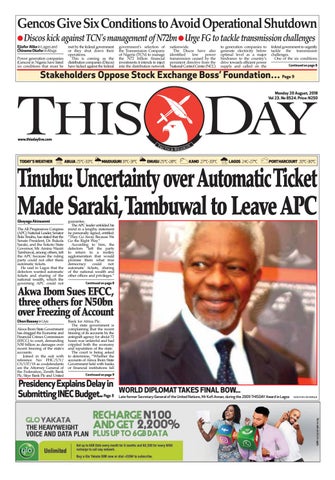
WORLD DIPLOMAT TAKES FINAL BOW... Late former Secretary-General of the United Nations, Mr Kofi Annan, during the 2009 THISDAY Award in Lagos
godwin omoigui
2
T H I S D AY ˾ Ͱͮ˜ ͰͮͯͶ
T H I S D AY ˾ MONDAY AUGUST 20, 2018
3
4
T H I S D AY ˾ Ͱͮ˜ ͰͮͯͶ
T H I S D AY ˾ MONDAY AUGUST 20, 2018
5
6
T H I S D AY ˾ Ͱͮ˜ ͰͮͯͶ
T H I S D AY ˾ MONDAY AUGUST 20, 2018
7
8
MONDAY, ͺ˜ ͺ ˾ T H I S D AY
PAGE EIGHT
Presidency Explains Delay in Submitting INEC Budget It’s an afterthought, says Saraki’s aide Deji Elumoye and Omololu Ogunmade in Abuja The Presidency last night blamed the delay in submitting the supplementary budget, containing the Independent National Electoral Commission (INEC) estimates for the 2019 general election, to the National Assembly on the late passage of the 2018 budget by the federal legislature. A statement by the Senior Special Assistant to the President on Media and Publicity, Malam Garba Shehu, denied the allegation by the Senate President, Bukola Saraki, that the executive sent the INEC budget several months after INEC submitted it to the executive. Saraki’s media aide, Mr. Olu Onemola, responded yesterday, saying the presidency’s excuse was an afterthought, adding that President Muhammadu Buhari was not committed to the general election.
However, Shehu insisted that Saraki should rather be blamed for putting the country under tension in relation to INEC’s budget and the preparation for 2019 polls. He said the INEC budget did not come to the executive until after the presentation of the 2018 budget and hence, could only come later as a supplementary budget. Furthermore, he said supplementary budget could only be submitted after the passage of the main budget and since the budget was delayed for seven months by the National Assembly, it couldn't have been submitted earlier. The statement read: "The presidency wishes to respond to the false to accusations by Senator Saraki who alleged that President Buhari is to blame for the delay in approving the supplementary budget for INEC. "On the contrary, the Senate President should look into the
mirror and what he will see is his own face. He is solely to be held responsible for deliberately driving the nation to this cliff edge as far as the preparations for next elections are concerned. “It is not true that INEC submitted their draft budget to the presidency in February. "No, it came much later but even then, this is not the real issue. The fact that their proposals came well after the president had laid his budget for the year 2018 before the National Assembly meant that their own will be sent as supplementary budget. This was clearly stated to them by the Minister of Budget and National Planning. "A supplementary budget cannot be submitted until the main budget is passed, and so the delay in passing the main budget was the reason for the delay. The National Assembly passed the 2018 budget seven months after the document
was submitted to the National Assembly by President Buhari. "Unless someone has forgotten, the budget was submitted to the National Assembly and it took the Saraki-led National Assembly seven months to release it. There is no way President Buhari could have submitted a supplementary budget while the main one was still pending. "It is never done. Because Saraki did not return the main budget, we could not have submitted the supplementary one. After the long delays, the President was pained to sign the much distorted, butchered and debauched document. In giving his assent, President Buhari said that he was compelled to sign the budget so as not to keep the economy continuously on a standstill. "It is also worthy of note that this is the first time in Nigeria's history that a government would bring together the cost of an election in one budget, with
each agency involved invited to defend their portion of the budget before the National Assembly. "It is all part of the transparency that this government is known for. In the past, governments would approve INEC budgets and funding without a breakdown, often using ways and means to fund it. Not so under President Buhari." It’s an Afterthought, Says Saraki’s Aide The Special Assistant to the Senate President on New Media, Onemola, yesterday accused Buhari of not being committed towards the successful conduct of the 2019 elections in the country. Onemola was reacting to the allegation by Buhari’s Media Organisation that Saraki was slowing down the approval of the 2019 election budget approval. Saraki’s aide said in a statement that President Buhari is desperate to frustrate the conduct of the 2019 polls by denying the nation the enabling law to conduct the
elections. According to him, the president has refused to assent to the 2018 Electoral Act Amendment Bill passed by the National Assembly. "The Electoral Bill passed by the National Assembly to help legalise the various innovations that needed for free and fair elections is still absent because President Buhari chose to withhold his assent the first time it was transmitted. "The question the Buhari Media Organisation should ask their principal is: What is he afraid of in the very progressive proposals contained in the Electoral Bill?; Why does he want to frustrate the 2019 election by denying the nation the much-needed enabling law?” He described the Buhari Media Organisation’s attack on the Senate President as a clear example of "conscientious ignorance on full display.” Continued on page 53
TINUBU: UNCERTAINTY OVER AUTOMATIC TICKET MADE SARAKI, TAMBUWAL TO LEAVE APC Tinubu urged Nigerians to go beyond the debate on the numbers in the Senate and the House of Representatives, saying, “We must pull back from the shallow headlines to recognise that something fundamental is at stake. “Nigeria is undergoing a historic transition. Sometimes awkwardly, tentatively, yet inexorably, we nurture political and governance reform. We steadily close the door on the old malpractices that have caused a rich nation to reside in the tenement of the global poor.” Speaking specifically on the Sokoto governor’s defection, the APC leader said, “Governor Tambuwal’s exit can be distilled to one cause. He covets the presidency. However, he had
not the stomach to challenge President Buhari in a primary. Tambuwal felt further insulted that he would be compelled to face a direct primary just to retain the governorship nomination. “But for the promise made by PDP headliners like Rivers State Governor Wike that he would have the PDP presidential nomination, Tambuwal would not have left. His exit had nothing to do with governance of the nation. It was about forging a personal ambition predicated on the defeat of progressive reform not the advancement of it.” On Senate President, Tinubu said, “Much the same for Senate President Saraki. Returning to the PDP, he harbours dreams of
the presidency but Tambuwal’s ambition will dwarf Saraki’s when the two collide. If Saraki had remained in the APC, he would be unable to reclaim his Senate seat let alone the Senate Presidency. He thus bolted because he lusts for the presidency but was promised by the PDP, at least, a return to his position in the Senate.” He added: “For Saraki to talk about lack of governance is for him to deny who he is and the position he holds. This man stands as Nigeria’s number three citizen. Clothed is he in ample power and influence. If he saw areas where government and the nation needed help, he could have easily applied his energies to these areas. He could have drafted legislation and easily
got laws passed. “However, no progressive enactment bears his name for he cared not for progress. He has been more focused on changing the rules of the Senate to favour himself and changing the order of elections so as to coincide with his selfish designs. “We move toward a more democratic union. The old days where a handful of uninformed men and those with deep pockets decided everything for everybody are being swept away. The will of the people can no longer be ignored. Those who would be the masters over the people must now be public servants. A party or elected official may no longer rule over the people. They must govern for the benefit of the people.
“This is more than competition over numbers. What rests in the balance is not whether one party has more elected officials on its roster, but which party has the right mindset and policies to reform Nigeria that she may become what goodness demands of her. We are in locked battle to define the future of this nation and the quality of its governance. This battle pits one party, the APC, with all of its imperfections, that seeks national reforms against another party, the PDP, which symbolises the perfection of the most selfish designs of the most selfish politicians among us,” Tinubu explained. According to him, moral battle informed the recent defections, adding that those who belong to
that PDP mode of thought could find no permanent comfort in walking the path of progressive reform and progress. “All the things we have inaugurated such as schoolfeeding programmes for poor pupils, social security for poor families, affordable housing programs, greater access to credit for small businesses and greater access to education and health care, these things the defectors could not well abide. They detested President Buhari’s Treasury Single Account (TSA) innovation because it barred them from mis-directing funds into a maze of unaudited accounts from which they could siphon as they pleased. Buhari cut off their clandestine illicit spigot,” he said.
Research and Advocacy, ANED, Mr. Sunday Oduntan, said in Lagos at the weekend that while the Discos are not interested in any further controversies in the power sector, operators would continue to demand for enough power supply for Nigerians. “We want Nigerians to know that the current distribution capacity of all the 11 Discos is 6,288MW, according to the TCN stress test that was conducted in 2015. “This is not our figure; this is the figure from the TCN side. Now what we are getting from them is far too low than what we are supposed to be getting,” Oduntan said. The Gencos last week threatened to shut down their plants over repeated directives by the NCC to generate below optimal level. According to Ogaji, the Gencos were facing lower capacity utilisation by operating their plants far from the baseline settings to as low as about 50 per cent of total available power capacity. Using the month of April as a case study, Ogaji disclosed that on a daily basis, the Gencos had an average capacity of 7,484MW, while the TCN transmitted only an average of 3,985 MW, about 53 per cent of the available capacity. For Oduntan, the implication of this trend in power generation is that Discos “are not able to supply enough power to (our) customers and we are now making Nigerians to be aware that shortage of power supply or lack of power is due to TCN constraints and persistent outages from the TCN interface and the Gencos have actually confirmed
that.” Oduntan urged the federal government to urgently address the issue of transmission bottlenecks in the power sector, noting that the development is impacting negatively on the Discos’ business, in particular and Nigerians in general. “What we are currently having is a suppressed tariff regime that is not cost reflective - a tariff that was calculated on the wrong assumption that by 2018 we would be generating over 7,000 MW. The absence of that level of generation means that we are having more shortfalls in the market. The situation is now far worse when we are getting far lower than expected from TCN,” Oduntan explained.
GENCOS GIVE SIX CONDITIONS TO AVOID OPERATIONAL SHUTDOWN handed over to the federal government by the Gencos is the immediate payment of the outstanding balance due to them under the N213 billion Nigeria Electricity Market Stabilisation Facility (NEMSF) created by the Central Bank of Nigeria (CBN) in 2013. The second condition is that the Gencos also want the federal government to pay them the outstanding balance for power generated as at January 2015 before the Transition Electricity Market (TEM) took off, as well as outstanding invoices for power supplied to the grid between February 2015 and December, 2016 with accrued interests. They also seek capacity payments for the period February 2015, to date, payment for deemed capacity for the period 2013 to date, and the setting up of an effective financing plan which would kick off after the completion of the N701 billion assurance facility set up by the government to sustain payments of invoices until 2021, when the government estimated the power market would be self-sustaining. Speaking yesterday through a statement by the Secretary of the umbrella body of the Gencos - the Association of Power Generation Companies (APGC), Dr. Joy Ogaji, the power producers explained that contrary to the impressions being created in some quarters, they have not been better off with existing financial intervention schemes initiated by the federal government. “Gencos without equivocation are stressing the need for government and relevant stakeholders to tackle the
operational inefficiency and liquidity challenges plaguing the entire value chain and making the sector unattractive for investment by: expediting the process of payment of the outstanding balance due to Gencos under the CBN N213 billion Electricity Market Stabilisation Facility. “Payment of the outstanding for January 2015 (invoice unpaid with Market Operator before TEM); outstanding/unpaid invoices from February 2015 to December 2016 with accrued interests; payment for available capacity for the period 2015 February to date; payment for deemed capacity for the period 2013 to date; putting in place an effective financing plan to kick in upon the exhaustion of the N701 billion payment assurance facility to sustain payments of invoices till 2021, when federal government projects that the NESI would be self-sustaining,” the statement said. The Gencos noted that there was a plan by the federal government to provide them with World Bank Partial Risk Guarantees (PRGs) supported by sovereign guarantees from Nigeria at the inception of the power sector privatisation exercise, adding that such financial instrument has become inevitable. “Without such instruments and the required sovereign backing, it becomes impossible for any bank or financial institution to provide any funding or credit accommodation to any Genco, yet there is an obvious need for substantial additional investments and funding to develop the NESI and put the electricity market on the right growth trajectory,”
the Gencos added.
Operators kick against Management of N72bn Investment in Discos In a related development, the power operators have also kicked against the plan by the federal government to allow the Transmission Company of Nigeria (TCN) to manage the government’s N72 billion investments in the Discos. The federal government had hinted it would invest about N72 billion in the Discos to be managed by the TCN to upgrade the Discos’ networks and enable them distribute about 2000 megawatts (MW) of electricity it claimed was lying idle. But the owners of the Discos argued yesterday that they would not back such decision, adding that they still maintain up to 60 per cent shareholding in the networks. The Discos further added that as part of Nigeria’s company laws, their boards should be allowed to deliberate and decide on the conditions for such investments if they would ever accept it. The Discos under the aegis of the Association of Nigerian Electricity Distributors (ANED) said they do not have confidence in the TCN. “It will be difficult for the Discos to acquiesce to TCN/ MoPWH (Ministry of Power, Works and Housing) adding a further N72 billion of debt to the N1.3 trillion of debt already on their financial books, given the Discos’ inability to access debt financing required to address massive capital expenditure
requirements that far exceed the N72 billion initiative that is required to inject the efficiency that electricity customers demand; the Discos’ regulatory constraints; and the uncertainty of projects built by an entity that is licensed only to transmit energy and not distribute energy. “It should also not be forgotten that the Discos are already carrying, out of the total sum of N210.61 billion, 72.25 per cent or N152.16 billion of legacy gas and energy debt (incurred by PHCN) associated with the CBN’s Nigerian Electricity Market Stabilisation Facility (NEMSF), a debt unconnected with the Discos, a contravention of the debt-free requirement, that was a fundamental contractual requirement of the sale of the distribution assets,” ANED explained. They said the basis of the planned N72 billion funding was to evacuate 2000MW of electricity which they claimed were not stranded on account of distribution limitations but mostly by gas, frequency, and line constraints.
Urge FG to Tackle Transmission Challenges In another development, the Discos have also identified low power transmission caused by the persistent directives from the National Control Centre (NCC) at Osogbo in Osun State, asking the Gencos to generate electricity below optimal level as a major hindrance to the nation’s drive towards efficient power supply. The Executive Director,
TOP GAINERS NGN NGN % NEWRESTASL 0.40 4.45 9.8 VERITAS 0.02 0.26 8.3 JAPAUL 0.02 0.28 7.6 DANGCEM 14.00 220.00 6.8 WEMABANK 0.03 0.65 4.8 TOP LOSERS NGN % LAWUNION 0.09 0.81 10.0 UNITYBANK 0.09 0.81 10.0 MUTUALBENEFITS 0.03 0.30 9.0 NEIMETH 0.06 0.60 9.0 SUNU INSURE 0.02 0.22 9.0 HPE Nestle Nig Plc ₦ 1,500.00 Volume: 374.319 million shares Value: N2.723 billion Deals: 2,875 As at Friday 17/08/18 See details on Page 37
9
MONDAY, ͺ˜ ͺ ˾ T H I S D AY
NEWS
Stakeholders Oppose Stock Exchange Boss’ Foundation Obinna Chima and Goddy Egene Some financial market experts and shareholders of quoted companies have expressed concerns over a foundation that was recently set up by the Chief Executive Officer of the Nigerian Stock Exchange (NSE), Mr. Oscar Onyema. Specifically, they raised concerns of corporate governance and a possible conflict of interest. In fact, they pointed out that the fact that trustees of the foundation are related parties to listed companies on the NSE, could result to conflict of interest and likely erode investor confidence. The NSE chief executive had last Friday launched the Oscar N. Onyema (ONO) Foundation. According to the NSE boss, the not-for-profit and non-political organisation is expected to provide selfless sustainable high impact programmes that will positively
affect the society. In addition, he said it was set up to transform the lives of less privileged children and youth in Nigeria, among others. But when contacted on the development, the chief executive of Proshare Nigeria Limited, Mr. Olufemi Awoyemi, faulted the setting up of the foundation by Onyema, who is an employee of the NSE. He explained, “It compromises the integrity of the stock exchange. He is an employee of the NSE. I have never seen an employee have a foundation in an organisation. “It beggars belief to understand what is really going on and I do not know of any stock exchange globally where an existing CEO will have a Foundation in his name.” He also argued that as a notfor-profit organisation, quoted companies may want to curry Onyema’s favour by donating
to the Foundation if it calls for a donation. “Should any quoted company donate to that foundation, it might be deemed to be a benefit in kind and how does that augur well for the market? “Also, if you look at people who are the trustees, they are related parties to listed companies. How do you therefore separate the fact that the CEO of the Exchange has a Trustee comprising related parties to listed companies on the NSE? “My concern is that for the NSE, this would not augur well, and it will not end well. The best time he (Oscar) should have done this would have been after his resignation,” Awoyemi insisted. But the NSE spokesman, Olumide Orojimi, doused concerns of a possible breach in corporate governance with the Foundation. “He (Onyema) does not require
the NSE council’s approval to set up the Foundation,” he said in response to enquiry by THISDAY. “For the avoidance of doubt, many of them (the council members) were even present at the event. He is giving his personal money to the Foundation and not soliciting funds from any quoted company as you have insinuated. “This position is clearly stated in his quote in the press release where he said he is giving his personal funds and time to the Foundation,” Orojimi added. In the opinion of a shareholder activist, who is Chairman of Progressive Shareholders Association of Nigeria (PSAN), Mr. Boniface Okezie, the idea of giving back to society by people who have attained high positions and are successful is very laudable, but such could be done without conflict of interest. Okezie said Onyema ought to
got a better advice on this matter, saying his advisers on the project gave him a wrong advice. “There is nothing wrong in giving back to the society and there are many ways to do that. For instance, Onyema ought to have started a small way by giving scholarships to indigent students in his community or environment where he lives without setting up Foundation until after he is out of an organisation that serves the interests of many individuals and corporates,” he said. According to Okezie, running a Foundation and at same time being the CEO of NSE will bring conflict of interest and tell a bad story of corporate governance. “As the CEO NSE, where we have many companies listed, even if he does not solicit the support of these companies, some may want to donate to influence certain things in their favour.
Onyema should have waited until after leaving as the CEO of NSE before setting up a foundation. By then, his good deeds would naturally attract support. But using his name to set up a foundation while still CEO of an exchange is wrong. To me, he did not get a good advice on this project,” he stated. According to another shareholder, Mr. Oderinde Taiwo of Proactive Shareholders Association, what Onyema has done is putting the cart before the horse. “To me it is like putting the cart before the horse. Although you may say the NSE is not a government institution, but it is serving the public, which makes its CEO a public servant so to say. “Therefore, it will not be right for a public servant to float a foundation. The world is watching us, we should do things the right way,” he added.
Despite Assurances, Ajimobi Pulls Down Ayefele’s Radio Station Ademola Babalola in Ibadan Twenty-four hours after he hosted ace musician and CEO of Fresh FM Ibadan, Oyo State, Mr. Yinka Ayefele, at the Government House, the state Governor, Senator Abiola Ajimobi's men in the early hours of yesterday moved in bulldozers and pulled down a section of the station to the chagrin of the owner and unsuspecting members of the public. THISDAY authoritatively gathered that Ayefele had met Ajimobi last Saturday morning to plead for the understanding as threats by officials to reduce the multimillion naira station to rubble festers. The musician was said to have left the meeting fulfilled as the governor reportedly said what profit would he gain from pulling down the structure, but with a caveat that the station owner stop programmes capable of undermining his government and in return, get more government's patronage to earn better resources to run the station better. According to a source, "A visibly happy Ayefele felt relieved and assured the governor of better working rapport with the state government. Ayefele was said to have told close aides that Ajimobi meant well but was grossly misunderstood by many.” The other assurance Ayefele secured from Ajimobi was when the latter featured on a live programme in the station and made startling revelations that some people had been tagging Ayefele as anti-government and wanted him to demolish Fresh FM. Ajimobi did not only assure Ayefele of bearing no animosity against him, he went ahead to describe the station as the best, comparable to the ones in Lagos State, and prayed for the prosperity of Fresh FM." But yesterday, like a thief in the night, officials of the state government made real the threat
of the government to demolish the radio station for allegedly contravening town planning law. Notwithstanding the order of the state High Court in the matter filed by Ayefele against the government, restraining it from such demolition and coupled with the spirited appeals made to the governor by a cross section of eminent Nigerians, the state officials, backed by armed security agents, in a commandolike operation, defied the pleas and went ahead to carry out the partial demolition of the edifice which left the station off the air for about four hours. Reports revealed that the men arrived at the station around 6a.m. and fired several gunshots into the air to scare workers and passersby from disturbing their operation which lasted for just few minutes. According to the reports, moments after the station went off the air, photos of the demolished structure went viral on the social media and the people trooped out to protest against the development. By 7:30a.m., the road from Challenge and the toll gate bridge that connects Lagos to Challenge in Ibadan became impassable as the surging crowd filled the expressway and chanted unprinted songs to condemn the action of the government. Many left their church services to sympathise with Ayefele, a popular gospel singer. The station is situated at Lagos-Ibadan bypass at Challenge. The state government had last week issued a three-day ultimatum to the radio station and threatened to demolish it. But the station owner had since approached the court. The case comes up today. Vehicles heading towards Lagos and coming into the city of Ibadan were held up in the traffic that lasted for over eight-hours yesterday while many going to their respective places of worship made u-turn.
Sympathisers besieged the Fresh FM Station building owned by Yinka Ayefele, being demolished by Oyo State Government in Ibadan... yesterday felix ademola Many youths seized the opportunity to destroy some posters and bill boards belonging to some gubernatorial aspirants of the All Progressives Congress (APC) to register their displeasure against the demolition of the station. The Director of Ayefele Nigeria Limited, David Ajiboye, who told journalists that the station has all the documents obtained from the state government for the establishment of the radio station on the plot it was built on, regretted that the station had lost a new equipment worth N28million to the demolition. Other areas affected, according to him, are the roof, reception, Ayefele's main office, a section of the studio, canteen, spiral staircase, parking space, and office equipment like computers among others. Ajiboye said the Challenge-
Lagos-Ibadan axis was approved by the state government as a business premises but was surprised that the government could say it was not meant for radio station. He said the government in its claims said the canteen and spiral staircase in the building were not in the building plan. The director of the station further identified a commissioner in the state government as being behind the crisis, saying he had approached the station to stop certain programmes on the FM. He noted that the station had to reply him that it was only National Broadcasting Commission (NBC) that has the power to sanction a radio programme on air or close the station in totality. Ajiboye believed that the station was fair to all the political parties in the state as against
the claim that the station was working for a certain political party in the state. When THISDAY arrived at the station around 7:30a.m. yesterday, the protesters were raining curses on the people behind the demolition, while many sympathisers were wailing. Some side-talk showed that many of the protesters traveled from neighbouring states to witness the action taken by the state government. One of the protesters, who doubled as a resident of the area, Akeem Jabaru, told THISDAY that the state government proved that it has no respect for the rule of law. He noted that the demolition was inhuman because he knew that over 200 widows are on pay roll of the FM station while 150 workers are receiving salaries from Ayefele monthly.
Another sympathiser, Mr. Lanre Babatunde, said going by his profession as a surveyor, he had observed that there are plots of land that was supposed to be demolished without getting to the radio station. Some politicians in the state also used the opportunity to vent their grievances against the state government as they all condemn the development. A gubernatorial hopeful of the Peoples Democratic Party (PDP), Mr. Seyi Makinde; stalwarts of the African Democratic Congress (ADC), Senator Femi Lanlehin, Chief Sarafadeen Alli; serving House of Representatives member, Dapo Lam-Adesina; state lawmaker, Segun Olaleye; former Deputy Governor, Alhaji Taofeek Arapaja, and others were the earlier callers at the radio station to sympathise with the owner.
caused some prospective investors in the state to diverted their investments elsewhere, thereby subjecting the state to huge economic loss and embarrassment. “That singular attempt of freezing the account of the state government was shutting down the state. Akwa Ibom State was brought down on its knees, it was an attempt to paralyse and completely demobilise the activity of the state. “We could not respond to economic, security and business
exigencies. Most importantly, the investors that were coming to Akwa Ibom began to have a second thought and became worried about the status of their investment. Those who were on their way begun to go back, so we suffered unquantifiable losses,” he lamented Nwoko dismissed the denial by the EFCC of freezing the state government account as after thought and face saving approach as the state government has every evidence to prove that its accounts were frozen.
AKWA IBOM SUES EFCC, THREE OTHERS FOR N50BN OVER FREEZING OF ACCOUNT within the financial crimes enforcement purview of section 34 of the Economic and Financial Crimes Commission (Established) Act 2004. And, “Whether the account of Akwa Ibom State Government with a bank or financial institution can be subjected to a freezing order pursuant to section 34 of the EFCC (Established) Act 2004" The applicant or claimant, in a writ of summons dated August 17, 2018, filled by the
counsel, Chief Assam E. Assam (SAN) of Lex Fori Partners is urging the defendants to cause an appearance to be entered within 30 days after service or risk judgement given in their absence. Reacting to the suit, the Attorney General and Commissioner for Justice of the State, Mr. Uwemedimo Nwoko, argued that the EFCC had no constitutional powers to freeze the account of the state government. “There is no basis even in the
constitution of Nigeria or any other enabling law made by anybody whether the National Assembly or the state Assembly or any other convention that authorises any federal agency or any agency to shut down the account of a state government as done by the EFCC. His words: “I want to state clearly that even if there were to be an investigation that the EFCC was carrying out about whether there was any fraud committed against Akwa Ibom State in that circumstance, it
should be the government of Akwa Ibom that should be the victim, so there was no basis for freezing the account they claimed that they were investigating a fraud against that state government.” The Attorney General of the state who is representing the state government in the suit, stressed that the freezing of the state government account for 72 hours stalled the economic, security and business operations in the state. This, he maintained, had
MONDAY, AUGUST 20, 2018Ëž T H I S D AY
10
NEWS
ĂœĂ™Ă&#x;Ăš Ă?ĂĄĂ? ĂŽĂ“ĂžĂ™Ăœ Ejiofor Alike Ă—Ă‹Ă“Ă– Ejiofor.Alike@thisdaylive.com, 08066066268
INEC: Why We Suspended Rivers By-election We’ve confirmed police collusion with APC, says Wike PDP sponsored violence, rigging, ruling party alleges Ernest Chinwo Ă“Ă˜ Ă™ĂœĂž Ă‹ĂœĂ?Ă™Ă&#x;ĂœĂž Ă‹Ă˜ĂŽ Onyebuchi Ezigbo Ă“Ă˜ ĂŒĂ&#x;ÔË The Independent National Electoral Commission (INEC) has said it suspended the byelections of the Port Harcourt state constituency III because of widespread violence and electoral fraud allegedly aided and abetted by security agencies. This is as Rivers State Governor, Mr. Nyesom Wike, said the state has been vindicated by INEC’s confirmation of the collusion between the opposition All Progressives Congress (APC) and security agencies in alleged electoral fraud in the state. Also, the APC has accused the Peoples Democratic Party (PDP) of perpetrating violence and snatching electoral materials during the suspended byelection. Addressing a press conference on the election in Port Harcourt yesterday, the state Resident Electoral Commissioner (REC), Mr. Obo Effanga, said the commission had no other option than to suspend the election because it did not meet the minimum standards due to widespread violence and snatching of card readers and ballot boxes by politicians aided by armed uniformed security personnel. He reiterated the content of the statement issued by the commission that while it
deployed adequate men and materials for the election, its effort was scuttled by the invasion of polling units by top politicians escorted by uniform armed security personnel. “In INEC, we are not so much concerned about who wins or loses but in the integrity of the electoral process. What we saw last Saturday was the lowest level of electoral discredit. INEC was ready but the elite aided by the uniform security personnel spoilt the process. “What is clear from our observations is that the elite of Rivers State will determine the electoral progress of this state. Their conduct last Saturday is condemnable and reprehensible by the standard of any decent society,� he said. Also speaking, Akwa Ibom State REC and representative of National Electoral Commissioner for Rivers State, Mr. Mike Igini, said the commission had to suspend the election in order not to put more lives at risk because of the widespread violence that affected voters, INEC officials and journalists. He expressed dissatisfaction that some politicians would be granted immunity to move around with security personnel in violation of the Electoral Act without being arrested. “The question we cannot answer is how individuals would be going around with platoons of different arms of
security personnel in Hilux vans unhindered. The future of Rivers State is in the hands of the elite of the state,� Igini said. Also reacting to the suspension of the election, Wike accused the police of complicity in the violence and electoral fraud that characterised the by-election. In a statewide broadcast yesterday, Wike expressed dissatisfaction that despite assurances, the police allegedly connived in unleashing violence on the people. “Unfortunately, and as we had feared, the police failed us completely once again and negated all that they promised. Instead of providing security for voters and INEC officials, the police brazenly colluded with political thugs of the APC to subvert the democratic process and denied the people of Port Harcourt state constituency III their rights to free, fair and credible elections. “Confirmed reports from the
field indicated that INEC promptly and rightly distributed elections materials to all the polling units within a recorded time. “However, while voting was underway, armed thugs from the APC led by the state factional Chairman, Mr. Ojukaye FlagAmachree, moved freely from one polling unit to the other, violently assaulting voters and INEC officials, and carted away election materials, including smart card readers and ballot boxes. “This situation is worrisome. If the Nigerian Police cannot secure and guarantee the peaceful and successful conduct of election in a state constituency of 8 wards, then what will happen in 2019 when they would be contending with 319 electoral wards and 4,442 polling units across 23 local government Aaeas in the state? “It should also be noted that there was no single
incidence of violence in the state in the last local government elections, in which the APC refused to participate. “What is clear from all these acts of bad behaviour is that the Nigerian Police have since become an interested party in the politics of Rivers State, and therefore, can no longer be trusted to participate as an impartial institution in the state electoral process. “Above all, the consistent sabotage of the electoral process by the police amounts to a declaration of war against the people of Rivers State and their solemn rights to freely and fairly choose their leaders and representatives,� Wike said. But in a swift reaction, the APC has accused the PDP of perpetrating violence and snatching of electoral materials during the suspended byelection. In a statement issued by the APC acting National
Publicity Secretary, Yekini Nabene, the party hailed the Rivers State electorate for bravely defending their votes despite the violence. APC urged the state electorate and indeed all Nigerians to continue to stand their ground and resist any attempt to rig elections in the country, adding that votes must count and the people’s will must prevail in all elections. “ Nigerians will recall how the PDP, speaking through its National Spokesman, Kola Ologbondiyan, last Tuesday, vowed to deploy all ‘means, schemes, shenanigans in all ramification and magnitude’ to rig all coming elections. “While we condemn the PDPsponsored violence and failed attempt to rig the by-election, we reiterate that the PDP public rigging plan is a red flag that requires urgent attention by the INEC and relevant security agencies,� APC said.
Lagos to Close Third Mainland Bridge for Four Days Emmanuella Igwe The Lagos State Government has said the Third Mainland Bridge would be temporarily shut down for four days starting from midnight of August 23 to midnight of August 26, 2018, for Investigative Maintenance Test to be carried out. The state Commissioner for Works and Infrastructure, Mr Ade Akinsanya, who disclosed this in a statement yesterday, said the decision was taken after due consultation with the Federal Ministry of Power, Works and Housing. The four-day closure, according to Akinsanya, will enable the contractors assess the true state of the bridge after which works would commence by the end of the year or early in 2019. The federal government had earlier announced plans to shut the bridge in July, but had to be shelved after due consultation with the Lagos State Government and wide deliberations with other stakeholders, who expressed concern about the indiscriminate parking of articulated vehicles on other alternative routes which would have adverse affect on traffic.
Subsequently, a Joint Task Force set up to remove the articulated vehicles from the highway was able to achieve tremendous success. Justifying the need for the closure, Akinsanya said: “The Third Mainland Bridge which was opened about 30 years ago by the then military government has had haphazard maintenance and repairs in the past which the present federal government is committed to correcting by carrying out proper and continuous maintenance and repairs on it.� Consequently, the state government appealed for the cooperation, support and understanding of all motorists and residents, advising them to minimise non-essential travel and movements during the four-day closure. Besides, Akinsanya said all traffic management agencies, including the Lagos State Traffic Management Authority (LASTMA), Federal Road Safety Commission (FRSC) and the police among others, have been mandated to ensure smooth flow of traffic on all the other alternative roads and traffic corridor across the metropolis to ensure free flow of traffic.
SUPPORTING TEENS CAREER CONFERENCE
L-R: Resident Pastor, Redeemed Christian Church of God (RCCG), Everlasting Arms Parish, Garki, Abuja, Pastor Eva Azodo; Managing Director, Rose of Sharon/ CEO, Famfa Oil, Mrs. Folorunso Alakija; wife of Resident Pastor, Mrs. Ngozi Azodo, Chairman, Editorial Board of THISDAY Newspaper, Mr. Segun Adeniyi and Speaker, House of Representatives, Hon. Yakubu Dogara, at the 2018 Teens Career Conference organised by RCCG in Abuja‌recently ˚
ACF Urges Govt to Boost Economy, Tackle Hardship John Shiklam Ă“Ă˜ Ă‹ĂŽĂ&#x;Ă˜Ă‹ The Arewa Consultative Forum (ACF) has urged governments at all levels to initiate programmes and policies to boost the economy and reduce the current economic hardship that tends to stoke security challenges across the country. In its Eid-el-Kabir message yesterday in Kaduna, the forum appealed to the federal government to do everything possible to also tackle the security challenges in the country. The statement signed by the spokesman of the forum,
Mohammed Ibrahim, also called on politicians to avoid hate speeches and acts capable of jeopardising our democracy and peaceful coexistence as a country. “ACF appeals to the youths to avail themselves to opportunities offered by the government and add value to themselves as well as the communities rather than take to violent acts that come with poverty, unemployment and frustrations. “As Nigeria moves towards the 2019 elections, ACF hereby appeals to all illegible voters to register and collect their
Permanent Voters Card (PVC) as the only weapon they can use to exercise their civic responsibility during the elections and hold the elected leaders accountable. “Furthermore, we urge Nigerians to avoid violent acts during and after elections, as they only destroy our democratic process and peaceful coexistence as well as make meaningful socioeconomic impossible,� the statement said. The forum further felicitated with the Muslim Ummah and other Nigerians on Eid-el-Kabir, and expressed the hope that the
lessons of the sacrifices translate to unity of purpose and love for one another in a one united Nigeria. The forum called on Nigerians to be patient with one another, with the government and continue to have hope as the current security and socioeconomic economic challenges are not insurmountable. “In the spirit of the season, therefore, we urge all Nigerians, particularly politicians, to avoid hate speeches and acts capable of jeopardising our democracy and peaceful coexistence as a country,� ACF added.
T H I S D AY ˾ MONDAY AUGUST 20, 2018
11
12
T H I S D AY ˾ Ͱͮ˜ ͰͮͯͶ
T H I S D AY ˾ MONDAY AUGUST 20, 2018
13
14
T H I S D AY Ëž Ëœ Í°ÍŽËœ Í°ÍŽÍŻÍś
COMMENT
Editor, Editorial Page PETER ISHAKA Email peter.ishaka@thisdaylive.com
ECOWAS, ECCAS AND CONNECTIVITY The armed conflict in the regions is inhibiting development, writes Victor C. Ariole
Generally trade deďŹ cits result from how resources are allocated in an interconnected global economy and are natural reections of the global value chain and international division of labour- Dr Zhou Pingjing
B
etween recreating the past which was what Professor Peter Drucker saw in Europe in the 30s that made him relocate to the United States where he smelt that the future existed and could be created instantly to lead to innovation, the world is in such phase now. And as Dr Zhou seems to narrate in an article, it is the USA recreating the past now while China wants to create the future in line with innovation dictates. Bringing Africa in the equation, it is like Africa with its abundant resources - both material and human - needs China to escape further doldrums in the evolving world of innovation. Africa is accused of letting out its abundant human resource in forced migration process while China is accused of letting out its excess profits hence trade war that could eventually translate to human wars, if not well managed. Quixotically, they are all structural issues quite resolvable by humans, distinct from more complex and multidimensional issues like quarantining the moon so as to explore the solar system. Dr Zhou needed to tell us more about the division of labour so as to balance it with the rule-base system which, as Henry Kissinger said, is begging for reforms and he seemed to give credit to President Donald Trump for fast-forwarding that reform process. It is in line with that that the recent coming together of ECOWAS and ECCAS, two African regions that seem not to be making impact in even the American AGOA initiatives not to talk of the world GDP, comes in. With stronger presence of these two regions which are not benefitting from World Trade Organisation and which Nigeria quickly signed to belong, there should be ‘no sitting on the fence’ for Nigeria not to sign the African Continental Free Trade Agreement (AfCFTA). The Emir of Kano, Muhammadu Sanusi 11, feels it is imperative for Nigeria to sign that agreement if indeed it is interested in exiting the most poverty ridden country tag trap. According to Jeune Afrique, these two regions are wasting their arms struggle which is the greatest distracting race in both ECOWAS and ECCAS and is inhibiting human development and prosperity in the two regions. This calls for a common front to tackle it. Resources are being frittered away in attempts to tame armed struggles against Boko Haram or Balaka and anti Balaka or Seleka or anti Seleka or secession groups in Cameroun or Tuareg engineered wars in the north or currently farmers and herdsmen clashes; all supported by some foreign interests who are more interested in being allowed to exploit what Zhou could easily see as enabling resource for the greater global value chain that enables the current $62trillion world GDP. Within the surroundings of Chad Basin alone such enabling resources like uranium, metals and crude oil are greatly exploited by the big powers and the insurgencies going on there dare not intervene. And it is said
IT IS HIGH TIME AFRICAN LEADERS SAT ON A ROUND TABLE WITH THE WEST AND TALK OF HOW MANY SOLAR PANELS COULD BE BUILT TO SUSTAIN ELECTRICITY SUPPLY AND CREATE INDUSTRIES INSTEAD OF SITTING DOWN TO DISCUSS ARMS PROVISION
that Africa does not contribute up to 0.33% and whereas a company that feeds on the metal exploits that is tormenting Congo DR and other African countries could boast of $1trillion. Why can’t someone see in the African contribution as the seed and constant contribution without which the whole GDP architecture of the world could not stand? According to Sanusi, it is high time African leaders sat on a round table with the West and talk of how many solar panels could be built to sustain electricity supply and create industries instead of sitting down to discuss arms provision. In effect discussing immigration should not be an African problem as over eight million unemployed youths, trained in the European values, must seek for greener pastures where their value orientation can find fulfilment. Here is where the idea of a global value chain and division of labour is not completely connecting, and thanks to Ethiopia – China experiment in the energy creation, and trying to open up the Djibouti axis and getting Eritrea to follow suit and abandon belligerence matter. These are lessons to get ECOWAS and ECCAS to hasten their pace of connectivity. Note that the recent initiative of the leader of Ethiopia, Dr Abiy Ahmed to reconcile that axis that leads to Indian Ocean or the Red Sea had seen China devote $4billion to that effect. It is also expected that Chad Basin that links ECOWAS AND ECCAS be joined in such venture to help in actualising the next economic reform championed by China that expresses itself in the Silk Road Economic Belt Project. It is a project that could help reposition Africa in the quest for a better appreciation of its contribution to humanity at large. Nigeria and its leaders needed to get the project started for the progress of both ECOWAS and ECCAS as more people would be employed across borders if only China should allow more Africans to participate effectively and not make it another arms struggle project like Nima Elbagir narrated the case of China’s arm sales in Darfur in favour of the Janjaweed fighters. So, as Nigeria takes on the ECCAS in a bid to move Africa forward, it should also learn how Central African Republic survived its own Boko Haram brand in the name of Selaka or anti Balaka movements, contrived by Michel who hid under Christian name to introduce a trojan-like horse that invaded the north of Central African Republic only to be rescued by France’s intervention. Note that within the borders of CAR are stationed over 300,000 Sudanese troops and somehow from the western side are some disorganised Muammar Ghadaffi loyalists hiding in Chad and seeking opportunity to overrun CAR. This is a belt zone not far from Nigeria’s north east and quite linkable. So, great expectations are expected from what President Faure Gnassingbe bequeathed to Nigerian president so that peace reigns in ECOWAS and ECCAS for the uplift of Africa. Ariole is a Professor of French and Francophone Studies, University of Lagos
FES PEACE DIALOGUE AND SECURITY
Friedrich-Ebert Stiftung Argues The Need To Promote Collective Security Through Stakeholder’s Engagement And Constructive Exchanges
O
ver the years, it has become imperative that, besides a working economy, social infrastructure, education and a number of other indicators which define the idea people have of a ‘peaceful’ society, the presence and embrace of peace itself is, above every other, needed for our societies to function as they ought to. Since West African countries gained independence, they have recorded a number of armed, intra-state conflicts, marked by five, large-scale, civil wars. With the dawn of the 21st century came a sharp drop, marking a watershed in the political stabilisation of the region. In the place of the former form of violence came election-related violence, long-standing ethno-national conflict, drug trafficking, maritime piracy, extremism, youth inclusion, migration, the rapid development of extractive industries and land management, etc., sparking fears over the region’s development. West Africa has come into her own over time as far as democratisation, economy and regional cooperation are concerned but sadly, total peace has eluded the region, though efforts to prevent conflicts have also improved, contributing to overall stability. It was against this back-drop that between July 11 and 12, 2018, in Abuja, over 50 peace and security experts and practitioners on West Africa, drawn from the academia, security structures and various institutions, West Africa policymakers, civil society organisation (CSOs) and non-governmental organisations (NGOs), participated in the first Abuja Dialogue convened by the Peace and Security Competence Centre Sub-Saharan Africa and the Friedrich-Ebert-Stiftung (FES), in Abuja. The experts represented a diverse field of highlevel policy influencers conversant with peace and security, mediation, conflict resolution, disarmament, demobilisation and reintegration, governance,
development and gender mainstreaming. The convener, Friedrich-Ebert-Stiftung, is a German non-profit organisation dedicated to the development of the ideas and values of social democracy. That core value and focus informed the theme of the conference, “Understanding the Reasons for Insecurity in West Africa: Need to Promote Collective Security through Stakeholder’s Engagement and Constructive Exchanges.� The objective was to “contribute to a better understanding of the dynamics and drivers of (violent) conflict and insecurity in West Africa and to provide new knowledge on how best to achieve sustainable security.� The Abuja dialogue was convened against the backdrop of the incremental and pervasive peace and security challenges, such as agro-pastoral conflicts, the Boko Haram insurgency, terrorism and organised crimes, fragility of state and lack of governance confronting some countries of the West Africa and Sahel region, despite the existence of various mechanisms aimed at addressing such conflicts. Affected countries which were presented as case studies or reference points included Burkina Faso, Cote d’Ivoire, Guinea Bissau, Mali and Nigeria. Since some post-conflict situations and new conflicts in the region were festering, the inevitable question which the dialogue sought to address was why certain conflicts, especially pastoral herdsmen conflict and Boko Haram insurgency, armed militias persist, despite the existence of Early Warning Systems (EWS) and conflict prevention and conflict resolution mechanisms meant for addressing such conflicts. Relatedly, why were existing frameworks and mechanisms, laid down by African Peace and Security Architecture (APSA), the African Governance Architecture (AGA), structures such as, African Union, ECOWAS, ECCAS, Mano River Union, Lake Chad Basin Commission, the Multinational Joint Task Force (MNJFT) the G-5 Sahel, proving operationally inadequate and not delivering
the expected results? For maximum interaction and productivity, the Abuja dialogue was structured to be interactive and to facilitate seamless exchange of ideas. The outcome and the takeaways from the conference are a reflection the complexities of the conflicts bedevilling West Africa and the Sahel and why the extant conflict resolution panaceas are seemingly ineffective. The gaps between early warning and response, existing peace and security architecture and conflict resolution mechanisms, were all pointed out as challenges to achieving long-term peace in the region, mainly because one-size did not fit all. Resolutions from the conference indicate that development aid needs to be channelled towards lagging regions and addressing perceptions of inequity in access to opportunities. Focusing investments where conditions are best risks making already-tense situations worse. Cross-border economic exchanges and collaboration may be useful. Improved land management and a strong, continuous addressing of grievances linked to land access is needed. In order to do away with the ‘resource curse’, extractives discoveries can be given greater attention, seeing as they are prone to conflict risks. This will help manage community and regional grievances as well as corruption. Other recommendations made by the conference included improvement in the management of migrants, significant investments in basic and technical education to increase the size of the skilled labour force and improve livelihoods for young people, provision of more support to ECOWAS and other regional institutions by member countries, strengthening of local government structures to improve citizens’ participation, social accountability, transparency and better services. While these recommendations were welcomed, it was highlighted that the need to replicate or borrow from working, progressive mechanisms from within and outside Africa would go a long way in helping to provide a blue-print.
It was advocated that any reframing of conflict resolution mechanisms should be centered on civil society, and that such shift in response, should lay greater emphasis on preventive mechanisms rather than peacekeeping. Notably, amnesty, DDR and SSR programmes, depending on the locality, needed to be redesigned or adapted to fit particular conflicts, reflect local realities, involve stakeholders and communities and understand their plight. There was an urgent need for the deployment of alternative dispute mechanisms (ADR) and establishing traditional dispute mechanisms. While peace education was imperative, sensitivity to gender and the aged remained vital, as was handling of war victims and amnesty beneficiaries, especially child soldiers. Also, enhanced community involvement and ownership of processes are important to avoid politicians taking advantage of conflicts. The need for conceptual clarity and the rethinking conceptual framework for conflict resolution mechanisms in order to adapt them to local terminologies and realities were underlined. That an approach was expected to create alternative space, a sense of ownership and inclusivity and a better definition and understanding of who the non-state actors and beneficiaries are. It is important to build on and expand “resilience models� by replicating and domesticating those models that are effective at the national and state levels at the local and community levels. It was necessary to avoid pitfalls of signing accords in which the local parties were not involved or signatories. Policies needed to be e-governance compliant, for access and tracking. Since state and government apparatus are distinct entities, it should be recognised that the absence of governmental presence did not equate with “ungoverned space� in conflict theaters. Most spaces are governed, as such, there is need to avoid creating the impression that there were “two societies� – the insiders and the outsiders in post-conflict environments.
15
T H I S D AY MONDAY, AUGUST 20, 2018
EDITORIAL THE NYSC TRAGEDY IN TARABA The death of seven members of the NYSC is unsettling
T
he death recently in Taraba State of nine National Youth Service Corps members is a national tragedy. These corps members were among 22 others who went on a picnic when a sudden upsurge in River Mayo -Selbe in the Gashaka local council of the state swept them away while they were swimming. As at today, seven bodies have been recovered while two more are still being searched for in what has become yet another misfortune for the NYSC scheme. According to the Taraba State Police Commissioner, Mr. David Akinremi, the corps members were on a swimming expedition in River MayoSelbe, a major tributary of the Benue River, when a water surge from a nearby mountain collapsed and swept them into the massive river. Akinremi said that 14 corps members were initially washed away by the heavy gush, but five of them were rescued. Of the seven bodies that were recovered, two were female corpers, while the others were male. While no one is sure if there would be an investigation of any sort THE NYSC IS FAST into the misfortune, it is however clear, LOSING ITS APPEAL, AND THIS IS BASICALLY as suggested by the police, that the TRACEABLE TO THE area should no LOOSE ACCOUNTABILITY river longer be considered SYSTEM THAT HAS a safe picnic spot SUDDENLY BECOME ITS for members of the public, at least for HALLMARK the rest of the rainy season. But at a time when Nigeria still struggles to overcome the twin security problems of Boko Haram in the North East and senseless killings in Zamfara, Plateau, Benue and some other states across the country by armed bandits, we consider the death of the corps members a huge blow and a sad sign of how cheap life has become in Nigeria. Even though the Taraba tragedy can be consid-
ered a natural disaster, the fact remains that today, life no longer matters in Nigeria. The country has descended so low in its valuation of human life such that the death of seven of her young graduates observing their mandatory national service did not seem to attract any outrage or even get citizens to raise pertinent questions. By its set up, the NYSC is mandated to provide and protect corps members enlisted into the scheme at every point in time of their service year. Yet, almost on annual basis, many corps members lose their lives for sundry reasons.
I T H I S DAY EDITOR BOLAJI ADEBIYI DEPUTY EDITOR DAVIDSON IRIEKPEN MANAGING DIRECTOR ENIOLA BELLO DEPUTY MANAGING DIRECTOR KAYODE KOMOLAFE CHAIRMAN EDITORIAL BOARD OLUSEGUN ADENIYI EDITOR NATION’S CAPITAL IYOBOSA UWUGIAREN MANAGING EDITOR JOSEPH USHIGIALE
T H I S DAY N E W S PA P E R S L I M I T E D EDITOR-IN-CHIEF/CHAIRMAN NDUKA OBAIGBENA GROUP EXECUTIVE DIRECTORS ENIOLA BELLO, KAYODE KOMOLAFE, ISRAEL IWEGBU, IJEOMA NWOGWUGWU, EMMANUEL EFENI DIVISIONAL DIRECTORS BOLAJI ADEBIYI, PETER IWEGBU, ANTHONY OGEDENGBE DEPUTY DIVISIONAL DIRECTOR OJOGUN VICTOR DANBOYI SNR. ASSOCIATE DIRECTOR ERIC OJEH ASSOCIATE DIRECTORS PATRICK EIMIUHI, SAHEED ADEYEMO CONTROLLERS ABIMBOLA TAIWO, UCHENNA DIBIAGWU, NDUKA MOSERI DIRECTOR, PRINTING PRODUCTION CHUKS ONWUDINJO
n view of the worrying trend, we would like to point out that it is the responsibility of the NYSC to urgently address the frequent deaths of wards left in their care by parents and guardians, at least for the periods of their service year. We admit that some of the deaths recorded by the scheme over the years may be traceable to youthful exuberance on the part of the corps members, but the NYSC management should be more proactive in dealing with some of the challenges. The NYSC, for instance, has a mandate to rein in and checkmate the excesses of members of the corps in their own interests and that of the scheme. Established in 1973 as a vehicle for national integration among young citizens, the NYSC is fast losing its appeal, and this is basically traceable to the loose accountability system that has suddenly become its hallmark. But what is now most worrying is the frequency of death by members. From being killed on election duty to being murdered by the police, we cannot continue to operate a scheme that does not guarantee parents of the safety of their wards when they release them to serve their fatherland. While we commiserate with the families of the deceased corps members, we hope the NYSC management will probe the circumstances surrounding their death while putting in place mechanism to ensure that such a tragedy never happens again.
TO SEND EMAIL: first name.surname@thisdaylive.com
Letters to the Editor
TO OUR READERS Letters in response to specific publications in THISDAY should be brief (150-200 words) and straight to the point. Interested readers may send such letters along with their contact details to opinion@thisdaylive.com. We also welcome comments and opinions on topical local, national and international issues provided they are well-written and should also not be longer than (9501000 words). They should be sent to opinion@thisdaylive.com along with the email address and phone numbers of the writer.
USHAFA COMMUNITY AND THE CHOLERA SCOURGE
L
ike a pack of feral wolves it came again for the unsuspecting and unsecured, and without warning, it cut down five of them, laying bare the bones of the desperately poor hygiene people grapple with. As always, it began with unbridled stooling and vomiting before it veered off into something more terrifying, and just like on countless occasions before it, cholera cut through the Ushafa community of the Federal Capital Territory, leaving in its trail stool, death, and overwhelmed healthcare facilities. It is no secret that Nigeria`s health care system is poor. It is further no secret that it is ill-equipped to grapple with the many attacks of avoidable diseases and preventable deaths that buffet it. Yet, we always relapse into the same patterns and experience the same pains. In a country where people feel aggrieved enough with the government as to compromise their own hygiene and wellbeing as some form of twisted revenge, anything is possible. The rains are pouring down now and poised to sweep away people and houses into those areas where buildings were erected with vain regard for structural integrity and the waterways have been clogged with thrash. A country that has struggled to manage its resources at the highest levels has also struggled to hold things together at the bottom. Nigerians have an issue with cleaning up after their own mess. It is why things
are this bad. A woman who cannot make little sacrifices to properly dispose the litter in her house quickly turns the drainage beside her house to a makeshift refuse dump. When the rains come, there can only be one outcome: flooding. Then there is the issue of scant sanitary facilities. This is a painful contributor to the needless deaths because at centre of that space darkened by the absence of good sanitary facilities lie one of the deepest wounds of human dignity. Houses are built with no provision for people to relieve themselves. Inevitably, they turn their immediate surroundings to emergency toilets. Even their sources of water are converted to emergency relief spots. Nature then acts on their wastes to produce a terrifying cauldron of wasting sicknesses of which cholera is one. The deaths in Ushafa were entirely preventable. To prevent future deaths people must learn to take care of themselves, placing their wellbeing before the fleeting flavours of ephemeral conveniences. Life is hard enough in Nigeria, illness should not make it harder. In a country where many deaths have resulted from virulent diseases that good hygiene habits could have strongly combated, every new death from cholera, Lassa fever and their kind is a rasping rebuke of the hygiene practices of a people and a government`s lamentable laxity in issues of environmental sanitation and hygiene. Kene Obiezu, Abuja
ENGAGING THEYOUTH THROUGH AGRICULTURE
D
evelopment refers to the growth of someone or something as to bring about positive changes or advancement. It follows therefore that this definition of development is no more than the meaning of democracy, which allows for the participation of all in the administration of public trust through representation to ensure good governance. Unfortunately however, many nations especially in Africa and Asia that practice democracy as a system of government are obviously not on the path to development. Of course, bad leadership/ corruption among other reasons associated with culture and perhaps geography and demography have contributed to the slow pace of development in these parts of the world. This, however, is not to suggest that there have not been attempts at fostering sustainable development in some parts of the continents. In Africa for instance, democracy has come to stay in Nigeria as it’s been 19 years since its return without interruption. Thus, despite all the challenges of especially bad leadership the nation has been facing, the return to democracy has evidently speed up the pace of development. Compared to what it was in 1999, Nigeria has witnessed development in terms of communication, urban renewal and few other infrastructure such as road. It’s therefore noteworthy that were we under a
dictatorship, this little wouldn’t have been achieved. And the good tiding is, in spite the multi-faceted problems the nation is facing, efforts are relentlessly put in place by several individuals, NGOs and civil society organisations to find solutions to our problems as they prevail. The thinking today is that the absence of youth in governance is one of the main reasons why development is on a slow pace here. This may be true given that the youth are important segment of any society. They constitute the productive class and therefore any attempt at not recognising and therefore neglecting them would be utterly dangerous to the development process of any nation. Consequently, efforts are daily being made to see how government and the youth can collaborate to cause effective development in the agricultural subsector of the economy. Of course, for states that were blessed with vast arable land, fostering viable development translates to giving priority to agriculture so as to first attain food sufficiency. Indeed, there is no gainsaying the fact that viable development starts with food sufficiency and ends with industrialisation. At elementary level, agriculture is known to be the cultivation of crops and rearing of animals for the use of man. This indubitably provides thousands of employment opportunities for both the skilled and unskilled labour.
Mukhtar Jarmajo, Abuja
16
T H I S D AY ˾ Ͱͮ˜ ͰͮͯͶ
T H I S D AY ˾ MONDAY AUGUST 20, 2018
17
18
T H I S D AY • MONDAY, AUGUST 20, 2018
POLITICS
Group Politics Editor NSEOBONG OKON-EKONG Email nseobong.okonekong@thisdaylive.com 08114495324 SMS ONLY
M O N D AY D I S C O U R S E
Increasing Babel of Political Parties Femi OgbonnikanandVanessa Obioha writethattheIndependentNationalElectoralCommission recently carried out one of its obligations by registering 22 new political parties, but the process does not necessarily guarantee political independence, as the voting public are swarmed by parties with no prima facie ideal and vision
L-R: Senator Mohammed Ali Ndume, Senator Abba Kyari and Chairman INEC, Professor Mahmood Yakubu at a consultative session
O
n August 14, 2018, the Independent National Electoral Commission (INEC) announced the registration of 23 new political parties, bringing the total number of political parties in Nigeria to 91. Expectedly, the news elicited mixed reactions with political pundits revisiting the argument on the credibility and availability of these parties at both federal and state levels. To be sure, INEC can only register parties that have adequately met the criteria stipulated in the amended version of the 1999 Constitution. Some of these criteria are that these parties must must provide the names and other contact details of their national and state executive committees, as well as, their administrative structure to INEC. Other requirements include a provision that the association seeking registration as a political party must have its national headquarters in the Federal Capital Territory, and at least, be operational in 24 states in the federation. Once these conditions are met, INEC proceeds to verify before the green light to function as a political party. In compliance with the Electoral Act provisions, especially section 78 (1), the new 23 political parties by INEC are, (1) Advanced Alliance Party (AAP); (2) Advanced Nigeria Democratic Party (ANDP); (3) African Action Congress (AAC); (4) Alliance For A United Nigeria (AUN); (5) Alliance of Social Democrats (ASD); (6) Alliance National Party (ANP); (7) Allied Peoples Movement (APM); (8) Alternative Party of Nigeria (APN); (9) Change Nigeria Party (CNP); (10) Liberation Movement (LM); (11) Congress Of Patriots (COP); (12) Movement for Restoration
and Defence of Democracy (MRDD); (13) Nigeria Community Movement Party (CMP); (14) Nigeria For Democracy (NFD); (15) Peoples Coalition Party (PCP); (16) Reform and Advancement Party (RAP); (17) Save Nigeria Congress (SNC); (18) United Patriots (UP); (19) United Peoples Congress (UPC); (20) We The Peoples Nigeria (WTPN); (21) Yes Electorates Solidarity (YES); (22) Youth Party (YP); and (23) Zenith Labour Party (ZLP), thus brings to 91, the total number of political parties in the country. INEC National Commissioner and member, Voter Education and Publicity Committee, Mr. Mohammed Haruna, said INEC received a total of 144 applications from political associations seeking registration as political parties. “After a rigorous process of evaluation in accordance with the Constitution and Electoral Act which included assessment of the constitutions and manifestos of the intending parties and verification of membership of the executive committees and offices, the 23 associations met all the requirements and so, have been registered as political parties. This brings the number of political parties so far registered to 91 and will be the last round of registration of parties until after the general elections on February 16, 2019. This suspension is in line with section 78 (1) of the Electoral Act, which requires all applications for registration as political parties to be concluded latest six months to a general election.” With the increasing number of associations joining the political race, it is expected that it will open a discourse on party monopoly, as the multi-party system promotes true democracy. Has registration of multiple parties resulted in a free and fair election or promoted the practice
of democracy? Or has it led to more confusion and conundrums for the electoral body? When INEC was established in 1998 to usher in the Fourth Republic, only three parties, the Peoples Democratic Party (PDP), All Nigeria Peoples Party (ANPP) and Alliance for Democracy (AD) were popular. The general elections that held the following year showed that the PDP commanded a wider spread. The party held on to power for 16 years, leading to defections and coalitions in a bid to dislodge the PDP. In the 2003 general election, the number of political parties in the contest had risen to 20, but the PDP emerged winner again. The apparent monopoly of the ruling party elicited a loud cry from the people, who insisted on more political parties to enable mass political participation. The result, so far, has left a bittersweet taste in the mouth of many. Instead of enjoying political independence, the electorate are swarmed by parties with no prima facie ideal and vision. In 2012, under the leadership of Professor Attahiru Jega, INEC had to deregister some of the parties for being moribund. Supreme Court Intervention What followed next was a messy court case that witnessed the clipping of the wings of INEC by the Supreme Court. Second Republic Governor of Kaduna State, Alhaji Balarabe Musa had gone to court to challenge the axing of his political party, Peoples Redemption Party (PRP). The Supreme Court ruled that INEC had no authority to terminate a political party as long as its national executive committee was still functional.
Despite the intervention of the National Assembly through Section 78(6) of the 2010 Electoral Act, which provided INEC with the power to de-register any political party that failed to win any executive and legislative seats in elections, the Supreme Court still upheld its judgement citing the freedom of association as contained in Section 40 of the 1999 constitution. The court also declared Section 78 (7) (ii) of the Electoral Act 2010, as amended, which said parties must win seats in the state and National Assemblies election as null and void. It insisted that deregistration of political parties was not constitutional. Lost Identity of Political Parties Apart from the apparent logistics that accompany multi-party system which automatically leads to a high election budget, there are irregularities during the voting process that can hamper the election results. For instance, the inability of the voter to appropriately thumbprint on the provided space of his selected party often times affect the collation of results. In the new Electoral Act Amendment bill which is yet to get the President’s nod, one of the sections approved electronic means of collating results which may resolve this problem. However, identity of these new parties are lost on Nigerians. No one seems to feel their presence. Some of the party names are now a form of entertainment to many who mock their lack of creativity in forming names that clearly reflect true federal character. There is a growing argument that agrees with the lawmakers insistence that a political party must be recognised by a percentage of the population
19
T H I S D AY • MONDAY, AUGUST 20, 2018
POLITICS
Adegoke
Yakubu
both at the grassroots and federal level before being allowed to contest in an election. This will further give room for greater mass population. The onus is on INEC, civil society organisations and the political parties to provide adequate information on the political parties in order to keep the electorates in the loop. Despite the glaring obstacles faced by INEC regarding the increasing number of registered parties, some school of thought believe that the electoral body is moving in the right direction. Lawyer and former National Secretary, Labour Party, Dr. Kayode Ajulo considered it a good step in all ramifications to Nigerian federation and constitutional democracy as long as the registration is done with sincerity and based on integrity of purpose. He said, “As it is, INEC has a mandate to register any entity once the conditions as stipulated in Section 222 of the Constitution are met. I know that at the level of secondary school education in Nigeria, it is taught in Government that Nigeria operates a multi-party system and it allows for a democracy since it gives people the opportunity to freely associate or join any political party they want to. “It allows for mass political participation as people are more involved in the government of the day; peaceful change of power and opposition. Even the ruling government can be challenged. If these can be taught in theory; that means it can be seen in practical. The move by INEC to register more political parties is a step to achieving these.” However, many political observers are interrogating what the multiplicity of political parties signify for the 2019 general elections. For instance, the greater number of Nigerian electorates are in the rural communities and
are either stark illiterates or semi-illiterates. This means that INEC has got a lot to contend with, considering the length of a ballot paper. Voters might find difficult to locate their choice of party logo, causing confusion. It is feared that in the coming 2019 general elections, INEC should be prepared to record a huge number of invalid ballot.
Despite the intervention of the National Assembly through Section 78(6) of the 2010 Electoral Act, which provided INEC with the power to de-register any political party that failed to win any executive and legislative seats in elections, the Supreme Court still upheld its judgement citing the freedom of association as contained in Section 40 of the 1999 constitution
DR. KAYODE AJULO, LEGAL PRACTITIONER: KUDOS TO INEC FOR DOING THE NEEDFUL “Registration of more political parties is a good step in all ramifications, if the registration is done with sincerity and based on integrity of purpose. As it is, INEC has a mandate to register any entity, once the conditions as stipulated in Section222 of the Constitution are met. I know that at the level of secondary school education, it is taught in Government that Nigeria operates a multi-party system and it allows for democracy since it gives people the opportunity to freely associate or join any political party they want to. It allows for mass political participation as people are more involved in the government Ajulo of the day. It allows for peaceful change of power and allows for opposition to the parties is a step to achieving these.“We must remember and salute Chief Gani Fawehinmi, ruling government. If these can be taught in theory, that SAN for going to court to have a proper means, it can be seen in practical. The interpretation of the constitution which move by INEC to register more political opened a floodgate of registration of multiple
Kaka
Former and present elective office holders, academia, civil society groups political parties’ supporters and observers have given kudos and knocks but many of them have picked holes in the entire exercise as doing more harm than good. Senator Akin Odunsi, who represented Ogun West district between 2011 and 2015, said the multiplicity of political parties is not needed for the country’s nascent democracy. He said Nigeria should not have more than three political parties, in view of the prevailing circumstances in the country. Ideologically speaking, Nigeria should not have registered more than 3 political parties; left, right and centre parties,” averred the Senator. “I am amazed that INEC could even go ahead and announce it has registered 91 political parties. Where in the civilised climes do you have so many political parties? What could be the ideological differences between 91 political parties? Certainly these are political parties floated for office seeking individuals. It means, if I cannot get a ticket in party A, I can move to party B, C or D. How does INEC expect to cope with electoral materials for 91political parties? We will then go ahead and complain that INEC’s budget for the election is huge.” Expressing disappointment at the registration of additional 23 new parties, former Ogun State Deputy Governor and Senator, Adegbenga Kaka, who represented Ogun East between 2011 and 2015, wondered why INEC wants to cause confusion. He described the entire exercise as “a recipe for confusion, chaos and political system dislocations. Ninety-one political parties, what for? To say the least is unwieldy, difficult to manage and could be highly confusing to the electorates. Though, argument may be parties in Nigeria. Apart from leading a campaign for the restoration of civil rule, Fawehinmi spearheaded the effort that led to the expansion of the democratic space by ensuring that the stringent conditions for the registration of political parties designed by INEC were declared illegal by the court. If 500 entities met the condition, they must be registered. The law must take its course and the heavens won’t fall. Kudos therefore should go to INEC for doing the needful. “Nigerians have a choice to belong to any political party without any hassle and this was made possible by Section 40 of the 1999 Constitution as amended which grants the right to peaceful assembly and association. With the registration of more political parties, no political party can boast of having monopoly over other parties and the true meaning of choice, freedom in spirit and letter is presently at play in Nigeria. The historical perspective of the emergence of political parties in Nigeria is case study of how the constitutional evolvement of Nigeria and the path to democracy has
Odunsi
enrichment of choices before the electorates and respect for freedom of association as enshrined in our Constitution. The damage might have been irredeemably done before any adjustment, in form of natural attrition of the plethora of the weak parties,” said Kaka. Also, a legal practitioner and an Osun State APC gubernatorial aspirant in the last July 14 governorship primary poll, Barrister Kunle Adegoke, said the demerits of the exercise outweighs its merits. Adegoke stated that the benefit of the exercise is that, it would afford Nigerians more choices in exercising their democratic rights, while on the other hand, it would create confusion for the predominantly illiterate population. “The Constitution of the Federal Republic of Nigeria, 1999 (as altered) requires that any political party that meets the constitutional requirements should be registered. INEC has no further discretion in this matter as we run a multi-party democracy. The benefit is that Nigerians have more choices in exercising their democratic rights. It gives people more opportunities rather than being put in a democratic strait-jacket of probably two or fewer political parties.” “The demerit is that, in a largely illiterate society like ours, it serves as an illustrious source of confusion among the people. It is equally costlier to run in terms of logistics and ensuring that all parties are given equal opportunities to the exclusion of none. Any single mistake of excluding any political party that fields a candidate in an election automatically nullifies the entire electoral exercise whether the party has any political capital or no electoral fortune whatsoever,” said Adegoke. been acted upon by a series of factors, among which is the registration of more political parties. One thing is certain, a more inclusive political culture is being imbibed by Nigerians and that is a good thing to note. In the United States, with multiple political parties, practitioners have been able to make use of the multiple parties to develop political engagements without any backlash and negative tendencies. “It is self-evident that the statutory requirements for the registration of political parties were actually made liberal for the political engineering of strong, viable, and vibrant political parties in Nigeria. That is what we should place premium on, while guiding the conduct of the parties to ensure that their negative tendencies are abated. This is achievable by ensuring that their operations are firmly regulated in accordance with our laws in ensuring that multiplication of political parties is not used to stifle peoples will thereby turning to an antithesis of the purpose for multiple registration of political parties.”
20
T H I S D AY Ëž Í°ÍŽËœ Í°ÍŽÍŻÍś
FEATURES
Group Features Editor: Chiemelie Ezeobi Email chiemelie.ezeobi@thisdaylive.com, 07010510430
Safe Spaces for Youth Empowerment In commemoration of this year’s International Youth Day, Rebecca Ejifoma writes on the effort by Sahara Group to promote youth empowerment
Sahara’s Girl Child Education Ambassador, Zuriel Oduwole (in white) anked by teenage beneďŹ ciaries of a ďŹ lm making class
A
nnually, the International Youth Day (IYD) is celebrated every August 12, worldwide. It is marked as a day of awareness designated by the United Nations, the purpose of which is to draw attention to a given set of cultural and legal issues surrounding the youths. Since 2000 when the first IYD was marked, the annual event has been commemorated in different nations. For energy giant, Sahara Group, IYD is not an event to be ignored, given their passion for youths.
Safe Spaces
According to Sahara Group, one of the greatest challenges of today’s world is ensuring safe spaces. This they said necessitated the focus of the 2018 IYD celebration. The company’s head of corporate communications, Bethel Obioma, said the concept of safe spaces came about because there was something about the word space that made everyone crave it, adding that when you add the word “safe� before it, a whole new meaning is formed. Obioma said, "Increasingly, we are witnessing young people engage more actively in issues that affect their future and wellbeing. For example, around the world, the #NotTooYoungToRun movement has gained momentum and even in countries where the voices of young people were hardly ever heard or given any importance, we are witnessing a new wave of recognition for the role of young people. In Nigeria, a bill reducing the age for holding or contesting for political office was recently passed. "Now, young people can be voted into critical offices in the country which was hitherto impossible due to constitutional constraints. Today, there is a wave of young people contesting for various key offices ahead of the forthcoming elections in 2019. While this is a big win for young people all around the world, such a win was only made possible because an enabling environment to have such conversations freely was created. These conversations are propelled by sundry sustainable development interventions and the social media. Youths now have a voice of their own, leading to an unprecedented wave of young leaders since the dawn of the 21st century." He said the energy giant had kept reiterating the need for global collaboration towards providing opportunities and safe spaces for young people to pursue their aspirations. “As a leading international energy and infrastructure conglomerate, we are passionate about promoting youth empowerment, especially at our locations in over 38 countries across Africa, Middle East,
Europe and Asia. We call it giving wings to aspirations,� Obioma said. According to him, the Sahara workforce comprises 65 per cent youth population, a unique collection of vibrant young men and women of who add incalculable value to the energy giant’s continuing growth. These young experts churn out innovative ideas from the sanctuary of the safe spaces that the organisation provides – a work environment that celebrates diversity with zero tolerance for all manner of discrimination.
Partnership
Recently, Sahara Group signed on Zuriel Oduwole, a 16-year-old girl education advocate, as its ambassador. Working with Zuriel as Sahara’s Girl Child Education Ambassador, the partnership is expected to amplify the message of gender equality and access to quality education to world leaders as well as other stakeholders. On the project, Oluseyi Ojurongbe, Manager Sahara Foundation says, “It is a good day for
Increasingly, we are witnessing young people engage more actively in issues that affect their future and wellbeing. For example, around the world, the #NotTooYoungToRun movement has gained momentum and even in countries where the voices of young people were hardly ever heard or given any importance, we are witnessing a new wave of recognition for the role of young people
African girls where most of the projects will be executed and even a better day for girls all around the world. After all, one empowered girl is a huge leap towards the emergence of a better world." Still on the partnership, Obioma said, "Of key significance, in terms of our contribution to the empowerment of young people and the creation of safe spaces for them, is our virtual extrapreneurship hub. “This platform goes beyond providing a safe space for young people to interact and develop by also providing and connecting them to opportunities that help them grow, create impact, and reach their aspirations. “Offline, Sahara collaborates with various stakeholders to provide safe spaces to nurture the dreams of young people. A case in point is the renovation and state of the art upgrade of the industrial kitchen at the Lagos State Vocational Centre in Surulere where over six hundred young people in the Surulere community annually acquire food-making skills in an atmosphere that promotes learning and engenders creativity. This results in improved income generating capacity for the beneficiaries in line with goal 8 of the SDGs - Decent Work and Economic Growth. "Similar interventions have been implemented in countries across Africa including Zambia, Tanzania, Ghana and Cote d’Ivoire. In partnership with Enactus Nigeria, Sahara encourages innovations among undergraduates who design brilliant and transformative sustainable solutions to address the Sustainable Development Goals. Sahara Foundation has supported the Enactus Nigeria National Competition where these innovations from students of different institutions around the Nigeria and showcase. Recently, the partnership was reloaded to support some of the innovators to create marketable and scalable products out of their solutions."
Extrapreneurs Initiative
Obioma explained that in 2016, Sahara launched the Grooming Film Extrapreneurs initiative aimed at promoting a hub of enterprise that connects budding filmmakers with stakeholders that can help hone their skills to enhance productivity, excellence and sustainability. He said in its first year, three finalists were granted an internship with Kunle Afolayan, one of Africa’s ace movie directors as well as sponsored for furthering skills development at the London Film School. He added that the second edition of the initiative had over one hundred girls (15 to 20 years old) from three West African Countries – Ghana, Cote d’Ivoire and Nigeria – acquire
Photo: Sahara Group
basic film-making and editing training from one of the world's youngest film-makers, Zuriel Oduwole. These interventions not only empower the beneficiaries for self-reliance and improved economic capacity, it also helps girls/ women who are the major beneficiaries attain an increased sense of self-worth, self-belief and confidence to take on big goals.
SDG Interventions
Sahara’s commitment to the development of young people has led to interventions in line with goal four of the Sustainable Development Goals (SDGs) - Quality Education. From the rehabilitation of seven classrooms and an upgrade of the Technical Workshop at the Manhean Senior Secondary School in Ghana to the upgrade of the library at Pugu Secondary School in Tanzania, Sahara Group remains committed to the improvement of education for young people across Africa. In addition, in the past four years, over 100 full scholarships covering tuition, uniforms, books and feeding during schooling hours have been given to secondary school students in Nigeria who would otherwise have been unable to get an education.
Community Interventions
David Ekugum, one of Sahara Foundation’s young programme officers, also explained that Sahara’s interventions have also enhanced access to water and sanitary facilities in schools and communities, resulting in the wellbeing of students. He said over the years, Sahara Foundation has implemented numerous Water Sanitation and Hygiene (WASH) programmes in schools and communities across Africa. He said, "This includes over 50 borehole projects in Ghana, Cote d’Ivoire and Nigeria; toilet constructions in schools where they were either dilapidated or none existent including schools in Ghana, Nigeria and Tanzania. These interventions have resulted in improved school attendance but particularly improved safety for the students who prior to such interventions had to use bushes as their toilet. “In our experience, girls have been the biggest beneficiaries of our SWASH (School Water Sanitation and Hygiene) Projects as open/bush defecation/urination put them at more risk than boys. The toilets constructed provide safe spaces of hygiene for these students." Beyond the celebration of the International Youth Day 2018, Sahara Group has reaffirmed its commitment to giving wings to young people’s aspirations by creating an enabling environment and safe spaces for them to express their talent and enterprise.
21
T H I S D AY Ëž Í°ÍŽËœ Í°ÍŽÍŻÍś
FEATURES
Connecting Women, Children to Opportunities The African Community Bridge Foundation recently organised a ceremony where it empowered over 100 Nigerians from different backgrounds, including Internally Displaced Persons, with cash grants totalling N10 million. Alex Enumah, who witnessed the ceremony, reports
A cross-section of the beneďŹ ciaries and oďŹƒcials of the foundation
T
he late Rev. Martin Luther King, Jr. once said: "Life's most persistent and urgent question is, 'What are you doing for others?’� This philosophy is at the heart of the mission of African Community Bridge Foundation (ACBF). For 18 years, ACBF has been moving women and children out of poverty through education programmes, family support services, and entrepreneurship initiatives. In line with this mission, it organised an occasion on August 16 in Abuja to empower over 100 Nigerians, including Internally Displaced Persons (IDPs), with cash grants totalling N10 million.
According to the TE survey, 88 per cent of total users expect the value to drop from the previous release while 13 per cent of participants estimate an increase. All Nigerians deserve and desire to have an opportunity to prosper. To this end, ACBF believes that by sowing seeds of hope in women and young people and giving them the tools to advance, we can transform communities across Nigeria. Community by community, ACBF is connecting strong women and their children to resources to start and build their own businesses and care for their lives ones.
Beneficiaries Abubakar Mustapha is one of the hundreds of people, mainly from the most remote areas of Nigeria, whose lives have been transformed by ACBF. He said, "I am very grateful to African Community Bridge Foundation for this show of love. I promise to ensure that I and my colleagues will make judicious use of the grant for the good of our families and nation, Nigeria."
Seeds of Hope Sadly, millions more are suffering in Nigeria and inequality has reached an unprecedented level. While the vast majority of Nigerians are gifted hard workers with the desire and ability to succeed, like Chidinma Aguoru, scores of others are not given an opportunity due to poverty, poor education, and little or no access to basic essentials to live a productive life. Nigeria’s unemployment rate is projected to be 14.2 per cent in Quarter one (Q1) 2018 according to a Trading Economics poll.
Presently, ACBF has trained over 20,000 entrepreneurs from its inception with over 8,000 local farmers, 4,000 artisans and skilled workers, 2,000 local fashion designers and IT professionals. The foundation has also embarked on medical outreach at Kuje and Kwali Local Government Areas in Abuja, Nigeria where students were rendered free medical services. While ACBF sees the aforementioned as laudable steps in the right direction, it said it was not going to rest on its laurels. Many observers believe that in as much as the federal government is doing its utmost with available resources, citizens and stakeholders need to make concerted efforts in scaling up the work of ACBF in communities across Nigeria.
Goals for the Future
Presently, ACBF has trained over 20,000 entrepreneurs from its inception with over 8,000 local farmers, 4,000 artisans and skilled workers, 2,000 local fashion designers and IT professionals
Its goals over the next 10 years include: To generate multi-million dollars for investment in new businesses and scalable solutions to reducing poverty, distribute multi-million dollars in food, clothing and supplies to families with the greatest need in villages across the country through its grassroots skills acquisition programme, and to educate children and families to prepare them for life changing businesses and leadership. An African adage says: "If you want to go fast, go alone. If you want to go far, go with others." That is the reason ACBF is calling on all to help it go far and to be part of the bridge to hope and opportunity for the forgotten Nigerians who urgently need our help.
Empowerment Drive At the latest empowerment programme in Abuja, over 100 people
were empowered with grants running into N10 million by ACBF. The foundation partnering a United States-based organisation, said it is poised to helping young Nigerians to grow, assuring that the grants are not meant to be repaid. It however disclosed that it would ensure strict monitoring such that the monies would be used for the intended purpose. Speaking at the empowerment ceremony, president of the foundation, Mrs. Oge Nwosu-Irono, said that ACBF is committed to helping young Nigerians and the less privileged, find their footing in the economic sector as well as up their game such that they can be an inspiration to others. She stated that the foundation came to Nigeria with their US business partners, whom they have encouraged to take advantage of business opportunities in the country to invest, adding that the programme would be beneficial to all. While presenting the financial empowerment tool to the beneficiaries, the ACBF president explained that the beneficiaries drawn from IDPs in Abuja and other places, were trained on catering, hairdressing, tailoring, bead making, shoe making, poultry, fish farming, and others. She also disclosed that the foundation set aside N10 million for the over 100 beneficiaries, assuring that the banks that partnered the foundation would always be there to support the businesses opened by the beneficiaries. She commended the Central Bank of Nigeria (CBN), Bank of Industry (BoI), ministries, and other stakeholders in the skills acquisition for their support in achieving a transformed future.
22
T H I S D AY ˾ Ͱͮ˜ ͰͮͯͶ
T H I S D AY • MONDAY, AUGUST 20 , 2018
23
BUSINESSWORLD R A T E S MONEY MARKET OBB OVERNIGHT
A S
A T
A U G U S T
REPO 7.33 8.33
CALL 1-MONTH 3-MONTH
Group Business Editor Obinna Chima Email: obinna.chima@thisdaylive.com 08024557078, 08091152219
1 7 ,
2 0 1 8
S & P INDEX 7.25 7.63 7.88
INDEX LEVEL 1-DAY MONTH-TO-DAY QUARTER-TO-DAY YEAR-TO-DAY
EXCHANGE RATE 348.60% -0.11% - 1.83% 1.58% 5.81%
N306.10/1US DOLLAR AS AT LAST FRIDAY
Quick Takes Pedini Bosch Undergoes Restructuring
YOU ARE WELCOME
L-R: Former Managing Director/CEO, Africa Prudential Plc, Mr. Peter Ashade; Group Managing Director, United Bank for Africa Plc, Mr. Kennedy Uzoka and new Managing Director/CEO, Africa Prudential, Mr. Obong Idiong, at a farewell – welcome dinner held in honour of Ashade and Idiong in Lagos…recently
Nigeria’s External Debt Service Cost Drops by10.15% in Q2 Stories by Nume Ekeghe The amount that Nigeria spent to service its external debt stock dropped by 10.2 per cent to $202,373.63 as at the second quarter of 2018, compared with the $225,253.15 it was in the first quarter of same year. A breakdown of the country’s debt service cost was posted on the Debt Management Office Nigeria (DMO) website, in a report titled, ‘Actual External Debt Service Payments in Second Quarter 2018.’ These included multilateral, bilateral, commercial and Eurobond debts. The report showed that the cost to service commercial debts and Eurobond obligations rose, while the amount spent to service
ECONOMY multilateral and bilateral obligations dropped. The highest increase was from bond obligations which saw a significant increase of 132 per cent, from $45.63 million in the first quarter to $105.93 million in the second quarter. The federal government obligations at the Eurobond market totalled $8.8billion which was inclusive of the $300 million Diaspora bond. The cost to service commercial obligations of the country stood at $114.37 million in the second quarter, higher than $104.69 million which it was in the first three months of the year. In addition, the cost to service multilateral obligations was down from $60.03 million
in the first quarter, to $51.15 million while that of servicing bilateral obligations dropped from $60.5 million to $16.02 million. The DMO recently put the nation’s total debt stock (federal, FCT and states) at N22.38 trillion ($73.21 billion) as at June 30, 2018. The debt office also said the federal government had so far borrowed a total of N410 billion locally to finance the N9.12 trillion 2018 Budget, which was assented to on June 19 by President Muhammadu Buhari. According to the DMO Director General, Ms. Patience Oniha, there had been no foreign borrowing so far to support the 2018 budget. This, she noted, was because the National Assembly was yet to approve the 2018 borrowing plan.
Oniha had said, “Our borrowing is not excessive. It goes through a rigorous process. If the government did not borrow so much in the last three years, it would not have been able to function. The huge borrowings sprang from the fall crude oil revenue and the attendant devaluation of the naira. “Even at that, the DMO does annual debt sustainability analysis. A group of finance and economic experts do this. They project up to 20 years forward. “They adjust some variables like if oil price falls, if production crashes and all that. They consider all the ‘what ifs’. “The overall objective is to ensure that Nigeria’s debt is sustainable, and this Continued on page 24
Kale Explains Delayed Unemployment Data The Statistician General of the Federation, Dr. Yemi Kale, has attributed the delay in releasing the country’s unemployment figures to the late approval of the 2018 budget. Speaking on Arise TV, a sister broadcast station of THISDAY, stressed that funding was required to carry out the nationwide survey. The last unemployment data released by the NBS was that of third quarter 2017. But Kale explained, “In Nigeria, unfortunately some of the challenges of collecting data are that you have to go
ECONOMY out into the field. So, we have staff in all the states and offices in all the states and their job is to go out into the field and collect this data. “Now to go out into the field and collect these data, they need to collect their transport allowance and so on. So, if you have not gotten your budget signed and we know the budget was not signed until June, so it means we don’t have any funds to work with. “And when you have an employment study and a
household study, it cost a lot of money, so you need resources to go to the field and there is no way we can do that. So that is why there is a delay, unlike an inflation report that really does not cost that much money because you are just going to markets around. “Or maybe a GDP report which you are looking at companies’ financials you don’t need that much money to get those records, so you can keep publishing those administrative records unlike a household survey or census where you have to go to households to get
that information,” Kale said. According to the NBS boss, his agency has staff in the South-south that would need to rent boats to cross to the creeks to get the information, saying it does not require such persons to use their salaries to do that. “They need little sum of money to get this information. So, it is extremely difficult, and the resources are needed. So, the reason is the funding was not approved until recently,” he added. Responding to a Continued on page 24
One of Nigeria’s leading kitchen manufacturers and distributors of Bosch home appliances has revealed that the company is currently being restructured for greater productivity. Speaking at an event recently, the Chief Executive Officer of Pedini Nigeria, Chiedu Nwokolo said, “over the past two years, Pedini has been building its brand identity and listening to the pleas of her customers and prospective clients and we have been re-strategising and repositioning to serve you better.” Explaining further, he stated that “we are currently working on a deal where clients who purchase our entry level kitchens, that is the Vurn brand, would get an insurance cover for their family members from one of Nigeria’s leading insurance companies. “We are also currently running a promotion whereby customers who purchase a Vurn kitchen would get 50 per cent off on the next kitchen purchase, which means that two friends can partner to buy two kitchens for a fraction of the price.” Also speaking at the event, the chief operating officer, Emmanuel Enejoh said, “Pedini is poised to be the premier destination for all products kitchens and has the vision to become the largest kitchen manufacturer in the sub-Saharan region by 2025.” Enejoh said the Pedini group would expand its product offering, with additional products related to the consumer end of the kitchen and food industry, saying, “We are excited about our future and our past achievements and hope to recruit the right set of skills to help us fulfil the dream of our founder.”
Shoprite Gets Brand Ambassador
One of the leading retailers in Nigeria, Shoprite, has appointed a Nigerian chef as its brand ambassador. Shoprite announced a chef, Tolu Erogbogbo, who is better known as Chef Eros as the first ever brand ambassador in its 13 years in the country. The self-taught chef, who started selling chicken seasoned with spices to his fellow students whilst studying for degree at International Business Management, was quoted in a statement to have said, “If you want to cook like a chef, shop like a chef.” Erogbogbo whose culinary journey began in school said his creativity, originality and attention to detail is what truly set him apart. “Part of being a chef, is to know how to entertain, that’s why I choose Shoprite,” said brand ambassador. With a total of 25 stores, Shoprite Nigeria offers consumers a world-class shopping experience through its core business promise of everyday low prices. The supermarket chain’s extensive range includes restaurant quality products such as extra-matured Steakhouse Classic steaks, wine sourced from the top-wine producing countries around the world, freshly baked breads and so much more.
RenMoney Repositions for Improved Services
RenMoney Microfinance Bank, one of Nigeria’s leading consumer finance providers, has embarked on a re-organisation programme to position the company for growth and sustained market leadership into the future. According to RenMoney’s Head of Legal and Compliance, Ighiwi Erhahon, the company has, as part of this process, recruited some highly experienced people into very senior positions. Some of these appointments would be formally announced as soon as they are approved by the Central Bank of Nigeria. Internally, RenMoney’s focus is on simplifying operations and policies in line with its vision to be the most convenient lending company in the country. RenMoney Microfinance Bank started operations as RenCredit in 2012, under a unit microfinance banking license in Ikoyi, Lagos. In December 2013, RenCredit MFB Limited was re-branded to RenMoney MFB Limited – the name by which it is known today. RenMoney provides convenient lending, fixed deposits and target savings account.
Some banks recognise that they stand to gain more by embracing fintechs, but some are still a bit confused and will need to be further informed to be part of the future of banking
MD/CEO, SystemSpecs Ltd, Mr. John Obaro
24
T H I S D AY • MONDAY, AUGUST 20,2018
BUSINESSWORLD NIGERIA’S EXTERNAL DEBT SERVICE COST DROPS BY10.15% IN Q2
Report: Community Engagement Key to Financial Inclusion Oluchi Chibuzor
debt management strategy has already started yielding results. One of the beneficial outcomes is the rebalancing of the debt stock. “The ratio of the domestic debt to external debt is inching towards the target of 60:40 and the target of 75:25 between long-term domestic debt and short-term domestic debt. “The ratio between domestic and external debt stood at 70:30 compared to 72:28 in December 2017,” she added. The above variables, she noted, had resulted in lower interest rates for the benchmark FGN securities from about 18.5 per cent in January 2017 to 11-14 per cent in the first half of 2018. The DMO recently warned that the nation’s high debtservice-to-revenue ratio, which deteriorated in 2016, could trigger a debt crisis. KALE EXPLAINS DELAYED UNEMPLOYMENT DATA question about certain persons and politicians that do criticise data from his agency, he said, “Questioning data is something that happens everywhere in the world. I remember even in the last United States election; the current president questioned the jobs and GDP numbers although now he celebrates those numbers from the same statistics agency. “So politicians would always question number. If you are a minister in a sector and the numbers suggests that you are not doing better, you don’t really expect that such person would be excited at those numbers. “So, it is expected but we operate independently, and we follow international convention and we are not particularly concerned about the criticisms as long as the criticisms are not based on the technical manner we got the data. “If they had questioned the methodology processes then we would check them try to improve on them if we find out they are correct. “But if it is just a general ‘I don’t agree with number,’
Group Business Editor
Obinna Chima
Capital Market Editor
Goddy Egene
AgriBusiness/Industry Editor
Jonathan Eze
Comms/e-Business Editor
Emma Okonji
Senior Correspondent
Raheem Akingbolu (Advertising) Correspondents
Chinedu Eze (Aviation) Linda Eroke (Labour) Eromosele Abiodun (Maritime) Ejiofor Alike (Energy) James Emejo (Nation’s Capital) Chineme Okafor (Energy) Reporters
Nume Ekeghe (Money Market) Nosa Alekhuogie (Cap Mkt)
NEWS
One of the key findings of the customer segmentation study executed by the Lagos Business School (LBS) is that broader community engagement, including with religious institutions and informal social groups, is essential to driving financial inclusion in Nigeria. The study which was launched in Lagos recently, also identified the need for unconventional approaches to on-boarding financially excluded persons such as the use of livestock ownership as collateral for financing, amongst others. This report was launched in partnership with Dalberg and the Bill and Melinda Gates Foundation. In the new report by the Sustainable and Inclusive Digital Financial Services initiative (SIDFS) of the LBS, which was launched alongside an art exhibition, six customer segments of financially excluded persons were identified. These were the vulnerable believers, which formed 12 per cent of the population; resilient savers, which form 21 per cent of the population; dependent individualists, 22 per cent of the population; digital youth, 19 per cent of the population; confident optimists, 14 per cent of the population and lastly, those the report described as the sceptical cultivators which form 12 per cent of the population. An Academic Director and Senior Fellow at the LBS, Dr Olayinka David-West, who also leads the Sustainable and Inclusive Digital Financial Services initiative said, “one of the many challenges of financial service providers
(FSPs) is limited knowledge of customers, and as a result they often overlook high potential customers or misidentify their needs and invest in products and channels that sometimes miss the mark. “The customer segments presented in this study provide insights into the behavioural and attitudinal traits of the Bottom of the Pyramid (BoP) population, currently estimated at 75 per cent of Nigeria’s population (about 135 million persons), with a view to providing FSPs with correct information to create
fit-for-use, segment-aligned digital financial products.” she added. On her part, a Partner and Nigeria Director, Dalberg, Nneka Eze said, “As part of our work to define a novel, globally applicable approach to segmentation, we conducted deep research in six countries across Africa and Asia. “As with all the countries, the Nigeria report introduces a novel approach to segmentation that integrates contextual, behavioural, and psychometric variables that is useful in identifying patterns,
highlighting nuances and differences between people that may not be clear from their contexts alone. “Overlaying a segmentation using behavioural and psychometric approaches with FSPs’ existing segmentation strategies, we identified opportunities to drive market share— reaching people that a broad demographic approach to the market may not reach or energise.” In addition, the report proffered principles on engaging with the last mile customers based on motivation.
“For instance, in dealing with the vulnerable believers; people who are mostly lower middle-class to poor, religious, predominantly rural, with limited education, use financial services infrequently and struggle to pay bills; the report says the task is figuring out how FSPs, government or development organisations can leverage religious institutions as a channel for financial information and support and also how to develop agricultural programs that allow this group to take control of their financial lives.
MOU SIGNING
L-R: Supervisor, Community Development, National Petroleum Investment Management Services, Mr. Bappah Babayo; Permanent Secretary, Ministry of Mineral Resources, Engineer Prekaki Gede; Commissioner, Ministry of Mineral Resources, Bayelsa State, Honourable Markson Fefegha; General Manager, Corporate Services, First Exploration and Petroleum Development Company (FIRST E&P), Mr. Emmanuel Etomi and Chairman, KEFFES Rural Development Foundation, Mr. Seleepri Mathew, during a memorandum of understanding signing ceremony between NNPC/FIRST E&P Joint Venture and the KEFFES Rural Development Foundation in Yenagoa, Bayelsa State…recently
FRCN Highlights Benefits of National Corporate Governance Code Ibrahim Shuaib, Kano The Financial Reporting Council of Nigeria (FRCN) has declared that its proposed National Corporate Governance Code will serve as the regulatory code in the country from January 1, 2020, when its full implementation commences. Consequently, the existing code of governance under the laws establishing regulatory bodies such as the Central Bank of Nigeria (CBN), the Securities and Exchange Commission (SEC), among others, would serve as guidelines of operations for public and private businesses. Executive Secretary of FRCN, Daniel Asapokhai, disclosed this in Kano, during at a public hearing and sensitisation on the new draft copy of the code recently. However, the Chartered Institute of Bankers in Nigeria (CIBN) and Kano Chambers of Commerce, Mines, Industries and Agriculture (KACIMA) have questioned certain recommendations in the draft copy. Asapokhai, hinted that when it becomes operational, the corporate governance code would attract local and foreign investments and enhance the integrity of the Nigerian capital market, as well as entrench a
culture of transparency and accountability. He pointed out that the federal government recently set up a 15-member technical committee to review the code due to some defects, which were against international best practices. He explained that the new draft, which comprised seven parts, 28 principles and 231 recommendations, focuses basically on high financial reporting standards and corporate governance principles in trade and investments. According to Asapokhai, the committee approached the review of the code with ‘apply and explain principles,’ in order to reduce the cost of doing business in the country, as against the rule-based principle in the 2016 code. Presenting its position, the Chairman, Kano/Jigawa chapter of CIBN, Aliyu Wada-Nas, suggested clear roles, protection of whistle-blowers and inclusion of young professionals among board members of companies. An executive of KACCIMA, Aminu Dangana, said although codes were meant to adopt international best practices, he sought a reflection of cultural and level of business enrolments in the final code.
Also, the Chairman, Technical Committee, Muhammad K. Ahmad, argued that the code should apply to all public corporations, whether listed
or not, holding companies of public firms and other regulated entities, concessioned and privatised companies, as well as all regulated private
concerns. The public hearing was part of nationwide awareness creation on the new national governance code.
‘Pension Sector Contributing to Economic Growth’ Ebere Nwoji The Nigerian Pension sector, with an accumulated asset recently put at N8.23 trillion by the National Pension Commission (PenCom) has advanced from its immediate objective of ensuring safety and security of the funds to playing a role in the growth of the economy. The fund is also being considered to help in addressing critical funding gap in various sectors of the economy. Managing Director, IEIAnchor Pension Managers, Glory Etaduovie, said this at a media chat in Lagos recently. Etaduovie, commended the National Pension Commission (PenCom), which has for more than a decade ensured that the contributory pension scheme (CPS) continued to grow. He said the commission, through its supervisory functions has been guarding the
funds jealously to deliver its mandate to each contributor, notwithstanding pressure from all fronts. “Accumulating such fund size looks strange in an environment where any sizable accumulating fund is ‘attacked’, while the CPS that looks impregnable, is disturbing to some. “The industry has survived various attacks. In response, like the sustainable development philosophy, the industry has chosen to go beyond its immediate objectives of being set up, which is safety and security of the pension fund, and availability when needed, to the helping to develop the economy and bridging infrastructural gaps,” he noted. He said the huge accumulated funds in the sector currently being managed by experts has benefits to the economy. “It would create more capital
and liquidity for firms and to explore growth potentials. Gross Domestic Product would also be enhanced. “Financial intelligence will grow, and knowledge domiciled, and the international players would hence show more interest in the Nigerian Market,” the IEI-Anchor Pension boss said. “Consequently, the industry has seen renewed need to continue to enlighten the public and contributors that the security of their fund is not in doubt. “All Investment returns go into their accounts. The entire contributions and income earned are being continuously invested and reinvested,” he assured. He said it was in line with the need to ensure and convince contributors about the security of their funds that the regulator commenced the multi-fund investment structure in July.
25
T H I S D AY • MONDAY, AUGUST 20, 2018
BUSINESSWORLD
MARKET REPORT
No Respite as Market Records Third Consecutive Weekly Decline Goddy Egene The equities market recorded its third consecutive decline last week as investors confidence remained weak. Out of the four trading sessions, four were bearish with Dangote Cement Plc moving the market to its largest loss in 52 weeks last Thursday. Although the market rebounded last Friday, with a gain of 1.29 per cent, that was not enough to take the bourse out of its negative territory. Consequently, the Nigerian Stock Exchange All-Share Index (NSE ASI) fell 0.51 per cent to close the week at 35,266.29. Market capitalisation shed N741billion to close lower at N12.871 trillion. Accordingly, month-to-date and year-to-date (YtD) decline increased to 4.73 per cent and 7.78 per cent, respectively. All sectoral indices closed negative, save for the Industrial Goods (+1.29%) index. Market breadth for the week remained negative, with 52 losers and 16 gainers. Analysts at Meristem Securities Limited said investors have held their bearish stance towards the market, as reflected by the negative YtD return. “Sell-offs on four of five trading days kept the market in the negative territory this week. Investors have remained sceptical about the Nigerian equities market ahead of the upcoming elections and we have seen significant capital flight from the equities market,” they said. Daily Performance The year-to-date decline of the index weakened to worsened to 7.4 per cent last Monday, when trading resumed. Specifically, the NSE ASI closed lower at 35,399.28, while market capitalisation shed N17 billion to end at N12.9 trillion. The bears were in total control as 26 stocks lost value compared with only 14 that added value. Although, highly capitalised counters such as United Bank for Africa Plc, Guinness Nigeria Plc, GTBank Plc and Zenith Bank Plc, were largely responsible for negative performance of the market, Mutual Benefits Assurance Plc led the gainers with 9.1 per cent apiece. Livestock Feeds Plc, Wema Bank Plc and NSL Technology shed 8.7 per cent, 7.3 per cent, 6.9 per cent and 6.9 per cent respectively. On the positive side, Eterna Plc led the price gainers with 9.9 per cent, trailed by UAC of Nigeria Plc with 7.6 per cent. Courtville Business Solutions Plc and Caverton Offshore gained 5.0 per cent and 4.7 per cent respectively. International Breweries Plc and Double One Plc garnered 4.5 per centand 2.2 per cent in that order. According to market analysts, the mood in the Nigerian equities market during the week was still downbeat as weak investor appetite still characterised the market. “We noticed that most of the counters across all sectors, especially heavyweight counters, are trading at their year low prices. Therefore, we expect bargain hunting activities to resume in the coming days, driving the market’s performance up,” they said. Meanwhile, the NSE Banking Index emerged the biggest loser in the trading session, shedding 0.8 per cent. It was trailed by the NSE Insurance Index and NSE Oil & Gas Index that went down by 0.5 per cent and 0.3 per cent respectively. The downward trend continued Tuesday, driven by banking and insurance stocks. The index recorded its seventh consecutive decline on that day, shedding 0.31 per cent to close at 35,288.23. Similarly, the market capitalisation shed N40.5 billion to close lower at N12.9 trillion. A total of 34 stocks depreciated, while 13 appreciated. Counters in the financial services sector of the market comprising banking/ insurance and consumer foods stocks dominated the trading session. GTBank Plc, FBN Holdings Plc, Access Bank Plc, Union Bank of Nigeria Plc, Ecobank Transnational Incorporated, Nigerian Breweries Plc, Flour Mills of Nigeria Plc are among the price losers. However, ABC Transport Plc and Union Diagnostic led the laggards’ table with 10 per cent apiece, trailed by Northern Nigerian Flour Mills Plc and Eterna Plc that went down by 9.7 per cent apiece. UAC Nigeria Plc and
Continental Reinsurance Plc shed 9.6 per cent and 9.4 per cent in that order. Mutual Benefits Assurance once more, led the price gainers, rising 10 per cent, followed by Custodian Investment Plc with 9.9 per cent. Livestock Feeds Plc and Consolidated Hallmark Insurance Plc garnered 9.5 per cent and 9.3 per cent respectively. Activity level was mixed as volume traded improved 2.5 per cent to 164.0 million shares units while value traded fell 27.2 per cent to N1.6 billion. However, YtD hit a new year low last Wednesday as the market recorded its eightconsecutive fall. The market declined 0.60 per cent to close at 35,074.82, while market capitalisation depreciated by N77.9 billion to be at N12.8 trillion. The depreciation recorded in the share prices of some highly capitalised companies such as United Bank for Africa Plc, Nestle Nigeria
Plc, Zenith Bank Plc, Cadbury Nigeria Plc, and GTBank Plc were mainly responsible for the loss recorded. In all, 29 stocks shed value compared with 12 stocks that appreciated. UACN Property Development Company Plc led the price losers with 10 per cent, trailed by Berger Paints Nigeria Plc with 9.7 per cent. Learn Africa Plc and Newrest ASL Nigeria Plc and Oando Plc went down by 9.4 per cent, 9.1 per cent and 9.0 per cent respectively. The 12 price gainers are led by Linkage Assurance Plc with 9.6 per cent, followed by Union Diagnostic and Clinical Services Plc that appreciated by 3.7 per cent. FBN Holdings Plc, May & Baker Nigeria Plc and Total Nigeria Plc garnered 3.1 per cent, 3.0 per cent and 2.7 per cent in that order. Commenting on the market performance, analysts at Meristem Securities Limited said: “Investor appetite weakened further today
as the YTD return pared to a new year low of -8.28 per cent. Although modest bargain hunting activities were recorded in the Insurance sector, today’s performance was dragged by sell offs on blue-chip counters across the market. This was reflected by the 0.70 per cent decline in the NSE 30 index. The losing streak continued Thursday causing the index to fall 1.29 per cent and closed below the below 35,000 points at 34,618.43. Losses suffered by United Bank for Africa Plc, Access Bank, Zenith Bank, Lafarge Africa, and FBN Holdings were mainly responsible for the decline recorded. There were 29 price losers as against 17 price gainers. Newrest ASL Services Plc led the price losers, shedding 10 per cent, trailed by Neimeth International Pharmaceuticals Plc with 9.5 per cent. Skye Bank Plc lost 8.7 per cent, while Continental Reinsurance Plc and Regency Alliance Insurance Plc dipped by 8.5 per cent and 8.3 per cent in that order. Sunu Insurance Plc led the stocks that escaped from the bears, chalking up 10 per cent. Portland Paints and Products Plc garnered 9.7 per cent. Linkage Assurance Plc, Oando Plc and AXA Mansard Insurance Plc gained 8.8 per cent, 8.7 per cent and 6.3 per cent in that order. However, the market rebounded on Friday as the index appreciated by 1.87 per cent to close at 35,266.29. The growth was propelled by gains recorded by Dangote Cement, Unilever Nigeria Plc, Stanbic IBTC Holdings, Ecobank Transnational Incorporated Plc and Transcorp. Market Turnover Meanwhile, market total turnover improved last week as investors traded 1.147 billion shares worth N12.546 billion in 16,649 deals, up from 925.630 million shares valued at N8.333 billion that exchanged hands in 15,565 deals the previous week. But the Financial Services Industry remained most active, leading with 891.785 million shares valued at N8.251 billion traded in 9,187 deals, thus contributing 77.78 per cent and 65.77 per cent to the total equity turnover volume and value respectively. The Consumer Goods Industry followed with 79.149 million shares worth N2.631 billion in 2,931 deals. The third place was occupied by Conglomerates Industry with a turnover of 60.294 million shares worth N93.993 million in 694 deals. Trading in the top three equities namely – N.E.M Insurance Plc, United Bank for Africa Plc and Mansard Insurance Plc (measured by volume) accounted for 360.623 million shares worth N1.967 billion in 970 deals, contributing 31.45 per cent and 15.68 per cent to the total equity turnover volume and value respectively. Also traded during the week were a total of 1,793 units of Exchange Traded Products (ETPs) valued at N282,571.59 executed in nine deals, compared with a total of 1,727 units valued at N333,925.78 that was transacted the previous week in nine deals. Price Gainers and Losers A look at the price movement chart showed that 56 stocks depreciated week higher than 47 equities of the previous week, while 16 equities appreciated lower 20 in the previous week. Neimeth International Pharmaceutical Plc led the price losers with 25 per cent, trailed by Secure Electronic Technology Plc with 20.6 per cent. Skye Bank Plc and Berger Paints Nigeria Plc shed 18.6 per cent and 18.1 per cent respectively, while Continental Reinsurance Plc shed 17.1 per cent. Other top price losers for the week were: WAPIC Insurance Plc (12.5 per cent); Union Diagnostic & Clinical Services Plc (12.1 per cent); Learn Africa Plc (11.8 per cent); Oando Plc (11.7 per cent) and UBA (11.6 per cent). On the other hand, International Breweries Plc led the price gainers with 10 per cent, trailed by Portland Paints & Products Nigeria Plc with 9.7 per cent. Sovereign Trust Insurance Plc chalked up 8.3 per cent, while AXA Mansard Insurance Plc garnered 7.1 per cent. Unilever Nigeria Plc, Cutix Plc and Custodian Investment Plc advanced by 4.5 per cent and 3.9 per cent respectively. Dangote Cement Plc, Linkage Assurance Plc and Niger Insurance Plc gained 2.8 per cent, 2.7 per cent and 2.5 per cent in that order.
26
T H I S D AY • MONDAY, AUGUST 20, 2018
BUSINESSWORLD
ANALYSIS
Creating Conducive Environment Investors in Free Zones
for
Despite efforts by the federal government to improve Nigeria’s ranking in the global Ease of Doing Business, operators of some trade free zones have continued to create hostile operating environment capable of discouraging foreign investors, Ejiofor Alike reports Successive administrations in Nigeria have developed various incentives and guarantees to attract foreign investment into the country to stimulate growth and strengthen the economy. It was to this end that the Nigerian Free Zones were set up, primarily to attract foreign investment in the country by offering incentives and conducive business environment. The aim was to promote the growth of production companies and local service providers for both export and the local market. The export processing zones (EPZs) or free zones (FZs) are designated areas where businesses are exempt from customs duty, tax and other statutory levies. The objectives of these incentives, which are in perpetuity, are to boost exports, create jobs and diversify the Nigerian economy by bringing in new investments. In the oil and gas sector, there is the Oil and Gas Export Free Zone (OGEFZ), at Onne Port in Port Harcourt, Rivers State. Also, the Lagos Deep Offshore Logistics Base (LADOL), which is a custom-built logistics base, is a free zone in Lagos set up primarily to provide offshore logistics, engineering and other support services for both the ICT sector, maritime and oil and gas industry. The essential feature of free zones is that investors operating in the zones pay only token as administrative charges to maintain the zones. THISDAY gathered that it is only when goods are leaving the free zones that Section 17 of the Nigerian Export Processing Zone Authority (NEPZA) Act provides that such goods shall attract the same customs requirements as would apply to goods imported from another country, unless expressly otherwise stated in the Act. Goods in free zones are treated by law as if they are not in Nigeria because they don’t pay levies, tax and other charges stipulated by law that companies in Nigeria should pay. When they are leaving the free zones, they are treated as if they are coming into Nigeria from another country. Nigeria, in the NEPZA Act, is referred to as the Customs Territory. Section 12 (7) of the NEPZA Act specifies duties payable on goods leaving the free zones to the customs territory. The section provides that where goods dutiable upon entry into the customs territory are sent from the Free Trade Zone, they would be subject to the Customs, Excise, Tariffs and other duties. This section of the Consolidation Act is in tandem with Section 36 (3) (d) of the Lagos Deep Offshore Base (LADOL) regulations. What this means is that goods leaving the free trade zone into the Customs Territory are subject to the same charges as if they were coming into Nigeria from another country. But when the goods are still inside the free zones, they are exempt from all levies, tax and charges, except minor administrative charges designed to maintain the zones. In fact, Sections 8 and 18 (1) of NEPZA Act provides that investors operating within free zones are entitled to various incentives, including but not limited to taxes, levies, duties, foreign exchange regulations, as well as import and export licences. However, recent developments have shown that the management of some of these free zones formulate polices that are unfriendly, thus scaring investors and defeating the purpose of the initiative. The present administration of President Muhammadu Buhari has actively engaged in foreign investment drive with significant strides being achieved by Vice President Osinbajo, leading to Nigeria moving up by 24 places to the 145th position out of 190 countries on the World Bank’s 2018 Report on the Ease of Doing Business. But despite government’s efforts, some of the
Egina FPSO on arrival in Lagos from South Korea
managements of the free zones are alleged to have continued to engage in sharp practices that undermine the efforts of Buhari’s administration. For instance, some of the international oil companies (IOCs) operating in the country have reportedly accused LADOL of creating hostile operating environment for investors doing business in the free zone. The allegation led to the recent visit of Vice President Osinbajo to LADOL to reassure investors of the determination of President Buhari’s commitment to provide incentives and assurances. LADOL and its subsidiary company, Global Resources Free Zone Management Company (GRMFZC), have been at the centre of allegations of imposition of illegal charges on both foreign and local investors in its zone. There was the allegation of a piping company, which invested over $30 million in the zone to set up its factory in the free zone but was denied the renewal of its operating licence in the zone. Also, the multi-million dollar fabrication and integration facilities built in the free zone is also under threat because LADOL refused to renew the operating licence. The integration and fabrication facility known
Recent developments have shown that the management of some of these free zones formulate polices that are unfriendly, thus scaring investors and defeating the purpose of the initiative
as SHI-MCI FZE is used for the fabrication and integration of the $3.3 billion Egina Floating Production Storage Offloading (FPSO) unit built by SHI. SHI invested over $300 million to build the facility in LADOL and carry out the first ever FPSO integration in Africa. The facility has created over 2,200 direct jobs and positioned Nigeria as the hub for fabrication and integration activities around the continent. But the alleged prohibitive land charges and high cost of operations imposed by LADOL in the zone are threatening the viability of the project. The controversy necessitated the Vice President’s visit to the free zone last week to reassure investors that this administration is truly committed to providing enabling environment to guarantee huge returns on investments. However, the crisis has persisted as LADOL is said to have refused to renew the operating licence of the Korean firm, which operates in the free zone as SHI-MCI Fze. The Korean firm owns 70 per cent stake in the SHI-MCI Fze, while the offshore logistics provider owns 30 per cent. Under the NEPZA regulations, the licence should be renewed yearly on the payment of certain fees by licenced enterprise. THISDAY gathered that LADOL had demanded payment of one per cent charge as Free on Board (FOB) levy on the $3.3 billion FPSO, which amounted to $33 million, but was resisted by Total, which owns the FPSO and SHI, which is the contractor because the demand for FOB on the asset was not supported by any law in Nigeria. “The SHI-MCI Fze assets are fixed and immovable. So, it is clear that LADOL is trying to take over these assets by frustrating Samsung’s operation out of the zone,” said an official of one of the IOCs, who spoke off the record. “It is quite worrisome that a developer would encourage foreign investment into the Zone at a high business cost and after an investor had made decision to set up on the zone and has sunk in significant/substantial/huge foreign investment in the zone, and developed it to a stage of self-sustenance, it would be deprived
of its investment,” the official added. A source close to LADOL told THISDAY at the weekend that the Korean firm has already dragged the company to court over the nonrenewal of its operating licence. He confirmed that the pipe coating company was denied renewal licence because it is indebted to the company. “If it pays the debt, the licence will be renewed,” he added. Also reacting to the issue of allegation of imposition of illegal charges and levies, including the $33 million FOB charge on the Egina FPSO, the Managing Director of LADOL, Dr. Amy Jadesimi said in a statement, which was later published as advertorials in some national dailies that companies must meet certain criteria to operate within a Free Zone. “These criteria include compliance with zone regulations on employment and working conditions, as well as obeying free zone rules and the laws of the Federal Republic of Nigeria. “Free Zones in Nigeria offer investors a peaceful, safe, and cost-effective environment, with minimal bureaucracy. By design, the benefits foreign companies enjoy far outweigh the statutory charges levied by the Free Zone Management and Authority. The charges are known and required to maintain the zones and the Free Zone Scheme. ” Operating in LADOL under the federal government’s ‘Ease of doing Business’ regime results in real local content, which in turn means real cost savings for the companies operating in the Free Zone and the creation of thousands of jobs for Nigerians,” she explained. To curb the challenges facing investors in the free zones, the federal government should entrench a regime of transparency in the management of these zones. The government should also check the foreign investors operating in the zones to ensure that they comply with the country’s laws. Also, the proven cases where the management of the free zones are found to have connived with some of the regulators to impose illegal charges and extort foreign investors should be investigated by the federal government to avoid a bad image for the country.
27
T H I S D AY • MONDAY, AUGUST 20, 2018
BUSINESSWORLD
MONDAY INTERVIEW
Akinkuotu: Long-term Funds Required to Sustain Airlines Managing Director of the NigerianAirspace ManagementAgency, Captain FolaAkinkuotu, in this interview, says the airline business in Nigeria would be enhanced if operators have access to long-term funding. He says in the last two years his agency has significantly improved safety in the country’s airspace. Chinedu Eze presents the excerpts: We learnt the Nigerian Airspace Management Agency (NAMA) is installing Category 3 (CAT 3) Instrument Landing System (ILS) in Abuja and Lagos. What are the details of what NAMA has done so far? There is a process in whatever we want to achieve. So as far as Cat 3 is concerned, we are in the process. I don’t want to say we are installing because we are not installing yet. Early this year approval was given by FEC (Federal Executive Council) for the awards of the contracts. The contracts have been awarded. In the last one week we mobilised the contactors. That means we have commenced the project. The intent here is that by December they should have the ILS in place. I just wanted to make that very clear. Lagos and Abuja with all hand being on deck should have Category 3 ILS approach capability by December of this year. The intent like I said is to install these Cat 3 ILS in Abuja, and Lagos more as a starting point. It is not the end of Cat 3 capabilities, but we must start from somewhere. Firstly, they are expensive, secondly, we have to see the impact, because quite often you can ask for something and the impact might not justify the investment. If you go and put Cat 3 in my village in Akure, after the expense you ask yourself, was it worth it? In a good way we know that these are prime points, we want to find out the impact and how it enhances the flow of traffic and throughput. And it will also prepare us for the next phase. We intend to install Cat 3 ILS in other airports like Port Harcourt where the traffic is quite high too and among other things because of it closeness to the sea. Such airports close to the sea usually have low visibility. Like I said, these two (Abuja and Lagos) are just the beginning, so we will extend it also to Port Harcourt, we are going to extend it to Kano and possibly once some issues are clarified nothing stops us from going to Enugu. So, we have five airports we are looking at, Lagos, Abuja, Port Harcourt, Kano and Enugu. To what extent is it going to improve or enable flight operations during the harmattan? Well, I will put it in a layman’s language. It will improve visibility during the harmattan. When an airplane is near an ILS approach, an ILS approach provides guidance to an airplane in three dimensions, it provides a lateral, which determines whether you are on straight line or not and in the vertical. So, if the airplane is coming in on an ILS, it is guided onto the centre of the runway in such a manner that it can land comfortably when the field is in sight. Now, depending on the category, the difference in category is that they will provide you with the centre line or lateral line. It is about the same. But in the vertical, it brings you to a height. Category one will bring you to a height. If you see the runway at that point, when you get to that height if you see the runway you land. If you don’t see the runway you do a miss-approach. A cat 2 says, I am much more accurate, so it brings you to a lower height. In technical terms it is called decision height. So, decision height is if you decide. Now Cat 3 brings you to a farther lower level and Cat 3 is even split into many, there is a Cat 3A, 3B. Some Cat 3A can land the aircraft without the pilot seeing anything due to zero visibility. So, what I have told you here is that the closer you are to the field in height, the better your opportunity to be able to land. So, a Cat 3 essentially means that you will be closer in height to the field. So, it will enhance the pilot’s capability to land. And when you look at it, what is the issue with landing? You should be able to see the runway at a comfortable point to make a safe
Akinkuotu
and comfortable landing. What terminates a landing is being able to see it, but a Cat 3 particularly; more Cat 3 could mean that you don’t even see the runway before you land. But we are hoping that our weather never gets that bad, where we are not able to see the field (runway). The only thing is, if you can get closer to the field and at a lower altitude for you to make what I will consider a safe landing, in a more technical term it is called table approach. So, it is not the one in which you are rushing to land and you go and give heart attack to some people (by hitting the aircraft hard on the runway). So, like I said, you can have a category 3 ILS where visibility is zero, which means you can’t see the runway. The airplane will land without you seeing nothing. But in those situations, they are not hand flown, the pilot is not flying it. The aircraft is flown under auto-pilot. Two coupled auto-pilot will fly that airplane to the ground. And on touch-down, the modern airplanes will throttle back and apply breaks automatically. So, a Cat 3 in which you are doing zero, zero landing is not for Fola (the pilot) to be flying the aeroplane, Fola is not as precise.
ment, so they need continuous maintenance. They can get bad, things can go wrong with them, we try to be more proactive and reactive. If something happens we quickly rush there but being proactive is much better. The major challenge we have on the equipment is power failure. So, what have we done to ensure the integrity of the equipment in terms of power? We have made significant effort in trying to put solar panels there. We have three levels of power supply: the national grid, our generators, but when that fails, we put solar panels. And because cost is an issue, if we can get solar effective all the time, it removes the issue of generators and where public power supply, which is the primary, fails, the solar will come in. If we can harness solar energy properly to provide power it is definitely going to impact on our ability to maintain efficient equipment. There are certain things that affect solar panels - you have to make sure that the surface is clean. It is supposed to take power from the sun, so cloud cover becomes an issue. So, if you have continuous rain sometimes it will impact on the amount of solar energy capture, but otherwise it is okay.
Looking at navigational aids all over the country, pilots who fly in the airspace every day agree that there is improvement. Does it mean that advancement has been made, maybe, in the last two years? Well, if there are no complains it is kudos to NAMA and it is kudos to NAMA’s staff. It is our business to improve navigation in the airspace. Don’t forget that NAMA’s business is in three key areas: communication, navigation and surveillance. We will continue doing it. It is not a matter of saying, we have installed these navaids (navigational aids) and we don’t install and forget it. These navaids are equip-
The major problem NAMA and other aviation agencies have is the debt owed them by domestic airlines. Has there been any improvement and what is your reaction on airlines’ protesting passenger service charge, which NCAA collects and shares with other agencies? NAMA is broke. Let’s segment your question. First of all, on the issue of debt, it is a very sad comment. The people we provide services to do not pay. Majority of them do not pay. You can say my charges are high but let us start with the basics, do you pay? You complain my charges are high, but you don’t even pay.
Virtually greater majority of the airlines owe. Not only do we provide services to airlines, we provide statutory service to airports that are state or privately owned. They don’t pay. Recently, a government auditor came, and he was accusing NAMA of an increased debt profile. That is when what you are being owed is greater than what you earn. We provide the services, but they don’t pay. Osubi owes us, Gombe owes us, Birini-kebbi owes us among others. So, on the question of debt; quite honestly, I will like to use this medium to appeal to people who owe us to pay. NAMA is not an entity created to make profit; it is a cost recovery agency. Now you want us to enhance the services, you want us to provide better radios, better communication, better navigation, better surveillance, knowing that equipment over time degrades, it has to be maintained, it has to be upgraded, for us to continue to do this, we need funds. For us to maintain the status quo of the navaids, facilities that we have and to improve on it based on technology, how do we get the money to do that? Everybody is clamouring for better radios, better navaids and so on, nobody is saying how do we fund it? So, in the interest of safety, it behoves on all the people who use our services to do the least -pay. Having said that, you talked about five per cent charge. The five per cent service charge is statutory. It is not paid by the airlines, it is the passenger that pays it. It is a passenger service charge. And the fund so recovered which are already paid, they are prepaid by the passenger, not by the airlines. It is shared among all the agencies. NCAA takes, NAMA takes a portion, NCAT (Nigerian College of Aviation and Technology, Zaria takes a portion, NIMET (Nigerian Meteorological Agency,
Continued on page 26
28
T H I S D AY • MONDAY, AUGUST 20, 2018
BUSINESSWORLD
MONDAY INTERVIEW
AKINKUOTU: LONG-TERM FUNDS REQUIRED TO SUSTAIN AIRLINES and AIB (Accident Investigation Bureau). So, I don’t think it is quite right to say that NAMA takes so much money. The cost of equipment, the cost of the provision of our services is not cheap. Like I said, NAMA is not a profit-making organisation, we are a cost recovery, we are supposed to provide, continue to provide services that enhance safety and that we continue to do and improve on. We are talking about ILS Cat 3; it is going to cost money. There are states which airports don’t have ILSs that we are trying to help to ensure that we provide ILS. So, it is not just the provision of the ILS, there is a maintenance of it, there is installation of it and there is a calibration of it and then there are personnel to back it up. So, talking about our charges, the charges we provide are covered by the International Civil Aviation Organisation (ICAO) standards; we didn’t just dream them up. And we file our charges to NCAA for them to approve, ICAO knows about it. If the charges are not in tune with what is obtained elsewhere, you can accuse NAMA of levelling exorbitant charges on airlines. But you can compare the charges with what obtains in other countries. Pilots say radio communication has improved in the airspace. How have you enhanced your communication system and how do you charge over flyers? Our charges to over flyers are in the realm of enroute charges. Now, in enroute charges if somebody talks to you fine, then you know he is in your airspace. But it is not just talking to you that is the issue; if you are going from point A to B but in between there is point A1, A2, A3, A4, B1 and B2 that you must go through to be able to navigate safely to get to your destination. Those points, those facilities provide navigation guidance to you, so you pay for those enroute charges. So, we provide services such that they can navigate properly and, of course, we talk to them. So, we maintain these facilities, we communicate with them and provide them services as required. And like in Kano and Lagos we have CPDL (Controller-Pilot Data Link Communication) linking the controller and the pilot over a digital system. This reduces voice communication, particularly in areas where direct communication, by voice it is difficult. So those are things that we provide to over fliers. Now the question is, yes are we getting better? Oh yes, sure we are, and we still have room for improvement, we are working on it day and night. What is your evaluation of the West Coast travel market (West and Central Africa sub-region) and what do you think Nigerian airlines should do to benefit from the market? Well, the West Coast is high yield market, so it is up to you to take advantage of it. You remember when we talked last year, I told you I was coming from Sierra Leone, from Free Town. In the aircraft a passenger was complaining about the high cost of flying between the West African countries and it is still high. And I also remember that at one time in Virgin Nigeria we had 41 per cent of the market. It is a high yield market, so it makes sense. Some of the payments are made in foreign exchange, so it makes sense. By share population alone and the fact that you must look at the market, who are the people that travel more? Nigerians travel more. Firstly, we have the population, secondly, by our nature we travel and by our nature we are very aggressive as traders. It is not something that anybody invented, it is a natural thing. We are highly mobile, we are good traders and you find that throughout the West African coast. Tell me where Nigerians are not in such numbers as dominating some of the economic activities. Way back in Lome, Togo even before airplanes started operating, go and ask how many Yoruba people were there. Now look at Ivory Coast, see how many people from the eastern side of Nigeria that are doing business there. So, what I am trying to say is that it makes sense for Nigerian airlines to really look at that market. We have no excuse of not dominating the market. Aviation wise, we have been in the leadership for so long. Take the number of airplanes in Nigeria today, tell me which West African country
Akinkuotu
that has that number of airplanes? In terms of capacity, who is offering that capacity? Is it Sierra Leone that has the capacity? Is it Ghana that has the capacity? So, if we have this capacity what are we doing with it? It is not that I am trying to push any other country down, but we have the capacity. So, if we have the capacity and the market is there why are we not utilising what we have? Emirates sees that there is traffic here and they have the capacity, they have the aeroplanes, so they increase their flights. If the capacity was not here, they will not be able to deploy two airplanes a day if they didn’t have the number of airplanes. But we have the capacity. Indirectly the International Air Transport Association (IATA) is trying to do interlining for domestic airlines, but it anchored it on somebody in Nigeria who is gathering the airlines to make them work together. IATA wants to introduce something like Billing and Settlement Plan (BSP) for domestic carriers. Do you think it can work? The issue should not be, do you think it can work, but that it should work. Why I change
You complain my charges are high, but you don’t even pay. Virtually greater majority of the airlines owe. Not only do we provide services to airlines, we provide statutory service to airports that are state or privately owned. They don’t pay
it the way I did in that perspective is that everything is possible under God. Everything is possible with good human intent and endeavour. So, is it possible? Sure. Should it happen? Yes. Let’s say I had bought a British Airways ticket, if I now travel by Lufthansa, it is a ticket that was paid to British Airways. The provider of the service is Lufthansa, so the provider needs to be paid. Once there is an IATA clearing house the person who operated it will get his or her own money. Of course, if there is a portion of it that supposed to go to the person who issued the ticket, who originated the concept; of course, he gets paid. So, the clearing house makes it easier. However, if I bought a ticket from Air Peace if there is no clearing house I can’t go to Arik or Aero. Unless they signed a MoU but then it means that if I fly on another airline, I have to take the ticket to the other airline for payment. But if there is a clearing house, we will all submit our numbers, because they get all the figures, they collate, and they can say, okay yes you travel by Lufthansa, you bought a British Airways ticket, but you flew by Lufthansa. Even in different segments, so for me should it happen? I believe it should happen. Can it happen? Of course, it can. There are suggestions that Nigeria is really losing the international market and Nigerian domestic carriers have not been able to compete effectively. So, they argue that the proposed national carrier, when it becomes operational should concentrate on international and regional routes. Do you agree with that? It is not quite as difficult nor is it quite as simple as you put it. I think the starting block on this argument should be, okay everybody says we need a national carrier. That is what the demographic study showed. We need a national carrier or national airline. But there are underlining factors on the need and the opinions I expressed are personal, based on what I think, and they are not infallible. The aviation business is one that requires a lot of money. When you have the money, you need good governance. When you have the money and good governance, you need good management. These are the things that are missing. If those three things in my opinion are available, nobody is going to be asking for a national airline. So those are the things that we need to address. A brand-new Boeing B737, depending on how you negotiate it will cost you $40 to $50 million. It can cost you $100 million. Do we have airlines that have this kind of money to play with? Do we have financial institutions that have this kind of money to play with? Generally, the airline business is a business in which you need long term
funds but the funds available around in this neighbourhood are short term funds. So, you find the airlines using short term funds to address long term business. It will always result into problem. You go to a bank; they say you must pay back your loan within five years; whereas your competitors in the Western world will get a 10 years or 15 to 25 years long terms loans. Those are the things that impact on us. So, the funds are not available either by individuals or by institutions. So, on the issue of whether we should have a national carrier or not does not arise because, number one we have seen the failure rate of Nigerian airlines, number two, we have seen the lack of funding. For an airline to be successful it is going to be difficult for you to succeed on two airplanes. To hit critical mass, you need minimum of 13 to 15 airplanes. If you start with two airplanes as minimum requirement by government, you improve to four; you know you are far from 13 or 15 airplanes. In terms of service provision by airlines, there is lack of consistency in the number of existing aircraft seats. Today there are enough seats, tomorrow there will not be enough seats and this impact on fares. Can we continue to do business like that? There has to be some consistency and reliability in this business. And that means that we have to have an airline, it might not be national, that can provide reliability and capacity in what is available to so that we can plan our lives. It is not government intent to run an airline; it is going to be a PPP, Public Private Partnership, which will involve private money. What this does, is that it begins to answer the three questions we started with. It increases the pull of access to funding, because it is not only government now, government is there at the background; they have some little contribution. And like you said everybody thinks that if government is involved they feel a bit more comfortable. So, funding should be there. Now management, we know that private enterprise is good in management, they are not going to put their money there are see it go to waste. Corporate governance can be enhanced by having shareholders. And look at the end of the day Nigerians will own a good percentage and become shareholders. If the management does not perform well the shareholders will kick them out. So those are the things that this kind of arrangement can bring. As much as I think that we don’t want to stifle, or we shouldn’t stifle the existing carriers that have started but we also have to recognise what are our needs. Major mega carriers today started with government’s support or as national carriers owned by government.
T H I S D AY • MONDAY, AUGUST 20, 2018
29
BUSINESSWORLD
NEWS
Afreximbank Records $343m Gross Revenue in Half-year Emma Okonji The African Export-Import Bank (Afreximbank) has released its unaudited financial statements for the half-year period ended 30 June 2018, showing gross revenue of $343 million. The figure represented a $21 million increase over the gross revenue realised same period in 2017. The results, released by the Bank in Cairo, Egypt, attributed the higher gross revenue to a significant increase in fee income, which rose by 119 per cent, while interest and similar income recorded a two per cent growth compared to prior year. The bank’s attributable earnings over the six months also stood at $110 million, beating the budget by 34 per cent. The key profitability ratios equally came in well above budget, with the return on the bank’s average shareholders’ equity (ROAE) at 10 per cent, compared to the budget of 8.08 per cent and the return on average assets (ROAA) at 1.88 per cent as against the budget of 1.57 per cent. Commenting on the
report, the President of Afreximbank, Dr. Benedict Oramah, said interest and similar income within the six months in review rose to $314.81 million, while net interest margin reached 3.17 per cent and total assets of $11.52 billion. In addition, total liabilities stood at $9.21 billion and shareholders’ funds of $2.31 billion. According to the financial report, attributable earnings achieved by the bank over the six months amounted to $110 million, which was six per cent lower than prior year performance of $117 million. But the performance was well ahead of budget by 34 per cent. The decline against prior year was mainly due to fair value losses amounting to $15 million, which arose from derivative instruments held for interest rate risk management purposes, the report said. The losses arose due to the impact of the rising interest rate environment. “Despite the slight decline in net income on year-onyear basis, on the back of fair value loss from risk management derivatives, the
key profitability ratios were well above budget with the return on the bank’s average shareholders’ equity at 10 per cent and return on the bank’s average assets at 1.88 per cent as at 30 June 2018,” it stated. According to the report,
“management is pleased with the results achieved for the first half of the year and which are in line with expectation. In general, all the key performance metrics were in line with budget and strategic plan targets. “The results buttressed the
healthy financial standing of the bank reflected in reported earnings growth, satisfactory profitability levels, high asset quality, solid liquidity and capital levels to support both existing and future business volumes. “Expectations are that the
bank will grow the attributable income in the second half of the year to meet full year targets whilst maintaining a sustainable balance between a strong capital base, business growth and profitability to deliver sustainable returns to its shareholders.”
Firm to Hold Food Exhibition The Afrocet Montgomery, one of the global leaders in food, drink and hospitality exhibitions, has concluded plan to hold the inaugural edition of the Nigerian Food Event (NFE) in Lagos. Specifically, the event would take place from 22nd to 24th October 2019. The organisers are confident that the market would be in a prime position to welcome in new products and services in the rapidly developing and growing market of Nigeria, especially after next year’s election. The firm, according to a statement is well-positioned in the market to deliver a leading exhibition that can provide its attendees with unique business opportunities, inspiration and networking. “This pioneering event will not only cater to businesses operating within the food industry, but with the inclusion of two other incorporated exhibitions - the Nigerian Drink Event and the Nigerian Hospitality Event - it will also cover beverage and hospitality making it the only event of its kind in the region.” Afrocet Montgomery’s Regional Director, George Pearson, while commenting on the exhibition said, “We are really pleased to announce this launch, it’s something we’ve been working towards for a while and it’s exciting to see the sheer volume of interest we’ve already received. “The Nigerian market has gone from strength to strength in the last few years with the Food and Beverage sector making up the largest seg-
ment for consumer spending in the country. “Join this with a developing retail sector and you have the highest valued market of its kind in Sub-Saharan Africa at about $125 billion. “We believe the event will give those that take part an exclusive insight into the market as a whole, and exposure to new business opportunities, previously not possible in the region.” Organisers revealed plans for NFE to be the unmissable industry event by hosting dynamic, interactive showfloor features for both visitors and exhibitors alike. Among the features tipped to take place is ‘Drink Lagos’, a premier pavilion for those who source, buy or serve drinks from sommeliers to bartenders. There would also be a ‘Chef Skillery’ which would invite leading chefs into a live kitchen demonstration area to provide exclusive tips and tricks from trending ingredient combinations to techniques. To help build the ‘Made in Nigeria’ brand, the organisers have placed a lot of emphasis on small local businesses with the inclusion of a ‘Start-Up Village’ targeted at those companies looking to break into the wider market. This would be backed up with three days of business-oriented conference sessions looking into the pertinent issues facing the industry, market insight and knowledge sharing on how to grow a brand. “For us, it’s very important to have a wide range of businesses attend the event, so we want to ensure our content is of the highest standard.”
INVESTMENT OPPORTUNITY
L-R: VX/VI Designer, Webercoin Limited, Jerry Ibeabuchi; Digital Marketing, Oluchi Orji; CEO/Project Lead, Sheneni Tukura and Marketing and Media Officer, Susan Onigbinde, during a media briefing to announce ongoing Webercoin Initial Coin Offering, in Lagos…recently KOLA OLASUPO
The Luxury Expands Brand ‘Extension Officers Critical for Partnership SDGs Attainment in Nigeria’ The Luxury Network has had a flying start to its second year in Nigeria, a statement has said. According to the statement, until now, focus was on building strategic alliances with key luxury brands in Nigeria, and a number of exclusive collaborations were initiated and rolled out, such as a special Harrods shopping concierge service launched last Christmas at The Wheatbaker Hotel in Lagos. “In this second year, the focus of The Luxury Network Nigeria is on expanding their membership base. “In the past seven weeks, big players such as leading luxury wine and spirits company, Moet Hennessy; luxury real estate developers’ company, The Belmonte; leading luxury fragrance, skincare, cosmetics and lifestyle company, Montaigne Place; International luxury wedding and events company, Privè Luxury Events and the much-anticipated Wells Carlton Hotel in Abuja are some of the latest luxury brands to join the Network,” the statement added. In anticipation of a surge in membership over the coming months, The
Luxury Network Nigeria, an invitation-only business club recently announced its first B2B meeting; a business development roundtable, to be held on September 13, 2018, in Lagos. The event had been designed to inspire and support new strategic alliances and partnership opportunities between brands in the luxury industry. The core objective of the Network is to ‘create unique partnerships’ by finding synergies and identifying crosssector business opportunities between member brands. The upcoming event is to serve as a unique forum for brands and service providers inside the luxury space in Nigeria, to connect and engage with one another, identify affinity marketing opportunities and form new business alliances. The Director of Strategic Partnerships and PR guru for The Luxury Network Nigeria, Bukky Karibi-Whyte, confirms “The Luxury Network is poised and ready to initiate conversations and create truly unique collaborat ions, that will drive a new luxury narrative and put our member brands at the forefront of the new conversation on luxury in Nigeria.”
Experts have reiterated the importance of eextension sservices, saying it will be critical for farmers in the country if Nigeria is to attain the Sustainable Development Goals(SDGs) by 2020. They pointed out that for Nigeria to attain the SDGs by 2020, there was need to move away from subsistence system of farming to mechanised farming so as to increase productivity, yield and encourage women and young people to thrive in the sector. These were the views of panelists at different sessions at an event titled, “Feeding Futures Africa,” held in Lagos recently. They agreed that the devastating impact of climate change on agriculture had seen farmers lose their crops, livestocks and livelihood to drought and flood, and some other natural disaster. According to the Chairman, Governing Board of Human and Environment Development Agenda (HEDA) Resource Centre, Mr. Olarenwaju Surj, the Lake Chad that is a major source of livelihood for millions of people from the
four neighbouring countries namely Nigeria, Cameroon, Niger and Chad. According to him, the absence of irrigation around this area had caused a lot of people to migrate. He said, “our continent does not fare too well in provision of extension services and other critical support to farmers, thus adding to the constant fragile nature of food security.” Some panelists spoke on topics ranging from the effects of climate change on food security and conflicts in Nigeria, role of public regulators and Public Service Agencies as enabler, among others. The Co-founder, Farm Crowdy, Tope Omotolani noted, “Technologies should be taken to the farmers and should be adaptive in nature so as to accommodate farmers difference- language barriers, literacy levels and other factors. “Innovative technology should be bottom-driven and indigenous in nature, made simple and everybody must contribute their competencies for Agricultural initiative to succeed.”
30
T H I S D AY ˾ Ͱͮ˜ ͰͮͯͶ
T H I S D AY • MONDAY, AUGUST 20, 2018
31
BUSINESSWORLD
APPOINTMENT
SunTrust Bank Appoints Babatunde MD/CEO SunTrust Bank Nigeria Limited has appointed Mr. Ayo Babatunde as its new Managing Director/Chief Executive Officer. The appointment became effective on August 1, 2018. Babatunde was previously the Senior Vice President/Regional Treasurer of EcoBank Nigeria. He took over from Mr. Muhammad Jibrin, who resigned
to contest the gubernatorial seat of his home state of Gombe in 2019. Speaking on the changes, the Chairman, of the Board of Directors, SunTrust Bank, Mr. Jibril Aku said, “On behalf of the board and management of the bank, I want to thank Muhammad our pioneer CEO for the solid foundation he has laid for the development of Nigeria’s first FinTech Bank.
“His passion for service will serve him well in his future aspiration to serve the people of his home state. We welcome Mr. Babatunde, who has been a familiar person with an excellent track record.� Commenting about his successor, Jibrin said, “I have known him for quite some time as a professional colleague and I am very confident that he
will take the bank to the next level and attain our aspiration of using fintech to deliver banking services.� Speaking on his appointment Babatunde said, “I count on the support of the board and all other stakeholders towards achieving the vision and mission of the bank. With hard work, success is certain.� Babatunde began his banking
Almak Media Appoints Akoshile CEO
IBMN Confers Fellowship on 55 Members
Almak Media Limited, an integrated marketing communication firm, has announced the appointment of Aliu Akoshile as its Chief Executive Officer. The appointment, which took effect from August 1, 2018, was to position the media specialist company for strategic growth and realisation of its mission to offer innovative marketing communication solutions that create and transform brands. Akoshile started his journalism career with Sunday Times in 1986 and in over three decades he has traversed the gamut of integrated media communications as a reporter, associate editor, editor-in-chief, PR and communications head of a commercial bank, and media executive in charge of business development and brand strategy.
Twenty-five organisations were recently awarded by the Institute of Brand Management of Nigeria (IBMN). Also, 55 brands and marketing practitioners were conferred fellows of the institute at an event in Lagos at the weekend. Some of the categories included food brand of the year, table water of the year, Biscuit brand of the year, cooking oil of the year, automobile brand, noodles/ pasta, HMO, Toothpaste, fast foods/restaurant and cereal brand among others. The Chairman of Brand Journalists Association of Nigeria, Goddie Ofose was also among those conferred with the fellowship. According to the IBMN’s Registrar/Chief Executive Officer, Desmond Esorougwe, as the business environment becomes increasingly hostile,
He was until now the Associate Director, Business of Media Trust Limited, publishers of Daily Trust newspapers, where he served for nearly eleven years and led teams that successfully executed customer-centric products development, brand innovations, creative marketing, special sales, commercial printing, events planning and activation, and international stakeholders’ relationships. Akoshile holds a B. Sc. degree in Mass Communication from University of Lagos and M. Sc. degree in International Relations & Strategic Studies from the University of Jos. He has attended leadership training on strategic management at the University of Oxford, UK; Howard University School of Business, Washington DC; and the Lagos Business School/ Pan African University.
strong brand building and branding would be required to thrive and succeed. He said, “Branding has become a strategic asset as a company source of competitive advantage. The Institute of Brand Management of Nigeria will be holding this edition of the Made-in-Nigeria Brands at identifying, recognising and rewarding companies that apply branding culture, brand management and best practices to the analyses, planning, implementation and control of policies, designed to achieve cooperate objectives in both profit and non-profit organisation in Nigeria.� Esorougwe said, the award was conferred on deserving companies while brands and individuals who have made impacts on the lives of Nigeria consumers through their innovations, inventions and ideas also benefitted.
career with MBC Securities Limited in 1998 as an Accountant and later pursued a career in banking with MBC International Bank Limited (which merged with First Bank after banking consolidation in 2005), he then moved to Citibank Nigeria Limited where his performance saw him rise to the position of Vice President - Head, Risk Treasury/
ALM. After a successful career with Citibank, he worked with EcoBank Nigeria Ltd as General Manager - Deputy Group Treasurer and later Senior Vice President - Regional Treasurer. He served as the Chairman of the Money Market Dealers Workgroup of the Financial Markets Dealer Association (FMDA) and as an ex-officio, prior to joining SunTrust Bank.
MTN Nigeria Appoints Mroue Chief Operating OfďŹ cer MTN Nigeria has announced the appointment of Mr, Mazen Mroue as its new Chief Operating Officer (COO), effective Monday, August 6, 2018. With over 22 years’ experience in the telecoms and ICT industry, drawn from various MTN operations across Africa and the Middle East, Mroue joins MTN Nigeria from MTN Irancell, where he had also served as COO since July 2014. Before then he was at different times CEO of MTN Uganda and MTN Liberia in addition to which he served as a non-Executive Director of MTN Cyprus and held different leadership roles at MTN Ghana. In his new role, Mazen is expected to provide leadership and direction to the commercial and technical functions of MTN Nigeria. Commenting on the appointment, MTN Nigeria’s
CEO, Ferdi Moolman said, “Mazen brings a track record of achievements and a wealth of experience to the team, drawn from telecoms markets across Africa and the Middle East. “He has proven to be a true asset to our ecosystem, and we are thrilled to have him with us now in Nigeria.� Mroue who had since resumed work in MTN Nigeria said, “I am excited to join the Y’ello family in Nigeria at this exciting time where new technologies are able to shape customers experience and where digital innovations will be key for national development.� Mazen holds a Master’s degree in Engineering, Intellectual Systems and Networks, and is a graduate of the Harvard University Executive Programme in Leadership Development and Executive Finance from INSEAD.
KPMG’s Annual Banking Industry Customer Satisfaction Survey (BICSS) – 12th Edition Since 2007, KPMG’s annual BICSS has examined the performance of banks relative to the experiences, preferences and needs of their customers. In this year’s survey, we spoke to 25,770 retail customers, 3,590 SMEs and 420 corporate organisations. The selection of customers in the wholesale banking segment was driven by a need to ensure inclusion of organisations in each major business sector. Retail respondents were selected to SFÄœFDU UIF DPVOUSZÄłT EFNPHSBQIJD BOE HFPHSBQIJD EJWFSTJUZ Key highlights The evolution of the Nigerian banking industry is happening faster than many realise. Growing customer expectations – often set by their best experiences from other industries, new technologies and the regulatory environment have opened the door to competition GSPN XJUIJO BOE PVUTJEF UIF Ä›OBODJBM TFSWJDFT TFDUPS and undoubtedly created a constant pressure for banks to catch up. In this year’s survey, we saw a dip in customer satisfaction index in the retail segment even amongst some of the leading banks that have historically performed well. An increased focus on value Customers express value as more than just the price QBJE GPS B TFSWJDF BOE JOEFFE EFÄ›OF WBMVF GPS NPOFZ as a fair trade-off between fees and perceived quality derived from the product or service. This year’s survey reveals that customers are increasingly focused on value from their banking relationships which is not unexpected given the economic landscape. DoubleEJHJU JOÄœBUJPO BOE SJTJOH DPOTVNFS HPPET QSJDFT NFBO that customers are broadly more conscious of their Ä›OBODFT 8IJMF FJHIUZ QFSDFOU PG SFUBJM DVTUPNFST ranked value for money as extremely important to UIFN POMZ UXFOUZ Ä›WF QFSDFOU XFSF WFSZ TBUJTÄ›FE XJUI this measure compared to forty-four percent in 2017.
Top 5 Customer-focused Banks Retail 76.2 74.5
Younger customers and those with higher incomes express value in terms of extended propositions beyond basic transactional services. However, banks that are unable to cross the threshold of integrity and SFMJBCJMJUZ XJMM ěOE JU EJGěDVMU UP DPOWJODF DVTUPNFST UP buy into other value-added services. For SMEs, access UP ěOBODF SFNBJOT B DSJUJDBM DIBMMFOHF XJUI TFWFO JO UFO 4.&T TBZJOH UIFZ BSF OPU TBUJTěFE XJUI UIFJS CBOLT JO this area. Digital: not an all-or-none proposition $POWFOJFODF JT OPX B CBTJD SFRVJSFNFOU GSPN ěOBODJBM services providers especially as digital adoption continues to grow and newer technologies emerge. App-based mobile banking and USSD lead the way with adoption rising from 48% and 41% last year to 55% and 59% respectively this year. 8IJMF EJHJUBM JT OP MPOHFS B MVYVSZ XF ěOE UIBU JU JT OPU an all-or-none proposition. Only about two percent of customers say they use digital channels exclusively, DPNQBSFE UP BU MFBTU TJYUZ ěWF QFSDFOU PG DVTUPNFST who use a mix of physical and digital channels. These customers switch between channels, depending on their needs and preferences at any point in time and what is available on a particular channel. These trends emphasise the need for banks to take a universal view of the customer journey and account for touch points that customers experience across both digital and physical channels.
SME Zenith 75.8 GTBank
75.1
Wholesale Zenith Access
78.8
Citibank
75.2
GTBank
72.8
FCMB
74.1
72.7
Access
73.7
Diamond
72.4
Fidelity
72.7
Diamond
73.6
Sterling
72.3
Stanbic
FCMB
74.3
Zenith
Continued relevance of human interactions As digital shapes the customer experience, we continue to see the value of human interactions as customers seek conversations with their bank to resolve critical issues. Seven-in-ten retail customers ranked staff willingness to assist as an extremely important factor. For corporate customers, a deep understanding of their business needs continues to be important to strengthening the banking relationship. However, less than half of corporate customers were very TBUJTěFE XJUI UIF RVBMJUZ PG UIFJS CBOLijT SFMBUJPOTIJQ management.
The views and opinions expressed herein are those of the survey respondents and do not necessarily represent the views and opinions of KPMG. The information contained herein is of a general nature and is not intended to address the circumstances of any particular individual or entity. Although we endeavour to provide accurate and timely information, there can be no guarantee that such information is accurate as of the date it is received or that it will continue to be accurate in the future. No one should act on such information without appropriate professional advice after a thorough examination of the particular situation. The annual Banking Industry Customer Satisfaction Survey (BICSS) is a publication of the Management Consulting practice of KPMG Advisory Services. The Management Consulting practice provides strategy, business transformation, digital transformation, data analytics, program management and human resources advisory services.
Interact with us on social media:
For more about the survey, please contact: Bisi Lamikanra T: 0803 402 0982 E: bisi.lamikanra@ng.kpmg.com
Ngozi Chidozie T: 0803 402 1013 E: ngozi.chidozie@ng.kpmg.com
Bode Abifarin T: 0803 535 3092 E: bode.abifarin@ng.kpmg.com
Wale Abioye M: 0802 832 1379 E: wale.abioye@ng.kpmg.com
Š 2018 KPMG Advisory Services is the Nigerian member firm of the KPMG network of independent member firms affiliated with KPMG International Cooperative (“KPMG International�), a Swiss entity. All rights reserved.
www.kpmg.com/ng
32
T H I S D AY ˾ Ͱͮ˜ ͰͮͯͶ
T H I S D AY ˾ MONDAY AUGUST 20, 2018
33
34
T H I S D AY ˾ Ͱͮ˜ ͰͮͯͶ
T H I S D AY ˾ MONDAY AUGUST 20, 2018
35
36
T H I S D AY •MONDAY, AUGUST 20, 2018
BUSINESS/MONEYGUIDE
Groups Partner on $100m Youth Empowerment Initiative Peter Uzoho Citi Foundation, LEAP Africa’s partner in the empowerment of youth across Africa, has disclosed that the foundation would commit $100 million to impact the lives of 500,000 youths between age 16 and 24 across the world by year 2020. This is even as LEAP Africa, through its iLEAD programme – a train-the-trainer project, sponsored by Citi Foundation, disclosed that it had empowered 450 students and trained 15 teachers across five secondary schools in Lagos. The Country Head, Corporate Affairs, Citibank Nigeria and Ghana, Lola Oyeka, disclosed this in Lagos, at the LEAP Africa’s iLEAD stakeholders’ engagement forum, with the theme, “The Significance of Mainstreaming Leadership and Life-skills Education in Nigerian Secondary Schools.” Oyeka, said the foundation would also engage at least 10, 000 employees as volunteers who would serve as mentors, coaches and role models to young people in support of their career progress and aspirations
over the course of implementing the foundation’s project. This, according to her, would help tackle youth unemployment in the world. She added, “One of the things that Citi is keen on is being a trusted partner in progress in terms of being able to contribute to society and making a positive impact. “Citi was very strategic in choosing a partner and it went without saying that we needed to collaborate with LEAP Africa on this particular thing. “We have a project called ‘Pathway to Progress,’ which addresses youth unemployment. And how do we close that gap? When we tackle youth unemployment, it leads to economic growth. “So, a survey was done, called ‘Accelerating Pathways’, whereby Lagos was one of the 36 cities that were surveyed across the world. And we tried to identify partners who we’re running programmes with the secondary schools to see how we can tackle the youth unemployment.” Also speaking at the event, Programme Officer, LEAP Africa, Mr. Femi Abraham, said
the forum sought to bring about conversation around how to bridge the skills gap amongst youth in Nigeria. He added, “So we identified that there is a difference between what the students are learning in schools and what they need to add value to their society. “So, over the past few years LEAP Africa has been implementing programmes. Some of them have cascaded from primary schools to secondary to university to out-of-school students. “We’re working with five schools across various communities in Lagos. The iLEAD is leadership/life skills programme for secondary school student sponsored by Citi Foundation and we’ve empowered over 450 students across five schools in Lagos and trained 15 teachers who helped to cascade this module in the five schools.” In his presentation, the guest speaker and Executive Director, Paradigm Initiative, Mr. Gbenga Sesan, stressed the need to support the young ones making progress in their push for greatness rather than looking at them with sense of pity.
L-R: Manager, Liquid, TG Arla Dairy Nigeria, Victor Okeugo; Manager, Kids Nutrition, Rosette Agbor; Marketing Manager, Ifunanya Obiakor and Manager, Chilled & Frozen, Ndidi Okoye after the dairy brand received the Guinness World Record certification in Lagos… recently YOMI AKINYELE
MARKET INDICATORS MONEY AND CREDIT STATISTICS
(MILLION NAIRA) 2018
Undergraduate Emerges Winner in Skye Bank Promo
Month
MARCH
Broad Money (M2)
24,303,049.86
-- Narrow Money (M1)
10,912,604.10
Nume Ekeghe
---- Currency Outside Banks
1,668,378.21
---- Demand Deposits
9,244,225.90
-- Quasi Money
13,390,445.76
A 26-year old undergraduate, Damilola Rachel Ajayi, has emerged the overall winner of the N5million star prize in the just-concluded Skye Bank Plc’s “Ref ‘n’ Win,” promo. The promo was a youthfocused initiative designed to reward Skye Bank’s account holders who were mainly undergraduates across the country. During the course of the campaign, students who referred their friends to open accounts earned commission on accounts opened and qualified for prizes ranging from N25,000, N50,000. They also stood a chance to partake in the grand draw to win star price value of N5million. According to a statement from the bank, Miss Ajayi, a resident of Kwara State, who runs her account with the Skye
Bank Unilorin branch, learnt about the promo through the campus Ref n Win promo flyer, and went all out to canvass for account opening with friends, assuring them that they stood a chance to win big in the promo. At the prize and cheque presentation ceremony in Ilorin, the Office Technology and Management (OTM) student of Federal Polytechnic Offa winner, could not hide her joy over the news of her winning; noting that “although it was not easy, but with determination and the help of God I was able to convince most students especially my friends in Unilorin to open an account with Skye bank.” The statement quoted to have explained further, “A call came through from Skye Bank head office in Lagos informing me that I had won a brand new car in the “Ref ‘n’ Win” promo. “On hearing this, I was
more than overjoyed to say the least. But you know as a student, I don’t have money to maintain the car, so Skye Bank accepted to convert the car to its cash equivalent and I’m really happy.” On how she was able to convince other students to open account with Skye Bank, the lucky winner who intends to invest the money ‘so that it will keep increasing,’ disclosed she told her prospects that, “If you open account today, you stand a chance to win.” According to her, “when I spoke to 10 people, I made sure five of them referred at least three other people and I give them my account number to use as referral code.” Damilola showered praises on the bank, saying, “The stress I passed through to emerge winner was not easy but the reward far outweighs it. Truly Skye Bank is a unique bank.
Our Agents Now in Every Neighbourhood, Says Firstmonie First Bank of Nigeria Limited said its re-launched Firstmonie agent network can now be found in every neighbourhood in the country. As part of its efforts to drive financial inclusion and deepen financial services across the nooks and crannies of Nigeria through cost effective channels, the Firstmonie agent network was relaunched in July 2017 with a pilot scheme of in six densely populated states of Lagos, Oyo, Kano, Abuja FCT, Anambra and Rivers. According to a statement from the bank, after an impressive 6-month pilot that ended in December 2017, the agent banking scheme was extended nationwide in January 2018. “And within six months of its launch, the scheme has made appreciable progress
with an extensive network spread across every state, and at every local government area nationwide. “To demonstrate its acceptance and growing importance, the Firstmonie Agent network processes over 100,000 transactions worth over N1 billion on a daily basis. “Firstmonie Agents are positioned within rural and semi-urban locations across the country to provide basic financial services such as account opening, cash deposit, cash withdrawals, airtime purchase, bill payments and much more to every Nigerian. “Through this channel, the bank is committed to providing convenient services that endear trust, provide ease of access to financial products,
thereby saving time and travel costs. Transactions carried out through this channel are authenticated and safe,” the statement explained. According to the Group Head, eBusiness, First Bank of Nigeria Limited, Chuma Ezirim, “FirstBank, is focused on building a quality agent network in the country by deploying a robust risk framework and the right product mix to ensure viability and security of the network, aimed at deepening financial services access, especially in the unserved and underserved segments of our market. “We therefore, encourage individuals in these local communities to look out for the Firstmonie agent locations closest to them for all their banking needs.”
Net Foreign Assets (NFA)
15,619,134.18
Net Domestic Assets(NDA)
8,683,915.68
-- Net Domestic Credit (NDC)
26,267,136.53
---- Credit to Government (Net)
3,823,345.45
---- Memo: Credit to Govt. (Net) less FMA
5,433,209.43
---- Memo: Fed. and Mirror Accounts (FMA)
-1,609,863.98
---- Credit to Private Sector (CPS)
22,443,791.08
--Other Assets Net
-17,583,220.85
Reserve Money (Base Money)
6,746,646.49
--Currency in Circulation
1,668,378.21
--Banks Reserves
4,357,551.58 • Source - CBN
MANAGED FUNDS Month Inter-Bank Call Rate
MARCH 15.16
Minimum Rediscount Rate (MRR) Monetary Policy Rate (MPR)
14.00
Treasury Bill Rate
11.84
Savings Deposit Rate
4.07
1 Month Deposit Rate
8.82
3 Months Deposit Rate
9.72
6 Months Deposit Rate
10.93
12 Months Deposit Rate
10.21
Prime Lending rate
17.35
Maximum Lending Rate
31.55 • Monetary Policy Rate - 13%
OPEC DAILY BASKET PRICE AS AT, THUR, 16, AUGUST , 2018 The price of OPEC basket of fifteen crudes stood at $69.47 a barrel on Thursday, compared with $69.77 the previous day, according to OPEC Secretariat calculations. The OPEC Reference Basket of Crudes (ORB) is made up of the following: Saharan Blend (Algeria), Girassol (Angola), Djeno (Congo), Oriente (Ecuador), Zafiro (Equatorial Guinea), Rabi Light (Gabon), Iran Heavy (Islamic Republic of Iran), Basra Light (Iraq), Kuwait Export (Kuwait), Es Sider (Libya), Bonny Light (Nigeria), Qatar Marine (Qatar), Arab Light (Saudi Arabia), Murban (UAE) and Merey (Venezuela). SOURCE: OPEC headquarters, Vienna
37
T H I S D AY •MONDAY, AUGUST 20, 2018
MARKET NEWS
NSE Boss Elevated to Fellow of Chartered Institute of Stockbrokers Goddy Egene and Nosa Alekhuogie
he voluntarily enrolled as a member of CIS, sat and passed the institution’s examination. CIS is the body statutorily empowered to train and certify professionals in the Nigerian capital market. It is the only professional body in Nigeria authorised to carry out qualifying examinations into the stockbroking profession. The Institute controls the activities of its members and matters
The Chief Executive Officer of the Nigerian Stock Exchange, Mr. Oscar N. Onyema, was on Friday inducted as a Fellow of the Chartered Institute of Stockbrokers (CIS) of Nigeria. The conferment of the CIS fellowship followed his induction as an Associate Member of CIS in 2017, after
associated with it. Speaking during the conferment of the fellowship on Onyema, the President/ Chairman of Council (CIS), Mr. Dapo Adekoje FCIS, said, “Oscar’s meteoric rise to the highest level of our profession is the outcome of his transformative thought leadership that has not only impacted the Nigerian Stock Exchange, but the entire capital market
ecosystem. As a person, he is a distinguished gentleman whose humility continues to endear him to many. “It was these same exemplary attributes that made him subject himself to the rigours of the CIS Professional Examination, which he passed very well. I share in the joy of inducting you into the Fellowship grade, which is the highest and most prestigious level of member-
PRICES FOR SECURITIES TRADED AS OF
ship of the Chartered Institute of Stockbrokers, reserved for accomplished professionals like you distinguished self.” In his acceptance speech, Onyema expressed his gratitude to CIS and reiterated his determination to project the best image of the institute by ensuring adherence to the code of ethics of the profession. “I am indeed delighted to become a fellow of this great
Institute that is highly regarded for the critical role it plays in creating, maintaining and extending high standards in the stockbroking profession in Nigeria. Although I have stock brokering licence in the United States and Associate membership of CISI in the United Kingdom, I cherish this one because it’s from my native land.
A S AT 1 7 / 0 8 / 2 0 1 8
Price List (Equities) PRICES FOR PREMIUM BOARD SECURITIES FINANCIAL SERVICES
S/N 1 2 3 BANKING S/N 4 OTHER FINANCIAL INSTITUTIONS FINANCIAL SERVICES INDUSTRIAL GOODS S/N 5 6 BUILDING MATERIALS INDUSTRIAL GOODS OIL AND GAS S/N 7 EXPLORATION AND PRODUCTION OIL AND GAS PREMIUM BOARD TOTALS Price List (Equities) PRICES FOR MAIN BOARD SECURITIES AGRICULTURE S/N 8 9 10 CROP PRODUCTION S/N 11 FISHING/HUNTING/TRAPPING S/N 12 LIVESTOCK/ANIMAL SPECIALTIES AGRICULTURE CONGLOMERATES S/N 13 14 15 16 17 DIVERSIFIED INDUSTRIES CONGLOMERATES CONSTRUCTION/REAL ESTATE S/N 18 BUILDING CONSTRUCTION S/N 19 20 INFRASTRUCTURE/HEAVY CONSTRUCTION S/N 21 REAL ESTATE DEVELOPMENT S/N 22 23 24 REAL ESTATE INVESTMENT TRUSTS (REITS) CONSTRUCTION/REAL ESTATE CONSUMER GOODS S/N 25 AUTOMOBILES/AUTO PARTS S/N 26 27 28 29
BANKING ACCESS BANK PLC. UNITED BANK FOR AFRICA PLC ZENITH INTERNATIONAL BANK PLC OTHER FINANCIAL INSTITUTIONS FBN HOLDINGS PLC
MARKET CAP(Nm) 277,708.53
TRADES
VOLUME
30 BEVERAGES--BREWERS/DISTILLERS S/N
9.60
-
76
1,661,352
285,565.17
8.35
0.60
203
9,626,390
717,409.88
22.85
-0.44
283
15,871,230
562
27,158,972
32
PRICE %CHANGE
TRADES
VOLUME
33 34
MARKET CAP(Nm) 351,773.87
MARKET CAP(Nm) DANGOTE CEMENT PLC 3,748,911.63 LAFARGE AFRICA PLC. 241,121.31
BUILDING MATERIALS
EXPLORATION AND PRODUCTION SEPLAT PETROLEUM DEVELOPMENT COMPANY LTD
PRICE %CHANGE
MARKET CAP(Nm) 382,488.96
9.80
-0.51
157
4,754,734
157
4,754,734
719
31,913,706
TRADES
VOLUME
56 49 105 105
347,702 6,757,359 7,105,061 7,105,061
TRADES
VOLUME
31
35 36
PRICE %CHANGE 220.00 27.80
6.80 -0.36
PRICE %CHANGE 650.00
-
5
344
5
344
5 829
344 39,019,111
37 38 FOOD PRODUCTS S/N 39 40 FOOD PRODUCTS--DIVERSIFIED S/N 41 42 HOUSEHOLD DURABLES S/N
MARKET CAP(Nm) 440.00
CROP PRODUCTION FTN COCOA PROCESSORS PLC OKOMU OIL PALM PLC. PRESCO PLC FISHING/HUNTING/ TRAPPING ELLAH LAKES PLC.
MARKET CAP(Nm) 511.20
LIVESTOCK/ANIMAL SPECIALTIES LIVESTOCK FEEDS PLC.
DIVERSIFIED INDUSTRIES A.G. LEVENTIS NIGERIA PLC. JOHN HOLT PLC. S C O A NIG. PLC. TRANSNATIONAL CORPORATION OF NIGERIA PLC U A C N PLC.
BUILDING CONSTRUCTION ARBICO PLC. INFRASTRUCTURE/ HEAVY CONSTRUCTION JULIUS BERGER NIG. PLC. ROADS NIG PLC. REAL ESTATE DEVELOPMENT UACN PROPERTY DEVELOPMENT CO. LIMITED REAL ESTATE INVESTMENT TRUSTS (REITS) SKYE SHELTER FUND PLC UNION HOMES REAL ESTATE INVESTMENT TRUST (REIT) UPDC REAL ESTATE INVESTMENT TRUST
43 PRICE %CHANGE
TRADES
VOLUME 5,000
0.20
-
1
71,113.99
74.55
-
11
69,082
60,000.00
60.00
-
8 20
11,111 85,193
TRADES
VOLUME
0 0
0 0
MARKET CAP(Nm) 1,830.00
MARKET CAP(Nm) 1,164.81
PRICE %CHANGE 4.26
-
PRICE %CHANGE 0.61
-7.58
PRICE %CHANGE
TRADES
VOLUME
13
1,219,115
13
1,219,115
33
1,304,308
TRADES
VOLUME
44 PERSONAL/HOUSEHOLD PRODUCTS CONSUMER GOODS FINANCIAL SERVICES
46 48 49 50 51 52 53 54 BANKING
-
0
0
-
0 0
0 0
46,745.19
1.15
2.68
82
17,405,011
55
36,304.34
12.60
-
30 112 112
192,251 17,597,262 17,597,262
56
TRADES
VOLUME
59
0 0
0 0
60
TRADES
VOLUME
61
6
6,348
MARKET CAP(Nm)
57 58
-
PRICE %CHANGE
33,000.00
25.00
-
165.00
6.60
-
MARKET CAP(Nm) 4,443.26
S/N
PRICE %CHANGE 1.71
-
62 63
0
0
6
6,348
64
TRADES
VOLUME
65
2
10,594
66
2
10,594
67
TRADES
VOLUME
MARKET CAP(Nm) 1,900.00
95.00
-
1
2,500
11,300.89
45.20
-
0
0
70
24,014.43
9.00
-
1
140
71 72
AUTOMOBILES/AUTO PARTS DN TYRE & RUBBER PLC
MARKET CAP(Nm) 954.53
BEVERAGES--BREWERS/DISTILLERS CHAMPION BREW. PLC. GOLDEN GUINEA BREW. PLC. GUINNESS NIG PLC INTERNATIONAL BREWERIES PLC.
MARKET CAP(Nm) 14,406.27
PRICE %CHANGE
69
2
2,640
10
19,582
TRADES
VOLUME
-
1 1
3,862 3,862
75
PRICE %CHANGE
TRADES
VOLUME
76 77
73 PRICE %CHANGE 0.20
1.84
-0.54
9
10,198,900
242.22
0.89
-
0
0
197,134.45
90.00
-
38
185,996
302,574.34
68
35.20
-
19
5,312,785
74
78 79
PRICE %CHANGE
151
851,644
217
16,549,325
TRADES
VOLUME
85
1,151,192
177,600.00
14.80
-1.99
51
891,240
90,208.35
22.00
0.45
88
1,871,852
12,529.71
1.58
0.64
44
1,552,600
1,340.10
0.36
-
0
0
1,158.30
6.50
-
1
2,960
52,988.77
20.00
-
24
1,181,110
3,676.41
13.45
-
FOOD PRODUCTSMARKET -DIVERSIFIED CAP(Nm) CADBURY NIGERIA 18,782.02 PLC. NESTLE NIGERIA PLC. 1,188,984.38
PRICE %CHANGE 10.00
58,779 16,216 74,995
PRICE %CHANGE
TRADES
VOLUME
14.05
315,975.30
55.00
4,117.00
VOLUME
20 32
MARKET CAP(Nm) 55,785.20
MARKET CAP(Nm)
TRADES 12
PERSONAL/HOUSEHOLD PRODUCTS P Z CUSSONS NIGERIA PLC. UNILEVER NIGERIA PLC.
MARKET CAP(Nm) 25,244.82
11,703 6,662,657
-
MARKET CAP(Nm) 1,680.31 3,377.28
2 295
-
HOUSEHOLD DURABLES NIGERIAN ENAMELWARE PLC. VITAFOAM NIG PLC.
INSURANCE CARRIERS, BROKERS AND SERVICES AFRICAN ALLIANCE INSURANCE COMPANY PLC AIICO INSURANCE PLC. AXAMANSARD INSURANCE PLC CONSOLIDATED HALLMARK INSURANCE PLC CONTINENTAL REINSURANCE PLC CORNERSTONE INSURANCE COMPANY PLC. GOLDLINK INSURANCE PLC GREAT NIGERIAN INSURANCE PLC GUINEA INSURANCE PLC. INTERNATIONAL ENERGY INSURANCE COMPANY PLC LASACO ASSURANCE PLC. LAW UNION AND ROCK INS. PLC. LINKAGE ASSURANCE PLC MUTUAL BENEFITS ASSURANCE PLC. N.E.M INSURANCE CO (NIG) PLC. NIGER INSURANCE CO. PLC. PRESTIGE ASSURANCE CO. PLC. REGENCY ALLIANCE INSURANCE COMPANY PLC SOVEREIGN TRUST INSURANCE PLC STANDARD ALLIANCE INSURANCE PLC. STANDARD TRUST ASSURANCE PLC SUNU ASSURANCES NIGERIA PLC. UNIC DIVERSIFIED HOLDINGS PLC. UNIVERSAL INSURANCE COMPANY PLC VERITAS KAPITAL ASSURANCE PLC
-0.10
1.32
DIAMOND BANK PLC ECOBANK TRANSNA386,258.05 TIONAL INCORPORATED FIDELITY BANK PLC 48,098.16 GUARANTY TRUST 1,118,384.81 BANK PLC. JAIZ BANK PLC 15,910.69 SKYE BANK PLC 6,662.54 STERLING BANK PLC. 36,275.93 UNION BANK NIG.PLC. 161,620.18 UNITY BANK PLC 9,468.36 WEMA BANK PLC. 25,073.40
47
103.00
7.70
45
0.58 3.25
4.79
MARKET CAP(Nm) 38,500.00
BANKING
0.44
PRICE %CHANGE
FOOD PRODUCTS DANGOTE FLOUR MILLS PLC DANGOTE SUGAR REFINERY PLC FLOUR MILLS NIG. PLC. HONEYWELL FLOUR MILL PLC MULTI-TREX INTEGRATED FOODS PLC N NIG. FLOUR MILLS PLC. NASCON ALLIED INDUSTRIES PLC UNION DICON SALT PLC.
S/N
225.71 2,111.93
MARKET CAP(Nm) 711.32
NIGERIAN BREW. PLC. 823,680.91
22.10
-
1
200
3.24
-
9 10
24,849 25,049
PRICE %CHANGE
TRADES
VOLUME
-
30
135,874
3.77
25
233,396
55
369,270
610
23,685,158
PRICE %CHANGE
TRADES
VOLUME
1.09
-1.80
51
3,847,569
21.05
0.24
32
311,295
1.66
3.11
95
7,170,381
38.00
-0.13
149
5,769,685
0.54 0.48 1.26 5.55 0.81 0.65
-7.69 0.79 -2.63 -10.00 4.84
2 48 61 27 9 18 492
109,300 6,161,380 4,841,584 200,778 713,162 161,281 29,286,415
PRICE %CHANGE
TRADES
VOLUME
-
0
0
0.20
4,712.54
0.68
1.49
18
1,274,516
26,775.00
2.55
0.79
3
94,489,040
2,100.00
0.30
-
6
390,197
14,521.84
1.40
-
9
322,014
3,387.79
0.23
-4.17
8
373,672
2,411.47
0.53
-
0
0
1,913.74
0.50
-
0
0
2,149.00
0.35
-
2
1,310
539.32
0.42
-
0
0
2,270.26
0.31
-
8
385,030
3,480.03
0.81
-10.00
2
200,000
5,920.00
0.74
-
0
0
2,400.00
0.30
-9.09
20
2,538,582
15,049.43
2.85
-
19 130,487,918
3,095.79
0.40
-
15
1,099,993
2,175.92
0.57
-
1
1,000
1,533.81
0.23
4.55
9
1,781,738
2,168.61
0.26
-3.85
10
2,237,844
5,422.63
0.42
-
0
0
4,483.72
0.48
-
0
0
2,800.00
0.20
-9.09
7
420,846
516.46
0.20
-
0
0
7,040.00
0.44
-
0
0
3,605.33
0.26
8.33
5
5,000,000
38
T H I S D AY ˾ Ͱͮ˜ ͰͮͯͶ
39
T H I S D AY Ëž Ëœ ÍşÍ¸Ëœ ͺ͸͚͜
MARKET NEWS
NSE Delists Shares of Paints and Coating Manufacturers Goddy Egene The entire issued share capital of Paints and Coatings Manufacturers Nigeria (PCMN) Plc was delisted from the Nigerian Stock Exchange on Friday following the company’s request for voluntary delisting. Before the delisting the NSE had earlier suspended trading on PCMN on May 30, which was the effective date for determining shareholders, who will qualify to receive the scheme shares. A Federal High Court had
directed the company to convene a court-ordered meeting on February 15, 2018 in Lagos where shareholders deliberated and voted to approve a scheme of arrangement for the change in the status of the company and the delisting from the NSE. A new company-Paintcom Investment Nigeria Limited is proposed to emerge after the delisting. According to the scheme of arrangement the holders of the scheme shares be allotted the appropriate number of shares of Paintcom Investment Nigeria
A Mutual fund (Unit Trust) is an investment vehicle managed by a SEC (Securities and Exchange Commission) registered Fund Manager. Investors with similar objectives buy units of the Fund so that the Fund Manager can buy securities that willl generate their desired return. An ETF (Exchange Traded Fund) is a type of fund which owns the assets (shares of stock, bonds, oil futures, gold bars, foreign currency, etc.) and divides ownership of those assets into shares. Investors can buy these ‘shares’ on the
or be paid a cash consideration of N1.15 per scheme share for the surrender and cancellation of the said scheme shares. Before then, the Asset Management Corporation of Nigeria (AMCON) had sold the fourth largest equity in PCMN to Bizfeat Ventures Limited, a relatively unknown firm. The block divestment involved transfer of 58.66 million ordinary shares of 50 kobo each held by AMCON to Bizfeat Ventures at a negotiated price of N1.05 per share. With the delisting, PCMN will now operate as a private
floor of the Nigerian Stock Exchange. A REIT (Real Estate Investment Trust) is an investment vehicle that allows both small and large investors to part-own real estate ventures (eg. Offices, Houses, Hospitals) in proportion to their investments. The assets are divided into shares that are traded on the Nigerian Stock Exchange. GUIDE TO DATA: Date: All fund prices are quoted in Naira as at 1608-2018, unless otherwise stated.
company. The NSE operates two delisting windows-voluntary and compulsory. Under voluntary delisting, quoted companies can opt to delist their shares from the Exchange due to various reasons including mergers and acquisitions, restructuring and private interests subject to fulfilment of the delisting rules and requirements. Under the compulsory delisting window, the NSE may opt to delist companies that have failed repeatedly to meet extant rules and best practices in line
with the Exchange’s commitment to protect investors and ensure that listed companies comply with global best practices. Although shareholders had always complained of inadequate protection when companies delist, the Chief Executive Officer of the NSE, Mr. Oscar Onyema had defended the delisting of firms, saying the market is free entry and free exit. He said: “Companies in their life cycle will list and some of them will delist over time. That is the reality that exchanges around the world experience.
Companies will delist for different reasons from voluntary to regulatory delisting, mergers and acquisitions and other things that would cause them to delist. We cannot regulatory prevent a company that freely listed on our platform from delisting because it is not a prison. What we can do is to ensure that when they are leaving, there are certain things they must put in place for their shareholders and we believe that our current listing rules, which are bench-marked against other rules in other jurisdictions do provide those protections.�
Offer price: The price at which units of a trust or ETF are bought by investors. Bid Price: The price at which Investors redeem (sell) units of a trust or ETF. Yield/Total Return: Denotes the total return an investor would have earned on his investment. Money Market Funds report Yield while others report Year- to-date Total Return. NAV: Is value per share of the real estate assets held by a REIT on a specific date.
DAILY PRICE LIST FOR MUTUAL FUNDS, REITS and ETFS MUTUAL FUNDS / UNIT TRUSTS AFRINVEST ASSET MANAGEMENT LTD aaml@afrinvest.com Web: www.afrinvest.com; Tel: +234 1 270 1680 Fund Name Bid Price Offer Price Yield / T-Rtn Afrinvest Equity Fund 172.88 173.30 -2.80% Nigeria International Debt Fund 263.50 263.92 13.84% ALTERNATIVE CAPITAL PARTNERS LTD info@acapng.com Web: www.acapng.com, Tel: +234 1 291 2406, +234 1 291 2868 Fund Name Bid Price Offer Price Yield / T-Rtn ACAP Canary Growth Fund 0.82 0.84 0.44% ACAP Income Funds 0.63 0.63 4.55% AIICO CAPITAL LTD ammf@aiicocapital.com Web: www.aiicocapital.com, Tel: +234-1-2792974 Fund Name Bid Price Offer Price Yield / T-Rtn AIICO Money Market Fund 100.00 100.00 12.33% ARM INVESTMENT MANAGERS LTD enquiries@arminvestmentcenter.com Web: www.arm.com.ng; Tel: 0700 CALLARM (0700 225 5276) Fund Name Bid Price Offer Price Yield / T-Rtn ARM Aggressive Growth Fund 17.75 18.28 -2.86% ARM Discovery Fund 373.48 384.74 -4.01% ARM Ethical Fund 28.31 29.17 3.63% ARM Money Market Fund 1.00 1.00 12.39% AXA MANSARD INVESTMENTS LIMITED investmentcare@axamansard.com Web: www.axamansard.com; Tel: +2341-4488482 Fund Name Bid Price Offer Price Yield / T-Rtn AXA Mansard Equity Income Fund 141.06 142.05 -7.01% AXA Mansard Money Market Fund 1.00 1.00 12.07% CHAPELHILL DENHAM MANAGEMENT LTD investmentmanagement@chapelhilldenham.com Web: www.chapelhilldenham.com, Tel: +234 461 0691 Fund Name Bid Price Offer Price Yield / T-Rtn Chapelhill Denham Money Market Fund 100.00 100.00 10.41% Paramount Equity Fund 11.77 12.07 6.14% Women's Investment Fund 103.50 106.15 2.85% CORDROS ASSET MANAGEMENT LIMITED assetmgtteam@cordros.com Web: www.cordros.com, Tel: 019036947 Fund Name Bid Price Offer Price Yield / T-Rtn Cordros Money Market Fund 100.00 100.00 12.30% CORONATION ASSEST MANAGEMENT investment@coronationam.com Web:www.coronationam.com , Tel: 012366215 Fund Name Bid Price Offer Price Yield / T-Rtn Coronation Money Market Fund 1.00 1.00 12.31% Coronation Balanced Fund 1.17 1.20 11.63% Coronation Fixed Income Fund 1.20 1.23 16.26% EDC FUNDS MANAGEMENT LIMITED mutualfundng@ecobank.com Web: www.ecobank.com Tel: 012265281 Fund Name Bid Price Offer Price Yield / T-Rtn EDC Nigeria Money Market Fund Class A N/A N/A N/A EDC Nigeria Money Market Fund Class B N/A N/A N/A FBNQUEST ASSET MANAGEMENT LTD invest@fbnquest.com Web: www.fbnquest.com/asset-management; Tel: +234-81 0082 0082 Fund Name Bid Price Offer Price Yield / T-Rtn FBN Fixed Income Fund 1,184.67 1,185.39 9.49% FBN Heritage Fund 141.89 142.88 1.58% FBN Money Market Fund 100.00 100.00 12.97% FBN Nigeria Eurobond (USD) Fund - Institutional $113.26 $113.70 2.73% FBN Nigeria Eurobond (USD) Fund - Retail $113.05 $113.49 2.64% FBN Nigeria Smart Beta Equity Fund 160.90 163.21 0.65% FIRST CITY ASSET MANAGEMENT LTD fcamhelpdesk@fcmb.com Web: www.fcamltd.com; Tel: +234 1 462 2596 Fund Name Bid Price Offer Price Yield / T-Rtn Legacy Equity Fund 1.27 1.29 -2.10% Legacy Debt Fund 3.12 3.12 7.96% FSDH ASSET MANAGEMENT LTD coralfunds@fsdhgroup.com Web: www.fsdhaml.com; Tel: 01-270 4884-5; 01-280 9740-1 Fund Name Bid Price Offer Price Yield / T-Rtn Coral Growth Fund N/A N/A N/A Coral Income Fund N/A N/A N/A GREENWICH ASSET MANAGEMENT LIMITED assetmanagement@gtlgroup.com Web: www.gtlgroup.com ; Tel: +234 1 4619261-2 Fund Name Bid Price Offer Price Yield / T-Rtn Greenwich Plus Money Market Fund 100.00 100.00 13.24% Nigeria Entertainment Fund 102.96 104.48 3.26% INVESTMENT ONE FUNDS MANAGEMENT LTD enquiries@investment-one.com Web: www.investment-one.com; Tel: +234 812 992 1045,+234 1 448 8888 Fund Name Bid Price Offer Price Yield / T-Rtn Abacus Money Market Fund 1.00 1.00 11.95% Vantage Balanced Fund 2.14 2.16 1.46% Vantage Guaranteed Income Fund 1.00 1.00 14.22% Kedari Investment Fund (KIF) 120.38 120.65 4.62%
LOTUS CAPITAL LTD ďŹ ncon@lotuscapitallimited.com Web: www.lotuscapitallimited.com; Tel: +234 1-291 4626 / +234 1-291 4624 Fund Name Bid Price Offer Price Yield / T-Rtn Lotus Halal Investment Fund 1.17 1.19 2.46% Lotus Halal Fixed Income Fund 1,069.06 1,069.06 8.39% MERISTEM WEALTH MANAGEMENT LTD info@meristemwealth.com Web: http://www.meristemwealth.com/funds/ ; Tel: +234 1-4488260 Fund Name Bid Price Offer Price Yield / T-Rtn Meristem Equity Market Fund 11.89 12.00 -8.56% Meristem Money Market Fund 10.00 10.00 11.05% PAC ASSET MANAGEMENT LTD info@pacassetmanagement.com Web: www.pacassetmanagement.com/mutualfunds; Tel: +234 1 271 8632 Fund Name Bid Price Offer Price Yield / T-Rtn PACAM Balanced Fund 1.33 1.35 11.34% PACAM Fixed Income Fund 11.81 11.87 6.98% PACAM Money Market Fund 10.00 10.00 11.79% SCM CAPITAL LIMITED info@scmcapitalng.com Web: www.scmcapitalng.com; Tel: +234 1-280 2226,+234 1- 280 2227 Fund Name Bid Price Offer Price Yield / T-Rtn SCM Capital Frontier Fund 127.61 128.24 -1.54% SFS CAPITAL NIGERIA LTD investments@sfsnigeria.com Web: www.sfsnigeria.com, Tel: +234 (01) 2801400 Fund Name Bid Price Offer Price Yield / T-Rtn SFS Fixed Income Fund 1.62 1.62 9.42% STANBIC IBTC ASSET MANAGEMENT LTD assetmanagement@stanbicibtc.com Web: www.stanbicibtcassetmanagement.com; Tel: +234 1 280 1266; 0700 MUTUALFUNDS Fund Name Bid Price Offer Price Yield / T-Rtn Stanbic IBTC Balanced Fund 2,296.76 2,314.26 2.36% Stanbic IBTC Bond Fund 185.35 185.35 5.04% Stanbic IBTC Ethical Fund 0.98 0.99 -2.48% Stanbic IBTC Guaranteed Investment Fund 237.86 237.91 8.01% Stanbic IBTC Iman Fund 167.89 169.74 -6.27% Stanbic IBTC Money Market Fund 100.00 100.00 11.41% Stanbic IBTC Nigerian Equity Fund 8,869.04 8,980.43 -8.33% Stanbic IBTC Dollar Fund (USD) 1.08 1.08 2.10% UNITED CAPITAL ASSET MANAGEMENT LTD unitedcapitalplcgroup.com Web: www.unitedcapitalplcgroup.com; Tel: +234 803 306 2887 Fund Name Bid Price Offer Price Yield / T-Rtn United Capital Balanced Fund 1.15 1.16 -2.85% United Capital Bond Fund 1.54 1.54 7.85% United Capital Equity Fund 0.74 0.75 -3.12% United Capital Money Market Fund 1.00 1.00 11.52% United Capital Eurobond Fund 104.80 104.80 4.76% United Capital Wealth for Women Fund 1.06 1.07 2.16% ZENITH ASSETS MANAGEMENT LTD info@zenith-funds.com Web: www.zenith-funds.com; Tel: +234 1-2784219 Fund Name Bid Price Offer Price Yield / T-Rtn Zenith Equity Fund 12.34 12.54 -0.83% Zenith Ethical Fund 12.91 13.04 -1.80% Zenith Income Fund 20.73 20.73 9.53% Zenith Money Market Fund 1.00 1.00 12.01%
REITS NAV Per Share
Yield / T-Rtn
11.41 137.49 51.52
1.01 3.80% 1.36%
Bid Price
Offer Price
Yield / T-Rtn
11.36 130.39 98.99
11.56 133.16 100.85
-5.83% -8.71% -9.39%
Fund Name FSDH UPDC Real Estate Investment Fund SFS Skye Shelter Fund Union Homes REIT
EXCHANGE TRADED FUNDS Fund Name Lotus Halal Equity Exchange Traded Fund SIAML Pension ETF 40 Stanbic IBTC ETF 30 Fund
VETIVA FUND MANAGERS LTD Web: www.vetiva.com; Tel: +234 1 453 0697 Fund Name Vetiva Banking Exchange Traded Fund Vetiva Consumer Goods Exchange Traded Fund Vetiva GrifďŹ n 30 Exchange Traded Fund Vetiva Industrial Goods Exchange Traded Fund Vetiva S&P Nigeria Sovereign Bond Exchange Traded Fund
SPECIALIST FUNDS*
funds@vetiva.com Bid Price
Offer Price
Yield / T-Rtn
4.37 8.30 16.23 16.48
4.41 8.38 16.33 16.68
-7.78% -13.25% -7.20% -16.11%
144.33
146.33
7.20%
NAV Per Share
Yield / T-Rtn
105.44
17.63%
FOR HNI & PROFESSIONAL INVESTORS ONLY
Fund Name Chapel Hill Denham Nigeria Infrastructure Debt Fund
The value of investments and the income from them may fall as well as rise. Past performance is a guide and not an indication of future returns. Fund prices published in this edition are also available on each fund manager’s website and FMAN’s website at www.fman.com.ng. Fund prices are supplied by the operator of the relevant fund and are published for information purposes only.
40
T H I S D AY ˾ Ͱͮ˜ ͰͮͯͶ
T H I S D AY ˾ MONDAY AUGUST 20, 2018
41
42
T H I S D AY ˾ Ͱͮ˜ ͰͮͯͶ
T H I S D AY ˾ MONDAY AUGUST 20, 2018
43
44
T H I S D AY ˾ Ͱͮ˜ ͰͮͯͶ
T H I S D AY ˾ MONDAY AUGUST 20, 2018
45
46
T H I S D AY ˾ Ͱͮ˜ ͰͮͯͶ
T H I S D AY ˾ MONDAY AUGUST 20, 2018
47
48
T H I S D AY ˾ Ͱͮ˜ ͰͮͯͶ
T H I S D AY ˾ MONDAY AUGUST 20, 2018
49
50
T H I S D AY ˾ Ͱͮ˜ ͰͮͯͶ
51
MONDAY, AUGUST 20, 2018˾ T H I S D AY
NEWSXTRA
Tambuwal’s 252 Special Advisers, Assistants Resign No, we were sacked, say former aides MohammedAminu ÓØ ÙÕÙÞÙ No fewer than 252 Special Advisers and Special Assistants to the Sokoto State Governor, Aminu Tambuwal, yesterday announced the resignation of their appointments and resolved to remain in the All Progressives Congress(APC) rather than joining him in the Peoples Democratic Party(PDP). However, a joint statement by a former Special Adviser to the governor, Hon Umar Bature; former SSA, Media, Mustafa Shehu; former SSA, Maiakwai Abubakar; former SA, Contributory Health Scheme, Dr. Aliyu Inname, and former SA, PPP, Hon. Bashir Gidado, indicated that the former employees were relieved of their appointments by the state governor. “We write to inform the public that contrary to a statement credited to us that we resigned from the services of the Sokoto State government, all appointees were actually relieved of their appointments by His Excellency Governor Aminu Waziri Tambuwal, in his effort to reinvigorate government operations and services. The decision was officially communicated by the Director General, Media & Public Affairs to the Governor Malam
Abu Shekara. We have accepted the decision in good faith and expressed our sincere gratitude and appreciation to His Excellency for giving us the opportunity to serve our dear state in different capacities. We also look forward to future opportunities to serve.We hereby signed on behalf of 200 others,” the statement said. But Aaddressing journalists at the NUJ Press Centre in Sokoto, a former Special Assistant to the governor, Alhaji Dasuki Haske, who spoke on behalf of the special advisers and assistants, said the they resolved to resign their appointments rather than join PDP. He maintained that their resolve to remain in APC was based on their love and loyalty to President Muhammadu Buhari and Senator Aliyu Wamakko. “On behalf of 252 former special advisers and special assistants to Tambuwal, we want to inform the people of Sokoto that we have resolved to remain in APC rather than join the governor in PDP. “We also want to make it clear that we have resigned our appointments in this government. We will remain in APC and there is no going back,” he said. Haske maintained that PDP has no vision for the country and as such,
they would not join a party that had failed Nigerians in the past. He averredthatthe252specialadvisers andassistantsweresolidlybehindPresident BuhariandWamakko. TheformerSpecialadvisersaidtheAPC isapartytobeatinthestateandwouldwin the2019governorshipelectionsinthestate. He stated that the present administration had failed to meet the yearningsandaspirationsofthepeople of the state. “Wehavebeeninthisgovernmentin thelastthreeyearsandIcanconfidently tell you that the expectations of the people have not been met. “The governor is preoccupied with his presidential aspiration rather than striving hard to improve the living conditions of the people of the state,” he added. Also speaking, a former special Assistant to the Governor, Hajiya Rabi Tudunwada, said they were cajoled to join the PDP but refused to do so. “We were told by the state government to swear with the Holy Quran before we can get our monthly salaries but we refused to do so. “We therefore resolved to remain loyal to our leader Senator Aliyu Wamakko and President Buhari,”she stated.
Zamfara Attacks: 3,000 Lives Lost, 2,000 Homes Destroyed The Secretary to the Zamfara State Government, Abdullahi Shinkafi, has disclosed that over 3,000 lives have been lost in the past few years in the ongoing banditry in the state. Shinkafi made the disclosure yesterday in Gusau at a town hall meeting organised by the Nigerian Bar Association (NBA). Shinkafi also said the state government has spent some N17 billion in the past seven years on fighting the problem. The News Agency of Nigeria (NAN) reported that the meeting was called to find a lasting solution to the worsening insecurity in the state. According to Shinkafi, the banditry has resulted to the death of over 3,000 people, destruction
of over 2,000 homes, burning of over 500 cars and kidnapping of over 500 people for ransom. He said the money was spent from 2011 to date, to procure vehicles for security agencies, pay allowances to security operatives, and provide accommodation for soldiers of the 232 Battalion and other logistics. “When you hear N17 billion, it sounds huge but when you break it down to the various components in tackling insecurity, you will see that it is not even enough. “In 2011, we provided 457 vehicles for security agencies; in 2012, we provided 2,250 vehicles; in 2014, 77 vehicles and 50 vehicles each in 2015, 2016, 2017 and 2018.
“We also give funds to those affected by these attacks to help them in some way.” According to Shinkafi, the state has been sitting on a time bomb for long, adding that there is need for citizens, the state and federal government to be more concerned and find ways to stop the bomb from exploding. He recalled that the crisis which started as a minor clash between herders and farmers had been taken over by armed bandits, who had carried out about 40 attacks. Calling on parents in the state to take proper care of their children, the SSG also implored men not to marry more than one wife if they did not have the resources to take care of their children.
Ganduje Dares Kwankwaso to Visit Kano Kano State Governor, Dr Abdullahi Ganduje, has dared Senator Rabiu Musa Kwankwaso to enter the state for his presidential campaign if he thinks he is popular among the people. Speaking at an event yesterday for the launch of a Money Transfer initiative, where 6,600 women drawn from the 44 local governments of the state were given the sum of N15,000 each to boost their business, the governor stated that the people of Kano State would never welcome Kwankwaso.
“Kano is not and will never be ready to welcome Kwankwaso. Kano people have every constitutional right to make their democratic choices,” he stated. He added that the people of the state have the right to reject him and have rejected him. “And as such, we have all the rights to reject him and we have already rejected him. We never considered him from day one as a presidential material. We shall continue to maintain our position about him. We know nobody but President Muhammadu
Buhari,” Ganduje said. He explained that Kwankwaso is aware that the people of the state will use every democratic means to reject him and show him an exit from political participation, even before the general election. While reminding the people of the state of the efforts of the state government in alleviating their problems especially the series of fire outbreak in markets, Ganduje condemned Kwankwaso for not bothering to even pay them a condolence visit.
Tukur Mourns Annan Former National Chairman of the Peoples Democratic Party (PDP) and the President Emeritus of African Business Roundtable, Chief Bamanga Tukur, has described the late United Nations Secretary
General, Kofi Annan, as a father of peace that is irreplaceable. In a statement he personally signed yesterday, Tukur said the private sector won’t forget his developmental initiatives especially on the Millennium
Development Goals (MDG) in which he involved and engaged the sector right from the policy formulation, execution and evaluation. He prayed for the repose of the soul of the diplomat.
52
MONDAY, AUGUST 20, 2018˾ T H I S D AY
NEWSXTRA
Nigeria Wasted $1tn Earned in Oil Booms, Says Report Iyobosa Uwugiaren ËØÎ Chineme Okafor ÓØ ÌßÔË But for the recurring wastefulness of federal government, the country could have used about $1 trillion it earned from its production and sale of crude oil in five different oil booms to develop and diversify its economic base, a report titled ‘’Stabilising Nigeria’s Volatile Economy’’, has disclosed. The report which was coauthored by a former Vice President of the World Bank, Africa Region, Dr. Obiageli Ezekwesili; former president of the Nigerian Association of Energy Economics (NAEE), Prof. Adeola Adenikinju; Prof. Andrew Onyeanakwe of the University of Ibadan, and Mr. Bode Longe, an economist, explained that between 1970 and 2014, Nigeria benefitted from five oil booms but refused to use the huge revenues earned from these booms to expand the nation’s economic base. The report, which was funded
by the Nigeria Natural Resource Charter (NNRC) and the Shehu Musa Yar’Adua Foundation, stated that Nigeria’s failure to manage these oil prosperity cycles has delayed her economic rise. “Despite being the largest producer and exporter of petroleum in Africa and one of the 10 largest producers in the world, Nigeria has failed to transform decades of oil earnings into sustainable development’’ the researched report stated. “In the period spanning 1970 to 2014, Nigeria wasted five oil booms - earning a conservative estimate of a trillion dollars in oil revenue but making no significant savings. These earnings have also not translated to lasting or productive capital through human development, infrastructure and institution building. ‘’Nigeria’s failure to effectively manage revenue earned from oil and gas has delayed the country’s transition from a developing economy to an advanced one.”
The report, which was made available to THISDAY also drew a nexus between oil price boom and bust to the country’s unemployment rates, stating that each oil price boom brought about some reduction in national unemployment rates, while a bust contributed to increases in unemployment levels in the country. The 37-page report added, “The volatility and unpredictability of oil prices over the years has made oil revenues difficult to manage. Sharp swings in prices distort the economic growth of oil revenue dependent economies, with ripple effects on budget deficits and fiscal planning. It revealed that the Obasanjo Administration’s economic reforms of 2003 to 2007 represented the first attempt to break the pattern through innovation of a savings mechanism known as the Excess Crude Account (ECA) into which extra revenue from oil was warehoused for ‘rainy day expenditures’.
Deputy House Speaker Decries Alienation of APC Members Yinka Kolawole ÓØ ÝÙÑÌÙ The Deputy Speaker of the House of Representatives, Hon. Lasun Yussuff, has expressed concern over alleged alienation of some members of the All Progressives Congress (APC). He disclosed that many of those that are being allegedly alienated are grassroots politicians, many of who have made sacrifice for the party. Yussuff who is representing Osogbo/Olorunda/Orolu/ Irepodun Federal Constituency at the lower chamber, spoke with Journalists in Osogbo, the Osun state capital, at the weekend. He also cleared the air on the insinuation in some quarters that he was planning to leave APC,
saying “as far as I am concerned, I am still in APC and I am not planning to leave the progressive party”. He restated his readiness to support the party and ensure its victory in the September 22 governorship election in the state. He said, “”irrespective of what happened, we are going to work for the party. Reacting to the circumstances that surrounded the primary election of the party, he said he was not aware of any appeal committee, adding “nobody has reached out to me as party after the primary”. He said, “we are in the position to support the APC and not about the candidate. I thank all my supporters who stood despite
the persecution during and after the primary. We would do our best to ensure that APC win the coming election in this state. “Nigerians should be aware that a lot of party chieftains are being alienated today. I’m not guaranteeing any party. But, we hope that party member will put what happened in the primary behind and work for the victory of the party,” he said. Asked why he has not officially congratulated the party’s gubernatorial candidate, Gboyega Oyetola, he said “I am not in the position to congratulate anybody”. “When I became Deputy Speaker of the House of Representatives, nobody in the party or government congratulated me,” he added.
Frank Alleges Fresh Plan to Arrest Obasanjo, Saraki, Atiku, Others Onyebuchi Ezigbo ÓØ ÌßÔË Former Deputy National Publicity Secretary of the All Progressives Congress (APC), Timi Frank, has raised fresh allegations over alleged plot to arrest former President Olusegun Obasanjo; former Vice President Atiku Abubakar, Senate President Bukola Saraki, among others. Frank, who raised the concern in a statement issued yesterday in Abuja, accused the current administration of penciling down Obasanjo, Atiku, Saraki and others for arrest and detention ahead of the 2019 general election in the name of fighting corruption. Frank also hinged his fears on a statement credited to President Muhammadu Buhari that he would jail some Nigerians now that he is back from 10-day leave. President Buhari had reportedly told journalists in an interview after his arrival in Abuja last
Saturday that he would jail more of the ‘thieves’ that brought economic problems to the country. Frank said even before the president made it public, sources had informed some opposition leaders how the presidency was planning to arrest its perceived political enemies. He considered the president’s statement as a threat to Nigerians, calling on the president to look inward within his administration if he is looking for looters to jail. According to Frank, President Buhari has returned to continue persecution of his political opponents and selective fight against corruption. “I want to tell you Mr. President that you are presiding over the worst and most corrupt administration ever. If you really want to fight corruption, why not start from your kitchen cabinet and the leadership of APC? “Nigerians and international
community are fully aware that all you have been doing is not fighting corruption but fighting your perceived political enemies,” he said. Frank said Nigeria is currently in a democratic system of government, which requires that a competent court must finds someone guilty of any allegation before he or she can be sent to prison. While urging the president to fully imbibe democratic culture, he said if the president carefully searches his government with an open mind, “he will realise that he is surrounded by thieves.’’ Frank said the President Buhari, who doubles as the Minister of Petroleum, had not made known to Nigerians the budget of his Ministry, let alone how much the country had generated from the sales of oil daily since his assumption of office three years ago.
53
MONDAY, AUGUST 20, 2018˾ T H I S D AY
NEWSXTRA
Ban Unemployed Nigerians from Travelling to Saudi Arabia, Envoys Urge FG Nigeria’s Ambassador to Saudi Arabia, Muhammadu Modibbo, has urged the federal government to ban unemployed Nigerians from travelling to the Kingdom in search of jobs in order to save Nigeria’s image. Modibbo made the appeal in an interview with the News Agency of Nigeria (NAN) in Makkah, Saudi Arabia. ”I have sent a letter through the Foreign Affairs Ministry for government to ban such people from coming here (Saudi) because they are suffering. “I am also appealing to
Nigerians to try as much as possible to get something doing in Nigeria instead of coming here because it is not easy. “Thousands of people from various countries have left here,” the envoy said. He said the embassy was also concerned about the increasing cases of women working as maids that are being abused, and some unscrupulous Nigerians involved in drug trafficking. According to him, the embassy has been intervening in cases of drug peddling by some Nigerians, adding that “there are many Nigerians on
death row for the offence. “There are many cases before I assumed office eight months ago; I always intervene but there is not much I can do even though we have some little successes.” On the prevalence of Nigerians illegally residing in the Holy land, known as Tukaris, widely believed to be
involved in shady businesses, the envoy said most of them refused to return home after the expiration of their entry permits. “Many of them have been here for many years working and will not return home but if they are arrested, they are deported instantly,” Modibbo added. He blamed some agents for the
woes of many Nigerians working in Saudi Arabian companies and other organisations. “The agents manage to get passports and visa for their clients, and when they have problems, they come to the embassy daily. “Some countries have banned their citizens from coming to work here because of problems faced
in Saudi Arabia. So why are Nigerians coming to face these hardships?” He, however, commended the cordial relationship between Saudi Arabian Government and Nigeria, adding that Nigeria recently got a $10 million donation from the Kingdom to assist Boko Haram victims.
Falana Urges Buhari to Sign New Electoral Bill Martins Ifijeh Human rights lawyer and Senior Advocate of Nigeria (SAN), Mr. Femi Falana, has asked President Muhammadu Buhari to sign the new Electoral Act Amendment Bill into law. He said the bill should be signed now to avoid altering the arrangements for 2019 elections in accordance with the ECOWAS protocol on democracy and good governance act. The National Assembly had first amended the Electoral Act but it was rejected by Buhari due to what he called “provisions inconsistent with the 1999 Constitution.” The lawmakers then expunged the said provisions and passed a new bill, which has been transmitted to Buhari for assent. Falana said the new bill should be promptly signed into law in view of the fact that the Independent National Electoral Commission (INEC) has announced that the 2019 elections would commence in February 2019. “In making this call, the attention of the president ought
to be drawn to article 2 (1) of the Economic Community of West African States (ECOWAS) Protocol A/SP1/12/01 on Democracy and Good Governance which provides that: ‘No substantial modification shall be made to the electoral laws in the last six months before the elections, except with the consent of majority of political actors,” Falana said. He cited the case of Congress of Democracy and Progress vs Republic of Burkina Faso where the ECOWAS Court ruled that “all the member states of the ECOWAS are bound by the provisions of the protocol on democracy and good governance. “Since the modification made to the 2010 Electoral Act is substantia, the bill cannot be passed in less than six months to the 2019 general election. “Since Nigeria is legally obliged to comply with the said Protocol, President Buhari who is the current Chairman of the ECOWAS should ensure that the Electoral Bill 2018 is assented to without any further delay,” he said.
Ekiti LG Workers Begin Strike Thursday Victor Ogunje ÓØ ÎÙ ÕÓÞÓ Irked by Ekiti State Governor, Ayo Fayose’s alleged lukewarm attitude towards the payment of arrears of their salaries, local government workers in the state are proceeding on an indefinite strike. Acting under the aegis of the Ekiti State Council of the Nigeria Union of Local Government Employees (NULGE), the workers said the industrial action would commence from August 23. Their decision to stay away from work was reached at an emergency NULGE State Executive Council (SEC) meeting held last Friday at the union secretariat in Ado Ekiti. In a communique issued at the end of the meeting, a copy of which was made available to the media yesterday, the state NULGE condemned Fayose’s intention to employ 2,000 new workers when those who are already in the system are being owed arrears of salaries. According to the
communique, “The Ekiti State branch NULGE at its meeting held on August 17, 2018, wish to remind the government that out of the four demands of the union in its communique issued on July, 25, 2018, only one of them was partially attended to; which is less than five per cent of our total demands. “The union wishes to reiterate that in spite of our agitation, the government only paid up to December 2017 salary while seven months are yet unpaid. “It is evident now that the government is insensitive to the workers’ plight because the union has it on good authority that the government is planning to add to the burden of the local governments by recruiting more hands into the teaching sector. “In view of the above, the State Executive Council (SEC) in session, therefore, directs all members of the union to stay at home indefinitely fromAugust 23, 2018, until further directive by the union.”
COURTESY VISIT
Governor Ifeanyi Ugwuanyi of Enugu State (left) and the new Comptroller Nigeria Immigration Service, Enugu State Command, Mr. Samuel I. Chinda, when the latter paid a courtesy visit to the governor at the Government House, Enugu...recently
Nigeria’s Education System Deficient, Says Dogara Alakija: How l conquered my challenges Onyebuchi Ezigbo ÓØ ÌßÔË The Speaker of the House of Representatives, Rt. Hon. Yakubu Dogara, has said the prevailing education system in Nigeria has not enabled the youths to discover their talents and effectively deploy such to their advantage. He stated that overhauling the curriculum would be key to combating the present scourge of unemployment in the country. According to Dogara, education must be practical and goal-driven
if the youths are to benefit from the technology age. While addressing teenagers at the 2018 Teens Career Conference organised by The Redeemed Christian Church of God in Abuja, Dogara said in order to effectively combat unemployment in Nigeria, a different approach, which focuses on self-discovery, must be taken in educating young Nigerians. He stressed the importance of self-discovery to attaining success and fulfillment in their chosen career paths, saying: “Education fundamentally is
very good, but education and success are not synonymous; if that was the case, every educated person would be successful, but that’s not the case.” The Speaker stated that there are a lot of educated people out there who are hooked unto careers that are not giving them much in terms of success and happiness. Dogara also spoke on the need to modify the education system in such a way that young people are trained with emphasis on providing jobs, adding that the Church also has a role to play in bringing about
the required change. In her remark, billionaire business woman and Africa’s richest woman, Mrs. Folorunsho Alakija, who was also a guest speaker at the event, advised Nigerian youths to be ambitious and to always strive to actualise their dreams no matter the challenges on their way. She noted that dreams, determination, hard work and industry are some of the factors that propelled her to the present status.
the nation and was glad to go. In the statement, the former aide said contrary to what the minister said, Nigeria was performing better in every sphere of government on May 29, 2015, than it is doing now. “For example, on that date, Nigeria was the number one destination for foreign direct
investment in Africa as rated by the Geneva-based United Nations Conference on Trade and Development (UNCTAD). Today, we have deteriorated to being ranked as the 19th most attractive investment destination in Africa. Do not take my word for it. Please do Google it.
Omokri Berates Fashola Former aide to former President Goodluck Jonathan, Mr. Reno Omokri, has urged the Minister of Power, Works and Housing, Babatunde Fashola, to stop spreading falsehood about the former president and instead focus on how to provide power to Nigerians. In a statement sent to THISDAY
yesterday, Omokri said Fashola, should be preoccupied with salvaging the dying reputation of his party, the All Progressives Congress (APC). Fashola had said that the former President did not challenge the result of the 2015 elections, because he had wrecked the economy and mismanaged
PRESIDENCY EXPLAINS DELAY IN SUBMITTING INEC BUDGET Onemola stated that despite the unforced errors on the part of the executive, which failed to submit the general election budget on time, the relevant committees of the National Assembly are still working assiduously to ensure that due process is followed in approving the president’s request. ThemediaaidenotedthattheNigerian people are aware that the executive branch could have submitted INEC’s 2019 election budget at the time it submitted the 2018 appropriations proposal last year adding that the
executive had from January till June this year to submit the budget request. “However, due to a perceived lack of foresight, display of usual tardiness or an attempt to ensure that due process wouldnotbefollowed,thisrequestwas submitted only a few days before the statutory National Assembly annual recess. “Regardless of this unforced error on the part of the executive, the National Assembly has continued its work on this budget. As it stands, the relevant Senate and House Committees have
held individual budgetary hearings with the INEC Chairman and all his commissioners on this budget. They havealsoheldfollow-upjointcommittee meetings to carefully scrutinise the provisions of the budget. Hefurthersaidthat thejointcommittees arenowscheduledtomeetonMonday, August 27 “when they are expected to come up with a committee report that will be sent to theAppropriations Committee,whichwillspellouthowto source the president’s virement request through the concerned MDAs.”
According to him, any person or organisation that is conversant with legislative due process would know that it is only after the Appropriations Committee has worked on the budget details that a plenary sitting is required to adopt the final report. He stressed the commitment of the NationalAssembly towards ensuring that the 2019 elections receive all necessary funding, adding however that “this should not be at the expense of due process and stated guidelines.”
ÍşÍ¸Ëœ ͺ͸͚΀ Ëž T H I S D AY
54
MONDAYSPORTS
Group Sports Editor Duro Ikhazuagbe Email duro.ikhazuagbe@thisdaylive.com 0811 181 3083 SMS ONLY
Nigeria Set to Escape FIFA Ban! Presidency assures FIFA no more invasion of NFF Secretariat Duro Ikhazuagbe With the Monday noon deadline given to Nigeria by football world governing body, FIFA, to correct the anomaly in the administration of football in the country about to expire in few hours from now, there appears to be hope that the country may escape the hammer. THISDAY learnt at the weekend that the Presidency in Abuja has made contact with FIFA on the deadline, assuring the men in the Football House in Zurich, Switzerland that there was no need for the ban as only the Amaju Melvin Pinnick led board of the Nigeria Football Federation (NFF) was in charge of football matters in the country. As a member nation of FIFA, the Presidency is believed to have also given FIFA the assurance that football will be run in the country in accordance with internationally acceptable (FIFA) statute. Vice President Yemi Osinbajo was reported to have contacted FIFA and gave the assurance that there was no other party recognized by the Federal Government of Nigeria beyond Pinnick as the duly elected
President of the NFF. It was further learnt that the world football governing body was also told that the nation’s security chiefs have been briefed on the development and that there can be no any form of invasion of the football secretariat by Chris Giwa and his colleagues claiming to have a court ruling in their favour. In the wake of the fresh invasion of the Glass House in Abuja by Giwa and his factional members, FIFA had given today as the deadline for Nigeria to recognise Pinnick and his executive committee as the authentic body to administer football in the country following their election four years ago in Warri, Delta State or face suspension from football. The inability of the Federal High Court in Jos to vacate the ex-parte order given banned Giwa last Friday heightened fears in the country that the ban of Nigeria today was imminent. Sports Minister, Solomon Dalung, who has never hidden his support for his Giwa, discountenanced the threat from FIFA, insisting that the Plateau State football proprietor has a court judgment in his favour.
AFCON 2019 QUALIFIER
Rohr Expected Back in NigeriaToday May release Eagles’ list for Seychelles Super Eagles Technical Adviser, Gernot Rohr, is expected to arrive in Nigeria today after his extended holiday post-World Cup in Russia. Top NFF sources confirmed at the weekend that the Franco-German gaffer will hit ground plotting how to prosecute Nigeria’s Africa Cup of Nations (AFCON 2019) qualifying match next month away to Seychelles. The match is to be played on Saturday September 8 at the 10,000-capacity Stad LinitÊ in Victoria, the capital city of Seychelles. Rohr who is expected to release the list of players invited for the AFCON 2019 qualifier,
is also to visit Asaba to inspect the Stephen Keshi Stadium to find out if suitable to host the Match-Day 3 qualifier against Libya on Wednesday October 10, 2018. He is to among other things inspect the playing turf of the stadium which hosted the 21st African Senior Athletics Championships early this month. The manager is also expected to inspect the Grand Hotel at Nnebisi Road in Asaba to access its suitability for the huge game. Super Eagles lost their first game of the qualifying series to South Africa in Uyo.
Super Eagles defender, Wilfred Ndidi signed a new six-year contract extension at Leicester City ‌.yesterday
But the top government official who spoke with THISDAY on the matter yesterday asked Nigerians to thank President Muhammadu Buhari and his Vice President Osinbajo for acting promptly to avert the ban that would have thrown Nigeria’s participation in the AFCON 2019 in jeopardy. “Nigerians need to thank President Muhammadu Buhari and his vice, Osinbajo for bailing the country out of the needless crisis Sports Minister, Solomon Dalung, was planning to plunge Nigerian football into with his backing for Giwa. We are all fully aware that what took place on August 26, 2014 at Chida Hotel in Abuja was nothing but a charade. That election had no FIFA backing nor was it in accordance with FIFA and NFF statutes,� observed the top official from Abuja. ‘’Pinnick and his executive committee have been told to
continue with their works. Any attempt by any element to disrupt activities at the football secretariat in Abuja will be visited with the full weight of the law,� concludes the official who could not be quoted due to his position in one of the government security agencies. Meanwhile, Former Vice President CAF Board Of Appeal, Chief Amanze Uchegbulam has warned about the danger of Nigeria been banned from global football. Uchegbulam said the country’s sporting authorities under Dalung has no choice than to abide by rules governing association football even as he counseled the sports minister on the dictates of football diplomacy and procedure. “On the issue of FIFA ban, my advice is that we must do everything to avoid it; it
will never be of any good to Nigeria; and in any case, the current executives can only be removed by the NFF Congress presided over by the present incumbent because that is the way Association Football function,� noted Uchegbulam who incidentally was a former NFF vice president . Speaking further, Uchegbulam was irked over the faux pas generated following the correspondence between the minster and FIFA in the quest to resolve the on-going crisis in the NFF even as he advised the minister on future undertakings. He noted: “I am most saddened to read that our minister of sports reportedly wrote to FIFA through our Ambassador in Switzerland requesting for an appointment to visit with about 17-man delegation. I actually would want to believe it didn’t happen. “More disappointed, to say the least, is that the purported
FIBA 2018 WOMEN WORLD CUP
Ndidi Seals New Six-year NBBF: No More Rift in D’Tigress Camp Basketball stakeholders have said the disagreement between way,� observed the NBBF chief. Deal at Leicester Ahmedu refuted reports been urged to set aside all their the two players has since been Nigeria international Wilfred Ndidi has inked a new longterm contract with Premier League side Leicester City, the official website of the Foxes informed on Sunday evening. The defensive midfielder is now contracted to the former Premier League champs until the end of the 2023-24 season, having put pen to paper on a six-year contract. The 21-year-old Ndidi has been at the King Power Stadium outfit for 19 months following his transfer from Racing Genk in Belgium and has made 63 appearances in all competitions,
scoring four goals (five assists). Upon signing the new deal, Ndidi said : ‘’I’m very happy to sign this contract with Leicester City. I have enjoyed every moment of my time with the football club, so I’m thrilled to be here for six more years. ‘’Together with my teammates and our wonderful supporters, I hope we can look forward to many more fantastic moments.’’ Ndidi has gone the distance for Leicester City in their first two games of the new season, against Manchester United and Wolves.
delegation comprised of highly respected football administrators, who had served in various committees in FIFA/ CAF. “Should the story be true, then the technocrats in the ministry had failed in their responsibility to advise the honourable minister because it had been a reoccurring thing with several past ministers and FIFA had been consistently pro-affiliate body in dealing with such requests. According to Uchegbulam, Nigeria would be saved from further embarrassment if the minister consult widely before taking action that are inimical to the growth and development of Nigerian football. “My advice to the Minister is to seek the help of those that wouldn’t necessarily tell him what he want to hear but the plain truth and such people are abound in the football family; enough of the jigsaw, � concluded.
differences and support the D’Tigress as they prepare for the FIBA 2018 Women World Cup in Spain. The Nigeria Basketball Federation (NBBF) leadership called for calm and focus for the task ahead rather than expending unnecessary energy on normal social issues that happened between two players (Aisha Mohammed and Ijeoma Ajemba) in camp which had since been resolved. Speaking on behalf of the federation, the International Representative on the NBBF board, Col. Sam Ahmedu (rtd)
resolved with appropriate fines handed out to the players involved. Ahmedu who alongside Players’ Representative on NBBF board, Ejike Ugboaja, met with the players involved in the squabble, said it was disturbing why the situation which had already been handled internally found its way into the media space more than a week after. “It is true that two players were involved in an altercation. In any social setting, it is impossible to rule out situations like this which the federation has handled in the best possible
that the federation gave one player undue preference in the resolution of the matter. “Ijeoma featured in the team’s last tune up game on the 11th of August but was dropped after Coach Otis announced a 14-man provisional list of players from the 18 left in camp. “There is no case whatsoever against Aisha as amicable resolution was recommended. The three-time Afrobasket winner will be arriving with the team which will ultimately lay to rest any speculation. The recent incident has once again confirmed that we are
all human after all,� Ahmedu further observed. He appealed for total support for Aisha Mohammed who has continued to serve Nigeria dutifully any time she is called upon. According to the latest arrangement put in place by the federation, the team will now depart Atlanta today and arrive Lagos tomorrow evening with 10 players. Head Coach, Otis Hughley, and Fitness and Strength Coach, Alexander Friday, and others are expected to arrive Nigeria for the final leg of the preparation for the FIBA World Cup in Spain at later dates.
T H I S D AY ˾ MONDAY AUGUST 20, 2018
55
Monday August 20, 2018
TR
UT H
& RE A S O
N
Price: N250
MISSILE US to FG
“It is in your hands to ensure that this tragic violence does not descend into broader ethnic and religious fighting, and a cycle of reprisals. We must all make sure that the fighting does not eat away at the fabric of Nigeria, the multi-religious and multi-ethnic tolerance that makes this a great and unified nation” – The US Consul General in Nigeria, John Bray, expressing concerns over continued tensions in the country.
MATTHEW HASSAN KUKAH GUEST COLUMNIST
Kofi Annan: A Measure of A Man A measure of a man is not determined By his show of outward strength, Or the volume of his voice, Or the thunder of his actions Or of his intellect or academic abilities It is seen rather in the measure of the love he has For his family and for everyone. The strength of his commitments And the genuiness of his friendships, Sincerity of his purpose The quite courage of his convictions – Grady Poulard
I
re
At the John F. Kennedy School of Government, one of the Professors who taught a subject called, Reading History, gave us an assignment. The strongest part of the course was the need for students to prepare themselves for problem solving roles which come with leadership in public life. The idea was to let students know that as leaders the problems of yesterday could repeat themselves. The idea was to use the experiences of leaders to teach. One day the Professor came to the class with a small basket. Towards the end of the class, he asked that the small basket be passed around the whole class. It contained pieces of paper which he said we were just to pick one piece of paper but not to open it. A few minutes later, he asked everyone to open the little paper her or she had. We all did. The pieces of papers were names of prominent leaders around the world. I opened my own piece of paper and there before me was the name, Hanna Ashrawi. The Professor said we were all to research on the names we had chosen. The following weeks, we would each have ten minutes to address the class impersonating the person we had chosen. I thought it would take away the essence of the programme if I complained that I had chosen a woman. I admired the brilliance and spunky patriotism of Dr. Ashrawi and I knew little bit about the Palestinian question, so fitting into her shoes was going to be great fun, I thought. Then, as the class ended, one of my female classmates walked up to me and said: Father Matthew (as insisted they call me), I picked Kofi Annan and I do not see how I, a white female can mimic Annan without making a fool of myself. I think you would make a good Kofi Annan (I was the only black person in the class!) Who did you pick, she asked me? I told her I picked Dr. Hanna Ashrawi. She said she hadn’t heard of her but it would make sense so, she pleaded with me to take Annan and give her Ashrawi. I told her we needed to clear with the Professor. He graciously agreed, but although it spoilt my fun, being Kofi
Late Annan
Mandela
Annan had great appeal. I set about researching on Kofi Annan. When my turn came, I wore a suit and told the class about my rural but aristocratic background and the good education I had received. I was a prince from the Kumasi and now, Secretary General of the United Nations. In my fake speech before the class, I spoke about coming from Africa, studying in MIT just down the road from the Kennedy School. In the course of my research I had decided to go to the MIT and looked up the place so I spoke with some little of authority. I spoke of the challenges of being the number one Peacekeeper in the world. Pretending to be Annan was quite some fun and in the end, the class agreed that I had really faked it well. My chance of meeting the legend in real life came in January 2014 after the Conference of Political parties that had
been convened by Chief Ben Obi of the Office for Interparty Affairs then. Chief Emeka Anyaoku chaired the Conference and I had accepted the invitation and planned to attend, but in the end, I could not make it. Late that evening, I got a call from Chief Anyaoku. I was convinced he had called to ask why I had not made it to the Conference, rather, he was gracious but then went straight to the point. Have you met Kofi Annan, he asked. In his gentle, authority-laden but firm voice. I told him I had not had the honour and then he proceeded; If you are free, Mr. Annan and I are at the Transcorp Hilton and he will like to meet you, but he has a flight to catch tonight. I literally dropped everything and rushed to the 10th floor of the hotel where I met the two great men literally waiting for me. Chief Anyaoku made the introductions and as I shook his hand, I told him how very pleased I was to finally meet him. Time did not allow me to tell him I had successfully faked him. I congratulated him for having held the candle for Africa at the United Nations and the great work he was still doing for peace in the world. Chief Anyaoku had already requested me to convene the National Peace Committee and therefore introduced me to Mr. Annan in that regard. We discussed briefly about the prospects and he informed me of his willingness to assist the NPC in any way we wanted. We must all ensure that Nigeria succeeds he said firmly, as we bade goodbye. I thanked and bade him goodbye. Our paths would later cross and I would get to know the man a bit better. His serenity was always an inspiration and I later had the opportunity of actually sitting and listening to him in Geneva and at the prestigious Oslo Forum where he was always an inspiring special guest, sharing the hazards and challenges in his wide experiences in peace keeping around the world. It was humbling to be in the company of so
What tribute can people like us on the periphery make to so great a man? With Mandela gone and now Mr. Annan, it is hard to think of any other overarching leader with enough moral authority to summon our erring leaders to the paths of rectitude, honour and service to our people
great a man who had no airs, who, despite the high pedestal on which he stood, was extremely polite in speech and conduct. At the Oslo Forum in June last year, I took the opportunity to sit down to lunch with him. I had the rare privilege of chatting with him for some time before a few others joined us. We spoke about the efforts of the Peace Committee in Nigeria, the deep concerns and frustrations about the elusive quest for peace in Africa and the challenges of Democracy on the continent. I listened to him repeat the famous story of someone running after him and asking for an autograph from him thinking he was Morgan Freeman. On closer look, you really see that he was a Morgan Freeman without the diamond earpiece. The last time I saw Mr. Annan was on April 12th this year at an event titled, Retreat to Peace, where the Swiss government had brought together prominent political actors different countries that were dealing with issues of elections between now and next year. Our delegation, led by General Abdusalam was made up of Professor Okey Ibeanu of INEC, Clement Nwankwo of the Situation Room and my humble self. With us was Pascal Holliger of the Swiss Embassy, an effective Nigerian hand, who was our facilitator. Mr. Annan had graciously accepted to sit down discuss the possibility of his involvement with the NPC ahead of the 2019 elections in Nigeria. He had already committed himself to making at least two trips to Nigeria before our elections to support and encourage our country. His commitment to Nigeria for very obvious family reasons is already well known. In the last month or so, the NPC had already established contact with him through his Foundation and were already working on his participation in a future meeting of the NPC and the political actors in Nigeria ahead of the 2019 elections. What tribute can people like us on the periphery make to so great a man? With Mandela gone and now Mr. Annan, it is hard to think of any other overarching leader with enough moral authority to summon our erring leaders to the paths of rectitude, honour and service to our people. Increasingly, far too many African leaders, while pretentiously wearing the toga of Democracy, continue to retain the corrosive tendencies to tyranny and autocracy, determined to criminally hold on to power at all cost and at the expense of the future of their people. Now he is in a higher place and his prayers will help our dear continent. For now, the new generations of Africa, the youth will have to grow up and get used to facing the turbulent oceans that lie ahead with no moral navigational aids. His death marks the end of an era for Africa and Africans.
Printed and Published in Lagos by THISDAY Newspapers Limited. Lagos: 35 Creek Road, Apapa, Lagos. Abuja: Plot 1, Sector Centre B, Jabi Business District, Solomon Lar Way, Jabi North East, Abuja . All Correspondence to POBox 54749, Ikoyi, Lagos. EMAIL: editor@thisdaylive.com, info@thisdaylive.com. TELEPHONE Lagos: 0802 2924721-2, 08022924485. Abuja: Tel: 08155555292, 08155555929 24/7 ADVERTISING HOT LINES: 0811 181 3085, 0811 181 3086, 0811 181 3087, 0811 181 3088, 0811 181 3089, 0811 181 3090. ENQUIRIES & BOOKING: adsbooking@thisdaylive.com