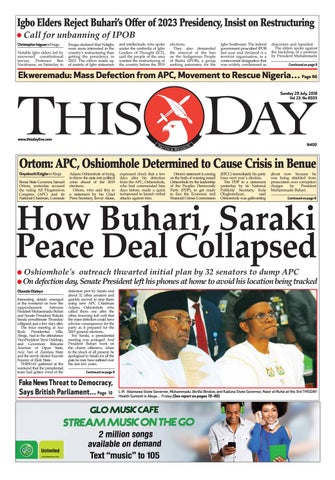
Igbo Elders Reject Buhari’s Offer of 2023 Presidency, Insist on Restructuring Call for unbanning of IPOB Christopher Isiguzo in Enugu
Notable Igbo elders led by renowned constitutional lawyer, Professor Ben Nwabueze, on Saturday in
Enugu declared that Ndigbo were more interested in the country’s restructuring than getting the presidency in 2023. The elders made up of mainly of Igbo statesmen
and intellectuals, who spoke under the umbrella of Igbo Leaders of Thought (ILT), said the people of the area wanted the restructuring of the country before the 2019
elections. They also demanded the removal of the ban on the Indigenous People of Biafra (IPOB), a group seeking autonomy for the
Igbo South-east. The federal government proscribed IPOB last year and declared it a terrorist organisation, in a controversial designation that was widely condemned as
draconian and lopsided. The elders spoke against the backdrop of a promise by President Muhammadu Continued on page 8
Ekweremadu: Mass Defection from APC, Movement to Rescue Nigeria… Page 86 Sunday 29 July, 2018 Vol 23. No 8503
www.thisdaylive.com TR
UT H
& RE A S O
N400
N
Ortom: APC, Oshiomhole Determined to Cause Crisis in Benue Onyebuchi Ezigbo in Abuja Benue State Governor, Samuel Ortom, yesterday accused the ruling All Progressives Congress (APC) and its National Chairman, Comrade
Adams Oshiomhole of trying to throw the state into political crisis ahead of the 2019 elections. Ortom, who said this in a statement by his Chief Press Secretary, Terver Akase,
expressed shock that a few days after his defection from the APC, Oshiomhole, who had commended him days before, made a quick turnaround to launch verbal attacks against him.
Ortom's statement is coming on the heels of warning issued Oshiomhole by the leadership of the Peoples Democratic Party (PDP), to get ready to face the Economic and Financial Crimes Commission
(EFCC) immediately his party loses next year’s election. The PDP in a statement yesterday by its National Publicity Secretary, Kola Ologbondiyan, said Oshiomhole was gallivanting
about now because he was being shielded from prosecution over corruption charges by President Muhammadu Buhari. Continued on page 8
How Buhari, Saraki Peace Deal Collapsed Oshiomhole's outreach thwarted initial plan by 32 senators to dump APC On defection day, Senate President left his phones at home to avoid his location being tracked Olawale Olaleye Interesting details emerged at the weekend on how the rapprochement between President Muhammadu Buhari and Senate President Bukola Saraki penultimate Thursday collapsed, just a few days after. The truce meeting at Aso Rock Presidential Villa, Abuja, had in the attendance Vice-President Yemi Osinbajo, and Governors Ibikunle Amosun of Ogun State, Aziz Yari of Zamfara State and the newly elected Kayode Fayemi of Ekiti State. THISDAY gathered at the weekend that the presidential team had gotten wind of the
defection plot by Saraki and about 32 other senators and quickly moved to stop them using new APC Chairman Adams Oshiomhole who called them one after the other, knowing full well that the mass defection could have adverse consequences for the party as it prepared for the 2019 general elections. For Saraki, a presidential meeting was arranged. And President Buhari went on the charm offensive, when to the shock of all present, he apologised to Saraki for all the pain he may have suffered over the last few years. Continued on page 8
Fake News Threat to Democracy, Says British Parliament… Page 10
L-R: Adamawa State Governor, Muhammadu Jibrilla Bindow, and Kaduna State Governor, Nasir el-Rufai at the 3rd THISDAY Health Summit in Abuja… Friday (See report on pages 78–80)
2
T H I S D AY ˾ Ͱͷ˜ ͰͮͯͶ
T H I S D AY ˾ SUNDAY JULY 29, 2018
3
T H I S D AY ˾ Ͱͷ˜ ͰͮͯͶ
4
85(6 ' ( & 2 5 3 , 6 5 ,9) $1' ,&
( <28
& /(7ś6 ),1$1
RG WKURXJK R UK H WK R P I \V R b Q NQRZ WKH MR D F R R HUWLOL]DWLRQ W X ) R \ UR LW \ D 9 G ,Q H P ) R ,9 6 X SSRUWXQLW\ RI /HWśV KHOS \R
Q LR W F MH Q , WKH PDVVLYH R HUP V WRSODVPLF 6S DO SURFHGXUH LF G H P H V H ,&6, ,QWUDF\ WK IRU H FHV \RX QHHG Q D Q ƪ H DQ \RX LPDJLQ K WK W U K H LW Q Z R R V H DQ FRP VR WKDW GD\ F
7$/. 72 86 72'$< $%287 ),1$1&,1* <285 0(',&$/ 1(('6
&DULQJ)RU7RPRUURZ
ZRPHQEDQNLQJ#DFFHVVEDQNSOF FRP
-RLQ WKH : FRPPXQLW\ ZZZ WKHZFRPPXQLW\ FRP ,163,5,1* &211(&7,1* (032:(5,1*
T H I S D AY ˾ SUNDAY JULY 29, 2018
5
6
T H I S D AY ˾ Ͱͷ˜ ͰͮͯͶ
T H I S D AY ˾ SUNDAY JULY 29, 2018
#
! ' & ( ) % # *'%# %#+ " # $% &
7
8
ͺ˜ ͺ ˾ T H I S DAY, T H E S U N DAY N E W S PA P E R
PAGE EIGHT
NPA Wants State of Emergency Declared to Tackle Apapa Traffic Crisis Eromosele Abiodun Following the failure to resolve the endemic Apapa traffic gridlock after several attempts, the Nigerian Ports Authority (NPA) has called on the federal government to declare a state of emergency to resolve the situation. This is just as it dismissed insinuations that the traffic congestion in Apapa is the result of lack of capacity of terminals at the ports to receive the volume of cargo that comes into the country, stating that things have gotten worse in the area since 2017 when the country received the lowest volume of cargo in recent times. Speaking to newspaper editors in Lagos yesterday, Managing Director of NPA, Hadiza BalaUsman explained that with the current state of the roads,
priority must be given to every process that would lead to an improvement in access roads into the ports. According to her, “If we have identified the Port Access Road in Apapa and Oshodi all the way to the toll gate as bad portions and we realise how much they affect access to the ports, businesses and residents around the Apapa area and ultimately the economy of the nation, it means that we must give emergency attention to every process involved. “This includes priority for approvals across board, priority consideration for budget provision and priority for listing at the Federal Executive Council. I am happy that the situation has drawn attention at the highest level such that the Vice President, Professor Yemi Osinbajo, has had to visit Apapa twice in the past one week. I am confident that
something positive will happen this time. “At the peak of cargo reception in 2014 Cargo throughput was put at 84,951,927 MT, we did not have the type of congestion that we had in 2017 when we only did 71, 776, 545MT. This is to show you that the volume of cargo is not the reason why we have this situation.” She explained that aside from the dilapidated and parlous state of the roads, the country has also not improved infrastructure in the port area in the past ten years. “There is also the very important need of deploying intermodal means of transportation around the ports. There is no way you can move 90 percent of cargo coming into the country by road and expect the required level of efficiency. This is because more than the attendant traffic congestion, you
will also see that the roads cannot be durable because of the heavy tonnage of the trucks. “The only sustainable way for effective cargo evacuation is therefore the use of roads, rails and water to move cargo into the hinterland, And we doing our best to facilitate the efforts of companies who are interested in moving cargo through barges. One of these is Connect Rail, which operates between Tin Can and Ikorodu. We are also working with the Nigerian Railway Corporation to see more effective use of rail in the movement of cargo with hope that the concessioning of railways which the Ministry of Transport is working on will bring a more permanent solution.” Bala Usman said. In the interim however, she noted that shipping companies must comply with the utlilisation
of holding bays even as the authority and the Lagos State government are working towards ensuring that a sufficient number of trailer parks are licenced as a way of taking articulated vehicles off the roads. She said further the NPA, which recently sanction four shipping companies will continue to monitor the situation and apply the necessary sanctions needed to make all companies comply. She explained that this administration is working assiduously towards ensuring that traffic increases in the Eastern Ports comprising Warri, Onne, Port Harcourt and Calabar. While stating further that the nature of the maritime industry is to allow cargo owners determine the port of call, she said that the FEC recently gave approval for the contract to dredge the
Warri/Escravos Channel which would increase the draught of Warri, while proposals for the dredging of Calabar is also being discussed currently. “we have been speaking with shipping companies to deploy flat bottom vessels that require lower draught levels pending the completion of the dredging efforts. Two of such vessels called at Calabar last year and it was in the news two weeks ago that the Calabar ports generated about N3bn in the first three months of this year. So we are determined to get all our ports working, “she said. She explained that the final destination of a lot of the cargo that come into the Lagos ports are within the Lagos/Ogun State industrial cluster, which is the reason we just have to prepare all our ports to function at utmost capacity.
IGBO ELDERS RE JECT BUHARI’S OFFER OF 2023 PRESIDENCY, INSIST ON RESTRUCTURING Buhari to support the emergence of a president of Igbo extraction in 2023 if Igbos voted for him in the 2019 presidential election. The president made the offer through the Secretary to the Government of the Federation, Boss Mustafa, who represented him at a rally of the ruling All Progressives Congress (APC) in Owerri, recently. But addressing journalists after a two-day meeting in Enugu, Deputy National President of ILT, Professor Chinweite Ejike, said Igbos were more concerned about the restructuring of Nigeria to enthrone good governance, independent development, and healthy competition among the country’s federating units. He maintained that the rancour over leadership would be subdued
when an effective system was put in place, adding that allocating power to any section of the country would amount to nothing with the present constitution in place. Ejike stated, “What is the need asking for power in a disintegrated and disunited country being foisted on us by the day with the present system? What we are asking for and interested in is the restructuring of the country to usher in true federalism. With that, there will be less tension over leadership and people will no longer be bothered about where the leader is coming from or who the leader is. The way the country is structured, it is bound to continue to witness more frictions if it is not restructured.
We need to restructure to attend true federalism and a good governance system based on rule of law.” The ILT deputy leader said the group was worried by the current events in the country, adding that the meeting undertook a serious review of the security situation, especially the frequent killings in parts of the country and herdsmen/farmers clashes over control of land and resources. He noted that the meeting observed that enough was not being done by the federal government to stop the killings, stressing that there is need to scale up intelligence gathering to check further waste of lives and resources. “The killings in the country have assumed a genocidal
dismay and apprehension what they described as the use of state power in pursuit of special personal interest. Explaining that the development was no longer acceptable, they called on government at all levels to obey court orders and abide by rules and regulations guiding the country to prevent anarchy. The Igbo elders reviewed the proscription of IPOB by the federal government and urged that the group be unbanned, as, according to them, “We do not see anything that is wrong with one agitating for freedom in his own country.” The group also asked the federal government to begin to address the dire economic situation that has placed the
country among the poorest in world. It stated that government should reinvent a productive economy through animal husbandry, among other agricultural practices, to boost citizens’ income and ensure survival of the country. The ILT deputy president said they were advocating a new political and legal order that will rid the country of the decay that pervaded it and enable it to chart a roadmap for its destiny. Ejike said ILT was determined to pursue the interest of Ndigbo in Nigeria as well as uphold human rights, free assembly, and freedom of association, warning that no government has the right to abrogate freedom of association and legitimate protest.
pillaging the scarce resources of Edo State but for the cover provided for him by the President Buhari-led administration. Asking Oshiomhole to stop acting like an attack dog, the PDP noted with dismay that since assuming office as chairman of APC, Oshiomhole had abandoned the path of wisdom expected of him and had become noisy, loquacious, rapacious and completely immodest in all his actions and utterances. "Oshiomhole should be reminded that but for the cover provided for him by President Buhari, he would have been under prosecution by the Economic and Financial Crimes Commission (EFCC) over huge allegations of pillaging the scarce resources of Edo State, where he also trampled upon the citizens, including poor widows, when he
was governor. "However, with the collapse of the APC and its inevitable defeat in 2019, Oshiomhole by now knows that his presidential cover will soon be over and that he will surely face the full weight of the law." The PDP said Nigerians had found a new laughing stock in Oshiomhole, who appears to have completely lost all bearings in his quest to compete for media space with aides of the President and by so doing, throwing decorum to the dogs. "If Oshiomhole had limited his childish abuses to President Muhammadu Buhari, whom he dismissed as indolent, ineffectual and condoning indiscipline; or to the ministers of their incompetent government, whom he wholesomely described as
dishonourable; the governors left in his faction, whom he said are undeserving of return tickets in 2019; and members of his faction, who he had rendered directionless, the PDP would have ignored his attention seeking antics," the statement stated. PDP therefore asked leaders of the APC to regulate Oshiomhole's utterances before he derails the nation’s democracy. "While the PDP has nothing but pity for Oshiomhole, who is fast turning himself into President Buhari's court jester, our party will henceforth not watch and allow him continue to make irresponsible, mundane and unsubstantiated allegations of corruption, murder or mutiny against any member of the PDP or any notable Nigerians, unchallenged," it said.
and preventing them from leaving for both work and the Guzape police station, they sensed real trouble, they concluded that if the police could still go ahead to invite Saraki, despite of the position of the Attorney-General that there was no evidence against him, “then, you cannot trust these people.” Although Senator Lanre Tejuosho was originally among the initial 32 senators who had agreed to go, he was not available the night the others were being mobilised for the emergency defection and was only able to sign on the floor of the senate the next day. Besides, following a tip-off, that he may be arrested and impeached while in custody, Saraki left his house by midnight and smartly left all his phones behind in the house to shut down the possibility of his location being tracked by his traducers, THISDAY learnt. So, while the tracker showed that he was at home, unknown to the authorities, he had left the house, only to resurface at the National Assembly the next
day to announce the defection of 14 senators plus Tejuoso who later withdrew his defection. Sources said had Saraki not played smart, the plan was to prevent him from leaving the house, effect a change in the leadership of the Senate, and subsequently arrest him. To get this done, senators believed to be loyal to the president had already been mobilised with a bus at the Transcorp Hilton, with one of them, Hope Uzodinma being tipped as likely successor to Saraki, to divide the South East and South South where Saraki had most support. But the reason Saraki did not defect with others last week, sources said, was because he still believed he had a deal with the president, even if the element of trust had been greatly decimated. The weeks ahead promises more drama as the presidency, the party and rebel- lawmakers perfect their war plans. There were speculations at press time that the presidency was being persuaded by hardliners
to forcibly reopen the senate - who are now officially on recess, arrest Saraki and Ekweremadu, impeach them while in custody and elect a new leadership for the National Assembly. But the problem is first in the numbers. To impeach and remove Saraki and Ekweremadu from office you need a 2/3rd majority, which will mean getting half of the opposition PDP Senators to join in the plot, which will be near impossible. The second problem is in the law. Robbery is a State crime on the residual list of the constitution. To arrest and prosecute Saraki for any link to the Offa robbery, which may again look like political persecution, you have to charge him in a State Court, which will in this case be Ilorin, Kwara State where Saraki 'rules', and with the Kwara State Attorney General as the prosecuting authority as was done in Lagos with the Kudirat Abiola murder, with prosecutor Authur Worrey and the then Attorney General Yemi Osinbajo SAN.
dimension and unless the issue of proper protection is being addressed, the country is as good as assumed to be a failed state,” he said. The meeting noted that addressing corruption, which the federal government professes as its cardinal objective, might have been abandoned with the scale of lopsided appointments and distribution of amenities in the country. It explained that some sections of the country, especially the Igbo, had been seriously marginalised. The group noted with dismay the use of public funds, not budgeted or appropriated, by certain government agencies and officials, stressing that it is tantamount to political corruption. The elders viewed with great
ORTOM: APC, OSHIOMHOLE DETERMINED TO CAUSE CRISIS IN BENUE Displeased with Oshiomhole’s sudden aggression towards him, Ortom said his latest disposition has revealed among other things, the true oppressive intentions of the ruling party APC against Nigerians. "Oshiomhole appears to be flying a kite of an agenda to intimidate and suppress Nigerians, who desire freedom from a party which has clearly failed to secure lives and property, thereby ushering in an orgy of violence never before witnessed in the history of the country. "Adams Oshiomhole's diatribe against Governor Ortom has also revealed the plot hatched by APC leaders within and outside Benue to throw the state into political crisis ahead of the 2019 elections," he said. Ortom, who was responding to Oshiomhole’s statement that
he was complicit in the killing of two Catholic priests in Benue State, noted that the conclusion he could draw was that investigations into the matter have been compromised. The Governor noted that Oshiomhole was privy to the ongoing investigation of the suspects arrested in connection with the murder of two Catholic priests and 17 worshipers at Mbalom, Gwer East local government area of Benue State, noting that, "With his jumping into conclusion that the suspects were sponsored by the Governor, our suspicion is that either the investigation into the matter has been compromised or the APC National Chairman is influencing it. "Benue people know who their killers are, and the attackers are believed to be sponsored by Miyetti
Allah Kautal Hore and other Miyetti Allah groups. We advise the APC National Chairman to stop his shameful dance on the graves of innocent Benue children, pregnant women and others slaughtered by armed herdsmen," he said. On the issue of security votes, he said, “We wonder what Oshiomhole hoped to achieve with such an accusation? Governor Ortom has not done anything outside the laid down procedures in addressing security challenges by a state governor. As a former governor, Comrade Oshiomhole should know this better.” Addressing what it thought might be the fate of Oshiomhole after the 2019 elections, the PDP said the APC national chairman should have been under prosecution by the EFCC over huge allegations of
HOW BUHARI, SARAKI PEACE DEAL COLLAPSED And a dis-armed Saraki returned the goodwill by also apologising to the President for all the discomfort he too may have caused the Presidency. Soon after, it was banter all over. Truce reached. Over the weekend that followed, APC Chairman began reaching out to aggrieved Senators one by one winning back some 16 of 32 Senators as of last Sunday. But that was not to continue as another invitation last Monday by the Inspector-General of Police, Ibrahim Idris, to Saraki over his alleged involvement in a recent robbery in Offa, Kwara State scuttled the deal and gave the impression to the Senators that the presidency and its security apparatchiks could not be trusted after all. The police invitation was despite an advice by the office of the Attorney-General of the Federation and Minister of Justice, Abubakar Malami (SAN), which said no nexus between Saraki and the robbery had been established. According to sources, Saraki
was disarmed by the Buhari humility and apology and was "considering his options" when the police invitation arrived "like a thunderbolt". At the meeting with Buhari, sources said participants were pleasantly shocked at the humility of the president, who uncharacteristically apologised to Saraki for all he had gone through in the hands of the security agencies and asked that they should both move on in the collective interest of the party and the country. According to sources, Saraki and the President agreed to work together, even though Saraki allegedly added that he would have to run the outcome of the meeting by his people since he was not alone in the matter. Earlier, the team of Osinbajo, Aziz, Amosun, and Fayemi had taken turns to speak along the same line of truce. They appealed to Saraki to suspend the idea of defection, especially, as some of the governors of the party had met with him the
night before the meeting with the president. The meeting had also decided, as mooted by the president, that a team of governors, led by the vice president, be formed to continue with the rapprochement until they arrived at a suitable meeting point, convenient for both parties. But all that was suddenly upturned the following Monday, when Police Chief, Idris not only wrote to re-invite Saraki to come and face questions on the Offa robbery. Following the Police invite the Saraki team swung back into action to remobilise Senators immediately calling for a discontinuation of talks with Buhari’s team, alleging that they could not be trusted, various sources told THISDAY, but only 14 of the 32 were then ready to sign on at the point on a 12 hour notice which many of the senators considered too short as they too had to consult. And when the Police also went as far as cordoning off the residences of the Senate President and the Deputy Senate President,
T H I S D AY, T H E S U N D AY N E W S PA P E R ˾ JULY 29, 2018
9
SUNDAY COMMENT
Editor, Editorial Page PETER ISHAKA Email peter.ishaka@thisdaylive.com
A HEALTHY NATION, A WEALTHY NATION There is need for a smarter socio-political reform that will place healthcare as the pre-eminent public policy issue
A
t the end of the THISDAY Policy Dialogue Three last Friday in Abuja with the theme, “Improving Nigerians Health Outcomes In Numbers”, there was a consensus that government, at all levels, should see health as the right of the people. But in order to attain this, the focus should be on what the country should put on the table to revamp the sector rather than depend solely on help from development partners. It was also resolved that the ability to manage resources efficiently must be developed just as there is an urgent need to mobilise all critical stakeholders, including the private sector, in a bid to make healthcare efficient and affordable to the people. The quarterly Like the two dialogue session, previous dialogue which brings under sessions, some of the one roof healthcare recommendations stakeholders, include improving development partners transparency and acand policymakers countability around from the public and public financial private sectors as managements; making well as domestic and the legal framework for international public financing the health sector health institutions, robust enough to support is part of a corporate the delivery of a set of high social responsibility impact interventions for all to discuss the Nigerians; increasing public challenges of the investment and ensuring health sector in that assistance from donor Nigeria and the agencies and development prospects for partners align with governsustainable solutions ment policy for the sector. It was also recommended that state governments and the private sector should increase spending on health as most of public sector funding currently comes from the federal government However, from what transpired at the event, it was obvious that several challenges plague the sector that would require the collaboration of all the stakeholders. Nigeria, according to most participants, has one of the highest infant mortality in the world; bogged down by incompetent workforce and funding challenge. While announcing the robust financial support to Nigeria’s healthcare fund,
Letters to the Editor
the Practice Manager, World Bank Group, Washington, Mrs Trvna Hague underscored the need for affordable healthcare delivery that will target the poor. “If there are vaccines, drugs and other services, the number of Nigerians accessing services in primary health centres will increase. And this can happen if healthcare funding is brought down to rural and low levels in the country”, she said.
T
S U N DAY N E W S PA P E R EDITOR SHAKA MOMODU DEPUTY EDITORS OLAWALE OLALEYE, TOBI SONIYI MANAGING DIRECTOR ENIOLA BELLO DEPUTY MANAGING DIRECTOR KAYODE KOMOLAFE CHAIRMAN EDITORIAL BOARD OLUSEGUN ADENIYI EDITOR NATION’S CAPITAL IYOBOSA UWUGIAREN MANAGING EDITOR JOSEPH USHIGIALE
T H I S DAY N E W S PA P E R S L I M I T E D EDITOR-IN-CHIEF/CHAIRMAN NDUKA OBAIGBENA GROUP EXECUTIVE DIRECTORS ENIOLA BELLO, KAYODE KOMOLAFE, ISRAEL IWEGBU, IJEOMA NWOGWUGWU, EMMANUEL EFENI DIVISIONAL DIRECTORS BOLAJI ADEBIYI , PETER IWEGBU, ANTHONY OGEDENGBE DEPUTY DIVISIONAL DIRECTOR OJOGUN VICTOR DANBOYI SNR. ASSOCIATE DIRECTORS ERIC OJEH, PATRICK EIMIUHI ASSOCIATE DIRECTOR SAHEED ADEYEMO CONTROLLERS ABIMBOLA TAIWO, UCHENNA DIBIAGWU, NDUKA MOSERI DIRECTOR, PRINTING PRODUCTION CHUKS ONWUDINJO TO SEND EMAIL: first name.surname@thisdaylive.com
he quarterly dialogue session, which brings under one roof healthcare stakeholders, development partners and policymakers from the public and private sectors as well as domestic and international public health institutions, is part of a corporate social responsibility to discuss the challenges of the health sector in Nigeria and the prospects for sustainable solutions. Both Vice-President Yemi Osinbajo and Health Minister, Prof Isaac Adewole, who were at the event on Friday, commended THISDAY/ARISE Media Group for deploying their platforms to address pertinent issues in the health sector. The reasons for policy failure in the health sector, according to participants, are many and some of them include lack of political will, inadequate investments in healthcare (from both the public and private sector), human resource challenges, especially professional rivalries and emigration of medical personnel in addition to unsustainable financing for the sector. Other challenges include the inability of the various local governments to take up their primary healthcare responsibilities as well as the declining reputation of medical practice in Nigeria which discourages patronages from both the rich and the middle class and in turn encourages outbound medical tourism. While credible metrics and effective health planning, monitoring and evaluation, by federal and state ministries of health are required to encourage confidence, it was also agreed that there should be a reduction in outof-pocket payments at point of service delivery, through better and improved public investments. But to achieve those objectives, there is need for a major socio-political reform that will place healthcare as the pre-eminent public policy issue as it is in most countries in the world. At the end, it was agreed by a broad section of participants that although investment in health leads to economic growth, Nigeria invests far too little in the critical sector, spending less than nearly every country in the world. Yet, in climes where political leaderships have rallied stakeholders behind investments in the health sector, significant improvements have been possible.
TO OUR READERS Letters in response to specific publications in THISDAY should be brief (150-200 words) and straight to the point. Interested readers may send such letters along with their contact details to opinion@thisdaylive.com. We also welcome comments and opinions on topical local, national and international issues provided they are well-written and should also not be longer than (950- 1000 words). They should be sent to opinion@thisdaylive.com along with the email address and phone numbers of the writer.
Intellectual Property And Nigerian Economy
T
he 21st century economy is undoubtedly knowledge-based. It is largely driven by a rich mental resource as against the 20th century economy, which was mainly driven by assets, like land, mineral resources and so on. It has been described as ‘’information technology age’’. It boils down to the fact that the 21st century is an age where information is the basic capital rather than natural resources of the nations, where human resources to a large extent becomes the basis for rapid economic development and growth. Information, properly harnessed from Intellectual property, is a vital trigger of economic growth but unfortunately, intellectual property is one of the most abused economic resources, especially in Nigeria. The absence of quality intellectual
property laws has been detrimental to the economic well-being of those whose economic mainstay is their intellectual property. Banwo and Igahadolo while assessing copy rights in Nigeria noted that “The Nigerian tradition that favours communal ownership and encourages the spirit of camaraderie and free sharing was at variance with the individualistic and proprietary nature of the modern concepts of copyright. In the eyes of the ordinary person, the laws did not exist. ‘’At a time when oil, the nation’s principal source of foreign exchange earnings, is facing a precarious future (dwindling volume of production resulting from decaying and vandalized infrastructure; plummeting international prices and; competing, more efficient, alternative energy sources), the
time to transform the nation from a traditional commodity-based and import -driven economy, to a knowledge economy exporting expertise, talents, value added products and tech savvy inventions is ripe. This accounts for the current national agitation for a developed and self-reliant economy, buoyed by diversification.’’ The existence of regulatory agencies like, Nigerian Copyright Commission, Ministry of Information, National Communications Commission, NAFDAC, among others, have not made meaningful impact on the status of copyrights in Nigeria. Failures of government and other stakeholders to adequately protect the creative industry in Nigeria have resulted in investors losing billions of naira. The book, music and film industries are the worst hit in this
scenario. There are reported cases of how much pains poor legislation and enforcements on intellectual property rights have inflicted on stakeholders. One of such cases is that of the late Moses Adejuwon Olaiya popularly known as “Baba Salla” in the Yoruba movie Industry. The veteran actor suffered stroke and eventually died because of 'wicked' piracy of his work ‘Mosebolatan’, produced in celluloid mode of film. The late actor was said to have lost millions of naira borrowed from the bank. His case became so miserable after he allegedly sold virtually all his property to pay back the bank loan. Recently Henry Knight, a Nigerian music artist, via Instagram posted a message saying ''Every day in the Nigeria music industry, most of the biggest artistes who never for once helped you even when you reach out to them in time of need tend to get away with ripping you off and making
profit out of your property.” Dr Samuel Andrews, NigerianAmerican trained intellectual property expert, from Suffolk University, Boston Law School, who was recently honoured in Abuja, at a reception organized by colleagues and industry stakeholders, stated that Nigerian entertainment industry offers great investment opportunities that can transform the economy, but the opportunities could not be adequately explored because of the weak copyright laws which discourage investors. In his words, “Nigeria suffers from legal lack, and that is a big problem because our laws are not up –to- date to confront the realities of digital economy. The laws do not protect the creators enough as most of the copyright infringements are done on the cyberspace. Our copyright laws are not up-to-date to confront the realities of this digital era’’. –Comfort Yakubu, Gudu, Abuja
10
JULY 29, 2018 ˾ T H I S D AY, T H E S U N D AY N E W S PA P E R
NEWS
News Editor Abimbola Akosile E-mail: abimbola.akosile@thisdaylive.com, 08114495306 (sms only)
Kwankwaso: Buhari‘ll Never Win in Kano Gboyega Akinsanmi
Former Kano State Governor, Sen. Rabiu Kwankwaso yesterday said President Muhammadu Buhari would never win in the state contrary to the claim of the Minister of Transportation, Mr. Rotimi Amaechi. Kwankwaso, currently representing Kano Central Senatorial DistrictintheNationalAssembly, also said his defection would not only affect Buhari’s chance in Kano State, but had already brought down the All Progressives Congress (APC). He dared the president in a statementhisMediaAdviser,Mrs. Binta Spikin issued yesterday in
reaction to Amaechi’s comment, noting that Buhari “will lose in Kanoeventhoughheusesfederal might.” Duringasessionwithjournalists on Friday, Amaechi had said President Buhari “will win in Sokoto, Kano and Bauchi states in the 2019 presidential elections even if he (Buhari) is taken to the states on a sick bed.” He had acknowledged that the Sokoto State Governor, Hon. Aminu Tambuwal and his Kwara State counterpart, Mr. AbdulfatahAhmedwouldleave the APC, noting that the former had presidential ambition. He said: “On those that defected at the House of Rep-
resentatives and Senate, where do they come from? They come from areas that the president is comfortable. Do you honestly believe that the president will lose election in Sokoto? We are notGod.Butitisoneofhiscomfort zones. “If you bring the president on a sick bed to Bauchi and Kano States, he will win and he has never lost election in Bauchi. But that is a bit arrogant on our side; we should not underestimate them. I am not God. It is only God who can say the APC will win or not,” Amaechi said. Kwankwaso,however,replied in a statement that the president would not win in Kano State
whether he chose to use federal might or not. The statement said: “I think his defection will greatly affect the votes in 2019. His defection will not only affect the chances of the APC in Kano, but has already brought down the APC in the state. “If you look across Nigeria today, not Kano alone, there’s nowhere in Nigeria that you do not have the presence of Kwankwasiyya, Kwankwaso’s politicalmovementKwankwaso. “Kano is his home base. He is well grounded in Kano. Even without the government, he had a60percentofthevoters.Sowhat do you think will happen now that he has joined forces with
MARITAL BLISS L-R: President of the Senate, Dr. Abubakar Bukola Saraki, and his wife, Toyin, with a newly wedded couple, Mr. and Mrs. Ifedolapo Oluseyi, during their wedding solemnisation at the Archbishop Vinning Memorial Church Cathedral, Ikeja...yesterday
people like Mallam Ibrahim Shekarau? “Even if the federal government puts whatever in place, there is no way President Buhari willwininKanoState.Definitely, BuhariwillloseKano.Hestands averygoodchancetowinBuhari. We are covered.” Kwankwasowasoneofthe15 senators who defected from the APC to the Peoples Democratic Party (PDP) last Tuesday. InhisreactiontoKwankwaso’s, KanoStateGovernor,Dr. Abdullahi Ganduje had said the mass defection would not affect the party’s chances politically. HehadalsosaidKwankwaso’s exit “will not be felt in the state. I want you to go and study the situation on ground in Kano, Kwankwaso’sdefectiondoesnot changethestate’spoliticalmood. Nobodycarestobedisturbedby their action.” Kwankwaso has been in a fierce battle with Ganduje after the 2015 general election. Over thepasttwoyears,severalattacks and reprisal attacks between the supporters of the two politicians have been reported. Okupe: 2019 Election Battle Between Saraki, Buhari A chieftain of the Accord Party and former Presidential Spokesperson, Dr. Doyin Okupe has projected that 2019 presidential election would be a battle between Senate President, Dr Bukola Saraki and President Muhammadu Buhari. Okupe stated this while analysing the recent defection of some National Assembly members from the ruling All Progressives Congress (APC), on Channels television political show, Politics Today, on Friday. Asked about the motive
behind his projection, Okupe said: “if Saraki is wise, the best thing for him to do would be to contest2019presidentialelections, because as it stands in Nigeria presently,Sarakiisbecomingthe most important political figure outside the Presidency. “And from what I am seeing, the battle for the presidency in 2019 is between Saraki and Buhari.” It would be recalled that Okupe, while speaking on Channels television’s Sunrise Daily, recently, had advised the SenatePresidenttoleverageonhis increasingpopularityandcontest the 2019 presidential election. On the wave of defection that has hit the ruling APC, Okupe noted that it had become inevitable for Saraki to leave the APC, wonderinghowcouldheremain in a party where he had been constantlydisgraced,humiliated over the years? He said: “After stripping you naked they are now trying to coveryouupwithapieceofcloth at the dying minute when they sawyouhavegrowntobecomea threat to their survival. It will be unwise for him to remain in the APC if he truly wishes himself well.” Discardinginsinuationsfrom somequartersthatSarakiwould lose his seat if he is sacked from theAPCorhedecidestoleavethe party, Okupe said a sack from a politicalparty“doesnotinvalidate his election as a member of the Senate and the Senate President. “Don’t forget that Senator Buruji Kashamu has just been expelled from the PDP and he remainsintheSenate.IftheAPC decidestosackSaraki,Sarakicannot lose his seat as the President of the Senate.”
Fake News Threat to Democracy, Says British Parliament Demola Ojo
The British House of Commons in an interim report by its Committee on Digital, Culture, Media and Sport has warned that the deliberate dissemination of false information poses threat to democracy. The reportreleasedyesterday and obtained by THISDAY also referenced the case of Black Cube, an Israeli intelligence firm fingeredinthehackingofemails andmedicalrecordsofPresident Muhammadu Buhari, while he
was still a candidate running for election against then incumbent Goodluck Jonathan. Thereportsaidthere“aremany potentialthreatstoourdemocracy and our values. One such threat arisesfromwhathasbeencoined ‘fake news’, created for profit or othergain,disseminatedthrough state-sponsored programmes, or spread through the deliberate distortionoffacts,bygroupswith aparticularagenda,includingthe desiretoaffectpoliticalelections.” Thereportsaidsuch“hasbeen
Okupe: 2019 Election Battle Between Saraki, Buhari A chieftain of the Accord Party and former Presidential Spokesperson, Dr. Doyin Okupe has projected that 2019 presidential electionwouldbeabattlebetween SenatePresident,DrBukolaSaraki and President Muhammadu Buhari. Okupe stated this while analysing the recent defection of some National Assembly members from the ruling All Progressives Congress (APC), on Channels television political show, Politics Today, on Friday. Asked about the motive behind his projection, Okupe said: “if Saraki is wise, the best thing for him to do would be to contest2019presidentialelections, because as it stands in Nigeria
presently, Saraki is becoming the most important political figure outside the Presidency. “And from what I am seeing, thebattleforthepresidencyin2019 is between Saraki and Buhari.” ItwouldberecalledthatOkupe, while speaking on Channels television’sSunriseDaily,recently, hadadvisedtheSenatePresident to leverage on his increasing popularity and contest the 2019 presidential election. On the wave of defection that has hit the ruling APC, Okupe noted that it had become inevitable for Saraki to leave the APC, wonderinghowcouldheremain in a party where he had been constantlydisgraced,humiliated over the years?
theimpactofthisagenda,thefocus ofourinquirymovedfromunderstandingthephenomenonof‘fake news’,distributedlargelythrough socialmedia,toissuesconcerning the very future of democracy.” Arguably,thereportsaid,more invasivethanobviouslyfalseinformation is the relentless targeting of hyper-partisan views, which playtothefearsandprejudicesof people,inordertoinfluencetheir votingplansandtheirbehaviour. BlackCube,anIsraelicorporate intelligenceorganisation,describes
itselfas“aselectgroupofveterans from the Israeli elite intelligence units that specialises in tailored solutions to complex business and litigation challenges.” The organisation claimed that using our unique intelligence methodology, Black Cube enhanced its clients’ decision making by providingotherwiseunobtainable information. AccordingtotheBritishHouse of Commons Committee, fake news’ is bandied around with no clear idea of what it means, or
an agreed definition. The committee said the term “has taken on a variety of meanings, including a description of any statement that is not liked or agreed with by the reader. “We recommend that the government rejects the term ‘fake news’, and instead puts forward an agreed definition of the words ‘misinformation’ and ‘disinformation’. “Withsuchashareddefinition, andclearguidelinesforcompanies, organisations, and the Govern-
ment to follow, there will be a shared consistency of meaning across the platforms, which can be used as the basis of regulation and enforcement.” The committee received evidence about the role of SCL Elections, a company that AlexanderNixformed,asanoffshootof SCLGroup,in2011,anditsrolein foreignelections,includingitsuse ofmisinformation,disinformation andmicro-targeting,whichmay havecrossedthelineintounethical, or even illegal behaviour.
Ogunbiyi: I Never Accepted to Be Adeleke’s Running Mate
Adeboye Urges Christians Not to Take Success, Victory for Granted
Femi Ogbonnikan
The General Overseer of The Redeemed Christian Church of God (RCCG), Pastor Enoch Adeboye yesterday Christians never to take success and victory for granted. Adeboye,madethedisclosure in his goodwill message sent to theRedeemer’sMenFellowship, RCCG, New Life Assembly, Kubwa, FCT Province 2, at their annual Convention with the theme: ‘Barrier Breakers’. For Christians to remain victorious and soar, Adeboye said they must shatter the invisible glass ceiling and all barriers that can stop them from attaining victory at full measure. He said: “We remain the adversary’s main target. The
A Peoples Democratic Party (PDP) governorship aspirant in Osun State, Dr. Akin Ogunbiyi yesterday disclosed that he never accepted to be the governorship aspirant, Sen. Ademola Adeleke as being speculated. He, also, disclosed that he had not withdrawn a suit he instituted last week, asking the court to Adeleke’s emergence as thePDPgovernorshipflag-bearer intheSeptember22governorship election in the state. Ogunbiyi made the disclosure in a statementhisDirectorofPublicity,Mr. OlalereFagbolaissuedyesterday, describing the speculation as lies by the agents of the embattled
governorship aspirant. The statement said the attention of the Dr. Akin Ogunbiyi Campaign Organisation “has been drawn to the news making round that Ogunbiyi has negotiated for the positions of Deputy Governor & SSG. “This information is not true. TheNationalWorkingCommittee (NWC) of our party has set up a reconciliation committee to be headedbyformerSenatePresident, Sen.DavidMark.Thecommittee has not yet met. “Ogunbiyi and his campaign organisation will meet with the reconciliation committee in the hope of resolving the crisis as scheduledandpursuetenaciously the restoration of his mandate.”
strategy ofstrikingtheshepherd to put the sheep in disarray is as deadly as when it was first devised.” Meanwhile, Pastor Modupe Suberu of RCCG, Region 10 urged Christian women to develop a victorious attitude toward the battles of their lives. The cleric encouraged Christian women to see battles and tribulationsaspartofaChristian journey. Accordingtoher,theobjective of the convention which is ‘Total Victory’ was to bring women together to deliberate on family, spiritualandnationalissueswith a view to proffering solutions challenges facing the family and the nation.
T H I S D AY ˾ SUNDAY JULY 29, 2018
#TCL 5GRF 7MSP .?J?Q?
SW GPRGKC $SLBQ 2P?LQDCP SWW GPRGKC $SLBQ 2P 2 ?LQDCP SW "?R? .?W GJJ #JCA GJJ #JCARPGAGRW ARPGAGRW
"G?J RM ECR QR?PRCB RMB?W "G?J J RM ECR QR?PRCB RMB?W
11
12
T H I S D AY ˾ Ͱͷ˜ ͰͮͯͶ
T H I S D AY ˾ SUNDAY JULY 29, 2018
13
14
Ͱͷ˜ ͰͮͯͶ ˾ THISDAY, THE SUNDAY NEWSPAPER
OPINION Chaotic Traffic in Urban Cities Babatunde Olubanjo suggests ways to restore sanity to the seemingly intractable traffic gridlocks in some cities
T
he traffic situation in most urban cities of Nigeria like Lagos and Abuja is unacceptably frustrating to say the least. These awkward traffic situations need not be so because the major causes of traffic congestion are issues we can readily address and minimize if not altogether eliminate with dedicated planning and purposeful execution. Purposeful execution in this context refers to applying the laws equally to all citizens without exceptions. I am also convinced that with the solutions I will recommend, we will not only solve the traffic problems but do same profitably from the government point of view. We will thus end up having a win-win situation for the stakeholders. However, before proffering solutions, it is necessary that I first briefly provide some details on the current and desired states of traffic in a typical urban city like Lagos. The current traffic situation in Lagos for example is frustrating, exhausting, hazardous and economically crippling. Covering a distance of about two to five kilometres could take hours depending on where you are headed. I will reference a few personally frustrating experiences to buttress my claim. I headed for Gbagada from Festac Town on a Saturday afternoon to attend a birthday celebration of an in-law of mine. I left Festac around 11:30 am with the hope of meeting the celebrants in Church by 1:00pm. The supposedly fastest route is to go through Festac Link bridge and turn around in Mile 2 to Apapa-Oshodi Expressway towards Gbagada. The traffic on the service lanes in Mile 2 was stagnant as those lanes were completely blocked by 18-wheeler tankers and container trucks. So I decided to go to Berger through the inner lanes and turn around. That was a tactical error as I did not get to Gbagada, venue of the party until 7:30 pm by which time the party proper after the service had shut down for lack of power and the celebrant was about leaving the venue of the party. There was even one-way traffic against the normal flow of traffic on the inner lanes from Cele to Mile 2 by commercial drivers avoiding traffic on the other side of the road which is their designated route, thus worsening the traffic situation. Currently, one should avoid going to Apapa anyway as all routes down there are fully blocked by tankers and trailers. It is unfortunate that we stand by and witness a situation whereby one needs over one day for a trip to Apapa. This unacceptable and unfavorable situation is exacerbated by the following: We find cows and goats (defined as category one) on highways and other unacceptable locations like schools and commercial centres. These are certainly not authorized to ply the roads and
should be prevented at all costs from being considered as road users. Wheelers and Okada (defined as category two) drivers also make their presence felt riding indiscriminately on highways against the stipulated flow of traffic most of the time. There is need to regulate and control when, where, how and under what circumstances these category of road users can ply roads. Then there are the three-wheelers from garbage wooden or iron trucks through Keke Maruwa (defined as category three) also plying highways indiscriminately, stopping at any and all points on the route without a care for other road users either to pick or drop garbage or riders and most times against the normal flow of traffic. There is absolute need to regulate and control when, where, how and under what circumstances these category of road users can ply roads. There are also the four-wheelers including private cars and SUV’s and the notoriously uncultured and undisciplined commercial vehicle drivers popularly called danfo(defined as category four). Closely following the danfos are the six-10-wheel vehicles (defined as category five) including commercial trucks popularly called Molue. Then we have the over 10-wheel trucks (defined as category six) including tankers and trailers also plying our roads. Finally, there are those special purpose vehicles that ply the roads that we will group in category seven. The desired state of traffic has the following characteristics: There is continuous and uninhibited flow of traffic occasioned by: well-designed and well-built roads able to cope with the weight and number of vehicles; good roads complete with all necessary road signage including speed limits and lane markings devoid of potholes and foreign objects; complete absence of cows, goats and other animals on the roads; restriction of two and three-wheel vehicles to specific roads assigned to them and ensuring they all keep to road regulations and instructions; complete ban on all and every type of hawking on highways; strict and impartial enforcement of traffic
Government should use a combination of clamping, towing, fines, seizures, auctions and imprisonments of owners to prevent those trucks from parking on highways
rules and regulations especially those that deal with driving against the flow of traffic, indiscriminate parking, stopping to drop or pick passengers at any other place but designated parking and bus-stops; not adhering to speed limits as it relates to maximum and minimum speeds allowable on specific roads or sections thereof; disobedience of road signs either by deliberate action, ignorance or incompetence thereby causing accidents; keeping drivers deemed incompetent by virtue of intoxication, drunkenness, temporary insanity, health challenges and other similar hazardous conditions off the roads at all material times by even and impartial enforcement of heavy punishments including sanctions to offenders. In proffering solutions, I will first list the problems. The obvious causes of traffic congestion in Lagos and urban cities of Nigeria can be conveniently classified into two main groups. These are government and driver related issues. Bad roads that are not well designed and built for the type and volume of traffic; inadequate or complete absence of road signs and instructions, and lane markings and pavements; inadequate traffic laws and where there are laws, non-enforcement of same. Driver related issues are numerous and need to be handled with purposeful dedication. These include: indiscipline on behalf of drivers, incompetence of drivers, lack of consideration for other road users, deliberate negligence on the part of some drivers, lack of sense of order and control. The current practice whereby trucks, tankers and other heavy-duty vehicles are parked on roads and bridges in Lagos is unacceptable. This practice should be stopped at the earliest opportunity more so since the drivers of these trucks work for private enterprises which can afford to keep their trucks off the roads while pursuing their legitimate businesses and making profit. Government should use a combination of clamping, towing, fines, seizures, auctions and imprisonments of owners to prevent those trucks from parking on highways. The owners can certainly afford the costs associated with operating without endangering the lives of all other citizens and exposing our roads and bridges to early and permanent failures. From the government end, there is the need to completely overhaul existing laws and regulations and enact new ones at the federal and state levels that are responsive and effective for these times. The new laws should be both corrective and punitive enough to force people to change and comply. ––Babatunde Olubanjo is a US-based Security Consultant
Deepening Job Creation In Nigeria There is an urgent need to re-assess Nigeria’s economic growth to ensure that it addresses the challenges of unemployment, writes ‘Tunji Olaopa
T
he ultimate goal of economic growth is to improve the living standard of people in any country. This goal is sustainably achieved, primarily through people’s employment income. Thus, employment is seen as the main mechanism through which the goal of economic performance is reflected and achieved. In the same vein, the twin issue of job creation and full employment are regarded as economic fundamentals and the availability of good jobs is mostly used as an important and strategic measure of the health of any economy. These underpinned the recent strategic policy dialogue and convergence in Ibadan of economic and policy experts and stakeholders at a two day policy dialogue on job creation in Nigeria organised by the Ibadan School of Government and Public Policy (ISGPP) under the auspices of the Office of the Vice President (OVP) and support from the United Nations Economic Commission for Africa (UN-ECA). The meeting headlined by Dr. Yemi Dipeolu, Economic Adviser to the President was aimed at enhancing the quality of governance and public policy while keeping the policy conversation alive within a stakeholder inclusive process. The agenda for the dialogue was set by the technical report on Employment, Unemployment and Job creation in Nigeria. The report provided a broad review of several key questions that dealt with the performance of the Nigerian economy in terms of growth vis a vis unemployment and job creation. It also examined the impact of the economy’s lack of structural transformation on the weak creation of proactive jobs. The report also probed the different constraints to the creation of productive jobs across different sectors of the economy, as well as the relative importance and effectiveness of labour market strategy and policies in strengthening the creation of productive jobs in the country. Experts and other stakeholders at the meeting were unanimous in their assessment of the country’s economic growth. They agreed that the nation’s economy has recorded considerable growth within the last decade, albeit within a largely untransformed economic structure, but the pattern of growth has been largely
uneven and socially non inclusive, generating limited sources of new employment. The verdict is that an economic growth which generates new jobs and income for individuals is a sine qua non for increasing productive employment hence the call for an urgent and strategic need for the re-assessment of Nigeria’s economic growth to ensure that this growth addresses the challenges of unemployment and job creation in the country. The problem of employment adequacy took the attention of the two day meeting as well. It was established that the economically active population (15-64) is excluded from productivity because of the rising rate of unemployment and underemployment especially among the youth category. However, this huge youth unemployment rate in the country cannot be divorced from weak policy conceptualisation, management and evaluation. There is therefore an urgent and well calibrated need for aggressive and proactive job creation and youth employment strategies to stave off possible uncontrollable social tension and loss of a generation of young people. In spite of the economic strides recorded by Nigeria, the stakeholders picked holes in it that the growth process is not employment-intensive and has not been able to generate enough jobs to meet the demand of the country’s growing labour force. The low employment-intensity is directly linked to the structure of the Nigerian economy which is heavily dependent on oil and gas. Notably, the oil and gas sector is not labour intensive in terms of its production process. To this end, standard policies that are directed at promoting economic growth will not effectively respond to the challenge of job creation. Beyond this, it was established that a significant proportion of the nation’s workforce is negatively affected by varying degrees of unemployability and skills mismatch. This is closely connected with the nation’s existing but defective education and training systems. It was identified that there is no direct nexus between education and work in Nigeria’s basic education system. It was suggested that there should be a formal system
within our education system where people get practical pre-work knowledge and exposure in their chosen field before starting the career. Still closely tied to the education system as preparation for life is the skewed policy bias in favour of formal education. Although the informal sector is a veritable creator of jobs in Nigeria, limited policy attention has been accorded the skills needed to support productivity and necessary structural changes in the informal sector. Successive governments in the country have failed to give balance attention to the basic avenues of skills acquisition, as they have repeatedly concentrated resources and expertise on the formal Technical and Vocational Education and Training (TVET), to the detriment of traditional apprenticeship and non formal training. It noted that in spite of the policy favour, TVET is still confronted by serious challenges in terms of the gap between acquired competences and available opportunities. These challenges are not unconnected with the lack of systematic assessment of labour market relevance of the education offered as well as a lack of mechanism for self evaluation by the TVET institutions. It therefore recommended a re-organisation of traditional apprenticeship and non formal training schemes as well as the incorporation of standardized certification procedures as a way of increasing their capacities and capabilities to generate employment in the informal sector. This will also check the mismatch between employment opportunities available in the labour market and the types of qualifications produced by the education and training systems. This is expected to be the active complement to the Nigeria’s six level National Vocational Qualification Framework (NVQF) which links the education and training systems in terms of industry and competence based qualifications. ––Olaopa is Professor of Public Administration, Lead City University, Ibadan.
15
T H I S D AY, T H E S U N D AY N E W S PA P E R ˾ JULY 29, 2018
LETTERS
NELSON MANDELA: AN UNCOMMON LEADER
I
t was Thucydides, the Greek historiographer in a funeral oration of Pericles over his fallen Athenian warriors that said, ‘That their virtues shall not only be celebrated by inscription on stone in their own country, but it will abide in the memory of other men in all lands.’ This quote underscores the true testimonial of the life and times of Nelson Mandela. Indeed, Mandela was an inspiration to many around the world. His reputation as leader and a father - figure to the young and old was never in doubt. He was a beacon of hope for the oppressed and the marginalized. He stood tall amongst men and he had a large heart that accommodated all. Admittedly, he had all attributes and visions that South Africa and the World needed for true justice and reconciliation that would propel humanity towards sustainable peace and social harmony.
"T
Mandela
This illustrious son of Africa was educated at the University of Fort Hare and later at the University of
Witwatersrand, qualifying in law in 1942. He became involved with the African National Congress (ANC), a
multi-racial nationalist movement determined to bring a lasting change on the policy of forced segregation because of race (apartheid). Mandela was the symbol of the resistance and struggle to end apartheid. His determination to fight for freedom led to his life imprisonment in the Robben Island. Interestingly, the celebration of his 100 years posthumous birthday has rekindled hope in humanity as the world is united in celebrating this uncommon leader of the 21st century. This tribute highlights some of the lessons that Africa’s leaders and indeed the global world should distil from the meekness, humility, struggle, courage and the grace of mind that Madiba brought to humankind. Above all, this 100 years posthumous celebrations should be seen as a new dawn for sustainable peace and development in Africa, a continent that is contagious with
China’s 40 Years of Reform
he successful practice of the Chinese people is a proof that there is more than one path leading to modernization. With the right direction and with unremitting efforts, all roads will take us to Rome.”- President Xi Jinping At the turn of the 21st century, American political scientist, Francis Fukuyama published a well-regarded book, the “End of history,” which attracted considerable attention. He argued then, that “remarkable consensus concerning the legitimacy of liberal democracy as a system of governance had emerged throughout the world,” and as such “liberal democracy may constitute the end point of mankind ideological evolution and the final form of human government,” and therefore "constitute the end of history.” But China’s then little internationally known reform and opening up which was in full throttle was making steady progress. But far from the then euphoria of Mr. Fukuyama “remarkable consensus concerning the legitimacy of liberal democracy,” China’s modernization effort consisting in reform and opening up was decidedly and staunchly, “Socialist", with Chinese characteristics. China’s then preeminent leader, Deng Xiaoping who was convinced that “economic reform is the only way to develop the productive forces,” has however categorically made clear that “in the course of reform, it is very important for us to maintain our socialist orientation.” In the huge task of “carrying out our modernization,” Deng exhorted that “ the programme must proceed from Chinese realities, adding that “both in revolution and in construction, we should also
learn from foreign countries and draw on their experiences but warned that "mechanical copying and application of foreign experience and models will get us nowhere.” He, therefore, charged that “we must integrate the universal truth of Marxism with the concrete realities of China, blaze the path of our own and build a Socialism with Chinese characteristics,” and summarized that “this is the basic conclusion we have reached after reviewing our long historical experience.” Forty years since China took the path that corresponded to her national realities, the myth of Mr. Fukuyama’s “remarkable consensus that liberal democracy constitute the end point of mankind’s ideological evolution,” and therefore, the “end of history,” has been exploded by the fact that "the successful practice of the Chinese people is a proof that there is more than one path leading to modernization.” Even though, opening up and reform, according to President Xi Jinping is a strategic decision made by China based on its need for development as well as a concrete action taken by China to move economic globalization forward in ways that benefits people across the world,” the lessons and experiences in staying in the arduous course of reform and opening up constitute critical and strategic resource materials from which vital insights can be gleamed in driving the course of sustainable and inclusive development in Africa. Africa development trajectories have serially suffered hiccups not for want of courage or persistence but in the deficit of grasping the existential realities and specific conditions of each African country and the contradictions it generates, from which any meaningful and realistic outlines and policy ramifications
can be drawn. China’s basic outline in reform has consisted essentially in understanding the severity of her existential realities and national condition at any particular time and the huge exertions and toils that must be deployed to engage it. And that this trajectory of ceaseless engagement with contradictions does not brook complacency, laxity or even a momentary relaxation. Forty years of relentless reform and opening up in China has demonstrated amply and very clearly, the prospects of human capacity to transform its conditions, despite the severity of its challenges and, this speaks boldly to the Africa’s possibilities and the difficult choices, it must decide to make by itself. Despite that China’s experience is not repeatable; it however, offers very instructive lessons. In his widely acclaimed monograph, published in 2004, “The Beijing consensus,” Joshua Cooper Ramo noted that “China is marking a path for other nations around the world who are trying to figure out not simply how to develop their countries, but also how to fit into the international order in a way that allows them to be truly independent, to protect their way of life and political choice.” Mr. Ramo who claimed to have discovered a “new physics of power and development,” and called it, “Beijing Consensus,” which he contrasted with “the widely discredited Washington consensus, an economic theory made famous in the 1990s for its prescriptive, Washingtonknows-best approach.” Continuing, he said, “the Washington Consensus” was a hallmark of end-of-history arrogance, which left a trail of destroyed economies and bad feelings around the globe.” Noting that “China’s path to development and power is, of course, unrepeatable by any
other nation,” the main lesson which is, however, “about using economics and governance to improve society” will ultimately resonate and make story impressions in Africa. Forty years ago, not many Nigerians and Africans can tell where and what is Guangzhou, now the famous commercial and capital city of China’s coastal Guangdong province, a business hub where most Nigerians and their African peers throng for lucrative businesses. Forty years ago, Aba and Kaduna in Nigeria, just to mention but few in Africa, were the hub of leather and textile business in West Africa and were on their way to integrating to the all-important global industrial value chain that gives a country a significant niche in global business. But not any more. Guangzhou has prospered and soared to an international commercial hub while Kaduna and Aba are currently littered with rusting and long- abandoned industrial machines but can surely rise again. The revolution and national liberation in 1949 re-founded the modern Chinese State, giving the Chinese people, an exclusive prerogative for the first time in their long history to decide their destiny. They did but 1978 was the moment of significant national introspection, difficult choices and bold decisions. The leadership of the governing party, the CPC made the decision to move away from the comfort zone of easy revolutionary rhetoric, took economic modernization as central task, launched reform and opening up and travelled the difficult terrain of “groping through the river by feeling the stones.” ––Charles Onunaiju, director, Centre for China Studies, Utako, Abuja
violent conflict, leadership deficit and chronic poverty of the mind and the inability of our political officeholders to let go of power and office even when they have outlived their relevance in piloting state affairs. Nelson Mandela was a keen believer in the diversity of the human race. He encouraged and nurtured authentic democracy by deepening active support for citizen’s participation in institutions, processes and social and political culture in South Africa. His optimism of political power shifting towards people and citizens taking control of their own rights and destiny was the best in Africa. Madiba in one of his public engagements observed that overcoming poverty is not a gesture of charity. It is an act of justice. It is the protection of a fundamental human right, the right to dignity and a decent life. Against this backdrop, the greatest tribute to Mandela by African leaders and indeed the West should go beyond political rhetoric that has characterised the print and the electronic media since his demise; it should grate
our consciences to redefine leadership on the continent. Sadly, the Mo Ibrahim Foundation had announced in six years that it found no winner for the Mo Ibrahim Prize for Achievement in African Leadership. It was indeed a shame that no political leader could emerge winner! However, Ellen JohnsonSirleaf ex- President of Liberia won the 2017 prize money of $5 million dollars and indeed the first women on the continent to have demonstrated such an exceptional leadership! Furthermore, it should be noted that one of the major conditions for winning this highly coveted award is that nominees must be democratically elected leaders who have stepped down from office willingly, after serving their constitutionally mandated terms during which they must have demonstrated excellence in office. I think this is a major challenge to our leaders who refused to emulate. ––Samuel Akpobome Orovwuje, founder, Humanitarian Care for Displaced Persons, Lagos.
Are We Still in Recession?
W
hen economic syrups do not improve the health of a diseased economy, the medicine can be best described as fake, substandard, and voodoo-ish. Nigeria ‘exited’ recession in September 2017. At the time, the government made exorbitant promises, and bragged that it “rescued” the economy from the buccaneer manifestations of the Jonathan administration. I remember, Lai Mohammed, Minister of Information, made this a refrain at every official event. But months after the ‘exit’, the economy has not improved. And there are no pointers to marginal economic recovery. I will not buy that economic bullshit that 'there are significant improvements, but that they will become visible in another one or two years', because the government has sustained this lie for three years. How has the economy improved? A dollar is still N360; a depressing hike from the N167 under President Jonathan. Unemployment figure is at its highest. In its last published data on unemployment figure, the National Bureau Statistics (NBS) revealed that about 40 million Nigerians were unemployed. In June, the World Poverty Clock ranked Nigeria as the country with the highest number of poor people in the world. And every minute, six Nigerians are plunged into the stratum of the poorest of the poor. Recently, the NBS revealed that inflation figure was
rising. The prices of food stuff are reaching an abominable height. Data published by the bureau showed that monthon-month inflation rose from 1.09 percentage points in May to 1.24 percentage points in June. “Inflation (12.98% from13.45%); Core (10.4% from 10.7%), headline month-onmonth inflation, rose 1.24% in June from 1.09% in May,” the report read. So, what has really improved? As a matter of fact, I was richer in 2014 than now. If my monthly earnings were N600,000, the exchange value was higher then, than now. I could do international online courses without having to bleed under lacerating costs. But I cannot do that now. The bottom-line is that I have become poor under Buhari. However, what is disturbing is that the government has no clue of how to remedy the parlous situation. What is even more disturbing is that the government is comfortable with its idea-apoplexy; hence cannot acknowledge the magnitude of the problem. Instead, it is raking up debts upon debts at a prodigious level. This article is a two-minute read, as you finish reading it; know that 12 Nigerians have been sectioned into the club of the poorest of the poor. And more people will be dragged in. There is ferocious hunger in the land, and insecurity will heighten for as long as the army of the poor gets more recruits. Fredrick Nwabufo, fredricknwabufo@yahoo. com
16
T H I S D AY ˾ Ͱͷ˜ ͰͮͯͶ
T H I S D AY ˾ SUNDAY JULY 29, 2018
17
18
Ͱͷ˜ ͰͮͯͶ ˾ THISDAY, THE SUNDAY NEWSPAPER
INTERNATIONAL Nigeria’s Recidivist Insecurity, Political Chicanery, Social Recklessness and Diplomatic Faux Pas
T
he governance of Nigeria under President Muhammadu Buhari (PMB) is increasingly characterised by recidivist insecurity, political chicanery, social recklessness and unnecessary diplomatic faux pas. PMB will therefore need to be more sagacious in his attitudinal disposition to Nigeria’s and international public outcry, if not, he may be cut unawares of a possible new Frenchstyled Revolution in Nigeria. For instance, in Nigeria of today, it is only the politicians that are happy and that are having whatever they want without due regard for rule of law and social decency. The 1789 French Revolution ought to be a source of lesson for the PMB administration to learn how not to impose exploitative unilateralism and don’t care politics. When the French people began to complain in anger and in silence to their king, about taxation and their suffering, but to no avail, the people gradually developed resistance to perceived over-taxation and rejection of monarchical rule, which eventually led to the beheading of their king at La Bastille. The government only need to send feelers to motor parks, drinking parlours, sporting centres, etc, to listen to what people say and how they even curse PMB and his government, and yet the government believes it is doing well.At this critical juncture of political governance, there is the need for more caution to avoid possible popular revolt. For now, Nigerians have become political and economic spectators. How do the people see PMB and Nigeria? Probably PMB should first begin to ask himself what image has his own presidential administration, unlike the time of his military regime? Still, what image has Nigeria internationally, if an ex-judge has to lead a public protest over non-payment of retirees pensions and if a 78-year old retired teacher slumped while on the queue begging for the payment of his entitlement? (vide The Punch, Thursday, July 26, 2018, p.5). The character of recidivism, chicanery and recklessness, which is at the domestic level, is largely responsible for the diplomatic missteps often taken at the external level. The ultimate resultant effect is to the extent that both the personal image of PMB and that of the Federal Republic of Nigeria has to be soiled and tainted internationally. This is most unfortunate. But this cannot but be so, because the responsibility of any accredited diplomatic mission in Nigeria necessarily goes beyond the mere expression of representation and protection of the national interest. The issue is not representation per se but how the representation should be done and organised. Put differently, the first challenge of representation and protection of the national interest requires an objective interpretation of what is often called the Mission Charter given to each embassy as a plan and guide. Every embassy has welldefined specific objectives to be pursued in its host or receiving state. How to achieve the specific objectives is always a major challenge. The challenge requires knowing who is who, cultivating friendships with people in political and strategic positions, and perhaps, more importantly, familiarising with the media institutions. In this regard, monitoring of media reports is a desideratum for all diplomatic missions.Apart from its usefulness for intelligence gathering, regular monitoring of political governance enables an objective evaluation of developments and policy-making back home. Put differently, the diplomatic missions in Nigeria often have first hand information about their host countries, even more than the citizens of the country and Nigeria’s diplomatic missions abroad. Diplomatic missions send first hand information by way of diplomatic reports to their headquarters back home. This is why it is, more often than not, quite difficult for Nigeria’s mission abroad to defend political wrong doings in Nigeria. In fact, when Nigeria’s Foreign Service Officers often find themselves defending the indefensible, their colleagues simply tell them that they already do understand the situation, and this is also why their host states only ask for more information and clarification rather than seeking to take the bad end of the stick with the Government of Nigeria. Acursory explication of the main dynamics of the recidivist insecurity, political chicanery, social recklessness and diplomatic faux pas clearly points to a bleak future for Nigeria if immediate caution is not taken, especially by way of sustained public enlightenment in the area of truths projection on what Government is doing or what it
Killing one’s compatriot is most unfortunate. Butchering children like animals as shown in media reports is unacceptable. Keeping silent over it is more criminally than the act of killing. And using a manu militari method to suppress opposition to the killing is pushing the people to the wall. But the wall cannot always be the end of the road.There is therefore the need for greater caution
VIE INTERNATIONALE with
Bola A. Akinterinwa Telephone : 0807-688-2846
e-mail: bolyttag@yahoo.com
unarmed civilians. Killing one’s compatriot is most unfortunate. Butchering children like animals as shown in media reports is unacceptable. Keeping silent over it is more criminally than the act of killing.And using a manu militari method to suppress opposition to the killing is pushing the people to the wall. But the wall cannot always be the end of the road. There is therefore the need for greater caution. The MASSOB-driven recidivist insecurity is of a different nature. The Movement for theActualisation of the Sovereign State of Biafra (MASSOB) is seeking political autonomy for the Igbo people in the eastern part of Nigeria. The Igbo people are not sharply divided on this matter. It is the younger generation of the people that are in the frontline of the struggle for independence. The older generation is not actively disposed to the struggle and this is where the problem and the major challenge lie. The older generation is fading away gradually. The people who are most likely to have the mantle of leadership in the future are precisely the ones engaging in the struggle. This means that, for a long time to come, the struggle will be there. It is useful to also note that the quest for regional autonomy is not restricted to the Igbo struggle. The Yoruba have also been seriously complaining with their calls for restructuring. True, the quest for restructuring is a manifestation of complaints against policies of unfairness, injustice, nepotism and all alleged conspiratorial silence. Government is perceived to be more interested in electoral politics than to politics of solution-finding to national complaints. This type of perception can only precipitate undesired consequences.Again, there is the need to pause and reflect before it is too late, especially that kidnappings and armed robberies are also becoming the order of the day.
PoliticalChicanery
Buhari
intends to do in order to nip the problems in the bud.
RecidivistInsecurity On recidivist insecurity, its agents are well known. What does the Boko Haram group want? Its political objective is to have the establishment of an Islamic State in the North Eastern part of Nigeria to begin with. Ultimately, the objective is to have an Islamic State of Nigeria. Where this is not possible, the objective is to have Nigeria divided into Muslim North and Christian South the way the late Muammar Gaddafi has suggested.As pointed out by Gaddafi, there can never be any enduring solution to Nigeria’s political instability unless Nigeria is divided on the basis of Muslim North and Christian South. And to a great extent, Gaddafi is being proved correct, as the war on the boko haramists is not achieving the desired results. The boko haramists are not fighting a conventional war. They engage in terroristic and guerrilla warfare in which there is no specific battle field or war front. Every space is their target. Perhaps more disturbingly, manyArab states aid and abet Islamic Jihad and the use of terrorism as its technique. The first problem is not simply the jihad but the critical question of the jihadists being Fulanis, one of whom PMB also is. Opposition to the jihadists is necessarily an opposition to the Fulanis, as well as an opposition to PMB. The implication of this is that PMB cannot but be seen as a Fulani president and not as a Nigerian president, seeking the protection of the national interest. Has PMB been fighting boko haramists tooth and nail? If yes, is he so perceived? This is the main area of challenge PMB must quickly address. Public perception of how he is currently handling the alleged Islamisation of Nigeria desires greater attention. Related to this issue of recidivist insecurity is that of the misunderstanding between herdsmen and farmers. The herdsmen are transparently aggressors with an agenda and should not be simply considered as herdsmen. They are another set of jihadists because their objective is land grab. Their technique is again terroristic. Where do they get theirAK 47 rifles from? What is the cost of anAK 47 rifle and where do the herdsmen source the funding from? No herdsman can afford the luxury of buying anAK 47 which costs more than N3 million per one. It is on the basis of these questions that the people of Nigeria rightly or wrongly suspect the deliberate acquiescence of PMB because of his prolonged silence on the matter. If we admit that they are terrorists, why should land be given to them for grazing? there is the need to first differentiate between genuine herdsmen and those who are not. As a matter of fact, PMB has been criticised by more elderly and senior citizens of Nigeria on this same issue, because Christian leaders are unnecessarily being killed here and there, compelling many observers to suggest the possibility of a religious war in the foreseeable future. The crisis in the Middle Belt states is a clear pointer. The well-respected General Theophilus Danjuma has even publicly accused the Nigerian military of complicity in the killing of
In civilised countries of the world, the position of a Minister or head of an equivalent public institution is considered very noble, and therefore well respected. When a Minister is accused of any wrong doing, even before the matter is allowed to generate any controversy, the accused Minister honourably resigns and this allows for objective investigation of the matter. In Nigeria, the office and position of a Minister does not enjoy such nobility and respect.Any politician can wake up one morning, in an act of ignorance, lambast a Minister, including any Minister of God. This is most unfortunate. Let us begin with the issue of handling of the Governing Boards of parastatals under the Ministry of Labour and Employment. The issue involved the Minister, Dr. Chris Ngige and the newly elected National Chairman of the rulingAll Progressives Congress (APC) party, ComradeAdams Oshiomole. Comrade Oshiomole is apparently behaving in the handling of the matter as if he is another President of Nigeria. He is pontificating and giving the impression that a political party is more important than the individual Nigerians that give meaning to the party. Comrade Oshiomole is also giving a very wrong impression that the interest of PMB takes precedence over that of the collective people of Nigeria. This is most unfortunate. On Monday, July 23rd, 2018 Comrade Oshiomole, much concerned that PMB gave instructions to Minsters, but which the Ministers had delayed to implement, declared that the height of mischief for any minister to purport to be honourable is to act dishonourably and that nobody is greater than the party. This observation is only good and tenable if the party is already great, if it already has integrity, and if it already reflects popular will in its decision-making processes. For me, one man with integrity and honesty of purpose is greater than a political party of several people with conflicting selfish interests. In this regard, the Labour Minister, Senator Chris Ngige, was reported to have delayed the inauguration of the Board of the Nigeria Social Insurance Trust Funds (NSITF) because of the ongoing EFCC investigation on alleged fraud of over N40 billion perpetrated by the previous board. Comrade Oshiomole is not much concerned about fraud and corruption. His view is that if the Minister refuses to inaugurate the boards, ‘we will suspend him from the party’ because of the need to ‘return to internal discipline.’ As Oshiomole further puts it, ‘if the president condones disrespect for his office, I (Oshiomole) will not condone disrespect for the party. And when we expel the Minister, we will prevail on the President that he can’t keep in his cabinet people who have neither respect for his own decisions nor have respect for the party without which they would not have been ministers.’ In fact, in the eyes of Oshiomole, the Minister is unnecessarily appropriating ‘the powers of the board in a democracy,’ and therefore, ‘they (Ngige and the Minister of Transportation (Aviation), Hadi Sirika, who also has not inaugurated the boards of aviation agencies) either comply or we will expel them from the party. When we expel them we will find out how a government can keep a rebel in the cabinet. There is no question about that.’ In other words, Ngige is one of the rebels in the administration of PMB in the eyes of Oshiomole. But is this valid an observation? Nigeria’s politics of under-development and promotion of serious misconduct in the political governance of Nigeria is located at this juncture. First, Comrade Oshiomole does not even realise that that he has carelessly insulted and indicted PMB by saying that ‘if the President condones disrespect for his office’, he, Oshiomole, will not accept disrespect for theAPC party. Put differently, PMB is condoning disrespect, be it in his own office or elsewhere. (See concluding part on www.thisdaylive.com)
19
T H I S D AY, T H E S U N D AY N E W S PA P E R ˾ JULY 29, 2018
BUSINESS
Editor Kunle Aderinokun 08033204315, 08111813084 Email: kunle. aderinokun @thisdaylive.com
Barrels of oil
Amid Strong Dollar Threat, Oil Prices Projected to Hit $120 before December Kunle Aderinokun with agency reports Oil prices have been projected to hit $120 by the end of this year as they are expected to amass some 40 per cent increase from its recent levels. This is despite the crude losing more than 8 per cent of its prices this month. But further gains in oil prices are threatened by the strength of the United States dollar, which appears to be an obstacle to the fortunes of the crude. According to a report published by MarketWatch, a subsidiary of Dow Jones & Company, investors have been put on notice of the possibilities of the oil prices shooting up to $120 before the end of the year. Dow Jones & Company is a property of News Corp, which also owns The Wall Street Journal. “This is a tight market. Supply and demand are close,” Matt Badiali, senior research analyst at Banyan Hill was quoted to have said. Global oil demand is expected to average 99.1 million barrels a day this year, but global oil supply stood at 98.8 million barrels a day in June, according to the International Energy Agency. “We have supply constraints, thanks to Venezuela becoming a failed state. We have potential supply disruption with the Iran sanctions, and we have demand increasing with global growth,” Badiali noted. “Disappointment that (the Organization of the Petroleum Exporting Countries) didn’t just open the spigots” on production also supports a higher oil price. Only last Wednesday, crude oil prices
rose for a second day after data showed US crude inventories fell more than expected, easing worries about oversupply that have dogged the oil market in recent weeks. Following the drop in the US inventories, the global benchmark Brent crude rose by 40 cents, or 0.55 per cent, from 73.43 per barrel to $73.84 per barrel, after gaining 0.5 per cent on Tuesday. The US West Texas Intermediate (WTI) crude also rose by 20 cents, from 68.52 to $68.72, having risen nearly one per cent in the previous session. OPEC, along with non-member allies including Russia, last month struck a deal to curtail some of its production cuts, to the extent that they would increase output by one million barrels a day. The move, in a way, was meant to offset supply losses tied to economic woes in Venezuela, disruptions in Libya, and renewed U.S. sanctions on Iran. However, the decision by major oil producers to lift output didn’t cause a drop in prices—instead, they climbed shortly after the decision, with U.S. benchmark West Texas Intermediate crude futures on June 29 settling at $74.15, their highest since November 2014. The production increase “wasn’t enough has developed over the last year and a half,” said Leigh Goehring to close the gap between demand and supply that, managing partner at Goehring & Rozencwajg, a research house focused on natural resources. It has been roughly 18 months since OPEC and its allies implemented a pact to cut production. Following the return of some Libyan
production earlier this month, oil prices began to move sharply lower, pushing global Brent crude on July 16 to a three-month low of $71.84. Adding further downward pressure, a U.S. official suggested that the U.S. would issue some waivers for U.S. sanctions on Iranian oil; U.S.-Chinese trade tensions mounted, raising concerns about a drop in oil demand; and there was talk of a possible release of oil from the U.S. Strategic Petroleum Reserve. Recent tweets from President Donald Trump had also called for Saudi officials to pump more crude and lower prices. It’s “very new and very unusual for a sitting president to be able to…comment on OPEC or oil prices to a degree where we see his tweets have an actual impact on the price” of oil, said James Bambino, managing director of the Oilgram Price Report at S&P Global Platts. But the most important factors influencing prices are supply and demand, he pointed out. The market may see a fall of $10 because of the tweets, but part of that drop would be attributable to “indications that foreign policy will have a longstanding impact on supply-and-demand factors,” said Bambino. The IEA forecasts that global oil demand will grow to 100.5 million barrels a day in 2019, from 99.1 million this year. Goehring argues that Saudi Arabia, OPEC’s biggest producer, has little spare capacity to make up for inventory losses elsewhere. It’s capable of pumping about 10.6 million barrels a day, just above current output of 10.3 million barrels a day, he said.
Global oil inventories may decline early in the fourth quarter “to levels that have historically seen triple-digit oil prices,” said Goehring. He believed that Brent oil prices will reach $100 a barrel this year. That has been his forecast for 18 months. However, the bull run is threatened with the strength being gathered by the United States dollar. According to reports, President Trump’s trade war with China, which is still in its early stages, had already battered the yuan. The dollar has gained more than 8 percent against the Chinese currency since March. Reuters pointed out, that in dollar terms, the price of Brent oil had climbed 9 per cent this year, but in yuan terms oil is now nearly 14 percent more expensive. But the yuan is not the only currency that has been knocked down a peg or two by the greenback. The U.S. dollar index is at its strongest in a year, pushed along by steady rate tightening from the U.S. Federal Reserve and solid GDP growth. There is a bit of a feedback effect at hand as well. As the Fed tightens rates and pushes up the dollar, emerging market currencies suffer from sudden shocks, sometimes severe. Argentina, Brazil, Turkey and South Africa have seen significant depreciations in their currencies this year. As capital flees some of these emerging markets and flows into safe haven assets, such as the U.S. dollar, it only magnifies the divergence between the greenback and other currencies.
20
T H I S D AY, T H E S U N D AY N E W S PA P E R ˾ JULY 29, 2018
BUSINESS/ECONOMY
A production line
Single-digit Financing, Boost to Economic Growth The decision by the Monetary Policy Committee (MPC) to hold monetary policy rate at 14 per cent has generated reactions from economic and financial analysts. Specifically, the experts applauded the MPC’s decision to permit banks to increase lending to key sectors of the economy to further drive growth. Bamidele Famoofo reports
H
olding the Monetary Policy Rate (MPR), which is the base lending rate, by the Monetary Policy Committee (MPC), chaired by the Governor of the Central Bank of Nigeria (CBN), did not come as a surprise to most economic experts as many of them predicted a ‘hold’ status ahead of the meeting. What, however, came as a surprise was the decision of the MPC to come up with a creative way to ease the challenge of sourcing adequate funding by the productive sector of the economy to boost growth. The gesture came as a result of the acknowledgement of the MPC that it is practically impossible to create job in an environment with deficit infrastructure. Heterodox Approach The MPC rose at the end of its two-day meeting and said it believed, “the bank should continue to encourage deposit money banks (DMBs) to increase the flow of credit to the real economy to consolidate economic recovery.” In this regard, the committee believed, “a heterodox approach to reform the market in order to strengthen the flow of credit would be appropriate at this time.” As a result of the resolve of the MPC,
credit constrained businesses, particularly the large corporations are encouraged to issue commercial paper to meet their credit needs and the CBN may, if need be, buy those instruments to complement the efforts of the deposit money banks (DMBs) also known as commercial banks. Cheap, Long-term Credit Besides easing credit to businesses as proposed by the MPC, a special attention is expected to be given to businesses in the manufacturing and agriculture sectors of the economy. “In addition, as a way of incentivising deposit money banks to increase lending to the manufacturing and agriculture sectors, a differentiated dynamic cash reserves requirement (CRR) regime would be implemented, to direct cheap long-term bank credit at nine percent, with a minimum tenor of seven years and two years moratorium to employment elastic sectors of the Nigerian economy,” it said. Emefiele has assured private sector practitioners that details of this framework were being worked out by the Banking Supervision, Monetary Policy and Research Departments of CBN to investors in the domestic economy. In addition, the policy would trigger the re-pricing of financial assets by deposit money
banks, thus further constricting credit to the real sector, which would not promote inclusive growth. In considering the option of loosening, the committee assessed the potential effects of stimulating aggregate demand through lower cost of capital. This could stimulate consumption and aggregate demand. The committee, however, considered its potential relevance, taking into account the expected liquidity injections from the 2018 budget, increased FAAC disbursements and election-related spending ahead of the 2019 general elections. If these crystallise, it would exacerbate inflationary and exchange rate pressures as well as return the real interest rate into negative trajectory. Moreover, lowering the policy rate may not translate to an automatic reduction in market rates due to poor transmission mechanism owing to structural rigidities. The committee was also of the view that loosening could reverse the gains already made on reduced importation, which has strengthened the current account balance. It would also lower banks risk appetite and possible rise in NPLs which could negatively impact the banking industry stability. In its discussion for a hold, MPC noted that risks to the macroeconomic and financial
environment appear fairly balanced with improvement in output growth and inflation. “Holding policy at the current stance would support growth and further moderate inflation,” it said. The committee, however, noted the preference of the public for loosening, the concerns that the MPC had held the MPR at 14 per cent since July 2016 and also considering the dynamic nature of the market, the MPR may have lost its signaling effect to the market. The argument in favour of maintaining the current policy stance is to monitor the magnitude of the liquidity impact of the fiscal injections and election-related expenditure ahead of the 2019 general elections. The Verdict In consideration of the foregoing, therefore, the committee decided by a vote of seven members to retain the Monetary Policy Rate (MPR) at 14 per cent alongside all other policy parameters. Two members, however, voted to increase the MPR by 50 basis points, while one member voted to increase the MPR by 25 basis points. Consequently, the MPC voted to retain the MPR at 14 per cent; CRR at 22.5 per cent; Liquidity Ratio at 30.0 per cent; and Asymmetric corridor at +200 and -500 basis points around the MPR.
T H I S D AY, T H E S U N D AY N E W S PA P E R ˾ JULY 29, 2018
21
BUSINESS/ECONOMY
Okonjo-Iweala
Adewole
Tomori
Faduyile
GAVI, Accountability and Challenge of Healthcare Financing With the return of the Global Alliance Vaccine Initiative to Nigeria, after some years of withdrawal from the country, due to poor accountability issues, a new bar for transparency in donor funds has now been set up. This is to usher in a new template for healthcare financing and as well improve the nation’s healthcare service delivery, Paul Obi reports
I
n 2015, the Global Alliance Vaccine Initiative (GAVI), also known as the Vaccine Alliance, descended on Nigeria with a big hammer after the Geneva-based body discovered that Nigerian government officials and some non-governmental organisations (NGOs) siphoned about $7.6 million of its funds. The organisation now chaired by Nigeria’s former Minister of Finance and Coordinating Minister of the Economy, Dr Ngozi Okonjo-Iweala, not only uncovered the cesspool within the Nigerian healthcare system, it withdrew from Nigeria and demanded the refund of the $7.6 million. The federal government commenced the refund in 2015, doling out a whopping $2.2 million, followed by other installmental payments in 2017 and 2018 through the nation’s appropriation. Over the years, the government has been challenged with the task of ensuring accountability and transparency on how healthcare funds are spent. The easing of bottlenecks and checks on donor funds had slit the door open for thievery of the nation’s meagre health funds. In 2016, about six officials from the Federal Ministry of Health were quizzed by the Economic and Financial Crimes Commission (EFCC) for allegedly dipping their hands into the Global Fund’s HIV donor funds. These cases on the long run created phobia among foreign donors in investing in Nigeria’s healthcare system. Since then, foreign donors’ intervention in Nigeria’s healthcare system took a nosedive, creating a gap in healthcare financing. The return of GAVI to Nigeria in June with the donation of about $1.03 billion has raised the hope for better days in tackling diseases and other healthcare challenges. But this is coming with the assurance that foreign donor funds would no longer disappear into thin air. At the announcement of the new GAVI fund, Minister of Health, Prof. Isaac Adewole, gave assurance that things will now be done differently. He said: “GAVI board’s approval of the funding envelope the decision for extension of transitional period from 2021 to 2028 was a direct testament of the renewed commitment of this current administration and demonstrable leadership in enshrining accountability and transparency
in all governments’ dealings especially with donor agencies.” The minister observed that the new funding would compel government to be discreet in implementing the funds and ensure adherence to the objectives of the investment at stake. He added that, “This implied that government would have to progressively increase funding for its immunisation programme and the co-financing of vaccines until Nigeria transitions completely in 2021 out of GAVI support. However, due to poor macroeconomic indices, tight fiscal space, a further reduction in funding for Polio related activities and very low immunisation coverage, Nigeria sought an extension of GAVI support from 2021 to 2028, in order to ensure the country can fully finance its immunisation and primary health care system,” Adewole stated. Despite the assurance by government to ensure transparency and accountability in implementing the funds, stakeholders within the sector have expressed fears about government’s ability to be accountable. The worries across the sector are borne out of the naked display of sleaze that have characterised foreign donor funds in the years past. Several cases abound where such funds have been diverted by government officials and NGOs. To this end, the Nigerian Medical Association(NMA) has indicated interest to follow the GAVI money to its final destination. Speaking with THISDAY, NMA President, Dr Francis Faduyile, hinted that the body would put in place a mechanism that will monitor the GAVI fund. The NMA president
explained that the association would ensure transparency in the implementation of the funds by tracking the expenditure of the funds. He said: “The first thing is, we have to congratulate ourselves as GAVI has decided to come back and that’s because of our inability to be transparent with the expenditure. GAVI had to withdraw, but we have confidence in one of our members, Dr Shuaib Faisal, an executive director of National Primary Health Care Development Agency (NPHCDA), who has shown a lot of transparency. He added that the NMA was already in talks with government on the plan, adding that, “working with them and we are going to follow up actively with our members in place and have a committee that will have to work with the intended tactical committee. Also, with NPHCDA, we can follow up the activities and monitor and evaluate what things are done regarding the primary health care centers,” Faduyile stated. Similarly, a Professor of Viorology and board member of GAVI, Prof. Olawale Tomori, also shares the same fears on government’s poor accountability credentials. In his views, the prospect of funding Nigeria’s health projects is doomed should the GAVI funds suffer similar fate of sleaze. “If we refuse to adhere to strict accountability measures conditional for our taking advantage of the transition, we are doomed. You will recall that this is not the first time donors are accusing Nigeria of ‘misusing’ or misappropriating funds.” Citing the cases, Tomori added that, “The report went further to identify in-house sharing of
Despite the assurance by government to ensure transparency and accountability in implementing the funds, stakeholders within the sector have expressed fears about government’s ability to be accountable. The worries across the sector are borne out of the naked display of sleaze that have characterised foreign donor funds in the years past
contracts by government officials, inflicting allowances and transport cost.” On the way forward, Tomori recommended thoroughness in the handling of the funds. The GAVI board member charged government officials to save Nigeria from shame and stick to the principles of transparency, particularly, as it concerns foreign donors’ funds. He contended that consequences of another round of diversion of the funds would be more than devastating. The professor of virology said: “My advice is that we must in addition, allocate 99 per cent accountability and transparency to the disbursement and use of the funds. Otherwise, most of the allocated funds will be sucked down the vortex of fund misappropriation.” Notwithstanding the various suggestions on how to make the GAVI funds profitable to Nigerians, officials of the initiative also have a critical role to play. The biggest challenge with foreign donor funds had been that donors only focused on donating the funds and not turning their attention on what become the outcome of such donations. Observers believed the absence of tracking the funds by the donating international organisations has in turn been the bane of accountability in Nigeria’s health sector. And now that GAVI has returned to Nigeria, let new things be done to ensure that the $1.03 billion is not lost to corruption. With OkonjoIweala at the helm of affairs at GAVI, Nigeria should not suffer another global bashing as a result of stealing of donor funds meant for vaccines and immunisation. Also, rather than GAVI officials holing up in cosy hotels and engaging in talk shops in Abuja, Lagos, Port Harcourt, Calabar, Enugu, Maiduguri and Kaduna, they should be on the field tracking the money and primary healthcare projects, and monitoring vaccination and immunisation programmes across the villages. If anything, this is the time to declare Operation Follow Money (OFM) to the villages where the challenge of diseases is rampaging. That in itself, is a potential way to cement the current gaps in transparency and accountability in the nation’s healthcare financing. That way also, the gains of Nigeria’s health sector will be plenty.
22
T H I S D AY, T H E S U N D AY N E W S PA P E R ˾ JULY 29, 2018
BUSINESS/MEDIA
Another Look at Pay TV Cost Raheem Akingbolu writes on the debate that trails the current increase in the prices of various Pay TV services in Nigeria, making a comparison between what is obtainable in the market and global terrain
T
he last one and a half weeks have seen a return of subscriber anger directed at MultiChoice Nigeria, the Pay TV firm, which recently announced new prices for its services. MultiChoice communicated to its customers adjustment to prices on its DStv platform directly by text messages, which stated that they would take effect from August 1. The company increased prices in 2013, 2015 and 2017. When the prices kick in, the DStv Premium package will attract N15, 800 as against the current rate of N14, 700. DStv Compact Plus customers, said the company, will pay N10, 650 instead of N9, 900, while Compact subscribers, who currently pay N6, 500, will start paying N6, 800. Prices on its DStv Family and Access packages have been raised to N4, 000 and N2, 000 respectively as opposed to N3, 800 and N1, 900 that are currently being paid. On GOtv, its Direct-to-Home (DTH) platform, the company announced a price reduction, trimming the price paid for the GOtv MAX package from N3, 800 to N3, 200. This, however, did not calm frayed nerves, as DStv is the focal point. Disaffected, subscribers quickly exhumed the age-old allegation of monopoly against MultiChoice and hanging on to it as the reason it raises prices. They urged the government to intervene a save them from perceived exploitation by the company. For most, MultiChoice had no reason to
review its prices upward, a belief arising from the assumption that Nigerians pay more for its services than citizens of other countries in which it operates. Some others, especially on the social media platforms, claimed that pay TV rates in Nigeria are the highest in the world. Findings, however, have shown that MultiChoice increased prices in all the countries it operates. According to findings, the recently announced price regime will see DStv Premium subscribers in Ghana paying Cedis 365 (27, 360.75) and those on Compact plus Cedis 245 (N18, 365.44). Compact subscribers in the country are to start paying Cedis 149 (N11, 169.18), while those on the Family package (the lowest available in the country) will pay Cedis 85 (N6, 961.60). In South Africa, whose subscribers are
believed to be heavily pampered by MultiChoice, the new DStv Premium rate is R809 (N21, 728.47. Compact Plus will cost R509 (N13, 670), with Compact costing R385 (N10, 340.49). Prices for the Family and Access packages have been fixed at R249 (N6, 687.75) and R99 (N2, 656.98) respectively. Rates in other countries, especially in Europe and the Americas, also show that claims that Nigerians pay higher or are victims of exploitation are inaccurate. In the United Kingdom, Sky TV, the country’s leading pay TV operator, charges £79.95 (N38, 167.33) for its premium package and £47.50 (N22, 572.97) for the one below it. Next to that is the package, which attracts £40 (N19, 008.82) monthly. Sky TV’s three other packages cost £30 (N14, 256.61), £25 (N11, 731.54) and £20
The industry’s ecosystem, findings show, is one that leaves operators at the mercy of content producers/TV networks, with the latter regularly charging more for programming content on which the former depends for viability. For years, Pay TV operators worldwide have battled, unsuccessfully, with hikes in programming costs, which erode their margins
(N9, 504.41) respectively. Sky TV’s rates in Mexico, where it offers four packages, are within the same range. Its premium package costs MXN 1039 (N19, 798.52). The package just below it attracts MXN 829 (N15, 796. 52), while the last two packages cost MXN 649 (N12, 366.93) and MXN 569 (N10, 842.50) respectively. Australia’s Foxtel also charges similar rates monthly. The cost of its entry level package is Australian dollars or AUD 26 (N6, 961.60). The one above that costs AUD 46 (N12, 316. 67). Just above that is a package that costs AUD 55 (N14, 726. 45). The provider’s premium bouquet attracts AUD 75 Australian. US operator, Direct TV, charges $35 (N12, 635) for its lowest package, Select. Its slightly higher package, Entertainment, costs $40 (N14, 440), while the one above that, Choice, goes for $45 (N16, 245). Its Xtra package attracts $55 (N19, 855). Direct TV’s biggest packages, cost $110 (N38, 710) and $60 (N21, 660) respectively. Investigations show that globally, pay TV price increases draw impassioned subscriber debates, with the prevalent view being that operators are remorselessly exploitative. In most parts of the world, operators increase prices yearly, further inflaming subscriber anger. According to its most recent report, the US Federal Communications Commission’s Media Bureau said Pay TV providers are adding the extra fees to cover their rising costs so they can continue to promote relatively attractive prices. The industry’s ecosystem, findings show, is one that leaves operators at the mercy of content producers/TV networks, with the latter regularly charging more for programming content on which the former depends for viability. For years, Pay TV operators worldwide have battled, unsuccessfully, with hikes in programming costs, which erode their margins. Content owners have also continued to state that the rise in the fees operators pay to broadcast their content is largely a product of the jump in their own costs of producing such content. In particular, the cost of sporting content, a hot Pay TV property, has continued to climb and very steeply, too. Broadcasters have continued to fork out more money to retain rights to content of sports leagues such as the English Premier League, LaLiga, Bundesliga, Serie A and NBA), which fall into the category of must-have programming. With the lion’s share of out-of-the-world salaries paid to sports stars coming from television revenue, for example, owners of sporting contents, a dealing with rising costs of their own and transferring such to pay TV companies, which have no option than to transfer a slice of such to their subscribers. According to some analysts’ estimates, these costs have climbed between eight and 10 per cent in each of the past four years. In certain cases, analysts also said, the rise in pay TV subscription rates are also informed, to a lesser extent, though by better consumer experience, through frequent additions of new features and functions to services. According to consumerreports.org, most US Pay TV operators hiked their prices in 2018, with some introducing hidden fees. “The cable companies we contacted said the price hikes are mainly driven by the rising costs they face for carrying traditional broadcast networks, such as CBS and Fox, and regional sports channels,” wrote the site.
T H I S D AY ˾ SUNDAY JULY 29, 2018
23
T H I S D AY, T H E S U N D AY N E W S PA P E R ˾ JULY 22, 2018
24
BUSINESS INTERVIEW JULIUS RONE
Nigerian Firms Now Executing Contracts Previously Exclusive Preserve of IOCs Pipeline vandalism and oil theft are age-old issues in Nigeria. The issues got worse at the height of militancy that the economy was nearly crippled. Despite the relative calm in the oil-rich Niger Delta region, the twin problem persists. For the petroleum products pipelines, the Nigeria National Petroleum Corporation has engaged UTM Offshore Limited to secure and maintain the stretch of its pipelines in parts of the South-south and South-east. The Managing Director/ CEO, UTM Offshore Limited, Mr. Julius Rone, in this interview with Kunle Aderinokun, gives an idea of what it means to secure petroleum products pipelines for NNPC. Rone, whose firm also provides marine and logistics services, testify to the impact of the Nigeria Content Development Management Board on indigenous oil and gas firms. Excerpts:
Y
our group, is into oil and gas, marine, logistics and security; how have you fared, with the harsh operating environment?
First of all, UTM Group has subsidiaries and we are actively involved in oil and gas industry and we have been engaged by NNPC as well to take care of their pipelines from Aba, Port Harcourt, up to Enugu, and by the grace of God, the line has been streaming and they are pumping into Aba, Enugu is ready to start receiving product any time, very soon. The industry has been reshaped and refocused completely under the current leadership of President Muhammadu Buhari as the Minister of Petroleum with his able team like the Minister of State for Petroleum, the Group Managing Director of NNPC, Dr. Maikanti Baru and the top management. So far, the industry has gotten a lot of positive vibes in the sense that oil prices have gone up, a lot of rigs and operations have commenced. Indigenous companies like ours has really gotten all the support from the local content board as regards ensuring that contracts that are exclusively for foreign companies, Nigerian companies are making it and performing all beyond expectations and with the support of the NCDMB Act and the current management of NAPIMS, with the indigenous players are having a field day in terms of opportunities coming our way. NAPIMS has been fully supportive, thanks to the current GGM, Mr. Roland Ewubare, and things are done properly and transparently. We have some challenges, not that it is 100 per cent foolproof. We have issues bordering on funding, which is the key problem in the oil and gas industry, because everything about the oil and gas industry is quite expensive and capital intensive and the country is currently battling the forex issue. So, getting loan from Nigerian banks to support your operations and acquire more assets is not as we expected it to be, but luckily it was recently announced that the NCDMB has set aside fund about $200 million to support indigenous companies that want to assess those funds for acquisition of assets, contract financing and so on. We are hoping that that few of these companies might be able to meet up the criteria set by Bank of Industry and access those funds. That will also augment efforts of the bank to try and fund projects. We believe between now and 2019, we would have a lot of more positive results from the oil and gas industry.
Not too long ago, we had incidents of pipeline vandalism/oil theft to the extent that the commander of the JTF was accused of connivance with oil thieves. What measures have you put in place to stop incessant problems in the oil-rich Niger Delta region? Definitely, there is no way you will have a foolproof without vandalism. Criminality is in the industry, you have the bad and the good people, but one thing that you will take out of the concept, let me say about the pipeline, the
Rone
one that is owned by the NNPC, the one that has their products in, which is Port Harcourt, Aba, Enugu which we are responsible for. That line was down for several years before this administration came in and the current management of NNPC came up and designed a strategy whereby the security and the maintenance of the line was given to one company. UTM was given both security and maintenance meaning that, if we provide adequate security the line will not be vandalised and we don’t need to spend a lot of money on maintenance. If you don’t provide security and they vandalise the line, you need to spend money to maintain the line and you
SUNDAYADIGUN SUNDAY ADIGUN
have a clause in the contract that says, whatever product that got missing on the line, which is outside our liable industry standard, you will pay for it. The contract is tied in such a way that you are protecting, maintaining and also paying for losses. Port Harcourt, Aba and Enugu have been well secured. For the past couple of months, we have been pumping Port Harcourt and Aba, there is zero product loss, meaning that the strategy is working and we will take the same strategy to Enugu. Coming to your question on the line where the JTF commander was accused of conniving, that line is not a product line, but a crude line, it is being run
and managed by Aiteo Group of companies. I don’t understand the strategy they are using as regard the security and maintenance or liability of losses being passed on to the security company or whoever is maintaining or supervising the line. But the strategy that is working for NNPC as a body today is what we are using on the product line, even the crude line from Bonny to Port Harcourt is running very well and they applied the same strategy. That line is being run by OMS and that line is running without any hitch. The success story that has been achieved by all the lines under NNPC should be replicated
25
T H I S D AY, T H E S U N D AY N E W S PA P E R ˾ JULY 29, 2018
BUSINESS INTERVIEW
No Foolproof Approach against Pipeline Vandalism, Oil Theft
Cont’d from Pg. 24
by these IOCs that keep having vandalism of their pipelines like the one you mentioned. But whether you like it or not, you still need to work with the security agencies. If you claim that certain forces are comprised, you must have a back-up plan in the sense that you have to work with the locals, recruit community guards, so, you can identify the bad eggs among the good ones and report them so that they could be removed. There is no way you will maintain that line without you not having one or two bad people trying to see how they can make quick money out of what they see on the lines they are guarding. So, I think Aiteo should copy what NNPC is doing. NNPC is operating a concept that has worked for the past two years. I believe they might not achieve 100 percent but they will achieve 80, 90 per cent of the line.
Have you approached international financial institutions for loan or are you saying Nigerian oil and gas businesses are not attractive to foreign banks? It is very, very attractive. We have international funding, from South African, Netherlands banks to fund us, but in oil and gas industry, the cost is quite huge, so, you need to syndicate your funding. If for instance you are putting up a project for 100 per cent, your international partner may say we can do 80 or 70 per cent, so, you still need to source for the 20 or 30 per cent on your own and the balance runs into millions of dollars. So, sitting down by yourself alone to say, I will be able to raise 5 million dollars, 10 million dollars, 20 million dollars as my equity contribution is also a huge burden. So, you also need to share the risk whereby you need a bank to come in to bridge your own part of the funding.
How are you competing with international players? The good thing about the industry is that it’s quite regulated; it has no room for failure. For you to be able to run your services and keep having patronage, you must run on zero failure. No room for error. These are people that put their investment together and come to Nigeria to invest. The oil and gas industry is meant for serious-minded people. People are willing to work and see that your standard is as good as the standard coming from the UK. If you are supposed to go for a meeting by 8 o’clock, there is no Nigerian time in the oil and gas industry. Before 8 o’clock you are seated. That culture is what Nigerian companies are building up to. This is the only way we can edge out the foreign companies that are solely doing these businesses before now. We need to sit up and we are sitting up and trying to catch up. We are ensuring that we have good HSE plan, which is key. We are ensuring that we have good managerial skills, good workers that know what the international companies required of them to render as services. Those qualities are what put us at advantageous position against our opponents and competitors. So far we’ve operated in the industry for about 11 years, we have never had a fatal incidence for the period we have been working with the international oil companies. We have proven to ourselves to be competent, safety conscious, we have proved uprightness in the business and that is the key and that has opened doors for a lot of Nigerian companies. We’re priding ourselves alone, there are other Nigerian companies that are also doing well. So, Nigerians companies have taking the lead and we have come out and said that this is our time and we must own and run the business the way it is done internationally. A lot of Nigerian companies are doing very well. The way it is going now, we are going into a tender, in the entire room, there is no foreigner, all the companies in the board room are Nigerian. Gone are the days when you go into a tender and you are competing with 5 or 6 foreign companies. So, you can see the level of progress we have made in oil and gas industry couple with the enabling environment by the government to allow indigenous companies to take precedence over foreign companies. That has pushed us to another level.
As an indigenous oil and gas company, what proportion of your operation is local content? I will say that if you want to put it in percentage, we are 98 per cent local content compliance because we have one or two technical people that are foreigners, the reason for that is that
Rone
The good thing about the industry is that it’s quite regulated; it has no room for failure. For you to be able to run your services and keep having patronage, you must run on zero failure. No room for error we just acquired two new vessels and most of the vessels are so much electronics whereby you need to train some of our people to get to that level of technology. What we did with the manufacturer, we said give us experts who know how to manage and operate these vessels to support our local engineers to train them to get to that level of technology, that is why I said 98 per cent, otherwise, we should have been 100 per cent local content compliant.
God, this issue of cash call has been put to rest, backlog of N6 billion owed the IOCs has been paid according to the management of NNPC and the oil price has gone up, it also gives us the leverage on that and there is stability in the Niger Delta, agitation has gone down and the production is running smoothly. I believe that better days are coming and Nigeria will develop to where we intend to grow up between 2.5 to 3 million barrels in no distant time.
How do you think the issue of non-payment of JV partners’ funds by NNPC could be resolved?
What do you think can be done to make Calabar port and perhaps, other ports across the country viable in order to reduce the pressure on the Lagos port?
Recently, the GMD of NNPC, Dr. Maikanti Baru and his team signed different agreement with the IOCs and in fact, they just cleared up about N6billion backlog of their debt that has been owed them several years and also came up with contract financing model whereby the IOCs now go and source for funding as per their projects vis-à-vis what was used to be the practice whereby they will come up with projects and NNPC will make up their contribution and the problem is when the money comes, it goes into the federation account before NNPC will go and make a case to take out their money from the federation account for operation, for the joint partnership for us to run our operation. All those are now things of the past. They have come up with a strategy, if you want to drill 10, 20 wells, work out your budgets, go and get the funding, so, you take it as part of your OPEX and CAPEX. So, you plan as what is done in every other business and come up with your budget, borrow against it and finish your job, recover the cost, declare the profit and give NNPC what is due to it. There is nobody in NNPC, who will tell you we cannot pay you because they have not giving us money. All that has been eradicated. That is why I said the current leadership of NNPC has done so well in terms of taking the corporation to a different level. They have instilled a lot of discipline and professionalism in the operations of NNPC because NNPC is the heart of the nation. They manage the crude that are coming out of this country and if you don’t have a good leadership that manages this issue of cash call. By the grace of
It is not only Calabar, we have other ports in Niger Delta so that we can decongest Lagos port and create other activities in other ports in the country. For instance, Calabar Port, if functioning, will create a lot of opportunities around those areas and make easy transportation of goods up North in the country. Warri port is there, we are having a lot of challenges because the channel is shallow. Luckily, I was privileged to be among the team that accompanied Olu of Warri to see Mr. President recently in February; part of the shop list we took to Mr. President was consideration of Warri Port, Koko Port for dredging so that bigger vessels can come into the ports. Recently, I saw in the news, where NPA said they have gotten approval to dredge Calabar and Warri Ports and one of the issues with the Warri Port was the pipe that takes crudes from Warri refinery to Escravos. NNPC has agreed that they are going to relocate that pipe to allow dredging work to commence. Once that is done, they can dredge the channel and we have bigger vessels come into the port. I also believe that Calabar Port process of tendering and short listing of companies that will do the dredging is ongoing. We have submitted expression of interest for Calabar and Warri ports dredging jobs and we are hoping that they will commence the tendering process and once they complete the due process, winners will emerge and we hope that they finish within the scope of time so that the channel is opened and bigger vessels can come into Warri and Calabar ports and the ports can start booming for businesses to flow.
Once the tendering process is over and competent contractor is chosen as winner, once they open up the dredge, that is the end. The port also needs to be concessioned so that private management can take over the ports and also look for business. You need to go out to talk to importers to give them incentives to bring their goods to your ports. Domiciling those ports with government to manage, it is difficult to make those drives. So if you put an investor to manage those ports, they know they need to generate revenue to pay back their bank loans and pay workers, to ensure the port is fully utilize and create incentives for importers to bring their goods to the ports. When you visit Lagos port and environ, what you see is a situation of chaos, everything is in disarray. In the interim before the completion of dredging of these ports you talked about are implemented, what value proposition do you have for Lagos port to make is seamless and organised. Lagos port is one of the biggest ports in the world not only in Africa. Like you are aware, Dangote Group has collaborated with the federal government to do the access road into the port because that is number one problem. The road is very bad and infrastructure has run down, trailers keep falling off the road. Congestion on the road, but that has been handled now. The port itself has been built for several years, there needs to be another port in Lagos, there need to be Satellite ports. I am aware that they are planning to have ports in Ikorodu and Epe. So, all those will latch on what is coming to Lagos and have other secondary market into Lagos. The last time I was in Lome, several ships coming into Nigeria were all berthing in Lome, that is the market for Lome. You wait there and when the port is free, you come in to discharge, that is their business and that’s what is sustaining their economy. The ships create an anchorage in Lome because it is safe for them to pick their vessels there and once the port is free, they come in and offload. So, if you have several ports in Nigeria, all those businesses that are going to other African countries that are latching on the congestion of Lagos port will all come into Nigeria. You have Lagos, Warri, Calabar, NPA can now say this manifest we have to spread it and so, there will be a seamless way of discharging goods, people pay without going through this hassle. We have to experience it for a little while, while these plans are being put in place to ensure that other ports come up and running. Lagos situation is known to everyone and the government is trying to take on with the support of Dangote. Once that is achieved, then we will see how government will go further. We hope that other ports will come up and Lagos port will run normally like every other port without hitches
26
T H I S D AY, T H E S U N D AY N E W S PA P E R ˾ ͺ˜ ͺ
MARKET NEWS
Governor Obaseki Urges Stockbrokers to Get Involved in Politics Goddy Egene The Executive Governor of Edo State, Mr. Godwin Obaseki has urged stockbrokers to take the values of their profession to the political space in order to move the country forward. Obaseki, who is a stockbroker, explained that every professional stockbroker operates on the premise of ‘my word is my bond’, noting that Nigerian politicians needed to embrace this element of integrity in order to ensure economic growth and
development. The governor spoke at the investiture ceremony of the President of the Chartered Institute of Stockbrokers (CIS), Mr. Adedapo Adekoje in Lagos on Thursday. According to him, his background in stockbroking over the years had contributed immensely to the efficiency of his administration. “Those of us that have corporate background would find out that we are quite different from others as we have an obligation to deliver and
A Mutual fund (Unit Trust) is an investment vehicle managed by a SEC (Securities and Exchange Commission) registered Fund Manager. Investors with similar objectives buy units of the Fund so that the Fund Manager can buy securities that willl generate their desired return. An ETF (Exchange Traded Fund) is a type of fund which owns the assets (shares of stock, bonds, oil futures, gold bars, foreign currency, etc.) and divides ownership of those assets into shares. Investors can buy these ‘shares’ on the
under no circumstances must we fail to keep our promise,” he said. Obaseki commended Adekoje on his new position and assured the Institute of support of his administration. He also congratulated the entire stockbroking community on the milestones recorded over the years despite the challenges in the operating environment. In his acceptance speech, Adekoje expressed gratitude to the stockbrokers for the confidence reposed in him and
floor of the Nigerian Stock Exchange. A REIT (Real Estate Investment Trust) is an investment vehicle that allows both small and large investors to part-own real estate ventures (eg. Offices, Houses, Hospitals) in proportion to their investments. The assets are divided into shares that are traded on the Nigerian Stock Exchange. GUIDE TO DATA: Date: All fund prices are quoted in Naira as at 26-July-2018, unless otherwise stated.
appealed for their co-operation in order to move the market forward. Earlier in his farewell address, the immediate past President of CIS, Mr. Oluwaseyi Abe thanked the stockbrokers for their support during his administration. Abe said that many achievements were recorded during his tenure, including the newly acquired corporate office at Ikoyi, Stand-AloneCertification Programme for stockbrokers and sustained
initiatives to attract the youths to stockbroking profession among others. He attributed these to collective efforts of all stakeholders. Meanwhile, the Acting Director General of the Securities and Exchange Commission (SEC), Ms Mary Uduk, congratulated the new president and commended the leadership of the Institute and the immediate past president, saying that the institute has grown tremendously.
However, she charged stockbrokers to do more to take investor education to people at the grass root rather than concentrate activities on the people in urban areas. In the same vein, the Chief Executive Officer of the Nigerian Stock Exchange(NSE), Mr. Oscar Onyema congratulated Adekoje and pledged the exchange’s support for the Institute. “We at the NSE are going to be firmly supportive of the administration and the Institute,” Onyema said.
Offer price: The price at which units of a trust or ETF are bought by investors. Bid Price: The price at which Investors redeem (sell) units of a trust or ETF. Yield/Total Return: Denotes the total return an investor would have earned on his investment. Money Market Funds report Yield while others report Year- to-date Total Return. NAV: Is value per share of the real estate assets held by a REIT on a specific date.
DAILY PRICE LIST FOR MUTUAL FUNDS, REITS and ETFS MUTUAL FUNDS / UNIT TRUSTS AFRINVEST ASSET MANAGEMENT LTD aaml@afrinvest.com Web: www.afrinvest.com; Tel: +234 1 270 1680 Fund Name Bid Price Offer Price Yield / T-Rtn Afrinvest Equity Fund 179.40 179.64 0.81% Nigeria International Debt Fund 262.13 262.36 13.22% ALTERNATIVE CAPITAL PARTNERS LTD info@acapng.com Web: www.acapng.com, Tel: +234 1 291 2406, +234 1 291 2868 Fund Name Bid Price Offer Price Yield / T-Rtn ACAP Canary Growth Fund 0.84 0.84 1.60% ACAP Income Funds 0.63 0.63 4.00% AIICO CAPITAL LTD ammf@aiicocapital.com Web: www.aiicocapital.com, Tel: +234-1-2792974 Fund Name Bid Price Offer Price Yield / T-Rtn AIICO Money Market Fund 100.00 100.00 12.50% ARM INVESTMENT MANAGERS LTD enquiries@arminvestmentcenter.com Web: www.arm.com.ng; Tel: 0700 CALLARM (0700 225 5276) Fund Name Bid Price Offer Price Yield / T-Rtn ARM Aggressive Growth Fund 18.38 18.93 0.58% ARM Discovery Fund 392.59 404.43 0.91% ARM Ethical Fund 28.56 29.42 4.53% ARM Money Market Fund 1.00 1.00 12.63% AXA MANSARD INVESTMENTS LIMITED investmentcare@axamansard.com Web: www.axamansard.com; Tel: +2341-4488482 Fund Name Bid Price Offer Price Yield / T-Rtn AXA Mansard Equity Income Fund 144.28 145.29 -4.89% AXA Mansard Money Market Fund 1.00 1.00 12.14% CHAPELHILL DENHAM MANAGEMENT LTD investmentmanagement@chapelhilldenham.com Web: www.chapelhilldenham.com, Tel: +234 461 0691 Fund Name Bid Price Offer Price Yield / T-Rtn Chapelhill Denham Money Market Fund 100.00 100.00 10.64% Paramount Equity Fund 11.85 12.15 6.86% Women's Investment Fund 102.89 105.53 2.25% CORDROS ASSET MANAGEMENT LIMITED assetmgtteam@cordros.com Web: www.cordros.com, Tel: 019036947 Fund Name Bid Price Offer Price Yield / T-Rtn Cordros Money Market Fund 100.00 100.00 12.58% CORONATION ASSEST MANAGEMENT investment@coronationam.com Web:www.coronationam.com , Tel: 012366215 Fund Name Bid Price Offer Price Yield / T-Rtn Coronation Money Market Fund N/A N/A N/A Coronation Balanced Fund N/A N/A N/A Coronation Fixed Income Fund N/A N/A N/A FBNQUEST ASSET MANAGEMENT LTD invest@fbnquest.com Web: www.fbnquest.com/asset-management; Tel: +234-81 0082 0082 Fund Name Bid Price Offer Price Yield / T-Rtn FBN Fixed Income Fund 1,175.18 1,175.89 8.92% FBN Heritage Fund 144.27 145.37 3.35% FBN Money Market Fund 100.00 100.00 12.14% FBN Nigeria Eurobond (USD) Fund - Institutional 113.82 114.24 3.23% FBN Nigeria Eurobond (USD) Fund - Retail 113.68 114.10 3.22% FBN Nigeria Smart Beta Equity Fund 164.90 167.23 2.99% FIRST CITY ASSET MANAGEMENT LTD fcamhelpdesk@fcmb.com Web: www.fcamltd.com; Tel: +234 1 462 2596 Fund Name Bid Price Offer Price Yield / T-Rtn Legacy Equity Fund 1.30 1.33 0.35% Legacy Debt Fund 3.10 3.10 7.31% FSDH ASSET MANAGEMENT LTD coralfunds@fsdhgroup.com Web: www.fsdhaml.com; Tel: 01-270 4884-5; 01-280 9740-1 Fund Name Bid Price Offer Price Yield / T-Rtn Coral Growth Fund 3,069.30 3,101.32 2.82% Coral Income Fund 2,666.22 2,666.22 8.93% GREENWICH ASSET MANAGEMENT LIMITED assetmanagement@gtlgroup.com Web: www.gtlgroup.com ; Tel: +234 1 4619261-2 Fund Name Bid Price Offer Price Yield / T-Rtn Greenwich Plus Money Market Fund 100.00 100.00 12.33% Nigeria Entertainment Fund 102.48 103.86 2.71% INVESTMENT ONE FUNDS MANAGEMENT LTD enquiries@investment-one.com Web: www.investment-one.com; Tel: +234 812 992 1045,+234 1 448 8888 Fund Name Bid Price Offer Price Yield / T-Rtn Abacus Money Market Fund 1.00 1.00 12.25% Vantage Balanced Fund 2.15 2.17 1.77% Vantage Guaranteed Income Fund 1.00 1.00 14.21% Kedari Investment Fund (KIF) 120.88 121.20 5.08%
LOTUS CAPITAL LTD fincon@lotuscapitallimited.com Web: www.lotuscapitallimited.com; Tel: +234 1-291 4626 / +234 1-291 4624 Fund Name Bid Price Offer Price Yield / T-Rtn Lotus Halal Investment Fund 1.18 1.20 3.08% Lotus Halal Fixed Income Fund 1,062.58 1,062.58 5.43% MERISTEM WEALTH MANAGEMENT LTD info@meristemwealth.com Web: http://www.meristemwealth.com/funds/ ; Tel: +234 1-4488260 Fund Name Bid Price Offer Price Yield / T-Rtn Meristem Equity Market Fund 12.65 12.76 -3.19% Meristem Money Market Fund 10.00 10.00 11.12% PAC ASSET MANAGEMENT LTD info@pacassetmanagement.com Web: www.pacassetmanagement.com/mutualfunds; Tel: +234 1 271 8632 Fund Name Bid Price Offer Price Yield / T-Rtn PACAM Balanced Fund N/A N/A N/A PACAM Fixed Income Fund N/A N/A N/A PACAM Money Market Fund N/A N/A N/A SCM CAPITAL LIMITED info@scmcapitalng.com Web: www.scmcapitalng.com; Tel: +234 1-280 2226,+234 1- 280 2227 Fund Name Bid Price Offer Price Yield / T-Rtn SCM Capital Frontier Fund 128.23 128.90 -1.04% SFS CAPITAL NIGERIA LTD investments@sfsnigeria.com Web: www.sfsnigeria.com, Tel: +234 (01) 2801400 Fund Name Bid Price Offer Price Yield / T-Rtn SFS Fixed Income Fund 1.61 1.61 8.63% STANBIC IBTC ASSET MANAGEMENT LTD assetmanagement@stanbicibtc.com Web: www.stanbicibtcassetmanagement.com; Tel: +234 1 280 1266; 0700 MUTUALFUNDS Fund Name Bid Price Offer Price Yield / T-Rtn Stanbic IBTC Balanced Fund 2,317.94 2,336.70 3.33% Stanbic IBTC Bond Fund 181.36 181.36 2.78% Stanbic IBTC Ethical Fund 1.00 1.02 0.00% Stanbic IBTC Guaranteed Investment Fund 241.61 241.66 9.71% Stanbic IBTC Iman Fund 171.50 173.42 -4.24% Stanbic IBTC Money Market Fund 100.00 100.00 11.91% Stanbic IBTC Nigerian Equity Fund 9,300.64 9,426.19 -3.82% Stanbic IBTC Dollar Fund (USD) 1.10 1.10 4.16% UNITED CAPITAL ASSET MANAGEMENT LTD unitedcapitalplcgroup.com Web: www.unitedcapitalplcgroup.com; Tel: +234 803 306 2887 Fund Name Bid Price Offer Price Yield / T-Rtn United Capital Balanced Fund 1.16 1.16 -2.35% United Capital Bond Fund 1.52 1.52 6.90% United Capital Equity Fund 0.77 0.78 -0.25% United Capital Money Market Fund 1.00 1.00 11.54% United Capital Eurobond Fund 103.99 103.99 3.97% United Capital Wealth for Women Fund 1.08 1.09 3.72% ZENITH ASSETS MANAGEMENT LTD info@zenith-funds.com Web: www.zenith-funds.com; Tel: +234 1-2784219 Fund Name Bid Price Offer Price Yield / T-Rtn Zenith Equity Fund 12.61 12.81 0.42% Zenith Ethical Fund 13.15 13.28 0.05% Zenith Income Fund 20.60 20.60 8.86% Zenith Money Market Fund 1.00 1.00 11.44%
REITS NAV Per Share
Yield / T-Rtn
11.41
1.01%
136.73
3.22%
51.39
1.10%
Bid Price
Offer Price
Yield / T-Rtn
11.98 138.30 105.71
12.18 141.18 107.65
-0.72% -3.19% -3.26%
Fund Name FSDH UPDC Real Estate Investment Fund SFS Skye Shelter Fund Union Homes REIT
EXCHANGE TRADED FUNDS Fund Name Lotus Halal Equity Exchange Traded Fund SIAML Pension ETF 40 Stanbic IBTC ETF 30 Fund
VETIVA FUND MANAGERS LTD Web: www.vetiva.com; Tel: +234 1 453 0697 Fund Name Vetiva Banking Exchange Traded Fund Vetiva Consumer Goods Exchange Traded Fund Vetiva Griffin 30 Exchange Traded Fund Vetiva Industrial Goods Exchange Traded Fund Vetiva S&P Nigeria Sovereign Bond Exchange Traded Fund
funds@vetiva.com Bid Price
Offer Price
Yield / T-Rtn
4.52 8.44 16.92 17.65 145.24
4.56 8.52 17.02 17.85 147.24
-4.55% -11.78% -3.32% -10.21% 6.13%
The value of investments and the income from them may fall as well as rise. Past performance is a guide and not an indication of future returns. Fund prices published in this edition are also available on each fund manager’s website and FMAN’s website at www.fman.com.ng. Fund prices are supplied by the operator of the relevant fund and are published for information purposes only.
T H I S D AY ˾ SUNDAY JULY 29, 2018
27
T H I S D AY Ëž Í°ÍˇËœ Í°ÍŽÍŻÍś
28
A New Dawn for Amnesty Programme’s Students in UK Universities The Coordinator of the Presidential Amnesty Programme, Professor Charles Quaker Dokubo, has initiated far-reaching reforms for the programme’s delegates in universities in the United Kingdom and other parts of the world. To formally activate the reforms and to interface with students directly, Professor Dokubo on Thursday 19 July, 2018 in Nigeria House, London met with all the Amnesty Programme’s education delegates currently in universities across United Kingdom. The meeting in a way was a continuation of series of meetings, which the presidential adviser has been holding with stakeholders and beneficiaries of the Amnesty Programme across the country since his appointment. The meeting also provided Professor Dokubo and the Nigeria High Commissioner in the United Kingdom, Ambassador George Adesola Oguntade, his deputy, Ambassador Kabiru Bala, and a representative of the Office of the Vice President, an opportunity to carry out an on-the- spot evaluation of the students’ academic progress, celebrate those completing their programmes and encourage those who may be facing one challenge or the other not to lose focus.
The Nigeria High Commissioner in the United Kingdom, Ambassador George Adesola Oguntade (left), and the Coordinator of the Presidential Amnesty Programme, Professor Charles Quaker Dokubo, at the interactive session with Amnesty Programme’s delegates in UK universities
L-R: Professor Dokubo, Ambassador Oguntade and the Deputy High Commissioner, Ambassador Kabiru Bala
Prof. Dokubo addresses the delegates
Prof. Dokubo chats with some of the delegates
A delegate asks questions during the interface with the Coordinator
Another delegate seeks answers from Prof. Dokubo during the interactive session
Some of the delegates at the meeting in Nigeria House, London
Prof. Dokubo with the delegates.
T H I S D AY ˾ SUNDAY JULY 29, 2018
29
30
T H I S D AY ˾ Ͱͷ˜ ͰͮͯͶ
A
WEEKLY PULL-OUT
29.07.2018
Kenneth Imansuangbon A Man of
Wits & Wealth
ASSISTANT EDITOR OLUFUNKE OLAODE/funkola2000@gmail.com
32
T H I S DAY, T H E S U N DAY N E W S PA P E R ˾ Ͱͷ, ͰͮͯͶ
COVER
Kenneth Imansuangbon
My Life, My Lessons and My Leaps With keen vision, an immense depth of intellect and sheer astuteness of being a lawyer, politician and businessman, Kenneth Imansuangbon is an embodiment of humanity. Rich in thoughts and material possessions, the founder of Pacesetters Group of Schools, among other business concerns, is an extraordinary Nigerian who has beaten many odds. Triumphant in magnanimity and humility, his life’s various episodes is a study in passion and perseverance, little wonder he understands life’s frills, shrills and thrills. Funke Olaode who interviewed him recently writes about Imansuangbon’s moments of hopes and hopelessness
H
is heart fluttered on that cold, lonely night as he stared blankly at the empty bowls in the openair kitchen. His stomach raged as his fragile tiny legs quaked. His gaunt frame signposted a poverty-riddled life – an episode of privations – but undaunted by hunger and poverty, he went into the sleepless night dreaming of a better, flourishing tomorrow. Kenneth Imansuangbon is no more a dreamer of hopes. Today, he embodies remarkable achievements – hard-earned wealth and thriving ventures that cut across social, economic, political, and humanitarian spheres. With immense wealth and wits, the lawyer, who once struggled to acquire education, is telling a different story of how penury can be turned into opulence. Born on May 4, 1966, he attended at St. John’s Catholic School, Ijebu-Ode in
Ogun State. Thereafter, he attended AgoIwoye Secondary School, Ogun State. Brilliant and brimming with ambitions, following his excellent final-year results, young Imansuangbon’s hope was dashed as his family was too poor to send him to the university. He was forced to settle for the role of a technical assistant at the Federal Capital Development Authority (FCDA), Abuja. In that moment of his life, there emerged a sliver of revival in his life. ”I went to Abuja where I worked for about five years. We built the Lower Usman Dam. When the then President Shehu Shagari came to Abuja in 1982 – that was where he stayed. I was inspired by this humble (now elder statesman) whom we saw as a rallying point for the country. I still remember him – very slim, tall, handsome man with a long cap and agbada. When he came, I walked up to him, touched him and he smiled at me. I said one day I was going to be president. He looked at me and we shook hands. I felt (his) anointing was being transferred (to me). So, that encounter actually invigorated me,” Imansuangbon narrated. It was not long after that ‘presidential’ encounter – while still at FCDA – that he gained admission to study law at the University of Ife (now Obafemi Awolowo
University) Ile-Ife. Rather than choose engineering as a course, young Imansuangbon went in the opposite direction – but his reasons for doing so were simple but deep. The philanthropist, also known as the Rice Man, explained: “The late Gani Fawehinmi influenced me to study law. He was a great role model. I loved his courage and how he fought for the poor. I remember when I was an undergraduate at Ife: we awarded him the SAM (Senior Advocate of the Masses). I laid on the floor that he should walk over me – that I wanted to be the red carpet for him to walk on – because he was unique. He was everything to me. He inspired me each time he talked with his tiny voice. Again, my father had also hoped that I should read law. To honour him, I decided to read law: the dream of my father must not die. And finally, I felt law was a tool for social change – a social engineering instrument. I wanted to practise law to fight for humanity, defend the poor and to use law to bring about change.” If Imansuangbon is intellectually endowed, he is also business savvy because shortly after he began to practise law, setting up a law firm – Imansuangbon and Co – he ventured into the business of education. The Edo State-born lawyer and business mogul has a penchant for development; a desire to impact on his country. He believes firmly that education is the bedrock of any nation’s development. Nothing was going to stop him from providing a platform for the future generation to excel – not his law firm. A man of many
57
JULY 29, 2018 ˾ T H I S DAY, T H E S U N DAY N E W S PA P E R
KENNETH IMANSUANGBON
COVER
I Spent N8 Billion Seeking Political Office parts and a frequent traveller across the globe decided to act on his impulse which culminated into Pacesetters Group of Schools. “I visited the United States over 20 years ago and saw the huge development that had taken place there. I asked the first white man I spoke with why Africa was not as developed as Europe and America? He said the gap was in education; that developed people are people that are highly read; people that take their education serious. So, I made up my mind that I was going to open schools. I sat with my wife and told her there’s the need for us to make a change and the way to start the change is to educate the minds of Nigerians. That was what gave birth to Pacesetters Group of Schools. I am proud to say that with the great support of my wife, Kate, we have been able to make that change in the education sector in Abuja – and even in Nigeria.” If he loves law, believes in education, Imansuangbon lives on philanthropy. Over the years, he has offered scholarships to children whose parents as the nation’s security agents (in the police, army, navy, air force, etc) lost their lives while serving Nigeria. In his quest to promote grass-roots sports and youth education, Imansuangbon organise sports and essay-writing competition for secondary schools across the country. Commenting on the socio-economic and security challenge in Nigeria, the astute businessman noted: “What is causing security challenge? It is inability of government to design the way forward. Employment is not the government’s business alone. The private sector has a lot of role to play. Unfortunately, we don’t have the educational intellectual ability to do it. A well-educated man won’t loot his country’s treasure because he knows the consequences. When you take N200 billion from the national treasury you are destroying the educational system, health care system of the country – the water, the security, and the rail. Even N1 million is a lot. As far as I am concerned, all hands must be on the deck – from the government to the private sector, and every citizen – to properly educate the upcoming generation.” For him, that is not all as Imansuangbon seems to carry a burden in his heart like someone seeking absolution, saying: “My generation has failed. But some of us are trying to make spirited efforts to ensure that our failure is not transferred to our younger
… with wife, Kate
generation. That is what we are doing at Pacesetters. I, the teachers, and the principals are passionately doing our best that we don’t leave the education system a failure. So that when we are gone they (younger generation) will say we tried our best in tutoring Nigerians to embrace the right values.” With a chequered experience in the nation’s unstable political terrain, Imansuagbon understands the danger that lurks beneath the ‘siddon-look’ philosophy. Over the years, he had sought to have more positive impacts on his people by vying for the governorship position in Edo. That episode of his life spanned 14 years – and those were years of seeking solace in various political parties. In his less-than-successful attempts to be Edo’s governor, he had moved from the AD to the ADC; from the ADC to the APC; and from the APC to the PDP. Today, he says there are other ways to serve the people than through politics or politicking.
He explained further: “I dabbled into politics in 2004. In 2006, I stepped down for former Edo State Governor, Adams Oshiomhole. I remember in December 2006 in Benin City, Lucky Igbinedion, Ize Iyamu and Tom Ikimi told me that I should step down for Adams Oshiomhole in an election that I was leading. After that I moved to PDP. I later moved back to APC but Oshiomhole said it must be Obaseki anyway, anyhow in 2016. For me, politics in Nigeria is a bad game and is for the bad guys and not for good guys because when the good guys come they will show you the way out. It is unfortunate and that is why the country is not moving
I have every cause to be grateful to my maker. I managed to go to school and today I am not a failure. Life has taught me that there is God and God is real
forward. I predict that change is coming to Nigeria and the time is now. And how that change will come is through serious revolution to be led by the ordinary people because we can’t continue in this mess where bad guys are the rulers of the good people. “I have moved on beyond that now because serving and adding values to people must not be through politics alone. In a crooked and corrupt system like ours I have given politics a wide berth. I had spent over N8 billion – of hard-earned money: personal money, loan from banks, family and friends etc – in the last 15 years seeking political office. I have never had government (state or federal) contracts in the last 30 years. In 2016 alone, I spent over N2 billion. Since then nobody has ever asked me how I’m faring after that primary. I have moved on. It is our country and my desire is to make it function better. What is important to me is that we must not make a change through political process alone. I am making my contribution and inculcating values in young Nigerians through Pacesetters Group of Schools. One day, one of those students will rise and do the right thing.” If his intellect and political acumen are enlightening, his passion for humanity is charming. “My background must have shaped my philanthropic disposition. I came from a very poor home. When I was growing up, we scarcely had rice to eat especially during Christmas period. All that I have benefited was from my widowed mother and neighbours who supported us. So, I made up my mind that if God blessed me, I would give back to God and to humanity. To that extent, this is a mission and a path to be my brother’s keeper. I learnt a lot from the late MKO Abiola. When I was in Ife, we needed to raise money for the Law Faculty Week. The dean, Professor Fabunmi, called me and said we must go and raise the money. We got to MKO’s house at about 3pm. We learnt he went to see Gen. Ibrahim Babangida at Dodan Barracks. We waited until he came back at about 1am. What I observed was that even men in cassocks and other men in their turbans were also waiting. But when he came, he was told that students of the Faculty of Law, Ife, were waiting to see him. “We were the first he saw. He asked us what we wanted – I was the lead speaker. I told him we needed N100,000 for our law faculty. He asked how much we had raised. I said we haven’t raised anything. ‘You’ve not raised anything. It’s MKO Abiola’s money you need to do everything?’ He chided me and laughed. At the end, he gave us N50,000. MKO Abiola was a giver par excellence. He loved everybody. He wasn’t discriminatory in his character, attitude, fellowship and fraternity with people. MKO Abiola was a great man. He’s undoubtedly one of the legends we have had in this country,” the famed Rice Man stated. Losing the APC governorship ticket and his miraculous escape from an untimely death in an auto crash, Imansuangbon says life has taught him to take things easy. “I almost lost my life in the cause of struggle to serve my country when I had an accident on Agbor-Benin Road – I was coming back from the burial of Deji Falaye in Akure, whom I happened to be his best man when he got married in 1999 – when a lorry rammed into my car. I had to be airlifted abroad. It was by the mercy of God and prayers of Nigerians that I was not consumed in that accident. It showed me that our existence is in God’s hands and no man can take another man’s life if God doesn’t approve it. This has strengthened my faith in God. People prayed for me and I am alive. I tried to govern my people for 14 years. But today, I have moved on. I have every cause to be grateful to my maker. I managed to go to school and today I am not a failure. Life has taught me that there is God and God is real,” Imansuangbon mused in a philosophical note.
58
T H I S DAY, T H E S U N DAY N E W S PA P E R Ëž JULY 29, 2018
GLITZ PERSONALITY
Wanda Monye Beauty Queen, Young Advocate
While pursuing a career as an actress, Wanda Monye works at helping the younger generation stand a better chance at achieving their dreams through pet projects, Demola Ojo writes
59
JULY 29, 2018 ˾ T H I S DAY, T H E S U N DAY N E W S PA P E R
GLITZ PERSONALITY
W
anda Monye comes across as one who is not easily deterred in pursuing a dream. She contested in a few pageants including Miss Nigeria. These ended with varying degrees of success. There was a challenge: “I’ve always wanted to be a beauty queen. Growing up, I used to say I would be Miss World. I have friends who still call me Miss World. But as I began to grow, I realized I wasn’t tall enough and I sort of dropped the aspiration.” But she took a chance: “When I got into school, there was a student contest for Miss Sotech and I entered. I was 2nd runner up and that was it. Since then it has been one pageant to another.” Now her resume reads; Face of Ika Tourism 2015/2016; Miss Ambassador for Peace Advocate Nigeria 2016/2017; Most Beautiful Girl Nollywood 2018. She is also fulfilling another childhood dream: “When I was younger, the only things I watched were movies and models cat walking and I wanted to be on TV for doing those things. But after I realized I wasn’t tall enough for modeling, I was left with only one option;
TEAM ASSITANT EDITOR OLUFUNKE OLAODE REPORTER VANESSA OBIOHA DESIGNER WAHAB AKINTUNDE THISDAY ON SUNDAY EDITOR SHAKA MOMODU DEPUTY EDITORS WALE OLALEYE TOBI SONIYI THISDAY NEWSPAPERS EDITOR-IN-CHIEF/CHAIRMAN NDUKA OBAIGBENA MANAGING DIRECTOR ENIOLA BELLO DEPUTY MANAGING DIRECTOR KAYODE KOMOLAFE
I became a collector. I collected every phone number I saw on every movie I watched and called them up saying I wanted to work with them. Of course, they didn’t take me seriously.” Then once again, she took advantage of an opportunity: “..until one day I was in Lagos to see a friend. She said she wanted to go see a friend on location and I went with her and they needed an extra and gave me the role and that was my first movie,” she recounts. The 2012 movie was titled 100 Percent Secret. From there, she has acted in other movies: Secondary School Girls; Please Marry Me; Shadow in the Dark; Queen of Queens and more. The Benin Film Academy graduate currently wears the crown for Most Beautiful Girl Nollywood 2018. “I just featured in Local League, produced by Michael Osikpan and directed by Amen Imasuen,” she says. “At the moment, I have two scripts I’m working on; Bobby’s Ransom and Wide Awake.” Besides her acting career, Monye is founder of Candle Lighters Foundation, a non-governmental non-profit organization dedicated to youths aspire to their dreams. “We are passionate about the development and empowerment of youths, especially girls, and other charity work that reaches out to the less privileged in the society,” she says of the foundation. Some of the projects include helping internally displaced persons in Edo state, where she went with a team of medical personnel and assisted children in the IDP camp. She has also earned plaudits from Governor Okowa of Delta for a successful peace education campaign in the state. However, Monye has her eyes set on new projects. “I’m set to kick start my pet project as Most Beautiful Girl Nollywood. It’s a talent hunt for the youths. I’m going to be auditioning upcoming actors and make a movie after.” However, she needs support to see the plan through. “I need sponsors and investors. I already have a crew of professionals working with me, we are all experienced and competent, i just need the money to finish implementation.” A graduate of Edo State School of Health Technology, Monye believes
studying environmental health has helped her to adapt to different roles. “While I was in school, we did practicals in different locations; meeting, adapting and learning from different people and environments, and I believe it prepared me in some ways, because I can easily adapt to the different locations and crews when I’m on set.” Being able to adapt is helping her advocacy and empowerment role even at what you might consider a young age. In her mid-twenties, he revels in darting between shooting scenes at different locations and youth advocacy. There’s a particularly emphasis on young girls in rural communities. Some of the Candle Light Foundation’s objectives include, “discouraging indulgence in activities that could lead to unwanted pregnancy, abortion and early motherhood”. There’s also a specific objective to inspire youths “to dream, be purposeful and set specific goals”. These are tenets that have helped Monye thus far.
JULY 29, 2018 ˾ T H I S D AY, T H E S U N D AY N E W S PA P E R
60
High Life
Igbinedion
WITH LANRE ALFRED 08076885752
...Amazing lifestyles of Nigeria’s rich and famous
Tiwa Savage
Toke Makinwa
Caroline Danjuma
Marriage Mayhem of Young Celebrity Divorcees How they found love and lost it
R
emember Cyndi Lauper’s music of yesteryear, ‘Girls Just Want To Have Fun’ ? Here’s the sad reality: not a few silver-spoon kids give up marriage, even when it is glaring that they only need to work through the very issues that caused the trouble in the first place. Thus having married young, they keep on marrying, springing from bride to bride or groom to groom like the chamois of the Alps undeniably adept at leaping from crag to crag. This explains why second and third marriages often, fail more than first marriages; and the third marriages are even worse. They would wear their joys upon their sleeves if it were truly possible for them to chance on bliss.
Notwithstanding their piteous fates, they make the best of their situations and present a fascinating show of it, to the world. They are Nigeria’s league of young divorcees. Although society and culture consider their status a predicament, they do not see themselves as severely disadvantaged; rather they consider their inability to keep a husband and have a stable home a benefit of some sort. Many of them would passionately argue that if they had stayed married, they wouldn’t have attained the fame and success they flaunt today. They have tasted marriage, it didn’t just work for them hence they dumped their husbands like a bad habit. Some of them still take care of their children, live large and flaunt fantastic jobs. They don’t want to
remarry because they enjoy the freedom that comes with being single mothers. Ask Caroline Danjuma, Orode Uduaghan, the daughter of former governor of Delta State, Emmanuel Uduaghan, Tope Adebutu, the daughter of Chief Kessington Adebutu, Dunni Igbinedion, the estranged wife of Fred Igbinedion, Tiwa Savage, the sinfully beautiful singer, Toke Makinwa, the former wife of Maje Ayida, Funke Fowler, the daughter of Dr. Tunde Fowler, the FIRS boss, Elohor Aisien, the dark hued former wife of Owen, Bisola Dejonwo, Omosede Igbinedion, and many more. The list is as long and endless as their sad stories prompting questions and tiresome rhetoric about the wisdom of silver spoon marriages. Oftentimes, the estranged
couples shamelessly wash their dirty linen in public revealing to all and sundry things that are best kept secret. Many a party to such marriages has revealed that they had been victims of forced marriages and inconvenient betrothals that never enjoyed their consent. After spending so much money, the farce devastatingly ends oftentimes for the two strange bedfellows, forcefully united on the altar of their parents’ vanities and egotism. It’s indeed a pitiful world for these scions of the rich. Despite keeping a decent distance from matrimony, most of them have reverted to their maiden name. Perhaps it’s due to the immense benefits enjoyable from their retention of such names – like the prestige associated with answering to such names.
It’s Her Choice…Charlyboy Throws Weight Behind Lesbian Daughter As daughter goes public about sexual orientation Anger curdles with warning leaps out of Charlyboy’s soul, like lance from the palms of a troubled knight, as he has come out to reply critics who were saying rubbish about his lesbian daughter. “For Those going Gagas over my Princess Dewy’s post. Hear This. The best thing about being true to yourself is that nobody can insult you by telling you what you have just told them. Acceptance has to come from, within. I am blessed with beautiful Children and grandchildren. Love em All. Thank you, God,” he wrote. However, if you look deeply enough, you just might find that it is daddy’s trust fund and mummy’s deep pockets that
intoxicates Dewy Oputa, like poisonous rum stupefies the fun-loving lady. It came as a rude shock to many a Nigerian when Charly Boy’s daughter, Dewy Oputa, revealed on social media that she is a lesbian. She posted this on her Instagram page some days ago, by sharing photos and a video of herself and her girlfriend. “My mission for creating a lesbian, gay, bisexual, transgender, queer platform is to provide a safe place for youths in the African community. I strive to create an accepting and welcoming community where everyone is free to express themselves and be loved for who they are. I want a place
where individuals such as myself can create authentic friendships and thrive as the person they were born to be.” Dewy, however, admitted that it was not easy for her parents when she revealed her sexuality to them. “I can’t pinpoint the exact age I found out about my sexuality, but I was much younger. When I came out to my parents, it took them a while to adjust but my happiness comes first. I don’t feel bad about the negative comments my sexuality post has generated. I knew Nigerians would always have negative things to say and I was mentally prepared for it. I’m not here to sway anybody’s point of view; I’m here to bring awareness,” she said.
Chalyboy with daughter
61
JULY 29, 2018 ˾ T H I S D AY, T H E S U N D AY N E W S PA P E R
HIGHLIFE
Genius on Stage Pomp and circumstamce as Sunny Ade rocks Glo Appreciation party
E
veryone has his or her favourite guitar hero, but when it comes to Juju music, you have to give it up for King Sunny Ade, African Juju music maestro. Dealers and Enterprise customers in the south-west were the first to taste the goodies of the Globacom Appreciation party at the Sheraton Hotel, Ikeja, Lagos. On hand to welcome the guests were two iconic comedians, the Bishop of Osusu Ministry, Gordons (Godwin Komone) and Seyi Law (Lawrence Oluwaseyitan Aletile) supported by a one-man band, Aka Melody, who put guests in a relaxed mood for the event. Globacom’s Chief Retail Officer, Mr. David Maji welcomed them to the event on behalf of Dr. Mike Adenuga Jr., Chairman of Globacom. Unlike some events where musical guests are revealed ahead of the show, the audience was taken by surprise to see the juju music maestro, King Sunny Ade (KSA) making a cameo appearance at the event. KSA who looked resplendent in his all-white attire quickly mounted the band stand and sang “Call me…0805 is my number dial” as an appetizing performance to the stakeholders who pulled out their phones to record the rare entertainment gift Glo offered them; an exclusive KSA performance just for them! From the moment he mounted the stage with his music ensemble, King Sunny Ade, left no one in doubt that he was there for serious business. He displayed his guitar dexterity with enormous prowess. KSA complimented his guitar wizardry with a rigorous and wellchoreographed dance routine. KSA and his band blended their rhythmic
Kenneth Bramor and Ehi Ogbebor
Are Kenneth Bramor and Ehi Ogbebor Fame Junkies?
Sunny Ade
drum beats, guitar strings, and firm, yet melodious percussion to produce splendid vibes that evoked some African spiritualism. Like the true legend that he is, KSA held everybody spellbound as he moved his feet nimbly and swiftly to the authentic African juju music belted out by his band. Taking his time, the Juju music king taught the guests a few unique dance steps before launching fully into his inexhaustible repertoire which had guests nodding and swooning in ecstasy. He left no one in doubt that he is the master guitarist, the juju music maestro and the best entertainer of his era. It was all good food, choice wine and drinks and “ariya unlimited” which sent the guests to the dance floor. As an appreciative token, each guest
got a surprise gift of plasma television set, while the evening of fun was rounded off with a raffle draw where some of the stakeholders went home with millions of naira. Similarly, King Sunny Ade was at the prestigious Abuja Sheraton Hotel, the venue of the appreciative party for Glo stakeholders in the North. He danced, wriggled and sang to serenade attendees who had a wow time, to say the least. Simultaneously, Glo Dealers and Enterprise customers in the Southsouth were also having a great time at the posh Swiss Spirit Hotel on Stadium Road, Port Harcourt. A two-man live band, Soul Plus Band, dished out memorable tunes to put them in the mood.
On the Trail of Biodun Mcgregor There is no dark cloud in Biodun Mcgregor’s colourful sky. Contrary to rumours that alleged such, the fate of the mother of a beautiful set of twins, offers gossip merchants very little material for scorn. Despite her luck in the realm of love and romance; Biodun, according to sources very close to her, had never been happier in her life. She is single and very happy. Biodun will never be short of admirers; thanks to her resilient beauty and allure. Biodun is a woman to love. Among other perks, her beauty, for some, provides escape. It offers ecstasy akin to that felt by the famished on sighting China plates at the head of a sumptuous feast. She slid to acclaim when sometime back, got pregnant and delivered a beautiful set of twins and the finger pointed at a popular former governor. In the wake of the incident, Biodun’s fortunes turned for the better, and the world grew cozier and more amenable to her desires, like a garden grown to full bloom. The news set the blogosphere on fire, literally though. However, some friends and family of Biodun
Biodun Mcgregor
debunked the rumour linking her to the former governor. She has since put the ugly episode behind her and now forges ahead with
life with beautiful twins in tow. Pretty and conscious of it, Biodun methodically milks her beauty to advantage.
Critics accuse accidental celebrity couple of masterminding rumour of their failed marriage to court media attention
K
enneth Bramor and Ehi Ogbebor are indeed an interesting pair. Like fame junkies lusting for a fix of the proverbial 15 minutes in the limelight, Kenneth and his wife, Ehi, got the media attention, last week. The news was on the social media that their marriage has run its full course. The rumour distributors said since Ehi gave birth to their first child together, some months ago, Kenneth has not seen the little baby. But people who are close to the couple, are saying the news of their marriage breakup beggars belief. You couldn’t have forgotten so soon what shot Kenneth into limelight. Until recently, nobody knew him. He was inconsequential in the scheme of things. Then last November when he got married to Ehi, he threw a carnival of pride. Kenneth’s wedding broke all tenets of tact and modesty, in the estimation of guests, and even his kith and kin. At Kenneth and Ehi’s wedding, modesty stifled to the noise of giant woofers and gratuitous pride as the groom wedded his bride floating in a superfluous cloud. Ehi who is a mother of two and the CEO of Sayaveth Interiors and Hotel became an online sensation after she shared news of her engagement 10 years after divorce. According to reports, as Ehi got wedded to a new husband, Kenneth, two brand new Toyota Camry cars were given to guests as souvenirs. This was besides the dollars they sprayed in reckless abandon at the wedding. Ehi shared the video showing how her husband, Kenneth showered her with $100 bills. After 10 years of her divorce from her first marriage that produced two kids, Ehi met Ken and he proposed to her in October last year and got married to her a month later. But while no one would fault Kenneth for marrying a divorced mother of two with so much pomp and circumstance, very few people approved of his wanton display of wealth and nourishment of his giant ego, courtesy his morbid display of wealth. However, while the breakup rumour made the rounds, neither Kenneth nor Ehi has come out to debunk the story.
T H I S D AY, T H E S U N D AY N E W S PA P E R Ëž Í°ÍˇËœ Í°ÍŽÍŻÍś
Í´Í°
HIGHLIFE
The ‘Legend’ of Sam Iwuajoku When the aviation magnate honoured with doctorate
T
here is no disputing the pluck and enviable prescience of Dr. Sam Iwajoku, the billionaire businessman behind ExecuJet and The Legend. Like the fabled alchemist, who transforms base metals into gold blocks, Sam enchants business rivals and peer with towering acumen and ďŹ nesse. Yes, through dexterous deployment of tact, Sam understands the rudiments of the business landscape enough to beat the odds and he has done just that. He also understands that to be a man of honour and substance requires indeterminate exploits at dawn through dusk in honest industry. Hence he exerted himself creditably through quiet seasons and storms, in good times and bad times. However, in
GIFT OF LOVE! SAHARA ENERGY BOSS, TONYE COLE, BUYS MULTIMILLION NAIRA CAR FOR WIFE TO MARK 23RD WEDDING ANNIVERSARY Ëž Ùà Ă?Ă? ÚÙĂ&#x;Ă?Ă? Ă™ Ă?Ă‹ĂœĂ? ÓÞÒ Ă™Ă—Ă‹Ă˜ĂžĂ“Ă? Ă“Ę°
When praise is undeserved, it becomes scandal in disguise. When it is deserved, it adorns the recipient with epaulets of joy, garnishing his/ her soul and soothing the psyche as the Malayan falls soothes the core of the steadfast monk. Yes, Tonye’s wife, Sylvia deserves some accolades! She is neither a monk nor an Asian nun but she definitely knows what it is to be courted and feted to unsolicited praise. To Sylvia, it probably feels like she had him ordered and delivered to her, to be worshipped and revered. On this note, it may be said that Tonye is Sylvia’s idol. And this is where it gets interesting; Julius also considers her a boon from God. The wealthy dude treasures her like a priceless heirloom – this explains his predilection to flaunt her like a sapphirestudded wristwatch or buttonhole bouquet to the world. Tonye, one of the three wise men behind Sahara Group, recently unleashed a fountain of praise on his ravishing wife on their 23rd wedding anniversary. Tonye seized the
honour of his astounding capacity to rewrite the African aviation business narrative in glowing terms, Adeleke University conferred on him Doctor of Science in Business Development & Administration, last Sunday in Ede, Osun State. Expectedly, joy throbs in his heart and pounds through his soul, like the euphoria that overwhelms a Formula One champion at the point when he revs past the victory line. But Sam is no racecar driver, the billionaire magnate and chairman of Quits Aviation Services Nigeria Ltd. is simply beset by bliss and sweet delight because he has yet another remarkable feather in his cap. Sam’s joy is contagious and profound; it stems from the attainment of his latest honour. However, his latest business venture, the much-talked about
hotel, called Legend...Curio by Hilton, rave of the moment. The ediďŹ ce which is situated around the Murtala Muhammed International Airport, Lagos, is going to be the ďŹ rst of its kind when it throws its doors open for business at the prestigious ExecuJet, the private jet lounge of Lagos International Airport, Lagos. The Legend is beautiful with a great view, good food and excellent facilities for connoisseurs of luxury and elegance. The hotel indeed lives up to its legendary name; moving about its picturesque expanse, you just might get lost in its dazzle of decor and tasteful ornamentation. An enticing warmth extends from its lovely exterior, luring you into its beautiful interior. He’s an authority in the aviation sector and a very close friend of Africa’s richest billionaire, Aliko Dangote.
moment to serenade his beautiful wife with a beautiful song. With unrestrained fervour, Tonye unclothed his wife’s uncommon virtues and dressed her in a garment of love and enameled praise. He gifted her a brand new Mercedes SUV worth over multimillion naira. Tonye shared videos and photos of the car gift presentation on his Instagram page with an adorable ode to his wife. Predictably, the oil mogul’s show of love drew his wife close to tears. She never envisaged such rare display of love from her heartthrob. The passion she experienced from her husband was what scholars and classical romantics imbued with eternal fervour of timeless truths and poetics. Very few mortals encounter it and succeed in making sense of it and sustaining it. But Tonye internalised it and evolved with it. Then he expertly deployed it to celebrate the woman he proudly appreciates as his better half. According to him, every moment spent with his wife further establishes her as the miracle that God had wrought to sweeten his life. He minced no words to assert that she was the kind of woman whose love could only happen on a man once in a thousand seasons. People who saw them marveled at the romantic display of love by the billionaire businessman; men quietly took notes
about how to treat and celebrate the women in their lives and several women silently prayed that they encounter such rare display of love towards them from their husbands and sweethearts.
SO SAD! POPULAR SOCIALITE, ALEX ONABANJO’S MARRIAGE HITS THE ROCKS Ëž Ùå Ă’Ă? Ă–Ă™Ă?Ăž Í•Í‘Ě‹ĂŁĂ?Ă‹ĂœĚ‹Ă™Ă–ĂŽ ĂĄĂ?ĂŽĂ–Ă™Ă?Ă• Ëž Ă’ĂŁ Ă’Ă? Ă—Ă‹ĂŁ ĂœĂ?Ă—Ă‹ĂœĂœĂŁ Ă•Ă&#x;Ă˜Ă–Ă? ĂŒĂ‹Ă•Ă‹ĂœĂ? Ă?Ă™Ă™Ă˜
Love comes with a twist. Beneath its syrupy savor lies a bitter, sour tang. Ask Alex Onabanjo. The popular politician and magnate not too long ago suffered an abrupt end to his marriage of 40 years. Onabanjo, popularly known as Alex O is a former in-law of ex-President Olusegun Obasanjo. It will be recalled that his daughter, Moji’s marriage to Gbenga Obasanjo ended on a sad note with the latter accusing her of sleeping with his father during court proceedings to dissolve their marriage. Moji has however, remarried Ade, former Lagos Commissioner of Finance, who was kicked out of government last year, by his principal, Governor Akinwumi Ambode. When the going was good, Onabanjo and his wife were a model couple to their children,
Sam Iwuajoku
business associates, family and friends. Everybody wished for their kind of wedlock as the affluent couple radiated infectious love and companionship. It was therefore, a rude shock to their loved ones when news of their separation broke out. Their children allegedly tried to reconcile them but their relationship was strained beyond redemption. However, Alex has ventured into the mysterious overland; that peculiar haven bordered by esplanades of secret treasures and colourful spokes of eternal delight. Thanks to sweet heavenly grace, he has rediscovered bliss in ravishing belle, Kunle Bakare, hardly anyone believed that Alex would find another love of his life so soon. To high society trolls, it is unbelievable, but to Alex, it’s simply ethereal. To Alex, finding Kunle is akin to beaming light through the surface of a brushwood that light never penetrated. After a bitter separation from his wife, Alex has rediscovered love in Kunle Bakare. However, young ladies who love sugar daddies are eager to date him even for just one minute. Onabanjo is also an in-law to the owner of Caverton Helicopters boss, Remi Makanjuola. Remi’s son, Bode is married to his second daughter and they are doing just fine.
At the Mercy of State Governors! Intrigues As Bankers Shun Celebrity Contractors
Oshiomole
The proverbial good ending remains ever elusive to some government contractors, like the fabled golden eece coveted by all yet attainable by only a paltry few. As you read, top government contractors are at the receiving end of an insidious political culture and what amounts to betrayal and breach of trust in business parlance. Contrary to the rules of engagement governing their relationship with the government, some contractors are unable to get their hard-earned money. Contractors handling various projects for the state governments, the APC governors have made it a culture of sitting on
their monies after they have cajoled the contractors to mobilise huge resources to fulďŹ ll their contractual agreements only for the governors to fail in fulďŹ lling their own part of the bargain. These unpaid dues run into years in most of the states, thereby causing the contractors to live a pathetic life, as many of them have their loaning banks on their trail. There are those who have gone completely bankrupt and their properties wrestled from them after they have defaulted paying back bank loans taken to execute many of these contracts. As soon as the completed projects are delivered to the governments, the governors would
resort to shady tactics to frustrate the contractors. The excuse that the state economy is unhealthy is a repeated song played to the ears of contractors by these governors year after year in spite of repeatedly making provision for the projects in their annual budgets. The lecherous among the governors would want the female contractors to satisfy their libidinous appetite before they could reluctantly pay a paltry percentage of the cost. Refusal to yield has left some victimised and sliding into penury as a result of the vindictive shenanigans of the governors. Little wonder, banks in Nigeria have stopped giving loans to government contractors. Sad!
T H I S D AY ˾ SUNDAY JULY 29, 2018
63
64
T H I S D AY, T H E S U N D AY N E W S PA P E R ˾ ULY 29, 2018
Adebayo Adeoye bayoolunla@gmail.com; 08054680651
SOCIETY WATCH
Farouk Lawan Gone into Oblivion?
F Bianca Ojukwu
Bianca Ojukwu’s Flipside
W
hen beautiful Bianca Ojukwu was named Ambassador to Spain by former President, Dr. Goodluck Jonathan, it was greeted with mixed
feelings. While many described the appointment as a compensation for the Chief Emeka Odumegwu Ojukwu clan, some concluded that it was an opportunity for the beautiful lady to serve her fatherland. On assumption of office in faraway Spain, she displayed her brilliance and intelligence, as she carried out her assignments, which many had thought would be too overwhelming for her, with uncommon ease. This, we gathered, endeared her to many Nigerians and in no time, she was honoured with many awards as a worthy Nigerian ambassador. However, not many would like to be in her shoes at the moment, as she was booted out of the office by President Muhammadu Buhari’s administration, struggling to remain relevant. Society Watch gathered that her latest move to represent her people at the Senate met a brick wall as many including her in-laws refused to give her their blessings. This has been a source of headache for the beautiful lady. This is not the first time she had encountered a tempestuous period. Immediately after the death of her husband Bianca faced stiff opposition from her in-laws over some properties bequeathed to her by the late Ikemba.
Adeleke’s Betrayal, Omisore’s Lamentation If a soothsayer had told Senator Iyiola Omisore last year that Senator Ademola Adeleke would someday become a spoke in the wheel of his political ambition, he would have dismissed it with a wave of the hand. Omisore was said to have played a major role in the election of Adeleke into the upper chamber of the National Assembly. However, in a twist of fate, Adeleke, the Ede, Osun State- born Senator representing Osun East senatorial District, will fly the Peoples Democratic Party (PDP) flag in the September 22, 2018 governorship election, while Omisore, a former deputy governor of the state, is the standard bearer of the Social Democratic Party (SDP) in the election. Since Omisore was allegedly frustrated out of the PDP by Adeleke and his cohorts, they have both been engaging in mudslinging as they pursue their political ambitions. Speaking with Society Watch, a source described Adeleke as a traitor, saying, “Nobody would have expected things to fall apart so soon between the two PDP stalwarts based on Omisore’s participation in his victory just a year ago. I think it is too early for Senator Adeleke to betray the former deputy considering his role in his journey to the Senate.” Another source disclosed that Omisore’s career is heading for the rock as many of his supporters have abandoned him.
arouk Lawan is one politician many would not forget in a hurry. He was a fourterm member of the House of Representatives for the Bagwai/Shanono Federal Constituency of Kano State. While he was in the lower chamber of the National Assembly, he was always in the news. Sadly, Lawan, famously described as Mr. Integrity, exited the exalted chamber in a very controversial circumstance when he was alleged to have collected a $620 million bribe from the oil and gas magnate, Femi Otedola. The ugly development became a big blot on his political career. Since then, he is said to be striving very hard to regain relevance in the political circle. However, the more he tries, the more he gets stuck. The diminutive politician, without a worry about his already dented image, reportedly attempted to return to the lower chamber in 2015 for the fifth time, but he was trounced and humiliated by a greenhorn, Sule Aliyu Romo; a proof that his influence has totally withered. It was also gathered that he recently nursed the ambition of contesting the governorhip election in Kano. However, the ambition died even at
KASE LAWAL’S HEADACHE In the oil and gas industry, Dr. Luqman Kayode’s name evokes a mixture of admiration, envy and respect. He runs CAMAC Holdings, comprising CAMAC International Corporation, CAMAC Energy Inc and Allied Energy Corporation, in the United States of America. However, Society Watch gathered that Lawal, who is also the chairman, Board of Directors, Unity National Bank, the only federally insured and licenced African-American-owned bank in Texas, is currently enmeshed in a legal tussle. His company is on the verge of losing its only cash-generating asset, a Nigerian oilfield. It was gathered that the New York
Lawan
gestation. ‘‘Lawan’s supporters and friends have allegedly abandoned him, and he might have gone into political oblivion forever,’’ a source said.
Another source that although he appears to have gone underground since he left the House in 2015, Lawan is said to be trying seriously to bounce back and contest the same seat come
and Johannesburg-listed Erin Energy had filed for bankruptcy in May, as it seeks to restructure its debts and regain financial viability, a development that has put Allied Energy Plc and Camac International Nigeria Limited in some kind of mess. It was revealed that the company collapsed following its battle with Agip, the Nigerian unit of Italian major ENI recognised as the operator of offshore OML 120 and 121 in February by a High Court of Lagos that upheld an arbitral ruling issued in London in early 2017 to transfer the management of OML 120 and 121 to Agip. The fields had been held by Erin Energy, a US-based subsidiary of CAMAC headed by Kase Lawal . The conflict dates back to 2012
when Agip sold its interests in the two blocks to CAMAC. Before then, the OML 120 and 121, which included the productive Oyo oil field owned by the billionaire, was not as productive as envisaged. This got some of the Erin shareholders angry and sued the billionaire over the deal that went awry. The shareholders claimed the CEO of Erin Energy was overpaid by almost $200 million in Oyo Field deal that also benefited Allied Energy, another company controlled by Lawal. The deep-pocket businessman was born in Oyo state. He obtained his Bachelor of Science in chemistry from Texas Southern University in 1976, and his MBA from Prairie View A&M
Senator Mohammed When the former Transport minister, Mohammed Magoro, approached Skye bank in 2009 for a loan, he did with a smile but little did he know that, singular act would become his source of worry later. The Federal High Court sitting in Lagos has ordered the retired senior Army officer to pay a debt of N104, 061,683 to Skye Bank Plc. The judgment of the court was sequel to a debt recovery suit filed by the bank against him and a limited Liability company Automobile Manufacturers Company Limited. As revealed in a statement of claim dated July 20, 2009, it was alleged that the company as a customer of the bank applied for and was granted the following facilities: Sometime in February 2001, the company applied for a loan facility
of N 21, 300,000 for the financing a contract for the supply of 5 units of BMW motorcycles to Nasarawa State Government. On March 29, 2001 the company further applied for overdraft facility of N39million which was granted. By another offer letter dated July 6, 2001, Skye Bsak granted the company’s application for a credit facility in the sum of N48 million, and further facility of N12, 500 was also granted to the company via offer letter dated January 7, 2002 to finance the procurement and installation of radio communication for Nasarawa State Government. The various facilities granted by the bank to the company stood at N111,800,000 which was fully drawn and utilized by the company and with the full backing of Maj. Gen. Magoro who was a director in the company.
He executed a full and unconditional personal guarantee for the full facility amounts and accrued interest in favour of Skye bank. The Chairman, Senate Committee on Defence and National Intelligence, failed to repay the outstanding facilities despite several demands by the bank. There is currently an outstanding sum of N104, 061,683. However, the defendants filed statement of defence and counter claim along with lists of witnesses and their written statements on oath, but the defendant failed to attend court, their written depositions were never adopted. Therefore what was before the court were the pleadings not supported by evidence, which were deemed abandoned. In her judgment, the presiding judge Mojisola Olatoregun said: ’The
65
JULY 29, 2018 ˾ T H I S D AY, T H E S U N D AY N E W S PA P E R
SOCIETY WATCH
Chukwuka
Anthony Chukwuka Celebrates nthony Obiora Chukwuka ,
A
Kase Lawal
Tope And Jonwon Obasanjo
University, Texas in 1978. Lawal, who owns six oil blocs in Kenya, was a member of the National Republican Congressional Committee’s Business Advisory Council and in 1994, he was a finalist for the United States Business Entrepreneur of the Year. Lawal is a member of Phi Beta Sigma fraternity. He is a naturalized American and is regarded as the richest oil magnate ever in Houston, Texas. Today, Lawal is said to be is losing sleep and growing grey hair over the business that many said might send him into irrelevance.
Obasanjo, making many to think that their one-year-old marriage was heading for the rock. Contrary to the thinking in some quarters, the enstranged loverbirds are about to come together once again. A reliable source disclosed that the two warring families led by former President Olusegun Obasanjo and billionaire businessman, Kensington Adebutu, met a few days ago shortly after Obasanjo returned from China to find a lasting solution to the ‘war’ between the couple that has generated massive media reportage. The source hinted that Junwo was not at the meeting, which was described as successful. Until this development, Jowon had reportedly dragged Temitope before the Ogun State Judicial Service Commission and the Magistrate Court in Lagos Island over allegations of
TOPE, OLUJUWON OBASANJO’S PEACE MOVE For some time now, there have been accusations and counteraccusations between Tope Adebutu and her estranged husband, Jowon
domestic violence against him. He accused Temitope subjected him to repeated acts of domestic violence death threats. However, the Adebutu family, especially Temitope’s mother, rose in defence of her daughter, accusing her son-in-law of being economical with the truth. It will be recalled that Juwon’s mother, Taiwo Obasanjo, made a fuss about the wedding last year when she went to court to try to stop it. She had claimed that she received a spiritual warning against her son having a big wedding and that if he wanted to throw an elaborate wedding at all, it must be done after his 34th birthday in June. Despite her pleas and objection, Juwon’s and Tope, with the full support of their fathers, had a flamboyant wedding in May last year.
Magoro’s Worry court cannot rewrite the contract for parties. Once the defendant found the terms acceptable, the parties are bond. There is nothing on the other side against which the evidence led by the plaintiff could be evaluated on the imaginary seek as the defendants failed to adduce evidence in support of their pleadings, plaintiff will succeed on minimum proof. The inability of the guarantor crystallizes immediately the third person is unable to pay the outstanding debt. “The prayer of the bank for the claim of the sum of N104, 061, 688, 30 being the outstanding amount owed the bank as at 19th January 2004 by the Automobile Manufacturer company limited succeeds. Interest on the aforesaid sum of N104, 061, 688, 30 at the rate of 20% per annum up till date of judgment and thereafter at the rate of
10% per annum until judgment is fully satisfied also succeeds. Cost of N50,000 is awarded in favour of Skye bank Plc.” Meanwhile, Skye bank has filed an application before the court to garnishee the accounts of the defendants to satisfy the judgment sum. However, it was disclosed that Magoro has filed an application before the court urging the court to stay any form of judgment enforcement of the judgment sum of N104, 061, 688, 30 obtained against him by Skye bank Plc as he was dissatisfied with the said judgment and want an appeal lodged against the said decision. It was alleged that there was no evidence led in his defence; consequently he was denied fair hearing, a source said. Justice Olatoregun adjourned the case until September 27, 2018 for further hearing.
Magoro
Executive Chairman, Greenlife Pharmaceutical Limited, is affable and humble. As his 55th birthday approached, many had thought that he would throw an elaborate party; of course, he could afford it without blinking an eyelid. However, Chukwuka only marked his birthday low-key, with members of his staff in attendance. A prayer and thanksgiving mass was later held at the Catholic Church of Assumption, Falomo, Ikoyi, Lagos. As proof of his good-naturedness, his office was said to have been filled with gifts from loved ones who shared in his joy on the occasion. Unarguably, he has always been in the news for ‘just’ reasons, unlike his peers who pay hugely to stay relevant and to be reckoned with. A philanthropist of repute and a conscious Christian, his success story in the business world is worth emulating. His foundation, Eziafakaego Foundation, is known to have lifted many needy individuals in the society .
Tale of Three Warring Brothers
T
he long-drawn battle among the three sons of the Oniru of Iruland, Oba Idowu Abiodun Oniru is a tale of royal rivary, among siblings. But strangely, there is no vacancy yet in the palace as the current occupant of the throne is still alive! Society Watch gathered that given the elitist nature of the Kingdom in Victoria Island, Lagos, the trio of Adesegun, Tijanni and Ademola Oniru have been at one another’s throat over who will succeeds the ailing 81-year- old monarch. Segun, a former Lagos State Commissioner for Waterfront Infrastructure Development, is the first son of the King. He is quite rich; he is also close to the state government that plays prominent role in the selection of monarchs. But the only snag, according to sources, is that he is not loved by the chiefs and indigenes of the community. His brother, Tijjani, on the other hand, is very close to the chiefs as well as the indigenes of the community. He is described as a great benefactor to many in the area. Consequently, many are ready to literally back him to the coveted throne. Meanwhile, Ademola, who manages Oniru Beach, is also said to be making moves to realise his dreams. A philanthropist of note, Ademola, who relocated from the US, is banking on his closeness to his father and popularity among the chiefs. For now, observers are of the opinion that the feud among the three brothers is needless, as the answer to their quest is in the womb of time.
66
T H I S D AY, T H E S U N D AY N E W S PA P E R ˾ JULY 29, 2018
SOCIALMEDIABITS In what has been described as a blockbuster week, senators were cast as action heroes, an Assistant Commissioner of Police campaigned to ‘End SARS’ and Google revealed the top searches in Nigeria for 2018...
N
igeria’s social media was heavily tinged with political activity once again, with some personalities featuring prominently in what at times, seemed like a script from a James Bond movie. The dramatis personae again included Dino Melaye who was again, the name on everybody’s lips, or in this case on the fingers of social media warriors. From an alleged failed assassination attempt penultimate week, it was an alleged kidnap case, in which he was reportedly blocked by a Toyota Sienna and abducted by armed men. About 11 hours later, he surfaced. On Twitter. He had been through the wilderness he said. Not everyone was convinced. Certainly not the police or Sahara Reporters who claimed to have evidence that Melaye stage-managed his own abduction. He wasn’t the only one accused of stagemanaging during a week dominated by actors and dancers. Senate President Bukola Saraki
had his convoy blocked because, according to him, there was an attempt to stop defections from the APC to the PDP. He was also accused of stage-managing the blockade. There were a few other cases where the word ‘block’ was used, leading some to suggest the week was a blockbuster one, in keeping with the movie theme. Senators certainly occupied major roles in the drama. The week started with Ademola Adeleke - another senator - revelling in winning the PDP ticket for the forthcoming Osun gubernatorial election. By the end of the week, he was bedevilled by accusations of certificate forgery. He has been ordered by a court to produce authentic certificates that prove he’s qualified to run for governor. Not yet time for the senator to break into dance it seems. He will need to tarry a while before exhibiting the dancing skills he has become famous for. Cont’d on pg 81
with DEMOLA OJO demola.ojo@thisdaylive.com
JULY 29, 2018 ˾ T H I S D AY, T H E S U N D AY N E W S PA P E R
67
SOCIALMEDIABITS To be honest, it won’t be a surprise if he strikes a chord with the youths based on his predilection to “dance like Jackson” as his nephew Davido alluded to in one of his songs. After all, entertainment was high on the list of the top searches (in Nigeria) on Google for 2018. Wizkid, how to dance shaku-shaku (the trending dance move among the young and young-at-heart), who the richest Nigerian musician is, and BB Naija featured prominently as revealed during the Google Nigeria event held in Lagos. At the event, Google revealed plans to bring free wifi to millions of Nigerians across five cities through Google station. Already, five locations in Lagos already enjoy this benefit, including Computer Village and the MM2 Airport in Ikeja. The global tech giant wasn’t spared by Nigerian youths online, after what was
apparently, shoddy preparations that resulted in long queues outside the venue despite preregistration for the event. The vitriol directed at Google however paled in comparison to what Yomi Shogunle - an Assistant Commissioner of Police - got from Ycee for an ‘End SARS’ comment dripping with sarcasm. Ycee’s attack on Shogunle however seemed like child’s play after Femi Fani-Kayode let go – for the umpteenth time - at the country’s ruling party, the APC. Of course, Twitter being social media, he got a riposte from a troll who reminded him of his not-too-distant past. Luckily, it wasn’t all barbs and offensive words as the football world including FIFA, sent goodwill messages to Carl Ikeme, the ex-Super Eagles goalkeeper who decided to retire from the game due to health issues. If only some Nigerian politicians will take a cue...
68
T H I S D AY ˾ Ͱͷ˜ ͰͮͯͶ
ARTS & REVIEW A
PUBLICATION
POETRY, RHYTHMS AT SOYINKA’S 84TH BIRTHDAY PAGE 71
29.07.2018
DIKE CHUKWUMERIJE HIS ART AND IDEOLOGY EDITOR OKECHUKWU UWAEZUOKE/ okechukwu.uwaezuoke@thisdaylive.com
70
JUL Ͱͷ˜ ͰͮͯͶ ˾ THISDAY, THE SUNDAY NEWSPAPER
ARTS & REVIEW\\AUCTION
D I K E C H U KW U M E R I J E H I S A RT A N D I D E O LO GY The spoken word and performance poet, Dike Chukwumerije, is a gifted wordsmith, whose words stir reflections and spark conversations as a way of framing narratives and shaping mindsets, writes Vanessa Obioha
B
y now, Dike Chukwumerije should need no introduction. Who has not heard of his father, the eloquent Senator Uche Chukwumerije from Abia State, who died three years ago? The late politician was one of the key information managers for Biafra during the Civil War and was known for his Afro centric world view. Unlike his late father, Dike is better known in the arts and culture circles Exciting are the tales of his amazing successes in the literary world. One is how he has been able to clinch awards as the African Poet (Nigeria) Grand Slam Competition. Another is how he has revolutionised performance poetry in Nigeria, hosting the Night of the Spoken Word and Open Mic events where wordsmiths gather to show their prowess That's not all. There are also his books. Of particular interest is the one titled Urichindere, which won the 2013 Association of Nigerian Authors (ANA) Prize for Prose Fiction, which has been whispered among the literati to be an amazing work of art. At his recent performance in Lagos, Dike held his motley audience at Terra Kulture spellbound for 120 minutes with his Made-in-Nigeria performance. Though that was not the first time he would be staging the show in Lagos, aficionados thronged to the venue– some of them first-timers, who simply wanted to relive the nostalgic moments Dike creates on stage. Through art, music, drama and dance, Dike took his audience on a nostalgic journey through Nigeria's 102 years of existence. He traipsed from the interesting intercourse that gave birth to a nation to the struggle for independence. He dredged up memories of the 1960s when tribal differences posed no threat to love until the Civil War. He also touched on the social life of the 1970s, which was spiced with good music and fashion, the military dictatorship in the 1980s, the sweet songs and games that shaped his childhood in the late 1980s/1990s and the rise of student unionism in the 2000s. For Dike, the plan for a theatre production started eight years ago. He had just finished writing a book titled; One Nigeria: The Birth and Evolution of an Idea. "The book was based on rigorous research into the roots of Nigerian nationalism, and the motivations of our founding fathers,” he recalled. “After writing the book, I thought it was important to explore other ways of getting the ideas in the book into society. So, I decided to use the medium of performance poetry and entertainment. This stayed as an idea till 2016, the year after my father died.” The writing took him just a month to complete. Divided into seven parts, the entire production consisted of about 20 poems. Ten of the poems were written at various times in the past while the rest were specifically written to fit into themes and/or progressions required by the show. He took the title for the production from a line in one of the poems, because it captures the essence of its message which is that identity is fluid and emerges out of our interactions and shared experiences. That Nigerian identity, he argued, can be seen in the everyday life of citizens. "The peppery taste of suya. Surely, this is
Dike, the poet
universal to the Nigerian. Or the frustration of a power cut in the middle of a football match. If I tell you that I went to a cyber café to type and send out countless CVs after I graduated from university, will you not understand this? Or that I walked the length and breadth of Abuja or Lagos or Port-Harcourt looking for a job, but in the end it was my mother’s friend’s uncle’s brother that put in a word for me to get me the job I have now? If I tell you that I feel medically dangerous levels of irritation when a big man passes me on the road with those demonic sounding sirens that expect me to drive into a ditch if I have to so he can pass, will you not understand this? Or that I don’t know how some people can exchange their vote for a bag of rice when they can be exchanging it for functional hospitals and schools and a Police Force that sees itself as a Public Service? If I tell you that I am tired of being a third-class citizen of the world, and of hearing our leaders complain about the insecurity and killings in the Middle Belt as if we did not elect them to stop it, will you not understand? You will. Because you are a Nigerian. Just like me." It is easy for Dike to relate to these stories having grown up in similar environment. He recalled with nostalgia some of the experiences that shaped his childhood. "I grew up in Lagos in the ‘80s. Life was generally idyllic for me,” he recalled. “With the danfos (commercial buses) running past the front of our compound and the excitement of jumping out of molues (large decrepit com-
muter buses). I remember the cartoons that showed when the TV came on at 4, like Super Ted and Voltron and Speed Racer. And how we all crowded around for ‘Tales By Moonlight’ and then the soaps like ‘Village Headmaster’ and ‘New Masquerade’. I went to a Federal Government College, which was typical at the time. Not like now when you only go to a public school if you can’t afford a private one, which is sad, because it’s only going to widen the socio-cultural gap between the haves and the have nots in the future, which can only complicate things further. I did many silly things as a child and as a young adult, like using up my transport money on nonsense once and then having to trek from Pen Cinema to Gateway Hotel in Lagos (if you know, you know). My inspirations were all in my family. In that department, I count myself extremely blessed." Indeed, his family influenced his literary talents having grown in a home where stories are spun. His older brother Che, is famous for his gift of the gab, his mother is a storyteller. However, it was his father’s Pan-Africanist thoughts and ideology that influenced him most. He revealed that one of the poems in the show titled “Questions for the Young African”, is a direct result of his father’s philosophy. “I am also deeply influenced by his humanism, and the very important ways in which he was able to strike
a balance between being an Igbo man, a Nigerian, an African and a human being. This nuanced attitude towards identity is evident through the entire production.” It was also his father, who encouraged him to study law, although left to his mother, he disclosed, he would have studied anything he wished. But Dike took a step further by studying Development at post-graduate level. It turned out to be a wise decision as it supplied him the perspectives and issues he interrogates in his works. He revealed that his first collection of poems “The Revolution Has No Tribe: A Collection of Poems on African History, Culture and Society” was a sort of private post-graduate thesis. Since its debut in Abuja two years ago, Made in Nigeria has been on a high demand. It has held in many parts of the country and been touring the northern states since this year. The physical activity however takes its toll on the poet who sometimes has to perform more than thrice in a day. He has somehow managed to balance the joy that comes after each performance and the stress that follows by keep his body and soul fit as well as spending time with family and loved ones. So far, there has been positive feedback. He recalled in different instances where he has been overwhelmed by his audience reactions. “In Yola, a young man in his twenties walked up to me and said in a voice heavy with emotion, ‘For the first in my life, I feel patriotic towards this country’. In Enugu, an old woman came up to me after the show and said, ‘I wish it could start all over again.’ In Benin, a young lady said to me with longing in her eyes, ‘I wish more people thought like this.’ In Lagos, in Abuja, in Maiduguri, in Bonny, the audience hears me singing certain songs on stage and everyone joins in. Also the number of people who come back to watch it as well as the conversation it sparks. When I see and hear things like this, I know the show is having the impact it was written to have.” However, it is the young generation that Dike hopes will get the message right due to the current conflict of identity. “The system into which we were born has prepared simplistic labels for all of us – ‘North’, ‘South’, ‘Igbo’, ‘Hausa’, ‘Yoruba’ – based solely on the circumstances of our birth. However, through the process of growing up, playing with the neighbourhood children, going to school, entering bus, moving house, falling in love, going to university, doing NYSC, we have acquired more complex identities that are more nuanced and inclusive than the ones the system has slapped on us. Politics today is based on these systemic identities that are often not truly representative of our actual social identities. And it is important to get our formal political systems to acknowledge the existence of the more dynamic social identities that we have evolved over time. Acknowledging these socio-political realities will go a long way in re-shaping the way we frame discussions, particularly around ethnoreligious flash points. Today’s generation of Nigerians, more than any generation before it, is in the best position to do this, because it has the advantage of having a much deeper pool of shared socio-cultural experiences to draw from than the generations that have gone before,” he said. Dike would like to think of his show as an expression of an ideology that is being fleshed out emotively as well as intellectually, but believes it will be a movement eventually. While he has other plans in the pipelines, for now Made in Nigeria is at the centre of his mind.
71
THISDAY, THE SUNDAY NEWSPAPER Ëž Y 29, 2018
ARTS & REVIEW\\ 8
POETRY, RHYTHMS AT SOYINKA’S 84TH BIRTHDAY Stories by Yinka Olatunbosun
M
oist grasses in Ijegba forest led to the widening path towards the amphitheatre where the literary minded secondary students nationwide gathered. It was an intimate gathering- a communal treat with the Nobel Laureate, Prof Wole Soyinka as the willing host. One of the culinary items for the evening feast-a jumbo fish-was spotted behind the performance arena where it was battling for life. Then the frightening sound exploded, quickly followed by an announcement by the project consultant and the night’s compere, Jahman Anikulapo, that it was controlled burning for the special bonfire. Nerves were calmed. Frightened students returned to the front seat. It could have been “tales by moonlight’’ or one of those Yoruba adventure classics, but it was a night of performances at the 9th Wole Soyinka Cultural Exchange Programme (WSICE) done to mark the birthday of the culture colossus and literary legend. Hundreds of students garbed in traditional outfit took their positions on stage; some waited at the flanks for their cues while Soyinka, in company of his wife, Folake, sat with the audience in the picturesque ambience. Much had changed in Soyinka’s country home at Abeokuta, the capital city of Ogun State. The 400-seater amphitheatre is now equipped with guest chalets made of bamboos and modern roofing sheets. There are tree houses-with a VIP lounge where Soyinka often recline with friends and close associates. What a coincidence then that the event that conserves culture is done in an environment that conserves nature! Early that day, Soyinka was surrounded by his 84 students-guests who are the finalists at this edition’s essay competition inside his red brick home where a mini amphitheatre exists. The morning session came to a close with birthday songs for Soyinka and on his request, the national anthem for Ogun state. All afternoon, the students were arranged in groups for the poetry workshop facilitated by the Ogun state chapter of the Association of Nigerian Authors (ANA). Soyinka, joined by the Co-executive Producer of the WS Open Door Series and the WS International Cultural Exchange programme, Prof Olusegun Ojewuyi, two international guests, Susan Harrocks and Barretta Chullen as well as journalists, poured libation of rum in celebration of good life, with freshly tapped palm wine
BRIEFLY
Klippers Movie Hit the CinemasinAugust Klippers, an action-comedy movie written and directed by Ofu Obekpa, is set to hit the cinemas on August 10. The movie plot centres on Steven, an assassin on a mission orchestrated by his psychotic employer to kill his ex-wife, a beautiful ex-marine. While on the dangerous assignment, the assassin became familiar with his target, thus making the task rather diďŹƒcult for him. His employer smelled a rat. A new hit man was sought and found in a marksman with an intimidating proďŹ le. The race for survival and against time begins. The movie is an interwoven visual narrative of collateral victims and a happy ending. Of course, the storyline may sound familiar to many die-hard action movie fans. Still, its multi-racial cast strength adds to the cultural impact of this new generation movie.
ÖÓÚÚĂ?ĂœĂ? Ă“Ă? Ă?ĂžĂ‹ĂœĂœĂ“Ă˜Ă‘ Ă?Ă Ă“Ă˜ Ă‹Ă?Ă’Ëœ Ă™Ă˜ĂšĂ’Ă“ĂŽĂ‹Ă˜Ă?Ă?Ëœ Ă“ĂŒĂŒĂŁ Ă–Ă‹Ă˜ĂžĂ™Ă˜ Ă‹Ă˜ĂŽ Ă™ĂŒĂ?ĂœĂž ĂœĂ‹Ă–Ă‘Ă™Ë› Ă–Ă?Ă™Ëœ ÞÙ Ă‘Ă“Ă Ă? the familiar storyline a dierent twist, the scripting has some theatrical elements with Shakespeare-inspired lines. The killer’s conviction of a supernatural backing for his deeds makes the movie a thought-provoking piece while the cinematic details and stunts look believable, judging by the trending trailer on the social media.
shared afterwards inside the towering tree house. The year’s theme, “The Pursuit of Truth: Lies and the National Psyche", was selected to inculcate moral values which are fast eroding in our contemporary world. Reflecting on it, the Executive Producer, WSICE, Olateju Kareem remarked that the theme speaks to our circumstances as a nation. “It addresses the urgent need to speak truth to ourselves. It shines a light on the damage done to our nationhood by the profusion of lies in our national discourse,� he said. Doing justice to the theme was a long list of students selected among the 1000 drawn from different parts of the country. Those poetic deliveries were punctuated by performances by the exceptional lot, Footprints of David, doing Agbeko dance against the swamp background. Edaoto Agbeniyi, with his dreadlocks falling over his face in intense guitar sessions performed his call-andresponse folkloric tunes while the sensational Udo Mariam stole the show with his special appearance with the small wooden hammers on the xylophone, performing pop songs to the gleeful audience most of whom witnessed the arrival of the barbecued jumbo fish that tipped off a session of communal eating.
Soyinka surrounded by guests inside his Ijegba forest home
The Inverted Pyramid; Adapted from a novel by Emeka Dike
72
JUL Ͱͷ˜ ͰͮͯͶ ˾ THISDAY, THE SUNDAY NEWSPAPER
ARTS & REVIEW\\VISUAL ARTS PHOTOGRAPHY
Mission to Dakar Yinka Olatunbosun
L-R: Group Head, Corporate Communications, Access Bank, Amaechi Okobi; L-R: Oliver Enwonwu; Bolatito Aderemi-Ibitola; Bruce Onobrakpeya; and Winner, 2018 edition of Art X Prize with Access, Bolatito Aderemi-Ibitola; Wura-Natasha Ogunji at the announcement of the 2018 ‘ART X Prize with Founder & Director, Art X Lagos, Tokini Peterside at the announcement of Access’ winner in Lagos the 2018 ‘ART X Prize with Access’ winner in Lagos.
INSIDE ACCESS BANK’S ART X PRIZE Stories by Yinka Olatunbosun
I
t is no longer news that the 2018 edition of theART X Prize withAccess has ended with a winner emerging. BolatitoAderemiIbitola won this year’s prize with her experimental work on June 27, edging out two other finalists,AyoAkinwande and Williams Chechet.Akinwande is a trained architect, a multi-disciplinary artist and the co-curator of the Lagos Biennial. Chechet is a visual artist from the Zaria school, with a portfolio of international exhibitions in Brooklyn, Brussels and Marrakesh. The coveted prize, an initiative ofAccess Bank andART X Lagos, was created to recognise and support the best of Nigeria’s emerging talents in visual arts. The selection process was keenly executed by the formidable five-man jury made up of Professor Bruce Onobrakpeya, Yinka Shonibare MBE, Wura Natasha Ogunji, Oliver Enwonwu and Sokari Douglas-Camp. ART X has been West Africa’s foremost art fair with over ten thousand visitors reported at the three-day international art fair held annually at Civic Centre, Lagos. The winner of the Art X prize develops the winning creative art idea – a video art with some fabric display – which will be given
a prominent solo exhibition stand at ART X Lagos later this year, November 2 to 4. Bolatito, who holds a Masters’ degree in performance studies at Tisch School of Performing Arts, NYU, was presented with the dummy cheque of N1m at the recent announcement of the winner of the year’s Art X Prize with journalists swarming around her to share the joyful moment. From drawing to painting and sculptures, Bolatito had always been a creative person. When she was introduced to video work, she fell in love with the colour and the movement. She was very elated at winning the prize especially with a newly found technique that she has become very good at. “I’m excited, happy and I am so thankful. The prize is so amazing for us emerging artists because it enables us to do what we ordinarily wont do. I work with performance medium and the work I proposed for ART X Lagos is an interactive display that can be projected on screen while people move around and interact with it. The screen will respond to them. It’s a beautiful dance. It is quite an undertaking and the screen I propose to use is large. As at now, it is about 15 feet, depending on how the project develops. “I was inspired by my mother’s clothes and the clothes she would make for me. It made me
want to be a creative. It would shape the way I look at the world. I never would have thought that I would win this. This is going to be a great stepping stone,” said Bolatito The Founder and Director of ART X, Tokini Peterside, also spoke glowingly of the prize, its objective and the winner, describing the winning work as an “ambitious project’’. “The project will introduce Bolatito to our international audience of critics, collectors and curators from renowned institutions around the world,” she said. In the same vein, Herbert Wigwe, the CEO and Group Managing Director, Access Bank PLC, remarked that the project is part of the bank’s CSR initiatives to celebrate the ingenuity of Nigeria’s emerging art talent. “I can see the recipient of the ART X Prize with Access being the next great artist of our time, endowing us with the potential and the privilege to shape the most relevant art that will come out of the African continent,’’ he said. Through its contribution to the increased visibility of African Artists, ART X Lagos, aims to reinforce the visual arts as an important component of the creative industry in Nigeria and Africa, making Lagos a cultural destination on the global map.
GALLERY
A
Partying with the Yankees
likesofWhitneyHouston,LadyGaga,JenpopularR&B singerinNigeria niferHudson,Beyonce,DianaRoss,Jordin oncesang,“Ain’tNoPartyLike Sparks,ChristinaAguileraandahostof theLagosParty.’’Thatwasquite othergoose-pimplesprovokingsingers trueofthelastIndependenceDay inhistory.Daviesfinishedoffwithher Party attheResidenceoftheUS renditionofthetwostanzasoftheNigerian ConsulGeneralF.JohnBrayin nationalanthemwhileotherssangalongin Ikoyi.Thepeacefullagoonside thespiritofpatriotism. FortheConsulGeneral,Bray,itwasan residencewasbesiegedbytheinvitedguestsdrawn eveningofgratitudetotheLagosteamwho from thecreativecommunityaswellasmembersof madetheshowpossible. the diplomaticcorps. “I’mveryhappythatmostofourfriends Thesecurity checkswereexpected-starting couldjoinusthiseveningtocelebrate pointwastherestriction ofvehicularmovementin UnitedstatesofAmerica’s242ndIndepenfrontoftheresidenceoftheConsulGeneral.Itwas denceDay.Mypartthiseveningispretty a courseofwisdom tochooseapairofshoewith short.I’mheretothankallthepeoplethat moderateheelsastheinvitationemaildidn’toffer madethispossible.Aneventlikethisisonly a clueasto thecocktailnatureofthepartyorthesoil Guests on the dance floor at the residence of the US Consulpossiblewiththehardworkandsupport textureat thevenue. Photo credit: Olatundun Aihie ofmany.“I’dliketothankthestaffmost Lush grassescoveringsoftsoil,food stands,gas General to Nigeria ofwhomaredepartingLagosandwillbe burners,tempting arrangementoficecreamcones, seetheconsulateofficerscaughtintheaso-ebifever; missed.AsyouknowLagosisavibrantcommerempty but inviting wineglassesandhugeburger theyweremostlydressedinblueAnkara-inspired cialhub inthiscountry.And so,manyAmerican piles wouldwelcomeeverynewguestarriving dresses.AbriefdisplaybytheMarineSecurity companiesinresidencecontinuetosupportthis atthe venue.Therewerejustafewcanechairsfor Guard signalledthebeginningoftheshowwhile event,’’hesaid. Asidesthementoringtalk,another those who might not likestandingfortoolong. YinkaDavies,Nigeria’sownsingerjoinedthelist highlightoftheeveningwastheperformanceby For thosewho couldn’t getaseat,thebetteroption ofmusicianswhohaveperformedtheAmerican theSharpBand. The band dished out loads of was todance.Naturally,thepartywasanicemix nationalanthem,“TheStar-SpangledBanner’’.The Nigerian cover of popularAmerican songs and of bothAmerican andNigerianthemesespecially soulfulcompositionhadbeenperformedbythe generated some tangos on the dance floor. infood andclothing content.Itwasnosurpriseto
EVENT
CORA, Arterial Nigeria Boost Creative Industry with ESP Launch
C
ORA/Arterial Network Nigeria has launched the Enterprise Support Programme (ESP) in partnership with a leading full service commercial law firm, Ajumogobia & Okeke for professional legal advisory services to Nigerian creative industry entrepreneurs. The recent launch was one of the highlights of the organisation’s 2017/2018 General Assembly. Anchored by Nollywood actor and producer, Francis Onwochei, the event was a rallying point for stakeholders to interact withAjumogobia and Okeke and seek clarifications on the programme’s
plans on Intellectual Property (IP) protection, advice in contract negotiations, sponsorship deals, tours and agency. Representing the law firm was itsAssociate Partner, Mrs EbunoluwaAwosika who explained the scope of pro bono professional services with regards to trademark registration and protection, copyright notifications, brand protection and licensing as well as how artists and creative entrepreneurs would be guided by the law firm in preparing legal documents required for processing credit facilities with banks. In reaction to this initiative, the legendary flutist and Chairman, Entertainment Foundation of Nigeria, Dr. Tee Mac Omatshola Iseli (MFR) praised CORA/Arterial Network Nigeria and Ajumogobia & Okeke for the collaboration.
“I think artists should also look into the issue of health insurance. I an being inundated on a very regular basis with artists having stroke, artists cannot walk and so on. This is an area we will appreciate ifArterial can take up,’’ he said. The President of Society of NigerianArtists (SNA) Oliver Enwonwu also drew attention to some peculiarities in the visual arts that require attention. These include the issue of artists’s resale right which entitles creators of original works of art to a royalty each time one of their works is resold through an auction house or art market professional. The President,Association of Movie Producers (AMP), Ralph Nwadike advised artists against the assumption that they are immune to legal actions when they are doing the right thing.
Prior to arriving for the welcome press conference at Goethe Institut in Lagos in honour of six artists in residence at the Mobile Museum of Contemporary Art, the engine of the car conveying this writer to the venue stopped. It seemed impossible to catch the returning artists and their stories of adventure that evening. Fortunately, the mechanic fixed the car trouble and in about one and a half hours, it was such a joy to be part of the media team to receive these die-hard artists who embarked on a 10,000 kilometre trip to Senegal for the 13th Dakar Biennale all the way from Lagos in an old molue transit bus that had been converted to a contemporary mobile museum. Curated by the Germany-based Nigerian artist, Emeka Udemba, the trip which lasted six weeks featured experimental artist, Monsuru Alashe; German photographer Gabriel Goller, a computer scientist from Senegal Dame Diongue; Ghanaian Sculptor Ray Agbo and Ivorian painter, Souleymane Konate. In spite of the challenges with the journey, they arrived in Dakar in time for the Bienniale. Goller who is also a screen printer recounted how he maximized his time on board to paint and share ideas. On their stop over, he found amongst the locals, children who wanted to learn to do paintings and screen printing. “I took pocket pictures with every one I met along the way. Between Ivory Coast and Mali, there were lots of children with tomato tins who were not in school. We interrogated them to know why they were not in school. We tried to involve them in the performance,’’ he recalled. No doubt, the trip was an eye-opener for these artists on the socio-economic topography of West Africa. For instance, they discovered that in Ivory coast, there is a huge emphasis on agriculture- a systematically organized farming system. Whereas, Mali and Senegal, defying their harsh climatic conditions, boast of baobab trees. When Odemba was asked why there was no female on the trip this year, he explained that two females were selected but they pulled out voluntarily for personal reasons. “We missed not having a woman on board,’’ he said. Odemba said the journey tagged “Stretched Terrains” also stretched their arms to be open to new culture including food. “Once you cross the border, the bread changes. After a while, it tastes good. You just have to adapt,’’ he said. Alatise, who was in the molue’s maiden edition, recalled that in Mali, when the molue broke down, they had to beg for water to drink because they were “in the middle of nowhere’’. “Humanity played a part. We got bananas and oranges. But in all, the trip was better than I expected. I got new tools to work with and I’m so thankful for that,’’ he said. The Director, Goethe Institut Nigeria, Friederike Moeschel expressed her relief at seeing the successful end to the art project this year.
POETRY PLATFORM The Poet and the Soldier For Christopher Okigbo Opi was a heavy harvest of bones. That was where the people’s poet fell. On the corpse of the fallen poet Was the living testimony Of his unbroken soul. He carried his poetry in his heart. He carried his poetry in his head. He carried his poetry in his pocket. He prayed to the four-winds: Wherever death meets me; Let the poetry fight on. It was so.The four-winds heard him. A Federal soldier gloated over the corpse, Rifled the poet’s pocket for a trophy But the warrior-words On an odd bit of paper stung him. The vandals cannot steal the light. It was the poet’s last shot into time. - Obari Gomba ˾ Ü Ù×ÌË ÞÏËÍÒÏÝ ÖÓÞÏÜËÞßÜÏ ËØÎ ÍÜÏËÞÓàÏ áÜÓÞÓØÑ ËÞ ÞÒÏ ØÓàÏÜÝÓÞã of Port Harcourt
73
T H I S D AY, T H E S U N D AY N E W S PA P E R ˾ JULY 29, 2018
CICERO
Editor:Olawale Olaleye Email:wale.olaleye@thisdaylive.com, SMS: 08116759819
IN THE ARENA
PDP: What’s in a Brand? The proposed name change by the Peoples Democratic Party is instructive in many respects, writes Olawale Olaleye
I
n the traditional African setting, name is ever ything. The ver y essence of name, in Africa, is in sync with their deep meanings and other wise a matter of conscious decision. Apart from the fact that certain names come with uncanny meanings – sometimes tied to events or symbolic happenings – there are families also with name recognition, either for the good or the bad reasons. References are quite often made to such families. Today, in Nigeria’s polity, the name – Peoples Democratic Party (PDP) – may connotes gross negativity to the average Nigerian, not because it is bad in its entirety, but because its name recognition comes with a lot of stigmatisation. Even where the issue at stake is clearly one of sheer ineptitude of the current administration, the All Progressives Congress (APC) always finds a fall-guy in the PDP. The narrative has been sufficiently sold to the populace so much that the PDP is now like a cancer in the life of the nation. This is why the ongoing debate over a possible name change by the PDP is one of the smartest moves the party had pondered in its bid to consolidate further its new profile in the ever unstable political arithmetic. Although the idea has been on for a while, the refusal by some members to accede to a name change was the stumbling block, buoyed by their fear of the unknown. Many of them held the view that though the party had switched positions and had become an opposition party, the PDP was still being considered the only party with membership even in the remotest parts of the country and that the name resonates with a majority of its members and admirers alike particularly, the barely literate. The PDP has come a long way. It is also not true, as observers sometimes observe that all the PDP signifies is negativity. Despite of its many foibles, its achievements stand out in many respects, others reckon. But, in the process, the name – PDP – has been battered beyond repairs, therefore the need for a name change as instructive. The PDP has suffered and continues to suffer a lot of unsavoury attacks, owing largely to negative narratives, mostly compounded by allegations of corruption. Whereas the current government too is believed to have sunk equally deep in graft, its obsession and focus on the PDP as the mother of all corruption has changed focus. This, of course, has necessitated the need for the PDP to have a rethink on its name as the nation inches towards 2019 elections. While the idea has been on for a while, it has become instructive following recent developments in the country especially the rapprochement between President Muhammadu Buhari and Senate President Bukola Saraki penultimate Thursday. Also because the ruling party has taken
National Chairman of the PDP, Uche Secondus; former President Olusegun Obasanjo and National Publicity Secretary of the PDP, Kola Ologbodiyan, when the PDP leadership visited Obasanjo...recently
liberty at always attacking the PDP as a corrupt party, sometimes unprovoked, the only reason the PDP believed the APC has to justify its continuous stay in office, the need to shed the toga was no longer subject to a debate. It was therefore the resolve of the PDP leaders that since the ruling APC might be unable to campaign with a good result posting on issues like the economy and security, the only thing it might have going for it would be to de-market the opposition by constantly alluding to corruption allegations, even if unfounded. But once the name changes, leaders of the party reckoned that PDP and its baggage would naturally die with the corruption tag and the engagement would shift to an issuebased debate, which most of its members think the APC would be unable to sustain for the elections. The other reason the party is also believed to have acceded to name change was because it was of the view that it has acquired more sympathisers in the run-up to 2019 elections, but that some of them are not comfortable with PDP as a name. Although a majority of the PDP sympathisers share the view that most of its members are being unjustly persecuted, they also feel that the PDP had lost it and so, going forward, a name change is inevitable if truly it desires a comeback to power. Besides, some parts of the country are believed to
have signed up against the APC ahead of 2019 polls especially on the issue of corruption but are wary of dealing with the PDP because of its negative connotations. It is no wonder, therefore, that the PDP leadership is of the view that with the old name gone, its sympathisers would not only openly identify with it, most of them would also attract more members, thus putting it in a position of advantage to effectively take on the APC in the next election. With the Deputy Senate President, Ike Ekweremadu being considered to head the committee on name change, the assignment before the committee would be to come up with a name that aptly suits the party, considering the short time between now and 2019, and also not forgetting that such a name must be easily recalled by its members as well as its teeming supporters. It is as such the view of many observers that the fate that has befallen the PDP since 2015 calls for a name change, at least, if it intends to play a critical role in 2019 and start to retell its narratives positively. Important too is that beyond a name change is the need for the PDP to ensure that the ongoing realignment focuses more on ideology as the core of its driving force to delivering good governance and development. There is a lot in a name, no doubt, and that is why the thought of a name change by PDP might be a welcomed development after all.
P O L I T I CA L N OT E S
The Comrade-in-Chief
I
Oshiomhole
n an obvious riot-reading mode, the new national chairman of the All Progressives Congress (APC), Comrade Adams Oshiomhole, last week called out the two Ministers of Labour and Aviation, Dr. Chris Ngige and Hadi Sirika, over alleged poor handling of their ministries. He threatened to deal with them by recommending their sack to the president, except, of course, they buckled down. Now, that is the quintessential Oshiomhole, a man with short temper, who is now burdened with the responsibility of overseeing a party with grappling wih internal wrongdoing tendencies. It was not just that he called out the duo; he equally sent a subliminal message to President Muham-
madu Buhari with uncultured subtlety. “…And if the President condones disrespect for his office, I will not condone disrespect for the party,” he was quoted as saying. The reason Oshiomhole became the choice candidate for the office was because of the 2019 elections. They party leadership thought they needed a ‘general’ to lead the party in the 2019 and the lot fell on him as a former labour leader. But his assignment does not include disintegrating the party. With elections inching closer with tension in the land, Oshiomhole cannot afford to exacerbate the situation. He is clearly not acting in a way that will make the election of the president any easy.
T H I S D AY, T H E S U N D AY N E W S PA P E R ˾ JULY 29, 2018
74
BRIEFINGNOTES An Unrelenting Quest for a Free Press The Senate stirred the hornet’s nest when it introduced a bill for the repeal of the Nigeria Press Council Act 1992 as media stakeholders described the lawmakers’ action as repressive, writes Deji Elumoye
T
he controversy surrounding the Nigeria Press Council (NPC) dates back to its establishment 26 years ago. The Council, which was created through an Act in 1992, seeks to regulate media practice in Nigeria. But upon its establishment in December 1992, the functions and composition of the Council became contentious among media practitioners and when the controversial issues could not be amicably resolved, the Nigeria Press Organisation (NPO) made up of the Newspaper Proprietors Association of Nigeria (NPAN); Nigeria Union of Journalists (NUJ) and the Nigerian Guild of Editors (NGE) approached the law court for the proper interpretation of the provisions of the NPC Act. The case, which had been decided at both the High Court and Appeal Court, is now before the Supreme Court for final adjudication. It was therefore shocking to the leadership and members of the NPO when the Senate recently embarked on an exercise to repeal the NPC Act 1992 with the Nigeria Press Council Bill 2018. The bill had passed through both the first and second readings on the floor of the Senate and remaining the mandatory public hearing for the bill to be passed into law. The Senate Committee on Information and National Orientation, which was responsible for holding the public hearing sent the invitation to all media stakeholders for the public hearing which held on Monday. At the public hearing, stakeholders were unanimous in rejecting the bill. The Nigeria Press Organisation (NPO), Broadcasting Organisation of Nigeria (BON) and other stakeholders in the media industry used the public hearing to formally present a position paper asking the Senate to drop forthwith the ‘Nigerian Press Council Bill 2018’. The media stakeholders in a three-page position paper presented by the NPAN President, Mr. Nduka Obaigbena, at a public hearing on the Nigerian Press Council Act 1992 (Repeal and Enactment Bill 2018) said the bill should be kept on hold “until the determination of a similar case in the Supreme Court”. Those who signed the position paper rejecting the Bill apart from Obaigbena, include Chairman of BON, Mr. John Momoh; President of NUJ, Mr. Waheed Odusile; President of NGE, Mrs. Funke Egbemode; Executive Director, Institute for Media and Society, Dr. Akin Akingbulu; Director, Media Law Centre, Mr. Richard Akinnola and Director, International Press Centre, Mr. Lanre Arogundade. According to the stakeholders, the Senate, rather than repeal the NPC Act should
President, Nigeria Guild of Editors, Funke Egbemode, Managing Editor, Northern Operations of The Nation, Yusuf Alli, Publisher of THISDAY and chairman of Newspaper Proprietors, Association of Nigeria, Nduka Obaigbena; Senate Leader, Ahmed Lawan; Senate President Bukola Saraki; Publisher of Vanguard Newspaper, Mr. Sam Amuka and a veteran journalist, Isa Funtua, when the media operators visited Saraki over the Press Council Bill...recently
borrow from best practices in other climes, which expressly provided for and guaranteed press freedom without any form of government interference. They further urged the National Assembly to provide enabling environment for the media to thrive in the exercise of its constitutional obligations as spelt out in Section 22 of the 1999 Constitution (as amended) “by passing laws that will promote transparency, accountability and open government such as mandatory delivery of the State of the Nation address by the President and State of the State by the Governor on specified days of the years”. Describing the bill as unconstitutional, draconian and anti-press freedom, the stakeholders emphasised that the bill seeks to criminalise journalism practice despite the fact that laws of the country already have enough provisions and avenues for seeking legal redress. They added that provisions of the bill also violate Article 9 of the African Charter on Human and Peoples Rights (Ratification and Enforcement Act) No 2 of 1983 to which Nigeria is a signatory and now part of the country’s laws. “The bill through some of its other obnoxious provisions seeks to indoctrinate Nigerians through the use and misuse of
curricula in the training of journalists and usurp the powers of the regulatory bodies in the educational sector affecting media training especially the National Universities Commission and National Board for Technical Education. “The bill seeks to create the impression that the Nigerian media community does not take the issues of ethics and selfregulation seriously whereas the mechanisms actually exist including the Code of Conduct for Journalists in Nigeria, the Ethics Committees of the NUJ and NGE and the recently launched Nigerian Media Code of Election Coverage endorsed by stakeholders,” they argued. Media stakeholders present at the public hearing apart from the signatories, including the publisher of the Vanguard Newspapers and veteran journalist, Alhaji Isa Funtua. Earlier, in his opening remarks, the Senate President, Bukola Saraki, said the bill was being introduced with a view to casting off the vestiges of military-era approach to the media. Saraki, who was represented by Chairman of Senate Committee on Media and Publicity, Senator Shabi Abdullahi (Niger North), added that the bill seeks to expunge perceived draconian provisions of the extant law to fit current sensibilities “and insert new clauses to situate the practice of journalism in a modern context
in line with global standards.” According to him, the NPC is in a better position to safeguard the nation’s democracy from both extremes of the media spectrum. He added, “The bill is an attempt to correct existing deficiencies, revolutionise the NPC and promote high ethical and professional standards for Nigerian journalists.” On his part, Chairman of the Senate Committee on Information and National Orientation, Senator Suleiman Adokwe (Nasarawa South), expressed the commitment of the 8th Senate towards the advancement of the democratic process “through the instrumentality of law-making that will bring about meaningful legislation that will impact positively on the lives of every Nigerian.” He attributed the decision of his committee to organise the public hearing to the need to seek stakeholders’ views on the merits of the proposed legislation for possible enactment into law by the National Assembly. Adokwe assured the media operators that his committee would present the outcome of the public hearing to the plenary, adding, “We will be objective to say it as it is, whether the stakeholders want the bill or not.”
NOTES FOR FILE
Osun on the Radar
INEC National Chairman, Mahmood Yakubu
With the Ekiti State governorship election taken off the calendar, Osun State taken is rocking with politicking and electioneering its ahead of September 22. Like the Ekiti election typified by high stakes, Osun governorship election promises to be more politically engaging, first, because of the inter-play of interests within the two leading parties and second, the inter-parties’ fireworks. Already, candidates of the major parties have emerged and typically, the election is going to be a two-horse race between the Peoples Democratic Party (PDP) and the All Progressives Congress (APC). While the PDP is fielding Senator Ademola Adeleke, APC has sent forward former Chief of Staff to outgoing Governor Rauf Aregbesola, Mr. Gboyega Oyebola. Therefore, with everything seemingly set for the exercise, lessons learnt from the Ekiti election
must not be lost in Osun especially, the cankerworm of vote-buying which both parties were accused of. It was unfortunate to note that despite the fact that the election was generally free and fair, it suffered credibility deficit. This is why Osun must transcend this ugly practice. All hand must be on deck – INEC, security personnel, political parties and the candidates. This is important because the election is the last major one to be conducted before the 2019 elections (apart from about six pending by-elections) and in many ways than one, it would signpost expectations in 2019 in terms of preparations by all concerned. This, unfortunately, the Ekiti election could not ascertain and should Osun fail too, it might as well be that the 2019 elections are doomed already. Thus, those saddled with the responsibility of ensuring a peaceful election must deliver excuses.
T H I S D AY, T H E S U N D AY N E W S PA P E R ˾ JULY 29, 2018
75
CICERO/ONTHEWATCH
Tokunbo Modupe’s Rise from the Rubble Despite his recent distasteful experience with the Economic and Financial Crimes Commission, Mr. Tokunbo Modupe, founder of TPT International Ltd, has taken a defiant entry into Ondo State’s political firmament, writes Olawale Olaleye
A
t best, he is known and described as the brain behind Africa’s topmost public relations agency, TPT International, an otherwise successful reference point in Nigeria’s marketing communications sector. This is understandable, because for an upward of 20 years, Modupe has personally tended the now towering image of his company, founded in 1998. An otherwise stylish personality with his dotting dress sense, Modupe’s very essence can be said to be ensconced in the kind of philosophy that speaks directly to life, beliefs and business, anchoring it all on the service to people and patriotism to country. It was not unexpected, therefore, that when the news of his ‘transaction’ at the EFCC became public knowledge, many had queried how a man with an enviable finesse, exposure and education found himself in such a sleaze. But since that is already a matter for the courts to decide his culpability or innocence as the case may be, time will definitely tell. Of interest and curiosity, however, is the optimism and courage with which Modupe has since picked up the pieces of that rubble therefrom, ready to dare that for which many insinuated was the reason he was sent to the infamous school of political baptism. No doubt, a marketing communications expert, very little is generally known about Modupe’s activities on the political turf outside of his business and its impact on business, politics and governance in the country and beyond. For a man, who conceptualised and marketed the ‘Heart of Africa’ project, a strategic international perception management initiative that was deployed to launder Nigeria’s image at the time, with plain emphasis on her positive attributes to the rest of the word, it was likely that his political engagements might have been dwarfed by such a titanic initiative. But Modupe would rather that his many parts were treated exclusively and this, he has embraced with conscious disposition too. His appointment as the Director-General of former President Goodluck Jonathan’s campaign committee in Ondo State was the one move that confirmed to many his incursion into politics. Although this was not without some natural political resentment from those who felt short-changed, his successful handling of that vast brief eventually proved that his choice was wellthought out ab initio. Speaking stricto sensu, what more political recognition would anyone have needed other than the one that made it possible for Modupe to genuinely support many people in his state, assisting them in both elective and appointive positions at all levels of governance in the state and the centre, obviously riding on his relationship with former governor, Olusegun Mimiko. As at the last count, he was said to have single-handedly secured enviable appointments for not less than 46 people in the state. Therefore, when his people of Ondo North senatorial district started to encourage him to represent them at the senate in 2019, it was understandable where they were coming from. He has provided a good voice for them in the politics of the party and state; he was directly connected with them and genuinely identified with their conditions as one who rose from amongst them, thus assisting in the overall development of his place. It could, however, fall within modesty to infer that Modupe might have become, albeit not by default but conscious design, the most qualified person to run for the Senate from his place in next year’s election in Ondo North. Modupe’s candidacy also comes with an advantage, although eerie. He is about the only one aspiring to that office with roots in two of the six local government areas making up Ondo North senatorial district. One, he is both a son and chief (Akogun) of Owo in Owo Local Government Area, being his paternal homestead. Two, he is of Ute, his maternal ancestral home in Ose Local Government Area, also of the same Ondo North senatorial district. Good thing is that Modupe comes on stream
Modupe...time to take his chances
with a liberal approach to the concept of human development as well as politics and its intrigues, which many consider the catalyst for his large followership, sustained by a network of friends across the state, a majority of whom he was believed to have played one role or the other in their lives. Although there were those who thought that the office of the governor was more befitting for Modupe as a young, educated and energetic person with requisite exposure, that however remains a tall ambition with Governor Rotimi Akeredolu, who hails from the same place with him. With that effectively knocked out, many still see him as a good counterforce to the ‘Akeredolu effect’ in the senatorial district. In Owo, for instance, Akeredolu is generally seen as not doing well in terms of his relationship with the people. For starters, he is said not to be in good terms with the Olowo and by implication, may not have the support of the people. As a result, he might be unable to deliver Owo. Again, in Akoko, Senator Ajayi Borofice is considered not to be friends with Akeredolu. What this means is that he might not get the ticket in the party. While Borofice is close to a faction of the APC with strong root in Lagos, Akeredolu is believed to draw strength from Abuja. Should their disagreement escalate (which is likely), then, the seat is therefore up for grab by the opposition. This is also not forgetting that Akeredolu’s main challenge in the governorship election, Olusegun Abraham is still in court. The situation therefore remains fluid until judgment is finally delivered. But before and after the judgment, the likelihood that Abraham’s people of Akoko may not compensate Akeredolu’s APC is equally high. It is rudimentary politics that they may not vote the
APC so Akeredolu does not consolidate since it is not in their interest to do so. When put together, these non-static equations do not look good for the APC in Ondo North and could work as a positive consequence of the current politics of the state for Modupe in the election. Whilst it is instructive to state that it is not already a done deal for Modupe, that the odds greatly favour him is equally not in doubt, providing a solid ground upon which he could confidently erect his senate ambition. Harvard-trained, Modupe is a public relations professional and marketing entrepreneur of over two decades. Otherwise known as Toks by friends, he founded the TPT International Ltd, one of Nigeria’s leading PR agencies, about 20 years ago and had since grown in leaps and bounds. Creative and ambitious, Modupe has made his marks in the industry hence he was able to successfully alter what was then known as the standard practice in the industry with his revolutionary drive and innovations that sent jitters down the spines of others. With a clientele that plays top league in the private sector and the political circle, Modupe was at a time the Secretary General of Public Relations Consultants Association of Nigeria (PRCAN). He is an alumnus of some of the great institutions of the world, including Harvard Business School, Lagos Business School and Strathmore Business School in Kenya. He also holds a Master’s degree in Leadership, Innovation and Change from York St. John University, United Kingdom. As he picks his interest and intention form this week, there is no doubting the fact that this political decision would come at a very high cost to him in many respects; it may also be correct to infer that the election might as well be his to lose.
76
T H I S D AY, T H E S U N D AY N E W S PA P E R ˾ JULY 29, 2018
SUNDAYINTERVIEW Musiliu Obanikoro
Obanikoro...We must protect the vulnerable in the society
I’m Coming into Lagos West Senate Race from a Position of Strength Senator Musiliu Obanikoro is in the race for Lagos West senatorial seat to honour and preserve the dignity of the founding fathers of Lagos State and to calm the nerves of the natives. Obanikoro, in this interview with Jonathan Eze, recounted some of his achievements as a senator between 2003 and 2007, justifying why he is in a vantage position to serve his people again. He addresses other sundry issues. Excerpts:
T
he news is everywhere that you are aspiring to represent Lagos West in the Senate. Can you confirm this? Yes. I am running and it is important that I do this. I am not contesting out of desperation, rather for the preservation of our heritage. I am not desperate because I believe power belongs to God. In addition, I am running because I believe having served at various levels and increased in stature by the grace of God, I can do more in the service of Lagos. In your first stint at the Senate, you represented Lagos Central. Why Lagos West now? First, do not forget that Obanikoro is originally from Lagos West. It is actually my ancestral home. Obanikoro is originally from Ojo Local Government and our forefathers created and named Idoluwo in Lagos Island after Idoluwo in Ojo Local Government Area of Lagos State. I am also from Ikare, Oriade LCDA area of Amuwo Odofin Federal Constituency. So, that is where my forebears came from and there is a saying in Yoruba that, no matter how sweet a place is, you can never forget your home. Therefore, it is a homecoming as far as I am concerned. I am a son of the soil, whether it is in Lagos West, Lagos Central or Lagos East, more so, because my wife is from there. From whatever angle you view it, I am connected to the three senatorial districts in Lagos. Don’t also forget, Lagos is a cosmopolitan state and if people can come from other states
to contest in Lagos, why can’t I, a bonafide Lagosian choose where I want to contest in my own state? As I have said, Lagos West is truly where we came from to settle in Lagos Island. What’s driving your passion for Lagos? I wasn’t too young when Lagos was created in 1967 hence there is a history of Lagos which a lot of people do not know. Lagos is the by-product of hard work and resilience of our founding fathers, who were hell-bent on removing the stigma of ‘no man’s land’. At a point, they were so agitated to have their own state. To drive home the urge and the significance of the creation, they were ready to accept just Mainland and Lagos Island to ensure its creation as a state. Leaders like Brigadier-General Mobolaji Johnson, Justice Teslim Elias, Alhaji Femi Okunnu, Alhaji Lateef Jakande, Oba Adeyinka Oyekan, the late Adeniran Ogunsanya, the late TOS Benson, Senator Sikiru Shitta-Bey and a host of others led the struggle for this state to be created and we lived through this struggle and the joy which followed when the battle for the creation was won. What can you point to as your achievements when you served as a senator? We did a lot then and if I want to go on by way of record, I was the first senator from Lagos to demand a special status for Lagos on the floor of the Senate although it did not pass. I must also commend the efforts of Senator Remi Tinubu
because I followed keenly her efforts in ensuring a special status for Lagos, which was in tandem with what I tried to achieve as a Senator. I want to commend Asiwaju Bola Ahmed Tinubu for finding a lasting solution to the ocean surge at the bar beach. I was also responsible for moving a motion that brought the federal government to Lagos to find a lasting solution to the perennial ocean surge. The issue of casualisation of workers, which is strongly engaging the attention of the leadership of the Labour Union, was one of such motions proposed as a law when I was in the Senate. Engaging workers under this condition to me is slavery. When you employ an individual on a casual contract, they have no right to anything and they work for years without any benefits accruing to them. Everybody knows that as we age, the capacity to work reduces, so, it is an abuse of their productive years knowing full well that when these casual workers get to their off-peak, they will not have anything to fall back on as gratuity when they are old. To me, that is sheer cruelty and wickedness. I tried to ensure that we pass the law at that time to put an end to casualisation, unfortunately, I think it went as far as second reading. Also, if you look at the national stadium in Abuja, it is to the glory of God and my efforts that there is a velodrome covering the indoor area of the stadium today. There was a very severe thunderstorm which blew it off when I was in the Senate. It took two motions on my part to get it restored by Julius Berger. I had to move the motion twice because it didn’t
77
T H I S D AY, T H E S U N D AY N E W S PA P E R ˾ JULY 29, 2018
SUNDAY INTERVIEW t ‘HOW BUHARI, TINUBU AND OSHIOMHOLE RETURNED APC TO THE PEOPLE’ tContinued from Pg. 76 get the desired attention at first. When the contractor, however, realised that I wasn’t going to back down, they moved in to fix it. I also introduced a fuel pump certification bill. The amount of money that the average Nigerian loses to pranks played by fuel station owners is unimaginable and criminal. Most of them have tampered with the pumps with the sole aim of making an undeserved or illegal profit on the back of hard working Nigerians and therefore, stealing their hard earned income, thus wreaking untold economic hardships on them. This bill would have eliminated that. The idea behind it was to make it a law to recertify these pumps every six months, but unfortunately, that also got to second reading before the end of our tenure. We did quite a lot and we achieved a lot in terms of motions and bills that we put in place. We were able to pass a couple of bills but they did not have a direct bearing on Lagos; they did particularly for Federal Capital Territory (FCT). As one with grassroots ties, what is the role of the youths and women in your campaigns and programmes? For me, that is automatic. You cannot have effective politicking without involving women and youths. In fact, what I achieved as a young man struggling to be known politically is far more than what I am doing presently. I believe that the youths of today are the leaders of tomorrow, and so the earlier we engage them, the better for the society. Any leader without a succession plan must be a fool. So, training and mentoring them is part of the succession plan, because it is natural that you will quit the stage at some point and you want to be sure that the people who will succeed you have the required capacity to also pass on to the generation that is coming after them, a better society than the one they inherited. I also believe in the engagement of all stakeholders. The spirit of the more the merrier is at play here. Bringing every segment of the society together is always a winning idea. Sidelining or marginalising any segment of the society for the other is always detrimental to the good of the society and no leader does that and succeeds. Do you think you can win with the direct primary which the party just introduced? Let me start by informing you that it has always been in the party’s constitution, but the activation was however championed by Asiwaju, strongly supported by the president and the new chairman. We must thank the trio for returning the party to the people. This will give hope to the hopeless; ensure respect and pride of place for all. The majority of the people of Lagos West are disgruntled already over their representation at the Senate, coupled with the fact that the man there has been trying to move to Ogun State to contest as governor of the state. Is he trying to leverage on that? Don’t forget that primaries are regarded as family matters hence we have to be restrained in our comments, so they are not used against us by the opposition. However, the issue you have raised is very fundamental and of immense concern to all Lagosians, particularly the indigenes and those who have adopted Lagos as their home. But what is your reading of Senator Adeola’s failed governorship bid in Ogun State and his return to Lagos? I have to be mindful of what I say about my younger brother, who is currently representing Lagos West. But the truth of the matter is if you ask me from a moral standpoint, I will say that nobody should have the right to two states. What he is aspiring to has never happened in the history of Nigeria. It is an insult and an assault on the purpose for which this state was created. It is also an insult to Lagosians, who see this state as the only one they have. We might be thinking those people are in the minority but it is a perversion of justice for the majority to ignore and fail to protect the interest of the minority. Those of us who are passionate are so because we don’t have another state. To now sit and allow such to happen will be too painful to bear. It is not being fair to others and again, our constitution also does not recognise that. A situation where one person can participate simultaneously in two states is not morally right. As I have said, we are both members of the same family, so, I have to be mindful of that and be careful. I know too well that those who are natives of this state are very unhappy about that without a doubt. There is no gainsaying that they have no other state, so, how can somebody now have a right to two states, when they are even struggling to exercise their right in their own state? As I have said, I do not want to dwell too much on that, but what is important to me,
is that I believe Lagos is the best state in Nigeria and it should not be a state of the second choice. So, you can see that it is not personal and it is too deep an issue to ignore. It will be sad for those, who handed the baton to this generation, to see that their state is still being referred to as ‘No man’s land’. To those of them, who have died, their bodies will turn in their graves and it is an insult to their memories. That portion of our national anthem, which says, ‘the labour of our heroes past shall never be in vain’ serves as a call to action. Do you have the consent of Asiwaju Bola Tinubu to embark on this journey? Asiwaju Bola Tinubu is the father of us all and politically, we are all under his umbrella. So, when your children are contesting for your attention, you try to be as fair as possible. Even if you prefer one to the other, you cannot show it. He is a father and we have to respect him for that. He is our benefactor. He is responsible for what most of us are today by the grace of God. We have to respect and honour him at all times. What should the people of Lagos West expect from you? Lagos West is the most populated senatorial district in Nigeria, and apart from the fact that Lagos itself deserves special attention; we must begin to challenge our society to the reality of paying more attention to where the population is. If you look at civilised societies, they pay more attention to where they have a large population, because if you do not take care of your people, they will resort to self-help and self-help can come in different shapes and forms. It can come in a positive or a negative form, but where people are neglected, most often times we have self-help coming in the negative form. This is why the government needs to invest more where our population is concentrated and there is no better place to jumpstart that kind of thinking than Lagos West. We must come up with programmes that can engage the people and there are so many such programmes that we have thought of and we intend to work with other senators to ensure the programmes are initiated and passed into laws. With the gale of defections hitting the APC, do you think the ruling party is still the party to beat? Politics is dynamic and it is not static. If you look at the issue of Nigeria from the beginning of our experience as a nation from the First Republic, we had this too, but people must be given the opportunity to learn and evolve. The best way to grow is to learn from experience, which is your own personal experience and the experiences of others. To be honest with you, I have not seen anything extraordinary in what is happening in Nigeria. It has happened elsewhere and overtime, they were able to overcome it. In India, it was worse than this at some point, but because there was no military intervention they have perfected their democracy to the point
that their democracy is now stable and elections have become a routine. I believe at some point all these activities that we are seeing will be injurious to all the actors and they would be compelled to find the necessary solutions to it. Necessity they say is the mother of invention, but if you do not allow these things to happen, it will blow in your face at some point. Allow it to play itself out because anything that has a beginning must surely have an end. When it is going to end, I may not be able to tell you, but I can tell you that this experience will be a guide and a lesson to the generation that is coming after us. There is a challenge to every generation and if we cannot perfect it, those who are coming after we would. Maybe that would be their challenge to stabilise the democratic experience. I can say to a reasonable extent, that my generation was part of the generation that brought this democracy we are experiencing today. We were not the leaders at that time, but followers of those who made this possible and now we are at the centre of the game, but we are also going to step aside at some point and another generation will take over. A generation fought for the independence of Nigeria, unfortunately, we had a military intervention that messed up the society. But we are back now to a democratic rule. One thing most Nigerians do not know when they say white people do not practice “do or die” politics is that they do not need “do or die” politics in the western world, because they have perfected a means of taking care of everybody. If you are in the Senate today and you are no longer a senator, there are opportunities waiting for you automatically to tap into, but we do not have that in Nigeria. Those are the kinds of things that once we perfect them, desperation goes away; winning at all cost goes away; this would help to stabilise the polity and the society will grow. I hope and pray that my generation will live to see that. I can foresee that happening at some point. Human existence performs best when they are challenged. When there is no challenge, things go on as usual. If you look at what has happened in Nigeria and the intervention that Nigerians themselves have created to solve problems, you will marvel. At every point when people think the system has collapsed, they always find a way to bring it together, because we are challenged and challenges bring out the best in us. It is not just Nigerians but human beings in general. When humans needed to create a means of transportation, they did. So, as we evolve, we come up with new ideas and new thinking and I do believe that Nigeria will not fail after all is said and done. We just have to be mindful of the fact that no desperation or situation should make us elevate the interest of our country to a secondary level, because when you elevate the interest of the country to a secondary level, then you are in trouble and I believe that no matter the situation we are going through now, we should always bear in mind that our country must come first. Once we bear that in mind, I am sure people will not cross the line that they shouldn’t. What’s your message to the people of Lagos West? We have too many disadvantaged people in our society. If you are physically challenged, there is even hardly any hope for you; no school and no opportunities. When you go out there, you are on your own. To even get on the bus is a challenge. We have started doing something in that regard in Lagos, but we are only scratching the surface because we have too many disadvantaged people. If you talk about the poor in Nigeria, people are increasingly becoming hopeless and these are some of the things we have to reverse. It is a trend we must reverse. We must give hope to the hopeless and we must ensure that the weak in the society are taken care of. Any society that does not take care of the disadvantaged will not get anywhere. Your capacity to protect the weak in the society defines who you are. So, these are some of the things that you will see me championing as we go forward. I will speak more to those kinds of efforts ensuring that the weak are not taken advantage of. Those who deserve support would get that support and we also intend to open offices in every local government in the west senatorial district to address that. The incidences of rape have increased, though frontally challenged by the Lagos State government. Most of the people who are victims fall into the category of those who are weak in our society. They cannot run to anybody; they cannot cry to anybody and their voices are not heard. I am just citing that as an example of interventions that we intend to do as we go along. Luckily, we have grown in this system, so we will bring that to bear on what we are going to do, moving forward. Today, I can open more doors than I could open in 2003 when I first came into the Senate. Today, by the grace of God, we have a bigger reach, stronger reach than we had in the past. So, the value we are going to add now is going to be far better compared to the value we added in 2003.
78
T H I S DAY, T H E S U N DAY N E W S PA P E R ˾ JULY 29, 2018
SPECIAL REPORT
L-R : Health Specialist, World Bank, Dr. Olumide Okunola ; Vice President Yemi Osinbajo; Minister of Health , Prof. Isaac Adewole; and Chairman/Editor-in-Chief, THISDAY Newspapers/Arise News, Nduka Obaigbena ; exchanging pleasantries at the 3rd THISDAY Health Summit at Yar ‘ Adua Centre , Abuja Photos: GODWIN OMOIGUI
THISDAY and the Push for Better Healthcare (I) The third THISDAY Healthcare Policy Dialogue held in Abuja at the weekend has extracted commitment from policymakers and major stakeholders in the health sector that would help in changing Nigeria’s poor healthcare narrative, especially in the 36 states of the federation. Martins Ifijeh reports
I
n Nigeria, a sick person either walks straight to the hospital to purchase treatment out of his pocket, or prays to his Creator for healing. If none of these happens and he is out of money, he then relies on his innate immunity to help him fight off the sickness, even if it is a terminal illness. And when this finally fails, the patient dies. It is that simple in Nigeria. It is the reason the country has about the highest mortality rate in the world. About 130 million Nigerians are presently taking this risk on their health, especially poor Nigerians who constitute 73 per cent of the country’s population. This has increased the death rate in Nigeria, reduced life expectancy, and worsened the myriads of poor healthcare statistics that the country is known for. No wonder, when health indices are discussed on a country-by-country
basis, Nigeria often emerges one of the countries with the worst indices on key global health issues. For instance, the country sits comfortably among the 10 worst places in the world with disease burdens. On specifics, Nigeria has the highest burden of malaria globally, with about 40 per cent of global malaria deaths occurring in the country and Democratic Republic of Congo alone. Not only that 90 per cent of Nigerians are at risk of malaria, it kills over 300,000 of them yearly, with 11 per cent of maternal deaths linked to it. Just recently, Nigeria overtook India to emerge the worst country globally with maternal deaths. About 15 per cent of global maternal deaths occur in Nigeria alone, and the deaths of newborn babies in the country represent a quarter of the total number of deaths of children under five worldwide. In
fact, a woman’s chance of dying from pregnancy or childbirth in Nigeria stands at one ratio 13, judging by indices from the World Health Organisation (WHO). Among other areas, Nigeria is the second worst recipient of malnutrition burden globally, just second to India, with about 11 million children who may not reach their full potential in life because their physical, brain and learning abilities are being impaired because of hunger or lack of adequate nutrition. Several countries with similar poor health indices decades ago have prioritised their healthcare through the provision of basic healthcare for their citizens. For instance, countries like Turkey, Mexico, Thailand, among others, are currently doing well in offering basic care for their citizens. It is to address these myriads of
healthcare challenges in Nigeria that THISDAY Newspapers has decided to champion a series of healthcare summits where high powered policymakers, development partners, stakeholders in the health sector, business community, and the general public are brought under one roof to design models that can change Nigeria’s healthcare narrative for the better. While the first, which was held in March this year focused on Healthcare Financing in Nigeria, the second summit addressed issues around Universal Health Coverage, with the Director General of WHO, Dr. Tedros Ghebreyesus, headlining it. It was also an avenue for the federal government to launch the Basic Healthcare Provisions Fund (BHCPF) and make commitment towards including the fund in the 2018 national
79
JULY 29, 2018 ˾ T H I S DAY, T H E S U N DAY N E W S PA P E R
SPECIAL REPORT
THISDAY and the Push for Better Healthcare away from politics and support efforts that would bring about development of basic social infrastructure and poverty reduction in Nigeria. While commending the federal government for providing the BHCPF in the 2018 budget, he counselled the federal government on the need for the speedy release of the funds to enable the country benefit from the counterpart funding by other development partners. “As we said, away from politics, it is time to support social infrastructure. It is time to begin to address the issue of poverty and to make sure we bring a lot of Nigerians out of abject poverty,” Obaigbena stated. “THISDAY is supporting the federal government and the Ministry of Health in this initiative and we are supporting the SOMLPforR.” He added, “We like to congratulate the federal government for budgeting for the BHCPF and we would like to know from Professor Osinbajo when he will do the first release. One of the development partners has promised that within days after release they will offer $20 million.”
World Bank’s Triana Haque (left) and Managing Director of JNC International Limited, Clare Omatseye at the summit
budget. The federal government, true to its promise, included the BHCPF in the national budget passed by the National Assembly on May 16 this year, which means for the first time, the Nigerian government earmarked N57.15 billion for BHCPF to address primary healthcare issues across the country. This third edition, themed: “Funding Healthcare for All; Why States Matter,” with a sub-theme: “Emergency Medicine: Need for Action,” emphasised the need for states to provide basic health services to their people. It also honoured states that distinguished themselves using the federal government’s Saving One Million Lives Programme Performance for Results (SOMLPforR) Index as a major tool in determining star states that have delivered healthcare to their people. Like the previous summits, which came with several commitments from governments, development partners and the healthcare stakeholders, some of which are already being matched with actions, like the earmarking of N57.15 billion for BHCPF, this third summit held last weekend in Abuja also came with several commitments to address healthcare funding, especially in the 36 states of the federation, and the Federal Capital Territory (FCT). Basic Healthcare Provisions Fund Speaking as Special Guest of Honour, Vice President Yemi Osinbajo said the federal government will commence the disbursement of the BHCPF in August. The BHCPF is a fund allocation to cater for the basic healthcare needs of all Nigerians. It means at least one per cent of the Consolidated Revenue Fund (CRF) in the 2018 national budget will be deployed for the revival of the country’s health sector. The vice president said with the disbursement, Primary Healthcare Centres (PHC) will be better equipped
I will encourage every state to make good use of the funds. States without results will miss out in further disbursements across the country, maternal and child health will be reduced, children will no longer die from vaccine preventable diseases, and that the country’s health indices will improve generally. He urged state governments to make judicious use of funds from the SOMLPforR initiative, warning that states which fail to make good use of such funds will be denied access to further grants in future. The federal government in 2017 disbursed $1.5 million to each state of the federation for the SOMLPforR initiative. Arguing that the dialogue platform does not recognise performance on the basis of political affiliation, but merit, Osinbajo pointed out that the states that had distinguished themselves through the funds received will be honoured for their good work. He added that the initiative had shown that Nigeria’s healthcare was not only functional but health workers were also trained and motivated. The vice president said with the policy, Nigerian children would no longer suffer from preventable diseases, adding that maternal mortality will be put under control while parents will be helped to engage in effective family planning. According to the vice president, the initiative will also help Nigeria in achieving universal health coverage, which he said included the SOML annually, and help the country in driving institutional processes on primary healthcare. He said it was against this background that the federal government
took very seriously the National Health Insurance Scheme (NHIS) which he said some states had also joined with a view to providing the needed healthcare services. “I will encourage every state to make good use of the funds. States without results will miss out in further disbursements,” he said while declaring the summit open. According to him, “For the federal government to achieve Universal Health Coverage by 2030, we designed the SOMLPforR as part of efforts to incentivise states to enable us reward their performance. And we appreciate those that have distinguished themselves in the provision of healthcare to their people. “Considering the importance of this fund, we will commence the disbursement from August. Our administration has seen this as a key deliverable which we must address.” He said the government would be transparent in the transfer of the funds down to the last area where it is needed, adding that it will be disbursed swiftly across the country. “I am therefore excited about the possibility of the programme. I will like our development partners to support the programme,” he added. Osinbajo also noted that as part of federal government’s effort to address poverty, malnutrition and health issues, it was presently giving one meal a day to 8.2 million children in 24 states. “We believe this feeding programme will not only address malnutrition, but will increase school attendance,” he stated. He commended the Chairman of THISDAY/ARISE Media Group, Mr. Nduka Obaigbena, for using his platform to address pertinent issues in the health sector, adding that it is unprecedented for a media house to drive this initiative. Social Infrastructure and Poverty Reduction Earlier in his welcome address, Obaigbena noted that it was time to move
Healthcare for All Nigerians The Minister of Health, Professor Isaac Adewole, whose ministry, along with the World Bank Group joined THISDAY in hosting the summit, said the federal government was committed to delivering real healthcare to Nigerians. Adewole added that already, the administration of President Muhammadu Buhari had done well in the provision of healthcare. He said, “Two years ago we took a loan from the World Bank and we distributed it to states because we want to advance their differences. “Many states have utilised that money so well and we are celebrating them today. In the past what we celebrated was the money spent, but now we are celebrating real solutions in maternal health, child health, etc. “We thank the VP for supporting the BHCPF. We assure him that we will deliver real healthcare to our people.” On her part, Practice Manager, World Bank Group, Washington DC, Tryna Hague, said the BHCPF was a welcome idea, adding that Nigerians deserve healthcare facilities equipped with necessary materials like drugs, vaccines, and running water. Hague said, “If there are vaccines, drugs and other services, the number of Nigerians accessing healthcare services in PHCs will increase. And this can happen if healthcare funding is brought down to rural areas in the country.” Emergency Medicine Speaking on the sub-theme of the policy dialogue, Founder, Flying Doctors Nigeria, Dr. Ola Brown, said many Nigerians lost their lives because they were unable to get the right specialist, adding that this remains an issue needing attention. Brown said emergency medicine will help address a huge part of Nigeria’s healthcare challenge. Brown, who has over 50 medical personnel as staff across Africa said, “One of the crucial factors in emergency medicine is time, and if a patient needing emergency medical care is not transported on time, it may be deadly. So a lot of evidence shows that the time a patient can see specialised doctor is one of the most pertinent issues and most important factor in a patient living or dying.” Chief Executive Officer of First Cardiology, Lagos, Yemi Johnson, who provided an overview of the challenges posed by the lack of coordinated approach to emergency health care
80
T H I S DAY, T H E S U N DAY N E W S PA P E R ˾ JULY 29, 2018
SPECIAL REPORT
THISDAY and the Push for Better Healthcare administration, stressed the need for a decentralised air ambulance services in Nigeria. Johnson also said that with proper policy framework that helps to provide specialised healthcare centres in the country, Nigeria can become a major hub for medical tourism in the continent. Other panellists commended THISDAY for the laudable initiative. Professor of Neurosurgery and Vice Chancellor, Federal University BirniKebbi, Professor BB Shehu, however expressed regret at the poor level of funding of health centres handling surgery as well as shortcomings of the Air-ambulance services. Shehu suggested that ambulance services should be structured in such a way as to make use of local hospital facilities to attend to emergency patients. Another panellist, the National Focal Person and Country Director of the United Nations Decade of Action on Road Safety and Traffic Injury Prevention, Sydney Ibeanusi said the UN’s emphasis was to reduce incidence of deaths and injury resulting from road crashes in the country by at least 50 per cent. On her part, President, Healthcare Federation of Nigeria, Mrs. Clara Omatseye, expressed optimism that the strategic partnership between the private sector, the federal and the state governments would change the narrative of healthcare services in the country
L-R: Mr. Obaigbena ; Deputy Governor, Delta State , Kingsley Burutu Oturo, and Commissioner for Health, Kano State, Kabir Ibrahim Getso
New Specialist Trauma Centres Minister of State for Health, Dr. Osagie Ehanire, disclosed that the federal government planned to construct six new specialist trauma centres, one in each of the geopolitical zones of the country, to provide effective emergency healthcare services to Nigerians. Ehanire, who disclosed this at a panel session on the state of emergency medicine in Nigeria at the health summit, said the mapping of federal highways will assist in identifying and empowering emergency health service providers located across the country. High Performing States States that were honoured at the summit for distinguishing themselves in the provision of healthcare to their people were Zamfara (North-west), Adamawa (North-east), FCT (Northcentral) and Cross River (South-south), which were selected as best improved states with overall improvement in key maternal, new-born and child health indicators; Lagos and Anambra, which were selected as best performing states on immunisation; and then Delta and Kano, which were selected as states with the most people covered under State Social Health Insurance Agency, with a focus on poor and vulnerable population covered mandatorily with public financing. How Winning States Emerged According to Programme Manager, SOMLPforR, Dr. Ibrahim Kana, the performance rewards were calculated based on five Disbursement Linked Indicators (DLIs). DLIs are the specific measures against which performance is determined and rewarded under the SOMLPforR. Kana said: “The first, DLI 1, which is the increasing utilisation (quantity) of high impact reproductive and child health and nutrition interventions, relies on results from SMART surveys (the 2015 SMART Survey is the baseline for this DLI under the SOMLPforR). This survey mainly looks for improvements in six key indicators of maternal & child health, which are; immunisation coverage, bed net use by children under five, vitamin A supplementation, family
L-R: Deputy Governor, Nasarawa State, Silas Ali Agara, and FCT Minister, Muhammad Bello
planning, HIV testing during pregnancy, and use of skilled birth attendance (SBA). “Results from the 2016 Multiple Indicator Cluster Survey (MICS) were compared against results from the 2015 SMART survey (baseline) in order to determine which states had improved on the above indicators.” He noted that the performance result showed that more than half of the states did worse in 2016 as compared to 2015 in most indicators. Twenty nine states had a lower modern contraceptive prevalence (CPR) in 2016 as compared to 2015, and 27 states had a lower immunisation coverage with a mean decrease of 6.4 percentage points in 2016. “Slightly more than half of the states improved on skilled birth attendance and insecticide-treated net (ITN) use, with mean increases in coverages at 1.5 and 3.2 percentage points respectively—this performance is less than ideal according to analysis by the assessors.” In the 12 states that improved on overall composite indicator in 2016, most of the improvements came from ITN coverage, followed by prevention of mother-to-child transmission of HIV
(PMTCT), and then SBA. On DLI 2, which is the Increasing Quality of High Impact Reproductive and Child Health and Nutrition Interventions, the survey relied on results from the National Health Facility Surveys (the first of which was conducted in 2016) and states were assessed according to the SOML-PforR’s Quality of Care (QoC) Index which has five indicators: clinical competence (adherence to guidelines, accuracy of diagnosis, management of maternal, neonatal complications), availability of drugs and basic equipment, readiness to deliver key SOML services, quality of supervision, Financial management and quality of HMIS data On DLI 3, which is the improving M&E systems and data utilisation (and implementing a performance management system in all states), the Federal Ministry of Health committed to helping state Ministries of Health develop and operate performance management systems with the aim of strengthening accountability mechanisms and fostering evidence-based decision making in health. Under the SOMLPforR, the implementation of a performance
Slightly more than half of the states improved on skilled birth attendance and insecticide-treated net (ITN) use, with mean increases in coverages at 1.5 and 3.2 percentage points respectively—this performance is less than ideal according to analysis by the assessors management system is meant to ensure that states remain focused on results by linking their actions/interventions directly with measurable outcomes in the shortest possible timeframe. On DLI 4, which is the Increasing Utilisation and Quality of Reproductive and Child Health and Nutrition Interventions through Private Sector Innovation, the survey looked at how implementation of innovation fund that help address SOML challenges like small grants (up to $100,000) to test or develop new techniques, technologies; larger grants (up to $1 million) to test new approaches to improving the delivery of SOML services; and proposals judged ‘blindly’ by independent panel using explicit criteria On the DLI 5, which is the Increasing Transparency in Management and Budgeting for PHC, the survey looked at transfer of staff at facility level to SPHCDA, and consolidated budget execution report produced and published annually. FOR WINNERS AND LOSERS ˾ ÏÏ ÞÙ×ÙÜÜÙá˪Ý ÚËÚÏÜ
81
JULY 29, 2018 ˾ THISDAY, THE SUNDAY NEWSPAPER
THE COVER
NIGERIA Buhari in a hearty chat with Senator Sheu Sanni after the president met with senators, as other senators watch in admiration
An Unsavoury State of Play Perhaps, it is safe to infer at this juncture that the die may have been cast as far as 2019 is currently situated. The path to next year’s general election is swiftly assuming an offensive dimension. No doubt, since the journey to the 2019 elections began, no other time had been as defining as last Tuesday, which boasted quite many events in one day – all geared towards the next round of national elections. On that day, the executive and the legislature finally broke loose their evident and time-honoured animosity. The police as a critical institution of state also showed their hands as an otherwise partisan stakeholder. There were too many defections in just a day. What with the pushback by the ruling party? That was equally instructive because it came with its peculiar message. All this can be the ultimate game-changer in next year’s elections, write Olawale Olaleye and Onyebuchi Ezigbo
2019
O
ne of the markers of the 2015 polls was the election crisis of the Nigeria Governors Forum (NGF), which was then led by a former governor of Rivers State, Rotimi Amaechi. The then ruling Peoples Democratic Party (PDP) did not recover from the result of that election, which was later enmeshed in another political arithmetic crunch of 16 being considered greater than 19. But before the election and its resultant effect, there were a few peace overtures tailored towards managing the crisis, because it was clear that head or tail, an election at the time was certainly inauspicious. It was also because both the loser and the winner might have to part ways at the risk of an election because, for the first time, the presidency took a strange interest in who headed the NGF. It was just what happened. However, in the thick of the crisis, a certain attempt was made, which could have rested the calamity that eventually characterised the outcome of the election. A former chairman of the PDP Board of Trustees, Chief Tony Anenih had met with Amaechi and bounced off him, the need to have a meeting point for peace sake and also to save the party. Amaechi was not averse to the idea, but not without certain conditions. He was said to have suggested to ‘leader’ as Anenih was called to tell then president, Dr. Goodluck Jonathan to suspend all efforts at removing him and let him return peacefully. How-
ever, after a year as NGF chair, which by calculation meant his second term, he would resign on his honour and then, Jonathan could put whoever he wanted there. The leader didn’t think it was a bad idea for as long as it would help calm the already tense atmosphere. Truly, when he allegedly got to the president and ran the outcome of the meeting by him, the president too didn’t think it was a bad suggestion and agreed with the leader on its implementation. As leader was about to leave, a certain South-south governor came in and as one of the cliques running the show, the idea was also run by him. But he saw no sense in it and asked the president to throw it out. “Let us go to the poll, we’ll defeat him,” he allegedly confidently told Jonathan. And the innately shifty Jonathan too changed his mind on the spot and opted for an election, thinking they had it all covered. Unfortunately, they all ended up with a bloody nose, with a result that proved 16 was greater than 19 as the counterforce of a former Plateau State governor, Jonah Jang crept in. that singular event marked the first time the presidency suffered avoidable but debilitating defeat in the run-up to the 2015 elections on account of poorly conceived counsel from trusted allies. More importantly, what that development revealed was that such was the kind of guidance that people, who were close to Jonathan at the time, gave till he was ushered out of office on May 29,
Cont’d on Pg. 82
82
T H I S D AY, T H E S U N D AY N E W S PA P E R ˾ JULY 29, 2018
SUNDAYCOVER
An Unsavoury State of Play
Continued from Page 81
The mood in the Senate after the sweeping defection of APC lawmakers to the opposition PDP SENATE PDP APC APGA Vacant Non-Aligned Total
55 50 01 02 01 109
HOUSE OF REPS
APC PDP ADC APGA UPP ACCORD VACANT TOTAL
180 164 004 005 001 001 005 360
governors, Dr. Samuel Ortom of Benue State, left its rank to rejoin his former party, PDP. The Benue situation is likely to be replicated in Imo State, where the Deputy Governor, Mr. Eze Madumere, and some other key members, including Senator Ifeanyi Ararume, a former National Organising Secretary, Senator Osita Izunaso, and Senator Ben Uwajumogu, are said to be under pressure to join the ship. Following the defection many of its members in the National Assembly, the ruling party appeared jittery having
NIGERIA Saraki and Dogara met shortly after some members of the two chanmbers defected to the opposition PDP
lost substantially its strength if not the majority status in both legislative chambers. At first, the response of the national chairman of APC, Adams Oshiomhole was contemptuous. But his volte-face was at variance with that of President Buhari. The President, in his reaction, expressed a total commitment to the values of democracy, freedom of choice, as well as his willingness to work with all members of the National Assembly, irrespective of their political parties. His point was that no one of the defecting federal lawmakers had any specific grievances against him or the government he leads and that he did not harbour anything against any of them. But he boasted that their movement would not affect APC’s electoral fortune. “As the saying goes, all politics is local. We understand that some of the distinguished and honourable lawmakers have issues with their home states, especially on zoning, which bars some of them from seeking another term in their constituency”. On its part, the PDP emerged as the major gainer in the unfolding political realignment. With the likelihood of its taking over as majority party if the current political trend is sustained, PDP can now hope to approach the 2019 election with a measure of confidence. Also, as part of its strategic moves to drive a new political coalition that would enable the opposition parties to unseat the APC, the PDP is considering the possibility of a name change. The proposal to set up a mechanism to achieve this was approved at the National Executive Committee meeting of the PDP last week. Although the party had earlier rejected such suggestions, the current wave of a coalition of opposition forces appears to be altering all the previous calculations. Proponents of a name change for the PDP are hinging their argument on the alleged negative image of corruption that it had attracted since losing power at the centre. For those harbouring this view, getting a new name for PDP would help drop any image baggage it may have attracted in the past. But those opposed to the idea were very vehement that the party does not require to get rid of its name to win back the trust and support of Nigerians. They point at the case of the African National Congress (ANC) in South Africa that is gradually outliving all its founding fathers. According to their argument, the ANC continues to enjoy the
2019
2015, without clearly sculpted winning strategy. But more instructively, what that presupposed was that much more than the effect of poor leadership typified by utter ineptitude, the Nigerian problem had always been that of followership, which lacks the capacity to speak truth to power and be the compass for leadership especially that leadership, more often than not, rose from amongst the followership and therefore might not be better than they are too. This much, some of the events of last week, confirmed. It does not require a soothsayer to tell that the ruling All Progressives Congress (APC) is currently not just walking a tightrope, but palpable contradiction, genuinely failing to learn from the circumstances that brought it to power. As it is, its current disposition to these developments does not seem to be a function of naivety but its inability to truly comprehend some of the prevailing dimensions. While ordinarily the situation is not beyond solution, but as it was in the days of Jonathan, some persons close to power appear to have assumed the place of spoilers and rather than assist to decimate the velocity of the increasing disaffection within the political class, they have adopted PDP’s failed approach, which discountenances the weight of the opposition, yet, without a thorough analysis of their own strengths and weaknesses. With such attitudinal disposition, the road to 2019 is not a pleasant one for the APC neither is it going to be a smooth run for the opposition. In other words, whilst this turn of events does not really guarantee an automatic win for the opposi-
tion, what is currently unsettling the turf would have been amenable to remedy but for the arrogance of leadership, which has made it very difficult than it ordinarily is, thereby stoking an unsavoury state of play. But then, what are these issues?
Situating the Defections The APC was last Tuesday hit by the mass defection of its
lawmakers both at the National Assembly and some state assemblies in a manner so unprecedented in the history of party politics. At the end of the day, 14 senators left the party on Tuesday. While 12 defected to the PDP, two went to the African Democratic Congress (ADC). Fifteen Senators including Dino Melaye, Lanre Tejuosho and Barnabas Gemade, on Tuesday wrote formally to the Senate leadership intimating it of their defection from the APC to the PDP. Senate President Bukola Saraki, who read the defection letter jointly signed by the 15 Senators at plenary, listed the defectors to include Senators Abdullahi Danbaba, Shaba Lafiagi, Ubali Shittu, Rafiu Ibrahim, Soji Akanbi and Suleiman Hunkuyi. Others are Senators Isa Misau, Monsurat Sunmonu, Bayero Nafada, Rabiu Kwankwaso, Suleiman Nazif and Abdulazeez Nyako. Although Tejuosho has recanted, more others in Benue State have joined the defection train. The gale of defections continued to sweep through the yard of APC as one of its
83
JULY 29, 2018 ˾THISDAY, THE SUNDAY NEWSPAPER
SUNDAYCOVER
An Unsavoury State of Play
A scene of the police blockage of Saraki’s residence love and support of the South African people despite being led by some bad leaders at some point in its trajectory. In reality, a political party is supposed to develop into an enduring institution with strong ideological leanings, not a loose organisation that fidgets at the slightest electoral misfortune or that changes its name at the whim and caprices of few political opportunists. Perhaps, the party may have realised the sensitive nature and the need to be cautious in handling the matter, hence the decision not give the committee any deadline. PDP National Publicity Secretary, Kola Ologbondiyan said: “We are not talking of time frame here now because we have no time. Tomorrow we can come out and say this is what we have decided.”
What’s the fate of defectors? It was apparent where the support for the change of name is
hands in the presidency to effect leadership at the National Assembly on that day, particularly at the Senate. Sources claimed arrangement had been made to get this done, even with a South-east senator already position as a successorin-waiting to Saraki. Thus, the police invitation a day before was not an accident. Although both the police and the presidency had denied involvement in the development, no one has yet to be sanctioned for what put Nigeria in a bad light on Tuesday.
Police’s Descent into the Arena
Curiously, as the police blockade was going on at his residence, Saraki had found his way to the National Assembly chambers to preside over the day’s business. How he was able to beat the security lockdown in his house has earned him huge admiration from a majority of members of the public, who have come to admit that he is currently the best at the game of politics. One report had it that he might have outsmarted the Police by staying away from his house the night before they came looking for him, while another narrated how he boarded a taxi in disguise to get to the National Assembly on that fateful day. As embarrassing as this ugly incident was, it seems those behind it are not remorseful. What was even more embarrassing was the denial by the police authority that it knew nothing about the shameful blockade of Saraki’s residence. The police rather insisted it would take appropriate measures to compel the Senate president to appear before it. The Force Public Relations Officer (PRO), Jimoh Moshood, who would not confirm Saraki’s claim that he had responded to the police’s queries in writing, told journalists that the force’s earlier position on the matter subsisted. “We have already said that police will take appropriate actions within the ambit of the law. We still stand on our earlier statement”. When asked what the police would do if Saraki failed to comply as it was over 48 hours since their ultimatum expired, he said the message was clear enough as they would “take appropriate actions within the ambit of the law”. Saraki had stated in an earlier response on Monday that the invitation to him by the police to report to a station in Guzape over the Offa robbery investigation was “a mere afterthought, which is designed to achieve political purpose”. He claimed he had it on good authority that the police had already decided on the suspects to arraign in court in Ilorin, Kwara State Wednesday based on the advice of the Director of Public Prosecution (DPP), Mohammed U.E., and that the turnaround to invite him was a ploy aimed at scoring cheap political points. “I have been reliably informed that the police invitation was planned by IG as a ploy to stop an alleged plan by some senators and House of Representatives members from defecting from the All Progressives Congress (APC). It was also said if I was detained between Tuesday and Wednesday; that will abort the so-called defection plan. “While I continue to maintain that the issue of my position on the 2019 elections is not a personal decision for me alone to make, it should be noted that all these concoctions and evil plot cannot deter me. Those behind this fresh assault will fail as I have nothing to do with the robbery incident or any criminal matter for that matter,” he said. Saraki accused the police of corrupting and politicising the investigations into the Offa robbery incident. He added that they have turned it into an instrument for the party in power to suppress perceived opponents, witch-hunt issue for blackmailing
people from freely choosing which platform on which they want to pursue their ambition and a matter for harassing the people whose exit from APC would harm the chances of the party in the forthcoming elections. But what had looked like a “moment of madness” was halted by the intervention of the Attorney General of the Federation and Minister of Justice, Abubakar Malami. Malami said, “I am aware that following a request made by the police on June 13, 2018, the Director of Public Prosecution (DPP) of the Federation had written a legal advice dated June 22, 2018, in which he stated on page 5, paragraph (f) that For the Senate President and the Kwara State Governor, this office is unable to establish from the evidence in the interim report a nexus between the alleged offence and the suspects.” Still, Malami’s intervention didn’t deter the IG, who sent some of his men to interrogate Saraki in his office on Thursday for over two hours. Reports thereafter stated that Saraki had maintained his argument and maintained his innocence. But of course, observers hold the view that the IG and his ally, Jimoh, an indigene of Kwara State, who seemed to have taken the Saraki matter personally, are not likely to back off regardless until they cook up something else. What this means in essence is that it is not yet Uhuru for the Senate President as far as the police is concerned as it appears that the IG has a personal animosity with Saraki, a situation that is buoyed by Jimoh’s evident but understandable resentment for Saraki as one who hails from Kwara, where the Sarakis hold the ace. So, it is expected that soon, the police would launch another attack on the Senate president and those who sympathise with him.
NIGERIA coming from based on what happened immediately after the PDP adopted a resolution to pursue the change of name. This was when the lawmakers from the Reformed All Progressives Congress (rAPC) jumped ship to identify with the main opposition party. It was said that some of the former bigwigs of the PDP, who wanted to return to the party had given conditions, one of which is that the party should effect a change in its name and to do away with all the negative practices that may have given it the bad image. Beyond the issue of change of name, an agreement was also being sought on how to secure party tickets for defectors or at least create enabling environment for accommodating the returnees. On the planned name change, Ologbondiyan whose responsibility it was to relay the outcome of the PDP NEC meeting said a template had been approved by the party for every state chapter on how to handle the fusion of new members into the PDP. He said even the NEC applauded the fusion of rAPC into PDP and approved the alliance entered into by the party with other 39 political parties. According to him, a certain percentage of party structure has been approved for states where a serving governor is one of the new members, adding, however, that the National Working Committee (NWC) was not inclined to imposing any structure on any state chapter.
The Road to 2019 The picture presented in the run-up to 2019 is not a pleasant
2019
Saraki and the Police Drama Just before the major political realignment that took place at the
National Assembly on Tuesday, there was a shameful drama that saw the Police re-enact one of their deplorable anti-democratic acts. The Inspector General of Police, Mr. Ibrahim Idris, had on Monday invited Saraki to appear before the Police Special Anti-Robbery Unit in Guzape police station to answer questions over his alleged involvement in the Offa robbery incident. But rather than wait for the Senate President to respond to its invitation, the police team arrived very early in the morning and barricaded all entry and exit points to his residence. The convoy of the Senate President, Bukola Saraki, was blocked by a detachment of men from the Police Force. The police later got off the road and allowed Saraki’s convoy to leave his residence but before then, the Senate President had already found his way to the National Assembly. Saraki was not the only one that faced the police assault because the residence of his deputy, Senator Ike Ekwerenmadu was also under siege by another set of Police and DSS detachment. It was alleged that the motive of the early morning clampdown was political. According to pundits, there already plans by some unseen
sight to behold. The fact that some of the events sculpting the path to 2019 appear to share closely with those that designed the fate of the 2015 elections raise genuine concerns about the political leadership and their blindness to the common lessons of history, particularly recent past political trajectory. It may be correct, therefore, to say that 2019 is not going to happen with a distinctive character trait. The signs are too evident to say otherwise. How the Nigerian leadership travels the same route time and time again without any restraint or exhibition of ingenuity in the treatment of familiar issues is baffling let alone a leadership that may be totally unaware of happenings around it. The fear that currently grips events and exercised by a majority of the people is that the president may not be aware of some of the happenings around him as well as those behind them and such is disturbing. But that is not as worrisome as the mere thought that the president might even lack the political understanding to interpret them, thus leaving the collective fate of the Nigerian people in the care of the locusts, who nurse personal agenda. With the 2019 battle now one of ego and survival, it is trite to expect that there would be more disappointing shows from all camps, such that may reduce the collective value of the Nigerian people and present her political leadership as totally inadequate to handle the menacing challenge. The game, really, has begun in full throttle and the equations are subject to constant changes till the ship of state safely berths at the shore of 2019. It is, however, the choice of the Nigerian people to decide what they want, which in turn is expected to inform their choice of leadership in next year’s election, because ultimately they shall remain at the receiving end and therefore, must be wary of the consequences of their choice.
84
JULY 29, 2018 ˾ THISDAY, THE SUNDAY NEWSPAPER
INFOGRAPH
ADVERTISEMENT
/"440QFO8FFL $POHSBUVMBUJPOT UP UIF /BUJPOBM "TTFNCMZ PO JUT GJSTU 0QFO 8FFL .POEBZ +VMZ 'SJEBZ +VMZ XJUI UIF BJN PG CSPBEFOJOH QVCMJD VOEFSTUBOEJOH PG MFHJTMBUJWF GVODUJPOT BOE QSPDFTTFT 8F IPQF UIBU UIF /BUJPOBM "TTFNCMZ XJMM NBJOUBJO UIJT PQFOOFTT BOE SFTQPOE UP UIF EFNBOET PG UIF 0QFO/"44 DBNQBJHO
0QFO/"44 %FNBOET
.",& 16#-*$ %&5"*-4 0' 5)& /"5*0/"- "44&.#-:h4 #6%(&5 "GUFS ZFBST PG DPOUJOVPVT BEWPDBDZ UIF /BUJPOBM "TTFNCMZ FWFOUVBMMZ NBEF UIF EFUBJMT PG JUT CVEHFU PG / CJMMJPO QVCMJD )PXFWFS 1SFTJEFOU #VIBSJ TJHOFE UIF #VEHFU PO +VOF UI CVU UIF CSFBLEPXO PG / CJMMJPO BMMPDBUFE UP UIF /BUJPOBM "TTFNCMZ JO JT :&5 50 #& ."%& 16#-*$
"%015 &-&$530/*$ 705*/( .",& 705*/( 3&$03%4 0' 5)& $0/45*565*0/ 3&7*&8 #*--4 16#-*$ 5IF 4FOBUF BOE )PVTF PG 3FQSFTFOUBUJWFT WPUFE PO UIF $POTUJUVUJPO 3FWJFX #JMMT PO +VMZ UI BOE UI SFTQFDUJWFMZ IPXFWFS UIF SFDPSET PG IPX FBDI NFNCFS WPUFE IBT OPU CFFO NBEF QVCMJD &J& #VEH*5 :*"(" BOE PUIFS QBSUOFST NBEF B 'SFFEPN PG *OGPSNBUJPO "DU SFRVFTU GPS WPUJOH SFDPSET PG UIF $POTUJUVUJPO 3FWJFX #JMMT PO 4FQUFNCFS NPOUIT BGUFS XF BSF ZFU UP HFU B SFTQPOTF
."*/5"*/ " '6/$5*0/"- 8*5& .",& 16#-*$ 5)& "55&/%"/$& 3&$03%4 "5 1-&/"3: &J& NBEF B 'SFFEPN PG *OGPSNBUJPO "DU SFRVFTU GPS UIF BUUFOEBODF SFDPSET BU QMFOBSZ TFTTJPOT PG UIF /BUJPOBM "TTFNCMZ NFNCFST JO MFHJTMBUJWF ZFBST PO 'FCSVBSZ NPOUIT BGUFS XF BSF ZFU UP HFU B SFTQPOTF
"DUJWF $JUJ[FOT DBMM UIF
Ĝ=¹„ª8 NN
S=11ĺ J
7G # 8ĺ"=S1#8
%PO U LOPX XIP SFQSFTFOUT ZPV
UP MFBSO NPSF
4FOE A4:& ZPVS QPMMJOH VOJU OVNCFS UPQ MFGU PG ZPVS WPUFS T DBSE UP UP HFU ZPVS SFQSFTFOUBUJWFT EFUBJMT &YBNQMF 4:&
T H I S D AY ˾ SUNDAY JULY 29, 2018
85
86
T H I S D AY, T H E S U N D AY N E W S PA P E R ˾ JULY 29, 2018
NEWSXTRA Ekwer ema d u : M a ss D e f e c t i o n Movem ent to Re scue N i g e ri a Christopher Isiguzo in Enugu
The Deputy Senate President, Sen. Ike Ekweremadu yesterday described the recent defection of federal lawmakers and Benue State Governor, Mr. Samuel Ortom to the Peoples Democratic Party (PDP) as a genuine move-
ment to rescue Nigeria. Ekweremadu berated those personalising the mass defection across the federation from the All Progressives Congress (APC), insisting that it was no longer about anybody’s individual political ambition. He expressed the view dur-
ing in Enugu yesterday, noting that what had happened so far was “a tip of the iceberg” as so many other top political officeholders would soon dump the ruling party. He, therefore, described the PDP as the fastest growing political in Africa, noting that
spirits “have been high within the PDP family and Coalition of United Political Parties (CUPP), mainly after the joining and rejoining of the PDP and the coalition by scores of federal and state lawmakers. “We are happy for this. But I have good news for you. Nigeri-
ans have only witnessed a tip of the iceberg. More people are on their way because it is no longer about anybody’s individual political ambition. “It is now a movement to rescue Nigeria. So, we are not only the biggest political party, we are also the fastest growing political party in Africa today. “I want to assure you that so many respected Nigerians have also keyed into this movement to rescue Nigeria because the world is now very worried for our nation. “So, in a matter of months, Nigerians will go to the polls to enthrone a new order of peace, unity, security, and respect for the rule of law.” Ekweremadu pledged to support the re-election of Enugu State Governor, Mr. Ifeanyi Ugwuanyi, noting that
the people of Enugu West Senatorial District would ensure his re-election. He added that not only would nobody from the district contest against the governor, but the people of the senatorial district would also obtain the party’s nomination form for him at the right time. He said: “Not long ago, the entire Enugu West Senatorial District gathered here to endorse Governor Ugwuanyi for a second term. So, we can only say we remain committed to that decision. He has done very well and deserves a second, straight term in office.” In his response, Ugwuanyi appreciated the people of Awgu Local Government for trooping out in their numbers to endorse his reelection bid, assuring that he would not disappoint them.
37 Jostle for Oyo APC Governorship Nomination t KPMG, Costain chief executives join race Ademola Babalola in Ibadan
BUILDING FUTURE LEADERS L-R: Enactus Team, Federal University, Dutsin-Ma, Katsina State, Tawakaltu Lukman; Team Presenter, Mary Ojoma; Team Secretary,
Victor Kuma; Project Manager, Ajagunla Taofeeq, and Team Leader, Abdulrahman Habeebullahi, receiving N500,000 cheque from Head of Programmes, Aspire Coronation Trust Foundation, Mrs. Ndifreke Okwuegbunam, for winning the Foundation Nigeria Leadership Challenge, at the 2018 Enactus National Competition in Lagos...recently PHOTO: ETOP UKUTT
...Defections Due to Failure of APC Govt, Says Wike Ernest Chinwo in Port Harcourt
Rivers State Governor, Mr. Nyesom Wike, has declared that the recent gale of defection that hit the All Progressives Congress (APC ) was due to the fact that the APC government has failed Nigerians. He declared that the APC government runs on vindictiveness, intimidation and illegality, whilst denying Nigerians the dividends of democracy. Addressing journalists after projects inspection yesterday in Port Harcourt, Wike stated that
more high profile defections were in the offing across the country. He said: “Politics is all about alignments and re-alignments. We expected the defection, knowing that the ruling party at the National level has completely failed the people. “It is not hidden that even when they had majority in the two chambers of the National Assembly, they never had it easy because their representatives knew the APC has nothing to offer the people. “For me, I had expected
these defections more than a year ago. More will happen across the country.” He berated the APC National Chairman, Adams Oshiomhole, for his double-speak on Benue State Governor, Dr. Samuel Ortom. He also decried the allegation by the APC national campaign against the governor of Benue State on the killings by herdsmen in the state. “APC National Chairman, Adams Oshiomhole said in one breadth that Ortom is the best that they have. The following
day because he had defected, he said Ortom would have been a calamity. This double-speak is laughable. “I think it is unfair for the APC national chairman to begin to do the work of the security and the judiciary. For him to indict the aides of Ortom for Benue killings when the APC never took that position when he was in their party is most unfortunate. “Now that the Benue State Governor has defected, they are throwing up these allegations. These are the people who claim
FG Planning to Arrest Kanu’s Gunmen Strike in Ondo Again, Co-Defendants, IPOB Alleges Abduct Ex-LG Chairman David-Chyddy Eleke in Awka
The Indigenous People of Biafra (IPOB) yesterday alleged that the federal government had been planning to re-arrest four of its members who were recently granted by after three years of being in prison. The IPOB, a separatist movement pushing the Republic of Nigeria, noted that it uncovered the plot by the Nigeria Armed Forces (NAF) to invade the Southeast and some part of Southsouth again In a statement its Media & Publicity Secretary, Mr. Emma Powerful issued yesterday, the group alleged that the plot was geared towards intimidating the
people out of pressing for the release of their leader, Nnamdi Kanu. The statement, also, alleged that Kanu was whisked away by security operatives on September 14, 2017, after invading the country home of the IPOB leader, Afara-Ukwu, Umuahia in Abia State. The statement said the plot “is already at advanced stages for another possible military invasion of the South-east and parts of South-south. “We envisage another extra-judicial murderous attack on the homes of Kanu’s co-defendants that were only recently granted bail after spending three years in prison custody for a crime that does not yet exist.”
James Sowole in Akure
Unknown gunmen yesterday struck in Ondo State as a former Chairman of Akure North Local Government Area of Ondo State, Mr. Dele Fagoriola was yesterday kidnapped in his farm. Fagoriola, who was the chairman of Akure North Local Government between 2004 and 2007, was said to have been abducted by a seven man gang, who wore masked as at the time he was kidnapped. Fagoriola’s farm was located at Iju, a boundary town between Ondo and Ekiti States. THISDAY gathered that the incident happened around 3:00 p.m. when he visited his farm. Fagoriola’s labourer was
said to have escaped from the farm while the abductors were yet to demand for any ransom. It was also learnt that victim’s that was parked along the Akure-Ekiti Road was still on the spot as at the time of filling this report. An elder brother to the victim, Mr. Busuyi Fagoriola, who confirmed the incident, said the abductors had yet to contact the family for any discussion. Though, a source disclosed that policemen were already combing the farm and environs, but the Police Public Relations Officer (PPRO), Mr. Femi Joseph said he had not been briefed on the incident. Joseph promised to make enquiries about the incident.
The number of governorship aspirants seeking nomination of the All Progressives Congress (APC) in Oyo State swelled to 37 at the weekend as KPMG Partner, Mr. Joseph Tegbe and Managing Director of Costain (West Africa) Plc, Ayodeji Karim joined the race. The duo declared their intention in separate news conferences they addressed in Ibadan yesterday, promising to turn the state around through technology, mechanised agriculture, job creation and trade and commerce. At his news conference, Tegbe said creation of job opportunities for the teeming number of youths in the state would be his first priority within the first two years of his administration if elected. He noted that his military background training in the British Army and experience in Engineering Design and Manufacturing from Wales University would help him create vast opportunities for the youths. He noted that the state governor, Sen. Abiola Ajimobi had changed the face of governance in the state, claiming that he was on a good standing “to take off
from where Ajimobi would stop in May 28, 2019.” He justified his claim on the ground that he was part of the economic team of the Abiola Ajimobi administration and had steered a number of governance reforms in the state between 2011 and 2018. 2 He explained that turning the fortune of the state for the better “is not a rocket science. If offered opportunity to govern the state, I will pay more attention on quality education, basic healthcare and infrastructures principally on urban centres with special focus on rural roads to make farming more lucrative and accessible.” At another forum, the managing director of Costain West Africa explained rationale behind his political aspiration, noting that it was borne out of the need “to consolidate on the efforts of all past governments in the state.” He said he had prepared “to lay a foundation for the sociopolitical and economic development of our state with growthoriented ideas and policies as a main focus for running for the office of Oyo State Governor.”
T H I S D AY, T H E S U N D AY N E W S PA P E R ˾ JULY 29, 2018
87
SUNDAYSPORTS
Edited by Demola Ojo Email demola.ojo@thisdaylive.com
Encomiums for Ex-Eagles Keeper Ikeme after Retirement from Football Former Super Eagles’ number one goalkeeper, Carl Ikeme, has been hailed by the global football community after announcing his retirement from the game. The Wolverhampton Wanderers FC goalie, diagnosed with acute leukaemia in July 2017 but who entered into complete remission only last month, announced the decision on Friday afternoon. Last month, on entering into complete remission, Ikeme had announced on his twitter handle: “After a tough year and intense chemotherapy treatment I would like to let everyone know I am in complete REMISSION. I still have hurdles to get over to be cured but I can hopefully now move forward with some normality. “I would like to thank my family/friends, to start with who have gone above and beyond for me. The support I have received from Wolves/ Nigeria, the football world and from people from all over the world has been hard to put into words. I can’t thank everyone at the Christie and Heartlands
Hospital enough for their care!!! What next who knows…I’m just taking it a day at a time.” Ikeme was in goal for Nigeria’s first three matches of the 2018 FIFA World Cup qualifying series (home and away against Swaziland in the preliminary stage, and away to Zambia in the opener to the group phase campaign) before being diagnosed with acute leukaemia. His first cap was in a 2017 Africa Cup of Nations qualifier away to Tanzania in Dar es Salaam in September 2015. Meanwhile praises poured in for the 32-year-old with his fellow keepers hailing him. “Having been at the club since the age of 14, Carl is far more than just a player in our eyes – he is our brother and an important part of our family,” said Wolves executive chairman Jeff Shi. “When Carl came to tell us his news, yes there was sadness, but also great happiness to see him so healthy and hungry for the opportunities that lay ahead of him. “Carl is strong, a fighter,
something he has proven in his playing career and also during what has been a very challenging time for him, so I have no doubt he will be a success in whatever he does next. We wish Carl all the very best for the future, but remind him he will always remain a part of the Wolves family.” Goalkeepers from various nationalities and clubs in England also praised their former colleague. In a video clip posted on the Wolves Twitter handle, while some of the players sang to the tune of the famous Cuban song ‘Guantanamera’ to render ‘One Carl Ikeme, there is only one Carl Ikeme’, others only chanted the phrase. Some of the keepers in the video are Iker Casillas, Petr Cech, David Seaman, Joe Hart, Boaz Myhill, Mike Stowell, Adam Federici, Walter Zenger and Mark Schwarzer. Others are Asmir Begovic, Tomasz Kuszczak, Jack Ruddy, Andreas Sondergaard, David Stockdale, Will Norris and Ikeme Lukasz Fabianski.
Klopp Laughs off Mourinho’s Title-winning Jibe Liverpool manager Jurgen Klopp has quipped that one of his “life goals is to make Jose Mourinho smile” after the Manchester United manager suggested Liverpool “had to win the Premier League” this season. Mourinho claimed the Anfield club are “big candidates” for the title having spent £170m on four players this summer. But Klopp dismissed those comments before the two sides met yesterday in Michigan in the International Champions Cup. “It’s a free world and I have no problem with Jose,” said the German. “We are responsible for our fans, our owners and nobody else. I am not too interested in Man Utd.” Klopp’s response follows Mourinho’s suggestion Liverpool will have set a “Premier League record” this season, after spending nearly £250m in the last 12 months. That figure includes world-record fees
for £66.8m goalkeeper Alisson from Roma and £75m defender Virgil van Dijk from Southampton in January. This summer, Guinea midfielder Naby Keita has arrived from RB Leipzig for about £50m, Brazil midfielder Fabinho has joined from Monaco in a deal that could be worth more than £40m, and Switzerland winger Xherdan Shaqiri has come in from Stoke for £13m. However the Reds have also raised significant funds, including through the £142m sale of Philippe Coutinho to Barcelona in January. When asked about Liverpool’s spending, Mourinho said: “I don’t see another team getting close to that level of investment - a team that was a finalist in the Champions League, you have to say are a big candidate. You have to win.” Asked whether he had to win the Premier League this season, Klopp said: “I don’t think so. Do I get the sack if not?
Depends on the football we play. “A big part of the job is to play football that our people like. It happened last year and the year before but now we want to make the next step. Our opponents have not slept and they too have brought better players in.”
Hungarian GP: Hamilton Takes Superb Pole in Wet Conditions Lewis Hamilton took pole position in an enthralling wet qualifying session for the Hungarian Grand Prix. The rain gave Mercedes the chance to upend the form book after Ferrari appeared set for pole in the dry. Hamilton headed team-mate Valtteri Bottas by 0.260 seconds, while title rival Sebastian Vettel could manage only fourth, behind Ferrari team-mate Kimi Raikkonen. Hamilton leads Vettel by 17 points in the championship heading into the race. Ferrari dominated the earlier practice sessions, as the Mercedes drivers struggled with a lack of rear grip
in hot, dry conditions, with both spinning at the chicane in final practice. But a rain storm before qualifying doused the track and Hamilton was able to take advantage and what could be a crucial pole on a track where overtaking is notoriously difficult. Hamilton said: “The Ferraris have been quicker all weekend andwewerejusttryingtobeclose to them, but the heavens opened. “It is so tricky out there. It was dry for a part of the lap and then wet. It is really difficult to arrive inthecornerandknowwhatgrip you have. Then at the end you were just
looking for a grippy line. “It is about give and take, each corner, I was up, I was down, I was up, I was down. It was an
Hamilton
emotional rollercoaster. “Were going to do our best [in the race] to work as a team and keep the red guys behind us.
Russia Coach Cherchesov Signs Contract Extension Stanislav Cherchesov has signed a two-year contract extension as head coach of the Russia national team after their successful display at the World Cup. The host nation exceeded expectations by reaching the quarter-finals after qualifying behind Uruguay in Group A. Victory against Spain in the last 16 meant Russia’s best finish in the post-Soviet era despite entering the tournament as the lowest ranked side. Russia’s campaign ended in a penalty shootout defeat by Croatia. The Russian Football Federation thanked the former Russian goalkeeper, 54, for his “successful work in preparation for the 2018 World Cup”. “Stanislav Cherchesov and his team have the complete trust of the federation. We anticipate
bright victories and significant achievements ahead for the Russian team,” saidAleksandrAlaev, the acting head of the Russian Football Federation. Yesterday, President Vladimir Putin hosted the national team and its coaches for an awards ceremony at the Kremlin.
GOtv Boxing Night 15 Holds Today All is set for the 15th edition of GOtv Boxing Night, which holds today at the at the Indoor Sports Hall of the Obafemi Awolowo (formerlyLiberty)Stadium,Ibadan. The event, which is being held in theOyoStatecapitalforthesecond time, will feature seven fights. The biggest in the line-up is the African Boxing Union (ABU) lightweight title bout between Ghana’s Nathaniel Nukpe, and incumbent champion, Oto “Joe Boy” Joseph of Nigeria. Other bouts include an internationallightmiddleweightchallenge betweenAkeem“Dodo”Sadikuof NigeriaandFrancHouanvoegbeof BeninRepublic;anationalchallenge bout betweenABU welterweight champion,Olaide“Fijaborn”Fijabi
andKazeem“Iberu”Ariyo;aswell as a national cruiserweight clash between Michael “Lion Heart” Godwin and Idowu “ID Cabasa” Okusote, Prince“Lion”Nwoyewillsquare up against Ridwan “Scorpion” Oyekola in a national lightweight duel; Vincent “Dada” Essien and Segun “Showboy” Olalehin will battle each other in a national light welterweightcontest;whileDaniel “Big Shark” Emeka and Sulaimon “Olags”Adeosunwillslugitoutin anationallightheavyweightclash. Speaking on the event, Jenkins Alumona, Managing Director of Flykite Promotions, organisers of theevent,saideverythinghasbeen put in place to ensure a hitch-free and successful event.
Sunday July 29, 2018
TR
UT H
& RE A S O
N
Price: N400
MISSILE Ortom to Oshiomhole Insulting almost all those who have left due to the party’s inability to address their grievances would only convince those yet to make up their minds that they are truly in the wrong place. – Benue State Governor Samuel Ortom decrying APC National Chairman Adams Oshiomhole’s attempt to demonise recent defectors from the party.
SIMONKOLAWOLE SIMONKOLAWOLELIVE!
simon.kolawole@thisdaylive.com, sms: 0805 500 1961
Security Agencies and Our Democracy
A
t times, I could be mischievous. When security agents barricaded Government House, Ado Ekiti, ahead of the July 14 governorship election — and Governor Ayo Fayose released his hit single, “I’m in Pains” — a friend, with whom I had been engaged in a fierce debate over the nature of restructuring Nigeria needs, quickly sent me a message. He said: “Simon, I hope you now agree with me that we need state police. If there was state police, that nonsense would not have happened!” It did not cross his mind that governors could also use state police to crush their opponents — the same way they use state electoral commissions to win 100% of council elections. And so when pictures of the reported police blockade of Senate President Bukola Saraki’s house on Tuesday went viral, I seized the opportunity to retaliate. “Baba, don’t you think we need senate police? If the senate had its own police, this would not have happened,” I said. He got my point. We argued for about an hour and concluded that it is not state or federal police that is the issue: public institutions will continue to be vulnerable to political manipulation for as long as their managers think they owe their loyalty to their principals rather than to the constitution and the country. We keep saying we need strong institutions as if institutions run themselves. We need to come to a consensus that institutions are as strong as those managing them. If the human beings running state institutions don’t have balls, how will they run efficiently and professionally? And if the institutions are not run professionally, how can our democracy make any progress? It is a global standard that democracy only works where state institutions work. Since Nigeria returned to civil rule in 1999, the biggest obstacles obstructing our journey to attaining “constitutional” democracy has been the conduct of state institutions such as the police, DSS, INEC and — to some extent — the judiciary and the armed forces. On Tuesday, some federal lawmakers were to defect from the ruling All Progressives Congress (APC). Apparently to checkmate them, police quickly fired a letter to Saraki asking him to come for interrogation over Offa robbery — same day. His deputy, Senator Ike Ekweremadu, who would have presided in his absence, was simultaneously caged at his residence by the EFCC. I don’t believe in coincidences in this business. There was outrage all over town and people were making angry comments on social media on how our democracy was coming under attack and how the security agencies were taking sides. My apologies — I was not among the baffled. Anybody who has lived in Nigeria since the return to democracy in 1999 and who has good memory should not be baffled. In July 2003, Anambra state governor, Dr. Chris Ngige, was kidnapped by his political godfathers who tried to force him to resign. The mayhem was co-ordinated by an assistant inspector general of police (AIG), Mr. Raphael Ige, now deceased. President Olusegun Obasanjo’s boys were at work. Obasanjo would later withdraw Ngige’s security aides, saying he no longer recognised him as governor. To prepare the ground for the declaration of state of emergency, the hooligans set Awka on fire and burnt down the government house, under police supervision. The imperial Obasanjo was an expert at using “state of emergency” and EFCC to crush his political opponents. He used Mallam Nuhu Ribadu and EFCC to maximum effect, intimidating state legislators to impeach governors viewed as enemies of Obasanjo or friends of Obasanjo’s
Ibrahim Idris, police IG enemies. Space would constrain me to write on the experiences of Chief DSP Alamieyeseigha, Chief Joshua Dariye, Alhaji Rashidi Ladoja, Alhaji Atiku Abubakar, Fayose and several others who were persecuted by state institutions for not towing Obasanjo’s line. I do not suggest they were blameless or that they had no case to answer, but I was intelligent enough to understand the political undertone. President Umaru Musa Yar’Adua did not want to be left out — he chased Ribadu out of EFCC in the most audacious circumstances, reportedly at the behest of his politician friends, notably Chief James Ibori, former governor of Delta state, whom Ribadu was determined to see in jail at all cost over allegations of corruption. Ribadu was eventually demoted from AIG to deputy commissioner of police. For failing to wear his new rank, he was dismissed from service. He ran out of the country after an alleged attempt on his life. Yar’Adua also sent the EFCC after Mallam Nasir Rufai reportedly over a previous grudge — and the former FCT minister fled into exile. President Goodluck Jonathan is generally regarded as the gentle one. There were reports that he deferred significantly to his attorney-general, Mr. Mohammed Bello Adoke, on matters of law and, therefore, avoided using state agencies to harass his opponents. For instance, when five PDP governors defected to APC in 2013 and he came under intense pressure to use security agencies to remove and replace them, Jonathan reportedly declined. Chief EK Clark, the Ijaw leader, was said to have angrily asked for the sack of Adoke, who was accused of curtailing the “enormous powers” of the president. But it was not as if state institutions were totally impartial under Jonathan. I recall that when Hon. Aminu Tambuwal, as speaker of the house of reps, defected from PDP to APC in 2013, his security aides were withdrawn. In fact, police barricaded the entrance to the house of reps. Members had to scale the fence to report for duty. Mr. Suleiman Abba, then-inspector general of police, even became a judge. He declared Tambuwal’s seat vacant, saying he did not need any court order, that he was a lawyer, and that the constitution had already said if any MP defects, he will lose his seat. Does anybody still remember Mr. Joseph Mbu, the Rivers police commissioner, and his political war with Mr. Rotimi Amaechi, the state governor, in 2013/2014? Now that state institutions have obviously continued to be political under President Muhammadu Buhari, I am sad but not amazed or overwhelmed. This is the type of “democracy”
we have been practising since 1999 . And there is a scholarly explanation for it. In the July 2002 edition of the Journal of Democracy, we can find intellectual elucidation in an article entitled ‘The Rise of Competitive Authoritarianism,’ written by Steven Levitsky and Lucan A. Way. They wrote under the theme ‘Elections without Democracy’. I came across this article in 2006 in the heat of the decapitation of Nigeria’s democracy by President Obasanjo. After reading the essay, I concluded that Nigeria was not yet practising democracy. I will share their thoughts with us extensively in this article, spiced with my comments. Levitsky and Way wrote: “The post-Cold War world has been marked by the proliferation of hybrid political regimes… Particularly in Africa and the former Soviet Union, many regimes have either remained hybrid or moved in an authoritarian direction… Analyses frequently treat mixed regimes as partial or ‘diminished’ forms of democracy, or as undergoing prolonged transition to democracy. Such characterisations imply that these cases are moving in a democratic direction. Yet… this is not the case.” Defining it as ‘Competitive Authoritarianism’, they explained: “In competitive authoritarian regimes, formal democratic institutions are widely viewed as the principal means of obtaining and exercising political authority. Incumbents violate those rules so often and to such an extent, however, that the regime fails to meet conventional minimum standards for democracy… they may be better described as a (diminished) form of authoritarianism.” In democratic societies, state institutions, such as the police, the judiciary and the electoral commission, are never at the beck and call of partisan actors. We’ve never been able to comfortably say this about Nigeria since 1999. Levitsky and Way further wrote: “Although incumbents in competitive authoritarian regimes may routinely manipulate formal democratic rules, they are unable to eliminate or reduce them to a mere facade. Rather than openly violating democratic rules (for example, by banning or repressing the opposition and the media), incumbents are more likely to use bribery, co-optation, and more subtle forms of persecution, such as the use of tax authorities, compliant judiciaries, and other state agencies to ‘legally’ harass, persecute, or extort cooperative behaviour from critics.” You will agree with me that this has been our lot for nearly 20 years now. There is yet no end in sight. The authors postulated that in competitive authoritarian regimes, “elections are often bitterly fought. Although the electoral process may be characterized by large-scale abuses of state power, biased [government] media coverage, (often violent) harassment of opposition candidates and activists, and an overall lack of transparency, elections are regularly held, competitive (in that major opposition parties and candidates usually participate).” They noted that even though legislatures tend to be relatively weak, “they occasionally become focal points of opposition activity.” I am not a fan of the national assembly but I admit that they serve good purposes in our convoluted system. To our credit, though, we’ve met certain conditions — such as holding regular elections and keeping to constitutional term limits. But democracy is nothing if the institutions that should create a level-playing field serve as tools in the hands of contending political forces. How can our institutions become professional and non-aligned? This is the conversation we should be having. Since 1999, every government has used state institutions to its own advantage. It didn’t start today; it won’t end today. How can political appointees begin to exercise utmost loyalty to fatherland rather than to politicians? Is there a place for individual conscience? Let the debate begin.
And Four Other Things… DEFECTION BLUES If I had my way, I would delete that aspect of the constitution which says defecting lawmakers can only retain their seats if their party is factionalised. It is a waste of ink. Nigerian lawmakers will always defect. What does it take to start a faction? Just gather a few of your associates, announce that you are now nPDP or rAPC, name a new chairman and head to the court. That is crisis. I think the law should say you will lose/retain your seat under any circumstance. That will save us the drama of seasonal orchestrated crisis as prelude to jumping ship. Defection is Nigeria’s contribution to democracy. In 2022, there will certainly be defections ahead of 2023 polls. Predictable. APAPA GRIDLOCK There seems to be a new attention to the Apapa ports deadlock. Trailers have made life unbearable for other road users. It appears we have now reached the highest point ever, with queues extending to as far as Ikorodu Road all the way from Apapa. The colonial masters that built the ports created a massive trailer park. We sold it. They also created a rail link from the ports to Iddo terminal so that goods could be evacuated by cargo train. We watched it rot away. Any surprise that we are now paying the price for decades of mismanagement and poor planning? The federal government must declare an emergency. Repair must be priority. Life cannot go on like this. Disastrous. REMEMBERING COOMASSIE When the former inspector-general of police, Alhaji Ibrahim Coomassie, died recently, I remembered something. In 1998, I went to Abuja (along with my THISDAY colleague Miss Chika Nwoko, now Mrs Amanze-Nwachuku) to interview him. The force PRO then, Mr. Young Arabame, requested for a questionnaire. Because of my anger over human rights abuses under Gen. Sani Abacha, I drafted very antagonistic questions. Chika and I were at the force headquarters for two days unable to interview Coomassie! Arabame, now deceased, later taught me a lesson in Journalism 101: you cannot hope to get an interview with such acidic questions sent in advance. Tactless. AND FINALLY… South Sudan has a population of 12.2 million, out of which 7.1 million are classified by the World Food Programme (WFP) as being at risk of “severe food insecurity”. But the country’s politicians cannot be bothered — President Salva Kiir has just approved the purchase of $61 million worth of cars for the legislators, apparently as a “thank you” gesture to them two weeks after they extended his tenure by three years under a state of emergency. The country has been fighting a new civil war since it bitterly broke away from Sudan in 2011. In response to public criticism, a presidential spokesman asked if the MPs should be using motorbikes. Africa.
Printed and Published in Lagos by THISDAY Newspapers Limited. Lagos: 35 Creek Road, Apapa, Lagos. Abuja: Plot 1, Sector Centre B, Jabi Business District, Solomon Lar Way, Jabi North East, Abuja . All Correspondence to POBox 54749, Ikoyi, Lagos. EMAIL: editor@thisdaylive.com, info@thisdaylive.com. TELEPHONE Lagos: 0802 2924721-2, 08022924485. Abuja: Tel: 08155555292, 08155555929 24/7 ADVERTISING HOT LINES: 0811 181 3085, 0811 181 3086, 0811 181 3087, 0811 181 3088, 0811 181 3089, 0811 181 3090. ENQUIRIES & BOOKING: adsbooking@thisdaylive.com