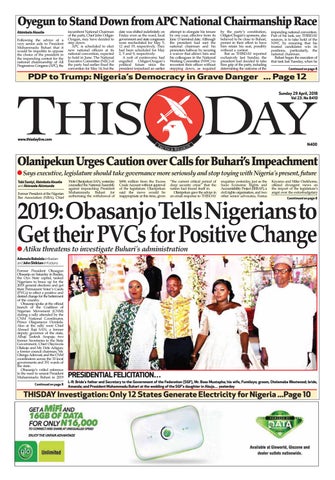
Oyegun to Stand Down from APC National Chairmanship Race Abimbola Akosile Following the advice of a very senior aide to President Muhammadu Buhari that it would be impolitic to oppose the choice of the president in the impending contest for the national chairmanship of All Progressives Congress (APC), the
incumbent National Chairman of the party, Chief John OdigieOyegun, may have decided to step down. APC is scheduled to elect new national officers at its national convention, expected to hold in June. The National Executive Committee (NEC) of the party had earlier fixed the convention for May 14, but the
date was shifted indefinitely on Friday even as the ward, local government and state congresses were rescheduled for May 5, 12 and 19, respectively. They had been scheduled for May 2, 5 and 9, respectively. A web of controversy had engulfed Odigie-Oyegun’s political future since the president torpedoed an earlier
attempt to elongate his tenure by one year, effective from its June 13 terminal date. Although the president had met the national chairman and his promoters halfway by securing a waiver that allows him and his colleagues in the National Working Committee (NWC) to re-contest their offices without stepping down, as required
by the party’s constitution, Odigie-Oyegun’s sponsors, also believed to be close to Buhari, persist in their effort to have him retain his seat, possibly without a contest. But as THISDAY reported exclusively last Sunday, the president had decided to take firm grip of the party, including determining the outcome of the
impending national convention. Part of his task, say THISDAY sources, is to take hold of the NWC by ensuring that his trusted candidates win its positions, particularly, the national chairman. Buhari began the execution of that task last Tuesday, when he Continued on page 8
PDP to Trump: Nigeria’s Democracy in Grave Danger ... Page 12 Sunday 29 April, 2018 Vol 23. No 8410
www.thisdaylive.com TR
UT H
& RE A S O
N400
N
Olanipekun Urges Caution over Calls for Buhari’s Impeachment Says executive, legislature should take governance more seriously and stop toying with Nigeria's present, future Tobi Soniyi, Abimbola Akosile and Akinwale Akintunde Former President of the Nigerian Bar Association (NBA), Chief
Wole Olanipekun SAN, yesterday counselled the National Assembly against impeaching President Muhammadu Buhari for authorising the withdrawal of
$496 million from the Excess Crude Account without approval of the legislature. Olanipekun said the move would be inappropriate at this time, given
“the current critical period of deep security crisis” that the nation had found itself in. Olanipekun gave the advice in an email response to THISDAY
enquiries yesterday, just as the Socio Economic Rights and Accountability Project (SERAP), a civil rights organisation, and two other senior advocates, Festus
Keyamo and Mike Ozekhome, offered divergent views on the import of the legislature’s angst over the extra-budgetary Cosntinued on page 8
2019: Obasanjo Tells Nigerians to Get their PVCs for Positive Change Atiku threatens to investigate Buhari's administration
Ademola Babalola in Ibadan and John Shiklam in Kaduna Former President Olusegun Obasanjo on Saturday in Ibadan, the Oyo State capital, tasked Nigerians to brace up for the 2019 general elections and get their Permanent Voter’s Cards (PVCs) to effect a positive and desired change for the betterment of the country. Obasanjo spoke at the official launch of the Coalition of Nigerian Movement (CNM) during a rally attended by the CNM National Coordinator, Prince Olagunsoye Oyinlola. Also at the rally were Chief Ahmed Raji SAN; a former deputy governor of the state, Alhaji Taofeek Arapaja; two former Secretaries to the State Government, Chief Olayiwola Olakojo and Mr. Dele Adigun; a former council chairman, Mr. Gbenga Adewusi; and the CNM coordinators across the 33 local governments and 351 wards of the state. Obasanjo’s veiled reference to the need to unseat President Muhammadu Buhari in 2019 Continued on page 8
PRESIDENTIAL FELICITATION… L-R: Bride's father and Secretary to the Government of the Federation (SGF), Mr. Boss Mustapha; his wife, Fumilayo; groom, Otelemaba Westwood; bride, Amanda; and President Muhammadu Buhari at the wedding of the SGF’s daughter in Abuja… yesterday
THISDAY Investigation: Only 12 States Generate Electricity for Nigeria ...Page 10
2
T H I S D AY ˾ Ͱͷ˜ ͰͮͯͶ
T H I S D AY ˾ SUNDAY APRIL 29, 2018
3
4
T H I S D AY ˾ Ͱͷ˜ ͰͮͯͶ
T H I S D AY ˾ SUNDAY APRIL 29, 2018
5
6
T H I S D AY ˾ Ͱͷ˜ ͰͮͯͶ
T H I S D AY ˾ SUNDAY APRIL 29, 2018
7
8
ͺ˜ ͺ ˾ T H I S DAY, T H E S U N DAY N E W S PA P E R
PAGE EIGHT
PDP to Trump: Nigeria's Democracy in Grave Danger Secondus alleges opposition clampdown, human rights abuses policies and actions of President Muhammadu Buhari. In an agenda setting move The Peoples Democratic Party ahead of tomorrow's crucial (PDP) has alerted the international meeting between the Trump community, particularly the and Buhari, the PDP said the President of the United States of Nigerian leader should be America, President Donald Trump, made to explain actions of his alleging that Nigeria is on the administration, which it said had brink due to the undemocratic eroded constitutionally guaranteed Onyebuchi Ezigbo in Abuja
rights of citizens while foisting a siege mentality on the people. Addressing a press conference yesterday in Abuja, the National Publicity Secretary, Mr. Kola Ologbondiyan, said that Nigeria was on the brink as a result of undemocratic actions of the Buhari administration of the All Progressives Congress.
"We have called you here to alert the entire world, particularly the United States that our nation is now on the brink. Nigeria is facing a perilous time; our Constitution has been technically suspended; we have now become a Police state; governance has reverted to the nightmares of the 1984 era, when draconian leaders
held sway and forcefully held our people under the grips of military Decree 2," it said. The US President is scheduled to meet his Nigerian counterpart tomorrow in what many see as very critical to addressing Nigeria's economic and insecurity challenges. But the PDP described the visit
of Buhari to America, regarded as the home of democracy, as ironic, saying back home his administration had been accused of several violations of the Constitution and human rights of citizens.
wanted him to contest. He said, "I am not desperate to be president of Nigeria. If you have been following political developments in Nigeria, I didn't start aspiring to be president today. "You will recall that in 1993, I contested with the late MKO Abiola, but I stepped down for him and he won, even though at that time it was not my wish to contest, it was our party leaders who asked me to contest. "In 1999, after I was elected governor (of Adamawa State), I was asked to be Vice President to Obasanjo and we spent eight years in office. In 2007, Obasanjo didn't want me to contest, but I wanted to prove to him that I have the right to contest, so I contested to prove my right. "All these were at the preliminary stages, until 2007 when I contested for the presidential primaries. "If I were desperate to be president, I would not have stepped down for Abiola in 1993. "Secondly, you recall that in 2003, all the governors said they didn't like Obasanjo and asked me to contest. If I am desperate, I would have contested." Explaining why he was interesting in 2019, Abubakar said having been vice president for eight years, he knew what
ought to be done to move the country forward, but as vice president he couldn't do them. He spoke about boosting the economy, creating an attractive environment for investors, and creation of jobs to tackle unemployment. On why he parted ways with Buhari and the APC, Abubakar recalled that after the elections in 2015, he met the president and told him of the need to restructure the party to address the challenges facing it. He added that he advised the president on some aspects of his government but Buhari did not say anything. "I told him that if things continued like this, I will quit but he didn't say anything. In this administration, there are some people that are doing things that are not right but they are being protected by the government," Atiku said. He said if he was elected president in 2019, 40 per cent of his cabinet ministers will be youths. The former vice president also reacted to the controversy over the federal government and Intels Nigeria Limited, a company which he has stakes in, saying he was not worried about the matter as he was not part of the company's management.
of the constitution. “This is a serious breach that cannot be overlooked,” Ozekhome said, adding, “A pre-emptive withdrawal of $496 million as he (President Buhari) has done without any prior National Assembly approval has exacerbated the impunity and this is impeachable under Section 143 of the 1999 Constitution that defines a ‘gross misconduct’ as a ‘grave violation of the provisions
of the constitution, without naming what acts amount to grave violation. “Of course, dipping fingers into the national treasury and yanking out $496 million without National Assembly approval is an act amounting to a grave violation of the constitution. Two-thirds majority vote of members of the National Assembly is needed to remove him from office.”
Read the concluding part on www.thisdaylive.com
2019: OBASANJO TELLS NIGERIANS TO GET THEIR PVCS FOR POSITIVE CHANGE coincided with the declaration by his former deputy, Alhaji Atiku Abubakar, that he would investigate arms procurement by the Buhari administration, if he won the presidential election in 2019. The Ibadan event, where Obasanjo relaunched his move against Buhari, was declared open by Oyinlola. In his welcome address, Oyinlola said the CNM had opened talks with some political parties ahead of the general election. He said over three million Nigerians had registered with the movement since the former president registered in Abeokuta, the Ogun State capital, few weeks ago. Obasanjo, who spoke intermittently in English and Yoruba languages that drew applause from the joyful participants, was clad in the CNM attire. He said the movement had started doing things differently. He, therefore, changed its slogan to forthwith read, "CNM for the youths, CNM for the Women and CNM for Nigeria." The former president recalled how the 2015 presidential election was won, saying, "If anybody wants Nigeria's current situation to continue the way it is today, then his head has to be examined. And some
people are still saying that this situation should continue. God, the Almighty, will not allow them to have their way; we will neither suffer nor shall we be put to shame." Referring to his January 23 statement in which he called on Buhari to step down for lack of performance, Obasanjo said the call was made due to the fact that Nigeria could not continue to totter. He explained that his call emanated from wide-ranging consultations with well-meaning Nigerians. "I belief at my age I should not continue to complain without finding solutions to the situation in which we have found ourselves. But we can't do it alone. We will work with all those who are not with those who are not performing. When that time comes, we will tell you the platform,” he said. He warned that the task ahead was enormous and required concerted efforts. According to him, "Don't ever think it will be easy. Tough times never last only the tough people do, and men and women born of noble birth don't fear any war. It won't be easy to salvage Nigeria from those profiting from its poor state and current situation but God who did it yesterday, will do it again for us.”
He also spoke on Buhari’s controversial statement about the youth at the recently concluded Commonwealth Heads of Government Meeting in London. Obasanjo said contrary to the president’s claim, Nigerian youths were resilient and hardworking folks, and they could be the best they could if they had half of the opportunities he and a number of elders had in their growing years. "Give them a small opportunity to excel, they will perform miracle, especially if we are able to give them 50 per cent of what we enjoyed while growing up,” he said. Concluding, he told his audience, “Get your PVC, it is the instrument and key to chase them away and open the door ahead of us. PVC is the key to open the door. Don't be intimidated. For me, I don't think there is anybody in this Nigeria who can intimidate me. I have seen a lot; sent to prison and weathered the storm altogether. So registration is important for all of us.” Atiku Threatens to Investigate Buhari Administration In a related development, former Vice President Atiku Abubakar has said he would investigate the procurement
of arms by the Buhari administration. Atiku explained that it was necessary to review the length of time it had taken to fight Boko Haram terrorists and why not much success had been achieved. The former vice president, who spoke to the British Broadcasting Corporation (BBC) Hausa Service yesterday, wondered why after eight years of engaging the terrorists, the war had not ended. “I want to be the president of Nigeria because I would be able to do things I could not do as vice president. I will investigate how the government was unable to defeat Boko Haram for years. I will also investigate the procurement of arms bought by this administration,” he told the foreign radio service. Atiku, who said he was not desperate to become the president of Nigeria, also revealed why he parted ways with Buhari and the ruling All Progressives Congress (APC), which he helped to bring to power. Dismissing insinuations that he was desperate to be president, Atiku maintained that he would have contested for the position in 2003 when all the governors rejected the then president, Obasanjo, and
OLANIPEKUN URGES CAUTION OVER CALLS FOR BUHARI’S IMPEACHMENT expenditure by the executive. The president had in separate letters to the two chambers of the National Assembly, penultimate week, sought approval for the $496 million paid to the United States government for the purchase of 12 Super Tucano military aircraft without appropriation. But the federal legislators took offence, accusing the president of spending such a huge sum without appropriation, and proposed to kick-start impeachment proceedings against him for perceived breach of the 1999 Constitution, as altered. The Senate and the House of Representatives have, however, referred the matter to their committees on Judiciary, and Rules and Business, respectively, for advice on the way forward. Olanipekun, in his response to THISDAY enquiry, noted that the proper thing would have been for the executive to seek legislative approval in the form of a supplementary budget for a specific vote for the purchase of the Tucano fighter jets from the United States. However, the lawyer noted that it was not every constitutional breach that should lead to impeachment or provoke threats of impeachment. He said the impeachment power donated to the National Assembly by section 143 of the constitution should not be used as a sword but rather appreciated and utilised as one of the key elements of checks and balances between the three arms of government. Apparently admitting that there had been an infraction of the constitution, Olanipekun said, “Section 59 of the constitution gives and provides elaborate procedures through which the National Assembly can perform its legislative functions, including passage of money bills, whether in the main or supplementary
budgets. It is after the bill so passed has been signed and become law that any fund from the consolidated fund can be spent, and not before. The proper thing would have been for the executive to seek legislative approval in form of a supplementary budget for a specific vote for the purchase of the aircraft.” But he cautioned against wielding the big stick, saying, “While one is not encouraging impunity or continuation of it, we must bear in mind that while the impeachment provision is legal and constitutional, impeaching the president at this critical point when the country is in deep security crisis can neither be prudent nor expedient.” Olanipekun admonished the executive and legislature to take governance more seriously and stop toying with the present and future of Nigeria, pointing out that the duty of government is to protect the lives and property of the citizens. He said, “In Nigeria of today, life has become so cheap and brutish, as we see and hear of hundreds of Nigerians being slaughtered on daily basis, and government isn’t doing much to halt this gradual descent to a state of anomie. TS Eliot, the renowned poet, would appear to have us in mind when he composed that epic poem titled Murder in the Cathedral, depicting the murder of Archbishop Thomas Becker in Canterbury Cathedral in the dark age of 1770.” Urging restraint and reacting to the incessant killings by suspected herdsmen, Olanipekun said, “I will seriously counsel against the impeachment of the president, while I will urge the president to take decisive actions on the massive killings going on in Nigeria. The National
Assembly has the power to invite the president to come and address it on the security situation in the country, and I don’t see anything wrong in the invitation already extended to the president in this regard.” Expressing similar views, the Executive Director of the Socio Economic Rights and Accountability Project, Mr. Adetokunbo Mumuni, said he thought that government would have been more preoccupied with formulating and implementing policies that would positively impact the lives of the people. “I don’t know whether we can probably say that the priority of Nigeria now is the buying of helicopter. There are a number of monumental things to do with the money that will impact on the lives of the ordinary Nigerians. Those are the types of expenses that I support,” he said. Recognising the legislature’s power of appropriation, Mumuni said it would be inappropriate for the executive to spend public funds without appropriation, explaining that could amount to a breach of the constitution, which could not be overlooked in a democracy. But the Director of Communications of the Muhammadu Buhari Campaign Organisation, Mr. Festus Keyamo SAN, in an interview with THISDAY, defended the extra–budgetary expenditure, saying it is excusable under what he called the doctrine of necessity. Mumuni said: “The president acted under what we call the doctrine of necessity. In law, there is a doctrine called the doctrine of necessity. The doctrine has wide implication. Some of my colleagues have interpreted it in a narrow sense. “The doctrine of necessity
applies when state actors take decisions that may not be totally in tune with the constitution and those decisions are designed to save the country as a whole, to save the entity known as the Federal Republic of Nigeria and to protect lives and property; those kinds of actions are covered by the doctrine of necessity.” Keyamo Illustrated his position, “In 2010, the country was rudderless, there was no president because (Umaru) Yar’Adua had vanished, nobody heard from him and by the constitution he ought to have transmitted a letter to the National Assembly to enable Jonathan act as president. Jonathan could not function as acting president, they were forging Yar’Adua's signature in Appropriation Bill; the country was almost collapsing. “These same senators sat down and said, gentlemen, we need to put aside the constitution right now to save this country from collapsing. What did they do? They invoked the doctrine of necessity and made Jonathan the acting president. It was unconstitutional. There was no provision like that. They now have to regularise it by amending the constitution to say that if a president does not transmit letter within a particular time, automatically, the vice president becomes acting president. It was later they regularised the constitution to take care of that situation. “It has happened in many situations. In this situation, can it be said that the president acted in order to save the country from collapsing?” Taking an opposing view, another senior lawyer, Chief Mike Ozekhome SAN, told THISDAY that the purchase of the Tucano aircraft without appropriation was a violation
OYEGUN TO STAND DOWN FROM APC NATIONAL CHAIRMANSHIP RACE met with APC governors and told them in plain words that the immediate past governor of Edo State, Mr. Adams Oshiomhole, was his choice for the party’s national chairmanship position, soliciting their support for him. The Odigie-Oyegun camp’s response to this has been muted, even though, one of those believed to be supporting him, Governor Abdullahi Ganduje of Kano State, has said that Buhari’s preference is not necessarily binding on the party. Although Odigie-Oyegun has not formally declared his intention to run, his body language suggests he is interested in spending four more years on his seat, more so when he is being spurred by first term governors of the party who are interested in seeking a second term of office. Asked about his reaction to the purported adoption of Oshiomhole as the consensus candidate of the South-south branch of the party for the top position, Odigie-Oyegun had described it as childish, saying the chairman of the party could only emerge at the national convention. But sensing that the national chairman might have allowed
himself to be convinced to take the president on, a very senior aide of the president was said to have visited Odigie-Oyegun at his Asokoro residence last week to admonish him not to stand in front of a moving train. According to a reliable THISDAY source, the presidential aide told Odigie-Oyegun that opposing the president, who under the 1999 Constitution, as altered, is next to God, was tantamount to committing political suicide. The aide warned him not to be deceived by the grandstanding of some governors purporting to be behind him, recalling to him how the same governors were not able to sustain their opposition to the president’s objection to the elongation of Odigie-Oyegun’s tenure. The presidential aide, reportedly, advised him to approach the president for a soft-landing, as it would be difficult for him to pick the chairmanship at the national convention in spite of the president’s opposition. Odigie-Oyegun, according to the source, told the top presidential aide that he was not so politically naïve that he did not understand the overall implication of standing up to a Nigerian president and that he would act appropriately.
T H I S D AY, T H E S U N D AY N E W S PA P E R ˾ APRIL 29, 2018
9
SUNDAY COMMENT
Editor, Editorial Page PETER ISHAKA Email peter.ishaka@thisdaylive.com
NIGERIA AND HOMELAND SECURITY
As more evidence of incompetence emerges, the security agencies must work harder to secure the nation
I
n an apparent move to mitigate the deteriorating security situation across the country, the National Economic Council (NEC) last Thursday banned the movement of herdsmen in five “battle-scarred” states after a meeting in Abuja. The states are Taraba, Adamawa, Kaduna, Plateau and Benue. These are states that have witnessed and still experiencing wanton killings allegedly by herdsmen, mostly over grazing rights. However, Benue evokes more dread than any other state as it encapsulates the country’s increasing recent violent history. Last January, the state buried in a public ceremony some 73 innocent Fromthenearly men, women decade-longIslamic and children, all insurgencythathas victims of suscrippledBornoand pected vicious herdsmen. Since manyofthestates intheNortheast,the then, peace in Benue is shortherdsmen-farmers’ In the debacleintheMiddle lived. last few weeks, Belttokidnappings, some herdsmen armedrobberyand have peppered the state with a series of generalbanditryin thesouth,thecountry offensives, many of them in rural communities, leavisadegenerating ing in their wake massive combustiblemixof deaths and displacements. dangerandfear Particularly worrying was the attack last week on St. Ignatius Catholic Mission in Gwer East Local Government Area where two priests and 15 parishioners were murdered in cold blood, thus bringing a sectarian dimension to the violence. While the Christian Association of Nigeria (CAN) has called for a nationwide protest in all churches in the country today the Gwer killings has prompted the Catholic Bishops Conference of Nigeria to ask: “When will this barbarism end?” while urging President Muhammadu Buhari to stop presiding “over the killing fields and mass graveyard.” Equally angered by the steady decline into anarchy, the two chambers of the National Assembly last week passed a vote of no confidence on the security agencies and summoned President Buhari to explain the inces-
Letters to the Editor
sant killings and the spate of insecurity across the country. The House also suspended sitting in plenary for three days in protest. “How did we get here and how do we get to 2019 if this situation continues?’ asked Onyemaechi Joan Mrakpor, a member of the House.
A
S U N DAY N E W S PA P E R EDITOR BOLAJI ADEBIYI DEPUTY EDITORS VINCENT OBIA, OLAWALE OLALEYE MANAGING DIRECR ENIOLA BELLO DEPUTY MANAGING DIRECTOR KAYODE KOMOLAFE CHAIRMAN EDITORIAL BOARD OLUSEGUN ADENIYI EDITOR NATION’S CAPITAL IYOBOSA UWUGIAREN
T H I S DAY N E W S PA P E R S L I M I T E D EDITOR-IN-CHIEF/CHAIRMAN NDUKA OBAIGBENA GROUP EXECUTIVE DIRECTORS ENIOLA BELLO, KAYODE KOMOLAFE, ISRAEL IWEGBU, IJEOMA NWOGWUGWU, EMMANUEL EFENI DIVISIONAL DIRECTORS PETER IWEGBU, ANTHONY OGEDENGBE DEPUTY DIVISIONAL DIRECTOR OJOGUN VICTOR DANBOYI SNR. ASSOCIATE DIRECTORS ERIC OJEH, PATRICK EIMIUHI ASSOCIATE DIRECTOR SAHEED ADEYEMO CONTROLLERS ABIMBOLA TAIWO, UCHENNA DIBIAGWU, NDUKA MOSERI DIRECTOR, PRINTING PRODUCTION CHUKS ONWUDINJO TO SEND EMAIL: first name.surname@thisdaylive.com
cross the country, life has become rather cheap. From Benue and Taraba to Zamfara and Edo, Borno and Ekiti, Nigeria has become a country on fire. Never has this country degenerated to this level of insecurity, except perhaps during the civil war. From the nearly decade-long Islamic insurgency that has crippled Borno and many of the states in the Northeast, the herdsmenfarmers’ debacle in the Middle Belt to kidnappings, armed robbery and general banditry in the south, the country is a degenerating combustible mix of danger and fear. Unfortunately, the federal government is underperforming, especially on securing the people. Perhaps for want of anything to say, it has laid the blame, particularly the killings in Benue, on the opposition, a knee-jerk defensiveness that does not help the situation. The security agencies have also failed to rise to the occasion. They claimed to have tamed the brutal Islamic Boko Haram insurgency, but the reality is much grimmer, judging by the capacity of the damage the insurgents have constantly been hurling on society, the military inclusive. In many of the Middle Belt states where the herdsmen-farmers’ clashes are most virulent, the security agencies, many of whom are viewed with mistrust, have failed to make any impact. A military exercise code-named Ayem A’ Kpatuma, deployed there since January could not curb the killings either due to their indifference, numbers or they are simply overwhelmed. The police, whose men and officers are being killed almost on a daily basis by sundry criminals, have more or less abandoned the people to their fate while their incompetent Inspector General, Mr Ibrahim Idris, continues to chase shadows. Given the foregoing, we welcome the banning of herdsmen from grazing the cattle in some states. But the ban will only be meaningful if the federal government is bold enough to enforce it. There is little doubt criminals are becoming more audacious in the country. That is because President Muhammadu Buhari, who rode to power on the back of a general discontent with how his predecessor was handling the national security challenge, has not shown sufficient capacity for tackling this growing menace. But certainly, we cannot continue with this situation of mindless killings of innocent men and women whose perpetrators roam our streets, fully confident that the long arm of the law has no chance of apprehending them.
TO OUR READERS Letters in response to specific publications in THISDAY should be brief (150-200 words) and straight to the point. Interested readers may send such letters along with their contact details to opinion@thisdaylive.com. We also welcome comments and opinions on topical local, national and international issues provided they are well-written and should also not be longer than (950- 1000 words). They should be sent to opinion@thisdaylive.com along with the email address and phone numbers of the writer.
Buhari Deserves A Second Term
T
he administration of President Muhammadu Buhari has made its mistakes and errors, especially in the politics of governing Nigeria. This is normal in a complex democracy with a president that is not a typical politician. Nevertheless, Muhammadu Buhari deserves a second, because he has done quite well. To ask Buhari not to contest is an injustice to all Nigerians - they will be denied the opportunity to grade the Buhari/Osinbajo four years in power. No administration in Nigeria from 1999-2015 has neared the achievements of the Muhammadu Buhari government within three years of its first term in office. The Buhari government has done
very well in the two fundamental areas upon which it rode to power- neutralise Boko Haram senseless war and put a stop to official corruption. Though, there is room for improvement. There is no perfect government anywhere in the world. The administration of Muhammadu Buhari has also done excellently well in other areas including the economy. The biggest challenge for the government has been that most of its strides have been under reported and not well publicised. For a successful campaign for a second term, the Buhari government needs systematic and systemic approaches to propagate the president and his government’s activities. Muhammadu Buhari is an
enigma – his ‘spirit’ has overshadowed everyone and everything in the government. So, for a seamless and smart publicity of what the Buhari/Osinbajo government is doing, what it has done, President Buhari should start visiting sites of ongoing and completed projects. This is will seamlessly hyped the achievement of the government to the entire country. Very few Nigerians know that: Nigeria’s foreign reserves have peaked at over $45b, the highest level in about four years, and up from $24 billion just a year ago. The nation is saving N24.7 billion monthly with the full implementation of the TSA. The capital inflow is averaged $1.8 billion. The
Nigeria’s stock exchange has risen to 40,000 points for the first time since October 2014. The non-oil sectors exports are up 70% yearon-year and manufactured goods exports are up 22% year-on-year. Power generation is at an all-time high of 7,000mw from a mere 2,000mw. Some 25 major highways across the six geo-political zone are being funded with the N100b Sukuk Bond. While the Lagos-Kano Standard Rail Gauge is on, Lagos-Ibadan and KanoKaduna sectors will be ready in 2019. The entire stretch will be ready in year 2021; negotiations are on for coastal rail covering 15 cities from Lagos to Calabar. The $41 billion foreign reserve is a big plus for the Buhari government, because most of our previous governments lacked control and ability to save. The Buhari government was able to
control wasteful and reckless spending. The massive road and rail projects are for prosperity, though the benefits would be felt later. Having a president that is corruption-free is a huge image booster for Nigeria and confidence-builder for investors and relief for the masses, knowing that their president will not steal their monies. Despite these sterling performances of Buhari within three years in power, we cannot hide from this fact - Buhari is human: he has made mistakes as well as committed some political errors but they are correctable. We must also know that in a true democracy no successful president ever spends only one term in office. Muhammdu Buhari deserves a second term. – –Zayyad I. Muhammad, Jimeta, Adamawa State
10
T H I S D AY, T H E S U N D AY N E W S PA P E R Ëž PRIL 29, 2018
SUNDAYNEWS
News Editor ĂŒĂ“Ă—ĂŒĂ™Ă–Ă‹ Ă•Ă™Ă?Ă“Ă–Ă? E-mail: Ă‹ĂŒĂ“Ă—ĂŒĂ™Ă–Ă‹Ë›Ă‹Ă•Ă™Ă?Ă“Ă–Ă?̜ÞÒÓĂ?ĂŽĂ‹ĂŁĂ–Ă“Ă Ă?Ë›Ă?Ă™Ă—Ëœ ͸΀͚͚͟͟Πͽ͝͸͞ Ě™Ă?Ă—Ă? Ă™Ă˜Ă–ĂŁĚš
THISDAY Investigation: Only 12 States Generate Electricity for Nigeria t &YQFSUT BEWPDBUF EJWFSTJmDBUJPO PG QPXFS TPVSDFT XBOU NPSF PVUQVU GSPN DMFBO FOFSHZ Chineme Okafor Ă“Ă˜ ĂŒĂ&#x;ÔË
An investigation by THISDAY on the geographical spread of Nigeria’s electricity generation sourceshasshownthatoutofthe 36 states in the country and the Federal Capital Territory, Abuja, only 12 states, majority of which are located in the South, supply the entire volume of electricity
used in the country. According to data from the Advisory Power Team in the office of the Vice President, Prof. Yemi Osinbajo, about 29 power generation plants are currently in operation in the country. These plants, according to the Association of Power Generation Companies (APGC),anumbrellaassociation
of the Gencos, had an overall generation capacity of 12,000 megawatts (MW) in 2017. However, a geographical map of the plants’ locations obtained at the weekend in Abuja by THISDAY from the webpage of the Advisory Power Team showed that with the exception of Niger and Kogi states, which host three hydro
power Gencos – Kainji, Jebba and Shiroro plants – the other Gencos are all located in states in the South. The 12 states, which host power stations that generate the power used across the country, are Niger, Lagos, Ogun, Rivers, Abia, Imo, Ondo, Cross River, Bayelsa, Edo, Kogi, and Delta. In Niger, there is the Kainji
RECOGNISING LEADERSHIP L-R: President, African Export-Import Bank, Dr. Benedict Oramah; former Tanzanian President, Dr. Jakaya Kikwete; and Director of the Africa
House at New York University, Prof. Yaw Nyarko, during the presentation of African Leadership Award to Oramah in New York, USA‌recently
hydro power station, which was completed in 1968 with an installed generating capacity of 760MW; Jebba power station with an installed generating capacity of 576.8MW, which was commissioned in 1985; and Shiroro power station with an installed generating capacity of 600MW, which was completed in 1990. In Lagos, there is the Egbin gas power station with an installed generating capacity of 1, 320MW, which is currently the largest Genco in the country. It was reportedly completed between 1985 and 1986. There is also in Lagos the AES barge Independent Power Plant (IPP) with an installed capacity of 270MW, which was completed about 2001, and the Paras Energy plant. Ogun State has the Olorunsogo power station with installed capacity of 335MW, completed in 2007, as well as the 675MW Olorunsogo-2 built under the National Integrated Power Projects (NIPP) by the Niger Delta Power Holding Company (NDPHC), which is owned by the three tiers of government in the federation. Delta Statehosts the1, 020MW Sapele power station built in 1981; 972MW Transcorp Ughelli power station reportedly built between 1966 and 1990; 480MW Okpai power station completed in 2005 as an IPP by Agip Oil Company; and the 450MW Sapele NIPP plant.
The 977MW Afam I-IV and V power plants were completed between 1982 and 2002 in River State,whichalsohasthe642MW Afam VI power plant owned by the Shell Petroleum Development Company (SPDC) Joint Ventures; 150MW Omoku power station; 136MW TransAmadi power station; 180MW Rivers IPP, and Omoku-2 NIPP plant with installed generating capacity of 225MW. In Kogi, there is the 414MW Geregu-1 power station and 434MW Geregu-2 II NIPP power station, just as Ondo has the 335MW Omotosho-1 power station and 450MW Omotosho NIPP power station. In Abia, there is the 1074MW Alaoji NIPP power station, just as there is the 450MW NIPP Ihovbor power station in Edo and another 450MW power station built by Azura Power. Imo has the 338MW NIPP Egbema power station; Cross River has the561MWNIPPCalabarpower station; while Bayelsa has the 225MW NIPP Gbarain power plant. Experts who spoke to THISDAY explained that though it was not out of place to have a country’s energy sources concentrated in one region, it would take a lot to have power transported to areas without generation sources. They also stated that every part of Nigeria has sources of electricity that could be exploited, but the country was not doing enough to maximise the potentials.
DHQ: Military to Prevent Boko Haram Involvement in Herdsmen Killings t Army confirms arrest of key Boko Haram suspect, parades three others Paul Obi in Abuja Ă‹Ă˜ĂŽ George Okoh Ă“Ă˜ Ă‹Ă•Ă&#x;ĂœĂŽĂ“
Following the arrest of a Boko Haram Commander by troops in the recent herdsmen killings in Benue State, the Nigerian Defence Headquarters (DHQ) said the military is working hard to ensure that Boko Haram insurgents do not pose as herdsmen and engage in killings around the country.
Director of Defence Information, Brig. Gen. John Agim told THISDAYthatthoughtheDHQ wouldnotrevealitsstrategies,but efforts are in top gear to prevent Boko Haram terrorists from proliferatingaroundthecountry and camouflaging as herdsmen andperpetuatingheinouscrimes. He said the strategy is to prevent terrorists from hiding under the cover of herdsmen
APC Denies N250m Levy on Governors Onyebuchi Ezigbo Ă“Ă˜ ĂŒĂ&#x;ÔË
The All Progressives Congresses (APC) has dismissed a report that it has asked its governors to contribute N250 million each to enable it organise the forthcoming congresses and convention. The party in a statement issued yesterday by its National Publicity Secretary, Mallam Bolaji Abdulahi, said: “Our attention has been drawn to a story on the Premium Times under the above stated headline. The APC denies your story and wishes to state that the story is misleading and has misrepresented our party. We therefore wish to make the following clarification.� While explaining what transpired during the meet-
ing of the National Working Committee (NWC) and the governors of the party held at its secretariat on Thursday it pointed out that many of the governors had fallen behind in the payment of their party dues. “While some of the governors have been up-to-date with the payments, a few others have not paid at all. The governors were therefore requested to pay up, especially in view of upcoming party activities. “It is therefore possible that a governor that falls in the category of those that has not paid since inception could owe up to N250 million. Therefore, it is grossly misleading, if not downright malicious, for your report to simply apply this sum to everyone and multiply by the number of governors.
was ongoing, adding that, “the military cannot disclose its strategy. You will be seeing the result ofourworkratherthanrevealing our strategy.� Meanwhile, the Nigerian Air Force (NAF) weekend bombed Boko Haram terrorists’ logistics base in Borno State. According to the Director of PublicRelationsandInformation, Air Vice Marshal Olatokunbo
Adesanya, “the Air Task Force (ATF) of Operation Lafiya Dole in the early hours of 27 April, 2018, successfully destroyed a Boko Haram Terrorists (BHT) logistics base at Tumbum Gini in the northern axis of Borno. “A Nigerien Air Force Intelligence, Surveillance and Reconnaissance(ISR)aircraftconducted the Battle Damage Assessment (BDA) for the mission.
“The BDA revealed that the firstwaveofaNigerianAirForce (NAF)AlphaJetaircraftstrikeon thelocationtotallydestroyedthe vehiclesandotherlogisticsitems at the place; thereby further degradingtheterrorists’capabilities. “Furthermore, at the end of the attack, the entire BHT location was engulfed in fire and all the terrorists in the location were neutralised�, he added. Meanwhile,theCommandant, NigerianArmy72SpecialForces Battalion, Makurdi, Lieutenant
Col. Suleiman Mohammed has confirmed the arrest of Aminu Yaminu,nicknamedasTashaku who is believed to be a key Boko Haram suspect and who has mastermindedmostoftherecent attacks in Benue State. Mohammed who made the confirmation yesterday at the 72 Barrack in Makurdi while parading three herdsmen militias arrested by his troops with weapons at Tormatar village in Guma local government area of Benue state.
FG Signs Interim Agreement Shettima Mourns Imam, Sends for Railway Concession Condolence to Tambuwal The Federal Government and four companies led by General Electric have signed an agreement to start the interim phase of the Nigerian narrow-gauge railway concession. According to a report by TheCable, the move was disclosed in a statement signed by head of communications, GE Nigeria, Yewande Thorpe, which noted that the interim phase will include “light remedial civil and track repair works� on the narrow gauge rail line. “Additionally, a joint operation will be established between the consortium and the Nigeria Railway Corporation with a supply of 10 locomotives and 200 wagons provided to augment the existing rolling stock in Nigeria,� the statement
read. Other companies involved in the agreement are SinoHydro, an infrastructure construction company, Transnet, a logistics infrastructure management company, and APM Terminals, a ports services provider. The concession agreement, which will be negotiated after the interim phase, will expand the rail service to up to 200 locomotives and rehabilitate the entire rail system, the statement added. “GE is committed to the sustainable development of Nigeria and as such we are delighted to have reached this crucial stage of the project to revamp and revitalise the country’s legacy rail infrastructure system,� GE CEO, Lazarus Angbazo, said.
Wole Ayodele Ă“Ă˜ Ă‹Ă–Ă“Ă˜Ă‘Ă™
Borno State Governor, Kashim Shettima, has described the late Malam Imam Imam as an ‘exceptional gentleman who was extremely good yet extremely humble’. He said Imam’s shocking death was a loss to his family, Governor Aminu Tambuwal of Sokoto State and to northern Nigeria; given the fact that he was one of the region’s most promising journalists and media relations professionals. Shettima, whose message was conveyed by his spokesman, Isa Gusau, recalled that he had met with the late Imam on a number of occasions during series of outings with Governor Tambuwal. “I have met that very prom-
ising young man. I remember the last time we traveled with him to some states in the Niger Delta and the southeast when he accompanied my brother, Governor Aminu Tambuwal. Throughout that outing, he served as our media relations man in Rivers, and some states in the southeast. “He proved to be an exceptional gentleman who was extremely good yet extremely humble. His death is a shock, a loss not only to his family and the Governor but also to the northern region because he was definitely one of the most promisingjournalistsandmedia relations professionals we had. “I condole with his family, His Excellency, the Governor, all his colleagues in the media and the northern Nigeria.
T H I S D AY ˾ SUNDAY APRIL 29, 2018
11
12
T H I S D AY ˾ Ͱͷ˜ ͰͮͯͶ
T H I S D AY ˾ SUNDAY APRIL 29, 2018
13
14
Ͱͷ˜ Ͱͮͯ ˾ THISDAY, THE SUNDAY NEWSPAPER
OPINION Boosting SMEs Among Commonwealth Countries TheCommonwealthnationsshouldunderstudytheimpressiveeconomicstridesachievedbyothercountries,arguesPeterObi
T
he fundamental socio-economic developmental question -- “What can we do to encourage SMEs to trade and invest confidently across the Commonwealth? - needs to be addressed within the framework of the varied economic and development capacities and capabilities of member-nations of the Commonwealth. In the first place, it has been universally acknowledged that Small and Medium-scale Enterprises [SMEs] constitute the back-bone of any nation with positive economic growth and for sustainable development, especially in terms of generating employment for the teeming population of youths and for engaging the under-privileged groups, including women, semi-skilled and unskilled persons. Such have been their increasing roles in the sustainable development of national economies that the sub-group “Micro” has been added to SMEs to form “Micro, Small & Medium-scale Enterprises [MSMEs]”. Available statistical evidence is indicative of the strong correlation between SMEs, developed nations and hopefullydeveloping nations, particularly in their productive capacities and in the areas of job creation, poverty reduction and general societal well-being. Indeed, four out of five new formal positions in emerging economies, according to the World Bank, are direct products and outcrops of SMEs. Secondly, an appreciation of the challenges which SMEs are faced with in the Commonwealth will require a full grasp of the challenges SMEs are confronted with within individual member-nations. The distinction between the macro-level challenges on the one hand and micro-level challenges on the other, is both revealing and instructive: Though the combined Gross Domestic Product [GDP] of the 54 Commonwealth nations is US$10 trillion, only four [or 7.41%] of these countries – approximated to the United Kingdom with US$2.6 trillion, India with US$2.4 trillion, Canada with US$1.5 trillion, and Australia with US$1.2 trillion - account for over 75%, while the other 50 countries [92.59%] share
the balance of 25%. In the same vein, only 10 [18.5%] of the member-nations [the UK, Australia, Brunei, Canada, Cyprus, India, Malta, Pakistan, Singapore, and New Zealand) could be said to be outside the orbit of the so-called Third World economies, under which label the other 44 member-nations [81.5%] have been tagged. In the light of the foregoing, the policies and programmes of Commonwealth countries to support and grow SMEs must be designed to accommodate the vagaries and challenges within the various member-nations, including those of day-to-day management and development conflicts. In Africa, for instance, the realities of everyday governance and developmental challenges are underpinned by stability, policy, organisational, managerial as well as scientific and technological deficits and bottlenecks.
China’s population is about half of the combined 2.4 billion population of the Commonwealth, but it has achieved these impressive records with industrialisation and export as its backbone. Interestingly, SMEs contribute 70% of China’s export earnings as well as 60% of its 800 million full-time jobs
Thirdly, listening to Bill Gates in a recent presentation, he indicated that one of the ways to get the right thing done is to learn from those who are doing it right, and emulate them. Within the framework of this logical perspective, it then becomes imperative that the Commonwealth nations should understudy the impressive and commendable economic strides achieved by the success stories, including the Republic of China. With the fastest recorded sustainable economic expansion than any other major economic power in modern history, China has grown its economy tremendously within a quarter of a century; from a Gross Domestic Product of less than US$ 1trillion to a GDP of about US$12 trillion. China’s population is about half of the combined 2.4 billion population of the Commonwealth, but it has achieved these impressive records with industrialisation and export as its backbone. Interestingly, SMEs contribute 70% of China’s export earnings as well as 60% of its 800 million full-time jobs. Fourthly, given the right policies and sustained, active support for SMEs across the Commonwealth countries, their combined GDP could well experience a phenomenal growth of up to US$18 trillion by the Year 2030. That year – in barely 12 years hence – is the deadline set for the attainment of the on-going Sustainable Development Goals [SDGs]. Such growth and expansion would enable the Commonwealth countries to create about 200 million jobs, which would be a third of the World Bank target of 600 million jobs within the said period. The total population of the Commonwealth countries is presently a third of the world population. In the final analysis, the right policies and programmes to support SMEs in Commonwealth countries will be anchored on the vision, commitment and political will of the leadership of the various jurisdictions. ––– Excerpts from the speech of former Governor of Anambra State Mr. Peter Obi at the recent Commonwealth Business Forum in London
Leadership And The Social Contract Godknows Igali asks: why do people entrusted with leadership often betray the sacred trust?
N
ot only in developing countries, where human existence is still sort of primordial, but globally, men are wont to ask: what human society as embodied in the state holds for them? In other words, why does the state exist? And to what ends should its raison d’etre serve? So one of the most exciting foundational courses offered in most faculties of Humanities, Social and Legal Sciences, worldwide, is “Political Philosophy” or “History of Political Thought’. In some climes it is also offered as a General Studies course for all students. At postgraduate and doctoral levels, this becomes more pellucid, dwelling amply on the ethical foundations of the state and what values could rightly be placed on individual lives. It is also relevant to state that virtually all leaders of religious traditions spent a good part of their teachings, using various metaphors and imageries to elucidate this matter of the state. More pointedly, thinkers upon the succeeding generations have followed the legends, Socrates, Plato, Aristotle to keep the tread of discourse on the question of the moral foundation of the state alive. During the 16th to 18th century Enlightenment Era, most men of knowledge, around European capitals of the time, joined to adumbrate on this matter. So from France’s line up of philosophers such as Rene Descartes, Voltaire, and Montesquieu to the Swissman, Jean-Jacque Roseau and Germany’s duo of Immanuel Kant and Friedrich Hegel, what bothered the minds of the greatest of men was: why does the state exist and what does it hold for the individual? In England of the time, the stage was broader as scholars such as Francis Bacon, Thomas Hobbes, John Locke, David Hume, Jeremy Bentham, John Stuart Mill and more recently, Bertrand Russell all sustained the relay of this conversation for hundreds of years. The conclusion from all of these philosophers, with variants, was that there exists a kind of metaphysical or moral ‘social contract’ between men and fellow citizens on the one hand and between the individual and society or state on the other. By this, men, especially our original progenitors are presumed at a time in the dim past, to have chosen to opt out of a ‘state of nature’ similar to how animals live in the jungle to subject their individual wills into a ‘vole collective’ or an aggregation of the general will of all members of society. That is, having escaped the supposed brutishness of the animalist life of the forest, men are believed to have given to the state what appears to be godly powers to order their daily peaceful existence. To this established norm, we are all born into and anything contrary is regarded as defiant and a derogation. Indeed some philosophers such as Karl Marx, went the extreme to elevate the state almost to levels that prejudiced itself against established religious orders and orthodoxies. His thoughts ignited mass movements in the Russian axis leading to the success of
the Bolshevik Revolution in 1917. By that, its leader, Vladimir Lenin and those who came after him embarked, to create a supra-national state of social contracts known as Soviet Union (USSR). Mao Zedong carried out a similar communist revolution in China in 1949. These states and their satellites around the world were defined by collective existence, collective actions, communism, etc. As a matter of fact, they came with an atheist undertone, as the state became a kind of all-in-all, leaving very scant or no place for religion or spirituality. It is apt to elucidate that in its simplest illustration, the social contract as it pertains to man and the state is reflected in the kind of involuntary symbiosis found in normal father and child relationship. Men therefore expect the state to protect them and pursue their maximum wellbeing. In extreme socialist and communist cases, the state was devolved with the authoritarian powers of thinking for and caring for the individuals, all through life. In same moral exegesis, Kings, Princes, noble leaders and the like are ordained and emplaced to pursue the ideas of collective happiness and wellbeing. So even African response to colonial rule, fuelling nationalist struggle for independence was founded on that same narrative of wanting to build ideal nation states. If the state was created for such superlative and altruistic ideals, the question which pokes the minds, thoughts and consciences of most analysts, and commentators is : why do people who are entrusted with the sacred heritage of the “collective will” turn out, time after time, nation upon nation, to be its greatest enemies? Such people have made the narration of world history a lamentable tale of endless conflicts, cruelty, travesty, injustice and bloodshed! Yes. Some rulers have really been cruel, mean, wicked, and devilish. A few examples will suffice. We all recall the historical and religious accounts of evil potentates, like Pharaoh of Egypt and King Herod of Judea, both of whom ordered the killing of all male children, simply to satisfy their selfish interests. Similarly, Caligula and Nero were two Roman Emperors during the first century AD. Their dynastic legacy produced stately forebears such as Julius Caesar, Mark Anthony and Augustus Caesar. Yet both of these two emperors are merely remembered in history for tyranny, sadism and reprobate lifestyles. Under Nero for instance, the City of Rome, then capital of the world, found itself engulfed in a mysterious fire in 64 AD which destroyed most of the city. This was linked to him. Going further down, the French Revolution with the maxims: “equalite, egalitariate et fraternite”, inspired liberation in the Americas founded on Republican ethos. But back home in France this revolution also produced a man named Maximilien Robespierre. Though very successful as a revolutionary leader, he ended his life very sadly, swimming in the blood of thousands
whom he guillotined! He enjoyed killing people at will on all trumped charges. Another named Prince Vlad the Impaler Wallacha (Central Europe), is now typified merely as Count Dracula, a venomous vampire for his cruel acts. As a ruler in central Europe he loved the disembowelment of human beings. Another is Ivan the Terrible; first ruler of Russia. He is historically known for burning thousands alive. If we hazard a deep into African, Asian and Inca or Aztec civilisation of South – America, blood, blood and blood trail the rulership of many. And the Trans-Atlantic trade which went on 400 years under the watch of Africa leaders of the time, where about 12-15 million people were forcefully enslaved, many dying during passage. In our own 20th century, what about Adolf Hitler and his henchman, Adolf Eichmann, on whose heads rests the blood of millions, including about six million Jews who were incinerated in the holocaust. The accounts of what Italian dictator Benito Mussolini are still gory and repulsive. This has become a reference point for reprobate governance within Europe. What about the sad tales of over 20 million people who were killed in Josef Stalin’s 29 years rule in Soviet Union? Also, can history so quickly forget Pol Pot of Cambodia under whose savagery millions of people disappeared similar to what Augusto Pinochet did in Chile? What about the unabashed excesses of Idi Amin of Uganda and Jean-Bedel Bokassa of Central African Republic and the genocide in Rwanda where over 800,000 people died? Far and near, the world is still littered with terrible, bloodletting leaders and their cheerleaders. One thing is common to all these people, they forget that earthly existence and indeed the privilege of leadership is merely a pilgrimage and a fleecing effervescence. One day, when everyone is far gone, historians will write, quite coldly, chronicles of all their acts. At that time all their stories like Hitler’s biography ‘Mein Kamf’ will be of no value to launder their legacy. Interesting enough, even a contemporary Nigerian leader, Gen. Ibrahim Babangida, recently bemoaned the fact that despite his lofty achievements in democratic consolidation, little or no credit at all is being given to him. More than that, he doubted if any will be interested in reading his biography, because of his military past. Maybe the revered general in his characteristic humility is a bit hard on himself. Deservedly, some rulers of men will be remembered for seeking peace, benevolence and goodness. Alas the memory of others known for inflicting pain, injustice and bloody trail will be accursed with infamy, ignominy, irreverence; and not the least sighing. They will only join the pantheon of “the infamous.” -–Igali, is a diplomat, historian and an award winning author
15
T H I S D AY, T H E S U N D AY N E W S PA P E R ˾ APRIL 29, 2018
LETTERS
WHY NYSC SHOULD EMBRACE AGRICULTURE
W
hen the civil war ended in 1970, there was no scarcity of ideas as to how Nigeria could fast-track its quest for an organic national unity. The idea that won the day was one firmly founded on the youth of Nigeria. The National Youth Service Corps (NYSC) was devised as a scheme that would see young Nigerians who had graduated from tertiary institutions, relocate for one year to another part of the country (they aren’t originally from); and whose ways they might find a little strange or quaint. There they would be embedded for the purpose of soaking in its full flavour as well as being active participants in its development. Since General Yakubu Gowon established the scheme via the promulgation of the National Youth Service Corps decree No 24 of May 22, 1973, the scheme has recorded laudable feats nationwide primarily in the areas of rural development, education and the achievement of national cohesion. That is not to say that there haven’t been issues along the way. Lots of young people participating in the scheme
Kazaure, NYSC DG
since it was established 45 years ago have paid the supreme sacrifice under different circumstances. But it needs be said that their sacrifice has not been in vain because the Nigerian nation is still together and forging a common destiny despite challenges that try to threaten our national existence. Under the various leaderships that have held forth, the
NYSC has remained bullish in fulfilling its mandate of selfless service to the community and promoting the spirit of oneness and brotherhood of all Nigerians irrespective of cultural or social background. It has acquitted itself so well on this score that the vast majority of young Nigerians look forward to their one-year national service as a rite of passage they must fulfil.
Brigadier General Suleiman Kazaure, the current Director-General of the NYSC now seems determined to up the ante in light of Nigeria’s current realities and the need to maximise the energy and resourcefulness of Nigeria’s young people. This explains why the new policy for mass posting of youth corps members to farms and other agriculture related ventures has been so well received. This development is a most appropriate response for these times when Nigeria’s revenue base needs diversification away from finite oil and its attendant price volatility. That is aside the environmental impact that comes with oil production. Agriculture, a constantly renewable revenue source and for which Nigeria has comparative advantage, must be pursued with sustained vigour. Brigadier General Kazaure said the NYSC was “starting with four states for now” while other states would be integrated in the very near future. It is heartening to see that in Bauchi, one of the pilot states, a 145-hectare land has already been acquired for the purpose of cultivating cowpea and maize while modern agricultural equip-
Nigeria’s Dire Unemployment Burden
A
ccording to a 2017 Q3 report of the National Bureau of Statistics, Nigeria recorded its highest ever aggregate unemployment rate, rising from 14.2% in the fourth quarter of 2016 to 18.8%. The monumental increase occurred despite the fact that all tiers of governments as well as the Organized Private Sector (OPS) generated additional 1.2 million jobs, which thus put the estimated labour population at 85. 1% for the same period. The indices also revealed that the number of people within the labour force that were unemployed or underemployed increased drastically from 13.6 million and 17.7 million in the second quarter to 18.8 million in the third quarter. Analysis of these figures shows that the number of women within the labour force (aged 15-64) who were willing, able and actively seeking for job but unemployed was 21.2% while that of men was 16.5%. Thus, the total number of unemployed and underemployed put together increased from 37.2% in the previous quarter to 40% in the third quarter. Also, the youth unemployment rate under the third quarter increased to 33.10% and represents the highest ever in the country. Acontradistinction of youth unemployment across a few countries between the third and fourth quarters of 2017 to February 2018 for instance revealed that, Spain has the highest number of unemployment with 35.50% followed by Nigeria with 33.10%, and in descending
order with Italy having 32.80%; France, 21.60%; Turkey, 19.20%; Euro Area,17.7%; Australia, 13.30%; India, 12.90%; United Kingdom, 12%; Canada, 11.10%; South Korea, 9.60%; United States, 9%; Netherland, 7.20%; Germany, 6.20% and Japan, 4.20% It could be reasonably affirmed that one of the scenarios that plunged the country into recession in the second quarter of 2016 was its lingering unemployment situation. Now that the country has exited the economic conundrum, government at all levels need to pay dire attention to mass employment generation to be able to rejuvenate a sound and virile economy that is buoyant, able to make living affordable for her population and most importantly cushion the impact of inflation on the citizenry. It is in this direction that Lagos State has been consistent and emphatic through the building of strong institutions that encourage job creation. The Lagos State government has clearly reached another milestone by institutionalising a framework for mass employment in the state with the establishment of the Lagos State Employment Trust Fund. The agency till date has succeeded in helping Lagos residents in establishing over 6000 micro-small and medium enterprises with a total loan grant of almost N5 billion to beneficiaries, who are mostly artisans, entrepreneurs and traders. Taking a cue from this proactive effort, there is higher possibility that when other stakeholders provide maximum opportunities for
more Nigerians to have access to gainful employment, it will inevitably result in stronger economic growth and enhanced revenue for governments. In the same vein, the creation of the Ministry of Wealth Creation and Employment by the Lagos State government in tackling the employability of many jobless compatriots has been laudable for achieving positive results. The ministry since its creation has accelerated synergies with the private sector in training and retraining artisans to upscale their skills so that they would be more accessible to the global market. Graduate Internship Programme by the ministry has also fetched quality of life to many graduates who applied to gain the needed work skills and ethics required by the private sector. Most of them have been offered gainful employment while others now have the skills to operate as entrepreneurs. The huge investments in road infrastructure in the state are also genuine commitments towards provision of jobs for thousands of people in related fields. The Government’s ‘‘Ready, Set, Work’’ initiative has also led to the inculcation of entrepreneurial spirit among school leavers. The state government’s several tourism and sporting initiatives have equally opened up new frontiers of business opportunities to a lot of people with special skills and talents for self-employment. Also, the state government’s investments in agriculture have greatly enhanced job creation as
well as food security in the state. In the same light, equipping critical agencies with high propensity for employment such as the Lagos State Printing Corporation, which was equipped in 2017 with hi-tech digital machines, has sustained a sizeable number of workforce among whom are specialists and other categories of workers who earned their living because of government’s strategic intervention in investing in state-of-the-art equipment that now gives the corporation, a genuine corporate image above other peers in the industry. The printing corporation being a training partner to the National Directorate of Employment since 1987, is now better equipped to offer trainees quality skills and experience with new global best technology that enrich their marketability for job prospects. The same advantage is also enjoyed by students from the state’s technical colleges on industrial attachments. The International Labour Organisation in its recent report has shown that Africa would face a rise in its unemployment situations in the current year due to scarcity of decent work. In Nigeria, with steady rise in population, all tiers of governments should exigently strengthen diversification to reap economic growth and employability advantage for millions of Nigerians that are out of job. Provision of mass employment is the only recipe for government to enhance national cohesion and sense of belonging for all Nigerians. ––Reuben Hopo, Lagos State Printing Corporation, Alausa, Ikeja
ment had also been deployed to ensure that corps members become familiar with modern ways of farming that ensure optimized yield per hectare. The only thing one would like to add is that although the NYSC DG said only corps members from relevant disciplines would be deployed to the farms, this writer believes that the posting should be more embracing. While those from core agric-related courses should make up the bulk of those on the farms, corps members from other disciplines who signify interest in farming should also be mobilised for the effort. One makes bold to say that farming is not rocket science. And if Nigerians in rural areas can make a success of their own agricultural efforts, it stands to reason that educated young Nigerians of whatever discipline need no more than some basic training and encouragement to enable them do well in this field. Let’s not forget that even before the NYSC decided on agriculture, quite a number of young Nigerians have opted for farming or agro-related ventures. It is, if you like, a continuation of the time-honoured passion for the land which Nigerians
in every vegetation belt have imbibed from time immemorial. With the deployment of modern agricultural tools and training in how to use them, the possibility is there that more Nigerians will be lifted out of poverty in the same way that China has so successfully done. One clear fallout of this NYSC initiative is that soon, crops usually considered food crops will now also translate easily as cash crops. Prime examples are yams, cassava, maize and plantain. With an aggressive approach to the implementation of this policy, young, vibrant Nigerians can be counted on to harvest the possibilities from every point along the agriculture value chain. The NYSC under the leadership of Gen Kazaure is commended for this initiative which has potential for becoming much bigger than what was envisaged. It is hoped that other government parastatals that were created to enhance the productivity level of our bourgeoning youth population will come up with commensurate initiatives that help the young people of Nigeria actualise their massive potential. ––Onuwa Lucky Joseph, Abuja
BOKO H ARAM HELD JONATHAN’S BACK
A
s a teacher of physics in the university, I was excited when the late President Umaru Musa Yar’Adua awarded a federal contract of some N40 billion for an alternative-energy, windpowered electricity generation plant to be sited, naturally, in Katsina State. Any such alternative energy plant would provide a vista for studies that students of physics could do. When Mr. Yar’adua passed away, President Goodluck Jonathan stuck to the schedule of completion of this project and he was on the verge of delivering when some elements “reasoned” that this project would score Jonathan high in Arewa. Thus Boko Haram struck by kidnapping the principal French engineer who was readying this electricity plant for commissioning; this hapless Frenchman was held captive in a building at Zaria for months on end until he escaped by sheer dint of good fortune. That project was tanked for good. This arrested development was a boon for the anti-Jonathan forces but it was strange that a people would hit at Jonathan by impoverishing its folks. Now, the Northeast we heard of as kids was that remote, almost romantic clime, where mangala fish abounds and where the tap water is so “hot” at Gamboru Ngala that one would be tempted to make eba with it. It was
a place of thriving business and prospects for sustainable poverty reduction until Boko Haram struck to reduce that region to rubble, as it were, whilst Goodluck Jonathan was holding forte as president. The Chibok Christian girls’ kidnap was meant to be a spear thrust deep through the heart of Jonathan and, shamefully, it worked, but to what end? When President Jonathan had the wherewithal to continue to boost a growing economy, Boko Haram terrorism (sympathisers call it “insurgency”) was an irritating conduit of resources. It was bad that streamlining these resources originally meant for national development to defeat Boko Haram was met by brick walls put up by Amnesty International, a couple of sympathetic local newspapers with big clout, the man who opined that fighting Boko Haram was “anti-North,” the traditional ruler who whined that Jonathan had a grand design to decimate “Muslim youth and mere unruly boys,” and so on. With such sustained pressure that Boko Haram mustered on the public relations front it is no wonder Jonathan lost the 2015 general elections. The alternative to Jonathan is no better option at all. –Sunday Adole Jonah, Department of Physics, Federal University of Technology, Minna, Niger State
16
THISDAY, THE SUNDAY NEWSPAPER ˾ Ͱͷ˜ ͰͮͯͶ
INTERNATIONAL Nigeria’s Recidivist Corruption, Government’s Looters’ List and the Foreign Policy Dimensions
T
he relationship between Nigeria’s recidivist corruption, on the one hand, and Nigeria’s looters’ list is the critical question: what solution? Explained differently, corruption is not simply endemic and recidivist, but also institutional. For instance, in the advice given by the Secretary to the Government of the Federation (SGF), Mr. Boss Mustapha, to the Acting Chairman of the Economic and Financial Crimes Commission (EFCC), Mr.ustapha has suggested the need to devise ‘mechanisms for tracking institutional corruption at the conception stage. As reported by Julianah Taiwo-Obalonye on April 7, 2018 in Saturday Sun, the SGF noted that ‘corruption in the country had become a hydra-headed monster because it had become pervasive and culturally entrenched.’ Consequently, in ‘dealing with a problem that had become a culture requires a lot of resolve on the part of the officials of the Commission (EFCC).’ It is probably in the context of a renewed determination to attack corruption more frontally that President Muhammadu Buhari’s government decided to compile the names of Nigerians that have looted the public treasury as a new tactic. The goodness of the timing of the release of the list is also tainted by other public observations by the general public. For instance, the general public has been quite hostile to reported Government’s intention to grant repentant Boko Haram insurgents a general amnesty. The general public appears to be hostile to this, raising new questions as to why the Boko Haram should be treated differently. In any case, if we admit that President Buhari has a renewed determination to fight corruption more frontally, how do we explain the allegations of fresh corruption under the Buhari administration? In explaining what transpired before the veteran General Theophilus Danjuma accused the Nigerian military of complicity in and aiding and abetting the killing of people in Benue state, Chief Bisi Akande, former National Chairman of the ruling All Progressives Congress and former Governor of Osun State, has it that ‘before Danjuma made that statement, the military took, within six weeks, $2.1 billion from the Central Bank raw! And they shared it among themselves. When that is stopped, definitely you will have enemies. When you want to take stolen money from a thief, they will fight back. The military are fighting back, conniving with terrorists to kill innocent Nigerians. These military were supposed to be protecting us. They are doing so to discredit Buhari because he stopped corruption’ (in ibid., p.45). Consequently, many issues are raised in the foregoing: are there people in the political governance of Nigeria that are consciously frustrating the anti-corruption war? Why would the Nigerian military collect raw cash and just share the money? Sharing of money is not an issue per se, but what the purpose of the sharing is for. Was the sharing for divisional heads for use in the war on corruption? Chief Bisi Akande did not say much on this but he believes that the sharing is simply meant to discredit the PMB administration because he stopped corruption. Which corruption has President Buhari been able to stop? At which level has the corruption been stopped? Whatever is the answer, the looters’ list in Nigeria is about some Nigerians who have been accused and investigated, some of them have been tried, some are still awaiting trial and some are strongly believed to have embezzled public money. In order to put in place a more effective and new anti-corruption strategy, the Buhari government has adopted the technique of compiling the list of corrupt people and making the list known to the general public. Nigerians have also been reacting to it with mixed feelings. The compilation of the list of corrupt people is significant and interesting but not to the extent of that of its implications for foreign policy and in its international dimensions. First, to be a looter, considered in an individual capacity, does not and cannot attract much attention as when it is considered in the context of a group. Even if the individual is popular and remains a notable figure, the points of attraction in the context of a group include the number of people involved in the group and the implication of the number for spread or scope of corruption. It is in this regard that the Looters’ List should be considered and understood. It is because of the number of people involved
VIE INTERNATIONALE with
Bola A. Akinterinwa Telephone : 0807-688-2846
e-mail: bolyttag@yahoo.com
Buhari
in corrupt activities that corruption became recidivist. It also explains why the root of corruption has spread beyond the level of an individual acting alone. Consequently, the point of focus in this column is to suggest that in whichever way the looters’ list is looked at, it has the great potential for deterrence, generation of controversy, and development of good governance. It is also from this perspective that the implications for Nigeria’s foreign policy and relations should be explicated. First, the revelation of names of people on the list has warranted reactions, particularly at the level of those people listed. Some of them have contested the listing of their names. Some of them have adopted the policy of silence. Let us look at the Looters’ List and the politics of it, before the analysis of its implications for foreign policy. The names of people on the Looters’ List are basically politicians and public servants, implying that the ordinary man on the street is not generally involved. It also shows that the very people required to govern and prevent misrule, corruption, and political instability are also the very people engaged in various acts of serious misconduct in Nigeria. The solution therefore has to go beyond the traditional approaches of court processes involvement in which court judges have also been found guilty of the same corruption. More important, corruption in Nigeria is systemic in origin, especially in conception and accommodation. Corruption ought to be defined, using every act of dishonesty in the management and conduct of public affairs as the basic criterion. What is seriously frowned at in more developed societies is not considered a big deal in Nigeria. If the style of politics playing in Nigeria is to first deny any accusation and then threaten to go to court, and perhaps to also seek the prolongation of the court process; if merit
If the style of politics playing in Nigeria is to first deny any accusation and then threaten to go to court, and perhaps to also seek the prolongation of the court process; if merit award winners, Officers of the Federal Republic, Members of the National Institute, etc, aid and abet corruption, if traditional rulers give chieftaincy titles to people whose sources of wealth are questionable, and if President Buhari himself impose people who have been indicted by courts in public positions, who will want to believe the seriousness of purpose of any list of looters of public treasury? Who will not easily believe that the list is not for the 2019 electoral purposes?
award winners, Officers of the Federal Republic, Members of the National Institute, etc, aid and abet corruption, if traditional rulers give chieftaincy titles to people whose sources of wealth are questionable, and if President Buhari himself impose people who have been indicted by courts in public positions, who will want to believe the seriousness of purpose of any list of looters of public treasury? Who will not easily believe that the list is not for the 2019 electoral purposes? The Governor of Rivers State, Nyesom Wike, sees the act of publishing names of alleged looters as irresponsible while the allegation is still under court determination. As he put it, ‘this is an irresponsible Federal Government that has no respect for the rule of law. They have become the judge, the prosecutor in cases before courts. All they want to do is tie the hands of judges to ensure all those standing trial are convicted at all costs.’ From the perspective of Governor Wike, the Federal Government is irresponsible because of its lack of respect for the rule of law. He is actually pointing accusing fingers to the Federal Government for seeking to influence the court processes. Additionally the way Governor Wike interprets the inclusion of his name on the Looters’ List is political. He said his investigations on the matter ‘reveals that the Federal Government is planning to use her security agencies to set (him) up anytime (he is) travelling outside the country. They plan to organise security to storm the hotel (he is) staying and say they found xyz cash in (his) possession; after which they would say (he) was arrested for currency trafficking or whatever offences outside the country.’ Perhaps more interestingly, ‘they will then precipitate crisis in my state and other parts of Nigeria. They will plan demonstrations to demonise (him) and claim (he has) gone outside to embarrass the country. The public odium is meant to smear (him) before (his) people and other Nigerians. It is unfortunate, wicked and unfair.’ And perhaps most significantly, Governor Wike also declared: ‘what they plan is similar to what was once done to the late Chief DSP Alamieyeseigha. They are planning what they call the “the Alams treatment” for (him). But by the Grace of Almighty God, they will fail.’ The perception of the National Chairman of the People’s Democratic Party (PDP), Uche Secondus, is equally interesting and noteworthy. He sees the putting of his name on the Looters’ List as defamation of his character and has, therefore, threatened to prosecute the Minister of Information and Culture, Alhaji Lai Mohammed. Uche Secondus is vehemently denying having looted the nation’s treasury. He has asked for the payment of N1.5 billion damages and public apology within 48 hours. In a letter reported to have been sent to the Honourable Minister, Mr. Secondus said in the event of failure to meet the demands, he would ‘within 72 hours from today (April 4), proceed to a court of competent jurisdiction to ventilate (his) right under the law and shall further seek the protection of the court against (the Minister).’ And true enough, on Friday, April 6, Secondus filed a suit, number PHC/1013/2018, at the Port Harcourt High Court, protesting against the humiliation, castigation, vilification attack on his person and integrity as a result of the listing of his name as a looter of the public treasury (vide the report of Onyebuchi Ezigbo in Saturday ThisDay of April 7). Apart from asking for damages for the listing of his name on Looters List, Secondus has asked the court for a perpetual injunction restraining the Government from further publishing defamatory materials against him. In the same vein, High Chief Raymond Dokpesi, Chairman of Daar Communication, has not only, on April 4, requested for an apology and the payment of N500 million by the Honourable Minister, as well as publication of the apology in four national dailies: The Punch, ThisDay, The Nation, and The Sun Newspapers. One important observation from the foregoing is the nonclarity in and the extent of truth of the claims of the Federal Government that the accused had actually looted the public treasury. Accusations and allegations may not be enough to conclude with the affirmation of guilt. This is why it is generally agreed that an accused is presumed innocent until proven guilty. On the basis of government’s allegations and contestations by the accused, how is foreign policy affected? Is the Looters’ List helpful to the Government of the Federation? Does it have the potential to undermine national security, and especially the making of the 2019 general election?
Foreign Policy Implications Vie internationale believes that the publication of the names of looters of the national treasury has the great potential to deter future engagement in sharp practices in Nigeria. There was the time in the early 1970s when convicted armed robbers were killed in their communities. The killing sent strong messages of shame to their communities. The communities were not happy about the development and therefore took some measures to enlighten their people. With the measures, people became more cautious about societal indiscipline and the need to combat armed robberies.
(See concluding part on www.thisdaylive.com)
17
T H I S D AY, T H E S U N D AY N E W S PA P E R ˾ APRIL 29, 2018
BUSINESS
Editor Vincent Obia 08054681757 Email vincent. obia @thisdaylive.com
LAST WEEK Revenue
The Federation Account Allocation Committee distributed N626.82 billion to the three tiers of government on Thursday after two days of disagreement between the 36 states’ commissioners for finance and the Nigerian National Petroleum Corporation over alleged revenue underpayment. The allocation was supposed to be done on Tuesday but it was delayed following claims that NNPC underpaid into the coffers of the government by about N12 billion.
Subsidy
The Senate declared as illegal the current payments by the Nigerian National Petroleum Corporation to augment the differentials between the landing cost of Premium Motor Spirit (petrol) and the pump price. The upper chamber asked the corporation to stop further payment of subsidy, but clear the arrears owed marketers of the commodity.
NIPOST
Marina, Lagos
With $45bn Turnover, FX Stability Nigeria’s Prospect of Re-joining JP Morgan Index Brightens Bamidele Famoofo
About 20 months after JP Morgan, the largest financial services holding company in the United States and world’s fifth largest bank, delisted Nigerian bonds from its Government Bond Index-Emerging Market (GBI-EM), the managers of the second largest economy in Africa tended to wake up to their responsibilities. Nigerian economic managers moved to restore sanity to the foreign exchange market The reasons given by JP Morgan for delisting Nigeria from its GBI-EM in October 2015, exactly three year after the country was included on the Index, was lack of liquidity and transparency in the country’s foreign exchange market. The JP Morgan Index tracks local currency bonds issued by emerging market governments. The announcement of Nigeria’s removal from the index resulted in foreign investors selling off their holdings of Nigeria’s bonds. Foreign holdings of Nigerian government bonds were estimated to be about $2.75 billion at the point when JP Morgan took the action. “Foreign holdings of Nigerian government bonds stood at around $2.75 billion. They had been around $8 billion last September,” the head of Africa strategy at Standard Chartered Bank, Samir Gadio, said. Notwithstanding the delisting and its implications on the Nigerian economy, JP Morgan said Nigeria would be eligible for re-inclusion if it could uphold the inclusion criteria for at least 12 months. This means the authorities must restore liquidity to the forex market in a way that allows foreign investors tracking the index to conduct transactions with minimum hurdle. Nigeria has met the requirement for re-engagement, having successfully implemented the Investors and Exporters Window (I&E) in the last one year. The initiative, which was initially unpopular among Nigerians, especially
experts in the financial industry, has now been described as a game changer in the Nigerian foreign exchange market. “Nigeria’s inclusion in the GBI-EM index in October 2012 was generally seen as a big step forward in its integration with global financial markets, opening the market to new investment and raising its profile worldwide. That will now be reversed,” an economist at Exotix, Alan Cameron, had said. Reacting to the exclusion of Nigeria Gadio said, “A potential exclusion from the GBI-EM indices would make it more difficult to attract foreign portfolio flows in the future, as Nigeria will need to rebuild its market credentials.” But the man in the eye of the storm then, Abraham Nwankwo, the former Director-General of Debt Management Office, argued that Nigeria’s removal from the index “does not amount to a downgrade of Nigeria or FGN Bonds since JP Morgan is not a credit rating agency”. Nwankwo added, “It does not have any impact on the quality of the FGN bonds. They remain risk-free securities that are backed by the full faith and credit of the federal government and are charged upon the general assets of Nigeria. It does not imply that the bonds are no longer liquid.” Nwankwo also said FGN bonds were supported by an active secondary market, which allowed investors to buy or sell them on any business day. In the last 12 months, Governor of the Central Bank of Nigeria (CBN), Mr. Godwin Emefiele, has taken the bull by the horns to consistently intervene in the Nigerian Foreign Exchange Market with the creation of Investors’ and Exporters’ FX Window. “The purpose is to boost liquidity in the FX market and ensure timely settlement of eligible transactions,” said Director, Financial Markets Department, CBN, Dr. Alvan Ikoku, in a circular issued on April 21, 2017. The CBN said eligible transactions in the window included: Invisible
transactions (excluding international Airlines ticket sales’ remittances), loan repayments, loan interest payments, dividends/income remittances, capital repatriation, management services fees, consultancy fees, etc.; bills for collection and; any other trade-related payment obligations (at the instance of the customer).” The apex bank further stated, “The supply of foreign currency to the window shall be through portfolio investors, exporters, authorised dealers and other parties with foreign currency to exchange to Naira.” The timely intervention of the I&E window, according to economic pundits, has achieved significant benefits for the economy of Nigeria in just one year. Emefiele, in his review of the Nigeria has met the requirement for re-engagement, having successfully implemented the Investors and Exporters Window (I&E) in the last one year. The initiative, which was initially unpopular among Nigerians, especially experts in the financial industry, has now been described as a game changer in the Nigerian foreign exchange market
performance of the nation’s economy in January, said the introduction of the Investors’ and Exporters’ FX Window had boosted the confidence of investors in the Nigerian economy. The performance of the I&E window since transactions commenced on April 24, 2017 has gained recognition and confidence from foreign investors, with transaction hitting $45 billion in the third trading week of April. According to the CBN, the inflows from foreign investors into the economy of Nigeria had boosted FX supply and helped stabilise the exchange rate. Emefiele stated, “We have also seen the market capitalisation of our stock exchange improve by 22.3 per cent, from N13.21 trillion on 30 November 2017 to N16.15 trillion as of 19 January
2018.” Besides boosting performance in the equities market, Emefiele noted that Nigeria’s reserves had been on the rise since the introduction of the window. The figure has since moved close to $50 billion as at the close of first quarter ended March 31, 2018. Afrinvest Research, in its review of the performance of the economy in January, said as a result of the CBN’s implementation of the I&E window, cumulative capital importation into Nigeria as of third quarter 2017 rose 91.5 per cent on year-on-year basis to a two-year high of US$6.8 billion, while the country’s Current Account stabilised in surplus position, expanding to US$9.9 billion, annualised in nine months ended September 2017, from US$2.7 billion in the financial year ended 2016. Analysts at Vetiva Capital Management Limited were optimistic that Nigeria could make a return into the GBI-EM before the end of the current second quarter ending June 2018. This, they observed, will be a game-changer for the fixed income market in 2018 and could potentially depress yields even further. It would be recalled that JP Morgan stated that Nigeria would be eligible for re-inclusion if it could establish that it had upheld the inclusion criteria for at least 12 months. Meanwhile, Morgan Stanley Capital International (MSCI) retained Nigerian equities in its index following the introduction of the I&E window. “The Nigerian economy is already benefitting from the NAFEX, fixing through improved dollar liquidity and investor confidence, with the dark days of currency crisis looking like distant history. Should Nigeria be re-included in the JP Morgan Emerging Market Bond Index, it would provide another boost and almost bring us full circle to a pre-currency crisis period,” was how a market source who did not want his name to be mentioned, put it.
The Nigerian Postal Service generated N7.04 billion from its core operations in 2017, data available to THISDAY showed. In addition to N13.58 billion generated from electronic stamp sales, the postal organisation made a total of N20.62 billion in the 2017 fiscal year. A breakdown of the data showed that NIPOST generated N1.58 billion from Expedited Mail Services, otherwise known as Speedpost. From stamp proceeds, it generated N1.33 billion, while it made N1.28 billion from parcel clearance and delivery fees.
Forex
The Association of Bureaux De Change Operators of Nigeria (ABCON) appealed to the Central Bank of Nigeria (CBN) to integrate its members into the Investors’ and Exporters’ (I & E) foreign exchange (forex) window. ABCON stated this in its quarterly economic review for Q1 2018. The association noted that their participation in the forex window, which was created a year ago, would help improve liquidity as well as support the unification of the exchange rates.
Infrastructure
The Federal Executive Council (FEC) approved N64.108 billion for additional work on 43 kilometres part of section one of the Lagos-Ibadan expressway. Minister of Power, Works and Housing Babatunde Fashola, who spoke with reporters after the FEC meeting chaired by President Muhammadu Buhari at the Presidential Villa, Abuja, said the amount was part of the N68.6 billion approved for road projects. Fashola said the new approval was to accommodate the changing factors regarding the project and modify the bitumen for the road to withstand heavy vehicles. “This covers Glover leaves, pedestrian bridges, toll plazas for that section so as to accommodate changing nature of that road since conception,” the minister said.
T H I S D AY, T H E S U N D AY N E W S PA P E R ˾ APRIL 29, 2018
18
BUSINESS/TELECOMS
Addressing Shortfall in Mobile Network Capacity Usage The problems of poor connectivity and mobile capacity underutilisation, which confront smart device users in Nigeria, seem to underscore the need for broadband infrastructure across the country, as contained in the broadband policy. Emma Okonji writes
L
ast week, Chairman, House Committee on Nigeria-US Relations/ Inter-Parliamentary, Hon. Johnson Agbonayinma, lamented that smart device users in Nigeria did not have consistent network connectivity and that 50 per cent of the country’s mobile capacity was under-utilised. According to Agbonayinma, available facts on smart device connectivity in Nigeria indicated that 125 million smart device users were not getting consistent network connectivity from a single provider and that 50 per cent of Nigeria’s mobile capacity was under-utilised due to lack of service. The lawmaker insisted that Nigeria lagged behind in mobile network connectivity, despite great advancements recorded in the Western world in an age of information technology. Stakeholders in the telecoms industry, who were also worried by the poor state of telecoms and broadband infrastructure in the country, shared the sentiments of Agbonayinma. They insisted that unless the bottlenecks impeding the expansion of telecoms network across the country were removed, the country would continue to suffer from poor telecoms services in areas such as network connectivity and mobile network capacity usage. Challenge Chairman, Association of Licensed Telecoms Operators of Nigeria (ALTON), Gbenga Adebayo, told THISDAY that the factors responsible for poor network connectivity and the shortfall in mobile network capacity usage included multiple taxes on telecoms operating companies by government agencies, delay in the approval of right of way, theft and wilful destruction of telecoms facilities. Adebayo said the challenges must be addressed by government if telecoms subscribers must benefit from full utilisation of mobile network capacity and network connectivity. Adebayo called on the Minister of Finance, Kemi Adeosun, to intervene in the matter as quickly as possible to save the telecoms industry from total collapse that could emanate from the arbitrary taxes and levies currently being imposed on the operators, under the guise of the Amended Taxes and Levies Order of 2015. According to him, the Amended Order failed to fix the taxable rate, resulting in the imposition of arbitrary levies and charges at the state government levels. “The industry is also burdened with enactment of laws at the state government levels to legitimate spurious levies and charges on our members, which negates the ease of doing business in Nigeria,” Adebayo said. According to him, item 3 (b) of the Amended Schedule to the Taxes and Levies (Approved List for Collection) Act, introduced new levies and taxes under items 12 – 25. He stated, “Most of these taxes and levies were hitherto contested by our members on the grounds that they were not applicable to telecommunications operations justified by the previous Taxes and Levies (Approved List for Collection) Act 1998. “It is therefore disturbing that the entire instrument has given the state governments authorisation to coerce and disrupt the operations of our members in order to compel the payment of sundry levies, charges and taxes. Rather than Amended Order addressing the issue of multiple taxation; it on the contrary increased the tax burden of our members and adversely impacted the ease of doing businesses in Nigeria.” He insisted that telecoms services as critical national security and economic infrastructure should be handled with caution. “Our industry supports many other economic sectors of the economy. We are also the first layer of critical infrastructure for socio-economic development and security. It is pertinent to state that unless telecoms facilities have first level of protection by government, it will be difficult to provide uninterrupted services to the citizenry,” Adebayo said. He said ALTON wanted an Executive Order
Mobile Phones
designating telecoms infrastructure as critical national security and economic infrastructure as prescribed in the Cybercrime Act, 2015. Adebayo listed some of the offensive taxes and levies to include Aviation Clearance fee, Building Permit fee, Employee Development Levy, Site levy, Operational Permit levy, Business Premises levy, Building Fitness levy, Sanitation fee, Infrastructure Maintenance fee, Tenement Rate, Signage and Advert levy, Fire Service fee, Effluent Discharge fee, Environmental/Ecological fee, and Gaseous emission fee. All these, he said, were part of the reasons for the inconsistency in network connectivity and underutilisation of mobile capacity. Broadband Infrastructure On the role of broadband infrastructure as a sure means of addressing the shortfall in mobile network capacity usage, the president of the Association of Telecoms Companies of Nigeria (ATCON), Olusola Teniola, said, “The country is supposed to use Information and Communications Technology (ICT) tools to address its needs and challenges but that is not the case with Nigeria. The government is yet to use ICT in its fullest capacity to address the challenges of unemployment in the country. We need broadband infrastructure in place to address all of these. We need ubiquitous and fast internet access across the country. People should have internet access at affordable rate to connect to several business opportunities online. “We need enabling environment to achieve it and the ease of doing business is one of the ways to achieve it. Government should not just meet the broadband target, but also exceed it. Government must create the enabling environment that will allow the private investors to bring in the funds that will drive broadband development. If these are achieved, it will enable telecoms operators to expand their network capacities, provide full mobile connectivity services to Nigerians and above all, create employment opportunities for our youths.” He said the fact that Nigeria has many users
of connected mobile devices and a large number of people making use of digital apps does not make it digitally ready as a nation. “If the connected devices and the mobile apps do not create productivity and allow Nigerians to make money, it then means that we are yet to make full use of ICT to drive the Nigerian economy,” Teniola said. According to him, a lot of GDP contributions in developing nations are digital in nature and Nigeria must toe the line. He believes government needs to encourage digital transactions that will boost financial inclusion on mobile money payments, saying one of the ways to address it is to make the on-going cashless economy initiative to be telcos-led instead of bank-led. He stresses that the telecoms operators (telcos) should be empowered to drive financial inclusion and cashless initiative because Nigerians have more mobile devices than bank accounts. “Data is the new currency and we need ubiquitous broadband infrastructure and internet access to boost broadband data penetration in the country. Achieving all of these will boost mobile network capacity usage across networks, among others,” Teniola added. Broadband Policy Considering the importance of broadband infrastructure in telecoms’ network rollout and mobile network capacity usage, the federal government, in 2013, developed a five-year National Broadband Policy (2013-2018), with a mandate to achieve 30 per cent broadband penetration in the country, up from the 10 per cent penetration in 2012. Although the country can boast of 22 per cent broadband penetration, as at the first quarter of 2018, the Nigerian Communications Commission (NCC), the telecoms industry regulator, is optimistic that the 30 per cent broadband penetration target, as enshrined in the National Broadband Policy, will be achieved by the end of the year. This is based on statistics on the ground. Full broadband penetration is expected to boost broadband infrastructure across the country that will support several developments in the country, including fast rollout of telecoms network
expansion that will give rise to uninterrupted telecoms service delivery. Last week, Executive Vice Chairman of NCC, Professor Umar Garba Danbatta, said NCC was working hard to achieve the 30 per cent penetration in line with the National Broadband Plan (NBP), (2013 – 2018), to boost telecoms investments in the country. From a paltry $50 million investment in the sector in 2001, the figures stood at $70 billion as at September 2017. Value Added Services segment of the sector’s investment is over $200 million and estimated to reach $500 million by 2021. The industry has provided direct and indirect employment to millions of Nigerians and over 150 million subscribers are connected to various networks with broadband penetration currently at 22 per cent, according to the UNESCO/ITU Sustainable Development Goal (SDG), Danbatta said. Last Mile Connectivity Citing the recent announcement by Globacom that it would roll out its Glo2 submarine cable in the next 18 months, Teniola said the development would not only drive ubiquitous broadband access, but will also reduce cost of internet bandwidth and subsequently improve telecoms network expansion across the country. The new fibre optic submarine cable, known as Glo2, will have 12 Terabit capacity per second, spanning 850 kilometres, and providing last-mile connectivity to businesses and oil companies in the southern part of the country and beyond. Giving details of the Glo2 project, Globacom’s Regional Director, Technical, Mr. Sanjib Roy, said the submarine cable would be built along the Nigerian coast from Alpha Beach in Lagos, where the Glo 1 landing station is located, to the southern part of Nigeria. The facility will enable ultra-high capacity connection to the South-south region and provide capacity to offshore oil platforms and the communities. He stated that the Glo 2 project would boost telecommunication service delivery in the country by providing economic as well as social empowerment for the communities in oil producing regions.
T H I S D AY, T H E S U N D AY N E W S PA P E R ˾ APRIL 29, 2018
19
INTERVIEW
Adeosun
We’ll Remain Focused on Domestic Revenue Mobilisation to Sustain Growth The Minister of Finance, Mrs. Kemi Adeosun, spoke about efforts by the federal government to stimulate growth in the country and rebuild economic buffers, during an interactive session with journalists at the just-concluded IMF-World Bank Spring Meetings in Washington DC. Kunle Aderinokun, Obinna Chima, and Funke Olaode provide the excerpts: On global and domestic outlook
O
verall, the global outlook is positive, and we welcome that. More specifically to Nigeria, the country’s outlook is equally positive and contrasts with the meetings we had two and a half years ago, when the outlook was uncertain, and there were many concerns about how Nigeria was going to respond. I think the general narrative is that Nigeria has come out from a difficult situation and moving in a positive direction, as all indicators are positive. Inflation is falling, reserves are rising, investments are returning, and growth is rising. Overall, the message is optimistic, but vigilance, and I will explain why.
On rebuilding buffers. We are going to use this opportunity to rebuild our fiscal buffers. Oil prices are positive, but we are going to continue to keep our benchmark conservative to allow us to rebuild reserves so that we don’t have any reversal in our growth direction. And to do that, we must continue to focus on domestic revenue mobilisation. That is what is missing in Nigeria’s financial equation. Let me just give some statistics that would allow us to understand that revenue is very important: Our tax to GDP as you all know is six per cent, Ghana is at 20.8 per cent, Niger Republic is at 11 per cent, and India is at 17 per cent. Most countries in the developed economies are about 30 per cent. So, what is very clear is that if we are able to improve our
revenue, we can actually grow the economy aggressively and really provide opportunities for our people. Investment in human capital is very important for us to create jobs for our people and improve the livelihood of our people. In order to achieve that, what do we have to do? On tax reforms. We have to continue our focus on tax reform. I spoke specifically at the IMFC on how tax laws and processes have not taken advantage of the digital economy and how much business is being done on the digital space. Many of these companies are not registered in Nigeria. Interestingly, it is a global problem and many countries mentioned it. The IMF agreed that because of the cross-border nature of the digital
economy, it requires a multilateral solution and we urged the IMF to drive standards on how we tax the digital economy and make sure it isn’t an excuse for monies to leave Nigeria. On state-owned enterprises. Another area we are looking at is the area of state-owned enterprises. Of course, in a country like Nigeria, state-owned enterprises are very significant, and I am talking about companies like the NNPC, where we get a lot of revenue from. We must manage our stateowned enterprises and cost-control very well. We must make sure we maximise our revenue. An oil price of $72 to a barrel is positive, but if we don’t manage that opportunity, it doesn’t really translate to growth and better revenues
20
T H I S D AY, T H E S U N D AY N E W S PA P E R ˾ APRIL 29, 2018
INTERVIEW
We Want to Make NNPC, other State Enterprises More Transparent
Cont’d from Pg. 19
for the economy. I am sure all of you were here when oil price was $140 to a barrel; it didn’t necessarily translate to growth. Now, we have to make sure we block those leakages. As the chairman of FAAC, I am driving a process to improve governance and reporting from the NNPC and other state-owned enterprises, to make sure that all the monies that we were supposed to get come in. Interestingly, we had a dinner for Africa finance ministers and the former CBN Governor was there and he talked about the time when he said $20 billion was missing. What would that amount of money have done for Nigeria? We must make sure that every naira that we expect to earn from this elevated oil price comes in and translates to growth for our people. On domestic debt. The final issue that was raised, which has been very topical, is the issue of domestic debt. The general message was that Sub-Saharan Africa’s debt was rising and I don’t think anybody is disputing it. Many Sub-Saharan African countries have debt to GDP ratio of about 60 per cent. Ghana is at 68 per cent, Ethiopia is at 50 per cent, and Nigeria is at 20 per cent. If you look at the metrics that we have, we don’t intend to grow our debt aggressively. That was never the module. The module in the ERGP (Economic Recovery and Growth Plan) is to use the debt funding to avoid a prolonged recession and to replace the revenue mix. So, we must remain vigilant because we have no intention of growing our debt stock aggressively. We are managing our debt service to revenue cost by issuing fewer treasury bills and less compounding of interest and we are very conservative in our debt managing structure because we believe that we need to grow our economy positively using the module we had defined. One of the interesting things that came up in the Internal Monetary and Financial Committee (IMFC) was China. China has a debt to GDP ratio of 250 per cent. Everybody at the IMFC was very shocked to hear that. So, all that infrastructure you see in China were funded by debt. We are not going that route. We feel that the opportunities that China had to grow then don’t exist for Nigeria. So, we don’t think there is any case for accumulating debt. What we want to do is to grow our economy progressively. We would continue to use leverage to grow our economy because we can’t continue to focus on oil prices to fund all the infrastructure we need. On fiscal sustainability in states. Sub-national governments were not left out. You remember we started the Fiscal Sustainability Plan (FSP), which the states signed up to. The World Bank liked the programme and they have allocated $750 million for what they would pay for results projects to state governments, which would force them to do many of these fiscal reforms that are needed, such as to publish their budget, financial accounts, comply with IPSAS, digitise their payroll and set up efficiency units. Those reforms would now be replicated in the states. But they can only get the money when they have done the reform, which I think is very important. As we know, the federal government alone can’t drive the economy. If the states are not in sync, it won’t work. So, we need this incentive programme to ensure that everybody is in line and moving in the same direction. On US-Nigeria investment summit. I attend the IMFC, which is the highest decisionmaking body of the IMF, and I represent 23 African countries in that role. One of the things I have to do is to issue statements on behalf of those 23 countries, which include most of the Anglophone countries, South Africa and Mozambique. My primary role here as well as having the Nigerian hat on, is to represent the 23 African countries. There has been some controversy over the scheduling. I was here as a governor of the IMF and member of IMFC to represent the 23 African countries and that schedule is what I must adhere to. I think maybe there were some scheduling challenges there. On CRS and VAIDs We signed the Common Reporting Standards (CRS), which really is a reporting standard that forces multinational companies to report their figures in a consistent way, which allows us to compare. And really, the aim is to stop a
Adeosun
large percentage of multinationals that earn a lot of money in Nigeria but do not pay push tax in Nigeria. The aim is to ensure that they are not using base erosion and profit shifting to move those taxes abroad. The FIRS (Federal Inland Revenue Service) is implementing it. The FIRS is the main implementing agency for all these tax treaties. As part of what they are doing, they liaise through the CBN with the banks through NFIU (Nigeria Financial Intelligence Unit) to get data. They have online visibility of lots of the transactions. The key thing is that the volume of companies that are not complying is significant. And we need to build our capacity in that area for us to track them. That is why we went for the VAIDS (Voluntary Assets and Income Declaration Scheme) programme, so that those in default come forward voluntarily, or those who are left. One of the statistics we found is that over 800 companies were registered, which never paid. And we decided to give a window of opportunity to these companies to regularise. On level of compliance with VAIDS. We took the decision to extend VAIDS because we were getting a lot of appeals, especially, from professionals, who said the volume of people that wanted to comply demanded that government gave more time and we considered the options and decided that it was better to have people, who pay voluntarily because it gives us the revenue quicker than to be strict and chase after them. That informed us giving another three months. The level of compliance has been considerable, especially, personal income taxes, and the states are excited about the number of people, who have adjusted their level of compliance. Let me give an example with Ogun State. I was speaking with the chairman there and he said the number of people paying N10 million and above in Ogun State had risen to 200. When we asked for that statistics before, I do not think that Ogun had more than 20. So, VAIDS has succeeded in getting high networth individuals really stand up to pay their fair share for national development. I know that the figures for Lagos are very significant. In Lagos, there was one person that paid N250 million and more under VAIDs. It has been a very successful programme and we know a lot of people are waiting for the extension and we want more people to come
in. It is part of our efforts to drive revenue. On debt rebalancing As I said earlier, when we came in, 80 per cent of our debt was short-dated, that is, it matures in two years or less. What was causing the problem of debt service to revenue was interest compounding. What we did was to restructure, and we told the Debt Management Office (DMO) to stop issuing 90-day bills, but to issue more of 180-day, 360-day and bonds to reduce interest cost. Secondly, most of what we owed was domestic and the interest rate was as high as 19- 20 per cent. Today, what DMO is paying is around 13 per cent because we have restructured that portfolio, refinanced some into dollars and we have taken advantage of the low interest rates in the Eurobond market. The timing of those transactions from what we have been hearing was very good because now there is talk about normalisation, which means Fed raising interest rates and we have already locked in for a period of 30 years at a fixed rate. So, that rebalancing was timely, because we took advantage of the market. That was the first time Nigeria came into the capital market in about two and a half years, and we were 872 per cent oversubscribed. It was a massive vote of confidence on the way we were handling the economy. On concerns about risk. One of the advantages of the Nigerian government borrowing heavily and coming out of the domestic market was to create headroom for banks to be able to lend to the real sector. If we don’t allow the private sector to grow and only government is borrowing, we cannot grow the economy. That is the real fiscal buffer in an economy that is growing strongly. That is the real shock absorber. If oil prices falls and the non-oil sector is growing, then we can weather the storm. We must begin to see Excess Crude Account accumulation and to do that we have to focus on the state-owned enterprises. So, we are going to be working closely with them. In the past, the NNPC used to come and just present figures, now, we are questioning those figures. On recovered loots. I will speak specifically about the Abacha loot. That money is subject to the World Bank programme. What we have done is that we
have ring-fenced that money - $322 billion. It is in a specific account and it is earmarked for our Conditional Cash Transfer programme, which is a social safety net programme for the poorest. Those are the sorts of projects that we are focusing on. We are taking back these funds to those who need them, to families that have nothing and for mothers. You get N5, 000 if you send your children to school and if you immunise your children, you get N5,000. Those are really conditions to address some of the human capital challenges, such as children out of school, poverty, maternal health, and others. On debt service to GDP Let me restate that debt service to GDP is relatively high. The solution to it is to raise our revenue and that is what we are doing. VAT is up this year, Customs revenue is up and we have talked about what we are doing about state-owned revenue. The number of taxpayers is now 17 million. When we came it was 13 million and it is growing very rapidly. On GDP projection. About GDP projections trending downwards, we are very confident that if we implement our plans diligently, we can grow this economy. I attended a meeting of finance ministers of Africa and everybody was saying, “Nigeria, we want to be you. You have a 20 per cent debt to GDP and six per cent tax to GDP, if you fire your revenue, fix your infrastructure, you will grow.” Some of the countries have no fiscal headway. In one of my other colleagues’ country, they have debt to GDP of 68 per cent and tax to GDP of 20 per cent. Nigeria has headroom to grow. What we all need to do is to come together; I think that’s where the National Executive Council (NEC) will be important. All these roads and rails now translating to real projects and jobs for our people. Just a road doesn’t create jobs, what creates jobs is for people to open businesses and taking advantage of opportunities and going to the next mile. That’s why we need the state governments and private sector to key in. We are committed that by 2019, the growth will be far more robust than what we have now if we can remain optimistic and vigilant. We’ve recovered a lot of assets and we’ve redeployed assets. Properties seized, when we see agencies renting, we move them there. We’ve done that a lot.
21
T H I S D AY, T H E S U N D AY N E W S PA P E R ˾ APRIL 29, 2018
INTERVIEW Emefiele: Monetary Policy Rates Won’t be Perpetually Tightened, We’d Loosen at Some Point The Governor, Central Bank of Nigeria (CBN), Mr. Godwin Emefiele, in this interactive session with journalists at the last IMF-World Bank spring meetings in Washington DC, assures that the monetary authorities would continue to take decisions that support economic growth. Kunle Aderinokun, Obinna Chima, and Funke Olaode bring the excerpts: Economic Outlook his is a statutory meeting that holds twice a year and I must say it has been very engaging and extremely fruitful. Like you all must have heard, the global outlook remains very good at this time and there is broad-based growth all over the world with growth in 2017 at 3.8 per cent and projected at about 3.9 per cent in 2019. Sub-Saharan Africa growth in 2017 was 2.8 per cent and for 2018 projected at 3.4 per cent, not too far from the 3.5 per cent projected for Nigeria. In 2017, even though Africa’s growth was 2.8 per cent, Nigeria was about 0.83 per cent, while South Africa was 1.3 per cent in 2017. These are positive results compared to last year. When we came here, we were told that Nigeria, Angola and South Africa dragged Sub-Sahara Africa’s growth numbers into the negative territory. I am delighted at this year’s meeting where the result from Nigeria, though still looks weak, and South Africa, has helped Sub-Sahara Africa’s numbers to begin to turn positive. A lot of work still needs to be done, but I must say we have achieved some positive results in the area of inflation, exchange rate and growth. The growth looks fragile, which is why the monetary and fiscal authorities in Nigeria are determined to see that we are able to grow the numbers aggressively.
T
On financial inclusion. We also held a couple of meetings with some existing and potential investors, international credit ratings agencies. We held meetings with some asset managers and portfolio investors. We also held a meeting with Queen Maxima of The Netherland, where we discussed issues meant to advance mobile money and financial inclusion in Nigeria. The target of achieving 80 per cent financial inclusion in 2020, from about 49 per cent where we are right now, looks very stiff. But we are on course towards achieving these numbers. On his absence at the US-Nigeria investment summit. We are here to attend the statutory meetings of the IMF and World Bank. For me, being the Governor of the CBN, what takes pre-eminence are the meetings in the IMF as well as the meetings at the World Bank. I think it is important for me to say that, when I arrived in Washington, the officials of the embassy spoke with me that there was going to be a US-Nigeria summit and I said will check my schedule because I wasn’t consulted when this summit was being organised. What one would have expected was that they would have checked my schedule and that of the finance minister if they thought that our presence at the summit was very necessary. They could have checked our schedule to see that there was no conflict. The US-Nigeria summit was meant to hold between 2pm and 3pm, whereas the World Bank Development Committee plenary session, which is an assembly of ministers and governors of central banks, was to hold between 2.15 pm and 5pm. There was no way the Minister of Finance and myself could have been at that meeting. But I think it is important to say it is unfair for people to begin to cast aspersion without understanding our schedule. The main reason we are here is because of the statutory meetings of the IMF and World Bank. I felt I should explain this. We are not irresponsible people and we apologise to those investors who gathered at the Nigerian Embassy for the summit. My apologies. We also held some side meetings with some investors and there will always be lots of opportunities to meet with them. But I want to say this is not the fault of the Minister of Finance and myself.
Emefiele
On external reserves. I think it’s a joke for somebody to say that there’s nothing important about the reserves, it’s like saying the focus on inflation or GDP or growth or exchange rate doesn’t mean anything. If we could come to a meeting as important as this and the gathering of finance ministers and governors of central banks all over the world to address issues bordering on inflation, growth, exchange rate and reserves, that should tell you how important it is. It’s an economic variable that should be focused, not just by us, but by everybody. Today, our reserves have risen to about $48 billion, and specifically $47.93 billion, as I speak with you, but it’s not to say it cannot come down. It’s a fluctuating number. You make payments and you receive money. So, if tomorrow you hear that it has dropped from $47.9 billion to $47 billion, then moves to $50 billion, don’t be surprised. I don’t want to raise hopes. On savings for the rainy day. Going back to the issue of continuing to build the reserves, we came to a meeting, where one of the important issues that were discussed was the need to save for the rainy day and we must continue to rebuild reserves. That means that Nigeria’s decision to rebuild its reserves from as low as $23 billion in 2016, to almost $48 billion today was a decision in the right direction. So, we are going to continue to do so. If we had reserves when we were hit by the exogenous shocks, we would not suffer the recession that we suffered. And there is a very strong likelihood that there could also be reversals. The Minister of Finance talked about US Fed normalisation – interest rate would go up. And when interest rate goes up in that environment, what happens is the emerging and frontier markets would lose those monies. So, we need to be able to prepare ourselves in case of reversal, so that when it happens, we should be able to withstand the shocks and
not be caught pants down again. On inflation. We would love as much as possible to have inflation as low as possible. Last month, inflation was 13.43 per cent. We are hoping that in 2018, we should achieve a very low double-digit inflation level and if we are lucky, high single-digit. And I think with that we should be seen to be moving in the right direction. On interest rate. I keep saying the MPC has the primary mandate for monetary and price stability. It is a meeting of 12 eminent persons, who come in, take data, analyse them and they take the decision. At this time, we are still in the mode of tightening. Indeed, even the IMF had reported that our position to tighten is the right one at this time, when we are working very hard to rein in inflation. But I can assure all of us, like I
At this time, we are still in the mode of tightening. But I can assure all of us that we will not tighten in perpetuity. At some point, we would begin to loosen, and I believe that financial accommodation period is coming very soon
said before, that we will not tighten in perpetuity. At some point, we would begin to loosen, and I believe that financial accommodation period is coming very soon. On financial inclusion. For financial inclusion target, we have an 80 per cent target for 2020. It has been slow in the last two years and just about 48 per cent. I know it is an aggressive target to expect that it would hit 80 per cent by 2020. We have been holding meetings with very important stakeholders. Up till last week, we were holding meetings between the CBN and NCC, the deposit money banks and even the mobile money operators, about how we can all work together and collaborate. We are taking a study of some of the models in different jurisdictions and I believe that by the middle of next month, a final framework would be released, under which we can ramp up mobile money and financial inclusion in Nigeria. We are going to come up with a structure that is Nigerian and not just going to copy what they are doing in other jurisdictions. What is good for Nigerians is what we would come up with. On currency swap with China. The agreement has not failed. You must agree with me that transactions of this nature would usually involve very strenuous engagements between the countries and the central banks. I can assure that we are expecting excellent results very soon. I will leave it at that for now and by the time the news comes out, Nigerians would be very happy. On the Naira. We would keep printing those notes. We would look at the issues. I do know that new notes are being printed. Our Director of Currency, the banks and market associations are working together to ensure that those currencies are delivered directly into the markets so that people feel what we are doing.
22
T H I S D AY, T H E S U N D AY N E W S PA P E R ˾ APRIL 29, 2018
BUSINESS/LEISURE
The Dome Stages a Comeback Repackaged and reloaded to change the entertainment and leisure landscape of Abuja, The Dome, writes Iyobosa Uwugiaren, is set to return to business in a big way
R
emember The Dome? Once an iconic prime entertainment and hospitality center located in the Central Area of Abuja, the leisure and business place is set to come back to reckoning. Created in 2005 by politician cum businessman, Obiora Okonkwo, as a home-grown brand to offer members of the public several options for dining, relaxation, fitness, business meetings and entertainment, the centre went into recess mode a couple of years back. But its Head, Corporate Communication, Achilleus-Chud Uchegbu, says The Dome is now ‘’reloaded and repackaged, to become a world class luxury destination for recreation, leisure and conference/workshop activities.” Stamping the classical status of The Dome, Vice President Yemi Osinbajo, along with the crème of Nigeria’s elite and entertainment buffs, agreed to re-commission the entertainment centre on May 11, 2018. The event, which is promoted to start at 5pm, is expected to attract the who’s who in the entertainment industry. Uchegbu told THISDAY that ‘’top-rate Nigerian and international celebrities’’ had been lined up to be part of the three-day grand event. “The commissioning marks a major milestone in our commitment to change the entertainment and leisure landscape of the country; we have repackaged and reloaded The Dome to offer the public options for relaxation, entertainment and leisure with the addition of The Francis Hotel,’’ its chairman, Okonkwo, said. He added that the management was set to recreate The Dome and give it a new face and meaning so that it fills a void that had existed in Nigeria. ‘’We are using The Dome as our template to drive the diversification crusade of government and support it in its job creating efforts. We are also using it to provide a platform for Nigeria’s creative industry which holds a lot of promises for our youths and our national future”, he further explained. “Our target is to grow The Dome to become an indigenous brand and household name for world class entertainment and hospitality with an array of offers to keep all happy and entertained. You’ll always fall in love with The Dome.’’ The repackaged centre offers plenty services. In The Dome is ‘’Bowling Alley’’, which offers customers options to enjoy a game of bowling over a 10 pin, six lanes alley that frees you to express yourself and reignite your passion for games, music and bar. With table games to support, the Bowling Alley comes in as the best -- there is yet in Nigeria. It is also built to accommodate large groups sharing fun together; it brings out the fun in you. The Twin Café offers you a cosmopolitan setting with tastefully baked pastries, coffee tastes better that the Twins Café, where you have options for different flavours of freshly brewed coffee and tea. At the café, you can also work with our 24/7 high speed Wi-Fi, while the aroma of coffee supports you from end to end tasks. The Twins Café opens for breakfast every day at 6am making it the perfect place to start your day. The Paradisio unite offers you the best in/outdoors with a poolside view. As you approach the section, the lush green grass brings nature closer to you, while the evening breeze that blows like the breeze in Shanghai, helps you calm nerves after the day’s work is done. It is designed to also welcome you into special events like pre-wedding photo shoots, birthdays, wedding anniversaries, poolside parties and more. The Paradisio also offers you options for buffet at lunch time. As a customer, Andy Obi told THISDAY, ‘’It is the perfect place to unwind over whiskey on the rocks while observing the stars twinkle away the night.’’ Visit the ‘’Summit’’ unite of The Dome: it
The Dome
The lounge
is the centre perfect offering for cosmopolitan dining. Supported by a cool bar, you are sure of quality time at the Summit Restaurant & Bar, where chefs will tickle your taste buds with culinary specials, continental and African, which will make you salivate the day after. The Summit also gives you options for quixotic/romantic diners, where the lighting re-ignites the romantic in you; the ambience is simply inviting.
When the need is a get-away that protects you from noise and allows you to relax in a comfort of a home -- that is away from your home, take a trip to The Francis Hotel at The Dome. The hotel is the centre’s luxury-boutique-offering, which pampers you to a touch of royalty. Lavishly furnished for your comfort and relaxation, if you are travelling for business or leisure, visit the Francis Hotel at The Dome and be hooked.
If you regularly need the services of Spa, the Camelot Spa is a place you urgently need to visit. At the Spa you rediscover yourself with a touch of perfection from the Camelot Spa. Many experts there are trained to give you that special care, which you need to help bring out the beauty in you; return to the original you and be the woman/man you have always wanted to be, and engross yourself in exotic therapies that revivify your body in a nature reserve -- filled with creative aroma from the orient. The Camelot Spa, is arguably an international franchise berthed at the Dome for your pleasure. The Wesley Snipes Lounge also at The Dome is the perfect spot to unwind and calm nerves over brandy and soothing music. Going by customers who regularly visit the lounge, it is obviously made for the ‘’big boys’’ of society with an extra touch of luxury for their relaxation. To be sure, when the need is a hangout that offers you opportunity to also network on deals, while enjoying the finest of bars, the Wesley Snipes Lounge comes in handy alongside the Eagle Private VIP room. Be fit again! Work on your physique; burn the calories and get into shape again: that’s what the Body Trust Fitness and Health Center at The Dome offers you. With state of the art facilities, you are invited to a world of fitness, which comes with a well-equipped Health Bar that allows you to select from a variety of wellness drinks. The fitness center offers you options for membership and walk-in; it’s a center you’ll love to like -- either as an early riser or late-night fitness buff. You want to express yourself with the finest cigar over brandy on the rocks? Then visit the Satchmo/Cigar Lounge where you free your soul and relax after the day’s labour. It is a place where the ambience not only invites but arrests your sense.
23
T H I S D AY, T H E S U N D AY N E W S PA P E R ˾ ͺ˜ ͺ
MARKET NEWS
FBNQuest Merchant Bank Posts N6.17bn Profit, Reaps Diversification Benefits Goddy Egene FBNQuest Merchant Bank, the investment banking and asset management group of FBN Holdings Plc, has declared a profit before tax (PBT) of N6.17 billion for the year ended 31st December 2017, showing an increase of 25.7 per cent increase above the previous performance. The Chairman of the bank, Mallam Bello Maccido, who disclosed this at the third annual general meeting (AGM) which held in Lagos
last week, added that total assets of the group grew to N140.701 billion, from N137.2 billion in 2016. According to him, the positive performance, despite recessionary conditions, was attributed to the diversified nature of its businesses which was further enhanced by the acquisition of FBNQuest Asset Management and FBNQuest Securities in 2017. Maccido noted that the effect of the acquisition was already evident in the synergies being experienced within the group and its full positive impact should
A Mutual fund (Unit Trust) is an investment vehicle managed by a SEC (Securities and Exchange Commission) registered Fund Manager. Investors with similar objectives buy units of the Fund so that the Fund Manager can buy securities that willl generate their desired return. An ETF (Exchange Traded Fund) is a type of fund which owns the assets (shares of stock, bonds, oil futures, gold bars, foreign currency, etc.) and divides ownership of those assets into shares. Investors can buy these ‘shares’ on the
become more visible in the new financial year. He also commended the tenacity and professionalism of the management and staff which led to the strong performance amid the ongoing change. Speaking at the AGM, the Managing Director and Chief Executive Officer of FBNQuest Merchant Bank, Mr. Kayode Akinkugbe said: “We are indeed proud of our figures, particularly considering the challenging
floor of the Nigerian Stock Exchange. A REIT (Real Estate Investment Trust) is an investment vehicle that allows both small and large investors to part-own real estate ventures (eg. Offices, Houses, Hospitals) in proportion to their investments. The assets are divided into shares that are traded on the Nigerian Stock Exchange. GUIDE TO DATA: Date: All fund prices are quoted in Naira as at 26-Apr-2018, unless otherwise stated.
business environment we had in 2017. Since we began operations as a merchant bank, we have remained committed to ensuring we deliver strong returns for our clients and shareholders. We continue to improve our innovative capabilities as well as the products and services we offer; and guided by our pool of experts across the business, have taken informed risks which contributed to our growth. “We harnessed the market
and identified new business opportunities to increase revenue, which is reflective in the company’s year-end results. We commend the hard work, passion and dedication of the staff, and say a huge thank you to our shareholders and Board of Directors for their valuable support and insights”, he added. Meanwhile, the Group Managing Director of FBN Holdings, Mr. UK Eke, has commended the board of directors and management team for the positive results.
He noted that this will continue to bolster the confidence of the shareholders and customers of both the merchant bank, as well as the group at large. Since its incorporation in November 2015, FBNQuest Merchant Bank has seen consistent growth across all its business lines. The firm was recently recognized for outstanding transactions delivered, receiving 5 EMEAFinance awards in the first quarter of 2018.
Offer price: The price at which units of a trust or ETF are bought by investors. Bid Price: The price at which Investors redeem (sell) units of a trust or ETF. Yield/Total Return: Denotes the total return an investor would have earned on his investment. Money Market Funds report Yield while others report Year- to-date Total Return. NAV: Is value per share of the real estate assets held by a REIT on a specific date.
DAILY PRICE LIST FOR MUTUAL FUNDS, REITS and ETFS MUTUAL FUNDS / UNIT TRUSTS AFRINVEST ASSET MANAGEMENT LTD aaml@afrinvest.com Web: www.afrinvest.com; Tel: +234 1 270 1680 Fund Name Bid Price Offer Price Yield / T-Rtn Afrinvest Equity Fund 193.16 194.27 8.79% Nigeria International Debt Fund 244.71 245.86 6.02% ALTERNATIVE CAPITAL PARTNERS LTD info@acapng.com Web: www.acapng.com, Tel: +234 1 291 2406, +234 1 291 2868 Fund Name Bid Price Offer Price Yield / T-Rtn ACAP Canary Growth Fund 0.86 0.87 4.25% ACAP Income Funds 0.66 0.66 9.36% AIICO CAPITAL LTD ammf@aiicocapital.com Web: www.aiicocapital.com, Tel: +234-1-2792974 Fund Name Bid Price Offer Price Yield / T-Rtn AIICO Money Market Fund 100.00 100.00 14.03% ARM INVESTMENT MANAGERS LTD enquiries@arminvestmentcenter.com Web: www.arm.com.ng; Tel: 0700 CALLARM (0700 225 5276) Fund Name Bid Price Offer Price Yield / T-Rtn ARM Aggressive Growth Fund N/A N/A N/A ARM Discovery Fund N/A N/A N/A ARM Ethical Fund N/A N/A N/A ARM Money Market Fund N/A N/A N/A AXA MANSARD INVESTMENTS LIMITED investmentcare@axamansard.com Web: www.axamansard.com; Tel: +2341-4488482 Fund Name Bid Price Offer Price Yield / T-Rtn AXA Mansard Equity Income Fund N/A N/A N/A AXA Mansard Money Market Fund N/A N/A N/A CHAPELHILL DENHAM MANAGEMENT LTD investmentmanagement@chapelhilldenham.com Web: www.chapelhilldenham.com, Tel: +234 461 0691 Fund Name Bid Price Offer Price Yield / T-Rtn Chapelhill Denham Money Market Fund N/A N/A N/A Paramount Equity Fund N/A N/A N/A Women's Investment Fund N/A N/A N/A CORDROS ASSET MANAGEMENT LIMITED assetmgtteam@cordros.com Web: www.cordros.com, Tel: 019036947 Fund Name Bid Price Offer Price Yield / T-Rtn Cordros Money Market Fund 100.00 100.00 14.16% CORONATION ASSEST MANAGEMENT investment@coronationam.com Web:www.coronationam.com , Tel: 012366215 Fund Name Bid Price Offer Price Yield / T-Rtn Coronation Money Market Fund N/A N/A N/A Coronation Balanced Fund N/A N/A N/A Coronation Fixed Income Fund N/A N/A N/A FBNQUEST ASSET MANAGEMENT LTD invest@fbnquest.com Web: www.fbnquest.com/asset-management; Tel: +234-81 0082 0082 Fund Name Bid Price Offer Price Yield / T-Rtn FBN Fixed Income Fund 1,151.69 1,152.85 0.34% FBN Heritage Fund 150.75 152.05 8.13% FBN Money Market Fund 100.00 100.00 13.85% FBN Nigeria Eurobond (USD) Fund - Institutional $112.06 $112.55 -0.77% FBN Nigeria Eurobond (USD) Fund - Retail $112.20 ]$112.69 -0.55% FBN Nigeria Smart Beta Equity Fund 181.77 184.52 12.84% FIRST CITY ASSET MANAGEMENT LTD fcamhelpdesk@fcmb.com Web: www.fcamltd.com; Tel: +234 1 462 2596 Fund Name Bid Price Offer Price Yield / T-Rtn Legacy Equity Fund 1.39 1.42 6.64% Legacy Debt Fund 3.01 3.01 4.33% FSDH ASSET MANAGEMENT LTD coralfunds@fsdhgroup.com Web: www.fsdhaml.com; Tel: 01-270 4884-5; 01-280 9740-1 Fund Name Bid Price Offer Price Yield / T-Rtn Coral Growth Fund 3,192.52 3,225.13 6.92% Coral Income Fund 2,585.18 2,585.18 5.65% GREENWICH ASSET MANAGEMENT LIMITED assetmanagement@gtlgroup.com Web: www.gtlgroup.com ; Tel: +234 1 4619261-2 Fund Name Bid Price Offer Price Yield / T-Rtn Greenwich Plus Money Market Fund 100.00 100.00 13.78% INVESTMENT ONE FUNDS MANAGEMENT LTD enquiries@investment-one.com Web: www.investment-one.com; Tel: +234 812 992 1045,+234 1 448 8888 Fund Name Bid Price Offer Price Yield / T-Rtn Abacus Money Market Fund 1.00 1.00 13.88% Vantage Balanced Fund 2.19 2.22 4.08% Vantage Guaranteed Income Fund 1.00 1.00 15.66% Kedari Investment Fund (KIF) 119.89 120.31 4.26%
LOTUS CAPITAL LTD fincon@lotuscapitallimited.com Web: www.lotuscapitallimited.com; Tel: +234 1-291 4626 / +234 1-291 4624 Fund Name Bid Price Offer Price Yield / T-Rtn Lotus Halal Investment Fund 1.18 1.20 3.29% Lotus Halal Fixed Income Fund 1,048.83 1,048.83 4.13% MERISTEM WEALTH MANAGEMENT LTD info@meristemwealth.com Web: http://www.meristemwealth.com/funds/ ; Tel: +234 1-4488260 Fund Name Bid Price Offer Price Yield / T-Rtn Meristem Equity Market Fund N/A N/A N/A Meristem Money Market Fund N/A N/A N/A PAC ASSET MANAGEMENT LTD info@pacassetmanagement.com Web: www.pacassetmanagement.com/mutualfunds; Tel: +234 1 271 8632 Fund Name Bid Price Offer Price Yield / T-Rtn PACAM Balanced Fund 1.33 1.35 11.81% PACAM Fixed Income Fund 11.66 11.71 5.59% PACAM Money Market Fund 10.00 10.00 14.07% SCM CAPITAL LIMITED info@scmcapitalng.com Web: www.scmcapitalng.com; Tel: +234 1-280 2226,+234 1- 280 2227 Fund Name Bid Price Offer Price Yield / T-Rtn SCM Capital Frontier Fund 132.78 135.38 3.20% SFS CAPITAL NIGERIA LTD investments@sfsnigeria.com Web: www.sfsnigeria.com, Tel: +234 (01) 2801400 Fund Name Bid Price Offer Price Yield / T-Rtn SFS Fixed Income Fund 1.56 1.56 5.10% STANBIC IBTC ASSET MANAGEMENT LTD assetmanagement@stanbicibtc.com Web: www.stanbicibtcassetmanagement.com; Tel: +234 1 280 1266; 0700 MUTUALFUNDS Fund Name Bid Price Offer Price Yield / T-Rtn Stanbic IBTC Balanced Fund 2,385.23 2,405.88 6.36% Stanbic IBTC Bond Fund 185.20 185.20 4.96% Stanbic IBTC Ethical Fund 1.08 1.10 7.92% Stanbic IBTC Guaranteed Investment Fund 232.72 232.81 5.68% Stanbic IBTC Iman Fund 189.86 191.90 5.99% Stanbic IBTC Money Market Fund 100.00 100.00 13.84% Stanbic IBTC Nigerian Equity Fund 10,289.49 10,430.02 6.41% Stanbic IBTC Dollar Fund (USD) 1.09 1.09 2.47% UNITED CAPITAL ASSET MANAGEMENT LTD unitedcapitalplcgroup.com Web: www.unitedcapitalplcgroup.com; Tel: +234 803 306 2887 Fund Name Bid Price Offer Price Yield / T-Rtn United Capital Balanced Fund 1.34 1.35 0.22% United Capital Bond Fund 1.66 1.66 5.93% United Capital Equity Fund 0.98 1.00 6.58% United Capital Money Market Fund 1.00 1.00 13.02% United Capital Eurobond Fund 105.40 105.40 2.43% United Capital Wealth for Women Fund 1.13 1.14 4.28% ZENITH ASSETS MANAGEMENT LTD info@zenith-funds.com Web: www.zenith-funds.com; Tel: +234 1-2784219 Fund Name Bid Price Offer Price Yield / T-Rtn Zenith Equity Fund 13.39 13.58 6.79% Zenith Ethical Fund 13.97 14.13 5.78% Zenith Income Fund 19.97 19.97 5.52% Zenith Money Market Fund 1.00 1.00 12.69%
REITS NAV Per Share
Yield / T-Rtn
10.00 134.71
-11.35% 1.70%
Bid Price
Offer Price
Yield / T-Rtn
12.59 159.85 119.13
12.69 163.23 121.31
3.85% 11.91% 9.02%
Fund Name FSDH UPDC Real Estate Investment Fund SFS Skye Shelter Fund
EXCHANGE TRADED FUNDS Fund Name Lotus Halal Equity Exchange Traded Fund SIAML Pension ETF 40 Stanbic IBTC ETF 30 Fund
VETIVA FUND MANAGERS LTD Web: www.vetiva.com; Tel: +234 1 453 0697 Fund Name Vetiva Banking Exchange Traded Fund Vetiva Consumer Goods Exchange Traded Fund Vetiva Griffin 30 Exchange Traded Fund Vetiva Industrial Goods Exchange Traded Fund Vetiva S&P Nigeria Sovereign Bond Exchange Traded Fund
funds@vetiva.com Bid Price
Offer Price
Yield / T-Rtn
5.11 9.82 18.88 20.56 160.28
5.15 9.90 18.98 20.76 162.28
7.73% 2.64% 6.31% 4.52% 7.83%
The value of investments and the income from them may fall as well as rise. Past performance is a guide and not an indication of future returns. Fund prices published in this edition are also available on each fund manager’s website and FMAN’s website at www.fman.com.ng. Fund prices are supplied by the operator of the relevant fund and are published for information purposes only.
24
T H I S D AY, T H E S U N D AY N E W S PA P E R Ëž APRIL 29, 2018
! "
E uity Flashnote Foreign Investors S ll Calling the Shots Chart 1: Annual Capital Importation Statistics (US$’m; 2011
3(%1 -5%23,%-3
.3!+
ver the last eight years, Nigeria has experienced dearth of F I in ows rela ve to other components of capital with an es mated average of 1 . (2011 2017) while Foreign or olio In ow (F I) and other investments have contri uted an average of 6 . and 22. respec vely. Although Foreign Capital in ow is important for emerging and fron er market economies, F I is par cularly vital given the associated ene ts it a racts to an economy increased produc vity and economic ac vi es which in turn have a knock on impact on employment, investment and growth.
Fe ruary to the current T return of 6.6 . Corporate earnings releases for F 2017, though largely posi ve, achieved li le in reversing sen ment as the ma or sectors trended lower.
electricity tari s, lack of scal via ility of most Su Na onal Governments, uncoordinated government and private sector e orts at improving infrastructure de cit and Ease of oing Business di cul es amongst others have discouraged F I ows. nfortunately, Nigeria is in dire need of massive foreign capital to x its infrastructure de cit which is es mated as requiring S .1tn of investment – according to Na onal Integrated Infrastructure aster plan (NII ) over the next 2 years if the gap must e plucked y 20 . The role of the government in providing the ena ling environment cannot e overemphasi ed with support of the private sector through u lic rivate artnership.
Historical data shows that F I in ows into Nigeria since 2011 have signi cantly underperformed rela ve to the in ow of Ížhot moneyÍ&#x;͘ Average F I ows into Nigeria etween 2011 and 201 was S 1.8 n rela ve to S 12. n F I ows during the same period. erformance of Nigerian nancial assets during this period a racted the much of foreign capital in ows that were recorded notwithstanding structural vulnera ili es that elevated the risk considera ons for foreign direct investments. The glo al commodity price rout however slowed F I and F I ows to as low as S 1.8 n and S 1.0 n in 2016. By 2017, F I ows showed signs of recovery as it se led at S 7. n ut F I has con nued to trend around the pre shock levels. Analysis of data has merely shown that weak F I ows into Nigeria has not een too dependent on commodity price shocks ut more on the structural o lenecks around ease of star ng or doing usiness in Nigeria as well as government policies required to support usiness ventures. here is NigeriaÍ›s F I
Do es c E ui es Market in ide Ends as Market Corrects
The dominance of foreign investor par cipa on in the Nigerian equity market again, came to the fore as the launch of I&E FX window a racted more F I in ow into equi es with posi ve market sen ment resul ng in an increased domes c par cipa on in 2017. However, since 2017, there have een successive increments in domes c par cipa on rela ve to foreign and this coincides with the periods of weaker performance which further u resses the high degree of correla on etween foreign investor par cipa on and market performance.
: olly
Following the stellar performance of the domes c equity market in 2017 in which the All Share Index (ASI) posted its rst posi ve annual return in three years ( 2. ) ranking as the 11th est performer in the world and 2nd in Africa the local ourse maintained a ullish run into the rst month of the year as posi ve sen ment prevailed. Investors kicked o the year in high spirits following the impressive market return in 2017, expecta ons of posi ve F 2017 results as well as op mis c outlook for the economy largely hinged on the improving macroeconomic condi ons (rising oil prices, improving external reserves, sta le exchange rate and modera ng in a onary pressures).
Given the long gesta on period of F I, it requires investments in economies with policy sta ility and less structural vola lity to avoid cases of value trap. Hence, long term o lenecks resul ng from par al li erali a on of the downstream oil and gas sector, government͛s control in pricing of
hilst there have een cases of market correc on a er valua ons were propped close to their fundamental threshold with pricing peaking at 12.8x, declara ons of F 2017 earnings results, though mixed in performance ut generally posi ve, have clearly shown that market may e laden with sen ments other than mean correc on of valua ons. arket pricing across sectors and counters arely responded to posi ve earnings growth or a rac ve dividend yield announcements that provided as high as 8.0 return for a one month lock in period during the F 2017 earnings season. Currently, increased earnings and price deprecia ons imply that Nigeria is one of the markets with most a rac ve valua ons
Resultantly, market rallied to as high as 17.9 in January 2018 efore the gradual receding in pace of gains which egan in
04)3)%2 ,!1*%3 "%'!- 3. 1)2% &.++.6)-' 3(% )-31.$4#3).- .& 3(% -5%23.12 )-$.6 "7 3(%
...,.$)37 /1)#%2 $%#+)-%$ %2/%#)!++7 )+ 6()#( &%++ 3. !2 +.6 !2 "
)+ /1)#%2 )- !3 .5%1 "!11%+ "4.7%$ 3(% %04)3)%2 ,!1*%3 /%1&.1,!-#%
%1&1.,!-#% $1!''%$ "7 ,!1%*3 #.11%#3).-
!1
!-
.5
%/
4+
!7
!1
!-
.5
%/
4+
!7
!1
!-
.5
%/
4+
!7
!1
!-
.5
%/
4+
hilst F I ow recovery post I&E introduc on is nearing the pre 201 shock levels of S 1 .9 n with the 2017 in ow at S 7. n, a rac on of Foreign irect Investment (F I) has een steadily slow, dwar ng the 201 annual levels y 6.9 , notwithstanding structural reforms policy document rolled out y the scal Authority. The Economic Recovery and Growth lan (ERG ), despite having a launch date preceding the I&E, has achieved very li le in genera ng pa ent real sector F I ow with long las ng impact on employment and growth thus egging the ques on here is our F I But more essen ally, recent lull in foreign equity investor sen ment, post January 2018 Bull Run, suggests more dangerously, the dominance of foreign investors in shaping market sen ments and propelling posi ve equity market trends or otherwise. hat do equi es hold for the rest of 2018 and are there s ll right spots for the market in the uild up to the 2019 General Elec ons Should Investors ÍžSell in ay and Go AwayÍž or are there s ll cherry picks plausi le for poten al upsides e
Foreign In ows have surgedÍ™ but where is Our FDI?
!7
ost remarka ly, Foreign or olio In ow (F I) data has re ected the a rac on of foreign investors into the Nigerian equi es market with in ow into equi es accoun ng for 29.7 and 9.6 of total capital and F I ows respec vely resul ng in a 2. equity market return in 2017 with NSE ASI as the 11th est performing index in the orld and 2nd in Africa. The equi es market rally of 2017 post FX market li erali a on saw investors taking advantage of cheap and a rac ve valua ons which were previously e soned due to demand paucity from foreign investors. ar cularly, er 1 anking stocks as well as premium consumer goods and industrial goods stocks drove the posi ve sen ment. In line with historical trend, domes c investors oined the andwagon towards 2017 especially a er the gradual modera on in xed income yields following the FGN͛s decision to restructure de t por olio and the CBN͛s cessa on of long dated ill o erings.
provide answers to these ques ons in the following sec ons
!1
Saturday April, 21st 2018 marked one year anniversary of the CBN͛s (Central Bank of Nigeria) launch of the Investors and Exporters͛ (I&E) FX window. Although the policy was pitched almost a year a er the CBN originally reneged on the June 2016 announcement of a transi on to a exi le foreign exchange framework, ini al scep cism which greeted I&E led within weeks post introduc on a er FX transac ons in the window cumulated to S 1.9 n y ay 2017. The singular act of a market re ec ve pricing of foreign exchange, coupled with the recovery in glo al oil prices as well as the sta ility in domes c produc on, following cessa on of militancy a acks on oil installa ons, reset the stage for a road ased macroeconomic re ound. Shortly a erwards, exacer a ng in a onary pressures egan to moderate – se ling at 1 . in arch 2018, the economy slipped out of recession in 2 2017 and grew 0.8 o in 2017, pressure on consumer spending power also tapered while recovery from external sector shock materiali ed amid improved export gures (most especially from crude oil).
25
T H I S D AY, T H E S U N D AY N E W S PA P E R Ëž APRIL29, 2018
4.%#7 01*, 12.0x rela ve to African and SCI fron er averages of 18.1x and 16.7x respec vely. Equi es across Regions African Remain the Toast of the Town
arkets
A er a largely impressive performance across glo al equity indices in 2017, external factors (geopoli cal tensions) as well as increased pro t taking y investors, resulted in weaker appe te for equi es in the rst quarter of the year. The Nigerian equi es market was not exempted from the rout across glo al equi es markets as investors steadily sold down on their posi ons. However, despite so er sen ment towards Nigerian equi es, the overall performance of the enchmark index for 1 2018 remained posi ve as the signi cant gains recorded in January o set the impact of weaker performance in Fe ruary and arch. Juxtaposing the performance of the Nigerian All Share Index ( 8. ) in 1 2018 against African peers under our coverage, the Ghanaian GSE Composite ( 27.9 ) outperformed other markets as investor sen ment remained up eat due to improving macroeconomic condi ons in the domes c economy while the Egyp an EGX ( 1 .6 ) also surpassed the NSE ASI. enya͛s enchmark index ( .8 ) was the only African market under our coverage which underperformed the NSE ASI. Forward Contract Market͙Integral Tool to Maintaining FX Stability Nota ly, despite weaker appe te for equi es, most African market closed the quarter in the green, indica ve of the a rac ve opportuni es in these markets as well as posi ve investor sen ment. In comparison to other emerging markets, the NSE ASI outperformed of indices in the BRICS classi ca on. Bra il͛s IB ES A ( 10.1 ) and Russia͛s RTS ( 9.1 ) were the only indices that surpassed as investor sen ment was olstered y sustained rally in commodity prices. However, South Africa͛s FTS JSE All Share slid .0 in the period as lingering poli cal insta ility weighed on investor sen ment while China͛s Shanghai Composite ( .7 ) was dragged y the threat of a poten al trade war etween China and the S. Similarly, India͛s BSE Sens contracted . in the quarter. In contrast to performance across emerging markets, ma ority of the developed market indices under our coverage declined in 1 2018. The FTSE shed the most ( 9.1 ), as investors remained cau ous of the poten al impact the BREXIT deli era ons would have on the economy. erformance across the S markets was mixed as various statements from resident Trump on geopoli cal tensions, trade, as well as policy pronouncements on taxes and interest rates, had varying impacts across indices as investors con nued to react to these ac ons. Hence, the S & 00 fell 1.1 in 1 2018 while the tech heavy NAS A appreciated .9 in 1 2018. Sen ment on indices across our Europe and Asian classi ca on was largely earish with the Hong ong Hang Seng ending the quarter as the lone advancer ( 1. ). Japan͛s NI EI, Germany͛s AX and France͛s CAC 0 slid 9. , 7. and .8 respec vely in 1 2018. Are Nigerian Stocks overvalued? Following a crash in commodity prices which egan in H2 201 , investor sen ment on emerging market assets was signi cantly dampened and this weighed on valua on of these indices. However, sequel to the recovery in commodity prices resul ng in improved macroeconomic indicators, sen ments on
emerging and fron er markets turned posi ve and have re ected in market valua on and a rac ons of glo al funds. In terms of valua on, African equity indices en oy the est pricing with average E and B of . x and 2.6x respec vely, followed y developed markets ( E 17.7x and B 2. x) and BRICS ( E 17.0x, B 1.9x).
)#13 #,4#3*/. &31*$2 $1/22 &(*/.2
As investors sought for higher returns, signi cant uy interest was directed towards African markets which also oosted performance of the overall NSE ASI in the period. The premium pricing en oyed y African equi es is largely ed to improved macroeconomic condi ons, especially for commodity expor ng African economies. However in 2018, despite weakened appe te for equi es, African markets have con nued to outperform other regions as investor sen ment remains li ed y sustained improvement in macroeconomic condi ons. Sen ment has however remained weak for the Nigerian market rela ve to peers.
Goods sectors. espite our posi ve outlook on the market, we advise that investors adopt an ac ve investment strategy for the rest of the year, keeping an eye on the poli cal developments. For investors with a short term hori on, we recommend an investment strategy targeted at exi ng the market in H2 2018 given the expecta ons of weaker sen ment.
ur thesis is that the current market fundamentals may not e at their op mal level, ut are clearly undervalued y the market. hilst some results have disappointed with minimal earnings surprises, the market currently presents a clear case of undervalua on oth from the fundamental perspec ve and investor pricing.
...Our cherry picks for the rest of the year: Leaving nothing on the table
Invest ent Strategy for E ui es M ST be Ac ve
Based on our analysis of the various sectors in the market and our generally posi ve outlook on performance of the corporates in the year, we highlight some cherry picks
e maintain our posi on on an investment strategy alanced etween xed income and equi es in 2018. Accordingly, we elieve appropriate ming of entry and exit in the market should e a key considera on in playing equi es. Following the reduced pace of gains in the market in 1 2017, we envisage a rac ve opportuni es especially across the Banking, Industrial and Consumer
for investors relying on our experien al study of the market and the an cipated earnings. e selected fundamentally sound stocks that are expected to con nue to deliver alpha to investors and present opportuni es for capital gains as well as
dividend income. e are more op mis c on the Banking sector, Industrial Goods and Consumer Goods Sectors. Across the Banking sector, our top picks are in the Tier 1 category especially Tier 1 anks, G A ANT , ZENITH and A which are expected to sustain the posi ve performance from the prior year especially as valua on mul ples rela ve to emerging market peers suggest undervalua on of the Nigerian anks.
In the Industrial and Consumer Goods sectors, our top picks are DANGCEM, NESTLE, DANGS GA , NIGE IAN E E IES and FLO MILLS as we expect the improvement in economic condi ons to olster volume growth and keep demand up eat given our medium to long term investment perspec ve on these stocks. e restate the fact that despite the slowdown in market performance, opportuni es s ll remain in the market and investors need to adopt an ac ve investment strategy in order to take full advantage of emerging opportuni es.
" ! & $ !" % 4.%#-&.3#, &1'/1-#.$& &31*$2 '/1 " .%&6
411&.3 1*$&
1&5*/42 1*$& )#.(&
411&.3 !&*()3*.(
" :(7(49> "7:89 (41
',409/ (41 0.,70(4 7,<,70,8 ,892, 0.,70( (4.59, ,3,49 52+04.8 2* **,88 (41 #409,+ (41 -57 -70*( *5)(41 "7(484(9054(2 4* ! " ,9752,:3 ,;,2563, !9(4)0* " 52+04.8 #402,;,7 0.,70( :044,88 0.,70( (-(7., -70*( 0+,209> (41 (4+5 (4.59, !:.(7 ,-04,7> 153: 02 (23 49,74(9054(2 7,<,70,8 25:7 0228 5- 0.,70( "7(484(9054(2 576 5- 0.,70( # 5- 0.,70( 0(354+ (41 "59(2 0.,70( 75:6 2* 579, 02 ' :88548 0.,70( (+):7> 0.,70( 7,8*5 ! 220,+ 4+:8970,8 # ,(2 89(9, 4;,893,49 " #4054 (41 5- 0.,70( :20:8 ,7.,7 0.,70( !9,7204. (41 (4.59, 25:7 0228 2* 2(=5!309/ 204, 548:3,7 0. /,30*(2 (4+ 220,+ 75+:*98 ,9( 2(88 "7(48*576 59,28 2*
*$+&1
1*$& )#.(& "
1*$& )#.(& .%&6 3/ #3&
6 =
= = = = = = =
=
= = = =
= = =
= = = = =
= = = = = = = = = = = = = =
= = =
6 = = = =
= = = = = = =
= = = = = = = = = = = = = = = = = = =
= = = = = = = = = =
*5*.%&.% "*&,%
#1.*.(2 "*&,%
26
T H I S D AY ˾ Ͱͷ˜ ͰͮͯͶ
T H I S D AY ˾ SUNDAY APRIL 29, 2018
27
28
T H I S D AY ˾ Ͱͷ˜ ͰͮͯͶ
T H I S D AY ˾ SUNDAY APRIL 29, 2018
29
30
T H I S D AY ˾ Ͱͷ˜ ͰͮͯͶ
T H I S D AY ˾ SUNDAY APRIL 29, 2018
31
32
T H I S D AY ˾ SUNDAY APRIL 29, 2018
T H I S D AY ˾ SUNDAY APRIL 29, 2018
57
A
WEEKLY PULL-OUT
29.04.2018
T
Marcus Miller
HERE’S WHY THEY CHOOSE JAZZ Cover continued on Pg.60-61
T H I S D AY, T H E S U N D AY N E W S PA P E R ˾ APRIL 29, 2018
59
ENTERTAINMENT
with NSEOBONG OKON-EKONG 08114495324, nseobong.okonekong@thisdaylive.com
Obiligbo Brothers Headline Real Deal Experience
T
oday, residents of Onitsha and environs welcome the popular fun event Real Deal Experience to its city. The Onitsha event will have the current highlife sensation in the Southeast, the Obiligbo Brothers, thrill the audience with their wave-making songs and dances. The musical duo, who are fan favourites in their home state of Anambra and indeed the whole of South-Eastern Nigeria, are still basking in the euphoria
of the release of their fourth studio album ‘Udo Ga Di’. The brothers will be bringing their latest release as well as the best of highlife music when Legend Real Deal Experience comes to town. The Legend Real Deal Experience show which involves music, comedy, role play, brand education, eulogy, games, prizes and a lot more, will see former BBNaija 2018 housemate and lover of the brand Ifu Ennada co-host the event alongside popular comedian De Don.
The show will also feature the ‘taste, tell and win’ competition which is a blind taste test whereby consumers identify Legend Extra Stout as the Real Stout and winners get to win exciting prizes. Over the years, Legend Extra Stout has taken the Real Deal Experience to different cities including Lagos, Ibadan, Onitsha, Abuja, Port Harcourt, Abakaliki, Owerri & Umuahia and has featured some of Nigeria’s biggest entertainers including Timaya, Kcee, Oritsefemi & Small Doctor.
Obiligbo Brothers
ROZE Releases New Video After much anticipation and excitement, Row and Zuwa- the music duo known as ROZE have released the video of their widely-accepted debut single ‘The Whole Night”. The group which was introduced to the Nigerian media in January has made good the promise to carve a niche for themselves with their own unique brand of music. The love song ‘The Whole Night’ is a blend of romantic lyrics delivered with dancehall influence, eclectic sound and feel-good rhythm. The video was released on YouTube on Monday, April 23 and it has since been enjoying rave reviews and views both for its audio-visual quality, creativity and delivery.
Feron Lingerie model
Born in Houston, Texas, January 11, 1998 and July 30, 1999 to NigerianAmerican parents, the US-based group later relocated to the home country of their parents, Nigeria, where they did their primary and secondary school education. Once done with their secondary school education, they then moved back to their birth place Houston, Texas, where they are now studying Petroleum Engineering and Architecture at the University of Houston and Houston Community College in Texas, United States of America. Signed to U & I Music, an entertainment platform owned by their father, the brothers have indeed hoisted a flag on the dome of the music industry with this
banging entrant of a single and a video, so stimulating as it is entertaining. They first appeared in 2014 while working on a test project, titled ‘Time to Party,’ which was never released. However, they later appeared again in 2016, being introduced to producer, Mekoyo, who has produced for artist such as Style Plus. Out of the several songs recorded by ROZE, the hit song titled ‘The Whole Night,’ already making waves in the US, was decided to be released in Africa. The video for the track is directed by Clarence Peter.
FERON DRIVES ‘B ‘BLACK IS BEAUTIFUL WITH MUSIC Top Nigerian Fashion F Designer Feron Aaron is se set to launch a new campaign, ‘Black is Beautiful’ on June 30 in Lagos. The iinternational fashion and beauty camp campaign is designed to promote and celebrate ce the beauty of dark and natural natu skin complexion and discourage discoura skin lightening and bleaching amongst am Africans and black pe people. The campaign will feature the la launch of ‘Feron Balck is Be Beautiful’ collection- a ready ready-to-wear fashion line of bl black colored clothes and accessories acces for men and wom designed specially women as a special s medium to prom the beauty of promote black and dark complexion hence the color black. Other hence f atur include a music fe features c nce Black is Beautiful co concert, Beuat contest, seminar/ Beuaty exhib exhibition and photo camp campaign
the Embassy of Nigeria in France and will present a strong experiential means to push the boundaries of traditional economic activities via culture and education as well as promote sociocultural cooperation between both countries. According to the organizers, the event seeks to use this platform to attract foreign investment as well as tourist to experience Nigeria in all its glory.
NIG NIGERIAN CREATIVE ARTS EXCHANGE EXC IN PARIS The Le Pavilion T Dauphine Da in Paris will play host to the first pla ev ever Nigerian Creative A Arts Exchange (NCAE) on May 18 and 19. The event is a celebration ev of the best of Nigeria’s cu cultural diversity in ar art, cuisine, fashion, film and music. Over fi th the two-day period, Nigeria’s creative N lu luminaries will present Ni Nigerian culture in all its beauty showcasing her b be a uni unique achievements and potentials. rich po This gro groundbreaking cultural exchange platform is a concept of exch ex chan ange ge p
FRIENDSHIP EXPERIENCE PARTY GOES TO IKORUDU, ONITSHA It was all fun, laughter and excitement as “33” Export Lager Beer, recently hosted its consumers to another edition of its friendship experience party in the beautiful cities of Lagos and Onitsha. The party which took place at Sweet Garden, in G.R.A Onitsha and F1 Sports Bar at Ikorodu, Lagos witnessed a great turnout of friends from all nooks and crannies of Onitsha and lagos respectively as the energy around the event was positive as consumers celebrated and cheered the Brand. After various friendship parties in different key cities, the brand “33” Export reputed for fostering and promoting friendship across the country has been hosting and thrilling its consumers in popular bars across Nigeria with memorable experiences in honour of the bonds they share. The friendship party featured a lot of mind blowing social activities and performances that lightened up the mood as friends were treated to an evening of unforgettable fun activities by Comedians and Musical talents. There were also engaging and interesting games like Jenga and Connect Four which livened up the party scenarios. DURO IKUJENYO HONOURS NIGERIAN WORKERS WITH PERFORMANCE Duro Ikujenyo and Age of Aquarius featuring Ayinke and Tony Ogaga are set to celebrate Workers Week with
ROZE
Duro
a performance at the Freedom Park, Broad Street, Lagos Island May 3 with rendition of Afrobeat, Highlife, Spoken Word and Jazz music. The performance is dedicated to workers all over the world, especially Nigeria. A statement by Ikujenyo laments, “The present situation of the Nigerian economy with over one thousand percent inflation which has worsened the condition of workers and their families. This has also increased the rate of corruption, anger, annoyance, hypertension and death.” Ikujenyo, a prolific keyboardist, composer and producer is best known as a member of Fela Anikulapo-Kuti’s Egypt ’80 Band and his political group, Young African Pioneers, proposed a solution to the problem thus: “We need a civilized blue print the FESTAC colloquium on black civilization and education incorporated into the Nigerian constitution, speaking Nigerian languages and value for humanity to build our nation together without our past experience of malice and hatred.”
60
T H I S DAY, T H E S U N DAY N E W S PA P E R ˾ APRIL 29, 2018
COVER
HERE’S WHY THEY CHOOSE JAZZ Nigerian promoters of jazz music have a similar story. They all caught the jazz bug as children, influenced by parents. Sustained by love for a music genre that often ensured they were kept away from the bubbly crowd of giddy rhythm of the times, they consoled themselves in the slow, albeit, steady growth of the class; and the influence they command. To celebrate the International Jazz Day, Nseobong OkonEkong and Vanessa Obioha profile some contemporary organizers of jazz events
A
rguably, Jazz music had some prominence in Nigeria before UNESCO set April 30 as International Jazz Day in 2012. The late jazz legend, Louis ‘Satchmo’ Armstrong, toured some West African countries including Nigeria to resounding applause in the 50s. It was during this period too that the Nigerian Broadcasting Corporation (NBC) formed a Dance Orchestra, a semi-big band, which played and featured jazz. Members of this Orchestra included Steve Rhodes, Fela Sowande, E. C. Arinze, Chris Ajilo, Mike Falana and Ghanaians Sammy Lartey, Stan Plange. That same era also witnessed the pioneering Voice of America Jazz Hour programme on radio which further converted most Nigerians to jazz fans. It was anchored by Willis Conover and reached 30 million listeners globally. However, it was the music aficionado Benson Idonije that took the gospel of jazz to most Nigerians when he kickedoff his weekly jazz show on Nigerian Broadcasting Corporation (NBC) known as Jazz Club in the early sixties. By this time, the late Afro beat legend, Fela Anikulapo-Kuti, was back in the country and formed the first jazz band called Fela Ransome-Kuti Jazz Quintet. Another interesting timeline in the promotion of jazz was the 1970s. This period saw the establishment of the Jazz Club of Nigeria. In the 80s, Tunde Kuboye organized his Jazz 38 outfit that featured his dentist-singer-wife Fran Kuboye, while Doye Agama hosted a Port Harcourt Jazz Festival that featured his jazz band using water-pot drums, Peter King, The Preachers and the Port Harcourt based singer Maude Meyer. The 90s witnessed Muyiwa Majekodunmi’s Jazzville Club which was home to young jazz enthusiasts. The 21st century saw the rise of a new crop of jazz promoters-an eclectic mix from different walks of life. They reinvented the way jazz was appreciated, mostly in line with UNESCO’S mandate to use jazz as a universal language of peace. Every April 30, music conferences, concerts and seminars are held to create awareness and promote jazz in over 190 countries in the world. The global host city for this year’s event is St Petersburg (Russia Federation) where the day will culminate in an extraordinary all-star concert at the historic Mariinsky Theatre. Notable Jazz promoters in Nigeria include: Oti Bazunu: Lagos Jazz Series Bazunu’s encounter with jazz music is an interesting narrative. He quickly points out that the first time he listened to jazz music was when he was seven years old. He remembers his father taking him and his brother to a barber’s shop in Warri where they listened to the famous Dave Brubeck’s jazz piece ‘Take5’ playing from the jukebox coming from Radio Warri. There was also a time in the early 1980’s in New York City when he was driving in one of his first cars and was fooling around with the radio dial. “I stumbled on to a station (WBGO) 98.7 FM and there was a familiar music from my childhood days - just like all good memories, I quickly locked-on to it. I still listen to the station today - streaming it on my PC.” Jazz music stuck like glue in his
consciousness. Often times, he found himself entertaining his friends in his garage which he had converted to a jazz den. Along the line, he learnt to play a few notes on the guitar. But it was during one of his return to New York City that the idea of having a jazz festival started forming in his brain. “I remember travelling to NYC after a couple of years back in Nigeria. I was sitting in a restaurant waiting for a friendPhil Roc. My mind was running through living in Lagos with all the stress, then I suddenly thought to myself that the city could use an outdoor, music-in-thepark type of fun to release ourselves of the stress. I then picked up a napkin on the table and sketched an outdoor music festival. Two years later, we started the Lagos Jazz Series. Incidentally, I had forgotten that napkin on the restaurant table, however, my friend had taken it with him. When I invited him to come and document the festival two years later, he found it in his jacket pocket as he was travelling to Lagos from Los Angeles. He gave me that napkin as a gift. “The Lagos Jazz series is one of the most anticipated jazz events in the country today. The festival holds at three-to-four different venues depending on funding and artistes we have chosen for the year,” said Bazunu. It has paraded artistes like Marcus Miller, Bob James, Roy Hargrove, Hugh Masekela, Tiwa Savage, M.I. Orlando Julius and the Lagos Jazz Series Quartet. A distinguishing trait of the Lagos Jazz Series is the ability of the organizers to bring pop musicians to perform their popular songs in a jazzy tone. For example in 2012, the festival themed ‘Under the Influence of Jazz’ witnessed Burna Boy and 9ice - with the help of Cobhams Asuquo, reconstruct their popular songs ‘Like to Party’ and ‘Gongo Aso’ in jazz. “They came on stage and sang the songs with a full jazz orchestra,” enthused Bazunu. Scheduled to hold its ninth edition in November this year, Bazunu declared that he has a fantastic line up of events for fans and audience. For Bazunu, the utmost challenge of jazz promotion in Nigeria lies in changing the perception of jazz music. “Firstly, we have to try and uplift the musical consciousness of our Nigerian audience to include jazz music and that it’s not music for just older folks – it is music for all - for fine and civilized people. Of course, there is that almighty challenge of money - sponsorship. The idea of sponsorship has been fully abused in this country. It has become like a hand out/ fused with corruption - so the idea of quid pro quo doesn’t seem apparent anymore. This has to change especially when there is genuine and authentic platform by which sponsors could come out with their brands and showcase to a meaningful audience.” Sarah Boulos: Society for the Performing Arts in Nigeria Fest/ Runway Jazz Boulos does not teach or perform jazz music but she has been in love with the genre from her teen years. She used to listen to students playing jazz while in boarding school and of course, Louis Armstrong’s songs. However, through her Society for the Performing Arts in Nigeria which she presently chairs, she set up the SPAN Academy of Jazz and Contemporary Music in 2012. She is also one of the supporters of Runway Jazz
Nigeria’s Orlando Julius on the Lagos Jazz Series stage
spearheaded by Afolabi Oke. According to Boulos the jazz pendulum in Nigeria is swinging upwards, “Jazz awareness is on the rise. There are jazz festivals poppingup all over the country, tapping into the UNESCO recognition of jazz music. I have decided to support Runaway Jazz because it gives the light to the performing arts and it is our vision to build a performing centre with an academy where such events like Runaway Jazz will promote our valuable artistes by empowering them and educating them and presenting them for the world to see.” She attributes her increasing appreciation of jazz to bassist, Bright Gain. “He always speaks of African fusion jazz, a mixture of African rhythm and jazz harmonies and melodic vocabulary like the music of Hugh Masekela.” Dolapo Ajayi: Satchmo’s JazzFest Lagos A trained lawyer, Dolapo Ajayi’s interest in jazz was spurred at an early age. He recalled growing up in Lagos, where his mother occasionally played albums by Nat King Cole, Frank Sinatra and Louis Armstrong, “whilst Dave Brubeck’s ‘Take Five’ and Stan Getz’s ‘Girl from Ipanema’ ruled the radio airwaves. But I didn’t classify all of that music into the group called jazz. However, whilst attending St. Gregory’s College in the 70’s, jazz songs had found their way into the pop consciousness of my contemporaries and I. Best-selling hits like Grover Washington’s ‘Mr. Magic’, George Bensons ‘Breezin’’, Herbie Hancock’s ‘Chameleon’ were actually played as party songs that we slow-danced to. It wasn’t seen as anything intellectual. It was just good music,” he wrote in an email. By 1978, Ajayi had the rare opportunity to watch George Benson play in what he termed ‘a very moving concert’ in Oxford, England. That singular experience provided a window to Ajayi to see the power of jazz music. He was so taken by the fact that Benson had to beg an audience before he could leave the stage after three standing ovations. By 2014, he incorporated Satchmo’s Live Events. The next year saw the birth of his first Jazz Day event in commemoration of the fourth
edition of UNESCO’s International Jazz Day. “The mandate of the annual UNESCO International Jazz Day is to encourage ‘Jazz Awareness’ so that we can raise funds for the affiliated Thelonius Monk Institute of Jazz and other institutions that teach Jazz. This is an initiative that we see as vital to the sustenance of the future of jazz music and we are developing CSR possibilities that allow corporate bodies and individuals key into our programmes. Our close Satchmo’s associate, Bobby Ricketts has come up with a ‘Band Doctor’ concept which helps jazz groups sort out areas where they could be doing better and helps them on the path to growth.” For this year’s edition which will take place tomorrow at MUSON Centre, Ajayi is throwing all in the ring to make it an unforgettable experience. “This year, we commenced an in-house Jazz Boot-Camp which will help teenagers and young adults who are interested in jazz meet, work and play with major national and international jazz players. We also have an agreement with Cloud 9, which is a brand-new club venue for only 60 lucky guests at a time, to host a monthly Satchmo’s Lagos Jazz Cafe with the brightest of jazz luminaries. We hosted our first event there on Friday to welcome Rikette Genesis who will be playing at our event tomorrow.” Perhaps, the most important significance of this year’s event is underscored in the theme of his fourth edition. Called the 6th Degree of Sound, Ajayi believes it is the best way to show the world that all styles of jazz have a common African hybrid root that was created at Congo Square in New Orleans. “This was where all the forced black emigrants from all over Africa, particularly West Africa, would gather on Sundays to create music to salve their weary and lonely souls. So, when we listen to the Nigerian music of Ebenezer Obey, Fela, Osadebe and Rex Lawson for example, and we hear elements of Jazz, it’s because African music is part of the DNA of authentic jazz. That will never change. The 6th Degree of Sound is a clear response to the fact that a lot of
61
APRIL 29, 2018 ˾ T H I S DAY, T H E S U N DAY N E W S PA P E R
COVER
Oti Bazunu
Rashid Lombard, CapeTown International Jazz Festival Founder, and Ayoola Sadare, founder, Lagos International Jazz Festival
people, both young and old, can’t make the connection between Nigeria and jazz and see us as promoting foreign music which is a certain income category. By asking our very best artistes to create this tribute event to legends like George Benson, Grover Washington, Carlos Santana, Ella Fitzgerald, Louis Armstrong and Miles Davis, whilst bringing them up to date, we want to further reveal how truly African these songs are. This builds on the Jazz 101 project we started at our 3rd edition last year.” If anything, Ajayi strives to see the audience begging for more from his performers like the George Benson concert he witnessed in London. Thus, he made it a duty to choose only the best artistes in the jazz sphere. The artistes of his choice must “have a mastery of his instrument and have the ability to move the audience, and when called upon by the audience, proceed calmly to take the roof of the venue off.” Jonathan Butler, Norman Brown, Rick Braun, Cleveland Watkiss, Carlo Rossi and the Organic Jam, Tunde Jegede and the Nomadic Mystics, Etuk Ubong, Imole Balogun and Femi Leye are some of the jazz musicians who have headlined his shows. Ayoola Sadare: Lagos International Jazz Festival There is no way you will discourse present-day jazz in Nigeria without mentioning the name, Ayoola Sadare. Long before UNESCO had an official day to celebrate the genre, Sadare was at the centre of jazz promotion. He organized the first Lagos International Jazz Festival in 2008, consulted for the Bayelsa International Jazz Festival that was headlined by the late Hugh Masekela, organized the MUSON Jazz Festival from 2009-2013, as well as created other platforms to promote jazz and related activities such as NAIJAZZ through his Inspiro Production Limited. Shaddie Bobo as he is fondly called didn’t really set out to be a jazz promoter, although he was heavily influenced by his late dentist father’s robust collection of jazz music. “My interest in music and jazz in
Sarah Boulos
particular started at an early age and was largely influenced by my late dad, Dr. Martins Abimbola Sadare who had an active love for music evidenced by his very huge collection of records of all genres of music, Jazz being prominent amongst them. My father also owned an indigenous record label, Asoremaseka Records. He promoted bands. He would send me to bring him a certain record and I will have to read the artiste’s name and title to get it for him to play on the turntable. He would play the songs loud on his system and sing to them enjoying himself thoroughly. Because I loved my dad, I started loving what he loved. From then, the names and songs which he played also stuck. Louis Armstrong, Art Blakely, Thelonious Monk, John Coltrane, Miles Davis, Charlie Parker and a host of others.” The decision to promote jazz however came later in his life when he attended the Cape Town International Jazz Festival and met its convener, Mr. Rashid Lombard in 2005.
Dolapo Ajayi
“Meeting with Lombard changed the entire game for me. That was when I decided to go into jazz music promotion full-time and attempt to do a similar festival here in Nigeria hence the Lagos International Jazz Festival and other events of that magnitude. My meeting with Lombard was facilitated by a respected Nigerian journalist, Nseobong OkonEkong. Rashid’s festival showed me the potentials of jazz to help contribute to one’s country through tourism. It was a great motivator for me to do the same for my country Nigeria with the same type of events.” Three years later, Shaddie held his first gig in Nigeria to a large audience. The venue was his former office ground, Studio 868 at Aboyade Cole Street, Victoria Island, Lagos. Being the first-of-a-kind in contemporary jazz, the audience came from different walks of life to witness the headline acts, South African group, Freshly
Ground and Courtney Pine from United Kingdom. Through his various platforms, he had also brought artistes like Nigerian Grammy-award winning percussionist, Lekan Babalola, Bright Gain, Victor Masondo, Soweto String Quartet. Femi Kuti, Yinka Davies, Herbert Kunle Ajayi, Jimi Dludlu, Hugh Masekela, Somi, Gerald Albright, Richard Bona, Mike Stern, Angie Stone, Kenny G, Kunle Ayo among others on stage. One of the goals which Shaddie has achieved through his jazz promoting vehicles is to create platforms for local jazz artistes. According to him, it was important to highlight jazz music that is intrinsically Nigerian. “Over the years, my choice of artiste has evolved. I started with homebased acts, then started booking a few international acts. It got to a point where I realized that I have a duty to discover, recognize, nurture and encourage local, regional and continental acts. That’s the only way our own local and continental industry can grow. I had to create platforms to establish our own stars. They have what it takes to go global and be worthy cultural ambassadors. Inspiro places a premium on growing our home based talents. We present international platforms that give them the confidence that they can perform anywhere in the world.” He argued that Nigerians in a way have developed their own indigenous sounds which are fusions of juju, highlife, fuji, afro pop, afrobeat and more with very distinct and strong jazz influences. This year, Shaddie is dedicating his IJD gig to the late icon Hugh Masekela. Shaddie believes that there is a promising future for contemporary jazz in Nigeria. “Radio stations are playing a large percentage of jazz and jazz related music and the genre has been moved from the ‘graveyard’ or midnight belt to more prime-time belts. More stations around the country are playing the music and its fused forms on prime time belts of their programming and there is a listenership for the music. Our jazz festivals and concerts are promoting more original Nigerian jazz musicians.”
62
T H I S DAY, T H E S U N DAY N E W S PA P E R ˾ Ͱͷ, ͰͮͯͶ
PERSONALITY
Sixty Five Cheers to An Enthralling Innovator On his 65th birthday, Nseobong Okon-Ekong writes that billionaire businessman, Dr. Mike Adenuga Jr. presents the towering image of a compelling trailblazer and compulsive risk-taker consumed by a high drive to succeed
T
he show was not really about the globally acclaimed Nigerian billionaire businessman, Dr. Mike Adenuga Jr. who is celebrating his 65th birthday today, but for the purpose of the character traits he wanted to emphasize; businessman, journalist and politician, Chief Dele Momodu used an instructive encounter with Adenuga to background his toast to popular actor and lawyer, Richard Mofe-Damijo. Referencing the years when Adenuga’s best known business was Devcom Merchant Bank, Momodu and Mofe-Damijo who were then journalists with the defunct National Concord Newspapers had the privilege to interview Adenuga. That meeting led to an enduring relationship. And the three gentlemen in the liaison have experienced phenomenal transformation in their individual career-Mofe-Damijo has become one of the best known actors in Nigeria, while Momodu continues to make an impressive mark in the media and politics. Through it all, they maintained a rewarding bond with Adenuga who is widely acknowledged as Nigeria’s second richest man, with assets in excess of USD5 billion, arguably on account of his ownership of one of Nigeria’s leading telecommunication companiesGlobacom-founded in 2006 with over 25 million customers. On the day, Mofe-Damijo was being inducted as a brand ambassador of a popular alcoholic beverage, Momodu recalled their friendship to Adenuga in order to underscore the importance of visionary leadership and dedication. Adenuga has the debatable reputation of being one of the most unreachable VIPs in Nigeria. Momodu implied this when he referred to the billionaire businessman as a ‘spirit who is everywhere but cannot be seen’. Notwithstanding, Momodu confessed he still enjoys Adenuga’s hospitality. Mofe-Damijo’s face can be seen on Globacom products as an envoy (in addition to his wife’s service in the company as one of its top managers.) In his short speech, Momodu succeeded in drawing attention to the sterling mannerisms of Adenuga. He painted the picture of a compelling trailblazer and compulsive risk-taker. Consumed by a high drive to succeed which leads him to challenge established ideas and practices, Adenuga is gifted with uncommon intelligence, creativity, wisdom, loyalty, steadfastness and charisma. Two examples of his hunger for innovation suffice. At a time other telcos said it was impossible, his company, Glo pioneered per second billing. The service was a game changer in the industry and brought relief to consumers. The company’s submarine cable system, Glo 1 dedicated to providing world-class voice and data services brought about a revolution that gave it the boastful title of ‘king of data’. Adenuga who also owns the leading indigenous oil company, Conoil, has recently increased his stake in the construction and real
Adenuga
estate business by becoming the biggest individual shareholder in Julius Berger (even if by proxy). This appetite to conquer and acquire new business territories multiplies the charm of his popular alias, ‘The Bull’. An artistic representation of a bull, displaying strength and aggression occupies a copious space at his corporate headquarters, Mike Adenuga Towers on Adeola Odeku Street, in the heart of the Victoria Island business district of Lagos. The moniker is also a commentary on his big bodily frame and physical attributes. Viewed from the sky, his residence in the affluent Banana Island neighbourhood in Ikoyi is an eye-pleasing spectacle with a landing area for helicopters. As a younger person, Adenuga had the privilege of shuttling many Nigerian cities, which gave him the opportunity to understand different cultures and languages. He would later assimilate global ethos when he lived and worked in the United States of America. No minding that he had to start small as a trader, he simply knew that business was his forte and he was not afraid to embrace the challenges. This exposure to wide experiences inspired him to build a world class company that offers equal opportunity regardless of race, religion and gender. No wonder he is welcome to invest in a growing number of African countries. His wide acceptance at home and abroad has
attracted a number of very distinguished honours including the Nigerian national award of Grand Commander of the Order of the Niger and the highest French government decoration, Chevalier de la Legion d Honneur. At 65 years, the only thing, in this clime, that may have endangered his growing business dream is a launch into partisan politics. Since he has avoided this potential grave of many unfortunate Nigerian businessmen, the coast is clear for continued expansion of his commercial horizon. He has instituted a clear vision and organizational culture that anticipates the future. Adenuga is also lucky with his family. No doubt his entrepreneurial dexterity will apparently live after him, as his children, for example, Bella and Paddy, have been engrafted into the boardroom culture and are showing promises of becoming business wizards on their own steam. One important business decision that many admirers of The Bull look forward to is the long expected resolution to share his economic risks by allowing Glo go public. This choice which will definitely chart a new future is not an unfamiliar terrain to Adenuga who, apart from holding the shares of many companies, understands the high-reward of going public. Conoil
which he founded is now a publicly quoted company and is considered to be one the largest independent exploration companies in Nigeria, with a production capacity of 100,000 barrels of oil per day. Balancing intellectual and economic pursuits with the right dosage of enjoying activities that stimulate the senses, Adenuga has deployed huge resources to support Nigerian cultural festivals across different ethnic groups, the Nigerian film industry and sporting activities in Nigeria and Africa. His generousity to individuals, communities and institutions is legendary. He has been known to completely wipe the tears off the eyes of indigent persons by completely transforming their fortunes from abject poverty to prosperity. There are a few myths about Adenuga. One of these fables is that he personally approves of every employee, supervises projects and oversees financial transactions. Stories abound how seemingly brilliant (little number of) candidates passed all written and oral tests only to be rejected by The Bull, aided by an unexplainable intuition, which often proves to be right, at the end of the day. The only credence to this assumption is the undeniable fact that he works long hours to authenticate his personal belief that, “The harder you work, the luckier you get.”
Ëž APRIL 29, 2018
63
Overscenes
with LEKAN FATODU 08060140882
‌Happenings Around the Diaspora
About Nigerians who Transferred $22 billion Home from Abroad Lekan Fatodu
T
hese men and women routinely keep long hours during the day while many keep their eyes widely open all night to earn legitimate livelihoods. Their transactions, which range from as modest as $100 to the highest figure that is permissable for international cash transfer, are serving to support the upkeep of loved ones in Nigeria, run projects and to revitalise the Nigerian economy. Daring and adventurous, this amazing lot made of both young and old are all over America, Europe and some parts of Africa braving some terrible weather conditions to earn a decent living. From many who make earnings by cleaning up the vulnerables in the care homes to those receiving pay cheques from crunching numbers in high offices in different locations abroad, the impact of their remittances to families back home and the country is beyond significant.
Those are among the numerous stories behind the latest World Bank report on remittances Nigerians in diaspora have made to their home country. According to the report, Nigerians in Diaspora sent a whopping sum of $22 billion to Nigeria in 2017, an African record and the fifth largest remittance by immigrants globally. But the truth be told, the situation in Nigeria doesn’t yet appear like a country that is receiving such huge amount of money in addition to the billions the country is making from oil receipts and taxes. Therefore these Nigerians living abroad are hoping that the government will improve the country’s poor health care system, troubled education sector, weak security and terrible infrastructure. After all, to whom much is given, they say, much is expected. And these expectations, which are actually the major responsibilities of the government, when driven with more dedication can help to stimulate greater remittances and foreign direct investment in Nigeria.
Nigerian in The Diaspora
Charles Slyvester, the Londonder Charged to Undertake the Buhari Diaspora Project
T
he race to 2019 elections has commenced in earnest. And nothing validates this reality more than President Muhammadu Buhari’s official declaration of his intention to seek re-election in the 2019 Presidential election. The President put paid to long speculations about his interest or otherwise in the 2019 election when, a day before he left for his recent vacation in London, he declared his intention to seek a second term in office. Unsurprisingly, while the President’s declaration has unsettled and altered the permutations of some political interests within his political party, APC, and those in the opposition, the news has been received with tremendous excitement and fervent enthusiasm by the followers of the President within Nigeria and beyond. Amongst those evidently ecstatic about
the President’s declaration is a recognisable Londoner and a successful entrepreneur, Mr. Charles Efe Slyvester. The UK-based Nigerian businessman, who met the president during his vacation, affirmed that he’s charged to take on and commit his all to the President’s re-election bid regardless of any deliberate vitriol and antagonism against his person. During his encounter with the President in London, Sylvester, who is the chairman of the Buhari Diaspora Support Organisation reiterated his group’s commitment and that of the overwhelming number of Nigerians in diaspora towards the realisation of the President’s re-election bid. Accompanied by some members of his team, Sylvester highlighted some of the president’s strides in the leadership of Nigeria which he said were vital to the advancement of the nation. “You met a difficult situation, but you
have overcome most of them. We are happy with the agriculture revolution, the ease of doing business, the anti-corruption war, the employment of youths through the N-Power programme, and the blockage of leakages in the public sector through the Treasury Single Account (TSA)�. In his response, the President, who had his chief of staff, Mr. Abba Kyari and his special adviser on media, Mr. Femi Adesina with him, said, “I am happy that people like you are here, on your own, defending the country. You have shown courage and sacrifice. I assure you that your confidence in us won’t be abused, we will do our best to justify it.� Meanwhile there are indications that some Western nations are not concerned with Buhari’s latest political decision. Nonetheless it will be interesting to understand their level of involvement in the coming presidential election against their roles in the last election in 2015.
Oriola
Nigerianstudent,OlanrewajuFadodun,tocompeteat2018GlobalStudentEntrepreneursAwards
A
n undergraduate student of Microbiology at the Obafemi Awolowo University (OAU), Ile-Ife, Olanrewaju Fadodun, is set to compete at the 2018 Global Student Entrepreneurs Awards in Toronto, Canada. Olarewaju became Nigeria’s representative after routing Aliyu Bello Aliyu, a student of Pharmacy at Ahmadu Bello University (ABU), Zaria, and Emmanuel Tishion, a student of Business Administration at the National Open University of Nigeria (NOUN) in the field of ideas. He runs Temophadis International, a company whose production centres on packaging of food items like bean flour for sumptuous Nigerian delicacies. Speaking at Nigeria’s version of the awards which held at the Obasanjo Presidential Library, Abeokuta, Ogun State, Olanrewaju said he developed his business by leveraging on his expertise in food science, food microbiology, quality control and graphics design.
Olanrewaju remarked that he is “skilled in food product formulation, food biopreservation, food processing equipment design and cleanability and products branding.� The winner said he has “worked as a salesperson of a frozen foods merchandise and as a manager of a start-up business enterprise in the time past.� The 2017 recipient of the award was Julian Rios Cantu of Higia Technologies, a teenager from Monterrey Institute of Technology, Mexico. Cantu started his business after watching his mother battle two cases of breast cancer. His company, Higia Technologies, specializes in how biosensor is used to boost women’s quality of life through professional self-exploratory methods that increase early detection of breast cancer. The world’s best student entrepreneurs from over 50 countries are expected to converge on Toronto, Canada, for the 2018 Global Student Entrepreneurs Awards.
Lanre
64
INFOGRAPH
APRIL 29, 2018 ˾ THISDAY, THE SUNDAY NEWSPAPER ADVERTISEMENT
ARTS & REVIEW
REMEMBERING FAMOUS INDUSTRIALIST, ODUMEGWU OJUKWU PAGE 68
A
PUBLICATION
29.04.2018
LA BOHÈME’S SUREFOOTED FIRST STEPS... Joseph Oparamanuike as Rodolfo and Teuta Nicolet-dit-Felix as Mimi
EDITOR OKECHUKWU UWAEZUOKE/ okechukwu.uwaezuoke@thisdaylive.com
66
APRI Ͱͷ˜ ͰͮͯͶ ˾ THISDAY, THE SUNDAY NEWSPAPER
ARTS & REVIEW\\OPERA
LA BOHÈME’S SUREFOOTED FIRST STEPS...
A scene from the Opera
La Bohème’s first ever performance before a Lagos audience at the MUSON Centre is a creative bold step that deserves plaudits for harnessing the best local talents, says Okechukwu Uwaezuoke
L
ocal classical music aficionados would affirm that history was made with the last Sunday’s performance of La Bohème. After all, this would be the first time this opera in four acts – composed by Giacomo Puccini to an Italian libretto by Luigi Illica and Giuseppe Giacosa – would be performed on a West African stage. Yet, right from its world premiere on February 1, 1896 at the Teatro Regio in the Italian town of Turin, La Bohème has become a staple in major opera houses worldwide. This is in addition to being part of the standard Italian repertory. Bringing it to the MUSON Centre’s Agip Recital Hall stage was creative bold step, which also engraves the names of the director, Atule Achimugu, in letters of gold. Indeed, the artistic director of the Comic Opera House deserves plaudits for cobbling together an impressive cast list composed mainly of the best available local talents. Yet, for a piece that easily lends itself to adaptability when it comes to contemporary tastes, she expectedly stumbles into the own pitfalls of her strict, if not dogmatic, adherence to the original script. Of course, it is an already known fact that dredging up scenes of the 19th Century Parisian Latin Quarter could be quite as challenging as they come. Perhaps, it is in the featuring of a mainly black cast that the actual history was made. But for a production that seems fixated on coming as close to reality as possible, it falters pitifully in the costuming and props department.
There is, for instance, really very little about the stage backdrop in Act One that tells the audience that the set depicts the four bohemians’ draughty Latin Quarter attic dwelling. True, there is an attempt to represent a fireplace – an essential part of the plot – and a tiny window high up a wall. But that is where the illusion of reality ends. It is in this setting that the audience finds the painter Marcello (Michael Amadi), stage right, at work on an easel and the writer Rodolfo (Joseph Oparamanuike) standing, stage left, gazing out of an imaginary window with arms wrapped around his chest. Rendering Puccini’s ethereal arias to the deft accompaniment by Tosin Ajayi and Babatunde Sosan, the pair complain of the cold. A Christmas Eve in Paris is, after all, supposed to be cold. Hence, the burning of Rodolfo’s drama manuscript to keep the fireplace burning is quite understandable. A heightened sense of camaraderie heralds the arrival of the two other room mates – the philosopher Colline (Oluwasegun Okedunmola), who is disgruntled by his failure to pawn his books, and the musician Schaunard (Chisom Maduakor), who not only brings home food, wine and cigars, but also tales about the source of his good fortune, to which his friends pay scarce attention. This should ordinarily whet the audience’s appetite for the friends' eventual night out at Café Momus. But the four happy-go-lucky friends seem incredibly too frugal with the wine. Too frugal that not even Schaunard’s proposal of a treat at Café Momus can excuse this. It becomes more comical with the entrance of the rent-chasing landlord Benoît (Samuel Adeniyi), who gets thrown out after his drunken boast about his amorous exploits and his disclosure that he is married. Fast-forward to the arrival of Mimì
(Swiss-born Teuta Nicolet-Dit-Félix), the neighbour, whose candle has been snuffed out and wants Rodolfo to light it. The audience savours the full taste of NicoletDit-Félix’s skills as a soprano soloist and Oparamanuike’s lustrous antecedents as an accomplished tenor. The falling-in-love scene that plays out here enthrals the audience and earns the duo deserving plaudits at the end of the act. It gets livelier and more colourful on stage, as the opera progresses to Act Two. There is something anachronistic about the costumes of some of the extras, who appear so lightly dressed for a chilly winter night with one or two even sporting African print shirts. In this mêlée of multitude, it takes time to spot the lovers wending their way through a street bustling with a crowd that include children of both Caucasian and black race. Rodolfo buys Mimì a bonnet from a vendor. Colline buys a coat and Schaunard a horn. The street thrums with the hubbub of vendors as the children gambol about, clamouring to see the wares of the toy vendor Parpignol. Surely, people cannot be this lightly dressed on a cold Christmas Eve! Well, this faux pas, which could easily glossed over, only adds a hilarious flavour to the scenario. Rodolfo’s introduction of Mimì to his friends at the Café Momus is rather anticlimactic. The bohemians’ decorous reception of their comrade’s new-found lover belies their default slap-happy disposition. But, happily, Marcello’s dismay at seeing his old flame, Musetta (Albanian-born Dorela Cela) arrive with her rich government minister admirer Alcindoro (Kenneth Ekhuemelo) redeems
this slip. Ditto Alcindoro’s endurance of Musetta’s antics until she dispatches him to get her shoe mended. Also well rendered is the reunion of the two lovers with Alcindoro out of the way. Hence, the cast deserves a resounding applause for the smooth conclusion of this rather cluttered act. Acts Three is less colourful and rather minimalist. Perhaps, there is a lot to be said about having fewer actors on the stage, after all. For the audience, it is for one easier to concentrate on an anguished Mimì seeking out Marcello, who currently lives in a little tavern where he paints for the innkeeper, to tell him about her hard life with Rodolfo. Her tale, gleaned from the shoddily prepared English subtitles, prepares the audience for the tragic ending of the final act and draws the audience’s attention to two contrasting love stories: that of Musetta and Marcello and that of Mimì and Rodlofo. Thus, the audience anticipates a bitter-sweet ending to the Mimì-Rodolfo love story. In Act Four, the build-up to this tragic ending only begins the moment Musetta’s badges into the four friends revelry with the news about Mimì’s imminent death. But much of the tragic sting in the plot ebbs away with Mimì’s dying in the proximity of her first love, after they have both swapped the fond memories of their first meeting. That La Bohème is a guaranteed wavemaker in international classical circles is obvious from the last Sunday’s reception by the Lagos audience. If Achimugu’s effort is deemed a step in the right direction, it is because it could lead to bolder adaptions of the production, which was organised by the Musical Society of Nigeria in partnership with the Consulate General of Switzerland.
67
THISDAY, THE SUNDAY NEWSPAPER Ëž IL 29, 2018
ʜ ˺˺
THE DIDACTIC LIFE OF A REVOLUTIONARY Yinka Olatunbosun
J
ude Idada is quietly asserting himself as one of Nigeria’s most cerebral contemporary playwrights. This is a safe conclusion reached after watching one of his recent prose-to-play stage productions at MUSON Centre, Onikan titled Sankara’. His plays have the power to send a theatregoer straight to the library to do some research in history or philosophy, which is indeed a luxury in this fast-moving urban life. Written and directed by Idada, Sankara is a political drama on the life and times of Burkina Faso’s former president, Thomas Sankara. That revolutionary leader’s life story can be summed up in a few words: his strength was his weakness. You can understand that analogy if you remember the massive Titanic, a ship on an audacious maiden voyage with just half of the needed life-jackets on board, just because it was tastefully-built and considered by experts as unsinkable. It sank as soon as the iceberg found its Achilles heel. Back to Sankara on stage, Thomas Sankara at 33, was a man of integrity with a die-hard passion to liberate his people from imperialism. Highly influenced by Western education, especially the ones that promote egalitarianism, Sankara became such an authoritarian leader for just being strongly opinionated – his Achilles heel – about his socio-political views. As a result, his government was marked by arbitrary arrests, unlawful detentions, extra-judicial killings and other human rights violations. But deep inside of him, he had a heart of gold. Sankara gradually lost the respect of his early followers who once believed in his revolution against imperialism. His rule was largely influenced by the philosophy of Karl Marx, which proposes in totality the equal distribution of wealth according to needs, not wants. That was communalism, not the communism practised by the former Soviet Union. As a result, Sankara seized land ownership from feudal lords so that every one could possess a land and practice subsistence farming. As President, Sankara had just one car, three guitars, a bad freezer and wore a beret with a star like Che Guevara. Capitalism or selfish amassing of wealth had no place in Upper Volta, which was renamed by Sankara as Burkina Faso. Sankara was assassinated in a most gruesome manner. According to an eyewitness account, Sankara was shot at continuously for thirty minutes, body dismembered by the bullets and buried in an unmarked grave, while his wife and children fled into safety. Years later, his family members pleaded with the state to order the exhumation of his corpse so that he could be given a befitting burial. That was the history rewritten on stage with Sankara. Patrick Diabuah had the task of reliving the character of Thomas Sankara on stage. His charismatic performance was matched with optimum performances from Kelvin Mary Ndukwe who played the role of Sankara’s most formidable political opponent, Blaise Compaore and Chris Iheuwa who played the trigger-happy Gilbert Diendere. The most electrically-charged scene of the play was the face-off between Sankara and Compaore. The play opened with Sankara, granting an interview to Valerie Giroud (Sarah Fadoul Boulos), who represents all the foreign media Sankara engaged in his embattled life as a revolutionary leader. Valerie’s forceful deportation from the country to France was a clear signal of the sweeping wave of rebel kingdom that coexisted with Sankara’s leadership. Sankara ignored all the warnings and even with his imminent death, he believed his ideas would never die. In performance, Diabuah pulled off that “martyr figure� with his mimicry of Burkinabe accent, well-punched lines but
his microphone wasn’t too helpful. Idada’s Sankara was a bloodless interpretation of a bloody history of a leader, celebrated only at death. The director’s approach was minimalism at its best. The revolution was recounted in the protracted dialogue issuing between Sankara and the other characters in each scene which perhaps makes the play in performance lack spectacle. Spectacle could be articulated through more dramatic actions, more characters feeding the audience the bits of that history and costumes or masks with more aesthetic details. But it was a two-scene play, oscillating between Sankara’s office-home and Compaore’s residence. However, for new theatre audience in Lagos, Sankara offers a break from the beclouding tradition of musicals that is making performance more interesting than a play’s textual existence. What made postcolonial drama from the Soyinkas to the Sowandes very strong lies in that intellectual appeal. Idada’s drama is certainly not drama for just entertainment’s sake, but for its didactic nature to show its beautiful face. Certainly, Sankara must be performed for Nigeria’s ruling class, to engrave the values of selflessness that Sankara lived to die for.
Sankara and Compaore in heated argument
The Inverted Pyramid; Adapted from a novel by Emeka Dike
68
APRIL 29, 2018 ˾ THISDAY, THE SUNDAY NEWSPAPER
ARTS & REVIEW\\LITERARY CAFÉ
REMEMBERING FAMOUS INDUSTRIALIST, ODUMEGWU OJUKWU Omololu Ogunmade
I
n Quest of Perpetuity, the biographical sketch of one of Nigeria's early and foremost business magnates, Sir Odumegwu Ojukwu, is a sad reminder of how a great and notable Nigerian who once bestrode the country's economic landscape like a colossus has been completely forgotten. Authored by Ifeze, a missionary teacher and nephew of the late Odumegwu, In Quest of Perpetuity, captures the life of Odumegwu Ojukwu, the father of the late Biafran warlord, Emeka Odumegwu-Ojukwu, from a humble background in Nnewi, in the then Eastern Region of Nigeria to his eventual rise to prominence. Odumegwu's journey to stardom was the offshoot of a little education platform laid by his mother, Ukonwa, a princess, and his consequent hard work and determination to succeed. Ukonwa's commitment to get her son educated was the aftermath of her long period of barrenness which followed her marriage to Ojukwu Eze-Okigbo. This period of her barrenness led to Eze-Okigbo's decision to marry a second wife who gave birth to three sons in quick succession and thus denied Odumegwu, who was later conceived as Ukonwa's first son, the opportunity to emerge as the heir apparent to the heritage of his industrious father. Having lost his place to his older half brothers who were born during the period of his mother's barrenness, Odumegwu's place in his father's heritage was only to tender the sheep, an assignment which gave his mother a huge concern as she pondered the prospects of her son's future in animal rearing. Concerned therefore by the fate of her son, Ukonwa believed that Odumegwu's only hope of a meaningful future would lie in the acquisition of education which at the time could only be drawn from existing mission schools. In the same vein, this was the period that attending mission schools was unpopular among local people in the then colonial Igbo setting. Nevertheless, Ukonwa's passion for her son's promising future propelled her to make secret arrangements for Odumegwu
to attend the mission school in Umudim without her husband's knowledge. Though a purely stark illiterate, but with a hind of foresight, she was convinced in her own perspective that Odumegwu would be successful if only he could acquire education, which albeit was not fashionable at the time. So, she secretly sent him to a Roman Catholic Mission School in Okwenu, Umudim, a village in Nnewi, in present day Anambra State where Odumegwu was re-christened Louis Philip. Odumegwu, in accordance with her mother's arrangement, would exploit the opportunity of the moment he ought to be on the field tending sheep to be in school until the cat was let out of the bag when his father heard him being addressed as Louis Philip one day. This discovery put paid to that hope of educational pursuit as his father banned him from returning to the school. Born in 1909, Odumegwu's journey back to school later began, when his mother who was engaged in the business of palm produce exchange in Umunede, across River Niger, in present day Delta State, with the United African Company (UAC), struck a deal with a Scottish and UAC Commercial Manager, McIntosh, who, upon seeing Ukonwa coming to the Umunede often with Odumegwu, offered to be his guardian with a promise to send the boy to school. Ukonwa quickly embraced the idea and succeeded in convincing her husband to endorse the plan. Ojukwu, according to the author, consented to Ukonwa's demand because of his love for her, and consequently, Odumegwu went to live with McIntosh and was enrolled in Government School, Asaba. He was yet in the school when his father, Ojukwu, passed on in 1922. Nevertheless, Odumegwu carried on with his study in Government School, Asaba, and proceeded from there to Hope Waddell Training Institute, Calabar, the only secondary school in the East of Niger at the time and graduated in 1928 at the age of 19. Again, Odumegwu was in school when he heard the tragic news of the death of his visionary and progressive-minded mother, which greatly devastated him. Following his graduation at Hope Waddell, he was deployed to the Department of Agriculture in Badagry, Lagos in Western Nigeria in
1929. He spent only a brief period in the department before opting to join John Holt Brothers as junior clerk. His new job gave him the opportunity to set up his own business, Ojukwu Stores in Onitsha, where textiles were sold to Igbo traders who hitherto had to travel from the East to Lagos to purchase textiles. Odumegwu later saw greater prospects in transport business, and hence, formed Ojukwu Transport Limited, to serve as a transport platform to Igbo traders between Lagos and the shores of River Niger.
EVENT
For Gani Fawehinmi, a New Statue Yinka Olatunbosun
The new Gani Fawehinmi statue at Ojota
S
olidarity chants, encomiums and interventions from the disc jockey serenaded the gathering at the Liberty Park in Ojota where a new towering statue for the late human rights lawyer, Gani Fawehinmi SAN has been installed. The park is one spot in Lagos that has become a rallying point for civil societies and human right groups in search of justice. Hence, the news of the collapse of the former Gani statue was rather shattering to the human rights community. Demands were made by activist groups to have the statue replaced. On Sunday,April 21, a 44-feet tall statue was unveiled by the Lagos State Government in the presence of the late Gani Fawehinmi’s family members. The park itself was full before the actual time for the unveiling ceremony. Of course, the man in whose honour the ceremony was held was known to be a stickler for time. That event coincided with Gani’s posthumous 80thbirthday celebration. This statue is one in the series of public monuments that had been commissioned by the state to preserve the values of individuals who have made significant contributions to humanity. The Lagos State Commissioner for Tourism, Arts and Culture SteveAyorinde remarked that the rebuilding of the statue was done to keep the memory of the good deeds of the human rights lawyer and “to influence others to speak for the voiceless”. He observed that rebuilding statues is one of the transforming projects that most civilised, culturally active states are known for. The leading artist in the statue rebuilding
project, OlurotimiAjayi commended Lagos State Government for this initiative in developing the creative sector. He explained that the statue itself is 34-feet high while its pedestal is 10-feet high. “The shoe is two feet long. This statue is designed to last for a lifetime,” he said. He noted that the statue project is helpful to the arts community as it provides employment opportunities to artists, sculptors, studio artisans and other skilled-workers whose input are required to complete the project. Another human rights lawyer, Femi Falana SAN paid tribute to Fawehinmi, with whom he had shared memories of legal battles for democratic rule and several episodes behind the prison bars. “He stood for justice, equity, fairness and accountability,” he recalled. “He was a thorn in the flesh of dictators. He lived at the time when it was a risk to be a human right activist. He was committed to change. He is gone but lives forever.” He owed a lot of legal milestones to late Fawehinmi including the establishment of the Coroner’s Inquest Law. “Some government honour criminals with statues,’’ he said, while praising Lagos State Government for the statue project. Other activists at the ceremony include NLC’s IsaAremu, EbunAdegboruwa and Dr. Josephine Odumakin.Achip off the old block, Mohammed Fawehinmi thanked the Lagos State Government, calling on the state to scrap the proposed land use charge. The Lagos State Governor, who was duly represented by his deputy, Dr. Idiat Oluranti Adebule said with the statue, the state “celebrates the invaluable service and personal sacrifice of Chief Gani Fawehinmi."
In a short while, the company flourished and Odumegwu soon dominated business in Lagos until he became a household name. The famous Akintola Williams, reputed as the first chartered accountant in Nigeria, would later owe his rise into the limelight to his early contact with Odumegwu in 1950 after he returned to Nigeria from London where he had studied Accountancy. Odumegwu who at the time had become a renowned industrialist in Lagos, introduced Williams to a number of companies which engaged him as their auditor, a move which saw Williams rise to enviable height in auditing business till date. The success of Ojukwu Transport Limited revealed the business acumen in Ojukwu, to such an extent that every notable company in Lagos, then sought to court him. Thus, Odumegwu soon became the chairman of several companies in Nigeria to such an extent that when the Nigeria Coal Corporation (NCC) was formed in 1959, the then colonial government could not find a better choice as its chairman than Odumegwu and hence, wrote him a letter, stating that the only concern it had about appointing him as NCC chairman was his chairmanship of several companies at the time. Hence, the colonial government urged him to relinquish some of his chairmanship positions to enable them offer him the chairmanship of NCC, a suggestion he rejected, saying if NCC had found him worthy to chair the company, there was no reason doubting his efficiency because of numerous engagements. Upon the advent of Lagos Stock Exchange (LSE) later, now known as Nigerian Stock Exchange (NSE), Odumegwu became the first chairman. He also became the life Vice President of Lagos Chamber of Commerce and Industry. Among the companies he chaired were Nigeria National Shipping Line, Eastern Nigeria Development Corporation, Nigeria Cement Company, Lion of Africa, the first insurance company in West Africa, Nigeria Marketing Board, African Continental Bank, among others. He was also a director of several companies including Shell, Costain, African Development Corporation, and the like. (See concluding part on www.thisdaylive.com)
69
T H I S D AY, T H E S U N D AY N E W S PA P E R ˾ APRIL 29, 2018
CICERO
Editor Olawale Olaleye Email wale.olaleye@thisdaylive.com, SMS: 08116759819
IN THE ARENA
Lured Into Breach by Circumstances President Muhammadu Buhari’s recent anticipatory approval of $496 million for the procurement of 12 Super Tucano aircraft from the United States government without legislative approval has generated serious concerns, writes Abimbola Akosile
S
ome weeks back, when news filtered in that President Muhammadu Buhari had ordered the withdrawal of $1 billion from the Excess Crude Account (ECA) for the procurement of arms to fight insurgency in the North-east part of the country, the presidency had quickly come out to deny it, noting that the president would not do any such thing until he had obtained the approval of the National Assembly. Interestingly, days ago, the president by his own writing, admitted to granting“anticipatory approval”to the tune of $496 million for the procurement of 12 Super Tucano aircraft from the United States government without legislative appropriation, an action that breached provisions of section 80 (3) & (4) the 1999 Constitution as altered, which forbids withdrawal of funds from the Consolidated Revenue Fund without legislative authorisation.The payment was done almost two months ago. Buhari’s reasons for this breach are in two parts. First, he cited the need to meet the deadline given by the US government for the aircraft order. His other reason was that he was seeking the inclusion of the amount in the 2018 Appropriation Bill that the National Assembly was yet to finalise and the expectation that the parliament would not object to it. In his letter addressed to the Speaker of the House of Representatives and obtained exclusively by THISDAY, the president said,“It would be recalled that, for a number of years, Nigeria had been in discussions with the United States Government for the purchase of Super Tucano Aircraft under a direct Government-toGovernment arrangement. Recently, approval was finally granted by the United States Government, but with a deadline within which part payment must be made otherwise, the contract would lapse. “In the expectation that the National Assembly would have no objection to the purchase of this highly specialised aircraft, which is critical to national security, I granted anticipatory approval for the release of US$496,374,470.00.This was paid directly to the treasury of the United States Government. “I am therefore seeking approval of this House for the sum of US$496,374,470.00 (equivalent to N151,394,421,335.00) to be included in the 2018 Appropriation Bill, which the National Assembly is currently finalising.The balance of the requirements for critical operational equipment is still being collated from the different security services and will be presented in the form of a Supplementary Appropriation Bill, in due course.” Naturally, the lawmakers in both chambers of the National Assembly considered the president’s action sheer indiscretion and are already gearing up to take on the Executive for what they call brazen disregard for the power of the legislature in the governance of the country. In fact in both chambers, some members have called for the impeachment of the president for the perceived breach of the Constitution. However, the Senate last Thursday referred the matter to its Committee on Judiciary for advise on whether indeed there had been a breach of the Constitution; if so, under what circumstances did the breach occur; whether the circumstances justified the breach; and what in the circumstances should be done by the legislature.
Buhari signing some treaties Not a few analysts thought Senate President Bukola Saraki in swaying the Senate away from a motion for the impeachment of the president for the breach of the Constitution, only wanted to buy time to allow temper to cool over the matter. But whether temper would have cooled by Tuesday when the committee is expected to lay its report remains to be seen as the situation in the House of Representatives seems to be more emotive with virtually all the members that contributed to the debate last Wednesday threatening fire and brimstone. Already summoned by the House to come and explain his concrete response to the unceasing carnage in the country, particularly in Benue, Plateau,Taraba and Zamfara States, the president would need his political team to put on their thinking cap to survive the coming weeks that are loaded with potential bile. Analysts wonder how the president could have fallen into this grave breach of the constitution, asking what the urgency was in paying for a purchase that the government had been discussing with the US government since the administration of former President Goodluck Jonathan. In any case, argued some critics, these products would not even get to the country before 2020, therefore, the
excuse for deadline could be regarded as lame because if government was up to it itself, it had enough time to fulfil all requirements, including prevailing on the legislature for an expeditious approval before traveling the unconstitutional route. The assumption that he was seeking the inclusion of the money in the 2018 Appropriation with the understanding that the parliament might not object, according to the critics, do not hold water since the president ought to have included the expenditure in 2018 Appropriation Bill, US Congress sale approval having been given in August last year.They contend that the president behaved naively in assuming that the legislature would give automatic approval to an extra-budgetary request that opposition parties and social critics already oppose on the grounds that it is meant to finance his 2019 presidential re-election campaigns. “The question begging for genuine answers is, how the president allowed himself to be misled into such a gross but cheap constitutional trap, knowing full well that such is not the kind of money to be spent without appropriation, more so the kind of appropriation that transcends the confines of the National Assembly, because it is from the Excess Crude Account and would demand the consent of state assemblies too,”asked one unanimous analyst.
P O L I T I CA L N OT E S
Herdsmen Killings: What Cooperation Does FG Seek?
T
Mohammed
he federal government, last week, said it had been unable to effectively contain the spate of mindless killings by herdsmen, because it was not getting required cooperation from the opposition in the country. Seriously, it is difficult for anyone to wrap their gingers around the intent of the government as far as the statement is concerned. Otherwise what manner of cooperation does the government seek from an opposition it has consistently demonised? How best does the federal government intend to get the opposition it has
called names on the same page with it on issues of collective national interest, when it has never factored days like this into consideration? How about trusting each other to be able to work together? It is about time government learnt to stop blaming others for its palpable inadequacies, after all, it came into office, dangling the solutions to practically all of Nigeria’s problems and now, it seeks to blame the opposition for being unable to rein in the killer herdsmen? Government had better start taking responsibilities, perhaps, that way it would attract genuine help, both within and outside its comfort zones.
T H I S D AY, T H E S U N D AY N E W S PA P E R ˾ APRIL 29, 2018
70
BRIEFINGNOTES
Fleeing Benue residents
Ominous Signs from Benue The killing of Reverend Father Joseph Gor and his visiting friend and priest, Father Felix Tyolaha, amongst other worshippers by marauding herdsmen lastTuesday at a requiem mass for a member of the community, who passed on, at the Saint Ignatius Catholic Church is the height of the series of attacks on Benue State, a situation that bears unsavoury signs for the security of the nation, reports George Oko
B
y the time the assailants left, both Fathers Gor and Tyolaha including 17 other parishioners were not as lucky as the heavy rain of bullets pierced through their bodies leaving them completely lifeless. Eyewitnesses recalled that both of them were preaching right at the altar, when they were shot dead. The assailants did not however stop at the killing of those in the church but went further to attack, chase and burn down the entire settlement. Some of the villagers, who as a result of the sporadic gun shots, sprinted out of confusion to nearby bush, later regrouped to chase the invaders but their efforts were in vain as they had no weapons for self-defence. A member of the community, Terver Chia, said the church usually has its morning mass by 5.30 am and that on the day, apart from the mass, a burial programme was ongoing. “I was not at the church but I had woken up to prepare for the farm. I was hearing songs from the church as my house is just a stone throw from it when suddenly the songs were interrupted by sporadic gunshots amid shouting. Initially, many of us wanted to run towards the church but we saw our people running towards us telling us to run that the Fulani herdsmen were after them.” Chia, who said he lost very close relatives to the church attack lamented why the assailants would kill innocent priests and worshipers. “Fr. Gor is God-sent to us,” he said, wondering why anyone would cut short a life solely dedicated to the service of God. He wept. A few months ago, Fr Gor and Tyolaha were posted to another outstation of the Catholic denomination in Daudu, Guma Local Government area where the suspected herdsmen had also attacked the community he was residing on two different occasions. Before the last attack that led to his untimely death, he posted on his Facebook page, alerting that the herdsmen had invaded Mbalom and were brandishing deadly weapons. He also warned that they were in danger and living in fear.
His friend and Superior General of the Via Christi Society, Father Theophilos Hwande, writes in the pain of his passing: “How do I begin? The pain is beyond compare. Fr. Joseph Gor was my classmate at Mt. St. Gabriel Secondary School from 1990 to 1996. We sat on the same seat given that his surname started with G and mine was H. Hwande paid tributes to the late priests amidst sobs, “My joy was full when he was ordained a priest five years after I was ordained. He was a sign of doggedness. In 2017, I went to Mbalom and spent ten days with him. They were the most exciting days of life. He saw me as a friend, brother and classmate, not as a superior or some sort of authority. “On December 31, 2017, Fr. Joe Gor joined me in my parish along my other mates of Set ‘96 to thank God for his goodness. He preached at the mass after which we all went to Adaka for our set’s Mimi and born-fire barbecue dinner. “Today, the satanic killer-herdsmen have cut short his very beautiful life. On 4th June 2016, I mounted the pulpit to preach at the first thanksgiving mass of Fr. Felix Tyolaha at Ikpayongo, because he was the first priest to be ordained from my home parish for the Via Christi during the time of my service as the Superior General of the Via Christi Society. This is a brother and priest and kin. “In January, Fr. Tyolaha called to tell me that his Parish, Yogbo was under attack by herdsmen. I instructed him to move to Daudu, where he was staying till the Bishop asked if I could release him to cover for Fr. Joe Gor in Ukpo, Ayar Mbalom, who was going on training. How could a man run from the herdsmen only to be killed by them? “May the souls of my brothers, Fr. Joe Gor and Fr. Felix Tyolaha, rest with their master in peace as they were both killed in their full vestments at mass. They will sure complete the mass they began here in heaven.” The Makurdi Diocese of the Catholic Church had confirmed the killing of two of its priest by the herdsmen. Director of Communication of the Diocese, Fr. Moses Iorapuu, said the two priests had been confirmed dead in a deadly attack by herdsmen/Jihadists early Tuesday in Ayar Mbalom village and St. Ignatius Quasi Parish Ukpor-Mbalom. According to him, they burnt down homes,
destroyed food items and killed at will, in their typical style. “The police seem to know nothing of the attacks, which have been going on in other villages within Benue State since the Anti-open Grazing Law came into effect last year,” he said, adding that many people had been querying the silence of the International community over the massacre of Benue citizens. He added, “The answer is simple: It has been the goal of the Jihadists to conquer Benue and Tiv people, who resisted their advance into the middle belt and the Eastern part of Nigeria since 1804, the people who rejected Islam and fought for the unification of Nigeria in the civil war of 1967-1970.” He said the people of Eastern Nigeria do not have sympathy for Benue people, who fought on the side of Nigeria, adding that the Muslim North as a result has been enjoying a sweet revenge overshadowed by an insensitive regime. The director of communication disclosed that there were over 170,000 internally displaced persons before the Naka invasion and that with the current situation in Mbalom, Benue would be flooded with thousands more. “What cannot be said at this point is the consequences of the death of Missionaries on the silent killings that have been ignored by the government for over a year…To go for the Priests means total destruction of everything we stand for and believe in as a people,” he said. The Police Commissioner in the state, Fatai Owoseni, said the police were informed of the attack by 8am. He said, “After doing a wider coverage of the general area, we also went to the church where this incident happened. That was where we were told on the spot that these attackers came by 5am, went into the church and to the venue of a burial that was going on where the priest was supposed to officiate. “We will intensify our search to go after these people wherever they may hide. We will also work on the information from the members of public there, because we believe that they must have been hanging around the place to have committed that act at 5am. So, we still believe that they would be somewhere around there. These are armed marauders, who are going about killing people and we will go after them with all the resources we have.”
Also, the Deputy Governor of the state, Benson Abounu, said “it was another black day in Benue. I am saddened, the governor who is on leave is saddened and Benue people are very sad, because I can put it now that Benue is under is under siege. “We have been attacked from all corners and this is unacceptable. What happened today is a calculated attack, well planned, and well executed. They must have taken their time and they hit their target and they got what they desired to. “The police have been able to recover 16 corpses one had earlier on been brought to Makurdi and as I talk to you now, all the corpses have been brought to Makurdi including the two Reverend Fathers killed right inside the church. That is a new dimension of attacks, because it has never happened before and therefore is very worrying.” Governor Ortom said the killing of people who have made sacrifices of their lives to preach peace and love of mankind was unwarranted and unacceptable. He called on the people of the state to be prepared to defend themselves and their land, because the state was under siege and that they have no other place to run to. He appealed to the people of the state to support the security agencies to surmount the challenges, noting that it was clear that they have been overwhelmed. He also expressed appreciation to the President, Muhammadu Buhari for condemning the killings and urged him to direct the arrest of the perpetrators of what he described as an ongoing pogrom in the state. The governor also called on the All Progressives Congress (APC)-led federal government to change the way of doing things in the country by ensuring that the killings in all parts of the nation are stopped, vowing that no amount of killings would make the state review the Open Grazing Prohibition and Ranches Establishment Law, because it was the product of the entire people and that ranching was the only solution to the incessant farmers and herders’ crisis. Other prominent Benue indigenes also condemned the killings. They include a former President of the Senate, David Mark; former governor of the state, Senator George Akume and his successor, Dr. Gabriel Suswam as well as the National President of the Nigerian Catholic Diocesan Priests, Rev. Father Sylvester Onmoke.
71
T H I S D AY, T H E S U N D AY N E W S PA P E R ˾ APRIL 29, 2018
CICERO/ONTHEWATCH
APC’s Unending Intrigues The last is yet to be heard of the intrigues trailing the impending national convention of the All Progressives Congress, writes Onyebuchi Ezigbo
T
he All Progressives Congress (APC) seems to be racing against time to hold its first national convention since it assumed power. With less than two months to the expiration of the John Odigie-Oyegun leadership, the build-up to the convention has been rather turbulent with various interest groups seeking to hijack the process to enable them control the structure of the party. First, there was a move to secure tenure extension for the serving party officers, which stoked tension and was later shot down by President Muhammadu Buhari. It would take several meetings of the National Executive Committee (NEC) before it could be resolved that an elective national convention had to be convened. In the end, the party was able to grant relief to both sides, the pro-tenure elongation and anti-elongation groups, by approving an elective convention and granting serving officers waiver to remain in office while offering themselves for re-election, if they so desire. And so, it would appear as if the party had resolved its differences and had become one family. But as recent events have proven, what happened at the NEC meeting was only a temporary relief, because the two groups have resumed hostilities. Since the national offices of the party were thrown open for grabs, stakeholders have been engaged in intrigues over who emerges the new national chairman. So far, the incumbent, Odigie-Oyegun, has been encouraged to seek re-election even though he is yet to confirm his intention. But Oyegun, it is believed, has some good backing from some of the governors and state chairmen of the party. Another aspirant for the position, a former governor of Edo State, Mr. Adams Oshiomhole, seems to enjoy the support of the president and a leading figure in the party, former Lagos State governor, Senator Bola Tinubu. There is also another aspirant, a former Cross River State governor, Mr. Clement Ebri. But the battle seems to be between Oyegun and Oshiomhole. While Oyegun is banking on his experience, having been in the saddle in the last three years, Oshiomhole seems to have found favour with Tinubu, who as a major power broker in the APC, is working hard to convince Buhari to use his influence to get him the plum job. To show that he has accepted Oshiomhole, the president invited elected governors of the party last Tuesday to the Presidential Villa, Abuja to inform them of his choice. Addressing State House correspondents at the end their meeting, the chairman of the APC Governors Forum
Oyegun, Oshiomhole and Buhari at a recent function
and the Governor of Imo State, Chief Rochas Okorocha, said the president had expressed his support for Oshiomhole to become the next national chairman of the APC. Before the president’s endorsement, Oshiomhole and those propelling his candidacy had played a fast one on Oyegun by convening a meeting of the party’s stakeholders in the South-south zone to secure their endorsement. It was however not clear if the meeting endorsed Oshiomhole over Oyegun, as there were conflicting versions of the positions taken by the six state chairmen, who attended the meeting. While pro-Oshiomhole group said the South-south stakeholders’ meeting had fully endorsed his aspiration to take over as the next national chairman of the APC, others routing for Oyegun said majority of the state chairmen had expressed their support for the incumbent chairman to continue in office. So far, Oyegun and Oshiomhole, both former governors of Edo State have been engaged in shadow-boxing and not coming out openly to declare their intentions. Perhaps, it was Oyegun, who has tried to say something about the intrigues surrounding the APC chairmanship. Oyegun, described claims that the
South-south zone of APC had endorsed Oshiomhole as “absolutely childish,” even though he did not confirm whether he would seek re-election or not. But he told journalists that he was still making consultations and would make his position public soon. Attempting to rubbish the endorsement of Oshiomhole by party stakeholders, Oyegun said the voting for the election of new national chairman would be done at the convention and “not in state houses, or in government houses.” Oyegun, who spoke on the outcome of the South-south zonal meeting, noted, “They have their reasons for what they did and you have to respect their own reasons, however wrong it is. Don’t bother about this teaser; I will give a comprehensive interview, to speak with you when the time comes. “It doesn’t bother me because one of those who want my job is from Edo and he is the immediate past governor and he was very instrumental in installing the present governor, so I think it is a case of ‘rub my back, I rub your back’ that is playing out.” On whether he would still go ahead and contest despite the opposition from the home front, Oyegun said, “The consulta-
tion, I think is concluded. Well, I’m going to know when the convention committee announces their programmes, then, when I’m going to buy a form. If I will re-contest, I will let you know.” The die, however, appears cast with Buhari and Tinubu being on Oshiomhole’s side and Oyegun hanging on with some of the governors and state chairmen of the party. Like Oyegun has assured, the next few days will determine whether the duo will be facing each other in an epic battle for the soul of the party or one side will first blink and allow peace to reign. Meanwhile, the waiting game for the national convention may be prolonged further as the meeting of the governors and the National Working Committee held last Wednesday has proposed a review of the timetable for the congresses and convention. According to the National Publicity Secretary, Mallam Bolaji Abdullahi, the governors had asked for an adjustment in the timetable to create room for unforeseen circumstances like the coming fasting period for Muslims. The Spokesman gave an insight into the deliberations and said the date of the national convention might be shifted forward as part of the timetable review.
NOTES FOR FILE
Are Nigerian Youths Really Lazy?
Buhari
President Muhammadu Buhari’s statement, some days back in London, which suggested that the Nigerian youths were lazy, was the latest in what many people call the president’s inadvertent de-marketing of his people and country. Curiously, this is not a habit he formed at old age. As a young and energetic military head of state, he also had this tendency, a development that necessitated one of the late Afro beat maestro, Fela’s popular hits:“My people are useless, my people are senseless, my people are undisciplined.”Thus, when at the start of his government in 2015, he held a meeting in London with a former British Prime Minister, David Cameron, who had earlier described Nigeria (not Nigerians) as fantastically corrupt and Buhari’s opinion was sought, he merely stamped Cameron’s position and asked to be refunded loots stashed away in the United
Kingdom. He also once made a snide remark at his wife for openly criticising him, saying she belonged to“the other room”, among others. But, if the president must know, his generation is arguably the problem of the country. If any Nigerian youth of today has the privilege they had, it would be safe to infer that Nigerian may not be where it is today.They had the best of everything – education, health, employment and other things they probably didn’t need. Unfortunately, when handed the leadership of the country, their generation started to sink the ship of state and are yet to stop at it.The Nigerian youth is by all standards not lazy and if given the same opportunity as they were handed back then, Nigeria, without doubt, would be a better place today.
72
T H I S D AY, T H E S U N D AY N E W S PA P E R Ëž APRIL 29, 2018
CICERO/REPORT
With Melaye, Peoples’ Power of Recall Takes Front Seat As the recall process of Senator Dino Melaye enters a critical point, Segun James takes a look at how the people’s power to recall non-performing legislators would affect the polity
B
y the time you are reading this, the verification exercise of signatures of those seeking the recall of Senator Dino Melaye would have been over. Whatever way the process may take, it will, by all standards, be epochal: the first time the people of Kogi West Senatorial District will be exercising their power of recall as enshrined in the constitution. The road to the process began in July last year when Melaye became involved in a clash with Senator Remi Tinubu when he reportedly threatened to beat her up during a closed Senate session. In his own defence, Melaye claimed she called him a thug and a dog. Also last year, the senator became embroiled in another controversy after Sahara Reporters claimed the lawmaker never graduated university as he had claimed. This led to a lot of hostilities that resulted in the senator wearing academic gown making the infamous ‘Ajekun Iya’ video that went viral for its hilarity just as much as for its cringe-worthy embarrassment. On June 2, 2017, members of Melaye’s constituency made their intention to recall him from the National Assembly public. For them, enough was enough; they were ready to call a vote of no confidence on their representative. The group’s statement read, “Let it be known that all of the Local Government Areas comprising Kogi West Senatorial Zone are united in their resolve to recall Senator Dino Melaye and remove the disgrace he has become to all of us�. The recall group listed 19 reasons why the lawmaker was being recalled, including alleged irresponsible utterances, which they claimed embarrass the constituency; violence, thuggery and other electoral offences against them during elections; and routine insults on leaders, elders and personalities. Melaye laughed off the recall move, saying, “I am not scared.� A recall is a constitutional instrument voters can use to unseat a serving lawmaker before the end of their tenure. Unknown to many observers, and to Melaye’s shock, this was only the beginning. To the chagrin of the senator, the recall document was signed by people from his constituency. Yesterday, the verification exercise took place. This follows a ruling by the appeal court which gave INEC the go-ahead to carry out the exercise. Speaking at a stakeholders meeting in Kogi, Mohammed Haruna, INEC federal commissioner, said the verification of signatures of those seeking to recall the senator will commence on that day. He said the verification exercise would hold in 552 polling units in seven local governments under Kogi west senatorial district. He also said the card reading machines will be used to authenticate the voter cards of those that signed the recall petition. “Only those who signed the petition are expected to turn up at their polling units for verification,� Haruna said. This is where the activities of the Non-GovernmentalOrganisation (NGO), Enough is Enough (EIE) comes in. In the past five years, an organization committed to the instituting of a culture of good governance and public accountability in Nigeria through active citizenship has been educating the people on the need to use their power of recall over recalcitrant law makers. Not surprisingly, the recall Melaye’s recall process parodies hypothesis that the group had been using to sensitize Nigerians on the activities of Nigerian politician, especially law makers. According to Ms. Yemi Adamolekun, the Executive Director of Enough is Enough, the greatest lesson from the Dino Melaye’s recall process is that from now on, politician, most especially legislators will no longer take their electors for granted. Nigeria operates a bi-cameral legislature at the federal level of government, borrowed from the United States. The legislature as an arm of government plays a crucial role in our democratic society because its members should vote in line with their constituents’ priorities. They should also be held accountable by these same constituents based on their voting record particularly as it pertains to their role regarding:
Melaye
t "QQSPQSJBUJPOT o they pass the country and states’ annual budgets. t -BX NBLJOH they make laws that promote peace, order and good government. t 3FQSFTFOUBUJPO – as elected officials, they represent their constituencies. t 0WFSTJHIU ensure the executive arm of government is delivering on the projects monies had been appropriated for. t $POTFOU to high-level appointments e.g. Ministers, Commissioners, Central Bank Governor etc. EiE and other partners began a campaign in 2013 tagged #OurNASS to increase transparency and accountability in the National Assembly. In September 2013, there was a protest to the National Assembly with demands about their finances (opacity in their annual budget, salaries and allowances), adopting electronic voting in their proceedings and maintaining a functional website so constituents who voted them will have easy access to them. #OpenNASS was coined by BudgIT in 2014 to focus on the National Assembly’s budget and the other demands from #OurNASS was added. The campaign has been very active on social media and in the last 2 years, has been amplified via infographs in newspapers and discussions on radio and other media channels. To put more pressure on the National Assembly, a toll-free hotline (55052) was launched in December 2016 for citizens to sign petitions demanding for an effective and efficient National Assembly. In May 2017, the president of the senate, Mr. Bukola Saraki fulfilled his promise and the National Assembly published a breakdown of its budget for the first time in seven years! The National Assembly has been rocked by several controversies since the return to democratic government in 1999. However, over the last 3 years there has been an amplification of these crises including trying to gag social media; pushing a bill that would seriously undermine the work and independence of civil society, thereby violating constitutional rights to freedom of expression and association; purchasing new cars at exorbitant prices; fraud allegations against the Senate President that paralyzed proceedings on several occasions; deliberating immunity and life pension for its leadership when they already get a gratuity after every term; budget padding allegations against the Speaker of the House of Representatives and other principal officers; legality of the notorious constituency projects as a means to siphon funds; and a possibly illegal N10 billion payment to the legislature outside its N125 billion 2017 budget by the Ministry of Finance. At the unveiling of a little booklet: The Citizen’s Guide to the Recall Process, Adamolekun said: “One unique feature of a healthy democracy is the check and balance
each institution provides. For example, the legislature having oversight over the executive has the constitutional power to impeach a President or Governor over misconducts. In the same way, a citizen has the constitutional power to recall a non-performing legislator.� ‘Recall’ is the constitutional power of citizens to remove members of the legislature before the expiration of their term. Nigerian lawmakers have been repeatedly accused of irresponsible behaviour and poor representation of their constituents, yet they complete their tenure. Adamolekun added that “It is important for citizens to know that they have an avenue to replace their representation at the legislative chambers in between the election cycle.� She said that rather than using their constitutional power to recall irresponsible legislators, citizens have taken to violent reactions as seen in recent times where constituents attack their representatives. “For example, angry youths attacked Mr. Joshua Lidani (Senator, Gombe South) on Monday, April 2nd 2018; also angry constituents stoned Mr. Garba Hamman Julde (Bali/Gassol federal constituency, Taraba) on Saturday, March 31st. she insisted that letting the citizen know their powers and how to go about exercising it motivated the publication of the guide. In the words of Prof Itse Sagay, who wrote the foreword to the guide, “The negative conduct of our law makers since 199 has imply been overwhelming. The only control and source of relief left to voters is the ability to recall a gravely erring legislator.� “To complement our work with other partners on a transparent and accountable National Assembly (#OpenNASS), it became imperative to educate citizens on their constitutional right to ‘recall’ a legislator who represent them poorly. In the 8th Assembly alone, we have recorded at least 5 attempts by constituents to recall a legislator. “Of all these cases, only that of the Senator representing Kogi West seems to have scaled the first hurdle of submitting a petition to INEC. The recall process which started on June 21, 2017 would have ended September 18, 2017. However, 9 months and several court injunctions later, the process is just moving to the second stage of verifying the signatures of the constituents. Our expectation is that the Senator will allow the process to be due process to be followed. “The legislature is a critical institution in our democracy and we will ensure that it is repurposed to serve all Nigerians, not just a few. Enough is Enough started in 2010 and was formally incorporated in 2012. EiE is Nigeria’s leading network of individuals and organizations focused on good governance and public accountability, which is driven through active citizenship.
73
T H I S D AY, T H E S U N D AY N E W S PA P E R ˾ APRIL 29, 2018
CICERO/REPORT
Tense Easterly Gale from Imo as Okorocha Keeps it in the Family As the succession battle rages across the country, the South-east is becoming a zone to watch, especially with the peculiar drumbeats of war coming from Imo State where Governor Rochas Okorocha has firmly thrown his weight behind his son-in-law. Christopher Isiguzo writes
A
head of the 2019 general elections, states in the South-east geopolitical zone are becoming politically charged as far as the governorship seats are concerned. Apart from Anambra State where there will be no governorship election in view of the conduct of same late last year and the return of incumbent Governor Willie Obiano for a second term, the other states in the zone will be going to the polls to elect new helmsmen. At the moment, the governors of Abia, Dr Okezie Ikpeazu; Ebonyi, Mr. Dave Umahi; and Enugu, Rt. Hon. Ifeanyi Ugwuanyi, all of who belong to the Peoples Democratic Party, will be seeking second terms. But their counterpart in Imo State, Owelle Rochas Okorocha, is expected to hand over to a new governor following the completion of his statutory two terms. In view of their second term dreams, the focus in the three states of Abia, Ebonyi and Enugu is, without doubt, on the incumbent governors who have, expectedly, been receiving endorsements from different groups and individuals.
Endorsement Perhaps, the real battle royal will take place in Imo State, where Okorocha has thrown his hat into the ring to ensure that his son-in-law, and his present Chief of Staff, Chief Uche Nwosu, succeeds him next year. That decision has put the eastern heartland on the edge, as many people in the state see it as an affront on their collective psyche. Before the idea of Nwosu’s governorship in 2019 surfaced on the social and traditional media late last year, many observers had thought the governor was preparing his longstanding aide and Deputy Governor, Prince Eze Madumere, who hails from Mbieri in Mbaitolu Local Government Area to succeed him. It was the general belief that supporting his deputy would address the issue of zoning in the state. But Okorocha has allegedly told Madumere to go for the Owerri senatorial zone ticket, while he contests for the Orlu senate seat.
Okorocha
mination to seek the governorship seat instead of the senate seat as proposed by his boss is a sign of rebellion against the governor. But the deputy governor has since dismissed such idea as a lie. “Make no mistake to believe that I am in the race for Zoning personal vendetta, God forbid,” Madumere said recently. Since the inception of the Fourth Republic in 1999, nobody from Owerri zone, which has nine out of the 27 lo- “I bear no grudges. At least you all know that I have served meritoriously and that by my training, I am now cal government areas in the state, has governed the state. a seasoned administrator with exposure like no other. I Their only time on the governorship seat was in 1992, when Chief Evan Enwerem governed for a few of months. have operated at the higher echelon in the private sector starting from corporate America to Nigerian private Enwerem hailed from Ikeduru Local Government Area. sector and then to the public sector and by the Grace of In 1999, Chief Achike Udenwa from Amaifeke in Orlu God, I have excelled in every responsibility I have been Local Government Area and Chief Ebere Udeagu from assigned to handle together with the ones I took up for Okigwe governed the state for eight years and in 2007, myself.” handed over to Chief Ikedi Ohakim from Isiala Mbano On his part, Nwosu does not seem to be worried with and Mrs. Ada Okwuonu from Mbaise. The team was, however, defeated in 2011 by Okorocha from Ideato South the backlash trailing his endorsement by his father-inlaw. “Most people have even replaced my name by sonand Jude Agbaso (deputy) from Owerri North Local in-law,” he was quoted as saying. “When people want to Government Area. Agbaso was later impeached before score cheap political points, they refuse to mention Uche the end of Okorocha’s first term and was replaced by Nwosu and stick to son-in-law. Does being a son-in-law Madumere, a known ally of the governor. stop me from being who I am? Does it stop me from The implication of the above scenario is that while doing what I ought to be doing? So, it has become a sin to Orlu Zone, with 12 local government areas, would have be a governor’s son-in-law.” governed the state for 16 years by the time Okorocha Nwosu added, “People tend to forget that what the completes his tenure in May next year, Okigwe has done people really need is somebody that will change their four years, leaving Owerri zone with nothing, except lives for the better, somebody that can effect the muchthe deputy governorship slot and in some cases the speakership of the House of Assembly. This situation has needed change, somebody who can put food on their worsened the already charged atmosphere, as the people table, somebody who can bring a new innovation, and not somebody who will be making noise and shouting of Owerri zone are insisting that they can no longer son-in-law. As Uche Nwosu, I have carved a niche for remain by the side-line and watch while other zones are myself and that credit should not be lost on my oppobusy cornering what ordinarily should belong to three nents.” geopolitical cousins. In the meantime, several known politicians from For the sake of equity, fair play, and justice, a school of mainly Okigwe and Owerri senatorial districts have thought believes that power should go to Owerri zone or thrown their hats into the ring, threatening to thwart in the worst-case scenario, Okigwe zone, but definitely Okorocha’s bid to install his protégé as governor. Even not Orlu zone. It is for this reason that tension appears though 20 out of the 27 members of the Assembly have to be rising in Imo State following the endorsement of endorsed Nwosu, opposition to his candidature has Nwosu from Nkwere in the same Orlu zone to succeed continued to mount. the incumbent governor. Not only are the people upset The succession battle also seems to have torn the ruling that the anointed one is more like a family member of the Okorochas, they are also uncomfortable that he still hails APC in the state apart, with some party leaders opposed to the governor said to be fine-tuning their strategies to from Orlu zone. thwart the governor’s desire. The opposition elements That has remained the major talking point in Owerri, within the party led by Senator Ifeanyi Ararume, it the Imo State capital. was gathered, have already established a presence in all the political wards in the state. The main battle Fight to the Finish ground, according to findings, will be the forthcoming The belief in some quarters is that Madumere’s deter-
congresses of the party. It is said that the governor’s camp is not leaving anything to chance, as plans are said to be underway to ensure that his own people emerge as ward, local government and state officers of the party. Another plan that could facilitate the emergence of Nwosu as governor, many believe, is the proposed local government election. It was gathered that the state government had fine-tuned plans to install loyalists as ward councillors and council chairmen. However, a top official of the Imo State Government told THISDAY that the choice of Nwosu as a possible successor to Okorocha was not the governor’s unilateral decision. The official, who preferred anonymity, said, “We all agreed that Nwosu fits the bill. The fact that he is the governor’s son-in-law does not remove the fact that he is very capable to steer the ship of the state after Okorocha. The man in question has carved a niche for himself and has over the years demonstrated his readiness to lead the state to the next level. I can assure you that in an open contest, Nwosu will floor all his opponents, including the deputy governor.” He added, “Besides, all these issues revolving around zoning arrangement don’t hold water. When did Imo start respecting zoning? When Udenwa became governor, he contested and defeated those from other zones. When Ohakim ran for governorship, people from other zones ran against him. When Okorocha contested, it was also against people from other zones. Now that Uche Nwosu is contesting, some people suddenly woke up from slumber and are playing the zonal cards. It cannot fly.”
Aberration But an APC chieftain in the state, Chief Obed Iheoma, told THISDAY that it would be an aberration for another Orlu man to govern the state in 2019 after the zone had held the position for 16 years. Iheoma advised Okorocha to reduce the building tension in the state by supporting his deputy who he said had remained loyal to the governor for about 25 years. “I am really surprised that it has become almost an unwritten law that governors don’t allow their deputies to succeed them,” he said. At the moment, the political atmosphere in the state is charged. But that does not seem to faze Okorocha. His opponents have also dug their heels in. Only time can tell how things will pan out.
74
T H I S D AY, T H E S U N D AY N E W S PA P E R ˾ APRIL 29, 2018
CICERO/REPORT
Yunusa’s Case Tests War against Graft in the Judiciary Was the decision by Justice Sherifat Solebo of the Special Offences Court sitting in Ikeja to continue hearing the corruption case against Justice Mohammed Yunusa of the Federal High Court an uncommon display of judicial courage or rascality? Davidson Iriekpen asks
J
ustice Sherifat Solebo of the Special Offences Court sitting in Ikeja, last week, ordered a suspended judge of the Federal High Court in Lagos, Justice Mohammed Yunusa, to face trial for the alleged corruption charges filed against him by the Economic and Financial Crimes Commission (EFCC). She gave the order while ruling on the preliminary objection filed by the embattled judge and his co-accused person. The EFCC had arraigned Yunusa alongside Esther Agbo, a staff of the law chambers of Mr. Rickey Tarfa (SAN), on January 17, 2018 on a four-count charge bordering on attempted perversion of the course of justice and corruption by a public official, while Agbo was charged with offering gratification to a public official. They, however, denied the charges. According to the EFCC, Yunusa had constant and confidential communications with Tarfa, who was handling three lawsuits marked FHC/L/CS/714/2015, FHC/L/CS/715/2015 and FHC/L/CS/716/2015 before him. It also alleged that Yunusa collected N1.5 million as bribe from Tarfa for the purpose of giving favourable rulings and judgments in the cases. The judge was also accused of receiving N750, 000 from another senior advocate between March 2015 and September, 2015, to get favourable judgment in some cases. But the judge, through his counsel, Chief Robert Clarke (SAN), filed a preliminary objection on March 9, arguing that the embattled judge had been absolved of the corruption charges by the National Judicial Council (NJC). Citing the case of Federal Republic of Nigeria vs Justice Hyeladzira Nganjiwa, the counsel said for Yunusa’s dismissal to be valid, President Muhammadu Buhari had to give a recommendation for his suspension. The counsel to Agbo, Mr. John Odubela (SAN), also asked the court to dismiss the charges against her on three grounds. The first is that the amended information was incompetent, because it was signed by Mr. E. E. Iheanacho, an EFCC official, instead of the Attorney-General (A-G) or an official from the A-G’s office. The other two grounds were that the National Industrial Court is the court with jurisdiction, because the alleged crime was made in the course of Agbo’s employment and that the case against her is unknown to law. But Solebo, in a two-hour ruling, held a contrary view. Referring to a November 8, 2016 letter from the NJC to the EFCC suspending the judge, she noted that the NJC had already exercised disciplinary action against the embattled judge. “I do not think that the defendant is a sitting judge having been suspended. I thereby agree that prosecution cannot be brought until the NJC exercises its disciplinary powers against a judicial officer. Going through Nganjiwa’s case, there is no evidence that the NJC investigated Nganjiwa but in the case against the first defendant (Yunusa) the NJC in its 76th meeting investigated him. “What is left to be done? The NJC has done what it is empowered to do; it is my decision that I am not bound by Nganjiwa Vs Federal Republic of Nigeria. It is my conclusion that the first defendant has to defend himself in the information filed by the prosecution. It is my decision that this court has jurisdiction on the charges filed against the first defendant in this case and the notice of preliminary objection is dismissed,” Solebo said. On Agbo, the judge dismissed the three grounds of the preliminary objection, citing Section 174 of the Constitution and maintained that. “The EFCC does not require a fiat or the consent of the A-G to prosecute as contained in Section 43 of the EFCC Act, noting that the offence for which Agbo was charged under Section 64(1)(a) of the Criminal Law of Lagos is known to law. “General prosecutorial power has been delegated by the A-G to the EFCC. It is my modest view as presented, that the amended charge filed by the applicant is competent and validly signed by Iheanacho and this court is competent to adjudicate same,” Solebo said. On the issue of jurisdiction, the judge said, “It is my modest opinion that for criminal matters, exclusive jurisdiction is not conferred on the National Industrial Court according to Section 254(C)(5) of the Constitution. “I therefore hold that this court has concurrent jurisdiction with the National Industrial Court to hear criminal matters that arise in the course of employment. It is my opinion that the amended information is validly issued. I do not find merit in the objection and same is held in favour of the applicant.” Reacting to the ruling, while the prosecution praised the judge for the courage to ignore the precedence set by the Court of Appeal in the case of Justice Nganjiwa, the counsel to Justice Yunusa sees it as judicial rascality, promising to appeal the
Justice Yunusa (right) with a counsel
decision at the Appeal Court. Many analysts have also expressed reservations over the ruling. While some have argued that since Yunusa is still in service, he deserves to benefit from the judgment of Nganjiwa. According to them, the fact that the judge has not retired means that he should benefit from the judgment of the Court of Appeal. Analysts further argued that the suspension placed on the judge by the NJC does not preclude him from benefitting from the judgment of the Court of Appeal. But there are those who felt otherwise. They argued that the fact that senior lawyers, who were alleged to have bribed the judge are standing trial, makes dismissing his case impossible. They stated that in the case of Nganjiwa, those alleged to have bribed him were not put on trial. “If you set Yunusa free, what happens to the lawyers, who were alleged to have given him bribe?” asked a source, who spoke to THISDAY off the record. Nganjiwa’s case has been a major reference point on which corruption cases are now determined in the judiciary. The EFCC had arraigned the judge also of the Federal High Court in Lagos on a 14-count charge before Justice Adedayo Akintoye of the Lagos State High Court in Igbosere on June 23, 2017. In the charges, the EFCC accused him of unlawfully enriching himself as a public official by allegedly receiving $260,000 and N8.65million through his bank account between 2013 and 2015. The judge pleaded not guilty and trial commenced. But the judge’s counsel, Clarke, argued a preliminary objection challenging Justice Akintoye’s jurisdiction to hear the case. The SAN contended that by virtue of Section 158 of the 1999 Constitution, only the NJC has the powers to deal with the kind of allegations brought by the EFCC against his client, a serving judge. But the prosecuting counsel for the EFCC, Mr. Rotimi Oyedepo, disagreed and maintained that despite being a serving judge, Nganjiwa did not have immunity against criminal prosecution. “We must be bold enough to concede that the NJC has administrative power in the appointment and administrative discipline of a judicial officer; but Section 158 of the Constitution did not clothe the applicant with immunity from criminal trial,” Oyedepo had argued. In her ruling, Akintoye upheld Oyedepo’s argument and
dismissed Nganjiwa’s objection. Displeased, the judge, through his counsel, appealed the decision. In its judgment, the Court of Appeal struck out the corruption charges. A panel presided over by Justice Adejumo Obaseki quashed the 14-count charge pressed against Nganjiwa on the grounds that a serving judge could not be investigated or prosecuted without being first disciplined by the NJC. The appellate court agreed with Clarke that a judge could not be prosecuted until he or she had either been dismissed or compulsorily retired by the NJC. The court upheld Clarke’s argument that the case should have been referred to the NJC. It was based on the above decision by the Court of Appeal that Justice John Tsoho of the Federal High Court in Abuja recently dismissed the 13-count charge of money laundering and passport fraud instituted by the federal government against Justice Sylvester Ngwuta, a serving justice of the Supreme Court, The jurist was among the judicial officers, whose houses were raided by the operatives of the Department of State Services (DSS) in October 2016. He was subsequently charged with various corruption offences by the Office of the AttorneyGeneral of the Federation. His counsel, Chief Kanu Agabi (SAN), had while arguing his client’s motion, submitted that by virtue of the said Court of Appeal’s judgment in Nganjiwa’s case and the provisions of section 158(1), Paragraph 21(8) of the Third Schedule to the Constitution, the charges instituted against his client were incompetent. He maintained that going by the judgment of the Court of Appeal, the complaints forming the basis of the charges instituted against him ought to have been referred to the NJC and allowed the NJC to discipline him before instituting the charges. In his ruling, Tsoho dismissed the charges, anchoring his decision on the Court of Appeal decision. He held that the pre-conditions for instituting charges against a judicial officer were not met before charging Ngwuta. The way the EFCC asked the Supreme Court to upturn the judgment of the Court of Appeal and Court of Appeal to review the judgment in favour of Ngwuta is the same way Yunusa has promised to appeal the decision of the Special Offences Court sitting in Ikeja. But from the way the cases are going, it is becoming obvious that it is only the Supreme Court that has the ultimate power to resolve the contentions.
75
T H I S D AY, T H E S U N D AY N E W S PA P E R ˾ APRIL 29, 2018
CICERO/ISSUE/TRIBUTE
Still in Search of a Viable Political System As the nation inches closer to the 2019 general elections, more focus is being placed on the search for a more viable political system with participants at a recent lecture organised by an online portal, Integrity Reporters, proffering solutions to Nigeria’s woes, reports Demola Ojo
T
he second annual public lecture of an online portal, Integrity Reporters, penultimate week became a good platform for some experts to dissect the problems facing Nigeria once again and proffer solutions. With the theme ‘The Three Storms in the Horizon: Politics, Religious and Economy, Will Democracy Survive?’, Speakers led by Col. Tony Nyiam (rtd), a political activist; Chief Tunde Fanimokun, a businessman and industrialist, who was the chairman of the event; Bolaji Adebiyi, editor of the Sunday Newspaper of THISDAY; Gabriel Akinadewo, a veteran journalist; and Jumoke Owoola, another veteran journalists; believed that while Nigeria and her people were in the eyes of the storm, the myriad of problems confronting the nation were essentially man made and that efforts to solve them must be holistic. Leading the discussion, Nyiam said the players in the political arena in the country today were just tacticians who were not holding public office to serve the people. He said his vision for the Nigerian society was to see the restoration of principle of justice, liberty, equity, compassion, good conscience, good governance and strong electoral system where the votes of the people count. Fanimokun, who chaired the event said if democracy must survive in Nigeria, ten conditions must be fulfilled. These conditions are: good leadership, good followership, empowerment, enlightenment, demography, sustainability, anticipated corruption crusade, authentic voting model, restructuring and revolution. He called on the federal government to give Lagos State a special status as the state was being deprived of the recognition unjustly. For Akinadewo, once the attitude of the leaders was wrong, the attitude of the followers would also be wrong. He added that age had nothing to do with holding public offices in Nigeria, but that sincerity of the politicians to the people was all that mattered most. He berated the politicians for talking too much to impress, but failed to deliver on their promises to the people. Adebiyi said Nigerians should hold their leaders
L-R: Col. Tony Nyiam (rtd.), Chief Abiodun Fanimokun and Mr. Wale Ogunniran
responsible and accountable. He believed that the best approach to restructuring was to give more responsibilities and more resources to local governments across the country, adding that more attention should be paid to local authorities than it was being done now. While Owoola said the problems facing Nigeria were cultural in nature. She noted that Nigerians had lost touch with their rich cultural values irrespective of their
ethnic and religious backgrounds. To her, modernisation had robbed Nigerians of their cultural values. Fanimokun was honoured with an Integrity Award by the management of Integrity Reporters at the event which also had in attendance ACP Tunji Disu, Commander of Rapid Response Squad (RRS) in Lagos; representative of Corp Marshall Boboye Opeyemi and President,
Imam, Quintessential Spokesman, Goes Home Yakubu Musa
O
n October 29, 2006, I was driving in the streets of the ancient city of Kano after covering a function, when I received a call from one my editors in Abuja. It was Collins Edomaruse. “Yakubu, how are you? How is Kano today? Please, wherever you are now, start driving to Sokoto. There’s been a plane crash in Abuja. We understand that Sultan (Muhammadu Maccido) is one of the passengers, and there are fears he has died!” As soon as he hung up, the Managing Director of the Newspaper (Thisday), Eniola Bello, popularly known as Eni- B, called to reinforce the earlier message. I quickly called my wife, Khadija, and told her to prepare my luggage. I was traveling to Sokoto. I guessed she wasn’t less shocked than I. But there was another snag, as it was already getting late. Kano to Sokoto is a journey of over 500 kilometers, and the road was notoriously bad. So I was pretty sure that it was going to be a rough, uneasy drive to my destination. I, however, quickly came up with an idea: splitting the journey into two by taking myself to as close to Sokoto as possible. I actually didn’t have to sleep in seat of the caliphate that very night since I could stop over in Gusau, the capital of Zamfara State and start afresh first thing in the morning. That’s what I did as I took my younger brother with me, Kabiru Gedu. As soon as we set out, I called a friend who doubled as colleague based in Gusau. He was Imam Imam, who just recently joined the company and was posted to Zamfara, as the state correspondent of the paper. I actually knew Imam before he came to Thisday through a friend, Lamara Azare, who was the State Editor of the New Nigerian Newspapers where Imam was covering sports beat. He, therefore, used to come to Kano for assignments, and Sani Abacha Stadium was the usual rendezvous.
Imam
“Imam, I am on my way to Sokoto, but have to stop over in Gusau for a night. I need a suggestion for a hotel.” “Haba Yakubu? How can you go to a hotel when I am here and I have enough accommodation for you? Let me have the honor of hosting you please.” Indeed, Imam ensured our night was very comfortable in Gusau, providing everything we needed. We shall never forget the hospitality he extended to us. I can also recall that in the morning as we were preparing for the second, and of course, the final leg of the journey, Imam expressed his admiration at my newly bought car. I remember saying: “I hope you will soon get something like this. I trust you can do it. Next time we meet I expect nothing less.” The truth is that Imam didn’t only achieve that feat, he did it in style. In fact, he exceeded all other expectations and went ahead to have a distinguished career both as a journalist and a reputation manager of his principal. While
PR Managers of many Nigerian big men prefer to be addressed with all the portfolio and paraphernalia of office, Imam remained humble, opting to be addressed as just a “spokesperson.” The last time we met it was at an award-giving ceremony organised by the House of Representative Press Corp where Imam represented his principal, Governor Tambuwal of Sokoto State. I was also there to pick the award on behalf of my boss, Professor Umar Danbatta, the Executive Vice Chairman of the Nigerian Communications Commission, who was adjudged by the reporters as the most responsive Chief Executive Officer, Public Sector, in the country. We first sat on the same table with friends like Mohammed Isa, his former colleague and currently an aide of Senate President, Bukola Saraki, exchanging some pleasantries and banters as usual. I never knew that was our final farewell. There may not be any silver lining in the death of a promising, dynamic young man like Imam. Yet we are consoled by the torrents of tributes greeting his death, since its announcement. It is an unmistakable testimony of the kind of life he lived. We can never forget that ever-smiling face and the milk of human kindness that epitomized the man, Imam. Imam was truly an Iman (leader), as the name connotes. If there is anything Imam would be remembered mostly for, then it has to be his humility and professionalism in discharging his duties. In most cases, his simple, modest carriage hardly let anyone knows he actually represents Nigeria’s once No 4. Citizen, and the current Governor of Sokoto State. Today, Tambuwal’s laundered image has to do with the silent work of Imam. Throughout his work life, Imam remained professional. As a former journalist himself, he was a journalist’s delight. On the social media where the commentaries usually get toxic, Imam was always cool and calm, responding professionally to trolls and stone throwers. Imam was always a reporter. Always striving for excellence. Always good to his friends. May Allah forgive his sins and grant him the best of places in heaven. Rest in Peace. –––Musa, two-term presidential aide, works for Nigerian Communications Commission
76
T H I S D AY, T H E S U N D AY N E W S PA P E R ˾ PRIL 29, 2018
PERSPECTIVE
The Importance of Strengthening State Economic Management Systems
Atiku Abubakar
I
am a widely travelled man, and everywhere I visit around the world, there is agreement that Nigeria has the potential to make that leap from third world to first that Singapore, under Lee Kuan Yew, made. We have the human and material resources required to make the leap and in fact, many of our nationals have helped other nations make that transition. And it is not that we have not made progress, after all, within a decade we were able to move from being the third largest economy in Africa to being the largest bar none. Yet, there is still that consensus that we are not meeting up with our potential and all things considered, that verdict is true. The question becomes why is Nigeria not living up to the promise of her potentials? More specifically, why are we saddled with a heavy and almost unsustainable debt burden twelve years after President Olusegun Obasanjo and I provided the leadership that paid off Nigeria’s entire foreign debt of $32 billion in one fell swoop? After paying off a monumental debt accumulated by previous governments, then President Olusegun Obasanjo on April 22, 2006 said “Nigeria will not owe anybody one kobo”. Today, almost exactly 12 years to the day, you can almost say ‘Nigeria is now owing everybody more than one kobo’. What happened in the intervening years to turn the dream that our administration had, into this present reality where Nigeria now owes double what we paid off in 2006? In talking about the Importance of Strengthening State Economic Management Systems, we must identify the structural defects in Nigeria’s federal structure that prevents all levels of the Nigerian government, federal, states and local governments, from operating at optimal levels. After nineteen years of uninterrupted democracy in the fourth republic, it is now an indisputable fact that today’s Nigerian states essentially have been reduced to parastatals of the Federal Government and are addicted to the monthly allocation they receive from Abuja. There is nothing as addictive as states that are dependent on their monthly share of revenue from crude oil sales and the only way to get them to manage their economies in an economically viable way is to cure them off that addiction. Nigeria needs to be restructured. We must commit to a new development agenda with focus on wealth creation by the federating units, rather than wealth distribution from Abuja to state and local government capitals. We must undertake far reaching economic reforms to attract private resources, including financial resources and build bigger, stronger and more dynamic sub-national economies. We must expand the frontier of private sector activity beyond the realm of the oil sector and build a new Nigeria without oil. If oil could save a nation then surely it would have saved Venezuela, the nation with the largest proven reserves of oil in the world. But you and I know what is up with Venezuela and if oil has not saved her, it will not save Nigeria. If we want to help states strengthen their economies, we must come up with creative ways to encourage them to look inwards rather than outwards. Before we outline the steps we will take to support the states, we remind ourselves how we got to where we are. 1. We have promoted, tolerated and indeed celebrated a defective political structure. The federalism we practice is not smart. We politicized the creation of states and local governments over the years. States and local governments became too weak to meet their constitutional responsibilities and consequently the Federal Government emasculated them and took away those responsibilities which belong to them. Many of the states are small, subsistence economies with very limited capacity to sustain growth and lift their citizens out of poverty. It is therefore very attractive for these states and local governments to become addicted to revenues from federation accounts and to care less about their internal revenue opportunities. As a result, combined Internally Generated Revenue from all the 36 states came up to less than 1% of Nigeria’s nominal GDP and less than 12% of their 2016 budgets! Internally generated revenue is far less than what the states require to run their administrations - and many state and local governments survive by consuming more resources than they can generate internally - thanks to the generous ‘handouts’ from the federation accounts. 2. We allowed crude oil to ‘crowd out’ the non-oil sectors which were Nigeria’s lifeline in the 1960s and 1970s and celebrated the windfall from oil exports - which resulted in a steep rise in the volume of funds allocated to all tiers of government in the federation. We preferred to survive on rent than on hard, productive efforts. We were too drunk to remember to build a revenue buffer - for the proverbial ‘rainy day’. There has been no effective revenue stabilization programme and effective strategic planning to cushion the effect of falls in the price of crude oil. 3. We lived on another structural fault line for too long and pretended all was well. The Nigerian economy remains fragile and vulnerable to the vagaries of the global oil market, making the fiscal position of the national and sub-national economies
Atiku become precarious. However, this faulty economic structure has always been shielded by increased revenues from crude oil sales. Its deficiency is only exposed when global oil prices collapse with impact on investments, consumption and growth. Now the big question: what can we do to help the federating units strengthen their economies? 1. There is no alternative to a policy which promotes the growth and diversification of the sub national economies. How much revenue they generate locally from taxes and fees depends on the size and structure of their economies. The bigger and more diversified the better. The federal government will create a business-friendly macro-economic environment, through the pursuit of appropriate monetary and exchange rate policies, to leverage private sector investments especially in agriculture to promote economic diversification. Indeed, achieving diversification is central to our economic development strategy. Let us begin to visualize Nigeria without oil or one not predominantly dependent on hydro-carbon. 2. Our economic policies will be coherent, consistent and therefore more predictable by the business community. Nothing could be more threatening to investment flows than an environment that is full of policy flip-flops. 3. We will ensure spatially balanced investments, through a carefully designed incentive regime, in order to provide more opportunities in the poorer and less endowed federating units. 4. The sub-national economies will be assisted in reforming their economic management institutions, including the revenue generating agencies which are seen by many as failed and ineffectually managed institutions within the state service. They need to be reformed and strengthened to make them more innovative and efficient in service delivery. The reformed agencies will be expected to improve tax-payer compliance, develop potentials of non-tax revenue sources and block all leakages associated with tax administration. 5. Beyond institutional and administrative reforms to improve operational efficiency of the revenue agencies the federating units will be challenged to double their efforts in rebuilding the fiscal-social contract, by enhancing service delivery in key areas such as health, education, water supply and infrastructural development. Only this would change the predominant perception that government revenues are diverted to the private bank accounts of politicians and their cronies. 6. And it is for the purpose of making states lose their addiction to federal allocation, to make them look inwards, and return to the healthy competition of 1957-1966, when Nigeria practiced her unique brand of true federalism known as regionalism, that I suggest the introduction of matching grants to states, that have succeeded in increasing their internally generated revenue. My idea is for the introduction of Matching Grants to be taken from the revenue accruable to the Federal Government for the purpose of matching the Internally Generated Revenue of each state in order to encourage states to become self-reliant. If I have my way, the Federal Government will match state’s IGR up to $250 million per state. Even with this policy, the Federal Government will continue to offer support (in the form of intervention programmes) for states that rank below the average development index, until such a time as they are able to become self-sufficient and sustaining. 7. In furtherance of strengthening their economic management systems, another policy I would recommend to Nigerian state
is to follow the example President Obasanjo and I laid between 1999 and 2007 when we privatized and liberalized many aspects of the Nigeria economy. It had the almost immediate effects of reducing our wage bill and increasing services, capacity and jobs in the private sector. By privatizing those state government owned public enterprises that gulp huge sums by way of recurrent expenditure yet give little returns by way of return on investment, state governments can free more of their revenue from recurrent and devote it to capital expenditure. 8. We will promote and insist on fiscal efficiency at the federal level to lead other tiers of government by example. The states will be challenged to adopt sound fiscal management strategy so as to reduce wasteful spending. Many view government spending as wasteful, imprudent and lacking in priorities. Typically, recurrent costs constitute between 60% and 72% of state and local governments. As I said in a recent interview, if I had the opportunity, I would disrupt Nigeria’s budgeting process. We would have a budget heavy on capital expenditure. Roads will be built in every state. Mass housing schemes would pop up in every local government area. Railways will be extended to every state capital. Rivers would be dredged to open up the hinterlands of the North. Licenses would be given to state governments to begin immediate exploitation of resources in their jurisdictions. While this is happening on a macro level in the Federal Government, I would create the enabling environment for this to be done on a micro level in the states. When citizens are working, especially in construction and the service sector, the economy benefits because they pay more taxes, they utilize their increased purchasing power in buying goods and services, which improves Value Added Tax revenue and helps the private sector. The multiplier effects are almost limitless. I am not talking about what can happen. I am talking about what is currently happening in Rwanda. According to the International Monetary Fund, Rwanda’s economy is expected to grow by 7.2 per cent in 2018. This is an economy that already grew by 6.1% in 2017. Their growth is being driven by the services sector, construction and tourism. In my private capacity, I am already doing this. There has not been a year in the last twenty years that I have not set up a new enterprise to employ Nigerians. The latest being that we brought the Chicken Cottage franchise to Nigeria which will be creating direct and indirect jobs all across the country. If states are to strengthen their economic management system the Debt Management Office, which our administration set up in the year 2000 to centrally coordinate the management of Nigeria’s debt must be given more independence than it already has. The head of the DMO must be a person with proven ability to say no to powerful persons otherwise the states will keep on borrowing at an unsustainable rate as we see in today’s Nigeria. In her just released book, “Fighting Corruption is Dangerous –The Story Behind the Headlines”, Dr. Mrs. NgoziOkonjoIweala, former Managing Director of the World Bank and two time Nigerian minister of finance and coordinator of the economy who served during my time in office, revealed that she almost got beaten up by a particular Governor at a meeting of the National Economic Council, because she would not approve his request to take out more foreign loans for his already over indebted states. There are already statutory parameters in place before the Debt Management Office could approve foreign loans to states, but I would want such parameters strengthened such that Nigerian Governors who are close to the President would not use that relationship to get the ministry of finance and DMO to approve wasteful, unnecessary loans that in many cases are squandered on white elephant projects. There are states in Nigeria who are unable to pay workers’ salaries, yet have taken out huge foreign loans to build stadia and secretariats. Projects that would not improve their financial position. We have seen in recent years that both Fitch and Standard and Poor’s have downgraded Nigeria just as the Egmont Group has suspended us. As one who worked very hard along with President Olusegun Obasanjo between 1999 and 2007 to bring Nigeria back from the brink and pay off our entire foreign debt, these negative indices bother me. 9. It is also imperative that our foreign reserves and revenue buffers are boosted to insulate the economy against adverse shocks and to strengthen countercyclical fiscal capacity. We will streamline the operations of the Sovereign Wealth Fund, the Excess Crude Account and the Stabilization Account which is currently embedded in the Revenue Allocation Formula for more effective stabilization outcomes. Unless these stabilization vehicles are reshaped Nigeria will continue to be subject to the vagaries of the world oil market. ––Abubakar, former vice president of Nigeria, gave this speech at the Royal Institute of International Affairs (Chatham House), London, last Wednesday (See concluding part on www.thisdaylive.com)
77
T H I S D AY, T H E S U N D AY N E W S PA P E R ˾ PRIL 29, 2018
PERSPECTIVE
Balancing News Coverage During Elections Sola Imoru
N
igeria has organised nine general elections since independence. Of these nine indigenous elections (1964/65, 1979, 1983, 1993, 1999, 2003, 2007, 2011 and 2015), only the 1993 election was certified and adjudged to be relatively free, fair, credible and peaceful by electoral observers (local and international) and the people respectively. The others were presumed to be marred by varying degrees of electoral irregularities and violence. The same narrative dogged state and local elections across the six geopolitical regions of the nation during the post-independence era. Elections at the national level and in the regions at these periods left behind them varying degrees of litigation and crises, ill feelings and blood, with grave consequences for good governance, development and citizens’ welfare. With a preponderance of botched postindependence elections and no free, fair and credible elections conducted in the 19-year-old 4th Republic (1999-2018), Nigeria approaches the 2019 general elections with tremendous trepidation and anxiety. For reasons ranging from ownership, ethnicity and religion, to poor funding, the media, the Fourth Estate of the Realm, charged by the Constitution with holding government accountable to the people and one of the critical stakeholders of the elections, have been fingered as one of the players in the unwholesome elections. At each of the elections were gaps of education, sensitisation, investigation, information and ethics, which were the core responsibilities and values of the media. However, all the election or political stakeholders were active players in the compromise and gang- against the state and good governance. This needless and embarrassing development calls for the need for all the critical players, including the media, in the forthcoming staggered elections and the 2019 general elections, to play the game by the rules and apply best standards so that the nation can for once get its polity, governance and development right. Siebert, Peterson and Schramm (1956) cited in Folarin (2002:27) aver that the press always takes the colouration of the social and political structures within which it operates. It thus becomes clear that the character of the previous elections was a function of the socio-political
Yakubu indices of the periods during which they were held. The bad news is that the awful situation of the violence and crisis-ridden maiden indigenous election, 1964/65 elections, have exacerbated over the years with the political and electoral climates steadily regressing into dark political abyss. The unstable steady decline in socio-economic indices of the nation over the years attests to this. The various leaderships that evolved from these elections have plunged the nation into socio-economic somersaults, uncertainties and underdevelopment. This is rightly so because a nation can only achieve development that correlates with the leadership it elects or creates. But the good news is that the situation is redeemable. The unprecedented free and fair 1993 elections that emerged from the 58 years of the nation’s electoral chaos (1964-date) is proof that with the right leadership and following, credible, free, fair and peaceful elections are doable in 2019. One of the main planks that hold this hope of building the democracy of our dream is the media. Chapter II Section 22 of the 1999 Constitution (as amended) provides a staunch
foundation for this position: “The press, radio, television and other agencies of the mass media shall at all times be free to uphold the fundamental objectives contained in this chapter and uphold the responsibility and accountability of the government to the people.” Joseph Pulitzer affirms this position, “The journalist has a position that is all his own. He alone has the privilege of moulding the opinion, touching the hearts and appealing to the reason of hundreds of thousands every day.” Moulding the opinions of millions of Nigerians, touching their hearts and appealing to their reason to embrace credible elections between now and 2019 and beyond are the whole essences of this seminar. That responsibility unarguably rests on the media. According to Oboh (2014:72), the purpose of elections in every democratic society is to enable the citizens to select a proportionate representative of the people, who would in turn represent the interests of the other citizens in the government and parliaments. Election is central to governance and development in a democracy; it is the legitimate vehicle that brings government and its programmes into being. It is, therefore, a strong determinant of the state of the state during the life of a government. Election is critical to the wellbeing of the people as it is the tool that produces the people that will handle and manage all the sectors of the nation – education, economy, health, etc. It is therefore important that the media balance the news of political gladiators during electioneering campaigns. Balance news coverage in an election is the equitable and unbiased allocation of time (broadcast) and space (print) by the media to competing parties and candidates during an election, including the electoral process, primary election, campaign, tour of campaigns with candidates, voting, announcement of results, post-election issues. But the media all over the world are products of their operating or operational environment. The nation’s unstable and volatile political space has, over the years, bred a media that cannot be said to have given a good account of itself in the previous elections in Nigeria. Owing to factors of ownership influence, ethnicity, jaundiced patriotism (national versus selfish interest), religion, non-adherence to ethical issues, poor welfare and environment, the media have wavered in its coverage of elections in Nigeria. The Final Report of the European Mission Election Observation Mission on the 2007 elections tells the story of the Nigerian media environment:
“The media environment is characterised by financial instability, a lack of independence of regulatory bodies and inadequate training for media professionals that leads to a lack of high quality journalism. The low income of journalists also exposes them to offers of payment in return for favourable reporting. The practice of so called ‘brown envelopes’, cash payments some journalists receive from various sponsors on top of their official income, is reported to be widespread. However, journalists, especially those employed in the private print media, are able to operate in an environment of relative freedom, given the systematic weaknesses characterizing the media sector.” Consequently, ownership of the media played a significant part in the elections that have been held in Nigeria from postindependence era till date. The nation’s media can be broadly divided into two: government (public) and private. Ownership of the media in Nigeria revolves around the federal, regional or state governments and individuals who are mostly politicians. Media bias during elections coverage during the post-independent era till date centres around the interests of these respective owners. The preponderance of ownership of the media by the ruling government during the post-independence era created a situation where electoral malpractices were not adequately reported by the media. In the 2007 election which was adjudged by both the internal and external observers to be massively rigged, for instance, the malpractices were underreported due to overbearing influence of governments and private proprietors, thus pushing the responsibility of reportage of massive electoral malpractices to the courts. It took the courts, for instance, to restore the mandates of Governors Adams Oshiomhole of Edo State and Dr. Olusegun Mimiko of Ondo State after the supposed winners, ruling party’s candidates, had spent almost two years in office respectively. In these two scenarios, the media failed to hold governments accountable as they failed to expose the electoral malpractices and neglected to provide the right information to the people. Some private media whose proprietors are politicians were accomplices of the government media. The few private media that were able to provide a semblance of reportage of electoral malpractices were those whose proprietors were in the opposition and those who were apolitical. Imoru, a journalist and administrator, writes from Akungba-Akoko, Ondo State
BBNaija and Sheep on Social Media Teniola Medupin
W
ithout a doubt, communication in our increasingly technocentric society is being taken over by social media, making it easier to relay and receive messages to and from thousands of people with just a few strokes. It is, of course, fantastic when the information is accurate. But what of information that is inaccurate, misleading, loaded with emotional weight or destructive in nature? Accurate information should be treasured. Inaccurate information is damaging. Examples of both categories of information abound. My interest is the wilful spread of inaccurate information on social media. Last week, a video showing two women swapping insults on a plane went viral. The older of the two women, who wears a low cut and obviously an adept speaker of Yoruba language, was presented as Dr. Oby Ezekwesili, the former Education Minister. The other, with a foreign accent, purportedly was Mrs. Kemi Adeosun, incumbent Finance Minister. Many Facebook users shared the video in unfettered glee and in the belief that a former and current minister were having a furious verbal exchange, of course, with comments stating how unedifying their conduct was. That the exchange took place in the economy class of the plane should have aroused suspicions that the characters were not those they thought were involved in the quarrel. That the woman purported to be
Ezekwesili spoke flawless Yoruba should have served as a warning that she was not. Also, the fact that the woman advertised as the Finance minister is younger, slimmer and so casually dressed in a way we have never seen Adeosun do, at least publicly, should also have served as a warning that this was fraud in motion. But on the social media, brains, along with eyes, tend to go on vacation. When this happens (and it is almost on per second basis), humans are no better than sheep: unthinking, unquestioning specimen of conformity. Before the imagined Ezekwesili/Adeosun spat, precisely last Sunday, Facebook and Twitter heaved with anger over a claim purporting that Multichoice, organizers of the Big Brother Naija (BBNaija) television reality show, made N5.1billion profit from the three-month show. The claim, shared with maniacal frenzy on the two platforms, was presented by each of those promoting it, as his or hers. Fairly understandable, given that people, in a bid to seek attention, construct attention-grabbing updates in order to reel others in. Social media make it easy for people to get attention, and one common way of doing that is to spread a sensational story - true or not. Some others just did not want to be left out of the opportunity to be viewed as profound. For a few more, it was another opportunity to express their xenophobic side by laying into Multichoice for making money off Nigeria. Whatever the motivation, the claim, under the faintest of scrutiny, makes absolutely no sense and is frankly illiterate. How was the figure arrived at? A total of 170million votes were recorded during the time the show lasted, with 30million
coming in the last week. This, undoubtedly, is a testament to the popularity of the show, something that left many people in a funk. Voting by SMS, the organizers announced before the show, would cost N30. Once the number of recorded votes was announced by the show host, Ebuka, on Sunday night, calculators went to work and produced N5.1 billion as the answer to N30 in 170million places. This was dressed up as the profit. For the last week, which generated 30 million votes, the “financial wizards” arrived at a profit-to Multichoice-of N900million. Curiously, the first place many people saw this was on the Twitter handle (@UNION Bank) of Union Bank Plc, which once claimed to be “big, strong and reliable”. From there, it exploded like firecrackers on a string, with each poster making out as though it was original to him or her. It was close to insane, leaving otherwise measured people proudly frothing nonsense in a marriage of ignorance and arrogance. But that is what you get on the social media, where there is a reluctance to question things we see and avoid the spread of unverifiable information. Some others, seized by rabid patriotism, expressed their xenophobic side. A South African company cannot be allowed to be make such a huge profit from Nigeria in three months, they argued, inviting the tax authorities to move in. But did Multichoice actually make such an amount in profit and exclusively from Nigeria? Hang on. Voting, the organisers announced before the show, would take place online on africamagic.tv and SMS. Voting, they also announced, was open to viewers in 49 African countries, with Nigerian viewers the only ones allowed to vote by SMS. I am certain that the Federal Government has not yet issued a new
mobile telecommunication licence, at least to Multichoice, which means voting by SMS took place on the platforms of existing telecommunication companies. I also strongly suspect that the quartet of MTN, 9Mobile, Globacom and Airtel, which also provide data services, and other data services providers did not make their platforms available for free. They are businesses, not charities. So, even if we take it that the voting was done exclusively via SMS, which was not the case, how could Multichoice, which is not a network provider, trouser N5.1billion in profit? Frankly, does anybody think that a voter, who had the option of voting online without other cost apart from that data purchased, would choose to vote via SMS at N30? Somehow, these little things eluded a financial institution, which may be big but unreliable, as it went ahead to mislead thousands of people with an illiterate tweet. Worse, the bank maintained its position when a few clear-headed posters pointed out that some of the voting was done online, replying: “So, let’s say 40 % of the votes (sic) were done online, total sum is still in billions.” From the information I was able to get, SMS accounted for 1.7 per cent of the total votes cast during the show. Over 98 per cent of the votes, I was informed, came from online platforms-website and mobisite (website via phone). Even if the total sum realized was N5.1billion, there is no way in the world everything could have ended in the profit column. –––Medupin, an administrator, writes from Okenne
(See concluding part on www.thisdaylive.com)
78
T H I S D AY, T H E S U N D AY N E W S PA P E R ˾ APRIL 29, 2018
GAVEL TO GAVEL
Edited by Wale Olaleye Email wale.olaleye@thisdaylive.com
National Assembly complex
Senate’s Week to Remember
According to Damilola Oyedele, last week would remain memorable in the minds of many senators for a long time
I
t was expected to be an eventful week at the Senate, following the invasion of its chamber and the stealing of its mace the penultimate week. Senate President Bukola Saraki was out of the country, when the incident happened. It was therefore expected that there would be some response to the act. According to THISDAY sources, it was fireworks at the prolonged closed door session of Tuesday, lasting two hours, forty five minutes, the longest in the eighth Senate. Senator Adamu Abdullahi, leader of the proMuhammadu Buhari group, reportedly got thoroughly tongue lashed for the group’s suspected role in the mace stealing invasion of the Senate. When session ended, the Senate announced an enquiry into the incident with a view to unravel its circumstances and consider modalities to tighten the security lapses, which made the incident possible. Akpabio’s Planned Removal There was also news that the Senate caucus of the main opposition party, the Peoples Democratic Party (PDP), was considering a leadership change that would show Senator Godswill Akpabio the door out of the office of the Minority Leader. His offence: ineffective leadership that has adversely affected the capacity of the caucus to play its opposition role efficiently. THISDAY gathered that the plot had been thickening in the past couple of months, but gained momentum in the last two weeks. It has however not been fully set in motion, as those behind the plot are still undecided on his replacement. Akpabio, a former Governor of Akwa Ibom State, was elected Senate Minority Leader at the inception of the eighth assembly, despite
Saraki and Dogara at a joint session of the National Assembly
being a first term senator. The position is normally occupied by ranking senators. THISDAY further gathered that the party’s national leadership had intervened, to avoid another round of crises, from among its members. A meeting to that effect was reportedly held three weeks ago, and it ended with a resolution to maintain the status quo. But last week, some members of the caucus held a meeting, with the plan to go ahead with his removal and replacement. Melaye’s Travails The biggest news of the week remains the travails of Senator Dino Melaye, who has
been engaged in a running battle with his Kogi State Governor, Yahya Bello. Melaye was recently accused by the police of gun running, after some suspects, who were being investigated for an assassination attempt on his life, turned around to implicate him. But Melaye has since maintained his innocence, and insisted that the charges against him were politically motivated. On Monday morning, however, the senator was detained by officials of the Nigeria Immigration Service (NIS), while on his way out of the country. He was headed to Morocco as part of a delegation led by the Deputy Senate President Ike Ekweremadu, on an
official assignment. He was however released when the police declined to show up to take him into custody. It however took a twist when the police that had earlier denied involvement in his arrest, laid siege to Melaye’s Abuja home. After a siege, which lasted for 20 hours, he surrendered himself to the police and was taken to the Special Anti-robbery Squad (SARS) detention center. THISDAY gathered that he was told he was being taken to Court for arraignment, but was being transported to Lokoja, to be paraded alongside some political thugs. He was later alleged to have escaped but resurfaced at a private hospital from where he was transferred to the National Hospital by the police. As at the time of filing this report, he was still at the Intensive Care Unit of the hospital, where several policemen are keeping watch over him. Impeachment Motion against Buhari Following the President Muhammadu Buhari’s letter to the Senate seeking approval the payment of $496 million for the purchase of 12 Tucano aircrafts made to the US Government without prior approval from the National Assembly, some lawmakers called for his impeachment. As the debate raged along party lines, Senate President Bukola Saraki intervened, pushing the matter to the Committee on Judiciary for advice. The report of the committee is to be laid on Tuesday. Nwaboshi, Jang at EFCC Two senators did not have a good week. While Senator Peter Nwaboshi was detained by the Economic and Financial Crimes Commission (EFCC), Senator Jonah Jang was quizzed and later released by the antigraft agency.
T H I S D AY ˾ SUNDAY APRIL 29, 2018
79
80
T H I S D AY, T H E S U N D AY N E W S PA P E R Ëž APRIL 29, 2018
IMAGES
A
moment of encomium and joy when Professor Bola Akinterinwa and other siblings celebrated the passing away of their Matriarch mother, Iyaloja General of Ile-Oluji/Oke-Igbo LGA, Ondo State, Chief (Mrs) Grace Olabamipe Jadesola Akinterinwa-Buleye, recently. The celebrations started with lying-in-state at her husband’s residence, then followed by service of songs/commendation service by the Cathedral of Saint Peter Ile-Oluji/ family wake keep at Moses Olaniji Villa. The following day witnessed the dedication of GOJAB Restroom at Odolua Market, funeral service at the church, burial, and then reception at Moses Olaniji Villa, Bola Akinterinwa avenue, Ile-Oluji. Below are the personalities that attended the events. Photographs: Yomi Akinyele Professor Bola Akinerinwa and his wife, Mrs. Fehintola Iyabode Akinterinwa
R-L: Deaconess (Mrs) Sophie Folajogun Gbolagun, her husband, Pastor Sunday Gbolagun, Mr. Olanusi Akinterinwa and Mr. Olamide Akinterinwa
L-R: Most Suerrior Evangelist Jaccob Deji; Assistant Most Venerable Suerrior Evangelist Abraham Aladeseye; Assistant MostVenerable Suerrior Afis Kiki; and Assistant MostVenerable SuerriorToriola Johnson Oladipupo
L-R: Superrior Evangelist Segun Folorunso; Mother Celestial and Osun State Chief Judge, Justice Oyin Ajibike; and Superrior Evangelist Pius Olanrewaju
L-R: Pastor Taiwo Oladuti and Ambassador Tayo Ogunsilure
L-R: High Chief Akin Fagbamiye; Jegun Olu-Ekun of Ile-Olji Kingdom, Oba (Dr.) Julius Olufaderin Adetimehin; and Olori Adetimehin at the lauching of GOJAB Restroom in rememberance of the Iyaloja
L-R: Bishop of Diocese of Ile-Oluji Anglican Communion, Rt Rev. Abel o. Ajibodu; Venerable Olumide Akindoyemi; Venerable Gabee
Venerable Yemi Adewakun and Mrs Feyi Adewakun
L-R: Chief Aknsola Akinfenwa and Chief Kehinde Akinfemiwa
81
T H I S D AY, T H E S U N D AY N E W S PA P E R Ëž APRIL 29, 2018
IMAGES
L-R: Engr. Temitope Akinterinwa, Mrs Folasayo Akinirotu and Barrister Olufunto Akinterinwa
Dr, Tunde and Mrs Dupe Ogunsusi
L-R: Professor Anjuwon Akinwande, Mr. and Mrs Akingunsade Adeoba
R-L: Chief (Mrs) Iwalola Adefemwa, Chief (Mrs) Florence Irinyemi and Rev. Mother Florence Oyekanmi
L-R: Mother Celestial Kehinde Oschoffa, Mother Celestial Moji Alegbe and MCP Yetunde Odeyemi
L-R: Chief Shama Akinfenwa and Wale Akinterinwa
L-R: Professor Ralph Akinfeleye and Dr. Reuben Abatti
Chief and Chief (Mrs) Reuben Olowude
Mr. Sunday Akingbohungbe and Dr. Afolabii Adewakun
L-R: Bola Akinmoyewa, Dr. Olu Akinmoyewa and Mrs Dupe Adegbonmiye L-R: Mr. Shola Akinnioyo, USA, and Mr, Yemi Akinseye
L-R: Professor and Mrs Akin Akinyosoye
82
T H I S D AY, T H E S U N D AY N E W S PA P E R ˾ ͺ˜ ͺ
NEWSXTRA Dino Melaye’s Recall: Apathy Trails Exercise, PDP Kicks t Result of verification will be ready today, says INEC Onyebuchi Ezigbo in Abuja and Yekini Jimoh in Lokoja The ongoing recall exercise of Senator Dino Melaye representing Kogi West in the National Assembly, which commenced yesterday,
recorded a setback as many electorates failed to appear for the verification. When THISDAY visited polling units in Lokoja, KotonKarfi, Mopa,/Amuro, Kabba/ Bunu and Yagba East local government councils after
9am yesterday morning, most polling stations recorded either few or zero turnout. At Amorley in Lokoja, frontage, no electorate had appeared to be verified as at the time of this report. Also at St Mary’s, Crowther and Nepa Frontage
in Lokoja, there was reluctance to participate by the electorate. At Paparanda Square, the unit witnessed appearance of some electorate, but unfortunately none of those who appeared had their signatures corresponding to the names
on the Independent National Electoral Commission list. In Mopa and polling units in Egbe, Yagba West, there was complete boycott as at time of report, with INEC and security officials sitting and waiting for the electorates to appear for
ROYAL PRESENTATION All Progressives Congress National Leader, Senator Bola Tinubu (left), with Sultan of Sokoto, Alhaji Sa’ad Abubakar III, during the presentation of the biography of Emir of Gwandu, Maj. Gen. Muhammadu Bashar (rtd), in Birni-Kebbi, Kebbi State...yesterday
verification. There appeared to be a boycott by constituents of Kogi West as the recall process of Melaye got underway. In Koto, the APC members boycotted the process, while some persons alleged to be PDP members said they didn’t know how their names got in the list at first. In Isanlu and polling units within the environs, electorates where found sitting under trees. In the outskirts of Isanlu, information available by our reporters said there was a complete boycott of the process as people sat in their houses. Across the seven Local Government Areas that made up the district, there was apathy as electorates failed to show up. In Lokoja, mild drama ensured at some of the polling units, with electorates surprised to see their names on the displayed list. In Lokoja club for example, Samuel Olukotun, threatened to sue those behind imputing his wife’s name Feyisayo Olukotun, on the list. In Felele, the member representing Lokoja 2, in the state assembly, Hon. Idris Ndakwo said electorates came out but could not find their names. The member said Felele Primary school, where the legislator spoke to the press, recorded zero turnout as at 12:00pm, and ascribed the hitch and low turnout to lack of interest for recall by the electorates.
Gowon Frets over Boko Haram, Incessant Herdsmen Killings Amby Uneze in Owerri Former Head of State, General Yakubu Gowon (rtd) has expressed anger over the manner the federal government is handling the wanton killings of innocent Nigerians by Boko Haram terrorists and herdsmen across the country, insisting that his heart bleeds over the activities of these killer groups. He described the actions of these groups as man’s inhumanity to man.
General Gowon spoke when he paid a courtesy call on Governor Rochas Okorocha at the Government House Owerri, yesterday, stating that Nigeria needs peace so that all the people can live and work together in the interest of one another and in the overall interest of the country. According to the former Head of State, “with prayers God can touch the hearts of all those involved in all these killings like He touched the biblical Saul and
he changed to become instrument of transformation instead of destruction”, adding that no situation is too difficult for God to change for better. “After the Civil War from this town Owerri, I visited Nsukka, Enugu, Abakaliki, Umuahia, and Onitsha. We were impressed with the way the children turned out to welcome us. They were saying, you are our parents, our leaders, please do not allow any Nigerian child to suffer what we suffered.
S’Court Strikes Out Ugwuonye’s Name from Legal Practitioners Roll Emmanuel Onumah The Supreme Court in Abuja has struck out the name of Lagos Lawyer, Emeka E. Ugwuonye from its Roll of Legal Practitioners. The apex court conveyed the move in a letter dated 24th April, 2018, entitled: Re-BB/ LPDC/217/16 Nigerian Bar Association V. Ephraim Emeka Ugwuonye; with reference number: 197/SCN/LIT/100118, addressed to Euphraim Ugwuonye, which signed by Gertrude B. Bari-Nyana Esq (for the Chief Registrar). The letter reads in part: “This is to notify you of a notice issued by the Legal Practitioners Disciplinary Committee to the effect that
your name be struck off the Roll of Legal Practitioners, after you were tried and found guilty of infamous conduct in the course of the performance of your duty as a legal practitioner as set out in count 1, of the Complaint, contrary to Rules 23 and 55 of the Rules of Professional Conduct in the Legal Profession 2007 and punishable under Section 12-(1)(a) of the Legal Practitioners Act as amended.” “The said notice is dated 22nd day of May, 2017 and in the absence of an appeal after the stipulated time within which to appeal has lapsed, the name Ugwunonye Ephraim Chukwuemeka is hereby struck off the Roll of Legal Practitioners.” “Ugwunonye Ephraim Chuk-
wuemeka is not entitled to practice as a Barrister and Solicitor of the Supreme Court of Nigeria. Any letter issued to you before now, with regards to your enrolment status is null and void, with immediate effect.” In a matter of the Legal Practitioners Disciplinary Committee (Body of Benchers) holden at Abuja, between the Nigerian Bar Association (Complainant) and Emeka Ugwuonye (Respondent), before: J.D. Dauda, SAN (Chairman), Hon. Justice M. Umukoro, CJ, Delta State, Hon. Justice P.D. Damulak, CJ, Plateau State, Yusuf Ali, SAN, E.C. Ukala, SAN, Tijjani Inuwa-Dutse and Hon. Ahmed Mustapha Goniri, AG, Yobe State, Ugwuonye was found guilty of infamous conduct.
“God can touch one’s heart and change the person into becoming a vessel of peace. My prayer for every Nigerian man is to live in harmony. We would wish, every man and woman, and religious leaders to rally round and assist in any way possible. Every one of us has a role to play not only the leaders. That is why we seek for God’s intervention”, he said. He noted “Without peace we cannot go further. Let us continue to pray and do whatever
we can to achieve the peace we all desire. Your role and our collective roles are important. “We are in Imo for the Nigeria Prayer rally. A prayer rally we have been doing throughout the geo-political zones or States. This time around it is for the South-East Zone to host the prayer rally and Imo is hosting us. Your Excellency, we are grateful for the arrangements and support. We are impressed with your zeal and passion for Christ, suing for peace which is
what the country needs now”, he stated. Okorocha in his speech, advised Nigerians to see the activities of groups like Boko Haram and others as national problems that require all hands to be on deck for solution. He noted that the challenges should not be politicised for any reason, adding that those who have lost their lives in all these madness are people of all ethnic groups, religions and perhaps political groups.
Texem Leadership Seminar Holds in Lagos Texem UK, a reputable consulting firm in the United Kingdom will this week hold a seminar in Lagos to help leaders learn to create success through a tailored executive development programme titled ‘Building Successful Organisations that Endure: Aligning Purpose, Process, Performance, and People’. Set for May 2 and 3 at the Eko Hotel and Suites, key presentations will be delivered by Prof. Pawan Budhwar, Editor in Chief of British Academy of Management, the world’s leading management journal. After many years of partnering Nigerian executives to develop more effective and efficient organisations, Texem aims to ensure that leaders,
teams and organisations in Nigeria successfully harness the limited opportunities in these tough times, stimulate innovation and emerge as winners. According to Pawan who has offered consultancy services to hundreds of firms globally, “A successful organisation can be defined in a variety of ways depending on a given stakeholder’s viewpoint. “There are few ways of building an enduring organisation; these include: by embedding resilience in their businesses, can act fast to respond to forces of change (e.g., competition, demands, technological advancements, etc.), continuously transforming by developing new competence and
capabilities. “Others are by minimising the gap between intention and needed actions, having proactive and agile leadership, having a strong culture aligned to a clear vision, providing extraordinary returns of key stakeholders on an ongoing basis, amongst others.” This seminar will also enable executives network with key stakeholders while receiving world-class training from Pawan. The Professor has decades of research on worldclass organisational best practice principles which he plans to share with executives at the forthcoming training to ensure attendees build and maintain organisation that will last beyond a lifetime.
T H I S D AY, T H E S U N D AY N E W S PA P E R ˾ APRIL 29, 2018
83
NEWSXTRA No Regrets Moving Motion against President Buhari, Says Senator Urhoghide
Adibe Emenyonu in Benin City
Senate Chairman on Public Accounts Committee and Peoples’ Democratic Party lawmaker representing the south senatorial district of Edo State, Matthew Urhoghide yesterday declared that he has “no regrets” and “cannot be cowed” by anybody for moving the motion on the floor of the National Assembly for the legislators to invoke section 143 of the Constitution against President Muhammadu Buhari.
He said though the President’s resolve to purchase the Tucano aircraft was noble because of the security challenges in the country, the latter refused to follow proper procedure. Meanwhile, tight security has been beefed around the Etete road residence of Senator Urhoghide in Benin City following the alleged attack on him by suspected thugs loyal to the ruling All Progressives’ Congress (APC) in the state over the impeachment motion
he moved against Buhari. Urhoghide said the motion which for days running has sparked reactions in several quarters was not intended to impeach Buhari but to pave way for lawmakers to do things differently in line with their oath of office to uphold the nation’s constitution. Speaking with newsmen yesterday in Benin, the state capital, Urhoghide deplored the ugly incident that played out at the Benin airport on Friday in
which he was humiliated by suspected thugs, describing as shameful. He pointed out that the action was in contradiction of the kind of representation the 8th assembly has provided since 2015 and ideal democratic practice, especially when other nations are moving in the right direction. The PDP legislator vowed to take appropriate legal action against those behind his travails, adding that he was “at lib-
STAKEHOLDERS FORUM L-R: Founder/General Superintendent of Deeper Life Bible Church, Pastor William Kumuyi; his wife, Mrs. Esther Kumuyi; and National Overseer,
erty to say anything against the APC government,” stressing that he was very competent as chairman of the senate committee on public account and also a member of the appropriation committee to talk on issue that has to do with expenditure. According to him, “I am not surprised because I know there is still a whole lot of ignorance that is expressed among the elites and of course the political class. So if this gimmick is not played along the direction that some people want it, then they see you as a deviant. That is what you saw yesterday, asking a riffraff, a boy of no consequence to lay hands on me, an elected representative of the people and a serving senator in this country; so it is a shame on this country. “And I want to tell you that the whole country is seeing it and I have followed the path of the law. Incidentally it happened in the very presence of the state governor, the commissioner of police in the state was there, all other security agencies including the commander of air force base in Benin, Air Com-
East-West Road Was Designed to Fail, N’Delta Minister Alleges
Deeper Life Bible Church Netherlands, Pastor Ojo Olukayode, at the church’s stakeholders meeting and dinner held in Lagos...recently
Bassey Inyang in Calabar
Offa Robbery: We Have Admitted Our Lapses, Says Kwara CP
Minister for Niger Delta Affairs, Pastor Usani Usani, has alleged that the Section 5 of the East-West road was designed to fail by those who awarded the contract for its construction. Usani, who stated this at the weekend in Calabar, Cross River State, during the maiden outing of a group, Pragmatic Leaders Good Governance Symposium, said the contract for the project was “very shady, and un-executable”. Usani said Section 5 of the road, which was originally designed to pass through Oron in Akwa Ibom, through the Jebs axis in Calabar, through the popular Watt Market in Calabar South, was faulty in design and contrary to the nation’s procurement prescription for public products execution. “Imagine somebody saying they are going to supply sand, and you are going to pay in US dollars, is that real in Nigeria? So, it was outright fraud, and that is why I said in the public that the East-West road was originally
Hammed Shittu in Ilorin The new Kwara state police commissioner, Mr. Aminu Saleh has said the command has admitted various lapses that led to the high casualty figures recorded during the recent armed robbery attack on five commercial banks in Offa, the headquarters of Offa local government council of the state. During the attack, nine police men and scores of civilians were killed, while the police have arrested 20 persons in connection with the violent attack. The Inspector General of
Police, Mr. Idris Abubakar also transferred the former commissioner of police in the state to Police College, Kaduna and appointed Mr. Saleh as the new commissioner of police in the state. Addressing journalists in Ilorin, Saleh admitted that there was intelligence breakdown which accounted for the huge loss of lives. He said, “It is true that there was intelligence breakdown. There was large deployment of criminals against police station with small number of police men and our connectivity with
members of the community is at its lowest ebb but we are working on that and very soon you will see a new face of policing in Kwara state.” On the insinuations that the police area command in Kwara south was not enough, the new CP replied that the area command in the area was enough to handle such security challenges. He however said the area command in the area has nine to ten units under the area command but expressed regret that the “response” system needed to be improved upon. Saleh also said the com-
mand had begun movement of personnel from one point to another as part of strategies to enhance security. He added, “As part of our effort to walk the above talk, I have put some strategies in place. Apart from physically reorganising the security architecture of state, we have also began a complete re-orientation of the officers and men on the need for them to be prepared and five the best, to protect the people. To do so, we are repositioning our strategies including personnel re-organisation and widening our reach.”
We Must Move from Agric Politics to Agribusiness, Says Obaseki
STC Nsukka Old Boys Hail Ugwuanyi, Endorse Him for 2019
Emmanuel Onumah
Chris Iziguso in Enugu
Edo State Governor, Mr. Goodwin Obaseki, has called on government at all levels to ensure that the country moves from agricultural politics to agribusiness to spur growth and development in Nigeria’s agricultural sector. Obaseki, who was the Special Guest of Honour at the 2018 BusinessDay Agribusiness and Food Summit held in Lagos, said government must make adequate data and information available for investors in the sector, stressing that the role of the government is to facilitate agricultural development. “As government, we need to move from agriculture politics to agribusiness. Most of the infrastructures to aid agribusiness
are lacking and we need to start providing these basic infrastructures,” he said. “We must begin to think of how we can foster partnership among states, communities, Federal Government and the private sector.” The governor urged the Federal Government to start looking at ways of designing transparent implementation plans, noting that Edo State has been able to increase its agriculture component of her Gross Domestic Product (GDP) through effective implementation of plans. The governor stated that Edo State is focusing on crops, a subsector in which she has comparative advantage and that the state is re-planning her land use framework.
The St. Theresa’s College (STC) Nsukka Old Boys Association has lauded Gov. Ifeanyi Ugwuanyi of Enugu State for the remarkable accomplishments his administration has recorded since its inauguration, saying they are proud of his good works. At a reception themed ‘Homecoming of an Old Boy’ held at the college grounds, the governor was described as a God-fearing and humane leader who feels the pulse of the masses and responds to their needs accordingly. They unanimously agreed to vote and support the governor’s re-election in 2019 to enable him continue with the good
works he has started in the state. Speaking on the event’s significance, the principal of the college, Rev. Fr. (Dr.) Melitus Ezikanyi, said it was the first time all the old boys, staff members, students and PTA would converge to honour a distinguished alumnus. “Within just three years in office, the governor has empowered 1,000 youths in the state and has also recruited 2,000 teaching staff to enhance teaching and learning. Despite dwindling revenue, he has maintained the payment of workers’ salaries before the 25th of every month, paid 13th month salary to workers last year and cleared arrears of pensions,” he said.
modore Oshobande, they were there. They saw everything and when the boy hit my head and threw away my hat, they saw it. “I was still assuming and I still want to assume that the governor did not see it. It is a shame on the state that as an elected senator of this state could be so humiliated in the presence of our own leaders in this state. But I want to say something; one day I am going to leave the senate because I am not there forever, it could even be tomorrow. By the time I leave the senate my integrity will be intact and all these people who believe that maybe some of us feel part of this thing will find out that there is second address,” he stated. He said, “If at this time I cannot say the truth, I will be the most miserable man. I have sworn according to the seventh schedule of the constitution to oath of allegiance of this country, to have maximum allegiance to this country and to defend the constitution and of course the other oath I subscribed to is the oath of membership of the senate of the National Assembly.”
designed to fail otherwise, why will you award a contract of less than 400 kilometres from 2006, and for over one decade it is not finished? “But I am correcting that. We are doing what is sure, must make the project work. It doesn’t matter whether I remain in office to complete it or not, that mentality is why we keep failing”, he added. Speaking on the theme of the event tagged, ‘Cross River State Yesterday, Today and the Way Forward’, Usani said it was a deliberate policy of the President Buhari administration to be tolerant of opposing views. According to him, “The good governance of this administration is to be sure that we don’t hunt our opponents. In not hunting our opponents, it means we must be tolerant in accepting what people say against us. And when they speak against us, instead of coming out to quarrel with them, we use that as input to improve, and further our performance, and that is why people say the President is weak.”
In Brief NIPR Elects New Council Members
Mallam Mukhtar Sirajo yesterday emerged the President and Chairman of the Governing Council of Nigeria Institute of Public Relations Practitioners (NIPR).HewonthroughtheElectoralCollegeprocesswhere335accredited NIPR chapter members voted at the institute’s Annual General Meeting (AGM) held at the International Conference Centre, Umuahia, Abia State. Sirajo succeeds Dr Rotimi Oladele as president and will pilot the affairs of the Council for the next two years. Comptroller Adewale Adeniyi of the Nigeria Customs Service emerged the Vice President. Other elected council members are Chinkwe Ikenyi, OhaeriOsondu,IbrahimMohammed, Prof BAC Obiefuna, Kabiru Aminu, Joseph Fanafa and Sule Yau Sule. The rest are Ethel Agbeyegbe, Nkechi Alli-Balogun, Abimbola Raphael, Obot Udoette, Haroun Audu, Emmanuel Dandaura, Akin Ricketts and Samuel Oseluka. Sirajo told THISDAY that he intends to run an open administration that will reflect the essence of Public Relations and particularly more about repositioning the institute in the Nigerian project.
84
T H I S D AY ˾ Ͱͷ˜ ͰͮͯͶ
T H I S D AY ˾ SUNDAY APRIL 29, 2018
85
86
T H I S D AY ˾ Ͱͷ˜ ͰͮͯͶ
T H I S D AY, T H E S U N D AY N E W S PA P E R ˾ APRIL 29, 2018
87
SUNDAYSPORTS Wenger May Rest Players at Old Trafford Swansong
Edited by Demola Ojo Email demola.ojo@thisdaylive.com
A
rsene Wenger may be tempted to rest several key players on his final visit to Old Trafford asArsenal manager today. The Gunners boss has the prospect of a Europa League semi-final second leg at Atletico Madrid to contend with on Thursday, with extra pressure on his side after they were held to a late draw on Thursday night. It will be Wenger’s final visit to Old Trafford as Arsenal boss, with the end of his 22-year reign in north London now in sight next month. Old adversary Jose Mourinho, who the Frenchman has faced 18 times as manager, previously called him a “voyeur” and “specialist in failure” as the two exchanged verbal insults ahead of previous encounters. But the Manchester United manager, who last week called Wenger a friend, said he now regretted the comments. He said: “We had big matches, big fights, so thank you so much for that. Regret? Little negative episodes, yes I do. “There were little things where it would be obviously better without them - you know, some gestures, some words, it would obviously be better without it. I feel better now without it, no doubts about it.” United have a strong team to choose from as Antonio Valencia has overcome a muscle complaint sustained in last weekend’s FA Cup semi-final win against Tottenham. ForArsenal, Henrikh Mkhitaryan’s recovery comes a little too late to face the club he left in January, while Mohemed Elneny is also sidelined with ligament damage. Santi Cazorla was pictured warming up on the pitch at the Emirates ahead of their 1-1 draw with Atletico on Thursday, but is still some way from being fit to play. Manchester United are unbeaten in 10 home league matches against Arsenal (W7 D3), their longest run since March 1961 (17 games). In all competitions, Arsenal have lost 13 of their last 18 away visits to Old
Trafford (W2 D3), although only one of those defeats has been in the last four visits (W1 D2). The Red Devils haven’t completed a league double over the Gunners since the 2011-12 campaign - the last Man Utd manager other than Sir Alex Ferguson to achieve this was Ron Atkinson in the 1984-85 campaign. This will be the 19th meeting between Jose Mourinho and Arsene Wenger in all competitions - Mourinho didn’t lose any of the first 13 (W6 D7) but has lost two of the last five (W2 D1). However, he’s never lost at home against Wenger in seven matches (W4 D3). The Gunners have already lost nine Premier League away games this season - they last reached double figures for away defeats in a 38-game season back in 1989-90 (10). Indeed, Arsenal have lost their last five on the road in the Premier League - they’ve not lost six in a row in the top-flight since a run of seven in January 1966. This will be Arsene Wenger’s last visit to Old Trafford as Arsenal manager - he lost his first ever match with the Gunners at the ground (0-1 in November 1996) while it was also the venue of his joint-heaviest league defeat at Arsenal (2-8 in August 2011). Alexis Sanchez could become the first player to score both for and against the same team in the same Premier League season since Wilfried Bony in 2014-15 (who scored for and against both Swansea and Man City). Danny Welbeck has scored on both of his visits to Old Trafford for Arsenal in all competitions - noArsenal player has scored away at Man Utd more under Arsene Wenger (Emmanuel Adebayor and Sylvain Wiltord also two). After a run of just one goal in 11 Premier League games, Alexandre Lacazette has now scored four in his last four, including a brace last time out vs West Ham.
Wenger is hoping for a peaceful end to 15-year feud with Manchester United manager Jose Mourinho
Azerbaijan GP: Vettel on Pole, Hamilton Second
Nadal has won his 400th match on Clay
Nadal, Tsitsipas to Play Barcelona Final Rafael Nadal will face Greek teenager Stefanos Tsitsipas in today’s Barcelona Open final after claiming his 400th career clay court victory. The Spaniard defeated world number 10 David Goffin of Belgium 6-4 6-0. But Tsitsipas, the world number 63, continued the most successful week of his career, beating Spanish fifth seed Pablo Carreno Busta 7-5 6-3. He becomes the first Greek player to reach anATP Tour final since Nicholas Kalogeropoulos in Des Moines in 1973. Nadal, who was coming into the game on the back of 17 consecutive clay court victories and 42 consecutive sets, lost his first service game to the Belgian, but quickly broke back to recover his composure and he went on to ease to victory. His way to an 11th title in the Spanish city is blocked by 19-year-old Tsistipas, who has yet to drop a set at the tournament and is the youngest Barcelona finalist since Nadal in 2005. AfterdefeatingworldnumbersevenDominicThiem on Friday, he served five aces and won 78% of first
serves to see off his Spanish rival in one hour 35 minutes. Whatever the result of today’s final, he will become the first Greek player to break into the world’s top 50 when the latest men’s rankings are released tomorrow.
RESULTS & FIXTURES Liverpool Burnley Crystal Palace Huddersfield Newcastle Southampton Swansea Roma Inter West Ham Man United
0-0 0-0 5-0 0-2 0-1 2-1 0-1 4-1 2-3 v v
Stoke Brighton Leicester Everton West Brom Bournemouth Chelsea Chievo Juventus Man City 2:15pm Arsenal 4:30pm
Ferrari’s Sebastian Vettel yesterday beat Mercedes’ Lewis Hamilton at theAzerbaijan Grand Prix to take his third consecutive pole position. The German, nine points clear of Hamilton in the championship, was just 0.179 seconds clear of his rival around the demanding Baku street circuit. Kimi Raikkonen was on course to snatch pole from his team-mate only to make a mistake at the final corner of his lap. The Finn was sixth, behind Valtteri Bottas’ Mercedes and the Red Bulls. Vettel did all his work on his first run of the top-10 shootout, when he was 0.342secs quicker than Hamilton. The world champion closed up on his final lap but it was not enough, meaning a lock-up at Turn Three by Vettel on his final lap was irrelevant. Mercedes, Ferrari and Red Bull have showed similar pace through the practice sessions and it was hard to work out who would take top spot. Ferrari have won twice already this season, with Red Bull taking victory at the last race in China.
Mercedes are yet to win. Raikkonen will be kicking himself for losing what appeared to be his best chance of pole since Monaco last year. A series of errors not only cost him top spot but also compromised his race strategy. Following a mistake in the second session - which means he must begin the race on a less durable tyre compound - Raikkonen made another in the top-10 shootout at Turn 16, straddling the kerb and coming close to hitting the wall on the exit. He tried again, and was on course to beat Vettel’s time, but made yet another mistake - again at Turn 16 - where he had a huge slide and then ‘tank-slapper’, which affected his speed all the way up the long straight to the line. He ended up 0.992secs off pole and will start sixth, behind the Red Bulls - with Daniel Ricciardo just pipping by Max Verstappen by 0.083secs - and on a worse tyre. The Red Bulls were also very close to Bottas, with Ricciardo just 0.074secs off.
NFL Drafts First One-handed Player Shaquem Griffin has become the first one-handed player to be drafted by an NFL team after being selected by the Seattle Seahawks in the fifth round. The linebacker had his left hand amputated when he was four, having been born with a condition that prevented the fingers from fully developing. The 22-year-old joins his twin brother Shaquill, a cornerback, in Seattle. Shaquem Griffin was in attendance in Dallas to hear his name called at the 2018 NFL Draft. He starred at college level, winning his conference’s defensive player of the year award in 2016 and playing in an unbeaten University of Central
Florida team last season. He gained attention at the NFL Combine in March when he ran the quickest 40-yard dash for a linebacker since 2003. Griffin also bench-pressed 225lb 20 times, three more than his identical twin managed, having attached a prosthetic hand onto the bar. Current NFL defensive stars JJ Watt and Von Miller were among those to react in awe on social media. He said before the draft: “I want to show the entire world, no matter [if you have] one hand, two hands, if you’re a ball player, you just play ball.”
Sunday April 29, 2018
TR
UT H
& RE A S O
N
Price: N400
MISSILE
NLC to FG
“Honestly speaking, we are very concerned about the rate innocent people are being killed on a daily basis and the obvious helplessness of the federal government.” – President of the Nigeria Labour Congress, Comrade Ayuba Wabba, calling on the federal government to stop the incessant killings by suspected Fulani herdsmen across the country.
SIMONKOLAWOLE SIMONKOLAWOLELIVE!
simon.kolawole@thisdaylive.com, sms: 0805 500 1961
The Nigeria of Our Daydream
A
round 9am on Friday, April 20, 2018, I grabbed my phone to check my messages. My wife and I had taken an early morning walk and I had been separated from my phone for over an hour. It was inevitable that there would be many missed calls and messages patiently waiting for my attention. The first message I saw was from Imam Imam, spokesman of Governor Aminu Waziri Tambuwal of Sokoto state and my former colleague at THISDAY. It came in at 8:23am. He wrote: “Oga good morning. Are you available for a chat? Or are you busy?” Although I always prefer WhatsApp chats and SMS to phone calls so that I can multi-task, I chose to call him immediately. It was always fun talking with him. “Alhaji Imam Dalhatu Imam! So good the Imam named him twice!” I hailed him in my usual salutation. He laughed, trying to cage a cough. “Oga, this title is too long for me o,” he said and laughed again. On other occasions, he would joke that when he was born, there were no more names to give to children so they decided to be repeating names, hence “Imam Imam”. As we spoke, he sniffed in a tone that made me suspect he had a cold. It was a minor thing and he would be fine, he promised me. We spoke for a long time as he poured out his heart to me on his political future. He had earlier told me he wanted to contest for the house of representatives from his Bali Gassol constituency, Taraba state. He often sought my counsel on key career decisions. On this occasion he said he wanted to keep me up to date on his ambition. In confidence, he told me of the developments that meant he would no longer contest “based on principles”. I told him: “Imam, I respect you even more for this decision. It shows you are not desperate, you are not an opportunist and you are loyal.” Our discussion shifted to Sokoto, his base, and I teased him about his multiple identities. He was born in Tivland – Gboko, Benue state, to be specific – in July 1977 to Fulani parents from Taraba state, and now he was a political appointee in Sokoto state. I asked after his mum who still lives in Gboko, and he told me that for the first time, the old woman was thinking of relocating because of the tension between Fulani herdsmen and farmers in the state. She was afraid of being caught in the crossfire, he said. I began to lament. “Can you imagine that your mum has lived in a place peacefully for over 40 years but it doesn’t feel like home anymore?” I said, using the opportunity to once again pitch my petty theory about the impediments to the “peace and unity” of Nigeria which I perennially attribute to the poor political management of Nigeria’s diversity. The key to Nigeria’s political stability, I usually propose, is deft management. I often say “diversity is no cancer, balkanisation is no magic cure”. Even if we break up Nigeria today, there will always be cause for conflict in the new entities. Without competent and patriotic leadership, balkanised entities will also be conflict-prone. Imam told me something that, somewhat, strengthened my theory: he said he was having problems in Sokoto state because some people saw him as a “foreigner” from Taraba appointed by Tambuwal when there were many “indigenes” who could have done the job. The governor was stubbornly standing by him, he said, despite all the intrigues. I quickly capitalised on that to preach my “gospel” again. “You see what we have always been discussing over the years? You are Fulani. You are Muslim.
Imam Imam You are serving in Sokoto where almost everybody around you is Muslim and Fulani. Yet you are seen as a foreigner. That is exactly the point I have been making about those seeking to balkanise Nigeria. They tend to think that the moment we are fractured along ethnic and religious lines, our problems will be solved and we will live together happily ever after. It doesn’t work that way. There will always be something to fight over, even if we are from the same village and speak the same dialect and go to the same church or mosque,” I sermonised. I was preaching to the choir, by the way. The Nigeria of our daydream, the Nigeria of our fantasy, is a country that once we break into two entities – “Muslim north” and “Christian south”, as the popular fallacy goes – there would automatically be unity, peace and progress. Or if we break into three. Or six. Or 250. We often fantasise about an El Dorado where water would suddenly start flowing, all the lights would be shining 24/7, all the hospitals would have doctors and drugs, all the schools would have teachers, all the roads would be tarred, the lazy youth will disappear and poverty would be rooted out. Just break Nigeria into pieces and we would become Japan and Germany rolled into one! Magic! I often contend that at best, the chances of success for a balkanised Nigeria would be 50:50. I am not saying Nigeria should not break up if the people so choose, but I insist that nobody can say for sure what we are going to benefit from that. It may turn out to be a success story – or an absolute disaster. Experience across Africa, though, does not paint a glorious picture. Our Southern Sudanese neighbours cannot claim they are better off today than they were before breaking away from Sudan. Yet they fought for independence for decades. Eritrea left Ethiopia after decades of friction, but its own internal conflicts are yet to be resolved as militant groups continue to campaign for more balkanisation. The most embarrassing example has to be Somalia – a country where they share the same language, the same religion and even the same looks. The country could not break up on the basis of religious and ethnic differences, so they dissolved into clans and have known nothing but conflict for over two decades. Imagine a
Republic of Ekiti breaking into Ado-Ekiti, Iyin-Ekiti, Ode-Ekiti, Oye-Ekiti and so on – and still not knowing peace. There is even an argument out there that for a multi-ethnic country to develop, there must be a dominant ethnic group taking charge of the levers of power. Again, the experience of dozens of African countries does not support this position. There are ironies to deal with. Rwanda, so bitterly divided between the Hutu and the Tutsi, so much so millions of people were killed in the genocide of 1994, is one of the few African countries making real progress. Check their development journey – every single index puts Nigeria to shame. A multi-ethnic country is making tremendous progress on the things that matter to the person on the streets – healthcare, water, sanitation, infrastructure, gender rights and education – in spite of their glaring ethnic differences. They are not into “true federalism” or “resource control”. All they boast of is good leadership. Leadership. Leadership. Leadership. Imam Imam always supported my research work on Nigeria’s ethnic and religious challenges. When the Berom and Fulani were at each other’s throat in Jos north, I asked him to help me gather some information. I said even though the conflict was framed as Muslims vs Christians (the Fulani are Muslims and the Berom are Christians), I would like to know if there were Berom Muslims and on whose side they were. I was working with the hypothesis that in northern Nigeria, under normal circumstances, religion is the primary form of identity; ethnicity and hometowns are secondary. That is, you are first a Muslim or Christian before anything else. Imam promised to help with the Berom case. Luckily, he went for hajj in 2010 or 2011 during which he met some Berom Muslims. He helped me to interview them. His finding was not far from my hypothesis – those he interviewed aligned with the Fulani in the conflict. My next question then was: if you break up Nigeria, where would Berom Muslims be? Republic of Northern Nigeria or Republic of Middle Belt? Anyhow it ends up, there would still be Muslims and Christians in both republics. In the end, there would still be ethnic and religious differences to be managed in any new country you create out of Nigeria. There is no neat way of balkanising Nigeria. You can never create a “pure” country. As Imam Imam and I ended our conversation, he promised to share his Sokoto experience with me to enrich my research work on Nigeria. The following day, he was taken to the hospital as the cold did not subside. It turned out he had viral pneumonia which had similar symptoms with common flu: cough, fever and chills. Exactly a week after our conversation, he passed away. What a loss. I am thoroughly devastated. Imam was a huge asset to me, both as a friend and a professional colleague. From the day our paths crossed at THISDAY, we started relating like blood brothers. He was appointed group politics editor in 2010 while I was editor of the newspaper. I loved his work ethic. Imam made my job easy – he could squeeze out news from the tightest of sources. He was full of humour and humility. Above all, he was the kind of Nigerian I love to associate with – someone who would not allow religious and ethnic sentiments to damage his brain. I have encountered so many jaundiced Nigerians in my life, those who think and breathe ethnic and religious sentiments every minute of the day. Imam was different. He was a free spirit. Many people told me about his generosity and kindness. As devastating as the news of his death is to me, my mourning is tempered by the realisation that he only went ahead of us. Someday, it will be our turn. Sure.
And Four Other Things… KILLING FIELDS There are times I pity the president and his spokesmen. Under President Goodluck Jonathan when Boko Haram was bombing and killing with glee, it was obligatory for him to say something after each incident. It was a familiar line – the act “is callous”, the security agencies “will not relent” and all that. It was almost a template. President Muhammadu Buhari has entered into the blind alley himself. If Boko Haram is not murdering people in the north-east, gunmen are killing villagers or bishops in Benue state and bandits are massacring people in Kaduna and Zamfara. The president must say something even when it does not make sense anymore. Awkward. THE PROXY WAR On paper, it is Governor Yahaya Bello vs Senator Dino Melaye. In real life, it is President Muhammadu Buhari vs Senator Bukola Saraki. It is 2019. So far, I would say Bello is having the upper hand, although the recall move appears to have failed. Melaye has bitten more than he can chew and this is ironic because his hit song, “Ajekun Iya”, literally means if you enter into the ring with a clearly stronger opponent, you will suffer severe knockout and humiliation. Nigeria will always defeat you. The police have proved once again that even if they cannot arrest the gunmen in Benue and Zamfara, they have enough resources to play politics. Games. GENDER EXTREMISM Chimamanda Adichie’s slating of Hillary Clinton for describing herself as “wife” in her Twitter bio is, in my opinion, in bad taste. To start with, Twitter bio is not only about listing your achievements – it is also to describe yourself. Mine starts with “writer” – which is not an achievement. I doubt if Ms Adichie can lecture Mrs Clinton on feminism – she twice vied to be US president, for crying out loud! Feminism is about choice, so a feminist scheming to impose her choice on other women is self-contradiction. Clinton appreciates and celebrates family values and relationships. I oppose all overt and covert attempts to bully women into jettisoning family values under the guise of feminism. Extremism. AND FINALLY… Did you see the viral video of a young runner in a relay race? The little boy, who was apparently the anchor, turned the world upside down when he received the baton: he, innocently, started running in the opposite direction with every energy and determination he could muster. A man was seen desperately running after him to stop the reversal of fortune, but the boy would not budge. I cannot but laugh each time I watch it. But does that not remind us of the leadership crisis Nigeria has been facing since Independence? Anytime we seem to be making some progress, some people will just come and collect the baton and start running backwards at full speed! Vicious.
Printed and Published in Lagos by THISDAY Newspapers Limited. Lagos: 35 Creek Road, Apapa, Lagos. Abuja: Plot 1, Sector Centre B, Jabi Business District, Solomon Lar Way, Jabi North East, Abuja . All Correspondence to POBox 54749, Ikoyi, Lagos. EMAIL: editor@thisdaylive.com, info@thisdaylive.com. TELEPHONE Lagos: 0802 2924721-2, 08022924485. Abuja: Tel: 08155555292, 08155555929 24/7 ADVERTISING HOT LINES: 0811 181 3086, 0811 181 3087, 0811 181 3088, 0811 181 3089, 0811 181 3090. ENQUIRIES & BOOKING: adsbooking@thisdaylive.com