With $12.2bn, Capital Inflows Rise by 138.7% in 2017 Buhari excited as Qatar announces plan to invest in Nigeria Ndubuisi Francis and Omololu Ogunmade in Abuja The National Bureau of Statistics (NBS) has disclosed that total capital imported into
the country in 2017 stood at $12.23 billion, signposting an increase of $7.104 billion or 138.7 per cent from the figure recorded in 2016. Also, in the fourth quarter
of 2017, capital inflows stood at $5.38 billion, representing an annual growth of 247.5 per cent, and a quarterly growth of 29.9 per cent, the statistical agency revealed yesterday in
its fourth (Q4) 2017 and full year 2017 capital importation report. A breakdown of the figures indicated that capital importation in 2017 was
mainly driven by an increase in portfolio investment, which went up by $5.52 billion from the previous year to reach $7.33 billion in 2017, and accounting for 60 per cent of
capital imported. In the fourth quarter, total capital imported when compared to the previous Continued on page 10
As VAIDS Winds Down, FG Prepares to Shame, Prosecute Tax Offenders from April 1… Page 49 Friday 2 March, 2018 Vol 23. No 8352. Price: N250
www.thisdaylive.com TR
UT H
& RE A S O
N
Northern Governors Meet, Say We’re Not Opposed to Ranching Pledge to support FG tackle security challenges John Shiklam in Kaduna In a departure from their initial stance, governors of the 19 Northern states in the country have said that they were not opposed to the ranching of cattle as a way of checking the incessant clashes between farmers and herdsmen and improving the production of dairy and meat products from livestock production.
In a communiqué issued by the forum and read out by the governor of Borno State, Kashim Shettima after its meeting in Kaduna yesterday, the forum said ranching was the surest way of enhancing the productivity of animals in the country. According to him, while cattle in other climes produce as much as 40 litres of milk per day, the breed of cattle
in the country produce only one litre daily, noting that it is not enough to meet the demands of Nigeria’s growing population, especially the Northern part. He said measures were being put in place by various state governments to improve the breed of cattle and quality of milk they produce. Continued on page 12
Senate, House Resolve to Domicile NFIU in CBN Egmont Group meets March 12 Damilola Oyedele and James Emejo in Abuja Nigeria’s expulsion from the Egmont Group may have been averted following the intervention yesterday evening by the President of the Senate, Dr. Bukola Saraki, and the Speaker of the House of Representatives, Hon. Yakubu Dogara, in the impasse at the conference committee level
on the harmonisation of the Nigeria Financial Intelligence Bill passed by the respective legislative chambers on the autonomy and domiciliation of the Nigeria Financial Intelligence Unit (NFIU). It was gathered that the two leaders of the National Assembly, who met behind closed doors, resolved to domicile the NFIU in the Central Bank of Nigeria
(CBN), in order to fast-track the passage of the bill. There had been a major altercation between the relevant Senate and House Committees on Financial Crimes and Anti-Corruption on whether to domicile the NFIU at the CBN or the Economic and Financial Crimes Commission (EFCC). Continued on page 10
Four Killed as Fresh Crisis Erupts on Mambilla Plateau… Page 49
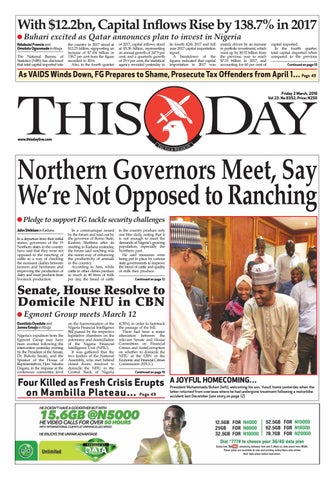
A JOYFUL HOMECOMING… President Muhammadu Buhari (left), welcoming his son, Yusuf, home yesterday when the latter returned from overseas where he had undergone treatment following a motorbike accident last December (see story on page 12)
2
T H I S D AY ˾ Ͱ˜ ͰͮͯͶ
T H I S D AY ˾ FRIDAY MARCH 2, 2018
3
4
T H I S D AY ˾ Ͱ˜ ͰͮͯͶ
T H I S D AY ˾ FRIDAY MARCH 2, 2018
5
6
T H I S D AY ˾ Ͱ˜ ͰͮͯͶ
T H I S D AY ˾ FRIDAY MARCH 2, 2018
7
8
T H I S D AY ˾ Ͱ˜ ͰͮͯͶ
T H I S D AY ˾ FRIDAY MARCH 2, 2018
9
Ëœ ÍşËœ ͺ͸͚͜ Ëž T H I S D AY
10
PAGE TEN S E NATE, H O USE R ESOLVE TO DOMICIL E N F I U I N C B N Whereas the Senate committee wanted the agency to be domiciled in the CBN, the House committee preferred that it be retained within the EFCC, with operational and financial autonomy. But with the resolution reached by Saraki and Dogara, THISDAY learnt that the report of the Conference Committee on the NFIU is expected to be signed by both committees on Monday. Nigeria was suspended from the Egmont Group in July 2017 over the country’s failure to grant operational and financial autonomy to the NFIU, which operates from within the EFCC. The country was given till the next meeting of the group to comply, or risk expulsion. The intervention of the leadership of the National Assembly came ahead of the Egmont Group’s next meeting which is scheduled to hold on March 12. At the meeting, it would be determined whether Nigeria has complied with the requirements to warrant the lifting of its suspension. If Nigeria is found to be non-compliant, the country would be expelled from the
group, which is a network of national intelligence financial units of 152 countries. THISDAY had exclusively reported recently that the transmission of the NFI Bill, which has been passed by both legislative chambers, to President Muhammadu Buhari for assent, had been delayed by the inability of the conference committee to agree on the domiciliation of the agency. But it was gathered that Saraki and Dogara’s meeting yesterday came on the heels of the point of order raised yesterday at the Senate plenary by the Chairman, Senate Committee on Financial Crimes and Anti-Corruption, Senator Chukwuka Utazi, who had complained that his counterpart in the House, Hon. Kayode Oladele, had refused to honour a series of scheduled meetings to harmonise the bill. He said the delay in transmission of the conference report was due to the insistence by the House committee to domicile the unit within the EFCC. According to Utazi, “If we do not put our house
in order, we (Nigeria) will be expelled. The expulsion will have severe consequences: our banks will not be able to do anything, our banks and foreign transactions will no longer amount to anything. We will be degraded. “Even the Corruption Index we are complaining about will be child’s play relative to what we are going to face in a few days to come,� Utazi warned. He recalled that the bill was passed by the Senate within eight legislative days, which was not the case in the House “The House of Representatives took its time to pass this bill. A conference committee has been constituted. I have been calling my counterpart in the House of Representatives. The first meeting was stalled. They said the leadership was meeting over the issue. “We called for another meeting. Each time I called for this meeting, my counterpart in the House of Representatives will always tell me that he is attending one meeting or another. Even this morning (yesterday), I sent him a message and he said he was attending a
budget defence meeting. I told him that this meeting was more important. He knows what is at stake,� Utazi added. The senator said it would not be the fault of the Senate, if Nigeria is expelled from the Egmont Group. Presiding, Saraki said the leadership of the National Assembly was committed to averting Nigeria’s expulsion and would ensure the urgent resolution and transmission of the bill to the president. “This matter has been discussed at the leadership level and a conference committee was set up. I am surprised that this meeting has not taken place. “I will meet with the Speaker of the House of Representatives and I will remind him of the decision we took, so that he can direct the chairman in the House of Representatives on this. “Both of you will work on it as fast as you can, so that we can transmit this bill to the president before the next Egmont meeting in order to save this country. We will take action,� Saraki assured Utazi. Speaking on the outcome of the engagement between
Saraki and Dogara, Oladele last night said: “The update is that we have resolved the knotty issues. Initially, we had a problem with a clause, which after the meeting of the leadership of the National Assembly was finally settled. “I think in the next few days, we are going to sign the conference report.� The Egmont Group provides a platform for sharing criminal intelligence and financial information bordering on money laundering, terrorism financing, proliferation of arms, corruption, financial crimes, economic crimes and similar offences geared towards the support of local and international investigations, prosecution and asset recovery. Nigeria was fully admitted into the body in 2007, after operational admittance in 2005. Also at plenary yesterday, the Senate passed the Federal Audit Services Bill to boost the anti-corruption fight of the administration. The bill seeks to enhance the powers of the AuditorGeneral of the Federation
and will provide for executing audits on classified expenditure and encourages forensic audits. Saraki, in his remarks on the bill, said it would ensure independence for the Office of the Auditor-General of the Federation and grant it unfettered access to the books of agencies and parastatals of government. “Today is a landmark achievement in the fight against corruption. This law will bring accountability and probity in the finances of the government and the fight against corruption. “We truly have to block all the various leakages. We have to ensure that we get this to Mr. President to get his assent. “We have gone a long way in this administration in our fight against corruption, and it is commendable that the National Assembly members are the sponsors and movers of this very important bill, which we can see has been outdated for many years. “We will continue to play our part in this fight against corruption for the sake of our country,� Saraki said.
that the country from which Nigeria imported the most capital from was the United Kingdom, accounting for $1.61 billion, or 30 per cent of the total of capital inflows in Q4 2017. This value was a decline of 7.3 per cent relative to the figure in the previous quarter, but a 233.4 percentage growth over the corresponding period of last year. “As well as the existence of an historical relationship between the UK and Nigeria, London (the capital of the UK) is also a key financial centre, which explains the high value of foreign capital from the UK. “Since 2010, the UK has accounted for the highest value of capital importation in all but two quarters (both in the second half of 2015). “The country that accounted for the second largest value of capital importation was the United States. The U.S. accounted for $1 billion in the fourth quarter of 2017, or 18.6 per cent. The U.S. has also been one of the most important investors in Nigeria, usually either the largest or second largest investor country. “It has also been historically the largest economy in the world and is active in foreign investments globally. The next two largest investors in the fourth quarter of 2017 were Belgium, accounting for 10.2 per cent and Singapore (7.7 per cent),� said the NBS. A further breakdown of the figures showed that in the fourth quarter of 2017, the bank through which the highest share of capital was imported was Stanbic IBTC Bank, which accounted for 50.7 per cent ($2.7305 billion) of the total, up from the 40.2 per cent recorded in the third quarter of 2017. This was followed by Standard Chartered Bank, which accounted for 15.1 per cent share or ($811 million)
of capital importation. The top five banks through which capital was imported in the fourth quarter were Stanbic IBTC Bank, Standard Chartered Bank, Zenith Bank Plc, Citibank Nigeria Limited and Access Bank Plc, all accounting for 87 per cent of capital importation in the fourth quarter.
We have more than doubled our foreign reserves. We are winning the war against corruption. We are developing our infrastructure. And we are enforcing the rule of law. “As a result of these, we are seeing significant growth in the non-oil sector which is creating thousands of jobs across the country,� the president was quoted to have said. The president, Shehu added, cited the current strategic partnership between Moroccan and Nigerian fertilizer companies as part of the success stories. “Today, due to this alliance, Nigeria has over 13 functioning fertilizer blending plants with another four in the pipeline. This is purely driven by the private sector. “In 2017 alone, we saw significant commitments and agreements by major global organisations in infrastructure projects such as the $9 billion Dangote refinery and petrochemical complex in Lagos; the completed $600 million Lafarge plant in Calabar; the proposed rail stock; the proposed $1.3 billion public-private partnership with General Electric on rail track development; and the proposed ENI/Agip rehabilitation of the Port Harcourt refinery. “You can see clearly that foreign private companies are coming back to Nigeria and making massive investments within our existing legal and regulatory framework,� he was further quoted to have said. According to the statement, Al-Thani, in his remarks, said the global opinion on Nigeria as an investment destination has been boosted by Buhari’s strong standing against corruption and adherence to the rule of law. It also said he expressed his delegation’s interest in investing in Nigeria’s oil, railway, aviation and power sectors.
W I TH $12 .2 B N, CA PITA L INFLOWS RISE BY 1 3 8.7 % I N 20 1 7 quarter increased by $1.29 billion. Capital Importation is broken into three main investment types: Foreign Direct Investment (FDI), Portfolio Investment and Other Investments, each comprising various sub-categories. Portfolio investments, which recorded $3.48 billion in the fourth quarter of 2017, remained the largest component of capital imported, contributing 64.6 per cent or $5.38 billion of the total. It increased significantly year-on-year, posting a rise of 1,123.5 per cent or $3.19 billion, expanding faster than the two other components of capital importation. FDI stood at $378.4 million in Q4, indicating a year-onyear increase of 9.8 per cent and a substantial increase of 221.8 per cent over the preceding quarter, while Other Investment stood at $1.53 billion, growing by 66 per cent when compared to Q4 of 2016. The growth in FDI was mainly driven by equity investments, which contributed 99.8 per cent, while other capital investments contributed 0.2 per cent. “Portfolio Investments were the main driver of capital importation in the
TOP GAINERS NGN NGN FBNHOLDINGS 0.95 12.50 WAPIC 0.04 0.68 CUTIX 0.11 2.31 MAYBAKER 0.14 2.94 DANSUGAR 1.00 22.00 TOP LOSERS NGN NGN CAVERTON 0.25 2.60 COURTVILLE 0.04 0.42 FIRSTALUM 0.03 0.37 UNIC 0.02 0.34 UNITYBANK 0.10 1.71 HPE Nestle Nig Plc â‚Ś1,320.00 Volume: 520.743 million shares Value: N 4.718 billion Deals: 5,694 As at 1/3/18 See details on Page 43
% 8.2 6.2 5.5 5.0 4.7 % 8.7 8.7 7.5 5.5 5.5
fourth quarter of 2017, with $3.48 billion, representing a quarter-on-quarter growth of 25.7 per cent. Year-on-year, it increased by 1,123.5 per cent, which is over twelve times the figure recorded in Q4 2016 ($284.2 million). “The increase in Portfolio Investments was driven by a strong growth in money market instruments, which rose to $2.18 billion, the first time since Q3 2013. “Money market instruments contributed 63 per cent to Portfolio Investments. Equities which had been the main driver of Portfolio Investments in previous quarters, dropped by $942.9 million, from $1,932.1 million in Q3 to $989.2 million in Q4 2017. “On the other hand, bonds recorded an increase of $194.1 million, from $115.4 million in Q3 to $309.5 million in Q4 of the same year,� the NBS said. The statistical agency disclosed that Other Investments accounted for 28.4 per cent of total capital importation in the fourth quarter of 2017. This category of capital importation, it pointed out, grew 65.96 per cent yearon-year, and by 21.2 per cent when compared to the previous quarter. The $1.53 billion recorded by Other Investments was mainly in the form of loans, which stood at $1.09 billion in the fourth quarter, followed by other claims at $425.7 million, and trade credits, which reported $10 million, having posted no inflows since Q4 2016. Going by the proportion of shares to total capital importation between the first quarter 2015 and Q4,2017, in the fourth quarter of 2017, banking shares became the second leading sector to attract the highest amount of capital inflows, attracting $543.4 million or 10.1 per cent of total capital, an increase of
5.8 per cent from the previous quarter. Next to banking was production, which accounted 5.9 per cent for total capital investments. Capital Importation to servicing dropped from $586.97 million in the previous quarter to $216.45 million in the fourth quarter, while $99.4 million flowed to the fishing sector. Capital Importation to the telecommunications, financing and construction sectors also increased strongly compared to the previous quarter. Capital is either imported in the form of shares, or directly imported to different sectors of the economy. Share capital investment, which is closely related to equity investment (FDI and portfolio) was largely responsible for the huge increase in capital importation in the fourth quarter of 2017. The component of shares has been on the increase since the first quarter of 2017 and by the fourth quarter it accounted for 68.4 per cent of total capital importation. In the fourth quarter of 2017, of the $5.38 billion capital imported, $3.680 billion was invested in shares, representing a growth of 1,512.5 per cent year-on-year. State by state, capital importation for the fourth quarter of 2017 showed that Abuja attracted the highest amount of foreign capital, accounting for $2.68 billion or 49.8 per cent. This was an increase of 227.8 per cent from the figure recorded in the third quarter of 2017 ($817.6 million). Lagos, which has always had the highest share of capital importation, had its share drop from 79.5 per cent of the total share in Q3 2017, to 47.4 per cent in Q4, 2017. Other states including Akwa Ibom, Ogun, Oyo and Delta also attracted foreign capital investments. The data also showed
Qatar Eyes Nigerian Sectors Even as the NBS released the fourth quarter and annual capital importation report yesterday, President Muhammadu Buhari expressed delight over the massive rise in foreign private investments in Nigeria as a result of the success of his administration’s economic agenda. A statement by his media aide, Malam Garba Shehu, said he made the remark at a meeting with a Qatari business delegation led by Sheikh Hamad Bin Khalifa Al-Thani at the State House, Abuja, yesterday. He said the president pointed out that the federal government’s economic agenda was designed to move the country from overreliance on crude oil and food importation, adding that the policy has in the past two years, turned Nigeria into one of the most attractive investment destinations in Africa. “My administration’s economic agenda has always been to move away from over reliance on crude oil and food importation. Nigeria is a blessed country. We have fertile land. We have a young and energetic population. And we have a very strong legal and regulatory system that protects capital and investments, both local and foreign. “As you are aware, Nigeria just exited its worst recession in more than two decades.
T H I S D AY ˾ FRIDAY MARCH 2, 2018
11
Ëœ ÍşËœ ͺ͸͚͜ Ëž T H I S D AY
12
STARTERS
Two-Minute BrieďŹ ng NEWS Dogara: Why President Must
Assent to Constitution Alteration Bills PresidentBuharimustgrantassent tothe15constitutionalteration billsrecentlytransmittedtohim bytheNationalAssembly,asthe amendmentsareatrue‌ Page 49
EDITORIAL 30 Years Of Road Safety in
Nigeria Establishedin1988bythen militaryleader,GeneralIbrahim Babangidaasaninterventionist agencytoaddressthemenaceof roadaccidents,FRSChasoverthe pastthreedecades‌ Page 15
POLITICS Feasibility of State Police Buhari
Yusuf Buhari Returns from Medical Trip, Mother Thanks Nigerians Omololu Ogunmade in Abuja Yusuf, son of President Muhammadu Buhari, returned to the country yesterday from a medical trip following the injuries he sustained on December 26, 2017 from a motorbike accident in Abuja. He had earlier been admitted and treated in Cedarcrest Hospital, Abuja, before he was discharged on January 12 and secretly flown abroad for further treatment. There was no information on where he was treated abroad. His return after total recovery was announced yesterday via the Facebook page of the president’s wife and Yusuf’s
mother, Aisha, who thanked God for his recovery and safe return. According to her, Yusuf was received at the airport by the Minister of State for Health, Dr. Ehanire Osagie, and welcomed at the State House by the wife of Vice-President Yemi Osinbajo, Dolapo, Interior Minister, Abdulrahman Dambazau, Kogi State Governor, Yahaya Bello, as well as family members and associates. Mrs. Buhari expressed gratitude to those who stood by the family and prayed for her son’s recovery since the incident occurred. She also prayed to God to bless and guide them. “We thank God for the return of our
son, Yusuf, today after his medical trip. On hand at the airport, he was received by the Minister of Health (State) Dr. Osagie, while at the villa he was welcomed by family members, wife of the vice-president, the interior minister, Governor Yahaya Bello and associates. “On behalf of the family, we wish to express our appreciation for the goodwill and prayers since the unfortunate accident. May God almighty bless all and continue to guide us aright,� she said. She attached photographs showing Yusuf being welcomed by his father and another with Dambazau praying.
N O RTH ERN GOVER N OR S MEET, SAY WE ’R E N OT OPPOSE D TO R AN C H I N G On the incessant clashes between farmers and herdsmen in the country, the forum noted that it was committed to rendering “full and unequivocal support to the federal government in its unwavering commitment and dogged determination to address the multifarious security challenges in all parts of the country�. The forum particularly extended its support to the federal government for the measures so far put in place to resolve the lingering clashes between farmers and herdsmen. It also called for “implementable and viable strategic measures to be initiated by governments at all levels to forestall future occurrence of any form of communal crisis�. While calling for an articulation of a comprehensive plan for intervention in the states affected by the lingering crisis, the forum strongly admonished political, religious and ethnic jingoist to avoid imputing religious, ethnic and political coloration to the conflicts. “The meeting specifically deliberated on the seemingly intractable and excruciating nature of the conflicts between farmers and herdsmen, as well as other deadly and destructive security challenges confronting various parts of the North vis-a-vis their counterveiling effects on social stability and developmental programmes of the various state governments in the region. “The forum particularly discussed the lethality and widespread nature of the spate of communal clashes and emergent criminal activities like kidnapping and armed banditry in various parts of the Northern states,� the governors said.
On the recent abduction of 110 schoolgirls from a secondary school in Dapchi, Yobe State, the forum expressed appreciation to President Muhammadu Buhari for his timely and effective response to the abduction of the Dapchi students. “Our prayers and commiseration goes to the government and people of Yobe State as well as the families of the victims over the sad and unfortunate incident,â€? the forum said. The forum also expressed concern over the growing and widespread drug abuse in the North, especially among the youths, and appealed to all the relevant authorities to step up efforts in combating the menace. The communiquĂŠ called on the federal government to declare a state of emergency on drug abuse in the country as part of renewed efforts to deal with the scourge. It also urged the federal government to provide all the necessary funding and logistics to the relevant agencies like NAFDAC and NDLEA to boost the fight against drug abuse. “The meeting also called on state governments to set up high powered enforcement committees under the chairmanship of either a deputy governor or secretary to the state government, to ensure that all the relevant laws and statutory provisions in respect to drug abuse are fully and effectively implemented at all times,â€? the forum added. It further enjoined state Ministries of Women and Youth Affairs to intensify sensitisation and enlightenment programmes on the dangers of drug abuse.
It also resolved to come up with appropriate legislations by the various Houses of Assembly in the Northern states The forum also received an interim report from its committee on restructuring of the country, which was mandated to collate views and opinions of individuals, groups and organisations in the North and come up with a Northern position on the national clamour for restructuring. The report touched on the various efforts being made by the committee towards actualising its mandate. The forum noted the presentation of the report and commended the committee for its relentless efforts on the comprehensive conduct of the exercise. The governors at the meeting also deliberated on the structural and institutional challenges that have hamstrung the Northern Nigeria Development Company (NNDC), and the lingering unpaid pensions of former workers of the defunct New Nigeria Newspapers Company (NNNC). “The forum also exhaustively deliberated on all the outstanding issues affecting the Northern Nigeria Development Company (NNDC), especially the institutional and structural challenges and impediments that have been retarding its viability and potential as the economic livewire of the region. “The forum also discussed some pending challenges facing the New Nigeria Newspapers Company (NNNC), particularly the lingering concern of its pensioners and how best to resolve the issue in an all-encompassing and amicable way,â€? the communiquĂŠ added.
When,ontheeveofthenewyear, intelligencegottoGovernor SamuelOrtomofBenueState aboutpossibleattackonsome communitiesinhisstatebyarmed Fulaniherdsmenatnight‌ Page 17
WEEKENDFILE Nigeria's Fashion Enthusiast to
Watch KelechiRomeoOghenestartedherr fashionline,God'sMightWorld,over er adecadeago.Eversince,herartisticc skillshavebeenamazingasshehass churnedoutuniquecreationsfrom localfabricslikeAnkara. Page 27
BUSINESS Institutional Framework Needed
for Airport Concession, Says Minister TheMinisterofTradeand Investment,Dr.Okechukwu Enelamahhasstressedtheneedto puttherightinstitutionalframework inplaceandguideitzealouslywith appropriatepolicyimplementation. Page 19
CITYSTRINGS Love Affair with Orphans
ChiemelieEzeobiwritesthatfor14 longyears,BethiaIdoko,amodelcum-philanthropist,haskepther loveaffairwiththeorphansofLittle SaintsOrphanageburning Page 40
INTERNATIONAL Armed ‘Teacher of the Year’ Opens Fire in School PresidentTrump’sproposaltoarm teachersseemednuttyenougheven beforeasecondformerhighschool teacheroftheyearwasarrestedfor firingaguninsidehisschool,Daily Beastreported. Page 46
SPORTS Ogbemudia Stadium to Host
Super Eagles Again Themain-bowloftheSamuel OgbemudiaStadiuminBeninCity istobeoverhauledandreturned tonaturalgrasssurfacefromits currentartificialastro-turfstate. Page 55
T H I S D AY ˾ FRIDAY MARCH 2, 2018
13
14
T H I S D AY Ëž Ëœ Í°Ëœ Í°ÍŽÍŻÍś
COMMENT
Editor, Editorial Page PETER ISHAKA Email peter.ishaka@thisdaylive.com
NIGERIA IS STILL JAGA JAGA
Nothing remarkably has changed in the country, despite changes in administration, argues Nnamdi Ebo
T
he 2004 hit song “Nigeria Jaga Jagaâ€? by rapper, Eedris Abdulkareem, declaimed corruption and suffering in Nigeria. Former President Olusegun Obasanjo lambasted Abdulkareem and banned the song. Jaga Jaga remains a negative nostalgia running the whole gamut of human emotion in Nigeria. Speaking at a 2012 Nigeria Leadership Initiative forum in Lagos, eight years later, Obasanjo lambasted Abdulkareem, again: “One of the worst problems Nigeria is facing is disbelief. Nigerians no longer believe in themselves nor do they believe in their country. That takes me back to that song ‘Jaga Jaga’. How could a sane man dare to call his country Jaga Jaga? It is the height of blasphemy.â€? The masses who bore the brunt of the economic pains were at peace with the song. When the singer released the album Jaga Jaga, a Yoruba term for ‘shambles’, little did he know he had released a prophesy. Claiming shortcomings akin to Nigeria Jaga Jaga, Obasanjo lambasted former President Goodluck Jonathan and President Muhammadu Buhari, not to seek re-election in 2015 and 2019 respectively. Nigeria was Jaga Jaga during Obasanjo presidency and Obasanjo fumed! Nigeria was Jaga Jaga during Jonathan presidency and Obasanjo fumed, again!! Nigeria is Jaga Jaga during Buhari presidency and Obasanjo fumed, yet again!!! It appears Obasanjo will continue to fume against Jaga Jaga, even in the hereafter. That Nigeria is Jaga Jaga is not “fake newsâ€? Ă la US President Donald Trump. The hope of Nigeria emerging from Abdulkareem’s prophesy is dim considering the present state of affairs. The siamese twins (All Progressives Congress and Peoples Democratic Party) are not answering people’s deepest concerns and needs. I have no clue what the two parties stand for but PDP is counting on a comeback and APC is wobbling like a paper tiger. Nigeria has two “national political partiesâ€? that have no agenda. INEC boss said nothing has changed on 2019 election sequence, in contradistinction to the bill passed by lawmakers (a PDP ploy) that changed the sequence of the election. Confusion! The 1950s-1960s politics of regionalisation is back. PDP started as a national party. When they lost power after a clueless 16 years in office they failed to provide a viable opposition to APC and went on a wild goose chase for a chairman with cash. They got one, only that he emasculated the party. The party was later hijacked by newly minted south-south kingmakers. The southeast stood listless by the sidelines and PDP jettisoned the southwest; got chairman Secondus and became a south-south party. “Power to the peopleâ€? shifted to “power to the south-south peopleâ€?. APC pretended to start as a national party, even though their politick was to remove Jonathan. They succeeded in removing Jonathan but didn’t know what to do with Jonathan’s power. They continued to blame Jonathan for their failures; the southwest was jettisoned, despite Tinubu’s reconciliatory effort; the core north consolidated power. The party was later hijacked by core north oligarchs and APC became a core north party. “Changeâ€? hasn’t changed anything. Nigeria is still Jaga Jaga, but this time, the jagged edge took
EVERY NIGERIAN PRESIDENT GOES TO ASO ROCK CARRYING HIS KINSMEN, CLANSMEN, VILLAGE MEN, STATE MEN, TRIBAL MEN, ZONAL MEN, AND WOMEN TOO
another turn as marauding Fulani herdsmen wreaked havoc in Benue. Nigerians expected an accelerated solution akin to “operation python danceâ€?. Instead, they got “operation cattle danceâ€?. The “operationâ€? was hidden in plain sight. A state law was declared unenforceable by the federal police statutorily empowered to enforce the law; controversy trailed the withdrawal of special forces deployed to Logo and Guma LGAs of Benue in the wake of the new year day massacre of 73 farmers/villagers. Miyetti Allah had said: “you cannot change the way of life of a people like the way you turn off a light switchâ€?. In 2014, there was #ChibokGirls. In 2018, #DapchiGirls, evoking memories of “Chibok conspiracy theoriesâ€?; controversy trailed soldiers’ withdrawal before the abduction; authorities miscalculated the laws of arithmetic on the number of DapchiGirls’ missing. Yobe police command dismissed army claims that Dapchi was left in its care before the soldiers withdrew. Buhari described the abduction as a “national disasterâ€? but CNN’s Isha Sesay said Buhari’s description was an “understatementâ€?, the abduction is a “national disgraceâ€?. People thought the military had defeated Boko Haram but ex-COAS, Gen. Minimah (rtd.) refunded about 1.7billion to EFCC. Femi Adesina said despite Dapchi schoolgirls’ abduction Boko Haram has been “terribly degradedâ€?, not defeated. There are now more girls and ransom to negotiate the release of Boko Haram prisoners, and increase the defence budget of the terror group. Nobody believes either the military, Lai Mohammed, Femi Adesina, or all of them. As TI rated Buhari low on its corruption index, stating that Buhari hasn’t done enough, SERAP backed TI; corrupt politicians, lawmakers, ex-governors and officials still walk the corridors of power, free!; Patience Jonathan asked the Abuja Federal High Court to jail the MD/CEOs of three banks for refusing to comply with the court’s order directing them to lift restrictions placed on her accounts at the instance of the EFCC; ex-SGF Babachir Lawal was arrested and released; ex-CSO Dasuki remains in jail; ex-PDP PRO was stretchered to court; and corruption fight continued to roll downhill. The only things constant in Nigeria are ethnicity and nepotism. Nigeria’s obsession with ethnicity and nepotism is a poor reminder of how poorly our country continues to turn out in the 21st century. Every Nigerian president goes to Aso Rock carrying his kinsmen, clansmen, village men, state men, tribal men, zonal men, and women too. They all get the juiciest jobs and appointments. Obasanjo’s, Yar’Adua’s, Jonathan’s and Buhari’s presidencies brought agbada and cap; baban riga or dashiki and kufi cap; angapu or etibò, walking stick and black fedora hat; and now another baban riga, dashiki and kufi cap, respectively. When isiagu and red cap or okpu agu will showcase in Aso Rock is open to conjecture. Ooni of Ife, Oba Ogunwusi, said that with the rising rate of youth unemployment, Nigeria is sitting on a keg of gunpowder. I agree with the monarch. Nigeria is still Jaga Jaga. Ebo is a political scientist and lawyer
PEACE CORPS BILL: MATTERS ARISING
Mohammed Mansur urges NASS to invoke its powers and over-ride the president’s veto on the Nigerian Peace Corps
W
hen the unpalatable news broke out on Tuesday, February 27, 2018, it met staff officers/volunteers and well-wishers of Peace Corps of Nigeria (PCN) ill-disposed to play host. The news was absolutely shocking. I was disoriented. I made desperate efforts to condition my mental state, trying in the process to convince myself that I had, perhaps fallen into a bad trance, possibly the kind of overwhelming incubus that persistently intruded in my sleep a few days earlier. It could not be true! For President Muhammdu Buhari, who promised to provide one million jobs for Nigerian youths to literally allow this veritable opportunity for him to fulfil this promise slip away is indeed a shocker. By refusing to assent to the Nigeria Peace Corps (NPC) Bill, a bill that is targeted at giving the youths a sense of belonging, this administration has demonstrated how much it cares about the youths, the most vulnerable segment of the nation’s population. For the discerning, this development did not come as a surprise. Just like the case of the owl howling in the night and the child dying the following morning, a few weeks ago, the grapevine was agog with the rumour that the Nigeria Police, Department of State Services (DSS) and Civil Defence and the Vigilante Group of Nigeria (VGN), whose bill is still undergoing legislative processes, have reinvented their earlier conspiracy to frustrate the assent to the NPC Bill through security report to the president. And what is the content of this so-called security report? That the Peace Corps, if given statutory backing via the instrumentality of the bill, will ‘’merely duplicate’’
the ‘’functions’’ of other security agencies like the Police and Civil Defence, an allegation that has since been debunked via an open letter to the president that was published as advertorials in many national dailies on February 20, 2018. It is rather sad that the president will rely on these groups to veto the NPC Bill. Is this a premeditated attempt to shove aside Peace Corps and pave way for the VGN? What kind of legacy is our present crop of leaders leaving for the future generation of Nigerians? As a detribalised Nigerian, I think that there is more to the withholding of presidential assent to the NPC Bill than meets the eyes. How on earth can anyone say that the functions of Peace Corps, which are: to empower, develop and provide gainful employment for the youths, to facilitate peace, volunteerism, community services, nation building, neighbourhood watch and for other related matters, be a duplication of the functions of any existing security agency in Nigeria? It is simply preposterous. It would be recalled that during the public hearings conducted by both chambers of the National Assembly, these same agencies stoutly opposed the passage of the bill, an opposition that was roundly defeated by the superior arguments of over 570 written and oral memoranda in support of the bill. So, if the Police, DSS and Civil Defence lost out at that stage and the bill went through all necessary legislative crucibles, was passed and eventually adopted, why this sudden renewed effort to rubbish the efforts of our distinguished senators and honourable members? It beggars belief that in a nation where youth unemployment is bursting at the seams and has reached alarming proportions, some government
agencies would be working at cross-purposes with those with the noble intentions of stemming its tide. In turning down the bill, the president advanced two seemingly nebulous reasons: lack of fund and security concerns (whatever that means). Isn’t it ironical that in spite of billions of naira budgeted yearly for security, the nation continues to slide down the index with several security challenges sprouting up like mushrooms, so much so that it has simply overwhelmed the nation’s security agencies? While other countries of the world have taken crime-fighting a notch higher through intelligence-gathering and dissemination, Nigeria is still stuck with the archaic idea of throwing money at the problem. The reason for this untoward development is not far-fetched: the more money government budgets for security, the better it is for heads of security agencies, who see it as an opportunity to enrich themselves. The incontrovertible fact is that if 2% of what government spends on procurement of equipment, arms and ammunition is given to the Peace Corps, it will go a long way in mitigating the tragedy that has befallen the nation in the security sector. As an organisation that has tentacles in all nooks and crannies of the country, Peace Corps of Nigeria is strategically positioned to give effect to community policing that is currently seen as the panacea to the nation’s worsening security crisis. And with their personnel spread across the length and breadth of Nigeria, they will also be useful in sniffing out information and disseminate same to relevant security agencies, which will act promptly in nipping such crime in the bud. This will be a proactive step, which is in conformity
with the saying that, ‘prevention is better than cure’. Over the years, the nation’s approach to crime fighting has rather been reactionary instead of proactive. A change in tactic will certainly up the ante of crime fighting in Nigeria. As a matter of fact, no amount of money spent by the government through the Peace Corps to free millions of our youths from the clutches of unemployment, idleness and crime should be considered too much, unless the government is merely paying lip service to youth empowerment. Like it is often said, the sky is wide enough for all birds to fly without colliding with each other. And in view of the parlous security situation in Nigeria, the need to have more agencies, like the Peace Corps to complement the efforts of existing security agencies to checkmate the anomaly cannot be over-emphasized. If the nation’s existing security agencies, can invest half of the overzealousness it used in hounding officials of the corps, then kidnapping, armed robbery and other related crimes threatening the foundation of Nigeria would have become history in Nigeria today. It is on this note that millions of Nigerian youths crave the indulgence of our legislators in the NASS to urgently invoke its legislative powers as enshrined in the constitution to over-ride the President’s veto on the Nigerian Peace Corps (Establishment) Bill and make it a law. As true representatives of the people, it is necessary that they should be seen to be protecting the interests of millions of disempowered Nigerian youths roaming the streets. These youths see the corps as their last hope of regaining their humanity in the face of several years of governmental neglect. Mansur wrote from Jibia, Katsina State
15
T H I S D AY Ëž Ëœ Í°Ëœ Í°ÍŽÍŻÍś
EDITORIAL 30YEARS OF ROAD SAFETY IN NIGERIA The FRSC has done remarkably well
E
stablished in 1988 by then military leader, General Ibrahim Babangida as an interventionist agency to address the menace of road accidents, the Federal Road Safety Corps (FRSC) has over the past three decades made considerable strides in fulďŹ lling that mandate. It therefore came as no surprise that its 30th anniversary was recently celebrated with pomp. It is indeed noteworthy that prior to the FRSC establishment, the World Health Organisation (WHO) had adjudged Nigeria the second most dangerous country in the world to drive a vehicle, after (Ethiopia). But the FRSC has succeeded in changing that narrative such that from 40,881 road crashes in 1976 when there were fewer vehicles in the country, only 4,418 of such accidents were recorded last year. Yet, according to Nobel Laureate and FRSC pioneer Chairman, Professor Wole Soyinka, the process of changing the mentality of Nigerians from the fatalistic beliefs they had developed toward road trafďŹ c crashes to the point where they now drive with safety consciousness was not an easy task. At 30, the FRSC has made more WHILE THE NUMBER than passing OF CRASHES MAY impact on the life of HAVE REDUCED DUE Nigerian road users. TO PREVENTIVE The commission’s MEASURES, THERE IS campaigns have ALSO THE NEED TO helped in reducing the carnage on our REDUCE THE NUMBER roads and have OF FATALITIES AFTER travelling, ACCIDENTS BY PROMPT made especially during RESPONSES festive periods like Sallah and Christmas, less of a nightmare. So all factors considered, the investment has been worth it and the creation of the FRSC by the Babangida regime can now easily be justiďŹ ed. Today we have a commission with globally acknowledged templates for measurable impact and service outcomes. This is no accident, but the result of a clear institutional focus on operations, people and
Letters to the Editor
processes. The commission has made great investments in human capital development and has used mostly modern, merit-based templates for staff recruitment. This has gone hand –in- hand with enhanced staff welfare and improved service delivery. Today we have a Nigerian road using populace that is better able to appreciate best global road safety practices, including the need for private sector and government involvement in road safety issues. The on-going robust public advocacy on road crash reduction and intensiďŹ ed routine patrols are fully complemented by effective rescue services with optimal utilisation of IT and re-alignment of operational strategies.
T T H I S DAY
EDITOR DEPUTY EDITORS ˜ MANAGING DIRECTOR DEPUTY MANAGING DIRECTOR CHAIRMAN EDITORIAL BOARD
EDITOR NATION’S CAPITAL
T H I S DAY N E W S PA P E R S L I M I T E D
EDITOR-IN-CHIEF/CHAIRMAN GROUP EXECUTIVE DIRECTORS ˜ ˜
˜ ˜
DIVISIONAL DIRECTORS ˜ DEPUTY DIVISIONAL DIRECTOR
SNR. ASSOCIATE DIRECTOR ERIC OJEH ASSOCIATE DIRECTORS ˜ CONTROLLERS ˜ ˜
DIRECTOR, PRINTING PRODUCTION TO SEND EMAIL: ďŹ rst name.surname@thisdaylive.com
oday there is increased FRSC presence on the highways, with effective preventive patrols and prompt response to road crashes. The toll- free telephone number 122 for road trafďŹ c emergencies has created a seamless communication gateway between the commission and the motoring public, shoring up early reportage of road crashes. The implementation of international vehicle transit charges at selected Nigeria border posts has also enhanced safety and co-ordination of trans-border movement. This is in addition to the “One Driver One Record’’ initiative, which allows for tracking and matching a driver with his driver licence, vehicle number plate, insurance and trafďŹ c offences in a single view. Meanwhile, the order and control in motor vehicle administration and vehicle insurance management from the FRSC have improved collaboration among security agencies. While we commend the FRSC for the efforts of the past 30 years, we must also highlight the fact that the response to accident emergencies still falls far short of global standards. While the number of crashes may have reduced due to preventive measures, there is also the need to reduce the number of fatalities after accidents by prompt responses. Fortunately, the current Corps Marshal, Dr. Boboye Oyeyemi has promised to enhance the community ďŹ rst responder scheme while enhancing training and development of personnel in order to reduce the deaths arising from road carnage.
TO OUR READERS Letters in response to speciďŹ c publications in THISDAY should be brief (150-200 words) and straight to the point. Interested readers may send such letters along with their contact details to opinion@thisdaylive.com. We also welcome comments and opinions on topical local, national and international issues provided they are well-written and should also not be longer than (9501000 words). They should be sent to opinion@thisdaylive.com along with the email address and phone numbers of the writer.
RE-EXAMING THE KWANKWASO-GANDUJE FEUD
A
head of the 2019 general elections, the frosty relationship between the political camps of the former Governor of Kano State, now Senator Rabiu Musa Kwankwaso and the Governor of the State, Dr Abdullahi Ganduje may soon get to an open confrontation. The latest of such happenings was the one that occurred when Senator Kwankwanso apparently at the instruction of Governor Ganduje was prevented from visiting the state by the Police on a somewhat flimsy excuse that the governor and other All Progressives Congress chieftains in the state were carrying out political rallies ahead of the state’s local government elections. Addressing newsmen in Kano, the State Commissioner of Police, Rabiu Yusuf cautioned Kwankwaso that he could face the wrath of the law if violence erupts during his visit and this act further escalated the crises. It would be recalled that the ugly development was raised on the floor of the Senate for debate recently through a point of order raised by Senator Hamman Isa Misau (APC Bauchi Central), who urged the Senate to condemn in its entirety the action of Ganduje-led Kano State government against Kwankwaso. Though the two other senators from Kano State i.e, Kabiru Gaya ( APC Kano Central) and Jibrin Barau (APC Kano North) tried to dissuade the Senate from condemning the action, the very matured submission made by Kwankwaso himself that as a leader, he would not want to say anything on the matter, made the Senate to eventu-
ally condemn the unfair treatment meted to him and his supporters and even went ahead to order the Inspector-General of Police to provide required security for Kwankwaso any other time he wants to visit Kano. The Senate President, Bukola Saraki, in his remarks said: “What was done to Senator Kwankwanso few days back either by the Kano State government or the State Police Command from visiting his constituents is unacceptable and dangerous to our democracy .� The relationship between the duo started as that of a benefactor and a political son with Kwankwaso being the benefactor and Ganduje, the political son. Both Men worked together politically for over two decades. When Kwankwaso was governor of Kano State between 1999 and 2003, Ganduje was his deputy. Even when Kwankwaso couldn’t make it straight away for a second term as governor of the state in 2003 general elections and was appointed Minister of Defence by the then President, Olusegun Obasanjo, he took Ganduje along as his special adviser on political matters and to cap it all, when he got elected as governor of Kano State in 2011, he made Ganduje his deputy again and above all, when leaving office in 2015, he ensured that Ganduje succeeded him as governor. But barely five months after the 2015 general elections, things began to fall apart, and their relationship turned sour, making people to start accusing Ganduje of betraying his ‘god father’, and biting the fingers that fed him particularly the kwankwasiyya movement, a pressure group established by Kwankwaso. In the words of Alhaji Sharu Garba Gwammaja, chairman of Hannun Karba, a sub-group
within the Kwankwasiyya movement, Governor Ganduje deviated from the ideology of Kwanwasiyya and should stop wearing their red cap symbol. On the other side of the divide, Abdullahi Umar Ganduje, speaking to news men, gave reasons for the cold ‘war’ with his predecessor, Kwankwaso, alleging that the immediate past governor of the state left N300 billion liabilities before he vacated office in May 2015, the debt the current governor said affected him in the area of carrying out projects. He added that another reason the former governor was at war with him was because he removed the chairman of the All Progressives Congress, (APC) in the state, Doguwa, for anti-party activity and the national headquarters accepted our position that it has followed due process. But Kwankwaso was adamant, insisting on Doguwa while the chairman recognised by the APC was Abbas. Though efforts are being made within the APC family in Kano and elsewhere to broker peace between the duo so as not to affect the party’s performance in the general election that is just about a year away, pundits are doubting success of such effort. According to them, the fight is all about power. While Kwankwanso is aiming for the Presidency in the general election, Ganduje is blackmailing him with such an ambition by showing his support for President Buhari second term every minute of the day, a position he believes, would easily earn him second term in office as governor without Kwankwaso’ s support . Comfort Woye Yakubu, Gudu, Abuja
16
T H I S D AY ˾ Ͱ˜ ͰͮͯͶ
ADVERTORIAL
T H I S D AY • FRIDAY, MARCH 2, 2018
17
POLITICS
Group Politics Editor Tobi Soniyi Email tobi.soniyi@thisdaylive.com 07054786260 SMS ONLY
Feasibility of State Police Segun James reviews the arguments for and against state police
W
hen, on the eve of the new year, intelligence got to Governor Samuel Ortom of Benue State about possible attack on some communities in his state by armed Fulani herdsmen at night while the predominantly Christian people of the state would be church for prayers to usher in 2018, he became alarmed. This was not the first of such intelligence he had received in the last two and half years; and at every occasion, it has proved correct. He immediately alerted the state police commissioner and the head of the army formation in the state – both of whom are members of the state security council – of the possible attack asking them to mobilize to the areas in order to forestall such attack, his calls were ignored. When eventually words got to him that the attacks have actually started, the desperate governor still called, pleading with the police boss and the army commander about the bloodshed happening in the communities, he was once again ignored. In the morning, the nation woke up to the grim news of the bloodbath that had taken place. The people had been massacred, their communities raised and properties worth millions of naira destroyed by the rampaging killer-herdsmen. When Ortom rushed to the communities, he was told that neither the police nor the army came. Even in areas where the police have a station or police post, they had simply disappeared on the night of the attack. The governor was devastated. Although constitutionally, he is officially the chief security officer of the state, yet he could not order or mobilize the police to forestall any breakdown in law and order in his domain. Even the intelligence he got on the possible attack was not from any official security agencies. They do not report to him. He was a lameduck in the scheme of things when it comes to the security of his state. He cried as 73 persons, including women and children, killed in their prime during the attack were buried. He is the chief executive and supposed chief security officer of his state, yet he has to beg the president and security chiefs each time crisis occurs in his domain; it was a pathetic situation. Ortom’s case is not peculiar. The same situation is replicated all over the country. All the governors go through the same problem each time they are faced with urgent security situation. It was in the light of these that the call for the creation of state police that will be under the control of the governors has become strident in recent time. The call gained more strategic converts when the Nigerian Governors’ Forum (NGF) threw its weight behind the idea that has been variously thrown up as the panacea for the worsening insecurity in the country. But the support is conditional as the forum said only states that could afford to establish their own police should be allowed to do so, while the federal police would continue to secure the others. The shift in the governors’ position on state policing came just as President Muhammadu Buhari rose from a meeting with security chiefs at the Presidential Villa, Abuja, vowing to end the mounting security challenges plaguing the country. The president had met with the security chiefs for two and a half hours. The meeting was attended by Vice-President Yemi Osinbajo; Secretary to the Government of the Federation, Mr. Boss Mustapha; Minister of Defense, Brig. Gen. Mansur Dan-Ali; Minister of Interior, Lt. Gen. Abdulrahman Danbazzau; Minister of Foreign Affairs, Chief Geoffrey Onyeama and National Security Adviser, Maj. Gen. Babagana Monguno. Also in attendance were the Director-General of the Department of State Services (DSS), Mr. Lawal Daura; Director of the Nigeria Intelligence Agency (NIA), Mr. Ahmed Abubakar; and
The Inspector General of Police, Abubakar Idris
Inspector General of Police, Mr. Ibrahim Idris. The service chiefs at the meeting were – Chief of Defence Staff, Gen. Gabriel Olonisakin; Chief of Army Staff, Lt. Gen. Tukur Buratai; Chief of Naval Staff, Rear Admiral Ibok-Ete Ekwe Ibas and Chief of Air Staff, Air-Vice Marshal Sadique Abubakar. The heads of Nigeria Immigration Service (NIS), Nigeria Customs Service (NCS), Nigeria Fire Service (NFS), Federal Road Safety Commission (FRSC), Nigeria Prisons Service (NPS) and Nigeria Security and Civil Defence Corps (NSCDC) were also at the meeting. No state governor was invited as the chief security officers of their state nor was any state represented. It was strictly a federal government affair. It was a situation such as this that forced the governors to speak out with one voice. Speaking on the sidelines of the National Security Summit convened by the Senate , the chairman of the governors’ forum, Governor Abdul-Aziz Yari of Zamfara State, , said that the governors had agreed to find a way to fine-tune the policy. Majority of members of the forum had initially opposed the establishment of state police, an idea which required an amendment to the 1999 constitution for it to fly. The bill seeking to establish it was subsequently killed in both chambers of the National Assembly during the constitutional amendment votes last year. But hope that a rethink was gaining ground emerged last week when the Vice-President, Prof. Yemi Osinbajo at the opening of the security summit made a strong case asking states to establish their own police, saying it holds the key to reducing the high level of violent crimes and insecurity in the country. Yari rekindled hope when he announced the shift in the position of the NGF, saying allowing states that could afford it have their way, would
The current centralized police structure in the country will continue to limit the capacity of states to effectively address security issues.
reduce the pressure on the federal police system. Clarifying the initial rejection of the idea, he said it was opposed by many states on the ground that they could not afford it. “That is why we are saying that it is not all the states that are supposed to have state police. Those that can should have it. For instance, Lagos State, as rich as they are, can have state police. The number of federal police in Lagos can then be reduced (and deployed) to Osun, Ogun and other states that cannot afford it. “If Rivers State can afford it, more federal police can be redeployed to Cross River and other neighbouring states like Enugu that cannot do it. If Kano State can do it, they can take to my state (Zamfara) that is not all that rich. It is something that we can’t take up at the same time.” He noted that while the NGF was ‘unfortunately’ divided over the matter, the number of police in Nigeria was grossly inadequate, and fell far below the global standard ratio. Yari lamented that the challenges of insecurity such as banditry, militancy in the Niger Delta, cattle rustling and others had caused the economy to dwindle and were threatening national unity. “The take home from this summit is that the vice-president raised some of the key discussions about the issue of state police. Today, we have reiterated the position of the vice president on the security summit we held in August that there is a need for state police. “Internal security is supposed to be handled and managed by the police but the police of today are inadequate. There are about 4 million people in Zamfara State but we have less than 5000 policemen. If we look at the ratio, it is far below international standard. Therefore, we in the forum agreed that we can find a way that we can fine-tune the issue of State police.” Can state adequately fund police? Will creation of state police threaten the unity of Nigeria as a nation? What means can be used to curb the excesses of the state governors/politicians? Is the general public in support of it? Are there ways of restoring the Nigeria Police Force to facing security challenges? These and other questions are what must be answered as the debate for the creation of state police continues. According to Mr. John Bulus, in his paper, State Police: The Unending Debate: “State policing has been defined as a police force under state authority rather than under the authority of
a city or county in the state. It has also been defined as the police organized and maintained by a state as distinguished from those of a lower sub-division (as a city or a local government council) of the state government. However, in the Nigerian context, state police are a kind of sub-national police force, to be organized, maintained and under the jurisdiction of a particular state government.” According to him, in Nigeria today, there has been a recent clamor for the establishment of state police force as opposed to what was laid down in Section 214 of the Nigerian 1999 constitution. This, he said, was as a result of the deteriorating situation of the security system in Nigeria. He said: “Some other reasons for this clamour are that: the geographical area of Nigeria is too large for a central police command; Policing citizens should be the responsibility of the respective states and not that of the federal government.” Bulus said that those who were in favour of the establishment of state police insist that it would help curb the rising tide of insecurity amongst other social vices in Nigeria. That it would reduce the rate of unemployment as more people would be recruited into the state police in proportion to the population of each state. They posited that it would help check criminal activities and corruption within the police force and the society, while also helping to curb the attitude of policemen who hardly go to their states of origin to work but go to other states which they consider lucrative for making money. State policing, they insisted would help prevent the imposition of any religions on the people and it would help abate the ugly trend of kidnappings in the country. Other reasons given are that it is easier to operate close systems, shorter processes because of fewer loops, error percentage and you know your target. It will help institute true federalism and localize and confine criminal activities. However, those against the move stressed that the system can be abused by state governors who wield enormous influence on their subjects, already. They said that it would be too costly to maintain state police, a position which Chief Parry Osayande, a former deputy inspector general of police also shares. This position was also shared by former Lagos State police commissioner, Alhaji Abubakar Tsav who warned that the creation of state police would split Nigeria as politicians might use it against their political opponents, adding that it might also lead to job insecurity as some state governors would tamper with the institution. Besides, it could be a ready and standing army that can be used for secession or declaration of independence, those opposed to the idea insisted. Also, there is the likelihood of conflict of jurisdiction between states especially where the conflicting states are run by different political parties, while the lack of uniformity in financing may also pose a great challenge. Since some states are financially stronger than others, this can lead to crisis. Besides, they warned that creation of state police can lead to diversion of criminals and criminality from one state to another. But more importantly, they warned that the creation of state police would lead to anarchy, it would bring tribalism or make it much stronger; and that there may be conflict of interest between the federal police force and that of the state, but more especially, it is not financially feasible for any state to own and operate a police system. However, a former Assistant Inspector-General of Police, Alhaji Raimi Odofin, is of the opinion that the country is mature enough for the creation of state police to strengthen machinery for tackling security challenges. The Nigerian police as it is presently composed, Odofin stated, could not meet the present security challenges in the country. Odofin said that it was time for Nigerians to accept the creation of state police in spite of the fear that state governors would abuse it. CONTINUED ON NEXT PAGE
T H I S D AY • FRIDAY, MARCH 2, 2018
18
POLITICS
Ambode’s Reputation on the Line Lagos State governor, Akinwunmi Ambode’s refusal to fix major roads in the Ajah axis of Lekki Peninsula while concentrating on the development of Epe, his hometown, has provided critics with the ammunition to accuse him of nepotism, writes Femi Animashaun
A
s the rainy season has started rather early this year, many Nigerians are rejoicing. At least, the weather is now less harsh, making it a bit bearable to stay without public electric supply. But for the people of communities in Ajah, Langbasa, Addo and Badore in the Lekki Peninsula of Lagos State, these are terrifying times. The only road which links them to the rest of the state is in its worst shape ever, and the rains can only make them worse. On Saturday, February 24, 2018, motorists spend some four hours on this road, a journey which during the administrations of Bola Tinubu and Babatunde Fashola would take just 10 minutes. The reason for the unprecedented traffic gridlock was the rainfall of the previous night which created potholes and expanded existing ones into craters. The drainage facilities have to this day remained blocked by silt. The drains, called gutters in the layman’s language, have not been cleared for once since Akinwunmi Ambode became Lagos State governor in May, 2015. This is not a brilliant record. Needless to add, motorists, passengers, pedestrians, and motorcyclists rained curses and abuses on the current Lagos State government when they got stuck in traffic on February 24. They had reason to feel betrayed by the state government. On August 22, 2017, Ambode held the quarterly town hall meeting in Badore. Conducted with pomp and pageantry, it was attended by thousands of people, including the deputy governor, senators, House of Representatives members and many other eminent personalities. The governor spoke well, and charmed the audience with his knowledge of the state. In response to the request that he repair the eight-kilometre Ajah-AddoLangbasa-Badore, which was expanded and reconstructed by Tinubu 11 years ago and completed by Fashola, the governor announced that he would overhaul the road and even expand it. He said that he would add the BRT lane so that special buses which charge competitive fares could ply in the area. The crowd clapped enthusiastically. He was to get a greater ovation when he announced that the contract had been awarded, and that the contractor would start work by September, that is, in a month’s time. Not done, the governor told the fawning crowd that the contract for the road linking the area from Okeira to the Abraham Adesanya Estate near the Lagos Business School, a distance of about five kilometers, had been awarded. The applause had hardly died down when, in a well measured tone, he called the attention of the audience to his plans to link the Badore community to the Lekki Housing Estate Phase via the
Lagos State Governor, Akinwunmi Ambode
waterfront. The people now went wild with excitement. They became uncontrollable with excitement when he spoke of plans to link the Ajah community to Tom Island by constructing a bridge on the Badore Lagoon, so that the people would stop going about in a terrible circuitous way to reach other parts of the state. The bad news is that six months, or a whole half a year, later, no action whatsoever has been taken on any of these promises. The September dateline for road construction and reconstruction has turned out to be a fluke. The people are no longer expecting
Ambode should not add the mess which the Ajah axis of the Lekki Peninsula has become to the list of such grand policy failures as the overtaking of Lagos State by garbage which could make the state foremost incubator of lassa fever in Nigeria.
Ambode to construct any road or expand any one. All they want him to do is just to patch the spots where the Ajah-AddoLangbasa-Badore Road has failed, leading to easily the worst traffic gridlock in the country. The other thing they want him to do is just to clear the drainages of all the rubbish which blocks flood water. The people have resorted to the simple requests because, I am afraid to report, their confidence in the Ambode administration to do such things as road construction or reconstruction in the area has been shaken at many points. Perhaps, the situation would not have been this bad if only the Lagos State government had explained to the people the reason for the failure to start work last September or apologized to them, with a promise to start work anytime the situation changes. But the government has just ignored the people, an action the people regard as treating them with contempt. Some of us have on various occasions requested the Lagos State Works Public Works Department to assist with repairs of the failed portions of the only road in our area which leads to over 40 housing estates. But on each occasion we were told since last year, “Don’t worry. The state government is about to expand and reconstruct the road. So, there is no point fixing any portion right now”. To repeat the obvious, all we want the
state government right now is to, in God’s name, patch the road. A situation where we spend a whole four hours on practically one spot is enough to make people mad. Worse, the rains are just beginning. The situation in the Ajah axis becomes more infuriating when we pass through Epe or go there for sightseeing or whatever. Not only is work going at a frenetic speed in the whole of Epe, the quality of road construction and the number of roads being created or being expanded are unimaginable. You would think you are in the middle of Germany, which has the best road network in Europe. The roads in Epe, Ambode’s hometown, are so strongly built that it is unlikely that there could be a pothole on any of them in the next 20 years, even if a bomb should explode on any of them. The quality and pace of the work and the number are quite commendable. But when more critical parts of Lagos State like Ajah, a key component of Lekki Peninsula, are abandoned so that they could become ghettoes in no time while a rural community like Epe is being turned into heaven on earth even when it has limited economic value, the Ambode administration is providing ammunition for critics to charge it with nepotism, the type worse than President Muhammadu Buhari’s. Apart from the millions of naira which the Ambode administration generates regularly from the lands and choice properties in this part of Lagos which is an upscale market, it should be noted that much of the sand used in building houses in a substantial part of the Lagos metropolis is obtained from the Ajah community. In fact, the humungous sand dredging here and the endless fleet of big trucks which transport the sand are a major cause of the collapse of the AjahAddo-Langbasa-Badore Road. Of course, the state government collects huge taxes and levies from the business. Why Ambadode has not been able to fix the road but spends a fortune on the transformation of his sleepy Epe community is a conundrum which only himself can unravel. With the APC administration at the national level waning in popularity on account of President Buhari’s nepotism and generally poor record in office since 2015, Ambode has to watch it in Lagos. An APC member myself, I advise Ambode to recognise the strategic nature of both of both his office and the state in APC’s future. The line between success and failure is very thin, all the more so in politics. Ambode should not add the mess which the Ajah axis of the Lekki Peninsula has become to the list of such grand policy failures as the overtaking of Lagos State by garbage which could make the state foremost incubator of lassa fever in Nigeria. To be forewarned is to be forearmed. Animashaun wrote in from Lagos.
F E A S I B I L I T Y O F STAT E P O L I C E “The state governors, too, must first look at the financial implication of having state police and should restrain from abusing the development. Creation of the state police is not a bad idea but the governors should be mature enough when the police will be under them,” he said. He said that national police was very effective in the past, but that due to poor management of resources it had begun to face a lot of challenges. “In the past, the police had so many vehicles, communication equipment, guns but now, these things are no longer there as it supposed to be. The police as a security agency should not depend on donation from individuals and corporate organisations,” he said. The debate over the necessity for state police has been on for quite some time. Before now, the most vociferous advocates of state police have been members of the opposition as well
as notable civil society activists. It is, however, crucial to stress that agitation for the creation of state police should not be viewed as a partisan or an anti-federal government crusade. Neither can it be said to be the handiwork of mischiefmakers or ruby-rousers. State police is an important component of true federalism and emblem of authority of governance, since sovereignty is divided between the central authority and federating state authorities. It is not a new concept in Nigeria, but is rather a clamour for modification to the colonial legacy of Native Authority Police which successfully worked alongside the Nigeria Police Force till the 1970s before it was abolished and integrated into a single Nigeria Police Force by the military. Though the 1999 Constitution provides for a single federal police, this precludes states from taking charge of the protection of lives
and properties of their people. It also denies the governors as chief security officer the emblem of authority. Ironically, in view of recent security challenges posed by such terrorist groups like the Boko Haram in the northeast, militants in the Niger Delta region, secessionist groups like the IPOB in the southeast and Fulani herdsmen, almost all state governments in the country are investing heavily in the diverse security agencies in their respective states. In Lagos, for example, according to Mr. Tayo Ogunbiyi of the state’s Ministry of Information, the state government has in the last seventeen years invested billions of naira in public security. In fact, the first Security Trust Fund to be established, by any government, in the country was initiated by the Lagos State Government. Now, will it not amount to double standard that
a state government bears such a huge financial burden on his state police command, which in the first place should be the responsibility of the federal government, and yet has little or no control over such security organ? No matter how much a state government spends on security, the reality is that it has no direct control over any of the national security organs. The current centralized police structure in the country will continue to limit the capacity of states to effectively address security issues. However, Ogunbiyi opines that “in-spite of all the arguments against state police, the fact is that Nigeria is too large and complex to be policed centrally. In an ideal federal system, the issue of state police should not be a contentious matter. If we are really serious about overcoming current security challenges in the polity, the time to embrace the option of state police is now.”
19
T H I S D AY ˞ ˜ Ͱ, 2018
BUSINESSWORLD R A T E S MONEY MARKET OBB OVERNIGHT
A S
A T
REPO 11.50 % 12.42 %
CALL 1-MONTH 3-MONTH
12.17% 12.92 % 14.33%
F E B R U A R Y S & P INDEX INDEX LEVEL 1-DAY MONTH-TO-DATE
341.13 % 0.04% -0.57%
Group Business Editor Chika Amanze-Nwachuku Email chika.amanzenwachukwu@thisdaylive.com 08033294157
2 3 , 2 0 1 8 S & P INDEX 1/4 TO DATE YEAR TO DATE
3.54 % 3.54 %
EXCHANGE RATE N305.95/1US DOLLAR* *AS AT LAST FRIDAY
Quick Takes Ndoma Egba to Chair NANTA, AGM
MERITORIOUS AWARD
Managing Director/CEO, First Bank of Nigeria Limited, Dr. Adesola Adeduntan (middle), receiving the African Banker of the Year Award from Chairman, African Leadership Advisory Board, Dr. Joseph Beasley (2nd right) with the Mayor of Antananarivo, Her Excellency, Mrs. Lalao Ravalomanana (1st right). Also in the picture are: Group Executive, Commercial Banking Group, FirstBank (1st left), Seyi Oyefeso; and Executive Director, Public Sector Directorate, FirstBank, Abdullahi Ibrahim (2nd left) at the African Leadership Magazine Persons of the Year Award in Johannesburg, South Africa‌ recently
Institutional Framework Needed for Airport Concession, Says Minister Emma Okonji The Minister of Trade and Investment, Dr. Okechukwu Enelamah has stressed the need to put the right institutional framework in place and guide it zealously with appropriate policy implementation, if Nigeria must succeed in addressing the huge anomalies that is embedded in the public and private sector ecosystem. The minister stated this in Lagos at a forum organised recently by the NigerianBritish Chamber of Commerce (NBCC), while responding to the concerns of Nigerians on the planned airport concession by the federal government. The stakeholders who were bitter about the poor state of Nigerian airports,
ECONOMY said airports in Nigeria were worse-off, compared to airports in other parts of the world, and a disincentive to foreign investors who want to do good business in the country. They condemned the poor state of infrastructure at the Nigerian airports, as well as the attitude of immigration staff towards air passengers. They therefore urged the federal government to be sensitive in the award of airport contracts to cronies who never bother on quality. However, Enelamah assured Nigerians that the proposed airport concession would take a different dimension from what is obtainable in the past in
order to get the best result. According to him, past governments entered into business agreements without the intention to retain them, a situation that has caused loss of revenue to foreign investors in the past and they equally lost confidence in government business. But all of that have been taken care of with the ‘Executive Order’ of the federal government. Narrating some of the obstacles at the airport, the stakeholders complained of delay in airport concession. They said it was taking four different ministers to conclude on a single airport concession, and want the current government to speed up the process. Citing airport rental agreement with government as chaotic,
some of the stakeholders said there were situations where people pay for land lease at premium cost without signing an agreement. “I know of a businessman that has paid over N12.8 million for a land around the airport area land yet the agreement has not been signed and it has not been concluded. People pay rental fees every year of up to 25 per cent of the total earnings from the land, as well as 5 per cent turnover fee. All these make business a lot more difficult at the airport. My first investor left me with well over N500 million worth of investment as a result of government frustrating plans. The reason was that after Continued on page 20
NCC: Eight Million Subscribers Access Unsolicited Toll-free Lines Christopher Isiguzo in Enugu The Nigerian Communications Commission (NCC) has said that no fewer than eight million telecom consumers now subscribe to unsolicited message platform (toll-free line) as against one million subscribers as at December 2016. The commission said that the rise was sequel to its various consumer enlightenment campaigns, which according to it, had started yielding dividends.
TELECOM The Director of Public of Public Affairs of NCC, Mr. Tony Ojobo made the disclosure at the 35th edition of Consumer Town Hall Meeting (CTM) held at Obollo-Afor, Udenu local government headquarters of Enugu state. Ojobo, who was represented by the Head Media and Public Relations of NCC, Mr. Reuben Muoka, said the Commission is one government agency that not only thinks about the consumer but interacts with
them with a view to getting valuable feedback which forms part of input in regulations the governs the industry. “The return has been very huge in terms of the way people attend and want to listen to what we are saying... We are talking about unsolicited messages which as at December 2016, we have one million subscribing to it, but today we have eight million. “The kind of questions we get in this kind of event has reduced; there used to be huge line of people with different complaints, but by few
questions asked you will know that our objective of sending information out, interacting with consumers on how to better their services is being received. “NCC is making an impact as one government agency that thinks about the consumer, not just thinking about the consumer in its regulation but gout out to the field to take a feel of the consumer, to listen to experience of the consumer with which they articulate the regulations on how to better Continued on page 20
Chairman,BoardofDirectorsofNigerDeltaDevelopmentCommission (NDDC), Senator Ndoma Egba has given his commitment to chair and present the lead paper at the 42nd annual general meeting (AGM) of theNationalAssociationofNigeriaTravelAgencies(NANTA),slatedto holdinPort-HarcourtinMarch.Also,insameframework,thepresidency through Mr. Femi Adeshina, the Special Adviser Media to President Muhammadu Buhari has thumbed up the game changing initiatives of NANTA to rid the travel trade business of corrupt practitioners. He said that the federal government would partner with NANTA to create the necessary enabling environment to drive the down-stream of the aviation sector as major player to the sustainable economic and social development of Nigeria. To Director-General, National Council for Arts and Culture (NCAC) Otunba Segun Runsewe, NANTA would be rebranded to give new meanings the culture as a business and enabler of rural development. SenatorNdomaEgba,whoreceivedNANTApresidentandhisentourage at NDDC head oďŹƒce in Port-Harcourt last week, promised not only to attend the conference with a theme “Symbiotic Relationship of AviationandTourism-AkeytoEconomicSustainabilityâ€?butalsopartner with NANTA to drive rural cultural tourism in the Niger Delta areas. He expressed immense joy and happiness at NANTA visit and acknowledged that NDDC has the mandate to grow rural tourism and help change the ugly narratives of Niger Delta people whose history, and disposition to hospitality had been distorted through many years of unexplainable restiveness and economic dislocation.
NAHCO CEO Lauds Company’s Board
ThecertiďŹ cationofsevencurrentandpastmembersoftheBoardofthe NigerianAviationHandlingCompanyPlc.bytheCorporateGovernance Rating System (CGRS) has been lauded by the Company’s Managing Director/Chief Executive OďŹƒcer, Mr. Idris Yakubu. He described the recognition as highly remarkable, which conďŹ rmed thehighcorporategovernanceprinciplesonwhichtheoperationsofthe Companyarebased.TheCGRSisajointinitiativebetweenTheNigerian Stock Exchange (NSE) and the Convention on Business Integrity (CBi), which was developed to rate the corporate governance and integrity practices of all companies listed on the Nigerian Stock Exchange. NAHCO’scurrentandformerDirectorswhowereawardedcertiďŹ cates on the night were the Chairman, Usman Arabi Bello; Directors Barr. Tijjani Ahmed Uwais and Ms. Hadiza Aliko – Mohammed. Others were former MD/CEO, Kayode Oluwasegun – Ojo and Directors, Gordon Gofwan, Ike Nwachukwu and Alh Faruk Umar.Yakubu, who assumed leadership of NAHCO in November 2017, commended the solid corporate governance principles imbedded in the Company said the certiďŹ cation only conďŹ rmed what was already well known.
PwC Leads Professional Services Sector
PwC has emerged one of the top 50 brands worldwide, in the annual BrandFinanceGlobal500,thusleadingtheprofessionalservicessector, in2018.TheGlobal500isalistofthestrongestandmostvaluablebrands worldwide, with top positions dominated by the technology sector The report assesses organisations across two main categories - the strength, and the value of their brand.While the brand strength is calculated using a number of measures, including marketing, brand perception and business performance relative to competitors, the strength score feeds into the overall brand value calculation.wC, according to the report, achieved a ranking in terms of the brand value of 50, moving up from 66th last year, making it the highest performing professional service brand in the Index. The results reinforce the professional services network’s leading position as one of the leading brands in the world in 2018. In his reaction, Global Chief Marketing OďŹƒcer, PwC, Bill Cobourn, attributed the brand’s strength to its people’s contributions, and the long term investments the company had made in transforming its technology, services and skills over the years.“Overall the Index shows how long established brand names like ours are as strong as newentrantsinthetechnologyandconsumersectors.That’scriticalto ourstrategytoattractanddeveloptalentedpeople,drivingourgrowth in new, technology enabled markets, with startups and established businesses alike,â€? he added.
“Foreign airlines are not exploiting us. If for any reason we are being exploited, government created the window for us to be exploited� Managing Director, Med-View Airline,
Alhaji Muneer Bankole
20
T H I S D AY Ëž Ëœ Í°Ëœ Í°ÍŽÍŻÍś
BUSINESSWORLD INSTITUTIONAL FRAMEWORK NEEDED FOR AIRPORT CONCESSION, SAYS MINISTER approval had been given by the minister for a particular land to be released, some agencies said the land had already been taken. We need government to address all of these in order to make airport concession work in Nigeria,� the stakeholders said. The minister however blamed some of the challenges on agency issues, and called for more collaboration between government and the private sector. He assured Nigeriaans that putting institutional framework in place, would help to cleanup the mess in the system, which he said would be a gradual process. “Some progress have been made at the airports like issuing of visa on arrival but these are what I describe as addressing the low-hanging fruits. We still need to put institutional framework in place to address the major issues at our airports,� Enelamah said. NCC: EIGHT MILLION SUBSCRIBERS ACCESS UNSOLICITED TOLL-FREE LINES the industry,� he said. The Director of Consumer Affairs Bureau in the Commission, Mr. Abdullahi Maikano, who was represented by Ismail Adedigba, Deputy Director, Consumer Affairs Bureau, said the event was a tripartite meeting between regulators, operators and consumers to resolve pressing consumer’s issues as it relates to provision of telecom services. According to him, the programme was designed to educate consumer of telecom services on their basic rights and privileges as well as creating awareness on various issues relating to provision and usage of telecom services. The chairman of Udenu local government local divestment area, Mr. Frank Ugwu, expressed happiness that the enlightenment campaign took place at his council and urged residents to take advantage of the programme to ask questions bothering them.
Group Business Editor
Ă’Ă“Ă•Ă‹ Ă—Ă‹Ă˜Ă¤Ă?Ě‹ ĂĄĂ‹Ă?Ă’Ă&#x;Ă•Ă&#x; AgriBusiness/Industry Editor
Ă™Ă˜Ă‹ĂžĂ’Ă‹Ă˜ äĂ? Comms/e-Business Editor
Ă—Ă—Ă‹ Ă•Ă™Ă˜Ă”Ă“ Capital Market Editor
ÙÎÎã Ă‘Ă?Ă˜Ă? Senior Correspondent
Ă‹Ă’Ă?Ă?Ă— Ă•Ă“Ă˜Ă‘ĂŒĂ™Ă–Ă&#x; (Advertising) Correspondents
Ă’Ă“Ă˜Ă?ĂŽĂ&#x; äĂ? (Aviation) Ă“Ă˜ĂŽĂ‹ ĂœĂ™Ă•Ă? (Labour) ĂœĂ™Ă—Ă™Ă?Ă?Ă–Ă? ĂŒĂ“Ă™ĂŽĂ&#x;Ă˜ (Maritime) ÔÓÙĂ?Ă™Ăœ Ă–Ă“Ă•Ă? (Energy) Ă‹Ă—Ă?Ă? Ă—Ă?ÔÙ (Nation’s Capital) ĂŒĂ“Ă˜Ă˜Ă‹ Ă’Ă“Ă—Ă‹ (Money Mkt) Reporters
Ă&#x;Ă—Ă? Ă•Ă?Ă‘Ă’Ă? Ě™ Ă™Ă˜Ă?ĂŁ Ă‹ĂœĂ•Ă?Þ̚ Ă™Ă?Ă‹ Ă–Ă?Ă•Ă’Ă&#x;ÙÑÓĂ? Ě™ ËÚÓÞËÖ Ă‹ĂœĂ•Ă?Þ̚
NEWS
Bala-Usman: PMAWCA Vehicle for Actualisation of AU, NEPAD Objectives Eromosele Abiodun The Managing Director of the Nigerian Ports Authority (NPA), Hadiza Bala-Usman, has described the Port Management Association of West and Central Africa (PMWCA) as a vehicle for the actualisation of the dreams of the African Union (AU) as well as the objectives of New Partnership for African’s Development (NEPAD). Bala-Usman gave the commendation in her welcome address at the PMWCA Technical Committee Meeting held in Lagos. She commended PMWCA for continually serving as a multilateral organ for regional cooperation amongst ports in West and Central Africa. She also identified PMWCA as a channel for the attainment of regional integration through consensus building on issues of maritime development and a platform for the exchange of information and expertise for synergy in the field of port operations, administration, legal framework, security and the safety of navigation within the Gulf of Guinea. The NPA boss assured PMWCA of the authority’s continuous support in its programs aimed at actualising its mandate in the sub-region. She stated further “Given the enormous potentials of the maritime sector on the continent and the significant role that Nigeria plays in the actualisation of these potentials,
the current management of the NPA is committed to supporting PMCWA as well as in the introduction innovations that would redirect the maritime industry in the continent to attain international best practices.� Bala-Usman disclosed further that the authority would continue to pursue excellence through the
automation of operational processes, partnering with the private sector for channel maintenance and infrastructural development and collaborating with sister agencies and stakeholders to build a port community system. She urged PMWCA to devise ways to pilot the sub-region to take full advantage of trading opportunities by encouraging
private sector involvement in the provision of port facilities as well as the pursuit of innovations that will bring the ports to international standards. In his remarks, the Minister of Transportation, Rotimi Amaechi, told the delegates that the Nigerian government is determined to turnaround the Nigerian economy, highlighting the strategic
role Nigeria plays in ports development in the Gulf of Guinea and the sub-region. The minister, who was represented by Director Maritime Services, Alhaji Umar Galadanchi, further urged PMWCA to harness the enormous potentials of the maritime sector to the benefits of Nigeria and other members within the region.
A BOOST TO TAX SYSTEM IN NIGERIA
L-R: Country Managing Partner of Andersen Tax, Olaleye Adebiyi; Minister of Industry, Trade and Investment, Okechukwu Enelamah; Chairman, Federal Inland Revenue Service, Babatunde Fowler; Chairman, African Capital Alliance, Richard Dick Kramer; and Partner, Private Clients & Family Wealth, Andersen Tax, Emeka Onwuka, during the official launch of Andersen Tax in Nigeria held at Intercontinental Hotels, Victoria Island Lagos ... recently
CBN Appoints Three Pre-shipment Agencies for Non-oil Export Eromosele Abiodun The Central Bank of Nigeria (CBN), has appointed three Pre-Shipment Inspection Agencies (PIAs) for the non-oil export with a view to further enhancing the nation’s export trade. In a memo issued on Wednesday by Trade and Exchange Department of the CBN, and signed by the acting Director, Mrs. O .L Ahuchogu, the three inspection agents would be
engaged on temporary basis pending when news PIAs will be appointed. The PIAs are Messrs. Cobalt International Services Limited, Carmine Assayer Limited and Neroli Technologies Limited. According to the circular (TED/FEM/FPC/ GEN.01/002), the PIAs were assigned to cover different regions of the country. Cobalt was assigned to cover the South Western part to handle the land borders in Idiroko, Imeko, IIlara Ijoun,
Ohumba, IIlashe, Ijoffin and Seme. It will also handle TinCan Apapa Port and Kiri-Kiri Lighter Terminal, KLT. For the North West, Carmine Assayer Limited will handle the land borders in Iilela Kangiwa, Kamba, DoleKainua, SabonBirni and Maigatari. It will also oversee trading activities in TuloTulo’a, Machina, Mallam Fatori, Doro Baga Wulgo, Gamboru, Sigael, Jilbe, Banki, Kirawa as well as the International
Airport Kaduna, Aminu Kano International Airport, Kano and Nnamdi Azikiwe International Airport, Abuja. Messrs. Neroli Technologies is to maintain its former areas of operations which include the entire South South and South East. Part of the circular read: “This is to inform all authorised dealers, the Nigeria Customs Service, Terminal Operators and the General Public that the Honourable Minister Finance has ap-
proved the appointment of PIAs on a temporary basis.� Reacting to the development, a Customs broker, Mr. Lucky Amiwero, faulted the issuance of the circular by CBN, stressing that the CBN does not have the right to issue such circular. According to him, “CBN has no such right; CBN is for monetary policies and not for fiscal policies. The PIAs will take over the job of the Customs if they are allowed to carry out inspection of export trade.�
‘2017 Was Beginning of High Growth in Aviation Sector’ Chinedu Eze After the downturn in the air transport sector, which climaxed in 2016 with the exit of some international airlines that had operated in Nigeria for decades; activities in the sector rebounded in 2017, resulting in growth rate of 12.8 per cent, according to the National Bureau of Statistics. By the end of 2017, the federal government had offloaded all the funds of foreign airlines trapped in Nigeria due to the devaluation of the naira and scarcity of foreign exchange in 2015. From $575 million owed the airlines in 2016, it was reduced to $175 and by the end of last year, all
the foreign airline operators had repatriated their funds. This, according to industry experts, was an indication of tremendous growth in the aviation sector because it was due to the inability of the foreign airlines to repatriate their earnings that Iberia and United Airlines shut their operations to Nigeria, while others scaled down their international operations to cut down their capacity in their service to Nigerian destinations in 2016. However, experts hinged the growth experienced in the air transport sector in 2017 on the relatively stable economy. A recent NBS report on Nigerian Gross Domestic Product on fourth quarter of
2017, indicates that the fastest growing activities in this quarter were road transport at a rate of 27.23 per cent. Air transport, according to NBS, rose at the rate of 12.08 per cent year on year. The NBS noted that transport contributed 1.74 per cent to Nominal GDP, an incline from the 1.50 per cent recorded in the corresponding period of 2016, and higher than 1.43 per cent recorded in the third quarter of 2017. Annual growth and contribution stood at 13.60 per cent and 1.57 per cent respectively. Some Travel agencies confirmed that the direct impact of the growth is that airlines are increasing frequencies into
the country and opening more routes. The country manager for Travelstart Nigeria, Philip Akesson confirmed this development and said the increase in ticket sales experienced in Nigeria lately is an indication that the stable economy is helping to give more trust such that the airlines would keep investing. “Delta is commencing Lagos to New York flights, RwandAir is also adding more flights and a lot of the airlines are adding more flights and new routes. Some airlines that flew three times into Nigeria before are now doing daily now. The market is not like it was two years ago, it is improving and a lot of these is because of stability
and it is good for business,� Akesson said. Earlier in the year, Emirates returned to Abuja and doubled its frequency to Lagos, thus operating 21 frequencies from a cut back of seven frequencies a week in early 2017 In 2017, air travel recorded ticket sales of N511billion ($1.4) from January to October 2017. It is also projected that the full implementation of the Single African Air Transport Market (SAATM), which was ratified by 23 member countries of the African Union earlier this year, would triple passenger movement in the West Coast and the rest of Africa, which would boost GDP of participating countries.
21
T H I S D AY Ëž Ëœ Í°Ëœ Í°ÍŽÍŻÍś
BUSINESSWORLD
AVIATION
FAAN Explains Failure to Fortify Fences at Airports till 2019 Chinedu Eze Despite reported incidents of runway incursions, easy access to airport premises by miscreants and high number of stowaways, THISDAY has gathered that the Federal Airports Authority of Nigeria (FAAN) might not be able to install security and perimeter fences at any of the airports till 2019. This is because the cost of the projects would be captured in the 2019 budget while construction would start in 2020. A source in the agency disclosed this to THISDAY and explained that the agency was under pressure to contain access to the airports by bandits and the herding of cattle on airport runways. Cows a fortnight ago accessed Akure airport runway, which caused Air Peace aircraft to delay landing for about 20 minutes. Also thieves allegedly opened up cargo hold of aircraft at the runways of the Murtala Muhammed International Airport (MMIA), Lagos and there have been
access of the airport premises by host communities at the Port Harcourt International Airport, Omagwa. All these have indicated that the nation’s airports are porous. Member of aviation industry think tank group, Aviation Round Table (ART) and Chief Executive Officer of Centurion Securities Group Captain John Ojikutu (retd) said that if the Nigerian Civil Aviation Authority (NCAA) had put security fences across airports in the country, there wouldn’t be incursion of the runways by cows. “The NCAA and FAAN should be blamed for absence of security fences across our airports. There are certain things we must have in place before we certify to operate the airport. If NCAA approved the airports to be operating without perimeter fences, the airline should know that. “This information should be in the Aeronautical Information Publication (AIP). The pilot must read it before he departs. The operators too should be blamed because
if they are going to Akure, they should take precaution on landing,� Ojikutu added. However, General Manager, Corporate Affairs of FAAN, Mrs. Henrietta Yakubu said the issue of security across the airport remained a great concern to the organisation. Yakubu said the incident at Akure is being addressed by concerned authorities, stressing that the airport had perimeter fence but there was a gap in which the cattle entered through to the runway. According to Yakubu, FAAN civil engineers were already at the Akure airport to fix the collapsed section of the fence. As part of measures to further strengthen the security of the airports across the country, she said FAAN had stopped the renewal of On Duty Cards (ODCs) for former airline and FAAN workers to ensure strict personnel monitoring. She added that the cards renewal would be thoroughly scrutinised by the agency before they were issued.
NAMA Calibrates Navigational Aids Chinedu Eze The Nigerian Airspace Management Agency (NAMA) has begun to audit and improve navigational aids at the airports and en-route stations to ensure their accuracy and reliability. The flight calibration, which is being handled by Omni-Blue Aviation Ltd along with their technical partners, Fight Calibration Services Ltd (FCSL) of United Kingdom in collaboration with NAMA engineers involved the calibration of the agency’s Instrument Landing Systems (ILS), Very High OmniDirectional Radio Range (VOR), Distance Measuring Equipment (DME), Path Approach Precision Indicators (PAPI) and Communication Radio Coverage across the nation. The agency also said the
exercise would involve the flight commissioning of a newly installed Instrument Landing System and Distance Measuring Equipment. Commenting on the calibration exercise, the Chief Flight Inspector of FCSL, Mr. Nick Whitehouse said the International Civil Aviation Organisation (ICAO) has requirements for landing systems and that the signaling space must be suitable for the aircraft to lock on, adding that their mission was to measure these navigational aids through specific flight profiles to ensure the accuracy and precision of signals to airspace users. NAMA has also concluded arrangements for the deployment of four standalone JOTRON high-powered, Very High Frequency (VHF) long range communication radios, each to be installed
in Lagos West and Lagos East as well as Kano West and Kano East Area Control Centres (ACCs). Towards this end, the agency has conducted a successful inspection and Factory Acceptance Test (FAT) of the equipment in Norway. The exercise included physical inspection of the facilities and their technical specifications vis a vis the scope given by the agency. Commenting on the Factory Acceptance Test, Managing Director of NAMA, Capt. Fola Akinkuotu who led the team to Norway expressed optimism that the new solution would not only offer options to controllers at any given point in time to discharge their duties efficiently and without hindrance but also reduce delays and controller workload.
Immigration Officers at MMIA Now Wear Name Tags In order to enable travellers to identify immigrations officials that have interface with them, the Nigerian Immigration Service (NIS) has introduced tags for its personnel at the Murtala Muhammed International Airport (MMIA), Lagos. Immigration said this was part of the Ease of Doing Business policy of the federal government, which came to effect in July 2017. It explained that this change did not only take place at the airports but in every of the organisation’s commands. THISDAY investigations indicated that each officer
of immigration on duty had removable tag placed against his counter while attending to arriving or departing passengers. All the immigration personnel at about 16 counters for immigration processes for arriving passengers were tagged while the same was also done for outbound passengers. The tag is removed when an officer finishes his or her duty while a new officer who reports for duty also wears the tag for easy identification. A source close to the command told THISDAY that the Comptroller General, Immi-
gration Service, Mohammed Babandede ordered the move for proper identification of officers especially those who have contact with passengers to ensure accountability and identification of officers. The source also noted that its personnel had the right to check the travelling documents of any traveller departing or arriving the country, as the Comptroller General of Immigration has intensified the monitoring of activities at the international airports since Nigeria introduced visa on arrival for eligible passengers.
AIR WATCH Local Content Campaign in Aviation
Members of the House Committee on Banking and Currency inspecting Aero maintenance facility
Last week, the House Committee on Banking and Currency toured the facilities of two major domestic carriers under the management of Asset Management Corporation of Nigeria (AMCON), Aero Contractors and Arik Air to evaluate what the government agency had done in the two airlines. On February 19, 2017 AMCON took over Arik Air due its huge debt profile and failure to fund its continued operation. The takeover was planned to last for one year. So after the 12 months period the House Committee came to determine what the agency had done in the airline. The Committee also visited Aero Contractors where AMCON substantively took over the management in February 2016. While the House Committee was impressed with what the two airlines have done, it pointed out that Aero and Arik are yet to stand firmly on their feet; so more work needed to be done. The House therefore charged the new management of the two airlines to stabilise them within the next one year, saying that this would further bring confidence of the flying public not just to the airline, but to the aviation industry as a whole. The Chairman of House Committee on Banking and Currency, Hon. Jones Chukwudi Onyereri, noted that AMCON had been able to bring out the airlines from the woods. On Arik Air, he said that despite the crisis of the airline, it has remained one of the safest airlines in the industry and had been able to maintain a good safety records, which he said, was important for the confidence of all air travellers. He gave kudos to the airline for having enough spares in its warehouse and to have maintained the high safety status the former management and owner of the airline entrenched, which has built enviable goodwill for the Nigerian carrier. Onyeriri remarked that the airline has spares to carry on with adequate maintenance of its fleet, adding that its timely departures and seamless operations have become assuring to the flying public. Reacting to the rumour that there are chances of Arik Air being named the national carrier, the Chairman said that was beyond the committee for now, stating that there were so many things to be considered before such a development could happen. Onyereri, however said that the National Assembly was worried about the debt profile of the airline and in order to address this, it had met with the Central Bank of Nigeria (CBN), AMCON and the new management of the airline. “We have said it earlier on that we are worried about its debt profile, we are eager to get out of that quagmire. We are here to encourage them and if you look at the amendment in the AMCON Act, we have dealt with the issue. First, it is under a receiver manager and secondly, for the receiver manager to bring out a well-thought out plan on how to rehabilitate
Arik at least within three months. “That’s the plan and within one year, they can get them out of the woods. If they can’t get out of the woods within the one year, you need to stabilise them in a way that you are sure that going forward, Arik would be profitable. That’s why we are here; that’s our primary responsibility. We need to see operations of agencies within our purview.� When the Committee visited the facilities of Aero Contractors it was excited by the advancement the new management of the airline, which took over in February 2017, has made, especially in the area of aircraft maintenance. Today the airline has been able to rebuild its Maintenance, Repair and Overhaul (MRO) facility and it has upgraded it to the level that it can conduct checks on Boeing B737 aircraft to C-check level, the first time in Nigeria. Aero, which has already started the maintenance of its Boeing aircraft and has received offers from other airlines to conduct C-check on their aircraft and currently carrying out importance checks on third party aircraft (that is aircraft owned by other airlines), which is known as 18 months maintenance checks. Impressed by the aircraft maintenance status of the airline, the Chairman of the House Committee on Banking and Currency said the Committee may push for a certain level of local content in the aviation sector, when Aero builds enough capacity in its MRO organisation. The Aero Chief Executive Officer, Captain Ado Sanusi, told the Committee that the airline under him has acquired the capacity to conduct checks on Boeing 737 Classics as well as the maintenance of small body aircraft like the Bombardier Q300 and Helicopters, which it had been doing before. The Committee members inspected Aero maintenance facility and expressed satisfaction that the company successfully conducted C-check on one of their aircraft, which has been operating successfully since January and it is also conducting checks for all other domestic carriers. The members were also impressed by the experience and commitment of Nigerian engineers working for the airline and they became elated when the Receiver Manager of the airline, Mr. Adeniyi Adegbonmire told them that Aero did not borrow money from banks or elsewhere to build the maintenance facility; rather, it generated money internally to fund the project. He also pledged that after his tenure in 2019 he would give comprehensive accounts of the finances and other activities that have taken place under his tenure. AMCON had earlier stated that it set out its objective on how to revive Aero Contractors, noting that it has no expertise in airline management or in aviation, so it has to scout for experts who would effectively manage the airline. The local content policy, if adopted will save Nigeria huge amount of money in forex, but Nigerian must build the needed capacity first for this to happen.
22
T H I S D AY ˾ Ͱ˜ ͰͮͯͶ
T H I S D AY ˾ FRIDAY MARCH 2, 2018
23
24
T H I S D AY ˾ Ͱ˜ ͰͮͯͶ
T H I S D AY Ëž Ëœ Í°Ëœ Í°ÍŽÍŻÍś
25
BUSINESSWORLD
ANALYSIS
Rising Opposition to Cargo Palletisation Eromosele Abiodun examines maritime stakeholders’ resistance of the federal government’s directive that all containerised cargoes coming into Nigeria must be on a pallet In the late 2017, the federal government directed all containerised cargoes coming into Nigeria to be on a pallet as effective January this year. The Minister of Finance, Kemi Adeosun had announced that the new measure would aid manual examination of consignment while the country awaits the acquisition and installation of functional scanners at the seaports and land borders. The policy, an initiative of the presidential committee on ease of doing business, is part of the new import and export guidelines of the government, which stated that all containerised cargoes coming into Nigeria must be palletised. It was designed to assist officers of the Nigerian Customs Service (NCS) and other relevant government agencies in providing an easy and faster way to physically examine containers being brought into the country. Speaking at a sensitisation workshop on the revised import and export guidelines organised by the Ministry of Finance in Lagos, Adeosun asked all stakeholders directly involved in the export and import trade value chains to become acquainted with export and import guidelines to avoid sanction. She said: “Furthermore, in order to ensure quick clearance of import at the Nigerian ports and borders, the additional responsibilities assigned to the relevant government agencies would be carried out in a well-coordinated and collaborated manner, while the sanctions specified for non-compliance with the provisions of the guidelines would be strictly and impartially applied across board.� Represented by the Director of Home Finance, Olubunmi Siyanbola, she reiterated government’s resolve on the installation of scanning machines, saying “government is working relentlessly to quickly put in order the scanning system so as to eliminate manual examination of goods and the associated delays.� “The plan was for this workshop to take place earlier than today to enable us allow a three-month grace period before full implementation of the guidelines, especially in recognition of the time lag that might be required for the commencement of full implementation of the government policy on mandatory palletization of all containerized cargo imported into Nigeria. “I wish to announce that the export and import guidelines will be fully implemented with effect from 1/1/2018. However, goods already loaded for shipment to Nigeria prior to this date will not be affected by the palletisation policy. “Let me also say that we have examined all concerns expressed by the trading public regarding the palletisation policy of the government. The list of cargoes of goods that may be exempted from palletisation, where it is absolutely necessary will be placed on the website of the Federal Ministry of Finance and Nigeria Customs service shortly,� she added. Palletisation Cost However, the directive drew the ire of maritime sector stakeholders with majority of them spoiling for war. They expressed concern over the policy, noting that it will cost Nigerian importers a whooping $60 million (N21.6 billion) annually. The stakeholders were also unanimous in their resolution that the controversial policy will increase the diversion of Nigerian-bound cargoes to the ports of neighbouring countries where the policy is not implemented. At a meeting organised by leading maritime media consulting firm, Ships & Ports in Lagos to brainstorm on the matter, they raised issues on the importation of strange organisms into the country through wooden pallets and the management of the pallet waste after use. Speaking at the meeting, National President of the Association of Nigerian Licensed Customs Agents (ANLCA), Olayiwola Shittu said the palletisation policy holds no benefit for the country and “will also further breed corruption� at the port. “The policy will be difficult for shippers because we are an import dependent nation. Palletisation will enhance corruption in the ports, as a good chunk of the internally generated revenue in the port goes into private pockets. Palletisation should
Kemi Adeosun
not be our priority, rather let us look at how we can improve services at the ports,� he said. On his part, General Manager Shipping of SIFAX Group, Mr. Henry Ajoh, who represented the Executive Vice Chairman of SIFAX Group, Dr. Taiwo Afolabi, expressed fears over the implementation of the new policy stating that “it cannot work in Nigeria�. According to Ajoh, what the ports need urgently is enhanced cargo examination system to facilitate ease of doing business. He said: “We need scanners. Government needs to deploy technology at the port for Customs examination and release processes. That is the way to go. Palletisation takes us backward and cannot work in Nigeria.� Also speaking, the Managing Director of CMA CGM – a leading container carrier operating in Nigeria, Mr. Todd Rives said that the policy would lead to the loss of over $60 million annually, warning that the policy must be thoroughly thought through by government. In his remarks, Executive Secretary of Nigerian Shippers’ Council (NSC), Mr. Hassan Bello said that palletisation of cargo is international best practice. He said the introduction of the policy in Nigeria was to enhance physical examination of cargo by NCS. Bello also noted that there are cargoes that cannot be palletised noting that as a Council, it had to listen to stakeholders and take their concerns to the relevant government authorities. Customs Agents Fault Directive Before the town hall meeting, customs agents in the country had warned that the mandatory enforcement of palletised goods in containers, will reduce the normal shipment into container and increase the number of containers for each shipment, due to the space the pallet will occupy, which will lead to increase of more container for shipment. The National President of the National Council of Managing Directors of Licensed Customs Agents (NCMDLCA), Lucky Amiwero said the International Plant Protection Convention (IPPC) ISPM 15 regulation on wood material, identifies pallets, crates and loose dunnage as carriers of invasive species of insects and plant diseases, that must comply with the IPPC convention regulation ISPM No. 15, which require, special treatment, Cost and delays of meeting up with the shipping requirement. Amiwero added that pallets, creates and loose dunnage are extra cost to shipper that do not requires pallet, create and loose dunnage in their shipment, which will create new cost, delay shipment and discourage shipment into Nigerian Ports due to cost, new procedures and delays.
Col Hamid Ali, (RTD.)
According to him, “The mandatory enforcement of pallets on Containerised goods, will attract the presence of the plant quarantine officers in the port to Regulate the Implementation of IPPC and additional cost, which will increase the process and cost to importer/Licensed Customs agents. “The restriction in the used of pallets, in application by international community in shipment, is to reduce the carriage of invasive species of insets and plant disease into their economy. Scanners are non-intrusive inspection tool (NII), used for inspection and limit the physical examination with small forklift, to lift pallet, which contravene WCO Safe Framework for standard to secure and facilitate global trade, which must be complied with for ease of port facilitation.� He called on the federal government to re-designed the import guideline to include the scanning procedure, which is the core on Inspection /examination. Speaking on the non-inclusion of scanning procedure in the import guideline, he said, scanning as procedure is excluded from the import guidelines that contravenes the inspection procedure in Nigerian port, “which means that Scanning will not be applied to goods in Nigerian ports.� He added: “The concept of discrepancy should be properly defined in line with the provision of section 142 of the Customs and Excise Management Act, which provided for recovery of duty as stated. Where any duty has been short levied or erroneously repaid, then the person who should have paid the amount short levied or to whom the repayment has erroneously been made shall, on demand by the proper officer, pay the amount short levied or repay the amount erroneously repaid, as the case may be. “Apart from contraband all other goods with discrepancy as contained in the Customs and Excise Management Act. section 142-(2) and discrepancy clause in the Import guideline are allowable for demand Notice(DN) to be issued and cleared.� Amiwero also called on the government to repair the break down scanners to remove the mandatory provision of palletised goods in containers on Nigeria Shipment, “which is very costly and has mandatory international convention on shipment procedure that will constitute delay and possible diversion of vessel out of Nigerian ports.� “The NCS should comply with the clause (J) on discrepancy of the import Guideline, which draw its power from section 142 of the Customs and Excise Management Act and Pre- Shipment Inspection Act section 3-(2) that give legal authority on import guideline issued
by the federal government. “Import guidelines are procedures and documentation requirement, excludes traffic management and pilotage of vessel, which is not part of procedure and documentation requirement, should expunge from the import guideline. Manifest should be handled by Nigeria Customs Service as agency statutory responsible, for a one-stop-shop distribution in line with the provision of the Various Acts, “he added. FG Relaxes Policy However, in a bid to assuage importers’ opposition to its new cargo import policy on palletisation, the federal government last week relaxed the rules guiding the policy urging all importers to comply with international standards and stacking prescription by the original manufacturers of products. The Federal Ministry of Finance in a statement said the decision was sequel to a series of complaints and requests received from the trading public in respect of the palletisation policy contained in the 2017 revised import guidelines to further strengthen the ease of doing business drive. The statement by the Director, Home Finance, Olubunmi Siyanbola, on behalf of the Minister for Finance, Kemi Adeosun, said: “All container cargoes coming into Nigeria should comply with international standards for packing/stuffing and loading into containers; and specific packing and stacking standards prescribed by the original manufacturer of the product. “Dead-pile loading, or loading without pallets of containerised cargoes, is acceptable provided it conforms to the criteria outlined above. With the exception of used automobiles and heavy machinery, any loose packed new or used items without manufacturers’ loading and packing prescriptions should be packed in crates or cartons atop pallets accordingly.� The reviewed guideline stated that all containerised cargoes should be loaded neatly in a manner that will promote safety in handling and facilitate speedy examination and clearance at the ports by the Nigerian Customs Service. The minister warned that failure to comply with the provisions designed for seamless implementation of the palletisation policy, the Nigerian Customs Service (NCS), “shall invoke sanctions as prescribed in the Addendum to the 2017 revised import guidelines issued by the Federal Ministry of Finance.� Adeosun, however, added that the grace period given up to March 31, 2018 for exemption from palletisation policy of goods for which Form “M� had already been established prior to the effective date of January 1,2018 for full implementation of the policy, remained in force.
T H I S D AY Ëž Ëœ Í°Ëœ Í°ÍŽÍŻÍś
26
BUSINESSWORLD
PERSPECTIVE
Communicating the Infrastructure Renewal Drive in Lagos Osebumere Odia examines the current infrastructure renewal drive across Lagos and recommends aggressive but systematic tax advocacy, among others, as the way to go if the drive is to be sustained It is pretty obvious now, that there is a deliberate massive infrastructure renewal drive across Lagos. What may not be so obvious are the deeper implications of this drive, which we will try to highlight with a few examples. But more importantly, we will shed some light on the imperative of communicating this infrastructure renewal, in the expectation that adroit communication will lay a foundation for a sustained infrastructure renewal drive well into the future. There are many people who say they still cannot imagine the scale of work that is currently going on at Oshodi. Oshodi, only a few years ago was best characterised as a traffic bedlam and hotspot for crime, disorder and illicit drugs. For one of the most central locations in Lagos, it was yet another example of how Nigeria tended to underutilize its famed potential. The major highways leading to and out of Oshodi were perpetually congested with vehicular and human traffic. If you veered off the major roads into any of the inner adjoining streets, you would often need to keep your nostrils tightly shut to fight off the stench of urine. You had to constantly guard your pockets and belongings on your person lest they be disappeared. Garbage littered the area. Oshodi was a nightmare. That people managed to operate out of that bedlam and somehow, eke out a living was a miracle. Today, Oshodi is undergoing an overhaul on a huge scale. It is being turned into a modern transportation hub, defined not only by connectivity but also by convenience. Lagosians needing to be transported to any part of Lagos may simply converge at Oshodi. Because it is a transportation hub, it is innately a centre of trade as well, a commercial melting pot. In addition to the intelligent network of road exchanges that are being constructed with Oshodi as the locus, therefore, high rise structures are also springing up. By the time the developers take their leave, Oshodi would have been linked directly to the Lagos International Airport through the International Airport road, a road which is undergoing its own massive transformation into a 10-lane expressway. The bedlam of old would have been transformed into a modern transport interchange, not unlike Victoria Station in London. There will be shopping malls, cafÊs, cinema halls, and lots of other commercial outlets and conveniences. I wouldn’t be surprised if concert halls emerge therefrom as well, providing outlets for the hundreds of thousands of talented youngsters that abound across the state to ventilate their passion for arts and entertainment and keep themselves gainfully engaged. What used to be a dizzyingly complicated bedlam of traffic jams, confusion, crime and disorder is being steadily transformed right before our very eyes. It is not just that turning Oshodi into a modern traffic interchange will also inject order into the place. Creating order on that axis will enhance the efficiency with which millions of people commute in Lagos. It will therefore impact positively on the efficiency of economic transactions. In addition, the facilities that will spring up in that vicinity on account of the huge traffic of people which Oshodi naturally attracts will create livelihoods for thousands of people and many who may have ordinarily been disposed to crime, will become gainfully employed and kept off the streets. The overall economic multiplier will be significant. If you live in the Ogba-Agege axis, chances are that you spend an average of 6 to 7 hours in traffic everyday especially if you work on the Lagos Island. The reason is simple. Population growth on that axis has long exploded way beyond what the infrastructure in that neighborhood can cope with. As the population has surged so has the number of motor vehicles and physical structures in that axis. When it rains, for instance, it is increasingly difficult for rain water to find an escape route such that the few available roads quickly become flooded, hampering traffic further. Homes and entire neighborhoods suffer the same fate too. The Agege-Ogba axis is a nightmare to traverse on a typical workday. Today, a process to redress that problem has started. As was done recently on the Ajah axis and the Abule-Egba axis, respectively, both of which
Ambode
shared similar problems, a flyover is undergoing frenetic construction on the Agege axis of Lagos. When concluded, it will considerably enhance the options available to motorists in that axis, and mitigate the congestion challenges. The experience of residents and road users in the other parts of Lagos (Ajah and Abule-Egba) in which such interventions have been implemented have been similar: marked enhancement of convenience and improvement in travel times and overall transaction efficiency on account of the improvement in accessibility of these parts of the state. Besides roads, bridges and other physical infrastructure, another area where the state is aggressively working to make a difference is power. The state governor, Akinwunmi Ambode has vowed that round-the-clock electricity availability would be achieved in the state over the next 12 months, via what the state calls the embedded power project. Essentially, it would be distributing independently produced power to residents and businesses within the state. When this eventually happens, Lagos would have finally fully unlocked the value and potential in the unbundling of NEPA/PHCN that was effected several years ago. To be fair, Lagos has already done this to an extent, in a few circumscribed areas. The Lagos State University Teaching Hospital, the State High Courts and a number of other government-owned offices are reputed to be among establishments that enjoy uninterrupted electricity supply on account of the state’s investment in Independent Power Production. The difference, however, is that with the state’s new initiative, power will become widely accessible across the state. While it is unlikely to become available on a round-the-clock basis, especially given the state of power transmission infrastructure across the state, it will very likely record massive improvement, helping to further unleash the immense entrepreneurial energy of the people. Indeed, it is exciting to merely think of how much, constant power will impact the businesses of artisans and small enterprises including hair/beauty salons, business centers, bakeries, hospitals, supermarkets and dozens more. Elsewhere, Lagos is making its own investment in security to the extent of the difficulties that are imposed by a federal structure that centralizes policing and internal security. Massive investment in street lighting has helped to enhance security across the state. With many major streets lit at night, some of the commoner crimes like muggings and rape carried out under the cover of darkness are likely to have been considerably reduced. Deaths associated with road traffic accidents occurring on account of poor visibility in the dark are also likely to have been minimized. A Lagos Security Trust Fund has also seen the
corporate world contributing funds and equipment towards bolstering government efforts. A neighborhood watch initiative, which is a community policing strategy, was inaugurated not long ago. The above and more are some of the elements that have long helped to set Lagos far apart from its contemporaries. This is one state with an eye for the future. For this reason, its leadership is typically futuristic a trait that its governor, Akinwunmi Ambode eloquently exemplifies. But Lagos has not attained its current status by accident. We can argue that it is a direct beneficiary of its position as a one-time capital of Nigeria. But so was Lokoja. And so was Calabar. The truth is that Lagos has been peerless at creating a welcoming environment to all and sundry. It is the one state in Nigeria that millions of Nigerians confidently call home. Secondly, the state has been more adept than anyone else at generating revenue internally for itself. The recent infographic report by BudgIT the civil society watchdog regarding the capacity of states to meet recurrent expenditure obligations on the basis of their internally generated revenue is an eye-opener. Of Nigeria’s 36 states, Lagos was at the head of only 4 states which generate enough revenue internally to fund their recurrent expenditure obligations. The reliance on internally generated revenue has not come about by accident. It has arisen from a systematic determination to make a difference in Lagos despite the odds. In a clime in which citizen documentation is at best rudimentary, it is easy to see that processes like taxation will encounter considerable challenges. It is therefore, not a surprise when government functionaries moan as Mudashiru Obasa, Speaker of the Lagos House of Assembly did a few weeks ago for instance, that only 300,000 properties of the more than 2 million taxable properties in Lagos, actually pay Land Use Charge in the state. Poor taxation efficiency has meant that despite the successes over the years, only a small fraction of taxable adults and businesses in Lagos actually shoulder the entire tax burden of the state. In contending with the challenge of better efficiency in its taxation regime, Lagos must embrace more creativity. It must strive to be more aggressive and painstaking in its enumeration of taxable citizens, businesses and properties. It must seek every practical means to bring taxable individuals and businesses under the tax net. In so doing, it needs to avidly deploy technology. Modern GPS systems can assist with property identification and enumeration for instance. Software also exists that can enable government become far more efficient with assuring that deductions that are made for transactions are
actually routed to government. Government also needs to more aggressively communicate it successes to enable citizens better appreciate the connection between these successes and the taxes which they are required to pay. In so doing, government has a duty to engage citizens who are legitimately irked by the fact that while they pay their taxes and levies promptly, on the micro level, development does not appear to get to them as rapidly as it ought to. There are many especially in the more remote parts of Lagos who lament that despite paying their taxes, they are still required to pay such levies as “transformer levies� for new transformers or repair of damaged transformers in their neighborhoods. Others complain that they are still required to pay levies before their earth roads are graded, while others still complain about lack or scarcity of social services in their neighborhoods including health centers, and even police posts. In times past, Lagos would display conspicuous outdoor hoardings beside road construction works, for instance, proclaiming that “tax payers’ money� was “in action�. This was good and a strong symbolic show of the essence of taxation. We recommend that the state commences it again. Citizens must be increasingly prodded to see the impact of their taxes, if not directly on the streets in which they live, then at least in the major access roads that connect their neighborhoods. Beyond this, there is nothing wrong with showing citizens pictorial visualizations of completed projects. For instance, huge outdoor visualizations of the completed Lagos Airport Road project and the Oshodi renewal project could considerably assuage not only the inconvenience associated with the ongoing roadwork and construction, it will significantly whittle away at the resistance people may have to paying taxes. Lagos must also ceaselessly engage all of its stakeholders on the strategic importance of taxation and the pivotal role it plays in delivering for the state a truly desirable quality of life. What this means, therefore, is that government has a duty to consistently educate citizens on the essence of taxation and imperative of discharging their civic responsibilities. Doing so, needs not follow the route of threatening citizens with imprisonment as appears to be so common in advertisements in recent time. It needs not imply that majority of citizens are dubious because they declare and pay far less to the state in taxes, than they ought to. Rather, communicating the essence of taxation should entail a combination of the following: First, government must ensure that taxation is equitable. The resident in Ayobo who has access to fewer government amenities should not be expected to pay the same as his counterpart in Ikoyi or even Surulere. Secondly, government also needs to become more efficient in its taxation drive by among others deploying modern technology. In doing all of these, government needs to consistently engage the public positively with the rationale for taxation and very importantly by way of its performance, showcase to the citizens in an empirical fashion, the essence of taxation. It is easier for citizens to relate with taxation where, as Lagos has shown, there is palpable evidence of the impact of taxes collected. It is clearly more effective asking citizens to dip their hands into their earning to make payments where a strong connection continues to be established between these payments and the infrastructure changes they witness around them. Paradoxically, despite the Herculean efforts to restore or renew public infrastructure, it must be glaring to all that Lagos still has a huge unmet need in the area of public infrastructure. Huge investments are still required in such areas as roads, bridges, schools, healthcare, public transportation, security and many more. Hopefully, with an adroit, aggressive and impactful taxation regime, government will increasingly redress these areas where it has over the years, under-invested. In so doing, Lagos should continue to serve as a beacon and inspiration to other states in the Federation. – Odia Economist and technopreneur, wrote from Lagos
WEEKLY PULLOUT
WEEKEND Acting Features Editor: Charles Ajunwa Email: charles.ajunwa@thisdaylive.com
LIVING | P31
COLLAGE | P36
THISLIFE | P37
FILE
NIGERIA'S FASHION ENTHUSIAST TO WATCH
28/COVER
02.03.2018
Nigeria's Fashion Enthusiast to Watch Kelechi Romeo Oghene started her fashion line, God's Might World, over a decade ago. Ever since, her artistic skills have been amazing as she has churned out unique creations from local fabrics like Ankara. In this interview with Mary Ekah, she reveals the secret of her overwhelming growth in the fashion industry When exactly did you venture into the fashion industry? I have been in business for 12 years now. I started out with a boutique, then couture, an academy and now the foundation. It has been a journey. While I was reading Management Sciences at Lagos State University as a parttime student, I began my business of selling jewelleries and accessories. So I was running my business and studying at the same time. I did that till after school when I decided that it was time for me to introduce my own brand and label. I was owed over N200, 000.00, because I go to offices to sell and so I became angry and decided to stop. I started selling men’s wear because the women always owed me. I rented my first shop at Ojomu. I had a choice of buying a car and the shop but went for the shop and later moved to a bigger shop. I started the GMYT boutique, couture, and academy and now it is the foundation. I launched House of GMYT officially to serve as a parent company to all my businesses after 12 years. Actually, my name from birth is God's Might so I derived House of GMYT from it. The name is actually working for me because a lot of people are working even twice as much as I am but they have not gotten anywhere but grace has brought me here. I go all the way in getting close to perfection when I am making apparels for clients. So far, I have taken every course in fashion design and even though I may not have time to sew, I can easily do that if the situation arises. I am the creative director of my business. I create designs for all clients, supervise the making of the apparels and ensure that quality standards are not compromised. As a fashion entrepreneur, I understand that managing relationship and customer satisfaction is a priority. I have to constantly innovate and reinvent myself. I bring something new out to wow customers because I focus on quality and creating products that can compete effectively. Tell us about your skills acquisition academy? GMYT fashion Academy has an excellent structure in place. I actually embarked on a detailed research before I was able to create, implement and establish this structure. I do one-on-one training with every student. I have a course curriculum with a log book where all the students take stock of the classes they have attended. I must see the signature of the students and the instructors. If there is any reason why a student would not be available, what she does is to write the academy stating the duration she would be away. And the academy on its part halts the tuition fee paid and as soon as such a student resumes she would continue from there. Normally, we teach them at their own pace. There are durations for learning, we designed it in sessions- morning and evening sessions. The students have their kits, containing all the necessary items required for their training. If a student is slow to catch up what they are being taught, we take it at her pace. The students that I am training here are trying to buy time to learn. Some of them work and do other things that take their time but as an entrepreneur in the fashion industry, I have been able to build a curriculum that fits into the students’ schedule. So we make it conducive for them. Our curriculum is totally different from any other fashion school. The courses are carefully designed to impart total skills that will transform the students to become well rounded fashion entrepreneurs in terms of skills and management. I am grooming them to become successful fashion entrepreneurs. We are already seeing results. They are already selling even as students, they are actually doing business. After acquiring the skills from your fashion academy, school what next for them? I actually have a plan to provide job for
to train like 10 candidates on scholarship but only two people showed up on that particular event. Out of the two successful candidates, one would be graduated in December, because she is much focused. The other is always giving excuses and that is why she is slow. I intend to take the empowerment scheme to the rural area so that those in such primitive area can benefits from the urban. I just want to give back to the society. I might buy machines and give to those in the villages who will not be able to come for the training but those who can attend why not. I just want to give back to the society. What areas do you specialise in as a designer and what materials do you work best with? I like local fabrics. I do more of Ankara but when you do a particular thing more people assume that it is the only thing you know how to do. I do bridals, sequence, abstracts, English collection but more of Ankara because I like promoting African wares, it is my brand. It is easier, for us because it is accessible. I do bridals, abstracts, sequence but more of Ankara. I do English collections but people now have a particular notion about me because they see more of my Ankara work and so they believe that is all I do. Promoting African attire is key to us. How can investments boost the growth of the industry? Since the fashion industry is still relatively new within Africa, there is still lack of understanding and support. There are lots of talents but not everyone is lucky enough to get the encouragement to study fashion at a fashion school partly because there aren't many facilities for interested students to exercise their talents. Investment in more fashion schools as well as funds to help back up fashion students will definitely boost the growth of the industry.
Oghene
Is fashion really profitable in Africa? I think so because the whites are patronising African fashion and even fabrics. Africans too are shaping the future of our designs. It would grow to become the billion dollar market that would boost our economy. What is needed in Nigeria is technology fashion space that will make fashion industry thrive. Nigerians (Africans) have the modern sophisticated fashion tastes and our love for fashion when compared to consumers elsewhere in the world is amazing. The only difference between us and other continents is having access to that fashion. Technology would bridge the gap. The online fashion targeted at style conscious consumers who want quality, variety and convenience, at affordable prices. the students, that is why I have the Couture which has been existing close to a decade. The students are actually doing well, with their fashion outfit. I have over 30 students that are already doing well. Since inception of the fashion academy I have been able to train 60 female entrepreneurs in sewing and designs. Most of the graduates from the academy are already owners of big fashion houses and brand in the country It has been a journey. Everything about fashion is working for me. I actually have the initiative to provide job for the students. It has always been my vision as an individual to give back to my society. I intend paving way for aspiring fashion designers that is why I opened the academy three years ago. Before you get to the next step, you must accomplish the previous level. I make sure they learn it from start because they did it from start to finish they understand my finishing that is why after the academy, I ensure they do their training in couture for them to perfect their finishing. During their internship (IT) in the academy, I encouraged them, they get value for their money. Most of them came thinking
they are just coming to learn an extra hobby, but when they encounter the detailed curriculum of the academy and the highly personalised coaching plan they now understand that it is real business. Apart from teaching the students the skill, they are equally involved with the business aspect of how to manage a fashion outfit. Every end of the month they have a combined session where facilitators who are successful business people can mentor them. I ensure that they do project every month that is when they can showcase their designs. I implore them to focus on quality, the evidence is everywhere and they are on the right track. Those graduating already have nose for quality, innovation and excellence and they won't be my rivals because as a fashion entrepreneur, my aim is to empower them that is why the foundation was introduced to equally carter for those who need this empowerment, especially those in rural community. Tell us about the Foundation? Well, to be honest, I pick people randomly. I went to Sunny Irabo event and gave an offer
What is the role of young people, in revolutionising Africa's fashion industry? Well, the younger generation tends to be highly educated and technologically savvy. They use social media and text to communicate and stay connected. Through the help of social mediums like Instagram and Facebook, these groups of young people who tend to have hundreds of followers are able to instantly communicate the latest fashion trends worldwide drawing attention to fashion industry in Africa. How can government solve some of the challenges affecting the industry? Government should locate people like me that are already into wealth creation. Without the government I have been able to create jobs. Government should encourage indigenous business people by creating facilities that can encourage their business. Also, they should be given grants, set up SMEs that can promote our local fabrics. Although I don't encourage people to wait for government, they can start something from what they have. I can't advise anyone to start business with a loan, what they should do is start up with their own capitals. No matter how small it is.
29/XTRA
02.03.2018
A Narrow Escape Emmanuel Addeh writes that penultimate Wednesday’s attack on Dr. Chris Ekiyor, a Niger Delta youth leader, by suspected Fulani herdsmen could have unpalatable consequences for the already fragile peace in the region He sat down on a chair in the frontage of his Patani home, still bewildered by the events of the previous night; obviously an occasion that could have taken his life. His slim frame and boyish looks betraying his age and unarguably long sojourn in the struggle for a better Niger Delta and a more equitable Nigeria, Dr. Chris Ekiyor, one of the most prominent names in the region, had on his face an admixture of pain and anger. Of course, he had every reason to be livid, if his recollection of the night before Thursday was anything to go by. It was a near death event that could shake even the bravest of hearts. That evening, he had just met with some associates in Asaba, Delta State and was returning to his home in Patani, a few minutes' drive from Bayelsa State when he stopped over to buy bread in Ughelli. After just a few minutes from there, the unexpected happened, his life flipped before his very eyes. The victims mustered the last effort they could to escape the maurauding assailants. Alongside his driver, Ekiyor, a former Commissioner in Delta, who said he usually doesn’t move around with security personnel, narrated that he was sitting on the passenger side of his car when the incident happened. He said suddenly, some gunmen emerged from the bush and started shooting in his direction. The bullets pierced through both front tyres, while another was deflected, just hitting the body of the car by the side. A former President of the Ijaw Youth Council (IYC) and ex-Chairman of Patani Local Government, a confused Ekiyor instructed his driver to continue to move despite the fact that the car had become almost immobilised. According to him, if he had stopped to check what was happening, he wouldn’t have been alive to tell the rest of the story. Ekiyor, a renowned Niger Delta activist who was attacked around Unenure and Evwreni, Ughelli North between 6.30p.m. and 6.40p.m., while returning to his home in Patani by the suspected herders who shot at his Prado SUV several times, blew up his two front tyres and damaged a portion of the vehicle. He told journalists in his Patani home that he was convinced that his attackers were Fulani herdsmen and called on President Muhammadu Buhari not to see the menace from the point of view of party politics. The respected Niger Delta leader said a car following closely behind him was hit by the bullets from the guns used by his attackers, which unfortunately hit a corps member on his hand and leg before he was rushed to the hospital. While journalists were in Ekiyor's compound, youth leaders from the region had mobilised to the place, underscoring how much high esteem they hold the man. But answering questions, Ekiyor argued that if it was a case of robbery the hoodlums would have stolen from their victims, adding that after the attack, the herdsmen ran back into the bush. “Let me tell you what I know. I have lived in the North, South, West, East of Nigeria. I have friends all over Nigeria. I am convener of Integration Summit Group and I have representatives in all 774 local governments, which means I have Fulani friends. “I have said that I grew up in small shanties in the North in Niger State. The people I see shooting today are not the kind of Fulani I knew. But those who shot at me yesterday, I know their physiognomy. I know them. “They showed up in a manner akin to the Fulani people. They had Fulani dresses, Fulani hats, Fulani trousers, they just walked out of the bush and started shooting,” the activist said. He noted that the menace had started threatening the very existence of the country, insisting that the men he saw did not act like they were ordinary armed robbers. “It was a straight stretch of the road, they did not put any barricade on the road, they didn’t rob anybody. After shooting , they ran back into
Part of the affected SUV showing blown tyres
Ekiyor
the bush. The community has confirmed that there are armed Fulani people around there and I asked them ‘what are youths doing' because very soon, they will run you out of town. They are either Fulani herdsmen or militias. “Today, the people who shoot and kill on Kaduna express to Abuja, are herdsmen, in Maiduguri they have been known to be herdsmen, those in Ogun are herdsmen, in Ondo the same thing, even those who kidnapped and killed a man in Ogwashi-uku were known to be herdsmen. “I saw them. They started shooting just as I was arriving. I saw two, the car behind me said they saw five, plus one on the other side of the road. Whether they were robbers or not, I have seen robbers on this road before, in fact, we have repelled them even as IYC president. But by their dress code and mannerism, these were Hausa Fulani people,” he maintained. However, he added that he did not stop until he got to a nearby community, which was also in chaos at the time on hearing the persistent
gunshots from the suspected hoodlums. “I had thought I would get help from the nearest police checkpoint, but the policemen rushed into their vehicle and zoomed off. I called the former DPO in Patani, who had earlier tried to intervene when they first attacked and raped our girls and women. “He gave me the Area Commander’s number whom I called and he was quite sympathetic, unfortunately, he said he didn’t have a patrol vehicle and there were minimal arms at the station. Until soldiers who were driving through the East West Road shot their way through and cleared the way. How I survived is up to God,” he said. The activist maintained that the country was currently under siege by alleged Fulani herdsmen, insisting that they are criminals who should be treated as such. In the meantime, angry Ijaw youths who visited Ekiyor, a Dental Surgeon and founder of RAHI Medical Outreach, said they would meet in the next few days to map out their next line of action.
IYC President, Roland Owelaemi who led the youths said it was unfathomable that terrorists were taking over the entire country, yet little or nothing was being done. “This is unfortunate because we are very peaceful people. This person is a former president of IYC. This is an attack on the ijaw nation. If they can attack a former Ijaw IYC president, then we can say that this is a handshake that is gradually going beyond the elbow. “The Ijaw nation will not sit back and wait for intruders and terrorists or herdsmen by whatever name, they are criminals and the Ijaw nation will rise up to the occasion and defend ourselves from the cities to the villages.“The security agencies must move in to unravel whoever is involved because it is an attack on the Ijaw nation. Thank God he is live. In a couple of days, in a short whole, the Ijaw nation will gather and decide the next line of action to take. We are capable of defending ourselves, we have never been defeated,” he said. In a separate statement released by the Spokesman of the IYC, Daniel Dasimaka, the youths expressed shock over the attack on the vehicle of Ekiyor by the herdsmen. The body noted that although the Council was still consulting with all relevant Ijaw leaders and stakeholders on the appropriate response to “this unprovoked assault on the Ijaw nation,” the federal government, especially its security agencies should tackle the growing threat posed by the herdsmen on the security of lives and property in Nigeria. They added that the Ijaw youths could not tolerate any further attacks or attempts on the safety and lives of any other Ijaw person. "We are still very much shocked by the reports of the brazen attack on the vehicle of our former president, Dr Chris Ekiyor in the heart of the Niger Delta by Fulani herdsmen. "We want to thank God for sparing him from the evil plans of the terrorists posing as herdsmen. This is because, God forbid, if even a hair was touched on the body of our leader, Dr Ekiyor, there certainly would have been appropriate sanctions from the Ijaw nation. “We are therefore calling on the federal government and its security agencies to wake up to properly tackle this terrorist herdsmen menace head-on now before things get out of hand. “We Ijaws shall consider any further attack on any Ijaw people as a clear declaration of war against the Ijaw nation and respond accordingly,” Dasimaka said. For now, it is unpredictable how the youths from the region who see the attack as an insult on the generality of the Ijaw people plan to put a halt to the seeming invasion of the Niger Delta by the hoodlums. But what is clear, however, is that the issue remains a time bomb, which must be carefully defused to avoid more casualties, many of whom are likely to be innocent people.
30/ NEWS
02.03.2018
Deeper Life Seals Pact with Community for Infrastructure Development Mary Ekah The Deeper Christian Life Ministry has sealed a pact with communities in and around the Gbagada, Lagos headquarters of the church towards the social, economic and infrastructure development of the community. The pact which will see the Deeper Life Church continually invest in opening of the various sections of the community through the creating and improving of access roads which will involve the collaboration of members of the community, was sealed at a Town Hall Meeting between the leadership of the church and representatives of interest groups in and around the Gbagada area. Speaking at the event, held at the Agape Hall, Gbagada, Lagos, General Superintendent of the Deeper Christian Life Ministry, Pastor William Kumuyi, represented by Senior Pastor of the church, Pastor Phillip Oluwi, pledged the commitment of the church to continue to attract development while also boosting socio-economic activity in the area. Kumuyi who referred to the Deeper Life Church as a member of the community said the growth and progress of the church must positively and directly reflect on the lives of the people and the socio-economic growth of the area. The General Superintendent, who said the town hall meeting became necessary ahead of the opening of the new ultramordern headquarters building of the church, expressed the preparedness of
L-R: Archbishop Dr Mathew Akerele,General Overseer/Founder of Jehovah Salvation Church;Pastor Phillip Oluwi;Pastor Samuel Afuwape,Church Secretary and Pastor Jerry Asemota,Project Director at the town hall meeting of the Church in Lagos recently
the church to always create opportunities for a two-way communication designed to sustain a regime of mutual understanding with the people. “We are interested in building and development of this community. Our growth as a church cannot be said to be complete if it does not positively rub off on the rest of the community,” he stated. He said already, the church had installed traffic lights in a number of places around the community with a view to easing human and vehicular movement and is committed to partnering with the community and the Lagos State Government to ensure that other development projects that will make life more meaningful are attracted to the community. Deeper Life had constructed a bridge, recently inaugurated by the Lagos State
Governor Akinwunmi Ambode to link the community and its environs and ease traffic in the area. The bridge is part of the church’s social investment projects designed to impact on its immediate environment. Also speaking on the occasion, another senior pastor of the church, Pastor Alfred Oghene, referred to the soon-to-be unveiled church headquarters building as a tourist attraction that will attract visitors from all over the world and expressed the belief that such a development will contribute towards boosting the economy of the area and that of Lagos Sate in general. He said the church had already trained more than 200 youths who will work with the Lagos State Traffic Management Agency (LASTMA) towards facilitating vehicular and human movement.
MMS WoFHoF Appoints Akerele Project Adviser The pioneer Director General of the Nigerian Chamber of Shipping (NCS), Mrs. Ifeyinwa Akerele has been appointed as MMS Woman of Fortune Hall of Fame (WoFHoF) Initiative Project Adviser by the Management and Board of Trustees of the not-for- profit organisation, MMS WoFHoF Initiative. Her appointment, which came after series of discussion and appeal from the team to tap into her wealth of knowledge was in recognition of her unalloyed commitment to gender equality and astute dedication to the service of humanity as contained in an appointment letter dated January 23, 2018 and signed by the Founder/CEO of MMS WoFHoF Initiative, Mr. Kingsley Anaroke, on behalf of the Management and Board. While Akerele, who is also a pioneer member of the Hall of Famers, is being
congratulated, she is also admonished to utilise her well-deserved appointment to work with the management team to make the vision of the organisation come to fruition by giving advice on suitable themes/subjects for the programmes/ activities of the NGO. Akerele is also charged with the onus of discovering ways by which the status and dignity of the woman can be elevated in the Nigerian society and beyond; act, at every convenient time as critical influencer of the numerous younger women this NGO will identify as needing/ guidance and many other responsibilities. She is also expected to use her acumen and deep inter-personal relations among other things, following her appointment which takes effect immediately. Already, she has helped in initiating a gender-sensitive national event with
global impact billed for October 30th and 31st, 2018 at the International Conference Centre, Abuja holding under the platform of MMS WoFHoF Initiative. She has also thrown her expertise behind the MMS Hall of Famers’ Day and Charity Night being organised in commemoration of the 2018 United Nation’s International Women’s Day with the theme:#PressforProgress. The IWD is observed every March 8 but the event which is billed for March 22 at the Wheat Baker, Ikoyi, Lagos, for time convenience, will unveil some women with the hearth to conquer their limitations, and showcase women who have achieved excellence in the face of economic, social and political turbulence. However, there will be a world media briefing on the March 9, 2017 at the corporate office of the MMS WoFHoF Initiative in Lagos.
Inclusive Lagos Team up for Ambode Mary Ekah Inclusive Lagos Team, a non-governmental organisation, is determination to throw its weight behind Governor Akinwumi Ambode administration in Lagos to bring democratic dividends to all, irrespective of sex, age and class in the society. The Convener, Inclusive Lagos and a Board member, Lagos State office for Disability Affairs, LASODA, Dr. Adebukola Adebayo said the energetic administration of Governor Ambode has brought about extraordinary progress to all and sundry, adding that six cardinal policies on security, health, social development, infrastructure, wealth creation, governance, among others stand tall. The mission of the Inclusive Lagos Team, he stressed, is to strongly advocate, commit resources, promote and support all policies and programmes of the Lagos State Government to be inclusive of the needs, interests and aspirations of vulnerable and typically excluded populations including children, youths, women, persons with disabilities and the elderly. Unveiling its ‘Support Ambode for Inclusive Lagos (SAIL) 2019’ initiative in Lagos recently, which aims to seek re-election of Governor Akinwunmi Ambode in 2019 to complete the numerous projects which he is presently working on around the state, the Co-founder, Inclusive Lagos Team Mr.
L-R: Board Member, Lagos State Government, Office for Disability Affairs/ Co-convener, The Inclusive Lagos Team (TILT) Dr. Adebukola Adebayo; Co- convener, Mr. Rasak Adekoya; General Coordinator, TILT, Seye Oyekan; Secretary, Coordinator for Artisans, Mr. Babajide Salako, during the media unveiling of Inclusive Lagos Initiative in Lagos recently
Rasak Adekoya explained the inspiration behind the initiative. “When we talk about inclusion, what we mean is that no one must be left behind in the process of governance. So when we talk about Inclusive Lagos, basically we are saying that everybody who lives in Lagos should not be left behind in governance. We think everybody has a voice in governance and that everybody is critical stakeholder in governance. So basically the Inclusive Lagos is a social group with an aim of promoting social inclusion in the policies and programmes of Lagos State Government as well as private institutions.
He said the focus will be on five categories of persons which include the youths, children, women, persons with disabilities and the elderly ones, adding, looking at these categories of people, I doubt if any government will do anything without considering two or all of these categories of persons.” Inclusive Lagos, he explained further, is a focused social group of state and non state actors in Lagos State, who have voluntarily come together to encourage and support the gender and social inclusion policies and programmes of the state government targeted at vulnerable and marginalised populations, among others
Beauty of Africa International Pageants Flags off 2018 Projects
Beauty of Africa International Pageants officials addressing journalists in Lagos
Mary Ekah The International Organising Committee of the Beauty of Africa International Pageant (BAIP) 2018, one of Africa’s most prestigious pageant platforms in Nigeria, has flagged off its campaign for 2018 at a world press conference themed ‘Ambassador for Tourism, Pace and Friendship’ which held at the BAIP corporate office, Allen Avenue, Lagos. Kenneth Ighodalo, PR/Marketing Consultant to BAIP, said as the 12th edition of the pageant unfolds, corporate organisations and credible stakeholders should take advantage of the huge and well packaged marketing platform of the pageant in order to sell their products/services as this year’s edition promises to be bigger and better. He said: "BAIP's 12th edition promises to be explosive as it is in partnership with the Federal Ministry of Information and Culture. As expected, this year edition will attract an audience of more than 20 million persons, at the preevent, press conferences, camping and grand finale which will play host to the crème de la crème of the corporate world, top government personnel, showbiz gurus, celeb, brand owners, top models, fashionista and all credible stakeholders that matter in the industry. The grand finale is scheduled to hold on October 6th 2018, at Shell Hall, Muson Centre, Lagos." Speaking, Mr. Daniel Opuene, President, BAIP, said: "Registration is officially open to all young Nigerian women who are between the ages of 17 to 26 years of age to visit the website at www.beautyofafricaint.org for registration. According to him, the Star Prize winner gets a brand new car, mouth-watering cash price and wardrobe allowances for one year including a one year modelling/marketing contract and an opportunity to represent Nigeria at the Miss Tourism International 2019 World finals. For the first runners-up, it is a cash prize, wardrobe allowance, modelling/ marketing contract and an opportunity to represent Nigeria at the Miss Supranational 2019 world finals. The second Runners-up also gets a cash price, wardrobe allowance, a marketing/modelling contract and a chance to represent Nigeria at The Miss Globe 2019 world finals. The third Runners-up gets a cash prize, a modelling/marketing contract and will represent Nigeria at Miss Tourism Queen of the Year International 2019 finals, while the forth runners-up gets a mouth-watering prize, a modelling/marketing contract, an opportunity to represent Nigeria at the Look of the Year 2018 world finals.
Confusion as New Pairings Struggle to Know Fate in Big Brother’s House There was more drama and suspense on Sunday’s live show as the Big Brother housemates were eager to know their fate in the house. There was however no eviction as the new pairings were given time to create some chemistry within themselves, even as more twists occurred following a routine exercise by Big Brother which saw team ‘TENA’ gain immunity from next week’s evictions. Sunday's show took off with performances by R&B crooner Praiz who rendered the hits ‘Rich & Famous’, and ‘Me & You’. The dynamic DNA twins also performed, premiering their latest single ‘Adanma’ on the Big Brother stage. The pair of Nina and Teddy A, also known as ‘TENA’ came out as favorites in the Big Brother house after housemates were told to nominate their favorite pairings in the house earlier in the week. This means that they now have immunity from being nominated for next week’s eviction. Other housemates will however have to fight for their survival in the Big Brother house as nominations for the next round of evictions which resumed on Monday, February 26. Voting for nominated housemates begins at 6.30 p.m. Nigerian time, and viewers can vote via SMS, mobile and website. To vote via SMS, simple text the word "vote" followed by the team name to 32052. Voting costs N30 per SMS. To vote via mobile site and website, simply register on africamagic.tv/bbvote with your mobile number and password, then enter the OTP number and vote for FREE. Voting opens at 6.30p.m. on Monday and closes at 9.30p.m. Nigerian time on Thursday.
T H I S D AY ˾ FRIDAY MARCH 2, 2018
31
32 / XTRA
02.03.2018
Africa Check, NIJ Train Journalists on Fact-checking Funmi Ogundare Africa Check, Africa’s first non-partisan, non-profit organisation in collaboration with the Nigerian Institute of Journalism (NIJ) , recently trained 18 select mid-level journalists at a two-day fact-checking workshop sponsored by the United States Embassy in Nigeria. The workshop, held in Lagos, covered a range of Master classes on research skills, data journalism and fact-checking. The workshop also covered fact-checking key claims to spotting internet hoaxes and doctored images, as well as working with data around crime, health, education, public opinion and other topics. The participants were specifically trained on how to fact-check claims and promises made by politicians in preparation for the general elections in Nigeria coming up in 2019. In his remarks, the Provost of the Nigerian Institute of Journalism, Dr. Gbemiga Ogunleye, who was represented by the institute’s Head of Department, General Studies, Dr. Dele Omojuyigbe, said the workshop could not have come at a better time in this era of disinformation, misinformation, alternative facts or outright fabrication. According to him, “as journalists, we should be worried that our profession is fast losing public respect and trust as a result of publication or broadcast of fake news.” He said embracing fact-checking is a return to the good old ways of ethical and responsible journalism, adding, “fact-checking is central to our profession. Indeed, the code of conduct that guides the practice of journalism enjoins us to publish only accurate stories. The old saying: if in doubt, leave out, is probably as relevant today as it was decades ago. Journalism should
Facilitators and participants at the Africa Check/Nigerian Institute of Journalism Fact-checking workshop, sponsored by the US Embassy in Nigeria, held in Lagos...recently
be based on facts, not fiction.” The Managing Editor, Online and Social Publications, The Nations Newspaper, Mr. Lekan Otufodunrin urged the participants to make the best use of the opportunity to add to their media skills set. “Being a journalist in 2018 and beyond will require more than the way we have always sourced and disseminated information. We will need to master new skills like fact-checking to remain relevant and be able to function as a multimedia journalist in and out of full time employment considering the changing media landscape,” he said. He stressed the need for journalists to subject claims by political office holders especially to
scrutiny so that the public is served with the truth, adding that when such public office holders know that their claims will be fact-checked and they stand the risk of being exposed, they will be more conscious of the claims they make. “They will do their best to ensure they don’t make empty promises which they cannot accomplish. Especially in this age of new media where too many unverified information go viral and the public is misled and misinformed, there is need for journalists to engage in regular fact-checking. The sources we rely on also need to be fact-checked to ensure that people don’t claim to be what they are not as it happened in a recent instance at The Punch,” Otufodunrin stressed.
The workshop was facilitated by Africa Check’s Nigeria Editor, Mr. David Ajikobi; Deputy Provost of Nigerian Institute of Journalism, Dr. Jide Johnson, a lecturer at the institute, Mrs. Maureen Popoola, and the Research and Community Manager of Africa Check, Mr. Allwell Okpi. The participants, who were drawn from leading newspapers, online news websites, radio and TV stations received certificates of completion at the end of the workshop and were added to a mailing list of alumni of Africa Check training. They will get occasional emails with tips on latest developments in the world of fact-checking to keep them up-to-date in sorting facts from fiction, fake news and online misinformation.
Ize Gives Autistic, Blind Children Hope Olawale Ajimotokan The Ize Theraphy Vocational Centre has organised a seminar to enable parents understand and cope with challenges encountered by children with autism, blindness, Down Syndrome, Dyslexia, Cerebral Palsy, hearing problems and psychological challenges. It is a centre in Gwarimpa, Abuja, with boarding facilities, where the children with special needs can be offered vocational skills. The centre is founded by Aishat Ize Jatau, with the vision and desire to cater for the individuals with special needs. Aishat Ize suffered a visual loss six years ago. Her desire to regain her vision was futile in spite of the best medical interventions in Nigeria, India, USA and Thailand. But with family support, she set up Ize Centre to help people with special needs improve their lives and see their disability as ability to seek and acquire more knowledge. "One day, six years ago, I woke up with severe headache. I thought the pain would go away. But it did not and I had to go to the hospital. The pain still did not subside. Two weeks into the complaint, my vision started to deteriorate. I went to Federal Medical Centre, Lokoja, for medical intervention. When I got there, the ophthalmologist referred me to the National Hospital in Abuja, where I was admitted for over a month, but the vision
Aishat Ize Jatau reaching out to the physically challenged
did not improve prompting my family to decide to bring me to India, where I had a surgery. But the vision really did not improve. One month later, I went to the U.S. and later Bangkok, but the vision did not improve. I felt devastated losing my sight, but I had to speak to myself that I must move on with my life. My family got me a teacher and we came up with the idea of the vocational
centre," Aishat said. She bemoaned the inadequacy of vocational establishments in Abuja to attend to people with special needs and improve their lives. She appealed to corporate bodies and NGOs to help support the centre to become bigger and better for the people with special needs. Her father, Jatau Badams, said he backed the initiative so that her daughter can live
a normal life and also support others in the same situation. Badams also appealed to parents who have kids that are challenged to be courageous. He advised them to do their best for their children if they have the means, so that at the end of the day, their disability will also allow them put their best for the country. He also condemned the stigmatisation and discrimination in work places against people with physical challenges. Badams pleaded that people with special needs be made to feel they are part of the society. The centre’s administrator, Mrs. Mildred Abimbola, said it is open for children from the age of 10. Abimbola, who specialises in psychiatry, said they train the children about how to lay their beds, go to the bathroom, how to take their bathe, how to cook and how to eat. She said focus on vocational skills like bead making and tailoring. “Some of them don’t even know how to express themselves, a psychiatric client can express themselves, but most children with special needs can’t express themselves, verbally. They need people around them, they need love. You need to understand somebody that can’t speak. So it takes patience and love to be able to see the signs and all that. So I actually advise the parents not hide them,” Abimbola said.
Gospel Music Africa Season One Announces Audition Dates Calls for media partners and sponsors Ugo Aliogo Gospel Music Africa (GMA) competition is officially set to kick off auditions in Abuja April, 19, Owerri April 24 and Lagos April 30. GMA is the biggest gospel music reality television competition and the first of its kind in Africa with online registrations spanning over 400,000 from 25 countries across the continent. The participating countries include; Nigeria, Ghana, Ethiopia, South Africa, Kenya, Liberia, Cameroun, Uganda, Lesotho, Niger, Gambia, Togo, Zimbabwe, Sierra Leone, Congo, Malawi, Zambia and others. The competition will have only 30 contestants competing to be become the King or Queen of Gospel Music in Africa and prizes to be won includes; $20,000 cash
prize, a brand new car and international recording deals. According to the Executive Producer of Gospel Music Africa, Matthew Obono, “The time has come for gospel musicians to make spiritual impact, reap financial dividends from their talents and occupy the highest echelons of stardom in Africa without feeling the need to succumb to secular music for their meal tickets.” The Commissioner for Culture and Tourism Development, Cross Rivers State, Mr. Eric Anderson, warmly received the GMA team during a facility visit to the TINAPA and CICC Hall, which is the proposed venue for the GMA House and live Shows. The GMA season one is proudly supported by the Government of Cross River State.
L-R: Stage Manager, Calabar Festival, Mr. Effiom Bassey, MD Tinapa Hotels, Mrs. Justina Ovat, Commissioner for Culture and Tourism Development, Cross River State, Mr. Eric Anderson Mr. Matthew Obono, the Executive Producer of Gospel Music Africa during a courtesy visit and facility tour to Tinapa, the GMA venue
33/ XTRA
02.03.2018
Kogi: An Investment Destination to Watch The governor of Kogi State, Alhaji Yahaya Bello, recently organised an Economic and Investment Summit where Vice-President Yemi Osinbajo and other important dignitaries were in attendance. Yekini Jimoh writes Kogi State governor, Alhaji Yahaya Bello, recently organised an economic and investment summit which took place at the Glass House, Government House in Lokoja. The summit attracted eminent personalities such as Vice-President, Professor Yemi Osibanjo, the governor of Kebbi, Alhaji Atiku Bagudu, the deputy governor of Edo, Mr. Philip Shaibu and the Minister of Mines and Steel Development, Dr. Kayode Fayemi. Others were, the Minister of State for Labour and Employment, Professor Steven Ocheni, the Ooni Ife, Oba Adeyeye Enitan Ogunwusi,and many others. Osinbajo in his address said the federal government had supported the 36 states of the federation with N1.19 trillion naira as at September 2017. He said the funds were made available to enable the states meet the challenges of shortage of funds for the execution of programmes in their respective states. He also disclosed that the funds had enabled some state governments to embark on capital expenditures. According to him, the funds were made available through the excess crude account, the Paris Club refund, loans among others to the states. He explained that parts of the funds were the entitlements of the state that they legally had access to, while some of them were loans to be repaid. The Vice-President noted that the present administration had the highest capital expenditures in two years, adding that these were evident in the ongoing railway line construction, road constructions, hydro power projects. He said the summit came at the right time that the country was trying to reduce its dependence on oil and increase its non oil income with the promotion of agriculture and the abundant solid mineral resources across the country. Osinbajo said Kogi State is strategically located with vast mineral resources that could make it a hub of commercial activities, adding that the summit was capable of reinvigorating and inspiring the people. The state governor, Alhaji Yahaya Bello, said the summit was packaged to change the identity of the 27 years old state from a civil service state to an industrialised one. He said his administration had in the last two years prepared the ground for economic and industrial breakthroughs for the state by solving the problems that had been hindering economic growth in the state. Bello said the state was now safe for investors and investments, adding that the problem of security had been tackled. He said: "We are changing the toga of a civil service state to an economic and commercially viable one and we want investors to collaborate with us and contribute to the prosperity of the state. "Kogi State is now open for business, we want to be signing MoU, I invite the private sector to collaborate with us in our bid to develop the state, Kogi State is for serious business." The Minister of Mines and Steel Development, Fayemi, in his presentation, said the bulk of the revenue of Kogi State should be internally generated based on the abundant mineral resources in the state. He however said mining was not a business that should be tied to the tenure of any executive as it is a long term investment that outlived the maximum two term tenure of any executive. Also at the Confluence Stadium, Lokoja at the launching of Micro, Small and Medium Enterprise (MSME) Clinics, the Vice-President reaffirmed its commitment to give adequate support to micro and small business owners in the country in order to grow their businesses. Osinbajo said that the federal government believed that the micro and small businesses were the way to make Nigeria grow, saying "we will support you all the way to achieve this goal." "One of the major concerns of our President is the welfare of all the young people especially the youths, market women, artisans, traders and the very hardworking people of Kogi and this country.
L-R: Vice-President Yemi Osinbajo, Kogi State governor, Alhaji Yahaya Bello, watch as one of the investors sign an MoU during the Economic and Investment Summit held in Lokoja, Kogi State...recently
Vice-President Yemi Osinbajo speaking at the Economic and Investment Summit in Lokoja
"The reason we set up MSME Clinic and the Social Investment Programme (SIP) is because we care about women, young people, traders, market women, physically challenged; every one of our programme is aimed at giving you a better life. "I want to say that this is why you do not need to know anybody to benefit from any of the programmes that have been established by President Buhari and his government. "You do not need to know a senator, governor, Vice-President or President; the SIP programme is completely fair to everyone. Once you are eligible and you apply, we will give you. "That is the kind of country we want to establish where there is no corruption, where there is no need for man knows man, or woman knows woman "A country where you are a Nigerian and you are entitled to all the government programmes; that is the kind of a country that President Buhari wants to establish, free from corruption. "I am extremely happy to be here today; I bring you greetings from President Muhammadu Buhari," Osinbajo said. The Vice-President congratulated Governor Bello, for the outstanding work that he had been doing in Kogi and in particular the various outstanding programmes for widows, market women and the vulnerables. "Here today, I have been told that there are over 800 exhibitors and over 20, 000 participants including market women, youth corps members, widows, manufacturers, artisans, among others. "When I go back to Abuja, I will be able to tell the President what I saw in Kogi, you are hardworking, diligent and not beggars. We will support and provide for you, we will do all we can to ensure that you are successful.
"I have come here with BOI, CAC, NAFGDAC, SON, BOA, SMEDAN, and so many others of our organisations who are ready to work with you and help to grow your small businesses. "We will make sure that everybody who is eligible and registered will get their loans, and that is why I am here personally on behalf of the President to make sure all things are going well," Osinbajo said. This is even as the Development Finance Institution (DFI) announced that it had disbursed over N295 million in the process of executing the programme in the state. Osinbajo, stated that the programme was conceived to take care of the interest of the people at the base of socio-economic pyramid across the country. He said some of the beneficiaries who are majorly traders, artisans, farmers and market women who plied their trade in these target areas, were eligible to access loan under the programme to grow their businesses. Osinbajo urged the over 5,000 beneficiaries in Kogi State not to consider the loan as a national cake, but that which requires repayment so that other people can benefit. The Vice-President restated the commitment of the administration of President Muhammadu Buhari to growing the economy of the country through industrialisation and development of the nation’s human capital base. The state governor, Bello expressed gladness that the Vice-President himself has seen the locally produced items by Kogi people, saying he was sure that the federal government would give them full support. "We will ensure that all of you are assisted, so that everything you are doing you can progress steadily.
"When we give such money to you, you will use it to do business, so that you will pay back, and other people can benefit from it. We are teaching you how to fish by growing your business," Bello said. Also speaking on the sidelines of the event, the GEEP Marketmoni Chief Operating Officer, Mr. Uzoma Nwagba, said the programme was packaged to address the issue of lack of access to finance by those operating with the Small and Medium Enterprises (SMEs) sub-sector. Nwagba added that, “the micro small and medium enterprises (MSMEs) space, especially the micro part of it accounts for close to 23 milllion Nigerians. These are people who have no access to credit from the commercial banks. “We have a lot of market women, artisans youths, even farmers who can’t access credit to build their businesses. We therefore need a more innovative way to provide credit to these groups of people. “The federal government has the mandate to meet the needs of the people at the base of the pyramid and that is why the present administration has come up with its social intervention programmes of which GEEP Marketmoni is an integral part.” On the involvement of the BoI in the scheme, Nwagba, who represented the bank’s Executive Director, Micro Enterprise Directorate, Toyin Adeniji, said the federal government leveraged on its expertise and long years of working in the target sector of the economy. He noted that since the programme commenced, the bank had been working diligently and professionally to deliver on this mandate across the states of the federation. According to him, to be eligible to draw from the loan scheme, interested person must belong to a registered association or a cooperative, has a valid BVN, an existing business, and must be nominated by the leader of the association Asked if the people needed to go through any God-father to benefit from the loan, he noted that it was completely insulated against any interference. “You do not need to know anybody to apply for a GEEP Marketmoni. You don’t need to have any connection with senators or any other senior government functionary. It is completely insulated against any form of interference.” Earlier, Mr. Adoga Ibrahim, Spexial Adviser to Governor on Multilateral Donor Agencies and Special Projects/Focal Person on SIP, said MSME Clinic was designed to give hope to the hopeless people of Kogi in particular and Nigeria in general. Ibrahim added that the MSME would bring about significant and sustainable GDP growth, employment generation and increase local productivity, thereby reducing import bills on food and essential products that could be produced locally.
34/XTRA
02.03.2018
Alhudahuda College Zaria Wins Kaduna Trade Fair Quiz Competition Peter Uzoho First Western style school in Northern Nigeria, Alhudahuda College Zaria, has emerged winner of the 7th edition of the Kaduna International Trade Fair quiz competition. With 150 points on aggregate, the all – boys school represented by Aliyu Muhammad and Nurudeen Muhammad clinched the first position Monday at the Kaduna International Trade and Investment Centre. Over 15 senior secondary schools participated in the preliminary written test that saw four best performing schools into the final quiz contest. Nigeria Tulip International School came second with 144 points; Government Secondary School Kawo took the third position leaving Brain Trust International School in the 4th. Exclusively a science quiz, the final show done in two rounds fielded eight subjects including Mathematics, Biology, Chemistry, Physics, Geography, Computer Sciences, English Language and Current Affairs. The competition is one of the flagship events
L-R: Student of Alhudahuda College, Nurudeen Muhammad; President of KADCCIMA, Dr Muheeba Farida Dankaka; Student of Alhudahuda College, Aliyu Muhammad; and Quiz Master, Mr. Ezekiel David, during the presentation of plaque to the champions at the 7th edition of Kaduna International Trade Fair Quiz Competition in Kaduna... recently
featured annually at the trade fair to encourage the participants to have the spirit of competition in their academic pursuit. Speaking at the event, Kaduna State Commis-
sioner for Education, Mr. Ja’afaru Sani represented at the event by the Assistant Director, Female Education, Mrs. Esther Danjuma Kayock, urged the students to take advantage of the programme
as a veritable platform to test their ability to compete. He assured the students of government’s concern about their education and urged them to make the state proud by performing excellently in their academic works. Sani also advised the female amongst them not to give in to any pressure that tries to make them lose interest in education, stressing that with their excellent academic performance, such pressure would be suppressed. In his excitement, one of the two representatives of the winning team, Aliyu Muhammad, said: “I feel very happy seeing our school emerge winners in this competition. It has been my dream and the dream of my school to win in this quiz competition and that dream has been actualised.” He dedicated their victory to teachers in their school who he said contributed in no small measure to their achievement, and commended the organisers of the quiz – Kaduna Chamber of Commerce, Industry, Mines and Agriculture (KADCCIMA), for having their interest in mind.
Three Artists on Henrike Grohs Award Shortlist Yinka Olatunbosun The organisers of Henrike Grohs Art Award, a biennial prize dedicated to artists who live and work in Africa and are practicing in the field of visual arts have announced three artists on the shortlist for the award. Em’kal Eyongakpa (Cameroon), Georgina Maxim (Zimbabwe) and Makouvia Kokou Ferdinand (Togo) were shortlisted for the maiden edition of the award which was conceived by the Goethe-Institut and the Grohs family. The winner will be announced on March 6 and awarded on March 13 in Abidjan. The award recognises the lifetime achievements of the former Head of the Goethe-Institut in Abidjan, Henrike Grohs, who was killed on 13 March 2016 in a terrorist attack in Grand-Bassam, Côte d’Ivoire alongside 17 other people. She
Henrike Grohs
studied ethnology. She co-founded the project ‘Next - Intercultural Projects’ at the Haus der Kulturen der Welt in Berlin. Between 2002 and 2009, she worked as Project Manager in the Berlin
Philharmonic Orchestra’s Education programme. In 2009, she was appointed Advisor on Culture and Development at the Goethe-Institut in South Africa. Grohs was 51 at the time of her passing. In honour of Grohs, the shortlisted artists are drawn from different artistic expressions. For instance, Eyongakpa is an intermedia artist who approaches the experienced, the unknown, as well as collective histories through a ritual use of repetition and transformation. His recent ideas draw from indigenous knowledge systems and aesthetics, ethnobotany, applied mycology as well as technology. Meanwhile, Maxim’s work combines weaving, stitch work and the utilisation of found textiles creating objects that evade definition. The dresses are deconstructed, and at times reconstructed to find new ways of giving tribute to and reflection
upon the person that owned the original garment. As for Ferdinand’s sculptural and performance work, he plays with borders and mixes memories, materials and cultural references. Building on traditional Mina culture, his gaze on contemporary society is unique, sometimes ironic and often moving. In a statement by the jury members of the awards, the prize is described as one that “aims at strengthening artists and encouraging them in their quest for a world of togetherness and dialogue.” The jury members are Koyo Kouoh (Artistic Director, RAW Material Company, Dakar), Laurence Bonvin, an artist and representative of the Grohs family in Berlin; Raphael Chikukwa who is the Chief Curator, National Gallery of Zimbabwe, Harare and Simon Njami, another curator based in Paris.
Ooni Hosts Aje Festival, Says Culture Enhances Economic Growth Jonathan Eze The Ooni of Ife and Arole Oduduwa, Oba Adeyeye Enitan Ogunwusi, Ojaja II, has said that survival of the African people rests heavily on the sustainability of the traditional culture saying government and the people must collectively utilise the culture as a way to greatly record productive economic advancement. Ooni Ogunwusi who is the spiritual leader of the Yoruba race worldwide made the disclosure during the celebrations of annual Aje Festival (deity of wealth) at Ile-Ife. He said that Nigeria is abundantly blessed with cultural tourism potential capable of turning the country to a viable economic country. The African foremost monarch added that the county's cultural potential should be productively showcased as culture does not affect religions saying culture does not even have a specific religion.
Oba Ogunwusi
"As Christians or Muslims, we all need to respect our cultural heritage. "In 2017, we prayed during the Aje Festival and we centred our prayers on the economic recession, and within one week, we surprisingly experienced dollar crash from about N480 to
N350." "We have prayed and very soon, the economy will improve tremendously," Ooni said. "AJE is the spirit of market profitability. That is why the festival is very important to all humanity, because nobody can survive without it. "If we do business, profit is expected, if you work you expect stipends at the end of the month, so that is simply 'Aje'," he added. He urged the youths to be industrious so as to fulfill their destinies and not to take the short-cut route to success. The Co-chairman of National Council of Traditional Rulers of Nigeria implored youths to be agents of peace and refuse to engage in brigandage as election period is drawing nearer. He also prayed for the peace and progress of Ile-Ife, State of Osun, Nigeria, Africa and the world as a whole. "Don't let politicians use you for thuggery or election violence as you too can be in
their positions if you discover yourself and remain focused and full of determination," he counselled. "As we are gathered here today to celebrate Aje the festival of wealth, the Almighty Olodumare (God) will answer our prayers, he will abundantly give us peace and economic progress in Ile-Ife, in the State of Osun, in Nigeria, in Africa and the world at large."Ooni prayed In her speech, the Iyalaje of Apapa, Lagos and the Chief Promoter of 2018 Aje Festival, Princess Toyin Kolade, said that Yoruba culture is too important and rich to be ignored if we must be seen as a serious people who care for the future generations because it depicts a significant perspective. According to her, Aje is a festival of wealth which radiates on all the nooks and crannies of the world from its root at Ejigbomekun Market, the world's oldest market located at Ile-Ife, the cradle of Yoruba race.
NDDC Seeks German Collaboration for Cancer Centre Sylvester Idowu in Warri The Managing Director of the Niger Delta Development Commission (NDDC), Mr. Nsima Ekere, has declared the preparedness of the interventionist agency to collaborate with the government of the Federal Republic of Germany in setting up an enduring and functional world class cancer centre in the Niger Delta region. The NDDC Chief Executive Officer stated this while receiving the German Ambassador to Nigeria, Mr. Bernhard Schlagheck, at the NDDC headquarters in Port Harcourt. With him to receive the German envoy were the NDDC Executive Director Finance and Administration, Mr. Mene Derek, and Executive Director Projects, Engr. (Dr) Samuel Adjogbe. Ekere called for both financial and technical assistance to make the Cancer Centre a reality lamenting that oil and gas exploration and exploitation in the Niger Delta had negatively affected the environment, caused serious health problems, including an increase in the number of cancer cases in the region compared to other
Ekere
parts of the country. “Germany has a long history of relationship with Nigeria and one area where the German Government will be more helpful to Nigeria is in the area of health because we have healthcare challenges that we believe collaboration with the Germans can help us," he said. Ekere thanked the German Government for its renewed interest in the Niger Delta region
noting that there had been a lot of engagement from the international community in recent times. “This interest in the affairs of the Niger Delta region and the Federal Republic of Nigeria will only add value to our effort to see our region as a peaceful, stable and secure area,” he said. The NDDC boss commended the contributions of German firms in the production of the Niger Delta Regional Development Master Plan, which was launched in 2007 noting that the process that led to the Master Plan was assisted and facilitated by German collaboration. “We are in the process of reviewing the Master Plan and we recognise that you did a very good job in producing the plan. Because you did so well in helping us with the master plan, we also have to appeal to you once more to assist us in the review of the plan,” he added. He told the ambassador that the NDDC had entered into a partnership with the Nigerian Export-Import Bank (NEXIM) to set up a N5 billion development fund, where both parties would contribute N2.5 billion each, with a view to accelerating SMEs and agricultural development
in the Niger Delta. The German Ambassador, Bernhard Schlagheck had acknowledged the contributions of the NDDC in driving development in Nigeria’s oil-rich region and assured that the German Government would encourage the Commission in its efforts to fasttrack the development of the region. He said: “We have been engaging the Federal Government on the Niger Delta question because we recognise the fact that the region provides the life blood of the Nigerian economy.” The ambassador pledged the assistance of the German Government in the task of developing the Niger Delta region stressing “we are here to have a consolidated view of what is happening in the Niger Delta. “It is very important for the Nigerian economy to develop and to push forward and we are not underestimating the importance of what NDDC is doing for the overall achievements of peace, stability and prosperity in the region.” The envoy said: “One of the reasons of coming here is to encourage you to continue to do more and perhaps improve on your performance.”
35/ENTREPRENEUR
02.03.2018
Messanvi: There’s Need for Balanced Regulation of Tobacco Industry The British American Tobacco West Africa Legal and External Affairs Director, Freddy Messanvi, in this interview with Eromosele Abiodun, speaks on the menace of illicit trade in tobacco and the company’s efforts in ensuring that cigarettes are kept out of the reach of minors In spite of remarkable progress made recently in stemming illicit trade in tobacco products in the Nigerian market, smuggling remains a major challenge. What advice can you offer in curtailing tobacco smuggling into the country? Illicit trade has been a challenge for centuries. Virtually every country in the world contends with the problem of illicit trade in one form or another, especially in the commodities market. In the tobacco industry, illicit trade is very lucrative for smugglers as cigarettes are very portable and can easily be carried across borders. It is motivated by the nation’s porous borders and corrupt practices of some officials. For some years now, stakeholders in the tobacco business have been pushing for more stringent measures to stem illegal trade in tobacco as the practice has the capacity of crippling a nation’s economy financially, especially through tax evasion and the avoidance of duty payment. It also poses a significant risk to public health considering that smuggled products are unregulated while the source is untraceable and quality standards are compromised. A consensus among stakeholders in the industry is imperative, including the antitobacco coalition group, on the need to curb illicit trade in tobacco in order to protect government revenues, public health, and commercial investments. The Nigerian Customs Service (NCS) and other stakeholders in the industry should continue to fight against illicit trade in tobacco. The reason why we constantly advocate for a campaign on illicit trade is that we believe it will clearly prevent youth access to smoking as well as ensure legal and regulated trade of products to adult consumers who have made a choice to smoke. Agitation for the implementation of the National Tobacco Control Act (NTCA), particularly public smoking regulation, has reached a fever pitch. What is BATN’s position on this? BATN has always expressed strong support for a fair and balanced regulation of the industry. We participated in the processes that facilitated the NTCA, which was enacted in 2015. We understand how sensitive our business is and the critical nature of our products and have always supported the regulation of the industry. We also believe that our products should be marketed and sold in a responsible manner. This includes ensuring that they are not accessible in any way or form to children or persons under the legally acceptable age. How has the company been working with stakeholders to ensure the success of NTCA? BATN is willing and open to working with all stakeholders in the industry, especially the law enforcement agencies in the country, in ensuring that the NTCA is successfully implemented. We always ensure that we operate within the legal environment. We constantly strive to ensure our trade marketing representatives and stakeholders do not sell, market or promote smoking in any way to underage persons. We also strongly canvass that all our business partners agree to these terms and provisions in the NTCA before they do business with us. How will you describe the regulatory environment for the tobacco industry in Nigeria? The regulatory environment is conducive for our industry, there is however a need to continually drive for a balance in the way it is implemented and communicated to key stakeholders such as consumers, enforcers, agencies and the general public. It is imperative
Messanvi
for all stakeholders to operate according to global best practices and to abide by the local laws and regulations of markets in which they operate. We support all regulations that are progressive and promote the ease of doing business in Nigeria.
Over the years, we have been able to consolidate our initial investments by investing more in the Nigerian economy to ensure socio-economic and environmental development, especially in the agricultural sector in rural communities.
The inauguration of BATN Head Office and West African operational office, in Lagos, two years ago, was greeted as a major milestone and a confirmation of the company’s commitment to foreign direct investment in the country. How does BATN hope to consolidate on this? BATN has always expressed an unwavering support for the Nigerian economy. The inauguration of our Head Office and West African operational base in Nigeria is not only a confirmation of our commitment to foreign direct investment in the country but also an indication that we have come to stay. Doing business in Nigeria may come with a host of challenges, but we have been able to maintain our leadership position. We have had an operational presence in Nigeria since 1912 and became incorporated in 2000. In 2001, we signed a Memorandum of Understanding (MoU) with the Federal Government of Nigeria for an investment of $150 million to build a state-of-the-art-factory in Ibadan, Oyo State and today we are still standing strong.
There is an increased global campaign on tobacco harm reduction and reduced risk product development. How is BATN keying into this? How viable are the safer alternatives to cigarettes, such as e-cigarettes, in the Nigerian tobacco market? We spend a lot of time and resources on the development and provision of safer alternatives as they are believed to offer a 95 per cent reduction in health risk. As a responsible global company, we proactively develop new products that offer better performance and improved harm reduction to give our adult consumers a variety of options. Nigerian consumers are very health conscious and in tune with global trends, this creates a growing appetite for innovative products with improved satisfaction delivery such as e-cigarettes. Talk to us about the contribution of BATN to the national anti-youth smoking campaign. We pride ourselves as a responsible corporate citizen in Nigeria operating within the confines
of the law. For this reason, we remain fully committed to the prevention of youth smoking in Nigeria. BATN has been proactive in its campaign against any form of youth smoking and has over the years been a strong advocate championing the prevention of not only underage smoking but also the use of underage persons in the sale of tobacco products in the country. Youth Smoking Prevention (YSP) is an issue of mutual concern to us and to our stakeholders in Nigeria. We educate our retailers not to sell to underage persons; and we partake in annual YSP campaigns in Nigeria while supporting similar initiatives nationwide. In demonstration of our dedication to this cause, we held a stakeholders’ dialogue session on the issue in 2011. We also cooperated fully with the National Assembly in the enactment of the National Tobacco Control Act (NTCA), supported their stance on prevention of underage access to tobacco products in any form and have continuously pledged our unreserved allegiance to the enforcement of youth access laws as contained in the NTCA. One of the core beliefs that guide our business operations under our international marketing principle is that we do not sell our products or market same to underage persons as prescribed by law.
36
T H I S D AY ˾ Ͱ˜ ͰͮͯͶ
T H I S D AY ˾ FRIDAY MARCH 2, 2018
37
38/OPINION
02.03.2018
ADEOLAAKINREMI HOME TRUTHS!
adeola.akinremi@thisdaylive.com, sms: 0811 675 9785
Chibok, Dapchi, Others and Psychosis of Boko Haram Terrorism I have lived with the trauma of threat to my life for nearly three years. Every day I see my body lower into the grave. It’s hard to deal with psychosis of fear. I know firsthand after I was declared a “walking dead” by Boko Haram militants in 2015. My wife can tell of how many times I jumped out of bed, running through the door, but to go nowhere. Living in Nigeria is like living in a haunted house. The Boko Haram militants have turned our lives into horrific hell, yet the only thing the government knows how to do is to recycle their words. In Dapchi, no mother wants to hear sorry. In Dapchi, no father is waiting for government delegation. No! They are waiting for their children. So when President Muhammadu Buhari says, "we are sorry," following the abduction of more than 100 schoolgirls in Dapchi last Monday, it is important to let him know that "sorry" will not take away the worry. Nigerians home and abroad are tired of recycle words of comfort. Buhari has let our children down and he should take the “sorry” home as he nears the end of his tenure. Nigeria is now a country, where psychosis of terror war, herdsmen hysteria and fear of all kinds continue to limit the lifecycle of citizens, because the government is not honest enough about its incapability. To cover-up, Nigerians are regaled daily by the military with tales of how it has defeated Boko Haram. The government spokesmen will then go out there to make a spin of false victory. And when Boko Haram struck in Dapchi, they lied. They first told citizens that “no schoolgirl was kidnapped”. The manipulation didn’t work. Then, they echoed something else, telling Nigerians that “the schoolgirls have been rescued.” As lies beget lies, they began to tell journalists what to write. They dictated “missing” schoolgirls—something to cover the other lies, one way of saying it was not Boko Haram attack. In the end, the house of cards tumbles and the security agencies began to blame one another for their lapses. Though, Nigerians cry daily over the perpetual state of fear, the governors and government ministers are crying for Buhari’s re-election. They are less concerned about the cry of grave national emergency. On the eight day, since 110 schoolgirls have been abducted, the president’s party, the All Progressives Congress, held conclave in Abuja, not for the sake of the abducted Dapchi schoolgirls, but to prepare the party for 2019 elections. It is a shame that strategies on how to win next elections will occupy the minds of political leaders, when parents are in pain in Dapchi. Naturally, you expect APC to respond differently to the way the Peoples Democratic Party (PDP) responded to the 2014 abduction of schoolgirls in Chibok community by the Boko Haram terrorist group, but there was no difference in how APC responded to Dapchi abduction. The party leadership is simply insensitive. The party chiefs gathered for two days to lavish praise on themselves for massive victory during 2015 elections. The grief in the country makes no sense to them, clearly. And this, Buhari who is desperate to contest election again in the face of overwhelming criticism of his administration found his voice amidst the veteran of lies who gathered around him. “We must remember that this resounding success would not have been achieved without the unity of purpose we exhibited in challenging and defeating an incumbent government. I wish to individually and collectively thank you all sincerely for believing in me and remaining steadfast party members despite the distractions and antics of the opposition,” he said. Yes, in a robotic statement the president’s Senior Special Assistant on Media and Publicity, Garba Shehu, issued last Friday, the man who wants to continue to govern beyond 2019, didn’t admit failure over the abduction of the schoolgirls in Dapchi. He simply put a patch on a torn jacket, using the same words we are used to. “The entire country stands as one with the girls’ families, the government and the people of Yobe State,”
Relatives of one of the abducted girls from Dapchi.
he said. “We pray that our gallant armed forces will locate and safely return your missing family members.” Enough is enough. Here is the truth that Mr. President should know. Nigerians are tired of your prayers and standing with victims. A government that does not care beyond promise shouldn’t be looked upon for leadership. It’s so heartbreaking to hear Buhari repeat “the entire country stands as one with the girls’ families,” once again, when dozens of schoolgirls abducted in April 2014 in the town of Chibok in Borno State, are yet to come home to their families. With a promise to end Boko Haram terrorism, Buhari was elected, but now with another set of schoolgirls abducted under his own watch in the town of Dapchi in Yobe State, he didn’t care to take responsibility for not protecting the schoolchildren from attacks. The words contained in his press statement shows we have a president, who perpetually runs from taking responsibility. For instance, he said “This is a national disaster.” He didn’t see it as a disgrace to his leadership. And for him to own up to the truth by acknowledging that his government failed, he expressed pity for the victims with half-hearted words of “we are sorry…and share your pain.” But Buhari will want praise for telling Nigerians that he “immediately dispatched a high-level delegation on a fact-finding visit to the town.” He will want adoration for asking “the security agencies to deploy in full and not spare any effort to ensure that all the girls are returned safely, and the attackers arrested and made to face justice.” What will he say he’s doing in government, if he cannot deploy security agencies? Sadly, despite the grief of the Dapchi community and Nigerians, police and military are doing what they know how to do best: blame game. They are passing the buck like the president. “The statement by the Military of formal handing over of Dapchi town to the Nigeria Police Division in Dapchi is not correct and untrue, as there was no time that the military informed the police of their withdrawal, consult or handed over their locations in Dapchi town to the police,” Sumonu Abdulmaliki, the Yobe State Commissioner of Police said as a rebuttal to the claim by Onyema Nwachukwu, spokesman of Operation Lafiya Dole theatre command, who said troops handed over the town to the police before withdrawing. Abdulmaliki and Onyema care less about the grief of families whose children have been abducted. They are concerned about the image of the organisations they represent. “Members of the public in Yobe State are implored to disregard and discountenance this claim that the military formally handed the security of Dapchi town to the Nigeria Police as untrue, unfounded and misleading,’ Abdulmaliki added. Perhaps, the sickening side of event in the wake of the latest abduction of the schoolgirls is President Buhari’s struggle with his own identity. It is depressing to see the president’s mind preoccupied with his own image in a
Photo by Reuters
narcissistic way. At a time the whole world is concerned about the terrible happenings in Nigeria, the government released a new directive on how Buhari should be addressed at formal functions. I don’t know the intention behind it, but it is ill timed. In suppressing the truth, this week Buhari amused the world when he said, “a number of security challenges still exist, but they exist in even the most well-policed and well-secured countries.” But the world knows the truth. According to New York Times, “the troubling details of a kidnapping that unfolded last week in the rural community of Dapchi in northern Nigeria after Boko Haram attacked a school and apparently made off with teenage hostages horrified the nation... Many Nigerians were all the more outraged that the attack and the events that followed mirrored a similar kidnapping of nearly 300 schoolgirls in 2014 in the community of Chibok. That episode grabbed the world’s attention and elicited promises from officials that it will never happen again. Nearly four years later, an estimated 112 of those students are still held hostage.” In an interview published by Germany's public international broadcaster, Deutsche Welle, Tsambido Hosea-Abana, chairman of the Chibok Association in Abuja said, “The government is trying to conceal the fact that Boko Haram is still causing havoc. The government spoke just three or four days ago that they have completely degraded Boko Haram and there is no longer any Boko Haram. Immediately after their declaration, Boko Haram did such a thing. So they want to conceal it and state that their version is the truth.” This is the way AFP sees it. “Boko Haram's abduction of more than 100 schoolgirls in Dapchi, northeastern Nigeria, shows the Islamist group still has the ability and means to stage major attacks. Since the raid last Monday, questions have been asked about how heavily armed fighters were able to storm the town in Yobe State without encountering any resistance, then disappear,” reports AFP. One expert who spoke with the AFP, Yan St-Pierre, a counter-terrorism specialist with the Modern Security Consulting group, said: "If they kidnapped more than 100 girls, that shows they have sizeable means at their disposal and a secure place to take them." Reuters wrote that “the attack was one of the largest abductions since the Chibok kidnappings of 2014 in which more than 250 girls were taken by the Islamist militant group. It has prompted questions about the ability of security forces to fight insurgents which the government has repeatedly said have been defeated.” All in all, just like Goodluck Jonathan, another clueless president has set up a 12-member committee to find out how 110 students of the Government Girls’ Science and Technical College (GGSTC), Dapchi, Yobe State, were kidnapped. It is clear that this government is bereft of ideas and the president is just moping around for his failures. May God protect the Dapchi 110 and not let them become part of the statistics. Amen.
Side Effects… DEATH AND DESTRUCTIONS
Grim statistics of death from Lassa fever this week breaks the heart. Nigeria’s Centre for Disease Control said 90 people are suspected to have died from the virus in the last eight weeks alone. There’s a forecast of 1,081 suspected cases. It is sad that preventable death such as Lassa fever continues to kill Nigerians helplessly. Imagine, rats spread Lassa fever and we have no solution to contain it. How can a 50-year-old country not able to address Lassa fever disease for decades. It is a shame to learn that experts from the United Kingdom’s Public Health England and the London School of Hygiene and Tropical Medicine (LSHTM) are being sent to rescue us. We get foreign experts on every small and big problem. When will Nigeria be able to solve its own problems?
UP KWARA! I took the heading above from the late former governor of Kwara State, Mohammed Alabi Lawal. When he was governor Kwara State from 1999 to 2003, Lawal’s name was bigger than the name of the state. Everywhere you turned; it was Lawal’s signature on everything. That signature, Up Lawal was like leviathan. Now that Kwara has enacted a law prohibiting pension to ex-governors, it is Up Kwara. It means the state is bigger than any name or political dynasty. It is highly recommended. The other states should emulate Kwara. TERROR OF A NIGHT The abduction of a journalist wife, her son and the killing of an FRSC officer who responded to the woman’s SOS message in Kaduna is barbaric. It is another sign of the bad times in Nigeria. So the residence of Nasir Birnin-Yero, Voice of America reporter was attacked overnight on Wednesday by about 30 abductors according to News Agency of Nigeria, and there was no security operative anywhere to stop them. Sad! BUHARI’S BUZZ WORDS “It’s a big disgrace for Nigeria. It is now Cameroon and Chad fighting the insurgency more than Nigeria. We will build the capacity and Nigeria should be able to secure its territorial integrity.”—Muhammadu Buhari, in an interview with Reuters, February 6, 2015.
T H I S D AY Ëž Ëœ Í°Ëœ Í°ÍŽÍŻÍś
39
BUSINESSWORLD
NEWS
Lekki Port CEO Commends LASG, NPA for their Support Eromosele Abiodun The Chief Executive Officer of Lekki Port LFTZ Enterprise, Mr. Navin Nahata has commended the Lagos State Government and the Nigerian Ports Authority (NPA), the major stakeholders in the development of the Lekki Port project, for their unwavering support so far
on the project. Nahata stated this in Lagos after his visits to these stakeholders, which include the Lagos State Commissioner for Commerce, Industry and Co-operatives, Mrs. Olayinka Oladunjoye and the Managing Director of the NPA, Hadiza Bala-Usman in their offices. He noted that the commencement of construction
and the quick progress recorded so far could not have been possible without these stakeholders. He also commended the Minister of Transportation, Rotimi Amaechi as well as other regulatory agencies for their commitment to making the port a reality. Furthermore, he expressed gratitude to the host communities for being
peaceful and supportive. Nahata assured all stakeholders, especially the shareholders, that Lekki Port and its strategic partners will work assiduously to deliver a world-class port that would make Nigeria the transhipment hub for West Africa. Speaking on the pace of construction work, he expressed satisfaction with
the level of work so far, and revealed that the first breakwater has reached an advance stage with over 235 Metres completed. In her own reaction after the meeting, the Lagos State Commissioner for Commerce, Industry and Co-operatives, Oladunjoye assured the management of Lekki Port of the unwavering commitment
of the Governor Akinwumi Ambode led administration towards the actualisation of the Lekki Port project. In a similar vein, BalaUsman, reaffirmed the support and partnership of the federal government to the project through the Ports Authority. She applauded the company for its excellent stakeholder engagement policy.
House Lauds Total’s Commitment to Nigerian Local Content Sunday Okobi The House of Representatives Committees on Local Content and Gas Resources have lauded Total Exploration and Production (E and P) Nigeria’s level of compliance with the Nigerian Local Content policy. Both committees also described the oil firm’s commitment to boosting oil production in the country as commendable. The Chairman, House Committee on Local Content, Emmanuel Ekon, who expressed delight over the progress made by Total, when the committee members toured the Egina FPSO, last weekend at Apapa, said even though the oil firm has more to do, it has shown commitment to Nigeria’s local content policy. Egina, is one of the deepest oil fields operated by Total with water depths ranging from 1,400 to 1,700 metres, was discovered by Total Upstream Nigerian Limited in 2003 within the Oil Mining Licence (OML) 130, some 200 kilometres south of Port Harcourt in Rivers State. In his remark, Ekon stated that “this is the pride of Nigerian Local Content policy. What we saw here today means Local Content is working. I am here with my colleagues to see what Total
has done. I have been part of this project, even though I met the project half way, but I have followed this project.� He added: “I saw the FPSO before it got here. I am sure that my colleagues are very proud of what Total has done especially those from the Local Content Committee and I want to commend the Total Nigerian team. I want to say that we didn’t come here for investigative visit we came to add our voices and commend you for your commitment as well as urge you to do more. We call all other multi-nationals in this country to emulate what Total has done. They have kept faith with the Nigeria project and the Local Content regime.� The House Committee Chairman noted that this was the first time in Africa FPSO integration was going to be done in Nigeria, adding that the achievement is a quantum leap for the Local Content regime. “The Egina FPSO is now anchored here in LADOL yard and integration is ongoing. Therefore, it is very impressive and I want to call on other IOCs operating in Nigeria to emulate what Total has done. This is the first project after Egina was signed.�
NPA to Encourage Use of Barges for Evacuation of Cargoes Eromosele Abiodun The Nigerian Ports Authority (NPA) is to encourage the movement and evacuation of cargoes from the nation’s Seaports to the hinterland across the country. This, according to the Managing Director of NPA, Hadiza Bala-Usman was in order to reduce the pressure on the port access road and to serve as a solution to the perennial gridlock being experienced within the ports Axis. Bala-Usman spoke through the Executive Director Marine and Operations, Dr. Sokonte Davies at the first quarter forum of the Ports Consultative Council (PCC) held at Victoria Island, Lagos recently. She informed stakeholders at the gathering that the NPA management places premium
on the developments of port infrastructure in order to engender efficient service delivery in the nation’s Seaports. The NPA boss assured the stakeholders that the authority is working assiduously towards ensuring the speedy completion of renovation works on the Quay Apron at the Ikorodu Lighter Terminal. While assuring that management would continue to keep a harmonious relationship with its stakeholders, she enjoined the stakeholders for their support and compliance with Government directives. The Chairman PCC, Otunba Kunle Folarin at the occasion urged operators and stakeholders to engage the NPA on a mutually beneficial synergy which would help in moving the Industry forward.
FIDELITY GET ALERT IN MILLIONS PROMO
L-R: Divisional Head, Retail Banking, Fidelity Bank Plc., Richard Madiebo; Winner of N2 million and a student of Federal University of Agriculture, Abeokuta (FUAAB), Azeez Morenike Adedoyin; Winner of N1 million, Mmereole Salome Obiageri with her baby and Regional Bank Head, Festac, Fidelity Bank Plc. Paschal Nzeribe, at the 4th Monthly /2nd Bi-nonthly Prize Presentation of Fidelity Get Alert In Millions Promo Reloaded in Ojo, Lagos ‌ recently
‘Port Access Road Requires Reconstruction, Not Palliative’ Eromosele Abiodun To save businesses from the impending shut down due to the deplorable state of the Tin Can–Coconut port access road, General Manager, SIFAX Off Dock Limited, Mr. Oliver Omajuwa, has urged the federal government to as a matter of urgency fix the road. Omajuwa made the appeal on the back of the on-going palliative measures currently embarked upon by different stakeholders. He noted that the early rains in February, indicates that 2018 might likely be a year of heavy rains, with devastating effects on businesses operating in the axis as well as other road users. According to him, “With the
deplorable state of the Coconut access road, there has been tremendous delay in container transfers from various ports where we receive consignments. This has resulted in loss of revenue as the company cannot charge client until containers are successfully received at our terminal. “For every day containers are delayed due to the bad access road, bonded terminals operating around lose revenue in storage, idle man-hour, electricity power wastage, because the terminals must be powered whether the containers come in or not, overtime and inconvenience allowances to staff as well as other mobilisation costs to various groups and agencies�
He noted that it is a very difficult time for businesses located around the Coconut axis as their bottom line is daily eroded with various interventions on the road. Omajuwa explained that once every two weeks, SIFAX Off Dock provides its own palliative on the road by filling some bad portions (Coconut & Sunrise axis) with about 50 truck-loads of hardcore stones and sometimes when containerladen trucks are stuck in the craters on the road, the company moves out its equipment such as reach stackers and others to salvage the situation. “The palliative measure currently embarked upon by stakeholders around the axis is not moving as expected. The
road is in an epileptic state and it’s already threatening the existence of all businesses around Coconut area. Although the government has handed over the reconstruction of the road to Dangote Construction Company starting from Oworonshoki, I want to urge, as a matter of urgency, that the reconstruction of the stretch of road should start at the coconut axis. This is necessary because when the rainy season comes, businesses will be forced to shut down and this would amount to revenue loss for the government and private companies while workers would also not be spared as job loss usually comes with failed businesses,� he said.
Abuja Disco Refutes Allegation of Load Dropping By TCN Ejiofor Alike The Abuja Electricity Distribution Company (AEDC) has denied the allegation by the Transmission Company of Nigeria (TCN) that excessive dropping of load by ADEC was responsible for the shattering of TCN’s equipment and the subsequent 72-hour outage, which occurred in Lokoja, the Kogi State from February 23 to 26, 2018. AEDC’s Head of Corporate Communication, Oyebode Fadipe said in a statement yesterday that TCN’s allegation was not only untrue and unfounded, but also unfortunate,
especially coming at a time when all stakeholders in the Nigerian Electricity Supply Industry (NESI) were joining hands to ensure sustainable improvement in power supply across the country. AEDC further stated that it neither drops load in its Lokoja network nor any other part of its operational area, which comprises the Federal Capital Territory (FCT), Kogi, Nasarawa and Niger states. The company added that it has in fact been yearning for more electricity allocation to enable it meet the demands of its customers. The company explained that contrary to the
claim by TCN, the recent outage in Lokoja and environs, which lingered for about 72 hours, resulted from a maintenance work, which was scheduled to start and end on February 23, 2018, but had to be extended to the evening of February 26, 2018. “The TCN had duly notified our Area Office in Lokoja that it was carrying out a maintenance work on its 150MVA transformer at the 330/132 transmission station in Lokoja on Friday, February 23, 2018, but we later got to know that the maintenance had been extended beyond that day, and by Sunday, February 25, 2018,
it was all too obvious again that TCN could not conclude its upkeep on the transformer, forcing yet another extension to Monday, February 26, 2018,� the statement explained “It is rather unfortunate that the TCN will also turn round to blame the lingering outage in Lokoja on AEDC, when the actual reason for the outage was quite obvious,� AEDC added. AEDC stressed that the TCN’s statement implies insufficient resilience in the transmission system, especially when the small load of Lokoja is considered relative to the entire load on the transmission network.
T H I S D AY • FRIDAY, MARCH 2, 2018
40
CITYSTRINGS
Acting Features Editor Charles Ajunwa Email charles.ajunwa@thisdaylive.com
Idoko with the kids of Little Saints Orphanage
Love Affair with Orphans Chiemelie Ezeobi writes that for 14 long years, Bethia Idoko, a model-cumphilanthropist, has kept her love affair with the orphans of Little Saints Orphanage burning
D
riving into Ayinla Street at the Akowonjo area of Lagos, cheers and giggles rang out into the brightness of the day, welcoming guests to the Little Saints Orphanage. Contrary to the perception of a gloomy atmosphere that orphanages are supposed to wear, this one was quite the opposite. Tucked somewhere in the Egbeda suburb of Lagos, the home where orphans are being taken care of by caregivers under the able leadership of Mrs. Dele George, was established since June 4, 1994. At the home, they take care of orphaned, abused and abandoned children and it is one of the first licensed private orphanages in Nigeria. The home was filled with laughter on Saturday, February 17, 2018. The occasion was none other than the annual love affair with about 200 kids as organised by Bethia Idoko.
Best known for her warm and bubbly personality, Idoko’s laugh rang out as she was chased around the orphanage by the kids with their water guns drenching her with water. The cheers, the laughs, the infectious joy from the kids made it all worth it for her at the end of the day. Although the home has four branches; at Palm Groove, Ojodu and Abule Egba for the boys hostel, girls hostel and physically challenged kids respectively, each year, all the kids in the different homes are brought for the party. With support from her mum, Mrs. Idoko, who said the opening prayers; her siblings, Josh, Kaptain and Lord Sky and friends, as well as Dominoes Pizza (who donated packs of pizza) and Guaranty Trust Bank, this year’s get together happened without hitches.
The love affair For 14 consecutive years, Idoko, a renowned international model and public relations officer for the popular GidiTraffic, a real estate mogul, keeps championing the cause of the Little Saints Orphanage through her annual get together at the home. This year was no different as she brought her bags of fun along for the kids. From water guns to bouncing castles, entertainment by clowns, dances and performances from artistes like King Josh and Sly.
When I see such lessprivileged and orphaned children, one thing I can certainly say is that the future lies with them that won’t be actualised if enough attention is not being paid to them
Call her a public relations expert, a real estate mogul and an international model and you won’t be wrong on all three counts, but perhaps what really makes Bethia Idoko tick is her passion and empathy for the less-privileged ones and orphans, whom she constantly touches either with her annual get together or with Slum to School (S2S), a social advocacy group championing the overall development of lessprivileged school children first in Makoko, Lagos community and beyond. In the beginning For Bethia Idoko, her interaction with the home all started as a one off thing sometime in 2005. It was supposed to be a small gathering to herald her birthday but the result was stunning even for her. According to her, when she stepped foot into the home, she went as a giver but by the time the party was over, all she felt was gratitude for the opportunity to give, adding that she also received love in leaps and bounds. For her that was it. The joy on the faces of the children sealed it for her. She was sold for life and for 14 long years, she kept coming back and even in her absence kept tabs on the kids. Although at that point she was not sure how the money would come for another edition, one thing was certain in her heart, she was going back to that home. And for 14 consecutive years, she bore the burden of raising money for the party, which
includes catering for their food, drinks, bringing in clowns as well as preparing rich party bags for the children. All these she did obscurely without seeking media attention. A chance meeting with her in 2013 at the Future Awards Africa awards in Port Harcourt, of which this THISDAY reporter was a nominee changed all that. After bonding over lunch and another chance meeting at S2S, THISDAY was invited for that edition merely to support and help create fun for the kids. The words of praise lavished on Idoko by both the caregivers and the children of the home necessitated a report in THISDAY that year, the first ever report showcasing her efforts. With each year though the publicity began to grow so much so, that friends began to ask for what to contribute to the shindig. And so mightily grew the annual event held every February, to celebrate the love month. This year, her annual event clocked 14 years with much fanfare. Inspiring Teenage Orphans Although Idoko is first and foremost a model, she is also a business enthusiast. The graduate of English Language, would like to be described as an advent lover of charity. Despite the fact that her modelling career has taken her to over 30 countries across all continents, she still finds out time to keep to the promise she made to herself 14 years ago to make the gathering an annual event. For 14 years she had watched them grow and
T H I S D AY • FRIDAY, MARCH 2, 2018
41
CITYSTRINGS
Idoko (3rd left) with her mum and siblings
Bethia Idoko at Little Saints Orphanage
she practically regards them as family now. One of the kids who spoke on anonymity described Idoko as an inspiration to other young teenage females in the home, adding that this has spurred her to vow to make other people’s dreams come through when she succeeds in life. Asked to describe the celebrant, one of the children succinctly said thus, “Bethia Idoko has a heart of gold. For 14years, her annual visit has become a focal point for us. It’s one of the highlights of our year in the home. “Don’t get me wrong, people come here to support us but Aunty Bethia’s different. At each of her get-together, she organises the most awesome show ever with plenty to eat and drink. “Whatever happens, we are most secured in the knowledge that she would always turn up for us each year. And she is never alone, she always turns up with her family and they play with us despite the age gap.” Passion for the less-privileged In one of the past interviews with THISDAY, Idoko had opined that she doesn’t need to have a non-governmental organisation or foundation to touch lives, an opinion she still believes in as she has continually done her part to better the society without floating any organisation or umbrella body.
The excited kids with their party packs
Giving her reasons she said everyone must not set up an NGO, rather, they can contribute to take care of those already in homes, stressing that it is important to encourage those in the field, both financially and physically, since taking care of such children are usually tasking. “We don’t all have to start our own foundations and orphanages and still impact lives
The feeling is just second to none. After each occasion, it’s a guarantee; I would sleep very well that night because of the absolute satisfaction that you indeed ministered to their needs. However, I have been successful with my passion because my family believes in my vision and they push me more
by supporting those that have the courage to start. I encourage other members of the society to do likewise to the children and be a blessing to them, put a smile on their faces. Let them be expectant and let them know that society cares for them.” On her passion for the less-privileged and orphans, she said she targets the Valentine period because it symbolises love. She said, “ I mean, they are orphans and those of us thankfully or luckily that are not orphans have people to show us love all over, but for these young kids here, they basically don’t have as much love as they should because they didn’t grow up with physical mother-father -family kind of life. “So, every year I gather family and friends to the Little Saints Orphanage, Akowonjo, because it makes them very happy and it leaves me satisfied. It is such a blessing to give to these kids. I see them beyond their immediate environment. In them I see the future. “I just really love to help in any way that is possible for me and this is a very easy avenue and I just think it’s a worthy course because if people like me and you don’t come out to do this thing for the kids, nobody will. When I see such less-privileged and orphaned children, one thing I can certainly say is that the future lies with them that won’t be actualised
if enough attention is not being paid to them.” Calling on other public-spirited members of the public she said all they need do to harness the immense potential inherent in these kids and help to nurture them, is to contribute to the homes. She said, “When I see such kids, I see huge potential that are not being tapped and it spurs me to do better. Everybody can do this because this is one of the best things ever. “The feeling is just second to none. After each occasion, it’s a guarantee; I would sleep very well that night because of the absolute satisfaction that you indeed ministered to their needs. However, I have been successful with my passion because my family believes in my vision and they push me more.” For many of her friends who graced the occasion, they testified that she has always been passionate about making an impact in the lives of children who are not so privileged. In the end, the elated kids and their minders said words of passionate prayers for her. Thus, when the curtain drew close on the Valentine party at about 7.30p.m., it was happy and satisfied children of the home that bid the guests farewell as they retired. Whilst many will think the kids are blessed to have been hosted, Bethia would like to think otherwise. According to her, it’s more of a blessing to the giver to give than the receiver.
T H I S D AY ˞ , Ͱ˜ 2018
42
BUSINESS/MONEYGUIDE
Barclays Africa’s Profit Rises, Looks to Nigeria for Growth Nume Ekeghe with agency report Barclays Africa Group, South Africa’s number two lender by market value, plans to extend its reach throughout the continent, it said on Thursday after posting annual profit up nearly four per cent. Its Chief Executive, Maria Ramos said the bank, which is changing its name back to South African brand, Absa, after its split from former parent Barclays, aims to enter Nigeria as it seeks to lift its share of the African market to 12per cent from six per cent over the medium term. Also, Finance Director Jason Quinn told Reuters that Nigeria has been in its sights for some time. “We would have to think carefully about how and when to enter the Nigerian market and that is what we are going
to start doing,� he said. “We have to decide how we enter, whether we acquire or build.� The bank had earlier reported normalised diluted headline earnings per share -- the primary measure of profit in South Africa, stripping out one-off items -- up 3.9 per cent at 1,837.7 cents for the year to December 31, helped by a 20 per cent drop in credit impairments. Net interest income, a gauge of lending profitability, rose by one per cent to 42.32 billion rand ($3.56 billion), while its net interest margin was unchanged at 4.95 per cent. Growth in the United States was the positive surprise in the second half, even as Europe, Japan and China grew at or above consensus expectations, the bank said. This more than made up for slow economic expansion in its
main markets, which account for about 80 per cent of group income. Barclays Africa and its rivals have struggled to increase lending as slowing economic growth in many African markets tempers demand from corporate clients while retail clients in its home South African market feel the squeeze from rising interest rates. However, confidence in its domestic market has been buoyed by the Cyril Ramaphosa’s elevation to the South African presidency last month, pledging to revitalise the economy. Barclays Africa said it expects growth in loans and deposits to improve in 2018 and forecast stronger loan growth from the rest of Africa. It also forecast stronger loan growth in corporate and investment banking in South Africa
FG Inaugurates FHA, FMBN Boards
Banking hall
N20.237bn disbursed under NHF mortgages since 2015 Ndubuisi Francis Ă“Ă˜ ĂŒĂ&#x;ÔË The Minister of Power, Works and Housing, Mr. Babatunde Fashola inaugurated the governing boards of the Federal Housing Authority (FHA) and the Federal Mortgage Bank of Nigeria (FMBN) with a charge to actualise the nation’s housing delivery drive. Fashola also disclosed that since May 2015 to date, FMBN issued 2,724 mortgages worth N20.237billion to assist Nigerians buy their own homes; under the National Housing Fund (NHF). Inaugurating the 13-member NHA and eight-member FMBN Boards respectively, the minister said since the FHA and FMBN were set up, they have experienced their fair share of challenges, while they have also
become well-known brands within the country. “This is now your responsibility to reposition these brands and utilise them, by providing the guidance for the managing directors and management teams of FHA and FMBN to enable them deliver service to Nigerians. “For the avoidance of doubt, let me state that the policy of government is to deliver affordable housing, acceptable to Nigerians and these agencies, whose brands you will now administer are the implementing arms of government for: a) Housing delivery (FHA) and b) Housing Financing (FMBN),� he said. The minister stated that the managing directors and their management teams have the executive responsibility for
carrying these out, subject to board oversight, approvals and advice, while the ministry plays a supervisory role. The new FHA Board is chaired by Senator Lawal Shuaibu while that of FMBN is chaired by Mr. Adewale Adeeyo. While assuring that his ministry will not interfere in the affairs of the FMBN and NHA in the discharge of their functions, he told the members of the new governing councils that they will individually and collectively be the conscience of these agencies for implementing the policies of government, with respect to public housing and mortgage financing in Nigeria. “Some of the programmes and projects of these Agencies will come to you for approvals, and it will be your duty to decide whether to approve or not.
Mastercard Partners Zenith, Ecobank to Support Small Businesses via Facebook Mastercard has announced that it will use Facebook Messenger to provide technology to small businesses in Africa and Asia to drive affordable acceptance of electronic and mobile payments. Access to digital payments will help these businesses expand to new markets, and unlock financial services and products that enables them to grow their livelihoods. According to a statement, this Messenger experience will launch in Nigeria, where Mastercard will pilot a new Masterpass QR bot to help
business owner’s move beyond cash transactions to accepting QR payments. Ecobank and Zenith Bank are expected to support this inaugural program. The pilot in Nigeria is the beginning of a larger plan by the two companies to include more businesses into the digital economy. Commenting on the partnership, the Group Executive, Consumer Banking, Ecobank Transnational Incorporated (ETI), Mr. Patrick Akinwuntan, said that the initiative was in line with the bank’s financial
inclusion strategy to reach the underserved and unbanked in the society. He noted that the partnership would further position Ecobank as a major enabler of digital payments across Africa and reinforce its goal to serve 100 million Africans by 2020. According to research done by The Fletcher School and Mastercard Center for Inclusive Growth, of the $301 billion of funds flows from consumers to businesses in Nigeria, 98 per cent is still based on cash.
Fidelity Bank Takes Financial Literacy Campaign to LASPOTECH Lawal Kehinde
Fidelity Bank has organised a two-day campus activation programme at LASPOTECH main campus, Ikorodu with students rewarded with cash gifts and home appliances. Speaking at the event, the Divisional Head, Retail Banking, Fidelity Bank Plc, Mr. Richard Madiebo, said the activation was aimed at promoting financial literacy for students, create awareness on the bank’s retail
products and services. He also added that the campaign would also help to inform members of the public about the bank’s ongoing ‘Get Alert in Millions Promo’, and also the bank’s remittance products, such as Moneygram, Western Union Transfer, RIA, Quickpay and Smallworld. Madiebo added: Many students have benefitted from this activation which was extended when a group account on the campus won
the sum of N150,000, while some students who have account with the bank on the campus were rewarded with cash. Other consolation prizes were also given out.� Also speaking during the programme, the Financial Secretary of the Student Union Government (SUG), Mr. Folaji Olumide, appreciated the bank for the gesture, just as he urged his colleagues and other students to take advantage of the campaign.
MARKET INDICATORS MONEY AND CREDIT STATISTICS
Ě™ Ěš
AUGUST 2017 Broad Money (M2)
21,851,454.31
Ě‹Ě‹ Ă‹ĂœĂœĂ™ĂĄ Ă™Ă˜Ă?ĂŁ Ě™ ÍŻĚš
9,890,813.10
Ě‹Ě‹Ě‹Ě‹ Ă&#x;ĂœĂœĂ?Ă˜Ă?ĂŁ Ă&#x;ĂžĂ?Ă“ĂŽĂ? Ă‹Ă˜Ă•Ă?
1,523,239.91
Ě‹Ě‹Ě‹Ě‹ Ă?Ă—Ă‹Ă˜ĂŽ Ă?ÚÙĂ?Ă“ĂžĂ?
8,367,573.19
Ě‹Ě‹ Ă&#x;Ă‹Ă?Ă“ Ă™Ă˜Ă?ĂŁ
11,960,641.22
Net Foreign Assets (NFA)
9,732,990.89
Net Domestic Assets(NDA)
12,118,463.42 26,821,446.81
Ě‹Ě‹ Ă?Ăž Ù×Ă?Ă?ÞÓĂ? ĂœĂ?ĂŽĂ“Ăž Ě™ Ěš Ě‹Ě‹Ě‹Ě‹ ĂœĂ?ĂŽĂ“Ăž ÞÙ Ùà Ă?ĂœĂ˜Ă—Ă?Ă˜Ăž Ě™ Ă?Þ̚
4,824,226.22
Ě‹Ě‹Ě‹Ě‹ Ă?Ă—Ă™Ë? ĂœĂ?ĂŽĂ“Ăž ÞÙ Ùà Þ˛ Ě™ Ă?Þ̚ Ă–Ă?Ă?Ă?
7,834,536.74
Ě‹Ě‹Ě‹Ě‹ Ă?Ă—Ă™Ë? Ă?ĂŽË› Ă‹Ă˜ĂŽ Ă“ĂœĂœĂ™Ăœ Ă?Ă?Ă™Ă&#x;Ă˜ĂžĂ? Ě™ Ěš
-3,010,310.52
Ě‹Ě‹Ě‹Ě‹ ĂœĂ?ĂŽĂ“Ăž ÞÙ ĂœĂ“Ă Ă‹ĂžĂ? Ă?Ă?ĂžĂ™Ăœ Ě™ Ěš
21,997,220.59
Ě‹Ě‹ ÞÒĂ?Ăœ Ă?Ă?Ă?ĂžĂ? Ă?Ăž
-14,702,983.39
Reserve Money (Base Money)
5,486,804.65
Ě‹Ě‹ Ă&#x;ĂœĂœĂ?Ă˜Ă?ĂŁ Ă“Ă˜ Ă“ĂœĂ?Ă&#x;Ă–Ă‹ĂžĂ“Ă™Ă˜
1,868,735.07
Ě‹Ě‹ Ă‹Ă˜Ă•Ă? Ă?Ă?Ă?ĂœĂ Ă?Ă?
3,268,266.17 Ëž Ă™Ă&#x;ĂœĂ?Ă? Ě‹
MANAGED FUNDS Month
AUGUST 2017
Inter-Bank Call Rate
22.63
Minimum Rediscount Rate (MRR) Monetary Policy Rate (MPR)
14.00
Treasury Bill Rate
13.35
Savings Deposit Rate
4.08
1 Month Deposit Rate
8.86
3 Months Deposit Rate
10.14
6 Months Deposit Rate
11.51
12 Months Deposit Rate
11.40
Prime Lending rate
17.69
Maximum Lending Rate
31.20 Ëž Ă™Ă˜Ă?ĂžĂ‹ĂœĂŁ ÙÖÓĂ?ĂŁ Ă‹ĂžĂ? Ě‹ ͯ͹Ϲ
OPEC DAILY BASKET PRICE AS AT, WED, FEB 28, 2018 The price of OPEC basket of fourteen crudes stood at $63.97 a barrel on Wednesday, compared with $64.99 the previous day, according to OPEC Secretariat calculations. The OPEC Reference Basket of Crudes (ORB) is made up of the following: Saharan Blend (Algeria), Girassol (Angola), Oriente (Ecuador), ZaďŹ ro (Equatorial Guinea), Rabi Light (Gabon), Iran Heavy (Islamic Republic of Iran), Basra Light (Iraq), Kuwait Export (Kuwait), Es Sider (Libya), Bonny Light (Nigeria), Qatar Marine (Qatar), Arab Light (Saudi Arabia), Murban (UAE) and Merey (Venezuela). SOURCE: OPEC headquarters, Vienna
T H I S D AY ˾ , MARCH 2, 2018
43
MARKET NEWS
Tax Credit Boosts Seplat’s Full Year 2017 Profit After Tax to N81bn Chika Amanze-Nwachuku
the 2016 figure of N45billion or ($158million). Profit before deferred tax stood at N13.45billion ($44million) compared with N47.4billion ($173million) in 2016. The firm’s audited results for the year ended December 2017, obtained from the Nigerian Stock Exchange (NSE) showed that it’s revenue rose to N138.28 billion ($452million) in 2017, up from N63.38billion
Seplat Petroleum Development Company Plc on Wednesday posted a net profit after tax of N81billion ($265million) in the 2017 financial year ended December 31, 2017up from N45.3billion ($166,094) reported in the corresponding 2016 financial year. Operating profit stood at N34billion ($112million) over
($254,217million) recorded in the corresponding year 2016. The results also showed that gross profit stood at N64.6billion ($212million) up from the N22billion or ($72million) recorded in 2016. Also, cost of sale rose to N73.41 billion in 2017 from N47.08 billion in 2016, resulting in the N64.87 billion gross profit. A company statement explained that tax credit of
N68.3million ($224million) provided significant boost to profitability. Consequently, net profit after tax hit N81.1billion ($265million) from N45.3billion ($166million) reported in the corresponding 2016 financial year. According to the company, “the net tax credit of N67.4 billion ($221 million), owing primarily to deferred tax credit of N68.3billion ($224 million),
PRICES FOR SECURITIES TRADED AS OF
increased overall profit after tax for the year 2017 to N81 .1billion or $265 million. The tax credit, it explained, was “mainly as a result of unutilised capital allowances from accumulated capital expenditure during the pioneer status period.” The oil firm said its return to operating profitability was also boosted by a 28% reduction year-on-year in general and
administrative expenses which stood at N25billion ($82 million) 2016: US$114 million). However, despite the impressive performance, the company’s board did not propose payment of dividend to its shareholders. It explained that for now, it is focusing on preservation of liquidity and selective capital allocation and in order to ensure the Group maintains a necessary level of financial flexibility.
A S AT 0 1 / 0 3 / 2 0 1 8
Price List (Equities) PRICES FOR PREMIUM BOARD SECURITIES FINANCIAL SERVICES
S/N 1 BANKING S/N 2 OTHER FINANCIAL INSTITUTIONS FINANCIAL SERVICES INDUSTRIAL GOODS S/N 3 BUILDING MATERIALS INDUSTRIAL GOODS PREMIUM BOARD TOTALS Price List (Equities) PRICES FOR MAIN BOARD SECURITIES AGRICULTURE S/N 4 5 6 CROP PRODUCTION S/N 7 FISHING/HUNTING/ TRAPPING S/N 8 LIVESTOCK/ANIMAL SPECIALTIES AGRICULTURE CONGLOMERATES S/N 9 10 11 12 13 DIVERSIFIED INDUSTRIES CONGLOMERATES CONSTRUCTION/REAL ESTATE S/N 14 BUILDING CONSTRUCTION S/N 15 16 INFRASTRUCTURE/ HEAVY CONSTRUCTION S/N 17 REAL ESTATE DEVELOPMENT S/N 18 19 20 REAL ESTATE INVESTMENT TRUSTS (REITS) CONSTRUCTION/REAL ESTATE CONSUMER GOODS S/N 21 AUTOMOBILES/AUTO PARTS S/N 22 23 24 25 26 BEVERAGES--BREWERS/DISTILLERS
BANKING ZENITH INTERNATIONAL BANK PLC OTHER FINANCIAL INSTITUTIONS FBN HOLDINGS PLC
BUILDING MATERIALS DANGOTE CEMENT PLC
MARKET CAP(Nm) 988,989.55 MARKET CAP(Nm) 402,027.28
MARKET CAP(Nm) 4,514,030.41
PRICE
%CHANGE
TRADES
VOLUME
31.50
-1.25
288
40,035,456
288
40,035,456
PRICE
%CHANGE
TRADES
VOLUME
11.20
-3.03
275
8,982,929
275
8,982,929
563
49,018,385
S/N 27 BEVERAGES--NONALCOHOLIC S/N 28 29 30
PRICE
%CHANGE
TRADES
VOLUME
31
264.90
-1.82
94
761,332
32
94 94
761,332 761,332
33
657
49,779,717
34 35 FOOD PRODUCTS
MARKET CAP(Nm) 836.00
S/N
CROP PRODUCTION FTN COCOA PROCESSORS PLC OKOMU OIL PALM PLC. PRESCO PLC
68,681.52
72.00
-
15
17,686
70,000.00
70.00
-
FISHING/HUNTING/ TRAPPING ELLAH LAKES PLC.
MARKET CAP(Nm) 511.20
17 34
1,528,892 1,748,578
LIVESTOCK/ANIMAL SPECIALTIES LIVESTOCK FEEDS PLC.
DIVERSIFIED INDUSTRIES A.G. LEVENTIS NIGERIA PLC. JOHN HOLT PLC. S C O A NIG. PLC. TRANSNATIONAL CORPORATION OF NIGERIA PLC U A C N PLC.
BUILDING CONSTRUCTION ARBICO PLC. INFRASTRUCTURE/ HEAVY CONSTRUCTION JULIUS BERGER NIG. PLC. ROADS NIG PLC. REAL ESTATE DEVELOPMENT UACN PROPERTY DEVELOPMENT CO. LIMITED REAL ESTATE INVESTMENT TRUSTS (REITS) SKYE SHELTER FUND PLC UNION HOMES REAL ESTATE INVESTMENT TRUST (REIT) UPDC REAL ESTATE INVESTMENT TRUST
MARKET CAP(Nm) 3,360.00
MARKET CAP(Nm) 1,508.96 194.58 2,111.93
PRICE
%CHANGE
TRADES
VOLUME
0.38
-5.00
2
202,000
PRICE 4.26
%CHANGE -
TRADES
VOLUME
0
0
0
0
PRICE
%CHANGE
TRADES
VOLUME
1.12
-
12
235,100
PRICE
%CHANGE
38 39 HOUSEHOLD DURABLES S/N 40 41 PERSONAL/HOUSEHOLD PRODUCTS CONSUMER GOODS FINANCIAL SERVICES
12
235,100
46
1,983,678
TRADES
VOLUME
S/N 42 43
0.57
-
7
60,884
0.50 3.25
-
2 1
8,893 1,000
81,702.46
2.01
2.03
124
40,354,568
32,750.74
17.05
0.29
44
1,096,946
178
41,522,291
178
41,522,291
MARKET CAP(Nm) 711.32
36 37 FOOD PRODUCTS-DIVERSIFIED S/N
44 45 46 47 48 49 50 51
PRICE
%CHANGE
TRADES
VOLUME
4.79
-
0
0
0
0
%CHANGE
TRADES
VOLUME
52 53 BANKING S/N
MARKET CAP(Nm)
PRICE
32,802.00
24.85
-
15
31,189
165.00
6.60
-
0
0
55
15
31,189
56
TRADES
VOLUME
57
MARKET CAP(Nm) 7,769.20
PRICE 2.99
%CHANGE -
13
301,427
54
58 59
13
301,427
%CHANGE
TRADES
VOLUME
100.00
-
1
84
11,300.89
45.20
-
0
0
63
26,682.70
10.00
-
0
0
64
1
84
65
29
332,700
66
MARKET CAP(Nm) 2,000.00
PRICE
AUTOMOBILES/AUTO PARTS DN TYRE & RUBBER PLC
MARKET CAP(Nm) 1,909.07
BEVERAGES--BREWERS/DISTILLERS CHAMPION BREW. PLC. GOLDEN GUINEA BREW. PLC. GUINNESS NIG PLC INTERNATIONAL BREWERIES PLC. NIGERIAN BREW. PLC.
MARKET CAP(Nm) 22,157.47
60 61 62
67 PRICE
%CHANGE
TRADES
VOLUME
0.40
-4.76
21
13,808,336
21
13,808,336
%CHANGE
TRADES
VOLUME 153,851
PRICE 2.83
-
14
242.22
0.89
-
0
0
229,771.16
104.90
-
55
161,647
68 69 70 71 72
495,551.44
57.65
1.14
36
1,238,986
73
1,047,594.17
131.00
-3.61
138
2,146,395
74
243
3,700,879
75
BEVERAGES--NONALCOHOLIC 7-UP BOTTLING COMP. PLC. FOOD PRODUCTS DANGOTE FLOUR MILLS PLC DANGOTE SUGAR REFINERY PLC FLOUR MILLS NIG. PLC. HONEYWELL FLOUR MILL PLC MULTI-TREX INTEGRATED FOODS PLC N NIG. FLOUR MILLS PLC. NASCON ALLIED INDUSTRIES PLC UNION DICON SALT PLC. FOOD PRODUCTS-DIVERSIFIED CADBURY NIGERIA PLC. NESTLE NIGERIA PLC.
MARKET CAP(Nm) 65,321.00 MARKET CAP(Nm) 82,250.00
VOLUME
101.97
-
0
0
0
0
%CHANGE
TRADES
VOLUME
-
68
360,096
259,200.00
21.60
0.23
89
2,698,519
86,599.83
33.00
1.06
89
705,952
21,808.04
2.75
-1.79
82
1,685,652
1,861.25
0.50
-
0
0
1,015.74
5.70
-
0
0
60,804.61
22.95
4.32
35
2,914,303
3,676.41
13.45
-
MARKET CAP(Nm) 29,769.50 1,143,010.32
PERSONAL/HOUSEHOLD PRODUCTS P Z CUSSONS NIGERIA PLC. UNILEVER NIGERIA PLC.
INSURANCE CARRIERS, BROKERS AND SERVICES AFRICAN ALLIANCE INSURANCE COMPANY PLC AIICO INSURANCE PLC. AXAMANSARD INSURANCE PLC CONSOLIDATED HALLMARK INSURANCE PLC CONTINENTAL REINSURANCE PLC CORNERSTONE INSURANCE COMPANY PLC. EQUITY ASSURANCE PLC. GOLDLINK INSURANCE PLC GREAT NIGERIAN INSURANCE PLC GUINEA INSURANCE PLC. INTERNATIONAL ENERGY INSURANCE COMPANY PLC LASACO ASSURANCE PLC. LAW UNION AND ROCK INS. PLC. LINKAGE ASSURANCE PLC MUTUAL BENEFITS ASSURANCE PLC. N.E.M INSURANCE CO (NIG) PLC. NIGER INSURANCE CO. PLC. PRESTIGE ASSURANCE CO. PLC. REGENCY ALLIANCE INSURANCE COMPANY PLC SOVEREIGN TRUST INSURANCE PLC STANDARD ALLIANCE INSURANCE PLC. STANDARD TRUST ASSURANCE PLC
TRADES
16.45
MARKET CAP(Nm) 1,680.31
ACCESS BANK PLC. DIAMOND BANK PLC ECOBANK TRANSNATIONAL INCORPORATED FIDELITY BANK PLC GUARANTY TRUST BANK PLC. JAIZ BANK PLC SKYE BANK PLC STERLING BANK PLC. UNION BANK NIG.PLC. UNITED BANK FOR AFRICA PLC UNITY BANK PLC WEMA BANK PLC.
%CHANGE
PRICE
HOUSEHOLD DURABLES NIGERIAN ENAMELWARE PLC. VITAFOAM NIG PLC.
BANKING
PRICE
PRICE
%CHANGE
0
0
363
8,364,522
TRADES
VOLUME
15.85
-
23
66,787
1,442.00
-
42
52,329
65
119,116 VOLUME
PRICE
%CHANGE
TRADES
22.10
-
0
0
2,970.75
2.85
-5.00
MARKET CAP(Nm) 95,887.02
14 14
256,143 256,143
PRICE
%CHANGE
TRADES
VOLUME
24.15
-
34
160,398
296,155.03
51.55
0.68
33
367,909
67
528,307
773
26,777,303
MARKET CAP(Nm) 374,617.23 54,426.91
PRICE
%CHANGE
TRADES
VOLUME
12.95 2.35
-0.38 -0.85
129 161
3,995,077 23,941,455
361,486.16
19.70
-3.19
40
294,949
82,867.92
2.86
-4.35
327
24,117,685
1,412,696.60
48.00
-2.04
329
31,036,152
28,580.32 12,908.68 52,686.47 196,565.08
0.97 0.93 1.83 6.75
4.30 -4.12 1.10 3.85
22 57 33 59
540,562 7,278,989 1,289,869 881,378
437,752.59
12.80
0.79
180
20,856,557
20,690.13 39,731.70
1.77 1.03
-0.56 4.04
35 55 1,427
3,551,813 4,659,809 122,444,295
MARKET CAP(Nm)
PRICE
%CHANGE
TRADES
VOLUME
7,616.45
0.37
-2.63
1
101,000
5,059.05
0.73
-2.67
46
3,675,670
28,875.00
2.75
-
17
542,956 407,000
1,890.00
0.27
3.85
4
17,115.03
1.65
4.43
6
368,500
6,039.10
0.41
-4.65
6
208,300
5,600.00
0.40
-
2
27,000
2,411.47
0.53
-
0
0
1,913.74
0.50
-
0
0
2,578.80
0.42
-4.55
2
540,000
642.04
0.50
-
0
0
2,489.97
0.34
3.03
45
9,436,958
3,222.25
0.75
-
8
184,258
6,880.00
0.86
-
6
100,612
3,840.00
0.48
-
1
11,500
11,353.08
2.15
2.38
19
633,119
3,405.37
0.44
-4.35
2
205,808
2,759.15
0.50
-1.96
21
1,523,700
3,201.00
0.48
-
1
25,000
3,336.33
0.40
-4.76
3
376,000
5,680.85
0.44
-4.35
7
220,500
4,670.54
0.50
-
1
50,000
˜ ͺ˜ ͺͶ ˾ T H I S D AY
44
Nigeria Daily Stock Market Report: dŚŝƐ ĂLJ ĨƌŝŶǀĞƐƚ ϰϬ /ŶĚĞdž ůŽŽƐĞƐ ϭ͘ϯй
Friday, March 2, 2018
THISDAY AFRINVEST 40 INDEX
dŚĞ dŚŝƐ ĂLJ ĨƌŝŶǀĞƐƚ ŝŶĚĞdž ůŽƐƚ ϭ͘ϯй LJĞƐƚĞƌĚĂLJ ƚŽ ĐůŽƐĞ Ăƚ ϭ͕ϳϲϯ͘ϭϳ ƉŽŝŶƚƐ͘ zĞƐƚĞƌĚĂLJ͛Ɛ ƉĞƌĨŽƌŵĂŶĐĞ ǁĂƐ ůĂƌŐĞůLJ ĚƵĞ ƚŽ ƌĞďŽƵŶĚƐ ŝŶ ŵĂƌŬĞƚ ďĞůůǁĞƚŚĞƌƐ Ͳ 'h Z Edz ;ͲϮ͘ϬйͿ E/d, ;Ͳ ϭ͘ϯйͿ ĂŶĚ E/' Z/ E Z t Z/ ^ ;Ͳϯ͘ϲйͿ ǁŚŝĐŚ ĐƵŵƵůĂƟǀĞůLJ ĂĐĐŽƵŶƚ ĨŽƌ ϰϯ͘ϴй ŽĨ ƚŚĞ ŝŶĚĞdž͘ dŚĞ dŚŝƐ ĂLJ ĨƌŝŶǀĞƐƚ ŚĂƐ ŐĂŝŶĞĚ ϭϰ͘ϯй zd ͘
Fundamental Performance Metrics for THISDAY AFRINVEST 40 Index
Ticker
Current Price
Previous Current Price Weighting Change
Price Change YTD
Price Change Index to Date
ROE
ROA
P/E
P/BV
Divinden Earnings d Yield Yield
WƌŽĮƚ dĂŬŝŶŐ ŝŶ ĞůůǁĞƚŚĞƌƐ ƌĂŐ DĂƌŬĞƚ WĞƌĨŽƌŵĂŶĐĞ͙ E^ ^/ ĚŽǁŶ ϭ͘ϭй
1
THISDAY AFRINVEST 40 1,763.17
-1.32%
14.3%
76.3%
25.1%
7.9%
8.0x
1.1x
3.3%
11.2%
Guaranty Trust Bank PLC
48.00
-2.0%
22.1%
17.8%
18.4%
26.0%
4.3%
10.0x
2.5x
4.3%
10.0%
31.50
-1.3%
14.0%
22.9%
21.5%
21.7%
3.2%
6.2x
1.3x
6.4%
16.1%
131.00
-3.6%
7.7%
-2.9%
-3.0%
18.9%
8.6%
31.6x
5.9x
3.2%
3.2%
1,442.00
0.0%
6.5%
-7.3%
-7.3%
78.4%
19.0%
37.6x
24.8x
1.7%
2.7%
264.90
-1.8%
6.3%
15.2%
15.2%
30.4%
15.7%
18.3x
5.2x
3.2%
5.5%
2
Zenith Bank PLC
3
Nigerian Brew eries PLC
4
Nestle Nigeria PLC
5
Dangote Cement PLC
6
FBN Holdings Plc
11.20
-3.0%
6.2%
27.3%
27.4%
2.6%
0.3%
18.2x
0.6x
1.8%
5.5%
7
Access Bank PLC
12.95
-0.4%
4.9%
23.9%
22.2%
15.1%
2.0%
5.2x
0.7x
5.0%
19.1%
8
United Bank for Africa PLC
12.80
0.8%
4.8%
24.3%
23.0%
17.2%
2.2%
5.6x
0.9x
5.9%
17.8%
9
Ecobank Transnational Inc
19.70
-3.2%
3.3%
15.9%
21.1%
-14.6%
-1.3%
0.7x
3.1%
-17.6%
10
SEPLAT Petroleum Development C
675.00
2.2%
2.9%
7.8%
7.8%
-12.4%
-6.7%
4.0x
0.9x
11
Stanbic IBTC Holdings PLC
47.00
-1.1%
2.9%
13.3%
14.9%
28.7%
3.4%
10.8x
2.8x
1.3%
12
Guinness Nigeria PLC
104.90
0.0%
2.3%
11.6%
11.6%
14.6%
5.6%
19.7x
2.8x
0.6%
5.1%
13
Lafarge Africa PLC
50.10
-3.5%
1.6%
11.6%
11.6%
47.1%
9.8%
4.5x
7.6x
2.0%
22.3%
DŝdžĞĚ ^ĞĐƚŽƌ WĞƌĨŽƌŵĂŶĐĞ
14
Fidelity Bank PLC
2.86
-4.3%
1.3%
16.3%
10.9%
8.0%
1.1%
2.5x
0.4x
4.9%
40.1%
5.99
0.0%
1.1%
0.0%
0.0%
40.7%
4.2%
2.7x
0.6x
21.60
0.2%
1.1%
8.0%
6.1%
43.2%
19.8%
8.4x
3.2x
2.3%
11.9%
dŽĚĂLJ͛Ɛ ƚƌĂĚŝŶŐ ƐĞƐƐŝŽŶ ƐƚĂƌƚĞĚ ŽŶ Ă ŇĂƚ ŶŽƚĞ ďƵƚ ƚƵƌŶĞĚ ŶĞŐĂƟǀĞ Ăƚ ƚŚĞ ĐůŽƐĞ ŽĨ ƚƌĂĚĞ ƚŽĚĂLJ ĂƐ ƚŚĞ ůů ^ŚĂƌĞ /ŶĚĞdž ĨĞůů ϭ͘ϭй ƚŽ ƐĞƩůĞ Ăƚ ϰϮ͕ϴϰϯ͘ϯϴ ƉŽŝŶƚƐ ǁŚŝůĞ zd ƌĞƚƵƌŶ ĐŽŶƚƌĂĐƚĞĚ ƚŽ ϭϮ͘Ϭй͘ WƌŽĮƚ ƚĂŬŝŶŐ ŝŶ E' D ;Ͳϭ͘ϴйͿ͕ E/' Z/ E Z t Z/ ^ ;Ͳϯ͘ϲйͿ ĂŶĚ 'h Z Edz ;ͲϮ͘ϬйͿ ǁĞŝŐŚĞĚ ŚĞĂǀŝůLJ ŽŶ ƚŽĚĂLJ͛Ɛ ƉĞƌĨŽƌŵĂŶĐĞ͘ ŽŶƐĞƋƵĞŶƚůLJ͕ ŝŶǀĞƐƚŽƌƐ ůŽƐƚ Eϭϳϰ͘ϴďŶ ŝŶ ǀĂůƵĞ ĂƐ ŵĂƌŬĞƚ ĐĂƉŝƚĂůŝnjĂƟŽŶ ĨĞůů ƚŽ Eϭϱ͘ϰƚŶ͘ ^ŝŵŝůĂƌůLJ͕ ĂĐƟǀŝƚLJ ůĞǀĞů ĚĞĐůŝŶĞĚ ĂƐ ǀŽůƵŵĞ ĂŶĚ ǀĂůƵĞ ƚƌĂĚĞĚ ĨĞůů ϯϱ͘Ϭй ĂŶĚ ϱϰ͘ϵй ƚŽ ϯϳϭ͘Ϯŵ ƵŶŝƚƐ ĂŶĚ Eϰ͘ϵďŶ ƌĞƐƉĞĐƟǀĞůLJ͘ dZ E^ KZW ;ϰϬ͘ϰŵͿ͕ E/d, ;ϰϬ͘ϬŵͿ ĂŶĚ 'h Z Edz ;ϯϭ͘ϬŵͿ ǁĞƌĞ ƚŚĞ ŵŽƐƚ ƚƌĂĚĞĚ ƐƚŽĐŬƐ ďLJ ǀŽůƵŵĞ ǁŚŝůĞ 'h Z Edz ;Eϭ͘ϱďŶͿ͕ E/d, ;Eϭ͘ϯďŶͿ͕ ĂŶĚ E/' Z/ E Z t Z/ ^ ;EϬ͘ϯďŶͿ͕ ǁĞƌĞ ƚŚĞ ƚŽƉ ƚƌĂĚĞĚ ƐƚŽĐŬƐ ďLJ ǀĂůƵĞ͘
WĞƌĨŽƌŵĂŶĐĞ ǁĂƐ ŵŝdžĞĚ ĂĐƌŽƐƐ ƐĞĐƚŽƌƐ ĂƐ ϯ ŝŶĚŝĐĞƐ ĚĞĐůŝŶĞĚ ǁŚŝůĞ Ϯ ĂĚǀĂŶĐĞĚ͘ dŚĞ Kŝů Θ 'ĂƐ ŝŶĚĞdž ůĞĚ ŐĂŝŶĞƌƐ͕ ƌŝƐŝŶŐ ϭ͘Ϭй ƉƌŝŵĂƌŝůLJ ĚƵĞ ƚŽ ƉƌŝĐĞ ĂƉƉƌĞĐŝĂƟŽŶ ŝŶ ^ W> d ;нϮ͘ϮйͿ ĂŶĚ DK /> ;нϬ͘ϭйͿ͘ dŚĞ /ŶƐƵƌĂŶĐĞ ŝŶĚĞdž ƚƌĂŝůĞĚ ƵƉ Ϭ͘ϭй ĂƐ E D ;нϮ͘ϰйͿ ĂŶĚ ,D Z</E^ ;нϯ͘ϵйͿ ƌĞĐŽƌĚĞĚ ŐĂŝŶƐ͘ KŶ ƚŚĞ ŇŝƉƐŝĚĞ͕ ƚŚĞ /ŶĚƵƐƚƌŝĂů 'ŽŽĚƐ ŝŶĚĞdž ĚĞĐůŝŶĞĚ Ϯ͘Ϯй ĂƐ ƚŽŽŬ ƉƌŽĮƚ ŝŶ E' D ;Ͳϭ͘ϴйͿ ĂŶĚ t W K ;Ͳϯ͘ϱйͿ͘ dŚĞ ĂŶŬŝŶŐ ;Ͳϭ͘ϭйͿ ĂŶĚ ŽŶƐƵŵĞƌ 'ŽŽĚƐ ;ͲϬ͘ϳйͿ ŝŶĚŝĐĞƐ ĂůƐŽ ƚƌĞŶĚĞĚ ƐŽƵƚŚǁĂƌĚƐ͕ ĚƌĂŐŐĞĚ ďLJ ƐĞůů ŽīƐ ŝŶ 'h Z Edz ;ͲϮ͘ϬйͿ͕ E/d, ;Ͳϭ͘ϯйͿ͕ E/' Z/ E Z t Z/ ^ ;Ͳϯ͘ϲйͿ ĂŶĚ ,KEz&>KhZ ;Ͳϭ͘ϴйͿ͘
25.1% 9.2%
15
Oando PLC
16
Dangote Sugar Refinery PLC
37.0%
17
Okomu Oil Palm PLC
72.00
0.0%
1.0%
6.4%
6.4%
37.4%
25.9%
9.6x
3.1x
2.1%
10.4%
18
Unilever Nigeria PLC
51.55
0.7%
1.2%
25.7%
28.2%
50.3%
8.4%
31.8x
12.1x
0.2%
3.1%
19
International Brew eries PLC
57.65
1.1%
0.7%
5.8%
4.8%
24.6%
7.4%
60.4x
13.7x
20
Flour Mills of Nigeria PLC
33.00
0.0%
0.6%
13.8%
13.8%
13.1%
3.0%
6.9x
0.8x
2.8%
14.5%
21
Transnational Corp of Nigeria
0.7%
37.7%
35.8%
19.6%
4.1%
8.0x
1.4x
1.7%
2.01
2.0% 0.3%
0.5%
0.9%
0.9%
6.3%
2.2%
10.9x
0.7x
0.7%
56.7%
49.7%
2.5%
0.3%
9.5x
0.2x
0.5%
0.5%
37.3%
7.4%
9.8x
3.0x
7.3%
10.2%
62.0%
3.8%
0.6%
7.4x
0.3x
3.9%
13.5%
4.3%
10.2%
22
UAC of Nigeria PLC
17.05
23
Diamond Bank PLC
2.35
0.0%
24
Total Nigeria PLC
231.00
-0.4%
0.5%
2.56
1.2%
0.7%
12.4% 5.8%
9.1% 10.5%
/ŶǀĞƐƚŽƌ ^ĞŶƟŵĞŶƚ ^ŽŌĞŶƐ
25
FCMB Group Plc
/ŶǀĞƐƚŽƌ ƐĞŶƟŵĞŶƚ ŵĞĂƐƵƌĞĚ ďLJ ŵĂƌŬĞƚ ďƌĞĂĚƚŚ ;ĂĚǀĂŶĐĞͬ ĚĞĐůŝŶĞ ƌĂƟŽͿ ƐŽŌĞŶĞĚ ƚŽ Ϭ͘ϳdž ĨƌŽŵ ϭ͘ϰdž ƌĞĐŽƌĚĞĚ ƚŚĞ ƉƌĞǀŝŽƵƐ ĚĂLJ ĂƐ Ϯϴ ƐƚŽĐŬƐ ĂĚǀĂŶĐĞĚ ǁŚŝůĞ ϯϭ ƐƚŽĐŬƐ ĚĞĐůŝŶĞĚ͘ : W h> K/> ;нϳ͘ϰйͿ͕ &/Z^d >h ;нϰ͘ϳйͿ ĂŶĚ KEd/E^hZ ;нϰ͘ϰйͿ ǁĞƌĞ ƚŚĞ ƚŽƉ ĂĚǀĂŶĐĞƌƐ ǁŚŝůĞ s/d &K D ;Ͳϱ͘ϬйͿ͕ &dE K K ;Ͳϱ͘ϬйͿ ĂŶĚ ^Ks Z/E/E ;Ͳϰ͘ϳйͿ ĚĞĐůŝŶĞĚ ƚŚĞ ŵŽƐƚ͘ tŚŝůƐƚ ŵĂƌŬĞƚ ǀŽůĂƟůŝƚLJ ƚŽĚĂLJ ǁĂƐ ƚƌŝŐŐĞƌĞĚ ďLJ ƉƌŽĮƚ ƚĂŬŝŶŐ ŝŶ ďĞůůǁĞƚŚĞƌƐ ƚŚĂƚ ŐĂŝŶĞĚ ŝŶ ƉƌĞǀŝŽƵƐ ƚƌĂĚŝŶŐ ƐĞƐƐŝŽŶƐ͕ ǁĞ ĞdžƉĞĐƚ ŝŶǀĞƐƚŽƌƐ ƚŽ ƌĞƉŽƐŝƟŽŶ ŝŶ ĂŶƟĐŝƉĂƟŽŶ ŽĨ &z͗ϮϬϭϳ ƌĞƐƵůƚƐ͘
26
11 PLC
184.00
0.1%
0.4%
-5.4%
-5.4%
32.6%
12.0%
9.8x
2.7x
27
Forte Oil PLC
44.90
0.0%
0.4%
3.3%
6.9%
44.3%
3.7%
11.3x
5.0x
28
PZ Cussons Nigeria PLC
24.15
0.0%
0.4%
17.2%
14.2%
10.7%
5.0%
22.9x
2.3x
29
Cadbury Nigeria PLC
15.85
0.0%
0.3%
1.1%
1.6%
4.5%
1.6%
45.2x
2.7x
30
Presco PLC
70.00
0.0%
0.3%
2.2%
2.2%
42.9%
25.9%
3.4x
31
NASCON Allied Industries PLC
22.95
4.3%
0.4%
24.1%
19.4%
53.4%
18.1%
12.9x
32
UPDC Real Estate Investment Tr
10.00
0.0%
0.3%
0.0%
0.0%
33
Union Bank of Nigeria PLC
6.75
3.8%
0.3%
-13.5%
-10.1%
5.6%
1.2%
34
Julius Berger Nigeria PLC
24.85
0.0%
0.2%
-11.3%
-11.3%
-12.2%
-1.2%
1.83
1.1%
0.4%
69.4%
61.9%
6.1%
0.6%
9.6x
0.5x
10.4%
16.45
0.0%
0.3%
35.4%
35.4%
61.6%
15.8%
5.3x
2.3x
18.8%
35
Sterling Bank PLC
36
Dangote Flour Mills Plc
ŽŵƉĂŶLJ ŝŶ &ŽĐƵƐ͗ W ƵƐƐŽŶƐ EŝŐĞƌŝĂ WůĐ ;͞W ͟Ϳ 21.00 0.0% W ƵƐƐŽŶƐ EŝŐĞƌŝĂ WůĐ ;͞W ͟Ϳ ŵĂŬĞƌƐ ŽĨ ƉŽƉƵůĂƌ ŚŽƵƐĞŚŽůĚ ďƌĂŶĚƐ ƐƵĐŚ ĂƐ /ŵƉĞƌŝĂů >ĞĂƚŚĞƌ ĂŶĚ ƵƐƐŽŶƐ ĂďLJ ŝƐ Ă ůĞĂĚŝŶŐ &D ' ĐŽŵƉĂŶLJ ŝŶ EŝŐĞƌŝĂ ŽƉĞƌĂƟŶŐ ŝŶ ƉĞƌƐŽŶĂů ĐĂƌĞ͕ ŚŽŵĞ ĐĂƌĞ͕ ĞůĞĐƚƌŝĐĂůƐ ĂŶĚ ĨŽŽĚ Θ ŶƵƚƌŝƟŽŶ͘ dŚĞ ĐŽŵƉĂŶLJ͛Ɛ ŚŝƐƚŽƌLJ ĚĂƚĞƐ ƚŽ ϭϴϵϵ ĂŶĚ ŚĂƐ ƐŝŶĐĞ ŐƌŽǁŶ ƚŽ ďĞ ŽŶĞ ŽĨ ƚŚĞ ďŝŐŐĞƐƚ ƉůĂLJĞƌƐ ŝŶ ƚŚĞ ĐŽŶƐƵŵĞƌ ŐŽŽĚƐ ƐĞĐƚŽƌ͘ W ŚĂƐ Ă ĐƵƌƌĞŶƚ ŵĂƌŬĞƚ ĂƉŝƚĂůŝnjĂƟŽŶ ŽĨ Eϴϵ͘ϯďŶ͘
8.6x
8.8% 2.1%
4.4%
1.2x
2.1%
29.0%
5.9x
3.1%
7.7%
0.8x
7.2%
2.2%
0.4x
11.6%
1.3x
-9.2%
37
GlaxoSmithKline Consumer Niger
0.2%
-2.8%
-2.8%
61.2%
23.6%
4.4x
1.6x
1.4%
38
Chemical and Allied Products P
38.00
0.0%
0.2%
11.8%
6.4%
84.3%
38.5%
16.6x
11.6x
5.8%
6.0%
39
Beta Glass PLC
72.10
0.0%
0.1%
40.5%
40.5%
18.4%
11.9%
10.2x
1.7x
1.4%
9.8%
40
Transcorp Hotels Plc
7.55
0.0%
0.1%
4.7%
4.7%
4.7%
2.8%
21.5x
1.1x
1.6%
4.7%
T o p 10 G a in e r s T ic k er
23.0%
T o p 10 T r a d e s b y V o l u m e
P ric e
P ric e C hg %
Vo lum e
P ric e C hg %
J A P A ULOIL
0.58
7.4%
T R A N SC OR P
40.4
2.0%
ZĞĐĞŶƚůLJ͕ ƚŚĞ ĐŽŵƉĂŶLJ ƌĞůĞĂƐĞĚ ŝƚƐ ĮƌƐƚ ƋƵĂƌƚĞƌ ƌĞƐƵůƚ ĨŽƌ ŝƚƐ ϮϬϭϴ ĮŶĂŶĐŝĂů LJĞĂƌ͘ WĞƌĨŽƌŵĂŶĐĞ ƌĞŵĂŝŶĞĚ ůĂƌŐĞůLJ ƵŶĚĞƌǁŚĞůŵŝŶŐ͕ ĂůďĞŝƚ ǁŝƚŚ ĂŶ ŝŵƉƌŽǀĞŵĞŶƚ zͲŽͲz͘ 'ƌŽƐƐ ƌĞǀĞŶƵĞ ŝŵƉƌŽǀĞĚ ϭϮ͘ϴй zͲŽͲz ƚŽ Eϭϴ͘ϵďŶ ŝŶ Yϭ͗ϮϬϭϴ ĨƌŽŵ Eϭϲ͘ϴďŶ Yϭ͗ϮϬϭϳ ůĂƌŐĞůLJ ŽŶ ĂĐĐŽƵŶƚ ŽĨ ŚŝŐŚĞƌ ƐĂůĞ ƉƌŝĐĞƐ͘
F IR ST A LUM
0.45
4.7%
Z EN IT H B A N K
40.0
-1.3%
C ON T IN SUR E
1.65
4.4%
GUA R A N T Y
31.0
-2.0%
22.95
4.3%
WA P IC
30.3
0.0%
J A IZ B A N K
0.97
4.3%
R OYA LEX
29.7
-3.0%
C UT IX
2.45
4.3%
F ID ELIT YB K
24.1
-4.3%
>ŝŬĞǁŝƐĞ͕ ĐŽƐƚ ŽĨ ƐĂůĞƐ ĐůŝŵďĞĚ ϭϳ͘ϲй zͲŽͲz Ͳ ĂůƚŚŽƵŐŚ Ăƚ Ă ĨĂƐƚĞƌ ƉĂĐĞ ;ƚŽ EϭϮ͘ϵďŶ ŝŶ Yϭ͗ϮϬϭϴ ĨƌŽŵ EϭϬ͘ϵďŶ ŝŶ Yϭ͗ϮϬϭϳͿ͘ Ɛ Ă ƌĞƐƵůƚ͕ ŐƌŽƐƐ ƉƌŽĮƚ ŵĂƌŐŝŶ ĨŽƌ ƚŚĞ ƉĞƌŝŽĚ ĚĞĐůŝŶĞĚ ϯƉƉƚƐ ƚŽ ϯϮ͘Ϭй͘ &ŽƌĞŝŐŶ ĞdžĐŚĂŶŐĞ ůŽƐƐĞƐ ǁŚŝĐŚ ŚĂĚ ĚƌĂŐŐĞĚ ƉĞƌĨŽƌŵĂŶĐĞ ŝŶ ĞĂƌůŝĞƌ ƌĞƉŽƌƚƐ ĐĂŵĞ ŝŶ ůŽǁĞƌ Ăƚ Eϭ͘ϳďŶ ĨƌŽŵ Eϰ͘ϳďŶ ŝŶ Yϭ͗ϮϬϭϳ͕ ŝŵƉůLJŝŶŐ Ă ϲϭ͘ϴй ĚĞĐůŝŶĞ zͲŽͲz͘ ŽŶƐĞƋƵĞŶƚůLJ͕ W ƌĞƉŽƌƚĞĚ Ă >ŽƐƐ ĂŌĞƌ dĂdž ŽĨ EϭϮϯ͘ϭŵ͕ ƵƉ ϵϮ͘Ϯй zͲŽͲz ĨƌŽŵ Eϭ͘ϲďŶ ŝŶ Yϭ͗ϮϬϭϳ͘
WEM A B A N K
1.03
4.0%
D IA M ON D B N K
23.9
0.0%
C ILEA SIN G
1.87
3.9%
UB A
20.9
0.8%
UB N
6.75
3.8%
D UN LOP
13.8
-4.8%
H M A R KIN S
0.27
3.8%
LA SA C O
9.4
3.0%
P ric e
P ric e C hg %
T ic k er
Value
P ric e C hg %
VIT A F OA M
2.85
-5.0%
GUA R A N T Y
1505.4
-2.0%
^ŝŵŝůĂƌůLJ͕ ŽŶ Ă ƐƚĂŶĚĂůŽŶĞ ďĂƐŝƐ͕ ƚŚĞ ĐŽŵƉĂŶLJ͛Ɛ Yϭ͗ϮϬϭϴ ƉĞƌĨŽƌŵĂŶĐĞ ƌĞŵĂŝŶĞĚ ƵŶŝŵƉƌĞƐƐŝǀĞ ĂƐ 'ƌŽƐƐ ƌĞǀĞŶƵĞ ĚŝƉƉĞĚ ϭϱ͘ϱй YͲŽͲY ƚŽ Eϭϴ͘ϴďŶ ŝŶ Yϭ͗ϮϬϭϴ ;ĚŽǁŶ ĨƌŽŵ EϮϮ͘ϱďŶ ŝŶ Yϰ͗ϮϬϭϳͿ͘ /Ŷ ƚƵƌŶ͕ ŽƐƚ ŽĨ ƐĂůĞƐ ŝŵƉƌŽǀĞĚ ϲ͘Ϯй YͲŽͲY ƚŽ EϭϮ͘ϵďŶ ǁŚŝůƐƚ ŽƉĞƌĂƟŶŐ ĞdžƉĞŶƐĞƐ ƌŽƐĞ ϭϮ͘ϴй YͲŽͲY ƚŽ Eϰ͘ϭďŶ ƌĞƐƉĞĐƟǀĞůLJ͘ ĐĐŽƌĚŝŶŐůLJ͕ ƚŚĞ ŽŵƉĂŶLJ ƌĞƉŽƌƚĞĚ Ă >ŽƐƐ ĂŌĞƌ dĂdž ŽĨ EϭϮϯ͘ϭŵ ĨƌŽŵ WƌŽĮƚ ĂŌĞƌ dĂdž ŽĨ EϮ͘ϭďŶ ŝŶ Yϰ͗ϮϬϭϳ͘ KŶ ƚŚĞ ďĂĐŬ ŽĨ ƌŝƐŝŶŐ ĐŽƐƚ ƉƌĞƐƐƵƌĞƐ ĂŶĚ ĞdžƉĞĐƚĂƟŽŶƐ ĨŽƌ W ƚŽ ĚƌŝǀĞ ƌĞǀĞŶƵĞ ƐĂůĞƐ ƚŽ ĐŽǀĞƌ ĂŶLJ ƐŚŽƌƞĂůů͕ ŽƵƌ ŽƵƚůŽŽŬ ŽŶ ƚŚĞ ƐƚŽĐŬ ƌĞŵĂŝŶƐ ŶĞƵƚƌĂů͘
F T N C OC OA
0.38
-5.0%
Z EN IT H B A N K
1268.0
-1.3%
D UN LOP
0.40
-4.8%
NB
286.8
-3.6%
SOVR EN IN S
0.40
-4.8%
UB A
264.8
0.8%
C OR N ER ST
0.41
-4.7%
D A N GC EM
199.3
-1.8%
GUIN EA IN S
0.42
-4.5%
ST A N B IC
121.2
-1.1%
ST D IN SUR E
0.44
-4.3%
P R ESC O
107.0
0.0%
Afrinvest Securities Limited (RC 603 315) (A Dealing Member of the Nigerian Stock Exchange)
N A SC ON
T ic k er
T o p 10 T r a d e s b y V a l u e
T o p 10 L o s e r s T ic k er
F ID ELIT YB K
2.86
-4.3%
FB NH
101.5
-3.0%
N IGER IN S
0.44
-4.3%
T R A N SC OR P
81.0
2.0%
SKYEB A N K
0.93
-4.1%
N EST LE
72.0
0.0%
Investment Research
Brokerage Ayodeji Ebo | aebo@afrinvest.com
Robert Omotunde | romotunde@afrinvest.com
Bolaji Fajenyo | bfajenyo@afrinvest.com
Omotola Abimbola | oabimbola@afrinvest.com
45
˾ FRIDAY, MARCH 2, 2018
MARKET NEWS
Oando to Delay 2017 Full Year Results as FRC Reviews Audited Accounts Oando Plc yesterday said the release of its financial results for the year ended 31, 2017 would be delayed. In a filing to the Nigerian Stock Exchange (NSE), Oando Plc explained that the delay was sequel to the decision of the Financial Reporting Council of Nigeria (FRCN) to undertake a more detailed review of its audited financial statements. “The FRCN has indicated interest in undertaking a more detailed review of
the company’s audited financial statements as part of their statutory review due to the issues raised by the recent investigation of the company by the SEC. We envisage that the FRCN’s review might take longer than originally anticipated. Therefore, the company may not be able to file the accounts until the second week in May. The exact date of filing will be dependent on the turnaround time at the FRCN.
A Mutual fund (Unit Trust) is an investment vehicle managed by a SEC (Securities and Exchange Commission) registered Fund Manager. Investors with similar objectives buy units of the Fund so that the Fund Manager can buy securities that willl generate their desired return. An ETF (Exchange Traded Fund) is a type of fund which owns the assets (shares of stock, bonds, oil futures, gold bars, foreign currency, etc.) and divides ownership of those assets into shares. Investors can buy these ‘shares’ on the
It added: “Oando Plc apologises for any inconvenience caused and will update the market in due course.” SEC had last year said it carried out a comprehensive review of the petitions from Alhaji Dahiru Barau Mangal and Ansbury Inc against Oando and found a breach of the provisions of the Investments & Securities Act (ISA) 2007; breach of the SEC Code of Corporate Governance for
floor of the Nigerian Stock Exchange. A REIT (Real Estate Investment Trust) is an investment vehicle that allows both small and large investors to part-own real estate ventures (eg. Offices, Houses, Hospitals) in proportion to their investments. The assets are divided into shares that are traded on the Nigerian Stock Exchange. GUIDE TO DATA: Date: All fund prices are quoted in Naira as at 28-Feb-2018, unless otherwise stated.
Public Companies; suspected insider dealing; suspected related party transactions not conducted at arm’s length; and discrepancies in the shareholding structure of Oando Plc, among others. It therefore stated that it was necessary to conduct a forensic audit into the affairs of Oando Plc. As at the end of September 30, 2017, Oando recorded a turnover of N383.5 billion, showing an increase of 16 per
cent from N329.9 billion in comparative period of 2016. The energy company’s gross profit also increased by 148 per cent to N71.2 billion from N28.6 billion while profit-after-tax increased by to N7.1 billion from a loss of N35.8 billion in Q3 2016. Commenting on the results Group Chief Executive, Oando Plc, Wale Tinubu had said: “After five consecutive
quarters of contraction, Nigeria’s official exit from the recession buoyed by improved performance in the oil, agriculture, manufacturing and trade sectors of the economy is laudable news. The continued increase in oil prices to a 2017 high of $58 in September, coupled with ongoing peace efforts in the Niger Delta have significantly impacted our fourth successive profit declaration.”
Offer price: The price at which units of a trust or ETF are bought by investors. Bid Price: The price at which Investors redeem (sell) units of a trust or ETF. Yield/Total Return: Denotes the total return an investor would have earned on his investment. Money Market Funds report Yield while others report Year- to-date Total Return. NAV: Is value per share of the real estate assets held by a REIT on a specific date.
DAILY PRICE LIST FOR MUTUAL FUNDS, REITS and ETFS MUTUAL FUNDS / UNIT TRUSTS AFRINVEST ASSET MANAGEMENT LTD aaml@afrinvest.com Web: www.afrinvest.com; Tel: +234 1 270 1680 Fund Name Bid Price Offer Price Yield / T-Rtn Afrinvest Equity Fund N/A N/A N/A Nigeria International Debt Fund N/A N/A N/A ALTERNATIVE CAPITAL PARTNERS LTD info@acapng.com Web: www.acapng.com, Tel: +234 1 291 2406, +234 1 291 2868 Fund Name Bid Price Offer Price Yield / T-Rtn ACAP Canary Growth Fund 0.86 0.87 4.79% ACAP Income Funds 0.63 0.63 4.20% AIICO CAPITAL LTD ammf@aiicocapital.com Web: www.aiicocapital.com, Tel: +234-1-2792974 Fund Name Bid Price Offer Price Yield / T-Rtn AIICO Money Market Fund 100.00 100.00 15.95% ARM INVESTMENT MANAGERS LTD enquiries@arminvestmentcenter.com Web: www.arm.com.ng; Tel: 0700 CALLARM (0700 225 5276) Fund Name Bid Price Offer Price Yield / T-Rtn ARM Aggressive Growth Fund N/A N/A N/A ARM Discovery Fund N/A N/A N/A ARM Ethical Fund N/A N/A N/A ARM Money Market Fund N/A N/A N/A AXA MANSARD INVESTMENTS LIMITED investmentcare@axamansard.com Web: www.axamansard.com; Tel: +2341-4488482 Fund Name Bid Price Offer Price Yield / T-Rtn AXA Mansard Equity Income Fund 166.45 167.62 9.73% AXA Mansard Money Market Fund 1.00 1.00 15.69% CHAPELHILL DENHAM MANAGEMENT LTD investmentmanagement@chapelhilldenham.com Web: www.chapelhilldenham.com, Tel: +234 461 0691 Fund Name Bid Price Offer Price Yield / T-Rtn Chapelhill Denham Money Market Fund 100.00 100.00 14.00% Paramount Equity Fund 12.73 13.06 3.00% Women's Investment Fund 103.18 105.83 2.54% CORDROS ASSET MANAGEMENT LIMITED assetmgtteam@cordros.com Web: www.cordros.com, Tel: 019036947 Fund Name Bid Price Offer Price Yield / T-Rtn Cordros Money Market Fund N/A N/A N/A CORONATION ASSEST MANAGEMENT investment@coronationam.com Web:www.coronationam.com , Tel: 012366215 Fund Name Bid Price Offer Price Yield / T-Rtn Coronation Money Market Fund 1.00 1.00 15.24% Coronation Balanced Fund 1.11 1.13 5.39% Coronation Fixed Income Fund 1.09 1.12 5.10% FBN QUEST ASSET MANAGEMENT LTD invest@fbnquest.com Web: www.fbnquest.com; Tel: +234-81 0082 0082 Fund Name Bid Price Offer Price Yield / T-Rtn FBN Fixed Income Fund 1,180.67 1,181.83 2.86% FBN Heritage Fund 152.09 153.53 9.13% FBN Money Market Fund 100.00 100.00 15.10% FBN Nigeria Eurobond (USD) Fund - Institutional $114.36 $114.96 1.31% FBN Nigeria Eurobond (USD) Fund - Retail $114.35 $114.94 1.39% FBN Nigeria Smart Beta Equity Fund 193.51 196.49 13.34% FIRST CITY ASSET MANAGEMENT LTD fcamhelpdesk@fcmb.com Web: www.fcamltd.com; Tel: +234 1 462 2596 Fund Name Bid Price Offer Price Yield / T-Rtn Legacy Equity Fund 1.42 1.45 8.74% Legacy Debt Fund 2.94 2.94 2.20% FSDH ASSET MANAGEMENT LTD coralfunds@fsdhgroup.com Web: www.fsdhaml.com; Tel: 01-270 4884-5; 01-280 9740-1 Fund Name Bid Price Offer Price Yield / T-Rtn Coral Growth Fund 3,145.39 3,186.24 5.50% Coral Income Fund 2,528.11 2,528.11 3.34% GREENWICH ASSET MANAGEMENT LIMITED assetmanagement@gtlgroup.com Web: www.gtlgroup.com ; Tel: +234 1 4619261-2 Fund Name Bid Price Offer Price Yield / T-Rtn Greenwich Plus Money Market Fund 100.00 100.00 14.53% INVESTMENT ONE FUNDS MANAGEMENT LTD enquiries@investment-one.com Web: www.investment-one.com; Tel: +234 812 992 1045,+234 1 448 8888 Fund Name Bid Price Offer Price Yield / T-Rtn Abacus Money Market Fund 1.00 1.00 15.13% Vantage Balanced Fund 2.21 2.24 4.90% Vantage Guaranteed Income Fund 1.00 1.00 17.92% Kedari Investment Fund (KIF) 117.02 117.36 1.74%
LOTUS CAPITAL LTD fincon@lotuscapitallimited.com Web: www.lotuscapitallimited.com; Tel: +234 1-291 4626 / +234 1-291 4624 Fund Name Bid Price Offer Price Yield / T-Rtn Lotus Halal Investment Fund 1.18 1.20 2.15% Lotus Halal Fixed Income Fund 1,052.70 1,052.70 2.11% MERISTEM WEALTH MANAGEMENT LTD info@meristemwealth.com Web: http://www.meristemwealth.com/funds/ ; Tel: +234 1-4488260 Fund Name Bid Price Offer Price Yield / T-Rtn Meristem Equity Market Fund 16.63 16.79 18.01% Meristem Money Market Fund 10.00 10.00 14.31% PAC ASSET MANAGEMENT LTD info@pacassetmanagement.com Web: www.pacassetmanagement.com/mutualfunds; Tel: +234 1 271 8632 Fund Name Bid Price Offer Price Yield / T-Rtn PACAM Balanced Fund 1.29 1.31 8.44% PACAM Fixed Income Fund 11.32 11.41 2.68% PACAM Money Market Fund 10.00 10.00 17.01% SCM CAPITAL LIMITED info@scmcapitalng.com Web: www.scmcapitalng.com; Tel: +234 1-280 2226,+234 1- 280 2227 Fund Name Bid Price Offer Price Yield / T-Rtn SCM Capital Frontier Fund 142.07 144.31 10.21% SFS CAPITAL NIGERIA LTD investments@sfsnigeria.com Web: www.sfsnigeria.com, Tel: +234 (01) 2801400 Fund Name Bid Price Offer Price Yield / T-Rtn SFS Fixed Income Fund 1.52 1.52 2.42% STANBIC IBTC ASSET MANAGEMENT LTD assetmanagement@stanbicibtc.com Web: www.stanbicibtcassetmanagement.com; Tel: +234 1 280 1266; 0700 MUTUALFUNDS Fund Name Bid Price Offer Price Yield / T-Rtn Stanbic IBTC Balanced Fund 2,376.21 2,395.53 5.93% Stanbic IBTC Bond Fund 178.24 178.24 1.01% Stanbic IBTC Ethical Fund 1.10 1.11 9.41% Stanbic IBTC Guaranteed Investment Fund 227.34 227.44 3.24% Stanbic IBTC Iman Fund 189.30 191.47 5.71% Stanbic IBTC Money Market Fund 100.00 100.00 14.92% Stanbic IBTC Nigerian Equity Fund 10,442.72 10,586.78 8.00% Stanbic IBTC Dollar Fund (USD) 1.07 1.07 0.94% UNITED CAPITAL ASSET MANAGEMENT LTD unitedcapitalplcgroup.com Web: www.unitedcapitalplcgroup.com; Tel: +234 803 306 2887 Fund Name Bid Price Offer Price Yield / T-Rtn United Capital Balanced Fund 1.35 1.36 5.85% United Capital Bond Fund 1.60 1.60 2.08% United Capital Equity Fund 1.01 1.04 10.82% United Capital Money Market Fund 1.00 1.00 13.87% United Capital Eurobond Fund 104.01 104.01 1.08% United Capital Wealth for Women Fund 1.13 1.13 20.67% ZENITH ASSETS MANAGEMENT LTD info@zenith-funds.com Web: www.zenith-funds.com; Tel: +234 1-2784219 Fund Name Bid Price Offer Price Yield / T-Rtn Zenith Equity Fund 13.53 13.74 7.07% Zenith Ethical Fund 13.97 14.14 5.20% Zenith Income Fund 19.51 19.51 3.12% Zenith Money Market Fund 1.00 1.00 13.40%
REITS NAV Per Share
Yield / T-Rtn
10.00 133.65
-11.35% 0.90%
Bid Price
Offer Price
Yield / T-Rtn
12.72 163.50 123.22
12.82 167.03 125.54
4.93% 14.49% 12.80%
Fund Name FSDH UPDC Real Estate Investment Fund SFS Skye Shelter Fund
EXCHANGE TRADED FUNDS Fund Name Lotus Halal Equity Exchange Traded Fund SIAML Pension ETF 40 Stanbic IBTC ETF 30 Fund
VETIVA FUND MANAGERS LTD Web: www.vetiva.com; Tel: +234 1 453 0697 Fund Name Vetiva Banking Exchange Traded Fund Vetiva Consumer Goods Exchange Traded Fund Vetiva Griffin 30 Exchange Traded Fund Vetiva Industrial Goods Exchange Traded Fund Vetiva S&P Nigeria Sovereign Bond Exchange Traded Fund
funds@vetiva.com Bid Price
Offer Price
Yield / T-Rtn
5.74 10.00 19.82 23.41 153.57
5.78 10.08 19.92 23.61 155.57
20.92% 4.44% 11.55% 18.94% 3.34%
The value of investments and the income from them may fall as well as rise. Past performance is a guide and not an indication of future returns. Fund prices published in this edition are also available on each fund manager’s website and FMAN’s website at www.fman.com.ng. Fund prices are supplied by the operator of the relevant fund and are published for information purposes only.
fridAY, MARCH 2, 2018• T H I S D AY
46
international
email:foreigndesk@thisdaylive.com
Armed ‘Teacher of the Year’ Opens Fire in School
President Trump’s proposal to arm teachers seemed nutty enough even before a second former high school teacher of the year was arrested for firing a gun inside his school, Daily Beast reported. Both teachers were in Georgia, which generally prohibits people from carrying firearms on school grounds, The first was a star math instructor at Lithia Springs High School, 25 miles from Atlanta. He fired one bullet from a handgun in what may have been a suicide attempt back in August. The second was on Wednesday, when a star social studies teacher at
Dalton High School, 90 miles from Atlanta. He was arrested for barricading himself in his classroom and firing a shot with a handgun for reasons yet to be determined. In between the two teacher-involved incidents, the mass shooting at a Florida high school prompted President Trump to propose arming educators: “Armed Educators (and trusted people who work within a school) love our students and will protect them. Very smart people. Must be firearms adept & have annual training. Should get yearly bonus. Shootings will not happen again - a
Deadly Blizzards Lash Europe, Air Travel Disrupted Heavy snowfall and deadly blizzards lashed Europe Thursday, forcing airports to cancel or delay flights around the continent, as a deep freeze gripped countries from the far north to the Mediterranean beaches in the south, AFP reported. The snowstorms, unusual for much of Europe at this time of year, left roads blocked, thousands of drivers stranded and schools shut, with weather agencies predicting the biting cold would continue in parts of the region at least through Thursday evening. The death toll Europe-wide continued to climb to more than 50, as another three people perished in Poland, taking the number of victims there to 21, most of them rough sleepers. There have also been six deaths in the Czech Republic in recent days, five in Lithuania, four each in France and Slovakia, three in Spain, two each in Italy, Serbia, Romania and Slovenia, and one each in Britain and the Netherlands. One of the Spanish victims was a 39-year-old homeless man who had been sleeping in an abandoned truck. “Those most at risk of cold-related illness include elderly people, children, and people who have chronic diseases or physical or mental limitations,” the World Health Organization said in a statement, adding that the poor, the homeless and migrants were often hardest hit. The Siberian cold front -- dubbed the “Beast from the East” in Britain, “Siberian bear” by the Dutch and the “snow cannon” by Swedes -- on Thursday forced Geneva airport to close for several hours in the morning, with temperatures plunging in
Switzerland to nearly minus 40 degrees Celsius (minus 38 Fahrenheit) at higher altitudes. Scotland’s Glasgow airport remains closed until at least 1500 GMT, and Edinburgh airport said several airlines have decided not to fly because “they do not have the critical mass of staff needed to run operations securely”.
CHANGE OF NAME I,formerly known and addressed as MISS AUGUSTINE BLESSING ENE now wish to be known and addressed as MRS MICHAEL BLESSING. All former documents remain valid. The general public take note.
I, formerly known and addressed as ISRAEL MONDAY, now wish to be known and addressed as UDOH ISRAEL MONDAY. All former documents remain valid. The general public should take note.
I, formerly known and addressed as MISS REBECCA MICHAEL ELIJAH, now wish to be known and addressed as MRS REBECCA ELIJAH-UTIBE MENDIE. All former documents remain valid. Banks and general public should take note. I, formerly known and addressed as OLUWAKEMI JANET ANJORIN, now wish to be known and addressed as OLUWAKEMI JANET OLATUYI. All former documents remain valid. the general public should take note.
big & very inexpensive deterrent. Up to States.” A considerable number of the Dalton students who were thrown into an understandable panic by the gunshot on Wednesday were quick to offer their opinion of the notion that Trump shares with the NRA. One who goes by the Twitter handle Chondi tweeted:“@ NRA my favorite teacher at Dalton high school just blockaded his door and proceeded to shoot. We had to run out the back of the school in the rain. Students were being trampled and screaming. I dare you to tell me arming teachers will make us safe.”
CHANGE OF NAME
I, formerly known and addressed as MRS JUSTINA ISIOMA IGEIN, now wish to be known and addressed as MRS JUSTINA ISIOMA AMOS. All former documents remain valid. The general public should please take note. I, formerly known and addressed as
MISS NDIRIKA NONYELUM AKUNYILI, now wish to be known and addressed as MRS NDIRIKA NONYELUM UDOYEH. All former documents remain valid. The general public should take note.
I, formerly known and addressed as MISS CHINENYE CORDELIA NZENWATA, now wish to be known and addressed as MRS CHINENYE CORDELIA NKEM-NNAKE. All former documents remain valid. The general public should please take note.
I, formerly known and addressed as MISS ASHIRU AFOLAKE ARINOLA, now wish to be known and addressed as Mrs. EKUNGBA AFOLAKE ARINOLA. All former documents remain valid. The general public should please take note.
I, formerly known and addressed as ISHOLA NURUDEEN, now wish to be known and addressed as NURUDEEN AFOLABI. All former documents remain valid. The general public should please take note. I formerly known as EHUMADE ONYEMACHI, now wish to be known and address as EHUMADE ONYEMACHI FAVOUR, and my correct date of birth is 06/06/1994. All former documents remain valid. The general public take note
I, formerly known and addressed as REGINA EJEH, now wish to be known and addressed as MABEL OGEYI YEGWA. All former documents remain valid. The general public should please take note. I, formerly known and addressed as
MRS HELEN AMIEBALUYE AKPE, now wish to be known and addressed as MRS HELEN EHIJIE AKPE. All former documents remain valid. The general public should please take note.
I, formerly known and addressed as MISS OKOLI RITA NWAKAEGO, now wish to be known and addressed as MRS NWEKE RITA NWAKAEGO. All former documents remain valid. The general public should please take note.
T H I S D AY ˾ FRIDAY MARCH 2, 2018
47
Ëœ ÍşËœ ͺ͸͚΀ Ëž T H I S D AY
48
WORLD OF ISLAM
Edited by: MJO Mustapha Email deji.mustapha@thisdaylive.com
Differences of Opinion – Peaceful and Militant Fathi Osman – IslamiCity
T
he Quran requires a general discussion, exchange of views, and serious consultation (shura) about public concerns before a decision can be reached (3:159, 42:38). Difference of opinion, even dispute, should be expected (4:59). Muslims have to argue in the best way (16:125), logically and ethically, and their terms of reference should be the values and principles of the Quran and Sunna. Mutual consultation and consent between the spouses should govern family affairs (2:233), in order to develop such a culture and tradition in the whole society. Children have always to be advised and trained by their parents to express their views about what is right that should be followed and what is wrong that should be opposed (31:17). An expression of opinion is a moral and sometimes legal duty, not only a right (e.g., 2:283, 3:110). In such a climate of free opinion and expression, differences are inevitable, but they have to be handled in the proper way conceptually and ethically, and not ignored or suppressed. In the end, a decision should be reached and carried out collectively and firmly (3:159). Early Muslims had their differences even during the life of the Prophet, and every view was fairly heard. When the Prophet died, a public meeting was held to discuss who should succeed him as the state leader. Differences emerged in that meeting, not only among individuals, but among groups of people, such as the Meccan immigrants (al-muhajirin), the Medinese supporters (al- ansar) and some of the Prophet’s family and their loyal followers. Each group believed that the new leader of the state should come from among themselves. This is the earliest reference to the emergence of political groups or parties in the history of Islam, although not all these particular factions continued to exist. The Quran indicated that the duty of inviting people to what is good, enjoying the doing of what is right, and forbidding the doing of what is wrong can be practiced by a group (3:104). The right of temporary and permanent association and assembly is essential to make every View heard and to enable it to compete with other Views and survive. The early caliphs faced opposition of various kinds, from individuals and groups, both spontaneous and organized, peaceful and militant. The first caliph Abu Bakr aroused opposition when he decided to use force against the tribes who refused to pay the social welfare dues “zakat� after the death of the Prophet. He saw this as an act of defiance towards Shari’a and the Islamic central authority which could not be tolerated, differently from Umar ibn al-Khattab, the Companion of the Prophet. When Umar became Caliph after the death of Abu Bakr and his suggestions in certain matters were opposed by some of the Prophet’s Companions, he had to defend his opinion through “shura� before a gathering of prominent Companions and even the public. His idea of introducing a land tax “kharaj� for instance, was strongly opposed since many thought that the “zakat� ought to be the only tax collected by the Islamic authorities. The Caliph had to defend his case in front of ten prominent arbiters whom he was able to convince.� His successor, Caliph Uthman (2335H/644-656), met opposition from eminent Companions of the Prophet, such as AbdAllah ibn Masud (d.32H/653), when he decided that one verified master version of the Quran had to be the only used by all Muslims, so that oral or written errors could be avoided.
All the opposition that the early Caliphs met was recorded. No effort was made either by the authorities or by the historians to suppress it, even though it became sometimes violent, as for example the argument that ended with the murder of Caliph Uthman. Uthman’s successor, the Prophet’s cousin, Caliph Ali ibn Abi Talib (35-40H/656-661), met violent opposition on several fronts. When he was pressured by many of his supporters to accept arbitration between himself and the defiant Muawiya ibn Abi Sufyan, the governor of Syria, other supporters split and rebelled against him. They gathered in the mosque where the Caliph was speaking, and interrupted him by shouting: “There is no ruling except God’s ruling.� The Caliph responded that what they said was right, but they were using those words for a wrong purpose. However, he assured them that their opposition would not deprive them of their rights. The mosques would be always open to their gatherings whatever opposition they might express, and the state would never initiate the use of force against them. Their payments from the public treasury would never be stopped and their share in the public revenues in the future would always be secured for them as long as they fulfilled their public obligations. This was a pioneering statement of the opposition’s rights in the Islamic state. Ironically, one of these violent rebels (Khawarij), whose rights of peaceful opposition to the caliph had been secured, killed him on his way to the mosque! However essential the principle of shura is in Islamic public law, the early Arab Muslims with their tribal structure and their socio-cultural experiences were unable to develop a mechanism to maintain its enforcement through certain institutions. It was left to the good faith of the ruler, and the vigilance and initiative and courage of the ruled. Lacking the firm foundation of an institution, openly expressing views against the oppressive rulers could be risky. Individuals could lose even their lives against the ruling power, and Violence could develop into chaos with lasting physical and moral wounds on all sides. Thus, after a short life of the shura in Medina under the early caliphs, hereditary dynasties which did not allow any substantial opposition were established by the Umayyads and the Abbasids, as well as by the autonomous or secessionist dynasties which split off the caliphate and did not allow any serious opposition. The areas left for differences of opinions were in theology and jurisprudence, since opinions there could be expressed peacefully and among limited audiences, mainly students. The theological views that could generate militancy were those of the Shi’a, believers in the right of the descendants of Caliph Ali to rule through their successive generations and those of the followers of the rebels against that Caliph who opposed the established power (Khawarij). Many Shi’is became passive after several defeats and the disappearance of the Twelfth Imam. The rebellious Khawarij faction did not survive. The rights of having and expressing a different opinion and the right of association to support it were almost forgotten, until they were revitalized in modern times by thinkers such as Jamal al-Din al-Afghani [d.1897] and Muhammad Abduh [d.1905]. It was nonetheless a principle essential for maintaining pluralism in all avenues of human life. Unless differences of opinion are given equal chances of expression and are allowed to gather support through a legitimate mechanism and well-organised institution, how can their merits be fairly weighed and decided?
49
FRIDAY, MARCH 2, 2018Ëž T H I S D AY
NEWS
Ă?ĂĄĂ? ĂŽĂ“ĂžĂ™Ăœ Davidson Iriekpen Ă—Ă‹Ă“Ă– davidson.iriekpen@thisdaylive.com, 08111813081
Dogara: Why President Must Assent to Constitution Alteration Bills Lagos, Rivers shun voting, as state speakers demand re-introduction of Devolution of Power Bill Damilola Oyedele Ă“Ă˜ ĂŒĂ&#x;ÔË President Muhammadu Buhari must grant assent to the 15 constitution alteration bills recently transmitted to him by the National Assembly, as the amendments are a true reflection of the wishes of Nigerians, the Speaker of the House of Representatives, Hon. Yakubu Dogara, has said. Dogara said this while speaking at a ceremony yesterday where the Conference of Speakers of state parliaments, formally transmitted their resolutions on the 1999 Constitution amendment to the leadership of the National Assembly. “I do not think that it will be right at this level, after passing through these processes for these bills to be returned without passing them into law. The president is a popular person. What we have done reflects the wishes of the people. The president must do the wishes of the people who put him in that office,â€? Dogara said. The Speaker however lamented that the state assemblies rejected
the local government autonomy bill, particularly when considering that the importance of the third tier of government to development. He expressed hope that the state assemblies which have now been granted autonomy by the current alteration, would grant same to local government in the next round of constitution amendment exercise. “Democracy does not work until the people utilise the tools. If democracy works or fails, it is the people. For giving nod to the independence of state assemblies, this is remarkable. Our firm belief is that the bulk of our people live at the state levels. If democracy does not work well there, Nigerians will be short changed,� Dogara stated. Senate President, Bukola Saraki, in his address, revealed that Rivers and Lagos States did not participate in the constitution amendment exercise. Saraki did not say what prompted the decision of the two state Houses of Assembly, but noted that such action is not
good for democratic processes. “Even if we are disappointed in certain things, it is a process. I hope that they will participate in the next round,� he added. Saraki further stated that the 1999 Constitution alteration process is a continuous one, and steps have already begun to reintroduce the bills that were defeated at the last voting round. “When we made this promise at the beginning of the eighth
Senate, we were not sure. We have been able to achieve a lot. There are other areas like the devolution of powers. We have set up a joint committee from the Senate and the House of Representatives to work on areas of differences. In the next few days, we will get back to work,� he added. The Chairman of the Conference of Speakers, Hon Abdulmumuni Kamba,
expressed disappointment that the devolution of powers bill was defeated at the National Assembly level. Kamba, who is the Speaker, Kebbi State House of Assembly, urged that the bill be reconsidered and reintroduced into the next round of the amendment exercise. “This is in line with the yearnings of the people. Voting out devolution of
powers has been strongly condemned by the people at the grassroots’� “The journey has been challenging and we are not under any illusion that it would be easy given the opposition in the seventh assembly,� he said. It should be recalled that the National Assembly transmitted 29 clauses to the state assemblies, who passed 15 of them.
As VAIDS Winds Down, FG Prepares to Shame, Prosecute Tax Offenders from April 1 The federal government is ready to prosecute, name and shame tax evaders that fail to utilise the tax amnesty programme, the Voluntary Assets and Income Declaration Scheme (VAIDS), to regularise their tax profiles, the Minister of Finance, Kemi Adeosun, declared yesterday. She also disclosed that the federal government would strictly adhere to the confidentiality of the Automatic Exchange of Financial Account Information in Tax Matters, in line with the guidelines of the Organisation for Economic Cooperation and Development (OECD). The minister made this known at the VAIDS stakeholders symposium held at the Umaru Shehu Yar’Adua Centre, Murtala Square, in Kaduna State. The sensitisation programme was attended by the Governor of the state, Nasir el-Rufai; Accountant General of the Federation, Idris Ahmed; Executive Chairman of the Federal Inland Revenue Service (FIRS), Babatunde Fowler; members of the state executive council, captains of industries and business owners. Adeosun stated that the federal government was the political will to prosecute tax evaders once the tax amnesty programme was over by March 31, 2018. She said: “The federal government has the political will and data to go after tax evaders who fail to take advantage of the tax amnesty programme. Many Nigerians cannot explain their lifestyles or match their lifestyles, assets and income with their tax payment. “We will close VAIDS at the expiration of the programme
on March 31, 2018. And once the programme is closed, we will name and shame and also prosecute tax evaders.� On data sharing with foreign countries, the minister noted that the information sourced would strictly be used for tax purposes. “The guideline requires that the automatic exchange of financial account information must be specifically designed with residence jurisdictions’ tax compliance in mind rather than be a by-product of domestic reporting for it to be effective,� she said. She added that the automatic exchange of information had become necessary to combat tax evasion and protect the integrity of tax systems. The VAIDS, according to her, has been strengthened by the data on financial accounts, property and trusts shared by other countries. She advised offshore asset owners to utilise the VAIDS window to regularise their taxes before the end of the amnesty programme. “The offshore tax shelter system is basically over. Those who have hidden money overseas are being exposed and whilst Nigerians can legally keep their money anywhere in the world, they must first pay any taxes due to the Nigerian Government so that we can fund the needs of the masses and create jobs and wealth for our people,� she urged. The FIRS executive chairman reinforced the need for Nigerians to join hands with the federal and state governments to improve the standard of living through compliance with tax payment.
BOOK PRESENTATION
L-R: Former Governor of Kogi State, Ibrahim Idris; former National Chairman, Peoples Democratic Party (PDP), Senator Ahmadu Ali; former President, Chief Olusegun Obasanjo; Mrs. Maryam Ali; and former Head of State, General Yakubu Gowon (rtd), at a public presentation of a biography of Senator Ali titled: ‘The Many Colours of a Rainbow’ in Abuja.... yesterday
Four Killed as Fresh Crisis Erupts on Mambilla Plateau Wole Ayodele Ă“Ă˜ Ă‹Ă–Ă“Ă˜Ă‘Ă™
casualties. Though the cause of the Four people have been current crisis which started killed in a fresh communal at Nguroje before spreading clash which erupted on the to Jakarta villages is still Mambilla Plateau yesterday sketchy, THISDAY gathered evening between the Fulani that the crisis was ignited and Mambilla ethnic stock. by a dispute over land. Besides, several houses Efforts to get an official and other valuables were position from the state reportedly set ablaze by the police command proved warring factions as both sides abortive as the Police Public were said to have recorded Relations Officer (PPRO),
David Misal, did not respond to his calls. The acting Chairman of the local government area, Rev. Goodwill Sol, could also not be reached on phone. The crisis is coming despite the operation Ayema Akpatuma launched by the Nigerian Army to curtail the series of violent clashes in some states including Taraba. As at the time of filling
the report, the clashes was still raging though THISDAY gathered that security personnel have been drafted to the area to bring the situation under control. Last year June, there was an outbreak of violent clashes in the area which claimed 18 lives and property according to police reports while thousands of people were rendered homeless.Â
Military Strategises on Freeing Abducted Dapchi Schoolgirls Michael Olugbode Ă“Ă˜ Ă‹Ă“ĂŽĂ&#x;Ă‘Ă&#x;ĂœĂ“ The military yesterday met in Maiduguri, Borno State, saying it had come out with a strategic plan to rescue the 110 abducted Dapchi schoolgirls. As part of its strategy, the military is seeking the support of the media and all other stakeholders in its rescue mission for the abducted girls. At the meeting yesterday in Maiduguri to plan the strategies to be adopted in the rescue of the girls believed to have been kidnapped by Boko Haram, were the service chiefs who sat with the leadership of the counter-insurgency operations
in the North-east (Operation Lafiya Dole). Briefing journalists after a closed-door meeting, the Director Defence Information, Brig-Gen John Agim, said the service chiefs came into the Theatre Command in Maiduguri to review the ongoing military operations, particularly the operation to get back the abducted Dapchi schoolgirls. Agim disclosed that the Chief of Army Staff, Lt-Gen Tukur Buratai, has solicited the cooperation of the media and all stakeholders in the ongoing operation to rescue the abducted girls. He said the army chief has asked for the maturity
in handling media to prevent speculation. Buratai said for example, there has been some speculation that the military had employed the services of fishermen and farmers to rescue the girls. He said: “These speculations in view of Buratai can jeopardise the operations and endanger the lives of the abducted schoolgirls, as well as all those involved in the operations. “While the military is soliciting for useful information from the public, it has not singled out fishermen and farmers for this assistance to rescue the abducted girls, who are between the ages of
11 and 19. “Rather, the military is asking for anybody who has useful information for this purpose. What we would be doing henceforth, is to limit publicising strategies used. “We rather want to discuss and communicate the successes of the rescue operations, rather than talking about the already adopted strategies.� The girls were abducted by Boko Haram insurgents at Government Girls’ Science and Technical College, Dapchi, Yobe State on February 19. Dapchi is a farming and herding community, 70 kilometres north of Damaturu, the state capital.
FRIDAY, MARCH 2, 2018˾ T H I S D AY
50
NEWSXTRA
Drama as Police Attempt to Arrest Dino Melaye in Court Damilola Oyedele ÓØ ÌßÔË There was a mild drama yesterday when operatives of the Special Anti Robbery Squad (SARS) stormed the premises of the Federal Capital Territory (FCT) High Court in Maitama, Abuja, to arrest the senator representing Kogi West in the National Assembly, Dino Melaye, Melaye was arraigned before the court on a two-count charge for allegedly giving false information to the police.
He denied committing offence. Justice Olasumbo Goodluck, granted him bail after listening to the submissions of his counsel, Mr. Ricky Tarfa (SAN), and the prosecuting counsel, Mr. Magaji Labaran. The judge admitted him to bail in the sum of N100,000, a surety in like sum, who must not be below grade level 14 in the Federal Civil Service. In addition, the surety must show evidence of where he resides in the FCT. Justice Goodluck adjourned
the case until May 16 and May 17 for commencement of trial. In count one, the senator, was alleged to sometime in April 2017, deliberately gave false information to the police to frame Governor Bello’s Chief of Staff, Mr. Edward Onoja. The senator had alleged that Onoja was the mastermind of the assassination attempt on him. In the second count, Melaye was alleged to have given false statement of facts in a telephone conversation with
Mr. Mohammed Abubakar. The offences contravened the provisions of Sections 140 and 393 of the Penal Code. However, after perfecting his bail conditions, Melaye was unable to leave the premises as operatives of SARS besieged the court premises to arrest him. THISDAY gathered that the operatives searched all cars going out of the premises in their search for the lawmaker. The senator was said to have hid himself in the court premises
till about 7p.m when he was able to thwart the plans of the police to get hold on him. THISDAY gathered that the lawmaker evaded the operatives by using an unknown outlet. But some of his supporters who trooped to the court in solidarity with him, said he was sneaked out of the court. However, Melaye on his twitter handle, @dino_melaye, accused Kogi State Governor, Mr. Yahaya Bello of orchestrating the arrest. “After the court refused
the application of the federal government to refuse me bail, Governor Bello is using SARS and policemen from Kogi State Government House Lokoja to arrest and poison me on the way to Lokoja. “You will recall that I alerted the nation two weeks ago that plans have been perfected to frame me up with fake charges by Kogi State Govt. My resolve is total. I shall not be intimidated. I will continue to speak the truth,” Melaye added.
Army Denies Role in Demolition of APC Factional Secretariat The Nigeria Army has faulted a report alleging that it provided security to those who demolished the factional secretariat of the All Progressives Congress (APC) in Kaduna State. It stated that none of its personnel was on ground during the demolition as reported. According to a letter signed by its lawyers, Prof. Musa Yakuba (SAN); Maj. Gen. Garba Audu (rtd) and Abdulwahab Muhammed, and dated
February 21, 2018, faulting the report, the army stated that its officiers were neither involved nor anywhere close to the scene of the demolition. It also stated that the army is constitutionally saddled with the responsibility of defending the country from internal and external aggression “and as such can never get involved in mundane issues such as property demolition on account of politics.”
Aide: No Mischief Regarding Saraki’s Absence at APC NEC Damilola Oyedele ÓØ ÌßÔË˿ The Special Adviser to the President of the Senate on Media and Publicity, Mr. Yusuph Olaniyonu, has said there is no mischief regarding the absence of his principal, Dr. Bukola Saraki, from the meeting of the National Executive Council of the All Progressives Congress (APC) which was held last Tuesday. Olaniyonu, in a statement issued yesterday, explained that Saraki was away at the Senate Roundtable on Migration and Human Trafficking which was held in Benin City, the Edo State capital, on last Monday, he was at the Code of Conduct Tribunal on Tuesday, as a defendant in an ongoing case. “It stands to reason that he cannot be in two places at once, and so he was unavoidably absent at the NEC meeting,” Olaniyonu said. He added that Saraki is a leader, founding father and major stakeholder in the party. The statement titled: ‘Much Ado About Saraki’s Absence from APC Meetings,’ read in full: “After many queries and concerns expressed by some colleagues, friends and associates on the absence of my principal, Saraki, at last Monday night’s national caucus and Tuesdaymorning’s National Executive Council (NEC) meeting of the APC, I would like to make the following clarifications,” “On Monday, the Senate President was in Benin from morning till6.15p.m., attending the Senate Roundtable on Migration and Human Trafficking, one of the interventions by the lawmaking body to source for legislative and policy solutions to one of the major problems plaguing the youth in our country today. The event was attended by Governor Godwin Obaseki of Edo State, his deputy, Hon. Phillip Shuaib, representatives of the Governor of Delta State and
Oba of Benin, international partners and many stakeholders,” “Saraki and his delegation, including senators, returned to his Abuja home at 7.45p.m, while the APC National Caucus meeting was scheduled to begin by 8p.m on the same night. Clearly, there was no way he could have arrived at the venue on time, especially as it would be a breach of protocol to do so at a meeting presided over by the president.” “On Tuesday when the NEC meeting was holding at the APC secretariat, the Senate president was at the Code of Conduct Tribunal (CCT) where he was fighting to clear his name as the defendant in an ongoing case. Saraki did not fix the date of the adoption of briefs by prosecution and defence lawyers. The tribunal did, and by law, Saraki must be physically present at the tribunal as the defendant.” “It stands to reason that he cannot be in two places at once, and so, he was unavoidably absent at the NEC meeting.” “Let me also state clearly here that Saraki is not one to sneak into a room via the window. He would rather enter through the front door so that his entry is well noted and acknowledged. Nigerians know that when he joined the APC, he did not sneak in. Therefore, no one should attach any mischievous or inaccurate interpretation to his absence at the two meetings held at times when his whereabouts were a matter of public record. “Sponsors of misinformation as to why Saraki was not present at the caucus and NEC meetings should be clear that there is no special reason behind the absence. The Senate President is not a coward. When he left the PDP in 2014, he was bold enough to inform the then president of his decision and left openly with his supporters. He therefore has no reason to be sneaking or hiding now.
CHANGE AGENTS
Former Governor of Edo State, Mr Adams Oshiomhole (left), dancing with his successor, Mr. Godwin Obaseki, at the state All Progressives Congress (APC) mega rally in Benin City...yesterday
Finally, FG Rules out Conduct of National Census Indefinitely Paul Obi ÓØ ÌßÔË After much dilly-dallying, the federal government yesterday finally ruled out the conduct of national census indefinitely. It also did not provide a clear-cut date for the exercise. This came after many had anticipated that the national head count would be conducted in 2018 given two previous postponements of the exercise. Speaking to journalists in Abuja, the Chairman of the National Population Commission (NPC), Chief Eze Duruiheoma (SAN), explained that there was no budgetary allocation for the commission to embark on conduct of population census even in the near future. He said: “We have this budget at 2015 and thereabout. About that time, the Enumeration Area Demarcation (EAD) component of the budget was estimated to cost about N22. 5 billion. “Often times, the question is whether there will be census or there will be no census. If you are conversant you will see
that looking at the NPC budget, there is nothing to suggest that it is a census budget. “So what we are getting is what other ministries, departments and agencies (MDAs) are getting. But what we now do is, since we don’t build houses, we don’t build roads, our capital projects are census and related activities and vital registration. “And of course, with other things we do out of our budget, we now in our own wisdom apply part of our budget to EAD.” The chairman also stated that it required a total sum of N22 billion to enable it effectively complete the ongoing EAD exercise in all the 774 local government areas in the country. He added that with the commencement of the fieldwork for the continuation of the EAD, the commission has already spent N2.4 billion on the previous exercise. Duruiheoma observed that “the previous EAD exercise and the current one, which
commenced yesterday, would successively demarcate 104 local government areas and that the remaining 671 LGAs will be covered under the subsequent EAD programme. “So far, to get to where we are, we have spent about N2.4 billion on EAD. So, the question is how much do we need? We need more than what we are getting. The budget we presented some three years ago is about N22 billion. If you take away N2 billion from it, you are left with about N20 billion. We need that much to take off. “You will recall that the commission had previously demarcated 84 local government areas, in all the 36 states of the federation and the Federal Capital Territory under the previous EAD. “The next EAD will take place in 16 LGAs in 15 states of the federation and the Federal Capital Territory (FCT),” he said. Duruiheoma explained further that “at the end of this EAD, the commission would have successfully demarcated 103
LGAs,” adding: “A 52-person demarcation team consisting of 40 demarcators, 10 supervisors and two quality control assistants has been recruited for each of the 16 states and the FCT and will be trained from March 1 to 3. The actual field work starts immediately till March 24, 2018. “To us in the commission, the significance of the EAD exercise goes beyond the conduct census. We plan to establish and maintain a national frame including locality list and house numbering for future censuses and surveys in line with the mandate of the commission.” Speaking, NPC Director General, Dr Ghaji Bello, urged Nigerians to embrace the EAD exercise, adding that the project is very strategic to national census whenever it is to be conducted. Bello assured Nigerians that the commission would remain committed to its constitutional responsibility and in the delivery of accurate national census.
Abba Moro to Bury Wife on March 9 The remains of Mrs Veronica Linda Moro, wife of the former Minister of the Interior, Abba Moro, will be buried on Friday, March 9, 2018 in Effa, Ugbokolo, Okpokwu Local Government Area, Benue State. A statement signed by
Moro to announce the passing of his wife, noted that the body of Veronica will leave the Benue State University Teaching Hospital, Makurdi by 10a.m. on March 8, 2018 for her family compound in Ugbokolo for an all-night Christian wake-keep.
Today, before the interment in Effa, there will be a church service at Holy Name Parish, Ugbokolo by 10a.m prompt. The statement also added that after the interment, there will be final funeral rites on Saturday in Effa, Ugbokolo on Saturday, March 10, 2018.
Moro died at the Benue State University Teaching Hospital, Makurdi on February 19, 2018 after a brief illness. She was aged 54 years and survived by Abba Moro, six children, brothers and sisters.
FRIDAY, MARCH 2, 2018˾ T H I S D AY
51
NEWSXTRA
NNPC: N’Assembly Has Promised to Pass Remaining Aspects of PIB by June
Targets upgrade refining capacity of four refineries to 1mbd by 2019
Chineme Okafor ÓØ ÌßÔË The Nigerian National Petroleum Corporation (NNPC) yesterday disclosed
that it got a committed assurance from the National Assembly that the omnibus Petroleum Industry Bill (PIB) would be passed before the
Lawn Tennis Club Denies Relationship with Absolute Lounge The management of the Lagos Lawn Tennis Club (LLTC) has denied having any relationship with Absolute Lagos (Lounge), the venue of the meeting of a faction of the All Progressives Congress (APC) held in Lagos recently. The Publicity Secretary of LLTC, Kunle Oyekanmi, in a statement yesterday, stated that Absolute Lounge is the club’s tenant and does not have any connection whatsoever with its management.
According to him, “We wish to disclaim our name in the write up published in THISDAY Newspaper of Wednesday 28, February, 2018, captioned, ‘Lagos APC splits as faction forms Rival Group.’ Absolute Lagos (Lounge), the venue of the meeting is the club’s tenant, and it does not have any relationship or connection with the management of Lagos Lawn Tennis Club.” He stressed that the LLTC is a recreational sporting and non-political club.
end of June 2018. The NNPC also stated that its planned revamp of four of its refineries in Kaduna, Warri and Port Harcourt, would include an upgrade of their collective refining capacities from their present 445,000 barrels per day (bpd) to 1 million barrels per day (mbd). It said this could together with the expected commencement of the 650,000bpd Dangote Refinery in Lagos, lead to Nigeria becoming a net exporter of refined petroleum products when completed. The National Assembly had split the PIB into four different parts comprising governance, fiscal, host community and administration. The governance aspect – Petroleum Industry Governance Bill (PIGB) has already been passed
but awaiting the assent of President Muhammadu Buhari, to become a law. The Petroleum Fiscal Bill, Petroleum Administration Bill and the Petroleum Host Community Bill are all awaiting legislative deliberations and considerations. But speaking at the 2018 edition of the annual Oloibiri Lecture Series and Energy Forum (OLEF) organised by the Society for Petroleum Engineers (SPE) in Abuja, the Group Managing Director of the NNPC, Dr. Maikanti Baru, explained that the legislators have given the assurance that the remaining bills would be passed by the second quarter of 2018. Baru, who was represented by the Chief Operating Officer (COO) Upstream of the NNPC, Mr. Bello Rabiu, said in his remarks: “In the
area of policy, the popular omnibus single petroleum industry bill have been broken into three parts for quick review and passage by the National Assembly. As you aware, the first part of the bill; the Petroleum Industry Governance Bill was passed by the House recently. When the other sections of the bill are finally passed, it will unlock over $10 billion of investment held up due to uncertainty. “The promise we got last week from the National Assembly was that before the end of the second quarter of this year which we see as 30th June, they promise the three other bills will also be concluded and passed. So, hopefully, 2018 will see the end of all the discussions around the PIB which started in year 2000.”
On the refineries, he explained: “Furthermore, we are looking at the total revamp and comprehensive rehabilitation of our refineries to ensure that we refine all our in-country requirements. We are in the process of reversing the trend of massive importation of finished products as this is unsustainable, therefore, upgrades of our refineries from the current name plate capacity of 445,000bbls of crude oil per day to at least 1 million barrels of crude oil per day is the focus. And even become a net exporter of oil because it will be better for the economy. “Discussions with relevant investors and financiers are ongoing. The expectation is that the refineries will be fully back on stream by December 2019 at 100 per cent.”
Again, NBA Clears Kunle Ogunba of Alleged Professional Misconduct Ejiofor Alike The leadership of the Nigerian Bar Association (NBA) under Mr. A. B, Mahmoud (SAN), has again cleared insolvency lawyer, Mr. Kunle Ogunba, of alleged professional misconduct levelled against him by Honeywell Group Limited. In the clearance letter dated February 20, 2018, which was signed by the General Secretary of the NBA, Mr. Isiaka Abiola Olagunju, the association said it had dismissed the petition by Honeywell for lack of prima facie case of professional misconduct against Ogunba. The letter, which was addressed to Honeywell Group, further noted that the NBA Disciplinary Committee Abuja Panel B reached the decision to dismiss the petition after concluding hearing on the matter. The letter read: “Your letter of complaint dated April 7, 2016 against the aforementioned legal practitioner in respect of the above subject matter refers.” “We write to inform you that the NBA Disciplinary Committee Abuja Panel B has concluded hearing of your petition. It is the decision of the panel that your petition does not disclose a prima facie case of professional misconduct against the respondent. In the light of the decision of the panel, your petition against the respondent is hereby dismissed,” the letter added. The NBA under Mr. Austine Alegeh (SAN) had earlier cleared the lawyer before the Legal Practitioners Privileges Committee (LPPC) stripped him of his Senior Advocate of Nigeria rank in January 2018. The LPPC had in a statement signed by its Secretary and
Registrar of the Supreme Court, Hadizatu Mustapha, said the withdrawal of Ogunba’s rank and privileges was based on a petition by Honeywell Group. “The misconduct alleged consists of the institution of multiplicity of proceedings before different judges of the Federal High Court on the same subject with the deliberate aim of abusing the process of court and derailing the course of justice. After a thorough investigation of the petition by the sub-committee set up by the LPPC (at which the respondent was given a fair hearing), it was decided that the petition is meritorious. Consequently, the LPPC at its 129th plenary meeting have withdrawn the rank of Senior Advocate of Nigeria from Kunle Ogunba and other privileges attached to the rank forthwith,” LPPC explained. The NBA had in a letter dated August 5, 2016 and signed by its then General Secretary Mazi Afam Osigwe, said it would not refer Ogunba to its Disciplinary Committee over Honeywell’s petition. “We regret to inform you that a careful reading of the petition failed to disclose any alleged infraction of the Rules of Professional Conduct 2007 in respect of which Ogunba could be called upon to offer an explanation. It is a principle of law that companies are separate legal entities capable of suing and being sued. Placing this principle side by side your allegation of abuse of court process, we are satisfied the cases referred to as well as the court processes attached by your good-selves failed to show the existence of a case involving same parties in respect of same facts and seeking same reliefs,” Osigwe had said.
CRUCIAL MEETING
L-R: Governor of Kaduna State Malam Nasiru El-Rufai; Chairman, Northern State Governors’ Forum and Governor of Borno State, Alhaji Kashim Shettima; and Katsina State Governor, Alhaji Bello Masari, at the opening of the two-day meeting of northern governors in Kaduna...yesterday
˛
Buhari: Nigeria Working Towards Achieving Sufficiency in Food Production Omololu Ogunmade ÓØ ÌßÔË President Muhammadu Buhari yesterday in Abuja said the federal government was preparing to achieve a regime of self-sufficiency in food production and consumption. He also said the government was radically cutting down imports of agricultural products which had depleted the country’s foreign reserve in the past. In a statement, the president’s media adviser, Mr. Femi Adesina, said Buhari made the remark while receiving a letter of credence
from the High Commissioner of Singapore to Nigeria, Mr. Lim Sim Seng, in the State House. The president, the statement added, observed that the era of high import bills on food was fading away with growing investments in agricultural sector, favourable weather and collective will of Nigerians to feed themselves, and export products. “I am very pleased with the relationship we have with Singapore, and we are benefiting a lot from your experiences and investment. “Recently, I was in Kaduna to commission one of your investments in agriculture.
We are happy that you are also looking at the agricultural sector because that is integral to our economic blueprint for diversifying the economy,’’ he was quoted to have said. The statement also said the president further observed that bilateral relations with Singapore would be further strengthened so that both countries could enjoy the benefits of competitive advantage, especially in exchange of ideas and technology that will enhance growth and improvement in the livelihood of citizens. Adesina said Buhari also received letters of credence from the High Commissioner from The Philippines, Mrs. Shirley Ho-
Vicaria and High Commissioner of the Republic of Uganda, Nelson Ocheger, assuring them of Nigeria’s cooperation with their countries on economic, security and diplomatic issues. “In his response, the High Commissioner of Singapore said his country could go into partnership with Nigeria in exchange of technical skills, training of entrepreneurs and public servants. “Describing Nigeria as the ‘big brother of Africa,’ Seng said an investment in the country would naturally result in growth for the entire continent,” the statement added.
FRIDAY, MARCH 2, 2018˾ T H I S D AY
52
NEWSXTRA
Court Awards N100,000 Cost against Chevron in Illegal Oil Shipment Suit by FG Davidson Iriekpen A Federal High Court in Lagos yesterday awarded N100,000 cost against Chevron Nigeria Limited in a $12 billion missing crude oil revenue suit filed by the federal government. The government filed the suit against Chevron Nigeria
Limited, and Chevron Petroleum Nigeria Limited, as first and second defendants respectively. This suit is one among other suits by the government seeking to recover almost $12 billion for missing crude oil revenue from some international oil companies. The government is alleging
Party Registration: INEC Receives 108 Fresh Applications Senator Iroegbu ÓØ ÌßÔË The Independent National Electoral Commission (INEC) yesterday said it had received no fewer than 108 fresh applications from associations seeking registration as political parties. The Chairman of the Independent National Electoral Commission (INEC), Prof. Mahmoud Yakubu, made the disclosure while speaking on ‘Citizen, Government and Technology’ at the on-going Lagos Social Media Week. The commission had in December 2017 registered 21 new political parties. The registration of the new parties brought the total number of registered political parties in the country to 68. Yakubu, who addressed the session via a video call, said the fresh applications were being processed by the commission.
According to him, “As of Friday, we received no fewer than 108 fresh applications from political associations seeking to be registered as political parties. We have begun the processing and scrutinising the applications and we will register those that meet the eligibility criteria.’’ The INEC chairman said the commission would continue to register political associations as parties so long as they meet the set guidelines, saying political associations which sought registration six months before the general election would be barred from the polls. Yakubu added that the commission decided to take the step to ensure that parties had enough time to prepare for the elections, saying the commission was glad that out of the 21 parties that were registered recently, four were driven by women.
that the oil companies including Chevron, underdeclared the volume of crude oil they shipped out of the country between January 2011 and December 2014 without making due remittance to the government. It accused the oil companies of short-changing it to the tune of N245 million. Justice Mojisola Olatoregun awarded the cost after striking out a preliminary objection by Chevron Petroleum Nigeria Ltd, (second defendant), challenging the jurisdiction of the court on the grounds of service of court processes. The federal government was represented by Mr Ituah Imhanze and Mr. Chineme Onuoma, while the first and second defendants were represented by Mrs. Miannaya Essien (SAN). The defence counsel had challenged the court’s
jurisdiction, urging it to set aside purported service of an amended writ of summons and amended statement of claim on the second defendant for being incompetent. Counsel had argued that the second defendant was not served with the amended processes in accordance with the provisions of the law. Delivering its ruling on the objection, the court held that service of originating processes was fundamental to the jurisdiction of the court, adding that such service must be personal except where personal service is not possible. She held that by the provisions of Order 6, Rule 3, of the Federal High Court Civil Procedure Rules, no such service of court processes shall be necessary where the defendant by his legal practitioner, undertakes in
writing to take service. The court further held that where a party by this means accepts service, he cannot deny same, adding that from the records, it could be recalled that the processes were served. The court consequently held: “This application is totally and absolutely a waste of time and it is unbelievable.” After the court’s ruling, federal government’s counse, Imahnze, asked for a cost of N100,000 against the second defendant. In reaction, Justice Olatoregun awarded a cost of N100,000 against the second defendant, and added that the cost should be paid seven days from the date of award. Meanwhile, the court expressed displeasure that since 2016 when the case was filed, there had been so many applications, which had stalled its progress.
Going forward, the judge sought to know how many witnesses parties were to call, and in response, both the plaintiff and defendant informed the court that they had two witnesses each to call in the trial. The court consequently, adjourned the case until May 16 and 17 for trial. The suit was filed by the federal government through its counsel, Prof Fabian Ajogwu (SAN), in 2016, against some international oil companies (IOCs) to recover lost revenues arising from undeclared and under-declared crude oil shipments from Nigeria to different parts of the world. The government had also sued Total E&P Nigeria Plc on the same grounds. It also filed similar suits against Agip Oil Company Ltd, Shell Western Supply & Trading Ltd, among others.
Danjuma: Corruption Remains Nigeria’s Greatest Challenge Tobi Soniyi ÓØ ËÑÙÝ A former Minister of Defence, General Theophilus Danjuma (rtd), has declared corruption as Nigeria’s greatest challenge. Danjuma spoke in Lagos at the 42nd CVL Leader Without Title and Leadership Tribute Colloquuium held to celebrate his 80th birthday. He said the country has not done well since it became independent on October 1, 1960. He said the situation has continued to take a turn for the worse, adding that the country does not have the capacity to govern itself. Danjuma linked the rot in governance to impunity in all public services of the nation even as he traced the decay to the nation’s independence to the. Nigerianisation of public service. He said: “I remember that in the mid-1980s during our Second Republic, the late Governor Sam Mbakwa one day while lamenting the excesses of his opponents stated that it was his strong belief that British colonial rule was too brief for Nigerians to learn the art and science of governance. “I disagree with that assertion because all the institutions of government that the British colonial administration left behind in 1960 functioned very effectively. “The rot began to set in only after our independence with the rapid Nigerianisation of public service, selective application of sanctions and lately, total impunity in all our public service have gone viral. This is why things are getting worse
than they were.” According to him, health and education are not the greatest challenges facing the country. “Our greatest challenge today is corruption,” he added. He said his foundation was not established to fight the cancer of corruption. “I chose to limit the foundation to health and education because I saw these as low hanging fruits that can be harvested easily and relatively cheaply. The results in the field so far have shown that I was right.” He said Chief OluAkinkugbe and late Chief Mathias Ugochukwu were those that inspired him to greatness. He described leadership as humility and the ability to know one’s imitations. “Self-knowledge is a very difficult skill but if you know yourself and know you limitations, you cannot go wrong,” he said. Danjuma used the occasion to advise the youths to be diligent and hard working. He also advised them not to run away from the country. He said: “You should work hard and not be in a hurry to make it. But above all don’t run away from Nigeria to foreign countries looking for greener pastures. “There is absolutely no country in the world for a black man that is as good as Nigeria. Anywhere else you go, you will not find the kind of opportunities, hospitality and acceptance that you can get in our country. So stay here but work hard. If you work hard, the results will be very good.”
SIGNING AGREEMENT
L-R: Lagos State, Commissioner for Finance, Mr. Adeyemi Ahsade; Kano State Governor, Dr. Abdullahi Umar Ganduje; Lagos State Governor Mr. Akinwunmi Ambode; and Kano Sate Commissioner for Finance, Aminu Mukhtar Dan-Amu, during the signing a Memorandum of Understanding (MoU) after the Lagos-Kano Economic and Investment Summit in Lagos....yesterday
Lagos Releases Calendar of Arts and Culture Programmes The Lagos State Government has released a calendar of over 70 statesponsored and endorsed arts and culture programmes slated for 2018 in its bid to garner visibility for tourism-oriented art programmes. The state Commissioner for Tourism, Arts and Culture, Mr. Steve Ayorinde, in a statement yesterday, described the calendar as a novel exercise designed to frontload State and privately driven arts, culture and entertainment events that will have positive effects on tourism promotion. “This is in fulfillment of the state government promise to announce a yearly calendar of events to guide programming, tourist and visitors’ decision,” he said. According to Ayorinde, the state Governor, Mr. Akinwunmi Ambode, kick-started the year with his attendance at Ali Baba’s January 1 comedy concert at Eko Hotel.
Other arts and culture events held in January and February 2018 and included in the calendar are Angel and Muse, an art exhibition by a Lagos trained world renowned artist; Eebi; a month-long indigenous cultural festival in Epe; Wazobia FM Carnival as well as the Lagos Marathon, among others. The idea of creating a calendar of events for state-sponsored and state-endorsed programmes, he said, is to make event planning, tour bookings and business decisions easier for tour operators and the general public. He added that the calendar is part of the state’s innovation to project arts, entertainment and leisure benefits inherent in Lagos and makes the state attractive to domestic tourists; business travellers and stop-over passers-by. The commissioner said:
“The State is forging ahead of expanding the consumption of its tourism products by improving access to tourism information and creating an events guide for the media and tour bloggers.” Although not exhaustive, the calendar contains many of the indigenous cultural festivals across the state, entertainment events; concerts; visual; performing and fashion and culinary events. The state is expected to leverage on infrastructural development, regeneration of old and creation of iconic attractions for entertainment, arts and culture enthusiasts to boost economic activities and expand opportunities for job creation during the various events slated on the calendar. “The Ambode administration believes that the quantum of cash transactions across the tourism and entertainment value-chain,
as tracked in December 2017 when about N50billion was spent on entertainment and leisure alone, is a testimony to the huge economic gain in promoting tourism in Lagos State. This and other economic factors make Lagos one of the most vibrant culturally significant cities in Africa with potential to make enormous impact in driving in-bound tourists from across the globe,” Ayorinde said. Major events listed in the calendar include Gidi Fest, Lagos Water Regatta and Fanti Carnival around the Easter Period; the International Jazz Day celebration on April 30 which will be dedicated to the South-African Jazz legend, Huge Masekela; the Lagos Comedy Festival on May 6 and the Eko Art Expo at the last weekend in May.
53
FRIDAY, MARCH 2, 2018˾ T H I S D AY
NEWSXTRA
FG: New Minimum Wage Will Meet Economic Realities The Secretary to the Government of the Federation (SGF), Boss Mustapha, has said the federal government is committed to ensuring that the new National Minimum Wage meets the present economic realities. Mustapha said this at a dinner and award night organised to mark the Nigeria Labour Congress (NLC) 40th anniversary celebration. The theme of the anniversary is: ‘Yesterday, Today and Tomorrow, National Unity and Social Justice.’ According to him, the federal government is conscious of the need to bring wages to meet economic realities. “It is in this regard that the Tripartite Committee on Minimum Wage was inaugurated to review the
National Minimum Wage. “The committee is determined to complete its assignment before the end of this year. “I am confident that the outcome of the assignment would address the issue of social imbalance, inequality and the wide gap of poverty in the country. “That is why this administration takes the welfare of the Nigerian worker as priority by putting so much effort into the resuscitation of the economy.’’ Mustapha said the primary objective of the Economic Recovery and Growth Plan (ERGP) was to diversify the economy, grow skills, create wealth, gain infrastructures, ensure food security and provide jobs. He noted the importance
Information Ministry Appeals against Shuaib’s Reinstatement In a dramatic turn of event, the Federal Ministry of Information under the supervision of Alhaji Lai Mohammed has rejected a judgment for the reinstatement of the former spokesperson of National Emergency Management Agency (NEMA), Mr. Yushau Shuaib, into the civil service. Justice David Isele of the National Industrial Court, NIC, had on November 22, 2017, ordered the immediate reinstatement and payment of compensation to Shuaib after being forcefully retired in 2013 over an opinion article he wrote on former finance minister, Ngozi Okonjo-Iweala. The court had declared that the letter retiring Shuaib from service has no force of law and is therefore illegal, unconstitutional, null and void and of no effect whatsoever being in flagrant violation of the civil service rules. But in appealing against the judgment, the Federal Ministry of Information urged the Court of Appeal to set aside the judgment of NIC and to dismiss the suit. Joined as a defendant is the Federal Civil Service Commission (FCSC) which was eager to recall Shuaib back into the service after the judgment last year. In the notice of appeal, the Ministry of Information rejected the whole decisions by the trial court on the grounds that the learned judge erred in law when he held that the ministry violated the provisions of the public service Rules by not first interdicting or suspending the officer before he was retired and that he was also denied fair hearing guaranteed by the 1999 Constitution. Meanwhile, in 2013 when Mohammed was the spokesperson of the then opposition, he had issued an official statement eulogising the courage of Shuaib for his constructive criticisms and berated the previous government for harassing
and penalising the writer. In the statement issued on May 5, 2013, Mohammed had written thus: “The fate that befell NEMA spokesman Yushau Shuaib for daring to criticize the lopsided appointments in parastatals under the Ministry of Finance, are glaring actions of an administration (Goodluck Jonathan) that is bent on stifling freedom of expression. ‘’These anti-democratic measures will worsen as the 2015 elections approach. Therefore, all lovers of democracy must join us in speaking out against the Jonathan administration’s descent into despotism. This is the only way to prevent a president’s desperation for power from torpedoing our country’s democracy. After all, a critical benchmark of a democratic society is the existence of a vibrant, free and independent media that will give the citizenry a platform to freely and vigorously debate current issues,’’ he concluded. When contacted on the appeal by the Ministry of Information, Shuaib expressed surprise that Mohammed the supervisory minister could approve the rejection of the judgment just a few years after condemning his sack and praising him (Shuaib) for his courage and candour in his writings for justice. Shuaib said: “I didn’t believe Mohammed as an opposition leader was lying when he was defending my right to freedom of expression in 2013. I, therefore, doubt if the minister is aware of the appeal rejecting the entire judgment of a competent court for my reinstatement and compensations on that basis. I still don’t believe that the minister could be lying with his public support for the freedom of expression by tolerating the unfathomable decision of his ministry in 2018.” Shuaib urged Mohammed to be wary of fraudulent antics of some civil servants who could mislead him.
of the NLC in the affairs of any government could not be overlooked. “It is the soul of the government because without the workers, be they civil servants, private sector workers or even pensioners, there will be nobody to man the system,” he said. The SGF while speaking on the theme of the NLC anniversary said it was apt and time to count on achievements and chat a new course for the future. According to him, it is indeed a time to reflect on years of struggle, turbulence and the service of the congress to the Nigerian workers. “I believe that together, we can build the Nigeria of our dream and improve on the generality of the life of Nigerians. “It is also a time to recognise and reward excellence. I stand
here to celebrate with the NLC, not just as SGF, but also as a comrade. “I have been a comrade right from my school days and shall remain so until tomorrow. I would like to say that you have a member in this government.’’ Earlier, Ayuba Wabba, NLC President, said the three-day anniversary celebration had been that of brainstorming event. “From the volume of discourse, it is very clear that the future will be bright because we have assembled the best from among our rank and file. “We brought in our founding fathers that laid the solid foundation that allowed us to continue to exist despite the challenges. “I am certain and all of us are convinced that from the issues that were discoursed,
we have reasons to look into the future and build NLC of our dreams. “It is therefore our sincere hope that with the determination of our founding fathers and the solid foundation they have laid, we are assured that the future is already secured.’’ The NLC president said the anniversary award was to recognise the contribution of patriots, founding fathers, organisations and individuals that had worked assiduously to ensure that NLC continue to exist. He said some of the awardees contribution were too numerous to mention, adding that some had paid the supreme price and laid down their lives. “Some have suffered deformity and others are here with us and we are going to recognise their contributions.
“Therefore, this occasion is to recognise key contribution of individuals and organisations as well as our veterans who have stood their ground even in the face of adversity. “In the era of the military, some of them spent several months in jail. There is no other occasion to recognise these people than the 40th anniversary congress.’’ President Muhammadu Buhari was represented by Chris Ngige, Minister of Labour and Employment, who presented the awards. Some of the awardees include Hassan Sunmonu, pioneer president of the NLC, Ali Chiroma, late Pascal Bafyau, Adams Oshiomole, among others. They were awarded in recognition of their sacrifice and excellent services in the struggle for social justice.
INVESTORS’ FORUM
L-R: Chief Executive, Stanbic IBTC Holdings Plc, Mr. Yinka Sanni; Chief Executive Officer, Financial Derivatives Limited, Mr. Bismarck Rewane; Executive Chairman, Zinox Group, Mr. Leo Stan Eke; and Chief Executive, Stanbic IBTC Bank, Mr. Demola Sogunle, at the 2018 Standard Bank West Africa investors forum in Lagos
PDP Hails N’Assembly Decision to Probe Dapchi Abduction Says Nigerians have lost faith in presidential committees The Peoples Democratic Party (PDP) has commended the National Assembly for its swift response to its appeal to open an independent, full-scale legislative investigation into the circumstances surrounding the unfortunate abduction of 110 schoolgirls in Dapchi, Yobe State. The party said the action of the House of Representatives in setting up an ad-hoc committee to investigate the abduction underscores the legislators’ consensus for a non-aligned inquest, particularly against the backdrop of speculations of conspiracy theory, conflicting reports and disagreement among government officials and agencies on the matter. The PDP National Publicity Secretary, Kola Ologbondiyan, in a statement yesterday, said the party took cognisance of
the fact that the House in approving the motion by Goni Lawan from Yobe State, shared the apprehensions that there could have been a deliberate design to hide the facts of the matter, which underpins the demand by Nigerians to know the truth. The party urged the House in conducting the probe, not to lose sight of the submission from Lawan, which collaborates the claims by Yobe State Governor, Ibrahim Gaidam, that the abduction was preceded by the withdrawal of troops guiding the area, insisting that a thorough inquest must be made to unravel who ordered the withdrawal and for what purpose. According to PDP, “The House panel should also take critical note of the submission
by Lawan, that no proactive measures have been put in place to provide security to the people despite cases of violent attacks in the area. “Nigerians are eagerly looking up to the National Assembly for credible findings, particularly following the raging disagreements and blame game among security agencies involved in the provision of security in the area. “This is more so as Nigerians have lost faith in the investigative committee set up by the APC-led federal government on this matter as reports from various other committees set by this administration on important national issues have never been implemented by the government.’’ The opposition party
recalled several committees, including Presidential Committee on Asset Recovery, Committee to Audit Defence Equipment Procurement, Presidential Investigative Committee on Osborne Towers, 17-man Committee on Fact Finding Mission to Rescue Nigerians trapped in Libya, the Presidential Committee on North-east Initiatives and the committee set up to oversee the rebuilding communities affected by herdsmen-farmers conflict among many others, which it said had not yielded anything. “We believe more in the House of Representatives as the reports of the various committees set up by this government have their reports gathering dusts on the shelves,’’ he added.
FRIDAY, MARCH 2, 2018˾ T H I S D AY
54
NEWSXTRA
House Passes Vote-of-no Confidence on Fayemi, Bwari over Boycott on Ajaokuta Debate Ministers: We duly communicated our inability to attend debate James Emejo ÓØ ÌßÔË The House of Representatives yesterday unanimously passed a vote-of-no confidence on the Minister of Mines and Steel Development, Mr. Kayode Fayemi as well as the Minister of State for Solid Minerals Development, Mr. Abubakar Bawa Bwari, for alleged boycott of the sectoral debate on the steel
sector, particularly on how to revive the moribund Ajaokuta Steel Company in Kogi State. None of the three invited ministers, including Minister of Finance, Mrs. Kemi Adeosun attended the debate which was organised by the House, chiefly to established the reasons why the moribund steel plant which is critical to the industrialisation and diversification of economy
Education Ministry of Rates Meadow Hall High Meadow Hall has been rated outstanding by the Lagos State Ministry of Education upon a recent Whole School Evaluation carried out in the school. The evaluation was carried out by a team of 10 professionals, assigned by the Lagos State Government; the aim of which is to ensure that the standard of education set by the state government is met and upheld. During the week-long Whole School Evaluation, the team members focused on teaching and learning methods, governance, facilities, health, safety and leadership, especially as regards Meadow Hall College, Lekki. They participated in lesson observations, paying attention
to methodology and mode of delivery. The team also interviewed Meadow Hall students and members of staff and other stakeholders with respect to behaviour, discipline, cocurricular activities and the level of involvement of staff, parents and the community. According to the Director General, Office of Education Quality Assurance, Mrs. Ronke Soyombo, the school was found “to be effective in the coverage of scheme and quantity/quality of work done as seen in learners’ written work”. The evaluation revealed that Meadow Hall provided quality education to learners in a conducive environment.
has not been completed by successive administrations. Curiously, the Sole Administrator of the steel plant was also said to have been barred from attending the debate. This came as the House further approved the setting up of an ad-hoc committee to investigate the whole issue relating to the non-completion of the steel company as well as past concession agreements and report to the House. It also directed the ministers to put ongoing plans on concessioning of the plant on hold until the ad-hoc committee turns in its report and while the House reach a decision on the matter. The ad-hoc committee will be constituted after due consultation. However, the lower chamber, in arriving at a resolution to pass a vote-of-no confidence on both ministers, said their boycott was a clear case of contempt of the House, adding that their actions further showed they are incompetent to remain in their
offices. Lawmakers further cited past instances where invited members of the executive arm had jettisoned such invitations on baseless grounds. They also charged the House to rise to the occasion by putting an end to the existing romance with the executive so they could respect the parliament, going forward. But Adeosun, who had at the onset of the debate communicated to the Speaker, Hon. Yakubu Dogara, that she hoped to join the proceedings at about 4p.m didn’t turn up as at the close of the debate. The development compelled the lawmakers to interpret their absence as a calculated attempt on the part of the executive to sabotage ongoing legislative intervention to revive the steel plant which had been abandoned by previous administrations. The development could further threaten the relatively fragile harmony between both arms of government in recent times.
However, the Ministry of Mines and Steel Development has said the inability of the Fayemi and Bwari to attend the debate was duly communicated. The ministry in a statement through the Special Assistant to the Minister on Media said: “The attention of the ministers has been drawn to the vote of no confidence reportedly passed on them by members of the House of Representatives following their inability to attend the House’s sectoral debate on iron and steel sector.” According to it, “ While the offices of the two ministers have been inundated with countless media enquiries regarding their absence shortly after the pronouncement, it is important to state unequivocally that the inability of the two ministers to attend the debate was duly communicated to the leadership of the House in two separate letters. “One then wonders why the House members took such a draconian stance against the two ministers who have very cordial relationships with the
National Assembly. “It is rather unfair for the House members to categorise the ministers absence as ‘boycott’, when they were adequately notified. “Tolerance and moderation are essential ingredients in public service engagement. In this particular case, they appear to be in short supply and the ministry believes that there is more than meets the eye on this matter. “After all, the ministers are always willing to engage the honourable House and its leadership at all times. It is on record that Fayemi was the first Minister to address the sectoral debate in 2016 and the Ajaokuta Steel Complex was extensively addressed on that occasion. “Subsequently, the House Committees on Privatisation and Public Petitions held special sessions on Ajaokuta and the Minister of State, Hon Bawa Bwari addressed the members on those two occasions. “Given this past record, today’s action is most unwarranted and unfortunate.”
Lori-Ogbebor Raises the Alarm over Plot to Embezzle Itsekiri Funds Sunday Okobi Itsekiri leader, and right activist, Chief Rita Lori-Ogbebor, yesterday debunked a news report by a certain group claiming that scholarship beneficiaries of Itsekiri extraction were facing untold hardship because of the freezing of the N2.1 billion belonging to the Itsekiri Regional Development Council (IRDC), The businesswoman dismissed the allegation, saying it was just a ploy to continue embezzling funds meant for the development of Itsekiri land as well as hurriedly vacate a court injunction on the money. Lori-Ogbebor noted at a press conference in Lagos that the community development fund, contributed by Chevron Nigeria Limited, domiciled in a new generation bank and managed by IRDC, was being shadily run to the detriment of the people and the 23 Itsekiri communities in the Warri council areas of Delta State. She stated that the Olu of Warri, Ogiamen Ikenwoli II, in his inaugural speech when he ascended the throne two years ago, had ordered the IRDC executives to vacate office for a new crop of officials to run the outfit efficiently in order to attract development and economic growth to the Itsekiri nation, a position, which the businesswoman is still abiding by. Lori-Ogbebor said: “Two years ago, when the Olu of Warri came to the throne, in his inaugural speech, he urged all the officials running the IRDC to step aside for a fresh executive to run the affairs of the council in order to usher in development in the communities, still they have refused to harken to
the voice of wisdom. “Itsekiri nation is gone! The people have abandoned their communities because no healthcare facilities, no school, and no other infrastructures in the area irrespective of the money Chevron provides for the development of the 23 communities that make up the Itsekiri nation. We want the money to be used for the development of the area not for the enrichment of the few.” According to Lori-Ogbebor, IRDC is a child of a memorandum of understanding (MOU) between the oil firm and communities where the former contributes certain amount of money under the stewardship of the IRDC for the development of the area and its people, “but unfortunately, the people and our environments are left to suffer because these officials are corruptly enriching themselves to the detriment of the Itsekiri nation.” The hotelier stressed that the fight was for the good of all the people as she pleaded for cooperation of all stakeholders, adding that herself and the monarch were interested in a reorganised IRDC that should be managed transparently to achieve its mandate of turning around the lives of the people and the communities as a whole. On this premise, she had approached a Delta State High Court sitting in Warri and presiding over by Justice M. Obi, to obtain an injunction in respect of the aforementioned fund. Consequently, the court restrained the oil major from releasing more funds to the IRDC as well as barring the council and the bank from accessing the N2.1 billion lodged in six accounts.
VAIDS CAMPAIGN
L-R: Minister of Finance, Kemi Adeosun; Accountant General of the Federation, Ahmad Idris; and Chairman, Federal Inland Revenue Services (FIRS), Babatunde Fowler, during an interactive session on Voluntary Assets and Income Declaration Scheme (VAIDS) in Kaduna... yesterday
NNPC Denies Falana’s Request for Information on Petrol Subsidy, Refineries’TAM Chineme Okafor ÓØ ÌßÔË The Nigerian National Petroleum Corporation (NNPC) yesterday refused to disclose to Mr. Femi Falana, his request through the Freedom of Information (FoI) Act, details of its past business dealings in the oil and gas sector. Responding to FoI requests sent to it by Messrs Falana & Falana’s Chambers on January 8 and February 20, 2018, on the total revenue it realised from its sale of the 445,000 barrels of oil per day domestic allocation it gets from the federation from June 2015 and December 2017, and how much money it has expended in subsidising petrol consumption in Nigeria so
far, the corporation said it was unable to disclose these to the chambers. It also refused to open up to the law chambers, the quantity of crude oil it had refined in the country from June 2015 and December 2017, how much it had spent in repairing its refineries in Warri, Kaduna, and Port Harcourt, as well as the quantity of crude oil it sent to the Ivory Coast to refine within the periods under consideration. THISDAY sighted a copy of the letter which it dated March 1, and signed by NNPC’s General Manager, Litigation, Arbitration and Law, Mrs. Sarah Ndukwu, in Abuja. In it, the corporation said
the FOI was not applicable to it and so it could not provide the information the chambers wanted. According to it, it was not a public institution covered by the FoI as prescribed by Section 31 of the same FoI Act. NNPC explained to the chambers that as a statutory corporation, it was established for the sole purpose of managing Nigeria’s commercial interests in her oil and gas sector, as well as conducting trade in that respect. It said it was not public institution which the Act covers, hence, its exemption from the FoI. It also noted that even if the FoI applied to it, the information sought by the chambers was
excluded from the purview of the Act, adding that the information was in the nature of commercial, financial and trade secrets which are either subject to non-disclosure agreements or could interfere with its existing contractual obligations to its partners. NNPC explained in the letter that the information sought by the chambers was also not in the interest of the Nigerian public, and so it would not disclose them. It however stated that it was a law abiding firm, and that two previous court cases filed with regards to its denial of FoI requests to a firm were struck out in its favour in December 2013.
T H I S D AY ˾ FRIDAY, MARCH 2, 2018
55
FRIDAYSPORTS
Group Sports Editor Duro Ikhazuagbe Email duro.ikhazuagbe@thisdaylive.com
Brazil Team Doctor Confirms Neymar out for Three Months Neymar faces a race to be fit for this year’s World Cup finals after the Brazil team doctor was quoted yesterday saying the Paris St Germain forward would be out for up to three months with a foot injury. The 26-year-old, who became the world’s most expensive player last
August when PSG paid 222 million euros to sign him from Barcelona, is to undergo surgery on a fractured metatarsal and a sprained ankle this week. Brazil’s team doctor Rodrigo Lasmar said Neymar will need up to three months to recover from the injury. “The surgery will be done in Belo
Horizonte at the Mater Dei hospital on Saturday morning,” Lasmar told TV Globo. “The recovery period will be between two and a half to three months,” he added. “That depends a lot on his post-surgery recovery. We will have more details after the procedure.”
Ogbemudia Stadium to Host Super Eagles Again Duro Ikhazuagbe The main-bowl of the Samuel Ogbemudia Stadium in Benin City is to be overhauled and returned to natural grass surface from its current artificial astro-turf state. When completed, the Nigerian senior national team will return to Benin City to play home games there.
Ogbe Stadium as the facility was previously known until it was named after the twotime governor of old Bendel State, Dr Samuel Osaigbovo Ogbemudia who built it in 1973, is to be re-grassed as part of the sports reforms embarked upon by the Godwin Obaseki administration in the state. Speaking during the rebranding of Bendel Insurance
FC in Benin city during the week, Deputy Governor of Edo State, Rt Hon. Philip Shaibu, explained that they have since discovered that the artificial turf was not really desirable for good football in this part of the world due to the climate here. “When next people who are here (at the rebranding ceremony) come to watch a game at the Samuel Ogbemudia
Stadium, you will see a brand new stadium that is comparable to international standards,” observed the deputy governor who regularly trains with Bendel Insurance at the facility. He admitted that given that when the pitch returns to natural grass, “fans are going to notice a difference in the quality of play of the Benin Arsenal.” President of the Nigeria
Lai Mohammed Rallies Support for Golf as FCT Classic Tees Off Olawale Ajimotokan in Abuja Minister of Information and Culture, Alhaji Lai Mohammed, has called on the private sector and philanthropists to support golf in order to raise the prize money and attract internationallyacclaimed golfers to play in Nigerian tournaments. He made the appeal yesterday after performing the ceremonial tee off of FCT Classic on the 2018 West Africa Golf Tour at IBB International Golf and Country Club, Abuja. He lamented that the combined
prize money of $50,000 for both Lagos and Abuja tours will not attract top-class professional golfers to Nigeria. He said countries stand to benefit greatly from sporting activities, hence the need for the government and the private sector to tap into the enormous opportunities that golf presents, and to support the West Africa Golf Tour in developing the game. Mohammed walked through three holes in the company with former Captain of IBB Club, Hamid Abbo and President of
West Africa Tour, Emeka Okatta. “The West Africa Golf Tour speaks for the commitment that I hold, as the minister of Information and Culture, for the promotion of Nigeria’s rich tourism potentials. It showcases Nigeria to the world -our golf courses, natural surroundings and cities as well as our culture, thereby putting Nigeria, West Africa and Africa in the limelight and helping to advance the efforts to improve our image and economy,” he said. The ongoing West African Tour attracted golfers from
Nigeria, Ghana, Cameroon, Gabon, Senegal, Germany, Zambia and Zimbabwe. Nigeria’s Gift Willy had the round of the day and seats atop the leaderboard at the first tournament of the 2018 West Africa Golf Tour season, FCT Classic with a one- under par 71. Vincent Torgah, Pristhy Njji and Kabiru Haruna tied in second position after level par 72. Visitor Mapwanya came fifth position, despite having sunk five birdies in a row in the first five holes, with a score of 1-over par 73.
Football Federation (NFF), Amaju Pinnick, who was a guest at the rebranding ceremony was excited with the move by the Edo State government to return the famous ground to same natural grass as the Uyo stadium where Eagles currently play their home matches. He pledged a return of the senior national team to the facility if the handlers of the Super Eagles are satisfied with the job done there. “His Excellency, Governor Godwin Obaseki, contributed hugely, while I was running for the Confederation of African Football positions, he has also been in the forefront of hosting all our women national teams in this our great city and what can we reward him with than to bring back the Super Eagles
to their original home in Benin City,” observed the NFF chief. He recalled that at a point in the history of the Super Eagles, eight regular players of the senior national team were from the old Bendel State, consisting of Edo and Delta. Pinnick thanked the governor and his deputy for bringing back the nostalgia of the days when the Ogbemudia Stadium was filled to capacity before 12 noon, any time Bendel Insurance had home matches. “I believe such era will return with the move to rebrand the team that has started now.” The NFF president agreed that the future of club football in the country was to be private sector driven as envisioned by Governor Obaseki.
Ambode Leads NWFL’s Girl-child Mentoring Programme Lagos State Governor, Akinwunmi Ambode, is expected to lead Nigeria Women Football League’s (NWFL) mentorship programme, which aims at teaching over 1,000 school girls from across the state how to make the best use of the opportunities available to them. The programme will hold today at the Government Girls Secondary School, Agege, Lagos. The programme will focus
basically on career, the importance of education as well as sports in the whole wellbeing of the girl child. The talk-shop is the key part of programmes lined up by the women league body to celebrate the maiden feast of football, NWFL Champions Shield between league champions, Nasarawa Amazons and Aiteo Cup winners, Rivers Angels on Sunday at the ultra-modern Agege Stadium, Lagos.
Ambode and his team, alongside some legends of the game, as well as the leadership of the NWFL board will be present at the career, education and sports talk among the selected school girls. There will also be a sports clinic among the school girls on the same ground by career professionals in the field. Margaret Icheen, the vice chairperson of the NWFL board will lead her members to the mentoring of the young girls.
She performed a similar role for schools girls at the Emotan College, Benin City during last year’s Nigeria Women Premier League (NWPL) Super Four Championship. Players of the NWPL sides, Nasarawa Amazons and Rivers Angels will be among the resource persons to engage the school girls in the mentoring talk the way they did at the Emotan College, Benin City during the Super Four.
Zenith /Delta Principal’s Cup Final Holds in Ozoro The final of the Zenith / Delta Principal’s Cup football competition between Marvel International School Ughelli and St Paul College, Ozoro will hold today at the Ozoro Polytechnic Stadium. The competition, sponsored by Zenith Bank Plc started on November 1 and in the past 16 weeks of intense competition in various parts of the state.
The two schools will battle for honours this afternoon to determine the winner of the developmental competition which was only revived last year after 28 years in limbo. In the semifinals, Marvel International School defeated Otokutu 3-1 on penalties to book the ticket to the final while St. Paul College Ozoro defeated Boys Secondary
School, Obiaruku 2-0 in a highly entertaining encounter to also berth in the final. Only on Wednesday, Otokutu Grammar School won the Thirdplace match of the football fiesta by defeating Boys Secondary School, Obiaruku 7-6 in penalty shoot-out. Full time score stood at 2-2. Delta State Governor, Ifeanyi Okowa, Commissioner for Basic Secondary School Education in
the state, Chiedu Ebie, and other top dignitaries are expected to grace the final just as the Group Managing Director of Zenith Bank, Peter Amangbo, is expected to be represented at the event by a top official of the bank. Zenith Bank is expected to present gifts of various forms to the players of the top three teams especially the eventual winner. Last year, bags, tee-shirts, balls,
Pierre-Emerick Aubameyang missed a penalty kick as Arsenal lost 3-0 to Manchester City last night. The Citizens have extended their EPL lead to 16 points at the top of the log
Friday, March 2, 2018
TR
UT H
& RE A S O
N
Price: N250
MISSILE Hembaor to FG “We will resist with all means at our disposal, the confiscation of our land and transmutation of same into grazing areas for the Fulani and their cattle. In essence, the Tiv people are saying, ‘No to grazing areas of whatever sort in Tiv land.” – National President Tiv Youth Organisation (TYO) Timothy Hembaor warning of the consequences that will follow if the federal government goes ahead with its cattle colony policy in Benue State.
GORDONBROWN GUEST COLUMNIST
With Dapchi, International Support is Needed to Defeat Boko Haram
T
hey lie about 150 miles apart in the vast brush lands of northern Nigeria, but the towns of Chibok and Dapchi have a tragic bond: both have been targets of largescale kidnappings of schoolgirls by the Islamic extremist group Boko Haram. Following a four-year global campaign to free the 276 girls kidnapped from Chibok in 2014 – an event that brought Boko Haram’s sadistic agenda to the world’s attention – 110 girls in Dapchi vanished this month under identical circumstances. In both cases, members of Boko Haram, which in the Hausa language translates roughly to “Western education is a sin,” sprayed a school with bullets as they invaded the grounds to steal food and other supplies. The group’s quest to establish a hardline Islamic state in northeast Nigeria has already left at least 20,000 dead and made more than 2.6 million homeless since 2009. Another commonality between the two attacks is that the fate of the schoolgirls was a source of confusion for days. In Chibok, it was eventually learned that the 276 girls had been herded into trucks and taken away. A grainy black-and-white photo of the group after their abduction, taken by one of the terrorists, incited global outrage, sparking the movement Bring Back Our Girls. In Dapchi, it was initially reported that 50 girls were unaccounted for after terrorists stormed the Government Girls’ Science and Technical College. A follow-up statement by the Yobe state government announced that the Nigerian army had rescued the girls. But cheers turned into tears when a retraction was released, declaring that the girls had not been found. Worse, according to an aide to the state governor, the “government has no credible information yet as to whether any of the schoolgirls were taken hostage by the terrorists”. Nigerian President Muhammadu Buhari has called the incident a “national disaster”, and promised the deployment of troops and surveillance aircraft to search for the missing girls as a specially convened enquiry undertakes a full review into the circumstances of the
President Muhammadu Buhari
raid. The children’s parents – such as the father of Fatima Manzo, who is just 16 years old – have formed their own association to track them. Four years ago, I was part of the campaign to free the Chibok girls. In a petition that secured one million signatures almost immediately, we called on Western governments to support surveillance and reconnaissance missions, in order to locate and rescue the victims, who were being hidden in Nigeria and neighboring countries. At that time, the Global Business Coalition for Education published a report on safe schools in Nigeria. The coalition also created a partnership among Nigerian business leaders, the Nigerian government, and international donors, in cooperation with UNICEF, to establish programmes aimed at making schools safe for Nigerian children. As
Chief of Air Staff, Air Marshal Sadique Abubakar
part of the coalition’s Safe Schools Initiative, community groups were formed; infrastructure reforms were implemented; and girls were provided with safe school options. Last May, 82 Chibok girls were released to the Nigerian government in exchange for five Boko Haram commanders. After years of being too afraid even to cross a school playground, girls had started to return to the classroom. The doctrine of safe schools – a rare new idea in a region beleaguered by the confrontation with Boko Haram – seemed to be gradually taking hold. Fences and other physical security were built to keep raiders out, and mobile telecommunications were used as early warning systems. But, sadly, the reality was that 100 Chibok girls remained in captivity, their whereabouts unknown. Moreover, six
The international community must do everything possible to support the Nigerian government’s efforts to save the Dapchi girls, including countries providing aerial surveillance to help locate them and their captors. The president has said his government will redouble its efforts to prevent the recurrence of such abductions
million of Nigeria’s school-age girls still don’t go to school. The abduction of yet another 110 schoolgirls is likely only to make matters worse, not just for them and their families, but for all whose fears about the safety of schools have now been reawakened. As for the new abductees, we know their likely fate if they are not rescued quickly. Chibok girls who escaped or were released have said in interviews that abductees were whipped to persuade them to marry. Some were taken as concubines by group members. Many who were married off may never escape captivity. The international community must do everything possible to support the Nigerian government’s efforts to save the Dapchi girls, including countries providing aerial surveillance to help locate them and their captors. The president has said his government will redouble its efforts to prevent the recurrence of such abductions. That means we will need to galvanise more international support to help defeat Boko Haram and its destructive ideology. And within Nigeria we need a revamped Safe Schools Initiative, with an eye to ensuring that it is sustainable in the long term. Schoolchildren deserve nothing less. r (PSEPO #SPXO GPSNFS 1SJNF .JOJTUFS PG UIF 6OJUFE ,JOHEPN XSJUFT GSPN -POEPO
Printed and Published in Lagos by THISDAY Newspapers Limited. Lagos: 35 Creek Road, Apapa, Lagos. Abuja: Plot 1, Sector Centre B, Jabi Business District, Solomon Lar Way, Jabi North East, Abuja . All Correspondence to POBox 54749, Ikoyi, Lagos. EMAIL: editor@thisdaylive.com, info@thisdaylive.com. TELEPHONE Lagos: 0802 2924721-2, 08022924485. Abuja: Tel: 08155555292, 08155555929 24/7 ADVERTISING HOT LINES: 0811 181 3086, 0811 181 3087, 0811 181 3088, 0811 181 3089, 0811 181 3090. ENQUIRIES & BOOKING: adsbooking@thisdaylive.com