President Says He’s Pleased With State of Economy, Inflation Dips to 16.05% Ndubuisi Francis and Omololu Ogunmade in Abuja President Muhammadu Buhari yesterday expressed satisfaction with the state of the economy, saying the main responsibility of the government was to bring succour to citizens in
all walks of life. Buhari gave the verdict after a meeting with the key managers of the economy – the Minister of Budget and National Planning, Senator Udoma Udo Udoma, his counterpart in the finance ministry, Mrs. Kemi Adeosun,
and the Governor of Central Bank of Nigeria (CBN), Mr. Godwin Emefiele – at the State House, Abuja. His first briefing on the economy since his return from a 103-day sojourn in the United Kingdom where he was receiving treatment for
an undisclosed ailment, came just as the National Bureau of Statistics (NBC) released its inflation report for the month of July, indicating that the rate of inflation dropped slightly to 16.05 per cent during the month, from 16.10 per cent in June.
The president, according to a terse statement by his Special Adviser, Media and Publicity, Mr. Femi Adesina, said both the ministers and CBN governor provided updates to Buhari on the economy, implementation of the 2017 budget, preparation for 2018
budget, revenue strategies, combined cost reduction and debt management. Adesina who said Buhari was glad that “things were looking up after two years of a yeoman’s job”, stressed Continued on page 8
EFCC: Alison-Madueke’s Extradition Must Follow Due Process… Page 9 Tuesday 29 August, 2017 Vol 22. No 8167. Price: N250
www.thisdaylive.com TR
UT H
& RE A S O
N
Pentagon Notifies US Congress of Sale of 12 Fighter Aircraft, Other Weapons Worth $593m to Nigeria Davidson Iriekpen with agency report
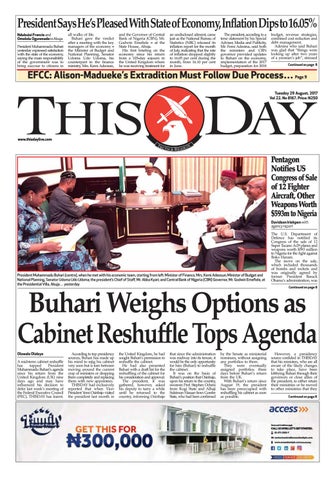
President Muhammadu Buhari (centre), when he met with his economic team, starting from left: Minister of Finance, Mrs. Kemi Adeosun; Minister of Budget and National Planning, Senator Udoma Udo Udoma; the president’s Chief of Staff, Mr. Abba Kyari; and Central Bank of Nigeria (CBN) Governor, Mr. Godwin Emefiele, at the Presidential Villa, Abuja… yesterday
The U.S. Department of Defence has notified its Congress of the sale of 12 Super Tucano A-29 planes and weapons worth $593 million to Nigeria for the fight against Boko Haram. The move on the sale, which included thousands of bombs and rockets and was originally agreed by former President Barack Obama’s administration, was Continued on page 8
Buhari Weighs Options as Cabinet Reshuffle Tops Agenda Olawale Olaleye A mid-term cabinet reshuffle has topped President Muhammadu Buhari’s agenda since his return from the United Kingdom (UK) nine days ago and may have influenced his decision to defer last week’s meeting of the Federal Executive Council (FEC), THISDAY has learnt.
According to top presidency sources, Buhari has made up his mind to rejig his cabinet very soon but is torn between moving around the current crop of ministers or dropping them completely and replacing them with new appointees. THISDAY had exclusively reported that when VicePresident Yemi Osinbajo visited the president last month in
the United Kingdom, he had sought Buhari’s permission to reshuffle the cabinet. He had also presented Buhari with a draft list for the reshuffling of the cabinet for his consideration and approval. The president, it was gathered, however, asked his deputy to tarry a while until he returned to the country, informing Osinbajo
that since the administration was midway into its tenure, it would be the only opportunity for him (Buhari) to reshuffle the cabinet. It was on the basis of Buhari’s position that Osinbajo, upon his return to the country, swore-in Prof. Stephen Ocheni from Kogi State and Alhaji Suleiman Hassan from Gombe State, who had been confirmed
by the Senate as ministerial nominees, without assigning any portfolios to them. They were eventually assigned portfolios three days before Buhari’s return from the UK. With Buhari’s return since August 19, the president has been preoccupied with reshuffling his cabinet as soon as possible.
However, a presidency source confided in THISDAY that his ministers, who are all aware of the likely changes to take place, have been lobbying Buhari through their governors or close allies of the president, to either retain their ministries or be moved to other ministries that they Continued on page 8
2
T H I S D AY TUESDAY AUGUST 29, 2017
T H I S D AY TUESDAY AUGUST 29, 2017
3
4
T H I S D AY TUESDAY AUGUST 29, 2017
T H I S D AY TUESDAY AUGUST 29, 2017
5
6
T H I S D AY TUESDAY AUGUST 29, 2017
T H I S D AY TUESDAY AUGUST 29, 2017
7
8
TUESDAY, ͺ˜ ͺͿ ˾ T H I S D AY
PAGE EIGHT
R-L: Deputy President of the Senate, Senator Ike Ekweremadu; Chief Whip of the House of Representatives, Hon. Ado Doguwa; President of the Senate, Dr. Abubakar Bukola Saraki; leader of U.S. Congress delegation, Senator Christopher Coons; Senate Leader, Senator Ahmad Lawan; and other members of the US Congress, when a delegation of the U.S. Congress met with the leadership of the National Assembly in Abuja... yesterday
BUHARI WEIGHS OPTIONS AS CABINET RESHUFFLE TOPS AGENDA deem more “important”. Buhari, it was gathered, has also been holding on to the list drafted by the vicepresident and has not made up his mind on whether to reshuffle the cabinet on the basis of the list, or make some alterations to the list before doing so.
The presidency source further revealed that Buhari has been counselled by those close to him to jettison the list given to him by Osinbajo completely and dissolve the cabinet so that he can bring in new hands that will be loyal to the president and his agenda.
According to the source, the situation has caused an air of uncertainty among his ministers who do not know if they are staying on or may be replaced. This has not been helped by the fact that Buhari, THISDAY learnt, has also decided to keep the final
decision close to his chest, given the growing interplay of interests. “The cabinet would definitely be reshuffled very soon and all the ministers know that. It is for this reason they have been lobbying their governors and allies close to Mr. President since he
returned from London. “The problem is that some of these same allies have advised Mr. President to discountenance the list that was presented by VicePresident Osinbajo when he met with him last month in London. “His allies would rather
he dissolves the cabinet completely and brings in a new team that would be completely loyal to the president. “Right now the cabinet is in a state of flux due to the uncertainty over what direction the president would go,” the source volunteered.
recorded in June as all key divisions which contribute to the index increased. On a month-on-month basis, the core sub-index increased by 1.00 per cent in July, 0.32 percentage points lower than the 1.32 per cent recorded in June. The highest increases were recorded in clothing materials and articles of clothing, furniture and furnishing, books and stationery, medical services, glassware, tableware and household utensils, accommodation services and household textiles. The average twelve-month annual rate of rising of the index was recorded at 15.80 per cent for the twelve-month period ending in July, 0.42 percentage points lower than the twelvemonth rate of change recorded in June. The NBS report further showed that the average price paid by consumers for
petrol increased by 0.3 per cent year-on-year and decreased by -1.4 per cent month-on-month to N148.2 in July, from N150.3 in June. States with the highest average price of petrol were Yobe (N170), Borno (N160.50) and Adamawa (N160). States with the lowest average price of petrol were Bauchi (N145.4), Lagos (N145.3), and Abuja, Akwa Ibom, Bayelsa, Cross River, Delta, Edo, Ekiti, Kaduna, Kano, Katsina, Kebbi, Ogun, Ondo, Osun and Sokoto (N145.0).
PRESIDENT SAYS HE’S PLEASED WITH STATE OF ECONOMY, INFLATION DIPS TO 16.05% that “he was pleased with the progress being made on different fronts”. Adesina said Buhari discussed monetary policy strategies and their economic impact with the ministers and CBN governor, adding that the president reminded them that the country’s economic revival was one of the major campaign policies of his party, the All Progressives Congress (APC) and urged them to keep it up. However, the inflation report released by the NBS yesterday showed that the rate of inflation declined by 0.05 per cent in the month of July to 16.05 per cent, from 16.10 per cent in June. Although this was the sixth consecutive decline in the inflation rate since January 2017, the food index soared to 20.28 per cent in July, the highest in eight years. According to the NBS, the July inflation figures showed that increases were recorded in
all Classification of Individual Consumption by Purpose (COICOP) divisions that yield the headline index. On a month-on-month basis, the headline index increased by 1.21 per cent in July, 0.37 percentage points lower than the 1.58 per cent recorded in June. The percentage change in the average composite CPI for the twelve-month period ending in July over the average of the CPI for the previous twelve-month period was 17.47 per cent, 0.11 percentage points lower than the 17.58 per cent recorded in June. The urban index rose by 16.04 per cent (year-on-year) in July, down by 0.11 percentage points from 16.15 per cent recorded in June, while the rural index increased by 16.08 per cent in July, from 16.01 per cent in June. On a month-on-month basis, the urban index rose by 1.25
per cent in July, down by 0.35 percentage points, from 1.60 per cent recorded in June, while the rural index rose by 1.18 per cent in July, down by 0.39 percentage points, from 1.57 per cent in June. The corresponding twelvemonth year-on-year average percentage change for the urban index increased from 18.69 per cent in June to 18.43 percent in July, while the corresponding rural index also increased from 16.56 per cent in June to 16.60 per cent in July. The NBS report showed that food price pressure continued into July, as all major food sub-indexes increased. The food index increased by 20.28 per cent (year-on-year) in July, up by 0.37 percentage points, from the rate recorded in June (19.91 percent), representing the highest year-on-year increase in food inflation since the beginning of the new series in 2009, said
the NBS. The rise in the index was caused by increases in the prices of bread and cereals, meat, fish, oils and fats, coffee, tea and cocoa, potatoes, yam and other tubers and vegetables. On a month-on-month basis, the food sub-index increased by 1.52 percent in July, down by 0.47 percentage points from 1.99 per cent recorded in June. The average annual rate of change of the food subindex for the twelve-month period ending in July over the previous twelve-month average was 18.25 per cent, 0.38 percentage points from the average annual rate of change recorded in June of 17.87per cent. The “All Items less Farm Produce” or core sub-index, which excludes the prices of volatile agriculture produce eased by 0.30 per cent during the month by 12.20 percentage points, from 12.50 percent
PENTAGON NOTIFIES US CONGRESS OF SALE OF 12 FIGHTER AIRCRAFT, OTHER WEAPONS WORTH $593M TO NIGERIA announced by the Pentagon’s Defence Security Cooperation Agency (DSCA) on August 2. According to the News Agency of Nigeria (NAN), the Super Tucano A-29, an agile, propeller-driven plane with reconnaissance and surveillance as well as attack capabilities, is made by Brazil’s Embraer. A second production line is in Florida, in a partnership between Embraer and privately held Sierra Nevada Corp of
Sparks, Nevada. The Super Tucano costs more than $10 million each and the price can go much higher depending on the configuration. It is powered by a Pratt & Whitney Canada PT 6 engine. The Obama administration had delayed the deal after incidents including the Nigerian Air Force’s bombing of a refugee camp in January that killed 90 to 170 civilians.
But President Donald Trump had said he planned to go ahead with foreign defence sales delayed under Obama by human rights concerns. The DSCA delivered their certification of the foreign military sale to the US Congress, as required by law, on August 2, according to United Press International. The twelve A-29s, equipped with wing-mounted machine guns, weapons integration
with advanced surveillance… precision-guided bombs, and even air-to-air missiles, are expected to be used by Nigeria to combat the Boko Haram insurgents and other extremist groups, such as the Islamic State West Africa splinter group. They will also serve to counter smuggling and other trafficking in Nigeria and the Gulf of Guinea. The DSCA has determined that U.S. security interests are
served by assisting Nigeria in its counter-insurgency operations and that the A-29 sale will not significantly alter the military balance of power in the region. The contract will require U.S. government or private contractors to provide training and support, and will include instruction on rules of engagement and human rights to help prevent civilian casualties.
TOP GAINERS NGN NGN % TOTAL 19.70 236.50 9.0 AIRSERVICE 0.27 5.68 4.9 CUTIX 0.10 2.11 4.9 VITAFOAM 0.12 2.79 4.4 CONTINENTAL 0.05 1.34 3.8 TOP LOSERS NGN NGN % MOBIL 9.62 182.93 5.0 TRANSEXP 0.04 0.76 5.0 CONOIL 1.37 27.70 4.7 CHAMPBREW 0.11 2.34 4.4 LIVESTOCK 0.04 0.90 4.2 HPE Nestle Nig Plc ₦1,220.00 Volume: 346.112 million shares Value: N2.977 billion Deals: 3,276 As at yesterday 28/8/17 See details on Page 31
TUESDAY AUGUST 29, 2017 ˾ T H I S D AY
9
NEWS
News Editor Davidson Iriekpen Email davidson.iriekpen@thisdaylive.com, 08111813081
EFCC: Alison-Madueke’s Extradition Must Follow Due Process Court orders permanent forfeiture of N7.6bn linked to former minister FG asks US to stop providing safe haven for Nigerian loot
Davidson Iriekpen in Lagos, Omololu Ogunmade and Paul Obi in Abuja As calls for the extradition of former Minister of Petroleum Resources Mrs. Diezani Alison-Madueke to Nigeria gathers pace, the Economic and Financial Crimes Commission (EFCC) yesterday said due process must be followed in demanding for her return. Alison-Madueke, who is facing multiple corruption and money laundering allegations during her tenure as minister and is being investigated by the British and American authorities, has been living in the United Kingdom for two years where she is receiving treatment for cancer. Speaking during a protest march to the EFCC headquarters by a group operating as “Concerned Nigerians” under a new hashtag,#BringBackDiezani, the EFCC insisted on adhering to the rule of law. Speaking on behalf of Ibrahim Magu, acting EFCC chairman, the executive secretary of the commission, Emmanuel Aremo, stated that the anti-graft agency remained committed to the rule of law, as it remains the antidote to fighting corruption. “Let us be patient and let us follow due process, we on our part will ensure that no stone is left unturned as we intensify the war against corruption,” he said. Aremo also tasked the group, led by popular activists, Deji Adeyanju and Charles Oputa (better known as Charly Boy) not to relent in their support for the EFCC, adding that the anti-graft agency needs support across the board in the fight against corruption. “I urge Nigerians to be patient because extradition requires a painstaking process that must be followed,” he said. He assured them that the former minister would soon be extradited to face the corruption allegations against her. While commending the EFCC for intensifying the fight against corruption, Charley Boy expressed concern that “it is not enough for Alison-Madueke’s assets to be forfeited, there should be a conviction.” Adeyanju called on the EFCC not to relent in prosecuting the fight against corruption, adding that after the two-day sit-out, which began yesterday at the
EFCC headquarters, the group will take the protest calling for Alison-Madueke’s extradition, to the UK. He said: “Our message is simple: since you don’t want to assist the UK in prosecuting her, #BringBackDiezani. Also, prosecute everyone whether PDP or APC. “Diezani is enjoying in London. Look at her press release the other day. She is practically laughing at Nigerians. You don’t need Baba to give any instruction before you swing into action. Corruption is just everywhere,” he pointed out. The group’s two-day sit-out at the EFCC’s headquarters demanding for the former minister’s extradition to face the corruption allegations will continue tomorrow. Charly Boy and Adeyanju had earlier staged a daily sit-out both in Nigeria and London under the group names, #ResumeorResign” and “#OurMumuDonDo” against President Muhammadu Buhari which eventually led to the president’s return to the country after being abroad for 103 days where he had been receiving treatment for an undisclosed ailment. But as the protesters demanded for Alison-Madueke’s extradition, a Federal High Court in Lagos yesterday ordered the permanent forfeiture of yet another N7.64 billion linked to her to the federal government. Justice Abdulazeez Anka gave the order following the application filed by the EFCC seeking the final and permanent forfeiture of the said sum to the federal government. The anti-graft agency, in its supporting affidavit, averred that based on its investigation, it discovered that the N7.4 billion kept in the accounts of some banks were actually the proceeds of unlawful activities held and laundered through a former Group General Manager, Crude Oil Marketing Division of the Nigerian National Petroleum Corporation (NNPC), former Managing Director of Petroleum Products Management Company (PPMC), Prince Haruna Momoh, and the Managing Director of Nigerian Products Marketing Company (NPMC), Umar Farouk Ahmed, on behalf of Alison-Madueke. On August 9, 2017, a vacation judge, Justice Chuka Obiozor, had granted an order temporarily forfeiting the money to the federal government.
ASUU, FG to Meet Again Today In furtherance of efforts at resolving the lingering industrial action embarked upon by the Academic Staff Union of Universities (ASUU), the Minister of Labour and Employment, Senator Chris Ngige will today meet with the president and executive of ASUU, government delegation. THISDAY gathered that at the meeting will include the Minister of Education, Minister of Finance, Chairman National Income Salaries and Wages Commission, Executive Secretary National Universities Commission and the President
of the Nigerian Labour Congress (NLC). In a statement by the Deputy Director of Press in the Ministry of Labour and Employment, Samuel Olowookere, Ngige recalled that ASUU had earlier promised during the last meeting held on Thursday, August 17, 2017, to take the offer of the federal government back to its members and get back to the federal government within a week. Ngige called on ASUU to show good faith as the federal government had already demonstrated its commitment to addressing the grievances of the union.
Justice Obiozor’s order followed an ex parte application argued before him by the EFCC. He adjourned till yesterday for the bank and any other interested party to appear before him to show cause why the funds should not be permanently forfeited to the federal government. The EFCC told the judge that the N7.64 billion was part of a sum of $153,310,000, which Alison-Madueke allegedly siphoned from the coffers of the NNPC sometime in 2014. The anti-graft agency said she stashed the money in three banks, adding that the federal government had since February last year, through an order by Justice Muslim Hassan of the Federal High Court, Lagos recovered part of the money from the other banks. The anti-graft agency recalled that the federal government had recovered N23.4 billion, $5 million and another N9.08 billion of the $153.3million million.
It urged the court to order the banks to deliver up to the federal government the N7.6 billion still in their custody. In an eight-paragraph affidavit, an operative of the EFCC, Usman Zakari, averred that the former petroleum minister laundered the money in connivance with other officials of the NNPC. The same Justice Obiozor had also on August 7, 2017, ordered the permanent forfeiture to the federal government of a $37.5 million Banana Island property allegedly bought in 2013 by Alison-Madueke. The property designated as Building 3, Block B, Bella Vista Plot 1, Zone N, Federal Government Layout, Banana Island Foreshore Estate, consists of 24 apartments, 18 flats, and six penthouses. The judge also ordered that $2,740,197.96 and N84,537,840.70 realised as rent on the property be permanently forfeited to the
government. Last Tuesday, the Federal High Court in Lagos also ordered the interim forfeiture of 56 properties allegedly bought between 2011 and 2013 for $21,982,224 (N3.32 billion) by Alison Madueke. Justice Abdulaziz Anka had adjourned until September 8 for anyone to show cause why the properties should not be permanently forfeited to the federal government. On August 8, 2017, it was further revealed that the EFCC had traced N47.2 billion and $487.5million to the ex-minister. The agency also claimed that the former minister had N23,446,300,000 and $5 million (about N1.5 billion) cash in various banks, which were yet to be forfeited. The commission is also investigating properties in Britain and the United States she allegedly purchased with stolen government funds.
But despite the orders and revelations, Alison-Madueke who was a powerful member of former President Goodluck Jonathan’s cabinet from April 2010 to May 2015, has consistently denied the allegations. Meanwhile, Vice-President Yemi Osinbajo has said that the federal government has reached out to the government of the United States to assist it in stopping corrupt Nigerians from securing a safe haven for their loot abroad. A statement by his media aide, Mr. Laolu Akande said the vicepresident made the remark during the visit of a US congressional delegation to the Presidential Villa yesterday in Abuja, pointing out that both countries were working together on the prompt repatriation of funds looted from Nigeria. “We have reached out to the US government with respect to Cont’d on pg 37
INVESTITURE OF A FRIEND
L-R: Outgone National President, Boys Brigade Nigeria, Hon. Prince Yandev Amaa-Bai; New National President of Boys Brigade, Sir Sunday Nnamdi Nwosu; Monsignor Christopher Boyo; President, Nigeria Stock Exchange, Mr. Aigboje Aig-lmoukhuede; and Chairman,Council of Patrons, Dr. Barnabas Gemade, during the investiture of Nwosu as the new National President of Boys Brigade held at. St Ferdinand Catholic Church, lpaja, Lagos....Sunday Abiodun ajala
In Chaotic Primary, Obaze Emerges PDP Candidate for Anambra Guber Poll Ifeanyi Ubah protests flawed delegates’ list David-Chyddy Eleke in Awka The Peoples Democratic Party (PDP) has elected a diplomat and former Secretary to the Anambra State Government (SSG), Mr. Oseloka Obaze, as its candidate for the Anambra State governorship election which comes up in November. Obaze was declared elected by the Chairman of the Election Committee, Governor Dave Umahi of Ebonyi State. He said: “By the powers conferred on me, I hereby declare Oseloka Obaze, having scored the highest vote as the candidate of the PDP for the Anambra governorship election.” He polled 672 votes to beat the
duo of Dr. Alex Obiogbolu and Mr. Ifeanyi Ubah who scored 190 and 94 votes respectively. Two votes were declared invalid. Of the seven aspirants running on the party’s platform, four had pulled out of the race. While Prof Ufodike announced his withdrawal without giving a reason, but pledged to support any of the aspirants that emerged, Prince John Emeka, a former minister, had hours before the election withdrawn from the race, citing alterations in the delegates’ list of the party as reason for his action. Two women who were also in the race, Stella Oduah, a serving senator and former Minister of Aviation, and Hon. Linda Ikpeazu, a serving member of the House of Representatives, were also said to
have backed down for undisclosed reasons. Obaze’s election came after over two weeks of high power politicking, characterised by intrigues among major politicians in the state, including former governor of the state, Mr. Peter Obi, who was believed to have an anointed aspirant among the seven contesting for the ticket of the party. Obaze served as the ninth SSG of Anambra State from 2012 to 2015 under the duo of Obi and incumbent governor, Willie Obiano. A former Nigerian Foreign Service Officer and United Nations official, Obaze is a diplomat, strategic policy adviser, policy analyst, writer, public speaker and seasoned administrator. He will be contesting the
election against his former boss, Obiano, and the candidate of the All Progressives Congress, Tony Nwoye, among others. However, yesterday’s exercise did not end without crisis as Ubah protested the use of a “fake” delegates’ list for the election. Ubah, who rejected the outcome of the result announced by Umahi, stormed the podium, seized the microphone and announced that the list was doctored. He said he had gone to court to challenge the validity of the delegates’ list, adding that he would challenge the process and ensure that the illegality perpetuated against him does not stand. Ubah however, thanked Umahi and security agents for the peaceful conduct of the election.
10
TUESDAY AUGUST 29, 2017 ˾ T H I S D AY
NEWS
Misau Challenges Police to Address Issues of Corruption PSC commences investigation into senator’s retirement claims Damilola Oyedele and Paul Obi in Abuja Senator Isa Hamman Misau (Bauchi Central) has challenged the Nigerian Police to address allegations of corruption and nepotism he raised in some media interviews, rather
than resort to attacking his person. This is as he maintained that he did not desert the police force as being claimed by the Force Public Relations Officer, Jimoh Moshood. Misau and the police have engaged in a war of words following the latter’s media
FG Declares Friday, Monday Public Holidays The federal government has declared Friday, September 1 and Monday, September 4, 2017, as public holidays to mark Eid-el-Kabir celebration. The Minister of Interior, Lt Gen. Abdulrahman Bello Dambazau (rtd), who made the declaration on behalf of the federal government, congratulated Muslim faithful and urged all Nigerians to use the occasion to pray for peace, unity, prosperity and stability of the country’s democracy. Dambazau further urged all Nigerians to join hands with the government of President Muhammadu Buhari in its avowed determination to build a peaceful and harmonious country, where the rights of every citizen are protected and guaranteed, as enshrined in the 1999 Constitution. The minister in a statement
signed by the Director Overseeing the Office of the Permanent Secretary (DOOPS), Dr. Rufa’i Kawu Attahiru, assured Nigerians of their safety in all parts of the country, emphasising that security agencies have been directed to maintain peace and protect lives and property. He condemned in strong terms the prevalence of hate speeches in the country and warned that the government would henceforth deal with perpetrators according to the law, while emphasising that the government would continue to foster peaceful coexistence, national cohesion and stability in its march towards actualising the full potential of Nigeria. The minister wished all Nigerians a most rewarding and happy Eid-el-Kabir celebration.
interviews accusing the Inspector General of Police (IG), Mr. Ibrahim Idris, of corruption and nepotism. Misau had alleged that the IG collects between N10 million and N15 million from police officers for postings such as state police commissioners or mobile commanders, in addition to him pocketing about N10 billion monthly from the deployment of over 50,000 policemen to oil companies, banks, and private individuals who make regular payments to police authorities. The police PRO however refuted all the allegations made by the lawmaker, and accused him of being out to discredit the police. The police had during the weekend accused Misua of “dubiously absconding and deserting the Nigeria Police Force on September 24, 2010, when he was redeployed to Niger State Command and he refused to report, consequent upon which he was queried in line with the Public Service Rules Sections 030301(b) (g)(m)&(o) and 030402(a)(b)(c) (e)&(w), in addition to the previous queries and disciplinary process he was facing when he refused to proceed on Junior Command Course(JCC) 49/2008 at Staff College
Jos between January 5, 2009, and June 19, 2009.” Police Public Relations Officer, Moshood, told journalists weekend that “the retirement letter presented to the journalists by DSP Mohammed Isa Hamman was suspiciously forged and dubiously obtained. “The letter which was dated March 5, 2014, a period of more than four years after AP No 57300 DSP Mohammed Isa Hamman (Senator Isah Hamman Misau) deserted the Force is now being investigated by the Force,” he said. In a statement yesterday, Misau, however said he was not on the run, and cannot therefore be declared wanted, as he has been in ‘plain sight’ since he left the force. He urged the police to address his allegations of illegal promotion and nepotism which could undermine the operational capacity of the police, rather than resort to attack his person. “The real issue is the illegal promotion in the police force and its potential to undermine operational capacity of the Force. The IG and the chairman of Police Service Commission (PSC) should prove me wrong and not embark on voyage of discovery.”
“I am not surprised that the police force left unaddressed, the weighty issues raised in my concerns over unwholesome practices in an institution I dedicated the active part of my youthful years to attack my integrity. It only goes to affirm my worries over the current leadership of the Force. For the avoidance of doubt, I strictly followed the provisions of the Police Act and Regulations in resigning my position with the Nigerian Police,” he said. Misau added: “Not wanting to join issues with the rambling incoherence of the Force spokesman, the police have always known my whereabouts since my resignation. Moreover, I have been in the Senate for about two and half years without any mention of my deserting until my innocuous caution against practices capable of destroying the police force. “It is beyond curiosity that the police would be looking for someone clearly in plain sight for these past years. Little wonder the proliferation of crime in the country and the police apparent cluelessness, especially under the current leadership of IG.” Meanwhile, as the controversy
between Misua and the police takes a downward trend, the PSC yesterday said it had commence investigation into the claims by the lawmaker that he officially retired from the force before venturing into partisan politics. Speaking to THISDAY, PSC Head of Media and Information, Ikechukwu Ani, said investigation on the matter had already commenced. “We want to confirm whether the PSC Director of Recruitment who was there when the thing happened, the person that signed that letter, Mrs. Logam actually signed the letter. “They want to confirm whether the letter left the commission, and to confirm whether she signed and delivered the letter. “There are controversies about the letter. So the commission wants to actually confirm whether she actually issued that letter; signed or issued that letter. “There are issues warranting this investigation, there are issues, that is why we want to confirm the letter,” Ani stated. Efforts to speak to the Police PRO, CSP Moshood, were not fruitful as he did not respond to calls put across to him.
Anyaoku: Nigeria’s Present Governance Architecture Not Sustainable Solomon Elusoji Former Commonwealth SecretaryGeneral, Chief Emeka Anyaoku, has again called for restructuring of the country, noting that the present system of governance, which only pays lip service to true federalism, is not sustainable. The diplomatic icon made these remarks in Lagos yesterday at the public presentation of ‘Africa in Transition’, a book written by Ejeviome Eloho Otobo. “As I have said on many other occasions, our country, given its current frustrating circumstances in virtually all sectors, will not achieve political stability if it continues to be under its present governance architecture, which pays only lip service to federalism,” Anyaoku said. He pointed out that the route to political stability, for any country with the kind of diversity that Nigeria has, is through true federalism, a fact recognised and agreed by Nigeria’s founding fathers in the constitutions of 1960 and 1963. According to him, “My call for restructuring is predicated on the belief that there is no part of Nigeria that does not benefit from belonging to a country of the size and endowment of Nigeria. “There is no part of the country that wants to break away. Restructuring, as some critics feel, will not lead to disintegration of the country. It will instead create a path to ensuring a united country, with an improved chance for progressive development.” Anyaoku went on to stress that restructuring means having fewer and more viable units with each having its own constitution, “as against the present 36 most unviable federating units that we currently have.
Also, it means leaving to the central government responsibilities for only such national assets and institutions as defence, monetary policy and currency, foreign affairs, immigration, customs, and such similar national institutions.” Fiscal federalism, too, with each federating unit developing and managing its resources and contributing agreed percentage of its revenue to the centre, also came under Anyaoku’s definition of restructuring. He stated that restructuring also means “each federating unit being responsible for all aspects of its socio-economic development, health, education, power, transportation (except inter-regional facilities such as roads, railway). “And it will mean saving us the current argument over the lowering of the benchmark for admission into universities, which I believe is a prescription for lowering the quality of university education in our country.” Meanwhile, Anyaoku recommended the ‘Africa in Transition’ book to all those who are interested in understanding why African countries’ efforts towards speedier development are stalling and how they can improve the quality of their various transitions to a stable and progressive development. “I believe that there are many useful lessons which policymakers and advisers in Africa can draw from this book, especially in appreciating the importance of a holistic approach to the perception and planning of the transition of their countries to stable and progressive development,” he said.
32 HEARTY CHEERS
L-R: Senator Florence Ita-Giwa; Celebrant, Mr. Chimaobi S. Obioha Jr; his wife, Kokoeka; and Mrs. Evelyn S. Obioha, during the 32nd birthday celebration dinner held in honour of Chimaobi in Lagos..... weekend. Mubo Peters
Fayose, Senator Olujimi’s Supporters in Bloody Clash in Ekiti Victor Ogunje in Ado Ekiti Several persons were reportedly wounded last Sunday evening as supporters of Governor, Ayodele Fayose, and those of Senator representing Ekiti South senatorial district, Mrs. Abiodun Olujimi, engaged in a bloody clash. Fayose and his estranged goddaughter, Olujimi , had been enmeshed in crisis over the latter’s governorship ambition, which the governor was alleged not to have been favourably disposed to Two members of the state House of Assembly, Hons Adeojo Fajana and Michael
Adedeji, are under probe over their alleged loyalty to Olujimi, who is now in the bad books of the governor. The clash allegedly took place in Kota-Ekiti in Ekiti East Local Government Area of the state during the meeting of the Peoples Democratic Party (PDP). A source privy to how the clash started said the two factions had come to the meeting with mindsets to outdo each other, which he said made the personalities involved to start displaying overt enmity towards each other shortly after the meeting commenced. According to the source, the lawmaker representing Ekiti
East constituency II and a known Fayose’s ally, Hon. Dare Pelemo, was said to have been beaten, with his clothes torn to shreds by Olujimi’s angry supporters. Those wounded during the clash were said to have been taken to an undisclosed hospital for treatment. The source said: “The meeting ended in disarray as the team loyal to the senator and those loyal to the governor exchanged fisticuffs. “The House of Assembly member representing Ekiti East constituency was beaten while other members of the team loyal to Fayose ran for their lives.” The fight had attracted those
in the neighbourhood and they were said to have been frightened to the extent that they had to run for their lives. When contacted, Pelemo said Olujimi’s group actually attacked him but said he was never beaten to stupor as being rumoured. “Yes, they attacked our members at the meeting just because they wanted to show supremacy they didn’t have. “We have enough followers on ground who could deal with them, but we decided not to do so. Fayose is a popular politician with wide followership, so these few people couldn’t have overpowered us as they claimed in social media,” Pelemo stated.
T H I S D AY TUESDAY AUGUST 29, 2017
11
12
T H I S D AY TUESDAY AUGUST 29, 2017
T H I S D AY TUESDAY AUGUST 29, 2017
13
14
T H I S D AY ˾ ˜ Ͱͷ˜ Ͱͮͯ͵
COMMENT
Editor, Editorial Page PETER ISHAKA Email peter.ishaka@thisdaylive.com
AFRICAN DIPLOMACY COMING TO AFRICANS
Okello Oculi canvasses the need to invest the future of Pan-Africanism in the creative energies and imagination of Africa’s youth
O
n November 11, 2013, Dr Nkosazana DlaminiZuma (former Chair of the Africa Union Commission - the administrative arm of the African Union), was very excited by information that Nigeria’s youth and media had a rich history of promoting public awareness about African diplomatic affairs. She was told that from 1977 to date, students at Ahmadu Bello University sustained a tradition of presenting simulations of Summits of the African Union to campus crowds. At the high marks of its manifestation between 1978 and 1990, the Nigerian Television Authority (NTA) Kaduna, boosted their reach with telecasts to wider audiences of highlights of three-hour presentations. In 1988, a nation-wide service 50-minute long telecast thrilled the nation. From 2004, it was introduced to Day Secondary School of Lungi Military Barracks in Maitama District, Abuja. In 2005, Anglican Girls Grammar School (AGGS) in Abuja, and Makini Secondary School in Nairobi, Kenya welcomed it. On November 16, 2006, a joint team from both schools conducted a summit to an audience of 2000 student leaders assembled at the International Conference Centre in Abuja. On January 29, 2014, Presidents of Zimbabwe and Senegal at AGGS presented a mini-summit to an Africa Youth Forum holding at Addis Ababa, Ethiopia. Their travel was sponsored by the African Union Commission and the Olusegun Obasanjo Foundation (OOF). Dr. Dlamini-Zuma was fired by this narrative and created a new initiative titled ‘’Continental Model African Union’’. It will urge all member states of the African Union to adopt simulations of African Union summits in their educational programmes. An official organ of PanAfricanism had, in 2015, adopted a product sprouted from the bosom of African academia. The year 1963 saw the flowering of visions and intellectual genius by many of Africa’s politicians and public officers in a drama of diplomacy which yielded the founding of the Organisation of African Unity (OAU). From Nigeria two young officials in Prime Minister Tafawa Balewa’s office, Muhammadu Sanusi and Leslie Harriman, criss-crossed Africa to counter Kwame Nkrumah’s call for creating a United States of Africa (UNSA). Elderly Emperor Haile Selassie (Ethiopia), William Tubman (Liberia), Houphuet Boigny (Ivory Coast) and Jomo Kenyatta (Kenya) were joined by a younger Julius Nyerere (Tanganyika) to creating a tool for a mere aspiration towards union government in Africa. The diplomatic jostling of the emerging Pan-Africanism was conducted outside the hearing of the masses of the public. The monopoly of teaching jobs in the few universities in Africa by expatriate academic staff from imperial countries blocked a local tradition of academics participating in making foreign policy. While an association by West African students studying in European colleges were active in calling for African unity, the politicians meeting in Addis Ababa on May 25, 1963 excluded them from the peppersoup. Nigeria’s Academic Staff Union of Universities (ASUU) and their counterparts in Kenya and Uganda’s premier institution, Makerere University, have since the 1970s been
THE INTELLECTUAL DECAY FROM ECONOMIC OPPORTUNISM BY ACADEMIC STAFF GRABBING WAGES FROM THREE TO FOUR UNIVERSITIES EVERY MONTH RUINS CREATIVE INTEGRATION OF AFRICAN DIPLOMATIC ACTIVITIES INTO LECTURES AND PUBLICATIONS
fighting for ‘’Africanisation’’ of curricula; and quality ‘’infrastructure’’ for their work. They want equipped laboratories; and research treks across Africa. They are enraged by official priority for luxury vehicles and residences that feed inferiority complexes of multitudes of bureaucrats and parliamentarians. Lacking power to discipline traditional ideologies hostile to seeing citizens as masters (to be served by government authorities), academics fume and scream in frustration. In Nigeria, Kenya and Uganda, government officials have reacted, at worst, with throwing at them violence, denial of salaries, and detention with torture. Visions for PanAfricanism remained blunted. Collapse in incomes by academics in clusters of private and government-owned universities in Nairobi, Kampala and across Nigeria, have led to migratory teaching across campuses. This has killed use of tutorials to complement lectures. Staffers suffer exhaustion from racing to get to waiting students. Private universities pirate on staff in public institutions, thereby: depleting quality of performance inside both sites. The intellectual decay from economic opportunism by academic staff grabbing wages from three to four universities every month ruins creative integration of African diplomatic activities into lectures and publications. Hostile governance has also denied Pan-African growth from stimulation by several intellectual giants. Death threats sent Kenya’s two stars: Micere Mugo and Ngugi wa Thiongo, into exile and productive years in American universities. Wole Soyinka slipped through General Sani Abacha’s hunt. Chinua Achebe was crippled into a wheelchair by potholes on a major road. Claude Ake’s death in a domestic plane crash terminated his support for Niger Delta’s growth. In Senegal, Professor Cheik Anta Diop was banned from lecturing in the local university, and Francophone countries. The film-maker Ousmane Sembene was required to apply for visas to travel out of Senegal. Pre-occupation with protesting against venalities and inferiority complexes of rulers crippled constructing a theory of African society for development. Julius Nyerere’s theory of ‘’Ujamaa/Familyhood’’; the ‘’Lagos Plan of Action’’, and the novel ’’African Peer Review Mechanism (APRM)’’ remained without disciples. Lack of research on China, India, Japan and the former Soviet Union inhibits lessons for Africa from their geniuses. Economic impoverishment resulting from repaying debts accumulated by profligate ruling elites gulp funds for research to promote African cross-border prosperity by local farmers and industrialists. In Nigeria universities decayed in the middle of the country’s highest earnings from oil revenues. Corrupt elites chose hiding looted funds outside Africa and away from promoting research on mutual peer review by African governments. In the light of these handicaps, investing the future of Pan-Africanism in the creative energies and imagination of Africa’s youth is clearly urgent. Prof Oculi is a member of THISDAY Editorial Board
AS PRESIDENT BUHARI RETURNS The president is getting his act together, writes Godwin Etakibuebu
A
fter more than 100 days of being away from Nigerian soil in search of good health in the United Kingdom, President Muhammadu Buhari returned on Saturday 19, August, 2017. That is the good news – he returns alive and even looking healthier than before. We, the Nigerian people who prayed for him fervently while his battle for life lasted, thanked the almighty God, the creator and keeper of life, for hearing and answering our prayers on Buhari. We have every reason to thank God. The last time a Nigerian president was “evacuated” from Abuja to another country in search of good health and life, he did not return alive. That was President Umaru Musa Yar’Adua, from Katsina State; the same state President Buhari hails from. Musa Yar’Adua was two years in office when he was rushed to Saudi Arabia for medical treatment but never returned. Muhammadu Buhari was also two years in office before he left for the United Kingdom, and the contrasting good news concerning the latter is that he returned alive. In a national broadcast on August 21, a gracious and grateful President Buhari thanked Nigerians in deep appreciation for their prayers and love for him while the dark days of battling this unnamed ailment in the UK lasted. Thanking the Nigerian
people showed a few things. One, the thanksgiving broadcast revealed that the man is in a very good state of mental alertness. That itself speaks of a vastly improved health for a man that was even rumoured to have died at one point by some cynics. Two, the Nigerians he thanked may be only about 97% of the population [because if the truth must be told, the possibility of having about 3% that never prayed for him may remain a likely fact]; but this 97% population he thanked spread across the country – from north to south. I believe that the president did not interpret, by any imagination of error, this population of 97% as representing those in the Northwest and Northeast that voted him into office during the 2015 general election. He could not have committed such episcopal blunder in the “thank you” broadcast. Three, it means that, having appreciated all Nigerians beyond a parochial geo-political section, he would, all things being equal, henceforth be more pragmatic in the distribution of goodwill in appointments and related matters across all segments of the Nigerian society, without any prejudice to tribes and religion. Four, for the very first time in his presidency, Buhari mentioned, during the broadcast, herdsmen as enemy of the Nigerian state that needed to be tackled as
such – enemy. This exceptionally pointed to a “born again” President Buhari, who would have preferred, in the past, not to border about mentioning the herdsmen, but cattle rustlers. Five, he gave a red card to those propagating hate conduct and speech. It was like telling them that their days were over. Six, he told those Arewa rascals, through the broadcast, never to gather in Arewa House in Kaduna ever again with the intention of serving quit notice for non-Hausa to vacate what they wrongly believed is “their land”. Seven, he spoke to those hoisting flag for a Biafran Republic that never was and may not likely be unless and until the constitutional due process of restructuring Nigeria fails, that the game is over. Eight, still talking about the broadcast, he re-affirmed unassailable belief and confidence in a one indivisible unified Nigerian where equity rules – a country where religion and tribe do not decide the limit of ascendancy for the citizenry. That rekindled hope that Mr. President is on his way to restructuring the face of appointments in federal government institutions in the country, starting with the Ministry of Internal Affairs which is presently [at the head of all the departments], to all intents and purposes, for only Hausa/Fulani Moslems. Nine, there was joy in his voice as he
spoke to Nigerians during that broadcast. There was no evidence of impaired or blurred speech while he talked. This was obvious from the airport as he came down from the plane. We saw Buhari, despite his age and in spite of the sickness, walked out [of the plane] elegantly with his traditional military swagger. He even added the enviable military arrogance to the whole show as he took the traditional military salute. Ten, in the broadcast, while accepting the reality of the fact that Nigeria needs one major or fundamental “surgery” in the name of restructuring, he however, in a great show of naivety, ceded the assignment [of restructuring] to two federal institutions namely: the National Assembly and National Council of States. No sir, Mr President, you got it all wrong by this expression [that the restructuring of Nigeria is the responsibility of those two bodies]. I need to exercise quality restraint at this point, at least not to continue “firing” my objection against your opinion on this subject of restructuring because the purpose of today’s work is welcoming you back home, knowing fully that any leader that objected to total restructuring of Nigeria will not only kill Nigeria but will give it [Nigeria] a non-befitting burial. You are welcome back home Sir. Etakibuebu, a veteran journalist, wrote from Lagos
15
T H I S D AY Ëž Ëœ Í°ÍˇËœ Í°ÍŽÍŻÍľ
EDITORIAL THE MILITARY AND THE SOCIAL MEDIA The military has no power to infringe on rights of citizens
T
hat some pranksters last week posted online their own parody versions of President Muhammadu Buhari’s speech has given the military the justiďŹ cation for its “strategic media centresâ€? with the mandate “to monitor social media in order to sieve and react to all anti-government, antimilitary, and anti-security propagandaâ€?. At least that is what the Director of Defence Information, MajorGeneral John Enenche, has told Nigerians. But in as much as we understand the necessity for balancing the imperative of national security and free speech, the military cannot be a law unto themselves in matters that touch on the constitutionally guaranteed rights of citizens. While the military should collect covert intelligence on true and credible threats to national security, the right of citizens to free exchange via the Internet as an extension of the right to freedom of expression must not be tampered with. Matters like hate speech, child pornography and other social vices on the internet can WHAT WE CANNOT be controlled after passing the relevant SUPPORT UNDER ANY laws. Besides, there GUISE A BLANK CHEQUE are today very FOR THE MILITARY TO sophisticated security WANTONLY SNOOP ON measures for cyber INNOCENT CITIZENS security which can AND BEGIN TO VIOLATE be deployed without THEIR CONSTITUTIONAL breaching citizen RIGHT TO PRIVACY OF rights. Our military COMMUNICATION should avail themselves of those technologies without resorting to the typical Nigerian crudity of ‘stop and search’. We want to make it absolutely clear that we support, without any qualiďŹ cation, measures that seek to advance the frontiers of our national security, especially at these troubling times. We also welcome genuine and well-targeted efforts to curb the misuse of modern communication technology to promote hate speech. What we cannot, and shall not, support under any guise is a blank cheque for the military to wantonly snoop on innocent citizens and begin to violate their constitutional right to privacy of com-
Letters to the Editor
munication. While we understand the challenge of fake news which is actually a global phenomenon, dealing with it is not within the remit of the military. Besides, the excuse by Enenche was more like an afterthought: “Imagine when the president came back and addressed the nation, not up to 30 minutes later, a fake speech of the Commander-In-Chief was being circulated in order to derail the people. If you are not very sharp and if you didn’t listen to the speech or you don’t have a copy of it like I had it almost immediately, you wouldn’t know. So, looking at it from that perspective, it is a challenge everywhere.�
A
T H I S DAY EDITOR DEPUTY EDITORS ˜ MANAGING DIRECTOR DEPUTY MANAGING DIRECTOR CHAIRMAN EDITORIAL BOARD
EDITOR NATION’S CAPITAL
T H I S DAY N E W S PA P E R S L I M I T E D EDITOR-IN-CHIEF/CHAIRMAN GROUP EXECUTIVE DIRECTORS ˜ ˜
˜ GROUP FINANCE DIRECTOR DIVISIONAL DIRECTORS ˜ ˜ DEPUTY DIVISIONAL DIRECTOR
SNR. ASSOCIATE DIRECTOR ASSOCIATE DIRECTORS ˜ CONTROLLERS ˜ ˜
GENERAL MANAGER
GROUP HEAD DIRECTOR, PRINTING PRODUCTION TO SEND EMAIL: ďŹ rst name.surname@thisdaylive.com
lthough public ofďŹ cials in our country thrive on the cynical assumption that Nigerians suffer from amnesia, and often act in accordance with that assumption, some issues are too critical for the people to forget. Matters that touch on their fundamental rights fall into this category. And where the citizens are prone to forget, the press as the watchdog is certainly unlikely to stand idly by. What the military is trying to do is to bring back the controversial “Cybercrime Bill, 2013â€? that was shut down. That obnoxious and anti-democratic draft legislation sought to wantonly infringe upon the constitutional rights to privacy of nearly every Nigerian under the guise of ďŹ ghting cybercrimes. Had it been passed, the federal government would have been empowered to intercept emails, text messages, voicemails, multimedia message services, fax, pager and video communication; indeed all forms of communication in electronic format. The bill also proposed that security agencies could order internet service providers or telecom companies to “preserve, hold or retain any trafďŹ c data, subscriber information or related contentâ€?. However, the media rose up stoutly to challenge the measures that would have empowered the government of the day to employ more state instruments to further their political or other ends that have nothing to do with our national security. That is why we must also challenge this attempt by the military whose personnel are increasingly dabbling into partisan politics.
TO OUR READERS Letters in response to speciďŹ c publications in THISDAY should be brief (150-200 words) and straight to the point. Interested readers may send such letters along with their contact details to opinion@thisdaylive.com. We also welcome comments and opinions on topical local, national and international issues provided they are well-written and should also not be longer than (9501000 words). They should be sent to opinion@thisdaylive.com along with the email address and phone numbers of the writer.
REVOLUTION: I STAND WITH EMIR SANUSI
I
t is on record that no people under the sun have ever made any quantum leap without a revolution. Though that word has come to acquire a kind of negative sense following the footsteps of its many wrongful applications the world over, it still remains the only catalyst for change. Perhaps, this is why in spite of these many setbacks, many still make reference to it as needs arise. There is no doubt that this is why many here have even called for it here in Nigeria. Yes, our present state of affairs in this country calls for the mentioning of things by their original names – no matter whose ox is gored. But more than bloodletting that the word often comes embedded in, most of it that have been successful in this world have mostly involved cerebral and natural processes. They have mostly seen the group involved moving – a la the Homo sapiens – from being quadrupeds to an upright position, as it were. Or societies steeped in ignorance embracing empiricism and to their own good steering from parochialism and patronising ways to the light. Ditto the call by the Emir of Kano Alhaji Sanusi II for atavistic religionists in the country to be called to order if we are to make any progress. The emir who was speaking at the year’s Kaduna Economic Summit on the theme ‘Promoting Investments in the Midst of Economic Challenges’ took time to make that often neglected all-time connection between our belief system and
our wellbeing. Well encapsulated in our pristine belief in body and soul making up a human being, the modern man has often negated this to his peril. For instance, well before our conquest by Westerners and their ways, the African always saw religion as the superstructure upon which society was built. Though recent thinking on account of this western intrusion has often seen most of us failing to make this vital connection, it forever holds that we can only advance as far as our belief allows us. It is well known that save that we have come to accept the earth as round, we could never have dreamt of round-the-world trips. Not when we would have still been afraid of falling off its four edges! This is the basis on which we must confront the emir’s speech to make the most of it. No people can afford to be stuck in a long-gone century and get ahead in the 21st. Like holds supreme in religion, it would of course be more convenient for non-Muslims among us to take it that our own belief is not involved. But this is where the fallacy ensues, ready to thicken to block work if not exposed. Like it stands, nothing is closer to the truth than the fact that though he spoke basically about his own religion of Islam, what Sanusi posited easily applies across the board regarding all the religions of the world. Take Christianity that without doubt commands the wave in the world of today, for instance. It is on record that it could not
have changed the West like it did but for the 16th Century rise of the protestant movement in the cause of its history. Without prejudice, it is incontrovertible that it was on account of the new ethic that arose with it that capitalism could raise a head in the light of the church-inspired usury laws of the period ante. In no time, with their consequent underdevelopment of other parts of the world – via incipient slavery of men and outright scramble for territory – they were to gain ascendency over all. The position, invariably, ended up affecting us for the worse given, among other factors, the state of the traditional religion we practiced at the time. No doubt in complete control of our environment, the arrival of these invaders from the West from across the ocean – as well as their like on horseback from across the desert from the Middle East – with a better science and worse morals to wit, saw us annihilated and left for worse than dead. But alas, the time is nigh for us to come to our senses. Like the emir does imply, it is about time we made a new move. The world has never been static, in wait for laggards to catch up with the rest. We should, like is often said, seize the moment and make necessary amends before more geo-political zones in the country join ranks with the Northeast and Northwest as graphically adumbrated by the emir. Isidore Emeka Uzoatu, Lagos
16
T H I S D AY ˾ TUESDAY, AUGUST 29, 2017
POLITICS
Group Politics Editor Tobi Soniyi Email tobi.soniyi@thisdaylive.com 08033146139 SMS ONLY
EXECUTIVE BRIEFING
Setting the Stage for Renewed Executive, Legislature Hostilities The directive by Vice-President Yemi Osinbajo to nominees of the National Pension Commission, the Code of Conduct Bureau and the Independent Corrupt Practices and Other Offences Commission to assume their offices in acting capacities, pending their confirmation by the Senate, has reopened old wounds, writes Tobi Soniyi
A
lthough, as Nigel Bowles, an authority in American presidential system puts it, “The Presidency’s single most important political relationship is that with the Congress”, the two arms ironically disagree the most. Senate’s Power to Confirm Nominees Despite the fact that the1999 Constitution and Acts of the National Assembly vest in the Senate the powers to confirm certain executive appointments, there has been a contention under this present administration whether these appointments should be referred to the National Assembly for confirmation or not. For instance, while the Senate has twice rejected the appointment of Mr. Ibrahim Magu as the Chairman of the Economic and Financial Crimes Commission (EFFC), based on the report of another executive agency, the Department of State Security (DSS), the Presidency has, however, retained him in acting capacity to the annoyance of the lawmakers. In April this year, the Presidency drew the ire of the National Assembly when it said that based on the provisions of Section 171 of the 1999 Constitution, it ought not to have sent Magu’s name for confirmation in the first place. Speaking with newsmen at the Aso Presidential Villa, the Vice President, Prof. Yemi Osinbajo, said: “It is up to the Senate to make their judgment, and it is up to us to say what we want to do. If our candidate is rejected, we can re-present him. No law says we can’t re-present him. And again, there is the other argument, whether or not we need to present him for confirmation. “If you look at that section, it talks about the appointments that the president can make. They include appointments of ministers, ambassadors and heads of agencies such as the EFCC. In that same section 171, the constitution rightly said that certain appointments must go to the Senate such as ministerial and ambassadorial appointments. Those of heads of agencies like the EFCC do not have to go to the Senate. That’s what the constitution says. But the EFCC Act, which of course as you know is inferior, says that EFCC chairman should go to the Senate for confirmation”. However, responding vide a resolution upon a motion sponsored by its Minority Leader, Hon. Leo Ogor, the House of Representatives described Osinbajo’s assertion as “an imminent threat to, and the erosion of the doctrine of separation of powers in our democratic practice”. The Senate, on its part, took the view that the EFCC was not an extra-ministerial department, but a creation of an Act of the National Assembly. It also dismissed the powers of the Presidency to retain Magu in acting capacity, noting that once Section 2(3) of the EFCC (Establishment) Act, which requires the confirmation of the chairman and members of EFCC by the Senate was activated by sending Magu’s name for confirmation, his tenure as Acting Chairman automatically terminated upon his rejection by the Senate. The Senate, therefore, not only requested the Presidency to sack Magu, but also went further to suspend the confirmation of nominees of the executive not expressly listed in the constitution until Osinbajo retracted his statement on Senate’s power to confirm such appointments. To press home its point, the Senate declined to honour the request by the then Acting President to confirm appointment of Mr. Lanre Gbajabiamila as the Director-General (DG) of the National Lottery Commission (NLC). It accused the Presidency of contradicting itself because like the EFCC, the NLC is not listed in the constitution. The non-consideration of Gbajabiamila’s nomination was set in motion by Senator Ahmed Sani Yerima (Zamfara Central) who raised a
Osinbajo...took decisions lawmakers found objectionable
point of order stressing the need for Osinbajo to clarify/retract his comments. In his contribution, Senator George Sekibo (Rivers East) wondered: “If he (Osinbajo) says we don’t have the power to confirm and he is sending us a nomination, is he reversing himself?” It was against this backdrop that many were surprised when on Friday, August 18, 2017, Osinbajo directed nominees into the boards of the National Pension Commission (PENCOM), Code of Conduct Bureau (CCB), and the Independent Corrupt Practices and other Offences Commission (ICPC) to resume immediately in acting capacities pending their confirmation by the Senate. According to a statement issued by the Office of the Acting Secretary to the Government of the Federation (SGF) Dr Habiba Muda and signed by the new Permanent Secretary, Ministry of Labour and Productivity, Mr Bolaji Adebiyi, those affected were Alhaji Ali Usman Ahmed and Mr. Funsho Doherty as the Chairman and Director-General of PENCOM, respectively, as well as the four acting Executive Commissioners Mr. Manasseh T. Denga, Abubakar Z. Magawata, Ben Oviosun and Nyerere Anyim. Others were Dr. Muhamma Isah as Acting Chairman, CCB, and nine members of the Bureau’s board, namely Murtala Kankia, Emmanuel E. Attah, Danjuma Sado, Ubolo I. Okpanachi, Ken Madaki Alkali, Prof. S. F. Ogundare, Hon. Ganiyu Hamzat, Saad A. Abubakar, and Dr. Vincent Nwali. Also, Prof. Bolaji Owasanoye was directed to resume as the Acting Chairman of the ICPC
However, the directive by Osinbajo asking the nominees to resume contrary to the Presidency’s earlier position has sent tongues wagging
while the Chairman, Hon. Ekpo Nta (Rtd), was deployed to the Salaries and Wages Commission. According to the presidency, this became necessary to avoid leadership vacuum in the institutions. However, reacting to the development, a principal officer of the National Assembly, who does not want to be named, berated the action as “illegal and the height of executive impunity”. “I think this will be the final battle to save the National Assembly and our democracy. We will resist it”, he stressed. Also, the Chairman of the Senate Committee on Media and Public Affairs, Senator Aliyu Sabi Abdullahi, warned the affected nominees to steer clear of the agencies and wait for their confirmations by the Senate. He said: “The leadership of the Senate has been inundated by enquiries from individuals across the country, who want to know whether the statement from the Office of the Secretary to the Government of the Federation to the effect that the nominees into the headship of PenCom, the CCB and ICPC should resume work immediately, pending their confirmation by the Senate, was as a result of an understanding between the executive and the legislature. “We will like to advise the Acting President, who was quoted to have given the directive for the resumption of the nominees, that the directive was illegal and not right. The Senate will not support any action that is not in line with the law. “We advise the nominees to hold on until they are cleared by the Senate as required by the law before resuming in their respective offices. We do not want anything that will cause any problem between the executive and the legislature”, he added. The PENCOM Conundrum The removal in April this year of the entire PENCOM Management led by Mrs. Chinelo Anohu-Amazu contrary to the provisions of the Pension Reform Act (PRA) 2014 has been another bone of contention, not only between the Senate and the Presidency, but also between the presidency on one hand and industry stakeholders and South East interest groups on the other hand. There are also about five lawsuits instituted by stakeholders challenging FG’s action, which they believe did follow due process of law. Also, whereas Section 21 (2) of PRA 2014 provides that “In the event of a vacancy, the
President shall appoint a replacement from the geo-political zone of the immediate past member that vacated office to complete the remaining tenure”, President Muhammadu Buhari appointed Alhaji Aliyu Dikko from Kaduna, North-west, to replace Mrs. Anohu-Amazu, who hails from the South-east. Instructively, when Buhari travelled to London in May, the Acting President moved Alhaji Aliyu Dikko to the Bank of Industry (BOI) as board Chairman and nominated Mr. Funsho Doherty, former Managing Director (MD) of ARM Group where the Vice President was a Director, as PENCOM DG. However, an executive-legislature face-off was avoided when the Senior Special Assistant to the President on the National Assembly (Senate), Senator Ita Enang, denied media reports that the Presidency had directed the newly nominated PENCOM management to resume work without Senate’s confirmation as provided by Section 19 of the PRA 2014. Enang maintained: “I have confirmed that no letter has been issued to any of the persons named by Mr President for any position in the National Pension Commission. “The nominations will follow the correct procedures of confirmation by the Senate before they assume office.” However, the directive by Osinbajo asking the nominees to resume contrary to the Presidency’s earlier position has sent tongues wagging. A source at the National Assembly said the Senate would investigate issues of concern involving ARM Group, where Doherty was a pioneer Chief Executive Officer of ARM Pension Ltd. He explained: “As you know, the Vice President was a Non Executive Director at ARM where Funsho Doherty was also a Managing Director. “Among other issues, we will like to establish whether it is indeed true that the ARM Pension has been severally sanctioned by PENCOM for financing some ARM Group’s activities from the PFA’s account contrary to the provisions of PRA 2014.” Query over ICPC Appointment On ICPC, informed sources within the National Assembly said lawmakers were unhappy with the executive, not only over the directive to Owasanoye to resume at the ICPC without Senate’s confirmation, but what it considers the illegality of Ekpo Nta’s redeployment to another commission. According to the source: “Section 3 (7) of the ICPC Act clearly provides that ‘The Chairman and members of the Commission, who shall be person of proven integrity shall be appointed by the President, upon confirmation by the Senate and shall not begin to discharge the duties of their offices until they have declared their assets and liabilities as prescribed in the Constitution of the Federal Republic of Nigeria’. Therefore, Nta was nominated by President and confirmed by the Senate for a specific job. There is nothing in the ICPC Act that permits the presidency to redeploy the ICPC Chairman to another Commission. The most it can do is to sack him vide a written address supported by two-thirds of the Senate. “There is also nothing in the Act that suggests that any person, who has not been confirmed by the Senate and declared his assets and reliability can be an Acting Chairman or member of ICPC. “Under the ICPC Act, you cannot even bring someone from the outside to act as Chairman. If Chairmanship vacancy occurs, the presidency has to appoint from among the existing members of the Commission a person to act until a substantive Chairman is nominated, confirmed by the Senate, and appointed. Recall that Ekpo Nta, a member of the Commission, acted in this capacity from November 2011 until October 2012 when he nominated as Chairman and confirmed by the Senate”.
T H I S D AY TUESDAY AUGUST 29, 2017
17
18
TUESDAY, AUGUST 29, 2017 ˾ T H I S D AY
FEATURES
Acting Features Editor Charles Ajunwa Email charles.ajunwa@thisdaylive.com
Ethiopia: Opening Up as Rich Tourist Destination While Ethiopia, the oldest country in Africa and the country that has never been colonised, shied away for years from exposing the invaluable and priceless legacies that dotted its landscape, economic reality and democracy have aroused the country into opening its history and sites to the curious world. Chinedu Eze who visited the most populous country in the horn of Africa, writes
Tourists in front of the historical Nejash Mosque
E
thiopia with so many legacies is like a village belle; shy, coquettish and beautiful. She is like a damsel unravaged and with all its tradition intact. Ethiopia is heirloom, a pride to Africa and with unraveling history that is labyrinthine and fulfilling. The country which is known as Abyssinia in the Biblical times is the cradle of civilisation because that was where the oldest human fossil was found and it houses the first mosque and church built in Africa. In 2016, Ethiopia's population was 101, 853, 268 with a yearly 2. 48 per cent increase, thus making it the second most populous country in Africa after Nigeria. While travelling through the undulating landscape of this great country, history beckons at every turn and it is exhilarating for such a humble people who have so much to show the world in treasured, invaluable historical sites that are part of the story of Christianity and Islam. As part of the group made up of travel agents and journalists, we scoured through the monuments, reliefs and sites of Ethiopia that are very critical to Islam near the Djibouti, South Sudan and Somalia border. We travelled to Mekele and visited the Al Nejashi Mosque, which is one of the world’s earliest mosques, built in the seventh century by the companions of Prophet Mohammed, who exiled from Arabia from the Qurayshi pagans to Ethiopia where they found a
welcoming refuge. The Nejashi Mosque is as old as the faith of Islam. It is the first mosque in Africa and is considered by many as one of the most sacred places of Islamic worship and rightly dubbed by some as "The second Makkah". We also visited Dire Dawa and Harar cities. At Dire Dawa we visited the railway that was built in 1902 and which since then operates uninterrupted diurnal service to Djibouti. We had full day city tour of
While travelling through the undulating landscape of this great country, history beckons at every turn and it is exhilarating for such a humble people who have so much to show the world in treasured, invaluable historical sites that are part of the story of Christianity and Islam
Harar Jugol, the Fortified Historic Islamic town located at an altitude of 1,800 metres. Harar is a labyrinth of small streets surrounded by old city walls. Its architecture reflects a strong Islamic influence. We walked through the old city and visited the house where Rimbaud lived. According to our guide, Mr. Nur Harar was the poet’s favourite city and he established quarters there in order to trade in arms destined for Emperor Menelik. There are about 99 mosques in the old walled city of Harar of which most date back to as early as the 13th century. Until relatively recently it was venerated by Muslims as a centre of pilgrimage, the most holy city in the Horn of Africa, with large numbers of mosques and Koranic schools. We also visited the traditional old typical houses of Harar and the major sites in the town include the city walls and gateways, the Friday Mosque, the Museum, the Ras Makonnen House, the supposed house of Rimbaud Muslim and Christian Markets. For the icing on the cake, we visited the hyena man, the man who feeds the wild hyenas every evening at Harar. One of the Nigerian visitors on the tour and the Manager of Misha Travels Limited, Kaduna, Mrs. Juliana Johnson, who was overwhelmed by the rich legacy of Islamic historical sites in Ethiopia described the country as a land of origin and said, “The farm trip was wonders of nature revealed. Ethiopia is a land full of historical records
and beauty preserved for our modern day. The environment, the people and the land mass tell of the beauty of creation. The Ethiopians are loyal citizens to their government and very peace loving. They communicate in songs, and nature, trees, houses, status are all symbolic for past, present and future use. “My experience of the farm trip reveals the Ethiopians to be dogged and determined Africans who pursue what they want and follow it assiduously - airlines, songs, opal ancient holy places, medicine, fibre and languages are preserved. Indeed, the continent of Africa is endowed with so much unexposed treasures in genuine assets and human capital. We will market Ethiopia for fresh tourists, as nature revealed the truth in this country.” Also the CEO of Aeronaet Travels and Resort Limited, Mr. Ojo Lawrence, noted that the trip has exposed him “to some unique and outstanding facilities of world standard.” “Besides, the tour of Ethiopian heritage sites coupled with the wondrous mountainous topological landscaping has been an onerous personal experience and is of course worthy of marketing to the entire world. Indeed, the continent of Africa is endowed with numerous hidden treasures in real assets and human capital resources and many thanks to Ethiopian Airlines for the magnanimity of showcasing the true Spirit of African in deed and in love.”
19
˾ T H I S D AY TUESDAY˜ Ͱͷ˜ Ͱͮͯ͵
FEATURES
The Ras Makonnen Museum in Harar City
Ethiopia as cradle of civilisation Ethiopia has been described by various reports as the oldest independent country in Africa and one of the oldest in the world. It offered a greater richness in archaeological findings and historical buildings which makes it a country of rich heritage. It is regarded as the cradle of both mankind and civilisation. It is one of the largest Christian nations in the world that welcomed and accommodated Islam, thus showcasing it as the land of religious tolerance. Ethiopia is a country of highly diverse population with more than 80 different ethnic groups living together in peace and harmony while maintaining their language, culture and history. Thus, it is regarded as the land of diversity and unity. Moreover, it is an ecologically diverse country with three climatic zones: the cool, the temperate and the hot zones, and it is rich in both flora and fauna, including being known as the origin of coffee. The Nejash Mosque The Nejashi Mosque is one of the world’s earliest mosques, built in the fourth century by the companions of Prophet Mohammed, who – exiled from Arabia by the Qurayshi pagans so they came to Ethiopia, where they found a welcome refuge, when the country was ruled by a Christian king. Located in the town of Wukro in northern Ethiopia’s Tigray State some 800 kilometres from Addis Ababa, the Islamic monument is now undergoing major renovations thanks to the Turkish Cooperation and Coordination Agency (TIKA). The site also hosts the tombs of the 15 companions of Prophet Muhamamd, Some of the historical artifacts that depict the culture of the Harar people
We also visited Dire Dawa and Harar cities. At Dire Dawa we visited the railway that was built in 1902 and which since then operates uninterrupted diurnal service to Djibouti. We had full day city tour of Harar Jugol, the Fortified Historic Islamic town located at an altitude of 1,800 metres
who introduced Islam to Ethiopia. The first mosque was built at the time of King Nagash about 1429 years ago. The first believers of Islam that came to Ethiopia from Saudi Arabia were 11 men and five women, including Mohammed’s daughter and later there was a second batch of 83 men and 18 women who arrived Ethiopia and lived for 15 years. The first mosque was credited to them. Ethiopia’s King Nejashi (for whom the mosque was named) was described as a benevolent king, who should be credited with saving the Prophet’s companions from persecution when they arrived in his land. The history of Nejashi – and the ancient mosque of Nejashi – means a great deal to Ethiopia and the world. Harar Harar was established by Arab scientists. The curator of the renowned Harar library, Abdul Nasir, described Harar as the Timbuktu of
the East. The city is described as a walled city in eastern Ethiopia. It was formerly the capital of Hararghe and now the capital of the modern Harari Region of Ethiopia. The city is located on a hilltop in the eastern extension of the Ethiopian Highlands, about five hundred kilometres from Addis Ababa at an elevation of 1,885 metres. For centuries, Harar has been a major commercial centre, linked by trade routes with the rest of Ethiopia, the entire Horn of Africa, the Arabian Peninsula, and, through its ports, the outside world. Harar Jugol, the old walled city, was listed as a World Heritage Site in 2006 by UNESCO in recognition of its cultural heritage. It is sometimes known in Arabic as “the City of Saints". According to UNESCO, it is "considered 'the fourth holy city' of Islam" with 110 mosques, three of which date from the 10th century accommodating 102 shrines. According to reports, the Fath Madinat
Harar records that the cleric Abadir Umar ar-Rida and several other religious leaders settled in Harar circa 1216 (612 hijri years). Harar was later made the new capital of the Adal Sultanate in 1520 by the Sultan Abu Bakr ibn Muhammad. The city saw a political decline during the ensuing Emirate of Harar, only regaining some significance in the Khedivate of Egypt period. During the Ethiopian Empire, the city decayed while maintaining a certain cultural prestige. Today, it is the seat of the Harari Region. Over the years, Ethiopian Christian heritage has been exposed to the world, like the rock hewn churches of Lalibela, the Kingdom of Aksum, Ethiopian Orthodox Tewahendo Church, the Coptic Orthodox Church that span hundreds of years, including the Ethiopian Evangelical Church Mekane Yesus. But the world may not know that Ethiopia also has the rich Islamic history, which genesis dovetailed with the roots, the spread of Islam in Africa and in the world.
20
IMAGES
T H I S D AY ˾ ˜ Ͱͷ˜ Ͱͮͯ͵
Photo Editor ÌÓÙÎßØ ÔËÖË Email ËÌÓÙÎßØ˛ËÔËÖË̶ÞÒÓÝÎËãÖÓàÏ˛ÍÙ×
L-R Wife of the Deputy Governor, Vivian Okochukwu; Deputy Governor, Sir Udeh Okochukwu; Dr. Anagha Ezikpe; Catholic Bishop of Umuahia, Lucius Ugoji; Abia state Governor, Dr. Okezie Ikpeazu, his wife Nkechi and Methodist Bishop of Umuahia, Chibuzo Opoko others after a special thanksgiving service to mark the 26th anniversary of the creation of Abia state at Mater-Dai Cathedral, Umuahia...recently
L-R: Public Relations Executive, Jennifer Ukoh; GOtv Marketing Manager, Johnson Ivase and Enugun Branch Supervisor,Vivian Odenigbo during the GOtv Customer Forum in Enugun State...recently
L-R; Otun Iyalode of Osogbo, Chief Mrs. Semiat Agboola; Winner of the Seamanís Ayo Olopon competition (female category) Nujidat Ishola; Area Sales Manager, Grand Oak Limited, Mr. Dauda Abdulrasak and Ekerin Iyalode of Osogbo, Chief Mrs. Sadiat Aresa during the presentation of gift to the winner at the Osun Osogbo festival in Osogbo, Osun State...recently
Ogun State Governor, Senator Ibikunle Amosun and Deputy Governor, Chief (Mrs.) Yetunde Onanuga with campers during the closing ceremony of the 2017 Ogun State Summer Camp at the Model School, Akinale, Ewekoro Local Government Area, Ogun State...recently
R-L: President Rotary Club of Ikoyi, Rotarian Isichei Osamgbi; Baba Loja of Sura Market Mr. Wahab Adeyemi Fashina; the District Governor, Rotary International District 9110, Dr. Adewale Ogunbadejo and Managing Director, Boctrust Micro Finance Bank, Mr. Jide Okusaga at the Formal Presentation of the Micro Credit fund to the Sura Market Traders Association at the Westwood Hotel, Ikoyi Lagos...recently
L-R; Director, Production and Distribution of Startimes, Tony Kao; Chief Executive Officer of Huaxia Movie Distribution Group of China, Mr. Wei Bian; Minister of Information and Culture, Alhaji Lai Mohammed and Chief Executive Officer, Startimes, Justin Zhang when the Huaxia Movie Distribution Group visited the minister in Abuja...recently
21
T H I S D AY Ëž Ëœ Í°ÍˇËœ Í°ÍŽÍŻÍľ
BUSINESSWORLD R A T E S NIBOR OVERNIGHT 1-MONTH
Ͱͯ˛͹;ͳ͎ Ͱͯ˛͎͎͹͜
3-MONTH 6-MONTH
A S ͰͰ˛ͳ͹͹ͯ ͰͲ˛ʹ͜ͳʹ
A T
Group Business Editor ChikaAmanze-Nwachuku Email: chika.amanzenwachukwu@thisdaylive.com 08033294157, 08057161321
A U G U S T
NITTY 1-MONTH 2-MONTH 3-MONTH
Ͱ͎˛ͯ͜Ͱ; ͯ͡˛͎Ͱ͜ʹ ͯ͡˛͹͜ͳͳ
2 5 ,
6-MONTH 9-MONTH 12-MONTH
2 0 1 7
Ͱͯ˛͹͜ʹͯ Ͱͯ˛ͳ͎ͳ͜ ͰͰ˛ͳ͹͡Ͱ
EXCHANGE RATE ͹͎ͳ˛͹ͳ˚
Quick Takes Firms Receive ISO CertiďŹ cation
SEALED AND SIGNED
L-R: Unit Head, Power, Keystone Bank Plc, Ibraheem Allaaya; Director, Global Utilities Management Company, Abu Ejoor; Chairman, Vigeo Group,Victor Gbolade Osibodu; Executive Vice President, International Marketing, Genus, Ramachand Ran Viswanathan and Business Development Manager, Vigeo Group, Tosin Osibodu, during the signing of Memorandum of Understanding (MoU) in Lagos‌ recently
Report: Nigeria’s Fiscal Terms among Five Most Unfavourable Regimes Ejiofor Alike Nigeria’s fiscal system in the oil and gas industry is one of the five fiscal regimes with the highest Effective Royalty Rate (ERR), along with Indonesia’s Production Sharing Contract (PSC), China’s PSC, Kazakhastan and the area of the United Sates where royalty is payable to land owners on negotiated rates and on federal and state lands on regulated rates, a new study by Wood Mackenzie has revealed. The report further indicates that Nigeria is also among the 12 oil producing countries
ENERGY where the fiscal system is targeted on revenues, rather than profits. The other 11 countries include: Russia, Indonesia, Egypt, Venezuela, Iraq, Kazakhastan, Angola, China, Canada, Brazil and the oil-producing area of Alaska in the United States. According to the report, while the fiscal system in the United Kingdom, Norway and offshore Australia is targeted purely on profits, Nigeria’s fiscal system and those of the 12 other countries are based on revenues.
“Fiscal terms are a key differentiator in companies’ strategic positioning geographically and in investment decisions. While prospectivity is invariably the number one driver for investment decisions, the potential value of discoveries is heavily influenced by the fiscal regime. And with capital scarce, the level and form of the government’s share of project value comes to the fore. Terms must be competitive if the government is to have any success in attracting new investment,� the report said. The report noted that the global upstream investment is
at low ebb with conventional projects being challenged by low oil prices, high costs and weak economics. With these challenges, Wood Mackenzie argued that finances are stretched with only a limited capital available for growth investment. “Companies are preserving capital and high grading opportunities as they work to reduce break evens on new projects. Only the lowest cost and highest return investments, whether short or long term, will get the green light in this Continued on page 22
‘Ghana Trying to Avoid Nigeria Scenario in Oil Sector’ Adedayo Akinwale in Abuja A principal lecturer at Ghana Institute of Management and Public Administration, Gimpa, Dr. Samuel Nii-Noi Ashong has said that the Ghanaian government is working hard to ensure that the country’s oil sector does not displace other relevant sectors of its economy . Ashong made the remark at the weekend in Abuja in a keynote address at the quarterly lecture organised by the Economic Business Strategies (EBS) RED lecture with the theme: ‘Exporting, Exchange Rate and Economic Growth.’ The university don noted that following the oil boom, Nigeria abandoned other relevant sec-
ENERGY tors and depended on oil as the mainstay of her economy. He said there should be a deliberate policy by African governments to improve the export sector, which include incentives in order to make sure that natural resources catalyse the rest of the economy . According to him, “You need to have a deliberate policy about what products are needed in the other market for you to be able to meet their specifications . Are we producing the right goods which are in high demand in outside world; for example in Ghana, we produce cocoa, Nigeria produces oil, these are
in high demand. What other goods have we identified that are in high demand abroad? Ashong added: “When Nigerian became comfortable that it didn’t need anything apart from oil to get revenue, it went to sleep. Sometimes these natural resources if you don’t manage them well can actually displace other vibrant sectors in the economy. So, you have to make conscious effort, that is what we are doing in Ghana, we want to make sure oil sector does not displace agricultural sector because if it does, it will be very difficult to claim back.� Earlier, the Convener and Chairman, EBS, Magnus Kpakol said that the reason why Nigeria has neglected
other sectors of the economy for so long was because the country’s competencies have been minimised by the inflow of oil money, noting that the country got too comfortable and failed to spend more time and energy developing other areas. He said: “We have been talking about diversifying the economy and for a long time we have not been able to do that. Now we are faced with a situation that has to be addressed. The price of crude oil has declined and it is not very likely that is going to rise very sharply has we have seen before because there are alternatives. Continued on page 22
Two Nigerian companies that successfully implemented the energy management systems in their organisations based on the International Standard for Energy Management (ISO 500001), have received the first ISO 50001:11 certification in the country. The companies, Aarti Steel Nigeria Limited, manufacturers of steel roofing sheets based in Sango Ota, Ogun State; and Grand Cereals Limited, an integrated food production company located in Jos, Plateau State, became the first Nigerian companies to achieve the feat with support from the Nigerian Energy Support Programme (NESP), co-funded by the European Union and the German Government. The certification was presented to them at a Breakfast Meeting on Energy Efficiency in the Industrial Sector held in Lagos recently, organised by the Nigerian Energy Support Programme (NESP), in conjunction with the Standard Organisation of Nigeria (SON), the Nigerian Association of Chambers of Commerce, Industry, Mines and Agriculture (NACCIMA), and the Manufacturers Association of Nigeria (MAN). Speaking at the event, Head of Programmes, NESP, Ms Ina Hommers, stated that with increasingly competitive global business environment, companies needed to find ways to save money, improve profitability and increase competitiveness while still maintaining a high level of productivity and quality. She noted that the ISO 50001 Energy Management System would help companies to develop energy policies and set energy targets in line with the policies.
22% of US Gulf Oil Output Oine About 22 percent of U.S. Gulf of Mexico oil production is offline due to Tropical Storm Harvey, the U.S. Department of the Interior’s Bureau of Safety and Environmental Enforcement (BSEE) said on Sunday. Output levels rose slightly from Saturday, when roughly 25 percent of Gulf oil output was offline. The amount of production offline on Sunday was roughly 378,633 barrels of oil per day out of the roughly 1.75 million bpd pumped from the Gulf. About 26 percent of Gulf natural gas production is offline, or about 828 million cubic feet (23.4 million cubic meters) per day, BSEE said. Roughly 105 platforms have been evacuated in the Gulf so far as a result of Harvey, about 14.3 percent of those in the region. Half of the drilling rigs in the Gulf remain evacuated, BSEE said. BSEE tabulates the data by polling 30 Gulf operators.
Sinopec Half-year ProďŹ t Rises 41% China Petroleum and Chemical Corp , known as Sinopec, reported its best six-month profit since the second half of 2014 on Sunday, the latest Chinese state oil major to report a surge in results due to a big recovery in crude prices from last year. The country’s largest refiner reported a first-half net profit attributable to equity shareholders of 27.1 billion yuan ($4.08 billion), up 40.7 percent on a year prior, based on Chinese accounting standards. Revenue for the period rose 32.6 percent to 1.166 trillion yuan. Profit rose 40.1 percent to 27.92 billion yuan during the period based on international accounting standards. The company attributed the strong performance to higher prices and sales of downstream products compared to the year-earlier period. The data comes after China’s largest oil producer PetroChina and offshore oil and gas producer CNOOC Ltd each released on Thursday their best results in years. Sinopec said it expects second half crude oil production to total 148 million barrels.
“If you look at today, the rundown is that we are the second or third country with the highest production cost figure� Minister of State for Petroleum Resources, Dr. Ibe Kachikwu
22
T H I S D AY ˾ ˜ Ͱͷ˜ Ͱͮͯ͵
BUSINESSWORLD REPORT: NIGERIA’S FISCAL TERMS AMONG FIVE MOST UNFAVOURABLE REGIMES
environment. And nervous investors are looking for projects that will recover their costs quickly,” the report added. “But generating profits at current prices is not simply down to a company’s ability to keep costs below current prices. Governments have a role to play too. If the fiscal system is targeted on revenues, rather than profits then, for the investor, a $50 per barrel price could mean as little as $25 per barrel is available to cover costs and make a return on investment,” the report added. “One of the first challenges for a government wanting to establish if its terms are competitive or not, is to identify who its competitors are. What is the peer group of opportunities that investors will be considering for investment as well as the blocks in your round? And this could be very different, depending on the investor, who may be focused on: a region, and compare opportunities only with those on offer in neighbouring countries; maturity of basin, focusing on frontier, emerging or mature basin opportunities; specific types of investment, for example, gas or deepwater opportunities; all global opportunities equally,” the report explained. ‘GHANA TRYING TO AVOID NIGERIA SCENARIO IN OIL SECTOR’
We have renewable energy; we have seen electric cars coming up all over the place... that means we are not going to get the same kind of demand as you got in the past. “We are not competitive as we can be, we have to be able to produce goods and services at the rate that makes us very competitive and somehow we have not been able to do that,” Kpakol added. On his part, a senior lecturer in the Department of political Science and International Relations, University of Abuja, Dr. Mutiullah Olasupo observed that government has not been able to understand the way and manner the enabling environment for the export sector could be proactively created in the country.
Group Business Editor
Chika Amanze-Nwachuku AgriBusiness/Industry Editor
Jonathan Eze
Comms/e-Business Editor
Emma Okonji
Capital Market Editor
Goddy Egene
Senior Correspondent
Raheem Akingbolu (Advertising) Correspondents
Chinedu Eze (Aviation) Linda Eroke (Labour) Eromosele Abiodun (Maritime) Ejiofor Alike (Energy) James Emejo (Nation’s Capital) Obinna Chima (Money Mkt) Chineme Okafor (Energy) Reporters
Nume Ekeghe (Money Market) Nosa Alekhuogie (Cap Mkt)
NEWS
SME100 Rewards 25 Young Nigerian Entrepreneurs A leading Nigerian youthdriven entrepreneurship and capacity building centre, SME100 has rewarded 25 young Nigerian Entrepreneurs under the age of 25 at a Ceremony in Lagos. The award derives from a selection process in which organisations from different sectors, set up by young entrepreneurs under the age of 25 recorded impressive growth within two years of establishment. The Executive Director of SME100, Charles Odii said that the awards recognise, celebrate and encourage some of Nigeria’s most innovative entrepreneurs under the age of 25. Odii said: “The goal of this award is to stimulate an entrepreneurial culture among our youths. We identify young people doing phenomenal work across the country, shine the spotlight on them so that all others can see them, and aspire to set up businesses as well.” He stressed that the SME100 scheme is a social enterprise that helps to bridge the gap for small and medium enterprises (SMEs) to succeed by providing requisite skills and orientation to young entrepreneurs. The selection of finalists had been whittled down to 100 from 3,500 nominees for the different categories of the award. The final 25 winners were decided by the organisation’s board of trustees based on set down criteria, including online voting. The
nominees were selected for 25 different categories. The award recipients included Gidado Yushau Shuaib of the Youths Digest for Media and Communication Category; Abiola Chris-Amusan of RingsNG for E-commerce; Chibuzo Aloizeuwa of ACE Palace Farms on Agriculture; Georgette Monnou for Creative Writing & Content Creation and Aliyu Abubakar of QuickShake for Food.
Buogo Obi received recognition for contribution to Environment/Housing; Maryam Laushi for Active Citizenry & Engagement and Garos Bot for Beauty & Makeup. Other winners are: Stephanie Eze of Mintville for Professional Services; Precious Obiako of Spotlight Skincare for Health and Skincare, Joshua Chibueze of PiggyBanking for Finance & Fintech;
Sikemi Ifederu of Tambollo for Tourism and Hospitality; Natalie Obi of Ethereal Olores for Manufacturing &Logistics The list also has Jekein Lato-Unah for Art and Culture; Chinyere Uzuh for Event Planning; Omozino Eguh on Education; Georgia Oboh for Sports; Jennifer Uchendu of Susty Vibes for Energy & Sustainability; Afrotech Girls for Cyber Security; Other young award win-
ners included Tuke Morgan recognised for contribution to Music; Zayyad Nasidi on Social Entrepreneurship; Omimi Okere for Software & Design and Rotimi Okungbaye for Photography. One of the recipients, Gidado Shuaib, who is currently covering Hajj operation in Saudia Arabia for PRNigeria commended the organisers for finding them worthy of the recognitions.
YOU ARE CERTIFIED
L-R: Regional Vice President, Africa and Middle East, the International Air Transport Association ( IATA), Mr. Albakri Mohammad Ali; Chief Operating Officer Arik Air, Capt. Roy Ilegbodu; Receiver Manager, Arik Air, Oluseye Opasanya ; Area Manager, South West Africa IATA, Dr. Fatokun Samson and Head, Regional Vice President, Africa and Middle East, IATA, Mr. Stancu Alexandru, during the presentation of the IATA Ground Operations Manual (IGOM) Certificate to Arik Air at the airline’s head office at the Murtala Muhammed Airport, Lagos ... recently
Azuri Technologies to Deploy Enugu Disco Employs Fresh Graduates to Boost PayGo Solar Systems to 1m Homes Service Delivery Stories by Ejiofor Alike Azuris Technologies’General Manager in charge of the West African region, Mrs Vera Nwanze has stated that the company targets to deploy its PayGo solar systems to one million rural homes in Nigeria in line with the federal government’s commitment to increase access to renewable energy. The Vice President, Prof. Yemi Osinbajo, had while inaugurating Azuri’s programme to deliver 20,000 solar power systems to rural homes across 10 states in the north, promised that most Nigerian homes and offices would soon no longer require electricity from the national grid. The federal government’s renewable energy policy seeks to increase energy production from renewable energy sources from 13 per cent of total electricity generation in 2015, to 23 per cent in 2025 and 36 per cent in 2030. Speaking to journalists in Lagos at the weekend, Nwanze, who disclosed that the company entered Nigeria in 2016, added that the federal government mandated it to deploy 20,000 units of the PayGo solar systems to off-grid communities in 10 states in the north in one year. “We are discussing to expand the programme to other states. The plan is to deploy one million of our flagship
product, Quad, across Nigeria. We are in Kano at the moment and we have deployed over 1,000 units. When we deploy a unit, we register the customer and the payment is spread over a period of three years,” she explained. According to her, the company’s flag-ship product, Azuri Quad under the PayGo solar systems has made it easy and affordable for rural off-grid communities to have access to electricity. Nwanze stated that over 300 people subscribed to the PayGo solar system in the first three weeks of the launch in Kano, adding that over 100,000 people spread across the sub-saharan Africa are already enjoying the services of the firm. “We have impacted over 100,000 households with our solar systems. Azuri’s vision statement is to change lives with our technology in every home. So, we don’t want to live anybody behind, no matter how remote or how rural they are located. And this is also in line with the federal government’s policy on renewable energy, which is to ensure that they increase accessibility and the renewable sources from 13 per cent in 2015 to three times the figure in the next 15 years. Azuri’s goal is to deploy the PayGo system across Nigeria and this we believe will improve the energy access of over 55 per cent of Nigerians living in the off-grid regions.
As communities groan in darkness As part of the efforts to boost service delivery to its esteemed customers in Enugu, Anambra, Imo, Abia and Ebonyi States, the Enugu Electricity Distribution Company (EEDC) has employed fresh graduates into the second phase of its graduate trainee programme. This is coming as communities in Udenu, Isi-Uzo and Igbo-Eze North Local Government Areas of Enugu State, which are under the company’s franchise area, have continued to groan in darkness, following the power outage that has persisted for nearly three months. The company’s Head of Communications, Mr. Emeka Ezeh said in a statement at the weekend that the employment of the 35 graduates was also part of the company’s contribution towards job creation in the country. Ezeh said the successful candidates who had already gone through the on-boarding process had been deployed to different sections of the company’s operations where they would be trained over a two-year period in all aspects of the company’s operations. “The programme, which is patterned after some successful graduate traineeship programs, is a conscious initiative by the Management of EEDC to attract and develop the best and brightest young graduates
from Universities within and outside the country. These individuals will eventually assume key roles as they become available within the organisation, as part of EEDC’s business continuity and human capital development strategy,” he said. Ezeh added that the training had been grouped in two tracks, stressing that the first track comprises of operations, Revenue Cycle Services (RCS), project management and engineering; while the second track comprises of finance, administration, ICT, procurement and human resources. “The trainees will equally have a feel of Customer Service, Regulatory, Communications and Safety operations. During the period of the training, each candidate is be assigned to a mentor who provides guidance as well as review their accomplishments and the challenges they may face in the course of their training period,” Ezeh added. EEDC had in November 2016, launched this scheme with 20 graduate trainees who were successful after the very rigorous screening exercise. In a related development, communities in Udenu, Isi-Uzo and Igbo-Eze North Local Government Areas of Enugu State, which are under the company’s franchise area,
have continued to groan in darkness, following the power outage that has persisted for over two months. All the communities in these three local government areas, including Eha-Amufu and Ikem in Isi-Uzo; Obollo –Eke, Obollo-Etiti, Obollo Afor and Orba in Udenu, as well as Enugu-Ezike in Igbo-Eze North have been in darkness, following what the company had described as an electrical fault in Eha-Amufu that was yet to be cleared as a result of the insecurity and attack experienced by the staff of the company in charge of these areas. The company had explained that its staff going about their lawful duty were attacked and assaulted by over 300 youths of Eha-Amufu community on June 8, 2017. According to the company, the mob destroyed equipment, furniture, as well as other work tools at the EEDC Service Centre in Eha-Amufu. After the incident, the company made some demands, which include: an undertaking by the community, assuring and guaranteeing EEDC of the safety of its personnel to enable them move in and clear the fault; replacement of all the destroyed equipment and providing the youths that perpetrated the act.
T H I S D AY TUESDAY AUGUST 29, 2017
23
24
T H I S D AY TUESDAY AUGUST 29, 2017
25
T H I S D AY Ëž Ëœ Í°ÍˇËœ Í°ÍŽÍŻÍľ
Ensuring Crop Standardisation through Training Improving crop quality and safety by significantly reducing the level of contamination in sorghum and millet is one of the reasons Nestle Nigeria embarked on an aggressive training of local farmers. Jonathan Eze reports Poor farm practices, low crop yield and postharvest losses have been identified as major challenges to food security in Nigeria. Recognising these limitations, NestlĂŠ began training the farmers on good agricultural practices and business methods, to enable them develop farming as a sustainable business in a way, which will boost their output, minimise losses, and ensure financial independence to improve their livelihoods. In 2016, 15,000 of the smallholder farmers (SHFs) benefited from the trainings while 8,237 have so far been reached in 2017. However, to have a firsthand experience of how their produce is being transformed, Nestle hosted community leaders and representatives of the farmers to strengthen their resilience of millet/sorghum farming systems in Northwestern Nigeria by empowering small holder farmers (SHFs). These local farmers watched keenly how the grains and legumes they produced on their farms are transformed into high quality nutritious products for families. The teams represented 89 farming communities who supply mostly Sorghum and Millet to the company. Sorghum is used in the manufacturing of food products especially Milo, the energy food drink that is a staple in Nigerian diets. However, THISDAY checks show that since 2016, NestlĂŠ Nigeria has been working with smallholder farmers in Northern Nigeria. This relationship is borne out of the company’s commitment to the improvement of livelihoods across the communities in which it operates. The Managing Director, NestlĂŠ Nigeria Plc, Mr. Mauricio Alarcon explained that the company is currently working with International Fertiliser Development Center (IFDC) to improve the sustainability and quality of millet and sorghum production in Nigeria. Alarcon, who was represented by its Corporate Communication and Public Affairs Manager, Victoria Uwadoka, said that the company is presently working with four different states in the northern part of Nigeria and had so far trained about 41,600 farmers where over 15,000 have been trained on pre planting seasons, planting seasons and post-harvest practices. “We have been working with Kano, Kaduna, Katsina. This year we have added Jigawa State. We have so far trained 15,000 farmers and about 8,000 out of these 15,000 farmers in business practices because we want them to see farming as a business. “There were 1606 women and 1325 youths involved in this business training. We have about 41,600 farmers supplying grains, millet, sorghum to our factories and talking about 2016 alone, we have reached over 30,000 farmers across the states we are working withâ€? According to her, the company is also in talks with the Federal Ministry of Agriculture to seek ways to make mechanisation and agriculture financing available for local farmers, maintaining that mechanisation and finance are key for the nation’s agricultural development. “Agriculture is about mechanisation and another critical thing for agricultural development is financing. We are really engaging the government around to seek ways to avail these farmers access to cheap financing and one thing that has been pleasant to our ears is that the federal government is planning to provide mechanised farming to farmers in clusters. We do our own part as partners as well to ensure that they get access to things that they need to mechanise their farms,â€? she added. She said millet and sorghum production is not all about the sustainability and availability, but also the resilience to ensure that the level of contaminants are reduced to acceptable limits. “This is what we are working towards in order to ensure that the quality of grains that are produced are better and are also sustainable for the farmers in terms of increasing their revenue and also to improve their standard of living. ‘’Our expectations from the farmers is to make sure that they put into play all the farming practices we taught them such as the pre farming
L-R: Some of the farmers, Maralliya Adamu and Inna Yusif; CSV Project Manager, NestlÊ Nigeria (with baby), Gloria Nwabuike; another farmer, Saadatu Suleiman Sani and the Corporate Communications and Public Aairs Manager, NestlÊ Nigeria, Victoria N’dee Uwadoka and another farmer, Zainab Idris, during the Sorghum and Millet farmers’ visit to NestlÊ Nigeria’s Agbara factory ... recently best practices, best practices during planting and post-harvest practices. One of the key things that happen during the dry season is the contamination that comes from the soil where we teach them ways to prevent contamination. This we believe will help them scale up their production taking into consideration quality grains for increased productivity and profitability,� Uwadoka added. She said the company’s golden morn brand is 100 per cent locally sourced, stressing that it is making headway in sourcing for raw materials
Our expectations from the farmers is to make sure that they put into play all the farming practices we taught them such as the pre farming best practices, best practices during planting and postharvest practices. One of the key things that happen during the dry season is the contamination that comes from the soil where we teach them ways to prevent contamination
locally in all its production. “It is not all about preaching buy made-inNigeria products, but all about adding value to made-in-Nigeria products. Most of our products are fortified with iron, a micro nutrient that is very important to combat anaemia especially in pregnant women. We are doing some work to provide the necessary information and also to make this information available as well,â€? she stressed. Earlier, the Head, Tafoki cluster, Bature Abdullahi, commended the company for its investment drive in supporting local farming, saying that partnership such as this is vital to achieve food security in Nigeria. He assured NestlĂŠ that the different clusters would spread the knowledge gathered from the tour to farmers in their respective states to address issues bothering around quality, storage and harvesting of grains, millets and sorghum. “We have been exposed to technological development about how the companyuse what we produce to manufacture quality and nutritious wholesome goods. We are ready to support companies with the raw materials to help Nigeria achieve food security,â€? he said. “We are very happy to host our community of small holder farmers today. They are very important stakeholders to help us achieve our objective which is to continue to deliver high quality nutritious meals for Nigerian families. Uwadoka expressed satisfisfaction that the farmers had seen for themselves why quality is important for food safety. The farmers were also trained on crop quality and safety measures to reduce the levels of mycotoxin, aflatoxin and aluminum contamination which pose serious health risks for humans and livestock. The high occurrence of this toxin in African dietary staples including maize, corn, cassava and nuts makes it imperative to focus on eliminating its occurrence to contribute to improving food security in Nigeria. As these toxins are produced by certain fungi and are usually found in diseased or mouldy crops, improving handling and storage practices is key to their elimination. The SMS project partners told THISDAY that they lay emphasis on teaching farmers good planting, managing, harvest and post-harvest practices aimed at eliminating contamination due to the dire outcomes of toxins on the health of individuals. Research shows that the effectof
aflatoxins on health include cell damage, stunting and cancer. Aflatoxin’s effects on the other hand also include kidney inflammation leading to kidney failure, reduced sperm count, infertility and low birth weight. The organ most impacted in the body by aflatoxin is the liver. Speaking after the factory tour the farmers expressed their excitement and renewed commitment to quality standards. Mr. Bature Abdullahi, one of the farming cluster representatives from Funtua, Katsina State said: “Now we have a good understanding of the importance of ensuring quality in every step of the process. Indeed, seeing is believing. We commit to use what we have learnt about good farming practices to improve the quality of our grains. Now we are also assured that our farm produce is not being used for any unwholesome activities. When we go back, we will spread the news.â€? Also, speaking, the IFDC SMS team leader, Mr. Yakasai Abidina said that he was convinced the farmers were very satisfied with what they had seen. He added that the factory tour exposed the smallholder farmers to the quality standards of NestlĂŠ and has solidified the trust they have in the company that their outputs are not used in manufacturing unwholesome products. He ended by saying that the farmers have been motivated to put in more effort in ensuring hygiene and to carefully applying appropriate measures to deliver high quality grains. He further added that “This partnership we have progressed with does not end with Maize and Sorghum alone. We hope to extend trainings and empowerment of this sort to small holder farmers specialised in the production of other grain and cereal crops, in the future.â€? NestlĂŠ reiterated its commitment to continue to touch lives within its communities from the farmers who supply the raw materials to the individuals and families who enjoy their products. The delegation included community leaders and farm cluster representatives from 89 farming communities from Kuki - Kano State, Funtua in Katsina State, Kafin Hausa in Jigawa State and Soba in Kaduna State, who supply mostly Sorghum and Millet to NestlĂŠ. The visitors were led around the Golden Morn, Milo and Maggi production sites, where the outputs from their farms namely Millet, Sorghum and Soya are utilised daily.
A
29.08.2017
WEEKLY PULL-OUT
‘NIGERIA’S JUSTICE SECTOR REQUIRES URGENT RADICAL INTERVENTION’
Mr. Olawale O Fapohunda
10/COVER
29.08.2017
‘NIGERIA’S JUSTICE SECTOR REQUIRES URGENT RADICAL INTERVENTION’
tion, impunity, absence of accountability, incompetence, failure to control law and order, are major perception issues facing the police. If you ask me, the priority of the IG should be how to reverse this perception, and transform the police into a true public servant capable of elevating the sense of security of Nigerians. The Police Trust Fund or expensive adverts in the media will not achieve this. You Chaired the Inter-government committee that drafted the Police Services Bill 2017 presently before the National Assembly. What are the principles and the general features of the Bill? There is broad agreement that the reform of the Nigeria Police will require a wide range of reforms, including replacing the outdated Police Act 1968 with a new legislation. It was our view that, there is a need for a holistic review and redefinition of the role and function of the police. I recall we debated extensively on enabling a legal framework that makes the police less militaristic and service-oriented. Apart from the proposal for a change in nomenclature from Police Force to Police Service, the draft Police Bill emphasises accountability, including vesting the operational control of the police in the hands of the Inspector General of Police, rather than the President. Lessons learnt from other jurisdictions, show that political authorities exercise policy control of the police, while the Inspector General of Police who is a professional in the field retains operational control. The Bill also includes provision for the appointment of the Inspector General of Police through a transparent, meritocratic and competitive process with a fixed tenure of office, accountable for the broad effectiveness of the Police. Our prisons continue to be source of concern. The National Economic Council recently directed State Governors to support decongestion efforts in their States. Why is it that achieving sustainable prison reform has remained a challenge for successive governments? The sole reason is that successive govern-
ments before now, have simply not given devoted attention to prisons. By devoted attention, I mean sustained focus and attention. Not the ad- hoc attention brought about by jailbreaks or prison unrest. Our prison system, is a fall out of our failing criminal justice system. We all seem to be united by the reasoning that, persons who come into conflict with the law, must be treated harshly. So issues of prison reform, are simply not priority. I mean, how else can anyone explain the fact that, a Bill to amend the outdated Prisons Act has been in the National Assembly since 1999. This is not the first time state governments have been asked to support decongestion in our prisons. You may recall that the idea of decongestion by execution, was mooted during the Jonathan administration. The issues have remained basically the same. Overcrowding, under staffing, lack of adequate medical care, inadequate conditions for female and juvenile detainees, poor conditions of work for Prison Officers, long detention of those awaiting trial and limited access to legal advice and representation. So if you were to advice President Buhari on actionable areas, what specific interventions will you be proposing? I will tell Mr. President to first review existing reports on penal reform in Nigeria, with a view to prioritising implementation. As I said earlier, there is nothing that needs to be written or said about any aspect of our criminal justice regime, that has not been the subject of reports of many panels and the constitutional conferences that we have had. These reports contain a number of practical recommendations that point the way forward. I have mentioned the need for the review of the Prisons Act. Also, rather than simply enjoin state governments to support prison decongestion, an advisory to undertake an audit of all prison facilities in their states, with a view to identifying persons who should not be in prison, stands a better chance of being actionable. I will also advice Mr. President, to remove the Prisons Service from the oversight of the Ministry of Interior and place it under the
CONTINUED FROM PAGE 9
"THE PRESIDENTIAL DIRECTIVE ON COMMUNITY POLICING, IS BASED ON AN ERRONEOUS ASSUMPTION, THAT SOMEHOW COMMUNITY POLICING WILL SOLVE POLICING PROBLEMS IN NIGERIA. COMMUNITY POLICING, IS NOT A PROGRAM. IT IS A VALUE SYSTEM"
Ministry of Justice. But the Nigerian Prisons Service has for long been supervised by the Ministry of Interior and before now, Ministry of Internal Affairs? That is correct. The Ministry of Interior jointly supervises the prisons service and other paramilitary services like the Fire Service, the Immigration Service and the Civil Defence Corps. My argument is that, the duties of the Prison Services are fundamentally different from that of the Fire service, Immigration and Civil Defence Corps. Therefore, a situation where they are treated in the same way, and administered by one administrative body will continue to militate against the efficiency and effectiveness of the prisons service. I see no semblance, no matter how far we stretch our imagination, between the prisons service and these other para-military bodies. I will also propose that a Prisons Service Commission be established, to take over the functions of the Immigration,
Prisons Service and Civil Defence Board as it relates to the administration of the prisons. On the issue of oversight, will you agree that one of the concerns, is the apparent lack of independent oversight of the conditions of prisoners? Absolutely. There is a prison visitors scheme that has been in existence for a while now. There is also the occasional prison visits by Chief Judges of States. However, the weakness of the current approach to prison inspections, is that there appears to be no formal process for any of the various monitoring or visiting systems to report on their findings, either to the management of the Prisons Service, the relevant Ministries, the National Assembly or the President. In addition, none of the external agencies or individuals identified for conducting visits, can do so on a full time basis, and the process, while extremely useful and important, is relatively ad hoc. I will suggest the appointment of a Chief Visitor of Prisons, to conduct inspections on a regular basis, respond to complaints, investigate deaths in custody, publish independent regular findings and make appropriate recommendations for action to the President and National Assembly. Recently, the Chief Judge of Lagos State went on a prison visit, and almost 200 underage prisoners were granted amnesty and released from Ikoyi, Kirikiri and Badagry Prisons in Lagos State. Does the detention of underage children in adult prisons occur throughout the country? How is it that children are being detained in adult prisons, despite the Child Rights Laws? What can be done to stop this type of child abuse? As sad as the Lagos State situation is, this is a common phenomenon across Nigeria. The limited and sometimes unavailable juvenile facilities, are a problem. The police are also complicit in this practice, as well as in most cases, magistrates who will rather rely on the wordings of the charge sheet instead of CONTINUED ON PAGE 11
29.08.2017
COVER/11
‘NIGERIA’S JUSTICE SECTOR REQUIRES URGENT RADICAL INTERVENTION’ their eyes, to identify an underage person. In all, the role of the prisons is simply to receive and detain. There are repercussions. Not only are juveniles at extreme risk of sexual and other abuse, which is inarguably unacceptable, they are also denied the counselling and educational services that they desperately need. The time they spend in these facilities can set them back educationally, mentally and emotionally. I think reversing this trend, should go beyond the Child Rights Law. In any case, many states are yet to enact the law and even those that have enacted it, have very weak implementation mechanisms. It may be imperative for Chief Judges of States, to issue practice directions on the appropriate treatment of children in conflict with the law. The Federal Ministry of Justice recently launched a National Policy on Administration of Justice. Will you agree that we have had too many policies and that what we need now, is an implementation policy? Is the Federal Ministry of Justice in a position to provide leadership for the Justice Sector? I guess it is better late than never, but to be fair many of us who have campaigned for reforms, agree that Justice Sector reforms stand a better chance of success, when the government has a clearly stated policy, setting out the official vision of the reform objectives, and committing government to specific reforms necessary to realise that vision. Also in addition to a policy commitment to reform, government intervention in the justice sector is more likely to be effective and coherent, if detailed plans for reform have been prepared. My advice is that, this should be more than a launch. We need to frame reform as a process, rather than a single event. But what is the Nigerian Bar Association doing to highlight these issues you have raised? You will have to ask the leadership of the Bar that question. Hopefully, with much of the controversy around the last elections over now and the annual conference concluded, attention will shift to activities that place the legal profession at the heart of these reforms. Lets talk about other access to justice institutions. You recently complained about the neglect of the National Human Rights Commission, and the inability of the Commission to achieve its mandate. What specifically needs to be done to strengthen the Commission? We need to take it more seriously. We stand the risk, of reversing the euphoria that accompanied the amendment of its enabling Act. Moving from a recommendation only institution to a Commission that serves as an extra-judicial mechanism for the enhancement of human rights, was no mean feat. I am concerned about the Commission being an isolated solution to the problem of human rights violations. Limited funding has hampered its ability to work effectively. This has in no small way contributed to public disappointment with its limited activities and reach. There is little point in government establishing a human rights commission, if it is then deprived of the resources needed to ensure performance. Still talking about Human Rights, you were recently appointed to the Presidential Panel on the investigation of allegations of human rights abuse against Army personnel, what are the terms of reference of the panel? Also there have been criticisms about membership of the panel on social media. Some said that members were all Christians, also that a certain part of Nigeria was not represented. You in particular, was said to be a known critic of the Military? How is the panel responding to these comments? You did not mention the other accusation, that I am also a military loyalist, what ever that means. My daughter said I should be grateful, that they did not call me a Boko Haram loyalist, given the way I have spoken about the need to achieve access to justice for the insurgents. At the risk of dignifying the ridiculous, we are not all Christians, and we do not all come from the same part of Nigeria, and to be clear all zones in Nigeria are represented. We also have gender balance.
Yes, it was a privilege to be appointed to the Presidential Investigation Panel to Review Compliance of the Armed Forces with Human Rights Obligations and Rules of Engagement. The terms of reference of the panel include, reviewing extant rules of engagement applicable in the Armed Forces of Nigeria and the extent of compliance thereto; and to investigate alleged acts of violation of international humanitarian and human rights law under the Constitution of the Federal Republic of Nigeria, 1999 (as amended), Geneva Conventions Act, African Charter on Human and Peoples’ Rights (Ratification and Enforcement) Act and other relevant laws by the Armed Forces in local conflicts and insurgencies. We have also been asked to investigate matters of conduct and discipline in the Armed Forces in local conflicts and insurgencies and recommend means of preventing violations of international humanitarian and human
"THE ENERGY AND TIME THAT WE HAVE SPENT ANALYSING AND REANALYSING MR. PRESIDENT'S SPEECH, COULD BEST BE USED SETTING AN AGENDA FOR THE ADMINISTRATION, OVER THE NEXT TWO YEARS"
CONTINUED FROM PAGE 9
rights law in conflict situations. I think if we focus on all that is written on social media, we will not get any work done. Is there not a danger that the establishment of this panel, will alienate the Nigerian Military who most Nigerians will agree have done well in containing Boko Haram and responding to other conflict situations all over Nigeria? No I don’t think so or rather the Nigerian Military should not feel alienated. The Military emphasises professionalism in the conduct of its operations. Achieving this, requires frequent review of its operations especially in conflict situations, to be sure that there is compliance with international humanitarian and human rights laws. The military should therefore, not see this as a witch-hunt, but rather as a crucial process in its desire to achieve its desired level of professionalism. Is the whole idea of this Panel a Presidency initiative, or one driven by foreign governments and organisations like Amnesty International? Without holding brief for the Presidency, I do believe that Nigeria is able to stand its ground on matters of human rights. We will be doing ourselves much disservice, if we say that any Government-inspired effort to review the state of human rights in Nigeria, is necessarily foreign driven. What we need to do is to strengthen our National Human Rights Commission. And support the growth of human rights NGOs. You were also an integral part of the core team of lawyers under the aegis of the Nigerian Bar Association, who visited the North Eastern part of Nigeria at the height of reports of human rights violations against suspected Book Haram terrorists. You also Chair the Nigerian Military Human Rights Dialogue. How would you score Nigerian
Army's human rights record in the fight against terrorism in the country? I can’t comment on that now. You want to give social media more ammunition to shoot me. On social media and ‘Hate Speech’, The National Assembly has commenced the process of passing a bill on Hate speech, would it not amount to depriving Nigerians of their cherished freedom of speech? It is certainly a good thing, that there is focus on this issue, especially at the highest level of government. While the phenomenon of hate speech cannot be exclusively linked to social media, I think the misuse of social media, has largely contributed to the spread of hate speech in Nigeria. I agree, that we need to create a balance between freedom of speech and curbing hate speech. It is simply mind boggling the kind of materials that people put on the internet. It would seem that, any hope of self-censorship appears to be lost. So yes, I am in support of stopping the spread of hate, but we must be sure that this proposed legislation, seeks to cure the mischief and nothing more. There should as far as possible, be in-built provisions to safeguard human rights. As former Attorney-General of Ekiti State, you introduced quite a number of initiatives, which many commended as laudable, including the Sex Offenders Register and your tenure had a clear roadmap on restorative justice and alternative or noncustodial sentencing. How did these initiatives impact on justice administration in Ekiti State? I can’t honestly take credit for all that we did. I worked with a Governor who was well versed in justice sector reforms. Achieving reforms in the sector, requires strong leadership and commitment, and Dr. Fayemi gave us that. We wanted to make Ekiti State, a reference point for best practices in justice administration. I was also fortunate to work with a Solicitor General, that was well versed in the subject matter. He has just been appointed Solicitor- General of the Federation. So I am quite excited at the prospect of taking forward some of the initiatives we developed, to the national level. On the sex offenders register, we were the first to introduce this in Nigeria. That was our response to what was then, an alarming increase in rape cases. We also noticed increased cases of recidivism. The idea was to ensure that appropriate records were kept, to support our case for stiffer penalties for repeat sex offenders. Our vision was for a justice system that is affordable, efficient, independent, transparent, professional and accountable to those living in Ekiti State. Prison reform, was a major component of our intervention. At some point, I was accused of releasing criminals arbitrarily. But the logic was, if we can't prosecute persons awaiting trial for upwards of five to ten years, then we were never likely to be in a position to do so. Also, we tried to reverse this ease of sending persons to prison. Petty offenders should be diverted away from prisons. Under my watch, we were the second State in the Federation, to enact the Administration of Criminal Justice Law. We also enacted, a very progressive Magistrates Courts Law. Don’t ask me what happened, after we left office. Finally, lets have your views on the state of the nation. President Buhari is back from his medical vacation. Some Nigerians interpreted his nationwide broadcast as ill-prepared, inadequate and unresponsive to the yearnings of Nigerians. Do you agree? Thank you, we have gone through a period of different rumours, most outlandish about the heath of Mr. President. When some of our citizens could no longer accept this state of uncertainty, they took to the streets under the banner of Resume or Resign our mumu don do. Mr. President has now resumed. I would have thought that, this is the time to articulate our thoughts on taking the country forward. The energy and time that we have spent analysing and reanalysing Mr. President's speech, could best be used setting an agenda for the administration, over the next two years. The state of Nigeria today, requires action to improve our lives and not speeches. While communication is important, I will be more interested in what is done concretely to improve our lives.
12/IMAGES
29.08.2017
The 57th Nigerian Bar Association Annual General Conference themed "African Business Penetrating Through Institution Building" took place at the Landmark Events Centre, Oniru, Lagos from August 18 - 24, 2017. Here are some of the personalities that attended the week long event...
Oba of Lagos, Oba Rilwan Akiolu and NBA President, Mr. A.B. Mahmoud, SAN
L-R: Rivers State Governor, Nyesom Wike, Rivers State Attorney-General and Commissioner for Justice, Mr. Emmanuel Chinwenwo Aguma, SAN Chief Justice of Nigeria, Hon. Justice Walter Onnogehn and Minister of Power, Works and Housing, Mr. Babatunde Fashola, SAN
L-R: Chairman, Technical Committee on Conference Planning (TCCP ), Professor Koyinsola Ajayi SAN, Mrs. Amina Oyagbola, Chief Executive OďŹƒcer, Nigerian Stock Exchange, Mr. Oscar Onyema, Mr. A.B. Mahmoud, SAN, NBA General Secretary, Mr. Abiola Olagunju and Mrs. Mfon Usoro
L-R: NBA President, Mr. A.B. Mahmoud SAN, Lagos State Chief Judge, Hon. Justice Olufunmilayo Atilade and Chairman, TCCP, Professor Koyinsola Ajayi, SAN
L-R: Mr. Tunde Busari, SAN, Dr. Babatunde Ajibade, SAN and former Lagos Attorney-General and Commissioner for Justice, Mr. Supo Sashore, SAN
L-R: First female NBA President, Dame Priscila Kuye, former NBA President, Chief Wole Olanipekun, SAN and ďŹ rst female SAN, Chief Folake Solanke, SAN
L-R: Edo State Attorney-General and Commissioner for Justice, Professor Yinka Oomorogbe, former Edo State Attorney-General and Commissioner for Justice, Chief Charles Edosomawn, SAN and Director General, NDDC, Mr. Victor Ndoma Egba, SAN
NBA 1st Vice President, Mr. Caleb Gajan (left) and pioneer Chairman, NBA-SBL, Mr. George Etomi
L-R: Deputy Editor, THISDAY LAWYER, Mr. Jude Igbanoi, Ondo State Governor, Mr. Rotimi Akeredolu, SAN and Editor, THISDAY LAWYER, Mrs. Onikepo Braithwaite
29.08.2017
IMAGES/13
L-R: Lagos State Governor, Mr. Akinwumi Ambode, NBA President, Mr. A.B. Mahmoud SAN and Lagos State Attorney-General and Commissioner for Justice, Mr. Adeniji Kazeem
L-R: Chairman, TCCP, Professor Koyinsola Ajayi SAN, NBA President, Mr. A.B. Mahmoud, SAN and Chief Wole Olanipekun, SAN
L-R: Mrs. Mia Essien SAN, Chief Sena Anthony and Chief Folake Solanke SAN
L-R: NBA 1st Vice President, Mr. Caleb Gajan, NBA President, Mr. A.B. Mahmoud, SAN and NBA General Secretary, Mr. Abiola Olagunju
Mrs. Nfon Usoro (let) and Mrs. Amina Oyagbola
L-R: Former NBA General Secretary, Mr. Rafiu Lawal-Rabana SAN, his wife, Mrs. Nella Andem-Rabana SAN and Dr. Muiz Banire, SAN
L-R: Former NBA General Secretary, Mr. Dele Adesina, SAN, Mr. George Etomi and Chairman, NBA 2017 Conference Local Organising Committee (LOC), Mr. Lawal Pedro, SAN
L-R: Dr. Garba Tetengi, SAN, former Delta State Deputy Governor, Professor Amos Utuama, SAN and former President, Commomwealth Lawyers Association, Mrs. Boma Ozobia
L-R: Chief Author Obi, SAN, Mr. Okafor Ofodile, SAN and former NBA General Secretary, Chief Muyiwa Akinboro, SAN
L-R: Chief of Staff to NBA President, Mr. Muritala Abdulrasheed, Mrs. Mfon Usoro, Mr. A.B. Mahmoud SAN and Mekiau, SAN
14/
29.08.2017
INSIGHT ABUBAKAR D. SANI
xL4sure@yahoo.com
Is Kidnapping for Ransom Simpliciter Terrorism?
I
Introduction ncidents of kidnapping for ransom have become so rampant, that it is no exaggeration to say that is now almost a national security issue. While no part of the country is immune to the menace, the Abuja-Kaduna Expressway, Lagos and some South-Eastern States, appear to be particularly hard-hit. The development has seen a rash of new laws passed by some State Houses of Assembly, in response. However, what appears to have escaped public attention thus far, in my opinion, is a federal law, Section 15 of the Terrorism (Prevention) Act, 2011 as amended, which prescribes life sentence for the offence. It is doubtful, if any state law on the subject is this harsh. To my mind, the larger question is, whether the National Assembly is competent to enact this law. Can both Federal and State Laws on kidnapping for ransom co-exist? If not, which legislature, Federal or State, is competent to enact such laws? We shall presently attempt some answers. What is kidnapping? The Macmillan English Dictionary, 2nd Edition, page 827, defines ‘kidnapping’ as “to illegally take someone away and make them a prisoner, especially in order to make their family or government give you money or allow you to do what you want". The Legal Framework for Kidnapping In Nigeria, kidnapping, either for ransom or otherwise, has historically been a state offence. Examples in this regard include Sections 260, 272 and 273 of the Penal Code in force in the nineteen Northern States, which provide as follows, respectively: 260: “Whoever wrongfully confines any person for the purpose of extorting from the person confined or from any person interested in the person confined any property or document of title or of constraining the person confined or any person interested in such a a person to do anything illegal or to give any information which may facilitate the commission of an offence, shall be punished with imprisonment for a term which may extend to three years and shall also be liable to a fine.” 272: “Whoever by force compels or by any deceitful means induces any person to go from any place, is said to abduct that person.” 273: “Whoever kidnaps or abducts any person shall be punished with imprisonment for a term which may extend to ten years and shall also be liable to a fine.” Similar provisions are contained in the Criminal Code, applicable in the seventeen Southern States. Kidnapping As A Federal Offence In addition to the foregoing and other state laws, several Federal laws criminalise abduction and kidnapping in Nigeria. They include the Trafficking in Persons (Prohibition) Law Enforcement and Administration Act 2003, the Child Rights Act 2003 and the Terrorism (Prevention) Act 2011 as amended. Section 19 (1) of the first law (otherwise known as the NAPTIP Act) provides, inter alia, that:- “Any person who confines or detains another person in any place against his will or otherwise unlawfully deprives another person of his personal liberty commits an offence and is liable on conviction to imprisonment for five years or to a fine of N100,000 or both.” “Any person who by force compels or by any deceitful means induces any person to go from any place, commits an offence and is liable on
Evans.... an alleged kidnapper
conviction or to a fine not exceeding N200,00 or both.” Sections 27 and 47 of the Child Rights 2003 make similar provisions as follows, respectively: - 27: No person shall remove or take a child out of the custody or protection of his father or mother, guardian or such other person having lawful care or charge of the child against the will of the father, mother, guardian or other person. A person who contravenes this provision commits an offence (and is liable on conviction to imprisonment between 7 and 20 years)”. - 47: “A person who knowingly and without authority or reasonable excuse takes or keeps a child (who is in care, the subject of an emergency protection order or in police protection) away from the person responsible for the child or induces, assists or incites such a child to run away or stay away from the person responsible for the child commits an offence and shall be liable on conviction to a fine not exceeding N70,000 or imprisonment for a term not exceeding three years or to both such fine and imprisonment.” The third federal law, Section 15 of the Terrorism (Prevention) Act, as amended provides thus: (1) Any person, who knowingly (a) seizes, detains or attempts to seize or detain (b) threatens to kill, injures or continues to compel a third party to do or abstain from doing
any act, or (c) Gives an explicit or implicit condition for the release of the person held hostage, commits an offence under this Act and is liable on conviction to life imprisonment.” Subsection (2) of the Section defines a “third party” used in subsection (1) as “a State, an international governmental organisation, a natural or legal person or a group of persons.” Neither “State” nor “International governmental organisation” are defined in the Act, but we can safely assume that the former refers to a sovereign State, as opposed to one of the 36 States of Nigeria. Should Kidnapping for Ransom Simpliciter be Terrorism? To the extent that in terms of kidnapping for ransom, Section 15 of Terrorism (Prevention) Act applies across the board to States, International Governmental Organisations, as well as natural and legal persons, I believe that it is problematic. This is because, the National Assembly lacks the vires to make such provisions. This view necessarily calls for an examination of the powers of the Assembly, particularly in respect of criminal offences. It has been established since DOHERTY v BALEWA (1961) 2 NSCC 248 @ 259, that the National Assembly can only legislate for the Federation, on matters in respect of which it has been specifically
"TO THE EXTENT THAT, THE TERRORISM ACT PURPORTS TO APPLY TO KIDNAPPING FOR RANSOM IN RESPECT OF NONSOVEREIGN NATURAL AND ARTIFICIAL PERSONS ACROSS NIGERIA, IT IS ULTRA VIRES THE NATIONAL ASSEMBLY. IT IS ONLY APPLICABLE IN ABUJA. IN A NUTSHELL, KIDNAPPING FOR RANSOM, WITHOUT MORE, IS NO MORE A TERRORIST ACT THAN IS SIMILAR HATE SPEECH"
empowered by the Constitution. This was affirmed in relation to criminal offences, in GEORGE v F.R.N. (2011) 10 NWLR pt. 1254, pg. 1, where the court held that the National Assembly cannot legislate for a criminal code applicable across the country, but only for the FCT, Abuja, by virtue of its status, as the Legislature of the FCT (under Section 299(a) of the 1999 Constitution). Apart from this, the only circumstances in which the Assembly can enact criminal laws applicable across Nigeria, are if such laws are “incidental or supplementary” to any matter mentioned in the Exclusive Legislative list, within the contemplation of Items 60(a) and 68 of that List as well as Paragraph 2(a) of Part III of the Second Schedule to the Constitution. These constitutional provisions, validate the inclusion of ‘State’ and ‘International Governmental Organisation’ within the ambit of Section 15 of the Terrorism (Prevention) Act as aforesaid. The implication of the foregoing, is that only State Houses of Assembly are competent to legislate in respect kidnapping which does not involve a foreign State or International Governmental Organisation. This is because such species of kidnapping, are within the Residual Legislative List of the Constitution in respect of which only States are competent legislate. See ATTGEN OF ABIA STATE v ATT-GEN. OF THE FED. (2006) 16 NWLR pt. 1005 pg. 265 @ 380 and HON. MIN. OF JUSTICE & ATT-GEN OF THE FED. v ATT-GEN. OF LAGOS STATE (2013) ALL FWLR pt. 704 pg. 1 @ 91B. In making this submission, it might well be asked whether the aforesaid provisions of the NAPTIP Act and the Child Rights Act, are not also ultra vires the National Assembly for the same reason. That would be a valid question. However, the saving grace for the anti-kidnapping provisions of these laws is Item 60(a) of the Exclusive Legislative List of the Constitution which empowers the National Assembly to “establish and regulate authorities for the Federation or any part of thereof to promote and enforce the observance of the Fundamental objectives and Directive Principles of State Policy” contained in the Constitution. It was in exercise of this power, that the National Assembly established the National Agency for the Prevention of Trafficking in Persons, National, State and Local Government Child Rights Implementation Committees, as well as the Family Division of the High Courts, i.e., pursuant to Section 17(2)(b), (f)&(h) of the Constitution which expresses the Fundamental Social Objectives of the State. But for these constitutional provisions, the anti- kidnapping provisions of the NAPTIP Act and the Child Rights Act, would have been ultra vires the National Assembly. Conclusion Our legislators should resist the temptation to overreact, in responding to emerging threats to either our collective or individual security, recognising that if a malady is misdiagnosed, the cure is often worse than the disease. Accordingly, they must be adroit in exercising their legislative powers, to ensure that they don’t exceed their constitutional remit. To the extent that the Terrorism Act purports to apply to kidnapping for ransom in respect of non-Sovereign natural and artificial persons across Nigeria, it is ultra vires the National Assembly. It is only applicable in Abuja. In a nutshell, kidnapping for ransom, without more, is no more a terrorist act than is similar hate speech.
29.08.2017
THE LIGHTER SIDE/15
LEGAL HUMOUR
We Hold Your Brief JUDE IGBANOI jude.igbanoi@thisdaylive.com Dear counsel, I think your response will settle this matter permanently. During every public holiday, I always have a running battle with my employer. As the Personnel and Human Resource Manager, it is my responsibility to ensure that our staff report to work at the right time. But during the last public holidays that included Sallah and Independence Day, some of our staff did not come to work, and the management is laying the blame on me. I was forced to query the staff that failed to show up for work, and they claimed that it was public holiday, and that they would take legal action, if any deductions were made from their salary on account of this. Please, what is your advice on this? The company’s position is that they could only grant two days of public holiday and not three days as claimed by the staff. G. U. Lagos Dear G.U., The issue of what constitutes a public holiday in Nigeria is succinctly stated and clearly defined by statute. Although sometimes the Federal Government through the Ministry of Internal Affairs, extends certain public holidays to week days, if they fall on weekends. Therefore, when a public holiday falls on a Saturday or Sunday, the government may declare the following Monday a public holiday. However, the Holidays Act is in Chapter 378 Laws of the Federation of Nigeria provides thus: Section 2(1) ‘In addition to days mentioned in the Schedule to this Act, the President may by public notice appoint a special day to be kept as a public
holiday either throughout Nigeria or in any part thereof, and any day so appointed shall be kept as a public holiday.’ Section 4 also states that ‘No person shall be compellable to do any act on a day appointed by or under the provisions of this Act to be kept as a public holiday which he would not be compellable to do on a Sunday.’ However, Section 5(a) States that ‘if two days appointed as public holidays fall successively on a Friday and a Saturday, only the Friday concerned and no additional day in lieu of that Saturday shall be kept as a public holiday.’ Also (d) states that ‘if two days appointed as public holidays fall successively on a Sunday and a Monday, only the Monday concerned and no additional day in lieu of that Sunday shall be kept as a public holiday.’ These days are specifically stated in the Act as Public Holidays under the Schedule: 1. New Year's Day 2. Good Friday 3. Easter Monday 4. Workers' Day (1st May). 5. National Day (1st October). 6. Christmas Day 7. Such day as the Minister may declare to be a public holiday in celebration of the Muslim festival of Id el Fitr. 8. Such day as the Minister may declare to be a public holiday in celebration of the Muslim festival of Id el Kabir. 9. Such day as the Minister may declare to be a public holiday in celebration of the birthday of the Prophet Muhammed (Id el Maulud). Your staff, in my opinion, were therefore, entitled to those days as public holidays, having been so declared by the Federal Government by public notice. You should in my view persuade your management to understand this.
What's the difference between a good lawyer and a bad lawyer? A bad lawyer can let a case drag out for several years. A good lawyer can make it last even longer. ˾˾˾ As the lawyer awoke from surgery, he asked, "Why are all the blinds drawn?" The nurse answered, "There's a fire across the street, and we didn't want you to think you had died." ˾˾˾ Santa Claus, the tooth fairy, an honest lawyer and an old drunk, are walking down the street together when they simultaneously spot a hundred dollar bill. Who gets it? The old drunk, of course, the other three are fantasy creatures. ˾˾˾ At a convention of biological scientists, one researcher remarks to another, "Did you know that in our lab we have switched from mice to lawyers for our experiments?" "Really?" the other replied, "Why did you switch?" "Well, for three reasons. First, we found that lawyers are far more plentiful, second, the lab assistants don't get so attached to them, and thirdly, there are some things even a rat won't do". ˾˾˾ What does a lawyer get when you give him Viagra? Taller. ˾˾˾ A 50-year-old lawyer, who had been practicing since he was 25 years old, died and arrived at the pearly gates of heaven. The lawyer said to St. Peter, "I am surprised I died so young. I was very active and always ate well. And I'm only 50 years old!" St. Peter looked at his book and looked back down at the lawyer. "Fifty years old, you say? According to your billing records, you should be 83." ˾˾˾ What do lawyers use for birth control? . . . Their personalities. Why does California have the most lawyers and New Jersey the most toxic waste dumps? . . . New Jersey had first choice! ˾˾˾ What's black and brown and looks good on a lawyer? . . . Two dobermans!
AGC: How LOC Weathered the Storm Emeka Nwadioke This year’s Annual General Conference has come and gone, but its memories are bound to remain with many delegates for a long time. It is instructive that, the Local Organising Committee (LOC) was constituted fairly late into the commencement of the general conference. This notwithstanding, the committee immediately swung into action by holding meetings, atimes into the wee hours of the morning and even on Sundays, to ensure that delegates had a pleasant experience during the annual lawyers’ fiesta. Specifically, the LOC successfully hosted a Jumat service/prayer at the Lagos Central Mosque, a church service at the Cathedral Church of Christ, Marina and a courtesy visit to His Royal Majesty, Rilwan Akiolu, the Oba of Lagos. The pre-conference activities climaxed with an exquisite and enchanting “welcome cocktails” hosted by the Chief Judge of Lagos State, Honourable Justice Olufunmilayo Atilade. In the face of daunting challenges including dearth of funds, the LOC - ably spearheaded by the self-effacing former Solicitor-General of Lagos State and Permanent
Secretary, Lagos State Ministry of Justice, Mr. Lawal Pedro, SAN, forged ahead to cement collaborations with the Lagos State Government and its agencies, towards ensuring a successful conference. Aside from a global approval received from the State Government, the LOC initiated partnerships with several ministries in the State. This led to the mobilisation of such entities like the LASEMBUS, LASTMA and Lagos State Task Force, among others. Indeed, the LOC Chairman was on “Traffic Radio” to enlighten delegates and the public, on the logistical arrangements towards a seamless hosting of the AGC. The presence of LASEMBUS and its ambulance services, helped in saving the life of a delegate who was rushed to the hospital due to injuries sustained during the highly competitive and entertaining football competition, anchored by the LOC. Aside from the Nigeria Police Force, which was fully mobilised to ensure that all delegates enjoyed maximum security, the LOC also facilitated securing the services of PRIMERO which operated the “Park and Ride” scheme that offered free, branded and air-conditioned bus services to all the almost 12,000
delegates to and from the conference venues. Yet another highlight of the AGC as spearheaded by the LOC, was the hilarious daily “Beach Party” at the Oniru Private Beach, which was originally slated for the Conference Market Place (CMP), popularly called “Mammy Market.” The CMP was designed by the LOC as a one-stop shop for delegates to shop, dine, wine and network with colleagues, in a serene and dignified ambience garnished with musical and cultural performances. This noble vision, was almost sabotaged by some elements who set up a parallel market, without authorisation from the LOC or requisite permits from the government. It is instructive that, the LOC was able to successfully navigate this challenge. The Beach Party, witnessed performances from the sensational 911 Dance Machine, “Michael Jackson,” the Keggites Club and sundry cultural troupes, leaving many delegates that trouped to the beach-side to unwind, asking for more. All said, the leadership and entire members of the LOC, made incredible sacrifices to ensure that all delegates had a good tale to tell about the 2017 AGC.
16/
29.08.2017
DISCUSSING THE POSSIBILITY OF A DUET?
Senators Ademola Adeleke (Change Step Re) and Dino Melaye (Ajekun Iya)
2/DASHBOARD
29.08.2017
Enforceability of Contracts by Foreign Companies Not Registered in Nigeria PAGE 4
For Generation X Lawyers, the Future Beckons PAGE 5
Kogi Chief Judge Swears in 12 New Judicial Officers PAGE 5
Reminiscences as Olanipekun Fêtes Ekiti, Ondo Lawyers PAGE 6
QUOTABLES 'Nigeria's unity is settled and not negotiable. We shall not allow any irresponsible elements to start trouble and once things get bad, they run away and saddle others with the responsibility of bringing back order, if necessary, with their blood.' – President Muhammadu Buhari, President, Federal Republic of Nigeria
'But the irony and the tragedy at once, is that those who engage in corruption, love it. The tragedy at once is that, those of us who do not engage in it directly, accommodate it. Our levels of tolerance for corruption in Africa is amazing.' – Professor Patrick Lumumba, Law Lecturer, Faculty of Law, University of Nairobi, Kenya, former Director of Kenya Anti-Corruption Commission
‘Lawyers Must Tread on the Path of Rectitude’ PAGE 6
Nigerian Corporate Insolvency Law Redefined from a Practical Perspective PAGE 12
COLUMNIST ABUBAKAR D. SANI Abubakar D. Sani holds a Bachelors degree from the University of Maiduguri, and has been in active private legal practice since he was called to the Nigerian Bar in 1987.He is the Principal of Abubakar D. Sani & Co., which has offices in Abuja and Kano. " INSIGHT" aims to unravel, analyse and proffer solutions to numerous anomalies in Nigerian law and practice, particularly statutes, vis-a-vis the Constitution, International Treaties and Conventions to which Nigeria is a signatory, Judicial Precedent and other relevant statutes and issues.
ONIKEPO BRAITHWAITE EDITOR JUDE IGBANOI DEPUTY EDITOR AKINWALE AKINTUNDE REPORTER TUNDE BUSARI GROUP HEAD OCHI OGBUAKU II ART DIRECTOR
/3
SANship: Becoming Integrity Deficient?
I
2017 NBA Annual General Conference cannot but briefly comment on the 2017 NBA Conference. As the saying goes, “all is well that ends well” (whether or not it starts badly!).This may be the story of the just concluded NBA Conference in Lagos, amidst allegations of mass inability to register on the internet, inability to collect the access cards to the Conference and Conference materials, and most importantly, inability by many Lawyers to collect the world famous “Tablet” before the event (pronounced in the Nigerian way, ‘Tabelet” by most of the Complainants that I heard venting!), which was to be one of the highlights of the event for a lot of Lawyers. I had also wanted a Tabelet, until 2 friends of mine (who are not acquainted), separately told me that the Tabelet was the cheapest Tabelet ever manufactured in China. One even went further to say that, he would be pleasantly surprised if the Tabelet was able to function for up to 3 months. So, I perished the thought. A friend of mine, informed me that, despite the N300,000 late registration fee that her company paid on her behalf for her to attend the Conference, it was only after several attempts, that she was finally able to collect her access card from the Law School on Sunday, August 20th, just before the Conference Opening ceremony was to commence. Of course, she was unable to collect any Tabelet, though she visited Airtel Office, but she was relieved that she was at least able to attend. Having been sponsored to the Conference by her employer, and travelling from her station outside Lagos to attend, how would she have explained to her employer that she was unable to attend the Conference? As for me, I was not that lucky. The Deputy Editor called me on Sunday afternoon, to inform me that he had just collected his access card. I asked him to collect mine, but he said it was mandatory that I collected my Media Access Card, personally. So I hurried to the Law School, only to be told that my name was not on the list, despite all my details being made available in advance for accreditation. So, no access card. I simply slunk back home, bitter that I had rejected my cousin’s invitation to spend Sunday afternoon with her at the Beach, and instead, had wasted my time embarking on a fruitless endeavour to the Law School. With the intervention of my Mother, Dame Priscilla Kuye and Lady SAN, Chief Folake Solanke, I was finally given an access card, with the excuse from the Conference Planners, that there must have been a glitch responsible for the oversight! I was then able to make an appearance last Wednesday, at the Governors' Forum at the Conference. Why can we not get it right in Nigeria? Most active senior Lawyers, have spent many years attending the IBA and many more international
Senior Advocates of Nigeria at their conferment ceremony
conferences, than you and me put together, so why does our own have to be with tears? My registration for the upcoming 2017 IBA Conference was easy. I simply filled a form on the internet and in less than 48 hours I received acknowledgement of my registration. Shi ke nan! Becoming a Senior Advocate of Nigeria Recently, the Legal Practitioners Privileges Committee released a new set of Guidelines for the Conferment of the Rank of Senior Advocate of Nigeria (SAN). Apart from the requirements like 10 years post-call standing, the number of cases the candidate should have conducted in the various courts, type of chambers, employees, chamber library and so on, the requirement that should be of most importance as far as I am concerned, is the one that makes it mandatory for a candidate to be of good character and of impeccable integrity. Section 16(2) of the Guidelines provides that “The evaluation of the candidate’s competence shall be based on the following weighted criteria: (a) Integrity (25%). While the other criteria are rated 10% and 15%, Integrity alone is the highest, even higher than general knowledge of the law which is 15%. Section 19 provides for several qualities including high professional and personal integrity, honesty, good character and reputation etc. The purport of the Guidelines, is that a candidate for SAN must have a flawless and unimpeachable character. Sadly, it seems that what should be a pre-condition before the other requirements kick in, so that our Honourable Profession is not brought into infamy and disrepute, may be the most unimportant to the Privileges Committee. A SAN: King of 'Fake Service' There is a SAN that I know. Aside from the fact that for some unknown reason, he changed his name sometime after completing his tertiary education (maybe he found Christ and decided that his former name was devilish!), one of his specialties seems to be ‘fake service’ of court processes. His chambers purported to effect personal service of a court process on my client. Unfortunately, for them, aside from the fact that the signature on the acknowledgement was certainly not that of my client, my client who has more than one office in Lagos, had not visited the particular office where he was alleged to have received the court process, in at least 5 years prior to the fake service! My client's signature had been forged on the acknowledgement, and quite badly, I might add. I was shocked when I saw the same SAN, who is famous for his unbecoming conduct and underhand tactics, in court last year, still using the fake service tactics. The
lawyer on the opposing side, vehemently denied that his client had been served by the ‘Unlearned SAN’. I thought to myself, “you mean this man is still doing all this nonsense and he is still a SAN?” SAN Candidate: Professional Misconduct How do the relevant bodies, intend to clean up the Legal Profession in Nigeria, when people of suspect character are elevated to the most esteemed rank? In the past one month, two separate groups have published petitions in This Day Lawyer, against a certain female lawyer who is to be conferred with the rank of SAN in the 2017 batch. Section 18(2) of the Guidelines provides inter alia, that the candidate must be of good character and must have no pending disciplinary case or complaint relating to professional misconduct against him (or her)....Certainly, the allegations that have been levelled against this woman, are grave. In fact, the petition that was published against her on 25/7/17, was one that went before NBA Disciplinary Panel A in June, 2014. I quote from the Report of the Panel “The allegations by the Petitioner against the Respondent are valid and supported by evidence. It is clear from the evidence provided by the Petitioner and the inadequate Reply of the Respondent that the Respondent had no valid reasons for committing the acts alleged by the Petitioner....In the words of Goodluck .J. 'Applicant's Counsel (the Respondent in this petition) ought to have declined this brief and maintained a dignified distance from this suit in the light of her involvement with this Estate....it portends of professional impropriety and I dare say moral impropriety'....In the final analysis and against the backdrop of the conclusion reached in all the allegations above, we hold the view that there is a prima facie case of serious professional misconduct/ infamous conduct against the Respondent, which should be forthwith referred to the Legal Practitioners’ Disciplinary Committee”. My question is, how does a person indicted by the Disciplinary Panel in 2014 for professional misconduct and infamous conduct contrary not just to the Guidelines, but to conduct expected from a candidate for SAN, suddenly become eligible, of good character and impeccable integrity in 2017? Where is the evidence that the Disciplinary Committee disposed of this matter in the candidate’s favour? Though we are not told whether this matter went before the Disciplinary Committee, or its outcome if it did, what about the decision of Disciplinary Panel A? It stands, until it is set aside. Similarly, another petition against this female candidate, made to the CJN and the
ONIKEPO BRAITHWAITE
THE ADVOCATE onikepo.braithwaite@thisdaylive.com onikepob@yahoo.com
"THE TRUTH OF THE MATTER IS, IF WE CONTINUE TO OPERATE OUR INSTITUTIONS LIKE THIS, AND ENCOURAGE IMPUNITY, NIGERIA WILL NEVER GET OUT OF THE RUT/ROT, WHICH IT FINDS ITSELF IN. I HOPE THAT THE ESTEEMED RANK WILL NOT BE TURNED INTO 'SENIOR ADVOCATE OF NEFARIOUSNESS', MAKING MOST DESERVING AND DECENT LAWYERS, SHY AWAY FROM IT!""
Privileges Committee, was published in our 22/8/17 edition. Allegations of withholding and suppressing court copies of processes to frustrate the hearing of a matter for years, abuse of court process and indebtedness to landlords, were levelled against her. Senior Advocate of Nefariousness The truth of the matter is, if we continue to operate our institutions like this, and encourage impunity, Nigeria will never get out of the rut/rot, which it finds itself in. I hope that the esteemed rank, will not be turned into 'Senior Advocate of Nefariousness', making most deserving and decent Lawyers shy away from it! Suggestion It is imperative that, there exists a central computerised pool, in which any petition made against a legal practitioner to the Disciplinary Panel/Committee, should be entered into. Before, any application for SAN is considered, Step 1 of the process, must be that the list must be referred to by the Privileges Committee, to check if the candidate’s name features on the list. If a candidate indeed, features on the list, and the petition has not been dealt with, then it must be properly disposed of, evidence taken from all the interested parties, and a decision reached, before such application for SAN may be considered (if the candidate is absolved of the allegations). I do not deny the fact that some clients can be malicious, especially if they are dissatisfied with the outcome of their matter, but to simply ignore petitions and go ahead and confer such a coveted rank on the undeserving, is almost sacrilegious. The essence of having a Legal Practitioners' Disciplinary Committee, is not for decoration, but to hold Lawyer's accountable for their actions, and discipline them where necessary. The fear of being apprehended and disciplined, and in the worst case scenario being disbarred or prosecuted for criminal acts, will serve as a deterrent against professional misconduct and impunity.
4/LAW REPORT
29.08.2017
Enforceability of Contracts by Foreign Companies Not Registered in Nigeria
T Facts
he Respondent – Edicomisa International Inc. & Associates, registered under the laws of the United States of America as a corporate entity, was engaged by the Appellant as its “Architects and Engineers-Consultants and Sole-Contractor to do for the Appellant and the Federal Government of Nigeria, the conceptualisation, design, infrastructure and construction of Five Thousand Housing Units at Nbora District in Abuja”. Part of the business was for the commitment of the Respondent to build two factories for the production of Simplex Cepol Wall and Slab Panels, as well as other elements to be used in the construction of the Housing Units for the Appellant. The Respondent bought all the machinery, equipment and vehicles for the building and operation of the said factories which it had built and immediately commenced the production of the Simplex Cepol Panels for the model houses, in furtherance of the agreement. Although the Respondent was paid for the supply of two new factories at the Nbora site, the Appellant terminated the contracts on the ground that the Respondent had installed second hand and fairly used equipment in the factories, while the factories constructed were unserviceable and unfit for purpose. Upon the termination of the contracts, the Respondent filed an action against the Appellant at the High Court of the Federal Capital Territory, Abuja to enforce its rights. The Appellant raised a preliminary objection to the competence of the suit, on the ground that the Respondent was not registered to carry on business in Nigeria. The trial Court agreed with the Appellant, that though the Respondent has legal capacity to sue and be sued, it has no parallel capacity to carry on business in Nigeria until it is so incorporated. The Respondent’s appeal to the Court of Appeal was found meritorious and the appellate Court found that a foreign company not registered to carry on business in Nigeria, can maintain an action to enforce the rights to the business it carried on in Nigeria. The foregoing finding necessitated the appeal to the Supreme Court by the Appellant. Issues for Determination Parties to the appeal agreed on the following issues for determination of the appeal: 1. Whether in view of the provisions of Section 54(1), (2) and (3) of the Companies and Allied Matters Act (CAMA), a foreign entity, not registered in Nigeria pursuant to Section 54(1) or given the leave under Section 54(3), can enforce a contract to carry on business in Nigeria in view of Section 54(2) thereof. 2. Whether the provisions of Section 60(b) of CAMA, is applicable in the circumstances of this appeal and inures to the Respondent. 3. Was the Court of Appeal right in the circumstances of this case, to hold that the Respondent was not given the opportunity to establish its legal capacity or status by the trial Court. Arguments Counsel for the Appellant submitted on the authority of SOLANKE v ABED & ANOR. (1962) 1 ALL NLR 230 at 233, that where a Statute (such as CAMA) declares a contract void and in addition, imposes penalty for making the said contract, then the contract is illegal. By the provisions of Sections 54 and 55 of CAMA, the contract between the Appellant and the Respondent was illegal and void ab-initio. It relied on the authority of OYENEYIN v AKINKUGBE (2010) 4 NWLR (Pt. 1184) 265 at 285, to submit that an illegal act, that is a void act, does not confer any legal right or title whatsoever. The Respondent contended that, the authorities relied on by the Appellant in support of the assertion that the contract with the Respondent was illegal, void and unenforceable, were irrelevant. The Respondent submitted that, its relationship with the Appellant does not amount to “carrying on business in Nigeria”. Court’s Judgement and Rationale Deciding the issues raised for determination together, Their Lordships referred to the provisions of Sections 54(1), (2) and 55 of the CAMA thus: “54(1) Subject to Sections 56 to 59 of this Act, every foreign company which, before or after the commencement of this Act, was incorporated outside Nigeria, and having the intention of carrying on business in Nigeria shall take all steps necessary
Hon. Ejembi Eko, JSC
In the Supreme Court of Nigeria Holden at Abuja On Friday, the 9th Day of June, 2017 Before Their Lordships Musa Dattijo Muhammad Kudirat Motonmori Olatokunbo Kekere-Ekun Amiru Sanusi Ejembi Eko Sidi Dauda Bage Justices, Supreme Court SC.163/2006 Between Citec International Estates Limited
........ Appellant
And Edicomisa International Inc. & Associates ........Respondent Lead Judgement delivered by Hon. Ejembi Eko, JSC
to obtain incorporation as a separate entity in Nigeria for that purpose, but until so incorporated, the foreign company shall not carry on business in Nigeria or exercise any of the powers of a registered company and shall not have a place of business or an address for service of documents or processes in Nigeria for any purpose other than the receipt of notices and other documents, as matters preliminary to incorporation under this Act. (2) Any act of the company in contravention of subsection (1) of this Section shall be void.
"WHERE A FOREIGN COMPANY NOT REGISTERED IN NIGERIA, PURPORTS TO CARRY ON BUSINESS IN NIGERIA IN CONTRAVENTION OF THE PROVISIONS OF SECTION 54(1) OF CAMA, SUCH TRANSACTION IS VOID, ILLEGAL AND CRIMINAL. THAT IS THE LEGISLATIVE INTENT OF SECTIONS 54(2) AND 55 OF CAMA"
55 If any foreign company fails to comply with the requirements of Section 54 of this Act, in so far as they may apply to the company, the company shall be guilty of an offence and liable on conviction to a fine of not less than N2,500; and every officer or agent of the company who knowingly and willingly authorises or permits the default or failure to comply with those requirements shall, whether or not the company is also convicted of an offence, be liable on conviction to a fine of not less than N250 and where the offence is a continuing one to a further fine of N25 for every day during which the default continues.” The Respondent in this case, did not dispute the fact that it is a foreign company carrying on business in Nigeria without being duly registered to do so. The legal consequence is as provided in Section 55 of CAMA, replicated above. The conduct of the Respondent was not only criminal by virtue of Section 55 thereof, the transaction entered into with the Appellant, was void in line with the provisions of Section 54(2) of CAMA, as there was no evidence that the Respondent enjoyed the exemption under Section 54(3). The Trial Court and the Court of Appeal, found that the Respondent is a foreign company carrying on business in Nigeria, without complying with the relevant provisions of CAMA, by its failure to be registered or incorporated in Nigeria. Having not appealed this concurrent finding of the Courts below, the Respondent cannot be heard to say that its transaction with the Appellant, does not amount to carrying on business in Nigeria. The burden on the Respondent is not discharged by mere assertion that the findings is wrong. DONATUS OKAFOR v IFEANYI ISIADINSO (2014) LPELR-23013(CA). Where a foreign company not registered in Nigeria purports to carry on business in Nigeria in contravention of the provisions of Section 54(1) of CAMA, such transaction is void, illegal and criminal. That is the legislative intent of Sections 54(2) and 55 of CAMA. The interpretational responsibility of the courts, is to construe statutory provisions to bring out and promote its purpose. The law is that the Court of justice, should not aid a man who grounds his cause on illegality. Section 60 of CAMA was enacted to enhance international trade/commerce; hence, it permits the enforcement by a foreign company, a legal right accruing to it from a lawful business or transaction. The Section does not vest in a foreign company, a legal right to enforce an illegal contract. The situation envisaged by the Legislature when enacting Section 60 is where, for instance, a foreign company has had a transaction with a Nigerian or a Nigerian entity, which transaction could be enforced in Nigeria, but which of course may not have been as a result of any business the foreign company is carrying on in Nigeria. RITZ & CO. KG v TECHNO LTD. (1994) 4 NWLR (Pt. 598) 298 at 305. Where the legal capacity of the Respondent is challenged as in this case, the onus is on the Respondent to prove its legal status and this is done by leading evidence, oral or documentary, to prove its legal capacity that is challenged. On the state of the pleadings, the Respondent having admitted that it is a foreign company carrying on business in Nigeria without evidence of incorporation in Nigeria (by tendering the certificate of incorporation in Nigeria), the Respondent cannot be heard to say that it was not given an opportunity to prove that it was registered in Nigeria, in compliance with the law. MAINAGEE v GWAMMA (2004) 14 NWLR (Pt. 893) 323 at 334, if any evidence given by a party is not controverted by the other party who has the opportunity to do so, and such evidence is not inherently incredible or spurious, the court ought to give credence to such evidence and act on it. Their Lordships concluded on the principle of law, that illegality of a contract or transaction, whenever it is raised as a defence to a claim founded on the said transaction, impacts on the jurisdiction of the court. Where the contract on which the Plaintiff sues is ex facie illegal, the Courts will decline to enforce it for Courts exercise jurisdiction only to administer the law and not to help a Plaintiff break the law. Appeal Allowed. Representation: A.M. Kayode, Esq. with Adiza Shata for the Appellant F.R. Onoja with I.C. Akwiwu and O.O. Ajisegiri for the Respondent. Reported by Optimum Publishers Limited (Publishers of the Nigerian Monthly Law Reports (NMLR))
29.08.2017
NEWS/5
L-R: Mr. Jacques Jonathan from Cameroun, Pastor Tunde Bakare, HRH David Serena Dokubo-Spiff, Ms. Chair, NBA Lawyers in the Media Forum, Theodora Kio-Lawson, Pioneer Chair, NBA Section on Business Funmi Odude and Mr. Lanre Olusola at the Young Lawyers Forum Law, Mr. George Etomi and Member, TCCP, Lady Debbie Obodoukwu
For Generation X Lawyers, the Future Beckons Jude Igbanoi The breakout session for young lawyers at the NBA Annual General Conference, was designed to ignite and inspire Nigerian young lawyers, and was chaired by the Secretary to the Bayelsa State Government, His Royal Highness, David Serena Dokubo-Spiff. In his opening remarks, the consummate legal practitioner who founded one of Nigeria’s biggest law firms, Serenity Chambers said, "Indeed the phraseology of the Theme is as exotic as it is intriguing. "The purpose of this session, is to bring to fore, the need for awareness of the significant role young people of this country could play, in the drive towards overall national development. Generation X is about that category of highly trained young men and women, who are citizens of a great country, endowed with almost limitless opportunities, but who are yet to be deployed, or who are yet to deploy themselves, to the task of enhancing the Legal Profession or advancing our beloved nation. Generation X therefore, must retool,
Generation X must rejig, Generation X must revamp. In the words of William Shakespeare in his Julius Caesar " ....We must take the current when it serves, or lose all our ventures " In order to help us illuminate the topic of today, the organisers have put together, carefully chosen experts in the field of sculpturing the human mind. We have Worldrenowned Man of God, Pastor Tunde Bakare, Life Coach ..Lanre Olusola; Funmi Odude Young Outstanding Entrepreneur; Jacques Nyemb, enterprising Camerounian Lawyer with International flavour. "Let me conclude by enjoining all young lawyers to be both focused and adventurous at the same time.... focused on the target, adventurous in method. You must refuse to be shackled in any way, shape or form. As was counselled in the 1970's movie ALVIN PURPLE " there are many openings in the world, extend yourselves " ( No pun intended ! ) "Young lawyers, explore new avenues and solutions! Oftentimes though, being adventurous comes with it's own challenges. But take solace in the words of Lord Denning, M. R. in the landmark case
of Parker v Parker " What is the argument on the other side ? Only this, that 'no case has been found in which it has been done before'. That argument does not commend itself to me in the least, for, if we do not do what has never been done before, the law will stand still, while the rest of the world moves on. And that will be bad for both." Generation X, I urge you to rise up and propel the Legal Profession and our beloved country, to unprecedented heights and glory.’ The session was intended to unleash the laden potentials in Nigeria’s young lawyers, and the future of legal practice which awaits them. The session, Nigeria’s Hidden Weapons – Generation X had as lead speaker, erudite teacher and preacher, Pastor Tunde Bakare, former Running Mate to President Buhari in the 2011 elections. In analysing problems of the Nigerian youth, he said that the young ones, are not willing to take up leadership positions, and those who are willing, are not able to. Stop Recycling Leaders
- Bakare Pastor Bakare noted that one of the greatest tragedies in Nigeria today, is that the nation recycles its past leaders. He said that what Nigeria really needs, is wisdom from old and experienced people, in synergy with the energy and drive of the young. He posited that, a nation cannot develop without learning from its history. He warned Nigerian youths, never again to allow the old to declare war, for them the young to fight. Bring Back Pupillage in Legal Practice Bakare, who had a successful legal practice, had his pupillage in the Gani Fawehinmi Chambers. He decried the removal of pupillage, from legal practice in Nigeria. Regrettably, according to him, this is one of the reasons legal practice in Nigeria, is witnessing falling standards. Discussants at this session included Funmilayo Odude who is the Managing Partner at Damon Law Practice, Motivational Speaker and Life Coach, Lanre Olusola and US and Paris trained Camerounian lawyer, Jacques Jonathan.
PAL Mega Law Firm Emerges Jude Igbanoi The landscape of the Nigerian legal market, witnessed a major landmark event last Friday with the merger of two successful law firms, giving birth to a mega law firm. The law firms of Sterling Partnership led by Mrs. Boma Ozobia and Wali & Uwais led by Mrs. Mariam Uwais, came together in a merger which gave rise to Primera Africa Legal (PAL). At a dinner to unveil the new law firm, at the Metropolitan Club, Victoria Island, Lagos, the President of the Nigerian Bar Association, Mr. A.B. Mahmoud, SAN, said "the future of the legal profession lies in bigger law firms and Nigerian can't be left behind in this global trend. This is what the Nigerian Bar Association has always preached, the need to develop skills and specialisation, and you can't do that without partnerships". In her welcome remarks, Mrs. Boma Ozobia, who is the immediate past President of the Commonwealth Lawyers Association, lamented a situation where 80% of Africa’s legal spending goes to either the United Kingdom or the USA, leaving a very tiny percentage to Africa and Nigeria. She said "with the birth of PAL, the future is here and that is the way to go".
That Nigeria is in dire need of mega law firms, is an understatement, but the will of already existing law firms to come together in mergers and alliances, is a huge challenge. This is consequent on the perception that law partnerships do not really thrive in Nigeria. The two law firms came together, to form a synergy and build on their individual strengths, to maximise efficiency and service delivery for their clients. Their core competences include agribusiness, probate, legislative advocacy, ADR, banking and finance, telecommunications and litigation. The new firm, PAL, now has a total legal staff of 30 lawyers, excluding support staff. Mrs. Mariam Uwais, who is currently on national assignment as Special Adviser to President Buhari on Social Protection Plan, said in her remarks, that the coming together of the two law firms to form PAL, was necessitated with the need to fill a large vacuum, created with the absence of truly large law firms to service international clients. That PAL would be amongst the few Nigerian law firms, to fill those gaps. The unveiling of the new firm, was done by the NBA President, Mr. A.B. Mahmoud, SAN.
Kogi Chief Judge Swears in 12 New Judicial Officers
Justice Ajanah Promises Quick Dispensation of Justice
Yekini Jimoh in Lokoja
Yekini Jimoh in Lokoja
The Chief Judge of Kogi State, Justice Nasiru Ajanah, has sworn in 12 Magistrates and Judges for both Magistrate and Area Courts, out of 100 applicants that applied for the position across the State. Justice Ajanah, while swearing in the 12 new Judicial Officers recently at the State High Court, noted that 4 Magistrates were appointed for Magistrate Court, while 8 Judges were also appointed for Senior Area Court. He mentioned that about 100 eligible persons applied for the positions, adding that the 12 Judicial Officers were adjudged to have been exceptional in their performance, at the interview panel. “We have tried to build a Judiciary that can hold it's
own anywhere. That implies that, we do not tolerate acts inimical to the tenets that sustain the process of justice delivery", he stated. He therefore, enjoined them not to disappoint the authorities that found them worthy to be appointed, urging them to decide cases in accordance with the law, and not allow any sentiments of whatever nature or colour, to influence their decisions. “You must conduct yourself, in a way that due respect will be given to you as espousing the Law itself. This I will always ask of you. “Any infraction on the Code that regulates your actions, shall not be confined. It is my responsibility to ensure that we provide an enabling environment for you to perform optimally", he warned. Justice Nasiru Ajanah, promised to ensure that
majority of people have access to the Courts at minimal cost, and continue to establish Courts when and where necessary. The newly appointed Magistrates are Aishat Baba Audu, Akolo Comfort Oyetunde, Azeez Ganiu Onuche and Abraham Dorcas Ojonugba. Judges for the Senior Area Court are Fatima Ademu, Alawo Sunday Dangana, Ogido Anna Ize , Oyeyemi Henry, Olugbemi Mabel Adebola , Benjamin Aduojo and Musa Nicolas Zakari. Speaking on behalf of other newly sworn-in Judicial Officers, Aishat Baba Audu commended the Judiciary Service Commission for the appointments, and gave assurance that they will carry out the enormous task with utmost diligence.
The Chief Judge of Kogi State, Justice Nasiru Ajanah, has promised quick dispensation of justice as he constructed more Magistrate courts across the State. Justice Ajanah disclosed this, during the commissioning of newly built Magistrate Courts at Ganaja, in Ajaokuta Local Government Area of Kogi State. He noted that "We envision justice delivery to the people of Kogi State at a minimal cost and constraint. That is the reason we have the presence of Courts in many locations of the State". "Our Judicial officers, at both the Superior Courts and the Lower Courts, have bought into this philosophy, hence, these adjudicators persevere to reside in the nooks and crannies of the State to perform their judicial functions, fulfill their oaths of office and to satisfy humanity
in their chosen career", he said. Justice Ajanah posited that a prototype of the court he commissioned, is also ready to be commissioned at Ihima, Okehi Local Government Area of the State, adding that he will continue to maximise what was available to them, in the belief that they need to leave behind, an enduring legacy which will be appreciated by all and sundry, apart from creating a conducive working environment for their officers. He noted that many Courts in the State need to be refurbished, or new constructions done in other places, as he pledged not to rest on his oars as long as he remains at the helm of affairs in the Kogi State Judiciary. He therefore, commended the Governor of Kogi State, Alhaji Yahaya Bello, for coming to his assistance when some of such demands are made. Justice Ajanah noted that without the fulfillment of the
spirit of the provision of Section 121(3) of the 1999 Constitution (as amended), which section guarantees the financial independence of the judiciary, "we are constrained to keep making such demands. We only ask for understanding". "It may be impossible henceforth, to achieve our aims towards the improvement of infrastructure in the Judiciary, as we cannot access any other funds except the allocation in the Budget for capital projects is released. We therefore, eagerly await the release of the funds, to enable us embark on the projects earmarked for the year", he appealed. Earlier, the Chief Registrar of the High Court, Alhaji Yahaya Adamu, in his speech, said Ganaja Community provided land for the building of the court, adding that as time goes on and funds are made available, the Felete Magistrate Court will be constructed.
6/
29.08.2017
Reminiscences as Olanipekun Fêtes Ekiti, Ondo Lawyers Raheem Akingbolu The 2017 Annual General Conference of the Nigerian Bar Association might have come and gone, but to legal practitioners from Ekiti and Ondo States, the memories will linger for a long time. For Lawyers, the annual event has always turned out as the period of reunion and networking, as get-togethers and re-union parties often spring up from the main event. That was what happened on Tuesday, August 22, when a former President of NBA, Chief Wole Olanipekun, SAN, decided to host attendees from Ondo and Ekiti States. The revered legal practitioner hails from Ikere, in Ekiti State, but he was one time the Attorney-General and Commissioner for Justice of Ondo State. The get-together, which was held at Mr. Chang Chinese Restaurant on Awolowo Road, Ikoyi, Lagos, was attended by members of NBA from Ondo and Ekiti States, as well as members of the International Federation of Women Lawyers (FIDA) from both states. Also in attendance were two former Secretary-Generals of the NBA, Messrs Obafemi Adewale and Dele Adesina, SAN. Welcoming guests to the event, Chief Olanipekun said he was a happy man, being in the midst of his brothers and sisters from both states. He expressed his delight, on the level which people from the States have attained in Law practice, despite their late entry. “I feel excited and at the, top hosting this gentlemen and ladies, who are doing well in the profession, to accord our place of origin a respected place in history. We were like them at a time. You feel fulfilled, when you find yourself mentoring and teaching younger ones in your profession, how to tie the ropes. I remember when we were following the Aka Basoruns, the Gani Fawehinmis and the Kanmi Osobus as their ‘boys’, to be guided right in the law profession. We saw them as role models and worked assiduously to make a mark, the way they had done. Today, not by our power, but by His grace, we are where we are. I’m convinced and persuaded, that it is the duty and responsibility of senior lawyers to lift up the junior ones, consciously, unconsciously and deliberately.’’ While disclosing that he will soon quit the
L-R: Former General Secretary of the Nigerian Bar Association (NBA), Mr. Dele Adesina, SAN; host and former NBA President, Chief Wole Olanipekun, SAN; Mr. Goke Fakunle, SAN and former Ondo State Attorney General and Commissioner for Justice, Mr. Aderemi Olatubora, at a get-together organised by Olanipekun, to welcome NBA members from Ondo and Ekiti States to the 2017 Annual General Conference of NBA in Lagos…recently
L-R: Senior Special Assistant to former Governor Kayode Fayemi on Legal Matters, Mr. Ibrahim Olarewaju, Vice Chairman, NBA Ikere Ekiti chapter, Mrs. Oludayo Olorunfemi, Chief Wole Olanipekun, SAN and Assistant Legal Adviser to All Progressive Congress in Ekiti State, Mr. Tajudeen Akingbolu, at the get-together
stage and pass on the baton to the younger ones, Chief Olanipekun charged those who will take over, to guard it jealously, and mentor the next generation of Lawyers. Beyond the sumptuous lunch that heralded the luncheon, it was also an evening of tributes
as young and senior members of the bar, including a former Ondo State Attorney-General and Commissioner for Justice, Mr. Aderemi Olatubora, the Attorney-General and Commissioner for Justice, Ekiti State, Mr. Kola Kolade, Permanent Secretary and Solicitor General, Ekiti State Ministry
of Justice, Mr. Lawrence B. Ojo, took turns to eulogise Chief Olanipekun, who they all referred to as a beacon of the legal profession. Olatubora, who said he has maintained close contact with Chief Olanipekun for 25 years, described him as a builder, who has over the years mentored many lawyers. “Chief Olanipekun is a special being, who is genuinely interested in affairs of his younger colleagues. Before, during and after my tenure as Commissioner for Justice in Ondo State, Chief Olanipekun remains my number one Adviser. As a senior member of the bar and a former Attorney-General of the same Ondo State with lots of experience, Chief was always willing to lift me while in office. Recently, Chief Olanipekun shocked me when he shelved a foreign trip, to attend the dedication of my office complex in Akure. I was shocked when he appeared at the venue with some Senior Advocates of Nigeria, who came to Akure with three Rolls-Royce in their convoy. Till date, the occasion is still a reference point, and it boosted my profile among the lawyers in the Sunshine State." Chairman, NBA, Ikole Ekiti, Mr. Bayo Idowu, commended Chief Olanipekun’s contribution to the growth of the legal profession in Ekiti State, especially the donation of an ultramodern bar center for the Ikere Ekiti Chapter of the professional body. Like Oliver Twist, Idowu called on Chief Olanipekun, to help work on other prominent Lawyers of Ekiti origin, to identify with the local chapter in the area of mentorship and provision of bar center for the Ikole Ekiti Branch. Speaking on behalf of lawyers, who passed through the Olanipekun Chambers, Barr. Kabir Akingbolu, said he was confident that there is hardly any chambers in Nigeria, where one can get exposure to the real essence of law practice, like the Wole Olanipekun Chambers. Akingbolu said professionalism and ethics, will be stronger in the nation’s law practice, if all senior lawyers can pay attention to the younger ones, the way Olanipekun does to those that work with him directly, or those that cross his path in the course of his law practice. Vice Chairman, NBA Ikere Ekiti Branch Oludayo Olorunfemi, who gave the vote of thanks, commended Chief Olanipekun for being a good leader, who wants the best for all. She described the philanthropic gesture of the former NBA President as next to none, calling on those coming behind, to emulate him.
Legal Personality of the Week Chris Akiri
‘Lawyers Must Tread on the Path of Rectitude’ I am Chris Akiri, a product of several tertiary institutions, including the University of Ibadan, where I read History, Political Science and French, obtaining my first Degree, B.A. (Hons.) in History, the University of London, where I underwent an Inter-LLB programme, University of Lagos, where I acquired an LLB (SecondClass Upper Division) and LLM Degree. I was called to the Nigerian Bar in 1992. I am also an alumnus of Bradford University, Yorkshire, England, Urwick Management Centre, Slough, Reading, England, and PennState University, Pennsylvania, USA. I was a pioneer lecturer, at the Federal Government College, Maiduguri, then posted to the Bureau for External Aid for Education, Ikoyi, Lagos, where I was made a Project Officer, monitoring World Bank (IDA/ IBRD) education projects in several secondary schools in Nigeria, along with Mr. Mulungeta Wodajo, a brilliant Kenyan social scientist, and Dr. Alex Ekwueme, who later became Vice-President of Nigeria. In 1985, I joined the banking industry, where I headed the Human Resources Department of Merchant Bank of Africa (MBA) and later the Group Head of Human Resources, Corporate Affairs and Administration Division of Universal Trust Bank (UTB), from which I resigned, in 2000, to establish Chris W.A. Akiri & Co., a firm of legal consultants, of which I was and remain the Managing Partner. I was appointed Director of the National Institute for Freshwater Fisheries Research, New Bussa, Niger State, by the late President Umar Musa Yar’ Ardua, and played a dominant role in the 2005 National Reforms Confer-
What was your worst day as a lawyer? None. What was your most memorable experience as a lawyer? My most memorable experience as a lawyer, was when I helped a poor family, husband, a security officer on N6,000 per mensem and wife an Agege bread seller. Their 72-year-old landlord, deflowered and defiled their 8-year-old daughter! I saw to it that the man was sentenced to life imprisonment. I reasoned that if anyone did that to any of my five girls, I would pursue the matter to its logical conclusion. When the man was jailed for life, I was ecstatic. The law was applied in the Austinian/Kelsian style, de lege lata and not de lege ferranda.
Chris Akiri
ence convened by former President Olusegun Obasanjo. I have been Chairman of National Daily, a paper committed to investigative journalism, since 2006, and now the Legal Adviser to the Editorial Board of the Sun newspapers into the bargain. Have you had any challenges in your career as a lawyer and if so, what are the main challenges? I have had no serious challenges in all my years of legal practice.
Who has been most influential in your life? The late Chief Gani Fawehinmi with whom I worked for a while, was my mentor and role model, as far as Law and its practice are concerned, while my Mother was the most influential in my life. First and foremost, she made me continue beyond Primary Five, and paid my school fees against all odds. Why did you become a lawyer? I became a lawyer to rescue the oppressed, the repressed and the suppressed, from the browbeating stranglehold of injustice and all manner of unfair play; to review judicial decisions as they affect the “wretched of the earth” to masturbate the ego of the bourgeois class.
What would your advice be to anyone wanting to become a lawyer? I would advice anyone desirous of becoming a lawyer, to pursue the profession vigorously and earnestly, because it is not only a noble profession in which the serious practitioner is made to know something about everything and everything about something, it is a profession in which, either as a lawyer or as a judge, justice is dispensed to persons with divergent views. It does not matter, what the people say about lawyers. There are bad eggs in every profession: Some civil engineers, disingenuously build houses with substandard materials and such houses collapse, killing people; there are some creative accountants who essay to cripple the economy via creative accountancy, etc. I would advice anyone trying to read Law, to tread on the path of rectitude and steer clear of the whirlpool of evil, to justify and sustain the age-old epithet of the legal profession being a noble profession. If you had not become a lawyer, what career would you have chosen? If I had not become a lawyer, I would have loved to become a medical doctor if my level of Science and Mathematics, permitted me a place in that life-saving profession. Where do you see yourself in ten years? In the next ten years, I would like to churn out books in the realms of Law, History, Human Rights and Socio-Economic matters. So far, I am the proud author of five books, including Reminiscences: Autobiographical Notes, launched recently.
29.08.2017
/7
Nigerian Corporate Insolvency Law RedeďŹ ned from a Practical Perspective In this article Joe Nwodo discusses the main types of corporate insolvency and the intervention processes; concluding that, because insolvency processes can sometimes be destructive instead of reparative, care must be taken to ensure that the correct solutions are applied in times of ďŹ nancial distress
A Introduction
few months ago, AMCON took over the management of Arik Air over a =N=135bn debt dispute and only a few weeks ago, telecoms giant Etisalat, terminated its management agreement with its Nigerian arm after talks with its lenders to renegotiate a USD 1.2billion loan failed. These events put corporate insolvency back in the spotlight, and underpins the importance of the need for Nigerian company directors to understand the concept of financial distress and business rescue from a practical point of view. DeďŹ nition of Insolvency: That said, the first question for company directors is, what is insolvency? There are two ways of looking at this: Firstly, the technical legal definition, and then the practical reality. Turning to the legal definition, there are primarily two main tests under the Companies and Allied Matters Act 2004: r $BTI 'MPX *OTPMWFODZ BOE r #BMBODF 4IFFU *OTPMWFODZ Cash Flow Insolvency Cash flow Insolvency, is when it is proved to the satisfaction of a Court, that a company is unable to pay a debt exceeding =N=2,000 for a period of three weeks, after being served with a statutory demand for payment by a creditor. Balance Sheet Insolvency #BMBODF 4IFFU *OTPMWFODZ JT XIFO JU JT proved to the satisfaction of the Court, that the company is unable to pay its debts, taking into account its contingent and prospective liabilities. In a practical sense, Insolvency lawyers look at what is called the “Corporate Decline Curveâ€?. The decline curve, provides an overview of what insolvency means from a practical point of view, and serves as a guide on how to get the necessary information to assess how serious a business’ difficulties are. When you apply the decline curve to a business, you begin to see how insolvency fits into the corporate spectrum, in the sense that it provides useful intelligence on the state of a company’s financial health. This ultimately determines, whether a company is a prime candidate for a corporate rescue. Generally speaking, when companies start trading, profits will increase steadily over time. Shareholders would be paid attractive dividends, directors and employees get lots of bonuses, and suppliers of goods to the company are paid for the goods they supply. Many companies will stay on this trajectory over time. However, some will enter the decline curve and suddenly, the trajectory reverses. The Decline Curve Explained The diagram above illustrates the three stages to the decline of a company. These are: r 6OEFSQFSGPSNBODF r %JTUSFTT BOE r $SJTJT Underperformance: - This is the first stage of corporate decline, and as you can see from the diagram, the company begins to lose profitability because of weak-
nesses in its business. This could be due to factors such as, loss of market share to its competitors (which by the way can be a perfectly natural process if you accept the proposition that in a vibrant market, there will always be casualties). Distress: - This is the second stage of corporate decline. At this stage, the company is unable to fund any activity outside of its immediate operations, and has difficulty in meeting its financial commitments to lenders and trade creditors. Crisis: - This the final stage of corporate decline. During this period, the company suffers a critical shortage of cash, and has no other option but to use all the cash generated by its business, to meet its debt obligations as they fall due. Why is the Decline Curve Important? It is important to understand the process of corporate decline, and see insolvency law in a practical context, because there is a moment along the decline curve where the process of decline becomes reversible - perhaps somewhere between “underperformance� and “crisis�, which in the diagram above, I have referred to as “Reversible decline�. At this point, even if a company is deemed to be technically insolvent under Nigerian law and thus a prime candidate for a receivership or liquidation (as the case may be), there are legal and commercial solutions which can be applied to that company to help improve returns, and in many cases, avoid a formal insolvency process all together. For example, you could get rid of a product which is draining the company of its resources, you could get rid of management (if you feel they are part of the problem and not part of the solution) and instil a board which is more fit for purpose or in many other ways, prune the company so it is able to pay its bills going
forward. However, note that along the decline curve, there is also a moment where it is virtually impossible to rescue the company, but may be possible to save its business – the commercial enterprise embedded in the company. I refer to this point along the curve as the “Irreversible decline� moment, and if you are an insolvency lawyer, it is incredibly frustrating when a company comes to you at this point when it is too late, and there are only a limited range of solutions you can apply to that company. At this juncture, there are two stages down which you pass into insolvency – The first stage is known as the “restructuring phase� and here, you should apply non – insolvency techniques focused on the restructuring of the company in an attempt to save the company’s business. Often these techniques are informal, and could be anything from a corporate scheme of arrangement or a consensual agreement with banks and trade creditors to a pre-packaged sale (“Pre-pack�) of the company’s assets, a process whereby existing management of the company find a waiting buyer and agree on a sale price for the company’s assets, before the company goes into receivership or some other insolvency process. All of this is done behind the scenes, before the company enters into a formal insolvency process, and once a receiver or a liquidator (as the case maybe) is appointed pursuant to a court order, all that is required of the receiver or liquidator is to sign the sale contract, which has been thoroughly negotiated and is in an agreed form. The transfer provisions in the sale contract, would bring all the employees of Oldco into Newco and Oldco’s creditors get a lion share of the consideration because of their security. So essentially, Oldco’s financial obligations to its preferential and secured creditors are addressed in one
"INSOLVENCY PROCESSES DO NOT ADD VALUE, RATHER THEY ARE VALUE DESTRUCTIVE. TO THAT END, CARE MUST BE TAKEN TO ENSURE THAT THE RIGHT SOLUTIONS, ARE APPLIED WHEN DEALING WITH COMPANIES WHICH ARE TECHNICALLY INSOLVENT UNDER NIGERIAN LAW, BUT CAN NONETHELESS BE RESCUED"
quick sale. Pre - packaged sales are generally becoming the norm rather than the exception, because they preserve the value of a company’s business. Why is this so? Well, if you accept the proposition that insolvency processes are value destructive, it therefor follows that, if there is any hint a company is going into an insolvency process, its value diminishes. For instance, any trading done during this period would stigmatise its business, key employees would leave because they don’t feel comfortable working for a distressed company, and contracts would dry up because counterparties would simply not feel confident trading with the company. This would wipe out the value of the company’s business and consequently, a business rescue becomes virtually impossible. It is only when these options fail, that you know you are into the regime of insolvency, which is the second stage down the irreversible end of the curve. So, when we are talking about insolvency from a practical point of view, we are talking about the bottom end of the irreversible end of the curve. This is important, because you should not throw insolvency techniques right at a company with a vibrant and profitable business which may be technically insolvent under Nigerian law, but not practically insolvent from the point of view of the decline curve. The stigma, the lack of confidence, the lack of credit worthiness and the generally spookiness around the word insolvency, kills the value of a company. Conclusion In conclusion, insolvency processes do not add value, rather they are value destructive. To that end, care must be taken to ensure the right solutions are applied when dealing with companies that are technically insolvent under Nigerian law, but can nonetheless be rescued. This however, is only possible when we are able to see insolvency law in its proper practical context as illustrated above. When you restrict insolvency law to its technical meaning, you do not engage with the practical issues which determine whether an insolvent company can be rescued or sold as a going concern. Etisalat Nigeria was a prime candidate for a business rescue. It owned a significant proportion of the Telco market, and recorded its best financial year in 2016. Additionally, proposals for its debts to be written off, were rejected by its lenders because they knew it was commercially viable and capable of repaying its debts. So clearly, there was a viable business to be rescued. So why wasn’t it rescued or at the very least sold via the Pre-pack route? Were its directors fully engaged with the practical issues discussed above, or was their understanding of insolvency law restricted to its technically meaning? A Pre-pack sale would have reduced the negative attention surrounding its financial situation, generated sufficient cash to pay off its debts, and preserved the value of its business whilst allowing it trade under a new company. Directors should ensure that they seek professional advice, as soon as these early signs start to manifest. An early diagnosis, increases the chances of the company’s survival. Joe Nwodo, Legal Practitioner, Lagos
8/COVER
29.08.2017
29.08.2017
COVER/9
‘Nigeria’s Justice Sector Requires Urgent Radical Intervention’ Two years into the Buhari Administration, Justice Sector Stakeholders have began the stocktaking of progress made by the Administration in delivering on its promise of important reforms in the Justice System. Olawale Fapohunda, has a long and impressive resume of leading reforms in the Justice Sector. Onikepo Braithwaite and Jude Igbanoi spoke with him on the state of the Judiciary and Administration of Justice in Nigeria, including policing, penal reform, human rights and the much discussed Presidential Investigation Panel to Review Compliance of the Armed Forces with Human Rights Obligations and Rules of Engagement
Y
ou had great expectations for the Justice Sector at the inception of the Buhari a d m i n i s t ra t i o n , two years into the administration have your expectations been met? I think many of us who pre-Buhari administration, campaigned for fundamental reforms in the way we administer justice, had great expectations from the administration. In many persons in the administration, we saw justice sector reform champions with sufficient subject-matter appreciation, to deliver on the commitments on delivering a justice system that works in the interest of Nigerians. We were over confident that if there was one sector that will speedily feel the wind of change, that sector would be the Justice Sector. All I am going to say now, is that today we are much calmer and realistic about our expectations. You choose your words carefully in answering that question, is that evidence of your disappointment with the way things have gone? Lets just say that, we are looking forward to the next two years with renewed hope and much optimism. Let's review each component of the justice sector starting with the Judiciary. You were very vocal in the call for the speedy appointment and subsequent confirmation of the Chief Justice of Nigeria. How far do you think he has gone in reforming the Judiciary? What still needs to be done? Well yes insisting that the 1999 Constitution does not provide for the office of an Acting Chief Justice of Nigeria, either temporarily or endlessly, is not a favour done to the Chief Justice of Nigeria (CJN), but a contribution to the wider discussion on the need to strengthen our judiciary. We should keep reminding ourselves that, the judiciary is not a department within government; it is an equal arm of government. We should not expect an independent judiciary, if we place legal and psychological obstacles in the way of such independence. Anyway that is history now. The desire to sustain our democracy prevailed. I did also say in the course of that advocacy, that it shouldn’t be business as usual in the administration of the judiciary. I am on record to have said that what Nigeria needs today, is not a Chief Justice of the Supreme Court, but a Chief Justice of Nigeria. That means that the Chief Justice should provide leadership and direction, not only for the Judiciary, but also for the Administration of Justice. For emphasis, the CJN cannot simply be the administrative head of the Supreme Court of Nigeria. The Chief Justice must be interested in the delivery of justice across judicial institutions, including those agencies whose activities directly impact on the justice administration in all the 36 States of Nigeria and the Federal Capital Territory. The Chef Justice must also be interested in the workings of the lowest courts. The CJN should be conducting on the spot visits and assessment of courts and places of detention across Nigeria, to
get a first hand appreciation of the justice needs of Nigerians. With profound respect to His Lordship, many of us were disappointed that the first major intervention of the office of the !2 Chief Justice, was the inauguration of a Committee to advice on possible intervention areas in the judiciary. I am certain that, His Lordship was inadequately briefed. The fact that there had been several committees of this nature established by successive Chief Justices, may not have been brought to His Lordships attention. To be sure, there is nothing that needs to be said or written about the needed reforms in the Judiciary, that has not been the subject of multiple committees and constitutional conferences. The reason why many of these reforms proposals are still lying on the shelves, is the absence of political will, leadership and determination to bring together all the three arms of government and their components, to agree on the nature of administration of justice system we desire as a country. I have proposed a National Council on Administration of Justice Chaired by the Chief Justice, with representation from the highest level of all the other arms of government, to provide implementation and oversight of identified interventions in the justice sector. The idea of a single forum in which the three arms of government, agencies with a justice sector mandate and civil society organisations, meet to identify and implement concrete interventions in the justice system has long been proposed, yet curiously ignored. The fragmented institutional structure of justice related institutions and a regrettable lack of coordination among the three arms of government, are sufficient reason for such Council. So in summary you are saying that you are not pleased with the steps so far taken by the Chief Justice? No I did not say that. I said that we need an intervention by the Chief Justice in the Judiciary and the Administration of Justice system in a manner never seen in Nigeria before now. The judiciary needs to find its voice, and respond in deed to concerns that there is a gulf between the workings of the judiciary and the expectations of Nigerians, for a justice system that works in the interest of justice. And the issue of corruption in the Judiciary? My view is that corruption in the judiciary,
"WE NEED AN INTERVENTION BY THE CHIEF JUSTICE IN THE JUDICIARY AND THE ADMINISTRATION OF JUSTICE SYSTEM, IN A MANNER NEVER SEEN IN NIGERIA BEFORE NOW"
"TO BE SURE, THERE IS NOTHING THAT NEEDS TO BE SAID OR WRITTEN ABOUT THE NEEDED REFORMS IN THE JUDICIARY, THAT HAS NOT BEEN THE SUBJECT OF MULTIPLE COMMITTEES AND CONSTITUTIONAL CONFERENCES"
Mr. Olawale Fapohunda PHOTOS: Kolawole Alli
should be placed within the broader context of corruption in the justice system and the country as a whole. It is regrettable that our definition of corruption, appears to be limited to bribe giving and taking. There are fundamental institutional flaws in the system, that provide a festering ground
for corruption. In many cases the weak or failed supporting structures around the judiciary, provide fertile ground for corruption. Are you saying that money plays no role in judicial corruption? Certainly money or lack of it, plays a
role. For example, a judiciary that goes cap in hand to the executive, to beg for money for its every need, is not likely to inspire citizens' confidence. We also need to revisit the conditions of service of judicial officers. I find it disingenuous to say that persons who are not able to survive on a judge’s
salary, should not aspire to go to the bench. I think an appropriate conversation, should be around examining the adequacy of the take home pay and benefits of Judges. Judicial salaries, pensions and benefits should be reviewed frequently. I did suggest in one of my write- ups, that consideration be given to
the establishment of an Independent Judicial Benefits and Compensation Commission appointed by the President in consultation with State Governors. The mandate of this Commission, would be to undertake a comprehensive review of salaries, allowances and benefits of all judicial officers in
Nigeria, including lower court judges. The Commission should be required to submit a report with its recommendations to the National Council of States, for deliberation and possible implementation. The Presidency recently directed the Inspector General of Police to establish Community Policing programmes nationwide, what do you think is the implication of this on the wider concern of police reforms? Yes, a couple of us are preparing a memo to the Presidency. The Presidential directive on Community Policing, is based on an erroneous assumption that somehow Community Policing will solve policing problems in Nigeria. Community policing is not a program. It is a value system. One which the primary organisational goal, is working cooperatively with individual citizens, groups of citizens, and both public and private organisations to identify and resolve issues, which potentially affect the livability of communities Community policing, is perhaps the most misunderstood and frequently abused theme in police management in Nigeria. Before now, it has become fashionable for the Police State commands to initiate community policing, often with little notion of what that phrase means. Indeed, all manner of organisational tinkering has been labeled community policing. What I am saying in essence is that, enabling community policing is not as simple as issuing a directive to that effect. Community policing may inevitably happen at the end of a constructive discussion between the police and citizens on a number of areas like professionalism; the requirement of strict legality; internal and external accountability; transparency; and a relationship of trust with the public. Public trust is at the heart of community policing. The police must first earn this trust. But the IGP appears to think that funding is the only problem of the police judging by the priority the Police hierarchy has attached to the Police Trust Fund Bill in the National Assembly. Well with due respect to his person, he is mistaken. The number one problem facing the police, is public perception. I doubt if money can buy this. Perception of corrupCONTINUED ON PAGE 10
26
T H I S D AY TUESDAY AUGUST 29, 2017
T H I S D AY Ëž Ëœ Í°ÍˇËœ Í°ÍŽÍŻÍľ
27
Setting up Cassava Farm/Chips & Pellets Plant Nigeria is the third world’s largest producer of cassava tubers after Zaire and Brazil, with total annual output of over 15 million metric tons per annum. There has also been an improvement in cassava varieties in Nigeria which has led to this phenomenal growth in its production. No doubt, the lifting of ban on export of cassava products by the Federal Government of Nigeria in 1997 is a laudable step in its right direction. Cassava chips and pellets are the acceptable form through which cassava can be exported. Cassava chips/Pellets are used in producing Ethanol, Glucose, Flour, Livestock feed, Starch, Biscuits, Bread, Adhesives etc. The demand for cassava chips and pellets is worldwide. The first large scale commercial user of cassava chips as a livestock farmers of the United Kingdom; the Federal Republic of Germany (FRG), Netherlands and France. The products are also widely demanded in Taiwan, Asia and USA (Details will be provided when one enquires from the writer.) The local market demand is also very encouraging. Research findings indicated that demands for cassava chips and pellets are high as over 10 million metric tons annually. Supply of the product on the other hand is inadequate and falls short of the above demand figure. This is because there are very few companies producing these products in Nigeria and worldwide presently. Precisely, supply of cassava chips and pellets is just 30 per cent of the total demand. In 2006 ending, a shortfall in the supply of 13.5 million tones existed and this increased to 15.6 million as at mid-2008. The figure has doubled in the year 2010 and bound to increase further as demand increases everyday all over the world. This point to the fact that there are large opportunities existing for investors in the country Investment in commercial cassava farming is encouraging not only that it can generate
employment opportunities; it is a crop that can grow very well in all parts of the country. With the present Government of President Muhammadu Buhari and Minister of Agriculture, Chief Audu Ogbe determination to generate employment through Agriculture and increase the export base, it becomes important that growing of those crops in which Nigeria has comparative advantage should be considered. Processing of cassava into cassava chips & pellets for export is also considered. The main machinery/ equipment required for this project consists of Cassava peeling machine, Automatic Washing machine, Cassava grater, Motorised machine, Grinding and dryer, Automatic chipping system machine, Automatic pelletising machine, Weighing scales, Washing tanks and Packaging bags.
The only raw materials are cassava tubers (which is 100 per cent available and abundantly found in the country) and water. The required machinery for this project is locally available. The spare parts can also be procured locally. We provide the required plants and machinery with guaranteed aftersales- services. The normal capacity of the plant is over five tonnes of chip per day and five tonnes of pellet per day in one shift of eight hours. The plant will at full capacity process 1500 tons of chips and pellets per annum, working for 300 days in a year. It is important to mention that this project can be sited in any part of the country preferably where accessibility of cassava is assured. The production process is very simple. The
raw cassava tubers are automatically peeled, washed and then followed by chipping or palleting and drying to required moisture level. Weighing and bagging complete the processing. The finished product can be bagged in 50kg jute bag. Since the products are always demanded in metric tons by the end user, it is advisable to package as such. The packaging materials are 100 per cent locally available. The international prices of chips & pellets fluctuate between US$2,200 and US$2,500 per metric ton. It should be noted that this price keeps on fluctuating. It is pertinent to mention that it is very important to adhere strictly to the international standard. Failure to do so may result to rejection of the processed products by foreign buyers. For details of the addresses and contact of the foreign buyers please contact the writer. Locally, it is sold for N180, 000 per ton. Since the machine will process 1500 tons of pellets and chips per annum, working for 300 days, the total sales revenue is US$93.6 million from which total inputs of N15.10 million is deducted, thus realising a gross profit of N87.5 million in the first year of operation. For further clarification contact the writer In conclusion, this project has been found to be socially desirable, economically worthwhile, technically feasible and highly profitable. For detailed information on the project in the areas of comprehensive & Bankable feasibility studies/ Reports, Export information’s in respect of foreign buyers and international standard required, Procurement & Installations of the machines, packaging requirements etc. Please contact the writer, Uba Godwin, Global Trust Consulting, 56, Ishaga Road (1st floor), Surulere, Lagos Tel; 08023664368; 08034494437; 08171555133 E-mail; ubagodwin@yahoo.com
Sahara Group’s Tonye Cole Joins WEF’s Trust and Integrity Committee Sahara Group’s Executive Director and Co-Founder, Mr. Tonye Cole has become a member of the Steering Committee of the World Economic Forum’s “Future of Trust and Integrity Project� as WEF continues to ramp up initiatives and collaborations aimed at enhancing transparency in business. This project is a key opportunity for businesses globally, to join an important initiative with leading businesses, experts
and public figures dedicated to collectively designing trust into the system. Cole’s appointment follows Sahara’s leading role in promoting transparency and good governance principles in Africa through its membership of WEF’s Partnering Against Corruption Initiative (PACI). According to Ms. Ramya Krishnaswamy, Head, Partnering Against Corruption Initiative (PACI) and Member of the Executive
of the World Economic Forum, “The objective of the project is to build trust and integrity while addressing the root causes of corruption to promote sustained economic growth, restore organizational credibility and build stability. As a leading African company, Cole and Sahara Group can bring unique experience and regional knowledge to benefit the Forum’s project and community.� Cole described his membership as a
“huge privilege to align with other stakeholders on how transparency in business can be achieved through regional collaboration and sustainable initiatives.� “Sahara Group is excited about this opportunity to serve alongside other corporations and organizations who share our passion for business integrity and transparency. We are excited that the PACI conversation is tilting strongly towards using the platform of
cooperation between governments and the private sector as a major avenue for achieving PACI’s objectives.� The multi-year project was mandated at the World Economic Forum Annual Meeting 2017 in Davos-Klosters, after a call for action for publicprivate cooperation to further address corruption. The multi-sector project aims to capture regional dynamics to inform global debate through leveraging technological,
behavioral and institutional enablers. The Steering Committee consists of Forum Industry Partner CEOs and their respective senior executive delegates, adding that the Steering Committee members are responsible for the overall guidance and governance of the project, while the Advisory Committee – consisting of experts in academia, civil society and government – provides content for the project.
World Quality Alliance Seeks to Promote Standard Textile Stakeholder Advocates Teaching of Clothing in Business Environment in Varsities World Quality Alliance, a global organisation that seeks to improve quality of human life by contributing to the progress of science and technology, in partnership with Africa Quality Institute is seeking to build capacity that will help businesses and organisations attain standard in their service delivery. The seminar, which comes up next week with the theme; ‘Quality Renaissance: Co-creating a viable future for Africa� also has the support of the Certified Institute of Quality Management and Pan African Quality Organisation. According to the organisers, the quality journey is one that all organisations travel,
as competition and the complexity of the global market grows, every organisation are embracing the need to think differently creatively in other to remain relevant and achieve organisational or personal goals. Country Director, World Quality Alliance, Desmond Esorougwe said during a press conference in Lagos that the success of businesses, institutions and economic activity largely depends on recognition of quality in different levels of operations. “Quality in services delivery is what makes firms stand out among many and the impact of good quality deliveries cannot be over emphasised�, he said.
He stated that businesses across the world take part in a variety of activities such as businesswide seminars, presentations, quizzes and competitions at their workplaces. Esorougwe added: “For organisations, however, deploying quality approaches is a prerequisite for creating a sustainable business. Quality approaches can benefit your organisation in many ways; it can improve customers’ satisfaction, reduce costs and improve profitability. “The influence quality has today cannot be overlooked and this is as a result of unrelenting efforts of quality personals in creating awareness.�
Concerned about the lack of growth of Nigeria’s Cotton, Textile and Garment (CTG) industry, a London-trained textile business mogul and fashion industrialist, Fatai Olayiwola Olumegbon, has charged the federal government to introduce into the nation’s education curricula the teaching of garment and clothing in Nigerian schools and universities. According to him, no university or polytechnic in Nigeria currently teaches garments and clothing, pointing out that encouraging and supporting the nation’s clothing industry would go a long way to attaining economic
growth and development as obtainable in developed countries. He, however, commended the federal government for its various economic policies to drive growth and development in the country, even as he urged youths to take advantage of the opportunities the policies would create in order to earn means of livelihood and self-reliance. Olumegbon also admonished youths, aspiring businessmen and women that the key word to achieving success in the industry required much hard work and self-discipline. “It is the seriousness. If
you decide to do something for your life, you have to be serious at it. You should not allow your social life to disturb it because in anything you do, you have to remember or give account of everything, therefore you have to run away from distractions, otherwise you cannot make progress,� he said. Olumegbon advised operators and stakeholders in the industry to embark on mass production of local designs which could meet both local and global benchmarks, arguing that this would be the only way to grow the sector.
28
T H I S D AY ˾ TUESDAY, AUGUST 29, 2017
PROPERTY & ENVIRONMENT FG, Private Sector Begin My Own Home Scheme Housing Finance The Federal Government has started its ‘My Own Home Scheme, a private sector–driven housing finance that is designed to give every Nigerian access to home ownership. The mortgage system is unique to the country and the required long-term finance is from the Central Bank with regulation by the Nigeria Mortgage Refinance Company (NMRC). Both play a key catalytic role that is intended to spur a sustainable housing finance market that is owned by the private sector through pre-qualified Primary Mortgage Banks and Microfinance Institutions. Bennett Oghifo reports
T
he My Own Home Scheme is designed to be simple and accessible by every Nigerian who desires to own a home and, because it is private sector-driven, it is expected to outlive political administrations. The point is that it is not like previous housing finance initiatives of government, since the government’s role is limited to the provision of long-term funding through the Central Bank of Nigeria and by the regulation/ support system that the Nigeria Mortgage Refinance Company (NMRC) would provide to ensure that the Primary Mortgage Banks remained liquid, when they are low on cash, so that they can finance more loan requests. Nigeria Housing Finance Programme... The ‘My Own Home’ scheme is part of the Nigeria Housing Finance Programme (NHFP). But, unlike previous housing initiatives of government, “the NHFP is not designed to solve the housing problem by giving you homes. So, there is no supply of houses waiting anywhere; there are no houses being built to sell to people anywhere,” said Mrs. Adenike Fasanya – Osilaja, Housing/Mortgage Finance Consultant, Nigeria Housing Finance Programme, (NHFP), Central Bank of Nigeria, during a press briefing in Lagos, recently. She explained that it was a catalytic programme to jump-start the housing market and that it would be taken over by the banks once it began. The CBN would give the banks capacity to disburse loans to home seekers. “Once we start and we assist the banks with getting the programme set up, it is going to be handed over to them; it is already handed over to them,” she said, noting the presence
L-R: Staff, Project Administration Team, Nigeria Housing Finance Programme, Central Bank of Nigeria, Messrs Jackson Imandi and Gyang Badung; Housing/Mortgage Finance Consultant, Nigeria Housing Finance Programme, Mrs. Adenike Fasanya – Osilaja; President, Mortgage Banking Association of Nigeria/ MD, TrustBond Mortgage Bank Plc., Mr. Adeniyi Akinlusi; Head, Risk Management, Nigeria Mortgage Refinance Company, Phyllis Uzoma; and Managing Director, NPF Microfinance Bank Plc., at the launch of ‘My Own Home Scheme’ in Lagos... recently
of the President of the Mortgage Bankers Association of Nigeria, Mr. Adeniyi Akinlusi and microfinance institutions, at the press conference, held at Tejuosho ultra-modern Market in Yaba, Lagos. How it works… Whoever can pay the rent for his living accommodation, can buy a home under the ‘My Own Home Scheme’, said Mrs. Adenike Fasanya – Osilaja. “Anybody over the age of 21, which is the age that you can sign a legal contract is entitled, not necessarily to a home,
Live, Work, Play at Imperial Business City Bennett Oghifo Home owners in the emerging Imperial International Business City (IIBC) will have the luxury of living within their work and leisure environment, on account of its concept. The evolving city is a joint venture project between the Elegushi Royal Family (ERF) and Channeldrill Resources Limited, and it is planned on about 200 hectares of land at the edge of the Lagos Lagoon. Its promoters said it was conceived as “the first selfsustaining eco-friendly smart business city to be built in Africa. The city is for both the present and future of Lagos, offering space for home, work and leisure.”According to them, the city is also well-designed to be flood-free and to respond to the challenges and opportunities in Lagos, particularly for discerning investors. The Chief Executive Officer of Channeldrill Resources, Mr. Femi Akioye said, “Imperial City is coming to address the housing constraints in Lagos. What we are developing is an
island that will attract the best companies from Nigeria and across the globe. It is a place where work, home and play are walking distances from one another and it is set in a tropical landscape that is safe, relaxing and a pleasure to live in. It is an island that will be utility self-sufficient, ensuring that its luxury homes will always have water, power and sanitation.” Akioye said the consultant for the city’s development is Mott MacDonald Limited of London, a firm that is renowned for such construction of such infrastructural work. “The infrastructure design of the city would ensure that it is self-sustaining, must be smart, eco-friendly and must have steady traffic flow”, assured Stuart Croucher, head of the Mott MacDonald team, which was on four-day visit and inspection of Ikate Elegushi Lagos, the city’s project site. Croucher said the city would have general utility efficiency and would be leveraging the best technology to archive these design, adding that the developers had charged them to make
sure the city was a zero-flood zone for the next 100 years. He said, “To be able to achieve this task, we are working with Royal Haskoning DHV Nederland B.V., who are the reclamation/ marine and marina consultants. They have done an extensive research on the lagoon and the future rise in water level of the whole lagoon and the report is what they are now working with to make sure that the zeroflood zones is archived. Because of the future rise in the water level, IIBC will be reclaimed at 3.5m above sea level.” According to Croucher, even though Mott MacDonald has been involved in infrastructure design of most of the major smart and eco-friendly cities in the world, they are excited to be involved in such a major project in Lagos. He said the city was being designed to have the best road network for efficient transportation system and that was why they were taking the future developmental expansion and population growth of Lagos for the next 50 years into consideration.
but knowledge about whether they can get a loan or not and what they can get. We do not dictate where they must live or what they must buy. All we are saying is cut your coat according to your cloth.” The industry, she said would drive the programme, “because when industry is not part of a programme, it may work but it will not be sustainable, because you cannot give money for ever, it will run out one day. “But when the industry is involved, and they are revolving that money- that is the job of the Nigeria Mortgage Refinance Company- So,
“As much as we have projected the population data for the future city, it is important to get the same for the whole
when, for instance, Trust Bond Mortgage has N100 million to spend, when they spend N70 million and they get a little worried about the rest of their money, they would go to NMRC and say we have N70 million in loan and we want you to buy it and give us that N70 million back so we can put it in the market to go back to our N100 million base to give out more loans.” The Nigeria Housing Finance Programme, she said has four components- Refinance products, which is banker to the bank; mortgage guarantee insurance product- loan seekers are, prior to this programme, expected to deposit 20 per cent as their own equity to buy a house, but this product helps the borrower to deposit as low as 5 per cent. “The guaranty insurance will give insurance to your bank that if you default on your loan, they will pay that 15 per cent that you didn’t give them. They are not going to pay the 100 per cent or 95 per cent, but the 15 per cent of equity you did not give, because they covered for you.” The third component of the programme is Microfinance product for people, who, by the nature of their job, income or amount of their income, do not qualify for a mortgage loan. This product allows incremental development. The fourth component is technical assistant to support the people in the industry with training, among others to capacitate them to get the job done. According to her, they would take the campaign across the nation. “It is not a scheme to take people’s money; it is a scheme to tell every Nigerian that needs a home to at least know what mortgage is; to at least know that it is okay and not be afraid to find out more about it; to go to their bank and ask the necessary questions.
of Lekki area so as to develop a proper outside connectivity/ access plan for the residents of the city,” he said, adding
that they had the Lagos 2030 transport vision, which would be useful for their connectivity design.
Ambode: Why I Appreciate Visionscape’s Support for Cleaner Lagos Initiative Fadekemi Ajakaiye Lagos State Governor, Mr. Akinwunmi Ambode has again lauded the contributions of an environmental utility group, Visionscape Sanitations Solution Limited to the current efforts of his administration to evolve international best practice in the management of the environment, saying that the firm deserved commendation for its determination to ensure the success of the Cleaner Lagos Initiative (CLI). Speaking on a television programme monitored in Lagos, Governor Ambode said so far so good, over 500, 000 brand-new e-waste bins and brand-new compactors have been brought in by Visionscape without receiving a kobo
from government, while the company is also transforming the transfer loading stations at Simpson, Oshodi and Agege. In addition, Governor Ambode revealed that a modern engineered sanitary landfill is currently being constructed in Epe by Visionscape, while an exercise tagged ‘Operation Deep Clean’ meant to be a stopgap for the full take off of the CLI, is simultaneously going on across the State to evacuate waste and ensure every part of the State is clean. While justifying the rationale behind the new waste management initiative, the Governor said: “In the last two years, we have found out that Lagos generates one of the highest volumes of waste in the world.
At the last count, documented waste in Lagos was estimated at 13,000 tonnes per day. Considering undocumented statistics, we can add an additional 4,000 tonnes per day to that figure. “Now, if we want to be revolutionary, if we want to be globally competitive, if we want to deliver on the promise that I made to accomplish a clean, safe, and prosperous Lagos, we cannot use the same template that has been in use from the past. Cleaning Lagos and keeping the environment clean has nothing to do with environmental sanitation and putting your economic productivity at a standstill for three hours every month. That will not clean Lagos.
29
T H I S D AY ˾ TUESDAY, AUGUST 29, 2017
PROPERTY & ENVIRONMENT
Family Sues Bank, Registrar of Titles over Mortgaged Property Akinwale Akintunde The Administrators of the Estate of the late Samuel Iyilola Omotoso have sued Ecobank Nigeria Plc and Registrar of Titles, Lagos State over the sale of a landed property situate at 5, Oduduwa Street, GRA Ikeja, Lagos. In the suit marked Suit No: ID/3967GCMW/17 filed before an Ikeja High Court, the Estate Administrators are contending the propriety of a Mortgage Deed dated August 24, 2001 and registered as No 14 on page 14 in volume 2044 at the Lagos State Land registry in respect of the property upon which a credit facility of N155 million was extended to JNC Limited by Ecobank. The Estate administrators in the suit, which emanated through Originating Summons filed by Rotimi Aladesanmi are Mrs. Oluwafunmilayo Nwafor, Mrs. Omowumni Olugunja, Mr. Elijah Omotoso and Mr. Emmanuel Omotoso, who are the children of the deceased. They contended that there was no loan advanced to alleged borrowing company, JNC Ltd by the 1st defendant (Ecobank) pursuant to, or consequent upon the deed of tripartite legal mortgage registered as No. 14 on page 14 in Volume 2044 at the Lagos State Land Registry. According to the claimants, no mount was stated on the deed of tripartite legal mortgage as loan covered by the mortgage, neither is there any date for ‘repayment’ of any loan stated. They are praying the court to determine three issues: whether by virtue of the deed of conveyance registered as No.32 on page 32 in volume 1605 at the Lagos State Lands Registry, Alausa, Ikeja between
Adeleke Adedoyin and Samuel Iyiola Omotoso, as well as the Letters of Administration issued in respect of the Estate of Late Samuel Iyiola Omotoso is vested in the claimants. The claimants also want the court to determine whether by virtue of the letters of administration issued by the Lagos State High Court in respect of the Estate of Late Samuel Iyiola Omotoso and the handwriting analysis of the signature of the deceased on the mortgage deed’s a forgery and whether the said Samuel Iyiola Omotoso was not and could not have been party to the said mortgage deed at all. Furthermore, the claimants want the court to determine whether the fact that JNC Limited, which is the borrower on the mortgage deed is a legal nonentity and that there was no loan advanced at all before the demise of Samuel Iyiola Omotoso, who was stated to be the guarantor. Consequently, they are seeking a declaration that the tripartite mortgage deed between Ecobank Nigeria Plc, JNC Limited and Samuel Iyiola Omotoso, is not valid, null and of no effect whatsoever. They also want an order setting aside the tripartite mortgage in respect of the property as well as an order directing the Registrar of Titles Lagos State (2nd defendant) to forthwith remove from the register the mortgage deed registered as N0 14 on page 14 in volume 2044 at the Lagos State Land Registry, Alausa, Ikeja. The summon is supported by 17 paragraph affidavit deposed to by one Akpobome Deniran, a legal practitioner with Rotimi Aladesanmi & Co and a written address in support of the motion and
Rotary Club Donates N7m Water Bore-hole to FCT Community From Olawale Ajimotokan in Abuja An ultra-modern water borehole, valued at N7 million has been installed at the Daki-Biyu Community in Jabi, Abuja. The water facility, donated by the Rotary International PolioPlus Community is intended to eradicate water borne diseases there. Until now, the slum dwellers of Baushe Council, Gwarimpa Ward sourced their water from a stream, putting them at risk of contracting water borne diseases. The Chairman, PolioPlus Committee of Rotary International, Michael McGovern, who visited the country, unveiled the borehole, which was presented to the head of the Dakachim Daki- Biyu community, Chief Ishaku Lamishi. McGovern said the borehole was a gift from the more than one million members of the Rotary community. The estimated cost of drilling the solar powered borehole is N7 million. “We are founded on service delivery to communities that
like to work with us. I have drank the water and I look forward to hearing many people drink this water for years to come. Rotary is in support of this initiative and we implore other private people to make a difference. Provision of clean water is a priority for Rotary worldwide as well as eradicating Polio. “We had done several boreholes like this in many Nigerian communities that lack good drinking water,” McGovern said. The Chairman Nigerian National Polo Plus Committee, Dr. Tunji Funso, said that the project was tailored to the requirement of the people of the community, who, according to him, used to buy water at the cost of N100 per gallon from hawkers. Chief Lamishi expressed gratitude to Rotary International, particularly McGovern for travelling from the US to handover the borehole to his community. He assured that the gift would be properly maintained to protect people of his community from the risk of water borne diseases.
exhibits , which included a forensic report examination and comparison of signatures from special fraud unit of the Nigeria Police, Ikoyi, Lagos. Responding to the suit, the defendants in a preliminary objection urged the court to strike out the suit for being fundamentally flawed having been commenced through an originating summons instead of writs of summon. The defendants stated that the suit lack merit as they were properly in possession of the property by the reason of the tripartite mortgage deed. The defendants averred that they did not forcibly take possession of the property on November 10, 2016 as deposed
by the applicants but that AMCON took possession of the property on March 31, 2016 pursuant to order of court. They further averred that the deed of legal mortgage entitles AMCON to sell assign, retain possession and occupy the land, the subject matter of the mortgage. “The true position of events is that late Samuel Iyiola Omotoso was the initial owner of the property at No. 5 Oduduwa Street, GRA, Ikeja, Lagos whose titled is registered as No. 32 on page 32 in Volume 1605 at the Land Registry. “That the 1st defendant (Ecobank) granted several facilities to JNC Limited which were secured with a.
Deed of Legal Mortgage dated 24th August, 2011 and entered between the 1st defendant and Mr. Samuel Iyiola Omotoso over the property at No. 5 Oduduwa Street, GRA, Ikeja, Lagos and subsequently registered as No. 14, Page 14, Volume 2044 of the Lagos State Land Registry at Alausa, Lagos. “That the Deed of Legal Mortgage was executed by the parties in February, 2009 but the Deed was registered in 2011 during the perfection process to meet the registry requirement since the date on the mortgage forms should not be backdated. “That upon the expiration of the facility granted by the 1st defendant, JNC Ltd defaulted in its obligations towards the
1st defendant. “That following the inability of the sad JNC Ltd to meet the repayment terms of the facilities granted to it, the loan was sold and assigned to the Assets Management Corporation (AMCON) via a Loan Purchase & Limited Servicing Agreement dated 6th April, 2011”, Ecobank averred. According to the defendant, Section 44 of the Constitution does not apply to land taken possession of based on a mortgage. They also averred that there is a loan purchase agreement between AMCON and Ecobank Plc in respect of JNC Limited account and many other account.
L-R: Special Adviser to Lagos State Governor on Environment, Mr Babatunde Humpe; Visionscape’s Executive Director, Harry Ackerman; the State’s Commissioner for the Environment, Dr Babatunde Adejare; COO, Visionscape West Africa, Thomas Forgacs; and Permanent Secretary, Lagos State Ministry of Environment, Mr Abiodun Bamgboye, during the opening on Visionscape’s 24-hour Waste Management Depot in Ogudu, Lagos… recently
Ghana Launches Development There is no End to Sanitation, of a REDD+ Investment Plan Says EHORCON Registrar Ghana has launched the development of a Ghana REDD+ Investment Plan (GRIP) in its quest to operationalize its national REDD+ Strategy and the implementation of other Warsaw framework elements. This is contained in a statement by Elsie G. Attafuah, Senior Regional Technical Advisor, REDD+, UNDP, and Yaw Kwakye, National REDD+ Coordinator, Ghana. As one of the leading countries on REDD+ in Africa, Ghana has demonstrated considerable leadership to address the drivers of deforestation and deforestation, which constitute one of the most compelling climate change challenges in the country. As part of these efforts, Ghana has just launched the commencement of the development of a Ghana REDD+ Investment Plan (GRIP) in its quest to operationalize its national REDD+ Strategy and the implementation of other Warsaw framework elements. The GRIP is generously supported by the Government of Italy through the Italian Ministry of Environment, Land and Sea. Led by the Ministry of Lands and Natural Resources, and in close partnership with the Forestry Commission, the Investment Plan seeks
to boost efforts on REDD+ implementation by mobilising the needed investments and associated finance, encouraging programmatic investments that bring transformational and systemic change, and to ensuring coordinated, coherent and comprehensive approach to REDD+ investment planning. The first stakeholder meeting on the Investment plan, held on 9th August, 2017, brought key stakeholders and partners to discuss the overall strategic, conceptual and analytical approach to the Ghana REDD+ Investment Plan development and the roadmap towards its implementation. Participants from key Government Ministries, Government agencies, private sector, civil society and development partners expressed support to this timely intervention, which is aligned to Ghana’s long-term REDD+ planning, the nationally determined contributions (NDCs) and national vision. In addition to the above, the meeting also provided an opportunity for the United Nations Development Programme (UNDP) to share information, lessons and experiences on how other countries have gone about their Investment Plan development process.
Fadekemi Ajakaiye The Registrar, Environmental Health Officers Registration Council of Nigeria Dr. Dominic Abonyi has said that sanitation is not an adhoc situation, adding that sanitation is a living subject, a living science and a living art. Dr. Abonyi made this assertion recently in Abuja when a team of journalists visited him in his office to find out the state of environmental health across the country in view of Lassa fever epidemic ravaging some states. The Registrar recalled the outbreak of Ebola and how swiftly Nigerians resorted to washing their hands with soap and water and also capping it up with hand sanitizers. He then urged Nigerians to be conscious of their environment because diseases can be there at any time and place, saying, “you can contact a carrier and you can equally contact an active case.” According to him, “Every Nigerian should think sanitation, act sanitation, live sanitation and teach sanitation adding that, the presence of risks is dependent on our predisposition to act right at every time.” Abonyi, however, lauded the federal government for assisting
the Council in offering technical assistance across the country in some selected schools by given quality training models for enhanced capacity building, saying “the Council was committed to producing quality manpower and increasing advocacy at all levels, both at local level, state and federal level.” He commended the Kogi state government’s approach to embrace corporate environmental health practice to address sanitation situation and, therefore, called on other states of the federation to borrow a leaf from what is happening in Kogi. In the area of fines, Abonyi noted that, the public health laws are a little obsolete but not ineffective. According to him, “Tthe problem of enforcement generally is that, going through the legal processes of charging somebody who has insulted the environment through the litigation processes encumbers the processes.” He further hinted that, the environmental health control Bill, which the house passed recently, would address the aging regional laws to bring back the sanitary laws and bring them into present day reality and impose adequate fines.
T H I S D AY Ëž Ëœ Í°ÍˇËœ 2017
30
BUSINESS/MONEYGUIDE
CBN Injects Additional $250m into Forex Market Obinna Chima The Central Bank of Nigeria (CBN) yesterday continued its intervention in the interbank foreign exchange market to the tune of $250million in three segments of the market. In the wholesale segment of the interbank forex market, it sold $100 million and also uplifted the small and medium enterprises (SMEs) and invisible segments, with the sum of $85 million and $65million respectively. The acting Director, Corporate
Communications Department, CBN, Mr. Isaac Okorafor, revealed that the Bank would pump even more liquidity into the market in the coming days, noting that the move by the CBN was necessary to enhance stability in the forex market. He reiterated that in a bid to improve liquidity and ameliorate challenges encountered by critical stakeholders at this time of the year, the Bank had ensured that pressures on the market from those seeking forex for school fees and vacations were eased.
He said further that the Bank has kept faith with its resolve to ensure that there is sustained liquidity to meet genuine requests for forex. Meanwhile, the total turnover of $213.21 million was recorded on the Investors and Exporters’ forex window yesterday, just as the naira appreciated to N359.58 to the dollar on that segment of the market yesterday, stronger than the N361.13 to the dollar it was the previous day. On the parallel market, the naira closed at N367 to the dollar yesterday.
W’Bank: Nigeria, Others Require $150bn to Achieve Clean Water The World Bank has said countries need to quadruple spending to $150 billion a year to deliver universal safe water and sanitation, helping to reduce childhood disease and deaths while boosting economic growth. Specifically, the report pointed out that Nigeria provided piped water to fewer than 10 per cent of city dwellers in 2015, down from 29 per cent 25 years earlier. Also, in Haiti, only seven per cent of households have piped water, compared to 15 per cent previously. Investments should be better coordinated and targeted to ensure services reach the most vulnerable, and governments need to engage the private sector more closely to meet the high costs, Reuters quoted the World Bank to have stated in a report. “Millions are currently trapped in poverty by poor water supply and sanitation,� Senior Director of the World Bank’s global water practice, Guangzhe Chen said. “More resources, targeted to areas of high vulnerability and low access, are needed to
close the gaps and improve poor water and sanitation services.� The high cost of clean water risks jeopardising the ability of countries to meet the United Nations’ Sustainable Development Goal of providing access to safe and affordable sanitation for all by 2030, said the World Bank. More than three quarters of those without piped water supplies live in rural areas, where only 20 percent have access to “improved sanitation� said the report. In cities, poor people are up to three times less likely to have piped water than people in better off areas. The risk of Diarrhea diseases and malnutrition caused by unsafe water and poor sanitation is creating a “silent emergency�, with stunted growth affecting more than 40 per cent of children under five in countries including Guatemala, Niger, Yemen and Bangladesh, said the report. It said under-nutrition could have long-term effects on children, including poor mental development and reduced ability to work, which would
eventually affect economic development. Some countries fail to maintain infrastructure or struggle to cope with growing populations. “Water and sanitation services need to improve dramatically or the consequences on health and well-being will be dire,� Nigeria’s Country Director for the World Bank, Rachid Benmessaoud said. It urged governments to better inform people and encourage more household water treatment. Providing piped water in cities could generate economies of scale, the bank said, urging greater private-sector involvement in urban water provision where recovering costs may be easier. Researchers, decision makers and aid specialists are meeting in Stockholm for the annual World Water Week where they will focus on how to reduce waste in water use. Water and sanitation improvements should be linked to health programmes to better tackle disease and malnutrition, said the World Bank report.
Unity Bank, Sterling Support Farmers through NIRSAL Nume Ekeghe In its bid to strongly drive its strategic business focus on rural economy, Unity Bank Plc said it has developed a product called NIRSAL Farmers Savings Account. The bank said in a statement that the product was specifically designed as a platform to execute a key aspect of its service level agreement for the NIRSAL-Unity Bank channel partnership to bank farmers in rural areas. This is as Sterling Bank Plc revealed yesterday that no fewer than 22,000 farmers in Kebbi State are to benefit from the Central Bank of Nigeria’s Anchor Borrowers Programme (ABP) aimed at increasing the cultivation of rice in Nigeria. The loan anchored under Nigeria Incentive-base Risk Sharing System for Agriculture Lending (NIRSAL) would be disbursed to beneficiaries by Sterling Bank. NIRSAL was borne out of the efforts of the central bank to increase the disbursement of the ABP to more farmers at the grassroots level and the product was conceived to expand and capture more states of the federation to benefit from the scheme. Commenting on the product, the Head, Agribusiness, Unity Bank, Mr. Olugbenga Emmanuel Adelana, said: “A
total of Seven states - Kebbi, Jigawa, Zamfara, Adamawa, Kaduna, Kano and Bauchi and over 9000 small holder farmers have signed on to the scheme when the pilot of the Channel Partnership Agreement (CPA) first came on stream. “The success and the need to grow the number of Farmers benefiting from the scheme in other states of the federation have therefore given rise to the development of NIRSAL Farmers Savings Account.� The Unity Bank official disclosed that a owing to this development, a memorandum of understanding and Service Level Agreement on the implementation of the Channel partnership had been approved and signed by the bank and NIRSAL. He said the scheme would leverage Unity Bank’s extensive rural branch network, e-channels and technology to reach several thousands of un-banked smallholder farmers in rural Nigeria, with access to finance for staple crops and livestock production, under Central Bank of Nigeria funded Anchor Borrowers Scheme. “Unity Bank Plc, being a niche player in Agricultural financing in Nigeria, with active participation in most government intervention schemes and support for key policy initiatives
to drive growth and transformation of Nigeria’s Agricultural economy, has provided this platform to execute a key aspect of the service level agreement for the NIRSAL-Unity Bank channel partnership,� the bank added. For Sterling Bank, its Head of New Business Sales, Adewale Adebowale said each beneficiary would get N250,000 loan. He said the loan would cover the cost of preparation and supplies of farm inputs needed for rice cultivation within their localities. Adebowale further said arrangement had been concluded to engage the farmers in perfecting their account details with the bank, adding that, this would enable them to access the loan with ease. “Our bank is currently working with other stakeholders to make the programme a success. We are taking banking to the people, as our team are on ground to engage the farmers in perfecting their account details for the disbursement. “About 15,000 of them have already been captured. Their accounts are ready to accommodate the disbursement. “What we need is the update of the remainders using our mobile Bank Verification Number (BVN) machine deployed to the field. As we engage the farmers we issue debit cards to them,� he explained.
MARKET INDICATORS MONEY AND CREDIT STATISTICS
(MILLION NAIRA)
DECEMBER 2016 Broad Money (M2)
23,840,392.42
-- Narrow Money (M1)
11,520,166.67
---- Currency Outside Banks
1,820,415.90
---- Demand Deposits
9,699,750.76
-- Quasi Money
12,320,225.75
Net Foreign Assets (NFA)
9,353,504.03
Net Domestic Assets(NDA)
14,486,888.39
-- Net Domestic Credit (NDC)
26,774,684.47
---- Credit to Government (Net)
4,595,579.89
---- Memo: Credit to Govt. (Net) less FMA
7,436,917.79
---- Memo: Fed. and Mirror Accounts (FMA)
-2,841,337.90
---- Credit to Private Sector (CPS)
22,374,718.08
--Other Assets Net
-12,483,409.58
Reserve Money (Base Money)
5,837,322.41
--Currency in Circulation
2,179,174.28
--Banks Reserves
3,318,344.71 Ëž Ă™Ă&#x;ĂœĂ?Ă? Ě‹
MONEY MARKET INDICATORS (%) December 2016 Inter-Bank Call Rate
10.39
Monetary Policy Rate (MPR
14.00
Treasury Bill Rate
13.96
Savings Deposit Rate
4.18
1 Month Deposit Rate
8.53
3 Months Deposit Rate
8.80
6 Months Deposit Rate
10.23
12 Months Deposit Rate
10.76
Prime Lending rate
17.09
Maximum Lending Rate
28.55
Ëž Ă™Ă˜Ă?ĂžĂ‹ĂœĂŁ ÙÖÓĂ?ĂŁ Ă‹ĂžĂ? Ě‹ ͯͲϹ
OPEC DAILY BASKET PRICE AS AT FRIDAY, 25 AUGUST 2017
The price of OPEC basket of fourteen crudes stood at $49.93 a barrel on Friday, compared with $49.76 the previous day, according to OPEC Secretariat calculations. The OPEC Reference Basket of Crudes (ORB) is made up of the following: Saharan Blend (Algeria), Girassol (Angola), Oriente (Ecuador), ZaďŹ ro (Equatorial Guinea), Rabi Light (Gabon), Iran Heavy (Islamic Republic of Iran), Basra Light (Iraq), Kuwait Export (Kuwait), Es Sider (Libya), Bonny Light (Nigeria), Qatar Marine (Qatar), Arab Light (Saudi Arabia), Murban (UAE) and Merey (Venezuela).
32
T H I S D AY ˾ ˜ Ͱͷ˜ Ͱͮͯ͵
MARKET NEWS
Minister Commends Nigerian Stock Exchange on N500m Data Centre Goddy Egene The Minister of Science and Technology, Ogbonnaya Onu yesterday commended the Nigerian Stock Exchange (NSE) on its efforts to grow the economy through innovations. Onu, who gave the commendation while inaugurating the N500million Data centre of the NSE in Lagos, noted that the Nigerian bourse would compete with the best
exchanges in the world in a near future. In his speech, the Chief Executive Officer of the NSE, Oscar Onyema said the data centre is a state of the art tier 111 centre designed to support the activities of the stock exchange and the entire ecosystem that wants to co- locate with the exchange. He added that the centre would enable NSE expand its
T H E
services by providing hosting services beyond the borders. Meanwhile, trading at the stock market resumed on bearish note yesterday as the Nigerian Stock Exchange All Share Index (NSE ASI) depreciated by 0.90 per cent to close at 36,317.31. The depreciation recorded in the share prices of Dangote Cement, Nigerian Breweries, GT Bank, Zenith Bank, and UBA
N I G E R I A N
was mainly responsible for the loss recorded in the index. Investors traded 348.11 million shares worth N2.98 billion in 3,276 deals. The three most actively traded sectors were: Financial Services (291.61 million shares), Oil and Gas (28.54 million shares), and Consumer Goods (12.87million shares), while the most stocks were: Custodian and Allied Insurance (190.55 million shares)
STO C K
Oando (27.37 million shares) and Access Bank (14.94million shares). In terms of sectoral performance, three sectors closed lower while two appreciated. The NSE Oil & Gas Index led gainers, advancing 0.3 per cent due to renewed interest in Total Nigeria (+9.1 per cent). Likewise, the NSE Insurance Index rose 0.2 per cent on the back of price appreciation in
E XC H A N G E
Continental Reinsurance (+3.9 per cent). Conversely, the NSE Banking Index led the losers with 1.6 per cent as investors took profit in GTBank (-3.0 per cent) and Zenith (-1.3 per cent) while the NSE Consumer Index and NSE Industrial Goods indices closed 1.4 per cent and 0.2 per cent lower due to losses in Nigerian Breweries (2.6 per cent)and Dangote Cement (-0.5 per cent) respectively.
˾ TUESDAY, AUGUST 29, 2017
32
MARKET NEWS
Fund Managers, Stockbrokers Collaborate to Deepen Investors’ Patronage Goddy Egene Fund managers are working with stockbrokers to deepen the patronage of collective investment schemes (CIS) in the capital market. While CIS are said to be better investments for retail investors, the patronage is low due to the limited spread of fund managers. However, President of Fund Managers Association of Nigeria (FMAN), Dr. Ore Sofekun has disclosed that the association is working with the Association of Stockbroking Houses of Nigeria
(ASHON) so that stockbrokers can market CIS to their customers. “The stockbrokers are closer to investors and we are discussing with ASHON, so that their members can help sell the some of the funds,” she said. The FMAN had last week advised investors to always diversify their investments and use registered fund managers for safety and better returns. According to Sofekun, there funds that are targeted at money market instruments and others that are targeted at capital market
A Mutual fund (Unit Trust) is an investment vehicle managed by a SEC (Securities and Exchange Commission) registered Fund Manager. Investors with similar objectives buy units of the Fund so that the Fund Manager can buy securities that willl generate their desired return. An ETF (Exchange Traded Fund) is a type of fund which owns the assets (shares of stock, bonds, oil futures, gold bars, foreign currency, etc.) and divides ownership of those assets into shares. Investors can buy these ‘shares’ on the
instruments. She explained that while investments in funds that play in the money market give safer returns in the short run, investments in funds that are in the capital markets fetch higher returns on the long run. She therefore, advised the best strategy is portfolio diversification. “For investors, what I will say is that the money market is very safe because the principal will never change and you are sure of your interest. So that is the safest investment you can make.
floor of the Nigerian Stock Exchange. A REIT (Real Estate Investment Trust) is an investment vehicle that allows both small and large investors to part-own real estate ventures (eg. Offices, Houses, Hospitals) in proportion to their investments. The assets are divided into shares that are traded on the Nigerian Stock Exchange. GUIDE TO DATA: Date: All fund prices are quoted in Naira as at 25Aug-2017, unless otherwise stated.
If you see what has happened to equities now, the stocks are doing quite well. So don’t put all your money into either stocks or fixed income alone. You need to diversify. Put any money you will need within the next two years in a money market fund. But for the money you are saving for children’s school fees in the next 10 years, you can put that in equities because those are the ones that will give you the best returns,” the FMAN president said. Sofekun noted that while the industry is growing, with asset
under management (AUM) over N300 billion as at December 2016, she added that the association is working hard to ensure more growth. “The industry is growing, but it could do a lot better. So we really want to make sure that we push hard and want to support our members and tell the world how safe investment schemes are and the role of fund managers in making sure that people reach their investment destinations,” she said. She stressed that investors can
build their wealth using a fund managers instead of patronising Ponzi schemes that will lead to losses. “As an industry, we want to assure the public that anytime you want to invest, make sure you use a fund manager. People have lost their money in Ponzi schemes such as MMM. Anybody who approaches you with outrageous return, is probably going to take you for a ride. But if you build your wealth with a fund manager, it is better for you on a long run,” the FMAN president declared.
Offer price: The price at which units of a trust or ETF are bought by investors. Bid Price: The price at which Investors redeem (sell) units of a trust or ETF. Yield/Total Return: Denotes the total return an investor would have earned on his investment. Money Market Funds report Yield while others report Year- to-date Total Return. NAV: Is value per share of the real estate assets held by a REIT on a specific date.
DAILY PRICE LIST FOR MUTUAL FUNDS, REITS and ETFS MUTUAL FUNDS / UNIT TRUSTS AFRINVEST ASSET MANAGEMENT LTD aaml@afrinvest.com Web: www.afrinvest.com; Tel: +234 1 270 1680 Fund Name Bid Price Offer Price Yield / T-Rtn Afrinvest Equity Fund 169.76 174.67 35.34% Nigeria International Debt Fund 230.22 230.73 8.82% ALTERNATIVE CAPITAL PARTNERS LTD info@acapng.com Web: www.acapng.com, Tel: +234 1 291 2406, +234 1 291 2868 Fund Name Bid Price Offer Price Yield / T-Rtn ACAP Canary Growth Fund 0.81 0.82 16.10% AIICO CAPITAL LTD ammf@aiicocapital.com Web: www.aiicocapital.com, Tel: +234-1-2792974 Fund Name Bid Price Offer Price Yield / T-Rtn AIICO Money Market Fund 100.00 100.00 18.68% ARM INVESTMENT MANAGERS LTD enquiries@arminvestmentcenter.com Web: www.arm.com.ng; Tel: 0700 CALLARM (0700 225 5276) Fund Name Bid Price Offer Price Yield / T-Rtn ARM Aggressive Growth Fund 17.18 17.70 39.13% ARM Discovery Fund 361.91 372.82 26.02% ARM Ethical Fund 25.70 26.48 15.05% ARM Money Market Fund 1.00 1.00 18.09% AXA MANSARD INVESTMENTS LIMITED investmentcare@axamansard.com Web: www.axamansard.com; Tel: +2341-4488482 Fund Name Bid Price Offer Price Yield / T-Rtn AXA Mansard Equity Income Fund 143.14 144.14 36.09% AXA Mansard Money Market Fund 1.00 1.00 18.65% CHAPELHILL DENHAM MANAGEMENT LTD investmentmanagement@chapelhilldenham.com Web: www.chapelhilldenham.com, Tel: +234 461 0691 Fund Name Bid Price Offer Price Yield / T-Rtn Chapelhill Denham Money Market Fund 100.00 100.00 19.60% Paramount Equity Fund 11.50 11.80 22.89% Women's Investment Fund 93.23 95.62 10.21% CORDROS ASSET MANAGEMENT LIMITED assetmgtteam@cordros.com Web: www.cordros.com, Tel: 019036947 Fund Name Bid Price Offer Price Yield / T-Rtn Cordros Money Market Fund 100.00 100.00 19.17% FBN CAPITAL ASSET MANAGEMENT LTD invest@fbnquest.com Web: www.fbnquest.com; Tel: +234-81 0082 0082 Fund Name Bid Price Offer Price Yield / T-Rtn FBN Fixed Income Fund 1,116.05 1,117.15 10.13% FBN Heritage Fund 141.22 142.47 26.69% FBN Money Market Fund 100.00 100.00 18.66% FBN Nigeria Eurobond (USD) Fund - Institutional $109.70 $110.68 6.68% FBN Nigeria Eurobond (USD) Fund - Retail $109.04 $110.02 6.77% FBN Nigeria Smart Beta Equity Fund 153.34 155.54 36.18% FIRST CITY ASSET MANAGEMENT LTD fcamhelpdesk@fcmb.com Web: www.fcamltd.com; Tel: +234 1 462 2596 Fund Name Bid Price Offer Price Yield / T-Rtn Legacy Equity Fund 1.34 1.36 43.62% Legacy Short Maturity (NGN) Fund 2.84 2.84 10.50% FSDH ASSET MANAGEMENT LTD coralfunds@fsdhgroup.com Web: www.fsdhaml.com; Tel: 01-270 4884-5; 01-280 9740-1 Fund Name Bid Price Offer Price Yield / T-Rtn Coral Growth Fund 2,853.66 2,897.24 29.40% Coral Income Fund 2,328.48 2,328.48 10.66% GREENWICH ASSET MANAGEMENT LIMITED assetmanagement@gtlgroup.com Web: www.gtlgroup.com ; Tel: +234 1 4619261-2 Fund Name Bid Price Offer Price Yield / T-Rtn Greenwich Plus Money Market Fund 100.00 100.00 19.18% INVESTMENT ONE FUNDS MANAGEMENT LTD enquiries@investment-one.com Web: www.investment-one.com; Tel: +234 812 992 1045,+234 1 448 8888 Fund Name Bid Price Offer Price Yield / T-Rtn Abacus Money Market Fund 1.00 1.00 18.36% Vantage Balanced Fund 2.07 2.10 23.33% Vantage Guaranteed Income Fund 1.00 1.00 18.01%
LOTUS CAPITAL LTD fincon@lotuscapitallimited.com Web: www.lotuscapitallimited.com; Tel: +234 1-291 4626 / +234 1-291 4624 Fund Name Bid Price Offer Price Yield / T-Rtn Lotus Halal Investment Fund 1.12 1.14 13.09% Lotus Halal Fixed Income Fund 1,034.24 1,034.24 7.60% MERISTEM WEALTH MANAGEMENT LTD info@meristemwealth.com Web: http://www.meristemwealth.com/funds/ ; Tel: +234 1-4488260 Fund Name Bid Price Offer Price Yield / T-Rtn Meristem Equity Market Fund 12.81 12.91 32.50% Meristem Money Market Fund 10.00 10.00 19.10% PAC ASSET MANAGEMENT LTD info@pacassetmanagement.com Web: www.pacassetmanagement.com/mutualfunds; Tel: +234 1 271 8632 Fund Name Bid Price Offer Price Yield / T-Rtn PACAM Balanced Fund 1.15 1.18 16.18% PACAM Fixed Income Fund 10.73 10.79 3.26% PACAM Money Market Fund 10.00 10.00 17.42% SCM CAPITAL LIMITED info@scmcapitalng.com Web: www.scmcapitalng.com; Tel: +234 1-280 2226,+234 1- 280 2227 Fund Name Bid Price Offer Price Yield / T-Rtn SCM Capital Frontier Fund 120.54 122.79 19.01% SFS CAPITAL NIGERIA LTD investments@sfsnigeria.com Web: www.sfsnigeria.com, Tel: +234 (01) 2801400 Fund Name Bid Price Offer Price Yield / T-Rtn SFS Fixed Income Fund 1.36 1.36 9.06% STANBIC IBTC ASSET MANAGEMENT LTD assetmanagement@stanbicibtc.com Web: www.stanbicibtcassetmanagement.com; Tel: +234 1 280 1266; 0700 MUTUALFUNDS Fund Name Bid Price Offer Price Yield / T-Rtn Stanbic IBTC Balanced Fund 2,153.07 2,164.62 17.56% Stanbic IBTC Bond Fund 162.26 162.26 5.39% Stanbic IBTC Ethical Fund 0.96 0.98 25.97% Stanbic IBTC Guaranteed Investment Fund 207.27 207.27 10.90% Stanbic IBTC Iman Fund 173.35 175.56 33.51% Stanbic IBTC Money Market Fund 100.00 100.00 18.56% Stanbic IBTC Nigerian Equity Fund 9,405.00 9,507.00 23.97% UNITED CAPITAL ASSET MANAGEMENT LTD unitedcapitalplcgroup.com Web: www.unitedcapitalplcgroup.com; Tel: +234 803 306 2887 Fund Name Bid Price Offer Price Yield / T-Rtn United Capital Balanced Fund 1.30 1.28 14.77% United Capital Bond Fund 1.38 1.38 13.27% United Capital Equity Fund 0.86 0.84 24.94% United Capital Money Market Fund 1.00 1.00 18.00% ZENITH ASSETS MANAGEMENT LTD info@zenith-funds.com Web: www.zenith-funds.com; Tel: +234 1-2784219 Fund Name Bid Price Offer Price Yield / T-Rtn Zenith Equity Fund 12.43 12.61 27.91% Zenith Ethical Fund 13.10 13.24 19.62% Zenith Income Fund 18.56 18.56 12.23%
REITS NAV Per Share
Yield / T-Rtn
11.41 129.68
1.01% 4.61%
Bid Price
Offer Price
Yield / T-Rtn
10.74 106.32
10.84 108.32
24.46% 40.31%
Fund Name FSDH UPDC Real Estate Investment Fund SFS Skye Shelter Fund
EXCHANGE TRADED FUNDS Fund Name Lotus Halal Equity Exchange Traded Fund Stanbic IBTC ETF 30 Fund
VETIVA FUND MANAGERS LTD Web: www.vetiva.com; Tel: +234 1 453 0697 Fund Name Vetiva Banking Exchange Traded Fund Vetiva Consumer Goods Exchange Traded Fund Vetiva Griffin 30 Exchange Traded Fund Vetiva Industrial Goods Exchange Traded Fund Vetiva S&P Nigeria Sovereign Bond Exchange Traded Fund
funds@vetiva.com Bid Price
Offer Price
Yield / T-Rtn
4.49 9.63 17.25 20.97 131.99
4.53 9.71 17.35 21.17 133.99
62.14% 36.78% 44.26% 31.28% 2.38%
The value of investments and the income from them may fall as well as rise. Past performance is a guide and not an indication of future returns. Fund prices published in this edition are also available on each fund manager’s website and FMAN’s website at www.fman.com.ng. Fund prices are supplied by the operator of the relevant fund and are published for information purposes only.
33
TUESDAY AUGUST 29, 2017 ˾ T H I S D AY
INTERNATIONAL
email:foreigndesk@thisdaylive.com
Houston Crippled by Catastrophic Flooding with More Rain on the Way Houston is facing worsening historic flooding in the coming days as Tropical Storm Harvey dumps more rain on the city, swelling rivers to record levels and forcing federal engineers on Monday to release water from area reservoirs in hopes of controlling the rushing currents. Harvey was the most powerful hurricane to strike Texas in more than 50 years when it came ashore on Friday near Corpus Christi, about 220 miles (354 km) south of Houston, and has killed at least two people. It has since lingered around Texas’ Gulf Coast, where it is forecast to remain for several more days, drenching parts of the region with a year’s worth of rain in the span of a week. Rains have submerged cars and turned freeways into rivers, with more flooding expected when the storm shifts back in the direction of Houston. Harvey’s centre was 90 miles (148 km) southwest of Houston on Monday morning and forecast to arc slowly toward the city through Wednesday, with the worst floods expected later that day and on Thursday. Schools, airports and office buildings in the nation’s fourth largest city were shut on Monday as chest-high water filled some neighbourhoods in the low-lying city that is home to about 2.3 million people. The metropolitan area, home to 6.8 million people, also is the
nation’s refining and petrochemical hub, which has been crippled by the storm. Numerous refiners shut operations, likely for weeks. Torrential rain also hit areas more than 150 miles (240 km) away, swelling rivers upstream and causing a surge that was heading toward the Houston area, where numerous rivers and streams already have been breached. Some areas have already seen as much as 30 inches (76 cm) of rain, according to the National Weather Service. By the end of the week in some Texas coastal areas the total precipitation could reach 50 inches (127 cm), which is the average rainfall for an entire year, forecasters said. Harvey is expected to produce an additional 15 to 25 inches (38 to 63 cm) of rain through Friday in the upper Texas coast and into southwestern Louisiana, the National Hurricane Center said. Convention centre for displaced More than 30,000 people are expected to be placed temporarily in shelters, FEMAAdministrator Brock Long said at a news conference on Monday. The George Brown Convention Center in downtown Houston now has about 2,500 people, up from 1,000 last night, as people continue to arrive at the centre. Wendy Rom, 24, was among those taking refuge at the center with her husband and 1 1/2-year-
old daughter. “The water was high, entering our house,” she said, “so we moved to the second floor but they started evacuating the neighborhood so I came with my whole family.” Dallas, 240 miles (386 km) north of Houston, also was setting up a “mega shelter” at its convention center to house 5,000 evacuees, the city said in a statement. The U.S. Army Corps of Engineers said Monday that it was releasing water from two nearby reservoirs into Buffalo Bayou, the primary body of water running through Houston. “If we don’t begin releasing now, the volume of uncontrolled water around the dams will be higher and have a greater impact on the surrounding communities,” said Colonel Lars Zetterstrom, Galveston district commander of the Corps. The Harris County Flood Control District said it expected the release to start flooding homes around the
Addicks and Barker reservoirs on Monday morning. Authorities ordered more than 50,000 people to leave parts of Fort Bend County, about 35 miles (55 km) southwest of Houston, as the Brazos River was set to crest at a record high of 59 feet (18 m) this week, 14 feet above its flood stage. Houston did not order an evacuation, even a voluntary one, due to concerns about people being stranded on city highways now consumed by floods, Mayor Sylvester Turner said on Sunday. FEMA’s Long on Monday did not question the decision, saying the time frame “for evacuation of the city of Houston could take days, days, literally days.” Texas Governor Greg Abbott, who had suggested on Friday that people leave the area, on Monday told “CBS This Morning” that “the time for making that determination has passed, and (there’s) no need to for us to relitigate that issue right
now.”
Trump visit U.S. President Donald Trump plans to go to Texas on Tuesday to survey the damage, a White House spokeswoman said on Sunday. On Monday he approved an emergency declaration for Louisiana. Trump, facing the first big U.S. natural disaster since he took office in January, had signed a disaster proclamation for Texas on Friday, triggering federal relief efforts. Abbott said on Sunday he planned to add 1,000 more National Guard personnel to the flood battle. Almost half of the U.S. refining capacity is in the Gulf region. Shutdowns extended across the coast, including Exxon Mobil’s facility in Baytown, the nation’s second largest refinery. More than 2.4 million barrels of capacity were offline as of Monday morning, about 13 percent of daily U.S.
production. The outages will limit the availability of U.S. gasoline and other refinedproductsandpushpriceshigher, analysts said. Gasoline futures rose 3 percent on Monday. Federalauthoritiespredicteditwould take years to repair the damage from Harvey. The expected rain conjured memories of Tropical Storm Allison, which lingered for days over South Texas in 2001, flooding 70,000 homes and causing $9 billion in damage. Damages are not likely to be as extensive as Katrina in 2005, which killed 1,800 people in and around New Orleans, or Sandy, which hit New York in 2012, said a spokeswoman for Hannover Re, one of the world’s largest reinsurers. Those caused $80 billion and $36 billion in insured losses, respectively. All Houston port facilities are closed on Monday because of the weather threat, a port spokeswoman said.
Trump Declares Emergency in Louisiana for Storm Harvey US President Donald Trump on Monday declared an emergency in Louisiana as part of the southern state was pelted with rain from tropical storm Harvey. The declaration allows the federal government, specifically the Federal Emergency Management Agency
(FEMA) to coordinate relief efforts. It also provides federal funding for disaster relief. “This action will help alleviate the hardship and suffering that the emergency has inflicted on the local population,” the White House said in a statement.
“Specifically, FEMA is authorized to identify, mobilize, and provide at its discretion equipment and resources necessary to alleviate the impacts of the emergency.” As of Monday morning, Harvey was hovering on the Gulf coast of Texas, about 100
miles (160 kilometers) southwest of Houston. It was expected to start moving toward the northeast on Tuesday, bringing heavy rains through Friday to already inundated parts of east Texas and into neighboring southwestern Louisiana.
34
TUESDAY AUGUST 29, 2017 ˾ T H I S D AY
NEWSEXTRA
Olubadan Stages Road Show, Affirms Sole Kingship in Ibadan Ademola Babalola in Ibadan The last has not been heard on last Sunday’s mass enthronement of 20 new Obas in Ibadan by Governor Abiola Ajimobi of Oyo State as the Olubadan of Ibadan land, Oba Saliu Adetunji, yesterday stormed major markets and roads across Ibadan metropolis to affirm the indivisibility of the Ibadan royal stool under his kingship. Oba Adetunji who welcomed the Mogajis (family heads) in their scores who came to pay solidarity visit to him in opposition to governor’s elevation of High Chiefs in Olubadan-in-council to position of Obas and 11 Baales to beaded-crown status, told Ibadan indigenes and residents alike across the areas visited that he would not surrender his sovereignty to any other Oba in the land. The show which took off at Popoyemoja palace to areas like Oja’ba, Beere, Oje, Agodi Gate, Agbeni, Ogunpa, Dugbe, Molete and other environs, saw Olubadan waiving horse tail to the people who were hailing him as the only recognised Oba in the land. Shortly after returning to the palace, the Olubadan, through his Director of Media, Adeola Oloko, advised the state government not to paint the monarch with the tar brush of petty partisan politics, as he is a monarch and not a politician. He said: “As a monarch, I’m a father of all, irrespective of sex,
ethnic and ideological persuasions.” Reacting to the remarks of the state governor at the mass coronation of 21 kings last Sunday, Oba Adetunji stated that the person or group who would use the royal stool of Olubadan for selfish political reason had not been born. “Since March 4, 2016, when I ascended the exalted throne of Olubadan, I have opened the gate of our palace wide to all manner of people. If you belong to APC, PDP, Labour Party, Accord Party and/ or more, you are most welcome. So, politics has nothing to do with my resistance or opposition to the chieftaincy review spearheaded by the state government,” he said. Oba Adetunji also described as unfortunate the comment by Ajimobi that recent utterances from the palace are tending towards politics, adding if the state governor has any demonstrable evidence of such, he should kindly provide it. According to him, “There is no statement issued from the Olubadan media office which did not enjoy my blessing before it was made public.” He said: “While I am aware that people react to age differently, I am not old enough to be misinterpreted by anybody, even at 89, Ajimobi stated that he invited us to the governor’s office over this matter and visited me in the palace later. While this is true, I wish to respectfully state that the Boade Panel was inaugurated
Lai Mohammed: FG Has No Intention of Stifling the Press Minister of Information and Culture, Alhaji Lai Mohammed, has said the federal government will not make any law or directive that will stifle the press in its ongoing fight against hate speech and fake news. The minister gave the assurance yesterday in Lagos when he paid a working visit to the Headquarters of TV Continental (TVC). Mohammed described as fake news, the alleged directive from National Broadcasting Commission (NBC) regulating phone-in programmes and Newspaper review on TV and radio programmes. He said there was no directive whatsoever from NBC or his office to any media house, regulating phone-in programmes and newspaper review as reported in the media. The minister recalled that there was a brainstorming meeting among stakeholders including NBC, media owners and others in Lagos where issues affecting the industry were discussed. He said it was one of the participants at the meeting that leaked out the issues raised, which were never adopted as government directive or policies. Mohammed reiterated that “no government that stifles the press, ever succeeds” and the federal government will not make laws or issue directive to gag the media. He said the position of the government has been and still remains that the industry should regulate itself. Mohammed underscored the need for media houses to discharge their responsibilities in accordance with the dictates of their guiding
codes to check the alarming rate of hate speech and fake news. He said many Nigerians relied on newspaper review on radio and elevision as their source of news daily and such review should therefore be done from the holistic perspective. The minister also underscored the need for media houses to regulate the calls received during phone-in programmes to checkmate opportunists from using such avenue for hate speech. The minister said the government would not make any new laws to tackle the challenge of hate speech because there are enough provisions for it. He said the Anti-Terrorism Act 2011 defines hate speech among others, as an act deliberately done with malice and which may seriously harm or damage a country or seriously intimidate a population. Reacting to why there was upsurge in incidents of hate speech and fake news in the country, the minister said the purveyors were being paid with stolen funds to whittle down the anti corruption stance of the government. He added that the upsurge was also about the 2019 general election, to whittle down the many achievements recorded by the President Muhammadu Buhari’s administration. Mohammed reiterated that no amount of hatred would obliterate the solid achievements recorded by the administration. The Chhief Executive of TVC, Mr. Andrew Hanlon, thanked the minister for the visit.
on May 19, 2017, His Excellency, Governor Ajimobi invited me to the Governor’s Office on June 14, 2017, after the panel had sat for four weeks. At that meeting, the governor, the High Chiefs and State House correspondents would recall my opposition to the chieftaincy review. My question is did anybody put words in my mouth in that
recorded tape? When he invited me to his office and visited me in the palace on June 18, 2017, the Boade Panel was almost through with its job, when we met at the inner chamber, what the state governor came to tell me was that he knew I should have been consulted first. So, it is not true that I was consulted
as claimed by him. “If I had been consulted, this error would have been avoided. The desecration of the crown would have been averted.” The Olubadan of Ibadan land, who congratulated all Ibadan people for keeping the peace despite the brazen abuse of Ibadan custom and
tradition, stated that these times would pass. Oba Adetunji commended all his brother-monarchs for their solidarity and cooperation, saying his opposition to the mass coronation exercise is to prevent breakdown of law and order, complication and dire consequences in Ibadan chieftaincy system.
PROMOTING SMES
L-R: President, Lagos Chamber of Commerce and Industry (LCCI), Mrs. Nike Akande; Lagos State Commissioner for Commerce, Industry and Cooperatives, Prince Rotimi Ogunleye; Secretary to the State Government (SSG), representing the state Governor, Mr. Tunji Bello; and Chairman, House Committee on Commerce and Industry, state House of Assembly, Hon. Oladele Adekanye, at the opening ceremony of the second Lagos State micro small and medium enterprises fair, at the Teslim Balogun Stadium, Surulere.....yesterday Kola Olasupo
Niger Delta Group Threatens Court Action over Gas Flaring by IOCs Sylvester Idowu in Warri A Niger Delta based-nongovernmental organisation (NGO), the Centre for Peace and Environmental Justice (CEPEJ), yesterday threatened to initiate court action against the federal government and multinational companies over failure to put an end to gas flaring in the region. To prevent court action, the group therefore urged the government to compel multinational oil companies to immediately begin the process of putting an end to gas flaring in the oil rich Niger Delta region and threatened to drag the government and oil firms to court if nothing is urgently done to address the issue.
The National Coordinator of CEPEJ, Sheriff Mulade in a statement issued in Warri, Delta State, decried the continued gas flaring by multinational oil companies in the region, noting that adequate measures must be put in place now to eliminate gas flaring. The environmentalist claimed that the federal government was not doing enough to call multinational oil companies to order over their continued gas flaring, adding that consideration should be given to the lives of people being exposed to the hazard of gas flaring in the region. He implored the federal government to enforce the
ultimatum to the multinationals issued to them long ago and recommended stiff sanctions against, including withdrawal of operational licences of defaulting oil firms. “We are not happy about the flagrant manner in which multinationals disobey orders to stop gas flaring in the region. We are worried about the increased mortality rate caused by gas flaring in host communities. Unless serious steps are taken by the federal government against these multinational oil companies to end gas flaring, host communities may have no choice but to take their destiny in their own hands,” he said. He added that “the federal government should not be silent
over the gas flaring when people in the region are being poisoned by black carbon emitted into the air through gas flaring. It is the responsibility of the federal government to compel multinational oil companies to abide by environmental best practices for the safety of our eco-system.” Mulade then threatened that unless urgent steps were taken by the federal government towards ending gas flaring, his group may file a legal action against the federal government, the Nigerian National Petroleum Corporation (NNPC), multinational oil firms, and demand adequate compensation for host communities and the people of the region.
Bikers to Ride on October 1 for Nigeria’s Unity Paul Obi in Abuja Following growing agitations by separatist groups calling for succession, Riders Assembly, a coalition of motorbike riders, yesterday in Abuja said they would ride on October 1, 2017 Independence Day in order to drum up support for Nigeria’s unity. The group maintained that though every Nigerian and group have the right for free speech, the country’s unity is imperative in order to move the nation forward.
Speaking on the Independence Day event, the leader of Riders Assembly, Abubakar Abdullahi explained that riding for unity is a strategic way of uniting the country. Abdullahi said: “As we all have noticed, there has been a wave of divisive and secessionist sentiments sweeping across Nigeria since the recent 2015 elections,” Abdullahi said. “Across the different regions of the country, individuals and groups have become increasingly vocal in their calls
for the division of this great nation Nigeria.” According to him, “amids all of this, many Nigerians remain fervent in our belief in the oneness of Nigeria, that we are stronger together, that progress and development only comes through enduring peace and unity, that our differences are what makes us a beautiful people and our population is what has earned us position as the ‘giant of Africa.’ “We therefore intend to use October 1, Independence day commemoration of this year
2017 to remind our fellow country men across board that this nation is the only one we have to call our own and that the unity in diversity is a sure way to achieve the development of Nigeria, all well-meaning Nigerians yearn to see come to pass. “Our means of spreading this noble message will involve us riding with bikers from different parts of this great country in Abuja as we celebrate Nigeria’s 57th Independence day, the one Nigeria ride,” Abdullahi stressed.
TUESDAY AUGUST 29, 2017 ˾ T H I S D AY
35
NEWSEXTRA
Nigeria Faces Population Bubble, Says US Envoy Obinna Chima The United States of America’s Ambassador to Nigeria, Mr. Stuart Symington, yesterday said Nigeria faces a population bubble, and urged policy makers in the
country to ensure proper planning to address the situation when it arises. Symington said this in a keynote address at the two-day 2017 national conference organised by the Employee Assistance
Ex-militant Leader Accuses FG of Reneging on Promise of Oil Blocks to N’Delta Warlords Emmanuel Addeh in Yenagoa A popular ex-militants’ commander in the Niger Delta, Reuben Wilson, aka, General Pastor, yesterday narrated how the Federal Government under the late President Umar Yar’Adua failed to fulfil its pledge to allocate oil wells to the former fighters. Wilson, who now leads the Leadership, Peace, Cultural and Development Initiative (LPCDI), comprising a majority of the first phase leaders of ex-Niger Delta militants, said the late President made the promise during the first ever meeting with 32 militants in the heyday of the Niger Delta crisis. The former militants’ leader, who spoke in Yenagoa, Bayelsa State, maintained that aside the promise of oil blocs, the federal government also vowed to provide them accommodation in any part of Nigeria that they chose to live. He added that part of the enticement for renouncing militancy used by the government was a pledge to give the ex-militants tight security since their activities may have offended certain interests. However, Wilson claimed that the federal government has not provided much of what it promised, insisting that the ex-leaders have been treated unfairly since the amnesty programme began. According to him, all the discussions they had with the
government concerning their benefits before embracing the presidential amnesty programme had yet to be implemented. He regretted the current arrangement whereby leaders receive only N65,000 monthly stipends as the other boys (their foot soldiers), asserting that the amnesty programme had been poorly managed. ‘’I was one of the first few persons the late President Umaru Yar’Adua invited before the commencement of amnesty. So, the programme happened before my very eyes. We were 32 leaders that were invited at first and we went to Abuja, met with the then President and discussed. ‘’But the truth remains that all the things we discussed concerning benefits for ex-leaders have not been implemented till now. ‘’The key things were that the federal government promised training for the people who were willing to learn, promised training and empowerment for those to undergo craft and promised to treat the leaders well so that they would not regret renouncing militancy. ‘’The then President (Yar’Adua) noted that while we were in the creeks, we might have offended a lot of people with our activities. So, he promised us adequate security in order to prevent those aggrieved persons from taking revenge”, he alleged.
EFCC: ALISON-MADUEKE’S EXTRADITION MUST FOLLOW DUE PROCESS helping with the repatriation of proceeds of crime and proceeds of corruption,” he was quoted as saying. He added that Osinbajo was appreciative of the support of the US to the Nigerian government which he said viewed “corruption as an existential threat” that must be dealt with from its root. “We have worked quite closely with the US government on the repatriation of funds. We have seen some results. “We think that this is very important because what tends to happen with corrupt public officials is that if they are able to find a safe haven for the proceeds of their criminality, not only are they encouraged as individuals but there is the general feeling that if they are able to get the proceeds out of the country, they might just get away with it. “This is one of the reasons why we have taken several actions to ensure that we are able to deal with it because some of the major dislocations in the economy are on account of the problems that we have seen with corruption. “The most effective ways of fighting corruption is ensuring that these proceeds are unsafe and for
people to know that they would be found out and they would be punished for it and we would seize whatever profit they had gained,” Osinbajo was quoted as saying. The statement further said Senator Christopher Coons who led the delegation, disclosed that the visit was meant to affirm the relationship between Nigeria and the US, noting that his country has “an enduring enthusiasm and partnership with Nigeria”. He listed other members of the delegation to include Senators Gary Peters, Jeff Merkley, Michael Bennet, and members of the House of Representatives – Lisa Blunt Rochester, Terri Sewell, Charlie Dent, Barbara Lee and Frederica Wilson. The congressional delegation was accompanied by the US Ambassador to Nigeria, Stuart Symington. Nigerian officials in attendance, according to the statement, were the Minister of Foreign Affairs, Mr. Geoffery Onyeama, Minister of Agriculture, Chief Audu Ogbeh, National Security Adviser, Maj. Gen. Babgana Monguno (rtd.), and the Chief of Air Staff, Air Marshal Sadique Abubakar.
Professionals Association (EAPA), titled: ‘Productivity and Employee Well-being in a Time of Recession and Insurgency,’ in Lagos. He was represented by the Commercial Counselor at the US Commercial Service, Brent Omdahl. He predicted that at the growth rate of its population, Nigeria might overtake the US as the third most populous country in the world by 2050. Symington, however, stressed that the US has overarching priority in Nigeria. “Whether it is in tackling diseases such as polio and other communicable diseases, or in tackling terrorism in the North, the US government is fully committed in assisting Nigeria to save lives. “We are here to support government in whatever way. Nigeria faces a population dividend or a population bubble, depending on how you look at the situation. “How you go about these issues would be determined
by the decisions made by the government as well as Nigerian civil society. “The US is committed to supporting Nigerian Government to create an enabling environment and to support the industry and ingenuity of Nigerian private sector, to solve this challenge,” he explained. He said the US government recognises that the challenges and opportunities facing Nigeria are Nigeria’s responsibilities to see and to solve. “When we compare our relationship with other governments across the world, we have no better standing compared with Nigeria,” he added. On his part, a political-economist, Prof. Pat Utomi, pointed out that Nigeria has a rapidly growing population and as such, sustaining wealth creation remains a big challenge. He said Nigerians, especially their policy makers, must recognise that the oil age is over and “we should begin to think of how to
build a country that can sustain itself outside the kind of rents that oil gives which lasted for decades.” He added: “I have tried to make the point that we need dramatic productivity improvement in other sectors of our economy. Truly, the people who would make those improvements happen are challenged by many things.” The Minister of Labour and Productivity, Senator Chris Ngige, who was represented by a Deputy Director in the ministry, Mr. Olawale Shayo, said one of the core objectives of the present administration is the realignment of the economy. He said the government was vigorously pursuing multi-faceted agenda towards economic recovery and sustainable development to end the current economic recession in the shortest possible time. Earlier, in his welcome address, the President, EAPA Nigeria, Mr. Nwaogu Marcellinus, noted that Nigeria and the world at large was
going through many changes. These changes, according to him, were being complicated by natural and man-made disasters. He said these disasters leave behind lives shattered by physical injuries, losses and emotional troubles. “We are living at a time where majority are concerned about overcoming poverty, unemployment and other manifestation of social and economic disadvantages. The solution is what the EAPA offers,” he said. Founded in Los Angeles, USA, in 1971, EAPA is a workplace programme designed to assist work organisations in addressing productivity issues, and employees in identifying and resolving personal concerns, including health, marital, family, financial, alcohol, drug, legal, emotional, stress, or other personal issues that may affect job performance. Today, EAPA has branches in 40 countries of the world, including Nigeria, which began in 2012.
WORKING TOGETHER FOR DEVELOPMENT
Governor Godwin Obaseki of Edo State (right), with the Vice Chancellor of the University of Benin, Prof. Faraday Orumwense, after a meeting with the governor at the Government House in Benin City...yesterday
South-east/South-south Governors Deplore State of Federal Roads, Urge IOCs to Operate from Region Ernest Chinwo in Port Harcourt Governors of the South-south and South-east geo-political zones have expressed concern over the poor state of federal roads in the region and called on the federal government to come out with a clear policy on concession of the roads to ease the sufferings of the people. They have also urged the federal government to encourage investors in the oil and gas industry to operate from within the regions and also make regional investments in the sector. In a communique at the end of the second meeting of the South-East/South-South Governors’ Forum at the Government House, Port Harcourt on Sunday night, the governors agreed to promote
the unity of the country. The communique signed by the interim chairman of the Forum, Udom Emmanuel of Akwa Ibom on behalf of the governors stated that the forum resolved: “To pursue inter-regional cooperation and integration for the common good of the regions’ people. “To work together politically, align and re-align as a people that share common heritage, culture and affinity. To articulate and advocate for issues affecting the wellbeing of the regions. The issues may not necessarily materialise immediately, but for the benefits of future generations.” The governors also resolved: “To continue to subscribe our faith to the destiny and greatness of Nigeria and call upon Nigerians to put their hands on the plough and rise to claim our rightful place in the comity of nations.
“To condemn hate speech in national discourse whether in individual communication, or utterances of political actors or parties. To urge security agencies to set up joint border patrols and develop more proactive strategies in combating crime and criminality. “To urge the federal government to come up with a clear policy on concession of federal roads and to fast-track the process in order to ameliorate the sufferings of the people of the regions.” They further resolved to pursue inter-regional cooperation and integration for the common good of the regions’ people. The forum however regretted that: “The deplorable state of federal roads in the two regions. That none of the airports and seaports located in our regions is reasonably functional, and that neither of the two regions are linked by any rail services. That the
Federal presence in the regions is very minimal and only noticeable in the presence of policemen.” The meeting, which was chaired by the Governor of Akwa Ibom State, Mr. Udom Emmanuel, was attended by seven governors and four deputy governors. The governors present at the meeting were Nyesom Wike of Rivers State, Ifeanyi Okowa of Delta State, Ifeanyi Ugwuanyi of Enugu State, Dave Umahi of Ebonyi State, Rochas Okorocha of Imo State and Okezie Ikpeazu of Abia State. Deputy governors who represented their governors were Rear Admiral Gboribiogha John Jonah (rtd), Acting Governor of Bayelsa; Dr. Nkem Okeke of Anambra, Philip Shaibu of Edo State and Prof. Ivara Esu of Cross River State. The communique said the forum would reconvene in Owerri, Imo State on Sunday, October 8.
36
T H I S D AY TUESDAY AUGUST 29, 2017
TUESDAY AUGUST 29, 2017 ˾ T H I S D AY
37
NEWSEXTRA
Wike: Nigerians are Unhappy with the Performance of APC Chineye Nduka Rivers State Governor, Nyesom Ezenwo Wike, has declared that since Nigerians are unhappy with the performance of the All Progressives Congress (APC), the party will be voted out in the forthcoming general election. Speakingwhenhegrantedaudience to the Implementation Support Team on the World Bank-Assisted State Employment and Expenditure for Results (SEEFOR) yesterday, Wike said no political miracle would lead to the APC having another chance to govern the country. He stated that the mistake had already been made by Nigerians, emphasising that the country cannot afford to the this costly mistake again in the future. Wike said: “Now that Nigerians are unhappy with them, they will go. Nothing will save them from going. Nigerians are not happy.
There is no miracle again that can be performed. “Next year is a political year, so nothing again will happen. They have failed, so nobody should try to come and say we should give them another opportunity. “This ‘one chance’ we have entered, we don’t want to enter it again. Nobody will make this mistake twice”. The governor lauded the World Bank for the creation of 5,500 jobs in the state and the commencement of the process for the creation of additional 5,000 jobs for the youths. While commending the bank for its support, Wike directed the immediate release of N35million for the state to access $3million grant from the bank for the further execution of the Fadama Project. He urged the bank to assist the state to develop a framework to improve its revenue profile. The governor solicited the
partnership of the bank in the comprehensive conduct of the biometric verification of civil servants which would reduce the wage bill of the state. Earlier, the World Bank Task Team Leader of SEEFOR, Mr. Ismaila Ceesay, said the SEEFOR Programme has already generated 5,500 jobs, with another 5000 to be generated in October. He noted that the indirect benefits of the programme include the provision of water, sanitation and basic amenities for the people. Ceesay said: “Rivers State is working steadfastly with the Task Team with satisfactory performance. The project is having two more years. We have excellent project partners in Rivers State.” He noted that a new financial system is being worked out that would enhance the capacity of the state to access more funds from the bank.
TUC Condemns FG’s Delay on Minimum Wage Implementation Solomon Elusoji The Trade Union Congress of Nigeria (TUC) has condemned the delay to constitute the National Minimum Wage’s 29-member committee, which is expected to negotiate and arrive at a new minimum wage for the country. The Federal Executive Council (FEC) had approved the constitution of the committee since May this year. The TUC called on the federal government not to task the patience of workers beyond the limit, as the current wage structure is no longer tenable when viewed against the country’s economic realities. The condemnation was part of conclusions contained in a communiqué issued by the TUC and signed by the Trade Union’s President, Bobboi Bala Kaigama, and its Secretary General, MusaLawal Ozigi, after its recent National Executive Council (NEC) meeting held in Lagos. The TUC also condemned the vice president’s suggestion that the minimum wage would be selectively implemented on Nigeria workers, describing the move as “retrogressive and therefore acceptable. The NEC in-session kicks against it and demands that the minimum wage implementation should be holistic and not selective. Minimum wage is for all and remains and should remain in the exclusive list.” Meanwhile, on the recent heightened calls for restructuring, TUC frowned on the approach of those appearing to divide the country. According to the union, “A fragmented Nigeria will serve no one any good. We have lived together for over 100 years and we should not be fooled by those calling for disunity. In one united Nigeria, we advocate restructuring that enhances efficiency of government business and creating a society where we have equal stake in the survival of the nation.” The TUC also called on the federal government, as a matter of urgency, to establish a Secondary Education Commission in Nigeria, observing that unlike other tiers of education in the country, there was no commission in place to regulate the operations of secondary school education in the country.
“This is in spite of the fact that the bill for the setting up of this commission was passed into law more than a decade ago,” the TUC communiqué said. On casualisation and outsourcing in the labour industry, the union said it believes that the issue of casualisation and outsourcing is becoming a serious problem because it is not properly regulated and monitored by government agencies.
It said: “Outsourced and contract workers do not enjoy regular terms and conditions of employment particularly as they have been deprived of union membership.” The union equally condemned the proposed amendment of the LNG Act, noting that it will damage the country’s image and harm the much needed foreign investment, bearing in mind the implication for security and attendant job losses.
TUESDAY AUGUST 29, 2017 ˾ T H I S D AY
38
CRIME&PUNISHMENT Kashamu Denies Assassination Plot against Daniel, Writes IG, DSS Chineye Nduka The senator representing Ogun East senatorial district, Buruji Kashamu, has denied the claim by former Ogun State Governor, Gbenga Daniel, that he sent
assassins after him. Kashamu, in a letter to the Inspector-General of Police (IG), Idris Ibrahim, yesterday said: “The less-than-clever attempt to link me with the alleged attack on Daniel’s residence is
Pastor Remanded in Prison for Being in Possession of Human Skull Yinka Kolawole in Osogbo An Osun State Magistrate Court in Ipetu has ordered the pastor in charge of Christ Apostolic Church (CAC) in Edunabon, Adeyemo Adedayo, to be remanded in prison for being in possession of human skull. The Presiding Magistrate, Mr. Olakunle Faith Idowu, who gave the order yesterday, said the suspect should be kept behind bars going by the gravity of his offence. A human head was allegedly found under a big mortar in the bamboo-church, located at Anglican High School, Edunabon, Ife North Local Government Area. The 43-year-old cleric popularly called Efa-Efa was arrested following a tip-off from some residents of the town. Scores of youths in the community, who have been suspicious of the pastor’s conduct therefore stormed the church and caused serious havoc. The youths accused the pastor of rape, other forms of sexual harassment, among several atrocities. During the arraignment of the suspect, Police Prosecutor,
Sergeant Okeniyi, told the court that Adeyemo committed the offence on August 6, 2017, at Edunabon. Okeniyi alleged that the accused was found in possession of dried bone suspected to be human skull. The alleged offence, according to the prosecutor, was contrary to and punishable under Section 249 and 329A of the Criminal Code Cap 34 Vol. 11 Laws of Osun State 2002. But the suspect pleaded not guilty to the two-count charge of breach of public peace and possession of human skull. Ruling on the matter, Magistrate Idowu ordered the accused to be remanded in custody at Ile-Ife prison. He thereafter adjourned the case till September 9, 2017, for mention. Meanwhile, it took the effort of the Magistrate and the community’s legal representative, Babatunde Babasola, to avert the crisis that would have occurred. The youths were said to have attempted to lynch the pastor but for the lawyer’s intervention who calmed the aggrieved youths before the suspect was later taken back to the prison on the order of the magistrate.
politically-motivated.” “It is part of the grand plot by Daniel to subvert the due process and the rule of law in the state where he seeks to foist an illegal caretaker committee on the Peoples Democratic Party (PDP) in the state despite the subsisting and binding court judgment which expressly states that the Adebayo Dayo-led state Exco-which I belong to-should remain in office till 2020.” Kashamu said there was no better proof that the petition was politically-motivated than his reference to the Supreme Court judgment on the party’s national leadership crisis. “The authentic PDP Exco in Ogun State under the leadership of Dayo has the final judgment and orders in its favour that are yet to be appealed, set aside or upturned. The orders and judgment are binding on the Police and the Independent National Electoral Commission (INEC) who were parties in the suit. “This cock and bull story of an attack is part of Daniel’s desperate bid to seek relevance, revive his dimming political career and hijack the structure of the PDP in the state.
“He merely wants to turn the heat on his perceived political opponent and perpetuate the illegal caretaker in the state. He is afraid that some genuine and concerned party members could resist the brazen illegality and disregard for the rule of law which his actions represent being the arrowhead of the illegal caretaker committee despite being aware of the existence of the democratically-elected and the judicially approved state PDP Exco. “It might interest you to note that as law-abiding citizen, instead of raising false alarm like Daniel, the Dayo-led state Exco had written two letters dated August 14 and 15, 2017, to your office wherein your attention was drawn to the illegal acts of Daniel and his collaborators and how they could threaten the peace and lead to chaos in Ogun State, if not checked (The letters are marked Annexures 3 and 4). A careful perusal of the two petitions and the attached documents would give you an insight into the undercurrents of this unfounded alarm. “It was therefore a surprise to me when at about 7p.m. last Friday, my attention was
drawn to the fact that Daniel, a known pathological liar, wrote a petition against me, and the document was being circulated on the social media by his cyber team,” Kashamu said. The senator further stated that “I wish to emphasise that Daniel’s allegations of an attempted assassination on his life and naming me as the prime suspect are not only unfounded, spurious and tenuous but also a product of his malicious imagination. I have been in Lagos State since the National Assembly went on recess last month. I do not have a killer squad like Daniel and my phone lines and call logs are available for scrutiny. “Like he said, it is true that we have had political differences since 2009 after working together for some time. Even at that, not once have I been linked with any form of violence. I prosecute my political battles in the court of law and the court of public opinion which he acknowledged in his petition, albeit irreverently. But, I can say without any fear of contradiction that the same cannot be said of Daniel.” Kashamu raised posers: “ Now, the questions are: Were there five policemen in the
house or not? How come it was only one that was seen and without a gun? Is it right for a policeman to hide his gun somewhere and sleep in another place, especially at night? Would the alleged assassins be so daft to have left the only policemen they saw and concentrated more on the less risky and unarmed gateman? Where in a toilet can a gun be possibly kept? Was the incident reported at the nearest police station when it happened? If yes, who did? If not, why? Are there no close-circuit cameras (CCTV) in the house? “As for me, I have no interest in Daniel’s death or that of any human being. If I engaged him as a sitting governor with tact and intelligence, why would I want to attack or assassinate him now? This was a man who could not stop my election in 2015 despite the presidential election funds he cornered. He worked against me and the PDP at the poll. Yet, we triumphed. The almighty Allah who has always made me to triumph over my adversaries is on the throne and He will continue to deliver me from their evil plots and give me resounding victory and good success over and above them.”
Police Arrest Man for Hacking Farmer to Death Sheriff Balogun in Abeokuta The Ogun State Police Command yesterday, arrested one Azeez Kelani for allegedly hacking a farmer, Ogha David Adima, to death. While parading Kelani, a 33- year- old suspect at the police command, Abeokuta, Ogun State capital, the State commissioner of police, Ahmed Iliyasu, described Kelani as a serial thief who specialised in stealing farm produce in the community, adding that he had once been given public punishment for stealing tomatoes from a farm. Kelani, according to Iliyasu, had on August 13, stormed a cassava farm belonging to Adima in Sojulu Village, via Ibogun in Ifo local government area of the state, to uproot cassava tubers. The suspect who was caught in the act by late Adima from Benue State, however, attacked him with a machete to prevent him from raising the alarm. The deceased was said to have sustained cuts around the neck region and died in the farm. Kelani, who was reported to have fled the scene of the crime, was two days later apprehended by the police. Meanwhile, the suspect denied
ever hacking Adima to death, claiming that when the deceased met him on his farm, he attacked him with a machete and it was in the process of wresting the machete from his grip, that it cut Adima’s neck. He confessed storming the farm to steal cassava crops, which according to him, he wanted to process to cassava flakes (gaari). The suspect added that he actually begged Adima not to raise the alarm but he ignored his plea and started beating him with the machete. Also, 39 suspected hoodlums residing under a tunnel at the Kara Market/Long Bridge axis of Lagos-Ibadan Expressway, were paraded by the command. Paraded alongside with the hoodlums, was one Zubairu Umoru, a suspected supplier of hard drugs such as Tramadol, codeine and others, to the suspected hoodlums. Other exhibits recovered from them included 159 bottles of codeine and cordrux, 25 packs of Vega 100, jack knives, cutlasses and charms. While parading them, the CP said the hoodlums were responsible for sundry crimes around the Kara Market axis of Lagos-Ibadan expressway.
EMPOWERMENT
Governor Ifeanyi Ugwuanyi of Enugu State acknowledging cheers from children who came out en masse to receive him during the seventh raffle draw of the state Traders Empowerment Scheme, held at Orie Emene Market, Enugu East Local Government Area....yesterday.
Again Customs Nabs AssortedVehicles, Used Tyres Worth N783.64m Eromosele Abiodun Four weeks after it announced the seizure of assorted vehicles, Indian hemp and other contraband with a duty paid value of N1.611 billion, the Nigeria Customs Service (NCS), Federal Operations Unit (FOU), Zone A, Ikeja, yesterday announced the seizure of another set of assorted vehicles and other contraband valued at N783.64 million. Controller of FOU, Mohammed Garba, who disclosed this in a chat with journalists in Lagos yesterday said apart from the assorted vehicles, they tried to
outsmart officers of the service at the airport, seaports and border stations through wrong classification, transfer value and shortchange in duty payment that are meant for the federal government. According to Garba, the assorted smuggled vehicles include, Toyota Prado SUV, Toyota Hilux, Toyota Highlander, Mercedes Benz among others, ranging from 2007 to 2013 models respectively. He stated that the assorted vehicles alone have a duty paid value of N228.21 million and were seized 9th and 25th of this month. According to him, “Between August 9 and 25, barely three
weeks after intensifying our operational modalities, the filed operatives fortified with credible information, trailed and evacuated 27 assorted vehicles smuggled into the country through unapproved routes. “Similarly, our reinvigorated anti-smuggling operations yielded positive gains through the interception of other contraband comprising foreign parboiled rice, frozen poultry products, Indian hemp, medicament, used tyres and various general merchandise. Three containers were also seized for false declaration with a duty paid value of N303.2 million.”
He added that the federal government policy banning importation of rice and vehicles through the land border are still in force adding that the NCS remains tenacious in its determination to enforce the policies. “As we enter the ‘ember’ months this weekend when economic activities strives to boom, let me use this opportunity to send this warning message to smugglers within the South west zone to desist from such illegal trade as we are well equipped with all necessary arsenal to cripple smugglers and send them out of their illegitimate business, ”he added.
39
T H I S D AY ˾ TUESDAY, AUGUST 29, 2017
TUESDAYSPORTS
Group Sports Editor Duro Ikhazuagbe Email duro.ikhazuagbe@thisdaylive.com
WORLD CUP 2018 QUALIFIERS
Rohr Storms Uyo with 14 Eagles from Abuja Victor Moses, others expected in camp today as training begins Duro Ikhazuagbe Nigeria’s preparations for the double header World Cup 2018 qualifiers against Cameroon began in earnest yesterday as 14 Super Eagles players and their technical handlers arrived Uyo from Abuja. The contingent which flew from the capital city by Dana Air arrived Uyo, venue of the Match-day 3 of the qualifying round at about 5pm to be joined by Dele Alampasu and Ikechukwu Ezenwa who were already on ground for the must-win clash with the reigning African champions. On board the flight from Abuja were Captain of the team John Mikel Obi, Odion Jude Ighalo, William Troost Ekong, Ola Aina, Tyronne Ebuehi, Elderson Echiejile, Chidozie Awaziem, Ogenyi Onazi, Wilfred Ndidi, Ahmed Musa, Kelechi Iheanacho, Daniel Akpeyi, Oghenekaro Etebor and Mikel Agu. The team’s Franco-German Coach, Gernot Rohr, led the full compliment of the technical officials into Uyo ahead of the training expected to commence this morning at the practice pitch of the Godswill Akpabio Stadium fondly called the Nest of Champions. Expected to join the squad
today is the trio of Shehu Abdullahi, Aaron Samuel and new invitee, Anthony Nwakaeme of Hapoel Be’er Sheva in the Israeli topflight. Chelsea star wingback Victor Moses, who posted on his twitter handle at the weekend that he was home-bound to help Nigeria defeat Cameroon was yet to arrive Uyo as at press time last night, although team officials admitted they were expecting him to join the rest of the squad. Meanwhile, Ighalo has promised to score goals against the Lions come Friday evening. The Changchun Yatai forward has regained his scoring tricks since arriving the Chinese Super League having scored 11 leagues goals this season. “It is true, I have been on a great scoring run. I must say I came back with my scoring boots and I pray I convert my chances against Cameroon. “Though, winning is paramount to me as that is the main aim of the team, I desire to score against Cameroon,” the former U-20 forward told AOI Football. Nigeria will face the Indomitable Lions of Cameroon on Friday in the first of the two clashes between both sides as the qualifiers resume this weekend.
Super Eagles are to begin training this morning ahead of the World Cup 2018 qualifier against Cameroon on Friday in Uyo
Nigeria is leading the Group B with six points from two games while Cameroon are the closest foes as they have harnessed just two points
from two games. Zambia and Algeria occupy third and fourth spot on the log with each having just one point. Cameroon’s Indomitable
Lions also reported to camp yesterday with 20 of the original 23 players invited by Coach Hugo Broos. They will be joined by three
replacements of players that have asked to be excused from the match against Nigeria. They are expected in Uyo on Wednesday.
NPFL: Tornadoes Claim Maximum Buhari Congratulates D’Tigress over AfroBasket Victory in Mali Points against IfeanyiUbah Zenith Bank hails league ambassadors in the victorious squad Niger Tornadoes yesterday morning defeated FC IfeanyiUbah 2-1 in Nigeria Professional Football League (NPFL) Match-day 36 clash at the Confluence Stadium in Lokoja. The match was abandoned on Sunday after the first 45 minutes, with the Anambra landlords in the lead by a goal scored by King Osanga but a heavy downpour made the pitch unplayable and the game moved by 24 hours. The Ikon Allah Boys who were determined to pick maximum points to make their dream of top ten finish possible, stopped the Anambra Warriors, Niger Tornadoes now occupy the 10th position on the 20-team top-flight log on 51 points, 12 behind leaders Plateau United. Meanwhile, attacking winger of the Minna based team, Wilfred Ammeh, has said his side is on course to achieve their season’s target after a hard-fought victory against FC IfeanyiUbah. Ammeh said his side was never in doubt of its ability to come back from one goal down to win the encounter. “Our target right from start is to finish the league season among the top 10 teams. With the victory against FC IfeanyiUbah we are very much on course to achieve the set goal. “We have two matches left on the season’s calendar.
What we need to do is to go away to grab point or points to comeback home to wrap up the game with victory and we will be there among the top 10. “I’m 100% confident that we will achieve the mark we set for ourselves by the time the curtain is drawn on the ongoing top-flight. “Of course, we were quite sure that we will overpower FC IfeanyiUbah, even with their one-goal advantage. “Their goalkeeper actually did a yeoman’s work to sustain their lead until the match was abandoned on Sunday due to poor pitch condition. “And when we scored the equaliser upon continuation of the match on Monday we knew that it’s a matter of time the second goal will come. “We are excited to have rallied round to win the match it’s like we have won the World Cup. “We finished strongly on the fourth position in the first stanza, suddenly we saw relegation staring us in the face. “We are happy at least the scare of possible relegation has been taken care of by the win against FC IfeanyiUbah. We will now concentrate on finishing the season on high,” said Ammeh to supersport.com. Ammeh said the win against the Anambra outfit will serve as a huge boost to their Aiteo Cup round of 32 clash against the Nigerian amateur side, J Atete in Kogi on Wednesday.
Omololu Ogunmade in Abuja President Muhammadu Buhari yesterday congratulated the national female basketball team, D’Tigress, on its victory at the 2017 FIBA Women’s AfroBasket Tournament in Mali and consequently qualifying Nigeria for the 2018 FIBA Women’s Basketball World Cup in Spain. A statement by his chief spokesman, Mr. Femi Adesina, said Buhari joined other sports-loving Nigerians in saluting the heroic performance of the victorious D’Tigress over their Senegalese counterpart in the final of the 2017 FIBA Women’s AfroBasket Tournament on Sunday.
“The President commends the players for displaying uncommon strength, confidence, skill and dexterity in their victory over the defending champions. “President Buhari urges members of the team and their handlers to remain focused and dedicated even as they prepare for greater glory to Nigeria at the forthcoming FIBA World Cup. “The President assures the team, its managers and the Nigeria Basketball Federation (NBBF) of his support and that of the Federal Government to ensure that they excel against other top competitors in Spain,” the statement said. Meanwhile, Zenith Bank Plc, sponsors of the annual
National Women League, yesterday joined other Nigerians in congratulating the D’Tigress over the AfroBasket victory. The Group Managing Director of Zenith Bank, Peter Amangbo, on Monday showered praises on the players for going all the way to make Nigerians proud. He said: “It was a sweet victory for the Nigeria. As sponsors of the national women league, Zenith Bank is a major stakeholder in the sport and we are happy with the feat achieved by D’Tigress “We salute the hard work and determination of the players and officials of the team especially because they won all their matches in the
competition.” The Zenith Bank boss however paid special tribute to the three home-based players who made the trip to Mali for the competition. They are Nikechi Akashili, Chioma Udeaja and Upe Atosu. “Let me also congratulate the three worthy ambassadors of the Zenith Women Basketball League- Akashili, Udeaja and Atosu- who joined national camp just after the final of the Final 8 in Lagos. “We are particularly proud that of the home-based players invited out of which three eventually made the team. This is good for our investment in basketball over the years and we are encouraged to do more.”
Team Kalotari Whitewash Team VGC Lions in Port Harcourt Port Harcourt-based Team Kalotari continued their clean sweep in the Blue Group of the ongoing 2017 NCC Tennis League with a 7-0 drubbing of Team VGC Lions of Lagos at the Port Harcourt Club over the weekend in a tie that witnessed several rain interruptions. Team Kalotari’s Christian Paul blazed the trail by beating Onyeka Mbanu 6-2, 3-2 (scratch) in the first men’s singles, Emmanuel Sunday overcame Martins Abamu 6-3, 7-6 in the second singles while Blessing Samuel
stretched Kalotari’s lead to three by defeating Lovette Donatus 6-1, 6-2 in the women’s singles. The Abamu brothers combined to try to halt the rout but only came close in the mixed doubles where Martins Abamu and Donatus stretched Paul and Samuel but still lost 2-6, 6-3, 12-10. The brothers who had been beaten by Paul and Sunday in the reverse singles also lost the doubles to the combination of Ikechukwu Iloputa and Paul 6-2, 6-2. In Ibadan, Abuja-based
Team Civil Defence still hurting from their close 3-4 loss at home to Team Muller, were ruthless against the rookie Team Oluyole despite the fact that their lead player Abdulmumuni Babalola is a ‘Home Boy’. Babalola recused himself from the singles but former national champion Clifford Enosoregbe, Nonso Madueke, Chima Michael and, Nigeria’s women’s No.1, Christie Agugbom combined to inflict maximum damage on the home team which lost 0-7. At the Lagos tie, Team
Muller surprisingly lost two matches to Team Optiweb of Ilorin. Uche Oparaoji upset Emmanuel Idoko in the reverse singles 2-6, 7-6, 10-8 and the pair of Henry John and Oluchi Ozurumba beat Mohammed Mohammed and Deborah Gbadamosi 4-6, 6-3, 11-9. Joseph Imeh and Ronke Akingbade, expectedly, won their singles matches while Imeh and Mohammed beat Henry John and Isaac Emeruwa in the men’s doubles.
Tuesday August 29, 2017
TR
UT H
& RE A S O
N
Price: N250
MISSILE Okon to FG “The Nigerian government is always too willing to cut deals with foreign airlines and give away our market. Our country is losing so much for the selfish interest of a few” – Former Vice Chairman, Arik Air, Senator Anietie berating government officials of compromising national interest in the aviation sector for their selfish gains.
TUESDAY WITH REUBENABATI JAMB and the Politics of Cut-off Marks abati1990@gmail.com
I
have followed with keen interest the controversy over the announcement of cut-off marks for Nigeria’s admission processes for the 2017/2018 session, with many commentators and the general public insisting that it is unwise, insensitive and retrogressive, to reduce the cut off mark for admissions into our tertiary institutions: 120 for universities, 100 for polytechnics and monotechnics, and a tentative 110 for Innovative Enterprise Institutions (IEIs). Whereas the complaint has been that there is a dumbing down and lowering of standards, which is, of course, an obvious reaction, I argue that there is the need for a better understanding of the context in which the decision was taken in the hope that this would shed some light on this controversial matter. I write as a reporter and as a stakeholder who attended the 2017/2018 Policy Meeting on plans and modalities for the conduct of admissions into tertiary institutions in Nigeria at the Andrews Otutu Obaseki Auditorium, National Judicial Institute in Abuja, on August 22. The meeting started on Sunday, August 20, 2017. On Monday, August 21, there was a special session for admissions officers of all tertiary institutions in Nigeria. There are 524 tertiary institutions in Nigeria (minus the IEIs) and every institution was represented on Monday and again on Tuesday, when a special policy session was held and decisions were taken at a combined session of Registrars and Vice Chancellors, Provosts, and Rectors. The Obaseki Auditorium was filled up at this meeting, which was attended by over 1, 600 stakeholders in the education sector. In other words, it was a meeting of stakeholders and the decisions were decisions taken by all tertiary institutions in Nigeria. It is, therefore, wrong to accuse JAMB or report that it is JAMB that is fixing cut-off marks for university admissions. I recall that at the meeting when we were about to go into the policy making session, the Minister of Education had to excuse himself on the ground that he had other commitments; all JAMB officials were also asked to leave the hall. The JAMB Registrar explained that he wanted the heads of tertiary institutions to be the ones to take the decisions, not JAMB, not the Minister, and he didn’t want either the Minister or his own staff in attendance so nobody would turn around to accuse JAMB or the Ministry of Education of imposing decisions on the tertiary institutions. There were other stakeholders in attendance, the heads of the National University Commission (NUC), TETFUND, the National Board for Technical Education (NBTE), National Commission for Colleges of Education (NCCE), NECO, NYSC and the West African Examinations Council (WAEC) – all as observers. The heads of IEIs stayed away from this particular meeting because they had earlier informed JAMB that the heads of other tertiary institutions are in the habit of out-voting and outnumbering them at policy meetings and they would rather have their own separate meeting to serve their own interests. I concluded, there and then, that students’ admission into tertiary institutions in Nigeria has become big business and politics, with stiff competition between
JAMB Registrar, Prof. Ishaq Oloyede public and private institutions. This clarification is necessary because as I see it, some of the participants in that meeting have since gone on a holier-than-thou expedition to distance themselves from it. At the meeting, the JAMB Registrar repeatedly pointed out that the University of Ibadan had made it clear that its cut-off mark would never go below 200. There are other universities like that, including the University of Nigeria, Nsukka, and the University of Ilorin. I am surprised however that there has been so much uncomfortable hypocrisy from some universities that attended the meeting. The Vice Chancellor and the Registrar of the Afe Babalola University, Ado-Ekiti were both in attendance and the former spoke enthusiastically in support of the decisions. Yes, the ABUAD VC was there, but curiously, his employer, the proprietor and founder of the Afe Babalola University was the first person to denounce the decisions. We should take special notice, however, of the intervention of the Vice Chancellor of the Tai Solarin University of Education, Professor Oluyemisi Obilade, and Professor Femi Mimiko. Out of over 1, 600 participants at a policy meeting, only two persons are standing up to report the truth? The objectives of that policy meeting were inter alia, to brief the Degree, National Certificate in Education and National Diploma-awarding institutions on the plans and modalities for the conduct of the 2017/2018 admissions exercise, introduce the Central Admissions Processing System (CAPS), seek the cooperation and understanding of stakeholders, discuss and agree on submissions of estimated intakes and compliance with the current prescribed quota from the NUC, NCCE, and NBTE, adherence to institutional/programmes cut off marks, compliance with entry requirements, procedure for selection of candidates who may not be admitted at their first choice institutions, adherence to admissions schedule as approved at the Policy meeting and implementation of the science-arts ratio. These issues were tabled, discussed, voted upon and decisions were taken. The states and private tertiary institutions were exempted from the last criteria, to be determined by their proprietors. It is important to understand the three main backgrounds to this policy meeting. At a similar policy meeting held on June 2, 2016, the various
stakeholders at this same 2017 meeting, had adopted 180 as the minimum cut-off mark for admissions to all tertiary institutions in Nigeria. The regulator’s subsequent discovery is that most of the tertiary institutions did not respect this decision. They admitted students who scored below 180 and never reported same to JAMB; they introduced all kinds of back-door schemes and programmes under which admissions were offered. In effect, the admissions process into Nigerian tertiary institutions was compromised; standards were violated. JAMB, therefore, decided that every institution must declare the lowest cut off point for its programmes and that every admission must be properly reported and documented, and brought to the notice of the regulator in order to enforce standards and have accurate statistics for educational planning. I got the impression for example, that some higher institutions must have been admitting all kinds of persons who did not have basic qualifications and never passed through the central admissions body. It is curious, isn’t it, that the same schools that voted for 180 in 2016, are now asking for 120, 110 and 100? Secondly, the evidence was provided to the effect that many tertiary institutions do not respect the admission quota in line with the Federal Character prescribed by the Constitution. Most universities simply admit students from their catchment areas and ignore students from other parts of the country. Bayero University, to cite a notable example, admits over 50% of its students from Kano state, and yet it is a Federal University. Even when students from other parts of the country who apply to such universities have high, qualifying scores, they are ignored. Thus, every year, many qualified students from different parts of the country are left stranded. They miss the opportunity to go to university not because they are not qualified, but because they have been shut out by the politicization of education in Nigeria. To correct this mischief, JAMB has now created a second tier admissions platform called the Central Admissions Processing System (CAPS). It is an admissions-market where students who have been rejected by their first choices can seek alternatives, where JAMB can help rejected candidates seek other offers, and every institution can go in search of qualified candidates who may have been rejected elsewhere. This is to help increase the admissions ratio in the country, reduce the politicization of admissions, check the exodus of Nigerian students to foreign universities, create more opportunities and ensure greater equity. The only ouster clause in this arrangement is that at the end of the day, the candidate is free to reject any offer that he or she does not find acceptable, and that has no limit whatsoever. JAMB in its explanation further recognized that ordinarily, a school certificate result should be enough requirement for admission to tertiary institutions as is the case in many countries of the world. In order to raise standards, Nigeria has a system whereby secondary school graduates still have to sit for UTME conducted by JAMB and Post-UTME, further testing conducted by the tertiary institutions, and confront other
unwritten hurdles. The higher education seeker in Nigeria is thus taken through greater rigour than similar applicants elsewhere. In 2016, the Policy Meeting on Admissions had banned further conduct of the Post-UTME to reduce the burden faced by Nigerian students. At the 2017 meeting, however, the Minister of Education, Mallam Adamu Adamu lifted the ban, noting that the tertiary institutions deserve the independence they have always asked for over their admissions process. Indeed, this was the main point of the August 22 meeting. Tertiary institutions in Nigeria are the ones to determine their own admissions process. Cut off marks are to be fixed by the Senate of each institution, not JAMB. What JAMB has created through the CAPS is an open market that empowers admission-seekers, promotes healthy competition and provides an avenue for students to raise queries when they feel they may have been short-changed. The insistence on reporting is to aid transparency and data collection, we were told. If this works, in no time, every tertiary institution will establish its own brand equity. As is the case elsewhere, the labour market in Nigeria will soon begin to differentiate between the students who graduated from a school that admits with 100 over 400 marks and another school whose cut off mark is as high as 250, in the same manner in which there is a marked difference in the UK between a graduate of Metropolitan University and a graduate of the Universities of Oxford and Cambridge. This differentiation in quality and standards is perhaps long-needed in the Nigerian education market. That is as far as the meeting went, and the report of what I saw and heard. My real concern and a probable justification for the outcry over the reduction of cut–off marks below the average score is, however, traceable to the fact that Nigeria’s education system is now terribly commercialized and unequal. The law of supply and demand is probably at the root of the politics of cut-off marks. We have more than 524 institutions looking not for students but customers! Ordinarily, most students want to attend elite schools and the Federal institutions, which charge subsidized fees. For instance, Federal Universities charge as low as N35, 000, the state universities about N150, 000-N200, 000, and the private universities as much as N750, 000. The competition for space in the schools with lower fees is much higher, often leaving the ones with expensive school fees with fewer applicants. While the more economically attractive schools can afford to have high cut off marks, it is not impossible that lower cut-off marks would attract more students to the less patronized schools! The implication is not far to see. Beyond the policy meeting of August 22, and all expressed good intentions, and regardless of the choice of the stakeholders, therefore, JAMB’s next and biggest challenge, in my view, is to ensure that market forces do not ultimately subvert quality and standards in the tertiary education sector. It is also up to parents to determine the kind of school that they want their children to attend, and for every institution to choose between mediocrity and excellence.
Printed and Published in Lagos by THISDAY Newspapers Limited. Lagos: 35 Creek Road, Apapa, Lagos. Abuja: Plot 1, Sector Centre B, Jabi Business District, Solomon Lar Way, Jabi North East, Abuja . All Correspondence to POBox 54749, Ikoyi, Lagos. EMAIL: editor@thisdaylive.com, info@thisdaylive.com. TELEPHONE Lagos: 0802 2924721-2, 08022924485. Abuja: Tel: 08155555292, 08155555929 24/7 ADVERTISING HOT LINES: 0811 181 3086, 0811 181 3087, 0811 181 3088, 0811 181 3089, 0811 181 3090. ENQUIRIES & BOOKING: adsbooking@thisdaylive.com