20th January 2020
UK benevolent funds hand out £216m as hardship grows Number of empty homes a ‘national emergency’
Over the last year, hardship charities in the UK gave out an estimated £216m in grants (£203m in 2016) covering anything from cash handouts to food & clothes, fridges, beds, wheelchairs, psychological counselling, carer help and debt advice. The charities say rising demand is due to collapsing living standards & static wages, unstable & stressful working lives, against a backdrop of cuts to the NHS, care services and welfare benefits. Read Article
Osborne fears for future of Universal Credit
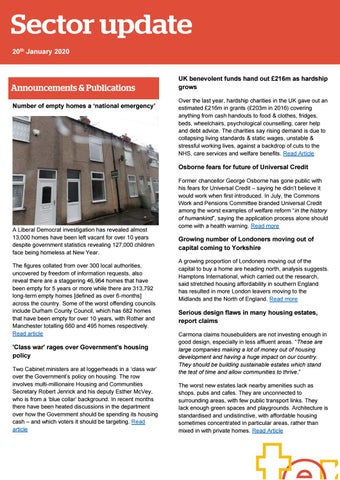
A Liberal Democrat investigation has revealed almost 13,000 homes have been left vacant for over 10 years despite government statistics revealing 127,000 children face being homeless at New Year. The figures collated from over 300 local authorities, uncovered by freedom of information requests, also reveal there are a staggering 46,964 homes that have been empty for 5 years or more while there are 313,792 long-term empty homes [defined as over 6-months] across the country. Some of the worst offending councils include Durham County Council, which has 682 homes that have been empty for over 10 years, with Rother and Manchester totalling 660 and 495 homes respectively. Read article
'Class war' rages over Government's housing policy Two Cabinet ministers are at loggerheads in a ‘class war’ over the Government’s policy on housing. The row involves multi-millionaire Housing and Communities Secretary Robert Jenrick and his deputy Esther McVey, who is from a ‘blue collar’ background. In recent months there have been heated discussions in the department over how the Government should be spending its housing cash – and which voters it should be targeting. Read article
Former chancellor George Osborne has gone public with his fears for Universal Credit – saying he didn’t believe it would work when first introduced. In July, the Commons Work and Pensions Committee branded Universal Credit among the worst examples of welfare reform “in the history of humankind”, saying the application process alone should come with a health warning. Read more
Growing number of Londoners moving out of capital coming to Yorkshire A growing proportion of Londoners moving out of the capital to buy a home are heading north, analysis suggests. Hamptons International, which carried out the research, said stretched housing affordability in southern England has resulted in more London leavers moving to the Midlands and the North of England. Read more
Serious design flaws in many housing estates, report claims Carmona claims housebuilders are not investing enough in good design, especially in less affluent areas. “These are large companies making a lot of money out of housing development and having a huge impact on our country. They should be building sustainable estates which stand the test of time and allow communities to thrive,” The worst new estates lack nearby amenities such as shops, pubs and cafes. They are unconnected to surrounding areas, with few public transport links. They lack enough green spaces and playgrounds. Architecture is standardised and undistinctive, with affordable housing sometimes concentrated in particular areas, rather than mixed in with private homes. Read Article
Operating Environment
Government confirms end to Local Housing Allowance rate freeze
Jobcentre teams to be sent on to streets to help homeless people
Around 900,000 people across the UK could see their benefit payments rise from April.
Number living in temporary accommodation is at a 10year high and newly homeless households are up 11%.
In a statement today (13th of January) Will Quince, minister of welfare delivery has confirmed the lifting of Local Housing Allowance rates to be in line with the Consumer Price Index (CPI) inflation rate – around 1.5%. Read article
Jobcentre staff will be sent out on to the streets in teams to advise homeless people and rough sleepers on how to find housing and work and access benefits, the government has announced. A £3m fund is being set up to pay for the outreach teams in the 2020-21 financial year. It will also be used to bolster projects that jobcentres are already involved in along with other organisations, such as the Salvation Army in Cardiff, Crisis in Edinburgh and Teardrops in St Helens, Merseyside, to support homeless people.
Families sending relatives with dementia to Thailand for care
Figures released by the government in December showed the number of households considered newly homeless or at risk of becoming so increased by 11.4% across England over the previous 12 months. Read article
MHomes closure beginning of the end for Middlesbrough's council house dream (Gazette Article) British families are sending elderly relatives with dementia overseas to Thailand in a small but growing trend. Researchers visiting private care homes in Chiang Mai have found eight homes where guests from the UK are living thousands of miles away from their families, because suitable care in their home country was impossible to find or afford. Read more
UK property asking prices jump by record 2.3% month-on-month at turn of year – Rightmove Asking prices for British houses put on sale in the five weeks to Jan. 11 rose by a record amount for the time of year, property website Rightmove said on Monday, adding to signs of a post-election bounce in consumer and business confidence Read More
Climate Change: Clean energy to power all new Welsh homes from 2025 All new homes in Wales will only be heated and powered by clean energy under new Welsh Government plans. Houses built after 2025 will be more energy efficient, cheaper to run and produce up to 80% less CO2 emissions, under the proposals. Read More
It was heralded as the company that would see the first council-built houses in a generation - but the end has been announced for MHomes. MHomes was the name of the publicly-owned private company set up by Middlesbrough Council to develop land that housebuilders won't touch. Set up under the previous Labour administration, MHomes was seen as critical to plans to build thousands of affordable homes in just a few years. But the organisation has now been scrapped by independent mayor Andy Preston. Read more
Hackitt suspects safety failings ‘not confined to Persimmon’ The independent report (commissioned by Persimmon chairman Roger Devlin in April this year after repeated public criticism of the quality of new-build Persimmon homes) conducted by Atkin Chambers, found that the failure to install correct cavity barriers was a “systemic nationwide problem” and called for the firm’s board to reassess the builder’s whole “purpose and ambition”. The report did conclude, however, that Persimmon’s board deserved significant credit for commissioning the review and publishing its findings, which reflected a willingness to confront “difficult truths”. Read more
Operating Environment January 2020
We keep a close eye on the housing sector and our wider operating environment, identifying key themes and trends and looking at what these might mean for us. The information that helps form this picture comes from sources such as: • • •
Our work with sector bodies and partners (National Housing Federation, Northern Housing Consortium, Homes for the North) Updates from other organisations we work with (Mazars and Vantage) Updates from the Government and our regulator
So, what’s going on in our operating environment at the moment? Our customers and communities We’re increasingly spending time and resource on tackling crime, anti-social behaviour and nuisance on our estates. We know that this presents challenges for a number of other partners, and cuts to public sector spending have made dealing with this even more difficult. Our customers tell us it’s the biggest thing impacting on their perceptions of where they live. We’re speaking to partners about the impact this issue has on our customers, what Thirteen is doing to respond and how we can work together to use resources more effectively. For example, we have responded to a local policing survey and as a result we are meeting to further discuss how the police can use Thirteen’s data. We’ve also analysed the latest Index of Multiple Deprivation (IMD) 2019 statistics alongside our internal data and knowledge so that we can holistically understand what the IMD data is telling us about our communities. This will support us to identify where resources need to be targeted and which areas have improved / got worse since the previous release in 2015. IN addition to this we have access to Experian and Rightmove data which will help us to understand our communities and customers in more detail. Key topics and policy Issues for Customers • • • • • •
Tenants Voice – They feel ‘done to’ not ‘worked with’ – we need to address this Consumer Regulations / Complaints handling Keeping tenants safe (post Grenfell) Know our customers – unlock the data Connectivity Technology
Political Environment Instability has been the norm for the last three years. Having successfully won the snap election, Boris Johnson now possesses a majority of 80, and is on track to remain as Prime Minister until 2024. Priorities are to leave the EU by 31st
January however the trickier task will be agreeing a trade deal with the EU so that the UK can secure an orderly exit from transition arrangements at the end of 2020. Brexit uncertainty is set to continue and dominate politics however the focus will be on delivering the key themes of the manifesto, including investing in key public services like the NHS, education and the police with the aim of making sure voters see tangible benefits in five years’ time. Levelling up the regions via a big boost in infrastructure spending is also likely to be an early priority. Key commitments in the Queens Speech included: • • •
Leaving the EU institutions by 31st January Legislating for the Conservative Party’s NHS funding package A commitment to seek a long-term cross-party consensus on social care.
The housing crisis will continue to remain a key issue and the Government must now deliver on homeownership promises. This was also reflected in the Queen’s Speech in which the Government has committed to a new deal for renters that will “restore fairness, honesty and transparency” to the housing market. The proposals include: • • • • •
A better deal for renters with a new lifetime deposit - making the process of moving home easier and cheaper for millions Confirmation of plans to abolish ‘no-fault’ evictions - preventing landlords from evicting tenants at short notice and without good reason Plans to slash the cost of new homes for local people and key workers in their area by up to a third A new English devolution white paper to unleash potential of all regions across the country - levelling up every city, town and county The biggest change to building safety laws in 40 years to deliver a new safety framework for high-rise buildings - ensuring residents’ concerns never go ignored.
Despite these commitments, the Government has yet to provide any clear detail on how the proposals would be funded and what this would mean in practice. The housing sector and wider landscape The UK2070 Commission, which is chaired by the former head of the Civil Service, Lord Kerslake, says deep-rooted economic divides across the UK will worsen unless government addresses strategic failings in regional policy which stretch back 50 years. The Commission reported earlier this year that London’s global success was contrasted elsewhere in the UK with some of the worst inequalities in Europe, with stop-start regional policy failing to tackle problems that have led to economic under-performance and lower healthy life expectancy. Political top three priorities: • • •
Need to bring the country together again Spend and invest more following a decade of austerity Climate Emergency
The UK is 28th (out of 30) for regional inequality and despite all efforts the gap has grown wider. London growth is no longer benefitting the rest of the country. London and the South
continuing to increase on jobs/skills and the county is not taking full advantage of the Norths offer. This imbalance creates division and creates enormous pressure on London (e.g. house prices, longer commutes, environmental issues). This may look bleak however it provides REAL opportunity in the North! To do this we need to: 1. 2. 3.
Make common cause – e.g. transport New (regional) leadership models Seize this political moment as we may never get the opportunity again.
We are living longer; demographics and needs are changing and so must our services and provision. There is an increased cost in health and social care and a growing mismatch between housing and profile widened by austerity measures and cuts. Retaining skills and the economically active is a priority for the North and the Green agenda may be a way to support this for example in sectors such as construction, technology and power. The demand for affordable housing is still huge and delivering the number of houses that the sector has promised to build, is a challenge. The Government’s target is 300k homes per year falls short of what is needed. The picture and market differs in the north but we still need more good quality homes in the right places. Placemaking is key. In future, affordability will be defined in terms of income so should mean true affordability. Poor housing and health are intrinsically linked. The housing sector needs to look at its assets and start to take decisions now to meet the needs of its customers and communities. Homelessness figures have increased across all metrics; the Homelessness Reduction Act 2017 is helping to manage homelessness but not end it. We need a multi-strategy approach to tackle homelessness, so we aren’t focusing solely on rough sleeping. Climate Change The Government has set a net zero emissions target by 2050. Transport produces the most emissions and the Department for Transport has set out its long-term strategy in the Road to Zero. Housing is the next largest emitter of carbon which makes it implicit in current housing policies but requires a mixture of incentives, clear standards and solutions. The government has launched a consultation on stronger building regulations that will pave the way for the Future Homes Standard. Unveiled by the Housing Secretary, Rt Hon Robert Jenrick MP, it will see polluting fossil fuel heating systems such as gas boilers banned from new homes by 2025 and replaced with the latest generation of clean technology – such as air source heat pumps and solar panels. We are currently working on the consultation to assess what the impact will be for us alongside other wider sustainability work. The North Following the General Election, in 2020 the government will be looking for positive examples of delivering on its new mandate in the North. The anticipated shift towards One Nation vision is underway. Whilst this term has historically meant many things for different parts of the Conservative Party, for the new Administration it will be focused on cementing the British political union and rebalancing the economy by levelling up the North of England.
It is understood that the Government is planning to draw up new proposals before the Spring Budget to increase investment in the North and the Midlands. Ministers are set to reassess how the Government invests in transport infrastructure, business development and initiatives such as free ports. The Tees Valley Combined Authority has now commenced a public consultation on its Budget, which will cover the period up until 2021. The consultation will run until 20 January 2020. The final proposals will then be presented at a meeting on 31 January 2020.
Policy Consultations We keep an eye on government consultations around changes to policy that can affect the way we do business or our customers. We also keep an eye on local activity and feed in where we think we need to. We ensure we understand the implications for the business and, where applicable, we send a response to feed in Thirteen’s views and provide evidence. Current and recent policy consultations are listed below. Consultation The Future Homes Standard: changes to Part L and Part F of the Building Regulations for new dwellings
Notes Consultation on the uplift to standards of Part L of the Building Regulations and changes to Part F. This uplift is the first step in achieving the Future Homes Standards which is to . Coordinating response to consultation (Deadline 7 Feb 2020) and understanding the impact to Thirteen. Working with New Homes, Thirteen Homes, Gus Robinson, Sustainability and external consultants.
Hartlepool Draft Council Plan 20202023 Consultation
Consultation on the draft Council Plan 2020-2023 will be open until Friday 21 February 2020. This Council Plan sets out HBC’s priorities for the town and how the Council will work to deliver on those priorities. This consultation gives us the opportunity to say whether we agree with these priorities, whether anything is missing, and how the council can work with residents and partners to deliver. We are currently gathering comments and will submit response online. Working with Neighbourhoods, Regeneration and New Homes.
Redcar & Cleveland
Redcar & Cleveland Borough Council is undertaking a consultation on the draft Affordable Housing Supplementary Planning Document (SPD), Developer Contributions SPD and Statement of Community Involvement. The consultations commence on Monday 6th January and will end on Monday 17th February 2020. We are working with New Homes to formulate a response.
If you are aware of any ongoing consultations or think you can contribute to our work around any of these, please contact a member of the Policy & Research Team.