![]()


This is the official publication for members of the Royal Zoological Society of Scotland (RZSS),the wildlife conservation charity (Scottish registered charity SC004064).
Your membership magazine and its envelope are made using paper from sustainably managed forests and are recyclable. For more information about RZSS,including details of our patrons, board and staff, visit rzss,org,uk
All content in this magazine is ©RZSS unless stated otherwise.
For any editorial enquiries, please write to Membership, RZSS, 134 Corstorphine Road, Edinburgh EH12 6TS
Or email us at membership@rzss.org,uk
w-.carbonbalanc•dpaper.com
CBP01693O
RZSSEditorial Team
Annette Aitken-Drummond, Rhiordan Langan-Fortune, Rebecca Milne, Lisa Robshaw, Hollie Watson
Editor Ciaran Sneddon
Contributing Editor Jonathan McIntosh
Art Director George Walker
Photographers Laurie Campbell and the RZSScommunications team
Managing Editor Andrew Littlefield
Production Director Justin Masters
Executive Director John Innes
Commercial Partnerships Manager Alison Fraser d: 0141 946 8708 e: alison.fraser@thinkpublishing.co.uk
Published by T H I N K
w: www.thinkpublishing.co.uk
Writer Claire Muir learns all about Northern muriquis, one of the world's most endangered species. and discovers why they're called 'peace and love monkeys·.
In what is becoming a frankly joyful tradition, the start to a new year at RZSShas meant new animals -and lots of them. Fresh faces have joined familiar ones at both Edinburgh Zoo and Highland Wildlife Park in these early months of 2026, including the first new female king penguins to waddle into Penguin Rock for more than 10 years. They were greeted, as is only right, by Sir Nils, the world's most senior ranking animal. You can get to know some of these new arrivals -also including Domino the cheetah, Rajath the sloth bear and Babsie the chimpanzee -on page 14.
We've also temporarily waved off Brodie the polar bear in order to give his habitat a refresh. He's having a great time down at Yorkshire Wildlife Park, including a reunion with his brother Hamish, but we're already looking forward to having him back home again soon. See page 28 for more.
It is a huge privilege to lead and represent RZSS.I am also now exceedingly proud to have been elected President of the World Association of Zoos and Aquariums (WAZA},
Contributing editor Jonathan McIntosh gets to know Nessie, one of two Highland cows settling into their new Edinburgh Zoo home.
Around 400 institutions and organisations around the world make up WAZA, a global alliance dedicated to the care and conservation of animals and their habitats around the world. It's my ambition to lead the organisation to deliver meaningful impact for wildlife, people and the planet.
To that end, back at RZSSwe've been delighted with the recent conservation successes delivered by some of the projects that we support. From progress with Saving Wildcats to breakthroughs in French Polynesia, your support continues to help us make a real difference to animals both in Scotland and internationally. Thank you, as ever, for your generosity. With warmer and longer days surely just around the corner, 1 hope you enjoy your next adventure, whether it's at Highland Wildlife Park or Edinburgh Zoo. Give Domino, Rajath, Babsie and the penguins a wave from me!
David Field, Chief Executive Officer
Specialist gardening journalist Aileen Scoular digs into spring blooms. the magic of manure and the fascinating way that milk can help with your gardening efforts.
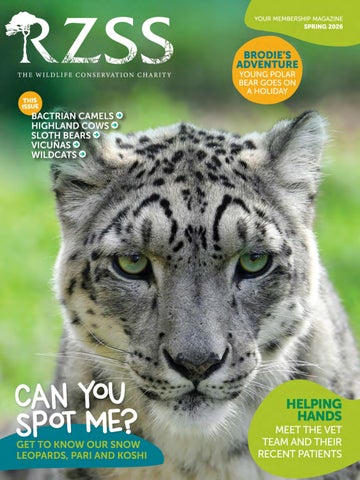
Pari the snow leopard at Highland Wildlife Park

Make the most of your visits to our zoos this spring Visitthe animalsat EdinburghZoo and HighlandWildlife Parkas often as you like, plus...
Free parking at Edinburgh Zoo. Remember to get your ticket validated at the members gate or admissions on arrival.
Reduced price tickets for our brilliant events -turn to page 38 for details of what's coming up, and head to our website for tickets.
Treat up to six people to 25% off the cost of entry when they visit Edinburgh Zoo or Highland Wildlife Park with you.
Discounts in all of our cafes, restaurants and gift shops, including the newly opened facilities at Highland Wildlife Park {see page 13).

This year we're looking back through the RZSS archive to see how much things have changed since being founded in 1909. Here, Fiona Menzies, an archivist who has spent the last few years digging into the RZSS archive at the University of Edinburgh Heritage Collections, reveals some secrets from the past
hat did Edinburgh Zoo look like 100 years ago? Let's take a step back in time to 1926 to find out!
In 1926, Edinburgh Zoo was open on weekdays from 9am-9pm (or sunset) and tickets cost a different amount depending on the day you visited. Some days it was a shilling per adult, other days it was nine pence.
The entrance to the zoo was a little further down Corstorphine Road to the left of the current zoo entrance. It was much smaller, with one archway leading into the zoo. It's still there today, marked by some impressive falcon statues.
The first animals you would see as you walked in were the waterfowl amongst the marshy ponds. Edinburgh Zoo was designed by Patrick Geddes (1854-1932) who wanted to include the natural layout of 21Corstorphine Hillin his design. Due to 33this the lowest part o of the zoo had -~ water-based animals, including sea lions. § A little higher up @ you would encounter

some familiar animals -penguins! They arrived here in 1914,a gift from the first RZSSpresident, Lord Salvesen. Ever since then they've proved to be one of Edinburgh Zoo's most popular attractions. Originally their next-door neighbours were polar bears.
Musical entertainment was provided for guests thanks to a brass band. They played every weekend from a bandstand, designed by Sir Robert Lorimer, where The Gannet restaurant stands today.
If you were a distinguished RZSS fellow and looking for something to eat during your visit, you would have had access to the dining room situated in the mansion house at the centre of the zoo.
You would also be very welcome to bring a picnic with you and enjoy it in the same way as you would today, sitting on the grass just outside the mansion house or as it was called then, the public promenade. Next time you visit Edinburgh Zoo, be sure to keep an eye out for these little pieces of history which have remained unchanged for over 100 years.

I first got involved as part of a larger archival project at the University of Edinburgh Heritage Collections, making archives related to animal health and welfare in Scotland more accessible. This also included the archive of the Royal (Dick) School of Veterinary Studies and OneKind. It was a great project to be part of, and I am very grateful to RZSSfor continuing to fund the cataloguing and conservation of their archive.
It's such a broad and interesting collection! We have details of the comings and goings of animals at Edinburgh Zoo since 1913, hundreds of thousands of letters, maps and plans of Edinburgh Zoo, magazines and guidebooks, an amazing photographic collection of more than 8,000 images. and some really interesting objects such as penguin feathers and tram posters from the 1930s.
We've done our best to organise the archive in such a way that it's easily accessible. Items from the archive are now on an online catalogue which can be accessed through the University of Edinburgh Heritage Collections website. Before this project, the archives were spread across the Edinburgh Zoo site in various cupboards. drawers and basements and were largely unknown. They are now held at the University of Edinburgh's Heritage Collection. Researchers and members of the public can consult the collection by appointment in our reading room.
That's a tricky question -there's just so much to choose from! But I would have to say the 1930s tram posters. It was such a surprise to come across them and they're some of the real gems of the collection. We've even got a letter dating from 1934 from a zoo visitor saying how much she and her family like the posters.


Your favourite Scottish porridge oats and oatmeal now available in recyclable paper bags
9rown, milled and packed in 8colland
A new inclusive play area at Penguins Rock will be ready for visitors just in time for Easter.
The centrepiece, which takes visual inspiration from our king penguins, is an interactive sculpture that combines a climbing wall, tube slide, play panels and plenty of spaces to be explored.
The playpark also includes a spinner bowl, wheelchair roundabout, seesaw and trampoline. In addition to this new section at Penguin Rock, Edinburgh Zoo also has a playground down by Budongo Trail and a soft play area in the Gannet restaurant.
Beccy Angus, head of discovery and learning, said, "We are delighted to be opening this new playpark at Edinburgh Zoo this Easter,with lots of interactive fun for all our younger vistiors."

Our plans for a modern koala habitat have been approved, clearing the path for an exciting new home for Talara and Myaree. The updated facilities will be powered by energy produced in our solar meadow.
The new space will be more efficient than the current building, which was constructed in the 1970s and renovated in 2005, when we first housed koalas in it. Under our plans, the new building will be made from locally sourced wood. Importantly, it is designed to help the Endangered Queensland koalas thrive.
RZSSCEO David Field said, "Our goal is to create the best possible environment for our koalas and we are thrilled to announce plans for a new habitat. We are constantly enhancing our animal spaces to ensure every species enjoys the highest standards of mental and physical wellbeing."
Find out how you can be part of the koalas' new home by visiting rzss.org.uk/koala-appeal
Our team at Edinburgh Zoo took home the prestigious Scottish Thistle Award for Climate Action in recognition of our pledge to cut our carbon footprint by 60% by 2030. Projects including the UK's biggest zoo-based solar meadow and bestpractice approaches to sustainable habitat design were acknowledged by the judges.


Work is well under way on our new red panda habitat at Highland Wildlife Park
At the time of going to press, we expect everything to be ready just in time for the Easter holidays. Priya, our much-loved red panda from Edinburgh Zoo, will be moving into the environment.
The park has previously been home to several red pandas, but this is a brand new habitat, put in place ahead of any residents arriving. Priya -who is the granddaughter of fellow Edinburgh Zoo resident Bruce -joined us in 2024 from Whipsnade Zoo. She has lived alongside Bruce ever since.
It's hoped she will be joined by a male red panda from another European zoo.
To spot her, look up, as she loves to sit or snooze high in the branches.
Highland WildlifePark has secured the prestigious 2025 Scottish Thistle Award for Best Visitor Attraction. The recognition was made after a hugely important year for the park, including the conclusion of a £76 million project which brought Scotland's WildlifeDiscovery Centre to the Caimgorms site.
At the heart of the Discovery Centre is a redeveloped shop and cafe, as well as a new interactive exhibition centre, hilltop den and events space for schools and communities.
Deputy CEO Ben Supple said, "To see Highland WildlifePark take home the top prize, in a field full of brilliant visitor experiences from across the country, was an incredibly proud moment for all of us at RZSS.
"When we set out to create the Discovery Centre, the goal wasn't simply to add new buildings. It was to bring together everything the park does, from caring for cold weather species such as polar bears and snow leopards, to connecting people and communities with nature."
It's been an exciting start to 2026 at both Edinburgh Zoo and Highland Wildlife Park, with some great new arrivals making themselves at home. From the world's smallest deer to the second-largest penguin, all our new animals are already showing us their personalities as they settle in. Here, you can get to know them before your next visit.
Last year, we said hello to Cipfsek, who became the first sloth bear to live at Edinburgh Zoo. Now, Cipi's got a new friend: Rajath. Like Cipi, he's a male, although at 15 he's a good bit older than two-year-old Cipi. The two are together most of the time now, although still sleeping separately, as Cipi has a bit too much late night energy for elder statesman Raj!

Three female king penguins have been welcomed to Edinburgh Zoo by Major General Sir Nils Olav, one of the zoo's male king penguins and the world's highest-ranking animal. Alma, Constance and Maude waddled into Penguins Rock in January and quickly became part of the colony. They are the first new female king penguins to arrive at the zoo in more than 10 years and arrived together from Rotterdam Zoo in the Netherlands. Three-year-old Maude already has a strong reputation among our keepers for being feisty and energetic. Her friends, two-year olds Alma and Constance, are also settling in well.
You'll be able to play a good game of spot the difference when you next go to Edinburgh Zoo and see our newest female cheetah, Domino, and compare her to resident male Billy. Domino is four years old and previously lived at France's Zoo de Cerza, but has gradually been introduced to Billy since she arrived in November. Domino and Billy are still living apart at the moment, but introductions are ongoing and it's hoped they might eventually have cubs.
Edinburgh Zoo is now home to three Southern pudus, after male Lorenzo joined Violetta and her fawn Gia. Southern pudus are the world's smallest deer, growing to just 15 inches tall and 12kg in weight. Their red-brown fur keeps them safe from predators in the Chilean and Argentinian rainforests and shrublands they call home.

Over at Highland Wildlife Park, we've had two exceptionally cute new arrivals. Tay the wildcat (above with her mum) was born at the park last August, and her name was chosen by People's Postcode Lottery. Her cheeky personality is already on show -you may catch a glimpse of her using her mum's tail as a toy, or running off her zoomies. And for the first time ever, we've welcomed a pine marten to Highland Wildlife Park. Patient visitors will be rewarded with a sighting of Flora, who arrived in November.
HIGHLAND WILDLIFE PARK
The Saving Wildcats partnership, led by RZSS,has been awarded more than £400,000 by NatureScot to continue its work. The funding will support efforts to tackle threats facing the Cairngorms population, and to continue releases of new wildcats in the area. Saving Wildcats was one of 13 projects to receive funding in the current round of support from the Scottish Government's Nature Restoration Fund (NRF). NatureScot chair Professor Colin Galbraith said, 'We are incredibly heartened to see the energy, enthusiasm and commitment that so many people are showing towards restoring Scotland's nature, and we are proud to be supporting these vital projects."

FRENCH POLYNESIA
A wild-born Partula snail has been spotted for the first time in more than 30 years during our annual reintroduction of the species to four islands in French Polynesia. The young Partula varia proves that our ongoing conservation programme has led to wild breeding -a momentous milestone. The discovery was made as more than 7,000 snails, each dotted with UV reflective paint, were released. The paint allows conservationists to more easily locate the snails as they move around in the dark. Our team also found the first evidence of wild-born Partula tohiveana living beyond the area where they were originally released, suggesting that the snails are expanding their territory.
We were proud to represent the Pallas's Cat International Conservation Alliance (PICA)at the 20th Conference of the Parties to the Convention on International Trade in Endangered Species of Wild Fauna and Flora (CITES)in December. This key meeting brought together governments and organisations working on conservation projects globally, and RZSSjoined partners to deliver a side event on the subject of small cats including the Pallas'scat, the caracal and the sand cat.
The conference, held in Samarkand, Uzbekistan, allowed us to highlight the importance of understanding the threats facing these species, and the need to improve research on wild populations while supporting long-term conservation programmes led by local experts and communities.

In September, two of our researchers led a week-long conservation genetics training workshop at the Budongo Conservation Field Station (BCFS)in Uganda. Dr Jo HowardMcCombe and Dr Alex Ball from RZSS WildGenes trained BCFSstaff in specialist methods of sample collection and storage, DNA extraction, amplification and sequencing. The focus was specifically on invertebrates in the Budongo Forest, and during the week alone, 30 species were collected for study.
BCFSstaff will now be able to apply these techniques to other species, while working from a genetics lab on-site. It's hoped that the team will be able to generate the first genomic data for Nahan's partridge, a rare and highly threatened forest species.
A study co-authored by RZSSWildGenes' Dr Alex Ball has argued for a reconsideration of how hybrids are viewed in relation to biodiversity conservation. Published in the journal Conservation Letters, the study puts forward the case that traditional assumptions about hybrids -particularly that they are inherently harmful -can no longer be backed up by modern science. The authors suggest instead that a more "science-based, reflective and context-dependent management of hybrids" is required.
Become a Conservation Champion so that together we can ensure nature is protected, valued and loved today, tomorrow and for generations to come. Find out more at rzss.org.uk/conservationchampions
These vivid amphibians have brilliant blue skin to ward off any animals who might fancy a frog for lunch. The eye-catching colour tells predators that the frogs are poisonous and not worth the risk of a post-meal tummy ache. This means that unlike animals who use their colour to hide, the frogs want to stick out as a clever defence strategy, sending a message that they're far too dangerous to eat.

While tigers' bright orange and black fur sticks out to us, lots of prey animals see colours differently from humans. To many of them, the orange actually looks green, helping the predators blend into the jungle foliage where they live. The black stripes, meanwhile, act like natural camouflage, breaking up the outline of the tiger so that they're even harder to spot when they're stalking their prey.

Flamingos are actually born grey, not the vibrant pink they're known for. Over time, their feathers acquire the famously bright colour thanks to the birds' diet. Flamingos eat lots of small crustaceans, algae and brine shrimp, which contain a pigment that builds up in their feathers, legs and beaks. Flamingos with plenty of access to this food will have much brighter shades of feathers than ones who don't. Our two new chicks, Douglas and Derek, are already going from grey to pink.
A cheetah's spots -which can number around 2,000 -help them to stay hidden, with the different shades of brown camouflaging them against the savannah grasses. This ability to pass unnoticed comes in handy for cheetah cubs too, keeping them safe from predators.
Where to see them:
Highland Wildlife Park
Monals are a type of pheasant, and like those found in the wild in Scotland, the females are drab and the males drenched in colour. These beautiful birds use their shimmering blue, green and red feathers to get the attention of the ladies. They puff up their chests, spread their tail feathers and do an impressive dance that screams 'look at me!' to attract a mate. Their bright colours help them stand out against their Himalayan forest homes.
Where to see them:
Highland Wildlife Park
While a polar bear's fur may look white, each hair is actually clear and hollow. These special hairs reflect light, making the bear appear snowy white, helping it to blend into its icy habitat. The hollow hairs also let sunlight reach the bear's dark skin underneath, keeping the large predators warm in freezing Arctic temperatures.
Where to see them:
Edinburgh Zoo
Penguins are perfectly coloured for life in the ocean, thanks to something called countershading. Their black backs blend with the dark depths when seen from above, making it harder for predators to spot them. From below, their white bellies match the bright surface light. This clever tuxedo pattern makes them almost invisible when swimming around the ocean.
Where to see them:
Edinburgh Zoo
Red-fronted macaws are brightly coloured to blend into the rainforest around them. Their blue feathers match sky-blue gaps between the treetops, while their greens let them disappear among leaves and vines. Splashes of red and yellow mimic fruits and flowers. These colours keep them hidden when flying and feeding in the canopy.

ver 600,000 combined visitors to Edinburgh Zoo and Highland WildlifePark each year spend their days being amazed at the thousands of animals housed in both parks. However, visitors rarely get to see the work being done behind the scenes by the members of the RZSSveterinary team, who dedicate their lives to making sure every animal receives the best care they possibly can.
With five vets between the two sites, the small team deal with the unpredictable illnesses and routine care of hundreds of species, from tiny blue poison dart frogs to giant giraffes.
Dr Stephanie Mota, head of veterinary services, says that organisation is key.
"We need to be very good at prioritising," she explains. "We have set tasks, including preventative plans where we vaccinate or routinely check faecal samples for parasites.
"We are also in charge of biosecurity to make sure we keep our keepers and
visitors safe. But the animals always have to take priority -if one needs to be seen, that would always come first."
Keepers at Edinburgh Zoo who worked with Babu the sun bear started to notice a difference and raised concerns with Dr Mota. "I remember it was a Saturday because I was on call," she says. "It started with swelling in her muzzle.
The keepers work with her every single day, so when they say something is wrong, something is wrong."
The team began by running some of the most likely tests -was it an allergy,
11 While we're pleased but still cautious, Babu's recovery is amazing and very positive"
Dr
StephanieMota,
RZSSHead of VeterinaryServices

had she eaten something that was disagreeing with her? But it was sadly discovered that Babu had lymphoma, a cancer that's incredibly rare in bears.
In fact, the diagnosis was so rare, there are actually no treatment guidelines for the illness in the species. By looking at treatment of lymphoma in other types of bears, the team were able to come up with a plan for Babu.
At the beginning, the team didn't even know if treatment would workwith no guidance to rely on, everyone hoped for the best but prepared for the worst. It was thought that Babu could only have months to live.
"Our priorities were to keep her comfortable," Dr Mota explains. "There were a lot of discussions with her keepers making sure everyone was happy."
But to everyone's surprise and delight, the bear began to respond to the treatment. Recent tests have shown Babu is now in remission and the zoo is beginning to reduce her medication. "We are pleased yet still cautious," Dr Mota adds. "But it is amazing and very positive."

If treating a sun bear required some creativity, treating a giraffe required detailed choreography, as the vet team found out with Gilbert last summer.
After keepers noticed an unusual swelling on the giraffe's face, the team began planning how best to investigate the issue.
"Giraffesare not made for anaesthesia, that's for sure," says Dr Mota. "The blood needs to pump from the heart to the head, which is a very, very long distance. So they need to have very high blood pressure, which is unique to them. Their limbs are all very long, so there are a lot of risks involved."
A big animal needs a big team, so specialists from the The Royal (Dick) School of Veterinary Studies, Chester Zoo and Copenhagen Zoo joined us to help, and to learn more from the RZSSvet team abvout the procedure.
"We wrote out every single step," Dr Mota explains. "From the day before the anaesthetic to the moment he stood back up again, everyone had a specific job."
The team rehearsed massaging techniques for Gilbert's legs and how to position ropes for limb support. One keeper even practiced clearing the doorway padded with straw in under a minute, just in case the team needed to make a swift exit.
11 From the day before the anaesthetic to the moment Gilbert stood back up again, everyone had a specificjob 11
Dr Stephanie Mota, RZSSHead of Veterinary Services

Following Babu's surprise diagnosis, Gilbert was not to be outdonealthough this time it was a much more positive, and less serious, outcome.
"When you see a big swelling you begin to think is it an abscess or a mass. To find it was only food ... compared with the other possibilities, it was a good one.
"He's now on positive reinforcement training and we have to wash out his mouth regularly, because he isn't doing that. Good news for Gilbertbut a big headache to prepare for it all. At the end it was a bit like,'Oh really?' But we are happy he is healthy."
While planning for the unexpected is part of the team's job, they also spend a lot of time planning for the expected. If you imagine the challenge of convincing a toddler to line up and wait its turn, times it by 150 and add the ability to escape into very deep water, that is close to what the vets experience on penguin vaccination day.
Preparation begins weeks in advance, with keepers encouraging the birds into a secondary enclosure by tempting them with familiar routines.
Dr Mota explains, "The key is to carefully capture them away from the pool before they realise what is happening. Because once they know, they will try to escape to the pool and will just stay in there all day because they know we can't reach them."
The penguins are checked, vaccinated, rewarded with a fish and released back into the main enclosure.
And while the annual 'jag day' is a well oiled machine, the visitor favorites aren't immune from needing some extra care, as was the case with Poly.
A Northern rockhopper penguin chick. Poly sadly developed a corneal ulcer just months after her birth. While usually a condition that can be managed with eye drops, staff noticed Poly wasn't healing the way they had hoped. Sadly,it was
decided that there was no way to save her eye and it would have to be removed.
"The surgery itself was obviously very risky. because Poly is so small," Dr Mota explains. "She was only two months old. The procedure is risky,the post surgery is risky,and her immune system wasn't well developed. So in terms of fighting infections, it was more difficult."
11 We're involved in such meaningful conservation projects, it is very rewarding"
Dr StephanieMota, RZSSHead of VeterinaryServices

It also came with the complications of Poly being rejected by her parents, due to her illness. Dr Mota explains. "They understand that something is wrong and, sadly, they sometimes feel it is not worth the added challenge of dealing with a sick child. As people we would never consider something so dramatic. but it is the way that nature goes."
Keepers and vets stepped in to provide Poly with all the support a parent would usually provide at that age, feeding and even preening her.
Dr Mota says, "ThankfullyPoly recovered well and once she was reintroduced, her parents took her back under their wing and she is with the colony now."
A second, more recent operation to treat a serious infection in Poly's eye socket has also been a great success.
Meanwhile Lino, a vicufia living at Highland WildlifePark, had an interesting issue with his teeth over the summer. Vicufias, a type of camelid, have continually growing teeth. Normally, they wear their teeth down naturally through their grazing habits.
However, Lino is an unusual case in that his teeth grow forward instead of up. This means his teeth haven't worn down properly, causing him some discomfort. "We could see them poking out from his mouth," Dr Mota
says. "Dr Rebecca Amos took him for a procedure to trim his teeth."
The procedure was very successful, and while it is something that will need to be repeated throughout his life, it's not going to affect him too muchafter his first treatment, he was back with his herd within the hour, enjoying the food provided for him.
In both parks, modem technology plays a growing role for the team. Smaller animals can be transported to partner facilities, but for larger species, or for those it might be too traumatic to transport, a mobile CT scanner can be brought directly to the park.

This year, the parks have expanded their access to CT scanning, enabling more detailed insights into injuries, tumours, dental issues and internal structures. For many species, from penguins to wildcats, the technology brings a new level of precision. For the vet team, it's a major step forward -especially for the animals living in the more remote Caimgorms area. It reduces the stress of transporting animals long distances and helps the team to get earlier diagnoses.
While animals are always the main focus for RZSS,at the heart of it all are the staff who help to run things so successfully. And despite the long hours and busy days, Dr Mota is rightly proud of the work the vet team do.
"We're involved in such meaningful conservation projects. RZSS'smission is reversing the decline of so many vulnerable species. It is very rewarding."
RZSSis so committed to conservation that it also offers residencies for those training to be specialists in the fieldwhich Dr Mota herself was a part of.
'Tm one of those children who at five-years-old decided I wanted to be a monkey and lion vet," she adds. "Every day is different. Every day we learn something new. And that's what makes this job so
Keeper Daniel Stockdale shares how this charming coo has hoofed her way into the hearts of everyone at Edinburgh Zoo. Words: Jonathan McIntosh
Unicorns. Midges. The Loch Ness Monster. Scotland has its fair share of iconic creatures. In September 2025, Edinburgh Zoo welcomed a pair of equally legendary Scottish animals into its ranks: Highland cows Nessie and Thistle.
Named via a social media poll, the duo were born at Tippetcraig Farm in Bonnyrbridge in 2023. Hoofstock keeper Daniel Stockdale -who has worked at Edinburgh Zoo since 2021 -has helped black-haired Nessie and ginger-hued Thistle settle in.
"We think because they came together from Tippetcraig Farm where they were used to visitors and people working around them, that they quickly adjusted to their new environment and keepers at Edinburgh Zoo," says Daniel.
The herbivores' habitat, which is ideally suited to their grazing lifestyle, is located next to the lowland nyala herd. Both of the three-year-olds live here in harmony together -even if Nessie is the slightly more forthright of the two.

"Nessie and Thistle get on well. Nessie's the more confident of the pair and tends to take charge of situations," explains Daniel. "She only ever gives Thistle the odd nudge when she wants first dibs on her favourite food, which includes hay, grass and pellets."
As well as her gentle yet assertive nature, Nessie is also incredibly curious.
"Nessie'salways first to wander over for a good sniff of us and a nosy at what we're up to when we're in her habitat. Her curiosity means she can sometimes inadvertently get in the way, but she doesn't mean any harm," says Daniel.
"Highland cows have similar temperaments to big dogs, they're very affectionate and like getting involved with what you're doing," adds Daniel.
"Often when Nessie spots us delivering breakfast, she plods over excitedly and occasionally gives a little jump in the air. It's so funny to see her act like an excited puppy -although I don't think her or Thistle realise their size and strength when they're running towards us!"
7:30am Rise and shine! Nessie stretches her legs around the habitat before the keepers arrive.
8:15am The keepers deliver a breakfast of pellets to help kickstart the day.
10:30am Nessie relaxes by scratching at her favourite poles.
11am Daniel and the team drop off hay for an ideal elevenses treat.
12pm A midday nap takes top priority for Nessie.
1pm A busy morning calls for a lunch of tasty pellets and hay.
1:30pm Nessie watches the keepers clean her and Thistle's paddock.
2:15pm Our sleepy coo catches some post-lunch Zs.
3pm It's time to learn new skills in a training session with the keepers.
4:45pm The keepers deliver hay on their final visit of the day - it'll make an ideal midnight snack.
6pm A quick chomp, and then it's time to unwind for the evening.
With their distinctive horns and shaggy coats -which help protect them against Scotland's inclement weather -Nessie and Thistle are proving to be a big hit with visitors. "Nessie and Thistle have been brilliant additions to Edinburgh Zoo. Whenever the keeper team are working in their area, there's usually quite a crowd watching them," says Daniel. "When visiting, look out for them rubbing against the different scratching posts around their habitat. They love a good scratch!"
The Highland cow is one of the oldest registered breeds of cattle, with their origins dating back thousands of years to the Scottish Highlands and Western Isles. "Highland cows are synonymous with Scotland. And as the Royal Zoological Society of Scotland, it's only fitting that we help care for animals so closely linked to the country's national identity," says Daniel. "I highly recommend seeing their charm offensive for yourself."


oving house is often considered one of the most stressful things we can do in our lives. And when you factor in the planning and logistics involved in transporting your worldly possessions and adjusting to your new surroundings, it's easy to see why.
Thankfully, when it came to Brodie the polar bear's temporary move from Highland Wildlife Park to Doncaster's Yorkshire Wildlife Park in December 2025, a team of experts were on hand to make this experience as stress free as possible. One of the people involved with the relocation was Lauren Walker, an experienced animal keeper at Highland Wildlife Park, who's been keeping tabs on Brodie's progress since his big move.
"Brodie was just a few months old when I started working with him at the park, nearly four years ago now. I also worked closely with his mum and dad, Victoria and Arktos," says Lauren. "AU
of the polar bears here are so fun and sweet. Despite being so big, they're very gentle and calming."
Born at Highland WildlifePark in December 2021, four-year-old Brodie has grown to become quite the character.
"Brodie is a firecracker that loves attention. Sometimes he's deliberately naughty to get it!" laughs Lauren.
"He's a very keeper-focused bear. Whenever we're busy doing things at his habitat, he's always having a nosy. He loves playing with his toys
'We felt it would be better for Brodie to be oH site to prevent any stress while work is underway 11
LaurenWalker,Animal Keeper

and enjoys showing them to us. Kayaks, drum barrels and cardboard boxes are his favourites."
The end of 2025 saw some big changes to the habitat of Highland WildlifePark's polar bear trio, with refurbishment work on their fence line, mesh, viewing platforms and dens underway.
"Our older polar bears, Walker and Arktos, are 17 and 18 now and looking for retirement digs where they can enjoy a quieter life.That's why they're swapping with Brodie who, on his return, will be the star of the show in the main habitat at the park's fronta role I think will suit him just fine," says Lauren.
"Wefelt it would be better for Brodie to be off site to prevent any stress while this work is underway," adds Lauren.
"Plus,given that Brodie's such a sociable bear and he's been on his own since his mum, Victoria,died in May 2025, this stint at YorkshireWildlifePark means he'll have friends to play with."
Once Lauren and the team had a date for Brodie's move, they set their preparatory plans in motion.
"We had four months to get Brodie crate trained. This was a little shorter than what we'd usually do, but luckily Brodie had been crate trained when Victoria took ill, so he picked it up again quickly.After moving a transport crate into his space, we left its door open so Brodie could explore it,"says Lauren.
"My colleagues and I took turns passing Brodie his favourite toys through a small hatch in the crate. Whenever Brodie came inside, he was rewarded with a cardboard box lid or treats he particularly enjoys, such as cod liver oil, honey, jam, blueberries, apple and carrot. We also let Brodie experience different noises and weather in the crate to ensure he'd be calm in any circumstance during his move."
On 12 December 2025, Brodie made the 260-mile journey south to Yorkshire WildlifePark's 10-acre habitat. Project Polar is a world-class home to six other polar bears, Nobby, Hamish, Luka, Sisu, Indiana and Yuma.
"Itwas nerve-wracking getting Brodie into the crate for this journey, but he was a very good boy. In his usual style, he

took his time getting into it, but we put a cardboard box and treats in it to entice him," explains Lauren. "Afterloading him onto the lorry, the vet checked Brodie and was happy for him to go. And with that, Brodie's eight hour journey to Yorkshire WildlifePark began."
Lauren left ahead of Brodie so she could get to YorkshireWildlifePark first to go over the unloading plan with the team taking over the young polar bear's care.
"The Yorkshire WildlifePark team have been fantastic. When Brodie arrived, they kept me with him constantly. I was able to speak to him whilst he was in the crate. They asked my opinion on how I thought he was doing, if he needed anything and let me look at his new home. They were very understanding and did everything to make Brodie's move straightforward," says Lauren.
"On arriving at YorkshireWildlife Park, Brodie settled once he heard my
11/t was nervewracking getting Brodie into the crate for his journey, but he was a very good boy 1
Lauren Walker, Animal Keeper
voice. He got out of his crate nice and calmly before going into the den and finding a toy. He took everything in his stride. Me on the other hand, I was so stressed!" laughs Lauren. "But seeing how quickly Brodie settled in after months of preparation was a huge relief."
The YorkshireWildlifePark team assessed Brodie's behaviour for the first few days after his arrival. Once it was felt he was suitably adjusted to his new surroundings at the park's Project Polar -designed to replicate North Canada's Arctic tundraBrodie was gradually introduced to the other bears.
Bex Brown, head of YorkshireWildlife Park's carnivore team, has found these meetings incredibly exciting.
"Initiallywe allowed Brodie to observe the other bears at a distance to gauge their interest in one another," explains Bex."Sisuand Nobby showed the most positive interest. Indy wasn't interested. Yuma was only slightly bothered and Brodie's brother, Hamish -who moved here from Highland WildlifePark in November 2020 aged two and a half -appeared jealous that Sisu and Nobby were talking to him via chuffing.
"Brodie,on the other hand, was excited to say hello. We then moved on to letting Sisu and Nobby meet Brodie
via a mesh slide, which allowed the bears to sniff, talk, see and get to know each other. Nobby was very calm and interacted well, so he was chosen to be Brodie's bunk mate."
Brodie has been stuck to Nobby like glue since the pair moved in together.
"It'sbeen amazing watching Brodie and Nobby play together. Nobby is remarkably tolerant of Brodie's bundles of energy and occasionally reminds the youngster about bear etiquette. Meeting our polar bears has been quite the experience for Brodie -especially given that just a few months ago he hadn't met any others apart from his mum," says Bex.
"We're very happy with Brodie's first few months with us and he's developing in social bear behaviours all the time. Given Hamish is used to being the

11 We miss Brodie, but we can concentrate on making his new habitat the best it can be for him when he comes back 11
Lauren Walker, Animal Keeper
centre of attention, it'll be interesting to see what he thinks about his sibling sticking around for a while. Hopefully we can introduce them soon."
Although they're happy for Brodie on his extended holiday, Lauren and the rest of the Highland WildlifePark team are very much missing him.
"It'sbeen strange not seeing Brodie every day. Thankfully,the Yorkshire WildlifePark team regularly send us updates on how he's getting on. Although we miss him, we can concentrate on making his new habitat the best it can be for him when he gets back," says Lauren.
"Being around other bears will be brilliant for his wellbeing too. Victoria let him get away with murder, so the other polar bears will teach Brodie how to share. Plus, YorkshireWildlifePark's team and facilities are lovely, so we know he's having the best time," adds Lauren.
"Brodie is such a charismatic bear and people love coming to see him. He's a wonderful ambassador for connecting people to nature and educating them on how we can help protect animals in the wild. We're counting down the days until he returns home to Highland WildlifePark to carry on in that role."


igh in the Atlantic Forest canopy, a pale, woolly monkey reaches for another primate and pulls them close, almost like a cuddle. For Northern muriquis, affection is part of daily life.
Known locally as 'peace and love monkeys', these remarkable animals are among the most endangered in the world. They're found only in Brazil and only within the Atlantic Forest, a once vast ecosystem that has been reduced to fragments. There are thought to be around 1,000 Northern muriquis left, split across roughly 12 isolated populations. With limited opportunities to migrate, mix and breed, that fragmentation makes them vulnerable.
RZSShas been working in Brazil for more than 15 years, supporting conservation across several biomes through long-term partnerships. Much of the work has been alongside the Wildlife Conservation Institute (ICAS),led by Dr Arnaud Desbiez, and it's helped RZSSto build deep relationships, collect local knowledge and get a clear sense of where support can make the biggest difference.
The Atlantic Forest is often overlooked. When considering vast South American jungles, most people tend to think first of the Amazon, but this landscape is one of the most degraded ecosystems in the world. Around 85% has been deforested. What remains is exceptionally biodiverseold, dense forest that teems with life, from invertebrates and birds to some of Brazil's most iconic mammals.
You'll find tapirs, giant anteaters and giant armadillos in these forest fragments, as well as other primates such as howler monkeys and

Northern muriqui live in the Atlantic Forest, a vast rainforest that stretches across eastern Brazil capuchins. And among all that life, Northern muriquis play an important ecological role. As with many primates, they are key seed dispersers. Protecting them isn't just about saving one species - it's about safeguarding the wider ecosystem that depends on intact forest.
The muriquis are also full of surprises. "If you were trying to picture them," explains Dr Helen Taylor, RZSSconservation programme manager, "you might imagine something like an oversized spider monkey: pale, shaggy and long-limbed. They live in social groups with strong bonds between individuals." 0
Muriquis get about on the crisscrossing branches of the dense Atlantic Forest
When Northern rnuriqui babies are born, their faces are completely black As they grow, the skin becomes depigmented, so adults develop a unique pattern of pink and black No two are the same. It's like a fingerprint, which means photographs can be used to identify individuals and track group size, movement and behaviour over time. And that's where the work of Dr Vanessa de Paula Guimaraes Lopes comes in.
"With our pledge to reverse the decline of at least 50 species by 2030, we're always looking for projects where our charity can have a positive impact," Helen explains. "When we asked Arnaud for recommendations in the Atlantic Forest, he highlighted Vanessa and her organisation, Primatas PERDidos (Lost Primates), as a conservation leader with strong potential and a clear focus."
Starting a conservation organisation is hard. In the early stages, one of the biggest challenges is simply stability. How do you cover your own salary while doing fieldwork? How do you buy equipment, hire support and build the foundations of a programme that lasts? Conservation is vocational but that shouldn't mean working for free. Being able to cover costs and pay salaries enables people to stay-in the work for the long haul.
Support, funding and mentorship from RZSShelps Vanessa to do just that, building the capacity to continue monitoring Northern muriquis and to strengthen her organisation as it grows. It also helps her access further support: being able to demonstrate that RZSS believes in her work adds credibility to future grant applications.
In-country mentorship is part of that picture too. Arnaud is supporting Vanessa locally while RZSSprovides international conservation mentorship and wider organisational support. It's a strong combination.
Capacity building goes beyond budgets. Sometimes the most valuable support is connection, training and shared expertise. With other partners in Brazil, RZSShas brought colleagues
to Scotland, funded English language lessons and arranged time with different teams so they can see how the charity works and adapt ideas to suit their own context. There can be even more value in bringing people here or connecting them with others than in Helen visiting Brazil every year.
It's also important to be clear about what RZSSdoesn't do. It doesn't dictate to international partners how to spend their funding. They know their country, their communities and their work far better than any outside partners possibly could. RZSS'srole is to listen, understand needs and support partners in meeting those needs.
Learning goes both ways. Vanessa's work takes place in a different country, one full of dense canopy, difficult field conditions and fast-moving challenges. Her team's knowledge and methods are valuable to RZSStoo. This is a partnership, not a one-way street.
One part of Vanessa's work that has really stayed with Helen is how she uses technology to protect a little-known species in a complex environment. Northern muriquis live high up in the trees, which can make them difficult to locate and monitor. Vanessa uses drones and thermal cameras to help spot animals in the canopy then capture the facial images that allow for individual identification.
There can be controversy around drones in nature, but seeing them used responsibly with such a clear conservation benefit shows their potential. The images are incredible and they're possible because Vanessa understands both the species and the forest.

',he first time I saw muriquis, /felt such intense emotion that I cried 11
Dr Vanessa de Paula Guimaraes Lopes, Primates PERDidos (Lost Primates)
RZSShas a long track record of supporting projects that start small z and grow into lasting impact. It's right at the beginning of this partnership ;;; "' but the hope is clear: that Primatas PERDidos grows, hires more people, secures more funding and strengthens
the long-term future of Northern /;!
muriquis in the Atlantic Forest. ;
WANT TO DO MORE?
You can save the animals you love. Visit rzss.org.uk/donate to donate today.

Meet Dierdre and Dippy at Highland Wildlife Park, and new arrivals Quaver and Quill at Edinburgh Zoo, and learn more about these remarkably durable desert survivors

Bactrian camels live in places where the weather can change incredibly quickly, from being freezing cold at night to boiling hot in the day. To cope with this, they let their body temperature rise in the heat, reducing how much they sweat. This trick saves water and keeps them going in tough conditions.
A camel's humps are full of fat, not water, and they help to show how healthy the camel is. When a camel has plenty to eat, their humps stand tall and firm. But if food is harder to find, the humps can droop or flop to one side -a sign they need to find something to snack on soon.
Wild Bactrian camels live only in a few very remote parts of China and Mongolia. They are incredibly tough and can drink water that's far too salty for most animals. This amazing ability helps them survive in some of the roughest landscapes on Earth, whether it's icy deserts or boiling hot plains.
Living in the desert means Bactrian camels face lots of blowing sand and dust. Because of this, they have extra protection. Their long eyelashes, thick eyebrows and clever nostrils stop sand from getting into their eyes and nose. Even in strong winds and sandstorms, these features help keep them safe, comfortable and able to stay moving .
Bactrian camels have a split upper lip that works a bit like a pair of tweezers. Each side moves on its own, helping them pick up tough grasses and thorny plants that other animals avoid. This means they can still eat food in places where plants are rare, sharp or difficult to reach.

u For thousands of years, Bactrian camels helped people travel across Central Asia on the famous Silk Road. These strong and dependable animals carried heavy loads, walked for days without stopping, and ili stayed steady on rocky and sandy paths. Bactrian camels made it 5 possible for goods and ideas to travel between different cultures.
Inside their stomachs, Bactrian camels have special microbes, which are like tiny helpers that break down food. This lets them digest salty plants and dry shrubs that most animals would struggle to eat. Thanks to this super-powered stomach, they can survive in places where food is scarce and not very tasty.
Edinburgh Zoo 11am-3pm
Find our ranger onsite for pop-ups showcasing skulls, biofacts, games and more!
Free with zoo entry.
Saturday 4 April Civet day
Wednesday 8 April
25 and 26 April
Highland Wildlife Park
3 April-30 May
Will you be able to spot our life-size wild brick sculptures nestled in Highland Wildlife Park this spring? Perfect for families, brick fans and animal lovers alike, this exhibition offers a chance to marvel at the artistry, take fun photos and explore the park in a whole new way. Celebrate the holiday with our brick sculpture experience which inspires creativity and wonder -one brick at a time!
Free with park entry.
• highlandwildlifepark.org.uk/ bricktastic-beasts

We're partnering with Edinburgh Science Festival to host a variety of events at Edinburgh Zoo tied to this year's festival theme: Going Global
XPygmy hippo day
Big bird weekend i-fflt\#l®&flKoala day
Sunday 10 May Binturong day
Saturday 16 May
Endangered
species and conservation day
20 and 21 June Hoofed heroes
• edinburghzoo.org.uk/ wild-discovery-days
Highland Wildlife Park 9, 10, 11, 16, 17 and 18 April lpm-3pm
Back by popular demand, children aged 8-15 can join our Junior Highland Keeper experience for hands-on opportunities to care for the animals, learn about their habitats and understand the importance of wildlife conservation. • highlandwildlifepark.org.uk/ junior-highland-keeper
Edinburgh Zoo
Can you find all the eggs? Join us this April to egg-splore our family friendly easter trail at Edinburgh Zoo. Trail sheets at £2 per person. edinburghzoo.org.uk/easter-eggsplorer
Edinburgh Zoo
7, 8, 9, 14, 15 and 16 April 10am
Join our Discovery and Learning team in an active and engaging three-hour session that aims to deepen nature connections for younger audiences through visiting our animals and unique spaces here at Edinburgh Zoo. Suitable for P3-7 aged children. edinburghzoo.org.uk/spring-explorers
7, 9, 14 and 16 April 11:45am
Book your tickets to join our expert animal experiences team for an exclusive, engaging and fun show. This captivating display allows our animals to showcase the natural behaviours and instincts that make them truly remarkable. You'll encounter some of our extra special residents, including playful pygmy goats, enjoy the thrill of birds soaring overhead and have the chance to join in the action yourself!
Please note, this is an add-on experience to your Edinburgh Zoo visit. edinburghzoo.org.uk/ creature-connections
Edinburgh Zoo 9am
Our exclusive Zoo-fari Tours return this spring. Take a 60-minute themed tour around the zoo, where you will hear exciting stories and updates about our animals from one of our Discovery and Learning rangers.
Discounted tickets for members.
Sunday 12 April
Historyof the zoo
Saturday 16 May
Feathers,fur and fashion
Saturday 6 June
Penguins and pride
• edinburghzoo.org.uk/zoo-fari-tours
Highland Wildlife Park HMClffiflii10:30am-4pm
The park's revised Spring Explorers programme launches this spring, with longer daily sessions. Visit our amazing animals and take part in a range of activities while exploring our wonderful site in the Cairngorms National Park.
Suitable for P3-7 aged children.
• highlandwildlifepark.org.uk/ spring-explorers

Budongo Lecture Theatre itfflt!ftuf®ffl6pm
Hear from leading RZSSexperts all about our latest conservation research at this exclusive evening event.
With a focus on the international partnerships we have on some of the most elusive small cats in Central Asia and wildcats in Scotland, we'll be showcasing a selection of animals we're conserving, what makes them both extraordinary and important to save, and the people working to help them. It's a fantastic opportunity for anyone passionate about conservation or simply interested in discovering more.
This event is for adults 18+ with complimentary drinks provided on arrival (alcoholic and non-alcoholic drinks available).
edinburghzoo.org.uk/wildlife-rocks
Edinburgh Zoo
Saturday 11 April 11am-3pm
April is a busy month, with dedicated global celebrations for pygmy hippos, flamingos, Pallas's cats, penguins and more. In recognition of our global conservation work, join us for themed talks, games and crafts and learn more about the animals in our care.
Drop-in with zoo entry. edinburghzoo.org.uk/ wild-discovery-days
Highland Wildlife Park
Sunday 19 April
Sunday 4 October
Edinburgh Zoo lihl•i-i&ffl
27 and 28 August
8 and 9 September
These much loved full-day photography workshops still have a few spaces left. Discounted tickets for members.
• highlandwildlifepark.org.uk/ nature-photography-workshops
• edinburghzoo.org.uk/ nature-photography-workshops
Join us for an exclusive guided tour of the zoo after closing, led by one of our Discovery and Learning rangers.
Enjoy an early evening visit as you learn amazing stories about the ambassador animals living here at Edinburgh Zoo, the care they receive and the global conservation work carried out by RZSS. From the rainforests of South America to the Highlands of Scotland, there are so many unique species found across the globe. Many of these iconic animals are at risk of extinction and need our support now more than ever. Come along for a continent hopping extravaganza and find out how you can help.
edinburghzoo.org.uk/around-world-tour
Edinburgh Zoo
Join us after hours, sip specially crafted cocktails and immerse yourself in the up-close sights and sounds of an animal habitat. As hors d'oeuvres are served, our animal experts will answer your questions during an in-depth chat.
Each Happy Hour will have 30 spots available including a tour to the habitat, beverage, talk and O&A.
Discounted tickets for members.
Attendees must be 18+.
Saturda 25 April 6pm-7:30pm
Pinotand penguins
Saturday 23 May 6pm-7:30pm
Cosmos and capybaras
Saturday 20 June 6pm-7:30pm
Gin and giraffes
i:ffln!dtlfflb6pm-7:30pm
Bubbles and bears
• edinburghzoo.org.uk/animal-happy-hour
Edinburgh Zoo
We're continuing with our Tea and Talks series due to popular demand! Join us for a natter and a brew as we explore our topic of the month.
Tickets must be booked in advance. Discounted tickets for members.
Tuesda 28 April
RZSSand wildliferescue
Thursday 14 May
Zoo in the community!
Wednesday 10 June
Wildlygreen:sustainabilityat the zoo
• edinburghzoo.org.uk/tea-and-talks
Edinburgh Zoo
Saturday 16 May
Gabby and Cakey from Gabby's Doi/house are coming to Edinburgh Zoo! This a-meow-zing event promises an unforgettable experience for fans of the popular TV show. At intervals throughout the day. Free with zoo admission.
• edinburghzoo.org.uk/gabbys-dollhouse

Edinburgh Zoo
30 and 31 May 10am-1pm
Our spring market returns. Hosted in Lemur Lodge, we'll have a selection of local traders showcasing their craft. Stop by and grab yourself a zoo-per treat! Interested in having a stall? Note your interest by contacting events@rzss.org.uk
Edinburgh Zoo H#..fi)iiei4.L0am-3pm
During this special week, we'll be hosting an exhibition in Lemur Lodge that celebrates the zoo's rich history through rare photographs and stories that capture generations of wildlife encounters and community moments. See more on page 6. Free with zoo entry.
• edinburghzoo.org.uk/memories-week
Edinburgh Zoo
Saturday 16 May 9am
Join us for some paw-some breakfast waffles and a special appearance from the Gabby's Dollhouse stars at our Gannet breakfast event. As well as a delicious breakfast, there will be arts and crafts for all the family to enjoy.
• edinburghzoo.org.uk/ whiskers-and-waffles
Edinburgh Zoo
Saturday 29 August 9am
We're here to help budding young nature photographers hone their skills. This half-day workshop is for participants aged 11-15 years old. Discounted tickets for members.
• edinburghzoo.org.uk/ junior-nature-photography

Continue ttie fun of your visit to Edinburgh Zoo and HigtUand Wildlife Park with these cute animals and toy sets

Take home a cuddly version of some of Edinburgh Zoo and Highland Wildlife Park's most colourful and well-camouflaged residents.
If you loved reading all about our RZSSvet team (page 18). you might like our vet sets. Every young animal lover will enjoy looking after their very own wild animal. Each set contains vet tools, an animal carrier and a cuddly soft toy. The carrier colours may vary. £18.95 each.
This Scottish artist's animal-inspired products are on sale online and in our shops. Here Dawn talks us through her unique style, approach and inspiration
My concept of working with torn papers was never deliberate. It came about through a lot of trial and error as I tried to figure out 'my unique style'.
It began with a large painting I'd made, adding layers upon layers of paint, but it just didn't seem to work. Eventually I thought I'd try something different, so I started tearing up some of my old rejected paintings and gluing layers of them onto the canvas. Instantly, the whole artwork came alive, as the layers of paper had added texture and depth. I was instantly hooked!
I'm really looking forward to working with the Highland Wildlife Park team again this year and adding to my growing collection of animal artworksand new products are already in the works!

It's always such a buzz when the RZSSshop, which has featured my products since 2018, decides to add another of my animal-inspired creations to their display.
For any young person looking to progress their art, my advice would be to make art every day. Be consistent, even 10, 20 or 30 minutes is all it takes. Don't be precious about making things perfectmistakes are how you learn. Keep a sketchbook, take it everywhere, draw from life and use it wherever you can. Experiment with colour, different mediums and above all, have fun with it! That's really how you'll grow and discover your own unique style. VISIT shop.rzss.org.uk

Plants love poo!
Just as many home gardeners make their own compost we also maximise the resources we have on site at both Edinburgh Zoo and Highland Wildlife Park We mulch with rich crumbly leaf mould made from fallen leaves, and we also gather poo from the habitats of our hoofstock animals -species like our much-loved Highland cows, Przewalski's horse (also known as the takhi), giraffes, y y hippos and Visayan warty pigs. We pile it up, out of the way of zoo vi •itors, and let it rot down gently. Once i swell-rotted, this nutritious manure
an be spread on our beds and borders
to help feed our plants in spring. You can
do the same with bags of well-rotted
manure and home-made compost at
home, as this is the perfect time to mulch
your flower borders or vegetable beds.
Every year we produce a whole buffet of fresh grub for our animals, much of it grown from seeds which we sow on site in spring. Many species love juicy tomatoes and crunchy cucumbers, kept in our greenhouses to protect them from bad weather. This year, we plan to harvest a mouthwatering menu of sugar snap peas, chard and chillis for the cheeky capuchin monkeys. We'll also be sowing and growing sunflowers for a wide variety of our birds -and for the sloths who can't get enough of those vitamin-rich seeds!
You know spring is here when bulbs pop open and cherry blossom appears. Here are our top picks this season at Edinburgh Zoo:
• Look out for crocuses, daffodils and snowdrops, including an unusual variety called 'grumpy' which appears to have a little frowning face!
Near the cassowaries we've planted lots of aconites. These tiny golden flowers are the first sign of spring at the zoo.
The pale pink blossom of winter-flowering cherry, planted at the zoo near the Bagot goats, blooms from early March .

Spring is the ideal time to check over your gardening tools and give them some TLC. At the zoo, pruning saws and secateurs are essential tools to produce plenty of browse material (pruned branches, leaves and stems) for the animals, so we have to keep them sharp. We also carry antiseptic spray to wipe down our tools during use, which helps to prevent the spread of plant diseases.
Find out more

A gift in your Will to the Royal Zoological Society of Scotland is a special way to let your love of animals live on, long into the future

Michael Simpson, who became a patron in 2022, shares his love for RZSS Being part of the RZSSPatrons programme has deepened my connection to wildlife in ways I never anticipated. The events that RZSSorganise are wonderfully educational and quietly transformative, offering rare insight into the animals and the fantastic people who do such amazing work looking after them. Key moments have stayed with me, such as first meeting Hamish the polar bear and then his younger brother, Brodie. Supporting RZSSmeans helping protect the animals that inspire imagination, empathy and responsibility, as well as ensuring future generations can experience these wonderful species and maybe even that same spark of wonder.
Nikki Rayner, from the creative and digital agency Leith, describes the benefits of being a long-standing supporter Being a corporate partner of RZSS is genuinely rewarding for us -it feels great knowing we're helping protect endangered animals and supporting the charity's amazing work. Our yearly corporate zoo day is always a highlight: it's a brilliant team-building experience where we can roll up our sleeves, get stuck into projects like building fences or painting, and know we're making a difference. Adopting an animal each year is the cherry on top -for us, it's the beautiful visayan spotted deer, one of the most endangered deer species in the world. We love receiving updates about our adopted deer, especially hearing the wonderful news about baby fawn Ulan! Moments like that really bring home why our support matters.
Earlier this year, young wildlife supporter Erin chose to celebrate her birthday in a way that would help one of her favourite Scottish animals
A long-time fan of Scotland's iconic wildcats, Erin turned her special day into a celebration with a purpose. She invited friends to a wildcat-themed party, complete with handmade party bags, to raise awareness about these amazing animals. Everyone gathered to watch Clinging by a Claw, a documentary created by Saving Wildcats and produced by SCOTLAND: The Big Picture. Erin's friends learned more about the challenges wildcats face and how they can help protect them. This isn't the first time Erin has supported Saving Wildcats -last year, she raised an impressive £320 on a sponsored walk from Spaldwick to Catworth in Cambridgeshire.
For more information on how you can get involved, visit rzss.org.uk/support

A VOYAGE OF DISCOVERY

Above:
Mia Lutsch, RZSS senior fundraising officer, with one of the subjects of an important poo project
When senior fundraising officer Mia Lutsch touched down in Cambodia, she knew she was in for a once-ina-lifetime trip. What she didn't yet realise was that her time working in the noisy Cambodian jungle would sound an awful lot like being back at Edinburgh Zoo ...
It was January 2025, and over the course of two weeks Mia visited three in-country collaborators working on elephant conservation. She says, "Our WildGenes team works closely with the Royal University of Phnom Penh's Centre for Biodiversity Conservation, supporting their lab team with genetics analysis. Wildlife Conservation Society and their field team collected dung samples for genetics analysis. And Elephant Valley Project donated samples from their captive elephants as controls for the wider samples from wild elephants. They're an excellent example of ethical ecotourism."
Counting and tracking elephants via their dung may at first seem counter-intuitive. After all, Asian
11My first morning when I woke up, all I could hear was the sound of the gibbons. I was immersed in the sound - just as I am every morning when I go to work at the zoo 11

elephants are hardly tiny and should, you would think, be quite easy to spot. However, the reality on the ground is much trickier. The Cambodian forest is extremely dense, making aerial surveys impossible and ground-level counting complicated. Picking up poo and using it to estimate the population within a given area? Much easier.
"It really opened my eyes to the challenges of field conservation," Mia says of her time with the team. "The area is very overgrown and it's very hard to find access to water, or even to travel short distances through the terrain. On the very first day we aimed to set up camp at a river by lunchtime, but we couldn't then actually find a way to get to the water. In the end, we set up camp at dusk around 300 metres away from the river and two team members managed to get to the river for water. The next morning, in broad daylight, I found it a huge challenge to get to the river, so how they did it in the dark wearing flip-flops, I don't know."
Understanding the work done by conservationists working with RZSSis key for Mia, particularly as conservation is one of the main draws for the organisation's patrons. Being able to dig into the real-world impacts of this work first-hand has allowed her to share her experience with these key supporters, bringing stories from the front line back to Scotland.
And, as a morning in the jungle proved, Cambodia isn't so different to Edinburgh Zoo. Mia explains, "My first morning when I woke up, all I could hear was the sound of the gibbons. I was immersed in the sound -just as I am every morning when I go to work at the zoo."