See nature differently

The Journal of The Royal Photographic Society March / April 2023 Vol 163 / No 2 rps.org
Twelve international garden photographers to watch

EL--..;;..;.. T NEW & USED EQUIPMENT .. - ffordes photographic www.ffordes.com • info@ffordes.com • 01463 783850
Opening shot
A TIME TO CELEBRATE INSPIRATIONAL IMAGE-MAKERS
Just a few days before we went to press with this issue, the nominations for the 95th Academy Awards were announced. There was some excitement when we realised three nominated films were of particular significance to RPS members.
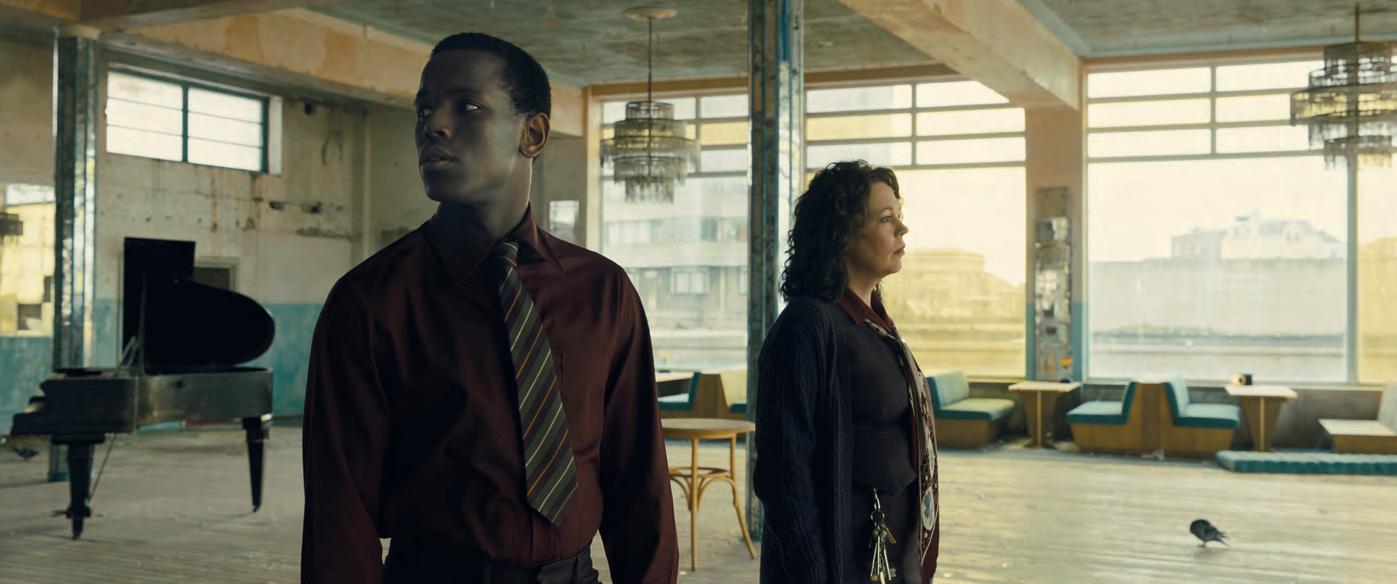
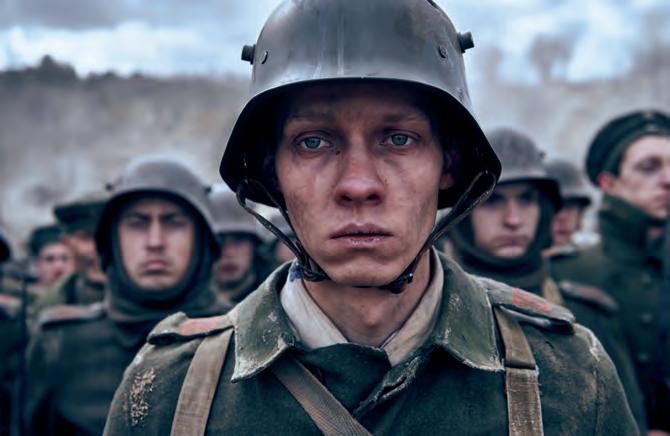
All Quiet on the Western Front, a searing portrayal of World War I through the eyes of a young German soldier, has nine nominations including Best Achievement in Cinematography for James Friend FRPS. Two-times Oscar winner Sir Roger Deakins received his 16th Oscar nomination, for Empire of Light, a love letter to the cinema. Deakins, the 2009 recipient of the RPS Lumière Award, is interviewed next issue. If you are reading this after Oscars night on 12 March, you’ll know whether he’s made it a hat-trick. Finally, All the Beauty and the Bloodshed, nominated for Best Documentary, charts the crusade of Nan Goldin HonFRPS to hold the billionaire family behind the US opioid crisis to account. There was an exclusive screening of the film at RPS House before its general release.
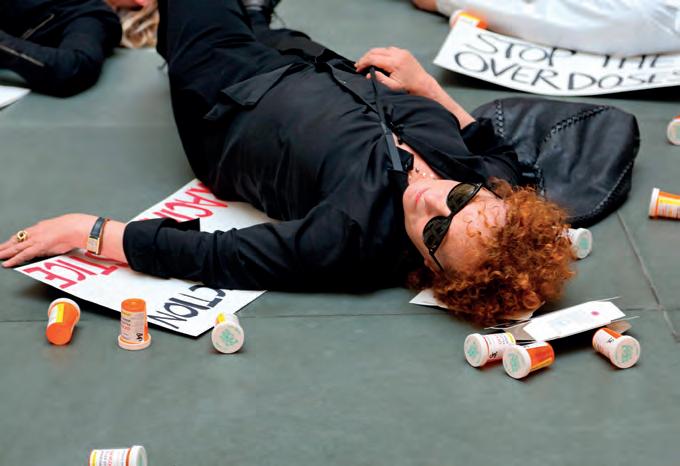
The nomination for All the Beauty and the Bloodshed, directed by Laura Poitras, is perhaps most affecting since Goldin herself became addicted to opioids following an operation and under medical supervision. Her subsequent campaign to expose the powerful Sackler family is cleverly combined with accounts of Goldin’s personal struggles in childhood and as an artist.

Most inspiring for members, though, is the nomination of James Friend. You might be surprised to learn he achieved his Distinctions Fellowship in the Film, Video and Multimedia genre with a submission that included scenes from his many television streaming projects, such as Your Honour. That a renowned director of photography would count an RPS Distinction among his achievements is of great credit to the Society.
And the awards don’t stop there, with six RPS members among those recognised in the 16th International Garden Photographer of the Year competition. You can see some of their work in our highlights from this year’s event on page 150.
You don’t have to be an award-winner, though, to create and enjoy great images. In this issue you will find stories of visual journeys made by photographers from all walks of life. We hope you enjoy them as you continue your own journey.
KATHLEEN MORGAN Editor
WELCOME
Contact the editor with your views rpsjournal@thinkpublishing.co.uk
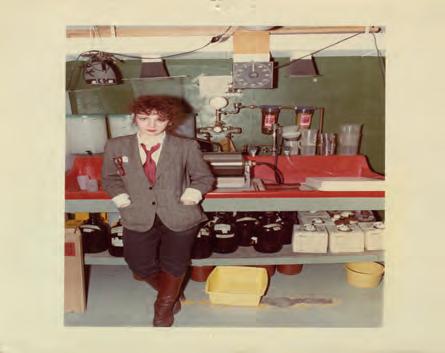
Nan Goldin, c 1970, by Russel Hart, courtesy of Non Goldin HonFRPS
KEEP IN TOUCH WITH THE RPS
MARCH / APRIL 2023 RPS JOURNAL 113
i
Contents
Features
162
DOCUMENTARY
Renowned for work created during the Apartheid era in South Africa, Jo Ractliffe HonFRPS explains how she conveyed the sorrows and struggles of her homeland in stripped-back images that leave their mark
182
WILDLIFE
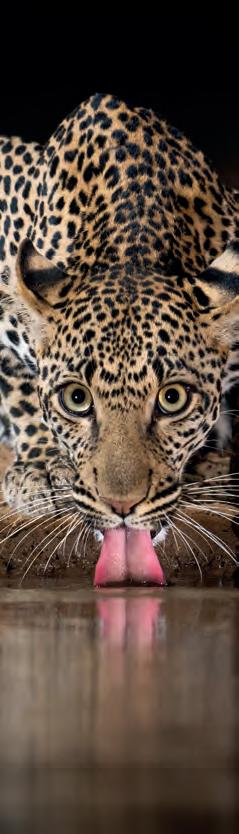
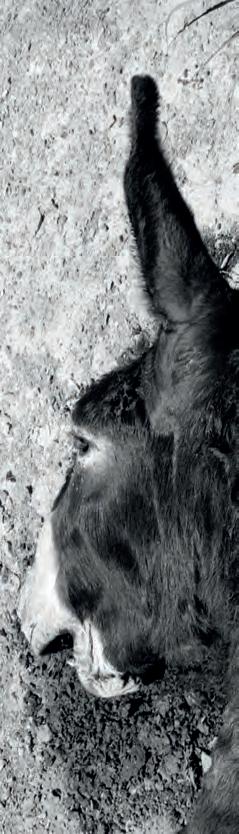
When Will Burrard-Lucas joined forces with a Maasai community to build a waterhole, he documented the results in a startling series that shows how humanity and nature can collide in a positive way
138
BEST SHOTS
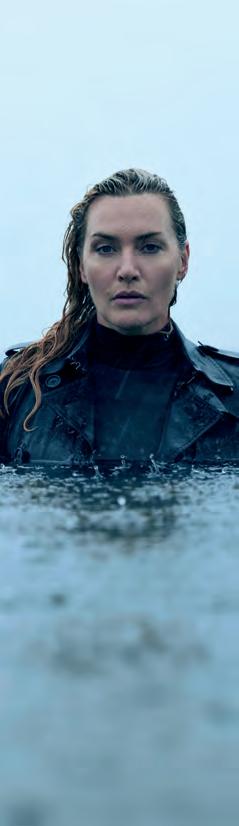
An official photographer for the James Bond franchise and celebrated for his spontaneous portraits of celebrities such as Kate Winslet and Daniel Craig, Greg Williams reveals the secret of his success
170
EXHIBITION
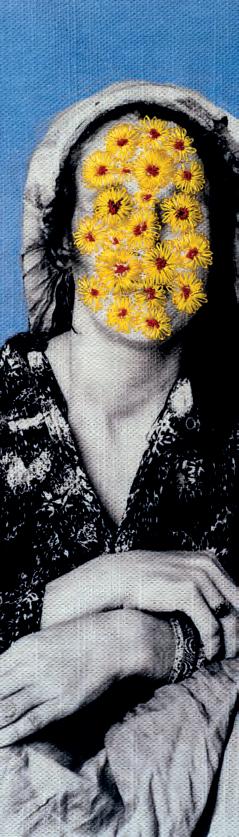
In our second feature celebrating the 164th International Photography Exhibition, we meet two other stand-out IPE 164 exhibitors – Jenny Matthews HonFRPS and Max Miechowski
114 RPS JOURNAL MARCH / APRIL 2023
GREG WILLIAMS; JO RACTLIFFE HonFRPS; JENNY MATTHEWS HonFRPS, WILL BURRARD-LUCAS
196
GALLERY
Shoair Mavlian, new director of The Photographers’ Gallery in London, shares her vision for the UK’s original public photography space and highlights some of the image-makers who inspire her
206
DISTINCTIONS
Achieving an RPS Fellowship is impressive at the best of times, but Richard Tickner FRPS and Simon JG Ciappara FRPS explain what it takes to make the grade in the new Distinctions Photobook genre
Cover story
GARDENS
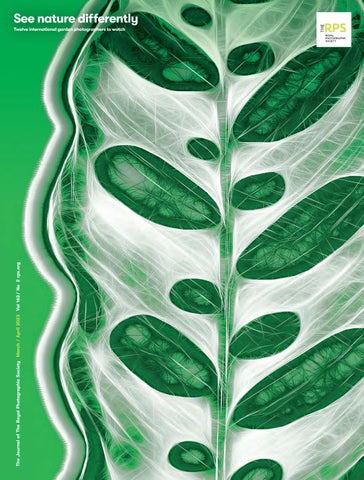
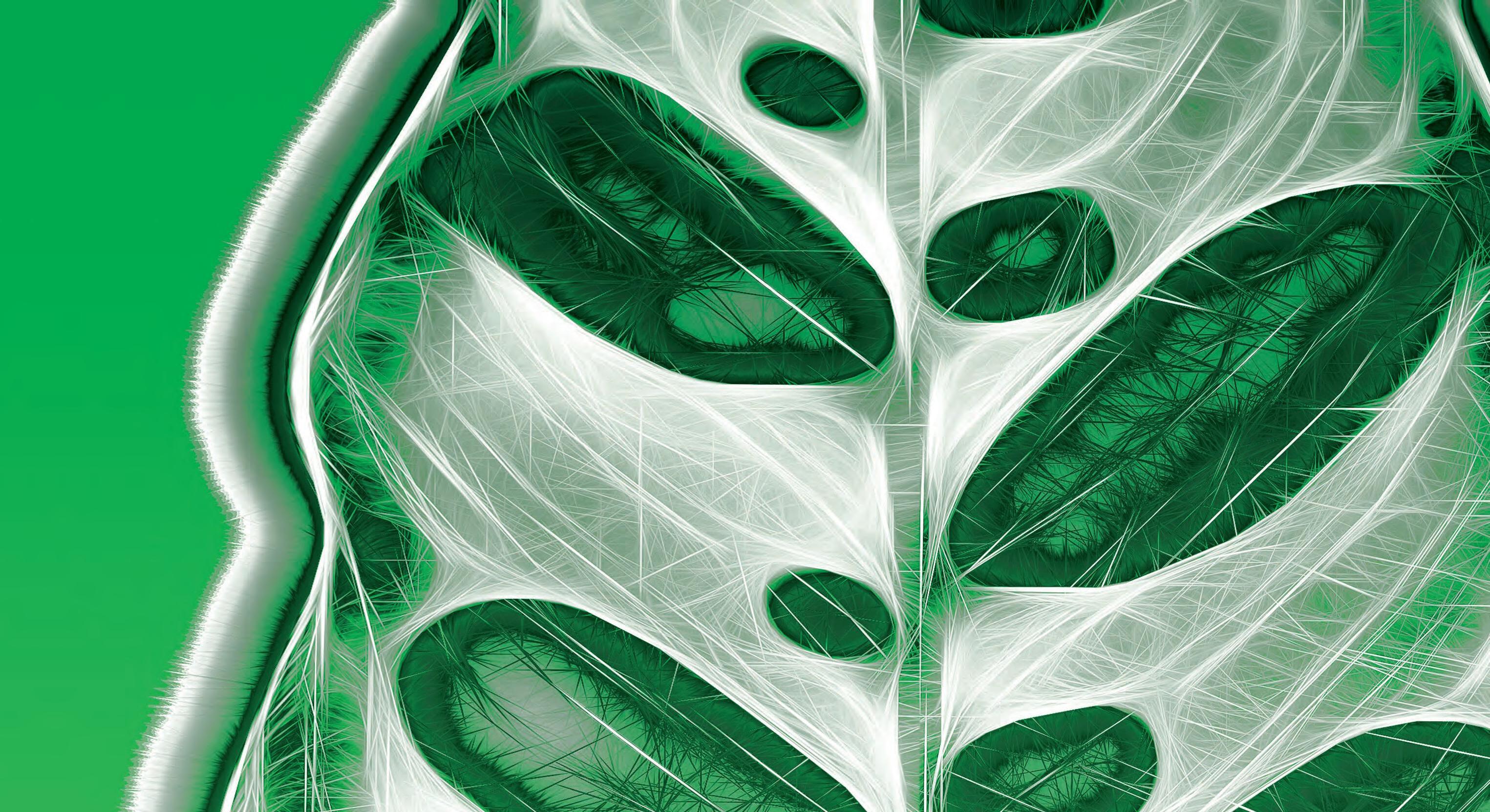
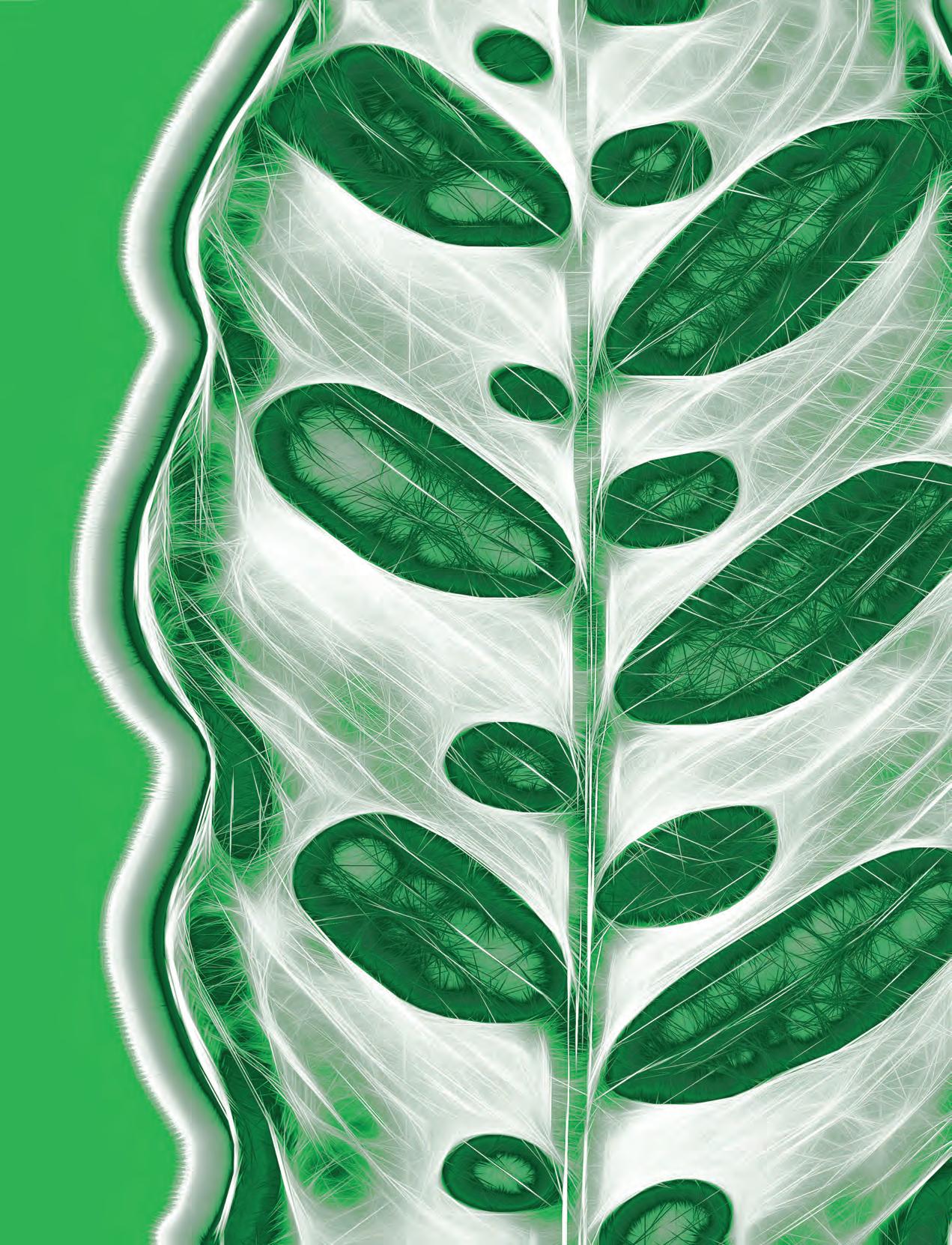
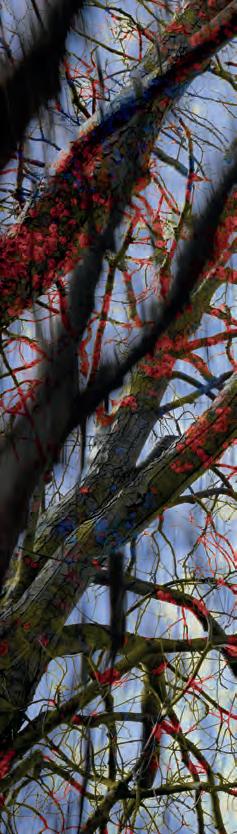
This leaf study by Wolfgang Wiesen has been recognised in the International Garden Photographer of the Year awards. Discover 11 other top images from the competition
150

MARCH / APRIL 2023 RPS JOURNAL 115
PAUL STUART; RICHARD TICKNER FRPS; WOLFGANG WIESEN / INTERNATIONAL GARDEN PHOTOGRAPHER OF THE YEAR
THE ROYAL PHOTOGRAPHIC SOCIETY
RPS House, 337 Paintworks, Arnos Vale, Bristol BS4 3AR, UK rps.org
frontofhouse@rps.org
+44 (0)117 316 4450
Incorporated by Royal Charter

Patron
HRH The Princess of Wales
President and Chair of Trustees
Simon Hill HonFRPS

Deputy Chair
Mathew Lodge LRPS
Honorary Treasurer
Position vacant
Trustees
Mónica Alcázar-Duarte, Nicola Bolton ARPS, Gavin Bowyer ARPS, Sebah Chaudhry, Sophie Collins LRPS, Sarah J Dow ARPS, Andy Golding ASICI FRPS, Mervyn Mitchell ARPS, Dr Peter Walmsley LRPS

Chief Executive Officer
Dan Jones
Directors
Marketing and Membership: position vacant
Finance and HR: Nikki McCoy
Programmes: Dr Michael Pritchard FRPS
THINK 41'
Group Editor
Kathleen Morgan rpsjournal@thinkpublishing.co.uk
0141 375 0509
Contributing Editor
Rachel Segal Hamilton
Art Director
John Pender
Managing Editor

Andrew Littlefield
Deputy Editor
Ciaran Sneddon
Advertising Sales
Elizabeth Courtney
elizabeth.courtney@thinkpublishing.co.uk
0203 771 7208
Client Engagement Director
Rachel Walder
Circulation
10,260 (Jan-Dec 2021) ABC

ISSN: 1468-8670

© 2023 The Royal Photographic Society. All rights reserved. The ‘RPS’ logo is a registered and protected trademark. Every reasonable endeavour has been made to find and contact the copyright owners of the works included in this publication. However, if you believe a copyright work has been included without your permission, please contact the publisher. Views of contributors and advertisers do not necessarily reflect the policies of The Royal Photographic Society or those of the publisher. All material correct at time of going to press.
GraemeGreen(page138)
A photographer and journalist for media outlets including the BBC, the Guardian and the Sunday Times, Green is also founder of conservation initiative the New Big 5 project
CONTRIBUTORS
TeddyJamieson(page182)
An award-winning features writer, Jamieson was born in Germany, raised in Northern Ireland and lives in Scotland. He is the author of Whose Side Are You On?
RachelSegalHamlton(page196)
A photography and visual arts writer, Segal Hamilton is contributing editor to the RPS Journal. She has worked for titles including the British Journal of Photography and Aesthetica

The Journal of The Royal Photographic Society March / April 2023 Vol 163 / No 2 Published on behalf of The Royal Photographic Society by Think, 20 Mortimer Street, London W1T 3JW thinkpublishing.co.uk
116 RPS JOURNAL MARCH / APRIL 2023




PHOTOGRAPHERS TRUST WllKINSONCAMERAS. At theheart of theImage Wilkinson Cameras www.wilkinson.co.uk 01772252188 sales@wilki nson.co.uk 11 -I @ IIa ~:1part-exchange. perfected. L... Part-exchangeyour old equipment in-store or online. Flexiblefinance optionsavailable,provided by ~~OVUna® OUR HIGH STREET LOCATIONS: BURNLEY CARLISLE CHESTER KENDAL LIVERPOOL PRESTON SOUTHPORT WARRINGTON 4.9/5 average review score based on over 3000 genuine customer reviews on the reviews.io / reviews.co.uk platform -correct at the time of publishing.
118 RPS JOURNAL MARCH / APRIL 2023
Holi festival
BY PRABIR MITRA FRPS
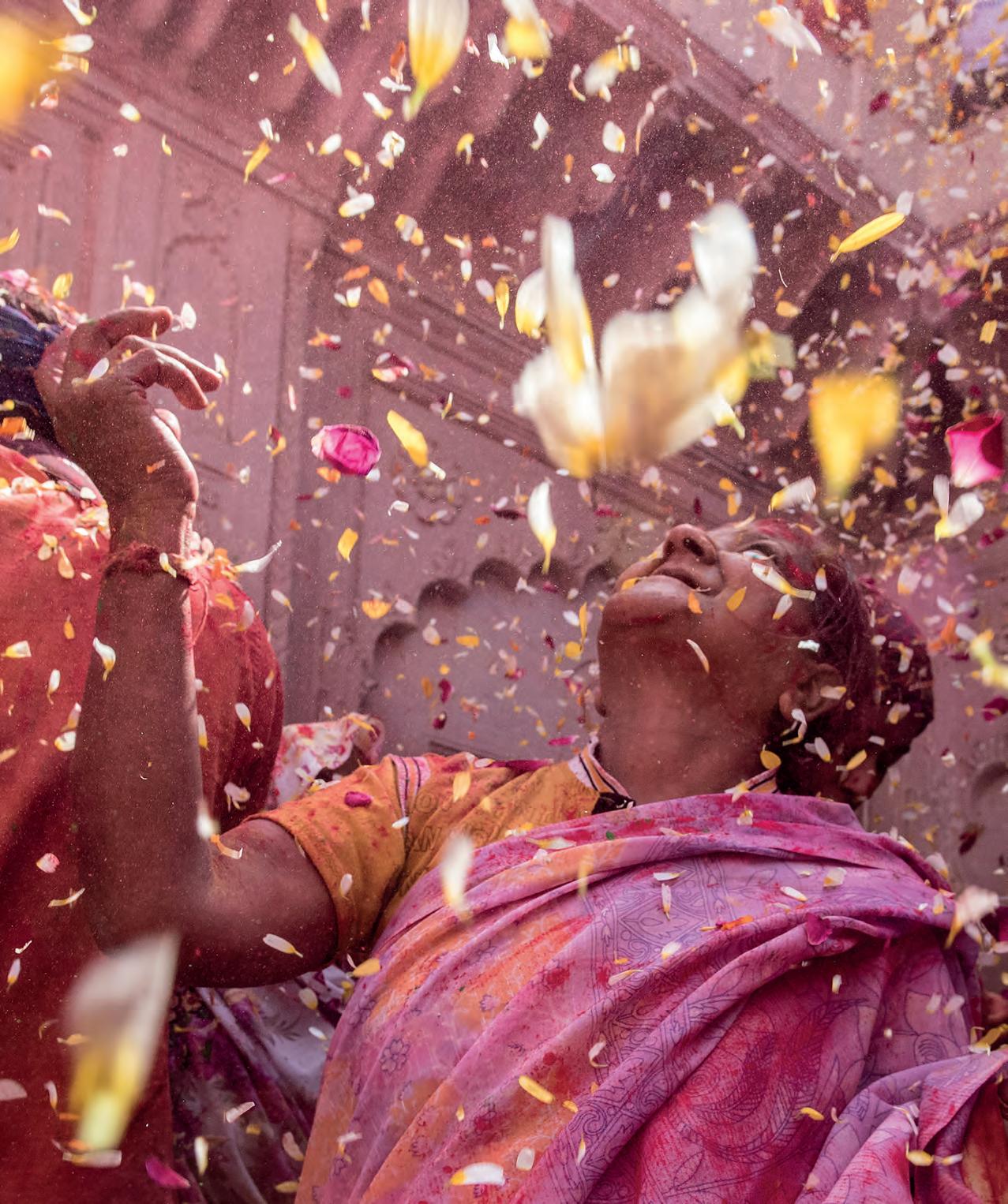
An elderly widow celebrates the Hindu festival of Holi by showering petals at the Gopinath Ji Temple in Vrindavan, India.
This joyful photograph, by NHS doctor and travel and documentary photographer Dr Prabir Mitra FRPS, is from his series documenting this festival of colours. It is a particularly surprising image, though, since Indian widows are traditionally forbidden from taking part in any celebrations.
“Widows used to live colourless lives – giving up coloured clothing, cosmetics, good food – and they were almost banished from mainstream society,” explains Mitra, whose work has been published in titles including National Geographic Traveller and the Guardian. “They used to settle in big numbers in ‘holy cities’ such as Vrindavan to find themselves closer to the ‘Lord Krishna’.
“Social reformer Dr Bindeshwar Pathak, through his organisation Sulabh International, took up an awareness initiative [in 2013] and gave widows a degree of social acceptance by organising Holi to bring colour to their lives. The festival is now celebrated as ‘Holi of the Widows’ in Vrindavan.
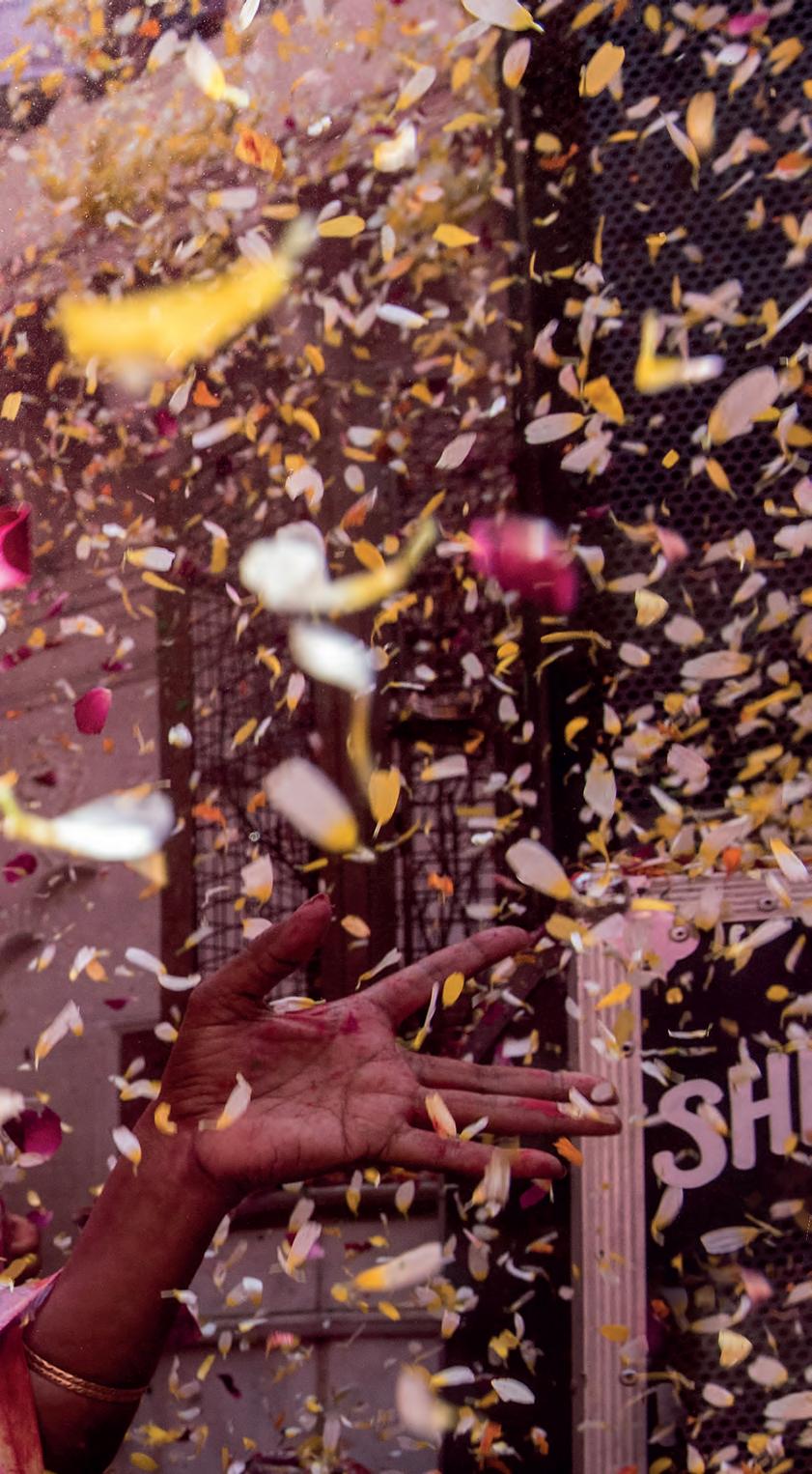
“People from far and near participate in this extraordinary event which is seen as an act of social integration.”
www.prabirmitra.co.uk
MARCH / APRIL 2023 RPS JOURNAL 119
BIG PICTURE
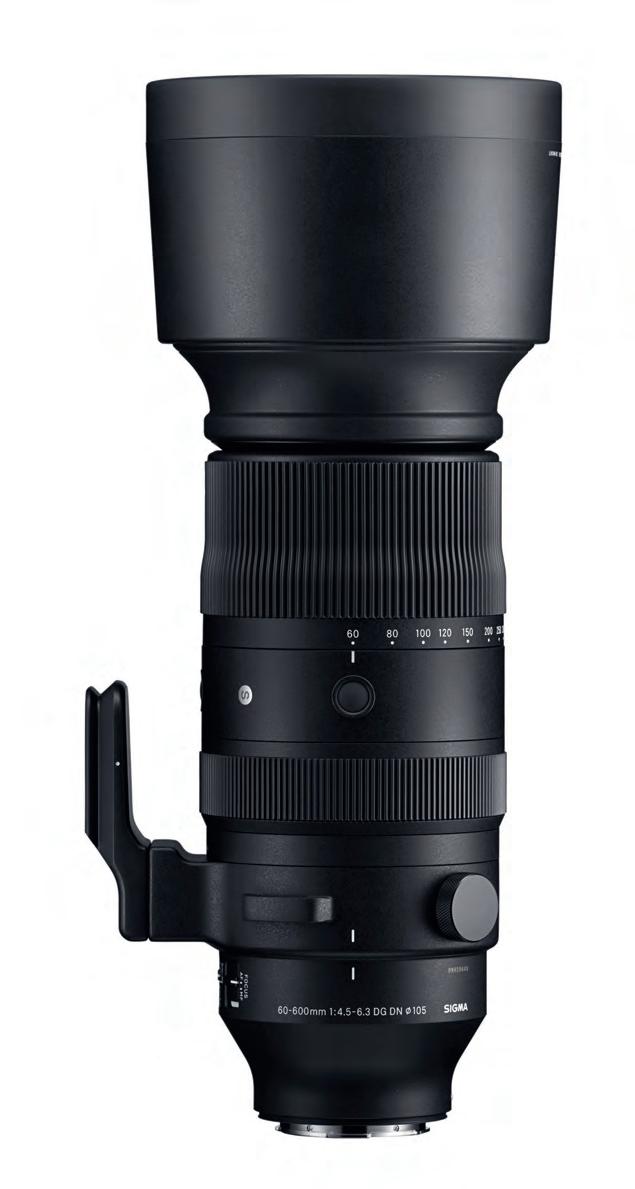
Meet the world's first full-frame 1Ox ultra-telephoto zoom for mirrorless cameras. Available now for L-Mount and Sony E-mount.
Sports
60-600mm F4.5-6.3 DG DN OS
Supplied accessories: Case, Hood (LH1144-02), Cover Lens Cap (LC-740E),Shoulder Strap, Tripod Socket (TS-121), Front Cap (LCF-105III), Rear Cap (LCR II).
Available mounts: L-Mount, Sony E-mount
*L-Mount is a registered trademark of Leica Camera AG



4' one lens one tree
Birdsof prey photoworkshops
SIGMA UK has a range of workshops running throughout 2023. These include four smallgroup, half-day, birds of prey workshops in Essex. Scan the QR code or visit sigma-imaginguk.com to find out more!


SIGMA
0
2023
Sigma Imaging (UK) Ltd, 1 Little Mundells, Welwyn Garden City, Hertfordshire AL7 1EW I 01707 329999I sales@sigma-imaging-uk.com I sigma-imaging-uk.com
In focus
CURIOUSER AND CURIOUSER
The
An image-maker and curator based in the United States has been named the first RPS Woman Science Photographer of the Year in a ceremony at RPS House, Bristol.
Margaret LeJeune was recognised for The Watershed Triptych, a glowing turquoise triptych that portrays the health of our water systems. She produced her winning work by culturing dinoflagellates,
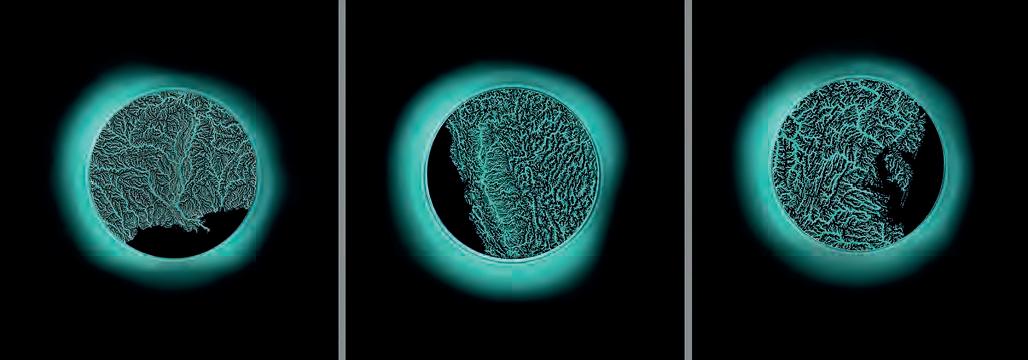
the organisms that cause harmful algal blooms (HBAs), in her lab-studio.
“These blooms wreak havoc on the environment by killing marine species and endangering human health as well as devastating marine and tourist industries,” explains LeJeune, who is based in Rochester, New York. “I used the dinoflagellates to illuminate large agricultural watershed maps derived
MARCH / APRIL 2023 RPS JOURNAL 121 IN FOCUS
NEWS, VIEWS AND EXHIBITIONS
134
FIONA ROGERS FINDS NEW WAYS OF LOOKING
124
THREE OSCAR NOMINATED FILMS WITH AN RPS CONNECTION
130
A COLOURFUL TAKE ON GREAT SALT LAKES
inaugural RPS Woman Science Photographer of the Year award is designed to inspire future artists
The Watershed Triptych by Margaret LeJeune, RPS Woman Science Photographer of the Year
from the United States Geological Survey, wherein farm run-off contributes to the development of HABs when combined with warming ocean waters.”
Photographer Yas Crawford ARPS, who was on the selection panel, says: “LeJeune’s artistic interpretation of today’s environmental problems reflect her multidisciplinary talent.”
The award, launched last year by the RPS Women in Photography Group, celebrates female and female-identifying image-makers shining a light on issues of scientific significance. Crawford, who has worked in commercial life sciences and microbiology throughout her career, and as CEO for several companies, says: “It was rare to encounter other similar female roles in senior positions,” adding, “I was particularly excited to be part of this competition to
help promote both women in science and women in the arts.”
LeJeune, who is associate professor of photography at Bradley University in Peoria, Illinois, believes the award can inspire future female and femaleidentifiying science photographers.
She says, “Representation helps invite the next generation to follow their curiosity and get involved.”
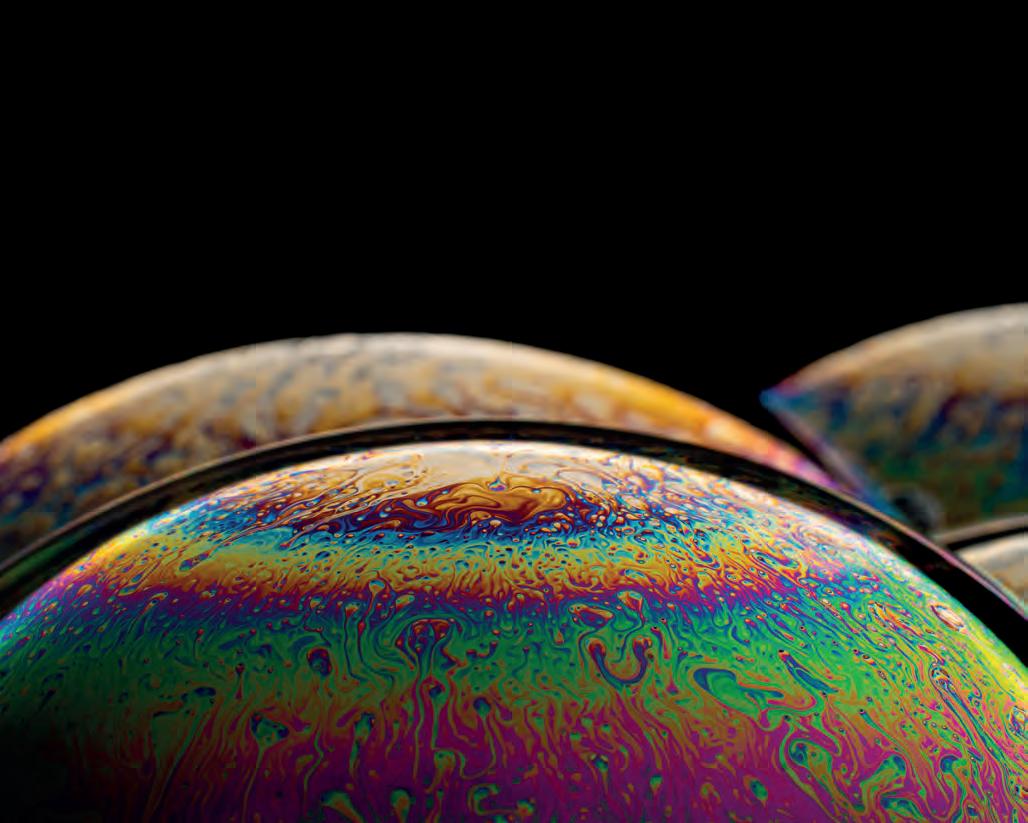
At the same time, high school student Kelly Zhang received RPS Young Woman Science Photographer of the Year for her macro shot of iridescent soap bubbles. A digital exhibition of winning and highly commended images is on display at RPS House until 30 March before touring.
rps.org/groups/women-in-photography
IN FOCUS 122 RPS JOURNAL MARCH / APRIL 2023
‘The beauty of soap bubbles’ by Kelly Zhang, RPS Young Woman Science Photographer of the Year
“Representation helps invite the next generation to follow their curiosity”




BEAUTY AND BLOODSHED PROVES A WINNING FORMULA
A trio of films involving renowned image-makers with a connection to the RPS could be up for Oscar success
Ask Sir Roger Deakins about his 16th Oscar nomination and he answers with a question: “Is it?”
The renowned cinematographer continues: “I went a very long time without being nominated. I’m not pooh-poohing it, but it’s the work and experience that really counts.”
It’s no wonder Deakins is a little ambivalent about those nominations. He was up for an Oscar 13 times before winning his first in 2018 for Blade Runner 2049, and his second in 2020 for 1917. His latest Oscar nomination is for Empire of Light, a love letter to cinema and cinemagoing.
He is also one of three renowned image-makers with a connection to the RPS – alongside Honorary Fellow
Nan Goldin and James Friend FRPS
–
IN FOCUS
Felix Kammerer as German soldier Paul Bäumer in the anti-war film All Quiet on the Western Front
124 RPS JOURNAL MARCH / APRIL 2023
Michael Ward and Olivia Colman in Empire of Light, a story of love and celluloid set in 1980s Britain
in contention for Oscar success on 12 March. Deakins, recipient of the 2009 RPS Lumière Award whose work also includes Fargo and Skyfall, is far more passionate about film-making than awards: “I’ve had wonderful experiences. I hope there will be a few more films like Empire of Light where I feel I’m connected to the characters.”
Friend is nominated for All Quiet on the Western Front, the story of a young German soldier in World War I. The director of photography, who achieved an RPS Fellowship in the Film, Video and Multimedia genre in 2018, says of the film, “It was hard to shoot. And it was hard to watch. I was surprised by that, but in a pleasant way. I think we have succeeded as film-makers if it is hard to watch. War is horrific. And at the end of the day, this is an anti-war film.”
Goldin, recipient of the 2018 RPS Centenary Medal, was already renowned for bold images of sexuality, drug culture and the HIV/Aids crisis when she began campaigning to hold the powerful Sackler family to account for the US opioid crisis. All the Beauty and the Bloodshed, nominated for Best Documentary, tells of Goldin’s crusade, a very personal one. The artist had overcome an addiction to a painkiller manufactured by a Sackler-owned company. “The idea we could affect a multi-billion-dollar company in America is my pride and joy,” she says.
Short cuts
RPS STUDENT AWARD
Bethan Lovell has received the RPS Western Region Project Award, open to photography students. Lovell picks up £200 funding towards her final project and a one-year membership of the RPS. rps.org/regions/western
MARILYN STAFFORD
Photojournalist Marilyn Stafford has died aged 97. American-born, Stafford worked in Lebanon, India and Tunisia and publised three books. The annual Marilyn Stafford FotoReportage Award supports a project on social or environmental issues by a woman documentary photographer. marilynstafford photography.com
RPS MEMBERS BLOOM
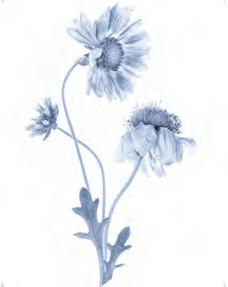
A number of RPS members enjoyed success this year in the 16th International Garden Photographer of the Year. The annual competition celebrates the best in garden, plant, flower and botanical photography. See page 150 for more. igpoty.com
MARCH / APRIL 2023 RPS JOURNAL 125
From the series Floral Blue Delft Tiles by Marlene Finlayson ARPS, finalist, Portfolios, IGPOTY 16
“We have succeeded as film-makers if it is hard to watch. War is horrific. And at the end of the day, this is an anti-war film”
Nan Goldin HonFRPS leads a protest against the Sackler family in All the Beauty and the Bloodshed
Huge range of sensor cleaning tools and camera accessories.

• Sensor cleaning tools.
• Camera straps.
• Lens protection.
• Camera body covers.
• Camera bags.
• LCD protection.
• Gloves and vests.
• Viewfinders and more.
What to see
SHE/HER/HERS/ HERSELF
Belfast Exposed
Until 18 March
1Socially engaged photographer
Anthony Luvera has collaborated with Sarah Wilson to document five years of her identity as a trans woman. Through photography, video and sculpture, She/ Her/Hers/Herself (2017-2022) explores individual experience and wider social ideas about femininity and what it means to be a woman today.
belfastexposed. org
Catch a selection of the best UK exhibitions
SONY WORLD PHOTOGRAPHY AWARDS
Somerset House, London
14 April to 1 May
FORMAT23
Various Derby venues
16 March to 9 April 2
The latest edition of this international biennial considers ‘What Photography Can Be’. Across multiple venues, 200 artists from across the globe unpack that theme. The line-up includes solo exhibitions from Joanna Vestey and Ngadi Smart, alongside group shows from winners and participants in the festival open call, Picturing High Streets. formatfestival.com
Various Oxford venues
14 April to 6 May
3
This year, Photo Oxford explores the power of the archive, with exhibitions on the birth of conflict photography at Rewley House and Photography in Britain 1800–1850 at Weston Library, Bodleian Libraries. There are also portfolio reviews, an open call focused on personal experience, and a display comparing side-by-side portraits of Oxford residents from the 19th and 21st centuries. photooxford.org
4
With categories open to professional and amateurs, these awards bring together some of the most exciting photographers working right now. This year there will be a special solo presentation by the Outstanding Contribution to Photography Award winner, Rinko Kawauchi HonFRPS. worldphoto.org
FIRE/FLOOD: GIDEON MENDEL
Soho Photography Quarter, London
Until 31 May
5
Two series by Gideon Mendel HonFRPS – Drowning World and Burning World – are showing at the outdoor space at The Photographers’ Gallery (see also page 201). Every evening the stills are accompanied by Signs and Portents, Mendel’s film about those directly affected by the climate crisis. thephotographersgallery. org.uk
MARCH / APRIL 2023 RPS JOURNAL 127 IN FOCUS
PHOTO OXFORD
From the series She/Her/Hers/Herself (2017–2022) by Anthony Luvera
YZZA SLAOUI; SIAN DAVEY / PHOTO OXFORD FESTIVAL; RINKO KAWAUCHI HonFRPS; GIDEON MENDEL HonFRPS
FIVE HEAD TURNERS TO WATCH
Sharad
Iragonda Patil
PHOTOGRAPHER
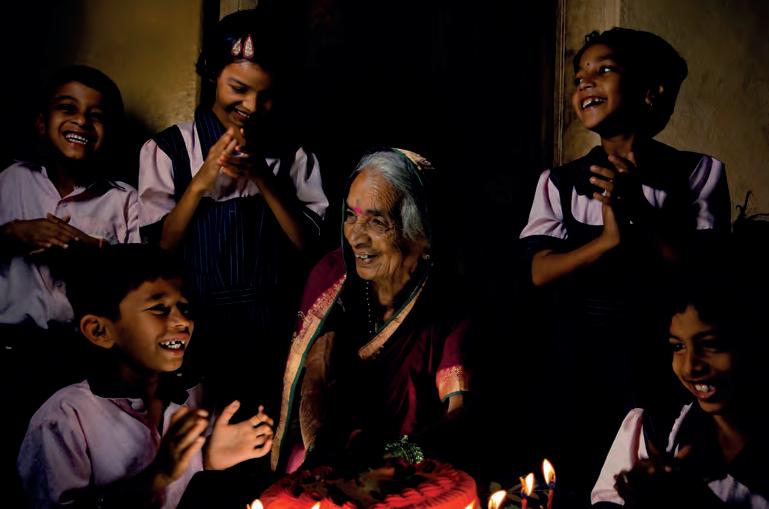
Patil’s image of a matriarch celebrating her 100th birthday won the Living with Dignity category of Picture People’s ‘Future in Focus’ Mobile Photo Competition. The selection panel impressed by Patil’s work included Nick Danziger HonFRPS.
Lindokuhle Sobekwa
DOCUMENTARY PHOTOGRAPHER
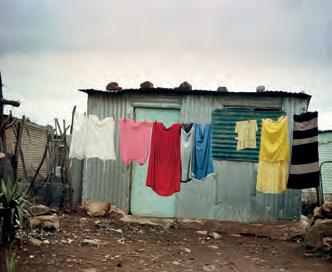
South African photographer and Magnum nominee Lindokuhle Sobekwa is the recipient of the John Kobal Foundation Fellowship. Launched in collaboration with Tate, the biennial award recognises an individual for an outstanding body of lens-based work.
Rifumo Mathebula
WILDLIFE PHTOGRAPHER AND EDUCATOR
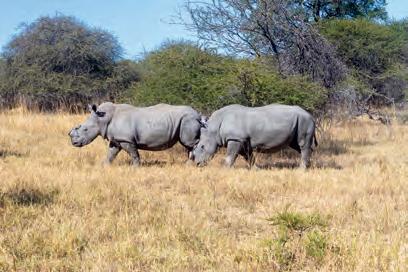
Awarded the 2022 CIWEM International Young Environmentalist of the Year, Mathebula is programme director of Wild Shots Outreach. He teaches photography to communities bordering the Kruger Park in South Africa.
Samantha Stephens
SCIENCE PHOTOGRAPHER
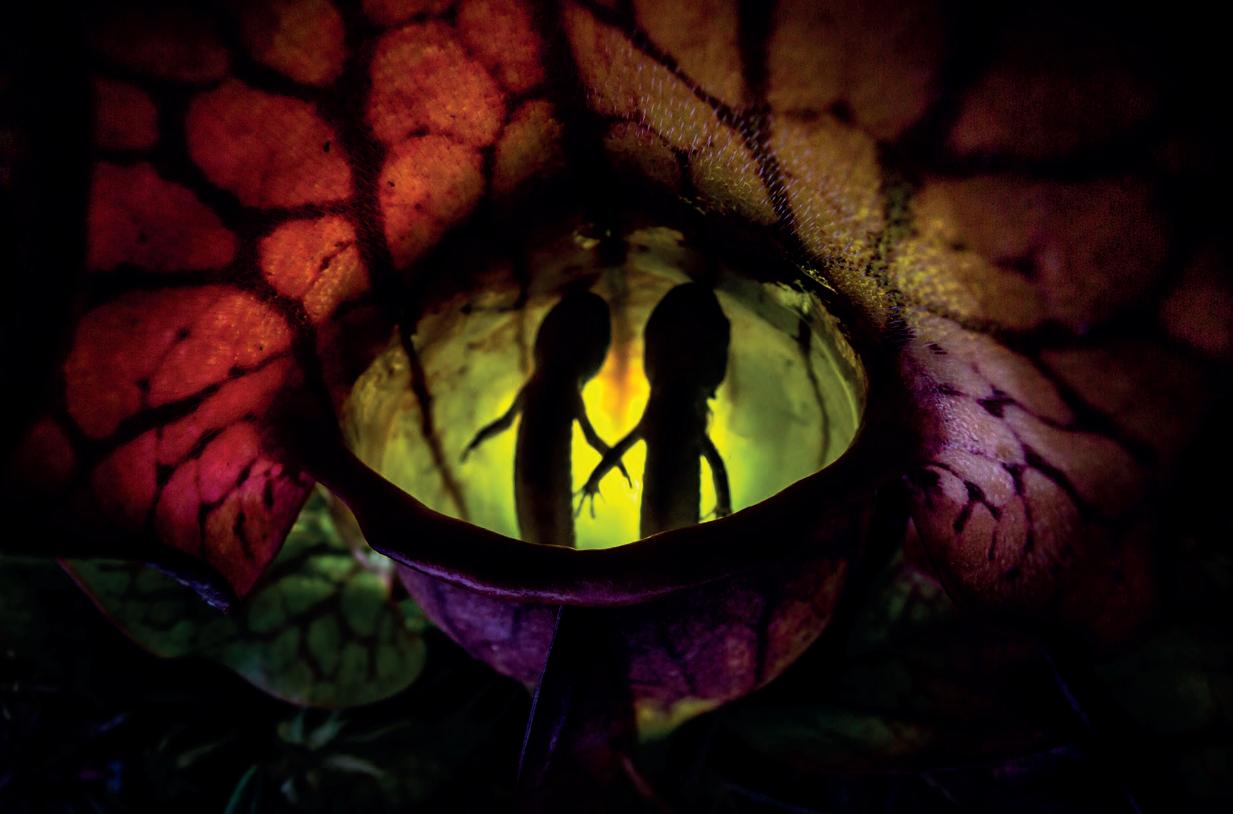
Canadian biologist turned image-maker Stephens has been named Close Up Photographer of the Year for her unsettling image of a pair of salamanders consumed by a carnivorous northern pitcher plant (Sarracenia purpurea).
IN FOCUS 128 RPS JOURNAL MARCH / APRIL 2023
‘Dehorned rhino protected by the charity Rhino Revolution’ by Rifumo Mathebula
‘Great grandmother’ by Sharad Iragonda Patil
‘Ziyanda’s clothing, 2017’ by Lindokuhle Sobekwa/Magnum Photos
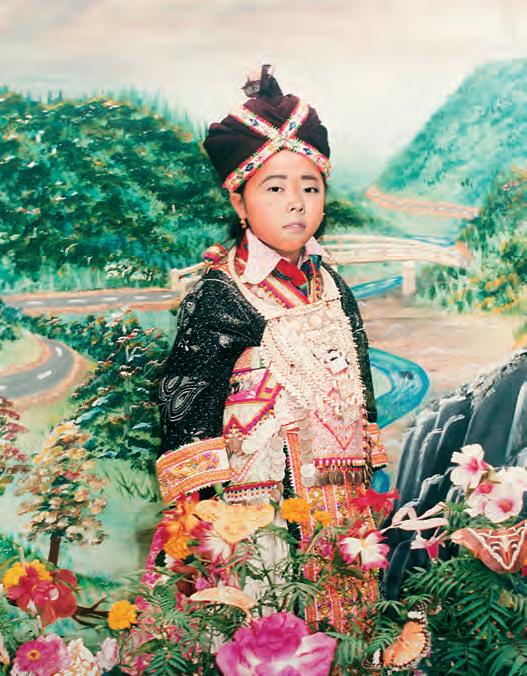
Pao Houa Her ARTIST
The recipient of the 2023-24 Next Step Award, Her has been recognised for her work documenting the lives and experiences of Hmong community members in the US and beyond. The award includes a $10,000 grant, along with publication of a photobook with Aperture, and a solo exhibition.
‘My grandmother’s favorite grandchild, Pao Houa, 2017’ from the series My Grandfather Turned into a Tiger by Pao Houa Her
MARCH / APRIL 2023 RPS JOURNAL 129
‘Nature’s pitfall’ by Samantha Stephens
1
CULTURALLY SIGNIFICANT
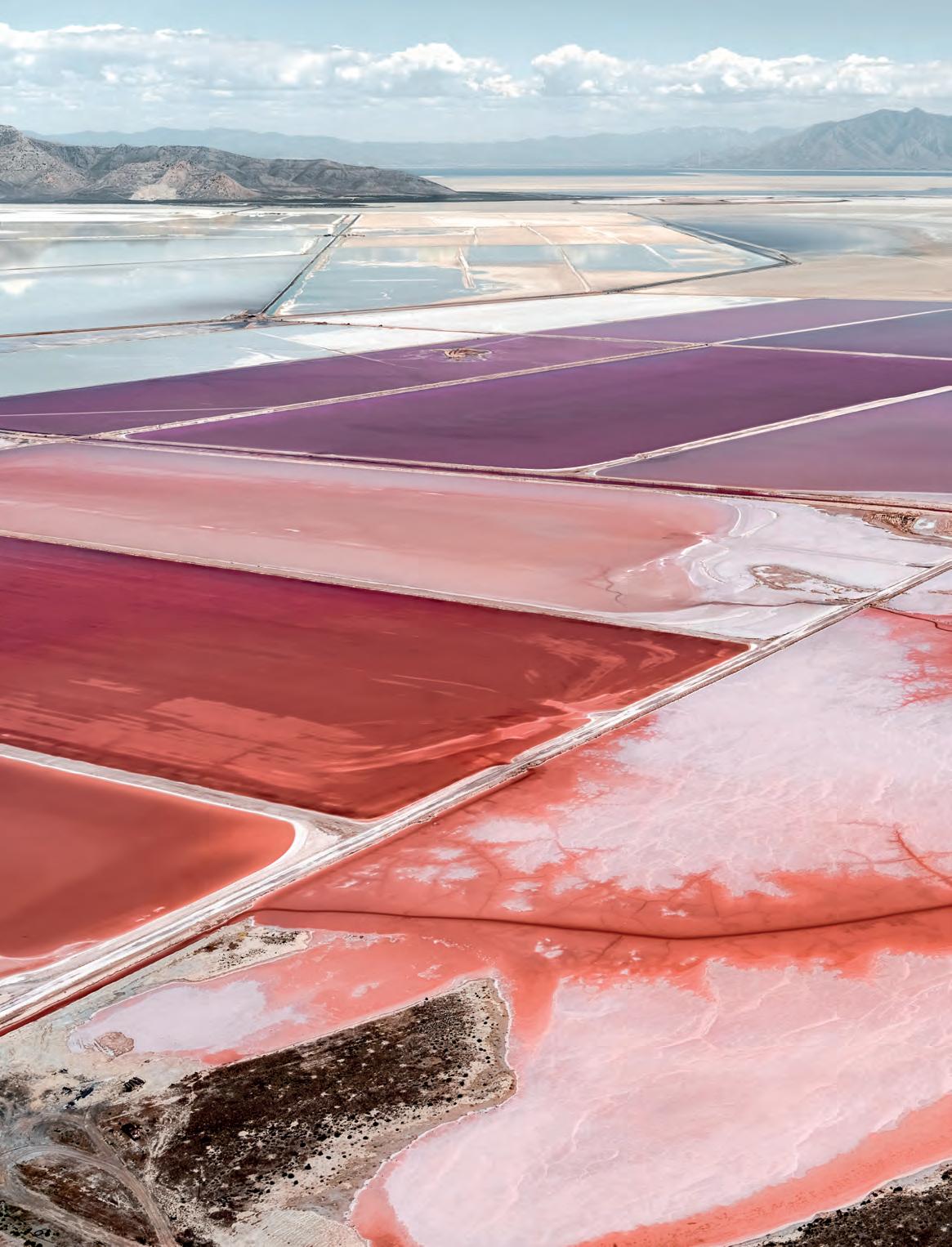
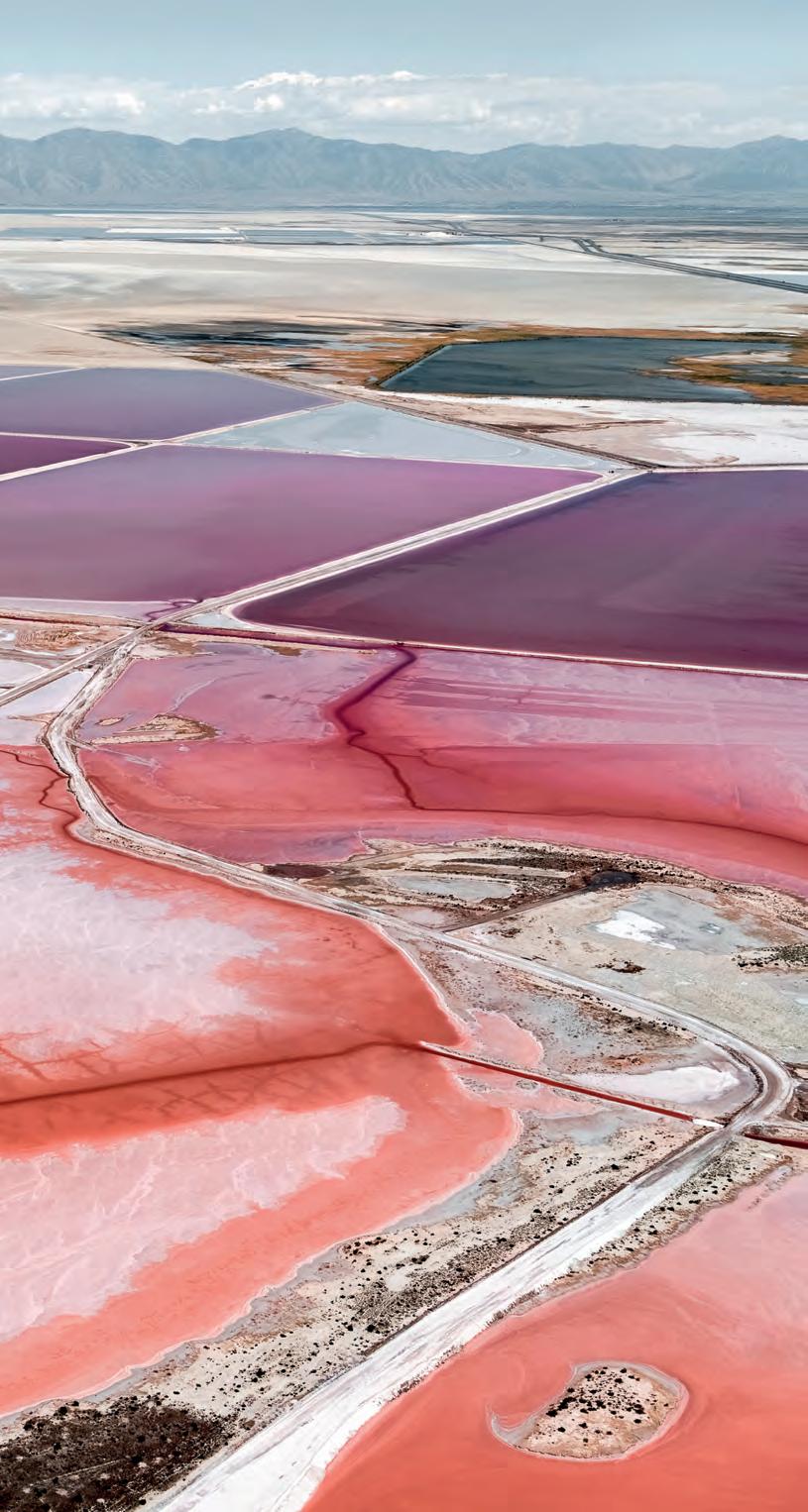
“Salt has played an irreplaceable role in the evolution of our society – one of the most important raw materials to conserve food and to supplement nutrient balance. The Egyptians used salt to mummify their pharaohs, soldiers were paid in salt and in many countries high taxes were levied on it. Salt was one of the first international trade goods, transported on routes through the Sahara and northern Europe.”
2HYBRID LOCATIONS
“The saltworks I have photographed for my book Salt Works, at locations from Spain to Senegal, are places where the boundaries between human design and naturally evolved landscapes are blurred. The human need to subject everything to a structure, to keep it under control, makes all of us designers of our environment.”
3
AESTHETIC INSPIRATION
“The landscapes of the saltworks have an aesthetic quality of the highest order, especially in an aerial view. The nuances of colour in the salt and the sometimes geometric, sometimes organic pools look like large, abstract works by a representative of Land Art or Colour Field Painting. Here, large populations of the salt-loving algae Dunaliella can turn the ponds either red or various shades of green. Tiny brine shrimp that call the Great Salt Lake home impart a pinkish hue to the water that can vary from pale rose to a deep red.”
130 RPS JOURNAL MARCH / APRIL 2023
4 THE STORY
“All around the edges of the Great Salt Lake are companies that extract various minerals from the lake in solar evaporation ponds. The salt produced is used for de-icing roads or to produce lick blocks for livestock. Food-grade salt is not produced from the lake, as it would require costly processing to ensure its purity. The industrial scale of the evaporation operations only appears when seen from an elevated perspective.”
5

LANDSCAPE AT RISK
“In summer 2022 the surface of the lake fell to the lowest level since records began in 1847. The lake goes through seasonal cycles of water loss and replenishment, but for years water destined for the lake has been diverted for human consumption, industry and agriculture. And with droughts, increased by climate change, the water level has gradually declined. More heat means greater demand for water in cities, further reducing the amount that reaches the lake.”
‘Great Salt Lake, Utah, 2021’ from The Salt Series III by Tom Hegen
HOW I DID THIS
German photographer Tom Hegen sees a Utah salt lake from a different angle
You’ll find it on every kitchen table. You probably rarely give it a second thought. “Salt has become one of the most ordinary and everyday foods on our shelves,” says German photographer Tom Hegen, who specialises in aerial imagery. “It is so easy and cheap to get that we often forget that in the millennia-old history of humanity it was one of the most desired goods.”
Hegen photographed salt mines around the world for his latest book, Salt Works. Here, he reveals the making of this beautifully abstract image of a salt lake in Utah, USA.
Salt Works is available from tomhegen.com
MARCH / APRIL 2023 RPS JOURNAL 131
IN FOCUS
Bookshelf
SIMEN JOHAN
Simen Johan
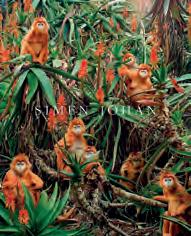
powerHouse Books (£65)
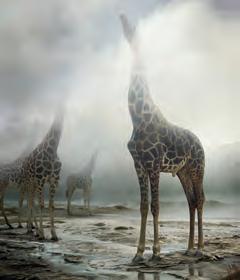
Working with wildlife photography and digital postproduction, Simen Johan creates a mythical world where creatures at risk of extinction can flourish.
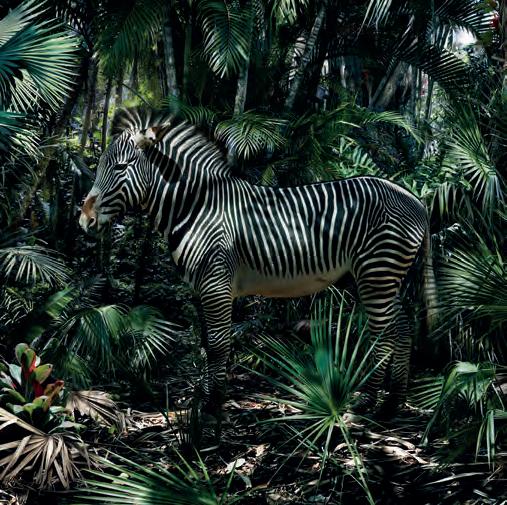
This book brings together photographic images made over the past 15 years by Johan, who also works in sculpture. Born in Norway and of Sámi descent, he now lives in New York. His pictures, made at locations
across the globe, portray animals in captivity as well as in the wild.
All photography is manipulation but Johan particularly embraces this.
“Johan’s photographs underscore the importance of the creative act in photography,” writes David E Little, executive director of the International Center of Photography, “not as an act in itself, but as a means towards a conceptual and narrative goal.”
These surreal scenes of zebras, pandas or lions are more than fantastical conjecture, they have a powerful message too. One of the most notable effects of the Anthropocene – the current epoch shaped by human activity above all else – has been species loss far above what would naturally occur.
The climate crisis and deforestation for food production have destroyed habitats and ecosystems, leaving humanity on the brink of what has been called “the sixth mass extinction”.
Johan attempts to inspire his audience to care about a vulnerable planet. His manipulated images conjure a dream-like vision grounded in reality. They reveal the magic and beauty of the animal world – a world to which humans also belong.
Rachel Segal Hamilton
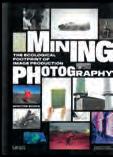
MINING PHOTOGRAPHY
MODERN MUSE
Arpita Shah GRAIN (£30)
Arpita Shah’s portraits of British South Asian women take inspiration from pre-colonial Mughal and Indian miniature paintings. Modern Muse features essays and interviews with women such as Vidya, a practitioner of North Indian classical Kathak dance, and Nilupa, an artist and educator whose family is from Bangladesh.
The Ecological Footprint of Image Production
Boaz Levin, Esther Ruelfs, Tulga Beyerle (Eds) Spektor Books (£32)
There’s no shortage of photographs covering stories to do with ecology. But how much do we really know about the direct impact of photography as an industry? Mining Photography takes a deep dive into art history, investigating how photography has always depended on the extraction of raw materials.
GLAD TIDINGS OF BENEVOLENCE

Moises Saman GOST (£65)
Magnum photographer Moises Saman has documented war in Iraq since the US-led invasion and occupation 20 years ago. Through words and images he unpicks divergent perspectives on the conflict. Rather than an objective representation, the book, he says, “grapples with the biases and limitations inevitably embedded in my work”.
132 RPS JOURNAL MARCH / APRIL 2023
Above and left From the series Until The Kingdom Comes by Simen Johan
My place
It was 1992 and Craig Easton was a 23-year-old photographer fresh out of college. “There was this new phrase that was being bandied about at the time by policymakers who’d talk about ‘the underclass’,” remembers the photographer, now an Honorary Fellow.
“What they meant was people in a poverty trap. They couldn’t work because they didn’t have a permanent address and they couldn’t get a permanent address because they didn’t have work.”
A photographer in the social documentary tradition, Easton was keen to go behind the headlines, to put a human face on the story. Together with a journalist from the French newspaper
Libération, he contacted a homeless charity in Blackpool.
“There is cheap housing there and it was one of these rundown seaside towns where people end up because of their circumstances,” he says.
Through the council they met the Williams family, who were living in a homeless hostel with their six children, and photographed their daily lives.
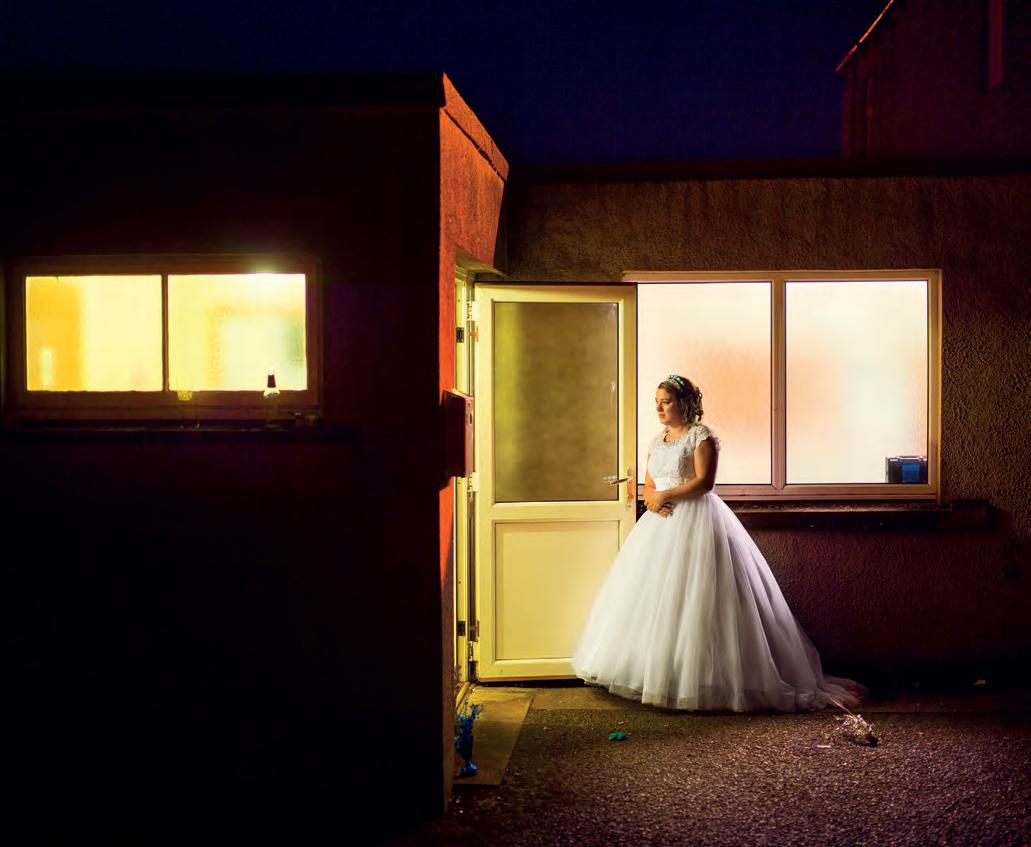
After the initial phase Easton spent years trying to reconnect, concerned about what had happened next. In 2016, through social media, he finally met up with the Williams siblings, now adults with children of their own and dispersed across the north of England.
“Back in the 1990s, we didn’t all have camera phones in our pockets so it was the first time they had seen pictures of themselves as children,” says Easton.
After they got to know each other again the project resumed and Easton has brought both sets of photographs together in a book, Thatcher’s Children
“I’ve been told the timing is ‘extraordinary’ but that would be true whenever the book was out,” he says. “There is a chronic, systemic failure that keeps people on the margins of society.”
Thatcher’s Children by Craig Easton HonFRPS is published by GOST Books. craigeaston.com gostbooks.com
MARCH / APRIL 2023 RPS JOURNAL 133
Craig Easton HonFRPS
BLACKPOOL
The social documentary photographer revisits the lives of six siblings brought up in Blackpool during the Thatcher era
IN FOCUS
From the series Thatcher’s Children, 2016–2020, by Craig Easton HonFRPS
CRAIG EASTON HonFRPS BY LOTTIE DAVIES
Five questions
1
Can you tell us about an image that inspires you?
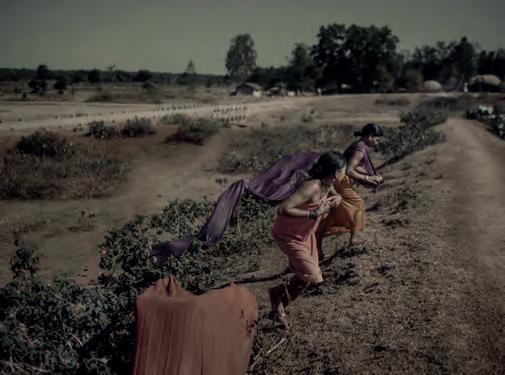
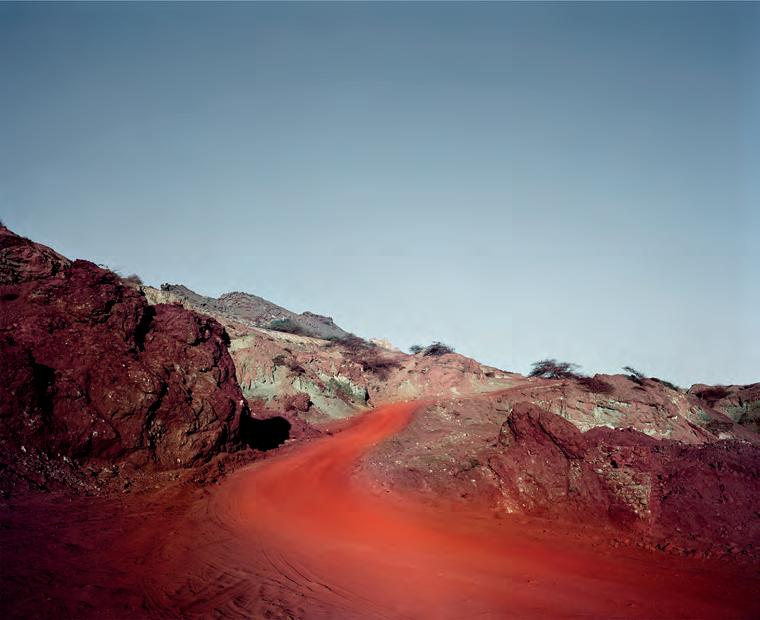
I’m finding inspiration in the works of artists challenging existing norms or conventions within the art world. Photographers working through the reclamation of specific identities are particularly of interest, including Poulomi Basu HonFRPS, Tarrah Krajnak, Hoda Afshar and Frida Orupabo. I’ve loved seeing 1970s feminist performance photography resurfacing.
2Which achievement makes you most proud?
Creating one of the first platforms to support female photographers in 2011 and subsequently publishing the Firecrackers book in 2017 have been career highlights. Being appointed as the inaugural Parasol Foundation Curator of Women in Photography at the V&A will take some beating, however, and I’m looking forward to expanding on these commitments through this new role.
3
What’s been the toughest challenge in your career? Having self-confidence and being able to understand one’s value is an ongoing
challenge. Maintaining good humour and integrity, particularly in the face of adversity or with those resisting change at points in my career, has been something I’ve had to learn. I surround myself with good people who teach me constantly.
4What are you working on now?
We’ve just launched an exciting new international prize for women in photography which will culminate in an exhibition in May 2023, in partnership with Peckham 24. We are also launching the completed V&A Photography Centre, which will provide us with
more space in which to display and celebrate our growing collection.
5What’s next for photography?
Hard to say, but that’s the joy. I’m constantly surprised by how much diverse and multifaceted work is out there. I’m personally glad to see a shift away from traditional ‘ways of looking’, which can objectify, and I hope we continue to see more artists finding collaborative ways of working with or within communities.
The final phase of the V&A Photography Centre opens on 25 May. vam.ac.uk
IN FOCUS 134 RPS JOURNAL MARCH / APRIL 2023
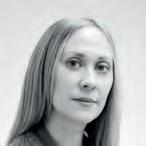
Fiona Rogers, the V&A’s Parasol Foundation Curator of Women in Photography
FIONA ROGERS BY ALYS TOMLINSON
‘Untitled’ from the series Centralia by Poulomi Basu HonFRPS
‘Untitled #1’ from the series Speak the Wind, 2020, by RPS Hood Medal recipient Hoda Afshar
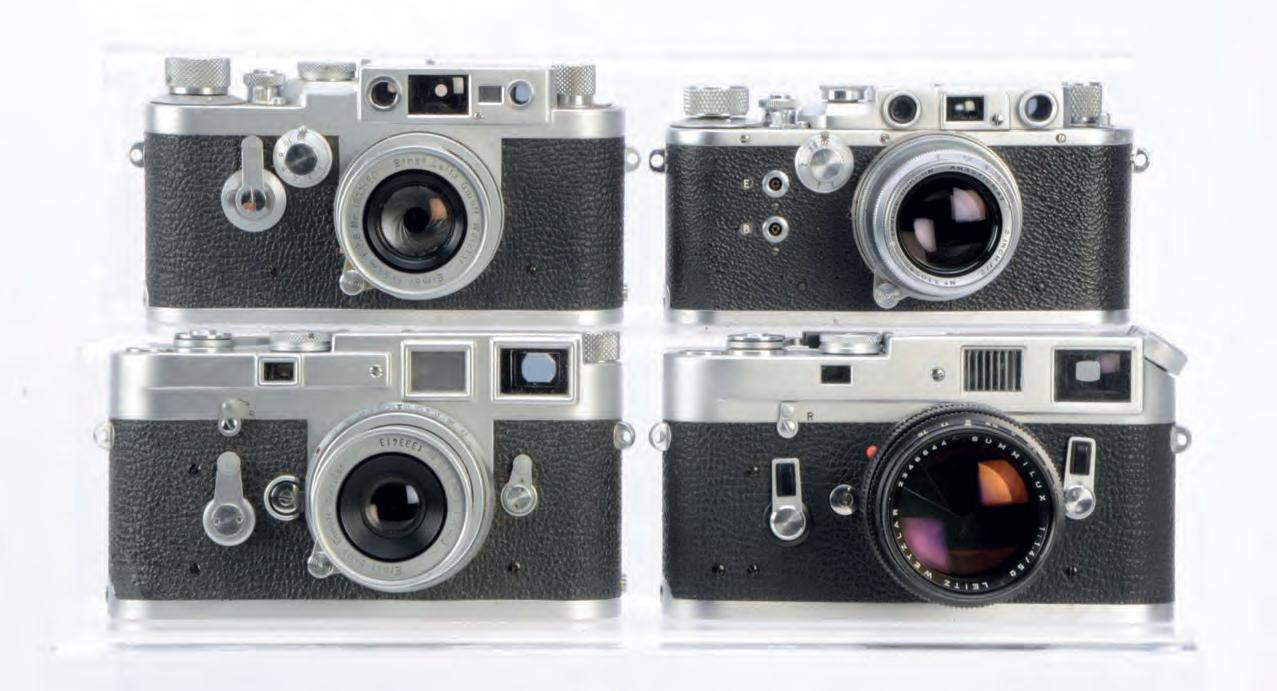
Our upco • auctions will typically offer a wide variety of camera equipment at all prices, from mahogany and brass cameras to Leica, Nikon and Canon and from glass plates to digital, as well as photographs, stereo cards, optical toys and magic lanterns. These cameras are part of just one fine collection in the next auction. Please contact Mike Spencer now to discuss your collection. 01635 580595 or camera@specialauctionservices.com SpecialAuction Services Nexus Park, Plenty Close, N ewb RG 14 5RL
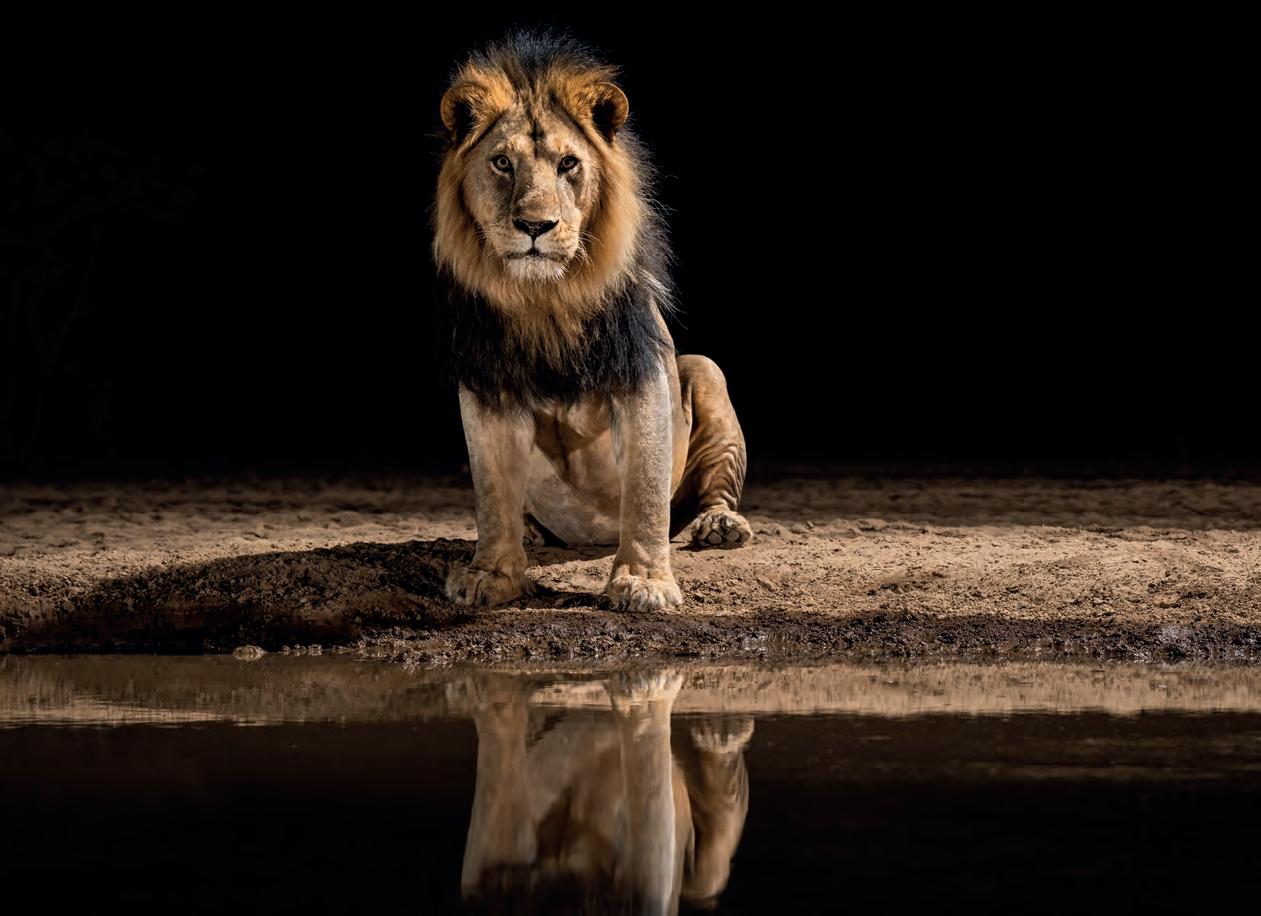 ‘Male lion, Shompole Hide, Kenya, 2022’ by Will Burrard-Lucas
Features
138
GREG WILLIAMS
“I’ve got no interest in someone being unhappy with a photograph. I survive by these relationships”
150
TONY NORTH
“It took an enormous amount of effort to be in that place at the right time”
162
JO RACTLIFFE
“Photographs look like the world we see, but the challenge for me is to resist easy apprehension of an image”
170
JENNY MATTHEWS HonFRPS
“Photography can be quite a solitary endeavour, which is why I’m glad to be part of the RPS”
196
SHOAIR MAVLIAN
“Audiences’ expectations have changed. Museums and galleries will have to change too”
206
SIMON JG CIAPPARA FRPS
“Simply put, I fell head over heels in love with a metal box with a lump of glass on the front”
WILL BURRARD-LUCAS
182
“It’s just me and the lion. Holding my breath and taking pictures when the moment’s right”
138 RPS JOURNAL JANUARY / FEBRUARY 2023 BEST SHOTS
‘IT’S NOT AN ACT. I LOOK FOR THE POSITIVE IN PEOPLE’
He is recognised for candid and intimate portraits of celebrities from Daniel Craig to Lady Gaga. Greg Williams explains how he finds humanity in the glare of the spotlight
WORDS: GRAEME GREEN IMAGES: GREG WILLIAMS
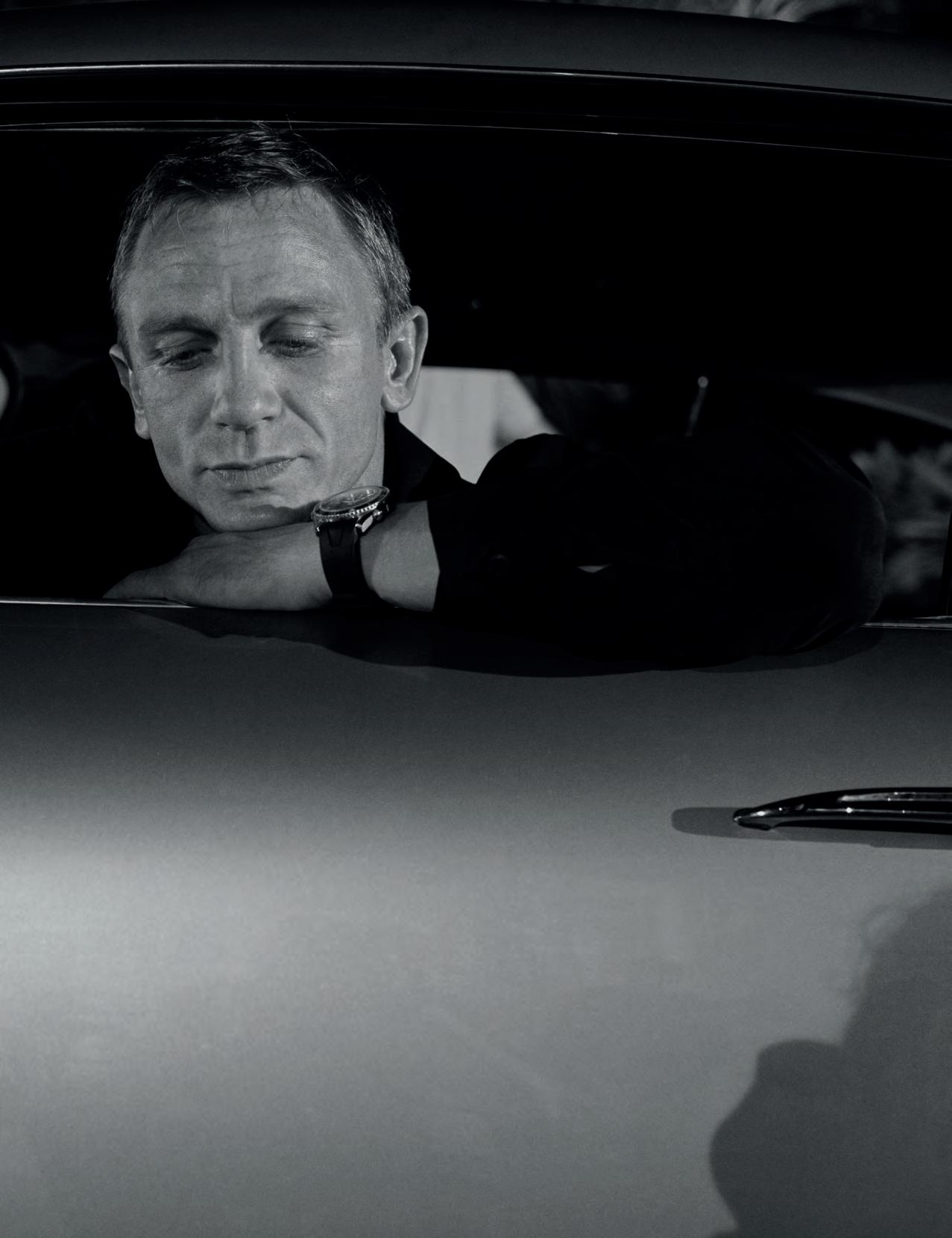
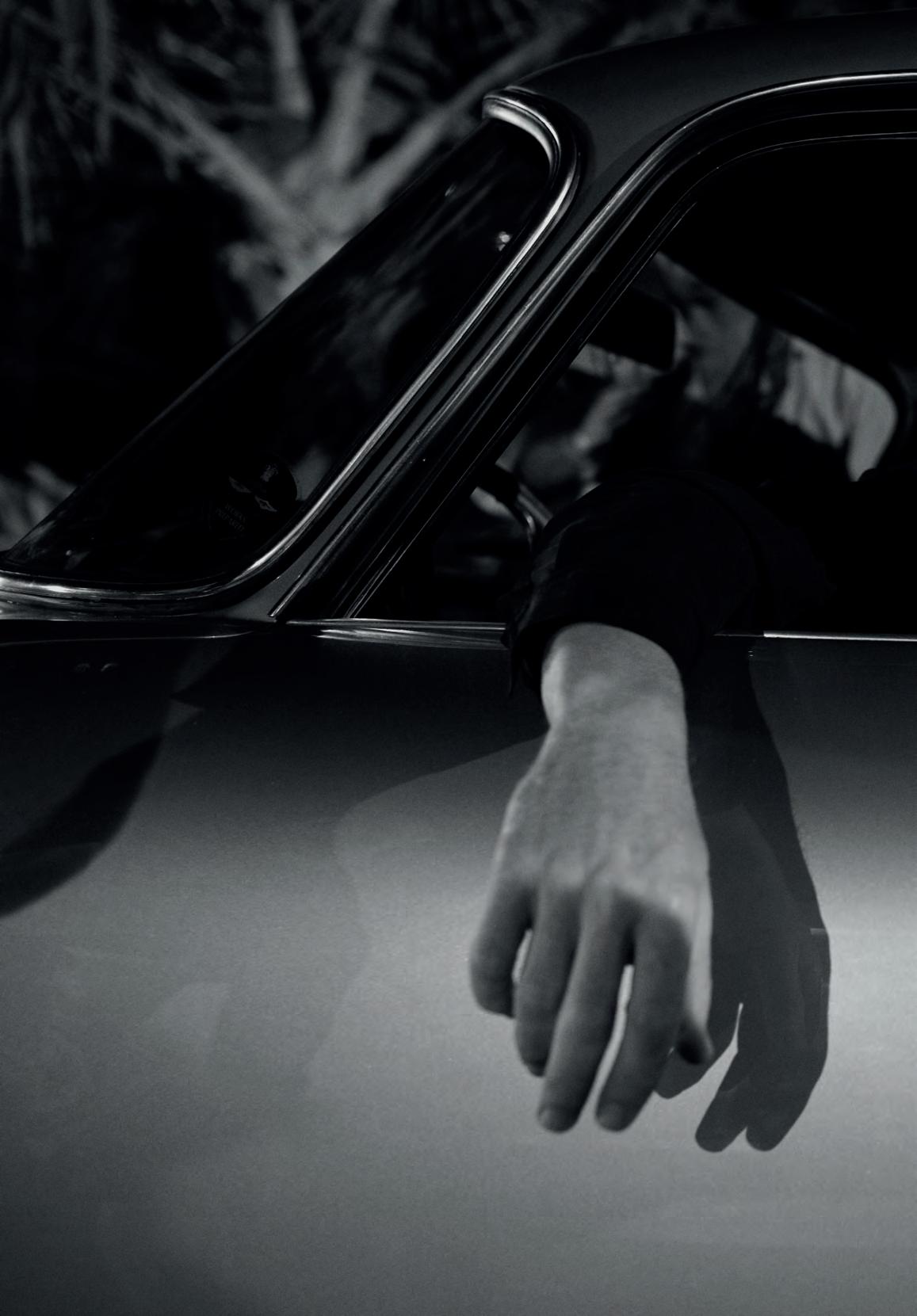
Previous pages
Daniel Craig, Nassau, Bahamas, 2005
“I’ve worked with the James Bond franchise for the last 20 years. I shot Pierce Brosnan’s last Bond movie Die Another Day – I made a book for that. I met Daniel a year before he got Bond. I photographed his screen test for Casino Royale, so we had a good relationship. This photo was taken in the Bahamas for a scene in Casino Royale where he wins a car at a card table. The thing I love about this picture is its one of the first photos I’ve taken that already feels a bit ‘vintage’. There are several reasons for that. The car helps. Daniel was in the prime of his life. I’ve always shot Daniel with Steve McQueen in mind. I always thought he has a real Steve McQueen vibe to him. It feels like the first photo I’ve taken that I believe will last the test of time. I look at it now and think, ‘Great, that’s a goodie’.”
Below
Ana De Arma, LA, USA, 2018
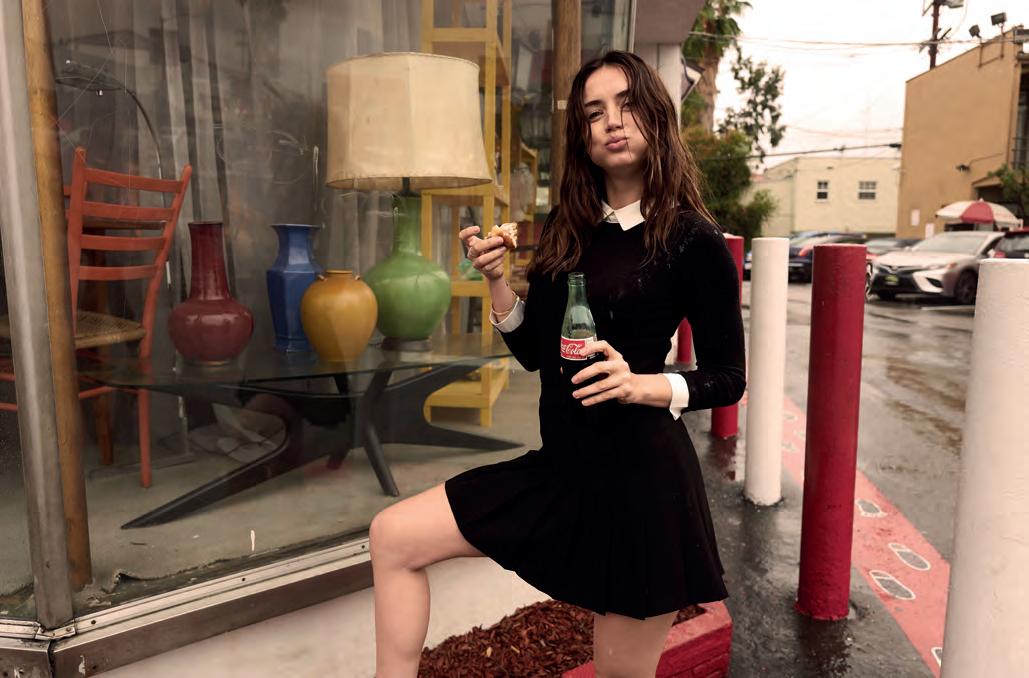
“I’d met Ana in Cannes two years before. She didn’t speak a word of English. Then I met her at a party a year later in LA and said, ‘It’d be great to do a shoot at some point.’ Eventually I just reached out to her on Instagram. I went to her house and she took me for a drive around LA. I often do video with my left hand, while taking pictures in my right. It was a rainy day. She took me to Pink’s Hot Dogs. She’s got a Coke and she’s eating a hot dog. This picture sums up the aesthetic I’m trying to bring to my work. It’s deeply authentic. You don’t take pictures of people eating –it’s just not done. I used to photograph events and as soon as dinner was served you put your cameras down. But there’s something about this picture. She has her cheeks full of bread and hot dog, she’s got a smirk and there’s a joy to the image, yet she still looks fantastic.”
“I’m trying to show the person behind the personality,” says British photographer Greg Williams. “I want to give a first-person experience to anyone looking at the pictures. In many of my pictures, you sense I’m a participant, and there’s a relationship with the subject.”
Besides being an official Bond photographer for 20 years, Williams has been up-close and personal with many of the world’s best-known actors and musicians. Not one for ‘papping’ celebrities from a distance, Williams has contacts and access that many photographers would envy, allowing him to create intimate, candid portraits. Some of these, along with behind-the-scenes stories and tips, are featured in his forthcoming book Photo Breakdowns.
Growing up in East Dulwich, London, Williams sensed he would become a photographer. “When I was six a relative came over from Canada,” he recalls. “He had cameras and lenses, and he let me play with the kit. Three weeks later a gnarly Instamatic arrived from him and I started taking pictures.”
He comes from an artistic family, he explains. “My father was a writer. My mother and brother were painters. I had no hand-eye coordination and I was heavily dyslexic – I couldn’t write or paint. Yet I was creative. The camera gave me that. Aged six, I could tell you I was going to be a photographer.”
Williams began his 30-year career as a photojournalist, covering conflict zones in Chechnya, Myanmar and Sierra Leone. “I had a few very scary situations and decided it wasn’t the life for me,” he says.
140 RPS JOURNAL MARCH / APRIL 2023
BEST SHOTS
Inspired by the work of Magnum photographers from the 1950s in a book his father had given him, Williams was drawn to Hollywood. “I saw Dennis Stock’s photos, where he took James Dean back to where he grew up and photographed him on movie sets. Those pictures had a great influence on me – this idea of being the insider.”
Williams began covering the 1990s’ booming British film industry, meeting actors who liked his “informal” style and asked him to do their portraits. He has since photographed at the Oscars, BAFTAs and Golden Globes, and regularly contributes to British Vogue and Vanity Fair
His work for the James Bond films has been crucial, but not all-encompassing. “It means a lot,” he says. “Anyone who works on a Bond film is playing at the top of their game. I like that pressure. I’ve shot 12 Bond posters or more. The legacy of shooting a Bond poster is greater than shooting the movie poster of any other film. Bond has been a colossal part of my life. But it is just one part of my life.”
It’s easy to see why so many A-listers want to work with him. Besides creativity, the photographer exudes natural warmth, enthusiasm and a sense of fun. Although he has been involved with major staged productions including magazine covers and product campaigns, many of his favourite pictures are more spontaneous, created in short energetic bursts.
Above
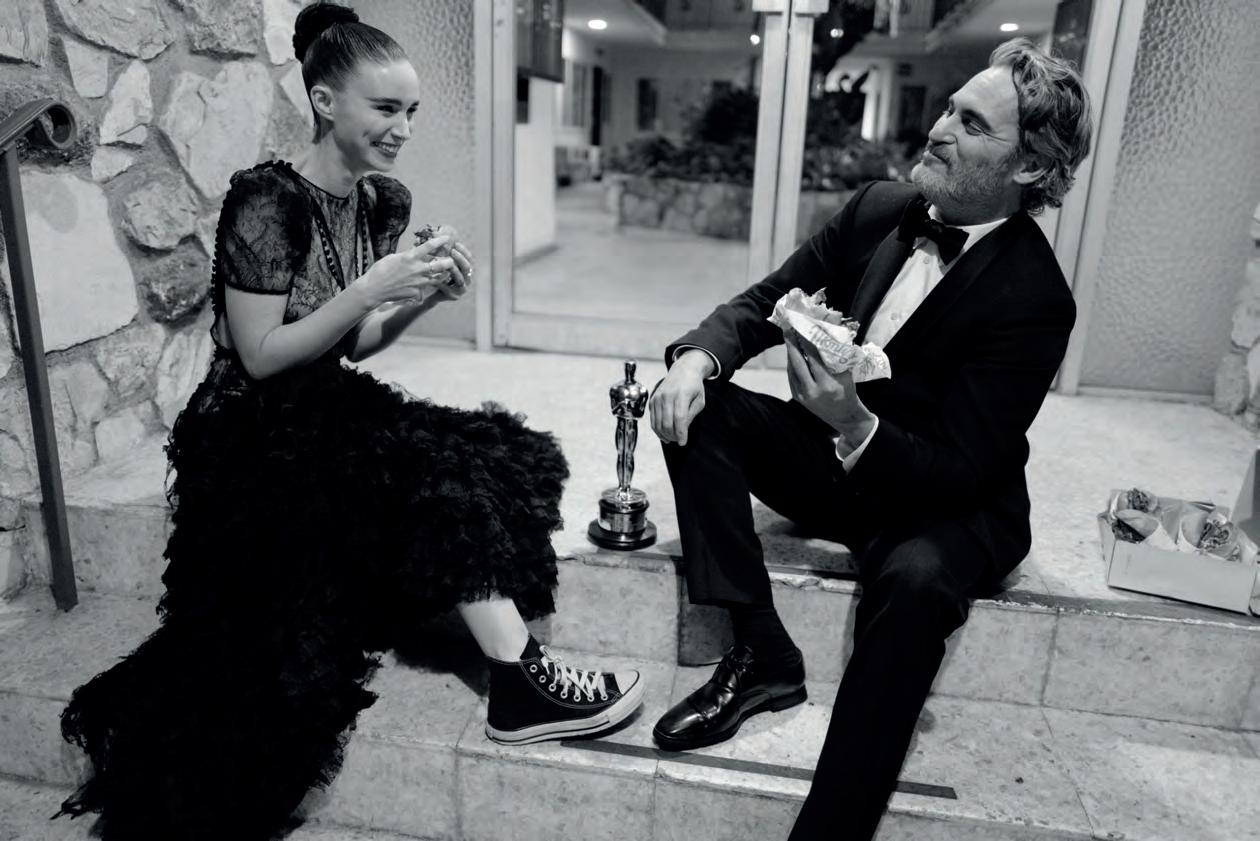
Joaquin Phoenix and Rooney Mara, the Oscars, LA, USA, 2020
“Joaquin and Rooney is probably my most seen photo that isn’t a Bond poster. That year, I wasn’t photographing at the Oscars, but they assumed I was. Rooney messaged me and said, ‘If this goes Joaquin’s way, we want to take a picture that promotes veganism.’ I said, ‘I’d love to but I’m on a job shooting an after-Oscars party for Netflix.’ I sent her a pin. They were on their way from the Governor’s Ball to the Vanity Fair party. I ran out to the street. Joaquin had won his Oscar for Joker maybe an hour and a half before. There were 40 photographers outside the party, but Joaquin and Rooney came in so low key, got out of their electric car and sat on the stoop to eat their burgers. I shot these pictures in full sight of 40 photographers and no one saw us. You’ve got these beautiful people, beautifully dressed, and obviously so in love with each other, and you’ve got an Oscar. There’s all that perfection in there, so to put them on a crappy stoop of an apartment building somewhere in LA, eating burgers, gives that picture something it wouldn’t have had if they were sitting in a perfectly presented environment. She’s taken off her high heels and put on a pair of Converse, which adds to the authenticity. This picture was posted within two to three hours of him winning the Oscar. It went absolutely nuts. At the time I had under a million followers, and I think it got something like 48 million shares. My own little joy was that it was the picture of the Oscars and I wasn’t even at the Oscars.”
MARCH / APRIL 2023 RPS JOURNAL 141
“Anyone who works on a Bond film is playing at the top of their game ... Bond has been a colossal part of my life. But it is just one part of my life”
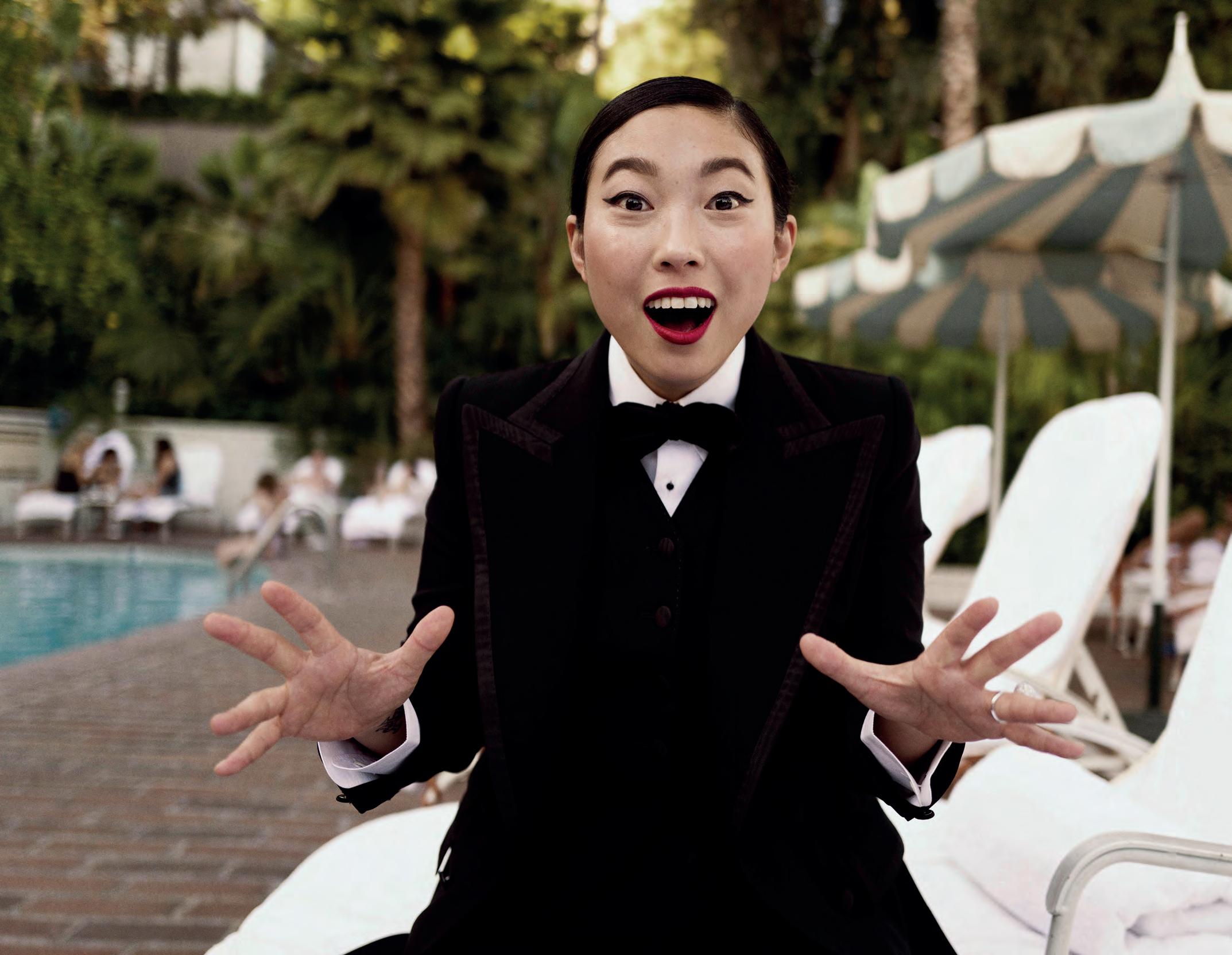
Awkwafina, Chateau
Marmont, Hollywood, USA, 2020
“I shot Awkwafina for British Vogue at the Chateau Marmont hotel in LA. We’d done quite an ‘observed’ fashion shoot with her, where she was in a tuxedo and reclining on sunloungers, and I was playing with light. I was basically taking Hollywood fashion photos of an actress. I often describe what I do when it works as ‘cracking’ someone. You want the glint in their eye. You want that ‘something’. Awkwafina had done the shoot but it was all quite composed. At the end, she said, ‘That’s it?’ and made this gesture. And I said, ‘No, no, no. That is it.’ I said, ‘Do that again.’ And she said, ‘What? This?’ I use this little Leica Q2 camera – it’s mirrorless. The image pops up in your eye for a quarter of a second. I took one frame and said, ‘That’s it.’ I saw her a few months later at the Golden Globes and she came up to me and said, ‘That was it.’ It was really nice.”
BEST SHOTS
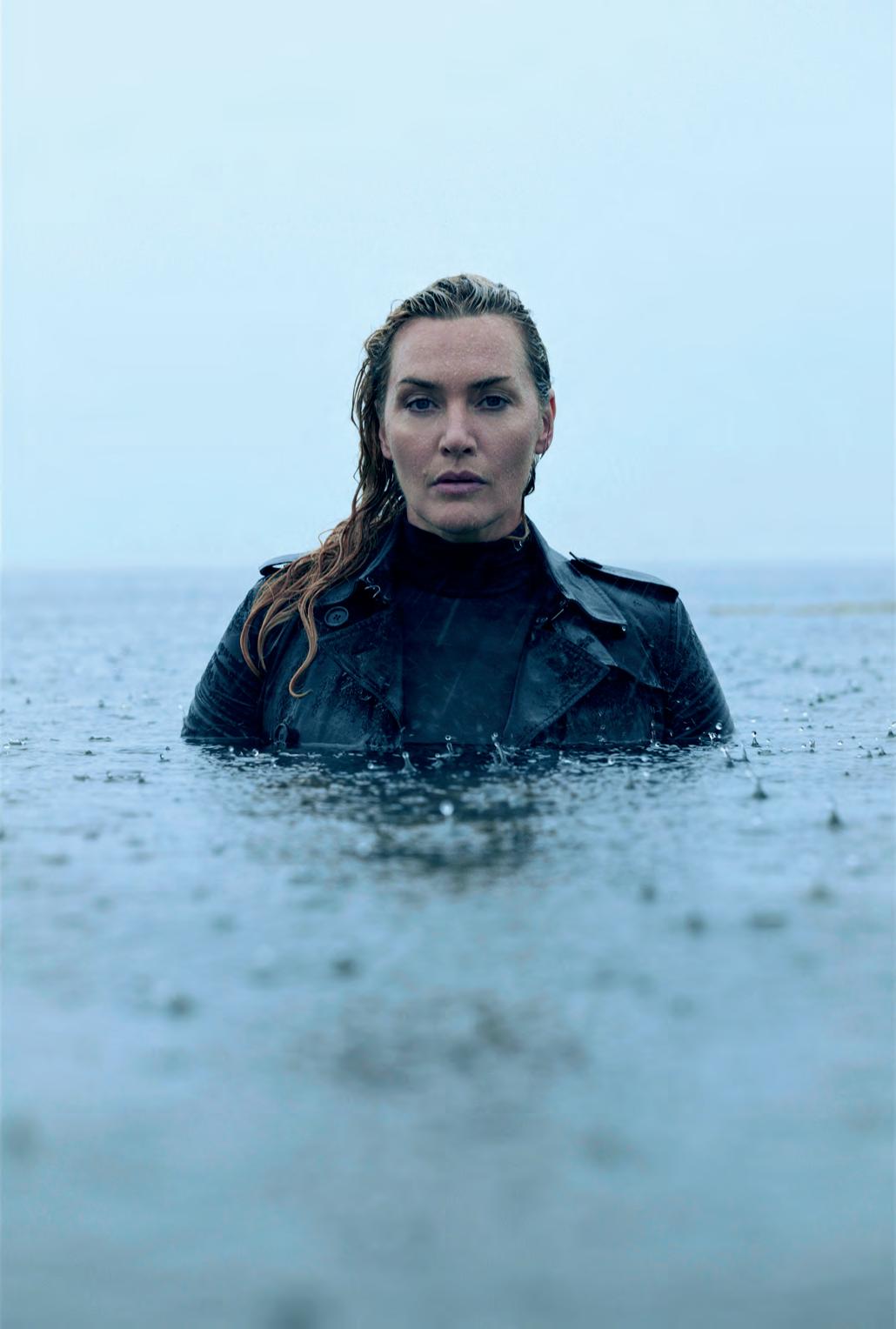
Opposite Kate Winslet, Chichester, UK, 2021
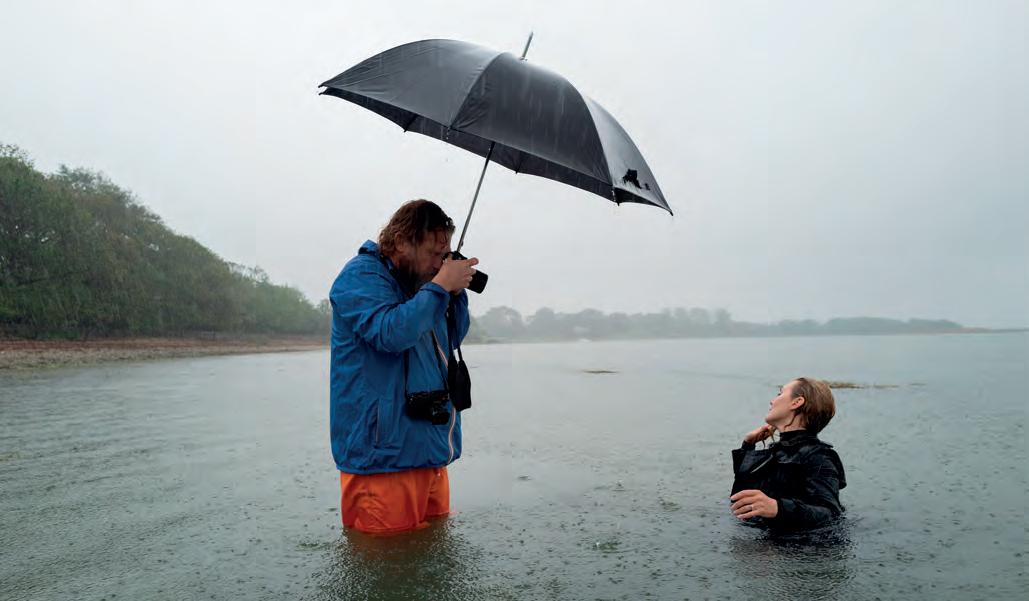
“I shot this in lockdown on a beach not far from Kate’s house. I don’t tend to take assistants to my shoots – in lockdown I absolutely didn’t. For this I just turned up with my bag of cameras. Because it was lockdown there was no hair and make-up, and no stylist. It was a totally open book. It started to pour with rain. I said, ‘Look, this would be a very expensive effect if I had brought water towers, but are you happy to go out in the rain and get a bit wet?’ She was. We chose an outfit for her, then walked down to the beach and into the sea. At first, my idea was that she’d go up to her knees, but she kept walking. The rain got heavier. Her husband took a photo of me in swimming trunks, in the storm, holding an umbrella, taking the picture with my other hand (see below). What I love most about this photo is the resulting image looks like one of those Vanity Fair covers that would’ve had 40 crew members on it –rain machines, safety divers, caterers and the whole glam team. But we did it just the two of us, going off and taking the picture together.”
“My experience as a photojournalist, where often you have a fraction of a second to get a picture, helps,” he says, referencing the high-speed shoots he does at film festivals. “A lot of those shoots I’m doing in under two minutes. There isn’t time for the energy to drop, for awkward silences, or for people to get bored of me. And they really appreciate the fact I come out with the goods every time.”
A sense of trust is vital for stars to allow him into their lives. “I’m in my position today because I’ve never broken that trust,” he explains. “I’ve got no interest in someone being unhappy with a photo. I survive by these relationships. It’s not an act. I genuinely look for the positive in people.”
The candid photos he takes often work because they’re imperfect, unlike so many staged, official portraits. “Actors are aware that imperfections build character and give us something,” he suggests. “There’s a lovely lyric from Leonard Cohen: ‘Forget your perfect offering/There is a crack, a crack in everything/That’s how the light gets in.’ I strive to not have perfection in my images. It’s something I bring to commercial work too.”
Instagram allowed Williams freedom to develop his style. “I found my voice as a photographer about seven or eight years ago,” he says. “Before that, I was shooting much more ‘produced’ and ‘perfect’ work, often very big productions. Between jobs I wasn’t particularly inspired, so having my Instagram feed meant I could start showing my pictures in the way I wanted. A lot of people have worked with me because they saw those pictures.”
144 RPS JOURNAL MARCH / APRIL 2023
BEST SHOTS
“The image looks like one of those Vanity Fair covers that would’ve had 40 crew members on it. But we did it just the two of us”
MARCH / APRIL 2023 RPS JOURNAL 145
Dua Lipa, The BRIT Awards, London, UK, 2018
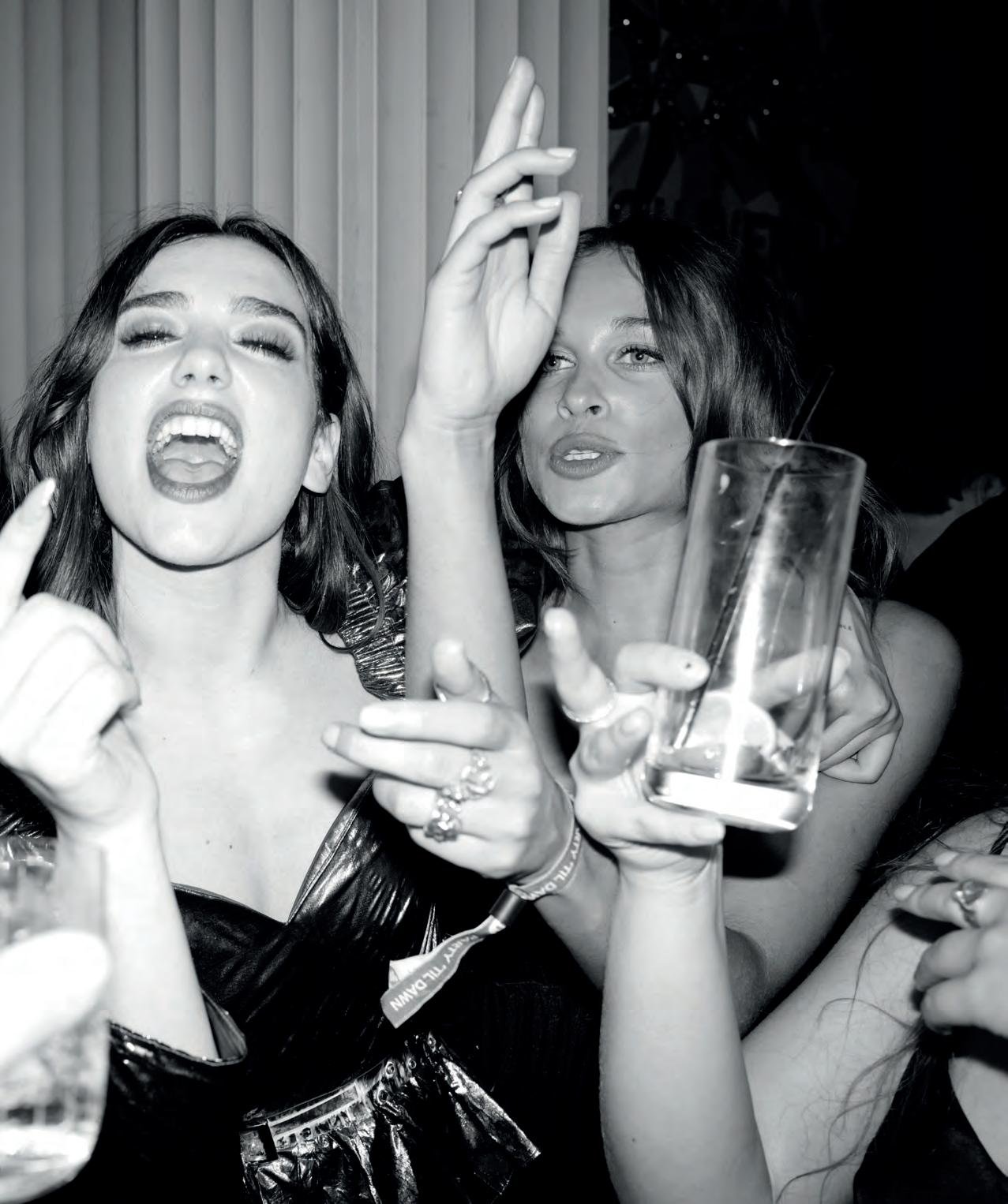
“I shot this at a BRIT Awards after-party. Dua had won several awards – it was a big night for her. This taps into what I’m looking for with a photo – I’m looking for a sense of being the insider. In this instance, it’s literally my hand holding a glass in the foreground. She is clearly partying directly with me, into the lens. It’s my favourite party photo I’ve ever taken. I’m always scared of being thought of as a ‘party photographer’. But I believe that when you shoot a party, it should feel like you’re in the party and part of it, and not just observing it. This photo probably sums that up better than any photo I’ve ever taken. There’s a feeling of sheer joy and a feeling of inclusion that people looking at the photo also feel.”
BEST SHOTS
146 RPS JOURNAL MARCH / APRIL 2023
MARCH / APRIL 2023 RPS JOURNAL 147
Lady Gaga, Oscars, LA, USA, 2019
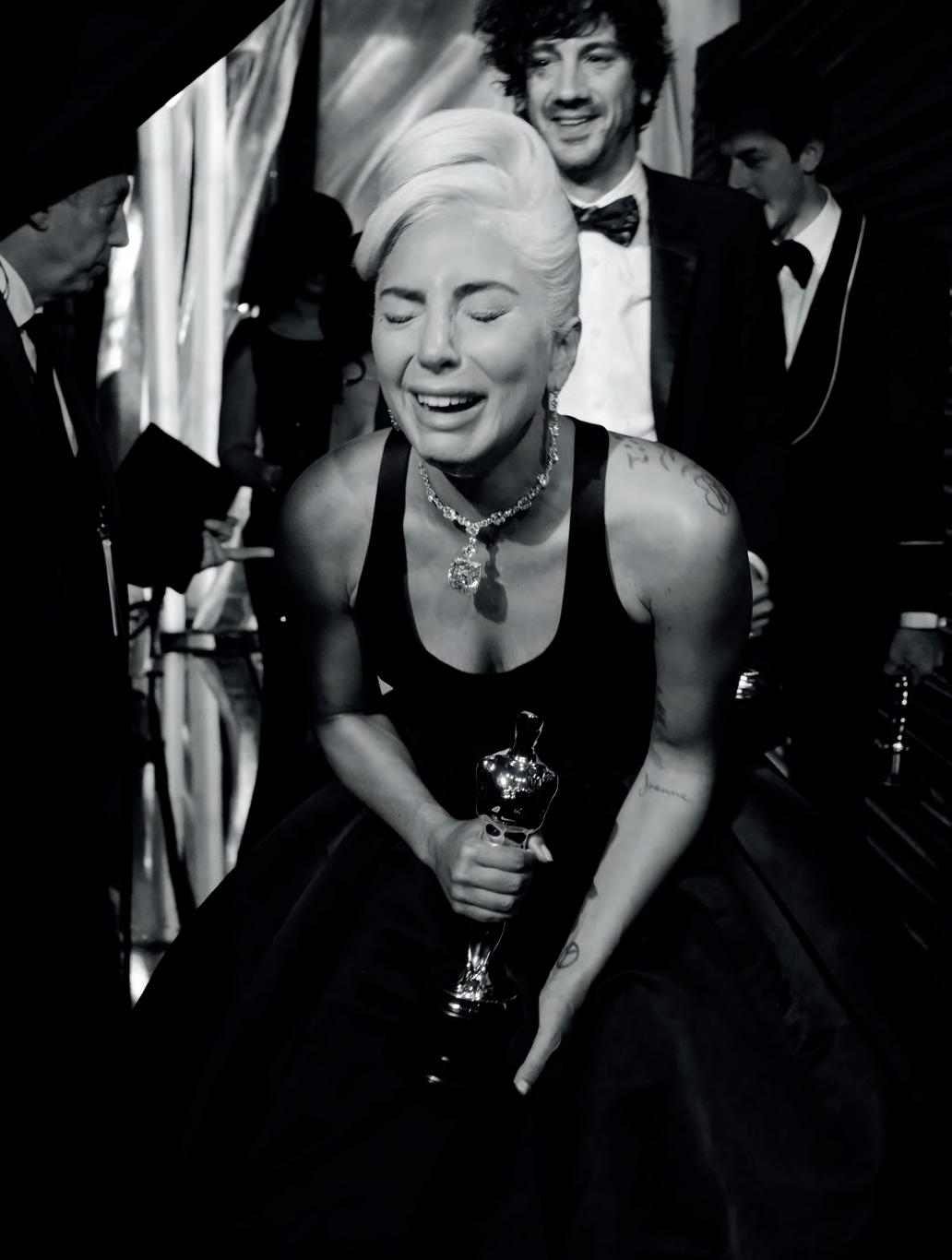
“I was the official photographer for the Oscars for a few years. I shot this the moment Lady Gaga came off stage for winning best song for Shallows from the film A Star Is Born. She got very emotional several times after this photo was taken and it felt like that emotion was given to the press, whereas with this one it wasn’t. With this picture, she had been out of the public gaze for three seconds after winning. It’s absolute genuine emotion. There’s no composure to it. It’s not a particularly flattering photo. There’s just sheer emotion, and that’s really tricky to capture nowadays. It’s not something you see often. I’m sure she’s seen it. I’ve sent her a lot of the pictures I’ve taken. I’ve never heard if she’s happy with this one but she’s a really authentic artist so I imagine she would like it because it’s such an important moment in her life. I like to think she’d get immediately past any vanity issues with the photo and think it was a treasured moment.”
148 RPS JOURNAL MARCH / APRIL 2023
Bill Murray, Three Mills, London, UK, 2009
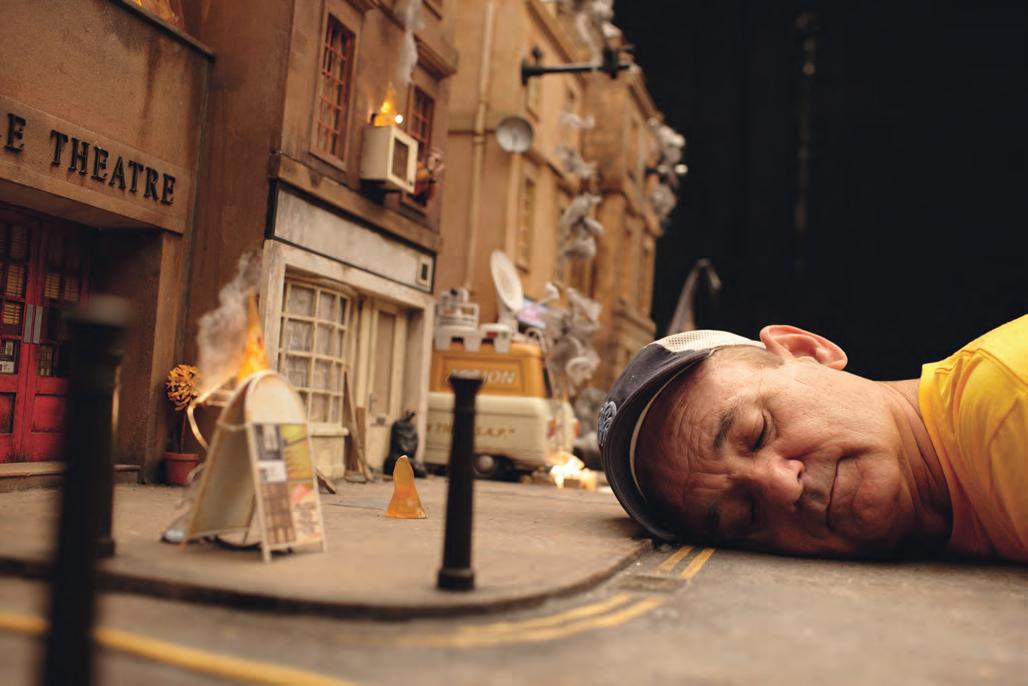
“This was taken on the set of The Fantastic Mr Fox. Bill played Badger. I’d been invited by the director Wes Anderson to take some pictures as they were making the film, and Bill was working that day. I went for a walk around with Bill. I can’t remember if this was his or my idea. Most of the people I shoot are not there because they’re celebrities – they’re exceedingly talented artists. Their talent has got them to the point where they’re one of the 60-80 movie stars that exist in the world. What I get to do is collaborate with these amazing artists. Between us, we come up with these pictures. This shot is so much fun – it’s got a Lilliputian feel, like a giant who passed out in this town. It’s a good example of going into a situation without a preconceived idea of what you’re doing, in order that, collaboratively, you come up with something far greater.”
After turning 50 last year, Williams has branched out, developing the G-Grip, a Bluetooth attachment for holding and operating a smartphone like a camera; setting up Skills Faster, an online photography course; and creating Hollywood Authentic, his own free magazine showcasing his photography – Sean Penn and Ana de Armas were its first two cover stars.
“It’s a wonderful journey being a photographer,” he says. “For me, it’s about the buzz of interacting with great artists and creating something better than I would’ve done on my own. That’s what I love to do.”
Greg Williams Photo Breakdowns: The Skills and Secrets Behind 100 Portraits is published by Whalen Studios Editions, £50, in June 2023. gregwilliams.com hollywoodauthentic.com
PROFILE GREG WILLIAMS
He began his 30-year career as a photojournalist in conflict zones including Myanmar and Sierra Leone. An assignment for the Sunday Times introduced Greg Williams to the film industry and he is now among the most recognised photographers in entertainment. He has been an official James Bond photographer for 20 years.
BEST SHOTS
MARCH / APRIL 2023 RPS JOURNAL 149
“For me, it’s about the buzz of interacting with great artists and creating something better than I would’ve done on my own”
ROOM TO BREATHE
From the mountains of La Palma to the Namib Desert, lose yourself in 11 images recognised in the 16th International Garden Photographer of the Year awards
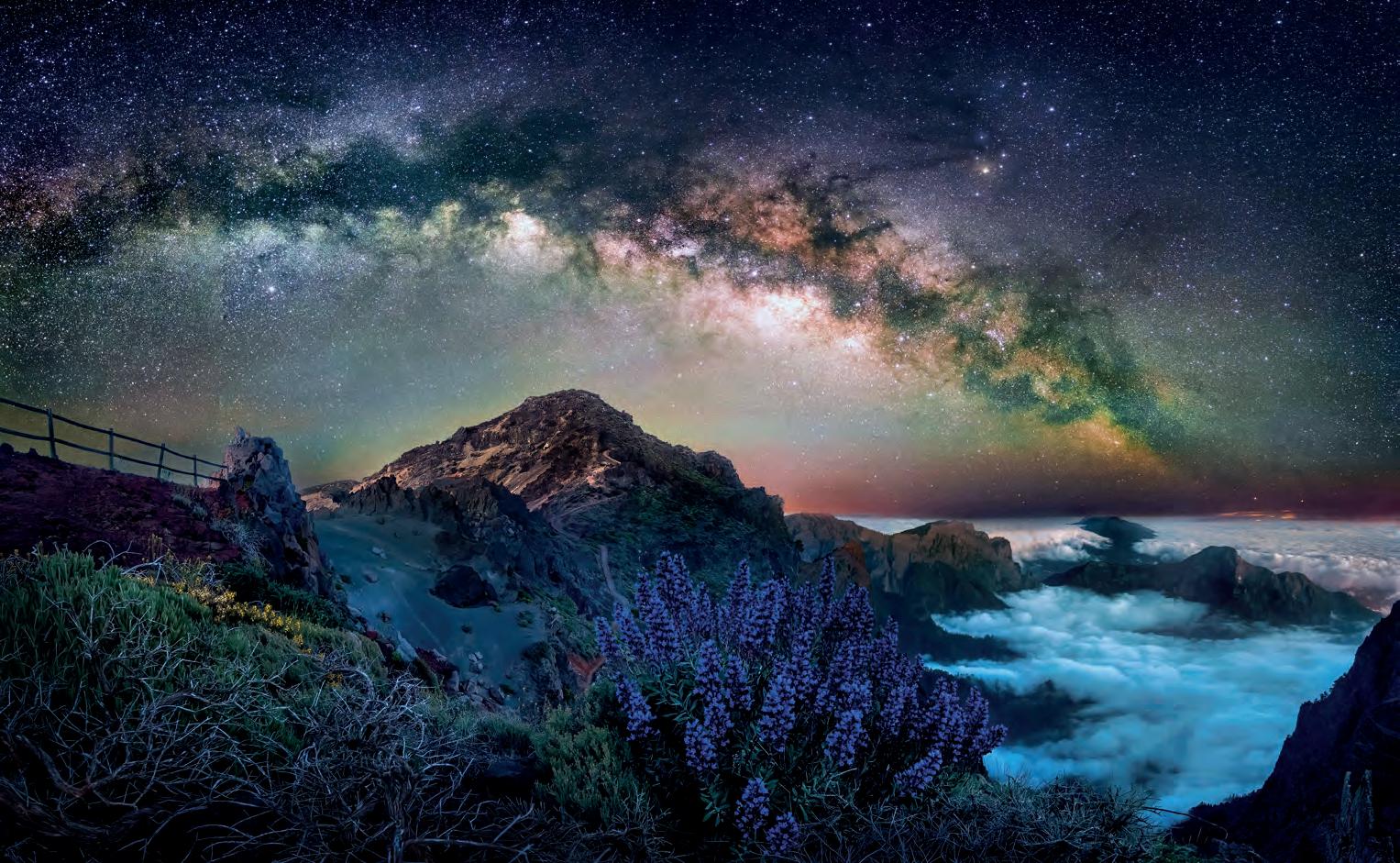
Skill, determination and a little luck were behind the image that was to make Tony North International Garden Photographer of the Year.
“It took an enormous amount of effort to be in that place at the right time – on top of the caldera in La Palma in the middle of the night last May – and yet more to capture and process the shots,” says the UK-based photographer. North was named overall winner of the 16th edition of the awards, in which six RPS members were recognised with higher placed awards. We bring you a selection of top images from the competition.
igpoty.com
150 RPS JOURNAL MARCH / APRIL 2023
Tony North
Overall winner and 1st place, Breathing Spaces
‘BLUE TAJINASTE’, LA PALMA, SPAIN “Echium thyrsiflorum is endemic to the mountains of La Palma island. From high up, there was a magnificent view of both the caldera below and the stars above. The UNESCO La Palma Biosphere Reserve encompasses the entire island, with the Caldera de Taburiente containing mountains with a highest peak of 2,426m –the Roque de los Muchachos.
To achieve this image I combined two exposures – one of the sky and one of the foreground.”
Kit: Nikon D500, Tokina atx-i 11-16mm f/2.8 CF ultra-wide-angle lens, 211sec at f/3.2, ISO 1250. Tripod, star tracker.
Post-capture: use of crop, contrast and vibrance tools, basic image management.
COMPETITION
MARCH / APRIL 2023 RPS JOURNAL 151
Gigi Williams FRPS
1st place, MPB Plants and Planet
‘DUNE’, NAMIB DESERT, NAMIBIA “I took this photo in the Namib Desert, home to some of the highest sand dunes in the world. This one was particularly impressive with the tiny trees growing happily at the bottom. It is amazing where plants can grow and how life adapts.”
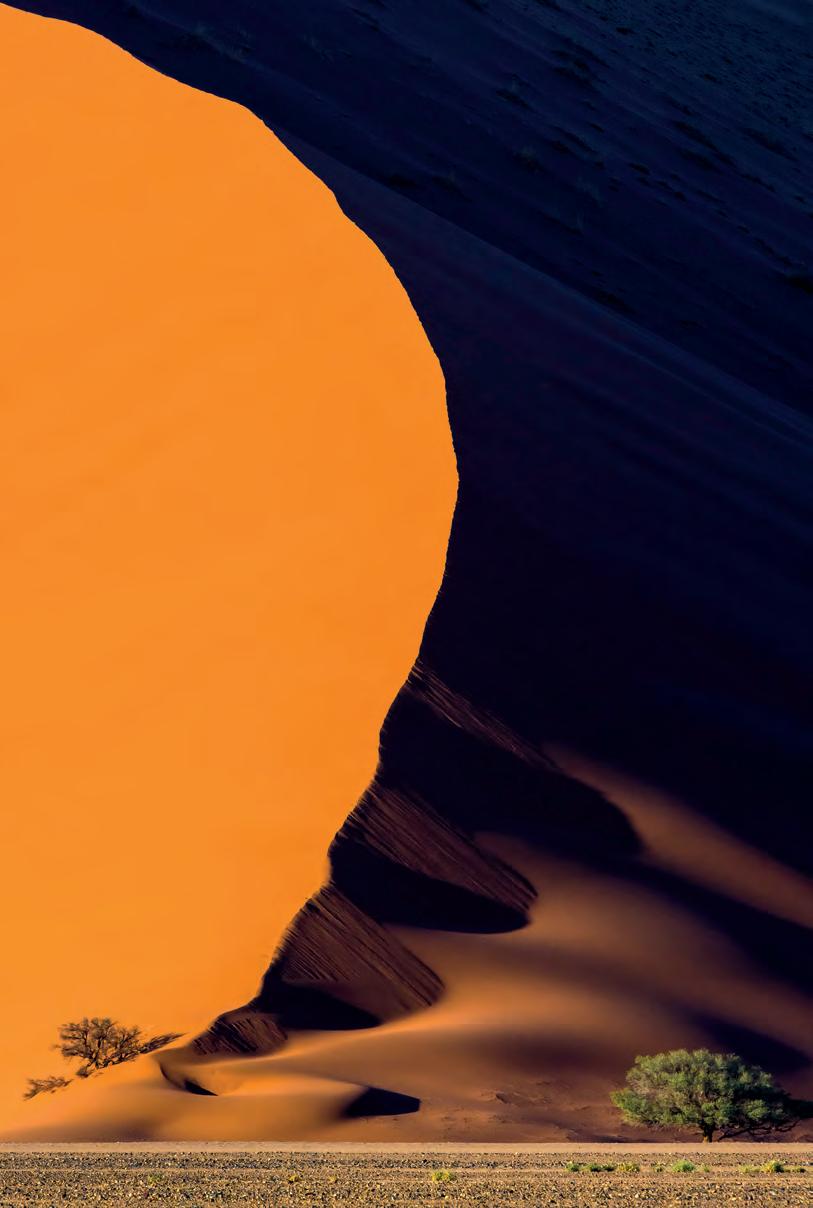
Kit: Nikon D7200, Nikon Nikkor 80-400mm lens, 1/164sec at f/14, ISO 800.
Post-capture: use of crop tool, basic RAW image management in Adobe Lightroom.
152 RPS JOURNAL MARCH / APRIL 2023
Robin Williams FRPS
Finalist, MPB Plants and Planet
‘EARTHLY ARMAGEDDON’, WYOMING, YELLOWSTONE NATIONAL PARK, USA
“When I saw these mummified trees and dark grey clouds at the Mammoth Hot Springs in Yellowstone National Park, it felt like a prophesied vision of climate change and what could happen to the planet if we continue to abuse it.”
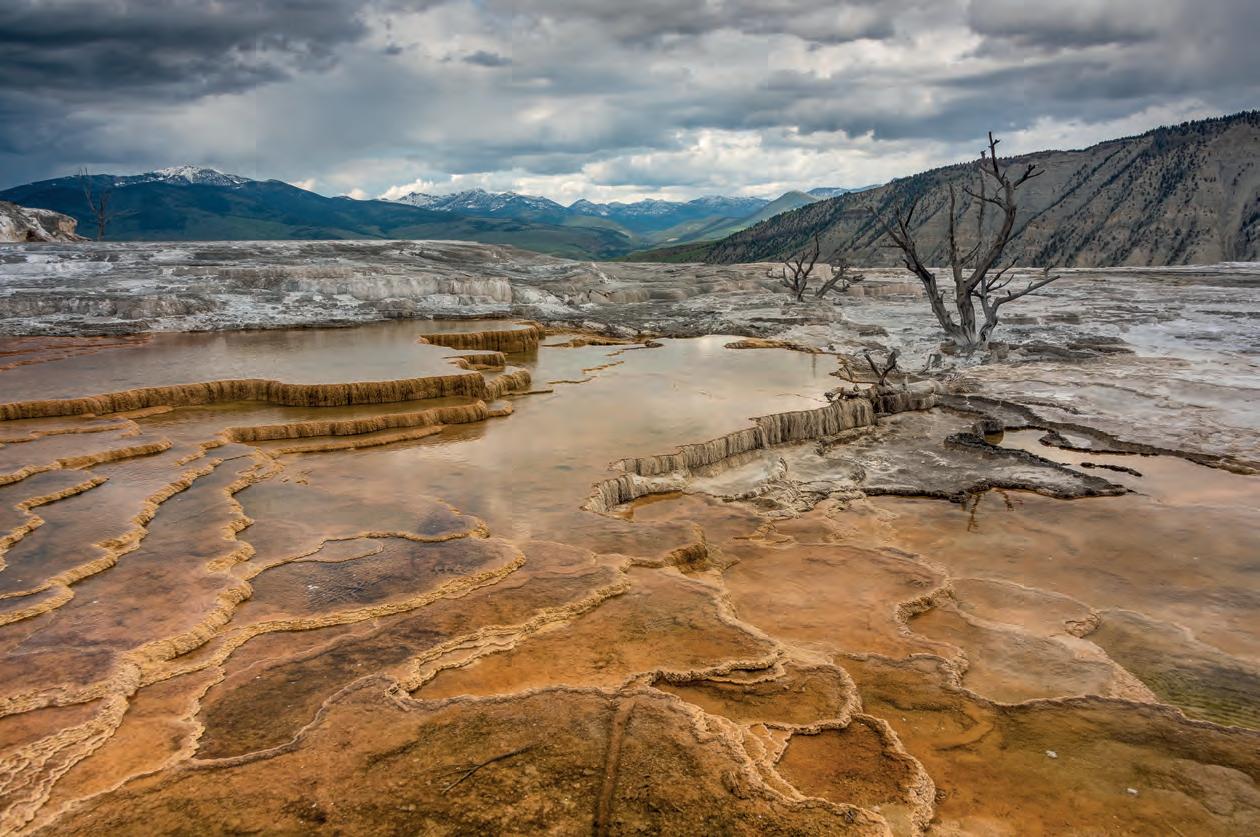
Kit: Nikon D810, Nikon Nikkor 28-300mm lens, 1/60sec at f/11, ISO 200. Tripod, graduated neutral density filter.
Post-capture: use of exposure and contrast tools, basic RAW image management in Adobe Lightroom.
COMPETITION
MARCH / APRIL 2023 RPS JOURNAL 153
David Townshend FRPS
1st place, 7IM Abstract Views
‘ABANDON HOPE’, NORTHAMPTONSHIRE, UK “‘All hope abandon ye who enter here’ –the infamous line from Dante’s The Divine Comedy, described as being the inscription on the gates to Hell. In this image I see circles within circles of Dante’s Inferno, which I created from a bug hotel in my garden using in-camera image blending.”
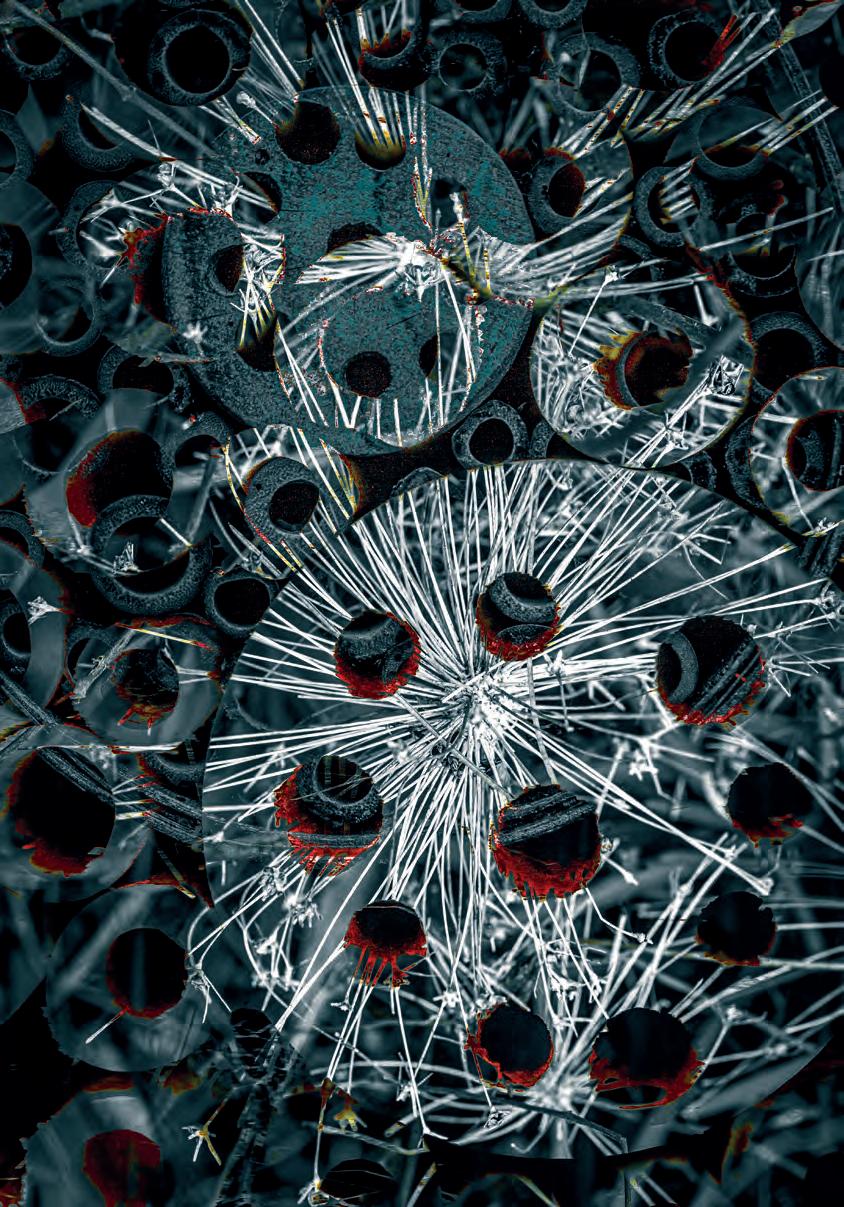
Kit: Canon EOS 5D Mark III, Canon EF 100mm f/2.8 L Macro IS USM lens, 1/320sec at f/9, ISO 400.
Post-capture: use of hue, saturation, luminance, vibrance, texture and clarity tools.
154 RPS JOURNAL MARCH / APRIL 2023
Claire Carter
1st place, The Beauty of Plants
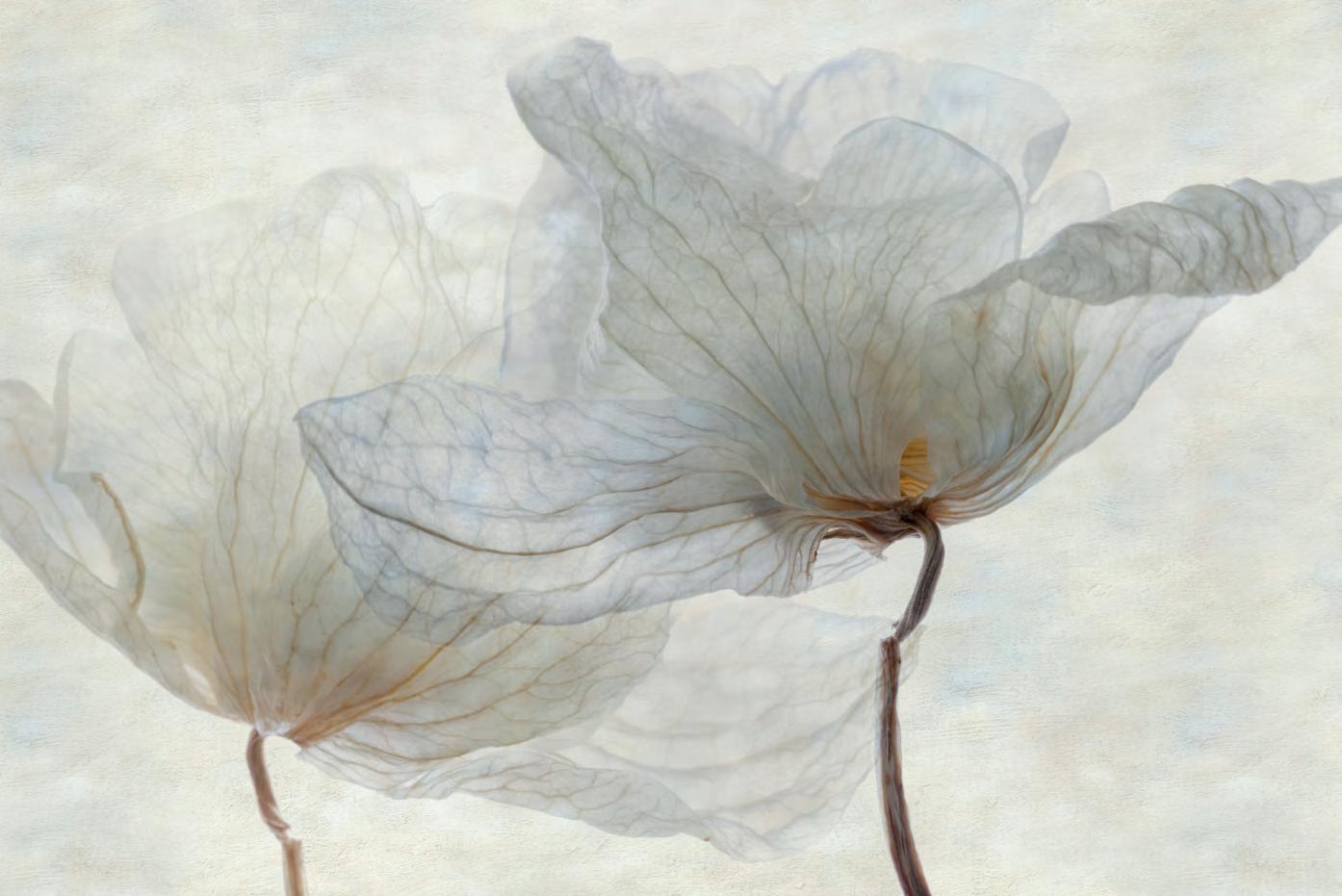
‘FALLEN ORCHID FLOWERS’, SHROPSHIRE, UK “I captured these dead orchid flowers, after they had dropped, when they started to dry and take on a wonderful, paper-like texture. To complement this I added the background texture layer in post-processing.”
Kit: Canon EOS R5, Canon RF 100mm f/2.8 L Macro IS USM lens, 6sec at f/18, ISO 100. Tripod.
Post-capture: added background texture layer, basic RAW image management in Adobe Photoshop.
COMPETITION
MARCH / APRIL 2023 RPS JOURNAL 155
Jay Birmingham
1st place, The World of Fungi
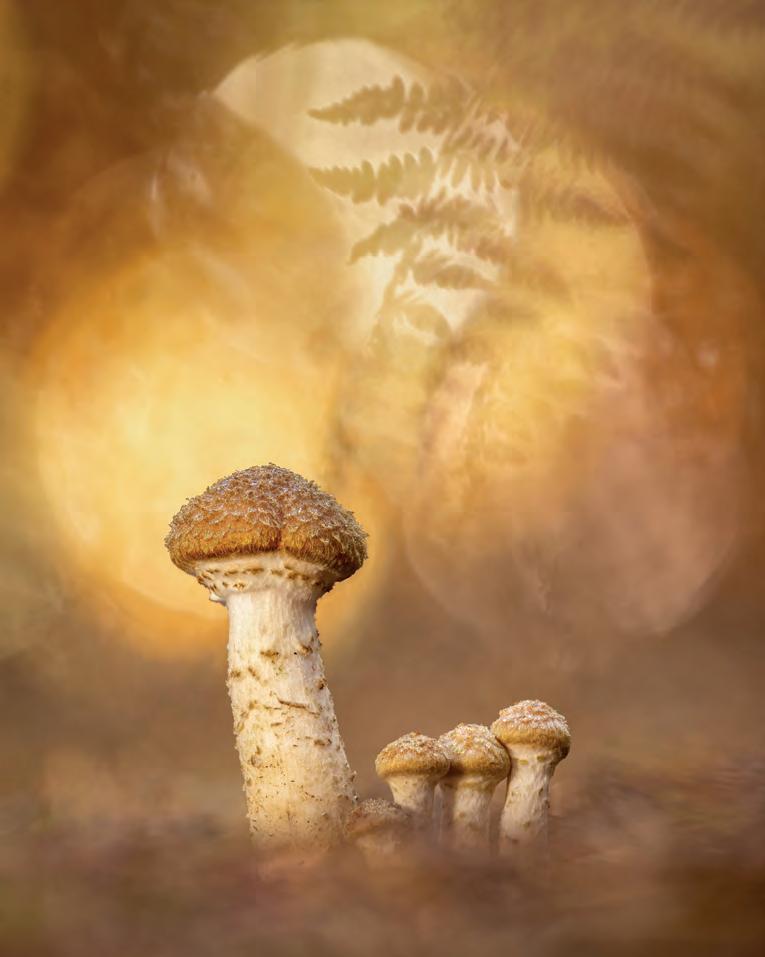
‘AUTUMN EMERGENCE’, MONKS PARK WOOD, WARWICKSHIRE, UK “I came across this honey fungus in my local woodland, just as the sun was rising and lighting up the woods with golden hues. The bonus was the bracken behind, which gave the picture a wonderfully warm autumnal feel. I captured it using a wide aperture, to isolate the subject and to maximise the bokeh background. I also used focus stacking in post-processing.”
Kit: Canon EOS R5, Sigma 180mm f/2.8 macro lens, 1/60sec at f/3.2, ISO 500. Small light.
Post-capture: use of crop and saturation tools, focus stacked multiple images together in Helicon Focus from Helicon Soft, basic image management.
156 RPS JOURNAL MARCH / APRIL 2023
Manuela Göhner
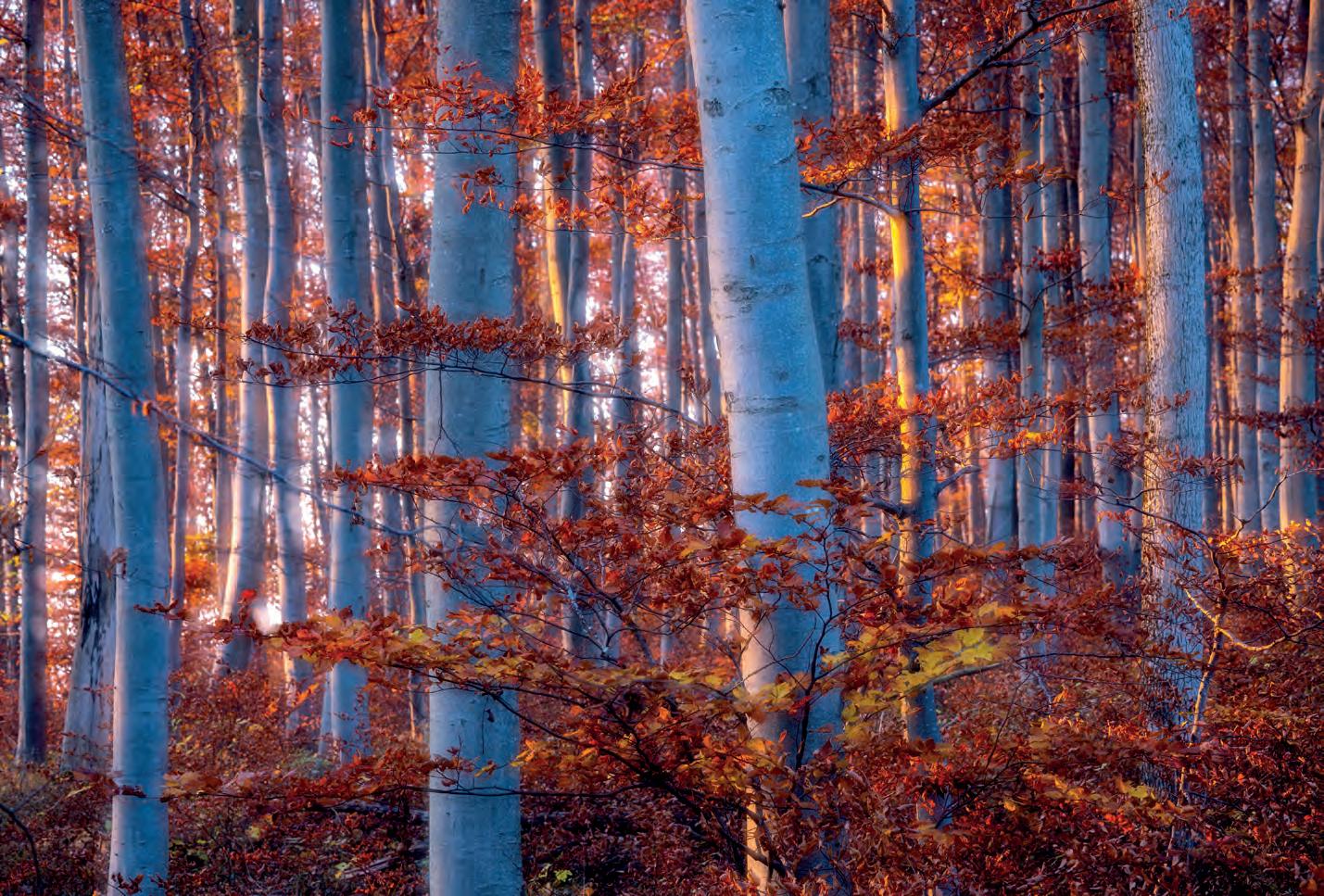
2nd place, Trees, Woods and Forests
‘AUTUMN LEAVES’, SWABIAN ALB BIOSPHERE RESERVE, GERMANY
“In the UNESCO Biosphere Reserve Swabian Alb, the last rays of the sun illuminated the autumn-coloured leaves of the beech trees in the forest. For a very brief time, the leaves lit up and formed a colourful contrast to the bark. I used an in-camera double exposure to give the image a painterly feel, capturing the mood of the moment.”
Kit: Canon EOS R5, Canon EF 70-200mm f/4 L IS II USM lens, 1/5sec at f/4, ISO 100. Tripod, cable release.
Post-capture: basic image management in Adobe Lightroom.
COMPETITION
MARCH / APRIL 2023 RPS JOURNAL 157
Gianluca Benini
1st place, Wildlife in the Garden
‘CINCIARELLA’, CASTELNUOVO DEL GARDA, VENETO, ITALY “After several attempts I managed to capture the exact moment when the blue tit (‘cinciarella’ in Italian), took flight from the sunflower head. I am used to placing dried sunflowers in the garden, to feed the various bird species that visit me in winter.”
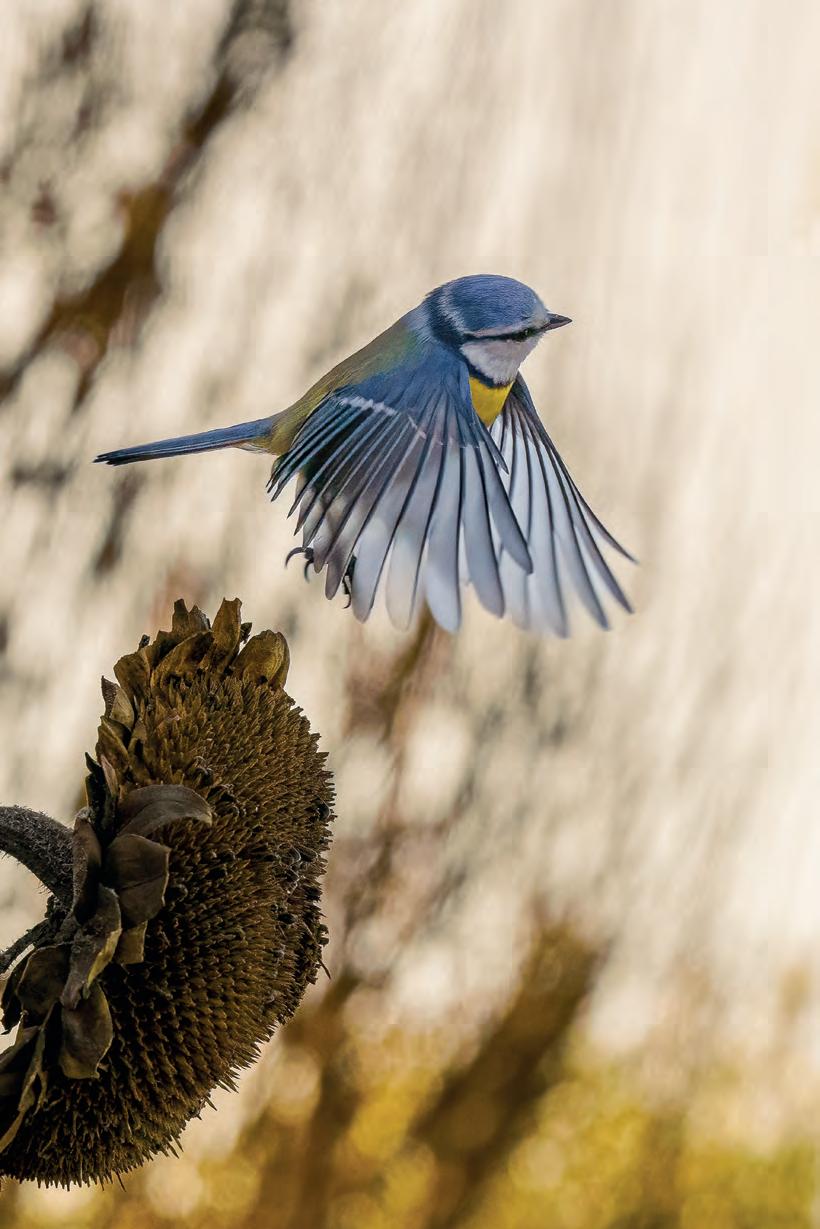
Kit: Sony α6600, Sony FE 90mm f/2.8 Macro G OSS lens, 1/2000sec at f/6.3, ISO 1000. Tripod.
Post-capture: use of crop and contrast tools, basic image management.
158 RPS JOURNAL MARCH / APRIL 2023 COMPETITION
Julie Pigula FRPS
Finalist, Wildlife in the Garden
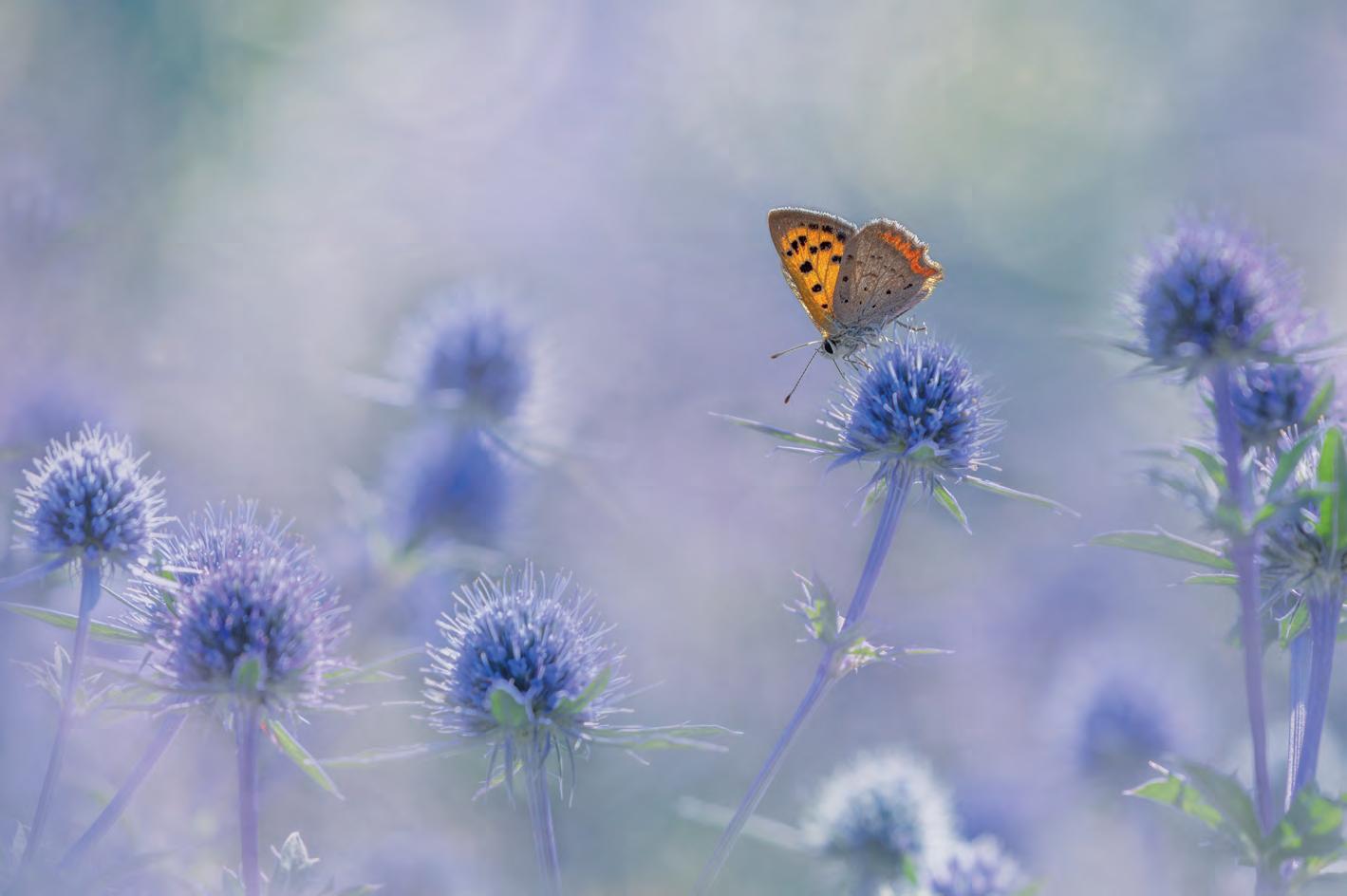
‘COPPER ON BLUE’, NATIONAL TRUST BODNANT GARDEN, CONWY, UK
“It was a beautiful evening in the garden, with no wind – so it was perfect for both flower and insect photography. There were lots of bees and a couple of butterflies still feeding off the flowers in the round bed. I was attracted to this small copper butterfly, posed perfectly on the blue eryngium flowers and complementing the colour combination of the scene. I combined two layers
together in post-processing; one sharp, and one out-of-focus.”
Kit: Canon EOS R5, Canon EF 100-400mm f/4.5-5.6 L IS II USM lens, 1/640sec at f/7.1, ISO 400.
Post-capture: combined two layers together, basic image management in Adobe Photoshop.
COMPETITION MARCH / APRIL 2023 RPS JOURNAL 159
Barry Webb
Royal Photographic Society Gold Medal and 1st place, Portfolios
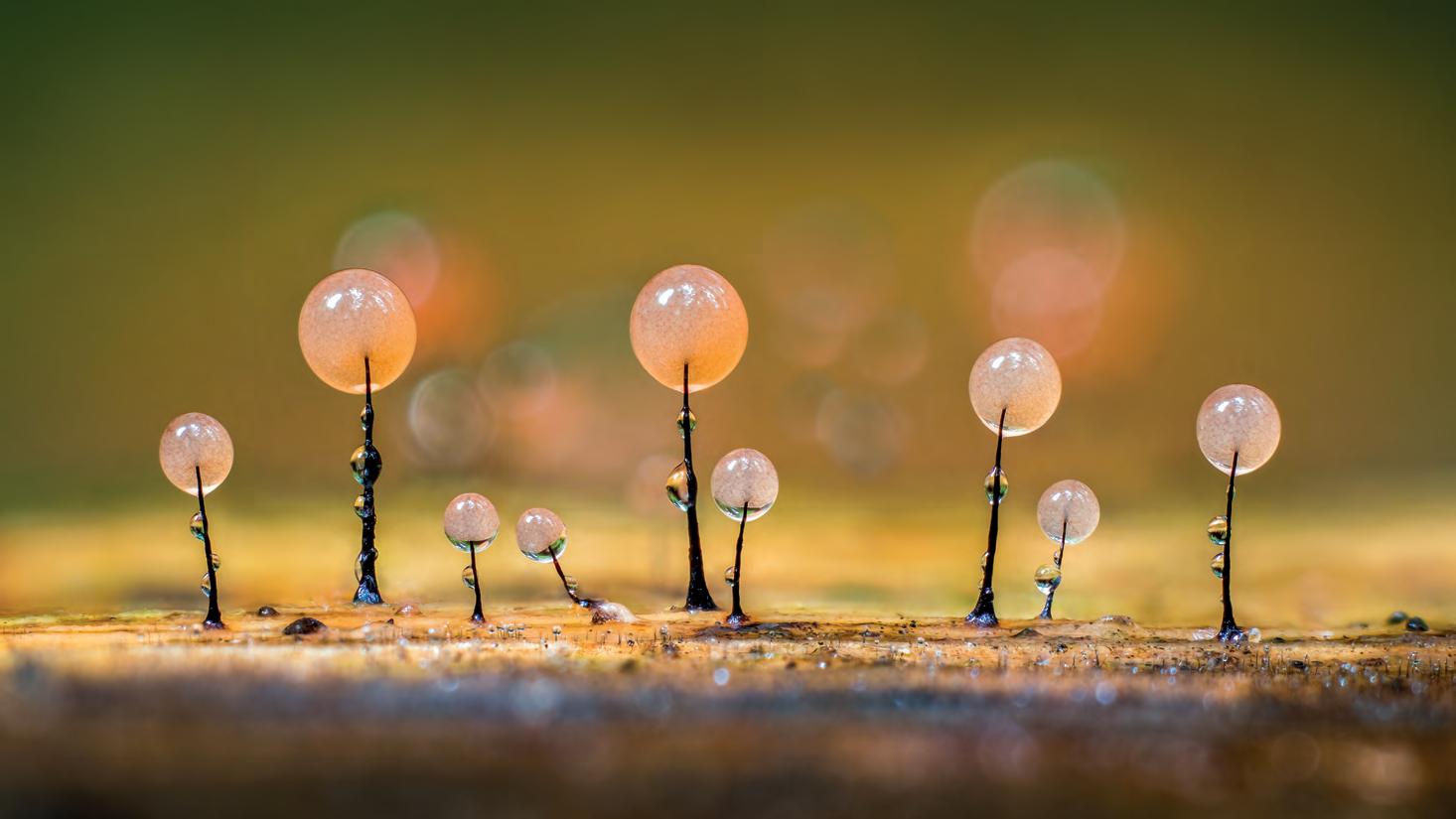
‘SLIME MOULD BIODIVERSITY’, BUCKINGHAMSHIRE, UK “This portfolio illustrates the beauty and diversity of slime moulds. Their diminutive size and ephemeral nature means they often go unnoticed. I have spent the last three years searching for and documenting these littleknown organisms. Every image in the portfolio has used focus stacking to show the fruiting bodies of the slime moulds, which include Arcyria cinerea, Comatricha nigra, Trichia botrytis and Physarum sp.”
Kit: Olympus OM-1 and OM-D E-M1 Mark II, Olympus M.Zuiko Digital ED 60mm f/2.8 Macro lens, 1/25sec to 0.6sec at f/3.2 to f/4, ISO 200. Tripod, extension tubes, remote release.
Post-capture: use of crop tool, focus stacked multiple images together in Zerene Stacker from Zerene Systems, basic image management in Adobe Lightroom.
160 RPS JOURNAL MARCH / APRIL 2023
Brian Cooke ARPS
The Royal Photographic Society Bronze Medal and 3rd place, Portfolios
‘WILDFLOWERS’, HARPENDEN COMMON, HERTFORDSHIRE, UK “These images were taken during the Covid pandemic on Harpenden Common, a large area containing woodlands and open meadowland with a profusion of wildflowers. The objective was to capture and illustrate the vivid colours and shapes of wildflowers against the more sombre and complex background of grasses. This has been achieved by separately photographing the wildflowers on a lightbox and superimposing them on textures of toned flowers and grasses, using
appropriate software. Specimens used include thistle, poppy, red campion, buttercups, daisies, pea and clover.”
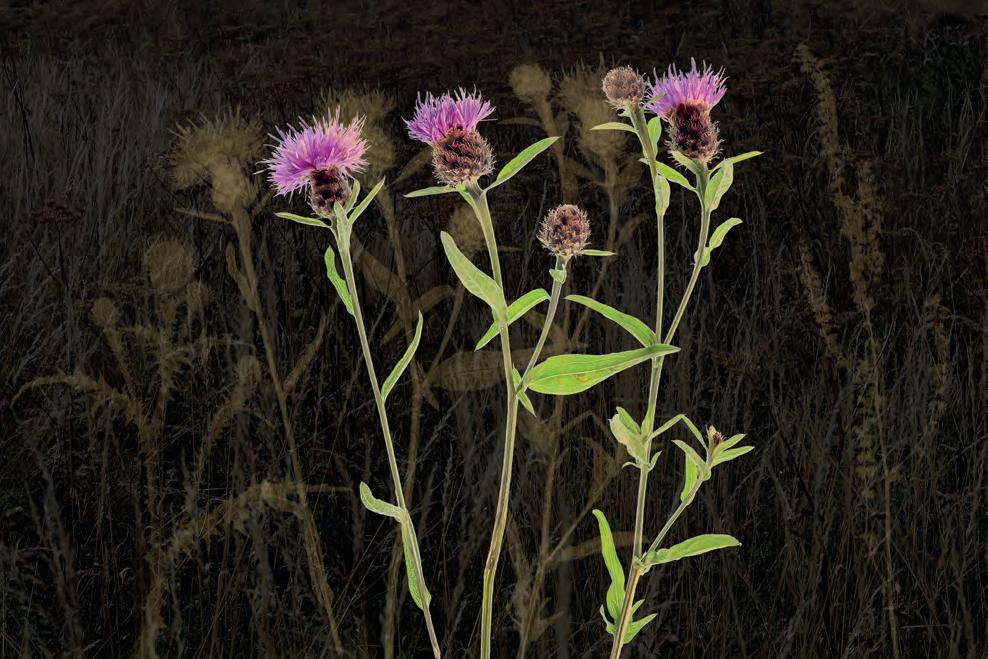
Kit: Olympus OM-D E-M1 Mark III, Olympus M.Zuiko Digital ED 12-40mm f/2.8 PRO lens, 1/400sec to 1/800sec at f/8, ISO 200. Tripod, lightbox.
Post-capture: use of exposure and contrast tools and custom brushes, created composite using blended layers, adjusted hue in Adobe Photoshop.
COMPETITION MARCH / APRIL 2023 RPS JOURNAL 161
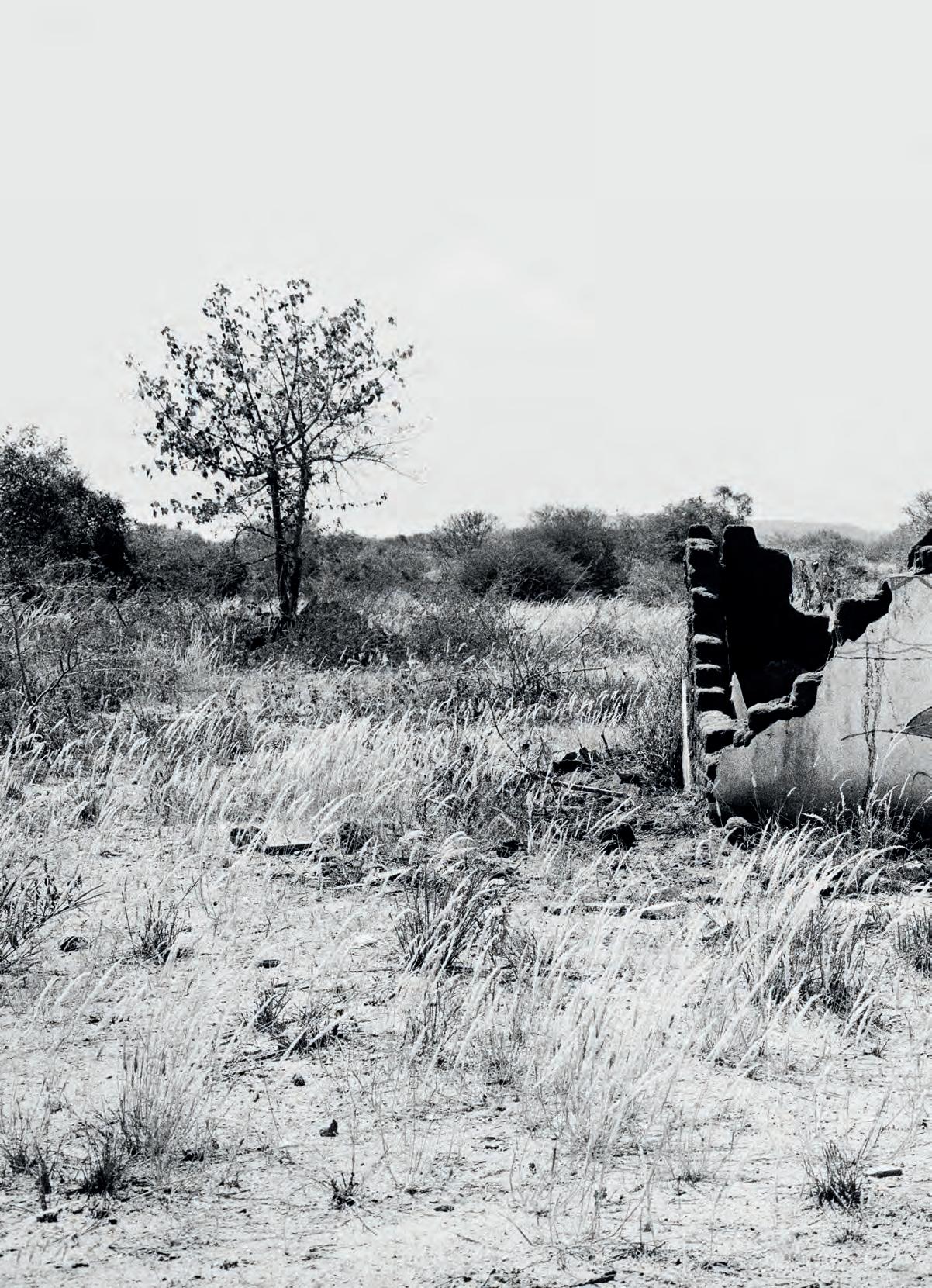
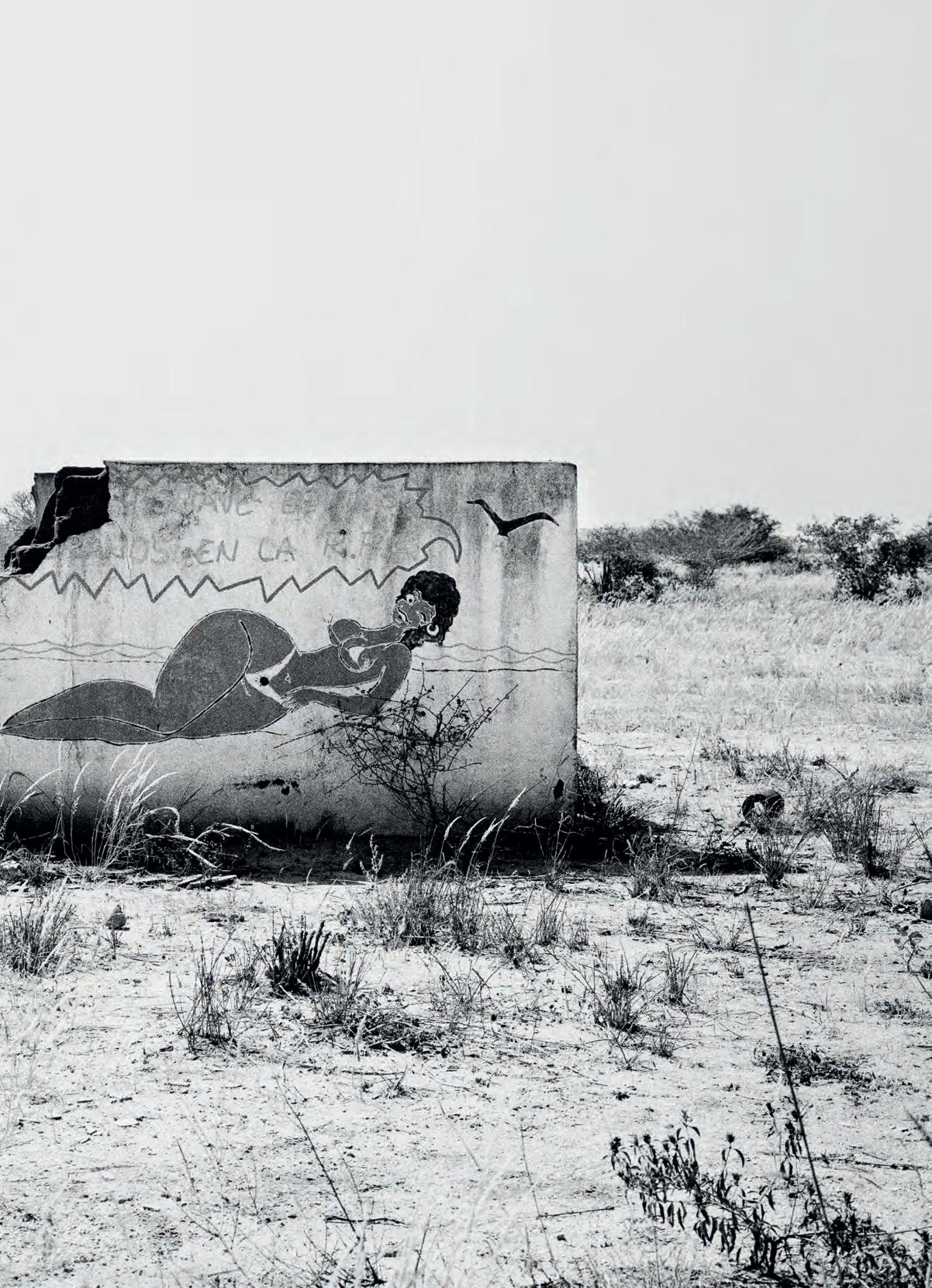
DOCUMENTARY
NOWHERE SPACE
She portrayed South Africa’s Apartheid era with brooding, stripped-back images that defied definition. Jo Ractliffe HonFRPS reflects on 30 years of image-making against a backdrop of hope and fear
WORDS: RACHEL SEGAL HAMILTON IMAGES: JO RACTLIFFE HONFRPS
r J'." -,,._-- .-· -:' :_,r..,~:-i; -":,. _;r -..:,...•~ ,,.;,.,j. ,.,.,, ••
Applied to photography, the words ‘still’ and ‘silent’ always sound slightly amiss. Of course, a photograph is still and silent – otherwise, it would be a film. And yet in the case of Jo Ractliffe HonFRPS, these descriptions really do feel apt. There is an unmistakable hushed quality to her images.
“My photographs can easily seem very boring,” she says, over video call from her Cape Town kitchen, “but I hope when people spend time with them, something else starts to happen.”
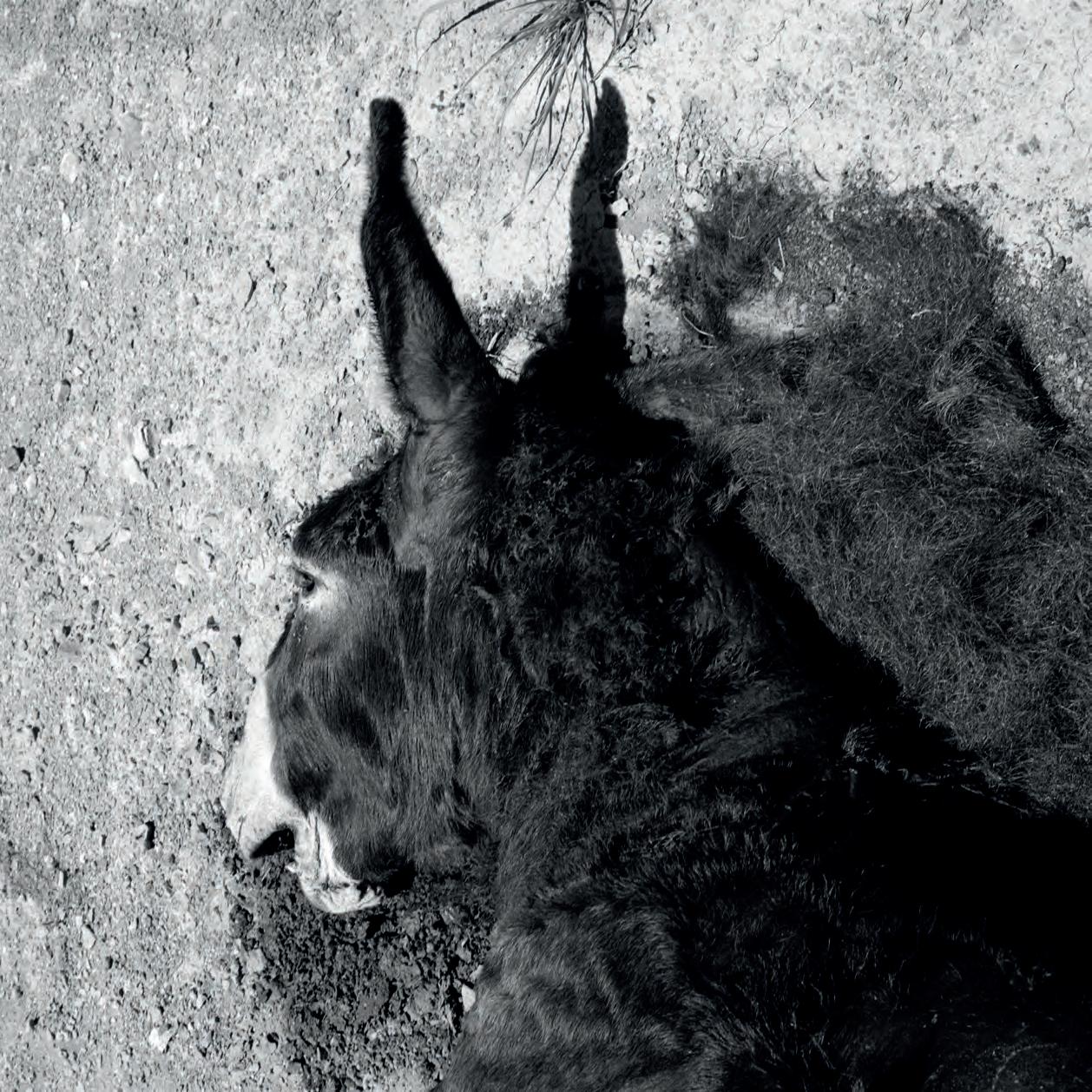
‘Boring’ is hardly appropriate. Her photographs, of disembodied doll heads and animal carcasses, abandoned classrooms and scarred landscapes, are brooding and beautiful. They lodge in your imagination and haunt you long after you look away.
South Africa in the 1980s, when Ractliffe started out, was not a time of stillness. It was a time of brutal racial oppression under the Apartheid regime and of militant struggle against that, with riots, bombings, shootings and arrests all commonplace events. For photographers such as Santu Mofokeng, Guy Tillim and other members of the collective agency Afrapix – which ran from 1982 to 1991 – the camera was a tool for activism, politics and action.
“Photographers were going to marches, funerals,” says Ractliffe. “They were very much on the ground, documenting
the spectacle of racist violence. That takes a certain kind of temperament and I don’t have that … For me, photography has always been a private thing.”
She describes her sense of “hesitancy, not wanting to intrude, feeling somewhat on the outside of things” and continues: “It was early days for me and I felt uncomfortable photographing other people’s trauma, when I wasn’t sure what I wanted from the image. That is not a critique of documentary photography in South Africa, which I thought was absolutely necessary. Many of my friends sacrificed a lot to do that kind of work. They were subjected to raids, had their cameras and archives stolen and were detained.”
Ractliffe, as with her fellow South African David Goldblatt HonFRPS, leaned into a slower approach to image-making that was out of step with the time, in a “nowhere space” between two worlds – not adhering to the photojournalistic mode then dominant, nor accepted by an art world still suspicious of photography.
These days Ractliffe's prints are found in the Metropolitan Museum of Art, Museum of Modern Art and Pompidou permanent collections. In 2022, she was nominated for the 2022 Deutsche Börse Photography Foundation Prize with her career-spanning monograph Photographs 1980s – now,
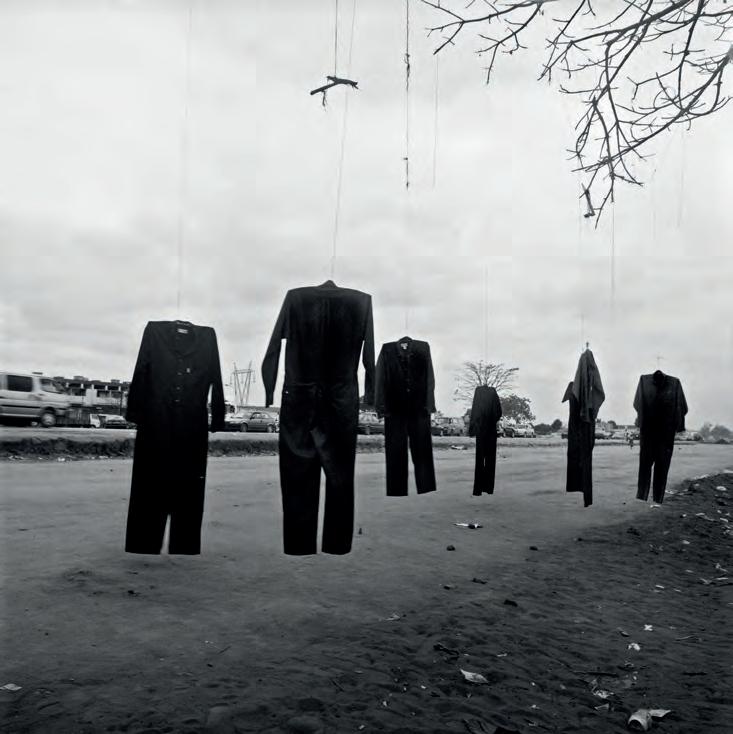
Lobito',
the
Viana', 2007
time',
Previous pages ‘Comfort Station, FAPLA base,
2010 Left ‘Roadside stall on
way to
Right ‘End of
1999
164 RPS JOURNAL MARCH / APRIL 2023 I
DOCUMENTARY
MARCH / APRIL 2023 RPS JOURNAL 165
“For me, photography has always been a private thing”
166 RPS JOURNAL MARCH / APRIL 2023
,.. ,,~:'~£;:~j.. ,',-,'-~-: '.:.._• .-r0., '-'-' "\" 1~ ,.. _-t;;'{.
“Photography has this anchor to ‘the real’ which I needed and didn't get with painting”
featuring series on South Africa and the Angolan Civil War. She was awarded the RPS Honorary Fellowship in November 2022.
The label ‘aftermath photography’ is sometimes applied to the kind of work Ractliffe makes. It’s a genre exemplified by Tate Modern’s 2014-15 group exhibition Conflict, Time, Photography. Here the images, including Ractliffe’s, were displayed according to the duration of time elapsed since the battles they depicted – from a blast seconds earlier to a war that ended a century hence, emphasising the immediate consequences and continued legacies of war.
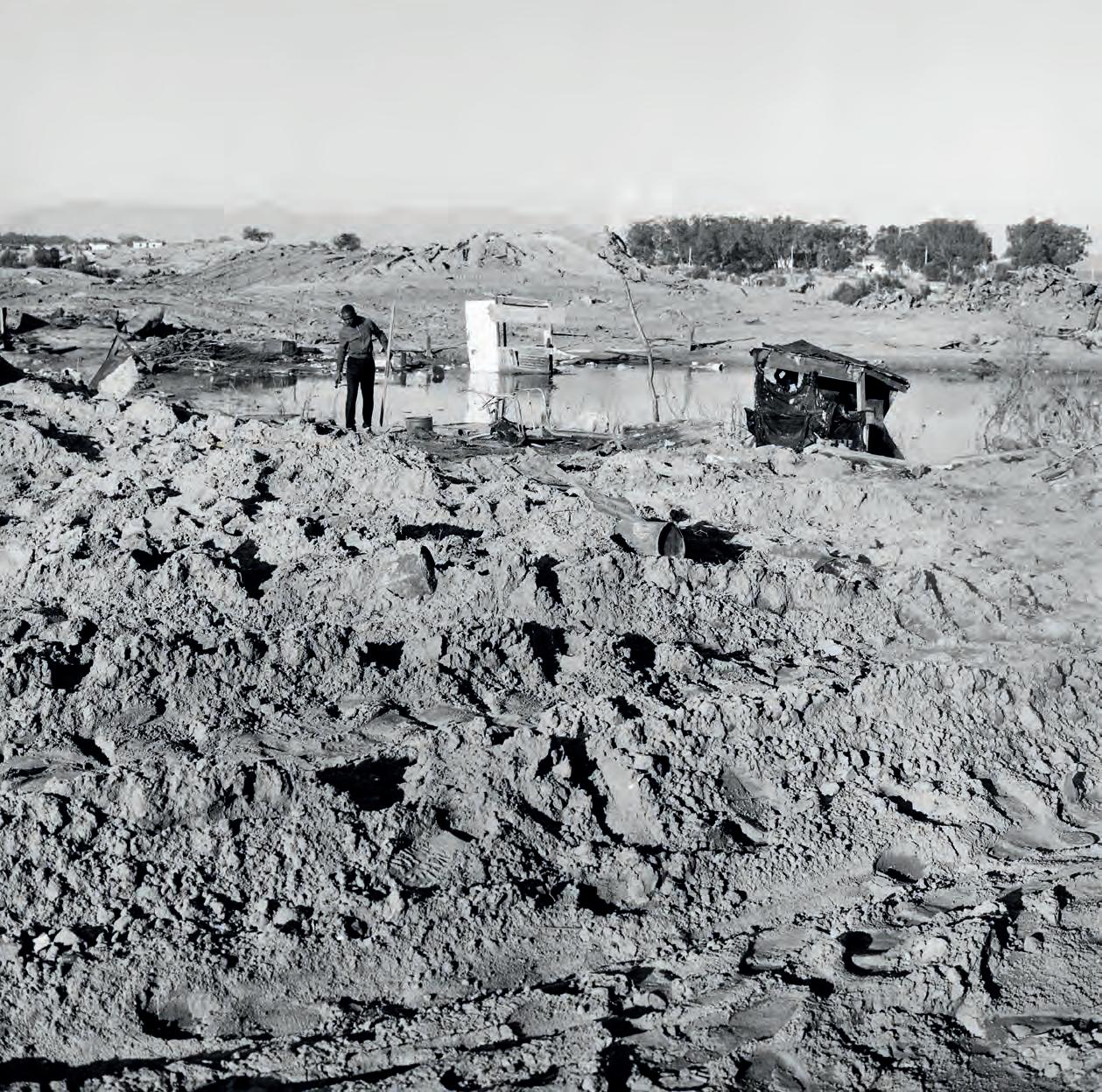
During the 1986 State of Emergency declared across South Africa, Ractliffe remembers being in the township of Crossroads in the Western Cape with a photographer friend from Afrapix. “His pictures showed the police, the barbed wire, the violence, while mine were of the razed landscape where they had bulldozed down people’s shacks,” says Ractliffe.
Yet she feels ambivalent about the term ‘aftermath’, implying as it does a “before and after, when often things
seem to happen simultaneously.” Similarly, Ractliffe refers to ‘space’ rather than ‘landscape’, a word burdened with its own set of assumptions and conventions.
During her BA and MA studies at the Michaelis School of Fine Art at the University of Cape Town, Ractliffe initially specialised in painting, producing realist works in the vein of Edward Hopper before gravitating towards printmaking. It was only in her final year that she took an evening course in photography.
“It was instant,” she recalls. “I had discovered my language. Photography seems so easy. You push the button and there’s the image. But I was interested in that resistant space where you are lulled into a suspension of disbelief – like with theatre – but the image is never quite what you thought you were first seeing. Photography has this anchor to ‘the real’ which I needed and didn’t get with painting. Photographs look like the world we see, but the challenge for me is to resist easy apprehension of an image.”
DOCUMENTARY
MARCH / APRIL 2023 RPS JOURNAL 167
Left ‘Crossroads’, 1986
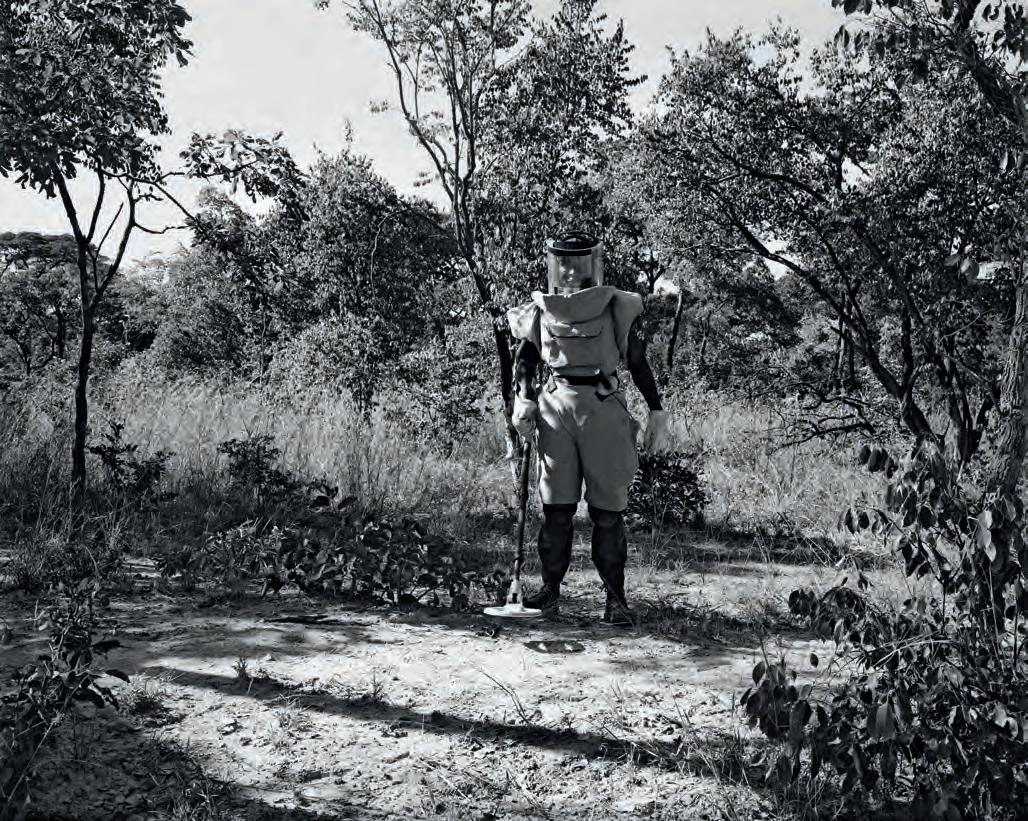
Above ‘Deminer near Cuvelai’, 2009
168 RPS JOURNAL MARCH / APRIL 2023
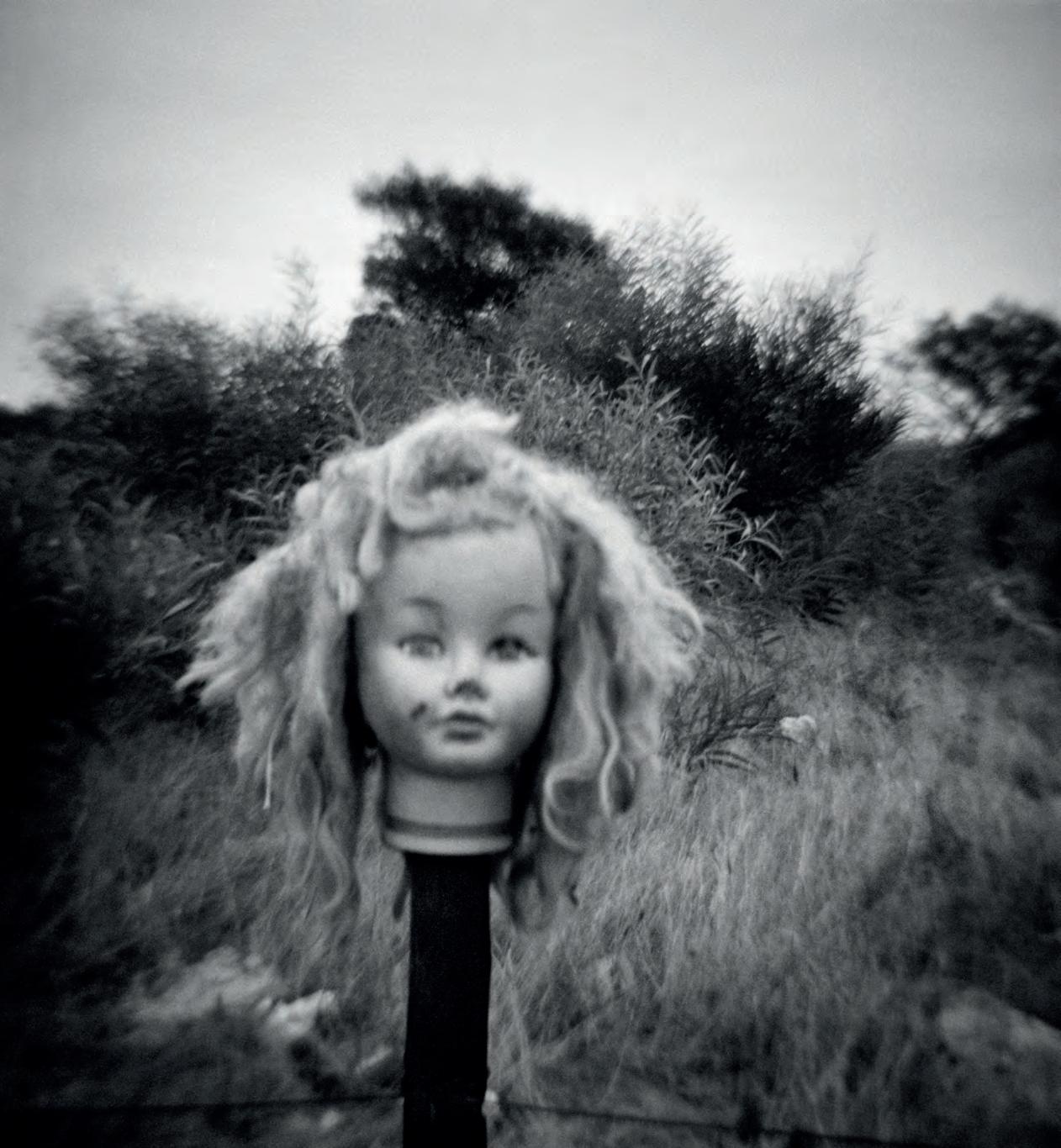
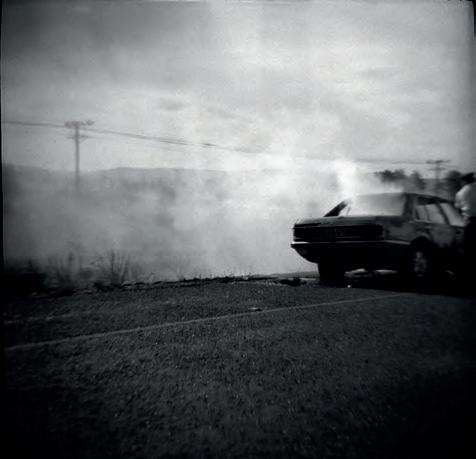
Each project she has made over the years has been the result of “contingency and chance”, Ractliffe says. In 1990, for example, her camera was stolen in a burglary so she started working with a Diana, a plastic novelty camera that, due to its rudimentary design, took pictures that were wonky, with blur and vignetting. “It was a challenge,” she says. “I had to learn how to take bad pictures – well-balanced and well-composed pictures didn’t work on the Diana.”
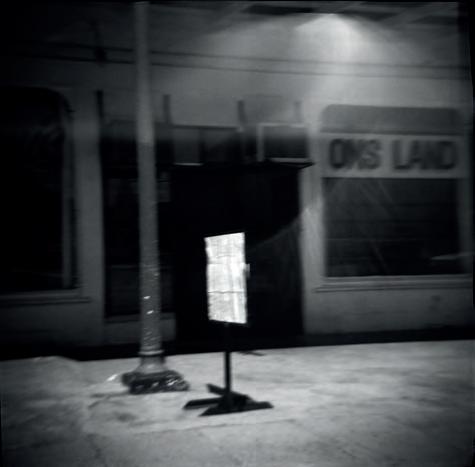
She was struck by a line in the camera’s instruction booklet that read, “It is advisable to take pictures on sunny days”. To Ractliffe, this felt like a metaphor for the broader practice of photography. In Richard Avedon’s essay ‘Borrowed Dogs’, she says, Avedon narrates how his family wouldn’t just don their best clothes for portraits, but pose in front of other people’s fancy homes with flash cars and dogs they’d been loaned for the occasion. He writes: “All of the photographs in our family album were built on a lie about who we were and revealed a truth about who we wanted to be.”
After legislated Apartheid finally ended, South Africa held its first free elections in 1994. Looking back, Ractliffe recalls, “an incredibly dark and violent time of assassinations and murders. There was a real fear about whether we would be able to have a peaceful transition.”
As with those Avedon family portraits, the undercurrents of the “anti-photographic” images she made with the Diana –at birthday parties, during dog walks, on road trips or the beach – unwittingly reflected another truth.
“Everything was murky and fragmentary, hard to see,” she says. “It was emblematic of the atmosphere and the mood of the country.”
Seven years ago, Ractliffe survived a spinal cord injury that has restricted her mobility – and the possibilities for new projects – but she continues to work with photography in innovative ways. In 2021 she created an experimental film, Something this way comes, weaving archive images to an ominous soundscape. Words are important to Ractliffe. Throughout her career she has kept notebooks, jotting down quotes and ideas from literature that feed into her photographs. There is something intensely poetic about her work. In describing how a colleague, an ex-soldier who had served in Angola, responded to her images of the place, she recounts how it was only by really reading the image that he fully engaged with it, suddenly noticing landmines dotted amid the seemingly desolate landscape. “That’s what I’m striving for – to create a space in my photographs into which you can project something expressive of your own. I’m not just saying, 'This is how it was’,” she says. “My images put a lot of responsibility on the viewer.”
DOCUMENTARY MARCH / APRIL 2023 RPS JOURNAL 169
Jo Ractliffe Photographs 1980s – Now is published by Steidl at £55.85. steidl.de
Left ‘Doll's head’, from the series reShooting Diana
Top ‘Butcher’ from the series reShooting Diana
Below ‘Smoking car’ from the series reShooting Diana
“Everything was murky and fragmentary, hard to see. It was emblematic of the atmosphere and the mood of the country”
‘WE ALL LIVE FRAGILE LIVES’
In celebration of the International Photography Exhibition 164 we introduce two photographers who explore transience in different ways
More than 6,000 images submitted by 3,466 photographers resulting in 103 selected works from 46 exhibitors. The numbers behind the International Photography Exhibition 164 (IPE 164), showing at RPS Gallery, Bristol, add up to a spectacular collection of photography. This edition of the world’s longestrunning photographic exhibition explores themes of identity, cultural heritage, sexuality and gender, mental health, the environment and politics.
Charged with crunching the numbers was a fourstrong selection panel – curator Mariama Attah, artist Amak Mahmoodian, portrait and documentary photographer Ryan Prince, and RPS director of programmes Dr Michael Pritchard FRPS. The resulting exhibition showcases a variety of traditional and alternative photographic processes including analogue work, cyanotypes and collage.
The overall winner is Thailand-born, US-based Natcha Wongchanglaw for her series Couchsurfing Hosts, while Siqi Li, located between London and Beijing, achieved the Under 30s Award for her exploration of family, parenthood and the sorrow of separation in her project Empty Nest.
Following coverage of two IPE 164 exhibitors in the January/February edition of the RPS Journal, we now introduce London-based photographers Max Miechowski and Jenny Matthews. Both explore issues influencing the society of today and tomorrow by looking to the past.
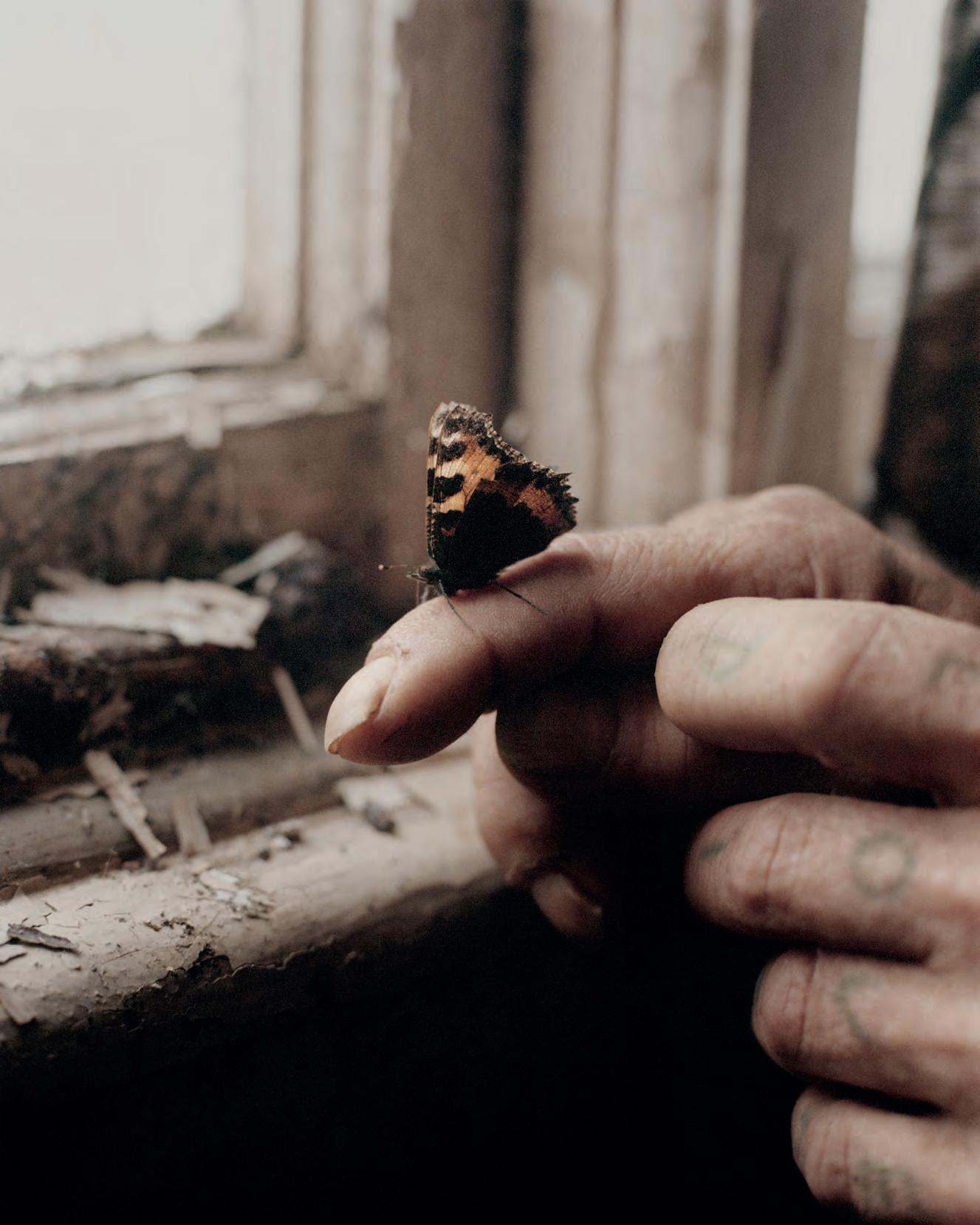
IPE 164 is at RPS Gallery, Bristol, until 7 May, then tours venues in the UK. rps.org/ipe164 IPE 165 is open for entries. rps.org/ipe165 Right ‘Butterfly, 2020’ from the series Land Loss by Max
Miechowski
170 RPS JOURNAL MARCH / APRIL 2023 EXHIBITION
WORDS: JONATHAN McINTOSH
172 RPS JOURNAL MARCH / APRIL 2023
Max Miechowski (UK)
The Lincolnshire-born, London-based photographer Max Miechowski has been drawn back again and again to Britain’s east coast, from childhood summers spent in nearby holiday towns to exploring its disappearing landscapes as an adult.
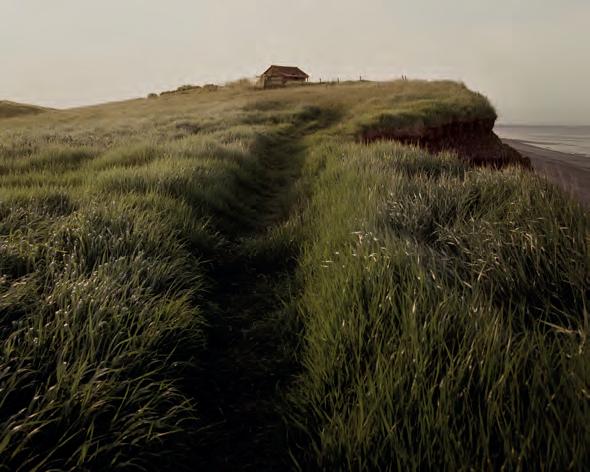
Due in part to rising sea levels, landslides, and the natural rhythms and rituals of time, Britain’s east coast is Europe’s fastest eroding coastline. As it continues to shift and fade away, the communities with roots there are seeing the places they call home slowly but surely disappear.
It wasn’t until creating his series A Big Fat Sky, though, that Miechowski grasped this reality. Photographed during the summer of 2019, the project captures the sunshine and nostalgia synonymous with the towns in this part of the country.
“After spending years photographing my local community in London I wanted to get out and document the cultural, social, and geological aspects of the British landscape,” explains Miechowski. “We often went on trips and holidays to the resort towns of the Yorkshire and Norfolk coasts growing up, so I was interested in revisiting them from an adult’s perspective.”
These return trips to the east coast for A Big Fat Sky became an important source of inspiration for Miechowski.
“I didn’t really know what to expect initially, but when I got to the east coast it was just beautiful,” he says. “It felt quite easy to make work there, which is always a good sign. The more I revisited, the more aware I became of how these towns remained frozen in time amid the booms and busts of the fishing and leisure industries central to them.”
Having spent 2019 creating A Big Fat Sky, Miechowski became aware of the receding cliffs on the periphery of these towns. They would become central to his next project, Land Loss
“Initially I tried to integrate this exploration of the timeless qualities of these resort town with the disappearing villages and cliffs nearby,” says Miechowski. “However, I soon realised the project that would become Land Loss needed to be its own thing.”
This decision proved a wise one. Land Loss helped Miechowski achieve the Photo London x Nikon Emerging Photographer of the Year Award in May 2022, and two images from the series are included in IPE 164.
It might share the territory of A Big Fat Sky, but Land Loss marks an exciting, if melancholic, new chapter for Miechowski.
“Although climate change has a part to play, what’s been happening to these cliffs [has] been happening for such a
EXHIBITION MARCH / APRIL 2023 RPS JOURNAL 173
Above ‘Coastal path, 2021’ from the series Land Loss by Max Miechowski
Left
‘Faith, 2021’ from the series Land Loss by Max Miechowski
long time,” he says. “Over the course of history, whole towns have been lost to the sea due to the erosion of these cliffs. And a similar fate awaits the places that exist along them today.”
Miechowski photographed Land Loss over several trips to the east coast between the Covid-19 lockdowns of 2020, witnessing the ever-shifting nature of these landscapes first-hand.
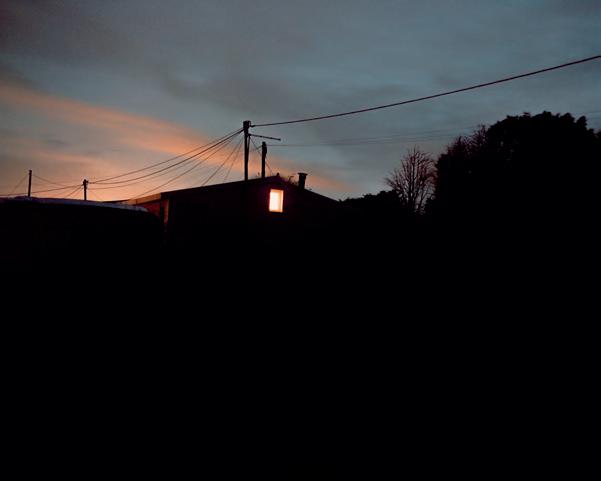
“Some of the changes that happened while working on Land Loss were dramatic,” Miechowski says. “A house on the Isle of Sheppey collapsed down a cliff due to a landslide and receding ground. But subtle changes were at play too. People who lived near to these cliffs had to measure the distance between them and their homes regularly because eventually they’d need to leave for their own safety. Land Loss became an exploration of this anticipation of disappearing experienced by so many of the people I met.”
Miechowski cultivated close connections to individuals who were, or soon would be, affected by the dissipating coastlines. His evocative images spotlight the human stories behind this lineage of loss.
“I visited the same handful of people when creating Land Loss because they understood the philosophical undertones
of it right away,” he explains. “Often, we’d chat about time, the landscape’s fragility, and how its deterioration symbolises the ephemerality of all things – us included. Everything exists on this transient precipice of time in a way.”
The individuals featured in Land Loss each had their own ways of coping with the knowledge that the lands they love will soon be lost forever.
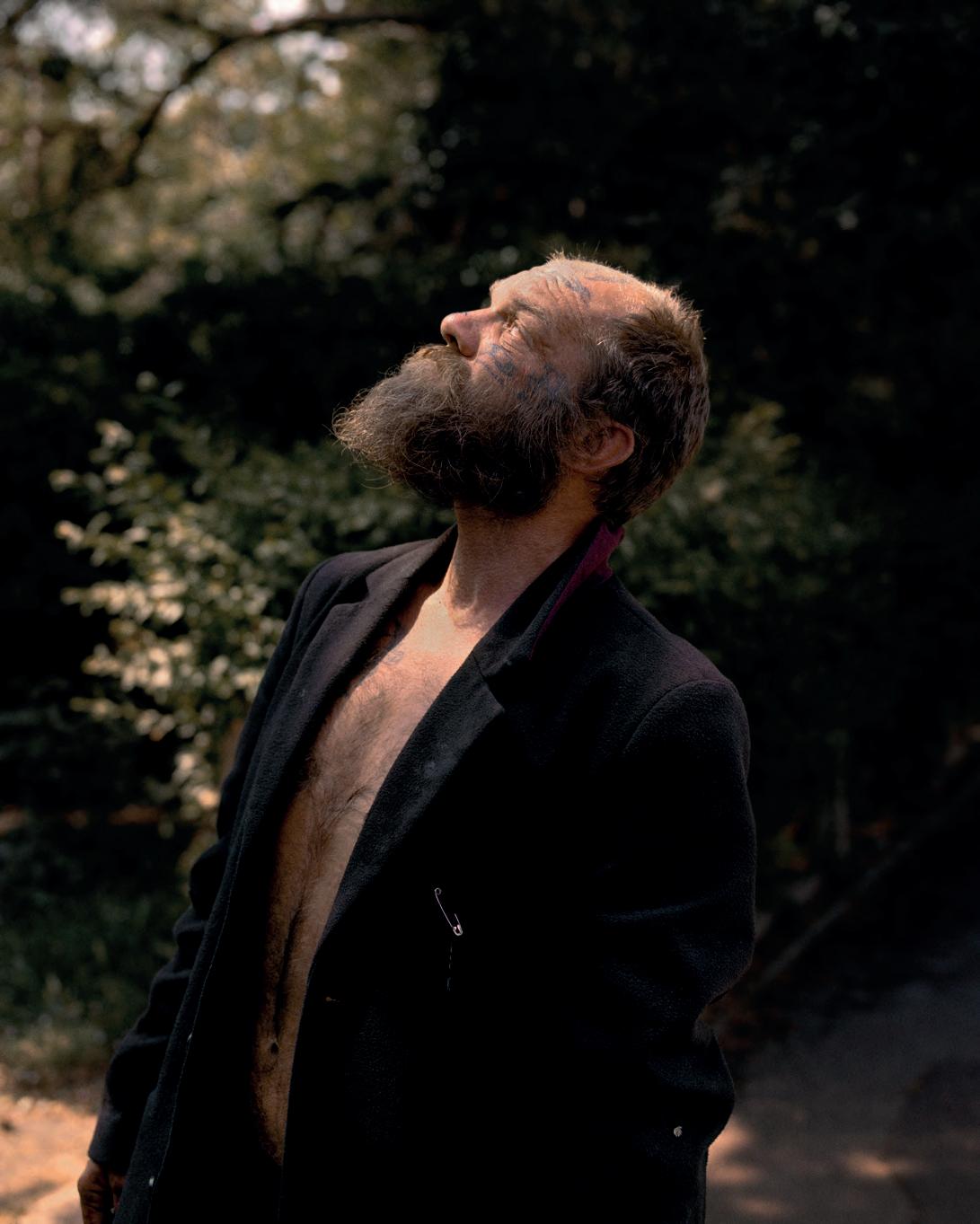
“The majority of people I met were resigned to the inevitability of these cliffs vanishing,” says Miechowski. “One man I photographed had recently lost his father. When I asked how he felt about the eroding landscape he simply replied, ‘The sea giveth and the sea taketh away.’ He understood that nature and time are inescapable no matter how hard we convince ourselves otherwise.”
Having spent so long in the landscapes of Britain’s east coast, Miechowski has been able to reflect on his own feelings toward permanency and time.
“As a society we work hard to create illusions of control of our environments,” he says. “But ultimately the processes of nature and time reveal just how fragile these constructs are. There’s something beautiful and heartbreaking in the idea that nothing lasts forever –and this feeling runs through the core of Land Loss.”
Below ‘Hallway light, 2021’ from the series Land Loss by Max Miechowski
Opposite ‘Safety pin, 2021’ from the series Land Loss by Max Miechowski
174 RPS JOURNAL MARCH / APRIL 2023
EXHIBITION MARCH / APRIL 2023 RPS JOURNAL 175
''·>>>. 1'/l ',",:::i •,1,, ,,,•·;11 ''1 1 'T'-;I,' I> I l 11 I: : '. :,·-:•:,:.:,:~:, ·•:•:-:-·1· 11 1~, •• ,,, 1 '1,'',', 11,1, 1'1'.ll I!• 11 ~ ~Ill''"'''·''·' 11,111 l~ 1 1 1·, 1. ~•,,, ' 1,1i•,•,t,'il,'.\: ',\'):,\II ·>,'~• i:.;.·,:1:i:i:!:,: ·i:,:i:t.•> 1111 1111 t·1, 1·t 11:I·:;.!::;_::::::::'.~~:::~~; :,;,;\;,:, ~~-\~\'.'~ ,\ \1;1-1 ,:,:1:,:~ ; 1,; ~4.,~\~~\~1;'1~. ),· :1:1:.;q, .• ~t, 1\•1 •1 1 I'\ •I <•.• ''"·' ''''' '' '\:::::: ::, 1i,1i 1 :i1 1 1 1 ',,,,,.,::::i:;:1 ::: ',:,•;,,• ,' •:i;1,1;','1' ,·, 1,'
Jenny Matthews HonFRPS (UK)
The lockdowns of the Covid-19 pandemic put a shuddering stop to everyday routines and rituals. Unable to wander freely, we were forced to watch events unravel during times of great uncertainty. Some of us used the time to slow down, reassess and recalibrate – a silver lining in a dark and challenging time.
Photographer and filmmaker Jenny Matthews HonFRPS was inspired by lockdown to reflect on a four-decade career during which she has documented historic events including the independence of Eritrea, the Nicaraguan revolution and the Rwandan genocide. This retrospection culminated in the creation of Facial De-recognition – two pieces from which have been selected for IPE 164.
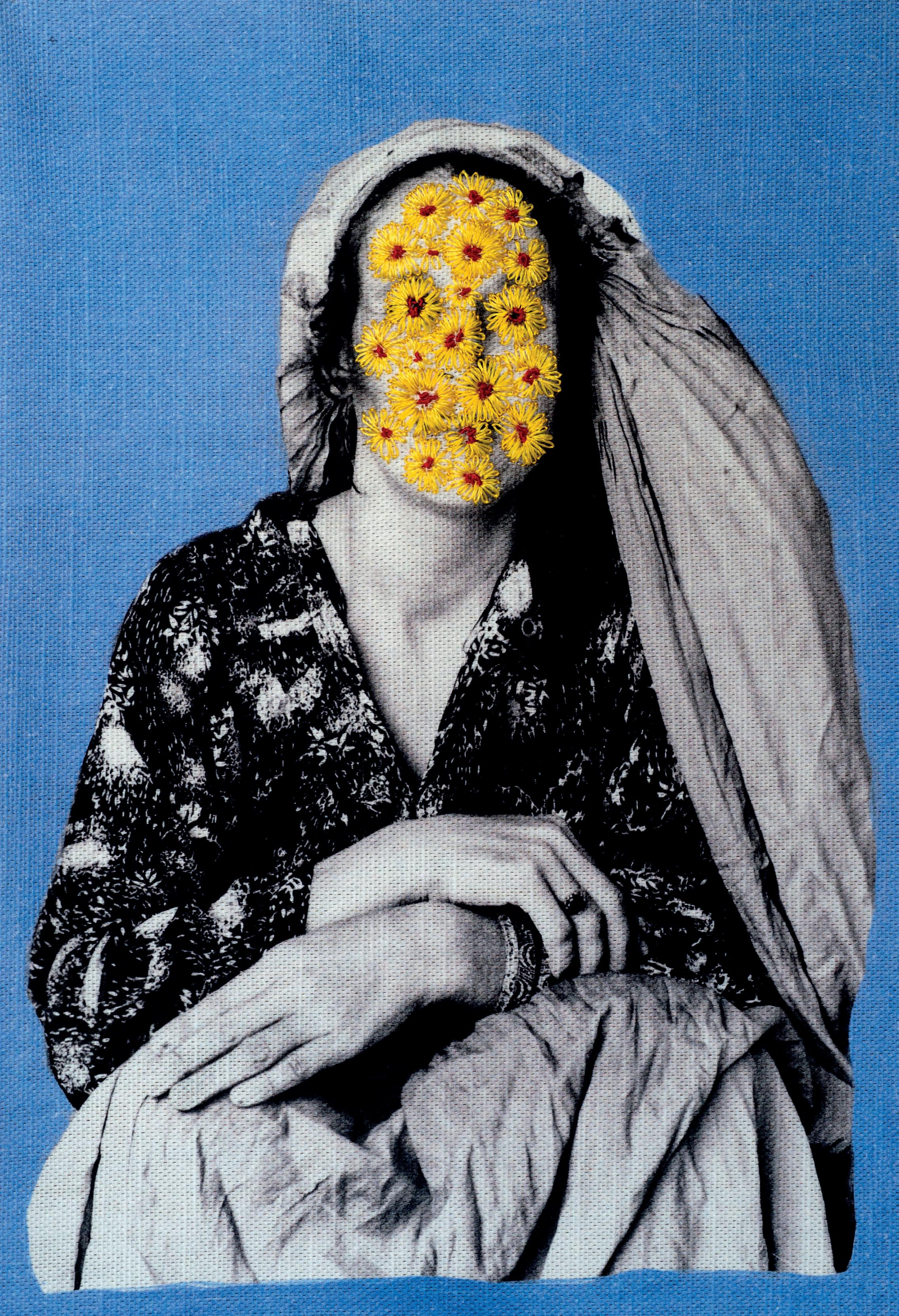
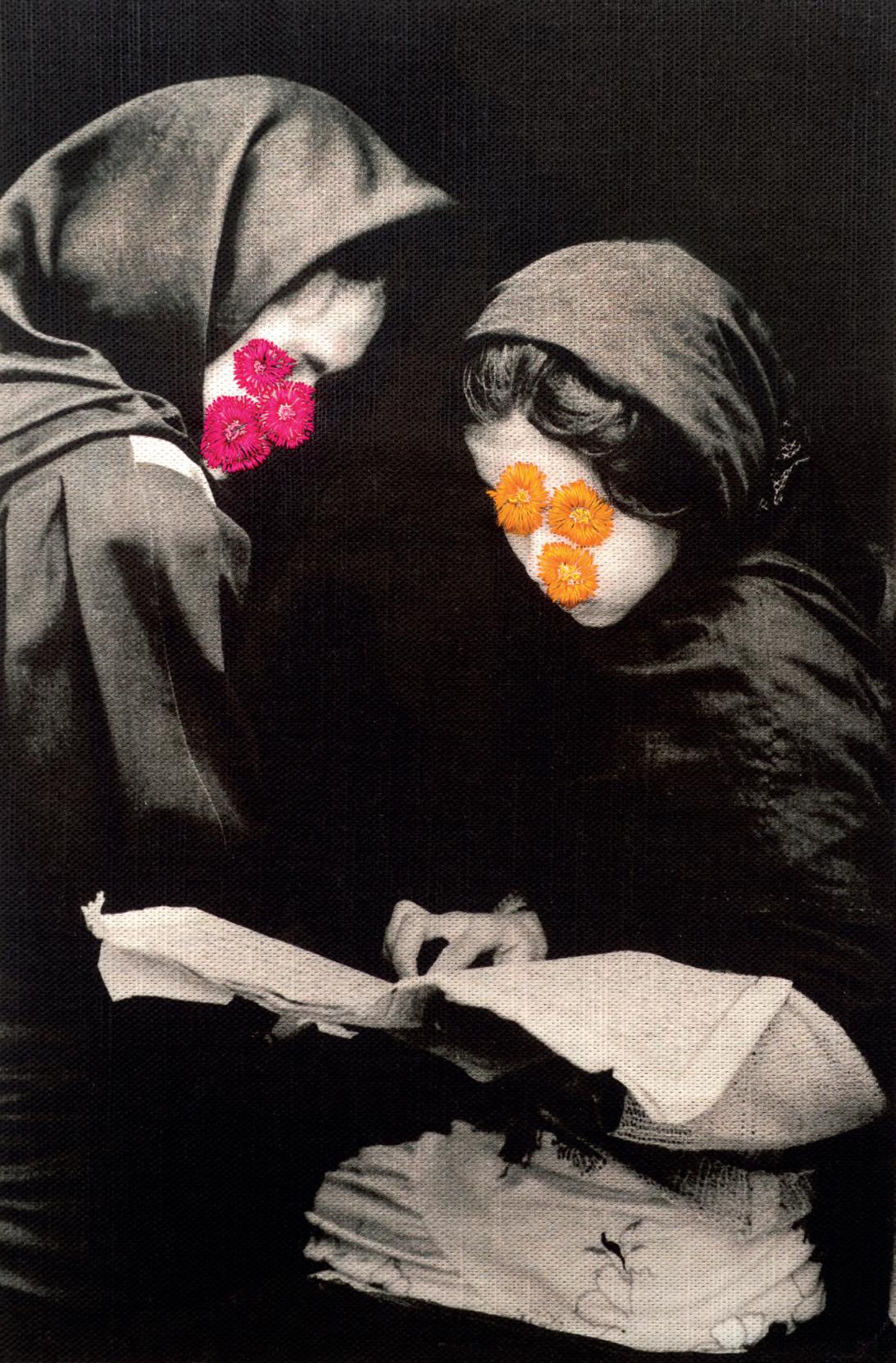
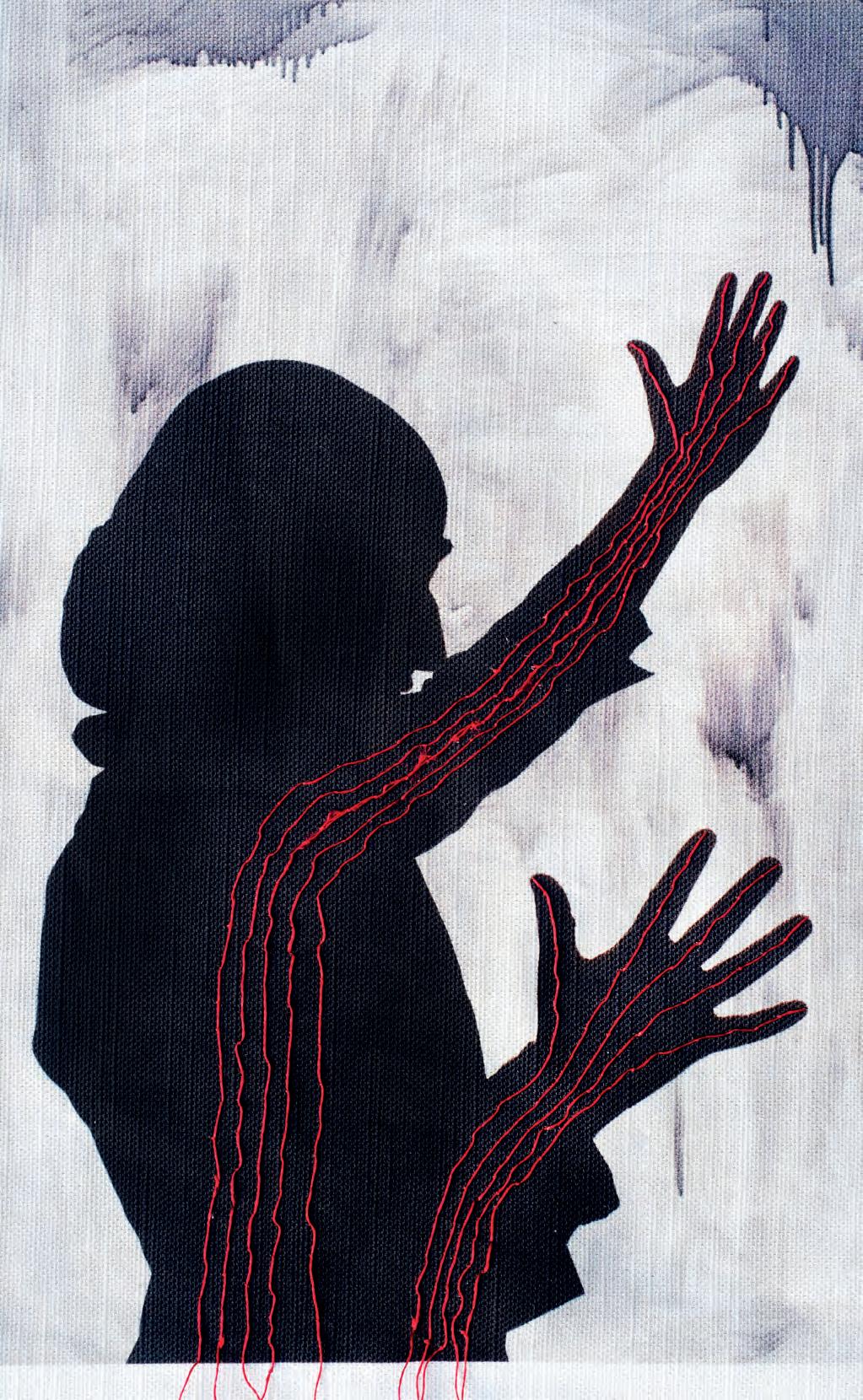
Dedicated to the women of Afghanistan, Facial De-recognition continues Matthews’ exploration of dispossession, human rights and female experience. Taking her craft into new dimensions, she printed her images onto cotton before adding embroidered embellishments to them by hand. The results are bold and striking – a sobering reminder of how women’s rights in Afghanistan have been curtailed since the Taliban retook control of the country in August 2021.
“I’ve met so many amazing girls and feisty women who worked as bankers, judges and human rights defenders during my trips to Afghanistan,” explains Matthews. Opposite ‘Afghan woman with embroidery’ from the series Facial De-recognition by Jenny Matthews HonFRPS
EXHIBITION MARCH / APRIL 2023 RPS JOURNAL 177
“I was incredibly shocked when the Taliban took over in August 2021. All the progress and freedom women enjoyed were swept away in an instant. Facial De-recognition is about recognising this loss of identity, freedom and these gains that Afghan women had made.”
A founding member of the women’s only photographic agency Format, Matthews joined Network Photographers in 1989, moving in 2005 to Panos Pictures, an agency specialising in global social issues. That same year she was awarded an RPS Honorary Fellowship, and says she values her long-held membership of the Society as a way to connect with other image-makers.
Lockdown, which could have proved stifling, instead inspired her to print her images onto fabric for the first time in more than 20 years.
“I first made a quilt using images I’d shot of survivors of the Rwandan genocide while working for an organisation called Africa Rights in 1995,” she says. “I didn’t do any sewing from then until I was left to my own devices at the onset of the Covid-19 pandemic. Since 2020, I’ve made 20 photo-quilts like those in Facial De-recognition. It’s been a great way for me to revisit my archives and the people and places I’ve encountered throughout my career.”
Facial De-recognition took Matthews into new territory, though, as she incorporated embroidery in her works. Inspired by the quilts of the American artist Faith Ringgold, Matthews has found a power in her newfound craft.
“Photography can be quite a solitary endeavour, which is why I’m glad to be part of the RPS as it connects you to people and work you may not have come across otherwise,” she says. “Contrastingly, embroidery has a history of bringing women together to work on their creations. I suppose I’m embroidering in anger for, and in honour of, Afghan women. Opposite ‘Afghan girls studying’ from the series Facial De-recognition by Jenny Matthews HonFRPS
178 RPS JOURNAL MARCH / APRIL 2023 EXHIBITION
180 RPS JOURNAL MARCH / APRIL 2023
“A lot of my work has focused on exploring the unpleasant side of life and exposing wrongs that need righting. But I’m interested in decorative art too. Facial De-recognition has let me amalgamate my passions for gritty documentary and decorative art.”
Working on Facial De-recognition has also provided Matthews with the space to consider how the world has changed throughout her photographic career.
“In terms of change, I just can’t believe how much worse things can get. I think the war in Ukraine, the cost-of-living crisis, and the ever-widening divide between the rich and poor has brought that home for everyone very vividly,” she explains. “This loss of freedom I spotlight in Facial De-recognition also echoes what’s happening to women in Ukraine. It’s unbelievable how suddenly things can change. We all live very fragile lives.”
Matthews’ two images selected for IPE 164 are dedicated to different groups of women. One shows a woman with daisies over her face and honours Afghan women poets and writers. The other celebrates female Afghan teachers, students and schoolgirls. The artist hopes her work will engage and inform audiences.
“Frustratingly, once the media feels an event has conjured enough images, it’s relegated by the next news story,” says Matthews. “I think that’s what happened with the Taliban retaking Afghanistan. But for the millions of women there, these restrictions to their freedom is a reality that’s not going away.
“I’d like Facial De-recognition to inform people about the pressing issues going on in the world. You can’t expect people to be engaged by everything, but if these works educate someone about the plight of others for just a moment, then that’s a good thing.” Opposite ‘Afghan woman. Victim of violence’ from the series Facial De-recognition by Jenny Matthews HonFRPS
EXHIBITION MARCH / APRIL 2023 RPS JOURNAL 181
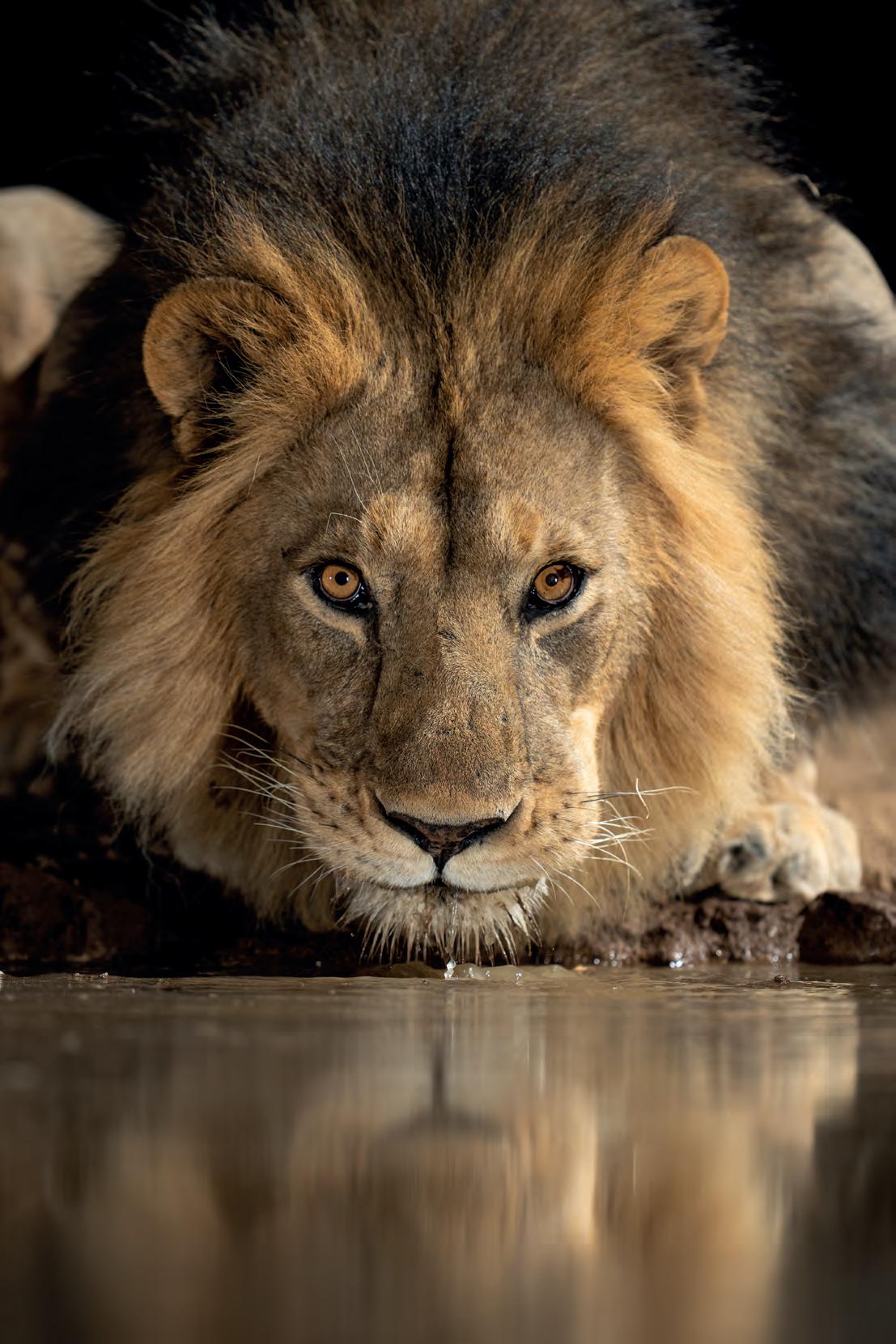
WATER OF LIFE
WORDS: TEDDY JAMIESON
IMAGES: WILL BURRARD-LUCAS
Five metres. Not so far, really. Just over 16 feet. Less than half the length of a London bus. The length from one end of a room to the other perhaps. Or in this case the distance from photographer Will Burrard-Lucas, sitting in a hide looking through his lens, to an adult male lion, squat and powerful, on the other side of a waterhole.
Five metres in the silence of the deep, dark Kenyan night. Not so very far at all.
“With those lions, it’s completely silent,” BurrardLucas explains, painting a picture for me. “They’re there. I’m five metres away. They know I’m there. The slightest movement or click, they’re aware of it. And so you do feel a very strong connection.”
Of course, he doesn’t need to paint a picture. He’s already taken it. And more. Here is a pride of lions drinking, their reflections in the waterhole like a shimmer in the night. Here is that large male lion looking right at Burrard-Lucas, looking right at us as we look at the picture. The connection that a photograph can make between a wild animal and all of us is surely self-evident.
Left ‘Male lion, Shompole Hide, Kenya, 2022’
WILDLIFE MARCH / APRIL 2023 RPS JOURNAL 183
When RPS member Will Burrard-Lucas helped a Maasai community build a waterhole, his goal reached far beyond the perfect image
“Sometimes I feel the connection isn’t quite as strong as it was in the SLR days,” admits Burrard-Lucas. “When it was the SLRs and it was properly optical. You are seeing the light coming from that animal through the lens into your eye, whereas now it is a little screen you are looking at. But in a situation like that it’s just me and the lion. And holding my breath and taking pictures when the moment’s right.”
This is Burrard-Lucas’s skill, to bring us into close communion with the wildlife of Africa. To achieve this, the 39year-old pushes himself and his equipment, and devises new technology – an RPS member, he is the man behind the
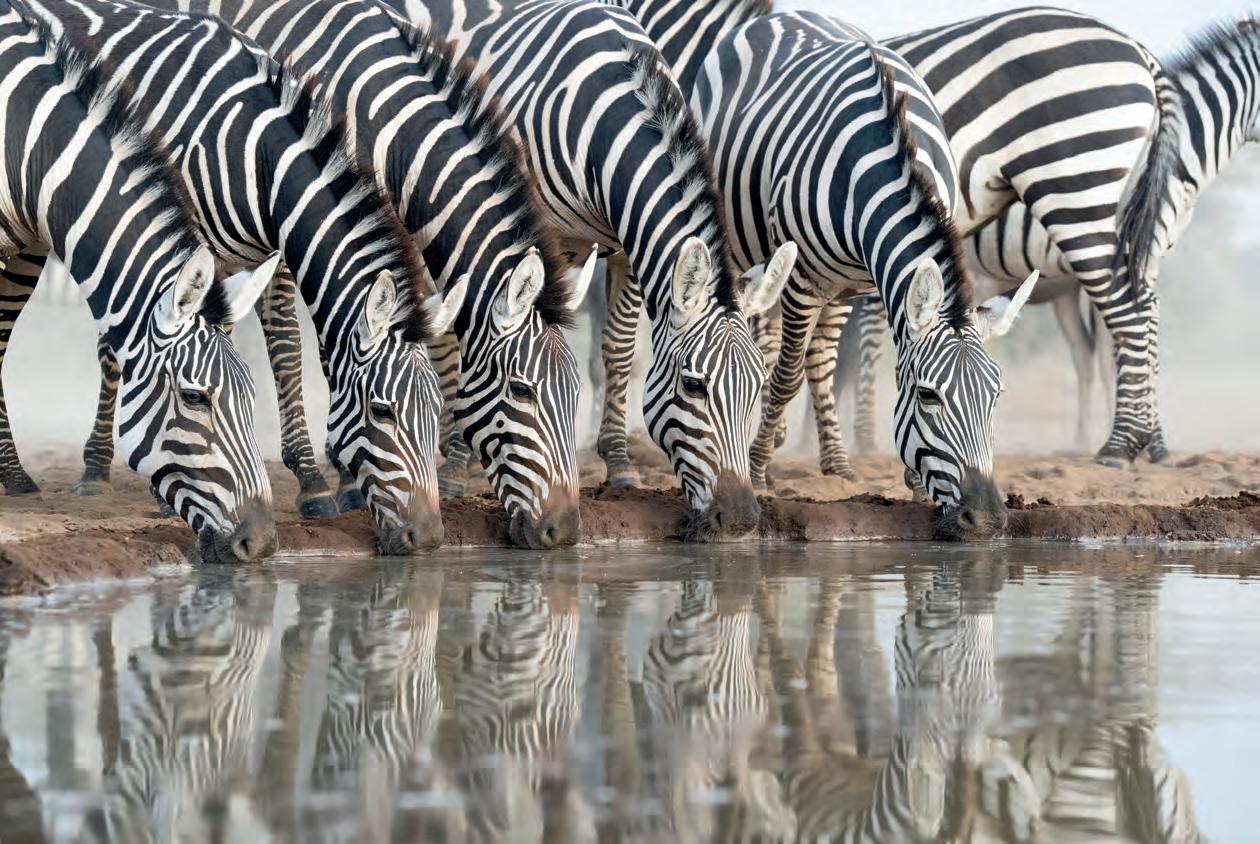
BeetleCam, a remote-controlled buggy with a camera mounted on it designed to get up close. He’s even helped build a waterhole at the Shompole Wilderness Camp in Kenya’s Southern Great Rift Valley, where water is at a premium.
If you build it they will come. And they have. Lions, leopards, elephants, buffalo, zebra, wildebeest, baboons, porcupines and more. And Burrard-Lucas has taken pictures of all of them by day and by night.
Which maybe begs a question actually. How do you light a waterhole and not spook the animals? Actually, he says, that’s easier than what he has done before.
184 RPS JOURNAL MARCH / APRIL 2023
’Zebras, Shompole Hide, Kenya, 2022’
“When you’ve got to find an animal and then set up your lighting before the animal disappears, that was really challenging. But suddenly with the waterhole I had a defined area so I was actually able to light it intentionally, taking my time. And also I’ve been able to return.”
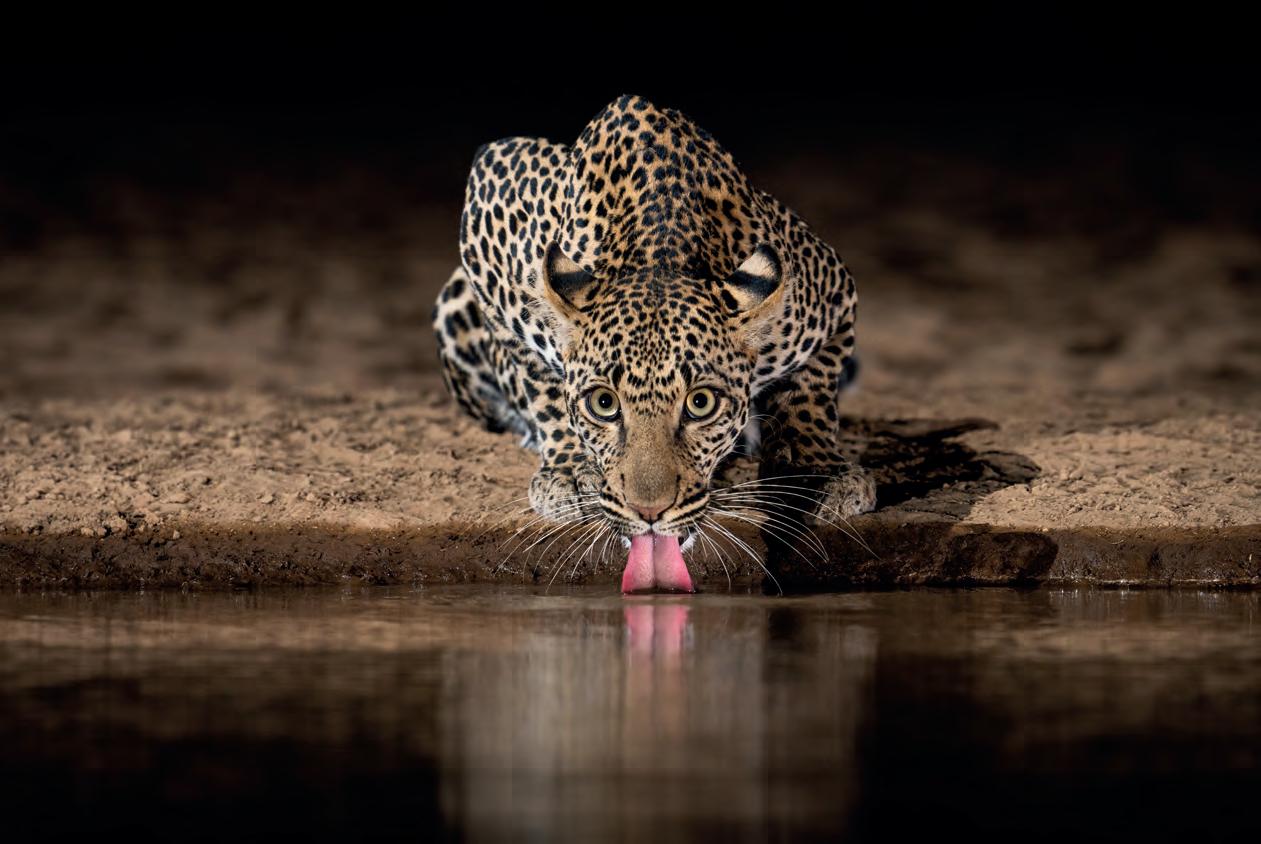
He uses red light, white light and even infrared, depending on his needs.
“The first set-up is maybe a bit more basic and I go away and the next time I come back I bring some different lighting gear and improve the set-up each time, so it becomes this process of trying new things and seeing what works.
WILDLIFE MARCH / APRIL 2023 RPS JOURNAL 185
‘Leopard, Shompole Hide, Kenya, 2022’
“With the waterhole I had a defined area so I was actually able to light it intentionally, taking my time”
“More recently, I added a backlight or tried diffusing the light. It’s all experimenting really. That’s still a process I’m working on. So, start simple and slowly build it up. Once you’ve got some results you can then spend a whole night maybe trying to get just one particular photo, maybe a backlit photo.
“I guess the luxury of being able to return again and again and spend time is that you can then set up for a particular shot and just keep going until you get it.”
Keep going until you get it is as good a mantra as any for wildlife photographers and Burrard-Lucas’s career is proof of its efficacy. His work is notable for its freshness, its intimacy
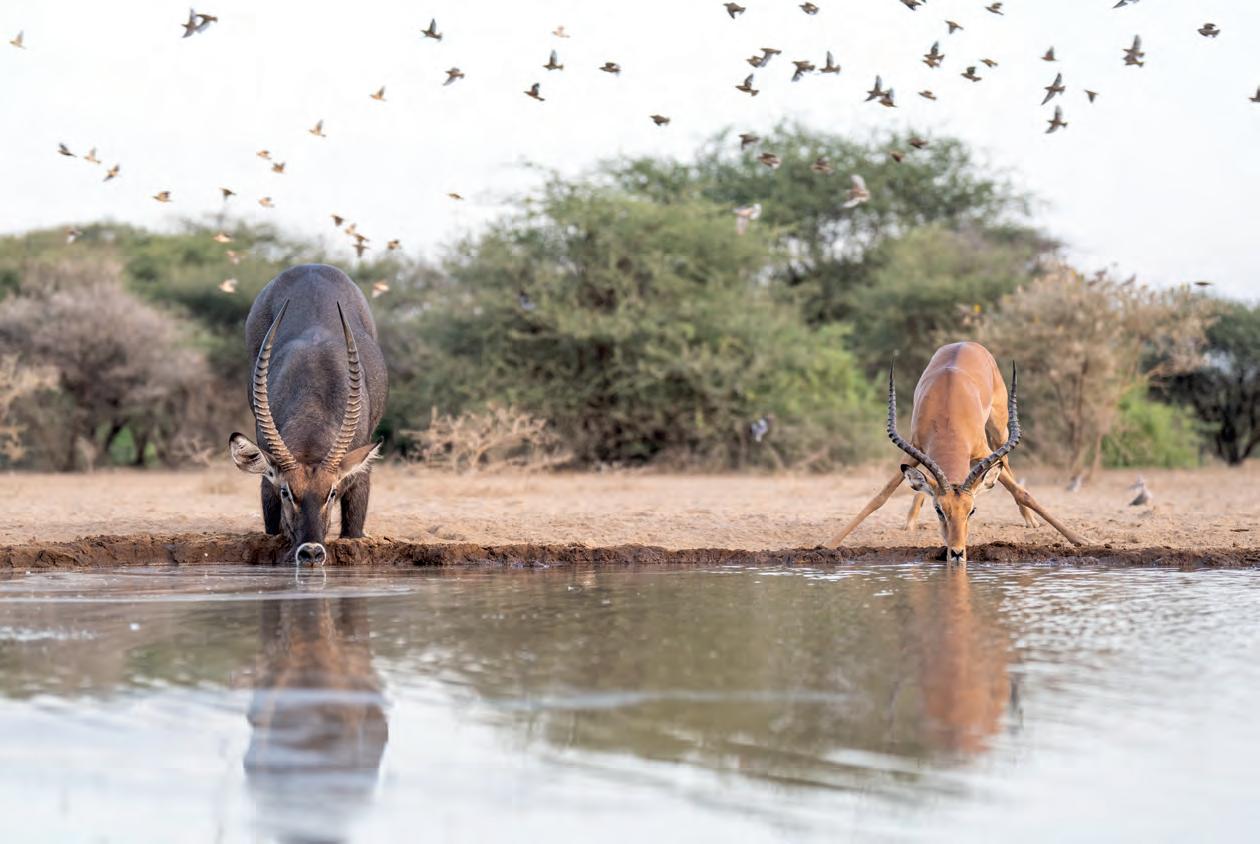
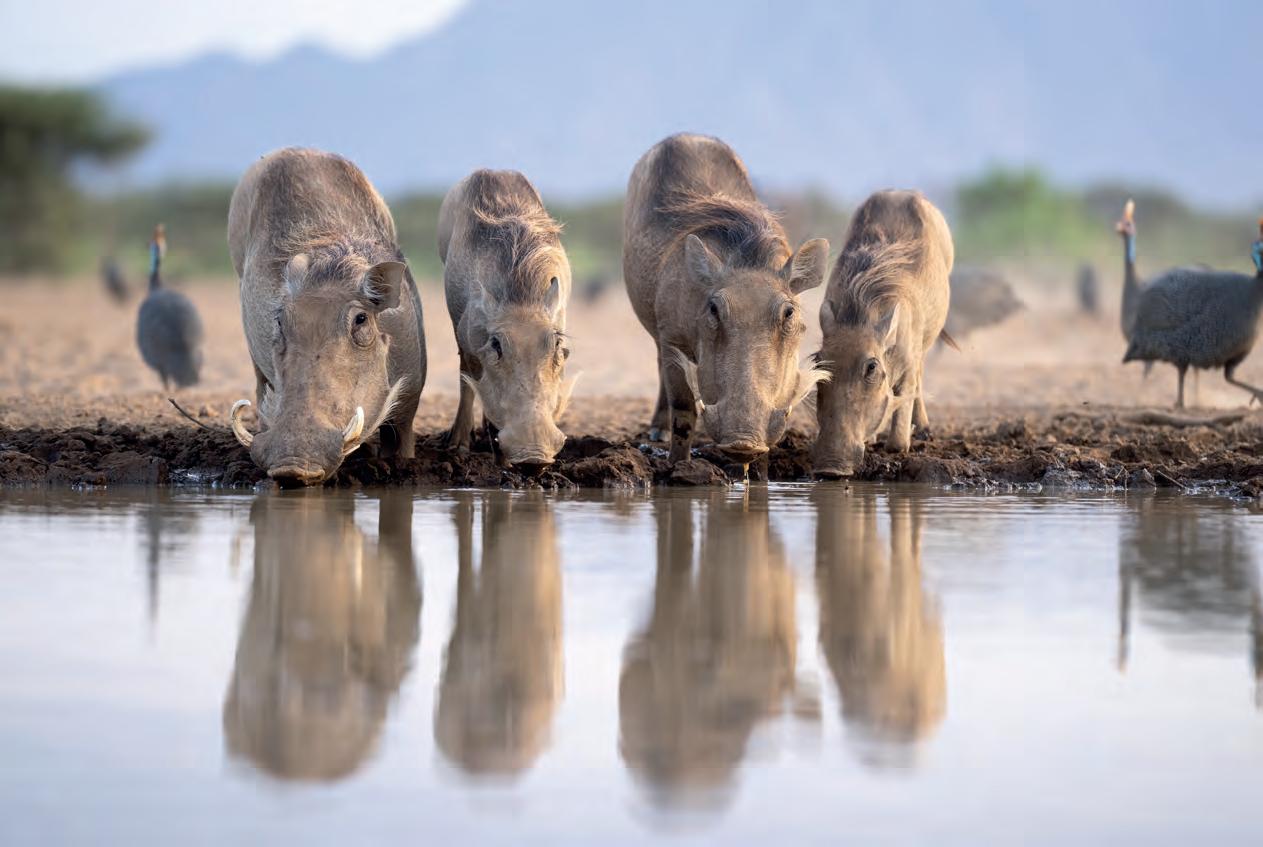
and for the dedication he puts into getting the image he seeks. He spent months and months in Kenya trying not just to get a rare photograph of the elusive black leopard, but to get a particular photograph; one of the leopard at night under a starry sky. He eventually succeeded. The result is an image that is not just rare but numinous, a glimpse of something truly other, a reminder that the world still has its mysteries. Not bad for a man who trained as an accountant.
When he was four years old, Will Burrard-Lucas’s parents took him from the UK to live in Tanzania. They would spend more than three years there, inculcating in their son an obsession that would stay with him for life.
186 RPS JOURNAL MARCH / APRIL 2023
J
‘Waterbuck and impala, Shompole Hide, Kenya, 2022’
“Going on safari and seeing the wildlife is a pretty big adventure and it became part of my identity ever since then,” he explains. “That definitely set the foundations in place for that interest in wildlife and nature and Africa.”
Photography came along much later. He was at university –Imperial College London – when good digital cameras became affordable.
“I started doing it as a way to just document my travels. I guess my travels often revolved around nature anyway, and very soon those two interests merged and I found myself travelling more and more to photograph wildlife. After uni I was an accountant in London for three and a half years, the
WILDLIFE MARCH / APRIL 2023 RPS JOURNAL 187
“Going on safari and seeing the wildlife is a pretty big adventure and it became part of my identity”
‘Warthogs and guinea fowls, Shompole Hide, Kenya, 2022’
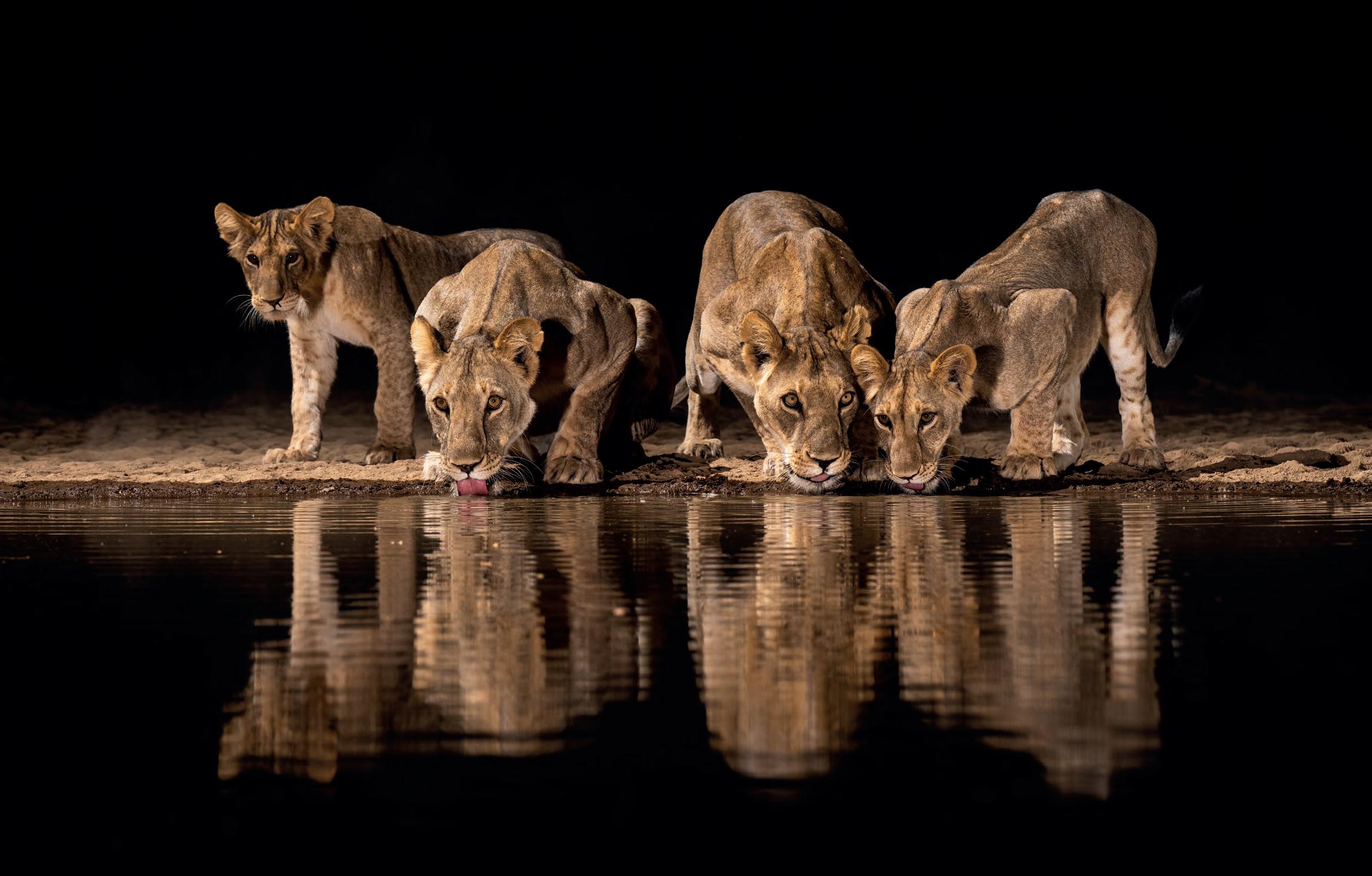 ‘Lions, Shompole Hide, Kenya, 2022’
whole time building the photography up on the side. Then I qualified as an accountant and at that point I decided it was now or never to give it a go. So, in 2010, I went full-time to the photography side and fortunately haven’t had to go back to accountancy.”
As a photographer Burrard-Lucas has lived something of an itinerant life. He has worked in South America and Asia, and when we speak he is in Australia visiting relatives, but time and again he’s been drawn back to Africa.
“I guess the turning point came in 2012-2013. My wife Natalie and I moved to Zambia for a year. And just spending a
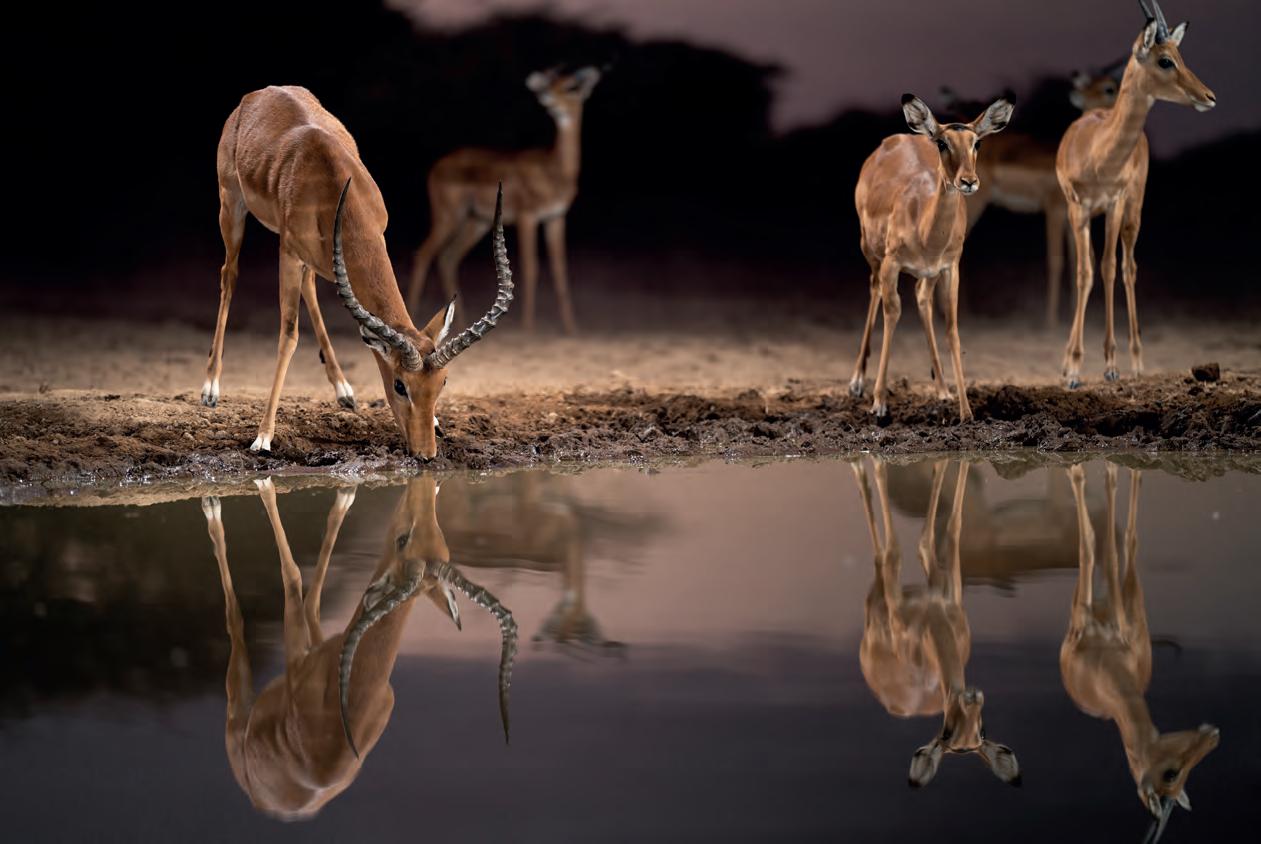
190 RPS JOURNAL MARCH / APRIL 2023
‘Impalas, Shompole Hide, Kenya, 2022’
year focusing on African wildlife and focusing on one area changed the way I work thereafter. Ever since then I’ve dedicated my time to more longer-term projects and I found I kept coming back to Africa.”
Burrard-Lucas has built up a network of contacts that have helped him mount increasingly ambitious projects, devoting more and more time to getting the shots he wants.
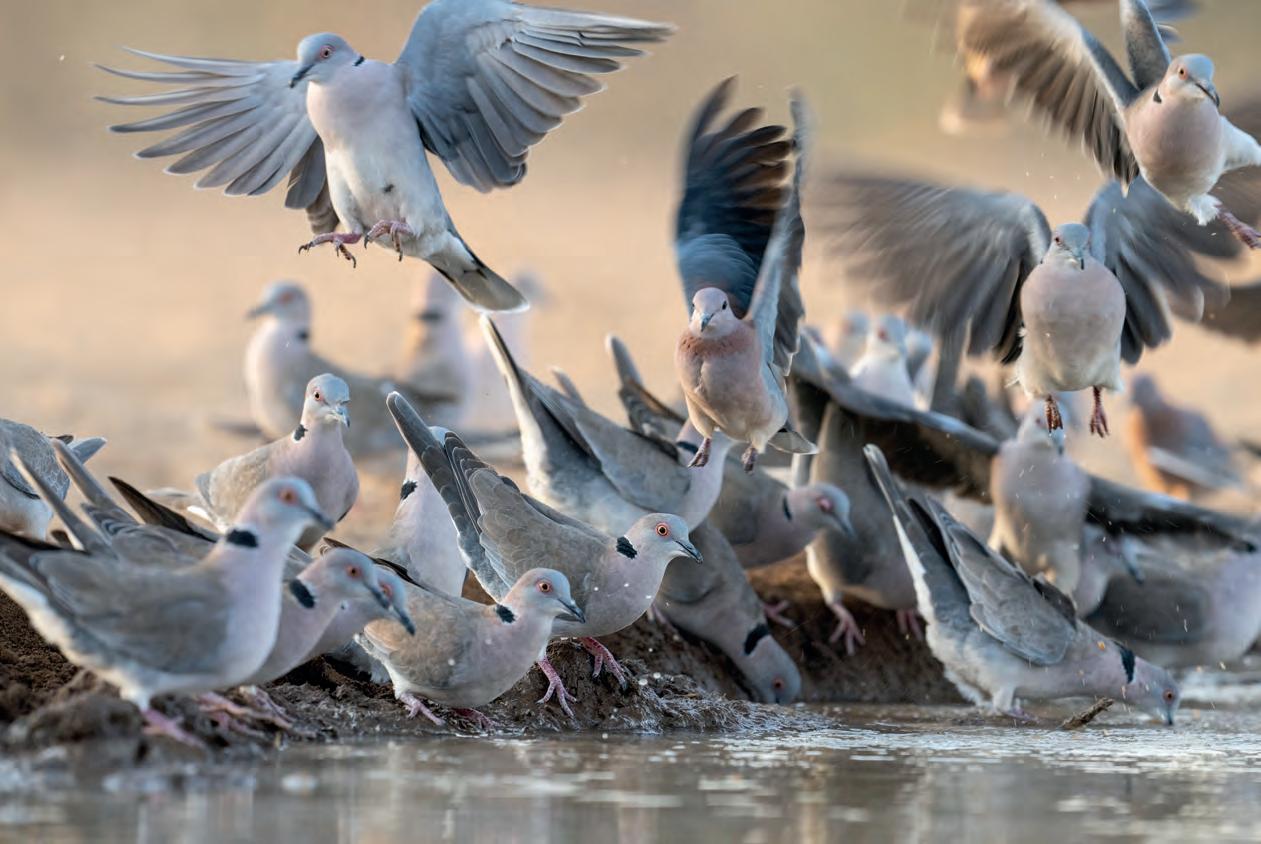
“In the early days it’s bucket list shots you try to tick off. It is one shot here, one shot there. I think the shift happens when you start doing longer-term projects. You get that low hanging fruit very quickly and then, if you’re continuing to
work on the same subject, you’ve got to push yourself further. So you’ve really got to start thinking creatively, returning to a subject again and again with new ideas to build your body of work further. I think it does force you to become both a better photographer and more innovative really, because otherwise you end up taking the same photos over and over again.”
He had always used telephoto lenses. He still does. But in 2009 he started working with wide-angle lenses and that proved something of a Eureka moment for Burrard-Lucas.
“It was a kind of revelation,” he says. “There was obviously limited subject matter I could do this with, but on a wide angle
WILDLIFE MARCH / APRIL 2023 RPS JOURNAL 191
‘Collared doves, Shompole Hide, Kenya, 2022’
I could crawl up to a penguin and then get it in its habitat with that more intimate, immersive perspective. I think that was a bit of a lightbulb moment. Again and again, I’ve ended up returning to that perspective, using remote control cameras and camera traps.”
Sometimes he created his own technology. Sometimes he had to wait until tech caught up with his vision. It wasn’t until 2012 that digital cameras were good enough for what he wanted to do. “All of a sudden we could take photos at night with high ISOs and get useable images and expose wildlife with stars and moonlit backgrounds.”
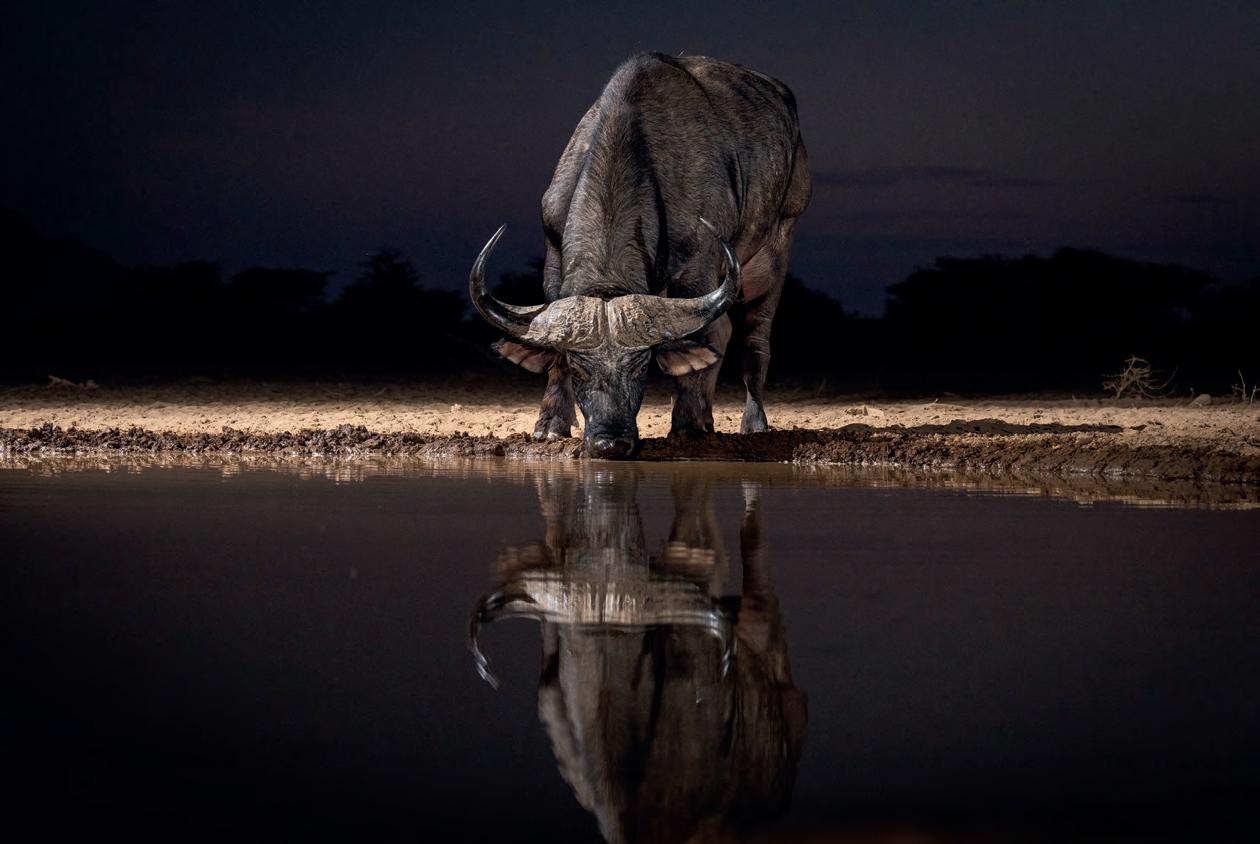
192 RPS JOURNAL MARCH / APRIL 2023
“It’s an area where there are Maasai communities who rely on the land and share this land with animals”
‘Cape buffalo, Shompole Hide, Kenya, 2022’
It has been a path he has pursued ever since. Its latest iteration has been the images Burrard-Lucas took from the hide at Shompole Wilderness Camp. He was hands-on in its creation at the end of 2021 into 2022.
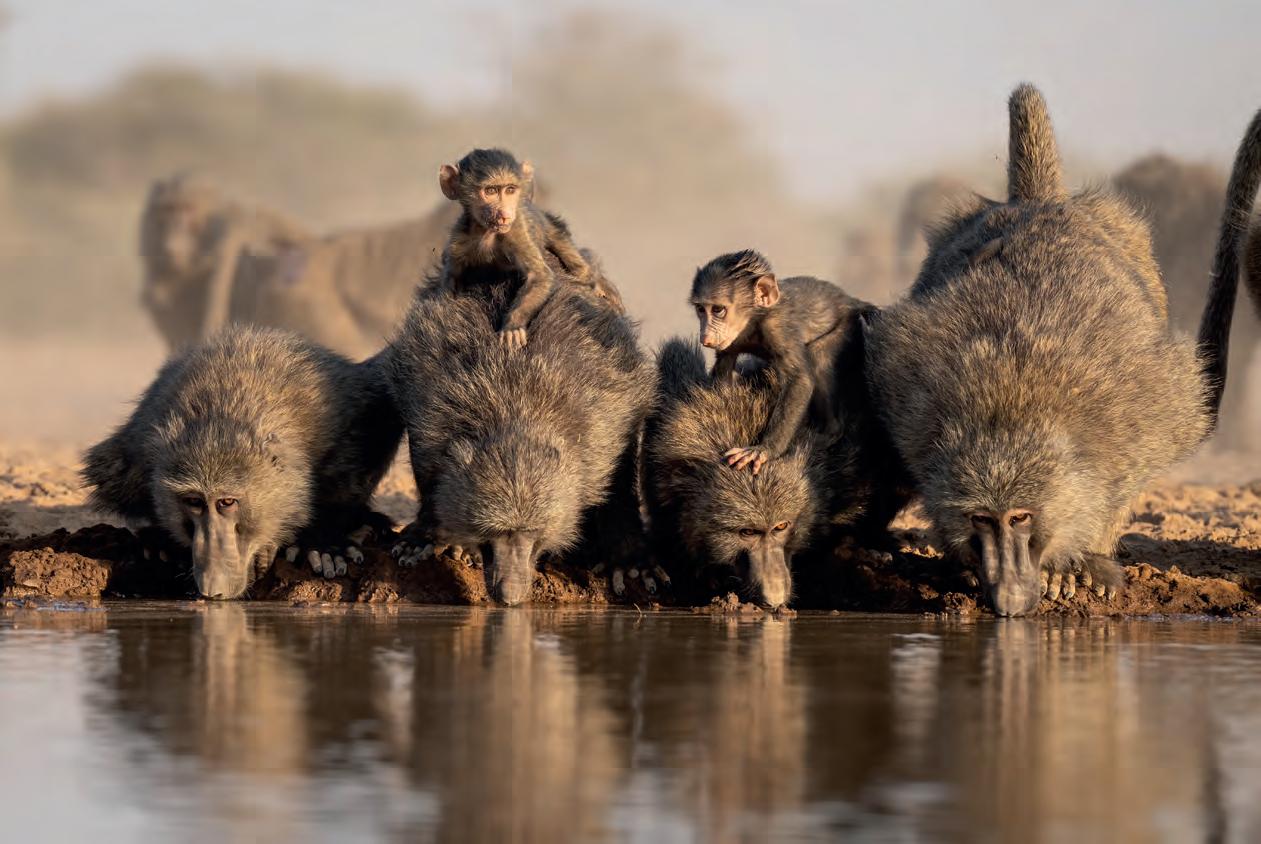
Building the waterhole and the hide with the ownermanagers of the camp and some of the local Maasai people is not just about getting great images though. It’s also an attempt to play a positive role in the ethical questions that wildlife photography throws up.
“Oh yes, that’s a massive part of it,” he says. “Somewhere like Shompole, it’s off the beaten track. It’s an area where
there are Maasai communities who rely on the land and share this land with animals such as these lions. There’s so much competition for resources, so when they are sharing the land there’s a high risk of human-wildlife conflict, where the lions are potentially predating on the livestock.
“So often my projects are working with the conservationists in these areas and understanding how these places are working and how it’s possible for wildlife to keep existing in these places. A project like this really does involve the community a great deal and for this project to have even gone ahead it had to involve the community and benefit them.
WILDLIFE MARCH / APRIL 2023 RPS JOURNAL 193
‘Olive baboons, Shompole Hide, Kenya, 2022’
“The only real way they benefit from this wildlife is if it is attracting tourists and helping bring revenue through conservation fees. But in an area like this where the animals are getting by just by avoiding people, then to bring in tourists and show them these creatures is a massive challenge.
“So the idea behind this hide and the reason the community were keen to support it was that it would allow a better tourism experience which would then hopefully benefit the community, benefit the wildlife by giving them a place to drink that was their own, and hopefully be a win-win for everybody.”
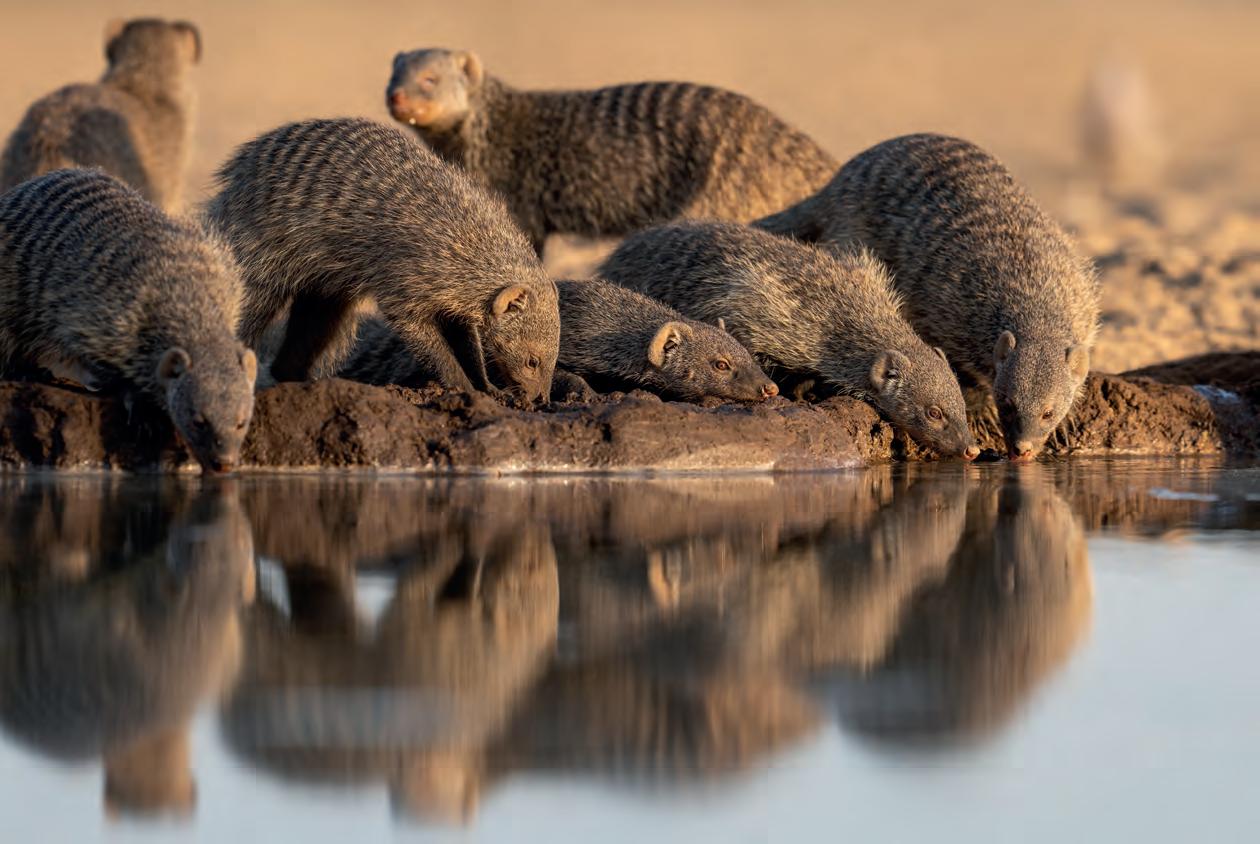
194 RPS JOURNAL MARCH / APRIL 2023
‘Banded mongooses, Shompole Hide, Kenya, 2022’
It’s a place Burrard-Lucas will definitely return to. There will be photos to take. There are always photos to take. At the moment he is working on a project on pangolins and another on lions, hoping to catch the images that are in his head through his lens.
“There’s a shot I wanted with lions in the rain backlit,” he says, “ten days just working towards that photo.”
Good timing and patience are certainly key attributes of the wildlife photographer.
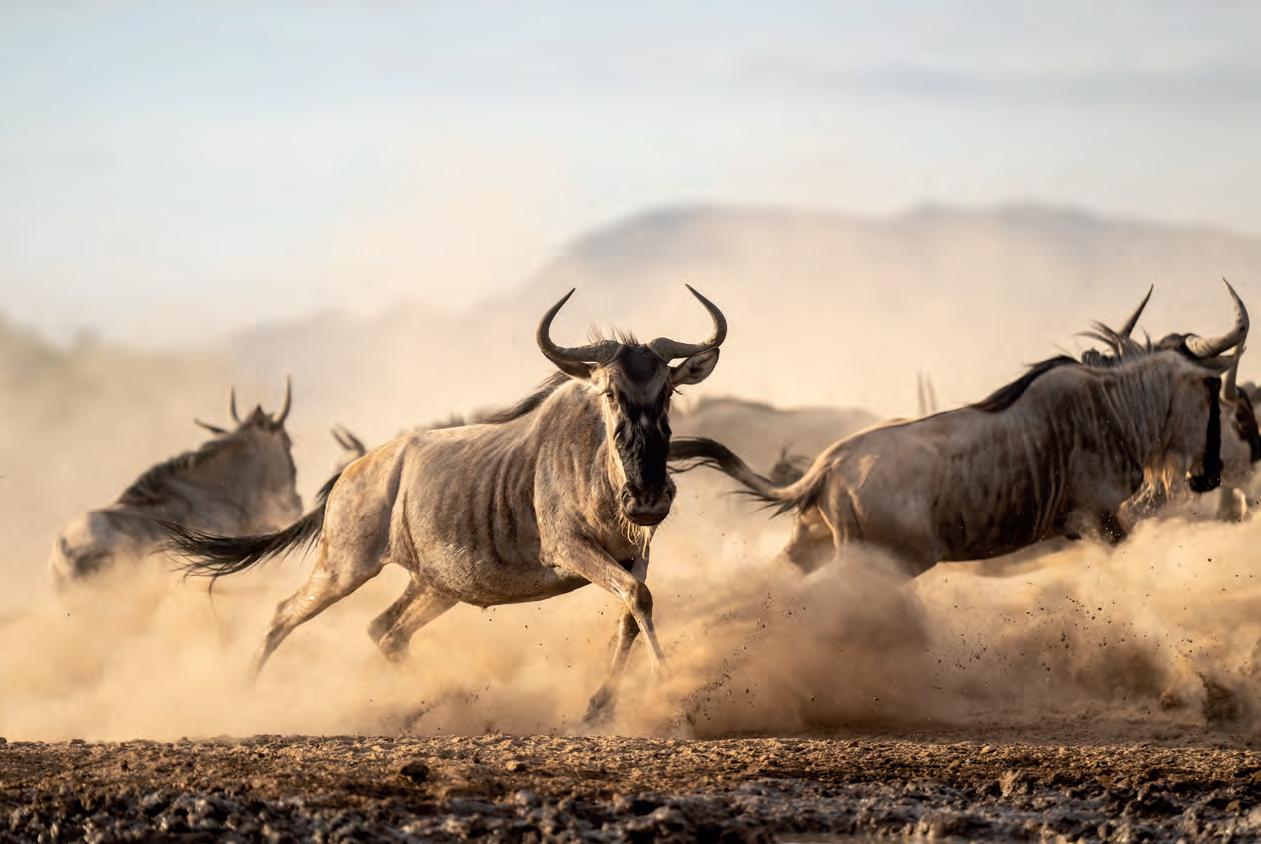
“The ones that are still really eluding me are those where I need to get behaviour as well,” he says. “So, photos of
lions hunting. You might witness that once or twice in a year following them around, so the chances are very low already and then to get the photos I want as well ...
“There is no substitute for following them and just putting in the hours really.”
Do you fall in love with your subjects, Will?
“I think you do. But to be honest I probably wouldn’t necessarily even start a project unless I had that already. All of these animals, they’re pretty easy to fall in love with.” willbl.com
WILDLIFE MARCH / APRIL 2023 RPS JOURNAL 195
‘Wildebeests, Shompole Hide, Kenya, 2022’
THE RISK-TAKER
With an appetite for a challenge and a love of social spaces, Shoair Mavlian is bringing a fresh vision to one of the UK’s seminal galleries
WORDS: RACHEL SEGAL HAMILTON
She might have little recollection of what was showing on its walls, but walking through the door of The Photographers’ Gallery (TPG) in London for the first time still left a lasting impression on Shoair Mavlian. “It was just such a dynamic place,” she says, “a place where you could come and see things you’d probably never seen before.” We’re sitting in a glass-walled meeting room just off the gallery’s bustling offices. In the corridor outside is a wall lined floor to ceiling with photobooks by exhibitors past.
It is a month since Mavlian was appointed the fifth director of the UK’s original dedicated public photography gallery –something the curator, who interned here 14 years ago, calls “a privilege and an honour”.
196 RPS JOURNAL MARCH / APRIL 2023 GALLERY
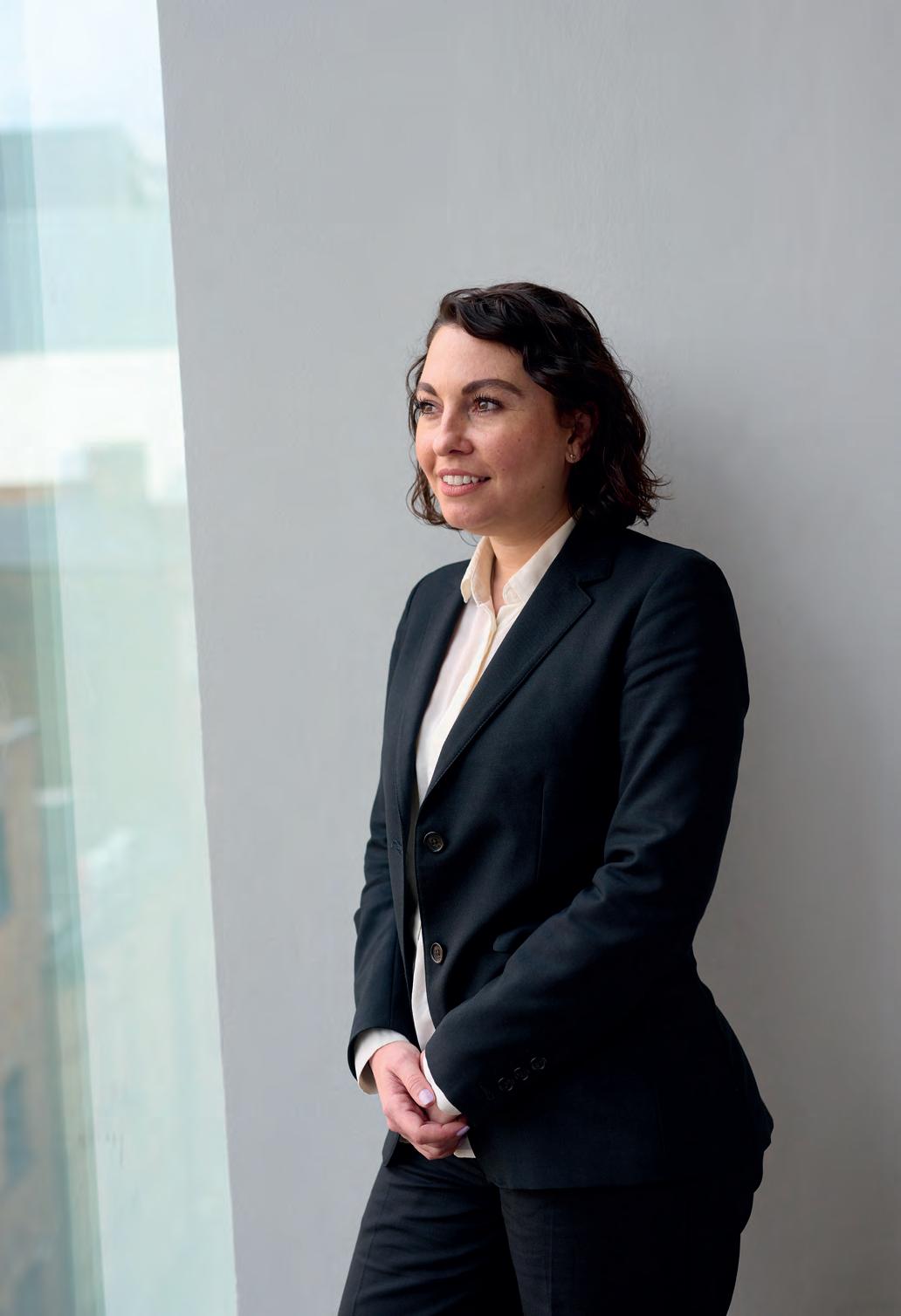
MARCH / APRIL 2023 RPS JOURNAL 197
Shoair Mavlian, director of The Photographers’ Gallery, by Paul Stuart
TPG has never stopped breaking boundaries since its establishment in 1971 by Sue Davies HonFRPS, premiering in Britain the work of international image-makers such as Honorary Fellows Sebastião Salgado, Rinko Kawauchi and Taryn Simon, and hosting the prestigious Deutsche Börse Photography Foundation Prize.
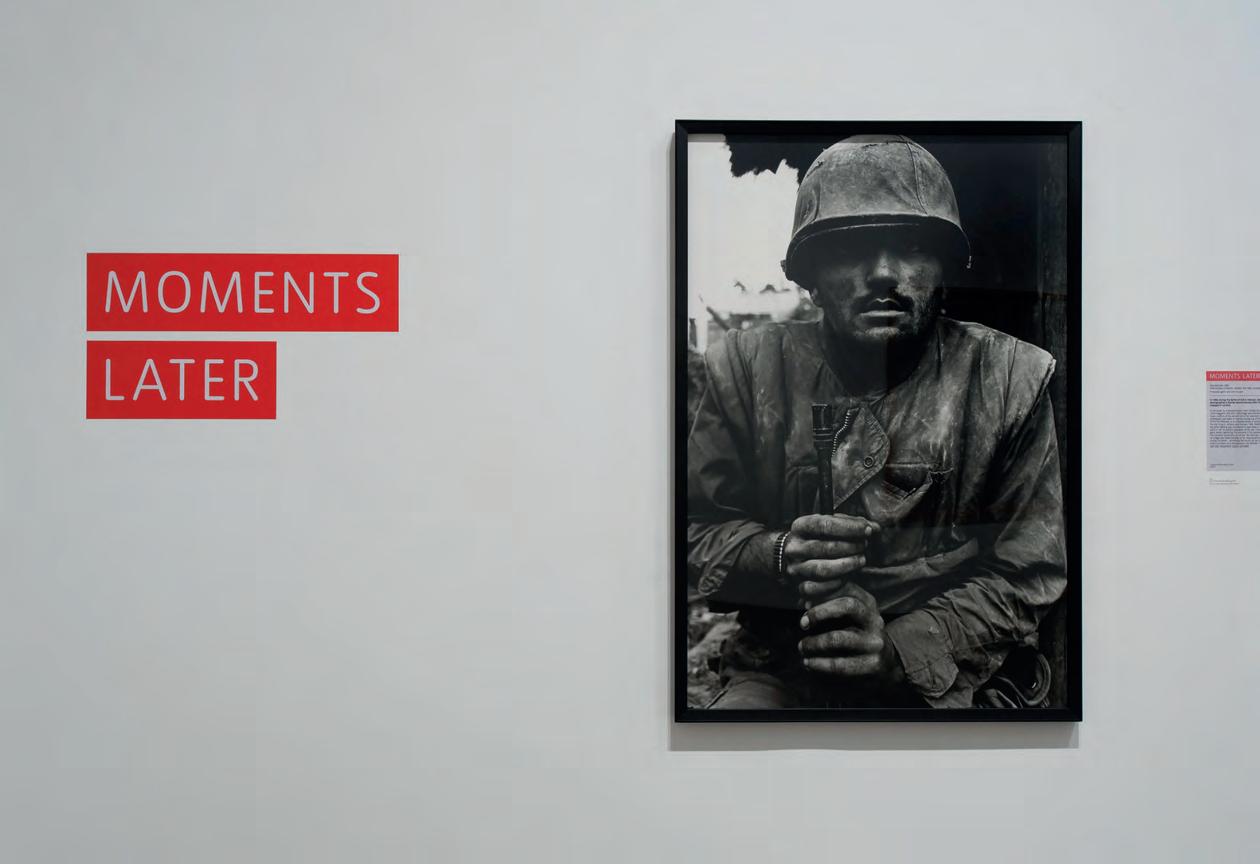
During 16 years at the helm, previous director Brett Rogers HonFRPS guided the institution through major changes, not least a move to its current site, a renovated former textiles warehouse off Oxford Street, with five floors of galleries, a shop, cafe and education rooms.
Having survived a period of financial insecurity during the Covid-19 pandemic, TPG expanded into a further outdoor exhibition space, Soho Photography Quarter, in 2022.
“TPG has this amazing 50-year legacy,” says Mavlian, “but it’s also this place within the photography community where people can come and meet. I think that social side is really important.”
Now very much a Londoner, Mavlian grew up in Australia, the daughter of an Armenian father and English mother. She credits her uncle, a photojournalist from Beirut, with igniting her love of photography. Using darkroom skills learned from him as a 10-year-old, she got a Saturday job in a high street photo printing shop. “I loved it, printing other people’s photos gave me such an insight into daily life,” she recalls.
She studied fine art at the University of Sydney where she was drawn to art criticism and theory, then after graduating moved to London where she began working in museums. Following stints
MOMENTS LATER
198 RPS JOURNAL MARCH / APRIL 2023
‘Shell-shocked US marine, the Battle of Hue, 1968’ by Don McCullin HonFRPS, from the exhibition Conflict, Time, Photography at Tate Modern, 2014
=-..:..----= - ""
at the National Portrait Gallery and TPG, she joined Tate in 2008.
That initial role – as an assistant on the Millbank Project, a major refurbishment of Tate Britain –taught her much about how a museum works across different departments. In 2011 she became assistant curator and went on to work with Tate’s inaugural curator of photography Simon Baker, tasked with building the museum’s photography collection.
Together with Baker, she developed a slew of landmark exhibitions including Conflict, Time, Photography (2014), The Radical Eye: Modernist Photography from the Sir Elton John Collection (2016), Shape of Light: 100 Years of Photography and Abstract Art (2018) and Don McCullin (2019). Conflict, Time, Photography was an especially formative experience, she remembers. “I was working with 60 something artists, over 800 photographs in a vast, 1,200 square metre space. But it was also interesting to me because of my family history. There has been so much conflict around the world and particularly in the Middle East over the past 100 years.”
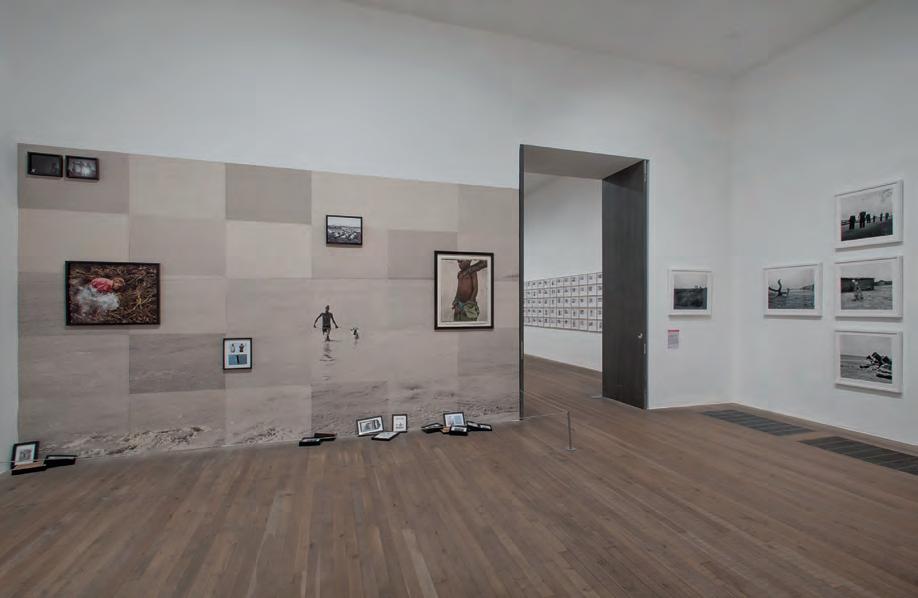
GALLERY MARCH / APRIL 2023 RPS JOURNAL 199
“it was interesting to me because of my family history. There has been so much conflict around the world and particularly in the Middle East”
The Conflict, Time, Photography exhibtion at Tate Modern, 2014
What was different about this exhibition was how these conflicts were represented – not in real time but in retrospect. “For me, curating is about setting parameters,” Mavlian explains. “And with that show, we set really defined parameters. There was no photojournalism. We were curating in relation to the idea of time. The works on show were made seconds later, months later, years later. We were trying to build a different narrative.”
In 2018 she left Tate for Photoworks, the UK’s only photography charity with a national remit and Arts Council England National Portfolio Organisation status. Photoworks coordinates a biannual festival, runs commissions and awards, and programmes exhibitions nationwide, all with a focus on early and mid-career photographers.
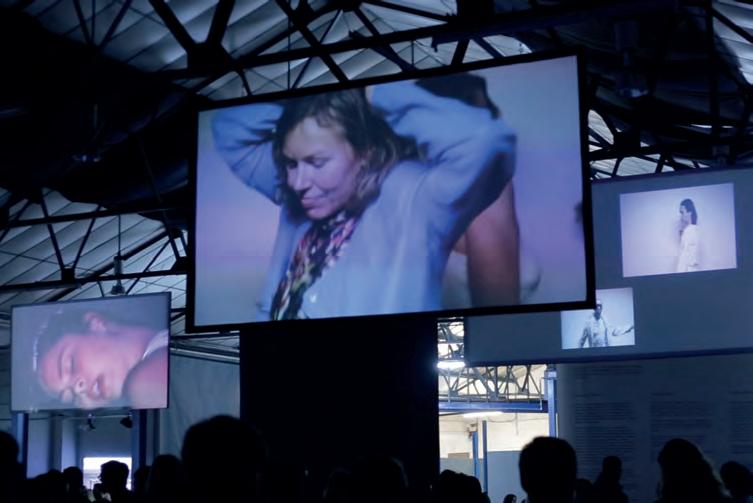
“At Tate, I was working with incredible artists like [Honorary Fellow] Stephen Shore but what really attracted me to Photoworks was the opportunity to work with artists closer to my own generation,” she says. “What kind of art were they making? What subjects were they looking at?”
Though based in Brighton, Photoworks does not have a physical venue, teaming up with other organisations to stage activities. During Mavlian’s directorship, Photoworks spearheaded collaborations with Historic England, Jerwood Arts, Maison Européenne de la Photographie, Paris, and Tartu Art Museum, Estonia.
200 RPS JOURNAL MARCH / APRIL 2023 GALLERY
“I really enjoyed testing ideas. Photoworks is small enough that you can try things out and take risks”
Dancing in Peckham, Peckham 24, produced by Photoworks, curated by Shoair Mavlian and Jamila Prowse PIOTR SELL
“I really enjoyed testing ideas,” she says. “Photoworks is small enough that you can try things out and take risks.”
Among the innovative projects developed under Mavlian’s leadership were Dancing in Peckham at 2019’s Peckham 24, an immersive exhibition combining photographic projections with music, and the Ampersand/Photoworks Fellowship, a new commission for mid-career photographers.
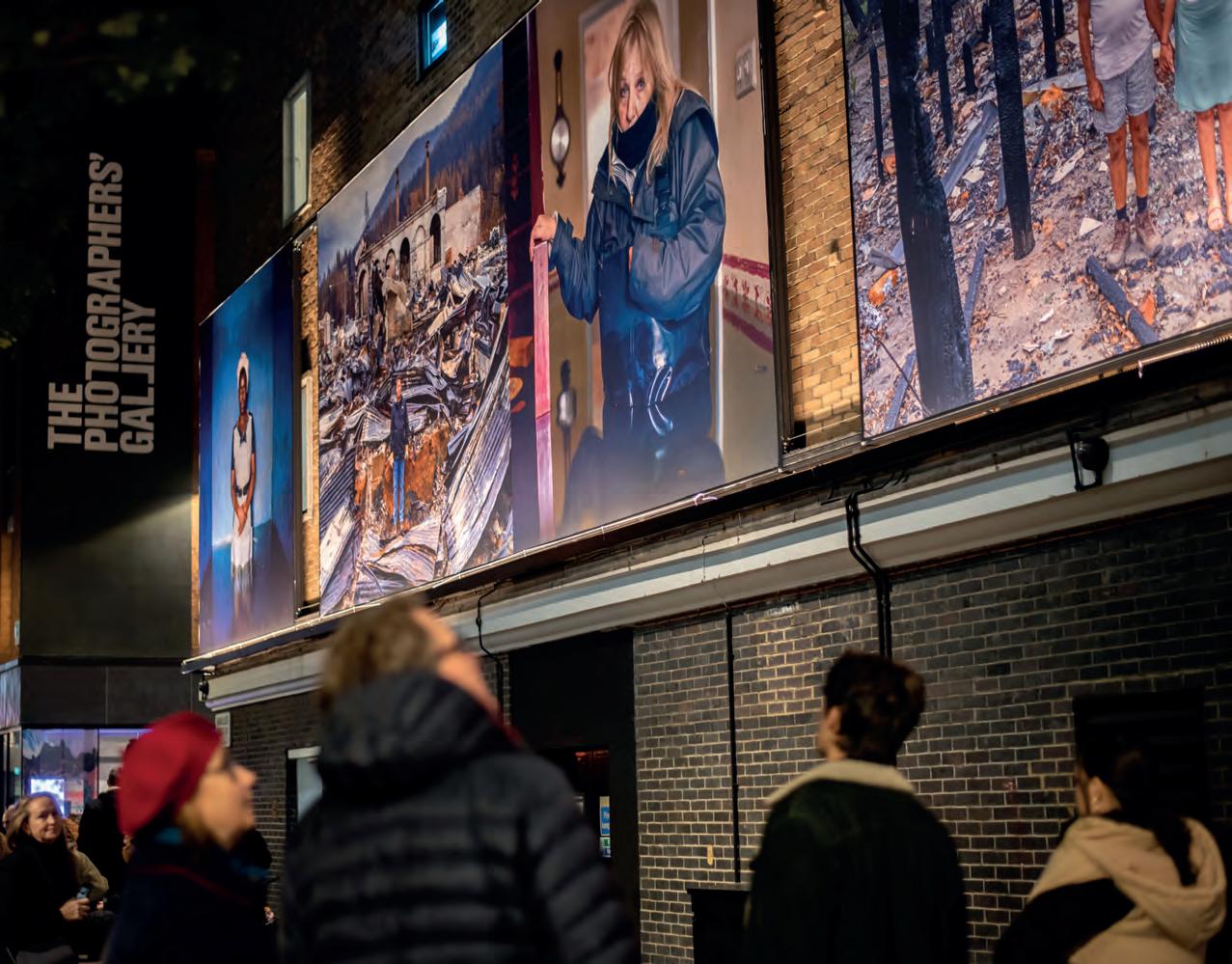
During the Covid-19 pandemic Photoworks launched Festival in a Box. Initially a response to limits on social mixing, the initiative reimagined the traditional festival by putting the power into the hands of the public. Recipients were furnished with their own prints and captions to display in any way they chose.
At every step of her career Mavlian has stuck to a policy of “never saying no” to an opportunity.
This has led to her curating exhibitions for Paris Photo and Getxophoto Festival in Spain, and even co-founding an independent coffee company. It is this spirit of creativity and curiosity, combined with can-do pragmatism and extensive experience, that she brings to TPG.
There is already a programme for the next 18 months or so, but asked about her personal curatorial interests, she talks about “the way artists deconstruct and engage with photography using the technology that is available to them”, while underlining a “commitment to showing artists who are from the majority world or have historically been underrepresented.” This is a watershed moment for museums as they reconsider who they serve and how they can reach new audiences.
“The world has just been through this hugely disruptive period of Covid. All directors and
MARCH / APRIL 2023 RPS JOURNAL 201
ESTEEVES
Fire/Flood, outdoor exhibition by Gideon Mendel at Soho Photography Quarter, The Photographers’ Gallery
SARA
curators are thinking about what happens next. Audiences’ expectations have changed. Museums and galleries will have to change too.”
And yet, the bricks and mortar of this building –and the one that preceded it – make it special. “TPG has always been a meeting place. There are people who’ve been coming for 50 years mixing with people visiting for the first time,” says Mavlian. “I’m interested in spaces that are accessible and open, spaces that break down the hierarchies of museum versus community.”
Outside, the gallery is filling up with members of the public eager to see the current clutch of exhibitions, including Chris Killip’s stirring documentary images of 20th-century Britain. Some visitors are photographers or photography students, some are simply interested in the subject matter. Many have been planning this trip for months. Others who have chanced on the gallery are shoppers or tourists who wandered down a side alley between two unassuming buildings and found themselves here. In the beating heart of London’s west end, TPG makes space for them all.
thephotographersgallery.org.uk
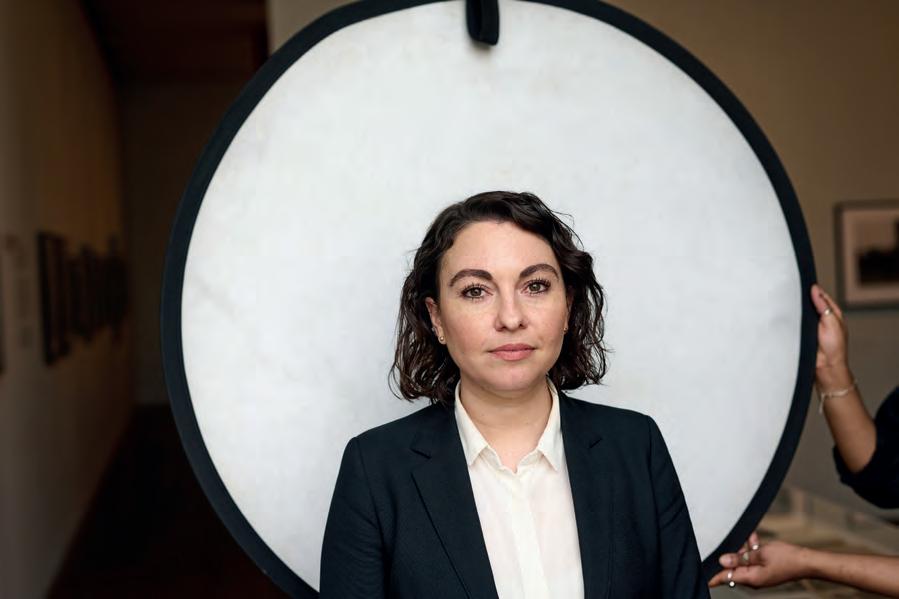
202 RPS JOURNAL MARCH / APRIL 2023
“I’m interested in spaces that are accessible and open, spaces that break down the hierarchies of museum versus community”
Shoair Mavlian, director of The Photographers’ Gallery, by Paul Stuart
THREE ARTISTS ON MY MIND
Shoair Mavlian selects a trio of photographers she is inspired by
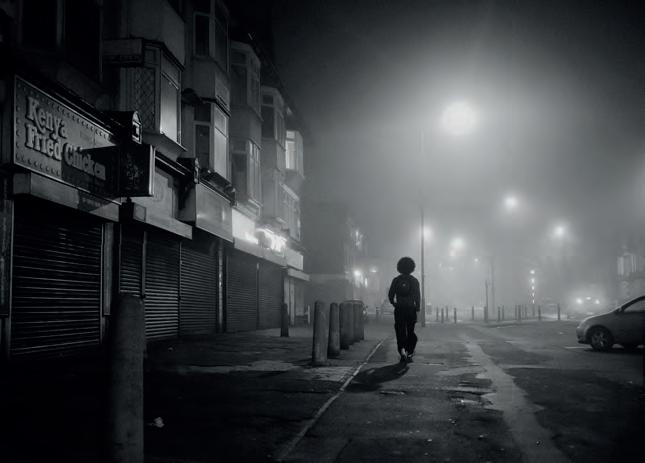
From the series Kronstadt by Ursula Schulz-Dornburg
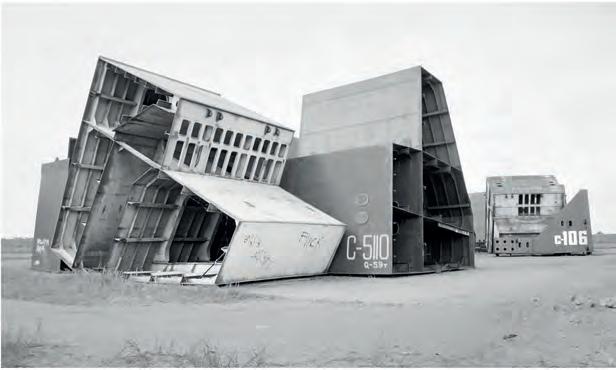
“Ursula is an artist I’ve worked with for more than a decade. I’m interested in how her work merges history and politics in formal photographic images.”
‘Kenya Fried Chicken, Firth Park’ from the series Afropean by Johny Pitts
“I recently worked with Johny on his newest project Home is Not a Place, commissioned by Photoworks. It was interesting to curate images alongside the poetry of Roger Robinson and fascinating to witness the collaborative process between Roger and Johny.”
‘Aviary, 2019’ by Farah Al Qasimi “Farah’s work represents a moment in time – the late 1990s and early 2000s –and a mixing and clashing of cultures. Her images bring to life the bright colour palette of her everyday environment.”
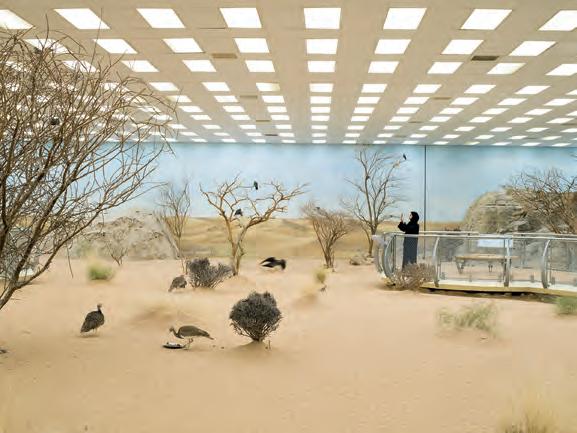
GALLERY MARCH / APRIL 2023 RPS JOURNAL 203
URSULA
AL QASIMI / THE THIRD LINE, DUBAI
SCHULZ-DORNBURG / GALLERY LUISOTTI, LOS ANGELES; FARAH
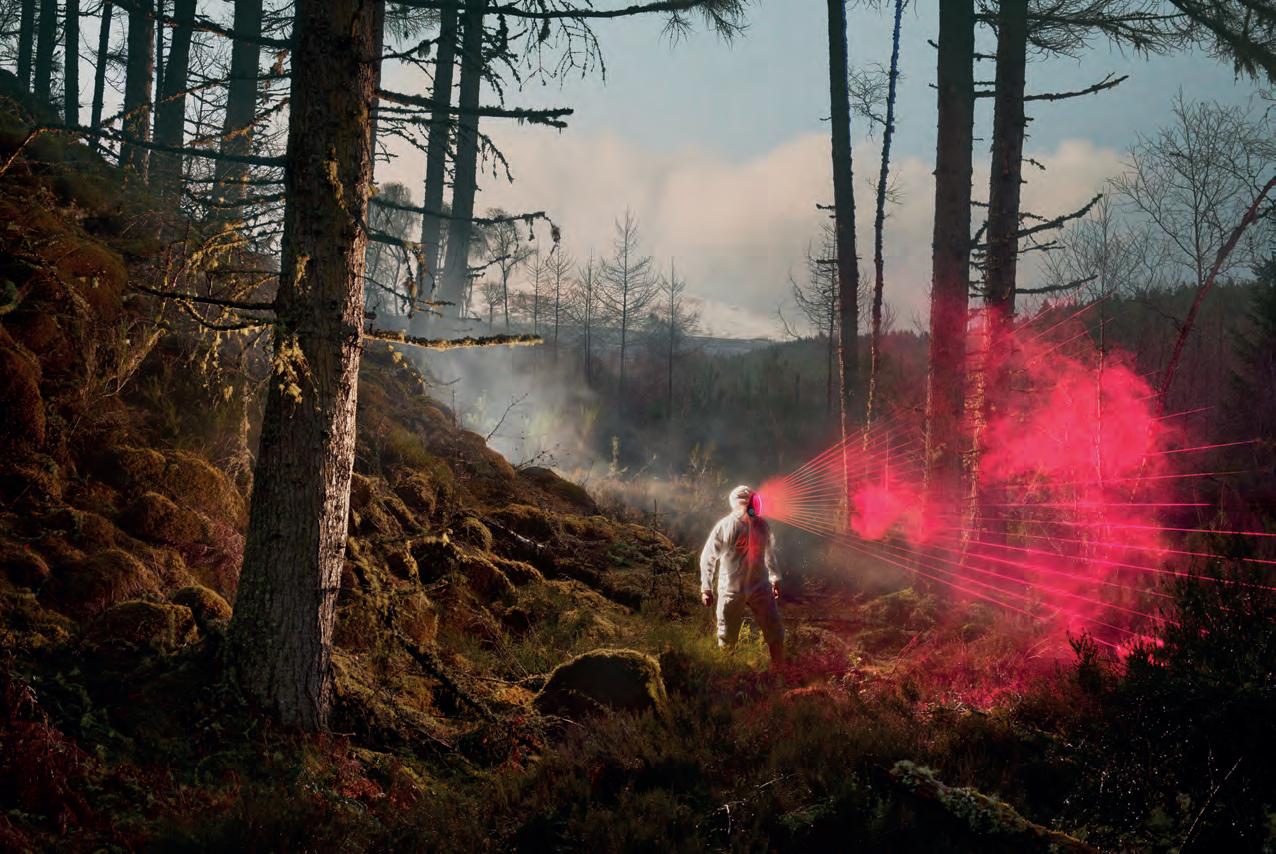
INTERNATIONAL PHOTOGRAPHY EXHIBITION 165 CALL FOR ENTRIES Closing date: 8 May 2023
• Exhibit at RPS Gallery, Bristol • Prize fund • Awards • One free submission • Discount for RPS members Enter now: rps.org/ipe165 Be part of the longest running photographic exhibition celebrating photography from across the globe @the_rps @royalphotographicsociety @royalphotographicsociety ~RPS ROYAL PHOTOGRAPHIC SOCIETY
From the series Tree Huggers from the Future, 2022, by George McLeod
5 OF THE BEST SOCIETY EVENTS
AUTISM AND ART
Alison
1Everyone has their own reasons for picking up a camera and creating images. For some it is a means of artistic expression, while others enjoy capturing moments that deserve to be preserved or would otherwise be missed.
In this five-part workshop series for small groups of autistic adults, Alison Webber FRPS, who lives with the condition, will explore four themes –shadows, reflections, patterns and textures. Participants will be asked to take part in weekly practical exercises.
The workshops will also explore how photography can help manage aspects of autism, providing focus or offering creative space to develop projects. The series is aimed at anyone, regardless of photographic experience, and any type of camera or a smartphone can be used. Webber achieved her RPS Fellowship in 2020 with a submission she describes as, “a version of my autistic reality”.
Online via Zoom, weekly from Mon 6 Mar, 7.30pm. Free. events.rps.org
2 CREATIVE PHOTOGRAPHY –NUTS & BOLTS
Sat 4 Mar, 4pm
Hold still – or not. Intentional camera movement can create eye-catching visuals, as can in-camera multiple exposures. Both will be presented in this one-hour workshop by Bill Ward, with a focus on the practicalities of the techniques rather than their aesthetics. It means participants will be able to leave with an understanding of how to achieve the effects themselves.
Online via Zoom. £3
3 WILDLIFE GUIDING IN SCOTLAND
Sat 4 Mar, 4.30pm
In this workshop Mick Durham FRPS, Chair of the Natural History Distinctions panel, will reveal the secrets of being a wildlife guide and how it relates to photography. With a passion for capturing the natural world going back four decades, Durham is well versed in spotting hidden gems and presenting them in images.
Online via Zoom. Free
4 RESTORING OLD PHOTOGRAPHS Mon 3 Apr, 10am
Family photo albums are a cherished part of history, but many collections have fallen foul of fading colours, ripped paper, or the watery effects of creeping damp. In this workshop, Roger Crocombe ARPS will offer practical advice on how to restore old photos to their former glory.
Online via Zoom. £5
5 PHOTOGRAPHY AND HAPPINESS
Fri 21 Apr, 10am
Art can be an excellent way of boosting your sense of wellbeing, and photography is as good an approach as any. In this one-day workshop, John Humphrey FRPS looks at six steps that can be used to make your image-making a route to positive mental health.
Online via Zoom. £68
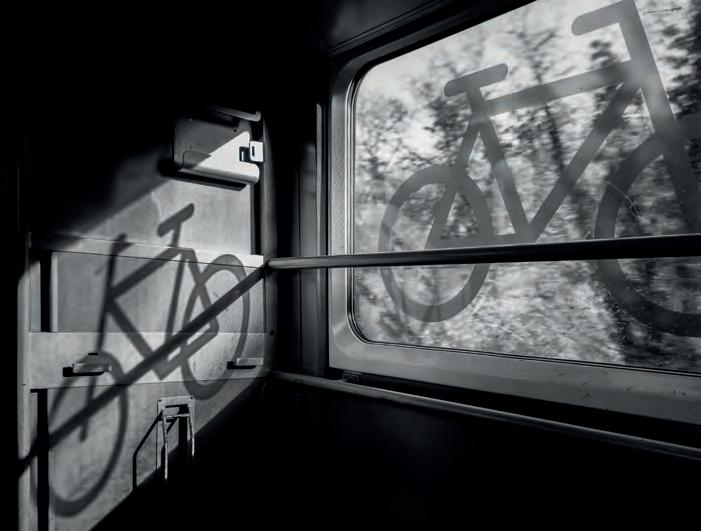
MARCH / APRIL 2023 RPS JOURNAL 205
RPS NEWS AND EVENTS
Webber FRPS leads an inclusive workshop series where creative expression is explored
Society
TO rps.org/whatson for the latest updates
THE LATEST
219
‘Tandem’ by Alison Webber FRPS
GO
INTRODUCING CEO DAN JONES 220
TRUSTEES’ REPORTS
206
PHOTOBOOK DISTINCTIONS
DISTINCTIONS
Achieving a Fellowship in the Photobooks genre proves as rewarding as it is challenging for two photographers
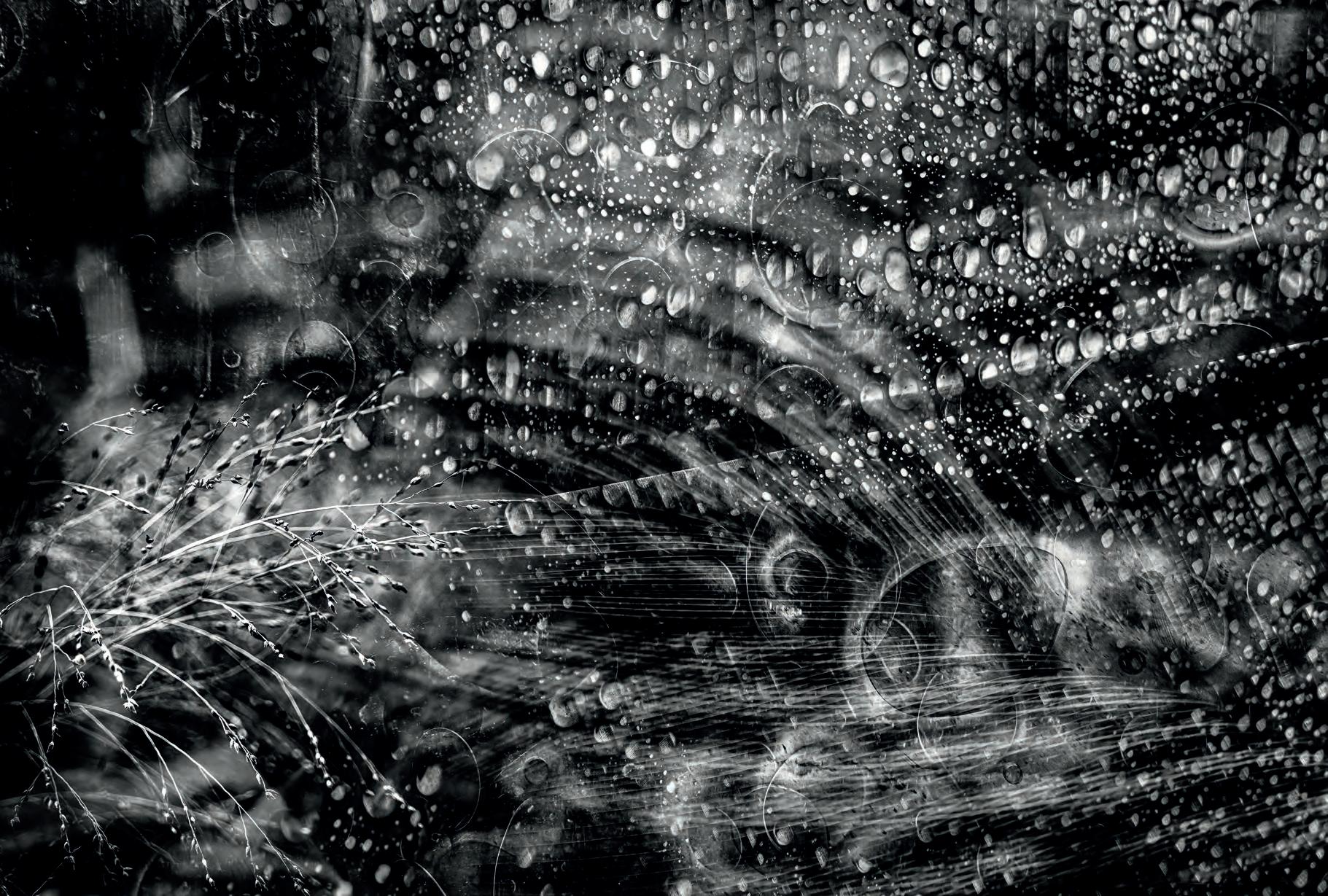
206 RPS JOURNAL MARCH / APRIL 2023
WHAT
ARE RPS DISTINCTIONS?
Working for a Distinction takes you on a personal journey which will improve your technical skills, develop your creativity and broaden your understanding of photography
LICENTIATE (LRPS) Applicants must show photographic competence in approach and techniques
ASSOCIATE (ARPS) Requires a body of work of a high standard, and a written statement of intent
FELLOWSHIP (FRPS) Requires a body of work of distinctive ability and excellence, plus a written statement of intent
Fellowship Photobook
There is a satisfying loop in The Incomplete Circle, a photobook by Simon JG Ciappara FRPS. The idea is simple and effective – photos of plants printed on paper made by those same plants. Ciappara is responsible for everything here, creating it all by his own hand. The only things he purchased were glue, ink and thread.
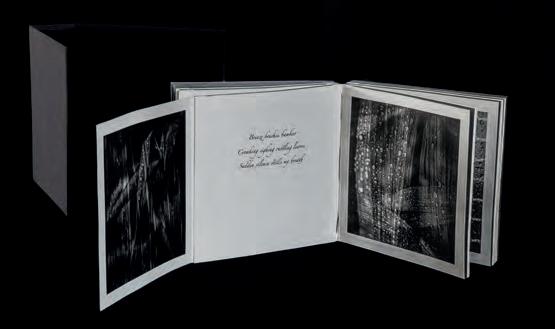
Each sheet of paper contains a mix of plant fibres, including some from the actual plants in the images. The other components – rainwater and starch – are also depicted visually. In essence, the book is both the recipe and the finished meal.
Based in Norfolk, Ciappara is a lifelong photographer who only fully embraced the art form
in recent years. As a pandemic project, The Incomplete Circle marks a high point of the Photobook Distinction, introduced in 2021. The genre recognises a concept-led book that uses photography as a medium of visual communication in its own right.
Where does your love of photography come from?
Born just into the second half of the 20th century, cameras were ever-present within the family, recording all the events, holidays, missing teeth and all the places where carsick children were ejected, mostly prior to the inevitable.
My first apparatus was black and square and all my money, pocket and earned, went on film and processing. Birthday wishes
MARCH / APRIL 2023 RPS JOURNAL 207
Simon JG Ciappara FRPS
_,..,;:.£, c,.£.r,,,.:.,J..,t,.;J.;;:,..,,;w
From the photobook The Incomplete Circle, above, by Simon JG Ciappara FRPS
were translated into the camera ‘they’ thought I could manage. Simply put, I fell head over heels in love with a metal box with a lump of glass on the front. Untold money went on film and developing truly awful photographs, never seen by anyone but me.
Age 19, I toured the US as one of the road crew for Eric Clapton’s Slow Hand tour. Money for film was no longer an issue and I snapped away
unseen and ignored as just one of the roadies. My camera and all my undeveloped film was burgled, along with nearly all my belongings, the night of my prodigal return to the UK and then work and ‘grown-up’ life insisted itself, taking precedence over my love of photography.
When did photography become the focus again? When I reached 60 an inheritance meant I could
choose an indulgence – my first serious camera for 40 years.
Pictures on paper are real for me. They exist and can be seen in all sorts of different light, bringing me ever nearer to the result I imagined when I pushed that button that has such a glorious sound.
A modicum of success with photographic competitions led me to believe in my images a bit more – enough to contemplate the RPS Distinctions. During a
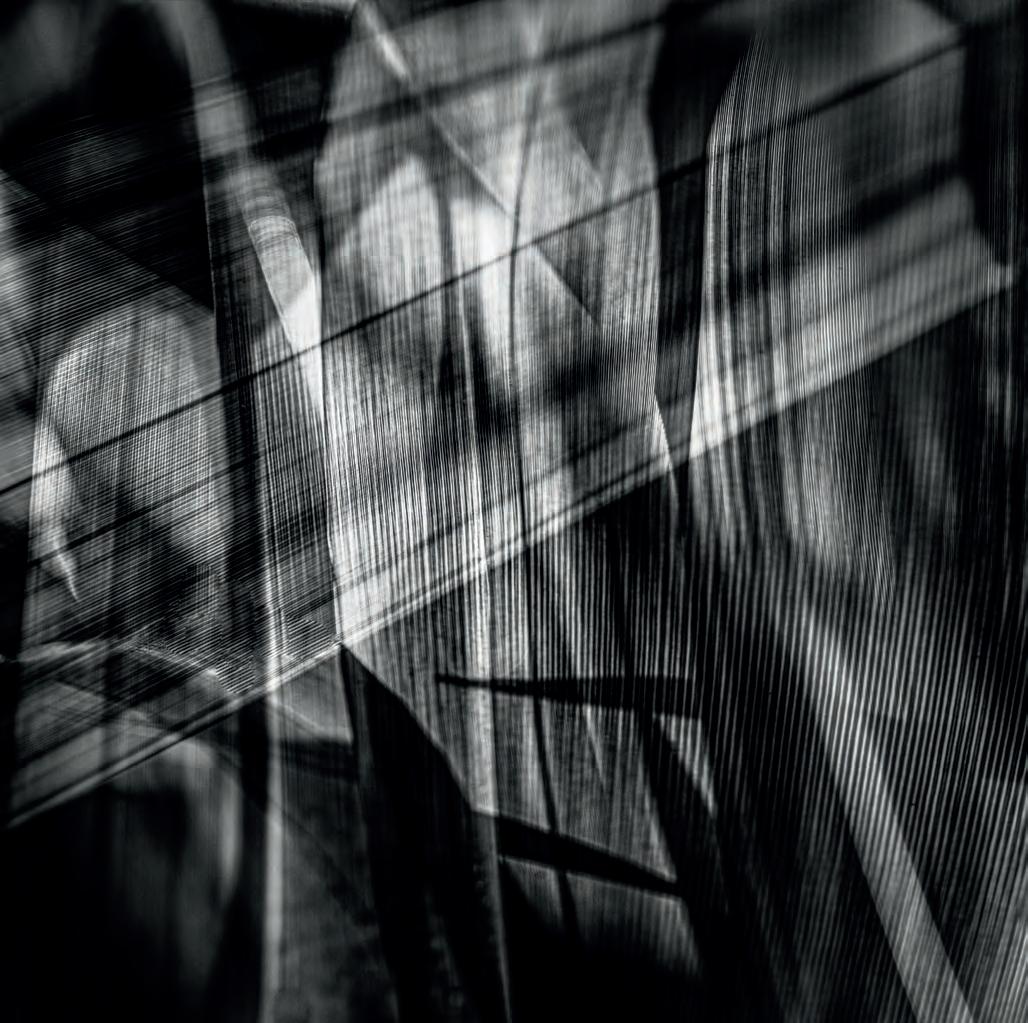
208 RPS JOURNAL MARCH / APRIL 2023
From the photobook The Incomplete Circle by Simon JG Ciappara FRPS
difficult year following the death of my dad, working towards my Licentiate gave me a focus and an escape ‘down the lens’ unparalleled in my experience. To my amazement and joy I achieved my Licentiate.
I’ve since indulged my passion further – I still take awful pictures but once in a while the results approach what I saw in my mind’s eye. My dotage will be defined by dreadful pictures and an occasional gem.
Where did the idea for the photobook come from?
Thirty years ago, while working as the environment protection officer for an island in the Caribbean, I discovered an ancient method of making paper from bamboo. The ethos of the minimal use of natural resources and the highest value for the products created –low volume, high value –is a prerequisite. Thus papermaking from abundant
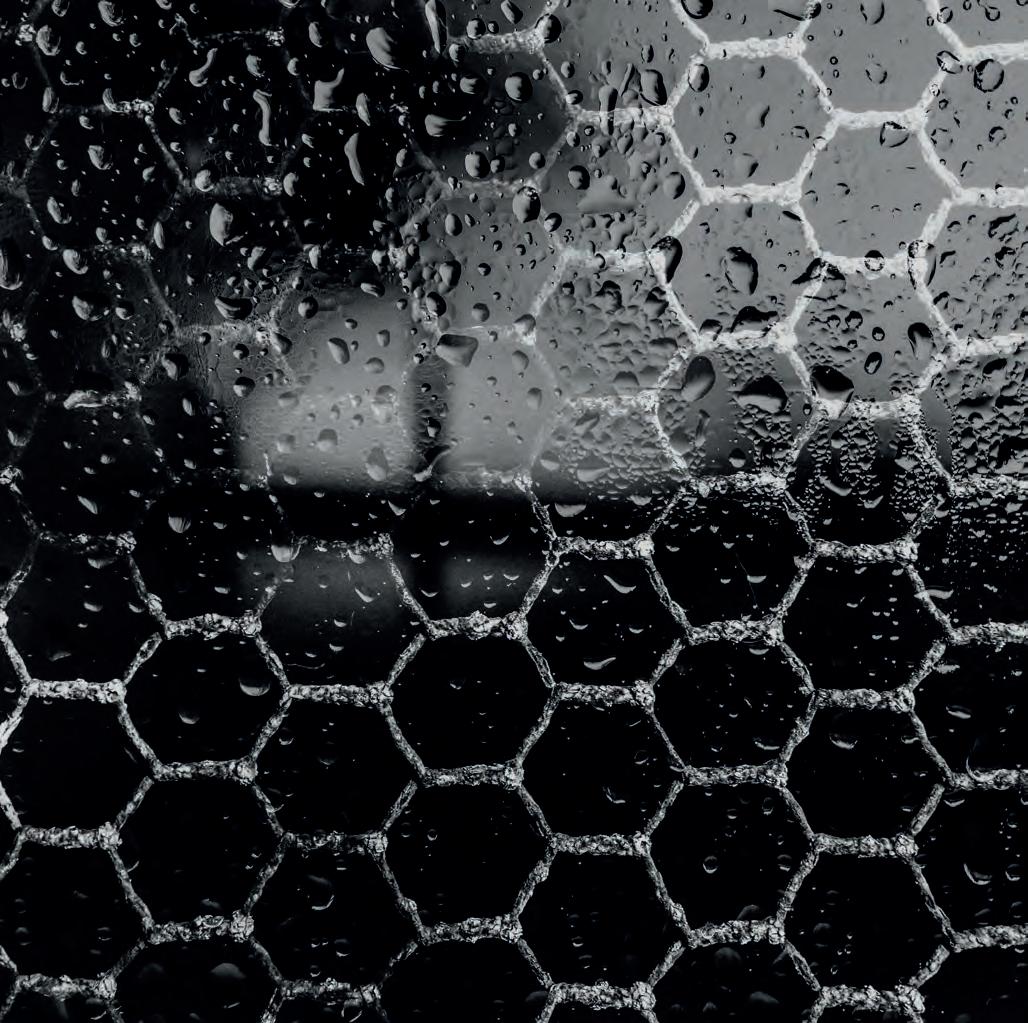
PHOTOBOOKS MARCH / APRIL 2023 RPS JOURNAL 209
From the photobook The Incomplete Circle by Simon JG Ciappara FRPS
“Pictures on paper are real for me ... They bring me ever nearer to the result I imagined when I pushed that button”
weed bamboo, and ample rain water, was a perfect fit.
On my return to the UK 20 years ago I started to make paper in my own environment and experimented with many different plants, all of which grow within a 10-mile radius of my home. At that moment the idea of printing my photographs of the plant from which I made paper was born. Over the years my refinement of paper-making processes has resulted in many
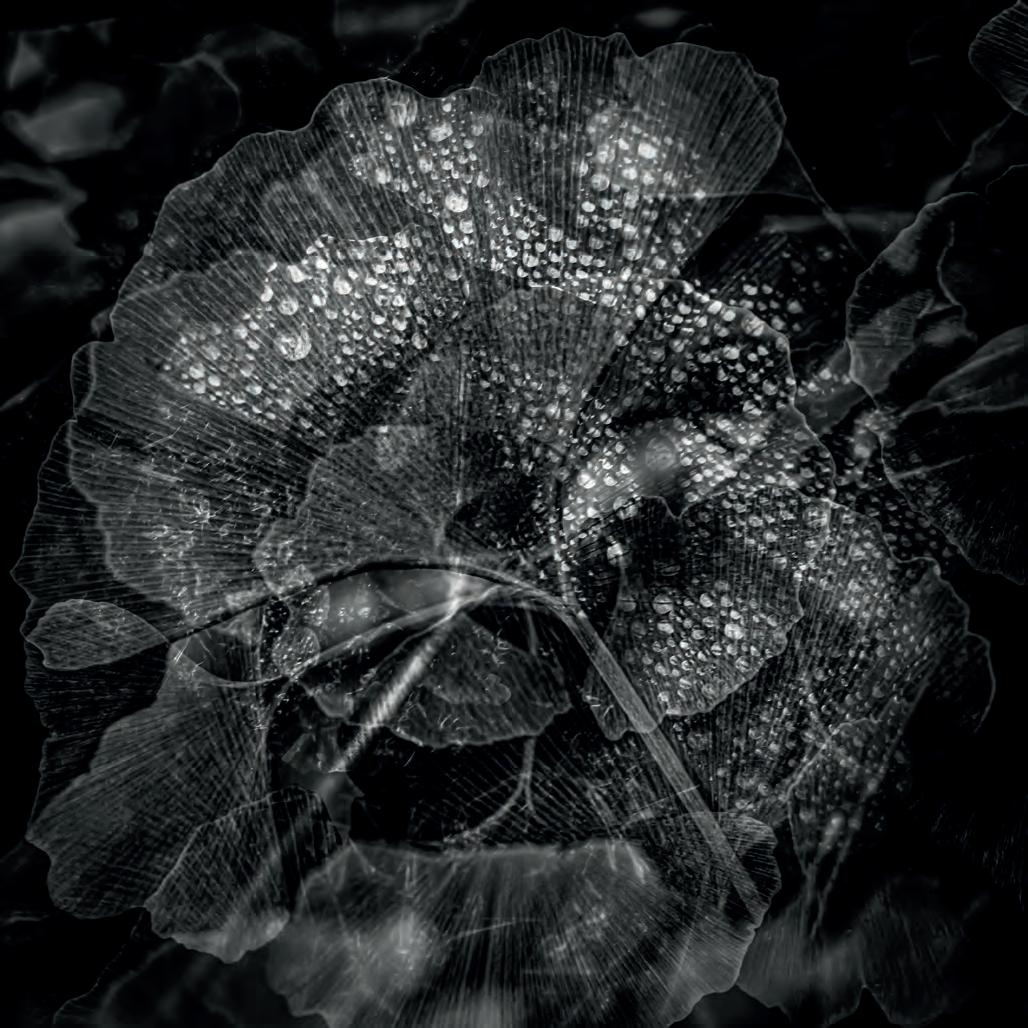
different plant-based papers. The resulting images – ‘plant selfies’ – have a unique charm.
Talk us through your Fellowship experience
I commenced paper-making specifically for the photographs for the book. Printing, bookmaking and casing consumed several months and were an absolute joy. Once completed, off it went to RPS House for Fellowship
assessment in April 2022. Later that day I had an email informing me of its failing to meet the standard on three technical errors – a slight evidence of banding on three out of 28 images – and I was invited to resubmit.
I waited for my book to return so I could see for myself what they were talking about. A week later I had gotten my head round the assessors’ comments and decided what I’d had was
210 RPS JOURNAL MARCH / APRIL 2023
Below and opposite From the photobook The Incomplete Circle by Simon JG Ciappara FRPS
an advisory session from the whole assessment panel, and I started to look forward to remaking my book.
A month later I was able to examine my book and sure enough, there were some faint bands on three pictures.
How and why they occurred needed to be sussed, and eventually I discovered that as the prints left the printer they tipped up and occasionally touched the roof of its exit tray.
I immediately started to reformulate the paper using spring growth, a very different quality of fibre to the previous batch. There were also changes necessary to the sizing and pressing to achieve the quality I demanded of myself.
It was dispatched as soon as finished to await the reassessment on 6 October. To say I was delighted by the result is a massive understatement and the fact the RPS want to hang onto the book for reference, “To show the standard we set for this genre”, was the cherry on top.
WHY THIS PHOTOBOOK WORKS
Ray Spence FRPS
Chair of the RPS
Photobooks Panel
A photobook can mean many things. Essentially it should be concept-led and use photography as a medium of communication in its own right. Simon’s book is a magnificent example of an artist’s book. From concept to completion, Simon has created an object which can be admired for its
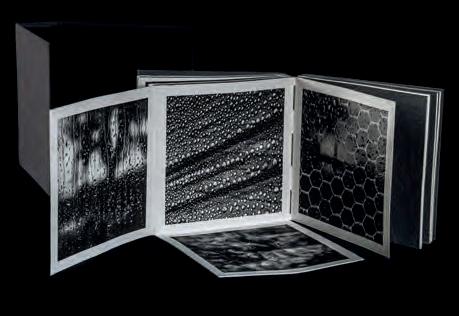
photography, construction and design.
Simon has handmade the paper and the images reflect the materials chosen. He has been creative in the use of text and foldout pages. This book needs to be experienced as a unique object and revisited at leisure. It is a fine example of the standard of work that shows the level of distinction we expect for Fellowship of the RPS.
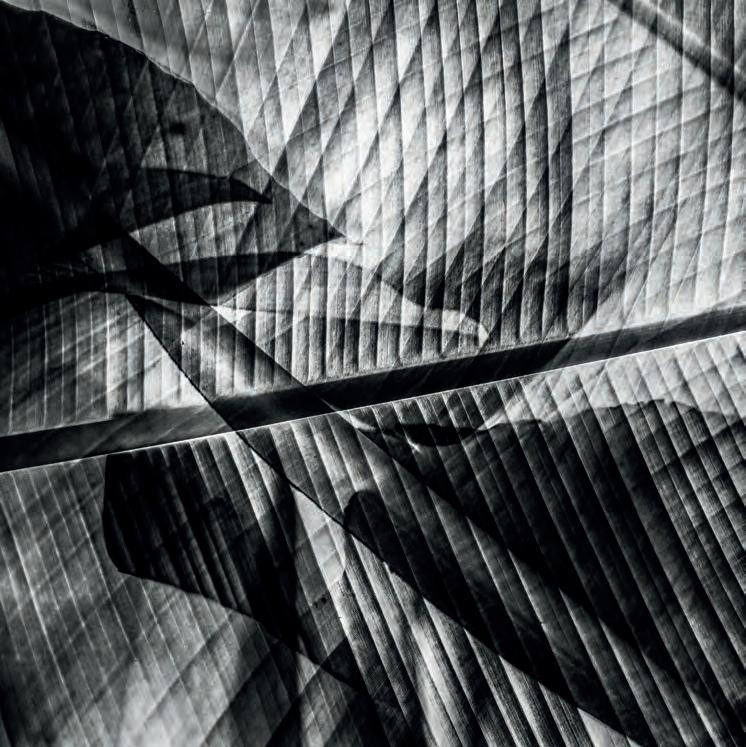
PHOTOBOOKS
MARCH / APRIL 2023 RPS JOURNAL 211
“I commenced paper-making specifically for the photographs for the book. Printing, bookmaking and casing consumed several months and were an absolute joy”
Fellowship Photobook
Richard Tickner FRPS
A photobook differs from a book of photographs, for which the book is simply a container for its images. Instead, the concept behind a photobook, the selection and sequence of images, its typography and the materials used, are all carefully considered.
The approach of Richard Tickner FRPS to creating his most recent photobook was truly hands-on – he handmade the entire 49-page book himself.
The East Sussex-based photographer, who had already achieved a Fellowship in the Visual Art category, used a type of paper called Unryu or Cloud Dragon. Made from mulberry fibres, it has irregular patterns that make each sheet unique.
Work on November – the 15th of Tickner’s photobooks, and the 10th to be handmade –began in November 2021.
What inspired the photographs in November and how was the idea developed over time?
Over the last few years I have become increasingly aware of the photographic possibilities of November. It is the month of bonfires and remembrance. A month of closing down, of reflecting on a summer long gone. A month of preparation for the inevitability that is December.
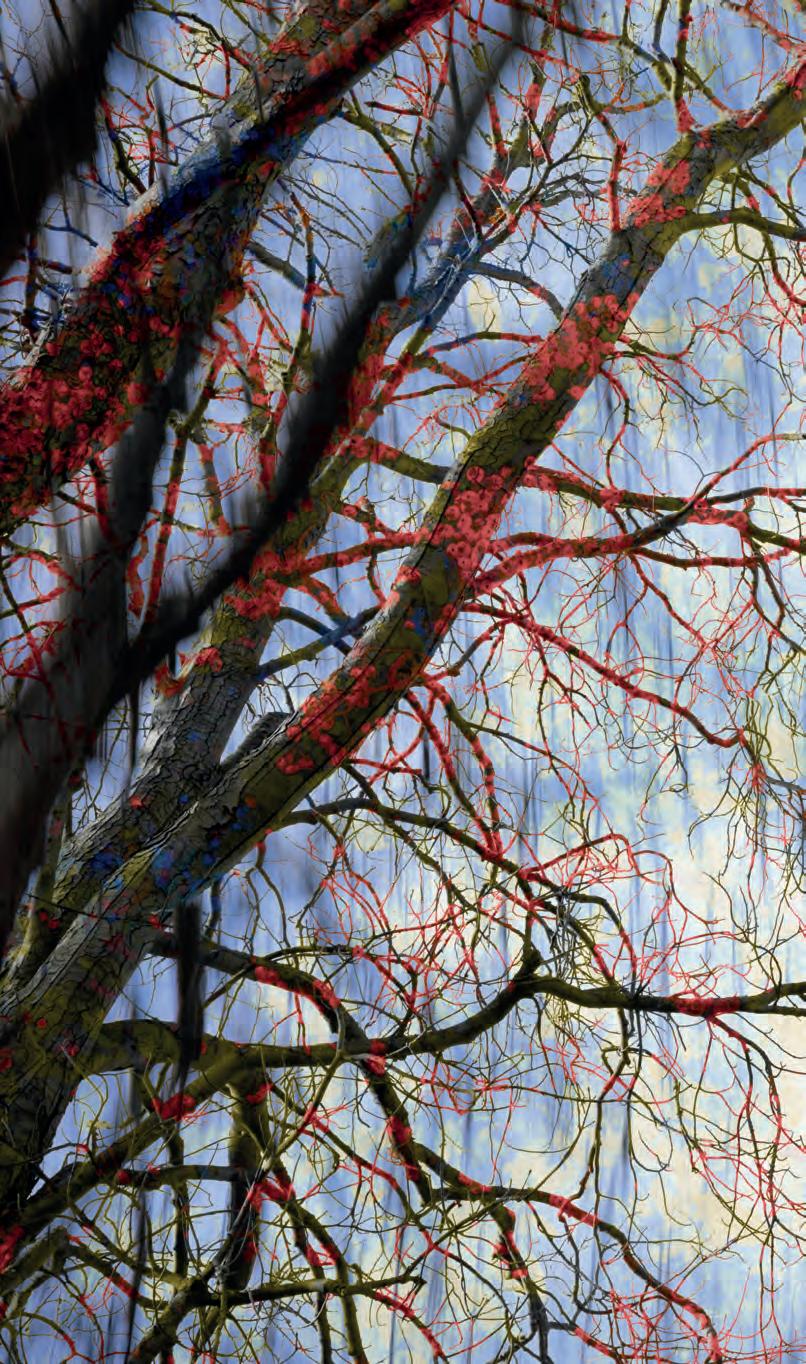
212 RPS JOURNAL MARCH / APRIL 2023
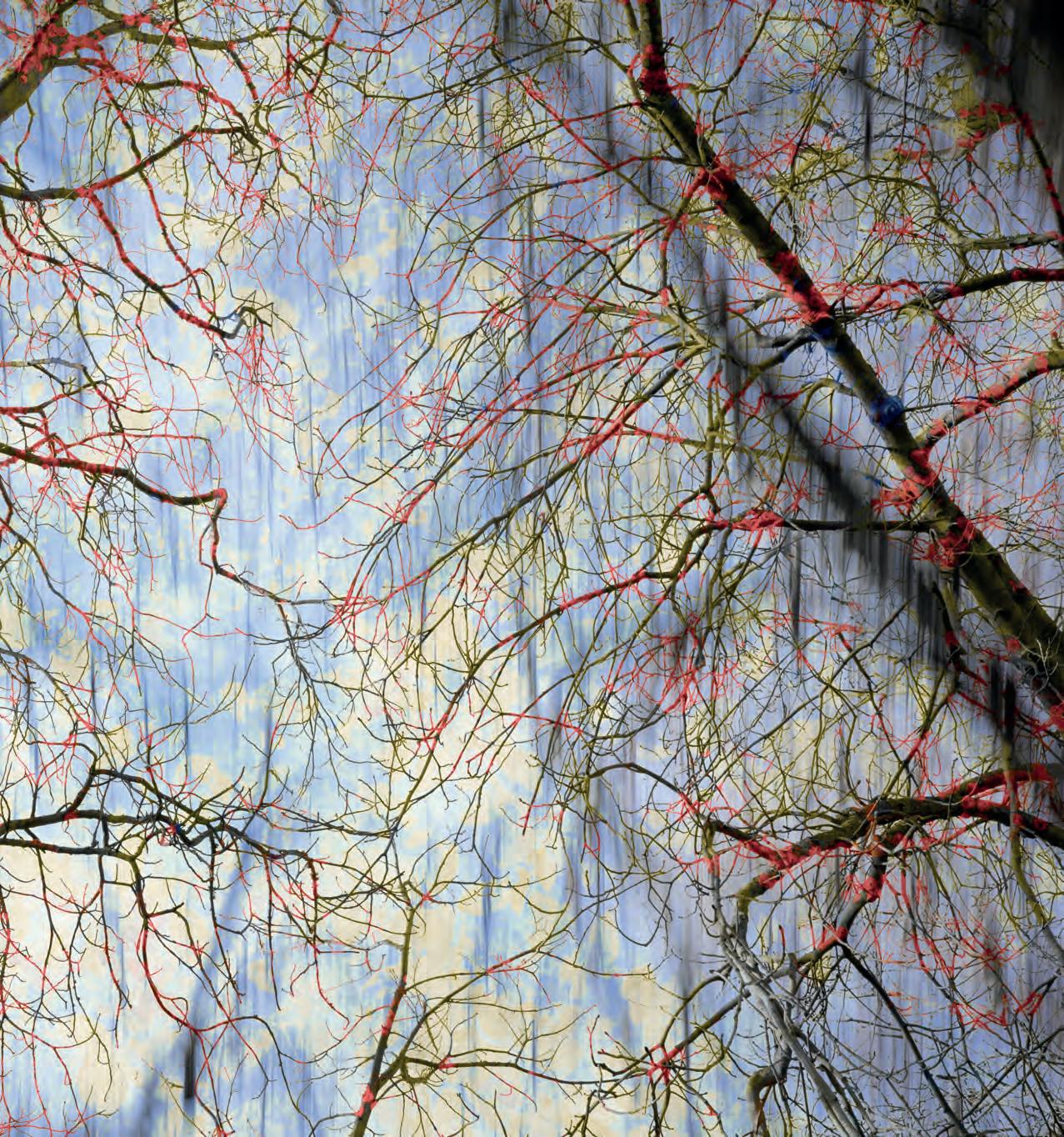
PHOTOBOOKS MARCH / APRIL 2023 RPS JOURNAL 213
From the photobook November by Richard Tickner FRPS
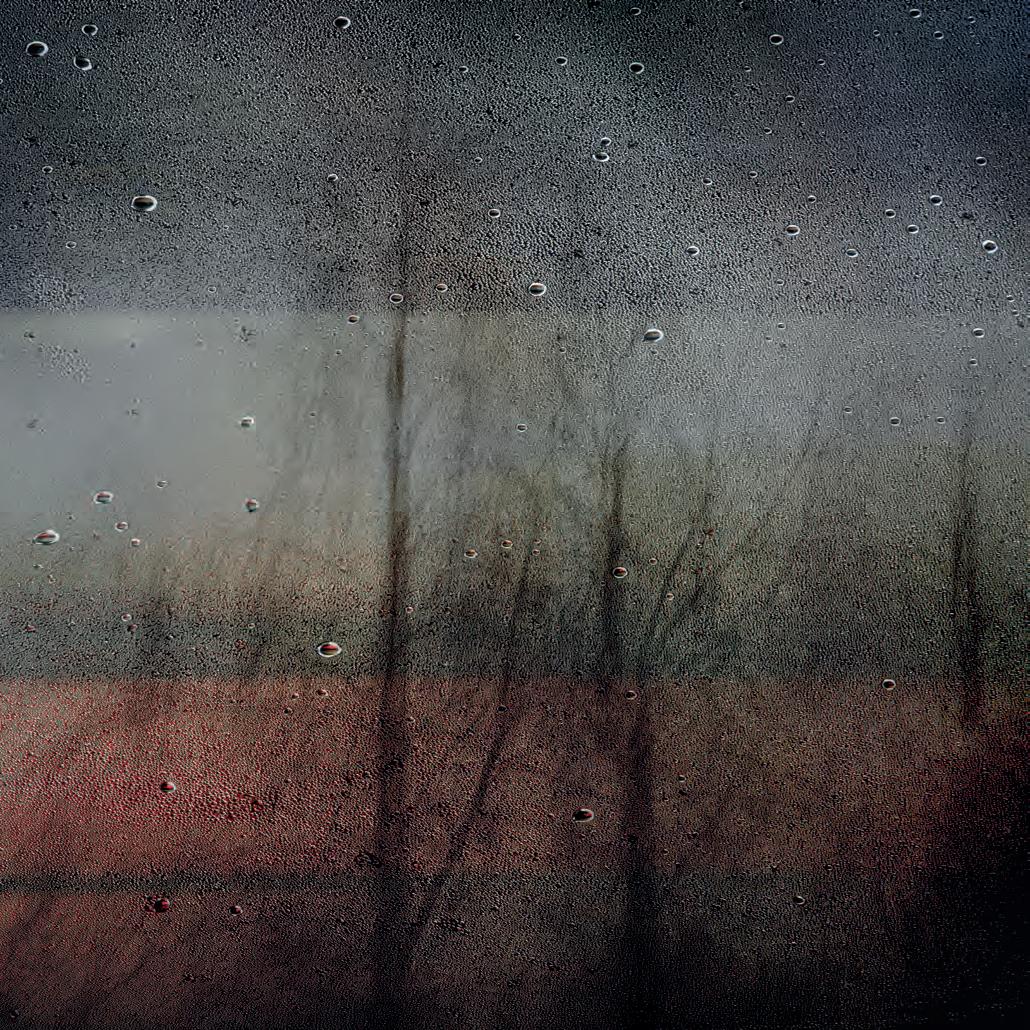
214 RPS JOURNAL MARCH / APRIL 2023
From the photobook November by Richard Tickner FRPS
“I embarked on a project that would embrace those aspects of November that interested me and reflected my experiences of being in the November of my life”
I did a small project in November 2020, photographing local trees for a book to be given to a friend as a Christmas present. I was pleased and frustrated by the result. I enjoyed the more abstract images, and those with typical November mist reducing the clarity of the images, but overall the book lacked a clear narrative and felt incomplete.
During 2021 I returned to the images and thought about what was missing from the project. I came across a quote from [American photographer and journalist] Ralph Hattersley: “We are making photographs to understand what our lives mean to us.”
I embarked on a new project that would embrace those aspects of November that interested me and reflected my experiences of being in the November of my life. The photographer became
as much the subject as the month. After many iterations, November was created. All the photographs in this project were taken locally in November. The book is sequenced as a series of short chapters each introduced by a quotation. Every chapter has a distinct look reflecting its subject. There is a timeline through the chapters but this is not rigid. The first three chapters refer sequentially to early November and the last chapter to late November. The images tend to darken as the book progresses, reflecting lengthening nights.
What idea did you hope to express in this collection?
I set out to create images that explored different aspects of the month of November and in parallel describe my feelings about being in the November of my life. I hope many see the book as both
personal and universal and that each of the pictures has some aesthetic merit.
How does this collection fit into your wider portfolio of work? It represents a departure given that I am not a landscape photographer and this is the first of my books which uses multiple exposure images almost exclusively. However, the level of abstraction is certainly typical.
What remains of your photography bucket list? Where to start? More books. I am working on a book of images of graffiti on a wall where I have blended pictures from my back catalogue to add my own virtual graffiti to the wall. I am fascinated by advances in photographic technology and believe that new, interesting ways of creating and displaying images are on their way. I can hardly wait.
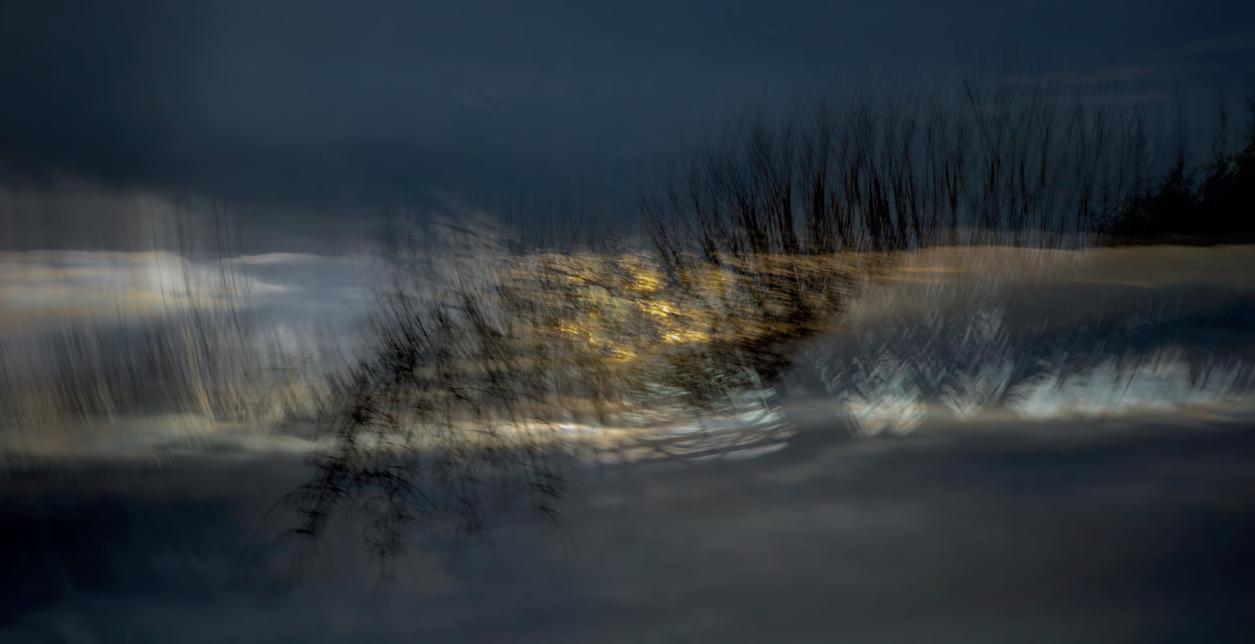
PHOTOBOOKS MARCH / APRIL 2023 RPS JOURNAL 215
From the photobook November by Richard Tickner FRPS
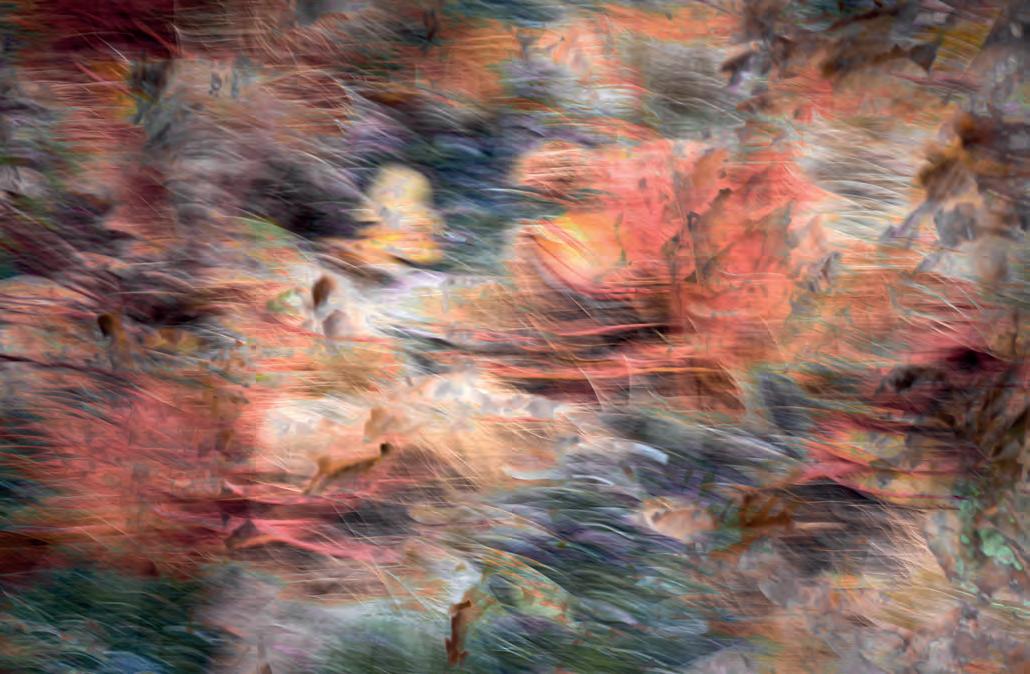
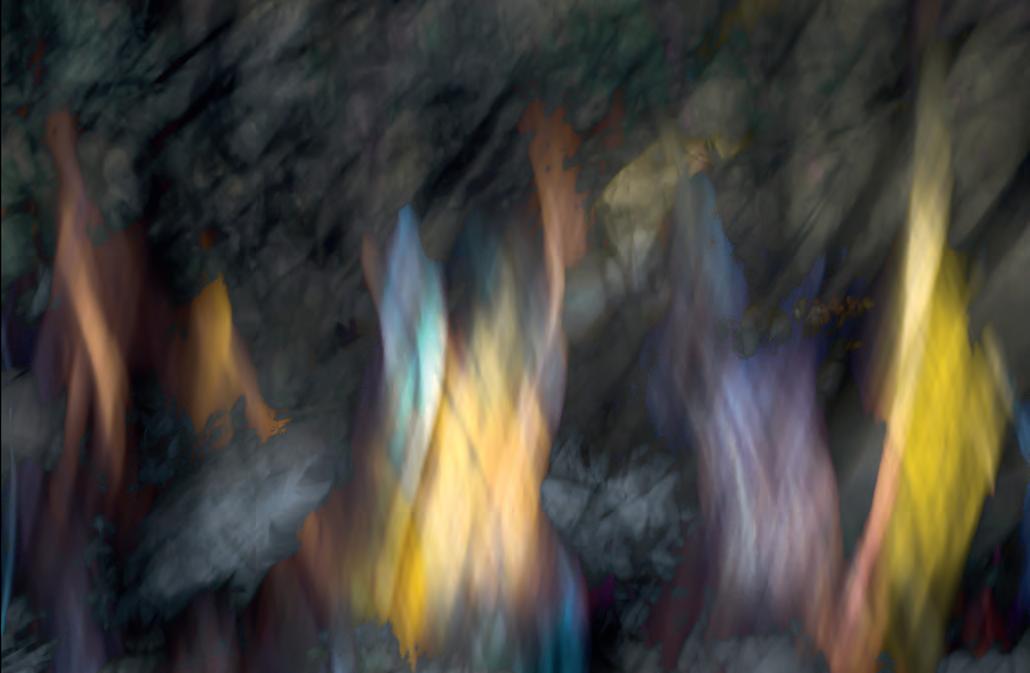
Above and below From
216 RPS JOURNAL MARCH / APRIL 2023
the photobook November by Richard Tickner FRPS
WHY THIS PHOTOBOOK WORKS
Stewart Wall ARPS
Former Co-chair of the RPS Photobooks Panel
Although the assessors would not know this at the time since applications are anonymised, when Richard Tickner FRPS submitted his photobook for assessment he was already a Fellow and had been an assessor for the Visual Art genre for many years. However, while having a same-level RPS Distinction in one genre helps, all genres are different in how you apply the work, and so there are always new aspects to consider.
With photobooks every image, item of text and the way the book is designed is considered, and must work cohesively to create an experience for the viewer. Richard’s photobook created that experience.
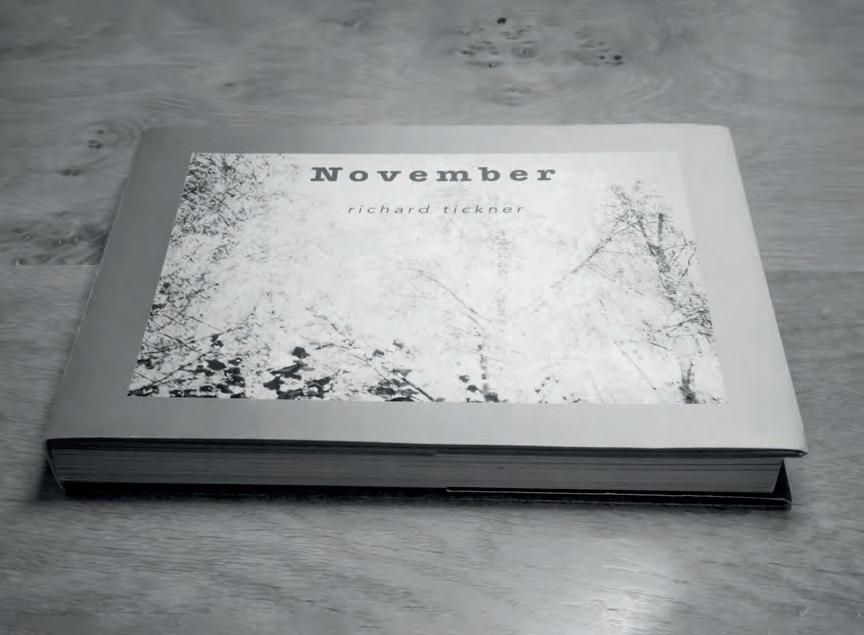
Distinctions
LICENTIATE EXEMPTION
December 2022
Ronald Lines, Gwent
ASSOCIATE EXEMPTION
December 2022
Nathan Caffola, Athlone
Paul Lindsay, Lieshout
LICENTIATE EXEMPTION
January 2023
Jitka Zrust, Esher
successes Congratulations to these RPS members
ASSOCIATE EXEMPTION
January 2023
Tommy Lee Grimmer, Great Yarmouth
Heba Mansour, Darmstadt
Stephen Meadows, Gloucester
Dawn Rodgers, Thatcham
FELLOWSHIP
January 2023
Michelle Sank, Exeter
RESEARCH FELLOWSHIP
January 2023
Geoff Blackwell, Sheffield
Paul Jeff, Northallerton
LICENTIATE EXEMPTION
February 2023
Jayne Russell, Hong Kong
Em Stryker, Langport
Iain Turnbull,
Kyle of Lochalsh
Ian Ward, Rayleigh
ASSOCIATE EXEMPTION
February 2023
Jemma Bannocks, Essex
Claire French, Greater Manchester
Alan Horn, Bedford
Sally Hornung, Dorking
Paul Mills, Norfolk
Josie Purcell, Saint Agnes
Imogen Sands, Eastbourne
DISCOVER
more about the Distinctions one2one portfolio review service at rps.org/advice
MARCH / APRIL 2023 RPS JOURNAL 217 PHOTOBOOKS
:N"ov-ember
“With photobooks every image, item of text and the way the book is designed is considered, and must work cohesively to create an experience for the viewer”
richard tickner
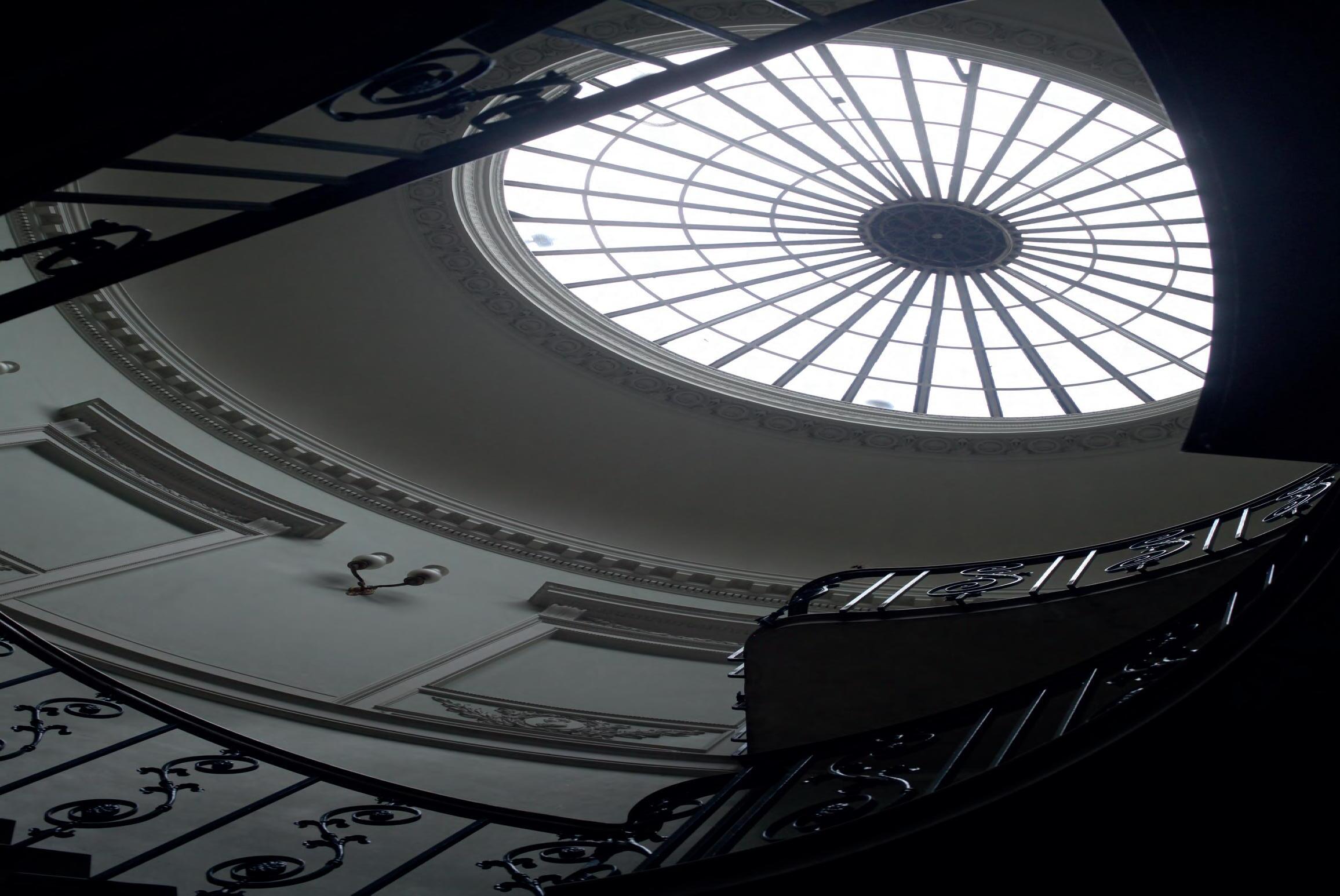













John Gould FRPS (1945-2022)
John Gould FRPS, who has died aged 77, was known for his individual and artistic darkroom work.
He joined the RPS in 1990, gaining his Associate in Portraiture in 1991 and Fellowship in the Theatrical category in 1992. He went on to give many workshops and talks about his work.
Originally from South Wales, John lived in Gloucester and worked on the conventional and nuclear sides of the power generating industry. As a portrait photographer he produced an impressive portfolio of studio work, but was also known for his delicate, muted hued tonal imagery made while travelling. Many will have seen his soft, lyrical lith prints of Venice, Spain and New England.
John was not one for convention. His printing was markedly different – he used various techniques to distress his images and tone them in an unusual way. He somehow managed to avoid getting too involved in the digital process and his preference was for large format film cameras.
Besides the RPS, John was a member of the Arena Photography Group, Cotswold Monochrome and, previously, Gloucester Camera Club.
SIMON HILL HonFRPS President,TheRoyalPhotographicSociety
VOICEBOX
Welcome to our new Chief Executive Officer
It is my pleasure to welcome and introduce our new CEO, Dan Jones. Dan comes to the role as an enthusiastic lifelong photographer (just as happy shooting film as he is digital), passionate about the practice and appreciation of the art, craft and science of photography.
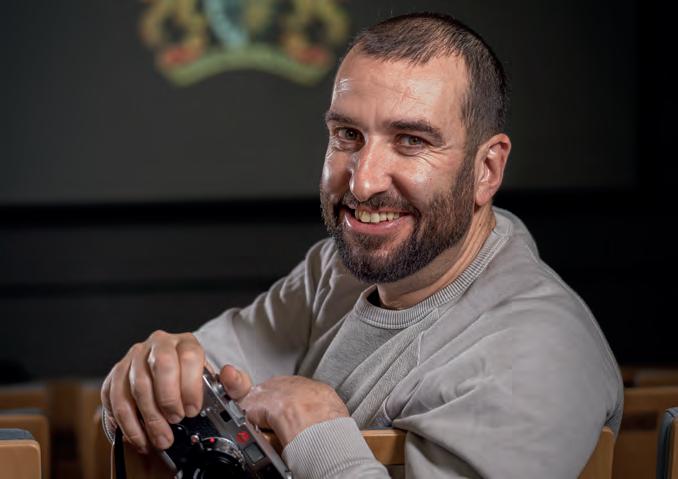
From a pool of more than 100 high calibre applicants, Dan was the standout candidate and the unanimous choice of the interview panel. One panel member summed up, “Dan was an inspirational candidate; dynamic, engaged and had quickly taken the measure of the organisation. He has a well-developed understanding of digital capabilities and has successfully managed transformational change in some challenging business environments.”
Dan brings personal experience of a career of more than 20 years as an executive in the technology and media sectors. He has held senior roles at organisations as diverse as the BBC, the National Archives and ancestry.com, and as vice president and international general manager in the eBay group, so I asked what we can expect from him as our CEO.
“Initially my focus will be on execution across the organisation, leveraging all the
tools the modern world puts at our disposal to help the Society grow and flourish into the future on the most sustainable financial model,” he said. “I want to find a place where the RPS is supremely relevant not just for today, but for many decades to come.
“Ultimately my goal is to ensure the RPS experience is the best it can possibly be for members, staff, volunteers and for all our stakeholders. The RPS needs to be agile and vibrant, and to represent the very best value for every member, whether they are a beginner, an enthusiast, a fine artist or a workhardened professional.”
By the time you read this introduction Dan will have started in his new role and members can look forward to hearing more from him over the coming weeks and months. The next issue of the RPS Journal will include a special feature in which Dan will tell us more about his vision for the future of the Society.
In the meantime, he is already planning to attend many of our RPS Special Interest Group and Regional events. I am sure our volunteers and members will look forward to meeting Dan and to welcoming him at their events across the country.
SOCIETY MARCH / APRIL 2023 RPS JOURNAL 219
Leigh Preston FRPS
RPS Chief Executive Officer Dan Jones, photographed at RPS House by Simon Hill HonFRPS
‘Venice’ by John Gould FRPS Obituary
Reports of meetings of the Board of Trustees
9 December 2022
Present: Simon Hill (Chair), Nicola Bolton, Gavin Bowyer, Sophie Collins, Sarah J Dow, Andy Golding, Mathew Lodge, Mervyn Mitchell.
Apologies: Mónica AlcázarDuarte, Sebah Chaudhry, Peter Walmsley.
Attending: Rohini Denton (CRM Project Manager), Tracy Marshall-Grant, Nikki McCoy, Michael Pritchard and George Thomas (Digital Development Manager).
The meeting was a hybrid event.
The Board received and recorded the resignation of Derek Trendell from the position of Honorary Treasurer. Simon Hill thanked Derek for his contribution to the affairs of the Board and his involvement with matters relating to the proposed acquisition of the British Institute of Professional Photography (BIPP). The Board discussed the process of recruitment for a new Honorary Treasurer and agreed to advertise outside of the RPS membership. Gavin Bowyer will oversee this process. As required by the bylaws, a successful candidate not already a member of the RPS would be required to become a member prior to their appointment. The Board also noted the resignation of Laura Gardner, Board Secretary, who had been successful in her application for a front of house role on the staff of the RPS. Simon thanked Laura for her commitment to the Board Secretary role and wished her every success for her future role.
The Board then discussed matters of reserved business and the appointment of the new CEO. In the absence of a CEO, Michael Pritchard presented a report on operations. This report included inter alia the future
management of the Photographer Laureate programme, and proposals for evolution of the Society’s digital infrastructure, and for the accurate recording and communication of membership statistics.
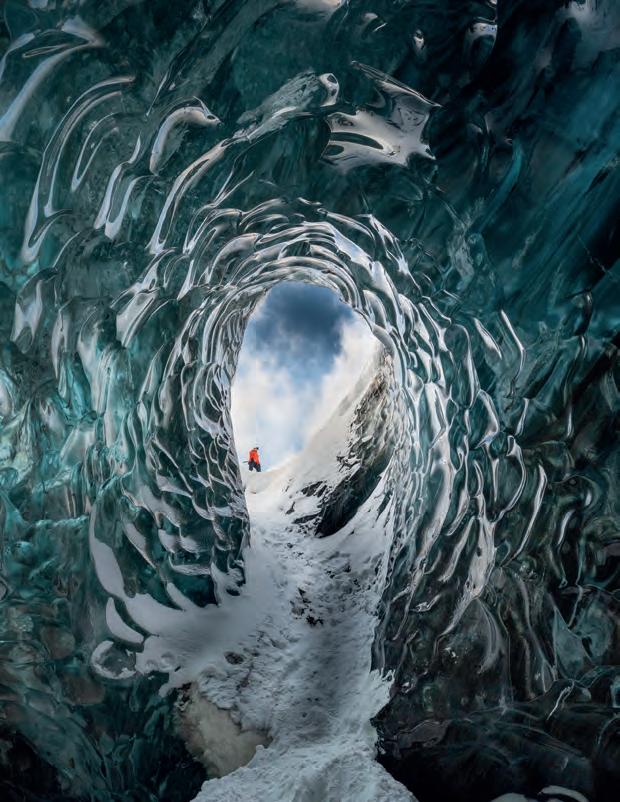
Simon updated the Board on progress with the acquisition of the BIPP. He reported that a recent ‘town hall’ meeting of BIPP members demonstrated overwhelming support for the initiative as described in a prospectus issued on 5 December.
The Master Photographers Association (MPA) Board of Directors, having had sight of the BIPP prospectus, issued a statement of intent to the RPS formally confirming the MPA would like to become part of and help shape the ‘new’ BIPP under the auspices of the RPS. This would effectively merge the MPA and the BIPP into the ‘new’ BIPP, coincident with the ‘new’ BIPP being incorporated as a wholly-owned subsidiary of the RPS and keeping the BIPP name. Simon agreed to bring together the Boards of the BIPP and the MPA in a meeting with RPS Trustee and executive representatives, to discuss the detail of the initiative.
Michael and Nikki McCoy presented a high-level budget for 2023. The Board gave careful consideration to the budget and to the assumptions that had been made in its preparation but was unable to sign off the budget as presented. The Board requested management accounts for the past three months and for a more detailed budget for 2023 to be presented. Nikki agreed to prepare these.
Trustees also considered the forecast and protocol for drawdown of funds from investments. The Board requested greater financial detail and transparency in order to fully deliver its fiduciary oversight and control. Mathew Lodge agreed to discuss this with Nikki and Michael.
Tracy Marshall-Grant presented a report on development operations including an update on campaigns and on the 2023 membership plan. Tracy’s report detailed the initiatives designed to achieve the 2023 membership growth target.
Rohini Denton and George Thomas provided an update on the implementation and operation of the CRM system. Rohini presented a roadmap through to July 2023 which has the ambition of delivering full in-scope functionality by mid-2023. The Board expressed concern over the contract position of the project and with the lack of plans for how the CRM system will be used to drive additional value to RPS membership. Rohini is currently completing an end of year review with the contractor and will share it with the Board when complete.
Simon informed the Board we had received more than 120 applications for the CEO role. As Simon has personal knowledge of four of the applicants, he recused himself from further involvement with the
recruitment process. Mathew, as Deputy Chair, agreed to take over as Trustee lead for the process and Gavin agreed to replace Simon on the interview panel. Mathew provided his proposals for delivering the recruitment. Mervyn Mitchell led a discussion on how we might secure greater diversity in staff recruitment. Trustees agreed that we could and should do more. It was also agreed that future recruitment processes must make greater use of platforms that encourage diverse representation.
Sophie Collins updated the Board on the progress of the recruitment of a Director of Marketing and Membership (DMM) and confirmed that the process was being led by Nikki. Trustees agreed that the CEO appointment should be made first and that the new CEO should lead on the DMM appointment.
Finally, the Board reviewed and approved the Health and Safety Plan that had been previously circulated by Michael.
220 RPS JOURNAL MARCH / APRIL 2023
‘Ice cave in Vatnajökull National Park, Iceland’, part of a successful Licentiate submission by Alistair How LRPS assessed in December 2022
19 December 2022
Present: Simon Hill (Chair), Nicola Bolton, Sebah Chaudhry, Sarah J Dow, Andy Golding, Mathew Lodge, Mervyn Mitchell. Apologies: Mónica AlcázarDuarte, Gavin Bowyer, Sophie Collins, Peter Walmsley.
Attending: Nikki McCoy, Michael Pritchard.
The meeting was held online. The Board received an update on the reserved matters discussed at the previous meeting and agreed to discuss this with the new CEO subsequent to an appointment being made. Sarah Dow agreed to draft a conflict of interest policy document for Board review.
Mathew Lodge reported on the CEO recruitment process and confirmed that all shortlisted applicants attended for interview. The interview panel was Mathew, Gavin Bowyer and Sophie Collins. Simon Hill continued to recuse himself from the recruitment process due to having personal knowledge of two of the shortlisted candidates. The interview panel was unanimous in its recommendation to the Board that it appoint Dan Jones to the post of CEO. The Board ratified this recommendation and asked Simon to conclude a contract with Dan with a start-date of 6 February 2023.
Nikki McCoy provided an update on the DMM recruitment process and reported that Sophie Collins was reviewing all applications prior to shortlisting. Pending the contracting of the new CEO, Trustees agreed membership of a pro tem DMM interview panel. Simon (on behalf of Gavin) provided an update on the Honorary Treasurer recruitment process and confirmed that Gavin was liaising with Mervyn Mitchell to agree how we are ensuring the recruitment reaches a diverse group of potential applicants.
Simon provided a further update on the RPS-BIPP-MPA initiative. He reported on an announcement made by the MPA Board to its members and on correspondence subsequently received (13 December) by him from
a member of the BIPP Board. This correspondence suggested a significant “divergence of ambition and intent” between that envisaged by the BIPP and by the RPS. Trustees hoped the BIPP would remain supportive of the initiative and engage in dialogue with the MPA.
The RPS remained hopeful it could seek to establish a new organisation formed jointly from the membership of the BIPP and the MPA, which would take the BIPP name.
However, in the belief that this ambition may not now be attainable, Trustees reviewed a draft proposal to address the “divergence of ambition and intent” and re-establish the authority of the RPS in delivering the initiative. Trustees agreed the draft proposal should be issued to the Boards of the BIPP and MPA for their respective consideration and that protective registrations of corporate entities and relevant intellectual property be made using an alternative name. That name would be the Professional Photographers’ Association, but this would only be used if, ultimately, the BIPP elected to no longer be involved in the initiative.
The Board received a paper from Janet Haines (Co-Chair of the Digital Imaging Group) and a paper from Andy Golding and Peter Walmsley (joint authorship). Both papers dealt with aspects of transformational change for the RPS. Trustees agreed that the Board should work with the new CEO, the new DMM and the Senior Leadership Team (SLT) to agree a recommended approach to achieving the necessary organisational transformation. This is an urgent matter for the Board to address with the new CEO.
Nikki and Michael Pritchard presented a revised budget for 2023. Trustees were unable to sign off the budget and requested a further meeting when the CEO-designate had been given an opportunity to review the draft budget for 2023.
Trustees received an updated risk register and requested this be reviewed by the new CEO and the SLT for discussion at the next meeting.
19 January 2023
Present: Simon Hill (Chair), Nicola Bolton, Sebah Chaudhry, Sophie Collins, Sarah J Dow, Andy Golding, Mervyn Mitchell and Peter Walmsley. Apologies: Mónica AlcázarDuarte, Gavin Bowyer, Mathew Lodge.
Attending: Dan Jones (CEO), Nikki McCoy, Michael Pritchard.
The meeting was held online. It was primarily to introduce the new CEO and provide an update on the budget for 2023 and on the RPS-BIPP-MPA initiative.
Simon Hill introduced and welcomed Dan Jones, the newly appointed CEO, who will begin his employment on 6 February. On behalf of the Board, Simon and Gavin Bowyer agreed to deliver the CEO on-boarding and to facilitate a briefing for Dan from the SLT. These events took place at RPS House on 10-11 January. Since then, Dan has been undertaking aspects of his new role before formally commencing in February. Simon confirmed Dan’s appointment will be announced in the March-April RPS Journal and that he will provide a feature in the subsequent issue describing his vision for the future of the RPS.
Dan gave a short presentation to the Board describing his background and professional experience. He also delivered a presentation describing his approach to budget setting and control for implementation during the initial period of his employment.
The presentation identified an initial number of tactical priorities for immediate focus and proposed an overarching strategic review to be conducted in consultation with the Board of Trustees over the course of 2023Q1.
The plan outlined a roadmap to agreeing a 2023 operational plan and a fully costed revised budget forecast that will become the de facto operational budget for 2023Q2. On this basis the Board approved the interim 2023 budget as submitted.
Further updates were provided on the DMM and Honorary Treasurer
recruitment. Gavin is continuing to liaise with the Nominations Committee and with the Board, and is hopeful of having a new Honorary Treasurer in post by March 2023.
Mervyn Mitchell asked about the inclusion and diversity of the DMM and Honorary Treasurer recruitment process. Nikki McCoy reported on the EDI monitoring process. Nikki and the Board were disappointed that EDI monitoring had not been more enthusiastically embraced by applicants.
Simon gave an update on the most recent developments in the RPS-BIPP-MPA initiative. Trustees discussed the correspondence exchanged between RPS and BIPP since 13 December 2022. There was a reluctant acceptance that the BIPP may elect to no longer be involved in this initiative to create a ‘new’ BIPP, and therefore Trustees agreed to proceed with the Professional Photographers’ Association using the MPA as the source of the first cohort of members.
Simon reported a meeting between the RPS and MPA would be arranged during the next few weeks and if, in the meantime, the BIPP indicated a desire to remain in dialogue, a meeting between RPS, BIPP and MPA would be facilitated as quickly as possible.
Michael Pritchard gave an update on the call for entries for the RPS Members’ Summer Exhibition. He informed the Board that we had received 2,344 individual works from 586 members and reassured Trustees that the selection process would ensure a broad spread of work representing the full range of RPS membership.
Peter Walmsley informed the Board he had completed his paper on an approach to transformation. Trustees agreed this would be a substantive item on the agenda of the next meeting.
Several other papers currently on hold will also be on the agenda of the next meeting. The next meeting will therefore be a full day event held in person at RPS House.
Simon Hill HonFRPS President and Chair of Trustees
SOCIETY
MARCH / APRIL 2023 RPS JOURNAL 221 SOCIETY
UPGRADE NOW - PART EXCHANGE & COLLECTION ARRANGED

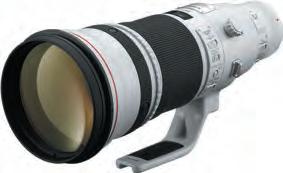

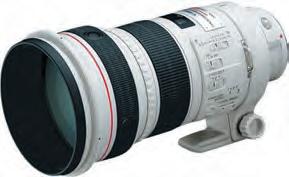





MATT 0736 828 8126 ~'OODD


AFS
Canon 300mm F2.8 IS US LU £3 Nikon 200-400mm F4
VR -
Nikon 500mm F4 E FL
Nikon 300mm F2.8
AFSVRII VR
Nikon 500mm F4 AFS
Nikon 600mm F4 AFS
Nikon 600mm F4 E FL
ANY PRICESSHOWN INCLUDE VATAND U.K. MAINLAND DELIVERY.Correct . E&OE.
CALL
CANON R DIGITALAF USED BODbody ...................·---~599
R3 body box ................................... £4 799 760D body ·················----"369
RSbody box .......................£2999/3499 1300D body ..............·----"199
R6 body box ................................... £ 1799 BG-E20grip ...............·---~199
R body boX---················£1199 BG-E16grip ...............·---~149
RF 15-35 F2.8 LIS USM...............£1899 BG-E13grip ...£99 BG-Ell grip .....£99
RF 16 F2.8 STM.................................£249 BG-E7grip .....£79 BG-E4grip .......£79
RF24-105 F4 L IS...........................£1149 CANON M USED EF-M
RF35 F1.8 IS STM box ....................£469 15-45 F3.5/6.3 IS STM ____ £99
RF 70-200 F4 L IS...........................£1499 22 F2 STM..................·---~189
RF 100-500 F4.5/7.1 LIS USM ..£2799 EF-Mmount adapter £89
RF600 F4 LIS USM box ............£11999 CANON AF LENSESUSED
RF600 F11 IS STM...........................£599 8-15 F4 L USM............. ___ .zc899
RF800 F11 IS STM...........................£899 10-18 F4.5/5.6 IS STM---~199
CANON DIGITALAF USED 10-22 F3.5/4.5 USM EFS................£299
7D MKII body box ............................£899 14 F2.8 USM Lll..............................£1199
6D body box ____ ··············£49915 F2.8 fisheye box ·---~399
SD MKIV body box .......................£1997 15-85 F3.5/5.6 EFS...........................£299
SD MKIII body ...................................£899 16-35 F2.8 USM Liil ......................£1399
90D body box ...................................£997 16-35 F4 USM IS L box ...................£799 24-70mm F2.8 70-200mm F2 NIKON Z DIGITALAF USED
body Mint box .........................£4599
body ___ _
body ___ _ MBD-18 (DBS0) ----····£299


MBD-15 (D7100/7200) ....................£69 MBD-12 box (DB00/810) ...............
100-400 F4.5/5.6 LIi box .............£1699
180 F3.5 L USM macro ...................£599
300 F2.8 IS USM Lll.......................£3699
300 F4 IS USM L.·----······£499
500 F4 IS USM Lii £6999
1Ax extender MKlll .........................£349
1AxextenderMK11---···£169
2x extender MKlll. £349
2x extender MKll.·----··£169
12mm ext tube ll..·----····£59
25mm ext tube ll .£129
SIGMA CAF USED
8-16 F4.5/5.6 HSM DC box ...........£299
10 F2.8 EX DC HSM ---~399
10-20 F3.5 EX DC HSM...................£279
12-24 F4.5/5.6 II DG ·----"499
15 F2.8 EX DG fisheye box ...........£299
105 F2.8 AFSVR................................£499
200 F4 macro .................................£1199
200-400 F4 AFSVR 11....................£2999
200-500 FS.6E EDVR box .............£997
300 F2.8 AFSVRII..........................£3499
300 F4 AFS E PF EDVR box ..........£997
500 F4 E FLVR AFS box ..............£6999
500 F4 AFSVR....................£2999/3997
500 FS.6E PFVR AFS box ..........£2599
400 F4.5 Z VR 5 box ....................£2999
FTZadapter box .........·---~179
NIKON DIGITALAF USED
DF body bo,"- _____ £1399
D5 body Mint box £3499
D4 body £999
DBS0body Mint box ...................£2299
D810 body ················---~999
D780 body Mint box ...................£1599
D750 body box ·----"899
DS00 body box .....................£799/1097
D7500 body ..............·---~749
D7200 body box ·----"649

D7100 body box ...... ___ _.zc449
D7000 body ·---~349
D3400 body ·---~299
GITZOTRIPODSUSED
GT35305 + G2272M head ............£549
GT3532 + GH3382QEhead ..........£899
GT3533··················----····£679
GT5543LS·············----····£849
MINOLTAAF USED 28-80 F3.5/5.6 ----·······£49 50 F1.7 ····················----······£99
75-300 F4.5/5.6 ----······£49 100-300 F4.5/5.6 APO......................£99
100-300 F4.5/5.6.----·····£79
600 F4 EFL EDVR.........................£7999
600 F4 AFSVR serviced ..............£4999
TC14-Elll.....----················£479
TC14-EIIbo,"----················£299
TC17-Ell ----················£149
TC20-EIIIbo,"----················£199
SIGMA NAF USED
4.5 F2.8fish eye box ........................£399
8 F3.5 EX DG fisheye .......................£349
10-20 F3.5 DC box ...........................£269
12-24 F4.5/5.6 II HSM.....................£499
15 F2.8 EX DG fish eye ....................£299 18-250 F3.5/6.3 DC 05 ................... £ 199
F1A DG HSM Art ........................£499
F1A DG HSM Art ........................£499 70-200 F2.8 EX DG OS HSM.........£499 ALL 70-300 F4/5.6 each.................£139
PENTAX ETC. DIGITAL USED
F3.5/4.8 R box ....................£499
60 F2A XF macro .............................£399
80 F2.8 XF WR macro mint ...........£799
100-400F4.5/5.6XF LM 015WR....£999
1Ax XF converter .............................£299
EF-42flash----··················£149
SONYDIGITALUSED RX10 MKIV box .... ____
A 100 body ............·----·····£99
\N\N\N.niifsuds.con, Heretohelp-justcall0736 828 8126rsam-Bpm)or01803 852400 QUALITYUSEDEQUIPMENT. 3 Month warrantyon mostsecondhand.Seewebsitefor full list and detailsetc.
Z7
Z7
Z6
14-30
5
24-50 F4/6.3
24-70 F4 5
35
Z9
MKII body Mint box ...............£2399
MKI body box .......................... £ 1799
body box ...................................£1199
F4
box ·----"899
S ·---~199
Mint box.·----"499
F1.8 S----·---i699
DB0
D90
D3200 body ·----"199 D3100 body
NIKON
8-15 F3.5/4.5
10.5 F2.8fisheye
pg9 10-20 F4.5/5.6 AF-P DX VR...........£239 10-24 F3.5/4.5 AFS box ..................£449 14-24 F2.8 AFS box·---~899 16 F2.8 AFD fisheye box ...............£399 16-35 F4 AFSVR box ___ .zc599 16-80 F2.8/4 VR DX ····---~599 16-85 F3.5/5.6 AFSVR.................... £ 149 18-55 F3.5/5.6 AF VR DX .................£99 18-105 F3.5/5.6VR DX AFS...........£149 18-135 F3.5/5.6 AFS........................£149 18-200 F3.5/5.6VR DX MKII .........£399 18-200 F3.5/5.6VR DX box ...........£279 18-300 F3.5/5.6VR DX ...................£599 20 F1.8 AFS box ................................£629 24 F1AG AFS Mint. .........................£997 17-40 F4 L USM··----····.£399 18-55 F3.5/5.6 IS STM.......................£99 18-135 F3.5/5.6 USM Nano ..........£399 24 F1A USM LIi box .....................£1199 24 F3.5TSEII box. ____ £1399 24-70 F2.8 USM LIi box ...............£1399 24-70 F4 IS USM L. £799 24-105 F4 IS USM L .£499 28-300 F3.5/5.6 15U L serviced ..£999 35 F1A USM LIi box .....................£1399 50 Fl .2 L USM box.·---~999 50 Fl A USM ·------"249 50 Fl .8 STM box ·----··£99 65 F2.8 MPE box ·---~849 70-200 F2.8 IS USM Lii ...................£997 70-200 F4 IS USM box ....................£499 70-300 F4/5.6 USM L---~799 70-300 F4/5.6 IS USM 11..................£499 75-300 ----··----"169 85 F1.2 L USM MKll .zc899 24 F2.8 AFD................·---~199 24-70 F2.8 AFSVR box ................£1399 24-70 F2.8 AFS ·----"797 24-85 F3.5/4.5 AFSVR....................£249 24-85 F3.5/4.5 AFS..........................£149 24-120 F4 AFSVR.............................£699 28 F2.8 AFD........................................ £169 28-300 F3.5/5.6VR box ..................£699 35 F1.8 AFSG DX.............................£129 35 F2 AFD box ..................................£299 50 F1.4 AFSG box ...........................£299 50 F1.4 AFD........................................ £199 50 F1.8 AFS box ................................£169 50 F1.8 AFD---··················£149 55-200 F4.5/5.6 box ..........................£99 55-300 F4.5/5.6 DX VR...................£229 60 F2.8 AFS---·················£449 60 F2.8 AFD---·················£299 70-200 F2.8 E FLAFS box ..........£1699 70-200 F4 VR AFS.............................£499 70-300 F4.5/5.6 AFSVR box .........£299 80-400 F4.5/5.6 AFSVR..................£999 85 F1.4 AFS----················£997 85 F1.4 AFD----················£499 85 F1.8 AFS box ................................£299 85 F2.8TSEmicro box ....................£899 85 F1A IS USM ~---·······£999 85 F1.8 USM box ___ ·······£299 100 F2.8 IS USM L macro ..............£799
£ 199 MBD-10 grip (D30Dl---····£49 MBD-200 or MBD-80 grip each ....£49
AF LENSESUSED
AFS .£997
box
50
17-50
50-500
105
150 F2.8 EX DG OS HSM box .......£499 150-600 FS/6.3 DG OS sport ........£997 150-600 FS/6.3 DG OS cont .........£699 TC14011.4xextender ....................£149 OTHERCAF USED TAM 16-300 F3.5/6.3 II VC.............£399 TAM 28-300 F3.5/6.3VC PZD.......£599 TAM 180 F3.5 Di macro .................£299 Kenko ext tubes box ........................£79 FLASH/ACCESSORIESUSED ST-E3transmitter box ....................£249 430EXlll.........£239 430EX 11..........£149 SB0EXll...............·----······£199 600EX RTMKll..·----······£399 600EX RT ·----·······£299 Angle finder C...·----·········£99 TC-80N3 remote----·········£69 600mm F4 AFSVR 105 F2.8 EX DG HSM 05 ................£299 150 F2.8 EX DG OS HSM box .......£499 150-600 FS/6.3 DG OS sport. ....£1197 TC-1401 extender ............................£199 OTHERNAF USED TAM 16-300 F3.5/6.3 II VC.............£399 TAM 24-70 F2.8 Di VC USD...........£499 TAM 28-300 F3.5/6.3Di VC PZD....£599 TAM 150-600 FS/6.3 G2 .................£899 TAM150-600FS/6.3VCUSDbox......£649 FLASH/ ACCESSORIESUSED R1-C1ringflash kit ...........................£499 SB-600......----····················£99 SB-700......----··················£169 5B-800 bOX---··················£149 SB-900......----··················£249 5B-910.....·----···················£299 SU-800 commander .......................£199 DR-6 angle finder ............................£139 DR-5 angle finder ............................£139 DR-4 angle finder .............................. £99 DR-3 angle finder .............................. £79 MC-36A remote .................................. £89 MC-30A remote .................................. £39 SC-17/SC-19/SC-28cable each.....£49 www.mifsuds.com FUJI, MINOLTA/SONY, OLYMPUS,
FUJI DIGITAL USED X-T4 body box ...................................£999 X-T2 bodY----····················£499 X-T10 body box ................................£199 10-24 F4 XF R box ............................£599 14 F2.8 R box ..................................... £499 16-55 F2.8WR...................................£799 18-55 F2.8/4 XF Mint-....................£449 23 F1.4 XF M-box ............................£599 27 F2.8 box ---·················£299 50-140 F2.8 R.....................................£997 55-200
24
F2.8 EX DC OS HSM............£269
F4.5/6.3 HSM OS...............£699
F2.8 EX DG HSM OS box .......£299
PANASONIC,
£1299
F3.5/5.6......................£69 TAM
F3.5/6.3
TAM 28-75 XR Di box ......................£199 OLYMPUSMICRO 4/3 USED PENTAXDIGITAL USED TAM 90 F2.8 SP.................................£199 i~\rE~·ii~~A ~ 06u·N1·:iii=·usE·J 249 SIG 12-24 F4.5/5.6 II HSM DG......£399 SIG50 F1.4 DG Art box ..................£399 OM-D EM1X body box ...................£999 OM-D EM1 body black ..................£399 OM-D EM10 MKII body ..................£299 OM-D EMSMKI body .....................£199 40-150 F4/5.6 EDR...........................£149 KS MKII body box ·----··£499 KS body ·----·£299 KX body ·---··£199 K200D body ·----··£149 16-45 F4 ED DA bo,,._ ___ .£199 SIG70-200 F2.8EXDG OS HSM....£499 PANASONICDIGITAL USED 18-55 F3.5/5.6 AL.·----···£69 SIG 105 F2.8 EX DG OS..................£269 SIG150-500FS/6.3DG OS Serviced _______ £449 SONY NEX FE MOUNT AF USED G1 body ........£69 G2 body .............£69 G3 body ··----·····················£69 GX-7 body black box ......................£299 7-14 F4 bOX---··················£499 18-135 F3.5/5.6 DA EDWR...........£299 18-250 F3.5/6.3 DA .....z.249 35 F2A DA AL. ·----··£99 35-80 F4/5.6 ·----··£49 FE24-70 F2.8 GM..........................£1199 12-60 F3.5/5.6...................................£299 S0Fl.BDA ................---~119 FE24-70 F4 ZA 055 ........................£599 14-42 F3.5/5.6..................................... £99 50-135 F2.8 ED ·----·£399 FE28-70 F3.5/5.6 055 ....................£199 14-45 F4/5.6....................................... £149 55-300 F4/5.8 EDWR box .............£299 FE35 F1A ZA 055 box ...................£599 25 Fl.7 .......£119 45-175 F4/5.6...£249 OTHER PENTAXAF USED FE35 F2.8 ZA box ............................£299 45-200 F4.5/5.6 box ........................£199 SIG70-300 F4/5.6 DG macro .......£139 FE 100 F2.8 GM 055 box ...............£899 FLS00flash box ................................£169 SIG 150-500 FS/6.3 DG 05 ............£499 FOR35MM AND MEDIUM FORMATCAMERAS,LENSES& ACCESSORIESPLEASE SEEOUR WEBSITE~ ~ UPDATEDDAILY ITEM YOU REQUIRE NOT LISTED? EMAIL DETAILS OF WHAT YOU ARE LOOKING FOR AND WE WILL EMAIL YOU WHEN WE CAN HELP. CORRECT 24/01/2023.
SONYA MOUNTLENSESUSED Sony A 18-70
16-300
Di II PZD....£349
BE ORIGINAL OR DIE
British photographer Yevonde Middleton, known professionally as Madame Yevonde, was portraitist to some of the 20th century’s bestknown figures and a pioneer of colour photography.
Her career spanned six decades from 1914 to her death in 1975 and paralleled revolutionary advances in society and technology. Yevonde’s practice shifted radically from the austere portraits of suffragists she began with in the 1910s to increasingly experimental, even surreal, compositions.
This eccentric photograph, ‘Still life July 1938’, shows a Roman bust with a floral wreath, bamboo hat, chain and sunglasses on a pedestal, a book with cherries on its pages, a tipped over vase of flowers, a white lion sculpture and five suspended butterflies. All are set before a painted cloud and seascape backdrop. A partial colour checker is visible in the lower left.
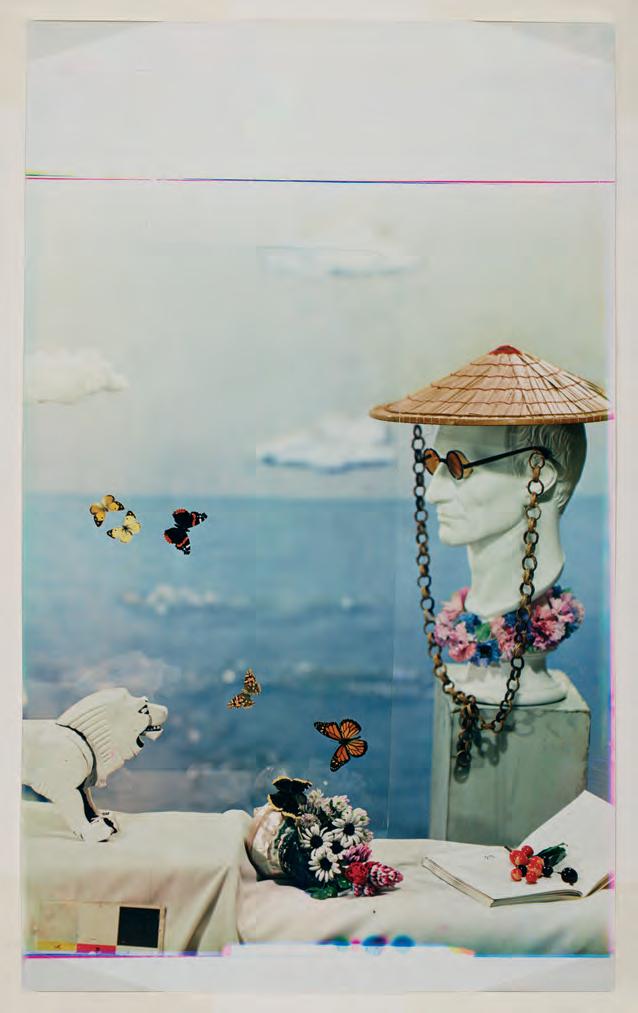
Yevonde’s arrangement of objects combines surrealist influences with historical references to traditional still life painting. This particular image shares similarities with Yevonde’s advertising photographs, but was taken in her studio as part of a series of still lifes that were among her last works developed using Vivex, an early colour process that ended with the onset of the Second World War.
Perhaps one of the most fascinating aspects of this photograph is its similarity to contemporary pop art, or to vaporwave art, an internet subculture interested in satirical responses to consumerism, pop culture and nostalgia.
Considering it was made in 1938, Madame Yevonde’s photograph seems ever more pioneering and prescient, exemplifying her life motto –‘Be original or die’.
Mary Phan is curatorial fellow in photography, supported by The Bern Schwartz Family Foundation, at the V&A Museum, London
THE COLLECTION 224 RPS JOURNAL MARCH / APRIL 2023
RPS
/ V&A
Bridging surrealist and traditional art, the work of pioneer Madame Yevonde still feels contemporary, writes Mary Phan
COLLECTION
MUSEUM, LONDON
VISIT
The RPS Collection is at the V&A Photography Centre, London vam.ac.uk
“Her career spanned six decades and paralleled revolutionary advances in society and technology”
‘Still life July 1938’ by Madame Yevonde, printed around 1990
Exclusiveholidays for life







An initial payment from £5,000and a quarterly feeofjustover£35 (that isaround £140 a year),linked to RPI, givesyou accessto a11 HPB'sholiday homes. ForeachHPBholiday, you will pay a no-profit userchargecovering only property running and maintenance costsand useof on-site facilities.Thecharge is levelthroughout the year-there are no high seasonpremiums.For a studio the charge averagesabout £347a week,for a 2-bedroom property around £533a week. Largerproperties arealsoavailable.After an initial chargeof25% your money is invested in a fund of holiday properties and securities. Thefund itself meets annual chargesof2.5% of its net assetsat cost, calculatedmonthly. Yourinvestment return ispurelyintheform of holidaysand,aswith most investments, your capital isat risk. Youcan surrender your investmentto the company after two yearsor more (subjectto deferral in exceptional circumstances)but you will get backlessthan you investedbecauseof the chargesreferredto above,aswell asother overheadsand changes inthevalueofthefund's properties and securities. Thisadvertisement is issued byHPBManagementLimited (HPBM)registeredat HPBHouse, Newmarket,Suffolk,CBSBEH. HPBMisauthorisedand regulated by the FinancialConduct Authority and isthe main UKagent and the property managerfor HPB,issued by HPBAssuranceLimited (HPBA) registeredin the Isleof Man and authorised bythe FinancialServices Authority there.TheTrusteeof HPB is Equiom(Isleof Man) Limited, registeredatJubilee Buildings, Victoria Street,Douglas,Isleof Man, IM1 2SH.TheSecuritiesAdviseris StanhopeCapitalLLPof 35 Portman Square,London,Wl H6LR.No medicalexamination required.HPB isavailableexclusivelythrough HPBM.HPBMpromotesonlyHPB and is not independent of HPBA. Holdersof policiesissuedby HPBAwillnot be protected by the FinancialServicesCompensation Schemeif the company becomes unableto meet its liabilitiesto them but Isleof Man compensation arrangementsapply to new policies.Weare now unableto accept new applicationsfrom residentsof EUcountries and some other jurisdictions. HPBAssurance Limited reservesthe righttodecline an application at its solediscretion.




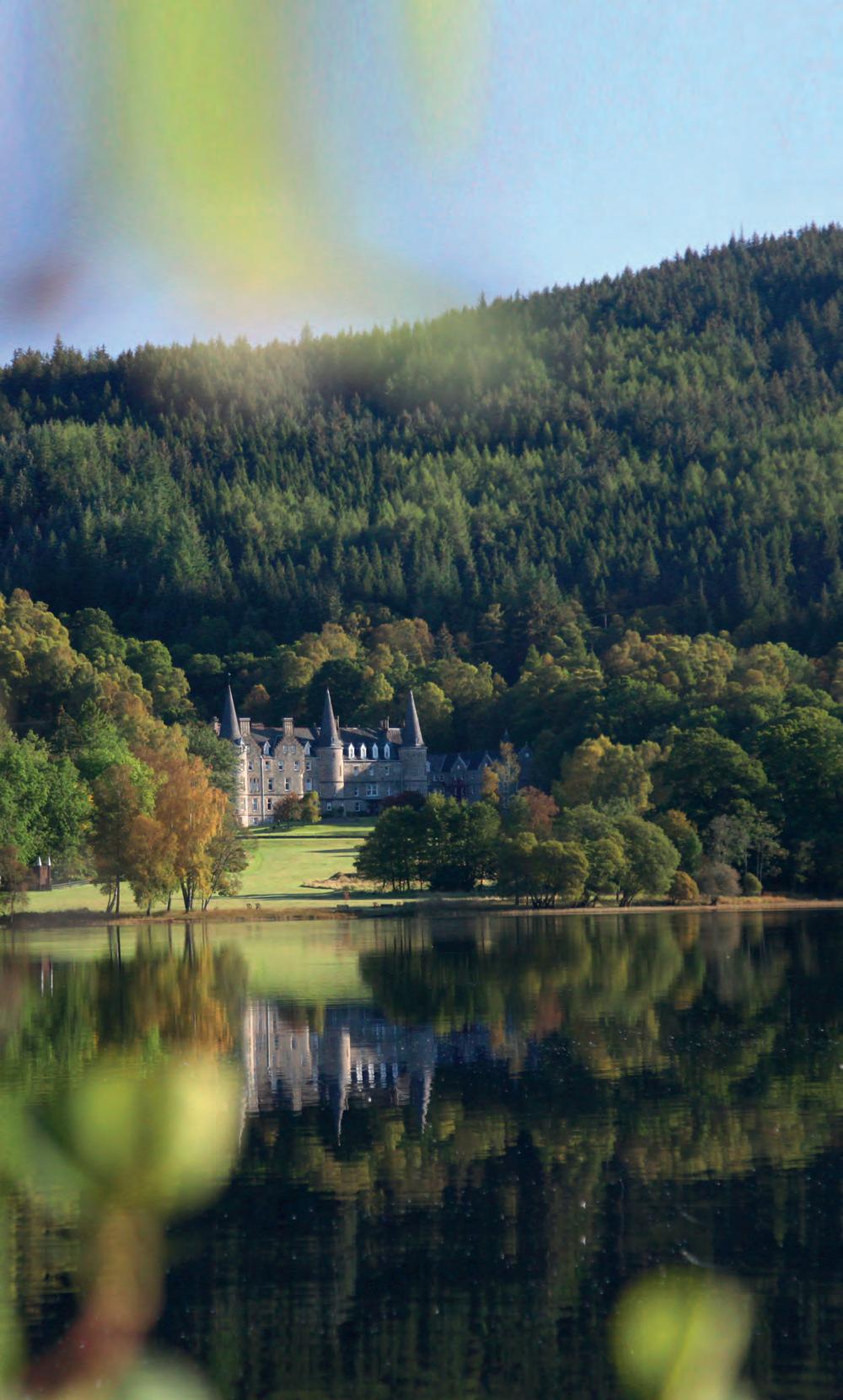
the way we see ourselves.




Together, let's change the bigger picture. MPB puts cameras and lenses into more hands, more sustainably. The platform to buy an photo and video kit.

#ChangeGear