

BECOMEAN AICO EXPERTINSTALLER
Aico's free, award-winning ExpertInstaller training scheme is FIA CPD accredited and is designed to make sure installers have all the information they need to correctly install domestic home life safety systems, including Fire and Carbon Monoxide alarms and Environmental Sensors.

Members of the community are eligible to participate in Aico's
Connections
©2026
ISSN 2042-5732
niceic.cam

DVEATD VDU, PAUL ...
Enquiries: 01582 539000
Communications Manager: Debbie Shields debbie.shields@certsure.com
Senior Content Writer: Chloe Wingate
Customer services: 0333 015 6625
Sales: 0333 015 6626
Training: 0333 015 6627
Technical helpline: 0333 015 6628
Insurance: 0333 015 6629
@officialNICEIC
Published on behalf ofNICEIC/Certsure by: Think, 65 Riding House Street, London, WlW 7EH
Editor: Clare Dowdy connections@thinkpublishing.co.uk
Art Director: Ian Hart
Managing Editor: Kirsty Wilkins
Associate Director: Anna Vassallo
Client Engagement Director: Melissa Michael
Content Development Director: Matthew Rock
Advertising: Cameron Lea cameron.lea@thinkpublishing.co.uk Ben Sellers ben.sellers@thinkpublishing.co.uk
Connections welcomes ideas for contributions. Please email mediaenquiries@certsure.com
All rights reserved. This publication (and any part thereof) may not be reproduced, transmitted or stored in any format without the prior written permission of the publisher. Think Publishing Ltd accepts no liability for the accuracy of the contents or any opinions expressed herein.
Printed by Acorn Web Offset, West Yorkshire. Connections and its paper wrapper are printed on paper from European mills, meeting the '------..J highest quality and environmental standards. Both the magazine and the paper wrapper are fully recyclable.
Welcome to the first Connections magazine of 2026. In this issue, you'll find important information about upcoming regulatory changes, including the imminent publication of Amendment 4 (page 41) and the impact of updates to the Electrotechnical Assessment Specification (EAS) on your assessment (page 20). And, just as this issue was going to print, the government published its Warm Homes Plan, presenting significant opportunities for contractors working in energy efficiency and low-carbon installations (page 42).
In a year of transition and change, NICEIC will be on the road and supporting our businesses with two more TechLive CPD events, where you can meet our experts in person and learn more about what's changing. More on page 42.
On a celebratory note, 2026 marks NICEIC's 70th anniversary! Look back with us across seven decades ofNICEIC certification, and join us as we look ahead to the future, on page 38.
Our cover story continues the futuristic theme as we delve into automation, and the impact robots and AI could have on the industry 10 years down the line (page 34).
This issue also highlights some recent initiatives from NICEIC designed to support our certified businesses with issues affecting the industry. First, we spotlight the launch of Connected Futures, NICEIC's free, exclusive electrotechnical apprenticeship job
Readaboutthe imminentpublication ofAmendment 4 Page41
FindouthowEAS updatescouldimpact yourassessment Page20 WarmHomesPlan published-find outmore Page42
board (page 16). Next, we've got the lowdown on The Tools to Talk, the mental health toolkit from NICEIC and the EIC designed to help you and your team with issues relating to mental wellbeing (page 19).
Finally, if you're taking some time for some CPD this month, flip to our CPD-accredited technical section starting on page 47. You can also find out about the latest The Wire webinars on page 43. And don't forget to record your CPD -you can use NICEIC's CPD record (on our website and email newsletters) to note what you've learned easily.
Paul Collins Technical Director, NICEIC
3 DVEATD VDU,PAUL
Technical Director, Paul Collins, takes us through his priorities this issue.
7 THIS...
Centregreat retrofits lighting for Newport footbridge.

We highlight some NICEIC-certified winners.

•
Why installers choose Quantum
Up to 27%cheapertorun* than standard storage heaters

-
Helps boostEPCratings and meet compliance requirements
- Quick to install and simple to maintain
Recognised in SAPAppendixQ
- Built to last, backed by a 10-yearguarantee••
Centregreat Ltd was the obvious choice to work on a footbridge in N ewbridge, South Wales. The infrastructure contractor has a long-standing relationship with Caerphilly County Borough Council, as Centregreat is responsible for all the street lighting maintenance in the borough.
"The existing lights on the footbridge were failing and they had quite a few outages, which compromised the safety and usability of the bridge," says Gareth Thomas, Contract Manager at Centregreat. "This wasn't a surprise, as the lights had been in place for well over 10 years."
The Calzaghe bridge, named after Newbridge's unbeaten world boxing champion Joe Calzaghe, opened in September 2009. The bridge comprises two connected footway/cycleway bridges -one spanning the Ebbw Valley Railway and the other the River Ebbw, providing easier access from the town to its railway station, a school and a leisure centre.
Conceived as part of a regeneration initiative, the bridge plays a vital role

in reconnecting parts of the community that were previously divided by the railway and river.
Caerphilly County Borough Council appointed Centregreat, based in Tongwynlaisjust outside Cardiff, about two years ago.
Centregreatidentified the failedunits,whichwere madetomeasure and concealedinthehandrail.
According to Thomas, drawings of the original lighting scheme weren't available. And the replacement lights weren't something you could pick off the shelf. "We tried to get parts, but they were ridiculously expensive, which is why Acrospire [the lighting supplier] was brought in. They suggested changing the whole unit and retrofitting the lighting," says Thomas.
Centregreat identified the failed units, which were made to measure and concealed in the stainless-steel handrail. Some of the existing units were removed and Acrospire took these to their factory, copied them and manufactured their own version. Multiple site trials were required to ensure compatibility with the original design and to meet the council's safety and aesthetic criteria.
Acrospire supplied 40 3-Pod and 30 6-Pod linear LED modules in a 4,000K neutral white. The circuitry was already in situ in the units, with each featuring a connector with a plug-in system.
"It took only two days for one of our electricians to remove the existing failed units, install the new LED lights and connect them," says Thomas. "We replaced about one-third of the bridge with new lights. The rest of the bridge's lights couldn't be retrofitted due to budget constraints."
It's understood that the council redeployed salvaged working fixtures to other failing sections to extend the life of the original system.



\N\JG\CE
Inthefirstofournewmini-series,RebeccaBurnCallanderexplorestheavenuesopentosmall businesseschasingdomesticconsumersforunpaid invoices.Whatlegalprotectionsdotheyhave,how shouldtheyapproachthesedifficultconversations, and-mostimportantly-howcantheyprevent latepaymentsfromhappeninginthefirstplace?
Late payments are the scourge of small businesses, affecting an estimated 1.5 million business owners across the UK and forcing 38 companies into administration each day, according to the government's late payments consultation. 1
Even if they don't result in closure, late payments have a long-term impact on electricians' ability to invest in new tools, create jobs and pay their own suppliers.
If you're sick of hassling domestic customers over unpaid invoices, you're not alone: according to insurance firm Direct Line, 81% of tradespeople are currently owed money.
Read on for some practical advice for clearing those debts and avoiding future pain.
BECLEARONPAIJMENTTERMS
Spending a little time refining your paperwork could yield great results. Kirstie Elbourn at Whitstable-based MM Electrical and Design has all but eradicated late payments. She's created a detailed terms and conditions document alongside a list of frequently asked questions (FAQs), which have revolutionised the business.
She shares these documents as soon as work has been agreed. "Lots of people don't realise you need to turn the power off for certain jobs, so it's useful to warn them in advance," Elbourn says. "But the FAQ also clearly states that payment is due immediately upon completion of the work, and that we only share the relevant
certificates once the payment has been received. Even small electrical jobs require a minor works certificate, so that's powerful leverage."
DON'TOFFER30DAIJS
Nowadays, instant payments are the norm across most sectors, points out Rob Driscoll, Director of Legal & Business and Association Secretary at Electrical Contractors' Association (ECA). "In this day and age, there's no need to accept cheques," he says. "Use a mobile payment platform to take payment via your phone as you leave. That also closes the window for post-completion niggles, where somebody's found a boot print in the carpet and said: Tm not paying you until you get that professionally cleaned."'
"On the whole, most ofmy customers pay on the same day," says Stephen Ogden, who runs SJO Home Services in Leighton Buzzard. "I was using an invoicing app that defaulted the credit terms to eight days, but I got them to change it."
Mandating instant payments makes it easier to keep on top oflate payers. "I give people a day or two but then I'll send an overdue notice," Ogden adds.
USETECHTOOLSTOHELP
Alex Cowton started York-based ABM Electrical in 1998. "I used to type my invoices out with one finger," he says. "Now, we use Xero for all our quotes and invoices, which has dramatically cut down the time I spend invoicing and chasing payments."
The software immediately flags late payments and will automatically send a chaser. These reminders will continue until the debt is cleared. "This means I can focus my time on growing the business, not figuring who hasn't paid,"
Cowton says. "When you're doing six to 10 jobs in a day, you're too busy to sit and send reminders."
Ogden uses invoicing software from QuickBooks, which shows whether an invoice has been viewed. This can change the tone of any communications over late payments. If an invoice hasn't been accessed, his opening gambit is, "'I think my invoice has gone to your junk folder as it hasn't been opened. Could you please check?' That always gets a response," he says.
WHAT'STHEDIFFERENCEIFl'MPAIDLATE BIJABUSINESSORACONSUMER?
According to ECA's Driscoll, many electricians are unaware of consumers' statutory rights. "Aconsumer can cancel any time within 14 days of booking a job and face no repercussions," he explains.
Driscoll has heard of customers cancelling within the two-week period and refusing to pay for the materials and labour. "Once you've installed the kit in a person's house, it's incredibly difficult to get it back," he points out.
When dealing with bigger businesses, it's possible to run a credit check before undertaking work. When dealing with domestic customers, however, many electricians rely on instinct.
"You get a vibe from people," Elbourn explains. "When they keep mentioning the cost and ask for ways you can do it cheaper, you tend to be wary. We're happy to break down the costs ofajob so that customers can see how expensive materials are, but you can tell when someone is pushing too hard."
INVOICE
NEVEROVERREACH
Tradespeople across the UK are owed an eye-watering amount in late payments. According to the 2025 Intuit QuickBooks Small Business Late Payments Report, small businesses -electrical contractors included -are owed an average of £21,400 in unpaid invoices, with 54% of these more than 30 days overdue.
"Payment upfront, whether it's a deposit or for materials, reduces your exposure to delayed and late payments," Driscoll says. "Make sure you get instalments rather than collect at the end."
Cowton agrees. "If a job comes in for anew customer that's worth more than £2,500, we take a 25% deposit," he says. "Most people are happy to do that, and we don't lose out on any work where we charge a deposit."
It's one thing to take a deposit on jobs worth thousands of pounds, but asking for payment in advance on lower-value work can look unprofessional, warns Ogden. "I don't take deposits upfront. But I don't take on huge jobs, so I've never had to. For me, taking payment at the end shows professionalism, otherwise they might think that you can't afford to pay for the materials."
BEWARESOCIALMEDIAWARRIORS
When customers pay late, try and keep communications civil-it's easy to screenshot any angry emails or texts and knit them into a social media post. "I've had queries from contractors whose customers have threatened to make them go viral on TikTok," Driscoll reveals. "The sentiment is: I will damage you through localised social media PR. If that's something you put a lot of effort into as a contractor, then you'll take that quite seriously."
Remember that under the UK's Late Payment of Commercial Debts (Interest)

Act 1998, electricians can charge late fees once a payment becomes overdue. Just make sure this is clearly stated in your terms and conditions. You need to decide whether it's worth charging interest or late fees when this will inevitably result in a poor review.
HOWMUCHISIJOURTIMEWORTH?
Electrical businesses must work out the time-to-value ratio when chasing late payments. "IfI were a commercial subcontractor working for a big contractor who owed me half a million, then the costs oflawyers and courts seem more proportionate," Driscoll says. "Anything under £10,000, you're looking at the small claims court, but you'll still have to spend time pursuing that claim, potentially losing money by spending more time off the tools as a result. In this case, it may not be worth the hassle of going through the recovery process."
And Cowton warns that "it can take its toll on your mental health." The Direct Line research found that a third of tradespeople reported feeling anxious because oflate payments.
There are now expedited ways of chasing late payers. The government's
Money Claim Online resource allows you to bypass small claims when chasing debts ofless than £10,000. "This may be effective in certain circumstances," says Driscoll.
And as homes become smarter and devices are increasingly integrated, a change in billing will come about. Contractors who upskill to become design engineers will see their business model shift, including the introduction of subscription plans rather than one-off payments -something we'll delve into in a future issue.
In the meantime, there's no silver bullet when it comes to tackling late payments but, by being consistent on your terms, mandating instant payments and taking deposits for high-value work, you can considerably minimise the risk to your business.
Footnote
1 gov.uk/governmentjconsultations/ late-payments-tackling-poor-paymentpractices/late-payments-consultationtackling-poor-payment-practices
ECAmemberscanaccessthefallowing guidanceanlatepayments: eca.ca.uk/member-suppart/legalbusiness/guides-templates
Eachyear,webringourcertifiedbusinessestogether throughonlineandin-personeventstohelpyoustay connected,meetCPDrequirementsandupskillinkey areassuchasrenewabletechnologies.
In 2026, we're heading to the UK's biggest tradeshows for electrical contractors, providing expert advice and support to help your business succeed in this competitive industry.
• ElexShow: Bolton, London, Exeter, Harrogate, West Midlands, Surrey
• lnstallerShow: Birmingham, 23 -25 June 2026
Following the success of last year's inaugural CPD event, NICEIC Tech live, we're delighted to announce two brand-new events coming your way in 2026:
• NICEICTechLiveSurrey: Thursday 11 June 2026
Venue: Mercedes-Benz World, Weybridge
• NICEICTechLiveSheffield: Wednesday 30 September 2026
Venue: Magna, Rotherham

DealingwithdisgruntledclientswhoreQuest
ofcallbacks?
By Charles Orton-Jones
The callback is the bane of the trades, not least for electrical businesses. A client declares themselves unhappy with the work and demands a fix. Returning to a site can be timeconsuming, expensive and stressful. So how do the profession's smoothest operators minimise callbacks?
Steve Rudkin Electrical has 15 full-and part-time staff, including four apprentices, and has vanishingly few callbacks. Founded in 1997, the company is based in Stamford.
Operations Manager, Jason Overhill, says part of the secret is preparing each client for the work ahead: "When you do a large installation or a rewire, for example, the first site visit is key. Talk the client through everything, such as where the kit will go, and explain about the equipment you'll use. Mention if anything needs to be moved prior to the start -and just be truthful about potential dust and debris. This manages expectations from day one."
A visit from a senior staff member mid-job keeps the customer happy. "For the bigger jobs, it helps to have someone touch base to check everything is okay," he adds. "Ask if they have any concerns; this makes them feel valued. It also helps to build that relationship to ensure we achieve a right-first-time approach."
When the job is complete, Overhill recommends giving the client a
THE
thorough run-through of the installation. "Talk to the customer about what you've installed. Show them where the key components, like isolators, are located. If the customer has some basic knowledge of the set-up, we can offer remote support.
"Take lots of photos and hold these on file for the support staff, so if the customer calls up in a few weeks' time with a query, you can clearly explain to them how to tackle quick fixes, such as a reboot. Otherwise, you've got to send someone out for every simple task."
Five-starservice
Matt Boddy is also a master of keeping clients happy. He works for himself as DV Boddy Electrical Contractors, the business his father started 60 years ago. He carries out commercial and domestic work, usually lighting jobs, in the Buckinghamshire area.
"I've never had a bad review and I barely get any callbacks," says Boddy. What's his recipe for success?
"The first reason is the quality of the equipment I install," says Boddy. "Overall, the equipment has improved massively over time, so there's less chance ofit going wrong. And I make sure I avoid rubbish."
Take something like a light sensor to illuminate a garden. These range from £5 to a few hundred quid. Boddy says it pays to invest in decent kit to avoid a malfunction. "Clients will pay more if you
explain why it's worth it," he says. "You don't have to spend a lot to get the right quality. This means it won't go wrong and require you to go back and switch it out at a later date."
He recommends learning which suppliers are worth the outlay. He mentions one brand, which for legal reasons is redacted, which he and his colleagues boycott. "We know what to avoid," says Boddy. "We use the wholesaler Denmans, who we know and trust," he says. If something goes wrong, he informs Denmans, who may delist it.
There will be times when a callback is inevitable. It's prudent to create contracts, which specify terms and conditions. Boddy, however, works with minimal paperwork. "I've never used written contracts," he says. "Maybe I should. But I've never had a problem with a verbal contract, so until something goes wrong, I won't change."
If there is a callback, he indulges small requests. "It's part of the job," he says. "It's easier for me just to go round and fix what they want at no extra charge. We want customers to be happy. That's important to us."
If the client has changed their mind, there'll be a fee. "We'll agree on a price. Normally they say yes to what I recommend. No one moans. Maybe I'm too cheap!"
COSTOF CALLBACKS
"Good-Qualitystaff andgood-Quality kit...allhelpto reducecallbacks."
JASONDVERHILL, SRELECTRICAL
Blurredlines
For a larger contractor such as SR Electrical, the cost of callbacks can be significant, on the rare occasions they occur. "For small callbacks, you just have to get these done and absorb the cost," says Overhill. "You can't add extra costs onto the quote to cover the outlay. It's just not competitive to do that."
And for larger jobs? "It depends on the circumstances. You need to build a small contingency to cover unforeseen costs and issues," he adds. "But again, it's a fiercely competitive marketplace and if you aren't competitive, you don't get the work. This is why it's critical to have good-quality staff and to use good-quality kit. It all helps to reduce callbacks."
From a legal perspective, it pays to return to the job to fix it. Rob Driscoll, Director of Legal & Business at trade association ECA, says a failure to do a job properly is a breach of contract.
Clients could be tempted to call another contractor to fix the work and pass on the bill. "Therefore, the client giving the contractor an opportunity to remediate its contractual non-performance is quicker and cheaper -for both parties -than the alternative."
He also notes that getting a client to rate a job after it's done is worthwhile, but not watertight. "In the case of contractors working with consumers, they now ask the client to rate them online as they leave, which is also tantamount to the client signing off the works. Although this doesn't obfuscate liability for residual or underlying defects, which may subsequently show up."
In the end, it's impossible to eliminate callbacks completely. And there'll always be grey areas. For example, who foots the bill if the client provided the equipment themselves? Or if the client refused a recommendation, such as the replacement of old electrical parts? Even a detailed written contract may struggle to cover all eventualities, so a conversation with the client about the variables of the job can reduce the likelihood of a conflict if things go wrong.
Boddy's approach is to keep talking to his clients and when needed, do everything he can to help them. ''I'd rather the customer be happy at the end of the day," he says. "I want them to have the work just the way they wanted it. If I have to go back to a job quickly to make that happen, that's what I'll do."
HOWTOAVOID CALLBACKS
l Curbingthecostofcallbacks comesdowntoQuality ofmaterials,designand workmanship,testingon completionandensuringthe clientconfirmsthey'resatisfied withtheworks,saysECA.
2Onlyusereliablekit.Explainto clientswhythecheapestparts areafalseeconomy.
3Prepareclientsonyourfirst sitevisit.Explainthescopeand timeframe.Thisbuildstrustand understandingfromtheoutset.
4Checkinwiththeclient mid-job.Isitgoingtheway theyexpected?Clientsmaynot mentionanissueuntilthejobis complete,whenit'stoolate.
5Takephotosafterajobis finished.Showtheclienthow tonavigatetheneweQuipment. Thismeansyoucantalktheclient throughQuickfixesonthephone.
6Knowyourpolicy.Smalljobs shouldbedoneforfree. Butmajorchangesshouldbe contractuallyagreedinadvance.
As the UK approaches its net zero deadline, electricians are playing an ever-more important role. Decarbonisation and electrification need a bigger workforce, and apprenticeships are key to creating that talent pipeline.
But there's a problem. Only 7,540 apprentices start each year. That's much less than the 10,500 needed annually to stabilise the country's electrical workforce and replace those leaving the industry, according to training provider JTL. The result: a growing shortfall.
Why are electrotechnical apprenticeship numbers so low? Research by NICEIC shows two major barriers for certified businesses: uncertainty over government funding and concerns about some apprentices' work-readiness.
What's more, almost a fifth of respondents reported difficulties with finding apprentices at all.
Andforaspiringapprentices?
Many willing students simply can't find an apprenticeship, according to research published by UCAS and The Sutton Trust. Many don't know where to start or how to identify and approach local businesses open to taking on an apprentice. And to make matters worse, some young people lack the technical and soft skills that employers expect.
Some colleagues suggest students tap their postcode into NICEIC's Find a Trusted Tradesperson Tool. But it's an inexact science. "This gives students access to businesses adhering to the standards, but they haven't indicated they're looking for an apprentice," NICEIC's Head of Training, Alex Robinson, points out.
Competitiveedge
To address these challenges, NICEIC has launched Connected Futures, an electrotechnicaljob board designed to connect apprentices with certified businesses.
LIGHTING THEWAU
l.Visitfutures.niceic.com
2.SignupusingyourNICEIC registrationnumber.
2.Postyourapprenticeship vacancies.Prospectscanapply throughtheplatformorcan beredirectedtoyourwebsite tocompletetheprocess.
3.Trackandmanagetheentire applicationprocessinoneplace andsecureyouridealcandidate. Candidatesmustbeover18touse theplatform,duetodataprotection lawsandprotocols.

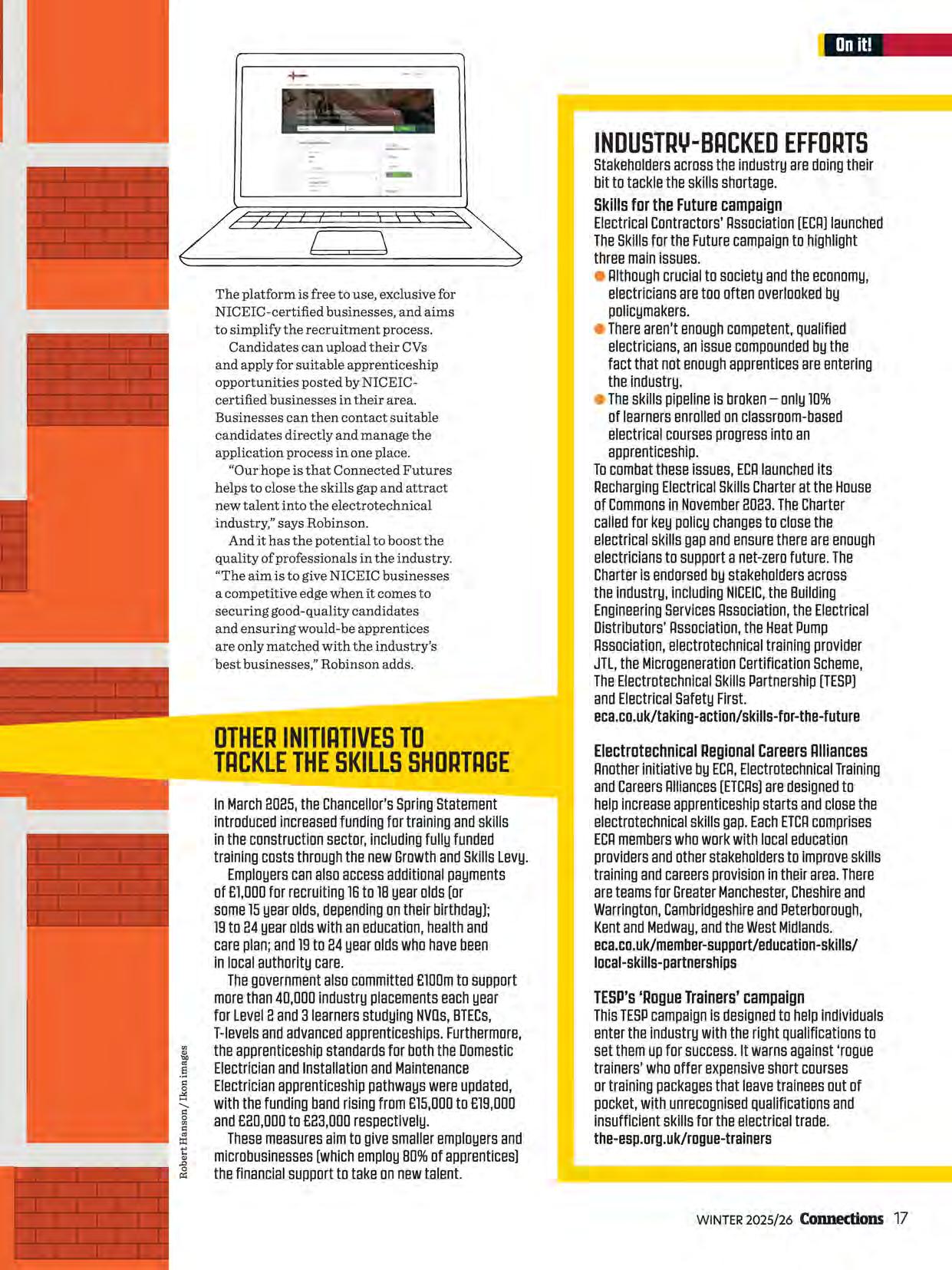
The platform is free to use, exclusive for NICEIC-certified businesses, and aims to simplify the recruitment process.
Candidates can upload their CVs and apply for suitable apprenticeship opportunities posted by NICEICcertified businesses in their area. Businesses can then contact suitable candidates directly and manage the application process in one place.
"Our hope is that Connected Futures helps to close the skills gap and attract new talent into the electrotechnical industry," says Robinson.
And it has the potential to boost the quality of professionals in the industry. "The aim is to give NICEIC businesses a competitive edge when it comes to securing good-quality candidates and ensuring would-be apprentices are only matched with the industry's best businesses," Robinson adds.
OTHERINITIATIVES TO TACKLETHESKILLSSHORTAGE
InMarch2025,theChancellor'sSpringStatement introducedincreasedfundingfor trainingandskills in the constructionsector,includingfullyfunded trainingcoststhroughthe newGrowthandSkillsLevy.
Employerscanalsoaccessadditionalpayments of El,DDDfor recruiting16to 18yearolds(or some15yearolds,dependingontheirbirthday]; 19to 24yearoldswith aneducation,healthand careplan;and19to 24yearoldswhohavebeen in localauthoritycare.
Thegovernmentalsocommitted to support morethan40,DDDindustryplacementseachyear for Level2 and3 learnersstudying BTECs, T-levelsandadvancedapprenticeships.Furthermore, the apprenticeshipstandardsfor boththe Domestic ElectricianandInstallationandMaintenance Electricianapprenticeshippathwayswereupdated, withthefundingbandrisingfrom£15,DDD to £19,DDD and£20,DDD to £23,DDDrespectively.
Thesemeasuresaimto givesmalleremployersand microbusinesses(whichemploy80%of apprentices) thefinancialsupportto takeonnewtalent.
INDUSTRV-BACKEDEFFORTS
Stakeholdersacrossthe industryaredoingtheir bit to tacklethe skillsshortage.
SkillsfortheFuturecampaign ElectricalContractors'Association(ECA]launched TheSkillsfor the Futurecampaignto highlight threemainissues.
• Althoughcrucialto societyandtheeconomy, electriciansaretoo oftenoverlookedby policymakers.
• Therearen'tenoughcompetent,qualified electricians,anissuecompoundedbythe fact that notenoughapprenticesareentering the industry.
• Theskillspipelineis broken-only10% of learnersenrolledonclassroom-based electricalcoursesprogressintoan apprenticeship.
Tocombattheseissues,ECAlaunchedits llechargingElectricalSkillsCharterat the House of Commons in November2D23.TheCharter calledfor keypolicychangesto closethe electricalskillsgapandensurethereareenough electriciansto supporta net-zerofuture.The Charteris endorsedby stakeholdersacross the industry,includingNICEIC,the Building EngineeringServicesAssociation,the Electrical Distributors'Association,the HeatPump Association,electrotechnicaltrainingprovider JTL,the MicrogenerationCertificationScheme, TheElectrotechnicalSkillsPartnership(TESP] andElectricalSafetyFirst. eca.co.uk/taking-action/skills-for-the-future ElectrotechnicalRegionalCareersAlliances Anotherinitiativeby ECA,ElectrotechnicalTraining andCareersAlliances(ETCAs]aredesignedto helpincreaseapprenticeshipstartsandclosethe electrotechnicalskillsgap.EachETCAcomprises ECAmemberswhoworkwith localeducation providersandotherstakeholdersto improveskills trainingandcareersprovisionintheirarea.There areteamsfor GreaterManchester,Cheshireand Warrington,CambridgeshireandPeterborough, KentandMedway,andtheWestMidlands. eca.co.uk/member-support/education-skills/ local-skills-partnerships
TESP's'RogueTrainers'campaign
ThisTESPcampaignis designedto helpindividuals enterthe industrywiththe rightqualificationsto setthemupfor success.It warnsagainst'rogue trainers'whoofferexpensiveshortcourses ortrainingpackagesthat leavetraineesoutof pocket,with unrecognisedqualificationsand insufficientskillsfor the electricaltrade. the-esp.org.uk/rogue-trainers

Over10million installedworldwide
Zeroreportedelectricalfailures
Engineeredasa TrueDCdevice, not a modifiedACswitch
TrustedbyNICEIC BRE Certifiedto In§ UL508i,@us - AS60947.3:2023
Thetoughestglobalstandards
IP67rated,flame-retardant Self-extinguishingenclosure
TheTools toTalk SPOTTING THESIGNS
MentalhealthtoolkitTheToolstoTalkhelpselectrical businessesstartconversationsandaccessvitalsupport.
NICEIC has teamed up with the Electrical Industries Charity (EIC) to launch The Tools to Talk, a mental health and wellbeing support toolkit for NICEIC-certified businesses.
The initiative offers:
• A quarterly e-newsletter with practical tips and ongoing support.
• Interactive episodes of The Wire webinar series focused on mental health.
• Resources to help teams start conversations.
• Signposting to professional support services.
More than 60% of tradespeople believe that mental health isn't discussed enough, according to research byYouGov-29% more than the general population.
For Danny Mouskovias, NICEIC's Learning and Wellbeing Manager, it's about catching problems before it's too late. "Electricians' work often involves long hours and comes with a lot of pressure, yet stigma around mental health persists. Too often, issues go undiscussed until someone reaches a crisis point," he says.
Jess Vailima, the EIC's Managing Director, agrees: "It's vital that people recognise the signs early and know where to turn for help."

The Tools to Talk encourages colleagues to take the first stepstarting the conversation. "Together with the EIC, we're committed to ensuring that everyone -from sole traders to businesses with large teams -has access to the support they need," Mouskovias says.
A helping hand
In 2025, NICEIC also donated £10,000 to support the EIC's services across the electrical sector, including counselling, wellbeing resources and financial assistance, plus employment and family support.
"This donation reflects our ongoing commitment to the EIC's vital work improving mental health outcomes for those in the sector and ensuring that support is available when it's needed most," says Mouskovias.
Formoreinformationortoaccess supportthroughTheToolstoTalk, visit:niceic.com/the-tools-to-talk
"Electricians'workoften involvesIonhoursand comeswithalotofpressure, etstimaaroundmental healthpersists."
OANNIJMOUSKOVIAS,NICEIC'SLEAANING ANOWELLBEING
MANAGER
WHATISTHETOOLS TOTALK?
It's aninitiativedesignedby NICEIC andthe EiCto providemental healthsupportto youandyour team.It includes:
Helpfulprompts to getthe conversationstarted.
Aquarterlymentalwellbeing newsletter.
TheWireepisodestacklingmental healthtopics,co-presentedwith EiCrepresentatives.
Signposting to immediate professionalsupport.
EASCHANGES: RAEVDUAEADU?
ChangestotheElectrotechnicalAssessment
Specification[EASJwillimpactcertified businessesworkinginperiodicinspection andtesting,and/orlow-carboninstallations. Inthisarticle,NICEICHeadofAssessment, DanSmith,explainswhat'schanging,whoitappliesto, andhowitcouldimpactyournextNICEICassessment.
WHATISTHEEAS?
The Electrotechnical Assessment Specification (EAS) is the standard that electrotechnical businesses must meet to be certified with a certification or registration body in the UK. The EAS is applied industry-wide and isn't specific to NICEIC. It's developed and maintained by a range ofindustry organisations and government bodies to ensure consistent standards of competence and compliance across the sector.
If your business is certified on an electrotechnical scheme with NICEICor any other certification or registration body -you must demonstrate compliance with the EAS as part of your assessment.
WHAT'SCHANGING?
Twomainthingsarechanging: e clearer competence requirements for businesses undertaking periodic inspection and testing (EICRs) e new work categories and qualification requirements for businesses undertaking low-carbon installations, including electric vehicle charging equipment (EVCE), solar photovoltaic (PV) systems, and electrical energy storage systems (EESS).
If your business doesn't undertake periodic inspection and testing (EICRs) and doesn't undertake low-carbon
installations (EVCE, PV, EESS) under your NICEIC certification, these changes won't impact your business.
If your business does undertake work in these areas under your certification with NICEIC, read on to find out how this will affect your business and your assessment.
PERIODICINSPECTIONANDTESTING
Thisrequirementisnowineffect.
All qualified supervisors (QSs) with responsibility for periodic inspection and testing work, AND all employed persons carrying out this work under your business's NICEIC certification, must:
• hold an acceptable relevant Level 3 qualification
• show evidence of at least two years' experience in periodic inspection and testing*
• show evidence of ongoing continuing professional development (CPD).
To find out more about the acceptable relevant qualifications for periodic inspection and testing work, check out NICEIC's dedicated webpage at niceic.com/eas-changes
*Yourtrainees and apprentices can still do periodic inspection and testing work under close supervisio so that they can gain the experienc they need.
WHDCOUNTSASAN'EMPLDVED PERSON'?
An employed person is anyone engaged by your business to undertake electrotechnical work, including:
• directly employed staff
• subcontractors, including sole traders and self-employed individuals e agency or temporary staff.
LDW-CARBDNINSTALLATIONS
Thisrequirementwilltakeeffect fromlOctober2026.
New work categories have been introduced for low-carbon installations, all of which have their own qualification requirements for both employed persons undertaking installation work under your business's certification with NICEIC, and QSs responsible for it. These are:
• electric vehicle charging equipment (EVCE) installation
e solar photovoltaic (PV) systems installation
• electrical energy storage systems (EESS) installation.
From 1 October 2026, all QSs with responsibility for low-carbon installation work in the above categories, AND all employed persons carrying out the installation work, must hold an acceptable and relevant Level 3 qualification for the work they undertake.
HOWITWORKSINPRACTICE
Let's say your business currently undertakes solar PV and EESS installation work. You have:
• one QS responsible for solar PV and EESS installation work
• three employed persons who carry out solar PV and EESS installation work.
From1October
• your QS will need to hold an acceptable relevant qualification in both solar PV andEESS
• your three employed persons must also hold acceptable relevant qualification in both solar PV and EESS
• no EV charging qualification is required because your business does not undertake EVCE installation work.
To find out more about the acceptable relevant qualifications, check out NICEIC's informative webpage at niceic.com/eas-changes
HOWWILLTHISIMPACTMV BUSINESS'SASSESSMENT?
Periodicinspectionandtesting
At your assessment, you'll be required to show your assessor:
• evidence that all your QSs responsible for and employed persons undertaking periodic inspection and testing hold an acceptable relevant qualification
• evidence that these individuals have two years of experience in this area
• evidence that these individuals are undertaking CPD in this area of work.
WhatifIdon'tmeettherequirement?
For all assessments carried out from 1 October 2026, if your business doesn't meet the requirement for periodic inspection and testing, then evidence will be required to demonstrate that your business has taken appropriate action. This evidence may include proof of qualification or confirmation from a training provider that you're booked onto a suitable course.
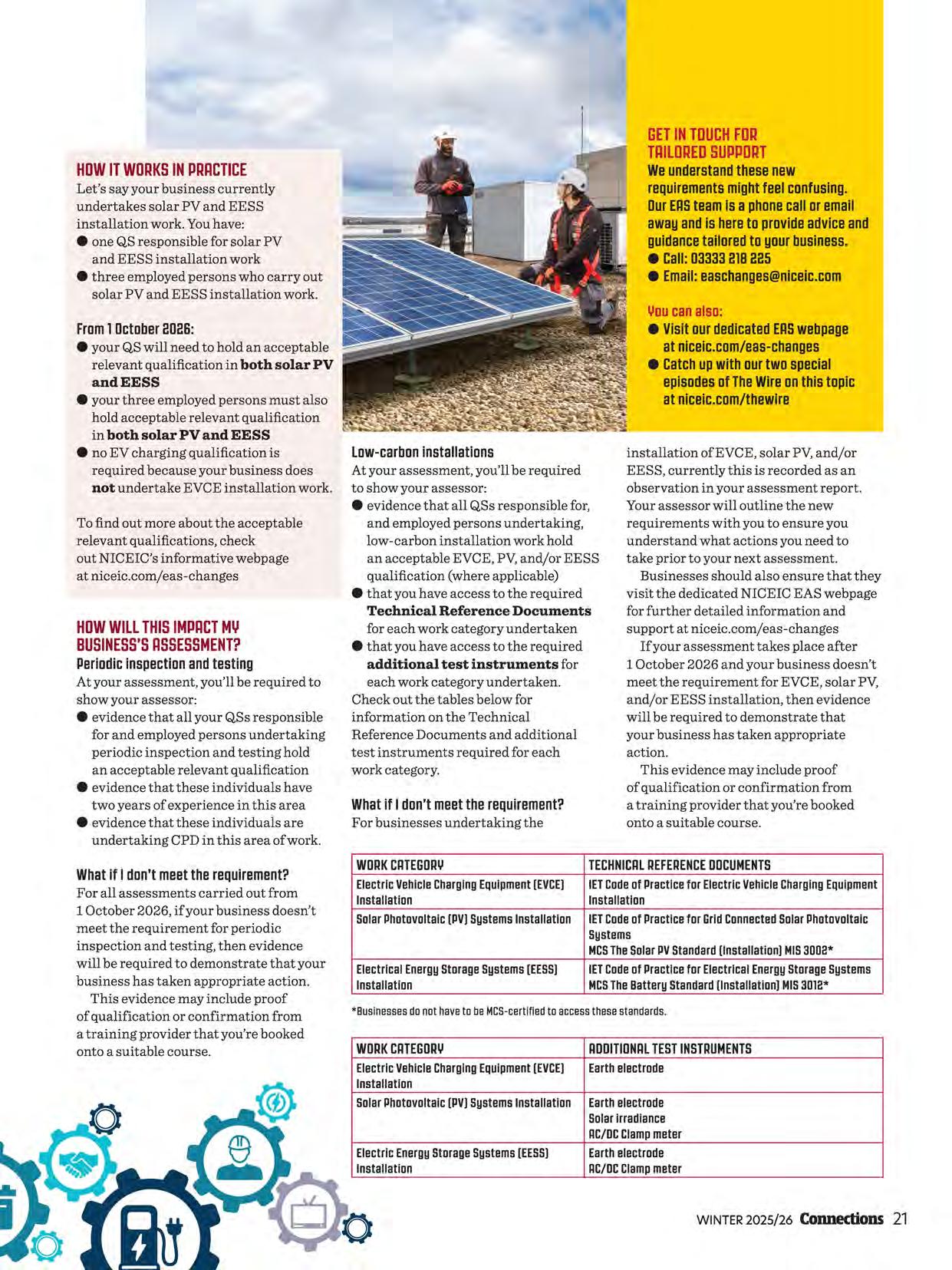
GETINTOUCHFDR
TAILOREDSUPPORT
Weunderstandthesenew requirementsmightfeelconfusing. Durmsteamisaphonecalloremail awayandisheretoprovideadviceand guidancetailoredtoyourbusiness. eCall:218225
• Email:easchanges@nlcelc.com
Voucanalso:
• Visitourdedicatedmswebpage atnlcelc.com/eas-changes
• Catchupwithourtwospecial episodesofTheWireonthistopic atniceic.com/thewire
Low-carboninstallations
At your assessment, you'll be required to show your assessor:
• evidence that all QSs responsible for, and employed persons undertaking, low-carbon installation work hold
• that you have access to the required Technical Reference Documents for each work category undertaken
installation ofEVCE, solar PV, and/or EESS, currently this is recorded as an observation in your assessment report. Your assessor will outline the new requirements with you to ensure you understand what actions you need to take prior to your next assessment. an acceptable EVCE, PV, and/or EESS qualification (where applicable) Businesses should also ensure that they visit the dedicated NICEIC EAS webpage for further detailed information and support at niceic.com/eas-changes
• that you have access to the required additional test instruments for each work category undertaken. Check out the tables below for information on the Technical Reference Documents and additional test instruments required for each work category.
WhatifIdon'tmeettherequirement?
For businesses undertaking the
WORKCATEGDRV
ElectricVehicleChargingEquipment[EVCEJ Installation
SolarPhotovoltaic[PVJSystemsInstallation
ElectricalEnergyStorageSystems[EESSJ Installation
If your assessment takes place after 1 October 2026 and your business doesn't meet the requirement for EVCE, solar PV, and/or EESS installation, then evidence will be required to demonstrate that your business has taken appropriate action.
This evidence may include proof of qualification or confirmation from a training provider that you're booked onto a suitable course.
TECHNICALREFERENCEDOCUMENTS
IETCodeofPracticeforElectricVehicleChargingEquipment Installation
IETCodeofPracticeforGridConnectedSolarPhotovoltaic Systems
MCSTheSolarPVStandard[Installation)MIS300i!*
IETCodeofPracticeforElectricalEnergyStorageSystems MCSTheBatteryStandard[Installation)MIS30li!*
*Businessesda nat haveta be MCS-certifiedta accessthese standards.
WORKCATEGDRVADDITIONALTESTINSTRUMENTS
ElectricVehicleChargingEquipment[EVCEJEarthelectrode Installation
SolarPhotovoltaic[PVJSystemsInstallationEarthelectrode Solarirradiance RC/DCClampmeter
ElectricEnergyStorageSystems[EESSJEarthelectrode InstallationRC/DCClampmeter

WatchTheWireCPD-accreditedwebinars live or on-demand with over 50 hours of trusted content covering essentials like EICRcoding, renewables, and regulatory updates.
JointheNICEICliveTechnicalQ&As across Facebook, Linked In, and YouTube every month, to connect with our experts and engage with your peers in real time.
Prefertomeetinperson?
Following the success of last year's inaugural CPD event, NICEIC Tech live, we're delighted to announce two brand-new events coming your way in 2026:
• NICEICTechliveSurrey: Thursday 11 June 2026
Venue: Mercedes-Benz World, Weybridge
• NICEICTechliveSheffield: Wednesday 30 September 2026
Venue: Magna, Rotherham
Book your place now at: niceic.com/events
NVDCHRNGES ONTHE HORIZON ...
RuthDevine,ChairofTheElectrotechnicalSkillsPartnership [TESPJ,givesanoverviewofupcomingchangestothe industryNVOandanswerssomekeyquestions.
From later this year, if you or one of your team want to enrol on the industry National Vocational Qualification (NVQ), you'll follow a slightly different route.
Until recently, there have been two main NVQs for the industry:
• Level 3 Diploma in Installing Electrotechnical Systems and Equipment (Buildings, Structures and the Environment) EAL 501/1605/8, C&G 501/2232/0 (2357-13/91)
• City & Guilds Level 3 NVQ Diploma in Electrotechnical Services (Electrical Maintenance 501/1624/1 (2357-23/92).
However, since the introduction of the Installation & Maintenance apprenticeship standard and the Experienced Worker Assessment (EWA), theNVQhasn'tbeenin alignment with either qualification, both in terms of up-to-date content and how it was assessed.
To address this, and to ensure everyone is trained and assessed to the same standard, the two NVQs are being phased out. Instead, those who would normally complete the NVQ will now follow a new route in the Level 3 Electrotechnical or Electrotechnical in Dwellings qualifications.
This will deliver parity and updated content across the three recognised industry routes (apprenticeships,

EWA and self-funded/non -apprentice learners), in line with industry competence and Building Safety requirements, to ensure all learners are being assessed to the same standard.
WHVISTHISBEINGINTRODUCED?
The new pathway will make it easier to map and credit achievement where learners change training routes, and will help centres to deliver training to apprentices and non-apprentices alike more efficiently.
WHODOESITAFFECT?
This is for non-apprentice/self-funded learners who would have traditionally completed the current industry Level 3 NVQ. It doesn't affect apprentices or those on the EWA.
WHAT'SNEWABOUTIT?
The new pathways will also have an updated assessment strategy to support holistic assessment using a range of evidence, with direct observation across a wider range of workplace performance units, rather than the current focus on health and safety. The requirement for one in-person assessment remains. Others can be conducted virtually and live-streamed.
To ensure the robust acquisition of skills in a range of work environments and application of knowledge, it's
Thisisfornon-apprentice/ self-fundedlearnerswho wouldhavetraditional! completedthecurrent industrLevel3NVO.
expected that the Installation & Maintenance Electrician pathway will take a minimum of 24 months to complete and the Domestic Electrician pathway 18 months. EQA approval must be obtained before registration, where it's anticipated that learners may complete more quickly. NET will additionally monitor timescales at AM2 gateway.
Enhanced documentation will be introduced before learners are registered to confirm that they have access to appropriate employment/work and to generate the evidence required.
WHATABOUTTHEAM2?
The industry end assessment, the AM2, will take place after achievement of the qualification, as is the case for other industry training routes.
TIMESCALESFORINTRODUCTION
The new pathways are due to be introduced from 1 May 2026, with registrations on the Level 3 NVQ closing on 31 October 2026.

ICONDESKTOP MODULES
Distinctive, modern desktop modules with two individually switched UK power sockets and integral USBA and USB C charging ports as standard
Thelatesthowlers spattedbyvigilantreaders.
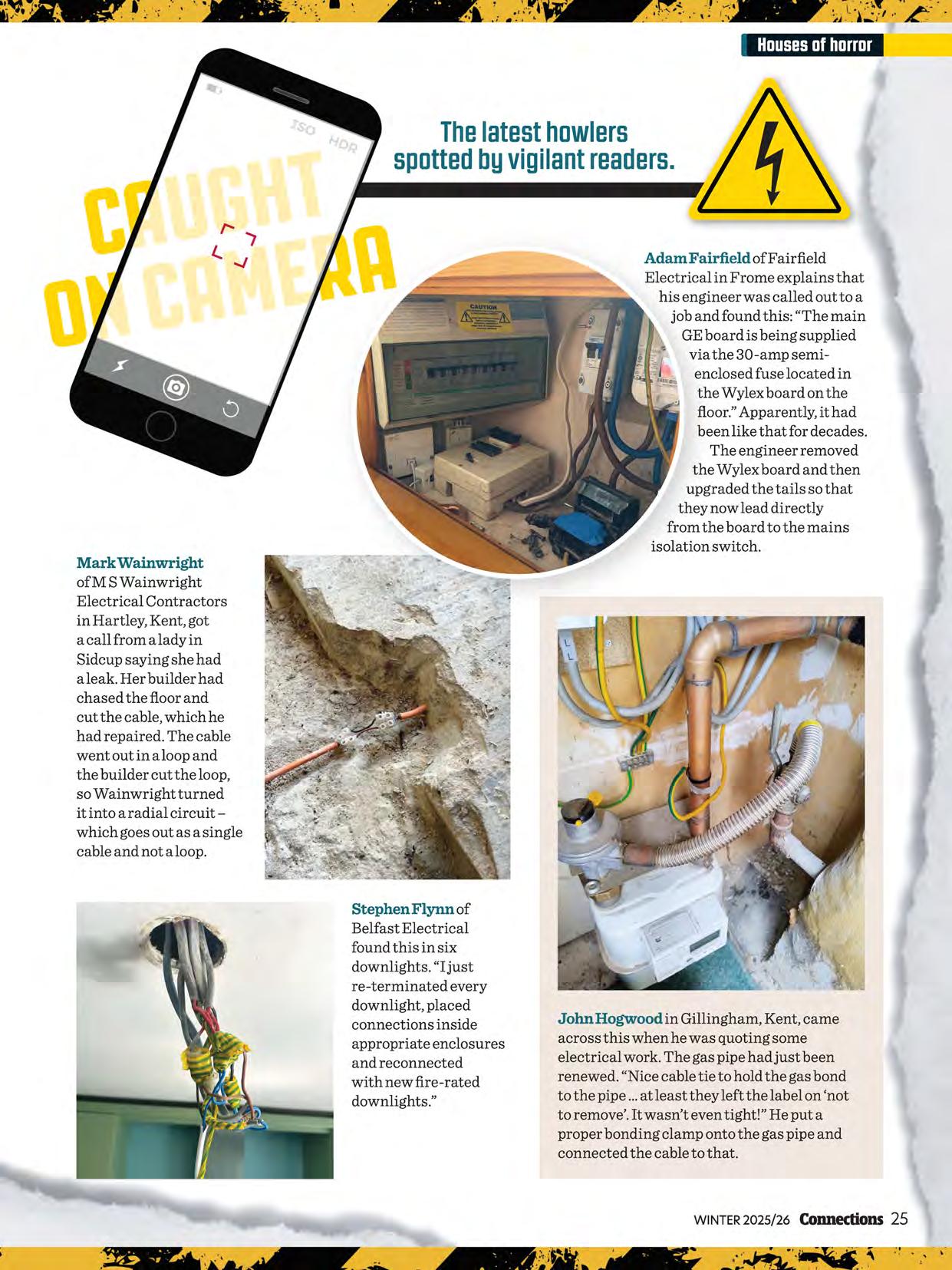
Adam Fairfield of Fairfield Electrical in Frame explains that his engineer was called outto a job and found this: "The main GE board is being supplied via the 30-amp semienclosed fuse located in the Wylex board on the floor." Apparently, it had been like that for decades. The engineer removed the Wylex board and then upgraded the tails so that they now lead directly from the board to the mains isolation switch.
Mark Wainwright
ofM S Wainwright Electrical Contractors in Hartley, Kent, got a call from a lady in Sidcup saying she had a leak. Her builder had chased the floor and cut the cable, which he had repaired. The cable went out in a loop and the builder cut the loop, so Wainwright turned it into a radial circuitwhich goes out as a single cable and not a loop.
Stephen Flynn of Belfast Electrical found this in six downlights. "Ijust re-terminated every downlight, placed connections inside appropriate enclosures and reconnected with new fire-rated downlights."
JohnHogwoodin Gillingham, Kent, came across this when he was quoting some electrical work. The gas pipe had just been renewed. "Nice cable tie to hold the gas bond to the pipe ...at least they left the label on 'not to remove'. It wasn't even tight!" He put a proper bonding clamp onto the gas pipe and connected the cable to that.
AtNICEIC,we'vebeenprovidingtrainingtothe electrotechnicalindustryformorethan20years,pairing technicalexpertisewithinnovativetrainingsolutionsto helpelectriciansandtheirbusinessesstayahead.
Preparing for another year in business can leave you with questions about how to best invest in learning and development. Working with a credible training partner and familiar brand gives you the confidence that your investment is well made.
• Expert-ledcourses: designed by industry leaders to keep you safe, compliant and competitive.
• Future-proofyourbusiness: our diverse range of training gives you the tools to grow your business and unlock new opportunities.
• Flexiblelearning: choose classroom, virtual, e-learning, or bespoke training for your team.
• Trustedbyprofessionals: when you train with NICEIC, you're investing in quality, credibility and growth.
Exclusive10%offtrainingcourses* • for NICEIC-certified businesses.
*Discount code available via your customer portal.

6,500+
500+ delegates trained in 2025 courses delivered
50 courses and + qualifications
Level3AwardinPeriodic InspectionandTestingof ElectricalInstallations(2391-51)
Our tutor Lee was great. An informative course and thorough preparation for City & Guilds exam, assessment and tests. Good facilities, coffee and nice lunches."
December17,2025
l'll'll'll'll'l by GH
*Trustpilot
NICEICis rated Excellent based on 446 reviews
ANNIVERSARV CERTIFICATES CONGRATULATIONS
Here are the latest long-standing NICEIC-certified businesses to be awarded with an anniversary certificate.
Certificates are our way of celebrating the loyalty and dedication of our NICEIC-certified businesses, which continue to shine and demonstrate their excellence. Each certified business celebrating a key anniversary is awarded with a new-look, downloadable e-certificate and exclusive logo.
These e-certificates are emailed to customers celebrating their 5th, 10th, 15th, 20th, 25th, 30th, 40th, 50th and 60th anniversaries under schemes AC, DIS, MCS and CPS.
FROM031965:60VERASWITHNICEIC
COMPANV
Gasson 6 GreenLtd
CwmbranElectricalServicesLtd
GMLawrenceElectricalLtd
ColinPeacockLtd
llosindale6 SonLtd
llidleyBrothersLimited
KWGeddes
OuestedElectrical

LOCATION
WestSussex
Cwmbran
Northampton
Essex
Hull
Newcastle-upon-Tyne
Blackpool
Kent
FROM031975:50VERASWITHNICEIC
COMPANV
Chester'sElectrical
BGI[Electrical)Ltd
IJ Cannings 6 SonLtd
ChambersElectrical[Wolverhampton)Ltd
SPElectrical[Stroud)Ltd
SolentElectricalLtd
KeepsafeCo
MichaelDuinn[ElectricalContractors)Ltd
TomaxBuildingServicesLtd
Sissons6 AllenLtd
EWGeeLtd
KWallerElectricalContractorsLtd
GeorgeWalsh6 Co[Electrical)Ltd
HendersonBuilding6 ElectricalServicesLtd
CFlnkpen6 SonsLtd
SPBassElectricalContractors
TomlinsonLongstaffLtd
LOCATION
Eastlliding
Bedfordshire
Exeter
Wolverhampton
Gloucestershire
Southampton
NorthVorkshire
Jersey
Manchester
Leicestershire
Kent
EastSussex
Blackburn
Preston
Berwick-upon-Tweed
Hertfordshire
BishopAuckland

What made some of the NICEICcertifi.ed businesses stand out this year?
Elecomm:ECAContractoroftheVear [upto£45mturnover]
The South Yorkshire-based business services provider has clients in construction, utilities, retail, fit-out and retirement housing. It employs about 140 people, including 36 in its electrical services arm.
"ECA membership and NICEIC certification have been key to our growth," says Elecomm Managing Director, Justin Wolvin. "They provide invaluable industry insights, technical guidance and credibility with our clients, enabling us to maintain best practice across all our projects."
West&West:ECAContractor of theVear[upto£15mturnover] andBestClientPartnership
Mother-and-son team Eve and Daniel West founded double-award-winner West & West in Oxford in 2009. It now employs about 40 people and focuses on commercial projects.
Associate Director for Innovation, Gareth du Plessis, points out that the company won Contractor of the Year in the up to £5 million category in 2019. "To win now in a larger category shows how much the team has developed," he says. "Being ECA members and NICEIC-certified sits at the heart of that -these accreditations set the benchmark for professionalism, safety and technical quality."
West & West's work at the library of Exeter College, one of Oxford University's oldest colleges, persuaded the judges to give them the Best Client Partnership award.
The full electrical upgrade, delivered with Beard Construction, involved a huge increase in the building's cable capacity, and installation of bespoke lighting and new life safety systems -all without disturbing the original timber, panelling or stonework.
"The project brought together early planning, clear communication, respect for the heritage setting, and a commitment to quality and safety," says Du Plessis.
"This award reflects a partnership built on trust, competence and mutual respect."
NorthEastInstallations[NEI): ECRContractoroftheVear[up to£Smturnover]
Founded in 2013, Newcastle-based NEI focuses on commercial services, along with hospitals and clinics. The 31-strong company includes 20 electricians, five apprentices and one adult trainee. The judges praised NEI's collaborative approach to supply chain management, its commitment to environmental sustainability and its technical excellence.
"The award gives our clients extra confidence in our capabilities and it's great to see our team's dedication recognised," says NEI Contracts Manager, Gary Bellerby. "We see this as motivation to keep improving standards and encouraging more young people into the electrical trade."
O'ConnorElectrical:ECAContractor oftheVear[uptoElmturnover]
Managing Director, Tim O'Connor, founded the business in Hilton, Derbyshire, in 1983. It employs 21 people, including O'Connor's son Luke, and carries out domestic and commercial work.
O'Connor says 2025 was probably the last chance for the business to win this award, because its turnover should exceed the £1m limit in the next year.
"We couldn't have done this without the team we've got now," O'Connor says, "We're at a turning point in our business, looking to create a culture for success."
BSNElectrical:BestNewBusiness
Formed in October 2023, this is a standalone electrical services business but also a member of Midlands-based construction and building services provider, BSN Group. Clients have included Birmingham Women's and Children's Hospitals and the University of Birmingham. But it was its work at All Saints Community Centre in Kings Heath in particular that impressed the judges.
BSN delivered a full electrical upgrade -including specialist equipment and new fire alarm and security systems -for resident performing arts facility, CircusMash, while keeping disruption to an absolute minimum. The team also supported the centre by working with
"Theawardgivesour clientsextraconfidence inourcapabilitiesandit's greattoseeourteam's dedicationrecognised."
GaryBellerby,NEI
adults with learning disabilities who are looking for paid employment. "It became more than just a job," says Electrical Director, Mark Barrow. "We've become part of that community."
He says of the win: "It's had commercial benefits, but the big thing has been validation for the staff: their efforts have been rewarded."
LifetimeElectricalServices:Best NewBusiness[highlycommended]
Jonah Butterworth, Founder and Director of West Yorkshire-based Lifetime Electrical Services, has worked as an electrician since leaving school 18 years ago. He set up Lifetime after returning to the UK from Australia in 2023. Much of its work is for domestic customers, but it's expanding into commercial work.
"We're a newly established company with big ambitions. To receive this recognition so early on is humbling and motivating," Butterworth says. "It validates all the hard work we've put into building a business based on trust, quality and care for our clients."
PaulTurner:FSAIndustryAward forOutstandingContributiontothe FireDetectionandAlarmsIndustry
Turner is a fire safety consultant and expert, Lead Auditor for BAFE, and an NICEIC Assessor. The judges noted that in a career spanning more than 40 years, Turner has mentored countless professionals and played a key role in raising standards, and that he's generally known for his integrity, expertise and love for the industry.
"It was a very nice surprise!"
Turner says. "There are lots of awards ceremonies, but they're not often about individuals or smaller companies. These awards are a nice way to recognise what I think is a healthy industry."
Reachingthe
SkillELECTRIC final takesdedicationfrom thecandidatesand theiremployers.This year,PaulThompson asksthebosseshow theydidit.
InNovember, some of the UK's finest young electricians headed to South Wales to battle it out for the coveted SkillELECTRIC title.
For contestants, it's the chance to pit their wits against their contemporaries from across the country and pick up some impressive prizes. But for employers, what's the attraction of supporting their candidate through the rigorous testing and examination process that culminates in the final?
Being able to say you have the UK's 'best apprentice electrician' in your armoury must be a boost for a business. At the very least, to the untrained customer, it hints at your firm's competency, while for those clients embedded in the supply chain it highlights the robustness of

your corporate social responsibility (CSR) regime, along with continuing professional development (CPD).
Once again, apprentices from NICEIC-certified businesses dominated at the SkillELECTRIC final, held this year at Bridgend College's Pencoed campus.
THEEMPLOIJERS'EXPERIENCE
IanCampbell:DirectoratCampbell 6 McHardy,Elgin,Moray
• Goldmedallist:EllisStevenson, thefirst-everfemaleSkillELECTRIC champion
• College/trainingprovider: UHiMoray/SECTT
"Ellis has been a breath of fresh air since she started with us," says Campbell. "So when she said she'd like to enter the SkillELECTRIC competition, all we could do was support her through the process."
That support included ensuring Stevenson shadowed colleagues working on aspects where she had less experience. "As a business, we cover a wide range of the electrical sector, so finding projects for her to gain
experience in certain things, such as EV charging, was never an issue. She hadn't had much experience on the testing side of things but we worked around that," says Campbell.
As well as the boost to Stevenson's career, her run in the competition has given the firm indirect benefits, like the publicity of her progression. "We've had other potential apprentices approach us and it's always nice to been seen as a supportive employer," Campbell says. "We've been in the business for over 50 years, so we're well known by our customer base already, but taking on and supporting our apprentices does help us -and some of our customers -to meet any CPD or CSR requirements."
MiguelGomez:DirectoratMcDonald 6 Munro,Elgin,Moray
• Silvermedallist:AdamSouter
• College/trainingprovider: UHiMoray/SECTT
"There are advantages to having one of your apprentices do so well in competitions like SkillELECTRIC, and disadvantages too," says Gomez. "There's a lot oftime away from the business for training and competition, but the benefits are their overall development and the quality of the training. One of our apprentices won the title in 2022, so we were well aware of what it takes to compete. Fortunately, we have a wide variety of clients and customers, so we can offer our apprentices experience in all aspects of electrical installation."

FredBrant:ContractsManager at EastGoscoteElectrical,EastGoscote, Leicestershire
• Bronzemedallist:Fabian Maciejewski
• College/trainingprovider: LeicesterCollege
This is Maciejewski's second consecutive year as a finalist. "I don't think we really understood what SkillELECTRIC was last year," says Brant. "Obviously, that has changed completely. For Fabian, it's been a huge confidence boost and it's given our other apprentices an idea of the standards they need to attain. For us, it's meant that, in our 50th year of being NICEIC-certified, we can show how well we manage our apprentices and keep on top of their CPD."
Skills

RichardGilmour:Directorat Nugent,Pomeroy,CountyTyrone
• Highlycommended: EwanForsythe
• College/trainingprovider: BelfastMet
"We're strong supporters of the whole competition," Gilmour says. "The candidates have to take quite some time out of the business but we think that's a small sacrifice to make."
Gilmour points out that Nugent had to ensure that Forsythe had gained the necessary experience in some areas -particularly inspection and testing.
"We cover most of the tasks they're tested on," he says, "but we worked in tandem with Ewan's college lecturers to ensure he was properly prepared."
BenCorke:DirectoratFellawes Electrical,Knadishall,Suffolk
• Finalist:JaneTharp
• College/trainingprovider: SuffolkNewCollege
For Corke, supporting Thorp through SkillELECTRIC was a way to underline his firm's commitment to the development of all its apprentices and the wider industry. "We try to foster an environment where our apprentices and staff want to come into work. We review all our employees and support them wherever we can in decisions they make about the direction of their careers," he says.
"We had her on a few renewables projects and we were confident in her level of understanding of those. Between us and the college, we were able to cover most of the aspects she would experience," he says.
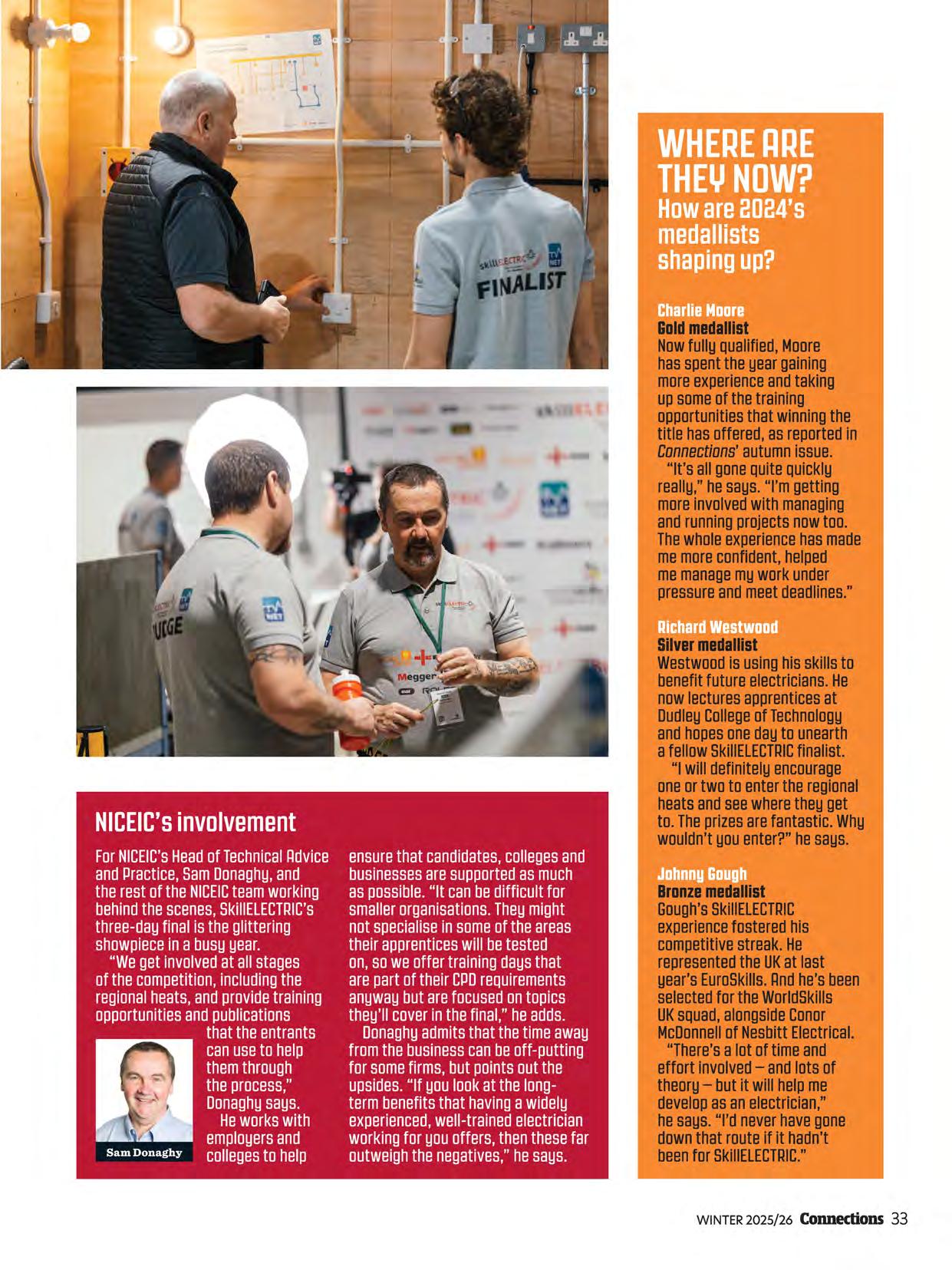
Goldmedalllst
Nowfullyqualified,Moore hasspenttheyeargaining moreexperienceandtaking upsomeof thetraining opportunitiesthatwinningthe title hasoffered,asreportedin Cannectians'autumnissue.
"It's all gonequitequickly really,"hesays.''I'mgetting moreinvolvedwith managing andrunningprojectsnowtoo. Thewholeexperiencehasmade memoreconfident,helped memanagemyworkunder pressureandmeetdeadlines."
Silvermedallist
Westwoodis usinghisskillsto benefitfutureelectricians.He nowlecturesapprenticesat DudleyCollegeof Technology andhopesonedayto unearth a fellowSkillELECrnlCfinalist.
"I will definitelyencourage oneortwoto entertheregional heatsandseewheretheyget to. Theprizesarefantastic.Why wouldn'tyouenter?"hesays.
Bronzemedallist
Gough'sSkillELECrnlC experiencefosteredhis competitivestreak.He representedthe UKat last year'sEuroSkills.Andhe'sbeen selectedfor theWorldSkills UKsquad,alongsideConor McDonnell of NesbittElectrical.
"There'sa lot of timeand effortinvolved-andlotsof theory-butit will helpme developasanelectrician," hesays."I'd neverhavegone downthat routeif it hadn't beenfor SkillELECrnlC."
THEFUTURE IS AUTOMATED
Inoursecondfeatureexploring ,thefutureofconstruction,weask whatimpactrobotsandAlwillhave 10yearsfromnow,andwhatthat couldmeanfarelectricians.
By Clare Dowdy

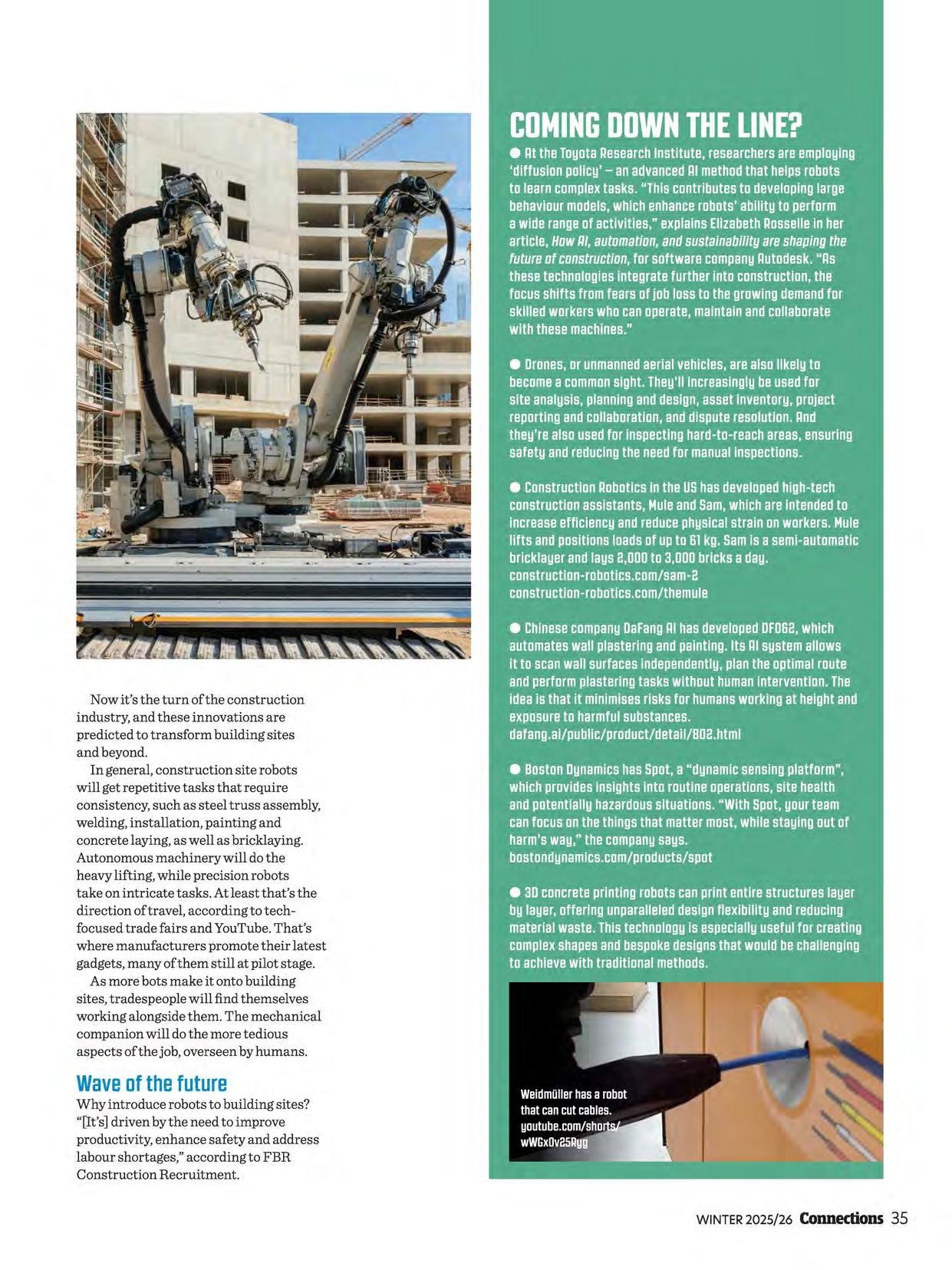
magine a robot that can lay bricks. No need to use your imagination, as there are several such gadgets already out there.
They typically work like this: while one "arm" lifts the brick into place, the second, which ends in a trowel rather than a hand, slaps on the mortar in place. And so on and soon.
Many sectors -from Amazon fulfilment centres to car manufacturers -have long seen such automation.
Drones,munmannedaerialvehicles,arealsolikelyto
construction-robotics.com/sam-2 construction-robotics.com/themule ChinesecompanyDaFangAl
Now it's the turn of the construction industry, and these innovations are predicted to transform building sites and beyond.
In general, construction site robots will get repetitive tasks that require consistency, such as steel truss assembly, welding, installation, painting and concrete laying, as well as bricklaying. Autonomous machinery will do the heavy lifting, while precision robots take on intricate tasks. At least that's the direction of travel, according to techfocused trade fairs and YouTube. That's where manufacturers promote their latest gadgets, many of them still at pilot stage.
As more bots make it onto building sites, tradespeople will find themselves working alongside them. The mechanical companion will do the more tedious aspects of the job, overseen by humans.
Waveofthefuture
Why introduce robots to building sites? "[It's] driven by the need to improve productivity, enhance safety and address labour shortages," according to FER Construction Recruitment.
30concreteprintingrobotscanprintentirestructureslayer
Construction News backs this up. "A shortage of skilled workers results in project delays and rising costs," it reports. And according to the UK Trade Skills Index, 35% of the construction and trades workforce is aged over 50, so a bigger problem looms as this cohort comes up for retirement.
While robots appear to be super-efficient at trade fairs, those slick environments don't reflect reality. "I've seen robots being used to install plasterboard," says NICEIC's Technical Director, Paul Collins. "If you've got a really nice, clean square room, I can see that working."
But as any tradesperson knows, a lot of work can't be replaced by robots because it's site-specific, and site conditions can change from one day to the next.
However, 10 years is a long time in construction. Daniel Ashville, founder of Ashville Construction, specialises in luxury domestic projects. His YouTube channel has 554,000 subscribers and he hosts TV show Building Impossible with Daniel Ashville on National Geographic, which showcases challenging construction and engineering projects around the world.
Ashville is sceptical about how far bots could tread on electricians' toes. "I can't see bots on the floor between levels pulling cables," Ashville says, "But then again, in 10 years' time, who knows?"
Changingthegame
Meanwhile, AI is making its way onto sites via machine learning algorithms, virtual construction management software and the like.
AI, particularly through machine learning, is expected to play an increasingly crucial role in construction and engineering by using statistical methods to analyse data. This analysis helps to identify patterns and provide insights, assisting firms in better risk assessment and project planning.
But on traditional construction sites, Ashville believes AI's impact on the electrical industry would be limited.
"I can see AI having input at the design stage [of a construction project] but not at installation stage, because when you're carrying out your electrical work, you want to be able to stand by it. And at the point where you include AI for electrical

"Theroleofhumans in supervising,checking andtestingwill becomeallthe moreimportant."
TIMRNDnnHRRKNESS,RUTHDn, TECHNOLOGl,I IS NOTTHEPROBLEM
installations, nobody's going to give a guarantee or a warranty or sign-off. Why would they?"
Daron Acemoglu, a professor at MIT and a winner of the Nobel Prize in economics, is optimistic about 'pro-worker AI'. He describes this in the Financial Times as "enabling [workers] to obtain and use better information relevant to their tasks and helping them become more productive and essential for the production process".
In his optimism, Acemoglu even singles out the electrotechnical industry. "Proworker AI ...can help us have much better electricians (with the help of AI tools that enable them to expand their repertoires, understand new electrical equipment and become much better at troubleshooting problems)."
So while robotics won't replace the electrotechnical trade, it will bring about changes. Likewise, AI's emerging
technologies will shift how jobs are planned and decisions are made.
Whatdoesthismean forhumans?
Many in the industry believe the integration ofrobotics is enhancing job opportunities for construction workers, reshaping roles and creating new career paths while transforming traditional tasks.
"Running cables and pipes are also '!J ideally suited to specialised machines E that can translate digital 3D models into OJ ] physical reality," says Timandra Harkness, "' author of Technology is Not the Problem. -;:;..'!l
8 s "" "The role of humans in supervising, checking and testing will become all the more important when robots have done the donkey work."
< The benefits are seen as improved safety and efficiency, with robots taking on dangerous and physically demanding ·gtasks; skill development, as workers learn " 0 -~ " 0 0 to operate, programme and maintain these machines; more jobs for technicians, programmers, and engineers who specialise in robotics and automation technologies; and jobs completed more
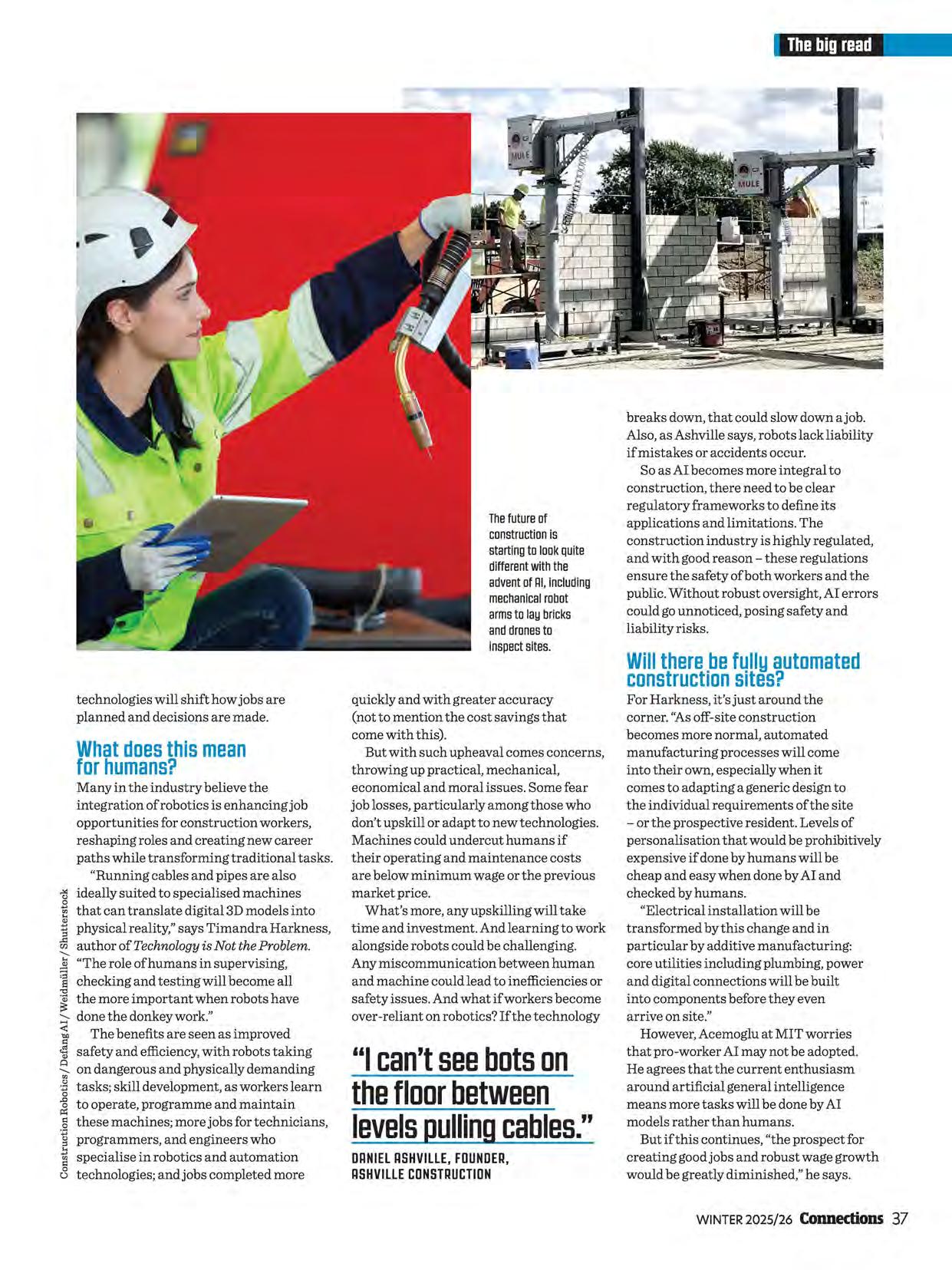
Thefutureof construction is startingtolookquite differentwiththe adventofAl,including mechanicalrobot armstolaybricks anddronesto inspectsites.
quickly and with greater accuracy (not to mention the cost savings that come with this).
But with such upheaval comes concerns, throwing up practical, mechanical, economical and moral issues. Some fear job losses, particularly among those who don't upskill or adapt to new technologies. Machines could undercut humans if their operating and maintenance costs are below minimum wage or the previous market price.
What's more, anyupskillingwill take time and investment. And learning to work alongside robots could be challenging. Any miscommunication between human and machine could lead to inefficiencies or safety issues. And what if workers become over-reliant on robotics? If the technology
"Ican'tseebotson
DANIELASHVILLE,FOUNDER,
breaks down, that could slow down a job. Also, as Ashville says, robots lack liability if mistakes or accidents occur.
So as AI becomes more integral to construction, there need to be clear regulatory frameworks to define its applications and limitations. The construction industry is highly regulated, and with good reason -these regulations ensure the safety of both workers and the public. Without robust oversight, AI errors could go unnoticed, posing safety and liability risks.
Willtherebefullyautomated constructionsites?
For Harkness, it's just around the corner. "As off-site construction becomes more normal, automated manufacturing processes will come into their own, especially when it comes to adapting a generic design to the individual requirements of the site -or the prospective resident. Levels of personalisation that would be prohibitively expensive if done by humans will be cheap and easy when done by AI and checked by humans.
"Electrical installation will be transformed by this change and in particular by additive manufacturing: core utilities including plumbing, power and digital connections will be built into components before they even arrive on site."
However, Acemoglu at MIT worries that pro-worker AI may not be adopted. He agrees that the current enthusiasm around artificial general intelligence means more tasks will be done by AI models rather than humans.
But if this continues, "the prospect for creating good jobs and robust wage growth would be greatly diminished," he says.
LOOKING BACKBUT MOVING FORWARD YEARS
Thisyear,wecelebrateNICEIC's 70thanniversaryandthankallthe businessesthathavegrownwithus.
Fram the 1950s, when the Clean Air Act was introduced following thousands of deaths during London's 'Great Smog', to the renewable energy boom of today, the NICEIC badge has been a constant. It's provided a benchmark for safety and technical integrity.
"We see turning 70 as a milestone for our organisation," says NICEIC's Technical Director, Paul Collins. "But we're more focused on all that the industry has achieved in that journey. Businesses have been built, apprentices have been trained, lowcarbon projects have been delivered and homes have been made safer. And throughout, NICEIC-certified businesses have taken a lead. In our anniversaryyear, we want to show our gratitude and highlight how much they have contributed."
To look back over NICEIC's history is to see an industry transformed. New technologies, smart homes and renewable energy have reshaped how we live, work and travel. "In post-war Britain, EV charge points or talking to a smart speaker would have seemed like science fiction," Collins says.
Consequently, demands on electrical contractors have grown. Customers expect more, safety standards keep evolving and new regulations redefine how contractors work
And none of this happens overnight. It takes hours of training, hands-on
Raising electrical standards since1956.
experience and a commitment to getting things right. For example, 2017's Grenfell Tower tragedy led to the Building Safety Act, bringing swathes of new regulation for the built environment.
Similarly, the Electrical Safety Standards in the private and social rented sectors introduced the mandatory requirement for Electrical Installation Condition Reports in rented properties. Awaab's Law, introduced in 2025, has tightened rules on electrical hazards in the social rented sector.
That sort of progress doesn't happen overnight -it's building on continuous learning and development. And when it comes to electrical installations, some things never change: strong technical skills and a commitment to professionalism remain as vital as ever.
"My colleagues and I are lucky as we have such a unique viewpoint," says Collins. "On a daily basis, we get to meet businesses who are carrying out exceptional work, creating thriving companies, and bringing on the next generation."
Lookingtothefuture
And a few of those businesses have been with NICEIC from the start, such as Edmiston Brown in Glasgow, which joined in 1957.
"We've seen huge changes in the world and on the job, with new tech,
regulations and ways of working," says Cameron Lister, Director at Edmiston Brown. He describes their NICEIC certification as "a mark of quality and professionalism that our customers recognise. If anything, it has become more valuable over time as we've moved from communities having access to just one or two local sparks, to the endless choice presented by online reviews and social media."
Adds Cameron: "No matter what the future brings, your name and your reputation are what the business lives or dies by. The fact people associate us with quality work is what's helped us survive and thrive over so many years."
More than 5,000 businesses have been certified with NICEIC for 20 years or more, a clear signal oflongterm thinking and business planning. It's also a sign ofbusinesses which are motivated to do things right.
While we're proud of our history, the future is our focus. Advances in electrification, smart technologies and sustainability are accelerating change, while new safety requirements are reshaping our industry.
But Collins points out that though technology changes, the basics stay the same. "Safety, competence and professionalism will always matter. Certification is how we make sure those principles stay at the heart of the industry."
Here's to the next 70 years of powering progress, together.

AMENDMENT4:GETREADV
The IET and BSI have confirmed that Amendment 4:2026 to BS 7671:2018 (the 18th Edition of the IET Wiring Regulations) will be published on 15 April 2026. The previous version, BS 7671:2018 +A2:2022+A3:2024, will be withdrawn six months later.
Amendment 4 will then become the definitive British Standard for all new low-voltage electrical installations, modifications to existing systems, and periodic inspection and testing. Businesses will be able to implement the amendment immediately on publication.
As an NICEIC-certified business, we'll provide you with a comprehensive programme of support to help you understand, interpret, and apply the changes from day one.
KeyhighlightsofAmendment 4
Amendment 4 introduces several important updates in response to advances in energy storage, digital technologies, and modern communication systems. The following points are the most notable changes.

• A new chapter on stationary secondary batteries where the purpose is for electrical storage and supply of electrical installations.
• A new section on functional earthing and functional equipotential bonding for information and communication technology equipment and systems.
• Anew section on power over Ethernet.
• Major revision ofSection 710 Medical Locations and the inclusion of a schedule of test results for recording the resistance of supplementary protective equipotential bonding conductors.
"Amendment4 brings the UK's electrical regulations up to date with advancing technology and arrives at a time of significant change for the electrotechnical sector," Paul Collins, NICEIC Technical Director, says. "These updates will enhance safety and professionalism across the sector, and NICEIC will ensure its certified businesses have the clarity, tools, and support they need to remain at the forefront of the industry."
Tailoredsupport
NICEIC will be ready with a wideranging package offree and exclusive resources from the moment Amendment 4 is released. Here's what's included.
• A CPD-accredited series of The Wire webinars, launching on 16April, available at niceic.com/thewire live or on-demand.
• Our Amendment4 hub, where you can access all the latest information and resources.
• Anew digital workbook, authored by NICEIC technical experts, to guide you through the practical application of Amendment 4.
• Updated and expanded Pocket Guides for quick, on-the-job reference.
• In-depth technical features in this and future issues of Connections.
• Specialist CPD sessions at NICEIC TechLive events in 2026 -visit niceic.com/techlive to sign up. (Note: tickets are chargeable.)
• A10% discount on Amendment 4 publications when pre-ordered via the NICEIC online shop. The discount code is available via your customer portal.
Trainingopportunitiesandearly-access savings
From 15April, all NICEIC 18th Edition qualifications will be fully updated to incorporate Amendment 4. And a full suite of CPD-accredited Amendment 4 training courses will be available in classroom, virtual, and e-learning formats. NICEIC-certified businesses can now pre-order all Amendment 4 qualifications and workshops via the NICEIC online shop. Whenpreordered, these courses include free digital guides designed to help you apply your learning immediately. Plus, there's a 15%discount on all Amendment 4 qualifications and training courses when you pre-order through ouronline shop. Visit shop.niceic.com/pages/18thedition-amendment-4
Ongoingsupport
You'll continue to have access to:
• live Technical Q&A sessions via our social media channels
• expert guidance at ElexShow and InstallerSHOW events
• regularupdatesacrossallNICEIC communication channels
• advice and guidance from the technical helpline via phone and email.
Findoutmore
To explore NICEIC's full range of Amendment 4 resources, visit: niceic.com/amendment-four
Tech LiQe 26
Surrey 11 June
Sheffield 30 September
Our inaugural TechLive event last October was such a hit that we're doing it not once but twice this year -at Mercedes-Benz World, Weybridge on 11 June, and at Rotherham's Magna on 30 September.
Like October's Bedford event, these two will be the ultimate in-person CPD resource, where certified businesses can meet our expert technical team, alongside peers and colleagues.
This will be a year of significant regulatory change, from Amendment 4 of the 18th Edition of the IET Wiring Regulations to updates to the Electrotechnical Assessment Specification (EAS).
Industry experts will also be on hand at our two 2026 events to provide you with the information and insight you need in one place, as well as the opportunity to complete five hours of CPD.
Howtobook
TechLive Bedford sold out, so book your tickets now to avoid disappointment.
To secure your place for either TechLive Sheffield or TechLive Surrey, visit niceic.com/techlive
Updates to the ElectrotechnicalAssessment Specification (EAS) will impact businesses which undertake periodic inspection and testing, and/or low-carbon installations.
• For more on how these changes will impact your assessment, turn to page 20.
• Visit niceic.com/eas-changes and two episodes of The Wire cover this: niceic.com/thewire
• For tailored support for your business, email easchanges@niceic.com or phone 0333 218 225.
GOVERNMENT PUBLISHESWARM HOMESPLAN
rj;0LI cvlNICEICwelcomesthe UK Government's recently announced Warm Homes Plan. The plan outlines £15 billion of public investment, with up to five million homes standing to benefit from upgrades including heat pumps, solar panels, and home batteries. The plan also outlines stronger protections for renters in both the private and social rented sectors.
Low-income households will be eligible for free upgrades, backed by £5 billion of public investment. The plan also includes zero and low interest loans for solar installations, and requires all new homes to be built with solar panels as standard under the Future Homes Standard.
There's also support for skills and workforce development, including funding to expand training and upskillingfor installers oflow-carbon technologies such as heat pumps, solar PV, and battery storage.
NICEIC Technical Director, Paul Collins, says the plan provides "much-needed certainty for householders, installers, and the industry."
He emphasises that large-scale investment will increase demand for high-quality renewable installations and give confidence to those who are consideringupskilling.
As always, NICEIC will work with our certified businesses to ensure they're fully informed about what the Warm Homes Plan means for them and how it may affect their business.
As more information and further details are published, we'll provide regular updates and guidance through our e-newsletters and social media channels, and in Connections magazine.
NORTHWALES TRAINING OFFER
NICEIC-certified contractors in North Walescanfutureprooftheir businesses with 50% funded training in lowcarbon installations.
From October 2026, new ElectrotechnicalAssessment Specification (EAS) rules will require electricians and qualified supervisors working on EV charging, solar PV or battery storage installations to hold specific Level 3 qualifications. This training offeris a cost-effective route to compliance.
The next courses take place in March in Wrexham. Email traininginfo@niceic.com and watch back our joint NICEIC and ECA webinars at niceic.com/thewire
NICEIC IN THE NEWS
Paul Collins, Technical Director, appeared on BBC One’s Rip-Off Britain on 22 January. Catch up on BBC iPlayer. We’re also continuing to highlight the importance of electrical safety at home in the press, sharing advice with householders on flooding and power cuts, and our Don’t do DIY campaign. More than 100 articles in The Sun, Daily Express, and local papers have amplified our message: always use an NICEIC-certified business. Never risk DIY electrics.
TAX REMINDER
Remember that Making Tax Digital for Income Tax will impact sole traders and self-employed individuals from April 2026. Read our blog for more details at niceic.com/mtdincome-tax or register for our special episode of The Wire on 24 February at niceic.com/thewire
NICEIC TO SPEAK AT INSTALLATION LIVE
DAREN POOL CHAIRS FSA
Congratulations to Daren Pool, Managing Director at NICEICcertified Triple Star Fire and Security Limited, who has become Chair of the Fire and Security Association (FSA).
NICEIC DELIVERS REWORKED MCS
UKAS has accredited NICEIC to offer the redeveloped Microgeneration Certification Scheme (MCS) installer certification scheme (MCS:2025). The changes aim to simplify the certification process, focusing on the quality of installations, enhancing consumer protection and streamlining technical standards.

ROOFTOP SOLAR
POLICY
The number of certified solar panel installations in 2025 surpassed 203,125 – the previous annual record set in 2011.
The government’s Clean Power Action Plan aims to increase the UK’s current solar capacity even further from 16.6 GW (Q2 2024) to 45 GW to 47 GW by 2030. According to estimates from the Department of Energy Security and Net Zero, the solar industry could need up to 35,000 jobs to support this target –double today’s number.
To help plug that gap, NICEIC offers Electrician Plus renewables courses, including the Level 3 Award in the Installation of Small Scale Solar Photovoltaic Systems. Visit shop.niceic.com/collections/ renewables-training

We’re working with MCS to move existing MCS-certified businesses smoothly across to the new scheme.
A recent episode of The Wire covers what the changes will mean for businesses. Catch up on demand at niceic.com/thewire or visit mcscertified.com for more.
NICEIC’s Head of Technical Advice and Practice, Sam Donaghy, and Head of Standards, Dani Putney, will speak at Electrical Safety First’s Electrical Installation Live: Wired for Tomorrow in April. The half-day event will explore how those in the industry can keep electrical installations safe, compliant and fit for the future.
The event is on 28 April in London. Visit electricalsafetyfirst.org.uk/seminar for more.


ELEXSHOW DATES
The NICEIC team will be making a splash at ElexShow, starting in Bolton on 5 and 6 March. Then it’s London’s Alexandra Palace on 26 and 27 March, Exeter on 23 and 24 April, and Harrogate on 14 and 15 May. More venues to follow in the autumn.

The next episodes of NICEIC’s The Wire webinar series are
EICR Coding Clinic on Thursday 26 February and BS 7671: how it’s produced on Thursday 12 March, both at 20:00. Visit niceic.com/ thewire to register. The below topics have already been covered:
● MCS redevelopment: what you need to know
● Unlocking Level 3: routes to achieving qualifications required by the EAS
● The Tools to Talk: the first in the new series of mental health support webinars.
You can catch up with each hour-long episode on-demand – visit niceic.com/thewire
THEKEVDUESTIDNS
UOU'VERECENTLUASKEDNICEIC'S TECHNICALHELPLINETEAM
Ourtechnicalengineershavetheanswersanconsumerunits, socket-outlets,andperiodicinspectionsandreporting.
Is it acceptable for me, as the electrical contractor, to remove the distributor's service fuse at the origin of an installation to find out its current rating?
No. Except in the rare circumstances where this is permitted by a formal agreement with the distributor, you must not remove the service fuse, whether to find out its current rating or for any other reason. The service fuse and its carrier are the distributor's property and positioned before the consumer's side means of isolation or fault protection. It therefore presents a direct risk of contact with live parts without any means of upstream protection afforded to the contractor. As such, the electrical contractor isn't authorised to interfere with this equipment.
Also, unauthorised removal ofrevenue seals may leave you, or the property owner or tenant, liable to prosecution in relation to alleged theft of energy (illegal abstraction). More importantly, it can be very dangerous to attempt to remove the service fuse if the service head has suffered damage or deterioration, particularly in the case of older pattern, metal-clad types.
Distributors' and meter operators' employees who are authorised to remove service fuses have received specific training on the appropriate procedures and on the hazards that may be present. These employees are also provided with a range of personal protective equipment, including full-face visors and specially designed gloves to provide both electrical insulation and physical protection from arcing and the like.

Can a circuit-breaker or RCBO be used as a means offunctional switching?
Circuit-breakers, RCDs, RCBOs, AFDDs and similar protective devices aren't intended to be used, and aren't suitable for, frequent load switching. Only infrequent use is acceptable (see note 5 to Table 537.4). As such, these protective devices shouldn't be selected as the primary means of functional switching.
Why is a code C2 recommended for the absence of certain forms of identification or labelling, whereas in other cases a code C3 is deemed to be appropriate?
Broadly speaking, where the absence of a warning or instruction notice might result in a potentially dangerous situation for those working on the electrical installation or using installed electrical equipment, allocation of a code C2 would be appropriate. However, where the absence of information won't present a danger to those for whom it was intended to inform, a code C3 would be sufficient, advising that remedial action would lead to some improvement in the safety of the electrical installation. In other cases, the absence of the required information won't warrant classification or reporting. Examples are given in the table below.
Examplesofconditionreportclassificationcodesrelatingtotheabsenceofidentificationandlabelling requiredbyBS7671.Thislistingisn't exhaustive.
Absenceof warningnotices Absenceof circuitidentification Switchlinesnotidentifiedas indicatingthe presenceof an detailsat distributionboards/ lineconductorsat terminations alternativeorsecondarysource consumerunits1514.9.1). (514.3). of supply,suchasa standby generatoror micro-generator (514.15.l).
Absenceof warningnoticeon Absenceof 'SafetyElectrical Circuitprotectiveconductors distributionboardsor combiner Connection-DoNotRemove' orfinalcircuitconductorsin boxesof a solarPVsystem, warningnoticeat required a consumerunitnotarranged indicatingthat livepartsmay locations(514.13.l). ormarkedsothattheycanbe still beenergisedafter isolation identifiedfor inspection,testing fromthe PVinverter(718.514.lDi!J. oralterationoftheinstallation (514.3).
AbsenceofwarningnoticeAbsenceofsix-monthlytestAbsenceofinformationfor whereequipmentcontainsinstructionnoticewherel!CDstheinstallationadvisingof livepartswhicharen'tcapablearepresentin theinstallationthepresenceofSPDsorother ofbeingisolatedbyasingle(514.li!.i!).equipmentthatmaybedamaged device1514.11.1).bytestingoraffectthevalidityof theresultsobtained(514.9.1[iv).
It should be noted that, in the case of domestic (household) premises, the following need not be applied where the certification for the installation includes the necessary guidance for recipients:
• diagrams, charts or tables providing circuit information (514.9)
• periodic inspection and testing notice (514.12.1)
• RCD test button notice (514.12.2)
• presence ofSPD(s) notice (514.16.1).
How can I find the rating of the distributor's service fuse?
You might be able to find the rating (and type) of the distributor's service fuse from the Electrical Installation Certificate or from an Electrical Installation Condition Report on the installation.
Otherwise, you could contact the distributor and request this information. The distributor has an obligation to provide you with a written statement of the type and rating of the service fuse and certain other information, if you can show reasonable cause for needing it (such as for use in connection with the design, certification or inspection and testing of the installation).
The obligation for the distributor to provide the information is set out in regulation 28 (and particularly indent c) of the Electricity Safety, Quality and Continuity Regulations 2002. If the energy meter has been replaced recently, there may be a label on the fuse carrier indicating the rating of the service fuse. If this is used when completing a report, the source of this information should be noted.
In the absence of more accurate information being available, typically from the relevant distributor, the Energy Networks Association advise, in their publication, Distribution Network Operator Cut-out Types & Ratings Guidance, that for:
• cut-outs installed from the 1960s to the present; and
• metal-clad cut-outs from the 1940s to 1960s in good condition that it should be assumed that the fuse rating in the cut-out is 60 A.

Whetheryou'reanewentranttotheelectrotechnical world,oranexperiencedprofessional,we'rehereto supportyouasyounavigatethechangesinAmendment4.
The NICEIC'son line shop is now open for 18th Edition Amendment 4 pre-orders, with new and updated training courses, and a range of NICEICand IET publications to help you get ready for 15 April 2026.
Choose from a suite of 18th Edition Level 3 qualifications and CPD-accredited training in classroom, virtual and e-learning formats, giving you the flexibility to train in a way that suits your schedule.

PLUG-TD-PLUG 'WIDDWMAKEA'LEADS
Objective:There have been a number of reports recently of mobile catering units being supplied via flexible leads having plugs with exposed live pins fitted to both ends. This practice, which is a major non-conformance with the requirements of Section 717 of BS 7671,is not only dangerous but also a breach of health and safety legislation. This article describes the dangers that may arise from employing these leads in this situation (and indeed other applications) and explains the requirements for the safe supply of such units.
Thedangers
A conventional and properly constructed extension/connection cable comprises the flexible cable with a plug at one end and a portable socket-outlet at the other (Fig 2). When the plug end is connected to the source of supply, it isn't possible in reasonable usage to contact live parts. When an extension cable with a plug at both ends is connected to a source of supply which is energised, the exposed live pins are readily accessible to touch, presenting a danger to persons, as defined in Regulation 2 of the Electricity at Work Regulations 1989 1 (EWR).
Introduction
When a mo bile catering unit is in use, it will take an electrical supply from either an outlet at the venue or from a generator, which may be either within or external to the unit. This article focuses on the means of connection to supplies from the venue or from external generators. The requirements for such supplies are given in Section 717 ofBS 7671 (mobile and transportable units). It's importantthat the means of supply doesn't present an electric shock risk when the connection is made while the unit is in use and when it's disconnected.
Alarmingly, it appears that some catering vehicles are being fitted with socket-outlets for connection of the supply cable, requiring the use ofplug-toplug leads. The warning notice opposite (see box) is an example safety notice issued highlighting this dangerous practice. Fig 1 shows a catering unit incorrectly fitted with a socket-outlet.
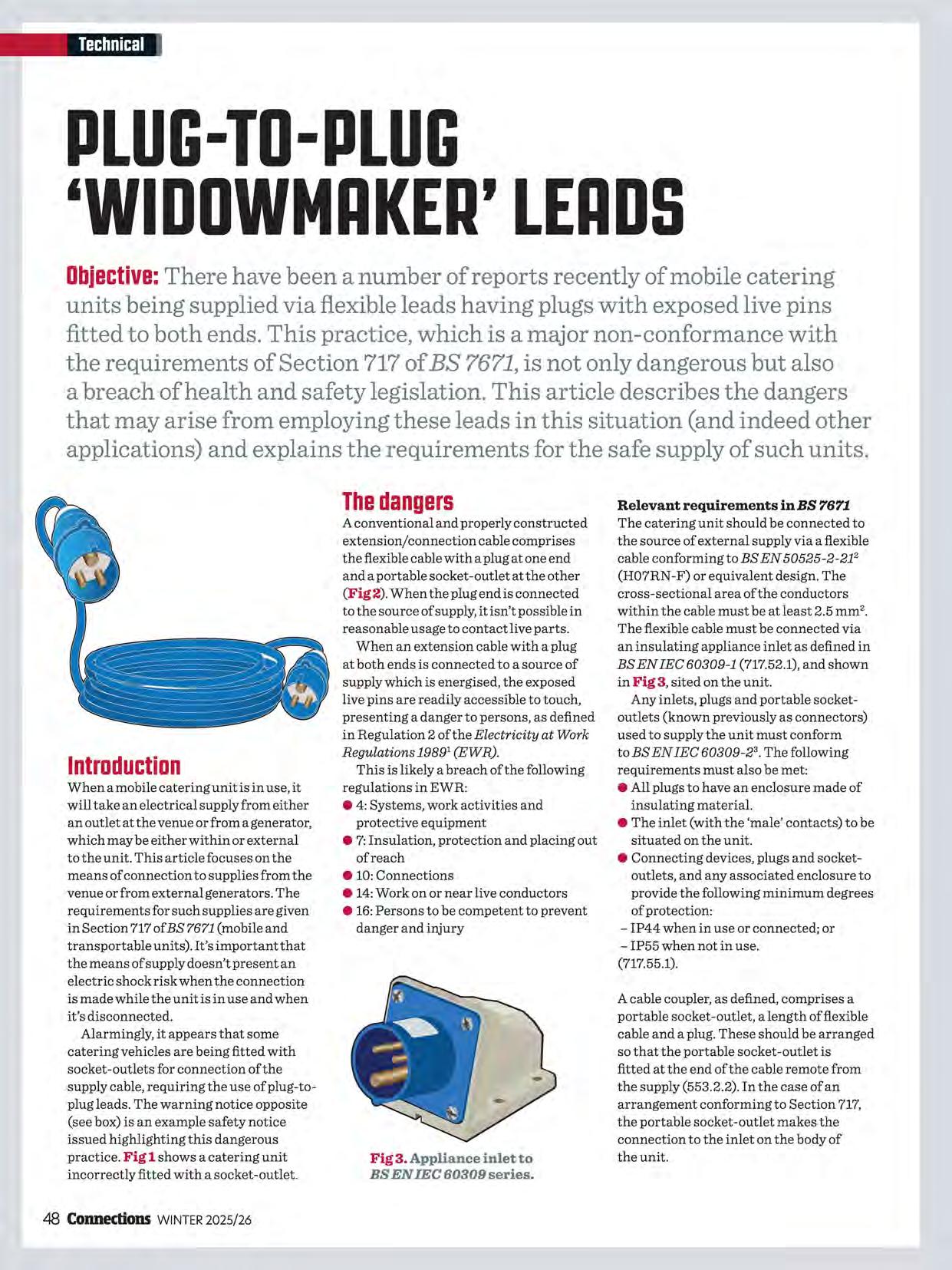
This is likely a breach of the following regulations in EWR:
• 4: Systems, work activities and protective equipment
• 7: Insulation, protection and placing out ofreach
• 10: Connections
• 14: Work on or near live conductors
• 16: Persons to be competent to prevent danger and injury
Relevant requirements in BS 7671
The catering unit should be connected to the source of external supply via a flexible cable conforming to BS EN 50525-2-21" (H07RN-F) or equivalent design. The cross-sectional area of the conductors within the cable must be at least 2.5 mm 2. The flexible cable must be connected via an insulating appliance inlet as defined in BS EN IEC 60309-1 (717.52.1), and shown in Fig 3, sited on the unit.
Any inlets, plugs and portable socketoutlets (known previously as connectors) used to supply the unit must conform to BS EN IEC 60309-2 3 The following requirements must also be met:
• All plugs to have an enclosure made of insulating material.
• The inlet (with the 'male' contacts) to be situated on the unit.
• Connecting devices, plugs and socketoutlets, and any associated enclosure to provide the following minimum degrees of protection:
-IP44 when in use or connected; or -IP55 when not in use. (717.55.1).
A cable coupler, as defined, comprises a portable socket-outlet, a length of flexible cable and a plug. These should be arranged so that the portable socket-outlet is fitted at the end of the cable remote from the supply (553.2.2). In the case of an arrangement conforming to Section 717, the portable socket-outlet makes the connection to the inlet on the body of the unit.
Fig 3. Appliance inlet to BS EN IEC 60809 series.
Summary
Many outside catering units require an electrical supply from either a generator or an outlet at the host venue (Fig 4).
BS 7671 contains requirements, in the most part in Section 717,to allow for the safe connection of such units to an external source of supply.
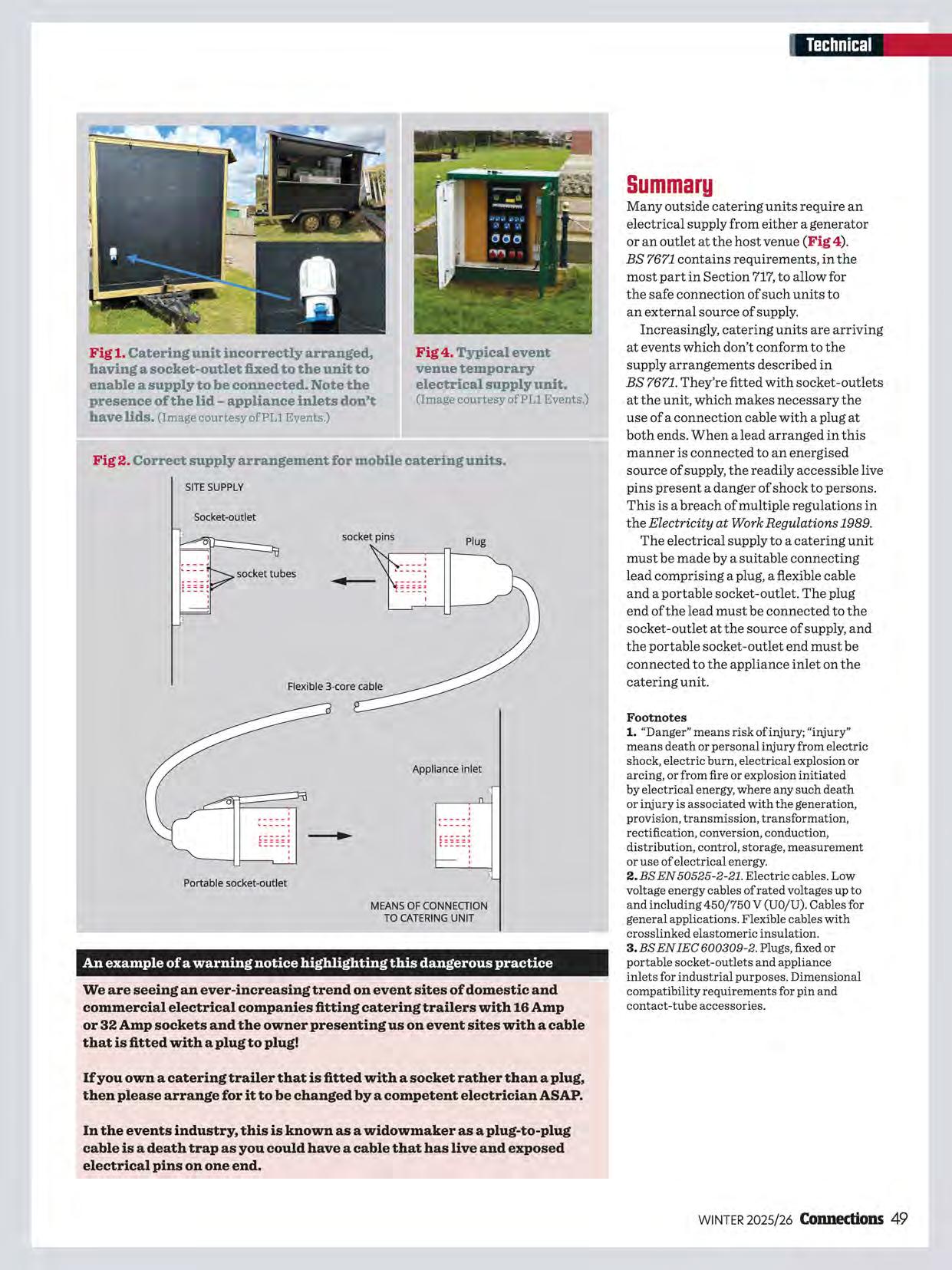
Fig 1. Catering unit incorrectly arranged, having a socket-outlet fixed to the unit to enable a supply to be connected. Note the presence of the lid -appliance inlets don't have lids. (Image courtesy of PLl Events.)
4. Typical event venue temporary electrical supply unit. (Image courtesy of PLl Events.)
2. Correct supply arrangement for mobile catering units. SITESUPPLY
OF CONNECTION TO
An example of a warning notice highlighting this dangerous practice
We are seeing an ever-increasing trend on event sites of domestic and commercial electrical companies fitting catering trailers with 16 Amp or 32 Amp sockets and the owner presenting us on event sites with a cable that is fitted with a plug to plug!
If you own a catering trailer that is fitted with a socket rather than a plug, then please arrange for it to be changed by a competent electrician ASAP.
In the events industry, this is known as a widowmaker as a plug-to-plug cable is a death trap as you could have a cable that has live and exposed electrical pins on one end.
Increasingly, catering units are arriving at events which don't conform to the supply arrangements described in BS 7671. They're fitted with socket-outlets at the unit, which makes necessary the use of a connection cable with a plug at both ends. When a lead arranged in this manner is connected to an energised source of supply, the readily accessible live pins present a danger of shock to persons. This is a breach of multiple regulations in the Electricity at Work Regulations 1989.
The electrical supply to a catering unit must be made by a suitable connecting lead comprising a plug, a flexible cable and a portable socket-outlet. The plug end of the lead must be connected to the socket-outlet at the source of supply, and the portable socket-outlet end must be connected to the appliance inlet on the catering unit.
Footnotes
1. "Danger" means risk of injury; "injury" means death or personal injury from electric shock, electric burn, electrical explosion or arcing, or from fire or explosion initiated by electrical energy, where any such death or injury is associated with the generation, provision, transmission, transformation, rectification, conversion, conduction, distribution, control, storage, measurement or use of electrical energy.
2. BS EN 50525-2-21. Electric cables. Low voltage energy cables of rated voltages up to and including 450/750 V (U0/U). Cables for general applications. Flexible cables with crosslinked elastomeric insulation.
3. BS EN IEC 600309-2. Plugs, fixed or portable socket-outlets and appliance inlets for industrial purposes. Dimensional compatibility requirements for pin and contact-tube accessories.
Fig
Fig

MITIGATINGTHEEFFECTS OF HARMONICSONPOWERFACTOR CORRECTIONCAPACITORS
Objective:This is the third article in a series which explores various methods for mitigating the effects of harmonics on power factor correction (PFC) capacitors, including the use of anti-harmonic reactors (detuned filters), passive filters and active filters. Each method is described in detail with examples provided to illustrate their application.
Introduction
As discussed in a previous article in Connections issue 235, harmonic currents generated by switch mode power supplies, inverters and the like can have detrimental effects on power factor correction (PFC) capacitors, leading to overcurrent conditions (particularly in the neutral conductor), resonance and potential equipment failure.
As an example, a common failure mode involves dielectric breakdown in DC link bus capacitors (positioned between the rectifier and inverter stage of equipment) when subjected to prolonged exposure to high-frequency ripple currents, typically 2 to 20 kHz, generated by rapid switching of semiconductor devices within variable frequency drives (VFDs) and other power electronics. Such currents can progressively degrade the dielectric insulation, resulting in puncture-type failure of the capacitor material.
To address such issues within an installation, engineers employ various mitigation strategies to reduce the impact of harmonics on PFC capacitors while maintaining the overall power quality.
Methods for reducing the effects of harmonics
There are several approaches that may be employed for reducing the effects of harmonic currents on PFC capacitors. These methods may involve equipment design changes, such as adding a reactance in series with a PFC capacitor or installing auxiliary equipment such as harmonic filters including:
• anti-harmonic reactors
• passive filters
• active filters.
Anti-harmonic reactors
Anti-harmonic filters, often referred to as detuned filters, protect PFC capacitors against the effects of harmonic currents, which may otherwise result in damage from overvoltage.
An anti-harmonic reactor is an inductor connected in series with a PFC capacitor and in combination forms a detuned filter. Its primary purpose is to detune the natural resonant frequency of the PFC capacitor supply system away from prevalent harmonic frequencies. By
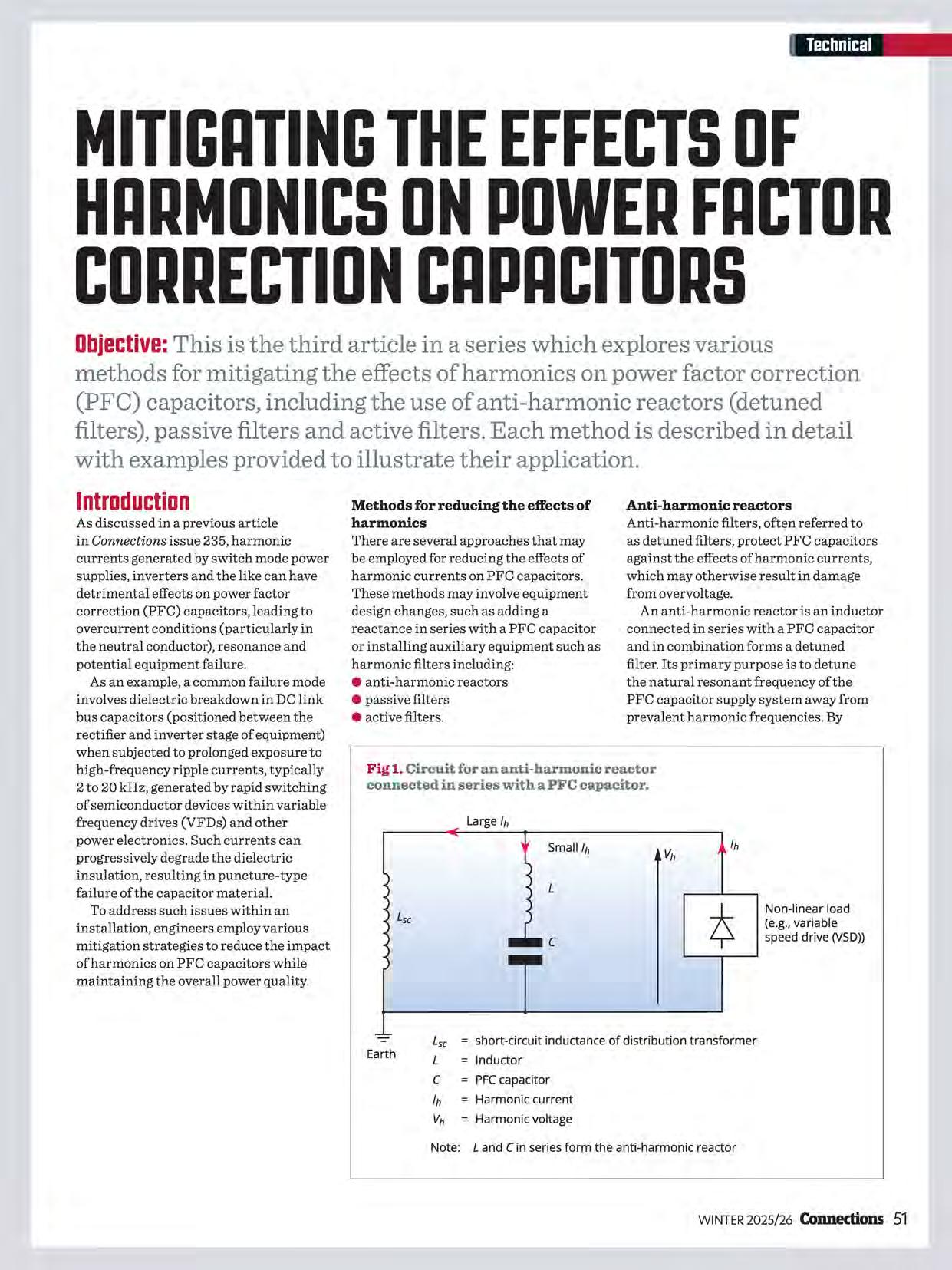
Non-linear load (e.g.,variable speed drive (VSD))
Fig 1. Circuit for an anti-harmonic reactor connected in series with a PFC capacitor.
shifting the resonant frequency of the LC (inductor-capacitor) circuit branch below the lowest significant harmonic frequency within the system, the risk ofresonance and amplification of harmonic currents is reduced, while the risk of overcurrent conditions can be minimised.
By selecting an appropriate inductance L for the LC branch (see Fig 1),the circuit becomes inductive at harmonic frequencies above the tuning frequency, and below that of the harmonic frequencies produced by the nonlinear load.
The tuning frequency is chosen to be lower than the lowest significant harmonic frequency. Commonly adopted detuning factors (p) used within industry are typically given by the manufacturer as a percentage, 7% and 5.67%, resulting in tuning frequencies of approximately 189 Hz to 210 Hz, respectively for a 50 Hz system (f.".):
Detune order (n) =ft=~= = 3.7788
Tuning frequency({,)= f,y, x n = SO x 3.7788 = 189 Hz
Detune order (n) = ft= j0 0 67 = = 4.2
Tuning frequency({,) = {sys X n = SOX 4.2 = 210 Hz
These tuning frequencies are below the 5th order harmonic (250 Hz in 50 Hz network), reducing the risk ofresonance at that frequency.
Fig 2. Circuit layout of a RLC passive filter connected in parallel with a nonlinear load indicating the path of harmonic current at the tuned frequency.
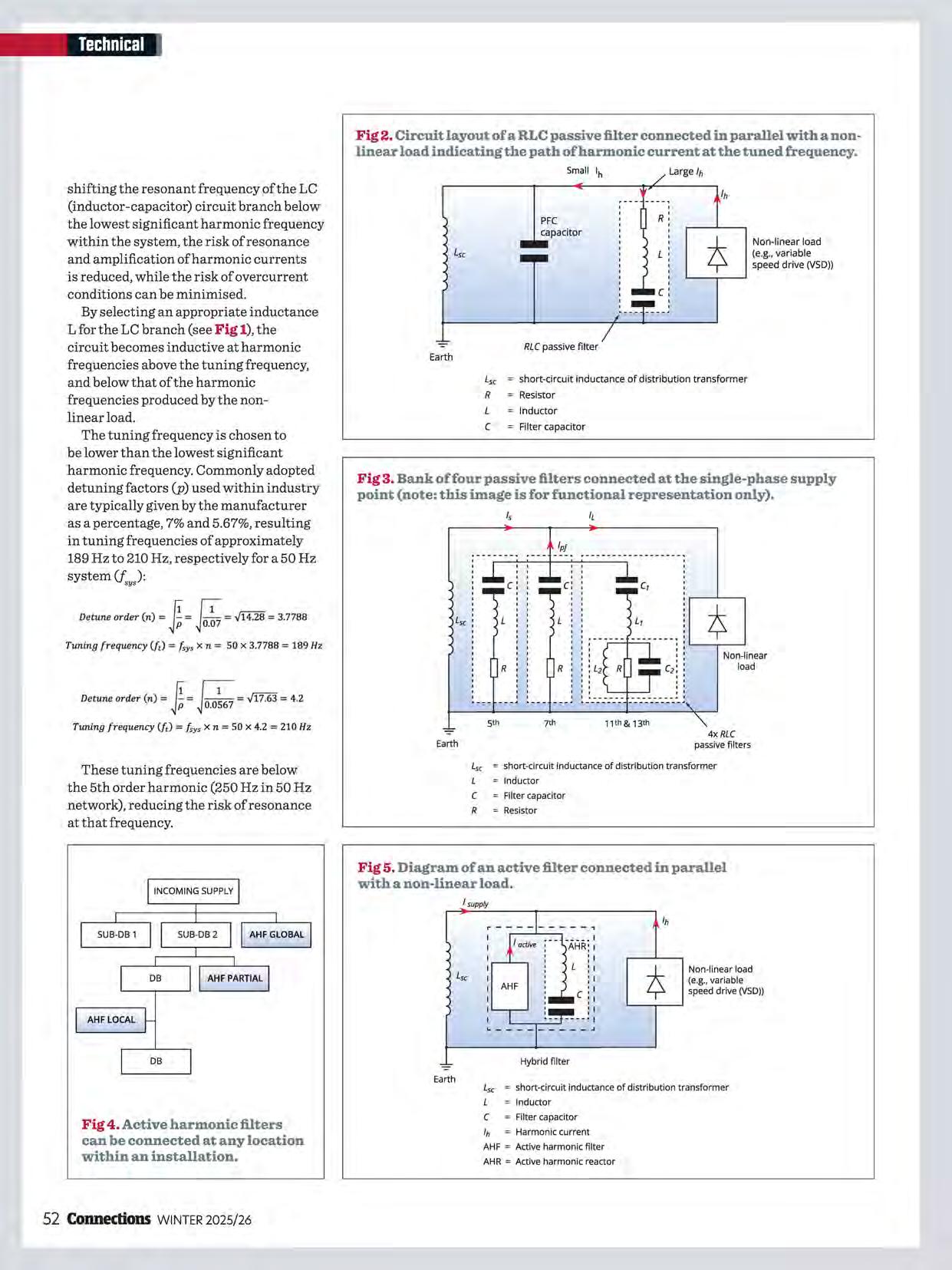
Non-linear load (e.g., variable speed drive (VSD))
L,c = short-circuit inductance of distribution transformer R L C Resistor Inductor Filter capacitor
Fig 3. Bank of four passive filters connected at the single-phase supply point (note: this image is for functional representation only).
Non-linear load 4x RLC passivefilters
Lsc = short-circuitinductanceofdistributiontransformer
L = Inductor
C = Filter capacitor
R =Resistor
Fig 5. Diagram of an active filter connected in parallel with a non-linear load.
Non-linearload (e.g., variable speed drive (VSD))
L5 c = short-circuitinductanceofdistributiontransformer
L = Inductor
C = Filter capacitor
th = Harmoniccurrent
AHF = Activeharmonicfilter
AHR=Activeharmonicreactor
Fig 4. Active harmonic filters can be connected at any location within an installation.
Adding this reactor in series with the capacitor reduces the risk ofresonance, protects the capacitor from harmonic overcurrent while improving the life cycle of the capacitor by decreasing thermal distress.
However, practical issues must be considered. The reactor introduces additional losses due to its resistance, resulting in PR losses that must be considered during the system design. Additionally, the reactor causes a voltage drop across itself, which may affect the voltage applied to the capacitor.
Fig 1 shows harmonic currents forced to flow through the supply network, for example the transformer, reducing stress on the PFC capacitors.
Passive filter (shunt filter)
Passive filters or shunt filters, use tuned LC circuits to absorb specific harmonic frequencies.
Passive filters consist of combinations of inductors, capacitors and sometimes resistors, configured to create lowimpedance paths for specific harmonic frequencies. They're typically connected in parallel with the electrical system and are designed to attenuate specific harmonic frequencies or a range of higher harmonics.
Characteristics of a passive filter include:
• Frequency selectivity: Each filter is tuned to a particular order of harmonic frequency, for example 5th, 7th.
• Harmonic current absorption: At the tuned frequency (f,), the RLC filter absorbs the majority of the harmonic currents (Ih), preventing them from flowing into the wider system, including the PFC capacitor.
• Power factor correction contribution: At frequencies below the tuned frequency, the passive filter behaves capacitively, assisting in power factor correction of the resistive/ inductive loads operating at the fundamental frequency, typically 50 Hz.
Passive filters are effective at reducing specific harmonic currents and can be designed to provide reactive power compensation while assisting with power factor correction. They're relatively simple in design and have high reliability
due to the absence of active components. However, passive filters do have limitations. They're tuned to specific frequencies and may not adapt well to changes in the harmonic spectrum. Incorrectly designed filters can also introduce resonance at unintended frequencies, potentially intensifying power quality issues.
Care should also be taken during system design to prevent overcompensation at the fundamental frequency, which could potentially lead to a leading power factor and subsequent overvoltage issues.
Passive filters are generally connected in banks (see Fig 3) and tuned to address multiple unwanted harmonics simultaneously, reducing the overall harmonic distortion (current and voltage) of the supply. For example, a bank may include several single-tuned filters, such as branches tuned to the 5th, 7th,llth and 13th harmonics, providing low impedance paths for these harmonic currents (see Fig3).
Active filters
Active filters are more advanced power-electronic devices designed to counteract harmonic currents and voltages dynamically. They're installed in series or parallel with the non-linear load and operate by:
• Real-time monitoring: Continuously measuring the harmonic content of the load current and voltage.
• Current/voltage injection:
Generating compensating currents and/or voltage equal in magnitude but in opposite phase to the harmonics produced by the non-linear loads, ensuring that the source current remains sinusoidal.
• Adaptive compensation: Adjusting to changes in load conditions and harmonic spectrum.
Active harmonic filters can be connected at various locations in an installation as shown in Fig 4. Active filters are usually combined with passive filters to form a hybrid filter (see Fig 5). Such filters combine the performance benefits of both active and passive filters. They can be tailored to suit a wide range of power quality applications.
Active filters use power electronic devices to inject currents that cancel out harmonic currents produced by non-linear loads. Such types of filters offer dynamic harmonic compensation that can adjust to varying harmonic conditions in real-time and are capable of compensating for multiple harmonic orders simultaneously. They improve both current and voltage waveform quality while reducing distortion.
However, active filters are more expensive than passive solutions due to their complexity and may require regular maintenance to ensure proper operation. Power losses in power electronic components can also affect overall system efficiency.
Summary
As more electronic equipment is used in industry, harmonic currents now present significant challenges to the operation and durability of PFC capacitors. Overcurrent conditions and parallel resonance between PFC capacitor banks and supply system inductance can lead to equipment failure, system inefficiencies and increased operational costs.
Mitigating the effects ofharmonics on PFC capacitors is essential for maintaining power system reliability, improving power quality and extending the life cycle of electrical equipment. By employing anti-harmonic reactors, passive filters and active filters, engineers can reduce harmonic currents effectively and prevent resonance issues.
Each mitigation method has its advantages and limitations. Antiharmonic reactors are simple and cost-effective for detuning resonance but introduce additional losses. Passive filters are reliable and effective for specific harmonics but lack adaptability to changing conditions. Active filters are highly adaptable and effective for a broad range of harmonics but are more costly and complex.
Selecting the appropriate method depends on the specific requirements of the power system, the harmonic spectrum and economic considerations. A comprehensive harmonic analysis and consultation with power quality specialists is recommended to determine the best solution for a given application.

ENVIRONMENTALFACTORS ONCONSTRUCTION SITES
Objective:Construction sites require temporary electrical supplies to provide power for tools, equipment, lighting and the like. This article examines the common environmental conditions encountered on such sites and highlights key considerations when selecting, installing and using electrical supplies and equipment on a construction site.
Introduction
By their nature, construction sites expose electrical equipment and cables to harsher conditions than would normally be expected in permanent installations. This increases both:
• the likelihood of damage occurring to electrical equipment and wiring systems
• the increased risk of electric shock.
To ensure the safety of all operatives on site, such risks need to be managed to comply with legislative requirements for construction site safety and electricity use.
Environmental factors
The level ofrisk and likelihood of damage occurring to installed equipment and, as a result, to the persons using it, will vary across a typical construction site. Therefore, the supply to electrical equipment must be suitable for the environment in which it is to be used, while taking into account that electrical equipment will be operated by ordinary persons (as defined in Part 2 of BS 7671). With the exception of the installations in administrative locations such as offices, meeting rooms and site welfare areas, where the general requirements of Parts 1 to 6 (and Part 8) apply (704.1.1), electrical equipment used on a construction site must be suitable for the harsh conditions expected for the environment (704.512.2), including:
• exposure to corrosive substances
• ingress ofliquids, dust and other contaminants
• vibration and physical wear caused in use by impact, abrasion, tension and flexing
• extreme temperature fluctuations
• damage by movement of vehicles and structures.
Reducing potential hazards
Electrical equipment and wiring systems, wherever possible, should be located in a manner that minimises the chance of exposure to corrosive or polluting substances such as water, cement and/ or plaster. One of the most effective ways of achieving this is by avoiding the installation of cables and/or equipment in locations where such exposure is likely. However, where this cannot be avoided, parts of the wiring system likely to be exposed to such detrimental substances should be suitably protected by additional mechanical protection or constructed of corrosion resistant materials (522.5.1).
Although Section 704 of BS 7671 doesn't state a minimum acceptable degree of ingress protection against either water, other liquids or foreign solid bodies, the general rules given in Section 522 of

BS 7671 will apply. For example, where water is liable to collect inside a wiring system, drainage must be provided for its escape typically at the lower points within an accessory or containment system (522.3.2).
Further requirements in Section 704
• All assemblies for the distribution of electricity on-site shall conform to the requirements of BS EN 614394 (704.511.1). Clause 8.2.2 of this standard requires a minimum degree of ingress protection of:
-IP44 when all doors are closed and all cover plates and removable panels are in place
-IP21 provided that the door can be closed under all conditions of use, or IP44 at the operating face where the door cannot be closed.
• Plugs or socket-outlets with a rated current of16 A up to 125 A are to conform to the requirements of BS EN IEC 60309-2.
Fig 1. Typical construction site
• Plugs and socket-outlets with a rated current exceeding 125 A up to 800 A, and where interchangeability is not required, are to conform to the requirements of BS EN IEC 60309-1 (704.511.1).
To prevent damage, cables shouldn't be installed across site roadways or access ways used for transport and mobile plant. Where this is unavoidable, adequate mechanical protection should be provided (see Fig 2) to minimise damage or potential deterioration caused by vehicles and the movement of building materials on site (704.522.8.101).
Alternatively, where it's necessary to route cables underground in such locations exposed to site traffic, cables should be laid in ducts at a depth of at least 0.6 m below finished ground level and a cable marker should be installed at each end of each road crossing (Clause 7.1.5 of BS7375).
Additionally, to avoid damage to cables run on a surface and/or overhead, protection against mechanical damage should be provided, while taking into account the environment and likely activities at the construction site (704.522.8.101).
As with any other type ofinstallation, the general rules of Chapters 51 and 52 of BS 7671 relating to effective selection and erection of equipment apply.
Cable types and temperature limits
Where the protective measure of electrical separation of circuits is used in such locations, including for circuits supplying a socket-outlet with a rated current up to and including 32 A, and for any other circuit supplying hand-held electrical equipment, the requirements of Section 413 must be met (704.410.3.10).
use.
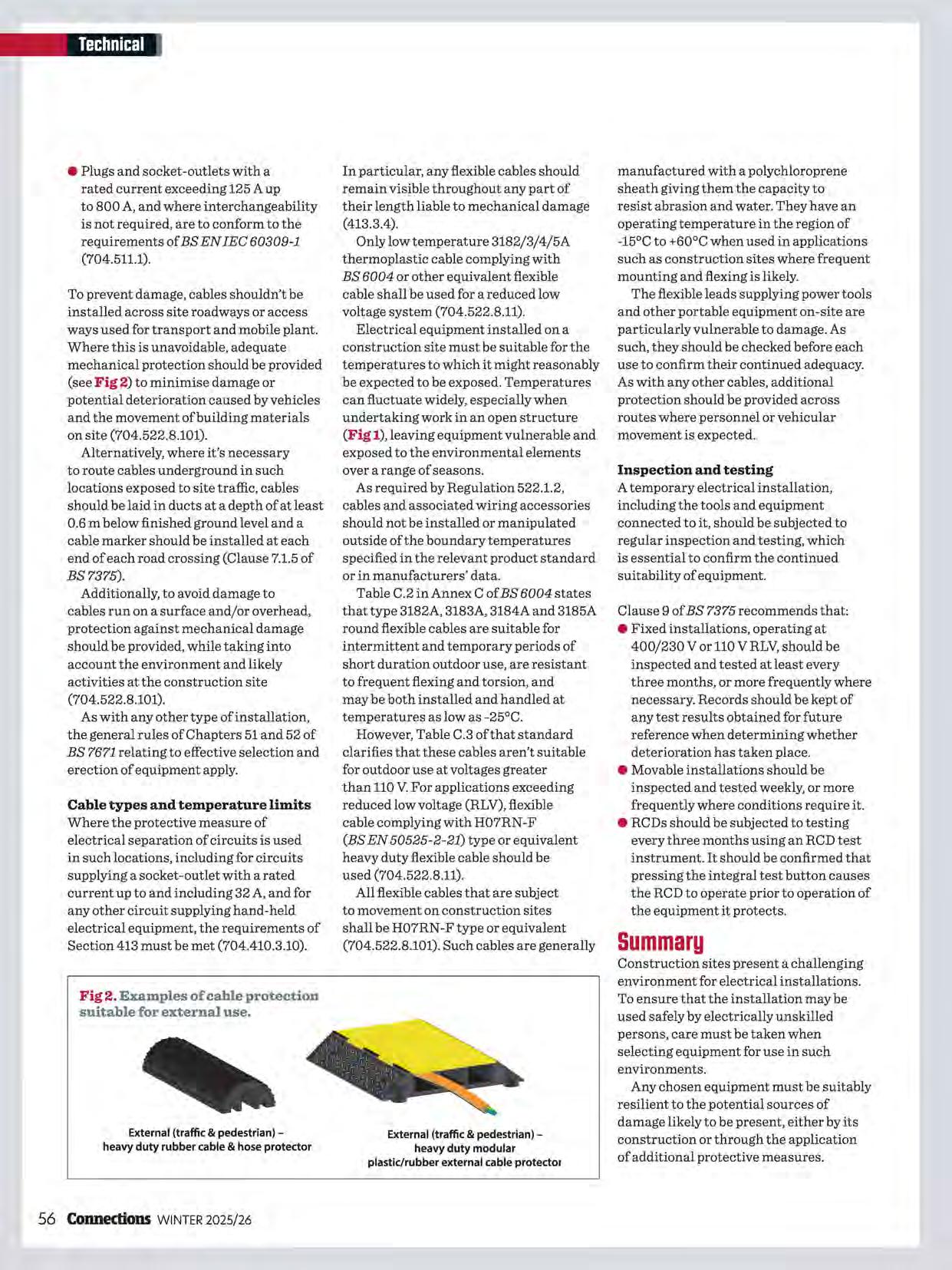
In particular, any flexible cables should remain visible throughout any part of their length liable to mechanical damage (413.3.4).
Only low temperature 3182/3/4/5A thermoplastic cable complying with BS 6004 or other equivalent flexible cable shall be used for a reduced low voltage system (704.522.8.11).
Electrical equipment installed on a construction site must be suitable for the temperatures to which it might reasonably be expected to be exposed. Temperatures can fluctuate widely, especially when undertaking work in an open structure (Fig 1), leaving equipment vulnerable and exposed to the environmental elements over a range of seasons.
As required by Regulation 522.1.2, cables and associated wiring accessories should not be installed or manipulated outside of the boundary temperatures specified in the relevant product standard or in manufacturers' data.
Table C.2 in Annex C of BS 6004 states that type 3182A, 3183A, 3184A and 3185A round flexible cables are suitable for intermittent and temporary periods of short duration outdoor use, are resistant to frequent flexing and torsion, and may be both installed and handled at temperatures as low as -25°C.
However, Table C.3 of that standard clarifies that these cables aren't suitable for outdoor use at voltages greater than 110 V. For applications exceeding reduced low voltage (RLV), flexible cable complying with H07RN-F (BS EN 50525-2-21) type or equivalent heavy duty flexible cable should be used (704.522.8.11).
All flexible cables that are subject to movement on construction sites shall be H07RN-F type or equivalent (704.522.8.101). Such cables are generally
manufactured with apolychloroprene sheath giving them the capacity to resist abrasion and water. They have an operating temperature in the region of -15°C to +60°C when used in applications such as construction sites where frequent mounting and flexing is likely.
The flexible leads supplying power tools and other portable equipment on-site are particularly vulnerable to damage. As such, they should be checked before each use to confirm their continued adequacy. As with any other cables, additional protection should be provided across routes where personnel or vehicular movement is expected.
Inspection and testing
A temporary electrical installation, including the tools and equipment connected to it, should be subjected to regular inspection and testing, which is essential to confirm the continued suitability of equipment.
Clause 9 of BS 7375 recommends that:
• Fixed installations, operating at 400/230 V or 110 V RLV, should be inspected and tested at least every three months, or more frequently where necessary. Records should be kept of any test results obtained for future reference when determining whether deterioration has taken place.
• Movable installations should be inspected and tested weekly, or more frequently where conditions require it.
• RCDs should be subjected to testing every three months using an RCD test instrument. It should be confirmed that pressing the integral test button causes the RCD to operate prior to operation of the equipment it protects.
Summary
Construction sites present a challenging environment for electrical installations. To ensure that the installation may be used safely by electrically unskilled persons, care must be taken when selecting equipment for use in such environments. Any chosen equipment must be suitably resilient to the potential sources of damage likely to be present, either by its construction or through the application of additional protective measures.
Fig 2. Examples of cable protection suitable for external
NICEICInsuranceServicesisdesignedespeciallyfortheelectrical trade,withyourbespokepolicycreatedforyourbusiness .
Comprehensivecover, butnotfullprice.
10% off insurance for NICEICcertified businesses* .
ReputableUK-basedinsurers.
Specially negotiated prices from UK-based leading insurers and specialist providers.

FREEbusinessinsurancecheck.
While other insurance providers ask you what you want, we advise you what you need. So you don't pay for cover you don't need. Simple.
Agreatexperience.
13,900 customers can't be wrong. Proud winners of the Feefo Platinum Trusted Service Award for delivering exceptional customer service.
PlatinumTrusted ServiceAward 2025feefo
ANINTRODUCTION TDBS5866-1:8D85
Objective: A new edition of BS 5266-1
Emergency lighting - Part 1: Emergency lighting of premises - Code of practice has been published. This article summarises notable changes between the 2025 edition and the 2016 edition which preceded it.
Introduction
The newly published full revision of BS 5266-1 Emergency lighting-Part 1: Emergency lighting of premises - Code of practice came into effect on 31 October 2025, superseding the previous 2016 edition, which is now withdrawn.
BS 5266-1 is a standard which is intended to be used in conjunction with BS EN 50172:2024-Emergency escape lighting systems and BS EN1838:2024-Lighting applications - Emergency lighting for buildings, which cover the following:
• general requirements for emergency escape lighting
• escape route lighting
• open area (anti-panic) lighting
• high-risk task area lighting
• local area lighting
e in BS EN 1838 only, standby lighting.
The scope of this new edition of BS 52661 has been expanded to cover local area lighting and standby lighting in addition to emergency escape lighting.
Significantchanges clausesto bysection
Use of this document
The term "deviation" has been replaced by "variation" where the recommendations of the standard have intentionally not been followed due to the adoption of another technical solution or practices which provide an equivalent or better outcome to that achieved by following the recommendations of the standard.

A statement has been added clarifying that the recommendations within the standard are drafted for use and implementation by appropriately qualified and experienced people (see also definition of competent person).
The copyright on Annex H (Model completion certificate), Annex I (Model certificate for completion of small new installations up to 25 selfcontained luminaires), Annex K (Model certificate for verification of an existing installation) and Annex M (periodic inspection and test Model certificates) is owned by BSI. However, users of the standard are permitted to make an unlimited number of copies for their use without infringement of copyright.
It isn't necessary to use the models in the annexes to meet the recommendations in the standard.
NICEIC produce a range of certificates based on the models in BS 5266-1.
Visit shop.niceic.com
1.Scope
Borrowed light is now excluded from the scope. The introduction explains that this is because it cannot be relied upon as a source oflight.
2.Normativereferences
The list of normative references has been updated, with the inclusion of both BS 4422 Fire - Vocabulary and BS 9991 Fire safety in the design, management and use of residential buildings - Code of practice.
3.Termsanddefinitions
The following new definitions have been added:
• activation time (of an emergency lighting system)
• automatic test system
• electrical source for safety services (ESSS)
• emergency local area lighting (this was previously emergency safety lighting)
• fixed seating
• system duration (of an emergency lighting system).
The following definitions have been deleted:
• escape route
• final exit
• material times
• open area lighting
• place of safety.
The definition "competent person" has been modified to align with BS 9991:2024 and the recently published BS 5839-1:2025 as follows:
person, suitably trained and qualified by knowledge and practical experience, and provided with the necessary instructions, to enable the required task(s) to be carried out correctly.
4.Consultationand records
Clause4.1
Inrespectofoccupancyintheevent ofasupplyfailure, the term "stayput strategy" has been replaced by "occupants are likely to stay in the building".
Note 4 now refers to a "place of ultimate safety" as defined in BS 4422 (a place in which there's no immediate or future danger from fire and smoke or the effects of fire and smoke) rather than to a "place of safety".
Clause4.2
This now states that plans of premises for use at the consultation and system design stages should also include additionally:
• escape route signs
• special locations (see clause 5.2.8.1 of BS5266-1).
5.2.Illuminationforsafe escape-emergency escapelighting
Clause 5.2.2
This now recommends additionally that local area lighting should be provided where the occupants are allowed to remain in the building during periods without normal lighting.
Clause 5.2.5
In a defined escape route, the minimum horizontal illuminance limit on the floor ofl lx now applies to the whole escape route floor, apart from a border the width of which is dependent on the width of the escape route, where in the previous edition it was only applicable to the centre line of the corridor.
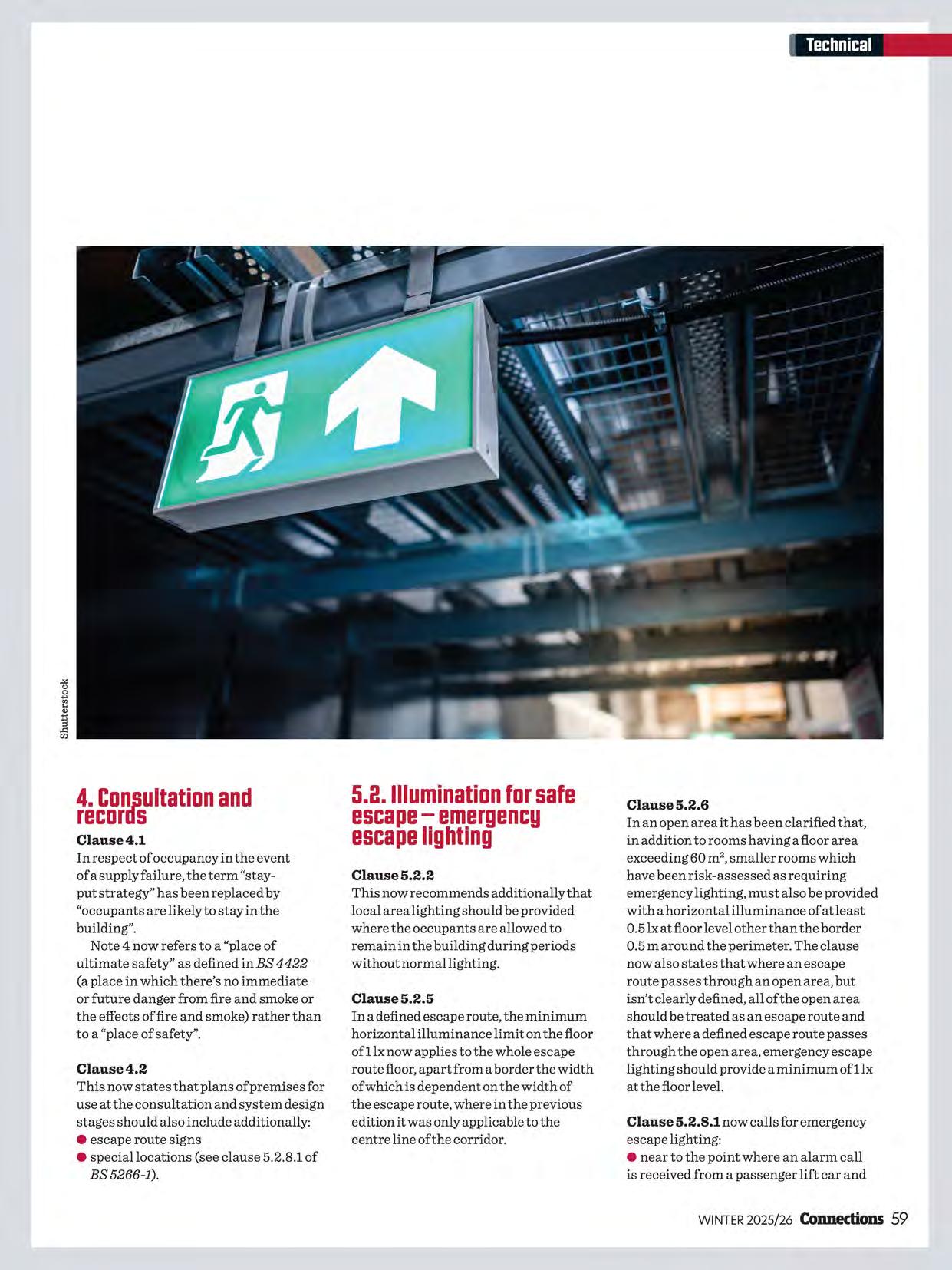
Clause 5.2.6
In an open area it has been clarified that, in addition to rooms having a floor area exceeding 60 m 2 , smaller rooms which have been risk-assessed as requiring emergency lighting, must also be provided with a horizontal illuminance of at least 0.5 lx at floor level other than the border 0.5 m around the perimeter. The clause now also states that where an escape route passes through an open area, but isn't clearly defined, all of the open area should be treated as an escape route and that where a defined escape route passes through the open area, emergency escape lighting should provide a minimum of 1lx at the floor level.
Clause 5.2.8.1 now calls for emergency escape lighting:
• near to the point where an alarm call is received from a passenger lift car and
associated lift winding equipment
• Corridors from passenger lift doors to the nearest escape route.
The clause also now specifies that a minimum vertical illuminance of 5 lx is provided at each piece of firefighting equipment, call point, panel, escape and rescue plans, and first-aid box.
Where, in the previous edition of the standard, this clause referred to "refuges", it now refers to "temporary waiting spaces".
Clause 5.2.8.lg) now refers to a place of ultimate safety in relation to the placing of emergency escape lighting outside of an exit to a building.
Clause 5.2.8.5
This now calls for a minimum horizontal illuminance ofl lx to be provided at the baby changing table in a single occupancy toilet and at the floor in accessible toilets.
Clause 5.2.8.8
This is a new clause for public indoor swimming pools and states a minimum horizontal illuminance of5 lx should be provided on the water service, at floor level on circulation routes around the pool and access routes to diving boards or flumes.
7.Powersuppliesand eguipmentusedas electricalsourcesfor safetyservices[ESSS]
This section on power supplies now refers specifically to "equipment used as sources for safety services (ESSS)". It now states that the system should be designed so that it can deliver the required power output, including any inrush or starting current, in both watts and VA,taking into account the power factor of the load. If the system is modified during its operationallife, these values should be recalculated and the system records updated. This change has been introduced to address the increasing use of LED luminaires, which often have a poor power factor, particularly when modifications are made to an existing system that typically incorporated fluorescent type luminaires.
8.2Wiringofemergency lightingluminairessupplied fromacentralsafetypower supplysystem
Clause 8.2.5
The title has been changed from "Conduit, trunking and channel" to "Cable management systems providing protection against mechanical damage". It now recommends that where conduit or trunking is used to protect cables from mechanical damage, as opposed to being used for aesthetic purposes only, it should provide impact protection of at least 5 J. Additionally, content formerly in clause 8.2.11 in the 2016 edition relating to protection against physical damage in arduous conditions as been relocated to clause 8.2.5.
Clause8.2.7
The title has been changed from "cable sizes" to "cross-sectional area of conductors". It now states that the cross-sectional area of conductors should be sized in accordance with BS 7671.
Clause 8.2.8
The title has been changed from "overhead lines" to "suspended cables".
Clause 8.2.9
This clause relates to damp, corrosive or underground locations. Again, it's now stated that the cross-sectional area (CSA) ofconductors should be sized in accordance with BS 7671 (although still subject to a minimum CSA ofl.5 mm 2).
Clause 8.2.10
This clause now recommends that cables shouldn't be installed in any location, such as a boiler room, where the combination of ambient temperature and temperature rise due to load currents will result in their rated temperature being exceeded.
Clause 8.2.12
This clause contains the recommendations for voltage compatibility of a centrally supplied emergency luminaire and a central battery system, which were in clause 8.3.5 of the previous edition.
Clause 8.2.13
This clause has been expanded and now contains the recommendations for electromagnetic compatibility, which were in clause 8.4 of the previous edition.
Clause 8.2.14
This is a new clause giving recommendations for the identification of cables (based on emergency lighting luminaires supplied from a central safety power supply system only).
All cables supplying emergency lighting luminaires should either be identified: a) by a single, common unique colour in the case ofmulticore cables b) at every connection between conductors and between a conductor and equipment, such that they are distinguished from those of other circuits, by labelling.
10.Emergencylighting designprocedure
Clausel0.2
In this clause (Determine requirements) a new note has been added to indent k) calling for emergency illumination within the main switch room only, that is, unless it's identified by the risk assessment that such emergency lighting is required at the location of sub-distribution boards. Additionally, a new indent m) has been added calling for the position of the emergency lighting of any public indoor swimming pools to be identified.
Clausel0.4
In this clause (Design of system) a new indent m) has been added recommending that the procedures to protect a system (for example, battery from deep discharge) in case they're shut down for prolonged periods and the procedure to recommission the system after the shut-down period are checked. A new note 1 has also been added stating that "any prolonged period of over discharge can be harmful depending on the battery type."
11.Certificatesandlogbook
Clausell.1
The following new recommendations have been added:
• The results of the commissioning inspections and tests defined in BS EN 50172:2024 should be included in the handover documents described in clause 10.7.1.
• Any variations from BS 5266-1 within a specification or design proposal should be so identified that they're obvious to any interested party that's responsible for its approval and should be documented in the handover documentation.
Clausell.2
This is a new clause which states that photometric verification of the system should be carried out in accordance with the recommendations of clause 7.3 of

BS EN 50172:2024. It further recommends that this verification takes place initially and every five years thereafter.
12.Aoutineinspection andtests
Section12
New text has been added in this clause which covers routine inspections and tests, reiterating that the photometric performance of the system should be verified at intervals not exceeding five years.
Summary
This article has introduced notable changes introduced in the new edition of BS 5266-1, which was published on 31 October 2025. However, this doesn't mean that all such changes have been identified here. As a result, readers working with emergency lighting systems covered by BS 5266-1, BS EN 50172:2024 andBSEN1838:2024 are advised to familiarise themselves with the content of these three standards, which have all been updated in the last two years. Certsure produces a full range of certificates for emergency lighting systems for use by certified businesses.
In the following multiple-choice questions, you should choose one of the four options that, in your opinion, is the correct answer. You may find it useful to refer to the technical articles in this issue of Connections and BS 7671:2018+A2:2022+A3:2024. The answers to the questions, accompanied by a briefrationale, can be found at the end of the technical section.
1. According to the requirements of BS EN IEC 61489-4, what's the minimum IP rating required for assemblies when all doors are closed and all cover plates and panels are in place?
a) IP21
b) IP44
c) IP54
d) IP65
2. Based on the requirements of BS 7875, what's the minimum buried depth required for underground cables exposed to site traffic?
a) 0.3m
b) 0.4m
c) 0.5m
d) 0.6m
3. Which type of flexible cable is specified for use on construction sites where frequent movement and flexing is likely?
a) 3182Y
b) H05VV-F
c) H07RN-F
d) Multicore SY

4. How often should RCDs be tested using an RCD test instrument on construction sites?
a) Every six months
b) Every three months
c) Monthly
d) Weekly
5. Which one of the following statements regarding passive filters is NOT correct?
a) Passive filters use tuned LC circuits to absorb specific harmonic frequencies
b) At frequencies below the tuned frequency, passive filters behave capacitively, aiding in power factor correction
c) Passive filters can adaptively adjust to changes in load conditions and harmonic spectrum in real time
d) Passive filters are generally connected in banks to address multiple unwanted harmonics simultaneously
6. What's the primary function of an anti-harmonic reactor in series with a PFC capacitor?
a) To block all current at harmonic frequencies
b) To reduce the system's short-circuit current rating
c) To detune the resonant frequency of the capacitor circuit away from dominant harmonics
d) To increase the harmonic current across the non-linear load
7. Which one of the following is a key limitation of passive harmonic filters?
a) They're too expensive to implement in most electrical systems
b) They may introduce resonance if not correctly tuned to the system
c) They require real-time dynamic control electronics to operate correctly
d) They cannot be used for power factor correction
8. Which of the following accessories to BS EN IEC 60809-2 should be affixed to a mobile unit to allow connection to a source of supply?
a) Inlet
b) Plug
c) Socket-outlet
d) Coupler
9. Appliance inlets, plugs and portable socket-outlets shall provide what degree ofingress protection when not in use?
a) IP22
b) IP33
c) IP44
d) IP55
10. Where a premises contains a baby changing table in a single occupancy toilet, what's the minimum recommended horizontal illuminance at the table?
a) llx
b) 2lx
c) 3lx
d) 5lx
11. The photometric performance of an emergency lighting system should be verified periodically at an interval not exceeding:
a) Every six months
b) Yearly
c) Three years
d) Five years
12. The cross-sectional area of conductors for emergency lighting systems should be selected in accordance with which British Standard?
a) BS7671
b) BS9991
c) BSEN1838
d) BS EN 50172

Answers and explanations
Q A Rationale
1. b) IP44
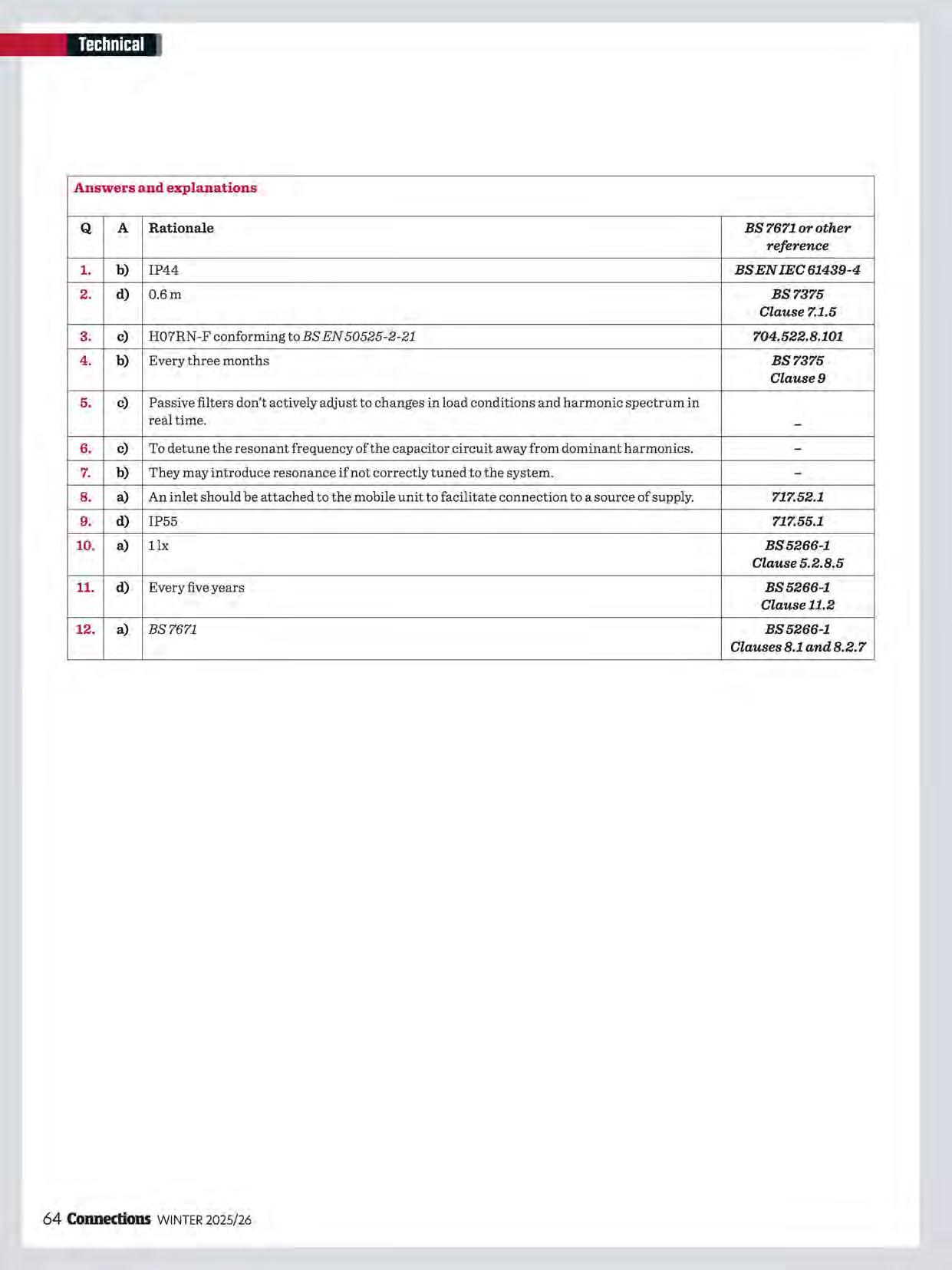
EN IEC 61439-4
2. d) 0.6m BS7375 Clause 7.1.5
3. c) H07RN-F conforming to BS EN 50525-2-21
704.522.8.101
4. b) Every three months BS7375 Clause9
5. c) Passive filters don't actively adjust to changes in load conditions and harmonic spectrum in real time. -
6. c) To detune the resonant frequency of the capacitor circuit away from dominant harmonics. -
7. b) They may introduce resonance if not correctly tuned to the system. -
8. a) An inlet should be attached to the mobile unit to facilitate connection to a source of supply. 717.52.1
9. d) IP55 717.55.1
10. a) llx BS5266-1 Clause 5.2.8.5
11. d) Every five years BS5266-1 Clausell.2
12. a)
Clauses8.1 and8.2.7
Givingyouaccesstotheindustry'sbesttechnicalmindsandresourcesDrivingdemandfromcustomers
oP
Technicalhelplinefor expert
NICEICOnlineCertificationNationalmarketing support with installations, gSystemis a seamless, cloud- campaigns to raise public compliance and products. Ema based platform enabling direct awareness of the high notifications to Building Control. standards of N ICEIC-certified

fNICEICPocketGuidesapp
No software, no platform fees, businesses. for access to expert resources just pay for what you use. Fully on-the-go with 40+ technical responsive offline.
FindaTrustedTradesperson guides. gtool connecting you with local
Savingson specialist, Ema customers. Receivejob requests
pCPDresourcesincluding The tailored trade insurance. straight to your inbox.
j_,.~ I Wire webinars, NICEICevents, quarterly Connections magazine,
Openingupopportunities live Technical Q&As and our ~~@)
Discountson branded with specifiers such as facilities monthly e-newsletter, The Circuit. t@
NICEICworkwear and tools businesses, landlords, and in our on line shop and housing associations.
&QfRegularassessmentsto 10% off selected purchases help you stay compliant, with at TradePoint. Representingyouintheindustry guidance and technical advice.
ifAA
ConnectedFutures is the 10%0~Communicatingyourvoice discountonalltraining dedicated apprenticeship job and influencing government and coursesandqualifications board from NICEIC,designed M sector bodies through our role covering everything from to help NICEIC-certified on industry committees. electrical and renewables businesses attract, recruit to emergency lighting and and nurture new talent.
Shapingfuturepolicy fire alarms. andregulationsinformed by q TheToolstoTalk is the your feedback.
'' It'snotjustastamp-it's00 exclusive mental health and whatkeepsuscompetitive, r.t'Mwellbeing toolkit from NICEIC compliantandgrowing. in collaboration with the After60years,westilllean Electrical Industries Charity. on[!l NICEIC.It'sarelationship c+Findoutmore wegenuinelyvalue."niceic.com/benefits RobinsonandLawlor[!l
DFFGAiD
GDDDBVETDCHOPPERS?
It's not just pretty sandstone cottages in the Cotswolds. It's also home to a fleet of all-electric air taxis -or will be soon. Bristol-based Vertical Aerospace (VA) plans to set up a factory at Cotswold Airport. These electric vertical take-off and landing aircraft (eVTOLs) have a range ofup to 100 miles and can carry up to six passengers. By 2035, VA hopes to be churning out 900 flying taxis a year and 45,000 battery units. Could this hail the end of helicopters?

LINEINTHES~ND
We've seen plenty of alternatives to conventional battery storage in Off Grid. Here's one that uses sand. Finnish firm Polar Night Energy has filled a 13 m-tall, 15 m-wide silo with sand and pipes, all hooked up to a heat pump.
The battery -which can also be filled with industrial by-products -stores up to 100 MWh and can deliver hot water, steam or air with output temperatures of up to 400°C. It charges when electricity is available cheaply, holding a charge for months at a time.
The Finns are now trying to convert stored heat back into electricity. Even better!
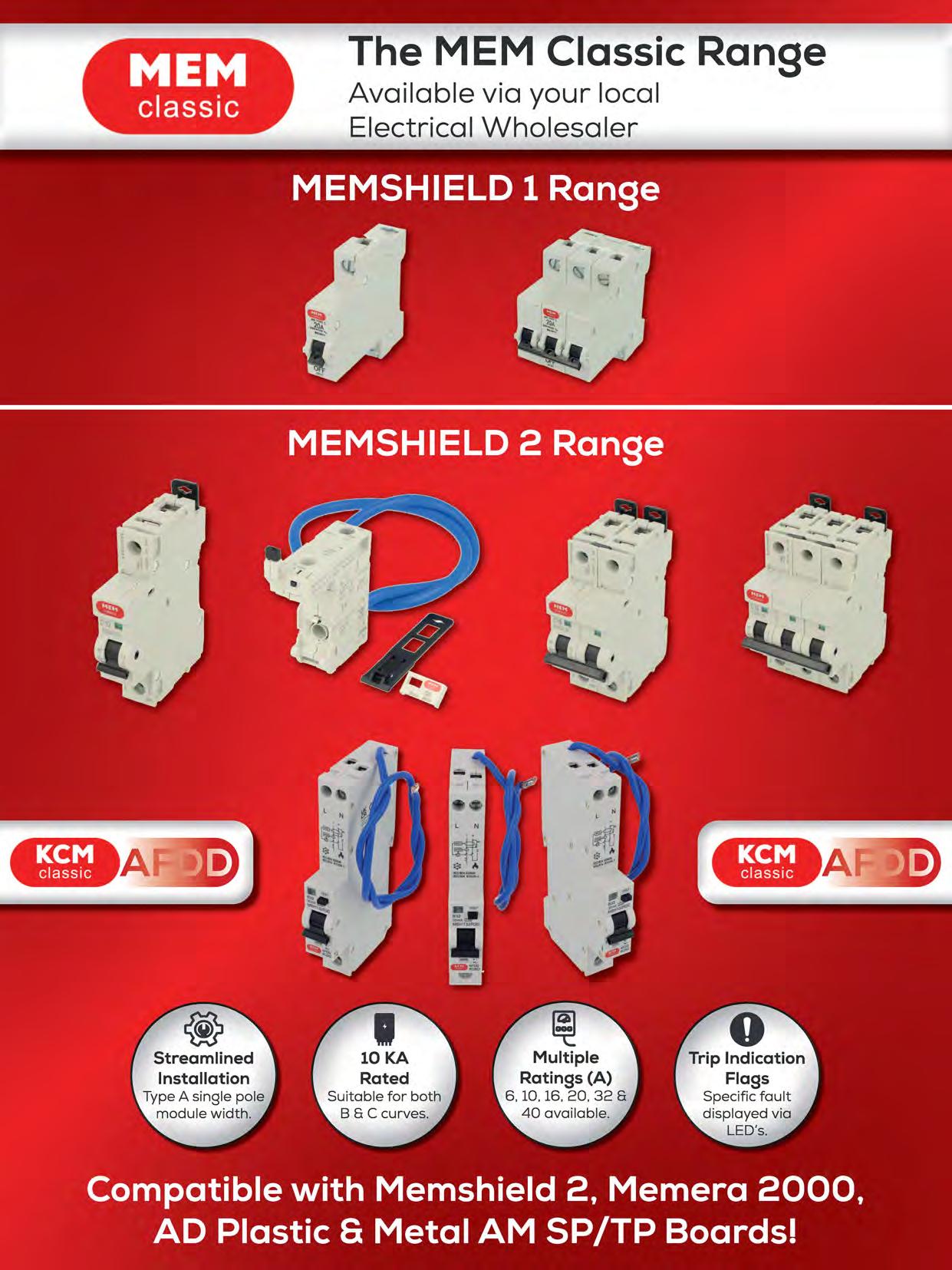
lOKA Rated Multiple Ratings(A) 6, 10, 16, 20, 32 6: