LAW IN PRACTICE
Probate perspectives
Thinking differently about neurodivergent employees
INTERVIEW Ciara Murphy, CEO, The Bar of Ireland CLOSING
Resilience and practice
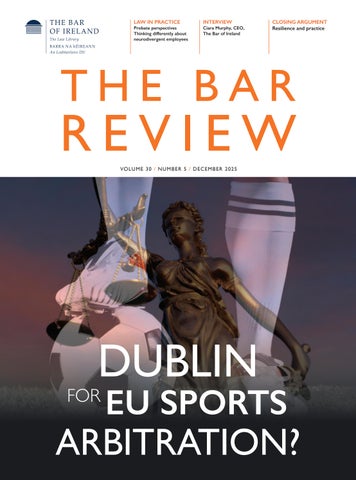
LAW IN PRACTICE
Probate perspectives
Thinking differently about neurodivergent employees
INTERVIEW Ciara Murphy, CEO, The Bar of Ireland CLOSING
Resilience and practice






AhCEl Y Arthur Cox Employ Yeearbook2024
Paperback Price: €99




The Y p Yeearbook covers deve employment law and litiga relations, pensions, taxatio and data protection law. ation, equality
elopments during 2024 in y, , industrial on relating to employment



J C W Wylie








By Liz H Hardba




€255
This tex and pra present gatherin
tbook provides extensive coverage of la actice on the admissibility of evidence, th tation of evidence in court and the pre-tr ng and disclosure of evidence. w e ial












By David Cowan
Hardback Price: €245
An authoritative text for prac line of sight of the technolog well as a reference on the im other legal disciplines.







ctitioners which gives a gy challenges ahead, as pact of technology on




update Call to the Inner Bar
Protection when you need it most
165
Law in practice
Can Dublin become the EU seat of arbitration for all sports disputes?
172
Law in practice
Thinking differently about neurodivergent employees 177 Closing argument Resilience and practice 157 Interview Putting members first
EDITORIAL BOARD
Editor
Helen Murray BL
David Conlan Smyth SC
Tom Flynn SC
Clíona Kimber SC
Paul McGarry SC
Cathleen Noctor SC
Sean Ó hUallacháin SC
Proinsias Ó Maolchalain SC
Bairbre O’Neill SC
Peggy O’Rourke SC
Morgan Shelley SC
Lydia Bunni BL
The Bar Review
The Bar of Ireland
Distillery Building
145-151 Church Street
Dublin DO7 WDX8
Direct: +353 (0)1 817 5025
Fax: +353 (0)1 817 5150
Email: molly.eastman@lawlibrary.ie
Web: www.lawlibrary.ie
Dearbhla M. Cunningham BL
Simon Donagh BL
Arran Dowling-Hussey BL
Mary-Paula Guinness BL
Stephen Hanaphy BL
Michael Kinsley BL
Cian McGoldrick BL
Catherine Needham BL
James Nerney BL
Law in practice
Probate perspectives: recent case law insights
Una Nesdale BL
Emer Ní Chúgáin BL
Tim O’Connor BL
Michael O’Doherty BL
Tanya Smyth BL
Ciara Murphy, CEO
Stephen Lowry, Director of Communications & Public Affairs
Molly Eastman McCarthy, Policy & Public Affairs Officer
Gary LaCumber, Law Library
Vanessa Curley, Law Library
Paul O'Grady, Publisher
Ann-Marie Hardiman, Think Media
PUBLISHERS
Published on behalf of The Bar of Ireland by Think Media Ltd
Editorial: Caoimhe Coolican
Ann-Marie Hardiman
Paul O’Grady
Design: Rebecca Bohan
Tony Byrne
Advertising: Paul O’Grady
Commercial matters and news items relating to The Bar Review should be addressed to:
Paul O’Grady
The Bar Review
Think Media Ltd The Malthouse, 537 NCR, Dublin DO1 R5X8
Tel: +353 (0)1 856 1166
Email: paul@thinkmedia.ie Web: www.thinkmedia.ie www.lawlibrary.ie
Views expressed by contributors or correspondents are not necessarily those of The Bar of Ireland or the publisher and neither The Bar of Ireland nor the publisher accept any responsibility for them.
The recent report of the Accelerating Infrastructure Taskforce takes a reasoned view on the issue of judicial review.

Seán Guerin SC Senior Counsel, Barrister – Member of the Inner Bar Chair of the Council of The Bar of Ireland
The publication on December 3 of the report of the Accelerating Infrastructure Taskforce is a signal moment in Irish political life. The report addresses in a detailed, thorough and comprehensive way the reasons why Ireland has not been able to deliver necessary infrastructure with the speed and effectiveness that a growing modern society requires. The members of the Taskforce are to be commended for the valuable work they have done in producing this report in a short period of time, and in committing themselves also to supervising the work of implementing their recommendations.
The report is particularly welcome because it places in its proper context the debate that has featured in public commentary (much of it ill informed at best) about the role of judicial review (JR) in infrastructure delivery. Only two of the 30 actions identified as
necessary by the Taskforce relate to JR, and when one looks at the detailed sub-actions recommended, they relate mostly either to the implementation of existing statutory provisions or recommendations to investigate further possible reforms.
What is clear is that they have not identified any significant deficiencies in the way in which the JR system operates. That is unsurprising given the significant efforts by judges, the Courts Service and practitioners to improve practice and procedure in this area, including the establishment of a specialist court list and panel of judges, and the implementation of new rules of procedure, now embodied in rules of court. Those efforts are enhanced by the increase in judicial numbers with the support of the Government.
The report also leaves open to question the muchrepeated assertion that JR is to blame for delays in infrastructure delivery in Ireland. It is not at all clear that this is so. That is consistent with the report of the Joint Oireachtas Committee on Infrastructure last July, which attributed the blame to other factors.
There are obviously financial issues, such as chronic underinvestment in capital expenditure, and especially a failure to maintain capital spending during periods of economic downturn. There are administrative and budgeting issues, such as the lack of multi-annual funding plans for agencies required to deliver significant and highly capital-intensive investment programmes. Above all, there is regulatory complexity, which is the reason why the approval process for significant infrastructure projects can take many years and, as the Draghi report on competitiveness in
Europe demonstrated, significantly longer in Ireland than in other European countries.
Of course, that regulatory complexity sometimes manifests itself in JR because even competent, professional regulatory bodies have difficulty finding their way through the complex, overlapping and sometimes incoherent regulatory systems.
JR is an essential constitutional safeguard, which protects the citizen against unlawful and arbitrary action by State agencies and by those who are regulated by State agencies. The right of access to the courts is an essential aspect of citizenship. In an age of concern about democratic backsliding and challenges to the rule of law, even in mature Western democracies, it would be a backward step to seek to restrict the right of access to JR when there are clearly other significant causes for the delay in infrastructure delivery that need to be addressed.
On the same day that the Taskforce’s report was published, the Department of Climate, Energy and the Environment began a process of consultation on a proposal to implement the costs provisions of Chapter 1 of Part 9 of the Planning and Development Act 2024. The Council of The Bar of Ireland will be making a submission in response to that consultation.
The principle of access to the courts depends on ensuring that there are workable mechanisms in place to allow successful parties to recover the real cost of litigation against those whose errors or wrongdoing have necessitated the litigation in the first place. Ireland has a happy record as a leading State for public participation in environmental and planning matters, including infrastructure. The Taskforce identifies important issues affecting infrastructure delivery, and actions required to address those. That necessary work should proceed without any necessity to impede the right of access to the courts to seek relief by way of JR. Public acceptance of major infrastructure projects will be enhanced by the knowledge that, should significant legal error occur, the Irish people have ready access to their courts to correct that error without being penalised by the costs of litigation.
This edition includes articles on probate, employment law, and sports arbitration.

What happens when we die?
The Bar Review does not have the answer, but Rosemarie Carroll BL explains what can happen to our estates in her comprehensive examination of recent decisions in probate law. This is both a fascinating and informative read for practitioners.
Sharon Dillon-Lyons BL explores the obligations and responsibilities of employers towards neurodivergent employees. There has been a sharp increase in the number of schoolchildren diagnosed with autism, and a rise in adult diagnosis is bringing the issue into sharp focus for employers who have yet to consider their workplace policies and practices.
Ireland as the European centre for arbitration in sport is the subject of an article by Susan Ahern SC and Dr Leanne O’Leary. This article examines the interaction between arbitration in sport and the EU, and provides an excellent overview of the law in this area.
Our interview in this edition is with our CEO Ciara Murphy. As she prepares to leave her role early next year, Ciara reflects on a decade at the Bar, and on the complex needs of professional member organisations.
It’s the month of December and because this time of year can bring both joy and sorrow, Alan O’Faolain BL has written an excellent piece on the importance of building and nurturing resilience within ourselves and those around us.
On November 6, the Climate Bar Association and the ADR & Arbitration Committee of The Bar of Ireland hosted a joint event exploring the pressing issues surrounding climate disputes and the pivotal role of arbitration and alternative dispute resolution (ADR). Held in the Gaffney Room of the Distillery Building and streamed online, the discussion was expertly moderated by Ms Justice Marie Baker, former Supreme Court judge, and featured an esteemed panel of thought leaders: Clíona Kimber SC, Chair of Comhshaol, the Climate Bar Association; Annette Magnusson, Principal at Climate Change Counsel; Patrick Leonard SC, The Bar of Ireland; and, Derarca Dennis, Assurance Partner and Sustainability Services Lead at EY Ireland.
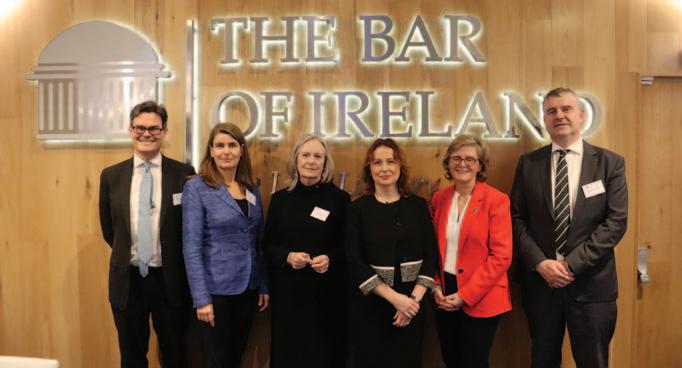

The Employment Bar Association (EBA) held its landmark 10th Annual Conference on November 14 in the Distillery Building. Despite the inclement weather, the conference sold to capacity. Attendees were welcomed by MaryPaula Guinness BL, Chair of the EBA. There were three sessions that were expertly chaired by Mr Justice Brian Cregan, Louise O’Donnell, Chair of the Labour Court, and Ms Justice Marguerite Bolger. The speakers, who were experienced members of the EBA, included Peter Ward SC, Brendan Kirwan SC, Mairéad McKenna SC, Caroline Doyle BL, Owen Keany BL, and Niamh McGowan BL. Panellists discussed various themes across employment law, referencing current trends in US law, employment injunctions, remedies, equality, and Karshan. The conference ended with a comprehensive look back at the work of the Workplace Relations Commission (WRC) over the past 10 years, given by Tom Mallon BL. Dr David Begg, Chair of the WRC, gave an indication of its future to end the evening.















On November 5, Cian McGoldrick BL delivered an insightful seminar on the latest developments in examinership to the Corporate and Insolvency Bar Association (CIBA). Introduced by John Kennedy SC, the session explored recent judicial decisions, assessed the impact of the EU (Preventive Restructuring) Regulations 2022, and examined the evolving landscape of cross-border recognition of schemes and insolvency
The Tax Bar Association’s Annual Conference was held on November 20 and featured a distinguished line-up of speakers addressing key developments in tax law and litigation. Juliana Quaney, Revenue solicitor, delivered an address on ‘The Rule of Law, the Independence of Revenue, and the Rights of Taxpayers’, followed by James Burke SC’s overview of the Zalewski case. Two substantive panel discussions ensued: the first examined recent case law with Kelley Smith SC, Gráinne Duggan SC, Nichola Delaney BL, and Olivia Long of Matheson, while the second considered general litigation updates with Paul Gallagher SC, Alison Keirse SC, Jeananne McGovern SC, and Lorna Gallagher BL. Further contributions included those from Fintan Clancy of Arthur Cox on corporate tax matters, Ciaran Ramsay SC on the McNamara case, and Marie-Claire Maney, Chairperson of the Tax Appeals Commission, on the Commission’s evolving approach to appeals and preparations for public hearings.
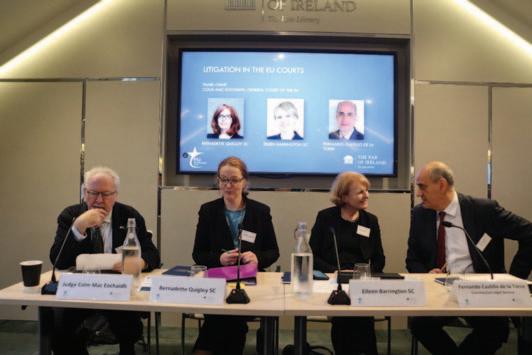
The EU Bar Association (EUBA) held its Annual Conference in The Gaffney Room on November 7. Catherine Donnelly SC, Chair of the EUBA, opened the Conference, and Mr Justice Brian Murray of the Supreme Court gave a keynote address on judicial independence. The first panel of the afternoon spoke about litigation in the EU courts.
This panel was chaired by Judge Colm Mac Eochaidh of the General Court of the EU. The expert panel consisted of Bernadette Quigley SC, Eileen Barrington SC, and Fernando Castillo de la Torre, Legal Service of the European Commission.
The second panel discussed regulation of online content under the Digital Services Act. This panel was chaired by Mr Justice Anthony Collins of the Court of Appeal. The panellists were experts Niamh Hodnett of Coimisiún na Meán, Emily Egan McGrath SC, and Anna Herold, European Commission.
applications. Attendees received practical perspectives on current trends shaping corporate restructuring and insolvency law, with discussion focusing on examinership principles and recent authorities. Cian also analysed key cases, including Mac Interiors, Mainline Power Limited, and CityJet DAC , offering valuable insights for practitioners navigating complex restructuring frameworks.

On October 7 and 8, 26 members of the Law Library were formally called to the Inner Bar in ceremonies held at the Supreme Court. The call to the Inner Bar, or ‘taking silk’, marks the transition from junior counsel to senior counsel, a distinction that recognises barristers of exceptional ability, integrity, and expertise across a wide range of legal disciplines.
The newly appointed senior counsel bring with them experience across both criminal and civil law, reflecting the breadth of talent within The Bar of Ireland. Their appointment underscores the continued importance of advocacy in protecting the rule of law, advancing access to justice, and serving the public interest. Senior counsel are entrusted with more complex and high-profile cases, demonstrating mastery in specialised areas such as criminal or civil law.
The newly appointed senior counsel hail from Dublin, Leitrim, Wicklow, Clare, Mayo, Cork, Tipperary, Louth, Galway, Donegal, Waterford, Wexford, Limerick, Kilkenny, and Fermanagh. There are now 399 senior counsel at The Bar of

Ireland, of which 21% are female. The Bar continues to support and promote the Inner Bar as a viable career route for female colleagues, as
On October 21, Patricia Brazil SC and Siobhan Clabby BL appeared before the Joint Oireachtas Committee on Justice to express the views of The Bar of Ireland in regard to the International Protection Bill 2025. In June of this year the Bar published a submission to the Joint Oireachtas Committee on Justice that outlines our views on the legislation. Read the submission on the Law Library website: https://www.lawlibrary.ie/app/uploads/securepdfs/2025/06/Submissionto-Oireachtas-Joint-Cttee-on-IP-Bill_FINAL_Bar-of-Ireland-1.pdf
From left: Maria Hennessy, UNHCR Ireland; Caroline Stephens, UNHCR Ireland; Fiona Hurley, CEO, Nasc, the Migrant and Refugee Rights Centre; Kostas Kapantais, Nasc; Alan O’Leary, Irish Refugee Council; Patricia Brazil SC; Siobhan Clabby BL; and, Nick Henderson, CEO, Irish Refugee Council.
well as supporting the continued development of all of our members through extensive work on our professional and training programmes.

According to a new independent report by KPMG commissioned by The Bar of Ireland and the Law Society of Ireland, the legal sector is a key contributor to long-term economic growth in Ireland, with ¤1.4bn of legal services exported internationally. The report – ‘Economic impacts of the Irish legal profession’ – was launched by the Minister for Justice, Home Affairs and Migration, Jim O’Callaghan TD, at Ireland for Law’s Dublin International Disputes Week (DIDW) conference on October 22. The report highlights how essential legal services are to Ireland’s global competitiveness, enabling investment and growth across high-value sectors of the economy. According to the report, the Irish legal profession supports over 52,000 jobs: 25,000 are directly supported (solicitors, barristers, and support staff), and a further 27,000 are supported indirectly. Minister O’Callaghan said: “The findings of this report confirm that Ireland’s legal system is not only a cornerstone of our democracy but also a vital driver of our economic success. A trusted, independent legal sector underpins investment and innovation across every major industry in the country – from financial services
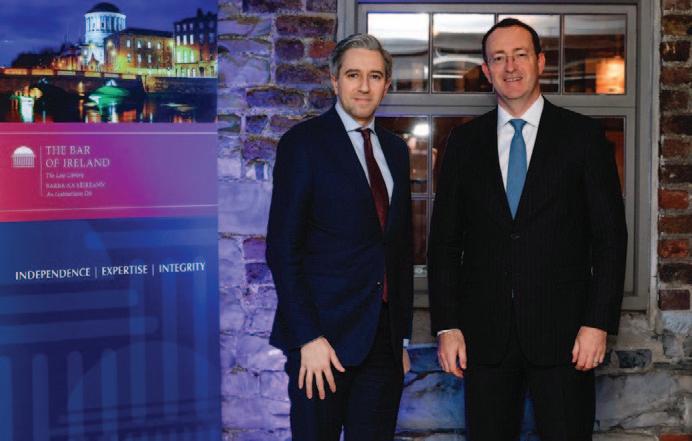
On November 25, The Bar of Ireland hosted the final commemorative event of the year to mark the 250th anniversary of the birth of Daniel O’Connell. An Tánaiste and Minister for Finance, Simon Harris TD, delivered the keynote address followed by a speech by Seán Guerin SC, Chair, Council of The Bar of Ireland. The event celebrated O’Connell’s enduring legacy as a barrister and champion of civil rights.

and aviation to life sciences and technology – and it strengthens Ireland’s position as a leading global centre for dispute resolution. At the same time, the report reminds us that access to justice must be available in every part of our country. My department will continue working with the legal professions to support access to legal services in regional and rural areas, ensuring that the
benefits of a strong, modern justice system are felt by all”.
Read the full KPMG report on The Bar of Ireland’s website: https://www.lawlibrary.ie/app/uploads/securepd fs/2025/10/Economic-impacts-of-the-Irishlegal-profession_21-October-2025.pdf
On September 29, The Bar of Ireland welcomed 95 new members to the Law Library. Referred to as ‘devils’ in their first year, they represent a dynamic and diverse group of future barristers. Of the 95 entrants, 54 women comprise the largest proportion (57%). The cohort spans a broad range of ages, from the early 20s to over 50, reflecting multiple pathways into the profession. The members come from The Honourable Society of King’s Inns, including recent university graduates and individuals transitioning into law after careers in other professional fields.
Chair of the Council of The Bar of Ireland Seán Guerin SC welcomed the new members: “I am delighted to welcome our new members to the Law Library at the beginning of their journey as members of our profession. This year, as we mark the 250th anniversary of the birth of Daniel O’Connell, one of the greats of Irish legal and political history, we are reminded of the enduring power of advocacy in the pursuit of justice and human dignity. O’Connell’s legacy challenges us to uphold the highest standards of integrity, courage, and service. Our new members will take on the responsibility of speaking on behalf of those who entrust members of The Bar of Ireland to advocate for them in our courts and other forums. The diversity of our members’ backgrounds, perspectives and experiences strengthens our collective voice in the service of justice. I wish them every
On November 19, the Civil State Bar Committee hosted a conference focused on the future of the Civil Legal Aid Scheme, with particular attention given to the findings of the Civil Legal Aid Review Group’s report, published in July. Held in the Dublin Dispute Resolution Centre (DDRC), the event brought together judiciary representatives, legal practitioners, policy-makers, and stakeholders to reflect on the operation and reform of the Scheme. The event opened with remarks from Seán Guerin SC, Chair of the Council The Bar of Ireland, followed by presentations on the majority and minority reports of the Review Group. Ms Justice Sara Phelan of the High Court provided an overview of the majority report, while Eilis Barry, CEO of Free Legal Advice Centres (FLAC), presented the minority perspective. Barristers Aisling Mulligan BL and Aisling Wall BL, and Siún Hurley, Chair of the Family and Child Law Committee of the Law Society of Ireland, shared practical insights from their work within the Scheme.
A panel discussion on the future implications of the Scheme and reflections on the report was moderated by Cliona Cleary BL, Chair of the Civil State Bar Committee, and featured contributions from Ms Justice Bronagh O’Hanlon (retired) and Chair of the Oireachtas Joint Committee on Justice, Matt Carthy

success as they embark on this new chapter and join our community of 2,140 barristers”.
The Bar of Ireland continues to enhance pathways to practice through formal training for Masters, reforms to fee structures, and the introduction of a dignity at work protocol. Work also continues to expand access to the profession through education, training, and equality initiatives.
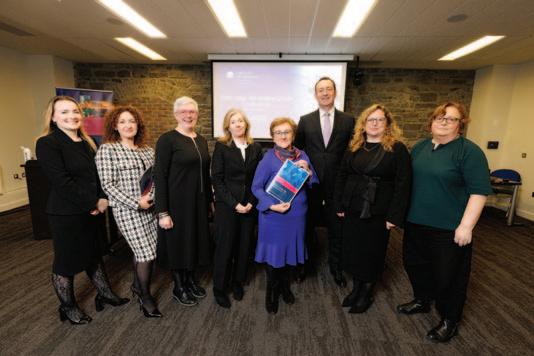
From left: Aisling Mulligan BL; Siún Hurley, Chair, Law Society Family and Child Law Committee; Ms Justice Sara Phelan; Cliona Cleary BL, Chair, Civil State Bar Committee; Ms Justice Bronagh O’Hanlon (ret.); Seán Guerin SC, Chair, Council of The Bar of Ireland; Aisling Wall BL; and, Eilis Barry, CEO, FLAC.
TD. The insights from speakers and the conversations resulting from the event are a productive step toward shaping a modern, responsive system that meets the needs of all.

Colin Potts Director of Finance & Operations, The Bar of Ireland
As part of your Law Library membership, you are automatically covered under The Bar of Ireland’s Critical Illness and Accelerated Death Benefit Scheme. This valuable support mechanism offers financial protection to members and their families in the event of serious illness or untimely death, without the need for separate enrolment or underwriting.
The Scheme has supported over 150 members since it was introduced in 1994, with claim payments of just under ¤10m over this time. The current annual cost of the Scheme, which is underwritten by Irish Life, is approximately ¤500,000.
What is the Accelerated Death Benefit Scheme?
The Bar of Ireland Accelerated Death Benefit Scheme is designed to offer financial support to members and their families in the event of:
■ death before age 65, with a lump sum of ¤100,000 payable to the member’s estate; or,
■ diagnosis of a specified serious illness before age 65, with a lump sum of ¤40,000 payable to the member.
This dual-purpose cover combines life assurance and specified illness cover, ensuring that members have access to financial support during life’s most challenging moments.
Eligibility
■ Automatic inclusion: all Law Library members aged 21-65 are automatically enrolled in the scheme upon joining.
■ No separate premiums: the cost of the Scheme is included in your annual membership subscription.
How have members benefitted over the years?
Since the scheme was introduced in 1994, a total of ¤9.8m has been paid to members across 173 claims, demonstrating its tangible value to members and their families.
Of these:
■ some 59 claims were made under the death benefit, providing vital financial support to bereaved families; and,
■ a further 114 claims were made under the specified illness cover, helping members to manage the financial impact of serious health conditions.
Among other things, this data highlights the importance of illness cover in a self-employed profession, where income can be disrupted by health events.
Why awareness matters
Despite its significance, the Scheme is sometimes overlooked. Members are encouraged to:
■ review the list of covered illnesses to understand what’s included;
■ keep personal and next-of-kin details up to date to ensure smooth claims processing; and,
■ contact Aon (the Scheme broker) promptly in the event of a claim.
Claims are processed by Irish Life Assurance plc, with support from Aon. Death claims are typically paid within 10 days once documentation is complete, while illness claims may take longer due to medical assessments.
It is also important to note that while this benefit is a key support, members should assess their own individual circumstances and consider other supports, such as income protection, additional life assurance, etc.
The Critical Illness and Accelerated Death Benefit Scheme reflects The Bar of Ireland’s ongoing commitment to member welfare. As selfemployed professionals, barristers are not generally entitled to
employer-sponsored benefits. This Scheme helps to bridge that gap, offering peace of mind and practical support when it’s needed most. Whether you’re a new member or a longstanding practitioner, this is a key benefit of membership, quietly working in the background to protect you and your loved ones.
The cover is underwritten by Irish Life, and administration of the Scheme is provided by Aon. For queries or assistance, contact:
■ Shane O’Sullivan – shane.osullivan@aon.ie; or ■ Rachel Hannon – rachel.hannon@aon.com
For further information, go to the members’ section of The Bar of Ireland website at https://members.lawlibrary.ie/


Michelle Farrell
Fee Recovery Manager Ext: 5053 feerecovery@lawlibrary.ie

Waad Alias
Fee Recovery Administrator Ext: 5409 feerecovery@lawlibrary.ie
As she prepares to leave her role as CEO of The Bar of Ireland, Ciara Murphy speaks about the changes at The Bar of Ireland over the last decade, and what makes a great professional member organisation.



Ann-Marie Hardiman, Managing Editor, Think Media
Ciara Murphy has spent most of her career at the helm of a number of professional member organisations, and while she says that she has a huge interest in the role of the professions in society, her career trajectory, at least at the start, was dictated by the need to balance personal and professional responsibilities: “I studied BESS [Business, Economics and Social Studies] in Trinity College, and I had a child while I was still in college and became a single parent. So at that point it was just about getting a job, keeping a roof over your head. I had a really kind tutor in Trinity, Mary Keating, who looked out for me because she knew my circumstances. She gave me some research work that I could do on a part-time basis and put me in contact with a number of academic institutions and consultancy firms who also gave me projects”.

Other policy and research jobs followed with a range of organisations before Ciara took up a role with the Irish Dental Association (IDA) and became its Chief Executive at the age of 32. She then moved to the Society of Chartered Surveyors Ireland (SCSI), where she led the organisation through the unprecedented turmoil of the economic crash. Despite the enormous impact of the crash on the property and construction sector and the professions, she managed to grow membership of that organisation from 3,000 to 5,500 through a series of mergers and acquisitions by the time of her departure to take up her current role at the Bar in 2014: “It was a job I really wanted at the time. Through the experience with the IDA and the SCSI, I felt I was very well placed to appreciate the value of independent professions, understanding the pressures they face and the importance of having a strong professional organisation to represent and support them. I felt I had developed a clear sense of how a modern professional body, and a membership-focused organisation, should function, and how to balance tradition with modernisation and innovation, which is particularly relevant to the Bar”.
The ensuing 11 years have seen enormous change at The Bar of Ireland, with a huge expansion and professionalisation of core member services, which Ciara says are the fundamental aspects that matter to individual members day to day: “Being able to ensure that those services are available at the highest standard is absolutely essential, and I think by and large most members would now say that the supports available through the Library and Information Service, the IT Service and importantly the Professional Practice and Advisory Service, are excellent. That’s not to discount any of the other services that are available, but on a day-to-day basis, in terms of a member being able to operate and
provide services to clients, they need access to those fundamental elements to carry on their professional practice”.
Those services are bolstered by improved internal and external communications, which Ciara feels are crucial in setting out the Bar’s core function to members and stakeholders: “When I came to work at the Bar, it wasn’t clear to me what the core role of the organisation really was, and what it was trying to achieve. There was no strategic plan in place to guide the organisation to deliver on its vision or mission. I think we’ve been able to define what the purpose of the organisation is, and one of the key things that we did was to implement a very good communications programme to promote relevant information. You can never over-communicate in a professional body, and now we have a wide range of platforms through which we deliver our communications, both internally and externally. That’s a huge credit to the fantastic communications team, led first by Shirley Coulter [formerly Director of Membership and Public Affairs, and shortly to return as new CEO], and then by Cormac Ó Culáin who, together with the talented staff team, really brought our communications and marketing on to the next level, introducing new formats of communication including our podcast series, ViewPoints , the LegalEdge , and ramping up our web and social media outreach”.
There’s also been a significant expansion of the education offering, and Ciara praises the work of the Bar’s Director of Education and Professional Development, Stephen Swanton, and his team: “They’ve done an amazing job. It’s now a very busy programme and between the combination of the Specialist Bar Associations and the Education and Training Committee, all the educational needs of members are met through our offering, which is part of the annual membership fee”.
The Specialist Bar Associations (SBAs) have been a tremendous addition to the Bar; indeed, Ciara feels they are probably the organisation’s single biggest strategic achievement in terms of internal member engagement: “When I started, there were a small number of SBAs, and they were acting independently of the Council activities, but I could see that there was a need to engage with them and I felt there was an opportunity to support them and do more, together and better. Today, the number of SBAs has grown to 17, and there is a demand for more, but we are limited in terms of staff resources available to support this growth. The staff that support the SBAs are second to none, and I’m really pleased that the SBAs have demonstrated the value of member engagement, making it front and centre and facilitating a greater sense of connection between individual members and The Bar of Ireland”. These things have enormous value for members, but also for the organisation itself, which Ciara says must remain relevant to members in order to thrive: “You don’t have to be a member of the Law Library to practise, you just have to be on the Legal Services Regulatory Authority (LSRA) Roll of Practising
Barristers. When I came to the Bar, the biggest challenge that was facing the organisation was this new regulator coming into being and a fear of the impact it would have on the organisation in terms of its relevance to members. That fear created the opportunity to take a good look at the role of The Bar of Ireland and the services we provide to members. During the course of that process, we needed to help members understand the value of maintaining their membership and every year we review, and publish, our Value for Money Benchmark. We cost what the membership services are and we measure it against what you would pay to practise as a barrister outside of membership of the Law Library. I believe that 99% of practising barristers are members because of the value for money of, and access to, the services provided by The Bar of Ireland”.
These services also enhance the collegiality of the Bar, which has always been one of the most valued hallmarks of the profession: “It’s something that comes through in all the member surveys that we’ve done over the years. Since Covid, some members feel that there has been a decline in collegiality because people aren’t working in the same way as they were before, but in my experience having worked with other professions, the strength of collegiality at the Bar is at a level not seen among others”.
Ciara is justly proud of all of this, but says that some of the Bar’s biggest achievements have been about defending the rule of law and access to justice, and building relationships, both at home and internationally. Chief among these, she says, was the criminal legal aid campaign, where members fought to restore fees that had been decimated during the austerity era: “That has been a very long campaign that started in 2016, and finally came together under the leadership of Sara Phelan and Seán Guerin. Under their leadership, the grassroot members also got involved, which helped to deliver positive progress. I was really pleased to see that this Budget is delivering. We’ve had a 10% restoration, a further 8%, and now there’s a further 8% to come in 2026”.
She acknowledges that there is still some work to be done here, but is delighted with the progress that has been made, albeit at a cost: “I think it was an awful shame that the members of the Bar were forced to take the extraordinary measure of withdrawing their services in pursuit of an independent time-limited mechanism to have their fees restored, and I hope that the Government doesn’t put the profession, who provide an essential service in the administration of criminal justice on behalf of the Irish people, in a position like that again”.
She is also mindful of the ongoing work in relation to civil legal aid, and hopes that the recommendations of the group chaired by former Chief Justice Frank Clarke will be prioritised: “It is one of those areas that is really important for
With her extensive experience over two decades working with professional member organisations, it’s not surprising that Ciara has a keen insight into what makes a successful organisation: “Listening to members and understanding member needs. No matter what comes across my desk, everything is seen through a lens of ‘how will this benefit the members?’ I think it’s in my DNA”.
She says the way to achieve this is by having a strong sense of a common purpose: “Every organisation needs to know what it is trying to achieve and what its direction of travel is. If the
organisation doesn’t know, how are the staff supposed to know? How are the stakeholders supposed to know? I’m a fundamental believer in strategic plans. Being strategically focused and having good governance enables members’ needs to translate into priority objectives and action plans to ensure the member needs can be met”. Adaptability is key too: “Whether it’s AI, new professional regulation, or a pandemic, you need to be agile and adaptable to whatever the external environment is”. And what makes a good leader? “I think clarity of purpose and a sense of
people, in particular in family law, who face very challenging circumstances. Access to justice is really important, and for those who are most vulnerable in society, access to legal aid. I think it’s very important for the welfare of society as a whole that it is dealt with as soon as possible”.
Ciara also mentions last year’s World Bar Conference as a highlight, both personally and for the organisation as a whole: “It was a fantastic showcase for The Bar of Ireland and the Bar of Northern Ireland, and I thoroughly enjoyed working with my great colleague and friend in Northern Ireland, David Mulholland, and his team. It was really hard work, an awful lot to take on, but the two teams worked really well together. It was a hugely successful event with barristers from all over the world coming to Belfast and Dublin, and the feedback was overwhelmingly positive and appreciative”.
Of course, the last decade has not been without its challenges and low points, chief among them being the massive impact that the Covid-19 pandemic had on the profession: “I think the pandemic was an extraordinary challenge for members, who were locked out of being able to earn a living, but also making sure that the administration of justice could continue – an essential service. It required such intense co-ordination both on the staff side and in particular the senior management team, and on the member leadership side. It was an incredibly challenging time for everyone”.
It’s not in Ciara’s nature, however, to focus on the negatives: “My experience has been that when you hit that low point, it brings the value of a strong membership organisation into focus and can have the positive effect of uniting people in pursuit of a common goal. Oftentimes it’s those things that will cause members to come together, and from the low point, something good comes”.
direction. When you have clarity of purpose and direction, then you will create the conditions for other people to thrive, including staff, members, and external stakeholders. Good leadership also has integrity, empathy, and the ability to make difficult decisions when necessary, and I’ve had a fair few of those. I think membership bodies are quite a unique type of organisation. For a CEO, I think understanding the profession’s heritage and the conditions that they operate under will shape its future, while at the same time never losing sight of the fundamentals – rule of law and access to justice – is crucial.”
Relationships between Government Departments and professional organisations can sometimes be difficult. Every group has its priorities, and it can be a challenge to be heard when competing with housing and health.
The long-term impacts of austerity and the pandemic have also been felt in delays to much-needed infrastructural development: “There was a huge lack of investment in the IT infrastructure in the Courts Service throughout the austerity years. It was very shortsighted, but I think they are catching up now; there’s a big modernisation programme underway in the Courts Service, there’s the criminal legal aid reform programme, family justice reform, and of course the appointment of additional judges, which is so long overdue”.
She does feel that during her time at the Bar, those relationships have improved enormously: “The relationships with Government Departments, in particular the Department of Justice, have turned around completely. The officials are really superb and their intentions to do right by the justice system both on the civil and criminal front, really have come a long way. The transformation programme that took place within the Department of Justice over the last few years under the leadership of Oonagh McPhillips (and Aidan O’Driscoll) has had a very positive impact on progressing matters relevant to the profession”.
She also speaks highly of the current Minister, Jim O’Callaghan TD: “Obviously, he’s a senior counsel, and therefore has a deep understanding of justice. I don’t have any political alliances, but I really do think that he’s doing an excellent job in that portfolio. Of course, no doubt in his capacity as Minister he will do things that the Bar won’t be too fond of in the future, but I think he has a genuine engagement not just with the Bar, but all stakeholders in the justice sector”.
And if she were Minister, or indeed Taoiseach, what would she do?
“Obviously, I’m going to say investment in the justice and courts system, so that it’s properly resourced, modernised and accessible to all regardless of means. Fulfil the promises of all the additional judges and the accompanying court staff needed to support them, deliver on the modern Courts Service infrastructure plans, and make sure that there is proper funding for access to justice through properly funded legal aid schemes.”
Ciara knows that this resourcing is important for very fundamental reasons too: “All you have to do is look around the world at the challenges to democracies, or what we thought were democracies. Every democratic society is based on the rule of law, and when that is challenged, or if it’s not strong in an effective justice system, that’s when you see dangers emerging. We take these things for granted at our peril”.
The paradox of small things
For Ciara, it’s the people that make the job special: “It’s a people business, both on the staff side and on the member side. Working within a community that is committed to justice and to high standards and public service is really inspiring. The many members, Chairs, Councils and committees that I’ve worked alongside over the years are truly outstanding and inspiring individuals who give back to the profession to help their colleagues”.
She particularly highlights her senior management team, past and present, who do an outstanding job, each of whom are experts in their discipline: “The credit for all that has been achieved over the last decade is entirely down to
What’s next?
Ciara is planning some well-deserved time off, with no immediate career plans in the offing: “Because I had my kids so young, I didn’t have ‘my’ time in my 20s. I haven’t taken a breath. So I’m just going to take a breath. Never say never – I’m not ruling anything in, and I’m not ruling anything out. I feel incredibly grateful and lucky to have the option of becoming time affluent”.
It’s clear that she won’t be short of things to do and along with some travel plans, she is quite an active person: “I do Pilates three times a week.
I like to run, I like to hike, I play padel, and I cycle. And I have lots of books to read. I have not had time to read a book without interruption owing to the unrelenting demands of the job”.
She laughs about the advice she has relayed to outgoing Chairs of the Council about the phenomenon of Relevance Deficit Disorder (RDD), and how the loss of relevance upon cessation in their role as Chair can have an unexpected psychological impact: “They wonder why people have
each one of them and their teams, and I am deeply appreciative of their commitment throughout my time as Chief Executive”.
She also enjoys the variety of the role: “No two days are the same: just when you think you might get through your ‘to do’ list, by 9.00am it’s out the window. But I also think that the role itself causes you to have to think strategically, operationally, practically, diplomatically, and have a constant willingness to learn. It’s demanding and rewarding in equal measure, and sometimes not in equal measure! I get a great sense of satisfaction when I can solve a problem for a member. I call it the paradox of small things. If that member can have their problem heard or resolved on that day, and sometimes you can’t resolve their problem and can only offer a listening ear, you’ll reap the benefits of their appreciation for the work of the organisation for years to come. That’s my ethos and that of all of the staff at The Bar of Ireland. We’re there to serve the members and we’ll go as far as we can to try to get an issue resolved for members”.
As she leaves her role, Ciara says she’s incredibly grateful for the time she has spent at the Bar, and the people she has met and worked with: “I’ve been really privileged to work with an incredible staff team, both past and present. I’m not going to name them all, but they have supported me and I hope I have supported them. There’s never been a day where I’ve got out of bed and thought, ‘I don’t want to go to work today’. Every single one of the Chairs, the Councils, the committees have been amazing to work alongside. I have been privileged to work alongside many brilliant people and have some great fun and laughs over the years – they know who they are!”

stopped calling, they are no longer in the loop, their advice is not being sought and they ultimately have to come to terms with the fact that they are no longer on my speed-dial list. I guess I’ll have to finally experience RDD for myself and report back! But I think I’ll be just fine!”


A directory of legislation, articles and acquisitions received in the Law Library from September 18, 2025, to November 20, 2025
Judgment information supplied by Vlex Justis Ltd.
Edited by Vanessa Curley, Susan Downes and Clare O’Dwyer, Law Library, Four Courts
Library acquisitions
Pickles, J. Straight from the Bench London: Hodder and Stoughton, 1992 –L201
Articles
Corcoran, S. Renaissance and reformation. Law Society Gazette 2025; Nov: 38-41
Lynch Shally, K. Third-party litigation funding: Irish reform, regulatory tensions and European influence. The Irish Jurist 2025; 73: 125-151
Ryan, A. The potential of ‘administrative justice’ for Irish public law. Irish Judicial Studies Journal 2025; 1: 151-172
Statutory instruments
Avian Influenza (Biosecurity measures) Regulations 2025 – SI 520/2025
Avian Influenza (Temporary Measures) Regulations 2025 – SI 528/2015
Avian Influenza (Precautionary Confinement of Birds and Restriction on Assembly of Live Birds) Regulations 2025 – SI 532/2025
Avian Influenza (Temporary Measures) Regulations 2025 – SI 533/2025
Avian Influenza (Temporary Measures) Regulations 2025 – SI 535/2025
ARBITRATION
Articles
King, C. Dispute boards: do they work? Construction, Engineering and Energy Law Journal 2025: 2: 6-12
Articles
Keys, T. Artificial intelligence: what happens when AI goes rogue? The Bar Review 2025; 30 (4): 130-134
La Cumber, G. AI at the Bar. The Bar Review 2025; 30 (4): 124-125
Ruigrok, C., Scannell, B. Rise of the machines. Law Society Gazette 2025; Oct: 34-37
Bankruptcy law – Discharge order –Transfer of bankruptcy proceedings –Bankruptcy Act 1988, ss.135,60C –Personal Insolvency Act 2012, s.11 –Bunreacht na hÉireann – Applicant seeks urgent hearing of the bankruptcy application – Whether the bankruptcy proceedings should be transferred for hearing alongside the Chancery proceedings and whether the deputy official assignee’s standing to object to the applicant’s discharge was valid – 10/10/2025 – [2025] IEHC 531
Re: Dunne [a bankrupt] Bankruptcy law – Discovery application – Rules of the Superior Courts (RSC), O.31 – RSC, O.76 –Plaintiff seeks an order to compel disclosure of bankruptcy files –Whether the plaintiff’s discovery request should be granted –10/10/2025 – [2025] IEHC 532
Dunne and ors v Lehane and ors
Articles
Boland, Dr M.J. The rise in corporate insolvencies – a return to normal or something deeper? Commercial Law Practitioner 2025; 32 (6): 75-83
Library acquisitions
Royal Institute of the Architects of Ireland. RIAI Construction Contract Dublin: RIAI, 2025 – N83.8.C5
Library acquisitions
Bracken, L. Child Law in Ireland (2nd ed.). Dublin: Clarus Press, 2025 –N176.C5
Articles
O’Reilly, L. GAL interrupted. Law Society Gazette 2025; Nov: 35-37
Insolvency law – Anti-suit injunction –Abuse of process by JSC – Companies Act 2014, s.631 – Applicants seek orders to restrain respondent from continuing Russian proceedings challenging Irish court decisions – Whether JSC’s actions in pursuing Russian proceedings are an abuse of process by ignoring Irish court orders – 06/10/2025 – [2025] IEHC 524
GTLK Europe Designated Activity Company [in liquidation] v Companies Act 2014 [No. 2]
Library acquisitions
Bloomsbury Professional. Companies Act 2014: 2025 edition. Dublin: Bloomsbury Professional, 2025 – N261.C5.Z14
Articles
McPartland, A. The directors’ duty to act honestly and responsibly in relation to the conduct of the affairs of the company under the Companies Act 2014. The Irish Jurist 2025; 73: 72-95
Competition law – Stay order –Adjournment of proceedings – RSC, O.63A, r.5 – Commission seeks adjournment of proceedings pending conclusion of Italian appeals – Whether to adjourn the proceedings generally pending appeals in Italy – 31/07/2025 – [2025] IEHC 536
Ryanair Designated Activity Company and anor v Competition and Consumer Protection Commission and anor
Library Acquisitions
Korah, V. An Introductory Guide to EC Competition Law and Practice (5th ed.)
London: Sweet and Maxwell, 1994 –W110
Articles
Lucey, M.C. Creating awareness of gender inclusivity and competition law. The Irish Jurist 2025; 73: 152-163
Statutory instruments
Competition Act 2002 (Adjudication Officers) Regulations 2025 – SI 437/2025
Constitutional law – Strike out order –Unconstitutional nomination process –Presidential Elections Act 1993 – Plaintiff seeks rerun of presidential election without party interference and claims to be the only validly nominated candidate – Whether the instruction by the Fine Gael leader to block independent candidates was justiciable – 20/10/2025 – [2025] IEHC 565
Byrne v Tánaiste and ors
Constitutional law – Habeas corpus order – Habeas corpus application – Misuse of Drugs Act 1977 (as amended), s.26 –Petty Sessions (Ireland) Act 1851 (as extended by Courts of Justice Act 1924), s.10 – Complainant seeks a habeas corpus enquiry for persons detained based on evidence obtained under search warrants – Whether an application under Article 40.4.2 of the Constitution must identify specific detained persons – 31/10/2025
– [2025] IEHC 597
McGreal v Minister for Justice, Home Affairs and Migration and ors
Library Acquisitions
McCloskey, R.G. (ed.). Essays in Constitutional Law. New York: Vintage Books, 1957 – M31
Articles
Cahillane, L. Constitutional interpretation
in Ireland and the Heneghan case. Irish Judicial Studies Journal 2025; 1: 120-150
O’Connell, E. Under oath. The Bar Review 2025; 30 (4): 141
Library acquisitions
Smith, J.C., Thomas, J.A.C. A Casebook on Contract (7th ed.). London: Sweet and Maxwell, 1982 – N10
Civil procedure – Order for costs – Costs in civil proceedings – Legal Services Regulation Act 2015, ss.168,169 – Civil Liability and Courts Act 2004, s.26 –Plaintiff seeks to recover costs in both the High Court and Circuit Court – Whether the plaintiff was entitled to costs despite the award in the High Court being less than the Circuit Court – 03/10/2025 –[2025] IEHC 517
AB v MW (No.2)
Civil procedure – Costs order – Costs –Legal Services Regulation Act 2015, s.169 – RSC, O.19 – Defendants seek costs for motion and proceedings – Whether defendants are entitled to costs following the dismissal of proceedings –22/10/2025 – [2025] IEHC 553
Browne v Registrar General of Fishing Boats and ors [No. 2]
Civil procedure – Vacant possession order – Entitlement to costs – Courts Act 1991, s.17 – Legal Services Regulation Act 2015, s.169 – Appellants seek a differential costs order – Whether costs should be reserved to the trial judge or awarded at this stage – 10/10/2025 –[2025] IECA 20
Fox v Reilly and anor
Property law – Costs – Legal Services Regulation Act 2015 – Land and Conveyancing Law Reform Act 2009 –Plaintiffs seek to recover legal costs awarded for the substantive application and motions – Whether the plaintiffs were entitled to recover measured legal costs against the first named defendant –05/11/2025 – [2025] IEHC 602
Gaffney and anor v Gaffney and anor [No. 2]
Administrative law – Costs – Public interest proceeding – Garda Síochána Act 2005, s.14 – Applicant seeks costs in his favour and to retain costs awarded in lower courts – Whether the Commissioner is entitled to his costs given that the appeal related to discrete issues of statutory interpretation – 14/10/2025 –[2025] IESC 41
Hegarty v Commissioner of An Garda Síochána
Civil law – Costs order – Appeal against costs order – Legal Services Regulation Act 2015, s.169 – Appellant seeks variation of the costs order against him –09/10/2025 – [2025] IECA 199
Everyday Finance DAC v Bradley and ors (PUST Malcomson Law Solicitors) and anor
Judicial review – No order for costs –Mootness of proceedings – Legal Services Regulation Act 2015, s.169 – Courts (Supplemental Provisions) Act 1961, s.45 – Applicant seeks legal costs in judicial review proceedings regarding delay in registering foreign birth – Whether the administrative decision on the foreign birth registration was expedited due to judicial review proceedings –03/10/2025 – [2025] IEHC 581
M [a minor] v Minister for Foreign Affairs and Trade and anor
Administrative law – Certiorari order –Costs following certiorari – International Protection Act 2015, s.21 – Applicant seeks costs for proceedings challenging determination of inadmissibility –Whether the applicant should be awarded costs due to the respondent’s consent to quash the decision under scrutiny –24/10/2025 – [2025] IEHC 596
M(YA) v International Protection Appeals Tribunal and ors
Intellectual property law – Costs in the cause order – Passing off – RSC, O.99, r.2(3) – Plaintiff seeks a costs order related to interlocutory injunctive reliefWhether costs should be awarded for interlocutory application based on provisional success - 31/07/2025[2025] IEHC 537
Yoplait Ireland Limited v Nutricia Ireland Limited [No. 2]
Library acquisitions
Graham, L. Judicial Individuality on the UK Supreme Court. Oxford: Hart Publishing, 2025 – L220
Statutory instruments
District Court (Order 51) Rules 2025 – SI 459/2025
Circuit Court Rules (EU Service Regulation) 2025 – SI 460/2025
Circuit Court Rules (Combined Court Offices) 2025 – SI 461/2025
District Court Districts and Areas (Amendment) and Variation of Days and Hours (Nenagh, Thurles) No. 5. Order, 2025 – SI 512/2025
District Court Districts and Areas (Amendment) and Variation of Days and Hours (Nenagh, Thurles) No. 6. Order,
2025 – SI 513/2025
District Court Districts and Areas (Amendment) and Variation of Days and Hours (Nenagh, Thurles) No. 7. Order, 2025 – SI 514/2025
District Court Districts and Areas (Amendment) and Variation of Days and Hours (Nenagh, Thurles) No. 8. Order, 2025 – SI 515/2025
District Court Districts and Areas (Amendment) and Variation of Days and Hours (Nenagh, Thurles) No. 9. Order, 2025 – SI 516/2025
District Court Districts and Areas (Amendment) and Variation of Days and Hours (Nenagh, Thurles) No. 10. Order, 2025 – SI 517/2025
District Court Districts and Areas (Amendment) and Variation of Days and Hours (Nenagh, Thurles) No. 11. Order, 2025 – SI 518/2025
District Court Districts and Areas (Amendment) and Variation of Days and Hours (Nenagh, Thurles) No. 12. Order, 2025 – SI 519/2025
Statutory instruments
Credit Union Fund (Stabilisation) Levy Regulations 2025 – SI 464/2025
Credit Institutions Resolution Fund Levy (Amendment) Regulations 2025 – SI 465/2025
Criminal law – Consecutive sentencing order – Appeal against sentence severity – Criminal Law (Rape) Act 1981, s.2 –Criminal Law (Rape) (Amendment) Act 1990, s.4 – Appellant seeks to appeal against the severity of the sentence imposed by the Central Criminal Court –Whether the sentencing judge erred in his selection of the appropriate sentencing ranges and passed sentence correctly – 13/10/2025 – [2025] IECA 217
DPP v B(A)
Criminal law – Quash conviction order –
Chain of causation – Criminal Damage Act 1991, ss.2,4 – Criminal Justice (Theft and Fraud Offences) Act 2001, s.12 – Appellant seeks to appeal the conviction for manslaughter based on the argument of causation – Whether the appellant’s act of arson significantly contributed to the death of the deceased or if the act of re-entering the apartment by the deceased broke the chain of causation – 07/10/2025 – [2025] IECA 214
DPP v Boland
Criminal law – Suspended sentence –
Sentence appeal – Criminal Damage Act 1991, ss.2(1),(4) – Appellant seeks reduction in sentence due to mitigating factors – Whether the sentencing judge fell into error in suspending only one year of the sentence – 07/10/2025 –[2025] IECA 219
DPP v Donohue
Criminal law – Re-sentencing order –Undue leniency review – Criminal Justice Act 1993, s.2 – Criminal Law (Rape) (Amendment) Act 1990, s.2 – Applicant seeks review of sentence imposed on respondent for undue leniency – Whether the sentence imposed was unduly lenient and justified this Court’s intervention –20/10/2025 – [2025] IECA 218
DPP v G(T)
Criminal law – Dismissal order – Refusal to sever indictment – Criminal Law (Rape) (Amendment) Act 1990, s.2 – Criminal Law (Rape) Act 1981, s.2 – Appellant seeks to overturn conviction on several grounds including refusal to sever indictment and admission of evidence –Whether the trial judge erred in refusing to sever the indictment and in permitting the respondent to adduce evidence –07/10/2025 – [2025] IECA 213
DPP v ITK
Criminal law – Disqualification order – Fair procedures in sample collection – Road Traffic Act 2010 – Appellant seeks to challenge the procedures followed by An Garda Síochána during the arrest regarding the provision of urine sample –Whether fair procedures require Garda to inform defendant of ramifications when choosing blood or urine sample –03/10/2025 – [2025] IECA 197
DPP (at the suit of Garda Lyons) v Tobin Criminal law – Judicial review order –Privacy rights – Child Trafficking and Pornography Act 1998, s.7 – Criminal Law Act 1976, s.9 – Respondent seeks to challenge the deployment of seized material for disciplinary proceedings –Whether the Commissioner could deploy material seized from the respondent’s mobile telephone for internal disciplinary investigation purposes – 06/11/2025 –[2025] IESC 43
Hyland v Commissioner of An Garda Síochána
Criminal law – Conviction order – Use of circumstantial evidence – Bohernabreena and Roundwood Reservoirs (Angling) Bye Law, No. 635 of 1984 – Courts (Supplemental Provisions) Act 1961, s.52 – Prosecutor seeks affirmation of conviction based on circumstantial evidence – Whether circumstantial evidence was sufficient for conviction
without producing the lure –07/10/2025 – [2025] IEHC 530
Inland Fisheries Ireland v Connors
Criminal law – Access order – Access to court records – Criminal Justice (Victims of Crime) Act 2017 – Appellant seeks access to court records for purposes related to justice administration –Whether the Circuit Court should have directed service on the victim I.G. prior to granting access to evidence –30/10/2025 – [2025] IESC 42 Smith v DPP
Library acquisitions
Lucraft, M. Archbold Criminal Pleading, Evidence and Practice 2026. London: Sweet & Maxwell, 2025 – M500
Noone, G. The Anatomy of Investigative Interviewing: Effective Interview Methods for Different Contexts. Switzerland: Springer International Publishing, 2025 –M580.12
Taggart, J. The Intermediary in the Criminal Justice System. Oxfordshire: Routledge, 2025 – M500
Articles
Hanly, C., Cassidy, T. Reducing delays in the processing of rape cases in Ireland. The Irish Jurist 2025; 73: 1-28 Roche, K. PB and CC : an update on criminal proceedings involving children. The Bar Review 2025: 30 (4): 136-139
Schweppe, J., Danagher, L., Haynes, A. The Criminal Justice (Hate Offences) Act 2024: interpretative challenges and policy inconsistencies. The Irish Jurist 2025; 73: 96-124
Statutory instruments
Criminal Justice (Terrorist Offences) Act
2005 (Section 42) (Restrictive Measures concerning Certain Persons and Entities
Associated with the ISIL (Da’esh) and AlQaida Organisations) (No.5) Regulations 2025 – SI 431/2025
Criminal Justice (Terrorist Offences) Act 2005 (Section 42) (Restrictive Measures concerning Certain Persons and Entities
Associated with the ISIL (Da’esh) and AlQaida Organisations) (No.6) Regulations
2025 – SI 490/2025
Criminal Justice (Terrorist Offences) Act
2005 (Section 42) (Restrictive Measures concerning Certain Persons and Entities
Associated with the ISIL (Da’esh) and AlQaida Organisations) (No.7) Regulations
2025 – SI 524/2025
Criminal Justice (Legal Aid) (Tax Clearance Certificate) (Amendment) Regulations
2025 – SI 538/2025
Property law – Damages for negligence –Defective bedding mortar – Civil Liability Act 1961, s.34 – Defendant seeks damages for negligence and breach of contract against the third parties –Whether the defects in the bedding mortar were patent and should have been discovered by Mr Gilligan during periodic visual inspections – 21/08/2025 –[2025] IEHC 522
Ashdrum Lodge Limited [trading as Kiernan Homes] v Barbouti
Personal injury – Damages assessment –Nervous shock – Civil Law and Criminal Law (Miscellaneous Provisions) Act 2020, s.15 – Road Traffic Act 1961 – Plaintiff seeks damages for nervous shock due to her son’s death – Whether the plaintiff is entitled to damages for nervous shock –06/10/2025 – [2025] IEHC 527
Lynch v Reynolds and ors
Personal injury law – Exemplary damages
– Assessment of damages – Plaintiff seeks assessment of damages for historical child sexual abuse – Whether the court should proceed to judgment despite the defendant not appearing to contest the matter – 30/10/2025 –[2025] IEHC 595
R v L
Property law – Injunction order –
Causation and remoteness – Plaintiff seeks injunction to abate wind turbine noise (WTN) and compensation for damages – Whether the WTN was reasonably foreseeable such as to impose liability on the defendant for the breakdown of the plaintiff’s relationship – 31/10/2025 – [2025] IEHC 587
Webster and anor v Meenacloghspar [Wind] Limited, Shorten and anor v Meenacloghspar [Wind] Limited [No. 2]
Library acquisitions
Ni Loideain, N. EU Data Privacy Law and Serious Crime Data Retention and Policymaking. Oxford: Oxford University Press, 2025 – M209.D5.E95
Articles
Morrissey, E. Lessons to learn. Law Society Gazette 2025; Oct: 38-41
Statutory instruments
Data Protection Act 1988 (Section 2B) Regulations 2025 – SI 537/2025
Employment law – Dismissal order –Delay in proceedings – Police Forces
Amalgamation Act 1925 – Defendants seek dismissal of the plaintiff’s claim due to delay in prosecution – Whether the proceedings should be dismissed on the grounds of inordinate and inexcusable delay – 06/11/2025 – [2025] IEHC 591 Doyle v Commissioner of An Garda Síochána and ors
Public procurement law – Discovery order – Council Directive 2014/24/EU –Council Directive 89/665/EEC –Applicant seeks inclusion in confidentiality ring and discovery against respondent – Whether inclusion of Mr Travers in confidentiality ring is necessary – 02/10/2025 – [2025] IECA 196
Kerrigan Sheanon Newman Unlimited Company v Sustainable Energy Authorities of Ireland
EMPLOYMENT LAW
Employment law – Judicial review order –Employment status – Workplace Relations Act 2015, s.46 – Taxes Consolidation Act 1997, s.481 – Applicants seek to set aside the grant of leave for Labour Court decisions – Whether the Labour Court provided adequate reasons for its decisions and whether the statutory right of appeal is an adequate remedy –10/11/2025 – [2025] IEHC 605
Arkins and anor v Labour Court Civil service law – Judicial review –Probationary assessment – Civil Service Regulation Act 1956, s.5A – Civil Service Regulation Act 1956, s.7 – Applicant seeks to challenge the termination of her appointment – Whether the applicant failed to fulfil the conditions of probation – 03/10/2025 – [2025] IEHC 535
Mosepele v Minister For Justice
Articles
Cowan, Dr D. True GRITTS. Law Society Gazette 2025; Oct 22-25
Kirwan, B. Disclosures, detriment and damages: the role of interlocutory injunctive relief in the Protected Disclosures Act. Irish Employment Law Journal 2025; 22 (3): 48-54
Smullen, H. Remote working as a longterm device in employment. Irish Employment Law Journal 2025; 22 (3): 55-65
Library acquisitions Bergström, F.C. Strand, M. Legal Accountability in EU Markets for Financial Instruments: The Dual Role of Investment Firms. Oxford: Oxford
University Press, 2021 – W107
Craig, P., Schütze, R. Landmark Cases in EU Law, Volume 2: The Substantive Cases. Oxford: Hart Publishing, 2025 –W86
Green, N., Hartley, T.C., Usher, J.A. The Legal Foundations of the Single European Market. Oxford: Oxford University Press, 1991 – W104
Hartley, T.C., Tridimas, T. The Foundations of European Union Law (9th ed.). Oxford: Oxford University Press, 2025 – W71
Kellerbauer, M., Klamert, M., Tomkin, J. The EU Treaties and the Charter of Fundamental Rights: A Commentary (2nd ed.). Oxford: Oxford University Press, 2024 – W1
Slynn, G. Introducing a European Legal Order. London: Sweet and Maxwell, 1992 – W93
Steiner, J. Textbook on EEC Law (3rd ed.)
London: Blackstone Press, 1992 – W86
Tamatoudi, I., Torremans, P. EU Copyright Law: A Commentary (2nd ed.)
Cheltenham: Edward Elgar Publishing Limited, 2021 – W142.2
Van der Hulst, J. (ed.). EC Fraud. The Netherlands: Kluwer, 1993 – M547.N1 Weatherill, S. Cases and Materials on EEC Law. London: Blackstone Press, 1992 –W86
Articles
Donohoe Redd, A. Secret keeper. Law Society Gazette 2025; Oct 16-17
Garavan, C., Doherty, B. The rise and fall of the European Commission’s notion of arm’s length in state aid law. The Irish Jurist 2025; 73: 29-51
Jackson, A., Kelleher, O. The implications of the European Court of Human Rights’ climate rulings for climate litigation in Ireland: a new legal reality. Irish Planning and Environmental Law Journal 2025; 1: 3-21
Statutory instruments
European Union (Waste Electrical and Electronic Equipment) (Amendment) Regulations 2025 – SI 427/2025
European Union (Restrictive Measures concerning Ukraine) (No.7) Regulations 2025 – SI 429/2025
European Union (Planning and Development) (Renewable Energy) (No. 3) Regulations 2025 – SI 435/2025
European Union (Markets in Financial Instruments) (Amendment) Regulations 2025 – SI 436/2025
European Union (Anti-Money Laundering: Beneficial Ownership of Trusts) (Amendment) (No. 2) Regulations 2025 – SI 440/2025
European Union (Marine Equipment) (Amendment) Regulations 2025 – SI 444/2025
European Union (Securitisation and Taxonomy) (Occupational Pension Schemes) Regulations 2025 – SI 449/2025
European Union (LEADER) (Offences and Control) Regulations 2025 – SI 450/2025
European Union (Birds and Natural Habitats) (Amendment) Regulations 2025 – SI 451/2025
European Union (Plastics and other materials) (Contact with food) (Amendment) Regulations 2025 – SI 454/2025
European Union (Land Use Planning –Strategic Environmental Assessment) Regulations 2025 – SI 456/2025
European Union (Environmental Assessment of Certain Plans and Programmes) (Amendment) Regulations 2025 – SI 463/2025
European Union (Food Intended for Infants and Young Children, Food for Special Medical Purposes, and Total Diet Replacement for Weight Control) (Amendment) (No. 2) Regulations 2025 – SI 466/2025
European Union (Political Advertising) Regulations 2025 – SI 474/2025
European Union (Restrictive Measures concerning Russia) (No.5) Regulations 2025 – SI 479/2025
European Union (Restrictive Measures concerning the Republic of GuineaBissau) Regulations 2025 – SI 483/2025
European Union (Restrictive Measures concerning Burundi) Regulations 2025 –SI 484/2025
European Union (Restrictive Measures concerning Nicaragua) Regulations 2025 – SI 485/2025
European Union (Restrictive Measures concerning Syria) (No.3) Regulations 2025 – SI 486/2025
European Union (Restrictive Measures concerning Iran) (No.2) Regulations 2025 – SI 487/2025
European Communities (Minimum Conditions for Examining Agriculture Plant Species) (Amendment) (No. 2) Regulations 2025 – SI 491/2025
European Communities (Minimum Conditions for Examining of Vegetable Species) (Amendment) (No. 2) Regulations 2025 – SI 492/2025
European Union (Restrictive Measures concerning Ukraine) (No.8) Regulations 2025 – SI 510/2025
European Union (Restrictive Measures concerning Belarus) (No.4) Regulations
2025 – SI 511/2025
European Union (Renewable and LowCarbon Fuels in Maritime Transport) Regulations 2025 – SI 525/2025
European Union (Vessel Traffic Monitoring and Information System) (Amendment) Regulations 2025 – SI 526/2025
Library acquisitions
Heffernan, L., Ní Raifeartaigh, Ú. Evidence in Criminal Trials (3rd ed.)
Dublin: Bloomsbury Professional, 2025 –M600.C5
Murphy, P. A Practical Approach to Evidence (2nd ed.). London: Financial Training Publications Limited, 1985 –M600
Articles
Rix, K. ‘Those bloody books’: are classifications of mental disorders a help or a hindrance? Irish Judicial Studies Journal 2025; 1: 81-119
Extradition law – Exemption due to lapse of time – Extradition Act 1965, ss.18,29 – Applicant seeks extradition of respondent to USA – Whether respondent exempt from liability –14/10/2025 – [2025] IEHC 550
Attorney General v Drislane
Extradition law – Extradition Act 1965, s.29 – International Protection Act 2015, s.60 – Appellant seeking to appeal decision ordering extradition to USA –Whether the trial judge erred in his determination that extraditing the appellant did not breach his family life rights – 13/10/2025 – [2025] IECA 220
Attorney General v L
Extradition law – Fair trial rights –Extradition Act 1965, ss.25,29 –International Protection Act 2015, s.60 –Appellant seeks to prevent extradition to the USA – Whether extradition would breach fair trial rights and protections against refoulement – 13/10/2025 –[2025] IECA 212
Attorney General v Lytvynenko
Extradition law – Surrender order –Proportionality of surrender – European Arrest Warrant Act 2003, s.16 – Criminal Justice (Theft and Fraud Offences) Act 2001, s.4 – Applicant seeks surrender of respondent on two European arrest warrants – Whether the surrender of the respondent would be a disproportionate interference with her family rights under Art.8 of the Convention – 21/10/2025 – [2025] IEHC 560
Minister for Justice v Balgova Criminal law – Surrender order – Surrender of respondent – European Arrest Warrant Act 2003, s.5 – Road Traffic Act 1961, s.38 – Applicant seeks the surrender of the respondent to Romania under a European arrest warrant – Whether the respondent was aware of trial dates and consequences of non-attendance – 06/08/2025 –[2025] IEHC 559
Minister for Justice v Bordea Extradition law – Surrender order –European Arrest Warrant Act 2003, s.16 – Surrender following absconding –Applicant seeks the surrender of the respondent to Poland under the European arrest warrant – 14/10/2025 – [2025] IEHC 549
Minister for Justice v Koltun European arrest warrant – Surrender order – Issue estoppel – European Arrest Warrant Act 2003, ss.16,45 – Criminal Justice (Theft and Fraud Offences) Act 2001, ss.4,18 – Applicant seeks surrender of respondent to serve sentence in Poland – Whether issue estoppel prevents surrender based on new evidence – 14/10/2025 – [2025] IEHC 548
Minister for Justice v Niewiadomski Extradition law – Refusal of surrender order – Trial in absentia – European Arrest Warrant Act 2003, s.45 – Criminal Justice (Theft and Fraud) Offences Act 2001, ss.4,14 – Applicant seeks the surrender of the respondent on foot of a European arrest warrant from Romania – Whether the respondent’s defence rights were upheld in the process leading to the trial resulting in the decision – 05/11/2025 – [2025] IEHC 609
Minister for Justice v Nistor
Library acquisitions
Montgomery, C., Knowles, J.B., Doobay, A., Summers, M., Stansfeld, J. The Law of Extradition and Mutual Assistance (4th ed.). Oxford: Oxford University Press, 2025 – C214
Family law – Challenge to access order –Child Care Act 1991, s.27 – Appellant seeks judicial review of the access order refusal from the District Court – Whether appellant can seek judicial review against access order instead of appealing to Circuit Court – 23/09/2025 – [2025]
IECA 191
G v A judge of the District Court and ors Family law – Child maintenance – Section 47 report – Appellant seeks relief from paying ¤50 per week as ordered by the
Circuit Court – 29/10/2025 – [2025] IEHC 571
G v D
Family law – Appointment of guardian ad litem – Respondent’s capacity to consent – Powers of Attorney Act 1996, ss.4,6 –Assisted Decision-Making Act 2015, ss.61,68 – Family Law (Divorce) Act 1996, s.5 – Applicant seeks to appoint a guardian ad litem for the respondent in divorce proceedings – 20/03/2025 –[2025] IEHC 538
OS(T) v OS(C)
Family law – Order striking out – Ordinary residence determination – Civil Partnership and Certain Rights and Obligations of Cohabitants Act 2010, s.196 – Respondent seeks to strike out proceedings due to lack of jurisdiction –Whether the applicant was ordinarily resident in Ireland during the relevant period – 13/10/2025 – [2025] IEHC 547
SC v BT
Family law – Child arrangements order –Child custody and arrangements – Family Law (Divorce) Act 1996, s.47 –Guardianship of Infants Act 1964, ss.3,31 – Applicant seeks joint custody of child –Whether the orders reflect best interests of child – 05/08/2025 – [2025] IEHC 545
TT v RR
Articles
McGowan, D. Dependent spouses and ancillary relief – a review of cases in the Superior Courts. Irish Judicial Studies Journal 2025; 1: 1-29
Public health law – Quashing order –Cross-examination – Public Health (Tobacco Products and Nicotine Inhaling Products) Act 2023, s.18 – Applicant seeks order to quash regulations –Whether there is a conflict of fact requiring resolution – 04/11/2025 –[2025] IEHC 594
CSNA Company Limited by Guarantee v Minister For Health and ors
Medical Practitioners Act – Suspension order – Medical registration suspension –Medical Practitioners Act 2007, s.60 –Appellant seeks suspension of respondent’s registration – Whether public interest warrants suspension of registration – 08/10/2025 – [2025] IEHC 542
Medical Council v RS (a medical practitioner)
HOUSING Acts
Housing Finance Agency (Amendment)
Act 2025 – Act 11/2025 – signed on October 28, 2025
Library acquisitions
Lawyers Committee for Human Rights. In Defense of Rights: Attacks on Lawyers and Judges in 1993. New York: Lawyers Committee for Human Rights, 1994 –C200
Lillich, R.B., Newman, F.C. International Human Rights: Problems of Law and Policy. Toronto: Little Brown & Company (Canada) Limited, 1979 – C200
The United Kingdom Committee for Human Rights. Human Rights. London: Heinemann Educational Books, 1967 –C200
Immigration law – Leave application –Judicial review – Illegal Immigrants (Trafficking) Act 2000, s.5 – International Protection Act 2015, ss.39,49 – Applicant seeks orders of certiorari to quash the International Protection Appeals Tribunal (IPAT)’s decisions regarding refugee status and subsidiary protection –Whether the court should extend the time to challenge the IPAT decision and grant leave for judicial review – 17/10/2025 –[2025] IEHC 572
B(A) v International Protection Appeals Tribunal and anor Judicial review – Declaratory relief –Effective remedy under Art.47 –International Protection Act 2015, s.77 –European Convention on Human Rights Act 2003, s.23 – Applicant seeks to quash the decision of the respondent dated July 2, 2025 – Whether the applicant furnished evidence of special circumstances under Regulation 4(5)(a) of the 2017 Regulation – 20/10/2025 –[2025] IEHC 543
GB v International Protection Appeals Tribunal and ors
European Union law – Subsidiary protection – International protection decision – International Protection Act 2015, ss.28,31 – Appellants seek international protection from non-state actors – Whether the appellants have a real risk of serious harm that requires international protection – 21/10/2025 –[2025] IECA 208
G and M v International Protection Appeals Tribunal and ors
Immigration law – Return order –Inadmissibility decision based on international protection granted –International Protection Act 2015, s.21 –Appellants seek to challenge
inadmissibility decisions concerning their applications for international protection –Whether the High Court was correct in law in finding that it was open to the Tribunal member to conclude that the applicant had not established that his return to Greece would be in breach of Art.4 of the Charter – 15/10/2025 –[2025] IECA 203
H and A v International Protection Appeals Tribunal and ors
Refugee law – Dismissal of appeal –Judicial review – International Protection Act 2015, ss.33,35 – Illegal Immigrants (Trafficking) Act 2000, s.5 – Appellants seek to appeal the entirety of the High Court judgment and order dismissing judicial review applications – Whether the appellants have standing to challenge the designation of South Africa as a safe country of origin – 08/10/2025 – [2025]
IECA 198
L and anor v Minister for Justice and Equality and ors
Immigration law – Certificate application – Certificate for leave to appeal – Illegal Immigrants (Trafficking) Act 2000, s.5 –Applicant seeks a certificate for leave to appeal the refusal to proceed by way of judicial review – Whether there was a point of law of exceptional public importance warranting a certificate for leave to appeal – 07/11/2025 – [2025]
IEHC 611
M(YM) v Minister for Justice, Home Affairs and Migration [No. 2]
Judicial review – Certiorari order –
Marriage of convenience allegations –
Applicant seeks certiorari order against refusal to retain residence card – Whether the respondent’s analysis of the applicant’s case was in accordance with legal principle, fair procedures, and sufficiently rigorous – 27/02/2025 –[2025] IEHC 116
Nasr v Minister For Justice
Asylum and immigration law – Leave for judicial review – Convention nexus –International Protection Act 2015, s.46 –
Applicants seek to overturn IPAT decisions refusing refugee status –Whether applicants established a Convention nexus for protection claims –23/10/2025 – [2025] IEHC 578
S(N) v International Protection Appeals Tribunal and anor, S(T) v International Protection Appeals Tribunal and anor
Articles Barrett, M. The future of law. Law Society Gazette 2025; Nov: 50-51
Civil procedure – Interlocutory injunction – Injunction against property sale – RSC, O.19, r.28 – RSC, O.21, r.9 – Defendants seek interlocutory injunction to prohibit the plaintiff from selling or disposing of properties – Whether orders of Gilligan J. should be set aside despite the defendants’ delays and lack of adequate cause – 02/10/2025 – [2025] IEHC 519
McCarthy v Byrne and ors Civil procedure – Interlocutory injunction – Costs of interlocutory injunction – Legal Services Regulation Act 2015 – Rules of the Superior Courts – RSC, O.99, r.2(3) –RSC, O.99, r.1(4A) – Appellant seeks a fair and just adjudication on liability for costs at the interlocutory stage – Whether the costs of the appeal concerning interlocutory injunction should be treated as costs in the cause – 24/10/2025 –[2025] IECA 210
Yoplait Ireland Limited v Nutricia Ireland Limited
Library acquisitions McGee, A. The Modern Law of Insurance London: LexisNexis, 2001 – N290
Intellectual property law – Refusal of registration – Likelihood of confusion –Trade Marks Act 1963, ss.19,25 –Appellant seeks registration refusal for trademark Diesel – Whether s.19 prohibits registration due to likelihood of confusion – 28/10/2025 – [2025] IECA 2 Diesel SpA v Controller of Patents Designs and Trade Mark and anor
Articles
Ní Shúilleabháin, M. Fundamentals of private international law from a comparative perspective: an exploration of the underlying policy considerations and their reconciliation in different legal orders. Irish Judicial Studies Journal 2025; 1: 30-55
Judicial review – Order for certiorari –Compensation for injurious affection –Acquisition of Land (Assessment of Compensation) Act 1919 – Electricity (Supply) Act 1927, s.53 – Land Clauses Consolidation Act 1845, ss.63,68 –Legal Services Regulation Act 2015, ss.168,169 – Applicant seeks an order of certiorari to quash awards and a
declaration that respondent erred in law and infringed fair procedures –Whether the notice parties were entitled to be compensated for injurious affection – 09/10/2025 –[2025] IESC 40
Electricity Supply Board v Good and ors Administrative law – Judicial review –Prohibition on THC products – Misuse of Drugs Act 1977, s.26 – Treaty on the Functioning of the European Union (TFEU), Arts.34,36 – Appellant seeks judicial review for declaration that prohibition of THC products breaches EU free movement of goods – Whether the prohibition on the sale of products containing CBD is contrary to EU law –31/10/2025 – [2025] IECA 216
Lynch v Minister for Health and ors Administrative law – Injunction order –Defective fixed payment notice –Health Act 1947, s.31A – Appellants seek injunction to restrain respondents from prosecuting them for failing to pay the fixed notice – Whether the deficiencies in the fixed payment notices precluded prosecution –23/10/2025 – [2025] IECA 209
Mazarache v Commissioner of An Garda Síochána and ors
Judicial review – Leave to appeal –Illegal Immigrants Trafficking Act 2000, s.5 – Applicant seeks leave to appeal decision refusing judicial review –Whether the applicant’s points of law met the threshold for exceptional public importance – 18/07/2025 –[2025] IEHC 409
MSS v International Protection Appeals Tribunal and anor [No. 2] Human rights law – Injunction order –Judicial review – Protected Disclosures Act 2014 – Applicant seeks declarations that the nomination process was unconstitutional –Whether the applicant is entitled to leave to seek judicial review regarding the presidential nomination process –23/10/2025 – [2025] IEHC 561
Stack v Attorney General and ors
Library acquisitions
Farrar, J.H., Dugdale, A.M. Introduction to Legal Method (3rd ed.). London: Sweet & Maxwell, 1990 – A10
Newcomb Hohfeld, W., Wheeler Cook, W. (eds.). Fundamental Legal Conceptions Connecticut: Yale University Press, 1966 – A10
Legal aid law – Extension of time –
Interpretation of legal aid – RSC, O.84, r.21 – Appellant seeks extension of time for judicial review proceedings – Whether the Legal Aid Board erred in refusing to cover costs under the Scheme and the refusal is justified – 20/10/2025 – [2025] IECA 205 Winters v Legal Aid Board and ors
Articles
Murphy, F. Dusting off Pringle. Law Society Gazette 2025; Nov: 18-21
Library acquisitions
Howlin, N., Larkin, F.M. Confluences of Law and History: Irish Legal History Society Discourses, 2011-2021. Dublin: Four Courts Press, 2025 – L403.C5
Silkenat, J.R., Libby, G.W. (eds.). Building the Rule of Law. Chicago: American Bar Association, 2021 – L401
Articles
Breen, O.B., McGrath, N. The library of Chief Baron Palles: university philanthropy in twentieth-century Ireland. The Irish Jurist 2025; 73: 52-71
LEGAL SYSTEMS
Library acquisitions
Berlins, M., Dyer, C. The Law Machine London: Penguin, 1990 – L1
LOCAL
Library acquisitions
Browne, D. The Law of Local Government (3rd ed.). Dublin: Round Hall, 2025 –M361.C5
Professional negligence – Strike out application – Professional negligence claim – Statute of Limitations 1957, s.11 – Statute of Limitations 1957, s.71 –Defendant seeks to strike out proceedings for being frivolous or vexatious and statute-barred – Whether the plaintiff has a reasonable chance to resist the defence of statute-barred limitation –04/11/2025 – [2025] IEHC 582
Killeen v Higgins trading as Regan McEntee & Partners Solicitors
Professional negligence – Refusal of strike out – Strike out application – Statute of Limitations 1957, s.11 – Plaintiff seeks to resist strike out application by arguing the claim is not statute-barred – Whether the plaintiff has no reasonable prospect of resisting the plea of being statute-barred under the Statute of Limitations –04/11/2025 – [2025] IEHC 583
Killeen v Higgins trading as Regan McEntee & Partners Solicitors
Professional negligence – Motion to amend statement – Amendment of pleadings – RSC, O.28 – Plaintiff seeks to amend statement of claim alleging further negligence and breach by defendants –Whether the amendments to the statement of claim should be allowed despite statute-barred claims –31/10/2025 – [2025] IEHC 592
Lunney and anor v Canny and anor practising in the style and title of Canny Corbett
Library acquisitions
Eddy, J.P. Professional Negligence London: Stevens and Sons Limited, 1956 – N33.7
Partnership law – Costs order – Fiduciary duties – Partnership Act 1890, ss.20,29 –Legal Services Regulation Act 2015, s.169 – Respondent seeks recovery of sums paid on behalf of defendants – Whether the respondent breached fiduciary duties to appellant, affecting informed consent for loans – 10/10/2025 – [2025] IECA
200
Foran v Flood and anor
Articles
Pietrocola, M., Fitzsimons-Belgaid, C. The Automatic Enrolment Retirement Savings System Act 2024: progress or pitfall? A critical look at fairness and inclusion. Commercial Law Practitioner 2025; 32 (6): 84-88
Personal injuries law – Third-party notice – Set aside third-party proceedings –Personal Injuries Assessment Board Act 2003, s.50 – Civil Liability Act 1961, s.27 – Respondent seeks to set aside the thirdparty proceedings – Whether the failure to pursue arbitral proceedings within 12 months precludes a court claim for breach of contract – 06/11/2025 – [2025] IEHC 584
Foley v 360 Degrees Complete Maintenance and Property Management
Limited
Personal injuries – Damages award –Causation of injuries – European Convention on Human Rights, Art.6 –Appellant seeks damages attributing surgery costs to accident injuries –Whether the appellant’s surgery was attributable to the road accident –03/11/2025 – [2025] IECA 221
Keogh v O’Keefe
Personal injury law – Dismissal order –
Dismissal for delay – RSC, O.122, r.11 –Defendants seek an order dismissing the plaintiff’s claim due to delay – Whether there is a pressing exigency of justice that requires permitting the case to go to trial – 31/10/2025 – [2025] IEHC 589
Murphy v Aer Lingus Group PLC and anor Personal injury law – Amendment application order – Amendment to defence – Personal Injuries Assessment Board Act 2003 – Defendants seek to amend their defence to introduce preliminary objections regarding authorisation, limitation periods, and constitutional rights – Whether to allow the defendants to amend their defence to include additional pleas related to authorisation and limitation periods –31/10/2025 – [2025] IEHC 590
O’Flaherty v Comyns and ors
Articles
Lakes, M. Insult to injury. Law Society Gazette 2025; Nov: 22-27
Planning and environmental law – Order of remediation – Unauthorised quarrying activities – Planning and Development Act 2000, s.160 – Local Government (Water Pollution) Acts 1977-1990, s.11 –Applicants seek an order directing the respondents to remediate damage caused by unauthorised quarrying activities –Whether an order of remediation should be made requiring the respondents to cease unauthorised use, unauthorised development, and restore the lands to pre-development condition –20/10/2025 – [2025] IEHC 551
Bencik and anor v Hilltop Quarries Limited and anor
Planning and environment law – Strike out application – Public right of way –Planning and Development Act 2000, s.160 – RSC, O.19, r.28 – Defendants seek an order striking out the proceedings – Whether the plaintiffs’ claim has no reasonable prospect of success, is bound to fail or is an abuse of process –15/09/2025 – [2025] IEHC 546
Celio Properties Limited and ors v Fintan Monaghan and ors
Planning and environmental law –Certiorari order – Material contravention of zoning – Planning and Development Act 2000, ss.37(2)(b)(i),37(2)(b)(ii) –Planning and Development (Housing) and Residential Tenancies Act 2016 –Applicant seeks to quash the Board’s decision granting planning permission to the developer – Whether the proposed
development contravenes the County Development Plan regarding institutional lands – 19/09/2025 – [2025] IEHC 495
Churchfields Management Company Limited by Guarantee v An Bord Pleanála and ors
Planning law – Certiorari order – Judicial review – Planning and Development Act 2000, s.50 – Environmental (Miscellaneous Provisions) Act 2011, s.3 – Applicants seek an order quashing the planning permission for a solar farm –Whether any grounds to quash permission were sufficiently pleaded and evidenced – 03/10/2025 – [2025] IEHC 521
Cummins and ors v An Bord Pleanála
Planning and environment law – Leave to appeal – Planning and Development Act 2000, ss.50,50A,50B – Climate Action and Low Carbon Development Act 2015, s.15 – Applicant seeks leave to appeal against the decision upholding planning permission – Whether an appeal in this case would hinder the rational and orderly development of climate law due to the insufficiency of grounds pleaded by the applicant – 31/10/2025 – [2025] IEHC 576
Friends of Killymooney Lough v An Coimisiún Pleanála and ors [No.2]
Planning and environment law – Dismissal order – Judicial review – Planning and Development Act 2000, ss.50,50A –Applicant seeks certiorari of the Board’s decision refusing permission and declaratory relief – Whether the decision of An Bord Pleanála to refuse planning permission was legally sound –26/09/2025 – [2025] IEHC 510 Moran v An Bord Pleanála and ors Planning and environment – Order of certiorari – Retention permission –Planning and Development Act 2000, ss.50,50A – Applicant seeks an order of certiorari to quash the decision granting retention permission for renovations and alterations – Whether the decision of An Bord Pleanála to grant retention permission was valid despite alleged contraventions of planning regulations –19/09/2025 – [2025] IEHC 498
Ó Murthuile v An Bord Pleanála and anor Planning law – Stay on planning permission – RSC, O.19, r.11 – Planning and Development Act 2000, ss.50,50A,50B – Applicant seeks a stay on planning permission and interim relief pending judicial review – Whether to put a stay on planning permission due to simultaneous existence of grant and appeal – 14/10/2025 – [2025] IEHC 540 Payne v Meath County Council and ors Environmental law – Order of certiorari –
Judicial review – European Communities (Access to Information on the Environment) Regulations 2007-2014 –Applicant seeks judicial review of the respondent’s decision to remit the matter to the public body for a fresh decision –Whether remittal by the respondent was contrary to the obligation of timeliness under relevant environmental regulations – 05/11/2025 – [2025] IEHC 593
People Over Wind v Commissioner for Environmental Information and anor Environmental law – Order of certiorari –Consent from landowners – Planning and Development Act 2000, ss.50,50A –Applicants seek to quash the decision granting planning permission for a wind farm – Whether the applicants have overcome the onus of proof to show invalidity of the decision at issue –06/11/2025 – [2025] IEHC 600
Rural Residents Wind Aware and Environmental Group and ors v An Coimisiún Pleanála and ors
Planning law – Order of certiorari – Public participation – Planning and Development Act 2000, ss.50,50A,50B –European Communities (Birds and Natural Habitats) Regulations 2011 – Applicants seek to quash the decision to grant permission for amendments to wind farm due to lack of public participation –Whether the Commission’s exercise of its power to correct a decision under challenge was lawful – 06/11/2025 –[2025] IEHC 601
Rural Residents Wind Aware and Environmental Group and ors v An Coimisiún Pleanála and ors Environmental law – Mandatory order –Indirect costs in environmental information requests – Environment (Miscellaneous Provisions) Act 2011, ss.3,4 – Appellant seeks to overturn the decision of the Commissioner for Environmental Information, arguing the fee is unlawful – Whether Art.4(8) of the Aarhus Convention permits charging fees for indirect costs in environmental information requests – 22/10/2025 –[2025] IEHC 556
Save Leitrim Environmental and Biodiversity Company Limited by Guarantee v Commissioner for Environmental Information Planning and environmental law – Judicial review – Technical continuance of a prior development plan – Planning and Development Act 2000, s.50 – Planning and Development Act 2000, s.31 –Applicants seek to quash planning permission granted by the Board for wind turbine construction – Whether to quash
the planning permission due to technical continuance of a prior development plan – 15/10/2025 – [2025] IEHC 541
Save The South Leinster Way and anor v An Coimisiún Pleanála and ors
Environmental law – Declaration order –Standing to challenge legislation –Environmental Protection Agency Act 1992, s.90 – EIA Directive 2011/92/EU, Art.6 – Applicant seeks declarations regarding inadequate transposition of EIA Directive – Whether Mr Sweetman has standing to prosecute the transposition issues – 16/10/2025 – [2025] IEHC 539
Sweetman v Environmental Protection Agency and ors [No. 2]
Planning and development – Order of certiorari – Judicial review – Planning and Development Act 2000, ss.50,50A,34 –Applicant seeks an order of certiorari quashing the decision of the Commission for inadequate reasons – Whether the Commission failed to give adequate reasons for its decision contrary to statutory requirements – 08/10/2025 –[2025] IEHC 533
Walsh v An Bord Pleanála and anor
Judicial review – Certiorari order –Material contravention – Planning and Development Act 2000, ss.50,50A,50B –Applicant seeks an order quashing the planning permission granted to the notice party – Whether objective LCC06 was engaged with – 03/10/2025 – [2025] IEHC 520
Watchhouse Cross Shopping Centre Ltd and ors v An Bord Pleanála
Planning and environment law – Order of certiorari – Material contravention re phasing – Planning and Development Act 2000, ss.50,50A – Planning and Development (Housing) and Residential Tenancies Act 2016, s.4 – Applicants seek an order quashing An Bord Pleanála’s decision to grant planning permission for residential units – Whether the Board misunderstood the Local Area Plan or its decision was irrational and materially contravened the plan – 03/10/2025 –
[2025] IEHC 523
Wilson and ors v An Bord Pleanála and ors
Articles
Scannell, Prof. Y. Reducing the regulatory burden of the planning system and addressing the Draghi Report. Irish Planning and Environmental Law Journal 2025; 1: 22-30
POLICE LAW
Library acquisitions
Byrne, R., Byrne, J.P., McIntyre, T.J.,
Ryan, P.J. Policing, Security and Community Safety Act 2024. Dublin: Round Hall 2025 – M615.C5
Civil law – Award of damages – Malicious prosecution – Whether the trial judge correctly set out the elements of the tort of malicious prosecution and the role of the trial judge and jury – 29/10/2025 –[2025] IECA 215
Gambucci v Barry and ors
Civil procedure – Renewal of expired summons – Renewal of personal injuries summons – RSC, O.8, r.1(3) – Plaintiff seeks renewal of expired personal injuries summons – Whether there are special circumstances to justify renewal of the summons – 05/11/2025 – [2025] IEHC 599
Hadnett v Joyce Employment law – Possession order –Order 27 application requirements – RSC, O.13, r.13 – RSC, O.27, r.15 – Defendant seeks to set aside judgment obtained by plaintiff – Whether special circumstances justify setting aside judgment –03/11/2025 – [2025] IEHC 586
Hussien v Dunleavy Meats Unlimited Company
Company liquidation – Receiver order –Interpretation of consent order – RSC, O.45, r.9 – RSC, O.50, r.6 – Supreme Court of Judicature Ireland Act 1877, s.28 – Plaintiffs seek transfer of funds held by receiver to designated account – Whether the receiver must take account of any “just claims” to these particular monies –30/10/2025 – [2025] IEHC 588
Massey and ors v Kennedy and ors Criminal law – Order of certiorari –Judicial review during criminal trial –Criminal Justice Act 1984, s.21 – RSC, O.84, r.20 – Applicant seeks to quash the trial judge’s decision to conduct a fresh Newton hearing – 07/10/2025 – [2025] IEHC 529
Nevin v Circuit Court of the Midlands Circuit and anor Commercial law – Striking out pleas –Relevance of disputed pleas – RSC, O.19, r.27 – Dildar seeks to strike out pleas in the points of defence – Whether to strike out pleas in the points of defence as irrelevant to damages inquiry –29/10/2025 – [2025] IEHC 575
Nolan and ors v Dildar Limited and ors Civil procedural law – Stay order – Stay of execution – Appellants seek a stay of execution of cost orders – Whether appellants have a stateable arguable ground for appeal – 21/10/2025 –
[2025] IECA 207
O’Neill and anor v Drumgoan Developments Limited and ors Employment law – Costs – Legal Services Regulation Act 2015, ss.168,169 – Social Welfare Consolidation Act 2005, s.327 –Appellant seeks an order striking out the decision of the Chief Appeals Officer dated December 15, 2022 – Whether Ryanair was entirely successful, entitling them to costs as the appeal involved the application of RSC O.90, r.6 1986 –23/10/2025 – [2025] IEHC 579
Ryanair DAC v Reddy and ors [No.2] Civil law – Renewal of summons order –Failure to serve summons – Childcare Act 1991 – Plaintiff seeks renewal of the plenary summons to pursue claims against the Health Service Executive – Whether special circumstances justify renewing summons – 03/10/2025 – [2025] IEHC 526
W(S) v Health Service Executive Civil procedure – Dismissal order – Motion to dismiss – RSC, O.19, r.28 – Civil Liability and Courts Act 2004, s.8 –Defendants seek dismissal of plaintiff’s claims alleging professional negligence –Whether the plaintiff’s claims against the defendants should be dismissed due to failure to demonstrate a reasonable cause of action – 31/07/2025 – [2025] IEHC 534
Zapryanova v Rochford Gibbons Solicitors and ors
Articles
McCarthy, A. Frivolous and vexatious litigation in the Irish courts: challenges, remedies, and reform. Irish Judicial Studies Journal 2025; 1: 173-195
Library acquisitions
Thanki, B., Oppenheimer, T., Carpenter, C., Cutress, J. The Law of Privilege (4th ed.). Oxford: Oxford University Press, 2025 – N386.5
Property law – Possession order –Possession of property – Land and Conveyancing Law Reform Act 2009 –Plaintiff seeks an order for possession –Whether the company has raised credible defences to the application for possession – 28/10/2025 – [2025] IEHC 610
Allied Irish Bank PLC v The Dragon’s Head Limited
Property law – Interlocutory injunction application – Registration of Titles Act 1964 – Supreme Court of Judicature (Ireland) Act 1877 – Plaintiffs seek to
restrain the defendants from selling the property – Whether the plaintiffs are entitled to an interlocutory injunction preventing the sale of the property –21/10/2025 – [2025] IEHC 564
Clarke and anor v Pepper Finance Corporation [Ireland] Designated Activity Company and anor
Property law – Strike out order –Dismissal due to inactivity – RSC, O.19, rr.27,28 – Land and Conveyancing Law Reform Act 2009, s.123 – Defendants seek to dismiss proceedings for want of prosecution – Whether the plaintiff’s claims against the defendants are doomed to fail and cannot succeed –22/10/2025 – [2025] IEHC 554
Cullen v Start Mortgages Limited and ors Property law – Interlocutory injunction –Plaintiffs seek an interlocutory order to restrain a mortgagee sale – Whether the revised agreement precludes the plaintiffs from raising the beneficial ownership issue or seeking interlocutory relief –30/10/2025 – [2025] IEHC 568
Donlon and anor v Promontoria [Aran] Limited and ors
Property law – Discovery order –Interpretation of conveyance – Landlord and Tenant (Amendment) Act 1980 –Defendant seeks discovery of documents related to parking rights – Whether the 1985 conveyance is unambiguous or requires extrinsic evidence – 03/11/2025
– [2025] IEHC 598
Murray and anor v Goldstein Property ICAV
Property law – Possession order –Ownership of charge – Registration of Title Act 1964, s.62(7) – Land and Conveyancing Law Reform Act 2013 –Plaintiff seeks recovery of possession of the subject property from the defendants – Whether the plaintiff can recover possession of the subject property under s.62(7) of Registration of Title Act 1964 – 21/10/2025 – [2025] IEHC 577
Pepper Finance Corporation [Ireland] Designated Activity Company v Moynihan and anor
Residential property law – Set aside order – Proper scope of appellate jurisdiction –Courts of Justice Act 1947, s.16 –Residential Tenancies Act 2004, ss.148,150 – Residential Tenancies (Amendment) Act 2019 – Appellant seeks to set aside sanction decision notices issued by the Residential Tenancies Board – Whether the appeal mechanism is on the record or against error – 15/10/2025 – [2025] IECA 202
Xerico Limited v Residential Tenancies Board
Library acquisitions
Wylie, J.C.W. Registration of Deeds and Title Acts. Annotations and Commentary
Dublin: Bloomsbury Professional, 2025 –N72.2.C5
Articles
Moore, A. Game of two halves. Law Society Gazette 2025; Oct: 54-57
Customs law – Customs relief order –Customs status change due to Brexit –Council Regulation (EU) 952/2013, Art.154 – Council Regulation (EU) 952/2013, Art.203 – Appellant seeks entitlement to customs relief – Whether the goods lost their customs status within Art.154 at the end of the transition period – 20/10/2025 –[2025] IEHC 544
Bell Transport Limited v Revenue Commissioners
Tax law – Appeal dismissed order –Qualification for VAT refund – Taxes Consolidation Act 1997, s.949AQ –Value-Added Tax (Refund of Tax)
(Touring Coaches) Order 2012, ss.2,5 –Appellant seeks to overturn decision denying VAT refund claim – Whether the appellant is a qualifying person by operating under contracts for group transport for reward of tourists –20/10/2025 – [2025] IEHC 508
Cummer Coaches Limited v Revenue Commissioners
Tax law – Injunction order – Beneficial ownership – Taxes Consolidation Act 1997, s.949AQ – Settled Land Act 1882 – Appellant seeks relief from capital gains tax assessment – Whether the property became settled property within the meaning of Taxes Consolidation Act 1997 – 20/10/2025 – [2025] IEHC 490
O’Dwyer v Revenue Commissioners
Library acquisitions
Maguire, T. Irish Income Tax 2025 (2025 ed.). Dublin: Bloomsbury Professional, 2025 – M337.11.C5
Bills initiated in Dáil Éireann during the period September 18, 2025, to November 20, 2025
[pmb]: Private Members’ Bills are proposals for legislation in Ireland initiated by members of the Dáil or Seanad. Other Bills are initiated by the Government.
Companies (Protection of Title: Accountant) Bill 2025 – Bill 62/2025
[pmb] – Deputy Malcolm Byrne and Deputy Albert Dolan
Courts and Civil Law (Miscellaneous Provisions) Bill 2025 – Bill 64/2025
Criminal Justice (Trespass on Land) Bill 2025 – Bill 55/2025 [pmb] – Deputy
Carol Nolan
Education (Affordable School Uniforms) Bill 2025 – Bill 54/2025 [pmb] – Deputy Darren O’Rourke, Deputy Sorca Clarke and Deputy Donnchadh Ó Laoghaire
*The bill was defeated by vote on September 23, 2025.
Electricity (Supply) (Amendment) Bill 2025 – Bill 63/2025
Emergency Inspection of Dublin Zoo Bill 2025 – Bill 66/2025 [pmb] – Deputy Paul Murphy and Deputy Ruth Coppinger
Finance Bill 2025 – Bill 60/2025
Health Insurance (Amendment) Bill 2025 – Bill 68/2025
National Training Fund (Amendment) Bill 2025 – Bill 58/2025
Public Health (Alcohol) (Amendment) Bill 2025 – Bill 56/2025 [pmb] – Deputy Pádraig Rice
Regulation of Drones Bill 2025 – Bill 61/2025 [pmb] – Deputy Roderic O’Gorman
Social Welfare and Automatic Enrolment Retirement Savings System (Amendment) Bill 2025 – Bill 65/2025
Bills initiated in Seanad Éireann during the period September 18, 2025, to November 20, 2025
Domestic Violence (Free Travel Scheme) Bill 2025 – Bill 59/2025 [pmb] – Senator Patricia Stephenson, Senator Laura Harmon, Senator Nessa Cosgrove and Senator Malcolm Noonan
Irish Film Board (Amendment) Bill 2025 –Bill 67/2025
Progress of Bill and Bills amended in Dáil Éireann during the period September 18, 2025, to November 20, 2025
Electricity (Supply) (Amendment) Bill 2025 – Bill 63/2025 – Committee Stage
Finance Bill 2025 – Bill 60/2025 –Committee Stage
Housing Finance Agency (Amendment) Bill 2025 – Act 11/2025 – Committee Stage
For up-to-date information, please check the following websites: Bills and legislation http://www.oireachtas.ie/parliament/ http://www.taoiseach.gov.ie/eng/Taoise ach_and_Government/Government_Legi slation_Programme/
Supreme Court determinations –leave to appeal granted Published on Courts.ie – September 18, 2025, to November 20, 2025 Beatty v Beatty and ors [2025] IESCDET 113 – Leave to appeal from the Court of Appeal granted on 19/09/2025 –(Dunne J., O’Malley J., Hogan J.) Environmental Protection Agency v Harte Peat Limited and ors [2025] IESCDET 124 – Leave to appeal from the Court of Appeal granted on 14/10/2025 –(O’Donnell C.J., Charleton J., Hogan J.) Governor and Company of Bank of Ireland v O’Boyle [2025] IESCDET 131–Leave to appeal from the High Court granted on 20/10/2025 – (Woulfe J., Hogan J., Collins J.)
Joseph Howley v Howard [2025] IESCDET 115 – Leave to appeal from the Court of Appeal granted on 19/09/2025 – (Dunne J., O’Malley J., Hogan J.)
Irish Human Rights and Equality Commission v Minister for Children and ors [2025] IESCDET 142 – Leave to appeal from the Court of Appeal granted on 03/11/2025 – (Woulfe J., Murray J., Collins J.)
O’Donnell & Company v Dublin City Council and ors [2025] IESCDET 118 –Leave to appeal from the High Court granted on 29/09/2025 (Woulfe J., Murray J., Donnelly J.)
The people (at the suit of the Director of Public Prosecutions) v BH [2025] IESCDET 130 – Leave to appeal from the Court of Appeal granted on 20/10/2025 (O’Malley J., Collins J., Donnelly J.)
The people at the suit of the Director of Public Prosecutions v Flynn [2025] IESCDET 116 – Leave to appeal from the Court of Appeal granted on 18/09/2025 – (Dunne J., O’Malley J. and Hogan J.)
The people at the suit of the Director of Public Prosecutions v Lynn [2025] IESCDET 127 – Leave to appeal from the Court of Appeal granted on 16/10/2025 (Woulfe J., Hogan J., Collins J.)
Sweetman v Environmental Protection Agency [2025] IESCDET 139 – Leave to appeal from the Court of Appeal granted on 28/10/2025 – (Woulfe J., Hogan J., Collins J.)
For up-to-date information, please check
The Courts website: https://www.courts.ie/determinations



A number of recent High Court judgments offer some clarity on the law around disputed wills and probate.

They say death and taxes are the only two certainties in life. However, the events that follow our death are not always so certain. Rather, there is what could be described as a ‘spin-off episode’ to death: probate. Probate is a process whereby a will is deemed valid, and that gives authority to the persons named in it as executors. It acts as a gateway to ensuring that the wishes of the deceased, as expressed in their last will and testament, are carried out. Many of us die with a degree of relative comfort believing that what we have set down in our testamentary documents will be followed. Unfortunately,
that is not always the case. Even when a grant of probate is obtained, it can often mark not the end of a matter, but the beginning – acting as a catalyst for disputes and proceedings to follow.
Those familiar with this area of law will know all too well the difficulties that can arise both in obtaining a grant of probate and in dealing with the issues that may follow. Recently, however, there have been a number of judgments emanating from the High Court that offer a degree of clarity. Considerable consideration has been given to many of the common pre- and post-grant issues, thereby offering practitioners valuable insight into how such matters are likely to be approached and determined in future.
Who can challenge a will or the appointment of an executor?
Once a grant has been obtained, an executor might be forgiven for breathing a sigh of relief and assuming that all that remains is to gather and distribute the deceased’s assets in accordance with the terms of the will. Experience, however, often proves otherwise. Executors frequently find themselves confronted by disgruntled individuals – relatives, dependants, or others – who, for one reason or another, take issue with the will or with the executor’s actions. The question that arises therefore is: among this wide range of potentially unhappy parties, who actually has standing to challenge a will or an executor?
In the past 18 months alone, there have been a number of High Court decisions addressing
this issue. The most informative of those is the decision of Lynch v Murphy. 1 In that case, the plaintiffs contested the validity of the deceased’s will and sought to recall and revoke the previously issued grant of probate. The defendant, the appointed executor, brought a motion to strike out the plaintiffs’ claim pursuant to Order 19 rule 28 of the Rules of the Superior Courts or under the Court’s inherent jurisdiction as an abuse of process.
From the outset, the Court was mindful that the plaintiffs did not assert the existence of any other valid will under which they might benefit, nor would they have stood to benefit on intestacy. Nonetheless, they challenged the authenticity of the deceased’s signature, and alleged undue influence and a lack of testamentary capacity. Their stated basis for locus standi was that they were parties to separate Circuit Court proceedings then pending against the estate, which they also said required the executor of the estate to be replaced so that they could be properly determined. General public policy arguments were also advanced on their behalf with reliance on Vella v Morelli, 2 to the effect that there was a public interest in ensuring the validity of testamentary instruments and that they should be able to put those matters to the courts.
The defendant addressed each of these claims in turn, but, crucially, they argued that the plaintiffs had no standing whatsoever to bring such proceedings, given that there was no conceivable outcome in which they would benefit from the estate, regardless of how the matter was determined.
When considering the issues before him, Mulcahy J. recognised the importance of being slow to strike out claims generally, but found: “The real question in this application is whether the plaintiffs have standing to maintain these proceedings at all. It is clear that they do not”.3 The death knell for the plaintiffs could be sensed where the Court had said:
“As is apparent from the authorities cited above, the court has jurisdiction to strike out a claim where the proceedings can confer no tangible benefit on the plaintiff. It is impossible to identify any potential benefit to the plaintiffs from these proceedings, even if they were entirely successful”.4
The Court went so far as to consider whether a broader interpretation of the term ‘benefit’ might apply, extending it beyond the traditional sense of taking under a will or benefiting on intestacy. Specifically, it examined whether the plaintiffs’ potential success in having an alternative administrator appointed in place of the defendant – so as to progress separate Circuit Court proceedings – could itself be regarded as a benefit. Ultimately, the Court determined that it could not. In delivering his judgment, Mulcahy J. observed:
“A change in the identity of the person sued in a representative capacity in separate proceedings is not, therefore, a potential ‘benefit’ which gives the plaintiffs standing to maintain these proceedings. Still less is any benefit
They say death and taxes are the only two certainties in life. However, the events that follow our death are not always so certain.
accruing to the plaintiffs by delaying the Circuit Court proceedings – for instance, by delaying payments of debts or maintaining their occupancy in the property – a potential benefit from these proceedings which the plaintiffs can rely on to give them standing”.5
As to the public interest argument, the Court dealt with same swiftly by highlighting the vast differences between Vella and the matter currently before it. The well-known principles in Vella, the Court noted, applied only to the issue of costs in estate matters. Any reliance beyond that limited context was therefore misplaced, with the Court remarking that the plaintiffs had taken the principles from that decision completely out of context.
The Lynch decision had followed on from that of Bissessur v McMillen, 6 where the issue had arisen as to whether the plaintiff had standing to challenge the defendant’s appointment as administrator based on allegations of fraud, even though the plaintiffs themselves were not relatives of the deceased and had no direct interest in the administration of the estate. That case saw a very similar application to that in Lynch to strike out proceedings. The cautionary note from the Court in Bissessur was as crystal clear as it was in Lynch. The courts will not look kindly upon plaintiffs when the reliefs sought cannot beneficially impact them:
“The plaintiff has no entitlement to pursue proceedings where the orders sought can confer no direct benefit on her. The plaintiff doesn’t seek to be appointed as administrator in place of the defendant, nor assert any basis upon which she might be so entitled. She, therefore, has no standing to challenge the defendant’s appointment. Where she so clearly has no standing to challenge the orders made, these proceedings are, to borrow the description of Simons J. in Rippington, the ‘epitome of vexatious litigation’”.7
Another area that often presents as problematic is that of homemade wills, as illustrated in the case of Michael Joseph McNally Deceased, 8 which serves as an example of how the Court will be guided by a practical consideration of the known facts before it. In that instance, the deceased had drafted his will
in 1981 by way of a pre-printed will form completed by him in his own writing. The only asset bequeathed in the will that still remained upon his actual death was a significant property in Dublin. However, the problem was that the bequest of that property, which had been left to the deceased’s brother, was the subject of an attempted obliteration, having been struck through several times with a pen, but was still visible. To really emphasise the apparent change of heart, there was also an alteration to the will, by virtue of which the bequest of the property was replaced with a bequest to the same brother in the sum of IR£1.
Stack J. identified the application as being one seeking to admit the will to probate on the basis that the obliteration revoked the bequest of this property by destruction so that the subject of that bequest, the property, fell to be dealt with by way of a partial intestacy. In other words, the application was one to cancel the gift to the brother. It was submitted by the applicants that this obliteration was sufficient to amount to a partial revocation of the will, resulting in partial intestacy. As no residuary legatee was named in the will, the property would then devolve on those entitled on intestacy. Aside from the substantive issue in the case, it also served to highlight the protocol to be followed in such circumstances in that a court will typically examine a will itself for the purposes of deciding what was written and what was intended. There was also discussion about the possible need in obliteration cases for additional assistance from infrared technology, expert opinion, or even a magnifying glass; however, none of such was required in the scenario that was before the Court.
In terms of the law on the matter, s.86 of the Succession Act 1965 (the 1965 Act) was the first place to look, which stipulates that:
“Any obliteration, interlineation, or other alteration made in a will after execution shall not be valid or have any effect, unless such alteration is executed as is required for the execution of the will; but the will, with such alteration as part thereof, shall be deemed to be duly executed if the signature of the testator and the signature of each witness is made in the margin or on some other part of the will opposite or near to such alteration, or at the foot or end of or opposite to a memorandum referring to such alteration, and written at the end of some other part of the will”.
Therefore, it can be seen that s.86 invalidates obliterations, interlineations, or alterations to a will if made after execution, unless they are executed in like manner as the will itself. There is also a need for animus revocandi, an intention to revoke the bequest, before an obliteration can be deemed complete. Applying all of that to the facts of the case before it, the Court found in this instance that there had not been a partial revocation so as to remove the bequest from the terms of the will.
However, that did not fully resolve matters. The next issue of concern was whether the attempted obliteration could have been done when the deceased was drafting his will in the first place; therefore, s.86 would not apply. Rather, the possibility loomed that it was done when the will was being originally drafted and therefore would have been validly done if executed in line with s.78, which sets out the requirements for a valid will. That would mean that the property would fall into intestacy.
Whether the attempted obliteration and alteration were done prior to execution was something the Court gave much thought to. While not making any assertions, the Court made the point that there had been a 28-year period since the will was written, during which it could have been interfered with and the obliteration made. Further, if the obliteration had been done before the will was executed, then the Court felt it would have been likely that the two professional witnesses, who were banking officials, with their relevant experience in altering documents, would have at least initialled beside the obliteration, as normally required for alterations to formal documents. Lastly, it seemed very unlikely to the Court that the deceased would not have dealt with all of his property in his will and, had he changed his mind after completing the pre-printed will form as to who was to get the property, it would have been more likely that he would have left it to someone else rather than just forgetting about it.
Upon giving appropriate weight to those considerations, the Court ultimately found that it was more likely that the deceased’s change of heart came after execution of the will. Thereafter, Stack J. concluded that as the purported obliteration did not render the words underneath indecipherable, it should not therefore be regarded as an act of “destruction” and accordingly could not amount to a partial revocation of the will. The Court also remarked that in any event, there was no evidence of any intention to revoke the will or any part of it.
The Court determined, on what it viewed as very limited evidence available to it, that it was probable that the attempted obliteration and alteration were done some time after execution of the will, rather than before. Accordingly, the validity and effectiveness of the attempted changes were to be governed by s.86 of the 1965 Act, which requires that the same be executed in like manner as the will. That, in the eyes of the Court, had not been done. As a result, the attempt to change the will so as to replace the bequest of the property was invalid as a matter of law. The will was admitted to probate so as to include the original gift and to strike out the new gift of IR£1.
Some of the more general commentary from the Court in this case highlighted the importance of taking legal advice on all aspects of the drawing up and altering of a will in that not only had the attempted alterations been invalidly done, but the deceased never at any stage made provision for the residue of his estate.
The importance of good practice
Re Quinn Deceased9 saw an application to admit a will in terms of a reconstructed copy. While that may seem a relatively common application, the peculiarity in this instance was that not even a photocopy was available of what was purported to be the will of the deceased.
A previous grant had been taken out by a brother of the deceased on the basis of intestacy. An issue with a folio in respect of the estate needed rectifying, and in doing so, dealings between the deceased and a previously unknown solicitor were unearthed, on foot of which it became known that the deceased had in fact executed a will. The question however was, where was that will?
In order to locate the will, the parties wrote to every solicitor in the locality asking them to check their will safes, and advertisements were taken out looking for the lost will in the Law Society Gazette. The applicant said the evidence established that the will of the deceased was lost in the solicitor’s office. By contrast, the notice parties, who had extracted the grant and who stood to gain on intestacy, maintained that the original will was taken up by the deceased from the relevant solicitor’s office at some point and presumably destroyed with the intention of revoking it, and that he therefore died intestate. When weighing up the competing versions of events, the Court said that the issue must be determined on the balance of probabilities having regard to all of the relevant evidence. It was noted that it was accepted by all involved that the will stated that the deceased’s sister was to be the universal legatee; however, the issue remained as to what happened to the will containing those terms.
In terms of the evidence before the Court, the witnesses who supported the proposition of the applicant and who said they had diligently searched for the will in the deceased’s home were favoured. Accordingly, the judge said that there was nothing to show that the deceased had taken up his will from the solicitor’s office. It was noted that the solicitor who had the will originally had a detailed will receipt system, and that there had been no record of the deceased collecting his will from there. That solicitor had since closed his doors and passed his wills to another firm. The Court was critical of significant failings in the new firm’s office, both in terms of keeping an inventory of the wills when received and in storing them thereafter. Giving significant weight to that, the Court formed the view that there was a very high degree of probability that the will was lost in that office and was, in all likelihood, still somewhere in there.
References
1. [2025] IEHC 193.
2. [1968] IR 11.
3. [2025] IEHC 193, at para. 35.
4. Ibid., at para. 36.
5. Ibid., at para. 38.
Those familiar with this area of law will know all too well the difficulties that can arise both in obtaining a grant of probate and in dealing with the issues that may follow.
Consideration was also given to it being unlikely that the deceased would have intentionally created an intestacy that would more likely than not result in the sale of lands that had been in the ownership of his family for many years; it was borne in mind that this was a man who was proud of his farm and the family heritage associated with it. Rather, it was considered much more likely that the deceased would have taken advantage of his testamentary freedom to say who should succeed to his estate after his death.
The Court also gave weight to the evidence from the applicant that she and her deceased brother were close throughout his lifetime, and it was opined that it was more rational that the deceased would have chosen her as his universal legatee, given that, at the time, the deceased’s nephews and nieces were much younger and that his sister was of advanced years, having few of her own resources. In light of the evidence before it, the Court admitted the will to probate in terms of the reconstructed copy as sought by the applicant.
Despite the certainty of death, it is evident that there is no corresponding certainty as to what comes afterwards. No matter how carefully we seek to prepare for the distribution of our estates after our passing, experience shows that the reality is far less predictable. Although death has always been a constant feature of human existence, the variety of circumstances and disputes that come before the courts in probate matters appears to have no bounds.
6. [2024] IEHC 23, in April 2024.
7. [2024] IEHC 23, at para. 36.
8. [2025] IEHC 299.
9. [2024] IEHC 670.


In

Susan
Ahern SC CAS arbitrator

Dr Leanne
O’Leary CAS arbitrator
order for Dublin to become a preferred seat of arbitration for international sports disputes, a legislative amendment
may be required.
The interaction between arbitral tribunals and the European Union (EU) judicial system, and the review of investment arbitration and commercial arbitration awards, have been subjects of consideration by the Court of Justice of the European Union (CJEU) in several cases, most notably Achmea C-284/16 and PL Holdings C-109/20 in investment arbitration, and Nordsee C-102/81 and Eco Swiss C-126/97 in commercial arbitration. Through these decisions, the CJEU has reiterated the primacy of the EU judicial architecture, including the reference procedure under Art.267 of the Treaty on the Function of the European Union (TFEU), and the importance of member states providing effective judicial protection for EU law, rights and freedoms. From 2024, the CJEU focus turned to the mandatory sports arbitration dispute resolution system common throughout the Olympic Movement and involving the Lausanne-seated Court of Arbitration for Sport (CAS) as the final appellate body. First, in International Skating Union (ISU) v European Commission C-124/21 P 1 and then Royal Football Club Seraing (RFC Seraing) v FIFA C-600/23,2 considering the scope of review of sports arbitration awards, albeit from different perspectives. The decisions may encourage international sports governing bodies to amend their regulations to select an alternative seat
From 2024, the CJEU focus turned to the mandatory sports arbitration dispute resolution system common throughout the Olympic Movement and involving the Lausanne-seated Court of Arbitration for Sport (CAS) as the final appellate body.
of arbitration to Lausanne, such as Dublin, for sports disputes that arise from economic activity in the EU. This article canvasses the pertinent CJEU decisions and highlights that for Dublin to become a preferred seat of arbitration for international sports disputes with a European dimension, an amendment may be required to the Irish Arbitration Act 2010 (the 2010 Act).
International Skating Union (ISU) v European Commission
The ISU decision arose from a complaint to the European Commission that ISU “eligibility rules”, which established a lifetime ban for athletes and officials who took part in competitions that the ISU had not sanctioned, infringed EU competition law and free movement provisions.3 As the ‘gatekeeper’ for the organisation of competitions in speedskating and other related disciplines, the ISU had the power under its “prior authorisation rules” to refuse applications from third-party organisers for new speedskating competitions, with any disputes to be submitted to the CAS.4 Ultimately, the CJEU agreed with the Commission’s conclusion that the requirement in ISU statutes to submit an appeal against an ISU decision exclusively to the CAS, reinforced the anti-competitive nature by virtue of the ISU “prior authorisation” and eligibility rules.5 A CAS award is subject to review by the Swiss Federal Tribunal (SFT) on limited grounds, which include compatibility with Swiss public policy, but not compatibility with EU public policy, the latter of which includes the competition law provisions of Art.101 and Art.102 TFEU, and provisions regarding free movement.6 The SFT cannot refer a question to the CJEU in case of doubt regarding the interpretation of EU law, and a CAS award, while enforceable in any court of competent jurisdiction in a member state in accordance with the 1958 New York Convention on the Recognition and Enforcement of Foreign Arbitral Awards, in practice, is enforced through a sports governing body’s own disciplinary system. The CAS award may never be challenged before a member state court. The requirement to appeal to the CAS –whether an appeal against a disciplinary decision banning an athlete or a decision not
to authorise a third-party competition – to the exclusion of national courts created a legal immunity for the ISU from challenges under EU competition law. The CJEU held that the judicial review of sports arbitration awards was required to cover the question as to whether the award complied with the fundamental provisions of EU public policy, which includes Art.101 TFEU and Art.102 TFEU and the free movement provisions; otherwise, the effective protection of EU rights and freedoms was undermined.7
It was in the context of a civil action in the Belgian courts concerning a dispute over the res judicata effect of a CAS award that the CJEU pronounced fully on the arbitral mechanism for dispute resolution in international football, providing guidance for the judicial review of arbitral awards arising out of FIFA’s and other similar sports arbitration mechanisms. In 2015, FIFA 8 instigated disciplinary proceedings against the Belgian football club RFC Seraing, for allegedly breaching FIFA regulations that prohibited “third-party ownership” of the economic rights in a player’s registration with a club. To limit third-party influence over transfer or employment contract decisions, FIFA prohibits the transfer or assignment of the economic rights in a player’s registration to a third party.9
RFC Seraing had concluded two contracts with a Maltese company, Doyen Sports Investment Ltd (Doyen Sports), which entity specialised in providing financial assistance to football clubs. Under the contracts, Doyen Sports acquired part of the club’s economic rights in the registration of four players. The FIFA disciplinary committee found the allegations proved and imposed sanctions, which RFC Seraing, after unsuccessfully challenging the disciplinary decision at an internal FIFA appeal, appealed to the CAS. In the CAS proceedings, the club claimed that FIFA’s prohibition against “thirdparty ownership” and attendant disciplinary sanctions breached several free movement provisions and European competition law. The CAS award dismissed the club’s appeal, concluding that EU law had not been breached, and the club’s subsequent challenge before the SFT to set aside the award was also unsuccessful.
The civil proceedings commenced in the Brussels commercial court were initiated by Doyen Sports and the association governed by Belgian law. They were brought against FIFA, UEFA and the Belgian FA, the latter entity not being a party to the CAS proceedings, which is relevant to the second of the questions eventually referred to the CJEU. The club, RFC Seraing, subsequently intervened in the civil proceedings. The civil claim alleged that FIFA’s regulations prohibiting “third-party ownership” infringed the TFEU provisions on free movement of workers, services and capital, and European competition law. In the first instance, the Brussels commercial court declined jurisdiction. The appeal to the Court of Appeal in Brussels
This article canvasses the pertinent CJEU decisions and highlights that for Dublin to become a preferred seat of arbitration for international sports disputes with a European dimension, an amendment may be required to the Irish Arbitration Act 2010 (the 2010 Act).
was also unsuccessful because it considered that the allegations of FIFA’s “third-party ownership” rules infringing EU law had previously been argued and rejected in the CAS award, and pursuant to applicable Belgian legislation, the CAS award had res judicata effect and was unable to be relitigated in the Belgian courts.
RFC Seraing appealed to the Belgian Cour de Cassation, arguing that the decision of the Court of Appeal failed to ensure the right to effective judicial protection, thereby infringing Art.19(1) TEU and Art.267 TFEU, and the right to a fair hearing under Art.47 of the Charter of Fundamental Rights of the European Union (the Charter). In the course of those proceedings, the court referred two questions to the CJEU, requesting an interpretation as to:
i) whether provisions of EU law preclude a national law that attributed res judicata to an arbitral award that had been reviewed by a court, which was not a court of a member state and not permitted to refer a question of interpretation to the CJEU; and,
ii) whether provisions of EU law preclude a national law that attributed probative value vis-à-vis third parties, subject to evidence to the contrary, which it was for them to adduce, to an arbitral award that had been reviewed by a court, which was not a court of a member state and not permitted to refer a question of interpretation to the CJEU.
The CJEU’s answer to both questions was, yes. In reaching its decision, the CJEU emphasised the “cardinal importance” of effective judicial protection
of EU law rights for individuals and the aspects of the EU judicial architecture that ensure that protection.10 It reiterated that individuals were free to submit their disputes to an arbitration body instead of a court, but that once the arbitration mechanism was implemented in the EU territory, if a dispute arose related to an economic activity in that territory, the mechanism had to be designed and implemented in a way that ensured the compatibility of principles underlying the judicial architecture of the EU and effective compliance with EU public policy. 11 Awards made by the arbitral body must be amenable to judicial review so as to guarantee effective judicial protection of EU law rights and freedoms.12 That judicial review need not involve recourse to a tribunal to consider all questions of fact or law, and could be a limited review to ensure the effectiveness of arbitral proceedings. 13 The review, however, needed to meet all requirements arising from Art.267 TFEU as to whether the award was consistent with the principles and provisions that form part of EU public policy – which include Art.101 and Art.102 TFEU, and the free movement provisions that have direct effect and create rights that national courts and tribunals must protect – and were relevant to the dispute.14
In the context of sport specifically, the CJEU acknowledged that arbitration was generally unilaterally imposed by sports governing bodies that had broad and extensive regulatory powers over a general and indeterminate group of individuals and entities who are subject to the exercise of those powers in the pursuit of professional activity.15 It stated that mandatory arbitration as the mechanism for resolving sports disputes may be warranted to ensure the uniform handling of disputes in a sports discipline, and the consistent interpretation and application of sports rules; however, the “legal autonomy” of a sports governing body did not justify imposing a dispute resolution system that limited the possibility for individuals to rely on rights and freedoms established by EU law and which form part of EU public policy.16 There needed to be respect for EU rights and freedoms by subjecting the sports body to effective judicial review when arbitration was imposed.
Noting that the underlying CAS award was unilaterally imposed on the individuals concerned, and that provisions in FIFA Statutes established on a mandatory basis a broad and exclusive jurisdiction for the CAS and national arbitral bodies, in circumstances where there was very limited recourse for provisional measures to ordinary courts, the CJEU clarified the requirements of the judicial review of arbitration awards made in those circumstances, which deal with disputes involving an economic dimension in the EU territory, as follows:17
a) there did not need to be a direct legal remedy, e.g., action for annulment,
It was in the context of a civil action in the Belgian courts concerning a dispute over the res j u d i cata effect of a CAS award that the CJEU pronounced fully on the arbitral mechanism for dispute resolution in international football, providing guidance for the judicial review of arbitral awards arising out of FIFA’s and other similar sports arbitration mechanisms.
an objection or an appeal, within the territory of the EU, although it was possible for a sports governing body to put in place an arbitration mechanism that was subject to a direct legal remedy within the EU;
b) if there was no direct legal remedy, then it must be possible to obtain indirect effective judicial review as to whether the award is consistent with EU public policy;
c) the relevant tribunal or court that carries out the indirect review must be able to interpret and apply EU public policy, with all appropriate legal consequences, on the facts as assessed by the arbitral body;
d) the relevant court or tribunal that carries out the indirect review must be able to draw on powers to implement all appropriate legal conclusions where inconsistency exists, e.g., make a finding that the infringement arises, order damages for harm, and make an order to bring the conduct to an end; and,
e) member state courts and tribunals must have the power to grant
interim measures that provide full effectiveness to the judgment to be given, and must disapply any national rule or sports association rule that prohibits the request of interim relief, including to stay proceedings if a request for a preliminary ruling is made to the CJEU. The corollary is that an individual must be able to apply to a national court/tribunal for interim relief, i.e., for an injunction or compensation.
As the FIFA dispute resolution mechanism imposed an appeal against FIFA decisions to a Swiss arbitral tribunal, with the review of a CAS award conducted by the SFT that does not consider compliance with EU public policy when it reviews decisions for compatibility with public policy in the Swiss legal order, the CJEU stated that in the absence of a direct legal remedy before a court or tribunal, parties must have the possibility of obtaining indirectly from a member state court or tribunal, the effective review of an award with principles and provisions that form part of EU public policy. The CJEU concluded that rules conferring the authority of res judicata on the CAS award and granting probative value to the award that a third party wished to rely on must be disapplied, if those rules prevented the national court from conducting indirectly a review as to whether a CAS award in the context of a dispute arising in the pursuit of sport as an economic activity within the EU was compatible with EU public policy, because such rules breach the requirement of effective judicial protection. For the current system of sports arbitration that involves proceedings through the CAS, the RFC Seraing decision means that disputes involving alleged breaches of EU internal market law, i.e., free movement provisions and competition law, may still be challenged in the national courts in member states. If the dispute concerns the pursuit of sport as an economic activity outside the EU, then the issue does not arise. Where an aspect of EU law is at issue, RFC Seraing may encourage parties to resolve the dispute before the national court and avoid the CAS arbitral mechanism completely. For international football specifically, it removes the exclusivity of the CAS to consider appeals from FIFA bodies if the dispute involves matters of EU public policy, i.e., challenges to FIFA regulations under EU law or free movement provisions, unless FIFA amends its regulations and creates a dispute resolution mechanism that complies with the CJEU guidance outlined in RFC Seraing
Can Dublin be a seat of arbitration for international sports disputes?
UEFA has recognised Dublin as an alternative seat of arbitration for disputes. So far, it is the only sports governing body to do so, and even then only in relation to appeals against decisions made under its “prioritisation authorisation” rules. 18 The 2010 Act provides procedural
For the current system of sports arbitration that involves proceedings through the CAS, the RFC Seraing decision means that disputes involving alleged breaches of EU internal market law, i.e., free movement provisions and competition law, may still be challenged in the national courts in member states.
oversight for arbitral proceedings that are seated in Ireland, including international arbitration proceedings. Challenges to an Irish-seated arbitral award are filed with the Irish High Court, which as a national court in a member state country considers EU public policy as part of the Irish legal order when considering an application to set aside an award or an application for recognition and enforcement. An international sports governing body’s dispute resolution mechanism that recognises Dublin as the seat of arbitration would enable effective judicial review of a sports arbitration award in accordance with RFC Seraing However, prima facie not all sports arbitral proceedings necessarily would be covered by the 2010 Act. Section 30(1) of the Irish Arbitration Act 2010 is problematic for sports disputes that relate to the terms and conditions of employment of an athlete, and such disputes form a significant number of disputes that are resolved at the CAS. In 2024, “employment-related” sports disputes19 comprised the majority of ordinary and appeal arbitration procedures registered at the CAS. 20 Football related to 657 procedures registered, of which 476 were appeals proceedings from decisions of FIFA or other football institutions, 21 and more than 50% of those appeal proceedings concerned employment-related disputes.22 The CAS and FIFA statistics mentioned are global figures and do not differentiate the employment disputes that arise within or outside EU territory.
UEFA has recognised Dublin as an alternative seat of arbitration for disputes. So far, it is the only sports governing body to do so, and even then only in relation to appeals against decisions made under its “prioritisation authorisation” rules.
Section 30(1) of the 2010 Act excludes arbitral proceedings from the Act’s scope that involve:
“(a) an arbitration under an arbitration agreement providing for the reference to, or the settlement by, arbitration of any question relating to the terms or conditions of employment or the remuneration of any employees, including persons employed by or under the State or local authorities, or (b) an arbitration under section 70 of the Industrial Relations Act 1946”.
The issue does not arise in respect of sports disputes resolved under the auspices of the CAS because the Swiss Private International Law Act,23 as the procedural law applicable to Swiss-seated international arbitration proceedings, permits any claim involving an economic interest to be submitted to arbitration, including employment disputes.24
There is no definition of “employee” or “employment” in the 2010 Act and s.30(1) arguably excludes all arbitrations involving an employment dispute from its scope, whether national or international in origin. It is unclear whether legislators intended the provision to exclude only arbitrations that related to an employment dispute to which Irish employment law applies, or to exclude arbitrations that related to an employment dispute governed by another country’s employment law, and which has no connection to Ireland other than the option to submit a dispute to adjudication before an Irish-seated arbitral panel. Employment disputes arising under terms and conditions of employment that are subject to Irish employment law are submitted to the Workplace Relations Commission (WRC).25 The exclusion of arbitrations involving a national employment dispute from application of the 2010 Act removes any ambiguity around the primacy of the WRC scheme in this regard.26
The support for this is two-fold. Firstly, s.30(1) of the 2010 Act replicates s.5 of the Arbitration Act 1954, which applied exclusively to domestic arbitration proceedings and was included in the Arbitration Act 1954 to preserve the jurisdiction of the then newly implemented Labour Court. The 2010 Act incorporates the UNCITRAL Model Law, enacted to simplify the existing Irish arbitration regime, which previously involved separate oversight mechanisms for domestic and international arbitration proceedings across three separate statutes.27
Secondly, this was done to eliminate any possibility of confusion arising for existing statutory schemes of national employment dispute resolution. 28 This was highlighted during the final passage of the Arbitration Bill 2008 through the Seanad. The Ministerial proponent of the Bill, Deputy John Moloney, in response to a question concerning the continued exclusion of employment disputes, provided examples of the arbitral proceedings that the exclusion was intended to remove from the scope of the 2010 Act, namely: consolidated arbitration schemes common in the Irish public sector; arbitral proceedings that fell within the jurisdiction of the Labour Court; and, “other categories of employment disputes that were subject to existing statute-based schemes of dispute resolution which had their own established specific codes or were governed de facto by their own established practice and procedure”.29 In short, the distinctive character of employment disputes and the related public framework for their resolution were the foundations for the justification of exclusion under s.30(1).30
The wording of s.30(1) of the 2010 Act is potentially problematic for sports dispute resolution because of the exclusion of arbitrations that involve an international employment dispute, i.e., one to which Irish employment law does not apply. It may disincentivise international sports governing bodies, such as FIFA, from designing an arbitral dispute resolution mechanism that
An international sports governing body’s dispute resolution mechanism that recognises Dublin as the seat of arbitration would enable effective judicial review of a sports arbitration award in accordance with RFC Seraing.
includes Dublin as a seat of arbitration. It also limits the scope of international sports disputes that Irish-seated arbitral tribunals may resolve and consequently reduces the potential for Dublin to become a hub for international sports dispute resolution. Whether the Irish courts would, as a matter of statutory interpretation or public policy, recognise an exception for arbitrations involving international employment disputes remains judicially undetermined. Absent such interpretation, clarifying the application of s.30(1) of the 2010 Act to arbitrations involving international employment disputes would require an amendment to the Act. Such amendment could take the form of a targeted exception for particular types of international employment disputes, e.g., those involving sports persons (i.e., players and coaches).
In the comparable context of third-party funding, the Irish Government amended the 2010 Act31 by way of s.114 of the Courts and Civil Law
(Miscellaneous Provisions) Act 2023 denoting, inter alia, that the torts and offences of maintenance and champerty (the effect of which is to make thirdparty funding illegal in Ireland) did not apply to dispute resolution proceedings, thereby permitting third-party funding (subject to meeting certain criteria). While s.114 has not yet been commenced, it does represent an example of where a pro-arbitration approach has been taken by the Government in the discrete area of international arbitration. If a similar approach was adopted to clarify that s.30(1) of the 2010 Act did not encompass arbitrations involving an international employment dispute or, more discretely, those international employment disputes that involved sports persons, then the (untested) barrier to Dublin becoming a seat of arbitration for the resolution of all categories of sports disputes, including those with an international employment-related character, could be removed. The Arbitration (Amendment) Bill 2025 might provide the perfect opportunity.32
References
1. ECLI:EU:C:2023:1012. Available from: EUR-Lex - 62021CJ0124 - EN - EUR-Lex
2. ECLI:EU:C:2025:617. Available from: EUR-Lex - 62023CJ0600 - EN - EUR-Lex
3. The case came before the CJEU as an appeal under Art.56 TFEU against a General Court decision to set aside an action for annulment of the Commission’s Decision C (2017) 8230 final of December 8, 2017.
4. The case is comprehensively discussed by Mark Alexander Curran BL, in ‘Skating on thin ice’, The Bar Review, 2024; 29 (3).
5. ISU, [199-204].
6. ISU, [223].
7. ISU, [193-195].
8. Fédération Internationale de Football Association, the governing body for football worldwide established in 1904.
9. FIFA RSTP (July 2025 edition), articles 18bis and 18ter.
10. RFC Seraing, [69].
11. RFC Seraing, [82].
12. RFC Seraing, [83].
13. RFC Seraing, [84].
14. RFC Seraing, [88-89].
15. RFC Seraing, [93].
16. RFC Seraing, [94-95].
17. RFC Seraing, [98-107].
18. UEFA Authorisation Rules governing international club competitions (July 2024 edition), art.16. See also Neil Horgan BL, ‘Ireland as a new seat for sports law – how did we get here?’ The Bar of Ireland Viewpoints, September 26, 2024. Available from: https://www.lawlibrary.ie/viewpoints/uefa-dublin/ (last accessed October 10, 2025).
19. As that category is defined by the CAS and FIFA.
20. ICAS. 2024 Annual Report and Financial Statements (July 2025): 18.
21. FIFA. CAS and Football Annual Report 2024 (February 2025): 27.
22. FIFA. CAS and Football Annual Report 2024 (February 2025): 29.
23. Federal Act on Private International Law of 1987. Available from: https://www.bj.admin.ch/bj/en/home/wirtschaft/privatrecht.html
24. PILA, s.177(1).
25. Established under the Workplace Relations Act 2015.
26. The Mediation Act 2017 contains a similar exclusion with respect to mediations conducted through the Workplace Relations Commission – Mediation Act 2017, s.3(1)(b).
27. The Arbitration Act 1954 covered domestic arbitration proceedings, together with provisions in the Arbitration Act 1980, and the Arbitration (International Commercial) Act 1998 governed international commercial arbitral proceedings.
28. Deputy John Moloney, Minister of State at the Department of Justice, Equality and Law. Seanad Éireann debate, Wednesday, February 24, 2010, Vol. 201, No. 2.
29. Deputy John Moloney, Minister of State at the Department of Justice, Equality and Law. Seanad Éireann debate, Wednesday, February 24, 2010, Vol. 201, No. 2.
30. Deputy John Moloney, Minister of State at the Department of Justice, Equality and Law, Seanad Éireann debate, Wednesday, February 24, 2010, Vol. 201, No. 2. Available from: https://www.oireachtas.ie/en/debates/debate/seanad/2010-02-24/7/
31. Insertion of a new s.5A.
32. The General Scheme of the Arbitration (Amendment) Bill 2025 was published on October 23, 2025. See: https://data.oireachtas.ie/ie/oireachtas/libraryResearch/2025/2025-1120_briefing-paper-general-scheme-of-the-arbitration-amendment-bill-2025_en.pdf.



As the numbers of persons diagnosed with neurodivergent conditions continues to rise, it is incumbent on employers to act carefully and sensitively around the area of reasonable accommodation.

Sharon Dillon Lyons BL
The rate of recognition and diagnosis of neurodivergent conditions in Ireland, in children and adults, continues to follow a steep growth trajectory. About one in 20 schoolchildren are autistic, according to the Department of Education.1 This number constitutes a threefold increase in less than a decade. While a report from 2006 notes the percentage of the adult population diagnosed with attention deficit hyperactivity disorder (ADHD) at 1.5%,2 it is now estimated as closer to 5%,3 which falls in line with the recognised worldwide rate. An increase in the number of persons diagnosed in

childhood entering the workplace, coupled with increasing rates of adult diagnosis, have led to a related increase in litigation where those neurodivergent employees have alleged discrimination in the workplace. This article looks at themes arising from case law in the area and considers commonly missed opportunities to increase understanding and access in the workplace.4
The prohibition against discrimination of disabled employees, prospective and present, is found in the Employment Equality Acts 1998-2015 (the Act of 1998). The Act of 1998 identifies nine protected grounds, one of which is the disability ground. A protection specific to the disability ground lies in s.16 of the Act of 1998. That protection requires an employer to provide “reasonable accommodation” in order to facilitate access to, participation and advancement in, and/or training related to employment. That section, amplified by amendments introduced in the Equality Act 2004, is convoluted and heavily qualified. Most notably, the duty is subject to the imposition of a “disproportionate burden” on the employer. Although often understood to mean financial cost, that is only one of the considerations in s.16(3)(c), which sets out criteria that may allow for the refusal of reasonable accommodation.
There was little in-depth analysis of the obligation until the Supreme Court judgment of Nano Nagle School v Marie Dal y.5 That important judgment addressed a number of elements of the s.16(3) duty and noted that while a failure to consult with an employee will not constitute discrimination, a prudent employer would provide an employee with “meaningful participation”6 in the assessment of reasonable accommodation provision. Pragmatism suggests that an employer could not provide appropriate measures that are effective and practical without first understanding what measures an individual employee may require.
Neurodiversity is the concept that individuals experience and interact with the world around them in many different ways. The term encompasses all persons, neurotypical and neurodivergent. Where a cohort of the population diverge from the majority neurological experience, they are considered to be neurodivergent; persons belonging to the majority comparator are referred to as neurotypical. Neurodivergent persons may have one or more of a number of neurodivergent conditions including autism, ADHD, attention deficit disorder (ADD), dyspraxia, dyslexia, and Tourette’s syndrome. It is common for a neurodivergent person to experience more than one condition. For example, it is thought that cooccurrence rates for autism and ADHD could be as high as 50%.7
Using language carefully is of critical importance in the employment relationship. Employment equality case law is replete with examples of misuse of language, from the overtly racist naming of a Latin American employee as “Chico”,8 to the bizarre and unsettling practice of a managing director who called his employee “Mama”, 9 as a result of which he was found to have offended the Act of 1998 on the grounds of gender and family status.
Language used in relation to disability is of particular importance where an outdated term can offend and may constitute harassment under the Act of 1998. The evolution in how society understands disability has encouraged a move from the paternalistic medical model of disability to the social model, as preferred by the Convention on the Rights of Persons with Disabilities (CRPD). This shift has propelled a rethink on vocabulary used when discussing disability, some of which ranges from the innately conservative to the patently problematic. Employers are expected to demonstrate understanding and implement training initiatives for their staff to give meaningful effect to any on-paper commitment to diversity and inclusion. Education and information, ideally procured in consultation with relevant stakeholders including disabled employees, is a wholly pragmatic investment and may assist in avoiding litigation caused by ignorance rather than malevolence.
In order to get it right, employers should reflect on the harsh language of the legislator juxtaposed with attempted inclusion and diversity initiatives.
This article looks at themes arising from case law in the area and considers commonly missed opportunities to increase understanding and access in the workplace.
Although most neurodivergent conditions meet the definition of “disability” in the Act of 1998, 10 some neurodivergent persons may not identify with, or use, the term “disabled”, whereas other employees will identify proudly as disabled. The nuance between legal, medical and social definitions should inform policies and staff training. In a one-to-one context, a prudent employer will take the lead from a neurodivergent employee in adopting the language preferred by that employee. Generally, identity-first language is appropriate, but if a neurodivergent employee prefers person-first language, an employer should respect and echo that choice. Related challenges may arise from the change in diagnostic terms used for neurodivergent conditions. By way of illustration, the term Asperger’s syndrome was removed from the DSM-5 in 2013 but despite not being in use as a diagnostic term since, the continued use of that term may remain important for an employee with that diagnosis. 11 Further, the diagnosis of autism as set out in the Diagnostic and Statistical Manual Fifth Edition (DSM-5) is termed “autistic spectrum disorder” (ASD), which is not without controversy. The inclusion of the word “disorder” may be offensive to individuals who do not welcome the pathologising of their neurotype.12
The importance of careful language extends into discussions around reasonable accommodation, which are best framed in terms of difference, not deficiency. In using a social model of disability, language should be tailored to focus on the support needs required by reference to the environment and system of work, rather than assessment of the severity of a condition or the functioning capacity of an employee. Symbols and images used in diversity policies or staff awareness events should be given due consideration; although the jigsaw symbol may still be in use by some autism advocacy organisations, for others the concept of a missing piece or a puzzle to be solved is ableist and unhelpful.13
Finally it is useful to give thought to apparently neutral or well-meaning concepts that may highlight shallow insight on the part of the employer. Neurodivergent conditions are often described as ‘hidden disabilities’. Although perhaps innocuous on its face, disability advocates are distancing
themselves14 from a term that suggests concealment; instead, it is easily replaced with less problematic terms such as “non visible” or “non apparent”. The term “invisible disabilities” may be used as a politically infused alternative, which draws attention to an individual’s experience of being “overlooked by support systems”.15
It won’t make for particularly surprising reading that an employer who called an autistic employee “a weirdo” 16 was found to have engaged in harassment for the purposes of the UK Equality Act 2010. In that case the employee had disclosed his autism to the employer and sought reasonable accommodation. The Employment Tribunal heard evidence that the CEO also “jokingly” asked the employee why he couldn’t be “ordinary like the rest of us”. The Tribunal found nothing funny about that remark and determined that it had had the effect of violating the employee’s dignity. The employee was awarded £17,155.
A UK case17 considered the fraught difficulty of misunderstanding language that connotes the concealment of a disability. In a case with somewhat complicated facts, the employee, who was autistic and dyslexic, worked with a local authority fostering team. She was dismissed for giving a gift to a child, contrary to organisational policy for understandable reasons.18 The employee maintained that her judgement and understanding of that policy were impacted by her disabilities and claimed that her dismissal was unfair and discriminatory. While that claim failed before the Employment Tribunal, as upheld on appeal, language used in the investigation of the employee’s conduct gave rise to a separate, and ultimately successful, claim of harassment. In the course of the appeal of her dismissal, the employee was noted to have deployed “masking” for many years as a coping technique to operate as a “neurotypical” individual. In an extraordinary finding, the appeal officer stated:
“It is also of great concern that you chose to withhold your autism through ‘masking’ throughout much of your employment potentially putting at risk the vulnerable children with which you were working”.
The characterisation of a manifestation of the employee’s autism as deliberate, deceitful or dangerous demonstrated a discriminatory lack of understanding in an otherwise robust process.
One of the areas of challenge in accommodating employees with neurodivergent conditions relates to the landscape in which a diagnosis may be obtained. An employer may be faced with a disclosure of disability without formal diagnosis or medical evidence for a number of reasons. First, there is no public pathway for adult autism diagnosis in Ireland. Where
Language used in relation to disability is of particular importance where an outdated term can offend and may constitute harassment under the Act of 1998.
private assessment is the only route available, the cost associated with that option may put a diagnosis beyond an employee. Second, assessment services, where available, may involve lengthy waiting times. Third, some employees may have no wish to obtain a formal diagnosis. This desire may be based on a view that diagnosis is associated with the pathologisation of neurotypes, frustration with an expensive and cumbersome medical infrastructure, or the employee may hold no reason at all. While it is arguable that holding a reason for refusing to obtain a diagnosis may engage other rights protecting convictions or beliefs,19 whether or not a reason is proffered, the employer is nonetheless required to consider the obligation under s.16 of the Act of 1998.
The case law is mixed on the question of whether or not medical evidence of diagnosis is required to be produced before an employer is considered to be on notice of an employee’s disability.
There are decisions of the Workplace Relations Commission (WRC) where it has accepted that disclosure of a disability without medical evidence can amount to notice sufficient to trigger the duty in s.16 of the Act of 1998. In a decision from 2023,20 although not one relating to a neurodivergent condition, the employee confirmed that he had Crohn’s disease in a premedical questionnaire and informed his supervisor of his condition a week before his dismissal. No medical evidence was produced by the employee and while the case was unsuccessful where no link between the disability and dismissal was accepted, the Adjudication Officer found that the employer was on notice of the employee’s disability.
The Act of 1998 does not require evidence, let alone medical evidence, and an employer should tread carefully when insisting on same. It may be open to an employee to support a request for reasonable accommodation with non-medical evidence such as engagement with support and advocacy bodies. An employer should consider the consistency of its position; it is likely that employees with more apparent disabilities are not required to
submit evidence (a wheelchair user might be an obvious example of prudent waiver). Employers should prioritise facilitating employees in a manner consistent with the CRPD rather than relying on a policy designed on a disproportionate, and likely misplaced, assumption of fraud.
Language that is less overtly negative may nonetheless paint the picture of an employer who lacks awareness and relies on tropes and stereotypes. In a decision of the WRC of October 24, 2025,21 an autistic cinema manager was awarded ¤12,000 for a failure to provide him with reasonable accommodation. The WRC heard evidence that the complainant’s manager said that she didn’t consider autism to be a disability but a “superpower”. Although no specific finding was made in relation to that comment, the Adjudication Officer did require the employer to undertake awareness training. It can be problematic to assume capacity or support needs by reference to an employee’s condition without individualised consideration. An employer may have a number of neurodivergent employees, or simply know neurodivergent individuals outside the workspace, which can lead to an erroneous assumption regarding what supports are appropriate and practical. An example of this is the overuse of remote working as an accommodation tool. The logic is obvious: an employee working from a home environment, likely to be already regulated to accommodate their needs, is a quick and cost-effective answer. Remote working can be a very effective means of accommodating a neurodivergent employee with specific sensory support needs, and is recognised as a reason that may ground a request for remote working in the WRC Code of Practice on Remote Working. 22 However, remote working is not a panacea for accommodating all neurodivergent employees and employers would do well to reflect on any policy that may lead to the disappearance of their disabled employees from the workplace. Further, decisions to provide ready-made, reasonable accommodation in the short term may lead to long-term difficulties; a neurodivergent employee who is disconnected from the workplace may miss out on relationship building, social inclusion and soft information, which can, in turn, create situations vulnerable to allegations of discrimination and bullying.23
In a case that settled for £12,500, a prospective employee with diagnoses of autism, ADHD and Tourette’s syndrome brought a disability discrimination case against the police and a recruitment firm. 24 While the recruitment process engaged some measures by way of reasonable accommodation, it did not meet his support needs. The complainant was given extra time to read the pre-briefing material, which he did not require. He was also given an extra 10 minutes and a word processor to write up a group interview
Language that is less overtly negative may nonetheless paint the picture of an employer who lacks awareness and relies on tropes and stereotypes.
discussion. This accommodation was found to be of little use to him where he alleged that he was unable to actively participate at the group interview itself as insufficient measures had been implemented.
In an Irish case that proceeded to substantive determination, the WRC came to a similar conclusion; ready-made accommodations that did not actually assist the prospective employee amounted to a failure to provide reasonable accommodations.25 The complainant was required to complete an assessment online for an advertised role. The assessment was conducted by a third party engaged by the respondent. In advance of the assessment, the complainant contacted the respondent to inform them that he had dyslexia and he requested reasonable accommodation, which included additional time and a personal reader. It was agreed on a phone call that he would receive additional time but it was left vague as to whether he would be allowed a personal reader. When he did the online test, it was unclear if he had actually been granted the additional time. When he complained to the respondent, they uplifted his results by 25% but this was still insufficient. The complainant alleged that the respondent failed to provide the reasonable accommodations requested and the Adjudication Officer agreed with him.
The decision placed weight on the fact that the contractor had failed to follow their own written procedures, which set out that where accommodations are agreed, they must be set out in writing and sent to the applicant. This case illustrates the point that ‘off the peg’ accommodations are insufficient and further, such an approach highlights an organisation’s limited understanding of its obligations.
Where a large number of adults are receiving a diagnosis of a neurodivergent condition, employers have employees who are receiving diagnoses in the third, fourth or fifth decade of life.26 Employers may stumble if relying on an employee to particularise the supports required, which that employee themselves may not know about. A consultative approach, recommended by the Supreme Court, will be required to adequately discharge the s.16(3) obligation. This consultation may require ongoing input from the employee. It is good practice for an employer to periodically review accommodations
for all disabled employees. This approach is particularly important in accommodating neurodivergent conditions where support needs may wax and wane depending on age, sex and other intersecting factors.27
The growth in the number of neurodivergent employees will inevitably lead
References
1. The Irish Times, March 11, 2025.
2. Faraone, S.V., Biederman, J., Mick, E. The age-dependent decline of attention deficit hyperactivity disorder: a meta-analysis of follow-up studies. Psychol Med. 2006; 36: 159-65.
3. ADHD Ireland website. ‘What is ADHD?’ Accessed November 20, 2025.
4. For an excellent analysis of related issues, see McGreal, C., and Whelan I, Neurodiversity and equal treatment of workers with unseen disabilities, Irish Employment Law Journal 2024; 21 (1): 4-13.
5. Nano Nagle School v Marie Daly [2019] 3 IR 369.
6. Ibid. at 415.
7. Although AuDHD is not yet recognised in the DSM-5, an autistic person with ADHD may prefer that identifying term.
8. Savilla Teixeira Godinho v Rmc Promotions Limited Templeogue Afterschool Academy ADJ-00025205.
9. Office Manager v Medical Device Manufacturer ADJ-00016150.
10. The Workplace Relations Commission and/or the Labour Court have accepted: i. that autism is a disability for the purposes of the ESA (Mangan v University Hospital Limerick ADJ-00041556) and the EEA (A prospective employee v A company ADJ-00004761); ii. that ADD/ADHD is a disability for the purposes of the ESA (Public Appointments Service v Flynn DEC-E2016-065) and the EEA (Sanders v Neutrapharma ADJ-00044632); iii. that dyslexia is a disability for the purposes of the ESA (A complainant v An Irish language college DEC-S2010-027) and the EEA (A complainant v A retail organisation ADJ-00024028); iv. that dyspraxia is a disability for the purposes of the EEA (A complainant v A retail organisation ADJ-00024028); and, v. that epilepsy is a disability for the purposes of the EEA (Gemma Kiernan v J and E Davy trading as Davy Stockbrokers ADJ-00030172).
11. For more interesting analysis on this, see Corbyn, Z., ‘“They tried to wipe it out”: the problem with talking about Asperger’s’, The Guardian, April 16, 2023.
12. See an insightful and practical reflection on terms to avoid in ‘Talking About Autism, A Language Guide’ (AsIAm), and Monk, Whitehouse and Waddington, The use of language in autism research, Trends in Neurosciences 2022; 45 (11): 791-793.
13. Ibid
14. See for example NDA Advice Paper on Disability Language and Terminology, June 2020.
15. Eccles Jones, E. ‘Non-Apparent Disabilities Fact Sheet: Common Myths’. College of
to further litigation involving employers who have fallen short of the standards required by the Act of 1998. While the number of Irish cases is gradually increasing, an award from the UK Employment Tribunal in May 2024 of £4.6 million,28 for discrimination against an employee with ADHD and posttraumatic stress disorder (PTSD), should give employers, and employment lawyers, pause to rethink the duties towards employees who think differently.
Education and Human Services at Utah State University, February 2025.
16. James v The Venture (Wrexham) Ltd 1601001/2024.
17. Morgan v Buckinghamshire Council [2022] EAT 160.
18. The judgment set out the employer’s reasons for the policy, which included the susceptibility of vulnerable children to grooming.
19. The Act of 1998 transposes Directive 2000/78/EC via the Equality Act 2004. In that Directive the term ‘religion or belief’ is not explicitly defined. The preamble to the Directive expresses respect for the principles of the European Convention on Human Rights (ECHR). The terms ‘religion or belief’ should be read in line with Art.9 and Protocol 1, Art.2. ECHR, which have been construed broadly – see for example Campbell and Cosans v United Kingdom (1982) 4 EHRR 293, H v UK (1992) 16 EHRR CD 44, and Jakobski v Poland (2010) 30 BHRC 417.
20. Patrick McElhinney v EI Electronics ADJ-00037768.
21. Dylan O’Riordan v Omniplex Cork Limited ADJ-00051601.
22. WRC. ‘Code of Practice for Employers and Employees Right to Request Flexible Working and Right to Request Remote Working’. March 2024.
23. Foreseeable where examples of bullying include “social exclusion or isolation” (Ruffley v Board of Management of Saint Anne's School [2017] 2 IR 596, [65]) and “socially excluding or isolating a person within the work sphere” (HSA and WRC Code of Practice for Employers and Employees on the Prevention and Resolution of Bullying at Work, January 2021).
24. Press release, Equality Commission for Northern Ireland, September 24, 2021.
25. Ross Farrell v ESB DEC-E2016-118.
26. For analysis on this including the non-recognition of ADHD by adult mental health services, including misdiagnosis and treatment for other conditions, see the HSE’s comprehensive publication, ‘ADHD in Adults A Model of Care for Ireland’, published January 2021.
27. On this, see the increasing literature on the worsening of ADHD symptoms during menopause, including Gottardello D., and Steffan B., Fundamental intersectionality of menopause and neurodivergence experiences at work, University of Edinburgh Business School, Maturitas Journal on Midlife Health 2024: 189.
28. Wright-Turner v London Borough Council of Hammersmith and Fulham 2206237/2018; despite publicity of the Council’s intention to appeal, no appellate decision is available at the time of writing.
Resilience is a valuable skill for legal professionals navigating a demanding and often stressful profession.
Ihad to look up a definition of resilience before I began writing this piece – to see if I actually had it! The American Psychological Association1 defines resilience as:
“The process and outcome of successfully adapting to difficult or challenging life experiences, especially through mental, emotional, and behavioural flexibility and adjustment to external and internal demands. A number of factors contribute to how well people adapt to adversities, predominant among them (a) the ways in which individuals view and engage with the world, (b) the availability and quality of social resources, and (c) specific coping strategies”.
I am now in my second year at the Bar, though I have had a long and varied career before this. I hope that, over the years, I have developed skills that make me resilient. For me, that includes the capacity to cope effectively with adversity, recover from setbacks, and maintain a sense of purpose and ethical grounding despite chronic stressors. Lawyers regularly navigate conflict, uncertainty, and the emotional burdens of clients’ problems, all while sustaining high standards of performance. Without deliberate strategies for managing these demands, even the most skilled practitioners can find themselves overwhelmed.
Developing resilience can serve as a counterweight to these challenges. Protective factors such as strong professional relationships, effective time management practices, reflective habits, and access to mentorship help lawyers to sustain a healthy professional identity. In my own experience, the

collegiality of the Bar has been an enormous asset. My relationship with my Master and Devil family has allowed me to seek help and support when I have felt exhausted, unsure or at a low. I constantly ask for, and receive, help from colleagues. Never be afraid to ask for help – it’s the key. If I have learned one thing over the last year and a half, it is this: ask advice, talk to your colleagues, make connections and friends. You can be certain that you are not the first lawyer to forget which side you were on or, in my case, to struggle to remember your own name when asked!
Ultimately, fostering resilience is not merely a matter of personal well-being – it is integral to ethical practice and professional competence. Lawyers who can manage stress, maintain perspective, and cultivate psychological flexibility are better equipped to serve their clients, uphold the rule of law, and sustain fulfilling and sustainable careers.
In my opinion, you cannot operate in a vacuum, totally removed from outside influences, and maintain a healthy life–work balance. You have to know when to close the books, turn off the laptop and phone, and protect space for yourself. If you do not value yourself, you will not survive; your practice simply won’t be sustainable in the long
term. Some members of the Bar are incredibly intelligent. I’m not – I’m dogged, determined, and I don’t take myself too seriously. That, in its own way, has helped me to endure.
Lawyers operate within systems that emphasise precision, conflict, and high stakes. If you allow yourself to become overstressed, exhausted, or anxious, your work – and ultimately your client – will suffer. We therefore owe it to ourselves and to those we serve to mind our well-being.
Setting boundaries has not always been easy for me, but over the years I have developed strategies that allow me to compartmentalise, to avoid carrying the emotional strain of work home. Establishing sustainable work practices, protecting time for rest and personal life, and recognising limits without perceiving them as weaknesses, are key components of resilience. As lawyers we open ourselves up to criticism and questioning every day, we argue to the best of our ability, we win and we lose.
Resilience at the Bar is indispensable in meeting the profound demands of contemporary legal practice. It enables lawyers to navigate stress without compromising professionalism, to endure inevitable challenges, and to build meaningful and ethical careers. As the profession increasingly recognises the importance of well-being, fostering resilience stands as a shared responsibility – one that strengthens not only individual practitioners but the justice system as a whole.
Reference 1. American Psychological Association. Resilience. Available from: https://www.apa.org/topics/resilience