DECEMBER 2021
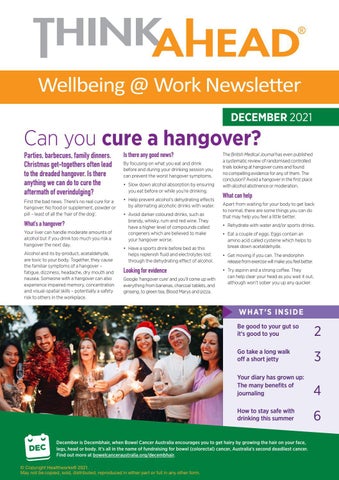
Can you cure a hangover? Parties, barbecues, family dinners. Christmas get-togethers often lead to the dreaded hangover. Is there anything we can do to cure the aftermath of overindulging?
First the bad news. There’s no real cure for a hangover. No food or supplement, powder or pill – least of all the ‘hair of the dog’.
What’s a hangover? Your liver can handle moderate amounts of alcohol but if you drink too much you risk a hangover the next day. Alcohol and its by-product, acetaldehyde, are toxic to your body. Together, they cause the familiar symptoms of a hangover – fatigue, dizziness, headache, dry mouth and nausea. Someone with a hangover can also experience impaired memory, concentration and visual-spatial skills – potentially a safety risk to others in the workplace.
Is there any good news?
By focusing on what you eat and drink before and during your drinking session you can prevent the worst hangover symptoms. • Slow down alcohol absorption by ensuring you eat before or while you’re drinking. • Help prevent alcohol's dehydrating effects by alternating alcoholic drinks with water. •
Avoid darker coloured drinks, such as brandy, whisky, rum and red wine. They have a higher level of compounds called congeners which are believed to make your hangover worse.
• Have a sports drink before bed as this helps replenish fluid and electrolytes lost through the dehydrating effect of alcohol.
Looking for evidence Google ‘hangover cure’ and you’ll come up with everything from bananas, charcoal tablets, and ginseng, to green tea, Blood Marys and pizza.
The British Medical Journal has even published a systematic review of randomised controlled trials looking at hangover cures and found no compelling evidence for any of them. The conclusion? Avoid a hangover in the first place with alcohol abstinence or moderation.
What can help Apart from waiting for your body to get back to normal, there are some things you can do that may help you feel a little better. • Rehydrate with water and/or sports drinks. • Eat a couple of eggs. Eggs contain an amino acid called cysteine which helps to break down acetaldehyde. • Get moving if you can. The endorphin release from exercise will make you feel better. • Try aspirin and a strong coffee. They can help clear your head as you wait it out, although won’t sober you up any quicker.
W HAT’S INS IDE
DEC
Be good to your gut so it's good to you
2
Go take a long walk off a short jetty
3
Your diary has grown up: The many benefits of journaling
4
How to stay safe with drinking this summer
6
December is Decembhair, when Bowel Cancer Australia encourages you to get hairy by growing the hair on your face, legs, head or body. It’s all in the name of fundraising for bowel (colorectal) cancer, Australia’s second deadliest cancer. Find out more at bowelcanceraustralia.org/decembhair.
© Copyright Healthworks® 2021. May not be copied, sold, distributed, reproduced in either part or full in any other form.
B O DY • BE G OO D TO YOUR GUT SO IT 'S G O O D TO YO U
Be good to your gut so it’s good to you Fascination with our gut microbiota – the millions of microbes that live in our intestines – has exploded in the last few years. How can you keep your gut’s residents as healthy and happy as possible?
There are many claims made about gut health. We’re told that having the right gut bugs will make us slim, boost our immune system, even cure depression. But for all the health claims you may read, there’s still a lot to discover about what gut bugs can and can’t do.
All the different types of fibre are carbohydrates that our digestive enzymes can’t break down, so they arrive intact to the large intestine (colon). Many of these types of fibre are fermented by the gut microbiome, explains Dr McMillan.
How to care for your gut’s microbes
The gut microbiome works hard to support us, too. It produces substances that help prevent the growth of harmful bacteria, reduce inflammation in the gut and the rest of the body, provide fuel for the cells lining the gut to keep them healthy, and support the immune system.
Even though our internal world is still largely a mystery, we do have a good idea of how to keep the gut microbiome as diverse and healthy as possible. One way is through the foods we eat, and those we avoid. The most important step is to eat a plantrich, whole food diet, says nutrition scientist and gut health expert Dr Joanna McMillan. This includes fruit, vegetables, wholegrains, nuts, seeds and the oils made from them. At the same time, limit or avoid ultraprocessed foods. These are foods made from ingredients that are already heavily processed so that the resulting food product is far removed from the original plant or animal food.
Why the focus on plant foods? There are two groups of plant compounds that are key for gut health and fuelling your microbiome, says Dr McMillan — fibre and polyphenols.
2
The best sources of fibre? All plant foods, but particularly legumes and wholegrains. Polyphenols are compounds found widely in plant foods, says Dr McMillan, and like fibre, they also promote a healthy, diverse microbiome. “Your friendly gut bugs convert these polyphenols into more bioactive compounds with diverse health benefits throughout the body,” she explains. Recent research has shown polyphenols have prebiotic effects, promoting the growth of beneficial bacteria in the gut. They are also anti-inflammatory and prevent the growth of potentially harmful bacteria.
© Copyright Healthworks® 2021. May not be copied, sold, distributed, reproduced in either part or full in any other form.
The best sources of polyphenols? Extra virgin olive oil has more than 30 polyphenols, says Dr McMillan. Other good sources of polyphenols are colourful fruits and veg, and nuts and seeds.
Do you always buy the same fruit and veg? Sticking to the same fruit and veg day in and day out is likely to decrease the range of your gut microbiota. “If you want to increase gut microbe diversity, you should try and have 30 different plant-based foods a week,” says dietitian and gut health expert Dr Megan Rossi. Sounds impossible? Gradually introduce foods you may not normally eat, such as barley, quinoa, chickpeas, eggplant, Brazil nuts, pumpkin and chia seeds, asparagus, and kale. For example, you can base a salad on barley, add some nuts and seeds, three types of vegetables, a little dried fruit, and a dressing based on olive oil. That will give you up to eight different plant foods.
G O TA KE A LO N G WA L K O F F A SH O RT JET TY • B O DY
"Go take a long walk off a short jetty." What about just submerging yourself in water? Is that good too? Yes. And there’s different benefits for cold vs warm water. Immersing yourself in very cold water, that is around 15 degrees Celsius, can help with pain, muscle recovery and boosts your metabolism. Some studies suggest it can reduce symptoms of depression. Ice baths take this idea up a notch. The “Wim Hof method” promotes ice baths or very cold showers combined with deep breathing. Wim Hof says it stimulates your vagus nerve, which boosts your parasympathetic nervous system and affects conditions such as anxiety and depression.
Some of us head to the pool or ocean all year. Others are fair weather swimmers. Whatever type you are, the water awaits. It’s time to swim! There’s something deeply re-energising about gliding through the water, whether it’s chlorine or salt water. You come out feeling relaxed and buzzing. Renewed. But you can’t help wonder… was it a good use of your time? Would you have been better off going for a run or doing an exercise class? And what about that thing your friend says that swimming makes you put on weight?
2. It lowers stress and helps with depression Ever got out of the pool and felt the weight of the world had lifted off your shoulders? You didn’t imagine it. Swimming can induce a relaxation response similar to yoga. The relaxation response is thought to be due to the constant stretching and releasing of your muscles, combined with deep rhythmic breathing. Plus, the feeling of being away from everything in the water (where your phone can’t beep at you) can help relieve stress.
3. It burns calories
Don’t worry! Swimming is an amazing form of exercise, and wonderful for your physical and mental health. Here’s why:
Swimming can burn equal or greater calories than running, although it depends on how hard and fast you go.
1. It strengthens all your muscles
Running for 10 minutes burns around about 100 calories (depending on your weight and speed).
Swimming gives you a full-body workout. It works muscles throughout your entire body, including your legs, glutes, arms, neck, shoulders and core. Remember, water is 800 times denser than air, so it gives you a great resistance workout.
With 10 minutes of swimming you burn 60 calories with breast stroke, 80 calories with backstroke, 100 calories with freestyle, and 150 with butterfly stroke.
© Copyright Healthworks® 2021. May not be copied, sold, distributed, reproduced in either part or full in any other form.
Lowering yourself into warm water is a gentler way to promote relaxation. Research from Washington State University finds that warm water immersion, like a bath, balances your nervous system and helps lower stress. “The effects of aquatic immersion are profound, and impact virtually every body system,” says Dr Bruce Becker, director of the National Aquatic & Sports Medicine Institute at Washington State University.
4. It regulates blood sugar A 2016 study found that short bursts of high-intensity swimming three times a week can balance blood glucose. That’s great news for those with diabetes or if you’re at risk of diabetes.
5. It helps you live longer No, really. Researchers at the University of South Carolina looked at 40,547 men, aged 20 to 90, for over 32 years. They found those who swam had a 50 per cent lower death rate than runners, walkers, or men who didn’t exercise. ~
3
M I N D • THE MA NY BENE FITS OF JOURN A L I N G
Your diary has grown up: the many, many benefits of journaling What if there was a cost-free, drug-free way to reduce stress, depression and anxiety? And you could do it by yourself, anywhere you are?
Numerous research studies are proving what journalers have always known: keeping a journal can help reduce stress, anxiety and depression and can even help your immunity.
“Writing about earlier traumatic experience was associated with both short-term increases in physiological arousal and longterm decreases in health problems.”
If you’re not in the habit of writing in a journal each day, the idea can feel a bit awkward at first. Many people think back to their teenage angsty years, where they wrote about their crush or friendship dramas.
Further studies by Pennebaker confirmed these findings. He found expressive writing has profound long-term benefits:
But journaling has grown up too. It’s now proven to be a highly effective way of working through your problems, thoughts and emotions, and finding healthy solutions that help you achieve your goals.
The proven benefits of journaling Hundreds of studies have revealed the evidence-based benefits of journaling. One of the most studied forms of journaling is “expressive writing”, where you intentionally write about stressful or emotional events. In 1986, researchers asked college students to write for 15 minutes on four consecutive days. One group had to write about ‘the most traumatic or upsetting experiences’ of their entire lives, while the other group wrote about neutral topics such as their room or their shoes. They then reviewed the participants four months later. The group who wrote about their deepest thoughts and feelings had better physical health, with less frequent visits to the health centre and a trend towards fewer days off sick.
4
The authors James Pennebaker and Sandra Beall concluded that:
Physical health benefits: 1. Fewer stress-related visits to the doctor 2. Improved immune system functioning
4. Explore your experiences with anxiety 5. Write about your struggles and your successes 6. Enhance your self-awareness. Journaling has even been shown to improve your immune system. A study of people who tested positive for the virus that causes mononucleosis (glandular fever) found that writing about stressful events increased people’s antibodies to the virus.
3. Reduced blood pressure
Why it works
4. Improved lung function
That’s interesting, you think, but why? Why is writing about hard stuff so beneficial?
5. Improved liver function 6. Fewer days in hospital 7. Improved mood 8. Feelings of greater psychological well-being 9. Reduced depressive symptoms before exams 10. Fewer post-traumatic intrusion and avoidance symptoms. Social and behavioural benefits: 1. Reduced absenteeism from work 2. Quicker re-employment after job loss 3. Improved working memory 4. Improved sporting performance 5. Higher marks for students. Plus, writing in a journal has been shown to positively impact anxiety. It helps: 1. Calm and clear your mind 2. Release pent-up feelings and everyday stress 3. Let go of negative thoughts
© Copyright Healthworks® 2021. May not be copied, sold, distributed, reproduced in either part or full in any other form.
Journaling is like an emotional broom. It clears out the distressing thoughts invading our heads. It also stops you from squashing your emotions and helps you organise your thoughts. Journaling is a little like meditation in the way it helps you witness your own thoughts and helps you detect sneaky, unhealthy patterns in your thoughts and behaviours. You can see your true feelings in black and white. This can help you gain some distance from your experiences and understand them in new ways with new insights. “Journaling is a tool to put our experiences, thoughts, beliefs, and desires into language, and in doing so it helps us understand and grow and make sense of them,” says Joshua Smyth, a professor of biobehavioral health and medicine at Penn State University. “Use it to try to understand those problems that are getting under your skin.” ~
T H E MA N Y B EN EF I TS O F JO U R N A L I N G • M I N D
How do I journal? Like getting into a cold swimming pool, it can feel hard to start but wonderful once you’re in. The trick is to remember that no-one is going to read your journal except you. No-one’s going to judge your grammar or your handwriting, and most of all, no-one is going to judge your thoughts and feelings. The Centre for Journal Therapy suggests following the five step system of W.R.I.T.E: W – What do you want to write about? What’s going on? How do you feel? What are you thinking about? What do you want? Name it. R – Review or reflect on it. Close your eyes. Take three deep breaths. Focus. You can start with “I feel…” or “I want…” or “I think…” or “Today….” or “Right now…” or “In this moment…” I – Investigate your thoughts and feelings. Start writing and keep writing. Follow the pen/keyboard. If you get stuck or run out of juice, close your eyes and re-centre yourself. Re-read what you’ve already written and continue writing. T – Time yourself. Write for 5-15 minutes. Write the start time and the projected end time at the top of the page. If you have an alarm/timer on mobile phone, set it. E – Exit smart by re-reading what you’ve written and reflecting on it in a sentence or two: “As I read this, I notice—” or “I’m aware of—” or “I feel—”. Note any action steps to take. © Copyright Healthworks® 2021. May not be copied, sold, distributed, reproduced in either part or full in any other form.
5
STAY ING SAF E
How to stay safe while drinking this summer “There is no such thing as a ‘safe’ level of alcohol,” according to a global study of 25,000 people by the University of Oxford. We know alcohol is bad for us. We know it’s bad for our brain and mental and emotional health, we know it’s bad for our body, including our liver and heart. Alcohol kills almost 6,000 Australians a year. But that knowledge conflicts with our real lives. We live in a society where alcohol is everywhere, especially in summer and particularly at Christmas.
than topping up your glass. 4. Add in alcohol-free drinks When sitting drinking with friends, it’s easy to keep lifting your glass. Swap in some alcohol-free beverages like water or soft drinks to slow down your alcohol consumption. 5. Don’t drink and drive Having any amount of alcohol in your blood makes your driving more dangerous. If you think you might have a drink, leave the car at home. ~
So how you can stay safe? Health Direct provides this advice: 1. Know how much you’re drinking
What are the guidelines? The Australian Alcohol Guidelines changed last year, based on the latest advice from the National Health and Medical Research Council (NHMRC). They say the less you drink, the lower your risk of harm. But if you must drink, you should stick to: - No more than four drinks a day - No more than 10 drinks a week. Keep in mind these are standard drinks, that is 100mls of wine or a half pint of beer. One can or stubbie of beer is 1.4 standard drinks. A 700ml bottle of spirits contains 22 standard drinks.
The average adult can process one standard drink an hour. A standard drink is smaller than you might think – only a small glass of wine or half pint of beer (285ml). 2. Eat before and while you drink Avoid salty foods (like the usual party foods of chips and nuts) because they’ll make you thirstier. 3. Count your drinks Avoid drinking in rounds (especially with friends who drink too much). Try to finish your drink before you start another, rather
Ask an expert about ...
What are the warning signs of dehydration? You’ve got a sharp headache. Your legs don’t seem to want to walk. You’re tired and cranky. Could you be dehydrated?
The Queensland Department of Health says it’s surprisingly easy to become dehydrated, especially if you:
They provide the following warning signs of mild dehydration:
• drowsiness
• thirstiness
• have a fast heart rate
• do exercise that is strenuous, prolonged or makes you very sweaty
• a dry mouth, lips and tongue
• fainting
• headache
• have very little or no urine.
• have urine that is a darker yellow than usual, and less of it
Not treating dehydration can have serious, even deadly, consequences.
• light-headedness or dizziness.
For mild dehydration, the best thing you can do is drink water to rehydrate. Drink small amounts of water regularly.
• do manual work or work in a hot environment
• spend time in a hot or poorly ventilated indoor environment, like a heated gym or hot warehouse • spend time in a dry environment, like a long-haul plane flight • or spend time without access to water.
6
If you are severely dehydrated, you might experience one or more of these symptoms: • extreme thirstiness • a very dry mouth, lips and tongue • crankiness
© Copyright Healthworks® 2021. May not be copied, sold, distributed, reproduced in either part or full in any other form.
• feel like you are breathing very quickly
Severe dehydration requires immediate medical assistance. The Department says to call 000 if you, or a person you are caring for, is feeling very unwell. ~
News Bites
Todoist Looking for an app to help you organise, plan and collaborate on projects, both big and small? Then try Todoist. This app helps you get a clear overview of everything on your plate – both personal and professional – and never lose track of an important task. Capture and organise tasks the moment they pop into your head; never miss a deadline with reminders and due dates; build lasting habits with recurring due dates; and integrate tools like Gmail, Google Calendar, Slack and more. Available free from the App Store and Google Play.
Vaping raises smoking risk Under 20s who vape (use e-cigarettes) could be at higher risk of smoking tobacco cigarettes, says an Australian study. The researchers looked at evidence from 25 previous studies and found that under 20s who had used an e-cigarette – both nicotine and non-nicotine varieties – were three times more likely to use tobacco cigarettes later. The team say these findings are of concern because adolescents who use e-cigarettes are believed to have different psychological profiles to current smokers, and would otherwise have been considered at low-risk of smoking. Currently nicotine-containing e-cigarettes, whether from overseas or Australia, are only available with a doctor’s prescription. Nicotine-free devices and liquids can be legally sold and purchased in most states and territories.
Vaccine halves risk of Long COVID COVID-19 vaccines can’t prevent all coronavirus infections, but they drastically cut the odds of severe illness and hospitalisation in rare breakthrough cases, says a study published in The Lancet Infectious Diseases. Researchers from King’s College London have also found that vaccines cut the risk of Long COVID by more than half. Long COVID affects some people long after they’ve recovered from the original infection. Symptoms include extreme tiredness, shortness of breath, brain fog, changes to taste and smell and joint pain.
wellatwork
™
Published by: Healthworks® Suite 3.06, 55 Miller Street Pyrmont NSW 2009 Australia ACN 624 842 351 Phone: 1300 90 10 90 Website: www.healthworks.com.au Editorial Team: Editor: Jenny Boss MHumNutr Deputy Editor: Kylie Singh Subscriptions: Janelle Gibb Email: well@healthworks.com.au Healthworks® wellness, health, and safety products and solutions are a trademark of Bodycare Health & Wellbeing Pty Ltd (ACN 624 842 351), registered in Australia. Well at Work™ ©2021. All rights reserved. No part of this work may be re-sold, reproduced or copied in any form. The information in this publication does not provide medical advice for individual problems. For advice and treatment, consult your doctor or health care professional. Well at Work is printed on an environmentally responsible paper. The pulp for this paper is sourced from certified, well managed sustainable plantations and the paper mill is ISO 14001 accredited.
“Vaccinations are massively reducing the chances of people getting Long COVID in two ways,” says Professor Tim Spector from King’s College London. “Firstly, by reducing the risk of any symptoms by eight to 10-fold and then by halving the chances of any infection turning into Long COVID, if it does happen.” ~
Cows help beat plastic waste Researchers in Austria have made a discovery that could help deal with some of the millions of tonnes of single-use plastic that we discard every year. Scientists at the University of Natural Resources and Life Sciences in Vienna looked at bacteria living inside a cow’s rumen – one of the four compartments of its stomach. They found it can break down certain plastics, including those used to make single-use packaging, in just hours. The next step is to identify the microbes responsible, so they can be engineered in labs.
© Copyright Healthworks® 2021. May not be copied, sold, distributed, reproduced in either part or full in any other form.
7
THING YOU CAN DO TODAY
EAT SMARTER
Eggplant Some people claim eating eggplant is like eating a bland sponge. But lovers of this purple vegetable say that’s because they haven’t tasted one that’s been prepared well. Is it worth adding eggplant to your diet? Definitely. Eggplant contains: • A good amount of dietary fibre, vitamins B1 and B6 and potassium, copper, magnesium and manganese. The fibre helps lower blood sugar and LDL (bad) cholesterol.
Recycle at Christmas Good food, friends, family, and … waste. Christmas creates tonnes of waste, such as wrapping paper, shiny decorations, plastic cups and cutlery, and flat batteries. What can and can’t you recycle? Choice.com.au has the answers. Do recycle: • Cardboard and paper wrapping (even if they have sticky tape on them). • Disposable aluminium baking trays and foil. Remove food scraps and oil and roll the foil into a ball shape. • Plastic cups and glasses. Because these are rigid plastic and 3D (not flat) they can be picked up and sorted into the plastic recycling area.
• Nasunin. Eggplant skin is particularly rich in an antioxidant called nasunin which may help protect the fatty acids essential for healthy brain function and help move excess iron out of the body. Roasted eggplant Roasting eggplant gives you the best result, says Nagi Maehashi from recipetineats.com. Roasting produces a crispy exterior and soft, melting inside – without needing too much oil. Here’s how Nagi prepares it: • Cut your eggplant into 3cm slices, then cut each slice into about six cubes/rectangles. Smaller pieces cook too quickly and turn to mush before the outside caramelises. • Drizzle with olive oil, sprinkle with salt and pepper and toss well in a bowl. • Line a large baking tray with baking parchment. Spread the eggplant out on the tray and bake at 240˚C for 30 minutes, flipping them after 20 minutes. • Eat as a vegetable side, or make into a salad with cooked lentils, chopped thyme, feta cheese, cherry tomatoes, rocket and a dressing of your choice. ~
• Batteries and fairy lights. These can be recycled as e-waste – most councils have a system for e-waste recycling such as dedicated drop-off days. Don’t recycle: • Foil and plastic wrapping ‘paper’. Soft plastics can be recycled at a collection point such as REDcycle at some supermarkets. • Broken glassware and crockery. They don’t melt at the same temperature as bottle and jar glass. • Christmas decorations. Tinsel is particularly problematic in the recycling stations as it gets wrapped around machinery. • Tissue paper and napkins. These may be contaminated with food, but even if not, the fibres are too short to be used again. They can be dropped in a food and garden organics bin. • Plastic plates and cutlery. These are the wrong shape to be sorted by the recycling machines.
“If your actions inspire others to dream more, learn more, do more and become more, you are a leader.” Simon Sinek
8
© Copyright Healthworks® 2021. May not be copied, sold, distributed, reproduced in either part or full in any other form.