Research Paper
Commerce
E-ISSN No : 2454-9916 | Volume : 3 | Issue : 5 | May 2017
AN IMPACT OF FINANCIAL INCLUSION IN VILLAGES OF WEST BENGAL: A STUDY OF LEGO GRAM PANCHAYET, BANKURA Dr. Santosh Koner Associate Professor in Commerce, Chatra Ramai Pandit Mahavidyalaya, Darapur, Bankura. ABSTRACT Financial inclusion we mean inclusion of all families in the organised banking network, then financial inclusion has been achieved in this gram panchayat. The maximum savings bank accounts are opened for getting payment for MGNREGA project, student scholarships from school, Kanyashree from school and college college or getting subsidies for LPG. A minimum number of savings accounts are opened otherwise and for micro savings or getting bank loans. Most of the villages under Lego Gram Panchayat have at least one savings bank account in Mallabhum Gramin Bank , Bankura District Central Co-operative Bank or Punjab National Bank, or State Bank of India, or Bank of India or Post Office Savings Bank of Lego Post Office. Now consider how many people are utilised banking services for their livelihood? Whether their standards of living improved due financial inclusion, or whether they get more loans from banks for meeting their needs or whether their savings have been deposited with the banks-these are some questions which need to be investigated to know the real impact of financial inclusion. The main purpose of the present paper is to find out the factors that stand in the way of getting the full benefits of financial inclusion in village of the study area of West Bengal. KEY WORDS: Financial Inclusion, Banking Products, Information gap. INTRODUCTION In simple language by financial inclusion, we mean inclusion of all families in organised banking network. In broad, financial inclusion means inclusion of all families with all banking facilities. In India an attempt has been made to provide banking facilities to all the families. Different direct and indirect strategies have been undertaken for covering all members in the banking network. Financial inclusion is the delivery of financial services to all sections segments of society. It is argued that as banking services are in the nature of public good. The availability of banking and payment services to the entire population is the prime objective of financial inclusion. The term "financial inclusion" has gained importance since the early 2000s. The United Nations defines the goals of financial inclusion as (i)access at a reasonable cost for all households to a full range of financial services, including savings or deposit services, payment and transfer services, credit and insurance; (ii) sound and safe institutions governed by clear regulation and industry performance standards; (iii) financial and institutional sustainability, to ensure continuity and certainty of investment; and (iv) competition to ensure choice and affordability for clients. In India, so many steps have been taken to bring all the families within the organised banking network. All government subsidies, scholarship and payment are now transferred through bank accounts or post office savings accounts. For such type of government transfer payments Indian people are opening bank accounts quickly. Lego Gram Panchayat is situated in Bankura district. It is under the Kotulpur Panchayat Samiti and it is more or less 10 KM away from Kotulpur town. In Lego, there are two high schools and one college. In Lego there are around1200 families and near about 11000 peoples/resident. In Lego Gram Panchayat, there is one branch of State Bank of India, one branch of Bank of India, one branch of Punjab National Bank and one branch of Bankura District Central Co-operative Bank, one Mallabhum Gramin Bank and one Post office Savings bank.
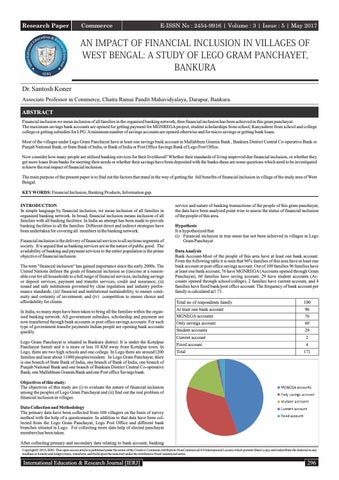
service and nature of banking transactions of the people of this gram panchayat, the data have been analysed point wise to assess the status of financial inclusion of the people of this area. Hypothesis It is hypothesized that (i) Financial inclusion in true sense has not been achieved in villages in Lego Gram Panchayat Data Analysis Bank Account-Most of the people of this area have at least one bank account. From the following table it is seen that 96% families of this area have at least one bank account or post office savings account. Out of 100 families 96 families have at least one bank account, 76 have MGNREGA (Accounts opened through Gram Panchayat), 60 families have saving account, 29 have student accounts (Accounts opened through school/college), 2 families have current account, and 4 families have fixed bank/post office account. The frequency of bank account per family is calculated at1.71. Total no of respondents family
100
At least one bank account MGNEGA accounts
96 76
Only savings account
60
Student accounts
29
Current account
2
Fixed account
4
Total
171
Objectives of this study: The objectives of this study are (i) to evaluate the nature of financial inclusion among the peoples of Lego Gram Panchayat and (ii) find out the real problem of financial inclusion in villages. Data Collection and Methodology The primary data have been collected from 100 villagers on the basis of survey method with the help of a questionnaire. In addition to that data have been collected from the Lego Gram Panchayat, Lego Post Office and different bank branches situated in Lego. For collecting more data help of elected panchayat members has been taken. After collecting primary and secondary data relating to bank account, banking CopyrightŠ 2016, IERJ. This open-access article is published under the terms of the Creative Commons Attribution-NonCommercial 4.0 International License which permits Share (copy and redistribute the material in any medium or format) and Adapt (remix, transform, and build upon the material) under the Attribution-NonCommercial terms.
International Education & Research Journal [IERJ]
296
Research Paper
E-ISSN No : 2454-9916 | Volume : 3 | Issue : 5 | May 2017
Objectives of opening bank account From the primary data following objectives of opening of bank accounts are identified for the people of Lego Gram Panchayat
From the above table it is seen that out of total banking transaction 64% are relating to withdrawal of cash, 22% are relating to deposit of cash or cheque, 3% are relating to fund transfer, and 4% are relating to Bank Draft and examination fees.
(i) (ii) (iii) (iv) (v) (vi) (vii) (viii) (ix) (x) (xi) (xii) (xiii) (xiv) (xv) (xvi) (xvii)
Findings of this study From the above discussion it is clear that due to government initiatives, major families are now under banking network. But all the banking facilities are not enjoyed by the rural bank account holders. The main objectives of the poor bank account holders are to draw MGNREGA wages, student scholarship. Only a few bank account holders accumulated their savings in banks.
MGNREGA Salary/Wages L.P.G subsidies Student Scholarship/Kanyashree Savings Term Loans Un-employment allowance House Building Loans Car Loans Truck Loan Business Loans/CCL Gold Loans Agriculture Gold Loans Salary/Professional Payment Widow Allowance Agriculture Loans Investment in Share LIC Cheque Payment
The basic reasons of limited uses of banking facilities are attitudes of bank employee, attitude of bank account holders. Some socio economic causes also lead such type of ineffective bank-customer relation, like poor income, less savings, less financial education etc. Factors standing in the way of full utilisation of banking facilities by the rural people: From the analysis of primary data as given by the 100 accounts holders and bank employee in the Lego gram panchayat following factors are identified as major causes of ineffective uses of banks accounts in support of their livelihood
Objective-wise classification of accounts is given below OBJECTIVES OF BANK ACCOUNT
In Number
%
(i)
MGNREGA Salary/Wages
81
44%
(ii)
L.P.G subsidies
05
2%
(iii)
Student Scholarship
37
17%
(iv)
Savings(others)
04
2%
(v)
Term Loans
12
6%
(vi)
Un-employment allowance
04
3%
(viii) Car Loans
04
2%
(ix)
Truck Loan
05
1%
(x)
Business Loans/CCL
03
1%
(xi)
Gold Loans
04
2%
(xii)
Agriculture Gold Loans
05
3%
(xiii) Salary/Professional Payment
10
6%
(xiv) Widow Allowance
08
5%
(xv)
06
3%
Fixed Account
(xvi) Investment in Share Total
03
1%
185
100%
From the above table it is seen that out of 171 bank accounts, as per last transaction held 44% were used for MGNREGA wages payment, 17 % were used for scholarship payment and 5% for widow allowance. Very low percentages of banking transactions were related for loan taken. Only 2% of transactions are related to car loans, 1% transactions are related to truck loans, another 1% transactions are related to business loans, 2% transactions are related to gold loans and 3% transactions are related to agriculture gold loans. Nature of Transactions From the data collected from bank branches where 171 accounts are held, the following nature of transactions are identified (i) (ii) (iii) (iv) (v) (vi) (vii)
Withdrawal of cash Deposit of cash Fund Transfer through bank counter Bill Payment through bank (SI/SO) Online –Payment Bank Draft/DD for form fill up/Examination Fee/College Fee Others
The Percentage of above types of Transactions are given below (Last Transaction of accounts holders) (i) Withdrawal of cash
64%
(ii) Deposit of cash
22%
(iii) Fund Transfer through bank counter
3%
(iv) Bill Payment through bank account
2%
(v) Online –Payment
1%
(vi) Bank Draft/DD for form fill up/Examination Fee/College admission
4%
(vii) Others TOTAL
297
(a) Lack of cooperation of bank employee: A good number of respondents argue that due to lack of cooperation of bank employee of government banks, they are not get full benefits from banking system. (b) Complex procedure and documentation for getting loans: The procedure of sanctioning loans are very complex and a lot of documents are required for getting sectioned a bank loans. For these reason, most of rural bank customer avoid loans from banks. (c) Lack of financial literacy: As demanded by the bank- authority, majority of the rural bank-customers have no of knowledge about banking. As a result they cannot enjoy full banking facilities. (d) Lack of regular income: Most of the rural bank-customers have no regular income and savings. As a result they do not use bank account regularly. (e) Ignorance of customer about different schemes of banks: The bank employees argue that most of rural bank customers have no idea about different schemes of banks. As a result they are not enjoying such facilities. (f) Low rate of loans recovery: As experienced by the bank authority, due to low income, attitudes of loans holders, the rate of loans recovery is low in rural area. For this reason, banks have to think twice before sanctioning a loan. Conclusion From the above analysis it is seen that due to different actions, most of the rural families have bank account but they are not enjoyed full banking facilities. In majority of cases bank accounts are used to encased government subsidies, scholarship, different allowances and MGNREGA wages payment. The main reasons of not enjoying banking products are low income and savings, low rate of financial education, attitude of the bank employee, and attitude of the customer. For true financial inclusion in rural area, attitudes of the bank employees and customer are to be changed, terms and conditions of sanctioning loans are to be liberalised, and the rate of financial literacy among the rural peoples are to be increased. REFERENCES 1.
Agarwal, Parul (2014), “Financial Inclusion in India: a Review and Initiatives and Achievements”, IOSR Journal of Business and Management, Volume 16, Issue 6, June.
2.
Divya (2014), “A Study On Impact Of Financial Inclusion With Reference To Daily Wage Earners”, Journal of Business Management & Social Sciences Research, Volume 2, No. 6, June.
3.
Kamath, Rajalaxmi (2008) "Ramanagaram Financial Diaries: Loan repayments and cash patterns of the urban slums", IIMB Working paper 268.
4.
Ministry of Consumer Affairs, Food and Public Distribution (2011), “Number of Ration Shops in the country”, June.
5.
Planning Commission (2009), “Report on Financial Sector Reforms” (Chairman: Dr. Raghuram G. Rajan).
6.
Radcliffe, Dan (2012), “A Digital Pathway to Financial Inclusion”, Bill & Melinda Gates Foundation.
7.
RBI (2005), “Report on Rural Credit and micro finance” (Chairman: H.R. Khan). IIMB-WP N0. 474 31
8.
RBI (2013), “How the poor manage their finances; A study of the portfolio choices of poor households in Ernakulum district, Kerala”, Development Research Project, Mumbai and Centre for Socio-Economic and Environmental Studies, Kochi.
4% 100%
International Education & Research Journal [IERJ]