Research Paper
Education
E-ISSN No : 2454-9916 | Volume : 3 | Issue : 7 | July 2017
INTERNET USAGE AND EMOTIONAL MATURITY OF SECONDARY SCHOOL STUDENTS 1
Shaloo Saini | Prof.(Dr.) Parminder Kaur 1 2
2
Assistant Professor, M. K. College of Education, Jalandhar. Principal, Lyallpur Khalsa College of Education for Women, Jalandhar.
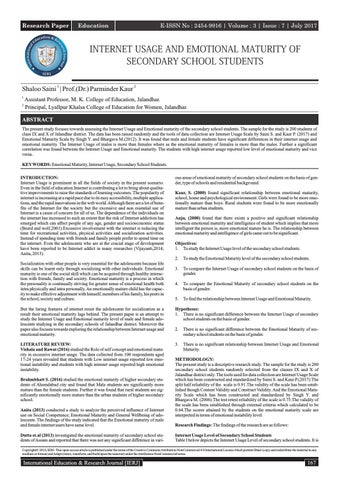
ABSTRACT The present study focuses towards assessing the Internet Usage and Emotional maturity of the secondary school students. The sample for the study is 200 students of class IX and X of Jalandhar district. The data has been raised randomly and the tools of data collection are Internet Usage Scale by Saini S. and Kaur P. (2017) and Emotional Maturity Scale by Singh Y. and Bhargava M.(2012). It was found that male and female students have significant differences in their internet usage and emotional maturity. The Internet Usage of males is more than females where as the emotional maturity of females is more than the males. Further a significant correlation was found between the Internet Usage and Emotional maturity. The students with high internet usage reported low level of emotional maturity and vice versa. KEY WORDS: Emotional Maturity, Internet Usage, Secondary School Students. INTRODUCTION: Internet Usage is prominent in all the fields of society in the present scenario. Even in the field of education Internet is contributing a lot to bring about qualitative improvements to raise the standards of learning outcomes. The popularity of internet is increasing at a rapid pace due to its easy accessibility, multiple applications, and the rapid innovations in the web world. Although there are a lot of benefits of the Internet for the society but the excessive and non essential use of Internet is a cause of concern for all of us. The dependence of the individuals on the internet has increased to such an extent that the risk of Internet addiction has emerged which can affect people of any age, gender and socioeconomic status (Beard and wolf,2001).Excessive involvement with the internet is reducing the time for recreational activities, physical activities and socialization activities. Instead of spending time with friends and family people prefer to spend time on the internet. Even the adolescents who are at the crucial stage of development have been reported to be Internet addict in many researches (Vijayanti,2014; Anita, 2013). Socialization with other people is very essential for the adolescents because life skills can be learnt only through socializing with other individuals. Emotional maturity is one of the social skill which can be acquired through healthy interaction with friends, family and society. Emotional maturity is a process in which the personality is continually striving for greater sense of emotional health both intra physically and intra personally. An emotionally mature child has the capacity to make effective adjustment with himself, members of his family, his peers in the school, society and culture. But the luring features of internet resist the adolescents for socialization as a result their emotional maturity lags behind. The present paper is an attempt to study the Internet Usage and Emotional maturity level of male and female adolescents studying in the secondary schools of Jalandhar district. Moreover the paper also focuses towards exploring the relationship between Internet usage and emotional maturity. LITERATURE REVIEW: Vishala and Rawat (2016) studied the Role of self concept and emotional maturity in excessive internet usage. The data collected from 100 respondents aged 17-24 years revealed that students with Low internet usage reported low emotional instability and students with high internet usage reported high emotional instability. Brahmbhatt S. (2016) studied the emotional maturity of higher secondary students of Ahemdabad city and found that Male students are significantly more mature than the female students. Further it was found that rural students are significantly emotionally more mature than the urban students of higher secondary school.
ous areas of emotional maturity of secondary school students on the basis of gender, type of schools and residential background. Kaur, S. (2000) found significant relationship between emotional maturity, school, home and psychological environment. Girls were found to be more emotionally mature than boys. Rural students were found to be more emotionally mature than urban students. Anju, (2000) found that there exists a positive and significant relationship between emotional maturity and intelligence of student which implies that more intelligent the person is, more emotional mature he is. The relationship between emotional maturity and intelligence of girls came out to be significant. Objectives: 1. To study the Internet Usage level of the secondary school students. 2.
To study the Emotional Maturity level of the secondary school students.
3.
To compare the Internet Usage of secondary school students on the basis of gender.
4.
To compare the Emotional Maturity of secondary school students on the basis of gender.
5.
To find the relationship between Internet Usage and Emotional Maturity.
Hypotheses: 1. There is no significant difference between the Internet Usage of secondary school students on the basis of gender. 2.
There is no significant difference between the Emotional Maturity of secondary school students on the basis of gender.
3.
There is no significant relationship between Internet Usage and Emotional Maturity.
METHODOLOGY: The present study is a descriptive research study. The sample for the study is 200 secondary school students randomly selected from the classes IX and X of Jalandhar district only. The tools used for data collection are Internet Usage Scale which has been constructed and standardized by Saini S. and Kaur P.(2017).The split half reliability of the scale is 0.91.The validity of the scale has been established though Content Validity and Construct Validity. And the Emotional Maturity Scale which has been constructed and standardized by Singh Y. and Bhargava M. (2006).The test retest reliability of the scale is 0.75.The validity of the scale has been established through external criteria which calculated to be 0.64.The scores attained by the students on the emotional maturity scale are interpreted in terms of emotional instability level.
Anita (2013) conducted a study to analyze the perceived influence of Internet use on Social Competence, Emotional Maturity and General Wellbeing of adolescents. The findings of the study indicated that the Emotional maturity of male and female internet users have same level.
Research Findings: The findings of the research are as follows:
Dutta et.al (2013) investigated the emotional maturity of secondary school students of Assam and reported that there was not any significant difference in vari-
Internet Usage Level of Secondary School Students Table I below depicts the Internet Usage Level of secondary school students. It is
CopyrightŠ 2016, IERJ. This open-access article is published under the terms of the Creative Commons Attribution-NonCommercial 4.0 International License which permits Share (copy and redistribute the material in any medium or format) and Adapt (remix, transform, and build upon the material) under the Attribution-NonCommercial terms.
International Education & Research Journal [IERJ]
167
Research Paper
E-ISSN No : 2454-9916 | Volume : 3 | Issue : 7 | July 2017 value is positive 0.94 which is significant at 0.01 level of significance. The students who scored high on internet usage also scored high on emotional instability, which shows a positive relationship between internet usage and emotional instability.
evident from the table below that 47% of the students fall in the category of above average internet usage followed by 33% in the category of high level of internet usage. With regard to gender differences it can be seen that 54 % of the males fall in the category of high internet usage and 68% of the females fall in the category of above average internet usage.16% of the boys reported to be extremely high internet users where as only 3% of the girls fall in this category. Therefore it can be concluded that the internet usage of males is more than the internet usage of females.
Therefore the hypothesis that there is no significant relationship between Internet Usage and Emotional Maturity stands rejected. The student who has high a level of internet usage has a low level of emotional maturity
Table I
Table V
Gender
N
Low Usage
Below Average Above High Extremely Average Usage Average Usage High Usage Usage Usage
Male
100
00%
03%
01%
26%
54%
Female
100
03%
10%
04%
68%
12%
16% 03%
Total
200
1.5%
6.5%
2.5%
47%
33%
9.5%
Emotional Maturity Level of Secondary School Students Table II below depicts the Emotional Maturity Level of secondary school students. It is evident from the table below that 32.5% of the students fall in the category of unstable emotional maturity followed by 26% in the category of moderately stable. A high percentage of boys reported to be in the category of Unstable and extremely unstable emotional maturity i.e. 38% and 36% respectively. Further only 8% of the boys reported to be in the category of extremely stable emotional maturity. On the other hand females reported to have a high percentage i.e. 36% in the category of extremely stable emotional maturity followed by 34% in moderately stable. Only 3% of females reported to fall in the category of extremely unstable emotional maturity. Therefore it can be concluded that emotional maturity of females is better than males. Table II Gender
N
Extremely Stable
Moderately Stable
Unstable
Extremely Unstable
Male Female Total
100 100 200
08% 36% 22%
18% 34% 26%
38% 27% 32.5%
36% 03% 19.5%
Internet Usage of Secondary School Students on the basis of Gender Table III below shows the difference between the mean scores of males and females on their Internet Usage levels. The mean scores of males is 66.65 with sd 9.2 and the scores of females is 57.62 with sd of 10.13.The calculated 't' value is 6.59 which is found to be significant at 0.01 level of significance. Therefore the hypothesis that there is no significant difference between the Internet Usage of secondary school students on the basis of gender stands rejected. The internet usage of males is significantly more than the internet usage of females. Table III Gender
N
Mean Scores Std. Dev. 't' value
Male
100
66.65
9.2
Female
100
57.62
10.13
6.59
Variable Internet Usage
N Mean Std. Dev. 'r' value Result 200 62.13 10.66 0.94 Sig at 0.01 level of sig Emotional Maturity 200 92.98 16.61 Interpretation and Implications The internet usage level of the students is increasing day by day, a high percentage of students report to have a high level of internet usage. The Internet Usage of males is more than the females. This is in line with the findings of Vijayanti S.(2014), Kumari C. (2015).The emotional maturity of the students is also at risk. A high percentage of students reported to be emotionally instable. The emotional maturity of the males is less than the emotional maturity of females. This is in line with the findings of Wani and Masih(2015),Panth et.al(2015).There is a strong significant relationship between internet usage and emotional maturity. The high internet users reported to have low level of emotional maturity. These findings are consistent with the findings of Vishala and Rawat(2016). The secondary school students should be guided towards protecting themselves from the excessive internet usage. Internet dependence is intervening in the emotional development of the students. The parents and the teachers should take necessary interventions to protect the adolescents from the grip of excessive internet dependence. The energies of the adolescents should be channelized towards productive activities which would be beneficial for the whole society. REFERENCES: 1.
Anita. (2013). A study of perceived influence of internet use on social competence, emotional maturity and general well-being of adolescents (Doctoral dissertation, Maharishi Dayanand University, Rohtak, India). Retrieved from http://hdl.handle.net/10603/781 4
2.
Anju. (2000). A Comparative study of emotional maturity in relation to intelligence and Sex(Unpublished master's thesis). Punjab University, Chandigarh, India
3.
Brahmbhatt S.(2016) A study of emotional maturity among higher secondary school students. Journal of information, knowledge and research in humanities and social sciences. Vol 4(1), 212-214
4.
Dutta J. Chetia P.and Soni J.(2013) A comparative study on emotional maturity of secondary school students in Lakhimpur and Sonitpur districts of Assam, International Journal of Science and Research Vol 4(9) 168-176
5.
Kaur, S. (2000). A study of emotional maturity in relation to environment factors. (Unpublished master,s theses). Punjab University, Chandigarh, India
6.
Kumari, C. (2015). Internet usage in relation to selected developmental tasks among adolescents(Master's thesis, Banasthali University, Rajasthan, India). Retrieved from http://hdl.handle.net/10603/138800
7.
Panth M.,Chaurasia N.and Gupta M.(2015) A comparative study of adjustment and emotional maturity between gender and stream of undergraduate students.International Journal of Research inSocial Science and Humanities. Vol5(3) 1-12
8.
Singh Y. and Bhagrava M.(2006) Emotional maturity scale Agra: National Psychological Corporation.
9.
Saini S. and Kaur P.(2017) Internet usage scale Agra:National Psychological Corporation.
Result Sig at 0.01 level of sig
Emotional Maturity of Secondary school students on the basis of gender Table IV below depicts the difference between the mean scores of males and females on their Emotional maturity levels. The mean scores of males on emotional instability is 102.24 with sd 15.19 and the scores of females on emotional instability is 83.71 with sd of 12.26.The calculated 't' value is 9.49 which is found to be significant at 0.01 level of significance.
10. Vijayanti S.(2014)Gender differences in the prevalence and features of internet addiction among Indian college students Medica Innovatica. Vol 3(2) 49-53. 11. Vishala A. and Rawat V.(2016) Role of self concept and emotional maturity in excessive internet usage. International Journal of Indian Psychology. Vol 3(3). 12. Wani M.A.,Masih A.(2015) Emotional maturity across gender and level of education. The International Journal of Indian Psychology.Vol 2(2) 63-72
Therefore the hypothesis that there is no significant difference between the Emotional Maturity of secondary school students on the basis of gender stands rejected. The emotional instability of males is significantly more than the emotional instability of females; it means that the females are emotionally more mature than their counterparts. Table IV Gender
N
Male
100
Mean Scores Std. Dev. 't' value 102.24
15.19
Female 100
83.71
12.26
9.49
Result Sig at 0.01 level of sig
Relationship between Internet Usage and Emotional Maturity The table V below depicts the relationship between the Internet usage and emotional maturity of secondary school students. The mean scores on Internet Usage of 200 students is 62.13 with sd 10.66 where as the mean scores attained by the students on the emotional maturity scale is 92.98 with sd 16.61.The calculated 't'
168
International Education & Research Journal [IERJ]