Research Paper
Nursing
E-ISSN No : 2454-9916 | Volume : 3 | Issue : 4 | Apr 2017
EXPERIENCES OF FAMILY MEMBERS REGARDING PATIENTS IN THE INTENSIVE CARE UNITS (ICUS) 1
Ritu Rohja | Mrs. K. Nalini Devi 1 2
2
M.Sc. Nursing Final Year, Teerthanker Mahaveer College of Nursing, TMU, Moradabad, U.P. PG Tutor, Teerthanker Mahaveer College of Nursing, TMU Moradabad, U.P.
ABSTRACT This review gives the useful results to describe the experiences of family members regarding patients admitted in the ICU who have experienced highly stressful situation while doing interactions with the ICU staffs. The family member filled with the emotional distress while having critical illness of the patient and it is difficult for the family members to handle the situation who are emotionally sensitive and having difficulty in coping. The purpose of the study is to receive feedback about their patients' progress or condition from the ICU staff. METHOD: The initial work out starts with the qualitative research review literature. A literature review was completed in which search done from Pub-med, EBSCO, DELNET etc. those were focusing from 2000-2016 in which around 30 published articles investigating the experiences of family members of ICU patients. From these articles, 10 articles are selected and narrative review was prepared. RESULT: The review identified that family members felt satisfied and relaxed when having supportive communication with ICU staff. Family members received reassurance from the ICU staffs and felt comfortable while getting information about their patients' treatment and care. CONCLUSION: Family members value and respect the ICU staff and felt satisfied while having therapeutic interaction with the ICU staff but their feelings are at risk of emotional distress if they are not well supported by the ICU staffs. KEY WORDS: Family, Experiences of family members, Intensive Care Unit. 1. INTRODUCTION Nursing is the practice or profession to provide quality care for the critically ill patient. The intensive care unit is an area where the seriously ill patients are dedicated for the care with less attention given to the patients' family members. The purpose of the study is to receive feedback about their patients' progress or condition while doing the therapeutic communications to the ICU staff. Family members play an important role for the critical decision making and experienced helpless without having knowledge regarding the patient's diagnosis and outcomes. It has been suggested that family members experienced stress and anxiety when visiting to their patients, including when the information have been taken from the ICU staffs.
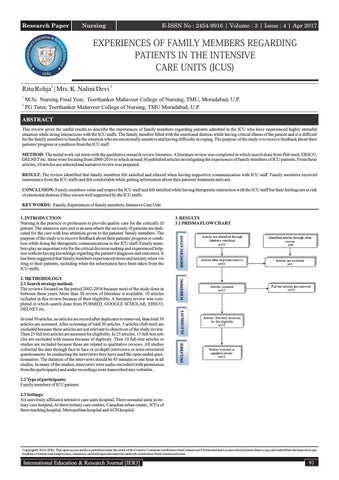
3. RESULTS 3.1 PRISMA FLOW CHART
2. METHODOLOGY 2.1 Search strategy method: The reviews focused on the period 2002-2016 because most of the study done in between these years. More than 30 review of literature is available. 10 articles included in this review because of their eligibility. A literature review was completed in which search done from PUBMED, GOOGLE SCHOLAR, EBSCO, DELNET etc. In total 30 articles, no articles are record after duplicates to removed, than total 30 articles are screened. After screening of total 30 articles, 5 articles (full-text) are excluded because these articles are not relevant to objectives of the study review. Then 25 full text articles are assessed for eligibility. In 25 articles, 15 full-text articles are excluded with reason because of duplicity .Then 10 full-text articles or studies are included because these are related to qualitative reviews. All studies collected the data through face to face or in-depth interviews or semi-structured questionnaire. In conducting the interviews they have used the open ended questionnaires. The duration of the interviews should be 45 minutes to one hour in all studies. In many of the studies, interviews were audio-recorded (with permission from the participants) and audio recordings were transcribed into verbatim. 2.2 Type of participants: Family members of ICU patients. 2.3 Settings: Six university affiliated intensive care units hospital, Three neonatal units in tertiary care hospital, At three tertiary care centers, Canadian urban center, ICUs of three teaching hospital, Metropolitan hospital and ACH hospital.
CopyrightŠ 2016, IERJ. This open-access article is published under the terms of the Creative Commons Attribution-NonCommercial 4.0 International License which permits Share (copy and redistribute the material in any medium or format) and Adapt (remix, transform, and build upon the material) under the Attribution-NonCommercial terms.
International Education & Research Journal [IERJ]
91
Research Paper
E-ISSN No : 2454-9916 | Volume : 3 | Issue : 4 | Apr 2017
3.2 Table no. 1: Data extraction table SR. No
Problem statement/ Author
1)
Family satisfaction with care in the intensive care unit.
2)
Place of research & year
Time duration
Outcomes
Conclusion
Six universityFamily Questionnaire affiliated satisfaction intensive care with care in units across ICU. Canada. (Daren, K. H, et al 2002) (2002)
----------
Family members experience support and greatest satisfaction with the nursing skills and respect the nurses for care but were dissatisfied with the waiting area facilities and frequency of physician communication.
The findings of the study support the assertion that family members mostly prefer to gather information from the ICU staffs because of easier approach and their familiar nature that help to minimize the risk.
Relatives' experiences of ICU care.
----------
In this study care is noticed by In this study chance of death and the family members in the ICU rescue are two associated that is provide to their critically experiences which family ill patients and felt relaxed, members, critically ill patients, hopeful, and satisfied and even and ICU staffs face every day thankful for their care by seeing that causes increase risk of the the improvement in their patients emotional disturbances and condition. suffering among the family members.
Santa Casa in Londrina. ( 2007 )
Variables
Tool
Relatives' experience of ICU care.
Interviews.
3)
A qualitative study on Three neonatal Parents' Parents' experience and units in tertiary experiences satisfaction regarding care hospitals in and their very preterm babies South-East satisfaction care. England Sawyer, A., et al ( 2013 ). (2013).
Semistructured interviews
4)
A qualitative multicenter study on parents' expectations of staff in the early bonding process with their premature babies in the intensive care setting.
Urizzi, F.,et.al (2007).
Three tertiary care centers, Paris region , France (2013).
Parents' Semi-directive Between 60 to expectation interviews 90 minutes.
(Sonia, G., et al 2013). 5)
Parents' views on their very premature babies care in NICUs. Gillian, R., et al (2014).
6)
The study was conducted in South East England (2014).
Parents' views on care.
Fathers' perception of Canadian urban Fathers' facilitators and barriers to centre. perception their involvement with (2013). of the their newborn in NICU. barriers Nancy, F.,(2013).
7)
Perception of Iranian family members of patients in the ICU. Mina, G., et al (2014).
92
Interviews Majority, 80% of family lasted members were extremely approximately satisfied by ICU care, the result 45 minutes. said that 7(18%) family members were generally satisfied but felt improvement in provision of information while doing interaction and 1 (2%) was dissatisfied because not getting time to clear their doubts.
ICUs of three Perception teaching of family hospitals in Iran members. (2014).
12 open ended questions.
Family members in the ICU need emotional support and reassurance from the ICU staff to reduce their stress and anxiety which likely to increase. In this study family members often emotionally upset and need help from the staff to deal the difficult situation, and also mentioned that the staff always being in control to help the family members.
Most of the Family members The study highlighted that mentioned good therapeutic family members need relationship with the ICU staffs reassurance, attention to and experience their gentle promote the emergent feelings attitude toward the care of of being helpful, high quality patients and fulfilling the needs and focus on their baby as well of the family members as as interaction with the physician necessarily subject with a sense of security. to its authority.
Interviews Overall, family members were lasted for satisfied with the care and skills, approximately they had given 3 major themes to 45 minutes. determine their satisfaction those are –families' involvement, staff competence or efficiency and interpersonal relationships with staff to get feedback.
The majority of family members expressed that mutual interaction with the ICU staff is one of the most important attribute to describe their satisfaction in the ICU ,the study suggests that understanding the parents' experiences as they seek to survive their very premature patients to notify the development of family-centered care in the ICU.
Minimally to Lasted The family members are The study highlight that the moderately between 45–90 satisfied because the ICU staffs experience of ICU staff play a structured minutes. providing all the information major role in helping the family Interviews. regarding patient condition and members of the patients by an appropriate verbal giving reassurance , communication between staff encouragement, and teaching nurses and family members through interaction that helps in encourage the confidence to take healthy growth and development care of their patient in the ICU. and reduce the barriers in the patient condition. Semistructured interviews
The interview In the study family members Findings of the study showed took experience hope of recovery that the family members feel between 35 during patients' unstable relax when supported by the and 85 condition and most of the family ICU staff and when the staff minutes. members having faith in God allow them to present in the ICU and having spiritual and cultural and being participate in giving belief that family members use care to their patients the fear, an strategies that help to improve stress and anxiety of the family the patient condition soon. members is reduce to some extent regarding the patients' recovery.
International Education & Research Journal [IERJ]
Research Paper
E-ISSN No : 2454-9916 | Volume : 3 | Issue : 4 | Apr 2017
8)
A qualitative study on In an ICU at a Families' experiences of major their interactions with metropolitan staff in an Australian hospital in intensive care unit (ICU). Australia (2015). (Pauline, W., et al 2015)
Families' experiences with the intensive care unit (ICU) staff.
In-depth interviews
9)
Parental perceptions of ACH hospital is Parental touch between parents & located in perception infants in the NICU. central Arkansas. Crystal, Y.W. (2010). (2010).
Semistructured interviews
10) Intensive care unit family needs, Nurses' and families' perception Turkan, O., et al (2014).
One teaching hospital in Turkey (2014).
Between 30 to 88 minutes.
The study describe that family Family members focused their members felt changes in their experience on the daily living activities while communication with the ICU staying in the ICU, and they felt staff, they describe that due to that because of the tight and poor communication with the busy schedule of the staff they staff causes fear and distress are unable to do the interaction regarding the patients' condition to clear their doubts. and suggested to have a tactful staff to give information while deliver the bad news.
Lasted from This study find out that family 45–60 minutes members had awkwardness and in length. anxiety during the initial weeks in the ICU and feel loss of control to perform other task in daily living and they need to take responsibility of their patients in the ICU.
All the family members in this study need skillful staff who knew to care their patients well. The study highlighted that they felt comfortable when receiving respect from the staff, and reported that the finest health providers' behaviors influence the that the finest nursing behaviors influence the role of the parents' as a whole.
Nurses and 45-item self- Approximately Family members in this study According to this study, there Family report 15-20 minutes. need a staff to continuously were major differences in members questionnaire. giving information regarding the families' needs and providers' perception. patient condition treatment, care needs. Family members anxiety and prognosis. In the study level is reduced when their 14% family members said needs are fulfill. In study the “Never”, 23% “Always”, and most important need was to 63% having knowledge regarding “Sometimes” willing to patients' progress and best participate in decision making promising care to their care to process. help to improve the health status of the patient or make the family members satisfied.
4. RESULT (DISCUSSION) Majority of family members regarding their interactions concern given provide by the ICU staff and also felt respect by the staff and supportive communication were reported the greatest satisfaction that help in pain management and decision making. Family members were least satisfied with the external facilities and frequency of therapeutic interaction with the physician. Overall, 80% of the family members were extremely satisfied with the care by intensive care staff while staying in the ICU, the result said that family members were generally satisfied included psychological support, interaction, reassurance, and in encouragement from the staff but few family members felt that there is need to having some improvement such as provision of information. Overall, families were satisfied with the care provided by the nurses in the NICU, as one of the most important factors that describing family members' satisfaction is capability and competency of the staff nurse to handle the situation and giving care to their patients, mostly support to the family members, appropriate information and friendly nature of the staff were highlighted by the family members in their experience while staying in the ICU. Depression of the family members were identified as a risk factor because of having inappropriate interactions with the health professionals and few of the family members encounter difficulty to do interaction and making a therapeutic bond with the ICU staff, family members suggested to provide better psychological support to reduce the families' stress and fear of anxiety. 5. CONCLUSION The study has provided a deep and insight about how family members are satisfied and dissatisfied regarding certain elements of ICU care and their met and unmet physical, emotional needs. Family members in ICU experience respect from the staff and being involve in the process of decision making. Determinants of encouraging experiences regarding care to their patients were generally consistent by the family members. Specifically, Fear of anxiety, Satisfied care, Supportive communication, Explanation of information were highlighted by the family members as important in their experience of ICU. REFERENCES 1.
Auriemma CL, Lyon SM, Strelec LE, Kent S, Barg FK, Halpern SD. Defining the medical intensive care unit in the words of patients and their family members: a freelisting analysis. American Journal of Critical Care. 2015 Jul 1;24(4):e47-55.
2.
Clissett P, Porock D, Harwood RH, Gladman JR. Experiences of family carers of older people with mental health problems in the acute general hospital: a qualitative study. Journal of Advanced Nursing. 2013 Dec 1;69(12):2707-16.
3.
Coombs M. A scoping review of family experience and need during end of life care in intensive care. Nursing Open. 2015 Apr 1;2(1):24-35.
4.
Deeney K, Lohan M, Spence D, Parkes J. Experiences of fathering a baby admitted to
International Education & Research Journal [IERJ]
neonatal intensive care: a critical gender analysis. Social Science & Medicine. 2012 Sep 30;75(6):1106-13. 5.
Dowling J, Wang B. Impact on family satisfaction: the critical care family assistance program. CHEST Journal. 2005 Sep 1;128(3_suppl):76S-80S.
6.
Fabiane U, Corrêa AK. Relatives' experience of intensive care: the other side of hospitalization. Revista latino-americana de enfermagem. 2007 Aug;15(4):598-604.
7.
Farahani MA, Gaeeni M, Mohammadi N, Seyedfatemi N. Giving information to family members of patients in the intensive care unit: Iranian nurses' ethical approaches. Journal of medical ethics and history of medicine. 2014;7.
8.
Fateel EE, O'Neill CS. Family members' involvement in the care of critically ill patients in two intensive care units in an acute hospital in Bahrain: The experiences and perspectives of family members' and nurses'-A qualitative study. Clinical Nursing Studies. 2015 Dec 30;4(1):p57.
9.
Feeley N, Waitzer E, Sherrard K, Boisvert L, Zelkowitz P. Fathers' perceptions of the barriers and facilitators to their involvement with their newborn hospitalised in the neonatal intensive care unit. Journal of clinical nursing. 2013 Feb 1;22(3-4):521-30.
10. Guillaume S, Michelin N, Amrani E, Benier B, Durrmeyer X, Lescure S, Bony C, Danan C, Baud O, Jarreau PH, Zana-Taïeb E. Parents' expectations of staff in the early bonding process with their premature babies in the intensive care setting: a qualitative multicenter study with 60 parents. BMC pediatrics. 2013 Feb 1;13(1):18. 11. Hakio N, Rantanen A, Åstedt-Kurki P, Suominen T. Parents' experiences of family functioning, health and social support provided by nurses–A pilot study in paediatric intensive care. Intensive and Critical Care Nursing. 2015 Feb 28;31(1):29-37. 12. Hashim F, Hussin R. Family needs of patient admitted to intensive care unit in a public hospital. Procedia-Social and Behavioral Sciences. 2012 Jan 1;36:103-11. 13. Heyland DK, Rocker GM, Dodek PM, Kutsogiannis DJ, Konopad E, Cook DJ, Peters S, Tranmer JE, o'callaghan CJ. Family satisfaction with care in the intensive care unit: results of a multiple center study. Critical care medicine. 2002 Jul 1;30(7):1413-8. 14. Hutchinson SW, Spillett MA, Cronin M. Parents' experiences during their infant's transition from neonatal intensive care unit to home: A qualitative study. The Qualitative Report. 2012 Mar 1;17(12):1. 15. Kentish-Barnes N, Chevret S, Azoulay E. Impact of the condolence letter on the experience of bereaved families after a death in intensive care: study protocol for a randomized controlled trial. Trials. 2016 Feb 20;17(1):102. 16. Lai VK, Lee A, Leung P, Chiu CH, Ho KM, Gomersall CD, Underwood MJ, Joynt GM. Patient and family satisfaction levels in the intensive care unit after elective cardiac surgery: study protocol for a randomised controlled trial of a preoperative patient education intervention. BMJ open. 2016 Jun 1;6(6):e011341. 17. Lam SM, So HM, Fok SK, Li SC, Ng CP, Lui WK, Heyland DK, Yan WW. Intensive care unit family satisfaction survey. Hong Kong Med J. 2015 Oct 1;21(5):435-. 18. Lee YH. The meaning of early intervention: A parent's experience and reflection on interactions with professionals using a phenomenological ethnographic approach. International journal of qualitative studies on health and well-being. 2015;10. 19. Lilo EA, Shaw RJ, Corcoran J, Storfer-Isser A, Horwitz SM. Does she think she's supported? Maternal perceptions of their experiences in the neonatal intensive care unit.
93
Research Paper
E-ISSN No : 2454-9916 | Volume : 3 | Issue : 4 | Apr 2017
Patient Experience Journal. 2016;3(1):15-24. 20. Malliarou M, Gerogianni G, Babatsikou F, Kotrotsiou E, Zyga S. Family perceptions of intensive care unit nurses' roles: a Greek perspective. Health psychology research. 2014 Jan 13;2(1). 21. Martins Faria Faddul Alves MV, Gonzaga Cordeiro J, Bronzato Luppi CH, Trevizani Nitsche MJ, Leite Rosa Olbrich SR. Experience of family members as a result of children's hospitalization at the Intensive Care Unit. Investigación y Educación en Enfermería. 2013 Jul;31(2):191-200. 22. McNamara N. The meaning of the experience for ICU nurses when a family member is critically ill: A hermeneutic phenomenological study (Doctoral dissertation, Auckland University of Technology). 23. Moghaddasian S, Dizaji SL, Mahmoudi M. Nurses empathy and family needs in the intensive care units. Journal of caring sciences. 2013 Sep;2(3):197. 24. Munyiginya P, Brysiewicz P. The needs of patient family members in the intensive care unit in Kigali, Rwanda. Southern African Journal of Critical Care (Online). 2014 Aug;30(1):5-8. 25. Musabirema P, Brysiewicz P, Chipps J. Parents perceptions of stress in a neonatal intensive care unit in Rwanda. curationis. 2015;38(2):1-8. 26. Nolen KB, Warren NA. Meeting the needs of family members of ICU patients. Critical care nursing quarterly. 2014 Oct 1;37(4):393-406. 27. Obeidat HM, Bond EA, Callister LC. The parental experience of having an infant in the newborn intensive care unit. The Journal of Perinatal Education. 2009 Jan 1;18(3):239. 28. Olding M, McMillan SE, Reeves S, Schmitt MH, Puntillo K, Kitto S. Patient and family involvement in adult critical and intensive care settings: a scoping review. Health Expectations. 2015 Sep 1. 29. Ozbayir T, Tasdemir N, Ozsaker E. INTENSIVE CARE UNIT FAMILY NEEDS: NURSES'AND FAMILIES'PERCEPTIONS. Eastern Journal of Medicine. 2014;19(3):137-40. 30. Rusinova K, Kukal J, Simek J, Cerny V. Limited family members/staff communication in intensive care units in the Czech and Slovak Republics considerably increases anxiety in patients ́ relatives–the DEPRESS study. BMC psychiatry. 2014 Jan 27;14(1):21. 31. Russell G, Sawyer A, Rabe H, Abbott J, Gyte G, Duley L, Ayers S. Parents' views on care of their very premature babies in neonatal intensive care units: a qualitative study. BMC pediatrics. 2014 Sep 13;14(1):230. 32. Sawyer A, Rabe H, Abbott J, Gyte G, Duley L, Ayers S. Parents' experiences and satisfaction with care during the birth of their very preterm baby: a qualitative study. BJOG: An International Journal of Obstetrics & Gynaecology. 2013 Apr 1;120(5):637-43. 33. Scharpe RM. The Family Experience of Participating in an ICU Support Group: A Pilot Study. 34. Sheaffer H. The Met and Unmet Needs of Families of Patients in the ICU and Implications for Social Work Practice. 35. Söderström IM, Benzein E, Saveman BI. Nurses' experiences of interactions with family members in intensive care units. Scandinavian journal of caring sciences. 2003 Jun 1;17(2):185-92. 36. Suleman Z, Manning JC, Evans C. Parents' and carers' experiences of transitions and aftercare following a child's discharge from a pediatric intensive care unit to an inpatient ward setting: a qualitative systematic review protocol. JBI database of systematic reviews and implementation reports. 2016 Jan 1;14(1):89-98. 37. Turner MS. The experience of the neonatal intensive care unit (NICU) and NICU supportive interventions (Doctoral dissertation). 38. Wagner JM. Lived experience of critically ill patients' family members during cardiopulmonary resuscitation. American Journal of Critical Care. 2004 Sep 1;13(5):416-20. 39. Whittington C. Parental Perceptions of Touch between Parents and Infants in the Neonatal Intensive Unit. ProQuest LLC. 789 East Eisenhower Parkway, PO Box 1346, Ann Arbor, MI 48106; 2010. 40. Wong P, Liamputtong P, Koch S, Rawson H. Families' experiences of their interactions with staff in an Australian intensive care unit (ICU): A qualitative study. Intensive and Critical Care Nursing. 2015 Feb 28;31(1):51-63.
94
International Education & Research Journal [IERJ]