Research Paper
Mathematics
E-ISSN No : 2454-9916 | Volume : 3 | Issue : 6 | June 2017
COMMON FIXED POINT RESULTS IN GENERALIZED BANACH SPACE S. K.Tiwari1 | Ranu Modi 2 1
Department of Mathematics, Dr. C. V. Raman University, Bilaspur (C.G).
2
M.Phil Scholor, Department of Mathematics, Dr .C.V. Raman University, Bilaspur (C.G.).
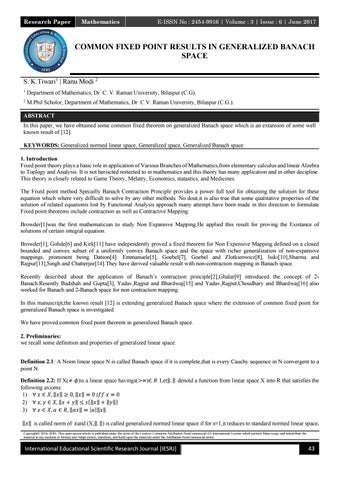
ABSTRACT In this paper, we have obtained some common fixed theorem on generalized Banach space which is an extansion of some well known result of [12]. KEYWORDS: Generalized normed linear space, Generalized space, Generalized Banach space. 1. Introduction Fixed point theory plays a basic role in application of Various Branches of Mathematics,from elementary calculus and linear Alzebra to Toplogy and Analysis. It is not heriscted restected to in mathematics and this theory has many application and in other decipline. This theory is closely related to Game Theory, Melatry, Economics, statastics, and Medicines. The Fixed point method Specailly Banach Contraction Principle provides a power full tool for obtaining the solution for these equation which where very difficult to solve by any other methods. No dout,it is also true that some qualitative properties of the solution of related equationis lost by Functional Analysis approach many attempt have been made in this direction to formulate Fixed point theorems include contraction as well as Contractive Mapping. Browder[1]was the first mathematician to study Non Expansive Mapping,He applied this result for proving the Existance of solutions of certain integral equation. Browder[1], Gohde[6] and Kirk[11] have independently proved a fixed theorem for Non Expensive Mapping defined on a closed bounded and convex subset of a uniformly convex Banach space and the space with richer generalization of non-expansive mappings, prominent being Datson[4]. Emmanuele[5], Goebel[7], Goebel and Zlotkienwicz[8], Isiki[10],Sharma and Rajpur[13],Singh and Chatterjee[14].They have derived valuable result with non-contraction mapping in Banach space. Recently described about the application of Banach’s contraction principle[2],Ghalar[9] introduced the concept of 2Banach.Resently Badshah and Gupta[3], Yadav,Rajput and Bhardwaj[15] and Yadav,Rajput,Choudhary and Bhardwaj[16] also worked for Banach and 2-Banach space for non contraction mapping. In this manuscript,the known result [12] is extending generalized Banach space where the extension of common fixed point for generalized Banach space is investigated. We have proved common fixed point theorem in generalized Banach space. 2. Preliminaries: we recall some definition and properties of generalized linear space. Definition 2.1: A Norm linear space N is called Banach space if it is complete,that is every Cauchy sequence in N convergent to a point N. Definition 2.2: If X(≠đ?œ™)is a linear space havings(>=)∈ đ?‘… Let‖. ‖ denotd a function from linear space X into R that satisfies the following axioms: 1) ∀ đ?‘Ľ ∈ đ?‘‹, ‖đ?‘Ľâ€– ≼ 0, ‖đ?‘Ľâ€– = 0 đ?‘–đ?‘“đ?‘“ đ?‘Ľ = 0 2) ∀ đ?‘Ľ, đ?‘Ś ∈ đ?‘‹, ‖đ?‘Ľ + đ?‘Śâ€– ≤ đ?‘ {‖đ?‘Ľâ€– + ‖đ?‘Śâ€–} 3) ∀ đ?‘Ľ ∈ đ?‘‹, đ?›ź ∈ đ?‘…, ‖đ?›źđ?‘Ľâ€– = |đ?›ź|‖đ?‘Ľâ€– ‖đ?‘Ľâ€– is called norm of đ?‘Ľand (X,‖. ‖) is called generalized normed linear space.if for s=1,it reduces to standard normed linear space. CopyrightŠ 2016, IERJ. This open-access article is published under the terms of the Creative Commons Attribution-NonCommercial 4.0 International License which permits Share (copy and redistribute the material in any medium or format) and Adapt (remix, transform, and build upon the material) under the Attribution-NonCommercial terms.
International Educational Scientific Research Journal [IESRJ]
43
Research Paper
E-ISSN No : 2454-9916 | Volume : 3 | Issue : 6 | June 2017
Definition 2.3: A linear generalized normed space in which every sequence is convergent is called generalized Banach space. Definition 2.4: The generalizd Banach space is complete if every Cauchy sequence convergences. Definition 2.5: If X(≠đ?œ™) is a linear space havings(>=)∈ đ?‘… Let‖. , . ‖ denotd a function from linear space X into R that satisfies the following axioms such that for đ?‘Ľ, đ?‘Ś, đ?‘§ ∈ đ?‘‹ 1) 2) 3) 4)
‖đ?‘Ľ, đ?‘Śâ€– =0 đ?‘–đ?‘“đ?‘“ đ?‘Ľ &đ?‘Ś are linearly dependent ‖đ?‘Ľ, đ?‘Śâ€– = ‖đ?‘Ś, đ?‘Ľâ€– ‖đ?‘Ľ, đ?›˝đ?‘Śâ€– ≤ |đ?›˝|‖đ?‘Ľ, đ?‘Śâ€–, đ?›˝đ?‘&#x;đ?‘’đ?‘Žđ?‘™ ‖đ?‘Ľ, đ?‘Ś + đ?‘§â€– ≤ đ?‘ [‖đ?‘Ľ, đ?‘Śâ€– + ‖đ?‘Ľ, đ?‘§â€–],
‖�‖ is called norm of � and (�, ‖. , . ‖) is called generalized 2-normed linear space.If for normed linear space.
s=1,it reduce to standard 2-
Definition 2.6: A linear generalized 2-normd space in which every sequence is convergent is called generalized 2-Banach space. To prove our main result we will use the following lemma. Lemma2.7: Suppose(đ?‘‹, ‖. , . ‖) be a generalized space and {đ?‘Ś2đ?‘› } be a sequence in X such that ‖đ?‘Ś2đ?‘›+1 − đ?‘Ś2đ?‘›+2 ‖ ≤ đ?œ†â€–đ?‘Ś2đ?‘› − đ?‘Ś2đ?‘›+1 ‖, đ?‘› = 0,1,2 ‌ ‌
(2.7.1)
where 0 ≤ đ?œ† < 1 then the sequence is Cauchy in X provided sđ?œ† < 1.
.
Now in section I, we will find some fixed point theorem in generalized Banach space. 3. Main result : Theorem3.1:Let X be a Generalized Banach space with ‖. , . ‖ and let
�1 , �2 : � → � be a function with the following mapping:
‖đ?‘‡1 (đ?‘Ľ) − đ?‘‡2 (đ?‘Ś)‖ ≤ đ?‘Ž ‖đ?‘Ľ − đ?‘‡1 đ?‘Ľâ€– + đ?‘? ‖đ?‘Ś − đ?‘‡2 (đ?‘Ś)‖ + đ?‘? ‖đ?‘Ľ − đ?‘Ś ‖ (3.1.1) ∀đ?‘Ľ, đ?‘Ś ∈ đ?‘‹Where a,b and c are non negative real number and satisfy đ?‘Ž + đ?‘ (đ?‘? + đ?‘?) < 1đ?‘“đ?‘œđ?‘&#x;đ?‘ ≼ 1 ,then đ?‘‡1 & đ?‘‡2 have a unique common fixed point. Proof: Let đ?‘Ľ0 ∈ đ?‘‹ and {đ?‘Ľ2đ?‘› } đ?‘Žđ?‘›đ?‘‘ {đ?‘Ľ2đ?‘›+1 } be any two sequence in X such that đ?‘Ľ2đ?‘› = đ?‘‡1 đ?‘Ľ2đ?‘›âˆ’1 = đ?‘‡1 2đ?‘› đ?‘Ľ0
(3.1.2)
�2�+1 = �2 �2� = �2 2�+1 �0
(3.1.3)
Note that, if đ?‘Ľ2đ?‘› = đ?‘Ľ2đ?‘›+1 for some n ≼ 0, then đ?‘Ľ2đ?‘› is fixed point of đ?‘‡1 đ?‘Žđ?‘›đ?‘‘ đ?‘‡2 .Now putting đ?‘Ľ = đ?‘Ľ2đ?‘› đ?‘Žđ?‘›đ?‘‘ đ?‘Ś = đ?‘Ľ2đ?‘›âˆ’1 .from(3.1.1),wehave ‖đ?‘Ľ2đ?‘›+1 − đ?‘Ľ2đ?‘› ‖=‖đ?‘‡1 đ?‘Ľ2 đ?‘› − đ?‘‡2 đ?‘Ľ2đ?‘›âˆ’1 ‖ ≤ đ?‘Žâ€–đ?‘Ľ2đ?‘› − đ?‘‡1 đ?‘Ľ2đ?‘› ‖ + đ?‘?‖đ?‘Ľ2đ?‘›âˆ’1 − đ?‘‡1 đ?‘Ľ2đ?‘›âˆ’1 ‖ + đ?‘?‖đ?‘Ľ2đ?‘› − đ?‘Ľ2đ?‘›âˆ’1 ‖ = đ?‘Žâ€–đ?‘Ľ2đ?‘› − đ?‘Ľ2đ?‘›+1 ‖ + đ?‘?‖đ?‘Ľ2đ?‘›âˆ’1 − đ?‘Ľ2đ?‘› ‖ + đ?‘?‖đ?‘Ľ2đ?‘› − đ?‘Ľ2đ?‘›âˆ’1 ‖ ⇒
(1 − đ?‘Ž)‖đ?‘Ľ2đ?‘› − đ?‘Ľ2đ?‘›âˆ’1 ‖ ≤ (đ?‘? + đ?‘?)‖đ?‘Ľ2đ?‘› − đ?‘Ľ2đ?‘›âˆ’1 ‖ â&#x;š ‖đ?‘Ľ2đ?‘› − đ?‘Ľ2đ?‘›âˆ’1 ‖ ≤ (
=ℎ‖đ?‘Ľ2đ?‘› − đ?‘Ľ2đ?‘›âˆ’1 ‖ where h=
đ?‘?+đ?‘? ) ‖đ?‘Ľ2đ?‘› − đ?‘Ľ2đ?‘›âˆ’1 ‖ 1−đ?‘Ž
đ?‘?+đ?‘?
1−đ?‘Ž
Continuing this process we can easily say that ‖đ?‘Ľ2đ?‘› − đ?‘Ľ2đ?‘›âˆ’1 ‖ ≤ â„Ž2đ?‘› ‖đ?‘Ľ1 − đ?‘Ľ0 ‖ This implies that đ?‘‡1 đ?‘Žđ?‘›đ?‘‘ đ?‘‡2 are contraction mapping.Now it is to show that {đ?‘Ľ2đ?‘› } is Cauchy sequence in X. Let m,n> 0 with đ?‘š > đ?‘› then from (3.1.1)we have ‖đ?‘Ľ2đ?‘› − đ?‘Ľ2đ?‘š ‖ ≤ đ?‘ {‖đ?‘Ľ2đ?‘› − đ?‘Ľ2đ?‘š ‖ + ‖đ?‘Ľ2đ?‘›+1 − đ?‘Ľ2đ?‘š ‖} ≤ đ?‘ ‖đ?‘Ľ2đ?‘› − đ?‘Ľ2đ?‘›+1 ‖ + đ?‘ 2 ‖đ?‘Ľ2đ?‘›+1 − đ?‘Ľ2đ?‘›+|2 ‖ +đ?‘ 3 ‖đ?‘Ľ2đ?‘›+|2 − đ?‘Ľ2đ?‘›+3 ‖ + ‌‌‌‌‌‌‌. ≤ đ?‘ â„Ž2đ?‘› ‖đ?‘Ľ0 − đ?‘Ľ1 ‖ +đ?‘ 2 â„Ž2đ?‘›+1 ‖đ?‘Ľ0 − đ?‘Ľ1 ‖ + đ?‘ 3 â„Ž2đ?‘›+2 ‖đ?‘Ľ0 − đ?‘Ľ1 ‖ + ‌‌‌‌‌‌‌‌
International Educational Scientific Research Journal [IESRJ]
44
Research Paper
E-ISSN No : 2454-9916 | Volume : 3 | Issue : 6 | June 2017
= 𝑠ℎ2𝑛 ‖𝑥0 − 𝑥1 ‖ .[1 + 𝑠ℎ + (𝑠ℎ)2 + (𝑠ℎ)3 + ⋯ ] =
𝑠ℎ2𝑛 ‖𝑥 − 𝑥1 ‖ 1 − 𝑠ℎ 0
Now using the lemma 2.13 and taking limit 𝑛 → ∞ we get lim ‖𝑥2𝑛 − 𝑥2𝑚 ‖ = 0
𝑛→∞
{𝑥2𝑛 } is a Cauchy sequence in X. Since X is complete we consider that {𝑥2𝑛 }convergence to 𝑥 ∗ .Now we show that 𝑥 ∗ is fixed point of 𝑇1 . ‖𝑥 ∗ − 𝑇1 𝑥 ∗ ‖ ≤ 𝑠[‖𝑥 ∗ − 𝑥2𝑛 ‖ + ‖𝑥2𝑛 − 𝑇1 𝑥 ∗ ‖] ≤ 𝑠[‖𝑥 ∗ − 𝑥2𝑛 ‖ + ‖ 𝑇1 𝑥2𝑛−1 − 𝑇1 𝑥 ∗ ‖ ] ≤ 𝑠[‖𝑥 ∗ − 𝑥2𝑛 ‖ + 𝑎‖𝑥 ∗ − 𝑇1 𝑥 ∗ ‖ + 𝑏‖𝑥2𝑛−1 − 𝑇1 𝑥2𝑛−1 ‖ + 𝑐‖𝑥2𝑛−1 − 𝑥 ∗ ‖] (1 − 𝑎𝑠)‖𝑥 ∗ − 𝑇1 𝑥 ∗ ‖ ≤ 𝑠[‖𝑥 ∗ − 𝑥2𝑛 ‖ + 𝑏‖𝑥2𝑛−1 − 𝑇1 𝑥2𝑛−1 ‖ + 𝑐‖𝑥2𝑛−1 − 𝑥 ∗ ‖] ‖𝑥 ∗ − 𝑇1 𝑥 ∗ ‖ ≤
𝑠 [‖𝑥 ∗ − 𝑥2𝑛 ‖ + 𝑏ℎ2𝑛 ‖𝑥0 − 𝑇1 𝑥1 ‖ + 𝑐‖𝑥2𝑛−1 − 𝑥 ∗ ‖] (1 − 𝑎𝑠)
Taking limit 𝑛 → ∞we get, lim ‖𝑥 ∗ − 𝑇1 𝑥 ∗ ‖ = 0
𝑛→∞
𝑥 ∗ = 𝑇1 𝑥 ∗ Hence 𝑥 ∗ is a fixed point of 𝑇1 . Now,if z be another fixed point of 𝑇1 . 𝑇1 z = z.Then ‖𝑥 ∗ − 𝑇1 𝑧‖ ≤ 𝑠[‖𝑥 ∗ − 𝑥2𝑛 ‖ + ‖𝑥2𝑛 − 𝑇1 𝑧‖] ≤ 𝑠[‖𝑥 ∗ − 𝑥2𝑛 ‖ + ‖ 𝑇1 𝑥2𝑛−1 − 𝑇1 𝑧‖ ] ≤ 𝑠[‖𝑥 ∗ − 𝑥2𝑛 ‖ + 𝑎‖𝑥 ∗ − 𝑇1 𝑧‖ + 𝑏‖𝑥2𝑛−1 − 𝑇1 𝑥2𝑛−1 ‖ + 𝑐‖𝑥2𝑛−1 − 𝑥 ∗ ‖] (1 − 𝑎𝑠)‖𝑥 ∗ − 𝑇1 𝑥 ∗ ‖ ≤ 𝑠[‖𝑥 ∗ − 𝑥2𝑛 ‖ + 𝑏‖𝑥2𝑛−1 − 𝑇1 𝑥2𝑛−1 ‖ + 𝑐‖𝑥2𝑛−1 − 𝑥 ∗ ‖] ‖𝑥 ∗ − 𝑇1 𝑥 ∗ ‖ ≤
𝑠 [‖𝑥 ∗ − 𝑥2𝑛 ‖ + 𝑏ℎ2𝑛 ‖𝑥0 − 𝑇1 𝑥1 ‖ + 𝑐‖𝑥2𝑛−1 − 𝑥 ∗ ‖] (1 − 𝑎𝑠)
Taking limit 𝑛 → ∞we get, lim ‖𝑥 ∗ − 𝑇1 𝑧‖ = 0
𝑛→∞
𝑥 ∗ = 𝑇1 𝑧 = z 𝑥∗ = 𝑧 Therefore 𝑇1 has a unique fixed point. Similarly it can be establishd that 𝑇2 𝑥 ∗ =𝑥 ∗ . Hence 𝑇1 𝑥 ∗ = 𝑥 ∗ =𝑇2 𝑥 ∗ Thus 𝑥 ∗ is the unique common fixed point of 𝑇1 and 𝑇2 . These completed the proof of the theorem. Theorem3.2: Let X be a Generalized Banach space with ‖. , . ‖ and let ‖𝑇1 (𝑥) − 𝑇2 (𝑦)‖ ≤ 𝑎1 ‖𝑥 − 𝑇1 𝑥‖ + 𝑎2 [‖𝑦 − 𝑇2 (𝑦)‖ + ‖𝑥 − 𝑦 ‖]
International Educational Scientific Research Journal [IESRJ]
𝑇1 , 𝑇2 : 𝑋 → 𝑋 be a function with the following mapping: (3.2.1)
45
Research Paper
E-ISSN No : 2454-9916 | Volume : 3 | Issue : 6 | June 2017
∀𝑥, 𝑦 ∈ 𝑋Where 𝑎1 & 𝑎2 are non negative real number and satisfy 𝑎 + 2𝑠𝑏 ≤ 1𝑓𝑜𝑟𝑠 ≥ 1 ,then 𝑇1 & 𝑇2 have a unique common fixed point. Proof: Let 𝑥0 ∈ 𝑋 and {𝑥2𝑛 } 𝑎𝑛𝑑 {𝑥2𝑛+1 } be any two sequence in X such that 𝑥2𝑛 = 𝑇1 𝑥2𝑛−1 = 𝑇1 2𝑛 𝑥0
(3.2.2)
𝑥2𝑛+1 = 𝑇2 𝑥2𝑛 = 𝑇2 2𝑛+1 𝑥0
(3.2.3)
Note that,if 𝑥2𝑛 =𝑥2𝑛+1 for some n ≥ 0,then 𝑥2𝑛 is fixed point of 𝑇1 𝑎𝑛𝑑 𝑇2 .Now putting 𝑥 = 𝑥2𝑛 𝑎𝑛𝑑 𝑦 = 𝑥2𝑛−1 .from(3.2.1),we have ‖𝑥2𝑛+1 − 𝑥2𝑛 ‖=‖𝑇1 𝑥2 𝑛 − 𝑇2 𝑥2𝑛−1 ‖ ≤ 𝑎1 ‖𝑥2𝑛 − 𝑇1 𝑥2𝑛 ‖ + 𝑎2 [‖𝑥2𝑛−1 − 𝑇1 𝑥2𝑛−1 ‖ + ‖𝑥2𝑛 − 𝑥2𝑛−1 ‖] = 𝑎1 ‖𝑥2𝑛 − 𝑥2𝑛+1 ‖ + 𝑎2 [‖𝑥2𝑛−1 − 𝑥2𝑛 ‖ + ‖𝑥2𝑛 − 𝑥2𝑛−1 ‖] ⇒
(1 − 𝑎1 )‖𝑥2𝑛 − 𝑥2𝑛−1 ‖ ≤ 2𝑎2 ‖𝑥2𝑛 − 𝑥2𝑛−1 ‖ ⟹ ‖𝑥2𝑛 − 𝑥2𝑛−1 ‖ ≤ (
=ℎ‖𝑥2𝑛 − 𝑥2𝑛−1 ‖ where h=
2𝑎2 ) ‖𝑥2𝑛 − 𝑥2𝑛−1 ‖ 1 − 𝑎1
𝑎2
1−𝑎1
Continuing this process we can easily say that ‖𝑥2𝑛 − 𝑥2𝑛−1 ‖ ≤ ℎ2𝑛 ‖𝑥1 − 𝑥0 ‖ This implies that 𝑇1 𝑎𝑛𝑑 𝑇2 are contraction mapping. Now it is to show that {𝑥2𝑛 } is Cauchy sequence in X. Let m,n> 0 with 𝑚 > 𝑛 then from (3.1.1)we have ‖𝑥2𝑛 − 𝑥2𝑚 ‖ ≤ 𝑠{‖𝑥2𝑛 − 𝑥2𝑛+1 ‖ + ‖𝑥2𝑛+1 − 𝑥2𝑚 ‖} ≤ 𝑠‖𝑥2𝑛 − 𝑥2𝑛+1 ‖ + 𝑠 2 ‖𝑥2𝑛+1 − 𝑥2𝑛+|2 ‖ +𝑠 3 ‖𝑥2𝑛+|2 − 𝑥2𝑛+3 ‖ + …………………. ≤ 𝑠ℎ2𝑛 ‖𝑥0 − 𝑥1 ‖ +𝑠 2 ℎ2𝑛+1 ‖𝑥0 − 𝑥1 ‖ + 𝑠 3 ℎ2𝑛+2 ‖𝑥0 − 𝑥1 ‖ + …………………… = 𝑠ℎ2𝑛 ‖𝑥0 − 𝑥1 ‖ .[1 + 𝑠ℎ + (𝑠ℎ)2 + (𝑠ℎ)3 + ⋯ ] =
𝑠ℎ2𝑛 ‖𝑥 − 𝑥1 ‖ 1 − 𝑠ℎ 0
Now using the lemma 2.13 and taking limit 𝑛 → ∞ we get lim ‖𝑥2𝑛 − 𝑥2𝑚 ‖ = 0
𝑛→∞
{𝑥2𝑛 } is a Cauchy sequence in X. Since X is complete we consider that {𝑥2𝑛 }convergence to 𝑥 ∗ .Now we show that 𝑥 ∗ is fixed point of 𝑇1 . ‖𝑥 ∗ − 𝑇1 𝑥 ∗ ‖ ≤ 𝑠[‖𝑥 ∗ − 𝑥2𝑛 ‖ + ‖𝑥2𝑛 − 𝑇1 𝑥 ∗ ‖] ≤ 𝑠[‖𝑥 ∗ − 𝑥2𝑛 ‖ + ‖ 𝑇1 𝑥2𝑛−1 − 𝑇1 𝑥 ∗ ‖ ] ≤ 𝑠[‖𝑥 ∗ − 𝑥2𝑛 ‖ + 𝑎1 ‖𝑥 ∗ − 𝑇1 𝑥 ∗ ‖ + 𝑎2 [‖𝑥2𝑛−1 − 𝑇1 𝑥2𝑛−1 ‖ + ‖𝑥2𝑛−1 − 𝑥 ∗ ‖]] (1 − 𝑎1 𝑠)‖𝑥 ∗ − 𝑇1 𝑥 ∗ ‖ ≤ 𝑠[‖𝑥 ∗ − 𝑥2𝑛 ‖ + 𝑎2 [‖𝑥2𝑛−1 − 𝑇1 𝑥2𝑛−1 ‖ + ‖𝑥2𝑛−1 − 𝑥 ∗ ‖]] ‖𝑥 ∗ − 𝑇1 𝑥 ∗ ‖ ≤
𝑠 [‖𝑥 ∗ − 𝑥2𝑛 ‖ + 𝑎2 ℎ2𝑛 ‖𝑥0 − 𝑇1 𝑥1 ‖ + ‖𝑥2𝑛−1 − 𝑥 ∗ ‖] (1 − 𝑎1 𝑠)
Taking limit 𝑛 → ∞we get, lim ‖𝑥 ∗ − 𝑇1 𝑥 ∗ ‖ = 0
𝑛→∞
𝑥 ∗ = 𝑇1 𝑥 ∗ Hence 𝑥 ∗ is a fixed point of 𝑇1 .
International Educational Scientific Research Journal [IESRJ]
46
Research Paper
E-ISSN No : 2454-9916 | Volume : 3 | Issue : 6 | June 2017
Now,if z be another fixed point of đ?‘‡1 . đ?‘‡1 z = z.Then ‖đ?‘Ľ ∗ − đ?‘‡1 đ?‘§â€– ≤ đ?‘ [‖đ?‘Ľ ∗ − đ?‘Ľ2đ?‘› ‖ + ‖đ?‘Ľ2đ?‘› − đ?‘‡1 đ?‘§â€–] ≤ đ?‘ [‖đ?‘Ľ ∗ − đ?‘Ľ2đ?‘› ‖ + ‖ đ?‘‡1 đ?‘Ľ2đ?‘›âˆ’1 − đ?‘‡1 đ?‘§â€– ] ≤ đ?‘ [‖đ?‘Ľ ∗ − đ?‘Ľ2đ?‘› ‖ + đ?‘Ž1 ‖đ?‘Ľ ∗ − đ?‘‡1 đ?‘§â€– + đ?‘Ž2 [‖đ?‘Ľ2đ?‘›âˆ’1 − đ?‘‡1 đ?‘Ľ2đ?‘›âˆ’1 ‖ + ‖đ?‘Ľ2đ?‘›âˆ’1 − đ?‘Ľ ∗ ‖]] (1 − đ?‘Ž1 đ?‘ )‖đ?‘Ľ ∗ − đ?‘‡1 đ?‘Ľ ∗ ‖ ≤ đ?‘ [‖đ?‘Ľ ∗ − đ?‘Ľ2đ?‘› ‖ + đ?‘Ž2 [‖đ?‘Ľ2đ?‘›âˆ’1 − đ?‘‡1 đ?‘Ľ2đ?‘›âˆ’1 ‖ + ‖đ?‘Ľ2đ?‘›âˆ’1 − đ?‘Ľ ∗ ‖]] ‖đ?‘Ľ ∗ − đ?‘‡1 đ?‘Ľ ∗ ‖ ≤
đ?‘ [‖đ?‘Ľ ∗ − đ?‘Ľ2đ?‘› ‖ + đ?‘Ž2 [â„Ž2đ?‘› ‖đ?‘Ľ0 − đ?‘‡1 đ?‘Ľ1 ‖ + ‖đ?‘Ľ2đ?‘›âˆ’1 − đ?‘Ľ ∗ ‖]] (1 − đ?‘Ž1 đ?‘ )
Taking limit đ?‘› → ∞we get, lim ‖đ?‘Ľ ∗ − đ?‘‡1 đ?‘§â€– = 0
đ?‘›â†’∞
đ?‘Ľ ∗ = đ?‘‡1 đ?‘§ = z đ?‘Ľâˆ— = đ?‘§ Therefore đ?‘‡1 has a unique fixed point. Similarly it can be establishd that đ?‘‡2 đ?‘Ľ ∗ =đ?‘Ľ ∗ . Hence đ?‘‡1 đ?‘Ľ ∗ = đ?‘Ľ ∗ =đ?‘‡2 đ?‘Ľ ∗ Thus đ?‘Ľ ∗ is the unique common fixed point of đ?‘‡1 and đ?‘‡2 . These completed the proof of the theorem. Theorem 3.3:Let X be a generalized Banach space with ‖. , . ‖ and đ?‘‡1 , đ?‘‡2 :đ?‘‹ → đ?‘‹ be a function satisfied the following condition for all x,y in X, ‖đ?‘‡1 (đ?‘Ľ) − đ?‘‡2 (đ?‘Ś)‖ ≤ đ?‘Žâ€–đ?‘Ľ − đ?‘‡1 đ?‘Ľâ€– + đ?‘?‖đ?‘Ś − đ?‘‡2 đ?‘Śâ€– + đ?‘?‖đ?‘Ľ − đ?‘‡1 đ?‘Śâ€– + đ?‘’‖đ?‘Ś − đ?‘‡2 đ?‘Śâ€– + đ?‘“‖đ?‘Ľ − đ?‘Śâ€– 1
Where a,b,c,e and f are non negative real number & satisfy đ?›ź = đ?‘Ž + đ?‘? + đ?‘? + đ?‘’ + đ?‘“ such that đ?›ź ∈ (0, ) for s≼ 1,then đ?‘‡1 & đ?‘‡2 2đ?‘
have a unique common fixed point.before going to prove this theorem we required following lemma 3.4 1
Lemma 3.4:Let he condition (3.3.1) hold on generalized Banach space for self map đ?‘‡1 đ?‘Žđ?‘›đ?‘‘ đ?‘‡2 on it.Then if đ?›ź ∈ (0, ) 2đ?‘
there exits đ?›˝ <
1 2đ?‘
such that ‖đ?‘‡1 đ?‘Ľ − đ?‘‡1 2 đ?‘Ľâ€– ≤ ‖đ?‘Ľ − đ?‘‡1 đ?‘Ľâ€–
and ‖ đ?‘‡2 đ?‘Ľ − đ?‘‡2 2 đ?‘Ľâ€– ≤ ‖đ?‘Ľ − đ?‘‡2 đ?‘Ľâ€–
(3.4.1) (3.4.2)
Proof of the theorem 3.3 Let đ?‘Ľ0 ∈ đ?‘‹ and {đ?‘Ľ2đ?‘› }be a sequence in X such that đ?‘Ľ2đ?‘› = đ?‘‡1 đ?‘Ľ2đ?‘›âˆ’1 = đ?‘‡1 2đ?‘› đ?‘Ľ0 đ?‘Ľ2đ?‘›+1 =đ?‘‡2 đ?‘Ľ2đ?‘› =đ?‘‡2 2đ?‘›+1 đ?‘Ľ1 Now using lemma 3.4 we can show that ‖đ?‘Ľ2đ?‘›+1 − đ?‘Ľ2đ?‘› ‖ ≤ đ?›˝2đ?‘› ‖đ?‘Ľ0 − đ?‘Ľ1 ‖ Now we show that {đ?‘Ľ2đ?‘› } is a Cauchy sequence in X.Let đ?‘š, đ?‘› > 0 with đ?‘š > đ?‘› ‖đ?‘Ľ2đ?‘› − đ?‘Ľ2đ?‘š ‖ ≤ đ?‘ â&#x;Śâ€–đ?‘Ľ2đ?‘› − đ?‘Ľ2đ?‘›+1 ‖ + ‖đ?‘Ľ2đ?‘›+1 − đ?‘Ľ2đ?‘š ‖â&#x;§ ≤ đ?‘ ‖đ?‘Ľ2đ?‘› − đ?‘Ľ2đ?‘›+1 ‖ + đ?‘ 2 ‖đ?‘Ľ2đ?‘›+1 − đ?‘Ľ2đ?‘›+2 ‖ + đ?‘ 3 ‖đ?‘Ľ2đ?‘›+2 − đ?‘Ľ2đ?‘›+3 ‖ +‌‌‌ ≤ đ?‘ đ?›˝2đ?‘› ‖đ?‘Ľ0 − đ?‘Ľ1 ‖ + đ?‘ 2 đ?›˝2đ?‘›+1 ‖đ?‘Ľ0 − đ?‘Ľ1 ‖ + đ?‘ 3 đ?›˝2đ?‘›+2 ‖đ?‘Ľ0 − đ?‘Ľ1 ‖ +‌‌
International Educational Scientific Research Journal [IESRJ]
47
Research Paper
E-ISSN No : 2454-9916 | Volume : 3 | Issue : 6 | June 2017
When taking limit đ?‘› → ∞ we get lim ‖đ?‘Ľ2đ?‘› − đ?‘Ľ2đ?‘š ‖ = 0
đ?‘›â†’∞
{đ?‘Ľ2đ?‘› } is Cauchy sequence in X. Since X is complete we consider that {đ?‘Ľ2đ?‘› } converges to đ?‘Ľ ∗ .Now we show that đ?‘Ľ ∗ is fixed point of đ?‘‡1 . ‖đ?‘Ľ ∗ − đ?‘‡1 đ?‘Ľ ∗ ‖ ≤ đ?‘ [‖đ?‘Ľ ∗ − đ?‘Ľ2đ?‘› ‖ + ‖đ?‘Ľ2đ?‘› − đ?‘‡1 đ?‘Ľ ∗ ‖] ≤ đ?‘ [‖đ?‘Ľ ∗ − đ?‘Ľ2đ?‘› ‖ + ‖đ?‘‡1 đ?‘Ľ2đ?‘›âˆ’1 − đ?‘‡1 đ?‘Ľ ∗ ‖] ≤ đ?‘ [‖đ?‘Ľ ∗ − đ?‘Ľ2đ?‘› ‖ + đ?‘Žâ€–đ?‘Ľ2đ?‘›âˆ’1 − đ?‘‡1 đ?‘Ľ2đ?‘›âˆ’1 ‖ + đ?‘?‖đ?‘Ľ ∗ − đ?‘‡1 đ?‘Ľ ∗ ‖ + đ?‘?‖đ?‘Ľ2đ?‘›âˆ’1 − đ?‘‡1 đ?‘Ľ ∗ ‖ + đ?‘’‖đ?‘Ľ ∗ − đ?‘‡1 đ?‘Ľ2đ?‘›âˆ’1 ‖ + đ?‘“‖đ?‘Ľ2đ?‘›âˆ’1 − đ?‘Ľ ∗ ‖] ‖đ?‘Ľ ∗ − đ?‘‡1 đ?‘Ľ ∗ ‖ ≤ đ?‘ [đ?‘Žâ€–đ?‘Ľ2đ?‘›âˆ’1 − đ?‘Ľ2đ?‘› ‖ + đ?‘?‖đ?‘Ľ ∗ − đ?‘‡1 đ?‘Ľ ∗ ‖ + đ?‘?‖đ?‘Ľ2đ?‘›âˆ’1 − đ?‘‡1 đ?‘Ľ ∗ ‖ + (đ?‘’ + 1)‖đ?‘Ľ ∗ − đ?‘Ľ2đ?‘› ‖ + đ?‘“‖đ?‘Ľ2đ?‘›âˆ’1 − đ?‘Ľ ∗ ‖] Taking limit đ?‘› → ∞ we get ‖đ?‘Ľ ∗ − đ?‘‡1 đ?‘Ľ ∗ ‖ ≤ đ?‘ (đ?‘? + đ?‘?)‖đ?‘Ľ ∗ − đ?‘‡1 đ?‘Ľ ∗ ‖ Which is contradiction unless đ?‘Ľ ∗ = đ?‘‡1 đ?‘Ľ ∗ Hence đ?‘Ľ ∗ is a fixed point of đ?‘‡1 . Now if z be another fixed point of đ?‘‡1 . đ?‘‡1 z = z.Then ‖đ?‘Ľ ∗ − đ?‘‡1 đ?‘§â€– ≤ đ?‘ [‖đ?‘Ľ ∗ − đ?‘Ľ2đ?‘› ‖ + ‖đ?‘Ľ2đ?‘› − đ?‘‡1 đ?‘§â€–] ≤ đ?‘ [‖đ?‘Ľ ∗ − đ?‘Ľ2đ?‘› ‖ + ‖ đ?‘‡1 đ?‘Ľ2đ?‘›âˆ’1 − đ?‘‡1 đ?‘§â€– ≤ đ?‘ [‖đ?‘Ľ ∗ − đ?‘Ľ2đ?‘› ‖ + đ?‘Žâ€–đ?‘Ľ ∗ − đ?‘‡1 đ?‘§â€–+b‖đ?‘Ľ2đ?‘›âˆ’1 − đ?‘‡1 đ?‘Ľ2đ?‘›âˆ’1 ‖+c‖đ?‘Ľ ∗ − đ?‘‡1 đ?‘Ľ2đ?‘›âˆ’1 ‖+e‖đ?‘Ľ2đ?‘›âˆ’1 − đ?‘‡1 đ?‘Ľ ∗ ‖ + đ?‘“‖đ?‘Ľ2đ?‘›âˆ’1 − đ?‘Ľ ∗ ‖] â&#x;š (1 − đ?‘Žđ?‘ )‖đ?‘Ľ ∗ − đ?‘‡1 đ?‘§â€– ≤ đ?‘ [‖đ?‘Ľ ∗ − đ?‘Ľ2đ?‘› ‖ + đ?‘?‖đ?‘Ľ2đ?‘›âˆ’1 − đ?‘‡1 đ?‘Ľ2đ?‘›âˆ’1 ‖ + đ?‘?‖đ?‘Ľ ∗ − đ?‘‡1 đ?‘Ľ2đ?‘›âˆ’1 ‖ + đ?‘’‖đ?‘Ľ2đ?‘›âˆ’1 − đ?‘‡1 đ?‘Ľ ∗ ‖ + đ?‘“‖đ?‘Ľ2đ?‘›âˆ’1 − đ?‘Ľ ∗ ‖ ‖đ?‘Ľ ∗ − đ?‘‡1 đ?‘§â€– ≤
đ?‘ ‖đ?‘Ľ ∗ − đ?‘Ľ2đ?‘› ‖ + đ?‘?‖đ?‘Ľ2đ?‘›âˆ’1 − đ?‘‡1 đ?‘Ľ2đ?‘›âˆ’1 ‖ + đ?‘?‖đ?‘Ľ ∗ − đ?‘‡1 đ?‘Ľ2đ?‘›âˆ’1 ‖ + đ?‘’‖đ?‘Ľ2đ?‘›âˆ’1 − đ?‘‡1 đ?‘Ľ ∗ ‖ + đ?‘“‖đ?‘Ľ2đ?‘›âˆ’1 − đ?‘Ľ ∗ ‖ (1 − đ?‘Žđ?‘ )
Taking limit đ?‘› → ∞we get, lim ‖đ?‘Ľ ∗ − đ?‘‡1 đ?‘§â€– = 0
đ?‘›â†’∞
đ?‘Ľ ∗ = đ?‘‡1 đ?‘§ = z đ?‘Ľâˆ— = đ?‘§ Therefore đ?‘‡1 has a unique fixed point. Similarly it can be establishd that đ?‘‡2 đ?‘Ľ ∗ =đ?‘Ľ ∗ . Hence đ?‘‡1 đ?‘Ľ ∗ = đ?‘Ľ ∗ =đ?‘‡2 đ?‘Ľ ∗ Thus đ?‘Ľ ∗ is the unique common fixed point of đ?‘‡1 and đ?‘‡2 . These completed the proof of the theorem. Thorem3.5: Let X be a generalized Banach space with ‖. , . ‖ and đ?‘‡1 , đ?‘‡2 :đ?‘‹ → đ?‘‹ be a function satisfied the following condition for all x,y in X, ‖đ?‘‡1 (đ?‘Ľ) − đ?‘‡2 (đ?‘Ś)‖ ≤ đ?‘Ž1 ‖đ?‘Ľ − đ?‘‡1 đ?‘Ľâ€– + đ?‘Ž2 [‖đ?‘Ś − đ?‘‡2 đ?‘Śâ€– + ‖đ?‘Ľ − đ?‘‡1 đ?‘Śâ€–] + đ?‘Ž3 [‖đ?‘Ś − đ?‘‡2 đ?‘Śâ€– + ‖đ?‘Ľ − đ?‘Śâ€–] 1
Where đ?‘Ž1 , đ?‘Ž2 đ?‘Žđ?‘›đ?‘‘ đ?‘Ž3 are non negative real number & satisfy đ?›ź = đ?‘Ž1 + đ?‘Ž2 + đ?‘Ž3 such that đ?›ź ∈ (0, ) for s≼ 1,then đ?‘‡1 & đ?‘‡2 have 2đ?‘
a unique common fixed point. Proof: Let đ?‘Ľ0 ∈ đ?‘‹ and {đ?‘Ľ2đ?‘› }be a sequence in X such that đ?‘Ľ2đ?‘› = đ?‘‡1 đ?‘Ľ2đ?‘›âˆ’1 = đ?‘‡1 2đ?‘› đ?‘Ľ0
International Educational Scientific Research Journal [IESRJ]
48
Research Paper
E-ISSN No : 2454-9916 | Volume : 3 | Issue : 6 | June 2017
𝑥2𝑛+1 =𝑇2 𝑥2𝑛 =𝑇2 2𝑛+1 𝑥1 Now using lemma 3.4 we can show that ‖𝑥2𝑛+1 − 𝑥2𝑛 ‖ ≤ 𝛽2𝑛 ‖𝑥0 − 𝑥1 ‖ Now we show that {𝑥2𝑛 } is a Cauchy sequence in X.Let 𝑚, 𝑛 > 0 with 𝑚 > 𝑛 ‖𝑥2𝑛 − 𝑥2𝑚 ‖ ≤ 𝑠⟦‖𝑥2𝑛 − 𝑥2𝑛+1 ‖ + ‖𝑥2𝑛+1 − 𝑥2𝑚 ‖⟧ ≤ 𝑠‖𝑥2𝑛 − 𝑥2𝑛+1 ‖ + 𝑠 2 ‖𝑥2𝑛+1 − 𝑥2𝑛+2 ‖ + 𝑠 3 ‖𝑥2𝑛+2 − 𝑥2𝑛+3 ‖ +……… ≤ 𝑠𝛽2𝑛 ‖𝑥0 − 𝑥1 ‖ + 𝑠 2 𝛽2𝑛+1 ‖𝑥0 − 𝑥1 ‖ + 𝑠 3 𝛽2𝑛+2 ‖𝑥0 − 𝑥1 ‖ +…… When taking limit 𝑛 → ∞ we get lim ‖𝑥2𝑛 − 𝑥2𝑚 ‖ = 0
𝑛→∞
{𝑥2𝑛 } is Cauchy sequence in X. Since X is complete we consider that {𝑥2𝑛 } converges to 𝑥 ∗ .Now we show that 𝑥 ∗ is fixed point of 𝑇1 . ‖𝑥 ∗ − 𝑇1 𝑥 ∗ ‖ ≤ 𝑠[‖𝑥 ∗ − 𝑥2𝑛 ‖ + ‖𝑥2𝑛 − 𝑇1 𝑥 ∗ ‖] ≤ 𝑠[‖𝑥 ∗ − 𝑥2𝑛 ‖ + ‖𝑇1 𝑥2𝑛−1 − 𝑇1 𝑥 ∗ ‖] ≤ 𝑠[‖𝑥 ∗ − 𝑥2𝑛 ‖ + 𝑎1 ‖𝑥2𝑛−1 − 𝑇1 𝑥2𝑛−1 ‖ + 𝑎2 [‖𝑥 ∗ − 𝑇1 𝑥 ∗ ‖ + ‖𝑥2𝑛−1 − 𝑇1 𝑥 ∗ ‖] + 𝑎3 [‖𝑥 ∗ − 𝑇1 𝑥2𝑛−1 ‖ + ‖𝑥2𝑛−1 − 𝑥 ∗ ‖]] ‖𝑥 ∗ − 𝑇1 𝑥 ∗ ‖ ≤ 𝑠[‖𝑥 ∗ − 𝑥2𝑛 ‖ + 𝑎1 ‖𝑥2𝑛−1 − 𝑇1 𝑥2𝑛−1 ‖ + 𝑎2 [‖𝑥 ∗ − 𝑇1 𝑥 ∗ ‖ + ‖𝑥2𝑛−1 − 𝑇1 𝑥 ∗ ‖] + (𝑎3 + 1)‖𝑥 ∗ − 𝑥2𝑛 ‖ + 𝑎3 ‖𝑥2𝑛−1 − 𝑥 ∗ ‖] Taking limit n → ∞ we get ‖𝑥 ∗ − 𝑇1 𝑥 ∗ ‖ ≤ 𝑠𝑎2 ‖𝑥 ∗ − 𝑇1 𝑥 ∗ ‖ Which is contradiction unless 𝑥 ∗ = 𝑇1 𝑥 ∗ Hence 𝑥 ∗ is a fixed point of 𝑇1 . Now if z be another fixed point of 𝑇1 . 𝑇1 z = z.Then ‖𝑥 ∗ − 𝑇1 𝑧‖ ≤ 𝑠[‖𝑥 ∗ − 𝑥2𝑛 ‖ + ‖𝑥2𝑛 − 𝑇1 𝑧‖] ≤s[‖𝑥 ∗ − 𝑥2𝑛 ‖ + ‖ 𝑇1 𝑥2𝑛−1 − 𝑇1 𝑧‖ ≤ 𝑠[‖𝑥 ∗ − 𝑥2𝑛 ‖ + 𝑎1 ‖𝑥 ∗ − 𝑇1 𝑧‖+𝑎2 [‖𝑥2𝑛−1 − 𝑇1 𝑥2𝑛−1 ‖ + ‖𝑥 ∗ − 𝑇1 𝑥2𝑛−1 ‖]+𝑎3 [‖𝑥2𝑛−1 − 𝑇1 𝑥 ∗ ‖ + ‖𝑥2𝑛−1 − 𝑥 ∗ ‖]] ⟹ (1 − 𝑎1 𝑠)‖𝑥 ∗ − 𝑇1 𝑧‖ ≤ 𝑠[‖𝑥 ∗ − 𝑥2𝑛 ‖ + 𝑎2 [‖𝑥2𝑛−1 − 𝑇1 𝑥2𝑛−1 ‖ + ‖𝑥 ∗ − 𝑇1 𝑥2𝑛−1 ‖] + 𝑎3 [‖𝑥2𝑛−1 − 𝑇1 𝑥 ∗ ‖ + ‖𝑥2𝑛−1 − 𝑥 ∗ ‖] ‖𝑥 ∗ − 𝑇1 𝑧‖ ≤
𝑠 [‖𝑥 ∗ − 𝑥2𝑛 ‖ + 𝑎2 [‖𝑥2𝑛−1 − 𝑇1 𝑥2𝑛−1 ‖ + ‖𝑥 ∗ − 𝑇1 𝑥2𝑛−1 ‖] + 𝑎3 [‖𝑥2𝑛−1 − 𝑇1 𝑥 ∗ ‖ + ‖𝑥2𝑛−1 − 𝑥 ∗ ‖]] (1 − 𝑎1 𝑠)
Taking limit 𝑛 → ∞we get, lim ‖𝑥 ∗ − 𝑇1 𝑧‖ = 0
𝑛→∞
𝑥 ∗ = 𝑇1 𝑧 = z 𝑥∗ = 𝑧 Therefore 𝑇1 has a unique fixed point. Similarly it can be establishd that 𝑇2 𝑥 ∗ =𝑥 ∗ . Hence 𝑇1 𝑥 ∗ = 𝑥 ∗ =𝑇2 𝑥 ∗ Thus 𝑥 ∗ is the unique common fixed point of 𝑇1 and 𝑇2 .
International Educational Scientific Research Journal [IESRJ]
49
Research Paper
E-ISSN No : 2454-9916 | Volume : 3 | Issue : 6 | June 2017
These completed the proof of the theorem. Theorem 3.6:Let X be a generalized Banach space with ‖. , . ‖ and let 𝑇1, 𝑇2 : 𝑋 → 𝑋 be a function with the following mapping: ‖𝑇1 (𝑥) − 𝑇2 (𝑦), 𝑧‖ ≤ 𝑎‖𝑥 − 𝑇1 𝑥, 𝑧‖ + 𝑏‖𝑦 − 𝑇2 𝑦, 𝑧‖ + 𝑐‖𝑥 − 𝑦, 𝑧‖
(3.6.1)
∀𝑥, 𝑦, 𝑧 ∈ 𝑀, where a,b and c are non negative real number &satisfy a+s(b+c)< 1 for 𝑠 ≥ 1,then 𝑇1 𝑎𝑛𝑑 𝑇2 have a unique common fixed point. Proof: Let 𝑥0 ∈ 𝑀 and {𝑥2𝑛 } be a sequence in M such that 𝑥2𝑛 = 𝑇1 𝑥2𝑛−1 = 𝑇1 2𝑛 𝑥0 𝑥2𝑛+1 =𝑇2 𝑥2𝑛 = 𝑇2 2𝑛+1 𝑥1 ‖𝑥2𝑛+1, − 𝑥2𝑛 , 𝑧‖ = ‖𝑇1 𝑥2𝑛 − 𝑇1 𝑥2𝑛−1 , 𝑧‖ ≤ 𝑎‖𝑥2𝑛 − 𝑇1 𝑥2𝑛 , 𝑧‖ + 𝑏 ‖𝑥2𝑛−1 − 𝑇1 𝑥2𝑛−1 , 𝑧‖ + 𝑐‖𝑥2𝑛 − 𝑥2𝑛−1 , 𝑧‖ = 𝑎‖𝑥2𝑛 − 𝑥2𝑛+1, , 𝑧‖ + 𝑏‖𝑥2𝑛−1 − 𝑇1 𝑥2𝑛−1 , 𝑧‖ + 𝑐‖𝑥2𝑛 − 𝑥2𝑛−1 , 𝑧‖ ⟹(1-a)‖𝑥2𝑛 − 𝑥2𝑛+1, , 𝑧‖ ≤ (𝑏 + 𝑐)‖𝑥2𝑛 − 𝑥2𝑛−1 , 𝑧‖ ⇒ ‖𝑥2𝑛 − 𝑥2𝑛+1, 𝑧‖ ≤ (
𝑏+𝑐 ) ‖𝑥2𝑛 − 𝑥2𝑛−1 , 𝑧‖ 1−𝑎
= ℎ‖𝑥2𝑛 − 𝑥2𝑛−1 , 𝑧‖ Continuing this process we can easily say that ‖𝑥2𝑛 − 𝑥2𝑛+1 , 𝑧‖ ≤ ℎ2𝑛 ‖𝑥2𝑛 − 𝑥2𝑛−1 , 𝑧‖ ≤ ℎ2𝑛 ‖𝑥1 − 𝑥0 , 𝑧‖ This implies that 𝑇1 𝑎𝑛𝑑 𝑇2 are contraction mapping.Now it is to show that {𝑥2𝑛 } is Cauchy sequence in X. Let 𝑚, 𝑛 > 0 with 𝑚 > 𝑛 then from (3.5.1) we have , ‖𝑥2𝑛 − 𝑥2𝑚 , 𝑧‖ ≤ 𝑠{‖𝑥2𝑛 − 𝑥2𝑛+1 , 𝑧‖ + ‖𝑥2𝑛+1 − 𝑥2𝑚 , 𝑧‖} ≤ 𝑠‖𝑥2𝑛 − 𝑥2𝑛+1 , 𝑧‖ + 𝑠 2 ‖𝑥2𝑛+1 − 𝑥2𝑛+2 , 𝑧‖ + 𝑠 3 ‖𝑥2𝑛+2 − 𝑥2𝑛+3 , 𝑧‖ ≤ 𝑠ℎ2𝑛 ‖𝑥0 − 𝑥1 , 𝑧‖ + 𝑠 2 ℎ2𝑛+1 ‖𝑥0 − 𝑥1 , 𝑧‖ + 𝑠 3 ℎ2𝑛+2 ‖𝑥0 − 𝑥1 , 𝑧‖ = 𝑠ℎ2𝑛 ‖𝑥0 − 𝑥1 , 𝑧‖[1 + 𝑠ℎ + (𝑠ℎ)2 + (𝑠ℎ)3 + ⋯ ] =
𝑠ℎ2𝑛 ‖𝑥 − 𝑥1 , 𝑧‖ 1 − 𝑠ℎ 0
Now using the lemma and taking limit 𝑛 → ∞ we get lim ‖𝑥2𝑛 − 𝑥2𝑚 , 𝑧‖ = 0 𝑛→∞
{𝑥2𝑛 } is a Cauchy sequence in X. Since X is complete we concider that {𝑥2𝑛 } converges to 𝑥 ∗ .Now we show that 𝑥 ∗ is fixed point of 𝑇1 . ‖𝑥 ∗ − 𝑇1 𝑥 ∗ , 𝑧‖ ≤ 𝑠[‖𝑥 ∗ − 𝑥2𝑛 , 𝑧‖ + ‖𝑥2𝑛 − 𝑇1 𝑥 ∗ , 𝑧‖] ≤ 𝑠[‖𝑥 ∗ − 𝑥2𝑛 , 𝑧‖ + ‖𝑇1 𝑥2𝑛−1 − 𝑇1 𝑥 ∗ , 𝑧‖] ≤ 𝑠[‖𝑥 ∗ − 𝑥2𝑛 , 𝑧‖ + 𝑎‖𝑥 ∗ − 𝑇1 𝑥 ∗ , 𝑧‖ + 𝑏‖𝑥2𝑛−1 − 𝑇1 𝑥2𝑛−1 , 𝑧‖ + 𝑐‖𝑥2𝑛−1 − 𝑥 ∗ , 𝑧‖] ⟹(1-as)‖𝑥 ∗ − 𝑇1 𝑥 ∗ , 𝑧‖ ≤ 𝑠[‖𝑥 ∗ − 𝑥2𝑛 , 𝑧‖ + 𝑏‖𝑥2𝑛−1 − 𝑇1 𝑥2𝑛−1 , 𝑧‖ + 𝑐‖𝑥2𝑛−1 − 𝑥 ∗ , 𝑧‖] ‖𝑥 ∗ − 𝑇1 𝑥 ∗ , 𝑧‖ ≤
𝑠 [‖𝑥 ∗ − 𝑥2𝑛 , 𝑧‖ + 𝑏‖𝑥2𝑛−1 − 𝑇1 𝑥2𝑛−1 , 𝑧‖ + 𝑐‖𝑥2𝑛−1 − 𝑥 ∗ , 𝑧‖] (1 − 𝑎𝑠)
Taking limit 𝑛 → ∞ we get, lim ‖𝑥 ∗ − 𝑇1 𝑥 ∗ , 𝑧‖ = 0
𝑛→∞
𝑥 ∗ = 𝑇1 𝑥 ∗
International Educational Scientific Research Journal [IESRJ]
50
Research Paper
E-ISSN No : 2454-9916 | Volume : 3 | Issue : 6 | June 2017
đ?‘Ľ ∗ is fixed point of đ?‘‡1 . Now,if z be another fixed point of đ?‘‡1 , đ?‘‡1 z = z.then ‖đ?‘Ľ ∗ − đ?‘‡1 đ?‘§, đ?‘§â€– ≤ đ?‘ [‖đ?‘Ľ ∗ − đ?‘Ľ2đ?‘› , đ?‘§â€– + ‖đ?‘Ľ2đ?‘› − đ?‘‡1 đ?‘§, đ?‘§â€–] ≤ đ?‘ [‖đ?‘Ľ ∗ − đ?‘Ľ2đ?‘› , đ?‘§â€– + ‖đ?‘‡1 đ?‘Ľ2đ?‘›âˆ’1 − đ?‘‡1 đ?‘§, đ?‘§â€–] ≤ đ?‘ [‖đ?‘Ľ ∗ − đ?‘Ľ2đ?‘› , đ?‘§â€– + đ?‘Žâ€–đ?‘Ľ ∗ − đ?‘‡1 đ?‘§, đ?‘§â€– + đ?‘?‖đ?‘Ľ2đ?‘›âˆ’1 − đ?‘‡1 đ?‘Ľ2đ?‘›âˆ’1 , đ?‘§â€– + đ?‘?‖đ?‘Ľ2đ?‘›âˆ’1 − đ?‘Ľ ∗ , đ?‘§â€–] â&#x;š(1-as)‖đ?‘Ľ ∗ − đ?‘‡1 đ?‘§, đ?‘§â€– ≤ đ?‘ [‖đ?‘Ľ ∗ − đ?‘Ľ2đ?‘› , đ?‘§â€– + đ?‘?‖đ?‘Ľ2đ?‘›âˆ’1 − đ?‘‡1 đ?‘Ľ2đ?‘›âˆ’1 , đ?‘§â€– + đ?‘?‖đ?‘Ľ2đ?‘›âˆ’1 − đ?‘Ľ ∗ , đ?‘§â€–] ⇒ ‖đ?‘Ľ ∗ − đ?‘‡1 đ?‘§, đ?‘§â€– ≤
đ?‘ (1−đ?‘Žđ?‘ )
[‖đ?‘Ľ ∗ − đ?‘Ľ2đ?‘› , đ?‘§â€– + đ?‘?‖đ?‘Ľ2đ?‘›âˆ’1 − đ?‘‡1 đ?‘Ľ2đ?‘›âˆ’1 , đ?‘§â€– + đ?‘?‖đ?‘Ľ2đ?‘›âˆ’1 − đ?‘Ľ ∗ , đ?‘§â€–]
Taking limit nâ&#x;ś ∞ we get lim ‖đ?‘Ľ ∗ − đ?‘‡1 đ?‘§, đ?‘§â€– = 0
đ?‘›â†’∞
â&#x;š đ?‘Ľ ∗ = đ?‘‡1 đ?‘§ = đ?‘§ ⇒ đ?‘Ľâˆ— = đ?‘§ Therefore đ?‘‡1 has a unique fixed point. Similarly it can be establishd that đ?‘‡2 đ?‘Ľ ∗ =đ?‘Ľ ∗ . Hence đ?‘‡1 đ?‘Ľ ∗ = đ?‘Ľ ∗ =đ?‘‡2 đ?‘Ľ ∗ Thus đ?‘Ľ ∗ is the unique common fixed point of đ?‘‡1 and đ?‘‡2 . These completed the proof of the theorem. Theorem3.7: Let X be a generalized Banach space with ‖. , . ‖ and let đ?‘‡1, đ?‘‡2 : đ?‘‹ → đ?‘‹ be a function with the following mapping: ‖đ?‘‡1 (đ?‘Ľ) − đ?‘‡2 (đ?‘Ś), đ?‘§â€– ≤ đ?‘Ž1 ‖đ?‘Ľ − đ?‘‡1 đ?‘Ľ, đ?‘§â€– + đ?‘Ž2 [‖đ?‘Ś − đ?‘‡2 đ?‘Ś, đ?‘§â€– + ‖đ?‘Ľ − đ?‘Ś, đ?‘§â€–]
(3.7.1)
∀đ?‘Ľ, đ?‘Ś, đ?‘§ ∈ đ?‘€,where đ?‘Ž1 đ?‘Žđ?‘›đ?‘‘ đ?‘Ž2 are non negative real number &satisfy for đ?‘ ≼ 1,then đ?‘‡1 đ?‘Žđ?‘›đ?‘‘ đ?‘‡2 have a unique common fixed point. Proof: Let đ?‘Ľ0 ∈ đ?‘€ and {đ?‘Ľ2đ?‘› } be a sequence in M such that đ?‘Ľ2đ?‘› = đ?‘‡1 đ?‘Ľ2đ?‘›âˆ’1 = đ?‘‡1 2đ?‘› đ?‘Ľ0 đ?‘Ľ2đ?‘›+1 =đ?‘‡2 đ?‘Ľ2đ?‘› = đ?‘‡2 2đ?‘›+1 đ?‘Ľ1 ‖đ?‘Ľ2đ?‘›+1, − đ?‘Ľ2đ?‘› , đ?‘§â€– = ‖đ?‘‡1 đ?‘Ľ2đ?‘› − đ?‘‡1 đ?‘Ľ2đ?‘›âˆ’1 , đ?‘§â€– ≤ đ?‘Ž1 ‖đ?‘Ľ2đ?‘› − đ?‘‡1 đ?‘Ľ2đ?‘› , đ?‘§â€– + đ?‘Ž2 [‖đ?‘Ľ2đ?‘›âˆ’1 − đ?‘‡1 đ?‘Ľ2đ?‘›âˆ’1 , đ?‘§â€– + ‖đ?‘Ľ2đ?‘› − đ?‘Ľ2đ?‘›âˆ’1 , đ?‘§â€–] = đ?‘Ž1 ‖đ?‘Ľ2đ?‘› − đ?‘Ľ2đ?‘›+1, , đ?‘§â€– + đ?‘Ž2 [‖đ?‘Ľ2đ?‘›âˆ’1 − đ?‘Ľ2đ?‘› , đ?‘§â€– + ‖đ?‘Ľ2đ?‘› − đ?‘Ľ2đ?‘›âˆ’1 , đ?‘§â€–] â&#x;š(1-đ?‘Ž1 )‖đ?‘Ľ2đ?‘› − đ?‘Ľ2đ?‘›+1, , đ?‘§â€– ≤ đ?‘Ž2 ‖đ?‘Ľ2đ?‘› − đ?‘Ľ2đ?‘›âˆ’1 , đ?‘§â€– ⇒ ‖đ?‘Ľ2đ?‘› − đ?‘Ľ2đ?‘›+1, đ?‘§â€– ≤ (
đ?‘Ž2 ) ‖đ?‘Ľ2đ?‘› − đ?‘Ľ2đ?‘›âˆ’1 , đ?‘§â€– 1 − đ?‘Ž1
= ℎ‖đ?‘Ľ2đ?‘› − đ?‘Ľ2đ?‘›âˆ’1 , đ?‘§â€– Continuing this process we can easily say that ‖đ?‘Ľ2đ?‘› − đ?‘Ľ2đ?‘›+1 , đ?‘§â€– ≤ â„Ž2đ?‘› ‖đ?‘Ľ2đ?‘› − đ?‘Ľ2đ?‘›âˆ’1 , đ?‘§â€– ≤ â„Ž2đ?‘› ‖đ?‘Ľ1 − đ?‘Ľ0 , đ?‘§â€– This implies that đ?‘‡1 đ?‘Žđ?‘›đ?‘‘ đ?‘‡2 are contraction mapping. Now it is to show that {đ?‘Ľ2đ?‘› } is Cauchy sequence in X. Let đ?‘š, đ?‘› > 0 with đ?‘š > đ?‘› then from (3.5.1) we have , ‖đ?‘Ľ2đ?‘› − đ?‘Ľ2đ?‘š , đ?‘§â€– ≤ đ?‘ {‖đ?‘Ľ2đ?‘› − đ?‘Ľ2đ?‘›+1 , đ?‘§â€– + ‖đ?‘Ľ2đ?‘›+1 − đ?‘Ľ2đ?‘š , đ?‘§â€–}
International Educational Scientific Research Journal [IESRJ]
51
Research Paper
E-ISSN No : 2454-9916 | Volume : 3 | Issue : 6 | June 2017 ≤ 𝑠‖𝑥2𝑛 − 𝑥2𝑛+1 , 𝑧‖ + 𝑠 2 ‖𝑥2𝑛+1 − 𝑥2𝑛+2 , 𝑧‖ + 𝑠 3 ‖𝑥2𝑛+2 − 𝑥2𝑛+3 , 𝑧‖ ≤ 𝑠ℎ2𝑛 ‖𝑥0 − 𝑥1 , 𝑧‖ + 𝑠 2 ℎ2𝑛+1 ‖𝑥0 − 𝑥1 , 𝑧‖ + 𝑠 3 ℎ2𝑛+2 ‖𝑥0 − 𝑥1 , 𝑧‖ = 𝑠ℎ2𝑛 ‖𝑥0 − 𝑥1 , 𝑧‖[1 + 𝑠ℎ + (𝑠ℎ)2 + (𝑠ℎ)3 + ⋯ ] =
𝑠ℎ2𝑛 ‖𝑥 − 𝑥1 , 𝑧‖ 1 − 𝑠ℎ 0
Now using the lemma and taking limit 𝑛 → ∞ we get lim ‖𝑥2𝑛 − 𝑥2𝑚 , 𝑧‖ = 0 𝑛→∞
{𝑥2𝑛 } is a Cauchy sequence in X. Since X is complete we concider that {𝑥2𝑛 } converges to 𝑥 ∗ .Now we show that 𝑥 ∗ is fixed point of 𝑇1 . ‖𝑥 ∗ − 𝑇1 𝑥 ∗ , 𝑧‖ ≤ 𝑠[‖𝑥 ∗ − 𝑥2𝑛 , 𝑧‖ + ‖𝑥2𝑛 − 𝑇1 𝑥 ∗ , 𝑧‖] ≤ 𝑠[‖𝑥 ∗ − 𝑥2𝑛 , 𝑧‖ + ‖𝑇1 𝑥2𝑛−1 − 𝑇1 𝑥 ∗ , 𝑧‖] ≤ 𝑠[‖𝑥 ∗ − 𝑥2𝑛 , 𝑧‖ + 𝑎1 ‖𝑥 ∗ − 𝑇1 𝑥 ∗ , 𝑧‖ + 𝑎2 [‖𝑥𝑛−1 − 𝑇1 𝑥2𝑛−1 , 𝑧‖ + ‖𝑥2𝑛−1 − 𝑥 ∗ , 𝑧‖]] ⟹(1-𝑎1 s)‖𝑥 ∗ − 𝑇1 𝑥 ∗ , 𝑧‖ ≤ 𝑠[‖𝑥 ∗ − 𝑥2𝑛 , 𝑧‖ + 𝑎2 [‖𝑥2𝑛−1 − 𝑇1 𝑥2𝑛−1 , 𝑧‖ + ‖𝑥2𝑛−1 − 𝑥 ∗ , 𝑧‖]] ‖𝑥 ∗ − 𝑇1 𝑥 ∗ , 𝑧‖ ≤
𝑠 [‖𝑥 ∗ − 𝑥2𝑛 , 𝑧‖ + 𝑎2 [ℎ2𝑛 ‖𝑥0 − 𝑇1 𝑥1 , 𝑧‖ + ‖𝑥2𝑛−1 − 𝑥 ∗ , 𝑧‖]] (1 − 𝑎1 𝑠)
Taking limit 𝑛 → ∞ we get, lim ‖𝑥 ∗ − 𝑇1 𝑥 ∗ , 𝑧‖ = 0
𝑛→∞
𝑥 ∗ = 𝑇1 𝑥 ∗ 𝑥 ∗ is fixed point of 𝑇1 . Now,if z be another fixed point of 𝑇1 , 𝑇1 z = z.then ‖𝑥 ∗ − 𝑇1 𝑧, 𝑧‖ ≤ 𝑠[‖𝑥 ∗ − 𝑥2𝑛 , 𝑧‖ + ‖𝑥2𝑛 − 𝑇1 𝑧, 𝑧‖] ≤ 𝑠[‖𝑥 ∗ − 𝑥2𝑛 , 𝑧‖ + ‖𝑇1 𝑥2𝑛−1 − 𝑇1 𝑧, 𝑧‖] ≤ 𝑠[‖𝑥 ∗ − 𝑥2𝑛 , 𝑧‖ + 𝑎1 ‖𝑥 ∗ − 𝑇1 𝑧, 𝑧‖ + 𝑎2 [‖𝑥2𝑛−1 − 𝑇1 𝑥2𝑛−1 , 𝑧‖ + ‖𝑥2𝑛−1 − 𝑥 ∗ , 𝑧‖]] ⟹(1-𝑎1 s)‖𝑥 ∗ − 𝑇1 𝑧, 𝑧‖ ≤ 𝑠[‖𝑥 ∗ − 𝑥2𝑛 , 𝑧‖ + 𝑎2 [‖𝑥2𝑛−1 − 𝑇1 𝑥2𝑛−1 , 𝑧‖ + ‖𝑥2𝑛−1 − 𝑥 ∗ , 𝑧‖]] ⇒ ‖𝑥 ∗ − 𝑇1 𝑧, 𝑧‖ ≤
𝑠 (1−𝑎1 𝑠)
[‖𝑥 ∗ − 𝑥2𝑛 , 𝑧‖ + 𝑎2 ℎ2𝑛 [‖𝑥0 − 𝑇1 𝑥1 , 𝑧‖ + ‖𝑥2𝑛−1 − 𝑥 ∗ , 𝑧‖]]
Taking limit n⟶ ∞ we get lim ‖𝑥 ∗ − 𝑇1 𝑧, 𝑧‖ = 0
𝑛→∞
⟹ 𝑥 ∗ = 𝑇1 𝑧 = 𝑧 ⇒ 𝑥∗ = 𝑧 Therefore 𝑇1 has a unique fixed point. Similarly it can be establishd that 𝑇2 𝑥 ∗ =𝑥 ∗ . Hence 𝑇1 𝑥 ∗ = 𝑥 ∗ =𝑇2 𝑥 ∗ Thus 𝑥 ∗ is the unique common fixed point of 𝑇1 and 𝑇2 . These completed the proof of the theorem.
International Educational Scientific Research Journal [IESRJ]
52
Research Paper
E-ISSN No : 2454-9916 | Volume : 3 | Issue : 6 | June 2017
REFERENCES: [1] Browder,F.E. “Non-expansive non linear operator in Banach space” proc Nat. Acad. Sci. U.S.A.541041-1044,(1965). [2] Banach,S.”Surles operation dans les ensembles abstraits et leur application aux equation integral” Fund. Math.3,133-181,(1922). [3] Badshah,V.H. and Gupta,O.P. “Fixed point theorem in Banach space and 2-Banach space”Janabha 35,73-78,(2005). [4] Datson,W.G.jr. “Fixed point of quasi non expansive mapping” J, Austral. Math. Soc. 13,167-172,(1972). [5] Emmanuele,G. Fixed point theorems in complete metric space.Not linear Ahal.5,287-292,(1981). [6] Gohde Zum prizip dev Kontraktiven abbildung. Math. Nachr. 30,251-258.(1965). [7] Goeble,K. An elementary proof of the fixed theorm of Browder and Kirk. Michigan Math. J. 16,381-383(1969). [8] Goebel,K. and Zlotkiewics, E. “Some fixed point Theorem in Banach spaces” colloq Math23,103-106,(1971). [9] Gahlar,S.”2-metrche raume and ihre topologiscche structure”Math.Nadh.26,115-148,(1963-64). [10] Iseki,K. Fixed point theorem in Banach space,Math.Sem.Notes Kobe Univ.Vol.2(1),paper no. 3,4 pp,(1974). [11] Kirk,W.A. Fixed point theorem for non-expansive mapping-2 Contemp.Math.18,121-140,(1983). [12] Bhardwaj,R.K.,Wadkar,B.R. and Singh,B.K.”Fixed point theorem in generalized Banach space”IJCMS,Vol4,2347-8527,(2015) [13] Sharma,PL and Rajput,SS. Fixed point theorems in Banach space.Vikram Math. Jour. Vol.4,35.(1983). [14]Singh,M.R and Chatterjee.Fixed point theorems in Banach space.Pure Math.Manu.Vol.6,53-61,(1987). [15] Yadav.R.N.,Rajput,S.S. and Bhardwaj,R.K.”Some fixed point and common fixed point Theorem for non contraction mapping on 2-Banach space” Acta Ciencia Indica 33,No 2,453-460,(2007). [16] Yadav, R.K., Rajput, S.S., Choudhary, S. and Bhardwaj. R.K. “Some fixed point and common fixed point Theorem for contraction mapping on 2-Banach space” Acta Ciencia Indica 33. No 3,737-744,(2007).
International Educational Scientific Research Journal [IESRJ]
53