Research Paper
Nursing
E-ISSN No : 2454-9916 | Volume : 3 | Issue : 5 | May 2017
EXPERIENCES ON INFERTILITY AMONG WOMEN WHO HAVE SUCCESSFUL BECOME PREGNANT WITH INFERTILITY TREATMENT 1
Deepika | Mr. Prabhu. J 1 2
2
M.Sc. Nursing Final Year, Teerthanker Mahaveer College of Nursing, TMU, Moradabad, U.P. Assistant Professor, Teerthanker Mahaveer College of Nursing, TMU Moradabad, U.P.
ABSTRACT Infertility is a reproductive health problem which are significantly in class due to inadequate knowledge its treatment the purpose of the study is to describe the meaning of assisted reproductive technology and its experience during treatment for infertility among women who successfully became pregnant. Objective ;to assess the experience of the women who have become pregnant with infertility treatment . METHOD: The research design applied is phenomenological research design used with in depth interview 8 women was selected with non probrobabilty purposive sampling techniques and all verbal communication were taped. the screened review literature review was completed search done from Pub-med, EBSCO, DELNET etc, using key words such as Experience on infertility ,treatment, qualitative study.. Those were focusing between the period of from 2000-2016 by which around 30 published articles investigating the experiences on infertility treatment From these articles, 6 articles are selected and the studies are included in the narrative review. The studies review found and narrative review. RESULT: the studies of bases of experience on women who have successfully become pregnant with infertility the analysis found the themes and subthemes which was emerged they also the path and struggle to have a child, Pursuit of husband and family satisfaction, Finding peace in life / family security and love and affection, Escape from stigma, Social abuse which are expressed by the women felt during her treatment for infertility . CONCLUSION: The review of various studies descried that experience on infertility treatment among women who have successfully became pregnant had underwent the difficulties like struggle during investigation, financial problem, isolation by family and neighbors, to achieved motherhood by pregnancy. fear and anxiety on outcome of pregnancy . KEY WORDS: Qualitative study , women s experience during infertility. 1. INTRODUCTION Today Infertility is a public health problem there are significantly increase Over the past years, the incidence and prevalence of infertility slightly has increase . infertility is a reproductive health problem affected to the age of couple . its failure to achieve pregnancy after a year , unprotected sexual intercourse. The prevalent of infertility approximately 10 to 20% of couples. The infertility affected should be both female and male .Infertility can be a stressful experience that affects several aspects of a woman's life; her religious faith, self esteem, occupation, relationship with her partner and family and friends In recent years, special attention has been paid to the psychological health of infertile couples. but grief reactions are common among infertile couples. Infertility is a life crisis with a wide range of socio-cultural, emotional, physical and financial problems More than 80 million people worldwide are infertile. Infertility rates varies among developing country. The study showed that 24.9% of the couples had experienced primary infertility during their married life. infertility are affected to the lifestyle changes like life style changes resulting in obesity, smoking, alcohol and environmental climate changes and uses of drugs affecting the physiological part of the reproductive system. To reduce the complications there are various treatments available treating infertility which can be broadly set as assistance reproductive technology, In vitro fertilization and surrogacy.
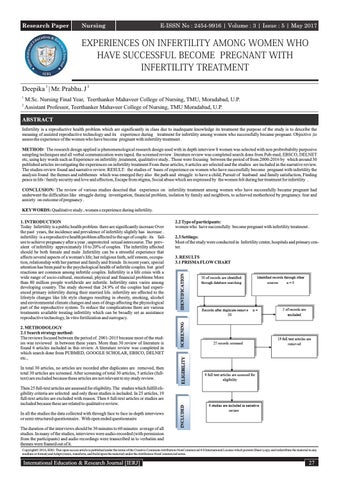
2.2 Type of participants: women who have successfully become pregnant with infertility treatment . 2.3 Settings: Most of the study were conducted in Infertility center, hospitals and primary center. 3. RESULTS 3.1 PRISMA FLOW CHART
2. METHODOLOGY 2.1 Search strategy method: The reviews focused between the period of 2001-2015 because most of the studies was reviewed in between these years. More than 30 review of literature is found 6 articles included in this review. A literature review was completed in which search done from PUBMED, GOOGLE SCHOLAR, EBSCO, DELNET etc., In total 30 articles, no articles are recorded after duplicates are removed, then total 30 articles are screened. After screening of total 30 articles, 5 articles (fulltext) are excluded because these articles are not relevant to my study review. Then 25 full-text articles are assessed for eligibility. The studies which fulfill eligibility criteria are selected and only those studies is included. In 25 articles, 19 full-text articles are excluded with reason. Then 6 full-text articles or studies are included because these are related to qualitative review. In all the studies the data collected with through face to face in-depth interviews or semi-structured questionnaire. With open ended questionnaire The duration of the interviews should be 30 minutes to 60 minutes average of all studies. In many of the studies, interviews were audio-recorded (with permission from the participants) and audio recordings were transcribed in to verbatim and themes were framed out of it. CopyrightŠ 2016, IERJ. This open-access article is published under the terms of the Creative Commons Attribution-NonCommercial 4.0 International License which permits Share (copy and redistribute the material in any medium or format) and Adapt (remix, transform, and build upon the material) under the Attribution-NonCommercial terms.
International Education & Research Journal [IERJ]
27
Research Paper
E-ISSN No : 2454-9916 | Volume : 3 | Issue : 5 | May 2017
3.2 Table no. 1: Data extraction tableSR. No
Problem statement/ Author
Place of research & year
Variables
Time duration
Tool
Outcomes
During the infertility Experience on treatment Demographic Treatment women felt the for infertility among characteristics emotional pain and women who have Postal questionnaire Experience on Semidistress, lack of choice successfully became 1) 30 to 60 min used Iran infertility structured and control, timing, pregnant qualitative study treatment (2006) questionnaire emotional and financial using costs, fairness and M.Redshaw (2006) contrasts in care
2)
Lived Experience on women Assisted Pregnancy Fahimeh Ranjbar, (2015)
3)
Psychosocial characteristics of female infertility
Infertility Clinic in Iran. Data was collected in infertility clinic
Infertility clinic Nigeria
Joyce . Omoaregba, (2011)
4)
Women's experience on beliefs about infertility treatment Maria Quigley Chris (2013)
5)
Experience of infertility Patient-centered infertility care by listen to patient voice Dancet W.H. (2011)
Qualitative study on beliefs about infertility and sexual behaviors 6) Mahshid Bokaie, (2007)
Lived Experiences
Infertility treatment
Semi structured in-depth interviews
A semistructured questionnaire 30 to 60 min. Using tape recorded
Iran in
Women are interested to undergone the infertility treatment for the take of husband and family satisfaction and maintain the respect in the society. women felt that the motherhood a wonderful feeling and sense of being complete,. The meaning of assisted pregnancy the women felt peace in life and had fear related to the outcome of the treatment .
The infertility is higher in The prevalence of physiological employed women as distress was more common in they have a longer non working women. duration of marriage, The religious and cultural infertility influence the beliefs influence the belief on cultural beliefs among infertility. women
In this study 460 women include between the age group of 26 -45 year the themes emerged like Emirate of Abu family and social Dhabi, United Arab Women Semi structure 25 to 45 min. pressure during infertility Emirates experience questionnaire social isolation toward (2013) family and community coldness in marital relationship feeling of guilt Patient center infertility care is focused on the patient needs it which includes the certain dimension that affects the Using Tape fertility clinics Patient recorder in30 min to patient care, like system Belgium and the centered factors, human factors, depth hour1 s. Netherlands. infertility care information interview communication, attitude of staff, competence of staff, physical and emotional support,
Experience on infertility treatment women felt psychoemotional needs when the women undergo the infertility treatment.
This study mainly focus on the patient care interaction system towards the infertility of women they cover all the dimension and understand the concept of infertility care.
In this e study 15 The themes which are emergent sample was selected in this study that will directly between the group of 20 and indirectly effect on the 45 years on the bases on religious and culture believe in infertility and themes emergent Cultural Iran women the women were Online sexual 40 to 60 min beliefs, religious effect , more beliefs in there cultural the questionnaires behaviors: types of infertility, types most of the women had of intercourse during primary infertility for 2 to 20 infertility most effect on year and majority of infertility. participants were educated.
4. RESULT (DISCUSSION) The majority group of Women expressed that they wished to take treatment to maintain respect and dignity in society and have achieved the family and husbands satisfaction . The themes and subthemes emerged from the transcribed verbatim are . Through the path struggle to have a child, Pursuit of husband and family satisfaction, finding peace in life / family security and love and affection, escape from stigma ,social abuse but after being conceived the the women felt self confidence in their life and achieved stable relationship with husband in life. Women went through struggle during the treatment process as they faced lots of problem like financial problem, some borrow the money from her neighbors to take the treatment, and they felt abuse for her condition by the family and neighbors as they said that they are not conceived forever and went for the infertility treatment without any hope of outcome ,with physiological some time women used home remedies to reduce the complications and couple revealed that they do not have proper information about the infertility treatment . cultural beliefs had also effect the infertility treatment. Cultural beliefs affects the infertility treatment.
28
30 min to 60 minutes
On the basis of experience the emerged themes finding peace in life, power and security, paradoxical feeling, struggle to realize a dream.
Conclusion
5. CONCLUSION During the study most of the women expressed difficulty to travelling, financial problem, isolation by the family and neighbors, fear and anxiety related to outcome of pregnancy as well as grief and depression where found to be distinct the achievement motherhood have parallel. these difficulties still there is need to educate the family member and the husband of the victim of the infertility about importance of love and affection that will give self confidence which are needs Belongingness for the women during the treatment of infertility it was described in varies studies that after the pregnancy the carrying attitude of the family and marital relationships have improves and to the love and affection. By the family during infertility will case the majority of problem. REFERENCES 1.
Bretherick, K. L., Fairbrother, N., Avila, L., Harbord, S. H., & Robinson, W. P. (2010). Fertility and aging: do reproductive-aged Canadian women know what they need to know?. Fertility and sterility, 93(7), 2162-2168.
2.
Bushnik, T., Cook, J. L., Yuzpe, A. A., Tough, S., & Collins, J. (2012). Estimating the prevalence of infertility in Canada. Human reproduction, 27(3), 738-746.
3.
Dancet, E. A. F., Van Empel, I. W. H., Rober, P., Nelen, W. L. D. M., Kremer, J. A. M., &
International Education & Research Journal [IERJ]
Research Paper
E-ISSN No : 2454-9916 | Volume : 3 | Issue : 5 | May 2017
d'Hooghe, T. M. (2011). Patient-centred infertility care: a qualitative study to listen to the patient's voice. Human Reproduction, der022. 4.
Daniluk, J. C., & Koert, E. (2015). Fertility awareness online: the efficacy of a fertility education website in increasing knowledge and changing fertility beliefs. Human Reproduction, 30(2), 353-363.
5.
Daniluk, J. C., Koert, E., & Cheung, A. (2012). Childless women's knowledge of fertility and assisted human reproduction: identifying the gaps. Fertility and sterility, 97(2), 420-426.
6.
Deatsman, S., Vasilopoulos, T., & Rhoton-Vlasak, A. (2016). Age and fertility: A study on patient awareness. JBRA assisted reproduction, 20(3), 99.
7.
Hasanpoor-Azghdy, S. B., Simbar, M., & Vedadhir, A. (2014). The emotionalpsychological consequences of infertility among infertile women seeking treatment: Results of a qualitative study. International Journal of Reproductive biomedicine, 12(2), 131-138.
8.
Hashiloni-Dolev, Y., Kaplan, A., & Shkedi-Rafid, S. (2011). The fertility myth: Israeli students' knowledge regarding age-related fertility decline and late pregnancies in an era of assisted reproduction technology. Human reproduction, 26(11), 3045-3053.
9.
Kamel, R. M. (2010). Management of the infertile couple: an evidence-based protocol. Reproductive Biology and Endocrinology, 8(1), 21.
10. Kathpalia, S. K., Kapoor, K., & Sharma, A. (2016). Complications in pregnancies after in vitro fertilization and embryo transfer. Medical Journal Armed Forces India, 72(3), 211-214. 11. Mac Dougall, K., Beyene, Y., & Nachtigall, R. D. (2012). Age shock: misperceptions of the impact of age on fertility before and after IVF in women who conceived after age 40. Human Reproduction, des409. 12. Malhotra, N., Shah, D., Pai, R., Pai, H. D., & Bankar, M. (2013). Assisted reproductive technology in India: A 3 year retrospective data analysis. Journal of human reproductive sciences, 6(4), 235. 13. Ombelet, W., Cooke, I., Dyer, S., Serour, G., & Devroey, P. (2008). Infertility and the provision of infertility medical services in developing countries. Human reproduction update, 14(6), 605-621. 14. Omoaregba, J. O., James, B. O., Lawani, A. O., & Morakinyo, O. (2011). Psychosocial characteristics of female infertility in a tertiary health institution in Nigeria. Annals of African medicine, 10(1). 15. Omu, F. E., & Omu, A. E. (2010). Emotional reaction to diagnosis of infertility in Kuwait and successful clients' perception of nurses' role during treatment.BMC nursing, 9(1), 5. 16. Peyromusavi, F., Barouni, M., Naderi, T., & Shahravan, A. (2016). Factors Affecting Response to Infertility Treatment: Case of Iran. Global journal of health science, 8(1), 118. 17. Peyromusavi, F., Barouni, M., Naderi, T., & Shahravan, A. (2016). Factors Affecting Response to Infertility Treatment: Case of Iran. Global journal of health science, 8(1), 118. 18. Ramezanzadeh, F., Aghssa, M. M., Abedinia, N., Zayeri, F., Khanafshar, N., Shariat, M., & Jafarabadi, M. (2004). A survey of relationship between anxiety, depression and duration of infertility. BMC women's health, 4(1), 9. 19. Ranjbar, F., Akhondi, M. M., Borimnejad, L., Ghaffari, S. R., & Behboodi-Moghadam, Z. (2015). Paradox of Modern Pregnancy: A Phenomenological Study of Women's Lived Experiences from Assisted Pregnancy. Journal of pregnancy, 2015. 20. Ranjbar, F., Akhondi, M. M., Borimnejad, L., Ghaffari, S. R., & Behboodi-Moghadam, Z. (2015). Paradox of Modern Pregnancy: A Phenomenological Study of Women's Lived Experiences from Assisted Pregnancy. Journal of pregnancy, 2015. 21. Ranjbar, F., Behboodi-Moghadam, Z., Borimnejad, L., Ghaffari, S. R., & Akhondi, M. M. (2015). Experiences of infertile women seeking assisted pregnancy in Iran: a qualitative study. Journal of reproduction & infertility,16(4), 221. 22. Redshaw, M., Hockley, C., & Davidson, L. L. (2007). A qualitative study of the experience of treatment for infertility among women who successfully became pregnant. Human Reproduction, 22(1), 295-304. 23. Sabarre, K. A., Khan, Z., Whitten, A. N., Remes, O., & Phillips, K. P. (2013). A qualitative study of Ottawa university students' awareness, knowledge and perceptions of infertility, infertility risk factors and assisted reproductive technologies (ART). Reproductive health, 10(1), 41. 24. Schmidt, L. (1998). Infertile couples' assessment of infertility treatment. Acta obstetricia et gynecologica Scandinavica, 77(6), 649-649. 25. Schmidt, L. (1998). Infertile couples' assessment of infertility treatment. Acta obstetricia et gynecologica Scandinavica, 77(6), 649-649. 26. Sørensen, N. O., Marcussen, S., Backhausen, M. G., Juhl, M., Schmidt, L., TydÊn, T., & Hegaard, H. K. (2016). Fertility awareness and attitudes towards parenthood among Danish university college students. Reproductive Health,13(1), 146. 27. Tabong, P. T. N., & Adongo, P. B. (2013). Infertility and childlessness: a qualitative study of the experiences of infertile couples in Northern Ghana.BMC pregnancy and childbirth, 13(1), 72. 28. Tahiri, F. B., Kalaja, D., & Bimbashi, E. K. (2015). The Lived Experience Of Female Infertility The Case Of Muslim Rural Women Leaving In Albania.European Scientific Journal, 11(11). 29. Wilkes, S., Hall, N., Crosland, A., Murdoch, A., & Rubin, G. (2009). Patient experience of infertility management in primary care: an in-depth interview study. Family practice, cmp039.
International Education & Research Journal [IERJ]
29