Research Paper
Education
E-ISSN No : 2454-9916 | Volume : 3 | Issue : 10 | Oct 2017
A STUDY OF TEACHING COMPETENCE, TEACHING EFFECTIVENESS AND ADJUSTMENT OF MALE AND FEMALE TEACHERS IN RELATION TO ACADEMIC ACHIEVEMENT OF SECONDARY SCHOOL STUDENTS Dr. Pujar Lingaraj Principal B.Ed., College At Jogihalli, Tq: Sorab, Dist.:Shivamoga, State: Karnataka - 577413. ABSTRACT The purpose of the study is to A STUDY OF TEACHING COMPETENCE, TEACHING EFFECTIVENESS AND ADJUSTMENT OF MALE AND FEMALE TEACHERS IN RELATION TO ACADEMIC ACHIEVEMENT OF SECONDARY SCHOOL STUDENTS. For the present study a total number of 300 secondary school teachers and 1500 secondary school students were selected by using random sampling technique. INTRODUCTION Teaching Competency In educational research on Teaching Competency is a complex variable, difficult to define very specifically, Teacher Effectiveness, teaching success, successful teaching, teaching efficiency, teaching performance and teaching ability are some of the other terms used to indicate teaching competency. Thus teaching competency is one of the most commonly used words in the literature of teaching ability. Teaching Effectiveness Teacher effectiveness is the competence and ability of a teacher to teach effectively. Teacher effectiveness is a matter of central importance to all educational institutions as it affects the process of learning and classroom management. Numerous theorists and researchers identified a variety of individual factors essential for facilitating students’ achievement in terms of cognitive, affective and psychomotor 'learning or in promoting effective learning'. Teacher effectiveness involves a set of teaching behaviors which are especially effective in bringing about desired changes in students' learning. Effectiveness of the teacher depends on the ability of the teacher to get along with the pupils in inter-personal relationship. As per the dictionary of education (Good and Market 1959) definition of teacher efficiency is “The degree of success of a teacher in promoting instructional and other duties specified in his contract and demand by the nature of his position”. It can also be defined as “Effective teaching is that which contributes to the growth of pupil’s education is designed to develop in the pupils certain knowledge, skills, attitudes and appreciations”. Adjustment L.S. Shaffer, “Adjustment is the process by which living organism maintains a balance between its need and the circumstances tat influence the satisfaction of these needs”. Gates, Jersli’s and others, “Adjustment is a continual process by which a person varies his behavior to produce a more harmonious relationship between himself and his environment”. Academic Achievement Academic achievement is the accomplishment or acquired proficiency in the performance of an individual in a given skill or body of the knowledge. Academic achievement means knowledge attained and skill developed in the school subjects usually designed by teachers, by test scores or by marks by the teachers or by both achievement can be measured with help of test verbal or written of different kinds since academic achievement in the criteria for selection promotion or recognition in various walks of life the importance of academic achievement cannot be ignored. There are several factors that influence the academic achievement of an individual like personality intellectual ability mental health and environment etc. OBJECTIVES OF THE STUDY To study the difference between male and female teachers in respect of their teaching competence,
Ÿ
Ÿ
To study the difference between male and female teachers in respect of their teaching effectiveness
Ÿ
To study the difference between male and female teachers in respect of their adjustment.
HYPOTHESES Ÿ There is no difference between male and female teachers in respect of their teaching competence, Ÿ
There is no difference between male and female teachers in respect of their teaching effectiveness
Ÿ
There is no difference between male and female teachers in respect of their adjustment.
METHODOLOGY The study adopts Descriptive survey method for investigation Sample For the present study a total number of 300 secondary school teachers and 1500 secondary school students were selected by using random sampling technique. Tools • Teaching competence scale : For collection of essential data the rating scale developed by Dr. V. D. Bhat along with his task team as a part of the DPEP activity of NCERT, New Delhi at Regional Institute of Education, Mysore during July, 1998 was used. •
Teaching Effectiveness Inventory constructed by Kulsum Teacher Effectiveness Scale (KTES-2000) was used.
•
Adjustment Inventory: The adjustment inventory developed by Dr.S.K.Mangal was used.
•
Construction of Academic Achievement of Test: To obtain the academic achievement scores of students in social science subject of IX Standard, the investigator constructed an academic achievement test.
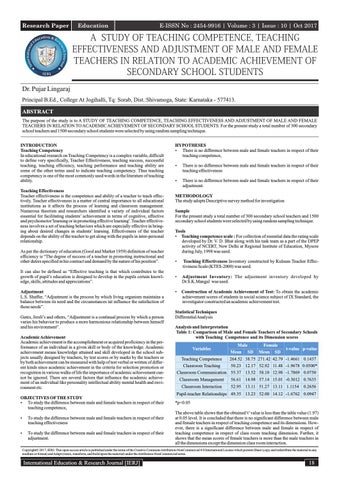
Statistical Techniques Differential Analysis Analysis and Interpretation Table 1: Comparison of Male and Female Teachers of Secondary Schools with Teaching Competence and its Dimension scores Male Mean SD 264.52 38.75 Teaching Competence Classroom Teaching 50.23 12.17 Classroom Communication 55.37 13.52 Variables
Classroom Management Classroom Interaction
Female Mean SD 271.42 42.79 52.92 11.48 58.10 12.98
t-value p-value -1.4661 0.1437 -1.9678 0.0500* -1.7869 0.0750
56.61 14.98 57.14 15.01 -0.3012 0.7635 52.95 13.11 51.27 13.11 1.1154
0.2656
Pupil-teacher Relationships 49.35 13.23 52.00 14.12 -1.6762 0.0947 *p<0.05 The above table shows that the obtained‘t’ value is less than the table value (1.97) at 0.05 level. It is concluded that there is no significant difference between male and female teachers in respect of teaching competence and its dimensions. However, there is a significant difference between male and female in respect of teaching competence in respect of class room teaching dimension. Further, it shows that the mean scores of female teachers is more than the male teachers in all the dimensions except the dimension class room interaction.
Copyright© 2017, IERJ. This open-access article is published under the terms of the Creative Commons Attribution-NonCommercial 4.0 International License which permits Share (copy and redistribute the material in any medium or format) and Adapt (remix, transform, and build upon the material) under the Attribution-NonCommercial terms.
International Education & Research Journal [IERJ]
18
Research Paper
E-ISSN No : 2454-9916 | Volume : 3 | Issue : 10 | Oct 2017
Findings: Male and female teachers do not differ significantly in respect of teaching competence and its dimensions. However, there is a significant difference between male and female in respect of teaching competence in respect of class room teaching dimension. Table:2 Comparison of Male and Female Teachers of Secondary Schools with Teaching Effectiveness and its Dimension scores Variables
Male Mean
SD
Female Mean
SD
t-value p-value
Teaching Effectiveness 257.26 39.46 262.09 43.50 -1.0074 0.3146 Pupil- teacher Relationships 50.12 9.05 51.31 8.39 -1.1783 0.2396
There is a positive high correlation between teaching competence, teaching effectiveness and adjustment of secondary school teachers with academic achievement of students studying in 9th standard. The present study is mainly concerned with the important variable of teaching competence of teachers. This variable has direct impact on the academic achievement. Number of studies has repeatedly shown that the quality of instruction is depends very much on the level of teaching competence. Hence teachers should develop the competency of teaching to provide such a quality instruction to the students in the institution and the outcome of the institutions will be better. The results of present study also point out in the same directions. REFERENCES
43.41 11.40 43.47 9.03 -0.0484 0.9614
1.
Best, J.W. (2000). Research in Education. Prentice-Hall of India Pvt., Ltd., New Delhi.
Knowledge of Subject matter 51.90 11.80 54.34 12.71 -1.7276 0.0851 Teacher Characteristics 57.10 14.16 57.75 15.28 -0.3786 0.7053
2.
George, E.I. (1996). A Comparative Study of the Adjustment and Achievement of 10 years and 11 years Schooling in Kerala State. Dept. of Psy. Kerala, University.
3.
Shivappa, D. (1980). Factors Affecting the Academic Achievement of High school pupils, Ph.D., Edu., Kar., Univ.
4.
Jimmi Copriady (2014) Teachers Competency in the Teaching and Learning of Chemistry Practical, Mediterranean Journal of Social Sciences ISSN 2039-9340(Print) ISSN 2039-2117(Online)
5.
Jyoti, A. P. & Ramakrishnaiah, D. (2000). The relationship between scholastic Achievement and Academic Adjustment of Junior International
Classroom Management
Inter personal Relationships
54.73 12.53 55.22 13.35 -0.3295 0.7420
*p<0.05 The above table shows that the obtained‘t’ value is less than the table value (1.97) at 0.05 level. It is concluded that there is no significant difference between male and female teachers in respect of teaching effectiveness and its dimensions. However, it shows that the mean scores of female teachers is more than the male teachers in all the dimensions of teaching effectiveness. Findings: Male and female teachers do not differ significantly in respect of teaching effectiveness and its dimensions. However, the mean scores of female teachers is more than the male teachers in all the dimensions of teaching effectiveness. Table 3: Comparison of Male and Female Teachers of Secondary Schools with Adjustment and its Dimension scores Variables
Male Female t-value p-value Mean SD Mean SD 353.20 35.99 364.73 34.96 -2.8149 0.0052*
Adjustment Adjustment with Academic and General Environment of 65.76 the institution
6.44 65.80
6.99 -0.0574 0.9542
Socio-Psycho-Physical Adjustment
61.59
5.99 61.46
7.11 0.1744 0.8617
Professional relationship Adjustment
62.16
4.91 63.41
5.10 -2.1640 0.0313*
Personal life Adjustment
95.12 20.28 101.17 17.25 -2.7766 0.0058*
Financial Adjustment and Job Satisfaction
68.56 15.14 72.89 14.38 -2.5374 0.0117*
*p<0.05 The above table shows that the obtained‘t’ value is more than the table value (1.97) at 0.05 level. It is concluded that there is a significant difference between male and female teachers in respect of their adjustment and its dimensions. However, it shows that the mean scores of female teachers is more than the male teachers in all the dimensions of adjustment. Further, the mean score of male teachers is more than female teachers in respect of the dimension of SocioPsycho-Physical adjustment. Findings: Male and female teachers differ significantly in respect of all the dimensions of adjustment. DISCUSSION AND CONCLUSION In this study, the researcher aimed to analyze A STUDY OF TEACHING COMPETENCE, TEACHING EFFECTIVENESS AND ADJUSTMENT OF MALE AND FEMALE TEACHERS IN RELATION TO ACADEMIC ACHIEVEMENT OF SECONDARY SCHOOL STUDENTS. From the analysis report, it is concluded that, Male and female teachers do not differ significantly in respect of teaching competence and its dimensions. However, there is a significant difference between male and female in respect of teaching competence in respect of class room teaching dimension. Male and female teachers do not differ significantly in respect of teaching effectiveness and its dimensions. However, the mean scores of female teachers is more than the male teachers in all the dimensions of teaching effectiveness. Male and female teachers differ significantly in respect of all the dimensions of adjustment. Educational Implications In the present study teaching competence, teaching effectiveness and adjustment variables are used. The background variables like gender, type of school management, qualification of teachers, age and subject of teaching are taken into consideration.
19
International Education & Research Journal [IERJ]