Research Paper
Business Management
E-ISSN No : 2454-9916 | Volume : 3 | Issue : 7 | July 2017
CONSUMERS' ATTITUDE TOWARDS MARKETING IN MADHYA PRADESH TOURISM 1
Isha kaur Rakhra | Dr. Atul Pandey 1 2
2
Research Scholar, Department of Business Administration, A.P.S. University, Rewa. Professor & Head, Department of Business Administration, A.P.S. University, Rewa.
ABSTRACT An attitude is a persons' lasting favorable or unfavorable evaluation, emotional feelings and action tendencies towards some object or idea. People have attitudes on almost everything. Attitudes put people into frame of mind: liking or disliking an object, moving towards or away from it. Attitudes lead people to behave in a fairly consistent way towards similar objects . The present study is an attempt to study the consumers' attitude on the bases of their gender, and their educational levels. The respondents are the tourists visiting the state of Madhya Pradesh. The study is focused on Consumers' attitude towards marketing in tourism industry in Madhya Pradesh. The state is a world famous tourist's destination having so much market potentials. KEYWORDS: Attitude, Consumer, Marketing, Madhya Pradesh, Tourists, Gender, Education. INTRODUCTION: The study of Consumer Behavior helps to improve marketing strategies by understanding issues
chain: accommodation services, transportation, intermediaries, travel agencies and tour operators, as well at entertainment and leisure facilities.
Ÿ
The psychology of how consumers believe, undergo, motive, and select between different alternatives.
Ÿ
The psychology of how the consumer is affected by his or her environment.
Ÿ
It is the study of consumers while shopping or making other marketing decisions;
Ÿ
Limitations in consumer knowledge or information processing abilities influence decisions and marketing outcome;
Manaktola & Jauhari (2007), the researchers in the study entreat to discover the factors which influence the consumer attitude and behavior towards green practices in the lodging industry in India and also to explore the consumers' intentions to pay for these practices. For the research quantitative and qualitative methodology was undertaken and a questionnaire along with secondary research has been proposed. A structured questionnaire has been used using convenience‐sampling techniques from National Capital Region in India. Correlation and factor analysis has been used to explore consumers' attitudes and behavior towards green practices in the lodging industry. The author concluded that the consumers using hotel services are conscious about environmentally friendly practices in India. Research Methodology
Ÿ
How consumer motivation and decision strategies differ between products that differ in their level of importance or interest that they entail for the consumer; and
Objective of the study 1. To study the consumers' attitude towards Marketing in Tourism Industry in Madhya Pradesh.
Ÿ
How marketers can adapt and improve their marketing campaigns and marketing strategies to more effectively reach the consumer.
Hypotheses of the study H01 There is no significant difference in the attitude of the tourists towards marketing innovations in tourism industry w.r.t their gender.
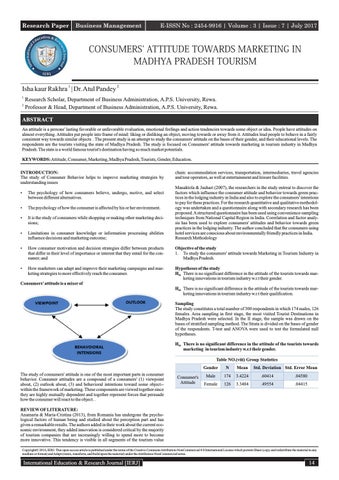
Consumers' attitude is a mixer of H02 There is no significant difference in the attitude of the tourists towards marketing innovations in tourism industry w.r.t their qualification. Sampling The study constitutes a total number of 300 respondents in which 174 males, 126 females. Area sampling in first stage, the most visited Tourist Destinations in Madhya Pradesh were selected. In the II stage, the sample was drawn on the bases of stratified sampling method. The Strata is divided on the bases of gender of the respondents. T-test and ANOVA were used to test the formulated null hypotheses. H01 There is no significant difference in the attitude of the tourists towards marketing in tourism industry w.r.t their gender. Table NO.(viii) Group Statistics The study of consumers' attitude is one of the most important parts in consumer behavior. Consumer attitudes are a compound of a consumers' (1) viewpoint about, (2) outlook about, (3) and behavioral intentions toward some object-within the framework of marketing. These components are viewed together since they are highly mutually dependent and together represent forces that persuade how the consumer will react to the object. .
Consumer's Attitude
Std. Deviation Std. Error Mean
Gender
N
Mean
Male
174
3.4224
.60414
.04580
Female
126
3.3484
.49554
.04415
REVIEW OF LITERATURE: Anamaria & Maria-Cristina (2013), from Romania has undergone the psychological factors of human being and studied about the perception part and has given a remarkable results. The authors added in their work about the current economic environment, they added innovation is considered critical by the majority of tourism companies that are increasingly willing to spend more to become more innovative. This tendency is visible in all segments of the tourism value Copyright© 2016, IERJ. This open-access article is published under the terms of the Creative Commons Attribution-NonCommercial 4.0 International License which permits Share (copy and redistribute the material in any medium or format) and Adapt (remix, transform, and build upon the material) under the Attribution-NonCommercial terms.
International Education & Research Journal [IERJ]
14
Research Paper
E-ISSN No : 2454-9916 | Volume : 3 | Issue : 7 | July 2017 Table NO.(ix) Independent Samples Test Levene's Test for t-test for Equality of Means Equality of Variances
Consumer's Equal variances assumed Attitude Equal variances not assumed
F
Sig.
t
Df
3.476
.063
1.127
298
Sig. Mean Std. Error (2-tailed) Difference Difference
1.163 293.346
The mean scores of independent samples of 174 male tourists and 126 female tourists are found to be (3.4224 and3.3484) from the above table no.(viii) respectively, which indicates that attitude of male tourists is slightly more (3.4224) than female tourists (3.3484), to test whether they indicate difference is significant or not, therefore t-test was applied on table no.(ix) which indicates that above mean scores differ significantly at p>05 level (p=.261). Also the calculated value of
.261
.07400
.06564
.246
.07400
.06361
95% Confidence Interval of the Difference Lower Upper .20318 -.05518 -.05119
.19919
t=1.127 is less than the tabulated value (1.960) at 0.05 level of significance. Therefore, null hypothesis is accepted. H02 There is no significant difference in the attitude of the tourists towards marketing in tourism industry w.r.t their qualification.
Table NO.(x) Descriptives Consumer's Attitude N SSC-HSC
Mean
Std. Deviation
Std. Error
95% Confidence Interval for Mean Lower Bound
Upper Bound
Minimum
Maximum
28
3.3179
.49744
.09401
3.1250
3.5107
2.50
4.40
Graduate
96
3.4333
.57265
.05845
3.3173
3.5494
1.90
4.50
Post graduate
176
3.3801
.56599
.04266
3.2959
3.4643
1.00
4.30
Total
300
3.3913
.56140
.03241
3.3275
3.4551
1.00
4.50
Table NO.(xi) Test of Homogeneity of Variances Consumer's Attitude Levene Statistic .506
df1 2
df2 297
Sig. .603
In the above table the level of significance is 5%, Degree of Freedom v1= 4, v2= 295, so Tabulated value =3.09.
3.
Bhatia, a. (2008).International Tourism Managment (revised edition). New Delhi: Sterling Publoisher pvt ltd.
4.
Kotller, P., & Keller, K. L. (2007). Marketing Management. Pearson Prentice Hall, pp162.
5.
Manaktola, K., & Jauhari, V. (2007). Exploring consumer attitude and behaviour towards green practices in the lodging industry in India. 19 (5), 364-377.
6.
Bose, C. D. (2006). Principles of Management & Administration. Prentice-Hall of India Pvt LTD.
7.
Caprihan, V., and K. Shivakumar (2006). Redefining Tourism Marketing Strategies. In M.R.Biju (Ed.), Sustainable Dimensions of Tourism Management (pp229-241). Mittal Publications-Publishers of Scholarly Books, 459419, Daryaganj, New Delhi-110002, 2006.
8.
mapsofindia.com. (2010). Retrieved from http://business.mapsofindia.com/tourismindustry/madhya-pradesh.html.
9.
Perner, L. P. Consumer Behaviour: The Psycology Of Marketing. Marshall School of Business USA.
Table NO.(xii) ANOVA Consumer's Attitude Sum of Squares
Df
Mean Square
F
Sig.
Between Groups
.343
2
.171
.542
.582
Within Groups Total
93.895
297 299
.316
94.237
The mean scores of independent sample are SSC-HSC-28, Graduate- 96, and Post-Graduate-176 respectively are found to be (3.3179, 3.4333, 3.3801) from the above table no.(x) respectively. Which indicates that attitude of tourists qualification wise is slightly different and highest is graduation level (3.4333), to test whether they indicate difference is significant or not, therefore ANOVA was applied on table no.(xii) which indicates that above mean scores differ insignificantly at p>.05 level (p=.582). Also the calculated value .542 is less than the tabulated value (3.09) at 0.05 level of significance. Therefore, null hypothesis is accepted.
10. Rahman, M. S. (2012). Exploring Tourists’ Perception: The Case Tourismos: An International Multidisciplinary Journal Of Tourism, 7 (1), 81-98. 11. Santosh, v. (2003). incredible india- A case of Kerela. Retrieved from www.attoi.org. 12. Sonnleitner, K. (2011). Destination image and its effects on marketing and branding a Tourist destination.
FINDINGS: Ÿ The results for the hypothesis testing (H01) for independent sample t-Test shows that there is no significant difference in the attitude of Tourists towards marketing in Tourism industry w.r.t. gender as the mean scores (3.4224 and 3.3484) for male and female Tourists, do not differ significantly. Ÿ
The results for the hypothesis testing (H02) for 3 variables one way ANOVA shows that there is no significant difference in the attitude of Tourists towards marketing in Tourism industry w.r.t qualification as the mean scores (3.3179, 3.4333, 3.3801). The independent samples are SSC-HSC-28, Graduate- 96, and Post-Graduate-176 respectively, do not differ significantly.
CONCLUSION: Marketing are appreciated by both male and female tourists. In fact, Tourists of all educational level are influenced by marketing innovation in tourism industry. Hence, it can be said that Madhya Pradesh tourism is going far better. The industry with the tag line “Hindustan ka dil dekho” is developing and growing day by day. REFERENCES: 1.
Ali, M. A. (2015). Travel and tourism management.. PHI Learning Pvt. Ltd.
2.
Anamaria, R., & Maria-Cristina, I. (2013).Consumers’ perception on innovation in the tourism value. Economic Science Series , 815-824.
15
International Education & Research Journal [IERJ]