Research Paper
Medical Science
E-ISSN No : 2454-9916 | Volume : 4 | Issue : 2 | Feb 2018
ORO-FACIAL TRAUMA – AWARENESS AMONGST SPORTS INSTRUCTORS AND PLAYERS AGED 8 TO 18 YEARS 1
2
3
Dr. Sunaina .S. Pamnani | Dr. Jyothsna V Setty | Dr. Ila Srinivasan | Dr. Dandamudi Lalitya
1
1
Post Graduate Student, Department of Pediatric Preventive Dentistry, M .R. Ambedkar Dental College and Hospital, Bengaluru. 2 Professor, Department of Pediatric Preventive Dentistry, M .R. Ambedkar Dental College and Hospital, Bengaluru. 3 Professor and Head, Department of Pediatric Preventive Dentistry, M .R. Ambedkar Dental College and Hospital, Bengaluru. ABSTRACT Objectives: To evaluate the knowledge and awareness of sports instructors and players aged between 8 to 18 years about facial trauma and protective devices. Methods: A self completion questionnaire was handed over to twenty instructors and two hundred players with different set of questions, involved in various sports activities like taekwondo, karate, boxing, cricket, basketball, skating etc. from various sports academies in Bangalore. Results: The results showed lack of knowledge amongst players and negligence regarding the use of protective devices whereas the sports instructors were well informed but did not recommend the use of these devices in their daily practices. Approximately 99% of the sport players and 95% of sports instructors agreed that sports related oro-facial injuries are common and it affects esthetics and psychology. Despite being instructed about the use of mouthguards only 28% of sports players were actually found incorporating it in their daily practice. Conclusion: The prevalence and severity of injuries to the teeth, jaws and intra-oral and peri-oral soft tissues, concussions and neck injuries are prevented with the use of mouth guards. Despite their awareness, only 28% of players used mouth guards. Instructors were unaware about dentists being the specialist for fabrication of mouthguards. KEYWORDS: Oro-facial trauma, Oro-facial protective devices, Mouth guards, Knowledge, Awareness. INTRODUCTION: Participation by youth in various sports activities is an increasing trend in the present day. The risk of oro-facial injuries are the result of such activities. The peak age groups with highest risk of trauma are 8-11 years, which accounts for 19.2% to 36% of all injuries¹. The prevalence of oro-facial injuries varies depending on the type of sport played, the degree of contact, age, gender and geographical location of the subject studied. Utmost care of dentition during this age group is must as the dentition is not completely formed which could affect the child's oro-facial growth, esthetics, psychology and have an impact on parental economy. Sports related oro-facial injuries can be life threatening in nature therefore it should be mandated to use protective devices for limiting oro-facial injuries. Protective devices help to depreciate the likelihood of trauma to the head and face. However, a high rate of dental trauma and minimal utilization of mouth guards has been reported by sports persons, in spite of having adequate information about its usage2. Hence it is essential to assess the knowledge and attitude of sports players as well as coaches about facial trauma and devices available for prevention of the same. As there is paucity of data in the literature regarding the same, the present study was carried out to evaluate the knowledge and awareness of sports instructors and players aged between 8 to 18 years about facial trauma and protective devices.
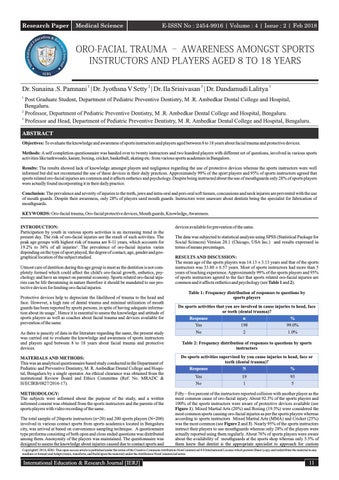
devices available for prevention of the same. The data was subjected to statistical analysis using SPSS (Statistical Package for Social Sciences) Version 20.1 (Chicago, USA Inc.) and results expressed in terms of means percentages. RESULTS AND DISCUSSION: The mean age of the sports players was 14.13 ± 3.13 years and that of the sports instructors was 33.80 ± 6.57 years. Most of sports instructors had more than 5 years of teaching experience. Approximately 99% of the sports players and 95% of sports instructors agreed to the fact that sports related oro-facial injuries are common and it affects esthetics and psychology (see Table 1 and 2). Table 1: Frequency distribution of responses to questions by sports players Do sports activities that you are involved in cause injuries to head, face or teeth (dental trauma)? Response Yes
n 198
% 99.0%
No
2
1.0%
Table 2: Frequency distribution of responses to questions by sports instructors
MATERIALS AND METHODS: This was an analytical questionnaire based study conducted in the Department of Pediatric and Preventive Dentistry, M. R. Ambedkar Dental College and Hospital, Bengaluru by a single operator. An ethical clearance was obtained from the institutional Review Board and Ethics Committee (Ref: No. MRADC & H/ECIRB/0827/2016-17).
Do sports activities supervised by you cause injuries to head, face or teeth (dental trauma)?
METHODOLOGY: The subjects were informed about the purpose of the study, and a written informed consent was obtained from the sports instructors and the parents of the sports players with video recording of the same.
Fifty – five percent of the instructors reported collision with another player as the most common cause of oro-facial injury. About 92.5% of the sports players and 100% of the sports instructors were aware of protective devices available (see Figure 1). Mixed Martial Arts (20%) and Boxing (19.5%) were considered the most common sports causing oro-facial injuries as per the sports players whereas according to sports instructors Mixed Martial Arts (MMA) and Cricket (25%) was the most common (see Figure 2 and 3). Nearly 95% of the sports instructors instruct their players to use mouthguards whereas only 28% of the players were actually reported using them regularly. About 76% of sports players were aware about the availability of mouthguards at the sports shop whereas only 5.5% of them knew that dentist is the appropriate specialist to approach for custom
The total sample of 20sports instructors (n=20) and 200 sports players (N=200) involved in various contact sports from sports academics located in Bengaluru city, was arrived at based on convenience sampling technique. A questionnaire type proforma consisting of both open and close ended questions was distributed among them. Anonymity of the players was maintained. The questionnaire was designed to assess the knowledge about injuries caused due to contact sports and
Response
N
%
Yes
19
95
No
1
5
Copyright© 2018, IERJ. This open-access article is published under the terms of the Creative Commons Attribution-NonCommercial 4.0 International License which permits Share (copy and redistribute the material in any medium or format) and Adapt (remix, transform, and build upon the material) under the Attribution-NonCommercial terms.
International Education & Research Journal [IERJ]
11
Research Paper
E-ISSN No : 2454-9916 | Volume : 4 | Issue : 2 | Feb 2018
mouthguards. On the contrary none of sports instructors were aware about the availability of mouthguards at the dentist (see Figure 4).
DISCUSSION: In India the reported prevalence of orofacial injuries ranges from 4-35% amongst the adolescents 3,4 as against the prevalence of 15-35% reported in other countries5,6. Out of this, the sports related injuries account for one of the major etiological factors (18.1%) for oro-facial injuries7,8. These results indicate that there is some dearth in the implementation of protective measures to prevent sports related orofacial injuries. Of all the protective measures, mouth guards play a major role in reducing the sports related oro-facial injuries9. The mouth guard is a resilient device placed in the mouth to reduce injuries, particularly to the teeth and surrounding structures. Mouth guards distribute the impact of a “blow�, lessening the chances of injury and are generally made from Ethylene Vinyl Acetate (EVA). The use of mouth guards is highly recommended as it is non-toxic, has minimal moisture absorption, elastic and ease of manufacture10. The Academy for Sports Dentistry (ASD) “recommends the use of custom fabricated mouth guard made over a dental cast and delivered under the supervision of a dentist. The ASD strongly supports and encourages a mandate for use of a properly fitted mouth guard in all collision and contact sports11.
Figure 1: Awareness about protective devices among sports players and instructor
Figure 2: Games most likely to cause injuries to head, face or teeth according to sports players
Studies conducted in Hawaiian12, Australian13 and American population have shown reduced oro-facial injuries with the use of mouth guards14. Several countries have made the use of mouth guards mandatory during contact and noncontact sports15. In India there are no such rules mandating the use of mouth guard in sports. This might be one of the reasons for ignorance towards strict use of protective devices and increased prevalence of sports related oro-facial injuries16. Mixed Martial Arts (MMA) was considered to be the most common cause of orofacial injury in the present study. Boxing and hockey were considered second most common causes of such injuries which is in accordance to the earlier studies17,18. Studies have shown that although the sports teachers have adequate knowledge of protective devices only a few imply it in their regular practice17,19. In the present study 95% of the sports instructors recommend the use of mouthguards. Only 28% of the sports players used mouthguards during their involvement in various contact sports. Majority said that the reason for not using was difficulty in speaking and breathing. Other reason was lack of knowledge regarding the availability of the device. Dentists are the specialists for fabrication of mouthguard and to enlighten sports person, sports teachers and parents regarding the benefits of use of mouthguard. Only 5% of the sports players were aware about dentist being the specialist. Despite being aware about such devices, it was surprising that the sports instructors were unaware about custom fabricated mouthguards and its availability. Sports teachers play an integral role in creating awareness and educating the sports players and parents regarding the use and availability of these protective devices. Hence it is of utmost importance that their knowledge is updated. Pediatric and Preventive dentists can come forward and make use of this opportunity to educate the children and their parents during their routine dental visits regarding the risk of oro-facial injuries and the protective devices available for the same in the form of pamphlets, animated educational videos and by use of educational models. Protective devices should be made mandatory in sports by the respective governing sports authorities in India in order to reduce the risk of oro-facial injuries and there is a need to bring about a change in the attitude of players, parents and sports instructors towards their use.
Figure 3: Games most likely to cause injuries to head, face or teeth according to sports instructor
CONCLUSION: Majority of the sports players and instructors were aware about the oro-facial injuries and the role of mouthguards in preventing the same but there is an inadequacy in their use of them. Also there is lack of awareness about the availability of these devices among both the groups. Mandating the use of protective devices in sports specially contact sports can help reduce the incidence of oro-facial injuries. Acknowledgements: Authors would like to thank all the sports instructors and players who participated in the study. Financial support and Sponsorship: Nil Conflicts of Interest: There are no conflicts of interest. REFERENCES:
Figure 4: Awareness about availability of mouthguards among both the groups.
12
1.
Mohandas U, Chandan GD. Knowledge, attitude and practice in emergency management of dental injury among physical education teachers; A survey in Bangalore urban schools. J Indian Soc Pedod Prev Dent 2009;27(4):242-8.
2.
O'Malley M. Mouth guard use and dental injury in sport: A questionnaire study of National school children in the west of Ireland. J Irish Dent Assoc 2012;58(4):205-11.
3.
Baldava P, Anup N (2007) Risk factors for traumatic dental injuries in an adolescent male population in India. J Contemp Dent Pract 8:35-42.
4.
Gupta S, Kumar-Jindal S, Bansal M, Singla A. Prevalence of traumatic dental injuries and role of incisal overjet and inadequate lip coverage as risk factors among 4-15 years
International Education & Research Journal [IERJ]
Research Paper
E-ISSN No : 2454-9916 | Volume : 4 | Issue : 2 | Feb 2018
old government school children in Baddi Barotiwala Area, Himachal Pradesh, India. Med Oral Patol Oral Cir Bucal 2011;1:e960-965. 5.
Hargreaves JA, Matejka JM, Cleaton-Jones PE, Williams S. Anterior tooth trauma in eleven-year-old South African children. ASDC J Dent Child 1995;62:353-5.
6.
Kalaskar RR, Tawani GS, Kalaskar AR. Paediatric traumatic dental injuries in hospital of central India. A 2.5 year retrospective review. IJRID 2013;3:1-10.
7.
Kumamoto DP, Maeda Y. A literature review of sports-related orofacial trauma. Gen Dent 2004;52:270-80.
8.
Heintz WD. Mouth protectors: a progress report. Bureau of Dental Health Education. J Am Dent Assoc 1968;77:632-6.
9.
CDHA Position paper on sports mouthguards. CJDH 2005;39:1-18.
10. Onyeaso CO. Secondary school athletes: A study of mouthguards. J Natl Med Assoc 2004;96(2):240-5. 11. Academy for Sports Dentistry. Position statement: Mouth-guard mandates. 2010. Available at /PositionStatement/tabid/58/Default.aspx.[Last Accessed on 24 Mar 2013]. 12. Finch C, Braham R, McIntosh A, McCrory P, Wolfe R. Should football players wear custom fitted mouthguards? Results from a group randomized controlled trial. Inj Prev 2005;11:242-6. 13. Labella CR, Smith BW, Sigurdsson A. Effect of mouthguards on dental injuries and concussions in college basketball. Med Sci Sports Exerc 2002;34:41-4. 14. Shultz SJ, Valovich TC, Zinder SM (2005) Mouthguard use. In: Sports medicine handbook. Indianapolis (IN): National Federation of State High School Associations pp: 914. 15. Knowlton R, Kracher CM, Smith WS. Sports-Related Dental Injuries and Sports Dentistry. 2003. 16. Kalaskar AR, Kalaskar R. Knowledge and Attitude of the Sports Teachers in Central India towards Oro-facial Injuries and the use of Mouth Guard. J Sports Med Doping Stud 2016;6:179. 17. Lehl G. Perceptions of Chandigarh sports coaches regarding oro-facial injuries and their prevention. J Indian Soc Pedod Prev Dent 2005;23:67-70. 18. Neeraja G, Bharadwaj S, Shah K, Subramaniam P. Knowledge, attitude, and practices regarding oro-facial injuries and oro-facial protective devices among physical instructors in Bangalore. J Int Oral Health 2014;6(3):1-6. 19. Onyeaso CO, Adegbesan OA.Knowledge and attitudes of coaches of secondary school athletes in Ibadan, Nigeria regarding oro-facial injuries and mouthguard use by the athletes. Dent Traumatol 2003;19:204-8.
International Education & Research Journal [IERJ]
13