Research Paper
Education
E-ISSN No : 2454-9916 | Volume : 3 | Issue : 7 | July 2017
A STUDY OF PERSONALITY AND INTEREST OF STUDENTS STUDYING IN TRIBAL AREA 1
Miss. Minakshi. Y. Tundurwar | Dr. Rajesh S Chandanpat 1 2
2
Research Scholar, Department of Education, RTM Nagpur University, Nagpur. Guide, Dean Faculty of Education, Gondwana University, Gadchiroli.
ABSTRACT This research is focused on Gadchiroli District which has been declared as a tribal zone on 2nd December 1985. The sample for this research is collected from 23 schools, randomly selected, from 12 different talukas of Gadchiroli district. For these total 300 students (150 boys and 150 girls students) belonging to Scheduled Caste category, studying in VIIIth & IXth standard, were randomly selected. To collect information about personalities, Cattell's High school personality questionnaires “From A” (HSPQ) which is based on 14 ingredients of personality (translated by Mr. S. D Kapoor & his associates S. S Shrivartava & G. N. Shrivartava), is used. To find out educational interest of student Dr. S. P Kulshresthas' 'Educational Interest Record' (EIR) is used. As mentioned in the manual of HSPQ & EIR all the scores are evaluated and Total, Mean, Raw score, Sten score are calculated. Comparative S.C. of students is calculated by conducting 't' score to check out significance. Corelations between personality of students and their interest is derived by taking out multiplier. KEYWORDS: Personality, Educational Interests, Scheduled Caste Students. OBJECTIVE: 1. To conduct a comparative study of personality of male and female students belonging to scheduled caste category in tribal area.
a students' personality. The conclusions of the research will also be helpful for the Government while formulating the education schemes for students in tribal areas.
2.
To conduct a comparative study of educational interest of male and female students belonging to scheduled caste category in tribal area.
3.
To study the co-relation between personality and interest of students belonging to scheduled caste category in tribal area.
PROCEDURE: For collection of data of the present research, “HSPQ from A” and EIR form was collected from the students. By evaluating the entries of respondents as per the direction of the manual, a comparative study of male and female students is carried out. The correlation between the personality and interest is analyzed.
RESEARCH METHODOLOGY: Survey method is used for this research. HYPOTHESIS: 1. There is no significant difference in the personality of male and female students belonging to Scheduled Caste category in tribal area. 2. 3.
There is no significant difference in the interests of male and female students belonging to the Scheduled Caste category in tribal area. There is no significant difference in co-relation of personalities and interests between male and female students belonging to Scheduled Caste category in tribal area.
TOOLS FOR RESEARCH For collection of data, From Aof Cattell's High school Personality Questionnaire (HSPQ), depending on 14 personality factors, which is translated by S. D. Kapoor, S. S. Shrivastava and G. N. Shrivastava, (1930) was used. And to study educational interest of student Dr. Kulshreshtha's Educational interest Record' (EIR) has been used. SIZE OF SAMPLE: 300 students (150 boys and 150 girls students) belonging to Scheduled Caste category, studying in VIIIth & IXth standard, were randomly selected for this research. NEED AND SIGNIFICANCE: Human race is one of the finest creations of the Almighty. Each person born with the boon of encephalon is absolutely unique. Intellectual and artistic capabilities which are dormant since his childhood, surfaces at appropriate time. By the blend of physical appearance and inner state of mind, a personality is formed. In the journey from persona to personality the person gets acquainted with himself. By examining his own lacunae he improvises himself. According to his inclinations, experience and guidance, artistic skills of a person gets channelized, and then they further get crystallized in to specific interests. Interest plays a vital role in development of personality as it confers a constructive from to a person's work. Study of personality characteristic and interests of the students will enable in imparting proper education and motivational guidance to the students. By understanding the drawbacks in their personalities, they can be provided with remedial guidance. Interest can be developed in wearisome subjects. For this propose research on this subject is essential. The information obtained from this research is essential for overall developed of
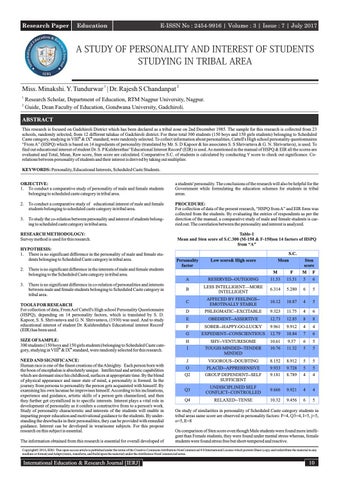
Table-1 Mean and Sten score of S.C.300 (M-150 & F-150)on 14 factors of HSPQ from “A” S.C. Personality factor
Low score& High score
Mean
Sten score M F
M
F
A
RESERVED--OUTGOING
11.53
13.51
5
6
B
LESS INTELLIGENT—MORE INTELLIGENT
6.314
5.280
6
5
C
AFFECED BY FEELINGS-EMOTINALLY STABLE
10.12
10.87
4
5
D
PHLEGMATIC--EXCITABLE
9.323
11.75
4
6
E
OBEDIENT--ASSERTIVE
12.73
12.85
8
8
F
SOBER--HAPPY-GO-LUCKY
9.961
9.912
4
4
G
EXPEDIENT--CONSCIENTIOUS
12.79
10.84
7
6
H I
SHY--VENTURESOME TOUGH-MINDED--TENDER MINDED
10.61 10.76
9.57 11.32
6 5
5 5
J
VIGOROUS--DOUBTING
8.152
8.912
5
5
O Q2
PLACID--APPREHENSIVE GROUP DEPENDENT--SELF SUFFICIENT
9.933 9.181
9.728 8.789
5 4
5 4
Q3
UNDISCIPLINED SELF CONFLICT--CONTROLLED
9.666
9.921
4
4
Q4
RELAXED--TENSE
10.32
9.456
6
5
On study of similarities in personality of Scheduled Caste category students in tribal areas same score are observed in personality factors: F=4, Q3=4, I=5, j=5, o=5, E=8 On comparison of Sten score even though Male students were found more intelligent than Female students, they were found under mental stress whereas, female students were found stress free but short-tempered and reactive.
Copyright© 2016, IERJ. This open-access article is published under the terms of the Creative Commons Attribution-NonCommercial 4.0 International License which permits Share (copy and redistribute the material in any medium or format) and Adapt (remix, transform, and build upon the material) under the Attribution-NonCommercial terms.
International Education & Research Journal [IERJ]
10
Research Paper
E-ISSN No : 2454-9916 | Volume : 3 | Issue : 7 | July 2017
Table-2 Table showing interest of male students belonging to Scheduled Caste category studying in triable areas. Available boys students (N)=105
REFERENCES: 1.
Anderson, John. E (1949), the Psychology of Development and Personal Adjustment, New York: Henry Holt and Company.
2.
Blair, Jones. Simpson (1960), Educational Psychology, New York: The Macmillan Company.
Classification
AG
CO
FA
HS
HU
SC
TE
3.
10-14 6-9
26 58
12 56
10 81
08 57
20 57
11 66
12 60
Chandra, Soti. Shivendra& Sharma, R. K., (2002), Research in Education, New Delhi: Atlantic Publishers and Distributors.
4.
Chaunan, S. S., (1978), Advanced Educational Psychology, New Delhi: Vikas Pub. House Pvt. Ltd.
4-5 3-2 0-1
20 01
31 06
13 01
27 21 03 07 No Respond
20 08
24 09
5.
Crow & Crow., (1979), Educational Psychology, New Delhi: Ram Nagar, Eurasia Publishing House.
6.
Dandeker, W. N., (1981), Psychological Foundations of Education, New Delhi: Atlantic Publishers and Distributers.
Total
105
It is revealed from response shown in above mentioned table that male students have shown highest interest in Agriculture field (24.76%), more than average in Fine Art field (77.14%), average in commerce field (29.52%) and less than average in Technical field (8.57%).
7.
Garrett, Henry. E. (1950), Psychology, New York: American Book Co.
8.
Garrett, Henry. E., (1971), Statistics in Psychology and Education, Bombay: VakilsFeffer and Simons, Ltd. Sixth Edition.
9.
Sharma, A. S., (2004), Dictionary of Psychology, New Delhi: Commonwealth Publishers.
Table shows interest of student belonging to SC category taking education in tribal areas. Table -3 Available girls students (N) =114 Classification
AG
CO
FA
HS
HU
SC
TE
10-14 6-9 4-5
21 71 18
09 60 40
26 62 24
19 55 34
20 65 15
09 76 25
13 65 30
3-2 0-1
04
05
02
05 04 No Respond
03
06
Total
114
It is revealed from response shown in above mentioned table that female students have shown highest interest in Fine Art field (22.80%), more than average in Science field (66.66%), average in Commerce field (35.08%) and less than average in Technical field (5.26%). Hypothesis 1: There is no significant difference in personality of boys & girls student belonging to SC category in tribal area. SEX
No.
Mean
S.D.
Boys Girls
105 114
141.41 142.74
17.01 15.81
“t” score Leave of significance 0.60
NS
0.05:” t “< table “t” value Hypothesis 2: There is no significant difference in educational interest of boys &girls student belonging to SC category in tribal area SEX
No.
Mean
S.D.
Boys Girls
105 114
48.93 49.15
9.30 8.66
“t” score Leave of significance 0.18
NS
0.05:” t “< table “t” value Hypothesis No 3: There is no significant difference in co-relation between total students belonging to S.C category in tribal area. Total
Mean
S.D.
R Score
Personality 31120 142.1 16.451 0.003566771 Interest 10741 49.046 8.9907
Leave of significance NS
CONCLUSION: 1. On the basis of information collected in this research it appears that there is no significant difference in personality and interest of boys and girls students belonging to Scheduled Caste category, studying in tribal area. 2.
All the students of Scheduled Caste category (Male and Female) are very introvert, silent, sober, group-dependent, vigorous, undisciplined and aggressive in nature.
3.
Male students are interested in Agricultural field, whereas Female students are interested in Fine Arts field.
4.
It is necessary to create interest of Male students in Technical Field and of Female students in agriculture field.
11
International Education & Research Journal [IERJ]