Education
Research Paper
E-ISSN No : 2454-9916 | Volume : 3 | Issue : 8 | Aug 2017
SUSTAINABLE DEVELOPMENT: A PARADIGM SHIFT TOWARDS HIGHER EDUCATION 1
Dr. Neeru Rathee | Sheetal 1 2
2
Assistant Professor, Department of Education, M.D.U., Rohtak. Research Scholar, Department of Education, M. D. U., Rohtak.
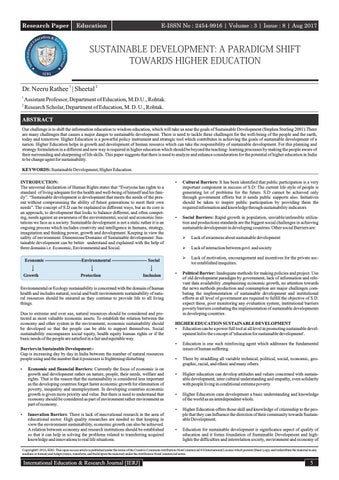
ABSTRACT Our challenge is to shift the information education to wisdom education, which will take us near the goals of Sustainable Development (Stephen Sterling 2001).There are many challenges that causes a major danger to sustainable development. There is need to tackle these challenges for the well-being of the people and the earth, today and tomorrow. Higher Education is a powerful policy instrument and strategic tool which contributes in achieving the goals of sustainable development of a nation. Higher Education helps in growth and development of human resource which can take the responsibility of sustainable development. For this planning and strategy formulation in a different and new way is required in higher education which should be beyond the teaching- learning processes by making the people aware of their surrounding and sharpening of life skills. This paper suggests that there is need to analyze and enhance consideration for the potential of higher education in India to be change agent for sustainability. KEYWORDS: Sustainable Development, Higher Education. INTRODUCTION: The universal declaration of Human Rights states that “Everyone has rights to a standard of living adequate for the health and well-being of himself and his family”. “Sustainable development is development that meets the needs of the present without compromising the ability of future generations to meet their own needs”. The concept of S.D can be explained in different ways, but as its core is an approach, to development that looks to balance different, and often competing, needs against an awareness of the environmental, social and economic limitations we face as a society. Sustainable development is not a static rather it is an ongoing process which includes creativity and intelligence in humans, strategy, imagination and thinking power, growth and development. Keeping in view the safety of environment. Dimensions/Domains of Sustainable development: Sustainable development can be better understand and explained with the help of three domains i.e. Economic, Environmental and Social.
Ÿ
Cultural Barriers: It has been identified that public participation is a very important component in success of S.D: The current life style of people is generating lot of problems for the future. S.D cannot be achieved only through government efforts but it needs public supports also. Initiatives should be taken to inspire public participation by providing them the required information and knowledge through sustainability indicators
Ÿ
Social Barriers: Rapid growth in population, unviable/unfeasible utilization and productions standards are the biggest social challenges in achieving sustainable development in developing countries. Other social Barriers are:
Economic ------------------------Environmental ----------------------- Social
œ Growth
œ Protection
œ Inclusion
Ÿ
Environmental or Ecology sustainability is concerned with the domain of human health and includes natural, social and built environments sustainability of natural resources should be ensured as they continue to provide life to all living things. Due to extreme and over use, natural resources should be considered and protected as most valuable economic assets. To establish the relation between the economy and other system in the environment, economic sustainability should be developed so that the people can be able to support themselves. Social sustainability encompasses social equity, health equity human rights or if the basic needs of the people are satisfied in a fair and equitable way. Barriers in Sustainable Development:Gap is increasing day by day in India between the number of natural resources people using and the number that it possesses is frightening/disturbing Ÿ
Ÿ
Economic and financial Barriers: Currently the focus of economic is on growth and development rather on nature, people, their needs, welfare and rights. That is the reason that the sustainability is considered less important as the developing countries forget faster economic growth for elimination of poverty, inequality and unemployment. In developing countries economic growth is given more priority and value. But there is need to understand that economy should be considered as part of environment rather environment as part of economy. Innovation Barriers: There is lack of innovational research in the area of educational sector. High quality researches are needed so that keeping in view the environment sustainability, economic growth can also be achieved. A relation between economy and research institutions should be established so that it can help in solving the problems related to transferring acquired knowledge and innovations to real life situations.
Ø
Lack of awareness about sustainable development
Ø
Lack of interaction between govt. and society
Ø
Lack of motivation, encouragement and incentives for the private sector established inequities.
Political Barrier: Inadequate methods for making policies and project. Use of old development paradigm by government, lack of information and relevant data availability ,emphasizing economic growth, no attention towards the news methods production and consumption are major challenges combating the implementation of sustainable development and institutional efforts at all level of government are required to fulfill the objective of S.D. expect these, poor monitoring any evaluation system, institutional barriers poverty barriers combating the implementation of sustainable developments in developing countries .
HIGHER EDUCATION SUSTAINABLE DEVELOPMENT Education can be a power full tool at all level in promoting sustainable development led to the concept of 'education for sustainable development'.
Ÿ
Ÿ
Education is one such reinforcing agent which addresses the fundamental issues of human suffering.
Ÿ
There by straddling all variable technical, political, social, economic, geographic, racial, and ethnic and many others.
Ÿ
Higher education can develop attitudes and values concerned with sustainable development, inter cultural understanding and empathy, even solidarity with people living in conditional extreme poverty.
Ÿ
Higher Education cans development a basic understanding and knowledge of the world as an interdependent whole.
Ÿ
Higher Education offers those skill and knowledge of citizenship to the people that they can Influence the direction of their community towards Sustainable Development.
Ÿ
Education for sustainable development is significance aspect of quality of education and it forms foundation of Sustainable Development and highlights the difficulties and interrelation society, environment and economy of
Copyright© 2016, IERJ. This open-access article is published under the terms of the Creative Commons Attribution-NonCommercial 4.0 International License which permits Share (copy and redistribute the material in any medium or format) and Adapt (remix, transform, and build upon the material) under the Attribution-NonCommercial terms.
International Education & Research Journal [IERJ]
5
Research Paper
E-ISSN No : 2454-9916 | Volume : 3 | Issue : 8 | Aug 2017
the country. Ÿ
India being a developing country is facing uncontrolled industrialization which has adverse effect on environment .India has recently established a national green tribunal, national Ganga river basin and many other steps has been taken in this direction.
Ÿ
Indian government has integrated the principle of sustainable in its various polices and development programmers. But it can be achieved through education only/ so in order to promote the value of sustainable development in education, the government has directed its various education department to activity work on an environment education component as part of curriculum. Education is an ongoing process which creates awareness and understanding of relationship between human and their many environments.
Ÿ
Emphasize the role, and responsibility of higher education towards Sustainable Development.
Ÿ
Recognize the significance of distance and non-formal education.
Ÿ
Establishing specialized institution on education for Sustainable Development.
Ÿ
Introducing sustainable development in all courses at higher education level.
Ÿ
Organizing capacity building programs training workshop in education for Sustainable Development.
Ÿ
Expand support international collaboration on education for Sustainable Development.
(d) Finances for Sustainability: The strategy that underpins all those outlined so far is one for sustainable financing of higher education. While not compromising our national social objectives, the financing of higher education should reflect a rational policy which takes account of the need to broaden the resource base. It should also address the need for the Governments' limited resources to be efficiently allocated to areas of highest priority and to those which yield the highest social and economic returns. Indeed, full subsidization of higher education by the State may constitute a misallocation of scarce resources. By underwriting access for those who can afford to pay, Governments may, at the same time, be diverting needed resources away from critical social and economic programmers. At a regional seminar titled “International Seminar on Financing Education in the Caribbean” held in Kingston, Jamaica in 1994, the Caribbean agreed, as a region that, responsive and responsible higher education financing framework should be based on at least four principles: (a) financial diversification, given the growing demand for education and the need to expand access without compromising quality and imposing an unsustainable burden on the public purse; (b) cost sharing to facilitate efficiency and equity; (c) targeted public subsidies using means-testing to identify those in greatest need; adopting a graduated system with the most needy receiving the highest financial assistance; and ensuring that programs attracting the highest subsidies are closely aligned to national development priorities; and d) cost-recovery and financial aid instruments that are carefully designed to have reach, and are efficient and equitable. In this regard, student loans, utilizing a system of deferred payment, could feature prominently as part of the aid architecture.
STRATEGIES FOR ACHIEVING THE NEW PARADIGM The new paradigm is upon us. We have already conceptualized many of its dimensions. Therefore, what we need now is not another cerebral discourse on what should be done but more importantly, a renewed commitment and vigor to transform tertiary education in the Caribbean. (a) Expanded Access through ICTs: At CDB our first strategy is centered on the promotion of expanded access to quality tertiary education through the use of ICTs. In our judgments, the use of ICTs represents the most promising and cost-effective modality for redressing the equity gap since it can increase the pool of learner many-fold and achieve the desired expansion of the range of programmer offerings across all socio-economic backgrounds. It makes the promise of a highly literate and competitive work-force attainable despite the Region's financing constraints. A very important dimension is that the best talents available can be harnessed and made available to a wider constituency. If our offerings are of a high quality and accredited globally, then the prospect of substantially increasing our trade in services, using the technology to attract international students also becomes an exciting one. CDB will continue to support the strategic transformation needed to develop a corporate culture for virtual learning spaces as well as the infrastructure and service delivery architecture for quality delivery of ODL (b) Inclusion of Integrated tertiary in Education System: The first phase of the modernization of higher education institutions in many Caribbean countries, particularly the OECS, has been the creation of multidisciplinary, multi-level and multi-purpose institutions by amalgamating various training institutions into community colleges. It may very well be that the next phase is not so much the graduation of these institutions to university college status, since the challenges of small scale and cost-effective delivery continue to bedevil the operations. Instead, the emphasis should be on the development of an integrated tertiary education system which allows for seamless movement of learners within and among national and regional institutions. Herein lays the second strategy for the new higher education paradigm. An integrated tertiary education system will address cost duplication, better utilize available strengths and specializations of institutions, and maximize the free movement of skills, as provided for within the CARICOM Single Market and Economy framework. This is a call for multi-institutional collaboration across sectors, on and off campus and in digital form; and for interventions across the life cycle, with emphasis on the younger sociallyexcluded. (c) Infrastructure facilities for Modernized Education: Of course, integrating the tertiary education system should be done within a framework of providing support for the modernization of education facilities across the Region so that they are equipped to deliver services using new modalities. This represents the third strategy for expanding tertiary education opportunities across the Region in the future. CDB is already participating in the provision of such infrastructure; and remains committed to so doing.
6
At the institutional level, universities and colleges will have no option but to generate more revenue from their own resources and to pursue costefficiency. Institutions can accelerate efforts to sell services; be actively engaged in providing consulting advice and applied research to industry and governments; and maximize their capacity for endowments and private donations. CONCLUSION The main principles around which the new paradigm for higher education should be built Ÿ
we subscribe fully to the concept of a higher education system that facilitates access to all
Ÿ
who exhibit the required competencies, irrespective of social and economic status?
Ÿ
we would like to see a tertiary education system that is market-driven and student-centered;
Ÿ
we would like to see an effective tertiary education system that is technology-driven;
Ÿ
we would like to see a system that is financially sustainable; we would like to see a system that is results-focused.
REFERENCES: 1.
Briguglio, L.; Persaud, B. and Stern, R. (2005). Toward an Outward-Oriented Development Strategy for Small States: Issues, Opportunities, and Resilience Building. Paper prepared for the 2004 Small States Forum and Commonwealth Finance Ministers Meeting, London: Commonwealth Secretariat.
2.
Forest, S.P. and Peterson, T.O. (2006). It's called Andragogy. Academy of Management Learning and Education, 5(1), 113-122.
3.
Leo-Rhynie, E. and Hamilton, M. (2007). Creating a Culture of Quality: The Role of the University of the West Indies in Caribbean Education. Paper prepared for the Conference on the Caribbean, Washington, D.C.: World Bank
4.
Trow, M. (2006). Reflections in the Transition from Elite to Mass to Universal Access: Forms and Phases of Higher Education in Modern Societies since WW11. In: Forest, J & Altbach, P.G. (Eds), International Handbook of Higher Education. Dordrecht: Kluwer, pp.243-280.
5.
UNECSO. (2009) World Conference on Higher Education 2009: Final report. Paris: UNESCO.
6.
Uvalić-Trumbić, S. (2010). New Dynamics for Higher Education and Research in the 21st Century: What Implications for Small States? Paper prepared for the OECS Conference on Higher Education; St. Lucia: OECS Secretariat.
International Education & Research Journal [IERJ]