

BEACON THE 2026
BE INFORMED.
BE INSPIRED.
TRANSFORM LIVES.
BEACON 2026 THE
THE WINDWARD INSTITUTE JOURNAL
A DIVISION OF THE WINDWARD SCHOOL


Design 2025
Graphis, the premier international graphic design group, hosts an annual, best-in-class design competition. The Beacon won a Silver Award in the 2025 show.
IN THIS ISSUE
By
Jamie Williamson, EdS
15 Supporting EF in Children: A Path to Independence By Jackie Britt-Friedman, PsyD
In Concert: Executive Function and Reading By Alexis Pochna, EdM
Q&A with Dr. Amy Margolis By Jana Cook and Alexis Pochna, EdM
The Missing Link in Math Achievement: How Executive Function Shapes Students’ Path to Fluency and Understanding By Paul
J. Riccomini,
PhD
A Sometimes Invisible Framework: How Executive Function Shapes Social and Emotional Growth By
Jonathan Rosenshine,
MEd and Anna Weiser, PsyD 67 Day to Day—Practical Parenting: Seeing Children Through the Lens of Executive Function By Mark Bertin, MD
Psychologist Dr. Dave Anderson on Executive Functioning By Jana Cook and Jamie Williamson, EdS
to Day—Supporting EF at School and Home By Jackie Britt-Friedman, PsyD
How AI-Enhanced Tools Scaffold Executive Functioning Skills for Neurodiverse Learners By Joan McGettigan, EdD
About The Windward Institute
The Windward Institute (WI) is a division of The Windward School and fulfills the School’s mission by sharing Windward’s expertise through world-class, accessible, and affordable resources for educators, parents/guardians, and policymakers with the aim to ultimately improve literacy rates worldwide.
EVIDENCE-BASED INSTRUCTION
The Institute leverages the most current research to translate science into practice in the classroom.

BEACON THE
IN THIS ISSUE: DIVING INTO EXECUTIVE FUNCTION
On any given morning, a child somewhere is wrestling with a zipper that won’t close, a backpack that suddenly feels impossible to organize, or a simple direction that seems to evaporate the moment it’s spoken. Adults often experience these scenes as small frustrations. Yet beneath each moment is a larger story about how the brain develops the skills that help us plan, remember, shift gears, and stay composed. That story is the focus of this issue of The Beacon, which explores executive function (EF) not as an abstract construct but as the engine powering a child’s movement through the world.
This issue opens with a feature article that grounds us in what EF truly is: the brain’s CEO, still in training well into early adulthood, which makes children’s choices far more understandable when viewed through a developmental lens. Later, Dr. Jackie Britt-Friedman explains that young people often need adults to act as a “temporary frontal lobe,” providing just enough support to make a task possible while still allowing space for growth.
Across the academic landscape, EF emerges both as a steady undercurrent and a powerful driving force. Reading, for example, requires far more than decoding or vocabulary knowledge; EF functions as the conductor who ensures
that language, decoding, attention, and reasoning stay in harmony. Without that internal coordination, even capable readers can lose the thread of a story or abandon a strategy too quickly. Dr. Amy Margolis extends that portrait into the brain itself, showing how the neural systems for EF, emotional regulation, and reading overlap from infancy, reminding us that literacy is dependent upon multiple domains for its development. The same is true in mathematics. Dr. Paul Riccomini shows what happens when working memory overloads or flexible thinking stalls, and he points toward intentional instructional routines that strengthen EF while nurturing deeper mathematical understanding. This issue also looks beyond academics to the broader terrain of a child’s social and emotional world. Jonathan Rosenshine and Dr. Anna Weiser describe EF as an “invisible framework,” shaping everything from how children transition between classes to how they recover from disappointment. When we understand that a child’s emotional reaction reflects skill gaps—not character flaws—our responses shift toward empathy. Dr. Dave Anderson echoes this stance, urging educators to look past labels like “unmotivated” and toward the lagging skills underneath. Progress, he reminds us, grows where optimism and clear modeling meet.
Families, too, will find practical guidance in these pages, such as navigating morning routines, homework, and emotional moments—all framed by the understanding that EF develops gradually and requires patience and collaboration.
And in a world increasingly shaped by technology, Dr. Joan McGettigan illustrates how intentionally designed AI tools can act as scaffolds rather than shortcuts, giving neurodiverse learners both structure and autonomy to manage their own learning.
Taken together, these articles reaffirm a simple truth: Executive function can be taught. As adults supporting this developmental story as it unfolds, we can help children as they build the mental architecture that will carry them forward—one scaffold, one insight, and one small triumph at a time.
Warm regards,

Jana Cook Editor of
The Beacon and
Associate
Director of Marketing and Communications

THE BRAIN’S CEO: EXECUTIVE FUNCTION’S ROLE IN LEARNING
By Jamie Williamson, EdS, Head of The Windward School and Executive Director of The Windward Institute
Children often make impulsive choices that leave adults puzzled. A student who demonstrated mastery earlier in the week suddenly leaves half of an assignment blank. Another bursts into tears when a routine shifts without warning. A teenager, fully aware that a deadline is looming, procrastinates until panic sets in. Faced with a child’s seemingly nonsensical decision-making, adults may find themselves asking, “What were they thinking?” But within that question lies a misguided assumption: that children’s and adolescents’ brains work in the same ways adult brains do. The reality is that, in children, the neural systems responsible for planning ahead, regulating emotions, applying strategies, inhibiting impulses, monitoring actions, and shifting between tasks—collectively known as executive functions—are still under construction.
The developing brain is continually refining its architecture, strengthening frequently used neural pathways and pruning those that are less needed. This rewiring occurs throughout childhood and adolescence, with the frontal lobe—specifically, the prefrontal cortex, responsible for higher-order thinking— maturing well into one’s mid-20s (Gogtay et al., 2004).
On the one hand, this developmental truth can be reassuring. What appears to be defiance is often a mismatch between expectations, skill development, and a child’s self-regulatory capabilities; what looks like laziness may be cognitive overload. Yet the same truth carries an urgent message for educators: These skills affect nearly every dimension of a child’s life, and they form the foundation for learning. A child who is taking notes must hold information in their working memory while navigating the graphomotor demands of writing it down, ignoring background noise like rustling papers or scraping chairs. A second grader attempting to decode a complex word must inhibit the urge to guess. A middle-schooler interpreting character motivations must shift between perspectives, revising their ideas as the narrative reveals new information.
By understanding what executive function (EF) is and how it develops within the brain, educators and caregivers can gain clarity around reasonable age-appropriate expectations and insight into missing skills. They can also identify areas that may need extra support for that child to thrive, both academically and socially. And ultimately, awareness of EF can help
administrators more thoughtfully design instruction and interventions, addressing an often-overlooked aspect of school reform.
WHAT IS EXECUTIVE FUNCTION?
If the brain were a bustling organization, EF would function as its CEO— overseeing operations, setting priorities, managing distractions, reviewing past performance, and ensuring that actions align with long-term goals.
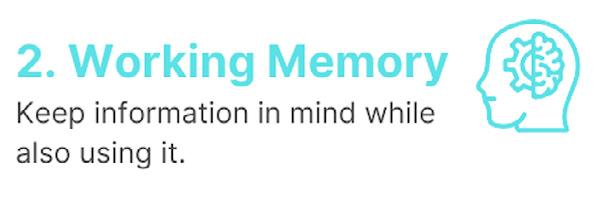
The consensus of most researchers is that EF encompasses three interrelated components allowing for goal-directed actions: working memory, cognitive flexibility, and inhibitory control (see Blair & Diamond, 2008). Working memory is the brain’s capacity to temporarily hold and manipulate information, like a mental scratchpad. It enables someone to keep something in mind—for example, details from a reading passage or math problem—while synthesizing that information to form a coherent idea or solution. Cognitive flexibility determines the extent to which someone can approach something from multiple perspectives or shift when an
approach isn’t working; using the prior examples, it would include viewing a story from a protagonist’s point of view or solving a math problem using varied attack strategies. Inhibitory control involves deliberately suppressing one’s attention or response to something, such
as tuning out environmental distractions or refraining from making an impulsive remark. These skills rarely operate in isolation, and they do not simply switch on with age; rather, they grow slowly, unfolding across developmental stages, and are influenced by biology,
environment, and experiences (Zelazo et al., 2008).
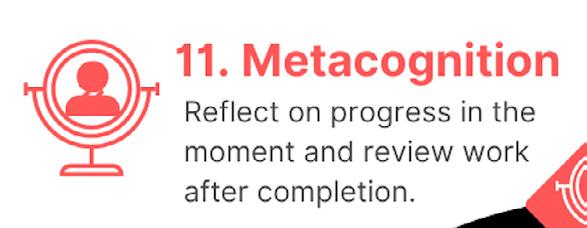
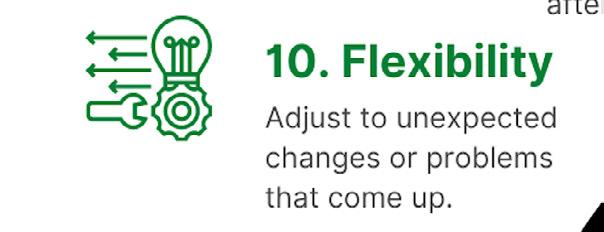
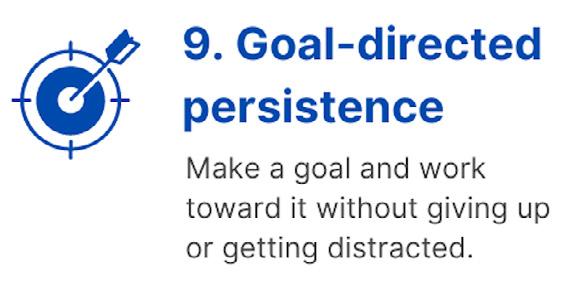
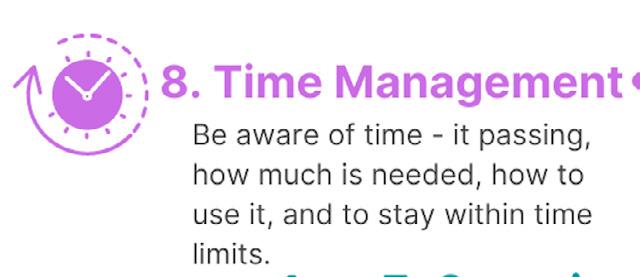
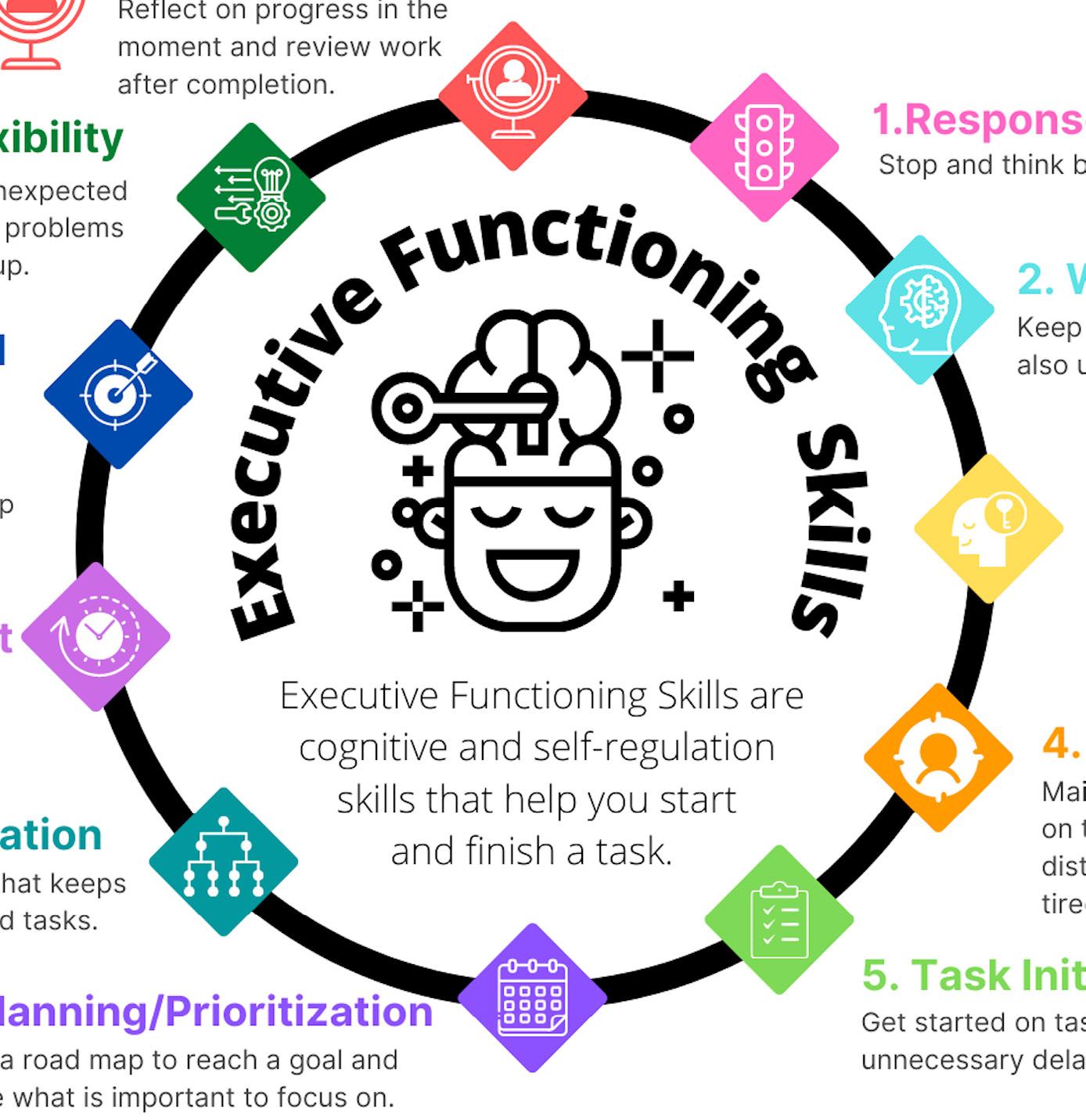
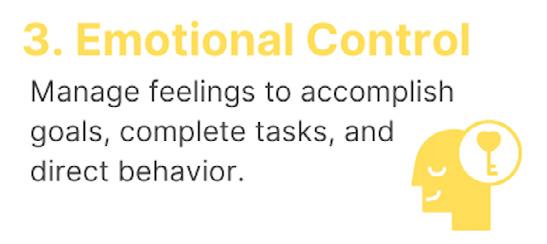
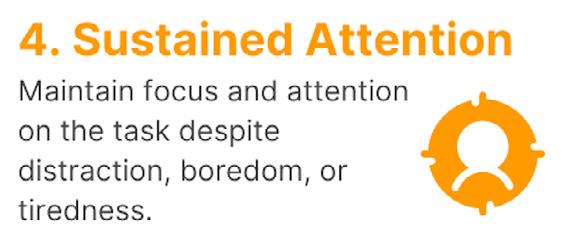
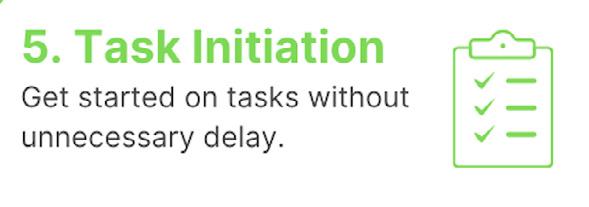
The Executive Functioning Skills infographic encapsulates the many mental processes driven by the center of EF, the prefrontal cortex.
Source: Hussar Boyle, J. (2022). Reference: Dawson, P., & Guare, R. (2009, March). Executive skills: The hidden curriculum. Principal Leadership. 9(7), 10–14.
THE PREFRONTAL CORTEX: EF HUB
In 1848, a railroad foreman named Phineas Gage survived an explosion that embedded an iron rod in his skull. His survival and subsequent recovery were deemed miraculous. And while physically he regained much of his strength, cognitively he was transformed. As months passed, friends and family were shocked as his personality—once known to be capable, reliable, and hard-working—changed dramatically. “Gage could not manage his emotions. He was fitful, irreverent and profane… He couldn’t plan for the future. He went from job to job, sometimes getting fired, sometimes quitting capriciously” (Damasio, 1994, p. 8). At that time, the field of neuroscience did not exist, yet modern researchers today would be unsurprised by the effects of that type of injury: Gage had sustained major damage to his prefrontal cortex (PFC), the brain region essential to executive functioning.
The PFC acts as the brain’s control center, integrating information from other brain areas to manage attention, decision-making, problem-solving, working memory, and self-control (Menon & D’Esposito, 2022). Younger children use broad, diffuse networks
to complete EF tasks, but as they age, these networks become increasingly streamlined, consolidating into more specialized circuits (Durston et al., 2006). This shift, from many regions working inefficiently to fewer regions working efficiently, explains why older adolescents can plan more effectively, inhibit impulses more consistently, and reason about abstract consequences with greater sophistication than young children.
The protracted development of the neural circuitry within the PFC—lasting well into adulthood and, arguably, across the lifespan—reveals both the brain’s malleability and its vulnerability to being impacted by adverse experiences. Stress and unpredictability, for example, can impair EF by over-activating the brain systems responsible for vigilance and threat detection. Noble, Norman, and Farah (2005) demonstrated that children from lower socioeconomic backgrounds—who are more likely to experience chronic stress—show reduced performance on EF and language tasks, even at kindergarten entry.
However, the fact that the brain is highly neuroplastic as it develops indicates that
supportive caregiving, high-quality educational experiences, and early interventions can help mitigate risk factors. In fact, there is evidence that strong EF skills act as protective factors against risks related to socioeconomic stressors and adverse experiences (Masten & Tellegen, 2012).
WHY UNDERSTANDING EF MATTERS
Decades of research have correlated EF skills in children to a host of life outcomes, such as school readiness in preschoolers (McClelland et al., 2007); overall school achievement (Duncan et al., 2007); better coping mechanisms and social competence in adolescence (Mischel et al., 1989); high school graduation rates (Mann et al., 2015); and even the likelihood of being convicted of a crime before the age of 32 (Moffit et al., 2011).
Executive functions shape how children learn, how they respond to challenges, and how they understand themselves. These skills may operate in the background—guiding attention, shaping emotional responses, and helping students organize their
thoughts—but their influence across multiple domains is considerable. At The Windward School, this is witnessed every day in classrooms: Students with well-developed EF may not always grasp content immediately, but they stay organized, listen carefully, adjust strategies, and persist, and, over time, these habits accumulate into academic momentum.
When adults understand EF development, their interpretations of children’s behavior begin to shift. An unfinished assignment looks less like carelessness and more like a skills deficit when viewed through the lens of working-memory overload. A sudden emotional outburst seems less like disrespect and more like a child’s difficulty inhibiting an intense reaction. These small shifts in understanding invite adults to respond with empathy instead of irritation, sparking curiosity rather than judgment, and, most importantly, opening the door to perceiving EF challenges as teaching opportunities.
Academic Implications
The robust association between EF and school achievement—particularly in reading and math—has been well established over many years, showing a predictive effect on academic outcomes independent of students’ intelligence or prior knowledge (e.g., Bull et al., 2008). Executive function is woven into every academic activity, whether children, and even teachers, are aware of it or not. It shapes how they begin a task, how they sustain attention, and how they recover when something goes wrong. When students enter kindergarten with solid EF skills, they are essentially primed to absorb and contextualize their learning. They also may be more likely to adopt a growth mindset, showing enthusiasm about school and their own potential (Cumming et al., 2022).
In a seminal study, McClelland and colleagues (2007) observed preschoolers during structured activities designed to assess behavioral regulation, an early manifestation of EF. The children who could follow directions, manage impulses, and sustain attention performed significantly better in kindergarten literacy, vocabulary, and math tasks. Interestingly, these academic advantages were not connected to early
reading or math exposure but instead with the children’s capacity to regulate themselves.
In a meta-analysis on school readiness and academic achievement, Duncan et al. (2007) came to a similar conclusion: Attention and self-regulation were among the most powerful predictors of later achievement. These findings highlight what many educators understand intuitively: Children’s ability to access academic content is inseparable from their ability to regulate their minds and bodies.
Multiple studies have assessed which executive functioning skills emerge when throughout the course of a child’s development, identifying windows of opportunity for targeted EF supports. One recent study administered three complex EF tasks across two subject areas, with multiple measures of performance, to a large, representative national sample of students aged 5–17 (Best, et al., 2011). It confirmed previous research (see Romine & Reynolds, 2005), finding that complex EF—calling upon several EF domains to manage multistep goals—increases most dramatically between the ages of 5 and 8. Across
the sample, improvement on tasks was largest for the youngest groups, more moderate for older children, and tapered off for adolescents.
Learn more about EF and its role in literacy (page 21) and math (page 35) in this issue.
Social and Emotional Implications
Just as EF skills have a bearing on a child’s academic trajectory, they can affect the acquisition of important social skills, such as the ability to operate well on a team or cultivate positive relationships with peers (Wang & Feng, 2024). Peer relationships depend on a child’s ability to read cues, wait for the right moment to speak, negotiate disagreements, and adjust to others’ expectations—all tasks governed by EF. For example, a conflict is essentially a problem-solving opportunity; however, it can present pitfalls if someone is unable to restrain inappropriate behavior (e.g.,
they lash out verbally when frustrated) or if they have difficulty with perspectivetaking (e.g., they fail to consider another person’s life experiences that may be informing their viewpoint).
In the social and emotional sphere, it can be helpful to differentiate between hot executive functions and cool executive functions. Hot EF involves the selfmanagement skills that are crucial during high-stakes, emotionally charged, or tempting situations. Cool EF, on the other hand, is activated in neutral, lowstakes situations when emotions are not running high (Zelazo & Carlson, 2012). Hot and cool EF systems are interrelated: To access the rational, deliberate thinking brain (cool EF), one must first regulate strong emotions that might derail logical thought processes (hot EF).
Few studies have captured the public imagination like Walter Mischel’s marshmallow test. In the original experiments (Mischel et al., 1972), preschoolers were left alone with a marshmallow and told they could eat it now or wait and receive two marshmallows later. Children who ate the marshmallow immediately succumbed to hot EF decision-making,
giving in to emotional impulse and their desire for immediate reward. The children who successfully waited used cool EF strategies, such as distraction (covering the marshmallow, singing songs, playing with their toes); mental re-framing (imagining the marshmallow as a picture or a cloud); or “if-then” planning (mapping out goals to manage behavior).
Follow-up studies revealed that children who delayed gratification tended to have stronger EF skills and, years later, better academic and social outcomes (Mischel et al., 1989). What made the test compelling was not the marshmallow experiment itself but the window it provided into children’s developing executive systems.
Munakata and Michaelson’s (2021) more recent meta-analysis, exploring selfregulation skills in childhood related to long-term life outcomes, has added nuance, showing that environment matters enormously. Children who grew up with predictable, trustworthy adult responses tended to wait longer. Even so, the EF capacities demonstrated in the original studies remain strong predictors of later resilience.
Children’s EF predicts success across multiple domains
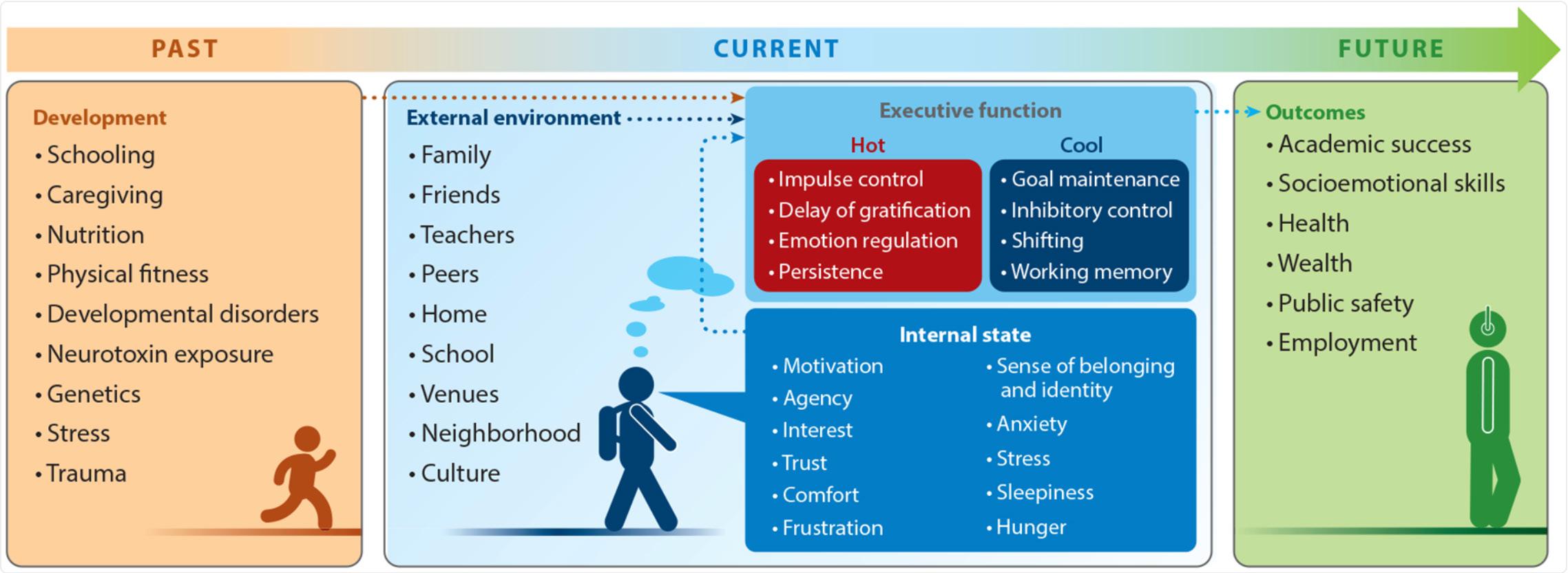

Source: Used with permission of Annual Reviews, Inc., from Executive Functions in Social Context: Implications for Conceptualizing, Measuring, and Supporting Developmental Trajectories, Munakata & Michaelson, Annual Review of Developmental Psychology, Issue 1, Vol. 3, 2019; permission conveyed through Copyright Clearance Center, Inc.
Executive function acts as a gateway through which children access opportunities to grow and learn, shaping not only their school performance but also their identity. Students who can organize their materials, cope with frustration, and manage transitions come to see themselves as capable, while students who struggle in these areas may form identities rooted in confusion or self-doubt.
For educators, it is critical to understand that EF does not simply influence how children learn; it influences how they feel about learning and themselves.
For an in-depth exploration of how EF shapes social and emotional growth, see p. 43 in this issue.
A CALL TO ACTION
Despite decades of research documenting the profound influence of executive function on children’s academic, emotional, and social development, EF remains conspicuously absent from most discussions about school reform. When administrators debate which reading program to adopt or how to raise math scores, EF rarely appears on the
agenda; nor do policymakers include EF when designing accountability systems or adjusting curricular standards. Yet, EF determines whether students can access those very systems, programs, and expectations.
This omission matters. Schools often assume that students already know how to plan their work, keep materials organized, monitor progress, manage frustration, and shift between tasks, but these are developmental, not intuitive, skills. They require patience, guidance, repetition, and explicit practice. Recognizing EF as a core instructional
priority allows schools to respond to students’ needs more effectively, approaching challenges as teaching opportunities that can ultimately transform a student’s trajectory.
Fortunately, a comprehensive research base points to interventions that strengthen EF in meaningful, measurable ways.
Explicit EF Instruction
Explicit instruction in executive function teaches students how to think strategically, going beyond general reminders such as “stay organized” or “manage your time better.” It provides concrete tools, modeled examples, and guided practice that build students’ metacognitive awareness. In one study documented by Meltzer (2018), middle school students were taught how to organize their materials and use selfmonitoring tools in ways that made their thinking more visible. They also spent time examining their own cognitive strengths and challenges, a process that helped them choose strategies more intentionally. Teachers modeled each step: previewing a task, setting a clear goal, and pausing to evaluate whether their approach was
working. As students practiced these routines, they grew more independent, completing assignments more reliably and persisting through challenges that had previously derailed them.
As one example of this approach to instruction, a Windward teacher may walk students through the process of planning a writing assignment: breaking the task into steps, estimating how long each step will take, and identifying resources and strategies to use throughout the writing process. The instruction is not merely spoken but demonstrated, as students observe the teacher thinking aloud: “Creating an outline will help me to organize my thoughts before starting on the draft.” If a student exhibits difficulty with the assignment, or experiences frustration, the teacher will help the student acknowledge their feelings, reflect on what is working and not working, and problem solve small next steps. With repetition and practice, over time, the executive function skills involved in completing a challenging multi-step writing assignment grow stronger, helping the student learn to trust the process and feel confident about their capabilities.
Working-Memory Training
The evidence of efficacy for brain games geared toward boosting working memory is mixed; meta-analyses show that while such interventions often improve performance on tasks very similar to the training, there is little evidence of transfer into everyday cognitive or academic contexts (Melby-Lervåg & Hulme, 2013; Sala & Gobet, 2020).
However, when embedded within authentic, purposeful learning experiences, working memory interventions have been shown to positively impact EF more broadly. Blair and Diamond (2008) studied EF interventions that were used within real academic activities, such as remembering and applying multi-step rules during math games or holding narrative details in mind during reading discussions. Children practiced verbal rehearsal (“I’m going to remember the number 26 by saying it quietly to myself.”); strategic grouping (“I’ll break this into parts I already understand.”); and cognitive shifting (“I tried that strategy; now I’ll try this one.”). Students who participated showed improvements in impulse control and their ability to shift strategies when the demands of a task changed.
Mindfulness Programs:
Training the Brain’s Control System
Mindfulness interventions have been shown to strengthen the neural networks that underlie attention and self-regulation. In a 2012 study, Tang et al. explored the effects of shortform mindfulness training—known as Integrative Body-Mind Training (IBMT)—on students’ behaviors and brains. IBMT involved guided relaxation, mental imagery, and attention-shifting exercises delivered in 20-minute sessions over five days. During the sessions, instructors coached participants in how to redirect their attention gently when it wandered and how to cultivate awareness of their bodily sensations.
The results were striking: Compared to a control group receiving standard relaxation training, students in the IBMT group showed
improved performance on EF tasks requiring attention regulation and conflict resolution; increases in functional connectivity between the anterior cingulate cortex and the prefrontal cortex; and reductions in cortisol levels associated with stress.
The last finding is significant. Stress tends to pull attention toward whatever feels threatening and away from the reflective, goal-directed thinking that executive function makes possible. Blair (2010) describes this shift as a kind of cognitive rerouting: When stress rises, working memory and inhibition falter because the brain is busy scanning for danger. But the converse is also true; as students strengthen their executive skills—learning to direct their attention, pause before reacting, or shift perspective—they also become better equipped to manage stressors that once overwhelmed them. In the Tang et al. (2012) study, as well as a systematic review by Felver and colleagues (2017), students who practiced brief, structured mindfulness routines not only improved their executive control but also showed measurable reductions in physiological stress.
In EF- and SEL-informed classrooms, such as those at The Windward School, routines are predictable and transparent. Teachers preview transitions, because shifting from one activity to another asks a great deal of a child’s developing executive system. Faculty members break directions into manageable steps
because working memory is finite, and even capable students can lose the thread when bombarded with too much information. In modeling the Mood Meter and the Meta Moment, key strategies of the RULER approach (Brackett et al., 2019), Windward teachers support students’ selfregulation, helping them manage their emotions productively and navigate challenging situations. Finally, Windward teachers think aloud as they work—pausing to reconsider, to adjust, and to explain why one strategy makes more sense than another—because children learn metacognition through this type of imitation (Veenman et al., 2006). All these strategies, when absorbed through daily interactions and across subject areas, contribute to students becoming more reflective and purposeful learners.
From preschool through adolescence, EF shapes how students learn, how they relate to others, and how they come to understand their own potential. Without insight into how these abilities develop, it can be tempting to view EF challenges through a deficit lens. Yet these behaviors often reflect an executive system that is still maturing, not a lack of interest or effort. Once educators understand the developmental arc of EF, they begin to see moments of difficulty as opportunities for support. For example, a child who shuts down may be overwhelmed by cognitive load and benefit from working-memory scaffolds. A teenager who stares at a blank screen may be struggling to sequence the steps of a task and respond well to explicit planning tools.
The great promise of EF research is that these skills can be taught and practiced. When schools make EF development a genuine priority—one reflected in instruction, routines, shared language, and expectations—students gain tools they will draw on long after they leave the classroom. And as educators and families commit to building EF with intention, they offer students something far more enduring than higher test scores: They give them the confidence to trust their own abilities and the competence to chart their own futures with clarity and purpose.
TED. (2012, June). Sarah-Jayne Blakemore: The mysterious workings of the adolescent brain [Video]. YouTube.


WATCH LISTEN
Scorrano, D. (Host). (2020, September 2). Executive Functioning, Resilience, and Back to Basics Parenting (No. 10) [Audio podcast episode]. In READ Podcast. The Windward Institute. Watts, T. W., Duncan, G. J., & Quan, H. (2018). Revisiting the Marshmallow Test: A Conceptual Replication Investigating Links Between Early Delay of Gratification and Later Outcomes. Psychological science, 29(7), 1159–1177.
Gogtay, N., Giedd, J. N., Lusk, L., Hayashi, K. M., Greenstein, D., Vaituzis, A. C., Nugent, T. F., 3rd, Herman, D. H., Clasen, L. S., Toga, A. W., Rapoport, J. L., & Thompson, P. M. (2004). Dynamic mapping of human cortical development during childhood through early adulthood. Proceedings of the National Academy of Sciences of the United States of America, 101(21), 8174–8179.

Click or scan this QR code to explore READ, WATCH, LISTEN resources.
TED. (2020, October). Roots of success: Supporting the development of executive function skills [Video]. YouTube.

SUPPORTING EF IN CHILDREN: A PATH TO INDEPENDENCE
By Jackie Britt-Friedman, PsyD, Assistant Professor, Yale School of Medicine, clinical child psychologist, and Windward Institute instructor
“We’re leaving in 5 minutes! Remember to pack your homework!”
For anyone caring for or teaching a child with weak executive functioning, chances are, these types of reminders happen more often than they would like. As taxing as they may be, such prompts can be invaluable. When children’s executive control systems are not fully developed, they need adults to serve as stand-ins for the frontal lobe—the part of the brain responsible for initiating, planning, and completing tasks with goal-directed behavior (Jones & GraffRadford, 2021). They also need adults to help them develop the skills to manage these demands independently. By stepping in as a temporary support while also building long-term skills, adults play a crucial role in bolstering children’s executive functions.
THE BRAIN’S SUPERVISORY SYSTEM
We can think of executive functioning as the brain’s CEO, a chief manager who has an overall vision for its direction. The workers (basic cognitive abilities) may be capable, but without effective managers (executive functions), the work does not get done well—or on time. Support for executive functioning rests on strengthening the managers so that they can adeptly cue
the workers when or how to activate to complete tasks in the most efficient way (McCloskey, 2025).
When a child struggles with executive functioning, the ability to problemsolve toward a goal is inconsistent (Barkley, 2011). One might assume the reason that a child can remember their lunch one day and forget it the next is because of a lack of effort, but that is one of the most painful assumptions about children with executive functioning weaknesses.
THE ROLE OF EXPECTATIONS
Adults’ expectations must be grounded in an understanding of brain development and executive functioning. The frontal lobe continues developing into one’s mid-20s, which means that adults can expect young people to have more difficulty managing demands such as reasoning and regulating behavior, attention, and emotions (Center on the Developing Child, 2012). Variability among individuals is also typical and can seem more pronounced during the school years.
A common misconception for many adults is that children “should” function at a certain level by a specific age—and that if they do not, they should simply face consequences. A school would not withhold instruction in math if a student had not yet mastered division. Similarly, teachers should not withhold support for those who have weaker executive control.
THE LONG GAME
Adults need to meet children where they are, providing support that pushes them just beyond their current capacity without overwhelming them. This “just right” level of challenge is where meaningful growth happens.
Giving an appropriate amount of support can mean chunking long-term assignments into smaller parts and requiring the child to submit each component at an assigned deadline. Alternatively, perhaps a child needs to complete a checklist as they pack up to double check that they have all their belongings. Sometimes the consequence of not meeting a demand is powerful enough to motivate a child to meet it the next time; other times, it
is not. If natural consequences are not motivating, the child needs more help.
Since every child’s growth looks different and rate of progress can vary tremendously, mindset is key. Fostering a growth mindset—or the belief that one’s abilities are not fixed and can be developed—can increase one’s motivation to improve and take steps toward a goal (Dweck, 2006). This mindset also allows children to perceive failures, which are natural and expected, as opportunities. A helpful outlook like this is possible when a child understands that executive functioning difficulties are delays in development rather than fixed traits.
Think of this as the long game where being deliberate facilitates progress. The demands that adults put on children matter, given that frequent use of executive function neural networks strengthens the connections (Zelazo et al., 2016). The amount of experience needed can vary across individuals and skills. One child may have to practice a skill hundreds of times before they master it on their own, whereas another child may need only a few repetitions.
Growth, which is uneven and nonlinear, requires patience. When a child takes two steps forward and one step back, adults and caregivers can remind themselves that this is the nature of development. To quote Dr. George McCloskey, the severity of the difficulties are “not forever; just longer than you’d like” (2025).
POWERFUL FACTORS FOR SELF-REGULATION
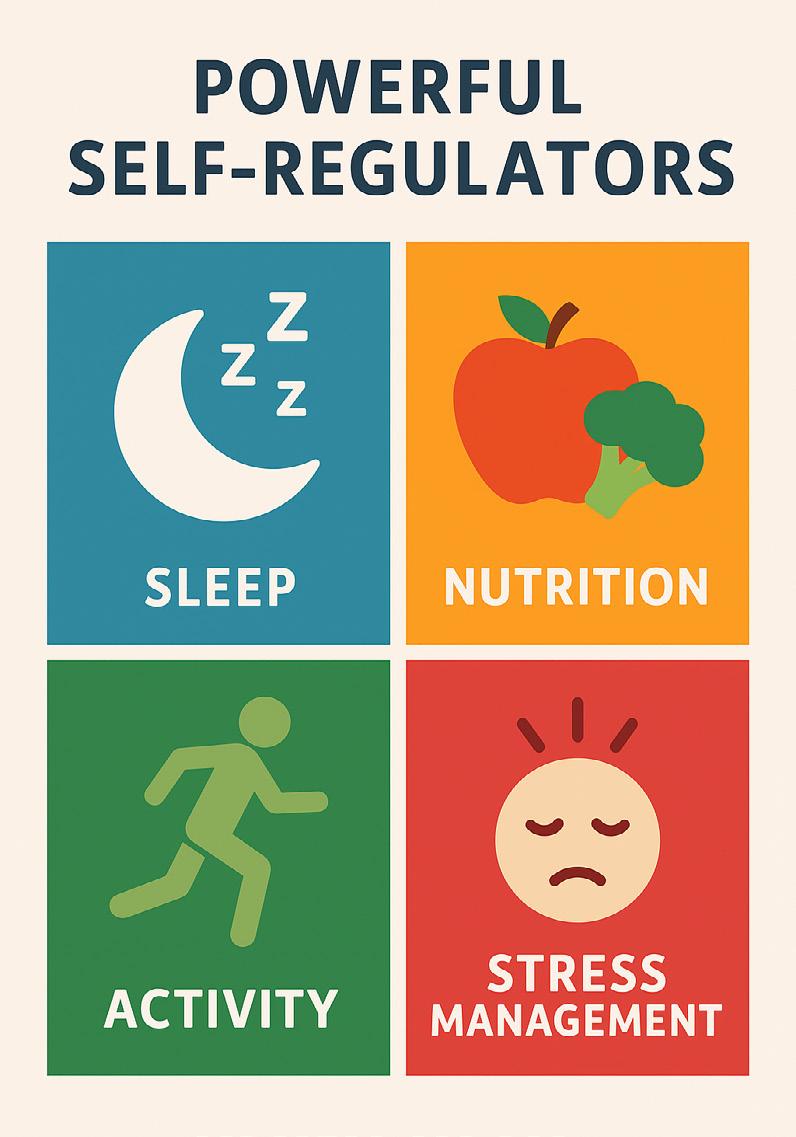
Even with solid growth, selfregulation—first-line managers in the brain—can be variable. Anyone who has ever been hangry after missing a meal or irritable due to poor sleep can attest to this. When individuals do not get enough good quality sleep, physical activity, or nutrition, they are more vulnerable to dysregulation (Diamond, 2013).
Chronic stress and trauma can also wreak havoc on the executive functioning system (Zelazo, 2020).
In these circumstances, the workers sound an alarm because they perceive danger even though there
is no actual significant risk of harm present (McCloskey, 2025). All the managers think the factory is on fire and evacuate the building, unable to supervise the workers. Becoming more adept at identifying false alarms, calming the workers, and settling the nervous system with mindfulness and coping strategies is imperative. Since dysregulation due to trauma, anxiety, or biological factors such as ADHD can look the same, it is important to differentiate what is contributing to the behaviors to determine the right intervention.
Keys to EF Intervention
1. Priming for Change
A crucial component of executive function intervention is assessing the child’s needs and setting the scene for growth. Important questions include:
What are the skills that need to be developed? What is most meaningful to address first? What strategies have already been used, and how has the child responded? What strengths can be capitalized on?
Progress starts with awareness. Accordingly, gently helping the child recognize their challenges and see that growth is possible lays the groundwork for change. Collaboration with the child around goal setting and charting the path to reach the goals prepares the brain for this journey. It is especially important for tweens and teens—who are seeking independence—to understand how strengthening executive functioning skills will help them reach their own goals. In addition, periodically returning to the reasons why they are working on the skills may remind them why the efforts are worthwhile. Games and other
entertaining activities are also valuable ways to maintain motivation. For example, for younger children, games like Simon Says and Red Light, Green Light can build inhibitory control, and an activity like Spot the Differences can focus on attention to detail. Just because developing these skills is hard work does not mean that it cannot also be fun.
2. Taking the Load off the Frontal Lobe
As previously noted, children who are not yet internally controlled need adults to take over and apply external control (Dawson & Guare, 2009). Putting into place systems and practices that make demands clear takes the load off a child’s frontal lobe. Not having to exert energy to figure it out is helpful for all children but especially for those who struggle with executive functioning. Using concise and specific language (for example, “Hang up your jacket and backpack” rather than “Put your things where they belong”) is one external control strategy. Indicating which sensory system the child should use (such as, “Look at me when I am talking” rather than “Pay attention”) is another.
Predictable routines and structures also support the child’s frontal lobe and enable the child to run on autopilot. They provide cues for how and when to activate workers in the brain, which facilitates self-regulation (McCloskey, 2025). The use of aids such as timers and calendars also provides effective cues. Finally, grouping peer leaders who have more developed executive functioning skills with those with weaker skills can be mutually beneficial; however, one should be sensitive to how often children are placed in this position.
3. Bridging to Independence
Ultimately, the goal is to help the child implement skills independently. Modeling is a powerful way to facilitate this growth. Even more impactful is to narrate the process aloud so that effective self-talk is also made visible: for example, “Oh, we need milk! I am going to add it to our shopping list right now so that I don’t forget.”
If children are not completing a task effectively, they need to be taught directly with cognitive strategy instruction. Take, for example, a student who rushes through math fluency worksheets,
skips problems, and misreads operation signs. They can be taught to circle the sign before solving each problem methodically from left to right.
Practice, feedback, and guided reflection are critical for strengthening executive function neural networks and encouraging progress. By prompting discussion about barriers and strategies, children can engage in more selfregulated learning (Faith et al., 2022). Ask open-ended questions:
“What could get in the way of you meeting the goal?”
“What strategies can you use to be more successful?”
“What have you done before?”
“What do you think I’d suggest?”
These conversations foster metacognition and ownership, moving the child toward self-regulation, selfdetermination, and internal control.
Executive functioning growth is a long-term journey, and it looks different for every child. Stay patient, monitor and adjust plans as necessary, and remember: Progress may be slow, but with consistent support and a growth mindset, it is possible.

ABOUT THE AUTHOR
Jackie Britt-Friedman, PsyD is an assistant professor, Yale School of Medicine, and a clinical child psychologist who has extensive experience both in schools and in clinical settings. Dr. BrittFriedman has supported children with a vast array of challenges, including executive functioning weaknesses, learning disabilities, anxiety, mood difficulties, social skill deficits, and other stressors. She focuses on helping children and adolescents further develop skills to successfully navigate challenges and on promoting resilience. Key components of her work are collaboration, psychoeducation, and consultation. As an instructor at The Windward Institute, she has worked to advocate for children with language-based learning disabilities and disseminate research-based information to help educators and caregivers address their needs.
READ WATCH LISTEN
Ehmke, R. (2025, June 5). Helping kids who struggle with executive functions. Child Mind Institute.
DiTullio, G. (2018, November 9). Helping students develop executive function skills. Edutopia.
Dawson, P., & Guare, R. (2009). Smart but scattered. The Guilford Press.
Faith, L., Bush, C., & Dawson, P. (2022). Executive skills in the classroom: Overcoming barriers, building strategies. The Guilford Press.
Center on the Developing Child at Harvard University. (2012, June 29). InBrief: Executive function: Skills for life and learning [Video].


Scorrano, D (Host). (2020, September 2). Executive Functioning, Resilience, and Back to Basics Parenting (No. 10) [Audio podcast episode]. In READ Podcast. The Windward Institute.
Click or scan this QR code to explore READ, WATCH, LISTEN resources.
Understood. (n.d.). Executive function and the brain [Video]. YouTube.

IN CONCERT: EXECUTIVE FUNCTION AND READING
By Alexis Pochna, EdM, Associate Head of School for Academic Programs
Imagine an orchestra performing a complex piece of music. The strength of the performance depends on many instruments working together, each contributing something different while staying in sync to bring the composition to life. The conductor plays an essential role, helping the musicians stay coordinated, adjusting to changes in tempo, and ensuring the parts blend into a unified whole.
Reading works much the same way and requires the careful coordination of multiple skills and processes. To make meaning from text, readers must
decode unfamiliar words, hold ideas in mind, monitor for coherence, and adapt when comprehension breaks down. Executive function (EF) serves as the conductor, guiding attention, memory, and strategy use so the components of reading, including word recognition, language comprehension, and higherlevel reasoning work together as an integrated system. Research shows that these executive skills are central to literacy development, supporting both the acquisition of foundational reading abilities and the comprehension of complex texts (Butterfuss & Kendeou, 2018; Cirino et al., 2019; Haft et al., 2019).
The Active View of Reading (Duke & Cartwright, 2021), a theoretical model that builds on the principles of the Simple View of Reading (Gough & Tunmer, 1986), supports this understanding. In this model, comprehension involves more than decoding and language comprehension; it is a dynamic, self-regulated process in which executive functions—including attention, working memory, and cognitive flexibility—are engaged. Through this “active” lens, reading is a meaning-making process that depends on a reader’s ability to manage and integrate multiple processes in real time.
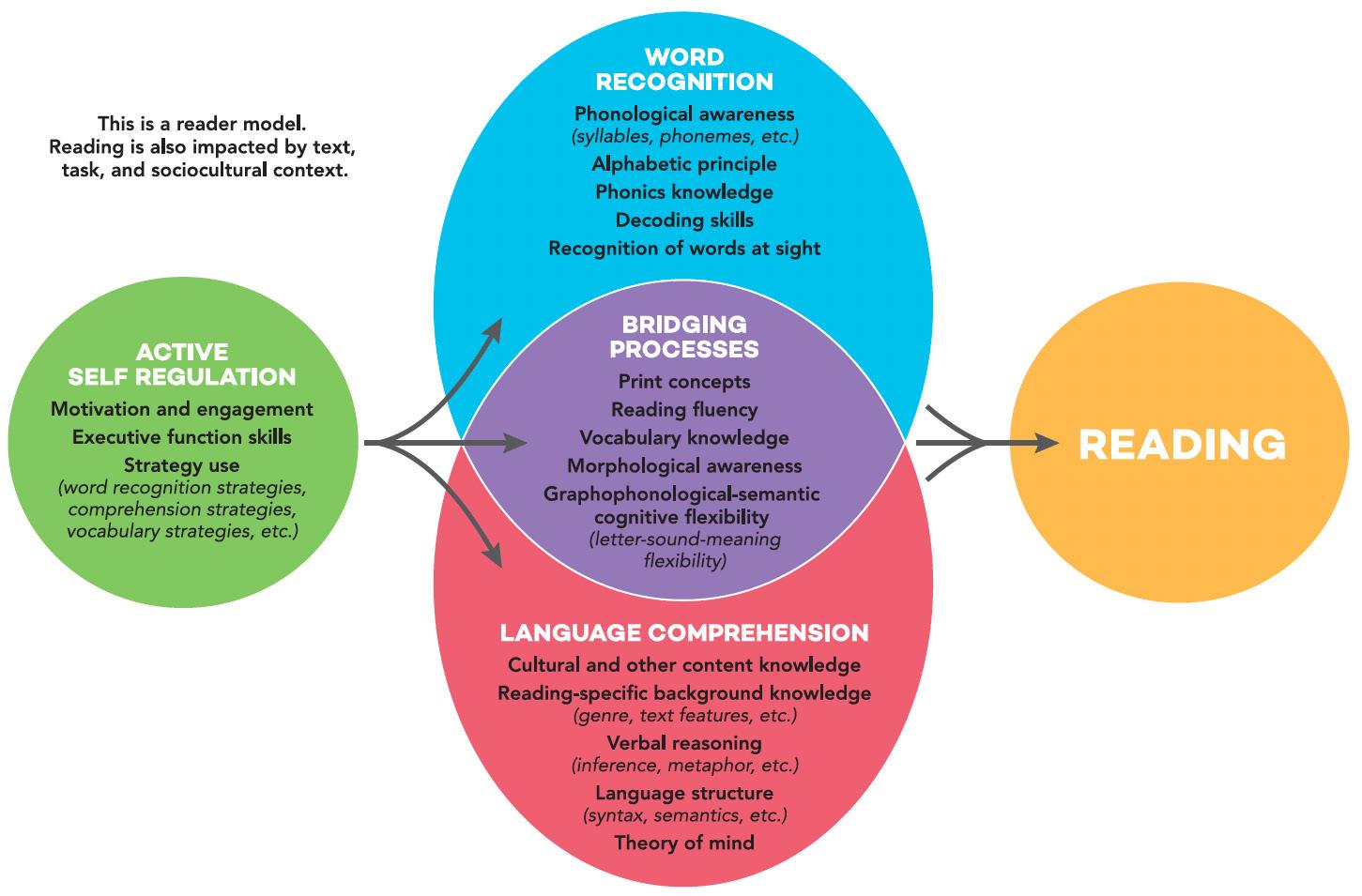
FIGURE 1
This is a reader model. Reading is also impacted by text, task, and sociocultural context.
THE CONDUCTOR AT WORK
Executive function acts as the conductor of reading, guiding and coordinating the many skills and processes that it requires. For example, a child sounding out words must hold letter-sound relationships in mind, keep track of what has already been read, and stay engaged despite challenges and distractions. A middle schooler tackling a science textbook may need to pause, reread, and decide which details are important to note. Even adults, when reading the news or a set of instructions, must set goals, manage attention, and plan their approach to the text. Reading, regardless of text or task, is a goal-directed activity that depends on awareness and persistence. Without this internal conductor, even readers with strong word recognition and vocabulary knowledge may struggle to follow the thread of a story or grasp the main point of a passage (Butterfuss & Kendeou, 2018; Cirino et al., 2019; Cutting et al., 2009, 2019; Haft et al., 2019).
AN ENSEMBLE EFFORT
Neurobiological evidence shows that the same brain systems that support executive function are also engaged during reading, underscoring that literacy depends not only on language-based systems but also on the coordination of broader executive networks. Reading is not a natural act; it must be learned, and it recruits both the neural pathways that process written language and those that govern attention, working memory, and planning. Studies demonstrate that efficient reading depends on communication between these systems, allowing readers to
FIGURE
2
Source:
manage multiple sources of information at once. Differences in how these systems work together are linked to reading performance across the full continuum of ability. Even when word reading, fluency, and language skills are intact, weaknesses in executive processes such as planning, monitoring, and organization can make it difficult for readers to maintain coherence, generate inferences, or repair meaning when comprehension breaks down (Burgess & Cutting, 2023; Cutting et al., 2009; Locascio et al., 2010; Margolis & Liu, 2023; Sesma et al., 2009).
Illustration of two views of the relation of executive functions to reading
a. Dichotomous View: Executive functions are domain-general skills that are separate from, but not correlated with, reading processes. Used with permission of Taylor & Francis Informa UK Ltd, from Considering roles of executive functions in the science of
b. Integrated View: Executive functions are not separate from reading processes. Rather, executive control of and within reading processes develops with reading experience and development, as individuals learn to manage and control the many subprocesses and stimuli within reading tasks themselves.
Reading proficiency reflects not just linguistic competence but also the capacity to manage one’s own thinking while constructing meaning (Duke & Cartwright, 2021). Across the arc of reading tasks, executive function enables readers to plan, focus, and adapt as they make sense of text. When a child encounters an unfamiliar word, working memory holds the sequence of sounds long enough to blend them, while inhibitory control helps resist the impulse to guess or skip ahead. If the first decoding attempt fails, cognitive flexibility allows the reader to shift strategies, such as breaking a word into recognizable parts.
As texts become more complex, demands on executive function grow. Readers must access information in working memory to decipher syntactically complex sentences and recall details from earlier paragraphs. At the same time, they must monitor their understanding and pause, reread, and apply “fix-up” strategies when meaning breaks down. When readers move into higher-level tasks—such as comparing and contrasting two texts on the same topic—executive function supports
them in juggling multiple perspectives, identifying essential ideas, and integrating information into a coherent mental model.
At every stage of reading development, comprehension depends not only on word reading and language skills but also on the flexible coordination of attention, working memory, and selfregulation. Executive function helps bridge linguistic knowledge with strategy application during authentic reading tasks to construct meaning across increasingly complex texts (Duke & Cartwright, 2021). Strengthening these executive processes is therefore central to helping students become purposeful, agile, self-directed readers. Individual differences in executive function help to explain some of the variability in responsiveness to reading instruction. Some readers readily coordinate the mental processes that comprehension requires, while others benefit from explicit scaffolds that make these executive demands visible and learnable (Duke & Cartwright, 2021; Sesma et al., 2009).
REHEARSAL: INTEGRATING EF INTO READING INSTRUCTION
A growing body of research shows that the most effective way to strengthen executive skills for reading is to practice them in real time with actual texts and text-based activities. This distinction matters. While activities such as memory games or inhibition exercises can strengthen general cognitive abilities, these standalone practices do not necessarily improve reading performance. Instead, executive functions—skills such as working memory, cognitive flexibility, and self-control—need to be activated in the context of authentic reading and comprehension tasks, where they directly support meaning-making (Cartwright & Palian, 2024).
In a large meta-analysis, Cartwright and Palian (2024) found that interventions targeting reading-specific executive functions led to significantly greater gains in comprehension than general EF training. When students were guided to coordinate attention between main ideas and details, to hold and update information across sentences, and to monitor their understanding as they read, they demonstrated stronger comprehension.
Classroom-based research provides concrete examples of what this looks like in practice. Ruffini and colleagues (2024) embedded EF components directly into comprehension instruction rather than teaching EF as a set of discrete skills. Students engaged in scaffolded exercises that targeted multiple EF processes—selective attention, inhibitory control, working memory, and cognitive flexibility—while practicing key aspects of comprehension. For example, they sequenced sentences to maintain text coherence and identified inconsistencies in short passages. During these tasks, students were encouraged to focus on relevant details, pause before responding, connect new information with prior knowledge, and shift flexibly between sections of the text. Each activity was paired with real-time feedback and self-assessment opportunities to promote metacognition and self-regulation. This embedded approach led to measurable gains and showed that growth in both EF and comprehension skills can occur simultaneously. For example, students demonstrated improvements in the EF-related skills of keeping relevant information in mind while suppressing irrelevant details and in their ability to recall key information from the text.
Although the students in this study were elementary age, the approach is applicable to a broader range of students.
With older learners, embedding EF within authentic reading tasks has been shown to yield similar benefits. Follmer and Tise (2022) incorporated short, text-embedded prompts into lessons that used multiple informational texts with different or conflicting points of view. These prompts guided students to monitor which ideas were most relevant, recognize when information conflicted, and connect new ideas to what they already knew before drawing conclusions. Students who engaged with these prompts were better able to connect ideas and support their interpretations with evidence from the texts. The study showed that executive functions such as attention, working memory, and flexible thinking enable readers to stay focused, organize ideas, and make meaningful connections across sources. Since these supports were built into the reading process rather than added as separate instruction, they made the thinking behind comprehension visible and helped students become more aware of the steps involved in analyzing and synthesizing complex, text-based information.
Taken together, these studies deliver a clear message: To build both literacy and executive skills, teachers should design reading experiences that emphasize and scaffold the mental moves that proficient readers make naturally—holding key information in mind, shifting between perspectives, focusing on evidence, and pausing to check understanding.
Sample Executive Function Processes Across Reading Demands TABLE 1
Working Memory
Word Reading Holds letter–sound patterns while blending and decoding words
Fluency Keeps phrases and sentence boundaries in mind while reading smoothly
Comprehension
Retains ideas across words and sentences while building meaning
Cognitive Flexibility Self-Regulation
Tries alternate decoding strategies when one approach doesn’t work
Adjusts pacing, tone, and emphasis
Resists the urge to guess unfamiliar words; persists through challenges
Balances accuracy and speed; monitors when meaning is lost
Shifts between literal and inferential understanding
Synthesizing Multiple Texts
Holds ideas in mind while processing information from more than one source
As shown by the table, executive functions are engaged across all reading demands—from decoding and fluency to comprehension and the integration of
Moves between different perspectives or arguments to integrate ideas
multiple texts. As reading tasks become more complex, demands on working memory, cognitive flexibility, and selfregulation increase. Understanding
Pauses to check understanding; rereads or revises thinking when comprehension breaks down
Persists in understanding multiple perspectives and maintains purpose for reading when information or viewpoints conflict
how these processes interact can help educators design instruction that supports both reading and thinking.
FINE TUNING FOR THE CLASSROOM
Recognizing the role of executive function in literacy deepens how we think about teaching reading. When teachers design lessons that make thinking visible, they strengthen both comprehension and the executive processes that support it. Setting goals and previewing text before reading helps students focus their attention and activate relevant knowledge. Tools such as graphic organizers and structured note-taking templates can support working memory by giving students a concrete way to capture and organize important information as they read. Teaching students to shift strategies while reading—for example, applying a different word-attack approach, rereading for context, or adjusting an annotation technique—models the flexible thinking that proficient readers use automatically. Encouraging students to slow down and
verify their reasoning by rereading a tricky passage or locating evidence in the text before responding to a prompt builds self-regulation and inhibitory control. Incorporating opportunities for students to reflect on the strategies they use and find most helpful fosters metacognitive awareness, strengthening the ability to plan, monitor, and adapt reading strategies over time (Meltzer, 2018).
When these structures and supports are embedded into authentic reading experiences, students begin to internalize the processes of skilled readers. They learn that comprehension is not just about remembering what a text says, but it is also about actively managing how they make sense of it in real time— holding ideas in mind, adapting when material is confusing, and monitoring their understanding as they read.
IN HARMONY
Reading depends on the integration of multiple systems and processes, including word reading, language comprehension, executive function, and higher-level reasoning. These elements work in concert to help students build meaning from text. Decoding connects to word knowledge, attention supports memory demands, and flexible thinking enables inference and analysis. When instruction intentionally strengthens the integration of these processes, students learn that reading and thinking are deeply enmeshed and grow into readers who approach text with purpose, insight, and confidence.
READ WATCH
Cartwright, K. B. (2015). Executive skills and reading comprehension: A guide for educators. Guilford Press.
Cutting, L. E., et al. (2023). The behavioral and neurobiological relationships between executive function and reading: A review and preliminary findings. Frontiers in Psychology
Lonigan, C. J., et al. (n.d.). Direct and indirect contributions of executive function to word decoding and reading comprehension in kindergarten. Early Childhood Research Quarterly.
Zhang, X., Peng, P., & Sun, C. (2023). Considering roles of executive functions in the science of reading: A meta-analysis highlighting promises and challenges of reading-specific executive functions. Reading Research Quarterly
Zhou, Y., Chen, X., & Li, H. (2024). Integrating executive function activities into a computerized cognitive training to enhance reading comprehension in primary students. Reading Research Quarterly
Cutting, L. (2020, October 16). Neurobiological Foundations of Executive Functions and Implications for Reading and Writing [Presentation]. The Dyslexia Foundation.

LISTEN
Cartwright, K. B. (Guest). (2023). The science of reading & executive function (Ep. 204) [Audio podcast episode]. In Sucheta Kamath (Host), Full PreFrontal: Exposing the Mysteries of Executive Function.
Click or scan this QR code to explore READ, WATCH, LISTEN resources.

Q&A WITH DR. AMY MARGOLIS
By Jana Cook, Associate Director of Marketing and Communications and Alexis Pochna, EdM, Associate Head of School for Academic Programs
Dr. Amy Margolis is a member of The Windward Institute advisory board, professor of psychiatry and behavioral health at The Ohio State University, and directs the Environment, Brain, and Behavior Lab, as well as the Psychology, Psychiatry, and Public Health Collaborative Learning Disability Innovation Hub funded by the National Institute of Child Health and Human Development. She holds a doctorate in Applied Educational Psychology: School Psychology from Teachers College, Columbia University, and is trained as a clinical neuropsychologist with over two decades of experience assessing and treating children with learning and attention disorders.
Q:
Your research shows that the brain systems responsible for executive function, emotional regulation, and reading are deeply interconnected. Why is it important to view these as overlapping, interacting domains rather than separate areas of development?
A:
Over the years, we have tried to understand how different parts of the brain are interacting to help students when they’re doing something like reading. Often, you’ll see a child who’s having trouble reading and they also feel nervous about reading, or they’re showing behaviors like avoiding reading that are indicative of having anxiety. Or they’re having trouble staying on task and monitoring their goals while reading. And it’s much more common to see that than to see a child who stays on task, feels calm, but just can’t decode a word. So, we were really curious about those overlapping behaviors and what might underlie their co-occurrence. Were children having trouble reading because they were anxious, or were children anxious because they were having trouble reading? Were they having trouble monitoring their progress because of executive function problems, or were children having executive function challenges because they were having trouble reading?
What we found was that it seems to be a bi-directional relationship, wherein these things are emerging together. I was really interested in the question: Are the children having trouble with all of this because of a shared common brain problem? One way we explored that question was by thinking about the regions in the reading network that overlap with other circuits.
We Do If you think about the left surface of your brain, there is the cortex, which is responsible for all higher-order thinking. And there’s a network that goes from the front to the back that has been shown to be very much involved in reading. We found that changes in how the reading and emotion regulation networks communicated were associated with reading difficulties, and that anxiety symptoms appeared to be the mechanism linking the two. This suggests that co-occurring reading and anxiety problems might stem from a common brain pathway rather than being seen as two separate disorders. The regions in the reading network also touch on executive function networks, emotional regulation networks, and vision networks. In children with reading difficulties, who traditionally underutilized the left front of their brain, we saw that when they did an executive function task, they were overutilizing the right front side of their brain. This aligns with a lot of what we know about reading research, this idea that children are recruiting the whole brain when they’re having a reading problem.
That pointed us in this direction that executive function—specifically, inhibitory control—might be a part of reading that was important to understand, and it was intimately connected with reading problems.
Q:
Can you describe how brain systems for self-regulation, attention, and cognitive flexibility directly support core reading processes?
A:
If you think about trying to learn all the many complex rules in order to become a reader, then you start to understand how executive functions are so important. Infants learn language by picking up patterns and repetition, learning through what they hear. And children also learn from looking at symbols: how to put them together into sounds and words.
Now think about what happens when children are having trouble with this, or where this gets hard for a typical reader. For example, say you’re learning the short word family, and you see the words mat, fat, cat, sat, hat; then all of a sudden, you see the word mate. Your brain has to recognize the e as a salient visual detail. So that’s a tension. And then your brain has to say, “Oh, this is not /ă/, as in apple or mat. Because of
the magic e, the vowel says its name. It’s a long a. This is mate, not mat.” So that whole process involves identifying a salient visual detail, and the magic e putting on the brakes. That’s attention. Pausing to not think /ă/, and instead think /ā/, is inhibitory control, another aspect of executive function. The process also requires cognitive flexibility, yet another executive function, which is needed to switch between the two rules.
So, all those components are part of reading, and I would argue they’re also part of what we consider phonological processing. I do think that phonological processing is its own discrete capacity, but when we test it in the lab or in a clinic, we tell children, “Say supper, but now change the up to ip.” That’s a classic phonological test, substituting a sound
for another sound; but to do it, you have to hold in mind the first word and then substitute the sound for the second word. This requires working memory. It’s also requiring inhibitory control to not say supper again and instead say sipper. And I think that there’s metacognition there, too, because the words are real words. So would you think, “Well, I guess super is also a word.” But you wouldn’t answer siper, because that isn’t a real word. The ability to do the test requires all these executive processes.
That was what led us to try to show that these executive skills are really critical to reading. And I don’t think that’s a surprise to any reading teacher out there, but the formal study of the cognitive neuroscience of reading had not really fully unraveled this story.

Q:
You’ve conducted a significant body of research on the impact of environmental exposures to toxins and brain development. What have you discovered about how these exposures affect reading and areas of the brain that support executive function skills like attention, selfcontrol, and mental flexibility?
A:
In our recent work funded by a grant from the National Institute of Environmental Health Sciences, we’re looking at how prenatal chemicals that are ubiquitous in our environment, like plasticizers, are changing infant brain function in ways that we already know predict later reading and language.
We put together an animal study and a human study of babies, thinking about how exposure to bisphenols might affect the brain. Bisphenols are chemicals found in plastics, like water bottles or food packaging. And these chemicals are endocrine disruptors, which means they interact on the hormone systems in our body. Because of the way the molecule is shaped, they look like hormones. There was a big push to remove BPA (BP stands for bisphenol, which is chemical, and A is the type of bisphenol) from plastics used for food packaging, because it was leaching into our bodies.
It’s something we are all exposed to at varying levels, given how we eat, how we wash our food, and how we interact with our environment. According to data from the National Health and Nutrition Examination Survey, more than 90 percent of people in America have BP in their bodies. So the regulators said, “Okay, let’s get rid of BPA.” And now your water bottle may read, “BPA free.” But the
chemical companies replaced BPA with other bisphenols: BPF and BPS.
We wanted to know: Would these substitute chemicals of BPF and BPS have similar effects on humans as BPA? We were especially interested in the effects of BPA, F, and S on the human brain: Animal models had shown that when you expose pregnant mice or rats to these chemicals, the offspring had effects in their behaviors and brains. We designed a study where my colleague, Frances Champagne at UT Austin, delivered bisphenols to the pregnant rats and then observed what happened to the offspring. And we looked at how prenatal exposure to bisphenols in utero in humans would affect infant attention at one month and at nine months.
For almost every hypothesis in our grant, we had a significant finding with fairly large effect sizes showing that higher prenatal bisphenol exposure was associated with markers of reduced attention capacity. We used electroencephalographs (EEG) to measure infant brain function, both asleep at one month and awake at nine months. We gave the babies at nine months a task called an auditory oddball task, which predicts language development and is a measure of the ability to detect differences in sound. In this type of task, participants listen
to a series of frequent, identical sounds (standards) and must detect or respond to rare, different sounds (oddballs or targets) embedded within the stream. And the children who had bisphenol exposure had a reduced neural response to the differences in these sounds.
The literature already shows that this task, this auditory oddball task, predicts language and reading. What we’ve added here is that bisphenol exposure is linked with a child’s performance on this task. We’ve seen from animal models that these chemicals really do cross the placenta. In our newest study, we’re going to scan babies in utero and really try to show that these chemicals are already changing brain function at that point in development.
And our hope is to follow these children over 10 years, so that we can observe— from the prenatal period until they’re around age 10—how their reading and language skills unfold, how any underlying changes in attention capacity that we’ve seen in infancy are changing their reading and language. Importantly, some postnatal factors, including maternal care, seem to change the outcomes of exposures, which suggests that we may be able to provide social support programs to offset the negative effects of chemical exposures.
:
Your recent paper in The Journal of Child Psychology and Psychiatry emphasizes the need to move beyond the lab and into real-world application through community partnerships and implementation science. What does it mean to co-develop interventions with communities, and how could this collaborative approach transform support for children facing persistent learning challenges?
A:
In implementation science, we think about things such as, will this be acceptable to the community? Is it feasible? And will there be uptake of these ideas? And in order to find out and create a system that will be acceptable and have uptake, you go to your community and ask, “What are the needs in the community?” In our case, we were working on a large project, trying to think about how we would take what we know about the brain—both from complex animal models and human studies of brain imaging—and translate it into reading interventions for students.
We had a dual approach: We would go to our community and teach stakeholders, like educators and policymakers, about our research around how prenatal exposure to chemicals like air pollutants, for example, can alter brain systems and have downstream effects on reading.
Most of the research into the leftlateralized reading network, this neural signature of dyslexia, was done with economically advantaged, mostly white samples of children. They often have a family member with dyslexia, suggesting that it’s genetic, and they have a very focused phonological reading problem.
Then there is a group of children who are living in economically disadvantaged
contexts, who are more likely to have exposure to air pollution and social adversities. And those things have different actions on the brain while it’s developing. Our hypothesis was that their reading problems might come from some other brain issue than a problem in the left-lateralized reading network. It turns out, in those children, we seem to be detecting more of a hippocampus problem than a left-lateralized reading network problem. And the hippocampus is involved in working memory and in other aspects of memory.
So how do we design an intervention for these students? What we wanted to do was go to the communities and say, “If you’re working with children who live in highly polluted areas with lots of adversities, this might be what’s happening in their brain. And we don’t expect you to change their brain, but this problem might be underlying their reading problems. So how can we think about the kinds of errors you see students making? Can we link that backwards to what we’ve seen in the brain research? And if so, then what do we know both from brain research and from reading research? What is the important ingredient in their intervention?” It’s really a community-engaged process, where we want to know from the teachers: What are the problems that
students are having that you’re seeing? What is it that you do that seems to be most helpful? And how do we align that with what we know about the brain and these new novel circuits?
Then the other way we approach this is by asking, how do we reduce exposure? How do we reduce pollution in lowincome neighborhoods? Well, we could stop siting highways by low-income neighborhoods. I think we have a lot of work to do there on the policy side, because this is a modifiable exposure. These pollutants are clearly acting on our brain. They’re being implicated in a lot of physical health problems: asthma, obesity, cardiac problems, for example. And there are now implications of increased risk for Alzheimer’s disease and increased risk for mental health problems.
We have a model of prenatal exposure to a chemical doing some action directly on the prenatal brain as it’s developing, which may make the brain more vulnerable in early life to the stressors often experienced when living in economically disadvantaged contexts. This also means support services in early life could buffer the effects of chemical exposure in utero.
It’s important to consider why we need the community, to gain understanding into what the resilience factors are. Who are the students who are learning? Understanding this helps us start thinking about personalized interventions.
The other way we’ve worked on this with the community—and we did this by observing instruction—is by viewing teachers through a different lens: not how they were teaching reading, but where they were subtly embedding executive function training into daily instruction. For example, teachers would say, “Okay, everybody, in five minutes we’re going to wrap up. This period will
READ
Lapp, H., Margolis, A. E., & Champagne, F. A. (2022). Impact of a bisphenol A, F, and S mixture and maternal care on the brain transcriptome of rat dams and pups. Neurotoxicology, 93, 22–36.
Lauby, S. C., Lapp, H. E., Salazar, M., Semyrenko, S., Chauhan, D., Margolis, A. E., & Champagne, F. A. (2024). Postnatal maternal care moderates the effects of prenatal bisphenol exposure on offspring neurodevelopmental, behavioral, and transcriptomic outcomes. PLOS ONE, 19(6), e0305256.
end. So you need to do the last things you’re going to do.” That is helping someone learn how to plan. And in a lot of mainstream classrooms, by the time students are age 12, no one is saying that. But teachers who are teaching students who have these kinds of difficulties are attuned to these issues and will give more repeated, direct, explicit instruction on executive functions, sometimes without even realizing it.
And then some of the reading exercises they were doing also were really hammering on switching between rules or being cognitively flexible. And that was really helping the students develop that executive function in the context
WATCH
The Windward Institute. (2023, November 15). Unlocking Learning: How Psychology Can Transform Reading Disabilities with Dr. Amy Margolis [Video]. YouTube.
of reading. And I think that’s the kind of thing that needs to be formalized, because that way teachers will have great tools for helping students with these critical skills, and we can measure whether the interventions actually work on executive functions and reading. Ultimately, it would be amazing to have a menu of tools that we could select from to match a given student’s personal profile of challenges.
LISTEN
Gomez, D. (2023). An Integrated Approach to Supporting All Readers with Lakeisha Johnson, PhD [Audio podcast episode]. In READ Podcast. The Windward Institute.
Click or scan this QR code to explore READ, WATCH, LISTEN resources.

THE MISSING LINK IN MATH
ACHIEVEMENT: HOW EXECUTIVE FUNCTION SHAPES STUDENTS’ PATH TO FLUENCY AND UNDERSTANDING
By Paul J. Riccomini, PhD, Associate Professor, The Pennsylvania State University and Windward Institute instructor
THE BRAIN’S COMMAND CENTER
On a Tuesday morning, a fifth-grade student named Maya is working on a math problem: A baker makes 48 muffins and packs 6 in each box. How many boxes does she need? Maya knows her multiplication facts; at least she did last night. Now her pencil hovers in midair as she tries to remember what to do first. She realizes this is not a multiplication problem and feels stuck. Her mind races as she reads, interprets, plans, and checks her thinking, all at once, overloading her working memory.
Moments like this remind us that learning mathematics depends on more than knowing numbers, concepts, or strategies. It also depends on executive function, the set of mental skills that control attention, memory, and flexible thinking. When these systems work efficiently, students can plan, organize, and stay focused. When they do not, even capable learners can struggle. Cognitive science research highlights the importance of strengthening executive function in math classrooms as one of the most effective ways to improve learning and support students with diverse needs (McNeil et al., 2025).
Executive function serves as the brain’s control center, coordinating three core processes: working memory, which helps students hold and use information; inhibitory control, which enables them to focus and avoid impulsive answers; and cognitive flexibility, which allows them to shift between strategies and representations (Diamond, 2013).
Every math task—from solving problems to interpreting fractions—depends on these systems. Students must remember key steps, focus on important details, plan their approach, and adjust when needed. When executive function operates smoothly, students think more clearly and reason more deeply; when it becomes overloaded, even simple problems can feel overwhelming.
McNeil and colleagues (2025) explain that arithmetic fluency—the ability to solve basic facts accurately, quickly, and flexibly—both deepens and strengthens executive function. Fluency recall frees up working memory for higherlevel reasoning in the way that reading fluency frees cognitive capacity for comprehension. Memorizing does not replace thinking; it enables it.
FLUENCY WITH UNDERSTANDING
For decades, math educators have debated whether students should memorize arithmetic facts or explore conceptually. Cognitive science clearly shows that this is a faulty debate, paralleling the major transformation in literacy instruction (phonics vs. comprehension). Effective math learning requires both conceptual understanding and practice that builds automaticity (Fuchs et al., 2021). Overemphasizing conceptual understanding or focusing only on automaticity is not a recipe for learning; it is their combination that will allow learners to progress in mathematics.
Children begin with intuitive insights into quantities and patterns. Through guided instruction, teachers make this reasoning explicit. Students explain and connect their ideas with the direct guidance of their teachers. With structured and accurate practice, these strategies become automatic and stored in long-term memory. This automaticity reduces mental effort, minimizing cognitive overload and allowing students to focus on problem solving. Reflection then turns experience back into insight, further deepening understanding (Karmiloff-Smith, 1992). This process—meaning, practice, reflection, and back to meaning—addresses the sides of the faulty debate. Fluency with understanding means students can calculate accurately, quickly, and flexibly while still recognizing what numbers mean and how they relate. This is critical to building an early and strong foundation of number sense.
EXECUTIVE FUNCTION IN THE CLASSROOM
Supporting executive function in math instruction does not require new curriculum or new standards. It requires intentional routines that result in strengthening working memory, improving attention, and increasing flexibility, all while building fluency. These intentional routines can take a variety of shapes and formats. For this discussion, we will focus on three possible evidencebased practices, though there are many others (See Powell et al., 2025).
First, using the ConcreteRepresentational-Abstract (CRA) approach through explicit instruction helps strengthen executive function by providing structured, step-by-step learning. CRA reduces cognitive load, supports working memory, and builds conceptual understanding by gradually moving from handson models to visual models and, finally, to abstract reasoning, thereby fostering organization and selfregulation (Hwang et al., 2019).


2 + 1 = 3
Second, using worked examples supports students, especially those with executive function challenges, by reducing cognitive load, guiding step-by-step reasoning, and modeling how to organize a solution. When students interact with a worked example, their working memory is not overloaded and has more available capacity for planning, monitoring, and understanding (Barbieri et al., 2023).
In this example activity, students use a worked solution of the Pythagorean theorem to answer “what” and “why” questions. This approach reduces cognitive load by eliminating the need to calculate or recall steps, allowing more cognitive capacity for reasoning and understanding. After engaging with the worked example, students then solve a similar problem independently.
Worked Example
Sarah is building a ramp for her skateboard. The ramp will form a right triangle with the ground. The base of the ramp is 6 feet, and the height of the ramp is 8 feet. How long will the slanted part of the ramp be?
Solution:
a c
a2 + b2 = c2
a is the base of the triangle = 6 feet b is the height of the triangle = 8 feet c is the hypotenuse = c (?)
62 + 82 = c2
36 + 64 = c2
100 = c2 c = √100 = 10
The length of the hypotenuse (slanted side of the ramp) is 10 feet
Problem to Solve
Solution: A ladder leans against a wall. The base of the ladder is 9 feet away from the wall, and the top of the ladder reaches 12 feet up the wall. How long is the ladder?
Third, mixing different types of problems within a single practice activity, known as interleaved practice, helps students develop more flexible thinking and achieve longer lasting learning (Rohrer et al., 2015). After acquiring a skill through blocked practice (practicing the same skill or concept consecutively), students engage in interleaved practice, where multiple math concepts are combined in a way that no two of the same problems are solved consecutively. For example, a practice activity could include a measurement problem, a fraction computation, and a place value problem, which then repeat again in that order. This truly mixed design creates a valuable cognitive workout, requiring students to retrieve and apply different strategies from memory, which strengthens retention and deepens understanding.
This example illustrates an interleaved practice activity in which students solve three different types of problems, repeated two additional times for a total of nine problems. Because the problems are dissimilar, students must actively retrieve the appropriate solution strategy from long-term memory each time. This repeated retrieval strengthens memory connections and helps keep information accessible for longer periods.
+ 5 =
1) How long is the pencil?
2) Is 57 greater than (>) or less than (<) 118?
3) Solve the problem.
Across these three examples, the pattern is clear. Building math routines that intentionally account for and engage executive function by reducing students’ cognitive load can not only help improve math learning but also facilitate students’ managing of their own thinking.
RETHINKING TIMED PRACTICE
Few classroom activities evoke stronger emotions than timed tests. Many adults vividly recall racing through multiplication facts, feeling pressure to finish them all. However, it is important to distinguish between a timed test and a time-limited retrieval practice. When students have accurate fact knowledge supported by multiple strategies, brief timed sessions spaced over time can strength neural connections, build automaticity, and ultimately reduce cognitive load on working memory (Codding et al., 2011). It’s similar to reading: Fluent readers have more working memory available to comprehend the story because they are not using it on the mechanics of reading.
The key to these sessions is that they are mastery oriented and not evaluative. Student anxiety often stems from the high-stakes nature of traditional allor-nothing timed drills. Instead, these brief timed sessions should be framed as opportunities for practice and growth, emphasizing gradual improvement over time rather than judgment and comparison.
TEACHING THE THINKING BEHIND THE THINKING
Every classroom strategy reflects one important truth: Students are not only learning mathematics; they are learning how to think. Executive function sits at the center of that process. As students retrieve facts, shift between strategies, and explain their reasoning, they are practicing the habits of organization, flexibility, and self-regulation that support learning mathematics.
For teachers, this perspective changes what rigor means. Rigor is not about faster pacing or more complex problems.
It is about purposeful instruction that challenges the mind while also understanding and accounting for its limits. High-quality and intentionally designed math instruction strengthens both the brain’s executive function system and the learner’s confidence.
Teacher preparation programs and ongoing professional development play a key role in preparing educators to understand and view instructional design through executive functioning. Integrating developmental cognitive science into training programs and professional development will help teachers evaluate instructional trends through evidence rather than opinion (Witzel et al., 2024). Understanding how memory, attention, and practice interact empowers teachers to make better instructional choices about what supports true learning.
A CALL TO REFLECT
Teachers can start by asking three questions:
1. How do I support working memory in my lessons?
2. When do I give students time to reflect on their strategies, not just their answers?
3. Do I balance accuracy, automaticity, and flexibility in my instruction?
Reflecting on these questions transforms math lessons into workouts for the mind, strengthening both skills and selfregulation, while addressing students’ executive function needs.
Maya, the fifth-grade student who once froze at her word problem, eventually learned to pause, visualize, and plan before solving. Her teacher began including short moments of retrieval, reflection, and discussion in daily lessons. Within a few months, Maya no longer relied on counting or step-by-step strategies. Instead, she could quickly and accurately recall math facts, freeing her mind to focus on reasoning, making connections, and applying what she had learned. When lessons are designed for the mind as well as for the math, students gain more than fluency. They develop the focus, adaptability, and persistence that drive lasting success in mathematics and beyond.

ABOUT THE AUTHOR
Dr. Paul Riccomini is a a member of The Windward Institute advisory board and a highly respected expert in mathematics education, specializing in highintensity instructional techniques for mathematics. With a mathematics degree and dual certifications as a high school math and special education teacher, Dr. Riccomini possesses in-depth knowledge of content matter and evidence-based instructional techniques. Drawing from extensive classroom experience, he understands the unique challenges faced by mathematics teachers at all grade levels. Guided by principles from cognitive science, the science of learning, and learner characteristics, Dr. Riccomini collaborates with mathematics teachers and interventionists to develop engaging and effective instructional activities. These activities promote conceptual understanding, critical thinking, and problem-solving skills throughout the academic year, ensuring sustained student growth.
READ WATCH
Institute of Education Sciences, National Center for Education Evaluation and Regional Assistance, What Works Clearinghouse. (2019). Teaching strategies for improving algebra knowledge in middle and high school students (Practice guide, NCEE 2014-4333).
Medical College of Wisconsin, Office of Educational Improvement. (2022). Cognitive load theory: A guide to applying cognitive load theory to your teaching [PDF].
Pennsylvania Training and Technical Assistance Network. (2017). Concrete–representational–abstract (CRA) instructional sequence for mathematics [PDF].
Rohrer, D., Dedrick, R. F., & Agarwal, P. K. (2017). Interleaved practice guide [PDF].
The IRIS Center. (n.d.). High-quality mathematics instruction: What teachers should know. Vanderbilt University.
Pennsylvania Training and Technical Assistance Network. (2023). Boost student retention of essential concepts and skills [Video].
Pennsylvania Training and Technical Assistance Network. (2025). Scaffolding algebraic reasoning [Video].
LISTEN
Scorrano, D. (Host). (2021). The Language of Math with Paul Riccomini, PhD (No. 26) [Audio podcast episode]. In READ Podcast. The Windward Institute.
Click or scan this QR code to explore READ, WATCH, LISTEN resources.

A SOMETIMES INVISIBLE FRAMEWORK: HOW EXECUTIVE FUNCTION SHAPES SOCIAL AND EMOTIONAL GROWTH
By Jonathan Rosenshine, MEd, Associate Head of School and Anna Weiser, PsyD, Director of Student Support and SocialEmotional Learning
We often talk in schools about executive functioning (EF) skills in the context of academics: organization, planning, task initiation, and attention. But EF is much more than that. It is a core set of skills that influence how individuals know themselves, regulate their emotions, interact with other people, manage time, organize materials, learn, and navigate the world around them.
Strong executive functioning skills allow children to navigate their social, emotional, and academic lives with flexibility and agency. Skill gaps in executive functions, meanwhile, can make even ordinary daily transitions and interactions feel overwhelming, leaving children dysregulated or misunderstood. Dr. Russell Barkley, one of the world’s leading experts in attention-deficit/hyperactivity disorder (ADHD) and EF disorders, challenges us to internalize that EF deficits lead to a disorder of performance, not of skill. Or, more precisely, a student may have all the fundamental language and math skills to be successful in school, but without the executive functioning skills that are necessary to managing time and space and intention, that child struggles mightily in performance— like an orchestra with skilled
instrumentalists and a conductor who cannot keep time. Is it any wonder that students with EF deficits sometimes feel frustrated and self-defeated?
Understanding EF not only allows us to teach more effectively; it helps us see children more clearly and respond to them with empathy and appropriately targeted supports.
As executive functions do not fully develop in individuals until the mid-20s or later, even children without a diagnosable deficit are developmentally inclined to need support with organization, time management, perspective taking, and emotional regulation. When considering Windward students in particular, however, it’s important to recognize that language-based learning disabilities and EF deficits are highly comorbid neurodevelopmental disorders: with estimates of 25–40% bidirectional comorbidity for dyslexia and ADHD, for example (Wilcutt & Pennington, 2000). Barkley notes, “the latest thinking on ADHD includes executive functioning challenges as being related to ADHD and possibly actually being the core functions or deficits in the disorder” (Child Mind Institute, 2025, para. 1). Elsewhere, Barkley (2017) has gone so far as to
suggest that ADHD might reasonably be reconceptualized as EFDD (Executive Function Deficit Disorder).
It is for this reason that The Windward School designs its academic program as intentionally as it does to support students in their EF skill development. With consistent and age-appropriate expectations across subject areas and carefully sequenced expansion of those expectations over time, Windward students have the scaffolding and support to focus on building their academic skills with a minimum of disruption from challenges in the EF realm. Even in the Windward context, however, the daily demands on a student’s executive functioning skills are unavoidably consistent and significant.
EF impacts how children move through their entire day. It informs how a child gets ready in the morning, how they handle transitions between classes, how they respond when plans change, how they manage conflict with a friend, and how they soothe themselves after disappointment; EF maps students’ actions from the backpack to the brain as well as from the school bus to the playdate. It’s the operating system beneath emotional development, social interaction, and self-regulation.
When adults understand EF skills’ development, it becomes easier to avoid the trap of reacting to a child’s challenging behavior as intentional and start recognizing the EF skill gaps underneath the behavior.
EF AND EMOTIONAL REGULATION
EF and emotional intelligence (EI) are deeply intertwined and can be understood as two sides of the same coin. EI—the capacity to identify, understand, and express feelings, as well as empathize with others—works in tandem with EF skills that can help children to notice what they are feeling, pause before reacting, shift perspectives, plan a response, and communicate effectively. Self-awareness relies on working memory and reflection. Self-regulation relies on impulse control, cognitive flexibility, and goal-directed persistence. Relationship skills rely on perspectivetaking, attention, and flexible thinking. And so, when EF skills are strong, emotional intelligence can flourish more easily. A study of children aged 9–15 found that metacognitive skills and behavioral regulation (key components of executive function and closely tied to emotional intelligence) significantly predicted prosocial skills (Kaltwasser,
et. al., 2017). When EF skills are lagging, emotional responses can feel bigger, faster, and harder to control, not because the child doesn’t care or isn’t trying, but because their neurological conductor is still in training.
At the same time, when a child learns how to regulate their emotions, they have a critical advantage in the academic realm. Lynn Meltzer (2018) breaks down the academic benefits of emotional intelligence:
As students develop strategies for regulating their emotional responses in the classroom, they more easily attend to instructions, sustain their effort, and curb their frustration in response to difficult tasks. They also learn how to collaborate with peers and to adjust their behavior to fit the classroom’s “culture” and routines. (p. 287)
Just as emotional intelligence supports executive function processes, stronger EF skills support emotional regulation, a key factor in growing one’s emotional intelligence (Meltzer, 2010).
THE INVISIBLE CONDUCTOR
Adults often imagine EF as something we see only in structured academic contexts, like homework or planning a long-term project. In reality, executive function is at work constantly, often in invisible ways: Anyone who’s tried getting a child out the door for school, dressed properly and on time, with all their materials in their backpack— and without yelling from the parents and crying from the child—has most certainly seen executive functioning skills (or a lack of them) in action.
Shifting back to academic life, the table on the next page shows how common EF skills (and gaps) may appear in a child’s daily school experience.
EF Skill How It Appears How Skill Gaps Might Look
Inhibitory Control Waiting to speak, raising a hand, staying seated, resisting distractions
Working Memory Following multi-step directions, holding emotional context, remembering routines
Cognitive Flexibility Shifting between classes, adapting to a change in plans, reading social cues
Planning and Organization
Packing a backpack, managing materials, preparing for transitions
Emotional Control Pausing before reacting, using a strategy, verbalizing feelings
SelfMonitoring Noticing when a strategy isn’t working, reading the room
Blurting out, leaving seat impulsively, touching peers’ materials, interrupting
Forgetting expectations, skipping steps, emotional misreads
Meltdowns at schedule changes, rigid thinking, difficulty repairing after conflict
Missing materials, last-minute panic, difficulty starting or completing tasks
Outbursts, withdrawal, rumination, low frustration tolerance
Lack of awareness of impact on others, escalation without insight
EF skills and emotional development are especially connected during transitions, moments of uncertainty, and peer interactions—moments when children are required to navigate complexity in real time.
Why This Matters
If we position EF as a major operating system for emotional growth, then when a child is frustrated, disappointed, or embarrassed, their EF skills are critical factors in how they handle the situation. Educators and parents or guardians can often see EF skill gaps in higher-stakes emotional moments.
A child who shuts down or appears unavailable during transitions may be overwhelmed by task initiation or shifting attention.
explodes at unexpected changes may be struggling with cognitive flexibility. avoids tasks that require sustained effort may lack initiation, planning, and working memory supports. seems emotionally immature may actually be showing lagging EF skills, not willful defiance.
The good news is that these are not character traits. They are skills, and skills can be taught, modeled, and supported.
What can adults look for as they work to support a child’s EF skill development?
Can they notice what they’re feeling? (self-awareness + working memory)
Can they pause long enough to access a strategy for emotional regulation rather than fall into reactive mode? (impulse control)
Can they shift their perspective or try again? (cognitive flexibility)
Can they stay regulated through discomfort? (emotional control)
These moments are invitations, not for punishment or shame, but for curiosity and adult-led scaffolding. Moreover, actionable strategies for everyday support are available to families and educators. By embedding small, intentional supports into daily life at a non-clinical level, teachers, counselors, and caregivers alike can help children in developing the self-awareness that is critical to strong executive functioning. Approaching support from a behavior-shaping perspective provides much-needed external scaffolding of EF by providing clear informational cues (like signs or lists or simple protocols) to bridge the gap. The following are some simple supports that can be put into practice today.
Externalize the Invisible
Use visual schedules, timers, and checklists to make expectations concrete.
Preview transitions (“In five minutes, we’re packing up for recess.”).
Reduce reliance on working memory by making the steps of routines visible.
Create Pausing Opportunities
Teach a child to pause, perhaps through simple mindfulness practices such as taking deep breaths.
Model your own pause out loud: “I’m feeling frustrated, so I’m going to take a breath before I respond.”
Name the Process, Not Just the Behavior
Instead of “calm down,” try saying, “I can see this is a big feeling. Let’s use one of your strategies.”
Narrate EF skills explicitly: “You paused, took a breath, and asked for help. That’s great self-control.”
Strengthen Predictability and Flexibility Together
Keep routines consistent, but build in safe flexibility, like practicing changes in low-stakes moments.
Normalize: “Sometimes plans change. Let’s figure out the next step together.”
Embed Reflection
Use brief check-ins: “What did you notice about yourself during math today?”
Help students build self-awareness and metacognition without judgment.
WHEN TO SEEK ADDITIONAL SUPPORT
EF skills develop at different rates, but some patterns may signal a need for more targeted support:
Intense emotional reactivity across settings
Persistent difficulty shifting between tasks or contexts
Limited self-awareness or ability to use strategies
Emotional or behavioral struggles that interfere with learning or relationships
When these patterns persist despite home support, classroom scaffolding, and collaboration with school counselors, targeted interventions can be supplied by psychologists or learning specialists. Occupational therapy, speech-language support, or executive skills coaching may also play a role. And when the EF challenges accompany an ADHD diagnosis, carefully monitored medication has been proven over decades to be a prudent and effective component of treatment for many individuals, often enhancing the impact of behavioral and educational supports. While executive function skills grow through modeling, repetition, co-regulation, and practice over time, it is worth keeping in mind that for individuals with diagnosable EF deficits, external scaffolding supports might need to be long-term (Barkley, 2017).
When adults understand EF, they can see dysregulation through a lens of skill building, not blame, and respond with support instead of escalation. Frequent Windward Institute instructor Dr. Mark Bertin is a strong advocate for mindfulness training—especially for the adults at home and at school who support children with EF challenges. If the adults can remain mindful that
To learn how families can support EF challenges related to ADHD, see Dr. Bertin’s article on p. 67 of this issue.
a child is struggling with skills and not being intentionally late, avoidant, impatient, disorganized, etc., then they can reduce the negative energies, reduce shame and frustration, and create the environment for the child to understand themselves, take advantage of their strengths, and mitigate their challenges (Bertin, 2021).
As we work to create environments that reduce unnecessary EF demands, we in turn strengthen the bridge between emotional development and learning. Critically, a child who learns to pause, reflect, plan, and shift is a child who is building the capacity for emotional intelligence, resilience, and self-efficacy; and a child who learns how to regulate their emotions is a child who has tremendous advantages in the social and academic spheres. It is for this reason that The Windward School has recently committed to becoming a community of emotional intelligence by adopting the RULER program, designed by Marc Brackett of the Yale Center for Emotional Intelligence. These EI skills will serve them in school and long after they leave the classroom. Emotional intelligence and executive functioning skills are developmental foundations for the emotional growth, well-being, and future independence of every child.
READ
Community Playthings. (n.d.). Strengthening executive function builds social-emotional competence in young learners.
WATCH
The Child Mind Institute. (2024, August 22). How to help kids with transitions [Video].
Emerge Pediatric Therapy. (2022, October 25). An occupational therapist explains emotional regulation [Video]. YouTube.

LISTEN
Anderson, D. (Host). (2025, December 4). Mastering emotional intelligence for kids with Dr. Marc Brackett [Audio podcast episode]. In Thriving Kids. The Child Mind Institute.
Click or scan this QR code to explore READ, WATCH, LISTEN resources.

PSYCHOLOGIST DR. DAVE ANDERSON ON EXECUTIVE FUNCTIONING
By Jana Cook, Associate Director of Marketing and Communications and Jamie Williamson, EdS, Head of The Windward School and Executive Director of The Windward Institute
Dr. Dave Anderson is Vice President of Public Engagement and Education at the Child Mind Institute (CMI), former senior director of CMI’s ADHD and Behavior Disorders Center, a clinical psychologist, and member of The Windward Institute advisory board. In his current role, Dr. Anderson leads CMI efforts focused on brand ambassadorship, strategic partnerships, and national program dissemination. Programs that Dr. Anderson has directed at CMI have reached over 2.4 million youth, educators, and parents in over 9,000 schools in New York, California, and across the country.
Q:
Executive function skills—such as self-regulation, planning, and flexible thinking—are critical for both academic and social success. How do these skills shape a child’s ability to learn and thrive in school settings?
A:
The area of the brain with which these skills are most associated is the frontal lobe, the area that is last to fully mature. And while some kids may develop these kinds of skills fairly naturally, some kids need support. What we think about in neuroscience is that neurons that fire together wire together. For the children with executive function (EF) skills that develop more naturally, they’re going to encounter certain situations, and they’re going to learn to do things like selfregulate. They’re going to be thinking, “Is this a situation where I can be silly or loud? Is this a situation where I need to be more respectful of adults?” Some children will not think about those questions without our support.
Similarly, if we’re talking about planning or flexible thinking, these are higherorder levels of thinking. For some students, when a teacher hands them an assignment, they think, “Okay, this is due Friday, so I’m going to write what I need to do on each of the next three days for this assignment.” Other students may hear this approach and say, “I’ve never thought that way in my entire life.” For students who need support, knowing how to assess performance in academic or social situations and knowing what kinds of organizational tools they need to be able to learn best—these are skills for which they’re going to need scaffolding.
Q:
Executive function weaknesses are often misunderstood in classrooms and may be mistaken for laziness, defiance, or disinterest. How can educators better understand their students’ executive function profiles and tailor their responses accordingly?
A:
All too often, we’ll see kids who are putting their heads on desks; they’re leaving the classroom; they’re getting emotionally dysregulated in the face of our expectations or demands. And for one reason or another, some adults in their environment are saying, “This student is clearly just not wanting to do this, not wanting to invest, not wanting to try.” Those kinds of comments or beliefs don’t tend to facilitate change in behavior.
If we want to talk about where we can be effective as individuals, it’s centering ourselves on the processes that attack defiance or disinterest. It’s replacing the cognition that they’re not trying hard with these questions: How can we help a student better understand the task? How can we help them better understand the next incremental step that they can take? How can we celebrate some level of success with them? The key factor in much of skill development is surrounding children with a village of adults who, in some way, nurture a flame of optimism about the students’ continued skill growth. It’s important to think about the notion of gradual, incremental improvement as a process in these moments of learning.
As this relates to executive functioning profiles, we’ll often see it with children tracking assignments in school. For a student who struggles with that, I’ll ask which particular things are challenges for them, whether it’s listening to something that’s auditorily presented, working memory, or attention. Are there opportunities for us to try a new way of attacking this particular situation? For example, we could support that student by putting everything in writing that we think is really important, not depending on verbal working memory. We can also help that student think about the incremental steps that can help them develop this skill.
As one example, the difference between someone who is a gifted musician and one who is not isn’t necessarily innate talent. Often, it’s the number of hours of practice they put in. Practice requires a certain level of emotional regulation and a certain level of executive functioning. For example, you need to be in a space where you don’t feel like people are criticizing you, looking over your shoulder, or expecting you to do badly; that aids emotional regulation. If you’re
going to practice well, you also need to know what you’re planning to work on that day. If someone had placed a Rachmaninoff piece in front of me when I’d just started learning to play piano, it would have been impossible for me to play it, no matter how emotionally regulated I was in that moment. I hadn’t had the practice to tackle something that complex. But if someone gives me a piece on which they’ve annotated difficult sections and want me to just take it piece by piece at a level just above my current level of mastery, they’re really scaffolding that type of skill development for me.
When we look at executive functioning skill development, it is helpful to look at the end goal: We want students to be able to self-regulate, to be able to plan for certain things, to be able to prioritize, to be able to engage in clear organizational skills in structuring a task. It’s important to ask, “What does each stage of the process look like?” We want to avoid defining it only by the end stage, as it’s really about the journey, not the destination.
Q:
You’ve emphasized that when a child struggles with behavior, it often reflects lagging skills—particularly in areas like attention, impulse control, or emotional regulation. How can schools move from reacting to behavior to proactively supporting the development of these underlying executive function skills?
A:
The seat of all executive functioning, the prefrontal cortex, is entirely linked to conscious awareness. To develop proactive executive functioning skills, an individual has to know what the goals are and what the end game is supposed to look like.
Too often, it’s assumed that, because a peer is engaging in specific skills, a child who has existed in the presence of that peer knows exactly what to do or has the same motivators. When we look at underlying skill challenges that relate to attention or impulse control, frequently we’re thinking, “How do I intervene when they demonstrate the thing that I don’t like?” In these cases, what educators or families are looking for is a way to set boundaries for that child around types of behavior that are off limits.
It goes back to this principle that skill growth comes from conscious awareness. If you are able to explicitly label what you’re looking for a child to develop, then you’re able to engage in the three processes of behavioral shaping: catching them being good, ignoring when they have minor challenges, and engaging in boundary setting when someone really fails.
For example, if the goal is for a student to focus in class, we have to catch that child when they are demonstrating effort around attention; we have to ignore some minor failures around that; and then we have to set boundaries and redirect the child when they’re really off task. But we need to be thinking about all those three processes at the same time, not just telling the child when they’re off task. And in consultation with teachers, this isn’t about adding MORE work for an educator. It’s about taking the interactions they already have with the student and thinking about how we can divide them more equally between motivational and corrective feedback.
If a teacher can lead with any small success that a student engaged in, in any of those areas, they are going to a) begin to shift the expectation that child has that feedback is only going to be corrective; and b) bring the student’s conscious awareness to what they’re practicing. For example, a teacher could say to the student, “I noticed earlier when your pencil dropped on the floor, you grabbed another one from your desk and kept doing math problem number two.” Or, “I saw that a classmate was doing something that you may have found distracting, but you took a deep breath and went right back to the assignment.”
The goal is to activate the student’s awareness, help them label and be consciously aware that they are doing this work, and increase their expectation that feedback will address that skill’s development, rather than merely noting failures around that skill.
Q:
Executive function skills emerge over time and often develop unevenly across domains such as working memory, inhibition, and cognitive flexibility. When school demands exceed a child’s stage of executive function development, what are the potential consequences—and how might schools recalibrate expectations to better reflect developmental realities?
A:
For educators, it helps to think about how we are structuring students’ days. If we’re asking of students specific things related to regulation, inhibition, prioritization, and working memory, are there ways that we can increase support without putting too much stress on the system? In how we construct our environment and within the school’s routines, how are students implicitly reminded to practice these skills? Further, is each educator who is interacting with students remembering that we’re currently working on these skills? It’s also important to give some level of feedback at each check-in around these skills.
We can do this in any school environment. A lot of the conversations that we have are focused around the notion that there’s already likely a lot of energy being devoted to trying to help a student whose executive functioning skills may lag behind what the environmental demands are.
Instead, I encourage educators to think about how they can conserve their energy and use it in the most targeted way—even in brief interactions that focus on those specific skills—and how to give feedback around those skills. As one example, regarding classroom transitions, educators can offer feedback that they notice a child walking down
the hall is able to regulate how much time it’s taking and where their body is in space—things that may be beyond the child’s awareness but are more likely to re-present in the future if we focus our interactions around explicitly noticing these stepping stones.
Q:
You’ve worked at every level of intervention—from individual students and families to classrooms, schools, and districts. What are the most important features or practices that need to be in place at the school, classroom, and home levels to consistently support executive function development?
A:
My thinking centers on a multitiered systems of support (MTSS) framework. First, when we look at school environments, what do we need universally for all students? Then, what do we need for a smaller subset of students that need some support but may not need intensive intervention? And, finally, what do we need for the last 5–10% of students in any environment that are going to need some level of intensive intervention?
Regarding executive functioning skills, educators can first conceptualize within the school system what they are doing universally to teach these skills. They can define those terms for whole classrooms or grade levels—to ensure that students know what those are—and then notice when they’re happening. Then they can determine what they’re doing for the children who need a little bit of extra support to develop these skills. Are we giving families and educators the resources to practice these things? Lastly, how are we identifying and then supporting the kids who need
more intensive intervention? Whether the focus is character, behavior, executive functioning, or SEL, thinking about it from an MTSS framework is what the research would suggest is most effective.
Making something universal within a school environment involves assessing the level of teacher buy-in and how school leadership is ensuring sufficient time for the teachers’ professional development and planning. It’s also important to consider how to work EF skill building into routines and systems while also not thinking that more is more. In fact, there are critical choices to be made about what any school environment is promoting or focusing on at any given time.
So much of this work is knowing how to coach up on the skills and, at the same time, knowing how to manage expectations. If a student is turning in 0% of homework, for example, sometimes educators say, “It has to be 100%.” Shifting that mindset, moving
to an expectation where it doesn’t have to be all or nothing as you work up to it, can help move things forward. There is a shaping process in this case that can go from 0% completion to 25% to 75%. For people who will say, “I don’t want to lower the bar”: What we’re actually doing is lowering the bar to a place where coaching can be effective. And then we’re going to gradually increase the height of the bar at a level that the student can manage in any given week.
This is a rich landscape, and the solutions are myriad. If we can just drill down on all the different factors involved, we can see kids make these incremental successes that eventually become much more of an independent practice for them going forward.
Q:
Beyond individual and classroom practices, what policy and structural changes—such as educator training, early screening, resource allocation, or accountability systems—are essential to ensure that executive function development is supported consistently across schools and districts?
A:
What I would like to see is a focus on validating the research showing that what we might consider academicadjacent skills are massively important. For a student to be reading at grade level or above at every single grade, for example, there are a lot of component skills involved. And having a curriculum within a school that focuses on socialemotional skills and emotional regulation is important to being able to actually engage with those evidence-based approaches to learning reading. Having a focus within schools on developmentally appropriate organizational skills, basic executive functioning, and brain development are all helpful.
What I love seeing at the policy level is when states or districts say, “We are going to focus on those component skills as a correlation with the academic skills we’re teaching and choose, as a district, particular science-based approaches. And we’re going to measure outcomes around this, ensuring that we see correlated growth and achievement.” That’s the kind of evidence-based approach I love seeing.
And similarly, when I look at states across the country, I’m most encouraged where I see states setting up, for example, a hub-and-spoke model. They’re creating evidence-based clearinghouses, whether
it’s multiple hubs across the state or hubs within the state’s Department of Education. They can choose curricula with means to measure outcomes, ensuring that students are actually growing in those areas. That model removes the burden from schools and districts to identify evidence-based approaches, provides a range of choices that districts can consider, and brings those approaches to their doorstep as efficiently as possible.
READ WATCH LISTEN
Child Mind Institute. (2024, September 16). Quick guide to executive functioning issues in kids.
Center on the Developing Child at Harvard University. (2024, November 22). A guide to executive function.
CHADD. (n.d.). Executive function skills.
Gallagher, R., Abikoff, H., & Spira, E. (2014). Organizational skills training for children with ADHD: An empirically supported treatment. Guilford Press.
Barkley, R. A. (2020, December 8). What is an executive function? [Video]. YouTube.
Stanford Parenting Center. (2017, November 7). Organizational skills training workshop for parents [Video]. YouTube.
ADDitude. (n.d.). ADHD Experts Podcast [Audio podcast].
Zelazo, P. (Host). (2021, January 15). Executive function skills are the air traffic control system for the brain (No. 76) [Audio podcast episode]. In Raising Good Humans.
Click or scan this QR code to explore READ, WATCH, LISTEN resources.
The Windward Institute’s Lecture Series
The Windward Institute presents two FREE lectures each year: the Fall Community Lecture and Robert J. Schwartz Memorial Lecture in the spring.
Each lecture presents opportunities to learn about advances in education and the science of reading.
Click or Scan to Learn More



The Windward Institute’s Professional Development
Virtual and in-person professional development is offered year-round to individuals, groups, and schools.
Scheduled workshops and custom programs available.
Topics include reading and writing instruction, language-based learning disabilities (LBLD), mathematics, executive function and study skills, and social-emotional learning.
Approved New York State CTLE provider and NYC Department of Education vendor.

Click or Scan to Register for Courses

Learn More About the WI

DAY TO DAY SUPPORTING EF AT HOME AND SCHOOL
By Jackie Britt-Friedman, PsyD, Assistant Professor, Yale School of Medicine, clinical child psychologist, and Windward Institute instructor


It is no wonder that families of children who struggle with executive function skills often feel the stress of the morning hustle. Meeting these demands requires initiating and completing tasks while inhibiting other impulses, maintaining focus, holding on to multi-step directions, organizing thoughts and belongings, and managing time. Add other challenges like a caregiver’s executive function difficulties, heightened emotion, the draw of technology use, or the need to coordinate with other siblings, and it can feel like even more of an uphill battle.
Helping the child become aware of the difficulties and working to increase motivation around relevant goals primes them for change. This can best be accomplished through meaningful conversations that are approached in a calm, neutral way when the child is regulated.
GETTING OUT THE DOOR
Young Children
Sample conversation:
“Let’s talk about getting ready for school in the morning! It can be so tricky to remember everything and do it quickly so that we get to school on time, right? What do you think would help?”
Strategies:
Consider creating a colorful, visual checklist on laminated paper or a dryerase board so tasks can be checked off. Alternatively, you can use Velcro pieces that move from a “to do” to a “done” column. Decide together who will check off items and where the chart will live. Initially, you may need to take the lead before your child can manage the chart independently.
Get dressed
Hand in checklist MORNING CHECKLIST
Put clothes in hamper
Brush teeth
Style hair
Pack water bottle
Eat breakfast
You may wish to provide small motivators, such as a star for each completed task. For some children, the star alone is enough; for others, being able to exchange a certain number of stars for a larger reward—like choosing a dinner menu, planning a family movie night, or making slime—can help.
Practice, practice, practice! Before putting the plan into action in the morning, playfully act it out while talking through the steps out loud. As your child gains more mastery, gradually fade the external rewards and your involvement, bridging toward independence.
Pre-Teens and Teens
Sample conversation:
“Hey, I know some mornings have been rough and it’s been hard to get everything done to leave for school on time. Let’s talk about how we can make it easier. Want to brainstorm now, or could we talk about it tomorrow after dinner? You tell me. It’d be great to hear any ideas you have. I’m sure you’d like to get me off your back in the mornings, and I’d like to give you some space, too.”
Strategies:
It’s important for young people to take ownership in developing systems that work well for them and to use those routines consistently, reducing the overall demand on their executive function skills. If laminated checklists feel too babyish, the child may wish to place sticky notes strategically around the house. Setting reminders on phones or timers on watches can also work well, depending on the family’s use of technology. Apps like Habitica can make routines more engaging and can be effective if other potentially distracting technology is blocked.
Dry runs using the strategies are important. If natural consequences, like being late, do not motivate change, your child may need more structure or direct involvement until their skills strengthen. Revisit the plan regularly and adjust as needed.
FOR TEACHERS:
Some students rush through their schoolwork and make careless errors, and, despite an understanding of the concepts, do not demonstrate their knowledge. Completing schoolwork accurately can require attention to detail, focus, and a systematic approach. Efforts to develop these skills and provide support in the classroom are key. Since the purpose of assessment is on mastery of content, scoring should reflect an emphasis on the child’s understanding, and students should have an opportunity to correct their mistakes.
Young Children Pre-Teens and Teens
Sample conversation:
“I need your help in solving a mystery! When you share answers in class, they are spot on, and I see you understand what I’ve taught. On the worksheets, some of your answers are off. Let’s talk about what might be happening.”
Strategies:
Discuss how completing work carefully can show your knowledge, and demonstrate the difference between rushing and working carefully. Playfully complete a worksheet haphazardly, and then approach it methodically while narrating your process. Ask students to share what they noticed.
Have students practice using “eagle eyes” to catch intentional errors made by the teacher. Then prompt students to use “eagle eyes” to check their own work.
Add a sticky note reminder with the words “Check your answers!” and have students mark a smiley face once they have reviewed their work. Provide reminders, reinforce their efforts with stickers or praise, and fade supports as they internalize the process.
Sample conversation:
“You always show your work when we solve problems together in class, but you don’t show the same steps in your homework. Let’s talk about what might be going on.” Elicit the student’s ideas for how to demonstrate their knowledge more consistently while instilling confidence in their abilities.
Strategies:
Teach specific techniques to improve accuracy—highlight key words in directions, circle operation signs, or cover parts of the page to focus better. A checklist can help ensure each step is followed.
Some students need reminders (e.g., “Did you circle your operation signs?”) before they can self-monitor. Gradually fade prompts as their independence grows. Encourage reflection through a selfcheck sheet, asking what worked, what did not, and what they will try next time.
Model your own process by thinking aloud and intentionally making small mistakes for students to catch. These moments provide opportunities for practice and build metacognitive awareness.
FOR FAMILIES: INITIATING HOMEWORK
Homework can be a fertile battleground for families and can be particularly challenging for kids who struggle with executive functioning. Initiating the process can require shifting focus, modulating effort after a full day of demands, inhibiting the impulse to engage in other tasks, holding multiple pieces of information in one’s head simultaneously, organizing thoughts and belongings, prioritizing, and motivating to start.
Before addressing habits, ensure your child understands the material and that tasks are not overly difficult or stressful. Anxiety can further impair executive functioning, and procrastination can go hand in hand with executive function difficulties and anxiety about completing work.
Young Children
Sample conversation:
“It is hard to start homework after a full day of school, isn’t it? Not fun for you or me! What could make it go more smoothly?”
Help your child identify what might support regulation, for example, playing outside first, having a snack, or starting early before fatigue sets in. If anxiety seems to be interfering, use a 1–5 stress scale and act out examples of what each number looks and feels like to help them recognize their level. Explain that they can use calming strategies to move down the scale once they know where they are on it.
Strategies:
In cases of anxiety, some children may find a mantra such as “I can do hard things” helpful. Other coping strategies include deep breathing, progressive muscle relaxation, or the use of a fidget tool. Children may need verbal cues or visuals like a sticky note as a reminder.
Take the load off a child’s executive function system by displaying a predictable after-school schedule, limiting distractions, and making sure they have an organized workspace. Some children may need external reinforcement to further motivate them, such as a reward for completing a task. Breaking the task down and offering the opportunity to earn a reward—whether it’s stars, stickers, or a larger incentive once the child finishes each part—can be beneficial.
If your child needs close supervision, sit nearby and gradually fade proximity as they gain mastery. Praise on-task behavior, ignore minor complaints, and use brief reminders linked to incentives such as “When you finish this part, you earn a star.” Over time, replace external rewards with simple praise or encouragement. Remember to create opportunities for the child to playfully practice using the coping strategies before implementing them as part of the routine.
Pre-Teens and Teens
Sample conversation:
“Hey, I’ve noticed homework’s been tough to start lately. I get that.” You may be able to share how you can personally relate to having trouble initiating tasks that feel challenging, boring, overwhelming, confusing, or otherwise aversive. Then you can ask what is getting in the way for them. What would it be like if they got started on their work swiftly and finished in a reasonable amount of time? Perhaps they would have more time for activities they enjoy or more space from monitoring adults.
Strategies:
Brainstorm together and let the child structure their own plan. Encourage them to consider various techniques to combat procrastination, including moving closer to the workspace, limiting distractions, tackling an easy task first, beginning with a preferred subject, and breaking work into chunks by using a timer.
Encourage self-regulation tools like movement breaks and calming techniques. It may be helpful to check in periodically and offer feedback without hovering. Discuss how and when to provide reminders, if needed. If your child relies heavily on you, slowly fade support while reinforcing their autonomy.
Don’t forget to model your own strategy use by narrating when you struggle to start a task. For example, “I really don’t feel like cleaning up right now, but once I am done, I’ll go for a walk.” Modeling normalizes the experience of having difficulty and of putting in the effort to use systems and strategies to overcome challenges.
FINAL POINTS TO KEEP IN MIND
Monitor how well strategies are working and adjust as needed. Exercise patience and compassion–for your child and yourself. Expect growth to be nonlinear. Success means more “on” days than “off” days over time.
Use the supportive relationship as a conduit to help the child develop executive function skills and attain more independence. Tailor your support to the child’s skill level, needs, and family and school context.
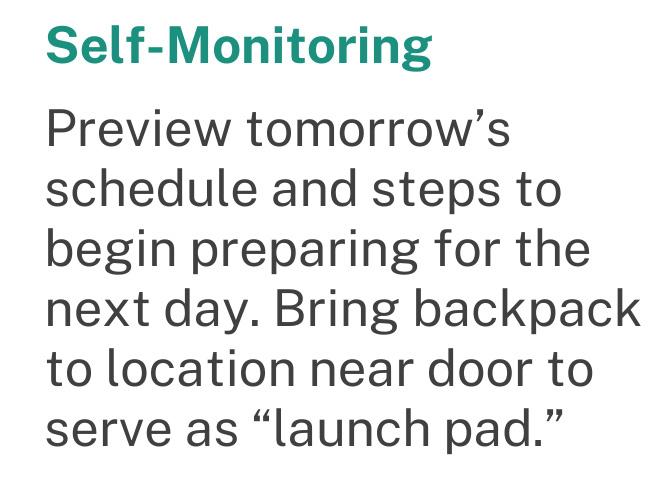

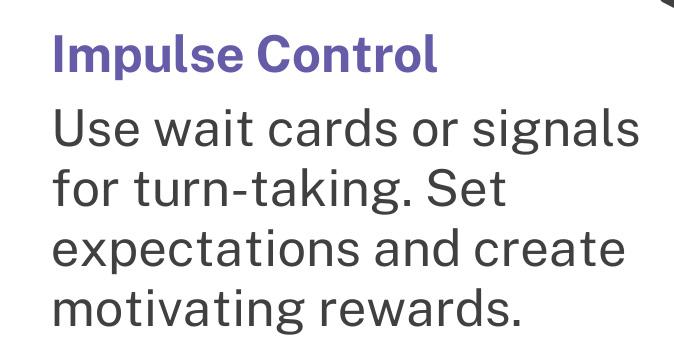
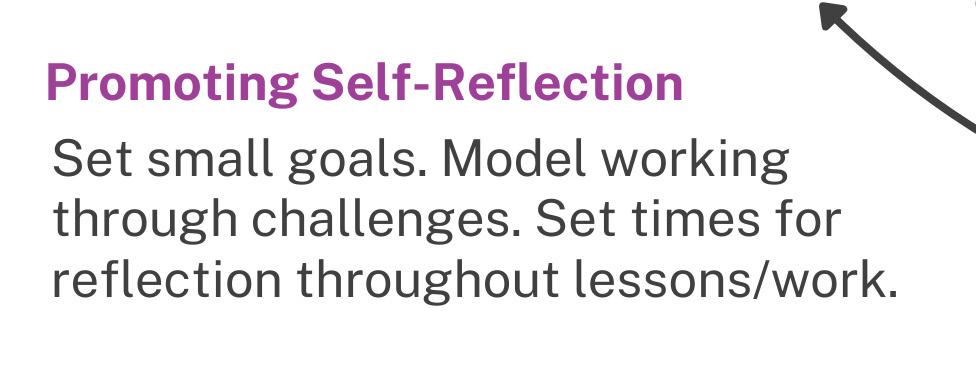
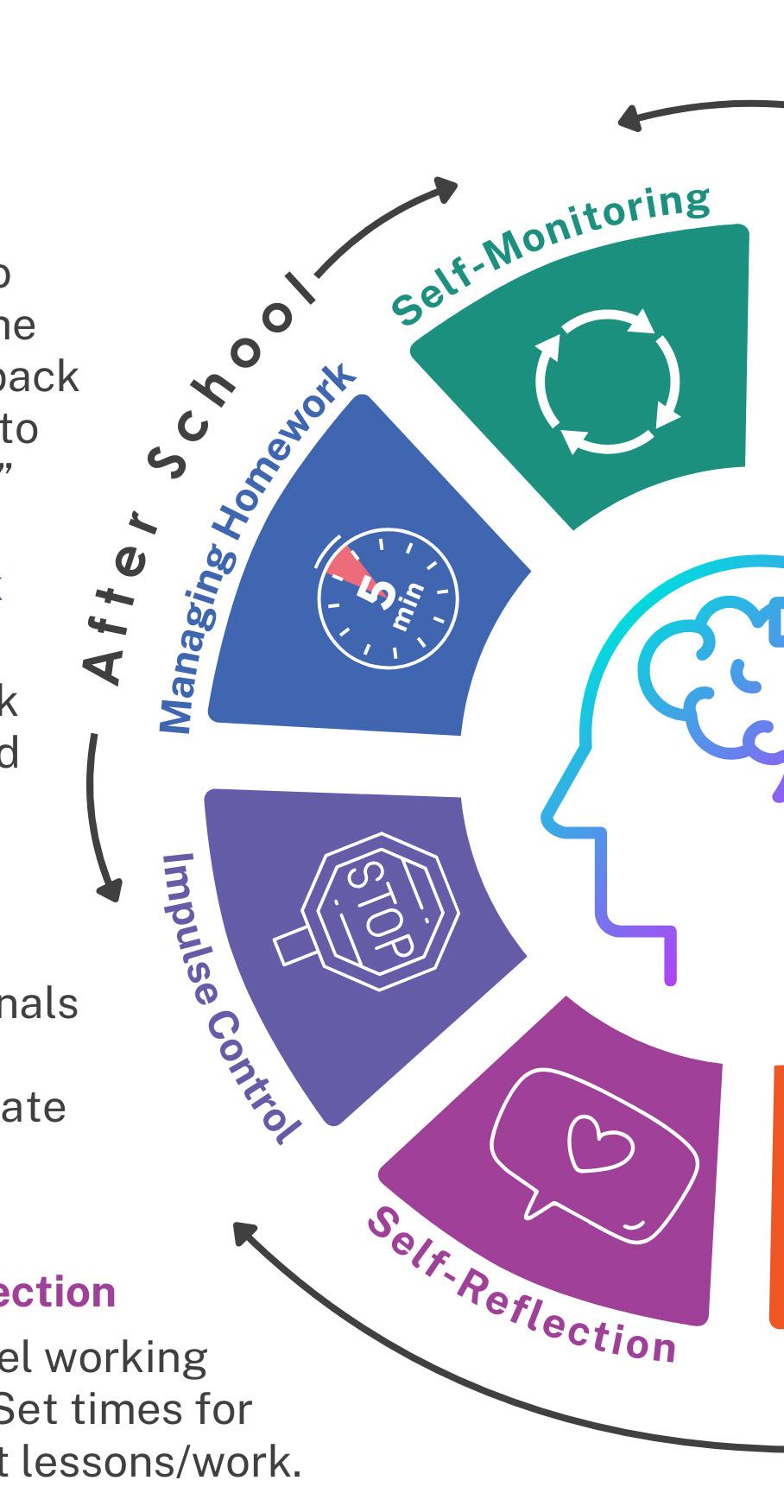
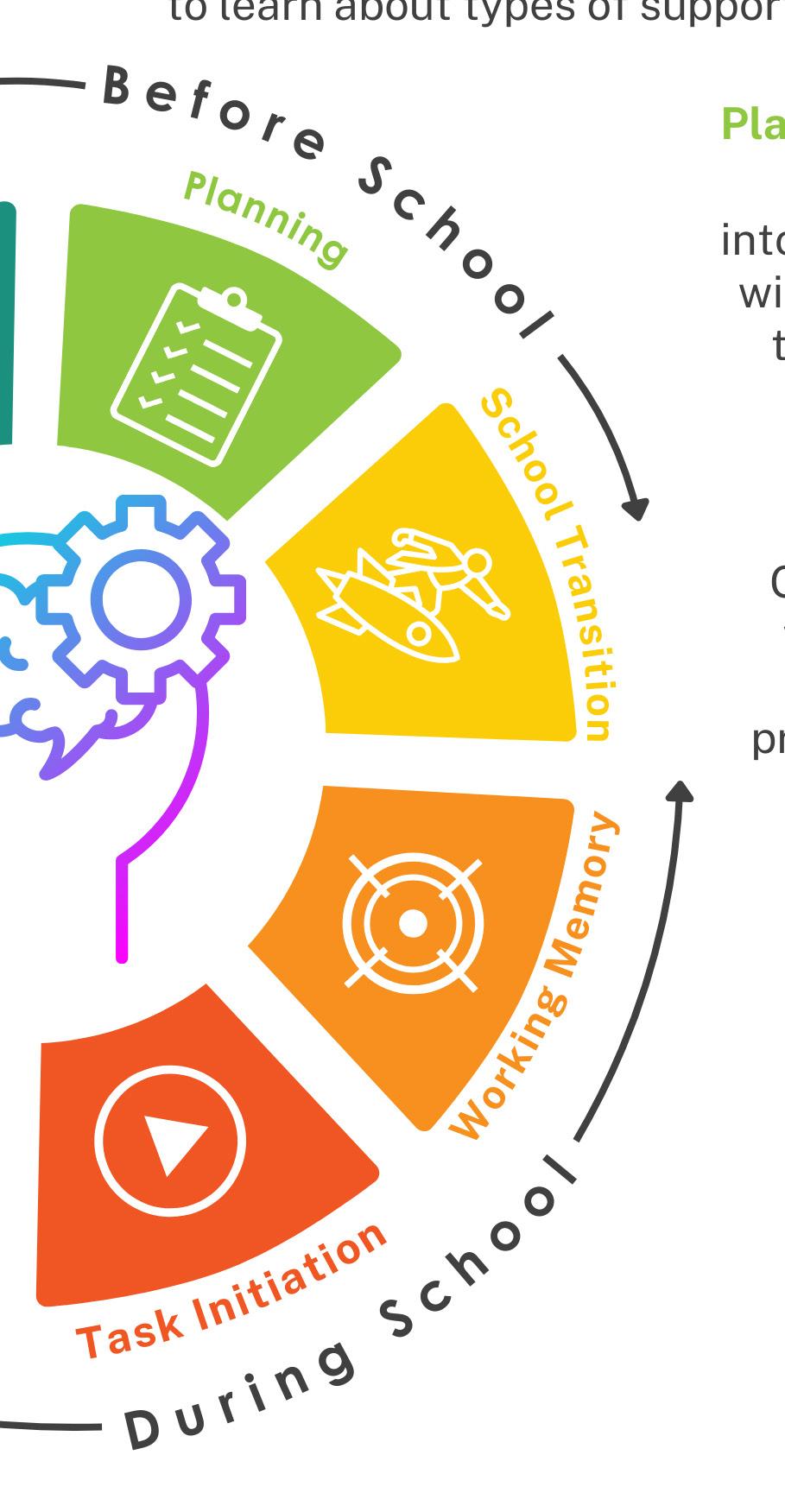
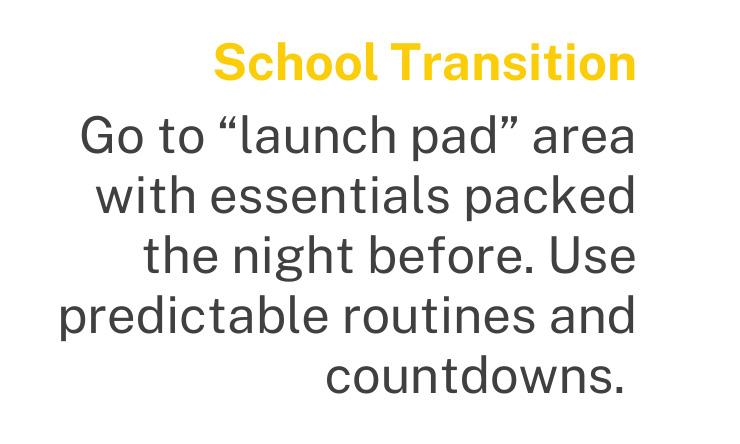
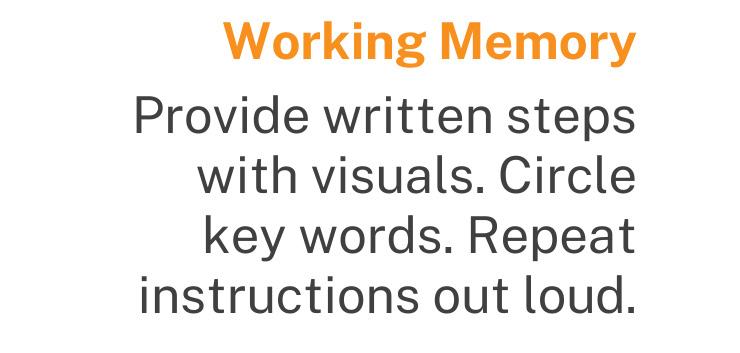
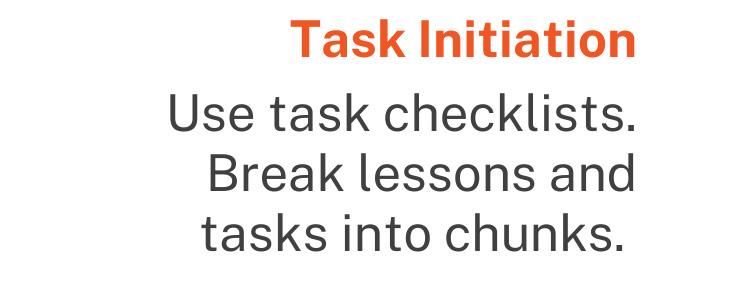
Source: Created by The Windward Institute staff

DAY TO DAY PRACTICAL PARENTING: SEEING CHILDREN THROUGH THE LENS OF EXECUTIVE FUNCTION
By Mark Bertin, MD
Used with permission of New Harbinger Publications, from Mindful Parenting for ADHD: A Guide to Cultivating Calm, Reducing Stress, and Helping Children Thrive, Bertin, 2015; permission conveyed through Copyright Clearance Center, Inc.
Executive function isn’t an esoteric, academic topic. Understanding it helps us to meet children where they are developmentally. Kids with attentiondeficit/hyperactivity disorder (ADHD) don’t want to mess up any more than children with language delays intend to have difficulty with conversation. All children would thrive if only they knew how. Not many kids intentionally fail to hand in a paper they finished the night before or go out of their way to alienate friends. While acknowledging how exhausting and frustrating ADHD is for parents and teachers, we need to seek the reasons for problem behaviors and take practical steps based on what we find.
The following framework, modeled after an outline created by ADHD expert Thomas E. Brown (2006), defines executive function based on six related skill groups:
1 2 3 4 5 6
EMOTION MANAGEMENT
As you’ll see, understanding ADHD in this way allows you to better identify how you can support your child. No child with ADHD has full deficits across all these areas, but almost all have differences in some. Breaking down any task or behavior in light of executive function allows for more targeted solutions, whether at home, at school, or elsewhere. ATTENTION MANAGEMENT ACTION MANAGEMENT TASK MANAGEMENT INFORMATION MANAGEMENT
EFFORT MANAGEMENT
ATTENTION MANAGEMENT
ADHD doesn’t cause an inability to pay attention; rather, it creates difficulty with attention management as a whole. It leads to trouble focusing when demands rise, being overly focused when intensely engaged, and difficulty shifting attention. Here are a few common situations that arise with ADHD:
Hyperfocusing on what seems fun and cognitively effortless. People often assume that children with ADHD selectively choose to pay attention, getting distracted only when disinterested. In reality, they cannot (as opposed to will not) focus when mentally challenged. The ability to endlessly stick with video games or other enjoyable activities, even reading, doesn’t eliminate the possibility of ADHD when a child has difficulty focusing otherwise.
Being challenged by distracting environments. Proper focus allows attention to remain with one element within a crowd, such as one voice among many. In busy situations, kids with ADHD often lose details of what’s said and may shut down, feel overwhelmed, or act out.
Having difficulty transitioning away from activities. If you make a request while a child with ADHD is engrossed in something else, it won’t register. This trait often leads to a perception of bad behavior: I spoke and was ignored. As is often the case with ADHD, the solution lies in an adult’s choices. There’s no point speaking until you have your child’s full attention.
ACTION MANAGEMENT
Action management is the ability to monitor your own physical activity and behavior. Delays in this aspect of executive function lead to symptoms such as fidgeting, hyperactivity, and impulsiveness. Problems with action management also mean it takes longer to learn from mistakes, as doing so requires awareness of the details and consequences of actions. This helps explain why behavioral change is slower for children with ADHD. Selfmonitoring of social behavior is also an aspect of action management.
In addition, deficiencies in this aspect of executive function often cause delayed development of motor abilities, poor coordination, or trouble with handwriting. Children with ADHD may also meet criteria for developmental coordination disorder, in which case occupational therapy can help them catch up.
TASK MANAGEMENT
3 4
Task management calls on various core executive function abilities, including organizing, planning, prioritizing, and monitoring time. If you’re able to manage life easily and instinctually, it may seem unimaginable that your child doesn’t have a sense of what’s happening today or this week, or that she ignores projects until it’s a last-minute crisis. Yet these skills lie on a developmental path directly affected by ADHD, and as children get older, task management (not attention) often becomes the core issue. Unlike some ADHD-related difficulties, task management doesn’t respond robustly to medication. Teaching your child organizational skills is the solution.
INFORMATION MANAGEMENT
Working memory is the capacity to manage the voluminous information we encounter in the world and integrate it with what we know. Like RAM on a computer, the brain temporarily holds information when accessing it and organizing our ideas. These functions underlie skills in conversation, reading, and writing, and therefore directly affect classroom learning.
Working memory holds short-term information that isn’t necessary to memorize, such as a string of requests. So if you send your child off to accomplish several things at once (“Run up to your room, change into your soccer clothes, and put your school clothes in the hamper”), the details scatter in the wind.
Losing track can look like misbehavior when you find your child playing instead of following through, but it actually reflects poor working memory, and perhaps distractibility. However, actual misbehavior can follow if your child scrambles to cover up. But if you give her a written list or a shorter list of verbal instructions, she might do just fine.
5
EMOTION MANAGEMENT
Emotional reactivity is often an inherent part of ADHD. Kids with ADHD may be quick to anger, give up, or get frustrated or upset. This emotionality may come across as oppositional. Everyone gets annoyed at times, but those with ADHD may not have enough of an ability to rein in their emotions, causing them to react immediately when rattled.
This type of reactivity isn’t the same as the random emotional volatility of a mood disorder. And while it may not be apparent on the surface, an outburst may be followed by regret or embarrassment. This can lead to excuses, more anger, or shutting down, escalating the behavioral stakes. This isn’t a second condition tagging along with ADHD; it is ADHD.
EFFORT MANAGEMENT
Executive function underlies the ability to maintain effort until an activity is completed. Difficulties with sustained effort often get labeled as poor motivation. Your child may go upstairs to do homework, and thirty minutes later you find her reading a graphic novel. Because of difficulties with effort management she ran out of steam, but to you it may seem that she doesn’t value her work.
Processing speed can also be a factor in effort management. The ability to work quickly and effectively may be impaired in some kids with ADHD. However, working more slowly is in no way a reflection of their intelligence.
For many kids with ADHD, external pressure may decrease productivity. Instead of the frontal lobes leaping into action, the mental gears lock up. Stress decreases cognitive efficiency, making it harder to solve problems and make choices. This undermines everything from getting out of the house on time to taking tests.
Different children with ADHD have different patterns of executive function deficits. To create an individualized, integrated plan, you need to observe your child, try things out, and readjust as needed. Seeing your child’s ADHD through the lens of executive function difficulties will help you tailor your parenting to your child’s strengths and adapt to her needs.
In this exercise, you’ll explore how difficulties with executive function may be involved in one of your child’s challenges. If you find this approach helpful, you may want to use it for other concerns.
Because this perspective may be new, let’s start with an example.
Behavioral or academic concern: My daughter never gets ready for school without constant reminders and bickering.
Role of attention management: She cannot (as opposed to will not) concentrate. She’s distractible and easily gets off task.
Role of action management: She runs around excessively and impulsively pushes her sister.
Role of task management: She can’t keep track of time or independently plan what she needs to accomplish.
Role of information management: She can’t hold the list of what she needs to do in her mind, even though she knows what she must do.
Role of emotion management: She gets overly upset when redirected from play.
Role of effort management: She can’t sustain attention to complete tasks such as getting dressed without going off and playing.

Now it’s your turn. Write down a behavioral challenge, then examine how each aspect of executive function might play a role. If need be, refer back to the descriptions in this article to guide your understanding. Click or scan this QR code for a downloadable version of this worksheet.
ABOUT THE AUTHOR
Looking at ADHD Through the Lens of Executive Function
Behavioral or academic concern:
Role of attention management:
Role of action management:
Role of task management:
Role of information management:
Role of emotion management:
Role of effort management:

Dr. Mark Bertin, a board certified developmental behavioral pediatrician, is an assistant professor of pediatrics at New York Medical College and an instructor for The Windward Institute. He has served on advisory boards for APSARD (the American Professional Society of ADHD and Related Disorders), ADDitude Magazine, Common Sense Media, and Reach Out and Read. He is a frequent lecturer for parents, teachers, and professionals on topics related to child development, including autistic spectrum disorders, ADHD, parenting, and mindfulness.
Dr. Bertin’s books The Family ADHD Solution, Mindful Parenting for ADHD, Mindfulness and SelfCompassion for Teen ADHD, and How Children Thrive integrate mindfulness into evidencebased pediatric care, and he is a contributing author for the textbook Teaching Mindfulness Skills to Kids and Teens.

HOW AI-ENHANCED TOOLS SCAFFOLD EXECUTIVE FUNCTIONING SKILLS FOR NEURODIVERSE LEARNERS
By Joan McGettigan, EdD, Director of Educational Technology
Walk into any classroom today, and you’ll find students navigating a world saturated with distractions, demanding schedules, and increasingly complex academic expectations. For students with learning disabilities, these pressures are magnified by challenges in executive functioning (EF) skills, a set of mental processes that include planning, working memory, attention, and selfregulation. Educators and parents often recognize the signs: forgotten assignments, difficulty starting tasks, or trouble shifting between activities. These are not just “bad habits”; they are neurodevelopmental realities.
In a world increasingly dominated by distraction and cognitive overload, the ability to focus, plan, and self-regulate is
more than a school skill; it’s a life skill. Executive function difficulties are on the rise, with recent research showing that one in ten young adults now report serious trouble with concentration, memory, or decision-making (Wong et al., 2025). As Wong et al. (2025) note,
Cognitive disability—defined by the Behavioral Risk Factor Surveillance System (BRFSS) as serious difficulty concentrating, remembering, or making decisions because of a physical, mental, or emotional condition—has become the most commonly reported disability among US adults. (p. 1)
This isn’t just a developmental hiccup; it’s a public health concern.
At the same time, the tools to support EF have never been more powerful or accessible. Technology and artificial intelligence (AI), when intentionally integrated, offer not just scaffolds but scalable support systems. They can serve as personalized coaches, helping students—especially those with language-based learning disabilities and ADHD—activate, organize, and follow through. While many tools help track habits or calm the mind, this article will focus on how AI-enhanced learning tools can specifically scaffold activation, effort, focus, and memory for students. Integrating these tools within a Universal Design for Learning (UDL) framework ensures equitable, multimodal support for all learners (CAST, 2022).
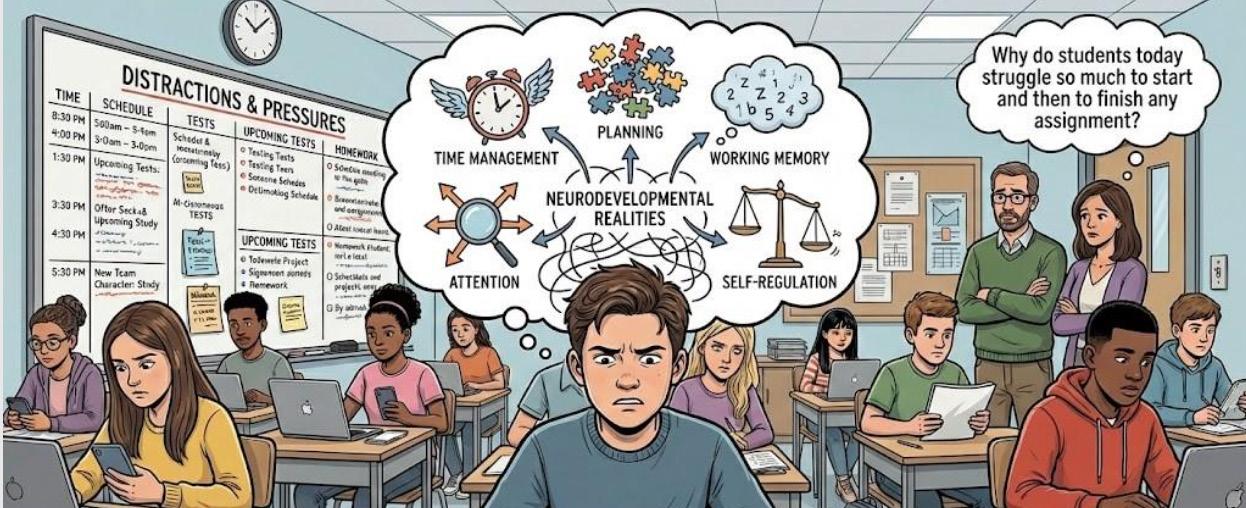
HOW AI AND TECH TOOLS ARE SHIFTING THE LANDSCAPE
The latest AI-powered tools offer features that are uniquely suited to scaffold executive function challenges. A 2023 U.S. Department of Education report noted that, rather than automating instruction, AI “may offer the greatest benefit when used to expand access and support for students with disabilities” (p. 6). Three powerful tools—Google NotebookLM, Snorkl, and SchoolAI Spaces—can transform the learning experience for students with executive function challenges. Each of these tools supports multiple UDL checkpoints, such as providing scaffolds for managing information and resources and facilitating planning and strategy development (CAST, 2022). To illustrate how AI tools can serve as EF coaches in realworld classroom contexts, consider the following student scenarios.
A Multi-Week History Research Project with AI-Supported EF Scaffolds
Eighth grader Mia, who has dyslexia and struggles with task initiation, planning, and organization, is assigned a four-week project on early civilizations. The deliverables include a research paper, annotated bibliography, and a multimedia presentation. Historically, Mia has found it difficult
to break large assignments into manageable parts and often forgets deadlines or loses track of sources.
With guidance from her teacher, Mia activates an AI Gemini chatbot, known as a Gem. As students like Mia manage long-term assignments, research shows that supporting them in chunking and pacing their work is key to developing time management skills (Ayers & Glauber, 2022). On day one, she uploads the full project description into the chatbot and prompts the tool to break the assignment into weekly and daily tasks, including topic selection, research collection, note synthesis, outline creation, rough drafting, revising, and preparing visuals. Each day, the tool
reminds her what to focus on, asks if she finished the prior step, and links to her shared Google Drive folder.
Mia uses Google NotebookLM as her research hub. She uploads teacher-provided readings, her sources, and her own notes. The tool automatically generates a timeline of ancient civilizations, flashcards for key terms like ziggurat and cuneiform, concept maps to visually connect ideas, a video overview, and a helpful podcast overview. NotebookLM’s chat feature allows her to ask clarifying questions about documents and draft summaries based on her notes in real time, enhancing comprehension and metacognitive controls (Iqbal et al., 2025).
AI as Executive Function Coach
To build her essay, annotated bibliography, and multimedia presentation slides, she opens a SchoolAI Space, a scaffolded workspace set up by her teacher where Mia drafts, receives targeted teacher or AI feedback, and obtains helpful guidance every step of the way (without receiving answers). Because Spaces allow her to move through clearly defined zones—Claim, Evidence, Citations, Slide Content—Mia doesn’t feel overwhelmed and always knows what to do next.
Tackling Multi-Step Math
Problems with Snorkl
Some students need more support in other EF domains, such as working memory, metacognition, and selfmonitoring, especially in subjects like math. Elijah is one of them. A sixth grader with executive function deficits, he often struggles with multi-step math problems. He has difficulty remembering formulas, organizing steps, and maintaining stamina across word problems. Despite his intelligence, he frequently shuts down or rushes through assignments to avoid frustration.

Source: Screenshot from SchoolAI Space
For students like Elijah with ADHD, the impact of an adaptive AI tool with immediate feedback is significant. A study using an adaptive learning platform found that students with ADHD stuck with difficult material longer when they received frequent micro-rewards and feedback, versus just final scores at the end. ADHD is often linked to a dopamine reward deficit, so fast feedback is more motivating than delayed rewards. AI that provides instant rewards (like a badge or a progress bar) can help sustain motivation and effort (Warrier, 2025). Hattie and Timperley (2007) note that feedback is one of the most powerful influences on student achievement, especially when it is timely, targeted, and task specific. For Elijah, using Snorkl means he receives that kind of affirming and
helpful feedback with every problem, scaffolded hints when he’s stuck, immediate correction when he errs, and guided prompts to re-think his approach. This instant feedback reduces cognitive load, helps him maintain focus, builds his confidence when he sees progress, and prevents repeated mistakes from becoming entrenched. Intelligent tutoring systems, like those used in Snorkl, have shown strong outcomes in math learning, particularly for students needing step-by-step support (Ma et al., 2014). Over time, these cycles of support and correction reinforce not just math skills but also Elijah’s sense of himself as a capable problemsolver, strengthening both executive function and academic agency.
Preparing for a Ninth-Grade Biology Exam Using Google NotebookLM
Eric, a ninth-grade student with dyslexia and working memory challenges, is preparing for an upcoming biology exam covering cellular structures, photosynthesis, ecology, and genetic inheritance. In previous tests, Eric has found it difficult to manage dense textbook readings and scientific terminology, often becoming overwhelmed by the volume of content and the number of interrelated concepts. His teacher introduced him to Google NotebookLM as a study support tool. Eric uploads his class notes, teachercreated handouts, vocabulary lists, and the relevant chapters from his digital textbook into the platform.
Over the weekend, he engages deeply with the tool. He begins by using its summarization features to create short, manageable explanations of each topic, reducing cognitive load. He
then constructs a concept map within NotebookLM to visualize relationships between ideas, such as how mitochondria are involved in energy production, how chloroplasts relate to photosynthesis, and how dominant and recessive traits are passed down through generations. Eric also uses the platform to build a set of digital flashcards to test his understanding of key vocabulary. To clarify difficult concepts, he uses the Google NotebookLM chat feature to ask questions (e.g., “What is the difference between prokaryotic and eukaryotic cells?”) and receives simplified explanations that reinforce his comprehension. Finally, he generates a printable study guide that organizes timelines, definitions, and concept relationships, allowing him to review both on-screen and on paper.
By alternating between flashcard review, self-testing, and redrawing his concept maps, Eric strengthens his memory and understanding over time. On test day, he feels confident
and calm, having transformed his preparation into a structured and meaningful learning process.
This scenario reflects findings from a growing body of research supporting strategies such as retrieval practice, visual mapping, and cognitive offloading through AI-enhanced tools. Concept mapping, in particular, has been shown to significantly improve science learning and retention by allowing students to visually organize key ideas (Anastasiou et al., 2024). Retrieval practice and spaced repetition, strategies Eric employed using flashcards, are linked to deeper and more durable long-term learning, especially in subjects with high conceptual density like biology (Sana & Yan, 2022). Additionally, digital tools like NotebookLM that provide summarization and study guide generation features can reduce the demands placed on students’ working memory, allowing them to focus more effectively on
READ WATCH
The Windward Institute. (2025, November 21). Unlocking Potential: How AI Supports Neurodiverse Learners at School and Home [Video]. YouTube. comprehension and higher-order thinking (Iqbal, et al., 2025).
As the education landscape continues to evolve, it is essential that schools embrace tools that offer personalized, equitable support to students, especially those with executive function challenges. Generative AI tools are not replacements for skilled educators but rather powerful partners. They help teachers provide timely feedback, scaffold tasks, and model planning strategies that students can internalize. As Wong et al. (2025) note, “Supporting students in building their executive function is not just about improving academic performance—it is about equipping them for life” (p. 9). With thoughtful integration, AI can help make that vision a reality.
Powell, M. (2025, July 22). Embracing AI for neurodiverse students. NAIS Independent Ideas.
U.S. Department of Education, Office of Educational Technology. (2023). Artificial intelligence and the future of teaching and learning: Insights and recommendations. U.S. Department of Education.
Warrier, N. (2025). A review of artificial intelligence–based educational interventions for students with ADHD. The National High School Journal of Science.

LISTEN
Beckerman, P., Clark, R., & Benjamin, W. (Hosts) (2025). The AI-Infused Classroom, with Holly Clark [Audio podcast episode]. In Unpacking Education.
Click or scan this QR code to explore READ, WATCH, LISTEN resources. A final note: This article specifically references Snorkl, SchoolAI, and Google NotebookLM; however, educators have myriad options when selecting the most appropriate AI tools to support their students, and The Windward School does not endorse specific AI platforms or products. Readers may find the included Read/ Watch/Listen resources helpful in evaluating how to implement AI within their learning environments.
WHAT THE INSTITUTE IS READING NOW

Barkley, R. (2012). Executive Functions: What They Are, How They Work, and Why They Evolved. Guilford Press.
Dawson, P., & Guare, R. (2018). Executive Skills in Children and Adolescents: A Practical Guide to Assessment and Intervention. Guilford Press.

Meltzer, L. (Ed.) (2018). Executive Function in Education: From Theory to Practice. Guilford Press.
Meltzer, L. (2010). Promoting Executive Function in the Classroom. Guilford Press.
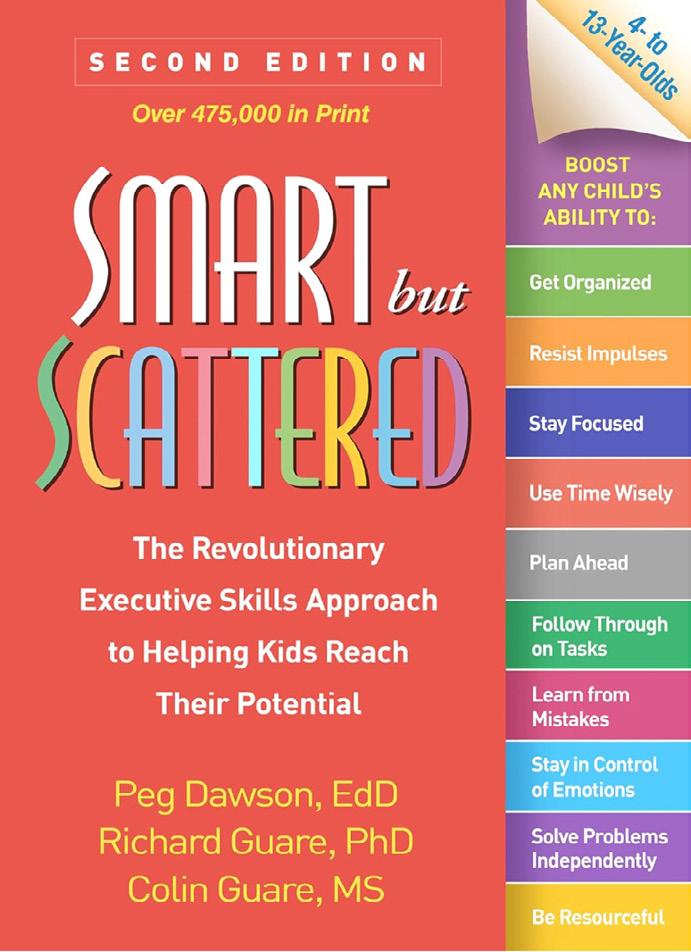
Smart but Scattered: The Revolutionary Executive Skills Approach to Helping Kids Reach Their Potential. Guilford Press.

Gallagher, R., Spira, E., & Rosenblatt, J. (2018). The Organized Child: An Effective Program to Maximize Your Kid’s Potential—in School and in Life. Guilford Press.

Bertin, M. (2018). How Children Thrive: The Practical Science of Raising Independent, Resilient, and Happy Kids. St. Martin’s Essentials.
Gallagher, R., Abikoff, H., & Spira, E. (2014). Organizational Skills Training for Children with ADHD: An Empirically Supported Treatment. Guilford Press.
Dawson, P., Guare, R., & Guare, C. (2024).
5
THE BRAIN’S CEO: EXECUTIVE FUNCTION’S ROLE IN LEARNING
Best, J. R., Miller, P. H., & Naglieri, J. A. (2011). Relations between executive function and academic achievement from ages 5 to 17 in a large, representative national sample. Learning and Individual Differences, 21(4), 327–336. https://doi.org/10.1016/j.lindif.2011.01.007
Blair, C. (2010). Stress and the development of self-regulation in context. Child Development Perspectives, 4(3), 181–188. https://doi.org/10.1111/j.1750-8606.2010.00145.x
Blair, C., & Diamond, A. (2008). Biological processes in prevention and intervention: The promotion of self-regulation as a means of preventing school failure. Development and Psychopathology, 20 (3), 899–911. https://doi.org/10.1017/S0954579408000436
Cumming, M. M., Poling, D. V., Patwardhan, I., & Ozenbaugh, I. C. (2022). Executive function in kindergarten and the development of behavioral competence: The moderating role of positive parenting practices. Early Childhood Research Quarterly, 60, 161–172. https://doi.org/10.1016/j.ecresq.2022.01.008
Damasio, A. (1994). Descartes’ error: Emotion, reason, and the human brain. Penguin Books.
Diamond, A., Barnett, W. S., Thomas, J., & Munro, S. (2007). Preschool program improves cognitive control. Science, 318 (5855), 1387–1388. https://doi.org/10.1126/science.1151148
Durston, S., Davidson, M. C., Tottenham, N., Galvan, A., Spicer, J., Fossella, J., & Casey, B. J. (2006). A shift from diffuse to focal cortical activity with development. Developmental Science, 9 (1), 1–8. https://doi.org/10.1111/j.1467-7687.2005.00454.x
Felver, J. C., Tipsord, J. M., Morris, M. J., Racer, K. H., & Dishion, T. J. (2017). The effects of mindfulness-based interventions on attention and executive functioning in students: A systematic review. Journal of School Psychology, 65, 27–45. https://doi.org/10.1177/1087054714548032
Gogtay, N., Giedd, J. N., Lusk, L., Hayashi, K. M., Greenstein, D., Vaituzis, A. C., Nugent, T. F., Herman, D. H., Clasen, L. S., Toga, A. W., & Thompson, P. M. (2004). Dynamic mapping of human cortical development during childhood through early adulthood. Proceedings of the National Academy of Sciences, 101(21), 8174–8179. https://doi.org/10.1073/pnas.0402680101
Masten, A. S., & Tellegen, A. (2012). Resilience in developmental psychopathology: contributions of the Project Competence Longitudinal Study. Development and Psychopathology, 24(2), 345–361. https://pubmed.ncbi.nlm.nih.gov/22559118/
McClelland, M. M., Cameron, C. E., Connor, C. M., Farris, C. L., Jewkes, A. M., & Morrison, F. J. (2007). Links between behavioral regulation and preschoolers’ literacy, vocabulary, and math skills. Developmental Psychology, 43(4), 947–959. https://doi.org/10.1037/0012-1649.43.4.947
Melby-Lervåg, M., & Hulme, C. (2013). Is working memory training effective? A meta-analytic review. Developmental Psychology, 49 (2), 270–291. https://doi.org/10.1037/a0028228
Meltzer, L. (2018). Promoting strategic learning and executive function in students with learning disabilities: The SMARTS program. In L. Meltzer (Ed.), Executive Function in Education: From Theory to Practice (2nd ed., pp. 256–270). Guilford Press.
Menon, V., & D’Esposito, M. (2022). The role of PFC networks in cognitive control and executive function. Neuropsychopharmacology: Official Publication of the American College of Neuropsychopharmacology, 47(1), 90–103. https://doi.org/10.1038/s41386-021-01152-w
Mischel, W., Ebbesen, E. B., & Raskoff Zeiss, A. (1972). Cognitive and attentional mechanisms in delay of gratification. Journal of Personality and Social Psychology, 21(2), 204–218. https://doi.org/10.1037/h0032198
Mischel, W., Shoda, Y., & Rodriguez, M. L. (1989). Delay of gratification in children. Science, 244(4907), 933–938. https://doi.org/10.1126/science.2658056
Moffitt, T. E., Arseneault, L., Belsky, D., Dickson, N., Hancox, R. J., Harrington, H., Houts, R., Poulton, R., Roberts, B. W., Ross, S., Sears, M. R., Thomson, W. M., & Caspi, A. (2011). A gradient of childhood self-control predicts health, wealth, and public safety. Proceedings of the National Academy of Sciences, 108 (7), 2693–2698. https://doi.org/10.1073/pnas.1010076108
Munakata, Y., & Michaelson, L. E. (2021). Executive Functions in Social Context: Implications for Conceptualizing, Measuring, and Supporting Developmental Trajectories. Annual review of developmental psychology, 3(1), 139–163. https://doi.org/10.1146/annurev-devpsych-121318-085005
Noble, K. G., Norman, M. F., & Farah, M. J. (2005). Neurocognitive correlates of socioeconomic status in kindergarten children. Developmental Science, 8 (1), 74–87. https://doi.org/10.1111/j.1467-7687.2005.00394.x
Sala, G., & Gobet, F. (2020). Working memory training in typically developing children: A multilevel meta-analysis. Psychonomic Bulletin & Review, 27(3), 423–434. https://doi.org/10.3758/s13423-019-01681-y
Tang, Y.-Y., Yang, L., Leve, L. D., & Harold, G. T. (2012). Improving executive function and its neurobiological mechanisms through a mindfulness-based intervention: Advances within the field of developmental neuroscience. Child Development Perspectives, 6(4), 361–366. https://doi.org/10.1111/j.1750-8606.2012.00250.x
Wang, X., & Feng, T. (2024). Does executive function affect children’s peer relationships more than emotion understanding? A longitudinal study based on latent growth model. Early Childhood Research Quarterly, 66, 211–223. https://doi.org/10.1016/j.ecresq.2023.10.010
Zelazo, P. D., & Carlson, S. M. (2012). Hot and cool executive function in childhood and adolescence: Development and plasticity. Child Development Perspectives, 6(4), 354–360. https://doi.org/10.1111/j.1750-8606.2012.00246.x
Zelazo, P. D., Carlson, S. M., & Kesek, A. (2008). The development of executive function in childhood. In C. A. Nelson & M. Luciana (Eds.), Handbook of Developmental Cognitive Neuroscience (2nd ed., pp. 553–574). MIT Press.
SUPPORTING EF IN CHILDREN: A PATH TO INDEPENDENCE
Barkley, R.A. (2011). The Important Role of Executive Functioning and Self-Regulation in ADHD [Fact Sheet]. https://www.russellbarkley.org/factsheets/ADHD_EF_and_SR.pdf
Center on the Developing Child, Harvard University. (2012). A Guide to Executive Function. https://developingchild.harvard.edu/guide/a-guide-to-executive-function/.
Dawson, P., & Guare, R. (2009). Smart but Scattered. Guilford Press.
Diamond, A. (2013). Executive functions. Annual Review of Psychology, 64, 135–168. https://doi.org/10.1146/annurev-psych-113011-143750
Dweck, C. S. (2006). Mindset: The new psychology of success. Random House.
Faith, L., Bush, C., & Dawson, P. (2022). Executive skills in the classroom: Overcoming barriers, building strategies. Guilford Press.
Jones, D. T., & Graff-Radford, J. (2021). Executive dysfunction and the prefrontal cortex. Continuum: Lifelong Learning in Neurology, 27(6), 1586–1601. https://doi.org/10.1212/CON.0000000000001009
McCloskey, G. (2025, August 4–8). Intervention for child and adolescent executive function difficulties [Workshop]. Cape Cod Institute, Orleans, MA, United States.
Zelazo, P. D. (2020). Executive function and psychopathology: A neurodevelopmental perspective. Annual Review of Clinical Psychology, 16, 431–454. https://doi.org/10.1146/annurev-clinpsy-072319-024242
Zelazo, P. D., Blair, C. B., & Willoughby, M. T. (2016). Executive function: Implications for education. National Center for Education Research, Institute of Education Sciences, U.S. Department of Education. https://ies.ed.gov/ncer/2025/01/executive-function-implications-education
IN CONCERT: EXECUTIVE FUNCTION AND READING
Burgess, A. N., & Cutting, L. E. (2023). The behavioral and neurobiological relationships between executive function and reading: A review and preliminary findings. Mind, Brain, and Education, 17(4), 267–278. https://doi.org/10.1111/mbe.12378.
Butterfuss, R., & Kendeou, P. (2018). The role of executive functions in reading comprehension. Educational Psychology Review, 30 (3), 801–826. https://doi.org/10.1007/s10648-017-9422-6
Cartwright, K. B., & Palian, S. (2024). Considering roles of executive functions in the science of reading: A meta-analysis highlighting promises and challenges of reading-specific executive functions. Educational Psychologist, 59 (4), 263–290. https://doi.org/10.1080/00461520.2024.2418392
Cirino, P. T., Miciak, J., Ahmed, Y., Barnes, M. A., Taylor, W. P., & Gerst, E. H. (2019). Executive function: Association with multiple reading skills. Reading and Writing, 32(7), 1819–1846. https://doi.org/10.1007/s11145-018-9923-9
Cutting, L. E., Materek, A., Cole, C. A., Levine, T. M., & Mahone, E. M. (2009). Effects of fluency, oral language, and executive function on reading comprehension performance. Annals of Dyslexia, 59 (1), 34–54. https://doi.org/10.1007/s11881-009-0022-0
Duke, N. K., & Cartwright, K. B. (2021). The science of reading progresses: Communicating advances beyond the simple view of reading. Reading Research Quarterly, 56(S1), S25–S44. https://doi.org/10.1002/rrq.411
Follmer, D. J., & Tise, J. (2022). Effects of an executive function-based text support on strategy use and comprehension–integration of conflicting informational texts. Reading and Writing, 35, 1731–1758. https://doi.org/10.1007/s11145-022-10257-7
Gough, P. B., & Tunmer, W. E. (1986). Decoding, reading, and reading disability. Remedial and Special Education, 7(1), 6–10. https://doi.org/10.1177/074193258600700104
Haft, S. L., Caballero, J. N., Tanaka, H., Zekelman, L., Cutting, L. E., Uchikoshi, Y., & Hoeft, F. (2019). Direct and indirect contributions of executive function to word decoding and reading comprehension in kindergarten. Learning and Individual Differences, 76, 101783. https://doi.org/10.1016/j.lindif.2019.101783
Locascio, G., Mahone, E. M., Eason, S. H., & Cutting, L. E. (2010). Executive dysfunction among children with reading comprehension deficits. Journal of Learning Disabilities, 43(5), 441–454. https://doi.org/10.1177/0022219409355476
Margolis, A., & Liu, R. (2023). Anxiety, executive functions, and reading disorder: A neurobiological view. In A. Margolis & J. Broitman (Eds.), Learning disorders across the lifespan: A mental health framework (pp. 17–24). Springer.
Meltzer, L. (2018). Creating strategic classrooms and schools: Embedding executive function strategies in the curriculum. In L. Meltzer (Ed.), Executive Function in Education: From Theory to Practice (2nd ed., pp. 263–299). Guilford Press.
Ruffini, C., Pizzigallo, E., Pecini, C., Bertolo, L., & Carretti, B. (2025). Integrating executive function activities into a computerized cognitive training to enhance reading comprehension in primary students. Reading Research Quarterly, 60, e70006. https://doi.org/10.1002/rrq.70006
Sesma, H. W., Mahone, E. M., Levine, T., Eason, S. H., & Cutting, L. E. (2009). The contribution of executive skills to reading comprehension. Child Neuropsychology, 15(3), 232–246. https://doi.org/10.1080/09297040802220029
THE MISSING LINK IN MATH ACHIEVEMENT: HOW EXECUTIVE FUNCTION SHAPES STUDENTS’ PATH TO FLUENCY AND UNDERSTANDING
Barbieri, C. A., Miller-Cotto, D., Clerjuste, S. N., & Chawla, K. (2023). A meta-analysis of the worked examples effect on mathematics performance. Educational Psychology Review, 35(1), Article 11. https://doi.org/10.1007/s10648-023-09745-1
Codding, R., Burns, M., & Lukito, G. (2010). Meta-analysis of mathematics basic-fact fluency interventions: A component analysis. Learning Disabilities Research & Practice, 25(1), 36–47. https://doi.org/10.1111/j.1540-5826.2010.00323.x
Diamond, A. (2013). Executive functions. Annual Review of Psychology, 64, 135–168. https://doi.org/10.1146/annurev-psych-113011-143750
Fuchs, L.S., Newman-Gonchar, R., Schumacher, R., Dougherty, B., Bucka, N., Karp, K.S., Woodward, J., Clarke, B., Jordan, N. C., Gersten, R., Jayanthi, M., Keating, B., and Morgan, S. (2021). Assisting Students Struggling with Mathematics: Intervention in the Elementary Grades (WWC 2021006). Washington, DC: National Center for Education Evaluation and Regional Assistance (NCEE), Institute of Education Sciences, U.S. Department of Education. https://ies.ed.gov/ncee/wwc/Docs/PracticeGuide/ WWC2021006-Math-PG.pdf
Hwang, J., Riccomini, P. J., Hwang, S. Y., & Morano, S. (2019). A systematic analysis of experimental studies targeting fractions for students with mathematics difficulties. Learning Disabilities Research & Practice, 34(1), 47–61. https://doi.org/10.1111/ldrp.12187
Karmiloff-Smith, A. (1992). Beyond modularity: A developmental perspective on cognitive science. MIT Press.
Powell, S. R., Barnes, M. A., Root, J., Hughes, E. M., Ketterlin-Geller, L., & Nelson, G. (2025). The NCTM/CEC position statement on teaching mathematics to students with disabilities: What’s in it and what’s not. Research in Special Education, 2 https://doi.org/10.25894/rise.2796
Rohrer, D., Dedrick, R. F., & Stershic, S. (2015). Interleaved practice improves mathematics learning. Journal of Educational Psychology, 107(3), 900–908. https://doi.org/10.1037/edu0000001
Witzel, B. S., Myers, J., Root, J., Riccomini, P. J., & Mims, P. (2023). Research should focus on improving mathematics proficiency for students with disabilities. The Journal of Special Education, 57(4), 240–247. https://doi.org/10.1177/00224669231168373
A SOMETIMES INVISIBLE FRAMEWORK: HOW EXECUTIVE FUNCTION SHAPES SOCIAL AND EMOTIONAL GROWTH
Barkley, R. A. (2017). Executive functioning, self-regulation and ADHD: Impact on understanding and treatment [Conference handout]. Virginia Commonwealth University Medical Center.
Bertin, M. (2021). Mindfulness and self-compassion for teen ADHD: Build executive functioning skills, increase motivation, and improve self-confidence. New Harbinger Publications.
Brackett, M. (2019). Permission to feel. Celadon Books.
Child Mind Institute. (n.d.). ADHD and executive function. https://childmind.org/article/adhd-and-executive-function/
Kaltwasser, L., Hildebrandt, A., Wilhelm, O., & Sommer, W. (2017). On the relationship of emotional abilities and prosocial behavior. Evolution and Human Behavior, 38 (3), 298–308. https://doi.org/10.1016/j.evolhumbehav.2016.10.011
Meltzer, L. (Ed.). (2018). Executive function in education: From theory to practice. Guilford Press.
Meltzer, L. (2010). Promoting executive function in the classroom. Guilford Press.
Willcutt, E. G., & Pennington, B. F. (2000). Comorbidity of reading disability and attention-deficit/hyperactivity disorder: Differences by gender and subtype. Journal of Learning Disabilities, 33(2), 179–191. https://doi.org/10.1177/002221940003300206
73
HOW AI-ENHANCED TOOLS SCAFFOLD EXECUTIVE FUNCTIONING SKILLS FOR NEURODIVERSE LEARNERS
Anastasiou, D., Wirngo, C. N., & Bagos, P. (2024). The effectiveness of concept maps on students’ achievement in science: A meta-analysis. Educational Psychology Review, 36, Article 39. https://doi.org/10.1007/s10648-024-09877-y
Ayers, A., & Glauber, A. (2022). Teaching time management skills. Edutopia. https://www.edutopia.org/article/teaching-time-management-skills
Bickerstaff, A. (2025, November 15). AI and supporting students with disabilities [Webinar]. AI for Education. https://www.aiforeducation.io/ai-and-supporting-students-with-disabilities-webinar
Brown, T. E. (2013). A new understanding of ADHD in children and adults: Executive function impairments. Routledge.
Brown, T. E. (2005). Attention deficit disorder: The unfocused mind in children and adults. Yale University Press.
CAST. (2022). Universal Design for Learning guidelines version 3.0. https://udlguidelines.cast.org
Hattie, J., & Timperley, H. (2007). The power of feedback. Review of Educational Research, 77(1), 81–112. https://doi.org/10.3102/003465430298487
Iqbal, J., Hashmi, Z. F., Asghar, M. Z., & Abid, M. N. (2025). Generative AI tool use enhances academic achievement in sustainable education through shared metacognition and cognitive offloading among preservice teachers. Scientific Reports, 15(1), 16610. https://doi.org/10.1038/s41598-025-01676-x
EDITORIAL BOARD
Jamie Williamson, EdS
Head of School and Executive
Director of The Windward Institute
Alexis Pochna, EdM
Associate Head of School for Academic Programs
JP Bifone
Director of Marketing and Communications
Jana Cook
Associate Director of Marketing and Communications
INSTITUTE STAFF
Betsy Duffy, MSEd
Sonya Giacobbe
Alison Leveque, PhD
Julie Parelli
Harri Ramkishun
ADVISORY BOARD TO THE WINDWARD INSTITUTE
Dave Anderson, PhD
Robert Carroll, JD
Philip Capin, PhD
Lori Holt, PhD
Fumiko Hoeft, MD, PhD
Tiffany Hogan, PhD, CCC-SLP
Lakeisha Johnson, PhD
Mission
CONTRIBUTORS
Dave Anderson, PhD
Mark Bertin, MD
Jackie Britt-Friedman, PsyD
Amy Margolis, PhD
Joan McGettigan, EdD
Alexis Pochna, EdM
Paul Riccomini, PhD
Jonathan Rosenshine, MEd
Anna Weiser, PsyD
Jamie Williamson, EdS
EDITOR
Jana Cook
ILLUSTRATIONS
Chris George Maggie Hubbard
DESIGN
hgDesign, NYC
Devin Kearns, PhD
Nicole Landi, PhD
Amy Margolis, PhD
Tim Odegard, PhD
Yaacov Petscher, PhD
Paul Riccomini, PhD
Meghan Tomb, PhD
Maryanne Wolf, EdD
To increase childhood literacy rates by disrupting the educational status quo to save more lives
1275 Mamaroneck Avenue
White Plains, NY 10605
RETURN SERVICE REQUESTED
Free screenings on reading and language skills to students in grades k-3
Available in both English and Spanish
Families learn about their child’s reading skill development, areas of need, and considerations for school and home


The Windward Institute is committed to translating the most current research into practice in the classroom, to fulfill its mission of disrupting the educational status quo and advancing literacy outcomes for all.
Opt in to receive The Beacon in digital or print formats, subscribe to the READ Podcast, stay up-to-date with happenings around the Institute via its monthly newsletter, and more.