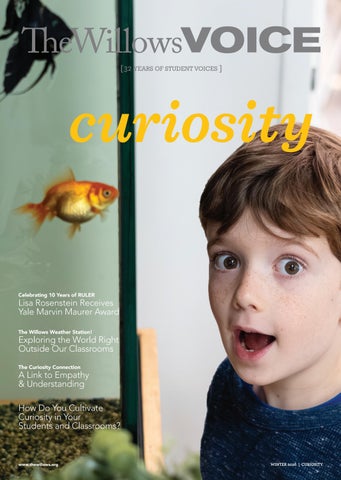
The Willows Weather Station! Exploring the World Right Outside Our Classrooms
The Curiosity Connection A Link to Empathy & Understanding
How Do You Cultivate Curiosity in Your Students and Classrooms?
MESSAGE FROM LISA ROSENSTEIN, HEAD OF SCHOOL
Curiosity is a Powerful Tool
Ilove to walk out on our yard and see students exploring the sand and water, examining a plant in our garden, or checking today’s temperature at the weather station. Our youngest students are curious about everything. Our job is to keep that curiosity and joy in learning alive and growing!
“Curiouser and curiouser!” exclaims Alice in Lewis Carroll’s Alice’s Adventures in Wonderland.
That is how we want our students to learn and grow keeping wonder and curiosity alive as they move through The Willows and beyond. Life is an adventure in learning. We ask them to explore, engage, and to ask “how” and “why.” We are planting the seeds of personal development and lifelong learning.
“I have no special talents. I am only passionately curious.”
Albert Einstein Scientist
We promote curiosity by establishing a classroom and campus that encourages being curious. The openness of our campus is intentionally designed to support curiosity and conversation, and to lead to collaboration. Our teachers actively model curiosity by showing enthusiasm for what they are teaching. They give our students time to explore, ask open-ended questions, and focus on establishing an environment of respect ensuring students feel safe to take risks and dream. Our faculty is encouraged to take time and listen to students and use emergent curricular opportunities that resonate with their students and keep engaged learning moving forward.
Curiosity also fuels a growth mindset in which students don't limit themselves. This year, we focused on the positive aspect of STRUGGLE, our school-wide theme. Curiosity and inquiry helps students grapple and persevere with a struggle so they grow and progress.
Opportunities for continuing the excitement of learning are provided for our faculty, parents, families, and community. Our families and students are curious about each other, so we offer opportunities to discover more about each other’s culture and heritage which leads to greater understanding and empathy.
Every day is an occasion to explore, question, and discover together. Whether in classrooms, maker spaces, or art studios, Willows students spend their time engaged in hands-on learning and cooperation to build their interest in the world around them. Curiosity places our students in the driver’s seat for their personal education. It develops a growth not static mindset, promotes connections, and leads naturally to empathy and joy in the world around them.
Learning is an adventure. Curiosity is a powerful tool.
Lisa Rosenstein Head of School
The Willows Community School
Curiosity is a Key to Learning
At The Willows, we embrace curiosity. Asking a question is encouraged and celebrated. Curiosity leads to understanding and fosters critical thinking. We promote curiosity by allowing questions and teaching that there is no wrong question. Being unsure is okay and can lead to discovery. Our teachers ask open-ended questions, suggesting questions when one is not being raised in the classroom. They also allow free play and wonder, assisting students to find their passions.
Is curiosity a skill that can be developed? We set the tone educationally for doing just that.
Giving children the opportunity to be curious and explore their environment is important for their development and well-being. Curious children are more likely to learn and retain information and stay involved and do better in school.”
(8 tips to develop children’s curiosity, Melanie Busch, Mayo Clinic Health System, May 2020)
In the Greater Good Magazine from the Greater Good Science Center, Kira M. Newman defines The Three Styles of Curiosity based on studies of classical texts, history, and philosophy as:
The busybody: The archetypal gossiper, busybodies, like to pick up bits of information about a wide range of topics. They aren’t necessarily driven by a particular goal, but just by interest.
The hunter: Hunters seek out specific answers, so they follow a targeted path and try to avoid distractions.
The dancer: Dancers leap to new ideas, put existing ideas together in new ways, or find new ways of framing information. They don’t follow a traditional path.
Newman also states that personality psychologists describe other types as:
The Fascinated: who have many interests.
The Problem-Solvers: curiosity is focused on a particular area.
The Empathizer: very socially curious. These styles are not mutually exclusive but can overlap. (February 18, 2025).
All children most likely fit one of these profiles. So, naturally, a wide range of interests need to be nurtured by educational programs and teachers. Any type of curiosity can inspire students to think, discover, and inquire.
Educator Alfie Kohn writes “Curiosity is valuable in its own right—and not just for children. It’s a passport to a richer, more fulfilling life.”
(Alfie Kohn, All Learning, No Questioning: How Schools Smother Curiosity, 2024 Education Week)
Developing curiosity, eagerness, and wonder are essential as a foundation for lifelong learning. This type of educational approach prepares our students to be the solvers of complex problems and future leaders of the world.
In October 2025, The Willows celebrated 10 years of our partnership with the Yale Center of Emotional Intelligence and our adoption of RULER, the systemic approach to social emotional learning. The event featured daylong activities. We hosted educators from the Los Angeles area for a RULER Roundtable with Dr. Marc Brackett, Founding Director, Yale Center for Emotional Intelligence, Co-Creator of the RULER approach; Dr. Robin Stern, Co-Founder and Senior Advisor; and The Willows RULER team led by Lily Davis, Willows Director of Programming. The Roundtable offered an opportunity to discuss and share new techniques to implement the RULER approach into curriculum and classrooms.
The evening event featured Dr. Brackett who shared research from his new book, Dealing With Feeling, and offered best practices for identifying our emotions and regulating them in healthy ways.
Lisa Receives the 2025 Yale Center for Emotional Intelligence Marvin Maurer Award
Congratulations to our Founding Head of School Lisa Rosenstein for receiving the prestigious Yale University Center for Emotional Intelligence 2025 National Marvin Maurer Award. The award recognizes an outstanding educator who has made a significant difference in children’s lives and leadership in embedding emotional intelligence into the fabric of a school, district, or community and who is committed to using the power of emotions to create a healthier and more equitable, innovative, and compassionate society. With this award, Lisa was distinguished among hundreds of thousands of RULER educators across 27 countries.
“On behalf of our Board of Trustees and The Willows community, we congratulate Lisa on this tremendous honor, which is a reflection of her steadfast dedication to every facet of our school and community life,” states Co-Chair of The Willows Board of Trustees Zack Faigen. “The Marvin Maurer Award is a fitting recognition of Lisa's leadership and her contributions for more than a decade to promoting student and family wellbeing and pushing forward the important social emotional learning that happens at our school and at schools across the West Coast.”
“I share this award with my dedicated faculty, administration, and staff for their efforts in seamlessly and creatively integrating social emotional learning into our classrooms and daily school life,” says Lisa Rosenstein. “We have had many opportunities to share RULER with our colleagues and continue to embrace those experiences. Community is an intentional part of our name, and one of the ways we reflect that culture is by forwarding the impact of social emotional learning.”
As we celebrate a new decade of our partnership with Yale and as a 2026 RULER Spotlight School, we continue to deepen our integration of RULER into the daily life and culture of our school and build our relationships with our fellow RULER schools and Los Angeles colleagues. Willows Director of Programming Lily Davis and Media Literacy Coordinator and Middle School Teacher Brian Tousey presented Beyond the Headlines: Using RULER to Foster Emotionally Intelligent Media Consumers at a Los Encinos School faculty in-service day. Lily and Brian first presented this workshop at the Yale Center for Emotional Intelligence 2005 Implementation Conference. Using analysis, the workshop explores media literacy concepts, promotes digital citizenship, distinguishes between truth and disinformation, with the goal of creating safe, emotionally intelligent digital citizens.
The goal of our Media Literacy program is to guide our students and others to better understand bias and become able to determine credibility, so they are active participants and not passive consumers. Plans are underway to continue to share this workshop which offers insights on how we can help students recognize and manage their responses to online environments with our colleagues.
Creating Readers in a Digital World
An Interview with Kate Rao, Director of Library Services
Kate Rao, Willows Director of Library Services, is currently the president of Southern California Librarians of Independent Schools (SoCaLIS,) and writes book reviews and articles for School Library Journal. She holds a master’s in education from Alliant University, an MLS in Library and Information Sciences from Dominican University, and a BS in Economics from the University of Illinois, Chicago.
What is your vision of the library?
My vision of the library is a place where every child can find books that really speak to them— books that make them laugh, pull them to the edge of their seat, make them question the world, or dive deeply into something they’re curious about. That only happens when you truly know the kids. I spend a lot of time learning what each child loves, what excites them, and what keeps them reading, and then I build the collection around that. The goal is for every student to feel like there are books in the library just for them, no matter their interests or reading level.
How do you inspire young readers?
I focus on access, choice, and excitement. Kids are more inspired to read when books are easy to find, available in multiple formats, and feel relevant to their lives. That means having popular titles ready when kids want them, creating inviting displays, and letting students choose what they read. When reading feels fun and personal instead of assigned, kids naturally want to keep going.
Do you use curiosity to inspire children to read?
Absolutely. Curiosity is one of the strongest motivators for reading. I encourage kids to wonder, ask questions, and follow their interests—whether that’s through fiction that sparks imagination or nonfiction that lets them explore a topic they’re obsessed with. When children are curious, reading becomes a tool for discovering answers instead of a task they have to complete.
How do you help children choose books?
I help children choose books by listening first. I ask what they like, what they’ve enjoyed before, and what they’re curious about right now. From there, I guide them toward books that match their interests while still supporting their growth as readers. Choice is important, because when kids feel ownership over what they read, they’re much more likely to stick with it and see themselves as readers.
Can being curious help start readers?
Yes, especially for beginning readers. Curiosity keeps kids engaged long enough to build early skills like decoding and comprehension. When children want to know what happens next or are excited to learn about something, they’re more willing to practice reading—even when it feels challenging.
How does reading as a family help young children?
Reading as a family supports so much more than literacy. It builds vocabulary, comprehension, and attention span, but it also strengthens family connections and supports social-emotional growth. Reading together gives children a safe space to talk about feelings, experiences, and ideas, while also building strong foundations for academic success.
How can parents support young readers and build their curiosity?
Parents can support young readers by reading regularly, talking about books, asking questions, and modeling curiosity themselves. Keeping books visible at home, setting aside device-free reading time, and allowing kids to read a wide range of materials all help. The most important thing is showing children that reading matters and that their interests are valued.
Does reading help academic performance?
Yes. Reading supports vocabulary development, comprehension, background knowledge, and attention—all of which play a big role in academic success across subjects. Kids who are read to at home and who read regularly tend to have stronger long-term outcomes in school.
Any hints to make reading a top priority for both adults and children?
Make reading part of the routine and part of everyday life. Read your own books where kids can see you, talk about what you’re reading, and protect time for reading each day—even if it’s short. When reading is treated as a normal and valued activity, kids follow that lead.
Why are visiting authors important for children?
Author visits help children see that books come from real people with ideas, creativity, and persistence behind them. I also think it’s important for kids to see examples of success and what it looks like to follow your interests and turn them into something meaningful. Author visits often spark strong interest in the visiting author’s books, which encourages students to read across genres and can naturally push them toward more challenging texts and higher reading levels.
Creating an environment that is open to new ideas is vital to developing and expanding curiosity. In Maker classes, students are given assignments but also are offered the opportunity to explore and create on their own.
Our Director of Educational Technology, Wendy Amster explains how she boosts student discussion and inquiry, “I thoughtfully curate my office with puzzles, robots, or a project. When kids stop by, they then see visual prompts and start to ask questions: What is that? How does that work? They want to explore more: Can I try? Can you bring that to my classroom? Often one child’s inquiry is contagious, ending with a group of students sharing fantastic questions. A simple object becomes a collaborative moment of discovery.”
Much of maker, science, and learning involves trial and error, developing a growth mindset and not limiting abilities. Our 2025-2026 school-wide theme, STRUGGLE, highlights the positive impact of personal struggle leading to growth and accomplishment.
Lily Davis, Director of Programming emphasizes this, “I highlight that mistakes aren’t roadblocks, they’re signposts. Each one points us toward what to try next, what to guard against, and how to refine our thinking and actions. We fail forward, not to avoid struggle, but to embrace it as the path to success.”
The Willows WeaTHer Station!
Exploring the World Right Outside Our Classrooms
What’s the Forecast? Scientific Inquiry & Deep Learning!
The Willows has installed a professional grade weather station: the Davis Vantage Pro 2 (www.davisinstruments.com.) The weather station was purchased with funds raised by our students from our 2025 Jog-a-thon, which was produced by our Willows Parent Association (WPA) illustrating how gifts from our community immediately go to work enriching our educational program. The weather station is a quality learning tool that will be used across grades and disciplines deepening our science curriculum. The station allows our students to explore our climate and environment in real time using observation, data collection, and discovery. The station is a real-world connection nurturing curiosity and experiential learning.
Located at the main entrance of our school the Davis Vantage Pro 2 continuously measures the temperature, humidity, wind speed, wind chill, rainfall, dew point, and barometric pressure of our campus sending this data to a device available throughout the day. It is a full-grade weather station engineered to deliver data with scientific precision. A custom weather dashboard offers the opportunity to export and analyze historical data in charts and data exports.
This exciting addition to our science studies will also integrate into other disciplines and classroom curriculum including technology, math, and social studies and will be used throughout the grade levels.
What does this do for our students? It inspires them to connect with their environment and the world around them and nurtures curiosity, discovery, and opportunities for collaboration. This also gives them the daily opportunity to think like a scientist and evaluate the world around them, year after year, analyzing daily weather and the seasons. It inspires them to investigate the world!
KEEPING CURIOSITY ALIVE
Our teachers are the heart and soul of our school, we ask our teachers to model curiosity and keep their curiosity alive through our robust Professional Development and Mentoring Programs.
The Willows Board of Trustees is firmly committed to professional development and provides resources, time, and opportunities for faculty and staff to grow both professional and personally.
Our Mentoring Program continues to expand offering leadership opportunities for teachers to learn from each other. Our newest program, Teachers in Action, involves teachers observing other faculty members teaching a lesson to gather new ideas and to build a collegial atmosphere.
Several faculty members are attending Teachers Mentoring Teachers: Practices for Powerful Professional Communities through the Harvard University Graduate School of Education Instructional Learning Certificate Program with the goal of becoming more effective leaders within their team or instructional department.
DK Teacher Lorena Acero and K Teacher Kelly Clark attended
the West Coast Blocks Institute held in conjunction with the Caroline Pratt Center for Progressive Education at Westland School. Educators from across Los Angeles studied the blocks’ connections to math, geography, social studies, science, and technology.
Teachers are also continuing their training to integrate service learning into classroom curriculum with Catherine Berger Kaye, author and internationally known service-learning expert.
Music Teachers Rina Schloss and Liza Monjauze participated in further Orff Music training. The Orff Schulwerk approach, developed by Carl Orff is a developmental approach that builds musicianship through singing, playing instruments, speech, and movement.
Several teachers attended the Unlocking Math Potential: A Growth Mindset Kickoff with Dr. Jo Boaler, a Stanford University Professor, and author of numerous books including her latest MATH-ish and Mathematic Mindsets.
Professional Development
Lisa Rosenstein, Head of School
IDEAS@ THE WILLOWS
Keep Curiosity Thriving
A network of shared ideas that leads back to the classroom, into the home, and out into the world.
Ideas@TheWillows is a collaborative community generating and exchanging ideas to enhance the knowledge of parents, expand the vision of educators, engage life-long learners, enlighten our community, and enrich the classroom experience.
Our speaker events, workshops, film screenings, panels, partnerships, professional development, mentoring, research, and inquiry are intentionally designed to continue the education and empower the growth of great minds.
Dr. Lisa Damour, Psychologist, The New York Times bestselling author, monthly New York Times columnist, and contributor to CBS News, conducted Lunchtime Zoom for our parents and staff that we opened to our Los Angeles community. Dr. Damour shared strategies on Making Peace with Discomfort: When It's Okay to Let Kids Struggle. www.drlisadamour.com.
Marc Brackett, Ph.D., Founding Director, Yale Center for Emotional Intelligence, Lead Developer of RULER, spoke on the topic of his new book, Dealing with Feelings: Use Your Emotions to Create the Life You Want, as part of our 10-year RULER celebration.
School Speaker Alliance of Los Angeles (SSALA- www.ssalaspeakers.org) This year we partnered with our Los Angeles independent school colleagues on SSALA, a group of Los Angeles independent schools dedicated to education and connecting parent communities across Los Angeles. Speakers have included Dr. Becky Kennedy, author of Good Inside, Dr. Lisa Damour, and Joanna Schroeder and Christopher Pepper, authors of Talk to Your Boys
The January Family Ed Night Story & STEAM
Students and families engaged in exciting hands-on, Story & STEAM-related learning activities for all ages. The event featured adventure, fairy tales, and nonfiction genres ignited creatively with technology, engineering, coding and more.
VISITING AUTHORS
Lucky Diaz, author of Fix-It Familia, Paletero Man, Paletero Man/¡Qué Paletero Tan Cool!, and La Guitarrista, met with our DK–2nd graders. Students enjoyed learning about his inspiration, musical background, and the joy of bringing bilingual stories to life.
Nidhi Chanani, author and illustrator of Pashmina, Super Boba Café, Shark Princess, Quiet Karima, What Will My Story Be? and many more, met with 2nd–5th graders. She shared her creative process as both an artist and writer and encouraged students to tell their own stories.
Rex Ogle, author of Free Lunch, Punching Bag, Road Home, Four Eyes, Doña Quixote, and several other acclaimed titles, met with 4th–8th graders. He spoke candidly about his experiences growing up and how writing helped him find his voice.
Emily Bowen Cohen, author of Two Tribes, a middle-grade graphic novel about a girl navigating her Jewish and Muscogee heritage.
Lemar Betts a Los Angeles based skate educator and co-founder of The Skateside, which runs youth skate programs. He is the author of Gromlin Universe a humorous story of friendship and confidence.
Curiosity can be a driving force in building empathy and understanding. When we listen to others with empathic curiosity, we eliminate assumptions and connect on a deeper level. Scott Shigeoka, author of Seek: How Curiosity Can Transform Your Life and Change the World, views curiosity as a “superpower” and defines it as “a search for understanding that leads to connection and transformation.”
“Children are deeply interested in their fellow students and seek to know more about them and their families,” says Lisa Rosenstein, Head of School. “We design curiosity-driven events and curriculum to highlight acceptance, empathy, and understanding and promote emotional intelligence and family well-being.”
Our annual Taste of The Willows is an evening of community and culture that piques curiosity in children and adults! This year the addition of Family Cultural Tables developed by parent volunteers, offered insight into the heritage of some of our families. Mini-exhibitions and activities explored different celebrations from around the world, featuring Dia de los Muertos (Mexico), Chuseok (Korea), Chinese Mid-Autumn Festival and more! In a curricular connection, our 6th grade CORE students, led by Middle School teacher, Dakota Smith, interviewed the parents who created the cultural tables and wrote bios that were featured at Taste of The Willows.
Students studied artists and their work with compassionate curiosity to build empathy and understanding:
Art & Poetry Integration:
Inspired by Yayoi Kusama
Working together to integrate poetry and art into class curriculum, Middle School Art Teacher Jean Magers and Poet-in-Residence Deb Studebaker, worked with our 6th grade students to create repetition paintings using a line selected from one of their poems. The paintings were inspired after studying Yayoi Kusama, a critically acclaimed Japanese artist who struggled since childhood with mental illness, hallucinations, and anxiety. Her work is recognizable for its use of polka dots and the concept of infinity which were avenues for processing her struggles. Students selected a line from one of their poems to use with repetition in their paintings.
Portraits:
Mimicking Henri Matisse
Our 8th grade students studied the art and life of Henri Matisse, a renowned French artist who struggled with duodenal cancer that kept him bedridden and confined to a wheelchair making the creation of his art difficult. With resilience, Matisse used a pencil attached to the end of a long stick. Students, working with a partner who displayed a portrait to mimic, sketched portraits in the Matisse style using a pencil attached to a stick.
Art & Poetry Integration: Inspired by Yayoi Kusama
Portraits: Mimicking Henri Matisse
NEED – SPACE
Imagine you’re an astronaut stuck in outer space. There are whole days where you don’t think of your hands. Knowing everything you know now, do the stars feel heavier?
Do you miss having a sky to throw wishes against?
What blurs, then builds, a forest inside you?
8th grade student
I CHOOSE
I prefer icy blue eyes
I prefer musical theater
I prefer hibiscus
I prefer pastel colors
I prefer being super loud
I prefer crystal clear globes
I prefer family and friends
I prefer adorable animals
I prefer the sound of the creek
I prefer energy
I want excitement
4th grade student
But it can’t respond
Maybe in a while someone like me
Will notice that scrap of paper
That doesn’t belong
And relate to it
Or maybe I could dream
Turn it into a rocket full of memories
Ride on it
Into the bright green sky
Across a blue desert
Across a field full of golden flowers
Past a rainbow cloud
To a place
Where we both belong
At the end of the world
And beyond what anyone can possibly comprehend
Not even me
But the scrap of paper can
6th grade student
THE GREEN
seafoam green looks like a piece of grass, it sways like the wind in the sky
2nd grade student
How do you cultivate in your Classroom?
DAKOTA GLENN SMITH 6th and 7th Grade Core Teacher
I try to cultivate curiosity in my students by encouraging them to ask open-ended questions about what's happening in the world and connect current events to history.
I also cultivate curiosity in my students by inviting them to ponder questions in their writing that push beyond the surface to get at deeper themes.
WENDY AMSTER Director of Educational Technology & Math Teacher
When students are working, I like to “pop in” to ask intentional questions about the purpose and future of their projects. I always conduct a follow up, to learn more about where they are going next and what could be improved. I model the same genuine curiosity I hope to see them apply to their own work.
KELLIE CLARK Kindergarten Teacher
What I love most about children is their natural curiosity. As teachers, we guide them through exploration, encouraging them to test ideas and learn from real-time feedback.
During our Structures unit, students build imaginative creations and reflect on what works and why. We extend their thinking by asking questions like, “Why do you think that happened?”
In our body unit, we transform the classroom library into a doctor’s office, allowing students to explore medical roles through play. These hands-on experiences nurture creativity, problem-solving, and collaboration while deepening their understanding of the world around them.
BRENT
Lower Elementary Maker Teacher
I approach teaching with the idea that everything a child needs, is inside them. I establish an environment that inspires children to be curious and engage with all the resources and materials. I set up open-ended challenges and prompts to see what the child expresses and creates — rather than supplying information and having them repeat it back to me.
I teach by offering guidance, asking questions, and highlighting a growth mindset that inspires them to know they can learn and do more and reach outside their comfort zone. I like to provide an environment that guides students to problem solve, share, and reflect.
I also encourage the students to share their ideas and thoughts with each other to collaborate.
WEISS
Curious about our Alumni
DC/New York/New Haven Alumni Socials
Alumni Happenings
Alumni Happy Hour Social Alumni, Alumni Parents, Board of Trustees, Board of Governors, and Faculty & Staff gathered at the start of the school year for an Alumni 21+ Social, a wonderful evening filled with laughter, reconnections, and shared memories. We celebrated our growing alumni community and the special bond they share.
Alumni Happenings
The Viola Question, Yale University’s Improv Group featuring Jesse Nevins ‘20 Jesse Nevins, Alum from the Class of 2020, arranged for the Yale University’s premiere Improv Group, The Viola Question, of which he is a member. The group led a hilarious show entirely based on audience participation and input from our 5th through 8th grade classes. After the show, the 6th grade students participated in an improv workshop led by the members of The Viola Question.
Alex Clayman Alumni Spotlight
Alex Clayman, Class of 2014 graduated from New Roads School last year and is currently attending New York University pursuing a major in neuroscience on the pre-health track. She also interned at the Icahn School of Medicine at Mount Sinai in New York. While at New Roads she played on the soccer and volleyball teams and was in the Psychology Club and STEM Club.
Can you trace your interest in neuroscience back to your time at The Willows? Was there a moment, class, or experience that first sparked your curiosity about the brain and human behavior?
In sixth grade Core, my class took on a project of making our own informational booklets. I was thrilled by the opportunity of picking a topic to research, and I chose to do a deep dive into bipolar disorder. I would attribute much of my early exploration into neuroscience to this project, as I was able to devote more attention to topics of my specific interest while still receiving guidance and support from my teacher.
How has The Willows shaped your personal and student life?
The structure of The Willows provided me with an environment where I could foster my individual identity as a learner and find out what kinds of systems work best for my journey as a student. Along with that, I made friends within The Willows that I am still close with today even after we all moved to different states.
What was it like attending The Willows?
I absolutely loved The Willows. I felt like I was part of such a tight community when attending this school, and that made it very easy for me to get involved and try new things. Through The Willows, I started to explore guitar, sports, and theater, all things I continued through high school and graduation.
What is your fondest memory of The Willows?
My fondest memory of The Willows was attending the S.C.R.A.M. Latin convention. In seventh grade, I joined a few of my friends in JCL to attend the annual state convention in which there were a variety of fun Latin-related activities. It was an amazing opportunity to be able to participate in that event, and I met many wonderful people through the trip.
College requires a lot of independence and self-advocacy. How did The Willows help you develop those skills before you even reached high school?
The Willows taught me a number of skills that I carry with me into college. Through courses like Life Skills, I learned how to send a formal email, effectively structure my time, and build habits like keeping a desktop organized. The Willows was very good at helping me strengthen practices that made school go more smoothly.
If you had to describe The Willows’ role in your academic journey in one sentence, what would it be?
The Willows provided me with an outlet where I could take risks knowing that I had a community of people supporting me in my journey.
Alumni News
CAMERON MAHALLATI ’24 Cameron Mahallati '24 has received numerous recognitions in the Scholastic Art & Writing Competition. Entering in Photography, he won a Gold Key Award for the image on the left, and Silver Key Awards for each of the two images on the right. His work will now be judged at the National Level, competing against other student photographers from around the country.
ELIZABETH “LIZ” YALE MARSH ’00 Elizabeth Yale Marsh is a 2-time Emmy-winning, Grammy, Peabody, and GLAAD-nominated documentary film and television producer. Her latest Peacock three-part documentary, High Horse: The Black Cowboy, recently won the NACCP award for Outstanding Television Documentary.
HANNAH EINBINDER ’09 received a 2026 Golden Globe nomination and a 2025 Emmy Award from the Academy of Television Arts & Sciences for outstanding supporting actress in a comedy series for her work in Hacks
WINNIE STACK ’10, a New York and Los Angeles based comedic actress and writer, brought her one-woman comedy, @Jenna, to the Elysian Theater in Los Angeles. The show features Winnie’s journal entries throughout elementary, middle, and high school. She regularly brings the show to LA and NYC and has performed at The Brooklyn Comedy Collective, Upright Citizens Brigade NY, and Caveat Theatre.
LEO BRISTOW ’15 played baseball in the European Championships for Team Sweden as a pitcher. He has been playing for Mainz Athletics in Germany after finishing as an undergrad at Stevens Tech and grad school at Cal Lutheran.
MEGAN LEE ’10 (Megan Mi-Ai Lee) is living and working as an artist in New York where her practice encompasses a range of media and emotionally charged cultural artifacts. She has been featured in solo shows in Vancover, Los Angeles, and most recently at IAH in Seoul, “The Cat’s Meow,” where she reincarnated artifacts and Vegas nightlife centering on a karaoke bar. Her work and an interview are also shown in Flash Art Magazine (https://flash---art.com/article/megan-mi-ai-lee/).