MISSION ON
Theresa Smith, Ph.D. HEAD OF SCHOOL
January 2026
“What’s on your mind today?” I had just opened my ChatGPT account, and the question on the screen startled me. In class later that same day, I asked my students what they thought of AI asking me such a personal question. At first, they sidestepped my query, pointing out that the question rotates. I tried ChatGPT again. “What’s on the agenda today?” Better. Again. “Ready when you are.” Okay. And then, “Glad to see you, Theresa.” Hmmm, reminiscent of Hal from 2001: A Space Odyssey for sure.
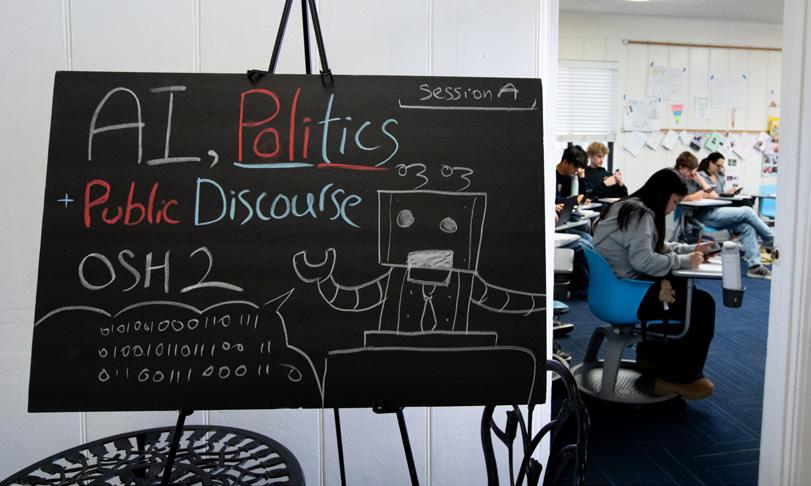
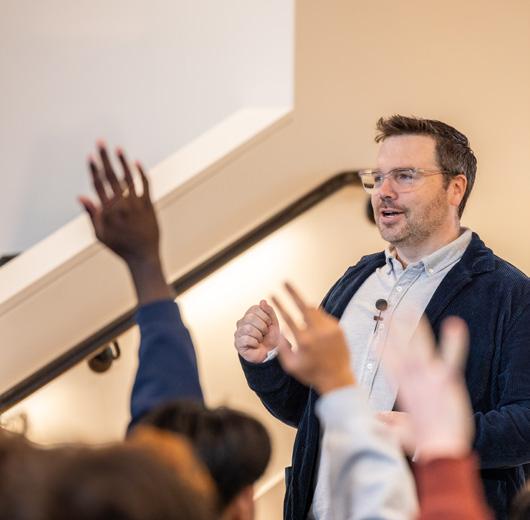
The juniors and seniors in my humanities Dynamics of Leadership class dug into my question with more questions. How do we want to engage with AI? Should we think of AI in the same way we think of other tools, like, say, a blender, or is it more than a tech tool? How does the design of these tools impact our engagement and use? Who gets a say in tech design, and are those folks thinking about the impact and ethics of their work? How can we impact these discussions, in our own school and beyond?
These were questions about AI, for sure. But they also weren’t. The discussion was similar to millions of conversations that have taken place at Webb throughout its 100-year-plus history. Some happen in classrooms, prompted by material that faculty curate. A passage from Homer. The text from JFK’s inaugural address. A news article about DNA extraction and animal cloning.
And many happen during the normal course of life in a boarding school: a club meeting, the lunch table, a latenight dorm lounge session where students explore the meaning of life while playing chess or Mario Kart and then share a pizza.
These are in-person conversations. Not tweets or posts. They engage many perspectives and are not one-directional. At times, they are playful. At others, serious, even challenging. They are the kinds of discussions that require listening, evidence and nuance. The process can be messy, even clumsy, challenging students to step back, sometimes even repair and rebuild relationships, and learn from their missteps. And then complete that
“This is the magic that happens when you bring 400 bright and engaged young people together on a campus with lifelong educators who model curiosity, stimulate thinking and nurture connection. Every day is full of authentic discovery, productive struggle and immense joy.”
OUR MISSION
Webb’s mission is to provide a dynamic learning community that nurtures and inspires our students and alumni to:
think boldly, mindfully and creatively
act with honor and moral courage
lead with distinction
serve with a generous spirit
paleontology project together, run Mongo and high-five at surviving a tough cross country practice together, grab a van run to Target together. They are the kind of moments that prepare students to live in a diverse world and lead with empathy, conviction and honor, all of which are especially valuable in an age of AI.
In its 2025 AI Index Report, Stanford’s Institute for Human-Centered AI (HAI) outlines a way of thinking about AI in education that delineates three areas: the use of AI tools in education, AI literacy, and instruction in building AI tools. This is a useful way of thinking about new areas of focus key to helping prepare students for the future. My classroom debate certainly engaged AI literacy. But it also engaged a key area that I think Stanford needs to add to their framework: AI-relevant education.
Assistant Head of School Michael Hoe ’04 and I spent some time reordering and fleshing out HAI’s framework to guide The AI Project@Webb, and we added AI-relevant education as a fourth pillar informing discussion about the
MISSION ON
role of AI in education. The concept of AI-relevant education seeks to ensure we are thinking deeply about two fundamental questions: How does AI’s capacity change what we need to know, and how do we identify and focus on the questions, skills and habits of mind that are particularly valuable in an age of AI?
At Webb, thinking about this last question reminds us of the tremendous value of our human-centered community and all the small moments that help students develop AI-proof superpowers. Those discussions, from my leadership class to late-night dorm debates, are merely one example of how living and learning in a dynamic in-person community teaches intensely human skills. Indeed, this is the magic that happens when you bring 400 bright and engaged young people together on a campus with lifelong educators who model curiosity, stimulate thinking and nurture connection. Every day is full of authentic discovery, productive struggle and immense joy.
The AI Project@Webb will ensure that our students are AI literate, that we develop and utilize AI tools to enhance our educational program, and that our students are equipped to build and design AI for the future and for the common good. This framework will also ensure that we don’t lose the heart of the Webb experience, those sometimesintangible moments that every alum can point to as foundational to who they are and who they have become.
Grounded in over 100 years and looking toward the future. That’s Webb.
• What is AI?
• How does it work?
• How should I use it?
• How do I use it safely?
• How do I use it effectively?
• How do I use it ethically?
• How can we use AI tools as teachers and learners for personalization, efficiency, effectiveness, access, and…?
• How can our school use AI tools for operational efficiency?
• How can I design and build my own Al systems for my use?
• How can I design and build AI systems for my community and for the common good?
• How does AI’s capacity change the knowledge and skills we need?
• How do we identify and focus on the questions, skills and habits of mind that are particularly valuable in an age of AI?
Theresa Smith, Ph.D.
Head of School
INTANGIBLE MOMENTS, LEARNING IN COMMUNITY
“READY FOR CHECK-IN, DR. SMITH?” A senior prefect calls to me as he emerges from the Ruddick Room. It’s 11 pm on a Friday. The evening is cool, with a nice breeze, and the stars are shining above in the clear night sky. “Yes,” I say a bit nervously. I am on the faculty team closing the dorms that night, making sure all students are accounted for and well. I am still relatively new to boarding school life, in my first semester, with so many new experiences.
“Let’s go,” he says confidently, as he guides me from room to room. Students stand at the ready, in their doorways,
waiting for me to check them in. “Good evening. How was your week?” There’s a bit of small talk as I make my way down the hallway. Some students look sleepy and ready to go to bed. Others have laptops and snacks in their arms, clearly ready to head over to their neighbor’s room for a late Friday night movie. Chit chat about what they are going to watch and reminders not to stay up too late ensue.
One door is closed, and there is no pass indicating the student has permission to be off campus for the night. The prefect knocks on the door twice. A
Many K-12 educational institutions have adopted a red light, green light framework for AI. In these systems, teachers mandate when and how students can use AI. A green light on an assignment means it can be used. A red light, no. Webb’s approach is more nuanced and guided by our intention to teach young people to drive their own learning and ground their decisions in an ethical framework focused on honor and community. New York Times Tech Columnist Kevin Roose shared a fitting analogy during his visit to Webb that has provided us with a common language to help guide students in the classroom: forklift vs. weightlifting. Looking to easily move some heavy boxes? Use a forklift. Looking to build your own muscles? Don’t use a forklift. You have to lift the weights yourself.
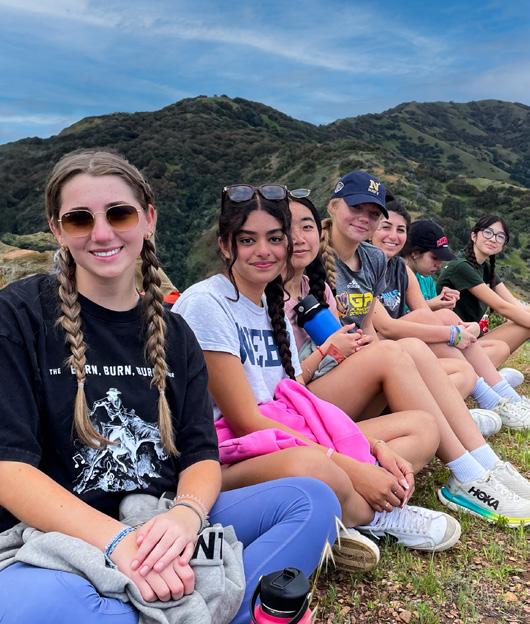
Senior girls from the class of 2025 enjoy a break while hiking the foothills.
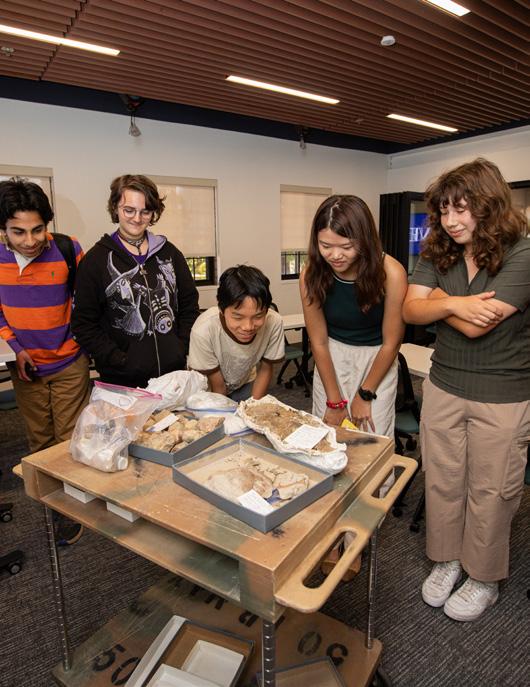
Some amazing discoveries were made on the Summer Peccary Trip! Students gather in the Fawcett Library for a Fossil Unboxing to see what their peers unearthed while in Wyoming.
student emerges in a flurry, apologizing frantically for not being in their doorway, looking discouraged. “It’s doorways,” the prefect reminds him. “I’ll be right back,” he tells the late student. He motions for me to continue, and we wind through the remaining hallways. I see that everyone is present.
“All set, Dr. Smith.” The prefect wishes me a good night. As I look over my shoulder, I see he is doubling back, heading to talk with the student who was not at their door. I turn around the corner and pause within earshot. As the prefect talks with the student, he is gentle and
A SET OF GUIDING PRINCIPLES FOR AI AT WEBB
AI is an important technological tool to be explored, not banned. Utilizing the latest tools for researching, learning, thinking and creating, including AI, is essential as part of a Webb education.
Transparency of AI use is critical for all users, including adults and students.
The ethical use and development of AI is a relevant and vital topic for an honor-based community.
AI has the possibility to streamline school operations, but it should never be used as a substitute for humancentered communications or relationships.
Private student or employee data may not be entered into AI programs that are not official Webb systems.
patient. He leads with empathy. He struggled to meet all his commitments in his first year. He explains the values behind being at your doorway for checkin, referencing safety, community, and responsibility. He provides encouragement and understanding. As I walk the short distance up the hill to my home, I smile. I still cannot believe the way students lead at Webb. It is real— their responsibility, their development, their impact. Student leadership and learning that can only happen in person, in a community—at Webb.
Head of School
BOOKSHELF
(a few titles currently on my nightstand or podcasts in the queue)
Brene Brown, Strong Ground: The Lessons of Daring Leadership (2025)
Chris Dixon, Read, Write, Own: Building the Next Era of the Internet (2025)
Ada Palmer, Inventing the Renaissance: The Myth of a Golden Age (2025)
Latest episodes of Hard Fork, The AI Daily Brief, and A16z Podcast
“AS I WALK THE SHORT DISTANCE UP THE HILL TO MY HOME, I SMILE. I STILL CANNOT BELIEVE THE WAY STUDENTS LEAD AT WEBB.”
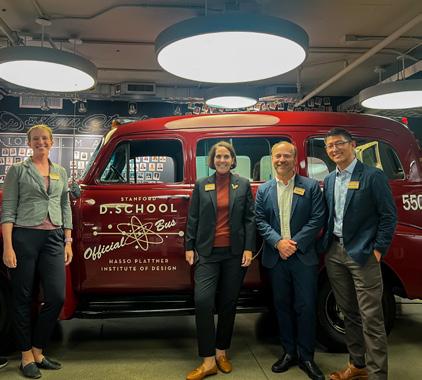
Webb was invited to a conference at Stanford University, co-sponsored by Institute for HumanCentered AI and the d.School. The Webb team collaborated with other non-profits and NGOs in thinking about AI and innovation in
A favorite tradition! After our Signing-in Ceremony, new students walk through a tunnel made by student leaders as they exit the chapel.
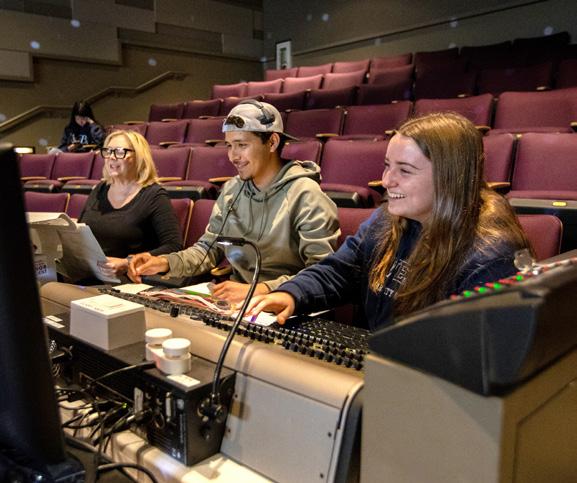
Two student crew members program lights during tech rehearsal for this year’s fall show.
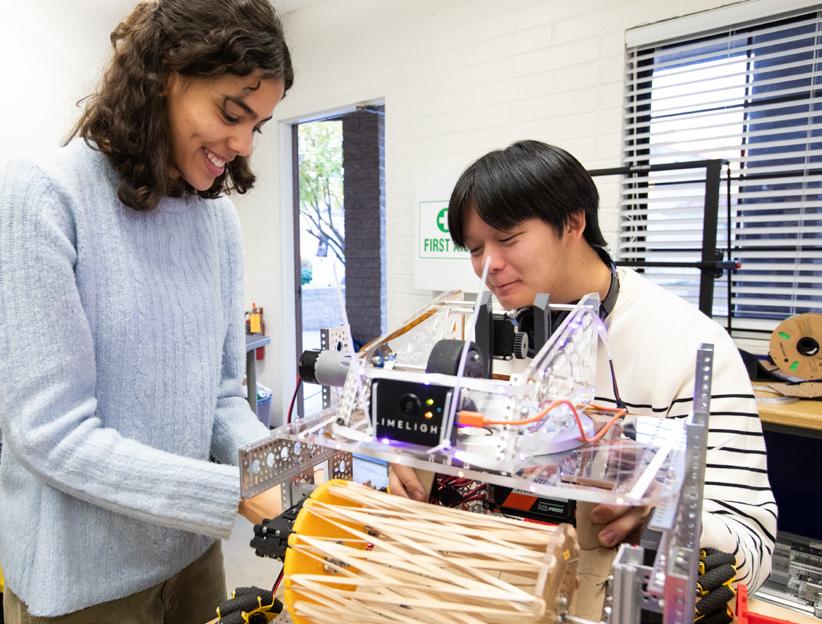
Seniors hard at work in the Robotics Lab prep their robot for an upcoming tournament hosted here at Webb.