
11,916
PUBLISHER
Dan Mathers
dan@thewcpress.com
ACCOUNT DIRECTOR
Nick Vecchio nick@thewcpress.com
MANAGING EDITOR
Cara Corridoni cara@thewcpress.com
CONTRIBUTING EDITORS
Becca Boyd bboyd@thewcpress.com
Sofi Michael smichael@thewcpress.com
STAFF PHOTOGRAPHER
Adam Jones @toloveanddancing COLUMNISTS
Becca Boyd bboyd@thewcpress.com
Andrea Mason amason@thewcpress.com
Maggie Stantion mstanton@ccls.org
TASTE West Chester is the food-only spinoff of The WC Press. It’s mailed to 3,500+ local readers and dropped off to more than 200 locations. For a free subscription, mailed or digital, visit thewcpress.com/subscribe
Published By...
The WC PRESS & Mathers productions, LLC 1271 Phoenixville Pk West Chester, PA 19380 mathersproductions.com 610-299-1100
9. BREAKFAST OF CHAMPIONS
The most important meal of the day by Becca Boyd
11. THE SWEETEST SEASON
A look inside the holiday rush at four beloved bakeries by Dan Mathers
19. ON A ROLL
The best sandwiches in town by Dan Mathers
21. DINING OUT
Sampling some of our town's best dinners by Dan Mathers
27. CUTTER & CANNON
Inside West Chester’s first distillery by Dan Mathers
37. NEW IN TOWN
Exploring the new and exciting businesses in town by Cara Corridoni
43. ON THE SHELF
The best cookbooks at West Chester Public Library by WCPL Staff
45. FORM & FUNCTION
The borough’s best kitchens and dining spaces by Andrea Mason
47. BEYOND DELIVERY
Wonder’s bid to redefine the modern restaurant by Becca Boyd
55. PHOTO HUNT
Find the five changes, win a gift card
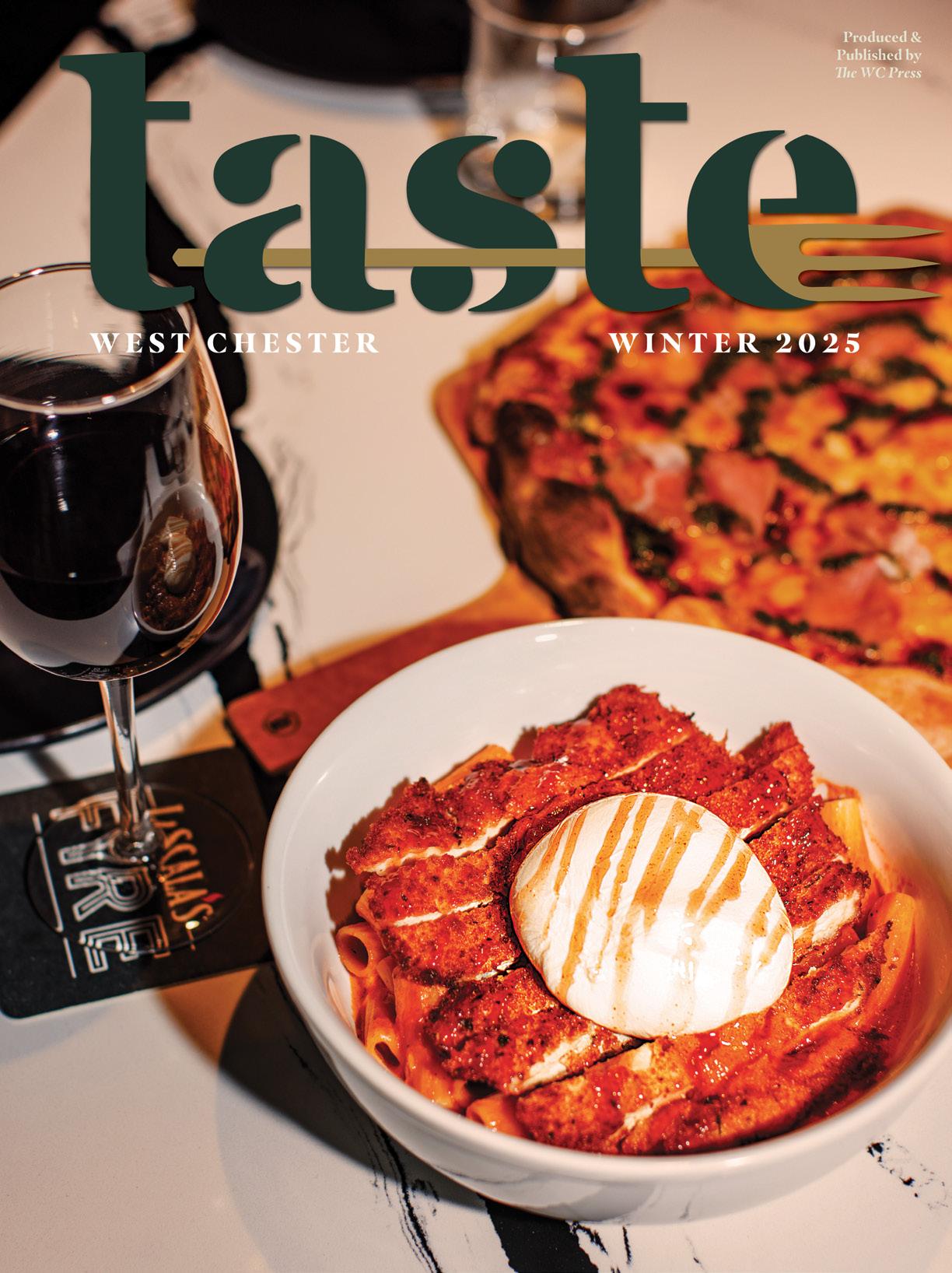
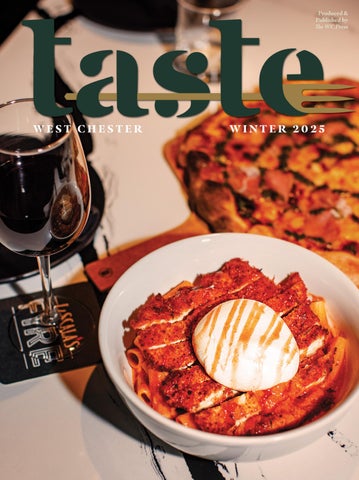
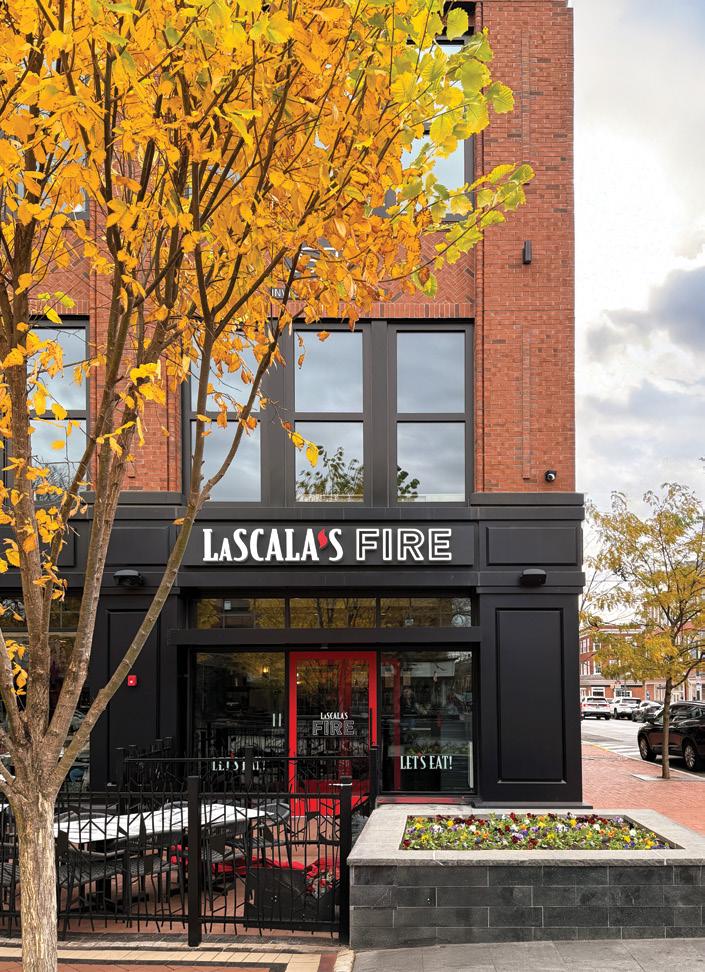
COVER PHOTO of @lascalasfire by @hutchins_photo
We sincerely apologize for multiple factual errors in our September 2025 Taste feature on Whattaboard. We relied on a third-party copy editor who used AI to edit the story, and we failed to compare those edits against the writer’s original draft. What is normally light cleanup (commas and capitalization) resulted in inaccurate changes, and that is our responsibility. The correct information is as follows:
• The owner’s name is Krista Matisz, not DeGregorio.
• Her heritage is Polish and Irish, not Italian.
• Whattaboard did not begin operating prior to obtaining proper licensing; our wording wrongly implied otherwise.
• Boards are served on single-use wooden trays, not reusable wooden boards.
• The business name is Whattaboard (one word, exact spelling), not “WhattaBoard.”
• Whattaboard does not sell alcohol, does not hold a liquor license, and does not sell personalized cookies.
• We regret these errors and any confusion they may have caused to customers, regulators, and our readers.

When you walk into Mayday Coffee & Shop, you can feel it — a hum of energy that’s equal parts focus and friendliness. Sunlight floods through three walls of windows, bouncing off the clean, modern space filled with folks hunched over laptops, families chatting over breakfast sandwiches, and toddlers toddling between tables. It’s a rare balance: a place that feels alive but never rushed, inviting yet productive.
Owner Austin Piona opened Mayday in March 2023 with a chief goal of creating a space that supports mental well-being and connection. Growing up in West Chester, Piona saw firsthand how young adults often struggled with loneliness and stress. He wanted to build a place where people could feel comfortable being themselves, a space where one could get work done, eat well, and relax in community.
Nearly two years later, Mayday has become a cornerstone of West Chester’s community life. The café’s intentional hours — 7 a.m. to 6 p.m. every day — reflect its mission. “We want people to come, stay, and not feel pressured to leave,” Piona explains. “Students and young professionals work long hours. We’re not going to kick anyone out.” Comfortable couches, spacious tables, and plenty of natural light encourage guests to linger.
The most important meal of the day can also be the most delicious way to start it. This Month: Mayday Coffee photos & story BECCA BOYD
And linger they do. On Saturdays, Mayday transforms into what Austin jokingly calls “May-Day-Care.” The stroller parking alone rivals Disneyland’s. “We get a lot of young families in here on weekends,” Piona laughs. “It’s chaos in the best way.” From 9 a.m. to 1 p.m., a steady line wraps through the café as locals wait for one of Mayday’s famously fresh breakfast sandwiches — nearly 20,000 sold in the past year alone.
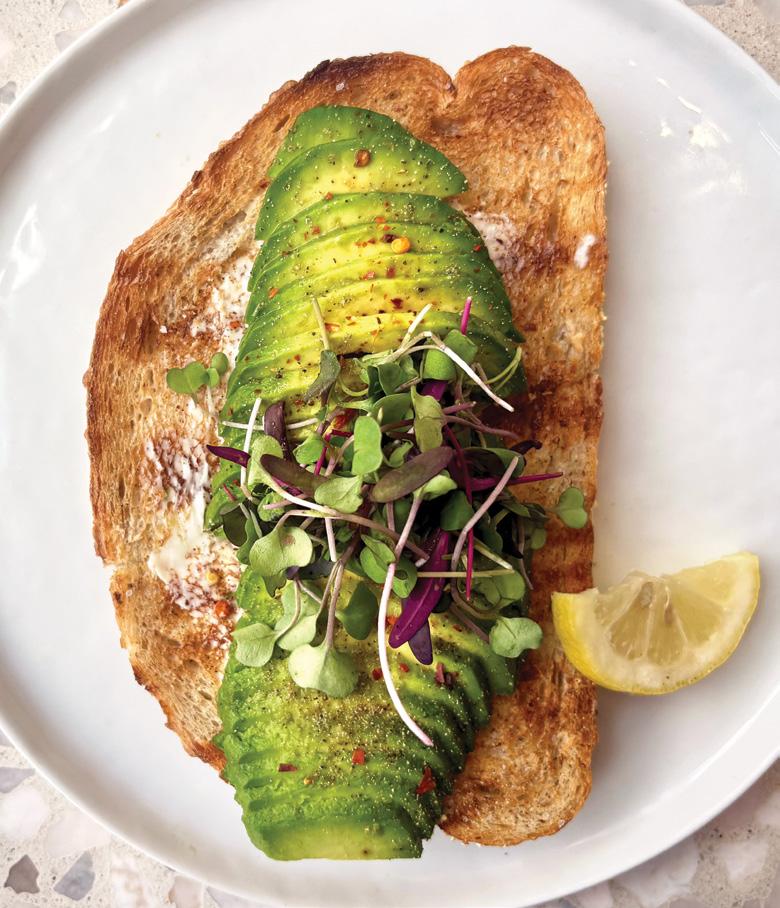
The food at Mayday is straightforward but high-quality — think avocado toast with simple, bright seasoning, a breakfast sandwich layered with sausage, eggs, and a honey-chipotle aioli, and acai bowls that are naturally vegan and gluten-free. “It’s nothing fancy,” Piona says, “but it’s real food, made fresh. You could make it at home, but part of the joy of going out is having someone make it for you.” Everything on the menu is available all day, and dietary needs are easily accommodated — something personal for Piona, who’s gluten-free himself.
Coffee lovers will find plenty to celebrate too. Mayday serves single-origin beans from Valor Coffee in Atlanta, paired with house-made syrups and Instagram-worthy latte art. It’s quality coffee without the pretension — a place where a self-proclaimed coffee snob and a casual chai drinker can feel equally at home.
But Mayday is more than just coffee and food. The café operates across five departments — drinks, food, retail, fresh-cut flowers, and events. You can grab a bouquet of fresh flowers, shop small-batch goods from small businesses, or rent out the backroom or the entire shop for a party of your own. There’s even a mobile coffee cruiser cart that brings Mayday’s signature drinks to local businesses and gatherings.
In nearly two years, Mayday has become more than a café — it’s a beacon of balance in a busy world. As Piona puts it: “If you take care of the people around you, they’ll take care of you.” And at Mayday, that philosophy isn’t just good business — it’s the whole point.
A look inside the holiday rush, history, and heart behind four of West Chester’s most beloved bakeries.
The first cold morning of the year always seems to arrive quietly. One day, the air is just… different—sharper, cleaner, carrying that faint bite that makes you pull your jacket a little tighter. And if you’re lucky enough to live in West Chester, it also carries something else: the unmistakable scent of butter and spice drifting from a bakery kitchen, or the warmth of a storefront where someone is already rolling dough before the sun comes up.
Holiday baking has a way of slowing the world to a gentler pace. We don’t really measure this season in days so much as in flavors: cinnamon in the air, nutmeg in a batter, apples softening on the stove, the familiar clink of cookie tins being pulled from the back of the pantry. Even people who haven’t baked anything since last Christmas somehow find themselves dusted with flour by mid-December. There is something grounding about it—something ancient. Something that connects who we were, who we are, and who we’re trying to be.
And for the people who bake profes-
sionally, the holidays aren’t just a season; they’re their own ecosystem. Six whirlwind weeks of pre-dawn starts, marathon shifts, and ovens running so hot and so constantly that the walls seem to hum. Yet talk to any baker in town, and you’ll hear the same thing: they wouldn’t trade it. Not for quieter days, not for easier work, not for anything. Because they are the stewards of traditions, both their own and everyone else’s. They get to hand families the treats that show up in memories years later.
This year, four local bakeries opened their doors to share what this season means to them. Inside each one, between the cookies and the cakes and the braided loaves, the same truth came through: the sweetest part of the holidays has never really been the sugar. It’s the story behind it.
If the holidays are about tradition, then Carlino’s Market feels like stepping directly into it. For decades, Carlino’s has blended Old World Italian roots with a
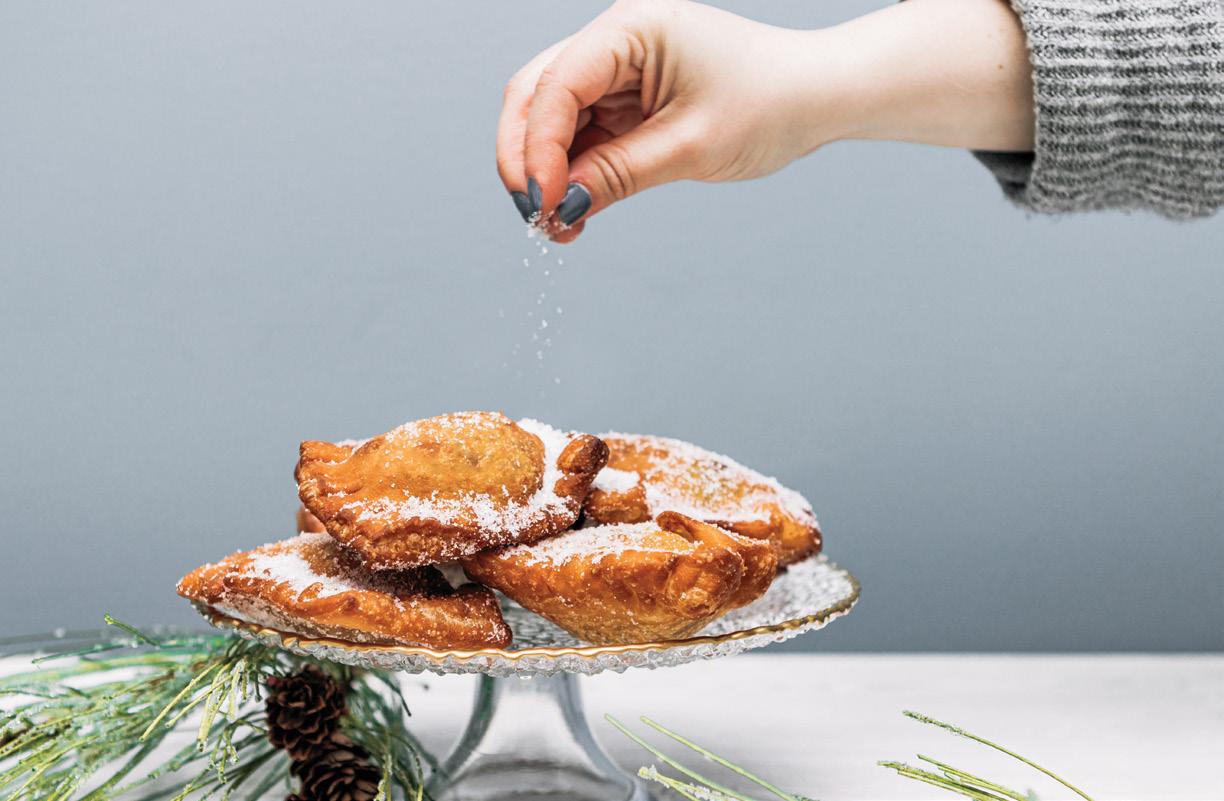
This traditional sweet fritter is made with a wine dough and filled with chestnuts, chocolate, espresso, marmalade and anisette.
deep local presence, and nowhere does that show more clearly than in its bakery. The stories here aren’t just about recipes—they’re about lineage, shared craft, and a team that treats baking as both vocation and inheritance.
Executive Pastry Chef Jessica Pachorkowsky-Perez has been with Carlino’s for nearly 25 years, long enough to watch the bakery grow from a two-person operation into a bustling department staffed with fifteen chefs and bakers across both locations. “In the early days, it was just Mama Carlino and me,” she tells me. “We had our own language.” Mama didn’t speak much English; Jessica didn’t speak Italian. Yet they worked side by side, reading each other with a glance.


Jessica’s own baking roots stretch back to childhood afternoons spent baking biscuits with her father and pies with her aunt, and visiting her nearly blind great-grandmother, who baked cheesecakes and sticky buns entirely by memory. Those early lessons shaped her approach to the holidays—and to Carlino’s. She still prepares many of Mama Carlino’s most cherished recipes exactly as they were taught to her: Calginetti at Christmas, Pastiera at Easter, Italian Wedding Peaches for Mother’s Day. “Even if there’s a corner to cut,” she says, “I won’t. It’s my honor to preserve her traditions.”
Alongside those treasured pastries is the bread program, led by Head Baker Ed Pinkos, who has been with Carlino’s for nearly 16 years. Ed came up through a South Philly wholesale bakery, learning the craft of breadmaking one loaf at a time, and he’s brought that same discipline to Carlino’s. His holiday centerpiece is the challah—plain or the staff-favorite Fig & Sea Salt—a recipe he’s fine-tuned for more than a decade. “Seeing something you’ve poured so much time and love into on people’s holiday tables— that’s the rewarding part,” he says.
For Ed, the emotional core of the season is the team behind the dough. “In an age of automation, everything we do is still shaped by hand,” he tells me. “You can taste that. You can feel it.” He talks about the energy of December— early mornings, long days, racks of rising loaves—and the camaraderie that forms when a crew works side by side through the busiest weeks of the year. “Bread brings people together,” he says. “But so does making it.”
By mid-December, the bakery becomes what Jessica calls “organized chaos”: trays of cookies covering every surface, racks of cakes waiting for pickup, the air thick with the scent of sugar and spice. Italian cookies remain the undisputed stars—cuccidati, rainbow cookies, anise biscotti, struffoli, and more varieties than seem mathematically possible. “Cookies are simple, meant to be shared,” Jessica says. “That’s what the holidays are about.”
At Carlino’s, those traditions aren’t just preserved. They’re lived—braided, baked, shared, and passed on, one loaf and one cookie at a time.
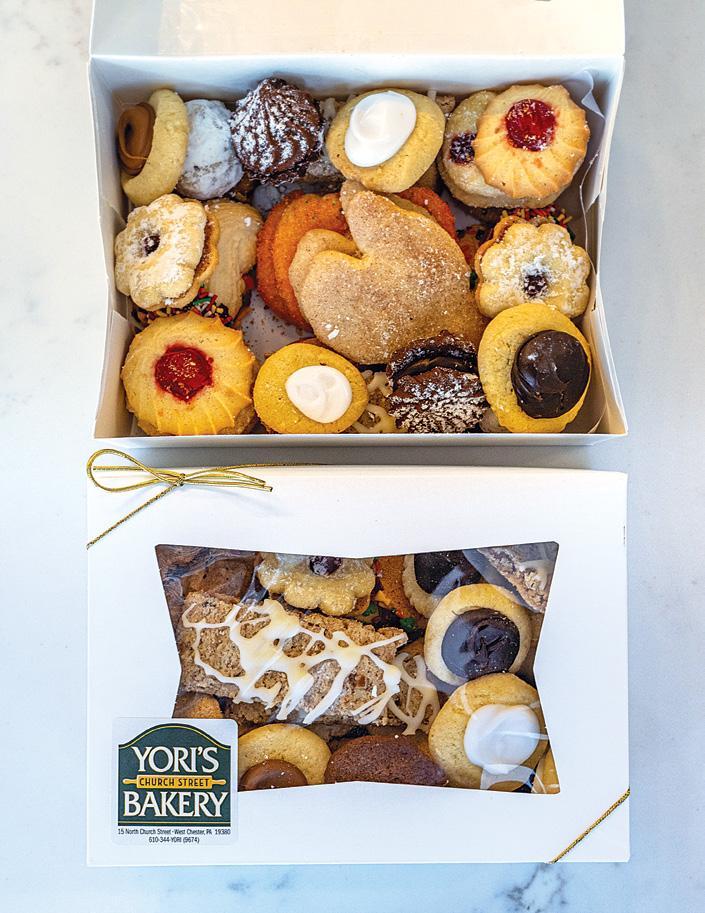
A seasonal mix of classic scratch-made cookies from Yori's Bakery—boxed up, tied with gold ribbon, and ready for every celebration.
If you live up in or around West Chester, you’ve almost certainly walked out of Yori’s with something warm in a box. Maybe it was a danish before work, or a birthday cake, or a box of cookies that didn’t survive the drive home. Yori’s is one of those rare places where time seems to stop, tucked on Church Street, glowing
the way a proper bakery should: like an open invitation.
Owner David Yori didn’t originally set out to be a baker. At fifteen, he just needed a summer job close enough to bike to. But the bakery he landed in—washing pots, greasing pans, sliding cookies onto sheet trays—quietly rearranged the course of his life. “I realized I enjoyed the work,” he tells me. “The pace, the rhythm, the hands-on part of it.” Years passed, books were studied, skills grew, and eventually he opened a place that feels like the sort of bakery people talk about in past tense, even though it’s right here in the present.
And if there’s a time when Yori’s feels most like itself, it’s the holidays. For David, this is the season that shaped him. His mother made pizzelles every Christmas, their delicate anise scent filling the house.
And the German baker who trained him introduced him to stollen and springerle, recipes thick with history. “I always have good memories tied to those,” he says. “The stories that came with them.”
Those stories live loudly in the bakery now. In November, the ovens shift into pie mode—pumpkin and apple fly out the door faster than they can be boxed. December becomes its own sprint: gingerbread men, Yule logs, stollen, cookie trays by the thousands. “We make all our cookies from scratch,” David says. Each year they mix, shape, bake, cool, and package literal tons of them. And each year, somehow, it still isn’t enough.
Behind the scenes, Yori’s becomes a controlled frenzy. Doughs are made in massive batches, pie shells pressed days ahead, seasonal staff folded into the mix. But at the counter, the effect is simple: people walk in, breathe in the warmth and spice, and are transported.
“Tradition,” David says. “That’s what the holidays at a bakery are about.” You feel it immediately—nostalgia dusted in powdered sugar, memories stacked in white bakery boxes, something comforting made new again with each batch.
Walk into Gemelli and you’ll find something unexpected for December: chocolate melting into cream, warm apples simmering, the subtle brightness of peppermint. The holidays might conjure visions of cookies and pies, but at Gemelli, winter has its own Italian accent.
Owner and gelato maestro Vincenzo Tettamanti grew up in Ferrara, in northern Italy, where winter is cold and foggy and meant for comfort. Food wasn’t just nourishment—it was a cornerstone of family life. He cooked from a young age, out of necessity at first, then out of love. “Gelato was always a big part of my childhood,” he tells me. “But real gelato—seasonal, artisanal—was something I missed when I moved here.” He returned to Italy for professional training and in 2014 opened a café dedicated to authenticity.
Gemelli’s holiday spirit isn’t built on nostalgia alone—it’s built on memory
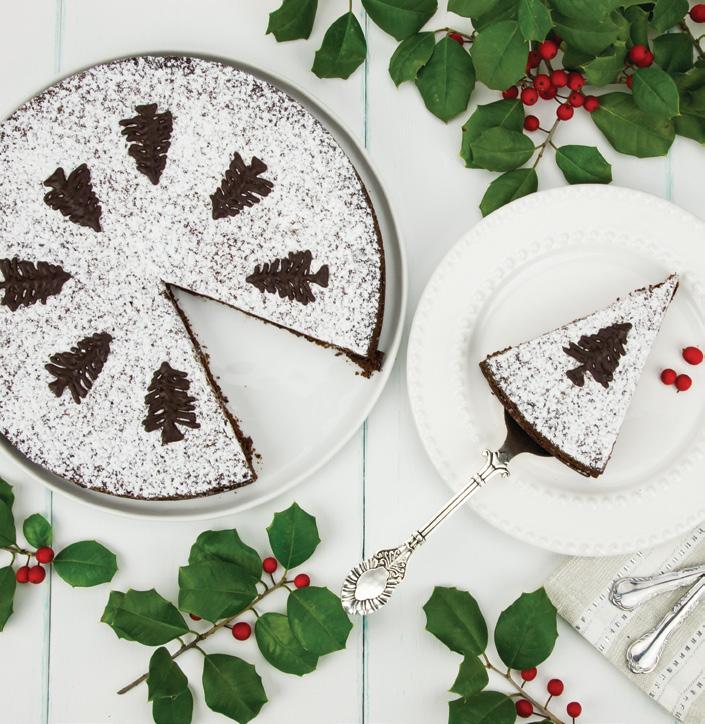
A traditional chocolate torte from northern Italy, baked just as Vincenzo remembers from home and dressed for the holidays.
transformed. Two of Vincenzo’s most meaningful seasonal desserts both trace directly back to his childhood kitchen. One is Tenerina, the traditional chocolate cake of Ferrara, which he now bakes with the same soft, custardy center he grew up eating. The other is his mother’s apple cake, originally made from apples pulled off the family’s backyard trees each fall. “We still serve it warm,” he says. “With caramel. Simple and cozy.”
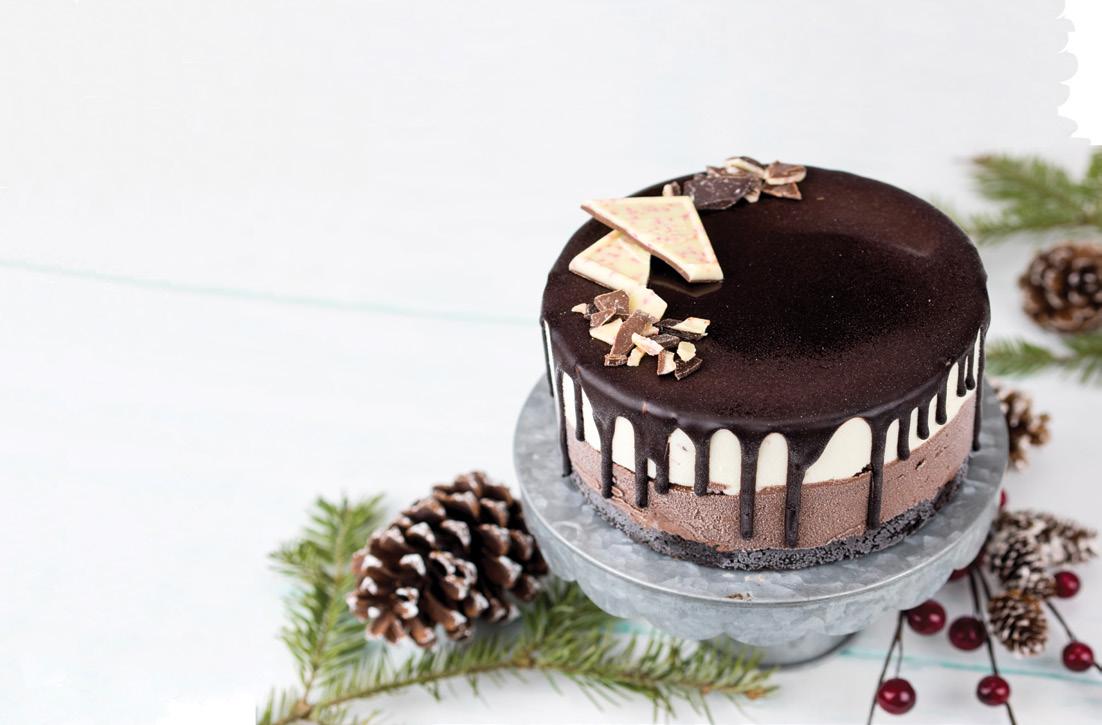
But the star of the season—the one that sells out year after year—is the Peppermint Bark Gelato Cake. It’s a modern showstopper: layers of dark chocolate gelato, white-chocolate-peppermint-bark gelato, and a dark chocolate mirror glaze that shines like a skating rink. It’s Italian
craft meets American holiday tradition, elevated into something entirely its own.
The atmosphere inside the café shifts this time of year. Staff hang winter décor and brace for the daily rush. Since everything is made from scratch with local ingredients, nothing can be stockpiled. Every cake, every batch of gelato, every swirl of caramel is made fresh. “There’s excitement in that,” Vincenzo says. “We know what we make becomes part of someone’s celebration.”
What he hopes people feel is simple: discovery, connection, and a sense of bringing something meaningful home. And maybe, if they’re open to it, a taste of Italy woven into their Pennsylvania holiday.
Some bakeries specialize in tradition; others in artistry. The Master's Baker manages both. The shop has been part of West Chester for more than half a century, and in that time, it has built some-
thing rare: a bakery where elaborate cakes and family stories share equal billing.
Owner Chad Weldon grew up in the business—his parents founded it over 55 years ago—and, like many kids raised in a bakery, he learned early how much joy a dessert can bring. “Helping out on weekends turned into a full-blown love for creating things that make people light up,” he says. In 2010, he and his wife Becky officially took over, guiding the business into a new era of custom cakes, modern designs, and a growing menu of seasonal treats.
But if you ask Chad what the holidays taste like, he won’t start with cake. He starts with childhood: his mother’s sticky buns, warm kitchens, icing-spoon “taste tests,” and a sense of faith woven through every December. “Holiday baking isn’t just about sugar and flour,” he says. “It’s about memories and connection.”
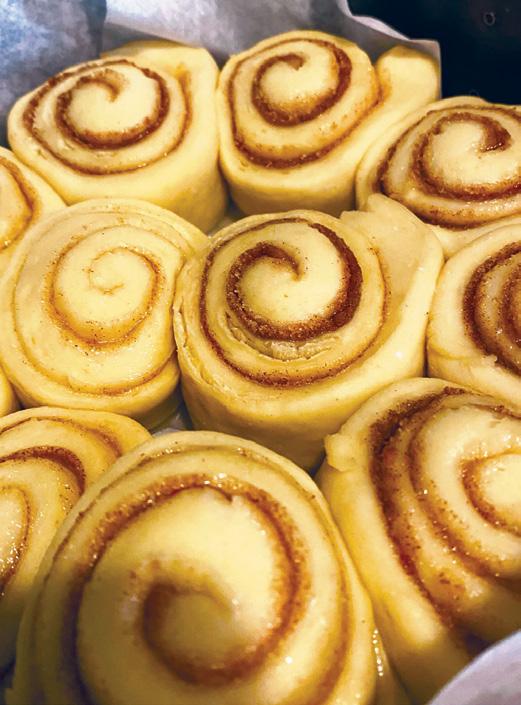
That philosophy is baked—quite literally—into their signature holiday item: the Take & Bake Cinnamon Rolls. They sell out every year, often in staggering quantities. Made from scratch with the bakery’s signature dough, the rolls come ready to
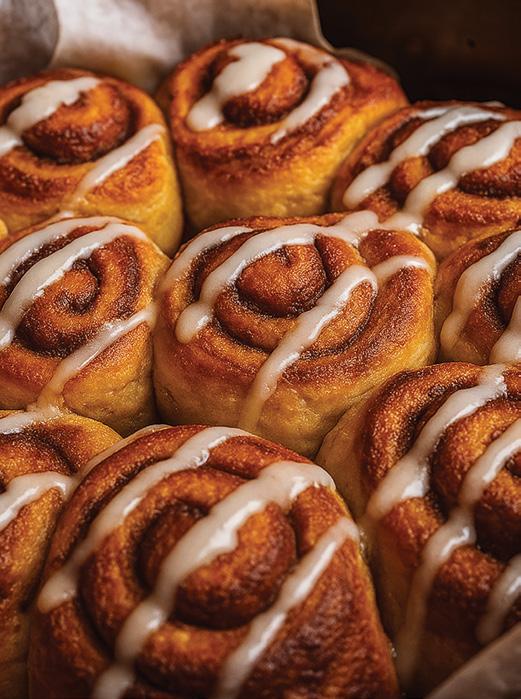
The Master's Baker does the hard work; you just have to throw it in the oven. Gooey rich cinnamon rolls ready on Christmas morning.
bake at home, filling kitchens with the smell Chad grew up with. “People tell us they bake them Christmas morning while opening presents,” he says. “That’s the whole point. Giving families something fresh and special without the stress.”
Their other holiday hits—personalized gingerbread people and dramatic pies— carry that same spirit. The gingerbread figures, each piped with a name, often double as place settings on Christmas tables. The pies are intentionally bold, with towering whipped cream, buttery crusts, and rich fillings.
Behind the scenes, December transforms the bakery into what Chad calls “a festive workshop.” Flour in the air, music on the speakers, long hours and
high energy. And beneath it all, something quieter: remembrance. Chad lost his mother last year, and she remains the heart of the bakery’s holiday season. “Every time we’re in the kitchen, it feels like a piece of her is still with us,” he says.
That’s what he hopes people taste: warmth, faith, and the joy of a season that meant so much to the woman who built the foundation he now stands on.
Holiday baking is never just about the food. It’s about the people who wake before dawn to shape dough, who carry memories forward in flour-dusted notebooks, who mix heritage into batter and fold family stories into every tray. In West Chester, those stories are everywhere— in the German stollen at Yori’s, the apple cake at Gemelli, the cinnamon rolls at The Master's Baker, and the Italian cookies at Carlino’s. Different kitchens, different traditions, same heart. The sweetness of the season isn’t found in sugar; it’s found in the hands that make it, and the families who gather to share it.
story DAN MATHERS @danielkmathers
Sampling all of the borough’s best foods served between slices of bread. This Month: Old Original Nick’s Roast Beef
I have a lot in common with my father. I was in my mid 30s when that realization hit me, and at first it was devastating. I’ve since learned it’s like any other treatable condition: you just need to monitor the symptoms.
Despite our similarities, we don’t see each other often. My wife pointed out that not making an effort to connect is one of those symptoms and pushed me to reach out. That's why I invited the old man to lunch last week. Since he lives in Newtown Square, I proposed something between us that was up his alley: Old Original Nick’s Roast Beef.
Ken Mathers is not a particularly adventurous eater. I don’t think he managed to masticate fish without making a face until he was 50. He prefers things simple, and he wants them prepared well. A spot specializing in hot sandwiches since 1938 that’s really only got four things on the menu is right up his alley.
Technically there are 10 menu items, but the only difference between the Roast Beef and Roast Beef Combo is that the Combo has cheese. And you can rule out the veggie option, because who goes to a roast beef spot for the broccoli? That leaves us with four sandwiches: roast beef, roast pork, roast turkey or baked ham. You can choose between provolone, Cooper sharp or no cheese. All come on a kaiser roll.
On first look it seems like you’ve got 13 sides to pick between, but closer inspection shows most are modifiers. Fries can come plain, with cheese or with gravy. The mozzarella sticks and onion rings also come with or without gravy. Healthy eaters can add broccoli rabe or long hots. Those who like it wet can have extra au jus.
Ken opted for the roast beef with Cooper sharp, so I went for the turkey with provolone. He got the cheese fries and I got the onion rings. I’m pretty sure neither of us is supposed to eat
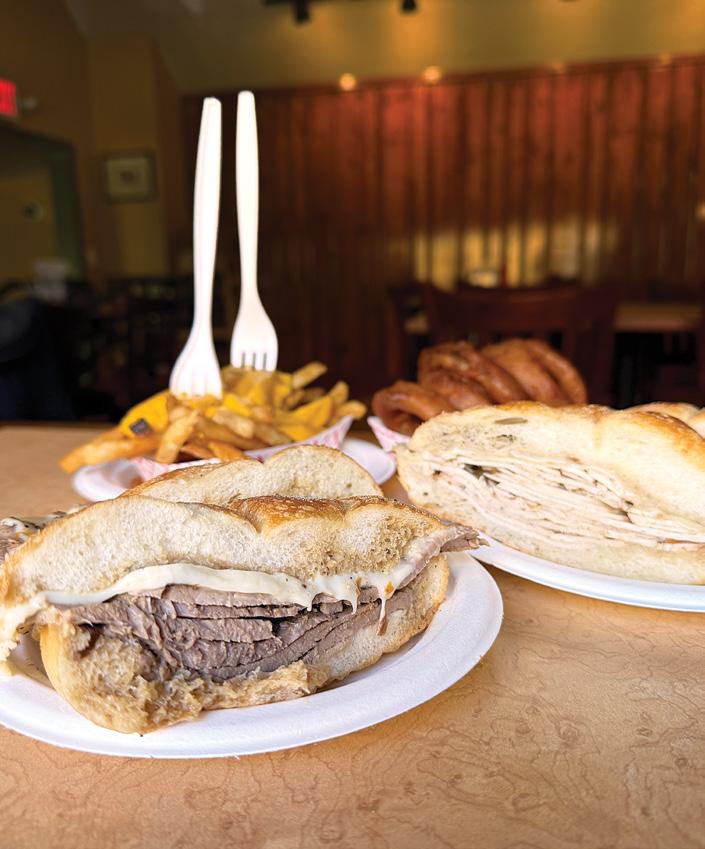
Thick-cut roast beef, tender turkey, crispy sides
cheese, but I think we both chalked it up to a special occasion and indulged.
And boy did it feel like an indulgence. The first bite of his sandwich had my dad moaning in a way that made me check people weren’t staring. The rolls were fresh and fluffy with a light dusting of cornmeal. The au jus had soaked the inside of the roll, but hadn’t seeped through the crust. My turkey was insanely tender and flavorful. I ate it in under three minutes without ever putting it down, then moved on to the exceptionally crispy onion rings. Inside, the onion was soft, but it avoided becoming mushy.
The meal lasted seven minutes max. We inhaled our sandwiches and our
sides, both because they were excellent and because that’s how we eat. Still, we spent about an hour hanging out and chatting, mostly about nothing. We laughed a lot and snuck in a few serious conversations about what the future looks like for each of us and where we fit into each other’s lives as we age.
I closed up the very reasonable check, and we did our usual “Welp, see ya later,” followed by a classic bro hug. As I drove the ten minutes back into the borough the good vibes continued. I was full, I was content, and I just kept laughing about how dumb it was that it took a roast beef sandwich for me to connect with my father. Still, if sharing a sandwich counts as symptom management, I’ll take the prescription.
photo & story DAN MATHERS @danielkmathers

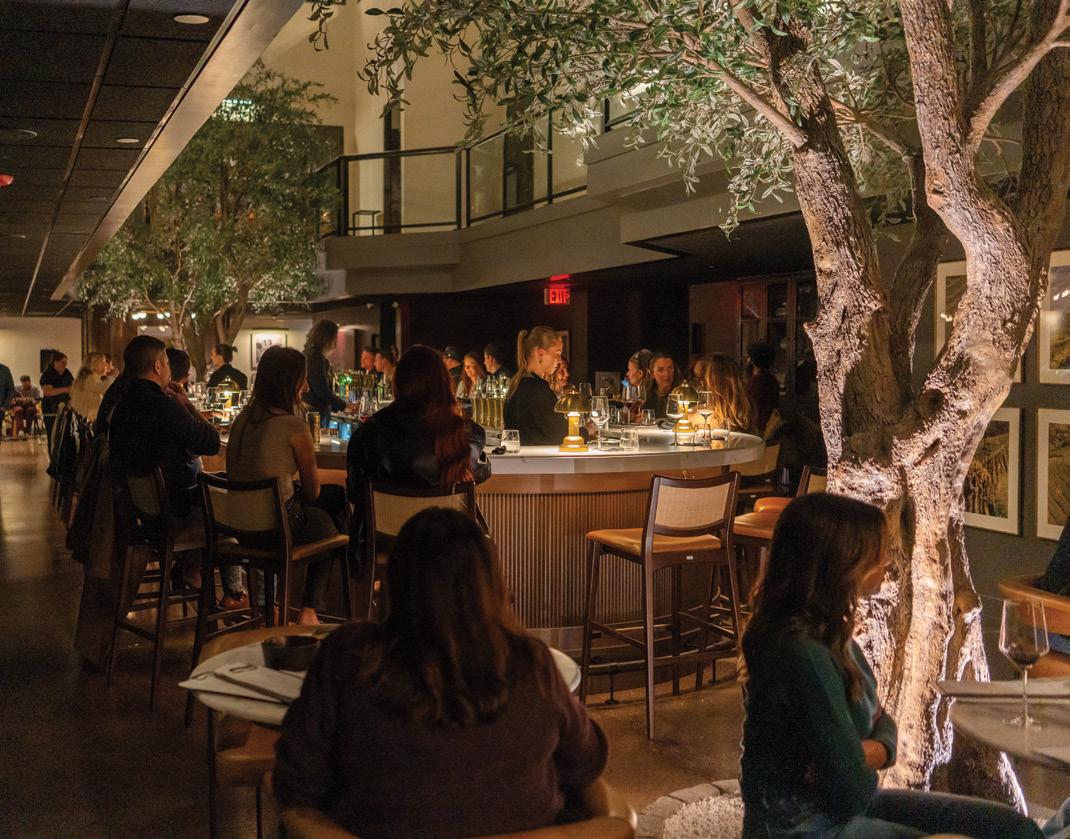
Sampling some of the borough’s best meals in West Chester’s premier dinner destinations.
This Month: Turks Head Wines
There are certain weeks where I talk more than I ever intended to in this life. Sales weeks. Networking weeks. Shaking-hands-and-repeating-myname weeks. By the time Thursday rolled around, I felt my vocal cords weakening and my interest in others waning. What I needed wasn’t companionship — just a good meal, a comfortable seat, and a place where I could read my book in peace without feeling like a tragic Victorian widower eating alone in the corner... so I went to Turks Head Wines.
If you’ve never been, walking into Turks Head feels a bit like stumbling onto the set of an extremely tasteful sci-fi film. I don’t mean the chromeand-neon kind — think more “prestige streaming show where human society has achieved post-scarcity but still maintains excellent interior designers.” The first thing you see are trees, inside the building, lit softly from above by a vaulted atrium that climbs three stories over a glowing white-marble bar. It’s dramatic without trying too hard, the sort of room where you briefly forget you’re in West Chester.
I’d been here on a weeknight before, and it had the same vibe tonight: mostly couples, quiet energy, the subtle hum of people who feel comfortable with one another. Not a first-date place. There wasn’t enough distracting energy for that, unless you’re seeking an intensely intimate first chat. This
Under vaulted ceilings and indoor olive trees, couples and solo diners alike unwind around the glowing marble bar. Even on a busy night it can still feel intimate.
felt more like a second-month place. A favorite-spot place. Or, as it turned out, a perfectly-fine-to-be-alone place.
I gave the host my name and email (Turks Head is cashless and emails receipts), then headed to the bar, where Abby greeted me like we’d known each other for years. She was warm and bubbly in a way that didn’t demand energy from me — a rare combo. She got excited that I ordered the Bread & Accoutrements, which struck me as oddly charming. I told her
I was getting the duck confit later, but she felt strongly that the infused butter, served with the bread, was the real star. “You’re gonna love that bread,” she said with genuine enthusiasm, then proceeded to joke with a server about how they could get their hands on some. I liked her immediately.
I settled in, tapped into the Kindle app and reopened the book I’ve been trying to muscle through: Blindsight by Peter Watts. It’s hard sci-fi — the kind that requires nonstop Kindle lookups because the characters keep referencing a mix of made-up science and real-world studies, ones I might only have encountered if I hadn’t dropped my computer engineering major in favor of liberal arts. The plot centers around alien intelligence and the limits of human perception. Light reading, basically.
It occurred to me, as I was toggling between fictional neuroscience and the Turks Head wine list, that this was the perfect pairing: a book about confronting your own ignorance, read in a place that makes learning feel comfortable instead of humiliating.
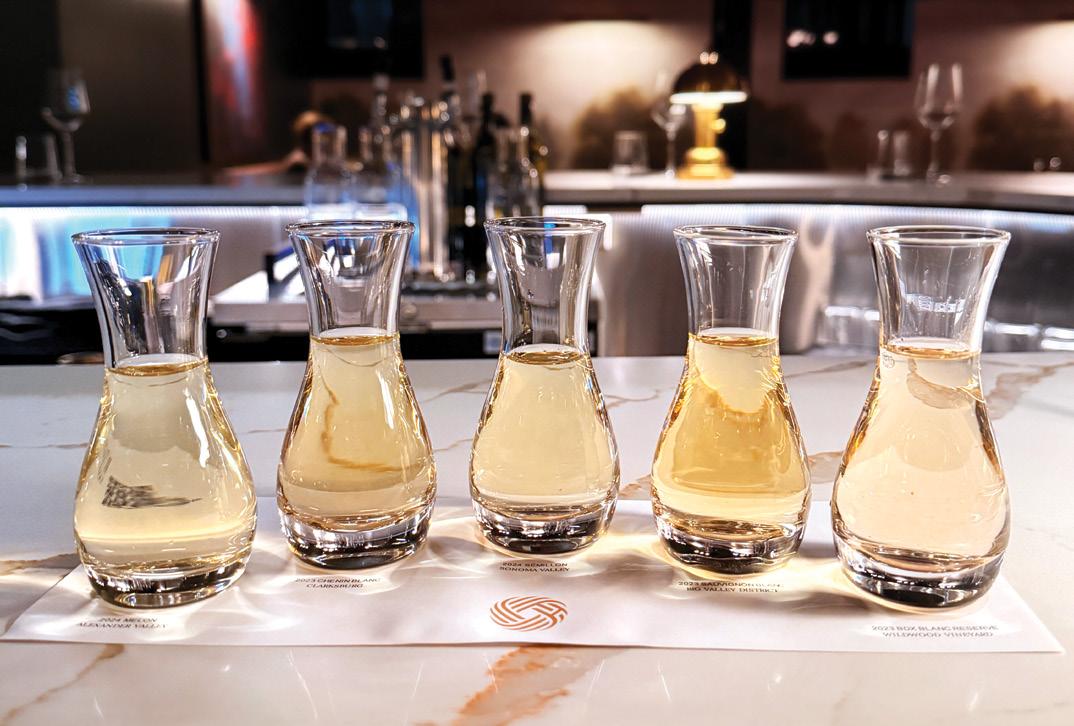
I wasn’t in the mood to quiz a sommelier, so the tasting flight with the QR code was a gift. Five glasses, each with dedicated tasting notes and background. Learn if you want to, ignore it if you don’t, call on the somm if you need more. Tonight, that felt like mercy.
I texted my friend Lea the list and asked which wines I should say I liked best in order to appear cultured. She suggested the Melon and the Semillon. I told myself her recommendation wouldn’t influence me at all, that I am my own person with my own palate, unaffected by the opinions of others. Naturally, the Melon and the Semillon were my favorites.
The Melon was exactly what a wine nicknamed the “porch pounder” should be: bright, fruity, dangerously approachable. The Semillon was more layered. The tasting notes said “citrus and honey,” and after reading that, it seemed so obvious. The description also said “mineral-driven finish,” which I’m sure I would have noticed if I knew what that was.
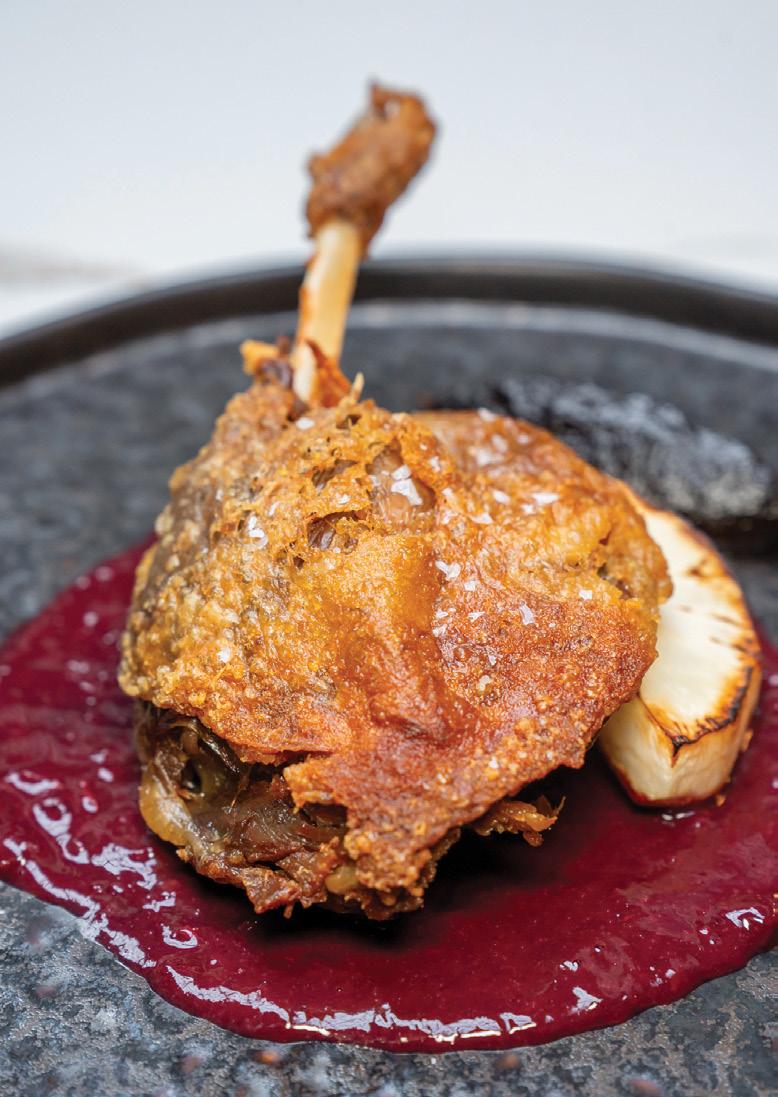
Crispy duck confit with berry compote and black garlic is juicy, sweet and rich.
My food arrived one dish at a time, perfectly paced for a man pretending to read about the physics of alien cognition while secretly people-watching.
First up, crusty sourdough, warm and gooey inside, crispy toast points, and a decadent butter that tasted like I no longer cared about my high cholesterol. Abby’s excitement made sense.
Served over labneh, tossed in harissa, finished with a carrot-top pesto, the carrots themselves were soft with a bit of bite — al dente vegetables is a phrase we should be using more. The labneh was so good I scooped the leftovers with toast points, with zero shame.
And then the duck arrived. Listen, I’ve ordered duck at countless restaurants, and I would say, conservatively, that 40% of the time I’ve regretted it. Duck is fickle. It demands precision. But Turks Head served up the best leg of confit I’ve ever had — crispy skin that shattered delicately, tender meat beneath, served with celery root
that tasted like an herbaceous potato. The plate had two accompaniments: a berry compote for the sweet bites and a dab of pureed black garlic for the deep, moody bites. I alternated between them like I was conducting my own private tasting symposium.
What surprised me wasn’t the quality of the food — though it was excellent — but the breadth of the menu. I’d assumed, based on the name, that this would be a “small bites to accompany your wine” situation. Instead, it’s a restaurant in its own right, and a good one at that. Turks Head could take the wine away tomorrow and still be competitive among West Chester’s dining scene. The fact that the wine is also great, and that the venue feels straight out of Arkady Martine’s, A Memory Called Empire is simply a bonus. (Editor’s Note: that’s a super apt reference, and you should read the book.)
By the time I finished my flight, the chapter, the duck, and the last of the labneh, I had reached that pleasant, slightly sparkling stage of wine enjoy-
Turks Head’s white wine flight — complete with QR-linked tasting notes.
ment where the world feels softer around the edges. Not drunk. More like someone turned down the harsh overhead lights on reality.
I closed my check, tucked Blindsight into the back of my mind, and walked out onto Church Street feeling grateful — grateful that I didn’t have to drive, grateful that Thursdays exist, and grateful that places like Turks Head Wines occupy the space between “night out” and “night in.”
It’s rare to find a spot that works equally well for date nights, gatherings, and the occasional “I need to be alone but in public” excursion. Turks Head is that place. It’s a little Napa, a little West Coast modern, a little urban winery chic — but also unmistakably West Chester. And if you’re curious
about wine but intimidated by the culture around it, this is exactly the venue you want: a place that invites you to learn gently, sip by sip, without judgment. Conversely, it’s also a great spot if you already know your wine and want to immerse yourself further. You can choose your own adventure.
I’m already scheming for an excuse to host a small event here. My family would love it — especially my motherand sister-in-law — and frankly, so would most people I know. Turks Head is for anyone who’s ever wanted to understand wine better, or who simply wants a beautiful space to unwind in. Napa is expensive. Knowledge is intimidating. But a quiet Thursday night here, book in hand and duck confit on the way? That feels like something anyone can access.
And if you’re lucky, Abby will talk you into the bread.
photos ERIK WEBER
@westchesterviews
story dan mathers
@DANIELKMATHERS


Inside the personalities, vision, and emerging craft behind West Chester’s first distillery

I’ve been inside a fair number of “under construction” businesses over the years, but stepping into Cutter & Cannon’s future distillery felt less like touring an unfinished space and more like walking into a scene that was very much mid-sentence. The studs were still exposed, wires dangled from the ceiling, and the toilet hadn’t yet found its home—it sat in its box like a shy new hire waiting to be told where its desk would be. They told me they were four weeks out from opening. The evidence suggested otherwise.
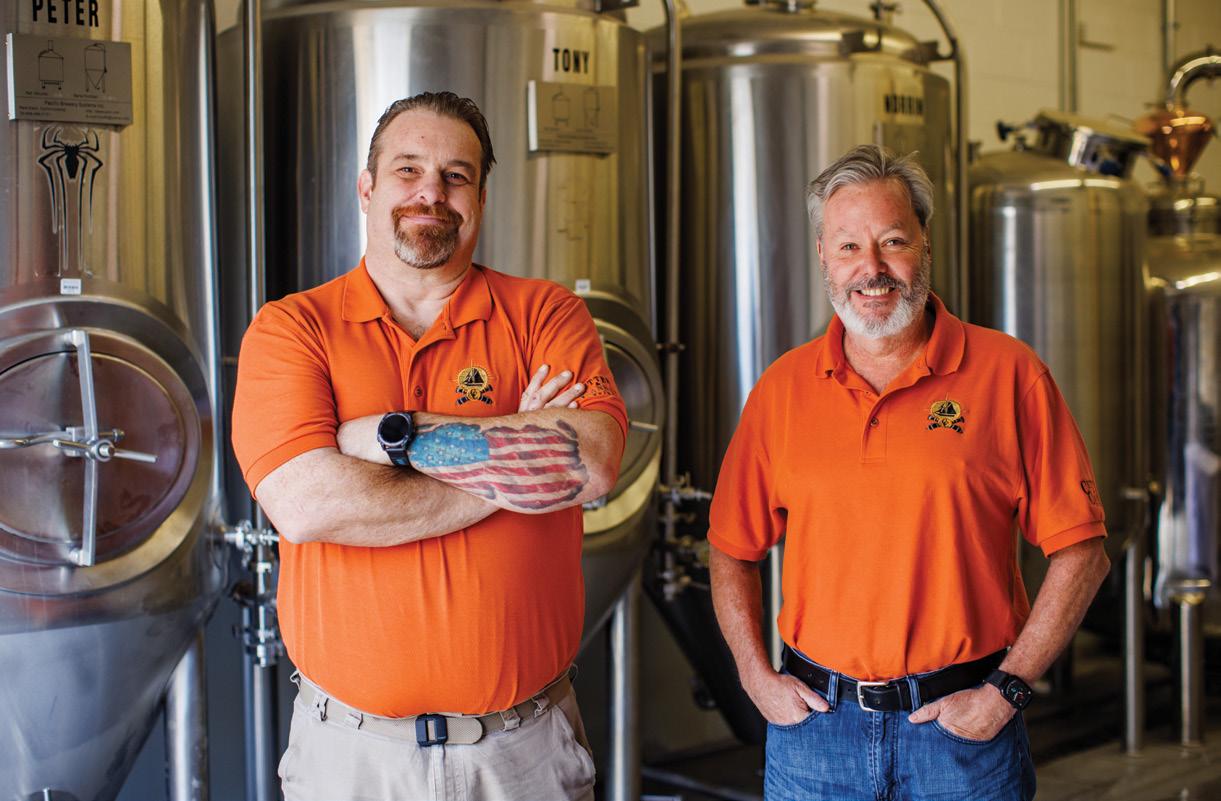
But in this line of work, you learn something important: the physical state of a space tells you very little about the people behind it. And within minutes of meeting Cutter & Cannon’s co-founders, Matt Mowatt and Cole Bauer, it became clear these two weren’t the types to be deterred by bare studs or boxed plumbing fixtures. They were deep in the process— doing construction themselves, maneuvering equipment, debating measurements—and they wore the sweat and sawdust like it was part of the uniform.
Founder duo Cole Bauer (left) and Matt Mowatt (right) blend hands-on grit with technical precision.
These weren’t engineers who outsourced the dirty jobs. These were engineers who looked perfectly at home with a drill in one hand and blueprints (literal or metaphorical) in the other.
I met Matt first—the more immediately “engineer-coded” of the pair. He’s the kind of guy you can picture sitting under lamplight at 1am, sipping a Scotch while reviewing a design plan, muttering something about load-bearing whatever. He’s loose, talkative, comfortable bantering about technical minutiae or cracking jokes, and he slips easily between storyteller and educator.
Cole, on the other hand, looks like he belongs on the prow of a Viking long-
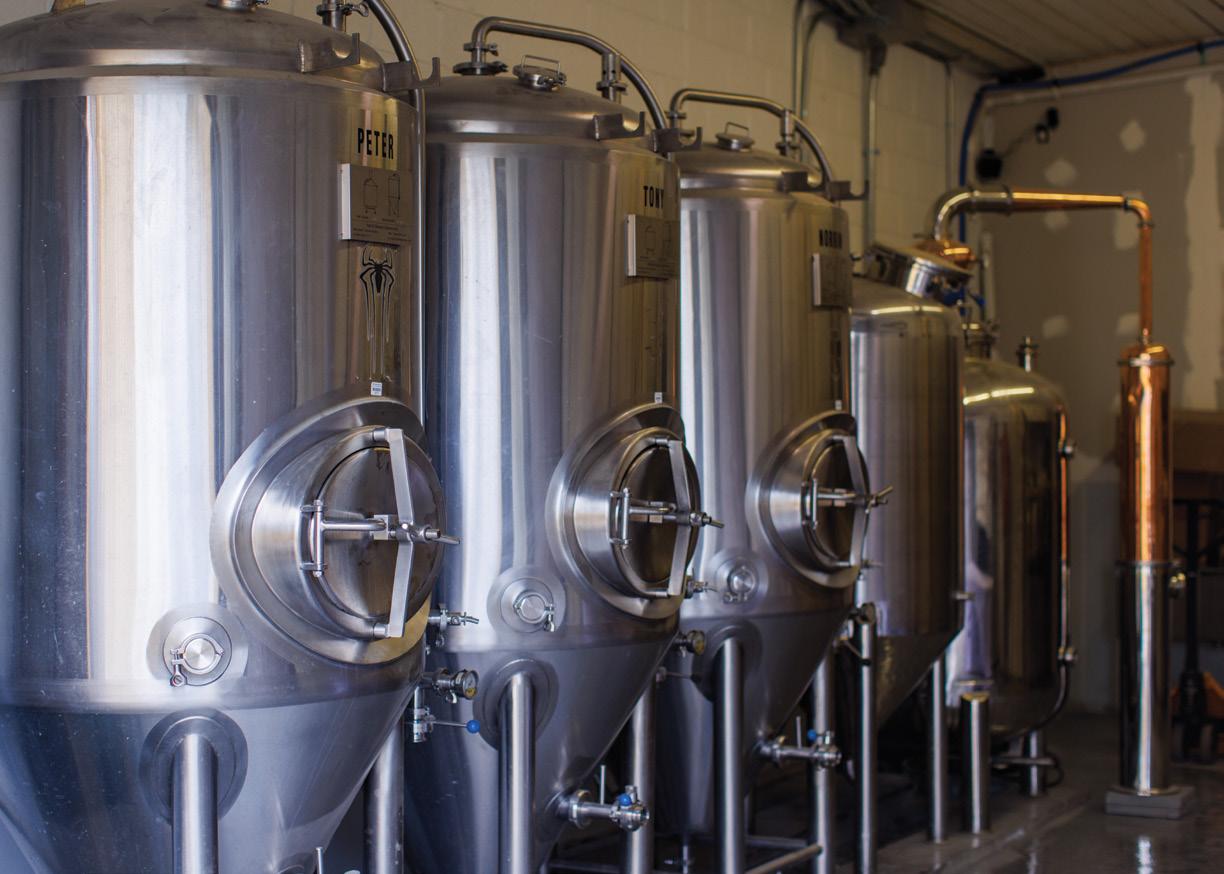
ship. Tall, tattooed, burly—intense at first glance. When I walked in, he was all business: focused, a little guarded, not quite sure what to make of me. But as soon as he realized I wasn’t there to grill them like some hard-nosed investigative reporter, he softened. He cracked jokes. He told stories. He lit up when he walked me over to the tanks, explaining where they sourced each one and how they’d transported them and got them to stand.
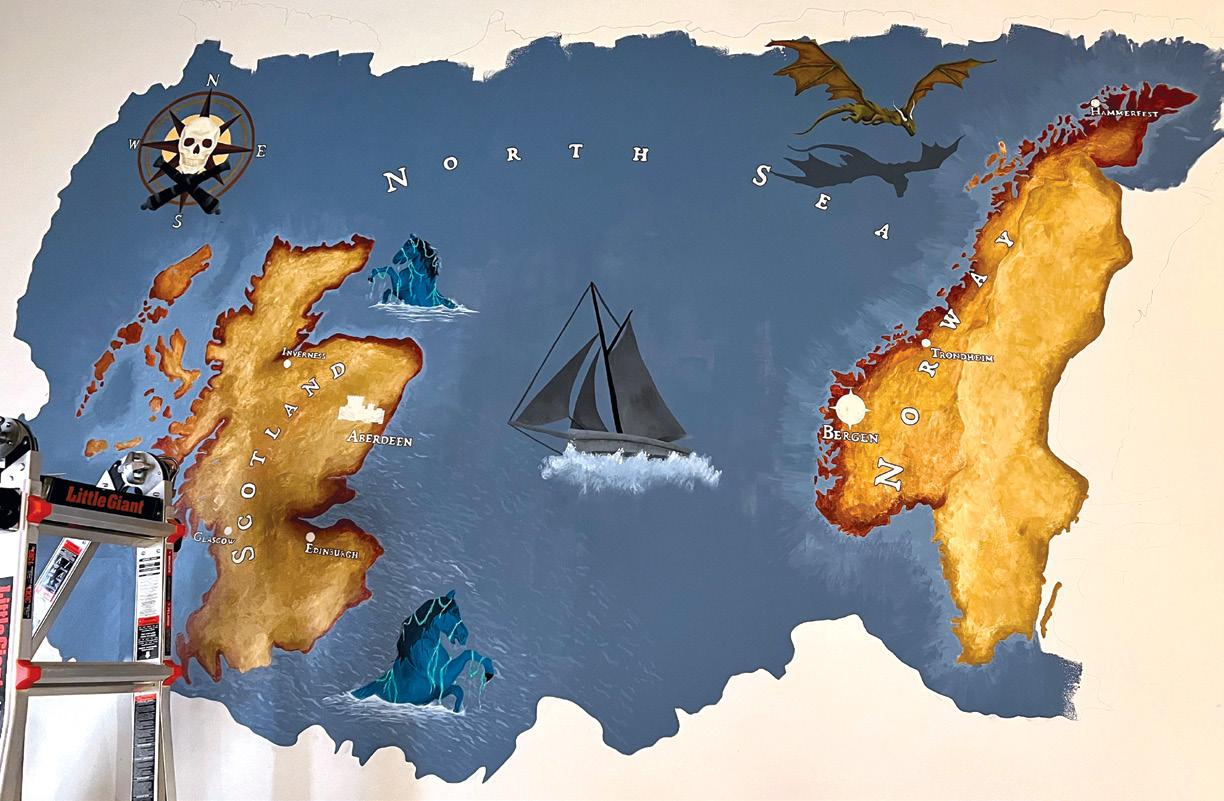
“Complementary opposites” doesn’t quite capture them. They’re more like two sailors who launched from different harbors on the same rough sea—Matt from Aberdeen, Scotland, where his family trace their roots, and Cole from Bergen, Norway, home to his—meeting somewhere in the middle with an idea and the shared instinct to figure out the rest as they went. When they showed me the upcoming tasting-room mural—a handpainted map of the North Sea representing their family roots—the metaphor practically wrote itself.
The mural, I should add, was painted by Matt and Cole’s daughters, Katie Mowatt

















and Sydney Bauer, who also design their labels and much of their branding. It’s striking: navy and deep teal hues, sweeping coastlines, little flourishes of myth and history. The girls also painted the massive Betsy Ross-style flag that spans the entire ceiling. They told me it’s to scale, and I believe them; that’s not something an engineer would be wrong about.
The mural and flag don’t just “dress the space.” They anchor it. They telegraph instantly that Cutter & Cannon is as much about storytelling, heritage, and identity as it is about alcohol.
Matt and Cole met years ago working in engineering—mechanical for one, pharmaceutical for the other—and they’ve built things together for decades. They swap codes and regulations with the casual ease of people who have navigated red tape for a living. When they talk about government oversight of distilling, the frustration is so familiar to them it comes out sounding like mild amusement. I’m not sure if that’s because they’ve accepted the bureaucracy or because they’ve simply developed the engineer’s ability to treat any obstacle as a math problem.
When they told me the idea for the distillery was born over drinks at Brick & Brew in Malvern, not during some formal planning session, but in the midst of a conversation about something else entirely, it made perfect sense. These are tinkerers, problem-solvers, and chronic doers. Of course a distillery would start as a question, then a joke, then a “what if?”
But what struck me most wasn’t the origin story. It was how long they’d clearly been thinking about—dreaming about— doing something like this. When you talk to homebrewers, there’s almost always a similar backstory: they got good at making beer in their kitchen, their friends encouraged them, they outgrew the hobby, and eventually the business side caught up. But distilling doesn’t work like that. Unless you want to spend quality time explaining yourself to the ATF, you don’t distill liquor in your garage.
Which means that Matt and Cole have come at this project from an oblique angle. While they’ve both long held a passion for a fine beverage — Matt is actually
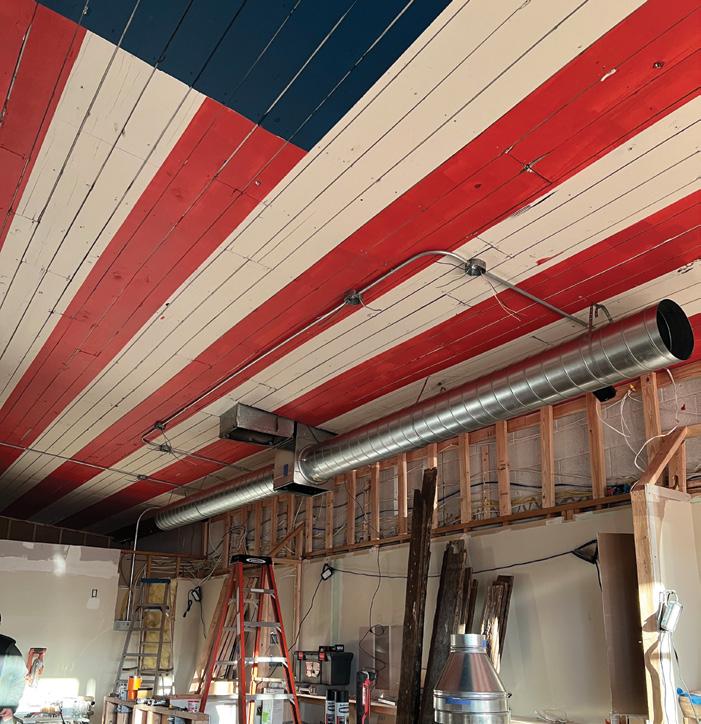
The massive ceiling mural, so large it is hard to fit in a photo, stands out in the midst of a tasting room that's very much a work in progress.
a certified sommelier — it was previous engineering jobs that prepared them for roles as distillers of fine spirits. Over the last 20 years they've designed and crafted distillation processes for pharmaceutical and fragrance companies. If anything, designing to spec for these industries is more technically demanding that what’s required to make a passable drink, and it’s exactly that kind of detail-oriented approach that’s likely to set them apart. XXX
Matt lived in West Chester years ago. Later, he moved two engineering offices into town. When they started looking for a space, West Chester was the first choice—but also the hardest. The regulations around distilling are strict, and
there’s a short list of places where everything—zoning, sprinkler systems, fire codes, accessibility, you name it—lines up. They looked in Rock Hall, Maryland. They looked in Ambler and Philadelphia. They almost settled somewhere else.
But after running into the same walls time and again in different towns, Matt and Cole decided maybe it was time they start knocking some of those walls down, both literally and figuratively.
After convincing West Chester to tweak some regulations and interpret others, they knew they could make the town work, and the spot they eventually found—a tucked-away industrial unit near another alcohol producer, Levante Brewing Company—came with something rare in this business: owners willing to let them knock down walls, tear open ceilings, gut the space, and even help with some of the cost. It gave Matt and Cole the freedom to build the distillery they wanted, not the distillery that fit into someone else’s mold.
The result, when it’s finished, will be part production facility, part tasting room,
part cozy hideaway. If you’ve ever been to the Hemingway Rum Company in Key West—the home of Papa’s Pilar—you’ll recognize the vibe: library lighting, soft seating, the kind of bar where people linger, sip rum neat, and strike up conversations with strangers who quickly stop being strangers.
West Chester doesn’t have that place yet. It has bars—plenty of them. Breweries, too. But a distillery with a living-room feel? A spot where you might learn about mash bills one minute and fall into a conversation about fishing, bourbon, or engineering horror stories the next? That’s new. And for a town that’s been steadily shifting from beer culture toward cocktails and spirits, the timing feels right.
Unlike many startup distilleries, Cutter & Cannon isn’t beginning with whiskey that needs years to mature. They’re starting with rum—white, aged, and a 114-proof “Gunpowder Strength” version
Secondhand tanks from regional distilleries were hauled and installed by Matt, Cole, and a crew of friends and family.
inspired by the old naval method of testing alcohol content. (In the old days, the purser would pour rum on gunpowder and test if it would ignite. At 114 proof, it does. This rum, Matt promises, will surprise people—it’s remarkably smooth for something that could technically function as both beverage and fuel.)
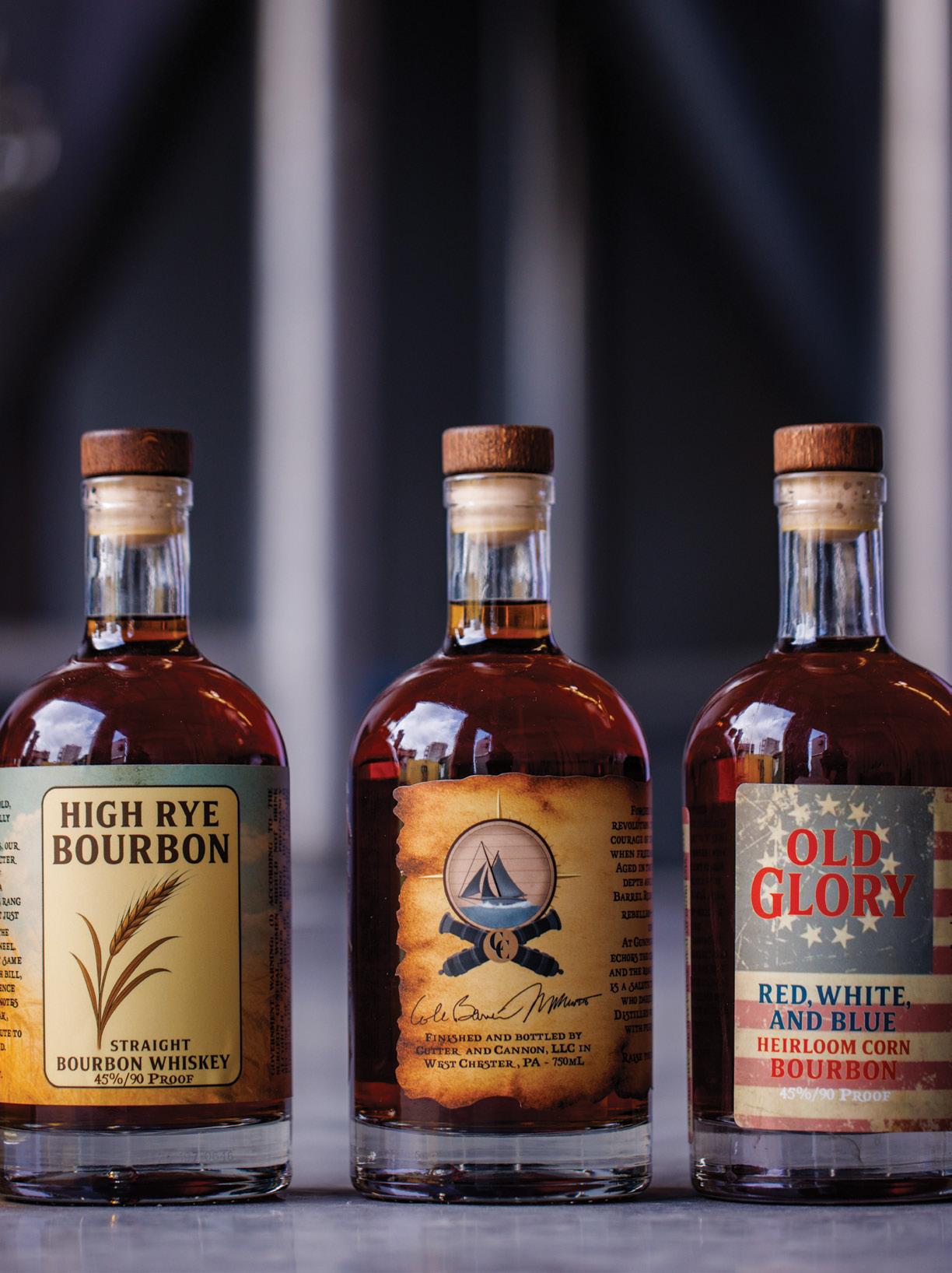
They’re also planning gin and brandy, and they’ve secured a limited-edition bourbon made from red, white, and blue heirloom corn that they’re finishing in sherry casks for the 250th anniversary of the nation. Part of the proceeds will support veterans.
Their future lineup includes a Pennsylvania rye (because of course it does—we practically invented the stuff) and a highrye bourbon that nods to regional history and their shared obsession with craft.
When I asked them what really separates good liquor from great liquor, they didn’t hesitate: it’s the little tweaks. Anyone can distill something drinkable. But the exceptional stuff comes from tiny decisions—when to cut, how long to rest, what cask to use, where to source grains, when to deviate from the norm. As an engineer, Matt relishes this. As a storyteller, Cole revels in the lineage behind those decisions.
Their ingredients, whenever possible, come from local farms. Their molasses and honey supplier is just up the road in Elverson. Their barrels come from East Coast cooperages. Their philosophy is simple: keep it local, keep it honest, keep it sustainable. Not because it’s trendy, but because it’s the right way to do it.

XXX
What made me feel most connected to this project wasn’t the lineup of spirits, or the hand-painted map, or even the flag-laden ceiling. It was how clearly they could both picture the finished space. Standing amid exposed studs and loose wires, they described the future tasting room with the kind of specificity you usually hear from people recalling a memory—not imagining one.
The soft seating area by the fireplace. The bar with enough seats for regulars to become actual regulars. The small tables for people who want to sip and talk, or sip and read, or sip and pretend they’re reading while eavesdropping.
They talked about classes they’ll teach—small-group distilling instruction, private mash-bill experiments, tasting flights for enthusiasts and newcomers alike. They want this to be a place where people learn, linger, and feel welcome.
The unfinished nature of the space didn’t make it charming, exactly—but it did make their confidence feel earned. These guys are grinding. They’re building
Matt & Cole's daughters painted this North Sea mural, blending Scottish and Norwegian roots into Cutter & Cannon’s story.
this while still holding down their full-time jobs. They’ve navigated the labyrinth of state and federal approvals. They’re putting in the sweat. And through all of that, they still speak about the timeline—late November, Early December—with optimism. Even if they’re off by a little — it’s the first week of November and there are still no walls — you get the sense that when it’s finished, it will be perfect. XXX
If Cutter & Cannon succeeds—and I suspect it will—it won’t be because they make the best spirits in the region, although they very well might. It’ll be because their personalities, their partnership, and their sincerity breathe life into the place.
They’re not trying to reinvent distilling. They’re not promising the smoothest rum or the most transcendent bourbon. They’re building a place where people who love craft spirits can come together, slow down, and enjoy something made with care.
And maybe that’s the real hook, the thing that hit me while standing under a flag ceiling and a half-finished wall map: these two men sailed very different paths to arrive here. One Scottish, one Norwegian. One happily expounding on distillation theory, the other walking me through the provenance of steel tanks. Their differences aren’t liabilities—they’re ballast. Together, they steady the ship.
West Chester is about to get its first distillery. But more importantly, it’s getting a place shaped by two people who have built a life—and now a business—on the belief that craftsmanship, friendship, and a shared vision can carry you farther than you ever thought.
photos ANDREW HUTCHINS
@hutchins photo
story dan mathers
@DANIELKMATHERS
Exploring the ever-evolving landscape of new and exciting businesses in town.
After more than three years of coming soon messages, LaScala’s Fire opened quietly on the corner of W. Gay Street and N. Church Street at the beginning of October. It was just days after Iron Hill announced its surprise closing. There was a small friends and family event, then a sign change from Coming Soon to Now Open. No grand openings. No pre-opening invite list. No Instagram live stream. Just a small change in messaging, but from the start, residents began to notice. Within weeks, the 44 West Plaza-fronted restaurant had established a set of regulars.
Today, there are 10 LaScala’s Fire locations, as well as LaScala’s Birra, LaScala’s Pronto, and a handful of other restaurant concepts. The West Chester location is co-owned by Rob and longtime pizza partner Tony Altomare. A West Chester University grad and owner of Tony Roni’s Pizza and Gentili’s in Exton, Tony is hands-on at the West Chester restaurant.
“We have fun. It’s a good vibe here,” says LaScala’s Fire General Manager Sandi Charney by way of explanation.
The interior itself is modern, simple, and light, the walls bright white. There are a dozen TVs that shine boldly above the black and white marble-topped bar. Against the back wall, “Let’s Eat” is scrawled in a black script. The restaurant is essentially split into two areas, the bar area and the dining booths. There aren’t a ton of tables, just 25, I am told. Maybe because of it, the room feels spacious.
On one side, facing a bank of windows is the hero bar surrounded by a collection of tables that can be pushed together to accommodate larger parties or the comingling of makeshift friends. On the other hand, there are wide, deep booths that can comfortably seat a party of six.
While there are doors facing Church Street, to dine, you enter the restaurant from Jack’s Corner at the 44 W. Plaza. The hostesses stand behind a
long desk, ready to help. The feel here is a little more hotel than restaurant, but it’s a quick mental adjustment. Near the door, there is plenty of room for strollers. Sandi says she leaves the space free because she doesn’t want anyone to feel like they are being an inconvenience.
The vibe is upscale casual. It’s a place you can easily meet colleagues for lunch (On a time crunch? Let your server know ahead of time; they can accommodate), hit up for a date night, or celebrate a family birthday. Of course, that is how it is described to me by Sandi. Something for everyone. A management dream, but already you can see it coming to be.
It’s Wednesday night when we visit. I get there early to make sure there
is time to talk, but already things are quickly filling in. At the bar, two friends are drinking a beer while ESPN previews an upcoming game between the Raiders and the Broncos. On the other side of the room, a couple, clearly on a date, sits across from each other in a wide booth, sharing a pizza. She has ordered LaScalla’s signature Ant’s Limoncello, vodka, and Limoncello, with a sugar rim. He has a drink I don’t recognize. Just behind me, a father and his two-year-old son wait at a table for the rest of their party to join. The toddler is sucking a lollipop and making the most of his newly acquired crayons and coloring sheet.
It’s a range for a midweek night, but it seems to work. It reminds me of a lit-

tle less chaotic visit to Iron Hill during its heyday. Where generous space, a casual vibe, and a wide-ranging menu made families feel welcome. At the same time, a lively bar pulled in plenty of post-work regulars. LaScala’s Fire echoes that atmosphere—easygoing, familiar, and built to absorb a crowd without feeling crowded. Fortunately, it also has really good food.
I ordered the bestselling Spicy Chicken Cutlet Rigatoni with a Caesar salad to start. We also tried the Fig & Smoked Prosciutto pizza and took home a plain cheese pie for the kids. (Tony left it uncut so I could tuck it into the oven when I got home for a quick reheat.)
LaScala’s Fire has a free-flowing kitchen, a concept your server should explain to you as soon as you sit down. In a free-flowing kitchen, the food comes out when it’s ready. There are no heat lamps in the restaurant, so when the order’s up. Out it comes. The trade-off is simple: dishes arrive at peak freshness, even if that means not perfectly synchronized delivery. Servers are trained to minimize this - ordering pizza before pasta - so the dishes come out similarly timed. If they don’t, the culture here leans into sharing rather than waiting, which feels fitting for a menu designed around generous portions.
My meal started with the Caesar salad, crisp Romaine, a generous portion of grated Parmesan, and housemade dressing. Actually, everything but the pasta, which is imported from Italy, is made in-house.
“Everything we do here is from scratch,” says Tony.
LaScala’s Fire describes itself as modern Italian. Though definitions vary, here it seems to mean classic Italian-American comfort with contemporary touches and a willingness to incorporate broader trends. All I can figure is has to do with the embrace of hot honey - or the sushi on the menu, but we’ll get to that in a minute.
Sandi swears by LaScala’s Hot Honey pizza, but there’s the signature hot honey on my Rigatoni. So, I go in another direction. The Fig & Smoked Prosciutto is the namesake ingredients with crumbled gorgonzola and swirls of basil pesto
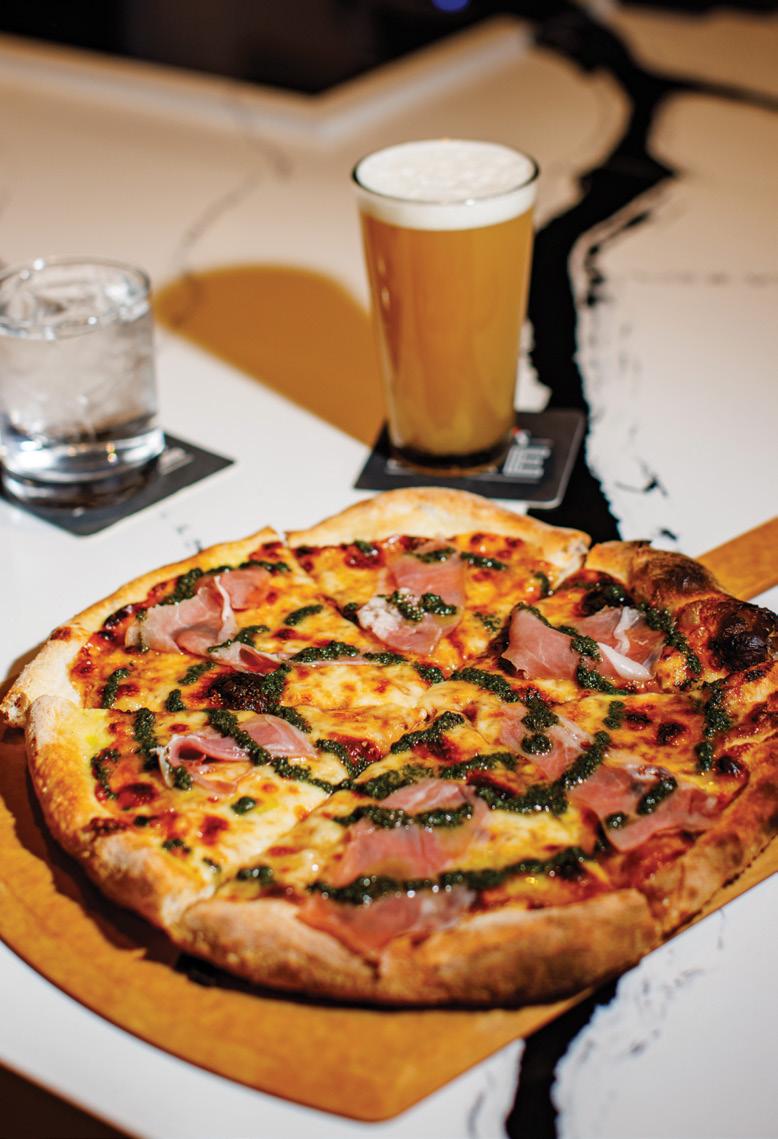
Prosciutto, Fig Jam, Basil Pesto and Crumbled
Gorgonzola combine to make a pizza that's salty, sweet and savory.
to top. The crust is crisp but not crispy. The fig jam is sweet but not overpowering, neither is the gorgonzola. The whole pie is well-balanced and delicious. The only downside is, if you are not careful,
the prosciutto will come off in one salty, savory bite. Truthfully, it’s really not that much of a negative.
Tony claims he has the best pizza in West Chester - a bold claim in a Borough dominated by pizza joints, but after a slice of the Fig and Prosciutto, I am ready to hear his case.
The last dish to arrive was the spicy chicken rigatoni. The rigatoni is tossed in a vodka cream sauce and topped with a breaded chicken cutlet with the famous LaScala’s Hot Honey and a ball of burrata. The hot honey brings a little
kick that is cooled by the vodka sauce and the creamy cheese. No notes. It’s easy to see why it’s a favorite.
With my dinner, I opt for a glass of the Malbec. The wine list is not extensive, but it certainly suited my needs. There are also 16 beers on tap, and a solid selection of classic and signature cocktails, many named for someone close to the restaurant, one with hot honey. (No, I’m not kidding.) Each is expertly made. While some of the waitstaff are young, the bar staff are all experienced. Having someone behind the bar who does not know the difference between his or her martinis is just not something Sandi says she is willing to mess with.
In all, the night feels like a treat. Yet, nothing on the menu is more than $30.
The LaScala Restaurant Group, of which LaScala’s Fire is a part, is a Delaware Valley chain built around the popular Italian-American theme - familia. On the homepage of the website, owner
Rob LaScala embraces his family’s journey from Calabria, Italy, to Philadelphia. With only a few pennies to their name, they settled in South Philadelphia, raising a family, embracing a community, and building two successful businesses — a construction company and a deli. A century later, Rob has taken that dream and run with it.
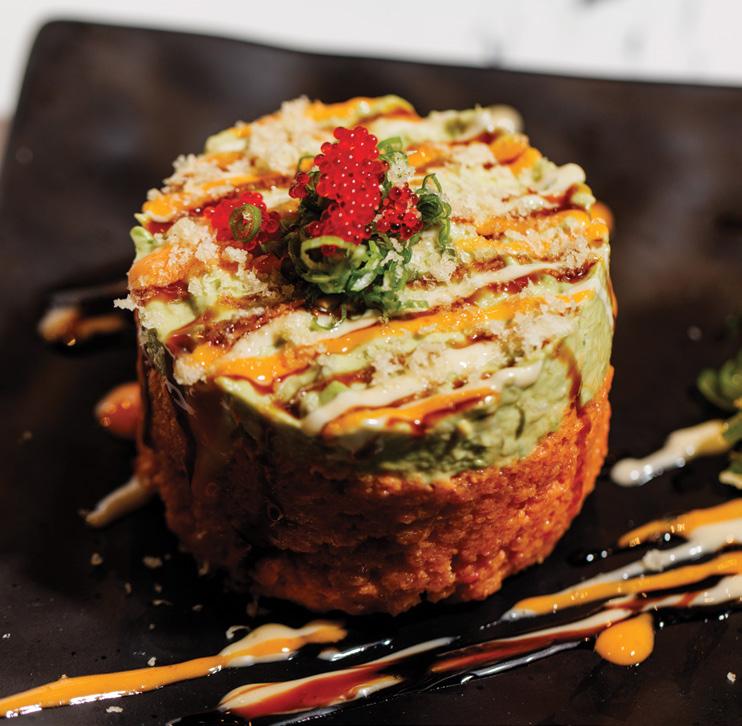
Sushi? In an Italian Restaurant!?!
I know, I know, but hear us out: it's really, really good!
“It’s phenomenal sushi,” Tony assures me, and just on looks alone it is incredibly impressive.
The sushi is separate from the LaScala’s kitchen and run by Tony Rim, former owner of 1225 Raw Sushi and Sake Lounge.
It has its own chefs and a separate sushi bar. The staff is distinguished visually from the rest of the kitchen with their bright red uniforms.
The concept was piloted at the Marlton location a few years ago, and it was a hit.
“It’s a weird combo, but it does work,” says Sandi.
I guess there's nothing that weird about two of America's favorite foods in one place.
his signature tomato sauce and what will soon become his recipe for success: Fresh from scratch Italian American favorites, a cozy full-service bar, and a dedicated staff.
The concept was a hit. He changed the name to LaScala’s and, as they say, the rest is history.
“The whole concept is families enjoying food they can all share.”
-Tony Altomare co-owner of the west chester location for lascala's fire
He started with the purchase of Apollo Pizza in Media just before 2000. By 2005, Rob had opened his seventh Apollo location. This one is located at 7th and Chestnut in Philadelphia, only this time he’s decided to expand beyond pizza and instead serve a full range of Italian American classics built around
“What I love about the whole concept is families enjoying food they can all share,” he says, describing a table that had ordered a pizza, some pasta, and the Chef’s Choice Sushi platter for their eight-year-old daughter.
LaScala’s Fire offers freshly-made Italian classics with a couple of twists along the menu. Together, those choices create a place that feels attentive but unfussy, polished but still comfortable— an easy new addition to West Chester’s dining landscape, and one that already seems well on its way to becoming a regulars’ spot.
photos ANDREW HUCHINS
@hutchins photo story cara corridoni
@HELLODUBC

Library Director Maggie Stanton suggests cooking inspiration from the shelves of West Chester Public Library.
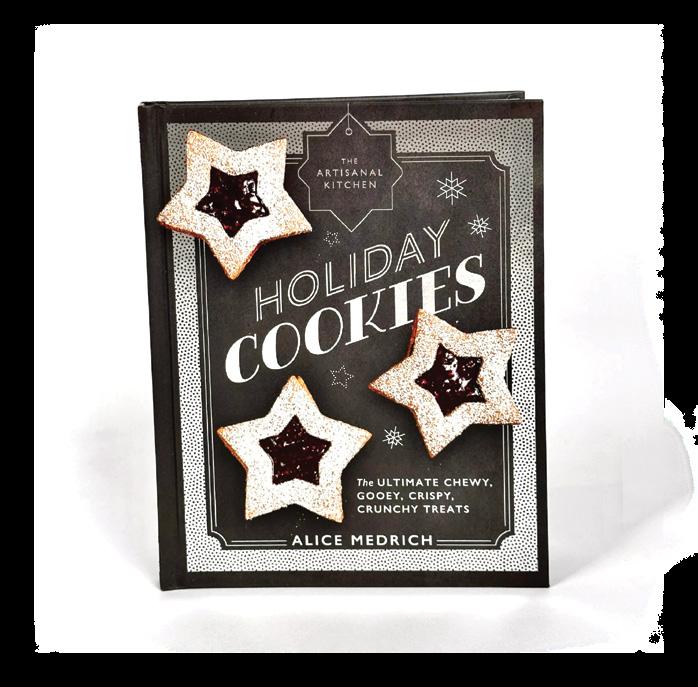
The Artisanal Kitchen Holiday Cookies: The Ultimate Chewy, Gooey, Crispy, Crunchy Treats by Alice
Medrich
Holiday Cookies provides dozens of foolproof recipes for cookies, bars, and savories of all textures, from simple holiday classics like Vanilla Bean Tuiles and Great Grahams to the more decadent Caramel Cheesecake Bars and Chunky Hazelnut Meringues. There are even some delicious savories that can double as hors d'oeuvres at the holiday buffet like Crunchy Seed Cookies and Salted Peanut Toffee Cookies.Holiday Cookies, Holiday Cocktails, and Party Food, three new titles in the Artisanal Kitchen series, provide an indispensable arsenal of recipes that cover all the bases for a delicious holiday season.
Food Gifts 150+ irresistible recipes for crafting personalized presents by Elle Simone
Food fosters connection, and there's no more meaningful way to connect with others than to give a personalized food gift that you’ve prepared and packaged yourself. Elle Simone Scott, food stylist, ATK cast member, and author of the bestseller Boards, turns her considerable talents to expanding the boundaries of what food gifts are (they're endlessly customizable) and when they can be given (literally, anytime), proving along the way that food is one of the best (and bestlooking) gifts you can give. You’ll also learn Elle’s favorite ideas for keeping food gifts fresh and packaging items cost-effectively yet creatively using edible garnishes, thrifted tableware, canning jars, cellophane bags, parchment, and more. With her expert help, you’ll never again resort to an expensive, impersonal store-bought basket.
DECEMBER 6
Showcasing eight homes in the Borough decked out for the holidays. Ranging from petite to grand, the homes blend original details with modern updates and display the homeowners’ art, collectibles, and antiques get your tickets at wcpubliclibrary.org/holidaydoortour
People: A Cookbook For Creative Celebrations by
Brie Larson
From weekly Game of Thrones viewing parties to Dirty Dancingthemed birthday parties and their annual Hot Dog Appreciation Festival, Brie and Courtney can find a reason to celebrate just about anything. While their debate over whether or not a hot dog is a sandwich will never end, Brie and Courtney can agree that food always tastes best when you cook it and eat it with the ones you love. They wrote Party People to help you create meaningful connections with the ones you love, whether that's with family, friends, or yourself. And with recipes like Old Pal cocktails, cheesy Jenga bread, and dueling roast chickens, they have you covered. Technically, this is an entertaining cookbook--but Brie and Courtney are serving up more than party tips and menus.
52 kidfriendly holiday baking recipes by Pia Imperial
With easy-to-make recipes for cookies that will feed into any family Christmas tradition of leaving something sweet for Santa, plus plenty of other mouthwatering holiday dessert recipes, this cookbook will guide young bakers through whipping up delectable festive treats.
by Emily Stephenson
The popularity of Friendsgiving celebrations grows every year, and whether it's because of that weird uncle or the distance between your home and mom's table, The Friendsgiving Handbook is here for those who aspire to take part. With 25 delicious recipes that cover every part of the meal— from Simple but Classic Roast Turkey and Garlic-Miso Gravy, to Sautéed Brussels Sprouts with Pine Nuts and Concord Grape Pie—this cookbook encourages home chefs to attempt the classics or experiment with something new. It is packed with helpful advice on planning ahead, decorating a table, and creating an oven schedule. This guide is essential for hosting a Thanksgiving celebration, whether a potluck or a sitdown affair, with your family of choice.
story wc public library
@WCPLPHOTOS

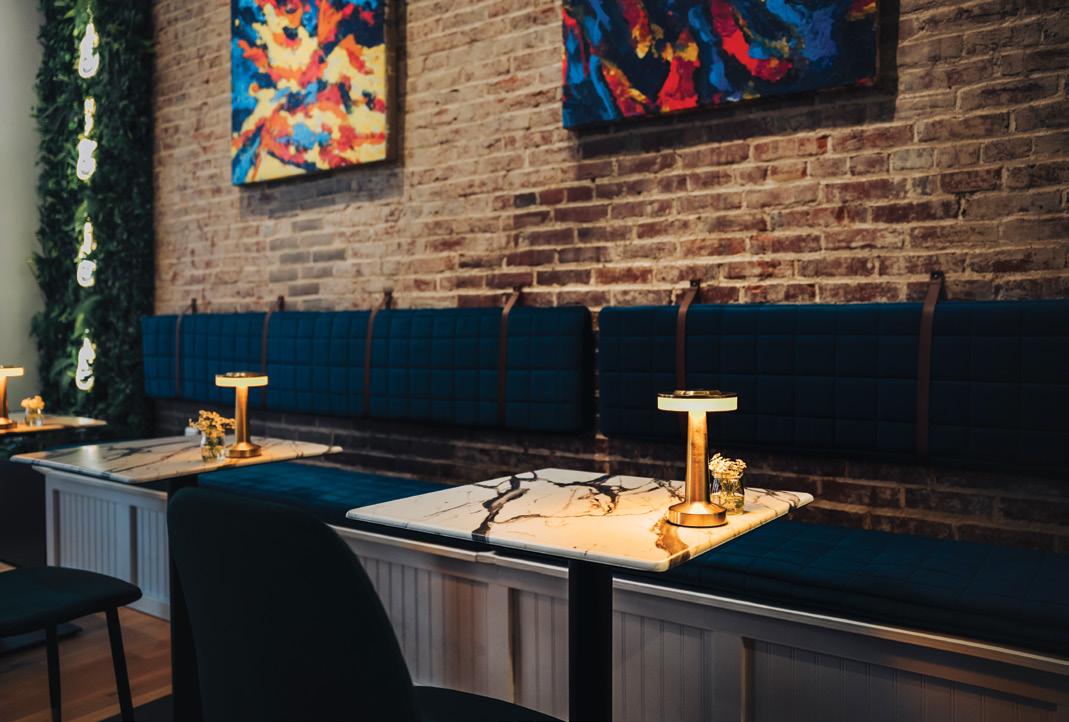
Exploring the design concepts of our borough’s best kitchens and dining spaces.
This Month: LoCali
Step inside the new wine lounge, LoCali. Located on Market Street between Chestnut and Matlack, owners Kevin Boylan and Madison Collins bring California wine to West Chester. Inspired by California’s tasting-room collectives, you can sample multiple boutique wineries all under one roof. This laid-back and welcoming space is the perfect setting to sip delicious wines paired thoughtfully with tapas. Their comfortable and historic venue reflects local music, artwork, and a fun atmosphere.
LoCali’s space is designed with intention. Kevin and Madison wanted to preserve the historic building as much as possible while making updates that
speak to the LoCali story. The surrounding exposed brick walls celebrate our historic downtown and create a warm environment. An array of seating for both small and large groups makes it easy to settle in and find a cozy conversation spot. You will see their love for music, with records on the wall and picture frames with photos of local artists. Kevin and Madison thoughtfully left blank frames to fill with photos of future artists that play there. In the back of the tasting room, there is a sofa seating area and a record player with an extensive record collection. Above the sofa is a vibrant neon light reading “Memories, They Can’t Be Bought,” a lyric from John Prine’s “Souvenirs.” The bar area boasts the original floor-to-ceiling brick along with chalkboards featuring quotes from musicians. Artwork with hanging guitars, music-festival posters, and record covers fill the walls. There are two pieces from Cosmic Art Studios in Pottstown, and they will be rotating artwork throughout the year.
Taking their knowledge and love for wine, Kevin and Madison have their hands on the production in Napa Val-
ley, making sure to bring back the best for us to enjoy. Naming the bottles after personal experiences adds a customized touch. Try their Mollie Mae label, named after Kevin and Madison’s dog, and the Bella Amici, a tribute to their Italian roots with a family crest. You will also see bottles from Red Brick Winery, owned by local winemaker Ahmed Chraga. Wines can be purchased by a flight, a glass, or a bottle to enjoy at LoCali or to go. They also serve craft cocktails and select beers. Pair a tapas or dessert with your wine— favorites include the roasted beets and brownie-batter dip.
LoCali will be showcasing local artists on the weekends along with open-mic nights and Bring Your Own Vinyl nights monthly. Check out their calendar online for details. They are open Thursday and Friday from 4pm–10pm, Saturday 12pm–10pm, and Sunday 12pm–8pm. It’s a lovely atmosphere to spend your afternoon or evening learning about wine and enjoying great conversation.

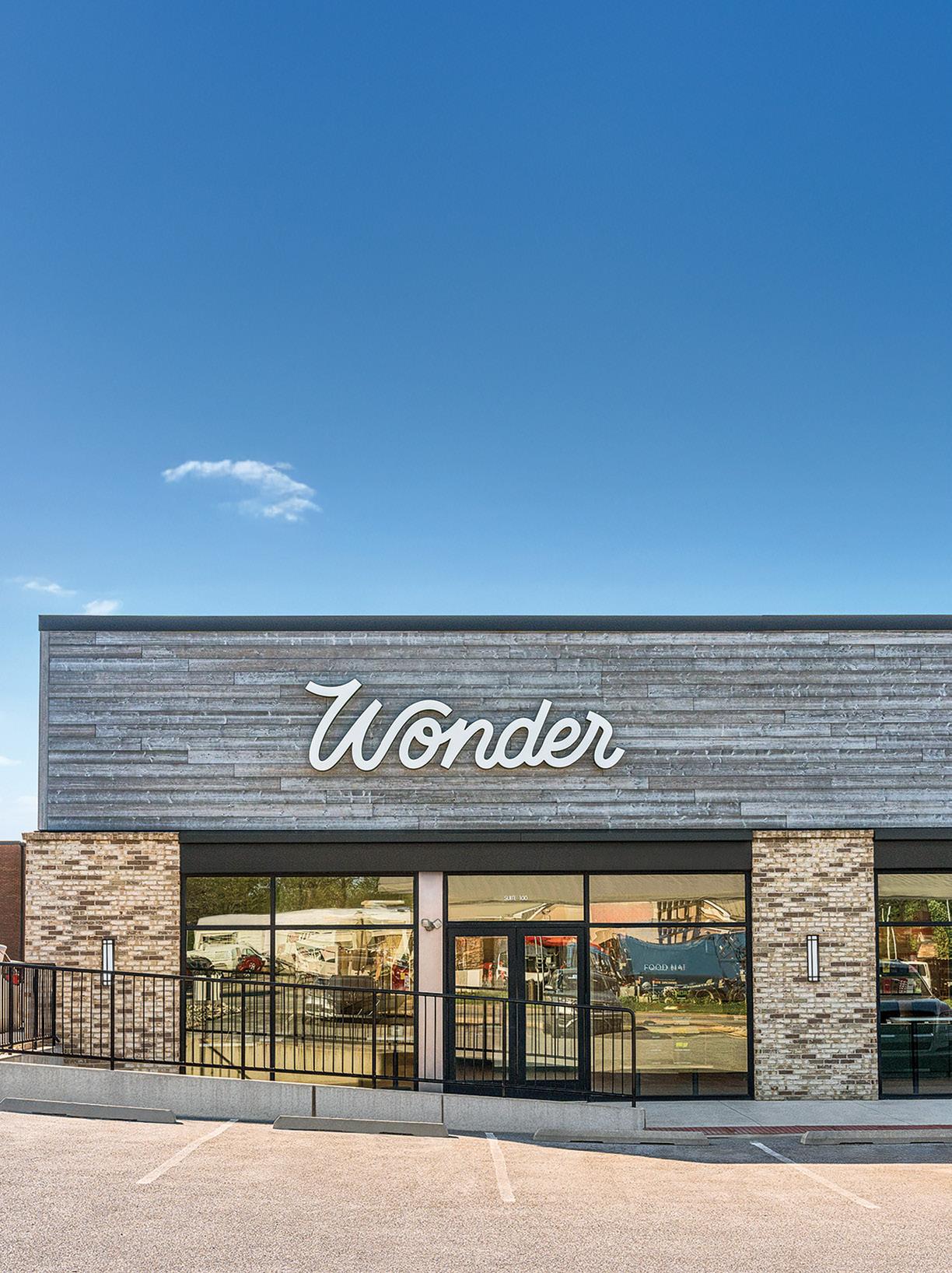
The East Coast’s fastest-growing culinary platform has arrived, bringing chef-driven meals, smart kitchens, and a new dining experience to West Chester

When entrepreneur Marc Lore sets his sights on a problem, he doesn’t just aim to fill a gap — he reinvents the experience from the ground up. The serial entrepreneur, known for founding Jet.com and serving as Walmart’s U.S. e-commerce chief, has turned his attention to something closer to home: the daily ritual of dinner. His latest venture, Wonder, is an attempt to reimagine how we eat — and what “mealtime” means in this age of technology.
Lore’s goal wasn’t just to make food delivery faster or more convenient; it was to elevate it. “From the start, Wonder was built as a vertically integrated company — developing its own cooking technology, creating its own restaurant concepts, operating its own kitchens, and handling its own delivery,”says a representative from the company. “The result is a mealtime platform unlike anything else on the market, one that blends restaurant-quality cuisine with the ease and adaptability of digital dining.”
At its core, Wonder is designed to answer the most universal — and often most relentless — question in any
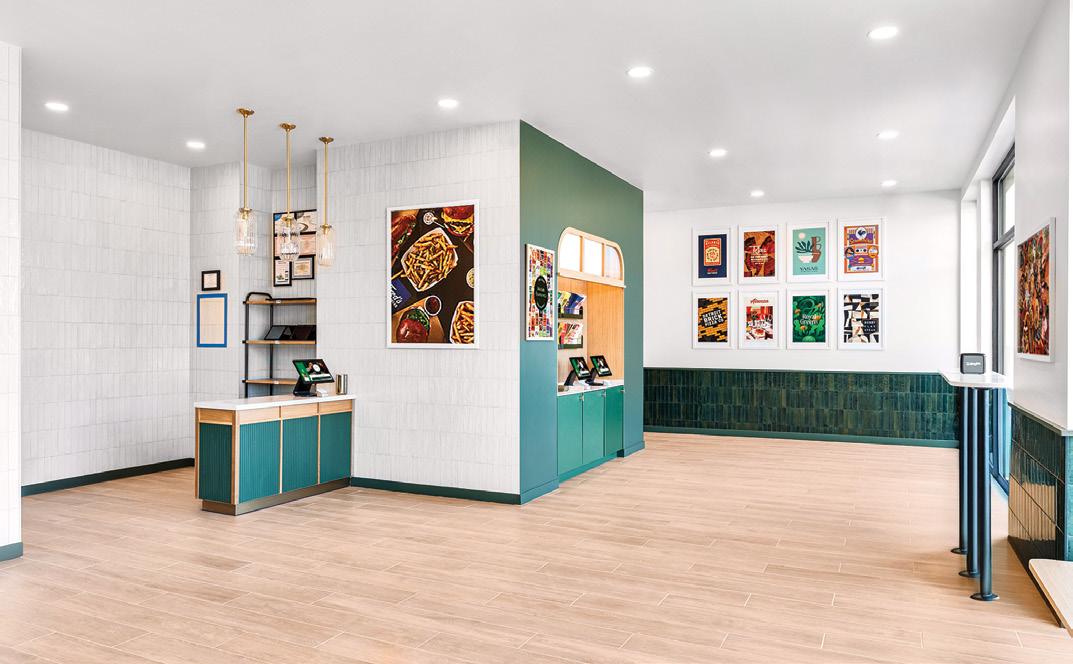
Wonder’s entry space blends clean design and digital ordering, setting the tone for a streamlined experience.
household: What’s for dinner? Assuming a home cooked meal is out of the question, takeout locales still need to be agreed upon. Wonder asks, why choose? Through a single app, customers can order from more than 20 restaurants and chefs at once, a feature called Multi-Restaurant Ordering that’s the first of its kind in the industry. “No one has to settle anymore,” says a Wonder spokesperson. “If one person wants tacos and another wants pizza, it’s all in one order.”
The scope of the menu reads like a culinary atlas, and that’s because Wonder partners with some of the world’s most renowned chefs. That list includes names like Bobby Flay, José Andrés, Marcus Samuelsson, JJ Johnson, and Michael Symon, alongside celebrated restaurant brands like Di Fara Pizza, Tejas Barbecue, and Chai Pani. The variety spans cuisines,
techniques, and regions, but everything is united by a commitment to quality and craft.
Unlike traditional delivery apps, which serve as intermediaries between restaurants and customers, Wonder owns the entire process — from kitchen to doorstep. That level of control ensures a consistency that’s rarely achievable in the fragmented food delivery system we’re used to using.
Central to Wonder’s operation is a proprietary cooking system that’s entirely electric — no open flames, no greasy stovetops, and no guesswork. The technology allows chefs to cook meals with precision, delivering restaurant-level flavor and texture every time.
This focus on electric cooking also aligns with broader environmental and safety goals. It’s efficient, sustainable, and designed to bring consistency to every dish, no matter the location. Whether you’re eating in Manhattan or West Chester, the burger from Bobby’s Burgers or the biryani from Chai Pani tastes exactly as the chef intended.
The kitchens themselves are streamlined marvels of modern engineering







— sleek, quiet, and optimized for speed without sacrificing artistry. It’s not fast food; it’s smart food, cooked to order and finished using methods fine-tuned to each recipe.
While many know Wonder for its delivery service, the brand’s physical locations are becoming destinations in their own right. There are now over 75 Wonder locations across New York, New Jersey, Rhode Island, Pennsylvania, Connecticut, Delaware, Virginia, and Washington, D.C., with new markets — including Maryland and Greater Boston — on the horizon.
Each location offers delivery, pickup, and dine-in, allowing guests to engage with Wonder however they choose. For a quick weekday dinner, customers can grab takeout or enjoy efficient delivery. For a more leisurely meal, the dine-in experience provides a warm, modern atmosphere that feels both casual and elevated. The company has hinted that beverage offerings may evolve in the future, but for now, the spotlight remains squarely on the chefs and their creations.
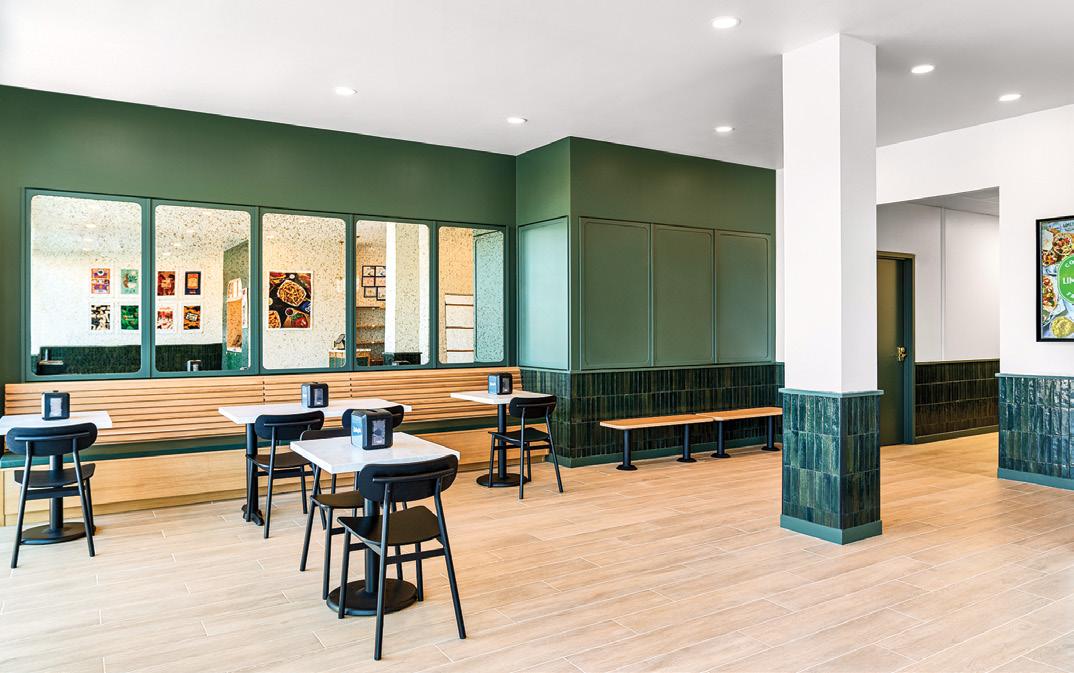
The restaurants feature bright, open spaces with sleek finishes and warm lighting, striking a balance between
Textured tiles and slatted benches elevated an otherwise sterile space into a comfortable dining room
upscale design and neighborhood comfort. “We wanted the spaces to feel inviting, not intimidating,” the company explains. “It’s about creating an environment where great food and community naturally come together.”
Adding another layer of convenience, Wonder has integrated Blue Apron meal kits, heat-and-eat options, and even local restaurant ordering powered by Grubhub into its app. That means customers can decide not only what to eat but how they want to eat — cooking it themselves, heating it up later, or enjoying it fresh.
In an era when dietary needs and preferences vary widely, Wonder’s approach is refreshingly transparent. Every menu item comes with detailed ingredient and allergen information, clearly labeled for specific diets. Whether you’re vegetarian, gluten-free, or simply counting macros,
you can browse the app with confidence and find dishes that fit your needs without digging through fine print. Those with severe allergies can rest assured, since they’ll be well-informed about cross contamination and dedicated fryers.
That inclusivity extends beyond the digital interface. The chefs behind Wonder’s menus have worked to craft recipes that cater to diverse palates and lifestyles without compromising flavor. Healthy doesn’t mean boring, indulgent doesn’t mean heavy, and fast doesn’t mean careless. The best chefs don’t need to rely on “extra sugar, butter and salt” to make something taste like a treat, and that’s what you’ll be getting - food cooked by the best chefs.
Step inside a Wonder location, and you’ll notice it feels different from most fast-casual restaurants. There’s an intentional sense of calm — no blaring music, no overcrowded counters, no smell of fryer oil. Instead, it’s the hum of conversation and the sight of food being plated with precision.
Customers can watch as dishes from different restaurants come together seamlessly: a bowl of José Andrés’ Span-


ish paella next to a slice of Di Fara’s legendary Brooklyn pizza, followed by a side of Marcus Samuelsson’s signature fried chicken. It’s an unlikely combination that works beautifully, unified by Wonder’s emphasis on culinary craftsmanship and cutting-edge technology.
And because Wonder handles all its own logistics, the experience extends beyond the walls of the restaurant. Deliveries arrive quickly, packaging is thoughtfully designed to preserve temperature and texture, and customer service feels more personal than transactional.
The focus has paid off. The menus showcase an impressive range of global influences — from the smoky brisket of Texas pitmasters to the delicate balance of spices in Indian street food. It’s the kind of menu where a single order might contain Korean fried chicken, Neapolitan pizza, and barbecue ribs — all made with the precision of top-tier kitchens.
Wonder’s ambitions are anything but modest. With rapid expansion across the East Coast and plans for continued national growth, the company is positioning itself not just as a restaurant group or delivery service, but as a new category in dining altogether. “Ultimately, we want Wonder to be the go-to destination for every mealtime moment,” the company says. “That means continuing to innovate — partnering with more chefs, introducing more cuisines, and improving our technology to make the experience even more seamless.”
As new locations open, each community becomes a testing ground for evolving ideas. Whether that’s refining pickup efficiency, experimenting with new menu formats, or expanding heatand-eat offerings, Wonder is constantly iterating. Growth, for Lore and his team, is about depth as much as scale.
In many ways, Wonder feels like the natural next step. Over the past decade, we’ve seen meal kits, food delivery apps, and ghost kitchens reshape the landscape — but rarely in ways that truly elevate the experience. Wonder’s innovation lies in unifying those trends into a single, cohesive system that delivers not just convenience but quality.
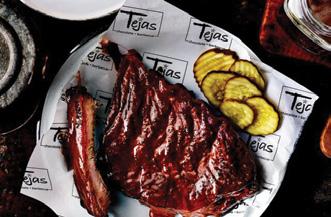
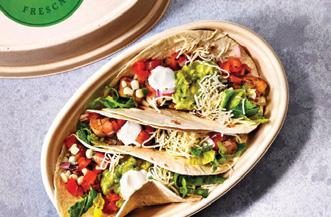
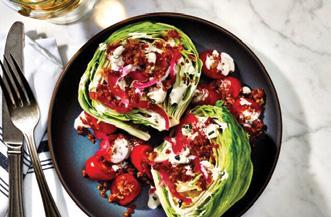
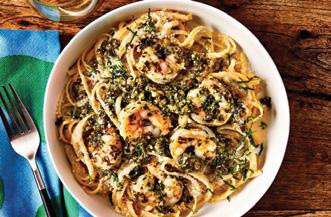
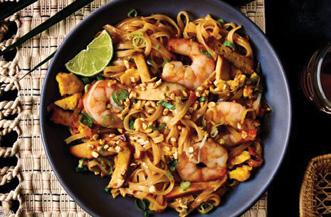
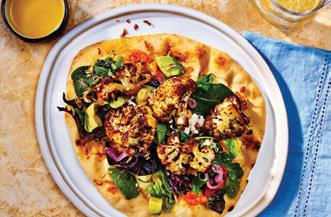
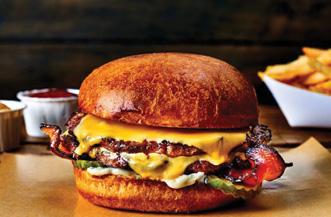
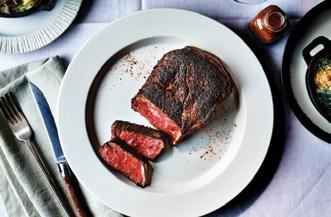
A spread from across Wonder’s culinary partners shows how every preference can be satisfied at once.
By merging technology, culinary artistry, and hospitality, Wonder has found a sweet spot between restaurant dining and at-home comfort. It’s an answer to the modern diner’s paradox: wanting it all — speed, variety, quality, and connection — and refusing to settle for less.
If the success of its early markets is any indication, Wonder’s model could
redefine what “restaurant” means in the years ahead. It’s no longer just a place or a menu — it’s a platform for every craving, designed to meet you wherever and however you want to eat.
As Wonder expands, it’s helping reshape how communities experience food. By uniting technology, culinary expertise, and hospitality, the company reflects evolving expectations around convenience and quality. Its arrival in West Chester adds a forward-thinking concept to the local dining landscape and signals how mealtime is continuing to change.
story BECCA BOYD @homebeccanomics




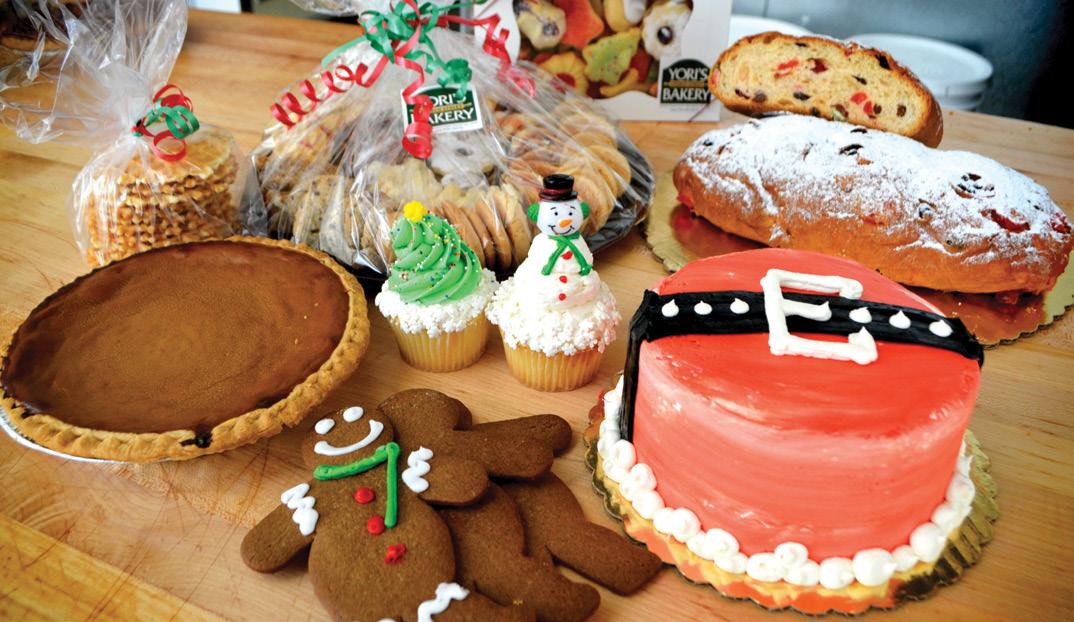
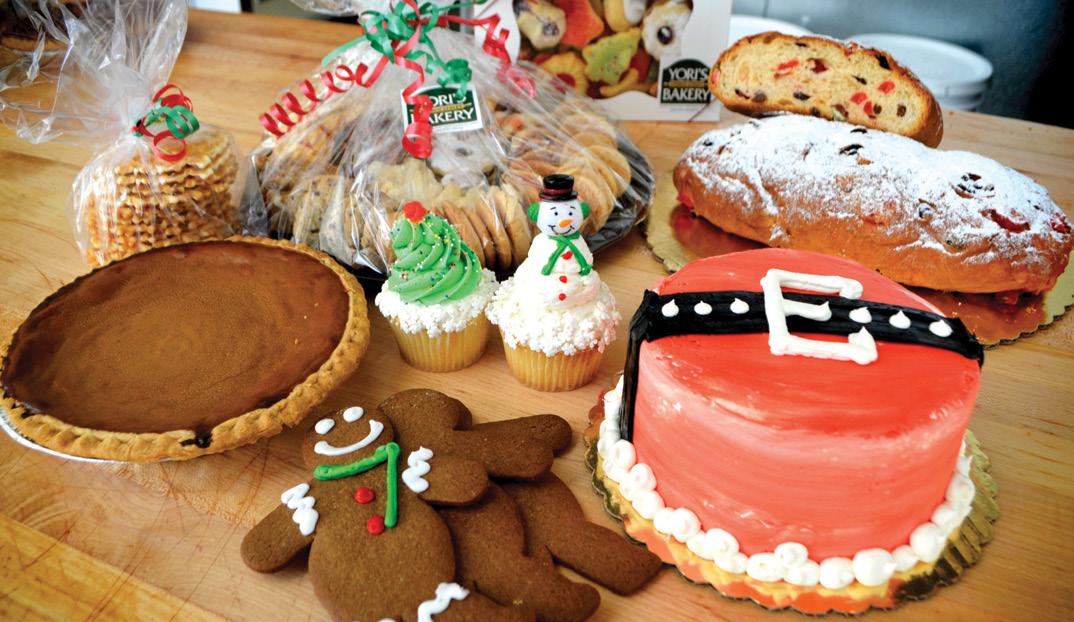
If you can spot the five differences in these two shots of Yori's baked goods from a decade ago, email your answers to contests@thewcpress.com, and you’ve got a chance to win a Saloon 151 gift certificate.