Issue 23, March 23, 2026

Page 1


THE VARSITY

T HE VA

T HE VA RSI T Y

T HE VA

T HE VA

T HE VA RSI T Y

T HE VA RSI T Y

Vol. CXLVI, No. 23

21 Sussex Avenue, Suite 306 Toronto, ON M5S 1J6 (416) 946-7600

21 Sussex Avenue, Suite 306 Toronto, ON M5S 1J6 (416) 946-7600

21 Sussex Avenue, Suite 306 Toronto, ON M5S 1J6 (416) 946-7600

thevarsity.ca thevarsitynewspaper

The Varsity acknowledges that our office is built on the traditional territory of several First Nations, including the Huron-Wendat, the Petun First Nations, the Seneca, and most recently, the Mississaugas of the Credit. Journalists have historically harmed Indigenous communities by overlooking their stories, contributing to stereotypes, and telling their stories without their input. Therefore, we make this acknowledgement as a starting point for our responsibility to tell those stories more accurately, critically, and in accordance with the wishes of Indigenous Peoples.

thevarsity.ca thevarsitynewspaper @TheVarsity thevarsitypublications the.varsity The Varsity

thevarsity.ca thevarsitynewspaper @TheVarsity

Editor-in-Chief

MASTHEAD

thevarsitypublications the.varsity The Varsity

@TheVarsity thevarsitypublications the.varsity The Varsity

Medha Surajpal editor@thevarsity.ca

Vol. CXLVI, No. 20 MASTHEAD

Vol. CXLVI, No. 23 MASTHEAD

Medha Surajpal editor@thevarsity.ca

Medha Surajpal editor@thevarsity.ca

Editor-in-Chief

Editor-in-Chief

Chloe Weston creative@thevarsity.ca

Creative Director

Chloe Weston creative@thevarsity.ca

Chloe Weston creative@thevarsity.ca

Creative Director

Creative Director

Sophie Esther Ramsey managingexternal@thevarsity.ca

Managing Editor, External

Sophie Esther Ramsey managingexternal@thevarsity.ca

Sophie Esther Ramsey managingexternal@thevarsity.ca

Ozair Chaudhry managinginternal@thevarsity.ca

Managing Editor, External

Managing Editor, External

Managing Editor, Internal

Ozair Chaudhry managinginternal@thevarsity.ca

Ozair Chaudhry managinginternal@thevarsity.ca

Jake Takeuchi online@thevarsity.ca

Managing Editor, Internal

Managing Editor, Internal

Managing Online Editor

Jake Takeuchi online@thevarsity.ca

Jake Takeuchi online@thevarsity.ca

Callie Zhang copy@thevarsity.ca

Managing Online Editor

Managing Online Editor

Senior Copy Editor

Callie Zhang copy@thevarsity.ca

Callie Zhang copy@thevarsity.ca

Raina Proulx-Sanyal deputysce@thevarsity.ca

Senior Copy Editor

Senior Copy Editor

Deputy Senior Copy Editor

Raina Proulx-Sanyal deputysce@thevarsity.ca

Raina Proulx-Sanyal deputysce@thevarsity.ca

Ella MacCormack news@thevarsity.ca

Deputy Senior Copy Editor

Deputy Senior Copy Editor

News Editor

Ella MacCormack news@thevarsity.ca

Ella MacCormack news@thevarsity.ca

News Editor

Junia Alsinawi deputynews@thevarsity.ca

News Editor

Deputy News Editor

Junia Alsinawi deputynews@thevarsity.ca

Junia Alsinawi deputynews@thevarsity.ca

Deputy News Editor

Emma Dobrovnik assistantnews@thevarsity.ca

Deputy News Editor

Assistant News Editor

Emma Dobrovnik assistantnews@thevarsity.ca

Emma Dobrovnik assistantnews@thevarsity.ca

Ahmed Hawamdeh opinion@thevarsity.ca

Assistant News Editor

Assistant News Editor

Opinion Editor

Ahmed Hawamdeh opinion@thevarsity.ca

Ahmed Hawamdeh opinion@thevarsity.ca

Medha Barath biz@thevarsity.ca

Opinion Editor

Opinion Editor

Business & Labour Editor

Medha Barath biz@thevarsity.ca

Medha Barath biz@thevarsity.ca

Shontia Sanders features@thevarsity.ca

Business & Labour Editor

Business & Labour Editor

Features Editor

Shontia Sanders features@thevarsity.ca

Shontia Sanders features@thevarsity.ca

Features Editor

Sofia Moniz arts@thevarsity.ca

Features Editor

Arts & Culture Editor

Sofia Moniz arts@thevarsity.ca

Sofia Moniz arts@thevarsity.ca

Ridhi Balani science@thevarsity.ca

Arts & Culture Editor

Arts & Culture Editor

Science Editor

Ridhi Balani science@thevarsity.ca

Ridhi Balani science@thevarsity.ca

Science Editor

Caroline Ho sports@thevarsity.ca

Science Editor

Sports Editor

Caroline Ho sports@thevarsity.ca

Caroline Ho sports@thevarsity.ca

Aksaamai Ormonbekova design@thevarsity.ca

Sports Editor

Sports Editor

Design Editor

Aksaamai Ormonbekova design@thevarsity.ca

Aksaamai Ormonbekova design@thevarsity.ca

Design Editor

Brennan Karunaratne design@thevarsity.ca

Design Editor

Design Editor

Brennan Karunaratne design@thevarsity.ca

Brennan Karunaratne design@thevarsity.ca

Erika Ozols photos@thevarsity.ca

Design Editor

Design Editor

Photo Editor

Erika Ozols photos@thevarsity.ca

Erika Ozols photos@thevarsity.ca

Photo Editor

Simona Agostino illustration@thevarsity.ca

Photo Editor

Illustration Editor

Simona Agostino illustration@thevarsity.ca

Simona Agostino illustration@thevarsity.ca

Jennifer Song video@thevarsity.ca

Illustration Editor

Illustration Editor

Short-Form Video Editor

Jennifer Song video@thevarsity.ca

Jennifer Song video@thevarsity.ca

Short-Form Video Editor

Short-Form Video Editor

IgniteUTM wins 2026 UTMSU elections in landslide

All IgniteUTM candidates win by over 1,000 votes

IgniteUTM’s Adam El-Falou will be the UTMSU’s president for the 2026–2027 academic year, the University of Toronto Mississauga Students’ Union (UTMSU) announced the unofficial results for the spring 2026 elections on their website. El-Falou garnered 1,501 votes to beat ServeUTM’s first-year candidate XinChun (Oliver) Wang, who only received 390 votes.

Consistent with last year’s results, candidates who won the executive position lineup were all from one of the two slates. This year, the winning slate was IgniteUTM, with no ServeUTM candidates securing an executive position.

Xingyi (Freya) Gao won the position of VP Internal with 1,505 votes.

Rajas Dhamija was re-elected as VP External with 1,520 votes.

The unopposed position of VP Equity went to the sole candidate, Tiffany Da Silva, who collected 1,605 votes in favour and 90 votes against her candidacy.

Dana Al-Habash was elected as VP University Affairs with 1,551 votes.

Each IgniteUTM candidate beat their ServeUTM opponents by over 1,000 votes, resulting in a landslide victory for their slate. A difference of this magnitude has not been witnessed in the previous three elections.

This year’s elections reported a 12.3 per cent voter turnout — a total of 2,004 eligible

students — a significant decline from the previous year’s 19.2 per cent turnout, which had in turn been an increase from 2024’s 16.3 per cent and 2023’s approximate 14 per cent turnout — marking the voter turnout in 2026 as an all-time low across the past four elections.

Board of Directors

This year, 23 candidates ran for the 11 available seats in the Board of Directors (BOD) Division II.

The 11 candidates who won a seat are: Xinhe (Cecilia) Wang, Cynthia Tong, Marcus Lee, Joud

Gao. Only one candidate, Onoasi Odo-Effiong, ran for a seat in the BOD Division III and won with a total of 1,018 votes in favour, 267 votes against, and 625 abstentions.

In an email to The Varsity, the Chief Returning Officer (CRO) wrote that “to date there are no complaints, appeals or recounts and no issues regarding demerit points for the spring 2026 elections.”

Emily Shen emilyshen@thevarsity.ca

Gabriella Wrona Long-Form Video Editor video@thevarsity.ca

Gabriella Wrona Long-Form Video Editor video@thevarsity.ca

Front End Web Developer

Emily Shen emilyshen@thevarsity.ca

Emily Shen emilyshen@thevarsity.ca

Sataphon Obra sataphon.ob@gmail.com

Front End Web Developer

Front End Web Developer

Back End Web Developer

Sataphon Obra sataphon.ob@gmail.com

Sataphon Obra sataphon.ob@gmail.com

Arunveer Sidhu utm@thevarsity.ca

Back End Web Developer

UTM Bureau Chief

Back End Web Developer

Arunveer Sidhu utm@thevarsity.ca

Arunveer Sidhu utm@thevarsity.ca

Ashley Thorpe utsc@thevarsity.ca

UTM Bureau Chief

UTM Bureau Chief

UTSC Bureau Chief

Ashley Thorpe utsc@thevarsity.ca

UTSC Bureau Chief

Ashley Thorpe utsc@thevarsity.ca

Matthew Molinaro grad@thevarsity.ca

Graduate Bureau Chief

UTSC Bureau Chief

Matthew Molinaro grad@thevarsity.ca

Vacant publiceditor@thevarsity.ca

Graduate Bureau Chief

Matthew Molinaro grad@thevarsity.ca

Public Editor

Graduate Bureau Chief

Vacant publiceditor@thevarsity.ca

Ben Chapman,

Public Editor

Ella

Where campus crimes happen, mapped

The Varsity compiles the data from Campus Safety’s Activity Reports since 2019

Taimoore Yousaf, Jean Patrick Vidad

Vacant publiceditor@thevarsity.ca

Public Editor

Ben Chapman,

Cate Woodhead & Juliet Pieters

Associate Sports Editor

Taimoore Yousaf, Jean Patrick Vidad

Ben Chapman & Juliet Pieters

Associate Copy Editors

Cate Woodhead & Juliet Pieters

Hilary Cheung &

Associate Copy Editors

Associate Copy Editors

Hilary Cheung &

Associate News Editor

Hilary Cheung &

Celesta Maniatogianni

Celesta Maniatogianni

Mia Torres & Sloane Overdorf

Associate News Editor

Associate Features Editors

Mia Torres & Sloane Overdorf

Mia

Associate Features Editors

Mackenzie Duffy & Bushra Azim Boblai

Mackenzie Duffy & Bushra Azim Boblai

Associate A&C Editors

Lauren Robinson & Lucia McLaren

Associate A&C Editors

Associate Science Editors

Lauren Robinson & Lucia McLaren

Vesa Lunji & Zaneb Asad

Associate Science Editors

Associate Opinion Editors

Vesa Lunji & Zaneb Asad

Vesa Lunji & Zaneb Asad

Associate Opinion Editors

Associate

Rebecca Liu & Audrey Kim

Taimoore Yousaf, Jean Patrick Vidad

Associate Sports Editor

Associate B&L Editors

Associate Sports Editor

Rebecca Liu & Audrey Kim

Loise Yaneza

Rebecca Liu & Audrey Kim

Associate B&L Editors

Associate Design Editor

Associate B&L Editors

Loise Yaneza

Emma Cervinka & Dowon Kim

Loise Yaneza

Associate Design Editor

Associate Illo Editors

Associate Design Editor

Emma Cervinka & Dowon Kim

Associate Illo Editors

Associate Illo Editors

Abby Russchen, Justin Chan-Degroot & Kazim Abro

Emma Cervinka & Dowon Kim

Abby Russchen, Justin Chan-Degroot & Kazim Abro

There have been 4,470 “suspicious person” reports across all years, with the highest concentrations at 71 Prince Arthur Avenue, Bahen Centre, and OISE. Between 2019 and 2025, Campus Safety’s Annual Reports with crime statistics include a total of 349 official “suspicious persons” listed, which is less than any of the single years’ worth in the Activity Reports.

There are also unfounded reports in the data. One report from Burwash Hall on December 6, 2019, stated, “A person reported seeing handguns in a residence room. They were determined to be toy guns.”

Associate Photo Editors

Snigdha Singh

Abby Russchen, Justin Chan-Degroot & Kazim Abro

Associate Photo Editors

Associate Video Editor

Associate Photo Editors

Snigdha Singh

Vacant

Snigdha Singh

Associate Video Editor

Associate Web Developer

Associate Video Editor

Vacant Associate Web Developer

Vacant

Lead Copy Editors: Hilary Cheung, Omayma Lateef, Roya Alisultanova, Sarah Pan, Zaneb Asad

Associate Web Developer

Lead Copy Editors: Cate Woodhead, Hilary Cheung, Omayma Lateef, Sarah Pan, Zaneb Asad

Lead Copy Editors: Hilary Cheung, Omayma Lateef, Roya Alisultanova, Sarah Pan, Zaneb Asad

Copy Editors: Celesta Maniatogianni, Lauren Robinson, Liana Liu, Mila Kagetsu, Nargiz Memettursun, Risha Banerjee, Shruthi Umashankar

Where is the worst place to lock your bike at UTSG? Which of the residence halls has the most fire alarms? Which buildings have the most “suspicious odours?” Using more than 15,000 Campus Safety Activity Reports logged since 2019, The Varsity mapped when and where incidents were reported across campus. This data is compiled from Campus Safety’s public Activity Reports Google Calendar. Activity Reports do not measure incidents, only Campus Safety’s reporting. Based on the description on the calendar event, The Varsity manually categorized and geocoded the entries. The location on the map is an approximation. The full dataset can be found online on The Varsity

At most locations, the most common category of report is “suspicious person.” Notable exceptions include the Athletic Centre, Robarts Library, and Gerstein Library, all of which use T-card scanners at their entrance; at these sites, theft is the most frequently reported category.

Overall, theft ranks as the second most common category with 1,606 reports, followed by person wellbeing check at 1,306, trespass at 714, and mischief at 635. In 2020 and 2021, graffiti also appeared among the top five categories, with a total of 500 reports — most frequently at OISE.

Fire alarms — separate from actual fires — have been reported 29 times at Charles Street University Family Housing, 20 at Burwash Hall, eight at OISE, and six at Wetmore Hall and Graduate House. Hate incidents are largely made up of “hate related” graffiti and posters, along with one instance of “hate related mail sent to Simcoe Hall” on May 24, 2024. Unsurprisingly, Simcoe Hall hosts the most protests. All reported protests have increased since 2024.

Copy Editors: Celesta Maniatogianni, Lauren Robinson, Liana Liu, Mila Kagetsu, Nargiz Memettursun, Risha Banerjee, Shruthi Umashankar

Designers: Loise Yaneza & Simona Berardocco

Designers: Loise Yaneza & Simona Berardocco

Copy Editors: Aksaamai Ormonbekova, Audrey Kim, Celesta Maniatogianni, Darya Kartalaei, Despina Zakynthinou, Dori Seeman, Ineza Rugari, Jean Patrick Vidad, Junia Alsinawi, Liana Liu, Nargiz Memetturnsun, Rebecca Liu, Shruthi Umashankar, Sofia Moniz, Taimoore Yousaf, Vesa Lunji

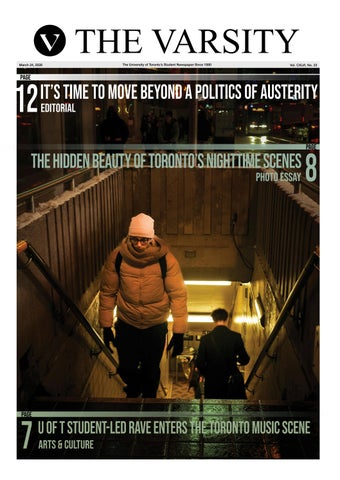
Cover: Photo by Justin Chan-Degroot

Designers: Simona Berardocco, Loise Yaneza, Yena Choi

BUSINESS OFFICE

Cover: Illustration by Simona Agonstino

The hotspots

BUSINESS OFFICE

Eva Tsai business@thevarsity.ca

Business Manager

BUSINESS OFFICE

Eva Tsai business@thevarsity.ca

Vacant

Business Manager

Eva Tsai business@thevarsity.ca

Business Associate

Vacant

Business Manager

Muzna Arif muznamars@thevarsity.ca

Business Associate

Vacant

Advertising Executive

Business Associate

Muzna Arif muznamars@thevarsity.ca

Advertising Executive

Muzna Arif muznamars@thevarsity.ca

Advertising Executive

The most common location listed by far is the Campus Safety Office, which is often listed if there is no other location associated with the report. Beyond that, other hotspots include the Bahen Centre, Charles Street University Family Housing, Ontario Institute for Studies in Education (OISE), 107 St George Street, and the Athletic Centre. Charles Street Housing, which accommodates around 2,000 adults and children across two high-rise residence buildings, is the largest U of T residence.

From 2020–2022, skateboarders were in the top five categories of reports. These reports remained consistent throughout the year, often increasing during the winter, peaking in January 2022 with 25 reports. While there were 144 such reports in 2021, the numbers dropped to just nine in 2025.

The Galbraith Building’s top report is skateboarders with 119 incidents. The surrounding area — featuring multiple low, flat stairs and “manual pads” — makes it ideal for skaters.

Most “suspicious odour” reports were resolved as “all in order.” Exceptions include a gas smell from an elevator at Graduate House, which required Toronto Fire, and when Campus Safety could not find the source of the odour in the Anthropology building on September 17, 2025.

Elevators have trapped people in the Louis B. Stewart Observatory, Charles Street University Family Housing, Bahen Centre, Woodsworth College Residence, Alumni House, Myhal Centre, CampusOne, Whitney Hall, and University College. The locking mechanism also trapped someone in the restroom at the C. David Naylor Building in June 2021.

A report category with only one incident is crowd control, which was at Chestnut Residence on June 17, 2019, which involved

Cover: Photo by Justin Chan-Degroot
Gabriella Wrona Long-Form Video Editor video@thevarsity.ca
Celesta Maniatogianni
Al-Habash, Nabeeha Shamim, Sierra O’Brien, Saad Hussain, Maryam Zeeshan, Suleyman Yusuf, Jana Al-Mallah, and Ya (Gloria)
The UTMSU’s 2026–2027 executive team. ERIKA OZOLS/ THEVARSITY

“individuals climbing to balcony areas to see the Raptors event.”

Where thefts happen

The Athletic Centre has the most thefts at 227 incidents — 27 of which involved lockers. That is more than double the amount of total thefts at the next highest locations: Charles Street University Family Housing with 109, Bahen Centre at 91, and Robarts Library at 87.

When a theft report included a description of the items stolen, the number one item was bikes, then money, laptops, bags, and phones, respectively.

Bike and scooter thefts are at their highest in late summer, and regularly peak in September before dropping in the winter. The Athletic Centre is the hotspot for bike thefts with 49 reports, followed by Charles Family Housing at 30, Bahen at 23, and Robarts at 13.

U of T libraries have signs at most study spaces urging students not to leave belongings unattended. Robarts Library has almost as many thefts as Robarts Commons, Gerstein, John M. Kelly Library, E.J. Pratt Library, and the Earth Sciences Library combined.

That said, the largest number of reports of laptops stolen was at Bahen with 20 reports,

with Robarts closely following behind with 19.

Sidney Smith Hall has 11, and Gerstein Library has nine.

18 packages were stolen from Charles Street University Family Housing, the most package thefts on campus, followed by Graduate House with 10.

There was a string of eight plaque thefts from October 23 to November 6, 2024. The pattern generally involved two thefts in a day, followed by a break, then another two. On the fifth stolen plaque report, Campus Safety emphasized, “ANOTHER PLAQUE WAS REPORTED STOLEN.” The incidents

When mapped, reports of incidents on campus cluster around particular areas.

ELLA MACCORMACK/THEVARSITY

slowed to one theft on October 30, with the last reported theft on November 6. There have been no similar incidents since.

The descriptions for reports are often minimal, but for unique cases, Campus Safety will go into detail. On February 18, 2022, one car theft report read, “TORONTO POLICE SERVICE REQUESTED ASSISTANCE IN LOCATING A STOLEN MOTOR VEHICLE. MOTOR VEHICLE LOCATED AT OFF CAMPUS FRATERNITY HOUSE PARKING LOT.” The location listed was 152 St George Street, Lambda Chi Alpha fraternity’s house.

Some of the items included in the theft report description are particularly unique. There have been reports of stolen lab samples, a basketball, a kettle, a plastic coffee table, a baby stroller, a video game, two different school projects, and three different garbage bins.

When incidents happen

October consistently has the highest number of reports, while June has the fewest. Sunday is the least common day of the week for reports, with Saturday closely following — although noise complaints are most frequent on Saturday.

Fraud reports are most common in September, and often follow patterns. Taxi scammers appeared on campus between January 15–23, 2025, accounting for five of the eight reported incidents. Later in the year, four of nine projector scams took place between November 20–24, 2025.

Campus Safety’s busiest day was October 7, 2024, with a total of 32 reports. This coincided with the first day of the UofT Occupy for Palestine organized “Week of Rage.”

2024 saw a large increase in reports, which continued into 2025. In previous years, total Activity Reports were lower than Annual Reports, but followed a similar trend line. This may indicate that incidents themselves are not necessarily increasing, but that Campus Safety is logging more reports.

PSY354 final exam sent to all active UTM psychological and brain sciences students

Follow-up email sent 15 minutes later requested all students to

“disregard and delete”

Early in the morning of March 18, the Department of Psychology at UTM sent out an email to all active Psychological and Brain Sciences (PBS) students on the email list server (listserv). The email contained attachments of both the regular and special deferred copies of the final exam for PSY354: The Biopsychology of Sex.

Chain of emails leaked

The leaked emails contained the final copies of the exams after “minor formatting changes” were made, and requested Taryn E. Grieder — the course’s professor — to submit them through the Course Information System (CIS) by 5:00 pm on March 20.

This email was intended only for Grieder, but was instead sent to all active PBS students at UTM. As a result, private emails sent by Jodie Stewart, the academic advisor and undergraduate program administrator at the department of PBS, and Grieder — which contained the exams — were forwarded to the students.

A follow-up email was sent 15 minutes later, requesting all students to “disregard and delete” the email and its attachments, stating that “they were sent in error.”

Grieder wrote in a March 18 announcement to the class, “Hello wonderful students, sorry for the confusing emails today – as you likely saw, everyone on the Psych department’s email list (listserv) was accidentally sent our final exam! I will be creating a new final exam. However, I believe it still works out in your favour, as now you have a sample exam to use as a study aid :).”

Students’ reactions

One student in the course wrote to The Varsity that they were “initially worried” about negative effects for the class until the announcement.

“Honestly, I think she was pretty graceful about the whole thing.”

Students were quick to post screenshot copies of the email on the UTM and U of T Reddit pages, commenting on the ordeal.

“The fact that the prof sent it directly to them and they managed to forward it to the entire student body? Yeah that’s a massive fumble,” one user wrote.

Other students expressed concerns for the professor who would have to rewrite the entire

exam, “It takes forever to make exams from scratch. The prof must be fuming.”

In one Reddit thread, students joked that the Department of Psychology was playing “mind games” with students. A user suggested that the email itself may have been the exam, with another user responding that it’s “still too hard to pass.”

Process of final exam submissions

On March 12, Stewart sent out a confidential email to the undergraduate program reminding professors to submit their final exam scripts online through the new CIS platform by the deadline provided.

The first step of this new process involves professors emailing their draft final exam script to the PBS undergraduate team for review. Following this, the team reviews the exam draft and makes format changes, then sends the final copy back to the professor. The final step requires the professor to submit the final exam script through CIS for department approval.

On March 17, Grieder completed the first step of this process and sent her draft final exam script for PSY354 to the PBS undergraduate team. The emails from Stewart and Grieder were sent to the correct recipients and not the entire PBS student body. It is unclear who from the department sent the email to the PBS listserv in error.

Arunveer Sidhu UTM Bureau Chief
Leaked exams can be used as a study aid, professor says. STEVEN LEE/THEVARSITY

Diabolos’ Coffee Bar reopened on discovered bank funds, running on surplus since Student-run

café closed in 2023, reopened in January

Despite previous financial and labour challenges, University College’s (UC) Diabolos’ Coffee Bar has been running off a budget surplus since it reopened in January. Its initial costs were covered by funds that sat in its bank account during its closure, surprising both management and the UC student government.

The student-led café closed in 2023 because of conflicts with the United Steel Workers (USW) and the Canadian Union of Public Employees (CUPE), as well as financial difficulties within the University College Literary and Athletic Society’s (UCLit).

“The thought process was absolutely that Diabolos’ was going to be financially dependent on the debt,” said UCLit Finance Commissioner Behram Hathi in an interview with The Varsity

During the reopening process, the UCLit assumed the café bank account was empty.

“We had absolutely no idea how much was in that account for a long time,” Hathi described. “There was, surprisingly enough, money when we got it. So far, they haven’t had to ask for a penny from the Lit.”

Hathi added that although Diabolos’ is currently breaking even, the UCLit would “function as a stopgap” if the café were to operate at a loss. Diabolos’ surplus funds currently cover the cost of its labour and raw materials, and is managed as a separate entity under the UCLit.

“There [have] been dips… but we are at the very least, breaking even […] I was cautiously optimistic that [Diabolos’] would be selfsustaining, which is always a goal, and I'm glad to report that it is now,” Hathi said.

UC doesn’t charge Diabolos’ rent for its space in the Junior Common Room (JCR), making labour its largest expense. Of U of T’s three student-run cafés, Diabolos’ is the only one that pays its staff; the others — Victoria College’s Caffiends and the Faculty of Music’s Edward Johnson Cafe — are volunteer-run.

In the 2010s, Diabolos’ and the UCLit faced major tax issues with the Canada Revenue Agency (CRA), prompting the college to take over staff hiring. The UCLit was still responsible for the hiring decisions, but the university was responsible for payroll. This arrangement allowed Diabolos’s manager and baristas to be hired through the Work Study program, with wages subsidized by the provincial government.

After closing during the pandemic, Diabolos’ first reopened in January 2023. Soon after, UC reviewed casual job postings against the USW pay grid and

determined that the café’s manager — contracted as a Work Study employee — should be receiving $50 per hour rather than minimum wage.

Additionally, the university could not hire outside of CUPE bargaining agreements, and Diabolos’ roles were deemed comparable to CUPE positions on campus.

“It would have been completely unsustainable to run at that. Again, this was during a time when the Lit was not just in [dire] financial straits, it was also in debt,” said Hathi. At the time, the UCLit was $60,000 in debt, and because of incomplete audits, the university was withholding funding.

The café subsequently closed again for the 2023–2024 and 2024–2025 academic years.

Reopening

Diabolos’ employees are no longer contracted as Work Study employees and are instead directly employed by the UCLit again. Unlike the

university, the student government is not bound by agreements with the CUPE or USW. Staff are paid minimum wage plus tips, and the café manager receives an end-of-year honorarium.

“We’re no longer ruled by union rules, which in some ways is good and in some ways is bad. Unions are an amazing thing… but also, $40 an hour is completely untenable for the organization to afford,” current Diabolos’ manager Raquel Lewin said to The Varsity in an interview.

“I get paid minimum wage now… I would love to [be paid] more, but I understand that that’s all that they could pay me right now,” they added.

When asked whether the UCLit had considered making Diabolos’ positions volunteer-based — like those at Caffiends and the Edward Johnson Cafe — Hathi said the idea was considered but ultimately rejected.

“The number one reason is, historically, it was a paid position, it was a student job opportunity, and there was frankly no reason to take that away… If you go back to 2021… there’s a different situation completely [...] But when we’re financially solvent, there’s absolutely no reason to take away student jobs.”

Lewin added that while Diabolos’ maintains a working relationship with the UCLit, she hopes the café will continue to cover its own labour costs.

“The goal is to be able to… cover our own labour [...] It’s one of those things [that] would be nice, but it’s also okay if it [doesn’t happen]. I trust that… the UCLit has good finance commissioners.”

Lewin feels that Diabolos’ employment model provides students with an opportunity to gain work experience in a low-stakes environment.

“My intention here is to provide students with an opportunity for work experience […] Finding… an entry-level job, especially in Toronto, [is really difficult]. I wanted to make a position… specifically for students [so they can have] a stepping stone to other things outside of university.”

UTMSU hosts town hall and rally over OSAP changes and tuition increases

Students cite safety concerns as union pushes for broader mobilization

Over March 18–19, students gathered at UTM to protest recent changes to the Ontario Student Assistance Program (OSAP) and the tuition freeze lifting. In interviews with The Varsity , organizers warned that the shift toward loans will make postsecondary education less accessible.

Town hall outlines concerns over affordability

At a March 18 town hall, University of Toronto Mississauga Students’ Union (UTMSU) leaders described the Ford government’s OSAP restructuring as a significant threat to affordability. Under the new cuts, the program is shifting from a primarily grant-based system to one dominated by loans.

The town hall also featured Liberal MP Iqra Khalid, who said she had raised the issue in the House of Commons.

“I stood in the House of Commons, and I raised this issue at the federal parliament, siding with students,” Khalid said. “But as much as it frustrates me, the realm of education is within the provincial government.”

Khalid encouraged students to continue organizing and contacting elected officials.

“Political will doesn’t just come about,” she said. “It is built by people like yourselves.”

“I would like to acknowledge that we did invite a Conservative Member of [Provincial] Parliament, Sheref Sabawy, and they unfortunately did not respond,” UTMSU Vice President External Lois Ogunnubi-Oriade said. “We also invited our university administration that also didn’t respond.”

Ogunnubi-Oriade later added that students had submitted several questions intended for

administrators, but those questions could not be answered in their absence.

Students raise concerns about protest safety and barriers to participation

Students at the town hall raised concerns about protest safety, referencing reports of police violence at previous demonstrations.

“I know a lot of people that want to go to the protest, but the main thing stopping them is protection from violence,” a student attendee said. “I went to the first protest… There was an excessive amount of police violence, specifically toward minors. I witnessed this myself.”

“We know that students are scared to attend another protest,” one UTMSU organizer said. “We’re organizing direct action training… because we believe that we keep each other safe, and we need to know what we can do to protect ourselves in these situations.”

The organizer added that trained protest marshals and legal support from the Canadian Federation of Students (CFS) would be available.

Some students — particularly international students — said they remain hesitant to participate due to potential immigration risks.

“We are worried about our status in Canada,” another student said. “We would rather… do nothing in these rallies than risk being sent back.”

Organizers acknowledged these concerns and suggested alternative forms of participation, including spreading awareness online and supporting advocacy efforts indirectly.

“If you can’t be there physically, be there virtually,” one organizer said.

Rally highlights awareness gap among students

On March 19, students gathered at the UTM Student Centre and marched across campus,

chanting slogans such as “Hands off our education,” “Hands off our OSAP,” and “No cuts, no fees, no corporate universities.”

Although the rally began with a small group, participation grew as students moved through campus.

“OSAP is a tool that most students at this university, along with every other institution, depend on,” Mekayel Omier, a UTMSU

Division I board director, said to The Varsity “I personally also depend on OSAP… and we

to raise awareness on this issue, because the provincial government can’t get away [with] making such huge changes to the way we get our education without any sort of repercussion.”

However, Omier said many students he met during the rally “were initially surprised and

need
Nguyen Bao Han Tran Varsity Staff
Closure
Diabolos’ manager Raquel Lewin poses in front of the reopened coffee bar. EMMA DOBROVNIK/THEVARSITY
The March 19 rally started at the Student Centre before moving across UTM campus. NGUYEN BAO HAN TRAN/THEVARSITY

very unsure about this whole situation… they had no idea that their OSAP would be cut, their tuition would increase.”

Organizers seek momentum beyond a week of action

UTMSU leaders framed the town hall and rally as part of a broader organizing effort to increase student engagement and build pressure on decision-makers.

“We as a union have a mandate to fight for free, accessible and high-quality education for all,” Park said in an interview with The Varsity. “We strongly oppose these threats to education.”

Park said, “Students are coming up to us saying, ‘How can I help? How can I volunteer?’ We’re having conversations with students saying, ‘I can come by, I want to help with outreach, let my friends know what’s going on.’ ” He continued, “So it’s just having ground-level conversations with students that you normally wouldn’t be able to reach.”

“We can’t plan for what announcements the government’s going to make,” Park said. “When something like this comes up out of the blue, we had no heads up that this was happening […] this is more of a stepping stone for us to build engagement from the students.”

In an interview with The Varsity , OgunnubiOriade said, “I would count today’s event

UTSU 2025–2026 in review

as a success, not necessarily because of the number of people that showed up, but because of the conversations that were had in the room.”

“One thing that I really want to implement from the conversations today is to kind of do a survey to understand how students are feeling,” she added. “[If] the reason for the apathy… for maybe the lack of engagement… is hopelessness… is lack of awareness… then how can… the student union change that?”

“If apathy continues, nothing will change,” Ogunnubi-Oriade said. “If we stand and encourage our fellow students to do something, there can be, and there will be change.”

Looking back at UTSU under President Melani Veveçka’s tenure

As the newly elected President Marie Kinderman prepares to assume the office for the 2026–2027 term, The Varsity discussed the union’s accomplishments with the current president, Melani Veveçka.

During the 2025–2026 term, University of Toronto Students’ Union (UTSU) launched a second round of its partnership with Metrolinx, and implemented the Respect, Educate, Empower Survivors (REES) project at U of T in collaboration with the Sexual Violence Prevention Centre. The union also continued consultations on bidet initiatives.

$100,000 for student aid funding

In response to a question about the achievements of UTSU this year, Veveçka wrote in an email to The Varsity that it was difficult to pinpoint a single defining achievement, instead emphasizing the breadth of initiatives undertaken.

However, if she had to choose one, “it would be the emergency referendum for student aid funding… I worked closely with the members of my team who were available and with our Board of Directors to draft, promote, and pass a referendum that now will generate an additional $100,000 in funding for student aid at a minimal cost to students through the membership fee.”

She added that this funding would help ensure support systems remain in place as new Ontario Student Assistance Program (OSAP) policies take effect after her term.

“I would not suggest that any student union can resolve every concern within a single term […] I believe the UTSU had a positive and

measurable impact on students’ experience this year,” Veveçka wrote.

Initiatives in progress

Veveçka acknowledged that some initiatives remain incomplete, including the creation of an affordable, “grab-and-go” healthy food option in the Student Commons.

While the project has not been finalized, she said the UTSU has been in discussions with Regenesis, completed initial scoping, and identified a viable model for grab-and-go. Veveçka expressed confidence in Kinderman, who “shares this same goal and brings strong experience through their own work with Regenesis,” to bring the project to completion.

Another ongoing initiative is the flexible Credit/ No Credit policy. Veveçka explained that UTSU collaborated with the Scarborough Campus Students’ Union (SCSU) and the University of Toronto Mississauga Students’ Union (UTMSU) to draft a proposal, which is now being prepared for presentation to university administration and registrars.

“The foundation is there, and I trust it will be carried through.” Veveçka wrote.

Reflecting on the scope of the union’s role, Veveçka noted that certain decisions — such as tuition costs — are made at provincial and institutional levels. “The UTSU can advocate on those issues, and we do,” she wrote.

Addressing criticisms

Regarding student groups’ disappointment with a perceived lack of public statements from the UTSU on international conflicts, Veveçka emphasized the union’s approach of connecting students with appropriate resources.

“Throughout this term, students have approached the UTSU for support in relation to a range of concerns, including those about international events. In every case, we have worked to ensure those students were connected with the appropriate resources available to them, including mental health services, financial assistance, and relevant institutional support,” she wrote.

In response to questions about whether internal tensions within UTSU affected its operation, Veveçka denied the existence of any turmoil, “[We are] a professional body, and every individual who serves on this executive does so with an understanding that the role carries obligations of conduct that are not discretionary.”

Last words before leaving the office According to Vevecka, the UTSU’s role “is to represent student interests within the existing decision-making structures, not to substitute for them. This is a meaningful distinction, and I think it’s important for students to understand it as an accurate description of where the UTSU’s authority begins and ends.”

Veveçka expressed gratitude for the collaborative environment her team built to accomplish the union’s achievements beyond the outcomes themselves.

“I owe a great deal of thanks to a great deal of people. To my executive team, to the permanent staff at the UTSU, to the student clubs and groups who trusted us enough to bring us their concerns and their ideas (and who held us accountable). And, of course, to the student body, for trusting me with this responsibility and giving me the opportunity in the first place.”

The Varsity Newswire

Caffe’in truck closed by DineSafe — 100 St George Street

Ella MacCormack, News Editor

Caffe’in, a popular food truck serving coffee in front of Sidney Smith Hall, was served a close notice after an inspector found five infractions on March 18.

The notice was for permitting health hazards, failure to wash hands, an inadequate potable water supply, not providing hot and cold running water in the utensil washing area, and sanitizing utensils with water below 77 degrees Celsius.

Their last inspection was on February 4, 2025, where the truck passed with no observed infractions.

Changes to Ontario FOI laws to exempt Doug Ford and cabinet ministers — Queen’s Park

Maniatogianni, Associate News Editor

New changes to Ontario’s Freedom of Information and Protection of Privacy Act (FIPPA) will exempt Premier Doug Ford, cabinet ministers, and parliamentary assistants’ records from Freedom of Information (FOI) laws. This includes FOI requests for communications such as government documents and cellphone records, and would apply retroactively to past communications as well.

In a news release, the Ontario Government stated that the changes are intended to “modernize” the government’s digital privacy framework and “strengthen cyber security,” adding that Ontario has “fallen behind” other provinces.

The Ontario Information and Privacy Commission wrote in a news release that the FOI changes raise “serious concerns,” saying that “this amendment is about hiding government-related business to evade public accountability.”

Campus given engineering iron ring Central Steam Plant

Ella MacCormack, News Editor

The Central Steam Plant was seen sporting a makeshift iron ring with the 2026 graduating year written on it. Engineers are traditionally given an iron ring to wear on their pinkie finger in a ceremony in March of their graduation year, but this year, the ceremony was in February.

No one has taken credit yet, but the engineers’ Brute Force Committee is hosting a prank off from March 23–27.

UTM Mock Trial Club crowns Team 8 winner of annual competition – UTM Nguyen Bao Han Tran, Varsity Staff

From March 14–15, the UTM Mock Trial Club held its biannual Mock Trial Competition, bringing together 24 teams for a two-day simulated criminal trial tournament. This year’s case, R v Alden, asked students to act as Crown and defence counsel in a fictional manslaughter charge centred on whether Justice Rowan Alden unlawfully caused the death of Elias Moreno.

Legal professionals served as judges, scoring advocacy, witness handling, and courtroom strategy. A student jury delivered the verdict based on the evidence presented, while the overall winner was determined by the judges’ scores. Team 8 for the defence won the competition with a score of 84.5 out of 100, defeating Team 3 for the Crown, which scored 82. The student jury returned a not guilty verdict in R v Alden.

Veveçka reflects on the year as the UTSU winds down. CAROLINE BELLAMY/THEVARSITY

Arts & Culture

March 24, 2026

thevarsity.ca/category/arts-culture arts@thevarsity.ca

Ghouls just want to have love — and books!

An indie bookstore pop-up at Union Station

Inside Union Station’s Grand Hall, a collaborative indie bookstore pop-up between Hopeless Romantic Books and Little Ghosts Books is up and running, attracting romantic ghouls far and wide.

Little Ghosts opened its flagship location on Dundas St West in April 2022, providing an allthings-spooky shelf space. Hopeless Romantic opened its flagship store on Queen West in October 2025 with its pink everything, attracting romance readers city-wide.

Both bookstores have expressed the desire to provide a genre-based space for readers in their mission statements, and their commitment to spotlighting stories about queerness, sex, and sexuality. The Union Station pop-up is an expansion of both these curated genre spaces.

Opening day

Hopeless Romantic X Little Ghosts Books opened its doors on February 7 to a line that wrapped around the Grand Hall. Many bookshoppers — including myself — had arrived early to camp outside the shop before its official opening at 10:00 am.

The bookstores’ doors opened to reveal a split floor plan, the Hopeless Romantic side of the store in shades of pink and violet, and the Little Ghosts side in black and white. I could not help but think it looked like two siblings of opposite personalities being forced to share one room.

On the Hopeless Romantic side, there are shelves carrying romances such as Rachel Reid’s Heated Rivalry, Emily Henry’s People We Meet on Vacation, a shelf of Carley Fortune and Ali Hazelwood, and an entire section on romantasies. Book-themed bookmarks, pouches, pens, pins, and prints for sale line the shelves right next to the selection of romances. My favourite bookish merch they have is their embroidered t-shirts and their baskets of stickers, which I highly recommend going through — there are many gems in there, including the ‘DW side-eye’ meme.

My favourite part of Hopeless Romantic was the “blind-date-with-a-book” shelf. All the books on the shelf are wrapped, and feature genre descriptions, key tropes, the “spice guide” (how smutty the writing gets is indicated by chili peppers), and the price.

On the Little Ghosts side of the pop-up, the shelves are stocked with curated horrors, thrillers, and all things monstrous. From Stephen King and Bram Stoker, to Grady Hendrix and Stephen Graham Jones, the shelves feature a broad expanse of authors, characters, and subgenres — including monster romances. Featured in its stock is Little Ghosts’ Press, which spotlights queer and trans authors and stories, with works such as Wet Screams: A Monsterfucker Anthology and Misplaced by Brittni Brinn.

The coffin-shelf section of the Little Ghosts side was my favourite part, purely for its aesthetic value. I personally would love a coffin-shelf for my little library. This section features horror popculture greeting cards — with characters like Ghostface, Dracula, and Pennywise — and Little Ghosts branded merch, featuring their storefront graphic on t-shirts, sweaters, and tote bags.

On behalf of The Varsity, I interviewed Chris Krawczyk — founder of Little Ghosts, and Shelly Zevlever — manager at Hopeless Romantic, about their experiences as booksellers and what their spaces mean both for them and their customers.

Krawczyk highlighted the importance of spotlighting overlooked genres and stories, saying “everything we do at Little Ghosts is to make indie, weird, sexy, and transgressive horror more visible and available to all readers.”

Krawczyk also highlights the importance of accessibility, saying that the publicity they have received “is huge for small press books and authors in a genre that has been traditionally marginalized and ignored by both major bookstores and publishers.”

This pop-up is not the first time Hopeless Romantic and Little Ghosts have collaborated; the launch party for the publication of Wet Screams was hosted by Hopeless Romantic. Zevlever said that one of the joys of this collaboration is “seeing readers who love both genres come together.”

Both Zevlever and Krawczyk discovered a newfound liking for horror and romance books, respectively. Zevlever added that they were “the world’s biggest scaredy cat,” but also that the pop-up had provided them with the opportunity to add new books to their To Be Read (TBR) — especially monster-romance.

Zevlever believes that this collaboration expands their mission to create sex-positive spaces “by showing people that romance is cool and fun.” They said that the ethos of Hopeless Romantic is “to make romance readers and authors feel unashamed [of] their interests.”

As a reader of both horror and romance, I asked both Zevlever and Krawczyk to provide me with their personal recommendations.

Krawczyk is a lover of the Wet Screams anthology, and also spotlighted Cosmic Dyke Patrol by Lor Gislason, which he describes as a “queer dimension-hopping creature-feature of a novella with gay romance, body horror, and a ton of heart!” Zevlever recommended If Only You

Knew by Ellie K. Wilde, Revolve by Bal Khabra, A Good Puck by Rochelle Wolf, and said they were looking forward to the release of Love Song by Elle Kennedy.

This collaboration is a great place for readers — familiar and unfamiliar with the genres — to find a new read for their commute or otherwise. The pop-up is open seven days a week, from now until May 31.

Hopeless Romantic X Little Ghosts Books opened its doors on February 7 to a line that wrapped around the Grand Hall. JULIET PETERS/THEVARSITY
The shelves feature a broad expanse of authors, characters, and subgenres — including monster romances. JULIET PETERS/THEVARSITY
Book-themed bookmarks, pouches, pens, pins, and prints for sale also line the shelves.
All the books on the shelf are wrapped and feature genre descriptions, key tropes, the “spice guide” (how smutty the writing gets is indicated by chili peppers), and the price. JULIET PETERS/THEVARSITY

U of T student-led rave enters the Toronto music scene

A review of Concert Breaks' art expo and rave

“A rave? In Toronto? Like a Toronto rave?” My swing-dancing partner’s nose crinkles as I try to explain to him why this rave was better than most.

I knew exactly the image those words conjured up: 20-somethings doing bottle service, garish Instagram posts from faceless ‘content creators,’ tech bros crowding college girls in King Street clubs like sharks around a minnow. There are many times I have been left with the expensive regret of a $40 cover and a $20 drink, two all-too-common elements of going out in this city. These doubts crowded my mind as I traipsed to a little club called The Jama on College and Dovercourt.

As usual, I anxiously prepared my French passport to be inspected by a suspicious bouncer, but was instead surprised to be greeted by Nina Rossing, one-third of the DJ collective Concrete Breaks playing that night. She welcomed me in and drew a small heart on my wrist. There was no bouncer, no bottle service, and no photo booth. And when I walked down the stairs, into the pounding rave room, I was plunged for four hours into an authentic musical experience that I thought I’d given up on finding in this corporatized city.

Concrete Breaks is a rave collective formed by U of T student Matt Pindera, his brother Luke, and their childhood friend Rossing. The three met in high school in Vancouver, but it was only after they had each been to Europe and discovered a love for UK rave music that they came together. They’ve hosted several

successful events in Montréal and have started to venture into the Toronto rave scene.

On this night, they were hosting an art expo and rave, featuring work from student poets, painters, photographers, and sculptors. DJs took turns playing a UK bass soundtrack focused on breakbeats and atmospheric, melodic samples. With so many components in motion, it was impressive that the whole thing had been organized by three students who are barely 22.

The art expo and rave format came about from wanting to include both the people who wanted to socialize around art and those who wanted to bliss out to the music. Jo Fish, a New York-based multimedia artist, said in an interview with The Varsity, “I do feel like that’s the special thing about events like this:

nobody’s paying attention to you. You can just close your eyes and do whatever you want.”

Concrete Breaks’ driving values are authenticity and the experience of quality live music. “It’s really about putting the artists first, and giving people a real experience of something cool that they’re not going to see every night,” Matt told me. They’ve lived up to those principles: $10 tickets, events run by DJs, and providing a space for up-and-coming student artists.

And what music! The beats were a mix of ghostly melodies interrupted by hard, progressive breakdowns, which kept the audience moving. The best parts of the music were inventive and new, leaving you swaying to a woman’s voice just when you were expecting

Everyone is welcome at UTC

a beat to drop. A special standout was the event’s closer, SZETO, who played an inventive, pounding mix of fast-paced drum ‘n’ bass. Concrete Breaks was inspired to move to Toronto because it was “the biggest hub for UK rave music outside of London in the ’90s and 2000s,” as Matt described it. The collective also named artists in the modern minimalist UK bass scene, like Overmono, BICEP, Cameo Blush, Bakey, Frazer Ray, Ivy Lab, and Fold, as some of their influences. Rossing, meanwhile, is trained in techno from ’90s rave groups Underworld and Leftfield.

The walls of the rave room were covered with art. There was also a backlit screen with video playing behind the DJ. Students mostly stood talking around the visual arts and poetry exhibits in throngs. I found the art surprisingly skilled and unsentimental compared to other student art events I’d seen in Toronto.

I was moved by many of the paintings, including one of Viktoriia Doroshenko’s, which featured a hellish figure, bent over and vaporizing into the surrounding air, which she titled “RAGE.” In an interview with The Varsity, Doroshenko said, “The popular raves in Toronto, they’re mostly all about music. And this one combines all kinds of people, which I really like.”

For many of the artists, the expo was their first time putting their art on display. All the artists that I spoke with were motivated by this experience to put more of their art out there.

When asked why raving matters today, Matt said, “What fun is life without music and dancing?” The collective’s next Toronto rave will be in early spring. When the doors open, I hope to see you there.

The University of Toronto Students’ Theatre Company’s mission is to make the field accessible

Sanjana Bassi

Theatre means everything to me. The intimacy, the spectacle, the adrenaline before you step onstage — theatre has always filled a missing puzzle piece inside me. Although I have theatre experience from high school, I always found myself reluctant to audition for U of T’s shows or groups out of fear of failure.

That was until I found out about the University of Toronto Students’ Theatre Company (UTC) — a group that is taking steps to make campus theatre less daunting for newcomers to the university drama scene. Recently, on behalf of The Varsity, I interviewed its president and founder, Shadi Sadat. Sadat said she was inspired to start the company after noticing the lack of opportunities for U of T students to develop their skills in a theatre environment without competition or pressure. “I started thinking about opening a club that would give me and others in my shoes that hands-on experience. I thought to myself, ‘I’m surely not alone in this,’ ” she said.

The UTC is dedicated to creating a community based around theatre. When you join the club and

It also offers a variety of resources and opportunities for those who are new to theatre. It has hosted workshops for auditions, taking headshots, and playwriting to help its members better understand the fundamentals of the theatre industry

pay the $10 membership fee, you can act in any of its productions, work backstage, help produce and direct shows, and even write your own production.

But what makes the UTC different from other drama societies on campus is that it also offers a variety of resources and opportunities for those who are new to theatre. It has hosted workshops for auditions, taking headshots, and playwriting to help its members better understand the fundamentals of the theatre industry. The UTC is dedicated to helping develop skills in its members, which allow them to be involved in productions beyond the club.

My favourite aspect of the club is the commitment to producing original shows that are written by U

of T students. “I really like Shakespeare, but at a certain point you have to explore what else is out there,” Sadat remarked. By empowering students to write, share, and produce their own work without the pressure of being graded, the UTC creates a unique environment for its members to reach their full artistic potential.

Last year’s production, Je Suis Canadien was written and directed by Sadat. “It was about the immigration system in Canada,” she told me. The show followed a character who was interviewing people waiting for their work visas or permanent residences to be approved. Sadat’s goal was to reveal the “stereotypes and racism” that may not always be visible

because they are “rooted so deep down in the institutions.”

The club’s merits were recognized by this year’s Hart House Drama Festival. The UTC’s performance of I Am Here won production member Sophie Kholtobina the All-Star Tech award. The play focused on the lives of U of T students and highlighted the harsh reality of going to a school as academically rigorous as U of T. The show was adapted for the stage from real interviews with students on campus.

Performance can be a daunting prospect. Don’t let the fear of rejection stop you. UTC’s mission and ethos are an important reminder for U of T students: do theatre!

Concrete Breaks’ driving values are authenticity and the experience of quality live music. COURTESY OF CONCRETE BREAKS

Photo March 24, 2026

thevarsity.ca/section/photo photo@thevarsity.ca

Toronto by night

The hidden beauty of Toronto’s nighttime scenes

I’ve always been fascinated by Toronto’s nighttime sights. Whether it be glowing LED displays in storefront windows, twinkling lights from distant buildings,
"Neon reflections. "
Justin Chan-Degroot Associate Photo Editor
"Chinatown silhouettes in the rain."

While some may find nighttime Toronto intimidating or even scary, I disagree. For me, walking the dark streets feels peaceful and serene, a complete contrast to the noise and chaos that the day brings. Gone are the endless honking of cars, the mindless masses of people, and the persistent grime. Rather, the cover of darkness blurs the city’s flaws, exposing a sort of hidden beauty, unseen by most.

So next time you’re

out in the city past sundown, take a moment to look around and observe the hidden beauty found only after dark.
"Up from the subway."
JUSTIN CHAN-DEGROOT/THE VARSITY
"Silhouettes against H&M."
JUSTIN CHAN-DEGROOT/THE VARSITY

The widening gap in access to higher education

How financial inequality affects students’ futures at U of T

When students accept their university admission offers, they think they know what they’re getting into — at least for the most part.

“Going into university, I had already come to terms with the fact that I would need to incur debt to get through my undergraduate degree,” wrote first-year social sciences student Salaar Khan, in an email to The Varsity. “Those expectations have changed.”

When Khan was applying to universities last year, the balance between grants and loans offered through the Ontario Student Assistance Program (OSAP) felt manageable. He and other students could expect their funding to be allocated as a maximum of 85 per cent grants and a minimum of 15 per cent loans. Khan knew a post-secondary education was supposed to be an investment, but one “which felt manageable considering the ratio of grants to loans at the time.”

More than two-thirds of postsecondary students in Ontario rely on OSAP to afford tuition, rent, and basic living expenses. On February 12, however, the Government of Ontario announced that the non-repayable grants allocation of OSAP funding had been substantially reduced. Now, students can expect a maximum of 25 per cent nonrepayable grants, and a minimum of 75 per cent loans.

For students like Khan who had already mapped out their next four years, this change may derail their plans for higher education. It lessens the ability for students to be able to use their discretion, instead leaving the decision to forces out of their control.

Who has a foot in the door?

For many high school students, a ‘dream school’ carries an invisible price tag long before tuition prices enter the equation. Competitive university programs in Ontario — like engineering sciences at U of T — may require a more substantial portfolio demonstrating their abilities, ambition, and experience, in addition to the applicant’s academic profile. Experiences like leadership roles, research positions, and community involvement all strengthen a prospective student’s application. But building a competitive application often requires resources, namely time and money. The kinds of experiences necessary for a competitive application often require a means for transportation, equipment, and unpaid labour. High school students from financially

stable households are more likely to be able to dedicate their free time to costly extracurriculars or their summers to unpaid volunteer positions. Alternatively, some students may not have the resources to finance such activities and must prioritize working to support themselves or their families.

A 2025 Statistics Canada study pulling data from 2001–2022 showed that there is a sizable gap in university enrolment between those in the top and bottom income groups. The study reports that in 2022, 75.2 per cent of 19-year-olds in the top income quintile were enrolled in university, compared with 43.2 per cent of those in the lower income quintile. Furthermore, a 2019 report from the Higher Education Quality Council of Ontario stated that “students from wealthier and better resourced families are more likely to enter academic streams, access universities and experience more rewarding occupational outcomes.”

A 2026 Statistics Canada report also found that first-generation students — those whose parents did not attend postsecondary schooling — attend postsecondary programs at lower rates than students whose parents did attend postsecondary schooling. As of 2023, first-generation enrolment in undergraduate degrees sat at 18 per cent, while non-firstgeneration enrolment in undergraduate degrees was at 32 per cent.

This further illustrates the intergenerational aspect of access to higher education.

Approximately 75 per cent of first-generation student respondents to a 2022 University of British Columbia (UBC) survey said they “experienced difficulties paying their tuition (75%) and living expenses (74.11%).” The survey listed a series of factors that firstgeneration students may face, such as “financial insecurity, a lack of academic preparation, little knowledge about the college systems, aspirational burdens from families if the family has invested a lot in one’s education, limited class and school engagement, and a sense of alienation.”

The financial burden of university starts before paying for tuition and living expenses. In addition to the money that might go into cultivating a competitive application, the application process itself carries costs, and application fees accumulate quickly for students applying to multiple institutions or programs.

The base application fee when applying through the Ontario University Application Centre (OUAC) is $156, which increases if

students want to apply to more than the three allotted schools covered by that payment.

Just under 40 per cent of respondents to the UBC survey said they “struggled with paying the university application fee.”

U of T, like many other universities, often frames its admissions process as merit-based, reflecting students’ talent and hard work. Evidently, however, there are invisible barriers that create gaps in who is able to pursue a higher education.

Sophia Sumra Varsity Contributor

Choosing security over passion — the cost of opportunity

For students who enrol in university, the financial pressures of funding an education only increase once they begin their studies.

In university, students are often told to pick a program that they find compelling, but that will also provide them with a successful future career. However, striking that balance is harder than it sounds when faced with the financial burdens of covering tuition with the new cuts to OSAP.

Even students who do not rely on OSAP to fund their studies experience this cost-benefit crisis. First-year engineering student April Huynh had the pressure of choosing a program that would provide financial security, rather than personal fulfillment. “When the choice came between pursuing art or STEM, I was consistently discouraged [from] pursu[ing] art,” she wrote.

This pressure for people to make choices based on what might provide financial stability, rather than pursue a path that inspires them, is even reinforced at a political level. Recently, Ontario Premier Doug Ford tried justifying his OSAP cuts by suggesting that federal spending on so-called “basket-weaving courses” is unreasonable.

Ford strongly believes that students should go after “jobs of the future,” which he defined as careers in healthcare, trades, and “STEMrelated fields.” Remarks like these reinforce the idea that programs that do not streamline students into the job market are useless, ultimately dissuading students from pursuing them unless they want to become a “collegeeducated barista.” More specifically, Ford undermines the value of the humanities and social sciences by specifying STEM as a more productive field.

Julia Boyd, an assistant professor in the Department of English and Drama at UTM, said in an interview with The Varsity that she is “very concerned” that Ford’s statements “may deter students from taking courses… that teach them the practical, hands-on skills that are essential in any functioning workplace, no matter the sector.”

“Humanities degrees teach absolutely critical skills in research, in accuracy, in the ability to cut through information overload, misinformation, and disinformation, and [to] transform accurate information into compelling… arguments,” said Boyd. These skills are important across fields, from law to teaching.

“No matter what field you are in, the communication skills,” continued Boyd, the interpersonal, management, communitybuilding, and critical thinking skills that humanities students are constantly required to exercise, “are all going to be not useful, not helpful add-ons, but essential.”

If students are influenced by sentiments like Ford’s, then they will not only be sacrificing personal interests in exchange for imagined financial security, but they may also pass on opportunities for a nuanced skillset.

As Boyd suggests, all students benefit from having skills across sectors. If lack of funding stops students from expanding their scope of education, then the next generation of jobholders will lack the versatile expertise that was once available to more students.

Education on hold

Once students complete their degrees, even though they have gained connections and knowledge, financial restrictions continue to be a burden for those attending or considering graduate school.

Third-year UTM molecular biology specialist

Sofiya Salakhutdinova once imagined pursuing a master’s degree immediately after graduation. But that path now feels less certain for her.

Since she can’t rely on OSAP as much anymore, Salakhutdinova is considering postponing her studies to find a job that can pay for her next degree. However, Salakhutdinova is worried that a gap year might slow down her academic progress.

According to the Federal Budget Report, the Canada Graduate Research Scholarship increased from $17,500 to $27,000 per student in 2024; yet this amount is still below the low-income threshold for a singleperson household. Funding structures for graduate-level education have not changed to accommodate the rising cost of living.

In cities like Toronto, where rent costs continue to climb at drastic rates, these funding programs usually fall short of covering the actual cost of pursuing a graduate degree, taking into account additional costs like rent, groceries, and transportation.

Funding access is also not evenly administered across programs and disciplines. Students in more prominent research fields may receive more financial support, while others must compete for smaller pools of funding. Furthermore, research and teaching assistant positions are limited, and funding packages vary depending on the discipline, program, and supervisors.

When academic advancement depends on the tolerance of financial risk, the level of opportunity narrows once again. For students like Salakhutdinova, pursuing graduate studies, therefore, means considering how much risk they are willing to take on financially.

Deconstructing

the barriers

Higher education can serve as an equalizer by bringing diverse groups of people together and by providing students with an education and opportunities for them to more readily pursue future careers.

Universities often refer to enrolment demographics to measure their success in achieving equity. However, what the numbers don’t show is how hard those students worked to overcome the barriers necessary to get here.

Universities can try to mitigate those barriers, such as high application fees, extracurricular requirements, family income and education, and the prospect of debt. At the end of the day, however, most Ontario universities function like businesses, which means they want to make more money than they spend on resources that help students.

This profit-driven model seems incompatible with amending the main barriers to access, because most of them are financial. There needs to be systemic changes to the structure of higher education to force universities to prioritize education over money.

Programs like OSAP were created to mitigate those financial incentives from universities — to allow the universities to be well-funded while also protecting students’ access to them. With the context of Doug Ford’s OSAP cuts, it seems as if those intentions have been lost. Accessing higher education should not be a constant battle against financial restraints. It should be a place where students are allowed to explore passions, gain connections, and find security for their future pursuits without having to fight institutional barriers.

March 24, 2026

thevarsity.ca/category/opinion

opinion@thevarsity.ca

Editorial:

It's time to move beyond a politics

of austerity

When Premier Doug Ford proposed cuts to education in 2019, much of The Varsity’s current masthead were in high school. We remember walking out of classes, joining over 100,000 students across 700 high schools in the province, protesting Ford’s cuts to education. Now, seven years later, many of these same students are once again walking out of classes, protesting Ford’s cuts to OSAP.

This new OSAP model will have major consequences for many students at U of T and across Ontario. Ford has reduced the amount of grants students can receive from a maximum of 85 per cent to 25 per cent of their OSAP aid, increasing reliance on loans. This increase in loans is bound to increase student debt levels across the province.

Although student loans are often considered an ‘investment,’ they are not a viable strategy for wealth accumulation compared to other loans, such as mortgages. According to Statistics Canada, households with student debt are more likely to be living paycheque to paycheque, fall behind on payments, and take out high-risk loans. OSAP cuts will also disproportionately impact racialized households, who are already twice as likely to have student loan debt.

Regardless of how you feel about Ford’s leadership, there is no denying this fact: Ford’s cuts to OSAP will only exacerbate the negative impact student loans have on Ontario households, deepening systemic inequities in our province.

Although we could add another editorial to the plethora of student paper editorials criticizing Ford’s cuts to OSAP and calling for the provincial government to reverse this decision (all of which we highly encourage you to read), we want to encourage students to think about Ford’s attacks on OSAP as part of a larger pattern of Ford’s attacks on public education.

Why is it that we must remain vulnerable to Ford’s volatile education policy? Why is it that

We must do more than just reverse OSAP cuts

the same students who protested Ford’s 2019 cuts to education must return to the streets to protest cuts to our post-secondary education? Why is it that we must always beg for the bare minimum simply to complete our post-secondary education, let alone prosper in it?

This Editorial Board believes that we must do away with the crumbs that years of austerity politics have left us with. Since releasing his 2019 budget, Ford has been accused of promoting austerity — a political strategy that slashes government spending in an attempt to reduce government deficits. We, as students, demand

a fully funded education system, one that offers free education for all its students and doesn’t leave us vulnerable to austerity measures. We must advocate for an education system that is immune to Ford’s and future governments’ volatile education policy.

The politics of austerity Ford’s cuts to OSAP are just another example of the austerity politics he has brought upon Ontarians. Although austerity measures are often framed as reducing public deficit, it has been proven that it increases inequality and

slow down economic recovery by increasing the unemployment rate and cutting public sector investments.

In a press conference, the Ford government justified its austerity measures as a means of strengthening “the long-term sustainability of OSAP.” In a press conference, Ford argued that these cuts would push students away from “basket-weaving courses” and would instead help “prepar[e] students for rewarding, indemand careers that meet labour market needs.”

The Editorial Board believes that Ford is using colonial logic to justify his austerity

Many of these same students are once again walking out of classes, protesting Ford’s cuts to OSAP. AIDEN FUNG/THEVARSITY

measures, and that his comments are classist, sexist, and anti-Indigenous, as laid out in Landon Sanderson’s Opinion article from earlier this month.

In an official statement, Laura Walton, the president of the Ontario Federation of Labour, said that “downloading costs onto students is not fiscal responsibility, it’s austerity.”

We couldn’t agree more.

Mobilizing against austerity

U of T’s response to these austerity measures have been nothing short of disappointing. Instead of condemning Ford’s approach to education, U of T reacted to the province’s actions positively — particularly in reference to the additional 6.4 billion in funding for universities. In a message from U of T leadership, the university describes Ford’s plans for post-secondary education as “the biggest boost to higher education in this province in a generation.”

This positive response, which we believe sidelines the needs of students, leaves The Editorial Board bewildered as the university fails to adequately condemn the changes to OSAP.

How are provincial austerity measures good news? How is financial insecurity for students good news? How are cuts to OSAP good news?

This year, in The Varsity’s Opinion section, there has been no shortage of criticism of the Ford government’s approach to education in Ontario — particularly regarding Bill 33. Students must not solely advocate for a reversal of Ford’s cuts to OSAP, but for a free, accessible, and democratic post-secondary education system. Students must not be left at the will of any government, let alone Ford, who, since 2019, has made defunding education a personal ambition.

As in 2019, students this year have been unafraid to mobilize. On March 4, hundreds of students filled Queen’s Park to protest Ford’s cuts to OSAP, and students will once again protest in Queen’s Park on March 24.

But combatting these austerity measures calls for more than just mass mobilization. Now is the time for students to strategically organize against Ford’s austerity, to ensure once and for all that we never again have to take to the streets to demand our right to a dignified education — an education that does not leave students at the whim of a pathetic provincial government.

At U of T, student groups such as Climate Justice U of T, Tkarón:to Students in Solidarity with Palestine, and the PEARS Project have been organizing for years to help bring formative change to the university.

Students at other postsecondary institutions in the province have also taken action. At McMaster

We, the students, have been fighting against Ford’s cuts to education since 2019. This moment offers a unique opportunity for students across the province to organize against austerity and demand a future not subjected to volatile provincial education policy

University, Students Against Austerity, an activist student group, passed a motion at their 2026 General Assembly to create a framework for student strikes to address changes to OSAP. At York University, the York Federation of Students conducted a sit-in in the Bennett Centre for Student Services until they were able to secure a meeting with York’s interim President to address the cuts to OSAP.

For there to be real change at U of T, the UTSU must get out of its insular office on College Street and actually meet students where they are, to engage in organizing efforts. They must use their platforms to advocate to the university administration against increases to tuition and for increased financial support through programs such as UTAPS. These programs provide temporary relief to students to remain resilient while continuing the fight against austerity measures.

The UTSU must demand that the university use its position to oppose Ford’s approach to education and implement a plan for a free and accessible education for all students. The UTSU should also engage in a cross-university effort to fight against a provincial government with such disdain for postsecondary students and education as a whole.

Looking forward

In response to Ford’s cuts to OSAP, Juliet Pieters — one of The Varsity’s own associate senior copy editors — wrote a poem to express her frustrations. She writes that “turning to verse was… [her] first instinct (aside from certain expletives) upon hearing what the Conservative government of Ontario seeks to do with OSAP, and by connection with our education.”

Pieters, in her poem “WTF101: Introduction to Underwater Basket-Weaving,” writes:

“The final step, to weave through the streets, shout And display the baskets we have made. Dripping with effort trailing corruption In a blue suit defending the growth of his own wallet Over the course cuts defunding the future.”

Reading Pieters’ poem provides us with the imaginative possibilities for what student organizing at U of T could look like. As our 2025 Letter From the Editors stated, the UTSU elections have struggled with “a complete lack of vision and broken promises.” But Pieters’ poem reminds us that the UTSU and student organizing on campus doesn’t have to be this way. The poem is a reminder of the power embedded within our student body. In our current context at U of T, as students remain angry and ready to take to the streets and we usher in a new UTSU team, the time is now to fight against more than just cuts to OSAP, but Ford’s austerity politics and Ontario’s inadequate education system that consistently leaves students behind.

We, the students, have been fighting against Ford’s cuts to education since 2019. This moment offers a unique opportunity for students across the province to organize against austerity and demand a future not subjected to volatile provincial education policy.

We cannot afford to miss this moment.

The Varsity’s masthead elects the editorial board at the beginning of each semester. For more information about the editorial policy, email opinion@thevarsity.ca.

Ford’s attacks on OSAP are part of a larger pattern of Ford’s attacks on public education. AIDEN FUNG/THEVARSITY

Op-ed: Does the university have a wage theft problem?

The tension between science and business at U of T

Concerned Faculty at U of T

Honesty and rigour are essential to science. As a centre for scientific innovation, U of T proudly carries the torch of science forward. In its Principles of Research Integrity, the university clearly espouses these principles.

But honesty and rigour can be inconvenient when managing a business. Since U of T is also essentially a corporation, it is thus riven by a tension. The implication: when the administration’s business interests prevail, dishonesty and imprecision can supersede the principles of science.

As faculty and librarians, we currently pursue science amid harsh crosswinds. One big issue here is that the university administration failed to issue a pay raise to some of our junior colleagues last year, and has obscured this with dishonesty and imprecision. We think this constitutes a case of wage theft. And because the administration has obscured it, we think it also threatens the university’s commitment to science.

Last academic year, after an extended period of negotiations with the U of T Faculty Association (UTFA), an arbitrator finally stepped in and mandated that the university administration issue Across-The-Board (ATB) pay increases to faculty members and librarians, excluding faculty in their first year who are “not eligible for retroactive ATB.”

The arbitrator required that one ATB increase base salaries by 3.5 percent and the other by 2.5 percent. ATBs are the main way pay is indexed for the cost of living, although the arbitrator recognized that this amount did not compensate for recent inflation.

And it would have been great!

But it has turned out simply not to be true. Some of our colleagues in their second and third years of employment did not receive the raise. Indeed, over 700 professors and librarians signed a petition, released in October 2025, to call attention to this issue, following a successful petition of a similar nature from 2023. UTFA also issued a statement regarding the administration’s refusal “to back down from its position that recent hires should be excluded from ATB increases awarded in their year of hire.”

The administration sometimes obscures such situations with wordplay. In their messaging, they marked the two subparts of this raise “2023” and “2024,” respectively, even though they were only paid out in 2025. The administration often uses the term “retroactive,” and has even called a similar case “retroactive ATBs.” Beyond verbiage, pay raises may arrive on time, or they may arrive late.

In other words, when we subtract the wordplay, the administration denies earlycareer colleagues’ ATBs.

The university administration has not addressed the problem. As far as we are aware, other than the HR representative’s inaccurate statement, the administration has only obliquely mentioned the problem of last year’s earlycareer ATBs one other time. In their recent memorandum, two university leaders stated that starting salaries “already incorporated anticipated ATB increases.”

Last year, a representative from the Academic Human Resources Department (HR) told a room of newly-hired faculty members that they receive an ATB pay increase every year. This was almost certainly what junior colleagues wanted to hear.

That would be great!

But this does not appear to be true either. This raise had not been arbitrated when most — if not all — of the relevant starting salaries were negotiated. The only way ATB increases could have been “incorporated” is if the employer knew in advance the size of the increase the arbitrator would later award.

To be clear, we only mean to convey what would need to be the case for this statement to be accurate; we have no evidence of actual employer collusion with the arbitrator and make no claims about it.

Our claim is that HR has not been honest and rigorous in its claim that faculty and librarians receive an ATB every year. At first glance, this might appear to be an oversight. But the memorandum, at least when paired with the petitions, suggests the administration is aware of the issue. So it seems more accurate to conclude that the administration has been dishonest and imprecise, saying one thing — that faculty and librarians receive an ATB every year — but doing another: denying ATBs to our early-career colleagues.

What are we to make of this situation? We think this is a case of wage theft, and that, as such, it contravenes the scientific principles of honesty and rigour to which the university is officially committed.

Wage theft is when an employer refuses to pay the wages owed to their employee(s), regardless of intention or mechanism, and regardless of whether the workforce takes note.

Wage theft is more common than sometimes thought. Drawing on official complaints, one study estimates that, in the past 10 years, Ontario employers have stolen nearly $200

million from their employees. Professors often earn considerably more than others suffering from wage theft, who tend to cluster in the lower end of the labour market. But this quantitative difference does not itself make the distinct cases of wage theft categorically different. In all cases, wage theft is a way businesses can make extra money from their employees.

Wage theft is typically veiled by dishonesty and inaccurate claims, perhaps because it is widely held to be unjust or even taboo. Whenever we observe employer dishonesty and inaccuracy about pay, it is possible we are looking at wage theft. We have seen employer dishonesty and inaccuracy about pay; we think it’s a case of wage theft.

This brings us back to the case of our earlycareer colleagues and their ATBs.

Wage theft is common. What makes this situation unique?

It is at odds with U of T’s commitment to the principles of science. Since HR’s claim — that all faculty and librarians receive an ATB every year — is dishonest and inaccurate, it goes against the university’s commitment to science. But this doesn’t have to be the end of the story.

If science and U of T’s principles of research are to prevail, as we think they should, the administration would have to issue ATBs to those early-career professors and librarians who did not receive them last year. The administration would have to actually do what HR claims it already does. Until then, the university seems to have a wage theft problem.

Concerned Faculty is a group of professors who are alarmed by the administration’s behaviour.

March 24, 2026

thevarsity.ca/category/science science@thevarsity.ca

Lash Miller expansion breaks ground for AIdriven materials research

UTSG increases the pace of scientific discovery through automation

In the heart of UTSG is Lash Miller Laboratories, a familiar building for many STEM students. Currently, the Lash Miller Building Expansion, which includes renovated lecture halls, one new lab and the principal investigator’s office, is set to open in fall of this year. The project is funded in part by a $199.5 million grant from the Canada First Research Excellence Fund (CFREF) and $180 million from U of T.

Along with these renovations is a new centre for the Acceleration Consortium (AC), which is currently spread across six labs at U of T and one lab at the University of British Columbia. The AC is a global collaboration between governments, universities, and industry that aims to revolutionize the speed of discoveries using AI and automation. Mark Lautens, chair of the Department of Chemistry at U of T, explained the project’s purpose in an email to The Varsity. He wrote, “The goal was to bring together researchers… to accelerate discovery in materials science, medicinal chemistry, formulations, cell growth, [and] engineering.”

Transforming research through self-driving labs

Self-driving labs (SDLs) are central to the AC’s vision to enable the creation of new materials. This automation aims to reduce the time and cost of discovery for researchers.

SDLs integrate machine learning (ML) — an umbrella term for computational methods that identify patterns in data to make predictions — and robots to carry out experiments. “SDLs… can make advancements in almost any kind of scientific endeavour,” wrote Sean Caffrey, chief administrative officer of the AC, in an email to The

Varsity. Caffrey also wrote that SDLs can make science more data-driven instead of relying on human intuition alone, offering more options for running experiments.

Instead of testing ideas at random, scientists first decide what properties they want for a material, and the AI model suggests a list of possible options. The AIs control an autonomous lab, which then automatically makes and tests these materials, and the results are fed back into the system to improve the next round of testing.

This cycle repeats until a better material is found. This approach allows adaptability, as the system troubleshoots until the desired outcome is achieved.

Compared to the traditional methods that use human intellect alone, this initiative may speed up the pace of discovery. According to Caffrey, SDLs can “determine which experiments give the most information, they can do this more reproducibly than humans can, and ultimately they will be safer, because researchers do not need to handle dangerous materials.”

Material synthesis by SDLs holds significant economic potential, yielding an estimated $1 trillion industry over the next decade. From infrastructure to pharmaceuticals, AI-driven material synthesis is the next step forward in scientific research, and U of T is leading the way.

Acceleration Consortium’s impact SDLs have already shown promise, enabling practical applications in biotechnology and energy.

A notable project by researchers at U of T’s Leslie Dan Faculty of Pharmacy includes the SDLenabled discovery of novel lipid nanoparticles (LNPs). LNPs are tiny, fat-based particles that can carry molecules in the body for messenger

The anxious collective
How can students move from eco-anxiety to shared action?
Kelechi Nwokeocha, Nicole Stochmal &

Gujral

We are living through the devastating effects of a climate crisis. From continual record-breaking climate disasters each year to a possible mass extinction event, we are bombarded with the undeniable truth: we have surpassed our planetary boundaries and cannot continue with business as usual. The result is crippling distress and fear for the future in the threat of climate issues, colloquially referred to as ecoanxiety.

This concept has gained traction through social media exposure and climate experts in the last few years. It is recognized as a valid emotional response to the socio-ecological issues we face today by many mental health experts.

On September 22, 2025, Simon Appolloni, an assistant professor at U of T’s School of the Environment, released a short documentary titled From Eco-anxiety to Eco(h)ope. The film contains interviews from both faculty and students, focusing on how eco-anxiety is experienced within Canadian universities. Appolloni’s documentary speaks about the importance of creating spaces for environmental conversation and suggests that these conversations must evolve from academic and intellectual framings to more emotionally grounded ones. Watching the video prompted reflection on the reality of this discussion here at U of T.

How do students feel about eco-anxiety, and how can we continue to participate in hopeful climate action in the face of it?

Eco-anxiety is experienced by the collective A 2023 study in the Journal of Climate Change and Health on the climate perceptions of 1,000 young Canadians (ages 16–25) found that approximately 60 per cent felt sad, afraid, and powerless. An even larger global study of eco-anxiety from The Lancet Planetary Health in 2021 found that 75 per cent of youth felt frightened for their future when it comes to climate issues.

In an interview with The Varsity, Thea Reyes, a U of T student pursuing a double major in environmental studies and urban studies and Co-President of the Environmental Student Union (ENSU), said her eco-anxiety is closely tied to her family in the Philippines. “When I hear about natural disasters affecting people, I always think about my home… a few of my relatives live in very environmentally vulnerable areas [and being] far away from them [makes it] hard for me to really tell if they’re okay.”

Reyes’ experience reflects a broader pattern among students, many of whom carry ties to places more vulnerable to climate disasters which are exacerbated by rising temperatures.

However, all hope is not lost. Given that we experience eco-anxiety collectively, we can also find solace in others. As some students indicate in Appolloni’s documentary, community conversations can be both comforting and empowering.

Reyes explains, saying, “When I’m with my fellow [ENSU] executives, [eco-anxiety is] something that we can talk about very openly… Other people in the department, as well, are very supportive when people are going through tough times with ecoanxiety.”

In an interview with The Varsity, Kristy Faccer, Secretariat Director for U of T’s President’s Advisory

RNA (mRNA) delivery. mRNA is a type of genetic material that gives cells instructions to make specific proteins, such as in the COVID-19 vaccine, which employs this technology.

LNPs are key components in next-generation vaccines and gene therapies — medical treatments that replace the genetic material in cells. LNPs help safely transport mRNA into cells, and in this case, enable highly efficient gene editing in lung cells.

Another project, co-led by Yang Bai, Maral Vafaie, Amin Morteza Najjariyan and Ali Shayesteh, focuses on improving hydrogen production. By optimizing catalytic materials and reaction conditions, the project aims to enhance clean energy generation.

Beyond its research impact, the AC plans to create new opportunities for both graduate and undergraduate students at U of T through scholarships and research placements.

What does the future hold for AI-driven research?

Lash Miller’s construction is expected to be completed in late 2026 with an anticipated grand opening at U of T’s bicentennial celebration in early 2027.

Although fully autonomous labs are met with excitement, they are also associated with their share of challenges. Building systems that run complex experiments and training a skilled workforce to design these systems are some of the many hurdles to overcome. All the while, there are notable legal and safety concerns when using AI, which require the creation of guidelines and building regulatory standards to ensure its responsible use. These legal challenges raise important questions that have yet to be fully addressed. How will labs ensure compliance with regulations for handling hazardous materials? How is intellectual property ownership defined when AI systems are contributing to discoveries?

Addressing these uncertainties is critical to ensuring that SDLs can be adopted safely and ethically. As Lash Miller plans to lead the way in AI-driven research, it’s important that accountability measures take center stage alongside technological innovation.

Committee on Environment, Climate Change and Sustainability, encouraged students to ask, “Where do you have allies and where is the opportunity for community, for coalition building? Where [are] other people… feeling or experiencing similar things to you and… where [can] you respond together?”

She also said that it is important to take a step back and seek help from mental health professionals when needed.

Our actions should define our outlook

Even as we participate in efforts towards climate action and damage mitigation, many environmental effects are now irreversible and may likely worsen over time. So, when we are constantly inundated with bad news — including the rollback of environmental protections — how do we as a student body collectively stay motivated to continue to act on our environmental values?

Even with years of experience within the environmental field, Faccer says that she is not immune to “the burden on sustainability professionals.” She advises students that while it is important to acknowledge the feeling of eco-anxiety, the feeling should further motivate questions related to “how to respond or when to respond, and not necessarily [whether] to respond [to the climate crisis].”

To prevent eco-anxiety from turning into inaction, we as students must try to uncouple our understanding of climate success from scale, and instead let our core values — and the joy of doing what feels right — guide our actions. Core values are the ways of being that matter most to each of us, the things that bring us joy, and make us feel most like ourselves. Staying true to those values gives us a sense of peace and purpose, even when the final outcome is uncertain.

Throughout school, many of us learn to work toward achieving a good grade, and we know the dejection that follows when effort does not bring the result we hoped for. Many of us bring that same conditioning to climate action: we join initiatives, student groups, marches, and protests, but when change feels absent — or worse, things seem to move backward — ecoanxiety can turn into paralysis or hopelessness that stops us from further action.

Rather than acting only when change feels likely, we can act because doing so reflects who we are and what truly matters to us. Adding in this facet will be key for building the mental fortitude and collective psychological resilience we need to keep working towards climate action, even when progress seems slow.

Lash Miller Laboratories under construction. SYDNEY BENJAMIN/THEVARSITY
MEHAR FATIMA/THEVARSITY

March 24, 2026

The Varsity ’s 2025–2026 Athletes of the Year

Presenting the sixth annual men’s and women’s Athlete of the Year

For the sixth consecutive year, The Varsity has selected its men’s and women’s athletes of the year. The two athletes chosen contributed significantly to their respective teams’ success while simultaneously breaking new ground in their individual achievements.

Men’s Athlete of the Year: Aiden Grout

As captain of the track and field team, Aiden Grout reached new heights in his fifth and final season as a Blue. The Master of Science in Sustainability

Management student capped off his tenure with the Varsity Blues with a fourth Ontario University Athletics (OUA) gold medal in high jump, which he secured with a leap of 2.17 metres, and a third U SPORTS Championship title after clearing 2.18 metres. His 2.23-metre high jump clearance, which he achieved at the Charlie Thomas Invitational at Texas A&M, ties him for the third-highest jump in U of T and U SPORTS history.

Moreover, this season marks an expansion of his skill set, as Grout also placed seventh in hurdles at the OUA Championships. He achieved the U SPORTS autoqualification standard in the heptathlon, where he earned 5,567 points, the

second most in U of T program history. These achievements exemplify his versatility as an athlete, contributing to the track program’s collective success by gaining additional points for the team.

Grout’s performance this season earned him a sweep of the OUA Field Athlete of the Year and U SPORTS Field Athlete of the Year. These titles add to his long list of impressive accolades, including the U SPORTS Top Scholar Athlete award in the 2023–2024 season and the OUA Track and Field Rookie of the Year award in 2022. He also represented Canada last season at the 2025 International University Sports Federation (FISU) World University Games, where he placed ninth in high jump internationally.

The Blues’ track and field teams had a solid season, with the men placing fifth and the women placing fourth at OUAs, followed by eighth-place finishes from both teams at U SPORTS. Grout’s veteran presence undoubtedly had a large impact in fostering the program’s culture of success, especially for the rookie-laden squad. His name will be etched into U of T track and field’s history books as a result of his academic and athletic achievements.

The team’s ensuing provincial playoff run culminated in a historic finish, as Chown scored the only goal in the final match against the Guelph Gryphons to win the long-elusive provincial title. While the Blues were unable to replicate the result at the national level at the U SPORTS Championship the following week, the women’s soccer team has an undeniably bright future ahead, thanks to the precedent Chown has set.

Chown’s list of accomplishments and awards this season includes OUA East MVP, the OUA East Community Service Award, and U SPORTS First Team All-Canadian honours. She has also achieved five consecutive OUA all-star designations. Despite being deployed primarily in defence, Chown leaves the Blues with a remarkable 20 goals and six assists in 62 games.

Moreover, Chown has an extensive list of extracurricular and community service accomplishments. Notably, she has served as president of the Varsity Blues Varsity Board, a student lead with the Varsity Blues Student-Athlete Services, co-chair of the Council of Athletics and Recreation, and a member of the OUA’s StudentAthlete Advisory Committee. Her presence will be

Athlete of the Year: Hannah Chown

soccer captain Hannah Chown capped off an incredible Varsity Blue career with her strongest team and individual season yet. Chown, a veteran defender, led the team to the program’s first-ever OUA gold this fall during her fifth season with the Blues. The 2025 season also marked her fourth year as a captain, a role she assumed in just her second year on the team. The Master of Teaching student at U of T’s Ontario Institute for Studies in Education (OISE) played an instrumental role in the Blues’ regular-season success, with the team allowing only 10 goals in 12 games, securing the top seed in the OUA Women’s Soccer Championship.

missed on the pitch, as well as in the wider U of T student-athlete community.

Honourable mentions

While Grout and Chown had two exemplary seasons, several other Varsity Blues athletes had strong performances. Honourable mentions for men’s Athlete of the Year include Andrew Herman in swimming, Maxime Gratton in volleyball, and Simeon Jeffers in basketball.

Fourth-year swimmer Herman picked up significant hardware at U SPORTS this year, earning two gold medals and breaking two U SPORTS records in the 100-metre backstroke

Women’s
Blues
Grout ended his Varsity Blues career with a bang, achieving the the third-highest height in high jump
(2.23 metres).
Chown won OUA East MVP, the OUA East Community Service Award, and earned U SPORTS First Team All-Canadian honours.
COURTESY OF ARU DAS CC VARSITY BLUES MEDIA
Grout claimed
Grout won both OUA Field Athlete of the Year and U SPORTS Field Athlete of the Year honours. COURTESY OF ZACHARY PETERS CC VARSITY BLUES MEDIA
Chown scored the only goal in the OUA final against the Guelph Gryphons to win their first provincial title in program history. COURTESY OF ARU DAS CC VARSITY BLUES MEDIA

and 50-metre backstroke in the process. He earned an additional two silver medals in the 4 x 100 medley and 4 x 100 free, taking home U SPORTS Swimmer of the Year honours. His contributions played a significant role in the men’s swim team’s second-place national finish at U SPORTS.

Gratton, a master’s student at OISE, earned the title of 2026 OUA Player of the Year in men’s volleyball, leading the OUA in total points and points per set, with 340 and 4.5, respectively. His 340 total points put him fourth on the U of T alltime points list, and earned him U SPORTS First Team All-Canadian honours.

Finally, basketball forward Jeffers earned OUA allstar third-team honours, averaging 15.8 points per game. The third-year student played a significant role in the team’s underdog run this season in the OUA playoffs, where the 11th-seeded Blues upset the sixth-seeded and 10th nationally ranked Queen’s 99–96 in their quarterfinal game. There, Jeffers recorded a team-high 22 points. While the Blues ultimately fell to the Carleton Ravens in the semifinal round, their run was indicative of the program’s growth in recent years, having made it to the OUA semifinals twice in the past four years for the first time since the 1996–1997 season.

For women’s Athlete of the Year, honourable mentions include Marina Gustke in volleyball,

Guo in figure skating, Nina Mollin in swimming, and Julia Agostinelli in cross country and track and field.

Gustke, a setter, earned OUA Rookie of the Year in addition to U SPORTS all-rookie honours for her instrumental role on the women’s volleyball team. The Montreal native had 576 total assists, in addition to 135 digs and 10 blocks in 69 sets played.

Caroline Ho: Tracking a year of sports

In conversation with the Varsity Blue jumper and The Varsity's Sports Editor

Long jump specialist Caroline Ho is campus promotional material gold.

The fourth-year public policy and sociology major is a Varsity Blue track and field athlete, a 2025 U SPORTS Academic All-Canadian, copresident of the Trinity College chapter of the World University Service of Canada (WUSC), and the one and only Sports Editor this year at The Varsity Beneath this unique student-athlete journey is Ho’s unwavering dedication to community. In an interview with The Varsity, Ho discussed joining the Blues as a walk-on, managing the balance between sports and academics, and her unique insights into Varsity Blues sports as an athlete and editor.

The leap of faith

From the starter’s gun, track and field has always been about community for Ho. “I started [track] when I was pretty young… and I mostly just joined because a lot of my friends were doing it.” The Vancouver native explained that track and field was first and foremost “just a fun thing for me… It wasn’t really something that I had anticipated [doing] going into university.”

While most university-level athletes are recruited with a guaranteed roster spot before they even graduate high school, Ho pursued the far more unconventional process of walking on to the team through a tryout. “I’m definitely not the strongest athlete on the team,” laughed Ho. “I tried out in my first year, knowing that I didn’t really hit the standard for being a walk-on. I was basically just on the cusp.”

Unfortunately, Ho did not make the official roster in her first two attempts. “I got cut in my first year, and that was pretty disappointing,” she admitted. Instead, Ho trained for two years as a ‘redshirt athlete’: a student who practices with the team but does not compete to represent the University.

“I was really fortunate that Carl Georgevski, the track and field head coach, let me train with the team as a redshirt in my first and second years,” explained Ho. “Having that group of people around me, and that continuity [in something that had been a part of my life for so long]… was something that I think I was very lucky to be able to do.” Additionally, Ho lauded the talent of her teammates. “I think I have been really privileged in that I’ve been able to train with some really talented [athletes].”

What came next was two seasons of grueling training. Yet, the community of athletes around her made the experience joyful. “Track continues to

be something I look at as [something fun]. I enjoy training. I enjoy getting a good workout in,” she explained. “When I made the team my third year and fourth year, I was really excited and just really happy to be able to represent U of T [alongside my friends].”

Ho credits the veteran Varsity Blue coach for both her personal development and the success of the program. “[The U of T coaches are] a big draw for a lot of athletes and recruits. Carl, the head coach, he’s been here for over 30 years… he’s coached many very talented athletes. He’s a great coach,” she explained.

Georgevski first became head coach of the Varsity Blues track and field team in the 1995–1996 season. Remarkably, the U of T alumnus and former Varsity Blue has won the Ontario University Athletics (OUA) Women’s Track & Field Coach of the Year on three separate occasions, in three separate decades (1998, 2004, and 2015).

Reflecting on her time with the program, Ho believes there’s something unique about the track and field community at U of T. “With track, it’s interesting because… a lot of events are individual. You have [athletes from different] sports coming in to train… so you really get a very cool mix of people [with] very [unique backgrounds and interests],” she explained. “And that’s a kind of diversity that I don’t think you see in many other sports.”

“I didn’t have the best [results],” she joked. “But everyone else [was] so friendly and welcoming, even before I made it onto the team officially. When I was just training as a redshirt, everyone [was] very supportive and encouraging. To have that camaraderie and supportive team environment is a big strength.”

Reflecting on her Varsity Blues career, Ho leaves with “a lot of really close friendships” and mixed memories of the ups and downs. “My favourite Varsity Blue memory?... Falling down [Riverdale] hill, and spraining my thumb,” she laughed. “No, I would say… the bus rides… you don't always get to meet people who you don't train with [in other event groups]. Bus rides give a good opportunity to meet different people… when everyone's tired and hungry and delirious, coming back from a meet in a snowstorm at 1:00 am… things get entertaining [and] funny.”

(The) Varsity double threat

In addition to the Blues, Ho is also a vital piece of another Varsity community. After joining The Varsity as a sports associate in 2023, Ho was elected as Sports Editor for the 2025–2026 academic year. She is the first Varsity Blue to hold this position since women’s rower Laura Ashwood in 2021. “I

Guo, a fourth-year Blues veteran, played an instrumental role in the Blues’ OUA team gold in figure skating. In addition to taking the award for the Novice Women Short Program, she won Freeskate Fours alongside teammates Victoria Bocknek, Hugo Li, and Cole Van Der Velden, as well as the Senior Pair Freeskate with partner Li. The Blues managed a collective 106 points, edging out Western’s 104 by a tight margin.

Fourth-year swimmer Mollin continued her streak of OUA and U SPORTS success. She was named OUA Swimmer of the Year, winning three individual provincial gold medals in the 200-metre butterfly, 200-metre individual medley, and 100-metre butterfly, in addition to a gold in the 4 x 100 relay. At U SPORTS, she picked up an additional two golds and a bronze, and helped her 4 x 100 medley relay team to a bronze finish.

Finally, dual athlete Agostinelli claimed a lengthy list of awards as a member of both the cross country and track and field teams. In the fall, she claimed an individual silver medal at the OUA Cross Country Championships and a fourth-place finish at nationals, leading to a team sixth-place finish. More recently, during the track season, she claimed two OUA gold medals in the 1500-metre and 1000-metre, as well as a silver in the 4 x 800 relay. At the U SPORTS Championships, she claimed two national silvers, also in the 1500-metre and 1000-metre. Agostinelli also represented Canada at the 2025 FISU World University Games and the 2026 FISU Cross Country Championships, bringing her talents to the international level.

The Varsity congratulates these remarkable athletes on their accomplishments and looks forward to all that the Varsity Blues achieve next season!

feel like it’s kind of a full circle moment,” said Ho. “It’s weird to be on the receiving end of questions.. I think I’m used to asking them a lot more.”

At the helm of the sports section, Ho has emphasized celebrating the stories of her fellow athletes. “I’ve been able to cover a lot of very talented athletes,” she said. “I think that athletes do appreciate having a chance to speak about their journey [and] their experience at U of T.” As a member of the Blues, Ho has leveraged her connections to elevate the section; “I think a perk of being part of the track team is that I’ve been able to connect writers with athletes,” she explained.

Ho’s coverage of campus sports has ranged from her track and field teammate and Olympic athlete Luka Stoikos to the ongoing efforts of U of T’s BIPOC Varsity Association (BVA). “We’re lucky that… the Varsity Blues communications team is

very diligent in maintaining [the] relationship [with The Varsity],” she said. “I think it’s very cool that U of T has The Varsity as its own platform.”

Looking into the future, Ho is prepared for the next chapter in her life. She is planning to pursue a master’s in education policy analysis next year. In terms of track and field, she feels that her prime time is over. “It’s just been a very big part of my life for a very long time. But I also feel that I am ready to retire,” she said.

One of the standard questions for Ho’s athlete profiles is “What is your advice for prospective athletes and U of T students?” When asked the very same question, Ho responded, “Just… take as many opportunities as you can… just put yourself out there… [the] U of T [experience] is what you put into it.” From a student athlete who has done exactly that, these words carry a lot of weight.

Gabriella
Jake Takeuchi Managing Online Editor
Chown helped the women’s soccer team to an OUA gold this fall during her fifth season with the Blues. COURTESY OF ARU DAS CC VARSITY BLUES MEDIA
Ho celebrates her career with her fellow teammates on senior night. COURTESY OF ARU DAS CC VARSITY BLUES MEDIA
Your eyes do not deceive you; Ho is hurtling through the air. COURTESY OF ARU DAS CC VARSITY BLUES MEDIA

Business & Labour

March 24, 2026

thevarsity.ca/category/business

biz@thevarsity.ca

U of T is spending $240 million to renovate Hart House

The 20-year project will provide much-needed upgrades to Hart House

From its fitness centre to its theatre, Hart House has been a vital hub for student life on campus since opening its doors in 1919. Ensuring it remains a vibrant space for students is critical, especially considering the age of the building — over 50 per cent of its infrastructure has exceeded its lifespan.

The Hart House Infrastructure Renewal Project is a multiphase initiative aiming to preserve the Hart House space while ensuring it remains sustainable and accessible in the longterm. Construction work has been underway since the fall of 2024, which you may have already noticed when walking between Hart House and Queen’s Park.

The project is a large financial endeavour — it has a $240 million budget that will be used for construction and renovations taking place over the next 20 years. While the project will improve student spaces on campus, it could also have significant impacts on ancillary fees, which are the fees students pay for activities not supported by tuition or the university’s operating grants.

The construction plan

The renovation is currently in its initial phase, which should be completed by spring 2027. Plans for this period include building the shell of new mechanical and electrical rooms. Funds for this part of the project are not included in the $240 million budget. Instead, a separate $30 million was put together using donations and reserve funds from Hart House, with central administration contributing $6 million.

infrastructure

The rest of the project includes a large number of necessary infrastructure improvements, such as upgrading electrical and water infrastructure, accessibility, and fixing roof leaks. These renovations will amount to $180 million in costs.

The remaining $60 million in the budget will be dedicated to building add-ons, including installing an all-gender changeroom at the Fitness Center, and adding a more accessible entrance to the Gallery Grill and the Reading Room.

Project finances

Hart House forecasts an operating surplus of $2.86 million in the 2026–2027 academic year. This signifies the leftover profit after accounting

Rotman Commerce’s not-sohidden society

An insider’s guide to the Rotman Commerce’s Competition Team

The Rotman Commerce Competition Team (RCCT) is one of the business program’s most exclusive student organizations, with competitors attending case competitions across Canada and on the world stage. In these competitions, students are given business scenarios — known as a case study or case — and present solutions addressing them. From Hong Kong to Copenhagen, its members tackle some of the business world’s most demanding and emerging challenges, like AI integration.

The Varsity had the opportunity to speak to two second-year Rotman Commerce competitors, Kailey Cheng and Gracia Wang. The pair revealed what it takes to be a competitor, the rigorous preparation involved at each stage, and what they have personally taken away from these unique experiences.

How to get involved

Making the cut for RCCT is no easy feat. While students might be accustomed to simply submitting a resume and completing a short interview for most university extracurriculars, RCCT has a more comprehensive hiring process that can be broken down into three stages.

The first stage consists of a traditional resume submission, as well as a case study that requires a write-up and video submission. If selected to proceed, applicants must complete an independent 24-hour case and behavioural interview, with the last round consisting of a fivehour case with a group of a few other students.

To students who are not accustomed to the recruitment process in consulting, finance, or other competitive industries, this may seem like

overkill. First-year students usually do not even know what a case study is, let alone have the experience to complete one effectively.

However, Cheng explains that perfection is not necessarily an expectation. “A misconception is that you need to have prior experience back in high school to have a higher chance of getting to RCCT,” she said in an interview with The Varsity “There are other factors that we consider, such as critical thinking skills, creativity, and also compatibility — if you’re able to work as a team, not just individually.”

The secret behind their success

Once students are in RCCT, their workload increases significantly. Competitors are not immediately shipped off to high-profile events across the world. Instead, their first year consists largely of preparation and participating in case competitions hosted by Rotman.

This can look like hours of Excel and PowerPoint modules, weekly training, and internal case competitions with upper-year students. This is an effort to make participating students well-rounded, not only comfortable with public speaking or making slide shows, but also with strategic thinking and quantitative analysis.

Wang reflected on her experience in her first year, saying, “It was definitely a lot to manage on top of all your other school work, but at the same time, it felt like you had fun with it. If you enjoy the people who you were doing it with, it’s definitely doable.” Both Wang and Cheng emphasized the sense of camaraderie they felt with the team during their first-year.

“A huge reason why teams win is their team chemistry… especially when you’re doing cases for 24 hours or even 30 hours,” Wang explained. Cheng echoes this sentiment, recalling a

for costs like labour and taxes. This surplus will be redirected towards necessary capital expenditures, which include the building renewal project. In fact, 80 per cent of the projected spend on capital expenditures next year will be on building renovations.

Of course, Hart House’s operating surplus will depend on its revenue. While total revenue is expected to fall $585,000 below target this year, they do expect strong revenue growth next year, which can help maintain the operating surplus to fund capital expenditures.

The university also contributes to funding the renewal project. Beyond the $6 million that central administration contributed for the initial phase of development, the Hart House Infrastructure

Renewal Project is a priority in U of T’s Defy Gravity campaign. This fundraising campaign aims to raise $4 billion to support the university.

Impacts on students

The large capital investments associated with the project also resulted in the university proposing a student ancillary fee increase over the next 20 years to support building renovations. The new fee would only be levied on UTSG students, with full-time students paying $60 per term and parttime students paying $12 per term.

This fee would increase by two per cent each year, and would end after 20 years. The levy could end earlier than this if the project ends earlier, or if the university receives further donations to assist with the renovations.

Hart House already charges full-time students $141.35 per term, with part-time students paying $28.27. The proposed fee to support the building renewal project would be added to this existing levy. In addition to the new fee, Hart House also suggested increasing its existing ancillary fees by five per cent.

These changes were proposed at a January 28 Board of Directors meeting (BOD). However, the motion to add these fees did not receive the two-thirds majority required to pass. Future fee increases will require student approval as per a 1996 memorandum of agreement between U of T and the University of Toronto Students’ Union (UTSU), the Graduate Students’ Union (GSU), and the Association of Part-time Undergraduate Students (APUS). This memorandum states that a council composed of members of university leadership, full-time and part-time student representatives, must approve such fee increases by a majority vote.

competition where her team nearly placed last in the opening round, only to make a remarkable turnaround — one she credits entirely to the trust and faith they had in one another.

Competing on the world stage

Cheng and Wang both attended their first long-distance case competition this past fall — Cheng at the Alberta International Case Competition (AIBC) in Jasper, Alberta, and Wang at the Australian Undergraduate Business Case Competition (AUBCC) in Melbourne, where their respective teams both placed as finalists.

In preparation for them, team captains will organize the teams strategically and then do mock cases that mirror the structure of the actual competition.

Both Cheng and Wang noted how it was interesting to see how other schools approached case competitions. “They also have their own strengths, for example, one school was really great at public speaking, or they have a lot of charisma, while other schools were very technical,” Wang said to The Varsity

Why you should join RCCT

Although RCCT is a smaller organization, it provides members with a huge competitive advantage when it comes to applying to internships and jobs, as it provides access to a strong network of alumni.

Wang describes RCCT as a launch pad for its members, accelerating the development of skills like using Excel or applying financial concepts, which she found to be helpful during job recruitment. Although these fundamentals may sound basic, she notes that mastering them creates a chain effect, with skill development quickly compounding over time.

In a similar vein, Cheng notes that RCCT has given her a greater sense of confidence in her own capabilities — providing her with the platform to actually execute and apply skills that she may have already possessed but didn’t have the opportunity to put into practice.

Beyond professional development, both noted that the nature of the commitment — hours spent training, travelling, and learning from one another — has turned RCCT into a second family, with some of their closest friendships being made along the way.

The Rotman Commerce Competition Team for the 2025–2026 academic year. COURTESY OF ROTMAN CASE COMPETITION TEAM
SIMONA AGOSTINO/THEVARSITY

22. One rank higher than a viscount

23. Accessibility device that sends text over phone lines

25. To present as an option

26. Spanish or Italian word for chicken

27. “She ate and left not one ____”

28. A smaller version of a standard computer’s motherboard

30. Doe,

31. One may do this to their bed after finals

32. Fathers, if a toddler were to say it

34. A work with parts removed

35. One’s skin while experiencing a fever

39. Smol

41. To resize

42. Annabeth Chase’s mom

43. In math, represents the golden ratio

47. “_____’ You,” a 1974 Minnie Riperton song

48. _____ Zero, 2018 science fantasy manga series

49. Now decommissioned incorporated transit terminal on 610 Bay, transferred to City of Toronto, acronym

50. Ore

51. To grade

52. Paramedics, abbr.

53. 2017 hurricane

54. _____ of Solomon

55. Bon _____, Indie folk band

56. Note

57. Foremost point of a boat

“Did you do the readings?”

ACROSS

1. U of T’s student radio

5. File used for 3D prints

8. 4,047 square metres

12. ___man, of Invincible

13. Early ’90s talk show

16. Failed

17A. A sweet dried fruit, alternatively, on which one may share a sweet treat with another

18. What one may do with a TA

19. To be an omen

20. Love

21. One that uses a digital art app on an iPad

23. Group of rare brain diseases, acronym

24. Human intelligence services of our neighbours to the south

25. References, abbr.

29. ____ of the North, as U of T is sometimes called

33. U of T has this many libraries across three campuses

34. What one may do after finals season ends

36. Lipa

37. Movement

38. A long, long time

39. To travel

40. Of the genus Ulmus

41. I _____, Giacomo Leopardi’s 1835 collection of poems

43. ____, the horse is here.

44. Where all-nighters are common

45. The _____ journey

46. Exclamation of surprise

47. Necklace of blooms

49. There are five major _____s in history

54. Slang for a fool, or simpleton

58. To study at the last possible minute

59. What transmits information to the brain

60. “Finally, it’s ____ !” Exclamation of joy post-final

61. Wrongful act under Canadian law

62. Overseer of a groupchat

63. Inshallah they find him

64. Tats

65. Correct response, abbr.

66. Each failure is an opportunity to do this

Turn static files into dynamic content formats.

Create a flipbook