Issue 20, March 2nd, 2026

Page 1


THE VARSITY

T HE VA

T HE V

T HE VA RSI T Y

T HE VA RSI T Y

Vol. CXLVI, No. 1

21 Sussex Avenue, Suite 306 Toronto, ON M5S 1J6 (416) 946-7600

21 Sussex Avenue, Suite 306 Toronto, ON M5S 1J6 (416) 946-7600

thevarsity.ca thevarsitynewspaper @TheVarsity

thevarsity.ca thevarsitynewspaper @TheVarsity the.varsity the.varsity The Varsity

Vol. CXLVI, No. 20 MASTHEAD

The Varsity acknowledges that our office is built on the traditional territory of several First Nations, including the Huron-Wendat, the Petun First Nations, the Seneca, and most recently, the Mississaugas of the Credit. Journalists have historically harmed Indigenous communities by overlooking their stories, contributing to stereotypes, and telling their stories without their input. Therefore, we make this acknowledgement as a starting point for our responsibility to tell those stories more accurately, critically, and in accordance with the wishes of Indigenous Peoples.

thevarsitypublications the.varsity The Varsity

MASTHEAD

Medha Surajpal editor@thevarsity.ca

Editor-in-Chief

Medha Surajpal editor@thevarsity.ca

Editor-in-Chief

Chloe Weston creative@thevarsity.ca

Chloe Weston creative@thevarsity.ca

Creative Director

Creative Director

Sophie Esther Ramsey managingexternal@thevarsity.ca

Managing Editor, External

Sophie Esther Ramsey managingexternal@thevarsity.ca

Managing Editor, External

Ozair Chaudhry managinginternal@thevarsity.ca

Managing Editor, Internal

Ozair Chaudhry managinginternal@thevarsity.ca

Managing Editor, Internal

Jake Takeuchi online@thevarsity.ca

Jake Takeuchi online@thevarsity.ca

Managing Online Editor

Managing Online Editor

Callie Zhang copy@thevarsity.ca

Senior Copy Editor

Nora Zolfaghari copy@thevarsity.ca

Senior Copy Editor

Raina Proulx-Sanyal deputysce@thevarsity.ca

Callie Zhang deputysce@thevarsity.ca

Deputy Senior Copy Editor

Deputy Senior Copy Editor

Ella MacCormack news@thevarsity.ca

News Editor

Ella MacCormack news@thevarsity.ca

News Editor

Junia Alsinawi deputynews@thevarsity.ca

Junia Alsinawi deputynews@thevarsity.ca

Deputy News Editor

Deputy News Editor

Emma Dobrovnik assistantnews@thevarsity.ca

Emma Dobrovnik assistantnews@thevarsity.ca

Assistant News Editor

Assistant News Editor

Ahmed Hawamdeh opinion@thevarsity.ca

Ahmed Hawamdeh comment@thevarsity.ca

Opinion Editor

Opinions Editor

Medha Barath biz@thevarsity.ca

Medha Barath biz@thevarsity.ca

Business & Labour Editor

Business & Labour Editor

Shontia Sanders features@thevarsity.ca

Features Editor

Shontia Sanders features@thevarsity.ca

Features Editor

Sofia Moniz arts@thevarsity.ca

Sofia Moniz arts@thevarsity.ca

Arts & Culture Editor

Arts & Culture Editor

Ridhi Balani science@thevarsity.ca

Ridhi Balani science@thevarsity.ca

Science Editor

Science Editor

Caroline Ho sports@thevarsity.ca

Caroline Ho sports@thevarsity.ca

Sports Editor

Sports Editor

Aksaamai Ormonbekova design@thevarsity.ca

Design Editor

Aksaamai Ormonbekova design@thevarsity.ca

Design Editor

Brennan Karunaratne design@thevarsity.ca

Design Editor

Brennan Karunaratne design@thevarsity.ca

Design Editor

Erika Ozols photos@thevarsity.ca

Kate Wang photos@thevarsity.ca

Photo Editor

Photo Editor

Simona Agostino illustration@thevarsity.ca

Illustration Editor

Simona Agostino illustration@thevarsity.ca Illustration Editor

Jennifer Song video@thevarsity.ca

Short-Form Video Editor

Jennifer Song video@thevarsity.ca

Short-Form Video Editor

VP Finance candidate Sammy Onikoyi disqualified for “egregious violations”

Four students have alleged a man took their phones to vote for Onikoyi

Late Thursday night, VP Finance candidate and incumbent VP Equity Sammy Onikoyi was disqualified from the UTSU election for egregious violations of fair play and the spirit of elections.

The VP Finance race has prematurely narrowed down between Aliyah Kashkari, the incumbent VP Student Life; and Tony Guo, a UTSU newcomer.

Only Guo attended The Varsity’s candidates’ debate earlier that day.

Although there is no confirmed reason as to why Onikoyi was disqualified, four students have alleged they were forced to vote for Onikoyi by a man seemingly involved in her campaign.

When asked about the allegations, Onikoyi wrote to The Varsity on March 1, “we got a ‘Can I speak to your manager’ ass student body now. But good luck with a blonde sorority girl for VP finance with OSAP cuts coming lol.”

The “blonde sorority girl” is seemingly in reference to Kashkari, another VP Finance candidate. While the official results are not out yet, sources close to the UTSU have confirmed that candidates have been informed of the results.

Kashkari and Onikoyi still both currently serve on the same UTSU executive team until the 2026–2027 council is ratified. On Wednesday, a secondyear student in criminology and sociolegal studies was waiting for their lecture at Sidney Smith Hall when a man walked up and asked the student to vote for his friend.

“I was fine on voting for his friend because typically I don’t vote during the student union elections,” the student wrote to The Varsity.

When the student scanned the QR code on a poster and logged in to SimplyVoting, “He told me he’ll take it from here and then proceeds to vote for his friend in the VP of finance section, then proceeds to abstain everyone else.” After the man submitted the vote, he said the student could change it later. This is false, as a vote for the UTSU election on SimplyVoting cannot be changed after it has been submitted.

“I heavily believe that no student should have a person come up to them, force them to vote for you,” the student added.

Before Onikoyi’s disqualification, The Varsity asked Chief Returning Officer Kyle Ross about these allegations. Ross wrote that it was “currently under investigation by the Elections

Office. Beyond that I cannot comment on the issue at this time.”

When asked why Onikoyi was disqualified and if the events were connected, Ross wrote to The Varsity that they could not comment “beyond what has been publicly posted in accordance with the Elections & Referenda Code. Any information we are required to disclose has been made available on the UTSU website per our obligations under the Code.”

Any violation of fair play and the spirit of elections leads to an immediate disqualification, without taking demerit points into account. Otherwise, an executive candidate needs to rack up over 40 demerit points to be disqualified.

The three current candidates with demerit points received them for physical materials restrictions, including presidential candidate Adrian J. Lam with eight demerits, VP Equity candidate Juan Diego Areiza with two demerits, and presidential candidate Marie Kinderman with two demerits. Physical materials restrictions include specific rules for the number, size, and location of posters and campaign materials, among other specifications. Onikoyi did not immediately respond to requests for comment.

Dean of Dentistry on leave for “antisemitic and discriminatory” course material

The university says Dean Anil Kishen is “participating fully” in investigation

video@thevarsity.ca

Emily Shen emilyshen@thevarsity.ca

Front End Web Developer

Emily Shen emilyshen@thevarsity.ca

Front

Sataphon Obra sataphon.ob@gmail.com

Back End Web Developer

Sataphon Obra sataphon.ob@gmail.com

Arunveer Sidhu utm@thevarsity.ca

UTM Bureau Chief

utm@thevarsity.ca UTM

Ashley Thorpe utsc@thevarsity.ca

UTSC Bureau Chief

utsc@thevarsity.ca UTSC

Matthew Molinaro grad@thevarsity.ca

Graduate Bureau Chief

Molinaro grad@thevarsity.ca

Vacant publiceditor@thevarsity.ca Public Editor

Ben Chapman & Juliet Pieters Associate Copy Editors

Hilary Cheung & Associate News Editor

publiceditor@thevarsity.ca

Taimoore Yousaf, Jean Patrick Vidad

Associate Sports Editor Rebecca Liu & Audrey Kim

Associate B&L Editors

Loise Yaneza

Associate Design Editor

Emma Cervinka & Dowon Kim

Associate Illo Editors

Abby Russchen, Justin Chan-Degroot & Kazim Abro

Associate Photo Editors

Snigdha Singh

Associate Video Editor

Vesa Lunji

Lead

Web

Editors: Cate Woodhead, Hilary Cheung, Omayma Lateef, Sarah Pan, Zaneb Asad

Copy Editors: Aksaamai Ormonbekova, Audrey Kim, Celesta Maniatogianni, Darya Kartalaei, Despina Zakynthinou, Dori Seeman, Ineza Rugari, Jean Patrick Vidad, Junia Alsinawi, Liana Liu, Nargiz Memetturnsun, Rebecca Liu, Shruthi Umashankar, Sofia Moniz, Taimoore Yousaf, Vesa Lunji

Cover: Simona Agostino

Designers: Simona Berardocco, Loise Yaneza, Yena Choi

Cover:

OFFICE

Eva Tsai business@thevarsity.ca Business

Muzna Arif muznamars@thevarsity.ca

Junia Alsinawi Deputy News Editor

Dean of Dentistry Anil Kishen is on leave pending an investigation into “antisemitic and discriminatory” images used for several years in his course materials. On Friday, Vice-President and Provost Trevor Young wrote, in a statement shared with The Varsity, that the university has launched an investigation into the incident and that Kishen “has committed to participating fully.”

Two images of the problematic course material have circulated online. The complaint was initially made by a second-year dentistry student, who reported the issue to the Jewish Medical Association of Ontario, which then brought the complaint to the university, CTV News reported on Friday.

The first illustration shows a figure bound in rope. On its torso is what appears to be an Israeli flag, with the Star of David missing, while the figure’s head bears the Palestinian flag. This image was used as the visual accompanying a slide on circulatory modulation, which reads, “Does strangulation theory occur in the dental pulp?”

The second illustration shows a man with a hooked nose sitting in a pool of money as a man in a wheelchair, a man with an eyepatch, a man with his arm in a sling, and a woman holding a crutch look up at him. The pool is

Estimated 12

labelled “immunity.” This image appeared in a slide about the immune system.

“The Dean reports that he used these images without appreciating the antisemitic and discriminatory meanings, and their negative impact on Jewish colleagues and students and the broader learning environment,” VicePresident and Provost Trevor Young wrote in his statement.

“He has removed the images from his course materials and has apologized directly to his class and the broader Faculty. He has also committed to exercising greater diligence in reviewing

course materials to support an inclusive and respectful learning environment for all, and to improving his understanding and awareness of antisemitism and other forms of discrimination.”

Kishen, who has taught at U of T since 2009, began his five-year appointment as Dean of Dentistry this past July. He is an oral health nanomedicine and endodontics specialist and an award-winning researcher who is crossappointed to the Department of Dentistry at Mount Sinai Hospital.

Kishen did not respond to The Varsity’s request for comment.

VP and Provost Trevor Young says Kishen has apologized to his students and the faculty. COURTESY OF JON TYSON CC UNSPLASH
Illustration by Simona Agonstino
Gabriella Wrona Long-Form Video Editor
Celesta Maniatogianni

Palestinian students who have been admitted to Canadian universities with full funding have “been waiting for nearly two years now… [and] there is no real justification for this delay,” El-Falou said in an interview with The Varsity.

According to El-Falou, approximately 12 admitted graduate students are waiting to begin programs at the University of Toronto. The Varsity reached out to the university to confirm this number, but did not receive confirmation.

Although students have been able to defer their academic enrollment to a later date, some have lost their admissions due to repeated deferrals clashing with university policies and expiring research grants. According to El-Falou, in certain cases, “the professor had no choice because the grant had a deadline and they were required to start a research project.”

Beyond academic uncertainty, many students remain displaced and unable to work or study while awaiting visa decisions. Some who fled from Gaza to Egypt lack permanent status or work authorization, leaving them in prolonged instability.

“Every day matters,” El-Falou said. “[There is a] risk of losing their admission, their health… [a] risk to their lives and a difficulty in trying to move on.”

El-Falou emphasized how a humanitarian effort is also necessary, mentioning the two Palestinian students admitted to the University of Waterloo who lost their lives in an airstrike in December 2024 before they were able to begin their studies.

Impossible requirement to obtain a student visa

Nour is one of the 12 graduate students admitted to U of T. She is enrolled in a PhD program, but has been unable to begin her studies for nearly two years as she remains trapped in Gaza, caught in what she describes as a “circle” of immigration requirements she cannot fulfill.

Nour, who asked that only her first name be used for privacy and safety purposes, was accepted to U of T’s Civil and Mineral Engineering PhD program at the St. George campus in May 2024.

After receiving her acceptance letter, Nour applied for a study permit through Immigration,

Refugees and Citizenship Canada (IRCC) in June 2024. She applied with her family, explaining that she could not leave them behind in Gaza during the ongoing war.

However, the IRCC requires applicants to complete a biometrics assessment — providing fingerprints and a photograph for identity verification purposes — at a designated visa application centre. For Palestinians residing in Gaza, the nearest application centre is located in Cairo, Egypt.

Reaching Cairo would require crossing the Rafah border, a process dependent on authorization from Israeli authorities. Nour has been unable to secure permission to leave. Nour explained that she “[told the IRCC] I can’t go out of Gaza because we have to [do] the biometrics in Cairo.” She further added that the IRCC told her they would give her another time to do the biometrics once she gets out of Gaza.

“This is the main problem,” she said. “I can’t get the visa because of the biometrics, and I can’t go to the biometrics because of the visa… It’s a circle.”

Due to the ongoing struggle to fulfill a requirement that is currently impossible in her situation, Nour has deferred her admission multiple times. Her current enrollment date is September 2026.

Nour said that she feels “afraid to ask” U of T if she’ll be able to defer her enrollment once more if necessary, adding, “I hope that we can do it in September.”

Concerns regarding biometrics exemptions El-Falou contends that Canada’s immigration framework already allows flexibility in exceptional circumstances. She emphasized that “the policy exists. It’s up to the minister to apply [it].”

Section 12.8 of the Immigration and Refugee Protection Regulations states that certain applicants listed under section 12.1 are not required to provide biometric information if collection is “impossible or not feasible.” An application for a study permit falls within section 12.1 (i).

Canada has introduced temporary biometric exemptions in the past. In 2022, the IRCC implemented a public policy under the CanadaUkraine Authorization for Emergency Travel

(CUAET) program to provide an exemption from the biometrics requirement. This was for “lowerrisk” Ukrainian nationals who had applied for a temporary resident visa. It was done in an attempt to accelerate visa processing amidst biometrics collection capacity issues.

Calls for university advocacy

Nour said her department has allowed repeated deferrals and maintained her place in the program. She also contacted U of T’s Centre for International Experience and senior administration.

“The vice president’s office answered my email,” she said. “They said that they sympathize with me and they hope that we can overcome this issue.”

However, she believes more institutional advocacy is needed. “University of Toronto… [is] a very big university,” she said. “I think [the university] can push IRCC to expedite our visas.”

Regarding the other students admitted to U of T, El-Falou echoed Nour’s sentiment, saying, “The University of Toronto alone should advocate for these 12 students. You’ve admitted them based on merit. They met your requirements… They secured the admission.”

“I’ve seen ads by IRCC as well, saying that we need… international graduate students in… very highly skilled fields. We have these students,” El-Falou stressed.

In a statement to The Varsity, a spokesperson from the University of Toronto clarified that it’s the federal government — through the IRCC — who is responsible for setting requirements and assessing study permit applications for international students. They also added that the university maintains contact with the IRCC regarding study permit processing times for international students around the world.

The spokesperson expressed the university’s thoughts on the matter, stating, “we understand how stressful it is for students… to face delays or not be able to get study permits. We try to be as flexible as possible

Tories launch clip farming offensive against Temerty over $50 million petrostate payout

U of T’s Gulf-bound ambitions draw parliamentary skirmish over foreign state-funded medical students

The Temerty Faculty of Medicine went viral earlier this winter after Conservative MPs posted clips of Vice Dean Patricia Houston declining to condemn Saudi human rights violations. Houston was summoned to a November 27 House of Commons committee hearing concerning the faculty’s $50 milliona-year international student deals with Saudi Arabia and five of its neighbours.

The committee’s Liberal MPs emphasized that U of T’s push to attract Saudi capital aligns with the government’s agenda, as Prime Minister Mark Carney attempts the same in a bid to diversify away from the United States.

Value(s)

“The Associate Director of Postgraduate Medical Education at the University of Toronto refused to appear before the Health Committee three times,” wrote Dan Mazier, the Conservative Shadow Minister for Health, on Facebook in mid-November. “Parliament has now summoned her.”

That summons came as part of a Tory-driven study scrutinizing a practice at Canadian medical schools of accepting postgraduate students funded by foreign states and their agencies.

U of T’s Temerty faculty receives approximately $50 million annually from the governments of Saudi Arabia, Bahrain, Kuwait, Oman, Qatar, and the United Arab Emirates combined. They receive this funding in exchange for residency and fellowship positions for students from those countries, at a rate of $100,000-per-head annually, with

program length ranging from two to over seven years, according to Houston’s testimony.

After reading out the U of T’s mission statement, which enshrines “vigilant protection for individual human rights […] equity and justice,” Conservative MP Burton Bailey asked Houston whether she thought “the Kingdom of Saudi Arabia shares these values?”

“I can’t comment on that,” replied Houston, architect of Temerty’s recent expansion onto the Scarborough campus. “I haven’t looked at the mission statement of the Kingdom of Saudi Arabia.”

Within 26 minutes — before the meeting had even adjourned — a clip of that exchange was posted to Bailey’s Facebook account, where it amassed 156,000 views.

In his own Facebook post of a clip from Houston’s testimony, Mazier suggested that foreign-sponsored students took up program space at Canadians’ expense, writing that, “Meanwhile, thousands of Canadians who go to medical school abroad can’t return home because they are told there is no training capacity for them.”

A question from a Liberal MP gave Houston the opportunity to note that residency students, including the externally-funded ones, work up to 50 or more hours a week in clinics and hospitals.

Medical residents, as health care workers, are paid for by the province, with the number of non-externally-funded residency spots determined by the provincial government.

Houston testified that the externally-funded residency programs help subsidize the cost of provincially-funded spots, rather than taking away from them.

Another Conservative MP highlighted the risks of dependency on foreign funding,

for international students [in these situations,] including deferring offers of admission.”

A dream deferred

Before the war, Nour worked as a teacher and part-time university instructor. She had been teaching since 2008. “Before the war... I was going to my work every day,” she said. “After the war, I don’t go to my work because many of the schools and entities have been destroyed, so I just stay at home doing any work at home.”

She described daily life as “not easy,” citing damaged infrastructure, unstable access to electricity and internet, and the constant risk of airstrikes.

“Everything here has been destroyed. My work — I don’t work. I don’t go to university to educate. Also, my family, my children, go to school… but the education is not the same… [way] as [it] was before the war. Our daily life here is complicated. So studying is not easy,” she said. “You have many things in your mind other than studying.”

Despite these conditions, Nour has continued renewing her passport, updating her acceptance letters, and maintaining communication with U of T and the IRCC.

Nour said that pursuing her PhD in Canada is not only a personal goal but part of a longer-term plan to help rebuild Gaza. She chose Canada because she wants to “go to a place where I can improve myself, improve my knowledge, improve my education, to get back to my country, to rebuild it.“

“This is my dream,” she said.

If she is able to come to Canada, she hopes to focus entirely on her studies and eventually return home to teach, saying, “If we get the visa… maybe half of our situation will be solved.”

For now, she waits.

Nour hopes that every Canadian will understand her case, further emphasizing that she “hope[s] that all Canadian people or students in the university can know about [her] situation.”

One Temerty faculty member interviewed by The Varsity expressed that they were not aware of any such impressions among colleagues, and that they had not previously known of the agreement with Saudi Arabia.

pointing to an incident in 2018 when Saudi Arabia moved to recall its sponsored trainees amidst a diplomatic row with Ottawa.

“2018 was a wake-up call for all of us,” replied Houston. “We have since ensured that, as needed and when needed, we will be able to continue to support our educational and academic programs.”

Behind the wheel

“So the Temerty Faculty of Medicine does not have a view on whether women should be allowed to drive?” asked Dr. Matt Strauss, Conservative rookie MP for Kitchener South—Hespeler.

“The Temerty Faculty of Medicine would not put forward a view on that,” replied Houston. At another point, Houston said, “It is not my role. I do not take a role in the political arena.”

The faculty has not always maintained a neutral position on outside issues, as in 2022, when it spoke out to condemn Russia’s invasion of Ukraine as a “vicious and wanton attack on humanity.” That was two years after the faculty received a record-breaking $250 million donation — and a new name — from Ukrainianborn businessman James Temerty.

Strauss also claimed to have received an email from a Temerty faculty member, who requested anonymity for “fear of reprisal from the administration.”

The alleged whistleblower expressed that “the impression of rank-and-file faculty is that the Saudi money is used to prop up the growing administrative structure and roles of the faculty rather than improving the training quality and experience of Canadian learners,” according to Strauss.

“Such claims have no basis in fact,” a U of T spokesperson wrote in an email to The Varsity.

The Varsity also asked whether fears of reprisal against an outspoken faculty member were realistic, but our source, who had requested anonymity to speak freely, did not respond.

Clips from Houston’s testimony were posted to Instagram, Facebook, and X (formerly Twitter) by Strauss, Bailey, Mazier, and others. The incident was picked up by RTNtoronto, a provocative Instagram news page reminiscent of 6ixBuzz.

The story was also covered by Juno News, a right-wing alternative media outlet linked to Trumpaligned Canadian big tech mogul Kaz Nejatiyan.

To Riyadh with love

Divisions across U of T have recently moved, in concert with the federal government, to ramp up ties to the wealthy oil-producing economies of the Persian Gulf, after a reduction in immigration pathways caused a plummet in lucrative foreign enrolments.

Deepened relations have reportedly been brokered with help from U of T alum JeanPhilippe Linteau, Canada’s Ambassador to Saudi Arabia, Yemen, Bahrain and Oman. “Linteau has been instrumental in strengthening partnerships between Saudi Arabia and U of T,” read U of T Arts and Science News in May. “In particular, [at] the Temerty Faculty of Medicine, the Ontario Institute for Studies in Education and the Munk School for Global Affairs & Public Policy.”

The Munk school trumpeted its Gulf-bound ambitions back in May, when Janice Stein, the school’s founding director, visited Riyadh, the capital of Saudi Arabia, to meet with Saudi officials.“My strong sense is that the Gulf is growing in strategic importance,” remarked Stein, drawing praise from state-linked media. “I thought, what a wonderful time to find an institutional partner here.”

The Varsity Newswire

New UTSU President prematurely reveals win in Instagram post — Student Commons

Junia Alsinawi, Deputy News Editor

Shortly after the University of Toronto Students’ Union (UTSU) election voting closed on Friday, presidential candidate Marie Kinderman posted a story on her personal Instagram account with the caption “UTSU HERE I COME.” Sources close to the UTSU have confirmed that candidates have been informed of the results, but official election results have not yet been released by the union and are expected to be announced in the coming week.

SMC calls organizers and independents to ‘All Out for OSAP’ March 2 meeting — OISE

The Student Mobilization Committee (SMC) Toronto is calling organizers and independent students to attend an “All Out for OSAP” open meeting on March 2 at 7:00 pm at the Ontario Institute for Studies in Education (OISE), 252 Bloor Street West, in room 2199. The meeting, which is in response to the Ontario government’s intention to restructure the Ontario Student Assistance Program (OSAP), will focus on discussing the potential impact of the changes on student debt and accessibility, and organizing a coordinated response. The event is open to all.

Khamenei dead after US, Israel launch “regime change” operation — Tehran

Junia Alsinawi, Deputy News Editor

Ayatollah Ali Khamenei, Iran’s Supreme Leader since 1989, was killed in an air strike on Saturday, as Israel, the US, and Iran confirmed. Currently, 200 people in Iran have been killed, including 153 people in a US-Israel air strike that hit a girls’ school, the BBC reported. Retaliatory strikes from Iran have been reported across the region, in places with US or US-allied military bases.

Trump makes history with longest State of the Union Address ever — Washington, DC

Junia Alsinawi, Deputy News Editor

A year into US President Donald Trump’s second term, the US has alienated its Canadian and European allies, the Epstein files implicate some of America’s most powerful men, including Trump himself, and two American citizens have been shot in the streets for exercising their First Amendment right to protest. None of that stopped Trump from declaring “This is the golden age of America!” at last week’s State of the Union (SOTU) address, which ran for an hour and 47 minutes, making it the longest SOTU in American history.

The polarizing Olympic gold-medalwinning men’s hockey team made an appearance, while around half of Democratic congresspeople and five Supreme Court justices skipped the address.

AI Minister demanding clarity from OpenAI in wake of BC shooting — Tumbler Ridge Emma Dobrovnik, Assistant News Editor

On Tuesday, Canada’s Artificial Intelligence Minister Evan Solomon condemned OpenAI’s “failure” to report a ChatGPT user who later killed

eight people in Tumbler Ridge, BC. An investigation revealed that OpenAI initially banned Jesse Van Rootselaar’s ChatGPT account in June for posts about gun violence, but chose not to alert Canadian police.

OpenAI has said it’s committed to strengthening its detection system in the wake of the shooting, claiming that Van Rootselaar’s account would have been flagged had it been discovered today. In a statement released Friday, Solomon said that it’s unclear how the updated safety measures will be implemented in practice.

Solomon is set to meet with OpenAI CEO Sam Altman this week to clarify the company’s proposed safety measures.

Inside

Phishing

UTSC’s latest drag performer? Give her a call, it’s Cupid!

UTSC Drag Club welcomes first-time performer

CallHerCupid

The Women’s & Trans Centre (WTC), featuring performers from the U of T Drag Club, welcomed their latest new talent at a queer mixand-mingle event held at UTSC’s 1265 Bistro. At the show, student performer Caily Esmaeili made her drag debut as CallHerCupid.

The U of T Drag Club regularly hosts performances and social events to allow students to explore drag as an art form firsthand. The WTC is a non-profit, student-run organization that aims to create a more inclusive campus for “queer, racialized, trans, non-binary, women, femmes, and any intersections of the above identities.”

CallHerCupid’s first flight

Esmaeili took the stage for the first time as CallHerCupid to promote community and visibility among LGBTQ+ students at UTSC.

Right before her debut, she said in an interview with The Varsity, “I feel like you only live once, and I feel like if there’s something that you really want to do, being nervous is such a normal thing.”

Although the performance marked her first time performing in drag, Esmaeili brought significant prior experience from cosplay, a hobby she regularly practices through photoshoots and attending conventions. Esmaeili explained that cosplay helped her prepare for the technical aspects of drag.

“It really helps me with the makeup,” she said, adding that makeup can often be one of the most difficult skills for a new artist to learn, since it is “such a recognizable aspect” of a drag artist’s presentation.

Esmaeili also added that cosplay helped her feel more comfortable wearing wigs and heels, pointing out that many first-time drag performers

U of T’s phishing problem

“cannot wear heels when they perform or the idea scares them.” She described cosplay and drag as being “very interwoven,” explaining that her previous experience helped ease some of the nerves surrounding her debut.

Her drag name, CallHerCupid, reflects “a running Valentine’s Day motif” that has circulated throughout Esmaeili’s life. She mentioned that her name was created to work seamlessly as a pun. Esmaeili gleefully quips, “You would say shit like ‘Give her a call! It’s Cupid!’ ” While preparing for the performance, Esmaeili reflected on the support she received from other drag performers, highlighting guidance from fellow performer Ominous Steamboat. “He helped me figure out stuff in my choreography [and] reassured a lot of my anxieties,” she said. “Everyone’s nervous, but at the end of the day, if you make any mistakes, no one’s really going to notice.”

Comparing the typical UTSC atmosphere with the vibe at WTC and U of T Drag Club events, she said UTSC often feels as though “everyone’s stressed out [and] quiet.” However, at drag events, she noted, “It’s just so nice to be in an area that feels so colourful and happy.”

“We’re in U of T — I know there’s a lot of queer people, but if you check the UTSC Reddit every other day, it’s like, ‘Where are all of you guys?’ When you’re someone who is queer and in the minority, it’s so important to be able to have these safe spaces in which you can meet people. And it’s so important to support drag when we’re in times where people are trying to shut drag down entirely,” she added.

Following her debut, Esmaeili hopes her experience as a drag performer will inspire other students who may be curious about drag but hesitant to put themselves out there. “Even if it makes you nervous,” she noted, “it’s so worth it to dip your toes into something that you really like and want to do.”

emails sent to students from U of T accounts remain an issue

Chemistry student Athena Hughes didn’t think much of it when she forwarded an email advertising a student employment opportunity to her friend looking for a job. “I get so many emails and just kind of [was] like, okay, whatever, yeah. So I just forwarded it to them.” A day later, Hughes noticed that she was repeatedly logged out of her student email. A few days after that, she stopped receiving emails altogether.

“I was expecting an email from one of the courses that I’m doing for the lecture slides. So I was like, ‘Huh, that hasn’t come through’ […] So I logged out to try and log back in, and then I couldn’t get back in. And I was like, ‘Okay, this is weird.’ ”

Then, a classmate reached out to Hughes to ask if the email attached to a phishing email sent that evening was hers. “That’s when I realized, okay, something’s actually wrong. It’s not just my email being funny.”

The email, sent on a Saturday evening, had the subject line “Exciting Remote Work Opportunities for the U of T Community” and was flagged as “High Importance.” The job offer promised a weekly pay of $650, “plus a $50 bonus for each successfully completed task or project.”

This was the same sort of phishing email Hughes had forwarded to a friend a few days earlier — one that, at first glance, appears to be a legitimate job opportunity. Sent from an official U of T email, it lacked the typos or inconsistent font formatting often associated with phishing scams.

At this point, Hughes went to the Robarts Help Desk. She recalls the staff member assisting her saying, “ ‘I just got off the phone with someone else

who had the same issue.’ He [added], ‘I’ve been dealing with this for the last couple of weeks.’ ” With the staff member’s help, Hughes regained access to her account and was instructed to change her UTORid password and her email password.

Once her access was restored, she discovered that a user under the name “John” had used the “rules” section of Outlook to take control over her account. Hughes also found that all of the incoming emails she hadn’t been receiving, as well as all the phishing emails sent out from her account, had been deleted by “John,” and she had to recover important course-related emails. According to Hughes, the staff member told her that he had recently handled calls from multiple students each day who had been hacked.

The university declined to comment on why it has been unsuccessful in preventing these

hackers from consistently compromising U of T systems, but said that it “is constantly adapting to the rapidly evolving threat landscape, utilizing strong controls and protections that prevent the vast majority of phishing and scam attacks from entering our digital ecosystem.” The university also noted that “increasingly sophisticated email scam and fraud attacks that use social engineering to prey on human emotions are on the rise across all sectors of society.”

As an exchange student from Imperial College London, Hughes said she’s not used to the phishing emails regularly sent. “At my home uni, this issue just doesn’t happen […] I don’t think I’ve ever heard of a spam situation or a hacking.”

If you have had your student email hacked, The Varsity wants to hear from you! Send your story to deputynews@thevarsity.ca.

Caily Esmaeili takes the stage at 1265 Bistro.
CAILY ESMAEILI/THEVARSITY

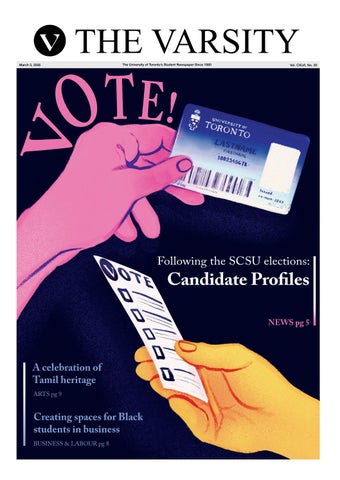
SCSU 2026–2027 Candidate Profiles

The SCSU’s incumbent VP Equity Kai Sealy, a biochemistry major and minor in biomedical ethics and psychology, is running for president with Team Amplify. Her campaign focuses on food security, rebuilding community trust, and increasing financial support.

Beyond the SCSU, Sealy has also served as a Youth Ambassador of Barbados and the Eastern Caribbean.

If elected, she wants to expand the monthly free breakfast into free lunch and dinner programming by leveraging the union’s community partnerships, without increasing student fees. “I don’t want students to feel like they have to pay more SCSU fees or pay more money for this. Forget that. Give back, give back, give back,” Sealy told The Varsity in an interview. Sealy emphasized that the previous SCSU executives’ shortcomings shouldn’t overshadow the union’s accomplishments, pointing to “a lack of proper communication between our exec team right now and the membership. A lot of students just don’t know what is happening. Negatives tend to spread and gain more traction than positives.”

As president, she plans to streamline communication between the executives and the student body by implementing bi-weekly forums and an anonymous student feedback system.

On financial support, she aims to expand campus job opportunities above minimum wage and increase funding for new and existing SCSU bursaries. Working as VP Equity “really opened my eyes to student disparities, especially when it comes to funding and just being able to work with the exec team.”

Sealy also believes the SCSU should hire for roles earlier and implement formal training during transitions to ensure sustainable continuity of the union and smoother programming.

“A little quote that I like is this: prior preparation prevents a piss poor performance,” Sealy said.

“We know what usually falls between the cracks. We know what processing usually takes longer.

If we can streamline that and optimize that, from now to April, everybody should be hired, ready to go training.”

President De-Mario Knowles

With Team Amplify, Kaitlyn Gallagher is running for VP Academic and University Affairs. She is a third-year majoring in public law and political science, minoring in philosophy, and currently serves as VP of academics for the Association

If elected, Gallagher plans to expand and modernize the credit/no-credit system, and implement a standardized 24-hour academic pause policy that would allow students to take an extra day to submit coursework.

“Students can feel that one bad grade or one overwhelming period in their academic career might affect their future… This grace period [puts] more focus on their studies and gives their mental health a break so they're able to output work that’ll better reflect their true capabilities,” Gallagher told The Varsity.

President Kai Sealy

“It’s just time to come back home and [advocate] at a more local level.”

Fourth-year SCSU candidate De-Mario Knowles is a mental health major pursuing a double minor in French and music. Knowles is running for SCSU President with Team Impact, holding a strong focus on student advocacy, engagement, and

Since 2021, Knowles has been a motivational speaker, giving talks in elementary schools, high schools, and universities about overcoming adversity. He has also worked with the Canadian Federation of Students (CFS) since 2023, specifically with its Circle of First Nations, Métis, and Inuit Students. As an Indigenous student with CFS, Knowles participated in passing a decolonization audit of CFS, which allowed him to “identify ways of colonial practice and breaking down the power hierarchies,” something he hopes to repeat with the SCSU.

Gallagher wants to improve the union’s visibility and accessibility of academic policies, ensuring students are aware of SCSU’s services before the end of their degree. On that note, Gallagher aims to increase transparency with Departmental Student Associations.

“This year specifically, there was an uproar with students about not having transparent policies with SCSU, and not understanding where the funding is going with when it comes to reimbursement policies,” Gallagher said. “Something I would really want to bring into this role from that frustration myself is creating more clear forums… to open that invitation to everyone equally and regularly.”

Vice-President: AUA Maya Khan

Vice-President: Campus Life Emeka Okolo

Tarek Dennaoui is a fifth-year student studying physics and astrophysics, running for VP Campus Life with Team Impact. In an interview with The Varsity, Dennaoui stated his candidacy is “a way of giving back” to students, and he hopes to take notes on how events “should be provided to the students,” and “what kind of life students want on campus.”

Dennaoui previously worked for SCSU as their Senior Leader in Marketing for 2024 Frosh week, where he made meaningful connections with first-year students.

Dennaoui has also been involved in UTSC Homecoming as a photographer since 2023.

Dennaoui’s campaign focuses on three main points: providing safe spaces for students on campus, collecting feedback from students, and rectifying the SCSU’s past club

reimbursement concerns.

Dennaoui noted that these reimbursement issues have hindered club programming. In addressing them, Dennaoui hopes to support clubs and their events, giving students the opportunity to empower their voices.

“This whole collective of experiences has allowed me to see that real change can be started just by having a passion for doing something and a motivation to make a change,” Knowles said, adding that “these experiences have given me the tools required to thrive in the position as president.”

As president, Knowles intends to maintain updated financial documents on the SCSU website and to make the organization’s initiatives more transparent for students who are less familiar with how the union works. Knowles hopes to arrange direct meetings with students and university administrators, “getting students at the table that aren’t solely SCSU execs.”

Knowles discussed engaging with students regularly throughout the year in more informal ways, like coffee chats or walks with SCSU execs around campus. “How cool would it be if you’re a first-year student coming to UTSC and you see the SCSU president, of all people, walking up to you right outside Tim Hortons and giving you a fist bump?”

“If I’m able to engage with the students [in a way] that allows them to feel empowered and embrace their emotions, I feel like that’s the best way that we can serve the student body.”

Vice-President: AUA Kaitlyn Gallagher

Maya Khan, who graduated last year with a double major in human biology and psychology, is re-running for VP Academics and University Affairs.

As the incumbent, Khan has lobbied with the UTSU and UTMSU to enshrine a policy that would allow students to strike up to 1.0 credits from their academic transcript. She has also facilitated programming for the SCSU’s Academic Support Center and worked closely with UTSC’s Departmental Student Associations (DSAs), studentled academic societies which “provide useful services to advocate for student interests.”

For her re-election campaign, Khan is focusing on initiatives to facilitate alumni-student mentorship, to allow students to make more than

“I’m always really loving to connect with people. I always talk to people, smile at people all the time, whenever I see them,” said VP Student Life candidate Emeka Okolo in an interview with The Varsity Okolo — a fifth year pursuing a double major in neuroscience and human biology — is re-running for the position in the upcoming election. He feels confident that he delivered on his last campaign, citing the implementation of the events calendar on the SCSU website and an increase in transparency between executives and students.

This year, Okolo aims to be a platform for clubs to promote themselves and connect students to clubs that interest them through the SCSU4U program.

Dennaoui stressed that he wants to maintain safe spaces for students to share their own experiences and be in an environment where they “feel accepted, feel comfortable, and they feel relaxed.” Dennaoui plans to create a space where “we can all come together as a collective to… make everyone feel appreciative and that their voice is being heard.”

one Program Declaration per term, and to implement experiential hands-on learning and research opportunities into each undergraduate program.

“Research is actually not something that the government wants to fund,” said Khan. “But when you think about it, U of T is so heavily based in research… why is that not being recognized and accredited to students in academic programs?”

In addition to the SCSU, Khan has worked with the UTSC Academic Advising & Career Centre, where she helped students with networking and professional development. She has also served as co-president of the Tamil Students’ Union.

“I really did enjoy the work that I did this year,” said Khan, “So I’m hoping to bring my skillset that I have developed [in this role] into next year’s work.”

Additionally, Okolo wants to increase collaborations with clubs and cement the union as a known and usable resource for them.

“It’s really about having these first years become part of SCSU from the jump, so that they can really know that their voice means something here with us, that we can be able to reflect what they tell us back into our program,” said Okolo on the topic of student orientation.

He emphasized the importance of maintaining a continuous stream of events for students to engage with the SCSU. “I just really want students to understand that there’s more to this campus than just academia.”

Vice-President: Campus Life Tarek

Dennaoui

Vice-President: Equity Amal Elcharbini

Amal Elcharbini, a fourth-year political science specialist, is running for VP Equity with Team Amplify. “I found I’ve always had a calling towards trying to create the most equitable space wherever I am, whether that is on campus or off,” said Elcharbini.

Sukaina Abbas is a third-year mental health specialist running for VP Equity. Abbas is a volunteer for the SAAAC Autism Centre, an internal coordinator for the Women and Trans Centre, and a research assistant at the Attitudes & Interpersonal Understanding (AIU) Lab at UTSC. Abbas has also worked abroad with the research project Next Generation Pakistan and worked closely with the trans community there.

In an interview with The Varsity , Abbas stated their belief that “equity shouldn’t feel optional, [or] performative. It should be built into our campus, how the campus operates.”

As VP Equity, Abbas will advocate for more adequate funding for housing projects, programming, and student support, crediting their own intersectional identities as a factor pushing their campaign forward. Abbas, who identifies as a Shia Muslim, a lesbian, and non-binary, said their identity pushes them “to create these spaces that feel welcoming and safe for every single student on campus.”

Abbas’s campaign is centred on equity-driven programming, financial support, and emergency risk spaces for marginalized students. As part of that, they want to implement grants for queer international

2025 graduate Fawzia Elhag is re-running for her current position as SCSU VP External with a campaign focused on affordability, access, and opportunity. Elhag, who majored in political science and psychology, understands how “decisions made outside of our campus by politicians… directly affect students at Scarborough campus.”

In her current term, Elhag notes involvement in a handful of SCSU initiatives, such as creating a World University Services Canada (WUSC) Committee, running a referendum to increase the budget for WUSC students, and creating the role of Voice Coordinator to support WUSC students.

Elhag has also worked on creating a TTC ticketed system set to launch in the next few weeks, a first-come, first-served service providing each student up to three TTC daily passes per week. Awareness initiatives around global issues have also been a focus for Elhag, with a focus on Sudan and Somalia.

This time around, Elhag is focused on creating a student union collective with other local Ontario students’ unions to directly mobilize students, enrich relationships with other students’ unions, and organize more frequent meetings between unions.

students and the international student community as a whole. Abbas also plans to establish a direct relationship with all equity-based clubs and initiatives on campus, creating collaborative partnerships.

“Being somebody who is a visible minority, [...] there is no need for me to put myself into the shoes of somebody who is disadvantaged against — I’m

Elcharbini’s campaign emphasizes three main objectives: fostering a campus environment for safe and free expression, making campus support systems visible and accessible to students, and facilitating meaningful relationships with Truth and Reconciliation Calls to Action and other Indigenous-oriented groups on campus. Elcharbini believes that her platform’s focus will “really

If elected, Elhag will also expand upon the SCSU’s TTC initiatives, such as transit bursaries already available for UTSC students, and expand experiential learning opportunities through external partnerships with organizations.

Vice-President: External Khadijah Khan

Vice-President: Operations Rakshit Hegde

Athisayaa Prabagar is a fifth-year journalism specialist and political science minor running for re-election as VP Operations with Team Impact. Prabagar, who was elected last year on a platform of transparency and job opportunities, feels she “made pretty good progress” on her promises to UTSU students.

“I believe that the union is already doing a good job sharing the budgets,” she said, but conceded that “the website is extremely hard to navigate.” If re-elected, Prabagar vows to “work with the internal coordinator and the graphic designer. I have been talking about making the site more user-friendly.”

As VP Operations, Prabagar created new aboveminimum-wage part-time jobs for students — including front desk positions and a Queer Student coordinator — bringing the total number of part-time employment opportunities for students up to over 30.

Affordability is at the center of Prabagar’s campaign this time around. She plans to fight food insecurity by redirecting leftover budget money from Coffee House to 1265 Bistro, in the form of $50 credits for students to use. Additionally, Prabagar wants to push for more bursaries for racialized and Indigenous students. “These communities still face barriers in education… and with changes like

address the gap between what equity is supposed to look like on paper, and also what students actually experience on campus.”

Elcharbini is currently president of the U of T Palestinian Culture Club. “As part of the SCSU, especially in the position of VP Equity, you have… a wider reach,” she said. “I definitely know how important it is [for clubs] to be connected with the SCSU in a way that… opens [them] up to more resources that… clubs maybe wouldn’t have otherwise.”

Vice-President: Equity Sukaina Abbas

Vice-President: External Fawzia Elhag

Khadijah Khan, a fourth-year English major with minors in studio art and film studies, is running for VP External with Team Impact.

As VP External, Khan wants to “make an impact on the structural system and how we run SCSU.” She will draw on her experience volunteering for the Muslim Welfare Centre and as the VP of Marketing for UTSC’s Muslim Student Association.

Khan’s campaign focuses are to implement the UTSC U-Pass, though, acknowledging that this would increase student fees “by… $200,” she would like to “find a way to make transit more affordable and accessible, if that’s through grants, or allowing the students who don’t want to have the U-Pass to opt out of it instead.”

She also plans to improve bus stop infrastructure, “especially during the cold weather,” and increase bus frequency at UTSC’s crowded stops during peak hours.

Fourth-year neuroscience and biochemistry student Rakshit Hegde is running for VP Operations in the upcoming SCSU elections on Team Amplify. In an interview with The Varsity , Hegde emphasized the importance of “making sure that the back end of something or the base of something is stable, [because it] ensures that the rest of it goes smoothly.”

OSAP cuts, we need more targeted support — it’s more important than ever.”

Prabagar also wants to make student spaces more accessible by creating more study spaces and multifaith prayer rooms.

“I believe students deserve spaces that support both their academic needs and their personal wellbeing.”

Having worked with Frosh for the past two years, Hegde feels confident in his skill as a “logistics leader,” focusing on the back-

As VP Operations, he plans to streamline the money management of the SCSU. His goals include reducing costs for students on activities and, potentially, transportation around the city. Additionally, he wants to increase visibility of resources such as the Student Centre’s health and dental

“I feel like increasing how many buses are there just takes care of it. I just feel like it’s a safety concern as well,” she said.

A major part of her platform is addressing food insecurity on campus. She would like to “bring more attention to the food center we have at SCSU,” adding that, “a lot of students are just not aware of it.”

She also spoke about implementing a permanent prayer space and a women-only section of the Pan Am Sports Centre: “right now we just have a curtain that they’ll kind of divide the gym from. I feel like we could do better than that.”

To explain how she will make these initiatives affordable for students, Khan said:

“I think I'm trying to find out… more about funding and trying to get it from external places, maybe from the community, from businesses or from alumni, instead of charging students and increasing student fees.”

plans, and expand menu options at Coffee House — a free breakfast program — to accommodate more dietary restrictions.

Hegde also highlighted financial transparency, citing the need to make financial reports easier for students to access, adding that he would “make sure that all the middlemen are visible in the forms, just so everybody knows where the money is passing through before it either goes to students or goes to events.”

Vice-President: Operations Athisayaa Prabagar

Opinion

March 3, 2026

thevarsity.ca/cateogory/opinion

opinion@thevarsity.ca

Middle powers do not exist, only colonial powers do

The implications behind the title, “middle powers”

In January, Canadian Prime Minister Mark Carney spoke at the World Economic Forum (WEF) in Davos, Switzerland. There, he argued valiantly, that the framework of laws meant to promote peace and manage conflict was illusory. In his speech, he argued that “the story of the international rulesbased order was partially false.”

US President Donald Trump’s threats to acquire Greenland, bombing Venezuela, and being an unreliable trade partner with Canada have forced political leaders like Carney to strengthen connections with Asian and European nations.

The benefits that American institutions have granted Western nations, in Carney’s words, have “helped provide public goods: open sea lanes, a stable financial system, collective security.” I believe the current American hegemony truly “no longer works” as the US proved to be an unreliable superpower.

Do “middle powers” really exist?

The heightened instability from this revelation encouraged Carney to urge countries with similar ties and connections with the US to “diversify to hedge against uncertainty.” He encourages risk management and strength building, and that “middle powers must act together.” Middle powers are, as the WEF defines, “influential states that sit below superpowers and great powers.”

Carney’s speech functions as a call for Western nations to sever ties with the once beneficial US order, the institutions that protected it, and the nation that maintained it. His speech acknowledges that the world order has reached a breaking point, and urges nations to rebuild it together.

The premise of the speech, and the reason it elicited both praise and shock across the country, was the argument that the world order was rupturing. Carney received a standing ovation at Davos for this insight, and the Liberal Party saw a boost in popularity following the speech.

I think acknowledging the world order as “partially false” and advocating for a separation from the US is positive. However, I disagree with Carney’s premise that middle powers exist in the first place and that the US was the stronghold for the world order. While the US has one of the largest militaries, which makes it an intimidating opponent to smaller powers, I argue that solely citing the US as a superpower for world order is a form of scapegoating to deflect criticisms that Canadians have about the economy.

Each Western nation that calls itself a “middle power” has benefited from colonialism. Canada, for one, owes its creation to British and French settler colonialism.

Currently, Canada still holds remnants from that colonial era — like our constitutional monarchy and being part of the commonwealth. Canada fought as much as the US to maintain the world order, such as being a part of the Allied efforts during the World Wars. Canada and the Western nations attending the WEF are not coasters, nor bystanders.

Colonial context alters how we analyze history. It allows middle power countries like Canada to maintain their image as the nicer alternative to the US, thus concealing their problematic pasts and safeguarding the wealth accumulated via the USled world order.

Canada’s past and present ties to colonialism

An important makeup of Canada’s wealth is in real estate. It was responsible for adding around

2016 is back, but what should we reclaim? How social media has made our lives more isolated

Trends are built to become a distant memory, but a decade later, 2016 seems to have withstood the test of time. Leading up to the new year, I thought of this wave of content reminiscent of 2016 as another fad on social media; however, the kinds of pictures people were sharing and the ones I found myself reminiscing about were all bound by the same, meaningful thread. Most of the posts seemed to be either a display of community or confident self-expression, both of which now seem to be foreign concepts.

Our longing for these aspects of society exposes a transformation in how we practice humanity.

As collectiveness and self-exploration decline, our ability to exercise empathy weakens, creating a ripple effect on global political and social division. So, I don’t think that we should be asking if 2026 is the new 2016. Instead, we should acknowledge that during a time when anger and hate are mistaken for rebellion, the most meaningful resistance lies in reclaiming the innately human qualities that we’ve set aside.

A fragmented society

The word “alive” is defined as a state of being alert, active, aware, responsive, full of emotion, and even animated, all of which exist through experiences. Therefore, we can infer that to be alive means a person must be actively experiencing.

Even though social media has become intertwined with our daily lives, it doesn’t meet these conditions. Experiences can be meaningful

when lived through alone, but they are profoundly defined by and sustained through connections with other people. Social media, while created with positive intentions, is devoid of this companionship in the way that it reduces people and their lives down to a simulation.

In 2016, social media was still integral; however, since then, it has rapidly become excessive, which in turn strengthened its effects on our lives. Its ability to rob people of the chance to experience their own lives and to lead people towards social disengagement is also taking away moments when we can practice intrinsic traits like empathy. Thus, our ability to connect with others and form a strong community diminished as well.

This kind of disconnection often leads to negative self-perception, resentment towards other people’s lives, worse academic performance, and — if this becomes a reality for too many people — creates a society that is shaped by division.

As seclusion becomes increasingly prevalent, we lose meaningful encounters that allow us to enrich authenticity. If we continue to stray further from the qualities that can make us feel alive, the illusion of interconnectedness we have cultivated will no longer be sustainable.

Seeing ourselves through the eyes of others

To experience things to their fullest potential often means being able to fully express oneself, because self-expression allows the lived experiences that shape us to take form beyond our own subconscious understanding. But, if a decline in community is contributing to a decrease in lived experiences, what are we left with to express?

$300 billion to the Canadian economy in 2022.

As Carney increases conversations between the federal and provincial governments on building an oil pipeline, we can expect oil and gas to contribute significantly to Canada’s economy.

This means Canada is heavily reliant on profits from the land — the very land Indigenous people were forced off of. The unfair treaties drafted, like the 1923 Williams Treaties, and Canada’s connection with the UK empire contribute to why Canada holds its current wealth.

The power Canada and its allies held created the contracts that benefitted Canada and institutions like the United Nations, which helped maintain the world order. This is why Canada and its allies could continue to exploit natural resources, for example, in marginalized communities without solid reprimand.

In 2023, Canadian mining companies were accused of compromising Congolese people’s human rights to construct a mine. Once again, there were few consequences for this because of Canada’s position of power in comparison to Congo.

When Carney calls Canada a “middle power,” he subtracts Canada’s participation in creating

the system. Moreover, it is a slap in the face to the nations that have had to endure the subjugation that Canada has directly or indirectly supported.

I believe that the updated version of the world order will maintain the current hierarchy, and that nothing will change for marginalized communities and nations because powerful countries rely on their relegation. Canada was only able to be a middle power because it relied on and supported more powerful nations as they subjugated others.

Some Canadians or Westerners may see no reason to care that Canada or Canadian companies are complicit in neo-colonialist efforts elsewhere. To them I say, when you ignore what your nation does to others, others will ignore what it does to you.

It is important to understand your history. To remain knowledgeable. If not, you open yourself to propaganda from the state, allowing the state to manufacture your consent to perpetuate more harm against others or against yourself.

Emmanuella Nwabuoku is an Opinion Domestic Affairs Columnist majoring in political science and women and gender studies, while minoring in African studies.

Defining ourselves through shared experiences with others allows our identity to form through our interpretations of our interactions and our capacity to reflect on what we’re feeling. The periods of uncertainty about who we are, what we value, and what we desire are indispensable to our ability to conceptualize complicated emotions. By engaging with this uncertainty, we develop the capacity to form or understand complex thoughts and feelings.

When we learn how to recognize and communicate them, we experience emotions without fear, judgment, or loneliness, because it makes connection possible. However, with these experiences becoming scarce, the way we identify ourselves starts to rely on external perceptions, making it difficult to reach emotional depth.

As identities become mirror images of each other, the fragility it brings to the individual is no longer personal; it becomes pervasive to society. This unstable sense of self becomes easily swayed as the inability to understand ourselves and the world around us becomes a vulnerability. The differences that we are not able to understand become a threat, instead of something we are able to explore between ourselves and those around us.

Neglecting to see the strength that can come from reaching a point of empathetic understanding

leaves our society unable to tolerate the inevitable change and differences that are part of our world. Here, the decline in self-expression that has been leading to our inability to connect is creating a hardened view of what we consider unfamiliar — moving away from interconnection and togetherness that was seen more in 2016 than in 2026.

Looking beyond nostalgia

While we know that we are gravitating towards 2016 in the pursuit of solace, companionship, and freedom, it is not enough to just understand why we are amplifying its unifying message. This recognition loses meaning if it doesn’t influence us to change what has led us here.

Although it is not realistic to always remain hopeful in a world fostering despondency, we have an obligation to confront the ways we’ve sidelined our most human traits so that future generations may live in a reality unlike ours. A reality that will not be shaped by our indifference towards the habits that weaken our humanity.

Vesa Lunji is a third-year student studying health and disease, immunology, and Spanish. She is also an Associate Opinion Editor at The Varsity.

ADRIAN FATAHILLAH/THE VARSITY
We have an obligation to confront the ways we’ve sidelined our most human traits. ZAINAB KHALIL/THEVARSITY
Vesa Lunji
Associate Opinion Editor

Business & Labour

How do dating apps make money?

The trade-off behind the swipe

“I’m gonna go turn off Hinge right now.”

In an interview with The Varsity, Elise Corbin, a computer science student, shared that this was her reaction when she learned that, on top of knowing a user’s precise location while the app is actively in use, Hinge can also track a user’s location while running in the background.

Corbin is not an isolated case. As a computer science student, she was aware of the scope of data collection policies. However, consenting to the terms of every app can be overwhelming. “All these [apps] that you have to download, not just in dating, but in your life, they kind of desensitize you to clicking ‘yes’ on these things,” she said.

While many students understand that apps collect data, they are often unaware of the full extent. Many recognize there is a trade-off, but few know where the boundaries lie. Users open the app to meet someone, and suddenly they find themselves navigating permissions, cookies, policies, and sub-policies that stretch on for pages.

The not-for-profit Mozilla Foundation flags dating apps like Tinder, Bumble, and Hinge with warning labels, cautioning users to think twice before sharing highly sensitive personal data on these platforms. As an organization focused on fostering an open, accessible, and privacyrespecting internet, Mozilla acts as a publicinterest watchdog.

Location data, sexual preferences, identity signals, and messaging behaviour can be merged into behavioural profiles, enabling inferences and user targeting that extend well beyond dating apps’ stated purpose of connecting users. Even if users technically consent, can that consent truly be considered informed when it is buried in dense legal language and complex processes?

How data translates to revenue

For major companies such as Match Group, which owns online dating platforms like Hinge

and Tinder, the vast majority of their revenue comes from direct in-app purchases and subscriptions. The company's financial report states that 98 per cent of revenue is generated through paid features such as premium tiers, boosts, and visibility-increasing features, making subscriptions and subscription upgrades its core business engine.

While Corbin said paid features do not particularly appeal to her, this financial model still works. A large user base does not require everyone to pay — it only needs a sufficient number of users interested enough to pay for a subscription, while others continue swiping.

That is where data fits in. It powers the system, driving recommendation algorithms, engagement loops, and product development. User behaviour becomes feedback, which fuels optimization, then retention, and eventually revenue.

On its website, Match Group states that “dating is personal, so we do not sell any data to third parties.” However, the term “sell” does not cover every form of data transfer. A firm can avoid formally “selling” data while still sharing information with third parties — for advertising measurement or vendor services — which can meaningfully affect how user data circulates, even if it is not recorded as a distinct revenue line. Mozilla reports that over 80 per cent of dating apps sell or share user data for advertising purposes.

AI powers the algorithm

The development of AI has also increased the complexity of data handling. Match Group has recently unveiled its AI initiatives, including photo selection and enhancement recommendations for Tinder and Hinge. The photo selector helps users identify images that optimize their profile and runs entirely on-device, meaning Tinder does not receive biometric data from that feature.

AI-curated insights aimed at personalizing your connections, however, run server-side. When AIpowered matching features are enabled, data

Creating spaces for Black students in business

A look into the work of UTSC’s BSB club

Progress has been made to eliminate some of the barriers Black people face in the business world. For example, the BlackNorth Initiative, an organization seeking to end systemic anti-Black racism, reports that it has met its initial targets for representation on business boards. However, Black Canadians still face higher unemployment and lower wages.

AT UTSC, one student club is hoping to make a difference. Black Students in Business (BSB), founded in 2018, aims to empower Black students in business and create a more supportive community for them.

Kyla Sanda, a fourth-year economics for management student and current co-president of the club, wrote in an email to The Varsity that “[BSB’s] core mission goes beyond simply placing students in front of employers, seeking to provide practical opportunities that help bridge the gap between who students aspire to become and where they currently are.”

The club hosts workshops, leadership opportunities, and more to help students develop vital skills for success in the professional world.

How BSB achieve goals

When asked how the club works toward its mission, Sanda wrote that BSB fosters “an intentional community where our networks become our

friends, questions flow with genuine curiosity, and where opportunities are both shared and created!”

A valuable network that the club consistently uses and builds is its alumni network. It includes graduates — including past club presidents — who provide “consistent insight” into their professional journeys. Having navigated similar paths, these alumni offer members a direct and relatable point.

BSB also works to build strong relationships with other clubs, faculty, and administrative staff.

“[By doing this], we’re able to advocate effectively, have a voice in every room, access resources, and create stronger alignment between student needs and university support or initiatives,” Sanda wrote.

She especially believes that fostering a community where members can openly share their dreams and networks creates an atmosphere where students act as “peer mentors” to one another, supporting each other’s growth in business.

BSB’s approach to facing setbacks

Sanda wrote that while organizations continue to work toward promoting Equity, Diversity, and Inclusion (EDI) initiatives, “there is always room for continued growth and accountability.” BSB aims to contribute by helping students develop skills for the industries they hope to enter, though the club encounters setbacks along the way.

“One of the earliest lessons we absorb is that nothing ever goes exactly as planned,” Sanda wrote. She emphasized the importance

March 3, 2026

thevarsity.ca/category/business biz@thevarsity.ca

about user activity and model inferences are processed and stored on Tinder’s server. Better matching algorithms may represent a genuine product improvement, but it also expands the data-processing pipeline: more signals collected, more predictions made, and more personal behaviour turned into model inputs.

Even before the rise of GenAI, dating apps often relied on effective — though arguably ethically questionable — algorithms. Historically, Tinder used the Elo scoring system to rank users by ‘hotness’ by determining their ‘desirability.’

The same rating system is used in chess, where players are ranked based on their skill level.

Today, the app employs a machine-learning algorithm that factors in profile activity, “Nopes,” “Likes,” and engagement to determine user visibility. AI certainly enhances the possibilities for how creatively firms can leverage user data.

Security concerns

There is another dimension to this: security.

Beyond intentionally commodifying and sharing user data, there are more serious risks — data breaches. Mozilla reports that half of the apps it studied experienced a “data breach, leak, or hack, in the past three years.”

In one extreme case, location data from Grindr

was later purchased by a Catholic group in the US to monitor members of its clergy. Data is, undeniably, a valuable commodity.

None of this means students should panicdelete every app immediately. After all, the lines between LinkedIn, Instagram, and Tinder are sometimes blurred, making dating apps not so different from traditional social media. If you use dating apps, you consent that your data is part of an exchange, whether you pay or not. The important question is not whether this trade exists, but whether it is fair.

Once the terms become clearer, behaviour changes. In Corbin’s case, the reaction was immediate: she deleted Hinge. Not because she suddenly discovered that apps collect data, but because she decided the specific trade-off was not worth it for her anymore. Should students think twice before using dating apps? Probably yes — but “think twice” should mean “use intentionally,” not “never use.” Review location permissions. Limit identifiable details. Be cautious when linking other platforms. Decide what you are willing to exchange before the app decides for you. Remember that if you are not paying with your card, you are likely paying with your data, your attention, or both.

of remaining adaptable and resilient in the face of difficulties. She told The Varsity that, “In BSB, we learn to persevere, to pivot when necessary, and to remain solution-oriented in the face of uncertainty. That adaptability becomes one of the most important skills we carry with us into professional spaces.”

Impact Expo

BSB’s flagship event is its Impact Expo, a career fair where Black students from across Canada can network with various companies. The Expo features panel discussions, networking sessions, a LinkedIn headshot booth, and a shared lunch.

According to Sanda, the event helps students secure internship or post-grad employment opportunities, while also fostering “insights, inspiration, and long-lasting relationships.” She wrote that the expo encourages participants to ask “what’s next, and how do we achieve it together.”

The 2026 Impact Expo took place on January 17 and featured industry professionals from

areas like consulting, finance, entertainment, and law. “The fact is that business is everywhere, and with this Expo we want students to see themselves reflected in a variety of professional paths,” Sanda wrote. She added that the Expo is particularly valuable for students, as you can even connect with people based on hobbies and interests, noting that “the best networking conversation sparks up from a mere hobby in common!” Sanda encouraged students to get involved with BSB regardless of their academic background. She wrote that, “Your skills, perspectives, and experiences have value in this field and in our network, just as you will leave our events with something valuable in return.”

Sanda emphasized the importance of putting yourself out there, even if you have cold feet. “What I’ve come to realize is that getting yourself in the room is the most important first step, but engagement truly allows you to maximize and uncover opportunities.”

Black Students in Business (BSB) aims to empower Black students

Arts & Culture

March 3 , 2026

thevarsity.ca/section/arts-and-culture arts@thevarsity.ca

A celebration of Tamil heritage

My experience attending UTSC’s fourth annual Digital Tamil Studies Symposium

On Saturday, January 24, the Digital Tamil Studies project at UTSC hosted its fourth annual Digital Tamil Studies Symposium to celebrate Tamil Heritage Month. Canada is home to one of the largest Tamil diaspora populations in the world, nearly half of which resides in the GTA. Every January, Tamil Heritage Month serves as an opportunity to recognize Tamil culture and the contributions that Tamil-Canadians have made to the country.

Honouring Tamil heritage

As an attendee, I was able to spend a day surrounded by heritage, scholarship, and community. The symposium began in the morning in UTSC’s Environmental Science and Chemistry Building. A booth was set up displaying the UTSC library’s award-winning Tamil archival collections, with library archivist John Yolkowski on hand to assist with questions about the collection. Once settled into our seats, attendees heard from Tamil professionals in various fields, presenting on topics ranging from building AI language models for Tamil, to archiving Tamil history.

When lunch was served, attendees watched two performances by UTSC students. The first was a musical performance featuring singers, a violinist, and a miruthangist — a musician who plays a double-headed South Indian percussion instrument called the mridangam.

Four of the songs were Carnatic, an ancient style of music rooted in Hindu traditions and

commonly associated with Southern India. The final song was a modern Tamil anthem about strength and resilience, called “Ezhunthu Vaa Thamizha,” or “Rise up, Tamilian.”

The second performance was a showcase of Silambam, an ancient Tamil martial art form where a martial artist uses a bamboo staff to perform attacks and blocks in a fluid, spinning motion. The performance was a powerful display with bamboo swishing around in the air — the sound of the strikes was even cutting through the music over the loudspeakers! Silambam represents the resilience of the Tamil people, as it persisted despite being banned by British colonial authorities until India’s independence in 1947.

Portraying histories and memories through art

I particularly enjoyed the final lecture of the day on “The Art of Archiving — Art, Memories, and Heritage in Post-Armed Conflict Sri Lanka,” by Thamotharampillai Sanathanan, a Tamil artist and professor of art history at Jaffna University in Sri Lanka. Sanathanan spoke about how he uses his art to portray themes such as home, migration, and loss. These concepts are particularly important to members of the Tamil diaspora, which consists of the 300,000 Tamils displaced during the Sri Lankan civil war.

I felt privileged to hear Sanathanan speak about his work, especially in Tamil, a language whose existence in Sri Lanka was threatened for decades. I learned about the many ways in which one can portray history and their experiences of it through art.

One artwork Sanathanan showed that stuck with me was a painting titled “Grandmother’s Courtyard,” in which he painted a map of the neighbourhood where his grandmother’s house was, from memory. He explained that people from the area started to leave their homes, and that the neighbourhood was destroyed by airstrikes.

Sanathanan also pointed out the lone figure of a boy in the top right corner of the painting, sitting on a swing, looking down at hues of orange, green, and purple. He explained that there was a single swing in his grandmother’s courtyard that would be shared among 11 grandchildren. This would often result in constant bickering over who got to play on the swing. Presently, Sanathanan is the only member of his family who remains in the area, like the lone figure on the swing.

Final thoughts

As a Tamil-Canadian visual art hobbyist myself, Sanathanan’s work and the thoughtfulness

St. Michael’s College Troubadours’ Footloose kicks off its Sunday shoes

The Troubadours performed the rock musical at Hart House Theatre

a stage presence that he simply needs no company of his own.

The St. Michael’s College Troubadours’ production of Footloose ran at Hart House Theatre from February 12–14. Directed by Alexander Gomez, this ’80s rock musical follows a teenage boy and his mom challenging the conservative laws of the town of Bomon, Utah, where they moved from Chicago. The ensuing events reveal the heart of the town’s resistance: a family burdened by unresolved grief.

Chicago-raised Ren McCormack (Gabriella Wang) catches the attention of Ariel (Isobel Arseneau), the rebellious daughter of Bomont’s leading preacher, Reverend Shaw (Le Truong). Reverend Shaw has been leading a paranoid campaign in the town against dancing and partying for the past five years after losing his son in a drunk-driving accident.

Opening night started with a fanfare performance of the titular song, “Footloose.” The audience is briefly introduced to a lively crowd in Chicago, only to be ripped away to Reverend Shaw’s sober church service.

Footloose’s plot operates in groups, displaying its themes of family, connection, and loss through its exploration of the groups’ relationships to each other and to Bomont.

The McCormack family, made up of Ren and his mother Ethel (Norah Chaput), contrasts with Reverend Shaw, Ariel, and her mother Vi (Mykah Marquez). Ariel’s friends Rusty (Bianca Hopkins), Urleen (Allison Tanzola), and Wendy Jo (Lucia Linde); and the greasers Chuck (Andrew Evanyshyn), Lyle (Noah Meeboer), and Travis (Taniya Bahari) give Ariel an escape from her restrictive family.

The only explicit outlier is Willard (Ben Rutter), Footloose’s creative spin on the unimaginative farmboy archetype. The character has such

The drama is set against a backdrop of two multipurpose platforms with metal stairs that could act as cars, benches, and other props as demanded by the production. Unfortunately, these platforms appeared to suffer from a slight malfunction during a scene change, but the backstage crew handled the situation quickly and professionally.

In a musical that places such emphasis on dancing, it was not surprising that the ensemble excelled at performing perfectly synchronized choreography tailored to individual characters.

The band, conducted by Medha Barath, performed beautifully, especially for such a diverse array of songs and genres. In some songs, however, I found that the singers were too quiet compared to their instrumental backing — likely due to discrepancies in the speakers — making it difficult to hear the lyrics.

The cast, band, and creative team developed a setting so immersive that, by the end of the show, even I would be shocked if someone had never heard of the Potawney Bridge Accident.

The cast’s chemistry — integral to a show like Footloose — was believable for the most part but wavered during some critical moments. Sometimes it felt as though the actors were not totally interacting with each other, lacking the vivid depth they displayed in other scenes.

Wang captured the looseness of Ren McCormack, which pieced well with Arseneau’s portrayal of subtle, insecure rebelliousness in Ariel, and contrasted well with Truong’s display of anxious possessiveness in Reverend Shaw.

Each actor’s body language managed to consistently express each of their characters’ key relationships to dancing and youthful festivity.

Hopkins, Tanzola, and Linde performed fantastically as Ariel’s friends in some of the musical’s most demanding numbers, particularly

behind each piece deeply resonated with me. Art may be considered an unconventional way of exploring history and experiences, but it allows for self-expression that can be difficult to do in writing.

The lecture spoke to me as someone who grew up with stories of the war — how it affected my family and the loss of the homes they once knew — which is why “Grandmother’s Courtyard” was particularly so powerful to me.

The Digital Tamil Studies Symposium brought together community members, professionals, and scholars for a day of discussion and reflection on Tamil heritage. It was a bright and reflective way to mark the end of the 2026 Tamil Heritage Month, where we thought about the collective Tamil past and how to move forward, integrating the knowledge of our shared history and heritage.

“I Need a Hero” and “Let’s Hear It For The Boy.”

With Footloose drawing several of its numbers from rhythmic ’80s rock, it is commendable that these three were able to make their performances stand out from a show overflowing with stirring and delightful songs.

Each member of the cast — and indeed the audience as well — relieves the tension built by

the now-lifted ban on dancing with the musical’s conclusion at the long-awaited high school dance. Through its endearing romances, its punchy musical numbers, and its satisfying closure, Footloose taught audiences how the company of others — be it above train tracks or in the frenzy of a school dance — can reveal us, renew us, and let us revel.

Marcus Hermary Varsity Contributor
I spent a day surrounded by heritage, scholarship, and community.
SAMANTHA HO/THE VARSITY
The ensemble performed perfectly synchronized choreography tailored to individual characters. EMRYS CHANG/THE VARSITY

Thoughtful and mesmerizing: Trinity College Drama Society’s Rent

A show with an evocative topical set design and touching ensemble performances

During the run of their production of Rent, the Trinity College Drama Society (TCDS) worked in collaboration with Sherbourne Health, a community aid centre providing access to health, social, and wellness services in the DundasSherbourne neighbourhood. Together, they set a goal to fundraise $500 and raise awareness for Supporting Our Youth (SOY), a community initiative run by Sherbourne Health. SOY provides access to “mental health care, food opportunities” for queer youth in Toronto.

Jonathan Larson’s Rent is set in New York City in the 1990s, during the height of the AIDS crisis. The musical tells the entangled stories of a group of artists in New York who are living through poverty and illness in the East Village. The show examines a range of topics like gentrification and protest, loneliness and community, love and loss.

The show is loosely based on Giacomo Puccini’s 1896 opera La Bohème Rent carries over many characters and arcs from La Bohème including the emotional love story between Rodolfo (Larson’s Roger) and Mimì. TCDS’s production ran from February 5–7 at Hart House Theatre, and sold out every performance.

Rent centres on friends and roommates Mark (Nomi Parsai), an aspiring documentarian, and Roger (James Higgins), a singer-songwriter. Mark is the show’s narrator, who is still pining over his ex-girlfriend Maureen (Gaby Bondoc), a struggling performance artist. Meanwhile, Roger is dealing with being HIV-positive and his grief over the death of his girlfriend, April. Roger eventually falls in love with Mimi (Anya Almirante), an exotic dancer at the speakeasy, “Cat Scratch Club.”

The show also follows Mark and Roger’s longtime friend Collins (Malikhai Kolonko), an activist and lecturer at New York University, and his partner Angel (Juan Parra), a drag queen who is also dealing with HIV/AIDS. This group of friends and artists often clashes with Benny (Evan Lee), Mark and Roger’s ex-roommate and current landlord, who is looking to turn the apartment and the lot beside it into a cyber arts studio.

The set, designed by Neehla Pal and Liz So, was colourful and full of life, with graffiti layered over most foundational set pieces, framing strings of Christmas lights twisted over scaffolding, tarps, and protest signs. The set encapsulated the spirit of the musical and provided a dynamic, engaging space for the show’s action to unfold.

“You’ll see on our set, there’s a bunch of graffiti and messages,” director Kit Dixon told me in our interview before opening night. “We gave the cast markers, and we told them to write whatever they felt was important to them all over the set.”

That spirit of collaboration between cast and crew was carried into other aspects of the show. “I also talk to the actors a lot to help me communicate what they think their characters would be like,” said costume designer Val Vergara in an interview with The Varsity. In addition to the wardrobe, choreographer Maya Elder also emphasized the importance of implementing the cast’s ideas in her work. “For our big group numbers, it was just so collaborative and filled with laughs and everyone else’s ideas.”

The cast themselves put on a good performance, with ensemble pieces standing out the most. The “Will I?” interlude between “Another Day” and “Santa Fe” was a particular treat to listen to with its overlapping harmonies and deeply personal lyrics executed flawlessly by both the cast and live band on opening night.

Mark’s relationship to the plot is both as a participant and a spectator, observing the events through the camera lens he uses to make a documentary about his friends’ lives. Parsai skillfully depicted Mark’s simultaneously active and passive role with both his distancing body language and emotional vocal delivery in the number “Goodbye Love,” where he fights with Roger.

Bondoc and Thato Sotashe gave phenomenal solo performances as Maureen and her partner Joanne, respectively, but struggled slightly with communicating the intensity and chaos of their relationship in the second act, where they are most often on stage together.

Higgins and Almirante were convincing as Roger and Mimi, and did good work showcasing their characters’ emotions through both their execution of the lyrics and choreography. Similarly, Parra and Kolonko, like their characters, had excellent chemistry. Kolonko also gave an emotional rendition of I’ll Cover You (Reprise) in Act 2, making for one of the most memorable numbers of the night.

The production was very thoughtful of its source material, showcasing the world of its characters with sensitivity and care. The HIV/ AIDS crisis left a lasting impression on the queer community, becoming the backdrop of immense marginalization and loss. At the same time, it mobilized queer communities to action, advocating for socio-political change as they strove to help those around them.

That impulse to bring community together, to experience joy and love — even in a state of incredible isolation — is an entirely human phenomenon that resonates across the board, from 1990s New York City to Hart House on a Thursday night.

According to the Government of Canada, Canadian 2SLGBTQI+ youth today are “twice as likely to describe their mental health as

a

poor” compared to the general population, and are more likely to report health challenges. I was deeply impressed by the work the cast and crew put into communicating the importance of strong advocacy, both through their performance and their fundraising for SOY. Just as in the time Rent portrays, the need for resources and community support remains.

Cameron Ashley Varsity Contributor
The production was very thoughtful of its source material, showcasing the world of its characters with sensitivity and care.
SODA CHAN/THE VARSITY
Rent carries over many characters and arcs from La Bohème SODA CHAN/THE VARSITY
The set provided
dynamic, engaging space for the show to unfold. SODA CHAN/THE VARSITY

March 3, 2026

thevarsity.ca/category/science science@thevarsity.ca

How can we engineer sustainability culture in the 6ix? Innovative engineering designs from 2026 Clarke Prize winners

Over the weekend of January 24–25, undergraduate engineering students competed in the Clarke Prize Environmental Design Challenge: a two-day competition hosted by ISTEP where participants developed and proposed innovative solutions to real-world environmental problems.

On the first day, teams attended learning and team-building workshops that prepared them for the challenge to come. In the afternoon, they were given their scope and objectives: design a sustainability engagement strategy for the City of Toronto, based on findings from official city reports, while considering environmental impacts for both individuals and communities.

Teams spent the next day refining their ideas into actionable solution designs. In spite of an intense snowstorm forcing the competition’s second day to be held online, participants remained undeterred, knowing what was at stake.

Lucrative cash prizes awaited the top three teams: $10,000, $7,000, and $5,000 for first, second, and third places, respectively, pushing every participant to perform to the best of their abilities. For the rest of the attendees, the competition showcased what sustainability projects can look like on a smaller scale. At this level, ambitious and imaginative students can learn about sustainability and the unique challenges of addressing real-world environmental issues.

In the afternoon of day two, the five finalist teams presented their design solutions to a panel of three judges. After deliberating, the judges announced the top three teams for this year’s Clarke Prize. The Varsity attended the finalists’ presentations to see what revolutionary ideas the next generation of engineers had in store.

Third place: Toronto Heat-Sync

Taking third place and winning $5,000 were Economic Five — consisting of industrial engineering student Fiona Sun, mechanical engineering students Jingzhe Zhang, Yusra Chowdhury, and Lulu Zhang, led by mechanical engineering student Niki Bidhendi. They began their presentation with a shocking fact: buildings are Toronto’s biggest polluters, generating 55 per cent of the city’s greenhouse gas emissions in 2023.

The team identified a ‘deadlock’ between tenants and landlords as the primary barrier preventing buildings from adopting green energy.

Is water lava?

Tenants want lower bills and clean energy, but only landlords have the authority to make renovations — and they have no incentives to do so.

To break this stalemate, Eco-nomic Five proposed Toronto Heat-Sync, a provincial-level economic policy that would incentivize using Canadian technology to retrofit buildings for green energy. Their policy would fine emitters at different rates based on their emission intensity and the type of building owned, echoing similar cap and trade policies used by the federal government.

The fines would be set higher than green energy retrofitting costs, making renewable energy investments the cheaper option for landlords.

To incentivize developers to construct net-zero buildings — structures that meet their energy demands entirely using on-site renewable energy — the policy would grant developers higher density and taller buildings during construction for developers who pledge to follow this policy.

Proceeds collected from the fines would funnel into a “residential retrofit fund” that covers the capital costs for green energy retrofitting. This policy would also protect tenants from being overcharged by requiring energy utility scores and expected costs to be visible on listed properties.

Funding approval for retrofits would also include legal specifications to block evictions and freeze rent during renovations, ensuring tenants gain the benefits of low-carbon housing typically reserved for luxury homeowners.

Second place: ReBalanceTO

Taking second place and winning $7,000 was Team Catalyst, led by computer engineering student Dalia Mahidashti, alongside engineering science student Kevin Chen, computer engineering student Simran Raina, and civil engineering student Sophie Costantino. In their presentation, they highlighted inequities in Toronto’s bikeshare system, noting a lack of bike access in Toronto’s working-class neighbourhoods, where public transit is not frequent enough to be a practical option.

To tackle this inequity, Team Catalyst proposed ReBalanceTO, a ready-to-implement and community-driven bike redistribution program that would pay riders to redistribute bikes from oversupplied to underserved areas. The system would encourage residents in underserved areas to use bikes more often, generate revenue streams for lower-income residents, increase bike availability, and reduce bikeshare programs’ reliance on diesel trucks for redistributing bikes.

U of T experts discuss whether fire and ice are actually one and the same

Lava: destructive, impossibly hot, and capable of scorching anything in its path. In many ways, water seems opposite to lava; its role is to support life, not destroy it. Despite their surface-level differences, the two are more similar than we think. The solution to the geophysics “Is water lava?” debate might lie in answering the question: is ice a rock?

When looking at the discussion from a definitionsbased perspective, some experts contend that if ice is a rock, then water can be classified as lava. Minerals are naturally occurring, solid and on a molecular level, they have a highly-ordered crystal lattice structure, all characteristics shared with ice. When one or more minerals are chemically bound together, they form a rock.

As rocks get pushed underground, into the 2.9-kilometre depths of the Earth’s hot mantle — the layer of rock that spans the Earth’s surface — these rocks melt, forming magma. Since this magma is lighter than the surrounding rock, eventually, it rises and erupts, pushing through the fissures in the Earth’s surface. Erupted magma

creates streams of flowing lava; it’s through this same process that volcanoes erupt.

Can ice be considered magma?

Peter Liberty, a UTM PhD student studying the evolution of reef systems, believes that ice is a mineral made from water. “When exposed to temperatures above its melting point (zero degrees Celsius),” Liberty told The Varsity, adding, “it melts and becomes molten rock.” In that case, water meets the definition of lava.

But the underlying assumption, that ice meets all of the criteria to be considered magma, isn’t entirely correct.

Paul Ashwell, volcanologist and earth science professor at UTM, has a different take. He argues that lava is more chemically complex than water, so equating the two is an unfair comparison. As Ashwell explains, the water on Earth “is fresh water, salt water or hypersaline or a mixture of the two of them, so all you’re seeing are differences in trace elements,” or components that make up 0.1 per cent or less of a mineral.

By comparison, magma comes in many forms, each with huge differences in major and trace

Referencing the successful business model of Bike Angels — New York City’s bike redistribution program — Team Catalyst made a compelling argument to justify ReBalanceTO’s feasibility, backed by the success of an existing program. To emphasize how their solution could be rapidly implemented, Team Catalyst also gave a demo of ReBalanceTO’s phone app, illustrating how bike riders could register and interact with their program.

First place: PowerRide

In first place and taking home the $10,000 grand prize was Team GeoGems, composed of Milena Gega, Min-Jae Hwang, Jeslyn Winoto, Jennifer Wu, and team lead Noor Sheikh, all of whom are chemical engineering students. In their presentation, Team GeoGems argued that the cost of electric vehicles impedes Toronto’s efforts to reduce greenhouse gas emissions. Their winning proposal was PowerRide, a brilliant solution promoting public transit usage while simultaneously providing a new clean energy source. PowerRide would consist of a fleet of electric buses operated by the TTC, charged using the power grid’s renewable energy sources during off-peak hours.

Beyond transportation, the PowerRide fleet would also serve as a mobile energy source, providing electricity to neighbourhoods in need. Using vehicle-to-grid (V2G) technology, buses would be able to transfer stored energy back to local power grids during peak demand hours, providing energy relief and directing attention to lower-income neighbourhoods. To promote community engagement, PowerRide would pair its electric bus fleet with a PRESTO card partnership, letting riders earn reward points towards free rides on the TTC.

Team GeoGems justified their solution design with strong, data-driven arguments, providing a thorough financial breakdown of their solution’s costs and forecasting the energy generated as well as the money saved for Toronto residents. To punctuate their design’s feasibility, the team also referenced a similar V2G school bus project in BC.

Are sustainability competitions valuable?

Sustainability competitions like the Clarke Prize transform ambition and creativity into actionable ideas, providing much-needed optimism for the field. They create the perfect environment for young students to formulate ingenious ideas while working within real constraints and having to justify

elements — the components that they are made of. It’s because of varying chemical compositions that diverse types of rocks form. For example, a lava flow composed of approximately 45 per cent silica forms komatiite rocks that have a distinct needle-like texture and are brown-green in colour; but a lava flow composed of approximately 75 per cent silica forms rhyolitic rocks, which have a quartz-like appearance and pink colour.

By contrast, Ashwell explains, water doesn’t incorporate trace elements into its crystal lattice when it forms ice. In other words, it doesn’t matter if you start with fresh water or salt water; your end result will always be ice. For this reason, Ashwell maintains that geologists generally don’t classify ice as a mineral.

Jade Umbsaar, a U of T PhD student studying the chemistry of hydrothermal vents on the ocean floor, disagrees with Ashwell’s argument. Although rare, ice can include trace elements within its crystal lattice. Therefore, the rarity of the phenomenon doesn’t negate the fact that ice can act in the same manner as a mineral, a common characteristic between ice and magma.

Cryovolcanoes: Pluto’s water volcanoes When it comes to the “Is water lava?” debate, Umbsaar looks beyond Earth for answers.

Much like how Earth has volcanoes, the dwarf planet Pluto has cryovolcanoes, a type of volcano that erupts water, which rapidly freezes in Pluto’s frigid environment. According

those ideas using evidence, compelling arguments, and captivating presentations. With the bulk of the work done in these competitions, finding the right support is all that is left for these ideas to become a reality.

Having worked with sustainability projects and policies during an undergraduate internship, I saw firsthand how fragile federal-level sustainability efforts can be. When political priorities shift or funding is reallocated, entire projects can be discontinued, regardless of the time and resources invested. Naturally, this undermines the long-term impact of many green initiatives, fueling pessimistic attitudes towards sustainability.

In contrast, sustainability competitions for university students are scoped down to the municipal or institutional level. This is chosen deliberately: a narrower scope means projects are easier to launch, maintain, and more likely to remain in place to make a real impact.

By tying this year’s theme to official Toronto sustainability reports, the Clarke Prize made participants apply their engineering knowledge to the real world, creating a direct connection to everyday people who are often key stakeholders in sustainability projects, and helping participants develop practical engineering experience for their careers.

All students, regardless of their program, can benefit from the practical experience that sustainability competitions provide. Expanding competitions like the Clarke Prize beyond engineering would reinforce U of T’s commitment to sustainability, give more students the opportunity to do meaningful work, and most importantly, expand the diversity of perspectives in environmental problem-solving.

to Umbsaar, the water erupting at these cryovolcanoes is functionally the same as lava. If water is considered lava on other planets, why shouldn’t it be considered lava on Earth?

As it turns out, the line between what is and isn’t a volcano gets blurry, especially when considering other planets. Ashwell explains that volcanism on Earth occurs due to changes in its mantle, but the mechanisms behind cryovolcanism aren’t well understood by researchers.

Ashwell considers cryovolcanoes to be parallel to Earth’s volcanoes, because although they share similarities, we can’t be sure they act exactly the same just yet. By that measure, water and lava may be more different, or just as possibly, more similar than we think.

Is water lava?

While water and lava have many differences, such as their physical appearance and chemical composition, one could argue that water and lava are one and the same. Partaking in spirited debate, just as Liberty, Ashwell, and Umbsaar have done, is essential to exploring new ideas and discovering new truths.

By challenging scientific dogma in the geology community, researchers are forced to think outside the realm of what is currently possible. Although the “Is water lava?” discussion is still ongoing, it’s the pursuit of weird and seemingly inane questions that drives scientific discovery forward.

This year’s Clarke Prize competition highlights the importance of student engagement in sustainability and environmental design.
SAMANTHA YAO/THEVARSITY
BRENNAN KARUNARATNE/THEVARSITY
Why more women should lift weights How strength training can promote health

Content warning: This article mentions dieting and body shaming

In late 2024, my mother was diagnosed with Type Two diabetes, a largely asymptomatic medical condition where cells are not able to properly respond to insulin. Insulin is a hormone in the body that regulates blood sugar, and if your body cannot use insulin properly, it results in unstable high blood pressure and a predisposition to diabetes.

If not managed over time, prediabetes can lead to cardiovascular problems, kidney disease, and even early cognitive decline. Type Two diabetes can be caused by a variety of complex, intertwining factors, from genetic to environmental factors, and even menopausal status.

Over the past two years, my mother has prioritized a diet involving high-fibre and nutrientdense foods, as well as physical activity through daily walks around the neighbourhood. But research suggests that strength training helps manage insulin resistance, lowers the risk of diabetes, and protects against the age-related decline in health.

While aging naturally causes muscle loss and strength, muscle mass begins to progressively decline starting at age 30, putting people at a greater risk of age-related bone and muscle illnesses. So, why should more women lift weights, and why don’t they already?

Use it or lose it: Skeletal muscle as the body’s biological buffer

Beyond its association with body aesthetics and athletic performance, skeletal muscles do more than just walk you to class. For example, they regulate metabolism — a collection of chemical reactions in your body essential for sustaining growth and cell repair — by using and storing glucose, your body’s most abundant fuel source.

The reason skeletal muscles are metabolically active is that, even during inactivity, such

as when you are asleep, they continue to burn calories. Through a series of complex biochemical reactions, sugar molecules are converted into adenosine triphosphate (ATP), another molecule that powers nearly every life-sustaining process. While glucose is an essential life source, excessive glucose buildup in the blood over prolonged periods of time can damage the delicate walls of blood vessels, leading to restricted blood flow and pressure on the heart.

Muscles act as absorption and storage powerhouses for glucose. When certain exercises increase muscle mass, myofibers — the fibres making up skeletal muscles — become more sensitive to insulin. This sensitivity helps glucose enter cells and bind to the sugar. As your muscles become more sensitive to insulin, it makes them more metabolically active.

But the opposite can also take place. As a result of injury, age-related decline, disease, or lifestyle factors, a reduction in muscle mass can compromise your body’s ability to store and use glucose, leading to insulin resistance — the foundation for Type Two diabetes.

Estrogen: The overlooked hormone in women’s muscular and metabolic health

Estrogen is a hormone typically associated with reproductive health in women; however, its influence in the body extends far beyond fertility, pregnancy, or menstrual cycles.

While every body is different, most women will experience perimenopause in their late 40s, a transitional period defined by decreasing estrogen levels and sparse menstrual cycles. Perimenopause is followed by menopause, which officially begins when the menstrual cycle doesn’t appear for more than 12 months.

On top of this, perimenopausal and menopausal symptoms can include mood changes, joint pain, headaches, and inconsistent sleep, to name a few. A 2021 review of clinical data in the American Journal of Pathology outlines how estrogen plays a

protective role against metabolic syndrome (MetS) — a collection of individual conditions that significantly raise the risk of weight gain, heart disease, diabetes, and stroke.

Scientists have found that men are more vulnerable to developing MetS than premenopausal women. However, menopausal women are at a far greater risk of developing insulin intolerance and MetS after they have experienced estrogen drop. The connection between estrogen and insulin resistance underscores estrogen’s protective qualities, which include maintaining bone, muscle, brain, and cardiac health.

As women go through menopause, one of the concerns that comes with a rapid dip in estrogen is the inability to maintain and build muscle mass efficiently. Age-related loss of muscle mass is closely related to estrogen function. Estrogen plays an important role in promoting muscle protein synthesis (MPS), the key process that makes myofibres stronger and bigger after strength training.

A reduction in MPS often induces microtears in muscle tissue, which leads to increased muscle growth and strength over time. Therefore, the habit of strength training early on in one’s life makes our muscles stronger so that when menopause hits, our muscles are more resistant to natural age-related decline.

A 2013 review in the Journal of Applied Physiology states that hormonal therapies, where postmenopausal women take additional estrogen through pills, patches, or gels, can significantly improve the debilitating symptoms of menopause by maintaining the strength and mass of skeletal muscle.

Your muscles are a powerhouse — not only because of their physical strength, but also due to their role as a built-in biological buffer against age-related declines in strength and overall health. For women, starting strength training early to make muscles stronger and more resistant to decline can create a world of difference by the time the estrogen-decline of menopause is felt.

Going against historical and mainstream messaging for women

Still, for those who identify as a woman or were socialized as one, many cultural norms and stereotypes of ‘what women are supposed to look like’ have systemically discouraged women from resistance and strength training. They were taught that lifting weights and building muscle would make them look ‘manly’ or ‘unfeminine.’ While awareness about the connections between muscle mass, estrogen, and metabolic health is expanding, the scientific community often overlooks how social perceptions and psychological factors can shape women’s participation in rigorous, weekly strength training.

Historically, patriarchal ideas often emphasized grace and thinness when circulating exercise and health recommendations. The 1960s and ’70s saw a boom in a fitness culture designed for male-dominated preferences. For example, commercial gym equipment did not accommodate women’s physical profiles, and women were often advised by the media and health gurus to focus on yoga, jogging, stretching, and mild resistance-band exercises. Since then, accessibility, acceptance, and attitudes involving women’s strength training have evolved, but many women, like my mother, have grown up impacted by the myths surrounding what exercise looks like for women.

Just last week, I told my mother she should start lifting weights in addition to speedy walks. In response, she said that lifting weights “like a bodybuilder” will affect the regularity of her period. While it is true that excessive and intense exercise can cause missed or delayed periods, there isn’t a causal connection between exercise and irregular periods.

This myth, and many others, are based on largely overblown facts that discourage women from strength training. While social factors continue to shape how honestly we speak about women’s health, having earnest conversations with the women in our lives can help trigger small changes felt across a lifetime.

Mashiyat Ahmed Varsity Contributor

Sports

March 3, 2026

thevarsity.ca/section/sports sports@thevarsity.ca

Filling the (metal-bladed) shoes of Canada’s ice dance legacy

The three ice dance pairs who represented Canada at Milano Cortina

SIMONA AGOSTINO/THEVARSITY

The 2026 Milano Cortina Olympic Games wrapped up with a beautiful closing ceremony in Verona on Saturday, February 22. There is no time when I embody more Canadian stereotypes than I do during the Winter Olympics. With our well-loved Vancouver 2010 mittens stuffed in our backpacks, many of us have been winning honorary medals, juggling midterms while streaming the CBC Olympic channel in the background.

Like many Olympic fans worldwide, I was hooked on the graceful partner lifts, sparkling costumes, and behind-the-scenes drama of ice dance, a partner event that blends traditional ballroom dance steps with classic figure skating.

In ice dance, each pair performs two dances: an approximately three-minute rhythm dance that has a standardized theme each year — this year’s theme was the ’90s — and a four-minute free dance allowing for more creative freedom. Each element receives both a Technical Element Score (TES) based on execution and a Program Component Score (PCS) based on subjective artistry and skating skills.

Millions have rewatched Tessa Virtue and Scott Moir’s gold medal-winning free program to the Moulin Rouge soundtrack at PyeongChang 2018. But at Milano Cortina 2026, Canada’s three ice dance partners also delivered programs to remember.

Piper Gilles and Paul Poirier

After a medal drought for Canadian figure skating at Beijing 2022, six-time Canadian champions and four-time Worlds medallists Piper Gilles and Paul Poirier (the latter is a 2015 U of T Bachelor of Arts graduate!) earned bronze in the individual

ice dance event at Milano Cortina 2026. Gilles and Poirier have skated together since 2011 and are known for their unique step sequences and style.

The success of an ice dance pair depends heavily upon the partners’ teamwork while overcoming adversity, of which Gilles and Poirier have had their fair share. When Gilles was diagnosed with Stage 1 ovarian cancer in 2023 — which she wrote about in detail in an essay for Toronto Life weeks before the Milano Cortina — the pair withdrew from competitions. Gilles and Poirier credit their close friendship with giving them the strength to keep going. They soon returned with renewed enthusiasm and energy, earning multiple titles from 2023–2025.

The pair carried forth their fighting spirits to Milano Cortina. They performed a spunky rhythm dance to RuPaul’s “Supermodel” and “I’m Too Sexy,” during which Gilles impressively managed to catch Poirier’s falling wrist cuff in mid-air while spinning on his shoulders, sparing them from a

Formula 1 2026 season preview

The biggest questions awaiting F1

In March, the 2026 Formula 1 (F1) season begins, and it’s gearing up to be an uncertain one. With new car construction regulations and a new team on the grid, anything could happen. The Varsity breaks down what we might see this year on the track, and the biggest questions left to be answered.

McLaren

They took home both the Constructors’ and Drivers’ Championships last year, even with many team conflicts. Can they maintain their dominance?

In 2025, Lando Norris narrowly won his first championship, only two points ahead of second-place Max Verstappen. Can he keep first place this year?

Oscar Piastri came in third, finishing only 13 points behind Norris last year. Will this year be the year he wins his first Drivers’ Championship?

Mercedes

The team fared well with rookie wunderkind Kimi Antonelli replacing GOAT (in my opinion) Lewis Hamilton, finishing second as a team last year. Can they continue this momentum?

Though the more senior George Russel finished in fourth, ahead of Antonelli in seventh, can he maintain this separation and avoid being overshadowed by the hot new thing? Antonelli broke rookie records. Will he break Russel?

Red Bull

Last year, they fired the controversial but highly competent team principal, Christian Horner. How will replacement Laurent Mekies continue to lead, and can he fix the second seat curse?

Verstappen broke his championship streak last year and lost his fifth one. Can he return to his former glory?

Rookie Isaac Hadjar was promoted from Red Bull’s sister team, Racing Bulls. Will he be the one to overcome the second seat curse?

Ferrari

With notoriously bad previous seasons, will this year finally be Ferrari’s year?

The only thing Charles Leclerc has going for him is his girlfriend-turned-influencer-turnedfiancée-turned-wife, Alexandra Saint Mleuxturned-Leclerc. Can he finally win his first championship?

The devil works hard, but Kris Jenner works harder. With Lewis Hamilton allegedly dating Kim Kardashian, will her mother help him finally win his elusive eighth championship?

Williams

The team focused their 2025 energy on 2026 for the new regs. Will it be worth it?

Even though Carlos Sainz was sacked from Ferrari, he still managed to bag an impressive two podium finishes last year with his new team. Can he keep it up?

Although Alex Albon was overshadowed by Sainz last year, at least he recently got engaged to his pro-golfer girlfriend, Lily Muni He! Can Albon come out of Sainz’s shadow this year?

Racing Bulls

The Red Bull sister team that harbours rejects and rookies. Can the team stand on its own?

Liam Lawson was demoted from Red Bull to this team earlier last season. Can he be promoted again?

As the youngest race winner in Formula 2 history last year, Arvid Lindblad will make his F1 debut. How will he fare in this new environment?

deduction. For their free dance, they performed to a cover of “Vincent” by Govardo, leaving even the CBC commentators in tears.

Leading up to Milano Cortina, Gilles spoke with Virtue in an interview on CBC Sports about the pair’s aspirations at the games. “We have decided that our path and our journey is to push our boundaries every single day, and I think if we can use that path… it will all feel worth it.”

Marjorie Lajoie and Zachary Lagha

Being only the second Canadian ice dance pair in history to win the World Junior Championship title in 2019, Marjorie Lajoie and Zachary Lagha first teamed up in 2011.

Despite only becoming senior ice dancers in the 2019–2020 season, the French-Canadian pair won a senior Worlds medal in 2023. In 2025, they took second place behind Gilles and Poirier at the national championships, securing them a spot on the Olympic team.

Lajoie suffered a severe concussion in training that caused the pair to withdraw from the 2024 national championships. However, Lajoie managed to recover in time for them to compete and place in the top five at the 2024 Worlds.

At Milano Cortina, Lajoie and Lagha skated to “Get Ready for This, The Power, Ole” for their rhythm dance, donning ’90s-style baseball uniforms. Their free dance was set to “Nureyev” from the film The White Crow, which scored them 10th overall in the individual event but had initially moved Team Canada to third place during the team event.

Marie-Jade Lauriault and Romain le Gac Coached by Olympic champion-turned-coach Moir at the Ice Academy of Montreal (IAM), Marie-Jade Lauriault and Romain le Gac are longtime competitors on the senior ice dance scene. The pair began skating together in 2014, got married in 2015 — important to mention since much of watching ice dance is playing the “are they married or just friends?” game — and started competing for Canada, Lauriault’s home country, in 2020.

Lauriault and le Gac cite their time training in Canada post-pandemic for helping them find balance in their training. “Making the switch [from representing France to Canada] really allowed us to feel the values we were talking about,” said Lauriault in an interview with icedance.com in reference to spending more “quality time” with family members while tapping into the elite coaching that IAM has to offer. The pair is known for their detailed attention to developing characters for their programs. At Milano Cortina 2026, the pair skated to the Asterix & Obelix: Cleopatra soundtrack, earning 17th overall.

Aston Martin

Over the winter break, the team has been working on its new Honda power unit and sweeping controversies under the rug.

The two-time world champion, Fernando Alonso, remains on his never-ending 20-year quest to win his third championship. Will he finally retire after this year, at 45 years old?

Lance Stroll’s daddy bought him the team, but he’s still mid. Will he quit and let someone else take his spot?

Haas

The team is no longer the only American team on the grid, with Cadillac joining the fray. Can they achieve something to stand out?

Esteban Ocon’s girlfriend, Flavy Barla, is a former Miss Côte d’Azur and is currently in medical school. Can he match her?

Ollie Bearman finished one place ahead of Ocon last year. Can he impress enough to have a shot at a Ferrari seat?

Audi

Audi took over Kick Sauber. How will they fare with new management and regulations?

Nico Hülkenberg finally achieved his first podium last year, making history as the driver with the most races before a champagne spray at 239 races. Was that his peak?

Gabriel Bortoleto finished third-to-last in the previous season as an F1 rookie, after being the F2 and F3 back-to-back champion. Will he continue to be stuck at the back of the grid?

Alpine

It’s not surprising that this shady team has recently gotten shadier. Can they improve from their last-place finish?

Last year, Pierre Gasly improved his hairline with an alleged hair transplant but finished fourth-to-last. Can he improve his racing?

Popular Franco Colapinto replaced Jack Doohan mid-way through last year, but tied him for dead last with 0 points. Will he, too, be replaced?

Cadillac

The brand-new American team will debut this season with a veteran driver lineup. Will they surprise us or sink to the bottom of the grid?

Sergio Perez was an unfortunate victim of the Red Bull second seat curse, leaving the team at the end of 2024. Can he prove himself with a new team?

While Valtteri Bottas was known as Hamilton’s right-hand man during their glory days at Mercedes, he’s now better known for his Bottass or Buttas, whichever you prefer. Can he be known for something else?

Canada seeks redemption at 2026 World Baseball Classic

Canada’s World Baseball Classic team wants to bring a championship title back to the country

Tournament breakdown

The 2026 World Baseball Classic (WBC) begins on March 5, offering Canada yet another opportunity to overcome the heartbreaks that many Canadian sports fans have been dealing with. Many Canadians are still recovering from the Toronto Blue Jays’ 2025 World Series loss, where they fell short against the juggernaut Los Angeles Dodgers. More recently, Canada has endured painful losses to the United States in both men’s and women’s hockey at the recent Milano Cortina Olympics this past month.

However, this consistent disappointment goes to show that there is clearly unfinished business in the world of Canadian sports. With baseball’s removal from the Olympics, the WBC now stands as the most important showcase in the game of baseball, offering players the chance to perform in front of an international crowd and compete for international glory.

The high intensity of the tournament’s format closely mimics the high-leverage feel of the MLB postseason. Twenty teams are divided into four pools of five. From there, each team plays in a round robin within its pool, facing each of the other four countries once. The top two teams in each group advance to the quarter-finals, where the format shifts to oneand-done eliminations.

The condensed structure means that pitching depth, clutch at-bats, and quick defence are even more important than they are in the 162-game Major League season. A slow start in the WBC can end a country’s run quickly, while a hot streak means dominating the competition.

Team Canada roster

For Canada, the 2026 WBC roster is both deep and well-rounded. The lineup is anchored by power hitters in the middle of the order, as well as solid outfield defence.

Josh Naylor brings run production to the team, producing 31 home runs for the Cleveland Guardians in 2024 while racking up 108 runs batted in (RBIs), landing him in sixth place in the American League for RBIs. Paired with his 160

hits in 2025, Naylor is a force to be reckoned with when he steps up to the plate.

In the outfield, Tyler O’Neill brings Gold Glove defence and home run potential. Although he is coming back from neck inflammation, wrist inflammation, and a shoulder impingement, O’Neill has proven himself to be serviceable, matching Naylor’s 31 home runs in 2024.

Behind the plate, Bo Naylor provides support for the pitching staff. Having played on teams with many of the pitchers already, the necessary trust and bond are there between many of the possible pitcher and catcher duos that may appear throughout the tournament.

Additionally, an infield composed of Abraham Toro, Otto Lopez, and Edouard Julien allows team manager Ernie Whitt a great deal of flexibility in setting up the infield. He will be able to move players around the diamond, changing the defence depending on certain matchups, ideally combating the strengths of the other tournament teams.

On the mound, Canada will be relying on many experienced starters. Michael Soroka, a former MLB all-star, has a lot to prove after missing nearly three full MLB seasons due to two consecutive Achilles tendon tears in 2020 and 2021. Soroka has shown glimpses of his old form in recent years with the Washington Nationals and Chicago Cubs, meaning the WBC could be his chance to return to peak form after working towards rehabilitation and health for years.

Moreover, Cal Quantrill and Jameson Taillon round out Canada’s pitching staff, creating a rotation that can hopefully keep games close throughout the middle innings of each game. In a short tournament such as the WBC, starters work with more limited pitch counts than many are accustomed to in MLB, which makes the bullpen a crucial part of every nation’s team. Hard-throwing relievers, such as Jordan Balazovic, touch 97–98 miles per hour in pitch speed.

Even with that depth, there are a few notable omissions that have disappointed Canadian

Men’s Volleyball fall to the Nippising Lakers in OUA quarter-finals

Loss marks an upset on Blues’ 18–3 record

The nationally sixth-ranked Varsity Blues Men’s Volleyball team took their first steps toward the Forsyth Cup this past Friday, February 20. Following a strong Ontario University Athletics (OUA) regular finish of 18 wins and two losses, the second-seed Varsity Blues matched up against the seventh-seed Nippising Lakers. The teams’ previous two matches went the way of the Blues, 3–2 and 3–0 on November 21 and 22, respectively.

After a hard-fought three sets, the Blues fell to the Lakers 0–3 in a heartbreaking upset. The set scores were 17–25, 17–25, and 22–25.

What happened?

The first set saw both teams evenly matched, with neither side able to build a lead of more than three points. The Lakers were the first to break ground at 16–12 after a service error from the Blues.

Soon after, the Blues’ offensive system hit a roadblock. Lakers third-year middle blocker Benjamin Franz produced two stellar back-toback and one-on-one blocks. Franz first denied a critical outside set which would have earned the Blues a break point, and then followed it up with another block on middle quick play to deny the side-out to make it 13–18.

Although the Blues fought hard to close up the point gap, the mounting pressure from the Lakers’ blocking unit led to the Blues uncharacteristically committing three more attacking errors. Unable to solve the blocking and defensive setup of the Lakers, the Blues dropped the first set 17–25.

In the second set, the Blues kept the opening points within striking distance at 7–9. But strong service pressure and incredible rally defence from the Lakers would put the Blues on the backfoot. On the back of fifthyear outside hitter Marc Marchand’s serve, the

sports fans. Freddie Freeman, who has been part of Team Canada in previous years and is one of the most accomplished Canadian hitters in modern baseball, is not present on the 2026 roster.

Starting pitcher Nick Pivetta, who received National League Cy Young votes in 2025, is also absent from Team Canada. His arm would have added significant depth and made the starting rotation much more threatening. Neither player gave a clear answer for their absence, but both hope to return to the WBC in the future.

The overall construction of Team Canada’s roster suggests a team that will grind out scrappy, competitive games instead of dominating the competition with sheer power. As a result, Balazovic and the rest of the bullpen crew will need to protect narrow leads in high-leverage situations. Although the roster has depth, Canada needs to stay on its toes and play well to make a deep run and bring home their first championship title.

Tournament odds

Despite Team Canada’s lack of ‘in-your-face’ star power, short tournaments allow a country’s team to surprise sports fans. Although Canada is not part of the inner circle of favourites in pre-tournament projections, the team has the skill to advance past the first round and prove itself in the competition.

To do that, it will likely need to win at least three games in the round robin or secure a favourable tiebreaker in the event of multiple teams finishing two and two. If Canada advances to the quarterfinals, it will be up against a powerhouse opponent from another pool, significantly raising the level of competition.

For Canada, the stakes of the WBC extend far beyond winning and losing. After the disappointment of a lost World Series and Olympic hockey defeat, the WBC offers the chance to rewrite Canada’s narrative, proving on baseball’s largest international stage that it is capable of bringing home a win and making the country proud.

Lakers forged an eight-point lead to push the Blues back 8–16.

For the remainder of the set, the Blues could not find any opportunities to go on a scoring run. In turn, the Lakers happily traded side-out points until they closed out the second set with an eight-point differential at 17–25.

With their backs against the wall, the Blues played hard the entire third set by staying on even ground and maintaining parity up to 22–22. On the Blues’ serve, the Lakers secured a side-out point through Marchand, and with a follow-up defensive effort, the Lakers took one more point. In an attempt to stop the momentum, the Blues used their last timeout at match point, 22–24.

Coming out of the timeout, the Blues were able to make a relatively clean pass off of thirdyear setter Jack Svendsen’s serve to generate an attacking chance. But another defensive dig by the Lakers allowed Svendsen to set up third-year outside hitter Justice Smith for the final kill to close out the set 22–25 and match 0–3.

Fifth-year outside hitter Hunter Arulpragasam led the Blues with 11 kills and two blocks. Fellow senior and outside hitter Maxime Gratton followed with 10 kills, and second-year outside Iannis Toma rounded out the offensive leaders with five kills.

On the opposite side, Marchand and Smith led the Lakers with 13 and nine

kills, respectively. Franz was also a notable contributor with a match-high five blocks and five kills.

What’s next?

The tough loss marks the end of the Blues’ playoff run and season; however, the outlook for next year remains positive. Over the past five seasons, the Blues have performed exceptionally well, and consistently placed in the top five of the standings. With only four seniors set to graduate (Bruce Su, Jayden Talsma, Hunter Arulpragasam, and Maxime Gratton), the Blues look poised to maintain their status as a volleyball powerhouse and come back even stronger in the following season.

CAMERON ASHLEY /THEVARSITY
Ashley Thorpe UTSC Bureau Chief
The second-seeded Blues fell to the seventh-seeded Lakers. WILLIAM KUK/THEVARSITY

Blues take OUA Playoff Quarterfinal Game 1 in a 6–3 battle

versus Gee-Gees

U of T women’s hockey draws first blood

The University of Toronto Varsity Blues women’s hockey team opened their Ontario University Athletics (OUA) quarterfinal series against the Ottawa Gee-Gees on Wednesday night at Varsity Arena. Coming in as underdogs against the second-seeded Gee-Gees, the Blues leaned on structure, resilience, and timely scoring to grab a crucial Game 1 win in the best-of-three series. The result was a high-energy, scrappy playoff contest that ended in a statement 6–3 victory for U of T.

What happened?

The first period was exactly what you’d expect from two teams meeting in the playoffs: scrappy, physical, and back and forth. Both sides traded chances and rushes, with Ottawa narrowly outshooting the Blues 15–13.

Despite the relatively even play, penalty trouble swung momentum toward the Gee-Gees late in the frame. With U of T down two skaters on a five-on-three penalty kill, Ottawa forward Alexa

Pongo finally broke the deadlock, beating Blues’ goaltender Lyla McKinnon from in tight to give the visitors a 1–0 lead.

Toronto’s response was immediate. Minutes after killing off the remaining penalty time, the Blues pushed back with sustained pressure in the offensive zone. They hemmed Ottawa in, drove the net, and created chaos around the crease.

A net-front scramble left the puck loose in the slot, and defenceman Sadie Watkins Southward jumped up from the blue line, corralled it, and slid home the equalizer. Her goal capped a gritty opening period and sent the teams into the intermission tied 1–1.

Ottawa came out for the second period determined to tilt the ice in their favour. The GeeGees dominated early in shots, pinning U of T in its own zone for long stretches and forcing the Blues onto the back foot. They generated multiple quality looks and earned two more power-plays in the period, but Toronto’s penalty kill held firm.

McKinnon turned aside everything she faced, tracking pucks through traffic and swallowing rebounds to keep the game locked at 1–1 and give her team a chance to regroup.

That defensive backbone set up a turning point late in the frame. After spending much of the period

defending, Toronto finally earned some sustained offensive zone time. An offensive zone faceoff win in the dying minutes led to a quick, designed play off the draw.

The puck found its way to forward Christina Alexiou in the high slot, and she wasted no time snapping a shot through a screen and into the net. Her late-period marker gave the Blues a 2–1 lead heading into the third and shifted the energy squarely to the home side.

In the third period, U of T wasted no time building on that momentum. Early in the frame, another key offensive zone faceoff set the stage for the Blues to strike again.

A clean win and quick puck movement led to a chance for OUA’s Women’s hockey leading scorer, forward Abby Whitworth, to bury her shot, extending the lead to 3–1.

Ottawa, however, refused to go away quietly, responding with a goal from Maëlle Laplante to cut the deficit to 3–2 and briefly quiet the Varsity Arena crowd.

Instead of sitting back, Toronto doubled down. As Ottawa pressed to tie the game, forward Christina Alexiou (who finished with four points) broke free on a breakaway and calmly finished to restore the two-goal cushion at 4–2.

The Blues kept their foot on the gas, and Whitworth added another goal, finishing off a setup from Alexiou to make it 5–2 and give U of T some much-needed breathing room. The Gee-Gees pulled one back late through forward T.J. Flores to bring the score to 5–3, but with the Ottawa net empty in the final minutes, Whitworth completed her hat trick with an empty-netter to seal the 6–3 victory.

What’s next?

With the win, the Varsity Blues took a 1–0 lead in the best-of-three OUA quarterfinal series. However, the Blues travelled to Ottawa for Game 2 on February 28, where they recorded a 1–2 loss to the Gee-Gees. They faced off again in Ottawa for a decisive Game 3 on March 1, where they looked to build on their resilient defensive play, opportunistic scoring, and special-teams composure to close out the series.

However, the Blues unfortunately fell short with a 1–3 loss, failing to proceed to the OUA semifinal round. This marks the first time since the 2021–2022 season that they will not be able to compete for an OUA medal following a dominant streak at the provincial and national levels, with three McCaw Cup wins in the past five seasons and a national bronze at U SPORTS last season.

Olaoluwa David Ajiboye Varsity Contributor
OUA leading scorer and hat trick hero, Abby Whitworth, takes a shot on net. OLAOLUWA DAVID AJIBOYE/THEVARSITY

Turn static files into dynamic content formats.

Create a flipbook