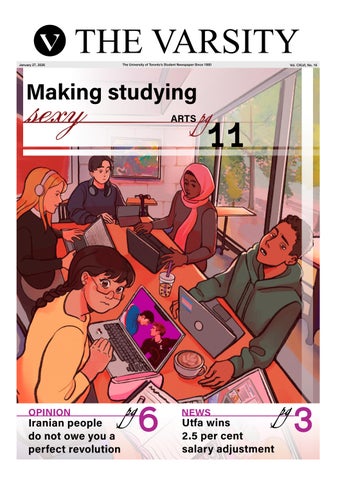
Issue 16, January, 2026

Page 1


T HE VA

T HE VA RSI T Y

Vol. CXLVI, No. 16

21 Sussex Avenue, Suite 306 Toronto, ON M5S 1J6 (416) 946-7600

thevarsity.ca thevarsitynewspaper @TheVarsity thevarsitypublications the.varsity The Varsity

MASTHEAD

Medha Surajpal editor@thevarsity.ca

Editor-in-Chief

Chloe Weston creative@thevarsity.ca

Creative Director

Sophie Esther Ramsey managingexternal@thevarsity.ca

Managing Editor, External

Ozair Chaudhry managinginternal@thevarsity.ca

Managing Editor, Internal

Jake Takeuchi online@thevarsity.ca

Managing Online Editor

Nora Zolfaghari copy@thevarsity.ca

Senior Copy Editor

Callie Zhang deputysce@thevarsity.ca

Deputy Senior Copy Editor

Ella MacCormack news@thevarsity.ca

News Editor

Junia Alsinawi deputynews@thevarsity.ca

Deputy News Editor

Emma Dobrovnik assistantnews@thevarsity.ca

Assistant News Editor

Ahmed Hawamdeh opinion@thevarsity.ca

Opinion Editor

Medha Barath biz@thevarsity.ca

Business & Labour Editor

Shontia Sanders features@thevarsity.ca

Features Editor

Sofia Moniz arts@thevarsity.ca

Arts & Culture Editor

Ridhi Balani science@thevarsity.ca

Science Editor

Caroline Ho sports@thevarsity.ca

Sports Editor

Aksaamai Ormonbekova design@thevarsity.ca

Design Editor

Brennan Karunaratne design@thevarsity.ca

Design Editor

Erika Ozols photos@thevarsity.ca

Photo Editor

Simona Agostino illustration@thevarsity.ca

Illustration Editor

Jennifer Song video@thevarsity.ca

Short-Form Video Editor

Emily Shen emilyshen@thevarsity.ca

Front End Web Developer

Sataphon Obra sataphon.ob@gmail.com

Back End Web Developer

Arunveer Sidhu utm@thevarsity.ca

UTM Bureau Chief

Ashley Thorpe utsc@thevarsity.ca

UTSC Bureau Chief

Matthew Molinaro grad@thevarsity.ca

Graduate Bureau Chief

Vacant publiceditor@thevarsity.ca

Public Editor

Raina Proulx-Sanyal & Ben Chapman

Associate Copy Editors

Celesta Maniatogianni

Associate News Editor

Taimoore Yousaf, Jean Patrick Vidad

Sports Editor

Liu & Audrey Kim

B&L Editors

Design Editors

Cervinka & Dowon Kim

Vesa Lunji & Zaneb Asad

Associate Opinion Editors

Web Developer

Lead Copy Editors: Hilary Cheung, Juliet Pieters, Sarah Pan, Zaneb Asad

Cover: Illustration by Simona Agostino

The Varsity acknowledges that our office is built on the traditional territory of several First Nations, including the Huron-Wendat, the Petun First Nations, the Seneca, and most recently, the Mississaugas of the Credit. Journalists have historically harmed Indigenous communities by overlooking their stories, contributing to stereotypes, and telling their stories without their input. Therefore, we make this acknowledgement as a starting point for our responsibility to tell those stories more accurately, critically, and in accordance with the wishes of Indigenous Peoples.

Trinity eyes pay-to-enter dining hall plan

Students object to proposed meal plan option and contractor Chartwells

On Thursday afternoon, in a fluorescent-lit room tucked away behind Strachan Hall, private consultants from the firm Kaizen Foodservice consulted a handful of students, staff, and faculty on potential changes to the dining policies of Trinity College.

As Trinity struggles to contend with the $110 million load of debt picked up from a turbulent construction project, the college is considering switching to a pay-to-enter meal plan. A switch to that same model at New College last year led to increased overall costs for students.

At a public assembly on January 16, Trinity students broadly expressed disapproval of the proposed change, under which non-residents would be forced to pay in order to enter the dining hall.

“I’ll be working on this in order to try to keep Strachan a public space,” said Anneke Lee, chair of Trinity’s student government, the Trinity College Meeting (TCM).

The college may also be contemplating a move away from its current food services provider, Chartwells, who have been criticized by Trinity students for low-quality food offerings, and alleged links to exploitation of child poverty, and prisoner abuse.

A Trinity College spokesperson wrote to The Varsity , “With the opening of the Lawson Centre for Sustainability later this year, we held consultation sessions, including a town hall and focus groups with students, staff and faculty on January 22, to help shape the future of dining at Trinity and support overall student wellbeing. At this point no decisions have been made.”

At the table

At consultation, the booths of two reusablecontainer companies competing for a contract with Trinity, Friendlier and Reusables.com, sat at either end of the hall, decked out with large banners and branded T-shirts.

Chartwell’s, the contractor that operates Trinity’s kitchens, gave away free samples, and informed students about the benefits of the proposed pay-to-enter meal plan model, marketed as “All-You-Care-To-Eat.”

Currently, Trinity uses a declining balance meal plan where students pay for a set amount of dining dollars, used to purchase food on an item-by-item basis. Unused meal plan funds at the end of the year are not refundable, and only a small amount can be carried over to the next year, an arrangement that has drawn student criticism.

Under the pay-to-enter model, students could pay for either an unlimited or finite number of “swipes” each week, which they could use to access a buffet-style dining hall.

Consultants from Kaizenfoodservice held two focus group sessions to solicit student, staff, and faculty input on dining options. The Varsity acquired a transcript of one of these sessions.

While explaining the pay-to-enter model, the consultants highlighted that it is currently used at New College.

last year increased the overall cost of meal plans. Neither did they mention that at New College, swipes not used by the end of the week expire, meaning students lose money for every meal they miss.

Only one student expressed a preference for the pay-to-enter model, with several others objecting particularly to the prospect of their dining hall becoming a restricted space.

“The impression that I got was that while they emphasized that they had not decided which meal plan option they wanted, the consultants running the meeting seemed to promote all you care to eat model in how they phrased their questions,” wrote third-year Trinity student Jeremy Diavolitis, who attended one of the focus groups, in an email to The Varsity.

The consultant-led focus groups at Trinity’s “Dining Town Hall” contrasts the two public consultations held by college leadership last year, where top administrators came in-person to discuss pressing issues with disgruntled students directly.

Buttery blues

The Lawson Centre for Sustainability, projected to open by summer 2026, will be equipped with its own dining hall, prompting the college to consider scaling back or shutting down the food services at current dining locations.

Trinity has already moved to shrink and consolidate its expensive food services. In January 2024, operating hours at The Buttery were drastically reduced from 76 to 56 per week. At the same time, hours at Strachan Hall saw an increase, but by only four per week.

Students have complained about the early closing times of Trinity’s dining locations. Strachan and The Buttery both stop serving food by 8:00 pm, though U of T schedules classes until as late as 9:00 pm, and students often stay out working until well past midnight.

The consultants repeatedly highlighted a possible reconfiguration where the Lawson Centre facility would become Trinity’s main dining hall. Strachan and the Buttery would retain some retail food options at a significantly reduced scale. One location would offer a narrow selection of hot meals like the kind currently served at The Buttery, and the other would only sell grab-and-go snacks.

At the focus group, the Kaizen consultants stressed cost as a key factor behind the potential rearrangement.

In 2024–2025, Trinity spent almost $5 million on food services and catering. That translates to roughly $10,555 a year on food services per resident, which is almost double the $5,957 University College spends on food services per resident.

From the repeatedly delayed, over-budget construction of the Lawson Centre, Trinity has accrued $110 million in debt. The college secured some reprieve through a March renegotiation of the repayment timeline on a $5.2 million loan from the University of Toronto, per its latest financial statement. The first installment, originally $1.3 million due next year, is now set at just $250,000 due two years from now.

Concerns with Chartwells

According to the minutes from a recent session of the TCM, the college is also considering moving away from its current food service provider, Chartwells.

Trinity students have made recurring complaints about the food offerings under Chartwells, saying that portions are too small, lacking in variety and nutrition — especially for students with dietary restrictions. Chartwells used to provide food services at UTM, until students launched a campaign complaining of steep prices, low quality, and a lack of vegetarian options.

According to the Trinity Times , students have circulated allegations of undercooked meat and food poisoning from Chartwell’s dining services. In 2021, the TCM endorsed an open letter accusing Chartwells of exploiting child poverty, and demanding that Trinity College cut ties with the company. The TCM also highlighted that a subsidiary of Chartwells’ parent company, the Compass Group, was accused of serving rotten meat to Canadian prisoners and exposing them to listeria in 2008.

“Chartwells prioritizes its own profits at the expense of student welfare. Trinity residents and students have been writing to you for years demanding that you acknowledge our experiences with a lack of nutrition despite the increasing prices of Strachan food,” the letter stated.

Muzna Arif muznamars@thevarsity.ca Advertising Executive

They did not note that the switch at New College from declining balance to pay-to-enter

They emphasized that this was just one potential option.

Chartwells did not respond to request for comment before publication.

Copy Editors: Bushra Boblai, Cyrilla Zhang, Daniela Cernaz, Despina Zakynthinou, Luca Locanto-Mazzoli, Omayma Lateef, Shruthi Umashankar
Gabriella Wrona Long-Form Video Editor video@thevarsity.ca
Devin Botar Varsity Staff
Trinity College held a wintery town hall meeting about the student meal services. ERIKA OZOLS/THEVARSITY

UTFA wins 2.5 per cent Across-The-Board salary adjustment in latest round of bargaining

Arbitrator Gedalof’s award still falls short of four per cent increase

On January 12, the University of Toronto Faculty Association (UTFA) won a 2.5 per cent AcrossThe-Board (ATB) salary adjustment which applies to base salaries and salary floors for the period of July 1, 2025, to June 30, 2026.

Despite this, Arbitrator Eli Gedalof’s decision fell short of the UTFA’s proposed four per cent ATB increase and its ongoing effort to include recent hires in ATB adjustments. Gedalof also declined to award salary floor increases for Librarian I and Librarian II positions, despite UTFA’s advocacy.

Wage increases

In the latest round of bargaining with the university, the UTFA proposed a four per cent ATB increase to account for inflation. The university proposed a 1.5 per cent increase, which UTFA said “would have left members woefully short of inflation and below top of market in the sector,” in an announcement about the January 12 award.

The 2.5 per cent increase awarded by Gedalof still fails to “close the gap,” UTFA asserted in their announcement, adding that “by awarding only 2.5% ATB, Arbitrator Gedalof failed to protect members’ wages against the compounding consequences of inflation.”

Arbitrator Gedalof did not respond to The Varsity’s request for comment.

UTFA has long sought a four per cent increase, claiming during bargaining that “The Administration argues that it cannot afford to pay increases above 1.5% despite its 2023–2025 Financial Reports indicating its ‘strong financial position,’ and a 2025 net income of $519 million and an increase in revenue of 5.1%.”

In an email to The Varsity, a spokesperson for the university wrote that “Approximately 66 per cent of operating budget expenditures at the university fund salaries and benefits. Increases in compensation reflected in the budget are expected to cover a range of expenses including negotiated increases for existing employees (such across the board increases as well as step or merit increases); the hiring of any additional

faculty and staff needed to support growth in student enrolment, expansion of student services, and research activity; and increases in the cost of benefits or benefit improvements.”

New employees Gedalof also did not support UTFA’s proposal to apply retroactive ATB salary increases to recently hired employees, who are excluded from any ATB increases awarded in the year they are hired.

In an email to The Varsity, the UTFA wrote, “We are disappointed that the Arbitrator ruled in favour of the Administration's position that faculty members and librarians are not eligible for retroactive ATB during their first year of hire. Of course, this has a significant impact on members who are often among the lowest paid.”

UTFA has been engaged in a longstanding effort to win this ATB salary increase for new employees, but remains unsuccessful despite a petition signed by 750 UTFA members in support of the proposal.

In the announcement of the award, the UTFA added that it “maintains that the Administration

Community gathers to honour Shivank Avasthi

Friends and faculty come together to honour the life of a fellow student

On January 22, students, friends, classmates, and faculty gathered in the Meeting Place on campus to honour Shivank Avasthi’s life and legacy. The memorial, held from 2:00 to 4:00 pm, provided a space where the community could collectively mourn, reflect, remember, and grieve a loss that has greatly and profoundly affected UTSC.

On December 23, 20-year-old Shivank Avasthi was fatally shot in the Highland Creek Valley, just steps away from the UTSC campus. The tragedy sent shockwaves through classrooms and clubs. Avasthi was respected and deeply loved. He was a dedicated member of the UTSC cheerleading team and was on track to graduate from the Life Sciences program, majoring in human biology and neuroscience.

At the memorial, friends of Avasthi shared personal stories and reflections, offering insight into his character beyond his academic and

extracurricular achievements. Speakers recalled his kindness, sense of humour, and unwavering support for those around him. For many in attendance, the stories shared underscored Avasthi’s impact, demonstrating how he fostered a sense of purpose and belonging within the communities he was part of.

Avasthi’s involvement with UTSC Cheerleading was fondly remembered throughout the memorial. Teammates spoke fondly of his dedication, hard work, and contagious enthusiasm. His presence helped cultivate an inclusive team environment. This loss has been felt especially strongly within the cheerleading community, where Avasthi was remembered not only as a teammate but also as a close friend and source of encouragement.

As the memorial drew to a close, attendees remained in the Meeting Place, continuing quiet conversations and providing support for one another.

The student-run commemoration was organized by the Scarborough Campus Students’

should never be authorized to negotiate terms with individual members that would deprive them of a benefit negotiated by the Association.”

In an email to The Varsity, a university spokesperson wrote that “The university respects the decision of the independent arbitrator and remains committed to constructive relations with the faculty association. The arbitrator upheld that the university’s positions are grounded in established practice, lawful and in accordance with the terms of the Memorandum of Agreement.”

When asked what challenges lie ahead in the new round of bargaining, which began on January 23, UTFA President and Co-chief Negotiator Terezia Zorić, and UTFA VicePresident, Salary, Benefits, Pensions and Workload and Co-chief Negotiator Jun Nogami, wrote “Bargaining with the U of T Administration always entails many challenges… One well worth pursuing, will be to secure across-theboard salary increases for UTFA members in their first year of employment.”

Union (SCSU) in collaboration with the UTSC Cheerleading team. The memorial was also supported by various campus resources, including the Office of Student Experience & Wellbeing, the Office of Ceremonies & Events, Facilities Management, and Food Partnerships & Business Development. Decompression rooms and on-site counsellors were available throughout the service to provide extra support to attendees.

In a message shared with the UTSC community, Alison Mountz, Acting Principal during Principal Linda Johnston’s bereavement leave,

acknowledged the importance of the gathering. She recognized the range of emotions students are experiencing across campus. Mountz described the memorial as an opportunity for students “to come together in shared grief and to offer comfort after a senseless act of violence.”

Mountz also expressed gratitude to UTSC staff who worked throughout the holiday break to support students in light of the unexpected tragedy. She acknowledged that much of this work occurs behind the scenes but emphasized that it has been carried out with “compassion and professionalism.”

“The classroom feels more charged”:
How Iran’s protests are reshaping classroom experience
The Varsity speaks to professors and students about the role of current events in the classroom

In late December 2025, protests swept Iran, leading to weeks of mass demonstrations, violent government massacres, and an internet blackout. As of writing, CBC estimates the death toll to be more than 5,000.

The Varsity spoke with professors and students to understand how current events in Iran are reshaping their classroom experiences.

Classroom discussion

Near and Middle Eastern Civilizations (NMC) post-doctoral fellow Niyosha Keyzad teaches NMC198H1: Iranian Women Reveal Their Lives: The First Generation, a course about the lives, writing, and social experiences of the “first generation of [Iranian] women to have access to a modern education, and step beyond traditional boundaries.”

The class explores how women resisted the patriarchal society under Pahlavi rule, and how that shaped women’s resistance to oppression postIslamic Revolution. “It felt necessary to engage with the ongoing developments, particularly in relation

to women’s liberation,” Keyzad wrote in an email to The Varsity.

Professors say that engaging with current events can deepen students’ understanding of the material in their courses. Department of History and NMC professor Mohamad Tavakoli-Targhi teaches HIS1784H: The Islamic Revolution, a graduate seminar course which provides a comparative exploration of the making of the Islamic Revolution in Iran.

“This is a course on the Iranian Revolution of 1978-79 that created the Islamic Republic, and the movement today is a movement against the Islamic Republic, with the hope of liberating Iran and…creating a new government…So, from that point of view, looking at the revolution, causes of revolution, theories of revolution, how the various phases of that revolution gives us an insight into what is happening today,” Tavakoli-Targhi said in an interview with The Varsity.

Tavakoli-Targhi describes his classroom as “a free zone. Intellectual interaction, interactional discussion, [where] you have seen different sentiments, different views, highly diverse expression.” To facilitate a discussion of the protests, he incorporated an interactive method

into his course. Students in the class share a closed Facebook group for “exchanging information, sharing photos, images, videos” about “this unfolding revolution.”

Despite the educational value of engaging with these events in real-time, both professors acknowledged the emotional challenges involved.

Tavakoli-Targhi explained that discussions about the protests in the classroom are more impassioned.

“The classroom feels more charged,” Keyzad noted, “and it’s clear that the unfolding events are shaping how they think and feel about the material. About half of the students in our class are Iranian, and their grief is palpable.”

Student perspectives

During a HIS1784H lecture, one PhD student said, “a revolution or something of this essence is unfolding… is not really visible in the sense that it becomes visible later in history, as it is unfolding, it’s very imperceptible.”

“I’m still kind of lost as to what opinion I want to form… but I’m concerned as to where these protests are going and the aftermath,” another student shared.

Classroom discussions have also revealed a diverse range of perspectives, with one student observing, “that there really are quite deep political differences among different ethnic groups. It’s not just one voice.”

Responsibility of educators

“We have a special responsibility to balance our commitment to critical thinking with space for personal connection,” Keyzad wrote. “Teaching in this context requires us to support students as they process the impact of current events and imagine how they can contribute to a more just and peaceful future.”

Tavakoli-Targhi aims to make classroom discussion about the protests “as scholarly as possible.”

“I want students who are well-versed into theories, historiography, accounts of the revolution, and competing views, but also informed of particularly what is happening today in Iran.”

Tavakoli-Targhi added that he wants his students to “bring their knowledge from outside of class… and take their knowledge of their classroom experience to conversations that they have with their parents [and] with friends.”

The community gathered together at the Meeting Place to remember Shivank Avasthi. ERIKA OZOLS/THEVARSITY

Food and financial insecurity dominate UTGSU 2025 AGM

December BOD also reflects on current governance issues, vacant

On December 4, 2025, the University of Toronto Graduate Students’ Union (UTGSU) held its 2025 Annual General Meeting (AGM). The executives presented progress on key issues and milestones, including transit, affordability, and food and housing security, and heard from graduate constituents about their funding needs. On December 9, UTGSU held a Board of Directors (BOD) meeting to approve minutes and discuss Winter GradFest, among other responsibilities.

AGM

In executive updates, Vice-President (VP) Academics Nicholas Silver recounted developments in the transit campaign, including efforts to make the post-secondary student fare equivalent to the TTC youth fare, expand transit advocacy across GTA transit agencies, and create tangible public policy

ahead of the 2026 municipal elections. Silver also highlighted the Cost of Living survey research, the formation of U of T– and GTAwide coalitions, and meetings with city councillors and staff.

Silver then updated members on base funding concerns. All current and incoming students in funded PhD and doctor of juridical science programs are guaranteed $40,000 in base funding. The UTGSU will now campaign to include master’s and professional students, adjust the funding with inflation, and enforce funding increases.

VP Graduate Life Eliz Shimsek provided an overview of programming in her portfolio, including mental health, food security, advocacy, and athletics, and weekly lunches with the U of T Food Coalition.

On the AGM agenda were presentations on the Food Equity & Education Drive referendum from U of T Food Coalition’s Mike Lawler, a PhD candidate in Geography and Planning. Despite five years of advocacy for food

security, Lawler noted the little progress and a lack of investment in students’ food needs — gaps the Coalition’s weekly lunches have aimed to address.

Voting on this referendum took place from December 2–5, with 88.7 per cent of graduate student voters supporting a refundable fee for a food security program.

UTGSU President Amir Moghadam and Interim VP External Jady Liang then presented findings from the Cost of Living Survey, highlighting rising inflation.

Later motions included developing a unionization campaign within UTGSU to establish a collective negotiation process with the university, as well as creating a comprehensive master’s student funding campaign. Base Funding Committee members Julian Nickel and Dorothy Apedaile spoke passionately in support, with Apedaile emphasizing, “organizing is required to get the tiniest concessions on funding.”

AGM business also included discussions on safeguarding student democracy in light of Bill

finance position

33 and establishing a UTGSU Action Plan to respond.

December BOD

On December 9, the BOD reconvened for its monthly meeting. Directors discussed the Board of Appeals, specifically members’ responsiveness in adjudicating issues. VP Internal Dominic Shillingford’s approved motion sought to clarify the application process.

Next, the Ad Hoc Hiring Committee — created at the November BOD to recommend a replacement for the vacant VP Finance position — presented its report. As VP Shimsek moved the report, the recommendation was not to proceed with hiring due to timeline, continuity, and onboarding concerns.

The committee concluded that ongoing financial-related motions and policies would be best supported by elected executives, and that reassigning financial duties among current officers would avoid the significant time required to train a new VP.

UTM Young Liberals panel talks Palestinian student visa delays, youth political participation MPs

discuss pathways into leadership and student roles in shaping policy

Nguyen

On January 21, students at UTM gathered for a panel hosted by the UTM Young Liberals club. Elected officials addressed youth political participation, and responded to student concerns about immigration delays affecting Palestinian students.

The event brought together MP Amandeep Sodhi, MP Fares Al Soud, and MP Iqra Khalid, alongside Liberal Party of Ontario Chair Qasir Dar. The discussion focused on pathways into political leadership, representation in government, and the role students can play in shaping policy.

A place for Palestinian students

During the question period, a first-year UTM student said many Palestinian students remain stranded in conflict zones despite holding university offers.

“There are students like us that got into U of T competitive programs, but are not sitting here next to us today,” the student said. “The only reason is IRCC [Immigration, Refugees and Citizenship Canada].”

The student referenced the Palestinian Students and Scholars at Risk Network (PSSAR), a nonprofit organization assisting Palestinian students with visa and biometric documentation, and urged federal

The Varsity Newswire

Deadlines to request Spring 2026

Convocation approach — Simcoe Hall

Junia

Students wishing to graduate this spring must request convocation this week. UTSG Faculty of Arts and Science, UTSC, and Daniels students have until January 31 to do so, while UTM students must request convocation by Monday, January 26. Students who miss the deadline but wish to graduate this spring should reach out to their college registrar immediately, but should understand that a place at convocation cannot be guaranteed.

“The old order is not coming back,” says Carney — Davos, Switzerland

Ella MacCormack, News Editor

In a January 20 speech at the World Economic Forum, Prime Minister Mark Carney said that

representatives to consider alternative approaches used by other countries.

In response, Al Soud — a Palestinian-Canadian — and Khalid said the issue is one they have been personally involved in. Khalid noted that approximately 130 students are affected, including some currently in Gaza, and said she has met directly with PSSAR and impacted students.

“This is something that I’m very, very regularly following up on,” Al-Soud said. “I have a call with IRCC tomorrow specifically on it.” Khalid added that the issue has been raised with federal ministers and the Prime Minister.

Youth engagement in politics

Al Soud also emphasized the importance of youth participation in political spaces, arguing that student perspectives play a role in shaping present-day policy discussions. “Youth are not just the future, they’re the present,” he said.

Khalid spoke about the pressure young people face as they navigate politics during uncertain times. “A little anxiety is important,” she said. “In order for change to happen, you have to feel uncomfortable.”

Dar encouraged students to get involved early, saying the party is in a period of change with the upcoming leadership race following Bonnie Crombie’s resignation. Early participation, Dar said, could give students greater influence.

the powerful were using economic intimidation to get what they want, stating, “We are in the midst of a rupture, not a transition.”

Carney said instead of waiting for the “old order” to return, nations need to build strong domestic economies and international diversification to reduce the powerful’s leverage. The speech received a standing ovation.

After, Trump revoked the invitation for Carney to join his “Board of Peace,” which was initially aimed to oversee the ceasefire in Gaza, but now aspires to be an “international peace-building body” for any global conflict.

Canadian Government to strengthen trade partnerships with China — Ottawa

Arunveer Sidhu, UTM Bureau Chief

The Government of Canada announced a “preliminary agreement-in-principle” with China that reduces Canada’s tariff on Chinese electric vehicles (EVs) from 100 per cent to 6.1 per cent and establishes an initial quota of 49,000 EVs arriving in Canada per year. By comparison, Tesla delivered between 18,300–

The panel also highlighted barriers young people face when entering politics. As the youngest MP on the panel, Sodhi said age can discourage students from seeking leadership roles. “Our age often holds us back … but I see it as a strength rather than a deterrent,” Sodhi said.

Several students told The Varsity that the discussion helped make political spaces feel more accessible. “Politics itself requires guts and confidence, which can lead to anxiety,” said second-year political science student Madelynne McBride, “The event itself didn’t erase nerves, however, gave a sense as to those feelings being normal and [that] it’s important to keep pushing forward.”

Organizing on campus

Behind the scenes, student organizers said the event required weeks of planning and coordination. Zara Razi, the organizational officer for the UTM Young Liberals, said securing a venue proved challenging despite the club’s official recognition status.

She said the club was initially planning to use a smaller lecture room, but due to higher than expected interest, organizers decided to pursue a larger conference space just days before the panel. Razi estimated that approximately 45 students attended the panel.

20,000 vehicles to Canada in 2025, a 63–67 per cent decline from the previous year.

The proportion of the quota reserved for EVs with an import price of $35,000 or less is planned to reach 50 per cent by 2030. The Canadian government expects this deal to protect and create new auto manufacturing jobs for Canadian workers while expanding the availability of more affordable EVs in Canada.

By March 1, 2026, China is also expected to lower tariffs on Canadian canola seeds from the current combined rate of 84 per cent to 15 per cent. Canada is the top global exporter of canola, and China is the second-largest market, so this deal will improve market access for approximately $4 billion of annual Canadian canola seed exports to China.

Another US Citizen shot dead by federal agents in Minneapolis — Minnesota Junia Alsinawi, Deputy News Editor

On January 24, American citizen Alex Jeffrey Pretti, 37, was shot dead in a confrontation with federal agents in Minneapolis. Videos

UTM Young Liberals president Aanchal Kapoor said the event reflected months of outreach and long-term relationship-building with MPs and their staff. “I think the biggest challenge is always ensuring that all MP’s and Dar’s timings align,” Aanchal said. “It’s a busy time, it’s a new session and it’s a new year.”

First-year student Mekayel Omier, the club’s membership officer, said volunteering remains one of the most accessible pathways into political involvement.

“I started in January 2025, that was my first political involvement,” Omier said.“I saw a video of Dar’s candidacy for Mississauga–Erin Mills, which is my local riding, and there was a campaign launch party. So I attended that, and…met a bunch of people I liked, so I started volunteering, canvassing, and working at the grassroots level.

Omier added that volunteering helped him build confidence. “It was scary for me as well when I started originally, because I didn’t have that confidence,” Omier said. “But no one shames you for being new, you actually get appreciated for it, because you have that courage and bravery to start doing stuff.”

The UTM Young Liberals said the event is the first of several planned activities this academic year, with more panels and collaborations expected in the coming months.

show at least six masked, armed agents wrestling with Pretti for a few moments before a Border Patrol agent fires multiple shots, killing him. Pretti was an intensive care unit nurse, born in Illinois.

This comes just two weeks after ICE agent Jonathan Ross shot and killed US citizen Renee Good, also in the streets of Minneapolis.

Federal agents claim that Pretti had a handgun and that the killing was in self defense. Videos taken by witnesses show that Pretti had already been disarmed by federal agents at the time of the killing. Police have confirmed that Pretti was a lawful gun owner with a permit to conceal carry.

Rents due for Toys ‘R’ Us — Concord Ella MacCormack, News Editor

Toys ‘R’ Us landlords have filed at least seven lawsuits, claiming the toy retailer owes a collective $31.3 million in unpaid rent and damages from 2024–2025. Toys ‘R’ Us only has about 22 locations left in Canada, down from 81 in 2021.

Business & Labour

January 27, 2026

thevarsity.ca/category/business

biz@thevarsity.ca

Does gender play a role in your investment strategy?

You might be surprised to find out who earns more

Amid New Year’s resolutions, vision boards, and future planning are a myriad of discussions about financial goals. Most of us aim to grow wealth — but how?

I recently sat across from a group of undergraduate students on a train from Montréal to Toronto, and couldn’t help but overhear several hours of investment advice. Their interest in financial markets at such a young age is not uncommon these days. As we reach the limits of the homeownership dream, many young people are turning to investing as a way to build wealth for the future.

The rise in personal investing among young people

Recent reports show that Gen Z is taking an interest in investing much earlier than previous generations. On average, Gen Z has started investing at the age of 19, compared to the age of 32 for Gen X. As a result, 45 per cent of Gen Z reports having investment experience already.

In an interview with The Varsity, Kristine Beese, the founder and CEO of Untangle Money, a financial consultant for women, said young people have access to an overwhelming amount of online financial advice — not all of it is reliable. This influx of information can foster overconfidence about market trends and investment strategies. Despite being relatively new to investing, 70 per cent of Gen Z said they felt confident in their investment strategies due to early exposure.

When it comes to investing, however, young people have one major advantage: time. Investors who are many years away from retirement can generally afford to take on more risk, which, with patience, can lead to higher returns over the long term. As Beese explained, “we really want women

or [people under] 45, to be getting their money working harder for them.”

Understanding the gender investment gap

According to a 2020 policy brief by the Rotman School of Management, women are less likely to save and invest than men and, when they do, tend to accumulate less wealth overall. These findings are supported by data from a 2018 Wealthsimple survey, which found that women respondents had an average of $18,000 less in savings and approximately $24,000 less in investments than men. The report attributes this disparity in part to the persistent wage gap: men earn more over their lifetimes, and as a result, have more disposable income to save and invest.

The report’s conclusions are significant. Women face greater financial insecurity, especially in old age, and these risks are deeply connected to the structural inequities they experience throughout their lives. However, this narrative can also reinforce the idea that women must model their financial strategies after men. In reality, the opposite may also be true — men may have something to learn from women’s generally greater risk-awareness and caution in investing.

Where women perform better

Women earn less on their investments in overall dollars, but these figures often fail to account for how much was invested at the start. When outcomes are compared using rates of return rather than total amounts, a different story emerges. On average, women outperform men in both saving and investing.

Despite earning roughly 20 per cent less in wages, reports from Fidelity show that women’s portfolios performed 40 basis points — 0.4 per cent — better than men’s, while other studies show returns up to one per cent higher for women investors. Women’s portfolios also tend to lose less

value during economic downturns, leading to more stable wealth accumulation over time.

These outcomes may be linked to women’s more conservative risk distributions and long-term investment strategies. As Beese explained, “the more you look at your long-term money, the worse you do… Markets are too volatile, and there’s too much noise, meaning you can’t always figure out why things happen… One of the secrets for women, why they outperform men, is we set it and we actually forget about it. That’s shown to be a winning strategy time and time again.” This means that they may not react to short-term market fluctuations.

Men, on the other hand, often take on greater overall risk and trade more frequently. A Wells Fargo report revealed that single men trade 27 per cent more frequently than single women, and are more likely to adjust their asset allocations in response to market conditions. While this approach can occasionally capture highly speculative gains, it also increases the likelihood of steep losses when markets turn.

Reframing the problem

The gender investment gap, therefore, is not the result of women’s risk aversion to investment losses. In fact, a 2020 study from the Institute

The economics behind renewing hit shows

How networks use demand metrics, brand potential, and profitability to decide which shows survive

Over its nearly nine-year run, Stranger Things has secured its place as one of the most beloved shows in Netflix history. Its impact on entertainment culture is undeniable. With multiple spin-offs, sequels, branded consumer products, and live events, it has become a prime example of how a TV franchise can be monetized, engineered for fan engagement on social media, and transformed into a lifestyle brand.

The explosive success of shows like Stranger Things highlights how streaming platforms use anchor series to drive new subscriptions and retain existing ones. Anchor series are popular TV shows or films that platforms rely on to attract subscribers, sustain audience engagement, and support longterm franchise expansion. These titles present opportunities for streaming services to expand an original story into a franchise and build a highly lucrative brand capable of generating billions long after the finale.

However, the decision to renew a show is never simple. It involves a patchwork of strategically calculated choices, all aimed at ensuring long-term profitability.

A return on investment

To fund a single production, platforms must first ask a simple question: will this show earn back its production costs? An exclusive 2021 Bloomberg report revealed that services like Netflix rely on proprietary metrics to make these decisions.

The first metric is “adjusted view share,” which captures not only the size of a show’s audience but also the perceived value of those viewers to Netflix.

For instance, viewership from new or infrequent subscribers — whose engagement can be more directly attributed to a specific title — is weighted more heavily.

The second metric is a show’s “efficiency score,” which evaluates how much value a title generates relative to its production cost. Finally, a show’s “impact value” estimates the overall dollar value a program contributes to the platform, primarily through subscriber acquisition and retention.

For context, Dave Chappelle’s Netflix special generated an impact value of $19.4 million with an efficiency score of 0.8x and an adjusted view share of 12, while Bo Burnham’s Inside achieved a higher efficiency score of 2.8x alongside an adjusted view share of 10. Squid Game dramatically outperformed both, recording an adjusted view share of 353 and an efficiency score of 41.7x. Despite costing only $21.4 million to produce, it generated nearly $900 million in impact value.

This approach marks a departure from the ratings logic of legacy media, where success was often measured primarily by viewership supported through advertisements. In contrast, streaming platforms emphasize attracting and retaining subscribers as the central measure of a show’s value.

Supply and demand

Every platform has its own priorities when it comes to the type of programming it hosts and curates. Yet, for renewal decisions, audience engagement on social networks is almost always used to gauge viewer interest, cultural impact, and growth potential.

Parrot Analytics, an entertainment analytics company, studied 1,400 shows across

for Gender and the Economy shows that women are not inherently more risk-averse, and that risk is highly context-dependent. Beese believes that “risk-aware” is a more accurate way to describe women’s approach to investing, suggesting that overconfidence is actually one of the greatest pitfalls for men.

Despite outperforming men, women still have less income on average to invest and live roughly four years longer. As a result, even with effective investment strategies, young women may need to make their money work harder to afford retirement later in life.

In order to “catch up” to men when it comes to investment returns in overall dollars, women might need to put more of their income into the market to get it working early –– even $25 or $50 per month can make a big difference compounded over time. Beese also suggests that women more than 20 years away from retirement should take on greater risk distributions in their portfolios while continuing to do what they do well: setting a strategy and sticking to it.

For men, on the other hand, catching up to women’s investment performance might mean gaining greater risk awareness and sticking to a long-term strategy in the face of market volatility.

networks and streaming platforms to create benchmarks for predicting the renewal probability. According to the firm, the first 60 days after a show’s release are critical for measuring impact.

In their analysis, category averages –– the typical level of audience demand across all shows within the same genre –– serve as the standard for measuring performance. Along this, the demand multiplier, or how many times a show’s audience demand exceeds the category average, is also considered.

Shows with demand below nine times the genre average are unlikely to be renewed. When demand is 10 times the average, renewal chances rise to 53 per cent. Shows performing 30–50 times above the category average are almost guaranteed a second season.

Renewal rates vary by platform. For example, when a show has 20 times the demand of its genre’s average, Apple TV+ leads with a 90.7 per cent renewal rate, followed by Hulu at 84 per cent, HBO/Max and Netflix at 80.8 per cent, and Disney+ and Amazon Prime at around 67 per cent. These differences illustrate how early demand, combined with platform strategy, shape renewal decisions.

Betting big: Building a franchise Squid Game, Stranger Things, Wednesday, Bridgerton, One Piece , and K-Pop Demon Hunters show how Netflix productions are increasingly built with franchise potential rather than one-hit wonders. These titles have already produced, or are positioned to produce, sequels and spin-offs.

Stranger Things remains the clearest example. What began as a TV series has expanded into an animated spin-off, a Broadway stage production, pop-up retail stores, and live immersive experiences.

This shift reflects that successful shows are no longer treated as isolated media properties. Instead, they function as expandable media universes with consistent branding that can be monetized across platforms.

In essence, it is clear that Netflix has effectively created its own version of a longrunning media universe, similar to the Marvel Cinematic Universe, designed for longevity and maximum profitability. Programming in the new age is no longer just about winning audiences — it’s about creating shows that can endure as brands indefinitely.

JISHNA SUNKARA/THEVARSITY

Opinion

January 27, 2026

thevarsity.ca/category/opinion opinion@thevarsity.ca

Iranian

people

do not owe you a perfect revolution

You don’t get to feel ‘morally superior’ about the Iranian struggle

Banafsheh

If you have been following the news over the last several weeks, you may have seen headlines about a “violent crackdown” in Iran.

But “crackdown” is a sanitized word for a massacre.

According to CBS, the Islamic Republic regime has murdered between 12,000–20,000 people in just a few days. These numbers fluctuate based on reports, and the real number of such atrocities is historically higher than what is officially reported.

This killing of civilians by the government happened in the open, on the streets, in the hospitals, and right in front of Iranian people’s eyes –– however due to the fact that the regime enforced a total internet and communications blackout, most of these incidents did not reach global attention.

But, from my perspective, even when informed, the rest of the world has remained disturbingly quiet.

In the first days of the most recent wave of protests in Iran, a photo of a single protester circulated online: this protester was unarmed and in a fetal position on the ground, facing a line of heavily armed riot police.

Even with no knowledge of the context or geopolitics of contemporary Iran behind the protests, any human with basic empathy would look at that image and side with the vulnerable, with the one risking everything against the weaponized machinery of a state.

Yet, as the protests turn to slaughter, there has been a trend that is almost as suffocating as the silence: a sense of moral superiority that judges the ‘methods’ of Iranian resistance. It criticizes the slogans they choose and becomes concerned about the etiquette of the resistance, rather than the reason people are resisting in the first place.

But what happens without a collective sense of empathy? Who benefits from you sitting in comfort and frowning upon a people’s fight for survival? And if everyone is simply frowning, then who is supporting the fight?

In her book Queer Phenomenology, Sara Ahmed writes, “It matters how we arrive at the places we do.” The radical defiance that we are seeing from the Iranian people did not come out of nowhere. What they’re asking for today is built upon layers and decades of trauma, failed reforms, shattered hopes and a mountain of corpses. When you are being choked, reaching for air is not a calculated political move; it is an act of survival.

What makes this situation worse is the externally imposed standards of legitimacy, making people check their ideological handbooks to see if they are allowed to care. They pick apart Iranian people’s slogans through their morally superior lens, looking for ideological flaws. The political desires of the Iranian people remain diverse and wide-ranging. Thus, depending on one’s positionality, there will most likely always be ideological differences one can nitpick.

But it is the lived history of a struggle that shapes its present. You cannot judge the ‘correctness’ of a protest without acknowledging the decades of suffering that necessitated it.

We must dismantle the colonial gaze that views Iranians as a monolith. There is no singular ‘Iranian people.’ We are a tapestry of ethnic minorities, religious backgrounds, secularists, and various social classes. Diversity is our strength; it means our resistance takes many forms.

Any political ‘unity’ that demands a single homogeneous ideology is a failure of imagination at this point. As Saba Mahmood explored in her book Politics of Piety, people’s agency must be understood within their specific context. She

challenged the idea that we only acknowledge ‘agency’ when it looks like what we’re used to seeing within Western liberal resistances.

The agency that Iranians decide on might very well offend the current sensitivities. But human rights are not a reward for having ‘the right’ politics; they are the inherent right of

Instead of letting ideology shut down your empathy, you can let empathy guide your solidarity. Don’t claim spaces you don’t understand, and don’t assume you know the nuances of a struggle from an Instagram infographic.

every person, even those facing a weaponized, aggressive and oppressive state power.

The full two weeks of internet shutdown in Iran were a calculated violation of human rights. By cutting off the Iranian’s right to communicate, the regime silenced Iranian voices and put a stop to the documentation of their crimes against humanity.

So when you withhold support because you aren’t sure if the protesters’ ‘values’ align with yours, you may unintentionally be assisting the regime in its goal of making its people invisible; Of delegitimizing their movement to justify their own violence.

The argument that ‘we must be careful who we support’ is a luxury of the safe. It follows a similar hypocritical logic that suggests queer people shouldn’t support Palestinian liberation because of the assumed social contradictions within that region. The moral standard you set for a people’s fight for life and dignity is a gatekeeping of empathy. If you would not give up your protected right to protest or your bodily autonomy, then you have no standing to criticize the methods of those who have no such choice.

For many, this is a news cycle that will eventually fade away. For diasporic Iranians and those on the ground, this is a crisis that has been impacting them on many different levels.

So in this brief window of global attention, instead of letting ideology shut down your empathy, you can let empathy guide your solidarity. Don’t claim spaces you don’t understand, and don’t assume you know the nuances of a struggle from an Instagram infographic. Check in on your Iranian friends, ask them questions, and learn.

The right to exist is not up for debate, and human rights are not a prize to be won by those who are most ‘politically correct.’ Stop checking your handbook to see if you are ‘allowed’ to care. Let your empathy guide you, and you’ll find that it’s not complicated to care.

Banafsheh Cheraghi is a second-year graduate student in the Master of Social Work program at the University of Toronto, specializing in mental health and health.

So what if he’s just not that into you? You don’t have to optimize dating

Based on a non-fiction book of the same name, the rom-com He’s Just Not That Into You (HJNTIY) came out in theatres in 2009 to preach one simple, seductive lesson: if someone isn’t obvious about their feelings for you, they’re just not that into you.

In theory, this lesson should protect us from rejection, and wasting time on people who aren’t interested in us the way we are. But in practice, it encourages us to treat human connection as a transaction.

On its opening weekend, HJNTIY topped the box office, despite being panned by critics. I believe that the film’s popularity is a result of its exploration of the universal experience of misinterpreting romantic signals.

Sometimes, it’s hard to know whether someone likes you or not. Like, really hard. I’ve spent most of my life figuring it out, and I am none the wiser than my insecure, naive, 14-year-old self.

HJNTIY teaches us that if you have even the slightest doubt about someone’s interest, then they don’t like you as much as you wish they did. If someone likes you, they will show you; they will go out of their way to make it obvious. Don’t pursue people who are unwilling to put in the effort to woo you.

But all this considered, here’s my question: so what happens next, if he’s just not that into you? In our technological age, does this mean you must immediately block, delete, unfollow, and ignore every single individual who doesn’t like you as much as you want them to?

In a world where efficiency, productivity, and quick and constant results are the priority in every aspect of our lives, dating too has been infected by this ‘optimization culture,’ where people are reduced to investments that need to pay dividends. However, I argue that you’re allowed to like someone even when they don’t like you back, and that enjoying someone’s company without expecting a romantic return isn’t delusion; it’s human.

Obviously, this mentality has its limits. I’m not saying you should stalk people, or annoy them with constant affection, or make your life revolve around theirs. Don’t show up at their house unexpectedly or message their mom on Facebook. However, YOU ARE ALLOWED TO LIKE SOMEONE –– even when they don’t like you back. Those feelings are valid, and I believe they are worth exploring.

I know this firsthand. I have, for a while now, had a crush on someone who probably doesn’t like me back. I had to confront this reality when S.J. (my romantic interest) took days to respond to my Instagram messages. At first, I thought maybe he was just a slow texter or busy with finals, but eventually I had to accept that he’s just not that into me.

My Instagram algorithm conveyed this to me very clearly, endlessly proffering reels with the same essential message: he’s just not that into you. Some posts took on a tone of empowerment –– y ou don’t need a man! Some made fun of how ‘delulu’ the enamoured are, and others suggested playing the field, extending the roster, and getting some more benchwarmers. Whatever the attitude, the message was always that unreciprocated interest is a waste of time.

This advice resonates because Gen Z is deeply averse to rejection. The influencers on social media are unanimous: blame your anxious attachment style and get therapy, not a man — you’ll cringe at this later. Embedded in this is a teleological worldview: in order to become your optimized self, anyone slowing you down should be dropped immediately.

But can you not be attracted to a person, get to know a person, without an obvious objective? In our age of neoliberalism, we pursue net benefits, tidy conclusions, and the highest value in anything we do. Things can’t just be — they must be going somewhere, and they must have a destination.

For love, this tends to be marriage. Although people are getting married less than they once did and later in life, marriage is still a social norm in most cultures. When dating a person, many are gauging whether they’d make a suitable long-term partner, whether they’re a worthy investment.

Suddenly, that cute boy across the table is not a confused, awkward, sometimes-kindafunny biology major; he’s a calculation. Will he make good money? Would he be a good father? How would he fit into my life, what value would he bring to my future, how would others perceive us as a couple? By measuring

will always cheer us on, who spoils us, who is hot but sensitive, who is well-versed in Nietzschean philosophy as well as able to recite Saturday Night Live skits word-forword. This optimization mindset is exactly why we can’t accept unreciprocated feelings; if someone’s not maximizing our demands, why keep them around?

The truth is, people are not problems for you to solve. They don’t follow a predictable equation or act in the most rational manner. You can’t know if you’ll like a person by adding their qualities and subtracting their defects. You and everyone around you are

not reciprocating my feelings, just like there’s nothing wrong with me having them.

Life is enriched by being around people you enjoy. Find people who are kind and caring, who you can talk to about the stuff that interests you. Don’t expect someone to fall in love with you; that is so incredibly out of your control.

Enjoy people for who they are, without expecting an outcome. Be curious and encouraging, without ulterior motives. It’s not refusing to accept reality, it’s refusing to treat every human connection as a transaction that needs to go somewhere, that needs a clear outcome.

Here’s a spoiler alert of HJNTIY : the guy whose entire role is to tell women “he’s just not that into you” ends up being very into the woman he’s advising, and, you guessed it, everyone ends up happy and in love at the end.

the value of the person we love in terms of their ability to get you something or somewhere, strip them of their humanity.

When you’re swiping on Tinder, Bumble, Hinge, Christian Mingle, Muzz or whatever dating app floats your boat, you are gamifying love. It’s no longer about compatibility; there’s no will-they-won’t-they tension, but only pixels. We are looking at pieces of a person, and from these fragments, we decide whether or not they’re worthy of being in our lives.

Never before in human history have people been able to consider dating such a large pool of people. It sometimes seems the options are endless, as you can always extend your range if you run out of potential matches. With so many options, we try to optimize. We want the biggest bang for our buck. We want the best possible partner: the one who

changing every second. Some relationships follow patterns, but most of it is far beyond our comprehension.

Love is messy. Sometimes things seem clear, but new information muddles everything up. Sometimes you believe one thing only to realize you were completely off-base. There is a level of ambiguity, of endless potential, in every moment. By dismissing any person who doesn’t reciprocate your interest, you are overlooking the ever-in-flux nature of our existence.

Here’s the thing: I don’t want to like someone else. S.J. is funny and smart, and I enjoy talking to him. He’s curious and kind, asks good questions, and he’s polite and respectful. Am I meant to hate him just because he doesn’t feel the same way about me as I do about him? There is nothing wrong with him

That’s not my ending. The truth is, I will almost certainly run into S.J. again, since we have mutual friends. I know I’m going to tease him for taking so long to reply, pretending it didn’t hurt me. I know I’m still going to overthink our interactions, and the potential hidden messages beneath everything he does in my presence.

A part of me will still hope he suddenly realizes he’s desperately, insanely in love with me. But above all, I will enjoy his presence. I will be grateful to know someone like him, and I will continue to want to hear more about his hopes and dreams, about the things he loves and the things he hates. Even if he’s just not that into you, you can be into him.

Zoë Nicoladis is a first-year graduate student in the Department of Geography & Planning, and a self-proclaimed expert on the state of limerence.

Rising crime on public transit

is creeping closer to campuses

Recent incidents in and around public transportation illustrate the dangers of commuting

ZEYNEP POYANLI/THEVARSITY

Content warning: This article contains mentions of violence, harassment, assault, and death.

Both this perpetrator and the one behind the Kennedy firesetting case caused violence while violating probation orders. Both were repeat offenders, like Cooper points out.

Picture this: you’re walking towards your usual subway stop, trying to make it to an exam. When you reach the station, you see a light in the corner of your eye — or is that fire?

According to CP24, this is what commuters experienced at Kennedy Station on December 28, 2025. At around 6:30 am, a man approached someone waiting on the subway platform and attempted to set their jacket on fire; thankfully, the victim was not injured. The following morning, at Scarborough Town Center, the man allegedly set fire to a jacket that was forgotten on a seat. He was later spotted outside the entrance of the mall attempting to light another person’s clothes on fire.

He was arrested on December 30 and has since been charged with nine offences in relation to these incidents, including arson, assault with a weapon; and four counts of failing to comply with probation.

This is just one of many recent cases of violence in and around Toronto’s public transportation network. Subway riders wait for trains with their backs against the wall, while streetcar riders check for stray needles on seats. These random attacks in the commuting network are something U of T students are worried about more

Is this the new norm? On November 5 2025, The TTC announced a new initiative to increase security and social aid personnel, and enhance security surveillance camera usage. But the frequency of violent incidents on the network seems to be continuing uninterrupted, which raises questions about whether these safety measures are effectively preventing harm.

Repeat offenders

In early January, two people were assaulted with sharp weapons at Dufferin Station, one of the busiest stations on Line 2, without provocation. The survivors were rushed to the hospital with nonlife-threatening injuries, and the perpetrator fled the scene.

Stories like these are creeping closer to campus, and random attacks are especially frightening for students whose campuses are connected to various transit stations.

In January 2023, CityNews published a timeline of random TTC attacks, and the sheer number of incidents shows an alarming trend of public transit crime. A CBC article from November 2025 highlights that public transit crime peaked in 2023, and fell slightly in 2024.

However, recent headlines and news stories don’t stop us from feeling like public transit crime is still soaring — and according to the CBC article, “these rates still remain well above those from a decade ago.”

The article also highlights a potential root cause of public transit violence.

Transportation consultant David Cooper suggests otherwise in an interview with CBC News: “Much of the violence is committed by a relatively small number of people who have repeated encounters with officers…”

On December 11, 2025, a man allegedly waved multiple knives on the Yorkdale subway platform. He was later arrested and charged by the Toronto Police with possession of dangerous weapons and failure to comply with

The Government of Canada reports that the number of criminals under probation has always been higher than those in custody. The last report was from 2023, when out of a total of 106, 344 offenders, approximately 59 per cent were out on probation, 7.7 per cent were on a conditional sentence, and 33.3 per cent were in custody.

In December 2025, 20-year-old UTSC student Shivank Avasthi was fatally shot while walking in the Highland Creek Valley beside campus. There are eight different transit routes that stop at the UTSC campus, and a large portion of the student body commutes. The perpetrator was later identified as a repeat offender.

It’s difficult and sometimes inaccurate to point to one cause for public transit crime. No one group can be blamed for the entirety of public transit crimes. However, many Torontonians express frustration with cases of violence caused by individuals with criminal histories or who are out on parole for recent crimes.

Similarly, in cases where mental health and substance use are also linked to a crime, people express the demand for more resources for those struggling. No one wants to point the finger at just one group, because that risks demonizing people who simply need help. Ultimately, the goal is to cultivate a safe and accessible city for everyone.

Gendered violence on public transit

Amna Bakr, a second-year journalism student at UTSC, told The Varsity that she does not always feel safe commuting, and explains how being a woman commuter incites unique challenges and fears.

“As a young woman, I always have my phone in my hand when I’m on the bus, in case anything happens,” Bakr said. “I also usually try to sit at the very back of the bus, so that I’m aware of my surroundings. I usually feel unsafe around male passengers that behave weirdly around me.”

While Bakr’s case doesn’t illustrate a crime being committed, it does highlight an important aspect of commuting for female students: the anticipation of crime or harassment. An article in Violence Against Women explains that on public transit, “women have a much greater fear of crime than men.” While men fear crimes like robbery, women fear crimes like sexual assault and harassment.

These fears manifested for Ashley Thorpe, a second-year UTSC journalism student, when she was harassed and physically assaulted on a GO Train after attending a Blue Jays game near Union Station. On the train, Thorpe was sitting with her legs stretched on a seat across from her when two men joined the quadrant.

One of the men began complaining about her legs being on the seat, but Thorpe rejected his request to move her legs since she felt she was not disturbing them by sitting as such. The men resorted to verbally harassing her before one forcibly removed her legs from the seat, and another sat on her.

“I texted the constantly advertised GO safety and security line,” wrote Thorpe in an email to The Varsity. “They had me explain what happened, give a description of the men, and list what train car I am in, only to tell me that the one employee on board was not going to help me.”

Instead, while still on the train with the men who assaulted and continued to verbally harass her, Thorpe was advised to “walk to the accessibility coach where the employee was” and ask for assistance.

“I felt nervous to do this because all three seats around me were now filled with these… men, which made me feel boxed in. I explained that to the person on the line, and they said there is nothing they can do.” Thorpe was extremely shaken up by the assault, and later filed two police reports.

The small, enclosed, and poorly lit areas make public transit a prime space for women

to experience unsafety. Walking through unlit corridors or outdoor pathways, and being stuck in an enclosed subway car for extended periods of time heightens the risk level of commuting by isolating women, leaving them with fewer opportunities to navigate dangerous situations. In Thorpe’s case, despite alerting the transit authorities and Toronto Police Services (TPS), she still felt like the assault was inadequately addressed. “I filed two police reports because the process was so complicated. Oakville GO’s safety officers told me I had to file with TPS, since the assault took place while leaving Exhibition GO [in Toronto]. Then, TPS told me I actually needed to file with Peel Regional Police.”

While Thorpe was content with speaking to the two safety officers at Oakville GO, her gratitude did not extend to the Metrolinx company they represented. “As a company, [Metrolinx] are greedy and useless,” she wrote. “[Having] no employees on board to ensure customer safety is appalling and thoughtless.”

Thorpe’s comment about Metrolinx being “greedy” is not unique. Many transit riders express frustration about how prolific Metrolinx is with catching fare evaders, and yet when it comes to responding to assaults and attacks, that energy is seemingly nowhere to be found.

Incidents like Thorpe’s illustrate not only a common pattern of violence against women in and around public transit, but also a lack of interest in ensuring public safety in general. In 2025, a Reddit user posted on r/toronto about feeling “powerless” after being harassed on the TTC. They allege that a male passenger forcibly crowded around her as they entered the train, where he “spilled his drink on [her] bag,” and smirked mockingly at them while they “asked him to stop.”

“I later reported it to the TTC,” the Reddit user wrote, “but I honestly don’t expect anything to come of it.” This lack of faith in the TTC’s ability to provide support for people who experience harassment exemplifies a major problem with the current reporting system.

Taking proactive and preventative measures

I believe everyone has the right to a commute without having to worry about their safety. The TTC expansion of video surveillance and extra security personnel raises an important question: are preventative measures alone enough to deter violent crime and protect commuters?

Cameras may assist with investigations after an incident has already occurred, yet they do little to help while crimes are actively occurring. Security and social personnel play a more active role in stopping a crime while it’s being committed, but they are not the most effective tool at preventing incidents altogether. This disconnect highlights a broader concern that current safety measures don’t address the root causes of public transit crime.

While mental health and substance use are often cited as issues to be targeted in order to subside criminal activity in and around public transit, public safety is both the responsibility of the public transit organizations that move commuters, and the city they call home.

It is necessary to create an environment that makes people feel like the help they seek when they witness or experience violence will manifest in repercussions for offenders, rather than complacency from the organizations that are supposed to provide safety. In Thorpe’s case, this would have looked like an immediate response from GOTransit’s “77777” emergency help line.

The violence that happens on public transit becomes part of our everyday realities, where the spaces we require to get to class, work, and visit our friends and family have become sites of anxiety.

Witnessing, experiencing, or even merely hearing about dangerous encounters in public transit can contribute to making the commuting experience a fearful one. Strengthening preventative measures is key to ensuring all students, commuters, and Torontonians can travel and exist without fear.

Jazmeet

Arts & Culture

The

January 27, 2026

thevarsity.ca/category/arts-culture arts@thevarsity.ca

The AGO’s censorship of Nan Goldin

photographer’s political views allegedly caused narrow non-purchase of “Stendhal Syndrome”

The Art Gallery of Ontario (AGO) is facing scrutiny this week. Details have emerged about the gallery’s Modern and Contemporary Curatorial Working Committee’s decision to pass on the joint acquisition of Jewish American photo and video artist Nan Goldin’s “Stendhal Syndrome,” as covered in a January 21 Globe and Mail article by Josh O’Kane.

Last spring, the committee voted 11–9 to not go forward with the purchase due to a characterization of the photographer from some board members as being ‘antisemitic’ for her speech against Israel’s attack on Gaza and Lebanon in 2024.

The AGO had been set to acquire the video artwork in a joint venture with the Vancouver Art Gallery and Minneapolis’s Walker Art Center last year. The piece presents Goldin’s photography in video slideshow format, paying homage to her signature 35 mm carousel slides set to music.

The single-channel video juxtaposes Goldin’s portraits of friends, family, and lovers over the last twenty years with her photographs of Classical, Renaissance, and Baroque masterpieces from major institutions around the world. The footage is accompanied by Goldin’s voiceover, a soundtrack composed by international experimental sound art group Soundwalk Collective, and a piece by English composer Mica Levi.

Goldin’s flirtation with photography began when she was handed a camera as a foster child in a progressive school, and she is now known for her political art. In the late 1980s and 1990s, Goldin’s work was focused on documenting and showcasing the impact of the HIV/AIDS crisis that tore through her queer and arts communities in New York City.

During this time, she curated her exhibition, Witnesses: Against Our Vanishing. This was the first exhibition in New York City that was

centred around the experience of queer artists during the AIDS crisis, and how the disease had impacted them individually and as a community. It featured about two dozen artists impacted by AIDS, many of whom had previously been photographed by Goldin.

The exhibition was met with disapproval from the neo-conservative politics of the Reagan administration and had its funding pulled from the National Endowment for the Arts because it featured uncensored and unsanitized queer voices.

Goldin also set up Prescription Addiction Intervention Now (P.A.I.N.), after developing an addiction to OxyContin due to a prescription after a surgery. Her advocacy through P.A.I.N. was instrumental in counteracting the reputation laundering of the Sackler family, whose family owned the pharmaceutical corporation Purdue Pharma. The company was accused of hazardously mass-producing OxyContin, a synthetic opioid that has been a major contributor to the opioid crisis. The Sacklers used their various donations to arts institutions and museums around the world as a public relations tactic.

Goldin’s bold activism is why London’s National Portrait Gallery was the first major international institution to turn down a Sackler grant in 2019, which set the stage for many other prominent institutions to follow. All of this is to say that Goldin has a well-established reputation for effective political activism in the art world throughout her career.

In November 2024, at the opening of her retrospective, This Will Not End Well, at Berlin’s Neue Nationalgalerie, Goldin delivered a powerful speech denouncing the genocide in Gaza and the violent attacks on Lebanon carried out by Israel. Goldin delivered this message after the intense censorship of Palestinian and proPalestinian artists, particularly in Germany, but also in the West as a whole.

David Velasco was fired from his position as Editor-in-Chief of Artforum, a leading

contemporary art magazine, for publishing an open letter calling for a ceasefire, passage of humanitarian aid into Gaza, and stopping the targeting of civilians by the Israeli military.

Palestinian novelist Adania Shibli and her novel, Minor Detail, were meant to be awarded the 2023 LiBeraturpreis at the Frankfurt Book Fair, but the organizers of the award cancelled her ceremony.

Jewish American journalist and writer M. Gessen almost had their Hannah Arendt Prize for Political Thought rescinded by the German Heinrich Böll Foundation in December 2023. It was due to an essay they wrote in the New Yorker comparing the experience of the people in Gaza to the experience of Jewish people of the Warsaw Ghetto during WWII.

Goldin strongly asserted, “In declaring all criticism against Israel as antisemitic, it makes it harder to define and stop violent hatred against Jews. Meanwhile, Islamophobia is being ignored.” She also remarked that the images from Gaza reminded her of the anti-Jewish pogroms her grandparents had escaped in Russia. She stressed, “ ‘Never again’ means never again for anyone.”

A Jewish artist told Samira Mohyeddin, a Toronto journalist and Editor in Chief of On the Line Media, that “Judy Schulich is the one who lead [sic] the charge against Jewish artist Nan Goldin being antisemitic. She said Nan’s speech in Berlin was full of lies against Israel.” The source also said that Schulich, who is Executive VicePresident of the Schulich Foundation and is on the AGO’s Board of Trustees, compared Goldin to Leni Riefenstahl, a Nazi sympathizer who made propaganda films for the Nazi party and was close friends with Adolf Hitler.

Laura Quinn, a spokesperson for the AGO, acknowledged the involvement of biased politics by telling The Globe and Mail, “Personal political views were brought into the conversation. This is not intended to be part of the [acquisition] process.”

Goldin told Artnet News over the phone that she was informed of one board member leading

the charge against the sale. Goldin was not surprised by this censorship of her work, as her sales drastically reduced at the Gagosian, the art gallery she is associated with, due to a WhatsApp chain targeting the careers of any artist who signed an open letter against the ousting of Velasco from Artforum

The AGO’s modern and contemporary curator, John Zeppetelli, resigned from his full-time position because of the decision not to acquire Goldin’s work. Two members of the committee also followed with resignations for the same reason.

This is not the first time pro-Palestinian sentiment has been censored by the AGO. Wanda Nanibush, an Anishinaabe woman who was the curator of Indigenous art at the gallery, was allegedly pushed out in November 2023 for pro-Palestinian social media posts she shared on her private Instagram account. Pressure from supporters of Jerusalem’s Israel Museum played a role in the parting, as they wrote an angry letter to Stephen Jost, the Director and Chief Executive of the AGO.

The gallery already owns three of Goldin’s works, so this decision seems to be a bizarre breach of power if the allegations against Schulich hold. Goldin reiterated to Artnet, “I’m Jewish. I’ve always been Jewish. I’m still Jewish, and it’s part of my Jewish learning to show compassion. The idea that not supporting the policies of a nation can be called anti-Semitic is ridiculous.… Zionism isn’t even a religious construct. It’s a political one.”

The AGO has hired an independent governance expert to review the acquisition meeting. A spokesperson has said that the museum will “ensure that such discussions are focused on an artwork’s alignment to the AGO’s acquisition criteria, are healthy and productive, and welcome multiple perspectives.”

Until the results of the investigation are revealed, the AGO remains with this enormous stain on its reputation as one of the leading art institutions in Canada.

A videostill from Nan Goldin’s “Stendhal Syndrome.” COURTESY OF NAN GOLDIN CC GAGOSIAN

Making studying sexy

The romanticization of academic life

If you’ve spent any amount of time on TikTok lately, you may have come across a video like this: a young person seated in the cozy nook of some Romanesque-revival library or café, a matcha latte with extravagant foam art in one hand, and a pretty pastel highlighter (instead of the generic, garish, neon ones) in the other. Behind their open laptop rests a spiral notebook with an embossed, floral-patterned cover, diligently filled with pristine, stylized study notes and littered with cutesy monochromatic stationery.

The romanticization of academic life is nothing new. Internet aesthetics like Dark and Light Academia, first popularized on Tumblr and more recently on TikTok, glamourize the more abstract concepts of intellectualism and scholarship (though often devoid of critical engagement with the literary and textual material it appears to worship).

It’s perhaps not surprising, then, that these highly aestheticized studying videos often echo other forms of embellished ‘lifestyle’ content — images or videos of fancy desk layouts plastered with cookie-cutter motivational sentiment; or, conversely, explicitly ‘toxic’ rhetoric telling viewers to ‘suck it up’ and study.

Regardless of the approach, study-oriented videos frame studying as another form of pulling yourself up by your bootstraps, wrapped in the rhetoric of self-care. Just as we force little kids to eat icky vegetables because they’re good for them, study content tends to acknowledge that studying is ‘tough,’ but emphasizes and even shames viewers to instead think about the

bigger picture: that near-constant productivity will be rewarded with academic success, and that academic success will set you on track for a successful life.

The emphasis on ‘near-constant’ productivity is no exaggeration, either. Many ‘study with me’ videos feature creators emphasizing the number of hours they spent that day studying, championing the idea that excessive grinding sessions are necessary for success –– sleep and burnout be damned.

Other discussions of romanticizing studying make explicit the idea of performance — encouraging students to imagine themselves as the main character with a hypothetical audience observing them as an incentive to be productive.

The effectiveness of this kind of study content — and the aesthetics they implicitly encourage viewers to adopt themselves — is inconclusive. On the one hand, factors like physical environment and writing notes by hand almost certainly play a role in productivity and memory retention. On the other hand, becoming preoccupied with how studying looks can take away from the point of study-oriented content in the first place — to actually help you study. In fact, occupying your time with curating the precise look of studying may just turn into another, more deceptive form of procrastination, one sometimes referred to as ‘productive procrastination.’

It’s similar to how one might feel the sudden, unexplained urge to clean their room top-tobottom when made perfectly aware of the upcoming deadline for a paper or date of an exam. Taking the time to set up your study nook and creating elaborate stylized headings for your notes may just become busywork

done in lieu of hunkering down and doing what needs to get done.

Much of this study-oriented content on TikTok and other social media platforms has become something of a money-making venture for the many accounts that have gained a following from it. Study influencers tend to get sponsorships from various productivity-based apps and workspaces, and also take great care in showing off the writing utensils and other materials they use to curate the perfect study environment.

Obviously, it’s dubious to think that $10 matcha lattes, scented candles, and calligraphy headings done in Copic marker will, on their own, lead to anything more than an empty bank account. Could ‘sexy studying’ content be goading students into believing that mastering the appearance of studying will actually make them more productive and academically successful?

Press rewind: It’s 2016 on the internet again 2016 nostalgia brings us back to when life felt simple and free online

The Snapchat dog filter. Cut creases under the eyebrow. Mattresses that you stole from your roommate back in Boulder. King Kylie. 2016 was a breeding ground for iconic social media, makeup, fashion, and music trends that went on to define the year in the cultural zeitgeist. As we entered 2026, people on TikTok, Instagram, and Snapchat began to mention 2016 on the Internet more than ever before.

TikTok indicates that searches for 2016 “surged by 452%” before January 9, photo carousels from 2016 now clog up the year’s tag on Instagram, and statement songs from the year are climbing up the Billboard Hot 100 charts. It seems that in 2026, people are looking to the 2010s to inform their present and future.

This type of nostalgia isn’t new. Not in the age of TV show revivals, desires to revisit the Obama administration, and content creators making money off of shared childhood experiences.

But the constant chatter about 2016 has made the year become more than just a passing desire to relive the mid-2010s skater skirts. It has become a time period for us to point to as more carefree.

This is in part because of the colourful clothing, makeup, and food captured in 1080 x 1080 pixel Instagram grid posts, but 2016 also marks a turning point for older Gen Z and millennials, as the last time we could exist online without the flood of political division headlines in our timelines.

But why 2016?

Late-Millennial and early-Gen Z nostalgia for 2016 stems from a desire to revisit the past. As we get older and are required to face the practicalities of our personal future, while navigating anxieties about climate change and the political state of

the world, looking back to when we felt young and carefree can help calm our fears.

2016 nostalgia is a mass expression of our generation, missing childhood and early adolescence. It’s not necessarily about the specific year itself, but the feelings evoked by a matte lip and bold winged eyeliner.

In 2016, people weren’t afraid to be cringey online or to show their eccentric selves. Think of the 6-second clips of the “Don’t judge me” challenge, or YouTube pranks focused on humiliation and self-sabotage. This has become rare — with the turn toward polished and curated content, and with AI making us doubt the reality of everything we see, it is obvious why people are pining for a year where it felt easier to take the content we saw at face value.

2016 was also the first year Instagram introduced its algorithm, changing what people

consumed on the app. For me, Instagram was a way for me to keep up with friends — I could see what they were up to by scrolling down my timeline, and feel like I was connecting with them. Without an algorithm, I could check up on my friends, and then close the app without getting sucked into a polar vortex specifically designed to keep me online.

Now, it seems like that playful energy is completely gone, and every app is filled with a cesspool of political commentary and doomscrollable material.

That’s not to say 2016 was completely void of controversial political moments. Donald Trump was elected to his first term as president, and Britain left the European Union in the controversial “Brexit.”

But it was also the year of the rainbow bagels, the Rio de Janeiro filter, and a defining

‘Study with me’ content does have the potential to actually be helpful. The idea of romanticizing the less fun aspects of your life is not necessarily a bad idea in principle. We shouldn’t have to dread every second we spend studying or scrupulously crafting a paper, but we also shouldn’t be led to believe that the key to productivity lies solely in the aesthetics of it all. Rather than being preoccupied with making studying ‘sexy,’ perhaps we should be working to make it tailored to us. Find a study space that you feel comfortable in. Play some white noise or a three-hour-long video of someone else studying if you find it helps. Explore different study methods and tips, and figure out which ones work best for you. Above all, remember that aestheticized study and school-oriented content is just that — aestheticized, curated, and performed.

aesthetic that has remained in our memories. We have been searching for what will define our generation, but haven’t quite found it yet. Perhaps that is why we’re looking back to a time that felt simpler.

Brands are taking advantage, so should you (somewhat)

2016 nostalgia is unlikely to stop anytime soon, as brands are capitalizing on people’s reminiscence. Early in the year, Panera Bread launched a limited-time throwback menu in order to profit from the nostalgia train. That ended on January 23, so if you haven’t picked up a Broccoli Cheddar Bread Bowl yet, you might be out of luck.

But don’t let those bitter tears ruin your makeup, because Too Faced is bringing back their famed Sweet Peach Eyeshadow Palette, which was used by many influential makeup artists back in the day. Some of these influencers have even come back with 2016 makeup tutorials to teach a new generation about bold eyebrows and highlighter so bright it can be seen from space.

While these items might seem like novelty pieces that are sold for fun, consider what they represent. Brands are commodifying our romanticism for a year of trends. They are capitalizing on this moment in time, when we’re still looking for what is going to define this year and what’s to come for the rest of the decade.

From 2020–2022, the defining event was COVID-19, and since then, every trend has felt like a response to that. As we approach the second half of the 2020s, though, everyone seems to be ready for something new.

2016’s aesthetic wasn’t what most would consider beautiful or classy, but it was unique, and we all want to find that thing that will distinguish us too. We ache to go back to that ‘simpler time,’ because we want to know if that can be replicated in 2026.

And nothing says you can’t turn on a little “Lush Life” by Zara Larsson and “live [your] days as if there was no past.” That kind of nostalgia can help you feel happier and healthier, like looking back on a good memory that makes you smile.

SIMONA AGOSTINO/THE VARSITY
ERIKA OZOLS/THE VARSITY
Quynh Anh Nguyen
Varsity Contributor

January 27, 2026

thevarsity.ca/category/science science@thevarsity.ca

When science makes headlines — for all the wrong reasons Extra, extra! Read all about it… maybe?

A quick scan of recent news headlines, like NBC’s “Researchers Say Leonardo da Vinci’s DNA May Be Hidden in His Letters and Artwork,” might suggest that a groundbreaking discovery has taken place. In another article, CNN reported that: “The team uncovered [...] a matching sequence of Y chromosomes from a male,” genetic material that gets passed down virtually unchanged from father to son.

But later in that same article, they emphasized that the paper’s findings have yet to be peerreviewed and instead are part of a pre-print article by the Leonardo da Vinci DNA Project, made available online on January 6 by bioRxiv.

Despite appearances, the Da Vinci Code has yet to be solved.

Has da Vinci’s DNA been found in his artwork?

In the Leonardo da Vinci DNA Project’s preprint, Harinder Singh and his colleagues reveal that most of the retrieved DNA belongs to a clade known as E1b1b. This clade, a broad genetic grouping of people, is from around the Mediterranean, including central and southern Italy, notably the same area that da Vinci hailed from: Vinci, Italy.

Today, this group is so widespread that this finding alone does not prove the DNA came from da Vinci himself; instead, the sample is likely a mix of artifact-related DNA and modern contamination, from handling by researchers.

Even so, news outlets frame this pre-print of a study — the non peer-reviewed version of a research paper — as fact, but with an asterisk attached. In contrast to pre-prints, peer-reviewed articles are assessed in multiple rounds, for content, methodology, and data to be established as fact; a lengthy task for referees.

In isolation, this case may seem harmless, but science sensationalism, the practice of dramatizing facts to attract media attention, poses numerous concerns. Presenting scientific information to the public in a misleading way creates misinformation and ignorance.

To avoid these challenges, science must be reported with greater accuracy. But who is to blame for the media landscape we exist in today? Media outlets, confined within the fast-paced news cycle, who propagate ‘bad science’? Or researchers, who create knowledge that fuels and shapes the ‘attention economy’?

Science sensationalism

The Leonardo da Vinci Project’s case isn’t an outlier. NASA and Science similarly found themselves in hot water after a research article, entitled “A bacterium that can grow on arsenic instead of phosphorus,” was published in Science on December 2, 2010. In their paper, Felisa Wolfe-Simon and her colleagues at NASA’s Astrobiology Institute claimed that arsenic-based life was possible; much to the surprise of the scientific community.

Positing that arsenic, which is highly toxic, could replace an element as essential to life as phosphorus provoked scrutiny from other experts in the field. In every documented instance — until the Wolfe-Simon article — phosphorus was critical to important biomolecules. Biomolecules include nucleic acids, which are building blocks that make up larger structures like DNA.

Meanwhile, the media celebrated this feat of scientific discovery as charting a course for a whole new area of research, with headlines like: “Arsenicloving bacteria may help in hunt for alien life.” In an interview with Science, Wolfe-Simon admitted that she and her colleagues could have waited to publish their findings until they had done the due scientific process.

As of July 24, 2025, Science retracted the article after they “continued to receive media

inquiries about the Wolfe-Simon Research Article,” prompting mixed opinions among scientific experts.

This instance exposes a deeper issue, beyond the individual egos of researchers and research institutions: science’s publishing problem.

Scientific journals, including Science, are motivated to increase the speed and amount of papers that are published due to article processing charges (APCs), a fee paid by the authors of an article during the publication process. APCs allow journals to bypass traditional subscription costs by imparting the financial burden on the author, rather than the reader, while meeting their own financial ends.

Meanwhile, scientists are dependent on publishing in prestigious, high-impact journals to ensure a prolific career. Generally, impact scores serve as a proxy for the quality of papers within that journal, where high impact means high quality.

Media sensationalism

Clearly, the media played a role in shaping this arsenic-loving bacteria discovery. In the BBC’s reporting, they shared that “[t]he first organism able to substitute one of the six chemical elements crucial to life has been found,” despite the poor evidence presented in the Wolfe-Simon study. This was a misleading and even irresponsible act.

In 2015, John Bohannon, a science journalist and biologist, felt that reporters were at fault for bad science and the sensationalized headline epidemic. In response, he decides to pull an elaborate prank — and humiliates the media in turn. Bohannon’s claim? Chocolate can act as a weight loss accelerator.

To expose poor scientific practice in nutrition research, Peter Onnekan and Diana Löbl, a pair of German documentary filmmakers, contacted Bohannon to set up a clinical trial with just 15 participants. Statistically, the small sample size alone is sure to provide unreliable results. When coupled with measuring a large number of factors — weight, cholesterol, sodium, blood protein levels, sleep quality, well being, etc. — a study is likely to generate false positives, which occur when a scientist wrongly determines that something is true.

After the International Archives of Medicine, an APC-based journal that failed to carry out a peer review of the study’s findings, published their

research, the group presented their too-goodto-be-true press release to the media, who publicized the results, with almost no verification or fact checking.

Critics of Bohannon’s unorthodox methods cite the study as unethical, since many readers may remain unaware that the study was a hoax. However, this criticism further serves the argument that journalists, in conjunction with scientists, are responsible for the volatile mix of bad science and bad journalism.

When it comes to newsworthy discoveries, especially health-related ones, media headlines have real consequences. Bohannon summed up the stakes perfectly, in a 2015 interview with the Columbia Journalism Review: “If scientists do junk science and nobody ever hears about it, then nobody is harmed. It’s one thing when a British tabloid tells us about research saying there are dinosaurs on Mars. But there are so many people who [are in] need of diet interventions.”

Reconciling science and journalism

The blame for today’s contemporary sciencemedia landscape is often divided between the view that scientists should be more transparent and the belief that journalists should be better equipped to report on scientific research. In reality, it seems that responsibility could be attributed in multiple directions: researchers, reporters, scientific institutions, and media organizations.

But the perception that all science journalism is dubious paints an unfair picture of the news. As David F. Ransoff and Richard M. Ransoff pointed out in their 2001 paper on science sensationalism, most reporting of scientific research is nuanced. Unfortunately, sensationalized cases tend to receive far more attention than routine, accurate reporting, eroding public trust.

There isn’t one obvious path forward to fixing the issue of science sensationalism. It is imperative, however, that science and journalism continue to collaborate.

Without researchers creating new scientific knowledge, there would be no scientific journalism.

And without a way to communicate, even the most groundbreaking scientific discoveries are of little value.

DOWON KIM/THE VARSITY
Lauren Nicole Robinson Associate Science Editor
One’s loss might be another’s gain: Ozempic and public health
The broader health implications of an Ozempic company’s patent oversight

In 2018, Health Canada authorized semaglutide injections — more famously known by the brand name Ozempic — for blood sugar control in individuals with Type 2 diabetes. Recently, Ozempic has been making Canadian headlines for more than just its ability to manage diabetes and support weight loss for individuals with obesity.

Though Ozempic was initially patented by Novo Nordisk Canada Inc. in 2013, after they failed to pay annual patent fees, generic drug manufacturers are now allowed to produce their own copies of the semaglutide products as of January 4. Health Canada has already received eight submissions from different drug companies, including Sandoz Canada and Taro Pharmaceuticals, but has yet to approve any of them.

The increased accessibility of Ozempic could help many Canadians get the treatment they need, but generic drugs also come with ethical considerations and concerns about quality control.

brand-name drugs often have data protection for eight years, which prevents generic copies of the drug.

The intricacies of generic pharmaceutical patents

A generic drug contains identical medicinal ingredients in similar dosages to its brandname equivalent, but may contain several non-medicinal ingredients. This is generally no

In 2018, Novo Nordisk had market exclusivity for Ozempic in Canada, but this patent expired in 2026. Though Novo Nordisk had asked for and received an additional grace period to pay annual maintenance fees for the patent, they failed to fulfill the obligation. Therefore, the patent lapsed, allowing for generic copies beginning in 2026.

there have been shortages leading to many people not being able to receive this treatment, which Beaudry considers “not fair for those who need “access to [the drug].”

As such, the affordability and widespread proliferation of generic copies could help address this shortage and allow people who need the drug the opportunity to access it.

However, some health implications of taking the drug are currently unknown, such as whether it can impact the body in a negative way. Beaudry said,

Explainer: Chernobyl and its consequences

Uranium is the ugly duckling of nuclear energy

The 1986 meltdown of the no. 4 reactor at the Chernobyl Nuclear Power Plant in Ukraine was the largest nuclear reactor accident in history, contributing to the spread of uranium misinformation. Built by the Soviet Union, Chernobyl was a power plant supplying electricity to neighbouring towns.

Uranium is a heavy metal most commonly found in the mineral pitchblende. It is obtained from mining natural deposits, with the largest deposits residing in Canada, Namibia, and Kazakhstan. It has been used for centuries — from the yellow pigment in Roman ceramics to modern energy and weapons production due to its ability to produce high amounts of energy from a small amount of material.

What happened at Chernobyl

The belief that the Chernobyl explosion was caused by uranium is one example of the misunderstandings surrounding this powerful and potentially planet-saving element. When the no. 4 reactor exploded, it did not form a giant mushroom cloud, but instead a huge blast of steam which released iodine and uranium into the air. The uranium used in nuclear plants is 2 per cent isotope 235 (U-235) and 98 per cent isotope 238 (U-238). Isotopes are variations of the same chemical element that differ in the number of uncharged particles, called neutrons, in their nucleus.

U-235 is much more unstable than U-238; therefore, it is much more liable to split when more neutrons are added to its core — a fact that nuclear physicists take advantage of. When the atom is split by a slow-moving neutron inside a reactor, it breaks down and produces iodine and cesium as byproducts. Other byproducts include neutrons that can strike other uranium atoms, causing a chain reaction. This reaction releases major amounts of energy. This same principle is applied to nuclear bombs as well.

This energy, released in the form of heat, is removed from the reactor via circulating water. This cools the reactor, producing steam that spins turbines that generate electricity.

Reactors contain control rods, which can either slow down or shut down the nuclear reactions;

conversely, their removal can accelerate the reaction. These rods are critical for controlling reactions and ensuring a safe environment. Control rods are made out of neutron-absorbing materials, such as silver or boron. To slow down the reaction, control rods are inserted or removed from the reactor to manage the reaction speed.

Commercial nuclear reactors do not contain enough U-235 to cause a nuclear explosion and are designed to contain the atom splitting in a controlled setting. However, nuclear bombs utilize high amounts of U-235 (around 80 per cent) to produce uncontrolled splitting, which forms explosions.

Some may have the misconception that it was uranium itself that caused the Chernobyl meltdown. However, it was actually due to engineers with little expertise on reactor physics. They conducted a test to ensure that during an electrical blackout, the momentum of the spinning turbines could still generate enough electricity to run water pumps and cool the reactor down until emergency generators started.

To mimic this blackout, the engineers shut down the reactor’s power regulating system, which controls how much splitting is occurring, and its emergency cooling system, which provides water that cools the core in an emergency. When water floods the reactor, it also acts as a neutron absorber. However, when it turns into steam, the change in density makes it a less effective neutron absorber.

Anatoly Dyatlov, known for his ill-temper and arrogant attitude towards Chernobyl operators, was in charge of this experiment. Leonid Toptunov, a 25-year-old who had only been a senior reactor operator for two months and had never shut down a reactor before, noticed that power levels were too low and suggested shutting down the reactor in accordance with procedures.

However, Dyatlov threatened Toptunov, ordering him to withdraw more control rods that would increase the power to levels originally planned for the test. This violated the minimum operating reactivity margin, which is the number of control rods that must remain in the core to ensure safety.

Thus, with fewer control rods and the water having turned to steam, there were far fewer neutron absorbers, meaning more neutrons became available. This abundance of neutrons

caused the chain reaction to accelerate, leading the reactor to increase in nuclear activity, running progressively faster and hotter.

The test failed, leading to the no. 4 reactor meltdown — the core overheated and melted, leading to the collapse of the reactor. That huge buildup of steam, paired with the safety violations, is what drove the explosion, not just the use of nuclear energy.

The aftermath

Widespread attention surrounding Chernobyl as well as the initial lack of transparency by the Soviet Union during that time led many to speculate and sometimes exaggerate the aftermath and death toll of the meltdown. On the day of the accident, approximately 600 workers were present at the site. Of these, 134 developed acute radiation sickness (ARS), and 28 died at a later date.

The explosion forced thousands of residents living within a 30-kilometre radius to evacuate, although there does not seem to be a record for any evacuees developing ARS.

Exposure to radioactive iodine led to around 20,000 cases of thyroid cancer from 1991–2015 seen in those under 18 years of age in Ukraine, Belarus and Russia. Around 5,000 cases are attributed to the consumption of milk from cows grazing on grass contaminated with radioactive iodine.

The Chernobyl explosion created a toxic mess that needed cleaning up. Seeing this, the Soviet Union sent in the “liquidators”, which were composed of 600,000 firefighters, janitors, soldiers, and miners. They cleaned up the streets, washed off houses within the 30-kilometre explosion zone, and much more while exposing themselves to intense radiation. Thousands have perished from radiationcaused cancers, whereas tens of thousands more suffered from major long-term health problems.

The evacuated zone, now devoid of humans, is becoming a wildlife refuge for lynx, bison, deer and over 60 rare plant species. This disaster also prompted the development of national and international programs improving procedures for nuclear emergency management and preparedness, which are continually followed and improved to this day.

“It’s not recommended for people that are healthy weights or that have normal glycemia. We don’t really know what it would do to somebody that doesn’t necessarily need it, but we know that people are taking it regardless of that.”

If people with obesity or Type 2 diabetes take the drug, it may work for them. However, if they cease using it, certain symptoms may return. This means they aren’t necessarily protected against diabetes remission.

More research required

Beyond health side effects, the increased usage of Ozempic also raises ethical dilemmas. Investment in anti-obesity medications may detract from efforts to develop preventive measures. If semaglutide products like Ozempic continue to be overly prioritized by both the general public and prominent health institutions, the motivation to research and pursue preventive strategies might decline in favour of promoting anti-obesity medications.

Additionally, by only focusing on weight loss for treatment, there is also a risk for stigmatization of individuals with obesity who take these drugs but don’t see results.

While it is certainly positive that generic Ozempic products have the potential to reduce health disparities by increasing access to the drug, there is also merit in the various concerns over unknown long-term health implications and ethical considerations of its widespread availability, particularly for individuals who may not necessarily need the drug. As Beaudry concludes in her interview, “there’s still a lot of work we need to investigate to understand this better.”

Where are we now

Misconceptions about Chernobyl have prompted people to overlook the benefits of nuclear energy. For starters, only 100 grams of uranium is needed to produce 11,000 kilowatt-hours (KWh) of energy, while the same amount of energy would need 1.5 tons of coal or around 1176 litres of oil. In 2022, the average household in Ontario used 741 KWh/ month, meaning 100 g of uranium could power the average home for 14.77 months.

A nuclear reactor’s carbon footprint is minimal compared to other energy sources, creating 15–50 g of CO2/KWh. In comparison, a coal generator produces 1,050 g CO2/KWh while gas-powered generators produce 450 g CO2/ KWh. For 100 grams of uranium to generate 11,000 KWh, it releases 165–550 kg of CO2, and 1.5 tons of coal creates around 11,550 kg of CO2.

While Chernobyl put thousands of lives in danger, nuclear energy is still the safest form of energy. In the United States, coal mining was associated with 3,242 worker deaths in 1907, which had decreased to 48 by 2010. In contrast, one death was reported from uranium mining accidents in 2010 in the States.

From 1999–2020, air pollution from coal mining in the United States contributed to around 460,000 deaths. In comparison, there has been no record of the general public dying due to radiation pollution from commercial nuclear reactors apart from Chernobyl.

And while there is no long-term storage solution for spent nuclear fuel at this moment, there are short and mid-term storage solutions.

The Nuclear Waste Management Organization is working with the public, governments, and scientists to solve this issue. However, with the current lack of funding and interest, it takes more time to find this long-term solution.

The Chernobyl disaster was horrific and would never have happened if proper protocols had been followed by the associated engineers. While the accident had serious consequences, its long-term health impacts were relatively more limited and led to lasting improvements in nuclear safety regulations. Misunderstandings surrounding Chernobyl continue to influence public opinion, overshadowing the efficiency and low carbon emissions of nuclear energy.

If we are to learn anything from Chernobyl, it’s to learn from past human error. Scientists and governments have learnt from Chernobyl, and there has not been a nuclear accident of that severity and scale due to human error since.

MEDHA SURAJPAL/THE VARSITY

Sports

January 27, 2026

thevarsity.ca/section/sports sports@thevarsity.ca

The Blue Jays enter the post-Bichette era

After a decade in Toronto, the All-Star shortstop signs a deal with the New York Mets

The Toronto Blue Jays are undergoing one of the most significant transitions in team history.

Bo Bichette, the franchise’s longtime shortstop and a defining face of the team, signed a three-

year, $126 million contract with the New York Mets on January 20.

This move was surprising, in part due to how close Bichette came to joining a different team. The Philadelphia Phillies were among the frontrunners for Bichette, offering a sevenyear, $200 million contract before the Mets made their late offer, impacting the free agency market.

For years, Bichette was central to Toronto’s lineup. He excelled in high-pressure moments, led the MLB in hits more than once, and demonstrated a calm, dedicated style of play that connected with fans.

While opinions varied on his defensive skills at shortstop, there was broad agreement among critics and fans on his importance at the plate. Bichette consistently set the tone at the top of the order and was a stable presence on a team that experienced both strong performances and challenging periods. His departure not only means the loss of a key player but also signals a significant change in the Blue Jays’ identity.

Losing a player of Bichette’s calibre is never solely about replacing statistics. He was a pillar of continuity through many roster changes, managerial adjustments, and playoff runs that ultimately fell short of a championship.

Bichette’s move out of Toronto shows that the Blue Jays can no longer cling to the same blueprint that has fuelled their recent success. Instead, they are attempting to reshape their

roster in a way that allows for balance, flexibility, and even a different offensive profile.

This reshaping began before Bichette had even signed with the Mets, with the Blue Jays signing Japanese star Kazuma Okamoto.

Okamoto is a six-time Nippon Professional Baseball (NPB) star who signed a four-year $60 million contract with Toronto. He is coming to Canada after spending more than a decade with the Yomiuri Giants and shaping up to be one of NPB’s most frightening hitters. Additionally, his ability to play both third and first base gives the Blue Jays options as they work towards reconfiguring the infield without Bichette.

Although the comparison between Bichette and Okamoto is inevitable, it is incredibly misleading. Bichette’s value came from his ability to hit anywhere in the field and consistently get on base. In contrast, Okamoto’s strength comes almost entirely from production at the plate. He is a hitter who has the ability to change a game with just one swing, which is a talent the Blue Jays lacked when their offence went through cold stretches.

Rather than trying to replicate Bichette’s unique blend of skills, Toronto appears to be diversifying its offensive approach to spread responsibility across the lineup.

Platinum glove winner, Andrés Giménez, is projected to take over as shortstop, while players such as Ernie Clement and Addison Barger provide depth and utility while playing

Heated Rivalry is thriving, but so is homophobia in major sports leagues

How might this popular queer show affect the politics of the NHL?

The Canadian TV show Heated Rivalry — based on the book by Rachel Reid of the same name — has taken over the internet in the past month and a half. The show’s six episodes follow hockey stars Shane Hollander (Hudson Williams) and Ilya Rozanov (Connor Storrie) over almost a decade as they fall into a secret romance they hide from their teams, friends, family, and the rest of the world. Loved and known for its equally emotional and explicit plot, the show has introduced hockey to a whole new audience that previously never showed such interest in the sport.

However, the reality of the NHL does not quite align with the audience of queer people and allies that the show brings in. This misalignment threatens to create dissonance between the sport and new fans.

Working through their own internalized homophobia and their feelings for one another, these fictional hockey players shed light on the very real struggle for queer athletes in professional sports. The clashing of these two very different worlds leaves the future of queerness in sports uncertain.

The NHL’s extensively complicated history of homophobia

At points, the NHL posed an almost paradoxical stance of inclusivity. In 2017, it launched the initiative Hockey Is For Everyone, which was focused on including and attracting people of different identities to the sport, including LGBTQ+ people.

This sentiment was followed in the NHL’s first annual report on diversity and inclusion from 2022. The thought to include and support LGBTQ+ individuals in their employment and the sport was echoed through donations and hollowly vague programming. While this document is still accessible, it has been removed from the official NHL website.

However, this initiative was short-lived as in January of 2023, Ivan Provorov from the

Philadelphia Flyers boycotted their pre-game warmup in which the team was supposed to sport rainbow pride tape and pride-themed jerseys. This led to more players rejecting their Pride jerseys in the following weeks, and by that summer, the NHL walked back the Pride-themed equipment altogether.

By October of 2023, the league had instituted a ban on themed equipment altogether, including Pride-themed jerseys and tape. Travis Dermott of the Arizona Coyotes quickly challenged the ban as he played against the Los Angeles Kings using rainbow tape. After being met with a wave of support, the NHL was ultimately forced to rescind their ban.

Now, with the popularity of Heated Rivalry, a spokesperson for the NHL gave a lighthearted but futile welcome to new fans introduced through the show, telling the Hollywood Reporter, “There are so many ways to get hooked on hockey. In the NHL’s 108-year history, this might be the most unique driver for creating new fans. See you [all] at the rink.” Their failure to acknowledge and take a stance against homophobia in the league reflects

where they are most needed. This defensive approach could be incredibly successful if the new infield hits its stride and contributes consistently on both sides of the ball.

Internally, the Blue Jays are betting on increased depth and improved health of players, such as Anthony Santander, compensating for the loss of a big name like Bichette. Players who were once used to complement Bichette, or even Vladimir Guerrero Jr., will now have to take on more work both offensively and defensively.

Although this transition brings a lot of risk, it will ultimately be beneficial for the Blue Jays to stop relying on a couple of powerful players. Bichette’s departure is pushing the team towards utilizing a more balanced approach on the field.

For fans, the loss of Bichette is undeniably emotional. He was drafted, developed, and embraced as a cornerstone of the team. In the dark days of missing playoffs and having no star players, fans looked to him in the farm system, waiting to watch him play at a major league level. Watching him leave creates uncertainty surrounding whether or not the Blue Jays can follow up their World Series-calibre season successfully and stay competitive in 2026. Although transitions like this are unavoidable in baseball, how a team responds to adversity separates postseason contenders from teams that won’t be playing in October.

Whether or not Toronto’s new approach leads to sustainable success will be determined on the field, but for now, Toronto is making it clear to fans that building a roster after Bichette is not about finding the next Bo but rather building a team that no longer depends on a single player.

able to love me back.” Experiences like these paint the reality of major league sports, one that does not practice the inclusivity it occasionally preaches.

These experiences are not specific to the NHL in the slightest. Fans and even celebrities like Lil Wayne responded with hate for the Chicago Bears’ Caleb Williams over his painted nails after a game on January 11.

This is one of the recent incidents that highlight the standards of masculinity that athletes in the major sports leagues are expected to adhere to. Even though there has been no confirmation on William’s sexuality, his nails painted in team colours is enough of a violation to the heteronormative model of masculinity that critics are now questioning him as a leader in the NFL.

Is Heated Rivalry affecting inclusion in professional sports?

their wavering and conditional support for the LGBTQ+ community.

This lack of support is reflected in the condition of the players themselves in the NHL and other major sports leagues. According to Outsports, on October 1, 2024, none of the 4,592 active players across the NHL, NBA, NFL, MLS, and MLB were publicly out as gay or bisexual, with only a handful of former players in the leagues identifying as queer.

The only out gay hockey player under a contract with the NHL — and the only one in a US men’s pro sports team overall — is Luke Prokop, who played for AHL Milwaukee Admirals, but has yet to play in the NHL. Currently, the NHL is the only professional sports league with no former or active player to come out.

Former youth hockey players, such as Matt Kenny, leave the sport due to the interwoven homophobia. In response to watching Heated Rivalry, Kenny shared his personal experience in the sport as a closeted athlete. In an interview with the CBC, Kenny said, “It just kind of felt like I was giving everything to this sport, and deep down inside, I just knew that this sport I loved probably wasn’t

While the NHL itself has yet to make a statement on the show and its history surrounding inclusion in the league, past their hollow welcome to fans, athletes across the board are responding both publicly and anonymously. Like Kenny, Jesse Kortuem left hockey due to the conflict between the condition of the sport and his sexuality. While he left before the release of the show, he recently came out publicly and credited Heated Rivalry. In his statement coming out on Facebook, he notes the constant fear, saying, “I loved the game, but I lived with a persistent fear. I wondered how I could be gay and still play such a tough and masculine sport… I spent every week in a locker room with guys I respected, yet I still did not feel safe enough to tell them who I truly was.”

While no current NHL players have come out or commented on the show publicly, players from across the leagues have reached out to the author and actors anonymously. In a recent interview with Andy Cohen, Hudson Williams revealed that closeted athletes from professional leagues in hockey, football, and basketball have reached out about their experience in professional sports. He added, “Sometimes they’re just reaching out privately through Instagram, and those are the ones that really just kind of hit you and go, ‘Oh, so this is a fun show, and it’s celebratory, but also, sometimes it’s just hitting people right in the nerves.’

Ashley Thorpe UTSC Bureau Chief

Varsity Blues take dominant win over last-place York University Lions

An explosive third period sees the Blues soar to victory, earning a critical three points

Coming off a loss against the Western Mustangs and ranked fifth in the Ontario University Athletics (OUA) West standings, the Varsity Blues attempted to end their back-toback games with a return to the win column against the York Lions. They faced off at Varsity Arena on January 17, looking to redeem themselves from their last meeting with the Lions on November 9 which culminated in a 4–3 overtime loss. This time, the Blues managed to secure a dominant 5–1 win with the home ice advantage.

What happened?

It was a less-than-ideal start for the Blues. With the team’s first shot on goal, York Lions forward Olivier Lamothe beat Toronto goalie Rayce Ramsey, and found the back of the net.

However, the Blues did not let that deter them and applied great pressure immediately after, but to no avail. Despite two good chances for forwards Ryan Watt and Owen Hollingsworth, there were no further goals scored in the period. After the opening 20 minutes, Toronto led in shots on goal, 8–5, but still faced a one-goal deficit.

The first 10 minutes of the second period brought no change in the score, although there were plenty of chances on both ends. At 9:10 minutes into the period, York’s Lamothe was assessed a two-minute minor for crosschecking. The Blues’ power-play gave them a great opportunity with a strong sequence by forward Rylee Hlusiak and defenseman Mark Cooper, although they could not capitalize on it. However, the Blues continued to persevere on the power-play as forward Brandon Santa

Juana beat York goalie Matt Tovell to even the score at 1–1. The Blues would find the back of the net soon after at even strength, but the goal would be called back for goalie interference. A late penalty call on York forward Hunter Brown had the Blues entering the third period with yet another power-play.

Although the Blues did not capitalize on their power-play to open the third, there were healthy back-and-forth chances for the first five minutes. York forward Nich McKee would take a slashing penalty, giving the hot Blues power-play another chance.

At 5:18 minutes into the period, forward Ryan Evenhuis scored on a pass from forward Dylan Wightman, giving Toronto the lead with another power-play goal and taking the score to 2–1. Just over three minutes later, Blues forward Eddie Yan took the puck into the offensive zone, passing to forward Christian Stevens alone in front of the net, who beat Tovell over the glove and extended their lead to 3–1.

The Blues continued to dominate the third. With about nine minutes left in the period, Ramsey would execute a pass to Evenhuis that led to an eventual breakaway for Watt, who would score on the rebound and put the Blues up 4–1. With the Blues up by three, York opted to play goalie Alex Chu, but would pull him shortly after for the extra player, in which Watt would score his second goal of the game on an empty net. The Blues took the game with a dominant 5–1 score and 42 shots on goal, and the victory catapulted them to fourth in the OUA West standings.

What’s next?

The Blues went back into action on January 23, and took a 2–3 loss against the Toronto

11-7-3

the OUA West standings. With less than a third

The HHOF experience and its notable

Varsity Blues

Toronto’s historical landmark houses hockey and Blues’ best

In an opulent room filled with gold leaf and stained glass, stands a trophy roughly the size of a small refrigerator. It is the be-all and endall for die-hard hockey fans. It’s something countless chicklets have been knocked out, slashed across the face, attended medical appointments for numerous compounding concussions, and sacrificed late nights and early mornings for. The glimmering and gleaming holy grail: the Stanley Cup.

While touching the trophy is sacrilegious, getting the chance to kiss the cup, raise it above your head, and share it with your hometowns is something countless dreams are made of, and few get to actually experience.

The cup is just one of the numerous gems in Toronto’s Hockey Hall of Fame (HHOF), which opened at its first location in 1961 on Canadian National Exhibition (CNE) grounds. However, after a couple of years, operating costs caused owners and chairmen to look elsewhere for a new home. In 1993, the building moved to its current place at the corner of Front and Yonge Street, right across the street from Union Station.

A museum filled with hockey-related memorabilia, the HHOF is curated by Phil Prichard, the “Keeper of the Cup.” The Keeper of the Cup is the escort and bodyguard of The Stanley Cup, who maintains and travels with the cup during the playoffs. The first woman to be named Keeper of the Cup is associate curator and archivist Miragh Bitove.

U of T has a few honourable mentions in the HHOF, including Hugh Plaxton and Dave Trottier, who played for the Varsity Blues before joining the NHL in the 1920s and 1930s.

Plaxton studied law at U of T and played for the Varsity Blues Men’s Ice Hockey Team from 1921–1925. He went on to win the Allan Cup in 1926–1927 (documented in the HHOF as Toronto Varsity Grads), which got him a spot on Team Canada in 1928. Similarly, Trottier was chosen that same year, and they even played together during the 1928 Olympic Games in Switzerland. The two were in the top two spots of the five highest goal scorers of the games, both scoring 12 goals and becoming Olympic Gold Medalists.

But they weren’t the only U of T grads on the roster that year, as 11 other players from U of T went on to win gold in 1928, including John Porter, Henry Hudson, and Norbert Edward Mueller.

Many other players went on to find success after their time as Varsity Blues and professional players as well.

John “Red” Porter played for Team Canada as the defenseman, team captain, and flagbearer for the opening ceremonies. After the Olympics, he coached the University of Toronto’s hockey team

from 1928–1931 and won two intercollegiate titles. In 2004, he was inducted into the University of Toronto Hall of Fame.

Forward Henry Louis “Lou” Hudson received a medical degree in 1926 from U of T, and after the Olympics in 1928, he returned to practice medicine. Goalie Norbert Edward Mueller graduated from U of T and went on to work as an insurance writer.

For their commendable efforts, the team was collectively inducted into the University of Toronto Hall of Fame in 2001.

Conveniently located near the Toronto Maple Leafs’ home ice, fans have the opportunity to watch national-level players at Scotiabank Arena and then walk down the street to see them honoured at the HHOF for their contributions.

Visitors at the HHOF can see memorabilia from exceptional players across the league. Wayne Gretzky has signed jerseys and equipment from his days with the Edmonton Oilers. The 2010 Vancouver Olympics saw a 22-year-old Sidney Crosby receive a pass from Calgary Flames player, and fellow Canadian, Jarome Iginla, to shoot the winning goal for Team Canada. The net and puck from the Olympic Gold Medal-winning game also sit in the Hall of Fame.

Those wishing to see the evolution of player equipment will find it interesting to learn that goalies and players were once helmet-less and wore minimal padding. As sports regulations change, prioritizing player health increases over time, as evidenced by the goalie helmets’ shift from a simple plastic face shield to full head protection.

In November 2025, the Hockey Hall of Fame inducted eight new members, including Brianna Decker, Daniele Sauvageau, Zdeno Chara, Duncan Keith, Alexander Mogilny, Joe Thornton, Jack Parker, and Jennifer Botterill.

Metropolitan (TMU) Bold on home ice. Their current
record moves them to sixth in
of the season to go, they look to finish their season strong to position themselves well in the OUA Playoffs.
Evenhuis celebrates his goal, which gave the Blues the leads. AIDEN FUNG/THEVARSITY
The Blues’ victory moved them up to fourth in the OUA West standings.

Turn static files into dynamic content formats.

Create a flipbook
Issuu converts static files into: digital portfolios, online yearbooks, online catalogs, digital photo albums and more. Sign up and create your flipbook.