THE VARSITY


Vol. CXLVI, No. 15
21 Sussex Avenue, Suite 306 Toronto, ON M5S 1J6 (416) 946-7600

thevarsity.ca thevarsitynewspaper @TheVarsity thevarsitypublications the.varsity The Varsity

Medha Surajpal editor@thevarsity.ca
Editor-in-Chief
Chloe Weston creative@thevarsity.ca
Creative Director
Sophie Esther Ramsey managingexternal@thevarsity.ca
Managing Editor, External
Ozair Chaudhry managinginternal@thevarsity.ca
Managing Editor, Internal
Jake Takeuchi online@thevarsity.ca
Managing Online Editor
Nora Zolfaghari copy@thevarsity.ca
Senior Copy Editor
Callie Zhang deputysce@thevarsity.ca
Deputy Senior Copy Editor
Ella MacCormack news@thevarsity.ca
News Editor
Junia Alsinawi deputynews@thevarsity.ca
Deputy News Editor
Emma Dobrovnik assistantnews@thevarsity.ca
Assistant News Editor
Ahmed Hawamdeh opinion@thevarsity.ca
Opinion Editor
Medha Barath biz@thevarsity.ca
Business & Labour Editor
Shontia Sanders features@thevarsity.ca
Features Editor
Sofia Moniz arts@thevarsity.ca
Arts & Culture Editor
Ridhi Balani science@thevarsity.ca
Science Editor
Caroline Ho sports@thevarsity.ca
Sports Editor
Aksaamai Ormonbekova design@thevarsity.ca
Design Editor
Brennan Karunaratne design@thevarsity.ca
Design Editor
Erika Ozols photos@thevarsity.ca
Photo Editor
Simona Agostino illustration@thevarsity.ca
Illustration Editor
Jennifer Song video@thevarsity.ca
Short-Form Video Editor
Emily Shen emilyshen@thevarsity.ca
Front End Web Developer
Sataphon Obra sataphon.ob@gmail.com
Back End Web Developer
Arunveer Sidhu utm@thevarsity.ca
UTM Bureau Chief
Ashley Thorpe utsc@thevarsity.ca
UTSC Bureau Chief
Matthew Molinaro grad@thevarsity.ca Graduate
Vacant publiceditor@thevarsity.ca
The Varsity acknowledges that our office is built on the traditional territory of several First Nations, including the Huron-Wendat, the Petun First Nations, the Seneca, and most recently, the Mississaugas of the Credit. Journalists have historically harmed Indigenous communities by overlooking their stories, contributing to stereotypes, and telling their stories without their input. Therefore, we make this acknowledgement as a starting point for our responsibility to tell those stories more accurately, critically, and in accordance with the wishes of Indigenous Peoples.
"

Brennan Karunaratne & Medha Surajpal Design Editor & Editor-in-Chief
1. Attack on Titan abbr.
2. What Convocation Hall famously doesn’t have
3. International Bar Association
4. Proper name of the brightest star in Cassiopeia
5. Slang term for a physical enhancer at the gym
6. Seinfeld character known for “Next!”
7. Where a glowstone portal supposedly leads
8. Course credit at U of T, abbr.
9. What you need to follow to curate your Tumblr dash
12. Corsair line of products
13. “__ and behold!”
14. Base of the world’s lowest density solid c.1931
18. What type of code this crossword looks like
20. Current ______
21. Pitch Perfect prefix (meme)
23. Where you might go if you’ve suffered a bad fall
25. Computer graphics laboratory at U of T
27. What you would use a 26-across to level
30. The institution that U of T upholds
32. Anagram of Aphrodite and Anchises’ son’s name
33. Japanese animation studio known for the first three seasons of 1-down
35. Architectural attribute of the Parthenon
1. Seasonal woes
5. How many views a post might get
10. Bacterial disease spread through water and food
11. Format that preceded texting
15. Aptitude test for subconscious biases
16. Tennis score of 0
17. TikTok slang for (an) eggplant
18. Borrowed word from Chinese meaning ‘life force’
19. ‘Alright _______’ (Sitcom running from 1997–1998)
22. ‘Not in education, employment, or training’ abbr.
24. ‘Read the damn thing’; internet slang
26. Type of master fader in a digital audio
Brand of feminine hygiene products 55. What the Heimlich maneuver clears 56. What you use to complete this crossword
40. Snake noise :)
42. _____ space
43. Popular brand of water bottle that boomed in 2015–2016
45. Of the suborder Nematocera
47. Equity, diversity, and inclusion
50. “__ vey!”
52. Lieutenant abbr.
53. Canadian charity that shut down in 2020 after a political scandal
54. ___ _____-Laurent abbr., fashion house
In Issue 12, a News article "UTMSU AGM: Student-submitted motions all tabled for a future meeting" with a statement " "The motion did not carry initially, with 118 votes in favour, 183 against, and 82 abstentions. A subsequent request to table the motion to the BOD was passed." has been changed to "The motion did not carry, with 118 votes in favour, 183 against, and 82 abstentions."
Ella MacCormack & Junia Alsinawi News Editor & Deputy News Editor
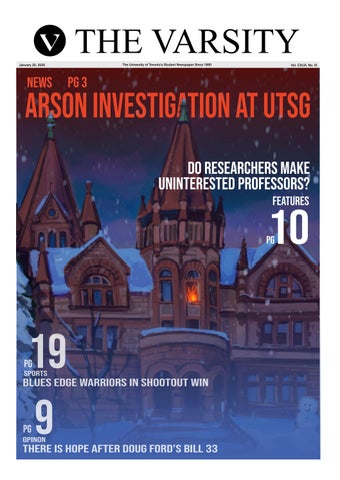
A suspect has been identified in the series of small paper fires that occurred on January 14 between 2:40 and 2:45 pm in the Bloor Street West and Avenue Road area, including at Victoria and St. Michael's colleges. There have been no injuries reported. U of T wrote that the fires were quickly extinguished, and the property damage was described as “minor.”
Toronto Police Service (TPS) has identified Yuriy Khraplyvyy, age 42, as the suspect. Khraplyvyy is wanted for three counts of Arson Causing Damage to Property, one count of
Mischief Under, and one count of Mischief Over, according to a TPS press release.
Khraplyvyy is described as a clean shaven male with short dark hair, who was seen wearing sunglasses, a dark sweater, and grey pants at the time of the incident. TPS asks anyone with information to contact police.
In an announcement to the community, U of T wrote, “An individual accessed multiple buildings on the St. George campus over the past 24 hours, lit small paper fires and left.” In response, Campus Safety has increased patrols.
On January 14 at 4:35 pm, there was a fire in the basement of Victoria College Building —
known as “Old Vic” — and 17 firetruck units were dispatched. Toronto Police Services (TPS) have not yet confirmed whether the incidents are connected, but U of T wrote that one of the incidents took place at Victoria College “Your vigilance could prevent further incidents.”
In the alert sent about the fires, U of T wrote that any suspicious activity should be reported to Campus Safety, and all fire alarms should be treated seriously.
The U of T community has been told to “not allow anyone to enter behind you through doors with controlled access, even if they appear familiar
or claim to have forgotten their credentials… If someone asks you to hold the door, politely direct them to the proper entry procedures.”
If a fire is discovered, students should activate the nearest fire alarm, use the nearest fire extinguisher if able, leave the area, and call 911. The alert concluded, “Your co-operation and awareness are essential to keeping everyone safe.”
U of T wrote that they have nothing to add beyond the alert sent.
Anyone with information is asked to contact police at 416-808-5200, Crime Stoppers anonymously at 416-222-TIPS (8477), or at www.222tips.com.
Ella MacCormack & Junia Alsinawi News Editor & Deputy News Editor
At 4:35 pm, on January 14, Toronto Fire Services (TFS) were dispatched to Victoria College Building, also known to students as “Old Vic.” According to TFS, the flame has now been extinguished and firefighters are “wrapping up” at the scene. No injuries have been reported.
Before the fire was out, smoke could be seen coming from the basement of the building. In a phone call with TFS, a spokesperson said that an investigation is needed to determine the source of the fire.
17 units were dispatched to Victoria College, including a hazmat truck, six pumper trucks, and a highrise truck. TFS noted that hazmat trucks are commonly dispatched to assess air quality. First year political science student Sloane Overdorf was at Caffiends in Victoria College when the initial fire alarm went off. Overdorf wrote to The Varsity, “The first floor already smelled like smoke before the alarm went off, and I had to go by the stairs leading to the basement to leave and smoke was already creeping up.”
Overdorf also saw firefighters funneling a hose to the basement, sawing through the bars and breaking the window in the process.
The three-storey brick and stucco Victoria College Building was constructed from 1832 to 1836, and is now 190 years old.
U of T did not immediately respond to request for comment.
Advocacy group demands that the university publish external review and make timelines enforceable
Emma Dobrovnik Assistant News Editor
Following the release of U of T’s updated Sexual Violence & Harassment Policy, the Prevention, Empowerment, Advocacy, Response, for Survivors (PEARS) Project have raised concerns regarding the policy’s external review mechanisms, lack of community consultation, and non-binding language.
In their analysis of the 2022 Policy Review, PEARS demanded that U of T consult an external gender-based violence analyst during the review to reduce the risk of institutional bias. U of T has since appointed legal expert Gillian Hnatiw to conduct an independent policy review, which was summarized at governance meetings throughout the fall of 2025.
However, Hnatiw’s complete external review has not yet been made publicly available. PEARS’ Trauma-Informed Policy Analysis notes that when asked whether Hnatiw’s review would be released, the university responded that there was “no answer at this time.” Western University and Queen’s University have both published their independent policy reviews in full.
In an email to The Varsity, PEARS said they were denied the opportunity to speak about the 2025 Policy review at a December 19, 2024, Governing Council (GC) meeting. A spokesperson from the university confirmed that PEARS’ speaking request was declined “[a]s the matter was not on the agenda and the request was not from a recognized student group under the Policy on the Recognition of Student Groups.”
During the 2022 Policy review, PEARS spoke at various governance meetings despite not being a recognized student group at the time.
Up to 15 minutes of each GC meeting may be devoted to speakers addressing items not on the agenda, but speaking privileges are not guaranteed as the Executive Committee

can “vary this procedure in cases where its application is uncertain.”
Enforceable timelines
In a statement to The Varsity, PEARS noted that while the updated policy indicates progress on language and clarity, “key structural demands remain unmet, especially those related to power, oversight, and accountability.”
PEARS demanded that case resolution timelines be made enforceable and that written justifications be provided when timelines are exceeded. Although the updated policy recommended timeframes for case resolution, these timeframes are subject to
“the circumstances of the particular matter including its complexity and the requirements of Procedural Fairness.”
The policy’s 2024–2025 Report on Activity, which provides anonymous information about sexual violence at the university, confirms that most closed cases lasted more than 12 months from report intake to case closure. The report does not specify the reasons behind the case length to protect the privacy of those involved. Additionally, PEARS demanded that the university record delayed cases as institutional failures rather than the product of “unfortunate circumstances.” The Annual Report notes that case length may be influenced by factors such
as a high volume of cases, complex allegations, incomplete information, participant availability, and coordination across departments. Parallel criminal investigations may also extend timelines.
Accounting for student-faculty relationships
PEARS also demanded that the university formally recognize power imbalances in studentfaculty relationships as a risk factor. They added that the policy should prohibit or strictly regulate sexual or romantic student-faculty relationships that involve supervision or evaluation.
According to the university’s Guideline for Faculty Members and Librarians Regarding Conflicts of Interest and Sexual, Intimate, or Familial Relationships, “faculty members and librarians are prohibited from, and must avoid, engaging in a sexual or intimate relationship with students that amount to a Conflict of Interest or Perceived Conflict of Interest.”
The guideline defines a conflict of interest as an action that may affect student interests, such as supervision/mentorship, grading of work, providing a reference letter, and funding, admissions, and awards decisions.
The updated policy now explicitly addresses power dynamics in student-faculty relationships, noting that “the University recognizes that power dynamics are inherent in institutions of higher learning. […] The University is committed to appropriately accounting for these dynamics in the processes set out in this Policy.”
When asked how the policy will account for these dynamics in practice, a spokesperson for the university said that power dynamics would be considered in the application of interim conditions or decisions about appropriate sanctions.
In 2024–2025, nearly a quarter of respondents in reports of sexual violence or harassment were employees of the university. Of all cases involving an employee respondent, less than half resulted in termination, and most did not result in any outcome (i.e., if a report was determined to be unsubstantiated).
PEARS is currently drafting its formal analysis for the updated policy and plans to publish it this semester.
Hilary Cheung Varsity Contributor
On January 16, the Iranian Students’ Association at the University of Toronto (UTIRAN) led a rally in support of the protesters in Iran, starting at Convocation Hall and ending at the US Consulate in downtown Toronto. In an Instagram post, the U of T group wrote, “We, the Iranian Students’ Associations across Canada, have come together to demonstrate our solidarity and support for our patriots fighting for a free Iran.”
Supporters gathered in front of Convocation Hall at 4:00 pm, raising Iran’s Lion and Sun flag, and holding signs reading, “Woman, Life, Freedom” and “Internet 4 Iran.” Some signs displayed photos of the Crown Prince of Iran, Reza Pahlavi. The supporters called out, “SOS for Iran,” “Be Our Voice,” and “Silence is Violence.”
UTIRAN President Shayan Farzanegan read a joint statement by the Iranian Student Associations, saying that this is not a time to stay silent. “We ask the international community to approach this revolution with compassion and understanding for people fighting [for a free Iran].”
Weeks of protest and deadly crackdown
Anger with the Islamic Republic of Iran, which seized power in 1979, stems from long-
standing issues: corruption, mismanagement, civil rights abuse, the rights of women in the country, energy shortages, and the impact of renewed international sanctions targeting Iran’s nuclear and missile programs and freezing assets abroad.
Protests in Iran began on December 28, 2025, over soaring prices and the collapse of the rial, the nation’s currency. It started with store owners in Tehran’s Grand Bazaar and spread quickly to other provinces. By early January 2026, the situation had intensified, with reports of national guard and police forces using live ammunition, tear gas and mass arrests of protestors.
As of January 14, the US-based Human Rights Activist News Agency (HRANA) estimated a death toll of 2,615. One report from Iran International claimed that the death toll in the two-day period from January 8–9 was as high as 12,000, which would make the crackdown the deadliest in modern Iran.
In an effort by the government to suppress protest organizations and reporting, much of Iran has been under an extensive internet and telecommunications blackout since January 8. On January 16, four weeks after Tehran’s stores closed in protest, Al Jazeera reported that demonstrations had waned, following the deaths and detentions of thousands of protesters.
Arunveer Sidhu & Ella MacCormack UTM Bureau Chief & News Editor
After what has been estimated as the biggest snowfall of the winter, all three U of T campuses were closed on January 15. All activities on campus were cancelled, including classes,
When are fall final

Protesters are calling for an end to the current regime.
“Fighting for their freedoms”
“I feel proud of the people fighting for their freedoms,” Farzanegan told The Varsity in an interview, “Living in poverty, living under oppression; when you see them rising up, that makes you feel proud.”
At the same time, Farzanegan says he is “angry that we’ve lost so many people,” and shared that he has been unable to contact his extended family members in Iran for eight days due to the internet blackout, and does not know what their current situation is in Iran.
During this time, Farzanegan said, the Centre for Learning Strategy Support (CLSS) has been “very empathetic and understanding” in supporting him and other Iranian students during this time.
tutorials, and labs. Virtual classes still took place unless otherwise announced by each division.
At 7:53 am on Thursday, Environment Canada upgraded the City of Toronto weather alert to an orange “severe weather” warning as 20–30 centimetres of snowfall is expected. On January 14, Environment Canada issued a yellow “hazardous weather” warning in anticipation of today’s weather.
Facilities and services on campus, including the UTSC N’sheemaehn Child Care Centre and the UTM shuttle bus, were also closed. The UTM campus was the first to alert students,
However, some students in the community reflected that they are feeling not being heard of because of a lack of an official statement of support from the university.
To further support Iranian students, Farzanegan suggested that the university consider extending the application deadlines for prospective students in Iran until they have access to the internet, and waive the late registration and application fees until students are able to access their funds at home.
The university did not immediately respond to a request for comment. However, an April 2024 memo on Institutional, Divisional, and Departmental Statements established new guidelines for issuing statements. Vice-President and Provost Trevor Young wrote that the application of the memo “will result in fewer institutional statements.”
sending a message on UTAlerts at 5:52 am on Thursday. At 6:00 am, UTSC initially only announced a closure but for the morning — 8:00 am to 12:00 pm — but at 7:33 am, a second email announced that campus would be closed for the entire day.
At 6:45 am, UTSG announced that the campus would also be closed, the last of the three campuses to do so.
Students can refer to the campus status page to receive the latest updates on the operations at all three campuses.
Most grades are due five to 10 business days after the exam
Celesta Maniatogianni
News Editor
Associate
Every year after fall final exams, U of T students refresh ACORN over and over to see how well they did on their courses. This year, some students were still waiting for final grades to be released as recently as January 15, two weeks after the university reopened.
Most instructors are told not to display all assessment grades to students on Quercus until the official grades are on ACORN, since final grade processes often involve departmental review and approval before uploading. Professors release final grades to students on a rolling basis, and there is no hard deadline for final grades. Each division and academic unit has its own timeline for releasing grades.
According to a spokesperson for U of T, “most divisions require instructors to submit grades within five to 10 business days from the date the exam was written.” Delays in releasing final grades are “not unusual,” the spokesperson continued, and illness and technical issues are the main factors for such delays.
The timelines we know
In the UTSG Faculty of Arts & Science Academic Handbook for Instructors, “timelines for returning bundled marked in-person exams to the Office of the Faculty Registrar will be circulated to Undergraduate Administrators in a memo.”
After Arts & Science instructors submit their final marks, the head of the academic unit reviews and approves the grades. Then, the Office of the Faculty Registrar does divisional review, approval on behalf of the Dean, and then uploads the final marks.

For Applied Science and Engineering final grades, the academic regulations read that final course marks are due by a “prescribed deadline” to the Undergraduate Assessment Committee, and the grade is only finalized after the committee’s approval. The engineering undergraduate guide for first years reads, “if you have not received all of your final grades by mid-January, please visit the First Year Office.”
The UTM academic policies handbook for 2025–2026 reads, “final grades are due five business days following the final examination or, for courses without a final exam, five days following the end of the Study Break for that session.”
Grades are then reviewed by the Academic Unit and approved by the Chair, Director, or their
designate. The UTM registrar website reads, “final grades will be posted on ACORN approximately two weeks after the end of each examination period.”
For UTSC students, the academic handbook states, “instructors must submit final grades to the Office of the Registrar via eMarks within 5 business days” after the exam or the last day of class. Final grades are posted once they are approved by the Chair or Director.
This year at UTSC, delays were related to “some scanning issues that were resolved before the holiday break, and some UTSC instructors were given more time to submit final grades,” according to a spokesperson for the university.
Unlike most undergraduates, graduate students have a firm date for final grades to be released. According to the sessional dates calendar for the School of Graduate Studies, the fall final grades were available for graduate students on ACORN by January 14.
Student reactions
Some students take to the r/UofT subreddit to ask when grades will be released.
One user wrote that three of their graduate program applications “had to be submitted with missing grades. I’m still missing a class for an exam which was 80% multiple choice and taken over a month ago.”
Another user noted that a complete transcript from the fall 2025 semester is required before they can be considered for their programs, most of which consider applicants on a rolling basis.
One student wrote to The Varsity that the timeline for grades to be released is “completely reasonable,” but that the “timing and unpredictability of when they’re released creates real, unavoidable problems for students,” like waiting to hear whether or not they have passed a fall prerequisite course.
They continued, “this isn’t about demanding that instructors work faster or give up their breaks; it’s about the need for clearer timelines, better coordination, and more transparency.”
According to a U of T spokesperson, students concerned with their winter timetable are advised to contact their faculty or program’s academic advisor, writing to The Varsity that, “most divisions have a course change period at the start of the term to allow for any necessary changes.”
Ashley Thorpe UTSC Bureau Chief
After the release of final grades for the popular UTSC course, LINA01: Introduction to Linguistics, many students performed worse than they anticipated. Students were told to request a clerical check if their final grade was lower than expected. However, no errors have since been found in the grade calculations or completed clerical checks.
LINA01 is a popular first-year course at UTSC, and is often described as a bird course — an elective you can fly through. This year, there were 1,054 asynchronous and 364 inperson students enrolled this fall.
One LINA01 student wrote to The Varsity saying, “some people have high averages on the assignments (80+), but ended up with 60s, while some other people have 60s on assignments, but ended up with 80s.” They added that they believe, “there might be a possibility of grade mix-up and miscalculation,” although this is just their theory. Since the grades have been released, this theory has been echoed frequently on the r/UTSC subreddit.
The theory seems to be unfounded. According to Professor Safieh Moghaddam, the only grade errors were from students not following setup instructions on the course’s integrated learning platform, Top Hat. If students did not connect their account to their student number, they were left with a zero for those assignments.

The first announcement
Shortly after grades became available, Moghaddam addressed student concerns in a Quercus announcement, writing, “If your final grade is lower than expected and you are not sure why, please contact the Registrar’s Office to request a clerical check.”
Moghaddam also addressed issues with Top Hat. For students with a Top Hat grade of zero, the setup instructions to connect their account were not followed, like entering their student number. The professor offered to update the
Top Hat grades personally so students would not have to go through the Registrar’s Office. She emphasized that step-by-step setup instructions with images were posted at the beginning of the semester and stated, “If a student does not follow the instructions, it is the student’s responsibility. With more than 1400 students in the course, I cannot personally track whether each individual student has completed the setup correctly.”
The announcement reminded students of weekly teaching assistant office hours,
additional office hours toward the end of the term, and many review sessions covering course content and the exam structure that could have been utilized.
“I have done my part, and more than enough, to support your learning throughout the term,” Moghaddam continued.
The second announcement In a course announcement on January 15, Moghaddam wrote, “The Head TA and I have double-checked the grade calculations and can confirm there are no errors.” She emphasized that all graded components were released throughout the semester, the same grading scheme was applied consistently throughout the class, and many students performed well.
The professor emphasized that students with a valid concern should go to the Registrar’s Office, and the only grades that can be updated are those of students with Top Hat setup errors.
The announcement concludes, “In your future courses, please follow the instructions to avoid extra work for the professor and stress for yourself.”
A spokesperson for U of T wrote to The Varsity that, “There are no errors in the grades. Suggestions otherwise are false,” and that no mistakes have been found in the clerical checks that have been completed so far. They added that academic matters are “discussed with the students involved and not with the news media.”
Moghaddam declined The Varsity’s request for an interview.
On January 9, the University of Toronto Mississauga Students’ Union (UTMSU) held an emergency Board of Directors (BOD) meeting, where executives reviewed the studentsubmitted motions that were tabled during the 2025 Annual General Meeting (AGM). Each of the three motions — focused on online voting, ACORN performance, and Wi-Fi reliability — was first amended, then approved. The UTMSU’s progress on the motions will be discussed again at the next AGM.
From “adopt online voting” to “investigate hybrid voting model”
One motion called for the UTMSU to adopt online voting for all elections and referendums. Specifically, they would use Simply Voting, an online voting platform used by the UTSG student union. The UTMSU ran out of time to discuss this motion at the AGM.
UTMSU President Andrew Park was against this proposal, and expressed that in-person voting “encourages candidates to be on the board and actually [reach out] to students.” Park added that in-person voting encourages participation, since many students ignore emails in their inboxes.
Park suggested an alternative hybrid voting model, like what the York Student Union uses. “Rather than just receiving an email, it’s an online polling station where students join on Zoom and present their key card and have their votes verified that way. I think that also allows for privacy and actually gets the student engaged in the election process.”
Park struck some of the clauses in the motion, including the one that asked for the UTMSU to specifically use Simply Voting. The motion was also amended from “adopt online voting” to “investigate hybrid voting model” for elections.
Vice President (VP) University Affairs Manaal Fatima spoke in support of the amendment, agreeing with Park that in-person voting

allows time for voters to talk to candidates and decreases the risk of peer pressure. Fatima also added, “There isn‘t that much security with online voting like itself… anyone can just take their friend’s phone and fill out the form themselves… How can you ensure that that’s not happening?”
It is unclear if Fatima was referring to Simply Voting, which integrates UTORid, so students must log in to their account before voting.
The amended motion carried.
ACORN and Quercus accessibility and performance
Another motion discussed requested that the UTMSU lobby for improved ACORN accessibility
and performance during periods of high activity, such as course enrollment times.
VP Internal Owen Zhang noted that he had “asked around,” and everyone he spoke to said that they had been impacted by ACORN’s connection issues.
Zhang added that in his sociology class, he has taken online tests that have reset midway. Members of the UTMSU noted that this would require improvements to Quercus, not ACORN, which was outside the scope of this motion.
As a result, members voted to amend the initial motion to include improving Quercus accessibility and performance. The new amended motion carried.
The other motion discussed asked the UTMSU to lobby to improve Wi-Fi reliability across campus.
One board member shared how they experience the most connection problems at the William G. Davis Building, declaring that the changeroom is “like a nuclear bunker, there’s no signal.”
One member noted that connection problems are also about student safety, such as an emergency in the gym locker rooms, “you can’t even call anyone, then you’re kind of toast.”
The motion was amended to include the UTMSU also advocating for improved cell phone service on campus, and was carried.
On January 10 at 1:00 pm, anti-immigrant protesters gathered at Nathan Phillips Square before marching through downtown Toronto to the Eaton Centre, drawing a strong counterprotest and police presence. During the protest and counter-protest, Toronto Police Service (TPS) arrested eight individuals, three of whom were charged with assaulting a peace officer.
Anti-immigrant demonstrators held signs that read “Make Canada Great Again” and “Stop the invasion” as families spent the Saturday afternoon skating on the rink next to the demonstration. A substantially larger group of counter-protesters was also present, chanting “Go home losers, go home racists,” and “shame!”
TPS presence at the demonstration was extensive, with more than 10 squad cars parked along Queen Street West. At Nathan Phillips Square, over 20 officers formed a barricade to contain counter-protesters. No similar measures were taken to contain the anti-immigrant demonstrators.
Around 2:00 pm, the anti-immigrant group began its march toward the Eaton Centre, which lasted more than two hours. Counterprotesters followed in opposition. TPS officers accompanied the march and blocked traffic at Dundas Street West and parts of Yonge Street to keep the march moving.
Members of the Canada First group carried Canadian flags and banners with slogans such as “fit in or fuck off” and “we need some Canadian ICE,” and some chanted calls for “quality immigrants only.”
Onlookers and counter-protesters shouted back, with some identifying themselves as immigrants and accusing the protesters of spreading hateful and exclusionary messages.
Canada First and dance troupes
The anti-immigrant protest was organized by the Canada First Movement, a community organizing group founded by Joe Anidjar, the group’s president. The movement’s website lists sovereignty as one of its four pillars, stating “Protect Canadian Culture, Traditions, and Identity by ending unchecked and unvetted mass immigration.”
A key aspect of Canadian sovereignty, the website reads, is that “Decisions for our future should be made by Canadians for Canadians.”

Despite this, many Canada First demonstrators wielded Trump 2024 flags. The US president has repeatedly said he wants to annex Canada and make it the US’s 51st state.
The Canada First Movement did not respond to The Varsity ’s request for comment.
Joining the counterprotesters were more than 20 members of the Auntie Fashion Dance Troupe, who use “dance and joy to protect community, celebrate diversity, and resist
hate,” according to the group’s Instagram bio. “Members of our group followed alongside the march on public sidewalks, not as participants, but to observe and to continue holding a peaceful, joyful counter-presence,” troupe members Av and Taylor wrote in an email to The Varsity, “and to let the public observing this spectacle know that not all Canadians agreed with their calls for mass deportation.”
No members of the dance troupe were among those arrested during the protest.
“The fact that we couldn’t play music on the square and that the cops ushered us off the street to make way for the Anti immigration march was certainly a blow for democracy and our constitutional right to assemble,” Av and Taylor added.
The Toronto Police Service did not immediately respond to The Varsity’s request for comment.
Commemoration of Shivank Avasthi set for Thursday, January 22 — Meeting Place, UTSC
Junia Alsinawi, Deputy News Editor
This Thursday, January 22, from 2:00–4:00 pm, a commemoration will be held at the Meeting Place at UTSC in honour of Shivank Avasthi, a student killed in a shooting at Highland Creek Valley on December 23, 2025.
There will be a book of condolences at the commemoration, the Scarborough Campus Students’ Union (SCSU) and the UTSC Cheerleading Club wrote in an email sent to UTSC students, and “close friends of Shivank will also share reflections and memories that speak to his remarkable spirit.”
Susan Christoffersen appointed Presidential Advisor on Innovation Investments — Simcoe Hall
Junia Alsinawi, Deputy News Editor
Effective January 1, Susan Christoffersen will serve as Presidential Advisor on Innovation Investments, a newly created position. In the appointment announcement, U of T President Melanie Woodin wrote that in this role, Christoffersen will “identify ways in which the University can strengthen our innovation ecosystem” through venture capital investments and facilitating student-managed investment funds. These initiatives will bring new revenues and establish the university as a “hub of economic growth and innovation for the country.”
Christoffersen has served as the Dean of the Rotman School of Management since 2021, and she will remain in this role until June 30, when her term ends. Woodin wrote that as Dean, Christoffersen guided the school “out of the pandemic and into a period of dynamic transformation,” leaving “a lasting impact on Rotman that will benefit future generations of students.”
Ontario government takes action in response to low EQAO results — Queen’s Park Arunveer Sidhu, UTM Bureau Chief
The Ontario government has announced the formation of a new advisory board in response to the assessment results for the 2024–2025 school year, released by the Education Quality and Accountability Office (EQAO) on December 3, 2025. Mathematics remained an area of concern this year as only 51 per cent of grade 6 students and 58 per cent of grade 9 students met the provincial standards for mathematics. Although this was a slight improvement from the previous two years, nearly half of the students are not meeting provincial standards.
The new advisory board will review student assessment approaches to determine the cause of the poor results, along with strategies to circumvent the low pace of improvement. The government is also continuing their review of school board governance, citing its “longstanding
concerns” with what it claims is “dysfunctional trustee performance that has too often diverted boards from prioritizing student achievement.”
Health Minister says US health institutions no longer dependable — Ottawa
Byline: Junia Alsinawi, Deputy News Editor
In a December interview with The Canadian Press, Health Minister Marjorie Michel said that she “cannot trust” US health institutions as a “reliable partner,” ending decades of agreement between the two countries on public health policy.
Michel acknowledged that the US “can be reliable on some stuff,” but pointed to US Secretary of Health RFK Jr.’s vaccine policy as a particular point of concern. This echoes a strong wave of opposition to the new US vaccine policy from US and Canadian scientists and medical professionals alike, who worry about the public health consequences and the spread of vaccine misinformation.
1. What can you do this weekend? (Check the title)
16. What’s happening at 21 Sussex Ave this weekend? (It’s in the title)
44. Have some time from 11AM–3PM Saturday and Sunday? (There’s the same number of blank spaces as the previous clues)
79. What should I do with my empty resume?
98. I feel like you get the idea?





January 20, 2026
thevarsity.ca/category/opinion opinion@thevarsity.ca
Don’t
Sophie Richards Varsity Contributor
I first stumbled upon CIUT by accident, tuning in one afternoon after my then-favourite station started repeating the same Top 40 hits over and over (if I had to hear “Pink Pony Club” one more time, I might have lost it). Through the static came a voice promising to be “the sound of your city,” followed by a Peruvian folk song and then an energetic EDM track.
I was hooked. I hadn’t just found another station — I’d found CIUT 89.5 FM, the U of T’s campus and community radio.
The station isn’t defined by a single genre, but by a mission: to be a noncommercial mosaic of Toronto itself, built by volunteers, alumni, and students. CIUT celebrates Toronto not as a brand or a playlist, but as a city constantly rediscovering itself.
CIUT is a living, breathing reflection of the city itself. In an era dominated by algorithmic playlists and homogenized media, it offers something increasingly rare: a window into the city’s diversity, a refuge for human curation, and a dynamic archive of Toronto’s cultural memory. Its programming gives sustained airtime to voices, genres, and communities that mainstream radio often tokenizes — or silences entirely.
CIUT explores and captures Toronto’s diversity not as a slogan, but as a practice.
Global Rhythms, a weekly CIUT program that invites listeners to “travel the world through music without leaving your living room,” mirrors Toronto’s essence as a city continually shaped by arrival, exchange, and overlapping identities.
Like the city itself, the radio station is organized around a constellation of communities — Little Portugal alongside Little Jamaica, the cacophony of Kensington Market beside the quiet of the Annex. Global Rhythms might pair a Haitian rara track such as “Rara (Ti Celia)” with a Toronto-based Afrobeat producer (check out “Move it Slow” by Moncliche), or juxtapose a Lebanese folk song with South Asian classical rhythms.
However, CIUT’s commitment to thoughtful programming extends beyond representation — it thrives on human curation. Dave O Rama’s The Lovecast, an almost 20-year masterclass in personality-driven radio, embarks on a broadspectrum exploration of “positive music,” a deceptively simple premise that allows for breathtaking genre blends. A Motown classic might be followed by an upbeat indie pop track you’ve never heard but instantly love.
Listeners return to The Lovecast each Saturday not for a predictable algorithm, but to hear something they know will be new and
roaring 1940s big band and twangy surf rock.
Half the fun is trying to crack the theme yourself, following Reed’s logic from track to track and enjoying the small triumph when it finally clicks — an experience no “You Might Also Like” algorithm can offer.
CIUT as a growing archive
Beyond its music programming, CIUT serves as a living archive for Toronto’s political and cultural memory — a role that feels increasingly vital as mainstream media often prioritizes quick, surface-level reporting over deeper context.
I believe this work meets a real audience need. A 2023 Reuters Institute study found that 39 per cent of respondents across 46 markets prefer explanatory, analytical reports over superficial news bites.
CIUT brings that demographic to life. By broadcasting and preserving interviews and cultural conversations as they happen, the station captures the city’s intellectual heartbeat in real time, offering depth and context that much of today’s fast-moving media often overlooks.
CIUT and the U of T community

interesting, guided by Rama’s taste, ethos, and desire to delight. By curating each track with attention to mood, story, and surprise, he reminds listeners that music is more than data — it’s a human experience.
Human programming over algorithms
To be clear, I enjoy Top 40. Familiarity has its pleasures, and “Espresso” is undeniably a bop. But even Spotify’s flagship Top 40 playlists, which may have human editors, are ultimately steered by algorithms optimized for sameness, not surprise; for retention, not interpretation. Streaming playlists can reinforce the popularity of a hit song, but they cannot curate the unexpected, the delight that comes from a guiding human ear.
In my view, this kind of trust-based listening relationship is increasingly endangered. Streaming hasn’t entirely killed the radio star, but it has largely replaced the human DJ with data-driven curation. Spotify’s monolithic playlists, like “Today’s Top Hits,” exist in a constant state of churn, reshaped by engagement metrics rather than any sustained curatorial vision.
On CIUT, human creativity reaches its peak in shows like Phil’s Inn. Constructing a two-hour set around a certain theme, host Brad Reed might weave a haunting Appalachian ballad into
One clear example is the station’s daily broadcast of Democracy Now! , an independent, hour-long global news program hosted by journalists Amy Goodman and Juan González. Democracy Now features breaking news, investigative reporting, and in-depth interviews with people on the front lines of pressing international issues.
CIUT is also an active audio archive. Alternative Radio incorporates pre-recorded speeches, academic talks, and public forum discussions — preserving moments of discourse that might otherwise vanish. When a figure like Bernie Sanders speaks at a university, the broadcast captures, contextualizes, and saves the conversation, transforming an ephemeral event into a permanent public record.
However, an archive is only as alive as its community. CIUT serves as a rare and vital bridge between U of T and its sprawling alumni. Shows like Radio Recall invite alumni back to the mic to share music intertwined with their campus memories, creating a living dialogue between generations of students.
Here, CIUT demonstrates how campus radio can transcend its “student media” label to become a vessel for an institution’s ongoing narrative, a place where the past is not sealed in a yearbook but remains a conversant voice in the present.
To encounter CIUT is to rediscover what radio can be. In a city increasingly shaped by corporate development and commercial homogenization, CIUT is a bulwark against the isolating, algorithmic sorting of our digital lives. If you’ve never listened, make today the day. Tune in to 89.5 FM. Listen online while you work. Walk into its home at Hart House, where the hum of broadcasting equipment is a reminder of media created by hands and minds. And if you find yourself, as I did, hearing your city anew — richer, stranger, and more connected than you knew — then act. Become a member. Donate. Volunteer. Tell a friend. CIUT survives because people care enough to show up, not just to listen, but to participate in its survival. The sound of your city is already on the air, weaving together stories, songs, and struggles. It is a testament to who we are. All you have to do is listen — to help keep it from fading back into static.
Sophie Richards is a first-year student at the University of Toronto with a passion for cultural storytelling and exploring the richness of Toronto’s arts and community life. She enjoys uncovering the stories, voices, and spaces that make the city unique, and sharing them with a wider audience.
Emmanuella Nwabuoku Domestic Affairs Columnist
On November 19, 2025, our Conservative majority Ontario government passed the Supporting Children and Students Act, or Bill 33. The act intends to slow school board financial transactions, heighten ministerial oversight, and reintroduce school resource officers — or police officers — into schools. A day later, on November 20, 2025, it received Royal Assent.
Before the bill was voted on, I covered my opinion on the act in an article titled “Doug Ford’s Bill 33, another push towards privatization.” There, I argued that this bill, alongside others like it, such as the Your Health Act, were attempts by the Conservative provincial government to privatize Ontario.
Bill 33’s policies, which bypass trustees and provide more power to the Minister of Education, would likely deter parents from public schools and push them to send their children to private institutions. Similarly, Bill 60, Your Health Act, expands the number of procedures private clinics in Ontario are allowed to perform, thus pushing patients away from our public health care system.
Now, patients seeking safe and urgent care may opt for these private centres, thereby justifying efforts to lower funding to the public hospitals. Both bills have the capacity to weaken public infrastructure, and coerce civilians into private clinics and schools.
My opinion on Bill 33 has changed very little since it was enacted into law, but now that it’s here, it’s important to focus more on the future. Students, like myself, have discussed this act extensively, but most students are not seasoned politicians. Hence, I decided to interview NDP Member of Provincial Parliament, Chris Glover, to gain more insight into the impacts of Bill 33.
As an MPP for Spadina-York since 2018, Glover has shown a commitment to protecting Ontario
students’ right to education and Ontario teachers’ right to fair salaries. He fought valiantly against OSAP cuts, proposed rebate policies for postsecondary students, and organized town halls open to the public.
This dedication to lessening privatization extends into the party. Before the final debate and vote on Bill 33, Ontario NDP leader Marit Stiles was kicked out of the Queen’s Park chamber after calling Premier Doug Ford’s government “corrupt.” She stood behind her accusation even after her expulsion. All things considered, Stiles’ dedication and Glover’s active willingness to speak with students seemed novel to me.
I rarely see politicians so eager to engage with students, so I found myself agreeing with Glover when he claimed the NDP are the last standing progressive party in Ontario politics.
“There used to be a time where Progressive Conservatives were actually progressive, and when Liberals were the progressive party, and the NDP were a very progressive party,” Glover said. “I think what has happened now is that the Liberals and Conservatives have moved so far to the right that only the NDP is still fighting for public education, eliminating student debt, and bringing an end to homelessness by building affordable houses.”
What Glover referred to is something I’ve observed myself. Policies once seen as commonplace, unilaterally agreed upon — like affordable housing — now splinter our political parties. The Conservative Party would rather protect private interests than the public’s, resulting in public structures and institutions becoming collateral. Their preferred method for justifying their actions is accusations of corruption or inefficiency.
Minister of Education Paul Calandra claims that trustees and school boards were mismanaging funds. The Ontario government saw the Your Health Act as a tool to reduce wait times. To me, Bill 33 was simply a justification for lessening funding. It is a “platform,” as Glover put it.
“There’s a section [230.5] in there [Bill 33] that gives the Minister of Education the power to sell our schools,” he continued, rightfully calling it “a real estate scam.” If restoring order through restricting financial abuse was the goal, then the Bill would not need to weaken the trustee position.
Trustees are democratically elected officials; they are “the parents’ and the students’ elected representatives.” The public and democratic nature of the position requires transparency.
When Glover was a trustee, they “had a budgeting process and held that process publicly.” He went on, “There would be public consultations, and they would say, ‘look this is how much money we have for next year, this is how we are thinking of spending it.’ ”
Trustees serve as bridges connecting often distant administrators to disgruntled parents.
School trustees and student unions aid in mobilizing and voicing students’ and parents’ worries to the government. In weakening them, Glover argued that “the government eliminates the opposition to their real agenda: to privatize our schools.”
Proponents of Bill 33 cite cases of trustees spending upwards of $50,000 on lavish expenses like a trip to Italy to purchase art for two new high schools. In my original article, I voiced my disapproval but noted that the funds, even if spent appropriately, were not enough to resolve shortages and expenses. I currently maintain that opinion with the added realization that this is actually a distraction.
Glover claimed that “what [Calandra] is doing is misdirection. The other audit [Ford’s government] did on the school board came back clean.”
These cases detract from the school boards’ validity. How can you claim underfunding while your trustees spend exorbitantly? The reality is that schools are underfunded, and the public nature of the trustee position would limit the Ford government if their intention was to capitalize.
Why Buddhism, Psychology, and Mental Health still isn’t going anywhere two years after its recommended closure
Max Lees
Varsity Contributor
In November 2023, the Arts & Science Dean’s office recommended the program’s closure after it failed an external review process that took over three-and-a-half years. In January 2024, U of T suspended enrollment in the program.
In the few years since these events, the Buddhism and Psychology Student Union (BPSU) has been fighting to keep the program alive. I have personally witnessed overwhelming support and appreciation for BPMH from students and faculty alike. I would like to share my perspective on why this program is so valuable and should not be closed.
Both cognitive science and BPMH are fundamentally interdisciplinary programs, and I can say firsthand that what you get from these integrative courses cannot be achieved by simply taking courses in their component disciplines, such as psychology and religion. In a world that is rapidly changing with regard to human and artificial intelligence, a science of the mind that is committed to creating dialogue between diverse perspectives has never been so crucial.
After changing the focus of my studies multiple times, it was cognitive science and BPMH that made me grateful for choosing U of T. BPMH students represent a wide variety of disciplines, and I am always eager to meet classmates in programs such as computer
science, biology, ethics and society, and many others, who all found value in the BPMH minor.
What makes BPMH unique is its research methodology and focus on mental health and wellness. BPM232: Buddhism and Psychology first introduced me to contemplative science — an interdisciplinary science that studies the intersection of psychology, mental health, and mindfulness practices — a research paradigm that addresses precisely what I felt was missing from the scientific study of the mind.
I have since learned so much about how we might use real-world data and experiences to better understand the mind, how to evaluate the reliability of qualitative research, and why mindfulness interventions like meditation can be so powerful.
In my BPMH studies, I have had the honour of being taught by incredibly knowledgeable, kind, and passionate professors. I learned about meditation in the body, how to apply Buddhist teachings to current social issues, and how to study other ways of knowledge practices.
My peers have expressed a deep appreciation for the program’s commitment to mental health and wellness on both personal and academic levels. I cannot overstate what a difference it makes to have such a caring academic community and to have skilled mindfulness practitioners teaching in the program.
On an academic level, I can think of very few things that could be more important than studying what it means for humans to flourish, be well, and how we might address barriers to
this. It is wonderful to walk into a seminar or lab meeting full of dozens or hundreds of people who also thought these questions were worth their time.
This is what I thought I was paying for when I came to university. My instructors and peers have been putting incredible work into these projects, and I cannot wait to see what we will continue to cook up together.
These are my personal reflections from engaging with the program and talking to my peers, but the program demonstrates its success in numbers as well. According to the BPSU, 71 per cent of college programs at U of T have 200 students or less –– BPMH has over 300, while most of the programs closed by Arts & Science in the last decade had only a couple of students enrolled. Over 1,100 students registered for BPMH courses in the 2023–2024 academic year, with waitlists filling up for every course offered.
The program also hosts a contemplative science podcast, a student journal, peer support, research symposiums, and other community programming and events.
More information about these activities and the program, as well as the complete Program Support Dossier, previous publications, and dozens of support letters from students and alumni, can be found on the BPSU website and the Peers are There to Help (PATH) website.
The BPSU website also has a link to a petition supporting the program, which has surpassed 2,500 signatures and is aiming for 3,000. BPSU
Since 2018, school board funding has decreased by over 3.1 billion dollars. Unfortunately, I know schools will remain as underfunded as they were before the Bill’s passage. The tragedy is that Ontario should pride itself on its education. I write this article while attending a university that proudly bears the name of the largest city in Ontario and Canada. U of T stands among the highest-ranked universities in the world.
Education is, according to Glover, “Ontario’s biggest competitive advantage.” Glover continued, stating that “undermining that system in order to privatize it is going to have a huge negative impact on our economy ultimately.”
I don’t know, nor can I predict the damage this bill will bring. But what I do know is that Chris Glover and the NDP “will fight back.” The NDP hopes to “invest in our schools so that our kids can attend well-maintained and properly staffed schools” and “rebuild the system.” Although this plan relies on them winning a majority government in the provincial elections.
Students who think themselves politically aware rightfully hold distrust for governments. Wholly trusting political officials will not guarantee everlasting change. To those students, MPP Chris Glover encourages you to “Sign a petition. Join a movement. Run for the Student Union.”
Initially, I ended my first article with a brief call to action. I instructed you to voice your grievances and contact your MPPs.
My current advice is an extension of that. I used to wonder what happened after a bill passed. As a political science student, I have had the importance of civic duties and voting rights drilled into me. So now I hope to restate its importance to the readers. Vote. And if you can’t, then volunteer. Tutor lowincome students. Avoid total complacency.
Emmanuella Nwabuoku is an Opinion Domestic Affairs Columnist studying political science and gender studies.

and PATH are both on Instagram as well: @ uoft_bpsu and @pathuoft.
My classmates and I urge the New College Council to continue offering 10 courses per Fall/ Winter term and to reopen program enrollment. This way, current and future students may continue to benefit from this important and evolving program. Those interested in supporting may consider signing the petition and joining the mailing list to find out about future BPMH events.
Max Lees is a fifth-year undergraduate student studying psychology, cognitive science, and buddhism, psychology, and mental health at the University of Toronto.




On an average October afternoon at UTSC, lecture hall AC223 bustles with a mixture of quiet anticipation and mid-semester fatigue. Students heave themselves and their heavy backpacks into their seats, and laptops echo as they click open in a scattered rhythm. With the class packed and everyone already worn out, one student can be heard whispering “The prof just won’t reply to emails,” and a few heads nod. By the time the lecture starts, and students have begun the panic of exam season, one sentiment hangs heavily in the air: professors don’t really care about helping us prepare.
There’s a common belief among students that professors don’t value them, particularly professors who appear primarily focused on their research. “Some professors are incredible researchers but seem like teaching is something they have to squeeze in between grants and conferences,” said second-year psychology and health policy student Caithlyn Jamie Reyes, in an interview with The Varsity. “When that happens, the lectures can feel rushed or disconnected. I don’t blame them, but it does mean teaching quality varies a lot.”
When compounded by everyday student stresses like assignments and deadlines, this sense of a distance between students and professors becomes glaring.
The intimidation factor I remember being a first-year student, nervously hovering outside my professor’s office, trying to suppress my anxiety long enough to knock. I kept reciting the questions I planned to ask, but it wasn’t the assignment itself that made me nervous — it was the presumption that my professor wouldn’t care about me or my questions.
The biology lecture of over 500 students made me fear that I was irrelevant and unworthy, which made it difficult to participate in course aspects like office hours. Many students I spoke to described a similar sense of apprehension.
First-year medicinal chemistry student Faiza Mahzabeen described how small instructional choices can add to the difficulty level of courses. “One of my professors doesn’t provide any online resources,” she explained. The only way for students to access the course content is through attending the lectures and making their own notes.
Students often feel disconnected from professors, not because the lines of communication don’t exist, but because utilizing them can feel daunting with such large class sizes. Resources like office hours are designed to facilitate one-on-one interactions
between students and professors, yet many students are too nervous to even approach their professors — especially in large classes where the professor won’t already know their names or faces.
Some professors recognize this hesitation.
Sarah Wakefield, a UTSG professor in the Department of Geography and Planning, thinks that students’ reluctance to interact with their instructors stems from “shyness, and having to make the first move and reach out to someone (usually quite a bit older than you, and sometimes intimidating).”
Feeling intimidated by professors is normal; they’re experts in their field, while we’re just students trying to keep up. But another aspect that can make the dynamic between students and professors strained is when students feel that professors aren’t really interested in teaching them.
Teaching quality and accessibility
At U of T, one of the top research universities in the world, many professors are also researchers, and the courses they teach are often shaped by their research. Many professors thus assign their own articles as course material, which can become awkward when students are assigned to analyze or critique these readings. Students might feel
wary about picking apart a professor’s work for a grade to then be determined by that same professor.
Some students don’t mind if professors assign their own texts as required material, while others exercise caution. “I think most professors try to be fair, but it can feel awkward when we’re expected to critique something they wrote,” says second-year psychology and health policy student Jamie Reyes. “Even if they say they’re open to disagreement, you’re always aware that you’re evaluating their work, so it’s hard not to wonder whether your grade might be affected [more subjectively than if you were critiquing something not written by them].”
Contrarily, second-year neuroscience and molecular science student Raisa Farhin has no issue with professors assigning their own texts, at least in STEM courses. “I feel like it actually makes it easier for students to streamline their studying,” she said.
However, some courses are taught by multiple professors, which means that each professor might provide different resources. When one professor mandates a textbook that they wrote, and the other professor for the same course doesn’t, the intentions of the former may be called into question. “It often brings up the question of whether






responsibilities influence their teaching styles, and thus their relationships with students. After speaking with a couple of them, it seems that the assumptions students make about professors being uninterested in the success or education of students are misguided, and stem from miscommunication rather than
This perceived friction between professors and students is the result of both parties navigating a hectic university system that stretches professors thinner than most students realize. Professors care — but they’re working within an educational structure that makes forming meaningful connections with students

“I love when students see ” wrote UTSC biology professor Ivana Stehlik about what she values most in her teaching. “If a student can incorporate course knowledge from several weeks or months in the past into a recent topic… this makes me
Stehlik values when students make connections across weeks of material; it indicates that students are taking time to think about course concepts, instead of simply cramming information for quick results, and forgetting a week at a time.
Stehlik also echoed earlier sentiments about how class size can exacerbate students’ assumption that professors don’t care about them. In her smaller courses, she said she gets to know “students’ names, personal strengths and quirks,” which stands in stark contrast to the anonymity that defines large first- and second-
“Teaching is very hard work,” Stehlik told me. “The everincreasing enrollment and large class sizes… there is always more to do… at the end of the
Her words made me rethink how I interpret a delayed email response or a professor seeming less energetic on a day when I too am half-asleep. While smaller courses give professors more room to connect with students, students in larger classes can be more forgiving of professors who seem too busy to get to know them in depth. Just like we have thousands of essay words to craft for judgment, professors have hundreds of hours of course content to curate and then
Wakefield opined that students often neglect to acknowledge professors as individual people, with different styles and personalities. “[T]here is no one ‘type’ of person who becomes a professor,” she said, “which… means that some people will be more friendly and gregarious, and others will be shy, and some will be more

Moreover, Wakefield explained that students may be taught by research stream, teaching stream, or administrative faculty — each balancing different demands and bringing different approaches to teaching. What students sometimes interpret as indifference is, in reality, something closer to depletion. “I wish students knew how much energy and motivation instructors get from good attendance and lively, friendly studentprofessor interactions,” Stehlik said. “If only half of the students show up, it is much harder to maintain… enthusiasm.”
“I know it is scary to ask questions, but it is like a muscle which needs training.” To anxious students who fear office hours, Stehlik emphasized that professors genuinely want those interactions too. “Hearing student questions allows me to improve how I deliver course content and do better next year. I thus see my students as partners on a joint learning journey.”
Stehlik’s response showed that their excitement often comes from conceptualizing the learning process as just that: a process and a joint one at that.
The reality of the U of T structure and its pressures
As Wakefield explained, professors’ responsibilities vary by department and teaching status, and many professors are balancing different academic obligations in addition to teaching. Even instructors who care deeply about student learning are often pushed toward output and productivity over a steady pace or depth of interaction.
At U of T, student-professor dynamics are shaped not only by class size, but also by the university’s intensely research-driven structure. Many first- and second-year courses are taught by research stream faculty whose roles as academics as well as course instructors require them to divide their time in various ways.
This does not mean research stream professors are inherently disengaged — many are deeply invested in teaching. Wakefield expressed that student interaction is one of the most rewarding parts of the job. “Interactions with students, especially students who are genuinely interested in the course material, or who are thinking about their future and want general advice or just someone to talk to: conversations with those students always make me happy.”
At the same time, Wakefield described the cumulative strain of academic labour. “Sometimes it can be stressful, especially if a lot of deadlines are coming at once,” she explained. “Not that different from being a student, really, except I’d multiply the workload by about 10.” While teaching remains a “fun” and meaningful part of the job, it can also become frustrating and discouraging when student disengagement makes professors feel as though their efforts are not landing.
Stehlik noted that many students arrive at U of T unprepared for the shift from the more personable interactions in secondary school, to the less intimate structure of university. “The reality of studying at U of T means that [students] now find themselves as small fish in a large sea of very smart and driven students.”
Recognizing each other’s struggles
Across interviews, a consistent theme emerged: most students and professors want the same thing from each other: mutual understanding. Students want to feel supported and taken seriously, while professors want to feel like their efforts enhance their students’ learning experiences. Yet within a system built on scale, speed, and constant output, that connection often becomes difficult to forge.
A lot of the agitation that students might feel with research stream professors stem not from lack of care, but from lack of visibility: many professors are doing much more work for their students and themselves than students see.
When research, teaching, administrative duties, and other obligations collide, professors become exhausted, as Stehlik and Wakefield have shown. When unanswered emails, alienating lectures, and feelings of intimidation take their toll, students similarly feel overwhelmed.
Part of what Stehlik loves about teaching is that it is never about acquiring a finished product, but involves an evolving process shaped by the circulation of different students, expanding research, and new technologies. “Teaching is perpetually challenging and changing,” she said. “A course or a lecture is never done and perfect, something can always be improved.”
In a system defined by constant growth and acceleration, recognizing that reciprocal effort may be the first step toward cultivating honest and rewarding relationships between students and professors.
January 20, 2026
thevarsity.ca/category/arts-culture arts@thevarsity.ca

criminal or draft dodger?
Kelly Reichardt’s The Mastermind is a Vietnam War story disguised in the sensation of the art heist
Advertised as an exciting drama about art theft, starring a moody and scruffy Josh O’Connor, Kelly Reichardt’s The Mastermind does not follow the arc of a typical heist story.
The film, set in the background of the Vietnam War in 1970, follows James Blaine (J.B.) Mooney, a married father and unemployed carpenter who decides to steal four Arthur Dove paintings from his local art museum to solve his money problems. After the success of his heist, Mooney spends the rest of the movie taking advantage of his class privileges to dodge the authorities, while state repression of anti-Vietnam War protesters escalates violently in the background.
Mooney is the son of a former judge, who languishes in an unremarkable middle-class life on loans from his parents and his wife’s job, while scoffing at the commercial success of a contractor acquaintance for “balancing books, scheduling [jobs], being on the phone.”
He longs for the previous carefree lifestyle he had as an art school student, free of responsibilities. He has a loving wife and sons, parents who provide opportunity after opportunity, and friends who are willing to harbour him while he runs from the law. Yet Mooney is deeply unsatisfied with the dull stability of his life.
During the introduction and long title card sequence, we see Mooney at the Farmington Museum of Art over the span of multiple days, with only his clothes to show the passage of time. While Mooney sits moodily on the museum benches, yearning for his days at art school, we see shots of art students sketching, smoking, or simply idling around.
Mooney prefers to continue visiting the museum and indulging in his nostalgia instead of looking for a job or parenting his children.
Reichardt is renowned for her contributions to slow cinema, a genre dedicated to rejecting the form of sensational narrative that dominates most movie plots. Instead, slow cinema focuses on long, contemplative takes without background music to emphasize the slow, still, lived-in nature of the flow of time.
In The Mastermind , Reichardt manages to accomplish the manifesto of slow cinema without losing the attention of the modern viewer in the age of diminished attention spans.
After the success of the heist, Mooney’s high is ruined by his father reminding him of how pointless the theft of the Dove paintings was, as they only hold a little value among niche abstract collectors.
Mooney only steals those Dove paintings to feel clever, and the only person who is impressed by the heist is his friend from art school, Fred. The only person who would
even be able to sell those paintings on the black market would be one of his university teachers, Professor Pruitt, who has a special interest in Dove. Mooney is given every opportunity to smooth things over with the law, even with the disastrous way his heist turned out, but he keeps trying to get away with his theft in service of the nostalgia he has for his carefree art school days.
While this is happening, the unrest in American society due to the American assault on Vietnam plays as part of the background. Viewed as unnecessary by the American public, the war was deeply unpopular. There were widespread campus protests across the country, and rallies were held in major city centres. A Gallup poll from 1969 showed that 55 per cent of Americans surveyed said that sending troops to Vietnam was a mistake.
In the Mooney family living room, we hear a broadcast over the family radio covering campus protests against the Vietnam War and the prosecution of students. We then see an Uncle Sam recruitment poster at the bus stop that Mooney stages his escape from.
The haunting presence of the war in the background of the movie, while Mooney is unbothered and primarily concerned with getting away with his crime, is indicative of the privileged classes who are immune to the human costs of war until it incurs a personal cost on their lives.
We see this tension between the war and Mooney’s privilege at its loudest during the climax of the film. Mooney decides to join a rally of anti-war protesters to blend in with the crowd and escape the authorities chasing him.
The riot police are shown attacking unarmed civilian protestors brutally with batons.
Mooney, having blended in with the anti-war protesters, instead of getting away from the authorities, is rounded up and arrested with the other protesters. His wealthy background and social privileges do not help him because, in the eyes of the riot police, he is another disposable protester standing in the way of the state’s imperial war.
The Mastermind is a movie about how the Vietnam War seeped into the fabric of every aspect of American life. Mooney, despite all of his privileges, cannot avoid being swallowed up by the hunger of the war machine. He is not arrested for the art heist he is wanted for, but rather for being mistaken for an anti-war protester.
Through Reichardt’s slow cinematic oeuvre, we are immersed in the suffocating political environment of the ’70s. The theft of American abstract art in a conservative environment that brutally attacked any innovative opposition to the nationalist imperial project is excellently used as a vehicle by Reichardt to force the viewer to confront an uneasy truth: apathy will not spare you from the brutality of war.
“The

Between grain, salt, dune, and sky — an exhibition curated by Sarah Edo — was presented at Gallery TPW from September 18 to December 13, 2025. Edo aimed to feature East African artists with work that explores desert geographies, displacement, archives, and counter archives.
Entering the gallery, I was met with the smell of incense, the sound of deep, rhythmic breathing, and ambient noise and vibrations coming faintly from a room deeper inside. This room featured Wintana Hagos’ Dimtsi Adey , or Sound of My Mother , a sculptural sound piece inspired by her family’s stories from the Red Sea. This piece was in a dim room lit by one yellow bulb hanging low above a shallow basin of water.
Sitting in the room, I listened to Hagos’ mother singing a folk song and conversations between the artist and her mother, which
broke up long interludes of ambient noise. The basin vibrated, causing ripples in the water, and travelling through my body from the soles of my shoes. The track, scored by an audio engineer, ebbed and flowed throughout its run time — from peaceful and nearly silent, to busy layers of talking under music, under vibration.
Edo is a U of T alum, who most recently graduated with a Master of Arts in women and gender studies. For this exhibition, she was inspired by the work of Sudanese-Canadian writer Nehal El-Hadi, who writes about sand as a way to think about Blackness, migration, and extractivism in her journalism and poetry.
Sand appears most clearly in Dawit L. Petros’ photo series, The Green March — which depicts a desert landscape.
It also appears in more unexpected ways — like Senegalese artist Adji Dieye’s untitled photo sculpture — where Edo was thinking about sand as a material in built structures. The piece considers the French colonial development




in Dakar, combining archival photographs from the national archives, newspaper headlines, and Dieye’s own photographs of the city.
The highlight for me was Rolla Tahir’s short film Sira, where Tahir’s mother tells the story of her family’s migration from Sudan to Kuwait, then out of Kuwait during the Gulf War. We see home videos of Tahir’s family and hear the music of their parties, which is cut abruptly with brightly coloured static and footage of Iraq’s invasion of Kuwait.
Speaking about Tahir’s work, Edo said in an interview with The Varsity, “migration is often an ending because of the political conditions that many parts of the Global South are in.” But Tahir subverts this typical ending — her film ends with a screen that reads “To be continued, part 3: Canada.”
Hanging next to the TV that played the film were colourful panels Tahir had made by entwining the film negatives with yarn in a technique inspired by Bedouin Sadu weaving. Through these weavings, the artmaking process continues even after the film’s ending.
In her curator’s statement at the gallery’s entrance, Edo writes that the exhibition explores the “camera as a colonial tool,” but also works towards re-archiving. She says the different textures of the art pieces — weavings, silk — invite “the possibility of touch.”
I liked the idea of intimacy from a distance. It invites viewers to engage with the art and the archival materials in a way that is respectful but also invites the possibility of intimacy between the subject and the observer.
I saw this at play in The Green March, where in one photo, we only see the back of the subject’s head. In another photo in the series, we see a scarf in midair, cutting the desert landscape in half — but not who it belongs to or how it got there.
Mallory Lowe Mpoka’s Camera Obscura features pieces that imitate the style of daguerreotypes. Edo told me these were all the artist’s self-portraits, but they only show her silhouette with different clothing and props, so I hadn’t recognized each portrait as the same person.
I watched Jessica Karuhanga’s Body and Soul, a video projected on the gallery wall of the artist’s chest rising and falling with her breath, zoomed in too far to see any gendered or identifying features.
Between grain, salt, dune, and sky is a rearchiving project that documents long journeys across desert landscapes, the intimacy of unseen mothers singing softly to their children, and the invitation of a screen full of Canada geese and “To be Continued,” before rolling credits take over the screen.
January 20, 2025
thevarsity.ca/category/business biz@thevarsity.ca

Finding the right job in Ontario got a bit easier, but is this enough?
New job-posting rules promise more transparency for students, but barriers to employment remain
Transparency in salary ranges
Finding a job in Ontario has long been an exercise in uncertainty for students and recent graduates.
Job postings often list vague compensation details, unclear screening processes, and requirements that can feel exclusionary — particularly for international students. As of January 1, a new set of provincial rules aims to change that.
Under Ontario’s updated job-posting legislation, employers with 25 or more employees must publicly list an expected salary range of no more than $50,000 for positions paying under $200,000, and disclose whether AI is used in the hiring or screening process.
Employers are also prohibited from listing “Canadian experience,” meaning prior work experience gained in Canada, as a requirement — a change that may ease barriers for international students with work experience earned abroad.
For students navigating an increasingly competitive labour market, these changes are intended to make job searching more transparent and accessible. However, while the policy shift has been welcomed, students say the reality of job hunting remains more complicated than clearer postings alone can address.
Ontario’s new rules promise better information for job seekers, but they do little to address the imbalance between a growing number of applicants and a limited supply of entry-level roles. In some cases, salary ranges and disclosure requirements may even intensify competition by allowing applicants to assess and act on opportunities more quickly.
From an employer’s perspective, transparency is meant to reduce delays in the hiring process by filtering candidates earlier. David King, senior managing director at employment agency Robert Half, argued in a December CTV article that clearer salary information helps align expectations sooner, allowing both applicants and organizations to determine whether a role is a good fit.
However, greater clarity does not necessarily ease pressure on applicants. By making compensation easier to compare, transparency may concentrate applications around roles that meet certain salary thresholds, rather than dispersing interest across a wider range of positions.
“Salary does make the job more or less appealing depending on the nature of the job and my expectations on the job’s salary,” wrote Vicky Ongpipattanakul, a fourth-year Rotman Commerce student, in an email to The Varsity.
AI disclosure and expectations
Another major component of the new legislation requires employers to disclose whether AI is used in hiring, as many now rely on tools that screen resumes, rank candidates, or filter applications.
Many students already expect employers to use AI during screening, but this disclosure removes the guesswork from the process.
For some applicants, the new requirement addresses concerns about authenticity in hiring.
Abhinav Sahal, a fourth-year chemistry specialist currently on his co-op term, wrote to The Varsity that knowing whether AI is involved matters for how he approaches applications. “I’d prefer knowing that a real person is reading my resume and cover letter, and I don’t have to try and ‘cheat’ the system by flooding my documents with buzzwords.”
While disclosure does not change how widely AI is used, it signals an effort to make screening practices more transparent.
Removing “Canadian experience” as a requirement
For years, the “Canadian experience” requirement has functioned less as a qualification and more as a filter, screening out applicants whose work experience was earned outside Canada.
Its removal from job postings under Ontario’s new rules is intended to widen access for candidates with international experience. This may particularly benefit international students who primarily worked abroad, as their experience has often been discounted in Canada simply because it was earned elsewhere.
Among students, however, there is little consensus on how far the change will go.
Some see the policy shift as largely symbolic. Ongpipattanakul wrote that while the change may “somewhat give more international students more opportunities in getting a job in Ontario,” employers may still “favour institutions that they are more familiar with [such as Canadian universities or employers].”
Others view the change more optimistically. Sahal wrote that removing the “Canadian experience” requirement could “surely ease the pressure faced by applicants,” particularly international students whose prior work would otherwise be discounted.
Ontario’s new rules make job searching more transparent, reducing some of the uncertainty students have long faced. But transparency does not guarantee opportunity. For many, finding the right job remains as difficult as ever.
In mid-December 2025, the University of Toronto announced a partnership aimed at boosting Canada’s position in the global electric vehicle market. The Electric Vehicle Innovation Ontario (EVIO) project, led by U of T’s Department of Computer Science, will send nearly 40 graduate students from universities in southern Ontario to work at 20 electric vehicle (EV) and mobility firms. This initiative places researchers directly inside companies to work on real-world problems.
Eight Ontario universities are involved: U of T, Queen’s University, Toronto Metropolitan University, University of Ottawa, University of Waterloo, University of Windsor, Western University, and York University.
The program is receiving $2.5 million in federal support from the Federal Economic Development Agency of Southern Ontario (FedDev), which helps Canadian businesses grow. With additional contributions from industry and academic partners, EVIO has secured nearly eight million dollars in total funding and is “expected to generate over $30 million in economic activity.”
According to Arvind Gupta, a computer science professor at U of T and EVIO’s
New $8 million initiative aims to close gap between academic innovation and commercial deployment
scientific director, the program speeds up EV technology development by embedding graduate researchers within industry. In an article published by U of T's Computer Science Staff on the Faculty of Arts & Science website, he said the initiative will generate new intellectual property and drive economic growth, giving Canadian innovators a competitive edge internationally.
How EVIO works
Students participating in the EVIO project are embedded within partner companies for at least eight months. Eligible participants include masters students, PhD students, and postdoctoral researchers. Each project is valued at roughly $90,000, with partner companies covering about half of the cost and the remainder funded through academic and government sources.
Each student works under two mentors — one from their host company and one from their university — allowing them to learn from both the research and business sides of the industry. This can include gaining experience in protecting intellectual property, navigating regulations, and designing products for mass production.
The program’s model draws on similar initiatives that have proven successful elsewhere, including Germany’s Fraunhofer
Gesellschaft, a leading applied research organization, and the UK’s industrial doctoral training programs. Both have a strong track record of turning research into commercial products.
Charmaine Dean, who leads research and international initiatives at the University of Waterloo and chairs EVIO’s steering committee, emphasized the program’s hands-on nature in an interview with U of T. She said in the Faculty of Arts & Science article that embedding top researchers directly inside firms closes “the gap between discovery and deployment.” The goal is faster commercialization, a stronger Ontario EV sector, and a more competitive Canada.
The economic value of the project Ontario has landed major EV and battery investments in recent years, but turning those commitments into finished products presents another challenge. Canadian winters add to the difficulty — batteries lose efficiency in extreme cold, and charging infrastructure must withstand harsh conditions.
Paul Slaby, managing director of Canada’s Semiconductor Council, highlighted the pressure Canadian firms face. He said Canadian firms are under “real technical and competitive pressures, and programs like [EVIO] help bridge the resources they need to move ideas into the marketplace.”
He added that the initiative strengthens the talent pipeline by giving graduates meaningful industry experience and preparing the workforce for the sector’s demands.
Minister Evan Solomon, who oversees FedDev of Southern Ontario, called the EVIO project critical to Canada’s economy. In a December 12 statement, he said the funding supports Canadian ingenuity by growing a world-class EV supply chain, strengthening competitive advantage, and creating jobs.
The path ahead
EVIO placements will continue rolling out between 2026–2028 as the program expands across southern Ontario’s EV sector.
U of T’s existing EV infrastructure extends the program’s reach. The university’s Electric Vehicle Research Centre and Grid Modernization Centre offer specialized labs and testing facilities, while collaborations such as the recent U of T–Nissan partnership, which connects EVs to the power grid, open additional opportunities for participants.
Whether EVIO lives up to expectations remains an open question. But as Canadian firms race to compete with established players in Europe, the United States, and Asia, programs that fasttrack commercialization and build local talent could prove decisive in helping Canada develop a competitive advantage in the field.

January 20, 2026
thevarsity.ca/category/science
science@thevarsity.ca
The consequences of CRISPR

Shivangi Roy Varsity Staff
SIMONA AGOSTINO /THEVARSITY
Evolution and genetic diversity gave us billions of faces, each with different characteristics, but social media trends have collapsed them all into one: ‘Instagram Face.’ An algorithmically ‘perfect’ look, whose homogenized aesthetic is characterized by high cheekbones, full lips, catlike eyes, and a sculpted nose.
As genetic engineering technologies such as clustered regularly interspaced short palindromic repeats (CRISPR) improve and expand their applications, it’s possible that Instagram Face will simply become our new normal.
The normalization of Instagram Face reveals how aesthetic homogeneity runs rampant in society due to social media algorithms. This march towards “doomed, globalized sameness” is not an exaggeration. Social media algorithms aim to convince us that we would rather look like the AI-generated ‘avatar’ versions of ourselves than hold onto our individual features and cultural resemblances.
The convergence of CRISPR and cosmetic surgery may give rise to a troubling phenomenon of
The
germline modification, using genome editing tools like CRISPR, to alter DNA in reproductive cells like sperm, eggs, or embryos. Unlike typical plastic surgery, which only impacts the individual, germline editing impacts every cell in a developing body, which means it has an impact on the resulting human and their descendants.
CRISPR and cosmetic surgery
The CRISPR-Cas9 system consists of guide RNA, which acts as a template that directs the Cas9 protein to the DNA sequence of interest. DNA’s structure is like that of a ladder, composed of two strands with base pairs in the middle, like rungs of a ladder, to connect those strands. Cas9 breaks the bonds between base pairs, effectively splitting the rungs of the ladder, allowing scientists to make edits on individual DNA base pairs.
This mechanism modifies the DNA, through inserting, removing or replacing genetic material, opening possibilities that range from eliminating genetic diseases to modifying inheritable traits, such as our physical features.
Over the past four years, the cosmetic procedure rate has exploded, with approximately 38 million aesthetic procedures such as liposuctions, rhinoplasty, and breast augmentations, performed globally in 2024, an almost 40 per cent jump since 2020.
What was once an industry that was restricted to the wealthy, which contributed to its lucrativeness, cosmetic surgery now has a high number of suppliers meeting an increased demand rate. This change represents what many celebrate as ‘democratized beauty,’ where meeting artificial beauty standards has become more accessible since cosmetic treatments are less expensive.
Beyond affordability, economic incentives continue to encourage patients to receive cosmetic
procedures. According to economists at The University of Texas at Austin, good-looking people are generally happier than their counterparts, largely because of the higher salaries that come with beauty: according to the American Society of Plastic Surgeons, 13 per cent of women and 10 per cent of men cite earnings as a reason they would consider cosmetic surgery.
As the motivation for cosmetic enhancement grows, research is increasingly focused on producing innovative technologies that extend beyond surface-level surgical intervention. Historically, gene therapy has been characterized as a way to enhance cosmetics, and with CRISPR, there are more tangible and attainable applications in aesthetic surgery. Notably, CRISPR could enhance plastic and reconstructive surgery by modifying genetic targets associated with hair loss and skin aging.
The trajectory from cosmetic surgery to permanent genetic modifications is possible, and it remains to be seen whether cosmetic surgery will still feel optional when it poses financial and social benefits. As cultural historian Sander Gilman wrote, “In a world in which we are judged by how we appear, the belief that we can change our appearance is liberating.”
But what happens when we treat variations in the genetic code that make us unique as errors in need of correction? Where is the line between enhancement and erasure? What are the consequences if or when we cross that line?
If we accept modification of the human genome to be ethically sound for medical purposes, then the distinction between correction for ‘defects’ and optimization is far too ambiguous. The crux of the issue isn’t just about bodily autonomy; it is in recognizing that individual choices are determined by what power structures count as acceptable.
History and time have shown the ebb and flow of beauty ideals, with different cultures and time periods having varying definitions of what is beautiful. According to the Innovative Genome Institute, human diversity in terms of race, gender expressions, interests, and abilities has intrinsic worth. The diversity in aesthetic preferences serves a crucial evolutionary purpose: to promote genetic differentiation, reduce the costs of inbreeding, and facilitate niches within species.
The concern regarding the rise of cosmetic procedures, coupled with the possibility of gene editing for aesthetic purposes, is the erasure of variation. Once certain physical traits become linked with desirability and others with genetic errors, do we risk permanently embedding these narrow aesthetic prejudices into the human gene pool?
The use of genetic engineering on humans demands a clear distinction between ethical enhancement and attribute erasure. The treatment of diseases like sickle-cell or hemophilia through genetic alteration to better the standard of living cannot be considered of equal priority with germline editing using CRISPR purely for aesthetic appeal.
Reclaiming our genome
While there are various technical and regulatory hurdles, such as clinical and Food and Drug Administration (FDA) approvals, between now and the advent of using CRISPR for aesthetic modifications, they may be relatively insignificant compared to social pressures. History teaches us that science moves faster than policy; it took almost 70 years to create a federal speed limit in the United States after the release of the Ford Model T. When it comes to our physical appearance, human vanity could be proven more powerful than our will to regulate it.
We must decide for ourselves: will we let aesthetic pursuit narrow human diversity into a single Instagram-worthy template?
Roya
Alisultanova Varsity Contributor
What happens when unchecked scientific ambition alters human nature? In 2022, the complete sequencing of the human genome — or the complete set of an organism’s DNA — was an unprecedented achievement that revolutionized the study of human genetic engineering.
In 1982, Star Trek II: The Wrath of Khan portrayed genetic engineering as a means to create superhumans with enhanced psychological and physiological abilities. Scientific ambition, when unchecked, raises questions about how far humanity should go in altering its own nature. Since 2022, genetic engineering has advanced significantly, and applying novel technologies to enhance human genetic expression now seems imminent.
In 2025, scientists found themselves facing a new frontier in genetics: AI-enhanced genome editing. As gene editing has evolved at an extraordinary rate, so has artificial intelligence. The market for AI is growing, from $189 billion in 2023 to a projected $4.8 trillion by 2033, according to the United Nations’ Trade and Development 2025 Technology and Innovation report.
These advances have implicated AI tools in the field of genomics, the study of a person's genes, where over 90 per cent of disease-causing DNA mutations are point mutations, which involve a single change in the building blocks of DNA. Scientists could now use AI technology to fix harmful DNA changes before they cause problems, preventing genetic diseases like sickle cell anemia.
“Captain … I'm getting something on the distress channel.”
In their 2025 Nature Reviews Genetics article, Tyler Thomson and colleagues describe

how AI-based prediction modules, which are algorithms trained on prior gene editing efficiency and specificity, can optimize clustered regularly interspaced short palindromic repeats (CRISPR) and guide RNA (gRNA) design.
Picture CRISPR-Cas9, a gene editing technology, as a GPS-guided scalpel: gRNA directs the Cas9 enzyme, a protein that cuts DNA, to an exact place in the genome. Before the cut is made, built-in recognition sequences at checkpoints in the DNA verify that the system has arrived at the correct address.
Recently developed AI models have proven to be more effective than earlier computational methods at ensuring the accuracy of gene editing. AI extensive public genomic databases and predict the optimal single-guide RNA (sgRNA) — synthetic gRNA — required to target each gene.
Older prediction models relied heavily on input from researchers. However, CRISPR predicts the activity of Cas9 directly in living organisms using a deep learning model — a form of AI. The model is trained on genetic datasets through pattern-based prediction by identifying relationships within these data.
“Course heading, Captain?” Integrating CRISPR into self-driving laboratories, run completely by AI, could substantially reduce the need for human involvement in gene editing experiments. Thomson and colleagues highlighted one study that reported AI automation of genome editing enabled two junior researchers to successfully conduct multiple experiments using AI-enhanced CRISPR technologies.
Researchers suggested that as the technology improves, CRISPR gene-editing will become cheaper and faster; the editor-in-chief of the CRISPR Journal, Rodolphe Barrangou, told National Geographic in 2018, “CRISPR has been democratized.”
This prediction is based on the assumption that the benefits of science flow to broader society, increasing our knowledge and therefore the greater good. If, however, a democratic society is fundamentally ruled by the people, it’s important to note who rules over this technology.
Currently, CRISPR-based therapies are among the most expensive medical interventions worldwide. In a 2024 Review of Political Economy article, Erica Borg and Amedeo Policante discuss how corporate interests convert public research into private
capital, impeding the process of democratizing AI-enhanced biotechnologies.
Patents belonging to wealthy corporations, such as CRISPR Therapeutics, which received over $5 billion in capital investment as of December 2023, show the commercial demand for gene-editing technologies. These companies directly monetize CRISPR technologies by granting exclusive rights to their use, enabling them to charge high licensing fees, restrict who can develop therapies to treat genetic diseases, and prioritize commercially profitable applications.
These practices maintain substantial financial barriers to widespread public access, despite CRISPR’s origins in publicly supported university research.
“To boldly go where no one has gone before” Science fiction media provides a means of exploring these concerns, and Star Trek II: The Wrath of Khan stands out among them. The film follows Admiral James T. Kirk as he is confronted by Khan Noonien Singh, a genetically engineered superhuman whom Kirk exiled from society years earlier.
Seeking revenge, Khan hijacks a starship and pursues the Genesis Device, a powerful technology capable of creating or destroying life, forcing Kirk into a battle. Together, Khan’s geneticallyengineered superiority and the Genesis Device anticipate modern debates surrounding CRISPR, illustrating how technologies that grant humans the power to rewrite life can yield both extraordinary promise and profound ethical danger.
Advances in AI-assisted genome editing reflect both the promise and peril suggested by Star Trek. As humanity continues to expand the frontiers of genetic engineering, the challenge remains not only to innovate, but to do so responsibly. There is only one way we’ll ever find answers to these ethical dilemmas, which is to, as Star Trek ’s Admiral Kirk famously says, “boldly go where no one has gone before.”

It takes smoke to study dust — at least, in the case of space dust. Aerogel was first invented in 1931 by American scientist and chemical engineer Samuel Kistler, and up until 2012, it held the record for the lowest-density solids we know, still making it one of the lightest solids in the world. This strange and eerie material was labelled as “frozen smoke” by some scientists. However, it was not until decades later that its practical applications emerged. For example, NASA uses aerogel to capture dust distributed in space by comets.
Upon viewing aerogel, one might conclude that it is too delicate for practical applications, as if a light touch could cause it to crumble. However, due to its fragility, aerogel has played a vital role in space exploration.
Aerogels are 99.8 per cent air. They are formed by removing the liquid from a gel, such as silica gel — a drying agent to absorb moisture often found in packages like clothes and food — and replacing it with air.
It is typically made using a sol-gel process, which turns liquid ingredients into a lightweight, porous solid. In this process, silicon-based chemicals are mixed with water, alcohol, and a small amount of a catalyst that helps the reaction along. These chemicals slowly form a jelly-like network or a gel, and when the liquid inside the gel is carefully removed, the extremely light and porous structure of aerogel remains.
The solvent, or liquid, from the gel is extracted through a procedure termed supercritical drying. This involves heating and pressuring the solvent until it attains a supercritical condition. In a supercritical state, the solvent assumes a character that is neither that of a gas nor that of a liquid but of a combination of both.
Since there is no clear distinction between the gas and liquid states, the liquid can be removed without forming the surface tension that would cause the solid to collapse, which results in the final
airy structure. These unique characteristics render aerogels exceptionally fragile, but their placement in rigid supports or protective enclosures allows them to be handled, stored, and deployed safely for scientific applications.
But what does all this have to do with space dust?
The problem with space dust particles
Space may look empty, but it is filled with tiny particles left behind by star explosions, or even asteroids and comets. These interplanetary grains are older than Earth and act like time capsules, preserving clues about the materials and conditions present when the solar system first formed.
There’s just one problem: speed. Dust in space rushes along at around 20 kilometres per second relative to a spacecraft during comet flybys — this is around 16 times the speed of a rifle bullet. When they strike a solid surface like metal or glass, all the energy gathered from travelling is released instantly, causing the tiny grains to vaporize on impact.
For decades, scientists searched for a method of collecting them intact. Some experiments relied on foil plates mounted on spacecraft or highaltitude rockets, which were exposed to incoming dust streams, with the hope that some pieces of dust might be left intact after collision.
In other tests, silicone oil-coated plates were used to capture dust in space. The oil helped reduce particle shattering upon impact, providing gentler collection than bare metal plates, but they still couldn’t fully prevent damage to the fragile grains.
As useful as some of these tests might have been, the speed at which the dust was travelling made the particles shatter or dissolve upon colliding, leaving researchers with pieces of debris that were not indicative of the original composition of the particles.
What scientists needed was a material capable of slowing particles gradually rather than stopping them abruptly. An ideal collector would allow dust grains to lose their energy
over a short distance, preserving them in a state close to their original form. Aerogel, distinguished by its soft and porous structure, emerged as an effective solution.
Why aerogels work
Despite being classified as solid materials, aerogels have an internal structure that resembles a weak network rather than a compact mass. A large portion of its volume consists of small air-filled cavities — this is around three orders of magnitude or 1,000 times thinner than the diameter of a strand of hair.
The cavities are upheld by a very delicate solid structure composed of interconnected silica strands from the solid component of silica gels. This unique structure enables aerogels to exhibit their exceptional capacity to interact with rapidly moving objects softly and gently.
When a high-speed particle penetrates an aerogel, it does not collide with a solid surface or abruptly halt. Rather, the particle slowly decelerates as it moves through consecutive layers of air and thin, fragile, solid threads.
As the particle loses energy, it leaves behind a visible trail in the aerogel made up of compressed, broken silica from the aerogel’s delicate network, slowing down and preserving the particles.
The aerogel tiles are deployed in a rigid collector tray extended from the spacecraft and oriented toward the dust stream, then retracted and sealed inside a return capsule for safe transport back to Earth.
The aerogel’s success contradicts the more intuitive idea that stronger materials are inevitably superior. In this instance, agility, adaptability, and meticulous design proved to be significantly more efficient than mere durability.
The Stardust mission
NASA subjected aerogels to rigorous evaluation during the Stardust mission, which was a spacecraft designed with a complete sample-return system. Launched in 1999 with the ambitious goal of collecting material from a preserved comet and returning it to Earth, the spacecraft carried unique collection panels made of silica aerogel.
It travelled through the inner solar system to intercept Comet Wild 2 — a relatively pristine periodic comet whose ancient ice and dust offered a rare scientific opportunity to study how the early composition of the solar system — before safely returning the samples to Earth.
While Stardust travelled through the comet’s dusty tail, tiny particles in the comet’s trail struck silica aerogel panels mounted in a rigid collector tray at the front of the spacecraft.
The aerogel’s ultra-porous, sponge-like structure gently slowed and trapped the
Oxycodone
and what’s at
acetaminophen
Rida Khan Varsity Contributor
Disruptions in the pharmaceutical supply chain have led to shortages of painkillers across Canada, leaving patients and providers struggling to manage pain effectively. One of the painkillers in question is a combination of acetaminophen and oxycodone. This combination is found in brand medications such as Percocet, which is commonly prescribed to treat the acute and chronic pain that can follow surgical or dental procedures. Many patients rely on this medication for daily pain management and relief.
In Canada, acetaminophen with oxycodone is primarily manufactured and sold by three companies: Teva Canada Limited, Apotex Inc., and Laboratoire Riva Inc. In July 2025, Teva reported a delay in its supply chain, related to an active pharmaceutical ingredient shipment from its supplier, which led to a shortage of the medication. This disruption has shifted demand to the other manufacturers of acetaminophen with oxycodone, who have so far been unable to fully compensate for the shortfall. This is because
high-speed particles, preserving them from shattering. Though delicate on Earth, the aerogel was supported and encapsulated within the spacecraft. That allowed it to withstand the vacuum of space, intense radiation, and the forces of launch and rapid flight, before being safely returned to Earth for analysis.
In 2006, Stardust returned to Earth with these valuable samples, marking the first instance of comet material being retrieved for direct laboratory examination. Scientists examined the characteristic impact tracks in the aerogel under microscopes and utilized precision tools to carefully extract small wedges of aerogel that contained embedded particles.
That dust particles contained minerals that could only form at very high temperatures, conditions much nearer to the young Sun than the frigid outer areas of our system where comets arise. This finding suggests that in the early solar system, materials from very hot and very cold regions moved and mixed over great distances, meaning the solar system was much more active and interconnected than we used to think. By capturing these delicate grains, aerogels not only gathered cosmic dust but also aided in revealing new understandings of the history of our solar system.
From space labs to everyday life
While aerogels are primarily recognized for their significant contribution to space exploration, their applications have now expanded well beyond the realm of space research and exploration.
Currently, aerogels are utilized in advanced insulation materials for buildings and vehicles, aiding in heat retention while contributing little to no weight. In addition, aerogels are being considered in medical technologies, including wound dressings and drug delivery systems, where lightweight and insulating materials are crucial.
From the mid-late 2010s, aerogels have even started to infiltrate the fashion sector. Designers and producers have tested fabrics infused with aerogel to develop jackets, gloves, and footwear that offer remarkable warmth without the heaviness of conventional insulation. This is because aerogel’s highly porous, mostly-air structure drastically reduces heat transfer.
Despite these increasing day-to-day applications, aerogel’s most remarkable impacts are still linked to space exploration. By reconsidering the intended functions of materials like silica gels, scientists converted an atypical lab substance into a versatile tool whose impact stretches from space exploration to daily technologies.
medicine production capacity is finite, and can be difficult to increase on short notice.
In addition, rising manufacturing costs may affect the number of suppliers for a product, meaning a disruption at one company can trigger a wider shortage; however, limited transparency from manufacturers makes all causes of the shortage difficult to confirm. Other common causes of drug shortages include disruptions in the manufacturing process and increases in product demand.
Inside the shortage
A drug shortage report from Teva suggests the disruptions began in mid-March 2025. Early updates indicated supply could recover by that September, but Health Canada warned that the acetaminophen-oxycodone supply would remain constrained through November 2025, with improvement expected in December.
Recent updates from CBC noted that acetaminophen-oxycodone products will continue to experience a shortage stretching into January 2026. As a result, physicians and pharmacists are turning to therapeutic alternatives. Switching to alternatives often requires time-intensive medical
reassessment, dose conversion between different painkillers, and additional patient counselling, adding strain to a system which is already stretched thin.
Medicine shortages can also be unpredictable in nature. Availability can shift day-to-day, so it becomes difficult to give patients a firm restock date because it can change quickly. This complicates decisions about whether and when to transition patients to alternative treatments.
Similarly, Shelita Dattani, Senior Vice President at Neighbourhood Pharmacy Association of Canada and a practising pharmacist in Ottawa, reported to Winnipeg Free Press that pharmacies may limit medication fills to 30-day supplies to stretch inventory. Dattani also cautioned that stopping opioids abruptly can trigger withdrawal, so any change in therapy needs careful coordination.
Additionally, drug shortages raise concerns for patient safety and the risk of counterfeit or substandard products. Health Canada advises patients to use a licensed pharmacy for all medications and only purchase products authorized for sale in Canada. Patients can verify that their pharmacy is licensed by consulting their local regulatory authorities.
Although Health Canada, the Canadian Society of Healthcare-Systems Pharmacy (CSHP), and pharmacists are all working to mitigate the acetaminophen-oxycodone shortage, Canada also needs more proactive and long-term strategies so disruptions do not escalate to this extent.
Drug shortages are not isolated events — there are typically 1,500–2,000 active shortages at any given time, making preparation for them essential. President Trump’s stated intention for the US to impose 200 per cent tariffs on all pharmaceutical imports has added another layer of uncertainty for the pharmacy sector.
In response, the CHSP has stated it is meeting regularly with Canadian pharmacy, medical, and industry partners, along with patient representatives, to identify the effects of the tariffs. The CHSP is also working with the federal government to inform policy which protects Canada’s pharmaceutical supply chain from future shortages.
Canada’s acetaminophen-oxycodone shortage reflects a fragile pharmaceutical supply chain, resulting in immediate consequences. With constant drug shortages occurring across the country, Canada needs long-term proactive measures to strengthen supply-chain resilience. In the meantime, the priority at the community level is responsible inventory management, avoiding stockpiling, consulting a doctor or pharmacist about alternatives, and monitoring official updates as the situation evolves.
January 20, 2026
thevarsity.ca/section/sports sports@thevarsity.ca
Sora Hokonohara Varsity Contributor
The Varsity Blues hosted the York Lions on Friday, January 9, at the Goldring Centre, where they secured a thrilling 89–80 victory. Prior to this game, Toronto and York were fourth and fifth in the Central Division, respectively.
In the last 10 matchups between Toronto and York, Toronto has decisively asserted itself, winning seven of the last 10. The Varsity Blues continued this success against the Lions in their first win of the new year.
What happened?
Both teams made their burning desire to win clear immediately. The York Lions’ guard Jeremiah Kwarteng took control of the ball off the tip and dunked within the first five seconds. The Lions enacted a full-court press early in the first quarter, and their physicality was apparent.
The Varsity Blues, however, responded with a similar grit. Centre Panashe Dumbu brought significant defensive intensity, screaming and shouting, getting his teammates riled up and organizing the defence.
Forward Simeon Jeffers didn’t hesitate to use his size and strength, playing the Lions with assertive physicality. His ‘and one’ bucket gave the Blues momentum ending the first quarter, bringing the score to a 26–24 Blues lead.
Toronto made a statement in the second quarter for their fiery home crowd. Dumbu’s
hustle continued to lead to winning plays, as he tenaciously crashed the offensive glass, leading to a three-pointer from centre Nigel Hylton.
When asked about his dedication to the team in an interview with The Varsity , Dumbu praises his teammates and the locker room culture, saying: “They’re my guys, you know, I’ll die for them when I play, and I know they’ll die for me.”
Hylton also caught fire this quarter, with a pair of buckets that opened the floodgates for the Blues to keep pouring through. Most notably, Jeffers kept the Lions’ defence on edge with his diverse scoring bag and crafty off-the-dribble shot creation. He nailed a silky smooth triple, which was the punctuation mark to the Blues’ dominant quarter. Toronto entered the half with a comfortable 14-point lead.
Blues guard Rohan Scott-Smith made his presence felt at the start of the third, quickly contributing five points as well as a perfect dime to Dumbu for a layup. Dumbu also contributed two monstrous blocks on the interior this quarter, which had the crowd wondering if they were at a volleyball game.
The Blues’ defensive effort was suffocating for the Lions, who needed to work hard for every inch of space. This, combined with Hylton scoring 10 of his season-high 22 points this quarter, led to Toronto leading by as much as 25 points in the third, and the Blues ending the quarter with an assertive 17-point lead.

What’s next?
arm’s reach of the Blues.
With just under three minutes remaining, it was a five-point ballgame, a far cry from Toronto’s 25-point lead in the third. However, the Blues knew exactly how to execute. Carl Emmanuel Cleophat’s huge corner three, as well as Scott-Smith’s turnaround dagger,
A safe kind of superteam: Inside Canada’s 2026 Olympic hockey roster Team Canada leans on chemistry, experience, and defensive discipline, despite leaving out some of the brightest young stars
Meet the roster
For the first time in more than a decade, Canada’s top NHL players will represent their country on international hockey’s biggest stage. The 2026 Winter Olympics in Milan mark the long-awaited return of NHL participation. For Team Canada, it is a golden opportunity to reclaim the top spot after their last triumph at the 2014 Sochi Olympics.
General Manager Doug Armstrong and Head Coach Jon Cooper unveiled the 25-man roster at a highly anticipated press conference in Toronto on December 31, 2025. The first six players announced were Connor McDavid, Nathan MacKinnon, Cale Makar, Brayden Point, Sam Reinhart, and team captain Sidney Crosby.
Armstrong and Cooper stuck largely with the formula that brought Canada gold at the 2025 4 Nations Face-Off, favouring chemistry, defensive responsibility, and experience over sheer star power. From McDavid’s long-awaited Olympic debut to the surprise exclusion of Sam Bennet and Jakob Chychrun, this is a roster built to play the long game.
Goaltending: Has the narrative shifted?
If there was one area under the microscope heading into the selection, it was Canada’s goaltending. For years, the position seemed to lag behind the nation’s offensive and defensive depth. But in 2026, that narrative shifted.
Jordan Binnington, Darcy Kuemper, and Logan Thompson form a trio that combines playoff pedigree and international experience. Binnington, who backstopped Canada to victory at the 4 Nations Face-Off and owns a Stanley Cup ring from 2019, has sparked debate among observers.

Critics point to his inconsistent play and .870 save percentage this season, but the national team staff seems to value his confidence and ability to stay grounded at important moments.
Kuemper offers steadiness as a 2022 Stanley Cup Champion and finalist for the NHL’s top goaltending award, the Vezina Trophy. The 35-yearold is one of the NHL’s most reliable veterans.
Last but definitely not least, we have Thompson. The Calgary native’s emergence as a legitimate Vezina contender and his silver medal at the 2022 World Championship will start the job well. A former U SPORTS goalie who played for the Brock Badgers in the 2018-2019 season, Thompson is one of the few athletes out of the OUA to play hockey at the highest level.
Defence: A blue line built to shut it down Canada’s blue line is where the most debate has landed. While the group brings a balance of mobility, experience, and size, several choices ––and omissions –– have raised eyebrows.
Veteran Drew Doughty, a two-time Olympic gold medalist, returns as the group’s elder statesman. Alongside him, Makar headlines the defensive
core as a two-time Norris Trophy winner and one of the most dynamic blueliners in the world. Josh Morrissey, Devon Toews, and Shea Theodore return from the 4 Nations Face-Off, forming the backbone of a unit that values familiarity as much as talent.
But continuity came at a cost. Leaving out Chychrun, Evan Bouchard, and young standout Matthew Schaefer sparked widespread criticism. While Armstrong and Cooper lean on rangy defenders like Travis Sanheim and Colton Parayko to protect the net, some analysts have questioned this approach.
Parayko, for example, was statistically Canada’s weakest defenseman at the 4 Nations, with a 38.6 per cent scoring chance share at even strength. Yet the staff clearly values his reach, physicality, and penalty-killing ability. “Parayko and Sanheim, we call it going through a carwash,” Armstrong said in an interview with Sportsnet. “They’re all arms and legs. It’s hard to get to the net.”
The decision to “run it back” with nearly the same defence corps that won gold at the 4 Nations may provide stability. But if Canada falters, this will be the first area under the microscope.
Toronto next faced off against the Carleton Ravens in Ottawa on January 16, where they recorded a 50–80 loss. However, they secured a win on January 17 against the Ottawa Gee-Gees, clinching a 80–77 victory. The Blues are currently third in the OUA central division and will next play the Western Mustangs on January 23, where they will look to improve their 8–6 season record.
Forwards: Elite talent in every line If there’s one area where Canada remains unmatched, it’s up front. The forward group combines generational talent with dependable versatility.
McDavid, MacKinnon, and Crosby headline an offensive core that’s fast, intelligent, and proven to thrive under pressure. McDavid finally makes his Olympic debut after bringing Canada to 4 Nations gold, while Mackinnon’s MVP-level play continues to elevate him as one of the world’s most complete centers.
Armstrong’s forward decisions also reflect a focus on balance and versatility. Bo Horvat and Anthony Cirelli offer defensive depth and penalty kill ability, while tournament veterans like Crosby and Brad Marchand bring invaluable leadership and tournament experience. Young phenom Macklin Celebrini adds a touch of youthful creativity, already surpassing 120 career points as a teenager.
But it wouldn't be Team Canada without controversy. Connor Bedard’s omission ––despite being on pace for a 100-point NHL season before injury –– raised eyebrows across the country. Armstrong's explanation centred on defensive responsibility and big-game readiness, suggesting Bedard's time will come. Bennet, a playoff warrior with back-to-back Stanley Cups, also missed out despite a strong resume.
On the other hand, perhaps the most surprising inclusion was Tom Wilson, whose physical edge and current scoring touch edged out Bennett for the “power forward” slot. “We’re not building this team to beat any one opponent,” Armstrong said. “We want a roster that can compete against anybody.”
The path ahead
Team Canada looks every bit the favourite heading into Milan, but not without its question marks. The forward depth is unparalleled, and the goaltending is steadier than expected, but the blue line could make or break this tournament. This roster was built with intention, but as always, only time will tell whether this mix of talent and trust can deliver gold once again.
The University of Toronto Varsity Blues men’s hockey team continued its hot start to 2026 in a thrilling shootout win against the Waterloo Warriors, 4–3 on January 8 at Varsity Stadium.
In a game defined by its physicality and showstopping heroics, Toronto showcased its potential as one of the better teams in a tightlycontested Ontario University Athletics (OUA) league.
What happened?
Waterloo forward Cole Fraser kicked off the scoring 14 seconds into the game, putting Toronto behind early. After the shaky start, however, fourth-year Blues goaltender Rayce Ramsay settled in for the remainder of the game, delivering several key saves.
The teams put on a feisty display, delivering crunching checks along the boards. The Blues maintained their discipline, displaying solid defensive structure and offensive zone entries.
Following a Waterloo penalty for roughing, thirdyear forward Rylee Hlusiak delivered his 10th goal of the season for the Blues to tie the game with a slick wrist shot from the faceoff circle.
The Blues had a sloppy start to the second period with a too-many-men penalty, where they were punished on the penalty kill to go down 1–2. The team’s sustained offensive pressure and transition game continued to pay off, and 71 seconds later, first-year forward Ryan Evenhuis leveled the score with a rebound off the boards.
Sam Marit kept the offense buzzing with another goal to give Toronto its first lead of the game.

The game remained highly physical and fast-paced, with multiple scuffles ensuing between the players after whistles. The Blues got into penalty trouble throughout the second period, committing two 10-minute misconducts. Fortunately, the penalty kill stood tall after giving up the earlier goal, and Toronto sustained a 3–2 lead heading into the final period.
The third period was a nip-and-tuck, but still a highly entertaining affair, with both teams showing high energy on both ends to keep the game within reach. Waterloo forward Jayden Reyers slipped past multiple Blues defenders and leveled the game at 3–3 with a little over 12 minutes left in regulation.
From then on, Ramsay slammed the door on the Warriors offense, delivering multiple clutch saves to
keep the game deadlocked. Toronto had its own share of big chances to score the winning goal, but Waterloo’s defense refused to break. The score remained tied at the end of regulation.
Overtime continued to deliver drama, with chances on both ends to seal the game. Toronto had long periods of possession in the offensive zone, setting up the cycle and keeping Waterloo on its heels. Warriors goalie Matt Onuska would not fold, however, forcing the game into a shootout.
After the first four attempts of the shootout were saved, Waterloo’s forward Emmett Pierce applied pressure on Toronto by putting the puck past Ramsay. Blues forward Zack Smith maintained his composure and kept his team alive with a score, setting up second-year forward Sean Clarke to ice the game in back-to-back contests with the dramatic shootout winner, ending the game at 4–3.
The Blues had it all in this contest. They were energetic on offense, thriving on rush chances and sustained zone pressure. They had a disciplined defensive gameplan, and their goaltending was stout, with Ramsay registering 30 saves in the win. Most importantly, when adversity arose, the squad stayed resilient and delivered in the clutch.
What’s next?
With two wins on the board to start the new year, the Varsity Blues kept the good times rolling when they traveled downtown to face the Toronto Metropolitan University (TMU) Bold January 10 and took a 2–0 shutout win. They next faced off against the Western Mustangs on January 16 and York Lions on January 17, where they recorded 1–3 and 5–1 wins respectively. They will play the TMU Bold again on January 23 at Varsity Arena, where they will look to improve their 11-6-3 season record.
The Blues faced a gritty Brock University Badgers team on January 10 at Varsity Arena, losing 2–4. Coming off a shoot-out win against the Ontario University Athletics (OUA) East’s leading Queen’s Gaels the night before, the hard-fought game slipped out of reach for U of T on an empty-net goal in the last 11 seconds of the third period.
Both teams opened the game hot in the first period. The Blues got an early power-play opportunity 80 seconds into the game, but were unable to get the puck past Badgers goalie Megan Thiessen. Play moved back and forth between zones for much of the first period as both teams battled hard for a scoring chance.
Badgers forward Rayna Franklin opened the scoring on a quick rebound at the Blues’ net at 6:26 minutes. Although the Blues pushed back offensively, they struggled to organize strong setups against a ceaseless Badgers defence. The period wrapped up 0–1 with an early lead for Brock.
Badgers forward Kaedyn Gomes scored another goal less than two minutes into the second period, putting them up 0–2. The Blues continued to press on with their forecheck, but faced similar difficulties generating scoring chances against the Badgers as they did in the first.
At 15:35 minutes, forward Taylor Delahey broke through and showed some serious puck-handling skill to get the Blues their first goal of the game with an assist from defenseman Madison Tiro. However, the Badgers answered quickly, with forward Taylor Wolsey widening the gap to two goals and finishing the period 1–3 for the Badgers.
The Blues came back in the third period with a locked-in defence, fighting hard to keep the Badgers off the puck. Forward Abby Whitworth, who leads the OUA in goals scored, got her 13th of

the season on a power-play with assists from twin forwards Ashley and Taylor Delahey. With the score at 2–3, the game looked to be in the reach of the Blues as they fought hard to tie the game.
They consistently broke up the Badgers’ scoring chances and engaged in tough battles at the boards for the puck. With the last minute of play approaching and the score staying the same, the Blues pulled Goalie Carlee Vance in favour of
a sixth attacker. At 19:49 minutes, however, the Badgers capitalized on the empty net as the puck slipped through off a face-off in the Blues’ zone.
The game finished with a final score of 2–4 in favour of the Badgers.
What’s Next?
The Blues made the short trip over to the Mattamy Athletic Centre at the Gardens to play the Toronto
Metropolitan University (TMU) Bold on January 17, where they suffered a 2–3 shootout loss. They suited up for their last home game of the month against the Ontario Tech Ridgebacks on January 18. Their next home stand will be from February 6–13, wrapping up the OUA regular season. At the time of writing, the Blues have a record of 9-5-3, third in the OUA East and seventh overall.