TheUSDVISTA
Volume 56 Issue 3
Thursday, September 27, 2018
On Newsstands Weekly
◆ The Official Student Newspaper of the University of San Diego since 1968 ◆
Stanford stripped of Serra Stanford’s removal of Serra’s name from its campus has sparked new conversation
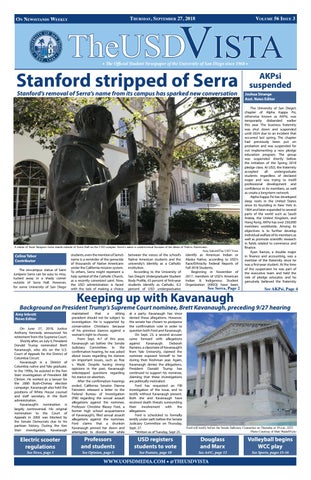
A statue of Saint Junipero Serra stands outside of Serra Hall on the USD campus. Serra’s name is controversial because of his abuse of Native Americans. Amy Inkrott/The USD Vista
Celina Tebor Contributor The on-campus statue of Saint Junípero Serra can be easy to miss, tucked away in a shady corner outside of Serra Hall. However, for some University of San Diego
students, even the mention of Serra’s name is a reminder of the genocide of thousands of Native Americans under the California mission system. To others, Serra might represent a holy symbol of the Catholic Church, as a recently canonized saint. Now, the USD administration is faced with the task of making a choice
between the voices of the school’s Native American students and the university’s identity as a Catholic institution. According to the University of San Diego’s Undergraduate Student Body Profile, 43 percent of first-year students identify as Catholic. 0.3 percent of USD undergraduates
identify as American Indian or Alaska Native, according to USD’s Race/Ethnicity Federal Reports of Fall 2018 Students. Beginning in November of 2017, members of USD’s American Indian & Indigenous Student Organization (AIISO) have been
See Serra, Page 2
Keeping up with Kavanaugh
AKPsi suspended
Joshua Strange Asst. News Editor The University of San Diego’s chapter of Alpha Kappa Psi, otherwise known as AKPsi, was temporarily disbanded earlier this year. The business fraternity was shut down and suspended until 2024 due to an incident that occurred last spring. The chapter had previously been put on probation and was suspended for not implementing a new pledge education program. The group was suspended shortly before the initiation of the Spring 2018 pledge class. At USD, the fraternity accepted all undergraduate students regardless of declared major and was trying to instill professional development and confidence in its members, as well as create a long-term network. Alpha Kappa Psi has developed deep roots in the United States since its founding in New York in 1904 and later expanded to several parts of the world such as Saudi Arabia, the United Kingdom, and Hong Kong. AKPsi has over 250,000 members worldwide. Among its objectives is to further develop individual welfare of its members as well as promote scientific research in fields related to commerce and finance. Ryan Ramos, a double major in finance and accounting, was a member of the fraternity since he was a first-year student. At the time of the suspension he was part of the executive team and held the role of pledge educator, and he genuinely believed the fraternity
See AKPsi, Page 4
Background on President Trump’s Supreme Court nominee, Brett Kavanaugh, preceding 9/27 hearing Amy Inkrott News Editor On June 27, 2018, Justice Anthony Kennedy announced his retirement from the Supreme Court. Shortly after, on July 9, President Donald Trump nominated Brett Kavanaugh, who sits on the U.S. Court of Appeals for the District of Columbia Circuit. Kavanaugh is a District of Columbia native and Yale graduate. In the 1990s, he assisted in the Ken Starr investigation of President Bill Clinton. He worked as a lawyer for the 2000 Bush-Cheney election campaign. Kavanaugh also held the positions of White House counsel and staff secretary in the Bush administration. Kavanaugh’s nomination is largely controversial. His original nomination to the Court of Appeals in 2003 was blocked by the Senate Democrats due to his partisan history. During the Ken Starr investigation, Kavanaugh
Electric scooter regulations See News, page 3
maintained that a sitting president should not be subject to investigation. He is supported by conservative Christians because of his previous stances against a woman’s right to choose. From Sept. 4-7 of this year, Kavanaugh sat before the Senate Judiciary Committee. In the confirmation hearing, he was asked about issues regarding his stances on important issues, such as Roe v. Wade. Despite having strong opinions in the past, Kavanaugh sidestepped questions regarding his stance on abortion. After the confirmation hearings ended, California Senator Dianne Feinstein released a letter to the Federal Bureau of Investigation (FBI) regarding the sexual assault allegations against the nominee. Professor Christine Blasey Ford, a former high school acquaintance of Kavanaugh’s, filed sexual assault allegations against the nominee. Ford claims that a drunken Kavanaugh pinned her down and attempted to disrobe her while
at a party. Kavanaugh has since denied these allegations. However, the senate has chosen to postpone the confirmation vote in order to question both Ford and Kavanaugh. On Sept. 23, a second accuser came forward with allegations against Kavanaugh. Deborah Ramirez, a classmate of Kavanaugh’s from Yale University, claimed the nominee exposed himself to her during their freshman year. Again, Kavanaugh denies the allegations. President Donald Trump has continued to support his nominee, claiming that these investigations are politically motivated. Ford has requested an FBI investigation of the issue, and to testify without Kavanaugh present. Both she and Kavanaugh have received death threats surrounding their involvement with the allegations. Ford is scheduled to formally testify under oath before the Senate Judiciary Committee on Thursday, Sept. 27. *Written as of Tuesday, Sept 25.
Professors and students
USD registers students to vote
Douglass and Marx
Volleyball begins WCC play
See Opinion, page 5
See Feature, page 10
See A&C, page 13
See Sports, pages 15-16
Ford will testify before the Senate Judiciary Committee on Thursday at 10 a.m.. EST. Photo Courtesy of Matt Wade/Flickr
WWW.UOFSDMEDIA.COM ◆ @THEUSDVISTA
2
The USD Vista
◆
September 27, 2018
NEWS
The Serra controversy
USD discusses Saint Junípero Serra after Stanford University removes the missionary’s name
Serra from Page 1
pushing to remove Serra’s name from Serra Hall, an academic building on campus. USD’s campus lies on Native Kumeyaay land, and students expressed their discomfort in attending class in a building bearing the name of a man who played a part in the genocide of their ancestors. In order to educate more students about the history of Serra, AIISO hosted an event in front of Serra Hall in November, showcasing 300 rocks painted red — each symbolizing 1,000 native deaths. Senior Patrick Murphy, President of AIISO, explained why the club has taken the official stance of wanting to remove Serra’s name from the building. “We, as a group, see him as a
the building’s name. Since then, there have been no other events or public campaigns to protest the name of Serra Hall at USD. However, the issue is rising again, this time at Stanford University. Stanford is seeking permission from the U.S. Postal Service and Santa Clara County to wipe Serra from its mailing address, in addition to removing his name from one academic building and one dormitory. A Stanford committee’s report from late August pronounced Serra’s name to be “unfit of display” on campus, in response to the input of Native American students and tribes. Students had been protesting since March of 2016, when a student assembly voted to remove his name from the mailing address, the Stanford Daily reported.
“We, as a group, see him as a figure who was detrimental to the Native American population here in Southern California.”
-Patrick Murphy
figure who was detrimental to the Native American population here in Southern California,” Murphy said. “(Serra) was being idolized for basically doing wrong things to the community here.” Despite the club’s efforts, no changes have been made to the name of Serra Hall. There was a discussion panel focused on whether the name of Serra Hall should be changed in February of 2018, and despite fruitful conversation, the event amounted to no changes to
“Though we have no doubt about Serra’s piety and good intentions, it is also a fact that the mission system pervasively mistreated and abused California’s Native Americans,” the committee said. Stanford students’ fight to remove Serra’s name from the university seems to parallel USD’s in many ways; both movements occur at private liberal arts colleges in California and began with student protests and input from Native American students.
There is one key difference between the two: Stanford is not religiously affiliated, while USD is affiliated with the Roman Catholic Church. From the crosses on every building to the integration of the church’s message in many of the school’s statements, USD is not reserved about expressing its identity as a Roman Catholic university. Pamela Gray Payton, Assistant Vice President of Media Communications at USD, explained why the university has a building named after Serra. “It has long been the case in Catholic universities and other institutions to name buildings after those who, despite their imperfections, have given extraordinary witness to the faith and have been designated with the title of sainthood,” Payton said. “For this reason, our location adjacent to the place the faith was first celebrated, and first chapel built in this region by St. Junípero Serra is significant for the University of San Diego and our Catholic Intellectual Tradition.” Jeffrey Burns, Ph.D., a USD professor and faculty member in the Center for Catholic Thought and Culture, illuminated why removing Serra’s name from the building would be going against the university’s Catholic identity. “I know that the university will probably want to keep it as Serra because he was just named a saint,” Burns said. “Taking away that title would be a slap to the Catholic Church.” Burns added that Serra is often blamed for the entirety of what happened in the California missions.
“I just wanted to point out who Serra was really,” Burns said. “In the current discussion, Serra is turned into a symbol of everything bad that happened in the Missions. (The mass death of natives) was actually because of diseases, and that was turned back on Serra. I want to turn it back to the person of Serra and not the symbol of Serra.”
us in any way,” Murphy said. “Or we can use it to show that universities are willing to change if there’s enough support for it. We’re not opposed to anything, anything that can gain support and momentum in this effort.” Although there is a Serra Street on Stanford’s campus, the school does not intend for Serra’s name
“I want to turn it back to the person of Serra and not the symbol of Serra.”
-Jefferey Burns Despite a lack of visible progress on the fight to remove Serra’s name from the hall, Murphy believes the movement has gained traction. “It does feel like we have support,” Murphy said. “I’ve had people reach out to me recently about the Washington Post article, saying, ‘Hey, this is happening, this is what you guys are fighting for.’ It’s definitely a step in the right direction. Even around campus, in general, we have more support. Even some of my friends have recognized my work, and they’ll ask me, ‘Hey, how’s it going with the Serra Hall name change?’ A year ago, I didn’t think it would get to where we are right now.” Murphy hopes to implement some of Stanford’s methods in fighting to remove Serra’s name from the university at USD and within AIISO. “From (the article), we can try to take it apart and go more in-depth with what they did and kind of mimic their steps and see if it helps
to be removed from it. Instead, Stanford intends to create a sign or plaque on the street to explain who Serra was and why he is controversial. Payton affirmed that this is something USD might be willing to do as a compromise in the movement to remove Serra’s name from Serra Hall. “Yes, there have been discussions about exploring ways in which USD can be sensitive to all of its community while also being responsible to its Catholic intellectual tradition,” Payton said. To Murphy personally, however, a plaque or a sign would not be enough. “I don’t think that that would be okay,” Murphy said. “I want to fight for the complete name change.” The future of Serra Hall remains largely unknown, but the Stanford’s actions brought new attention to the situation. As AIISO continues its fight, USD is faced with balancing the identities and voices its students.
USD’s Serra Hall bears the name of Saint Junípero Serra. Serra’s name has been the subject of multiple protests on campus. Thomas Christensen/The USD Vista
Volume 56 Issue 3
◆
NEWS
◆
The USD Vista
New rules for electric scooters
3
San Diego places new safety regulations on popular dockless electric scooters
Bird scooters have become increasingly popular among USD students. The electric scooters can be found in various places around campus. Thomas Christensen/The USD Vista
Glenn McDonnell Asst. News Editor On Sept. 19, 2018, an otherwise routine meeting of the San Diego City Council’s Committee on Public Safety and Livable Neighborhoods was consumed by over an hour of intense public debate about a trend which many USD students and San Diego residents have come in contact with in some way. Dockless electric scooters, as they are officially called, have infiltrated San Diego streets by the thousands ever since they were first launched in February, bringing fun for some, but headaches for others. While some see the new transportation as a convenient and eco-friendly last-mile option, others feel that their pervasiveness on our sidewalks, boardwalks, and in our parks has become both a nuisance and a safety hazard, for riders and pedestrians alike. Since last spring, these scooters
were affiliated with industry or advocacy groups, but the majority were individuals with personal complaints about how the scooters have affected their daily lives. Under California state law, it is illegal to operate any motorized vehicle, including electric scooters, on sidewalks. Other laws require that riders wear regulation helmets, stay in bike lanes wherever possible, and maintain a 15 mph speed limit on the road. Junior David Hunt has seen a lot of people riding without helmets on sidewalks and doesn’t believe that enforcement of these requirements is realistic. “I know you’re technically supposed to have a helmet on, but I really don’t see how it would be possible to stop and ticket everyone who’s breaking the rules,” Hunt said. “Sure it’s not safe but I don’t know how it can possibly be controlled.” San Diego Police Department Detective Sgt. Leonard Flake
“I know you are technically supposed to have a helmet on, but I really don’t see how it would be possible to stop and ticket everyone who is breaking the rules.”
-David Hunt
have been scattered across the USD campus and popular locations for students such as Mission Beach and the Linda Vista area. Students often use the scooters as a way to speed up their commute to class, or to get food down the street. The committee’s agenda item was titled “Update From Dockless Scooter Share Providers,” and was intended to be a chance for the council members to hear from tech giants Bird, Lime, and Razor on how they are working to address the city’s mounting safety concerns. Following the brief presentations from the companies’ respective spokespeople, the hearing was then dominated by an intense hour-long period of public comment from anti-scooter advocates. Some San Diego residents who went downtown to express their concerns on Wednesday morning
testified that the department has, to date, handed out 190 citations for sidewalk riding, 58 for riding with a passenger, and 66 for riding without proper license. Downtown resident and selfdescribed pedestrian advocate Jonathan Freeman put numbers to the enforcement problem Hunt and others have been noticing. During his allotted time, Freeman claimed to have survey results indicating that 100 percent of riders ride without helmets and that 75 percent of them ride on sidewalks. Whether these numbers are accurate, the number of violators who receive citations and fines is miniscule compared to the thousands of rides reported by both of the two major scooter providers so far this year. This past April, San Diego
assemblyman Heath Flora introduced a bill which separated “stand up electric scooters,” like Birds or Limes, from other “motorized scooters” for regulatory purposes. Wednesday, California Governor Jerry Brown signed and chartered the bill into law, effectively making it legal in California to ride without a helmet on the sidewalk, so long as the rider is at least 18 years of age on a street with no available bike lanes. While these changes certainly legalize much of the scooter activity at the state level, the law allows local jurisdictions to enforce their own regulations. Whatever the legal status of the scooters, there’s more to Birds than injured pedestrians and traffic violations and safety concerns. Sophomore Chris Collins started using the Bird scooters last year as a way to get around the beach every once in a while, but has since started making some money off of the scooter enterprise. “I noticed at the top of my app something about becoming a ‘charger,’ which is basically an independent contractor role,” Collins said. “If you apply to do it they send you three of the charging devices to get started and then you go out and look for scooters that need to be charged.” The company offers different levels of compensation for successful hunting, charging, and repositioning of the scooters based on how long the scooters have remained unused. “If you find one in plain sight, the bird will probably show up on the map as green and pays only five dollars, but if it’s red, it could be in a bush or a ravine somewhere and could pay up to twenty-five per scooter charged,” Collins said. Casual employment opportunities such as Collins’s were touted by both Bird and Lime during last week’s city council hearing as one of several ways in which their enterprise has been benefiting the San Diego community. The Senior Affairs Manager for Bird claimed that an excess of $20 million in earnings has gone to a
workforce of 4,600 chargers and repair mechanics ever since the February launch. Both scooter providers also emphasized the positive environmental impacts which electric scooter usage has brought about for the San Diego region in recent months. Lime’s spokeswoman claimed that the use of the scooters as an alternative to driving fuel-powered vehicles has spared the atmosphere over one million pounds of carbon dioxide pollution in 2018. Bird claimed 2.2 million pounds of
carbon emissions avoided so far in 2018, along with a pledge to account for a quarter of San Diego’s emissions reduction goal of 43 million pounds by the year 2020. Despite these alleged benefits to both the environment and the economy, many of the City Council members echoed some of the concerns and frustrations of the residents. Whether city officials follow other cities and choose stricter regulations, or continue their laissez-faire approach remains to be seen.
TELL US WHAT YOU THINK. SCAN THE CODE WITH YOUR SMARTPHONE CAMERA.
4
The USD Vista
◆
September 27, 2018
Alpha Kappa Psi suspended USD’s professional co-ed business fraternity suspended for the next six years
AKPsi from Page 1
was creating quality individuals. “Every semester we had brothers from AKPsi that worked for Big Four accounting firms, that went off to start their own business or held successful finance positions going forward,” Ramos said. “The type of people that composed AKPsi were like-minded and goal-oriented and it’s very unfortunate that we are in the position we are now. It was a great kind of nest for a bunch of similar minds to use college as a real platform to not only increase USD’s name and reputation through their success but to also achieve their own personal goals.” Ramos did not mention the fraternity’s decision to disregard the new pledging process. Notable alumni of the fraternity include former U.S. presidents
encouraged Ramos to join. “I rushed as a freshman and I was the new guy on campus and AKPsi set up good role models, people that held respectable positions in the fraternity at the time and really set the standard for me,” Ramos said. “These were people who are now working for Big Four firms, one is a financial analyst for the Navy so they’ve done really well for themselves and I believe that AKPsi was a positive influence on this campus for students, administration, and beyond; they were a group of kids who truly wanted to make a difference and, if I’m honest, I feel bitter that we were kicked off campus.” Josephine Tsai is a marketing and finance double major and a junior at USD. She was with the fraternity for two years and was
“The people that composed AKPsi were like-minded and goal-oriented and it’s very unfortunate that we are in the position we are now.”
-Ryan Ramos Richard Nixon and Ronald Reagan, the former prime minister of Pakistan, and the editor-in-chief of Forbes magazine. The fraternity’s history of notable figures
gunning for an executive board position when it was dissolved. “Rushing AKPsi was the best decision of my college career,” Tsai said. ”I learned all these skills like time management and how
to deal with stressors and in the end I came out as a very confident person. I would like our suspension to be minimized because six years is a really long time, it’s a whole generation gone. We’ve had people reach out to us on social media asking when rush would be this semester and we’ve had to tell them we don’t exist anymore. That’s truly depressing and this college really lost something important.” AKPsi has had the same pledge education program since 2007. At a congressional chapter convention in 2015, it was decided that the pledge education program should be reworked. After two years of research and legislation, 40 chapters were chosen to test a new pilot program known as LEAD and amongst them was the USD chapter. However, the executive team on campus, which included Ramos, felt that the pilot program didn’t prepare pledges for the rigors and adversity they’d face. “In the end if you look at this from a business perspective a pledge class is like a new hire, an entry level job, and if you’re the boss or you’re in management and your new hire that you vetted fails, it’s your fault,” Ramos said. “As the executive team we decided, along with many others, that we wanted to maintain the traditions of old to ensure our brothers were academically prepared. A couple
Meet Daryan Gomez The USD Vista Alcalá Bazaar raffle winner Hannah Sonberg Managing Editor Junior Daryan Gomez has an overwhelming passion for human minds. She is involved in the psychology club as well as the psychology journal club. In the past, she wrote an article for The USD Vista about grappling with mental health, as it is a concern about which she has a strong opinion. Gomez, a behavioral neuroscience major, strongly emphasizes psychological advocacy. “I’m very big on mental health,” Gomez said. “It needs to be less stigmatized.” When asked what fictional character she would most want to get to know, Gomez referenced one of John Green’s, author of “The Fault in Our Stars,” lesser known novels. “I would have a conversation with the main character from John Green’s ‘Turtles All the Way Down,’” Gomez said. “I feel like she was a really strong character. She really handled her situation well.” The mystery novel focuses on a girl, Aza, who struggles with anxiety. Perhaps Gomez draws inspiration and new ideas on how to discuss mental illness within the popular media she reads and watches. If this is not enough to show her dedication to the field, Gomez’s career goal is an impressive one. “My dream job is to be a profiler for the FBI,” Gomez said. You can find Daryan at local coffee shops enjoying a matcha latte or at a psychology club meeting to pick her brain on her views and support of the mental health community.
of months down the road we decided that we weren’t going to abide by the new program which, in retrospect, was a mistake. The national chapter found out and as a result we were punished and that punishment is a six year suspension.” The chapter was suspended due
training to become the president of the USD chapter when the axe finally fell. “The overall environment and accountability and standards we were held to is something that I would never have given up,” Bradsky said. “I wouldn’t be nearly
“The overall environment and accountablity and standards we were held to is something that I would never have given up.”
-Carter Bradsky to their disregard of the national chapter’s change in policy. Due to the suspension, the newest pledge class never got inducted, but if it had AKPsi would have included about 100 members. The fraternity also had a lot of local ties with alumni and brother chapters like San Diego State. AKPsi offered insights into entrepreneurship, scholarships, and guest lecturers as well as access to real world networking and business opportunities. A major concern for the future of the fraternity on campus is that in 2024 it will have to be built from the ground up. Carter Bradsky is a double major in computer science and finance at USD. He was in charge of risk management for AKPsi and also expressed interest in joining the national executive board. He was
as involved today on campus or in any of the clubs I’m a part of without the influence of AKPsi. AKPsi gave me a lot more purpose and drive to succeed and want to make a difference. Success is relative and it’s what you put into it and I’m going to expand my base by pushing myself and those around me and in the end hopefully I’ll have made a big impact at USD and beyond because that’s really what we’re here for. We want to make a difference in the world and that’s what we’re learning and it’s those very roots AKPsi instilled in us as well. For me, the future is bright.” The future of the fraternity is unclear but the alumni who were once part of its proud heritage are out in the world, aiming to make an impact.
The USD Vista
Editorial – 619.260.4584 Business – 619.260.4714 www.uofsdmedia.com ◆ @TheUSDVista
Luke Garrett - Editor in Chief Kaia Hubbard - Associate Editor Hannah Sonberg - Managing Editor Kathryn Querner - Copy Editor Rita Srekais - Art Director Lexi Crea - Assistant Art Director Amy Inkrott - News Editor Paulina Sierra - Opinion Editor Jennifer Mossuto - Feature Editor Dorothy Dark - Arts & Culture Editor Anderson Haigler - Sports Editor Thomas Christensen - Photography Editor Zoé Morales - Photo Assistant Richard Benson - Distribution Editor Elizabeth Brunelli - Finance Manager Rachel Steinheimer - Advertising Manager Gina Lew - Student Media Advisor Marie Minnick - Operations Advisor The USD Vista publication is written and edited by USD students and funded by revenues generated by advertising and a student fee. Advertising material published is for information purposes only and is not to be construed as an expressed or implied endorsement or verification of such commercial venues by the staff or University. The USD Vista office is located on the fourth floor of the Student Life Pavilion in room 403B. All inquiries should be sent to: The USD Vista 5998 Alcala Park San Diego, CA 92110
Daryan Gomez poses for photo.
Photo courtesy of Daryan Gomez
The first copies of the newspaper are complimentary, all copies thereafter are a 25 cents charge. Opinions expressed in this publication are not necessarily those of The USD Vista staff, the University of San Diego or of its student body. Letters to the Editor can be submitted to The USD Vista office. Letters should be limited to 300 words and must be signed. For identification purposes, USD identification numbers and writer’s year must be included in the letter. The USD Vista reserves the right to edit published letters. Any content sent to the editor will be considered for publication unless otherwise stated.
Volume 56 Issue 3
◆
OPINION
◆
5
The USD Vista
OP I N ION
Professors behind the podium The way professors relate to students is hardly discussed, but is a vital part of the way USD runs
Paulina Sierra Opinion Section Editor The relationship between professors and students is a central feature of college life. As a result, the way professors navigate their roles is pivotal to the creation of campus culture, from interactions in the classrooms, discussions held during office hours, and the ways in which we inhabit campus. The interactions students have with their instructors is a hugely important aspect of the college experience at USD, and has the ability to shape students’ experiences in their college years. For Evelyn Kirkley, Ph.D., associate professor of theology and advisor for USD Pride, her mentorship is connected to engaging with her students on a personal level.
time, so I don’t have to be as conscious in drawing those lines like I might have a few years ago, but my lines are: students are adults, they are not in my close circle of friends, but they are people that I care about, they are people whose development and whose becoming is really important to me,” Kirkley said. For Monge, one of his most difficult roles is as a mandatory reporter of sexual assault. “Given that Title IX makes professors mandatory reporters of any sort of sexual assault instances on campus, meaning that if we hear anything, we immediately have to report it, we don’t have a choice,” Monge said. “That definitely creates a curious space in which a professor essentially has to identify when someone
“For me, the boundaries are around empathy, they’re around compassion, and they’re around trying to be as selfless as possible.” -Evelyn Kirkley “My goal with students is to help them, however I can, to recognize who it is that they are, and support them in becoming their genuine, real, authentic selves,” Kirkley said. “In the classroom, out of the classroom, it takes place in both places.” For Rev. Rico Monge, Ph.D., assistant professor of theology and LLC advisor, engaging with students beyond the realm of academics has always been a part of the job, from when he taught religion at a Christian high school to his current employment at USD. “It’s a tough thing to navigate, because the best type of relationships with students have a very genuine and personal element,” Monge said. “They can’t be just completely a professional sort of thing with all these official rules, it doesn’t help with that kind of personal growth aspect that I value about being a teacher.” Timothy W. McCarty, Ph.D., assistant professor of political science, prefers to engage with students exclusively on an academic level. “I try to invest myself in my students’ academic life and in their aspirations, but not in their personal life,” McCarty said. “I’m very interested in what students are doing intellectually and academically and how they see elements of their education, and you know, as a political scientist, their activism and social engagement, and how all that comes together in their ambitions for careers, grad school, etc., but I don’t want to know what my students are doing on Friday night. I think that the studentteacher relationship is better with that kind of line.” As McCarty suggests, engaging with students, in any capacity, is not without its difficulties. All professors must maintain a level of professionality t with students. For Kirkley, who often interacts with students via her involvement as a club advisor, having specific boundaries, while not difficult, is an important thing to consider and carry out. “I’ve been doing it for a long
might be going to divulge that information, and then kind of let them know beforehand. The law has a very good intent, (but) if a student doesn’t know that it’s the case, and they’ve developed enough of a relationship with a professor that they want to talk to them first before they take any further action on the situation, it creates an awkward space where the professor might have to interrupt the student.” Many professors think the concept of boundaries is made simpler when considering the relationship through the lens of its ultimate goal. Kirkley views relationships with students as selfless, being for the benefit of the students. “For me, the boundaries are around empathy, they’re around compassion, and they’re around trying to be as selfless as possible, and caring about students development and not needing or wanting them to give me something,” Kirkley said. “What makes me happy, and what brings a tear to my eye, is when students really pursue what their passions are. That’s so satisfying and awesome, to see a student grow into who they are.” For Monge, this means maintaining his role as mentor, especially as it relates to the way the students may view him. “I would say the ideal goal is that the professor becomes a very human and empathetic resource for navigating not only intellectual life and expanding that, but navigating personal goals,” Monge said. “In general, I think college is best understood as a place where students can explore becoming the kind of person they want to be, as opposed to the career they want to have, and I think the ideal professor-student relationship is one that includes that personal development, which itself will ideally allow students to find professors that they see embodying that with their teaching or with their other work inside the campus and in the community, and then the students identify that and want to learn
Professor Rico Monge giving a speech at the 2017 Ole Weekend calling students to think critically about their careers. Photo courtesy of the USD Media Gallery
more about how do I become this kind of person too.” Part of maintaining this relationship is being able to keep certain biases hidden from students. McCarty deeply values the political anonymity he has. “There are things that I am careful to keep closer,” McCarty said. “For example, I know that (with) a lot of political science professors, our personal political actions, advocacy, who we vote for, those kinds of things, a lot of us think it’s important (to keep) private, in order to best create a classroom environment where, no matter what I may think or how I may come down on political controversies, my classroom is as open an environment as possible for as many different kinds of perspectives as possible.” One thing that professors resonated with was the idea that being a professor is not a onesize-fits-all position. Professors like Kirkley, who are very involved with students and student organizations may think it is important to realize that their way is not the best fit for everyone, and implying otherwise could be harmful for professors who prefer to engage solely in academic matters. For McCarty, his engagement with students, and the awareness he lends to it, is reflective of the way he conducts relationships in general. “Like everyone who is engaging in complex personal interactions, that there are going to be mistakes made and missteps,” McCarty said. “But I think that the key is to be conscious and thoughtful that this is a very unique kind of relationship, and it’s a special relationship, and if done right can be one of the most enriching and rewarding relationships on either side. So I think that, for me, the key is being active, purposeful, and thoughtful in how I engage with students.” Kirkley believes that while her method works for her, teaching styles can, and should, vary from person to person.
“I would not prescribe the way I do it to everyone else,” Kirkley said. “It’s unique to me. I think the boundaries are different for each personality and each person. I will say as well, now that I’m a little bit older, I feel a little bit freer to be closer to students, because I’m kind of in a more mom-like role, whereas when I was younger, it could be weird. Age is definitely a factor.” The concepts of age and experience also resonated with McCarty, who considers himself relatively new to being a professor. “Every new semester I gain new experiences that become part of the realization of ‘that’s a good practice’ or ‘that’s a bad practice’ or ‘that’s a less effective practice,’” McCarty said. “I think those professors that have been at this longer just have a better sense
have different personalities and methods of engaging with students, and this is a welcome variety. Grace Strumpfer, a USD junior, discusses the ways in which different professors enrich her student experience. “There are some professors I know, if I just want to chat, I can go by their office,” Strumpfer said. “And then I have professors who I can talk to about academic stuff, and I know they care, but it’s a little bit less of a personal relationship, and I think that’s totally valuable. There are some people who are just really good professors, and then there’s some that form a more familiar relationship, where some are a little more academic, and I don’t think that’s any less valuable.” According to Strumpfer, what
“The key is to be conscious and thoughtful...if done right (this) can be one of the most enriching and rewarding relationships on either side.” -Timothy W. McCarty of things. Those of us who are a little newer at it are still figuring it out. So, we’re the ones who maybe need more precise line drawing or active thinking.” As with all aspects of these relationships, part of the battle of relating to students on any level is figuring out the best way to go about it. For Kirkley, USD is a suitable place for professors that are figuring out their teaching style. “I think that one of the reasons that USD’s faculty is as strong as it is is because faculty are encouraged to develop their relationships with students in different ways,” Kirkley said. “Some are more intellectual, some are more research oriented, some are in the lab, some are advisors for clubs. So, that’s the way I have found what seems to work best for me.” Ultimately, students understand that professors
makes all professors valuable, regardless of teaching style, is that they engage with their students with full sincerity and want the best for them. “What makes a good professor, regardless of teaching style, is that they care,” Strumpfer said. “Not just that they care that you get a good grade, but they care that you are able to learn the material, that you understand what’s going on. That you’re doing okay. I think that can come in different forms in the way that they show that, but they want to be there, and they want you to be there.” The way professors run their relationships with students can vary greatly from person to person, but it is the overall desire the educator has to engage with students that makes whatever teaching style they have stand out, and impact students in a positive way.
6
The USD Vista
◆
September 27, 2018
Student’s best helper Emotional support animal can be very helpful, but can carry their own set of responsibilities
McKenna Moret Assistant Opinion Editor No college student is a stranger to stress and struggling. However, for students who are differently-abled, whether that be regarding their physical, mental, or emotional health, finding a way to cope is of the utmost importance. Some find their solution in the form of an animal companion, or an emotional support animal (ESA). However, for first years and sophomores, living on campus with an animal can cause some issues, and it is important to consider whether they are worth taking on or if they will simply create more stress. One of the first considerations when inquiring about ESAs on campus is University of San Diego policy. According to “Policy on Emotional Support Animals in University Housing,” USD’s requirements to bring an emotional support animal into campus housing are specifically outlined. In order to have an emotional support animal live with a student on campus, the student must present official documentation from a practicing physician that validates that the animal alleviates one or more symptoms of a disability. In addition, documentation from a veterinarian that states that the animal is in good health and is up to date with its immunizations is required. There must also be an application sent in to the Disability and Learning Difference Resource Center and the Office of Residential Life must approve the animal. All of this must be done at least 60 days before the school year begins. Lilli Bean, a sophomore who lives in the Alcala Vistas, chooses not to bring her emotional support animal Nala onto campus. Bean described her reasoning behind the choice. “I want to give Nala the best
A dog waits for its owner outside of a classroom in Serra. Photo courtesy of USD Media Gallery
life possible, and I don’t feel like I’m capable of doing that while I’m living on campus,” Bean said. “Nala is a dog who needs a lot of attention and space to play and exercise, and I don’t think the apartment I’m in allows me to give her those things.” Aside from space, students considering bringing an emotional support animal onto campus must consider their schedule and the amount of time they have available to care for their animal. Having a lot of classes back to back can necessitate being away from their ESA for long periods of time, which may cause some issues, as animals like dogs require a significant amount of attention
and care. Mary Smith, a sophomore and Residential Assistant (RA) in Maher Hall, spoke about the responsibility that comes with being a pet owner. “If someone were to have an emotional support animal in their dorm, they would have to be sure that it was one of their main priorities, as an animal being treated improperly would definitely be something I would have to step in and confront,” Smith said. It is also vital to consider the type of animal a student wants to bring onto campus, as different animals have different needs. Dogs tend to require more attention
from their owner. Cats don’t always require the same attention, but they do have litter boxes that need to be cleaned and students need to be wary of the damage that their claws could do to school property if left unsupervised. Even smaller animals, like hamsters, need to have their enclosures cleaned regularly as to avoid an unsanitary living space. There’s also the concern of determining how compatible the animal will be with a potential roommate. One must make sure that all roommates are comfortable with having an animal in their space, and that all of the supplies needed to care for an emotional support animal do
A student enjoys the companionship of his dog during class. Photo courtesy of USD Media Gallery.
not impede on the shared space. Living in a single dorm room could alleviate these issues, but these housing options tend to be more expensive, and are not always accessible to students. There are also resources on USD’s campus for those struggling with various disabilities, such as the counseling center and University Ministry. Students can always speak to their RAs about their struggles, or they can be referred to other resources through their RA. Students must also keep in mind that an RA is not held to the same level of confidentiality as a counselor is, and that anything that concerns harming oneself or another will be reported under Title IX requirements. Aside from the drawbacks of having an animal on campus, there are many benefits to bringing an emotional support animal to USD. For Smith, an RA in Maher, one of the greatest things that ESAs provide is an added joy to campus life that goes beyond the students they are directly serving. “It really makes me happy to see animals on campus, and I think the effect that they have is campus-wide,” Smith said. “I think it really brings a sense of home to campus, and helps brighten up the day of anyone who comes into contact with the animal.” Aside from the happiness it may bring others, the most significant benefit of living with an ESA is the support that they provide. Many people find that having an animal companion with them significantly reduces stress levels and provides them with a sense of comfort and ease, which just might make the extra cleanup, trickier schedule, and application process completely worth the time. The key is for students to know themselves and their limits, as the responsibility of an ESA is a lot to take on, whether on campus or not.
Volume 56 Issue 3
◆
FEATURE
◆
The USD Vista
A day in the life of a DC intern
7
The opportunity to grow personally and professionally in the nation’s capital is limitless
Celina Tebor Contributor “Siri, play NPR.” It’s how I start most of my mornings as an intern in the District of Columbia. Every day, I go to work and live not so much as a college student, but as an adult who has been integrated into the workforce. I brew a fresh pot of coffee and slip into my business clothes before work. After a significant amount of caffeine has entered my bloodstream, I grab my work bag and hustle to the nearest Metro station, my heels clacking on the sidewalk as Steve Inskeep’s voice briefs me on the morning news. The District life is a fast-paced one — people are fast walkers, fast thinkers, and fast to make moves. After getting downtown and moving my way through hordes of busy people trying to get to work and honking cars, I arrive at my internship at 9 a.m. I work for the United States Conference of Mayors, the official non-partisan organization of cities with a population of 30,000 or larger. We work to strengthen federal-city ties, provide mayors with leadership and management tools, and promote the development of cities nationwide. After reading through a few New York Times and Washington Post stories, I check on the bill that my organization has been pushing to pass. It has been in the works for the past nine years, and it’s an important one. It could pass at any moment as Congress barrels toward the end of the fiscal year, so I need
to keep my eye on it so I can write a press release and send it to our CEO if it gets passed. I check on the bill consistently throughout the day in-between breaks from my other projects. One of the bigger projects I’ve worked on was developing the Alliance for a Sustainable Future report in preparation for the Global Climate Action Summit in collaboration with the Center for Climate and Energy Solutions. I copy edited and finalized the 40-page report, communicated with guests about the summit, and helped tie together loose ends of the project to make it a clean, finalized product. Another project I’m working on is the development of Opportunity Zones within cities. Essentially, Opportunity Zones allow for investment and growth in lowincome areas of the United States. During one of my first days at work, I helped brief five different mayors of cities on their meeting with Secretary of the Treasury Mnuchin and sat in on a meeting with a senator afterward to discuss the issue. After a long day of negotiation and meetings with government officials, the mayors, members of my organization, and I took a break and had lunch at Michelle Obama’s purported favorite restaurant in the District (unfortunately, she was not there). The opportunity to meet with mayors of big cities and get a look into their thinking processes and daily lives was an incredible and special one that I’m not sure I would have gotten anywhere else. I truly didn’t know I would have as much influence and input as I do at my organization as an intern.
I was prepared to spend my days making coffee runs for my bosses and copying files, but instead, I’m briefing mayors, meeting with senators, and preparing for big conferences. The amount of work and information I’ve consumed in the past few weeks is incredible, and there’s so much more ahead of me as well. My life in the District doesn’t revolve entirely around my internship, however. My program also provides me with programs to further my professional development and the chance to take a class from a distinguished professor from the District universities. I’ve had the chance to network with employees of the White House, the Department of Justice, and other important organizations in the District. All of the interns in my program live in an apartment together, and when the weekend hits, I take every opportunity I can to see what the nation’s capital has to offer. As an unpaid intern, I try to scout out as many free events and places as possible, but there’s no shortage here. From the Smithsonian museums to concerts by the National Symphony Orchestra on the Capitol lawn, I can find plenty of ways to stretch my budget. Even a stroll around the National Mall can be a fun-filled and entertaining day. The affordable and easy-to-use Metro system also allows me to navigate my way throughout the city without too much difficulty. Even when the amount of money in my bank account is dangerously low, it doesn’t stop me from exploring local food joints and attending local street
and farmer’s markets. The District is a wonderfully diverse city with people from all walks of life living in and visiting it, so there are lots of cultural events and restaurants to explore. Happy hour is huge here, and even if you’re not 21 or don’t drink, a lot of restaurants offer great deals on their food prices as well. The chance to spend a semester in the nation’s capital working is an incredible opportunity; I get a glimpse of what my life might be like after college. I get to live in an apartment in the middle of a big city where I have to shop for my own groceries and get around town by myself. Through my internship and program, I’ll hopefully discover my passions and career goals — and if I don’t, then I’ll know what I’m doing isn’t right for me.
The District is a magical city filled with opportunity and limitless things to do. To anyone thinking about spending a summer or semester here through The Washington Center — I highly recommend doing so. It’s a unique opportunity that will put you ahead of the game career-wise and allow you to explore your future options and the magnificent capital of our nation. Despite the uncertainty that faces the United States in the future, seeing the Washington Monument every day never fails to inspire a bit of awe in me. Living here, working here, gives me hope for both my own and the nation’s future, and I sincerely think anyone else who chooses to participate in this program will feel the same.
Tebor in the District of Columbia during her internship with other interns. Photo courtesy of Celina Tebor
FREE RIDE DAY CHOOSE TRANSIT
OCTOBER 2 All Buses and Trolleys are totally free!
sdmts.com
8
THE USD VISTA
Oregon/ Washington Fires
◆
Volume 56 Issue 3
SEPTEMBER 27, 2018
Even in areas where natural disasters did not directly occur, cities were impacted; for example, Portland, Oregon was greatly affected by the fires in the state of Washington this past August. The sky was grey and smokey for at least a week. Many people experienced negative health impacts such as coughing, itchy eyes, and more. People also chose to stay inside despite the warm weather and bicyclists were seen wearing masks for protection.
Northern California In the fall of 2017, the fires began at an electrical power station. Many Santa Rosa homes and at least 43 lives were lost in one of the largest fires in California’s history. It burned from Oct. 8 until Oct. 31. “The fires last October burned down my grandmother’s home and my old high school. I learned the importance of being there for my community and willing to help others get through difficult times. A lot of my friends lost their homes so it was important to support them and show them love even in the most difficult times. It’s unfortunate that the fires burned down a lot of wonderful places, but the memories live on in our hearts.” -Lani Fanucci (Sophomore)
Ventura County
Santa Barbara/ Montecito Fire & Mudslide
NATIONWIDE NATURAL DISASTERS IMPACT TOREROS
Brooke Henry, who calls Oxnard, Ventura County home, recently experienced the Thomas Fire in December of 2017 in Ventura, just north of her home. The fire burned for over a month and is now known as one of California’s biggest wildfires. “I immediately called my parents asking if they were okay. They said our house was safe but some family and friends were evacuated from their homes. Some of them had to stay with my parents until it was safe to go back. It was devastating to watch the news and see houses burnt to the ground in my hometown. Being at USD, I felt helpless, not being able to be there for family and friends that needed comfort. Even as heartbreaking as this was, it was amazing to see the community come together during this time.” -Brooke Henry (Sophomore)
◆
FEATURE
◆
THE USD VISTA
9
“Hurricane Sandy had a major effect on my life. We didn’t have electricity for a week, we didn’t have running water. The grocery stores had no food. There was no ice left to preserve food. School was cancelled for two days, even though the impact in Philadelphia was significantly less than surrounding areas. It felt like I was living in a developing country. It was rough on my family because we couldn’t even shower or flush the toilet. We had to go to our gym to shower. It was very hard to do homework because we didn’t have electricity.” -Charlotte Infante (Sophomore)
Philadelphia New Jersey Alessia Lo Cascio of New Jersey was also affected by Hurricane Sandy. This hurricane lasted from Oct. 22 until Nov. 2, 2012. It affected 24 states and cost around $100 million in damage in Quebec and Ontario alone. “During Hurricane Sandy, my family lost power for 10 days. It was November so it was pretty cold, and after a couple days we had to move my grandma to our friend’s house because it was too cold for her to stay. Three of the schools flooded, trees were down everywhere. Even though the hurricane itself wasn’t scary, it did a decent amount of damage and it’s the worst one I’ve lived through.” -Alessa Lo Cascio (Junior)
Danica Burgner from Santa Barbara was impacted greatly by last year’s wildfires and mudslides throughout her hometown and the surrounding area. “The air quality is so poor you can’t go outside without a mask and ash is everywhere. The mudslide happened at approximately 4 a.m., on Jan. 10, 2018. My dad and I decided to not evacuate while my younger sister went to stay with my mom. I was woken up that morning by the sound of the mountain barreling down through the neighborhoods, along with cars, trees, and massive boulders. When we woke up the next morning we had no phone service, no power, and debris blocked us from being able to leave our house.” -Danica Burgner (Sophomore)
Suzanne Walther, Ph.D., a professor in physical geography and natural disasters at USD, helps decipher the correlation between events. “It depends on which events you are talking about,Walther said. “Hurricanes occur seasonally due to warming seas at the end of the Northern Hemisphere summer, yet the overall warming of waters and air on the planet can stimulate more natural events. Warmer water creates more hurricanes, warmer air carries more water, leading to both floods and hurricanes. The same goes for fires in California, warm, dry, air causes these events to occur.” Walther highlighted that unless there is a threat to damage human life and property, a natural event won’t even be considered a disaster. In order to limit these “disasters” it is essential that people become aware, follow disaster preparedness methods, and become active in voicing the need for practicing safety precautions locally and across the country. Spread by Monica Millan/ The USD Vista; Content by Emma Goodman-Fish/The USD Vista and John McNicholas/ The USD Vista; Grapics by Lexi Crea/ The USD Vista
10
The USD Vista
◆
September 27, 2018
F E AT U R E
Why Toreros don’t vote USD professors and students notice a lack of young-voter registration and try to make a change “Students, and youth in general, are put into a position where they are patronized or made to feel inferior for not knowing as much as the older generations, so they are less likely to get involved with the voting process,” Kracoff said. According to NPR, baby boomers (63-75 year olds) make up 31 percent of the electoral vote. Today, millenials make up the exact same percentage as baby boomers. This statistic suggests that millennials have the potential to control about one-third of the
“Voting is a way to honor people like the military, civil rights leaders, and suffrage activists who have helped us to make our democratic system the way that it is and to secure our voting rights, and we have a duty to exercise that right,” Kracoff said. “Your vote definitely matters, so students shouldn’t leave elections up to chance when they can impact it so much. Politicians won’t address students’ needs if students do not vote, so if you are lucky enough to have a voice that people will listen to and that can
“Where is my home, do I want to vote at home, do I want to vote here, how do I decide, how do I do that?” -Casey Dominguez, Ph.D.
The University of San Diego created a school-wide movement to encourage student voter registration called USD Votes. Anderson Haigler/The USD Vista
Jennifer Mossuto Feature Editor A professor asks his class, “What are we doing the first Tuesday of November?” Students rustle their papers looking for an answer. “Voting. We are voting.” Nov. 6 is the date of this year’s midterm elections and some students are completely unaware of the importance of this election. Casey Dominguez, Ph.D., is a political science professor and a leader in the USD Votes campaign. Dominguez teaches about campaigns and elections, so naturally, voting is a subject about which all of her students should be knowledgeable. “I know what the research says about why young people don’t vote,” Dominguez said. “There’s nothing wrong with them. They’re not less interested than other people who are like them, but young people and college students are people who have recently moved. Anybody who has moved in the last couple of months, no matter how old they are or how much education they have is gonna find it hard to register to vote again.” Dominguez discusses one of many reasons students find it difficult to vote. They may be
in a new state and potentially overwhelmed by the steps they must take. She explains the process of voter registration and that citizens must re-register every time they move. “They have an identity question: where is my home, do I want to vote at home, do I want to vote here, how do I decide, how do I do that?” Dominguez said. “So there are a lot of reasons why young people don’t vote. That doesn’t mean they shouldn’t, but it means that they need support.” Some students and young people find excuses that enable them to avoid the pressures of voting. Whether they do not have the right resources or sufficient information, the country is missing a drastic amount of young voters. “18-24 year olds are an enormous block of untapped voting power in this country,” Dominguez said. “Our laws are written by older people, and they are written to benefit older people, right? Older people get free healthcare. Older people get a retirement benefit. Young people don’t get those things because they don’t show up and so you say, ‘Well, the politicians should come and talk to us.’ Show up and they will.” Besides being uneducated on
the voting process, some might believe their vote is useless or irrelevant in elections. Many youth can find themselves conforming to their friends’ or family’s opinions that they may not completely agree with. Some also may believe they are not educated enough on the topic or would prefer to not vote altogether. Ally Kracoff is a sophomore at USD and a volunteer for the USD Votes platform. She encourages student involvement and has a strong opinion regarding a citizen’s duty to vote.
electoral vote. In 2016, about 69 percent of baby boomers voted and 51 percent of millennials. Millennials will be affected by what happens in this country much longer than older generations and can contribute to the decisions that will then impact their own lives. Kracoff explains the importance of voting in any circumstance. “I think politics are so important because even if you are voting for a local government, a student government, or the national government, it is going to impact your life in some way,” said Kracoff. “I highly encourage people to go out to vote because they should want to be involved in a process that affects their life so much and in so many ways.” Voting is a right that all eligible United States citizens have. Exercising rights allows the United States democracy to work as a system and as a privilege. It is a citizen’s duty to educate themselves in order to make the best possible decision.
affect change, use it.” Some organizations have recognized the low rate at which young people vote, and are taking it upon themselves to see change. Students can find registration forms being handed out on campus, as well as take advantage of the USD school website to register online in California or their home state. I feel like the majority of the students do not know how to register, which is why USD Votes is there to help them to register correctly and to make sure they understand the process. “We also have voting registration help on http://www.sandiego.edu/ vote/, which explains how to vote by state, if you can vote by mail, etc.” Kracoff said. Students are able to exercise their rights and register as a college student, a member of a community, and a civilian. The midterm elections take place on Nov. 6 and every student can find a way to get involved this year and voice their opinions.
HOW TO REGISTER 1. Go to HTTP://WWW.sandiego.edu/vote/ 2. Decide if you are voting by mail or registering with your USD address (by mail or in person) 3. Register online using your driver’s license or DMV-issued CA identification card 4. If you don’t have a California ID, you can register with an online platform and mail it in If you are voting by mail: 1. You will receive the ballot by mail and need to send it back through mail 2. Ballots need to be at the post office by 5 p.m. on election day USD Votes helping students fill out their registration form while tabling on Maher lawn.
Anderson Haigler/The USD Vista
Volume 56 Issue 3
◆
OP-ED
◆
The USD Vista
Op-Ed: Our jobs and paychecks
11
A few things we should all be upset about
Lisa Nunn, Ph.D. Op-Ed Contributor Women have been earning more bachelor’s degrees than men since 1983. It has been at 57 percent for the last 18 years. Women also earn higher grades across all levels of education. So here’s my question: why are men still getting more than their share of the good jobs with the great salaries? Gender income inequality has been going on longer than any of us have been alive. During the 1980s and 1990s, progress was made and it looked like incomes were headed toward parity. However, that stalled. For over a decade, women consistently have made 80 cents for every dollar men make, according to the Institute for Women’s Policy and Research. Between 2016 and 2017 the gap even grew wider a little bit. That, friends, is the wrong direction. It’s tempting to imagine that we Toreros are exempt from this reality. That four years at a fine place like USD is all it takes to break the pattern. A USD degree gives access to great futures, great jobs, great salaries, and great lives. No matter what your gender. Right? Get ready to be angry. According to the Equality of Opportunity Project, by age 34 graduates of USD, on average, earn $61,200. That sounds pretty good until you realize that the average hides a deep gender imbalance: USD women earn $52,700 on average and USD men earn $71,900. Same university. Same great education. A $19,200 yearly bonus for men. Go ahead and sit down. There’s
more. Part of the explanation for why men outearn women on average is called occupational segregation. Women are employed in larger numbers in industries that pay less (nurses, school teachers, social workers, etc.), than where men are employed (engineers, pilots, athletic coaches, etc.). That is true, and we should rightly be working to change it. Men also make great kindergarten teachers. Women also make great airline pilots. But occupational segregation is not the whole picture. It only explains a part of today’s 80-cent situation. A study this year by sociologist Natasha Quadlin shows that recent college graduates with the same levels of experience, same majors, and same GPAs all applying for the same entry-level jobs are perceived very differently by hiring employers. Men with high GPAs were called for interviews twice as often as women with equally high GPAs. Yep. Twice as often. Quandlin conducted an audit study, that’s when a researcher creates fake resumes and applies for open jobs. It means she could carefully control every element of the resumes and be certain that the only difference between who got an interview and who didn’t was gender. But wait. It gets worse.Employers want to hire people who have a track record of achievement, right? Nope. Moderate-GPA women got more interviews than high-GPA women. And for men, low-GPA, moderate, or high, it didn’t matter. In fact, men
with low GPAs got more interviews than women with high GPAs. Are you angry yet? Quandlin wanted to know what was going on, so she asked. She learned employers evaluate men’s resumes looking for competence, hard work, and commitment. Women’s resumes, however, are evaluated for “likablity” and “sociability.” Employers described moderate-GPA women as “a real worker bee,” “she seems to enjoy life,” “fits in and is a team player.” Meanwhile, high-GPA women were called: “overconfident,” “overqualified,” and “very smart.” Apparently, being “very smart” means that you don’t get an interview. Nevermind that men with
rather than women who might be superstars. No wonder women get promoted less often than men; they aren’t hired on their potential for excellence in the first place. Are you still sitting down? Parents also reward men and women differently. Last year two research studies showed parents save more money for sons’ college educations than for daughters’. More parents of girls say that they would consider a lower-cost college than parents of boys. This happens despite the fact that girls do better in school. It’s more than school too. A study out last month shows that parents pay boys more than girls for household chores. Yes, you
“Is it any surprise that women are systematically underrepresented at the highest ranks and in the most powerful jobs?” -Lisa Nunn, Ph.D. the exact same GPAs were not seen as overqualified. On the contrary, low-GPA men’s resumes got responses like: “his grades suck, but his experience seems okay. I would follow up with his past employer,” or “could be motivated and become a very good employee.” So, low-achieving men get the benefit of the doubt while highachieving women are passed over because they aren’t seen as a fun person to have around the office. Employers hire entry-level women whom they see as “worker bees”
read that correctly. Long before male USD graduates are earning $19,200 more a year than their female classmates, they get paid more by their parents as children. To add insult to injury, boys are more likely to be paid for personal hygiene “chores” like brushing teeth while girls are more likely to be paid for chores like cleaning the bathroom. I am not just angry. I am outraged. This is happening today. Right now. We like to imagine that we are in a new era of gender
egalitarian America. But we aren’t. Is it any surprise that women are systematically underrepresented at the highest ranks and in the most powerful jobs? Reality check: -Twenty-one out of 100 Senators are women today—our record high (21 percent). -Eighty-four women hold seats in the House of Representatives (19.3 percent). -However out of 43 U.S. Presidents, zero have been women (0 percent). -Four out of 113 U.S. Supreme Court Justices have been women (3.5 percent). Currently 2 out of 9 are women (22 percent) -Forty-nine out of 896 Nobel Prize winners have been women (5.8 percent). Recent decades are only slightly better: between 20002017, 9 percent of winners were women. -Twenty-five CEOs of Fortune 500 companies today are women (5 percent). We all should be outraged. Men. Women. Non-binary. Gender resisters. We are in this together, friends. We all suffer because our entire society is diseased by it. Men are tired of feeling blamed for these inequalities. Women are tired of bearing the brunt of them. Each of us has both men and women in our lives, people we love and respect. People we are willing to fight for. So get out there and start fighting the fight. Even if we personally are benefitting from the way things are right now, we still lose when the society we call home lacks justice.
12
The USD Vista
◆
September 27, 2018
A RT S & C U LT U R E
Frederick Douglass and Karl Marx University two-part series features conversation on sociopolitical thinkers from the 18th century
Kathryn Querner Copy Editor The year 2018 marks the 200year anniversary of the births of both Karl Marx and Frederick Douglass, two reformers whose influential works have shaped modern social, political, and economic thought. In recognition of these two thinkers, the University of San Diego organized a series of panels featuring professors whose studies have included the works of Marx and Douglass. Philosophy professor Corey Barnes, Ph.D., and English professor Irene Williams, Ph.D., were the speakers of the first panel in the series, which took place on Tuesday, Sept. 18 in the Humanities Center. As this discussion focused on Douglass’s work, both Barnes and Williams read an essay of their own that they had written on Douglass. After being introduced, Williams read her essay from a podium in front of the crowded room. She proclaimed herself to be a reader and teacher of Douglass’s works for years, then began to discuss her experience reading and teaching his three autobiographical works: “Narrative of the Life of Frederick Douglass, an American Slave” (1845), “My Bondage and My Freedom” (1855), and “Life and
“Some provocative questions instigated a thoughtful discussion regarding the roots of racism among the audience members and the speakers.”
Times of Frederick Douglass” (1881). Williams presented analyses of elements of Douglass’s autobiographies. She examined his crisp narrative voice, his use of hyperbole and omissions, and various other methods he uses to engage the reader with the realities of slavery and systemic racism throughout American history. She also explained that the autobiographical medium allows for the reader to better understand the atrocities and ongoing social and political consequences of the southern slave system. She concluded by stating her desire to include more of Douglass’s works in her courses, including some of his non-autobiographical works like poetry and essays. She expressed that Douglass’s works are critical to understanding the “afterlife of slavery,” especially in our modern era of social and racial turmoil in America. Sophomore English major Alana Botros was impressed by Williams’ ideas and presentation. “I think Irene Williams did an amazing job of bringing into perspective what Frederick Douglass wanted (to convey) when writing his autobiography, as well as explaining how she wanted to use literature to bring awareness to her students,” Botros said. As the next speaker, Barnes opened his lecture with a quote from “My Bondage and My Freedom,” Douglass’s writing about hierarchical relationships in the slave system: “Reason is imprisoned here, and passions run wild.” He presented philosophical arguments regarding morality, justice, and humanity in Douglass’s works, specifically in reference to the slave/slaveholder relationship. Barnes’ ultimate argument was grounded in the idea that the relationship between slave and slaveholder, as reflected in Douglass’s works, is a detriment to moral development. He described
The entrance to the Humanities Center in Serra Hall, where the series is hosted. Photo Courtesy of USD Media Gallery
how the natural affinity for humanity is corrupted by the power structure inherent to the slave system. He concluded by asking the audience to consider whether relations in our modern society are
“The University of San Diego organized a series of panels featuring professors whose studies have included the works of Marx and Douglass.” conducive to moral development. When asked to expand on this, Barnes provided some further insight. “I wanted people to reflect on certain character traits that are within a moral agent, and the kind of society needed to develop a moral agent,” Barnes said. “USD should be thinking about whether or not our society and our school are developing moral agents.” Botros felt that the message of tolerance and equality underlying the essays was relevant to the USD community. “Yes,” Botros said. “We are advancing and diversifying, but the school remains predominantly white.” For the final 30 minutes of the event, students and teachers in the audience posed questions to both speakers. Some provocative questions instigated a thoughtful discussion regarding the roots of racism among the audience members and the speakers. The next discussion in the “Frederick Douglass and Karl Marx: 200 Years of Influence (1818-2018)” series will focus on Karl Marx, and will be held on Nov 29. Further details have yet to be released. For further info visit Serra Hall.
Portrait of a young Frederick Douglass.
Portrait of Karl Marx from Germany, 1899.
Photo Courtesy of Wiki Commons
Photo Courtesy of Georgios Kollidas
Volume 56 Issue 3
◆
ARTS & CULTURE
◆
The USD Vista
Eric Andre’s Carnival of Chaos
13
Talk-show host Eric Andre offers his own take on late-night television
Chase Fryfogle Contributor From making his guests watch the infamous “Two Girls One Cup” video to releasing their personal information to the public, Eric Andre has a wide array of skills that set him apart from the average talk show host. The Eric Andre Show is a surreal carnival of chaos where absurdity becomes the new normal, and is a program which could be the evolution of late-night television. Together, host Eric Andre and co-host Hannibal Buress parody the tired late-night talk show genre by blending the typical formula with an unfiltered stream of consciousness, countering the original material’s manicured, viewer friendly content. In fact, the show goes out of its way to be off-putting, as if Andre and Buress have created something consisting of inside jokes only they are in on. This becomes apparent right off the bat, as every episode begins with Andre manically destroying the entire set in a plethora of ways for no apparent reason. This series of events always ends up as a huge waste of time since a new set slides back into place after he finishes. However, this intro accomplishes more than just an attempt at random humor, it serves as the door into the show’s Twilight Zone. Everything from this point forward exists in a “Bizarro” world designed
to make anyone who isn’t in on the joke question their sanity. The real magic comes from the interview segments. While mainstream shows bring guests in to answer a few softball questions, sell their personality, and promote whatever they are working on, Andre screams “I don’t care” to the television world. Guests come on the show thinking that it’s just another stop on their press circuit, completely unsuspecting of the hostile environment they are about to enter. The objective of Andre’s interviews isn’t to schmooze or promote, but to see how far he can push interviewees until they break. This is accomplished by Andre making a conscious effort to be the worst host possible, coupled with Buress as the faux straight man - a person who acts in a serious manner to foil the eccentricity of another. While Andre asks the guests unnerving and overly personal questions, Buress looms over them since he has nowhere to sit. A better way to describe Buress would be as a life preserver designed to sink. He gives off an energy that lets the guests know “I don’t really want to be here either,” luring them into a false sense of security around him. Then, the moment they turn towards him looking for assurance in a moment of confusion, it is revealed that he’s just as bizarre as Andre with a surreally abnormal act, like drinking water from a garden hose. Slowly but surely
the hosts chip away at their guests’ patience by what can only be described as gauntlet of psychological torture. The golden standard for these interviews is Lauren Conrad’s, who walked out in horror after Andre slurped vomit off his desk. This feat was only possible because Buress started screaming Waka Flocka Flame lyrics to draw Conrad’s attention while Andre put fake vomit in his mouth. In the end, everything his guests go through is pointless. The grueling 45 minute interviews are edited down to about two or three minutes, often unraveling their carefully crafted public persona. Andre revitalizes an over saturated genre of television not by only by parodying it, but by reinventing it from the ground up. Like a shattered stained-glass window, “The Eric Andre Show “offers its viewers the opportunity to look past a pretty picture and into a beautiful dumpster fire. Scan the QR code below to find “The Eric Andre Show” on AdultSwim.
Eric Andre at the Langham Huntington Hotel in Pasadena, CA. Photo Courtesy of Juagarps
14
The USD Vista
◆
September 27, 2018
SP ORT S
Men’s soccer falls to Seattle Toreros shut out at home in tough 4-0 loss to Redhawks
Eric Boose Contributor Last week was a tough one for the USD men’s soccer team. Their loss to the Seattle University Redhawks last Wednesday night was the team’s third game in just six days. USD won only one of those games – an overtime victory against UNLV. Seattle took an early lead and tacked on three more goals by the end of the game for a 4-0 victory. The win moved Seattle to a 5-3 record, while the Toreros dropped to 3-4-2. Seattle dominated the early stages of the match, not allowing the Toreros much space to pass and move in the Redhawk half of the field. The pressure paid dividends for Seattle, with the Redhawks’ first goal coming from a defensive error. USD defender Patrick Krall’s pass was blocked, the ball falling to Seattle forward Declan McGlynn, who smashed the ball into the back of the net just nine minutes into the match. Defender George West, who has moved from his usual position to midfield in recent games, explained the effects of conceding an early goal. “It changes our mentality,” West said. “Obviously we would like to keep ourselves in the match and stop conceding, especially without getting any yellow cards or giving anything silly away.” USD momentarily made their way back into the match, with midfielder Paul Ramlow narrowly missing after a series of corner kicks for the Toreros. Fifteen minutes later, Krall had a chance to score, but his long-range shot flew just inches over the goal. Throughout the first half, Seattle played well on fastbreak opportunities, and the Redhawks finally capitalized on one with seven minutes left before halftime. After crisp passing down the right-hand side of the field, midfielder Hamish Ritchie headed the ball past Torero goalkeeper Connor Hountalas for the visitors’ second goal. Down 2-0 at the break,
Senior forward Allen Luhrs slides over Seattle University’s Noe Meza. The Toreros had just three total shots in their loss to the Redhawks. Thomas Christensen/The USD Vista
Torero head coach Brian Quinn’s halftime message was simple – get back into the game. “The way to get back in the game was that we would go press high, try to create opportunities, put Seattle under pressure,” Quinn said. “The first five to seven minutes we accomplished that, I thought, but then they got the third goal and the game was over.” The Toreros were unlucky conceding the third goal. Hountalas made a fantastic save, diving to his right to palm a longrange shot away. Unfortunately, the rebound fell right in front of Seattle forward Noe Meza, who tapped the ball into the unguarded net. Although there were over 30 minutes remaining, the game was out of reach for the Toreros. Seattle looked like
they would score a fourth goal only two minutes after their third, but Hountalas once again made a superb diving stop, and this time controlled the rebound. To their credit, down 3-0 and struggling to create scoring chances, USD refused to give up. “I believe the team put in a lot of effort, but we didn’t have good performances,” Quinn said. Seattle iced the game with seven minutes left. Hountalas denied McGlynn in a one-on-one situation, but the ball trickled through the USD keeper’s legs, allowing McGlynn a second chance. The Seattle forward played the ball to midfielder Orlando Neto, who scored easily on the empty net. The loss was USD’s second game conceding four goals, the first coming against #2 Duke, also at
home. However, last Wednesday’s poor defensive performance is not a significant concern for Quinn. “We’re a little banged up, with Henry Lander unavailable, and Josiah Benjamin injured, and Aidan Marmion out,” Quinn said about his defensive group. “The guys that started tonight, it will probably be the same group (next game), and we’ve got a couple days before we go to Northridge to work on the back four.” West has filled in for Lander, with Krall and third-year Chase Van Wey taking the places of Marmion and Benjamin, respectively. For West, his coaches and teammates have made the transition from midfield back to defense easier. “My coaches just allow me to play my game and see the field, and I have good enough
teammates to help me back there,” West said. “It’s been mostly a positive ride, a couple bumps in the road here and there, but it’s been a positive transition.” Quinn estimates that Lander, Benjamin, and Marmion will be available to play again for the Toreros’ West Coast Conference opener, on the road against the University of San Francisco. The Toreros’ next home match is on Friday, Sept. 28 against the UC Riverside Highlanders at 7 p.m. at Torero Stadium.
UP NEXT: USD vs. UC Riverside Friday, Sept. 28 @ 7 p.m. Torero Stadium
Woods wins once again 42-year-old Tiger Woods wins tournament for the first time in five years
Ian Lewenhaupt Contributor Small cohorts of students gathered around sports streaming devices of all kinds early Sunday afternoon as massive crowds buzzed across the freshly cut fairway at the 18th hole of the East Lake Golf Club just outside Atlanta, GA. “Let’s go Tiger,” was intermittently distinguishable from the crowd as hundreds of people shuffled toward the front of the group to catch a glimpse of their long-awaited champion. It had been five years since Woods has turned his Sunday red into a victory gold, or green for that matter. The journey up to this point was one riddled with betrayal, failure, and a whole lot of back pain. After admitting to upward
of 120 affairs (according to the New York Times) in 2010, to eight different knee and back surgeries, Woods plummeted, not just in the world rankings but also into the heart of controversy. “Golf is 90% a mental sport and the other 10% is in your head,” the classic golf adage goes, and Wood’s head had been turned upside down. Now, as Woods triumphantly reclaimed his dominance in the Tour Championship, the controversy of his past seems to be drowned in a nostalgic roar. With Sunday’s victory rounding his Professional Golfer’s Association Tour career to an even 80, there is one record left in sight. Woods is still four Major tournaments short from becoming the greatest golfer of all time, chasing Jack Nicklaus’ record of 18 major tournament victories.
Though this past weekend’s tournament was not a major, it gave hope to fans around the world that this goal may still be in reach. With crowds of enormous proportions on hand to watch him finish, there is no doubt that Woods at the top of his game is the lifeblood of golf as a spectator sport — but could it be just another flash from a star that is burning out? In 2018 alone, Woods has teased fans with seven top-10 finishes. Some see this as progress from his 2015-2016 seasons in which Woods did not play for 15 consecutive months, but others see it as old ‘‘has-been’’ who can’t seem to finish strong. Regardless of the mistakes Woods has made in the past and the uncertain future ahead of him, fans across the world are happy to see Tiger finally out of the woods, at least for now.
Woods’ win last Sunday in the Tour Championship marks his 80th career victory. Photo Courtesy of Keith Allison/Flickr
Volume 56 Issue 3
◆
SPORTS
◆
The USD Vista
Volleyball opens WCC play
15
Toreros lose close match to Saint Mary’s, dominate Pacific in first slate of conference games
Junior Anna Newsome (#1), senior Lauren Fuller (middle), and sophomore Cami May (#10) celebrate with their team following the Toreros’ dominant win over Pacific last Saturday. USD is now 1-1 in WCC play. Zoé Morales/The USD Vista
Anderson Haigler Sports Editor It’s been a tale of two teams for the Toreros thus far. On one hand, there’s the squad that struggles to pull away from opponents and suffers heartbreaking losses in five sets. On the other, a team that cruises to victory over West Coast Conference (WCC) opponents in straight sets. While the former has been the reality more often than not this season, as the Toreros are 0-4 in five set matches, the latter is what USD expects of themselves.
of the set despite tying the score at seven, 11, and 22. Though they temporarily cut down the Gael’s late-match lead to just one point, sophomore Cami May’s four kills and junior Anna Newsome’s four digs were not enough for USD, and the Toreros dropped a 25-22 decision. The match’s second set was equally hard fought, but this time things swung the Toreros’ way. Similar to the night’s first frame, both teams were deadlocked through the opening and middle stages of the set. USD traded the
“We were definitely playing with more energy. Just being excited about the little things, getting excited for each other... that’s something that we are striving for, especially going into conference.”
-Payton Douglass Earlier this season, sophomore Roxie Wiblin made her team’s expectations for themselves clear. “USD volleyball kicks butt in three sets,” Wiblin said. As the Toreros began their slate of WCC games this past weekend, both examples of USD women’s volleyball were on display — the good and the bad. A brutally hard-fought loss to Saint Mary’s College on Thursday night in five sets continued the Toreros’ late-match woes. On Saturday afternoon, however, a dominant three-set win against the University of the Pacific underscored the potential USD has as they head into the most important phase of their season — WCC play. The Toreros’ match against the Gaels was a battle from the start. Though USD jumped out to an early 4-1 advantage, Saint Mary’s quickly caught up. Like many of their sets have played out so far this year, USD spent nearly the entirety of the first frame either tied with, or trailing their opponent. After surrendering the lead to the Gaels at the six point mark, the Toreros would not lead again for the rest
lead with Saint Mary’s multiple times before pulling away late. USD stretched their advantage to as large as five points behind 19 team kills and 18 team blocks on their way to a 25-20 win. USD’s momentum appeared to continue as they began the third set. Almost identically to the offering before it, the Toreros jockeyed with the Gaels for the lead through the middle part of the set, once again not pulling away from Saint Mary’s until the frame’s closing moments. Senior Lauren Fuller reentered the match with the Toreros trailing 21-20 and proved to be the difference in the set. A pair of kills from the veteran outside hitter gave USD the lead, and ultimately powered the Toreros to a 25-22 victory. As the match progressed into the fourth set, it appeared that USD was primed to capture their first WCC win. The Gaels, however, did not go down without a fight. Saint Mary’s jumped out a 2-1 lead and never looked back. For the second time in the match, USD failed to lead at all past the midway point of the set. Though they bested the Gaels in terms of
total kills and digs, Saint Mary’s registered 12 blocks to the Toreros’ zero, which may have been the difference in the set. USD would go on to lose by a score of 25-20, the largest margin of defeat of the night for the Toreros. The fifth set offered USD another shot to close things out, but yet again the Toreros were unable to finish the job. Though the score was tied 10 separate times, USD came up short in a 1614 defeat, losing the match 3-2. Wiblin led her team with four kills, but it simply wasn’t enough for them to avoid a tough defeat and a conference loss. USD women’s volleyball head coach Jennifer Petrie spoke about her team’s performance. “It’s hard,” Petrie said. “I’m so disappointed for the girls, I’m disappointed for the program. There’s so much emotion when you lose a tight game like that, especially the opening match of conference. You gotta learn how to bounce back and keep battling, but it was disappointing for sure.” Despite the collective disappointment surrounding the Toreros’ defeat, Petrie stated that she was proud of her team’s effort. “I think that they just absolutely battled until the end and laid it all out there,” Petrie said. According to Petrie, the Toreros’ loss may have been selfinflicted. “I think we beat ourselves up tonight,” Petrie said. “We made some crucial errors at times. They run a very particular offense and it took us a while to adapt to that. (The Gaels) are very fast to the pins. We run a different style, so we don’t see it in our own practice gym. They were effective with it.” The Toreros’ coach mentioned her team being able to “bounce back” following a tough loss. A match against the University of the Pacific two days later afforded them a perfect opportunity to do so. Following a Friday off, the Toreros took the court at the Jenny Craig Pavilion for the final contest of their 11-match homestand, this time against the Tigers, who flew into San Diego after taking on
Brigham Young University on the road. Petrie mentioned that the Tigers’ travels may have been a posed a challenge for the visiting team. “It’s always hard to make that trek,” Petrie said. “It’s just exhausting to go to one place, have to take a flight, land somewhere else, and play somewhere else the next day. It’s nice to have the second game at home against somebody who’s been doing all that traveling.” Aside from the obvious advantages like their lack of travel, home court advantage, and day off in between matches, USD had another edge against their opponent. In 12 prior meetings against the Tigers, the Toreros were undefeated. On Saturday afternoon, USD looked to continue their tradition of dominance over Pacific, and ended up doing so in commanding fashion. Though the Toreros ended
In the second set, the Tigers seemed to put up more of a fight. At no point did the Toreros truly distance themselves from Pacific, tangling with the Tigers through eight lead changes and 15 ties. However, they appeared to be playing with a renewed sense of vigor and enthusiasm during their hotly contested second set. At times this season, the Toreros have looked to be playing tense, but that tension certainly wasn’t present last Saturday. Kills from Fuller, Picha, and Wiblin sealed a 25-22 victory in the match’s second set. Fuller discussed her team’s mental approach. “We’re definitely (focused on playing loose),” Fuller said. “We’re trying to take away the pressure of having to be this awesome team like we have been in the past, taking away that pressure and really just focusing on this season and playing as hard as we can for each other — we’re really starting
“It’s nice to see that they’ve gained their confidence back...We’ve had to suffer through some really tough losses...but if they can battle that and weather that, I think down the stretch they’ll be a better team for it.”
-Jennifer Petrie the first set on top, it began close. Neither team appeared to be in control through the early points, resulting in a 9-9 tie early on. From there on out, however, the Toreros took charge. A combination of errors on the Tigers’ side and kills from senior Addie Picha, Fuller, and Wiblin gave USD a 17-10 advantage. For the first time on the weekend, the Toreros were creating space on the scoreboard between them and their opponent, and had taken an authoritative lead over Pacific, a lead that they would not relinquish for the remainder of the set. They would go on to expand their lead to eight points before Fuller closed out the set with a kill, earning USD a 25-17 win in the opening frame of the match.
to focus on that as well.” Junior Payton Douglass spoke about her team’s energy in their Saturday matchup. “We were definitely playing with more energy,” Douglass said. “Just being excited about the little things, capitalizing on the little things, and just getting excited for each other, and that’s something that we are striving for, especially going into conference.” The third set, by all appearances, was the culmination of everything the Toreros have been toward during their lengthy home stretch of matches. For the first time on the weekend, USD jumped out to a significant lead early on, leading the Tigers 5-0 to
See Volleyball, Page 16
16
The USD Vista
◆
September 27, 2018
Toreros tame Tigers, fall to Gaels Up and down weekend for USD women’s volleyball leaves them 1-1 in WCC matches
Senior Addie Picha sends an attack over the net. Picha had 20 kills across two matches. Zoé Morales/The USD Vista
USD women’s volleyball head coach Jennifer Petrie (middle) described her team’s play on Saturday as “pretty flawless.” Zoé Morales/The USD Vista
Volleyball From Page 15
across the board, and everybody really did their job well.” She cited her team’s defense as a large factor in their Saturday success. “I think that they did a really good job defensively,” Petrie said. “They followed the game plan, we blocked better than we have, so they really focused in on what their responsibilities were as defenders, and we kept a lot of balls alive, so we were forcing our opponent into making errors.” As a team, the Toreros see their win over Pacific as something that they can build off of as they continue their conference slate. “It’s great to have that under your belt, have a little bit of confidence back, have a little mojo, know that you’re still in the
start the final frame. Though Pacific closed the gap a bit, the Toreros led throughout the set, cruising to a 25-19 set victory, and 3-0 match victory that felt like it was theirs from the start punctuated by an emphatic kill to end it from Fuller. As it generally is with any win as dominant as the one USD earned last Saturday, the Torero stat sheet was packed full of positives for the home team. Fuller and Picha combined for 23 of USD’s 47 total kills, while Douglass recorded nearly half of the team’s digs, with 19 on the weekend. Douglass spoke about her team’s performance against Pacific. “We were extremely dominant, especially coming from the game
that we had on Thursday against Saint Mary’s,” Douglass said. Fuller offered her perspective on her team’s win, elaborating on Douglass’ sentiment regarding their Thursday match. “We felt amazing,” Fuller said. “It’s such a quick turnaround from our Thursday match. We really focused yesterday (Friday) in practice on just being confident and aggressive and knowing that each person is going to do their roles, and then we came out today and absolutely dominated.” Petrie characterized the win as error-free for the Toreros. “I thought today we played pretty flawless volleyball, which was really nice,” Petrie said. “We only had seven team hitting errors, we kept high hitting percentages
hunt,” Petrie said. “And we can carry that forward especially since we’re gonna be on the road on Tuesday at Loyola Marymount, so it’s nice going in there with a win.” Douglass described the win as a preview of things to come for the Toreros, and more characteristic of the way they feel they should be playing. “It’s just like a precursor for what’s going to hopefully happen against LMU on Tuesday,” Douglass said. “And it’s just another fresh win into our new season, which is just conference play.” Though the Toreros split the weekend with one win and one loss, Petrie mentioned that there were a lot of positive takeaways from both games as a whole. “I think we’re going to
be playing some really good volleyball going down now,” Petrie said. “It’s nice to see that they’ve gained their confidence back, after this weekend. We’ve had to suffer through some really tough losses, close losses, games where we wish we could’ve changed a few things, but if they can battle that and weather that, I think down the stretch they’ll be a better team for it.” Like Douglass and Petrie mentioned, the Toreros will go on the road next week for the first time since August 25, when they traveled to the University of Washington. They will take on LMU in another WCC game. USD returns home Thursday to continue WCC play against Portland at 7 p.m. in the JCP.
RECAP: Sept. 20: SAINT MARY’S: 3 Saint Mary’s USD
USD: 2 25 20 22 25 16 22 25 25 20 14
USD: R. WIBLIN: 20 KILLS A. PICHA: 5 BLOCKS A. NEWSOME: 33 ASSISTS
Sept. 22:
USD: 3
PACIFIC: 0
Pacific USD USD: L. FULLER: 13 KILLS M. JACOBSEN: 5 BLOCKS P. DOUGLASS: 19 DIGS Junior libero Payton Douglass (#3) led the way for the Toreros with 19 digs last Saturday. Zoé Morales/The USD Vista
17 22 19 25 25 25