TheUSDVISTA
Volume 56 Issue 2
Thursday, September 20, 2018
On Newsstands Weekly
◆ The Official Student Newspaper of the University of San Diego since 1968 ◆
Bold Nike ad pays off
Students respond to Nike’s new “Just Do It” ad campaign featuring Colin Kaepernick
Dreamin’ Green
Amy Inkrott News Editor Joshua Strange Asst. News Editor
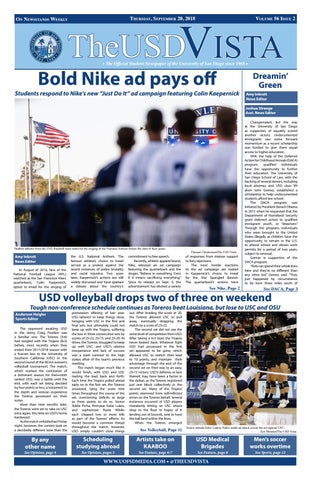
Student athletes from the USD Baseball team stand for the singing of the National Anthem before the start of their game.
Amy Inkrott News Editor
In August of 2016, fans of the National Football League (NFL) watched as the San Francisco 49ers quarterback, Colin Kaepernick, opted to kneel for the singing of
the U.S. National Anthem. The famous athlete’s choice to kneel served as a protest against the recent instances of police brutality and racial injustice. Two years later, Kaepernick’s actions are still widely discussed and have sparked a debate about the country’s
commitment to free speech. Recently, athletic apparel brand, Nike, released an ad campaign featuring the quarterback and the slogan, “Believe in something. Even if it means sacrificing everything.” Since its release on Sept. 3, the advertisement has elicited a variety
Thomas Christensen/The USD Vista
of responses from intense support to fiery rejections. The most hostile reactions to the ad campaign are rooted in Kaepernick’s choice to kneel for the Star Spangled Banner. The quarterback’s actions have
See Nike, Page 2
Changemakers led the way at the University of San Diego as supporters of equality scored another victory. Undocumented immigrants saw some forward momentum as a recent scholarship was funded to give them equal access to higher education. With the help of the Deferred Action for Childhood Arrivals (DACA) program, qualified individuals have the opportunity to further their education. The University of San Diego School of Law, with the backing of several donors, including local attorney and USD class ‘89 alum John Gomez, established a scholarship to help undocumented students afford law school. The DACA program was initiated by President Barack Obama in 2012 when he requested that the Department of Homeland Security grant deferred action to qualified immigrant youth, or “dreamers.” Through the program, individuals who were brought to the United States illegally as children have the opportunity to remain in the U.S. to attend school and obtain work permits for a period of two years, subject to renewal. Gomez is supportive of the DACA program. “Kids can spend their whole lives here and they’re no different than any other kid,” Gomez said. “They just happened by circumstance to be born three miles south of
See DACA, Page 3
USD volleyball drops two of three on weekend
Tough non-conference schedule continues as Toreros beat Louisiana, but lose to USC and OSU The opponent awaiting USD in the Jenny Craig Pavilion was a familiar one. The Toreros (3-6) had tangled with the Trojans (8-3) before, most recently when they ended their 2017-2018 season with a five-set loss to the University of Southern California (USC) in the second round of the NCAA women’s volleyball tournament. The match, which marked the conclusion of a dominant season for then-ninth ranked USD, was a battle until the end, with each set being decided by four points or less, a testament to the depth and veteran experience the Toreros possessed on their roster. More than nine months later, the Toreros were set to take on USC once again, this time on USD’s home hardwood. As the match unfolded last Friday night, however, the contest took on a decidedly different tone than the
postseason offering of last year. USD labored to keep things close, hanging with USC in the first and final sets, but ultimately could not keep up with the Trojans, suffering the loss in three consecutive sets by scores of 25-22, 25-15, and 25-20. At times, the Toreros struggled to keep up with USC, and USD’s relative inexperience and lack of success was a stark contrast to the high stakes affair of the team’s previous meeting. The match began much like it would finish, with USD and USC trading the lead back and forth. Each time the Trojans pulled ahead early on in the first set, the Toreros answered, tying the score nine times throughout the course of the set, overcoming deficits as large as three points to do so. Senior Addie Picha, first-year Katie Lukes, and sophomore Roxie Wiblin each chipped two or more kills as part of the Toreros’ efforts. As would become a common thread throughout the match, however, USD simply couldn’t close things
out. After leveling the score at 20, the Toreros allowed USC to pull away, eventually dropping the match by a score of 25-22. The second set did not see the same level of competition from USD. After taking a 6-5 lead, the Trojans never looked back. Whatever fight USD had possessed in the first set appeared to be gone, which allowed USC to stretch their lead to 10 points, and maintain their advantage through the end of the second set on their way to an easy, 25-15 victory. USD’s defense, or lack thereof, may have been a factor in the defeat, as the Toreros registered just one block collectively in the second set. Many of the Trojans’ points stemmed from self-inflicted errors on the Toreros behalf. Several instances occurred of USD players mistakenly letting an USC attack drop to the floor in hopes of it landing out of bounds, only to have the ball land within the lines. When the Toreros emerged
By any other name
Scheduling studying abroad
Artists take on KAABOO
USD Medical Brigades
Men’s soccer works overtime
See Opinion, pages 5
See Feature, page 6-7
See Feature, page 8
See Sports, page 12
Anderson Haigler Sports Editor
See Opinion, page 4
See Volleyball, Page 11
Senior outside hitter Lauren Fuller sends an attack across the net against USC. Zoé Morales/The USD Vista
WWW.UOFSDMEDIA.COM ◆ @THEUSDVISTA
2
The USD Vista
◆
September 20, 2018
NEWS
Toreros talk Kaepernick protest Nike from Page 1
Students continue to wear Nike apparel despite controversial ad campaign
been seen as disrespectful to the country itself, as well as to those who fought to ensure its safety. First-year student Blake Siniscalchi disagreed with Kaepernick’s method of protest. “I feel he is separating people rather than bringing everyone together,” Siniscalchi said. However, despite the controversy, Kaepernick’s protests continued and other athletes within the NFL joined in on the demonstrations. In September of 2017, President Trump commented on the protests at a rally in Alabama, claiming the athletes should be fired for their actions during the anthem. Soon after the president’s
responded to the demonstrations by destroying their jerseys and boycotting NFL broadcasts. Throughout the 2017 season, the league reported a nine percent drop in television ratings. In May 2018, the NFL instituted a new policy requiring all players on the sidelines to stand for the national anthem, but also provides the athletes with the option to stay in the locker room. Kaepernick has since left the 49ers, and has not been signed by another team in the league. The former quarterback recently announced his intentions to sue the NFL, accusing the league of conspiring to blackball him. However, many fans and team owners supported Kaepernick’s
“To me, what he was doing was the most patriotic thing he could do. With him being in the NFL and having the platform that he did was important because there are minorities that are sill being treated unfairly.”
-Sebastian Simpson
involvement, the number of protests within the NFL exploded with nearly every game having some form of demonstration from the athletes. Bruce Maxwell, a catcher for Oakland A’s, spread the protests beyond the NFL. Angered football fans
movement, as it brought further attention to an important issue. Some news sources have even reported that some members of the military were supportive of the quarterback’s actions, claiming that they fight so that Americans can exercise their right to free speech.
First year Sebastian Simpson also stood by the quarterback’s actions. “To me, what he was doing was the most patriotic thing he could do,” Simpson said. “With him being
Many people took to Twitter to express their frustrations with the company. The hashtags #JustBurnIt and #BoycottNike quickly became trending topics. The social media site was flooded with images of
“Nike sponsors my school, my team, my gear, and it is important to me to know that they are also supporting my beliefs and my values.” -Kadee Sylla in the NFL and having the platform that he did was important because there are minorities that still are being treated unfairly.” Nike’s recent ad campaign celebrated the 30th anniversary of the company’s tagline, “Just Do It.” The commercial, narrated by Kaepernick, included clips from other famous athletes such as Odell Beckham Jr., Shaquem Griffin, Lacey Baker, and Serena Williams. Although it made no mention of the previous protests, Nike’s collaboration with Kaepernick prompted a resurgence of his controversial past. People who were angered by his original protests might also have been angered by the new ad campaign. The “sacrificing everything” tagline proved to be unsettling to some consumers, seeing it as further disrespect to the country’s military.
people burning their shoes, or cutting the logos away from their Nike apparel. Neither Siniscalchi nor Simpson were willing to partake in this boycott. “I think it’s a good message and I stand by it,” Simpson said. “Kaepernick honestly did risk his career in order to take a stand. He’s a good quarterback, but no one wants to sign him on to their team.” All of USD’s athletic teams use Nike gear. However, the program does not show any signs of abandoning the company’s apparel. Junior Kadee Sylla, captain of the USD Women’s Rowing team, is proud of USD’s continued association with Nike products. “Nike sponsors my school, my team, my gear, and it is important to me to know that they are also supporting my beliefs and my
values,” Sylla said. Two universities have chosen to cut their ties with Nike. Both Truett McConnell University and the College of the Ozarks dropped the company’s apparel in response to the Kaepernick ad. Despite the initial dip in performance, the Kaepernick ad proved to be beneficial to the apparel company. After Labor Day weekend, Nike reported a 31 percent increase in online sales. As of Sept. 15, the company’s stock price reached an all-time-high, suggesting that most consumers are not deterred by the ad’s inclusion of the controversial former quarterback. Sophomore Alex Mileti is supportive of Nike’s new ad campaign. “I am not happy with the police brutality in this country, especially against African Americans, Mileti said. “I think it is a peaceful protest that all Americans should be able to exhibit without backlash.” Mileti expressed that she was surprised by the success Nike had in response to the new campaign. However, she is hopeful for what it means for the country’s future. “I know I will still be buying their products,” Mileti said. “It makes me like their company as a whole better because they align with my views.” Despite Nike’s recent financial success, the American public remains divided over the Kaepernick controversy.
BUS & TROLLEY PASS Special student discount. Unlimited rides all semester. $148 USD Undergraduate $162 USD Law
I CHOOSE TRANSIT. How I get there defines me.
On sale until October 6 at the University Center Ticket Office. Price includes a $15 University subsidy. Current, valid college student picture ID required.
sdmts.com/college
Volume 56 Issue 2
◆
NEWS
◆
3
The USD Vista
Helping hand for DACA students USD’s School of Law introduces a new scholarship for dreamers
Warren Hall is home to USD’s School of Law. The law school is supporting its DACA students through its new scholarship.
DACA from Page 1
the line, are we really going to penalize them, marginalize them, or eliminate all possibilities they have for success in our country because of that?” Through this scholarship, Gomez serves as a Changemaker within the USD community and is able to give back to his hispanic
people to thrive. Changemaking and inclusivity are huge morals I live by and they’re big reasons why I came to this school and seeing them play out here honestly makes me feel good about my decision.” However, the Trump administration is looking to take legal action against DACA, questioning the validity of the program and putting pressure on
“I have a passion for equal access and dignity for all people. I really just disdain unfair treatment and exclusion of any kind.” -John Gomez heritage. Although deferred action is used to prevent removal action against an individual, the program does not provide individuals with lawful status. Dreamers are continually forced to renew their status within the program, often with high monetary costs involved. This, coupled with other expenses, makes higher education less accessible to DACA students. When presented with the chance to start a scholarship for dreamers at the USD law school, Gomez jumped at the opportunity. “I have a passion for equal access and dignity for all people,” Gomez said. “I just really disdain unfair treatment, bullying, and exclusion of any kind.” Junior Nick Weber was proud of USD’s commitment to social justice. “I think that this scholarship is providing DACA students with a great opportunity to get an education that they would not have otherwise,” Weber said. “I am very proud that we have alumni here at USD that would do such a thing and create these opportunities for
schools like USD to conform to the country’s immigration policies. USD’s standard of inclusivity remains committed to providing students support in order to give equal opportunity to everyone. In response to President Trump’s comments during the 2016 election, members of the USD community formed a task force with the goal of protecting the school’s dreamers. The task force compiled a list of resources available to these individuals. While not officially
task force, USD School of Law’s Dean Stephen Ferruolo recognized the lack of access to federal financial aid for DACA students. Because of this, Ferruolo emphasized the community’s need for a DACA scholarship. “It is an expression that the community really cares and that there are people who want to support them,” Ferruolo said. “This scholarship is an important step in a process that’s ongoing. These are people in need. And we are taking care of the ones in our community who are most vulnerable.” These undocumented immigrants face challenges not only in obtaining funds for school but also in getting jobs and supporting their families. Ferruolo hopes that this scholarship will enable dreamers to get an education and eventually give back to their community. Sophomore Dave Cardali has had aspirations to practice law since he was in second grade and is excited about USD’s commitment to equal opportunity. “Not everybody has the opportunities that I have been fortunate enough to have in my life,” Cardali said. “I am very empathetic toward those who grew
Amy Inkrott/The USD Vista
TELL US WHAT YOU THINK. SCAN THE CODE WITH YOUR SMARTPHONE CAMERA.
“We are taking care of the ones in our community who are most vulnerable.” -Stephen Ferruolo describing USD as a sanctuary school, the task force chose to implement a series of protections for the community’s dreamer students. Sanctuary schools, like USD, do not require students to report their immigration status and do not assist U.S. Immigration and Customs Enforcement. Throughout his time with the
up less fortunate because of that. I have always been someone who tries to give back to people and spread good vibes. I think that the scholarship is very inspirational and we should definitely support it.” Although the future of DACA in the U.S. is uncertain, the USD law school remains committed to supporting its dreamer students.
RETRACTIONS FROM 9/13 In “Finding your inner superhero” on pg. 3 Bee Carucci was refered to with the improper pronouns, she/her. The correct pronouns are they/them.
4
The USD Vista
◆
September 20, 2018
OP I N ION
By any other name In a predominantly English-speaking university, having a non-anglican name can pose challenges Paulina Sierra Opinion Editor Names play a major part in the lives of everyone, from the way people see themselves to the way people navigate the world. One of the greatest challenges a student at USD or any other U.S. university can face is not having an anglicized name, and therefore challenging American language norms. Mayamiko Matabwa, a USD sophomore who is from Malawi, has always dealt with people having a strong reaction to her name. “I went to an international school, so most of the teachers I had weren’t Malawian,” Matabwa
own community. “I’m from Nigeria, and even there, the name isn’t common,” Bawa said. “For the longest time, no one had the name that I had ever met, because my tribe is small. A lot of people don’t even know the tribe, so a lot of people don’t know how to pronounce my name.” Having a name that is difficult to pronounce can cause a person to decide to use at school a nickname they would prefer to present themselves by on a daily basis. For Matabwa, that name is “Maya.” “All my life, my parents called me Maya,” Matabwa said. “I’ve never really been called Mayamiko.
“I think it just comes back to me being a foreigner in all settings. Because my name here is obviously a foreign name, and my name at home, because of the way I say it, people think I’m foreign. So, I don’t fit anywhere. -Mayamiko Matabwe said. “You could see them starting to struggle. I think it was just because I haven’t had teachers who speak the language, and also because Malawi is such a small country, so the number of teachers in the world who are Malawian is very few.” Similarly, Vayunamu Bawa, a USD senior, has also experienced significant confusion surrounding the pronunciation of her name both on campus and within her
I just default, I don’t even think about the original pronunciation, just because I’m so used to saying just Maya. I never think about pronouncing Mayamiko in its true form.” The decision to use a nickname or to pronounce one’s name in an anglicized way in order to simplify introductions can cause friction with regard to the person’s culture. For Matabwa, not pronouncing “Mayamiko” in Chichewa, the native language of Malawi,
For students with nonanglican names, socializing on camous can be a struggle.
results in the questioning of her nationality. “I think it just comes back to me being a foreigner in all settings,” Matabwe said. “Because my name here is obviously a foreign name, and my name at home, because of the way I say (my name), people think I’m foreign. So, I don’t fit anywhere. At home, people mock me if I say it the way I say it, as if I was to present it here. And it just goes hand in hand with me not being very good at my home language as well. That all plays into being a foreigner here and also at home.” Additionally, while nicknames can be used as a tool to make pronunciation a bit easier for others, creating a nickname for someone whose name is “too hard to pronounce” can be disrespectful. For Bawa, being assigned a nickname at introduction is considered a much more rude reactions than asking for the pronunciation. “In my experience, there are people that think ‘I’m not going to remember this’, but then they keep asking,” Bawa said. “For me, I don’t feel like it’s rude. I guess it’s just cultural differences. But from the beginning, being like ‘oh, can I call you something else?’ and not even ever try again, I feel like that’s more disrespectful.” When it comes to the best way to react to a name that seems difficult to pronounce, both Matabwa and Bawa agree that the most polite thing to do is ask the person what they would like to be called, and respecting whatever they tell you.
“For me, the first thing is just ask,” Matabwa said. “Don’t pronounce things anyhow, because names are very important. I think it just comes back to assumptions, and it is not
difficult to remember allows people to dismiss it easily and externally, as opposed to digesting it in silence and forgetting it at the next opportunity. Despite the difficulty and
“I feel like it has to do a lot with the culture. If you meet anyone...people don’t actually care. It’s not like you’re really starting a relationship.” -Vayunamu Bawa good to assume, it’s better just to ask. Being someone with a unique name in this context, it just shows that someone cares, to try and ask.” Bawa believes that the lack of effort people put into pronouncing her name reveals something more negative about society: a lack of caring. “I feel like it has to do a lot with the culture,” Bawa said. “If you meet anyone, you’re just like ‘oh hey, what’s your name?’, and people don’t actually care. It’s not like you’re really starting a relationship.” For Bawa, the way people react to her name at USD is indicative of something deeper than just language and culture difference; in her perspective, the culture of apathy towards acquaintances in the U.S. is high. While most people can agree that simple introductions may not always matter, just how little they matter is of note to her. In Bawa’s eyes, the problem of how people react to a hard-to-pronounce name is not truly about the name itself, and never was. The problem is that having a name that is more
uncomfortable insights into American culture, both Matabwa and Bawa are happy to have their names. “I really like my name because it is so rare and unique, so I’ve always felt special,” Bawa said. For Matabwe, having a name that is uncommon is an opportunity to educate people about her culture. “Here, I feel great because I’m unique,” Matabwe said. “I’ve got a cool-a** name. I can tell people about it, and then I can tell them about my country.” Existing in a way that is “difficult” for people to understand is always a challenged, and this is emphasized even more when it is an issue of names and cultural identity. While names can seem trivial to those who have never encountered difficulty with them, others’ reactions can shape the way the person navigates the world. It is important to go about these introductory interactions with respect, and perhaps even shift how introductions are approached; what is often seen as an obligation, can be viewed as an
Courtesy of the USD Media Gallery
Volume 56 Issue 2
◆
OPINION
◆
The USD Vista
Overseas to get degrees
5
Students and faculty discuss the pros and cons of studying abroad
Tori Thomas Assistant Opinion Editor When at the University of San Diego, it is likely someone will mention the study abroad program, whether it be an advisor, a tour guide, or a friend who read about it online. According to The Power of International Education, USD’s study abroad program ranks second among national doctoral universities for undergraduate study abroad participation. According to the International Center’s website, 80% of USD’s undergraduate students study abroad.
Junior Melody Day, marketing intern at the International Center, went abroad in the spring of her sophomore year to England, studying at St. Clare’s and Oxford University. For her, deciding where to go was easy. “It’s always been a dream of mine to study abroad in England,” Day said. “It was one of the reasons that I came to USD, because I knew they offered a program that studied abroad in Oxford. I am a Marketing major and an English minor, and I knew they offered a lot of English classes at Oxford.” Senior Stephanie Richardson, who studied abroad in Edinburgh,
“It’s always been a dream of mine to study abroad in England. It was one of the reasons that I came to USD, because I knew they offered a program that studied abroad in Oxford.” -Melody Day Student studying abroad in Sydney enjoying a view of the Opera House.
There are many places to take your abroad experience here at USD, whether it be Japan, Ireland, the United Kingdom, Italy, France, Spain, or many more. There are 30 different countries that can be visited in over 80 different programs. Semester-long programs come in two different forms: exchange or through an affiliate. International Center counselor Alana Thomas described the difference between the two programs. “Exchange programs require a little more flexibility in their schedule as well as independence,” Thomas said. “In affiliate programs, they are based on the academic structure of U.S. schools. So the student wouldn’t have to use special grading scales and the classes will be structured similarly. For exchange programs, that institution has the structure of what is normal in that country.” For many, an abundance of options can feel overwhelming.
Scotland during the fall of her junior year, was so wooed by her experience that she wants to return to Europe in the near future. “I really want to go back,” Richardson said. “I’m actually thinking of possibly attending graduate school in the United Kingdom.” Senior Caitlin deBoer also took advantage of the abroad program at USD not once but twice, spending a semester in Prague and an intersession in London. “It changed my life,” deBoer said. “Traveling and being forced to grow through the independence that is involved.” Studying abroad, however, is not without its difficulties, and not every moment can be an international fantasy. Issues can still arise no matter how memorable and exciting the overall experience may be. Despite Richardson’s love of the program, she expressed that it caused hardships in her USD academic life.
Courtesy of USD Media Gallery
“As a biochem major, going abroad definitely set me back in classes,” said Richardson. “I’m taking a much harder class schedule now as a senior.” In many cases, it’s all about picking the right program, which might not always be an easy task. There are many different issues that can factor into the decision of where a student goes on their overseas adventure. deBoer highlights the importance of choosing your destination as an individual, not as a friend. “Picking the right place for you is important,” deBoer said. “A drawback I saw was people... going where their friends went and not enjoying it as much.”
Not all study abroad programs easily transfer into USD curriculum, and it is important to pick transferrable classes and a location from which credits transfer. For example, in the psychology department, there are only a few programs where the psychology courses offered are equivalent on USD’s campus. At some international universities, such as in Edinburgh where Richardson studied, visiting students are only allowed to take certain courses. Thomas had some recommendations as to how students looking to go abroad should choose the program best suited for them. “Academics are the most important (consideration),”
“As a biochem major, going abroad definitely set me back in (terms of) classes. I’m taking a much harder class schedule now as a senior.” -Stephanie Richardson
USD students abroad in Cape Town, South Africa Photo courtesy of USD Media Gallery
Thomas said. “It’s important to get the classes that (students) need. If a student is trying to decide between multiple programs, I’d recommend somewhere that means something to them. Some people have goals like becoming fluent in another language or they want to go somewhere that their families are from.” The International Center attempts to make studying abroad as accessible to students as possible at USD. There are a wide variety of resources available to help ensure that the transition to a foreign country is smooth. Day recommends looking into the curriculum of the program before choosing it, as there are specific classes offered to abroad students that are not part of normal USD curriculum..“There’s a class specifically for people who want to go abroad,” Day said. “Study Abroad 101. Students are also able to make appointments with counselors here one on one. I definitely felt supported going abroad.” Students can also receive financial help for making their international dreams a reality. All financial aid given to students in a regular semester transfers to the abroad programs as well. There are also resources provided by the International Center to make short term (abroad) sessions, such as summer or intersession, affordable as well. There are needbased scholarships as well as a newly implemented social media scholarship, which is brand new this summer. While the scholarship is new, Day discussed the information available about it. “Students compete prior to the program start date to see which person will get the scholarship,” Day said. “Once the person goes abroad they send pictures three or four times a week to our accounts and then we repost them to the USD study abroad instagram and facebook.” Study abroad is a unique opportunity for undergraduates, and USD offers a large program. It is definitely worth a look for any undergraduate wanting to expand their horizons.
6
THE USD VISTA
Quinn XCII (right) had an early set at KAABOO Del Mar, but that did not stop hundreds of people from attending his performance. With a yellow 3D screen behind him, he performed his hit songs such as “Another Day In Paradise,” “Always Been You,” and “Flare Guns.” Quinn XCII also brought out Chelsea Cutler to perform a song with him. Quinn XCII ended his performance with the crowd’s favorite, “Straightjacket.”
◆
SEPTEMBER 20, 2018
Chelsea Cutler (left) is a rising introspective EDM artist. She recently dropped out of Amherst College to pursue her music career, but started out by making music in her dorm room. She arrived onstage in a San Diego State University basketball jersey No. 21. On the stage was only herself, her drummer, and a keyboard that she was using to make her live remixes. She performed “Your Shirt,” “The Reason,” and her newest single “Cold Showers.” She also performed several other cover songs.
KAABOO
Brings Another Weekend in Paradise
Volume 56 Issue 2
◆
FEATURE
◆
THE USD VISTA
7
A white curtain hides the entire stage. For several minutes, fans were screaming. The curtain falls as Halsey (left) starts performing “The Prologue.” She wore a red checkered crop top that showed off her many tattoos along with embroidered denim jeans. During several of her songs there was fire exploding onstage in the background, sending a wave of heat toward the crowd. She performed “Hurricane,” “Gasoline,” “Heaven In Hiding,” “Strangers,” “Roman Holiday,” and “Eyes Closed.”
During a technical malfunction Halsey distracted the audience by telling them that this is her last show in America for a long time because she will be busy writing her next album. She ended her performance with a song that everyone in the crowd could sing along to, “Bad At Love.”
Imagine Dragons (above) began their show with a drum intersession. All four members of the band were playing the drums in unison at the top of the stage. The beating stopped as the members ran to their respective places on the stage. Lead singer Dan Reynolds, shirtless, began to hype up the crowd as the group started to play.
Photos Courtesy of Alive Coverage
Smoke and fire overwhelmed the stage as the crowd started to recognize that the band had broken into the song “Radioactive,” and the cheering began and never stopped. Imagine Dragons then performs “Whatever It Takes,” “I’ll Make It Up To You,” and “Yesterday.” The guitarist Wayne Sermon had several guitar solos that drove the crowd wild.
Dan Reynolds took several breaks during his performance to preach about mental health issues. He even held a flag while he performed that said “Destigmatize mental health. ”He then sang his popular song “Demons,” and related it to his experience with and diagnosis of depression a few years ago. He then ended their performance with another extremely popular song, “Thunder.”
Spread by Monica Millan/ The USD Vista; Content by Jennifer Mossuto/The USD Vista
8
The USD Vista
◆
September 20, 2018
F E AT U R E
Med brigades inspires Toreros USD participates in the largest student-led movement for global health Emma Goodman-Fish Assistant Feature Editor Don’t use the term “Third World Country” around Stephanie Roessler, a USD student who is dedicated to breaking down the barriers between her classmates and developing countries. Roessler became interested in helping people of different cultures when she first joined Medical Bridges, a part of the “largest student-led movement for global health.” “The idea that I could be part of such a positive change as a freshman was so intriguing to me,” Roessler said. The organization first caught her eye as a pre-med student, but became much more than an opportunity to simply practice medical skills in a foreign country. After being accepted into the program in 2016, Roessler joined over 20 students on a week-long trip to Nicaragua, where they planned to work hand in hand with the community and give them the resources and independence to overcome the struggles they continue to face. At the end of her week-long trip, Roessler had fallen in love. “I got the chance to connect with so many community members, to have met their beautiful families and shared our life experiences with one another,” Roessler said. Since her first trip to Nicaragua, Roessler has been on six different Brigades including additional trips to Nicaragua, Ghana, Honduras, and most recently, Panama. Twentyfive students joined the Panama trip including two group leaders, Roessler, President of Medical Brigades, and her Co-President, Andrew Gatto. For the Panama Brigade, the
especially with such eager-to-learn individuals,” Roessler said. “It’s the most emotionally and scholastically interactive station and it’s where we can really develop friendships with the community members.” Roessler shared how deeply these interactions stuck with her. Since these Medical Brigades have left such a strong impact on Roessler, she encourages others to take this opportunity as well. “Do it because it scares you,” Roessler said. “The more you can push yourself outside your comfort zone, the better. Trying to speak someone else’s language and learn their culture is a lot of hard work, but it can help you not only better understand other people, but also the world.” Roessler emphasizes that the issues Medical Brigade are trying to tackle are not things that can be done alone. She needs everyone to be a part of the change. “You don’t need to be Pre-Med, or know anything about medicine or even be interested in that career path,” Roessler said. “As long as you want to help others and form international relationships then you would be a great fit.” Brigades doesn’t just claim to change the world, it changes individuals too. “I use Brigades as my New Year, every single Brigade is like a reset button for me,” Roessler said. “I remember what really matters most to me, what matters most to other people, how I can continue to make a change with what I have been given, and how I can learn so much from these individuals abroad with what they have been given. To recognize there is more outside of your own life bubble, the better, and that’s what Brigades really gave to me.”
“The idea that I could be part of such a positive change as a freshman was so intriguing to me.” -Stephanie Roessler group arrived on a Sunday and began medical packing immediately the following day. This is one of the most important parts of preparation for setting up the clinics themselves, and the entire team works together to sort medications into 30-day dosages to give out free of charge for patients seen in-clinic. In the next three days, actual clinics were created. One station had certified Panamanian and U.S. doctors who gave professional diagnoses for illnesses to people in the community. Roessler shared a very special part about Panama. “We had an optometry station, which was totally student run,” Roessler said. “There was no professional optometrist, but students got to learn how to prescribe reading glasses and more.” The most important and empowering station for Roessler was the “Charla’” Clinic, which means “chat” in Spanish. Here, people of all ages are given education on holistic topics that most people take for granted. Lessons are shared in how to wash your hands, brush your teeth, why it is important to clean your water, and more. “It’s a really special station
Roessler has been dedicated to Medical Brigades for her entire college career, but others are just starting out. Sarah Kushner, a current sophomore at USD, went on her first brigade as a first-year student and was also left with many impactful lessons from her Nicaragua trip. “I think a lot of people go on these service trips with the notion that they are going to change the world or drastically change someone’s life, but at the end of the day you’re not going to be that hero, nor do these people need one,” Kushner said. “However, demonstrating altruism, whether it be in a foreign country or in your own community, helps propagate some degree of positive change. If everyone did their part the world would be a much better place.” College students are often considered to be in the formative years of their lives, finding out what they want to do and who they are going to be. Taking the opportunity to understand other cultures, places, and people gives developing individuals the chance to step outside their own world and define themselves in a different way.
Stephanie Roessler smiles alongside Andrew Gatto while in Panama.
Roessler in Panama with a local child while working on her most recent brigade.
Photo Courtesy of Stephanie Roessler
Photo Courtesy of Stephanie Roessler
Volume 56 Issue 2
◆
ARTS & CULTURE
◆
The USD Vista
A RT S & C U LT U R E
9
KAABOO Del Mar turns four KAABOO Del Mar features diverse lineup and luxury festival-going experience
Wiz Khalifa performs on stage at KAABOO Del Mar.
Dorothy Dark A&C Editor
KAABOO is committed to creating an event that engages the audience through all facets of creative expression, including comedy shows, live music, art installations, and food and beverage tastings. Names like Wiz Khalifa, Slash, Gucci Mane, Blondie, and Jimmy Eat World were all featured on the weekend’s lineup, creating a diverse music experience that included a number of different genres. There’s little that KAABOO did not offer. However, in its efforts to interest a wide array of attendees the event created a sensory overload that drew away from the attractions individually. For three days, entertainment was everywhere you look and all this came with a number of relaxation services posted throughout the
Quinn XCII performs on stage at KAABOO
fairgrounds. As a result, there was a lacking sense of community that one might expect to encounter in a festival setting. The whole thing was, undoubtedly, a spectacle. But if the traditional music festival experience is what you’re seeking, this is not the event for you. Friday night had an energy about it that hung over the Del Mar Racetrack + Fairgrounds. Driving into KAABOO meant lines of traffic for extended periods of time, with brief interruptions from staff reminding visitors the entrance is on the second right, definitely not the first. After scanning in, the space opened up to violet-tinted lights covering hundreds of people scattered amongst tents and stands. The smell of gourmet food and sweaty fans overwhelmed the senses, but it did little to dull the grandeur of the event. The stages flashed with light shows for various different perform-
Dorothy Dark/The USD Vista
ers, occasionally illuminating the murals and art lining the corridors. Screams from crowds drowned out surrounding conversation, but the excitement was contagious. Before long, the familiar sound of Post Malone’s “Congratulations” carried across the festival grounds and it was in full gear. Three days went by, with slight variations. On Saturday, the heat of the day did little to calm visitors at KAABOO. Earth, Wind, and Fire delivered one of the most remarkable sets, giving their audience as much of themselves as they’ve got. They exuded energy, and each song sounded as lively as the next. Despite the length of their career, they exceeded any bar set by previous performers. All three men proved to the younger generation attending that they’re not done. Imagine Dragons performed to a massive crowd with true confidence in the music they bring. Lead vocalist Dan Reynolds’ voice echoed beyond the Rolling Stones’ Sunset Cliffs Stage, with great clarity and strength. His songs were interrupted by intermittent rants from Reynolds on his struggles with depression, creating a sense of intimacy with the audience that seemed to illicit even more cheer from the crowd. “Destigmatize Mental Health” read a flag that he held above for all to see, and before long their hit song “Demons” played through the speakers. The band capped off the evening with an energized performance and important message for those listening. Sunday featured some of the biggest names from this years’ lineup. Chelsea Cutler’s lively performance went beyond her scheduled set as she accompanied Quinn XCII for his rendition of their song “Flare Guns (ft. Chelsea Cutler).” Slash delivered a remarkable show, resounding crisp instrumentals across the festival in the late afternoon.
At 5:45 p.m., a large crowd gathered around the Rolling Stones’ Sunset Cliffs Stage once again, anticipating the arrival of artist, songwriter, and actor Wiz Khalifa. Upon
Dorothy Dark/The USD Vista
seventy dollars and thirty three cents, but if Shervon is your driver it’s worth every penny. En route back to school, one couldn’t help but discuss the size of KAABOO and
Post Malone performs on stage at KAABOO Del Mar Photo Courtesy of Alive Coverage
taking the stage, the audience sang alongside his every song, demonstrating their support and solidifying his major success. Wiz Khalifa matched everything the audience gives him, returning their enthusiasm with spirited renditions of hits and recent releases. “We Dem Boyz” and “Young, Wild and Free” brought overwhelming cheers from his listeners, and he kept spirits high with songs off his most recent album “Rolling Papers 2.” “Hopeless Romantic” followed “Fr Fr (ft. Lil Skies)” and he refused to stop, continuing with chart-toppers such as “See You Again (ft. Charlie Puth).” Wiz Khalifa gave his all to KAABOO, as did a number of the other performers featured at the festival. A Lyft back from KAABOO to the USD campus could potentially cost
the ease with which one can move through the crowds. The attendance was so large that the festival sold out before day one, but the presence at concerts paled in comparison to initial expectations. The performances were memorable, but there was something underneath it all. The art that KAABOO made sure to amplify is of the greatest quality, but it felt diminished by distraction. There’s an expectation with any festival that involves a sense of community with one another, and one might go so far as to say KAABOO sacrifices that for the sake of luxury. It does, however, succeed in its mission to transform the festival paradigm.
10
The USD Vista
◆
September 20, 2018
Students on Art: Part One
Community responds to questions on the definition, impact, and necessity of art in the modern world Dorothy Dark A&C Editor Beyond the University of San Diego’s Art Department is a community of passionate individuals with artistic visions that are uniquely their own. Art is a multi-faceted form of creative expression, and it holds very personal significance for those who devote themselves to the field. When discussing the many forms that art may take, individual perspective plays a significant role in how one’s understanding manifests creatively. In hopes of providing honest and relevant content to the USD Community, we turn to you, the students. The “Students on Art” series seeks to highlight students on campus who consider art to be a foundational part of their daily lives. Over the course of five interviews with various students, common definitions of art will be set aside to further examine its fluidity. Students will, in conversation, offer up their understanding of art and the role it plays in the community. Through examining a few of the opinions
which shape USD’s community, we find that strangers who walk the same routes to class may not be so far away. For Lorenzo, art has always served as a creative outlet. It works as a means to make sense of what’s before her, to better process daily trials and tribulations. Her admiration for art is clear in conversation, and her own work varies from doodles in class to watercolor to collage. She knows the significance of art in her life, and she shared a few of her thoughts on the motives and impacts in the art she’s encountered. DD: “What’s your personal understanding of what qualifies as art?” KL: “Art as I understand it is one of those words that you can’t really put into a single definition. Every time you try to confine it to one thing something else breaks the confinements on your definition again. I’m not trying to be vague, but it’s something created by a human being that stirs an emotion.” DD:
“What
was
your
first
memorable encounter with art?” KL: “My first memorable encounter with art was when I was in middle school and wrote my very own original song for this weird mandatory singing thing at my school. This song was awful, obviously, but I really liked writing music after that. When things got really bad for me, like mentally, I started writing them down in song lyrics. I think I wasn’t really comfortable with the whole diary thing and songs just felt more casual yet authentic to me. I never really share most of my songs but they made me feel better.” DD: “What do you like to make artwise?” KL: “The thing that I draw the most often is admittedly a mandala in my class notes.” DD: “Why?” KL: “I really like these because the repetition is really, really soothing for me. Each one is always a little bit different from the last so I know that I’ll never run out of things to draw. When I’m super stressed out I like to draw a mandala and add a layer everytime I feel like crying or
something. At the end of it all it’s just really nice to see something beautiful come out of all that work and emotion.” DD: “What art do you see regularly on campus?” KL: “When I used to have a class in Camino, I would regularly admire the changing art in the basement hallway as I walked to class. On a wider scale I don’t really see that much art on campus besides the architecture of course.” DD: “What about art serves as inspiration to you?” KL: “Everything about where we are located serves as inspiration for me. I like to pay extra attention to the skyline when I’m driving so I can doodle it later in class, when I’m bored. I love drawing the ocean and the city skyline so...” DD: “Why do we need art?” KL: “I think we need art because I don’t really think we can live a healthy life without it. Like I said, art covers a huge scope of things from music, to fashion, to literature, and even just language.
Art exemplifies human success because it proves that our society has advanced enough to use their time on art. We crave it and often base our entire lives around art. It’s a way to express yourself in a way that someone else might hopefully understand. And that understanding is all we really crave
“It’s a way to express yourself in a way that someone else might hopefully understand.” in life. So yea, I think we need art.” With that, Lorenzo departs but her words linger. Indeed, art works as a means to cope with daily stress and exhaustion. It provides the means by which something beautiful can emerge from distress. And, often, it works as a reminder that even the greatest pain and affliction is not felt alone. With art, people put forth physical representations of their experience and in doing so open themselves to others who may feel the same. It’s the basis of community, and it’s a practice in empathy. Spend time talking about art. Chances are someone somewhere feels what you feel
SEND YOUR COMICS TO VISTAEDITOR@SANDIEGO.EDU
The USD Vista Luke Garrett - Editor in Chief Kaia Hubbard - Associate Editor Hannah Sonberg - Managing Editor Kathryn Querner - Copy Editor Monica Millan - Art Director Lexi Crea - Assistant Art Director Amy Inkrott - News Editor
Editorial – 619.260.4584 Business – 619.260.4714 www.uofsdmedia.com ◆ @TheUSDVista
Paulina Sierra - Opinion Editor Jennifer Mossuto - Feature Editor Dorothy Dark - Arts & Culture Editor Anderson Haigler - Sports Editor Thomas Christensen - Photography Editor Zo é Morales - Photo Assistant Richard Benson - Distribution Editor
Elizabeth Brunelli - Finance Manager Rachel Steinheimer - Advertising Manager Gina Lew - Student Media Advisor Marie Minnick - Operations Advisor
The USD Vista publication is written and edited by USD students and funded by revenues generated by advertising and a student fee. Advertising material published is for information purposes only and is not to be construed as an expressed or implied endorsement or verification of such commercial venues by the staff or University. The USD Vista office is located on the fourth floor of the Student Life Pavilion in room 403B. All inquiries should be sent to: The USD Vista 5998 Alcala Park San Diego, CA 92110 The first copies of the newspaper are complimentary, all copies thereafter are a 25 cents charge. Opinions expressed in this publication are not necessarily those of The USD Vista staff, the University of San Diego or of its student body. Letters to the Editor can be submitted to The USD Vista office. Letters should be limited to 300 words and must be signed. For identification purposes, USD identification numbers and writer’s year must be included in the letter. The USD Vista reserves the right to edit published letters. Any content sent to the editor will be considered for publication unless otherwise stated.
Volume 56 Issue 2
◆
SPORTS
◆
11
The USD Vista
SP ORT S
A learning process for volleyball Head coach Jennifer Petrie places an emphasis on team development amidst Toreros’ early struggles
Junior Anna Newsome, senior Lauren Fuller, and first year Kelli Barry maneuever against an attack while on defense. Fuller (middle) is one of just three seniors on the Toreros’ 19 player roster. Thomas Christensen/The USD Vista
Volleyball From Page 1
from the locker room following the second set and began the third, though, it appeared that they had made adjustments to better counter the Trojans. For the first time that night, USD took the lead, beginning with a 5-3 advantage
her perspective on her team’s temporary momentum shift. “We changed a few key players, we gave some other people some opportunities,” Petrie said. “Roxie Wiblin was really hot for us offensively so we put her in a little more of an opportunity to get some swings. We changed
“I mean, we fought, but we just have to execute at the end...taking care of the little plays and being super disciplined — that’s what we missed out on.” -Katie Lukes early on. First-year outside hitter Katie Lukes spoke about her team’s mid-match adjustments following the conclusion of the contest. “I think that from the beginning we came out with a different energy, way different energy,” Lukes said. “We were just mad at our play, so to come out and play like we wanted to beat them, that totally shifted the tone of the game.” USD women’s volleyball head coach Jennifer Petrie gave
the lineup a little bit, who was playing where, to see what kind of production we could get at the end.” Their lead, however, was both slim and short lived. Though the Toreros appeared to be playing better, and closer to the level of their opponent, they were once again unable to maintain their lead down the stretch. USD went on to relinquish their advantage at the 20 point mark, eventually losing by a score of 25-20 despite
The USD bench reacts to a point against USC. The Toreros went 1-2 on the weekend. Zoé Morales/The USD Vista
five kills from Lukes and four from Wiblin. Lukes, who led the Toreros with ten total kills, assessed her team’s overall performance on the night. “I mean, we fought, but we just have to execute at the end,” Lukes said. “And that’s what we need to work on in practice this week. Just being able to put the ball away at the end and taking care of the little plays and being super disciplined — that’s what we missed out on.” The defeat illuminated what has become a common theme for the Toreros this season: growing pains. Gone are USD’s four seniors of last season — former West Coast Conference (WCC) Player of the Year Kristen Gengenbacher and All-WCC right side hitter Jayden Kennedy among them. Petrie described her roster as “young,” as just three of the Toreros’ 19 players are seniors, and this assessment has become increasingly notable as the season progresses for USD. Talent on the roster remains — first year Katie Lukes, sophomore Roxie Wiblin, and seniors Addie Picha and Lauren Fuller are testaments to that, among other talent on the Torero depth chart. However, the Toreros’ rocky start against a myriad of ranked opponents (four out of nine total games) may have shown that USD’s current youthful roster may need a bit of additional seasoning before it can ascend to the levels of success attained in years past. Petrie addressed her team’s early-season struggles. “Our team is really working hard to find a groove,” Petrie said. “We’ve got so many new players and I’m really proud of the way they’re coming out and battling every night and competing and trying to learn, but we’ve got so much youth and we’re playing
some of the best teams in the country.” Like Petrie said, USD’s development as a team and the hurdles associated with it has been more glaring as they take on a high level of competition. According to Petrie, though, their schedule is difficult by design, and she sees value in going head to head with the best in the nation. “We could’ve had a really easy schedule and had a lot more wins, but at the end of the day if you want to be one of the best in the country you have to play them,” Petrie said. “(In the top 25) is where we want to be, and that’s where we train to be. No matter who we put on the court, that’s our expectation
Jacobsen, and Fuller, but dropped their matinee offering to the Beavers, 2-3. Though they rallied from a 2-1 set deficit to force a fifth set, double digit kills from Fuller, Picha, Wiblin, and Lukes paired with 44 assists from junior Hannah Newsome weren’t enough for the Toreros to complete their comeback, leaving USD with a 1-2 record on the weekend. The remainder of USD’s schedule is comprised completely of WCC games. Petrie said that her team is well prepared as they head into conference play. “I think that going into conference, (the Toreros) are going to feel really confident, because they’ve had that match play to rely
“Our team is really working hard to find a groove...I’m really proud of the way they’re coming out and battling every night...but we’ve got so much youth and we’re playing some of the best teams in the country.” -Jennifer Petrie of training and being at that level. It’s an opportunity (for the Toreros) to gauge themselves and see what they have to get better at. Right now we’re trying to take the lessons within the game itself. Sometimes the results aren’t what we are hoping for, but there’s a lot to be learned from playing these types of opponents.” After the loss, which was part of the annual SDSU/USD Challenge, the Toreros played two more matches, one early Saturday morning against the University of Louisiana at Lafayette, and another later that afternoon against Oregon State University. The Toreros won the first match against the Ragin Cajuns in straight sets behind 10 kills each from Picha, junior Megan
on,” Petrie said. USD takes on the Saint Mary’s University Gaels at 7 p.m. this Thursday in the Jenny Craig Pavilion to begin West Coast Conference play.
USD VOLLEYBALL HOME SCHEDULE: USD vs. Saint Mary’s Thursday, Sept. 20 @ 7 p.m. USD vs. Pacific Saturday, Sept. 22 12 p.m. USD vs. Portland Thursday Sept. 27 @ 7p.m.
12
The USD Vista
◆
September 20, 2018
Men’s soccer works overtime Thursday: USD falls to Cal State Fullerton 1-0 in hard-fought loss
Alyssa Sanchez Contributor The University of San Diego men’s soccer team lost to Cal State Fullerton 0-1 in overtime on Sept. 13 after an extremely competitive game. The Toreros took the field with lots of energy as they began their game against the Titans. With quick footwork and precise handling of the ball, the USD players dominated the field. Their aggressive offense and strong defense led to many narrowlymissed goals that kept up their morale during the lengthy game. Although USD had control of the ball at many times, the Titans had a number of close shots themselves. Cal State Fullerton had to keep up with the pace that the Toreros had set from the beginning. The crowd held its breath each time the ball neared the goal or bounced off of a goal post. Luckily for the Toreros, USD’s goalkeeper Matt Wiher brought his A-game and stopped the ball multiple times. “I always love making saves because usually my team warms up behind the goal and whenever I
do something I always hear a ‘good job’ so it’s rewarding,” Wiher said. Wiher, who had a total of four impressive saves in the game, explained that a lot of work goes into each game. “The home games are always the most important,” Wiher said. “The fans come out, the students, we appreciate them and just try to work hard for them. We put a lot of preparation in and practice every day.” As the game progressed, USD fans watched in anticipation as forward players Allen Luhrs and Cameron Kaemerle worked together to take the ball to the Titans’ box. It was ultimately lost due to a tangling of their feet with the opposing players’. Not long after that close encounter with the Titans, the game reached halftime and remained scoreless. USD went into the second half playing even stronger than the first after having some changes made to the lineup by head coach Brian Quinn. “We reshuffled our lineup at halftime and really set ourselves more into the game,” Quinn said. “We looked like a lot more dangerous of a team in that
second half.” There were a couple of injuries that occured after halftime that led to some players being subbed out of the game. The intensity of the men’s competitiveness grew, and with that came more contact between the players. Charly Anguiano, a Cal State Fullerton forward, collided with Wiher and brought him down, which prompted USD athletic trainers to take a look at him. Wiher then shook off his injury and got back into position, as he was not yet finished with the game. There was a continuous back and forth between the teams as they tried desperately to score. USD was determined to keep its side of the field free of Titans. Though they found their way in, the players from Fullerton were quickly turned around as USD defense stole back the ball. Players raced toward each other, nearly banging heads as they jumped as high as they could to head the ball to their own teammates. The enthusiasm from the crowd grew as students cheered for their friends on the field. There was a loud “Oh!” from the crowd whenever a shot was taken.
The clock neared the 90-minute mark, but the game was still 0-0. Many shots were taken by both teams as they tried to score before regulation time ended. Before either team could score, the time had run out and sent the game into overtime. “We wanted to attack this goal because we always seem to have more success,” Quinn said about the team’s plan for overtime. “We wanted to try and test the Fullerton defense and get in behind them, get some crosses in.” Both teams had a lot of determination going into overtime. As the first overtime period neared its end, Fullerton player Robert Coronado was given a free kick from 30 yards. With USD players lined up and their goalkeeper in place, the men tried to block the ball from entering their goal. The ball bounced off of a player’s head and passed right over Wiher and into the goal, ending the game 0-1. “It was a good shot but it took a deflection,” Quinn said. “It’s tough to lose 0-1 in any college game. Unfortunately it didn’t go our way.” Although the game did not end in favor of the Toreros, their
coach was still proud of how they played. “I think our goalkeeper was stellar. He had really good saves that kept us in the game. In the second half, our midfield was good,” Quinn said. Wiher suggested that he and his teammates take more shots during their practices to prevent another game like this. “We had a lot of chances in the box and I think we dominated in their half, just that final touch is what we needed,” Wiher said. “We’ll work on some finishing practice and rest up too because these games take a lot out of you. I think we have a couple of injuries so we should rest and focus.” Home games are always important to USD, and coach Quinn is determined to have his players win them. “We’ve got more opportunities at home, we enjoy playing here, but we’ve got to get the win,” Quinn said. Following the overtime defeat, the Toreros would take on the UNLV Rebels last Sunday evening in another home game at Torero Stadium. Weekend coverage of the Toreros continues below.
Sunday: Toreros prevail in 100th minute for an overtime victory over the UNLV Rebels
Left: Sophomore Reuben Dass tangles with a CSUF player during the Toreros’ loss on Thursday. Right: Junior Miguel Berry vaults over a Rebel defender. Berry had three shots on goal in USD’s 1-0 victory on Sunday. Thomas Christensen/The USD Vista
Eric Boose Contributor First-year forward and San Diego native Alex Churness scored his first career goal for USD deep into overtime to lead the Torero men’s soccer team to victory against the University of Nevada, Las Vegas (UNLV) Rebels 1-0 on Sunday night. The victory was USD’s third this season, and their first in four overtime games. Churness missed two good chances to score only minutes earlier in the game. With under a minute left in regulation, Churness headed the ball just wide of the goal. Three minutes into overtime, Churness found himself faceto-face with UNLV goalkeeper Enrique Adame, but kicked the ball right into Adame’s midsection. “I knew I was going to get another solid chance,” Churness said about his goal. With only 41 seconds remaining in the first sudden-death overtime period, USD defender Patrick Krall crossed
the ball into the penalty area. Krall’s cross flew past third-year forward Miguel Berry, but found Churness waiting at the penalty spot. “I was waiting for the opportunity, saw the ball come in, and hit it back in the net,” Churness said. USD started the match well, and the Toreros were on the front foot for much of the first 30 minutes. Thanks to early pressure on the UNLV defense, Berry and fellow forward Allen Luhrs both had chances to score, only to be turned away by last-minute blocks from the Rebels. Solid midfield play earned most of USD’s scoring chances in the first half, with Luhrs and second-years Ross Meldrum and Paul Ramlow consistently earning and maintaining possession. Berry had one more good chance to put USD ahead in the first half, but Adame denied Berry in a one-on-one situation. Despite losing the midfield battle, UNLV earned some early
scoring chances on breakaways, with forwards Marco Gonzalez and John Lynam tormenting defenders throughout the match. Gonzalez fired a shot from long range that went just wide in the 16th minute of the match, and Lynam forced a close-range save from USD goalkeeper Connor Hountalas in the 30th. The match became more balanced after the 30th minute, when USD defender Aidan Marmion limped off the field with an apparent knee injury. UNLV had the best chance to score before halftime ten minutes after Marmion’s injury. The referee awarded the Rebels a free kick 20 yards away from goal, and Hountalas made a terrific diving save, tipping the shot onto the crossbar. The second half began much like the first half ended, with both teams trading scoring chances. First-year Cameron Kaemerle had a good chance for the Toreros, dribbling past three
UNLV defenders before his shot was blocked. The Rebels’ best chance came from Jesus Partida, whose shot from distance forced Hountalas to make a fingertip save. Partida’s shot was one of the last quality chances in the match, as both teams began to fall victim to fatigue. USD had played 100 minutes of soccer three days earlier, and UNLV was coming in two days after a 3-2 win at UC Riverside. USD men’s soccer head Coach Brian Quinn, in his first year at the helm after 12 years as an assistant, was not surprised by tiring players. “We knew it was always a game that was going to be decided by a good play, or a mistake,” Quinn said. “As the game went on guys were getting tired, misplaced passes, some little mistakes here and there.” In overtime, the Toreros seemed to control the game. In the 93rd minute, Churness spun past a defender, only for Adame to deny the first-year forward. With
41 seconds remaining in the first sudden-death overtime period, Krall dribbled the ball down the far sideline before crossing the ball into the box. Krall’s cross missed Berry at the near post, but Churness beat his defender to the ball in the air and headed it into the back of the net for his first goal as a Torero. “The goal was a quality goal, so I was pleased with that,” said Quinn. Churness’s goal was only the sixth the Toreros have scored all season, each scored by a different player. According to Quinn, the team can do better. “What we’re trying to do is deliver the ball earlier into the box, and encouraging people to continually make the runs whether you get there or not,” Quinn said. “Just have the confidence to expect to be on the end of a cross, take shots from outside the box, and I think we’ve got enough good players that the goals will come.” USD’s next home game is versus CSUN on Sept. 23. at 6 p.m.