TheUSDVISTA
Volume 55 Issue 5
Thursday, October 12, 2017
On Newsstands Weekly
◆ The Official Student Newspaper of the University of San Diego since 1968 ◆
IN THIS ISSUE Rise of Catalan independence See NEWS, page 1
Tragedy strikes Puerto Rico See NEWS, page 3
Aftermath of Route 91 festival See OPINION, page 4
Homecoming right around the corner See OPINION, page 6
Faculty Feature: Andrew Tirrell See FEATURE, page 7
“An Inconvenient Sequel” screening See FEATURE, page 7
B.o.B to perform at homecoming See ARTS & CULTURE, page 11
Looking up at student art See ARTS & CULTURE, page 12
Padres’ patience is a virture See SPORTS, page 14
Traveling with a Torero See SPORTS, page 16
Politics within Catalonia USD perspectives on illegal referendum to declare independence from Spain
Lilyana Espinoza News Editor Catalonia is one of the wealthiest regions in Spain and tensions between the Spanish and Catalan governments have been building for centuries. The President of the Catalan government since January 2016, recently called for a referendum to establish the independence of Catalonia. A referendum is a vote by the people in which the president attempted to prove the Catalans want to be independent from Spain. Junior Jenna Rochon is currently studying abroad in Madrid and recognized the tension between Spain and Catalonia while visiting the wealthy city of Barcelona. “Even when we were there, our professors told us it was better to speak English in public than Spanish because of the tensions,” Rochon said. “That is the only place we were told that because usually people are rude to you if you speak English, but it’s worse if you speak Spanish.” Professor Martin Repinecz, who teaches Cultural History of Spain at the University of San Diego, gave insight on the events that led Catalonia to this point. “The country we know as Spain was formed by the gradual union of smaller kingdoms and territories over the course of several centuries throughout the Middle Ages,” Repinecz said. “Many of these smaller areas retained a distinct sense of identity and culture, and Catalonia is no exception. For hundreds of years, Catalan language and culture were marginalized by the political and cultural hegemony of Castile and its language.”
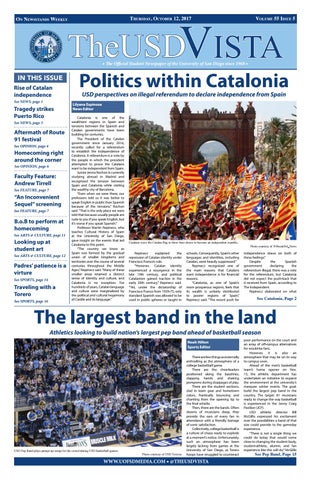
Catalans wave the Catalan flag to show their desire to become an independent republic.
Repinecz explained the repression of Catalan identity under Francisco Franco’s rule. “However, Catalan identity experienced a resurgence in the late 19th century, and political Catalanism gained traction in the early 20th century,” Repinecz said. “Yet, under the dictatorship of Francisco Franco from 1939-75, only standard Spanish was allowed to be used in public spheres or taught in
schools. Consequently, Spain’s other languages and identities, including Catalan, were heavily suppressed.” Repinecz recognized one of the main reasons that Catalans want independence is for financial reasons. “Catalonia, as one of Spain’s more prosperous regions, feels that its wealth is unfairly distributed to poorer regions of Spain,” Repinecz said. “The recent push for
Photo courtesy of @BreakPol_News
independence draws on both of these feelings.” Despite the Spanish government declaring the referendum illegal, there was a vote for the referendum, but Catalonia did not expect the push-back that it received from Spain, according to The Independent. Repinecz elaborated on what
See Catalonia, Page 2
The largest band in the land Athletics looking to build nation’s largest pep band ahead of basketball season Noah Hilton Sports Editor
USD Pep Band plays pumps up songs for the crowd during USD basketball games.
Photo courtesy of USD Toreros
There are few things as externally enthralling as the atmosphere of a college basketball game. There are the cheerleaders positioned along the baselines, clapping hands and shaking pompoms during stoppages of play. There are the student sections, clad in team gear and hometown colors, frantically bouncing and chanting from the opening tip to the final whistle. Then, there are the bands. Often dozens of musicians deep, they provide the ears of every fan in attendance with a friendly barrage of sonic satisfaction. Collectively, college basketball is a culture of chaos ready to explode at a moment’s notice. Unfortunately, such an atmosphere has been largely lacking from games at the University of San Diego, as Torero hoops have struggled to counteract
WWW.UOFSDMEDIA.COM ◆ @THEUSDVISTA
poor performance on the court and an array of off-campus alternatives for would-be fans. However, it is also an atmosphere that may be on its way to campus soon. Ahead of the men’s basketball team’s home opener on Nov. 15, the athletic department has undertaken an initiative to expand the environment at the university’s marquee winter events. The goal: build the largest pep band in the country. The target: 81 musicians ready to change the way basketball is experienced in the Jenny Craig Pavilion (JCP). USD athletic director Bill McGillis expressed his excitement over the possibilities a band of that size could provide to the gameday experience. “There is not a single thing we could do today that would come close to changing the student body, student-athlete, alumni, and fan experience like this will do,” McGillis
See Pep Band, Page 15
2
The USD Vista
◆
October 12, 2017
NEWS
Catalans call for independence Spain’s response to referendum with police brutality fuels the flame for Catalan independence
Catalonia, from Page 1 Catalan independence would mean for Spain and the European Union (EU). “A successful secession of Catalonia would give momentum to other separatist movements in Spain and throughout Europe, which EU leaders believe would weaken a post-Brexit EU even further,” Repinecz said. In order to prevent voting on the referendum, Spanish police were positioned throughout the streets of Catalonia. Nevertheless, Catalans made their way to the poll booths — some managed to place their votes while others were attacked by Spanish police. Over 800 Catalans were injured during the attempted referendum, according to CBS News. Derek Brendel, USD International Studies Abroad Coordinator, recognized that police brutality was a strong way of handling the referendum. “It is very difficult to justify police brutality in most situations,” Brendel said. “Controlling crowds
has its challenges and hopefully moving forward Spanish law enforcement will be able to diffuse similar situations peacefully.” According to CNBC, after the referendum it was reported that 90
international student from Andorra, a state that borders Catalonia, is worried for what the future holds for his Spanish family back home. “My father went to take money from the bank because they are
“Catalonia, as one of Spain’s more prosperous regions, feels that its wealth is unfairly distributed to poorer regions of Spain.” -Martin Repinecz percent of voters voted to become independent; however, that was only 42 percent of the total Catalan population. Sala said she has many questions for what will happen when she returns to Catalonia after her semester at USD. “So what happens if when I come back I am in a new country not recognized by anyone?” Sala said. “The coin, my passport, where I am from — I would be from an illegal country? What is an illegal country?” Pol Ulier Bernaus, a current USD
saying probably next week they will be blocking bank accounts and he was nearly robbed today,” Ulier said. “Catalan people are getting really nervous about what is going to happen after the independence, if they get it.” According to Ulier, Catalan independence efforts are causing a lot of uncertainty and may have negative effects. “If Catalans do the right thing and the right process of getting into the European Union and arranging all the economy to make a new country, then of course Catalonia will prosper and be bigger and probably one of the wealthiest countries in Europe,” Ulier said. “With that, then Spain would lose a lot. But if Catalans don’t do the right thing,
which is not what they are doing, then we will lose a lot.” Professor Aldara Fernandez Sierra, a Madrid native, explained that although she found the way Catalans were approaching independence wrong, they deserve the chance to be heard. “For me, and for many Spaniards, [Catalans] are part of the country and they are part of our identity,” Fernandez said. “So that makes you think how can anyone leave like that? But it’s true that there is a history of many regions deciding to be independent so we should let them choose, but inside of the boundaries of the law. Personally,
excuses the other. “I think the [Spanish] government got frustrated and just took the easiest way out, which is violence, but it was clearly wrong,” Diaz said. “However, that still doesn’t excuse the [Catalans]. I think dialogue is the only solution I see this working.” Spanish citizens in Barcelona wore white to promote a peaceful solution for the heated feud between governments. Others in Madrid dressed in the Spanish flag to show Spanish unity. Recently, the President of Catalonia addressed the public regarding his stand on the road to
“So what happens if when I come back I am in a new country not recognized by anyone? The coin, my passport, where I am from — I would be from an illegal country? What is an illegal country?” -Laura Sala Espina I don’t share that point of view. I understand I am from Madrid, but at the same time I think that they should be heard.” Elena Diaz, a USD international student from Galicia, Spain, recognized that both parties have done wrong and no one action
Catalan independence. He plans to continue seeking independence; however, he is currently suspending the declaration of independence. The president found that dialogue with Spain is the responsible way to continue with the road toward independence.
Protesters gather in the streets of Spain wearing white clothing to display peace. Photo courtesy of Jenna Rochon
The people of Spain showed their support for a united Spain. Photo courtesy of Jenna Rochon
The USD Vista Tayler Reviere Verninas - Editor in Chief Elisabeth Smith - Associate Editor Kelly Kennedy - Managing Editor James Douglas - Copy Editor Kaia Hubbard - Assistant Copy Editor Rita Srekais - Art Director Max Escutia - Assistant Art Director Lilyana Espinoza - News Editor
Catalonia is one of Spain’s wealthiest regions, and is located in the north-east region.
Editorial – 619.260.4584 Business – 619.260.4714 www.uofsdmedia.com ◆ @TheUSDVista
Nicole Kuhn - Assistant News Editor Taryn Beaufort - Opinion Editor Victoria Zielinski- Assistant Opinion Editor Celina Tebor - Feature Editor Anderson Haigler - Arts & Culture Editor Noah Hilton - Sports Editor Walker Chuppe - Photography Editor Cyrus Lange - Photo Assistant
Ana Contreras Orozco - Photo Assistant Alex Worden - Distribution Editor Bailey Marie Donnelly - Finance Director JacquelynVanDenburg-Advertising Manager Gina Lew - Student Media Advisor Marie Minnick - Operations Advisor
Rita Srekais/The USD Vista
The USD Vista publication is written and edited by USD students and funded by revenues generated by advertising and a student fee. Advertising material published is for information purposes only and is not to be construed as an expressed or implied endorsement or verification of such commercial venues by the staff or University. The USD Vista office is located on the fourth floor of the Student Life Pavilion in room 403B. All inquiries should be sent to: The USD Vista 5998 Alcala Park San Diego, CA 92110 The first copies of the newspaper are complimentary, all copies thereafter are a 25 cents charge. Opinions expressed in this publication are not necessarily those of The USD Vista staff, the University of San Diego or of its student body. Letters to the Editor can be submitted to The USD Vista office. Letters should be limited to 300 words and must be signed. For identification purposes, USD identification numbers and writer’s year must be included in the letter. The USD Vista reserves the right to edit published letters. Any content sent to the editor will be considered for publication unless otherwise stated.
Volume 55 Issue 5
◆
NEWS
◆
The USD Vista
Riding the wave after the storm
3
Hurricane Maria leaves an impact on Puerto Rico and the USD community
The homes of Puerto Ricans were destroyed as a result of Hurricane Maria. Photo courtesy of @USCGSoutheast/Twitter
Nicole Kuhn Assistant News Editor The sun rises each morning over the rolling hills of Puerto Rico, but the daily routine of the Puerto Rican people has changed. On Sept. 20, thousands of civilians’ homes were flooded and nearly or completely destroyed by Hurricane Maria. Heavy rain and winds of about 175 mph hit the island, classifying it as a category five storm. The hurricane left some citizens without water, electricity, and/or shelter for months to come. This isn’t the first time Puerto Rico has been hit by a major hurricane. Over the past few weeks Hurricane Maria has been all over the media. The rise of foreign reporters’ social media usage and instant updates has helped raise awareness of natural disasters that previously would not have gained global recognition. Lieutenant Jorge Fuentes, Assistant Professor of Naval Sciences
at the University of San Diego, was born and raised on the island until he joined the Navy. Fuentes discussed how differently Hurricane Maria has been covered compared to previous disasters. “A lot of people don’t have
Puerto Rican pride still shines through in the aftermath of the storm.
40 minutes from any major city,” Fuentes said. “With a 3,000 foot elevation you have to go through the mountains. The biggest challenge is communication and clearing.” Fuentes was only able to talk to
“My mom called me saying that I had to make sure I talked to my family because it was going to be the worst hurricane in the history of Puerto Rico.”
-José Martinez the perspective that Puerto Rico has had four major catastrophes in the past 40 years,” Fuentes said. “Twenty years ago we had the same situation, we just didn’t get that much attention.” Fuentes explained that his mother drove an hour through the mountains to the nearest city that had phone reception. “My hometown is very remote,
The people of Puerto Rico face the damage that Hurricane Maria wreaked on their home.
his mother for five minutes. “All my immediate family is in Puerto Rico — I’m the only one here,” Fuentes said. “There’s no reception where we are because of the storm — no Internet, no phone.” Sophomore basketball player José Martinez, born and raised in Puerto Rico, faced similar problems when trying to communicate with his family. Martinez was in his room
when he first heard about the hurricane from his mother. “My mom called me saying that I had to make sure I talked to my family because it was going to be the worst hurricane in the history of Puerto Rico,” Martinez said. “It was very sad and scary at first.” Sept. 19 was the last time that Martinez said he spoke with his family. “I haven’t talked directly to my family, but I heard from some family friends that the hurricane didn’t do anything to the house where my family was staying at, which was my father’s house,” Martinez said. Today some citizens are still without water or electricity. Photos circulate the internet of flooded homes and long lines of people waiting for fresh, clean water. “I think that the government is working hard, but I also think it took them awhile to start working with Puerto Rico and helping them,” Martinez said. “As a US territory, they were supposed to move faster and in a better way. I also think that the economics topic is something
Photo courtesy of @Forbes/Twitter
Photo courtesy of @CNN/Twitter
that should be a concern right now for the president of the US. What should matter is that a lot of kids don’t have a place to sleep at, a lot of kids and people don’t have water to drink, and that 1.3 million people don’t have electricity.” Martinez has hope for Puerto Rico and its ability to get through this disaster. “Puerto Rico has been used to this — because this was a long time coming,” Martinez said. “The hurricane brought a wakeup call. We’ve recovered before, and we are going to recover again.” Martinez also said that going forward it’s important for the USD community members as global citizens to be aware that Puerto Ricans are our brothers and sisters. “I think people need to take a look at what the US has beyond its borders, and you have American citizens everywhere — it’s important to be more conscious of that,” Martinez said. Today the island still suffers major loss and the relief effort is slowly trickling in. Some celebrities such as Beyonce, Lin-Manuel Miranda, and Pitbull have taken initiative to help Puerto Rico. Beyonce released a remix to the song “Mi Gente” on Instagram for relief efforts. Latin American pop singer Pitbull transported cancer patients from the island to the US to help continue their treatments, and Youcaring, a fundraiser organized by Ricky Martin, raised $2,959,238 for Puerto Rico. Miranda, the writer of the famous musical “Hamilton,” also composed a song titled “Almost Like Praying” that featured famous Latin American artists including Marc Anthony, Jennifer Lopez, and Gloria Estefan to name a few. According to NBC News, 85 percent of Puerto Rico still has no power. Martinez is still waiting to hear back from his family. “I just want them [people] to pray for my family and for my homeland; that’s all I can ask for,” Martinez said. The US government has stepped in and President Trump has visited the island, but the efforts have been slow for the most part. With help from local communities and relief efforts from organizations, citizens are slowly regaining strength.
4
The USD Vista
◆
October 12, 2017
OP I N ION
Route 91 aftermath hits
Students reconsider attending major public events after the most recent shooting Taryn Beaufort Opinion Editor On Tuesday Oct. 3, Jason Aldean released a statement saying he decided to cancel the upcoming weekend shows “out of respect for the victims, their families, and our fans” following the Route 91 Harvest Festival tragedy. Many students had purchased tickets prior to the shooting in hopes of attending a country-filled evening with friends. Most concertgoers would be upset to hear that one of their favorite performers had canceled the show. Even after purchasing her ticket months in advance, senior Hannah Healey understood why Aldean canceled the upcoming show. “I had a feeling that he [Jason Aldean] would cancel the show, but I was surprised to see how long it took for him to announce it,” Healey said. “I was expecting him to cancel the show right away, because many people need to mourn what happened and reflect on the horrible incident that happened in Las Vegas.” It didn’t take Healey long to realize what would be the right thing to do. Upon hearing about the Las Vegas shooting, she instantly called to cancel her ticket to the upcoming show. “I didn’t think it would be respectful to all the people at the Route 91 Harvest Festival if Jason Aldean were to play another concert just a week later,” Healey said. “I didn’t find it appropriate to pretend like nothing happened the week before and go out and have a good time listening to a concert.” However, not all fans were expecting the concert to be canceled. Junior Nathan Sauer believed that despite the tragedy Aldean would continue with the tour, but ultimately understood why Aldean decided to postpone
the concert. “It would have demonstrated the American spirit and perseverance that we do not let tragedy and destruction slow us down,” Sauer said. “If he had decided to play, I’m sure some sort of tribute would have occurred.” The tragedy in Las Vegas did not change Sauer’s plans to attend Aldean’s scheduled San Diego concert. “I do not let disturbed acts disturb my day,” Sauer said. “The shooter was a coward and does not deserve the recognition of instilling fear into the average American. His name, not the act, should be forgotten.” While Sauer believed that Aldean canceled the show because it would be too hard to go back on stage after what happened, not all students were like-minded. Junior Jeffrey Webb held the belief that there were other reasons that factored into the postponement of the concert. “I believe Aldean canceled the concert solely for political or media-related reasons,” Webb said. “Maybe in his own heart he couldn’t see himself performing, but I believe he was pressured by publicists and the media to cancel concerts.” However, Aldean made a live appearance on Saturday Night Live this past weekend. He performed several songs and he claimed that he is still struggling to understand what happened. He reached out to those affected by the calamity on SNL. “We hurt for you and we hurt with you, but you can be sure that we’re going to walk through these tough times together every step of the way,” Aldean said during his performance. “Because when America is at its best our bond and our spirit, it’s unbreakable.” Webb was hopeful that Aldean would perform the rest of his scheduled tour. “I think that by holding the concert, he, and the people attending, would show the world we will not be easily influenced by
Jason Aldean performing on Saturday Night Live on Saturday Oct. 7, 2017.
terrorism,” Webb said. “It would be a show of strength to the nation.” While some might feel a little more fearful of attending the concert, Webb said he would not. “I didn’t feel any fear toward attending the concert,” Webb said. “In fact, it almost made me want to attend more to show the rest of the world we cannot be swayed.” The cancellation of the concert has left many students with mixed feelings. The aftermath of the Route 91 festival has left students unsure of their everyday safety and security. Movie theaters, night clubs, concerts, airports — it may seem like no place is safe. The recent state of violence in the US caused senior Kaitlyn Kirkegaard to reevaluate what public events she will attend in the future. “I’ve been hesitant to go to majorly populated events like midnight movie premieres, large festivals, and the San Diego Fair,”
Jason Aldean’s Statement “As a result of what happened in Las Vegas this week, we have decided to cancel this coming weekend’s shows. I feel like out of respect for the victims, their families and our fans, it is the right thing to do. It has been an emotional time for everyone involved this week, so we plan to take some time to mourn the ones we have lost and be close with our family and friends. Our plan is to resume the tour the following week in Tulsa, Oklahoma. Our first time back onstage will be a very tough and emotional thing for us, but we will all get through it together and honor the people we lost by doing the only thing we know how to do — play our songs for them. I hope everyone understands why we can’t play this weekend and I’m sorry if anyone is disappointed. Thank You and God Bless.” - JA
Kirkegaard said. “This fear does not cripple me or prevent me from leaving the house, it just makes me more cautious of my surroundings and following my gut feeling.” As a result, Kirkegaard now puts more consideration into the venue of an event than she would have in the past. “I am a little worried to attend a major event like that [a large concert],” Kirkegaard said. “It also makes me consider venues and their surroundings. I will be unlikely to go to something in a city with all the tall buildings around and not a lot of ways to easily leave the situation.” Kirkegaard wondered how security measures could change to prevent violence. “I think that security will be tighter and the venue is an important part too,” Kirkegaard said. “I think that the Vegas strip will probably enforce some sort of luggage screening process like at the airport. It makes me think of 9/11 and how the security system at airports became so much more intense.” With all the shootings that have happened in public settings, junior Andie Zaharias-Kern reconsidered how she feels about her personal safety. “I am definitely more aware than I ever have been in these public settings,” Zaharias-Kern said. “At the same time, it is a reminder that life is short and you can’t hide from fun experiences because of fear.” Last Wednesday ZahariasKern’s family attended a Coldplay concert in the Bay Area only a few days after the Las Vegas shooting. “I had massive anxiety the night they were going to the concert,” Zaharias-Kern said. “I sent them all a text in our group chat at 8 p.m. saying, ‘I love you all.’” When Zaharias-Kern learned that the Las Vegas shooter tried to target other major festivals prior to Route 91, the thought of loved ones attending a concert left her uneasy. “It hit too close to home,”
Photo courtesy of Rich Redmond/ Twitter
Zaharias-Kern said. “I didn’t know if the shooter was working with anyone or if someone would attempt to do something similar. There is just a lot of unknowns right now.” It’s saddening to think that places meant for leisure activities may now be dangerous places to be. “It’s a shame that these public spaces are tuning into ‘danger zones,’” Zaharias-Kern said. “There is so much negativity and bad happening in the world that these spaces are supposed to be an outlet for people to let loose and live freely. Not worry about being shot.” Senior Ava O’Brien thinks there is more of an underlying issue when it comes to these mass shootings. There are many theories as to why the US has been experiencing such tragedies, including the need for stricter gun laws. “I believe we have seen an increase [in violence] lately because of the easy access of guns,” O’Brien said. “There needs to be a change in gun laws.” The Las Vegas shooting has been proclaimed the worst mass shooting in modern US history. Some have compared its impact to 9/11 because it could lead to procedural changes in hotels. O’Brien believes that there will be change, but she is still unsure of how far those changes will go. “I know that there has been discussion about security in hotels changing,” O’Brien said. “Perhaps they may have random bag checks or metal detectors that guests are required to enter upon arriving and leaving.” The Route 91 Harvest Festival demonstrated to USD students the unpredictability of their environments. What started out as a few occasional attacks making appearances on headlines has created a constant state of fear among students. The only thing to do is be more aware of their surroundings as they attend large public events.
Have an opinion? Write a Letter to the Editor to be considered for publication in The USD Vista. Contact vistaeditor@sandiego.edu for more information. The views expressed in the Opinion section are not necessarily those of The USD Vista staff, the University of San Diego, or its student body.
Volume 55 Issue 5
◆
OPINION
◆
The USD Vista
Getting involved pays back
5
Telefunding employees disclose the importance of alumni donations Victoria Zielinksi Asst. Opinion Editor When alumni of the University of San Diego look back on their time as Toreros, their fondest memories of USD may vary. It could be their favorite professor or the proximity of the beach, but chances are their memories include activities, friends, and opportunities that came about through being involved on campus. At the University of San Diego Telefunding Center, student callers tap into these memories to raise funds for USD by making phone calls to a network of over 35,000 alumni, parents, and friends of the university, as stated on the Telefunding website. Student employees shared insight into the Telefunding Center and their duties to the university as callers. Sophomore Tyler Arden, a student caller, explained the importance of alumni giving back in relation to USD’s status. “Not many people know that the percentage of alumni that give back affects our national ranking,” Arden said. “That’s the main reason we encourage all of our alumni to participate in giving back at any amount they can.” Arden stated that telefunding callers suggest different areas in which alumni can support the university. “Alumni mostly give back to the Alcala Alumni Fund to support scholarships and the greatest needs here on campus,” Arden said. “When we are talking with them though, we suggest funds that they can give to that match their passions and groups they were involved with when they attended school here.” Student callers update alumni on current happenings on campus so that they can feel better connected to the school they once called home. “Basically, the goal of telefunding is to reach out to our alumni and let them know about what’s happening here on campus and to encourage them to give back to the university,” Arden said. Arden explained that a lack of interest from alumni can be discouraging to the student callers who are trying to raise funds for the school. “It’s always tough when alumni
are apathetic to giving when their support means so much for all of us students here,” Arden said. Arden is also impressed by the care and awareness of alumni who give back to their alma mater. “USD provides so much to us students that wouldn’t be possible without support from alumni,” Arden said. “It’s always amazing to see the generosity of Toreros in how they pay that support forward to the next generation of students here.” Senior Michaela Conley explained that telefunding calls are generally positive. She stated that alumni are excited to hear about the school and what has changed, especially if it has been awhile since they graduated. “Of course, there are some exceptions when alumni are straight up rude or indifferent to our call,” Conley said. “But since most alumni enjoyed their time at USD, they are usually happy to hear from us.” Conley shared that telefunding calls are very organized, and that the student callers have insight into each call they are making. “We have certain lists that we call, and each of us sit at a computer with an automatic calling system that dials through the lists,” Conley said. “We can see the caller’s personal information, their involvement at USD, and their donation history. Based on that, we mold our calls to them. Some examples of our lists are Law, School of Business, Young Alumni, and we even have a list in which we call previous telefunders, which is a fun list to call because the people we’re talking to understand the process.” As far as speaking with lessthan-willing alumni, Conley stated that callers are prepared to deal with disgruntled alumni. “If people are irritated by our call, they usually just don’t pick up,” Conley said. “In training, we go over very specific ways in which to deal with alumni that are upset, so we usually have replies for most of their complaints. However, that really is the rare case and most experiences are positive.” Conley stated that she would definitely be apt to donate to USD through telefunding in the future. “Once you work for telefunding, you realize how integral donating is for the university,” Conley said. “As a private school, all of our funding has to come from alumni
A pair of telefunders sitting at their individual desks while making their nightly calls.
A telefunder worker making to various alumni and parents in search of donations.
or individual donors, so giving back is important. I understand that student loans are insane, and that’s a common argument that we get. However, as someone who is on scholarship, I can attest to how important the generosity of alumni is to students like myself.” Since donations are a fundamental aspect of students’ lives, deciding whom to call is important. “We call alumni more often, so I would say alumni donate more,” Conley said. “Parents usually donate at a higher amount, but that is because our asking amount for them is higher. However, we only call parents for a short time during the semester.” Senior Tandy Johnson-Cryns, a student [telefunding] manager, shared that call recipients reactions are generally positive, except for the occasional irritated alum. “We find that young alumni usually give a small amount, most likely because their memory of USD is so fresh,” Johnson-Cryns said. “Parents tend to give a lot, because they have the money to do so, and they want their kid’s school to be great.” Johnson-Cryns explained that the work environment of the telefunding office makes it an
Cyrus Lange/The USD Vista
enjoyable position to hold during the school year. “My favorite part is the community that we have in the office,” Johnson-Cryns said. “I’ve made my best friends from telefunding, and you learn a lot in the process. Callers care about the cause and they are good at calling so they learn why the job is so important.” Junior Samantha Carpenter, a student caller, has been working at the Telefunding office for a year now, and she expressed how the funds are used for many outof-classroom opportunities for students that they may not receive elsewhere. “Internships, travel to conferences, scholarships, and Torero Treks are just some of the experiences the funds go towards,” Carpenter said. “It’s also interesting for alumni to share how the campus has changed since they attended USD.” As far as donating as a future alum, Carpenter stated that it depends on what kind of job she secures to be able to spare some of her paycheck back to USD. “I think USD alumni would like to give back to their school, but sometimes it just isn’t possible at certain points in time,” Carpenter said. “Someone who just got a job out of school will probably be thinking about paying rent and groceries, not about donating to USD.” Jared Coleman, the Telefunding manager, explained that the overall goal of Telefunding is to raise money for different initiatives on campus. These can include scholarships, financial aid, faculty enrichment, new buildings, technological updates, and materials for the library. “Typically we raise about $400k each year — the funds go to whichever designation the donor chooses,” Coleman said. “Usually it is our Alcala Alumni Fund for our alumni, Parents Fund for parents, and Law Annual Fund for our law alumni.” The Alcala Alumni Fund supports the university’s greatest needs and impacts all of campus, according to the
Cyrus Lange/ The USD Vista
Alumni Association website. The Parents Fund for parents supports scholarships, the development of academic programs, and the maintenance of campus facilities, as stated on the parent relations website. The Law Annual Fund works toward advancing USD’s reputation and increasing the value of a USD Law degree, according to the USD School of Law website. Coleman stated that alumni who were more active in campus life typically have more ties and connections to USD than alumni who were not as involved. “Usually our alumni who were involved on campus, such as any club, sport, or events, tend to give back more than others,” Coleman said. “They have more of a connection to the university, and the caller has more to work with when trying to build rapport about USD.” Because telefunding calls may be unexpected, Coleman said that recipients of the calls can have different reactions when receiving a random call from an unknown number that turns out to be the telefunding office. “Usually our parents think something has happened to their child when we first call, but afterwards they are always excited to hear from a student who is like their own,” Coleman said. “With alumni, a majority have had a good experience with the university and enjoy hearing what has changed since they have left.” Alumni support is not just important for receiving new buildings or books; it is also vital to the overall experience and education of current Toreros. For many students, graduation may simply be a thought far into the future. For others, it could be right around the corner. The importance of alumni donations weighs the same no matter what year a student may be. It is important to recognize alumni who support current students were also supported by alumni at one point. This cycle will continue as the Torero alumni network expands with each graduating class.
Have an opinion? Write a Letter to the Editor to be considered for publication in The USD Vista. Contact vistaeditor@sandiego.edu for more information. The views expressed in the Opinion section are not necessarily those of The USD Vista staff, the University of San Diego, or its student body.
6
The USD Vista
◆
October 12, 2017
Holding out for homecoming USD gears up for the upcoming Homecoming and Family Weekend festivities
Outside the doors of the SLP hangs a banner commencing Homecoming and Family Weekend.
Victoria Zielinski Asst. Opinion Editor Former and current Toreros are eagerly gearing up for this weekend’s Homecoming and Family Weekend from Oct. 12-15. At the University of San Diego in past years, this has meant a concert, tailgate, and football game. These traditions may be typical to a college campus, but USD’s website advertised a “re-imagined weekend” for Homecoming 2017. In anticipation of the homecoming football game against Morehead State University on Saturday Oct. 14, a tailgate will be held before the game for students and families to celebrate, as well as a homecoming concert. Rapper B.o.B will be performing at the Big Blue Bash Concert on Friday, Oct. 13. The concert is free for students and their families to attend.
The website highlights reliving good times, reconnecting with great friends, and creating new memories. The events of homecoming at USD seem to cater toward alumni, with many class reunions of students from various graduating years. Currents students at USD can enjoy the homecoming concert and football game, and they have the opportunity to connect with former Toreros. Junior Ell Repsher shared that she is most excited to attend the B.o.B concert. “I remember I loved the song ‘Airplanes’ in middle school, so I was so excited when I found out B.o.B would be performing,” Repsher said. “It’ll be such a throwback and so fun to go to with my friends.” Repsher’s family will not be attending family weekend this year, but she has fond memories of her parents visiting for family
Walker Chuppe/The USD Vista
weekend in the past. “My younger brother attends USD too, and my parents visited my sophomore year for family weekend,” Repsher said. “We had a fun time going to the beach together and then attending the football game. I have really fond memories of the weekend and encourage people to take advantage of all the activities.” Junior Jazmin Gonzales is looking forward to attending her first football game at USD. “Even though I’m a junior, I haven’t been to a USD football game yet” Gonzales said. “I think Homecoming Weekend would be a good first” Gonzales shared that in the past she did not have an interest in attending the homecoming game, but this year she is eager to attend the tailgate and share her support with fellow Toreros. “I’m excited to go to the tailgate before the game and
The Torero store is filled with USD gear students and families can wear and buy. Walker Chuppe/The USD Vista
show my school spirit by wearing all blue,” Gonzales said. “I’ve been to tailgates at other schools, but I’m not really sure what to expect from USD.” Junior Megan Herz is also excited to attend the homecoming football game, as her parents and brother will be traveling from the Bay Area to visit for Homecoming and Family Weekend. “It’s nice that Homecoming Weekend also includes Family Weekend because it gives my family a reason to come down and visit,” Herz said. “We’re going to all go to the football game together, and then we’re going to go out to eat and explore San Diego over the weekend. It’ll be fun to spend time with them because I won’t see them again until Thanksgiving.” Homecoming and Family Weekend offers a variety of activities that families can participate in, such as kayaking with Outdoor Adventures at
the Seven Caves in La Jolla or moonlight canoeing on San Diego Bay. Students and families will also have the option to participate in ‘The Amazing Torero Race.’ They will race around the campus exploring hidden gems and completing various challenges. Herz also said that it gives her family a chance to spend time on campus. “I plan on showing them the new Colachis Plaza and how that area looks totally different now,” Herz said. “They haven’t seen the campus since they helped me move into my dorm last year, so they’ll get to see how it’s changed.” No matter what Toreros’ plans are for the weekend, it seems that homecoming weekend is bringing a new buzz of excitement to those who will be attending. Hopefully, students’ plans for the weekend will provide enjoyment and lasting memories of Homecoming and Family Weekend for years to come.
Rita Srekais/The USD Vista Have an opinion? Write a Letter to the Editor to be considered for publication in The USD Vista. Contact vistaeditor@sandiego.edu for more information. The views expressed in the Opinion section are not necessarily those of The USD Vista staff, the University of San Diego, or its student body.
Volume 55 Issue 5
◆
FEATURE
◆
7
The USD Vista
F E AT U R E
Faculty Feature: Dr. Tirrell
Political science professor’s research focuses on coastal fisheries and climate change Kennedy Avery Contributor Professors at the University of San Diego are more than just educators within the campus community; they are also changemakers. With expertise on a whole host of subjects, professors at USD add to the dialogue on subjects stretching from the environment to politics. In the case of Andrew Tirrell, Ph.D., of the Political Science Department, these two subjects overlap. Tirrell has a background in human rights law and international relations, and his research has focused on fisheries management in New England, Norway and New Zealand. By this measure, Tirrell has a special eye for climate change. “I have been very concerned about climate change since the early 2000s, when the U.S. pulled out of the Kyoto Protocol, the
change is affecting coastal fisheries and how fishermen are responding to laws aimed to make their current practices more sustainable. “To get everyone on board, you have to balance ecological, economic, and social interests, and you have to make all of those elements work in both the short term and the long term; that is part of what makes fisheries management so tricky,” Tirrell said. Tirrell completed his Ph.D. in International Relations by writing his dissertation on “The Role of Institutions in Fisheries Management.” With a degree in international law, Tirrell was curious as to why some laws succeed and other laws fail. Today, Tirrell is working on a book in which he challenges the idea that laws succeed or fail based on how they are written and implemented. Questioning these assumptions, Tirrell hypothesized that trust in the government
“Apart from teaching, scholarly writing, and working on task forces and other policy efforts, I’d say that my most important engagement is as a citizen.” -Andrew Tirrell first international agreement to limit climate change,” Tirrell said. “Additionally, with the results of the United Nations Climate Change Conference of 2009 in Copenhagen, I realized how difficult it would be for humanity to change course quickly enough to avoid climate-related tragedies of the type that we have seen this year.” His current research, in addition to his involvement in two off-campus separate task forces, contributes to the knowledge and understanding of how climate
has an effect on whether a law is accepted or rejected by the people. In speaking with fishermen about their attitudes toward new laws regulating how many and what kinds of fish they are able to catch in an effort to improve sustainability, he found that trust in government did in fact play a factor. Tirrell discovered that Norwegian fishermen were not necessarily ecstatic about the regulations, but they trusted there was good reasoning behind them. In the United States, on the other
Tirrell at his fisheries research field site in Andoya, Norway, above the Arctic Circle.
hand, New England fishermen were unhappy with the regulations and they distrusted that there was a greater good or that climate change was truly dangerous. With these concerns, New England fishermen protested the law. Tirrell explained that there are even fisheries-management concerns not far from home. In the Gulf of California the existence of a rare porpoise, the vaquita, is endangered. The vaquita is captured in gillnets aiming to catch the totoaba fish, whose bladder is used for medicinal purposes in East Asian countries, and is illegally traded for up to $10,000. Today, the vaquita’s numbers amount to only 30. Tirrell is working through the Environmental Defense Fund on a Gulf of California Task Force to save the vaquita. This illegal trade is more complicated than a mere distrust of the government’s objective. Its international nature
requires the cooperation of the US, Mexico, and China. Even though students cannot inform policymaking or take actions to save the vaquita in quite the same way as Tirrell has, it does not mean that they are sitting ducks. All students have the chance to be engaged citizens. Tirrell is concerned about climate change, even though the current administration has refuted the idea that it exists. “Apart from teaching, scholarly writing, and working on task forces and other policy efforts, I’d say that my most important engagement is as a citizen,” Tirrell said. College students can further develop an understanding of climate change and become versed in specific local issues by speaking with professors on campus, attending lectures, or even volunteering with the environmental voter project. Students can be cognizant of
Photo courtesy of Andrew Tirrell
their transportation and power usage. Most importantly, many students have the opportunity to vote in state and national elections. “The number one most important thing any citizen can do in relation to climate change is to think about the environment and climate change when they vote,” Tirrell said. This is particularly sound advice for young adults who care about the environment, because as Tirrell points out, it is the youth population of today that will truly have to live with the issue of climate change. “The mentality that we can’t do anything to change climate change is what keeps us in danger,” Tirrell says. Students’ youth, inexperience, and miniscule position in the larger whole does not hold them back from taking concrete, actionable steps, small as they may be.
“An Inconvenient Sequel” screens The sequel to Al Gore’s first documentary was screened with a live Q+A with one of the film’s directors
Celina Tebor Feature Editor Ten years ago, Al Gore released his documentary “An Inconvenient Truth,” revealing some of the most hidden and dangerous aspects of global climate change. It won an Academy Award, a Critics’ Choice Movie Award, an NAACP Image Award, and several other accolades. A decade later, it was revisited with “An Inconvenient Sequel,” which was released in theaters July 2017. In October, Paramount released “An Inconvenient Sequel” for educational distribution, and granted USD a special screening and Q+A with the director, Jon Shenk. Gore is still working to inform people about climate change and influence public policy. The combined efforts of the Chair of Communication Studies, Roger Pace, and the Chair of the English Department, Abe Stoll, brought the special screening to USD. Pace first saw the movie in 2016 during the annual Sundance
Film Festival. “I saw the premiere on the very day that Trump was inaugurated,” Pace said. “I knew there was a strong film about the environment, but a political tone too. And I was excited about that.” Stoll realized that his old college roommate, Jon Shenk, was directing the film after talking to him about his latest work. “I was emailing [Shenk], and he had to stop because he was taking a call from Al Gore,” Stoll said. After informing Pace about this connection, the two made it a goal to bring the film to USD. “I hope very much that [the screening will] reinforce the notion that there’s a problem and we need to do something about it,” Pace said. “There’s lots of different types of documentaries, and this documentary is aimed at political action. This is a documentary that calls us to take action and make change. And we’re a changemaker university.” First-year Anna Scharrer was happy that the film came to campus.
“I hadn’t seen the first one, but I thought this one was really eyeopening, and it was really inspiring and good to learn about,” Scharrer said. Director Jon Shenk was more than willing to come to USD and speak to college students. “I have a personal connection to the college audience, because college is when I woke up for the first time and started seeing the influence that documentary films could make,” Shenk said. “I think students who are in college are particularly in a point in their life where they start to think seriously about what they’re going to do in their life, what’s important, what values they stand for.” Over the course of two years, Shenk and his co-director and wife, Bonni Cohen, followed former Vice President Gore on his journey to combat climate change. “We followed him in the Cinéma vérité style; we’re flies on the wall of his life,” Shenk said. “We went to Greenland with him so he could get the latest data and information
about what’s going on with our ice sheets. But we also went to Paris with him when he went to the climate negotiations.” Scharrer was inspired by watching the progress that had been made. “We have significantly decreased our carbon emissions,” Scharrer said. “I was surprised how much progress we’ve made in such a short amount of time, and it gives me hope for the future.” The documentary focuses on the impact and future of climate change, but is also a story of Gore and his personal mission to inform the world. “[Bonni and I] felt that we were able to show the audience a very different Al Gore than the world knew when he was vice president and when he ran for president in 2000,” Shenk said. “He’s just someone who’s kind of grown even more passionate for the issue that he fights for — we call him the Energizer bunny because he just doesn’t stop, he just keeps going, his batteries never run out.” Stoll said that the film would do
more than just teach students about climate change. “It makes perfect sense to bring this film to campus,” Stoll said. “It’s of crucial importance right now when the politics of the moment are so against the health of the planet. Right now, Republicans make the outrageous claim that global warming is not true. It’s an utterly outrageous claim that they make, because it goes against all science, and it really goes against all logic.” Stoll hopes that the film will encourage students to take a stance on climate change and fight for it. “We need to find ways to demand that people who control the globe use some common sense,” Stoll said. “And I think those demands are activism. And so that would be my hope, that this event and other events like it can focus people’s attention on the idea that you have to go out and act on something as crucial as this issue.” Scharrer agreed that bringing the film to campus was a good idea. “Keeping students involved
See Sequel, Page 10
8
◆
THE USD VISTA
Volume 55 Issue 5
OCTOBER 12, 2017
◆
FEATURE
◆
Traveling Toreros
Kati Byrne Edinburgh
“My favorite experience has been walking around Edinburgh with the friends I’ve made and stumbling upon a really cool building or memorial. I was walking around with a friend and we didn’t know where we were going, but somehow got to Calton Hill, which has a bunch of cool monuments and one of the best views of the city.”
Pho to c ou rte s
Photo courtesy of yo fK
9
THE USD VISTA
Sean Ewing Madrid
yr iB at
ne
“My favorite experience so far has been being able to travel and see new places and experience different cultures. So far, I have been to Cordoba, Sevilla, Granada, Valencia, and Barcelona in Spain. I have also visited Geneva, Switzerland, and Rome, Italy. It’s also been great to meet new people, from both USD and from other countries around the world.”
oto
of K ati B
Ph
yrn e
Sean Ew ing
co u y of
Photo courtesy
rtes
wing S e an E
Edinburgh
Madrid
P ho to
co urt es y
of
M
Ph oto
yC ar e lar
co ur tes
of
vin Fla
y a cc Be
ster nca La
Santiago
Buenos Aires Becca Lancaster Buenos Aires
Mary Clare Flavin
co urt es y
of
M
yC ar
Buenos Aires, trip to Santiago, Chile
P ho to
e lar vin Fla
Photo co urt e s y of B ecc aL an
ca ste r
“Studying abroad with a language barrier has definitely opened up my eyes to the reality of communication. As a Spanish major, being confronted with this barrier has been a good challenge and has only made me more comfortable with the idea of speaking in a different language. If anything, they have taught me that one doesn’t need to be fluent in a language to express themselves.”
“South America is an incredible region of the world, and there are so many misconceptions about what it is actually like down here. While there are undoubtedly problems in each of the countries, I have never felt safer, more welcomed, or better fed than I do here.”
Spread by Rita Srekais; Content by Celina Tebor
10
Sequel, from Page 7 with global issues is really important,” Scharrer said. “[The film] definitely did change my views on [climate change]. I didn’t really realize the economic impact that environmental changes had. It really made an impact on me that we, as a country, need to be doing more, but then also helping underdeveloped countries, because that’s where most of the pollution comes from.” Pace also stated that he wants the film to come to USD for more
The USD Vista it. Excited to learn, and excited to learn what they could do to help.” Stoll recognized the importance of bringing documentaries to academia. “The film is being promoted by Paramount, so it’s been in theaters all over the country,” Stoll said. “But recognizing that it’s a film is more important than just selling some tickets. They’re also doing a lot of work with universities, and so this is evidence that they’re trying, that this isn’t just ‘make a move and sell tickets.’ It’s really crucial to get it where they can. I think it’s pretty
“Giving up and becoming full of despair and losing hope is really part of the problem.” -Jon Shenk than just information about climate change. “We thought this would be a good kickoff for our film studies minor,” Pace said. “The filmmaking is part of why we’re inviting the director here.” Shenk mentioned that the film touches on more subjects than environmental science. “The environmental health of the planet starts to touch on our politics, and that starts to touch on the way we educate on our country,” Shenk said. “So there’s so many different avenues you can approach this subject from.” The movie screening and Q+A with Shenk was an experience unique to USD. Later in the month, it will be screened nationwide over a livestream. USD is the only school besides Stanford University and Yale University to host the screening and director on campus. USD students certainly took advantage of the opportunity, as the theater filled up quickly and some were left standing. “I didn’t have a seat, personally,” Scharrer said. “It was so packed that you couldn’t sit down and the students were obviously very excited about
unique that it’s at USD before that screening.” Shenk believed that bringing the film to the younger generation would have a greater impact. “I do think that it’s natural when thinking about damage to our ecological system, to think about young people,” Shenk said. “Because young people are the ones who are going to inherit the earth from my generation. They know they have more to lose.” Pace hopes that the screening does not just affect students’ views
◆
October 12, 2017
with your own personal decisions on sustainability and renewability.” Scharrer was inspired to make changes within USD after watching the screening. “It really made me want to open it up and let people know the importance of doing what you can in the smallest ways,” Scharrer said. “Whether that’s recycling and walking that 20 extra feet to the recycling, or making sure that you compost. I’m really wanting more composting in freshmen dorms and making it a topic of discussion, and not something that’s swept under the rug.” Stoll also shared that he believes the community can reach higher to make more change. “What I think USD doesn’t do as well as they might, and I’m not talking about only the administration, I’m talking about the students and the faculty, is activism,” Stoll said. “How many of us are really going out there in the streets?” Many parts of the movie seem grim; its original ending at the Sundance Film Festival ended on a triumphant note, focusing on the Paris Accords. Since then, President Donald Trump has withdrawn from them leaving the final scenes in the film despairing. As discouraging as the statistics and realities in the film may seem,
that’s what they want. They want you to give up, they want you to not feel hope. But the amazing thing is that there is hope.” “An Inconvenient Sequel” will be
aired on a livestream to campuses across the nation on Oct. 26, followed by a live Q+A with Al Gore. The screening will take place at Hahn University Center, Room 107.
“It really made me want to open it up and let people know the importance of doing what you can in the smallest ways.” -Anna Scharrer on climate change, but inspires them to take action within the USD community as well. “It seems like the environment is one of the things that our changemaking ethos puts our mind to,” Pace said. “I hope students understand that this is a problem and we need to get involved, and this is a problem you can get involved in. It starts
the film’s purpose is ultimately to inform people of the problem and take steps to combat climate change. “Giving up and becoming full of despair and losing hope is really part of the problem,” Shenk said. “That’s what the fossil fuel companies and the people who want to keep the world going the same direction,
Photo courtesy of @aitruthfilm/Twitter
Volume 55 Issue 5
◆
ARTS & CULTURE
◆
The USD Vista
A RT S & C U LT U R E
11
B.o.B to headline Big Blue Bash Rapper set to turn back the clock this Friday for a throwback performance with opener Sage the Gemini Anderson Haigler A & C Editor After several suspenseful weeks, the performer for the homecoming concert has been announced and the artist may take Toreros back to their middle school days. B.o.B, an Atlanta rapper, will headline the Big Blue Bash next week. Sage The Gemini, who has rapped hits like “Gas Pedal,” “Red Nose,” and “Now and Later,” will open for B.o.B. Two students, Matt Fairorth and Jawara Mills (Unknown), will also open for the concert, collaborating on throwback covers and original songs. The theme of the concert is “throwback,” and B.o.B certainly fits the bill. The rapper experienced success in the late 2000s and early 2010s with hit songs like “Nothing On You,” “Airplanes,” “Headband,”
Booking a big name headliner such as B.o.B represents a successful search by TPB, but the process hasn’t always been as smooth. “Each potential performer we consider has to be reviewed extensively, which means that we have to submit to the university a writeup that looks at all of their lyrics, which have to be PG-13, what they’ve done in the past, whether they’ve been arrested, and their views and values,” Kenny said. “We also have to consider whether the artist and their music fits the USD mission statement.” This process may ensure that performers align with USD’s values, but it can also prevent TPB from booking larger, more popular artists as many other universities have done. The University of California, San Diego, for example, routinely hosts artists including Kendrick Lamar, Wiz Khalifa, and
“We wanted to get somebody that everybody would come out to see.” -Kalley Kenny and “Magic.” B.o.B’s lyrical rap skills paired with easy-going pop sound endeared him to listeners. Collaborations with artists like Lil Wayne, 2 Chainz, Bruno Mars, and Hayley Williams gave his music crossover appeal with fans of many genres. Torero Program Board (TPB) Concert Coordinator Kalley Kenny spoke about what students should expect from the event. “This year the theme is throwback, and we were trying to think of somebody that students really listened to in that 10-12 year old range,” Kenny said. “He’s got a lot of songs that everyone knows, like ‘Headband,’ and he has a lineup that fits the throwback theme well. For the openers, we really wanted to get students collaborating together.”
Snoop Dogg at their annual Sun God Festival. Artists like these may not align with any university’s values or mission statement, but separating school values and performer values allows for artists to perform who have more widespread appeal with students, especially in today’s rap-centric college landscape. Although it was not the case this year, TPB coordinators have had to refrain from booking artists in the past who were available to perform because their music and lyrics did not meet USD’s moral standards. “Last year we had Anderson Paak ready to commit to performing, but he was unwilling to modify his set list to accommodate the school’s request, so we had to find another
B.o.B, who rapped hits like “Headband,” Airplanes,” and “Nothing On You” in the early 2010s, is set to perform this Friday. Photo courtesy of Flickr/The Come Up Show
performer,” Kenny said. This situation did not come as a shock to senior Christine Fitzpatrick. “I was pretty disappointed that he couldn’t come here, because I would’ve been really excited to see him, but I wasn’t surprised,” Fitzpatrick said. “I listen to a lot of his music and I’m familiar with his lyrics so I can see how the university, being a Catholic institution, wouldn’t want somebody like Anderson Paak to perform.”
Fitzpatrick offered a similar take on Paak’s apparent refusal to alter his setlist. “I’m sure that being an artist he wants to stick with what he does and how he does it,” Fitzpatrick said. The booking of B.o.B, however, seems to represent a step forward for the university to have biggername artists perform. “We wanted to get somebody that everybody would come out to see,” Kenny said. “I hope all the students are pretty excited about
it, because I know I’m very excited for it.” Fitzpatrick shared similar feelings regarding B.o.B’s upcoming performance. “It’s kind of cool because he was super popular a couple of years ago, so I’m sure he will play a lot of good throwbacks,” Fitzpatrick said. “I’m definitely excited.” This Friday night, Toreros are sure to have a good time at the Big Blue Bash as B.o.B and Sage The Gemini turn back the clock on Torero Way.
Homecoming and Family Weekend events: Thursday Throwback Thursday, 5-7 p.m., Plaza Mayor Friday Big Blue Bash Concert, 6-10 p.m., Torero Way Saturday Homecoming Tailgate, 11 a.m.-2 p.m., Fowler Park Rapper Sage The Gemini will open for B.o.B.
USD Football vs. Morehead State, 2 p.m., Torero Stadium Photo courtesy of Sage The Gemini
12
The USD Vista
◆
October 12, 2017
“I find myself looking up” USD Senior Maycee Keeler showcases her artwork at the Visual Arts Center Gallery
These paintings were a part of an exhibition titled “I find myself looking up,” by senior Maycee Keeler, and were displayed in the Visual Arts Center Gallery last week.
Anderson Haigler A&C Editor Senior Maycee Keeler debuted her exhibit, titled “I find myself looking up,” this month in the Visual Arts Center Gallery located near Camino Hall. As an Art major, Keeler created the series of paintings with inspiration from her internal struggle with her faith. Keeler spoke about the paintings during her artist talk at the gallery last Thursday. “These paintings are about my cognitive dissonance with religion, and how I’ve been working through that,” Keeler said. “These paintings are autobiographical, or narrative in a sense that they all go together, and they relate to each other.”
Religion has been an ongoing theme in Keeler’s work. “When I was first getting serious with my painting, I was really drawn to the subject of religion and how that has affected my life,” Keeler said. “I like to point out hypocrisy and that I have issues with institutionalized religion and how it’s being taught, and how it’s causing conflict in my life. These paintings were me trying to combine my ideas and beliefs with my actions.” The dissonance that Keeler finds in her own life is clearly evident in her work. The paintings are dramatic and striking, featuring intricate landscapes, cryptic and mysterious figures, and abstract displays of raw emotion. All six of the paintings, however, have allusions to religion in them.
Three feature people, one of a woman who appears to be distraught as she lies near a large ravine, and another with a woman in similar form, though this time she lies atop a city, looming large as if a giant. The most striking, though, is the painting that depicts what appears to be a group of monks situated beneath a forest of sorts of mushrooms, as they are sized so they are smaller than the mushrooms. Out of all of the six, this painting makes the most obvious reference to religion. The juxtaposition of the monks’ smaller stature with the giantsized women in the other pieces makes for an interesting visual presentation. The exhibition ran from Monday through Saturday last week.
Anderson Haigler/The USD Vista
Volume 55 Issue 5
◆
ARTS & CULTURE
◆
13
The USD Vista
Homecoming throwback playlist Eight throwback songs in honor of Friday’s Big Blue Bash
Nothin’ On You B.o.B ft. Bruno Mars
Gas Pedal Sage The Gemini ft. IamSu
Whatcha Say Jason Derulo
Party Rock Anthem LMFAO
Airplanes B.o.B ft. Hayley Williams
Break Your Heart Taio Cruz
Tik Tok Ke$ha
Like a G6 Far East Movement
USD Student Media
Advertising Manager position available
DO YOU NEED TO R AISE MONEY FOR YOUR USD -REL ATED PROJEC T? Don’t use sites like GoFundMe, use Changefunding — USD’s own crowdfunding platform y 100% of the money you raise will go towards your initiative y No setup or monthly maintenance fees y Fundraising support from USD’s Annual Giving Office
$
TELL US ABOUT YOUR PROJEC T TODAY! sandiego.edu/changefunding
Contact: mediafinance@sandiego.edu
14
The USD Vista
◆
October 12, 2017
SP ORT S
Padres’ patience is a virtue Hometown Friars remain focused on bright future following lackluster 2017 campaign Noah Hilton Sports Editor From the opening pitch, the San Diego Padres were destined for a lackluster 2017 campaign. The team made headlines during spring training in March, adding three players acquired through baseball’s Rule 5 draft to the big league roster. All three — shortstop Allen Cordoba, catcher Luis Torrens, and pitcher Miguel Diaz — had yet to play above the Single-A level with their former teams. As Rule 5 acquisitions are required to remain on the major league roster for the entirety of the season, each was expected to make a significant jump up the baseball ladder as a member of the Padres. The move drew ire and criticism from front offices and media members around the league. It suggested that the team may already be giving up on the upcoming season, intentionally putting a sub-par roster on the field to limit their chances of winning games and to increase the likelihood of landing a top pick in next year’s draft. The initiative was a clear statement from the team that they were focused on the future rather than the present. Stockpiling draft picks and selling successful veterans to playoff
contenders in exchange for highceiling prospects became the de facto formula for the Friars. With that build-up in mind, the results in 2017 were as expected. The offense put up the lowest run total in the major leagues, dragged down by a collective .234 batting average, .299 on-base percentage, and 25.2 percent strikeout rate, all at or near the bottom of the league. Meanwhile, the pitching staff struggled to keep the ball in the ballpark, surrendering one of the highest home run rates in the league en route to a 4.70 team earned run average. Ultimately, the team’s oftenanemic showings on the field led to a 71-91 record and a fourthplace finish in the National League West, extending their playoff drought to 11 years. At the individual level, the Padres experienced several letdowns from players largely expected to be key contributors to the team in 2017. Prized power-hitting prospect Hunter Renfroe set a rookie franchise record with 26 home runs, but swing-and-miss tendencies resulted in a .231 batting average and a demotion to Triple-A El Paso by season’s end. Ryan Schimpf, one of the breakout stars of the team’s 2016 campaign, would meet the same fate, packing his bags for El Paso
in early June with 70 strikeouts in just 53 games. On the pitching side, veteran offseason acquisition Jered Weaver threw just 42 innings with a lamentable 7.44 earned run average before hitting the disabled list with a hip injury that forced him into retirement in August. Despite its obvious faults, however, the Friars’ 2017 roster included a few pleasant surprises as well. First baseman Wil Myers, fresh off signing the largest extension in team history last November, hit for the cycle in an April game against the Rockies and finished the season with 30 home runs and 20 stolen bases, an all-around offensive showing matched by only two other Padres in franchise history. Rookie center fielder Manuel Margot, the centerpiece of a 2015 trade with the Boston Red Sox, excited hometown crowds all year with blazing speed on the bases and an exceptional glove in the outfield. The likely foundation of future Friar lineups, Margot slugged 13 home runs and stole 17 bases on the year. Right-handed hurler Dinelson Lamet provided further thrills, receiving a call-up in May and sticking at the big-league level for the rest of the 2017 season. Lamet’s mid-90s fastball and late-breaking slider helped him finish with 139 strikeouts in just 114.1 innings
in his first year as a big leaguer. Left-handed reliever Brad Hand, meanwhile, grabbed headlines in July as a firsttime All-Star and one of the hottest names available ahead of the league’s trade deadline. Rival organizations proved unwilling to meet the asking price of Padres management on the star southpaw, and Hand found further success as the team’s closer in the second half of the season, racking up 21 saves and 104 strikeouts on the year. With the Padres clearly focused on tomorrow, it is a good sign that Myers, Margot, Lamet, and Hand are all under contract well into the future. Better still, the team’s emphasis on stockpiling young talent in the minor league ranks continued to pay dividends in 2017, with several key names rising through the organization and appearing primed to make an impact at the major league level soon. Eighteen-year old infielder Fernando Tatis Jr., the son of the former big leaguer of the same name, was perhaps the biggest surprise, batting .281 with 21 homers in Low-A Fort Wayne before a late-season promotion to Double-A San Antonio. Lauded by talent evaluators for his bat speed and cannon arm, Tatis Jr. has the makings of a player
capable of filling the Padres’ long-standing hole at shortstop. Michel Baez, a 6-foot-8 Cuban righthander, was another standout at Fort Wayne, using his size and high-nineties heat to rack up strikeouts — including 14 in a game on Aug. 1 — and accolades. With a pitching arsenal worthy of his “Cuban Missile” nickname, Baez projects to be a member of the big-league rotation by 2020. Finally, the addition of top draft pick Mackenzie Gore to the organization in baseball’s June amateur draft provides the team with a player with true ace-level potential. A lefty with a unconventional leg kick and a feel for three pitches, Gore has drawn comparisons to Los Angeles Dodgers star Clayton Kershaw. Playing in the Rookie League this past summer, Gore lived up to the hype, striking out 34 and allowing just 14 hits in 21.1 innings. Ultimately, the San Diego Padres are in a similar position as they were at this time last fall, as the franchise continues to remain disciplined to a long-term plan focused on the future. Minor moves — the addition of a cheap starting pitcher here, the signing of a stopgap at shortstop there — may follow over the course of this offseason, but the Friars are still unlikely to make many headlines as their rebuild continues.
A trade candidate in July, Brad Hand found success as the team’s closer in the second half of the season. Photo courtesy of Twins Almanac/Twitter
Mackenzie Gore (right) was the team’s top draft pick this year and carries ace-level potential on the mound. Photo courtesy of San Diego Union-Tribune/Twitter
Volume 55 Issue 5
◆
SPORTS
◆
The USD Vista
15
With the addition of The 81 to the gameday experience in the Jenny Craig Pavilion, the athletic and music departments are hoping that Torero students will be more inclined to fill the stands. Photo courtesy of USD Men’s Basketball/Twitter
Pep Band, from Page 1
said. “Building the largest college basketball band in the country and developing a dominant student section will be gamechangers for our program and the campus. We need to bring the JCP to life, and this will do that. I also love the opportunity it will provide to showcase some of our most talented, creative, and entertaining students at USD.” McGillis and his assistants began research into the idea at the start of the semester. The result was an 81-person target that seems surprisingly feasible given the competition. “We did an informal survey of schools throughout the country and identified the University of Dayton as having the current largest pep band with 80 students,” McGillis said. “I think it’s important to note that it’s not UCLA or Kentucky; it’s Dayton. Why can’t we have the largest band in the country here at USD? I absolutely believe we can.” In compiling the members that will make up the band, dubbed The 81 by athletic administrators, McGillis turned to the school’s music department and professor of music Jeffrey Malecki for help. “Conservatively, [Malecki and I] believe there are easily 500plus students on our campus who played in their high school band or play an instrument,” McGillis said. “We just need to invite them to play, make sure they know it’s going to be a blast, and get them to realize the legacy this first group will play in changing the student engagement culture on our campus.” That assumption is quickly translating to results, as The 81 is already nearing the halfway mark in terms of completion and showing signs of further additions in the days and weeks to come. “We’re at 35 right now, so we are well on our way toward achieving our goal,” McGillis said. “We are in full recruitment mode, and we have a place for everyone in the band, whether a serious
musician or someone who hasn’t picked up their horn in four years. We know a lot of students will not have an instrument with them, and we’re happy to find a way to help them get it here.” Already, the sheer size of the band is notable given the problems the school has previously encountered with generating interest in the pep band. However, it is clear that volume — as measured by people, not sound — is not the end goal of the initiative, and McGillis says that such a holistic approach to creating a standout atmosphere at games is helping to generate excitement about The 81. “It’s about having fun, creating a huge home-court advantage, and winning basketball games,” McGillis said. “I don’t know anyone here who doesn’t want to be a part of that, and together, we can make all of that a reality.” McGillis was also quick to note that the band’s influence will be felt outside the doors of the gymnasium as well as within. “I think The 81 can have a significant, campus-wide impact,” McGillis said. “Enhancing every student’s sense of belonging at USD, building a sense of spirit and community on our campus, and drawing Toreros together will all be byproducts of this initiative. Our goal is not national publicity with this, but there’s also no doubt that this will make another incredible statement about our campus and our university to the rest of the country.” As for the music itself, Malecki noted that the biggest challenge is no longer participation, but rather making sure that the band’s arrangements are better built for the mass of musicians he and McGillis are anticipating. “We’re still working out some logistics,“ Maclecki said. “Right now, we’re thinking we’ll be in the stands along the baseline. We’ll want to be close to the student section and in the action, and also need to communicate fast to call out tunes and make sure everyone’s on the same page.”
While adding 81 people with instruments to a building with the acoustics of the JCP may threaten to make more sensitive ears in the crowd wince, McGillis said he is unconcerned about any potential drawbacks The 81 may have in the gymnasium.
wants the JCP to rock. The 81 will move us in that direction.” Malecki agreed with McGillis’ assessment, saying that between musical selections and the enthusiasm of the performers, any potential concerns will quickly fade away.
“Building the largest college basketball band in the country and developing a dominant student section will be game-changers for our program and the campus.’” - Bill McGillis “I have no worries whatsoever for our fans, and I’m very excited about the problems it will create for our opponents,” McGillis said. “The longtime Torero fans and every student I’ve spoken with
“We recently had a Facebook poll on adding new tunes — a few of the winners that we’re rehearsing now are ‘Carry On My Wayward Son,’ ‘Enter Sandman,’ Katy Perry’s ‘Roar,’ and the Game
of Thrones theme,” Malecki said. “The band students always make whatever performance they have going on fun, so especially if we can get more students playing, I think the fun will be really contagious.” Ultimately, The 81 will represent a significant step forward for the atmosphere of athletics on Alcalá Park. “This whole initiative is inspired by our desire to create an incredible environment for our basketball teams, to enhance the vibrancy of campus life, and to build championship basketball programs,” McGillis said. “A fun, frenzied, championship-level environment and winning will go hand-in-hand; I really believe that.” With The 81 in the stands, it certainly appears that the 2017-18 season will tip off on a high note.
Athletic director Bill McGillis said he believes in the ability of The 81 to boost the entire environment at Torero home games. Photo courtesy of USD Toreros/Twitter
16
The USD Vista
◆
October 12, 2017
Traveling with the Toreros Inside a student-athlete road trip with volleyball’s Kristen Gengenbacher
Kristen Gengenbacher Contributor I look out the window of our charter bus, now traveling from Stockton to Moraga. I’m thinking of ways to put athletic road trips into words — to express the chaos, the organization, the stress, the fun of it all. It’s more difficult than I thought. Years of memories flood my head, from my first year as a scared freshman who barely spoke, to now, a senior on the volleyball team, trying to be a voice of reason and wisdom for the younger girls. I think of the relationships I’ve established from being roommates with almost everyone on the team at some point. I think of the random people in airports who have mistaken us for basketball players. I think of the strange, uncomfortable phenomenon that is seeing our coach in his flare jeans. And I realize there really is no one way to encompass all that is a road trip. I think these phrases help sum it up, though.
“Don’t forget your IDs!” Preparing for a four-day trip in the middle of the week is never exactly fun. Although other sports at USD are different, a typical volleyball road trip begins on Wednesdays around noon and ends Saturday nights around 9:30 p.m. We fly for most of our trips, and between school, practice, and other obligations, packing is not really a priority (until 15 minutes before the bus leaves for the airport). That’s why, with our team, someone always forgets something. This past trip alone, we had teammates forget knee pads, laundry loops, and stretchy bands (bands that we use to stretch out after practice or before matches). Thankfully, someone always brings extra. Perhaps the single most important item to bring, however, is our ID’s, or passports for
our players from other countries. Without them, we can’t pass through security at the airport, and the team will most likely have to run as a result of somebody’s forgetfulness.
“What time is video?” A huge chunk of the time on the road is devoted toward our actual sport — after all, that’s why we’re there. We prepare for our matches by watching video of previous matches and competing against each other at practice. Normally, we will have watched video on our opponent on a Tuesday before practice, fly out Wednesday, practice once we land, then eat, sleep, and repeat. Thursdays are match days, so we watch video again, have a short practice or “serve and pass,” and play later that night. Fridays, we travel from one school to the next, practice and watch video again, and we play on Saturday afternoons. Practice and matches on the road can be tough, as getting used to the gym or summoning the energy to compete well is challenging. As a senior, I, along with my fellow seniors on the team, have the responsibility of leading the team — and that means working harder than anyone else and holding the rest of the team to a higher standard. That also means showing up early for video in our coaches’ hotel rooms to get a good seat on the couch or bed.
“I literally have so much homework.” Of course, there’s also the school factor. Being on the road is often a blessing and a curse. While the down time does give us an opportunity to catch up on assignments or reading, missing multiple classes at least once a week for several weeks in a row is anything but relaxing. Being in a hotel, it is tempting
Gengenbacher won conference player of the week honors for her performance in the team’s wins last week. Photo courtesy of Herald-Whig Sports/Twitter
to nap, watch television, and zone out, but if you’re trying to maintain your academic eligibility, you better be using that down time to study. Often, younger players feel overwhelmed with missing quizzes, exams, or lectures. Patrick, our athletic trainer, proctors a test almost every trip. By senior year, most have gotten the hang of balancing athletics and academics, but that doesn’t make it any less time-consuming or stressful. Thankfully, most professors at USD are accommodating and able to help student-athletes who are struggling with missing class.
“I’m hungry.” This is perhaps the most uttered phrase not just among our team, but possibly with college students as a whole. Between riding planes
and getting rental cars, doing homework or taking naps, practicing and waiting for our food orders to be ready, there is a lot of room for hunger to set in. We are big women with big appetites. Thankfully, our coaches take good care of us. We are well provided for on the road, which is possibly one of my favorite parts of traveling. I don’t have to worry about cooking my next meal or making sure I have enough energy to get me through practice. It’s built into the schedule.
“If we were stranded on an island, who’s coming out on top?” I would be lying if I said that road trips consist only of school, sports, eating, and sleeping. Being together 24/7 leaves a lot of time for absurd, random conversations that turn into inside jokes or recurring debates.
Some are less than philosophical, like when we voted between a fresh pineapple or a really good grape. Some might be useful one day, like our discussion of what to do if you’re face-to-face with a black bear. Some reveal a lot about a person, like when a teammate thought “chaos” was pronounced “churros.” Road trips are only as fun as the people you are with, and with this team, I’ve been very blessed. USD Volleyball went 2-0 this past week, defeating Pacific in five sets and St. Mary’s in three sets. We also forgot to pack toothpaste (again), demanded more out of each other in practice, took three tests, caught up on sleep, read countless pages of textbooks, wrote papers, tried deep-dish pizza, and ran around the hotel trying to scare each other. I’d call it a successful trip. This week, USD Volleyball returns to the Jenny Craig Pavilion to take on Gonzaga on Thursday at 7 p.m. and Portland on Saturday at 12 p.m.
The team celebrates a win over St. Mary’s to cap their road trip. Photo courtesy of Bert Tardieus/Tardieus.com
The Toreros rode their two wins in the Bay Area to rise to No. 18 in national rankings entering this week. Photo courtesy of USD Volleyball/Twitter
For Gengenbacher, road trips strengthen the bonds between teammates. Photo courtesy of USD Volleyball/Facebook